/
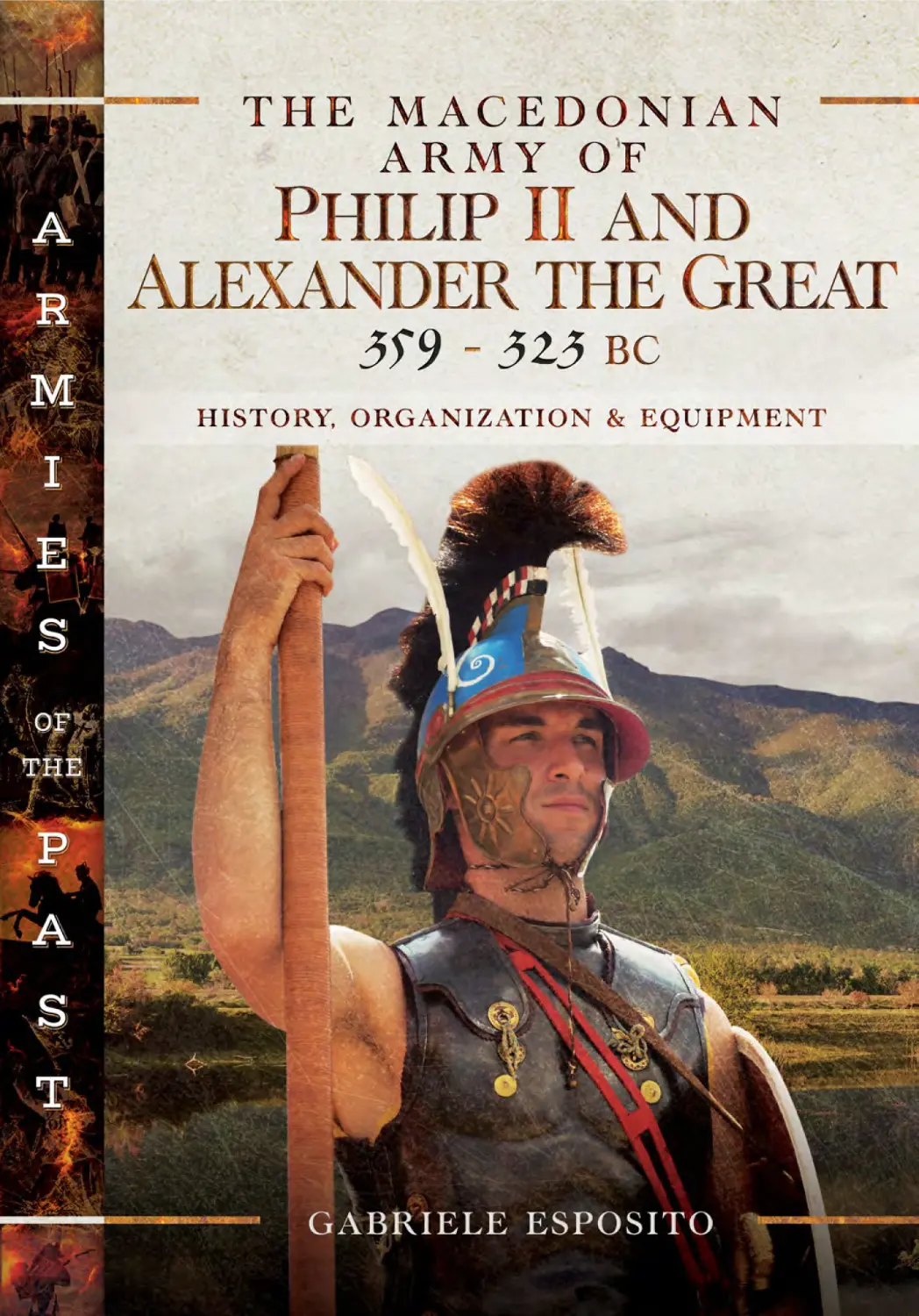


Author: Esposito G.
Tags: history historical figures macedonia macedonian army history of macedonia
ISBN: 978-1-52678-735-4
Year: 2022

Text
                    The Macedonian Army
of Philip II and
Alexander the Great,
359–323 bc

The Macedonian Army of Philip II and Alexander the Great, 359–323 BC.indd 1

01/12/2021 21:46

The Macedonian Army of Philip II and Alexander the Great, 359–323 BC.indd 2

01/12/2021 21:46

The Macedonian Army
of Philip II and
Alexander the Great,
359–323 bc
History, organization and equipment
Gabriele Esposito

The Macedonian Army of Philip II and Alexander the Great, 359–323 BC.indd 3

01/12/2021 21:46

First published in Great Britain in 2022
by Pen & Sword Military
An imprint of Pen & Sword Books Limited
47 Church Street
Barnsley
South Yorkshire
S70 2AS
Copyright © Gabriele Esposito 2022
ISBN 978 1 52678 735 4
The right of Gabriele Esposito to be identified as
Author of this Work has been asserted by him in accordance
with the Copyright, Designs and Patents Act 1988.
A CIP catalogue record for this book is
available from the British Library
All rights reserved. No part of this book may be reproduced or
transmitted in any form or by any means, electronic or mechanical
including photocopying, recording or by any information storage and
retrieval system, without permission from the Publisher in writing.
Typeset in Adobe Caslon
by Mac Style
Printed and bound in India by Replika Press Pvt. Ltd.

Pen & Sword Books Limited incorporates the imprints of Atlas,
Archaeology, Aviation, Discovery, Family History, Fiction, History, Maritime,
Military, Military Classics, Politics, Select, Transport, True Crime, Air World,
Frontline Publishing, Leo Cooper, Remember When, Seaforth Publishing,
The Praetorian Press, Wharncliffe Local History, Wharncliffe Transport,
Wharncliffe True Crime and White Owl.
For a complete list of Pen & Sword titles please contact
PEN & SWORD BOOKS LIMITED
47 Church Street, Barnsley, South Yorkshire, S70 2AS, England
E-mail: enquiries@pen-and-sword.co.uk
Website: www. pen-and-sword.co.uk

The Macedonian Army of Philip II and Alexander the Great, 359–323 BC.indd 4

01/12/2021 21:46

Contents

Acknowledgementsvii
Introductionviii
Chapter 1

Macedonia before Philip II1

Chapter 2

The Ascendancy of Macedonia under Philip II22

Chapter 3

The Rise of Alexander the Great51

Chapter 4

The Conquest of the Persian Empire82

Chapter 5

Alexander’s Campaigns in Central Asia and India110

Chapter 6

Weapons and Equipment of the Macedonian Army130

Bibliography139
The Re-enactors who Contributed to this Book140
Index143

The Macedonian Army of Philip II and Alexander the Great, 359–323 BC.indd 5

01/12/2021 21:46

Gabriele Esposito is a military historian who works as a freelance author and
researcher for some of the most important publishing houses in the military history
sector. In particular, he is an expert specializing in uniformology: his interests and
expertise range from the ancient civilizations to modern post-colonial conflicts.
During recent years, he has conducted and published several researches on the
military history of the Latin American countries, with special attention on the War
of the Triple Alliance and the War of the Pacific. He is among the leading experts
on the military history of the Italian Wars of Unification and the Spanish Carlist
Wars. His books and essays are published on a regular basis by Osprey Publishing,
Winged Hussar Publishing and Libreria Editrice Goriziana; he is also the author of
numerous military history articles appearing in specialized magazines like Ancient
Warfare Magazine, Medieval Warfare Magazine, The Armourer, History of War,
Guerres et Histoire, Focus Storia and Focus Storia Wars.

The Macedonian Army of Philip II and Alexander the Great, 359–323 BC.indd 6

01/12/2021 21:46

Acknowledgements

T

his book is dedicated to my beloved parents, Maria Rosaria and Benedetto,
for their immense love and great support in every phase of my life. Thanks to
their precious advice, the present publication is a much better product: their
great intelligence is always a secure guide for me. A very special mention goes to the
German re-enactment group and living history association ‘Hetairoi’, for providing
me the magnificent and detailed photographs that illustrate this book. In particular,
I want to express my deep gratitude to Thorsten Schillo: he enjoyed and supported
the idea of this book from the beginnings and has helped me in every phase of its
production with great generosity. I want to express my gratitude also to the other
two groups that collaborated with me for this title: ‘Athenea Prómakhos’ from Spain,
in the person of Jonatan Prieto, and ‘Ancient Thrace’ from Bulgaria, in the person
of Petar Chapkanov. Without their incredible work of research and re-enactment,
the present work would have not been the same. A very special thanks goes to
Philip Sidnell, the commissioning editor of my books for Pen & Sword: his love for
history and his passion for publishing are the key factors behind the success of our
publications. Last but not least, a special mention goes to the production manager of
this title, Matt Jones, for his great competence and patience, and many thanks also to
Tony Walton for his usual incredible work on my manuscripts.

The Macedonian Army of Philip II and Alexander the Great, 359–323 BC.indd 7

01/12/2021 21:46

Introduction

T

he main aim of this book is to present a detailed analysis of the organization,
combat experiences, tactics and equipment of Alexander the Great’s
Macedonian Army. Alexander’s army is one of the most famous military
forces of Antiquity, well known because of its most important component: the
iconic heavy infantry phalanx, a tactical formation that gave victory to Alexander
in several pitched battles. To understand the reasons behind the great conqueror’s
military successes, we will follow the history of the Kingdom of Macedonia since its
first significant political experiences up to the rise of Philip II, Alexander’s brilliant
father and one of the greatest military reformers of the ancient world. We will see
how the Macedonians played an important role in the history of Greece before the
ascendancy of Philip, and will examine how the latter was able to subdue most of the
southern Balkans in just a few years. A lot of space will be devoted to the military
reforms carried out by Alexander’s father, in order to describe the structure and
organization of Macedonia’s most iconic military units: the foot companions, the
horse companions and the hypaspists. The book will then provide an analysis of
Alexander’s early military campaigns and of his subsequent great victories in Asia:
at the River Granicus, Issus, Tyre, Gaza, Gaugamela, the Persian Gate, Sogdian
Rock and River Hydaspes. By describing the various campaigns and battles, we will
also follow the internal evolution of the Macedonian Army, with an analysis of its
lesser-known troop types such as the light infantry/cavalry and the allied/mercenary
forces provided by the Greeks. The tactics employed by Alexander’s soldiers will
be explained in great detail across the whole text, and there will be a final chapter
entirely devoted to a description of the panoply used by the various components of
the Macedonian Army, from the long pikes of the phalangites to the light javelins of
the tribal peltasts.

The Macedonian Army of Philip II and Alexander the Great, 359–323 BC.indd 8

01/12/2021 21:46

Chapter 1

Macedonia before Philip II

F

or a very long time, the Kingdom of Macedonia was not considered as part of
the Greek world because it was located on the northern edge of the Hellenic
kingdoms and its inhabitants were quite different from those of the great Greek
urban centres like Athens or Sparta. Although the Macedonians spoke Greek and
practised the same religion as the southern Greeks, they had a completely different
lifestyle. Primarily, they did not live in large cities like the rest of the Greeks, their
settlements instead being dispersed across a vast countryside and consisting of small
rural villages. In addition, the Macedonian economy and society were completely
different from those of the other Greeks: commerce and craftsmanship were quite
underdeveloped in Macedonia, with the local economy instead based on agriculture
and horse breeding. Agriculture was the main occupation of the Macedonians, the
majority of whom were free men who owned a small farm, sustaining their families
with the products of their land and having large flocks of sheep or goats. The
breeding of horses was particularly important for the economy of Macedonia, since
these animals were used in war and could also be sold to the southern Greeks in
exchange for significant sums of money. Macedonian society retained a very tribal
nature for a long time, with the development of a centralized state being extremely
slow. Each village was dominated by its own noble warlord, who was at the head of
a personal retinue of warriors. No form of democracy existed and the king exerted
only nominal power over the state’s many nobles. These nobles, with their warriors,
fought as horsemen and were extremely warlike: pillaging and raiding were common
activities. The most important cities of Greece were characterized by the presence of
a strong middle class, whose members made up the bulk of the armies assembled by
the various urban centres. Indeed, it was from these merchants and craftsmen that the
heavy infantry of the hoplites were recruited. Macedonia had very few slaves; all the
subjects of the king were free men, but between them and the aristocracy there was
no middle class. Macedonian armies mostly consisted of cavalry, which comprised the
nobles and their personal retinues; the great majority of the population was excluded
from military life, which meant the kingdom was quite weak from a military point
of view. Neither could the Macedonians be compared with the other Greeks from
a cultural point of view: they spoke Greek with a very distinctive ‘rural’ accent and

The Macedonian Army of Philip II and Alexander the Great, 359–323 BC.indd 1

01/12/2021 21:46

2 The Macedonian Army of Philip II and Alexander the Great, 359–323 bc

Philip II of Macedonia, father of Alexander the Great and reformer of the Macedonian Army. The warrior
king was wounded several times during his life and even lost an eye. (Photo and copyright by Hetairoi)

The Macedonian Army of Philip II and Alexander the Great, 359–323 BC.indd 2

01/12/2021 21:46

Macedonia before Philip II

3

Philip II in his parade armour
made of iron, which was decorated
with bronze attachments.
(Photo and copyright by Hetairoi)

The Macedonian Army of Philip II and Alexander the Great, 359–323 BC.indd 3

01/12/2021 21:46

4 The Macedonian Army of Philip II and Alexander the Great, 359–323 bc
did not practise philosophy like the Athenians. Macedonian civilization was thus a
simplified version of the Greek culture, to the point that the Greeks considered the
Macedonians to be semi-barbarians who had very little in common with them. This
was partly true, the Kingdom of Macedonia being located in the heart of the Balkans
and thus heavily influenced by several different civilizations.
At this point, it is important to have a clear idea of which populations lived around
the Macedonians and how they interacted with the Kingdom of Macedonia. To the
north of Macedon were the Paeonians, a people of mixed Thraco-Illyrian descent
living on the border between two worlds: the Thracian in the east and the Illyrian in
the west. The Paeonians were extremely warlike, and were considered by the Greeks
as the most ferocious warriors of the Balkans. They spent most of their life fighting
between themselves and against the nearby tribes of the Thracians/Illyrians. Their
society had a tribal organization and they all fought as excellent light infantrymen.
Living on a harsh territory that was mostly covered with mountains, they had learned
how to survive during cold months with very few resources and could endure any
sacrifice in case of war. Pillaging was one of their most important activities, and most
of their bloody raids were usually directed against Macedonia. Both the Greeks and
the Macedonians feared the Paeonian warriors, who were considered extremely wild
and showed very little respect for any of the social/religious practices of the Hellenic
world. The Paeonians consisted of several different tribes, having their own warlords
and establishing their own alliances with the Thracian and Illyrian communities
living on their borders. The most important Paeonian tribe was that of the Agrianes,
who were under a strong Thracian influence from a military point of view and were
deadly warriors equipped with javelins.
To the west of Macedonia was the land inhabited by the Illyrians, who controlled
a large portion of the western Balkans corresponding to the territories of the former
Yugoslavia (from modern Slovenia in the north to the central areas of Albania in
the south). The Illyrians were divided into several different tribes and were ruled by
numerous warlords; sometimes one of these could become stronger than the others
and assume the title of ‘king’, but they only had a nominal importance. Broadly
speaking, the Illyrian tribes living in the north were not influenced by Greek
civilization, whereas those in the south were seen as more ‘civilized’ according to
contemporary Greek standards. Illyria also comprised a large portion of coastline,
from which the Illyrians were able to control most of the Adriatic Sea until the naval
ascendancy of Rome. Over time, they became infamous as pirates and started to
conduct frequent raids across the Adriatic. Like the Paeonians, the Illyrians also lived
in small villages and their society was a rural one, and they too launched frequent
incursions against Macedonia.

The Macedonian Army of Philip II and Alexander the Great, 359–323 BC.indd 4

01/12/2021 21:46

Macedonia before Philip II

5

To the east of Macedonia lived the Thracians, one of the most important peoples
of Antiquity. They were divided into more than forty tribes, which were constantly at
war with each other: Thracian society was an extremely warlike one, in which warfare
was considered one of the most important and most normal elements in a man’s life.
From an economic point of view, the Thracians practised breeding much more than
agriculture: the great majority of them, in fact, were shepherds and lived from the
products obtained from their sheep and goats. Inter-tribal skirmishes and raids were
usually sparked by controversies starting among shepherds for control of the pastures.
The majority of the Thracians did not live in permanent settlements, because they
followed their herds during most of the year. Consequently, until the arrival of the
first Greek colonists, Thrace did not have any major city. Raiding the village of a
rival tribe was a normal occurrence for a semi-nomad Thracian community, since
skirmishes and minor ‘local’ wars were seen as a great occasion to enlarge herds by
capturing sheep or goats from their enemy. This kind of warfare was common to all
the Balkan peoples, including the Macedonians. The territory of Thrace (presentday Bulgaria), mostly covered by hills, was not well suited to armies equipped with
heavy armour and moving in close formations. Indeed, the only way to move rapidly
and fight effectively in the Thracian hinterland was to act as skirmishers, equipped
with throwing weapons and trained in light infantry tactics. The territory of Thrace,
however, also comprised some plains where the local communities bred excellent
horses. The Thracian tribes were distinguished between those of the mountains and
those of the plains, according to the morphology of the hills or valleys on which
they lived.
According to ancient authors such as Herodotus, the Thracians were the most
numerous people of Europe: if united into a single kingdom, they could have defeated
and conquered all the ancient nations living along their borders. Fortunately for
the latter, however, the Thracians always preferred inter-tribal warfare to invasions
directed against foreign peoples. In Thrace, the profession of warrior was highly
honoured, and was considered superior to all others. Showing courage in battle
was fundamental for a Thracian man to acquire a respected personal reputation.
Generally speaking, however, Thracian warriors were not famous for their martial
discipline: they loved plunder more than anything else, and this frequently caused
them serious problems during a battle or campaign. The Thracians never lost their
original character of semi-nomadic raiders, even after centuries of close contact
with the major civilizations of the Mediterranean. Nothing was more important for
them than personal wealth, and every possible method to augment that wealth was
considered legitimate. Like the Paeonians and the Illyrians, the Thracians organized
frequent raids against the rural communities of Macedon, in particular invading

The Macedonian Army of Philip II and Alexander the Great, 359–323 BC.indd 5

01/12/2021 21:46

6 The Macedonian Army of Philip II and Alexander the Great, 359–323 bc

Macedonian phalangite with leather muscle cuirass. (Photo and copyright by Hetairoi)

The Macedonian Army of Philip II and Alexander the Great, 359–323 BC.indd 6

01/12/2021 21:46

Macedonia before Philip II

7

Macedonian phalangite, with
pelte round shield and bronze
greaves. (Photo and copyright by
Hetairoi)

The Macedonian Army of Philip II and Alexander the Great, 359–323 BC.indd 7

01/12/2021 21:46

8 The Macedonian Army of Philip II and Alexander the Great, 359–323 bc
the eastern portion of the Kingdom of Macedonia on several occasions. When a
large part of the Thracian tribes was finally unified into a single state, known as the
Odrysian Kingdom, they became a very serious threat to the internal stability of
Macedonia due to their impressive military resources and to expansionist ambitions.
As is clear from the above description of their neighbours, the Macedonians can be
considered to be one of the most ‘unlucky’ peoples of Antiquity: they were surrounded
by numerous warlike communities and were too weak militarily to put up an effective
resistance against raids or invasions by these ‘barbarians’ along their borders.
South-west of Macedonia was the partly Hellenized Kingdom of Epirus, whose
inhabitants had a lot in common with the Macedonians: they spoke Greek and
believed in the same gods as the Greeks, but were also considered ‘barbarians’ by
the Greeks since they had a society organized along tribal lines and a lower level of
civilization that was largely a rural one. Epirus, roughly corresponding to presentday central and southern Albania, was under strong influence from the Illyrian
tribes living on its northern borders and was only a marginal player in the Greek
political games. Traditionally, it had always been inhabited by three main tribes: the
Chaonians in the north, the Molossians in the centre and the Thesprotians in the
south. Until 370 bc, these three tribes were not organized into a single state and were
frequently at war with each other. Differently from Greece, Epirus had no cities, with
all the Epirotes living in small villages dispersed across the countryside. Originally,
the three tribes of Epirus had been nomadic groups and thus had been constantly at
war against the Illyrians raiding from the north. This political situation continued
until 370 bc, when the Molossians started to expand at the expense of the other two
tribal groups. After several years of internal wars, the Molossians were finally able
to unify Epirus and form a centralized kingdom, ruled by the royal family of the
Aecides. Epirus and Macedonia had an enemy in common: Illyria. As a result, they
started to collaborate in order to limit the expansionist ambitions of the Illyrians.
To the south-east of Macedonia were the Greek cities of the Chalcidian Peninsula
and the fertile region of Thessaly. With the end of the so-called Dark Ages, the
population of mainland Greece started to grow at an impressive rate and all the newly
founded poleis (independent cities or states) had to introduce measures to control
the demography of their communities. Greece was still a poor country at that time
and its territory was mostly covered with mountains, so the Greek cities could not
practise agriculture on a large scale and were forced to resettle a substantial portion of
their citizens outside the borders of mainland Greece. During the eighth and seventh
centuries bc, many thousands of Greek colonists departed their mother cities in
search of a new land where they could found their own poleis. These major migratory
movements of the Greeks were directed towards the Western Mediterranean, where

The Macedonian Army of Philip II and Alexander the Great, 359–323 BC.indd 8

01/12/2021 21:46

Macedonia before Philip II

9

they created many flourishing colonies in southern Italy. However, they also settled
along the coastline of southern Thrace, extending from the Chalcidian Peninsula
to the Dardanelles Straits, which was the first target of the Greek colonists during
their expansion eastwards. When it was realized that the hills inhabited by the
Thracians were rich in precious metals like gold or silver, the Greek penetration
in Thrace became more significant. The city-states of mainland Greece were in
constant search of new natural resources in order to sustain the great commercial
expansion of their communities. By founding new colonies in the east, they could
resolve the problem of over-population while acquiring control over strategic local
natural resources. To control the land to build new settlements, however, the Greeks
had to fight with the local Thracian tribes, who had no intention of welcoming the
foreign intruders. During their early attempts to colonize the Thracian coastline, the
Greeks experienced many difficulties, with the local population being warlike and
wild by comparison with Greek standards of the time. Thrace, however, was seen as
a land of opportunities and the Greeks maintained their push to colonize the region.
During this initial period of colonization, which lasted until the outbreak of the
Persian Wars in the fifth century bc, the Greeks founded several settlements along
the coastline of southern Thrace. These rich commercial outposts established by the
Greeks soon transformed themselves into thriving cities, whose relations with the
Thracians were often quite complicated. Nevertheless, after several decades of minor
wars and frequent skirmishes, it became clear to the Thracian tribes that they could
not destroy the Greek colonies. The new settlements were strongly defended by
thick walls, and the Thracians were not able to conduct successful siege operations.
Consequently, with the Chalcidian Peninsula now in Greek hands, Macedonia had
become a landlocked country, depending entirely on foreign merchants for the
importing or exporting of goods since it did not have a navy of its own.
Thessaly was one of the most atypical regions of Greece at this time, being part of
the Greek world but having several peculiar features that could not be found in other
areas of the Hellenic civilization. At the beginning of the Classical period, Thessaly
was still only partly urbanized and was dominated by an aristocracy of local warlords
who based their power on large retinues of cavalrymen. Traditionally, Thessaly had
been divided into four semi-independent cantons, which recognized a sort of formal
supreme authority of an elected ruler known as a ‘tagos’. This political organization
could be described as a confederation: when the ruling tagos was strong, the cantons
were kept under central control; but when the tagos appeared weak, each canton
acted as an independent state. Civil wars were frequent. Thessaly contained many
precious natural resources and was the only area of Greece where horse-breeding was
practised on a large scale. According to ancient sources, the best horsemen and horses

The Macedonian Army of Philip II and Alexander the Great, 359–323 BC.indd 9

01/12/2021 21:46

10 The Macedonian Army of Philip II and Alexander the Great, 359–323 bc

Macedonian foot companion with
Pilos helmet and linen cuirass.
During marches, the long sarissa
was dismantled in two parts and was
carried on the shoulders. (Photo and
copyright by Hetairoi)

The Macedonian Army of Philip II and Alexander the Great, 359–323 BC.indd 10

01/12/2021 21:46

Macedonia before Philip II

11

Macedonian foot companion
with the Vergina Star painted
on the external surface of his
pelte shield. This symbol, also
known as the Argead Star, was
distinctive of the Macedonian
royal family. (Photo and copyright
by Hetairoi)

The Macedonian Army of Philip II and Alexander the Great, 359–323 BC.indd 11

01/12/2021 21:46

12 The Macedonian Army of Philip II and Alexander the Great, 359–323 bc
of the Hellenic world all came from Thessaly. In addition, from a strategic point of
view, the fertile and rich Thessalian plains linked mainland Greece to Macedonia
and the heart of the Balkans. Being the only plain region in a country covered by
mountains, Thessaly was a crucible of contrasting political interests and a target of
conquest for the bordering cities and kingdoms.
Until 515 bc, the small Kingdom of Macedonia remained at the margins of the
Hellenic world. Its rulers did not have stable diplomatic relations with other states
and exerted only a very limited control over their aristocracy. In addition to this,
the realm was under the constant threat of raids by the warlike peoples living on
its borders. This situation only started to change in 513 bc, when a new military
power appeared in the eastern Balkans: the mighty Persian Empire ruled by the
Achaemenid dynasty. During that year, the Persian monarch Darius I conducted a
military campaign in Scythia and Thrace. The Scythians, a strong nomadic people
living in present-day Ukraine, had been allies of the Persians during their attack
on Babylon, but had then turned into a dangerous menace for the vast empire that
the Achaemenids were building. As a result, hostilities began between the Persians
and Scythians. Darius, wishing to eliminate once and for all these troublesome
nomads, mounted an assault against the Scythians’ main European territories in
southern Ukraine after crossing the Bosphorus Straits from Asia Minor (using a
bridge of boats). While moving north, the Persians crossed Thrace and subdued
(albeit temporarily) most of the local tribes. The Scythians used scorched-earth
tactics throughout the campaign, which enabled them to retreat across the immense
plains of Ukraine without fighting a single pitched battle against the Persians.
Darius’ expedition ended in a stalemate and the retreat of the Achaemenids to their
own territories. During the campaign, however, Persian troops reached the borders
of Macedonia and Achaemenid ambassadors met with the local king, Amyntas I.
Impressed by the military might of the Persians, Amyntas accepted Achaemenid
suzerainty over his realm by performing the ‘surrender ceremony’ that was usually
required by the Persians when subjugating a new territory. This highly symbolic act
consisted of offering ‘earth and water’ to the Achaemenid ambassadors as a sign
of submission to the Great King of the Persian Empire. As a result, from 511 bc,
Amyntas became a vassal of Darius, although his kingdom was not transformed into
a Persian satrapy (province) but was permitted to retain its autonomy. After these
first Achaemenid forays in the Balkans, the Scythians and Thracians returned to
their previous independent condition, although the Persians started to consider those
territories that they had conquered in 513–511 bc as part of their empire and thus
organized an expedition to reconquer them in 492 bc. This was probably intended as
a preparatory operation in view of future offensives against Greece: the Persian Army

The Macedonian Army of Philip II and Alexander the Great, 359–323 BC.indd 12

01/12/2021 21:46

Macedonia before Philip II

13

Macedonian foot companion wearing linen cuirass reinforced with bronze scales on the sides.
(Photo and copyright by Hetairoi)

The Macedonian Army of Philip II and Alexander the Great, 359–323 BC.indd 13

01/12/2021 21:46

14 The Macedonian Army of Philip II and Alexander the Great, 359–323 bc

Macedonian
phalangite wearing
leather boots. In this
photo it is possible
to appreciate the
detail of the pike’s
butt spike (see also
pages 17 and 122).
(Photo and copyright
by Hetairoi)

The Macedonian Army of Philip II and Alexander the Great, 359–323 BC.indd 14

01/12/2021 21:46

Macedonia before Philip II

15

needed to have a base on the European continent. The Persian expeditionary corps
of 492 bc was guided by Mardonius, son-in-law of Darius I, and departed from the
Anatolian region of Cilicia in modern-day south-east Turkey.
The Persian Army advanced by land up to the Hellespont in northern Anatolia,
marching along the coastline in order to retain direct contact with the fleet. At this
point, all the troops were embarked on the ships and crossed the Hellespont without
any particular problems. Once in Europe, the Persians focused on re-subjugating the
Thracian tribes one by one: since the tribes were politically divided, the occupation
of southern Thrace was not a difficult task for Mardonius. By now the Persians had a
solid base in Europe, but instead of then moving north to fight against the Scythians,
the Achaemenid forces moved west in order to enter Greece from the north. The
Persians quickly reached Macedonia for a second time, and again received an act of
formal submission from the local king, Alexander I. Despite formally being a loyal
subject of the Persian Empire, Alexander wished to free his country from Achaemenid
‘protection’ and did his best to help the Greeks with supplies and advice during the
ensuing Persian invasions of their territory. As a client king of the Persian Empire,
Alexander I had to supply troops for its invasion of Greece during 480 and 479 bc,
known as the Second Persian War. At the same time, however, he secretly informed the
Greeks about the Persian Army’s movements and saved them from a crushing defeat
in Thessaly by suggesting an alternative military strategy. In 479 bc, after having been
defeated at sea the previous year at the Battle of Salamis, the Persians were defeated
on land by the Greeks at the decisive Battle of Plataea, and were subsequently forced
to abandon the northern regions of Greece that they had conquered. During its retreat
across northern Thessaly and Macedonia, what remained of the Persian Army was
attacked by the Macedonians of Alexander I, who now changed sides to regain the
independence of their realm. A pitched battle between the Macedonians and Persians
took place at the estuary of the River Strymon, where 43,000 Achaemenid soldiers
were crushed. Alexander I thus became one of the most important kings in the history
of Macedonia, being the first to ‘move’ his realm into the cultural sphere of the Hellenic
world. He was the first Macedonian who was permitted to participate to the Olympic
Games in 504 bc, and was the first Macedonian ruler to establish a proper royal court
(where the famous Greek poets Pindar and Bacchylides were active). Due to the
precious help provided to the Greeks during the Second Persian War, Alexander I was
even given the honorific title of ‘philellene’, or ‘friend of the Greeks’.
After Alexander I’s death in 454 bc, Macedonia experienced a series of internal
difficulties. The various tribes rebelled against the central authority of the Argead
dynasty, which had ruled the kingdom for more than two centuries. In addition, a
violent civil war broke out between two of Alexander I’s sons: Perdiccas II and Philip.

The Macedonian Army of Philip II and Alexander the Great, 359–323 BC.indd 15

01/12/2021 21:46

16 The Macedonian Army of Philip II and Alexander the Great, 359–323 bc

Full panoply of a Macedonian phalangite. (Photo and copyright by Hetairoi)

This internal conflict saw the intervention of Athens, which sent military contingents
to Macedonia and supported both pretenders during different phases of the civil war.
The Athenians wanted to weaken Macedonia as much as possible and to have a
puppet monarch on its throne. While these events were taking place on the northern
borders of Greece, the Peloponnesian War broke out between Athens and Sparta
in the south. At this point, the Athenians changed their strategy in Macedonia and
evacuated their troops from the region. By 430 bc, most of the Thracian tribes had
been unified into a single realm, known as the Odrysian Kingdom from the name of
the tribe that dominated it. This realm, ruled by the great warlord Sitalces, bordered
with Macedonia along the course of the River Strymon. During the Peloponnesian
War, the Odrysian Kingdom was an ally of Athens, and in 429 bc it assembled a
large army of over 150,000 warriors and invaded Macedonia. After rapidly subduing
Macedonia, the Thracians moved south in order to conquer the Greek cities of

The Macedonian Army of Philip II and Alexander the Great, 359–323 BC.indd 16

01/12/2021 21:46

Macedonia before Philip II

17

Personal equipment of a Macedonian phalangite, including Thracian/Phrygian helmet. (Photo and
copyright by Hetairoi)

the Chalcidian Peninsula that were allied to Sparta. According to plans that had
been agreed with the Athenians, Sitalces’ army was to have been supported by the
Athenian navy during the difficult siege operations against the Chalcidian cities.
When the Thracians arrived in the Chalcidian Peninsula, however, they found no
Athenian warships to support their military efforts. After pillaging the Chalcidian
Peninsula for several days, and being unable to besiege the Greek cities without the
Athenian war machines, the Thracians returned to their homeland after having stolen
enormous amounts of gold. In 424 bc, Sitalces died and his realm was subsequently
fragmented into several smaller kingdoms.
With the collapse of the Odrysian Kingdom, Perdiccas II was finally able to secure
his control over the Kingdom of Macedonia and then decided to side with Sparta
during the ongoing Peloponnesian War. In 424 bc, the Macedonians helped the
Spartans in conquering the Athenian colony of Amphipolis on the coast of southern
Thrace, which had been supplying Athens with large amounts of timber for its naval
forces. After Amphipolis came under Spartan control, Athens had no choice but to
buy timber from the Macedonians, which helped Perdiccas restore the economy of
his devastated realm. During 423 bc, the Macedonian king had to face an internal
rebellion led by one of his nobles, named Arrhabaeus, who wanted to separate his
dominions from the rest of Macedonia and could count on the military support of

The Macedonian Army of Philip II and Alexander the Great, 359–323 BC.indd 17

01/12/2021 21:47

18 The Macedonian Army of Philip II and Alexander the Great, 359–323 bc
several Illyrian tribes. To crush this revolt, Perdiccas asked the Spartans for military
help, but what was provided proved insufficient as his forces were crushed at the
Battle of Lyncestis. Consequently, having seen that his alliance with Sparta had not
brought positive results, the Macedonian king changed sides and started to support
Athens. Perdiccas II’s successor, Archelaus, remained loyal to Athens during the
decisive phase of the Peloponnesian War. For example, after the Athenian navy was
completely destroyed during the Sicilian expedition of 415–413 bc, he supplied his
allies with massive amounts of timber to build a new fleet. Archelaus also built several
new infrastructures in his realm, such as roads and military strongholds, and issued
good quality coinage. In addition, he was the first Macedonian king to re-equip
his infantrymen according to contemporary Greek models, thereby introducing the
hoplites’ traditional panoply into his kingdom. It was also during the king’s reign
that the Macedonian capital of Pella (indeed the only major city of Macedonia) was
founded. After Archelaus’ assassination, Macedonia reverted to a chaotic political
situation that saw the proclamation of several new kings in just a few years, most of
who ruled for only a few months or years. Consequently, Macedonia’s previous internal
stability was soon lost. Royal assassinations were frequent events in Macedonia at
this time, the local nobles always being prone to revolt and the Argead dynasty being
full of potential pretenders to the throne.
This anarchic political situation only came to an end in 392 bc, when Amyntas III
assumed power as the monarch of Macedonia. The father of Philip II and grandfather
of Alexander the Great, Amyntas III is today considered as the real founder of the
unified Kingdom of Macedonia. A very skilled diplomat, Amyntas formed a network
of alliances between his realm and the other powers of the southern Balkans, his
allies comprising Athens, Thessaly, the Chalcidian League and the Odrysians. At
that time, the major external threat for the Macedonians was the Illyrians, who were
trying to expand their dominions southwards. Thanks to Amyntas’ diplomatic moves,
however, Macedonia retained its territorial integrity and all the nobles of the realm
were brought back under direct control of the court in Pella. Amyntas III’s direct
successor was his eldest son, Alexander II, who had many difficulties in keeping
order in Macedonia due to the outbreak of a new civil war which was only resolved
by Athens’ military intervention in support of Alexander, who was thus able to defeat
his rival Pausanias. The new Macedonian king tried to expand his realm’s sphere of
influence by intervening in the internal politics of Thessaly, which at that time was
ravaged by a civil war. The Macedonians occupied a large part of northern Thessaly,
but this audacious move was quickly punished by the city of Thebes (at that time
the dominant military power of Greece following the demise of Sparta and Athens).
After having been defeated by the superior Theban military forces, Alexander II was

The Macedonian Army of Philip II and Alexander the Great, 359–323 BC.indd 18

01/12/2021 21:47

Macedonia before Philip II

19

Personal equipment of a Macedonian phalangite, including Pilos helmet. (Photo and copyright by
Hetairoi)

The Macedonian Army of Philip II and Alexander the Great, 359–323 BC.indd 19

01/12/2021 21:47

20 The Macedonian Army of Philip II and Alexander the Great, 359–323 bc

Macedonian foot companions deployed with their pikes in the vertical position. (Photo and copyright
by Hetairoi)

forced to abandon Thessaly and to become an ally of Thebes. In addition, he had
to send his younger brother, Philip (the future father of Alexander the Great), to
Thebes as a royal hostage. Alexander II was succeeded by Amyntas III’s second son,
Perdiccas III, who tried to regain from the Illyrians some lands that had been lost by
the Macedonians but was killed during one of his military campaigns. Perdiccas III’s
sudden death in 359 bc caused a great political upheaval in Pella, with the Macedonian
nobles choosing the infant son of the monarch as their new king rather than Philip.
However, Philip soon managed to become the tutor and regent of the infant, and
some months later, he proclaimed himself king and dethroned his young nephew
(who was executed in 335 bc).

The Macedonian Army of Philip II and Alexander the Great, 359–323 BC.indd 20

01/12/2021 21:47

Macedonia before Philip II

21

Macedonian foot companions deploying themselves into a file. (Photo and copyright by Hetairoi)

The Macedonian Army of Philip II and Alexander the Great, 359–323 BC.indd 21

01/12/2021 21:47

Chapter 2

The Ascendancy of Macedonia under Philip II

I

n 359 bc, at the age of 23, Philip II became supreme ruler of Macedonia during
the most difficult period in the history of his kingdom. After the sudden death
of Perdiccas III, the enemies of the Macedonians had formed a strong military
alliance and invaded Philip’s new kingdom, taking advantage of the political chaos
that reigned in Pella. The Illyrians raided the north-west of Macedonia, while a joint
force of Paeonians and Thracians pillaged the eastern half of the state. Meanwhile,
the Athenians landed a military contingent just south of Macedonia to support a
false pretender to the throne of Pella named Argeus. Pressed by enemies on all sides
and being in a very weak military position, Philip had no choice but to use diplomacy
to slow down the actions of his most dangerous enemies. He halted the raids of
the Paeonians and Thracians by promising to pay them a tribute, thereby gaining
precious time to mobilize his forces. At the same time, he married the daughter
of the most powerful Illyrian warlord, Bardylis of the Dardanians. Bardylis had
been able to unite several southern Illyrian communities into a single kingdom and
had defeated the Macedonian army of Perdiccas III; according to ancient sources,
Bardylis had killed the Macedonian king with his own hands. Being in no condition
to face the Dardanians on equal terms, Philip preferred to form an alliance with them
through his marriage. After thus stabilizing the military situation on his northern
borders, Philip marched against the 3,000 Athenian hoplites who had landed south
of Macedonia and eliminated the pretender Argeus after gaining a decisive victory. In
a time of terrible crisis, Philip had been able to preserve the territorial integrity of his
realm. However, it was clear to him that he would soon be obliged to fight against the
tribes that still represented a threat to the borders of Macedonia. In 358 bc, hostilities
resumed between the Macedonians and Illyrians; the latter were still in control of a
large portion of northern Macedonia, which was an unacceptable situation for Philip.
The young warrior king mobilized every able-bodied man of his realm and marched
against Bardylis. The decisive clash of this new war took place in the Erigon Valley,
when the Macedonian phalanx was deployed on the battlefield for the first time.
The battle ended with a brilliant victory for Philip, the first of his incredible military
career, with 7,000 Illyrians killed, including Bardylis. Thanks to this unexpected
success, the Macedonians could reconquer the north-western portion of their realm

The Macedonian Army of Philip II and Alexander the Great, 359–323 BC.indd 22

01/12/2021 21:47

The Ascendancy of Macedonia under Philip II

23

and establish a new frontier line with the
Dardanians along the shores of Lake Ohrid.
The new border could be defended much
more easily by the Macedonians than the
previous one, and remained unchanged for
many years. The new phalanx which Philip
deployed in battle in the Erigon Valley was
the most important product of a series of
military reforms that were carried out by
the young Macedonian king between late
359 bc and early the following year.
Philip, who had lofty personal ambitions,
wanted to transform his realm into a great
regional power, and knew that to do so
he had to forge an effective and modern
military machine. When he ascended to
the throne, the Macedonian Army was
in a deplorable state, mostly armed as
tribal troops without hoplite organization
or equipment. The young Macedonian
monarch had lived in Thebes as a royal
hostage from 368–365 bc, during which he
received an excellent military education from
two of the most important Greek generals
of the time: Epaminondas and Pelopidas.
These military leaders had transformed
Thebes into the dominant power in Greece,
and are still remembered today as great
tacticians. They radically reformed hoplite
warfare after two centuries of continuity in
Greek military tactics. The military guile of
Epaminondas and Pelopidas was shown to
the whole Hellenic world at the Battle of
Leuctra in 371 bc, when the once-mighty
Spartan hoplites were crushed by the
A file of Macedonian phalangites with their sarissae
in the vertical position. (Photo and copyright by
Hetairoi)

The Macedonian Army of Philip II and Alexander the Great, 359–323 BC.indd 23

01/12/2021 21:47

24 The Macedonian Army of Philip II and Alexander the Great, 359–323 bc

Macedonian phalangites on the march, transporting their dismantled sarissae on their shoulders.
(Photo and copyright by Hetairoi)

The Macedonian Army of Philip II and Alexander the Great, 359–323 BC.indd 24

01/12/2021 21:47

The Ascendancy of Macedonia under Philip II

25

Thebans. During this clash, one of the most famous in the military history of Ancient
Greece, Epaminondas employed some incredibly innovative tactics that were decisive
in securing victory. The traditional phalanx formation of the Greek hoplites had a
natural tendency to veer to the right during battles, as it was natural for each hoplite
to do his best to shelter his unarmed side behind the shield of the fighter located to
his right. As a result of this tendency, Greek military commanders always placed their
best troops on the right flank of their armies. At Leuctra, for example, the Spartan
commander placed his 700 elite Spartiates on the right. Epaminondas, instead, did
something completely different. Understanding that he was fighting against a much
more numerous enemy and thus risked being easily outflanked, he firstly took the
best troops of his army (including the famous Theban ‘Sacred Band’) and deployed
them on his left flank in order to face the Spartiates. He also arranged these soldiers
of the left flank in a much more dense formation (fifty ranks deep instead of the
usual eight to twelve ranks). As a result, the Thebans not only had their best troops
on the left, but also enjoyed a local numerical superiority over the elite Spartiates.
Epaminondas also adopted for the first time in Greek military history an oblique
formation. Since his right flank was now formed by troops of mediocre quality who
were inferior in number to those confronting them, he instructed his hoplites on
the right to avoid battle with the enemy and withdraw gradually as the Spartans
advanced. In that sector, the Spartan line was much longer than that of the Thebans,
so accepting battle there would have led to a Spartan outflanking manoeuvre. The
Thebans thus attacked in a way never seen before by the Spartans: their elite left
advanced at double speed, while their weak right retreated without fighting. The
Spartans had never fought against an enemy in this oblique formation, and had
always been victorious thanks to the decisive charge of their elite right wing. Leuctra
was a brilliant victory for Epaminondas and Pelopidas, with some 400 of the 700
Spartiates perishing on the field of battle. Crucially, Sparta was unable to replace
such severe losses.
While in Thebes, Philip learned everything about their novel tactics from Pelopidas
and Epaminondas. He also had the opportunity to study the organization of the
victorious Theban forces. Around 395 bc, the army of the Boeotian League, which
included that of Thebes, deployed a total of 11,000 hoplites and 1,100 cavalrymen.
Such numbers were comparable to those of the contemporary Athenian military
forces, but it must be remembered that the Boeotian League was a confederation
of several poleis guided by Thebes and not a single state. Boeotia was divided into
eleven territorial districts, four of which were Thebes’ direct possessions; each district
elected a supreme military commander (known as a ‘boeotarch’) and had to raise 1,100
soldiers (1,000 hoplites and 100 cavalry). Consequently, Thebes alone could field

The Macedonian Army of Philip II and Alexander the Great, 359–323 BC.indd 25

01/12/2021 21:47

26 The Macedonian Army of Philip II and Alexander the Great, 359–323 bc

Macedonian hypaspist; the general
appearance is that of a Greek hoplite, with
dory spear and hoplon shield. The cuirass
was worn only on guard duties by members
of the Vanguard Battalion. (Photo and
copyright by Hetairoi)

The Macedonian Army of Philip II and Alexander the Great, 359–323 BC.indd 26

01/12/2021 21:47

The Ascendancy of Macedonia under Philip II

27

Macedonian hypaspist wearing a
magnificent example of Attic helmet.
(Photo and copyright by Hetairoi)

The Macedonian Army of Philip II and Alexander the Great, 359–323 BC.indd 27

01/12/2021 21:47

28 The Macedonian Army of Philip II and Alexander the Great, 359–323 bc
4,000 hoplites and 400 cavalry, a military force comparable to that of the Spartiates.
The Theban contingent of the army of the Boeotian League also comprised a special
unit of 300 ‘epilektoi’ (‘chosen soldiers’): the ‘Hieros Lochos’ or Sacred Band, probably
the most famous military unit of Classical Greece. The 300 hoplites who made up
this corps were full-time professional soldiers. They formed the permanent garrison
of Thebes and were stationed in the city’s strongest fortress, the Cadmeia. The
Sacred Band, which was probably created around 378 bc, soon became famous for its
excellent training.
While in Thebes, Philip could also study the recent military reforms carried out
by the Athenians. At the beginning of the fourth century bc, Iphicrates, an Athenian
general who had conducted several campaigns in Thrace, reformed the military
forces of his city by changing the panoply of the traditional Greek troop types. He
was the first who saw the great potential of the peltasts as a sort of ‘medium infantry’,
who could fight both as light skirmishers and as heavy ‘shock’ troops according
to circumstances on the battlefield. The peltast was the standard Thracian light
infantryman, a skirmisher equipped with a crescent-shaped wicker shield (the pelte,
from which he took his name) and a couple of throwing javelins. These fighters were
able to move very rapidly and were perfectly suited for operating on broken terrain.
The Thracian warriors were used to fight as skirmishers, their wars being mostly
inter-tribal conflicts that involved the raiding of nearby villages and cattle rustling.
They wore no armour and their offensive weapons consisted of javelins, making them
perfect for hit-and-run ‘guerrilla’ tactics and killing their enemies from a distance
(for example during ambushes). Their pelte shield was crescent-shaped in order to
make the throwing of javelins more easy. Each peltast could throw a javelin over the
top of his shield’s convex part while protecting his torso behind the concave section.
Instead of a helmet, the Thracian peltasts wore a cap made of fox-skin, perfectly
suited to the cold temperatures of their homeland’s winters thanks to the presence of
a pair of earflaps. A square cloak and a long tunic, both very thick, were also worn.
The traditional Thracian dress was completed by a pair of fur-lined fawn-skin boots,
which were perfect to run on terrain covered with snow. The fur lining hung down in
three distinctively Thracian lappets. Initially, the Greek hoplites had great difficulties
in fighting against the Thracians, since they moved too slowly to respond effectively
to their rapid attacks. Consequently, some Greek commanders started to develop a
new category of lighter infantrymen known as ekdromoi, who were chosen from the
youngest and fittest of the hoplites. They did not wear armour or greaves, since they
were expected to run out of their battle lines in order to catch the Thracian peltasts
before they could withdraw after having thrown their javelins. The term ekdromoi,
in fact, simply meant ‘out-runners’. Nevertheless, the creation of this new category

The Macedonian Army of Philip II and Alexander the Great, 359–323 BC.indd 28

01/12/2021 21:47

The Ascendancy of Macedonia under Philip II

29

of ‘light hoplites’ was not enough by itself to effectively face the Thracians, so the
Greeks also had to introduce some peltasts into their own armies. This was initially
done by simply recruiting more Thracian mercenaries, since large numbers of them
were always available. However, the Greek cities then started to train and equip some
of their citizen-soldiers as peltasts rather than as hoplites. In the Greek military
system of this time, a peltast was a sort of ‘medium’ infantryman: they did not have
the same traditional dress of the original Thracian peltasts, but did use the same basic
equipment, with pelte shield and javelins.
In 391 bc, at the Battle of Lechaeum, the Athenian Iphicrates was able to defeat
– for the first time in history – a contingent of Spartan hoplites with just a force of
peltasts. Iphicrates had already modified the panoply and tactics of the Athenian
peltasts. Instead of the traditional pelte shield, he gave them a large oval shield
(always made of wicker), while his new peltasts wore a helmet to protect their head.
Offensive weapons now also included a short sword and a short spear, in addition
to the usual javelins. Thanks to the larger shield and new helmet, the Iphicratean
peltast could fight in close combat against a hoplite. Indeed, thanks to the new
sword and spear, the peltast now had more or less the same offensive capabilities as a
heavy infantryman. Compared to a hoplite, however, the new peltast was much more
mobile, since he wore no body armour. Iphicrates had completed the transition of
the peltast from a light infantryman to a medium one. After the positive experience
of Lechaeum, the Athenian general also decided to modify the panoply and tactics
of the standard hoplite. The large hoplon shield was abandoned in favour of a much
smaller and lighter round shield (known as a pelte, like the crescent-shaped one
of the peltasts). Furthermore, the metal greaves were discarded, replaced by new
leather boots known as ‘Iphicratids’ from the name of their creator (which were
very similar to those worn by the Thracians), while new lighter cuirasses made of
quilted linen replaced the older models. Meanwhile, the spear, to compensate the
lightening of the defensive equipment, was lengthened up to 3.6 metres. The new
small shield could be strapped to the forearm, thus freeing the left hand to help hold
the longer spear.
Iphicrates had made the panoply of the peltasts heavier and that of the hoplites
lighter. While his military reforms, which were revolutionary for the time, did not
save the Athenian Army from its slow decline, they did have a fundamental impact
over the future development of the new Macedonian phalanx introduced by Philip II.
Philip’s phalangites were just an improved version of the Iphicratean hoplites. From
the Thebans, meanwhile, the Macedonian monarch had taken the idea of creating a
special corps of chosen soldiers – like the Sacred Band – who could perform specific
tactical functions on the battlefield.

The Macedonian Army of Philip II and Alexander the Great, 359–323 BC.indd 29

01/12/2021 21:47

30 The Macedonian Army of Philip II and Alexander the Great, 359–323 bc
Before the ascendancy of Philip, the Macedonian Army was mostly known in
Greece for the great quality of its cavalry, while its infantry was little more than a
poorly equipped and badly trained band of peasants that could not compare to the
elite heavy infantry hoplites of the Greek cities. Differently from most of the Greek
states, Macedonia had enough plains to breed a large number of horses, which had
always enabled the nobles to deploy personal retinues made up of cavalrymen. The
weak Macedonian infantry consisted only of lightly armed skirmishers who were
not so different from their Illyrian or Thracian enemies, but who were not capable
of fighting with the latter’s efficiency. The Macedonian infantry clearly needed to be
reformed, but importing hoplite warfare to the Kingdom of Macedonia was not a
simple matter because the state had no middle class from which the heavy infantry
could be recruited. In the early decades of the fourth century bc, especially during
the reign of Archelaus (413–399 bc), the Macedonian kings had already started an
attempt to reform their infantry forces. For any future confrontation with the armies
of the Greek world, the light Macedonian infantry used to fight against the northern
tribes of the Balkans would have proved of no military use. The Macedonians thus
started to organize and train some of their infantrymen as hoplites. When Philip
ascended to the throne of Pella in 359 bc, the Macedonian Army could field 600
cavalry and 10,000 infantry, but only a small portion of the latter were equipped
as hoplites, the majority of them still made up of shepherds and farmers who were
armed like light infantry skirmishers in the Illyrian or Thracian style. Philip decided
to change the situation by transforming his army into a combined force of ‘shock’
troops, with heavy cavalry and heavy infantry playing a prominent role. As a result, he
created two main bodies of new regular troops: the pezhetairoi or ‘foot companions’
and the heitairoi or ‘horse companions’.
According to Macedonian law, each able-bodied male was available for military
service as an infantryman. However, the quality of these foot soldiers, as we have
seen, was generally quite poor. In practice, the Macedonian foot soldiers were
virtually indistinguishable from their Illyrian or Thracian enemies, and were totally
unprepared for a direct confrontation with the Greek hoplites. Philip quickly
understood that the only way to defeat his tribal enemies of the north was by creating
a superior military force through employing new tactics and equipment that would
surprise Macedonia’s traditional opponents. Upon starting the reform of his infantry,
Philip decided to transform his foot soldiers into Iphicratean hoplites, which he did
through the help of Greek mercenary officers who imported the drill and discipline
of the Greek citizen armies into the Kingdom of Macedonia. The new pezhetairoi
infantrymen were the key factor behind Philip’s victory over the Illyrians in 358 bc,
and thus we can presume that they started to be organized during late 359 bc. The

The Macedonian Army of Philip II and Alexander the Great, 359–323 BC.indd 30

01/12/2021 21:47

The Ascendancy of Macedonia under Philip II

31

Macedonian hypaspist with bronze muscle
cuirass and Argead Star painted on the
hoplon shield. (Photo and copyright by
Athenea Prómakhos)

The Macedonian Army of Philip II and Alexander the Great, 359–323 BC.indd 31

01/12/2021 21:47

32 The Macedonian Army of Philip II and Alexander the Great, 359–323 bc

Full panoply of Macedonian hypaspist or Greek allied/mercenary hoplite. (Photo and copyright by
Hetairoi)

pezhetairoi numbered some 9,000 men and were organized into six regiments or
taxeis of 1,500 men each; a single taxis comprised three battalions or lochoi with 500
soldiers each. The lochoi were usually divided into two blocks of 256 men, known as
syntagmata, each of which corresponded to a phalanx, with its soldiers being deployed
into sixteen files of sixteen men each. It should be noted, however, that the phalanx
was a tactical unit and not an administrative one like the syntagmata. Each phalanx
was divided into sixteen smaller units known as dekas, corresponding to the single
files of sixteen infantrymen. Each regiment of the foot companions was raised from a
different district of Macedonia, from which it took its official denomination, whereas
the battalions (lochoi) were named after their commanders. In total, with each
regiment of the pezhetairoi able to deploy six phalanxes, the whole division of the foot
companions could field a total of fifty-four phalanxes. Thanks to the introduction of
new standard equipment and intensive training, Philip was able to create a new class
of professional foot soldiers in a very short time. The foot companions, being raised
among the peasants and farmers of his kingdom, comprised men having both a good
temperament and excellent physical condition.

The Macedonian Army of Philip II and Alexander the Great, 359–323 BC.indd 32

01/12/2021 21:47

The Ascendancy of Macedonia under Philip II

33

Cavalry had always been a secondary element of Greek warfare, since the armies
of the various poleis generally included very few horsemen (only a few hundred). This
was mostly due to two factors: firstly, most Greek territory was covered by mountains
or hills and was thus not suitable for breeding large numbers of good quality horses;
secondly, only the richest citizens of each polis could sustain the expenses needed for
maintaining a war horse for a long time. Two areas of Greece were an exception to
this general rule: Thessaly and Boeotia, which consisted of flat plains with excellent
pasture for horses. As a result, these were the only regions of Greece where cavalry
were dominant from a military point of view. The Boeotian poleis became increasingly
important and populated, which led to the adoption of the urban hoplite military
system in Thebes and to a gradual decrease in importance of the Boeotian cavalry.
This did not happen in Thessaly, where the few local cities remained quite isolated
and did not acquire great political importance. The Thessalians continued to fight as
cavalrymen throughout the Classical period and never adopted the hoplite military
system on a large scale. The Thessalian terrain was perfect for rearing cattle and
growing grain, which enabled the local aristocrats to grow rich thanks to the export
of these important products. The Thessalians, be they aristocrats or commoners,
were used to riding from their early childhood, and fought as deadly light cavalry
armed with javelins. They did not wear armour, helmet or shield; mobility and speed
were the key factors of their tactical success. The Thessalian horsemen were excellent
skirmishers who loved to use hit-and-run tactics and to fight from a distance with
their throwing weapons. In order to ride more comfortably, the Thessalians developed
their own national riding dress during the Classical period, which included a widebrimmed sun-hat known as a petasos, which protected its wearer from heat and dust
during the summer months. Over time, a metal version of the petasos became popular,
a helmet with the same shape as the original sun-hat. Thessalian cavalry also wore
a long and enveloping cloak, which was used in combination with a tunic during
winter or was worn on the naked body in the summer. Thin cavalry boots, of the
same kind employed by all the other Greek horsemen, could be worn; frequently,
however, the Thessalians rode barefoot. The Thessalian riding dress became so
popular that all the cavalrymen of Greece, even the Athenians, adopted it to look
similar to the skilled horsemen of Thessaly. The Thessalian cavalry frequently
served outside their region, as mercenaries or allies of the various Greek leagues of
cities: having a contingent of Thessalian horsemen often proved a decisive factor in
winning a battle. In addition to javelins, Thessalian horsemen also employed a long
cavalry lance known as a kamax, which was designed to strike enemy infantry while
charging and enabled the Thessalians to also act as ‘shock’ cavalry if needed. Slashing
swords could also be carried, especially by the richest individuals. From a political

The Macedonian Army of Philip II and Alexander the Great, 359–323 BC.indd 33

01/12/2021 21:47

34 The Macedonian Army of Philip II and Alexander the Great, 359–323 bc

Greek allied/mercenary
hoplite with Chalcidian
helmet. (Photo and copyright
by Athenea Prómakhos)

The Macedonian Army of Philip II and Alexander the Great, 359–323 BC.indd 34

01/12/2021 21:47

The Ascendancy of Macedonia under Philip II

35

Greek allied/
mercenary hoplite with
Chalcidian helmet.
(Photo and copyright by
Athenea Prómakhos)

The Macedonian Army of Philip II and Alexander the Great, 359–323 BC.indd 35

01/12/2021 21:47

36 The Macedonian Army of Philip II and Alexander the Great, 359–323 bc
point of view, Thessaly was traditionally divided into four tetrarchies or cantons,
which formed a loose confederation known as the Thessalian League, guided by
a supreme leader (the tagos). Each tetrarchy was divided into a number of kleroi
(‘lots’), each of the which provided forty cavalrymen and eighty infantrymen to the
Thessalian League for military service. Since Thessaly had 150 kleroi, the Thessalian
League could deploy a total of 12,000 infantry and 6,000 cavalry. Thessalian infantry
comprised a mix of light troops, including a good number of peltasts, but its general
quality was not comparable to that of the cavalry. The military organization of
Thessaly changed only around 374 bc, when the ambitious Jason of Pherae became
the tagos of the Thessalian League. Jason abolished the kleroi and established cities as
the territorial unit from which military contingents were levied. He also introduced
a new rhomboid formation for his powerful cavalry, which proved to be unstoppable
during attacks and later evolved into the famous wedge employed with enormous
success by the Macedonian cavalry.
The Macedonian cavalry, before being reformed by Philip II, had a lot in common
with that of the Thessalians since it consisted of a multi-tasking force that could
be employed to conduct frontal charges as well as to skirmish with the enemy from
a distance. The Macedonian mounted troops were made up of the upper-class
inhabitants of the kingdom, who were economically able to maintain excellent war
horses. It is interesting to note, however, that a certain number of the cavalrymen
were non-nobles who enjoyed the trust and friendship of the Macedonian king and
thus had the privilege to serve at Philip’s side as his bodyguard. These elite soldiers
were the personal retinue of the king, and as such enjoyed a series of privileges. The
new regular cavalry of the horse companions created by Philip was organized on eight
squadrons known as ilai, each of which comprised 200 horsemen, with the exception
of the elite unit called the basilike ile (Royal Squadron) or agema (Vanguard). The
latter squadron, which originated from the personal retinue of the monarch, had
400 men and acted as Philip’s mounted bodyguard. Together, the eight squadrons of
the horse companions were considered an independent cavalry regiment, with each
squadron divided into two sections of 100 men each, except for the agema that had
four sections. Each section was in turn divided into two tetrarchiai of fifty soldiers.
Like the infantry regiments of the foot companions, the ilai were recruited on a
territorial basis from the various districts of the kingdom. They were named after
their commanders and could be sometimes grouped together into a larger cavalry
formation of three or four squadrons, which was known as a hipparchy. With the
ascendancy of Philip II, the internal composition of the Royal Squadron underwent
a dramatic change. Unlike the other ‘line’ units, it started to be formed solely by
aristocrats from the most important noble families of Macedonia. These new

The Macedonian Army of Philip II and Alexander the Great, 359–323 BC.indd 36

01/12/2021 21:47

The Ascendancy of Macedonia under Philip II

37

Greek allied/mercenary hoplite
with Pilos helmet. (Photo and
copyright by Athenea Prómakhos)

The Macedonian Army of Philip II and Alexander the Great, 359–323 BC.indd 37

01/12/2021 21:47

38 The Macedonian Army of Philip II and Alexander the Great, 359–323 bc

Macedonian light infantryman
with Pilos helmet and pelte
round shield. (Photo and copyright
by Hetairoi)

The Macedonian Army of Philip II and Alexander the Great, 359–323 BC.indd 38

01/12/2021 21:47

The Ascendancy of Macedonia under Philip II

39

‘personal friends of the king’, or philoi, were named for life by the monarch and thus
were extremely loyal to Philip, who had the agema under his direct command. After
increasing his cavalry from 600 to 1,800 horsemen in a relatively short time, Philip
re-equipped them with cuirasses and helmets, the new horse companions thereby
becoming a contingent of ‘shock’ cavalry designed to conduct frontal charges.
After the end of the Peloponnesian War, most of the Greek cities started to
organize permanent military units formed by professional soldiers. These chosen
fighters, who remained on active service in times of peace, were commonly known as
epilektoi (‘picked soldiers’). They were usually chosen from the wealthiest and fittest
of the younger citizens and were freed from all their public duties in order to perform
as full-time soldiers. They trained on a regular basis and were maintained at public
expense by the state. In most of the Greek cities, such picked soldiers numbered no
more than 300 or 400. This was the case with the most famous of all the epilektoi
units, the Sacred Band of Thebes, which comprised 300 elite fighters. In case of fullscale war, the epilektoi of each city formed the nucleus of professional soldiers around
which the rest of the army would be assembled. The contingents of picked soldiers
became extremely popular during the fourth century bc, when most of the Greek
citizens started to consider compulsory military service in a negative light.
After completing the first phase of his military reforms, which saw the creation
of the foot companions and of the horse companions, Philip II decided to raise
his own Macedonian regiment of epilektoi, the Royal Hypaspists. The Greek word
‘hypaspist’ meant ‘shield-bearer’ and was used to identify this new category of soldiers
because they carried large hoplite shields, different from the foot companions who
were equipped with the smaller pelte shield designed by Iphicrates for his hoplites.
Philip decided to create the hypaspists, elite light infantrymen equipped with the
traditional hoplite shield but no armour, in order to have a highly mobile and
flexible unit that could link the foot companions with the horse companions on
the battlefield. When the cavalry advanced, the hypaspists had to move forward
rapidly to keep up with the horsemen. The heavy infantry of the phalanxes were
too slow in their close formations to perform such tactical manoeuvres. The idea of
creating fast-moving infantry that could support the cavalry in its attacks was not a
new phenomenon: a similar category of foot soldiers already existed in the Hellenic
world, the hamippoi, created by the tyrant Gelon of Syracuse before the outbreak
of the Persian Wars. The Syracusan army, like that of Macedonia, contained a
large number of excellent cavalrymen, but unlike the situation in Greece, they were
considered as more important than the hoplites and made up an elite force. During
the period from 490–480 bc, while Gelon was tyrant of Syracuse, the Greeks
of Sicily fought against the Carthaginians who were expanding on the island.

The Macedonian Army of Philip II and Alexander the Great, 359–323 BC.indd 39

01/12/2021 21:47

40 The Macedonian Army of Philip II and Alexander the Great, 359–323 bc
During this conflict, in order to effectively support his numerous horsemen in the
clashes with the Carthaginian cavalry, Gelon introduced a new category of light
infantrymen known as Hippodromoi Psiloi, light infantrymen who ran alongside the
cavalry. These troops, who would later be simply known as hamippoi, performed
a specific tactical function: each of them had to go into battle running behind
the horse of a cavalryman, holding on to the tail or mane of the animal. In battle,
the hamippoi slipped underneath the horses of the enemy cavalry and ripped their
bellies open, for which they were equipped with a short dagger and were trained
to run for long distances with the cavalry. The regiment of the Royal Hypaspists,
modelled after the hamippoi, was raised from the personal retainers of Philip II
who had already been included in the new foot companions. The foot equivalent
of the mounted Royal Saquadron, the unit had a larger establishment than the
normal infantry taxeis, comprising 3,000 elite soldiers organized into six battalions
(lochoi) with 500 soldiers each. One of the lochoi, known as the Vanguard Battalion,
had a special status and consisted of 500 picked men who were selected out of the
whole Macedonian Army for their height. The chosen lochos guarded the king’s
tent on campaign and always took the place of honour in the Macedonian battleline. According to ancient sources, the hypaspists also acted as a sort of military
police for the Macedonian Army, being tasked with keeping order in the ranks of
the various units and with preventing desertions.
After completing his military reforms and testing his new units in battle in the
Erigon Valley, Philip II understood that the quality of his troops could enable him
to transform Macedonia into the superpower of the Hellenic world. The individual
southern poleis were tired of war, lacked manpower and were politically divided.
The first target of Philip’s new expansionist policy was Thessaly, which had been
recently organized as a semi-centralized state by Jason of Pherae. After Jason’s
death, however, Thessaly was ravaged by bloody civil wars that saw the participation
of Macedonia and Thebes. In 358 bc, Philip launched an invasion of Thessaly in
order to install a new government that would be favourable to him. The following
year, the Macedonians moved against Amphipolis, a strategically important Greek
city that was located between the Chalcidian Peninsula and the southern coastline
of Thrace. Amphipolis controlled a countryside that was rich in gold and was of
strategic importance for Athens, so when the Macedonians attacked, the Athenians
supported the city (which had previously been an Athenian colony). Despite the
arrival of Athenian reinforcements, Amphipolis was conquered by Philip, who then
concluded a formal alliance with the Greek poleis of the Chalcidian League. In
exchange for Macedonian military protection, the Chalcidian League ceded the

The Macedonian Army of Philip II and Alexander the Great, 359–323 BC.indd 40

01/12/2021 21:47

The Ascendancy of Macedonia under Philip II

41

Macedonian light infantryman with Chalcidian helmet and small round shield. (Photo and copyright by
Athenea Prómakhos)

The Macedonian Army of Philip II and Alexander the Great, 359–323 BC.indd 41

01/12/2021 21:47

42 The Macedonian Army of Philip II and Alexander the Great, 359–323 bc

Macedonian light infantryman throwing his javelin. (Photo and copyright by Athenea Prómakhos)

city of Potidea to Philip, who continued to expand southwards by besieging and
conquering Pydna.
From 356–346 bc, most of the Greek cities were involved in a new conflict,
commonly known as the Third Sacred War because it was caused by the refusal
of Phocis to pay a fine imposed by the Temple of Apollo at Delphi (the most
important religious institution of Greece). The conflict was mostly fought between
Phocis and Thebes, the latter city controlling the decisions taken by the Temple
of Apollo at Delphi and using them for political gain. Phocis was supported by
Athens and Sparta, while Thebes could count on the help of Locris and Macedonia.

The Macedonian Army of Philip II and Alexander the Great, 359–323 BC.indd 42

01/12/2021 21:47

The Ascendancy of Macedonia under Philip II

43

Philip intervened in the Third Sacred War only to establish a firm Macedonian
hegemony over Thessaly, which was full of precious natural resources and linked
Macedonia to central Greece. The Thessalian cavalry was of excellent quality, and
could count on the support of large light infantry contingents. Philip wanted to
absorb the Thessalians into his army and to expand his domains over the fertile
plains of Thessaly. He occupied most of Thessaly with his army, but was defeated by
a substantial military force sent by the Phocians. After this temporary setback, the
Macedonians reorganized and invaded Thessaly again. The new campaign ended
with Philip’s great victory at the Battle of Crocus Field, which was fought by the
Macedonians against an alliance comprising Athens and Phocis. After this clash,
Philip was appointed tagos of Thessaly and thus became the supreme ruler of the
region, which was effectively transformed into a vassal state of Macedonia. In 349 bc,
Philip attacked his former allies of the Chalcidian League and defeated them after a
brilliant campaign, all the cities of the League thereafter accepting the Macedonian
king as their overlord, except for Olynthos (the most important of the Chalcidian
poleis) that continued to resist. The Macedonians defeated the Olynthians in two
subsequent pitched battles and then started besieging their city, which was quickly
conquered and razed by Philip, who annexed the whole territory of the Chalcidian
League to his realm. Athens was unable to send substantial reinforcements to help
Olynthos because during the same period a coalition of anti-Athenian poleis had
been formed on the island of Euboea. Fearing that the Macedonians could use this
event to their advantage, the Athenians landed an army on Euboea to bring the
region back into their sphere of influence. The Athenian expedition, however, was a
complete failure, so the Euboean cities also became allies of Philip. In 346 bc, with
neither Thebes nor Phocis able to prevail, the Third Sacred War finally came to an
end, and Macedonia signed a peace treaty with Athens. The only real victor of the
conflict had been Philip, who had used it to conquer most of northern Greece and
Thessaly. The terms of the peace treaty were particularly favourable for Macedonia,
since they formally recognized Philip’s kingdom as the most important player in
the Greek political scene. In less than fifteen years, the ambitious Macedonian
monarch had transformed his kingdom from a land of barbarians into a major
military power.
After these events, it became clear that the future of Greece would be decided by
a clash between Macedonia and Athens. The Athenians had not forgotten the fall
of Amphipolis, and had decided to fight against the Macedonian ‘tyrant king’ with
all the resources at their disposal. Instigated by the famous orator Demosthenes and
his vigorous ‘Philippics’ political speeches, the Athenian government tried to form
a large anti-Macedonian military alliance. During 340 and 339 bc, Philip besieged

The Macedonian Army of Philip II and Alexander the Great, 359–323 BC.indd 43

01/12/2021 21:47

44 The Macedonian Army of Philip II and Alexander the Great, 359–323 bc

Illyrian/Thracian light infantryman with Chalcidian helmet and crescent-shaped pelte shield (left),
together with a Thessalian light cavalryman wearing a petasos sun hat and throwing javelins (right).
(Photo and copyright by Athenea Prómakhos)

two important poleis located near the Dardanelles and the Hellespont: Perinthos
and Byzantion. The Athenians sent substantial naval forces to support Byzantion,
which helped the city resist the besieging Macedonians. At that time the Kingdom
of Macedonia did not have a military fleet, since Philip had only recently conquered

The Macedonian Army of Philip II and Alexander the Great, 359–323 BC.indd 44

01/12/2021 21:47

The Ascendancy of Macedonia under Philip II

45

Thessalian light
infantryman
with petasos
sun hat. (Photo
and copyright by
Hetairoi)

The Macedonian Army of Philip II and Alexander the Great, 359–323 BC.indd 45

01/12/2021 21:47

46 The Macedonian Army of Philip II and Alexander the Great, 359–323 bc
the Chalcidian Peninsula and there had been no time to build a significant number of
warships. As a result, the Athenians had complete control of the sea and could send
massive amounts of supplies to the besieged cities. Eventually, unable to obtain any
significant success, the Macedonians decided to abandon the sieges of Perinthos and
Byzantion in order to move directly against Athens. Philip had decided to organize a
final and decisive invasion of Greece so that he could become the supreme overlord of
the Hellenic world. Realizing that the political situation was changing in a dramatic
way and that Macedonia could effectively conquer the whole of Greece, Thebes
decided to put aside its differences with Athens to join in the desperate struggle
that was about to be fought. At that time the Theban forces were still considered
the best in Greece; if supported by Athens and other allies, Thebes felt it could halt
the Macedonians. After all, Philip had been instructed in the art of war by the great
Theban military leaders of the previous decades.
The decisive battle between the Macedonians and the Greeks was fought at
Chaeronea in 338 bc, where some 32,000 Macedonian soldiers commanded by
Philip and by his young son Alexander (the future Alexander the Great) faced
35,000 Greeks (mostly Thebans and Athenians, supported by some minor allied
contingents). The Greeks fought with enormous courage, but were utterly defeated.
While Alexander’s role in the battle was important in securing victory for his father,
in reality the Greeks were defeated by the superiority of the new Macedonian
phalanx. The Thebans resisted as long as they could, but their glorious Sacred Band
was completely annihilated: not one of the 300 elite hoplites survived, including the
unit’s commander. After the Battle of Chaeronea, Philip treated the Thebans very
harshly and destroyed their military potential, whereas the Athenians were spared
because the Macedonian monarch needed their fleet for his future campaigns. All the
Greek cities were obliged to accept Macedonian suzerainty, and the most important
ones had to house a Macedonian garrison inside their walls. The Spartans, who had
not taken part in the war, initially rejected Philip’s requests but were in no condition
to fight alone against the Macedonian king, who ravaged their territories and forced
them to accept Macedonia as the ruling power of Greece.
In 337 bc, Philip created the League of Corinth, a confederation of states comprising
most of the Greek cities (except Sparta) that was guided by Macedonia. This would
provide Philip with large military contingents in case of war and participate in
subsequent military campaigns conducted by Macedonia. After having conquered
Greece, the ambitious Philip was already planning to invade the immense territories
of the Persian Empire. Persia had represented a serious military menace for Greece
for centuries, and still controlled the Hellenic cities on the western coast of Asia
Minor. After Chaeronea, Philip had presented himself as the defender of all Greeks,

The Macedonian Army of Philip II and Alexander the Great, 359–323 BC.indd 46

01/12/2021 21:47

The Ascendancy of Macedonia under Philip II

47

Thessalian light infantryman; most of the foot soldiers from the region of Thessaly were equipped as
peltasts. (Photo and copyright by Hetairoi)

The Macedonian Army of Philip II and Alexander the Great, 359–323 BC.indd 47

01/12/2021 21:47

48 The Macedonian Army of Philip II and Alexander the Great, 359–323 bc

Personal
equipment of a
Macedonian light
infantryman,
including Pilos
helmet. (Photo
and copyright by
Hetairoi)

The Macedonian Army of Philip II and Alexander the Great, 359–323 BC.indd 48

01/12/2021 21:47

The Ascendancy of Macedonia under Philip II

49

Light infantryman’s round shield made of wicker and throwing javelins. (Photo and copyright by Athenea
Prómakhos)

The Macedonian Army of Philip II and Alexander the Great, 359–323 BC.indd 49

01/12/2021 21:47

50 The Macedonian Army of Philip II and Alexander the Great, 359–323 bc
and thus the emancipation of the Hellenic cities in Asia was a perfect casus belli to
initiate his invasion of Persian territory. In 336 bc a Macedonian expeditionary force
of 10,000 soldiers landed in Asia Minor, being welcomed by the local Greeks who
revolted against their Persian governors. However, before any effective fighting could
take place between the Macedonians and the Persians, Philip II was assassinated by
one of his bodyguards.

The Macedonian Army of Philip II and Alexander the Great, 359–323 BC.indd 50

01/12/2021 21:47

Chapter 3

The Rise of Alexander the Great

A

lexander of Macedonia was born in Pella, probably on 20 July 356 bc,
the son of Philip II and Olympias, the king’s fourth wife. Olympias was
the daughter of Neoptolemus I, king of Epirus, and had been married by
Philip largely for political reasons. By 350 bc, Macedonia had become much more
hellenized than the Kingdom of Epirus, and Olympias was considered a barbarian
by those inside the court at Pella. She belonged to a royal family that claimed to
descend from Achilles and practised a series of religious rites that were not part of
the traditional Hellenic cults. The birth of Alexander was accompanied, according to
ancient sources, by a series of symbolic events: the Temple of Arthemis in Ephesus,
one of the Seven Wonders of the World and the most important religious site of
the Greeks in Asia Minor, was destroyed by a violent fire; Macedonian military
forces deployed on the northern border of their kingdom obtained a victory over the
Illyrians and Paeonians; and Philip II’s horses won the most important race at the
Olympic Games. The Macedonian monarch, who was besieging the city of Potidea
at the time of Alexander’s birth, was greatly impressed by these ‘signals’ that were
interpreted as warning the whole Hellenic world about the birth of his son. During
the following years, Alexander was educated like all the young Macedonian nobles
of his time: he learned how to ride, fight, hunt, read and play the lyre. Since his early
childhood, Alexander had a special passion for horses, as confirmed by the famous
episode of his first encounter with the horse Bucephalus. When Alexander was just 10
years old, a Thessalian merchant came to the royal court at Pella with a magnificent
black stallion which refused to be mounted. All the members of the Macedonian
court who tried to ride him failed. The young Alexander, realizing that the horse was
nervous because it feared its own shadow, asked permission to tame Bucephalus in
front of his father, Philip. To the astonishment of all those present, the boy was able
to calm down the horse and to start riding him within a few minutes: from that day
Bucephalus became Alexander’s most loyal companion. Philip, greatly impressed by
his son’s courage, declared: ‘My boy, you must find a kingdom big enough for your
ambitions; Macedonia is too small for you.’
The military training of the Macedonian prince was particularly harsh, since
he was treated like all the other noble youths of the court and was assigned to an

The Macedonian Army of Philip II and Alexander the Great, 359–323 BC.indd 51

01/12/2021 21:47

52 The Macedonian Army of Philip II and Alexander the Great, 359–323 bc

Thracian warrior with Chalcidian helmet and rhomphaia sickle. (Photo and copyright by Ancient Thrace)

The Macedonian Army of Philip II and Alexander the Great, 359–323 BC.indd 52

01/12/2021 21:47

The Ascendancy of Macedonia under Philip II

53

Thracian peltast with crescent-shaped shield and throwing javelins. (Photo and copyright by Ancient
Thrace)

The Macedonian Army of Philip II and Alexander the Great, 359–323 BC.indd 53

01/12/2021 21:47

54 The Macedonian Army of Philip II and Alexander the Great, 359–323 bc
implacable tutor named Leonidas (a relative of his mother). Alexander trained for
several hours every day, learning how to endure any kind of hardship and being
instructed in battle tactics and the use of all kinds of weapons. Hunting was another
fundamental component of the prince’s education, as it was a very important activity
for all Macedonians. Hunts were seen as similar to battles, helping participants to
learn how to act rapidly under pressure. Alexander loved hunting and showed his
personal courage on several occasions while dealing with wild beasts. It was still
possible at that time to find lions in Macedonia and the rest of Greece, and killing
one of the beasts was seen as a sign of great audacity. Philip, however, had the
intention of transforming Alexander into the future supreme ruler of all the Greeks,
and wanted to educate him in all the disciplines that represented the excellence of
Greek civilization. The prince was not going to grow up as a barbarian Macedonian
aristocrat, devoted only to riding and hunting: he had to learn everything about
Greek arts and philosophy in order to one day be able to rule the whole Hellenic
world. Desiring his son to have the best possible tutors, Philip contracted the greatest
Greek philosopher and educator of his time, Aristotle, to help educate Alexander.
Aristotle’s lessons were also attended by several other young Macedonian nobles of
the same age as Alexander, who became the closest personal friends of the prince.
Some years later, when the Macedonian Army invaded Asia, these inexperienced
aristocrats would all become generals and would play a crucial role in Alexander’s
incredible victories. They included Hephaistion, the prince’s best friend. Under the
intelligent guidance of Aristotle, Alexander developed a passion for Homer’s epics
and in particular for the Iliad; he considered himself as a ‘new Achilles’ who was
destined to conquer Asia for the Greeks.
At the age of 16, Alexander was nominated regent of Macedonia and heir apparent
to the throne. At that time, Philip was far away with most of his army fighting
against the city of Byzantion. During Philip’s absence, one of the Thracian tribes
that had previously accepted Macedonian suzerainty revolted against Macedonia.
Consequently, Alexander was forced to face the first emergency of his long military
career. The Thracian political scene was at the time dominated by four main kingdoms,
which had emerged from the collapse of the former Odrysian realm. Understanding
that the political fragmentation of the Thracians could be used to his advantage,
Philip had invaded southern Thrace in 347 bc but was unable to secure a decisive
victory. The Thracians, like the Paeonians and Illyrians, proved to be tough enemies
for the Macedonians with their unique combat skills and knowledge of the territory
over which the campaign was fought. During the following years, Philip conducted
several wars against the Thracian tribes, and by 341 bc most of his initial objectives
had been accomplished. The Thracians no longer represented a serious menace to the

The Macedonian Army of Philip II and Alexander the Great, 359–323 BC.indd 54

01/12/2021 21:47

The Rise of Alexander the Great

55

stability of his kingdom, and he was able to annex southern Thrace to his realm. In
340 bc, however, one of the tribes rebelled against Macedonia, and Alexander, despite
his young age, reacted rapidly and moved against the Thracians with the few troops
that were at his disposal. The revolt was crushed and the rebellious tribe was expelled
forever from its home territory. Alexander repopulated their lands with Macedonian
and Greek colonists, and founded a new city named after himself: Alexandropolis.
During the following years, dozens of cities named after Alexander would be founded
in every corner of Asia.
In 339 bc, Philip campaigned on the northern borders of his kingdom to repulse
a large incursion by the Scythians, who had crossed the Danube. The mighty river
marked a ‘border of civilizations’ between the southern peoples of the Balkans and
the nomadic tribes living in the north, such as the Scythians. They were excellent
horsemen and deadly archers, and could travel enormous distances in just a few days
while pillaging any settlements they encountered along the way. Philip’s campaign
against them was indecisive, and when the Macedonians were marching back home
they were ambushed by Thracians seeking revenge for their recent defeat. The
tribesmen of the Triballi attacked and defeated the Macedonians, with Philip being
badly wounded in the clash. The Macedonian king did not have the time to launch
a punitive campaign against the Triballi after this setback, as he was organizing the
invasion of Greece. Shortly before this took place, while his father was mobilizing the
Macedonian forces, Alexander had to face a minor incursion by the Illyrians, which
he was able to easily repulse.
When Philip invaded Greece in 338 bc, Alexander was with him as the commander
of the Macedonian cavalry. During the previous few years, fighting against the
Thracians and Illyrians, Alexander had demonstrated that he was a capable military
commander. Subsequently, at the decisive Battle of Chaeronea in Boeotia, Alexander
was the first to break the Theban line at the head of the horse companions, and thus
played a prominent role in the great victory that was obtained by the Macedonians.
After Chaeronea, Alexander went to Thebes with the ashes of the Theban soldiers
who had been killed during the battle and delivered them, with full honours, to the
authorities of the city. This act of clemency was greatly appreciated by the Thebans
and all the other Greeks, who were won over by the great personal charisma of
Alexander. The young prince was quite different to his ‘rude’ father and had a passion
for Greek culture. He was not just a man of war; he was also a man of art and
philosophy. After conquering Greece, Philip and Alexander returned to Macedonia.
However, something had changed in the relationship between father and son. The
king took a new wife, Cleopatra Eurydice, the niece of Attalus, one of his best
generals. The new matrimonial union could have produced a new heir to the throne

The Macedonian Army of Philip II and Alexander the Great, 359–323 BC.indd 55

01/12/2021 21:47

56 The Macedonian Army of Philip II and Alexander the Great, 359–323 bc

Thracian tribal peltast. (Photo and copyright by Ancient Thrace)

The Macedonian Army of Philip II and Alexander the Great, 359–323 BC.indd 56

01/12/2021 21:47

The Rise of Alexander the Great

57

Thracian peltast wearing a zeira cloak. (Photo and copyright by Ancient Thrace)

The Macedonian Army of Philip II and Alexander the Great, 359–323 BC.indd 57

01/12/2021 21:47

58 The Macedonian Army of Philip II and Alexander the Great, 359–323 bc
who would have been in a stronger position politically than Alexander. Alexander
was only half-Macedonian, while any son of Philip and his new wife would have
been a Macedonian of pure blood.
Irritated by his father’s decisions and after feuding with Attalus over Philip’s
marriage, Alexander left Pella with his mother and went in exile to Epirus. He later
moved to Illyria, where he was welcomed as a guest by the local warlords, before
returning to Pella after some months. Meanwhile, Cleopatra Eurydice had given
birth to a daughter and not to a son; as a result, at least for the moment, Alexander
remained the only legitimate heir of Philip II. There was, however, the real risk that
Philip could still generate a new rival for Alexander or that he could marry another
younger wife. Understanding that this was the last chance for her son to become
ruler of Macedonia, Olympias organized a plot against Philip that culminated in his
assassination in 336 bc. Alexander probably played no active part in the conspiracy,
but was well aware of its existence. Pausanias, the bodyguard who killed Philip,
was executed by Alexander’s friends before he could talk and accuse Olympias of
having organized the plot. Meanwhile, the Macedonian court and nobles acclaimed
Alexander as their king. Olympias’ plan had worked perfectly, but Alexander was very
young – he was only 20 – and still needed to consolidate his power by eliminating
all potential rivals. The son of Perdiccas III, who had been kept alive for many years
by Philip, was executed, as was Cleopatra Eurydice and her young daughter. Attalus,
who was in command of the Macedonian forces that Philip had despatched to Asia
Minor, was also killed.
While these events took place, the various cities and tribes that had been submitted
by the Macedonians during Philip’s campaigns rose up in revolt against Alexander.
Many of their political leaders were convinced that the new king was too young to rule
the territories conquered by his father. Athens, Thebes, Thessaly and the Thracians
all rebelled against Alexander. However, the young monarch mobilized his cavalry
and moved rapidly and decisively to restore order in his dominions. He first attacked
the Thessalians, finding them encamped in a strategic pass located between Mount
Olympos and Mount Ossa. In order to surprise his enemies, Alexander ordered some
of the horse companions to ride over Mount Ossa and deploy in the rear of the
Thessalians. The Thessalians, seeing that there was no chance of victory for them,
decided to surrender and joined the Macedonian forces. After regaining control of
Thessaly and most of Greece, the young king turned his attention towards Thrace.
In the spring of 335 bc, he mounted a full-scale invasion to defeat the Triballi, who
were his main opponents in the region. The Thracians were superior to Alexander’s
light troops, but the phalangites and heavy cavalry of the Macedonian Army were
unbeatable in battle. Alexander thus obtained a clear victory over the Thracians

The Macedonian Army of Philip II and Alexander the Great, 359–323 BC.indd 58

01/12/2021 21:47

The Rise of Alexander the Great

59

Thracian warrior armed with kopis sword. (Photo and copyright by Ancient Thrace)

The Macedonian Army of Philip II and Alexander the Great, 359–323 BC.indd 59

01/12/2021 21:47

60 The Macedonian Army of Philip II and Alexander the Great, 359–323 bc

Thracian peltast with one of his people’s traditional symbols painted on the external surface of the
shield. (Photo and copyright by Athenea Prómakhos)

The Macedonian Army of Philip II and Alexander the Great, 359–323 BC.indd 60

01/12/2021 21:47

The Rise of Alexander the Great

61

during a bloody pitched battle. After crushing the Triballi and forcing them to move
north of the Danube, Alexander attacked the Getae in another sector of the northern
border. The Getae were a people of Thracian stock, but from a cultural point of
view they had a strong Scythian influence. Their forces included heavily armoured
horsemen and mounted archers like those of the Scythians. Alexander realized that
in order to crush the Getae he had to cross the Danube. He was the first Macedonian
monarch to attempt such an audacious move, but it paid off and the Getae were
decisively defeated and obliged to move north into the territory of the Scythians.
During his brilliant northern campaign of 335 bc, Alexander came into contact
with Celtic communities that had been living in the heart of the Balkans for many
decades. These tribes were particularly impressed by the military achievements of
the Macedonian king and had a positive attitude towards him, since the Thracians
defeated by Alexander were their enemies. After his victory over the Getae,
Alexander encamped near the Danube with his army and received embassies sent
by all the peoples of the region, including those of the Celts. All the local tribes
agreed to submit, at least formally, to the Macedonian king. Thanks to Arrian, a
formidable ancient source, we know some interesting details about the meeting that
took place between Alexander and the Celtic ambassadors. In the words of the Greek
historian, the Celts, ‘men of haughty demeanour and tall in proportion’, came to
the Macedonian camp with no intention to submit, merely to recognize Alexander
as a capable military leader. The Celtic delegation wanted to offer their people’s
friendship and proposed an agreement with Alexander that would be positive for
both sides. While the Balkan Celts hoped to avoid war with the Macedonians, they
had no intention of discussing peace terms from a position of weakness. However,
Alexander had different ideas, considering himself as the descendant of Achilles
rather than a simple monarch. In order to test the temperament of the Celts, of whom
he knew little, the young king asked their representatives what they feared most in
the world. He expected their response would have been along the lines of: ‘You, great
Alexander!’ Yet the Celts surprised him with an answer that perfectly reflected their
mentality: ‘We fear only that the sky falls and crushes us or that the earth opens and
swallows us or that the sea rises and overwhelms us.’ In essence, what the Celts were
saying was that they feared nothing except the power of nature. Initially, Alexander
was infuriated by this response, but he quickly came to understand that the Celts
could not have answered any differently: they were a people of free and courageous
warriors, the kind of men he had always admired. As a result, a peace treaty was
indeed concluded between the Macedonians and the Celts that was positive for both
sides. Alexander proclaimed himself as the friend of the Celts and promised that he
would never invade their lands.

The Macedonian Army of Philip II and Alexander the Great, 359–323 BC.indd 61

01/12/2021 21:47

62 The Macedonian Army of Philip II and Alexander the Great, 359–323 bc

Thracian peltast with alopekis cap and embades boots. (Photo and copyright by Athenea Prómakhos)

The Macedonian Army of Philip II and Alexander the Great, 359–323 BC.indd 62

01/12/2021 21:47

The Rise of Alexander the Great

63

Thracian tribal peltasts equipped with crescent-shaped shields and throwing javelins. (Photo and
copyright by Ancient Thrace)

Before returning south, the young Macedonian king also marched into Illyria and
defeated two local rulers who were preparing to resume their raids against Macedonia.
In an extremely rapid and effective campaign, Alexander had been able to secure the
northern borders of his realm and defeated the two most powerful Thracian tribes;

The Macedonian Army of Philip II and Alexander the Great, 359–323 BC.indd 63

01/12/2021 21:47

64 The Macedonian Army of Philip II and Alexander the Great, 359–323 bc
the Danube now marked the frontier between Macedonian territorial possessions
and the barbarian northern lands. The Macedonians were thus free to turn their
attention towards Greece and the Persian Empire, since their traditional enemies
in the Balkans had now been decisively defeated. Alexander next attacked Thebes
to raze it to the ground in order to terrorize all the other Greeks and secure his
dominance over the League of Corinth. The Macedonians destroyed Thebes in a
rapid campaign, with a level of violence that had never before been seen in Greece:
nothing remained of the glorious city, and the Theban lands were divided among the
other Boeotian poleis. Alexander had erased from history one of the most important
Greek cities. Athens, fearing they would be the next in line to face destruction at
the hands of the Macedonians, surrendered to Alexander without a fight. In the
few months since ascending the throne, the new Macedonian king had crushed
all rebellions against his rule and restored order in the vast dominions conquered
by his father. He was now ready to start his preparations for the invasion of the
Persian Empire.
The army with which Alexander landed in Asia Minor had been forged by
Philip II. It comprised the three main components already described above: the foot
companions, the horse companions and the hypaspists. However, some new elements
had recently been added to the Macedonian military forces, while the existing ones
had been modified. Consequently, before describing the early phases of Alexander’s
campaigns in Asia, it is necessary to provide a detailed overview of the Macedonian
Army’s general organization under Alexander. In addition to the combatants, the
Macedonian forces also comprised two special units that, while small, performed
important specific duties: the Royal Bodyguard and the Royal Pages. The Royal
Bodyguard, for which the Greek name was somatophylax, consisted of just seven men
drawn from the most important families of the Macedonian aristocracy. These acted
both as personal protectors of the king and as high-ranking military officers, holding
important command positions in the Macedonian Army. As a result, this small unit
functioned as a sort of staff corps that collaborated with the king during his daily
activities. As we have seen, Philip was killed by one his bodyguards: this confirms the
great importance that the small somatophylax had in the Macedonian Army, since its
members could decisively influence the behaviour and decisions of the monarch. But
before becoming part of the Royal Bodyguard, a Macedonian noble had to serve in
the other special unit, the Royal Pages.
Like the somatophylax, the Royal Pages were created by Philip II during his reign.
According to Macedonian law, all the able-bodied sons of the Macedonian nobility
who reached adolescence had to be enrolled into the Royal Pages. This corps worked
like a military academy, and its members could be compared to modern cadets since

The Macedonian Army of Philip II and Alexander the Great, 359–323 BC.indd 64

01/12/2021 21:47

The Rise of Alexander the Great

65

they received some basic military training in its ranks. The future commanders of
the Macedonian Army were all educated inside this informal military school, where
they learned the basics of military strategy as well as of other disciplines (including
philosophy and music). The Royal Pages also regularly practised hunting and sports,
thus receiving the same kind of education that was given to Alexander. The period of
service spent into the ranks of the Royal Pages was also used to inculcate obedience
and deference into the noble youth of Macedonia. Indeed, the young aristocrats were
called upon to perform menial duties that were not so different from those of the
court’s slaves. Historically, the nobility of Macedonia had always been a very turbulent
one, so Philip tried to control its secessionist ambitions by influencing the aristocrats
from childhood. The members of the Royal Pages can also be seen as hostages for
the Macedonian royal family: being forced to live at court in Pella, they served as a
strong guarantee of their parents’ loyalty towards the Argead dynasty. Upon leaving
the Royal Pages, the young aristocrats would either become members of the Royal
Bodyguard or enter the ranks of the elite Vanguard Battalion (which was part of the
Royal Hypaspists).
At the beginning of Alexander’s reign, the pezhetairoi heavy infantry comprised a
total of 9,000 soldiers, organized into six regiments or taxeis of 1,500 men each, with
a single taxis having three battalions or lochoi with 500 soldiers each. The lochoi were
usually divided into two blocks of 256 men, known as syntagmata, each of which
corresponded to a phalanx, being deployed into sixteen files of sixteen men each. Each
phalanx was divided into sixteen smaller units known as dekas, corresponding to the
single files of sixteen infantrymen. Each regiment of the foot companions was raised
from a different district of Macedonia, from which it took its official denomination,
but the lochoi were named after their commanders. In total, considering that each
regiment of the pezhetairoi could deploy six phalanxes, the whole division of the foot
companions could field a total of fifty-four phalanxes. Once levied to become part
of the foot companions, a Macedonian infantryman could not leave the ranks of his
unit and could be removed from his military duties only if discarded by the king.
All the phalangites received no pay for their services and had to obey their officers
without any hesitation. Each dekas of sixteen men was commanded by a senior
officer who served in the front rank and also had two junior officers, comparable to
modern NCOs, who were placed one at the rear and one in the centre of their dekas.
These were tasked with steadying the ranks and maintaining cohesion inside their
file. Each lochos had its own independent commander, known as a lochagos, plus five
supernumerary soldiers (ektaktoi) who performed vital roles: one herald or stratokerux,
one signalman (semeiophoros), one bugler (salpingtes), one aide (hyperetes) and one filecloser (ouragos). All these specialized soldiers supported the lochagos in his command

The Macedonian Army of Philip II and Alexander the Great, 359–323 BC.indd 65

01/12/2021 21:47

66 The Macedonian Army of Philip II and Alexander the Great, 359–323 bc

Thracian light infantry skirmisher armed with a curved knife. (Photo and copyright by Ancient Thrace)

The Macedonian Army of Philip II and Alexander the Great, 359–323 BC.indd 66

01/12/2021 21:47

The Rise of Alexander the Great

67

Thracian boot of the embades type, worn by many light infantrymen of the Macedonian Army. (Photo
and copyright by Ancient Thrace)

The Macedonian Army of Philip II and Alexander the Great, 359–323 BC.indd 67

01/12/2021 21:48

68 The Macedonian Army of Philip II and Alexander the Great, 359–323 bc
functions and were essential to the correct functioning of their battalion. The herald
had to transmit the orders of the lochagos to the officers commanding each dekas,
while the signalman used a codified system of signals to transmit simpler and more
immediate orders. The bugler transmitted orders by playing his instrument so that it
could be heard by all the other battalions of an infantry taxis. The aide supported the
lochagos in all his functions, acting as the link between him and the common soldiers,
and finally the file-closer was tasked with killing any phalangites who tried to abandon
their file during combat and was thus charged with preventing desertions. Audial and
visual communications were therefore absolutely fundamental to the transmitting of
orders (especially in the dust and din of a pitched battle). Above the lochagos, each
infantry regiment was commanded by a superior officer known as a strategos, whose
rank was comparable to that of a modern general. Generally speaking, Alexander
appointed only his best and most experienced commanders to the rank of strategos.
Under Alexander, the hypaspists, elite light infantrymen equipped with the
traditional hoplite shield but wearing no armour, were still some 3,000 strong. They
were organized into six lochoi of 500 men each. One of these units, known as the
Vanguard Battalion, had a special status and consisted of 500 picked men who were
selected out of the whole Macedonian Army for their height. The chosen lochos
guarded the king’s tent on campaign and always took the place of honour in the
Macedonian battle-line. The members of the Vanguard Battalion, unlike the other
hypaspists, were all members of the Macedonian nobility and had been trained in
the Royal Pages’ military academy. The Regiment of Royal Hypaspists had its own
independent commander, known as the archihypaspistes, who was chosen by the king
from the most experienced and loyal officers of the Macedonian Army. Tactically,
Alexander employed the hypaspists to perform the same specific duties for which
they had been organized by Philip II: they were a highly mobile and flexible unit
linking the foot companions with the horse companions on the battlefield. When
the cavalry advanced, the hypaspists moved forward rapidly to keep up with the
horsemen, thereby avoiding the formation of dangerous gaps between the heavy
infantry and heavy cavalry. According to ancient sources, the hypaspists also acted as
military policemen, being tasked with keeping order in the ranks of the various units.
The Vanguard Battalion also had to provide detachments to permanently guard the
person of the king and his personal possessions.
It is important to remember that the Macedonian infantry did not comprise
only the heavy regiments of the foot companions and the elite Royal Hypaspists;
there were also substantial contingents of foreign and light infantrymen, each with
their own peculiar characteristics. When Alexander attacked the Persian Empire,
his army included 7,000 Greek heavy infantry sent by the League of Corinth. This

The Macedonian Army of Philip II and Alexander the Great, 359–323 BC.indd 68

01/12/2021 21:48

The Rise of Alexander the Great

69

large allied corps was formed by several autonomous contingents, each of which was
sent by one of the Greek cities that were part of the League. Each Greek city-state
was required to contribute to the Macedonian war effort according to its available
resources. The Greek heavy infantry contingents were all made up of professional
epilektoi soldiers, since the traditional hoplite military system had practically
disappeared from most of the poleis. Each Greek contingent served under its own
officers, but the whole body of 7,000 Greek infantry was under the control of a
Macedonian supreme commander. In addition to the infantry sent by the League of
Corinth, the Macedonian Army included a large number of mercenary Greek foot
soldiers, who were mostly employed as garrison troops during the conquest of the
Persian Empire, stationed in the newly occupied provinces of Asia while the army
advanced further east. The Macedonian officers did not have a very high opinion
of their Greek mercenaries, who could be unreliable and prone to revolt if not paid
regularly. Despite this, once in Asia Minor, Alexander recruited several hundred
more Greek mercenaries who had been part of the Persian Army. The manpower
available in Macedonia and Greece was quite limited, so the only way for Alexander
to enlarge his infantry was to attract more mercenaries from all available sources. At
the Battle of Gaugamela, Alexander deployed two entire infantry regiments made
up of mercenaries: the first of these comprised 5,000 men, while the second had
4,000 soldiers (bringing the total of Greek foot soldiers in the Macedonian Army
to 16,000 allies or mercenaries). The first regiment had elite status and its members
were known as archaioi (veterans) because they were the original mercenaries who
had departed Greece at the beginning of the Asian campaign. The second unit was
known as the Achaean regiment, as its 4,000 men were all recruited in Achaea (one
of the poorest regions of Greece, famous for exporting mercenaries throughout the
Mediterranean). All the Greek infantry, be they allies or mercenaries, were equipped
as traditional hoplites and not as phalangites.
The light infantry of the Macedonian Army were known as the psiloi. While
less famous than the phalangites or hoplites, they had been a regular component of
Greek armies for some two centuries. Originally, the psiloi comprised the poorest
citizens of each polis, who could not afford the complete hoplite panoply. During
military campaigns, most of them went to the field of battle in their ordinary
clothes, with no armour, and were equipped with rudimentary weapons (javelins
and stones) and had no specific training. These light infantrymen, with no
particular specialization, played only a secondary role during battles, as due to their
lack of training and minimal equipment they did not represent a serious threat
to the heavily armed and armoured hoplites. When peltasts began appearing in
Greek armies, the importance of the psiloi waned. The peltasts were superior to

The Macedonian Army of Philip II and Alexander the Great, 359–323 BC.indd 69

01/12/2021 21:48

70 The Macedonian Army of Philip II and Alexander the Great, 359–323 bc

Macedonian psilos light
infantryman, wearing sun hat
and armed with javelins. The
psilos light infantry were poorly
equipped, with no armour or
shield. (Photo and copyright by
Athenea Prómakhos)

The Macedonian Army of Philip II and Alexander the Great, 359–323 BC.indd 70

01/12/2021 21:48

The Rise of Alexander the Great

71

Macedonian psilos light
infantryman armed with a
stone. Note the practice of
using the fur of a wild animal
as a form of rudimentary
shield. (Photo and copyright by
Athenea Prómakhos)

The Macedonian Army of Philip II and Alexander the Great, 359–323 BC.indd 71

01/12/2021 21:48

72 The Macedonian Army of Philip II and Alexander the Great, 359–323 bc
all the other light infantrymen thanks to their use of the pelte shield. The psiloi
had regained some importance during the Peloponnesian War, when Athens was
obliged to employ all available citizens in combat. They could be useful during siege
operations, for example to defend the walls of a fortified city, or when employed
as explorers/skirmishers. Since they wore no helmet and did not have any armour
or shield, the psiloi could move quite rapidly on every kind of terrain and could
organize effective ambushes against superior enemy forces. They usually wore a
shaggy felt hat and a tunic of coarse cloth, the basic dress of the Greek peasant or
shepherd. Sometimes a makeshift shield, consisting of an animal pelt laid along the
left arm and secured in place by knotting a pair of its paws around the neck, could
be used by these skirmishers. The psiloi of the Macedonian Army were organized
into large companies, with 500 men in each, but the total number of companies
varied widely. In addition to these, the Macedonian infantry included some separate
units of archers (toxotai). These consisted of three companies with 500 men each,
assembled into a Corps of Archers that was under overall command of a single
officer. The first company was formed by Cretans, while the other two were made
up of Macedonian hunters. The Cretan archers were mercenaries contracted on a
fixed basis by the Macedonian Army, the island of Crete being famous throughout
the ancient world as the home of the best Greek archers. Cretan mercenaries were
employed across the Mediterranean by several states, earning a strong military
reputation thanks to their incredible skills.
Finally, the light infantry of the Macedonian Army comprised several allied
contingents sent by the Paeonian, Illyrian and Thracian tribes that had been
submitted by Philip II. These excellent skirmishers were not equipped like the psiloi,
but carried the standard panoply of the peltasts (with throwing javelins and small
shield). Despite being made up of foreigners who had only recently fought against
Alexander, these Balkan tribal contingents performed extremely well in Asia and
showed a high degree of loyalty. According to ancient sources, the best of these tribal
light infantrymen were the Agrianes, who were part of the Paeonians. They were
specialized in mountain warfare and could easily climb over any mountain or hill.
These crack Agrianes peltasts came from the household troops of a tribal king who
had accepted Macedonian suzerainty, and thus were chosen soldiers. Initially they
were organized into a single company with 500 men, but the arrival of reinforcements
from Paeonia permitted the creation of a second company, which had the same
establishment as the existing one. In total, the Balkan communities provided some
7,000 tribal light infantrymen for Alexander, most of them sent by the Odrysians and
the Triballi, two of the most important Thracian tribes. The Macedonians structured
the various contingents sent by the client kings into companies of 500 men like the

The Macedonian Army of Philip II and Alexander the Great, 359–323 BC.indd 72

01/12/2021 21:48

The Rise of Alexander the Great

73

rest of their light infantry. Sometimes these units were commanded by their own
tribal leaders, but in several cases they were given an experienced Macedonian officer.
Like the Greeks and the archers, the peltasts provided by the Balkan tribes had a
single overall commander.
Under Alexander, the horse companions retained the basic organization that had
been given to them by his father. They were structured on eight squadrons known
as ilai, each of which comprised 200 horsemen. The only exception to this rule was
the elite basilike ile (Royal Squadron) or agema (Vanguard), which had 400 men who
acted as the mounted bodyguard of the king. The Royal Squadron was under the
direct command of Alexander and its members were all aristocrats from the leading
noble families of Macedonia. The eight squadrons of the horse companions acted as
an independent cavalry regiment. Each squadron was divided into two sections of
100 men each, except the agema that had four sections, with each section divided into
two tetrarchiai of fifty horsemen. The ilai were recruited territorially from the various
districts of Macedonia. Named after their commanders, they were occasionally
grouped together into a larger formation of three or four squadrons (a hipparchy).
From their first organization, the horse companions were equipped as heavy cavalry,
with cuirasses and helmets, so they acted as ‘shock’ troops on the battlefield and were
mostly tasked with conducting frontal charges. The Macedonian cavalry, however,
were only one of the six components that made up Alexander’s mounted troops,
serving together with the Thessalian, Greek and Paeonian/Thracian cavalry, as well
as the prodromoi (light cavalry) and mercenary cavalry.
Thessaly was the only region of Greece with large plains for the breeding of horses,
and thus was the only area of the southern Balkans where local rulers could field large
cavalry armies. Differently from the Macedonians, whose cavalry was by now heavily
equipped, the Thessalians fielded sizeable contingents of excellent light horsemen
armed with javelins. Indeed, the tactical combination of heavy horse companions and
light Thessalian cavalry quickly became one of the tactical keys of Alexander’s success.
When Alexander crossed into Asia to attack the Persian Empire, the Macedonian
Army included 1,800 elite Thessalian light cavalry, organized very similarly to the
horse companions as they were structured on a regiment with eight ilai. One of
these squadrons had an elite status and a larger establishment with 400 troops, like
the Macedonian agema, whereas all the others had 200 men each. The Thessalian
squadron was entirely recruited from Pharsalians, the best cavalrymen of Thessaly.
The fact that the Thessalian cavalry was organized on eight ilai like the Macedonian
horse companions was important symbolically, underlining the strong political links
existing between Macedonia and Thessaly. The two states were governed by the
same monarch but were administered as separate entities. The cavalry contingent

The Macedonian Army of Philip II and Alexander the Great, 359–323 BC.indd 73

01/12/2021 21:48

74 The Macedonian Army of Philip II and Alexander the Great, 359–323 bc

Macedonian archer, equipped with short bow and small round shield. (Photo and copyright by Athenea
Prómakhos)

The Macedonian Army of Philip II and Alexander the Great, 359–323 BC.indd 74

01/12/2021 21:48

The Rise of Alexander the Great

75

Thracian slinger wearing a zeira cloak. (Photo and copyright by Ancient Thrace)

The Macedonian Army of Philip II and Alexander the Great, 359–323 BC.indd 75

01/12/2021 21:48

76 The Macedonian Army of Philip II and Alexander the Great, 359–323 bc
sent by the League of Corinth was quite limited from a numerical point of view,
comprising just 600 horsemen who were organized into three squadrons of 200 men
each. Cavalry had never been an important component of Greek warfare, and thus
the various poleis had just a few horsemen in their armies. The first squadron of allied
Greek cavalry comprised Peloponnesian and Achaean horsemen, while the second
was made up of soldiers from Phthiotis and Malis in central Greece, and the third was
recruited from Locrian and Phocian cavalrymen. Since no city in Greece was able to
form and maintain a squadron of its own cavalry, these three units were organized by
assembling together the various contingents from different areas of Greece. During
most of Alexander’s campaigns in Asia, the three squadrons of Greek cavalry were
employed together and formed an independent hipparchy. During the final phases of
Alexander’s conquests, a second hipparchy of allied cavalry was raised in Greece and
sent to Asia to support the Macedonian Army. Like the existing one, this comprised
three squadrons of 200 men each: the first was formed with Boeotians, the second
with Acarnanians and Aetolians, and the third with Eleians. All the cavalry sent by
the League of Corinth were heavily equipped like the Macedonian horse companions.
The Paeonians and Thracians, in addition to sending large numbers of excellent
light infantry, contributed to Alexander’s war efforts by providing three squadrons
of light cavalry. One of these squadrons, commanded by a tribal prince, was sent by
the Paeonians, whereas the other two were provided by the Odrysians. As previously
mentioned, Philip II had annexed a good portion of southern Thrace to the Kingdom
of Macedonia. Consequently, he could start recruiting an increasing number of
Thracians for his army and used these soldiers from the newly conquered regions
to organize a new category of light cavalrymen: the prodromoi or ‘scouts’. While
formally Macedonians, in reality they were Thracians who had only recently been
subdued by the Kingdom of Macedonia. The prodromoi had a very important tactical
role, since they were equipped with throwing javelins and were trained to fight from
a distance as mounted skirmishers. In total they comprised 800 men, organized into
four squadrons of 200 men each. Their officers were all ‘true’ Macedonians. The
prodromoi had the same combat capabilities as the Paeonian and Odrysian cavalry,
but they were much more disciplined.
By the time Alexander became king, the use of mercenaries was very common in
Greece, with the traditional way of warfare based on the primary role played by the
citizen hoplites in decay. Many Greek cities preferred using mercenaries instead of
raising their own contingents of hoplites. Additionally, several regions of Greece
(the poorest ones) had progressively become specialized in providing mercenary
contingents to the Persian Empire. The Persians, who lived a terrible period of civil
wars after their failed Greek campaigns, admired the military capabilities of the

The Macedonian Army of Philip II and Alexander the Great, 359–323 BC.indd 76

01/12/2021 21:48

The Rise of Alexander the Great

77

Macedonian horse companion in
everyday dress, without cuirass and
helmet. He is armed with a xysthon
cavalry spear. (Photo and copyright by
Hetairoi)

The Macedonian Army of Philip II and Alexander the Great, 359–323 BC.indd 77

01/12/2021 21:48

78 The Macedonian Army of Philip II and Alexander the Great, 359–323 bc

Macedonian horse companion wearing the national headgear of his kingdom, the kausia soft cap.
(Photo and copyright by Hetairoi)

Greek hoplites and their superior combat tactics. As a result, thousands of Greek
mercenaries were recruited by the Achaemenids and were included in the Persian
Army (such as the famous ‘Ten Thousand’ commanded by Xenophon). Consequently,
during his invasion of Asia Minor, Alexander faced a large contingent of Greek
mercenary infantry that served under Persian flags. It is important to understand that
the Greek mercenary cavalry employed by the Macedonians was entirely composed

The Macedonian Army of Philip II and Alexander the Great, 359–323 BC.indd 78

01/12/2021 21:48

The Rise of Alexander the Great

79

of light horsemen. Initially, the Macedonian Army included just a single squadron
of mercenary cavalry, which was later left to help garrison Anatolia and thus played
no part in the following military operations. As the hostilities progressed, however,
Alexander realized he needed more light cavalry troops: as a result, two hipparchies
of mercenary Greek cavalry, with two squadrons each, were raised before the decisive
Battle of Gaugamela. Later, when the Macedonian Army reached the city of Ecbatana,
the squadrons of allied Greek cavalry were disbanded. However, their members were
encouraged to continue serving under Alexander by entering the ranks of the Greek
mercenary cavalry. With the inclusion of these new men, the mercenary cavalry were
expanded from two to three hipparchies. At the beginning of his campaigns in Asia,
Alexander considered the mercenary cavalry to be expendable troops of low quality,
but over time he started to appreciate the military capabilities of these professionals.
Indeed, the mercenary horsemen had the same standards as Alexander’s other light
cavalry contingents.
After the Battle of Gaugamela, Alexander partially reformed the organization of
the Macedonian Army in order to face his new military requirements. After receiving
significant reinforcements from Macedonia, he increased the number of heavy
infantry regiments from six to seven by creating a new one. In addition, Alexander
started to recruit troops from his new subjects in Asia. By the time of his death, he had
been able to raise and train a large body of 30,000 young Persians, who were known
as epigoni or ‘emulators’. This term derived from the fact that these new soldiers
were trained and equipped like Macedonian phalangites. After Gaugamela, the
Macedonian Army also started to include some units of Asian light cavalry, recruited
from the warlike peoples living in the eastern provinces of the Persian Empire. These
troops, generally armed with javelins, were called hippakontistai. The epigoni did not
have the opportunity to be employed in battle before their disbandment, which took
place shortly after Alexander’s sudden death. However, the hippakontistai followed
the Macedonian Army in the bloody campaign that it fought in India and played a
prominent role at the Battle of the Hydaspes.
During Alexander’s last military campaign in India, the elite Regiment of the
Royal Hypaspists received silver-plated shields in reward for the excellent military
services performed during several years of campaigning in Asia. As a result, the unit
changed its name to the Argyraspides or ‘silver shields’. Since 331 bc, the corps had
been reorganized on three battalions with 1,000 men each, which were known as
chiliarchies. The adoption of silver shields by the Argyraspides initiated a military
tradition that continued during the Hellenistic period, which saw the formation of
several elite infantry units having golden or silver shields across the kingdoms that
emerged from the collapse of Alexander’s empire.

The Macedonian Army of Philip II and Alexander the Great, 359–323 BC.indd 79

01/12/2021 21:48

80 The Macedonian Army of Philip II and Alexander the Great, 359–323 bc

Thessalian cavalry officer
with petasos sun hat. (Photo
and copyright by Athenea
Prómakhos)

The Macedonian Army of Philip II and Alexander the Great, 359–323 BC.indd 80

01/12/2021 21:48

The Rise of Alexander the Great

81

Thessalian light
cavalryman with
krepides boots.
(Photo and copyright
by Hetairoi)

The Macedonian Army of Philip II and Alexander the Great, 359–323 BC.indd 81

01/12/2021 21:48

Chapter 4

The Conquest of the Persian Empire

A

fter assembling his forces, Alexander crossed the Hellespont at the head
of the Macedonian Army in 334 bc. More than 100 triremes were needed
to transport his 37,000 soldiers to Asia Minor. This was an impressive size
for an army for the Greek standards of the time, especially considering that most
of these soldiers were battle-hardened veterans with previous combat experience.
However, compared to the vast forces available to the Persians, Alexander’s military
resources appeared puny. The Persian Empire was the greatest state of the ancient
world, covering an immense amount of territory that stretched from Asia Minor
in the west to India in the east, and from central Asia in the north to Egypt in
the south. The Achaemenids had been able to absorb into their expanding state
some of the most important civilizations of Antiquity. For example, the Persians
were culturally the direct heirs of the Babylonians and the Assyrians. It should be
remembered, however, that they were of nomadic origin and that their homeland was
in the heart of present-day Iran, not in Mesopotamia. The Persians had begun their
conquests with another warlike Iranian people, the Medes. However, at some point
the Medes had tried to assume control over the empire that they were building with
the Persians, so an internal conflict broke out between them. The Persians eventually
prevailed, imposing themselves over their former allies. The Achaemenid Empire
was inhabited by millions of people and comprised dozens of countries; consequently,
its military resources were vast. The individual Persian territories were organized as
autonomous provinces or satrapies, each of which had its own governor, but the
central government of the Achaemenids was able to exert direct control over the
provinces thanks to an effective network of roads and a solid administrative system.
The scope of the Persians’ military resources is illustrated by the fact that each of the
satrapies was able to deploy an army of at least 30,000 men, so Alexander’s forces had
the same numerical consistency as a single Persian provincial army.
The Achaemenid forces comprised a myriad of different troop types, since all the
peoples living inside the Persian Empire sent large contingents of warriors, who were
equipped and fought according to the military traditions of their home communities.
As a result, many different kinds of combat specialization could be found inside the
Persian Army. Nevertheless, the Achaemenid forces had two structural weaknesses.

The Macedonian Army of Philip II and Alexander the Great, 359–323 BC.indd 82

01/12/2021 21:48

The Conquest of the Persian Empire

83

First of all, the armies were not permanent like the Macedonian ones: the Persian
troops were mobilized only in case of necessity and did not serve in time of peace.
The only exception to this rule were the famous Immortals, the imperial guard of the
Achaemenid rulers, who comprised a total of 10,000 chosen soldiers. The Immortals
were always on active service and could be employed at any time. The other Persian
military forces, however, were only assembled into temporary divisions when needed.
The second weak point of the Achaemenid military apparatus was the general lack of
heavy infantry troops. All the peoples living inside the Persian Empire were used to
equipping their foot warriors as light skirmishers armed with only javelins or bows.
As a result, the Achaemenids had no heavy infantry that could fight against the
heavily armoured Greek hoplites on equal terms. They tried to resolve this problem
by recruiting increasing numbers of Hellenic mercenaries, but their loyalty was always
subordinate to the regularity of their payments. Consequently, from a tactical point of
view, a single Macedonian phalangite corresponded to at least ten Persian skirmishers
on the field of battle, so the massive numerical superiority of the Achaemenids was
greatly reduced by the qualitative superiority of Alexander’s troops. The Persians did,
however, have a large and effective navy that was clearly superior to that employed by
the Macedonians. The Persians could have attacked Alexander’s ships during their
crossing of the Hellespont, but instead preferred avoiding direct confrontation. This
was the greatest strategic mistake made by the Achaemenids in their war against
Alexander, but it should be borne in mind that the terrible memories of the Battle of
Salamis were still fresh in Persia.
Darius III, the supreme ruler of the Achaemenid Empire, did not consider
Alexander and his Macedonians as a serious military threat. He was convinced that
the invaders would never be able to advance deeply into Asia Minor, and had a very
poor opinion of the Macedonian king. Memnon of Rhodes, the commander of the
Greek mercenaries serving in the Persian Army and one of Darius’ main military
advisors, suggested avoiding a direct confrontation with the Macedonians, inviting
his Persian employers to adopt a prudent but effective scorched earth strategy. By
destroying all the food resources of Asia Minor before the invaders could take control
of them, the Persians would have caused a terrible logistical crisis for the Macedonian
Army that would have obliged Alexander to abandon his invasion before it really
got started. Memnon’s suggested strategy was a wise one, since the invaders would
have soon found themselves with a lengthy supply line stretching across Anatolia.
Once far from their bases on the coast of Asia Minor, the Macedonians would have
been obliged to rely on local food resources and their supply lines would have been
dangerously exposed to attacks by the Persian skirmishers. Memnon’s strategic advice,
however, was rejected by Darius and his Persian generals. Darius was unwilling to

The Macedonian Army of Philip II and Alexander the Great, 359–323 BC.indd 83

01/12/2021 21:48

84 The Macedonian Army of Philip II and Alexander the Great, 359–323 bc

Thessalian light cavalryman
with crescent-shaped pelte
shield. (Photo and copyright by
Athenea Prómakhos)

The Macedonian Army of Philip II and Alexander the Great, 359–323 BC.indd 84

01/12/2021 21:48

The Conquest of the Persian Empire

85

Detail of a Thessalian petasos sun hat made of wicker. (Photo and copyright by Hetairoi)

destroy the economy of his western satrapies just because a bold but inexperienced
foreign king had landed in Asia. As a result, the Persians decided to mobilize the
forces of their five Anatolian provinces and send them against Alexander as soon as
possible to halt his advance.
The Macedonians clashed with the Anatolian satraps at the Battle of the Granicus
River in May 334 bc, not far from the Hellespont. The army mobilized by the Persians
for this first clash with Alexander was not a large one, comprising just 40,000 men,
so the Macedonians were not overwhelmed numerically. Between the two opposing
armies was the Granicus River, which the Persians tried to use to their advantage:
instead of attacking the enemy, they waited for Alexander to move. To crush the
Persian army, the Macedonians would be obliged to cross the river under the arrows
of the Persians and leave themselves open to a sudden counter-attack. Alexander
deployed his troops in a way that would become distinctive of his tactics: phalangites
in the middle, heavy cavalry on the right wing and light cavalry on the left wing.
The Macedonian king was in command of the horse companions, who were tasked
with launching the attack against the Persian left. The clash began with a feint of
the Macedonian left, which attacked the Persians to attract their attention. The
Achaemenids took the bait and sent significant reinforcements against Alexander’s
light cavalry. At this point, seeing that the Persian left wing had been weakened,
Alexander launched the charge of his horse companions. Deployed in their wedge
formation, they crossed the Granicus with no hesitation and smashed into the Persian

The Macedonian Army of Philip II and Alexander the Great, 359–323 BC.indd 85

01/12/2021 21:48

86 The Macedonian Army of Philip II and Alexander the Great, 359–323 bc
centre, killing a great number of enemy infantry. The Achaemenids responded by
organizing a counter-attack with their best cavalry, and during the ensuing melee
between mounted troops the young king was wounded by a Persian who attacked
him from the rear. One of Alexander’s friends, Cleitus, severed the outstretched
arm of the enemy cavalryman who was trying to kill Alexander, thus saving the life
of his king. After some harsh fighting on the muddy banks of the Granicus, the
horse companions prevailed over the Persian cavalry thanks to their long spears (the
Achaemenid horsemen were armed only with javelins, which were of little use in
close combat) and the direct support given by the hypaspists. After opening a huge
hole in the Persian formations, Alexander ordered a general advance of his phalanxes
while attacking the Persian infantry with his heavy cavalry. The foot companions
thus crossed the Granicus without encountering any opposition and attacked the
Persian infantry from the rear. Alexander continued his advance and attacked the rear
of the Persian cavalry that was fighting against his own light mounted troops. The
attack of the phalangites sealed victory for Alexander, routing the Persian forces and
obliging them to fall back in disorder.
The Battle of the Granicus River was a great success for Alexander, with some
14,000 Persians killed or captured against just 400 Macedonian casualties. The
Persian army at the Granicus River also included 18,000 elite Greek mercenaries
under Memnon of Rhodes, who acted as the overall Achaemenid commander during
the battle. These men were kept in reserve during the clash, but were abandoned
by the fleeing Persians. Surrounded by Alexander’s cavalry, the Greek infantry were
massacred: 10,000 of them were killed and the remaining 8,000 were captured by
the Macedonians, who enslaved them and sent them back to Greece to work in
Alexander’s mines. Memnon, however, escaped. After destroying the forces of the
Anatolian satrapies, the Macedonians freed all the Greek cities of Asia Minor that
had long been under Persian rule. Alexander was welcomed as a liberator by all the
poleis of western Anatolia, which were granted the right of establishing forms of
self-government based on democratic principles. Against all expectations, Alexander
did not impose a strict rule over the lands that he conquered, with all the Persian
satraps who surrendered to him without fighting being permitted to retain their
administrative functions while the populations could continue living according to
their traditions. No attempts were made to impose Hellenic customs, and taxes were
collected in a fair way. Alexander thereby prevented the outbreak of revolts in his
newly conquered lands by respecting the traditions and rights of the local peoples.
After acquiring control over most of the Anatolian strongholds without fighting, the
Macedonians moved to the very south of Asia Minor to besiege the only fortified city
that was still in Persian hands: Halicarnassus. This was an important naval base for

The Macedonian Army of Philip II and Alexander the Great, 359–323 BC.indd 86

01/12/2021 21:48

The Conquest of the Persian Empire

87

Thracian, Thracian/Phrygian and Phrygian helmets (from left to right). (Photo and copyright by Hetairoi)

the Achaemenids and was garrisoned by a sizeable number of troops under command
of Memnon. After a brief but violent siege, the Macedonians opened a breech in
the walls of Halicarnassus and stormed the city. Recognizing the futility of further
resistance, Memnon abandoned his positions and ordered his retreating soldiers to
burn Halicarnassus. Soon after these events, Memnon was killed while besieging
Mytilene as he tried to instigate a revolt against Alexander’s rule in Asia Minot.
After obtaining control of Halicarnassus, Alexander could continue his march
southwards and crossed the region of Cappadocia unopposed. To enter the rich
Persian territories of Syria from the north he had to cross the narrow passes of the
Taurus Mountains, commonly known as the ‘Cilician Gates’. These could have
been easily defended by the local Persian forces, but the Cappadocian satrap wanted
to avoid any direct confrontation with Alexander. As a result, the Macedonians
entered northern Syria unopposed. While these events took place around the Taurus
Mountains, Darius, finally starting to consider Alexander as a serious menace for
the stability of his empire, had begun assembling a large army in the heart of his
richest provinces. The Macedonians would now have to face the best soldiers of
the Persian Army, including the 10,000 Immortals. Darius advanced at the head
of some 100,000 soldiers in a bid to eject the invaders. The Persians did not attack

The Macedonian Army of Philip II and Alexander the Great, 359–323 BC.indd 87

01/12/2021 21:48

88 The Macedonian Army of Philip II and Alexander the Great, 359–323 bc

Three different versions of Attic helmet used by the Macedonian Army. (Photo and copyright by Hetairoi)

the Macedonians directly, but advanced from the east against their supply lines that
stretched across the Taurus Mountains. Alexander was forced to march back to
intercept Darius before he could cut his lines of supply running between southern
Anatolia and northern Syria.
The two armies clashed at Issus, on the coastline connecting Anatolia with Syria
and near the mouth of the Pinarus River. The Macedonians were at a clear numerical
disadvantage, but Alexander was not overawed by the superiority of the Persians. He
deployed his forces in the usual way: light cavalry on the left (near the mouth of the
Pinarus), phalanxes in the centre and heavy cavalry on the right. Darius concentrated
all his cavalry on his right near the mouth of the Pinarus. The Persians also deployed
a substantial number of Greek mercenaries, some 12,000 in total, who were stationed
in the centre of their line. The Achaemenids attacked first with their cavalry, which
comprised a large number of heavily armoured cataphracts, investing the light cavalry
of the Macedonian left that mostly consisted of Thessalians. Alexander responded
by crossing the Pinarus at the head of his horse companions and ordering a general
advance of his infantry in the centre. This time the Macedonian infantry had some
difficulties in crossing in front of the enemy, since they were opposed by Greek
mercenaries. Soon, however, the hypaspists were able to punch a hole through the
Persian left wing. At this point, Alexander and his heavy cavalry launched a charge
against the Persian centre and advanced against Darius with the clear intention of

The Macedonian Army of Philip II and Alexander the Great, 359–323 BC.indd 88

01/12/2021 21:48

The Conquest of the Persian Empire

89

Detail of three different versions of Attic helmet used by the Macedonian Army. (Photo and copyright
by Hetairoi)

killing him. The Persian infantry was routed and suffered severe losses, since its
best elements (the Greek mercenaries) were already fighting against the phalangites
and could not help Darius. The Persian king, fearing for his life, abandoned the
battlefield before his army collapsed. Alexander then surrounded and attacked the
Greek mercenaries, who were still resisting the advance of the phalangites; these
professional soldiers, like those of Memnon at the Granicus, did not surrender and
thus suffered heavy losses. By the end of the battle, 30,000 Persians had been killed,

Boeotian, Pilos and Attic-Boeotian helmets (from left to right). (Photo and copyright by Hetairoi)

The Macedonian Army of Philip II and Alexander the Great, 359–323 BC.indd 89

01/12/2021 21:48

90 The Macedonian Army of Philip II and Alexander the Great, 359–323 bc
while the Macedonians suffered just 450 casualties. Alexander captured Darius’ wife
and daughters soon after the clash and was now free to occupy the rich regions of the
Middle East. The pride of the Persian Army had been crushed and the reputation
of Darius as a military commander had been seriously damaged. After the Battle
of Issus, the Achaemenid ruler tried to find a compromise with Alexander, having
also lost part of his imperial treasure during the ensuing rout. Darius proposed a
partition of the Persian territories with Alexander: the Achaemenids would retain
the eastern satrapies of the empire, with the Macedonians controlling those in the
west. Alexander rejected Darius’ proposal and continued his advance across Syria, one
of the richest regions of the Persian Empire, which he rapidly conquered.
Moving south, the Macedonian Army occupied Phoenicia. Corresponding
to present-day Lebanon, this region was of great strategic significance for the
Achaemenids since it was there that the Persian Navy had its most important bases
and arsenals. The coastal city of Tyre, in particular, was the key military location in
Phoenicia, the last major port of the Persians on the Mediterranean that had not
yet been conquered by the Macedonians. Alexander understood that if he occupied
Tyre, the Persian Navy would soon run out of supplies. Until that moment, both sides
had avoided a major naval battle, although for different reasons: the Macedonians
did not have a very high opinion of the Greek sailors who made up the crews of
their fleet, whereas the Achaemenids feared the technological superiority of the
enemy’s warships. Consequently, both navies remained inactive during the early
phase of Alexander’s invasion. However, the Persians had lost all their other ports
since Alexander had followed a coastal route during his advances. Now he had the

Boeotian, Attic-Boeotian and Attic helmets (from left to right). (Photo and copyright by Hetairoi)

The Macedonian Army of Philip II and Alexander the Great, 359–323 BC.indd 90

01/12/2021 21:48

The Conquest of the Persian Empire

91

Detail of Attic, Attic-Boeotian and Boeotian helmets (from left to right). (Photo and copyright by
Hetairoi)

opportunity to besiege Tyre and eliminate forever the menace represented by the
Persian Navy. The fortifications of Tyre were extremely strong. The city was enclosed
by massive walls and was connected to a nearby island that had two natural harbours
on the landward side. After trying to find a compromise with the Tyrians by promising
to respect their commercial interests, Alexander had no choice but to began the siege
of the Phoenician city in 332 bc. Since the Macedonians could not attack Tyre from
the sea and the external walls of the city were too strong to be breached, Alexander
ordered the construction of a kilometre-long causeway that stretched out to the
island in front of Tyre. Such an audacious project of military engineering seemed
impossible, but the Macedonians were nevertheless able to build the causeway, which
was used to move two massive siege towers (150ft high) to the island. The Tyrians,
seeing the danger posed by Alexander’s plans, mounted a counter-attack. They took
an old transport ship and filled it with dried branches, pitch, sulphur and other
combustibles, then set fire to the ship and ran it up against the causeway built by the
Macedonians. The attack was a success, destroying the two siege towers. Alexander
now realized that he would never conquer Tyre without a navy. Since his Greek ships
were still in the Hellespont transporting supplies, he assembled a new fleet by using
the naval contingents of the recently conquered cities of Asia Minor. These consisted
of eighty warships, which were augmented to 200 when the island of Cyprus sent
another 120 vessels. While formally part of the Persian Empire, the cities of Cyprus
had always enjoyed a high degree of autonomy. After the Battle of Issus, seeing
that the Macedonians were on the verge of completing their conquest of Phoenicia,
the various cities of Cyprus (whose populations were mostly Greek) decided to
support Alexander by sending him their fleets. With a naval squadron of 200 vessels,
Alexander could now blockade both ports of Tyre and prevent the arrival of supplies

The Macedonian Army of Philip II and Alexander the Great, 359–323 BC.indd 91

01/12/2021 21:48

92 The Macedonian Army of Philip II and Alexander the Great, 359–323 bc
by sea for the besieged Phoenicians. The Macedonians then mounted battering rams
on their warships and started to attack the fortifications of the island, trying to open
a breach in the walls. When this succeeded, Alexander ordered a massive assault
and bombardment. Although the defenders of Tyre put up a desperate resistance,
they were eventually all massacred. Half of the city was destroyed and 30,000 of its
inhabitants were captured to be sold as slaves.
With the conquest of Tyre, the Persian Navy lost its last base and ceased to be a
menace for the Macedonians. Alexander’s next target was Egypt, one of the richest
lands of the ancient world. Egypt had been conquered by the Persians shortly before
their ill-fated Greek expeditions and had always been the most troublesome of the
Achaemenid provinces. Indeed, the Egyptians never accepted Persian suzerainty,
being proud of their glorious traditions. During the two centuries of Achaemenid
rule, Egypt revolted against the Persians on several occasions and was able to regain
independence for brief periods. As a consequence, Alexander was sure that the
Egyptians would join his cause with great enthusiasm and that they would provide
him with a number of their excellent warships. Before entering the ‘Land of the
Nile’, however, the Macedonians had to overcome the resistance of one last Persian
stronghold that was located in the south of Palestine: the fortified city of Gaza.
The siege of Gaza, which was built on a hill, proved to be an extremely difficult
one for Alexander, exactly like that of Tyre. The inhabitants of the city, together
with their Nabatean allies, had no intention of surrendering, repulsing three assaults
by the besiegers. The Macedonians suffered severe losses, and during one of their
fruitless attacks Alexander was seriously wounded by an enemy arrow. Nevertheless,
the Macedonians were eventually able to storm Gaza and crush the resistance of
the defenders. All the male inhabitants of the city were killed, while the women and
children were sold into slavery. After the conquest of the city, Alexander could finally
enter Egypt, where he was welcomed as a liberator by the local population and was
made pharaoh. The Macedonians were surprised by the incredible enthusiasm of the
Egyptians, who considered Alexander to be the reincarnation of their gods Ra and
Osiris. The Macedonian king showed great respect for Egyptian culture and religion,
left the administration of the country in the hands of the local ruling classes and
initiated the building of a new coastal city that was named Alexandria after himself.
Such acts did nothing but augment the love of the Egyptians for Alexander, who
could now count on massive amounts of grain and money from them.
While all these events took place in Asia and North Africa, the political and
military situation in his European domains began to worsen for Alexander. Sparta,
the only Greek city that had never fully accepted Macedonian suzerainty over the
Hellenic world, had started working at the formation of a military alliance with the

The Macedonian Army of Philip II and Alexander the Great, 359–323 BC.indd 92

01/12/2021 21:48

The Conquest of the Persian Empire

93

Persian Empire. At that time the city was ruled by the ambitious Agis III, who was
eager to restore Spartan hegemony in the Peloponnese by every method possible.
In 333 bc, Agis sent an embassy to the Achaemenids asking for financial and naval
support in order to initiate a conflict against the Macedonians in southern Greece.
The Persians agreed to help Agis, but could send him only a small sum of money
and ten warships since they were so heavily involved on other fronts. Despite this,
the Spartan monarch continued to prepare his forces for a confrontation with the
Macedonians. The Macedonians had small garrisons in all the most important
cities of Greece, but their main army was fighting in Asia, so in the event of a fullscale Greek rebellion, the Macedonians would have experienced great difficulties in
retaining control over the major poleis. Before starting his invasion of the Persian
Empire, Alexander had nominated his experienced general Antipater as the regent
of Macedonia. He had also ordered the formation of twelve new military units:
eight regiments of infantry and four squadrons of cavalry. These would make up the
military garrison of Macedonia and Greece during his long absence and be under
the orders of Antipater. It should be noted, however, that these new military units
were not comprised of veterans like those serving in Asia, and thus were not of the
highest quality. The young king was well aware that not only the Greeks but also the
Thracians could have revolted against his rule while he was away, so he appointed
a separate governor for Thrace who acted independently from Antipater and had a
force of 30,000 soldiers under his direct command. This man named by Alexander
was Zopyrion, who was a very ambitious man, just like Antipater. In 331 bc, Zopyrion
decided to launch a campaign against the Scythians in a bid to secure glory for himself
while Alexander was conquering Asia. However, this expedition ended in disaster,
becoming the worst defeat ever suffered by the Macedonian Army. During their illfated invasion of Scythian lands, Zopyrion’s 30,000 men were all killed. According
to primary sources, the Macedonian forces operating in the eastern Balkans were
not defeated in a pitched battle but during a series of raids that were launched by
the Scythians. After achieving very little, Zopyrion abandoned Scythian lands that
he had conquered and marched back south, but during the retreat his forces were
constantly harassed by the Scythians and were also ambushed by the Thracian tribes
of the Getae and Triballi which revolted against Macedonia.
The defeat and death of Zopyrion shocked Antipater, who now had to quell the
rebellion of the Thracians while still keeping an eye on the Greeks with only a limited
number of troops. After learning of the Macedonians’ terrible defeat in Scythia and
the outbreak of revolts in Thrace, Agis III decided to act, declaring war on Macedonia
and employing 8,000 Greek mercenaries who had previously served in the Persian
Army, some whom were survivors of Issus. The Spartan king was able to assemble

The Macedonian Army of Philip II and Alexander the Great, 359–323 BC.indd 93

01/12/2021 21:48

94 The Macedonian Army of Philip II and Alexander the Great, 359–323 bc

Thracian/Phrygian helmet. (Photo and copyright by Hetairoi)

The Macedonian Army of Philip II and Alexander the Great, 359–323 BC.indd 94

01/12/2021 21:48

The Conquest of the Persian Empire

95

Thracian helmet. (Photo and copyright by Hetairoi)

The Macedonian Army of Philip II and Alexander the Great, 359–323 BC.indd 95

01/12/2021 21:48

96 The Macedonian Army of Philip II and Alexander the Great, 359–323 bc
a large force with 20,000 infantry and 2,000 cavalry, which included some Cretan
mercenary archers and hoplites sent by Sparta’s allies in the Peloponnese. In response,
Antipater sent part of his army, under the command of a general named Coragus,
against the Spartans, but they were defeated in battle. The regent of Macedonia was
left with no option but to intervene personally with all his remaining troops against
Agis. The Spartan monarch’s army had been strengthened by the addition of many
Greeks from Achaea and Arcadia. The decisive clash of this little-known war took
place outside the city of Megalopolis, which had been besieged by the Spartans since
it remained loyal to Macedonia. Antipater reached Megalopolis while it was still
under siege and engaged Agis in battle. The Spartans were utterly defeated, with
over 5,000 men and their king being killed. After restoring the status quo in Greece,
Antipater turned his attention to Thrace and quelled the rebellion of the tribes there
by employing very harsh methods. With order reimposed, he left a military garrison
in the region that comprised just 4,000 foot soldiers and 2,000 cavalry. Not long
before his death, Alexander appointed a new governor for Thrace: the talented and
experienced military commander Lysimachus. Soon after his arrival in Thrace, the
Odrysians and various other client communities revolted against the Macedonians
in the hope of regaining their independence. This Thracian rebellion was particularly
violent, and Lysimachus experienced many difficulties in crushing it. He was vastly
outnumbered by the Thracians and was forced to fight a major pitched battle when
it appeared he had little hope of success. However, the clash ended in victory for the
Macedonians, despite significant losses suffered by Lysimachus’ troops. By 320 bc,
the Macedonian general had secured control over Thrace and could rule the region
as one of the several independent kingdoms that were created after the collapse of
Alexander’s vast empire.
In 331 bc, after having completed the conquest of Egypt and the whole
Mediterranean coastline of the Persian Empire, Alexander briefly reorganized his
forces in preparation for the most decisive of his battles. Until that moment, the
Macedonians had advanced along the coast in order to capture all the naval bases
of the enemy fleet. This strategy had worked well, and Alexander could now exert
total control over the eastern part of the Mediterranean. At this point of his invasion
of Asia, however, Alexander had to move into the interior of the Achaemenid-held
territories and face the bulk of the Persian forces. The Battle of Issus had been a
brilliant victory, but only 100,000 enemy soldiers had taken part in it: the massive
military resources of Darius III were still almost intact and thus the pivotal clash of
the war was yet to come. The location for this crucial battle would be Mesopotamia,
probably the richest region of Antiquity, where the first civilizations of history had
emerged several centuries before. Mesopotamia – the ‘land between the two rivers’

The Macedonian Army of Philip II and Alexander the Great, 359–323 BC.indd 96

01/12/2021 21:48

The Conquest of the Persian Empire

97

Macedonian foot companion wearing a magnificent example of Phrygian helmet. (Photo and copyright
by Hetairoi)

The Macedonian Army of Philip II and Alexander the Great, 359–323 BC.indd 97

01/12/2021 21:48

98 The Macedonian Army of Philip II and Alexander the Great, 359–323 bc

Attic helmet. (Photo and copyright by Hetairoi)

– was extremely fertile as it was crossed by the Tigris and Euphrates. These rivers
were the two most important waterways of the Middle East, so controlling their
course was fundamental strategically. Mesopotamia, together with present-day Iran,
was the very heart of the Persian Empire. One of the empire’s four capitals, Babylon,
was located there, together with several other large cities. Darius, who understood
that if he was to lose Mesopotamia it would have been impossible for him to save
his empire, started to mobilize his full military potential for a massive pitched battle
to decide his destiny. Mesopotamia is a flat region entirely covered by vast plains,
so the upcoming battle would be fought in favourable conditions for the Persians,
who would be able to deploy their numerical superiority. When the Macedonians
resumed their advance east from Syria, Darius could have stopped them during the
crossing of the Tigris and of the Euphrates, which represented formidable natural
barriers. However, he did not attempt to attack Alexander while he was advancing,
preferring to remain further east in order to complete the mobilization of his forces.
The Persians had already fought two pitched battles with a river between them and
their enemy, and both had ended in disaster. Darius wanted to restore Persia’s military
reputation by defeating the invaders on the open field. He was confident that sheer
numbers would defeat Alexander, mobilizing all the soldiers that were at his disposal,
from every province of the Achaemenid Empire.

The Macedonian Army of Philip II and Alexander the Great, 359–323 BC.indd 98

01/12/2021 21:48

The Conquest of the Persian Empire

99

After crossing the Euphrates, the Macedonians followed a northern route instead
of advancing on Babylon to the south-east. Alexander wanted to crush Darius before
seizing the capital of Mesopotamia. After a short march, the Macedonians also crossed
the Tigris in order to catch up with Darius, who was with his army on the eastern
bank of the great river. The opposing armies clashed at Gaugamela, present-day Tel
Gomel in the region of Kurdistan. When the Macedonians reached Gaugamela,
their morale was very high, as several days before there had been a lunar eclipse that
was interpreted as a positive omen for the destiny of Alexander. This time, however,
Darius had chosen the battlefield well. Gaugamela consisted of a vast plain, with
terrain that was flattened by the Persians before the arrival of the Macedonians. The
Achaemenid monarch had been able to assemble an immense army, with 150,000
warriors coming from every corner of his realm: 10,000 Immortals, 10,000 Greek
mercenaries, 90,000 other infantry and 40,000 cavalry. In addition, Darius could
count on three special troop types whose tactics he hoped would decide the outcome
of the battle: 2,000 heavily armoured cataphracts from Bactria, 200 scythed chariots
and fifteen war elephants from India. The Persians’ intentions were clear: they wanted
to launch a massive frontal charge on the flattened terrain with these ‘shock’ troops
in order to crush Alexander’s phalanxes. The Macedonians had never before faced
scythed chariots or war elephants, and Darius predicted they would thus not be able
to stop the Persian attack. The war chariots had scythe blades mounted on their
wheels which could cut dozens of men into pieces, while the war elephants were
enormous beasts that it was felt would instil panic in the Macedonians.
Scythed chariots had already been employed by the Persians on several occasions,
and had always caused serious losses to their enemies, proving very effective when
used against foot troops. Each chariot had two blades, around a metre long, mounted
on its two wheels, was pulled by a team of four horses and was manned by a crew of
three men: one driver and two warriors. The main tactical task of the war chariots
was to plough through lines of enemy infantry, cutting soldiers in half and opening
huge gaps in the opposition lines that could be exploited by the cavalry. During
previous battles, the Persians had seen that it was practically impossible to get horses
to charge into the tight phalanxes of the Macedonians, which formed a wall of pikes
when deployed in defensive formation. This problem, however, could be solved by
using war chariots, since these could break the lines of the phalangites with their
deadly blades. The tactical function of the war elephants was similar to that of the
scythed chariots: to destroy everything they encountered, breaking the Macedonian
pikes with their massive bodies (that were protected by armour) and trampling
on the enemy foot soldiers. The 2,000 Persian cataphracts came from the border
region of Bactria, which was located in Central Asia and whose governor was the

The Macedonian Army of Philip II and Alexander the Great, 359–323 BC.indd 99

01/12/2021 21:48

100 The Macedonian Army of Philip II and Alexander the Great, 359–323 bc

Attic-Boeotian helmet. (Photo and copyright by Hetairoi)

ambitious Bessus, an experienced military commander and the most powerful of the
eastern satraps. The Bactrian cataphracts were equipped exactly like their Scythian
equivalents, who had fought against the Persians in the steppes. They were fully
armoured, with their horses also wearing massive scale-armour. In addition, they were
armed with long and heavy spears that had to be used with both hands. Unlike the
great majority of the Persian cavalry, the cataphracts were heavily enough equipped
to face the Macedonian horse companions on almost equal terms. Furthermore, they
were trained to operate with the war chariots in order to charge across the gaps that
they opened.
To face Darius’ 150,000 troops, Alexander’s Macedonians comprised 47,000 men:
31,000 heavy infantry, 9,000 light infantry and 7,000 horsemen.The Persians deployed

The Macedonian Army of Philip II and Alexander the Great, 359–323 BC.indd 100

01/12/2021 21:48

The Conquest of the Persian Empire

101

Attic, Chalcidian, Attic and Chalcidian helmets (from left to right). (Photo and copyright by Athenea
Prómakhos)

their forces with the war chariots to the front, the infantry in the centre and the cavalry
on the two wings. Shortly before the start of the clash, being overconfident about the
capabilities of his charioteers, Darius decided to deploy the 15 war elephants at the
rear of his army as a strategic reserve guarding the Persian camp. This was a grave
mistake, since the sight of the Indian beasts could have shocked the Macedonians
psychologically, giving a great advantage to Darius’ troops.
The Macedonian line, having the same composition as Alexander’s previous battles,
was surpassed by the longer Persian one by over a mile, so it seemed inevitable that his
army would be outflanked by the Achaemenid troops. As a result, Alexander decided
to assemble part of his heavy infantry (not the elite Macedonian taxeis) at the back
of his forces in order to have a mobile reserve that could counter any outflanking
manoeuvre by the enemy. The Battle of Gaugamela began with a general advance
of the phalanxes against the centre of the Persian host, to which Darius responded
by sending most of his cavalry against the left wing of the Macedonians. Instead of
supporting the phalanxes or sending reinforcements to his left wing, Alexander took
command of the horse companions and started to ride all the way to the edge of the
Persian left wing that was located opposite him. This wing was mostly made up of
heavy cavalry, comprising Bessus’ Bactrian cataphracts as well as some contingents of
Scythians who were allies of Darius. Understanding that Alexander had prevented
him from attempting a flanking manoeuvre in that part of the battlefield, Darius
ordered Bessus and his elite cavalry to charge against the Macedonian king. A furious

The Macedonian Army of Philip II and Alexander the Great, 359–323 BC.indd 101

01/12/2021 21:48

102 The Macedonian Army of Philip II and Alexander the Great, 359–323 bc
cavalry battle broke out between the two mounted contingents, during which the
Macedonians appeared at serious risk of being defeated and Alexander was in great
danger. The Bactrians and Scythians fought with enormous courage. For the first
time, the previously invincible horse companions experienced serious difficulties
in defeating an enemy cavalry force. In the end, though, thanks to the arrival of
reinforcements in the shape of the prodromoi light cavalry, Alexander prevailed against
Bessus. The defeated Persian cavalry abandoned the battlefield and were followed in
close pursuit by the prodromoi, who killed many of them as they fled.
Seeing that his left wing had been destroyed and that the phalanxes were about
to smash into his centre, Darius decided to launch his planned attack with the war
chariots in order to decide the outcome of the battle before the horse companions
could turn left and attack his numerous infantry from the rear. The massed Persian
scythed chariots advanced rapidly and reached the Macedonian front line at full speed,
ready to break the ranks of the phalanxes. Alexander, however, had already prepared
his foot soldiers for such an attack and they were ready to respond. During the final
few metres of their advance, the Persian charioteers came under an intense rain of
missiles from the light infantrymen of the Agrianes, who had been deployed in front
of the phalangites under the protection of their pikes. Many drivers of the chariots
were killed by the javelins of the Macedonian light infantry, with the result that the
Persians lost most of their initial coordination. At this point the foot companions
opened up their ranks in order to create alleys through which the chariots could pass.
At the end of these alleys, the hypaspists were waiting for the enemy charioteers.
The elite Macedonian light infantrymen attacked individual chariots from the rear
once they had slowed them down after breaking up their formations. It was then
extremely easy for the infantry to massacre the Persian drivers and neutralize all the
war chariots. Alexander’s tactics had worked perfectly and Darius had lost his crack
‘shock’ troops without inflicting any casualties on the enemy.
Soon after the Persian attack was repulsed, Alexander invested the Achaemenid
centre with his horse companions deployed in wedge formation. The Persian infantry
were attacked on their left by the Macedonian cavalry, while the phalanxes (which
had resumed their advance) smashed into them from the front. This was the crucial
moment that brought Alexander victory: the Persian centre collapsed and he charged
with the horse companions against the position occupied by Darius. The Persian
king risked being killed or captured by the Macedonian cavalrymen, who came very
near to his chariot. Fortunately for Darius, the horse companions were temporarily
slowed down by the strong resistance of the Immortals and the Greek mercenary
hoplites, who gave him time to flee from the battlefield. Alexander was ready to
follow in close pursuit to capture the Persian king and kill his remaining soldiers who

The Macedonian Army of Philip II and Alexander the Great, 359–323 BC.indd 102

01/12/2021 21:48

The Conquest of the Persian Empire

103

Linen cuirass reinforced with brass scales on the sides. (Photo and copyright by Hetairoi)

The Macedonian Army of Philip II and Alexander the Great, 359–323 BC.indd 103

01/12/2021 21:48

104 The Macedonian Army of Philip II and Alexander the Great, 359–323 bc

Detail of the back of a linen cuirass. (Photo and copyright by Hetairoi)

The Macedonian Army of Philip II and Alexander the Great, 359–323 BC.indd 104

01/12/2021 21:48

The Conquest of the Persian Empire

105

were falling back in complete disorder. At this point, however, he received a desperate
request for help from his left wing, that was commanded by Parmenion. In that
sector of the battlefield, the Persian cavalry had surrounded the Macedonians and
was on the verge of destroying them. The Achaemenid mounted troops were much
more numerous than the Macedonian light cavalry facing them, and thus the whole
left wing of Alexander’s army was running the risk of being crushed. Alexander had
a very difficult decision to make: should he follow Darius and kill him in order to
end the war, or should he return to the battlefield to save part of his army from
destruction? In the end he decided to come back with his elite heavy cavalry and
routed the Persian mounted troops that had surrounded Parmenion. In the aftermath
of the battle, the Macedonians occupied the enemy camp, where they captured the
Persian war elephants as well as Darius’ baggage train that comprised vast amounts of
gold. Gaugamela was a momentous triumph for Alexander, the Persians suffering a
total of 50,000 casualties and losing all their best soldiers. Meanwhile, it was reported
that the Macedonians lost only 1,500 men.
After defeating Darius on the battlefield for a second time, Alexander could
invade southern Mesopotamia and occupy Babylon. The Macedonians entered the
city in triumph and discovered a ‘new world’: Babylon, famous for its gardens and
religious buildings, had been visited by only few Greek merchants prior to this
time. The first of the four Persian capitals had fallen, and was soon followed by a
second one, the magnificent city of Susa in Elam (on the eastern borders of modern
Kuwait). Despite having been soundly defeated and having lost two of his richest
cities, Darius still had no intention to surrender, as he continued to exert control
over the eastern half of the Persian Empire, which comprised the heartland of his
people (modern Iran) and several other provinces stretching south to India and
north to Central Asia. All these lands were inhabited by warlike peoples, so Darius
could easily recruit another army. In addition, some elite Achaemenid troops had
been able to escape from the battlefield of Gaugamela and had followed their king:
1,000 Bactrian cataphracts commanded by Bessus, half of the Immortals and some
2,000 Greek mercenaries. Darius acted rapidly after this defeat, sending letters to
all his eastern satraps ordering them to mobilize their forces. He also gave a speech
in front of his remaining soldiers in order to boost their morale. The Achaemenid
monarch then moved to Ecbatana, in the Zagros Mountains of Iran, where he
started putting together a new army. To mobilize a sufficient number of troops and
to organize them, however, Darius needed time. He therefore left behind 3,000 of
his best remaining soldiers with orders to slow down Alexander’s movements for as
long as possible. These chosen troops were under the command of Ariobarzanes,
one of the most experienced Persian generals.

The Macedonian Army of Philip II and Alexander the Great, 359–323 BC.indd 105

01/12/2021 21:48

106 The Macedonian Army of Philip II and Alexander the Great, 359–323 bc

Detail of the back and front of a brass muscle cuirass. (Photo and copyright by Hetairoi)

To enter Iran, the Macedonians had no choice but to march on the Royal Road,
a Persian ‘highway’ built several decades before by Darius I, which connected Susa
with the two eastern capitals of the Achaemenids: Persepolis and Pasargadae. The
terrain surrounding the Royal Road was covered by mountains, so marching across
it during the winter months was a hazardous venture, especially for an army that
did not have a great knowledge of the area. Only a few roads crossed the Zagros
Mountains that marked the border between Mesopotamia and Persia, and these all
passed through narrow mountain passes. Ariobarzanes had intimate knowledge of
these passes and could have defended them for months with his few elite troops,
providing Darius with the time he needed to raise his new army. After conquering
Susa, Alexander continued his advance by dividing his army in two: one part, under
command of Parmenion, moved along the Royal Road, while the other, under his
own command, tried to cross the Zagros Mountains by traversing a narrow pass that

The Macedonian Army of Philip II and Alexander the Great, 359–323 BC.indd 106

01/12/2021 21:48

The Conquest of the Persian Empire

107

Detail of the back and front of a leather muscle cuirass. (Photo and copyright by Hetairoi)

was known as the Persian Gate. This pass was easy for a small number of men to
defend, and was perfect for the staging of an ambush. During his advance, Alexander
had to fight against local tribes such as the Uxians, who attacked him with hit-andrun tactics. Meanwhile, Ariobarzanes and his Persians prepared to mount a perfect
ambush at the Persian Gate. The Persian Gate was preceded by a valley that was
initially very wide, but progressively narrowed before reaching the mountain pass.
Realizing that the Macedonians had poor knowledge of the terrain, the Persians
deployed themselves on the slopes surrounding the Persian Gate and built a wall to
block the pass, which at its narrowest point was just a couple of metres wide. Here,
the Persians ambushed Alexander and his men, who probably numbered less than
10,000. Ariobarzanes’ plan worked perfectly and the Macedonians suffered severe
losses, the Achaemenid soldiers attacking them with a rain of arrows and boulders.
Alexander had no choice but to fall back in order to reorganize his forces. During

The Macedonian Army of Philip II and Alexander the Great, 359–323 BC.indd 107

01/12/2021 21:48

108 The Macedonian Army of Philip II and Alexander the Great, 359–323 bc

Composite cuirass made of linen and reinforced with brass scales. (Photo and copyright by Athenea
Prómakhos)

The Macedonian Army of Philip II and Alexander the Great, 359–323 BC.indd 108

01/12/2021 21:48

The Conquest of the Persian Empire

109

Examples of linen and composite cuirasses. (Photo and copyright by Athenea Prómakhos)

the following four weeks, the Persians defended the pass with great determination,
like the Spartan hoplites had done at the pass of Thermopylae during the Second
Persian War some 150 years previously. Ariobarzanes wanted to stop Alexander until
the coming of spring, and possessed all the resources he needed to do so. Alexander,
however, understood the risks that he was running in the heart of the mountains, and
thus decided on a change of tactics. He organized a complex pincer attack, sending
some of his best light infantry to climb over the hills that surrounded the Persian
Gate. The defenders were taken by surprise, encircled and crushed after a harsh fight.
Ariobarzanes had been confident that the Macedonians would be unable to find
a path across the hills to attack his flanks, but it seems that Alexander employed
some Persian prisoners as guides to show his troops the way. The Macedonians had
conquered the Persian Gate, but at the cost of heavy casualties. Nevertheless, the
defeat of Ariobarzanes removed the last military obstacle between Alexander and
Persepolis, which was easily captured – as was Pasargadae – by the Macedonians,
together with its treasury, which was considered to be the richest of the ancient
world. Surprised by Alexander’s victory at the Persian Gate, Darius had to abandon
Ecbatana and move east in order to continue his mobilization.

The Macedonian Army of Philip II and Alexander the Great, 359–323 BC.indd 109

01/12/2021 21:48

Chapter 5

Alexander’s Campaigns in Central Asia and India

A

fter the Macedonians prevailed at the Persian Gate, Darius travelled to the
eastern satrapies of Bactria and Sogdia, which were ruled by Bessus, the
powerful governor. Bessus had commanded the left wing of the Persian army
at Gaugamela, which was mostly made up of skilled warriors from his satrapies who
were mobilized after the Battle of Issus. Bessus had been able to survive, together
with part of his forces, the bloody clash at Gaugamela, and they had fled to Ecbatana
with Darius. They now followed the king further east. Darius planned to raise a new
army from the satrapies of Central Asia and gain time to prepare a counter-offensive
against Alexander. With the end of winter, Alexander’s troops again set off in pursuit
of the Persians. They knew that only by capturing Darius could they finally bring
the war to an end. While fleeing to Bactria, with the Macedonian cavalry in close
pursuit, Bessus launched a conspiracy against Darius, together with the other satraps
of the Central Asian provinces. Their plotting proved successful, and Darius was put
in golden chains by the traitors, who hoped that by giving their king to Alexander
they could obtain political advantage and retain their personal possessions. The
most ambitious of them was Bessus, who wished to replace Darius as monarch and
obtain control over the vast eastern provinces of the Achaemenid Empire. The rebel
satraps tried to surrender Darius to the Macedonians, but Alexander would accept
no agreement and ordered his men continue their pursuit of the remaining Persian
forces. At this point, Bessus and the other plotters stabbed Darius and left him
dying in a chariot that was found by the pursuing Macedonians. Thereafter, Bessus
immediately proclaimed himself King of Persia, adopting the name Artaxerxes V.
His self-proclaimed ascension to the throne could be seen as logical, since the Satrap
of Bactria was the nearest noble to the monarch’s heirs in the line of succession.
When Alexander came upon Darius’ body with his cavalry, he ordered them to bury
the king with full honours and showed great respect for his former rival, promising
that he would punish the regicides.
The death of Darius did not lead to the end of the war, which now continued
between Alexander and Bessus. The Macedonians now began their conquest of
Central Asia, which would finally lead them to India. In 329 bc, the Macedonians
entered Bactria by way of the Hindu Kush mountain range, which Bessus had left

The Macedonian Army of Philip II and Alexander the Great, 359–323 BC.indd 110

01/12/2021 21:48

Alexander’s Campaigns in Central Asia and India

111

undefended. Bessus had a simple plan: to move his forces ever further east, weakening
the morale of the Macedonians and lengthening their supply lines. Having a superior
knowledge of the terrain, he probably had in mind to conduct a guerrilla campaign
against Alexander’s army. Bessus intended to avoid any direct confrontations with the
Macedonians but to cause continual losses to them with hit-and-run tactics and to
burn crops while retreating, thereby wearing down Alexander’s men. However, after
crossing the Oxus River, which marks the modern border between Afghanistan and
Tagikistan, the Bactrian mounted troops deserted and abandoned Bessus, who was
seized by several of his chieftains and handed over to the pursuing Macedonians.
He was then tortured and killed as punishment for having dethroned the legitimate
monarch. With this move, Alexander won the support of numerous Persian nobles
who were still loyal to the memory of Darius.
The death of Bessus, however, was not the end of Alexander’s campaign in Central
Asia: he had now conquered almost all the territories of the Persian Empire, but
some of the border regions had not yet accepted his rule and continued to resist.
Oxyartes, one of the satraps who had betrayed Bessus, became the new leader of
the Persian resistance forces. Alexander resumed his advance north into the heart of
Central Asia, capturing Samarkand (in modern Uzbekistan) and reaching the River
Jaxartes, where he founded the city of Alexandria Eschate (Alexandria-the-Farthest).
Despite these successes, the Macedonians had to face a number of uprisings from the
indigenous Sogdian and Scythian tribesmen who remained loyal to Oxyartes. These
mounted fighters of Central Asia employed their usual hit-and-run tactics against
the Macedonians with great success, relying on their mastery of horsemanship and
archery to attack the invaders from distance. During the interminable skirmishes
fought against the Sogdians and Scythians, Alexander lost more soldiers than in
any other of his campaigns. This started to generate discontent in the Macedonian
Army, since Alexander’s soldiers did not see the point of continuing their conquests
in such an insignificant and poor region of the Persian Empire. The first rumblings
of rebellion soon transformed into mutinies, forcing Alexander for the first time to
face some of his army’s internal problems. The Macedonian leaders had never faced
guerrilla warfare before, and thus had to develop new tactics in order to defeat their
nomadic enemies. These included combined use of catapults and archers to hit the
enemy skirmishers operating on high ground, as well as carrying out costly sieges.
The Sogdian mountain strongholds were formidable. Despite being injured on more
than one occasion and suffering from dysentery, Alexander was finally able to win a
decisive battle against the Scythians along the River Jaxartes.
With the defeat of the northern tribes, the Sogdians in the south decided to
concentrate all their forces at a fortress called the Sogdian Rock, which was located

The Macedonian Army of Philip II and Alexander the Great, 359–323 BC.indd 111

01/12/2021 21:48

112 The Macedonian Army of Philip II and Alexander the Great, 359–323 bc

Front of a round pelte shield of the type used by the foot companions. (Photo and copyright by Hetairoi)

on top of a large escarpment. The fortress’s name derived from the fact that it was
considered impossible to conquer by all the inhabitants of the region. The actual site
of the Sogdian Rock is still the subject of debate for historians, although the majority
believe that it was probably located somewhere around Samarkand. Wherever its
location, this defensive position of the Sogdians was incredibly strong. Soon after
arriving at the fortress, Alexander worked out that the only way to take it was to use a
picked group of elite soldiers, mountaineers who could climb with ropes and reach the
top of the escarpment in order to launch a surprise attack on the garrison. Alexander
called for volunteers, explaining to his troops the difficulties of their mission: to
use ropes and tent-pegs in a night-time ascent. Some 300 men came forward to
take part. Oxyartes had previously sent his wife and daughters to take refuge in the

The Macedonian Army of Philip II and Alexander the Great, 359–323 BC.indd 112

01/12/2021 21:48

Alexander’s Campaigns in Central Asia and India

113

Back of a round pelte shield as used by the foot companions. (Photo and copyright by Hetairoi)

fortress, since he considered the Sogdian Rock the safest place for them. The fortress
did not have a very large garrison, but it was well provisioned for a long siege. Before
attacking, Alexander had asked the defenders to surrender, but these refused and
told him that he would need ‘men with wings’ in order to capture their citadel. The
300 Macedonian volunteers who offered to climb the escarpment in exchange for
a reward promised by their king were men with great experience of rock-climbing
from previous sieges in the Central Asian campaign, and thus were confident of
the outcome of their daunting mission. Using tent-pegs and strong flaxen ropes,
the band of soldiers climbed the cliff face at night, losing about thirty men who fell
to their deaths during the gruelling ascent. In accordance with their king’s orders,
they signalled their success to the troops below by waving strips of linen. Alexander

The Macedonian Army of Philip II and Alexander the Great, 359–323 BC.indd 113

01/12/2021 21:48

114 The Macedonian Army of Philip II and Alexander the Great, 359–323 bc
then sent a herald to inform the enemy’s advanced posts of the hopelessness of their
position and to order them to surrender without delay. The defenders, surprised and
demoralized by the incredible achievement of the Macedonian climbers, realised
they had no option but to submit. Alexander showed humanity towards the captured
Sogdians as he was now seeking a durable peace in Central Asia in order to move
from Sogdia and start developing further plans of conquest. For these political and
strategic reasons he married Roxane, a daughter of Oxyartes, to cement a solid
alliance with the tribal rulers of the region. The decisive victory at the Sogdian Rock
marked the end of Alexander’s Central Asian campaign and of his conquest of the
Persian Empire. Nevertheless, the young Macedonian monarch already had in mind
another military campaign: his new objective was to conquer all the lands of the
known world, starting with India. His soldiers, however, having become extremely

Front of a round hoplon shield. (Photo and copyright by Hetairoi)

The Macedonian Army of Philip II and Alexander the Great, 359–323 BC.indd 114

01/12/2021 21:48

Alexander’s Campaigns in Central Asia and India

115

Back of a round hoplon shield. (Photo and copyright by Hetairoi)

tired after years of continuous fighting and marching across Asia, believed that their
sacrifices should now come to an end: they were ready to go back to their homes in
Macedonia and Greece. But Alexander, excited at the idea of conquering a fabulous
land such as India, had no intention of stopping and showed little consideration for
the requests and feelings of his valorous and loyal veterans. Consequently, the last of
his great military campaigns began in 326 bc.

The Macedonian Army of Philip II and Alexander the Great, 359–323 BC.indd 115

01/12/2021 21:49

116 The Macedonian Army of Philip II and Alexander the Great, 359–323 bc
Alexander, now absolute ruler of Asia, presented himself as the direct heir of
Darius. He started to claim rights over the territories of northern India (modern
Pakistan) that during ancient times had been temporarily submitted by the Persians
(forming the so-called Satrapy of Gandhara). These territories had been conquered
during the rule of the early Achaemenid monarchs, who reigned after Cyrus the
Great, as a result of which some Indian contingents had taken part in the Persian
expeditions against Greece. By 400 bc, however, Persian control over the Indian
satrapy had gradually receded, and by the time of Alexander’s arrival, India was
totally independent from any foreign rule. Searching for a pretext to continue his
expansion in the Indian sub-continent, Alexander decided to reimpose the rule of
the Persian Empire over northern India. He invited all the chieftains of the former
Gandhara province to come to him and formally submit to his authority. One of
these, the ruler of Taxila named Ambhi, accepted Alexander’s request and became an
important ally for the Macedonians, since his vast domains between the Indus and
the Hydaspes were inhabited by a massive population. The other leaders, however,
rejected Alexander’s demand and prepared themselves to fight against the invaders
from the north. The most important of the Indian rulers who opposed Alexander
was Porus, monarch of the powerful Kingdom of Pauravas. Apparently, the kingdoms
of Ambhi and Porus were divided by a long regional rivalry, despite having the same
ethnic origins, so Alexander’s alliance with Taxila soon led to war with the bordering
Kingdom of Pauravas. Before descending to the plains of the Punjab to fight against
Porus, however, Alexander had to conduct various minor but costly campaigns against
the fierce warrior tribes of northern India.
Prior to moving to the immense plains of northern India, it was vital for Alexander
to secure his northern flank from possible attacks and raids by the Indian tribes
living south of the Pamir and Himalaya mountain ranges. These included three main
groups: the Aspasioi of the Kunar Valley, the Guraeans of the Panjkora Valley and
the Assakenoi of the Swat and Buner valleys. All these tribes were warlike peoples
living on the eastern territories of modern Pakistan. The little-known campaign that
Alexander conducted to submit them is called the Cophen campaign from the name
of the river that the Macedonians followed during their advance. Alexander instructed
the Macedonian forces involved to move rapidly along the Cophen River in order to
reach the Indus as soon as possible, while submitting all the cities and villages that
they encountered on their route. Once they arrived at the Indus, a formidable natural
barrier, the Macedonians would have to build a massive bridge and await the arrival
of the bulk of their troops. The first tribe to be attacked by Alexander was that of the
Aspasioi, who opposed the Macedonians with all their forces. In the ensuing clash,
Alexander was wounded by a dart, but his soldiers were eventually able to defeat the

The Macedonian Army of Philip II and Alexander the Great, 359–323 BC.indd 116

01/12/2021 21:49

Alexander’s Campaigns in Central Asia and India

117

Crescent-shaped pelte shield of the traditional Thracian type. (Photo and copyright by Ancient Thrace)

Aspasioi and raze their capital to the ground. The Guraeans, Alexander’s next target,
adopted a different strategy, assembling a large army and facing the Macedonians
in pitched battle. Despite the great numerical superiority of the Indians, Alexander
defeated them at the Battle of Arigaeum, taking over 40,000 prisoners. The attack
against the Assakenoi was as rapid and effective as the previous ones, the Macedonians
advancing on their capital of Massaga to besiege it. Differently from the other tribes,
the Assakenoi had organized a more effective defence, which included bolstering
their forces by recruiting 7,000 experienced mercenaries from Indian territories
located south of the Indus. With such preparations, the Assakenoi were confident
of overcoming the invaders. Indeed, as soon as the Macedonians arrived in front of
their capital, their troops launched a surprise attack against them. Considering this
sudden assault to be a tactical mistake by the enemy, and seeing the opportunity to
defeat them in a pitched battle, Alexander ordered his men to retreat to a hill that
was about a mile from the fortified city of Massaga. During their subsequent close
pursuit, the Assakenoi lost their discipline and quickly turned into a disordered mass.
The Macedonians, who had meanwhile kept perfect order in their ranks, halted their
feint retreat on the hill, and when the advancing enemy arrived within range of their
missile weapons, Alexander ordered his archers and light troops to attack them. The
Assakenoi suffered heavy losses during this phase of the battle, to the point that the

The Macedonian Army of Philip II and Alexander the Great, 359–323 BC.indd 117

01/12/2021 21:49

118 The Macedonian Army of Philip II and Alexander the Great, 359–323 bc

Bronze greaves used by the Macedonian phalangites. (Photo and copyright by Hetairoi)

Macedonian light troops passed on to the offensive in order to fully exploit their
success. The assault of the light corps was followed by that of the phalanxes, which
advanced under the guidance of Alexander (who was once again wounded during
this phase of the battle). The remaining Assakenoi warriors and mercenaries were
obliged to retreat inside their city, heralding the start of the siege of Massaga. Despite
their mastery in siege operations, the Macedonians had great difficulties in taking
the well-fortified city. The Indian mercenaries put up a fierce resistance, repulsing
various Macedonian attacks and launching raids outside the walls. Alexander’s men
had to build a siege tower with a long bridge and a terrace in order to attack the
enemy walls, but even this was not enough to take the city. Alexander employed
the same Macedonian veterans who had stormed Tyre, famous for their heroism
and fighting skills, but the defending mercenaries finally surrendered only when
their commander was killed by an arrow. The taking of Massaga was not the end of
Alexander’s campaign against the tribes of northern India: other fortified positions
had to be assaulted and conquered, including the stronghold of Aornos. By the
summer of 326 bc, however, Alexander had secured his north-eastern flank against
any possible menace and his forces were in full control of the Indian valleys south
of the Pamir and Himalaya. The Macedonians were now ready to advance into the
heart of northern Indian, the Punjab.
The information that we have on the Indian armies of this period is quite scarce,
being able to count on only a couple of written sources to reconstruct them: the
Arthasastra and the Mahabharata. The first is a manual on government and warfare
attributed to a Maurya minister and dating back to the years that followed Alexander’s
venture in India, whereas the second is an epic poem dating back to around 200 bc.
Despite being written more than a century after Alexander’s invasion of India, the
Mahabharata is full of interesting information for a modern reconstruction of the
ancient Indian armies because it describes Indian warfare of a previous era exactly as

The Macedonian Army of Philip II and Alexander the Great, 359–323 BC.indd 118

01/12/2021 21:49

Alexander’s Campaigns in Central Asia and India

119

Different models of bronze greaves. (Photo and copyright by Athenea Prómakhos)

the Iliad (written around 800 bc) recounts Mycenaean warfare of 1,200 bc. At the time
of Porus, Indian armies included four different categories of troops: infantry, cavalry,
chariots and elephants. The infantry element was the most numerous, while chariots
and elephants were the most prestigious. The Mahabharata gives proportions of one
elephant to one chariot, three cavalrymen and five infantrymen. According to Arrian,
our main and most reliable source for the campaigns of Alexander in India, the army
raised by Porus and deployed at the Battle of the Hydaspes included 200 elephants,
420 chariots (each with a crew of six men), 6,000 cavalry and 30,000 infantry. While
an impressive army for the standards of the time, it was not particularly so for Indian
ones: at more or less the same time, the Nanda Empire, the greatest state of the
age in India, could field an immense army with 3,000 elephants, 2,000 chariots,
20,000 cavalry and 200,000 footmen. From a tactical point of view, the infantry and
cavalry had no active or significant roles on the battlefield: their main function was
to protect the elephants and chariots by performing auxiliary duties. Each elephant
or chariot received a certain number of infantry and cavalry. Indian armies usually
also included contingents of mercenaries, fighting as archers or light infantrymen.
The main difference between the tribal armies of northern India and those of the
bigger states located in the plains was in the number of elephants and chariots: due
to the geographical nature of their territory, the northern tribes living in modern
Pakistan had no chariots and very few elephants. With the notable exception of the
nobles going to the battlefield on elephants or chariots, all the Indian warriors wore
no kind of personal protection. All components of the army were lightly equipped:

The Macedonian Army of Philip II and Alexander the Great, 359–323 BC.indd 119

01/12/2021 21:49

120 The Macedonian Army of Philip II and Alexander the Great, 359–323 bc

Good example of bronze greaves. (Photo and copyright by Athenea Prómakhos)

the cavalry was entirely made up of mounted javelineers, while the infantry included
front-rank soldiers, javelineers and archers. The front-rank soldiers were armed with
spears and tall body-shields, but had no helmets or cuirasses; the foot javelineers,
like the mounted ones, were equipped with smaller shields and with javelins, and
made up the largest part of the infantry. The archers were the real elite force of the
Indian infantry, their tactical superiority being down to the excellence of their main
weapon: a heavy and powerful bamboo bow, 1.5 metres tall and having a hemp or
sinew string that was drawn to the ear. Arrows were three cubits long, made of cane
or reed and flighted with vulture feathers. Their heads were usually made of iron or
horn. Sometimes these could be poisoned: apparently the use of poison arrows was
forbidden in the wars that were fought between Indian states, but it seems they were
employed against Alexander’s invaders. Kings and nobles, fighting on elephants or
chariots, were armed with javelins or spears and were protected by brass helmets and
scale armour of very simple manufacture. As secondary weapons, the Indian warriors
of Alexander’s times had swords and maces or clubs. The former had a broad blade
that was three cubits long and were used for powerful two-handed cutting blows,
brought down from above the head. Maces and clubs could be used in one hand, two
hands or thrown; according to ancient sources, the Indian fighters were very good

The Macedonian Army of Philip II and Alexander the Great, 359–323 BC.indd 120

01/12/2021 21:49

Alexander’s Campaigns in Central Asia and India

121

at using these primitive but effective weapons. The Macedonians thus faced a large
force of lightly equipped infantry that comprised elite contingents of charioteers and
archers plus the devastating ‘shock’ force of the elephant corps.
The bulk of the Macedonian Army entered northern India from the Khyber Pass,
while a smaller force under command of Alexander marched south from a more
northerly route. After combining with the allied army of Taxila, the Macedonian
forces advanced against Porus and his kingdom. According to the historian Arrian,
Porus was at the head of one of the most significant regional powers of northern
India. He describes Porus as a remarkable man, especially for his personal strength
(apparently he was very tall) and his courage. Undoubtedly, Porus was a military leader
of great experience, and as soon as Alexander formed an alliance with Taxila, he started
mobilizing an impressive army to face the Macedonians on the battlefield. Unlike
the northern tribes that had just been conquered by Alexander, Porus could not use
mountains or a complex of fortified cities to slow down the advance of the invaders:
his kingdom was located on the plains of Punjab, so his only strategic choice was to
defeat the enemy with an army of superior numbers. Porus deployed his forces along
the Hydaspes River (the modern Jhelum River), which marked the border between
his realm and that of Taxila. The Indian king believed that Alexander would wait for
the monsoon season to end before attempting to cross the river with all his forces, so
he was confident of being able to gain more time to recruit additional troops. During
the monsoon, being swollen by the melting snows of the Himalaya, the Hydaspes
was over a mile wide. It was also quite deep and extremely fast moving: an incredible
natural barrier, which could be defended with a limited number of men. Porus’ plans
would have proved to be perfect in an Indian war, but he was facing a different kind
of opponent who did not use reason according to local standards. Alexander made
camp on the opposite bank of the river, exactly in front of Porus’ defensive positions
on the eastern side of the Hydaspes. He gave his enemies every indication that he
would wait for the monsoon season to end, for example by having large shipments
of food and supplies sent in from his allies of Taxila. In reality, Alexander had no
intention of waiting. His army was smaller than that of his Indian opponent, but
included some of the best Macedonian troops. In addition, Alexander had recruited
some new contingents of troops from the warrior peoples that he had submitted
across Asia. The army deployed by Alexander at the Hydaspes was without doubt
the least ‘Macedonian’ one ever guided by the young king. His military forces were
gradually transforming themselves into a multi-national contingent, but the core
of which remained the Macedonian phalanxes and heavy cavalry. The new Asiatic
troops raised by Alexander were going to play a fundamental role in the forthcoming
battle. He understood that some military traditions of the conquered peoples could

The Macedonian Army of Philip II and Alexander the Great, 359–323 BC.indd 121

01/12/2021 21:49

122 The Macedonian Army of Philip II and Alexander the Great, 359–323 bc

Different models of Macedonian cavalry boots and infantry sandals. (Photo and copyright by Hetairoi)

be used for the benefit of his army, and thus had started to gradually transform the
Macedonian military machine.
Generally speaking, the new infantry recruited from the Asiatic provinces were
trained and equipped in the usual fashion of the Macedonian phalangites (they were
the epigoni), which caused some anger among the Macedonian veterans but enabled
Alexander to enlarge his infantry corps. The Asiatic cavalry, instead, was recruited
to fight in its traditional fashion, so Alexander did not try to transform it into a
heavy force like the Macedonian horsemen. He understood that the real excellence
of the eastern cavalry consisted of the light mounted javelineers and archers: for this
reason he tried to recruit as many mounted auxiliary units as possible, anticipating
their vital use against the war elephants of the Indian armies. Alexander knew full
well that Porus had some strategic and tactical advantages: differently from him, the
Indian king could wait for months on the banks of the river, because his supply line
was extremely short. In addition, it was enough for Porus to guard the best potential
crossing spots and destroy the Macedonian forces as they emerged from the river. To
give false impressions to his opponents, Alexander built numerous campfires along
his side of the river, marching his men back and forth in formation. Meanwhile, his
explorers were already searching for the most suitable crossing spot. Initially, Porus’
forces followed each movement of the enemy on the opposite bank, but the Indian

Detail of a sarissa pike’s point and spike. (Photo and copyright by Hetairoi)

The Macedonian Army of Philip II and Alexander the Great, 359–323 BC.indd 122

01/12/2021 21:49

Alexander’s Campaigns in Central Asia and India

123

king soon believed that these were only diversions aimed at distracting his forces.
After a long and tedious search, a suitable location to cross was found about 18 miles
from the Macedonian camp, at a bend of the river in a heavily wooded area that would
be perfect to provide cover for the advancing troops. It was a late evening in May
326 bc and a terrible thunderstorm was raging. Despite the bad weather, however,
Alexander’s army was ready to cross the Hydaspes. To keep Porus unaware of his
moves, Alexander left his general Craterus in the Macedonian camp with a large
reserve force, with orders to cross the river only at a later stage of the forthcoming
battle. The crossing of Alexander’s main attacking force was divided into three waves.
In order to safely cross the river, the Macedonians made rafts from their tents and
used thirty boats. In total, an estimated 15,000 cavalry and 11,000 infantry crossed
the Hydaspes. Unfortunately, the crossing did not go exactly as planned, as instead of
reaching the opposite shore, the Macedonian soldiers landed on a large island in the
middle of the river. The troops had to swim from the island to the far bank, since there
was not enough space to use the boats. After reaching the opposite shore at dawn,
Alexander regrouped his forces and put them in battle order. Some of the infantry
had not yet completed the crossing, but Alexander advanced nonetheless. A defensive
screen of Asiatic mounted archers (notably Scythian ones) was placed in front of the
advancing army, in order to protect the rest of the troops from the attacks of Porus’
elephants. After the light cavalry came the Macedonian horse companions, which
were Alexander’s main attacking force since the phalanxes and the other infantry
units were only partially deployed in battle order and several of their corps were still
crossing the river. The scouts of Porus saw the movements of the Macedonians over
the Hydaspes, and immediately informed their king of Alexander’s arrival.
Taken by surprise, Porus tried to gain some time in order to deploy his troops in
order of battle. For this purpose he sent a contingent of 3,000 mounted men and
120 chariots against the Macedonians, under guidance of his son. This chosen force
fought with great courage, but was easily destroyed by Alexander’s veteran heavy
cavalry, with the son of Porus being killed in the clash. Alexander advanced for 6
miles towards the Indian camp and then stopped, waiting for the remainder of his
infantry to arrive. According to Arrian, Alexander had no intention of making the
fresh enemy troops a present of his own breathless and exhausted men, so he paused
before launching the final attack. Meanwhile, Porus had time to start the deployment
of his troops, with the elephants placed in the front line, ahead of the massed infantry,
and the cavalry on the right and left flanks together with the six-man war chariots.
Porus positioned himself in the middle of the Indian line, mounted on his elephant.
The deployment of Alexander’s troops was identical to that of Porus: the phalanxes
were in the middle, with a screen of mounted archers and light cavalrymen in front of

The Macedonian Army of Philip II and Alexander the Great, 359–323 BC.indd 123

01/12/2021 21:49

124 The Macedonian Army of Philip II and Alexander the Great, 359–323 bc

Central part of a sarissa pike, where the two parts of the weapon were joined together. (Photo and
copyright by Hetairoi)

Points of Macedonian spears. (Photo and copyright by Athenea Prómakhos)

The Macedonian Army of Philip II and Alexander the Great, 359–323 BC.indd 124

01/12/2021 21:49

Alexander’s Campaigns in Central Asia and India

125

them; on the right and left wings, he deployed his cavalry. The right wing was under
his own command and the left was led by Coenus.
With both sides now deployed, the battle commenced. While his light cavalry
screen pelted the Indian elephants with a furious rain of javelins and arrows,
Alexander’s flanks attacked the two enemy wings. Coenus’ assault against Porus’
right caused no particular difficulties for the Indians, who were able to contain the
Macedonian cavalry, but on Porus’ left wing the cavalry charge led by Alexander
destroyed the Indian mounted troops. To deal with the emergency on his left wing,
Porus sent part of his cavalry from the right to circle back and help their comrades
against Alexander. Soon after this, he ordered a general advance of his elephants
against the Macedonian phalanxes. For the first time in the military history of
the ancient world, a western fighting force faced the power of war elephants. In
Indian warfare, elephants were employed in battle mostly against cavalry, because
horses had a terrible fear of the pachyderms and could not stand their strong smell.
This time, however, the elephants were facing a compact mass of heavy infantry.
The psychological impact of the charge was unpredictable: it was a first for the
Macedonians as well as for the elephants. The initial assault of the war beasts
was devastating, with the Macedonians suffering heavy losses and the phalanxes,
surprised by the size of the ‘monsters’ that they were facing, seeming to be on the
point of breaking. After the initial panic, however, Alexander’s veteran infantry
started to reorganize themselves. They gradually began to pull back, but without
breaking their ranks. Meanwhile, Alexander’s Asiatic light cavalry continued to
attack the elephants on their vulnerable flanks, together with some task forces of
light infantry who attacked their legs. The wounds caused by the enemy javelins
and arrows (especially to the eyes) began to take effect on the Indian elephants,
which were blocked to the front by the phalanx and harassed on the flanks by the
Macedonian light troops. The pachyderms of Porus became tired, their charges grew
feebler and they soon started to panic, causing more damage to the Indian infantry
placed behind them than to the opposing phalanxes. The retreat of the elephants
caused serious losses to the Indian infantry, opening large holes in Porus’ front line.
The phalangites then advanced against the lightly equipped Indian infantry, who
soon fell into complete disarray. At the same time, Coenus, having been able to
defeat the cavalry of Porus on the right wing, moved around the rear of the Indian
forces. The left flank of Porus, which was already facing the charge of Alexander, was
now attacked from the rear by Coenus’ cavalry and completely destroyed. Blocked
from behind, Porus’ army could flee from the ensuing massacre only by crossing
the Hydaspes, but Craterus had by now advanced with his own troops and had
crossed the river, enclosing the Indians in the perfect trap that had been prepared

The Macedonian Army of Philip II and Alexander the Great, 359–323 BC.indd 125

01/12/2021 21:49

126 The Macedonian Army of Philip II and Alexander the Great, 359–323 bc
by Alexander. At the end of the battle, seeing the complete destruction of his army,
Porus remained on the field on his elephant: despite suffering severe wounds, he
could not accept defeat. Alexander, full of admiration for Porus, approached the
proud and defeated king with the intention of saving his life. He asked Porus how
he wanted to be treated, and the Indian leader responded that he wanted to be
treated as a king. Alexander respected this request and told Porus that he would
remain king of his realm but as an ally of the Macedonians. Porus accepted and thus
became satrap of his own kingdom, which was enlarged with the inclusion of the
territories conquered by Alexander during the Cophen campaign.
The Battle of the Hydaspes had been an extremely violent affair, the most terrible
clash in Alexander’s military career and probably his most difficult victory. Losses
had been terrible for the Indians, who suffered more than 20,000 men killed, while
the Macedonians also suffered terrible casualties by their usual standards. They had
lost more than 1,000 men, which while appearing to be a small figure for so large an
army as the Macedonians fielded, it should be borne in mind that in their previous
battles against the Persians, the army of Alexander had always lost only a very limited
number of men. Among the Macedonian casualties was Bucephalus, the beloved
horse of Alexander. Consequently, on the site of the battle, Alexander built the city
of Alexandria Bucephalous in honour and memory of the horse which he had tamed
and which had followed him since his first adventures.
The Battle of the Hydaspes was the final battle in Alexander’s incredible military
career. His soldiers, by now too tired to continue the conquest of India, had no

Spikes of Macedonian spears. (Photo and copyright by Athenea Prómakhos)

The Macedonian Army of Philip II and Alexander the Great, 359–323 BC.indd 126

01/12/2021 21:49

Alexander’s Campaigns in Central Asia and India

127

Two kopis swords (left), along with a xiphos sword (centre) and another kopis sword (right). (Photo
and copyright by Hetairoi)

intention of facing other Indian armies that could comprise even larger contingents
of war elephants. To continue the advance in India they would have had to cross the
Ganges River, much larger and deeper than the Hydaspes, and face the army of the
Nanda Empire (which was expecting them with 3,000 elephants, 2,000 chariots,
20,000 cavalry and 200,000 infantry). For the first time in his life, Alexander was
defeated: the Macedonian soldiers were finally able to bend the strong will of their
king, obliging him to return to Babylon. They had reached the edge of the known
world and crossed several regions that no other Greek before them had ever visited.
Most of the Macedonian Army left India by marching north across south-eastern
Iran in order to reach Babylon and Mesopotamia. Alexander, however, built a large
fleet on the coastline of India and embarked some of his troops on it. The Macedonian
ships, commanded by Nearchus, were ordered to explore the Persian Gulf and the
eastern coastline of Arabia before moving to present-day Kuwait and landing the
soldiers transported on them. The long march across northern India was particularly
difficult for Alexander and the bulk of his land forces, since the Macedonians took
a new route that crossed the vast Gedrosian Desert. The loyal veterans who had left
Macedonia and Greece many years before were determined to see their families and
their homes again after a life of war, but hundreds of them died in the harsh desert
areas of India. Once in Babylon, Alexander paid off the debts of all his soldiers as a
gesture of thanks and sent back to their homes most of his older veterans. During
this period he adopted Persian customs and started to wear the traditional clothes

The Macedonian Army of Philip II and Alexander the Great, 359–323 BC.indd 127

01/12/2021 21:49

128 The Macedonian Army of Philip II and Alexander the Great, 359–323 bc

Xiphos sword (left) and four kopis swords (right). (Photo and copyright by Hetairoi)

of the Achaemenid monarchs. Meanwhile, he planned to increase the number of
epigoni in his army and introduced many Persian nobles to his royal court. Alexander
wanted to create a new multi-cultural civilization by melding the traditions of the
Macedonians and Greeks with those of the Persians, but such acts were perceived
as offensive by many of his subordinates and caused the outbreak of several revolts.
Alexander was able to restore order to his army and find a compromise with his men,
but his dreams of cultural integration were still far from being realized. He organized
a mass marriage between some of his best Macedonian commanders and Persian
noblewomen, but this did not have the positive results he had hoped for, with no
effective fusion between the two cultures. Then, during the night of 10 June 323 bc,

The Macedonian Army of Philip II and Alexander the Great, 359–323 BC.indd 128

01/12/2021 21:49

Alexander’s Campaigns in Central Asia and India

129

Alexander died in Babylon, probably of malaria or typhoid fever, aged just 32. In just
a few years he had conquered the largest empire in the history of Antiquity and had
won more battles than any other Hellenic general. A man was dead, but a legend was
then born.

Xiphos sword (bottom) and four kopis swords (top). (Photo and copyright by Hetairoi)

The Macedonian Army of Philip II and Alexander the Great, 359–323 BC.indd 129

01/12/2021 21:49

Chapter 6

Weapons and Equipment of the Macedonian Army

T

he main offensive weapon of the Macedonian phalangites was the sarissa
pike, an ‘over-long’ spear about 4–6 metres in length. The sarissa, introduced
by Iphicrates for his “reformed” hoplites, was perfected by Philip II and
completely replaced the traditional hoplite spear (the dory) inside the Macedonian
infantry. In general terms, the sarissa was superior to the dory in one important
aspect: being much longer than the latter, which was only some 2–3 metres in length,
it extended the rows of overlapping spears projecting from the infantry formations
towards the enemy and thus made the infantry phalanxes much stronger than before.
The sarissa was made of tough and resilient cornel wood, which was particularly hard
but also very heavy; each pike weighed approximately 5.5–6.5kg. It had a sharp iron
head shaped like a leaf and a bronze butt-spike that could be fixed to the ground when
defensive formations were deployed. The spike was also sharpened so that it could be
used to pierce an enemy shield just like the head of the sarissa. The spike, which was
made of bronze in order to protect it from rust, had a very important function as it
balanced the whole sarissa and made it easier to wield for the infantrymen. It could
also be used as a ‘back-up’ point in case the main one broke during combat. The sheer
bulk and length of the sarissa required the phalangites to use it with both hands,
allowing them to carry only a 60cm round pelte shield suspended from the neck to
cover their left shoulder. The pelte shield was very small and light, being of some
use only against enemy arrows. Indeed, the main defence for the phalangites was
the offensive potential of their pikes. Engaging a Macedonian infantryman in close
combat was not easy for a Greek hoplite or a Persian foot soldier, since he first had
to get past the wall of enemy pikes before coming into contact with the phalangites.
Outside the tight formation of the phalanx, however, the sarissa was of no use: it
was very heavy and slowed down the movement of its user. It was composed of two
lengths and was carried dismantled, on the shoulders, during marches. The pike was
joined by a central bronze tube only when needed, shortly before the beginning of
a battle. Intensive training allowed the phalangites to wield their pikes in unison,
swinging them vertically to wheel about and then lowering them to the horizontal.
The uniform ‘swish’ produced by this movement of the Macedonian pikes daunted
many enemies and thus was a kind of psychological weapon. The foot companions

The Macedonian Army of Philip II and Alexander the Great, 359–323 BC.indd 130

01/12/2021 21:49

Weapons and Equipment of the Macedonian Army

131

were deployed in their usual close formation only when they reached the battlefield.
Their wall of pikes had five rows of sarissae projecting in front of the first line. The
back rows of each phalanx, which could not hit the enemy, bore their pikes angled
upwards in readiness, and could rapidly fill any gaps opened by enemy arrows inside
the phalanx. The practice of bearing the sarissae of the back rows angled upwards had
the additional purpose of deflecting incoming arrows.
The horse companions of the Macedonian heavy cavalry used a peculiar kind of
cavalry spear, which was known as the xyston. This was a long thrusting weapon that
measured about 3.5–4.5 metres, with a solid wooden shaft and a point at both ends.
The butt-spike, like that of the sarissa, was to counter-balance the weight of the head
and could be used as a ‘back-up’ when the latter was broken during combat. The
xyston heavy cavalry spear could be wielded either underarm or overarm. In addition,
considering its large dimensions, it could be employed with both hands by its user,
especially just prior to hitting a target. Judging from its general features and tactical
use, the Macedonian xyston was probably a Hellenic copy of the Scythian kontus
spear, which was used with great success by the heavy cavalry of several steppe tribes.
The light troops of the Macedonian Army, be they on foot or mounted, were all
armed with throwing javelins. These had a very simple point made of metal (having
the shape of a leaf ) and were 1–1.5 metres long. They were extremely light and had
no butt-spike. Neither the Macedonian heavy cavalry nor light cavalry used shields,
while the light infantrymen had the pelte shield of the traditional kind designed by
the Thracians. This was made of wicker or wood and was covered with goatskin or
sheepskin. It was usually carried with an arm strap and with a handle at the rim, but
could also be transported on the back, being slung through the use of a back strap.
On the back of the shield there was a simple central grip. The pelte was the key to
the tactical success of Macedonian light infantrymen: it was designed for a fighter
who had to throw javelins and was perfectly suited to protect its user from enemy
missile weapons.
The hypaspists carried the same dory spear and hoplon shield as the traditional
Greek hoplites. The dory was 2–3 metres long and both its head and butt were made
of iron. The blade of the head was leaf-shaped, while the spike at the butt’s end was
very thin and could be used to strike as well as to fix the spear into the terrain. The
round hoplon shield was also known as the Argive shield, and its introduction during
the last decades of the Greek Dark Ages marked the beginning of the so-called
hoplite revolution. This kind of shield was markedly convex and had a reinforced
rim. In addition, it had an innovative grip that made its use particularly effective,
consisting of an arm band fitted to the centre of the shield on the back. The hoplite
put his left forearm through the band and the shield was thus easily fastened. This

The Macedonian Army of Philip II and Alexander the Great, 359–323 BC.indd 131

01/12/2021 21:49

132 The Macedonian Army of Philip II and Alexander the Great, 359–323 bc

Nice example of xiphos short sword. (Photo and copyright by Athenea Prómakhos)

simple but innovative system was completed by the presence of a strap (which worked
as a handgrip) near the rim: this was grasped with the left hand by the hoplite, which
made it difficult for an enemy to loosen the hypaspist’s grip on the shield during close
combat. These basic characteristics of the Argive shield, together with its dimensions
(80–100cm in diameter, covering each soldier from the chin to the knee), were a major

Two xiphos swords (top and bottom left), two kopis swords (top right) and four machaira swords
(bottom right). (Photo and copyright by Athenea Prómakhos)

The Macedonian Army of Philip II and Alexander the Great, 359–323 BC.indd 132

01/12/2021 21:49

Weapons and Equipment of the Macedonian Army

133

factor in the tactics employed by the hoplites. Half of the hoplon always protruded
beyond the left-hand side of its user and thus could protect the right-hand side of
the man fighting next to him. If the hoplites were well trained and if a soldier had a
good degree of coordination with the two comrades fighting by his side, the hoplite
phalanx worked perfectly as an impenetrable wall of shields. Each shield was made
of hardwood and was covered with bronze or ox-hide on the external surface. The
rim and the arm band were made of bronze, whereasd all the other fittings attached
to the back of it, including the hand grip, were made of rawhide or felt. The back of
the shield was lined with leather. The standard weight of a hoplon was in the region
of 7kg. The external surface could be painted with an infinite variety of symbols and
decorations. The hoplon remained the same for many years and did not change any
of its main features. The only innovation introduced after the Persian Wars was the
use of a leather curtain that was attached to the bottom part of the shield in order
to protect the hoplite’s legs from enemy arrows. During the campaigns against the
Persian invaders, many Greek infantrymen were wounded in that part of the body
that was not protected by either the shield or the armour. Leather curtains became
quite popular and were employed extensively by mercenary hoplites operating in
Asia. Later, when the practice of wearing greaves around the shins fell into disuse,
the curtains started to be commonly used in Greece.
A fundamental element in the defensive equipment of a Macedonian foot
companion or horse companion was his body armour. By the time of Philip II’s
conquest of Greece, one of the most popular kinds of armour was the muscle cuirass,
which was made of bronze and had its external surface sculpted with great detail in
order to reproduce the anatomy of the torso. This model of corselet could be quite
short, reaching the waist, or could be long enough to cover the whole abdomen. It
consisted of two separate plates made of bronze, which were joined together with
hinges at the sides and at the shoulders (one half of the hinge was attached to the
front plate and the other half to the back plate). Usually there were six hinges on
each cuirass: two on each side and one for each shoulder. On either side of each
hinge there was a ring that was used to pull the two plates of the cuirass together.
The muscle cuirass became increasingly unpopular over time, to the point that by
the end of Alexander’s reign, linen had become the standard material for producing
corselets. By the time of the Persian Wars, the Greeks had already started to use linen
or leather to manufacture pteruges: these were strips or lappets that were assembled
together to form a sort of defensive skirt which could be worn under the bronze
cuirass. Since they proved to be extremely effective, especially against enemy arrows,
the pteruges soon became popular and also began to be employed to protect the
shoulders and upper arms (being worn under the muscle cuirass on the shoulders).

The Macedonian Army of Philip II and Alexander the Great, 359–323 BC.indd 133

01/12/2021 21:49

134 The Macedonian Army of Philip II and Alexander the Great, 359–323 bc

Curved knife and kopis sword of the kind used by Thracian warriors. (Photo and copyright by Ancient
Thrace)

The linen cuirass – a corselet entirely made of linen – was already in use during the
Persian Wars and had the great advantage of being particularly light and easy to wear.
It consisted of multiple layers of linen pressed and glued together in order to form a
corselet about 0.5cm thick. This extended down to the hips, and its lower part, going
below the waist, had slits in order to make it easy to bend forward. These slits formed
a line of pteruges, which were part of the main cuirass and not a separate component
of it. Under the main corselet, another layer was worn: this also had pteruges but
was stuck on the inside of the cuirass in such a way that it covered the gaps in the
pteruges of the outer layer. The whole corselet was produced as a single-piece and
thus was wrapped around the torso before being tied together on the left side. A
specifically designed U-shaped plate (also made of linen) was worn on the shoulders;
this was fixed to the back of the corselet and pulled forward to protect the front part
of the shoulders. Soon after the appearance of the linen cuirass, the Greeks created
an updated version which was known as a composite cuirass. Basically, this was a
standard linen cuirass that was reinforced by adding bronze scales on its external

Light infantry throwing javelins. (Photo and copyright by Hetairoi)

The Macedonian Army of Philip II and Alexander the Great, 359–323 BC.indd 134

01/12/2021 21:49

Weapons and Equipment of the Macedonian Army

135

surface. These scales were usually assembled into a large band placed around the
waist, but they could also be placed on other points of the corselet (such as the
shoulders or the loins). Sometimes a linen corselet could be entirely covered with
bronze scales, but these costly examples of composite cuirass were quite rare. The
body protection of a phalangite was usually completed by a pair of bronze greaves,
which also covered the knees and were worn together with sandals. They could be
decorated in many different ways, for example reproducing the anatomy of the lower
leg or with geometric patterns, and could be pulled open and clipped on to the leg or
strapped on the back.
The defensive equipment of the Macedonian heavy infantry and heavy cavalry was
completed by the helmet, which was made of bronze and could have several different
shapes. In all, seven different models of helmet were used by the Macedonian soldiers
under Philip II and Alexander: the Corinthian, Chalcidian, Attic, Phrygian/Thracian,
Boeotian, Pilos and Konos helmets. The Corinthian helmet was introduced during
the last phase of the Greek Dark Ages and remained the most popular model for
much of the early Classical period. As is clear from its name, it was probably initially
designed in Corinth. It included a frontal plate that covered the entire face, providing
excellent protection for the wearer. This frontal plate had three thin slits: two for the
eyes and a vertical one for the mouth and nose. On the back, a large curved projection
of the helmet protected the nape of the neck. When not fighting, a soldier would
wear his Corinthian helmet tipped upward for comfort, thereby freeing most of his
face from the frontal plate (which would have assumed an oblique position). One of
the main characteristics of the Corinthian helmet was the presence of an indentation
in the bottom edge dividing the jawline from the neckline. Over time, however, this
was replaced by a simple dart. The greatest fault of the Corinthian helmets was that
they made hearing practically impossible, so the surface of the helmet over the ears
started to be cut away. Before adopting this solution, several experiments were made,
which led to the creation of a new helmet that derived directly from the Corinthian
one: the Chalcidian helmet. This was lighter and less bulky than the Corinthian
helmet, since it left the entire face and ears of the wearer completely free (there was
no frontal plate). Consequently, hearing and vision were much better compared to its
precursor. The Chalcidian helmet consisted of a hemispherical dome, under which
there were a pair of cheek pieces and a neck guard, while on the front there was a very
small nasal bar. The cheek pieces could be fixed or hinged to the helmet. Adornments
and protuberances of various kinds could be attached to the top of the helmet’s dome.
Various experiments were also made to improve the Chalcidian helmet, and these
led to the introduction of a new design known as the Attic helmet. This was one
of the last models of helmet to be developed during the Classical period and also

The Macedonian Army of Philip II and Alexander the Great, 359–323 BC.indd 135

01/12/2021 21:49

136 The Macedonian Army of Philip II and Alexander the Great, 359–323 bc

Points of three javelins and one spear. (Photo and copyright by Ancient Thrace)

Macedonian sling. (Photo and copyright by Ancient Thrace)

The Macedonian Army of Philip II and Alexander the Great, 359–323 BC.indd 136

01/12/2021 21:49

Weapons and Equipment of the Macedonian Army

137

had widespread diffusion during the subsequent Hellenistic period. In general terms,
the Attic helmet was similar to the Chalcidian one, but did not have the latter’s
nose guard. Its cheek pieces were hinged and not fixed, as in the later examples of
Chalcidian helmet. The Attic helmet soon became extremely popular and started to
be decorated in a variety of different ways: these included incisions, adornments and
protuberances of various kinds that were sculpted or applied on its external surface.
The Phrygian/Thracian, Boeotian and Pilos helmets all derived from soft caps
that were worn by the Macedonians and Greeks during their daily life. The first
model, the Phrygian/Thracian helmet, started to be produced after the Greeks
came into close contact with the warriors inhabiting Thrace and Phrygia, a region
of Anatolia populated by a warlike community of Thracian stock that had migrated
to Asia Minor during the Archaic period of Greek history. As a result, both the
Thracians and Phrygians wore the same distinct soft cap, which had a high and
forward-inclined apex. The model of helmet deriving from this cap had this same
apex and was characterized by the presence of a peak at the front, which shaded the
wearer’s eyes and offered some additional protection. Sometimes, instead of the peak,
a Phrigyan/Thracian helmet could have a small nasal bar similar to the one on the
Chalcidian helmets. A couple of large cheek pieces were attached to the main body
of the helmet; frequently these were large enough to form a facial mask with only
three small gaps for the eyes and nose/mouth. When the cheek pieces were large
and tied together to form this mask, the overall appearance of the helmet was not
so different from that of the Corinthian one. The Boeotian helmet, as indicated by
its name, was first developed in the region of Boeotia. Despite being largely used
by Theban hoplites, it eventually became extremely common as a cavalry helmet.
From many points of view, it was perfect for cavalry use: it was completely open
on the face, allowed good peripheral vision and permitted unimpaired hearing. The
Boeotian helmet consisted of a domed skull surrounded by a wide and flaring downsloping brim. The brim came down at the rear to protect the back of the neck but
also projected forward over the forehead to work as a sort of visor. On the sides,
the brim had a complex shape, comprising downward-pointing folds that offered
some protection to the lateral areas of the face. The Boeotian helmet was in essence
a bronze version of the regular petasos sun hat, which was widely employed by the
famous Thessalian cavalry. This kind of helmet was usually decorated with a falling
horsehair plume instead of a crest. The Pilos helmet was a bronze version of the cap
of the same name, which was worn by most of the Greek and Macedonian peasants
during their everyday life. The pilos was a brimless skullcap made of felt, having a
simple conical shape. When at war, Hellenic soldiers generally wore their pilos under
the helmet for more comfort. As a result, a new model of helmet with exactly the

The Macedonian Army of Philip II and Alexander the Great, 359–323 BC.indd 137

01/12/2021 21:49

138 The Macedonian Army of Philip II and Alexander the Great, 359–323 bc
same shape as the cap started to be developed. This was very comfortable to wear
and easy to produce, to the point that by the end of the Peloponnesian War it had
become the most common model of helmet produced in Greece. The Pilos helmet
was quite tall and thus offered good protection for an infantryman against cavalry.
Additionally, it was completely open and gave full vision to its wearer (it only had
a small visor around the opening). The Konos helmet was the last model of helmet
developed during the Classical period and was in large use during the Hellenistic
period. Basically, it was a variation of the Pilos helmet, with two main peculiarities:
instead of the visor, it had a thin brim protruding from the base and closely fitting
around the wearer’s head, and also had bronze ear guards that hung to the jawbone.
In practice, it was a Pilos helmet with the characteristic brim of a Boeotian one.
The Macedonian foot companions and horse companions used two different
models of sword, both short and made of iron: the kopis and the xiphos. The kopis
was a heavy cutting sword with a forward-curving blade, the latter being singleedged. One-handed, the kopis had a blade length of 48–65cm, which pitched
forward towards the point and was concave on the part located nearest to the hilt.
The peculiar recurved shape of the kopis made it capable of delivering a blow with
the same power as an axe. A peculiar version of the kopis, known as the machaira,
also existed: this had all the same features, but its blade was not recurved. The kopis
was particularly popular as a cavalry weapon due to the peculiar shape of its blade,
while the Machaira was primarily an infantry sword. The universal sword of the
phalangites, however, was the xiphos, a one-handed and double-edged short sword
with straight blade measuring between 45 and 60cm. It usually had a midrib and was
diamond or lenticular in cross-section. The xiphos had a long point and thus was an
excellent thrusting weapon specifically designed for close combat.

The Macedonian Army of Philip II and Alexander the Great, 359–323 BC.indd 138

01/12/2021 21:49

Bibliography

Primary sources
Arrian, Anabasis of Alexander
Arrian, Indike
Arrian, Tactics
Asklepiodotos, Tactics
Diodorus Siculus, History
Pausanias, Guide to Greece
Plutarch, Lives
Polyainos, Stratagems
Polybius, The Histories
Quintus Curtius, History of Alexander
Strabo, Geography
Xenophon, Anabasis
Xenophon, Hellenica
Xenophon, Kyropaidia
Xenophon, On horsemanship
Xenophon, The cavalry commander
Secondary sources
Cernenko, E.V., The Scythians 700–300 bc (Osprey Publishing, 1983).
Connolly, P., Greece and Rome at War (Frontline Books, 1981).
DeSantis, M.G., ‘Old men’s war: the Silver Shields after Alexander’, Ancient Warfare
Magazine, volume IX, issue 5.
Evers, R., ‘A one-man army: the forces of Epirus’, Ancient Warfare Magazine, volume VI, issue 4.
Gorelik, K., Warriors of Eurasia (Montvert Publishing, 1995).
Head, D., Armies of the Macedonian and Punic Wars (Wargames Research Group, 1982).
Heckel, W. and Jones, R., Macedonian Warrior (Osprey Publishing, 2006).
Kambouris, M.E., ‘The Hypaspist Corps’, Ancient Warfare Magazine, volume IX, issue 5.
McDonnel-Staff, P., ‘Hypaspists to Peltasts: the elite guard infantry of the Antigonid
Macedonian Army’, Ancient Warfare Magazine, volume V, issue 6.
Nikorov, V.P., The Armies of Bactria 700 bc–450 ad (Montvert Publishing, 1997).
Post, R., ‘Bright colours and uniformity: Hellenistic military costume’, Ancient Warfare
Magazine, volume IV, issue 6.
Sekunda, N., Macedonian Armies after Alexander 323–168 bc (Osprey Publishing, 2012).
Sekunda, N., The Army of Alexander the Great (Osprey Publishing, 1984).
Taylor, M.J., ‘The Macedonian conscription diagramma’, Ancient Warfare Magazine, volume
IX, issue 5.
Webber, C., ‘Fighting on all sides: Thracian mercenaries of the Hellenistic Era’, Ancient
Warfare Magazine, volume IV, issue 6.
Webber, C., The Thracians 700 bc–ad 46 (Osprey Publishing, 2001).

The Macedonian Army of Philip II and Alexander the Great, 359–323 BC.indd 139

01/12/2021 21:49

The Re-enactors who Contributed to this Book

Hetairoi e.V.
Hetairoi e.V. is an association of people who have taken interest in various aspects
of ancient Greek life and culture. Our goal is to recreate as many aspects as possible
of the lives of people in ancient Greece as well as in neighbouring cultures. Our
chosen method is called ‘Living History’, a concept developed out of battle reenactments. Contrary to re-enactments, Living History interpreters make use of
third-person interpretation, where they wear recreated clothing and equipment, but
remain available for the audience to answer any questions and explain their activities.
Sometimes short historical scenes are re-enacted, usually narrated by a member of
the group explaining what is happening to the audience.
From 2018, our members have been able to show reconstructions from the early
Classical era, around 500 bc, to the late Hellenistic period, around 100 bc. Because
you can’t fully understand a culture without studying its neighbours, we have also
recreated historical impressions from the important Greek neighbours of Rome,
Persia, southern Italy, Thrace and Scythia. It is very important that the reconstructed
equipment and clothing are based on the historic originals as closely as possible. We
strive to base our recreations on the latest state of scientific research, and invest a lot
of time in research before starting our work. If we can’t craft the pieces ourselves, our
reconstructed equipment is sometimes created by craftsmen, who are specialized in
reconstructions for museums.
The Hetairoi are at your service for events in museums or educational institutions,
or other events where the transfer of knowledge is the main focus. As such we have
among others already collaborated with museums like the Ephesos Museum and the
Kunsthistorisches Museum in Vienna, the Reiss-Engelhorn-Museen in Mannheim,
the Varusschlacht Museum und Park Kalkriese and the Historisches Museum der
Pfalz in Speyer.
Contacts:
E-mail: info@hetairoi.de
Website: http://hetairoi.de
Facebook: https://www.facebook.com/Hetairoi.de

The Macedonian Army of Philip II and Alexander the Great, 359–323 BC.indd 140

01/12/2021 21:49

The Re-enactors who Contributed to this Book

141

Athenea Prómakhos
Athenea Prómakhos was created in Saragossa, Spain, during 2004, having as its
main objective that of recreating and divulging the history and daily life of the
ancient Greek warriors. The group was officially registered as a non-profit cultural
association in April 2006. In Greek mythology, Athenea (Athena) was the goddess
of wisdom, skill and arts. Consequently, together with Apollo, she was the religious
entity who represented in the best possible way the national spirit of the ancient
Greeks. In addition, Athena was a warrior-goddess, having the term Prómakhos (i.e.
warrior) among her most important attributes. Unlike the blind violence and thirst
for blood that characterized the fighting style of her brother Mars, Athena’s military
actions were guided by great intelligence and she usually preferred peaceful solutions
to war (at least when possible). As a result of this, the group derives its name from
this peculiar faculty of Athena (i.e. Athena the warrior).
With the progression of time, Athenea Prómakhos has grown considerably and
now comprises many members living in every corner of Spain. The association
has not only expanded numerically, but also in its range of activities. It has greatly
augmented the number of topics covered by its activities: after years of research and
practical experience, the group is now able to cover all general aspects of the ancient
Greeks’ daily life. This means that the activities performed by the group are not
focused only on military aspects, but also on the civil life of Greek communities.
In addition, members of Athenea Prómakhos are now able to reconstruct the daily
life of the foreign communities that came in contact with the Greeks, either as
allies or as enemies. These had a great influence over the development of Greek
civilization and culture across the centuries. All the activities of Athenea Prómakhos
are based on accurate research and analysis of all the most important primary
sources dating back to the Classical period, be they literary or archaeological. Our
research is supplemented by methodical consultation of all the scientific publications
dedicated to the history and archaeology of Ancient Greece and by frequent visits
to some of the world’s most important museums dedicated to Greek civilization.
Thanks to all this, the members of the association have been able to develop a direct
and evidence-based knowledge of the objects that they recreate. This is constantly
enriched by participation in important historical and archaeological conferences, as
well as by the frequent contacts that the association has with important historians
and archaeologists of the Greek world.
The main objective of Athenea Prómakhos is the use of a true philological
approach in all its re-enacting activities, in order to reproduce the materials and
objects in the best possible way and to perform activities of the best quality. All
this is made without renouncing the original spirit of historical re-enacting, which
comprises important social aspects. Thanks to our research and activities, which have

The Macedonian Army of Philip II and Alexander the Great, 359–323 BC.indd 141

01/12/2021 21:49

142 The Macedonian Army of Philip II and Alexander the Great, 359–323 bc
experienced great success over the years, we have been able to participate in important
and prestigious events in various European countries. Among these we particularly
remember Tarraco Viva, Les Grands Jeux Romaines of Nîmes, re-enacting events at
Aquileia and the 2,500th anniversary of the Battle of Marathon in Greece. Athenea
Prómakhos has also performed at numerous important museums and archaeological
sites, such as those of El Efebo in Agde, Saint-Romain-en-Gal, Loupian, Olbia and
Ampurias. We are always open to any kind of collaboration aimed at the divulging of
historical and archaeological knowledge related to Greek civilization.
Contacts:
E-mail: apromakhos@gmail.com
Website: www.atheneapromakhos.org
Facebook: https://www.facebook.com/groups/799282110120899/
Ancient Thrace
The living history association Ancient Thrace was created in 2015 as a group for
historical re-enactment by enthusiasts from Yambol in Bulgaria, who were fascinated
by the ancient history of their land and wanted to express their passion for it. By
now the association has around twenty regular members and many more friends
from different places who often join its activities. The efforts of our group have as
their main aim that of reconstructing the lifestyle, culture and military equipment
of the Thracian tribes in the period from 400 bc–ad 100. With the progress of time,
we also started to reconstruct the lives of other peoples living in the Balkans during
Antiquity: Celts (300 bc–ad 100), Germani (ad 100–200) and Goths (ad 300–400).
In our activities and reconstructions we try to be as historically accurate as we can.
Our equipment is based on countless hours of interpreting ancient documents and
archeological evidence; our process of research and experimentation never stops.
During recent years we have participated with success at several festivals in Bulgaria
and abroad, and have also collaborated in the creation of various movies and books.
All these positive experiences have increased our confidence and stimulated the
general improvement of our group. Since we created Ancient Thrace, we have visited
numerous amazing destinations and met many great people, learned more about
history and shared great memories together. For us, historical re-enactment is a
special passion that combines our interest with history with our desire to learn more
about the past. We wish to reach people and share with them the emotions of this
passion, which has become a very important component of all our daily lives.
Contacts:
Facebook: https://www.facebook.com/AncientThrace/

The Macedonian Army of Philip II and Alexander the Great, 359–323 BC.indd 142

01/12/2021 21:49

Index

Agis III, 93, 96
Alexander I, 15
Alexander II, 18, 20
Alexandropolis, 55
Ambhi, 116
Amphipolis, 17, 40, 43
Amyntas III, 18, 20
Archelaus, 18, 30
Argeus, 22
Ariobarzanes, 105–7, 109
Aristotle, 54
Arrhabaeus, 17
Arrian, 61, 119, 121, 123
Bardylis, 22
Bucephalus, 51, 126
Byzantion, 44, 46, 54
Chaonians, 8
Cleitus, 86
Cleopatra Eurydice, 55, 58
Coenus, 125
Coragus, 96
Darius I, 12, 15
Demosthenes, 43
Ecbatana, 79, 105, 109–10
Epaminondas, 23, 25
Ephesus, 51
Gedrosian Desert, 127
Gelon of Syracuse, 39–40

The Macedonian Army of Philip II and Alexander the Great, 359–323 BC.indd 143

Halicarnassus, 86–7
Herodotus, 5
Iphicrates, 28–9, 39, 130
Jason of Pherae, 36, 40
Mardonius, 15
Massaga, 117–18
Megalopolis, 96
Memnon of Rhodes, 83, 86–7, 89
Molossians, 8
Nanda Empire, 119, 127
Nearchus, 127
Olynthos, 43
Oxyartes, 111–12, 114
Pasargadae, 106, 109
Pelopidas, 23, 25
Perdiccas II, 15, 17–18
Perdiccas III, 20, 22, 58
Perinthos, 44, 46
Samarkand, 111–12
Sogdian Rock, viii, 111–14
Thesprotians, 8
Uxians, 107
Xenophon, 78
Zopyrion, 93

01/12/2021 21:49

The Macedonian Army of Philip II and Alexander the Great, 359–323 BC.indd 144

01/12/2021 21:49