/













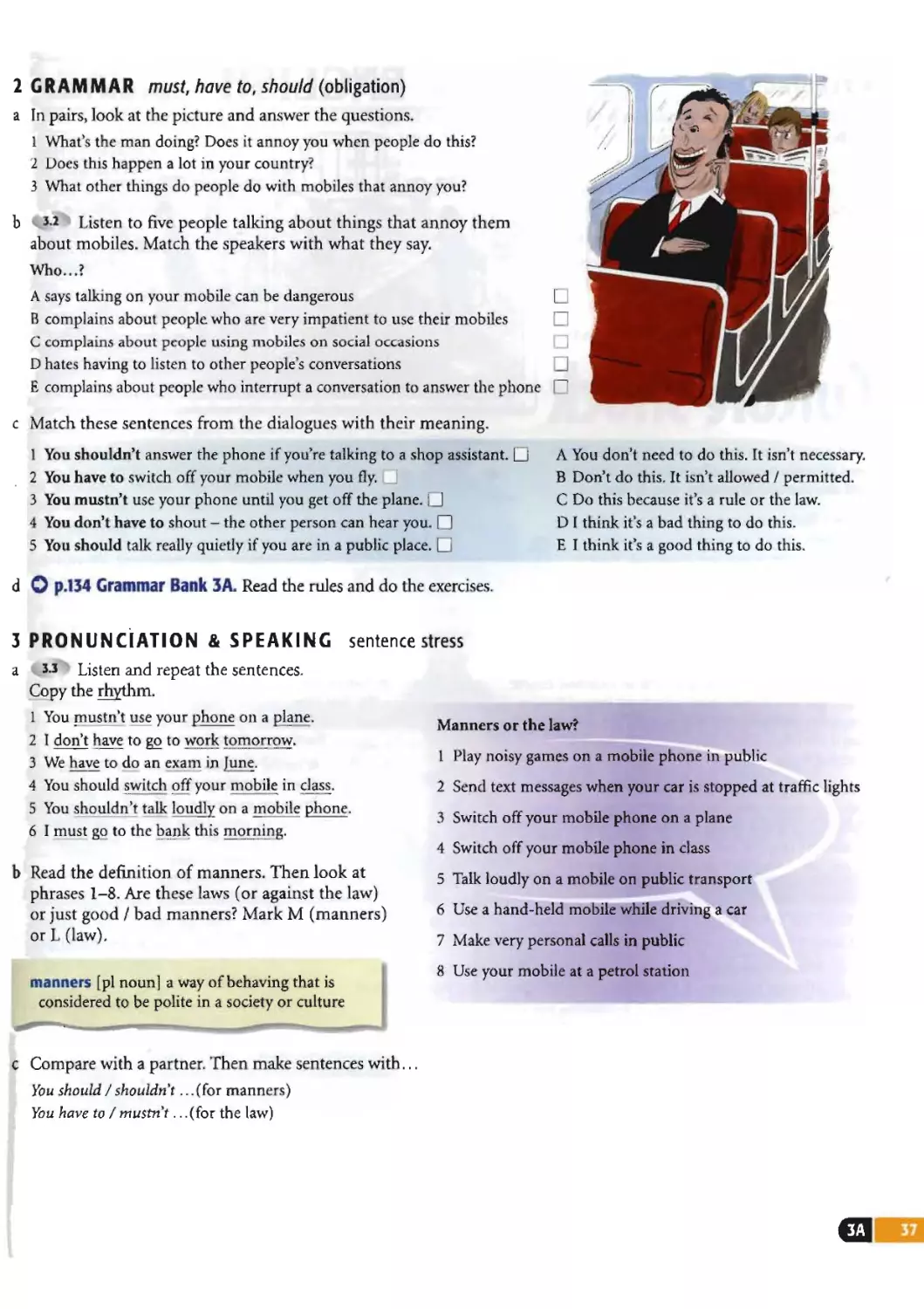


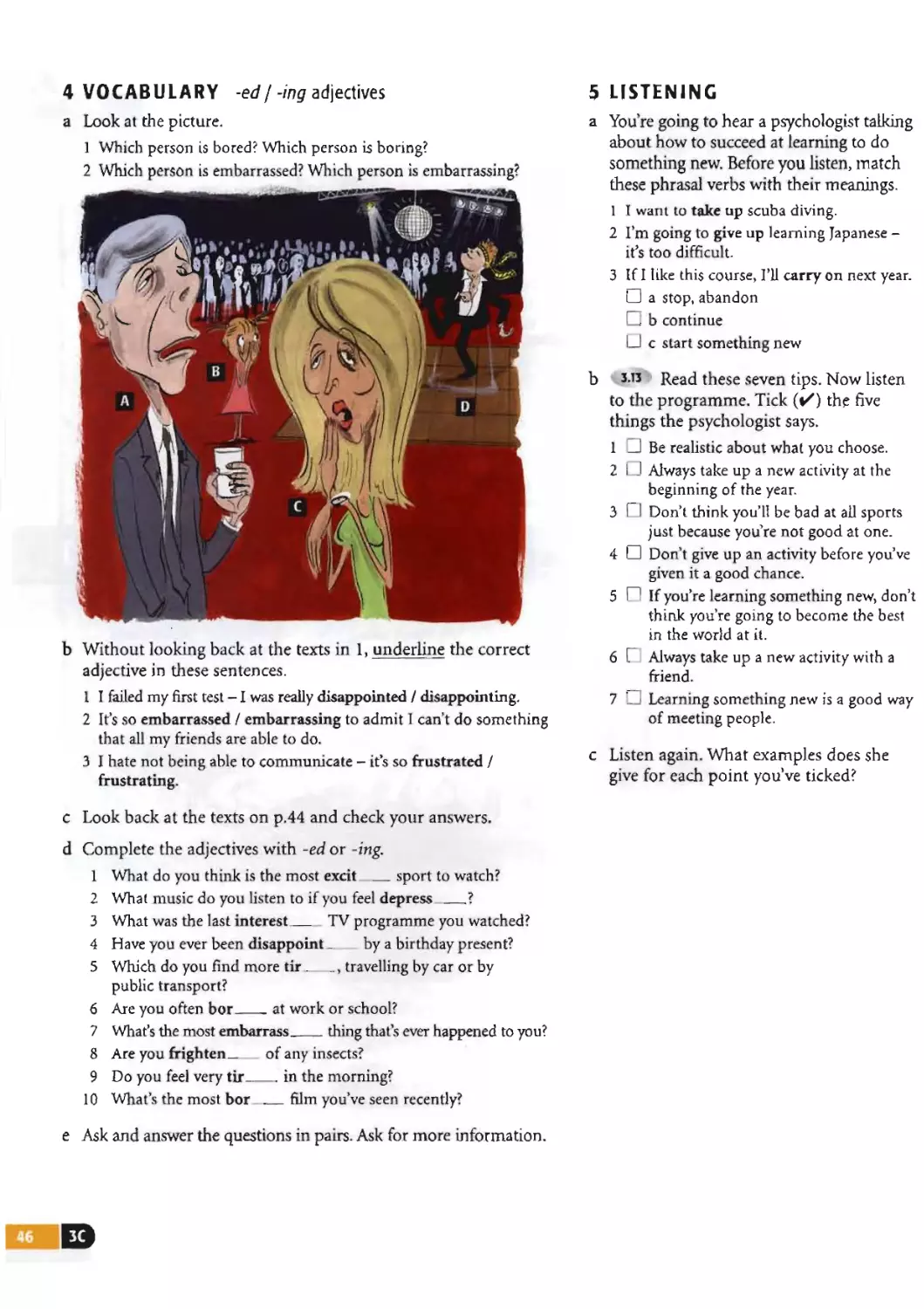


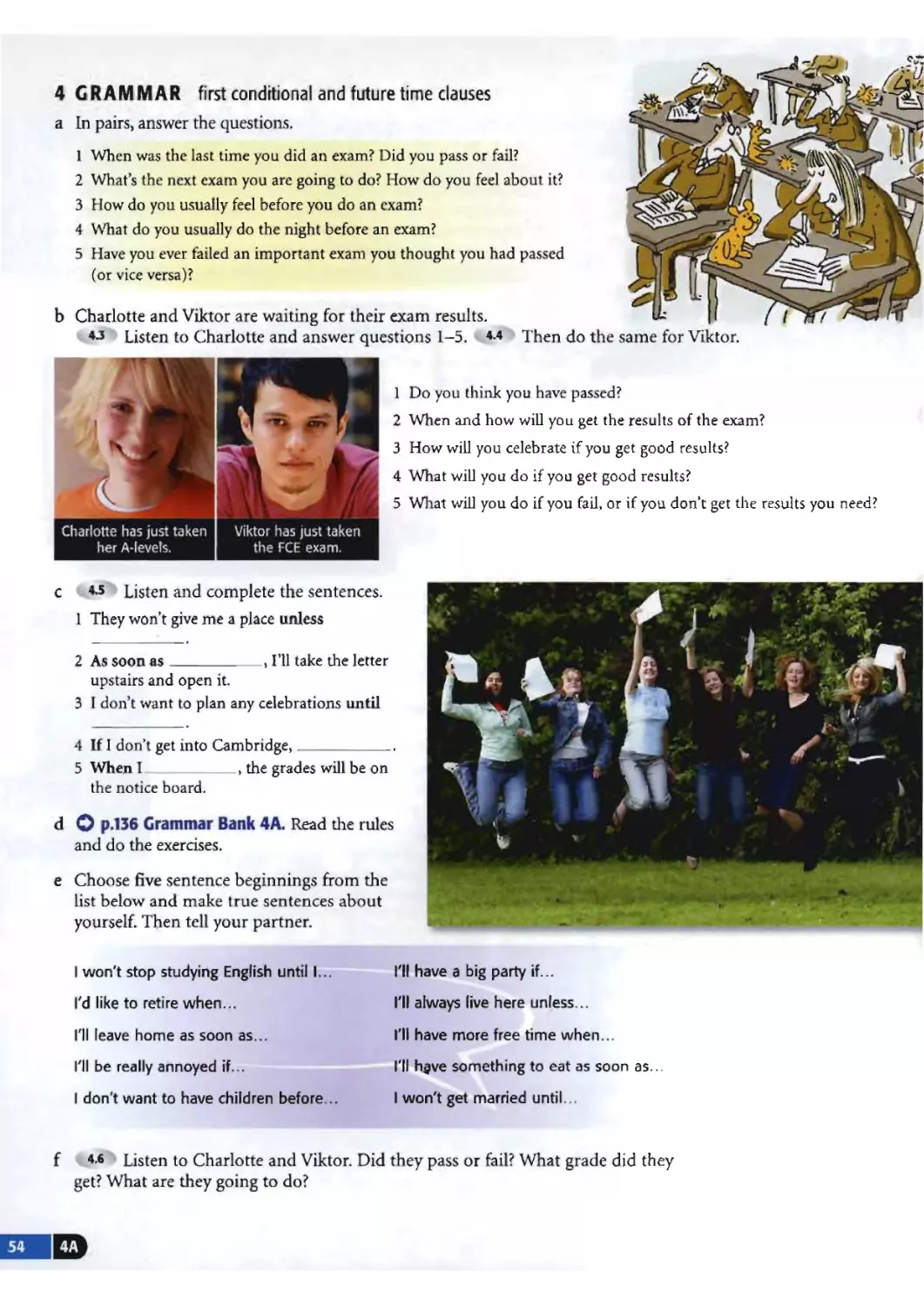
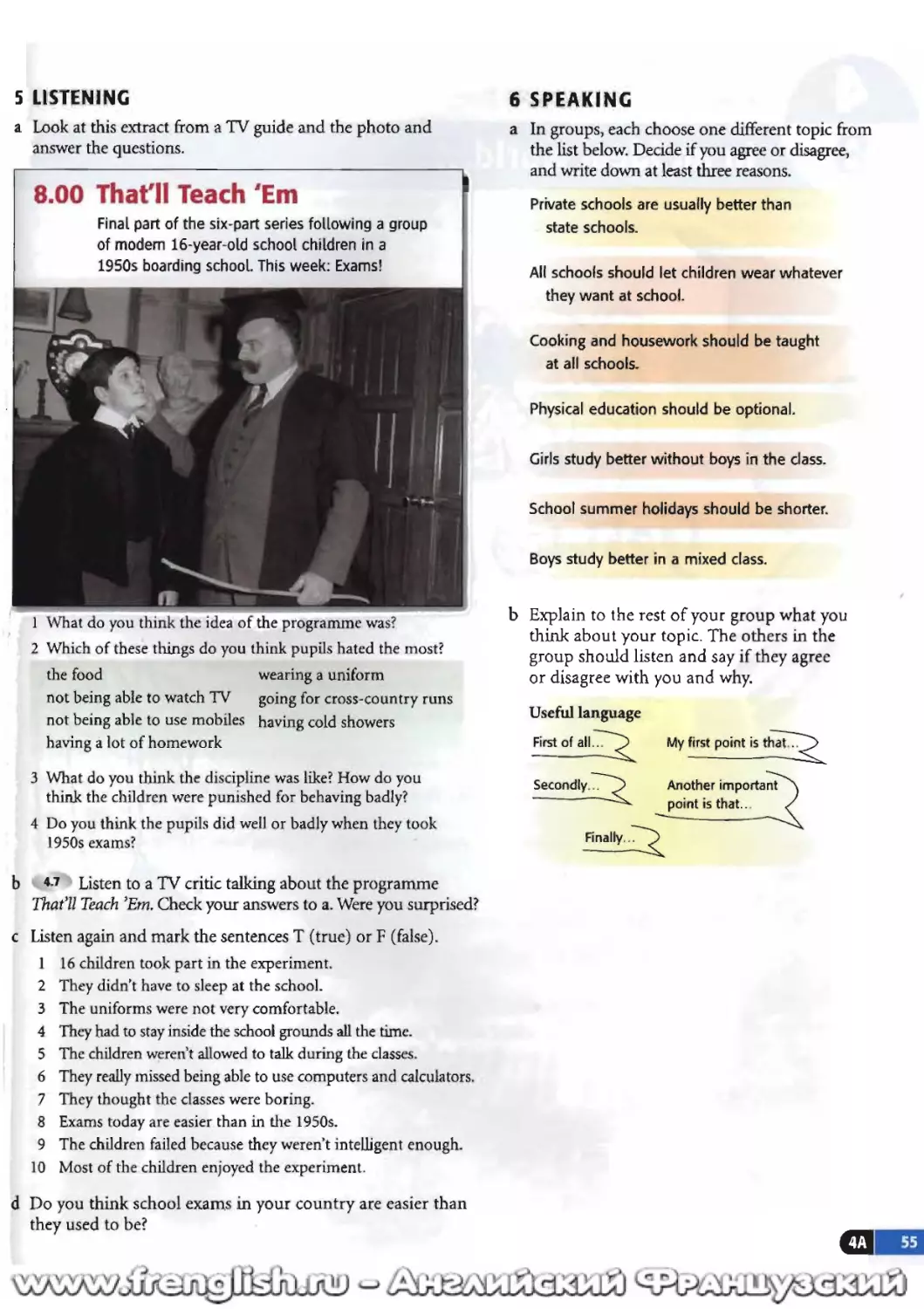















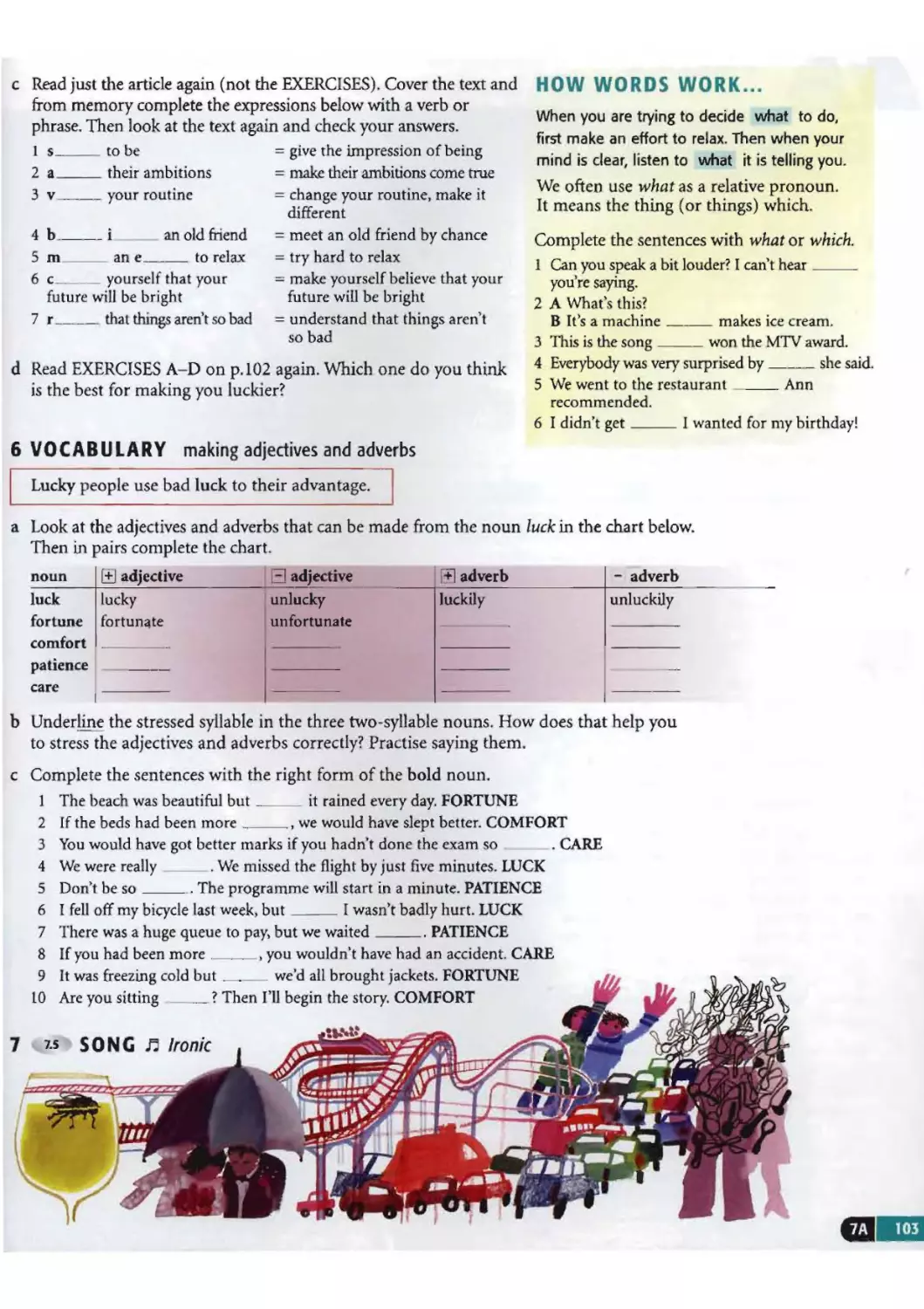
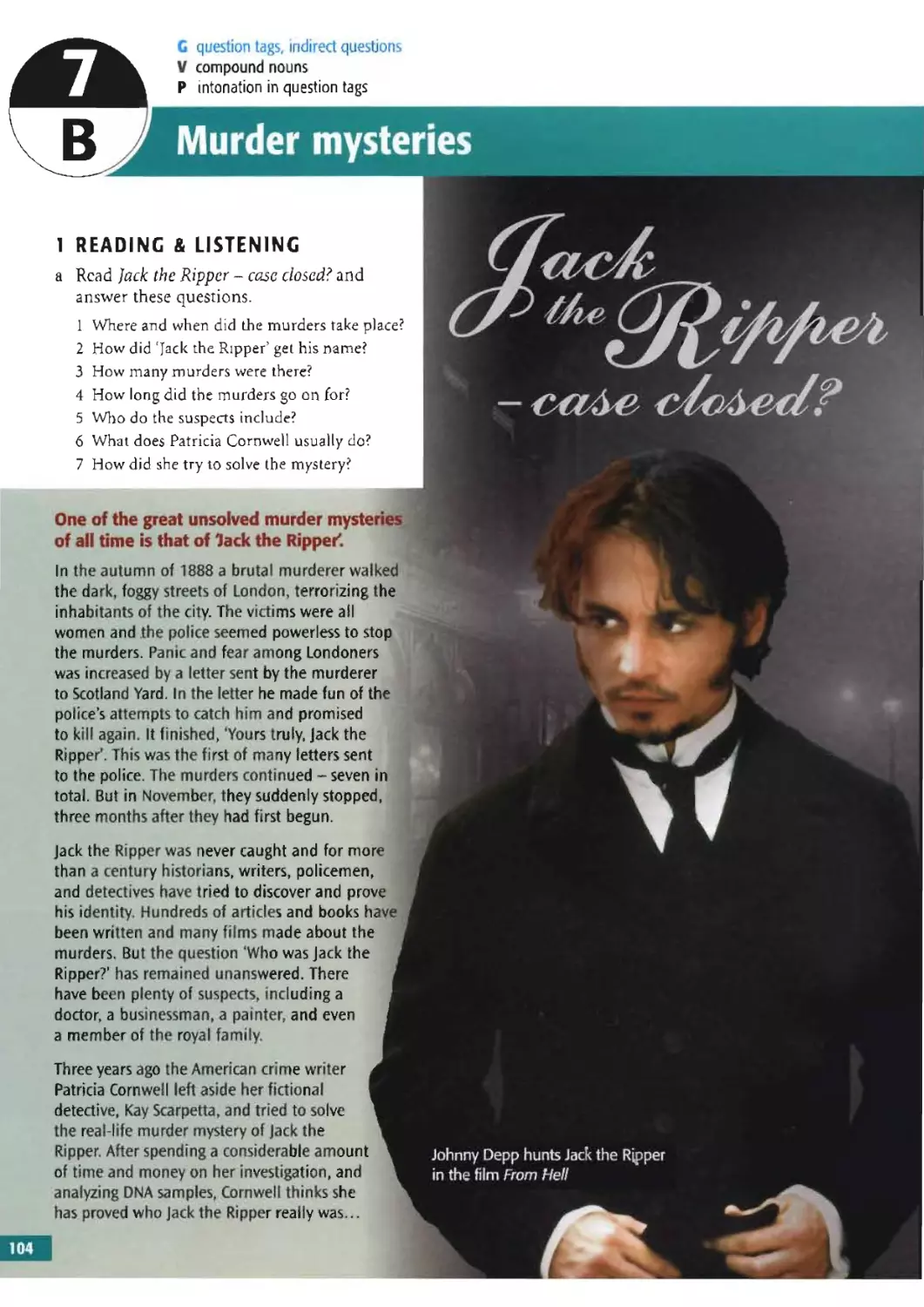

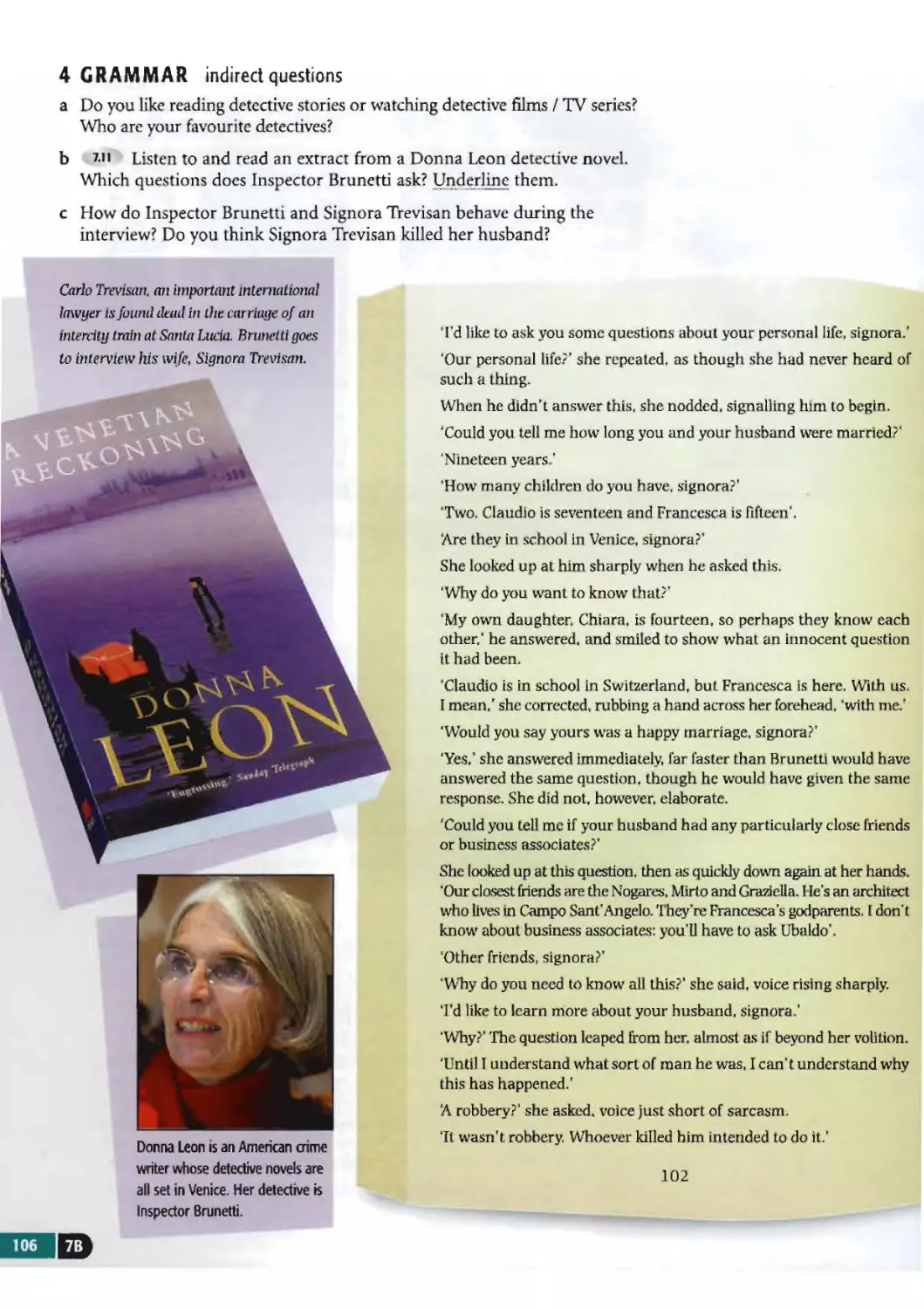


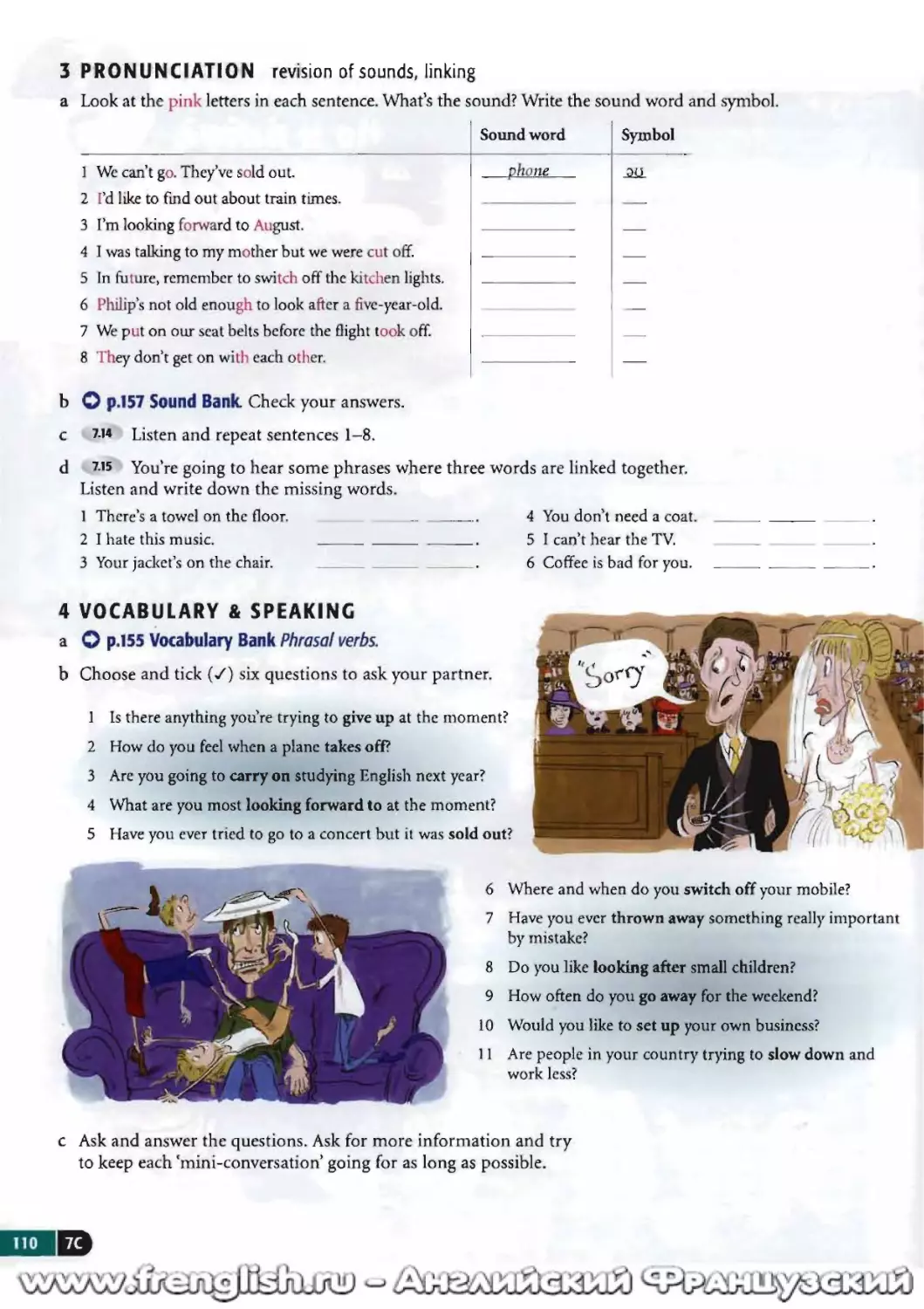























Author: Latham-Koenig C. Oxenden C.
Tags: english english grammar english language oxford university press student's book
ISBN: 0-19-451800-0


Text
                    Clive Oxenden
Christina Latham-Koenig
100%
NEW
New
ENGLISH FILE
Intermediate
Student's Book

www.oup.com/elt/englishfile/intermediate
Clive Oxenden
Christina Latham-Koenig
New
ENGLISH FILE
Intermediate
Student's Book
Paul Seligsnn and Clive Oxenden are the original co-authors of
English File 1 (pub. 1996) and English File 2 (pub. 1997).
OXFORD
UNIVERSITY PRESS

Contents		Grammar	Vocabulary	Pronunciation

4	□ Food: fuel or pleasure?	present simple and continuous, action and non-action verbs	food and restaurants	/и/ and /u:/, understanding phonetics
8	Q If you realty want to win, cheat	past tenses: simple, continuous, perfect	sport	/х/and /3d
12	КЗ We are family	future forms: going to, present continuous, will /shall	family, personality each other or reflexive pronouns?	prefixes and suffixes
16	Practical English Introductions
17	Writing	Describing a person
18	Revise & Check What do you remember? What can you do?

20	□ Ka-chingl	present perfect and past simple	money, phrasal verbs	saying numbers
24	□ Changing your life	present perfect continuous	strong adjectives: exhausted, amazed, etc	sentence stress, strong adjectives
28	КЗ Race to the sun	comparatives and superlatives	transport and travel how long + take	stress in compound nouns
32 Practical English In the office
33 Writing	Telling a story
34 Revise & Check What do you remember? What can you do?
36
	Modern manners	must, have to, should (obligation)	mobile phones	sentence stress
40	Judging by appearances	must, may, might, can't (deduction)	describing people look or look like?	-eigh, -aigh, and -igh
44	If at first you don't succeed,...	can, could, be able to (ability and possibility)	ed I -ing adjectives so	sentence stress
48 Practical English Rentingaflat
49 Writing	An informal letter
50 Revise & Check What do you remember? What can you do?
52 Q Back to school, aged 35 first conditional and future time clauses ♦ when, until, etc	education	l/JmlyrJl
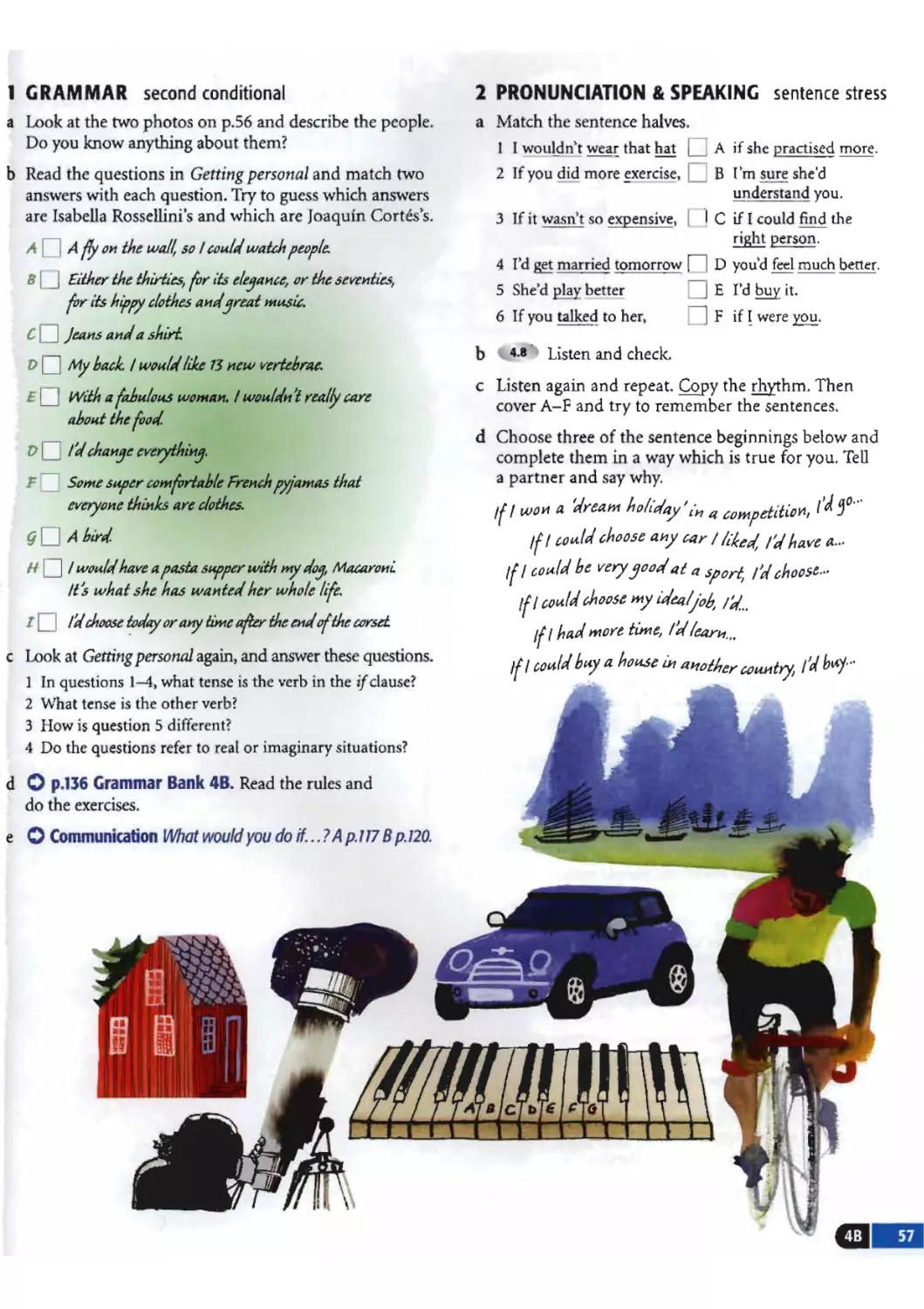
56 О In an ideal world...	second conditional	houses	sentence stress
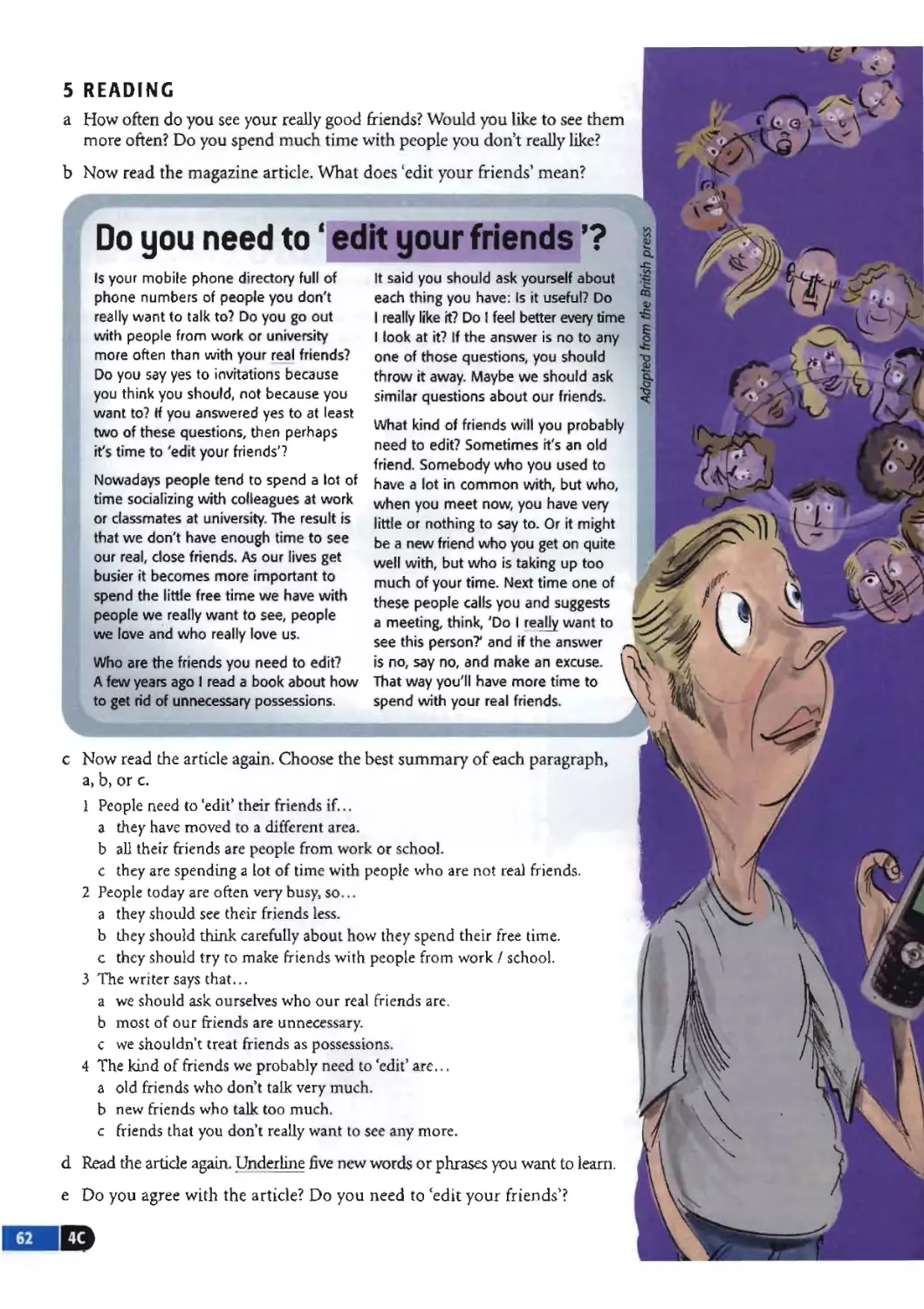
60 КЗ Still friends?	usually and used to	friendship	IstwlzJl get
64 Practical English A visit from a pop star
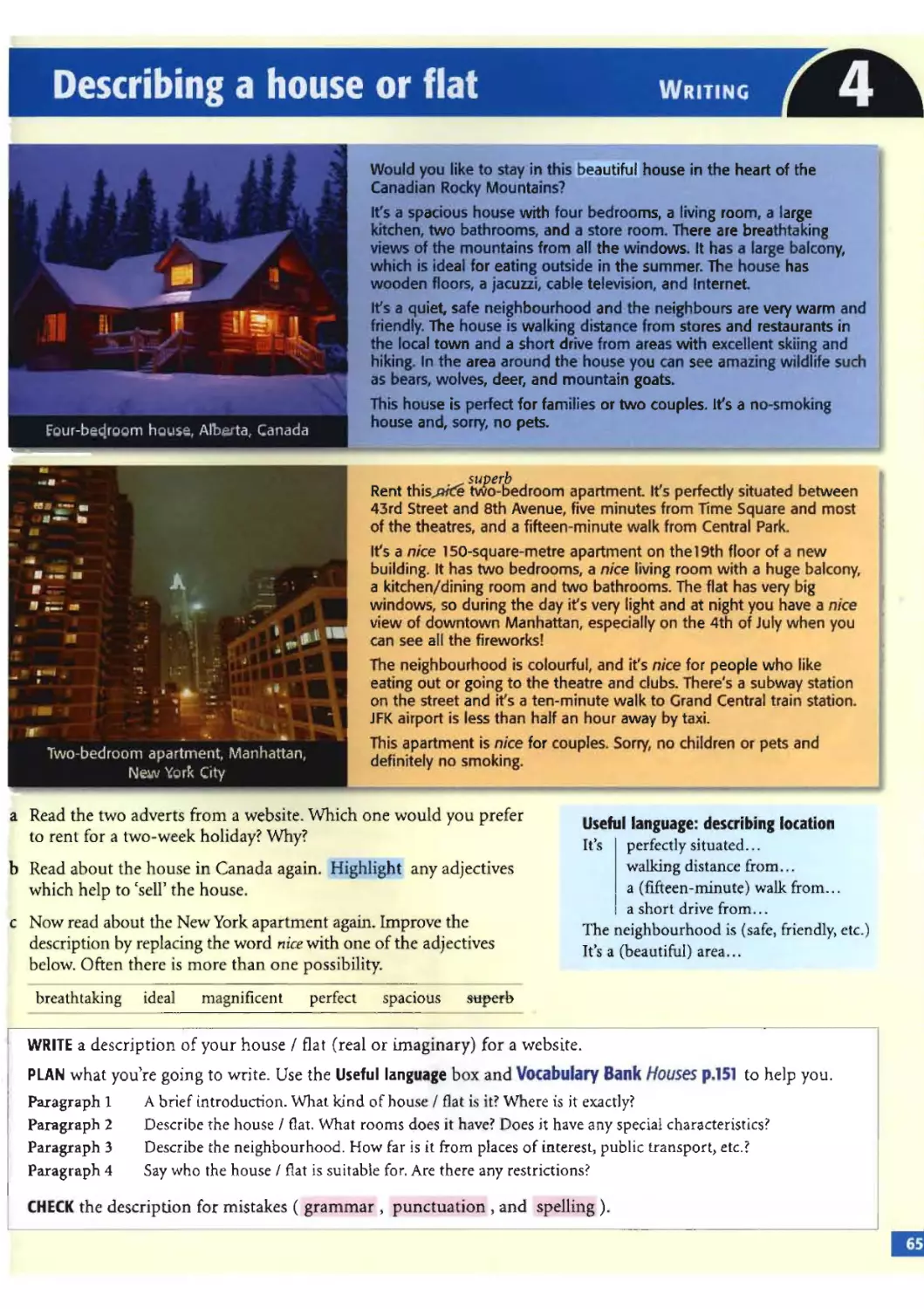
65 Writing	Describing a house or flat
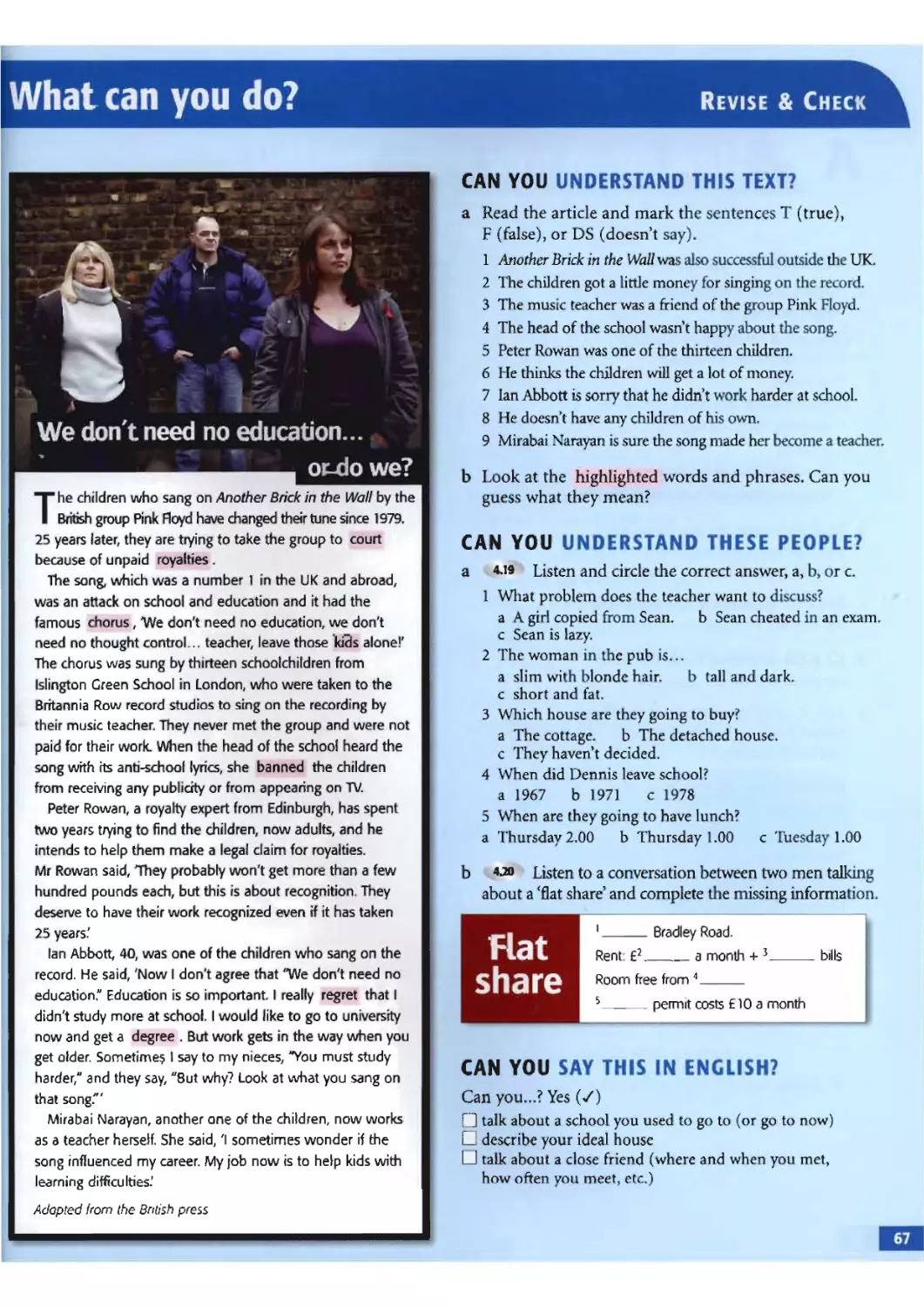
66 Revise & Check What do you remember? What can you do?
Vocabulary
Pronunciation
4^
Grammar
68	□ Slow down, you move too fast	quantifiers	noun formation	-ough and -augh
72	□ Same planet, different worlds	articles: a / an, the, no article	verbs and adjectives + prepositions connectors	sentence stress, thelblorl&l ?
76	В Job swap	gerunds and infinitives	work	word stress
80	Practical English Meetings
81 Writing	Formal letters and a CV
82 Revise & Check What do you remember? What can you do?
84
	Love in the supermarket	reported speech: statements, questions, and commands	shopping	consonant sounds: /д/, /d$/, /kJ, /f/./tf/
88	See the film... get on a plane	passive: be+past participle	cinema	sentence stress
92	G I need a hero	relative clauses: defining and non-defining	what people do	word stress
96 Practical English Breaking news
97 Writing	A film review
98 Revises Check What do you remember? What can you do?
100	П	Can we make our own	third conditional	making adjectives and adverbs
luck?	what or which!
104	□	Murder mysteries	question tags, indirect questions	compound nouns
108	Q	Switch it off	phrasal verbs	television, phrasal verbs
112 Practical English Everything in the open
113 Writing	An article for a magazine
U4 Revise & Check What do you remember? What can you do?
sentence stress
intonation in question tags
revision of sounds, linking
116 Communication
Ш Listening
130 Grammar Bank
144 Vocabulary Bank
157 Sound Bank
This shows you where to find extra material for
more practice and revision.
G present simple and continuous; action and non-action verbs
V food and restaurants
P /и/ and Лк/, understanding phonetics
Food: fuel or pleasure?
1 READING & SPEAKING
a What kind of food or dishes do you
associate with these countries?
The United States China France
Italy Japan Mexico
b Read the interviews with Alice and Jacqueline.
Match the questions with their answers.
We talk to women around the world about their relationship with food.
1	Is food a pleasure for you?
2	What do you normally eat in a typical day?
3	Do you ever cook?
4	Do you ever eat ‘unhealthy’ food? How do you feel about it?
5	Are you trying to cut down on anything at the moment?
6	Are people's diets in your country getting better or worse?
The United States
Alice Freeman is a lawyer from San Francisco.
A □ I think people are trying to improve their diets, but they are doing rt the
wrong way by following diets like the Atkins diet, Personally,. I don’t think it’s
very healthy to cut out entire groups of foods like carbohydrates.
В Not very often. I don’t have the time or talent to cook full meals. I usually
heat up a frozen meal or order a takeaway.
C Sometimes I get fast food for lunch. I have to admit that I love French fries.
I feel terrible about it afterwards, but I don’t do it very often.
D J I usually have a bowl of cereal or toast for breakfast. For lunch I eat at a
restaurant near my office. I prefer Japanese or Indian food. I usually eat rice
with fish and vegetables, soup or sushi. I don’t eat meat, but I eat a lot of fish.
In the evening, I just have something light at home
E I am trying to cut down on the amount of fat I eat. I’m also trying to eat
more wholemeal bread
F Г Not really. I enjoy certain kinds of food, but most meals are just fuel to
keep me going through the day.
Jacqueline Fabre is an IT consultant from Lyons.
A О Yes, I cook every evening for my family. I often make soup or traditional
French dishes like 'boeuf bourguignon', which is a kind of beef and red wine
stew, and then we have cheese and salad. It may seem a lot but we don’t eat
big portions. What’s important for me is quality, not quantity.
В I I Yes, I’m trying to eat less chocolate.
C □ I think people’s diets are getting worse and worse. It’s quite strange
because we have a lot of information now about how bad fast food is for you.
I’m afraid it’s a problem in a lot of European countries.
D Not at home. I think most of the food I cook is healthy, but occasionally
when I eat out I have something unhealthy, but it doesn’t worry me.
E Г Yes, definitely. For me good meals with the family make me happy!
F Z I’m quite traditional and I have three main meals a day. For breakfast, I
like hot chocolate, and bread and butter with honey or jam. For lunch, I often
eat in a restaurant with my colleagues. I usually have vegetables and meat or
fish but I love pasta and rice too. In the afternoon, I have fruit with biscuits or
a piece of chocolate. In the evening, I have a proper meal with my family.
Adopted from the British press

c Read the interviews again and answer the
questions below. Write A (Alice), J (Jacqueline),
or В (both of them).
Who»..?
2 GRAMMAR present simple and continuous,
action and non-action verbs
Rumiko Yasuda is a magazine editor from Tokyo. Japaa
1	often eats in restaurants
2	eats quite a lot of sweet things
3	eats ready-prepared food
4	cooks big meals at home
5	enjoys eating
6	feels bad when she eats unhealthily
7	is trying to eat less of something
8	prefers having good food to having
a lot of food
9	is negative about eating habits in
her country
d Match the highlighted words or phrases with
the definitions.
1		to have a meal in a restaurant,
not at home
2	 a sweet food made by bees,
which people often eat on
bread
3	 the quantity you eat of a
kind of food during a meal
4	__	to make cold food hot
5	_	food you buy from a
restaurant to eat at home
6	 food from animals or plants
used for cooking, e.g. oil,
butter, etc.
7____	_________ food prepared in a particular
way, e.g. sushi, lasagne, etc.
8	made from brown flour
9	 a liquid food, often made
of vegetables, e.g. tomatoes,
onions
10	_________. meat cooked for a long time
in liquid, usually with
vegetables
a 11 Listen to Rumiko
answering questions 2-6 from
the interviews. Do you think
food for her is fuel or pleasure?
Why?
b Listen again and answer the
questions.
1	What does she usually have in
the morning?
2	Where does she usually have
lunch and dinner?
3	Why doesn't she often cook?
4	Does she eat or drink anything
unhealthy?
5	Is she cutting down on anything
at the moment? Why (not)?
6	What’s happening to the
Japanese diet at the moment?
7	Does she think this is a
completely bad thing?
c Look at some of the things Rumiko said. Circle the correct
form. Then compare with a partner and say why the other
form is wrong.
1	1 don't usually have / Гт not having breakfast at work.
2	I used to go to fast food restaurants, but now I prefer 11 am
preferring eating something healthier.
3	I am drinking I I drink a lot of coffee every day
4	I think Japanese people get / are getting fatter.
5	I like / Гт liking the fact that there are more different kinds of
food and restaurants now.
d О p.130 Grammar Bank 1 A. Read the rules and do the exercises.
e Make questions to ask your partner with the present simple
or continuous. Ask for more information.
c Which of the two women do you think has the
healthier diet? Why?
f Now interview each other with the questions
from lb. How similar are your eating habits?
Is food a pleasure for you?
Yes, definitely I love eating.
What / usually have for breakfast?
How many cups of coffee / drink a day?
Where / usually have lunch?
How often / eat out a week?
/ prefer eating at home or eating out?
/ need to buy any food today?
/ you hungry? / want something to eat?
1 take any vitamins or food supplements at the moment?
I try to eat healthily at the moment?
5

3 VOCABULARY food and restaurants
a Do the quiz in pairs.
Food Quiz
Can you think of ...?
\/ iL ONE red fruit, ONE fruit, ONE green fruit
। Д/ 4 TWO things that a strict vegetarian doesn't eat
|\1X*I THREE kinds of food which are made from milk
[\F 1 FOUR things people have for breakfast
ш FIVE things people eat between meals
/ S|X ve8etables you can put in a salad
SEVEN things which are usually on a table in a restaurant
b О p.144 Vocabulary Bank Food and restaurants.
c Ask and answer the questions below with a partner.
Food and eating x.
1	How often do you eat...?
a takeaway food b ready-cooked meals
c low-fat food d home-made food	\
2	What's your favourite...?	\
a fruit b vegetable c snack	’
d home-made dish
3	What food do you like eating...?
a .when the weather's very cold
b when you're feeling a bit down
c for Sunday lunch
4	Is there any kind of food you carVt eat?
Restaurants
5	What's your favourite...?
a kind of restaurant (French, Italian, etc.)
b restaurant dish c takeaway food
6	How important are these things to you in a restaurant?
Number 1-4 (I =the most important)
the food f I the service	i
the atmosphere □ the price □	J
7	How do you prefer these things to be cooked? #
(grilled, boiled, etc.)	jr
chicken fish eggs potatoes	Я
8	If you eat steak, how do you like it cooked? Я
(rare, medium, well done)	Ш
4 PRONUNCIATION /о/and/ur/,
understanding phonetics
a Look at the sound pictures. How do you
pronounce them?
b Put the words in the correct column.
butcher cook food fruit good
juice mousse soup spoon sugar
c Listen and check.
d О p.157 Sound Bank Look at the typical
spellings for /и/ and Aj:/.
e Look at the information box. How do phonetic
symbols in a dictionary help you pronounce
words correctly?
A Pronouncing difficult words
Some words are difficult to pronounce because
1 they have a 'silent' syllable or letter, e.g. vegetables
/'ved^tablz/
2 some letters are pronounced in an unusual way
e.g. steak /steik/
3 you aren’t sure where the stress is, e.g. dessert
/diz’ait/
f i-3 Look at some more food words which arc
difficult to pronounce. Use the phonetics to practise
saying them correctly. Then listen and check.
1 knife	/naif/
biscuit	/‘biskit/
salmon	/‘saimon/
2 sausages	/'sosidjiz/
lettuce	/‘Jetts/
sugar	/'Гида/
3 yoghurt	/'jogot/
menu	/'menju:/
diet	/'daiat/
g Listen and repeat the sentences.
1	The first course on the menu is lettuce soup.
2	What vegetables would you like with your steak?
3	Do you want yoghurt or chocolate mousse for dessert?
4	I take two spoonfuls of sugar in my coffee.
5	Sausages and biscuits aren’t very good for you.
6	Would you like a fruit juice?

5
a
b
LISTENING
Have you ever tried English food?
What did you think of it?
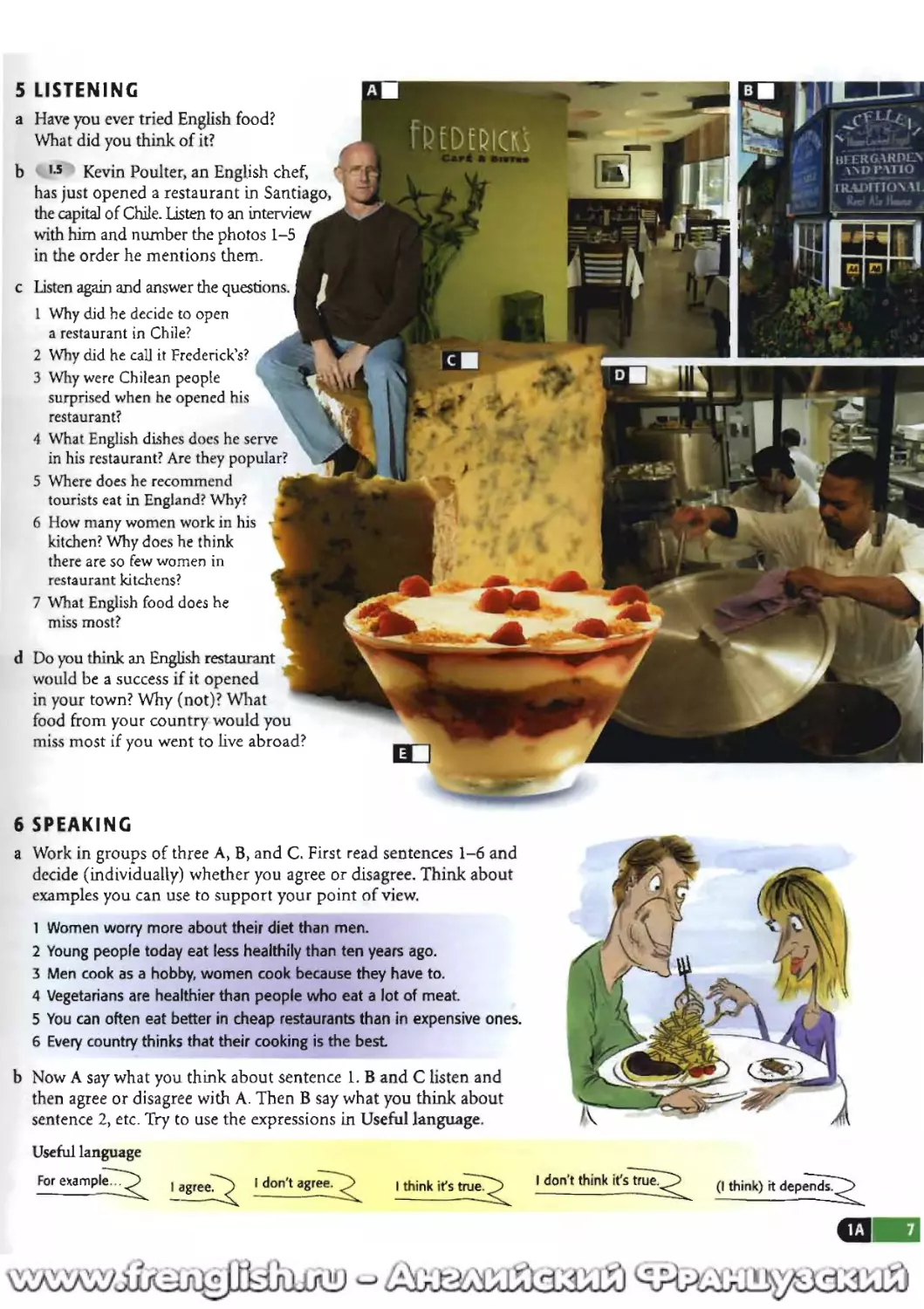
L5 Kevin Poulter, an English chef,
has just opened a restaurant in Santiago,
the capital of Chile. Listen to an interview
with him and number the photos 1-5
in the order he mentions them.
Listen again and answer the questions.
1	Why did he decide to open
a restaurant in Chile?
2	Why did he call it Frederick’s?
3	Wiry were Chilean people
surprised when he opened his
restaurant?
4	What English dishes does he serve
in his restaurant? Are they popular?
5	Where does he recommend
tourists eat in England? Why?
6	How many women work in his
kitchen? Why does he think
there are so few women in
restaurant kitchens?
7	What English food does he
miss most?
Do you think an English restaurant
would be a success if it opened
in your town? Why (not)? What
food from your country would you
miss most if you went to live abroad?
d
6 SPEAKING
a Work in groups of three A, B, and C. First read sentences 1-6 and
decide (individually) whether you agree or disagree. Think about
examples you can use to support your point of view.
1	Women worry more about their diet than men.
2	Young people today eat less healthily than ten years ago.
3	Men cook as a hobby, women cook because they have to.
4	Vegetarians are healthier than people who eat a lot of meat.
5	You can often eat better in cheap restaurants than in expensive ones.
6	Every country thinks that their cooking is the best
b Now A say what you think about sentence 1. В and C listen and
then agree or disagree with A. Then В say what you think about
sentence 2, etc. Try to use the expressions in Useful language.
Useful language
For example...
I agree, p [don't agree.
I think it's true.

C past tenses: simple, continuous, perfect
V sport
P /о:/ and /з:/
If you really want to win, cheat
1 GRAMMAR past tenses: simple, continuous, perfect
a In which sports are there most cases of cheating? How do people cheat in these sports?
b Read the article and find out how the people cheated.
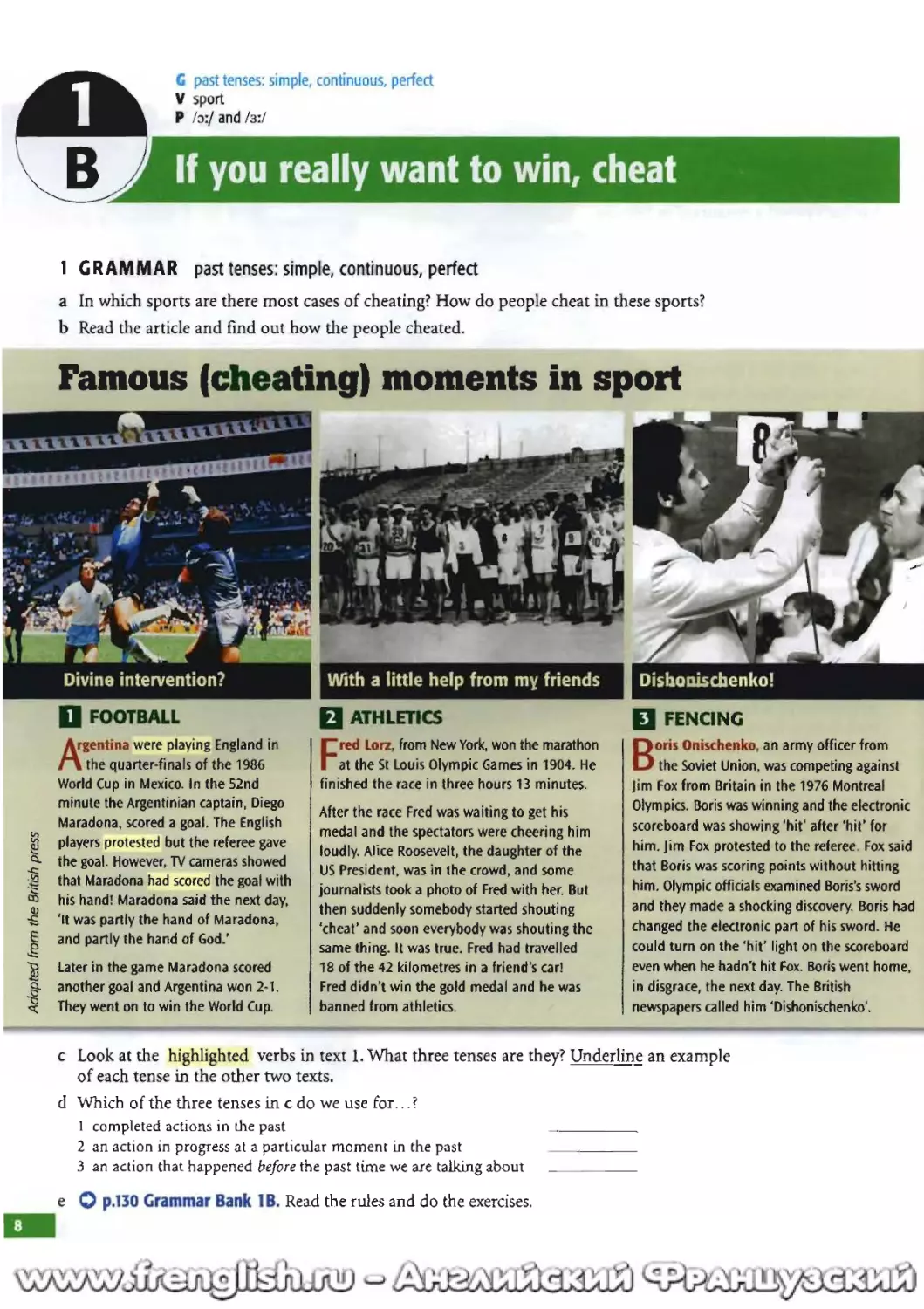
Famous (cheating) moments in sport
Argentina were playing England in
Zi the quarter-finals of the 1986
World Cup in Mexico. In the 52nd
minute the Argentinian captain, Diego
Maradona, scored a goal. The English
players protested but the referee gave
the goal. However, TV cameras showed
that Maradona had scored the goal with
his hand! Maradona said the next day,
'It was partly the hand of Maradona,
and partly the hand of God/
Later in the game Maradona scored
another goal and Argentina won 2*1.
They went on to win the World Cup.
Fred Lorz, from New York, won the marathon
at the St Louis Olympic Games in 1904. He
finished the race in three hours 13 minutes.
Adapted from the British press
After the race Fred was waiting to get his
medal and the spectators were cheering him
loudly. Alice Roosevelt, the daughter of the
US President, was in the crowd, and some
journalists took a photo of Fred with her. But
then suddenly somebody started shouting
'cheat* and soon everybody was shouting the
same thing. It was true. Fred had travelled
18 of the 42 kilometres in a friend’s car!
Fred didn’t win the gold medal and he was
banned from athletics.
Boris Onischenko, an army officer from
the Soviet Union, was competing against
Jim Fox from Britain in the 1976 Montreal
Olympics. Boris was winning and the electronic
scoreboard was showing 'hit' after 'hit* for
him. Jim Fox protested to the referee. Fox said
that Boris was scoring points without hitting
him. Olympic officials examined Boris’s sword
and they made a shocking discovery Boris had
changed the electronic part of his sword. He
could turn on the 'hit' light on the scoreboard
even when he hadn’t hit Fox. Boris went home,
in disgrace, the next day. The British
newspapers called him 'Dishonischenko’.
c Look at the highlighted verbs in text L What three tenses are they? Underline an example
of each tense in the other two texts.
d Which of the three tenses in c do we use for... ?
1	completed actions in the past
2	an action in progress at a particular moment in the past
3	an action that happened before the past time we are talking about
e О p.130 Grammar Bank 1B. Read the rules and do the exercises.
8

f Cover the texts, In pairs, retell the three stories using the correct tenses.
Text 1
England (play) Argentina,
Maradona (score) a goal,
The English players (protest) but the
referee (give) the goal.
The TV cameras (show) that Maradona
(score) the goal with his hand.
Text 2
Fred Lorz (win) the marathon in 1904.
He (wait) to get his medal.
The spectators (cheer).
Everybody (start) shouting "cheat*.
Fred (travel) 18 km by car!
Text 3
Boris Onischenko (compete) against
Jim Fox.
Boris (win) but Jim Fox (protest).
The Olympic officials (examine)
Boris’s sword.
They (discover) that he (change) the
electronic part of his sword.
2 SPEAKING
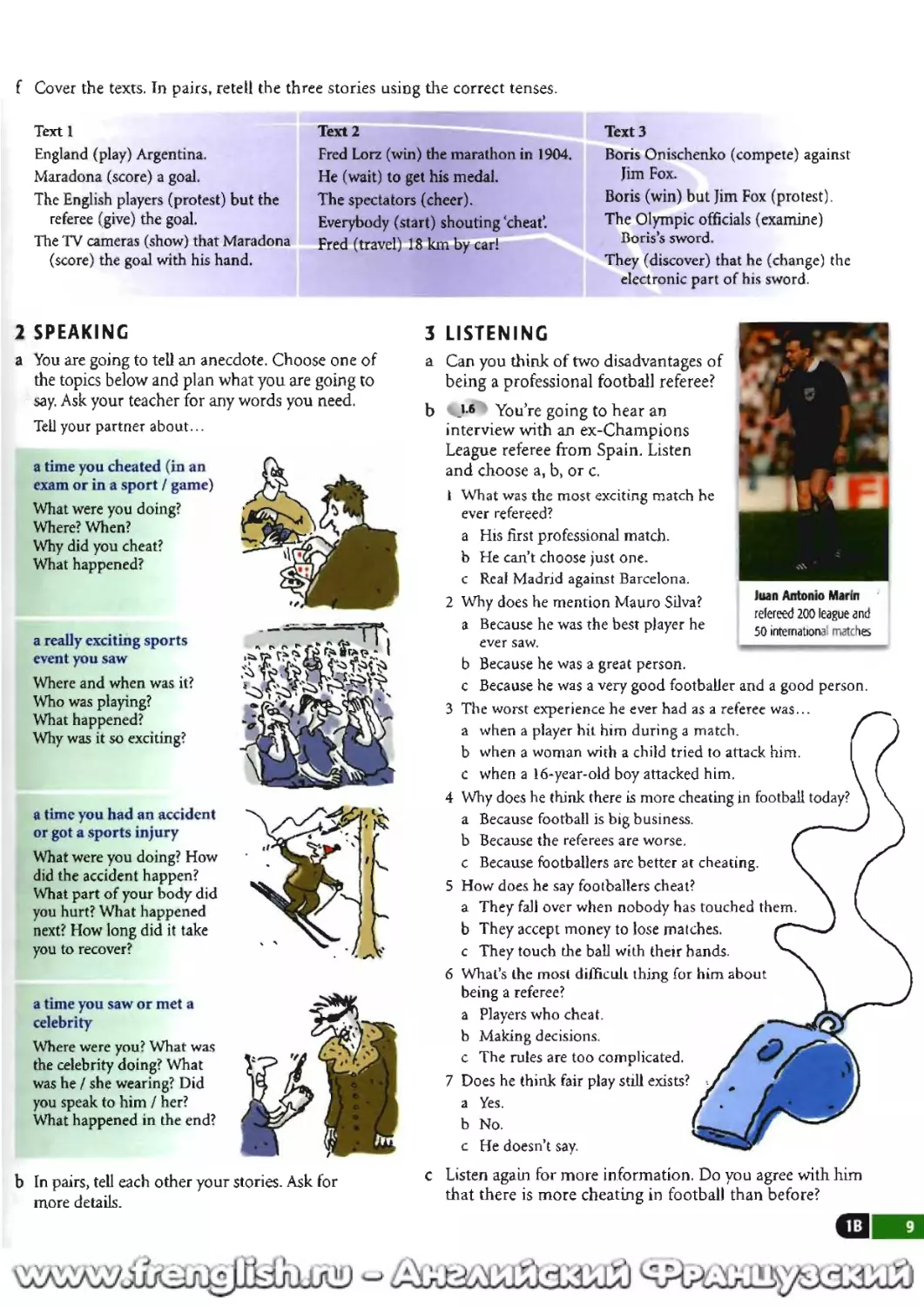
a You are going to tell an anecdote. Choose one of
the topics below and plan what you are going to
say. Ask your teacher for any words you need.
Tell your partner about...
a time you cheated (in an
exam or in a sport / game)
What were you doing?
Where? When?
Why did you cheat?
What happened?
a really exciting sports
event you saw
Where and when was it?
Who was playing?
What happened?
Why was it so exciting?
a time you had an accident
or got a sports injury
What were you doing? How
did the accident happen?
What part of your body did
you hurt? What happened
next? How long did it take
you to recover?
3 LISTENING
a Can you think of two disadvantages of
being a professional football referee?
b Ч16 You're going to hear an
interview with an ex-Champions
League referee from Spain. Listen
and choose a, b, or c.
1	What was the most exciting match he
ever refereed?
a His first professional match.
b He can’t choose just one.
c Real Madrid against Barcelona.
2	Why does he mention Mauro Silva?
a Because he was the best player he
ever saw.
3
4
5
6
a time you saw or met a
celebrity
Where were you? What was
the celebrity doing? What
was he / she wearing? Did
you speak to him / her?
What happened in the end?
7
b In pairs, tell each other your stories. Ask for
more details.
Juan Antonio Marin
refereed 200 league and
50 internationa matches
b Because he was a great person,
c Because he was a very good footballer and a good person.
b
b
The worst experience he ever had as a referee was...
a when a player hit him during a match.
when a woman with a child tried to attack him.
c when a 16* year-old boy attacked him,
Why does he think there is more cheating in football today?
a Because football is big business.
Because the referees are worse.
c Because footballers are better at cheating.
How does he say footballers cheat?
a They fall over when nobody has touched them,
b They accept money to lose matches.
c They touch the ball with their hands.
What’s the most difficult thing for him about
being a referee?
a Players who cheat,
b Making decisions,
c The rules are too complicated.
Does he think fair play still exists?
a
b
c He doesn’t say.
Yes.
No.
c Listen again for more information. Do you agree with him
that there is more cheating in football than before?

4	VOCABULARY sport
a In pairs, do the quiz.
Sports Quiz
1 How long does a football match last?
2 How many referees are there in a basketball match?
3 How many players are there in a volleyball team?
4 How often are the World Athletics Championships held?
5 How long is a marathon?
6 How many holes are there on a golf course?
7 How long is one lap of an athletics track?
b О p.145 Vocabulary Bank Sport.
c In pairs, think of a sports team in your town / country
and answer the questions.
5 PRONUNCIATION /oz/and/ai/
a Write the words in the correct column. Be careful
with or (there are two possible pronunciations).
ball serve caught world draw fought hurt
score sport shirt warm up worse court
& What's the name of the team?
What sport do they play?
# Where do they play? (in a stadium, sports hall, etc.)
Who is...?
a the coach
b the captain
c the best player in the team
How many spectators watch their matches?
What happened in their last match?
b 17 Listen and check
с О p.157 Sound Bank. Look at the typical spellings
for these sounds.
d 1-8 Practise saying these sentences. Listen
and check.
1	I got hurt when 1 caught the ball-
2	Her serves worse than the other girls,
3	It was a draw - the score was four all.
4	It's the worst sport in the world,
5	We warmed up on the court.
6	They wore red shirts and white shorts.
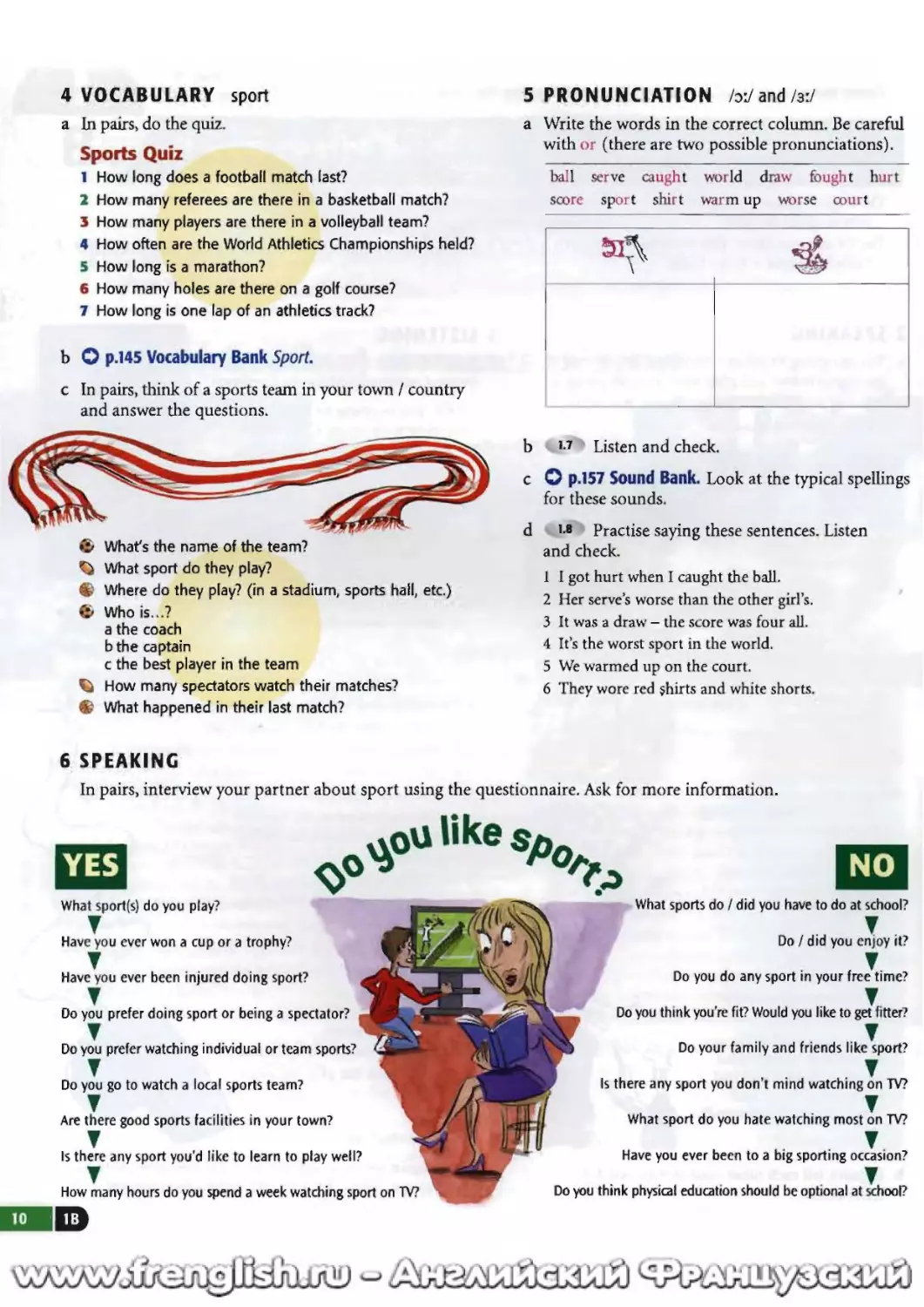
6 SPEAKING
In pairs, interview your partner about sport using the questionnaire. Ask for more information,
like sp
YES
What sport(s) do you play?
NO
Have you ever won a cup or a trophy?
Have you ever been injured doing sport?
Do you prefer doing sport or being a spectator?
Do you prefer watching individual or team sports?
Do you go to watch a local sports team?
Are there good sports facilities in your town?
Is there any sport you'd like to learn to play well?
How many hours do you spend a week watching sport on TV?
What sports do / did you have to do at school?
Do / did you enjoy it?
Do you do any sport in your free time?
Do you think you’re fit? Would you like to get fitter?
Do your family and friends like sport?
Is there any sport you don’t mind watching on TV?
What sport do you hate watching most on TV?
Have you ever been to a big sporting occasion?
Do you think physical education should be optional at schooP
10

7 READING
When you hear
the final whistle
IE One of the hardest things for any sportsperson
to dojsjoJsnowwhe	Do you retire when you
are at your physical ‘peak* or do you wait until your body
(or your coach) tells you that it’s time to go? But even
harder is finding the answer to the question 'What am
I going to do with the rest of my life?’
El_I‘There’s a high risk
of depression and people often find adjusting to a new
way of life difficult’, says Ian Cockerill, a sports
psychologist. 'For sportspeople, there’s an extra trauma -
the loss of status, the loss of recognition, and the loss of
the glamour. That’s the hardest part ’ As Eddie Acaro, the
US jockey says, 'when a jockey retires, he becomes just
another little man,’
Michael Jordan, former US
basketball player
И I Perhaps they just
can't stand life without the 'high’ of playing professional
sport. Michael Jordan, the greatest basketball player of
all time, retired three times. He retired once from the
Chicago Bulls, made a successful comeback with the
Bulls, then retired again. His second comeback with an
inferior team ended in failure and he retired for ever at
the age of ЗЯ Jordan said, 'There will never be anything
I do that will fulfil me as much as competing did.’
a Look at the photos. In pairs, answer the questions.
Have you ever seen any of these people playing sport?
At what age do you think people reach their ‘peak’ in these sports?
Do you know what these people do now?
b Read the article once. Do most sportspeople find it easy or
difficult to retire?
K1_J	Muhammad Ali
needed the money, but his comeback fight, at the age
of 39, against Trevor Berbick, was one of the saddest
spectacles in modern sport. After losing to Berbick, Ali
retired permanently. Three years later he developed
Parkinson’s disease.
c Complete the article with sentences A-F below.
Q For some people the pain of saying goodbye never leaves them.
В Others can’t resist the chance of one last pay day’.
в Some sportspeople go on playing too long.
В But for the lucky few, retirement can mean a successful new career.
В Retirement for people in general is traumatic.
В Gne-ef the-liardesHWngs-for-any-sfxirt.sptrson to do is to know
when-to-ret+re
H I__________T_________________. As Jimmy Greaves,
an eX'England international footballer said, 1 think that
a lot of players would prefer to be shot once their career
is over/ Many of them spend their retirement in a
continual battle against depression, alcohol, ordrugs.
d
| EL J	Franz Beckenbauer
is a classic example of a footballer who won everything
I with his club, Bayern Munich. After retiring he became a
£ successful coach with Bayern and finally president of the
| club. John McEnroe, the infamous bad boy’ of tennis, is
now a highly respected and highly paid TV commentator.
g. But sadly, for most sportspeople these cases are the
т exceptions.
Can you remember these words? If not, check with
the text. Underline the stressed syllable.
I adjective: depressed	noun: depression
2 adjective: glamorous	noun:
3 verb: lose	noun:
4 verb: recognize	noun:
5 verb: fail	noun:
6 verb: retire	noun:
e Think of a sportsperson from your country who has retired.
What is he / she doing now? Do you think he / she retired
at the right time?

C future forms: going to, present continuous, will/shall
V family, personality
P prefixes and suffixes
We are family
VOCABULARY & SPEAKING family
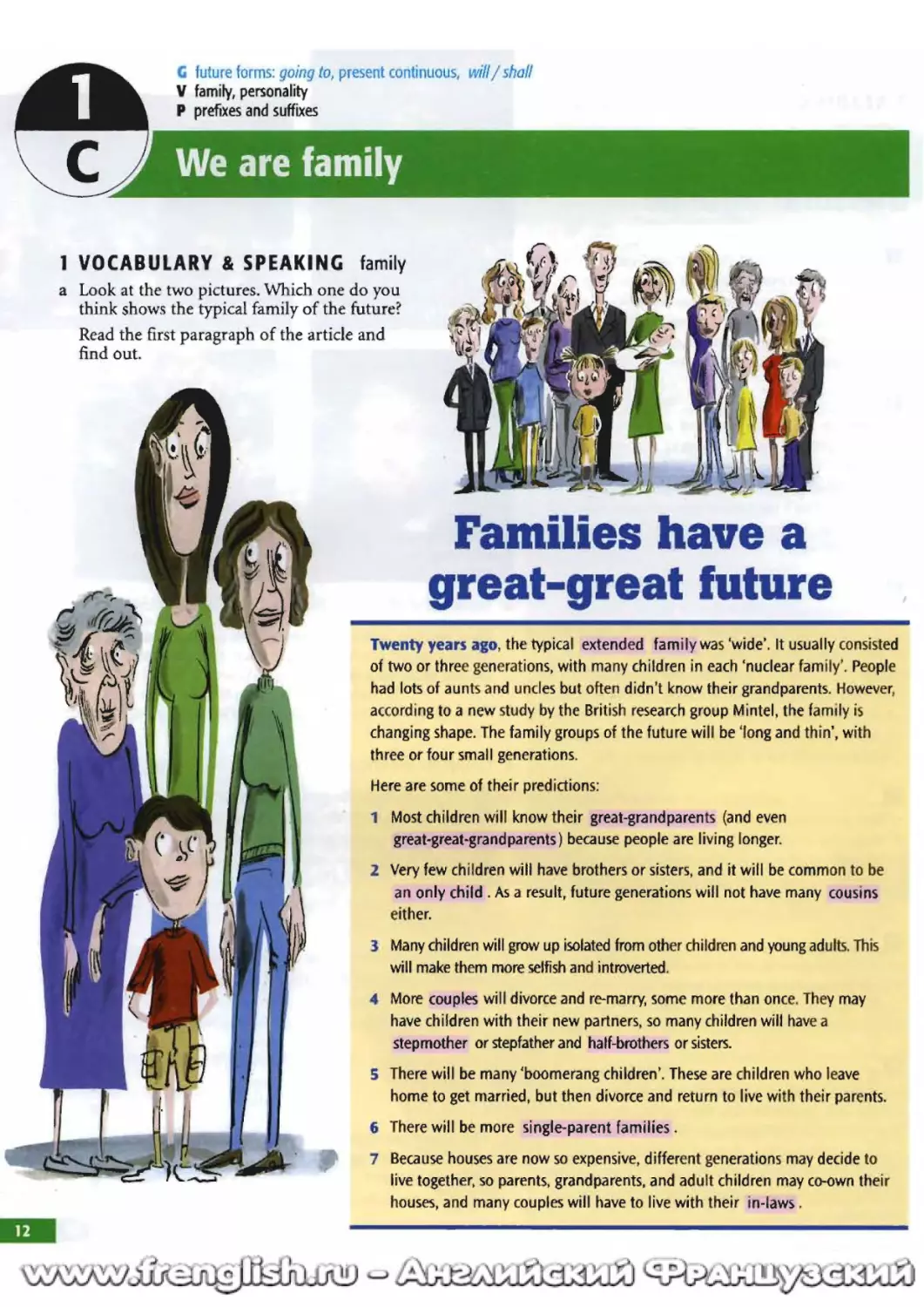
Look at the two pictures. Which one do you
think shows the typical family of the future?
Read the first paragraph of the article and
find out.
Families have a
great-great future
Twenty years ago, the typical extended family was ‘wide’. It usually consisted
of two or three generations, with many children in each ‘nuclear family’. People
had lots of aunts and uncles but often didn't know their grandparents. However,
according to a new study by the British research group Mintel, the family is
changing shape. The family groups of the future will be ‘long and thin’, with
three or four small generations.
Here are some of their predictions:
Most children will know their great-grandparents (and even
great-great-grandparents) because people are living longer.
Very few children will have brothers or sisters, and it will be common to be
an only child . As a result, future generations will not have many cousins
either.
Many children will grow up isolated from other children and young adults. This
will make them more selfish and introverted.
More couples will divorce and re-marry, some more than once. They may
have children with their new partners, so many children will have a
stepmother or stepfather and half-brothers or sisters.
There will be many 'boomerang children’. These are children who leave
home to get married, but then divorce and return to live with their parents.
There will be more single-parent families.
Because houses are now so expensive, different generations may decide to
live together, so parents, grandparents, and adult children may co-own their
houses, and many couples will have to live with their in-laws.
b Now read the whole article. Match the highjjghted words with the definitions.
I	_ your grandparents* parents
2	a child who doesn’t have any brothers or sisters
3	families where the mother or father is bringing up the children on his / her own
4	your uncle’s or aunt’s children
5	the family of your husband / wife
6	_	_all your relatives including aunts, grandparents, etc.
7________________________________________your grandparents* grandparents
8	 boys who have (for example) the same father as you but a different mother
9	the new wife of your father
10	people who are having a relationship
c Read the seven predictions again. In pairs or small groups, answer the questions for each prediction.
1 Is this already happening in your country?
2 Do you think it will happen in the future?
3 Do you think it will be a good thing or a bad thing?
Useful language
I think so.
1 don't think so.
Maybe.
Probably.
Km sure it will.
2 GRAMMAR future forms
a V* ' Listen to three dialogues between different family members.
Who is talking to who (e.g. brother to sister)? What are they talking about?
b	Listen again and match two sentences with each dialogue (1-3). Write 1,2,	or 3 in each box.
A Shall I make you a cup of tea? □ C Are you going to go to university? □	E ГН be really careful.	□
В You’ll crash it again.	□ D I’m staying at Mum’s tonight. □	F It’s going to be cold	tonight.	□
c With a partner, decide which sentence(s) A-F refer(s) to...
a plan or intention ZU
an arrangement 1
a prediction	□□
a promise	□
an offer	_J
d О p.130 Grammar Bank 1C Read the rules and do the exercises.
e Move around the class, ask other students questions, and complete the table.
Find someone who...	name	more details
is seeing a relative this weekend.
isn’t having dinner with their family tonight.
is getting married soon.
is going out with their brother or sister on Saturday night.
is going to have a new nephew or niece soon.
is going to leave home in the near future.
is going to have a big family reunion soon.
isn’t going to go on holiday with their family this year.
(3D
3 READING
a In a family with two children, do you
think it s better to be the older or the
younger brother or sister? Why?
b You1 re going to read an article about
two sisters, Wendy (the younger sister)
and Carnie (the older sister). Before
you read, predict the answers to the
questions below, Write W (Wendy)
or C (Carnie).
Who do you think,,.?
1	had a more eccentric hairstyle
2	admired her sister
3	didn't want to be with her sister
4	followed her sister everywhere
5	tried to compete with her sister
6	wasn't a good student
7	told her parents when her sister did
something wrong
8	used to hurt her sister physically
9	was jealous of her sister
10	always defended the other sister
c Now read the article and check your
answers.
d Look at the highlighted words
and phrases. In pairs, choose the right
meaning, a or b.
J a boring
b fashionable
2 a children
b adults
3 a age difference
b the time they weren’t
together
4	a become friends again
b stop speaking
5	a kiss
b hurt with your fingers
6	a say bad things about
b say good things about
7	a we got on very well
b we got on very badly
8	a ask for help
b say that somebody is responsible for
something bad
e Do you think their relationship is
typical of brothers and sisters?
We are family...
Two sisters tell the truth
about themselves - and
each other...
Wendy Wilson and her older sister
Carnie are the daughters of the
Beach Boys founder, Brian Wilson.
They formed the band Wilson Philips
(with the daughter of Michelle Philips
of The Mamas and Papas) and their
first album was a worldwide hit.
Today they arc both married and live
in Los Angeles. Here they talk about
their relationship.
Wendy,
the younger
sister says:
ЕЯКЭ
Wendy	Carnie
I always thought Carnie was really 'cool .Especially when
she was a teenager and had bright red spiky hair. But, like
most older sisters, she wasn’t at all interested in her younger
sister. I desperately wanted to be with her and her friends,
and sometimes I used to follow them, but she hated that.
When we were3 kids we both had a lot of material things like toys and clothes, but
even then we knew that Mom and Dad weren’t happy. We used to talk about it ail
the time, and after a while they separated and we
stayed with my Mom. We didn’t see Dad for quite a
few years, which really hurt us. But it’s also the
thing that brought me and Carnie closer together.
When I was 16 or 17 the one and a half year
J age gap between us didn’t matter any more, and we
started to get on with each other and to write songs
together.
Being in a band - or working at anything - with a
member of your family can be difficult, but it also
has advantages. If we have a big argument about a
song, after a while we remember that we are sisters
and we4make it up. Nothing is going to stop us
from being sisters.
Carnie, the
older sister
says:
I sometimes think that poor Wendy has spent all her life
competing with me. She was a very quiet, shy child, while I
was incredibly talkative and demanding - I was awful! I
wasn't interested in studying, all I wanted to do was go to
parties, and Wendy used to tell my parents. So I was
horrible toher- I used to 5 pinch her and bite hen
I was very jealous of Wendy also because she was more attractive than me, But
she always defended me when other people b criticized me, and sometimes it
seemed as if she was the older sister and I was the younger one. Although we
were complete opposites, 7we were also very close and had a lot of fun together
We still do.
I think I suffered a lot because of my father leaving us when we were small, but
Wendy helped me to understand that Dad loved us too, but in a different way,
She also taught me that you can’t6blame other people for your problems, you
have to look at yourself.
HOW WORDS WORK...
Look at two sentences from the We are family text.
‘Wc started to get on with each other
’You have to look at yourself ?
•	Use each other when A does an action to В and В
docs the same action to A
We love each other = I love you and you love me.
•	Use a reflexive pronoun (myself yourself himself
herself itself ourselves, yourselves, themselves) when
the subject of the verb is the same as the object.
I cut myself She looked at herself in the mirror.
•	You can also use a reflexive pronoun for emphasis.
Nobody helped me. 1 did it all myself
Complete the sentences with each other or a
reflexive pronoun.
1	After the argument they didn't speak to
for a week.
2	This light is automatic. It turns on and off.
3	We built the house________ It took three years.
4	We only see -___, once a month.
5	They argue a lot. They don’t understand
6	I blame _____for the accident. It was my fault.
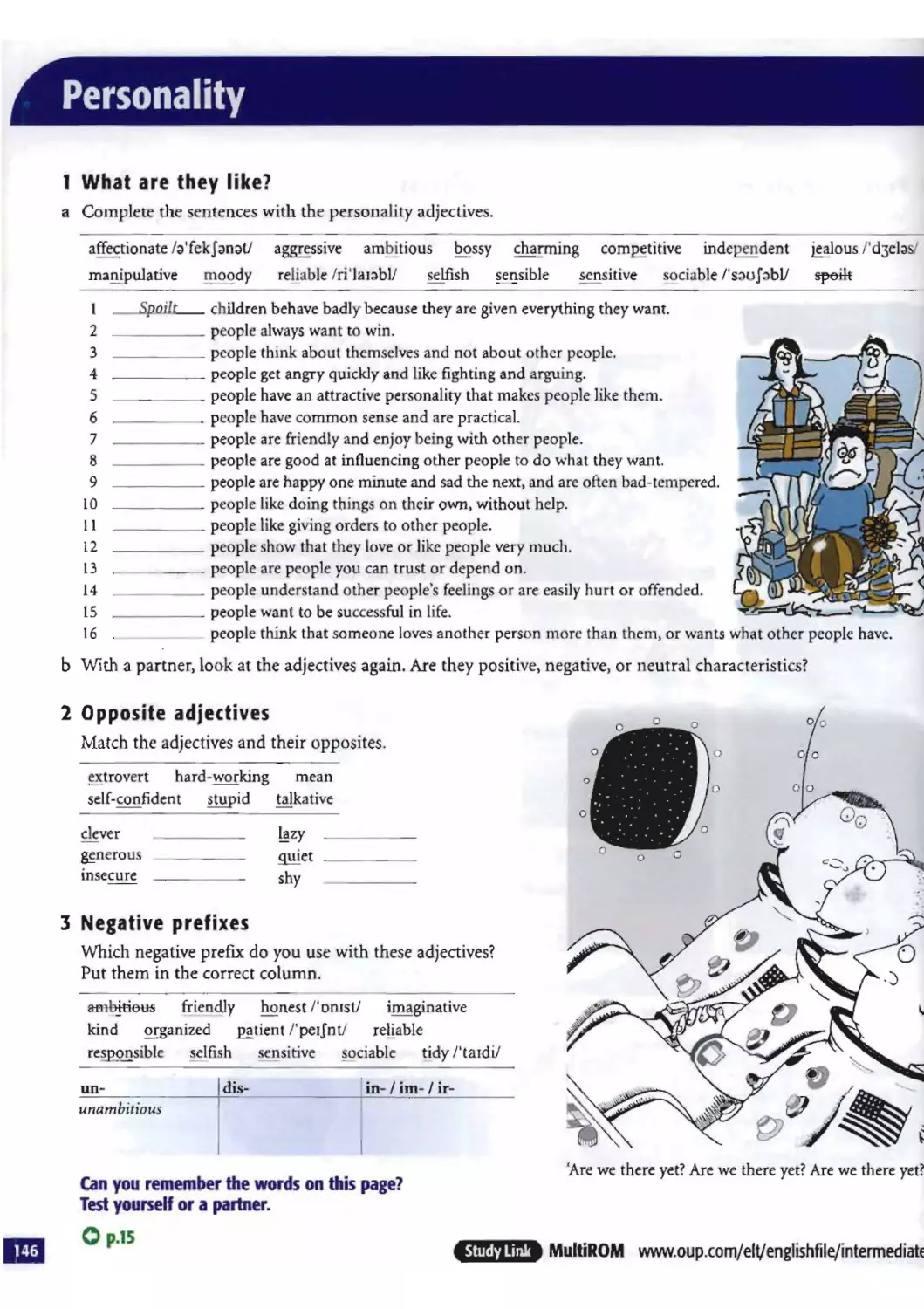
4 VOCABULARY personality
a Can you remember? What do you call a person who... ?
1	talks a lot__________
2	doesn’t talk very much
3	feels uncomfortable and nervous when he / she
meets new people
4	thinks someone loves another person more than
him I her______________
b О p.146 Vocabulary Bank Personality.
c Write down the first three adjectives of personality
that you can remember from the Vocabulary Bank.
Don’t show them to your partner. Your teacher will
tell you what they say about you.
5	PRONUNCIATION prefixes and suffixes
a Underljne the stressed syllable.
1	jealous ambitious generous
2	sociable reliable
3	responsible sensible
4	competitive talkative aggressive sensitive
5	unfriendly insecure impatient
b mo Listen and check. Are -ous I -able I -ible I -ive
stressed? Are un-1 in-1 im- stressed?
c Practise saying the adjectives.
6 LISTENING & SPEAKING
a What’s your position in the family? Are you the oldest child,
a middle child, the youngest child, or an only child?
b Mi Listen to a psychologist talking about the influence
your position in the family has on your personality.
Complete the chart by writing four more adjectives of
personality in each column.
Oldest children	Middle children	Youngest children	Only children
self-confident	independent	charming	spoilt


c Compare with a partner. Then listen to the four sections
again and check your answers. Can you remember any
more details?
d Look at the completed chart above. In pairs, say
- if you think it is true for you - if not, why not.
- if you think it is true for your brothers and sisters or your friends.
7 mi SONG Л We are family
15
1 J
Introductions
Practical English
THE STORY SO FAR
1ЛЗ Listen to the story of Mark and Allie,
Mark the sentences T (true) or F (false).
1	Mark met Allie in London two years ago.
2	He's American and she’s British.
3	They work for MTV.
4	He invited her to San Francisco for a holiday.
5	They both got jobs in the new Paris office.
6	Mark is going to be Allie’s boss.
7	They are both in Paris now,
MEETING PEOPLE
a t-M Cover the dialogue and listen. What do the people
in the Paris office do?
Mark	. I’m Mark Ryder.
Nicole Ah, you’re the new marketing director,
Mark That’s right.
Nicole I’m Nicole Delacroix. I’m Allie’s personal
assistant.___________to Paris!
Mark Thank you.
Nicole I’ll just tell Allie you’re here. Allie?
Mark Ryder’s here. OK.
You’re from San Francisco, you?
Mark Yes, I am.
Allie Hello, Mark.
Mark Allie* It’s to see you again.
How are you?
Allie Very well. Did you have a good ?
Mark Yes, fine, no problems.
Allie Let me you to the team.
You’ve Nicole, my personal assistant?
Mark Yes, we’ve said hello.
Allie _________. is Jacques Lemaitre, our PR director.
Jacques How	you do ?
Mark	Mark Ryder.	How do you do?
Allie	And this is Ben Watts, our designer.
Ben	Hi, Mark.
Mark	Great to	 you, Ben.
Ben We’ve_____________a lot about you.
Mark Really? All good, I hope.
Allie OK. Shall we go to my office?
Mark	Allie
b Read the dialogue. In pairs, what do you think the
missing words are? Don’t write them in yet.
c Listen again and complete the dialogue.
d Look at the highlighted1 phrases. Which is the most
formal way to greet someone?
e U$ Listen and repeat the highlighted phrases. Copy
the rhythm.
f Move round the class in pairs, introducing your partner
to other students. Use the highlighted phrases.
SOCIAL ENGLISH It s a secret
а Ы6 Listen. What do Mark and
Allie want to keep secret?
b Listen again. Answer with M (Mark),
A (Allie), or В (both).
1	Who thinks it’s strange that they’re
together now?
2	Who missed the other person a lot?
3	Who thinks Nicole is very friendly?
4	Who thinks it’s going to be hard to
keep their secret?
5	Who wants to find a flat?
6	Who’s thinking about work?
c ’" Complete the USEFUL PHRASES.
Listen and check.
USEFUL PHRASES
What a 1 view!
Why d we sit down?
I h to find an apartment.
Don’t worry. It won’t t
you long.
I was w (what kind of
a boss..,).
W_______, you’ll find out
tomorrow;
d i n Listen again and repeat the phrases.
How do you say them in your language?
US English apartment
UK English flat
MultiROM
16
Describing a person
Writing
a Read the two emails once and answer the questions.
1 Why has Stephanie written to Claudia?
2 Does Claudia recommend her friend?
b The computer has found five spelling mistakes in
Claudia’s email. Can you correct them?
c Read Claudia’s email again. Then cover it and answer
the questions from memory.
1	Which S adjectives describe Christelle’s personality?
2	What does she like doing in her free time?
3	What negative things does Claudia say about Christelle?
d Look at the highlighted expressions we use to modify
adjectives. Put them in the right place in the chart.
Anna is		untidy.
	very /


Useful language: describing a person
He’s quite / very, etc. + adjective
(e.g. friendly, extrovert, etc.)
She’s a bit + negative adjective (e.g. untidy, shy, etc.)
He likes I loves / doesn’t mind + verb + -ing
He’s good at + verb + -ing
Imagine you received Stephanie’s email asking
about a friend of yours.
WRITE an email to answer it.
PLAN what you’re going to write using the paragraph
summaries below. Use the Useful language box and
Vocabulary Bank p.146 Personality to help you.
Paragraph 1 age, family, work I study
Paragraph! personality (good side)
Paragraph 3 hobbies and interests
Paragraph 4 any negative things?
CHECK the email for mistakes ( grammar ,
punctuation , and spelling ).
From: Stephanie
To. Claudia
Subject: Hi from Scotland
Dear Claudia,
I hope you’re well.
I’ve just had an email from your friend Christelle. She
wants to rent a room in my house this summer. Could
you tell me a bit about her (age, personality, etc. and
what she likes doing) so that I can see if she would fit
in with the family? Please be honest!
Send my regards to your family and I hope to hear from
you soon.
Best wishes
Stephanie
From: Claudia
To: Stephanie
Subject: Hi from Switzerland
Hi Stephanie,
Thanks for your email.
Of course I can tell you about Christelle. She’s 21, and
she’s studjng law with me.
I think she’s quite extrovert and very sociable - she
has lots of freinds. She’s also very good with children.
She has a young step-brother and several young
cousins, and I know she likes playing with them. She’s
incredibly hard-working and responsable - she passed
all her exams last year, which is more than I did!
She likes going out, seeing films, and listennjng to music,
but not rock or heavy metal - so don’t worry about noise!
And she’s happy to do things on her own - she’s very
independent, so you won’t really have to look after her.
Her parents are divorced and she lives with her mother
and stepfather, but she also sees her father regularly.
The only negative things I can think of are that she’s
a bit untidy - her room is usualy In a mess - and that
her English is, well, not brilliant. But Гт sure she’ll learn
fast! I think she's really nice and that you and the family
will get on well with her.
I hope that’s useful. Let
me know if you need any
more information about her.
Love
Claudia
PS I attach a photo of
the two of us.
17
What do you remember?
GRAMMAR
Put the verbs in the correct tense.
VOCABULARY
a Word groups.	Underline the word that is different. Say why.
1 fresh	seafood	frozen	home-made
2 fried	chicken	duck	sausages
3 knife	roast	fork	spoon
4 referee	coach	captain	pitch
5 pool	track	beat	court
6 aggressive	jealous	bossy	affectionate
7 charming	sensible	sociable	moody
8 cousin	family	mother-in-law	grandfather
A Wow. that your new car? (be)
В Yes.
A When 1 it? (you / get)
В 12(buy) it last month.
5 it? (you / like)
A Yes, it’s great. What happened to your
front light?
BI4. ______(hit) another car when I
5 (drive) to work. I thought
the traffic lights6(change)»
but they hadn’t. Would you like to go for
a drive?
A I can t just now because 17
(meet) a friend in ten minutes. How
about tomorrow evening? It s Wednesday
and [ usually 3(finish) work
early
В OK. 19	(pick you up) at 7.00.
You 10(love) it, I know.
А Гт sure I will. See you tomorrow then.
b Write words for the definitions.
1	It’s an adjective for food that is hot, e.g. curry or chilli,
s_______________________
2	It’s what you have before the main course.
s_____________________
3	It means when two teams finish a match with the same score,
d
4	It means to hurt yourself in an accident or doing a sport.
get L----
5	Your mother’s second husband is your s
6	It’s an adjective for a person who always thinks about him / herself,
s_______________________
7	It’s an adjective. It’s the opposite of generous,
m________________________
c Fill each gap with one word.
I I always ask steak when we eat______________
2 What do you usually have lunch?
3 It’s a good idea to warm before you start running.
4 Who do you get_____ with best in your family?
PRONUNCIATION
a Underline the word with a different sound.
1	uH	pool	tuna	fruit	course
2		cook	food	look	football
3	51^	court	ball	roast	praw ns
4	iL_J	couple	draw	cousin	duck
5	i	sausage	bossy	frozen	golf
b	Underline the stressed syllable.
	menu	referee	impatient	sociable	irresponsible
18
What can you do?
Revise &
CAN YOU UNDERSTAND THIS TEXT?
Jam today, tomorrow, yesterday...
Qj
О
Qj
Craig Flatman ts ever/ nutritionist's nightmare -
a fifteen-year-old who never eats anything except
bread and jam but unbelievably, is perfectly healthy!
Although his diet contains hardly any protein and is
60% sugar, he is 1.84m tall, weighs 69kg, and his
parents say he has never been seriously ill apart from
typical childhood illnesses.
Craig, or JJam bo/ as his friends have nicknamed
him, rejects any form of meat fish, fresh fruit or
vegetables. I he only time he doesn't eat bread
and jam is for breakfast when he has chocolate
cereal, and for tea, when he occasionally has
a slice of chocolate cake. He also drinks two
pints of semi-skimmed milk a day.
Craig's strange diet started when he was
four years old. As a baby he had refused to eat
solid food, and rejected everything until his
fattier gave him a sugar sandwich when he was
nine months old. He also ate chocolate spread
sandwiches, and this, with milk, was his diet until he
was four when he asked to try jam, and started an
eleven-yea r obsession.
Craig sometimes craves some variety, but every
time he tries something else he feds ill. Doctors believe
that his condition may have been caused by choking
on sold food when he was a baby. They tell me HI grow
out of if, says Craig, 'but I don't know if I'll ever change'
Although Craig's parents eat a normal diet, their family
meals are made more difficult by the fact that Craig's
sister Amy, 13, is a vegetarian. And every time they go
out for a meal together, they have to phone in advance
- to check they can bring jam sandwiches for Craig!
a Read the article and mark the sentences T (true), F (false)
or DS (doesn’t say).
1	Craig doesn't eat any protein.
2	He eats ten jam sandwiches a day.
3	The only other things he eats are chocolate cereal and cake.
4	When he was a baby he didn't like solid food-
5	His obsession with jam sandwiches started when he was eleven.
6	Craig doesn't want to try any other kinds of food.
7	Doctors have done a lot of tests on Craig.
8	They think Craig’s diet will change when he gets older.
9	Craig's family eat out about once a month.
10	Craig also has jam sandwiches when his family eat out.
b Guess what the highlighted words and phrases mean. Check
with your teacher or a dictionary.
CAN YOU UNDERSTAND THESE PEOPLE?
a M8 Listen and circle the correct answer,
a, b, or c.
1	What drinks do they get?
a A coffee, a tea, and two orange juices.
b A tea and three orange juices.
c A coffee and three orange juices.
2	Why doesn't the woman want anything to eat?
a Because she's not hungry.
b Because she doesn't feel well.
c Because she’s on a diet
3	What does Robertson do now?
a He owns a pub.
b He works in Leeds.
c He works with young players.
4	Who’s coming to lunch?
a The man's mother-in law and his sister.
b The mans mother and his sister*in law.
c The man’s mother-in-law and her sister.
5	What are they going to give their
granddaughter for her birthday?
a Money.
b Clothes.
c They can't decide.
b 1Л9 You will hear a man phoning to
book a tennis court. Complete the
information on the secretary’s form.
Hamworth Sports Centre
Tennis court bookings:
Name: Mark * 1_________________________
Membership number:2
Day 5	_______________________________
Time:4________________________
Court number 5
CAN YOU SAY THIS IN ENGLISH?
Can you...? Yes (/)
1 talk about your diet
1 describe a sporting event you have been to
(where, when, what happened)
I describe a member of your family and his /
her personality
П say how you think families will change in
the future
19

G present perfect and past simple
V money
P saying numbers
Ka-ching!
1
a
afford
b
c
Chorus
Ka-ching!
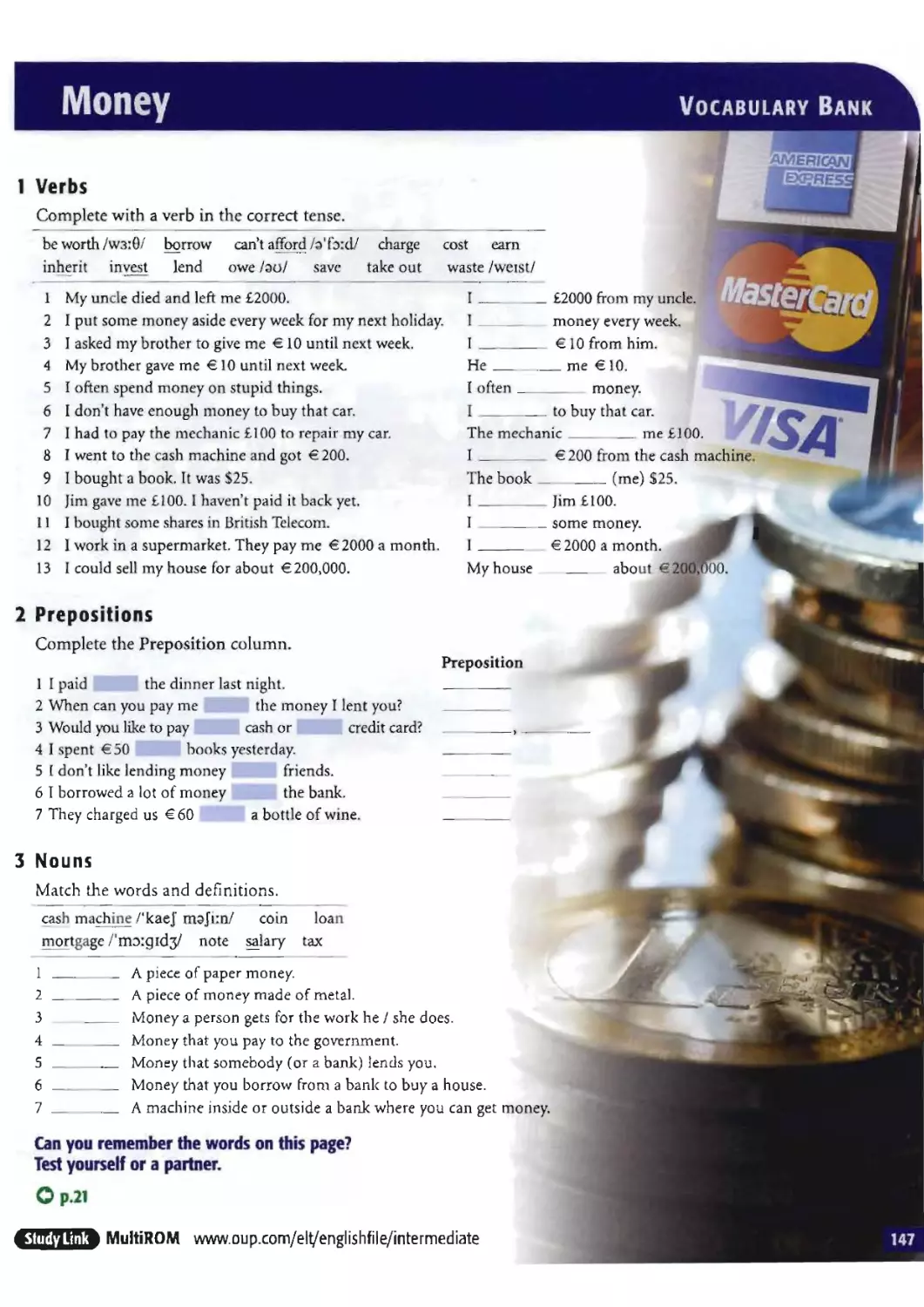
Q p.147 Vocabulary Bank Money.
broke
mall
earn
spend
credit card
mortgage
Listen again and read the lyrics. What do you
think the song is saying?
I Money always makes people happy.
2 The world has become obsessed with money.
3 The singer would like to have more money.
VOCABULARY & LISTENING money
Listen to a song about money and complete
it with these words. What is ‘Ka-ching’?
When you're7_______go and get as
Take out another9_______on your home
consolidate so you can 10
to go and spend some more when you get bo
blow
greedy loan
Now look at words 1-10 in the song and match
them with their meanings.
A				 (verb)	to give or pay money for something
В	.(noun)	money that a person or
c		(verb)	a bank lends you to have enough money to
D		 (noun)	buy something a shopping centre (US) having no money (informal)
E 			(adj)
F 				(noun)	a small plastic card you use
G	. (verb)	to buy things to get money by working
H			(adj)	wanting more money, etc.
I _		 (verb)	than you really need to spend a lot of money
J	. 	(noun)	on something (informal) the money a bank lends
		you to buy a house
Ka-ching
We live in a 1_little world
that teaches every little boy and girl
to 2____as much as they can possibly,
then turn around and spend it foolishly.
We’ve created us a 3	. mess,
we4_____the money that we don’t possess.
Our religion is to go and 5 it all,
so it’s shopping every Sunday at the 6_
Chorus
All we ever want is more,
a lot more than we had before.
So take me to the nearest store.
Can you hear it ring?
It makes you want to sing.
It's such a beautiful thing- Ka-ching!
Lots of diamond rings,
the happiness it brings,
you’ll live like a king,
with lots of money and things.

2 GRAMMAR present perfect and past simple
3 SPEAKING
a Shelley and Ben are having an argument about money
Read what Shelley says and complete the dialogue with
Ben's answers from the box below. Then try to guess his
last answer
In pairs, interview each other with the
questionnaire. Ask for more information.
( Have you ever wasted money on something
V you've never used?
We ve had it for at least three years. Maybe longer
Ifs old.
No. What is it?
Why not?
Yes. I’ve just bought-4b
I cant.
Yes, I bought an exercise bike.
Why did you buy rt?
new camera.
Money
Questionnaire
Shelley Is that a new camera?
Ben 1 Yes. Pvejust bought it.
Shelley What’s wrong with our old camera?
Ben 2
Shelley Old? How long have we had it? A year?
Ben 3__________
Shelley Three years? Tm sure we bought it
last year. Look. We can't afford a
Ben 4_________
Shelley Have you seen this?
Ben $_________
Shelley The gas bill. It arrived this morning. And we
haven't paid the phone bill yet. Take it back
to the shop and get your money back.
Ben 6_________
Shelley Why not?
Ben Because...
b < 12 Listen and check.
c In pairs, read the dialogue again and underline five
examples of the present perfect and two examples of
the past simple. Then answer the questions.
Which form of the verb do we use for...?
1	a completed action in the past
2	things which started in the past and are true now
3	recent actions when we don't say exactly when
4	recent actions when we say exactly when
d О р.Ш Grammar Bank 2A. Read the rules and do
the exercises.
(waste) money on something you've never used
(sell) anything on the Internet
(lose) a credit card or your wallet
(save) for something for a long time
(win) any money (e.g. in a lottery)
(be) robbed
(lend) money to someone who didn't pay you back
Have you...recently?
(buy) anything on the Internet
(be) to a mall or shopping centre
(buy) anyone a present
(use) a credit card
(take) money out of a cash machine
(borrow) money from someone in your family
21

4 READING		d Match the higl Ighted phrasal verbs with their definitions.
a	Which of these sentences best describes your	Write the verbs	in the infinitive.
	attitude to money?	I throw away	put into the rubbish bin
	1 All I want is enough money to enjoy life.		e.g. Please ... those sweet papers.
	2 Money is very important to me. I’d like to earn	2 		stop (doing something)
	as much as possible.		e.g. He wants to ... smoking.
	3 I would be happy to live with less money and	3 	_	arrive, appear
	fewer possessions.		e.g. I invited 20 people to my party but only 10 will
b	You’re going to read an article about a woman who lives without money. Why do you think she does it? How do you think she survives? Read the article to find out.	4		give something to somebody without wanting anything in return c.g. She decided to ... her old clothes to the local hospital.
		5		start a new company or organization
c	Read the article and answer the questions.		e.g. My brother is going to ... a software company.
	1 What was Heidemaries job? 2 What possessions does she have now?	6 		be responsible for somebody or something e.g. Nurses ... people in hospital.
е
3
4
5
6
7
8
How did the experiment start?
Where has she lived since the experiment started?
Does she still work?
What does she do when she needs something?
What is she trying to show with her experiment?
What did she do with the money she earned
from her book?
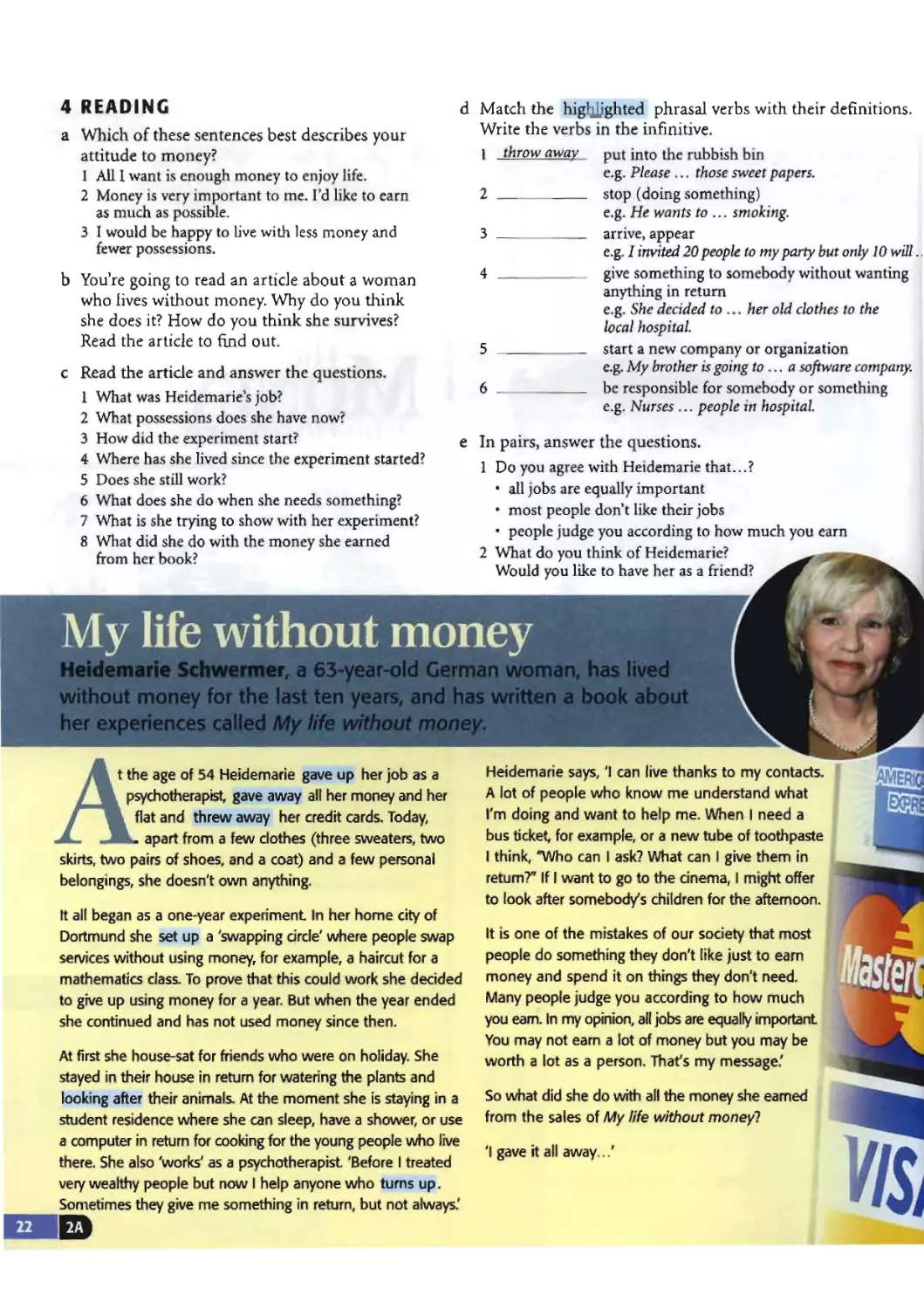
My life without money
ft
'I gave it all away..
So what did she do with all the money she earned
from the sales of My life without money!
t the age of 54 Heidemarie gave up her job as a
psychotherapist, gave away all her money and her
flat and threw away her credit cards. Today,
apart from a few clothes (three sweaters, two
skirts, two pairs of shoes, and a coat) and a few personal
belongings, she doesn't own anything.
It all began as a one-year experiment In her home city of
Dortmund she set up a ‘swapping circle' where people swap
services without using money, for example, a haircut for a
mathematics class. To prove that this could work she decided
to give up using money for a year. But when the year ended
she continued and has not used money since then.
At first she house-sat for friends who were on holiday. She
stayed in their house in return for watering the plants and
looking after their animals. At the moment she is staying in a
student residence where she can sleep, have a shower, or use
a computer in return for cooking for the young people who live
there. She also 'works' as a psychotherapist. 'Before I treated
very wealthy people but now I help anyone who turns up.
Sometimes they give me something in return, but not always.’
In pairs, answer the questions.
1 Do you agree with Heidemarie that...?
• all jobs are equally important
 most people don’t like their jobs
 people judge you according to how much you earn
2 What do you think of Heidemarie?
Would you like to have her as a friend?
Heidemarie says, 1 can live thanks to my contacts.
A lot of people who know me understand what
I’m doing and want to help me. When I need a
bus ticket, for example, or a new tube of toothpaste
I think, "Who can I ask? What can I give them in
return?” If I want to go to the cinema, I might offer
to look after somebody's children for the afternoon.
It is one of the mistakes of our society that most
people do something they don't like just to earn
money and spend it on things they don’t need.
Many people judge you according to how much
you earn. In my opinion, all jobs are equally important
You may not earn a lot of money but you may be
worth a lot as a person. That's my message.'
5 VOCABULARY & PRONUNCIATION
saying numbers
a v 2J Write the numbers. Then listen and
repeat. Practise saying them.
c In pairs, practise saying these numbers.
Numbers
___ fifteen
______ fifty
 a hundred
 seven hundred and fifty
____ one thousand five hundred
____ seven thousand five hundred
 seventy-five thousand
 seven hundred and fifty thousand
 a million
 seven and a half million
b < I* Complete the numbers.
Then listen and check.
30%£9.Q
430
€600 2,800
3,000,000
100%
9,250
Money, percentages, decimal
and fractions
£2.50	two		fifty
$8.99	eight
€3.20	three _
50%	fifty 		_ cent
0.5	nought		five
3.9		 _			—
Vi	a _ _
И	a
%	a
Уч	three _
6*/2	six		_ a half
6 LISTENING & SPEAKING
a M-5 Listen to a news bulletin.
How many different news items
are there?
b Listen again and answer the
questions with a number.
1 How many people were injured
in the crash?
2 How fast was the lorry going?
3 How many workers have walked
out of the Peugeot factory?
4 What pay rise do they want?
5 How many more unemployed are
6 How many are there in total?
7 By how much have house prices increased in the last five years?
8 How much does a three-bedroomed house cost in south-east England?
there this year?
c Answer the questions with a number, percentage, etc. If you don’t
know the exact number, use about or approximately.
1	Whafs the population of...? your country your town I city
2	What proportion of people in your country.,,?
speak good English have more than cwo children
have a dog smoke
3	How much do these things cost?
a cup of coffee a laptop computer a small flat in the centre of town
a newspaper a DVD a small car
G present perfect continuous
V strong adjectives: exhausted, amazed, etc
P sentence stress, strong adjectives
Changing your life
1 LISTENING
a Answer the questions in pairs.
1	If you could spend a year working or studying Ln another
country, which country would you choose? Why?
2	What would you like to do there?
3	What problems do you think you might have?
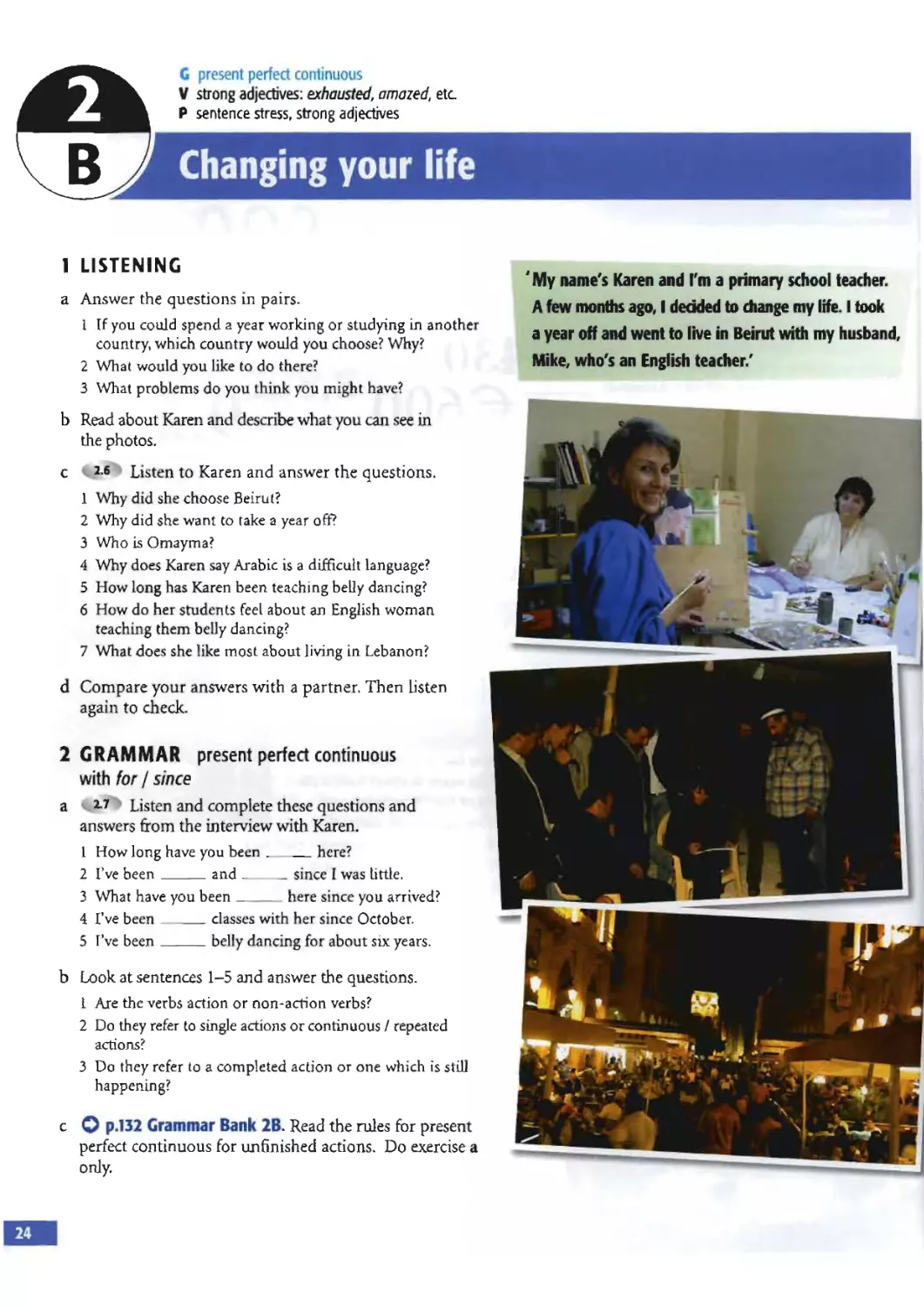
b Read about Karen and describe what you can see in
the photos.
c 16 Listen to Karen and answer the questions.
1	Why did she choose Beirut?
2	Why did she want to take a year off?
3	Who is Omayma?
4	Why does Karen say Arabic is a difficult language?
5	How long has Karen been teaching belly dancing?
6	How do her students feel about an English woman
teaching them belly dancing?
7	What does she like most about living in Lebanon?
d Compare your answers with a partner. Then listen
again to check.
2 GRAMMAR present perfect continuous
with for I since
a M Listen and complete these questions and
answers from the interview with Karen.
1	How long have you been_______here?
2	I've been and .._________since I was little.
3	What have you been_______here since you arrived?
4	I’ve been ____classes with her since October.
5	I’ve been belly dancing for about six years.
b Look at sentences 1-5 and answer the questions.
1 Are the verbs action or non-action verbs?
2 Do they refer to single actions or continuous / repeated
actions?
3 Do they refer to a completed action or one which is still
happening?
с О p.132 Grammar Bank 2B. Read the rules for present
perfect continuous for unfinished actions. Do exercise a
only.
'My name's Karen and I'm a primary school teacher.
A few months ago, I decided to change my life. I took
a year off and went to live in Beirut with my husband,
Mike, who's an English teacher.'
24
3 PRONUNCIATION sentence stress
A An important part of clear communication in English is stressing the words
in a sentence which carry the information, and not stressing the other ones.
a U Dictation. Listen to five sentences. Try to write down the stressed words. Look at the words
and try to remember the whole sentence. Then listen again and write the complete sentences.
b *U Listen and copy the rhythm.
] I’ve been living here for two years.
2 How long have you been learning English?
3 She’s been working in Italy since October.
4 How long have you been waiting?
5 It’s been raining all night.
6 We’ve been looking for a flat for ages.
4 SPEAKING
a Look at the circles, and write something in as many as you can.
b Compare circles with a partner. Ask your partner at least three questions about the things
they’ve written. One question must be How long have you... ?
A Remember after How long...? with action verbs, e.g. play, use present perfect continuous,
with non-action verbs, e.g. know, use present perfect simple.
Since I was about 15.
How often do you play?
25

5 READING
a Can you think of one way that a holiday could
change your life for the better?
b You’re going to read an article about two people
whose Lives were changed by a holiday. Work in
pairs. A read about Victoria, В about Sally.
c In pairs, take turns to tell each other about the
two women. Answer these questions.
What is she doing now?
What was she doing before?
What made her change her Life?
How does she feel now?
d Read the text that you didn’t read before. Did
your partner leave out any important information?
e In pairs, try to guess the meaning of the highlighted words.
Then match them with their definitions below.
First text
1	of little importance
2	crazy	______________
3	a person who Looks after animals (e.g. in a zoo)
4	animals like Large monkeys
5	not looked after well
Second text
6	the London underground
7	very tasty	______________
8	asked for (in writing)
9	burning brightly	_	__
10	very small	__________ ..
f Whose life do you think has changed the most? Which of the
two holidays would you choose?
It was just a holiday, but it changed my life
Holidays can be good for your health. You lie on a beach
and relax, and tensions disappear. But sometimes a holiday
can change your life completely, which is what happened
two years ago to Victoria Smith and Sally Gook.
Victoria Smith, six years ago, was working as a manager at Next
a British chain store. Then she went on holiday to Borneo...
'It was a working holiday/ said Victoria, where you could study orang-utans
in the wild -1 have always been interested in apes, so I thought it would
be fun.' The holiday was wonderful and when Victona came home she
found it very difficult to return to her old life. 'Suddenly the problems in the
storejust seemed so trivial ’ Although everybody told her she was mad,
she decided to go back to university and study biology. Four years later she
became a chimpanzee keeper.
Suddenly I knew there was a different life waiting for me/
For the last two years Victoria has been working at Monkey World, a
centre in south-west England which looks after apes which have been
ill-treated. Many have been rescued from laboratories and circuses all
over the world. She works long hours, and the
pay isn't very good, but she loves it 'Apes are
like a big family, each with their own personality/
'I'm really happy now. Since I started
working here I feel that I've been doing
something important, not just wasting
Sally Gook wakes up every morning to a deep blue sky and
blazing sun. For the last two years she has been living on the
tiny Greek island of Upsi, which is only 16 square kilometres
in size and has a population of just 650.
But until a few years ago she lived in London. 'I was working for
American Express and I had a good social life and earned a lot
of money. But I had to get up very early every morning, often
in horrible weather, and get a train and the tube to work.'
Then one day she and a friend decided they needed a relaxing
holiday, and they came to Lipsi. 'I loved it - the people, the
mountains, the sun, and the delicious food. Suddenly I knew
there was a different life waiting for me here/ A few months later
she applied for a job at the travel company which had
organized her holiday.
Since then she has been living on Lipsi and working as a tourist
guide. Her boyfnend, who is Greek, is a farmer. Sally said, Tve
only been back to London once, and 1 can't imagine ever living
there again/
Adapted from the British press
6 VOCABULARY & PRONUNCIATION strong adjectives
a Write synonyms for the strong adjectives.
Strong adjectives
1	The island’s tiny - only 16 square kilometres.
2	The food in Lipsi was delicious.
3	Her father’s furious. She crashed his car.
4	I’m terrified of flying. I never travel by plane.
5	I’ve been working all day. I’m exhausted.
6	It’s going to be boiling tomorrow - about 40°!
7	Can I have a sandwich? I’m starving.
8	The flat s enormous. It’s got five bedrooms.
9	Гт not going to swim. The water’s freezing.
10	Your car’s filthy. Why don’t you wash it?
11	That’s a great idea! Let’s do it.
12	This book’s awful. I can’t finish it.
Normal adjectives
= very _______________
= very _______________
= very _______________
— very_____________
= very________________
= very________________
= very________________
= very _ _____________
= very________________
= very________________
= very________________
- very________________
b Cover a. Complete the responses with a strong adjective.
J Are you hungry?
2	Was your mother angry?
3	Is her flat small?
4	Are you tired?
5	Is the floor dirty?
6	Arc you afraid of spiders?
Yes, I’m starving
Yes, she was________________
Yes, it’s______________
Yes, Гт_________________
Yes, it’s______________
Yes, I’m of them,
c 2.10 Listen and check. Are the strong adjectives stressed? Listen again and repeat.
d О Communication Are you hungry? Yes, I'm starving! A p.116 В p.119.
7 GRAMMAR present perfect continuous (for recent continuous actions)
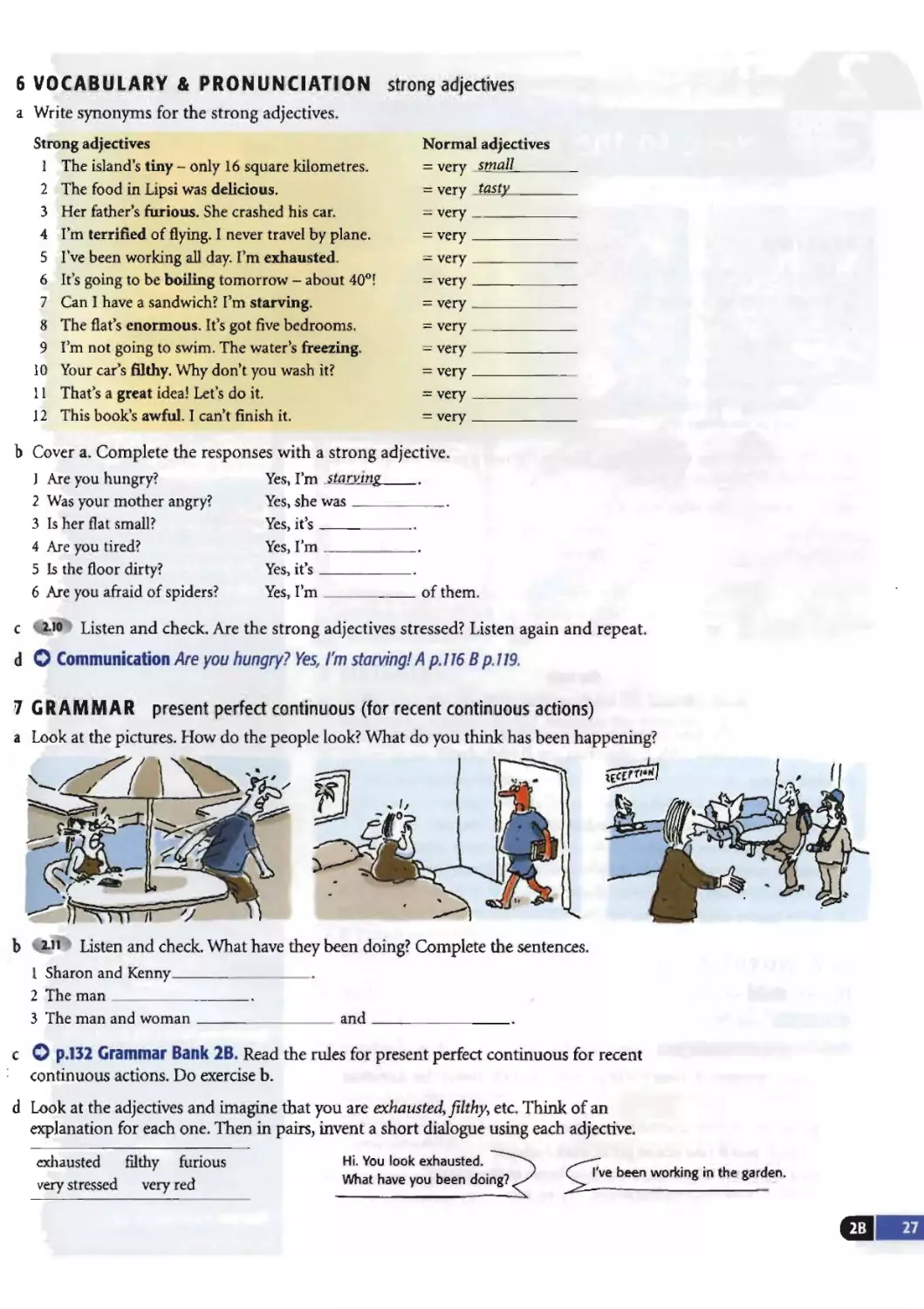
a Look at the pictures. How do the people look? What do you think has been happening?
b 2.” Listen and check. What have they been doing? Complete the sentences.
I Sharon and Kenny
2 The man___________________
3 The man and woman___________________and
с О p.132 Grammar Bank 2B. Read the rules for present perfect continuous for recent
continuous actions. Do exercise b.
d Look at the adjectives and imagine that you are exhausted, filthy, etc. Think of an
explanation for each one. Then in pairs, invent a short dialogue using each adjective.
exhausted filthy furious
very stressed very red
Hi. You look exhausted.
What have you been doing?
I’ve been working in the garden.
G comparatives and superlatives
V transport and travel
P stress in compound nouns
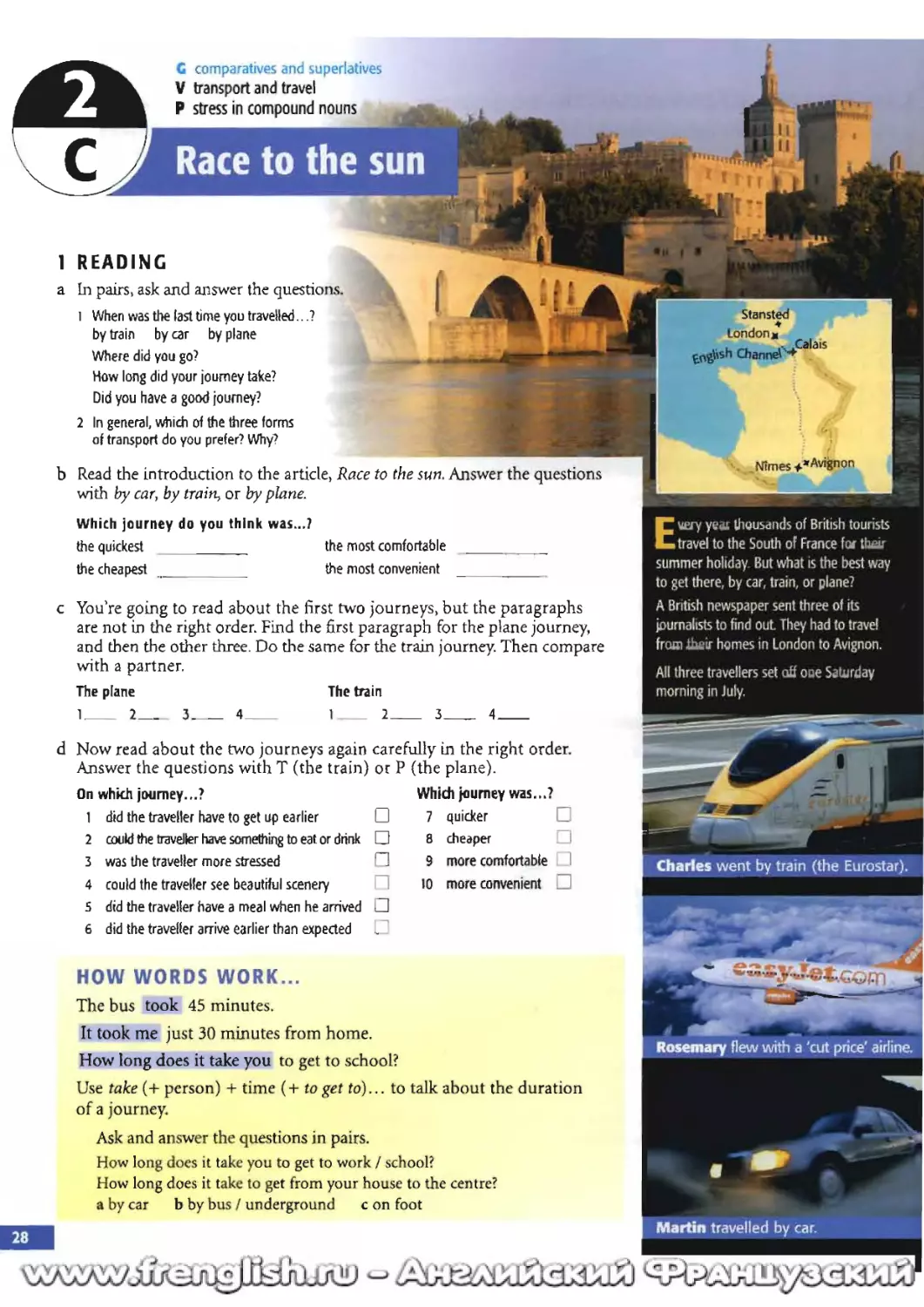
Race to the sun
a
2
READING
In pairs, ask and answer the questions.
1 When was the last time you travelled...?
by train by car by plane
Where did you go?
How long did your journey take?
Did you have a good journey?
In general, which of the three forms
of transport do you prefer? Why?
b
Nimes +»Avignon
Stansted
Londonм
..Calais
cogUsn Channel
Read the introduction to the article, Race to the sun. Answer the questions
with by car, by train, or by plane.
Which journey do you think was...?
the quickest
the cheapest
c
the most comfortable
the most convenient
You’re going to read about the first two journeys, but the paragraphs
are not in the right order. Find the first paragraph for the plane journey,
and then the other three. Do the same for the train journey. Then compare
with a partner.
The plane
1.	2____3. _ 4
The train
)______ 2________ 3
4
very year thousands of British tourists
travel to the South of France for their
summer holiday. But what is the best way
to get there, by car, train, or plane?
A British newspaper sent three of its
journalists to find out They had to travel
front their homes in London to Avignon.
All three travellers set off one Saturday
morning in July.
d Now read about the two journeys again carefully in the right order.
Answer the questions with T (the train) or P (the plane).
On which journey.,.?
1	did the traveller have to get up earlier □
2	could the traveller have something to eat or drink О
3	was the traveller more stressed	П
4	could the traveller see beautiful scenery
5	did the traveller have a meal when he arrived □
6	did the traveller arrive earlier than expected	□
Which journey was...?
7	quicker IZ
8	cheaper
9	more comfortable I
10	more convenient □
Charles went by train (the Eurostar).
HOW WORDS WORK...
The bus took 45 minutes.
It took me just 30 minutes from home.
How long does it take you to get to school?
Use take (+ person) + time (+ to get to)... to talk about the duration
of a journey.
Ask and answer the questions in pairs.
How long does it take you to get to work / school?
How long does it take to get from your house to the centre?
a by car b by bus / underground c on foot
28
Q When I got to security I saw that there was
an enormous queue. I began to worry that
I might miss my flight, because the boarding
limit is 40 minutes before take-off. I had to
run to gate 48 and I arrived completely out
of breath.
Q I arrived on time! I picked up my suitcase
and followed the Exit signs. It was great not
to have to wait ages for my luggage or to
worry about getting a bus or taxi to the
dty centre.
@ We boarded. Because there are no seat
numbers on these flights, everybody tries to
get on as quickly as they can. I sat next to a
friendly Frenchman. We took off and soon
I was looking down on London. There was
no meal, not even coffee, but we landed
10 minutes ahead of schedule.
Q At 4.15 a.m. a taxi picked me up and took
me 32 miles to Stansted airport. Although it
was early morning, there was a lot of traffic
and I arrived later than I had planned. I took
my luggage to check in and asked for a
window seat but the woman said there were
no seat numbers.
Q At 7.10 a.m. I arrived at Waterloo station by
taxi. It took me just 30 minutes from home.
I bought the papers and walked to the
platform. I got on and found my seat As
soon as we started moving, I went to find
the buffet car and had a cup of coffee.
Q Just outside the station I looked up and saw
the medieval walls of Avignon's historic dty
centre. It was 2.20* in the afternoon and I
was just in time for a late lunch! My ticket
cost £65.80, and I gave the journey 8/10 for
comfort and 9/10 for convenience.
В I only had to wait twenty minutes for my
luggage. Then I walked outside into bright
sunshine and waited for the bus to Avignon,
about 40 kilometres away I didn’t have to
wait long and the bus took 45 minutes It was
only 11.00* and I had the whole day in front
of me. My ticket cost £63, and I gave the journey
5/10 for comfort and 5/10 for convenience.
Q I looked out of the window. Although we
were moving at 340 kilometres an hour,
the journey was smooth and relatively quiet
The part where we travelled under the
English Channel took just 22 minutes. Soon
I was looking at the fields and farmhouses
of France. The sun was shining. I closed my
eyes and went to sleep.
* France is one hour ahead of the UK.
Adapted from the British press
2 LISTENING
а 2Л2 Listen to Martin talking about his journey from
London to Avignon by car. Number the pictures 1-7.
b Listen again. Mark the sentences T (true) or F (false).
1	There’s a lot of traffic in London on Saturday mornings.
2	Petrol is more expensive in Britain than in France.
3	There are two ways to cross the English Channel by car.
4	You can’t drive through the Channel Tunnel.
5	The journey through the tunnel takes an hour.
6	Drivers must sit in their car when they go through the tunnel.
7	The speed limit on French motorways is 120 km/h.
8	French motorways aren’t free.
9	It’s 970 kilometres from Calais to Avignon.
c 2,3 Listen to Martin talking about his journey and fill in the By car
column in the chart Now compare the information with your answers in la.
London to Avignon	By plane	By train	By car
How long did it take? (from home) How much did it cost? Comfort /10 Convenience /10	5 hours 45 mins £63 5 5	6 hours 40 mins £65.80 8 9
d Think of a town / city in your country. How many different ways are
there of getting there? Which do you think is the best? Why?

3 GRAMMAR comparatives and superlatives
a Read the sentences. Are the highlighted phrases
right or wrong? Put a tick (✓) or a cross (X),
and correct the wrong sentences.
I What’s the quicker way to get to the South
of France?
2	Driving is more boring than going by train.
3	Petrol isn’t as cheap in Britain than in France.
4	Does the plane cost the same as the train?
5	Going by train is less expensive as flying.
4
a
6	It was the more comfortable hotel I’ve ever
stayed in.
7	The worst month to travel through France
is August.
8	Do the British drive more carefully than the
French?
О P-132 Grammar Bank 2C Read the rules and
do the exercises.
With a partner compare the experiences below
using the bold adjectives.
1	safe, exciting, healthy
travelling by motorbike
travelling by car
travelling by bike
2	enjoyable, dangerous, relaxing
travelling by yourself
travelling with friends
travelling with your family
3	difficult, expensive
learning to drive
learning to ride a bike
learning to ride a horse
VOCABULARY transport and travel
Put the words into the correct column.
5 PRONUNCIATION & SPEAKING stress in
compound nouns
a Listen and repeat the compound nouns.
Which word is usually stressed more?
traffic lights	pedestrian area
boarding pass	road works
car park	rush hour
car crash	seat belt
cycle lane	speed camera
parking fine	speed limit
traffic jam	ticket office
b
Ask and answer the questions in pairs.
In your town / city...
WM time is the rash hour?
О What's the speed limit?
J О Are there speed cameras anywhere?
What kind of public
transport is there?
Are there often traffic jams?
О Are there any cycle lanes? Do many
11 people use them?
Q Are there any pedestrian areas? Where?
О Are there enough car parks? Are they expensive? X
buffet car	checkin	gate motorway
platform	rush hour	speed limit
station	take off
train car plane
b
О p.148 Vocabulary Bank Transport and travel.
Q What happens if you park somewhere illegal?
Q Do people usually wear their seat belt in the
back of the car?
Do motorcyclists and cyclists wear helmets?
О Are big lorries allowed to drive through the centre?
6 LISTENING & SPEAKING
a Read the beginning of a newspaper article and then talk
to a partner:
1	Do you (or your family) ever do any of these things while
driving a car?
2	Which three do you think are the most dangerous? Number
them 1-3 (1 = the most dangerous).
b 2-15 Now listen to a road safety expert
talking about the tests. Number the activities
1-6. Were your top three right?
c Listen again and answer the questions.
1	What should you do when you are driving?
2	Why is opening a packet of crisps or a can so
dangerous?
3	What do people often do when they pick up
a CD?
4	What gets worse when drivers are talking on
the phone?
5	How do people drive when they are listening
to their favourite music?
6	What happens if the music is fast and heavy?
7	What’s the main problem when drivers talk to
other passengers?
8	Why is listening to music you don’t know the
least dangerous?
d Look at the statements below and decide
whether you agree or disagree. Tick (✓) the
ones you agree with and put a cross (X) next
to the ones you disagree with. Think about
your reasons.
Drivers should not use any kind of phone
when they are driving.
The minimum age for riding a motorbike
should be 25.
Which of these things is
the most dangerous when
you’re driving a car?
The speed limit on motorways should be
100 kilometres an hour.
Cyclists are just as dangerous as car drivers.
Speed cameras do not stop accidents.
•	making a call on your mobile
•	listening to your favourite music
•	listening to music you don’t know
•	opening a packet of crisps or a can of drink
•	picking up a specific CD from the passenger seat
•	talking to other passengers
A car magazine tested car drivers in a driving simulator.
The drivers had to 'drive' in the simulator and at the
same time do the things in the list above. The results
of the tests were surprising (and worrying).
e In groups, give your opinions on each
sentence. Do you agree?
In the office
Practical English
REQUESTS AND PERMISSION
а 2Л6 Cover the dialogue and listen.
Answer the questions.
1 What docs Jacques ask Mark to do?
2 What does Mark ask Ben to do?
3 What does Nicole ask Allie?
b Read the dialogue. In pairs, what do you think
the missing words are? Don’t write them in yet,
c Listen again and complete the dialogue,
Jacques Mark? Would you mind me those
concert dates?
Mark Of not. Ben, are you busy?
Ben Me? Never.
Mark	you help me? I can’t open
this document.
Ben ,
Mark Thanks.
Allie	Hi, Nicole,
Nicole	Could	you sign these, please?
Allie	Sure.
Nicole Is it _______ if I take tomorrow afternoon off?
Allie	Гт, but tomorrow s	really difficult.
Nicole What about Friday afternoon?
Allie Friday? That’s fine. Do you_______you
could me the request by email?
Nicole Er, yes, of______.
Allie Hello? Hi, Mark. Could you hold a moment,
Mark? Thank you, Nicole.you come
and see me when you have a moment?
d 217 Listen and repeat the highlighted phrases.
Copy the rhythm.
e Look at the highlighted phrases in the dialogue.
Complete the chart.
Request
Response
Would you rnind... ?
Permission
f О Communication Requests p.119.
SOCIAL ENGLISH Office gossip
a 2-’8 Listen. Who do Mark and Nicole
talk about?
b Listen again and mark the sentences
T (true) or F (false).
1	Mark hasn’t found a flat yet.
2	Mark likes Ben and Jacques.
3	Jacques’s wife is a lawyer.
4	Nicole likes the way Allie dresses.
5	She thinks Allie is friendly.
6	Allie orders a soft drink.
c 2.19 Complete the USEFUL PHRASE.
Listen and check.
d Listen again and repeat the phrases.
How do you say them in your language?
USEFUL PHRASES
Have you started I for an apartment?
I haven’t had time у______
J a minute.
H do you like (the office)?
Have you h of (Isabelle)?
L _______me get you (a drink).
Thanks. I’ll h	.a (Diet Coke)
32
( Study Link
MultiROM
Telling a story
Writing
Nightmare journeys
We asked you to tell us about your
nightmare journeys. Jutta from Germany
wrote to us about hers...
A nightmare journey I remember was three years ago
1____I was going to the airport with my friend. Wc were
going to Mallorca on holiday and we had to be at Dresden
airport two hours before the flight.
We leaved home with plenty of time*2_____when we got to
the motorway there was a huge traffic jam! The traffic wasn’t
moving at a IL We didnj knew what to do. It was too late to
go another way*3______we just sat in the car getting more
and more stressed. 4_____ ten minutes the traffic started
moving slowly. We decided to leave the motorway and try
lojound another way to the airport,5_____( wasn’t sure of
the way and we got completely lost. We wa s sure we were
going to miss the flight. We finally arrived at the airport just
thirty minutes before the plane was going to leave. The
woman at the check-in desk said vye couldn't to check in our
luggage6_____it was too late * 1__we had to run with all
our cases to the departure gate.
my friend felt oyer and hurt her leg, we managed
to get to the gate in time and 9_ we caught our flight.
Read the story once. What happened in the end? Then correct
the six grammar mistakes with the verbs (wrong tense or wrong form).
Read the story again and complete with a connecting word or phrase.
after although because but (x2) in the end so (x2) when
Look at the list of possible travel problems in the Useful language box below.
Mark them C if they refer to a car journey and P if they refer to a plane journey.
Useful language: travel problems
the flight was delayed
you broke down
you got lost
you missed your flight
there was a traffic jam
you got a puncture
you forgot your passport
your flight was overbooked
WRITE about a nightmare journey you ve had
(or invent one).
PLAN what youre going to write using the paragraph
summaries below: Use the Useful language box and
Vocabulary Bank Transport and travel p.148 to help you.
Paragraph 1 When was the journey?
Where were you going? Who with? Why?
Paragraph 2 What went wrong? What happened?
Paragraph 3 What happened in the end?
CHECK the story for mistakes ( grammar ,
punctuation , and spelling ).
33
What do you remember?
GRAMMAR
a Complete the sentences with one word.
1	A Shall we watch the film?
В No. I’ve 1 seen it three times.
2	A How 2 have you lived here?
В J 2004.
3	A 4 you read this novel?
В No. Is it good?
A I haven’t finished it5.
b Complete the second sentence so that it
means the same as the first.
1	I started work here three years ago.
I’ve	here for three years.
2	I made some coffee a moment ago.
I’ve some coffee.
3	The train is cheaper than the plane.
The plane is than the train.
4	Women drive more carefully than men.
Men don’t drive as women.
5	None of the other sofas are as comfortable
as this one.
This sofa is comfortable one.
VOCABULARY
a Word groups. Underline the word that is different. Say why.
1	coin	cheque
2	save	waste
3	exhausted	terrified
4	delicious	wonderful
5	flight	journey
6	coach	van
7	cycle lane	railway station
bank
mortgage
hungry
great
trip
helmet
speed limit
note
owe
furious
awful
travel
lorry
traffic jam
b Write words for the definitions.
1 It’s an adjective. It means very dirty, f _
2 It’s a noun. It’s money that you pay to the government,
t____________
3 It’s a noun. It’s the time of day when buses and trains are full.
r h
4	It’s a verb. To give someone money which they must later pay back.
1____________
5	It’s a noun. It’s the place in a railway station where you get on / off a train.
P-------------
6	It’s a verb. It means to receive money from a relative after their death,
i____________
7	It’s a noun. It’s the piece of paper you need to get on a plane.
b-----------p I c
8	It’s an adjective. It means very small, t
c Complete the sentences with one word.
1 What time did the plane take?
2 She took some money of the cash machine.
3 Who paid the meal last night?
4 When can you pay me the money you owe me?
5 Can I pay credit card?
PRONUNCIATION
20
a Underline the word with a different sound.
1		afford	board	coach	enormous
2	i	tiny	pick up	traffic	ticket
3		crash	station	rush	charge
4		coin	cheque	cycle	carriage
5	$	seat	earn	speed	greedy
b	Underline the stressed syllable.
	invest	security	luggage pedestrian		terrified
34

What can you do?
Revise & Check
CAN YOU UNDERSTAND THIS TEXT?
to be a millionaire
Wrhen Lydia Nash appeared on the TV programme Who wonts to be
a millionaire? and was fortunate enough to win £16,000, she
decided to give all the money away. This wouldn't have been surprising
if she had been rich or famous, but Lydia is a 19-year old student.
Lydia gave all the money to a charity which helps orphan children in
Thailand and where she had also worked as a volunteer for the previous
three years. ‘I first visited the orphanage when I was seventeen, and I felt
very depressed by what I saw. When I got back to England I felt angry-
looking around all I could see were people who were obsessed with
money. That convinced me to return to Thailand the following year.'
After she won the money some of her friends at university thought that
maybe she had made the wrong decision. ‘Some people said I should
have saved it for a deposit to buy a house or to pay back my student
loan.’ Lydia said. ’That really annoyed me. Students seem to live in an
unreal world, where they constantly complain about being poor. 8ut
there’s an enormous difference between our situation and people who
have absolutely no money.’
With the help of the money Lydia gave them, the charity has just
finished building 'Rainbow House’, a new facility that will house 50
young children, where they will live until they are adopted.
If Lydia had won a million pounds and not only £16,000, would she still
have given away all the money? She said, ‘Before going on the show I
thought a lot about what it would be like to have a lot of money and I
realized that I wouldn’t like it at all And (hen, of course, as I had been
to the orphanage and had seen al! the work that needed to be done, I
knew how useful that money could be. It was far more important for the
charity than it could ever be for me. I definitely think I got more
enjoyment out of giving the money away than if I had kept it for myself.’
a Read the text once. Then read it again and choose
a» b> or c.
1	People were surprised that Lydia gave away the money
she won because.
a she is young and not very wealthy
b she already had a lot of money of her own
c she had won a lot of money
2	Before winning the money» Lydia had been to the
orphanage in Thailand
a once b twice c several times
3	Lydia thinks that students today____
a are broke all the time
b have a lot of money
c are not as poor as they think
4	The charity has used the money to
a build a new house
b adopt more children
c build a school
5	Lydia______.
a wouldn’t mind being rich
b wouldn’t like to be rich
c would like to be a bit richer
b Look at the highlighted words and phrases. Can
you guess what they mean?
CAN YOU UNDERSTAND THESE PEOPLE?
a 2-M Listen and circle the correct answer, a, b» or c.
1	Where did the woman probably lose her credit card?
a In the petrol station.
b In the flower shop.
c In the restaurant.
2	How long has he been working as a teacher?
a 1 Vi years b 2 Vi years c 3Vi years
3	How can people travel today?
a Byroad. b By rail. c By air.
4	Which airline are they going to fly with?
a British Airways b Anglo Air c Euroflight
5	Who is working at the moment?
a Her brother.
b Her brother’s wife.
c Her brother and his wife,
b 2Л Listen to a conversation between a bank manager
and a client. Complete the sentences with a number.
’Ms Stephens wants to borrow £
2	The period of loan will be_, years.
3	The monthly repayments will be £
4	The interest rate is ___%.
5	The first repayment will be on
CAN YOU SAY THIS IN ENGLISH?
Can you...? Yes (Z)
□ talk about different things you can do with money
□ say how long you’ve been living in this town and
learning English
П compare travelling by car» train» and plane in your
country
35
G must, have to, should (obligation)
V mobile phones
P sentence stress
Modern manners
1
a
VOCABULARY & SPEAKING mobile phones
Match the word with the country. How do you
say‘mobile phone’ in your language? Which name do you like best?
1 France	a	cell phone
2 Germany	b	telefonino
3 Italy	c	celular
4 the USA	d	movil
5 the UK	e	portable
6 Spain	f	mobile
7 Argentina	g	Handy
b V* Listen and match the sentences with
the sounds.
A 1—1 He’s dialling a number.
В Q She’s texting a friend.
C □ He’s just hung up.
D t_J She’s choosing a new ring tone.
E L He’s calling back.
F L She left a message on his voice mail.
G □ The line’s engaged / busy.
c Use the questionnaire to interview another student
(who has a mobile phone). Ask for more information.
Mobile phone questionnaire
What make is your mobile?
How long have you had your mobile?
Are you thinking of getting another one soon?
What ring tone do you have?
Do you ever use it 'hands free’?
What do you use it for (apart from talking)?
Where and when do you normally switch off your mobile? I
How often do you text?
Do you use...?
a voice mail b speed dialling
Have you ever...?
...lost your mobile
...sent a text to the wrong person
...forgotten to turn your phone off (with embarrassing
consequences)
2 GRAMMAR must, have to, should (obligation)
a In pairs, look at the picture and answer the questions.
1	What’s the man doing? Does it annoy you when people do this?
2	Does this happen a lot in your country?
3	What other things do people do with mobiles that annoy you?
b ЗЛ Listen to five people talking about things that annoy them
about mobiles. Match the speakers with what they say
Who...?
A says talking on your mobile can be dangerous
R complains about people who are very impatient to use their mobiles
G complains about people using mobiles on social occasions
D hates having to listen to other people's conversations
E complains about people who interrupt a conversation to answer the phone
c Match these sentences from the dialogues with their meaning.
1	You shouldn’t answer the phone if you're talking to a shop assistant Li
2	You have to switch off your mobile when you fly.
3	You mustn’t use your phone until you get off the plane. □
4	You don’t have to shout - the other person can hear you. П
5	You should talk really quietly if you are in a public place. Li
Л You don’t need to do this. It isn’t necessary.
В Don’t do this. It isn’t allowed I permitted.
C Do this because it’s a rule or the law.
D 1 think it’s a bad thing to do this.
E I think it’s a good thing to do this.
d О p.134 Grammar Bank ЗА. Read the rules and do the exercises.
3 PRONUNCIATION & SPEAKING sentence stress
a 3.3 Listen and repeat the sentences.
Copy the rhythm.
1	You mustn’t use your phone on a plane.
2	I don’t have to go to work tomorrow.
3	We have to do an exam in June.
4	You should switch off your mobile in class.
5	You shouldn’t talk loudly on a mobile phone.
6	1 must go to the bank this morning.
b Read the definition of manners. Then look at
phrases 1-8. Arc these laws (or against the law)
or just good / bad manners? Mark M (manners)
or L (law).
manners [pl noun] a way of behaving that is
considered to be polite in a society or culture
Manners or the law?
1 Play noisy games on a mobile phone in public
1 Send text messages when your car is stopped at traffic lights
3	Switch off your mobile phone on a plane
4	Switch off your mobile phone in class
5	Talk loudly on a mobile on public transport
6	Use a hand-held mobile while driving a car
7	Make very personal calls in public
8	Use your mobile at a petrol station
C Compare with a partner. Then make sentences with...
You should / shouldn't... (for manners)
You have to / mustn't.. .(for the law)
C3
4 READING
a Look at the postcard. What does it say
about the English?
b Read Culture shock and tick (*/) the
sentence which says what the article is
about.
□ The English have very good manners.
П The English and Russian idea of good
manners is different.
□ The English are polite but insincere.
□ The Russians are very rude and unfriendly.
Culture shock
Adapted from the British press
Good manners are always good manners. That's
what Miranda Ingram, who is English, thought,
until she married Alexander, who is Russian.
When I first met Alexander and he said to me,
in Russian, 'Nalei mnye chai - pour me
some tea', I got angry and answered, 'Pour it
yourself'. Translated into English, without a
'Couldyou...?' and a 'please', it sounded really
rude to me. But in Russian it was fine - you don't
have to add any polite words.
However, when I took Alexander home to meet my
parents in the UK, I had to give him an intensive course
in pleases and thank yous (which he thought were
completely unnecessary), and to teach him to say sorry
even if someone else stepped on his toe, and
to smile, smile, smile.
Another thing that Alexander just couldn't
understand was why people said things like,
Would you mind passing me the salt, please?
He said, 'It's only the salt, for goodness sake! What \
do you say in English if you want a real favour?
He also watched in amazement when, at a dinner
party in England, we swallowed some really
disgusting food and I said, 'Mmm...delicious'. In
Russia, people are much more direct The first
time Alexander's mother came to our house for
dinner in Moscow, she told me that my
soup needed more flavouring. Afterwards
when we argued about it my husband said,
'Do you prefer your dinner guests to lie?'
Alexander complained that in England he felt
'like the village idiot because in Russia if you smile
all the time people think that you are mad. In fad, this
is exadly what my husband's friends thought of me
the first time I went to Russia because I smiled at
everyone, and translated every 'please' and
'thank you' from English into Russian!
\ At home we now have an agreement.
If we're speaking Russian, he can say
у 'Pour me some tea', and just make a noise
?. like a grunt when I give it to him. But when
we're speaking English, he has to add a 'please',
a 'thank you', and a smile.
c Read the article again and mark the sentences T (true) or F (false).
Correct the wrong sentences.
d Now cover the text. Can you complete
the phrases with the missing verbs?
I Miranda got angry because her husband asked her to make the tea.
2	Miranda had to teach him to say sorry when something wasn’t his fault.
3	Her husband thinks English people are too polite.
4	Alexander wasn’t surprised when people said they liked the food at the
dinner party.
5	The food was delicious.
6	Miranda didn’t mind when her mother-in-law criticized her cooking.
7	Alexander thought his mother was right.
8	Ln Russia it isn’t normal to smile all the time when you speak to someone.
1		on someone’s foot or toe
(by accident)
2	some wine into a glass or
tea into a cup
3	 a noise, like a grunt
4	----------food (so that it goes from
your mouth to your stomach)
5	a word from English into
Russian
His Russian friends thought Miranda was very friendly because she
smiled a lot.
Alexander never says thank you for his tea when he and Miranda are
speaking in Russian.
Are people in your country more
like Miranda or Alexander?
10
9
e
5 LISTENING
a 5 * * Listen to three people who have lived in England answering the question ‘Are English
people too polite?’ Do they answer yes or no? If yes, what do they think the English should do?
1	Laszlo, an English teacher from Hungary	Yes I No
2	Paula, a businesswoman from Argentina	Yes / No	._____
3	Melik, an economist from Turkey	Yes / No .	______
4	Renata, a student from Germany	Yes / No
b Listen again and answer the questions.
1	Why were Ldszld and his friends in London?
2	Did he and his friends think they were going to pass or fail? Why?
3	What happened in the end?
4	What do Latin people think when English people are polite?
How does Paula describe Latin people?
6	What does Melik think about the English people he has met in his job?
7	What kind of English people does he say arent polite?
8	What happened to Renata when she was Id London?
9	What did she say to the last person? Why?
6 SPEAKING
Look at the five situations. In groups, discuss...
Do people do these things in your country?
Do you think it’s good or bad manners to do these things, or doesn’t it matter?
In my country, we don't kiss people when
we meet them for the first time.	___
Greeting people
 kiss people on both cheeks when
you meet them for the first time
• call older people by their first names
• use more formal language when
speaking to an older person
Good manners?
Bad manners?
Does it matter?
In a restaurant
* let your children run around and
be noisy
• be very affectionate to your partner
• talk on your mobile
Driving
•	always stop at a pedestrian
crossing
-	hoot at someone who's
driving slowly
*	drive with the window down
and your music playing
Men and women - a man's role
* pay for a woman on the first date
* wart for a woman to go through
the door first
• make sure a woman gets home
safely at night
Visiting people
• take a present if you're invited
to dinner at someone's house
• arrive more than 10 minutes
late for a lunch or dinner
• smoke in a house where the
owners don't smoke

G must, may, might, can't (deduction)
V describing people
P -eigh, -aigh, -igh
1 READING
a Answer the questions in pairs.
I How many documents do you have
which have your photo on them?
2 Where was your passport or ID card
photo taken?
a in a photo booth b at home
c at a photo studio
3 Do you think the photo looks like you?
4 Do you like the photo? Why (not)?
b Look at the three people and their
passport photos. Do they look like
their passport photos?
c Read the first paragraph of the article
and answer the questions.
1 Why is our passport photo important?
2 Which nationality are the least happy
with their photo?
3 Which are the happiest?
4 Which nationality are the vainest?
d Now read the rest of the article.
Who is happy with their photo?
Who isn't? Why?
e Look at the highlighted words
in the text and choose the
correct meaning.
1 a a study
b a book
2	a feeling uncomfortable
b feeling happy
3	a journalists
b famous people
4	a feeling pleased with yourself
b feeling unhappy with yourself
5	a very beautiful
b very ugly
6	a without hair
b with a lot of hair
7	a a kind of document
b false hair
Adapted from the British press
Do I really look like this?
Our passport (or identity card) photo is the photo we show to the largest
number of different people during our lives. But how happy are we wilh
our photo? Do we make an effort to get a good one? According to 1 research done by
the US printer company Lexmark, the answer varies according to nationalities. It
seems that the Italians are the most2 embarrassed about their passport photo (21%
said they didn’t like showing it to other people). On the other hand, 98% of
Norwegians said they were happy with their photos. And the French spend most time
trying to get the perfect photo (sometimes spending an hour in the photo booth!).
We asked three British media 3 celebrities how they felt about their passport photos...
Michael Winner
film director
£l used to be very 4 proud of my passport photo/
said Michael Winner. Tor more than forty years
I looked like an elegant film director/ But
recently Michael renewed his passport and took
a new photo in a photo booth. 'Now I look like a
drug dealert, he says.
Ruth England
TV holiday show presenter
Ruth England spends her life travelling and showing
her passport photo to passport officials around the
world. She confessed, 'Once I had a passport photo
where I looked really5hideous and so I deliberately
lost’ my passport and got a new one. For my latest
passport, I took several photos and I chose the best
one. I quite like it. I’ve had much worse ones.’
Toby Young
author and journalist
Toby Young said, Tm often stopped when I go
through passport control because I don't look
like my passport photo at all. In my photo
I had a lot more hair but now I’m E bald .
No one believes it is me. So, now I have two
possibilities: take a 7 wig with me every time
I travel or get a new passport photo!’
Look at two sentences from the text:
Once I had a passport photo where I looked really hideous.
I looked like an elegant film director.
You can use the verbs look and look like to talk about a person's appearance.
•	Use look + adjective (or an age).
•	Use look like + a noun or pronoun.
Complete the sentences with look or look like in the correct form.
1	This photo doesn't___ you at all. When was it taken?
2	You ______very young in this photo. How old were you?
3	Your brother a rugby player. He’s enormous.
4	You_________ tired. Why don’t you go to bed?
2 VOCABULARY describing people
a О p.149 Vocabulary Bank Describing people.
b 3.5 Look at the four men and listen. Which one is the bank robber?
3 PRONUNCIATION -eigh,-oigh,-igh
a Look at the pink letters in the words below. Are they pronounced /ei/ or /ai/?
Put the words in the correct column.
bright height high in his eighties light brown
might neighbour overweight sight straight weigh
b 3.6 Listen and check.
c How is -igh always pronounced? How is -eigh usually pronounced?
Which word is an exception here?
d З.7 practise saying the sentences. Listen and check.
1	She has light brown hair. It’s short and straight.
2	He’s medium height and slightly overweight.
3	He’s in his eighties, but his eyesight’s very good.
4	She likes wearing tight straight-leg jeans.

4 GRAMMAR must, may, might, can't (deduction)
a Look at the photo of the three women. Who do you think is who? Match texts A-C with the photos.
Judging WRBI LI W
ш by appearances
Policewoman?
b
c
d
e

Millionaire's
daughter?
Managing
director?

Who
do you
think is
who?

1Г4.
<ПГ vVl
L J** \УТИ
»41
Read the texts again. In pairs, answer the questions.
1	Which two women feel they are judged because of theh appearance? How?
2	Which woman thinks she is judged because of ber name? How?
Look at the highlighted phrases in the texts and answer the questions.
1	Which phrase means it's impossible ?	_______________
2	Which phrase means its certain7 ________________._____
3	Which phrase means it $ possible ?	_______________
О p.l 34 Grammar Bank 3B. Read the rules and do the exercises.
О Communication Who do you think they are? p.l 16 Match more people with their jobs.
ЕИ
Laura Day, policewoman, Soho, London
When people first meet me they think
I might be a teacher or a hairdresser.
When I’m not wearing my uniform, they
never believe me that I’m a policewoman.
When I tell people what I do. the typical
reaction is, 'You can't be a policewoman,
you’re too small!' I’m only 5 feet 4 inches*
tall. People always think that policewomen
are big and masculine. Often people only
believe me when I show them my police
identity card.
*=1.6 metres
Sam Roddick, daughter of Anita Roddick
(the millionaire founder of Body Shop)
When I introduce myself to people and say
my name they often say, ‘Oh you must be
the BodyShop woman’s daughter.’ Later
they can’t remember my name. I’m very
proud of my mother but I would never say,
‘My mum’s Anita Roddick*. I don’t know if I
am very different from the typical ‘rich kid’
because I don’t know any. My friends never
mention my background or money and
neither do I.
И
Thea Callan, managing director of Nails Inc.
(the biggest UK chain of nail bars*)
People often ask me who my boss is. They
think, ‘She can’t be the managing director
- she’s a woman'. They’re expecting to see
an older man in a suit. Or when people
speak to me on the phone and hear that
I am a woman then they think that I
must be a 50-year-old woman who wears
trouser suits and is very unfeminine.
They’re very surprised when they see me -
I’m not like that at all. In the office I just
wear jeans and trainers.
* = salons where you can have manicures
and pedicures
5 LISTENING
a In pairs, look at the man in the photo
and answer the questions. Use must,
may, might, can’t be. Say why.
1	Where do you think he’s from?
England Sweden Spain
2	How old do you think he is?
In his 20s In his 30s In his 40s
3	What do you think his job is?
priest musician accountant
b 5-8 Listen to the first part of a radio interview with him
and check your answers. Were you right?
c Listen again and make notes under the headings below.
Compare with a partner.
d J-9 Now listen to the second part of the interview and answer
the questions.
1	In which of the two countries is it easier for him to make a living?
2	In what other countries is there a lot of interest in his job?
3	What is the stereotype of someone doing h i$ job?
4	In which of the two countries does he think people judge him
by his appearance?
e How important is appearance in your country?
Do people in your country judge by appearances?
<3
G can, could, be able to (ability and possibility)
V -ed I -ing adjectives
P sentence stress
1 GRAMMAR can, could, be able to
a Look at the title of the lesson, which is the first half of a well-known
saying. Look at the different second halves below. Which do you
think is the real saying? Which do you think is the best advice?
.. .ask for advice.	.. .leave it until tomorrow.
.. .give up.	.. .pay someone else to do it for you.
.. .have a cup of tea. .. .try, try again.
b Look at the definition of be able to. What other verb is it similar to?
be able to do sth to have the ability, opportunity, time, etc.
to do something, e.g. Will you be able to come to the meeting next week?
I'm a failure!
c Read the article about people who have
tried (but failed) to learn something.
Complete the text with these phrases.
A I’ve never been able to say
В I was able to learn
C you’ll never be able to speak
D I just wasn’t able to do it
E I hate not being able to communicate
F I would suddenly be able to do it
G all my friends are able to do
I've never been able to...
I started having driving lessons when I
was 17. Although I'm normally a quick
learner,1 After 18
months I failed my first test - I was really
disappointed. Since then I’ve taken the
test again three times, but I've always
failed - usually on reversing or parking.
The problem is I get so nervous during
the tests that I can’t drive properly. It's so
embarrassing to admit that I can’t learn
to do something that5	!
Amanda, Brighton
I've always wanted to be able to dance salsa,
and when I was working in Ecuador there
were free classes, so I joined. But the art of
salsa is to keep your arms still and move your
hips, and I just couldn’t do it When I hear
music my arms start moving but my hips
don’t. After about ten hours of classes
3	the steps, but I was
dancing like a robot! I didn't give up, but
soon everyone in the class was dancing and
I was just slowly moving from side to side and
counting out loud 'one, two, three, four’. I was
sure that one day4	- but
that never happened. I can still remember
the first two steps, though, and I still try to
dance when I hear a salsa tune, as long as
nobody is watching.
Sean, Oxford
I’ve started learning English at least ten
times. I’ve been to classes, I’ve had a
private teacher, I’ve used a self-study
course, but5	_ anything in
English. I even had an English girlfriend
once but she learned Spanish before 1
managed to improve my English, so we
always spoke in Spanish. I travel a lot in
my job and 6 - it’s so
frustrating. I’m thirty-two now and I
think if you don’t learn a language when
you’re a child, or go and live in the
country,7___________________it well.
Guillermo, Madrid *
* translated from Spanish
d Look at phrases A-G. What tense or form of
be able to are they?
e О p.134 Grammar Bank 3C Read the rules and
do the exercises.
f О Communication Guess the sentence A p.116 В p.l 19.
2 PRONUNCIATION sentence stress
a 3-10 Dictation. Listen and write six
sentences with can I cantor could I couldn’t.
b 3J1 Listen and repeat the sentences. Copy the rhythm.
1	I'd love to be able to ski.
2	We wonk be able to come.
3	I’ve never been able to dance.
4	She hates not being able to drive.
c 3.» Listen and make new sentences with the
verbs you hear.
3 SPEAKING
Interview your partner with the chart.
40^’“’
play a musical
instrument
$ki	dance salsa
swim
sing
cook
create a
website
ride a horse
sail
speak a foreign language
(apart from English)
drive
(^I'd love to be able to ride a horse.
Yes, I can.
How well?
No, I can't
Would you like to
be able to?
HOW WORDS WORK...
1 Look at the two uses of so. Match them with
their uses.
1 It’s so frustrating!
2 The classes were free, so I joined.
□ to emphasize an adjective or adverb
U to connect a cause and a result
2 Look at the sentences below. Is so use I
or use 2?
A I love Paris - it’s so beautiful.	О
В The bus didn’t come so I walked home. О
C Why does he talk so much?	C
D I was so tired that I went to bed at 9.00.
E I was tired so I went to bed.	П
When did you leam?
How did you leam?
Did you find it easy
or difficult?
Why (not)?
4 VOCABULARY -ed/ -ing adjectives
a Look at the picture.
1 Which person is bored? Which person is boring?
2 Which person is embarrassed? Which person is embarrassing?
b Without looking back at the texts in 1, underline the correct
adjective in these sentences.
1	I failed my first test -1 was really disappointed / disappointing.
2	Its so embarrassed I embarrassing to admit 1 can’t do something
that all my friends are able to do.
3	I hate not being able to communicate - its so frustrated /
frustrating.
5 LISTENING
a You’re going to hear a psychologist talking
about how to succeed at learning to do
something new. Before you listen, match
these phrasal verbs with their meanings.
1	I want to take up scuba diving.
2	Гт going to give up learning Japanese -
it’s too difficult
3	If I like thi$ course, Г11 carry on next year.
□ a stop, abandon
L b continue
I—I c start something new
b злз Read these seven tips. Now listen
to the programme. Tick (✓) the five
things the psychologist says.
1	_1 Be realistic about what you choose.
2	□ Always take up a new activity at the
beginning of the year
3	f I Don’t think you’ll be bad at all sports
just because you’re not good at one.
4	О Don’t give up an activity before you’ve
given it a good chance.
5	П If you’re learning something new, don’t
think you’re going to become the best
in the world at it.
6	[ Always take up a new activity with a
friend.
7	Learning something new is a good way
of meeting people.
c Listen again. What examples does she
give for each point you’ve ticked?
c Look back at the texts on p.44 and check your answers.
d Complete the adjectives with -ed or -ing.
1	What do you think is the most excit __sport to watch?
2	What music do you listen to if you feel depress _?
3	What was the last interest__TV programme you watched?
4	Have you ever been disappoint _ by a birthday present?
5	Which do you find more tir .	.., travelling by car or by
public transport?
6	Are you often bor_____- at work or school?
7	What’s the most embarrass __thing that’s ever happened to you?
8	Are you frighten_ of any insects?
9	Do you feel very tir__in the morning?
10	What’s the most bor ___film you’ve seen recently?
e Ask and answer the questions in pairs. Ask for more information.
6 READING
a Can you think of anyone you know or a famous person who has been successful
in very difficult circumstances?
b Work in pairs. A read about Natalie, В read about Bethany. Complete the chart.
	Natalie_			Bethany
1	How did she lose a limb? 2	When did she start her sport again? 3	How did she feel? 4	What has she achieved since then? 5	How does she see her future?
c A use the chart to tell В about Natalie. В complete the chart. Then swap roles.
d Now read the other text. Underline five words / phrases in either text that you want to remember.
e What have the two women got in common? What’s different about them?
Natalie, the swimmer who lost a leg
Natalie du Toit, the South African swimmer, was only seventeen
when she lost her leg in a road accident. She was going to a
training session at the swimming pool on her motorbike when
a car hit her. Her leg had to be amputated at the knee. At the
time she was one of South Africa’s most promising young
swimmers. Everybody thought that she would never be able
to swim competitively again.
But Natalie was determined to carry on. She went back into the
pool only three months after the accident. And just one year
later, at the Commonwealth Games in Manchester, she swam
800 metres in 9 minutes 1138 seconds and qualified
for the final - but not for disabled swimmers, for able-bodied
ones’ Although she didn’t win a medal, she still made history.
‘I remember how thrilled I was the first time that I swam after
recovering from the operation - it felt like my leg was there.
It still does,’ says Natalie. ‘The water is the gift that gives me
back my leg. I’m still the same person I was before the accident.
I believe everything happens in life for a reason. You can't go
back and change anything. Swimming was my life and still is.
My dream is to swim faster than I did before the accident.’
Bethany, the surfer who lost an arm
Bethany Hamilton was the best girl surfer of her age
when she lost an arm in a shark attack. She was only
thirteen years old and was surfing in Hawaii when a
tiger shark attacked her and tore off her left arm. It
happened so fast she didn’t even scream.
But Bethany was determined to get back on a surf
board as soon as possible. As soon as she left hospital,
she began practising her surfing exercises on the beach.
Everyone was amazed to see her surfing so soon after
her accident. Incredibly, she finished 5th at the
National Surfing Championships.
‘The first time I went back into the sea I was so happy
I cried,' she said. ‘It was easier than I thought. But
obviously it’s much more difficult than with both arms,
and I have to accept I’ll probably never be world
champion, which used to be my dream.'
Since then Bethany has signed a contract with Rip Curl,
and has written a book about her experiences which
has been made into a film. ‘I always dream of the sea,’
she says. 'When you surf a wave, it's like walking on
water, and when you’re in the air, it’s like flying.’
7 3-u SONG Л You can get it if you really want

Renting aflat
Practical English
HOW TO GET THERE
a 3.15 Cover the dialogue and listen. Where is
the flat that Mark is going to see? What’s the best
way to get there? How is Mark going to get there?
b Read the dialogue. In pairs, what do you think
the missing words are? Don’t write them in yet
Mark Where is it? I’m sorry, I didn’t catch that.
OK. far is it? OK, OK. Mer<;i. Au revoir.
Jacques Any luck?
Mark I think I’ve found an apartment.
How do I to Belleville?
Jacques The easiest is to get the metro at
Pyramides. Take Line 14 and at ChStelet.
Mark OK.
Jacques Then take Line 11 Mairie des Lilas.
Mark Where do I off?
Jacques At Belleville.
Mark How many is it?
Jacques Six, 1 think.
Mark Oh right, I’ve found it on the map. How long
does it to get there?
Jacques About half an hour.
Nicole Have you found a flat?
Mark Yes, in Belleville this time.
Nicole When are you going to see it?
Mark This afternoon.
Nicole If you can wait till six, I’ll you a lift.
I live near Belleville so I'm driving that way.
Mark That’s great. Thanks.
SOCIAL ENGLISH What's going on?
а з.п Listen. Does Mark decide to rent the flat?
b Listen again and answer the questions.
1	What are the main advantages and disadvantages of the flat?
2	What two lies does Mark tell? Why? Do you think Nicole
believes him?
с З.И Complete the USEFUL PHRASES. Listen and check.
d Listen again and repeat the phrases. How do you say
them in your language?
USEFUL PHRASES
So, what do you t	?	I can’t w___(to see it)!
It’s a long w_from (the station).	Are you on your о _?
It’s a p__(there isn’t a lift). I'll call you b____
What’s it 1___?
c Listen again and complete the dialogue.
d зле Listen and repeat the highlighted phrases.
Copy the rhythm.
e In pairs, try to remember the questions for these answers
1	The easiest way is to get the metro.
2	At Belleville.
3	Six, I think.
4	About half an hour.
f О Communication How do I get there? A p.117 В p.120.
Study Link
MultiROM
An informal letter
Writing
Christelle went to Scotland and stayed with
Stephanie and David. After she had gone home,
she wrote to thank them.
a Look at the list of things she says in her letter.
Number them in a logical order 1—7.
A □ She suggests the best time to come to Geneva.
В । She thanks them for having her to stay.
C □ She talks about what she’s been doing recently.
D L She apologizes for not writing before.
E □ She mentions two really good experiences
in Scotland.
F □ She thanks them again and invites them to stay.
G I 1 She talks in general about the nice things
that happened in Scotland.
b Now read Christelle’s letter and check your
answers to a.
c Find and correct five punctuation mistakes in
the second paragraph.
d Look back at the emails on p. l 7. What
difference is there in style between an
informal letter and an email?
Useful language: informal letters / emails
Beginnings
Dear + name (email: Dear or Hi)
Sorry for not writing earlier but...
Thank you I Thanks (so much) for
(your letter, having me to stay, etc.).
It was great to hear from you...
Endings
That’s all for now.
Hope to hear from you soon. / Looking forward
to hearing from you.
(Give my) regards I love to...
Best wishes I Love (from)
PS I enclose a photo of the three of us (email: 1
attach...)
Imagine you have some British friends in
the UK, and you stayed with them for a
week last month.
WRITE a letter to thank them.
PLAN what you’re going to say. Use 1-7 above
and the Useful language box to help you.
CHECK the letter for mistakes ( grammar ,
punctuation , and spelling ).
rue de la Tour 9
1207 Geneve
Switzerland
10 September
bear Stephanie and bavid.
Sorry for not writing earlier but I've been incredibly busy
since I got back!
Im writing to thank you for letting me stay with you in
august I had a fantastic time. The weather was perfect
and I really think my english got better, i hope you think
so too!
It was very nice to meet Claire and Emma. There were a
lot of memorable days, but I'll never forget the open air
concert we went to - it was amazing - or the visit to
Edinburgh Castle.
For the last three weeks I've been very busy organizing
everything for my next year at university. I have to
matriculate for all my subjects and choose the optional
ones I want to do. I've also been doing a lot of exercise as
I put on three kilos while I was in Glasgow! I've been going
swimming every day and playing football with my friends.
Talking of football, I was sorry to see that Celtic lost on
Saturday. Let's hope they play better next week.
Anyway, that's all for now. Thanks again for everything.
Don't forget my invitation to come to Geneva - my family
would love to meet you. Spring would be a great time as
it’s warm and not too crowded.
Give my love to Claire and Emma.
Best wishes
Christelle
PS I enclose a photo I took of the girls in Edinburgh.
GRAMMAR
Complete the second sentence with two
words so that it means the same as the first.
Contracted forms» e.g. isn't, count as one
word.
I really think it s important for you
to learn to drive.
You really _______leanL. to drive.
1 Why don t you join a tennis club?
It would be good for you.
I think you a tennis club.
2 I’m sure she’s not American. She hasn’t
got an American accent.
She American^ she hasn’t
got an American accent.
3	I can t go out tonight.
I won’t to go out tonight.
4	It’s prohibited to take photos there.
You photos there,
5	Гт not sure if shell like her present.
She like her present.
6	Wearing a uniform is not obligatory.
You to wear a uniform.
7	The lights are on so Гт sure he’s
at home.
The lights are on so he
at home.
8	I think perhaps this is their house.
This their house.
9	Paying in advance is obligatory at
this school.
You pay in advance at
this school.
10	Drinking a lot of coffee isn't a good idea.
You _ _. __a lot of coffee.
VOCABULARY
a Complete the description.
My cousin Ann is very attractive.
She's in her ’m-twenties
- 24 or 25 I think. She's blonde,
with shoulder’21 hair.
It's completely 5s, not
curly at all. Her4 f is
very long and gets in her eyes.
She's very short-sighted but
she 5w__________contact lenses.
b Complete with an adjective from the bold verb.
1	Are you			 in sport?	interest
2	I was very _		when I failed the exam.	depress
3	This book is	really	I can’t finish it.	bore
4	I completely forgot his name. It was so	!		embarrass
5	I felt very	because I just couldn’t do it.	frustrate
c Complete with one word.
1 Please switch your mobile. You can’t use it here.
2	Fm afraid John s out. Can you call later?
3	I can’t believe it! He hung __ in the middle of our conversation!
4	She looks her mother. They both have big eyes.
5	He’s _ his late forties.
PRONUNCIATION
a Underline the word with a different sound.
l	dial	might	fifties	frightened
2	weight	height	straight	engaged
3	«51^. curly	bored	short	tall
4	§ -rey	ugly	glasses	fringe
5	e<"k	moustache	switch	choose
b Underline the stressed syllable.
disappointed embarrassing interested mobile overweight
hat can you do?
Revise & Check
CAN YOU
The best day
of my life
This week's contributor is the
thriller writer Minette Walters.
One of the best days of my life was when
my agent phoned to say that my first
novel. The Ice House, had been accepted by
a publisher. I'd finished the book 18 months
earlier, and I didn't think it was ever going to be published. It was one
morning in the autumn of 1990 when the phone call came. I was 59,
and a fnend of mine turned up, sat down at my kitchen table and
burst into tears because she was having problems with her marriage.
I was doing my best to try to console her when the phone rang So
there I was, listening to the best news of my life, while my fnend was
crying over the worst news of her life My agent said, 'Aren't you pleased7
Why aren't you more excited? I said, 'I am but I'll tell you later7.1 put the
phone down and tned to be sympathetic to my fnend. But at 11 o'dock
I couldn't stand it any longer so I said, 'Stay there I have to go out for и
ten minutes'. I came back with a bottle of champagne, You and I are
going to drink some champagne/1 said, and told her my good news.
She was a much happier lady when she left! I can't remember how <§
many publishers had turned down my book, because my agent	-g
didn't tell me. I don't know how many copies it's sold now - a couple	£
of million I should think, because it's published in 36 countries. But
I have absolutely no sympathy for those publishers who rejected g.
my book. I was deeply hurt at the time, but now I'm laughing!
a Read the article and choose a, b, or c.
1 In 1990 Minette Walters was . about the chances of
her first novel being published.
a quite optimistic b quite pessimistic c quite worried
2 When her agent first phoned, Minette felt that she
celebrate the news.
a shouldn’t b had to c could
3 Her agent couldn’t understand
a why she was crying b what she was saying
c her reaction
4 In the end Minette s good news made her friend
a feel better b feel worse c leave early
5 Now that she is very successful, she the publishers
who rejected her.
a feels positive towards b feels negative towards
c understands
b Look at the higi. ghted words and phrases. Can you guess
what they mean?
CAN YOU
a 5.19 Listen and circle the correct answer,
a, b, or c.
1 Where’s the girl’s mobile?
a In the caf£. b In her pocket, c In her bag.
2	How late are their friends?
a Less than 15 minutes. b 15 minutes.
c More than 15 minutes.
3	Who looks good in their passport photo?
a The woman. b The man. c Neither of them.
4	The girls new boyfriend is...
a tall and with long dark hair.
b tall with short dark hair.
c short with short dark hair.
5	How many times has the woman failed her
driving test?
a One, b Two. c Three.
b wo Listen and complete the form with the
missing information.
Anglo language school
Name:	1_____________
Surname: * 1 2___________
Nationality:3____________
Student wants to study4 level.
Student has been to 5.
CAN YOU
Can you...? Yes (/)
□ talk about bad mobile phone manners, and what you
think people should do
□ describe yourself and other people
talk about something you’ve tried to learn but
weren’t able to and why

G first conditional and future time clauses + when, until, etc.
V education
P 1/J or /ju:/?
Back to school, aged 35
1 VOCABULARY education
a Answer the questions in pairs.
b Match the questions with these school subjects.
1	When did the Second World War end?
2	What is the- capital of Colombia?
3	Who wrote Hamlet?
4	How man<f Kilobytes are there in a megab'fte?
5	Who invented the theory of relativity?
b What's 5* IS+ 4?
1 How man^ legs does an Insect have?
в What is water made of?
2 PRONUNCIATION & SPEAKING /л/or/jut/?
A The letter и between consonants or at the beginning
of a word is usually pronounced /л/ or /ju:<
a Put the words in the correct column.
computer lunch nun pupil result
student study subject uniform university
/ju:Z
chemistry
geography	_I
history
information technology C
literature	Г
maths	L-
physics	□
biology
b *’ Listen and check. Practise saying the words.
Why do we say a university but an umbrella?
c 4-2 Practise saying these sentences. Listen and check.
1	What subject did you study at university?
2	Do pupils at your school wear a uniform?
3	Most students have lunch in the canteen.
4	I usually get good results in my music exams.
d Interview your partner using the questionnaire.
Ask for more information.
с О p.l 50 Vocabulary Bank Education.
Your education
What kind of secondary school / you go to?
I you like it?
How many pupils / there in each class?
How much homework / you have?
I you have to wear a uniform?
I discipline very strict?
/ pupils behave well?
Which subjects / you good and bad at?
Which / your best and worst subject?
i
3 READING

£
So school these days is easy?
Think again.

People and polftidans complain that school is getting easier. Damian Whitworth,
a 35-year-old journalist, decided to see for himself. He spent a week as
a pupil at a British secondary school, Brentwood County High School. Its a large
state school and has about 1,800 pupils, girls and boys, aged between 11 and 18.
French
My first lesson is French. I am in a class of thirteen year olds Outside the classroom
some girls start interrogating me. 1_____________________________ 'How old are you?
'How old do you think I am? I reply.
'Well .. you're not 13!*
First we have a listening test which I find difficult. I get 14 out of 20. Not bad. Then we
make revision lists on the computer. 2 Now every pupil has one.
a Look at the photo above. What’s unusual
about one of the pupils?
b Read the introduction. Why did Damian
Whitworth go back to school? What kind
of school did he go to?
c Read Damian’s diary for one of the
days he spent back at school. Does he
think school is easier or harder now?
d Read the text again and put the phrases
A-H in the correct places.
A A crowd of pupils are watching.
В However, the pupils are totally involved.
C He’s friendly with the pupils but not
too friendly.
D When I was the same age as these
children I had never used a computer.
E It’s a magical moment and the most
effective class I have seen.
G One boy says he has chips every day.
H Phones that ring in class are
confiscated until the end of the week.
e In pairs, look at the highlighted words
and phrases. Try to guess what they
mean from the context. Then check
with your dictionary or the teacher.
f In pairs, look at each heading (French,
Maths, etc.) and say if this is the same,
similar, or different from the secondary
school you went to (or go to). Say why.
Maths
As we wait outside the maths classroom a teacher tells me to do up the top button
of my shirt. The maths teacher uses an interactive whiteboard which has graphics and
video, but the pupils don't look very interested in the lesson A mobile rings and the
owner hurries to switch it off.3
History
Mr Fishleigh is the history teacher. He doesn't have any problems controlling the
noise level (other teachers do).4	. He talks to them as if they
were adults and gets their attention in return
Lunch
In the canteen we can choose between traditional and fast food
Burger and chips is the most popular meal. 5
Information and communication technology
We are designing spreadsheets for mobile phone sales and I
cannot imagine a more bonng lesson. 6
Most children have Internet access at home and the school has a
website where parents can see what homework their children have
and when they have to give it in .
Religious education
The teacher introduces us to meditation. We sit cross-legged on our
desks and try to fill our minds with blackness and think positively about people who
we have been thinking negatively about. For 15 minutes the children sit, eyes closed, in
total silence. When they leave the class they arc slightly dazed:
'Incredible!'
'Amazing!'
'We should do this in maths!'
The bell goes. End of school for the day.
As we leave there is a fight at the school gates. 8 'If anyone hits
anyone, I'll call the police,’ says a teacher.
So has school got easier?
It's difficult to say if lessons are harder or easier since I was a child
because teaching methods have changed so much. All I can say is that during
my working life I have had many tiring experiences. Being back at school for a
week was as tiring as any of them. Being a pupil today is very, very hard work.
4A |	53
4
a
GRAMMAR first conditional and future time clauses
In pairs, answer the questions.
1	When was the last time you did an exam? Did you pass or fail?
2	What s the next exam you are going to do? How do you feel about it?
3	How do you usually feel before you do an exam?
4	What do you usually do the night before an exam?
5	Have you ever failed an important exam you thought you had passed
(or vice versa)?
Charlotte and Viktor are waiting for their exam results.
Listen to Charlotte and answer questions 1-5. 44 Then do the same for Viktor.
b
1 Do you think you have passed?
2 When and how will you get the results of the exam?
3 How will you celebrate if you get good results?
4 What will you do if you get good results?
5 What will you do if you fail, or if you don't get the results you need?
c ^5 Listen and complete the sentences.
1	They won't give me a place unless
2	As soon as , ГП take the letter
upstairs and open it.
3	I don’t want to plan any celebrations until
4	If I don't get into Cambridge,
5	When I	, the grades will be on
the notice board.
d О p.136 Grammar Bank 4A. Read the rules
and do the exercises.
e Choose five sentence beginnings from the
list below and make true sentences about
yourself. Then tell your partner.
I won't stop studying English until I...
I'd like to retire when..,
I'll leave home as soon as...
I'll be really annoyed if...
I don’t want to have children before ..
I'll have a big party if...
I'll always live here unless...
I’ll have more free time when...
I'll h^ve something to eat as soon as
I won't get married until...
f 4,e Listen to Charlotte and Viktor. Did they pass or fail? What grade did they
get? What are they going to do?
5 LISTENING
a Look at this extract from a TV guide and the photo and
answer the questions.
8.00 That'll Teach 'Em
Final part of the six-part series following a group
of modem 16-year-old school children in a
1950s boarding school. This week: Exams!
1 What do you think the idea of the programme was?
2 Which of these tilings do you think pupils hated the most?
the food
not being able to watch TV
not being able to use mobiles
having a lot of homework
wearing a uniform
going for cross-country runs
having cold showers
6 SPEAKING
a In groups, each choose one different topic from
the list below. Decide if you agree or disagree,
and write down at least three reasons.
Private schools are usually better than
state schools.
All schools should let children wear whatever
they want at school.
Cooking and housework should be taught
at all schools.
Physical education should be optional.
Girls study better without boys in the class.
School summer holidays should be shorter.
Boys study better in a mixed class.
b Explain to the rest of your group what you
think about your topic. The others in the
group should listen and say if they agree
or disagree with you and why.
Useful language
First of all.
My first point is that ..
3 What do you think the discipline was like? How do you
think the children were punished for behaving badly?
4 Do you think the pupils did well or badly when they took
1950s exams?
Secondly ..
Finally...
Another important
point is that..
b 4.7 Listen to a TV critic talking about the programme
That'll Teach 'Em. Check your answers to a. Were you surprised?
c Listen again and mark the sentences T (true) or F (false).
1	16 children took part in the experiment.
2	They didn't have to sleep at the school.
3	The uniforms were not very comfortable.
4	They had to stay inside the school grounds all the time.
5	The children weren't allowed to talk during the classes.
6	They really missed being able to use computers and calculators.
7	They thought the classes were boring.
8	Exams today are easier than in the 1950s.
9	The children failed because they weren't intelligent enough.
10	Most of the children enjoyed the experiment.
d Do you think school exams in your country are easier than
G second conditional
V houses
₽ sentence stress
In an ideal world...
personal/
Our weekly questionnaire. This week we ask the actress
and model Isabella Rossellini and dancer Joaquin Cortes...
1 If you could live in another period of time for
its fashion, when would you choose and why?
2 If you could come back in another life, who
(or what) would you (ike to be?
И
3 If you couldchange onepart of'your body,	*
what would it be?
4 What would you wear if you. were invited
on a date by someone you really (iked?
5' What would you eat for your last meal and
who (dead or alive) would you share it with?
Adapted from the British press
56
1 GRAMMAR second conditional
2 PRONUNCIATION & SPEAKING sentence stress
a Look at the two photos on p.56 and describe the people.
Do you know anything about them?
b Read the questions in Getting personal and match two
answers with each question. Try to guess which answers
are Isabella Rossellini’s and which are Joaquin Cortes’s.
A I A fly on the wall, so / could watch people.
В |__| Either the thirties, for its elegance, or the seventies,
for its hippy clothes andgreat music.
С О Jeans and a shirt.
D Д My back. / would like 75 new vertebrae.
E Q With a fabulous woman. I wouldn't really care
about the food.
V |  I’d change everything.
Some super comfortable French pyjamas that
everyone thinks are clothes.
&rj A bird
H [ | / would have a pasta supper with my dog, Macaroni
It's what she has wanted her whole life.
Z[3 !’d choose today or any tone after the end of the corset
c Ix>ok at Getting personal again, and answer these questions.
1 In questions 1-4, what tense is the verb in the if clause?
2 What tense is the other verb?
a Match the sentence halves.
1 I wouldn’t wear that hat |  A if she practised more.
2 If you did more exercise, I	В I’m sure she'd
understand you.
3 If it wasn’t so expensive, I C if I could find the
right person.
4	I’d get married tomorrow I | D you’d feel much better.
5	She’d play better	J E I’d buy it.
6	If you talked to her,	F if I were you.
b ^4 8 Listen and check.
c Listen again and repeat. Copy the rhythm. Then
cover A-F and try to remember the sentences.
d Choose three of the sentence beginnings below and
complete them in a way which is true for you. Tell
a partner and say why.
if I won a 'dream holiday’ ih « competition,
If I could choose any car ! liked, I’d have a-
/f I could be very good at a sport, I’d choose-
if I could choose my ideal job, /d...
if I had more time, I’d learn...
If I could buy a house in another country, l'd b*j-
3
4
d
e
I low is question 5 different?
Do the questions refer to real or imaginary situations?
О p.136 Grammar Bank 4B. Read the rules and
do the exercises.
О Communication What would you do if...? A p.117 В p. 120.

3 VOCABULARY houses
a Look at the cover of Ideal
Home magazine. Which room
is it? How many things in the
room can you name?
b О p.151 Vocabulary Bank
Houses.
c In pairs» ask and answer
the questions.
Where do you live?
What do you like about the area where you live?
What don't you like?
What do you like about your house / flat?
What would you change?
4 LISTENING & SPEAKING
a <•* Listen to four people describing their ‘dream house’.
Match the speakers 1^1 the pictures.
b Listen again and match the people with what they say.
Which speaker...?
LI would not like to have other people living nearby
□ would like to live somewhere that was partly old
and partly modern
□ would not spend much time inside their dream house
LI doesn’t think they will ever get their dream house
c Think for a few minutes about what your dream house
would be like and make notes. Use Vocabulary Bank
Houses to help you.
Where would it be?
What kind of house or flat would it be?
What special features would it have?
5 READING
a Have you ever visited the house where a
famous person was bom or lived? Where was it?
What do you especially remember about it?
b Read the article about Casa Azul. Which part
of the house are these things connected to?
Why are they mentioned?
two giant statues
Leon Trotsky
a yellow floor
a monkey and a parrot
a pair of shoes
a cupboard with a glass door
July 7 1910
1929-1954
c Match the highlighted words with their
meaning.
1 a piece of furniture with
cupboards at the bottom
and shelves above, to hold
cups and plates, etc.
2 material which you can
see through
3_______________ the door, gate, or opening
where you go into a place
4 a room where paintings
are hung
5 the floor above where you are
6 with a lot of fresh air inside
7 wooden or metal covers
which are fixed outside
windows
8 an area, usually behind a
house, where people can sit
and eat outside
d What did you find out about Frida Kahlo
and her life? Would you like to visit her
house?
6 <-io SONG Л Our house
d In groups, describe your houses. Whose do you like best?
58
ЕЭ
Houses you'll never forget
Casa Azul (The Blue House)
On the corner of Londres and Allende Street in
Coyoacan, an old residential area of Mexico City,
there is a house with bright blue walls, tall
windows and green shutters, surrounded by
trees. It is one of the most extraordinary places in
Mexico, the home of the surrealist painter Frida
Kahlo, who died in 1954, aged only 47.
The entrance is guarded by two giant statues
nearly seven metres tall. As you walk past them,
you enter a garden with tropical plants and
fountains. When you go inside the house the first
room is the spacious and airy Irving room, Here
Frida and her husband, the painter Diego Rivera,
entertained their famous friends, including the
millionaire Nelson Rockefeller, the composer
George Gershwin, and the political leader Leon
Trotsky. Now the room is a gallery where some
of Frida's paintings can be seen.
The first thing you notice when you go into the
kitchen is the floor - painted bright yellow to stop
insects from coming in. There is a long yellow
table where Frida and Diego often had lunch
parties, and a yellow dresser holding traditional
green and brown Mexican dishes. Here, their
guests often found themselves in the company of
Frida's pets, Fulang Chang, a beloved monkey, or
Bonito the parrot, who used to perform tricks at
the table in return for butter!
Everywhere in the house you can feel the spirit of
Frida and Diego. Upstairs Frida's palette and
brushes are still on the worktable in her studio, as
if she had just put them down. In Diego's
bedroom you can see his stetson hat and a huge
pair of shoes - he had enormous feet. In another
bedroom there is a cupboard with a glass door,
which contains one of the colourful Mexican
dresses which Frida loved wearing.
Above the cupboard, in Spanish, are painted these
words: 'Frida Kahlo was born here on July 7 1910'.
In fact, she was bom three years earlier (July 6th
1907) but she changed her birth date to the year
of the Mexican Revolution. On the walls of the
patio is another inscription "Frida and Diego
lived in this house from 1929-1954". Again, this is
not entirely true. She and her husband lived in
separate houses for five years during that period,
and they divorced in 1939, though they remarried
a year later. The house, like Frida's life, is full
of contradictions.
G usually and used to
V friendship
P /s/or/z/?
Still friends?
1 VOCABULARY & SPEAKING friendship
a Complete the text with the phrases below.
argue dose friend colleague get on very well
have a lot in common keep in touch known
lost touch met
I have a c/ose fiiznd called Irene. I've ’
her for about 15 years now. We 2 at work
- she was a - _of mine at the company
where I used to work, and we used to have our coHee
breaks at the same time.
We 4 although we don't5
- we have quite different interests. We don't work
together any more, and when I changed jobs we
6 for a couple of years. But now we
7 regularly. We phone each other once
a week, and we see each other about twice a month.
We don't often a, only sometimes about
films as we have completely different tastes!
b Think of a dose friend of yours. In pairs, ask and
answer the questions.
How long have you known him / her?
Where did you meet?
Why do you get on well?
What do you have in common?
Do you ever argue? What about?
How often do you see each other?
How do you keep in touch the rest of the time?
Have you ever lost touch? Why? When?
Do you think you'll stay friends?
2 GRAM MAR usually and used to
a Have you ever tried to get in touch with an old friend?
Why? Did you succeed?
b Read about the Friends Reunited website and answer
the questions.
I What's it for?
2 How do you use it?
Friends Reunited is a website which helps you to
find old friends and let's you read what people you've lost
touch with are doing now.
How does it work?
New visitors find their old schools or workplaces, which
are usually listed on the web page, and then add their
names to the list of people already registered. They can
also post photos and information about what they are
doing now. When they want to contact another member,
Friends Reunited forwards the message. Communication
takes place without revealing personal email addresses or
contact details until members decide they want to do so.
C Now read about two people who registered on the
website. Who did they want to meet? Why?
d Complete the texts with the sentences below.
he used to go to I used to know I used to live
used to come we used to go out
e Look at the two texts again. When do we use used io7.
How do you make negatives and questions?
f О p.136 Grammar Bank 4C. Read the rules and
do the exercises.
Friends Reunited?
Carol, 52, from Cornwall
When I was 15 I fell in love with a boy called Robert, I was
at school, a girts' convent and he was in his first year at
university. 1 in secret because my parents
didn't like him at all - Robert was a long-haired hippy who
played the guitar. But after a year I broke up with him
because my parents were making my life impossible, Robert
was very angry, and we completely lost touch. But I always
wondered what had happened to him, and when 1 heard
about Friends Reunited I decided to try to get in touch
again. I'm divorced now, and I thought 'you never know,./.
I remembered the name of the school that2
and I went to their web page on Friends Reunited and
there was his name! I sent him an email and two days later
I got a reply...
Alex, 24, from Manchester
3 in Manchester but when I was eighteen
my family moved south to London. Two years ago I had a
really bad motorbike accident. I was in a coma for two
weeks and in hospital for six months, I completely lost my
memory, not just of the crash itself but also of my past.
While I was in hospital, my family 4 every
day and play me my favourite music and show me photos.
Little by little I began to remember who I was and who my
family were. But I still couldn't remember anything about
the rest of my life. Then my sister bad the idea of contacting
Friends Reunited. Through them she contacted people
5 in Manchester when I was at school.
She arranged a reunion in a pub near Piccadilly Station and
I travelled to Manchester in search of my past
3 LISTENING
а 4Л1 Read the text about Carol again. Now listen to her
talking about what happened next Was the meeting a success?
b Listen again and answer questions 1-5.
1	Why was Carol surprised at Robert's choice of job?
2	What happened when she got to the restaurant?
3	What do Carol and Robert look like now?
4	What did Carol realize as soon as she saw Robert?
5	How had Robert changed?
с 4Л2 Read the text about Alex again. Now listen to him
talking about what happened next. Was the meeting a success?
d Listen again and answer questions 6-10.
6	Did he recognize any of the people?
7	How did he feel?
8	What did they talk to him about?
9	What did he remember when he saw the photos?
10	Who is Anna? What does he think of her now?
4 PRONUNCIATION & SPEAKING /s/or/z/?
а 4ЛЗ Listen to the sentences. Is the se in the verbs
pronounced /s/ or /z/? Write s or z in the box. Which
pronunciation is more common?
1	I used to live in London.	L_
2	J used my credit card to pay.	L
3	Excuse me. Can you help me?
4	You need to practise your pronunciation. C
5	We won*t win, we'U lose.	L I
6	They advertise on TV.	L I
7	They promised to keep in touch. Г. I
8	Could you close the window?	U
b Now practise saying the sentences.
c In pairs, tell each other about three of the following,
Give as much information as you can.
A machine you used to use a
lot but don't any more
A friend you used to have but
who you've lost touch with
A teacher at school you used
to hate
A sport you used to play but
don't any more
A singer you used to listen to
a lot and who you still like
A food or drink you didn't use
to like but like now
An actor you used to like a lot
but don't any more
61
5
a
b
4
READING
How often do you see your really good friends? Would you like to see them
more often? Do you spend much time with people you don’t really like?
Now read the magazine article. What does ‘edit your friends’ mean?
Do you need to ‘ edit your friends ’?
1$ your mobile phone directory full of
phone numbers of people you don't
really want to talk to? Do you go out
with people from work or university
more often than with your real friends?
Do you say yes to invitations because
you think you should, not because you
want to? if you answered yes to at least
two of these questions, then perhaps
it's time to 'edit your friends'?
Nowadays people tend to spend a lot of
time socializing with colleagues at work
or classmates at university. The result is
that we don't have enough time to see
our real, close friends. As our lives get
busier it becomes more important to
spend the little free time we have with
people we really want to see, people
we love and who really love us.
Who are the friends you need to edit?
A few years ago 1 read a book about how
to get rid of unnecessary possessions.
c
It said you should ask yourself about
each thing you have: Is it useful? Do
I really like it? Do I feel better every time
I look at it? If the answer is no to any
one of those questions, you should
throw it away. Maybe we should ask
similar questions about our friends.
What kind of friends will you probably
need to edit? Sometimes ft's an old
friend. Somebody who you used to
have a lot in common with, but who,
when you meet now, you have very
little or nothing to say to. Or it might
be a new friend who you get on quite
wed with, but who is taking up too
much of your time. Next time one of
these people calls you and suggests
a meeting, think, 'Do I realjy want to
see this person?* and if the answer f
is no, say no, and make an excuse. I
That way you'll have more time to '
spend with your real friends.
Now read the article again. Choose the best summary of each paragraph,
a, b, or c.
1
2
3
4
People need to edit’ their friends if.,.
a they have moved to a different area,
b all their friends are people from work or school,
c they are spending a lot of time with people who are not real friends.
People today are often very busy, so...
a they should sec their friends less.
b they should think carefully about how they spend their free time,
c they should try to make friends with people from work / school,
The writer says that...
a we should ask ourselves who our real friends are.
b most of our friends are unnecessary.
c we shouldn’t treat friends as possessions.
The kind of friends we probably need to ‘edit’ are...
a old friends who don't talk very much,
b new friends who talk too much.
c friends that you don’t really want to see any more.
d
e
Read the article again. Underline five new words or phrases you want to leam.
Do you agree with the article? Do you need to ‘edit your friends’?
62	41
HOW WORDS WORK...
1 Look at these expressions with get which have appeared in this lesson.
Match them with their meanings A-G.
1	.. .a book about how to get rid of unnecessary objects □
2	.. .a new friend who you get on with quite well П
3	..J sort of relaxed and felt I was getting to know them again U
4	...I got to the pub late П
5	..J decided to try to get in touch О
6	. ..and two days later I got a reply । J
7	... I got really excited Q
A make contact with somebody
В be friendly with
C become
D know somebody (or something) little by little
E receive
F throw away
G arrive at / in
2 Complete the questions with get or an expression with get.
Ask and answer the questions in pairs.
1	Who do you_____best in your family?
2	Does it take you long to _____________new people?
3	Do you more emails from friends than work-related ones?
4	How do you normally _ with your friends (by text, phone, etc J?
5	How often do you _things (e.g. clothes) that you don’t use any more?
6 LISTENING & SPEAKING
a 4.M Read sentences A-F below. Now listen to three people talking.
Which sentences are they talking about? Write 1, 2, or 3 next to the sentence.
A Men keep their friends longer than women.
В It’s more difficult to keep in touch with friends than it used to be.
C It’s impossible to stay good friends’ with an ex-partner.
D You should never criticize your friend’s partner.
E You should never lend money to a friend.
F You can only have two or three close friends.
b Listen again. Do they agree or disagree with the statements?
What are their reasons? What examples do they give?
c Now look at the sentences and tick (v')the ones you
agree with and cross (X) the ones you don’t agree with.
Think about your reasons.
d In groups, compare opinions. Try to give real examples
from your own experience or of people you know.
Use the phrases below to help you.
Useful language
Agreeing
I agree with that
Disagreeing
I don't agree with that (at all).
I think that's true.
I don't think thats true.
Giving examples
For example, ( have a friend who..,
“Sorry, Frank, but I can no longer go on with
this charade. Not only am 1 not your best friend,
Гт not even sure I like you at alt"
<3
63
Г4Л A visit from a pop star
Practical English
MAKING SUGGESTIONS
a 4-15 Cover the dialogue and listen. What’s the problem?
Where do Mark and Allie decide to take Scarlett?
b Read the dialogue. In pairs, what do you think the
missing words are? Don’t write them in yet.
Allie 1 got a message this morning. It’s from Jacques.
(Allie plays the message.)
Allie You’ve met Scarlett Scarpino, haven’t you, Ben?
Ben The punk princess? Yeah, I met her in London last year.
Allie What’s she like?
Ben Let’s say she’s a bit... difficult.
Allie What are we going to with her?
Mark Why you show her around Paris?
Allie I have a idea. Why don’t you show her around Paris?
Mark What» me? I'm new here!
Allie You can’t leave me to do this on my own.
Mark OK, why we take her to Ndtre Dame? I mean,
it’s her first time in Paris, isn’t it?
Ben I don’t think churches arc really her thing.
Mark tHow taking her on a boat trip?
Allie Brilliant!
Mark And then we could go up the Eiffel Tower.
Allie a good idea. I’m sure she'll love the view.
Ben And she might fall offl
Mark Thanks for your help, Ben. we have lunch
after that?
Allie _______go somewhere really nice. Do you have any
recommendations, Ben?
Ben	about La Renaissance? It’s Jacques's favourite.
Allie That sounds perfect. Er, Ben, do you want to come too?
Ben Sorry, Allie. I’m really busy. But I’m sure you’ll have an
unforgettable meal.
c Listen again and complete the dialogue.
d 4-16 Listen and repeat the highlighted phrases.
e Look at the highlighted phrases again. Then
cover the dialogue. Try to remember the missing
words for making suggestions.
Making suggestions
take her to N6tre Dame?
_____________taking her on a boat trip?
have lunch after that?
go somewhere really nice.
La Renaissance?
SOCIAL ENGLISH An unforgettable meal
a Listen. What does Scarlett have
for lunch?
b Listen again and mark the sentences
T (true) or F (false).
1	Scarlett isn't hungry.
2	She doesn’t eat meat or fish.
3	She’s allergic to seafood.
4	She didn’t enjoy the boat trip.
5	They went up the Eiffel Tower.
6	Allie doesn’t like Scarlett.
7	Mark guesses what Scarlett would like to eat.
с 4.И Complete the USEFUL PHRASES. Listen
and check.
f Imagine you are going to go out with the other
students next Saturday. In small groups, ask and
answer the questions.
1	What time and where shall we meet?
2	Where shall we have dinner?
3	What shall we do after dinner?
US English restroom
|2|§ UK English toilet
USEFUL PHRASES
What w you like?
Aren’t you h?
(The seafood) 1______good.
I’m a to (mushrooms,
strawberries, nuts...)
S we leave now?
No, h on. I have an idea.
Do you think you could p_______
do me a favour?
d Listen again and repeal the phrases.
How do you say them in your language?
64
Study Link
MultiROM
Describing a house or flat
Writing
Four-bedroom house, Alberta, Canada
Two-bedroom apartment, Manhattan,
New York City
Would you like to stay in this beautiful house in the heart of the
Canadian Rocky Mountains?
It's a spacious house with four bedrooms, a living room, a large
kitchen, two bathrooms, and a store room. There are breathtaking
views of the mountains from all the windows. It has a large balcony,
which is ideal for eating outside in the summer. The house has
wooden floors, a jacuzzi, cable television, and Internet.
Its a quiet, safe neighbourhood and the neighbours are very warm and
friendly. The house is walking distance from stores and restaurants in
the local town and a short drive from areas with excellent skiing and
hiking. In the area around the house you can see amazing wildlife such
as bears, wolves, deer, and mountain goats.
This house is perfect for families or two couples. It's a no-smoking
house and, sorry, no pets.
Rent this>wC$ tvvo-bedroom apartment It's perfectly situated between
43rd Street and 8th Avenue, five minutes from Time Square and most
of the theatres, and a fifteen-minute walk from Central Park.
It's a nice 150-square-metre apartment on the 19th floor of a new
building. It has two bedrooms, a nice living room with a huge balcony,
a kitchen/dining room and two bathrooms. The flat has very big
windows, so during the day it's very light and at night you have a nice
view of downtown Manhattan, especially on the 4th of July when you
can see all the fireworks!
The neighbourhood is colourful, and it's nice for people who like
eating out or going to the theatre and clubs. There's a subway station
on the street and it's a ten-minute walk to Grand Central train station.
JFK airport is less than half an hour away by taxi.
This apartment is nice for couples. Sorry, no children or pets and
definitely no smoking.
a Read the two adverts from a website. Which one would you prefer
to rent for a two-week holiday? Why?
b Read about the house in Canada again. Highlight any adjectives
which help to 'sell' the house.
c Now read about the New York apartment again. Improve the
description by replacing the word nice with one of the adjectives
below. Often there is more than one possibility.
breathtaking ideal magnificent perfect spacious superb
Useful language: describing location
perfectly situated...
walking distance from...
a (fifteen-minute) walk from...
a short drive from...
The neighbourhood is (safe, friendly, etc.)
It’s a (beautiful) area...
WRITE a description of your house / flat (real or imaginary) for a website.
PLAN what you’re going to write. Use the Useful language box and Vocabulary Bank Houses p.151 to help you.
Paragraph 1	A brief introduction. What kind of house / flat is it? Where is it exactly?
Paragraph 2	Describe the house / flat. What rooms does it have? Does it have any special characteristics?
Paragraph 3	Describe the neighbourhood. How far is it from places of interest, public	transport, etc.?
Paragraph 4	Say who the house / flat is suitable for. Are there any restrictions?
CHECK the description for mistakes ( grammar , punctuation , and spelling ).
65
GRAMMAR
What do you remember?
a Complete the sentences with the right
form of the verb in brackets.
1	If I don’t pass the exam, I_________it again
in January, (do)
2	You’d sleep better if you	less
coffee, (drink)
3	Don’t buy it unless you sure you
like it. (be)
4	If I could change a part of my body,
I my nose, (change)
5	As soon as he	, we can have
dinner, (arrive)
VOCABULARY
a Word groups. Underline the word that is different. Say why.
1	cottage	village	flat	detached house
2	sink	dishwasher	fridge	shower
3	secondary	uniform	boarding	state
4	cheat	pass	exam	fail
5	classmate	friendship	colleague	close friend
b Complete the sentences.
1	Maths, physics, and geography are s___	_
2	A school year is often divided into three t
3	A school where you have to pay is a p	school.
4	A senior university teacher is a p
5	The area outside the central part of a city is called the s
6	Smoke comes through the c
7	The part which covers the top of a house is the r
8	The "door’ of a garden is the g
c Fill each gap with one word.
1	They often argue politics.
2	Do you keep_________ touch old school friends?
3	They live________the suburbs.
4	Do you get well with the people in the office?
5	My son is university.
6	We don’t have very much__________common.
b Choose a> b, or c.
1	Where if you took the job in
London?
a will you live b did you live
c would you live
2	I used ___ with that boy over there,
a going out b to go out c go out
3	I enjoy flying but now I love it.
a not used to b didn’t used to
c didn’t use to
4	In the summer I to the country,
a usually go b use to go
c usually to go
5	to wear glasses?
a She used b Does she use
c Did she use
PRONUNCIATION
a Underline the word with a different sound.
1			touch	study	student	subject
2		/ju:/	punish	music	argue	university
3			close	cosy	country	stone
4			flat	cottage	balcony	maths
5		1	block	copy	modern	homework
b Underline the stressed syllable.
uniform exam secondary residential colleague
66
What can you do?
Revise & Check
We don't need no education...
oruJowe?
The children who sang on Another Brick in the Wall by the
British group Pink Aoyd have changed their tune since 1979.
25 years later, they are trying to take the group to court
because of unpaid royalties.
The song, which was a number 1 in the UK and abroad,
was an attack on school and education and it had the
famous chorus , We don't need no education, we don't
need no thought control., teacher, leave those kids alone!1
The chorus was sung by thirteen schoolchildren from
Islington Green School in London, who were taken to the
Britannia Row record studios to sing on the recording by
their music teacher. They never met the group and were not
paid for their work. When the head of the school heard the
song with its anti-schoof lyrics, she banned the children
from receiving any publicity or from appearing on TV.
Peter Rowan, a royalty expert from Edinburgh, has spent
two years trying to find the children, now adults, and he
intends to help them make a legal claim for royalties.
Mr Rowan said, They probably won't get more than a few
hundred pounds each, but this is about recognition. They
deserve to have their work recognized even if it has taken
25 years'
Ian Abbott, 40, was one of the children who sang on the
record. He said, 'Now I don't agree that "We don't need no
education" Education is so important. I really regret that I
didn't study more at school. I would like to go to university
now and get a degree . But work gets in the way when you
get older. Sometimes I say to my nieces, "You must study
harder," and they say, "But why? Look at what you sang on
that song."'
Mirabai Narayan, another one of the children, now works
as a teacher herself. She said, 'I sometimes wonder if the
song influenced my career. My job now is to help kids with
learning difficulties.'
Adapted from the British press
CAN YOU UNDERSTAND THIS TEXT?
a Read the article and mark the sentences T (true),
F (false), or DS (doesn’t say).
1	Another Brick in the Wall was also successful outside the UK.
2	The children got a little money for singing on the record.
3	The music teacher was a friend of the group Pink Floyd.
4	The head of the school wasn't happy about the song.
5	Peter Rowan was one of the thirteen children.
6	He thinks the children will get a lot of money.
7	Ian Abbott is sorry that he didn’t work harder at school.
8	He doesn't have any children of his own.
9	Mirabai Narayan is sure the song made her become a teacher.
b Look at the highlighted words and phrases. Can you
guess what they mean?
CAN YOU UNDERSTAND THESE PEOPLE?
a 4.19 Listen and circle the correct answer, a, b, or c.
I What problem does the teacher want to discuss?
a A girl copied from Sean. b Sean cheated in an exam,
c Sean is lazy.
2	The woman in the pub is...
a slim with blonde hair. b tall and dark.
c short and fat.
3	Which house are they going to buy?
a The cottage. b The detached house.
c They haven't decided.
4	When did Dennis leave school?
a 1967 b 1971 c 1978
5	When are they going to have lunch?
a 'Thursday 2.00 b Thursday LOO c Tuesday 1.00
b Listen to a conversation between two men talking
about a 'flat share’ and complete the missing information.
Kat
share
1 Bradley Road.
Rent £2 a month + 3______________bills
Room free from1
5 _ permit costs £10 a month
CAN YOU SAY THIS IN ENGLISH?
Can you...? Yes (✓)
Г J talk about a school you used to go to (or go to now)
□ describe your ideal house
LI talk about a close friend (where and when you met,
how often you meet, etc.)
67
C quantifiers
V noun formation
P -ough and -augh
Slow down, you move too fast
1 GRAMMAR quantifiers
a Answer the questions and compare
with a partner.
How much time (approximately)
do you spend on a weekday...?
• sleeping
• having meals (breakfast, lunch, etc.)
 working (or studying)
 cooking
 doing housework or shopping
* relaxing, doing sport, or seeing friends
b Read the article Are you happy with
your work-life balance? Which situation
is most typical in your country?
c Read the texts again and underline
the correct phrases.
d Q p.138 Grammar Bank 5A. Read
the rules and do the exercises.
e Talk in small groups about the things
below. Are you happy with your
work“life balance?
How much time do you have, <.?
for yourself
to do exercise
to see friends
to be with your family
How much.. .do you have?
work
school / university work
English homework
energy
you
У-
balance
•J'
u)©rKina


Dan, project manager, software company, Boston, USA
I’m not happy with my work-life balance at all.
I work at least 50 or 60 hours a week so I don’t have
'any tjrnejno time at all for myself or to see my
children. I communicate with my wife by leaving
messages on the fridge. We hardly ever see each
other because we work different hours and l never
have time to see my friends or keep fit. Also, I eat
very badly because my lunch ‘houf (about 10 minutes!)
isn't ^enough long !long enough for me to have a
proper meal. OK, I earn Jo lot of Io lot money but I
don’t have '‘enough time 1 time enough. Is it worth it?
Amelie, lawyer, Paris, France
2 PRONUNCIATION -ough and -augh
l didn’t use to have 5much time I many time for
anything because I was working *too much / too
many hours - 45 or more a week. But then here in
France the government decided that people should
only work 35 hours a week. Nowadays I have
'plenty of I plenty time for myself. I play tennis two
evenings a week, and I finish work at lunchtime on
Friday, so I can have long weekends. I am much
happier. I think when you have time to enjoy your
personal life, you work much better.
A Be careful with the letters ough and augh. They can be
pronounced in different ways.
a Write the words in the list in the correct column.
although bought brought caught daughter
enough laugh thought through tough
b 5.1 1 Listen and check. Which is the most common sound?
Which three words finish with the sound /f/?
c s.2 Practise saying the sentences. Then listen and check.
1	I bought some steak but it was very tough.
2	Although it was dark, we walked through the tunnel.
3	I thought I'd brought enough money with me.
4	I laughed when my daughter caught the ball.
3 LISTENING
a 5J  You are going to hear an expert telling us five ways in
which we can slow down in our daily lives. Listen once and
complete Tips 1-5 with two words.
Tips
Why?
Nayuha, store assistant, Tokyo, japan
Yes, I am happy with it because I’ve chosen a lifestyle
that I like and that gives me squite a lot of I quite free
time. But my father, on the other hand, works more
than 70 hours a week for a car company, which I
think is madness. 9Lots of/ Much Japanese people do
the same. There’s an expression in Japanese, karoshi,
which means ‘dying because you work ,0too hard / too
much hard.' A lot of people in Japan get ill or die
because they work "too / too much. I think my
generation is different. We don’t want our lives to be
ruled by work. I work few / a little hours a day in
a store - that gives me enough money to live. I spend
the rest of my time seeing my friends and playing
baseball.
1	Eat breakfast
2	Forget the . Do instead.
3	Go for a
4	Spend 10 minutes each day ___________
5	Have a, not a_______________
b Listen again and write down any other information you can
in the Why? column. Compare with a partner.
c Which do you think are the best two tips? Do you already do
any of them?
4 READING & VOCABULARY
a Read the leaflet and match the verbs with their
meanings.
We promise to...
1_____________influence somebody m a positive way»
e.g. I... my children to do sport.
2	to make something bigger»
e.g. The boss is going to ... my salary.
3	 to say something i$ not allowed,
often by law, e.g. We want to... smoking everywhere.
4	 to help something to happen or
develop, e.g. The meeting helped to ... better relations.
5	to make something smaller,
e.g. ... the noise, the number of cars.
6	 to defend somebody or something,
or keep them safe, e.g. We need to ... these birds
as they are becoming extinct.
b Read the introduction to the article. What is
the ‘counter-revolution?
c Work in pairs, A and B.
A read Do you eat‘Slow Food’? and find out
the answers to these questions.
1	Who started the Slow Food movement? Why?
2	What did he think was wrong with today’s world?
3	What are the aims of the Slow Food movement?
4	How big is the Slow Food movement now?
В read Would you like to Live in a ‘Slow City?
and find out the answers to these questions.
1	How did the Slow City movement start?
2	What are the aims of the Slow City movement?
3	Where has it spread to?
4	What do the people of Aylsham in the UK think
about living in a Slow City?
d Cover the article. A tell В about the Slow Food
movement. В tell A about the Slow City movement
e Do you think these movements are a good idea?
5i
Slow down,
you move too fast
The dock rules our lives. The more we try to save
time, the less time we seem to have. In every
area of our lives we are doing things faster. And
many of us live in towns and cities which are
getting noisier and more stressful as each day passes.
But now a worldwide movement, whose aim is to
slow life down, has started a counter-revolution.
Its supporters are people who believe that a
happier and healthier way of life is possible...
Do you eat
Slow Food’ SIOW Food ?
The Slow Food movement was founded the day that an Italian
journalist, Carlo Petrini, saw that McDonald’s had opened a restaurant
in Piazza di Spagna, the beautiful square in Rome. He thought it was
tragic that many people today live too quickly to sit down for a
proper meal and only eat mass-produced fast food. He decided that
he had to try to do something about it and so he started the Slow
Food movement. Although he didn’t succeed in banning McDonald s;
from Piazza di Spagna, Slow Food has become a global organization
and now has more than 80,000 members in 100 countries.
'We believe,’ says Fiona Richmond of Slow Food UK, ‘that people ;
should take time to enjoy food.’
Slow Food also encourages people to eat local and regional food, to us^
local shops and markets, to eat out in small family restaurants, and to i
cook with traditional recipes. Says Richmond, There is nothing more
satisfying than relaxing around a lively table in the company of family ;
and friends. The pleasure of eating quality food should be celebrated ‘ i
Would you like to
dttaslow live in a 'Slow (ity?
The idea of ‘Citosfow* or "Slow Cities* was inspired by the
Slow Food movement and it was started by the mayor of the
small Italian town of Greve in Chianti, The aim of Slow Cities
is to make our towns places where people enjoy living and
working, and where they value and protect the things that
make the town different. Towns which want to become a
Slow City have to reduce traffic and noise, increase the
number of green areas, plant trees, build pedestrian zones,
and promote local businesses and traditions.
Many other small towns in Italy have joined the
movement and it has spread to other countries al! over
the world, from the UK to Japan and Australia. Aylsham
in the UK recently became a Slow City, and most people
are delighted.
'Slow Cities are about having a community life in the town, so
people don't come home from work, shut their doors and
that's it,' said a local resident. It is not “slow” as in “stupid”.
It is "slow” as in the opposite of "frantic” and "stressful”, it is
about quality of life.’
8ut not everybody in Aylsham is happy, For teenagers,
who have to go 25 km to Norwich, the nearest city, to buy
trainers or CDs, living in a Slow City is not very attractive.
It’s all right here,’ says Lewis Cook, 16. "But if you want
excitement, you have to go to Norwich. We need more things
here for young people/
Adapted from the British press
5 VOCABULARY noun formation
A Nouns are often formed:
from verbs, by adding -merit,-ton, -ation, and -al
from adjectives by adding -ness or -ity
a Form nouns from the verbs and adjectives below and
write them in the chart.
b 5.4 Listen and check. Underline the stressed syllable
in each word. Which ending has a stressed syllable?
6 SPEAKING
a Imagine that your town is thinking of becoming a
‘Slow City* and is planning to do the following things:
• Ban all fast food restaurants.
•	Promote small family restaurants.
•	Ban cars from the city centre.
•	Create more pedestrian zones.
•	Create more green areas and plant more trees.
•	Reduce the speed limit in the town to 30 km/h.
♦ Use speed bumps and police cameras to control speed.
• Move all big supermarkets outside the city.
♦ Encourage local shopsand ban multinational chain stores.
• Ban loud music in bars and clubs.
Tick (✓) the ones you agree with and cross (X) the
ones you disagree with. Think of reasons.
b Work in groups. Have a ‘meeting’ to discuss each
proposal and then vote for or against it
Useful language
I'm for / against (banning...)
I think 11 don't think it would
be a good idea (to create ..)
The problem with
(reducing...) is that..
I don't think that would work.
That would really make a difference.
c Compare with other groups. Which proposals are the
most popular?
C
G articles: a I an, the, no article
V verbs and adjectives + prepositions
P sentence stress, the, /9/ or /3/?
Same planet, different worlds
1 C R AMMAR articles: a I an, the, no article
a Read the text and complete it with a I an, the, or - (= no article).
Do you agree with the text?
Five things you don't usually hear a woman say to a man
1	‘No thanks. I don’t like_ chocolate?
2	‘I know it’s our anniversary next Saturday, but lets not go out. Let’s stay in
and watch_________ Cup Final on TV?
3	I want to buy new car -1 really like . new BMW. It’s got fuel injection
and does 180 kilometres _ hour?
4	Tm glad you like ___ beer. I love men with ___________________fat stomachs - I find
them very attractive?
5	"Don’t worry, I wasn’t expecting _ present. I don’t like presents anyway?
b О P-138 Grammar Bank 5B. Read the rules and do the exercises.
c Read the text and complete it with a! an, the, or - (= no article).
Do you agree with the text?
Five things you don't usually hear a man say to a woman
1	7 see Brad Pitt has new film out. Would you like to go to cinema tonight
and see it?’
2	‘I’m completely lost so I’ll stop and ask woman over there for directions?
3	T thought sheets needed changing so I put them in _	. washing machine?
4	"I think red dress suits you, but take your time. There are lots of other shops
we can try?
5	£I really admire the way you can go to _____work, run_________house, and bring up
___children so well!’
2 PRONUNCIATION sentence stress, the, /Q/ or /3/?
a t..5J Dictation. Listen and write six sentences. Practise saying them
with the correct rhythm. Are articles normally stressed?
b ,5-6 Listen and repeat the phrases. When is the pronounced /ба/? How is it pronounced in the other phrases?
the shop the address the owner the sun the engineer	the world
A Remember th can be 0 e.g. the, or (4 e.g. think.
c s-7 Listen and circle th when it is pronounced	/6/. Then repeat the sentences.
1	That man over there is very wealthy.	4	I threw it away the other day.
2	June is the sixth month of the year.	5	We have maths in the third term.
3	T here are three tilings you have to remember.	6	The athletics track is through that gate.
72
3 READING & SPEAKING
a In pairs, look at the list of subjects below. Who do you
think talks about them more, men or women? Write M
or W.
sport____ work.____ clothes health___________
family _ films __ politics________ cars_____
their house__ the opposite sex____
b Read the first paragraph of A gossip with the girls? Does
the writer agree with you? Who talks about most topics?
A gossip with the girls?
Women are experts
at gossiping, and
they always talk about
trivial things, or at least
that’s what men have
always thought However„
some new research suggests
that when women talk to
women, their conversations
are far from frivolous, and
cover many more topics (up
to 40 subjects) than when
men talk to other men. Women’s conversations range from health
to their houses, from politics to fashion, from films to family, from
education to relationship problems. Football is notably absent. Men
tend to have a more limited range of subjects, the most popular
being work, sport, jokes, cars, and women.
According to Professor Petra Boynton, a psychologist at University
College London, who interviewed over 1000 women, women also
tend to move quickly from one subject to another in conversation,
whereas men usually stick to one subject for longer periods of time.
At work, this difference can be an advantage for men, where they can
put other matters aside and concentrate fully on the topic being
discussed. On the other hand , it also means that they sometimes
find it hard to concentrate when several things have to be discussed
at the same time in a meeting.
Professor Boynton also says that men and women chat for different
reasons. In social situations, women use conversation to solve
problems and reduce stress while men chat with each other to have
a laugh or to swap opinions.
c Now read the whole article. What does the writer say?
Choose a, b, or c.
I When women talk to each other they generally talk
about
a unimportant things
b very serious things
c many different things
2	Men___________as women.
a don’t talk as much
b don’t talk about as many things
c don’t work as much
3	In conversation women than men.
a talk more quickly
b change the subject more often
c talk more about work
4	At work, if there is a meeting which focuses on one
subject,____________
a men will probably concentrate better than women
b women will probably concentrate better than men
c men and women will both concentrate well
5	One of the reasons why women talk to each other is
a to relax
b to exchange ideas
c to tell jokes
d Now prove that the article is wrong! Work in pairs
or small groups.
If you’re a woman, try to talk for two minutes about:
football	cars computers
If you’re a man, try to talk for two minutes about:
fashion	shopping losing weight / dieting
HOW WORDS WORK...
1 Look at the highlighted words and phrases in
A gossip with the girls? Which onc(s) do we use...?
1	to compare and contrast two facts or opinions whereas
2	to introduce an opposite point of view______
3	to introduce some extra information___
4	to explain who says or believes something___
2 Complete the sentences with one of the words or
phrases. Sometimes there are two possibilities.
1	My sister plays tennis and she____goes swimming
once a week
2	Travelling by yourself can be fun.> it is
often more dangerous.
3	_ doctors, we shouldn’t drink too much coffee.
4	Dogs are very affectionate, . cats are more
independent.
5	New technology makes our lives easier.,
it can be difficult to learn to use.

73
4 LISTENING
a Have you ever been to a spa or health farm? If yes, did you enjoy it? If no, would you tike to go? Why (not)?
b Read the introduction to the article. Why did the journalists go to the spa?
Which treatment do you think a) Joanna and b) Stephen win like best?
Spas - women love them.
Can men enjoy them too?
The Sunday Times decided to find out They sent two journalists, Joanna Duckworth and
Stephen Bleach, to spend a day at a health spa, which offers thermal baths, saunas and steam
rooms, an outdoor swimming pool, and of course a wide variety of massages and treatments.
These are some of the
treatments they had:
Banana, papaya and
strawberry body polish
- a treatment which will smooth
and hydrate your skin, with a
head massage - 40 minutes.
Kanebo Kai Zen facial
- a deep intensive cleansing,
with face and neck massage -
1 hr 40 minutes.
Elemis foot treatment
- a foot bath, pedicure and foot
massage - 55 minutes.
c Listen to the two journalists talking after the first treatment and write the information in the chart.
Listen again to check. Repeat for the second and third treatments.
	Stephen		Joanna
	marks out of 10	reasons	marks out of 10	reasons
1 The body polish 5-8 2 The facial 59 3 The foot treatment Sao
d 5J1 Listen to five extracts from the recording. Try to write down the missing word.
How do you think you spell it? What do you think it means?
1 It was hot and and incredibly uncomfortable.
2 The head massage was________!
3 My face feels different - much
4 I just use and water.
5 I love the colour they painted my
e Which of the treatments would you choose to have?
5 SPEAKING
Look at A man thing or a woman thing?Talk in small groups. In your country who
does these things more, men or women? Why do you think this is?
Useful language
Generally speaking I In general, I think
women go to spas more than men . ,
I think it's more common
for men to watch football.
I think women tend to read
novels more than men...
A Remember not to use
an article when you
generalize, e.g. I think
men... NOTthe-men
6 VOCABULARY verbs and adjectives + prepositions
Men think that women always talk about trivial things.
In fact, they cover more topics than when men talk to men.
a Complete the prepositions column.
Verbs
Prepositions
I Do you often talk
a friend your problems?
2 Do you often think the future?
3 Do you often have to wait
4 Do you agree
a bus or train?
your friends about politics?
5 What dish or dishes do you usually ask
in a restaurant?
A man thing
or a woman thing?
•	Going shopping
•	Going to health spas
•	Going to the gym
•	Going to the cinema
•	Reading novels
•	Going to sports events
•	Doing housework
•	learning languages
•	Going to bars and pubs
•	Playing games (e.g. cards, chess)
6 Have you ever borrowed money your family?
7 Do you often write emails
8 How often do you listen
9 Do you think a man should pay
10 Do you know anyone who works
English-speaking people?
classical music?
dinner on a first date?
a multinational company?
11 Do you know anyone who works a DJ?
12 Are you going to apply
Adjectives
13 Are you good sport?
a job soon?
Prepositions
14 Arc you bad remembering birthdays?
15 Are men’s hobbies very different
women’s hobbies?
16 Are you afraid
17 Are you interested
18 Are you worried
any insects?
fashion?
anything at the moment?
b Cover the prepositions column. Work in pairs. A ask В the first question.
В ask A the second question. Continue with the rest of the questions.
Then swap roles.
7 5.111) $ О N G Л S/tfer Bo/
ака
G gerunds and infinitives
V work
P word stress
Job swap
1 VOCABULARY work
2 PRONUNCIATION & SPEAKING
word stress
a Underline the stressed syllable in each
word. Use the phonetics to help you.
1	apply /a'plax/
2	contract /‘kontraekt/
3	employee /tmploi'ii/
4	experience /ik'spiorians/
5	overtime /'ouvataim/
6	permanent /‘pmmanont/
7	qualifications /kwolrfi'keijnz/
8	resign /rfzain/
9	retire /n'taia/
10	temporary Г (emprari/
b 5.И Listen and check. Practise saying
the words.
c Talk to a partner.
Do you know anybody who...
•	is applying for a job? What kind of job? .
•	has just retired? How old is he / she?
•	has been promoted recently? What to?
•	does a lot of overtime? Why?
•	was sacked from his / her job? Why?
•	is self-employed? What does he / she do? ,
•	is doing a temporary job? What?
•	has a part-time job? What hours does
he / she work?
a Look at the picture story and match a sentence with each picture.
A But he was happy because he had a good salary and a company car. П
В He applied for a job with a food company, and sent in his CV. L J
C He was sacked. Jake was unemployed again...	□
D After six months he got promoted.
E Jake was unemployed and was looking for a job.
F He had to work very hard and do overtime.	□
G But then he had an argument with his boss.	I. ]
H He had an interview, and he got the job.	□
b Cover the sentences and look at the pictures. Tell the story from memory.
с О p.152 Vocabulary Bank Work.

3 GRAMMAR gerunds and infinitives
a Complete sentences 1-16 in the questionnaire. Put the
verbs in the gerund, e.g. working, or the infinitive + to,
e.g. to work.
b Read the sentences and tick (*/) only the ones that you
strongly agree with. Compare your answers with another
student.
c Now see in which group(s) you have most ticks. Read
the paragraphs on the right to find out which jobs
would suit you. Would you like to do any of them?
The right job for you
- match your personality to the job
1	l am good at listening to people.	listen
2	I enjoy people with their problems.	help
3	I don’t mind______ a very large salary.	not earn
4	I’d like__________as part of a team.	work
5	I am good at quick decisions.	make
6	 risks doesn’t stress me.	take
7	I don’t find it difficult_	. by myself.	work
8	I’m not afraid of large amounts of money, manage
9	I am good at myself.	express
10	I always try__________my instincts.	follow
11	It’s important for me______ creative.	be
12	I enjoy______	improvise
13		_ complex calculations is not difficult for me. do
14	I enjoy logical problems.	solve
15	I find it easy_________theoretical principles.	understand
16	I am able space and distance.	calculate
d Look at the sentences in the questionnaire. Complete
the rules with the gerand or infinitive + to.
1	After some verbs,
e.g. enjoy, don't mind use...	_____________
2	After some verbs,
e.g. want, would like use...__________________
3	After adjectives, use...	_____________
4	After prepositions, use... _________
5	As the subject of
a phrase or sentence, use...
e О p.138 Grammar Bank 5C. Read the rules and
do the exercises.
If you have most ticks in 1-4, the best job for you would be in the
‘caring professions’. If you are good at science, you could think of
medicine, for example a doctor or nurse. Alternatively, teaching or
social work are areas which would suit your personality.
If you have most ticks in 5-8, you should consider a job
in the world of business, for example sales or marketing.
Other possibilities include accountancy or working in the
stock market.
If you have most ticks in 9-12, you need a creative job Depending
on your specific talents you might enjoy a job in the world of music,
art, or literature. Areas that would suit you include publishing,
journalism, graphic design, fashion, or the music industry.
If you have most ticks in 13-16, you have an analytical mind.
A job in computer science or engineering would suit you.
You also have good spatial sense which would make architecture
and related jobs another possibility.
f Choose five of the topics below and tell your partner about them.
something
you found
easy to learn
something
you often
forget to do
4 READING
a Read the title of the article. What kind
of personality do you think you need to
be a good political reporter?
b Read the text and put these headings
in the right place.
The challenge The contestant
The teachers The training
i lie programme
c In pairs, find the following words in
the text:
1	A person who takes part in a
competition
contestant
2	A person who writes about the news in
a newspaper or speaks about it on TV
3	A person who decides how criminals
should be punished or who decides the
result or winner of a competition
From librarian to political
reporter... In a month!
How Jessica went from working in a local library
to interviewing politicians on TV in just 28 days
4 A person who works in the media
(newspapers, magazines, TV, or radio)
5 A person who is a Member of
Parliament (abbreviation)
6 A person whose job is concerned with
politics ______ ____
d О Communication Test your memory
A p.JJ7 В p.120. Who can remember
most about the programme?
e Do you think Jessica will pass the test?
Why (not)?
The Pretenders is a very successful and popular TV series. In each programme there
is a contestant who has just four weeks to learn to do a completely new job At the
end of the month the contestant has to do a Test’, where he or she has to do the
new job together with three other real professionals. A panel of three judges has to
decide which of the four people is pretending to be a professional. Sometimes they
spot who is pretending, but sometimes they don’t’
2„_____________________
Jessica Winters is a 26-year-old librarian who lives in Southampton with her parents.
She studied English Literature at the University of Bath before getting a job in her
local library. She didn’t know it, but two of her friends sent her name to the TV
company to take part in The Pretenders. JWhcn someone from the programme phond
me, I thought it was a joke’, said Jessica. ’First of all 1 said no, but they asked me ta
think about it. In the end my friends and family persuaded me to say yes.’
3_________________
Jessica had four weeks to turn from a quiet, shy, librarian into a confident TV reporttL
At the end of the month she had to do her final test. This was a live TV interview with,
the Minister of Education. She had to try to make the judges think that she really w»
a professional reporter.
4________________
An experienced political journalist, Adam Bowles, and ex-MP Sally Lynch had the job of
transforming Jessica. When they first met her, they were not very optimistic. ‘Jessica
needs to be a lot tougher. She’s much too sweet and shy,’ said Adam. 'Politicians will eal
her alive/ They had just 28 days to teach her to be a reporter...
5_	______ _________
Jessica had to spend the month in London. She was completely isolated from her family
and friends - she could only talk to them on the phone. The training was very hard wwk
She had to learn how to interview people, how to look more confident, how to speak'
clearly. She also had to learn about the world of politics. I’m feeling really nervous/ sad
Jessica. Tm terrified of the idea of being on TV. Also I’ve never been interested in polita
’ I don’t know anything about it -1 didn’t even vote in the last elections/
5 LISTENING
You’re going to hear Jessica and her teacher Adam talking about how she did in her
four weeks on The Pretenders. Listen to each week and answer the questions in pairs.
Week 1 5*4
1	What did Adam and Sally think
of Jessica?
2	According to Adam, what two
problems did Jessica have?
3	What three things did Jessica
have to do this week?
4	How did she feel at the end of
the week?
Week 2 «
5	How did Jessica change her image?
6	What did she learn to do this week?
7	What did she have to do at
10 Downing Street?
8	Was she successful? Why (not)?
Week 3 5.16
9	What did Adam think about Jessica?
10	What did she have to do this week?
11	What mistake did she make?
12	What did Adam say that Jessica
needed to do?
Week 4 ™
13	What was Jessica’s final test?
How did she feel about it?
14	Did the interview go well for
Jessica? Why (not)?
15	Did the judges realize that Jessica
wasn’t a professional reporter?
16	Would Jessica like to become
a reporter? Why (not)?
6 SPEAKING
Talk to a partner. Imagine you were asked to appear on the programme. Look at the list of jobs that other
contestants trained to do. Which ones would / wouldn’t you like to learn to do? Why?
football coach dog trainer rock singer mechanic TV director stuntman chef DJ car salesman
Useful language
l wouldn't like... у
I wouldn’t mind...
I think I'd be (quite) good at...
I'd be terrible at...
79
Meetings
Practical English
GIVING OPINIONS
a 5.18 Cover the dialogue. Listen to Allie, Mark,
and Jacques discussing promotion for Scarlett’s
CD. Who has the best idea? What is it?
b Read the dialogue. In pairs, what do you think
the missing words are? Don’t write them in yet.
Allie That was a great concert last night, Scarlett.
Scarlett Thanks.
Allie As we know, Scarletts got a new CD coming
out soon. So let’s have a look at the best way we
can promote it in France.
Mark OK, well I think Scarlett visit the major
music stores. In my, that’s the best way
to meet her fans.
Allie I’m not so_____________What do you, Jacques?
Jacques Actually, I don’t with Mark. Scarlett
isn’t commercial in that way.
Allie Scarlett? Scarlett?
c Listen again and complete the dialogue.
Scarlett 1 agree________Jacques. I don’t have a
commercial image. It isn’t my style.
Mark OK, but Scarlett needs more publicity. What
about a series of TV and radio interviews?
_____________1__you agree?
Allie Yes, but that’s what everybody does. What we
want is something different.
Jacques , 1 think Scarlett should tour clubs and
summer festivals. She can DJ, play her favourite
music, play the new CD, and meet her fans, too.
Allie	Yes,	’ That’s a much better idea. Mark?
Mark OK, why not?
Allie	Scarlett?
Scarlett I think that’s a idea. Thank you,
Jacques.
d 5.19 Listen and repeat the highlighted phrases.
Copy the rhythm.
e Look at the highlighted phrases in the dialogue.
Put them in the right column in the chart.
Asking people what they think	Saying what you think	Agreeing / Disagreeing
What do you think?	I think..		Гт not so sure.


f О Communication What do you think? A p.l 17 Bp. 120.
In small groups, give your opinion.
SOCIAL ENGLISH Why is she smiling?
а 520 Listen. Who do they see in the
Louvre?
b Listen again and answer the questions.
1	Has Mark been to the Louvre before?
2	Why isn't he very happy?
3	What does Allie say about the meeting?
4	What two theories about the Mona Lisa
does Allie mention?
5	What’s Mark’s theory?
6	Why do they leave in a hurry?
USEFUL PHRASES
What’s the m_____?
It’s not a big d___
You’re к
Now I don’t know much
a(art)...
That’s really un !
Don’t t round!
Lets g_____ out of here.
с 5Л Complete the USEFUL PHRASES. Listen and check.
d Listen again and repeat the phrases. How do you say them in your language?
Study Link
MultiROM
n

c

Formal letters and a CV
Writing

a Look at the job advertisement. Which job could you apply for?
b Complete the CV (Curriculum Vitae) with a heading from the list.
Additional information Career history Computer skills
Education Languages Personal information
c Read the covering letter. Circle the more formal phrase in each pair.
Mehmet Bolat
'Personal information
Address AJper Apt. Daire 3
Turgut Oral Caddesi Seyhan, Adana
Telephone	home: 0090 322 6587688
mobile: 0090 535 9428190
Nationality	Turkish
Marital status Single
Date of birth 12th September 1982
Email	bolatmehmet@superonline.com.tr
2______________
2006- Junior physiotherapist at Rehabilitation Centre,
Balcal: University Hospital, Adana
I work mainly with patients who need rehabilitation after
an operation. In my free time, I also work as a physiotherapist
for a local basketball team.
з________ _______________
2001-2005 Degree in physiotherapy, University of Gaziantep
1997-2001 AtatUrk High School, Adana
4
English (CEF level B2). I have a good level of written
and spoken English.
I have been studying English at a private language school
for the last three years.
German (fluent). My mother is German.
s
Windows XP
6
Full driving licence
Member of the university basketball team
The Olympic Committee is looking for dedicated, enthusiastic,
and energetic people to work in different areas for the
forthcoming Olympic Games. There are vacancies in the
following areas:
* Administration * Translation and language services
• Hospitality and catering • Medical support
All applicants must be appropriately qualified and a good level
of English is essential. Send your CV and a covering letter
(in English) to:
Job applications: The Olympic Committee, PO Box 2456
Alper Apt. Daire 3
Turgut Ozal Caddesi
Seyhan, Adana
Olympic Committee	30th April
PO Box 2456
Dear Sir/Madam,
4 am writing /Гт writing to apply for a job
with the medical support staff in the
forthcoming Olympic Games.
I am a qualified physiotherapist and V've been
working 11 have been working at a Rehabilitation
Centre here since January 2006.1 have a good
level of English, and * I * 3 * *my German is great 11 speak
German fluently
V enclose I I'm sending you my CV as requested.
sHope to hear from you soon. 11 look forward
to hearing from you.
bBest wishes I Fours faithfully
Mehmet Bolat
d Complete the Useful language box with Yours sincerely and Yours faithfully.
Useful language: a formal letter
Formal letters
You don’t know the person’s name
You know the person’s surname
Layout / style
•	Put your address in the top right-hand corner with the date underneath.
•	Put the name and address of the person you are writing to on the left.
•	Don’t use contractions.
•	Write your full name under your signature.
•	Put I look forward to hearing from you if you would like a reply.
Start	Finish
Dear Sir I Madam ___________
Dear Mr / Ms / Mrs Garcia --
WRITE your CV and a covering
letter to apply for a job in the
Olympics.
PLAN what you’re going to write.
Use the Useful language box and
Vocabulary Bank Work p.152 to
help you.
CHECK the letter for mistakes
( grammar , punctuation , and
spelling ).
81
5 \ What do you remember?
GRAMMAR
a Choose a, b, or c.
1 I’m not very good at sport,
a the ba c -
2 He always gets late on Fridays,
a to home b to the home c home
3	There are people in this dass.
a too many b too much c too
4	  is one of the best forms of exercise,
a Swim b Swimming c Swiming
5	I bought a laptop when I’m
travelling,
a for use b for to use c to use
b Complete the second sentence with
two words so that it means the same as
the first.
I really think it’s important for you to
learn to drive.
You must Jearn to drive.
1	When they left they didn’t lock the door.
They left the door.
2	There aren’t very many trees in our street.
There are only__________	____trees in our
street.
3	It takes him a long time to get up in the
morning.
He spends a long time in
the morning.
4	Renting a flat is very difficult here.
It’s very difficult a flat here.
VOCABULARY
a Complete with a noun from the bold word.
1	I think the will lose the next election.	govern
2	What was his______? Was he angry?	react
3	My _ depends on you.	happy
4	They said on the radio that there’s a of snow tonight, possible
5	You don’t need any special to do this job, qualify
b Complete with a preposition.
1	I’ve applied__ . a job with British Airways.
2	Don’t worry _____anything!
3	I really don’t agree you.
4	Are you good science?
5	Are you still_ university or have you finished?
6	She works____ a flight attendant.
c Complete the missing words.
1	I have to do a lot of о in my new job. Sometimes [ don’t
finish until 9 p.m.
2	Could I have a day о next Friday? It’s my cousin’s wedding
3	He argued with his boss and he was s. _	. Now he’s unemployed
4	If you work hard, you may get p to manager.
5	She has a good job and gets a very big s_
6	It’s a temporary job. 1 only have a six-month c
7	I’m going to a for a job in a bookshop. I hope I get it!
8	I’m s-e I work at home as a translator
9	If he doesn’t like his job, he’ll r after the first six months.
ГИ
PRONUNCIATION
a Underline the word with a different sound.
UL	enough	company	much	movement
«4»
	afraid	retire	overtime	appi'/
	many	temporary	regret	prefer
	work	short	permanent	eam
	resign	boss	salary	works
Underline the stressed syllable.
5 This house is too small for us.
This house isn’t _ for us.
1
2
3
4
5
b
employee unemployed responsible temporary experience
What can you do?
Revise & Check
CAN YOU UNDERSTAND THIS TEXT?
CAN YOU UNDERSTAND THESE PEOPLE?
The secret to a
long and happy
life is... being lazy!
Joggers who get up early and run through
the park, executives who try to work off
stress with a game of squash, and people
who do bodybuilding may all be shortening
their lives. According to Peter Axt, a German
researcher and ex-marathon runner, laziness
is good for you
'No top sportsman/ says Axt, 'has lived to a very advanced age ' Among
the examples of athletes who have died young, he mentions Jim Fixx, the
author of The Complete Book of Running, and the man who almost
single-handedly launched the American fitness revolution. He died at the
age of 52. As Axt says, 'Better not to start7.
With his daughter Michaela, a doctor, he has written a book called
The Joy of Laziness. It says that there are three keys to long life:
to play less sport, to reduce stress, and to eat less food. He gives the
example of an Italian village with an unusually high number of centenarians
which seems to owe its communal good health to following the Axt
principles. No one runs, siestas stretch though the afternoon from I p.m. to
4 p.m., and the main activity seems to be sitting in the shade or gossiping.
The Axts' ideas are based on research which argues that animals have only
a limited amount of energy. Those who use up energy quickly live for a shorter
time than those who conserve energy. So an executive who wants to compensate
for a stressful day by going to the gym is in fact multiplying his problems.
However, Peter Axt believes that light exercise is beneficial. 'I jog gently for
20 minutes three or four times a week,’ he said, ‘but I have no time for men
over 50 who insist on running several kilometres a da/
a Read the article and mark the sentences T (true), F (false),
or DS (doesn’t say).
1	Peter Axt regularly runs marathons.
2	He says that people who do too much sport will probably
die younger.
3	Jim Fixx got Americans to do more sport.
4	The Joy of Laziness is a bestseller.
5	The book says that the only important thing to help you live
longer is to do less sport.
6	In the Italian village people are very healthy but not very active.
7	The book’s ideas are based on five years’ research.
8	He thinks that if you’ve had a very tiring day at work then
you shouldn’t do physical exercise.
9	Axt doesn’t have time to run several kilometres a day.
а s.12 Listen and circle the correct answer,
a, b, or c.
1	How many bookshops are there in the town?
a None b One c Two
2	Where are the women going to have lunch?
a Roberto’s b Trattoria Marco
c Garibaldi’s
3	Who’s going to choose the film?
a The man. b The woman.
c The man and the woman.
4	The man has...
a qualifications but no experience.
b experience but no qualifications.
c experience and qualifications.
5	The girl thinks she wants to...
a do research, b be a doctor.
c be a biologist.
b 5-23 You will hear a man and a woman talking
about buying a car. Mark the sentences
T (True) or F (False).
1	The woman says she prefers the Volvo.
2	The man thinks the Golf is too small.
3	The woman damaged their car when she was
trying to park.
4	The Volvo is cheaper than the Golf.
5	In the end, the man and the woman can’t decide
what to buy.
CAN YOU SAY THIS IN ENGLISH?
Can you...? Yes (✓)
~l talk about your town and its facilities
1 talk about your work life balance
I I say what men and women usually talk about
L talk about a member of your family’s job, and about
the job you have or would like to have
b Look at the highlighted words and phrases. Can you
guess what they mean?
83
C reported speech: statements, questions, and commands
V shopping
P consonant sounds: /д/, /d^/, /к/,![!, /tj/
Love in the supermarket
1 GRAMMAR reported speech: statements and questions
a Read the short story and look at the pictures. In pairs, guess the last word.
Love in the supermarket
They met next to the washing powder. By the cereals,
they told each other their life stories. When they were
choosing vegetables, he told her that he was falling in
love with her. In front of the frozen food, he asked her
if she would marry him and she said yes. But at the
chocolates, they had their first argument When they were
queuing to pay, they decided that it was all
b Now complete the speech bubbles with A-K.
A Will you marry me?
В I'll see you around. Bye.
C Yes, I will.
D I work in advertising.
E I don't think you're really my type.
F Pcryeu need anybelp?
G Do you know how many calories there are in a bar
of chocolate?
H Thanks. My name’s Olga.
I I'm a student. What do you do?
J Olga, I'm falling in love with you.
К Are you saying I'm fat?
c 6-t Listen and check.
d Write the sentence and question below in reported
speech. Then look at the short story to check your
answer.
‘I’m falling in love with you.’
He told her (that)__________________________
'Will you marry me?’
He asked her if
e О p.140 Grammar Bank 6A. Read the rules
for reported speech: statements and questions,
and do exercise a only.
f Look at pictures 1-6. Tell the story in reported speech.
He asked her if she needed any help...
84
2 VOCABULARY shopping
a In pairs, say if you think these are the
same or different and why.
1	a supermarket and a market
2	a chemist and a pharmacy
3	a shopping centre and a department store
4	a shopping centre and a shopping mall
5	a library and a bookshop
b What are the last three shops you
have been to? What kind of shops
are they? What did you buy?
с О p.153 Vocabulary Bank Spopping.
3 PRONUNCIATION consonant sounds:/д/,/63/,/к/, ZJ7,/tj/
a 62 Listen and cross out the word with a different sound.
1
2
3
4
5
butchers chemist's cheese choose
baker’s queue receipt
bargain newsagent's argument ground floor
vegetables manager change gift shop
shoe shop stationer’s cereals washing powder
b 63 Listen and repeat the sentences. Practise saying them.
1	You can t get cheese at a chemist’s!
2	I had an argument with the manager of the gift shop.
3	I had to queue for ages at the bakers,
4	Could you give me the receipt for foe shoes, please?
5	My new green jacket was a bargain.
с О рЛ59 Sound Bank. Look at foe typical spellings for these sounds.
4 SPEAKING
Interview another student with the questionnaire. Ask for more information.
shopping
UESTIONNAIRE
Shops
Shopping
What kind of small shops are there near
where you live?
What kind of shops do you most like going to?
What are your favourite shops for...?
a clothes
b shoes
c books and music
d presents
Do you ever shop in...?
a street markets
b supermarkets
c shopping centres
How often do you go shopping?
Do you prefer shopping by yourself or with somebody?
What do you enjoy buying?
What do you hate buying?
Do you like shopping in the sales? What do you
usually buy?
• Where do you go if you want to find a bargain?
Do you ever shop online? What for?
6A
5 READING
Making a complaint
- is it worth it?
a If you have a problem with something you’ve bought,
or with tlie service in a shop, do you usually complain?
Who to? If not, why not?
b Read the article about complaining and number the
paragraphs in order 1-7.
c Read the article again in the right order and complete
the chart.
Adopted from the British press
A I J As the machine was no longer under guarantee,
Mr Thomas called a local repairer. He charged him £45
to look at it and then told him that he would need to
spend £650 plus VAT for a new part. Then he took the
laptop to a well-known computer retailer - and they told
him to buy a new one!
bD Another customer’s experience shows that it’s worth
complaining to the top people of a company if the local
company staff are unhelpful.
C ‘Four days later, someone called me to say the DVD
recorder was waiting for me and I could collect 10
recordable DVD discs to compensate for my wasted time,’ he
says. ‘And when I collected them I was treated like royalty.’
D I : Mark Oakley from Norfolk wanted to buy a
recordable DVD player. At his local branch of Argos, a shop
which sells electrical goods, they told him that they didn’t
have the one he wanted in stock, but that they were
expecting a delivery ‘soon’. However, when he went back,
it still hadn’t arrived.
E Fl I Is it really worth complaining when goods or services
are not satisfactory? According to a new report from the
consumer magazine Which?, it certainly is. As they point
out, the old saying ‘if you don’t ask, you don’t get’ is true
for many situations, but particularly so when it comes to
compensation. Take the case of Mike Thomas from Cornwall.
He bought a Toshiba laptop computer, but just three years
later he found that it was getting slower and slower.
F He returned twice more over the following weeks
but each time they told him to come back in a week. He
started phoning and trying to reserve the machine instead.
But after several weeks of phoning unsuccessfully,
Mr Oakley lost patience and wrote to the managing
director of Argos.
G I However, Mr Thomas still felt that his computer
should not be out of date after just three years. He
decided to write a letter of complaint to Toshiba. A short
time later, the company collected the laptop, diagnosed a
software problem, repaired it, and returned it with a new
battery, all without charge. T’d call that outstanding
service,’ said Mr Thomas.
	Mr Thomas	Mr Oakley
1	What did he complain about? 2	What was the problem? 3	blow did he try to solve it? 4	Why wasn’t he successful? 5	Who did he write to? 6	What happened as a result?
d Match the highlighted words or phrases with their meanings.
1	 a shop or office which is part of a larger
organization
2	 employees
3	things that are for sale
4	available in the shop
5_______ things that other people do for you,
e.g. repair your TV
6	_ _ . money or things you give somebody because
you have treated them badly
7		 a written promise from a company that it will
repair something if it breaks in a certain
period of time
e Now read the last part of the article. Complete the tips
with a phrase from below. Which two tips do you think
are the most important?
Be reasonable Keep a record Don’t lose your temper
Act quickly
Always go to the top
Top tips for complaining
1		 when there's a problem and give the company
a chance to sort it out.
2	_______________, and ask to speak to the manager He / She is
the one who can compensate you.
3	_______________- note the date, time, and name of the person
you've spoken to, and what was agreed.
4	. Getting angry won't help at ail.
5	- if a company apologizes and makes a genuine
effort to compensate you, be prepared to meet it halfway.
6 GRAMMAR reported speech: commands
a Look at the sentences below from the article. What do
you think were the exact words the shop assistants used?
1 They told him to buy a new one.
2 They told him to come back in a week.
7 LISTENING & SPEAKING
а 6Д Listen to part of a radio consumer programme
where people axe talking about bad service, and answer
the questions.
b Look at pictures 1-4. Complete the sentences with a
positive or negative infinitive (e.g. to be or not to be).
1 She asked the shop assistant her a refund.
2 He told the people at the next table
so much noise.
3 She asked the receptionist her room.
1	Why did the man get annoyed?
2	What did he ask the taxi driver to do?
3	What happened in the end?
The hotel
4	What problems were there with the woman's room?
5	What happened when she told the receptionist?
6	What did she tell him to do? Did he do it?
The restaurant
7	Why did the man ask the waitress to change his ravioli?
8	Why wasn't he happy with the bill?
9	What happened in the end?
b Talk to a partner.
1	Who's best at complaining in your family? Why?
2	Can you remember a time when you (or someone in
your family) complained...?
to a taxi driver
to a hotel receptionist
to a waiter
to someone else
Why did you complain? What did you ask the person to do?
What happened?
с О Communication / want to speak to the manager
A p. 118 В p.121. Roleplay complaining in a shop and
a restaurant.
4 He told the taxi driver so fast.
с О p.140 Grammar Bank 6A. Read the rules for
reported speech: commands and do exercise b.
a
G passive be + past participle
V cinema
P sentence stress
See the film...get on a plane
1 READING
a Have you ever seen a film which made you want
to go to the place where the film was made?
b Read the article and try to complete each text with the name of the
film and the country where it was made. Use the photos to help you
Famous films that moved us (literally!)
Sometimes when you see a film, the sense of place is so strong that it makes you think 'I have to go there
one day'. Here are three films, from three different decades, that have made thousands of people pack
- their cases and catch a plane. There’s travel information too, in case you want to go there yourself...
• Ji
How do I get there?
every year. Most of the hotels were
destroyed in 2004 by the tsunami but
they have now been rebuilt

Fly to Phuket International airport and travel
to the island by boat or small plane.
2
This film was nominated for
11 Oscars and it won seven. Its
about a Danish writer (Meryl Streep)
who goes to Africa to help hex
husband run a coffee plantation.
To her surprise, she finds herself
falling in lov£ with the country, the
people, and a mysterious white
hunter (Robert Redford). The film was
based on an autobiographical novel
by the Danish writefjsak Dinesen,
and was directed by the American
Where was it filmed?
The story is set in
in 1914 and was shot on location
in the Masai Mara National Park.
Apart from the actors, the 'stars'
of the film are the breathtaking
sceaery and the exotic wildlife,
which look so wonderful on the
big screen. The film also had
an unforgettable soundtrack
guaranteed to move even the
most unromantic.
The film won the Oscar for Best
Picture and. the following year
tourism replaced agriculture as
the country's top industry.
How do I get there?
Fly to Nairobi and then drive to
the Masai Mara National Reserve
where the cast and film crew
lived during filming. Then take
a three-day safari to see giraffes,
elephants, lions, and much more
5
This trilogy of films won a total of 17 Oscars,
including Best Picture and Best Director.
They are based on the books written by JRR Tolkien
They tell the story of a hobbit, Frodo Baggins, who has
to try and destroy a magic ring in order to defeat the
evil forces of the Dark Lord Sauron. He is helped on
his journey by a group of friends.
c Read the article again and answer the questions.
Which film(s)...?
1	had three parts
2	were based on a book
3	was set at the beginning of the 20th century
4	was set in a place where later there was a natural disaster
5	was filmed in a wildlife park
6	didn’t win an Oscar
7	was a romantic film
Я was directed by a man bom in the country where the film was made
d Answer the questions.
Have you seen any of these films? Did you like it / them?
Which of the three places would you most like to visit?
2 GRAMMAR passive: be + past participle
a Read about The Beach again. Underline an example of the present
passive, the past passive, and the present perfect passive. How do
you form the passive?
b Look at the active sentences in the chart below and underline the verbs.
What tense are they? In pairs, complete the chart with passive verbs.
Where was rt filmed?
The story is set in an imaginary land called Middle
Earth. All three films were filmed in
which was chosen because of its magnificent and
dramatic scenery. The director of the film, Peter
Jackson, was born there. The success of the films
has attracted thousands of tourists to the country,
and last year it was voted the most popular holiday
destination by UK travellers.
Active	Passive
films inspire people to travel. Sydney Pollack directed Out of Africa. They're making the film on location. They will release the film next year. Thousands of fans have visited the country.	People areJtispired to travel by films. Out of Africa was directed by Sydney Pollack The film	on location. The film w	 next year. The cou ntry			 by thousands of tans.
с О p.140 Grammar Bank 6B. Read the rules and do the exercises.
How do I get there?
You can either fly to Auckland or Wellington, the capital
city (where you will be greeted by a huge sign saying
"Welcome to Middle Earth"). From there you can travel
to visit all the fantastic film locations, including the
battlefields. There are guided tours by road or helicopter.
3	PRONUNCIATION sentence stress
a 6-5 Dictation. Listen and write six passive sentences.
b Listen again. Underline the stressed words.
c Listen and repeat the sentences. Copy the rhythm.

4 VOCABULARY cinema
a Try to remember words or phrases from READING on p.88 and 89 which mean...
1 the music from a film.	the s
2 the person who makes a film. 3 all the actors in a film.	the d	 the c.
4 all the people who make a film. 5 (filmed) in the real place, not in a studio. 6 the part of a cinema or TV where the image appears.	the f	c_ o.	_ l_ the s.
b Look at READING (text 2) again and check your answers.
с О p.154 Vocabulary Bank Cinema.
5 SPEAKING
a Read the questionnaire and think about your answers.
The cinema questionnaire
made you laugh a lot
made you cry
sent you to sleep
made you feel good
you've seen several times
made you buy the soundtrack
seeing films on TV or DVD, or in the cinema
seeing foreign films dubbed or with subtitles
films from yqur country or American films
Where was it S£t? When?
Who vyas in it? WhQ was it directed by?
Did it have a good plot?
What was the soundtrack like?
met a filfn actor or director
used a video camera-
appeared in any kind of film
seen a film being made
90
6 LISTENING
a Look at the photograph. In pairs, answer the questions.
1	Who do you think the man and woman are?
2	Where do you think they are?
3	What film do you think was being made?
4	What do you think is happening?
b 66 Listen to the first part of an interview with
Dagmara and check your answers to a.
c Listen again and answer these questions.
1	Where does Dagtnara live?
2	What was she doing before the shooting of the film started?
3	Was that her real job?
4	Where did she meet Spielberg?
S	What did she have to do there? Why?
6	How well did she do it?
7	What happened afterwards?
d Now listen to the second part of the interview
and then make notes under the headings below.
What she had to do during the film
<^0 Yo the- -pdm. se-t e-ve-r^ dA^, frA-Hsfafe-
The most difficult thing about the job
The worst moment
What it was like to work with Spielberg
Her opinion of the film
How she feels when she watches the film
e Compare with a partner. Then listen again and
complete your notes.
G relative clauses: defining and non-defining
V what people do
P word stress
I need a hero
a Norton SOOcc motorbike
a
GRAMMAR relative clauses
In pairs, do the quiz. Choose a, b, or c. Compare with
another pair and then check with your teacher.
What do you know about...
1
He was bom in...
a Cuba b Colombia
c Argentina
2
c Eduardo
3
4
5
His first name was...
a Alejandro b Ernesto
At university he studied...
a law b politics c medicine
He helped...in the Cuban Revolution.
a Fidel Castro b Eva Perdn c Emiliano Zapata
He was captured and shot in...
a Chile b Bolivia c Venezuela
6
When he died he was tn his late...
a twenties b thirties c forties
He died in...
a 1960 b 1967 c 1973
b
c
Look at the photos and cover the texts. Guess what the connection
is between each of the things, people, or places and Che Guevara.
Now read texts A-E and check.
d
1
2
3
4
5
6
Cover the texts. Complete the sentences with who, whose, which,
or where.
The film,theme song won an Oscar, is based on the motorbike
journey Che made with Alberto across South America.
It was the poverty he saw on this trip made him decide
that revolution was the only answer to South America’s problems.
Gael Garcia Bernal is the actor played Che.
Rosario is the town in Argentina _Ernesto ‘Che’ Guevara was bom.
The photo, was taken in 1960, is probably one
of the best-known photos in the world.
The people wear Che T-shirts tend to be people
don’t conform.
e
Compare your sentences 1 and 2 with text A. Find three differences.
О p.14O Grammar Bank 6C. Read the rules and do the exercises.
g Cover the text and look at the photos. Can you remember
the connections with Che?
92
Aleidita
Alberto Korda
V
Gael Garcia Bernal
Rosario
A This is the motorbike that was used
in the film The Motorcycle Diaries. It is
a 1939 Norton SOOcc, which is the same
model as the motorbike that belonged
to Che’s friend Alberto. The film, whose
theme song won an Oscar, is based on
the motorbike journey Che made with
Alberto across South America. Che was
Irnm a rich family in Argentina and it was
the poverty he saw on this trip that made
him decide that revolution was the only
answer to South America's problems.
В Gael Garcia Bemal is the actor who
played Che in the film The Motorcycle
Diaries. He is from Guadalajara in Mexico,
and has also starred in And your mother too
and Pedro Almodovar's Bad Education.
C Rosario is the town in Argentina
where Ernesto ‘Che' Guevara was born
on 14th May 1928. He was the first of five
children, and his parents. Ernesto and
Celia, were political radicals. From the
age of two the young Che suffered from
asthma, but his father told him that
learning to live with his illness would
make him a stronger person.
whose photo now appears on T-shirts and
posters all over the world, the photo,
which was taken in I960, is probably one
of the best-known photos in the world -
but Korda never received a penny in
royalties. However, five years ago he took
the people who had made money trom
the photo to court, and won £30,000,
which he gave to the Cuban health service
E Aleidita, daughter of Che and his
second wife Aleida, was his favourite
child. She says that she doesn't think that
Che would mind that his photo has been
so commercialized. ‘Look at the people
who wear Che T-shirts,' she says. 'They
tend to be people who don't conform,
who are wondering if they can be better
human beings. My father would have
liked that.’
6C |	93

2 LISTENING & SPEAKING
a 6-8 Listen to a competition on a radio
programme. With a partner, try to write
down the eight heroes and icons.
b О Communication Relatives quiz A p.l 18
8 p.l2L Make questions to ask a partner.
Time magazine has chosen a list of people called the Time 100. These
are people who, the magazine believes, have an enormous impact on
today’s world and who inspire millions of people. The category Heroes
and Icons includes a whole variety of people from a queen to a
footballer» from politicians to a multi-millionaire rock star.
3 READING
a In pairs, look at the photos 1-5 and match
them with the names below. Do you know
what they are famous for?
Aung San Suu-Kyi ~ Bernard Kouchner
Bono	□ Queen Rania of Jordan □
Thierry Henry □
b Now read the article and complete it with
the five names.
□  , one of the world’s greatest footballers, has used his
hero status on the pitch to fight racism in football. After he saw black
players from the England team being insulted by spectators in an
international match, he started the campaign 'Stand up, Speak out’. He
has raised nearly $16 million for anti-racism groups through the sales of
black and white bracelets.
'You probably can’t change the racists/ he says, 'but you can make the
silent majority stand up and speak out against them. That way we will
make them feel less comfortable. In a few years* time I want to be able
to watch a football match and not hear a single racist insult/
c Read the article again and answer the
questions.
1	Who was asked for some help which he / she
couldn4 give?
2	Who is trying to fight disease? How?
3	Who had to choose between his / her job and
family? What did he / she choose?
4	Who used to be a politician? Why was he / she
unusual?
5	Who used their celebrity status to raise money?
What are they trying to change?
d Read the article again. Find the nouns from
these verbs and adjectives.
□------------------- is helping her husband to ‘try to reconcile
tradition with modernity* in their country. But outside her country, along
with the Bill & Melinda Gates Foundation and others, she is working to try
to make sure that all children everywhere get vaccinated. As she reminds
us, there are more than 30 million children a year who get no
vaccinations during their first year of life, so up to 10% of them will die.
L found (vb)	foundation.
□	, one of the world’s biggest rock stars, is also
Africa’s biggest defender. When he and his wife Ali first went to Africa,
they worked in a refugee camp for a month. On the day they were leaving,
a man approached him carrying a baby ‘This is my son/ the man said.
'Please take him with you when you leave. If you do, he will live. Otherwise
he will die.’ He couldn’t take the child, but since then he has been working
tirelessly to raise money to free Africa from hunger and poverty.
2	modern (adj)
3	hungry (adj)
4	poor (adj)
5	choose (vb)
6	operate (vb)
7	sell (vb)
In pairs» look at the photos and say why
these people are heroes.
4 VOCABULARY & PRONUNCIATION what people do, word stress
Q is the
moral leader of Burma. She has been
under house arrest since 1989 for
opposing the military rulers and
fighting for human rights. U2 wrote
the song Walk On to honour this
amazing woman, who put her country
before everything, including her
family. She bad to make an
unbearable choice: either to be with
her husband and sons in England but
never be allowed back to Burma, or to
stay in Burma, but not to see her sons
grow up and not to be with her
husband when he died. She stayed,
and to this day continues to fight.
A Most words which tell us what people do end in -er, -or, -ian> or -ist, e.g.
Aung San Suu-Kyi is the moral leader of Burma.
a Add an ending and put the words in the correct column.
act compose conduct cycle design direct football guitar
invent lead music paint photograph politics physics
present science sculpt violin
-er	-or	-ian	-ist
leader	actor	politician	physicist
Ц first came
to the public eye when he helped to
save many of the boat people who
escaped Vietnam He carried sacks of
rice himself, even though he was a
French government minister, in
'Operation Restore Hope’ in Somalia.
Nelson Mandela once said to him,
"Thank you for helping in matters
which aren’t your problem,’ He co-
founded Mededns sans Frontieres
(Doctors without borders), which was
awarded the 1999 Nobel Peace Prize,
and later Mededns du Monde.
b 6 9 Listen and underline the stressed syllable. Practise saying the words.
5 SPEAKING
a Think of a person you admire (alive or dead) for three of the categories below.
Sport
Historical
Music / Art
Film/TV
Other
b In groups, talk about your people. Explain who they are, what they have
done, and why you admire them.
6 gjo SONG Л Holding out for a hero
95
Breaking news
Practical English
96
GIVING AND REACTING TO NEWS
a Cover the dialogue and listen. What’s Ben’s news?
Who is more surprised, Jacques or Nicole?
b Read the dialogue. In pairs, what do you think the
missing words are? Don’t write them in yet.
Ben	Hi.
Nicole I Jacques Hi. / Hello.
Nicole	Did you have a nice weekend?
Ben	Oh yeah.	You’ll never who I saw on
Saturday.
Nicole	Who?
Ben	Allie... and Mark. In the Louvre... together.
Nicole	?
Jacques	You’re
Ben	It was definitely them. And they looked really
close. I think they were holding hands.
Jacques	No! I don’t it.
Ben	It’s true, I’m____you! And I think they saw
me because they turned and left really quickly.
Jacques	Are you?
Nicole	You know, I’m not surprised. I think they’ve
been seeing each other since Mark arrived.
Or maybe even before.
Jacques	That’s________.What makes you say that?
Nicole	When 1 went to look at Mark’s new
apartment, I’m sure Allie called him on his
mobile. And I’ve seen her looking at him in
a certain way...
Ben	Hey, quiet everyone. It’s Mark.
SOCIAL ENGLISH For your eyes only
а в-в How does Allie reply to Mark’s email?
b Listen again and mark the sentences T (true)
or F (false).
1 Jacques had a busy weekend.
2 Mark invites Ben and Jacques to his flat
for a meal on Saturday.
3 Mark says he went to the Louvre with a friend.
4 Ben says he saw Mark at the Louvre.
5 Everybody gets the same email from Allie.
USEFUL PHRASES
You must come r for a meal one evening.
That w______be very nice.
So didn’t you go out at a ?
I felt 1(getting a bit of culture).
That’s f I went to the Louvre on Saturday, too.
I didn't see you e
c Listen again and complete the dialogue.
d Listen and repeat the highlighted
phrases. Copy the rhythm.
e Cover the dialogue. Try to remember five ways
of reacting to news with surprise or interest.
f
In pairs, invent some news about a famous
person to tell other students. Take turns to tell
your news, React with surprise / interest.
You'd never guess what's happened*
What?
с 6-14 Complete the USEFUL PHRASES. Listen and check.
d Listen again and repeat the phrases. How do you say them
in your language?
Г Study Unk
MultiROM
A film review
Writing
‘Must-have’ DVDs: Cii
Tim Hudson reviews a DVD which every film lover should own.
1	Cinema Paradiso was directed 1 by Giuseppe Tor nature.
It stars Philippe Noiret as Alfredo, and Salvatore Cascio, who
plays the part of the boy. The film won an Oscar in 19892
Best Foreign Language film.
2	The film is set in an Italian village in the 1940s and 50s. It was
filmed on location in Sicily.
I 3j The film is 5 a little boy called Salvatore who ends up
becoming a famous film director.4 the beginning of the
film, he goes5 to his village for the first time in thirty
years, for the funeral of an old friend, Alfredo. The rest of the
film is a ‘flashback’ about his childhood. 6 his village
there is only one cinema, called Cinema Paradiso. Salvatore is
crazy 7 films so he spends ail his time there. He becomes
friends with Alfredo, the man who shows the films, and later he
works8 his assistant. But when he is a teenager he leaves
the village and goes 9 work in Rome, and 10_ the
end he becomes a famous director. He never sees Alfredo again.
£ I strongly recommend Cinema Paradiso. It makes you laugh and
cry, it has a memorable soundtrack, and it is a moving tribute
to the magic of the early days of cinema.

a Look at the title and the photos. Have you seen
the film? Would you like to see it?
b Read the film review. Number the paragraph
summaries below in order, 1-4.
Paragraph 1 __
The plot
Paragraph b
The name of the film, the director, the stars,
and any prizes it won
Paragraph L
Wily you recommend this film
Paragraph
Where and when it was set
c Read the review again and complete it with the
missing words.
about (x2) at as back by in (x2) for to
d Look at the third paragraph again. What tense do we
usually use to tell the story of a film or book?
Useful language: describing a film
It was directed I written by...
It is set in...
It is based on the book...
It’s about...
It stars...
My favourite scene is...
WRITE a film review about a film you would recommend
people to buy on DVD.
PLAN what you're going to write in the four paragraphs.
Use the Useful language box and Vocabulary Bank
Cinema p.154 to help you.
CHECK the review for mistakes ( grammar ,
punctuation , and spelling ).
97
What do you remember?
GRAMMAR
Complete the second sentence with two
words so that it means the same as the first.
1 Do you want to have dinner?’ he asked.
James asked me if to
have dinner.
2 'I’ll pay,’ she said.
Jacqueline said that
pay.
3 ‘Where am I?’ the man asked.
The man asked me where
VOCABULARY
a Underline the word that is different. Say why.
1	baker’s	shoe shop	shop window	newsagent’s
2	buy	sales	sell	Pay
3	cast	extras	special effects	actors
4	horror film	thriller	sequel	comedy
5	dubbed	filmed	directed	plot
b Write words for the definitions.
1	A shop where you can buy meat, b
2	The piece of paper you are given when you buy something.
r_____________
3	To stand in a line, e.g. in a shop, to q.
4	A basket on wheels that people use at supermarkets, t
5	The words of a film translated on the screen, s
6	The music from a film, s
7	The people who watch a film in a cinema, a
8	Something you buy more cheaply than usual, b
c Complete with one word.
1 Can I try these trousers, please?
2	Did you buy your car credit?
3	People always complain high prices.
4	If it’s broken, take it __ to the shop.
5	The film is based a book.
6	Schindler’s List was directed Spielberg.
7	Les Miserable! was set  18th century Paris.
20
4 ‘Can you open the window, please?’
My mother asked me
the window.
5 ‘Don’t talk!’
The teacher told the students
______talk.
6	They made the film in a studio.
The film ____________ in a studio.
7	They’re building a new school.
A new school is.
8	An American company has bought
our company.
Our company has by
an American company.
9	That man’s son goes to my school.
That’s the man______	goes to
my school.
10	This is a machine. It cuts paper.
This is a machine	paper.
PRONUNCIATION
a Underline the word with a different sound.
1	sell	special	sales	centre
2		market	manager	star
3	baker’s	scene	discount	queue
4	director	manager	complain	window
5	chemist’s	chain store	butcher’s	changing room
b	Underline the stressed syllable.
	subtitles complain	receipt	soundtrack	customer
le
98
What can you do?
Revise & Check
CAN YOU
Designer brands aren't for me!
Although I follow fashion, I hate the phrase 'must-
have’. if I read that Ugg boots or Prada sunglasses
are the latest 'must-haves’, my immediate reaction
is to think, 'Why must I have them?' Why should
I fall for the designers manipulative tactics, which
are only intended to increase his bank balance at
the expense of mine?
Designer brands, in general, are for people who
are too insecure to trust their own tastes. These
people decide that everything at Prada must be
'сооГ, so if you shop there, you can’t go wrong.
I find it much more satisfying to pop into one of
the cheap chain stores on the High Street and buy
a copy of the designer’s clothes for a tenth of the
price. OK, you have to use your skill to find the one
garment in three that looks great. But it’s worth it’
It’s like finding a piece of gold in a river. The find
gives you immense satisfaction
Which is why according to a survey done by a British
bank, young people with money are abandoning
the designer shops and buying their clothes in
chain stores, second-hand shops, and in markets.
This is the best news I’ve heard all week. It means
that young people have the confidence to trust
their judgement. They are prepared to take risks J
to look individual and not mass-produced.
That has always been my shopping philosophy.
The exorbitant prices in designer shops leave me
open-mouthed. Even if I had the money I would
think of all the other things I could spend it on!
LOUIS VUITTON
V E С U A
ЕНШ1
LIU-JO
BObb
CELINE
. PRADA .
a Read the text and choose a, b, or c
1	The writer thinks...
a fashion is ridiculous.
b Prada sunglasses are ‘must-haves’.
c designers just want to make a lot of money.
2	She thinks people who buy designer brands...
a are cool.’
b don’t have good taste.
c are frightened of making a mistake.
3	She thinks...
a it’s easy to find great, cheap clothes.
b you feel good if you find good, cheap clothes.
c the clothes in high street stores are better
than designer clothes.
4	According to the bank survey, rich young
people...
a now want to look different from each other.
b don’t have as much money to spend as they
used to.
c are now buying more designer clothes.
5	The writer...
a thinks the price of designer clothes is fair.
b thinks there are better things to spend her
money on,
c would like to have the money to buy
designer clothes.
b Look at the highlighted phrases. Try to
guess their meaning. Check with your
teacher or your dictionary.
CAN YOU UNDERSTAND THESE PEOPLE?
a 6.15 Listen and circle the correct answer, a, b, or c.
1	What was the problem with the woman’s steak?
a It wasn’t cooked enough, b It was cold, c It was badly cooked.
2	What didn’t the man like about the film?
a The acting. b The music. c The plot.
3	How much did the sweater cost?
a £25 b £67 c £77
4	How did the man feel after he saw the film?
a Disappointed. b Nervous. c Excited.
5	What did Brunel do?
a He was an architect, b He was an engineer, c He was a boxer.
b 636 Listen to a guide showing tourists around Westminster
Abbey in London. Complete the sentences with one word.
Charles Dickens was bom on February 7th 1
As a child he worked in a '__
In 1858 Dickens and his wife 3
His last novel was called Our Mutual4
He died at the age of5___
CAN YOU
Can you...? Yes (/)
П talk about a time you complained in a shop or restaurant
' 1 describe a film
□ talk about a person who you admire
99
C third conditional
V making adjectives and adverbs
P sentence stress
Can we make our own luck?
i
READING & LISTENING
a
Read the article Bad luck? In pairs,
decide what you think happened next.
c Listen again and check. Then in pairs, write
two sentences to explain how the story ended.
b
7.1 Now listen to what happened.
Were you right?
d 7,2 Now do the same for Good luck?
Bad luck?
I missed you!
SOUTHERN OCEAN
INDIAN OCEAN ►
an Johnson, a 27-year-old builder,
went to work in Australia for a
year, leaving behind his girlfriend,
Amy. Ian and Amy missed each other
a lot and after being six months apart
Ian planned a surprise. Without telling
Amy he caught a plane back to England
to see her. After a 24’hour flight via
Singapore and a 17,600-kilometre
journey he finally arrived at her house
in Yorkshire in the north of England,
carrying flowers, champagne, and an
engagement ring. He rang the doorbell, but nobody answered. He had a key
to her house so he opened the door and went in. The house was empty.
Ian thought Amy had gone out for the evening and sat down to wait for her
to come back. Tired after his long journey, he fell asleep. When he woke up,
his phone was ringing...
trow
Singapore *
Svdnev *
I *
Good luck?
Is there a doctor on the plane?
Adapted from the British press
rs Dorothy Fletcher was travelling with her daughter and her daughter’s
fiance on a flight from London to Florida. Her daughter was going to be
married there the following week. When they changed planes in
Philadelphia they had to rush between terminals to catch the connecting flight
and Mrs Fletcher, aged 67, began to feel ill.
'I didn't say anything to my daughter because I didn't want to worry her or
miss the wedding,’ said Mrs Fletcher. But when the plane took off from Philadelphia
she suddenly got a terrible pain in her chest, back, and arm - she was having
a heart attack. The cabin crew put out a desperate call to the passengers:
‘If there is a doctor on the plane, could you please press your call bell...’

100
2 GRAMMAR third conditional
a Complete the two sentences from the
listening in la
1	Ian
If one of us had at home,
we have met.
2	Mrs Fletcher
If those doctors_ been on
the plane, I would died.
b 7Л Listen and check.
c Look at sentences 1 and 2 above and
answer the questions.
1	Did Ian or Ашу stay at home?
Did they meet?
2	Were the doctors on the plane?
Did Mrs Fletcher die?
3	Do sentences 1 and 2 refer to
something that happened or
something that didn’t happen?
d О p.142 Grammar Bank 7A. Read
the rules and do die exercises.
3 PRONUNCIATION sentence stress
а 7Л Listen and repeat the sentences. Copy the rhythm.
1	If you’d told me earlier, I would have gone too.
2	If the weather had been better, we would have stayed longer.
3	If I hadrft stopped for petrol, I would have arrived before he left.
4	We would have been late if we hadn’t taken a taxi.
5	She wouldn’t have come if she’d known he was here.
6	It would have been cheaper if we’d booked last month.
b О Communication Guess the conditional A p. 118 Bp. 121.
4 SPEAKING
a Read the questionnaire and mark your answers.
b Compare your answers with a partner. Give more information
if у о u can.
c Now look at what your scores mean. Do you agree with
the results?
How lucky are you?
Rqad the following statements and write a number 1-3 in the box
3 = This is usually true about me.
2 =s This is sometimes true about me.
1 = This is hardly ever true about me.
1	I enjoy talking to people I haven't met before.	J
2	I don’t worry or feel anxious about life.
3	I enjoy trying new food and drink.
4	I listen to my instinct.	I I
5	When I need to calm down I just go to a quiet place. 1
6 I try to leam from my mistakes.
7	I try to get what I want from life.	_,
8	I expect people I meet to be pleasant, friendly and helpful. 1
9 I'm an optimist. I look on the bright side of life.	П
10	When things are bad 1 think things will get better soon.	□
11	I don’t think about bad luck I have had in the past	। ]
12	I expect good things to happen to me in the future. 1
noA jo| a/vjisod 8uiaq dn pua A|qeqoid
||1лл Aaqi se 's>|su 8ui)|ei p piejp aq i.uoq jai>pn| uasa aumoaq
рроэ noA jng A)pn| si оцлл auoaiuos Ajqeqojd aie под 9£-8l
ped aqi moq шеа, oi
Ail Aq/v\ azAjeue pue Ajpnjun jo A>pn| awm noA ajaqM suoiienjis
je >peq >|ooi jai>pn| aq рроэ noA pq A>pn| ajinb aje под Ll-h\
aji| oi арпцде snojnjuaApe ajoui pue aniiisod ajoui e paau под
>рп| poo8 pejue i,uop noA pue A>pn|un A||ejn;eu aje под 8L-ZL
3J03S 2ПОД
5 READING
a Look at: the title of the article. What do you think?
b Read the article. Match exercises А-D to paragraphs 1^4.
1 Lucky people make the most of their opportunities
Be open to new experiences and vary your routine. For
example, get off the bus a stop earlier than usual. You may
see something interesting or new, or bump into an old friend.
Exercise □
2 Lucky people trust their instinct
When you are trying to decide what to do, first make an
effort to relax. Then when your mind is clear, listen to what it
is telling you and act on it
Exercise
Can we
make our
own luck?
3 Lucky people expect to be lucky
Convince yourself that your future will be bright and lucky.
Set realistic but high goals. If you fail, don't give up, and be
open to the idea of trying a different way to achieve your goals.
Exercise □
Some people seem to be bom lucky - they meet
their perfect partners, achieve their ambitions, and
live happy lives.
The British psychologist Dr Richard Wiseman has done
a lot of research to discover why some people are luckier
than others. After interviewing hundreds of people with
the questionnaire on p.101 he has concluded that
people who think they are lucky achieve more success
and happiness than those who don't Without realizing
it, they are creating good fortune in their lives.
Using Dr Wiseman's techniques you too can understand,
control, and increase your own good fortune.
4 Lucky people use bad luck
to their advantage
If something bad happens, imagine
how things could have been
worse. You will then realize
that things aren't so bad after
all. Compare your situation
with other people who are in
an even worse situation. Take
a long view of things - even if
things seem bad now, expect
them to get better in the end.
Learn from your past mistakes
and think of new ways of
solving your problems.
Exercise □
EXERCISES
A Make a list of your goals.
They must be specific,
not vague, e.g. 'I want to
spend more time with my
partner*, not 'I want to be
happy*. Now make a second
list of all the advantages you
would get if you achieved
your goals, and the
disadvantages. Compare the
advantages with the
disadvantages and you will
see which goals are worth
trying to achieve.
102 | 7A
В Make a list of six new
experiences you'd like
to try. These could be simple,
like eating at a new restaurant,
or long term, for example
learning a new language.
Number the experiences 1-6.
CWhen you experience
bad luck, first cry or
scream for 30 minutes. Then
put your bad luck behind
you. Do something to make
the situation better, e.g. ask
friends for advice and focus
on a solution to the problem.
Then throw a dice and
whatever experience
is chosen, go out
and do it
Dlf you are trying to
decide between two
options, write one of them
down in the form of a letter.
For example, if you are
unhappy about a relationship,
write to your partner explaining
that it's all over. Read the letter.
Would you really like to send it
or is something telling you that
it doesn't feel right? If so, don’t
do it
c Read just die article again (not the EXERCISES). Cover the text and
from memory complete the expressions below with a verb or
phrase. Then look at the text again and check your answers.
1 2	s	 a			to be 	their ambitions	= give the impression of being = make their ambitions come true
3	v_		your routine	= change your routine, make it different
4	b._		i	an old friend	= meet an old friend by chance
5	m	an e	to relax	= try hard to relax
6	c		yourself that your	= make yourself believe that your
	future will be bright		future will be bright
7	r			that things aren't so bad	= understand that things aren't so bad
d Read EXERCISES А-D on p.102 again. Which one do you think
is the best for making you luckier?
HOW WORDS WORK...
When you are trying to decide what to do,
first make an effort to relax. Then when your
mind is clear, listen to what it is telling you.
We often use what as a relative pronoun.
It means the thing (or things) which.
Complete the sentences with what or which.
1	Can you speak a bit louder? I can’t hear
you’re saying.
2	A What’s this?
В It’s a machine_____makes ice cream.
3	'Ibis is the song won the MTV award.
4	Everybody was very surprised by__she said.
5	We went to the restaurant Ann
recommended.
6	I didn’t get I wanted for my birthday!
6 VOCABULARY making adjectives and adverbs
Lucky people use bad luck to their advantage.
a Look at the adjectives and adverbs that can be made from the noun luck in the chart below.
Then in pairs complete the chart.
noun	1+1 adjective	1Я adjective	+1 adverb	- adverb
luck fortune comfort patience care 1	lucky fortunate	unlucky unfortunate	luckily	unluckily

		—	—
b Underline the stressed syllable in the three two-syllable nouns. How does that help you
to stress the adjectives and adverbs correctly? Practise saying them.
c Complete the sentences with the right form of the bold noun.
1	The beach was beautiful but____it rained every day. FORTUNE
2	If the beds had been more _____., we would have slept better. COMFORT
3	You would have got better marks if you hadn’t done the exam so . CARE
4	We were really . We missed the flight by just five minutes. LUCK
5	Don’t he so The programme will start in a minute. PATIENCE
6	I fell off my bicycle last week, but I wasn’t badly hurt. LUCK
7	There was a huge queue to pay, but we waited PATIENCE
8	If you had been more_________ you wouldn’t have had an accident. CARE

C question tags, indirect questions
V compound nouns
P intonation in question tags
Murder mysteries
a
READING & LISTENING
Read Jack the Ripper - case closed? and
answer these questions.
1
2
3
4
5
6
7
Where and when did Lhe murders take place?
How did ‘lack the Ripper’ get his name?
How many murders were there?
How long did the murders go on for?
Who do the suspects include?
What does Patricia Cornwell usually do?
How did she try to solve the mystery?
One of the great unsolved murder mysteries
of all time is that of Tack the RippeK
In the autumn of 1888 a brutal murderer walked
the dark, foggy streets of London, terrorizing the
inhabitants of the city. The victims were all
women and the police seemed powerless to stop
the murders. Panic and fear among Londoners
was increased by a letter sent by the murderer
to Scotland Yard. In the letter he made fun of the
police’s attempts to catch him and promised
to kill again. It finished, ‘Yours truly, Jack the
Ripper’. This was the first of many letters sent
to the police. The murders continued - seven in
total. But in November, they suddenly stopped,
three months after they had first begun.

Jack the Ripper was never caught and for more
than a century historians, writers, policemen,
and detectives have tried to discover and prove
his identity. Hundreds of articles and books have
been written and many films made about the
murders. But the question ‘Who was Jack the
Ripper?’ has remained unanswered. There j
have been plenty of suspects, including a I
doctor, a businessman, a painter, and even
a member of the royal family.	Я
Three years ago the American crime writer
Patricia Cornwell left aside her fictional
detective, Kay Scarpetta, and tried to solve
the real-life murder mystery of jack the
Ripper. After spending a considerable amount
of time and money on her investigation, and
analyzing DNA samples, Cornwell thinks she
has proved who jack the Ripper really was...
Johnny Depp hunts Jack the Ripper
in the film From Hell
104
b 76 Now listen to the first part of an interview with Ken Morton, an expert on Jack the Ripper.
Complete the information about the suspects. Tick (✓) the person who Patricia Cornwell says is Jack the Ripper.
Prince Albert,
Queen Victoria's |
c 7.7 Listen to die second part of the
interview and mark the sentences T (true)
or F (false). Correct the false sentences.
1	Cornwells evidence is mainly scientific.
2	She took DNA samples from a letter
written by Sickert.
3	Art lovers were angry with Cornwell.
4	Sickert was probably abroad at the time of
the murders.
5	iMaybrick confessed to the murders in
a letter.
6	Ken Morton thinks that Prince Albert was
a serial killer.
7	Fie doesn't want to say who he thinks
the murderer is.
8	He doesn’t think the mystery will be
solved soon.
2 GRAMMAR question tags
a 7.8 Listen to four questions the interviewer asked Ken Morton
and complete them with the missing words.
1	You were a detective with Scotland Yard,_______?
2	It’s incredible,?
3	But you don’t think she’s right,_______?
4	There’s been another recent theory, .	?
b Now look at questions 1-4. Does the interviewer think she knows
how the inspector is going to answer?
с О p.142 Grammar Bank 7В and read the rules for questions tags.
Do exercise a only.
3 PRONUNCIATION & SPEAKING intonation in question tags
a 7.9 Listen and complete the dialogue between a policeman and
a suspect.
P Your surname’s Jones,____?
S Yes, it is.
P And you’re 27,_____?
S Yes, that’s right.
P You weren’t at home last night at 8.00,?
S No, I wasn’t. I was at the pub.
P But you don’t have any witnesses,__?
S Yes, I do. My brother was with me.
P Your brother wasn’t with you,___?
S How do you know?
P Because he was at the police station. We arrested him last night.
b 7J0 Listen and repeat. Copy the rhythm and intonation.
с О Communication Just checking A p. 118 Bp. 121. Roleplay
a police interview.

105
4 GRAMMAR indirect questions
a Do you like reading detective stories or watching detective films I TV scries?
Who are your favourite detectives?
b гл Listen to and read an extract from a Donna Leon detective novel.
Which questions docs Inspector Brunetti ask? Underline them.
c How do Inspector Brunetti and Signora Trevisan behave during the
interview? Do you think Signora Trevisan killed her husband?
Carlo Trevisan an important international
lawyer is found dead in the carriage of an
intercity fmm at Santa Lucid Brunetti goes
to interview his wife, Signora Trevisaru
Donna Leon is an American crime
writer whose detective novels are
all set in Venice. Her detective is
Inspector Brunetti.
1 I'd like to ask you some questions about your personal life, signora.’
‘Our personal life?' she repeated, as though she had never heard of
such a thing.
When ho didn't answer this, she nodded, signalling him to begin.
"Could you tell me how long you and your husband were married?'
Nineteen years.'
‘How many children do you have, signora?’
‘Two. Claudio is seventeen and Francesca is fifteen’.
Arc they in school in Venice, signora?’
She looked up at him sharply when he asked this.
"Why do you want to know that?'
‘My own daughter Chiara, is fourteen, so perhaps they know each
other.’ he answered, and smiled to show what an innocent question
it had been.
‘Claudio is in school in Switzerland, but Francesca is here. With us.
I mean/ she corrected, rubbing a hand across her forehead, ‘with me/
‘Would you say yours was a happy marriage, signora?’
‘Yes/ she answered immediately, far faster than Brunetti would have
answered the same question, though he would have given the same
response. She did not, however, elaborate.
'Could you tell me if your husband had any particularly close friends
or business associates?’
She looked up at this question, then as quickly down again at her hands.
‘Our closest friends are the Nogarcs, Mirto and Graziella. He's an architect
who lives in Campo Sant’Angelo. They’re Francesca's godparents. I don’t
know about business associates: you’ll have to ask Ubaldo’.
‘Other friends, signora?’
'Why do you need to know all this?1 she said, voice rising sharply.
‘I’d like to learn more about your husband, signora.’
‘Why?’ The question leaped from her, almost as if beyond her volition.
‘Until I understand what sort of man he was, I can't understand why
this has happened/
A robbery?’ she asked, voice just short of sarcasm.
Tt wasn't robbery. Whoever killed him intended to do it.’
102
106
d Look at four questions from the book
extract. How are 1 and 3 different from
2 and 4?
1	Could you tell me how long you and your
husband were married?
2	How many children do you have, signora?
3	Could you tell me if your husband had any
particularly close friends or business associates?
4	Why do you need to know all this?
e О P-142 Grammar Bank 7B. Read the
rules for indirect questions, and do
exercise b.
f 7.12 Listen to six direct questions and
turn them into indirect ones.
5 VOCABULARY compound nouns
a Make compound nouns using a word from each box.
detective	murder	mystery	film
horror	crime	novel	writer
police	police	station	inspector
1	Could you tell me______?
2	Do you know if ______?
3	Could you tell me _	?
4	Can you tell me if_____?
5	Can you tell me _____?
6	Do you know if ______?
g Imagine you are interviewing somebody
in the street. Ask your partner these
questions. Begin Can / Could you tell me...
Then swap roles.
b 7.13 Compare in pairs. Then listen and check. Which word
is stressed in compound nouns?
c In pairs, try to answer all the questions in two minutes with
a compound noun from Files 1-6.
Compound noun race
1	What do you use to pay for things you buy on the internet?
2	Where do you catch a train?
What does Steven Spielberg do?
4	What do you call the time of day when trains and buses are full?
5	What should you put on when you get into a car?
6	What do you call a big shop that sells everything?
Where do you play tennis?
8	What do you need before you can get on a plane?
9	What's the opposite of a private school?
10	Where do you buy petrol?
What do you call the noise a phone makes?
12 What do you call a long line of cars that can't move?
What's your name?
Where do you live?
What do you do?
Do you have a TV?
How much TV do you watch a week?
€3
107
C phrasal verbs
V television, phrasal verbs
P revision of sounds, linking
Switch it off
1 VOCABULARY & SPEAKING television
a Look at the bold words in the TV survey below. What do they mean?
How do you pronounce them?
2 GRAMMAR phrasal verbs
a How many phrasal verbs can you
think of connected with television?
b Read the three stories on p.l09 and
b In pairs, ask and answer the questions.
How many TVs are there in your house?
Where are they?
Do you know anybody who doesn't have a TV?
How many channels do you have?
Do you have satellite or cable TV?
Which channels do you watch the most?
Do you watch any foreign channels? Which one(s)?
How much TV do you watch during the week /
at weekends?
Who watches most / least TV in your family?
What kind of TV programmes do you like?
What kind do you hate? Write I (like), H (hate).
or DM (don't mind) in the boxes.
complete them with phrasal verbs A-H
A look out
В sold out
C picked up
D switch off
E looking forward to
F turn off
G find out
H passed away
c Read the texts again, then cover them
and look at the pictures. In pairs, tell
the stories from memory.
d Now look at how look forward to and
turn off appear in a dictionary. How
does the dictionary show you if the
verb and the particle (e.g. off, on, etc.)
can be separated or not?
look forward to sth to wait with
pleasure for something to happen
turn sth off to stop the flow of
electricity, water, etc. by moving
a switch, tap, etc.
e О p.142 Grammar Bank 7C. Read the
rules and do the exercises.
quiz shows
Г reality shows
П comedy shows
Г chat shows
L soap operas
the news
□ cartoons
I documentaries
E drama series
□ films
Г I sports programmes
Do you think there are too many adverts on TV
in your country?
Do you think TV programmes in your country
are getting better or worse? Why?
108
TV-B-Cone
Лп American, IVlitch /\llman, went to a restaurant
c with some friends. He was ’some
lively conversation. But instead of talking, his friends
spent the whole time watching a TV in the corner.
Mitch wished he could2 it_____________________ and
this suddenly gave him the idea for a new gadget. He
invented TV-B-Gone. a remote control which allows
you to 5_________any TV within 17 metres of where
you are. When the gadgets were first marketed on the
Internet, they 4_____ after the first two days.
Dead or alive?
The BBC were planning to make a programme
about the Bob Marley lut song No Woman No Cry.
A researcher from BBC 1 contacted the Bob Marley
Foundation to5___________if they could interview him
over the summer. The researcher added that filming
was scheduled for June, July, and August but 'our
schedule is flexible’. Unfortunately. Marley's schedule
is not: he died in 1981. A friend of the Marley family
told the Daily Mirror; ’We didn't think there was
anyone on the planet who didn't realize Bob
6_________years ago.' A BBC spokesman admitted:
'We're very embarrassed.’
Furious football fan forgiven
Two people were nearly killed when a Romanian
football fan threw his TV out of the window. Ghita
Axinte said he was so angry with the national side
when they lost their World Cup qualifier against the
Czech Republic 1-0 that he 7 _______the TV
_________ and threw it out of the window.
Radu Dcmergiu, his neighbour, was discussing the match
on the balcony below with his brother. Suddenly his
brother shouted. ‘s_______Г and the TV set crashed
onto the balcony, almost hitting the two of them. But
Radu is not going to take any action against his neighbour.
'At first I was angry with him, he could have killed us.
But when he told me he had been watching the football,
I completely understood. Wc had also been watching it
and I was furious with the Romanian team too.'
<71
3 PRONUNCIATION revision of sounds, linking
a Look at the pink letters in each sentence. What’s the sound? Write the sound word and symbol.
	Sound word	Symbol
1	We can’t go. They’ve sold out. 2	I'd like to find out about train times. 3	I’m looking forward to August. 4	I was talking to my mother but we were cut off. 5	In future, remember to switch off the kitchen lights. 6	Philip s not old enough to look after a five-year-old. 7	We put on our seat belts before the flight took off 8	They don’t get on with each other.	phone	- —
b О p.l 57 Sound Bank. Check your answers.
с 7-H Listen and repeat sentences 1-8.
d t '5 You’re going to hear some phrases where three words are linked together.
Listen and write down the missing words.
1	There’s a towel on the floor.
2	I hate this music.
3	Your jacket’s on the chair.
4	You don t need a coat.
5	I can’t hear the TV.
6	Coffee is bad for you.
4	VOCABULARY & SPEAKING
a О p.155 Vocabulary Bank Phrasal verbs.
b Choose and tick (/) six questions to ask your partner.
1	Is there anything you re trying to give up at the moment?
2	How do you feel when a plane takes off?
3	Are you going to carry on studying English next year?
4	What are you most looking forward to at the moment?
5	Have you ever tried to go to a concert but it was sold out?
Where and when do you switch off your mobile?
Have you ever thrown away something really important
by mistake?
Do you like looking after small children?
How often do you go away for the weekend?
Would you like to set up your own business?
Are people in your country trying to slow down and
work less?
c Ask and answer the questions. Ask for more information and try
to keep each 'mini-conversation' going for as long as possible.
n elderly couple are going to swap
candles for light bulbs after 37 years
without electricity at their Suffolk home.
Pat Payne. 74, and his wife Margaret, 72,
brought up their large family in their
farmhouse in Whepstead, near Bury
St Edmunds, without any modern appliances.
Their children left home years ago but now
one of them has moved back and is paying
£19,000 to have electricity put in the 200-year-
old house next month. Mrs Payne said that she
was looking forward to 'being modernized' but
does not feel that she has missed much by not
having electricity.
'It would have been nice to have been able to
do the ironing or to have a vacuum cleaner instead
of having to sweep the floor, but we got by,’ she
said. ‘I think our children are more excited about
us getting electricity than we are.’
The couple have mostly lived off the land.
Mr Payne, a former farm labourer, grows
vegetables in the garden. Without a fridge or
freezer in the three-bedroom house, milk is
delivered every other day and fresh meat is
bought as needed. Water comes from a well.
Mrs Payne used to wash clothes by hand, and
with nine children that was a lot of clothes,
but she believes that not having electricity may
have been a good thing for her children while
they were growing up. 'Instead of watching
television, they played together and used to
make up games or read books,* she said.
The life also suited her and her husband.
'Neither of us has ever been seriously ill and
we rarely get a cough or cold,’ Mrs Payne said.
‘With our fresh vegetables and not having
central heating it’s been a very healthy way
to live.’ The couple have 24 grandchildren and
eight great-grandchildren.
Couple switch on
after 37 years
without power
5 READING
a You1 re going to read an article about a couple who lived without electricity
for 37 years. Which two of these things do you think they missed most?
central beating	an iron
electric light	a TV
a freezer	a vacuum	cleaner
a fridge	a washing	machine
b Read the article once. Were you right? Do they regret living without
electricity for so long?
c Read the article again. Then cover the text and say what the following
numbers refer to.
37	74 and 72	19,000	200	3	9	24	8
d Answer the questions in pairs.
1	Do any of their children still live with them?
2	How does Mrs Payne feel about the house being modernized?
3	Was it a really big problem for her not having an iron or a vacuum cleaner?
4	Where did they get most of their food from?
5	Why does Mrs Payne think that not having electricity was good for the children?
6	How was it good for her and her husband?
Match the highlighted phrasal verbs with their definitions. Write the
infinitives in the chart.
Phrasal verbs
e
2
3 4 .	sth __
5	sth
6				_ sb/
7		sb ..
Meaning
to develop into an adult
to manage to live or do something with difficulty
to install something in your house, e.g. central heating
to return to live in a place where you lived before
to invent
sth to depend on sb or sth in order to live
look after a child until he / she is an adult
6 LISTENING
a 7.16 Listen to four people answering the question 'If you had to live
without electricity for a week, what two things would you miss most?"
Write the two answers for each person.
Claire	1 ___________ 2	_
Why?______________________________ _________________ ____
Andy	1 2	_
Why? _________________________________________________
Julia	1 ________ 2
Why? _______________________________ ____________________
Tyler	1 ____ 2	__
Why?_ ___________________________________________________
b Listen again and write their reasons.
c In pairs, say what two things you would miss and why.
Ill
Everything in the open
Practical English
APOLOGIZING, GIVING EXCUSES
a 7.n Cover the dialogue. Who does Allie
apologize to? Wliy?
b Read the dialogue. In pairs, what do you think
the missing words are? Don’t write them in yet.
Mark Mark Ryder.
Allie Mark, can you come in?
Mark Sure.
Allie Thanks for the sales report.
Mark I think there's something more important
to talk about right now,
Allie What do you mean?
Mark That message you sent me. You hit
‘reply to all1, You sent it to everyone in the
office.
Allie Oh no. You're joking. Oh, Mark. I'm
sorry. I did it without
Mark It's________, Allie. It's an easy mistake
to make.
Allie How could I be so? I just wasn't
Mark Allie...
Allie I'm sorry.
Mark Don't about it. It doesn't
But I think we should talk to the others.
Allie Yes, you're right. Г11 do it. It was my
Allie Listen everybody. I just want to say that
I'm _ _____________ sorry. I haven't been honest
with you. Erm> we... Mark and I...
Nicole That’s OK, Allie. We had already guessed.
It wasn't really a surprise.
c Listen again and complete the dialogue.
d 7-ie Listen and repeat the highlighted phrases
from the dialogue. Copy the rhythm.
e Look at the highlighted phrases in the dialogue.
Put them in the right place in the chart.
Apologizing	Admitting responsibility/ Explaining	Responding to an apology
—	I did it without thinking.

—
f О Communication I'm so sorry!A p.118 Bp. 121.
SOCIAL ENGLISH A walk by the Seine
a 7-19 Listen. How does the story end?
b Listen again and answer the questions.
1	According to Allie, how did the people in
the office discover their secret?
2	Does Mark agree with her?
3	Is Mark sorry everybody knows? Why (not)?
4	Why doesn't Allie hear what Mark's saying?
5	What's the last thing Mark asks Allie to do?
USEFUL PHRASES
So if it w me, it must have been you.
You’re h	(at keeping secrets)’
Don’t b me,
But it’s now or n_________
I didn’t hear a w you said.
Can you c_________that (in an email)?
c Z2fl Complete the USEFUL PHRASES. Listen and check.
d Listen again and repeat the phrases. How do you say them in
your language?
112
Study Link
MultiROM
An article for a magazine
Writing
a Read an article for a student magazine about the advantages and disadvantages of living
without a TV, The computer has found ten mistakes (grammar punctuation* or spelling).
Can you correct them?
Living without a
ALMOST every family today 1haye a TV, in fact
probably more than one, and people
L everywhere spend hours watching it. But
a few families choose to live without a TV because
they think there are advantages.
The first advantage is that families spend more
time 2ta I к to each other. Secondly, they spend
more time doing more creative things like reading
or painting. Thirdly, they spend more time
outdoors, and are usually 5 mo re fit.
On the other hand, there are also disadvantages.
For example, children who don't have a TV may
fed 4differents from 'There school friends, and
often won’t know what they are talking about. Also
it is not true that all TV ^programes arc bad. There
are also good ones, like 7dpcumenta.rYs, and
Useful language: writing about advantages and disadvantages
Listing advantages
First, / Firstly,... Secondly,... Thirdly,...
Listing disadvantages
people who live without a TV may know less about
Wjats happening in the world.
In conclusion, 9althought living without a TV has
some advantages, I think today it’s unrealistic and
that we should just try to turn the TV °out when
there’s nothing good on.
On the other hand, there are also (some) disadvantages.
For instance,.., / For example,...
Also,...
b Read the article again. Then cover it and in
pairs answer the questions from memory.
I What are the three advantages of life without
a TV?
2 What are the two disadvantages?
3 Is the writer for or against having a TV?
c You are going to write a similar article
about mobile phones. First, with a partner,
make a list of the advantages and
disadvantages.
d Now decide which are the three biggest
advantages and number them 1-3 (1 - the
biggest). Do the same with the disadvantages.
Conclusion
In conclusion / To sum up, I think..,
WRITE an article called Mobile phones - a great invention?
Begin the article with this introduction:
Almost everybody has a mobile phone. But is it a great invention?
1 think there are both advantages and disadvantages.
Write three more paragraphs.
PLAN what you re going to write. Use the paragraph
summaries below and the Useful language box to help you.
Paragraph 2 Write two or three advantages.
Paragraph 3 Write two or three disadvantages.
Paragraph 4 Conclusion - decide if you think mobiles arc
a great invention or not.
CHECK the article for mistakes ( grammar , punctuation ,
and spelling).


113
Г7Л What do you remember?
GRAMMAR
a Choose a, b, or c.
1	If we hadn’t gone to that meeting, we
each other.
a wouldn’t meet
b hadn’t met
c wouldn’t have met
2	Could you tell me what?
a is your name
b your name is
c your name
3	Do you know _______after lunch?
a if the shop does open
b if opens the shop
c if the shop opens
4	You aren’t coming tonight,_____?
a are you
b aren’t you
c you aren’t
5	If you’ve finished watching TV,
a turn off it
b turn it off
c turn off
VOCABULARY
a Complete with an adjective or adverb from the bold noun.
1	He’s very intelligent but _ he’s not very good-looking, fortune
2	He hates waiting. He’s very patience
3	Let’s buy this sofa. It’s definitely the most comfort
4	I was very in the exam. The questions were all on things I’d s
the night before, luck
5	He writes very . and makes a lot of spelling mistakes, care
b Complete the compound nouns.
I Excuse me? Where’s the nearest police______?
2	A Do you like films?
В No. I don’t enjoy feeling frightened!
3	My three-year-old has just started at_ school.
4	Yesterday I had to pay a £50 parking.
5	When the banks are closed you can get money from a
machine.
b Complete the second sentence with
two words so that it means the same
as the first
c Complete the phrasal verbs.
1	He has to _ after his father, as he’s in his 90s.
2	Could you turn the music_______? It’s really quiet.
3	Could you give me______my book, please!
4	My uncle has set __ a small company.
5	I always feel nervous when planes off.
6	_.	down, you’re walking much too fast.
7	Do you on well with your boss?
8	If you carry______watching TV, you’ll get square eyes.
9	My grandmother brought .	. eight children without any help.
10	They up last month, and now she’s got a new boyfriend.
1 We were late because we got lost.
If we________lost, we wouldn’t
have been late.
2 What time did you arrive home last night?
Could you tell me what time
 home last night?
3 Does this train stop in Norwich?
Do you know____________this train_____
in Norwich?
4 I think the film finishes at 8.00.
The film finishes at 8.00,?
5 I’m excited about our holiday.
I’m looking our holiday.
PRONUNCIATION
a Underline the word with a different sound.
1		l_J	lucky	comfortable	plug in	put on
2			patient	traffic jam	adverts	reality
3			down	show	soaps	slow
4			murder	birthday	careful	turn
5			channel	machine	chat	switch
b Underline the stressed syllable.
impatient comfortable documentary cartoons detective
114
What can you do?
Revise & Check
CAN YOU UNDERSTAND THIS TEXT?
The man who missed
the lottery bus
Adapted from the British press
QESTERDAY bus driver Dennis Hassall was
behind the wheel as usual, reflecting on
his fate as one of the unluckiest men in
Britain. Just six months earlier, he
decided to give up playing the lottery with his
11 workmates after four years of paying every week
but winning almost nothing.
But last Saturday night, his workmates, who had
carried on playing, each received a cheque for
£744,126. While they toasted their success with
champagne, Mr Hassall worked his morning shift,
driving a number 7 bus between Plymouth and
Plymstock in Devon. He refused to talk to journalists.
The winners said they were very sorry for Dennis,
but they were not going to share the money with
him. 'He hasn't paid his contribution since last
summer,' winner Chris Robinson said. 'He must be
feeling pretty bad. But as far as I know, he has
wished us all the best of luck.' All the winners are
now planning to retire. For Les Read, aged 53, the
win couldn't have come at a better time. Two weeks
ago he failed an eyesight test and is no longer able
to drive. 'If I hadn't won the lottery, I'd have been
unemployed.' Fellow winner Ian Crampton, 46, the
man who picked out the six winning numbers, has
been off work for several weeks and is having
chemotherapy and radiotherapy for a cancer-related
illness. 'Now I don't have to worry about
going back to work,' he said.
The leader of the lottery syndicate, Dave Mallet,
said, *We all feel very sorry for Dennis, but he knew
the rules. It's OK if you don't pay for two weeks, but
any more than that and you're out. It wouldn't be fair
on the others. I haven't spoken to Dennis yet, but we
will be inviting him to the party we’re going to have
at the social club. But I don't know if he'll turn up .'
a Read the article and mark the sentences T (true), F (false),
or DS (doesn’t say).
1	Dennis stopped playing the lottery four years ago.
2	Dennis didn’t drink champagne with the lottery winners.
3	He gave an interview to journalists.
4	He stopped playing the lottery because he was short of money.
5	Dennis is the only person who will continue working.
6	Two of the winners had health problems.
7	Dave Mallet feels bad about what has happened to Dennis.
8	Dennis doesn’t want to go to the party.
b Look at the highlight ted phrasal verbs. What do they mean?
CAN YOU UNDERSTAND THESE PEOPLE?
a 221 Listen and circle the correct answer, a, b, or c.
1 Had the man saved his article (on his computer)?
a Yes. b No. c Some of it.
2 Why didn't the man wear his lucky T-shirt?
a Because he didn’t need it.
b Because he had lost it.
c Because he couldn’t.
3 What kind of books does the woman usually read?
a Several kinds. b Science fiction. c Detective novels.
4 Where does Gerald say he was last night?
a At home and at the pub. b At home and at a shop.
c At home and at a football match.
5 What time do the children normally go to bed?
a 10.00 b 9.15 c 9.30
b 7.22 Listen and complete the missing information.
Time	Channel	Programme
aoo	BBC 2	Eight-legged Wonders A documentary film about ’
8.00	rrv	The Silent2	_, a new crime series
	[TV	Who wants to be a millionaire? Quiz show
10.05	4	Cinema: All-time greats: Fanny and Alexander
10.30	ITV	5	 A tribute to John Miller
CAN YOU SAY THIS IN ENGLISH?
Can you...? Yes (✓)
П complete these three sentences in a logical way
If I hadn’t gone to bed so late,...
If I had known it was your birthday,...
I would have arrived on time if...
ask your partner three polite questions and check three
things you think you know about him / her
talk about how much TV you watch and what kind
of programmes
115
Г Communication
2B Are you hungry? Yes, I'm starving! Student A
a Say your sentences to B. He / she must respond with the phrase
in brackets.
1	Is the water cold? (Yes, it's freezing.)
2	Was the flint good? (Yes, it was great)
3	Were you tired after the exam? (Yes, I was exhausted.)
4	Is the kitchen dirty? (Yes, it’s filthy.)
5	Is it a big house? (Yes, it's enormous.)
6	Was the weather bad? (Yes, it was awful.)
b Respond to B’s questions. Say Yes, it’s /I’m, etc. + the strong
form of the adjective which В used in the question. Remember
to stress the strong adjective.
c Repeat the exercise. Try to respond as quickly as possible.
3B Who do you think they are? Students A + В
a In pairs, look at the people. You will have to match them with
one of the jobs in the list below.
politician boxer violinist university professor comedian
b Discuss person A with your partner.
	Eliminate the jobs you think are impossible for that person.
Use He / She can’t be a... Say why.
•	Now say which jobs you think are possible. Use He / She might be...
•	Now make a final choice for person A. Use He / She must be... Say why.
c Now do the same for B-E.
d Finally, your teacher will tell you if you are right.
3C Guess the sentence Student A
a Look at sentences 1-5 and complete
them with the correct form of be able
to + a verb.
I I’ve never _the guitar
well.
2 I’m sorry I won’t to
your party next weekend.
3	I used to 	__a little
Japanese but I can’t now.
4	I love in bed late at
the weekend.
5	Will you___________________all the
work before Saturday?
b Read your sentence 1 to B. If it’s not
the same, try again until В tells you
‘That’s right’. Continue with 2-5.
c Now listen to В say sentence 6. If it’s the
same as your sentence 6 below, say
‘That’s right’. If not, say ‘Try again until
В gets it right. Continue with 7-10.
6	I won’t be able to see you tonight.
I’m too busy.
7	It was the rush hour but luckily I was
able to park near the cinema.
8	They haven't been able to find a flat
yet. They’re still looking.
9	It must be fantastic to be able to speak
a lot of languages.
10	You must be able to do this exercise!
It s very easy.
116
Practical English 3 How do I get there? Student A
a You are a tourist You are near Marble Arch tube station. Ask В
how to get to the following places. В will explain how to get to
the nearest tube station. Draw the route on the map and write
the name of the place next to the tube station.
The Science Museum
Madame Tussauds
The National Gallery
The British Museum
Excuse me. What's the best way to get
to The Science Museum?
"The best way is by tube
lhe nearest station is...
b Swap roles. You are a Londoner. В is a tourist. He / she is near
Marble Arch tube station. В is going to ask you how to get to the
four tourist attractions below Look at the map to find the best
route to the nearest tube station, and give В directions.
London Zoo (nearest tube station Regents Park)
Harrods department store (nearest tube station Knightsbridge)
The Royal Opera House (nearest tube station Co vent Garden)
The Tower of London (nearest tube station Monument)
4B What would you do if...? Student A
a Ask В your questions. Put the verbs in brackets in the past simple.
What would you do if you...?
(meet) your English teacher at a party
(find) a lot of extra money in your bank account
(get) a present from your partner that you really didn't like
(hit) somebody's car in a car park
(have) to sing at a karaoke evening
(be) invited to a really good concert by somebody you didn't like
(see) your best friend's personal diary open on a table
b Answer В s questions. Ask What about you?
5C Test your memory Student A
a Ask В these questions. See if he / she can
remember the answers,
I What’s the programme called?
(77?e Pretenders.)
2	How many judges are there? (Three.)
3	What do the judges have to decide? (Who
is pretending to be a professional.)
4	Where does Jessica work? (In her local
library.)
5	How did Jessica react when the
TV company phoned her? (She thought it
was a joke and she said no.)
6	What job did she have to learn to do?
(A political reporter)
7	What did she have to do in her final test?
(A live TV interview with the Minister
of Education.)
8	What did she have to learn to do? (How to
interview people I look more confident I
speak clearly.)
9	How was she feeling before she started?
(Nervous and terrified of being on TV.)
b Answer B's questions. Who has the best
memory?
Practical English 5 What do you think?
Student A
a Ask В question number 1. Then say if you
agree or disagree. If you disagree» say why.
Use I don't agree,..., Personally, I think..., etc.
b Now answer B’s first question. Use
Personally, I think or In my opinion
Say why.
c Continue taking turns to ask questions and
give your opinions.
1	What do you think is easier, to speak English
or to write it?
2	Do you think that school holidays are too long?
3	Which do you think is the best sport for a
young person to take up?
4	Do you think that people in your country
are eating better or worse than they used to?
5	Who do you think are safer drivers, women
or men?

117
Communication
6A I want to speak to the manager
Student A
a Look at the situations and roleplay the
conversations. Spend a few minutes
preparing what you are going to say.
You're a customer. You bought something in a
clothes shop in the sales yesterday (deddc what)
and there's a problem (decide what).
Go back to the shop В is the shop assistant You'd
like to change it for another identical one. If you
can't, you’d like a refund. If you aren't satisfied,
ask the shop assistant to call the manager.
You start. Excuse me. I bought,..
You're the manager of a restaurant Your normal
chef is off this week, and you have a temporary
chef who is not very good. One of the waiters
has had a problem with a customer, who would
like to speak to you. When customers complain
you usually offer them a free drink or a coffee. If
tfs absolutely necessary, you might give a 10%
discount on their bill, but you would prefer not to.
В is the customer.
7A Guess the conditional Student A
a Look at sentences 1-5 and think of the missing verb. Remember
[+J = positive verb, m = negative verb.
1 If it had been cheaper, I __________it. S
2 If I that it was your birthday, 1 would have made a cake. EE!
3 I so angry if you had told me the truth, Ы
4 I would have written to you if 1___________ your email address. "
5 If you to me, you wouldn’t have married him. [+1
b Read your sentence 1 to B. If it’s not the same, try again until В tells
you "That’s right*. Then write it in. Continue with 2-5.
c Listen to В say sentence 6. If it’s the same as 6 below, say "That’s right’
If not, say "Try again’ until В gets it right. Continue with 7-10.
6	If I had listened to that CD first, I wouldn’t have bought it.
7	I would have paid for her if I hadn’t paid last time!
8	If you had put the milk in the fridge, it wouldn’t have gone bad.
9	I would have gone with you last night if I hadn’t seen the film before.
10	If fd recognized him, I would have said hello.
7B Just checking Student A
В will start.
a You are a police inspector. В is a suspect. Ask В the questions below
but don’t write anything down. Try to remember B’s answers.
6C Relatives quiz Student A
a Complete the questions to describe the
bold word. Begin with who, which., that,
whose, where (or no relative pronoun
when there is a new subject).
1	selfish
What do you call a person...?
2	neighbours
What do you call the people...?
3	a boarding school
What do you call a place,..?
4	a helmet
What do you call the thing...?
5	a boss
What do you call the person,..?
6	traffic lights
What do you cal) the things..,?
7	the butcher’s
What do you call the place...?
8	a shop assistant
What do you call a person... ?
b Ask В the questions.
c Answer B’s questions.
Whafs your name?
Where do you live?
How old are you?
Where were you born?
Are you married?
What do you do?
Do you smoke?
What car do you drive?
How long have you lived in this town?
What did you do last night?
Where were you this morning at 7.00?
Now check the information with В using a question tag.
Your name’s Angela, isn't it?
You live in Berlin, don't you?
c Change roles. Now you are the suspect and В is the detective. Answer
his / her questions. You can invent the information if you want to.
d A will now check the information he I she has. Just say, "Yes, that’s
right’ or "No, that’s wrong? Correct the wrong information.
Practical English 7 I'm so sorry! Student A
a В has done some very irritating things! You are going to tell В
what he / she has done. В will apologize and make an excuse.
You forgot my birthday! You took my dictionary home last night!
You’ve broken my glasses! You didn’t answer your mobile when
You’ve just eaten the last biscuit! I called you last night!
b Now В is going to tell you about some things you’ve done.
Apologize and make an excuse.
118
2В Are you hungry? Yes, I'm starving! Student В
a Respond to As questions. Say Yes, it's / I'm etc. + the strong form of the adjective which
A used in the question. Remember to stress the strong adjective.
b Say your sentences to A, He / she must respond with the phrase in brackets.
1	Are you afraid of flying? (Yes, Гт terrified.)
2	Is the soup hot? (Yes, it's boiling.)
3	Was the teacher angry? (Yes, he / she was furious.)
4	Is the bedroom small? (Yes, its tiny.)
5	Are the children hungry? (Yes, they're starving.)
6	Is the chocolate cake nice? (Yes, its delicious.)
c Repeat the exercise. Try to respond as quickly as possible.
Practical English 2 Requests Students A + В
a Look at the verbs below. Choose one thing you would like someone to do for you.
look after (my children, my dog, my cat, etc.)
lend me (some money, your car, a book, etc)
give me a lift (home1 to the centre, etc J
help me (with my homework, to paint my flat, etc.)
b Ask as many other students as possible. Be polite, and explain why you want the favour.
How many people agree to help you?
3C Guess the sentence Student В
a Look at sentences 6-10 and complete them with the correct form of be able to + a verb.
6	I won’t you tonight. I’m too busy
7	It was the rush hour but luckily I near the cinema.
8	They haven’t_____________________ a flat yet They’re still looking.
9	It must be fantastic a lot of languages.
10	You must _ this exercise! It’s very easy.
b Listen to A say sentence L If it’s the same as your sentence 1 below, say "That’s right’.
If not, say "Try again until A gets it right. Continue with 2-5.
1	I’ve never been able to play the guitar well,
2	I’m sorry I wont be able to go to your party next weekend.
3	1 used to be able to understand a little Japanese but I can’t now.
4	1 love being able to stay in bed late at the weekend.
5	Will you be able to finish all the work before Saturday?
c Now read your sentence 6 to A. If it’s not the same, try again until A tells you "That’s right1.
Continue with 7-10.
119
Г Communication
Practical English 3 How do I get there? Student В
a You are a Londoner A is a tourist. He / she is near Marble Arch
tube station. A is going to ask you how to get to the four tourist
attractions below. Look at the map to find the best route to the
nearest tube station, and give A directions.
The Science Museum (nearest tube station South Kensington)
Madame Tussauds (nearest tube station Baker Street)
5C Test your memory Student В
a Answer A*s questions.
b Now ask A these questions. See if he / she can
remember the answers. Who has the best
memory?
The National Gallery (nearest tube station Charing Cross)
The British Museum (nearest tube station Russell Square)
Excuse me^Whafs the best way to get to The Sdgnce MuseumT^
The best way is by tube. The nearest station is ..
1	How long do the contestants have to learn
to do the new job? (One month.)
2	What does the contestant have to do at the
end of the month? (A test - they do the new
job with three real professionals,)
3	How old is Jessica? (26.)
4	What did Jessica study at university?
(English Literature.)
5	Why did she agree to be on the programme?
(Her friends and family persuaded her.)
7	What was Jessica like before the
programme? (Quiet and shy.)
8	Who were her teachers? (A political
journalist and an ex-MP.)
9	What did she have to learn about? (The
world of politics.)
Practical English 5 What do you think?
Student В
b Swap roles. You are a tourist. You are near Marble Arch tube
station. Ask A how to get to the following places. A will explain
how to get to the nearest tube station. Draw the route on the
map and write the name of the place next to the tube station.
London Zoo
Harrods department store
The Royal Opera House
The Tower of London
4B What would you do if...? Student В
a Answer As questions. Ask What about you?
b Ask A your questions. Put the verbs in the brackets in the
past simple.
What would you do if you...?
(have) an exam the next day and somebody offered to sell you Ле answers
(be) offered a job in Australia
(wake up) and (see) a snake in your bedroom
(meet) your partner in the street with an ex-boyfriend I girlfriend
(get) too much change from a shop assistant
(see) somebody stealing something in a shop
(borrow) a friend’s car and broke one of the lights
.V ViV ViV>
c
a Answer As first question. Use Personally I
think or In my opinion Say why.
b Ask A your question number 1, Then say if
you agree or disagree with A. If you disagree,
Use I don't agree,..., Personally J think..., etc
c Continue taking turns to ask questions and
give your opinions.
1	Do you think it is easier to learn to drive or
to learn to swim?
2	Do you think ids better to be an only child
or have brothers or sisters?
3	Do you think that men are better cooks
than women?
4	Which do you think is more dangerous,
travelling by plane or travelling by car?
5	Do you think that it is a waste of money
to buy designer clothes?
rl
13 -	JU
120
6А I want to speak to the manager
Student В
a Look at the situations and roleplay the
conversations. Spend a few minutes
preparing what you are going to say.
You're a shop assistant in a clothes shop. A is
going to come to you with a problem with
something he / she bought in the sales yesterday.
You can't change it for an identical one because
there are no more in his / her size.
Try to persuade A to change it for something
else, because you don't usually give refunds
during the sales.
A will start.
You're a customer in a restaurant You have just
finished your meal and you didn't enjoy it at all
(what was wrong with it?). You complained to the
waiter but the waiter didn't solve the problems.
You have asked the waiter to call the manager.
Try to get at least a 50% discount on your meal.
A is the manager.
7A Guess the conditional Student В
a Look at sentences 6-10 and think of the missing verb. Remember
l+ = positive verb, d = negative verb.
6	If 1 had listened to that CD first, I_____it. S
7	I would have paid for her if I last time! Fl
8	If you the milk in the fridge, it wouldn’t have gone bad. E
9	I would have gone with you last night if I____the film before. El
10	If I’d recognized him, I hello. 1+1
b Listen to A say sentence 1. If it’s the same as 1 below, say ‘That’s
right.’ If not, say ‘Try again’ until A gets it right. Continue with 2-5.
1	If it had been cheaper, 1 would have bought it.
2	If 1 had known that it was your birthday, I would have made a cake.
3	1 wouldn’t have been so angry if you had told me the truth.
4	I would have written to you if I hadn’t lost your email address.
5	If you had listened to me, you wouldn’t have married him.
c Read your sentence 6 to A. If it’s not the same, try again until A
tells you ‘That’s right.’ Then write it in. Continue with 7-10.
7B Just checking Student В
You start. Good evening. Are
6C Relatives quiz Student В
a Complete the questions to describe the
bold word. Begin with who, which, that,
whose, where (or no relative pronoun
when there is a new subject).
1 shy
What do you call a person..
2	a referee
What do you call the person.
3	a classroom
What’s the name of the place...?
4	a trolley
What do you call the thing...?
5	a dentist
What do you call a person...?
6	a receipt
What do you call the piece of paper...?
7	a taxi rank
What do you call the place...?
8	a close friend
What do you call a person...?
b Answer A’s questions.
c Ask A your questions.
a You are a suspect. A is a police inspector. Answer A’s questions.
You can invent the information if you want to.
b A will now check the information he I she has. Just say, ‘Yes, that’s
right’ or ‘No, that’s wrong.’ Correct the wrong information.
c Change roles. Now you are a police inspector and A is a suspect.
Ask A the questions below but don’t write anything down. Try to
remember A’s answers.
What’s your name?
Where do you live?
How old are you?
Where were you born?
Are you married?
What do you do?
Do you smoke?
What car do you drive?
How long have you lived in this town?
What did you do last night?
Where were you this morning at 7.00?
d Now check the information with A using a question tag.
Your name's Angela, isn t it?	<T~You live in Berlin, don't you?
Practical English 7 I'm so sorry! Student В
a A is going to tell you about some things you've done. Apologize
and make an excuse.
b A has done some very irritating things! Tell A what he / she has
done. A will apologize and make an excuse.
You didn't pay me back the money I lent you!
You haven't introduced me to your friend!
You’re sitting in my seat!
You finished all the milk in the fridge!
You didn’t reply to my email yesterday!
121
Г Listening
1Л
Interviewer Kumiko, what do you eat in a typical
day?
Rumiko I don't usually have b reakfast because 1
can't get up early enough to eat! I normally just
buy a coffee and drink it in the office.
I usually have lunch in a restaurant near the
office with people from work When 1 was
younger, 1 used to go to fast food restaurants
and have pizza, or fried chicken and chips, but
now' I prefer eating something healthier, so 1 go
to sushi restaurants or restaurants which serve
organic food. And for dinner I cat out a lot too.
Interviewer Do you ever cook?
Rumiko Well, I like cooking, but 1 work very late
every day and also my kitchen’s too small. My
boyfriend's a better cook anyway.
Interviewer Do you ever eat unhealthy food?
Rumiko Well, I don't eat a lot of sweet things but 1
drinkalotof coffee every day. I think I'm
addicted to caffeine.
Interviewer Are you trying to cut down on
anything at the moment?
Rumiko No. I eat healthily and I do exercise
regularly, so I don't think 1 need to cut down on
food
Interviewer Are people’s diets in your country
getting better or worse?
Rumiko Oh, probably worse. I think (he diet in
Japan today is much more westernized than
before and that’s why some people are getting
fatter. Rut personally I like the fact that there are
more different kinds of food and restaurants
now. [ enjoy the variety, it makes eating out
much more fun.
1.5
Interviewer Kevin» why did you decide to open a
restaurant in Chile?
Kevin I'd always wanted to have my own
restaurant and it would have been very
expensive to do that in England. I’d visited Cbde
as a tourist and loved it, and 1 thought it would
be a good place because Chileans are very pro-
European. and are quite open to new things,
new ideas. So I opened Fredericks.
Interviewer Right. Why did you call the restaurant
Frederick $?
Kevin Because Frederick’s my father's name. It’s
my second name too.
Interviewer What kind of food do you serve?
Kevin Mainly international dishes like pasta, steak
and fries, risotto - but we also do several English
dishes as well.
Interviewer Were Chilean people surprised when
they heard that an English chef was going to
open a restaurant here?
Kevin Yes, they were - very1 1 think people don't
usually expect the English to be good cooks.
Interviewer Is your chef English?
Kevin No, he’s Chilean - but Eve taught him to
make some English dishes.
Interviewer What kmd of English dishes do you
have on your menu?
Kevin Well, we're open in the morning» and we
serve traditional English breakfasts, and then we
have a lot of English desserts at lunchtime, for
example trifle - that’s a typical English dessert
made with fruit and cake and cream. And we do
proper English tea» in the afternoon - tea with
cakes or sandwiches.
Interviewer Are the English dishes popular?
Kevin Yes, especially the desserts and cakes. 1 think
people here in Chile have a very sweet tooth.
Interviewer People who visit England always say
that die food isn’t very good, or that you have to
spend a lot of money to eat well. Do you agree?
Kevin I think eating good food's never cheap. But
I think that today» the best place for a tourist to
eat in England is in a pub, especially the ones
called gastropubs - pubs which are also
restaurants. These pubs are beginning to serve
really good food that's not too expensive.
Interviewer I see. You said earlier that your chef
was a man. Do you have any women working in
your kitchen?
Kevin Yes, one, but the rest are all men. In fact, I
think that’s typical all over the world - there are
far more men than women in restaurant
kitchens.
Interviewer Why do you think that is?
Kevin I think there are a lol uf reasons. The most
important reason is probably the unsocial hours.
Most women don't want a job where you have to
work until hte at night. Then there’s the
atmosphere. Women don r like being shouted at,
and there’s a lot of shouting in restaurant
kitchens. It’s also usually incredibly hot and 1
think women don’t like that either
Interviewer And finally is there any English food
dut you really miss here?
Kevin The thing I miss most living in Chile is
English cheese. I really miss Stilton which is a
wonderful English blue cheese. It's not as
famous as some of the French cheeses like
Roquefort bur 1 think it should be. You should
try it!
Interviewer I will! Kevin, thank you very much.
Kevin Thank you.
1.6
Interviewer What was the most exciting match
you refereed>
Juan Antonio It’s difficult to choose one match as
the most exciting. 1 remember some of the Real
Madrid-Barcelona matches, for example the first
One I ever refereed. The atmosphere was
incredible in the stadium. Bui really it's impossible
to pick just one there have been so many.
Interviewer Who was the best player you ever saw?
Juan Antonio During my career there have been
many great players, like Johan Cruyff and Diego
Maradona. It's very difficult to say who was the
best bur there's one player who stands out for
me, not just for being a great footballer but also
for being a great human being and that was the
Brazilian international Mauro Silva, who used to
play here in Spain, for Deport ivo La Coruna
Interviewer What was the worst experience you
ever had as a referee?
Juan Antonio The worst? WeD. that was something
that happened very early in my career. 1 was only
16 and 1 was refereeing a match in a town in
Spain and the home team lost. After the match» J
was attacked and injured by the players of the
home team and by the spectators. After all these
years I can still remember a mother, who had a
little baby in her arms, who was trying to hit me.
She was so angry with me that she nearly
dropped her baby. That was my worst moment,
and it nearly made me stop being a referee.
Interviewer Do you think that there's more
cheating in football than in the past?
Juan Antonio Yes, I think so.
Interviewer Why?
Juan Antonin I think it’s because there’s so much
money in football today that it has become
much more important to win. Also football is
much faster than it used to be so it's more
difficult for referees to detect cheating.
Interviewer Flow do footballers cheat?
Juan Antonio Oh, there are many ways, but for me
the worst thing in football today is what we call
’simulation’. Simulation is when players pretend
to have been fouled when they haven’t been. For
example, sometimes a player hills over in the
penalty area when, in fact, nobody has touched
him and this can result in the referee giving a
penalty when it wasn't a penalty. In my opinion,
when a player does this he’s cheating not only
the referee, not only the players of the other
team, bur also the spectators, because spectators
pay money to see a fair contest.
Interviewer What's the most difficult thing about
being a referee?
Juan Antonio Ah, the most difficult thing is to
make the right decisions during a match. It’s
difficult because you have to make decisions
when everything’s happening so quickly -
football today is very fast. Also important
decisions often depend on the referee's
interp ret at ion of the rules. Things aren’t black
and while. And of course making decisions
would be much easier if players didn’t cheat.
Interviewer So, in your opinion, fair play doesn’t
exist any more.
Joan Antonio Not at all I think fair play does exist
- the players who cheat are sLill the exceptions.
1,9
1	A So what are you going to do next year, dear?
Are you going to go to university?
В No, Gran J’ve already told you three times
I’m not going to university. I’m going to look
for a job. I want to earn some money.
A Oh, all right dear, you don’t need to shout
Fm not deaf. What’s the time now?
В Ten past five. Shall I make you a cup of tea?
A Oh yes, dear, rhat’d be lovely.
2	A See you Tomorrow, then.
В Hold on a minute - where are you going?
A Out. It’s Friday night, remember?
В What time are you corning back?
A I'm not coming back, I’m staying at Mum's
tonight
В I think you need a coal. It’s going to be cold
tonight.
A Dad - nobody wears coats any morel Bye!
3	A Can 1 use your car tonight?
В No.
A Wliy not?
В You'll crash it again.
A I won't. Г11 be really careful. I’ll drive slowly. I
promise.
В OK. Here you are. But be careful.
A Thanks. Sec you later.
Ill
Continuity announcer Its eight o’clock and tune
for Breakfast Time.
Presenter Good morning, everyone. Our guest this
morning is the American writer Norah Levy.
Norah's here in Britain th is week promoting her
new book TVi? are family1, which is all about how
our position in the family affects our
personality. Welcome Norah.
Norah Thank you.
Presenter Now is this really true, Norah? That our
position in the family affects our personality?
Norah Sure. OK, other factors can influence your
personality too» but your position in the family
is definitely one of the strongest.
Presenter So tell us a bit about the oldest children
in a family - the first born.
Norah Well, the oldest children get maximum
attention from their parents and the result is
that they're usually quite self-confident people
They make good leaders. The famous Prime
Minister, Winston Churchill, was a firstborn
child. They’re often ambitious and they're more
likely to go to university than their brothers or
sisters. They often get the top jobs toa Oldest
122
children aie abo ггьропмЫс people, because
they often have to look after their younger
brothers or sisters. The downside of this is that
sometimes this means that when they're older
they worry a lot about things. They can also be
quite bossy, and even aggressive, especially when
they don’t get what they want.
Presenter What about the middle child?
Norah Well, middle children are usually
independent and competitive.
Presenter Competitive?
Norah Yes, because they have to fight with their
brothers and sisters for their parents’ attention.
And they’re usually sociable, they like being with
people, probably because they have always had
other children to play with. However, on the
negative side middle children are often jealous of
their brothers and sisters and they can be moody.
Presenter And youngest children?
Norah If you’re the youngest in a family, you’ll
probably be very charming, very affectionate,
and probably quite a relaxed person. This is
because parents are usually more relaxed when
they have their last child. On the other hand,
youngest children are often quite lazy. This is
because they always have their older brothers
and sisters to help them. And they can be quite
manipulative - they use their charm to get what
they want.
Presenter OK, that’s all very interesting. Now, I’m
an only child. People often have the idea that
only children like me are spoilt. Is that true?
Norah Well, of course it’s true! Only children are
the only ones - they don’t have to share with
anyone - so they’re often spoilt by their parents
and their grandparents. As a result they can be
quite selfish. They think of themselves more
than of other people.
Presenter OK Well, that sounds like a good
description of me! Is there any good news?
Norah Yes, there is. On the positive side, only
children are usually very organized and
responsible, and they can be very imaginative too.
Presenter Well, thank you, Norah, and good kick
with the book. And now it’s time for the news
headlines...
1.13
My name’s Allie Gray and I'm from Cambridge in
England. 1 met Mark about a year ago. He's from
San Francisco. We both work for MTC, a music
company. 1 was working in the London office and
he came there on business. We got on really well
and we really liked each other
Anyway, at the end of his trip, he invited me to
go to a conference in San Francisco. We had a great
time again. And then something amazing
happened. When I was in San Francisco, I was
offered a job in our new office in Paris.
When I told Mark, he told me that he was going
to work in the Paris office too?
There’s just one little thing His job is marketing
director - but mine is managing director - so I’m
going to be his boss. I've been in Pans for three
weeks now, and I love it. Mark arrived from San
Francisco yesterday. He’s coming into the office
this morning.
1.16
Allie What a lovely view! The river’s beautiful, isn’t
it?
Mark Paris is so romantic. I can t believe we’re
here together at last.
Allie Yes, it's weird.
Mark Weird? It’s wonderful I really missed you.
Allie Me too.
Mark Why don’t we sit down?
Allie* So did you like lhe* office?
Mark Yes, it’s great. How do you get on with
everyone?
Allie OK. But we'll see. I ve only been here three
weeks. What did you think of them?
Mark 1 thought Jacques was very nice, and Nicole
Allie What about Nicole?
Mark She was very friendly.
Allie You know we have to keep things a secret.
Mark What things?
Allie You know, us. Our relationship. I don’t want
the people in the office to know we’re together.
Mark No, of course not. But it isn’t going to be
easy.
Allie No, it isn’t. How’s the hotel?
Mark h’s OK, 1 guess, but it’s not like having my
own place. I have to find an apartment.
Allie Don’t worry’. It won t take you long. What arc
you thinking?
Mark Do you really want to know? I was
wondering what kind of a boss you’ll be.
Allie Well, you’ll find out tomorrow.
2.5
Good evening. I’m Peter Crane with the six o’clock
news.
At least 17 people have been injured in the road
accident that took place on the Ml near Leeds last
night. The police said that the lorry which caused
the accident was travelling at about 85 miles an
hour, well over the 60 mile an hour speed limit for
heavy goods vehicles.
2600 workers have walked out of the Peugeot car
factory in Coventry in protest against the
company’s pay offer, ’l he unions have asked for a
rise of 8.5% There'll be a meeting between their
leaders and management later today.
The latest unemployment figures have been
released for this year. They show an increase of
150,263 on last years figures. This brings the total
number of unemployed to approximately
1,490,000. The Employment Minister says this
increase has been caused by the relocation of
several factories from Britain to the Far East.
Estate agents are predicting that house prices
wdl continue to rise this year, making it extremely
difficult for first-time buyers to get onto the
property ladder. It’s estimated that house prices
have increased by a third in the last five years. The
average price of a three-bedroom house in south-
east England is now £255,900.
And, the weather for the weekend...
2.6
Interviewer So, how long have you been living
here?
Karen For about six months now.
Interviewer Why did you choose Beirut?
Karen Because, Mike - my husband - and I have
always loved Arab culture and the language,
Mike’s an English teacher and he got a job here
in a language school.
Interviewer Why did you want to take a year oft?
Karen Basically I wanted a break from teaching. I
love teaching children but I needed a change.
Also I've been drawing and painting since 1 was
little but I’ve never really had the chance to study
drawing. So this seemed like (he perfect
opportunity to have a change and learn to draw
properly.
Interviewer What have you been doing here since
you arrived?
Karen Well, I found a fantastic art teacher, called
Omayma, and I’ve been having classes with her
since October. She’s great and she speaks
Engbsh, which is lucky because I don’t know
much Arabic yet. But I am learning rhe language as
quickly as I can.
Interviewer Is Arabic я difficult language to learn?
Karen Incredibly difficult! Especially the
pronunciation You have to learn to make a lot of
new sounds. Also it takes a long time to learn to
read and write in Arabic.
Interviewer You also teach belly dancing here.
Karen That's right.
Interviewer How did that happen?
Karen Well. I've been teaching belly dancing for
about six years, and I love it so I wanted to
continue doing it here. A lot of Lebanese women
don't know how to belly dance and they want to
learn. I give classes here in my living room. Wc
have a lot of fun?
Interviewer Are your students surprised that an
English person is teaching them belly dancing?
Karen Yes, very, but they’re also really happy to find
that a foreigner loves Arabic music and
understands something from their culture
Interviewer What’s the best thing about living in
Lebanon so far?
Karen The people. The hospitality of the people here
is absolutely amazing.
Zll
1
A Hello?
В Hi Sharon. It’s me... Kylie.
A Oh. Hi Kylie.
В Hey, you sound awful - what’s been happening?
A Oh, nothing. Well, OK... Kenny and I have been
arguing.
В What about? What’s he been doing this time?
A He's been sending text messages to his ex-girlfriend
again.
В No!
A I knew this holiday was a mistake. J shouldn’t have
come.
2
Wife You are so red! How long have you been
sunbathing? All morning?
Husband I haven’t been sunbathing I’ve been
reading.
Wife Yes, but in the sun1 Didn’t you put any
suncream on?
Husband No.
Wife You’d better go and put some aftersun cream on
now. You’re going to feel terrible tonight .
3
Woman 1 You two look exhausted. What have you
been doing?
Man We’ve been sightseeing in the town. We've been
walking all afternoon
Woman 2 Yes, my feet arc killing me.
Woman 1 Well, come and sit down in the bar and
have a nice cup of tea.
112
I set off at six. It was still dark when 1 put my suitcase
in the car and drove off. I had a good journey
through London because it was Saturday so there was
no rush hour traffic.
Soon 1 was on the M20 motorway heading towards
Folkestone on the south coast. I stopped at a service
station for a cup of coffee and a sandwich. I didn't
buy any petrol because it’s much cheaper in France.
1 arrived in Folkestone al 8.10. The problem with
travelling by car from England to France is that
Britain is an island. There are 35 kilometres of water
between England and France. You can get across it by
ferry, but there’s a much better and quicker way - the
Channel Tlinnel!
The Channel Tunnel’s only a train tunnel, nnt a road
tunnel and so you have to put your car on a train.
The journey takes an hour and a half, and drivers have
123
Listening
to sit in their cars because there are no seats on the
train for passengers. 1 arrived at the terminal and
joined the queue of cars waiting for the next train.
At 10.30 rhe train arrived in Calais and 1 drove my
car off the train and onto the road a French road.
J had to remember to drive on the right, not on the
left!
The traffic in Calais was quite bad. Finally I got out
of Calais and onto the motorway to the South of
France. The speed limit on French motorways is
130 kilometres an hour and the road was clear so
now I could travel quickly But first 1 stopped at a
service station to fill up with petrol.
Petrol’s cheaper in France than in Britain but on
the other hand you have to pay to travel on French
motorways. In Britain they’re free.
It’s 960 kilometres from Calais to Avignon, and the
journey on the motorway was boring. 1 listened to
my favourite music to pass the time and I stopped
again for lunch.
At eight o'clock I finally arrived in Avignon. I found
my hotel and I was looking forward to a lovely
French meal,
115
TV host And this evening on Behind the wheel we
talk to Brian Delaney, who’s an expert on road
safety. Brian, you did some tests to find out how
dangerous it is to do other things when we re
driving. According to your tests, what’s the most
dangerous thing to do?
Expert Well, the first thing I have to say и that
doing any other things when you’re driving is
dangerous and can cause an accident. Because
when you’re driving you should concentrate
100% on controlling the car and anything else
you do is a distraction
The tests we did tn a simulator showed that the
most difficult and most dangerous thing is to try
and open a packet of crisps Or to open a can of
drink. The reason is that most people actually
need two hands to open a packet of crisps or a
Can of drink so they take both hands off the
wheel for a second or two. And, of course, (hat’s
the most dangerous thing you can possibly do. In
fact, one of the drivers in the simulator actually
Crashed when he did this.
TV host And which is the next most dangerous?
Expert The next most dangerous thing is to select a
specific CD from the passenger seat. This is
extremely dangerous ton because to do this you
have to take your eyes off the road for one or two
seconds.
TV host And number three?
Expert Number three was making a phone call on a
mobile. What we found in the tests was that
drivers drove more slowly when they did this, but
that their control of the car got worse,
TV host Yes, I can believe that. And number 4?
Expert Number four w'as listening to our favourite
music. In the tests most drivers drove more
quickly and less safely when they were listening to
music they already knew. If the music was fast
and heavy, some drivers even drove more
aggressively.
TV host So no heavy metal when you’re driving.
Expert Absolutely not,
TV host And in fifth place?
Expert In fifth place was talking to other
passengers. The problem when we talk to other
people in the car is that we pay too much
attention to what we’re saying or what we’re
hearing and not enough attention to what’s
happening on the road.
TV host So the least dangerous is listening to music
you don’t know.
Expert That’s right. The least dangerous of all
these activities is listening to unfamiliar music
on the radio or on a CD player. It seems that if
we don't know the music then we’re less
distracted by it. In this part of the tests, all
drivers drove safely and well.
<118
Nicole Have you started looking for an apartment?
Mark No, I haven’t had time yet.
Ben Anyway, it’s best to get to know Paris first.
Mark Yeah - it’s a big city.
Nicole Mcr<p.
Ben Merci.
Mark Merci beaucoup.
Nicole Very good» Mark!
Mark Thanks. That’s nearly all the French J know!
Ben Hi, Beatrice. ... Yeah .. just a minute. Sorry.
Nicole I low do you like the office?
Mark Oh, it’s great.
Nicole And the people?
Mark Really friendly! I like Ben a lot. Ik’s amazing
with computers. And Jacques's a really nice guy!
Nicole Oh, Jacques, he’s very charming. Everybody
likes him. And he has a lovely wife. She used to
be a pop star when she was young. Have you
heard of Isabelle?
Mark No, I'm sorry, I haven't.
Nicole She’s very pretty. Allie is very attractive, too.
Mark Allie? Yeah» 1 guess.
Nicole Although her clothes are very English. And
she's very formal. You know, today, I asked if I
could have a day off, and she wanted me to send
her an email!
Mark Well» the English have their funny ways.
Nicole Oh yeah. Oh, hello, Allie.
Allie Hi,
Mark Allie! Hi, let me get you a drink,
Allie Thanks, I’ll have a Diet Coke.
3.2
I
I’m a shop assistant and I work in a clothes shop
and what really makes me angry is when I’m
serving somebody and suddenly their mobile rings
and they answer the phone and start having a
conversation. It's really annoying. I think that if
you’re in a shop and talking to a shop assistant,
then you shouldn’t answer the phone.
2
What most annoys me is people who use their
phones on a plane. I mean everybody knows that
you have to switch off your mobile on a plane and
that you mustn’t use it until you get off the plane.
Bur some people switch on their phones the
moment the plane lands and they start making
calls. Why can’t they wait another fifteen minutes?
3
I hate it when people talk very loudly on their
mobile phone in a public place. The other day I
was in the waiting room at the doctor’s and there
was a man there whose mobile rang about every
two minutes and we all had to listen to him talking
loudly to his wife» then to his boss, then to a garage
mechanic... I think that if you’re in a public place
and someone calls you, you should talk really
quietly or go somewhere else. And you don't have
to shout - the other person can hear you perfectly
well.
4
What really annoys me are people who use their
phones a lot when they’re with other people - like
when you’re out having a drink or a meal with
someone and they spend the whole time talking on
their mobiles or texting other people to arrange
what they’re doing the next day. 1 think it’s really
rude.
5
I hate people who use their mobiles in the car,
even if they're hands free. Whenever you see
someone driving badly, nine times out of ten
they’re on the phone.
< ЗЛ
I.Aszld Well, I think sometimes yes. English people
can be so polite that you don’t really understand
them. For example, I went to J .on don with some
other teachers from Hungary to do a training
course for teachers of English It was a special
course for foreign teachers. During (he course
the tutors, the people who were teaching us»
talked to us a lot about our progress - and we
thought we were all doing really well. So we were
very very surprised when some of us failed the
course! What had happened was that the English
tutors were so polite when they gave their
Opinion about our teaching that wc didn’t realize
we were doing things badly. I think that's
typically English. I think sometimes they need to
say what they think, to be more direct.
Paula I think English people are so pohtc that it
makes us Latin people think that they're cold. I
mean we re very noisy and extrovert and so
when they’re quiet and polite we think that they
don’t like us, that they’re being unfriendly. So
maybe yes, they can be too polite. 1 think they
need to relax more.
Melik 1 think the English are very polite, but 1
don’t think they are too polite - I mean I don't
think it’s a bad thing, I think it’s a good thing. In
my job» I have met a lot of English people and I
think they’re much more polite than we are,
both in the way they talk and also in the way
they respect other people’s opinions. And their
manners in general are much better. OK, this
isn't true about all English people. The football
hooligans and some of the tourists that come
here to Turkey and drink too much  they’re not
polite - but the majority are and I Like it,
Renata Well, I went to London a few years ago and
one day, surprise surprise, it was raining and I
was walking along the street and everybody had
an umbrella and every time someone went past
me they hit me with their umbrella and then
said, ‘Oh sorry,’ or Tm awfully sorry,’ orTm
terribly sorry’. And after the tenth time this
happened, I just said to the person who hit me,
‘Please stop saying sorry and just be more
careful!’ So in answer to your question, I don't
think English people are too polite They say
’sorry’ and ‘thank you’ a Jot» but it doesn’t really
mean anything
3.5
Policeman OK, ladies» now can you describe the
man you saw in the bank?
Woman 1 Well, he was» er» sort of medium height,
you know, not short - but not tall either. And
quite skinny, you know thin.
Woman 2 Yes. And he had a beard and a little
moustache.
Woman 1 No, he didn’t. He had a moustache but
not a beard. It’s just that I think he hadn’t
shaved.
Woman 2 No, it was a beard, I'm sure.
Woman 1 And anyway, Dorrs» you weren’t wearing
your glasses so you can't have seen him very well
Woman 2 I could see perfectly well.
Policeman Ladies, ladies, please. So, no moustache
then.
Woman I No, he had a moustache but he didn’t
have a beard.
Policeman And what about his hair?
Woman 2 Dark.
124
Woman 1 Yes, short, dark hair.
Policeman Straight?
Woman 1 No, curly. I'd say. Wouldn't you say* Doris?
Woman 2 Yes, very curly.
Policeman So, dark, curly, hair?
Worn ал 1 Yes. That's what we said. Are you deaf or
something?
Policeman And what time was it when...
3,8
Interviewer Rafael Lloyd- A Spanish first name
and a British surname?
Rafael Yes My mother was Spanish and my
father’s English.
Interviewer Is Rafael yoor real name then or your
stage name?
Rafael It’s my real name: my mother was from
Cordoba in Spam and Rafael’s the patron saint
of Cordoba, But it's also my stage name.
Interviewer What nationality are you?
Rafael I’m British and Spanish. I was born in
Spain and 1 was brought up there. I’ve spent a
lot of time in Britain too. I've been living m
Oxford for the last ten years.
Interviewer Oh, nice. Are you bilingual?
Rafael Yes, I am.
Interviewer And, it's a strange question, do you
feel more Spanish than British or vice versa?
Rafael Well, I think I fee] more Spanish in most
respects, especially as a big part of my life
revolves around Spanish culture. But I do like
individuality, eccentricity, and tea. I must feel a
little British too, I suppose!
Interviewer Do you think you look more Spanish
than English?
Rafael Well, I think 1 look Spanish, but when I
travel, people always thuik I’m from their
country and people have stopped me m the
street, for example in Cairo and in Rome, to ask
me for help, so I must have an international
face, .maybe I should be a spy!
Interviewer When did you start learning to play
the guitar?
Rafael I started when 1 was nine when my family
lived in Madrid. A teacher used to coinc to our
flat and give me lessons.
Interviewer I see, so how long have you been
working professionally as a flamenco guitarist?
Rafael I started when 1 was 17,1 mean that’s when
I started to get paid for in у first concerts. Гт
now 39, so that's, erm, 22 years.
3.9
Interviewer As a flamenco guitarist living tn
Britain, is it easy to make a living?
Rafael I think life as a musician is never easy. But I
think it’s easier here than in Spain, because there
arc fewer flamenco guitarists here.
Interviewer And where’s flamenco popular, apart
from m Spain?
Rafael Well, the biggest markets far flamenco
outside Spain arc really the USA* Germany, and
Japan, but I’ve found that it’s popular all over
the world. It has a strong identity that people
relate to in every corner of the planet.
Interviewer Now, you don't look like the
stereotype of a flamenco guitarist. People imagine
flamenco guitarists as having long dark hair...
Rafael That's true. I used to have really long hair,
but 1 decided to cut my hair short
Interviewer Aje people in Britain surprised when
they fmd out that you’re a flamenco guitarist?
Rafael No, not really. That’s one of the tilings I like
about Britain no one judges you on appearance.
Interviewer And what about in Spam?
Rafael Well, actually, in Spain people find it much
harder to believe that I’rn a flamenco guitarist. 1
think Spanish people believe in stereotype* more
than in Britain. And they judge you more on your
appearance. But as soon as people hear me playing
the guitar, then they know that I’m the real thing.
Interviewer Could you play something for us?
Rafael Of course.
3.13
Interviewer I lello and welcome to this week’s
edition of All about you. Todays programme's
about taking up new activities, and how to
succeed at them. With us is psychologist Dr
Maggie Prior. Good afternoon.
Psychologist Good afternoon.
Interviewer Dr Prior, what tips can you give our
listeners who are thinking of learning to do
something new?
Psychologist Weil, first of all I would say choose
wisely. On the one hand, don't choose something
completely unrealistic, for example, don’t decide
to take up sailing if you can t swim, or parachute
jumping if you’re afraid of heights. But on the
other hand, don't generalize and think that just
because you aren't very good at one sport, you
wont be able to do any sports at all. 1 mean, just
because you were bad at gymnastics at school,
doesn’t mean that you might not love playing
tennis
Interviewer So think positive?
Psychologist Definitely. And never think you’ll be
bad at something before you've even tried it.
Interviewer OK, so. let's imagine I’ve started to leam
to play tennis and Гт finding it very hard work.
Psychologist Well, first don't give up too quickly*
carry on for at least a few months. It often takes
time to begin to enjoy learning someth in g new.
Another thing that can help* if you’re having
problems learning something, is to give it a break
and then try again* perhaps a month or two later.
Interviewer But what if I carry on and I find I
really really don't have a talent for tennis?
Psychologist I think the important thing is not to
be too ambitious, I mean if you've never done
much sport and you decide to learn to play
tennis* don't expect to become the next
Wimbledon champion. Just aim tn enjoy what
you’re doing, no! to be the best in the world at it.
Interviewer But if, even after all this, I still feel Гт
not getting anywhere?
Psychologist Well, sometimes you do have to
accept it and say'OK, this really isn’t my thing*’
and you need to give it up. But why not try
something else?
There are lots of other things you can learn to
do. But remember that if you take up an activity
that you’re really interested in* even if you aren’t
very good at it* you’ll make new friends* because
you'll be meeting other people who have similar
interests to you.
Interviewer So it might be good far my love life.
Psychologist Exactly.
Interviewer Dr Maggie Prior, thank you very much.
Q-F
Landlady This is the apartment. Je vous laisse
visiter. Je serai en bas.
Mark Mercji* madame. Sorry Nicole. What did she
say?
Nicole She said that we can have a look at the flat.
She’s going to wait downstairs.
Mark Thanks. So, what do you think?
Nicole Well, it's a long way from the station. And
it's on the fourth floor. Its a pity there isn't a lift.
Mark Who needs one? The stairs are good exercise.
Look, there's a great view from here.
Nicole It's also very noisy.
Mark Sure, but it has character It’s just how I
imagined an apartment in Pari*
Nicok Everything's old, including the heating. It
will be very cold in the winter.
Mark Oh* hi.
Allie Well, what's it like?
Mark Nice - really Parisian.
Allie Are you going to take it?
Mark I think so, yeah. .-
Alfie I can t wait to see it!
Mark Yeah. .
Alfie Are you OK? Aje you on your own?
Mark No* I’m with the woman who owns the
apartment. I'll call you back,
Allie OK, speak later Love you.
Mark Love you too* bye. Sorry about that That
was. .that was my... my daughter
Nicole Calling from America?
Mark You know. She's just taking an interest
Nicole Taking an interest. That’s nice.
^43
Journalist What subjects did you take?
Charlotte Physics, chemistry maths* and biology.
Journalist Do you think you've passed?
Charlotte Гт sure I've passed, but Гт worried
about what grades Г11 get.
Journalist Why?
Charlotte Because I want to study medicine at
university - at Cambridge, and they won’t give
me a place unless 1 get three As and a B.
Journalist Do you diink you’ll get them?
Charlotte I don't know. I think I did OK* but I’m a
bit worried about maths.
Journalist When will you get your results?
Charlotte Tomorrow, by post I'm really nervous -
and so are my parents!
As soon as the post comes* I’D take the letter
upstairs and open it.
Journalist And how will you celebrate if you pass?
Charlotte 1 don't want to plan any celebrations,
until I get the results.
Journalist And what will you do if you don’t get
the grades you need?
Charlotte [ don’t want to think about it. If I don't
get into Cambridge, my parents will kill me. No,
Гт joking. I suppose Ill do another year al
school and take the exams again.
Journalist Well, good luck!
Charlotte Thanks.
4.4
Journalist What exam did you take?
Viktor ECE. First Certificate in English.
Journalist Do you think you’ve passed?
Vtktor I think so. Гт quite optimistic. I think I
did the exam quite well.
Journalist When will you get your result?
Viktor Tomorrow morning. I study at a language
school and when I go to class tomorrow the
grades will be on the notice board. My name will
be the first on the list because my surname
begins with A.
Journalist How will you celebrate if you pass?
Viktor I'll go and have a drink with the other
people in my class. Well, with the people who
have passed.
Journalist And what will you do if you pass? Wifi
you carry on studying English?
Viktor Yes, I'd like to take the CAE exam next year.
Journalist And if you don’t pass?
Viktor I'll take the exam again in June.
4,6
Journalist Charlotte - I can see from your face
that the results* er* weren’t exactly what you
wanted am I right?
125
Listening
Charlotte Yeah, 1 got an A in chemistry and
biology but only a В in physics and a C in maths.
Journalist So what arc you going to do now?
Charlotte Well, first 111 get in touch with the
university. Perhaps they'll still accept me - but I
don't think they will, so .. I’ll probably take tny
A levels again next year.
Journalist Were your parents angry?
Charlotte No» my Murn and Dad have been really
nice - (hey know bow disappointed lam.
Journalist Well, Viktor did you pass your FCE
exam?
Viktor Yes, 1 passed - and I got а В. Гт very
pleased I didn't think I'd get а В. I thought I'd
get a C.
Journalist And your friends?
Viktor They all passed except one But he didn't
expect lo pass he didn't do any work.
Journalist So arc you going nut to celebrate?
Viktor Oh yes. We re going to have champagne in
a bar and then we re going to have dinner together.
4,7
Presenter Hello and welcome to our review of the
week's TV. With me today is the television critic
Michael Stein.. Michael» what did you think
was the best programme of the week?
Michael Welk Ive chosen the last programme in
the Channel 4 series That'll Teach 'Em, I must
say I found the whole series absolutely
fascinating For those of you who didn't see it,
what the programme did was to take a group of
30 16-year-old children and send them - as an
experiment - tn a hoard)ng school for one
month. But it wasn't a modern boarding school»
it was a 1950s boarding school. They recreated
exactly the same conditions as in the 1950s- the
same food, the same discipline, the same exams.
The idea was to compare education today with
education in the 1950s.
Presenter I bet it was a shock for todays
schoolchildren
Michael Well, it was, of course. It wasn't just the
classes - it was the whole atmosphere - I mean
they had to wear the uniform from the 50s -
horrible uncomfortable clothes they hated
them and they weren't allowed to leave the school
once for the whole month, or watch TV, or use
mobiles. And they had to have cold showers
every morning, and go Гиг cross country runs!
Presenter What was the worst thing for them?
Michael The food, definitely! Most of them hated
it. They said it was cold and tasteless. And the
girls didn't like the cold showers much either...
Presenter What about the classes?
Michael Well, of course the biggest difference for
the kids was the discipline. It was silence all the
tunc during lhe lessons - only the teacher spoke.
And anynne who misbehaved had to go to the
headmaster and was either caned - hit on the
hand - or had to stay behind after class and do
extra work. And of course they couldn't use
computers or calculators, but curiously the kids
didn't really mind that, and m fact most of them
found the lessons interesting some of them
said they were more interesting than their normal
lessons. They had to work very hard though.
Presenter So what happened in the end? Did they
pass the 19541s exams?
Michael No. Most of them failed - although they
were all really bright children. There was only
one child who actually passed all the subjects.
Presenter So» do you think that means exams
really used to be hander in the 1950s?
Michael No, I think the kids failed because exams
in the 1950s were very different. The children in
the programme wrill probably do very well in
their own exams. On the other hand, 1950s
children would probably find today’s exams very
difficult.
Presenter How did the kids themselves feel about
the experiment?
Michael They were really positive. In general they
had a good time and they all felt they learned a
lot. I think it made them appreciate their own
lifestyle more. Some of them actually said it was
the best month of their lives. It was an interesting
experiment and the programme was really well
made, I very much enjoyed watching it.
4J
1 When 1 retire» if I can afford it, l‘d love to live in
a cottage m a picturesque village somewhere in
lhe country, not too remote. The most
important thing for me would be the garden -
I'd like a traditional English garden, with fruit
trees and lots of flowers - not too big, though.
I'd spend my life in the garden» especially in the
spring and summer.
2 My dream house would be on the coast» by the
season a beautiful unspoilt beach It'd be
modern and quite simple, with wooden floors
and big windows, and from every window you'd
be able to see the sea. It'd he quite isolated» With
no neighbours for miles and miles. Can you
imagine - just the sound of the wind and the sea?
3 I d love to have a big old town bouse in the
centre of London» maybe one of those beautiful
terraced houses with big rooms and high
ceilings, and a lovely staircase going down to the
hall. But the bathrooms and kitchens would
have to be modern, because old ones are cold
and a bit impractical. I'd need some help
looking after it though, so ..
4 If I won the lottery» which of course 1 won't. I'd
buy a big penthouse flat near the river with a
great view, a really hi-tech flat, you know, with
one of those intelligent fridges which orders
food from the supermarket ail by itself when
you re running out and a huge TV and music
system - but all very stylish and minimalist,
4,11
Carol When Ro ben replied го my email 1 got
really excited. He didn’t actually say very much
about himself He just told me that he was now a
teacher, which surprised me because he always
used to say he would hate to teach. I It also told
me that he'd been married but was now divorced.
Anyway, I answered his email and we agreed
io meet for lunch at a restaurant I like - it s a
place where I often go at weekends.
When I got there I looked around to see if 1
could see him, but I couldn’t, and I thought.
'Typical! Same old Robert,' because he always
used to be late. So I sat down and ordered a
drink J was just sipping my wine when a man
came over to my table and said» Carol» how are
yoi? I could hardly believe it - I mean I know
neither of us is young any more» but I think I
look good for my age. People usually say Г look
five years younger than I am. But Robert looked
like an old man. His lovely long hair was all gone
- in fact he was bald, with a few strands of hair
sort of combed over his head - and he was
wearing the most hideous jacket. We]1, 1 know
you shouldn't judge by appearances, so I smiled
at him and we started talking, and well, t quite
enjoyed the lunch and we talked a lot about the
past - but I knew as soon as I saw him that we
didn’t have anything in common any more. And
I was right. Instead of lhe rebel he used to be, he
was, well, now much more conventional ihan
me. In fact, he seemed just like the sort of
teachers we used to hate when we were young
4.12
Alex I got to the puh late because I couldn't find if.
but when I walked in 1 saw a whole group of
young people at a table and I thought rhar musi
be them, though I didn’t realty recognize
anybody. So I went up and they all said hello.
They all recognized me, which was great though
it felt a bit strange. I must admit I was feeling
quite nervous. Anyway, I sat down and we
started talking. They told me lots of things that I
used to do when I was at school, like play in the
school football team they said 1 used to be
really good - and they told me about all sorts ol
other things: places we used to go to, things like
that. Some of my friends had even brought
photos and we looked at them. I'd completely
forgotten that 1 used to wear these really awful
big glasses - and I sort of relaxed and I felt that I
was getting to know them again, and getting to
know more about myself and my past Anyway
since we met that evening, we’ve all been
emailing each other and I’ve started going nut
with Anna one of rhe girls who was at the pub
that night. She says she used to really like me at
school, but that I didn't use to take any notice of
her then! 1 can’t remember any of that, but I
know 1 like her a lot now!
4.14
1 I don’t agree at all. I think it’s much easier. Today
you can text, you can email, you can chat online
on Messenger and things like that. I'm still in
touch with some friends who I met on holiday
last year even though they live miles away.
2 Actually» I think it’s probably true Because I
know a lot of men who are still friends with
people (hey went to primary school with, but I
don't know many women who are. For example,
my brother has a friend called Tim who he's
known since they were three years old. But I
think the reason why is because men's
friendships are less intense» sort of less intimate
than women's friendships. As men only ever talk
about sport or superficial things, it doesn't
matter if they've completely changed and don't
have much in common any more - they can still
talk about football.
3 You definitely shouldn't. I mean that’s the
quickest way to lose a friendship. If you don’t
like a friend's girlfriend, you should just keep
quiet You have to wait until they break up, and
of course then you can say how awful you
thought she was and your friend will agree and
think you're being supportive. But if you say
anything bad while they're stdl madly in love, it's
a disaster. I know because it happened to me
once with a friend of mine. I said something
negative about his girlfriend And now we’re not
friends any more.
4.П
Mark So ... Scarlett. What would you like?
Scarlett Nothing.
Mark Aren t you hungry?
Scarlett Sure. But this food’s really horrible
Allie This is one of the finest restaurants in Paris
Scarlett I can’t eat this stuff. I never touch meat.
Allie The seafood looks good -
Scarlett I Icy, fish have feejings, too.
Mark What about the mushroom risotto7
Scarlett Mushrooms? No way! Didn't they tell you
guys about my allergies? I'm allergic lo
mushrooms, strawberries, nuts..
Mark Shall we go some place else?
Scarlett Whatever. Гт going to the restroom.
126
Allie Well, that was a disastrous morning. The boat
trip made her feel sick and she wouldn't go up
the Eiffel Tower. ‘J can’t stand heights.’
Mark It’s a pity we didn't just take her shopping.
Allie She’s so spoilt.
Mark Oh, come on. she's just a kid really.
Allie So, what arc wc going to do about lunch?
Shall wc leave now?
Mark No, hang on. 1 have an idea. Let me talk to
the waiter
Waiter Monsieur?
Mark Do you think you could possibly do me a
favour?
Waiter Yes. of course» sir. What would you like?
Mark Well, I think this place is great. More wine,
Allie?
Allie No, thanks.
Waiter Mademoiselle...
Scarlett What’s this?
Mark It’s your lunch, Scarlett.
Scarlett But I didn’t order anything.
Waiter Voila!
Scarlett Hey, pizza margherita! Cool!
5.3
Tip number I. Eat breakfast sitting down Most
people stay in bed until the last minute and then
have a coffee and a piece of toast standing up. This
is really bad for you, because it means that you start
the day in a hurry. Your body and mind are already
moving too fast. So do yourself a favour. Get up ten
minutes earlier every day and have breakfast - nice
and slowly.
Tip number 2. Forget the gym, and do yoga
instead. Many people go to the gym after work to
do exercise because they think that this relaxes
them, but it doesn’t, believe me. 1 really think that a
gym is a very stressful place. Exercising hard, for
example doing aerobics, makes your heart beat
more quickly, so it doesn’t relax your body at all. In
fact, it does the opposite. So, forget the gym and try
doing yoga. Yoga will not only help you to get fit,
but it will also slow your body down and help you
to think more clearly.
Tip number 3. Go for a long walk. Walking is the
most traditional form of exercise but many people
have just forgotten how to do it. These days we all
just get into our cars. The great thing about walking
is that you can’t walk very fast, so walking actually
slows you down. And when wc walk, we look
around us at the birds, the trees, the shops, other
people. It reminds us of the world wc live in and it
helps us to stop, and think, and relax.
Tip number 4. Spend 10 minutes each day in
silence. Meditation isn’t new. People have been
doing it for thousands of years and now it is
becoming really popular again. In the United States
now you can find meditation rooms in companies,
schools, airports, and even hospitals. Meditation is
a fantastic way to teach your mind to slow down
and to think more clearly. And spending time in
silence every day will also benefit your general
health-
And finally, tip number 5. Have a bath, not a
shower. Having a shower is very quick and
convenient but it is another part of our fast-living
culture. When you come home from work, instead
of having a shower, have a bath and spend half an
hour there. A barh is one of the most relaxing
things you can do and it will really help to slow you
down at the end of a hard day.
5.8
Voice-over I The body polish
Joanna So? What did you think?
Stephen It was just horrible! Horrible. Fruit’s for
eating, not for putting on your body. It was hot
and sticky and incredibly uncomfortable. And I
felt so stupid. I d never have that again. I give it
zero out of ten.
Joanna Sticky? It was fruit for goodness sake! I
thought it was wonderful. It smells so good and
it was incredibly relaxing. I mean how could
anybody not like it? And the head massage was
divine! That was one of my favourite spa treatments
ever. Ten out of ten. OK, so now, the facial
Stephen Hmm. How long is this one?
Joanna One hour 40 minutes
Stephen Oh you’re joking? That’s too long.
Joanna Too long? It’ll be heaven. Sec you later.
5.9
Voice-over 2 The facial
Stephen Oh that was so boring. It went on forever.
Joanna I loved it.
Stephen Well, I must admit my face feels different
- much smoother. But I’m not sure I really want
a smooth face. And it was nearly two hours and
she used about 12 different creams and things. It
normally only takes me a minute to wash my
face - and I just use soap and water - the
therapist said I ought to buy five different
products'
Joanna Well, I enjoyed every second. My skin feels
great - really healthy. 1 give it nine out of ten.
Stephen Hmm. . I give it four.
Joanna Your problem was that ynu were hungry so
you couldn’t relax. We could have a fruit juice
before rhe last treatment ..
Stephen A fruit juice? Oh, OK then.
5.10
Voice-over 3 The foot treatment
Stephen Wow!
Joanna Don’t tell me you liked it!
Stephen II was wonderful!
Joanna I must say, your feet look. ..well, better.
Clean anyway.
Stephen Well, I’ve never liked my feet much to be
honest, but now they look great. That was
definitely worth the time and money. Nine out
of ten. What do you think?
Joanna Yes, it was great. A real luxury. And I love
the colour they painted my nails. I agree - nine
out of ten. You see...
5.14
Voice-over Week one.
Jessica When I got to the studio on the first day, I
was really nervous. I met my teachers, Adam and
Sally, and they were very nice to me but 1 could
sec that they thought it was going to be impossible
to teach me to be a reporter in just a month.
Adam The problem with Jessica at the beginning
was that she was too shy and too nice. Political
reporters need to be hard - almost aggressive
sometimes - and I’ve never met anyone less
aggressive than Jessica. And also she knew
nothing about politics - she knew who the
Prime Minister was but not much else!
Jessica I spent the first week watching lots of
political interviews on TV, and ?\dam and Sally
taught me how to speak more dearly and more
confidently. In the evenings they made me read
rhe political sections of all the newspapers. It
was very boring. At die end of the week 1 was
exhausted.
5.15
Voice-over Week two
Jessica Adam and Sally said 1 had to change my
image for TV, so I had my hair cut and coloured,
and 1 got new, smarter clothes 1 must say I liked
my new look.
I spent the week learning how to interview
someone in front of a camera.
Adam Then came Jessica's first big challenge. The
Prime Minister was arriving home after a visit to
the USA. She had to wait outside number 10
Downing Street with the other journalists and
try to ask him a question.
Jessica It was a disaster. I was so nervous I was
shaking. There were a lot of other journalists
pushing and shouting. They didn’t let me get
near the Prime Minister. 1 tried to ask my
question, but he didn’t hear me. 1 felt really
stupid
5.16
Voice-over Week three.
Adam Jessica was finally making some progress.
She was more relaxed. This week she had to
interview a politician from the Conservative
party in the studio.
Jessica In the beginning it was fine. But then I
made a stupid mistake.
Je&sica So could you tell us what the Labour party
are going to do about . sorry, I mean the
Conservative parry
I said the Labour party’ instead of the
'Conservative party’ And after that I was really
nervous again.
Adam We all make mistakes sometimes. Jessica
just has to learn to carry on, and not lose her
confidence.
5.17
Voice-over Week four.
Jessica I spent the last week preparing for the test.
It was going to be a live interview with the
Minister of Education. There would be three
professional reporters and me, all asking him
questions. I'd done lots of research so although I
was nervous, I felt well prepared.
Jessica Minister, many people think that the real
reason why there aren't enough teachers is because
their salaries are so low Are you proposing to
increase teachers' salaries?
Minister Well, let’s not forget that salaries are much
higher today than they were under the previous
government.
Jessica Yes, but you haven’t answered my question.
Are you going to increase them?
Minister Well, were planning to spend a lot more
money on education tn the next two years.
Jessica Is that a yes or a no?
Minister There are no immediate plans to increase
teachers' salaries.
Jessica So it’s a no then. Thank you Minister.
Jessica Wfyen it was all over came the worst part. 1
had to wait while the judges decided which of us
they thought wasn’t a professional reporter.
Adam The judges gave their verdict - and
incredibly none of the three realized that Jessica
wasn’t a professional! She did very very well.
Who knows, maybe one day soon you’ll be
seeing her on TV... and this time she'll be a real
reporter, not pretending!
Jessica It was a great experience and I was pleased
how I did, but actually I wouldn t like to change
jobs. I'm much happier working in the library
5J2O
Allie It’s great to be on our own again.
Mark Yeah
Allie Is (his the first time you've been to the
Louvre?
Mark Uh huh.
127
Listening
Allie What’s the matter? Is this about the meeting?
Because I agreed with Jacques and not with you?
Mark Yeah, well, we knew it wouldn't be easy.
Working together, I mean
Allie It’s difficult tor me as well. But if 1 don’t
agree with you...
Mark I know, 1 know, you're the boss.
Allie And I have to do my job. I really thought that
Jacques’ idea was better. And so did Scarlett.
Mark It’s not a big deal, Allie. I’m fine, really. So
who exactly was the Mona Lisa?
Allie I’m not sure. I think she was the wife of a
banker...
Mark Is that why she's smiling? Because her
husband has a good salary?
Allie I also read somewhere that she was a self-
portrait of Leonardo.
Mark A self portrait? You’re kidding. Now I don’t
know much about art, but Leonardo da Vmci
was a man, right?
Allie Well, it’s just a theory. Why do you think
she’s smiling?
Mark Well, in my opinion, she’s the managing
director of a music company.
Allie What?
Mark She lives in Paris, she’s in love with her
marketing director, and she has a lot of fun
celling him what to do.
Allie That’s really unfair!
Mark Hey, we’re not in the office now - you can’t
tell me Гт wrong! Let’s get a coffee.
Allie Good idea.
Mark Don’t turn round!
Allie What is it?
Mark I’ve just seen Ben from the office.
Allie Where?
Mark I said don’t look! I don’t think he’s seen us.
Let’s get out of here. Come on.
6.4*
1 I was in a taxi in Greece, in Athens, and I was
going into the centre to do some shopping and
the taxi driver started chatting to me. He asked
me where I was from. When I said I was English,
he started getting really aggressive. He said that
he didn’t like the English and that all English
people were football hooligans. He went on and
on - he just wouldn't stop. I got really annoyed. I
mean I thought, 'Why do I have to listen to all of
this’ So I asked him to stop the taxi and let me
get out. Luckily, he stopped and I got out - and
of course, 1 didn’t pay him anything.
2 This happened to me recently when 1 was
travelling around France on business. I was
really tired because I’d been working and
travelling all day. Anyway, when I got to the
hotel in Toulouse - it was the evening -1
checked in and the receptionist gave me the key
to my room. So I went up to my room and
opened the door, but it was a complete mess!
The bed wasn't made, there were dirty towels on
the floor and the bathroom was filthy. 1 went
downstairs and told the receptionist and he said
that I would have to wait for half an hour while
they prepared the room. But I was exhausted
and needed to rest, so I told him to give me
another room straightaway. Luckily he did.
3 This happened to me last week. 1 went to a
restaurant in London with my family to
celebrate my dad’s birthday. Anyway, my dad
ordered ravioli and when his dish arrived he saw
that it had a long, black hair in it. So he asked
the waitress to take it back and bring him
another one. She brought him another plate of
ravioli and it was fine, and we finished our meal.
But when my dad asked for the bill, he saw that
they had charged us for the ravioli. He didn’t
think that was right. He thought the ravioli
should be free because he had found a hair in it.
So he asked the waitress to take it off the bill.
She went away and spoke to the manager, and he
came and apologized and he took the ravioli off
the bill.
6.6
Interviewer So how did you get involved in the
film, Dagmara?
Dagmara Well, as you probably know, a lot of the
film Sehin tiler's List was shot in Krakow, in
Poland, which is where I live. And before the
actual shooting of the film started, the film
company had an office in Krakow and I got a
job there translating documents and parts of the
script - things like that - I was a university
student at the time.
Interviewer But how did you get the job as
Spielberg’s interpreter in the film?
Dagmara It’s a funny story. I didn't dunk I would
ever get to meet Spielberg or any of the actors.
But then, just before the shooting started, there
was a big party in one of the hotels in Krakow
and I was invited.
At first, I wasn’t going to go - 1 was tired after
working all day, and I didn’t think I had
anything suitable to wear. But in the end, I
borrowed a jacket from a friend and I went. But
when 1 arrived at the party, the producer who
was Polish - came up to me and said, ‘Dagmara,
you’re going to interpret for Steven Spielberg.
You have to translate his opening speech,
because die girl who was going to do it couldn’t
come.’
Interviewer How did you feel about that?
Dagmara I couldn't believe it! I was just a snident
- I had no experience of interpreting - and now
I was going to have to speak in front of
hundreds of people. I was nervous so I drank a
couple glasses of champagne to give myself
courage. But when I started speaking, I was so
nervous that I confused the dates of the Second
World War - but luckily I managed to get to the
end without making any more mistakes.
And afterwards, during the parry, Spielberg
came up to speak to me to say thank you - he
was really nice to me and said he was impressed
by the way I had interpreted. And then he said,
Td like you to be my interpreter for the whole
film.’ 1 couldn’t believe it. 1 had to pinch myself
to believe that this was happening to me.
<6.7*
Interviewer So what exactly did you have to do?
Dagmara I had to go to the film set every day. A
car came every day to pick me up from my
house I felt really important! And then what I
had to do was to translate Spielberg’s
instructions to the Polish actors, as well as the
extras. I had to make them understand what he
wanted. It was really exciting - sometimes I felt
as if I was a director myself.
Interviewer Was it a difficult job?
Dagmara Sometimes it was really difficult. The
worst thing was when we kept having to shoot a
scene again and again because Spielberg thought
it wasn’t exactly right. Some scenes were
repeated as many as 16 times - and then
sometimes I would think that maybe it was my
fault - that 1 hadn’t translated properly what he
wanted, so I’d get really nervous. I remember
one scene where we just couldn't get it right and
Spielberg started shouting at me because he was
stressed. But in the end we got it right and then
he apologized, and I cried a little, because I was
also very stressed - and after that it was all right
again.
Interviewer So, was Spielberg difficult to work
with?
Dagmara Not al all. I mean he was very
demanding - I had to do my best every day -
but he was really nice to me. I felt he treated me
like a daughter. For instance, he was always
making sure that I wasn't cold -it was freezing
on the set most of the time - and he would
make sure I had a warm coat and gloves and
things. It was hard work but К was fascinating -
an amazing experience.
Interviewer What did you think of the finished
film?
Dagmara I believe that Schindlers List is truly a
great movie, a masterpiece. I think the actors
were brilliant, especially Liam Neeson and Ben
Kingsley - and I love the way it was shot in black
and white, with colour in just one scene.
But, as you can imagine, 1 can’t be very
objective about it - 1 mean, I lived through
nearly every scene. And when I watch it - and
fve seen it a lot of times -1 always remember
exactly where 1 was at that moment. 1 can t help
thinking, ‘Oh there J am, hiding under die bed,
or standing behind that door.’
< 6,8
It’s 12.00 noon and so it’s time for today’s
competition. Today the topic is ‘Heroes and Icons'.
As usual, the rules are very simple. I’m going to
give you eight clues and you have to identify the
people. If you know all the answers send them to
me straightaway by email. The first person who
sends me the correct answers wins a prize. Today’s
prize is two plane tickets to ... the Big Apple, New
York!
OK, so let s get started with those clues. I’ll say
each one twice only. And remember, I always give
you the first letter or letters of the word I’m
looking for. Today they are all people’s names.
Let’s start with an easy one. Two letters, В and
G. It’s a man who’s probably the richest man in the
world, the founder of Microsoft. That’s BG, the
man who started Microsoft.
Number 2, Two letters again, J and P, although
this isn’t the name be was born with. A man whose
humanity made him an icon for millions of people
all over the world. This religious leader was bom
in Poland but he died in Rome in 2005.
Number 3 begins with M, just one word. It’s the
name of a woman who has had a lot of different
jobs. She's been an actress, she’s even written
children’s books, but she’s most famous as a singer.
One word beginning with M.
And number 4. This time it’s a man, and the
letters are G and A, though many people just know
him by his surname. He’s an Italian designer
whose clothes are considered among the most
elegant in the world, and whose name is also on
perfume bottles everywhere G and A, for an
Italian fashion designer.
On to number 5. Two letters, J and O. ft’s the
name of a famous American woman, whose first
husband was president of the USA and whose
second husband was a Greek millionaire. Although
she died in 1994, she is still admired for her style
all over the world. Two letters, J and O.
And number 6. It’s a woman again and the
letters are M and N. She’s the woman who changed
the shape of women's tennis, and is possibly the
greatest female player of all time. She was born in
Prague but later became a US citizen. M and N for
the greatest ever woman tennis player.
Number 7 is an American actor. He was bom in
Kentucky in 1961 and he is often called the most
attractive male actor in Hollywood today. He first
became famous in a TV hospital drama in which
he played the part of a doctor. His first name
VVAV ViVV

128
begins with G and his surname with C. So that's a
Hollywood actor, G and C
And finally, number 8. Two letters. M and C. She
was born in Greece and died in Paris, and she is the
woman whose voice is familiar to lovers of opera all
over rhe world. Nicknamed ‘La Divina’ her life was
tragic, but her voice will never be forgotten. MC, la
Divina.
So, if you think you’ve got the eight correct
answers, email them to me now at this address,
Guessthenamcs@BT.com, that's Gucssthenames
@BT.com. And the first person with the correct
answers will win those two tickets to New York.
Time for some music.
6.15
Mark Dear all
Please find attached a copy of the latest sales
report from the USA.
Mark.
Mark So, did you guys have a good weekend?
Ben Yes, fine.
Jacques Not bad. Very quiet.
Ben What about you, Mark?
Mark Oh, I spent most of the time at home. . just
being domestic, you know. The apartment’s
looking pretty nice, now. You must come round
for a meal one evening.
Jacques That would be very nice.
Ben So didn’t you go out at all?
Mark Oh sure. 1 went to the Louvre on Saturday. I
felt like getting a bit of culture.
Jacques On your own?
Mark Yeah, I kind of prefer going to museums and
galleries on my own. You can look ar everything
at your own pace.
Ben That’s funny. 1 went to the Louvre on Saturday,
too.
Mark Really? I didn't see you.
Ben Well, it’s a big place. I didn’t see you either.
Nicole I’ve just had an email from Allie.
Jacques So have I.
Mark Me, too...
Nicole Dear Mark, Thank you for the information.
And (hank you,darling, fora wonderful weekend
Allie.
7.1
Narrator Ian thought Amy had gone out for the
evening and sat down to wait for her to come
back. Tired after his long journey, he fell asleep.
When he woke up, the phone was ringing. Ian
answered the phone It was Amy.
Ian I said, ‘Where are you?’ She said, Tan, I’m sitting
in your flat m Australia.’ At first I didn’t believe
her but then she gave die phone to Eddie, who
lives in my flat m Sydney, and he told me it was
true. I was so shocked I couldn’t speak.
Narrator Amy had had the same idea as Ian. She
had flown from London to Sydney via Singapore
at exactly the same time Ian was flying in the
opposite direction. Incredibly, both their planes
stopped in Singapore at the same time. Ian and
Amy w’ere sitting in the same airport lounge but
they didn’t see each other.
Amy I bad saved ail my money to buy a ticket to
Sydney I wanted it to be a fantastic surprise for
Ian I couldn't wait to see his face when I arrived.
You can't imagine how I felt when I arrived at his
flat and his friend Eddie told me he had gone to
England! I just couldn't believe id When I spoke
to lan on the phone, he told me that he had
flown back to England for a special reason and
then he asked me to marry him. I didn’t know
whether to laugh or cry but I said ‘yes’
Ian It was just bad luck. If one of us had stayed at
home, we would have met. It's as simple as that.
Я 12
Narrator The cabin crew put out a desperate call to
the passengers: ‘If there’s a doctor on the plane,
could you please press your call bell.’
The cabin crew were hoping to hear this, but
they didn’t. They heard this. Incredibly, there
were fifteen doctors on the plane, and all of them
were cardiologists. They were from different
countries and they were travelling to Florida for a
medical conference.
Four of the doctors rushed to give emergency
treatment to Mrs Fletcher. At one point, they
thought she had died, but finally they managed
to save her life.
The plane made an emergency landing in
North Carolina and Mrs Fletcher was taken to
hospital. After being in hospital for four days, she
was able to go to her daughter’s wedding.
Mrs Fletcher I was very lucky. If those doctors
hadn’t been on the plane, I would have died. I
can't thank them enough
Narrator But now that she’s back in England, Mrs
Fletcher has been less lucky with British hospitals.
Mrs Fletcher I had fifteen heart specialists on that
plane, but ГЦ have to wait three months until 1
can see one in this country!
<7.6 ft
Interviewer Good morning and thank you for
coining, Mr Morton or should it be Inspector
Morton - you were a detective with Scotland
Yard, weren’t you?
Ken Yes, that’s right For twenty-five years. I retired
last year.
Interviewer People today are still fascinated by the
identity of Jack the Ripper, more than a hundred
years after the crimes were committed. It’s
incredible, isn’t it?
Ken Well, it’s not really that surprising. People are
always interested in unsolved murders - and Jack
the Ripper has become a sort of cult horror figure.
Interviewer Who are the main suspects?
Ken Well, there are a lot of them. But probably the
best known are Prince Albert, Queen Victoria’s
grandson, the artist Walter Sickert, and a Liverpool
cotton merchant called James Maybrick.
Interviewer Patricia Cornwell in her book ‘Jack the
Ripper - case closed?’ says that she has identified
the murderer. Who does she think it was?
Ken Well, she’s convinced that Jack the Ripper was
Walter Sickert, the painter.
7.7
Interviewer What evidence did she discover?
Ken Well, she mainly used DNA analysis. She
actually bought a painting by Sickert at great
expense and she cut it up to get the DNA from it
- people in the art world were furious.
Interviewer I can imagine.
Ken And then she compared the DNA from the
painting with DNA taken from the letters that
jack the Ripper sent to the police. Patricia
Cornwell says that she’s 99% certain that Walter
Sickert was Jack the Ripper.
Interviewer But you don’t think she’s right, do you?
Ken No, I don’t. 1 don’t think her scientific evidence
is completely reliable and there’s a lot of evidence
which says that Sickert was in France not Ixmdon
when some of the women were killed.
Interviewer There’s been another recent theory,
hasn’t there? About James Maybrick? Do you
think he was the murderer?
Ken Well, somebody found a diary which is
supposed to be his, where he admits to being Jack
the Ripper. But nobody has been able to prove
that the diary is genuine and, personally, I don’t
think he was the murderer.
Interviewer And Prince Albert, the Queen’s
grandson?
Ken This for me is the most ridiculous theory. I
can’t seriously believe that a member of the royal
family could be a serial murderer. In any case,
Prince Albert was in Scotland when at least two
of the murders were committed.
Interviewer So, who do you think the murderer
was?
Ken I can’t tell you because 1 don’t know.
Interviewer So you don’t think we’ll ever solve lhe
mystery?
Ken No, I wouldn’t say that. I think one day the
mystery will be solved. Some new evidence will
appear and well be able to say that the case of
Jack the Ripper is finally closed. But at the
moment it’s still a mystery, and people like a
good mystery.
7.16 ft
Claire Well, it wouldn’t be electric light because I
love candles. And I could live without a washing
machine for a week - I often do when I'm on
holiday. I think I would miss a fridge though -
I’d hate not to have cold drinks, and it would
mean having to go shopping every day for food
or it would go off. So a fridge would be one
thing, and then probably my laptop. It has a
battery, but I could only use it for three hours or
so without charging it. So I wouldn’t be able to
do much work.
Andy Er well, it depends. I’d quite miss the TV, but
I suppose I could live without it for a week if I
had to. And, er, what else - oh no, my mobile. I
wouldn’t be able to charge it. 1 couldn’t live
without my mobile. I mean that’s how I keep in
touch with all my friends. And my MP3 player. I
need my music. Yes, definitely those two.
Julia I think for me it would have to be first and
foremost the dishwasher. Because with a family
and so much washing up, I w’ould just be over
the sink for ever. It would be a nightmare for me
to have no dishwasher and I’ve got so used to it.
So that would be the first thing. And the second
thing, probably again because of having a family,
a young family, would be an iron, because there’s
so much ironing and if I had to go without that,
everyone would look terrible. Nobody would
look smart. So those would be my two things
Tyler Well, I suppose the first thing I’d miss most
would be my mobile phone, because I couldn't
charge it up, so I couldn't use it, and I’d get very
upset about that There are some people’s
numbers that are only stored in the phone. I
haven’t got them written down, and I wouldn’t
be able to get in touch with those people. So
mobile phone. And the other thing I’d miss
would be, electricity, em if the electricity had
gone, would be the lights, at this time of year
especially, when the days are short, the mornings
are dark, early afternoon, late afternoon’s dark
too. I'd miss lights as well. So mobile phone and
lights.
129
1А present simple and continuous, action and non-action verbs
present simple: I live, he worksite.
They work in a bank,
Where do you live?
He doesn’t wear glasses.
She usually has cereal for breakfast
I’m never late for work.
- Use the present simple for things
that are always true or happen
regularly
♦ Remember the spelling rules, e.g.
lives, studies, watches.
♦ Use ASI (auxiliary, subject,
Infinitive) or QUASI (question
word, auxiliary, subject, infinitive)
to help you with word order in
questions.
• Put adverbs of frequency, e.g.
usually, before the main verb and
after be.
present continuous:
be+verb + -mg
A Who are you waiting for?
В Pm waiting for a friend.
A What are you doing after
class?
В Гт going to the cafe.
♦ Use the present continuous
(not present simple) for
actions in progress at the
time of speaking or for
future arrangements.
•	Remember the spelling
rules, e.g. living, studying,
gening.
action and non-action verbs
A What are you cooking tonight?
В Гт making pasta,
A Great! I really like pasta.
♦	Verbs which describe actions, e.g. make, cook,
can be used in the present simple or continuous.
♦	Verbs which describe states or feelings (not
actions), e.g. like, want, be, are not normally
used in the present continuous.
•	Common non-action verbs are agree, be,
believe, belong, depend, forget, hate, hear,
know, like, love, matter, mean, need, prefer,
realize! recognize, seem, suppose.
A A few verbs have an action and a non-action
meaning. The most common is have.
I have a big flat. = possession (nom action)
I can't talk now. Гт having lunch.
= an activity (action)
IB past tenses
past simple: worked, stopped, went, had, etc.
They got married last year.
What time did you wake up this morning?
I didn’t have time to do my homework.
•	Use the past simple for finished past actions.
past continuous: was! were 4- verb + -ing
A What were you doing at six o'clock last night?
В 1 was watching TV. It was a cold night
and it was raining.
•	Use the past continuous to describe an action
in progress at a specific time in the past* *
past perfect: had + past
participle
When they turned on
the TV, the match had
finished,
I felt nervous because I
hadn’t flown before.
• Use the past perfect when
you are talking about the
past and you want to talk
about an earlier past
action.
using narrative tenses together
When John arrived, they had dinner,
(first John arrived, then they had
dinner)
When John arrived, they were having
dinner.
(when John arrived they were in the
middle of dinner)
When John arrived, they had had dinner,
(they had dinner before John arrived).
*	Remember Irregular verbs p. 156.
1C future forms
be going to + infinitive
future plans and intentions___________
My sister’s going to adopt a child.
Are you going to buy a new car?
Гт not going to go to New York
next week.
predictions___________________________
I think they’re going to win. (They’re
playing very well,)
It’s going to rain. (The sky is very dark)
•	Use going to NOT will I won Y when you
have already decided to do something.
•	With the verb go you can leave out the
infinitive.
Гт not going (to go) to New York.
present continuous: be+verb + -ing
future arrangements______________
We’re getting married in October.
They’re meeting at 10,00.
She’s leaving on Friday.
• You can usually use present
continuous or going to for future
plans I arrangements.
- ioing to shows that you have
made a decision.
Were going to get married in the
summer.
- Present continuous emphasizes that
you have made the arrangements.
We're getting married on July 12th
(e.g. we’ve booked the church).
will/ shall + infinitive
I’ll have the steak, (instant decision)
I won’t tell anybody where you are.
(promise)
I’ll carry that bag for you. (offer)
Shall I help you with your homework?
(offer)
Shall we eat out tonight? (suggestion)
You’ll love the film! (prediction)
• Use will/ won't (NOT the present
simple) for instant decisions, promises,
offers, and suggestions.
• Use shall (NOT will) with Zand we for
offers and suggestions when they are
questions.
• Use will or going to for predictions.
130
Grammar Bank
IA
a Correct the mistakes in the highlighted phrases.
Ouch! You stand on my foot!	You re standing
1	They have always breakfast in bed on a Sunday morning.
2	She can’t come to the phone now, She has a shower .
3	We are needing an answer from you before Wednesday.
4	Гт studing a lot now because I have exams next week.
5	She don’t eat meat at all.
6	They always are late.
7	Do you go out tonight?
8	He never replyse to my emails!
9	A Are you going to the park this afternoon?
В I don t know. It’s diepending on the weather.
b Write questions in the present continuous or present simple.
A What are you eating? (you / eat) В A cheese sandwich.
1 A Where lunch today? (you I have)
В At home. My mum’s making pasta.
2 A What ________________? (he / do)
В He’s an accountant.
3 A this weekend? (you / go away)
В No, we re staying here.
4 A to eat out tonight? (you / want)
В Yes, that would be nice. Where shall we go?
5 A What_______	? (she / cook)
В I don’t know, but it smells good.
IB
a Combine the two sentences. Use the verb in bold in the
past continuous or past perfect.
Sarah had a siesta from 3.00 to 5.00, Peter picked up the tickets at 4.00.
Peter picked up the rickets when Sarah was having a siesta.
1	They watched TV from 7.00 until 9.00, I arrived at 7.30,
When I arrived* they TV
2	He left the office at 7.00. She phoned him at 8.00.
When she phoned him, he the office.
3	I studied for the exam the night before, The exam didn’t go well.
The exam didn’t go well although 1	the night before.
4	He cycled to work this morning. In the middle of his journey* he
had an accident.
When he _______. ______to work this morning, he had an accident.
5	He only had five lessons. He passed his driving test.
When he passed his driving test, he	(only) five lessons.
a Circle the correct form. Tick (✓) the sentence if both
are possible.
(I'm not going)/ I won't go to work tomorrow because
its Saturday.
1 Гт going to study / Г11 study English here next year
2 A Shall we/ Will we eat out tonight?
В Good idea.
3 We'll go / We're going to Brazil next week. I can’t wait,
4 What a re you going to wear /are you wearing to the party?
5 Do you think it will rain / it's going to rain tomorrow?
6 A This is heavy. В Hl help / I help you.
7 Гт meeting 11 meet a friend this evening.
8 Гт really sorry. I promise I won't do / Гт not going to do it again.
9 They re getting / They're going to get married in May.
b Complete with the past simple, past continuous,
or past perfect.
We didn't realize_ that we had been, there before,
(not realize* be)
1	A How ______ ? (the accident / happen)
В He back from Manchester when
he a tree, (drive, hit)
2	I cooking the meal when they
______________me to say they couldn't come,
(already / start, call)
3	When I got home I was really tired* so I
a shower and to bed. (have, go)
4	I arrived too late. The concert and
my friends home, (finish* go)
5	The driver control of his car because
he _	on his mobile, (lose, talk)
b Complete B’s replies with a correct future form.
A Sorry* Ann’s not in.
В OK. , III call back later, (call back)
1	A There’s no milk.
В Don’t worry, 1 some, (get)
2	A Can we meet on Tuesday?
В Sorry* I can’t. I to Brighton on
Tuesday, (go)
3	A Can we have pizza for lunch?
В No* we	chicken. I’ve already put
it in the oven, (have)
4	A Is that the phone?
В Yes* but don’t get up. I it (answer)
5	A Jane’s put on a lot of weight!
В She’s pregnant. She a baby in
August, (have)
Study Link
MultiROM www.oup.com/elVenglishfile/intermediate
131
2А present perfect and past simple
present perfect simple: have I has + past participle (worked, seen, etc)
past experiences		recent past actions	with yet and already (for emphasis)
I’ve been to London, but I haven’t been to Oxford. She’s never met his ex-wife. Have you ever lost your credit card?	I’ve cut my finger! He’s just arrived at the airport.	I’ve already done my homework Can I watch TV? Have you finished yet? My brother hasn’t found a new job yet.
•	We often use ever and «ever when
we ask or talk about past experiences.
They go before the main verb.
*	just and already go before the main
verb in Э sentences, yet goes at the end
of the phrase in sentences and (XI -
•	For irregular past participles see
Irregular verbs p. 156.
unfinished states (non-action verbs) which
start in the past and are still true now
A They’ve known each other for 10 years.
В How long have they been married?
A Since 2004.
Use How long... ? 4- present perfect
to ask about an unfinished period
of time (from the past until now).
Use for + a period of time, e.g. for
two weeks, or since with a point of
time, e.g. since 1990.
present perfect or past simple?
I’ve been to Madrid twice. = in my life up to now)	I went there in 1998 and_2002. (= on two specific occasions
How long have you been married to Alan? (- you are married to Alan now^ _				How long were you married to Jake? (= you are not married to lake now)
I’ve (just) bought a new computer. (= I don’t say exactly when)	I bought it on Saturday.(= I say when)
• Use the present perfect when there is a connection
between the past and the present.
- Use the past simple to ask or talk about finished actions
in the past, when the time is mentioned or understood. We
often use a past time expression, e.g. January, last week, etc.
2B present perfect continuous
present perfect continuous for unfinished
actions
How long have you been learning English?
He’s been working here since April,
They’ve been going out together for three years.
•	have / has been 4- verb 4- -ing
•	Use the present perfect continuous with for
and since with action verbs (e.g. learn, go, etc.).
With non-action verbs (e.g. know, be,
etc.) use the present perfect simple
NOT the present perfect continuous
with/brand since,
I’ve known her for ages. NOT I've been
With live and work you can use the
present perfect simple or continuous
with /brand since
I've been living here for six months.
I've lived here for six months.
present perfect continuous
for recent continuous actions
A Your eyes are red. Have you
been crying?
В No, I’ve been cutting onions.
*	Use the present perfect
continuous for actions which
have been going on very recently
They have usually just stopped.
2C comparatives and superlatives
comparing two things (or actions)
My sister is a bit taller than me.
London is more expensive than Edinburgh.
This test is less difficult than the last one.
Olive oil is better for you than butter.
You drive more slowly than me.
Liverpool played worse today than last week,
isn’t as comfortable as going by train.
He doesn’t smoke as much as she does.
Her new car looks the same as the old one.
• Regular comparative adjectives / adverbs:
ha rd> harder, big>bigger, ea$y>easier, moderri>more modem, difficulty more difficult, carefully>more carefully
• Irregular comparative adjectives / adverbs: good / wel!> better bad / badlyyworse, fatyfurther
• After than or as we can use an object pronoun me, him, her, etc, or a subject pronoun (I, he, she) + auxiliary verb,
e.g. She's taller than me OR She's taller than I am but NOT She's taller-then I.
superlatives
He’s the tallest player in the team.
Oslo is the most expensive capital city in Europe.
This book is the least difficult to understand.
She’s the best student in the class.
Who drives the most carefully in your family?
That’s the worst they’ve ever played.
•	Form superlatives like comparatives but use -est
instead or -er and most! least instead of more / less.
•	You normally use the before superlatives, but you
can also use possessive adjectives, e.g. my best friend,
their most famous song.

132
Grammar Bank
2A
a Correct the mistakes in the highlighted phrases. b
I’ve never saw Star Wars. I've never seen
1	He left quite early but he yet hasn’t arrived .
2	We don’t see each other since we left school.
3	Have you ever wrote a poem?
4	She have never been to Istanbul.
5	I’ve lent him €50 last week, but he hasn’t paid me
back yet.
6	I don’t see them often but I’ve known them since
ten years,
7	What year have you left school?
8	We’re lost. We already have been down this road twice
9	I sent her an email last week, but she doesn’t reply yet.
10	They live in that house since 1980.
Complete the dialogues with the past simple or present perfect.
Yy_e_alry.a^y_.seen that film twice, (already / see)
1	A How long_______	___. at university? (you / be)
В I two years ago. I’m in my third year now. (start)
A Do you live with your parents?
В I with them for the first two years but then
I into a student hostel last September and
I there since then, (live, move, live)
2	A _______a job yet? (your brother / find)
В Yes, he_________	_ work in a hotel, (just / start)
3	A to Nobu - that new Japanese restaurant?
(you / ever 1 be)
В Yes, we there for my birthday, (go)
A What was it like?
В The food  fantastic but it
a fortune! (be, cost)
2B
a Make sentences with the present perfect
continuous (and/or / since if necessary).
she / work there I 2003 [£
She s been working there since 2003.
1	how long / they / go out together LL
2	I / study English / two years Etl
3	he / feel very well recently E?
4	you / read that book / months! EE
5	you / wait / a long time Tl
6	we / spend much time together □
7	how long / she / live there ГЕ
8	I / rent this flat / three years. EE
9	the lift / work / 10 o’clock E]
10	she / work here / a long time |T
b Complete with a verb from the list in the present perfect continuous,
bark cry do eat play shop not sleep watch
A Your sister’s lost a lot of weight!
В Yes. She s been eating a lot less recently,
1	A Your eyes are red. you?
В Yes. I a sad film.
2	A It’s very late. Why aren’t you in bed?
В I can’t sleep, That dog for the last two hours.
3	A You look tired.
В I know. I well recently
4	A Wow! You’ve bought a lot of things!
В Yes, we................ all	day.
5	A You look hot! What you?
В I in the garden with the children.
2C
a Complete with one word.
She’s much more intelligent than her brother
1	He’s not as clever he thinks he is.
2	It’s best book I’ve read for a long time.
3	The journey took longer we expected.
4	1 think it was the saddest film I’ve_ seen.
5	Is Texas the biggest state _ the USA?
6	He’s the selfish person I’ve ever met.
7	Your watch is the same mine.
8	My father speaks quickly than I do.
9	We don’t go swimming often as we did before.
10	Her brother’s about 10 and she’s a year younger
than_
b Complete with the comparative or superlative of the bold word.
Mexican food is much spicier than American food.		spicy
1 It’s			than it was this time last year.	hot
2 Jan s		_ of all my sisters.	competitive
3 He’s		_ person in the office.	lazy
4 He looks much		with shorter hair.		good
5 I sat next to _		oerson at the nartv!	о boring
6 Could we meet a bit	tomorrow?		early
7 It was		film I’ve seen this year.	bad
8 Sue is		member of my family.	ambitious
9 The	. ....	, way to travel is by train.	safe
10 The beach was		 from the hotel than	far
we expected.
MultiROM www.oup.com/elVenglishfiEQ/intermediate
133

ЗА must, have to, should (obligation)
obligation / necessity: have to! must (+ infinitive)
You have to wear a seatbelt in a car.
Do you have to work on Saturdays?
I had to wear a uniform at my primary school.
I'll have to get up early tomorrow. My interview is at 9.00.
I must remember to phone Emily tonight - it's her birthday.
You must be on time for class tomorrow - there's a test.
•	Must and have to have a very similar meaning.
Have to is more common for general, external obligations,
for example rules and laws.
Must is more common for specific (i.e. on one occasion)
or personal obligations.
Compare:
I have to wear a shirt and tie at work (Its the rule in this company).
I must buy a new shirt - this one is too old now (It's my own decision).
•	Have to is a normal verb and it exists in all tenses.
•	Must is a modal verb. The only forms are must and mustn't.
♦	You can also use have to or must for strong recommendations,
e.g. You have to I must see that film ~ it's fantastic.
no obligation / necessity: don't have to
You don't have to pay for the tickets. They're free.
You don’t have to go to the party if you don't want to.
prohibition: mustn't (+ infinitive)
You mustn’t eat that cake - it’s for the party.
You mustn’t touch that. It’s dangerous.
* Don't have to and mustn't are completely different.
Compare:
You mustn't drive along this street. - It’s prohibited,
against the law.
You don't have to drive - we can get a train. - You can
drive if you want to but it's not necessary / obligatory.
♦ You can often use can't or not allowed to instead of mustn't
You mustn't park here. You cant park here. You're not
allowed to park here.
A Have got to is often used instead of have to in spoken
English, e.g. I've got to go now. It's very late.
advice or opinion: should / shouldn't (+ infinitive)
You should take warm clothes with you to Dublin.
It might be cold at night.
I think the government should do something
about unemployment.
Should is not as strong as must / have to. We use it to say if we think
something is the right or wrong thing to do.
Should is a modal verb. The only forms are should and shouldn't.
You can also use ought to and ought not to instead of should I shouldn't
You should take an umbrella with you. You ought to take an umbrella with you.
3B must, may, might, can't (deduction)
when you are sure something is true: must
They must be out. There aren't any lights on.
She must have a lot of money. She drives a Porsche.
when you think something is possibly true: may/ might
His phone's switched off. He might be on the plane now.
She might not like that skirt. It's not her style.
She’s not at home. She may be working.
He hasn’t written. He may not have my address.
when you are sure something is impossible / not true: can't
He can’t be ill. I saw him at the gym.
They can’t be Italian. They're speaking to each other in Spanish.
•	We often use must, may / might, and can't to say how sure
or certain we are about something (based on the
information we have).
•	In this context, the opposite of must is can't NOT mustn't.
3C can, could, be able to (ability and possibility)
can! could
I can speak Spanish very well.
She could play the violin when she was three.
She can’t come tonight. She’s ill.
They couldn’t wait because they were in a hurry.
Could you open that door, please?
•	Can is a modal verb. It only has a present, past,
and conditional form (but can also be used
with a future meaning).
•	For other tenses and forms use be able to.
be able to + infinitive
I am able to accept your invitation.
They weren't able to come.
I’ll be able to practise my English in London.
She has been able to speak French since she was a child.
(’d like to be able to ski.
I'd love being able to sleep late at weekends.
•	You can use be able to in the present, past, future, present perfect,
and as a gerund or infinitive.
•	be able to in the present and past is more formal than can / could.
134
Grammar Bank
ЗА
a Circle the correct form.
You shouldn’t / mustn't drink that water. It’s not safe.
1	We mustn’t I don’t have to hurry. We have plenty of time.
2	You must I should remember to write the report. The boss
will be furious if you forget.
3	The exhibition was free so I hadn’t to I didn’t have to pay.
4	Do you have to I Should you wear a uniform at your school?
5	We must I had to wait two hours at security and nearly
missed our flight.
6	Had you to / Did you have to do a lot of homework when you
were at school?
7	I think people who live in flats mustn’t / shouldn’t have dogs.
8	She’s allergic to dairy products so she mustn’t I doesn’t have to
eat anything made from milk.
b Complete the second sentence with two or three
words so it means the same as the first.
Smoking is prohibited here. You mustn’t smoke here.
1	It isn’t a good idea to go swimming after a big meal.
You swimming after a big meal.
2	Was it necessary for them to pay cash?
Did	, ______________pay cash?
3	The meeting isn’t obligatory.
You go to the meeting.
4	It’s bad manners to talk loudly on a mobile on a train.
People______	quietly on their mobile
on a train.
5	Lorries are not allowed to go on this road.
Lorries on this road.
3B
a Match the sentences.
1	He must be over 70. /
2	He can’t be at university.
3	He may not remember me.
4	He might like this book.
5	He must be very shy.
6	He can’t be serious.
7	He may be in bed already
8	He might not be at home yet.
9	He must have a computer.
10	He can’t be a good footballer.
A He hasn’t seen me for ages.
В He sometimes sends me emails.
C He must be joking.
D He’s interested in history.
E He sometimes works late.
F He gets up very early.
G He's only 16.
H He’s not fit enough.
I He retired 10 years ago.
J He never opens his mouth.
b Complete with might (not), must, or cant.
This sauce is really spicy. It must have
chilli in it.
1	A What music is this?
В I'm not sure but it be Mozart.
2	She looks very young. She	be more
than 16.
3	I'm not sure why she hasn’t phoned. She
have my new number.
4	They __________have a lot of money. They live
in an enormous house.
5	He___________be away His car is outside his house.
6	I be a size 44! I’m usually a 40 or 42.
7	It be true! I saw it on the news.
3C
a Complete with the correct form of be able to.
El Г ve never been able to learn to swim.
1	0 I ___________ send any emails since lunchtime.
2	S She used to__________speak German really well.
3	Fl I do my homework until tomorrow.
4	E I'd really like ,____dance well.
5	S)you come to our wedding?
It’s on May 10th.
6	|+ If I spoke better English, I __get a job in a
hotel.
7	l+l When I’ve saved another € 1000,1	buy a
new car.
8	□ She hates do what she wants.
b Complete with can I cant, or could / couldn't where
possible. If not, use a form of be able to.
They told me that they _couldn’±_ do anything about the noise.
1	I talk to you now. I’m too busy
2	When I lived in Rome I speak Italian quite well.
3	I would love play tennis very well.
4	If we don’t hurry up, we	catch the last train.
5	My mother_____________see much better now with her
new glasses.
6	To do this job you need	speak at least two
languages.
7	I	help you tonight if you want.
8	They find a flat yet. They’re still looking.
I Study Link
MultiROM www.oup.com/elt/englishfile/intermediate
135
Г4
4А first conditional and future time clauses + when, until, etc.
first conditional sentences: if (or unless) + present simple»
will I won't + infinitive
If you don’t do more work, you’ll fail the exam.
He’ll be late for work if he doesn’t hurry up.
She won’t get into university unless she gets good grades.
•	Use the present tense (NOT the future) after ifin first
conditional sentences.
•	unless = if... not
I won't go unless she invites me. = I won't go if she doesn't
invite me.
•	You can also use an imperative instead of the will clause,
e.g. Come and see us next week if you have time.
future time clauses
As soon as you get your exam results, call me.
We’ll have dinner when your father gets home.
I won’t go to bed until you come home.
I’ll have lunch before 1 leave.
After I finish university, 1’11 probably take a year off
and travel.
•	Use the present simple (NOT the future) after when,
as soon as, until, before, and after to talk about the future.
•	as soon as = at the moment when, e.g.
77/ call you as soon as I arrive.
4B second conditional
second conditional sentences: if + past simple,
would/ wouldn't + infinitive
И If I had more money, I’d buy a bigger house.
If he spoke English, he could get a job in a hotel.
I would get on better with my parents if I didn’t live with them.
I wouldn’t do that job unless they paid me a really good salary.
If I were you, I’d buy a new computer.
♦	Use the second conditional to talk about a hypothetical /
imaginary situation in the present or future and its consequence.
Compare:
I don't have much money so I can't buy a bigger house (real
situation).
If I had more money I'd buy a bigger house (hypothetical /
imaginary situation).
♦	Use second conditionals beginning If I were you, I'd... to give
advice. Here you can’t use If I was you.
would / wouldn't + infinitive
My ideal holiday would be a week in the Bahamas.
I’d never buy a car as big as yours.
• You can also use would / wouldn't + infinitive
(without an :/clause) when you talk about
imaginary situations.
• The contraction of would is’d.
A Remember the difference between first and
second conditionals.
If I have time, I'll help you.
= a possible situation. I may have time.
If I had time, I'd help you.
= an imaginary / hypothetical situation.
I don’t / won't have time.
4C	usually and used to
present habits and states
I usually get up at 8.00 on school days.
I don’t usually go out during the week.
Houses in the suburbs usually have gardens.
Do you usually walk to work?
past habits and states
We used to be close friends but wc don’t see each other any more.
I used to go out with that girl when I was at school.
Did you use to wear glasses?
She didn’t use to have fair hair. She had dark hair before.
•	For present habits use usually or normally + present simple.
♦	For past habits use used to / didn't use to + infinitive. Used to does not exist in the present	tense.
•	We use used to for things that were true over a period of time in the past. It	usually	refers
to something which is not true now.
I used to smoke. = 1 smoked for a period time in the past but now I don’t.
•	Used to / didn't use to can be used with action verbs (e.g. wear, go out) and
non-action verbs (e.g. be, have).
*	We often use not...any more/ any longer (= not now) with the present simple to contrast
with used to.
I used to go to the gym but I don't any more / any longer.
136
Grammar Bank
4A
a Complete with a word or expression from the list. b
after as soon as before if unless until when
After we have dinner, we could go for a drink.
1	I must write the date in my diary I forget it
2	Let's wait under the tree___ it stops raining,
3	This job is very urgent so please do it	you can.
4	We won't get a tabic in the restaurant	we don't book
5	Г11 pay you back I get my first salary.
6	I can't go_________you pay for my ticket. I'm broke.
7	They'11 be really happy	they hear your news.
8	I want to go on working	I'm 60. Then I’ll retire.
9	I must renew my passport________ I go to New York.
10	you work harder, you won't pass the final exam.
Complete with the present simple or will.
Г11 give him your message when I see him. (see)
1	Don’t forget to turn off the fights before you
(leave)
2	Go to bed when the film_________(finish)
3	They_________ married until they find a place to live, (not get)
4	If I see Emma, I_______her you are looking for her. (tell)
5	I'll call you as soon as I______at the hotel, (arrive)
6	You won't be able to park unless you ______there early, (get)
7	As soon it stops raining, we ___out. (go)
8	She won! like curry if she______spicy food, (not like)
9	Don't write anything until I ______you. (tell)
10	When she finds out what he's done, she_______furious, (be)
4B
a Write second conditional sentences.
If you / speak to your boss, I'm sure he / understand.
If you spoke to your boss, Гт sure he would understand,
1	It / be better for me if we / meet tomorrow.
2	She / not treat him like that if she really / love him.
3	If I / can live anywhere in the world, I! live in
New Zealand
4	The kitchen / look bigger if we / paint it white.
5	1/ not buy that house if I / be you.
6	He / be more attractive if he / wear nicer clothes.
7	If we / not have children, we / travel more.
8	What / you do in this situation if you / be me?
b First or second conditional? Complete the sentences.
If you tell her anything, she 'll telL everybody in the office, (tell)
We'd have a dog if we had a garden, (have)
1	It'll be quicker if we a taxi to the airport, (get)
2	If you stopped smoking, you______better, (feel)
3	What would you do if you . ______your job? (lose)
4	If you buy the food, I______tonight, (cook)
5	I think he’d be happier if he alone, (not live)
6	Г11 be very surprised if Marina coming here, (not get lost)
7	Where will he live if he .__the job in Moscow? (get)
8	If she didn't have to look after her mother, she life more, (enjoy)
4C
a Correct the mistakes in the highlighted phrases. b
She wasn't use to be so shy. She didn't use to be
1	I use to get up at 6.30, but I don't any more.
2	Did she always used to have long hair?
3	Do you use to have breakfast before you go to work?
4	They didn’t used to have a car, they used to cycle
everywhere.
5	He doesn’t like coffee, so he use to drink tea in
the morning.
6	He used be a teacher, but now he works for
Greenpeace.
7	Do usually you wear trousers or skirts?
8	Last year we used to go to Prague in August.
9	Does she use to live near you when you were children?
10	At school we don’t use to wear a uniform. We wore
what we liked.
Complete with used to in S, EL or 71 and a verb from the list,
argue be (x2) go have (x2) like live play work
E I didn't use to go to the theatre much but now I go twice a month.
1	EE Kirsty ____________in Bristol but she moved to London last year.
2	LI ____________ you____________ _ a moustache? You look different
3	H I my boss but now we get on quite well.
4	EE Wc really dose but now we hardly ever meet.
5	171 Where you before you started with
this company?
6	+| She tennis professionally but she retired last year.
7	±! When I lived in Paris, I always___________ breakfast in a cafe.
8	I ? you with your parents when you were
a teenager?
9	В He so slim. In feet, he was quite overweight before.
MultiROM www.oup.com/elt/englishfile/intermediate
137
5А quantifiers
large quantities
They have a lot of money.
She has lots of friends.
He eats a lot.
There aren't manycafcs near here.
Do you watch much TV?
Don’t run. We have plenty of time.
•	Use a lot of I lots ofin +] sentences.
•	Use a lot when there is no noun,
e.g. He talks a lot
•	Much I many are normally used
in 0 sentences and CT, but a lot of
can also be used.
•	Use plenty of in +J sentences to
mean as much as we need or more.
small quantities
A Do you want some ice cream? В Just a little.
The town only has a few cinemas.
Hurry up. We have very little time.
I have very few close friends.
•	Use little 4- uncountable nouns, few 4- plural
countable nouns.
•	a little and a few = some, but not a lot,
♦ very little and very few = not much / many.
zero quantity
There isn’t any room in the car.
There’s no room in the car.
A How much money do you have?
В None.
• Use any for zero quantity with
a Fl verb. Use no with a It] verb.
• Use none (without a noun) in
short answers.
more than you need or want less than you need
I don’t like this city. It’s too big. There aren’t enough parks.
There’s too much traffic.	The buses aren’t frequent enough.
There are too many tourists. |
•	Use too 4- adjective, too much 4- uncountable noun, too many + plural countable nouns.
•	Use enough before a noun but after an adjective.
5B articles: a I an, the, no article
Use a / an with singular countable nouns
- the first time you mention a thing / person. - when you say what something is. - when you say what somebody does. - in exclamations with What...! - in expressions like ...	I saw an old man with a dog. It’s a nice house. She’s a lawyer. What an awful day! three times a week
Use the
- when we talk about something	I saw an old man with a dog,
we’ve already mentioned.	and the dog was barking.
- when there’s only one of something.	The moon goes round the sun.
- when it’$ clear what you’re referring to.	He opened the door.
- with places in a town, e.g. а пета and theatre	I’m going to the cinema.
-with superlatives.	It’s the best restaurant in town.
Don’t use the	_____________
- when you are speaking in general
(with plural and uncountable nouns).
Women talk more than men.
Love is more important than money.
- with some nouns (e.g. home, work,
school, church) after at / to I from,
She’s not at home today.
I get back from work at 5.30.
- before meals, days, and months.
I never have breakfast on Sunday.
- before next / last 4- days, week, etc.
See you next Friday.
gerunds and infinitives
Use the gerund (verb 4- -ing)_______
1 after prepositions and phrasal verbs. I’m very good at remembering names.
She’s given up smoking.
2 as the subject of a sentence.	Eating out is quite cheap here.
3 after some verbs, e.g. hate, spend, don't mind I don’t mind getting up early.
Common verbs which take the gerund include: enjoy, hate, finish, like, love, mind,
practise, spend, stop, suggest and phrasal verbs, e.g. give up, go on, etc.
____Use the infinitive (4- to)	______ ___________ ________________ ______
1	after adjectives.	My flat is easy to find.
2	to express a reason or purpose.	He’s saving money to buy a new car.
3	after some verbs, e.g. want, need, learn.	She’s never learnt to drive.
Try not to make a noise.
Common verbs which take the infinitive (with to) include: (can’t) afford, agree,
decide, expect, forget, help, hope, learn, need, offer, plan, pretend, promise,
refuse, remember, seem, try, want, would like
Use the infinitive (without to}
1 after most modal and auxiliary verbs
2 after make and let.
I can’t drive. We must hurry.
My parents don’t let me go out much.
She always makes me laugh.
•	Gerunds and infinitives form the
negative with not, e.g. not to be,
not being.
•	More verbs take the infinitive
than the gerund,
•	These common verbs can take
either the gerund or infinitive
with no difference in meaning:
begin, continue, prefer, start.
A These verbs can take a gerund or
an infinitive but the meaning is
different.
Try to be on time.
- make an effort to be on time.
Try doing yoga.
- do it to see if you like it.
Remember to phone him.
- Don’t forget to do it.
I remember meeting him years ago.
= 1 have a memory of it.
138
Grammar Bank
5A
a Circle the correct answer. Tick (✓) if both are possible.
I think this restaurant is(too)/ too much expensive.
1	There are too much I too many people in my salsa class.
2	Nobody likes him. He has very little / very few friends.
3	We’ve had a lot of / lots of rain recently.
4	There aren’t enough car parks / car parks enough in the city centre.
5	I have no / I don't have any time.
6	He works a lot / much. At least ten hours a day.
7	A Do you speak French? В Yes, a little / a few.
8	I don’t have no time / any time for myself.
b Right (✓) or wrong (X). Correct the wrong sentences.
She drives too much fast. too fast
1	Slow down! We have plenty time.
2	We have too many work at the moment.
3	I think I made a few mistakes in the letter.
4	He isn’t enough old to understand.
5	We can’t go tomorrow. We’re too busy.
6	We have very little time to do this.
7	A How many eggs are there? В Any .
8	He’s retired so he has much free time .
5B
a Circle the correct answer.
Did you see news /(the news) on TV last night?
1	Did you lock door / the door when you left a house / the house?
2	My brother is married to Russian I a Russian. She’s lawyer /
a lawyer.
3	We go to theatre / the theatre about once a month / the month.
4	What beautiful / a beautiful day\ Let's have breakfast on
a terrace / the terrace.
5	I love classical music I the classical music and Italian food /
the Italian food.
6	Who is a girl / the girl by a window / the window?
7	1 leave home / the home at 8.00 and get to work / the work at 9.00.
8	Men / lhe men aren't normally as sensitive as women / the women.
9	We usually have dinner / the dinner at 8.00 and go to bed /
the bed at about 11.30.
10	She has a lovely face / the lovely face and the attractive eyes /
attractive eyes.
b Complete with a! an, the, or - (= no article).
Can you give me lift to _Lhc station?
I want to catch the 6.00 train.
I We went to_______cinema_______ last night.
We saw_______great film.
2	A Do you like sport? В It depends.
1 hate	football. I think footballers
earn too much money.
3	He always wears expensive clothes and
drives expensive car.
4	Jake’s musician and artist.
5	They’ve changed date of meeting.
It's . next Tuesday now.
6	We walked to_______city centre but we got
taxi back to_____hotel.
5C
a Complete with the gerund or infinitive.
Smoking is banned in all public places, (smoke)
1	It’s very expensive a flat in the centre, (rent)
2	Are you afraid of? (fly)
3	I called the restaurant  a table for tonight, (book)
4	Be careful___________ a noise when you come home
tonight, (not make)
5	She’s worried about____________. the exam, (fail)
6	Everybody went on_____________ until after midnight, (dance)
7	an only child is a bit boring, (be)
8	It’s easy the way if you look at the map. (find)
9	He’s terrible at languages, (learn)
10	A Why are you learning Spanish?
В talk to my in-laws. They’re Argentinian,
and they don’t speak English, (be able to)
b Complete the sentences with work, to work, or working.
I regret not working. harder when I was at school.
1	I spent all weekend on the computer.
2	I’ve decided abroad next year.
3	You must	harder if you want to get promoted.
4	My boss often makes me late.
5	He isn’t very good al__________in a team.
6	I don’t mind on Saturdays if 1 can have a day
off during the week.
7	He’s gone to the UK	in his uncle’s shop.
8	with members of your family can be quite
difficult.
9	My husband promised not _	______on my birthday.
10	I used	in a restaurant when I was a student.
ГУЛ tiffin MultiROM www.oup.com/elt/englishfile/intermediate
139
6
6А reported speech: statements and questions
direct statements		reported statements
T like shopping.’ ‘I’m going tomorrow.’ Til always love you.’ T passed the exam!’ Tve forgotten my keys.’ T can’t come.’ T may be late.’ T must go.’	She said (that) she liked shopping. He told her he was going the next day. He said he would always love me. She told him she had passed the exam. He said he had forgotten his keys. She said she couldn’t come. He said he might be late. She said she had to go.
• Tenses usually change like this: present>pa$t; will>woul<l;
past simple I present perfect>past perfect
* Some modal verbs change, e.g. can>couldt may>might,
must>had to. Other modal verbs stay the same, e.g. could, might,
should, etc.
djrect questions		reported questions
"Are you married?’ ‘Did she phone?’ ‘What’s your name?’ ‘Where do you live?’	She asked him if he was married. I Те asked me whether she had phoned. I asked him what his name was. They asked me where I lived.
reported speech: commands
A • Must changes to had to BUT mustn't stays the same.
lYou mustn't touch it.' She said I mustn't touch it.
*	You usually have to change the pronouns.
T like...’>She said she liked...
•	Using that after said and told is optional.
•	If you report what someone said on a different
day or in a different place, some time and place
words can change, eg. tomorrow>the next day,
here>there, this>that, etc.
Til meet you here tomorrow^ He said he'd meet me
there the next day.
A After said don't use a person or pronoun.
He said he was tired NOT He said-me—
After told you must use a person or pronoun.
He told me he was tired, NOT He-tnld he ssas...
•	When you report a question, the tenses change as in
reported statements.
*	When a question begins with a verb (not a question
word), add if (or whether).
♦	You also have to change the word order to subject + verb
and not use do I did.
direct speech			reported speech
'Go away.* ‘Don’t worry.’ ‘Can / Could you help me?’	She told him to go away. The doctor told me not to worry. I asked the shop assistant to help me.
• To report an imperative or request, use told or asked + person + the infinitive with to.
• To report a negative imperative, use a negative infinitive (e.g. not to do).
A You can’t use said in these sentences.
NOT She said him-to go away
6B
the passive: be + past participle
A lot of films are shot on location.
My car is being repaired today.
Death in Venice was directed by Visconti.
She died when the film was being made.
My bike has been stolen.
You’ll be picked up at the airport.
This bill has to be paid tomorrow.
We often use the passive when it’s not clear
or important who does an action, e.g.
My bike has been stolen (“ Somebody has
stolen my bike. I don’t know who.)
If you want to say who did the action, use by.
6C relative clauses
defining relative clauses
Julia’s the woman who I that works with me.
It’s a book which / that tells you how to relax.
That’s the house where I was born.
That’s the boy whose father plays for Real Madrid.
He’s the man (who / that) I met on the plane.
To give important information about a person, place, or thing use
a relative clause (= a relative pronoun + subject + verb).
Use the relative pronouns who for people, which for things, and where
for places. Use whose to mean ‘of who / of which’.
You can use that instead of who or which.
Whoy which> and that can be omitted when the verbs in the main clause
and the relative clause have a different subject, e.g. He's the man I met
on the plane. (The subject of met is A so it’s not necessary to put who. )
non-defining relative clauses
This painting, which was painted in 1860, is worth £2 million.
Last week I visited my aunt, who’s nearly 90 years old.
Burford, where my mother was born, is a beautiful town.
My neighbour, whose son goes to my son’s school, has just re-married
If a relative clause gives extra, non-essential information
(the sentence makes sense without it), you must put
it between commas (or a comma and a full stop).
In these clauses, you can’t leave out the relative
pronoun (who, whichy etc.).
In these clauses, you can’t use that instead of who / which
140
Grammar Bank
6A
a Complete the sentences using reported speech,
‘The hotel is full? The receptionist told me
the hotel was full .
1	TH cal! the manager? The waiter said „__________
2	Tve passed all my exams? Jack said
3	‘You should get to the airport early? They said that
we.
4	‘I may be late? Jack said
5	'1 didn’t tell anybody!1 Mary said ____________
6	‘Can you help me?1 She asked us ..
7	‘Do you want to dance?1 He asked me______	_.
8	‘Have you been here before?11 asked her
9	lWhat music do you like?" She asked me
10	‘Where s the nearest bank?11 asked her______
b Complete the reported imperatives and requests.
‘Don’t stop here? The traffic warden told us not to stop there.
1	‘Be quiet!1 The teacher told us
2	'Please don't smoke!11 asked the taxi driver____
3	‘Open your mouth? The dentist told me
4	‘Don’t tell anyone!’ Melinda told us
5	‘Could you show me your driving licence?5 The policeman
asked me_______________
6	‘Please switch off your mobiles? The flight attendant
told u$ ...
7	‘Don’t eat with your mouth open!11 told my daughter
8	‘Can you bring me the bill, please?1 He asked the waiter
9	‘Get off at the next stop? The bus driver told me
10	‘Don’t wait? Our friends told us
6B
a Correct the mistakes in the highlighted phrases.
Lada cars made in Russia . are made in Russia.
1	A new motorway is being build at the moment
2	The film based on a famous novel.
3	This programme were watched by millions of people.
4	My bag was stole when I was in Florida.
5	The Harry Potter books were written for JK Rowling.
6	I couldn’t send you an email because my computer
was repairing.
7	You will taken to your hotel by taxi.
8	Oh no’ Our flight has being cancelled.
9	English is spoke in this restaurant.
10	Seat belts must wear at all times.
b Rewrite the sentences with the passive.
They sell cold drinks here. Cold drinks are sold here
1	They subtitle a lot of foreign films.
A lot of foreign films____	,
2	Someone threw the letters away by mistake.
The letters____________________
3	Some people are painting my house.
My house_______________________
4	They have sold all the tickets for the concert.
All the tickets for the concert
5	They will play the match tomorrow.
The match___________________________
6	Somebody must pay this bill tomorrow.
This bill_________________________
a Complete with who, which, where, or whose.
The man _who$e car I crashed into is taking me to court.
1	We drove past the house we used to live.
2	The girl was talking to you is the boss's daughter.
3	Look! That’s the man______ son plays for Chelsea.
4	The car was an invention_________changed the world.
5	That’s the restaurant_____ I told you about.
6	Is this the shop ________ you bought your camera?
7	What was the name of your friend wife is an actress?
8	The woman called this morning didn’t leave a message.
9	It’s the film won all the Oscars last year.
10	This is the book _ everybody is reading at the moment.
b Tick (✓) the sentences in a where you could leave out the
relative pronoun.
c Are the highlighted phrases right (t/) or wrong (X)?
Correct the wrong ones.
After Rome we went to Venice, that we loved . X
which _we lo_ve_d__
1	Is that the girl you used to go out with ?
2	My bro flier, that you met at my wedding,
is getting divorced.
3	It's a machine that makes sweets .
4	He lives in Valencia, that is on the east coast of Spain .
5	Our neighbour, who garden is smaller than ours,
has an enormous dog.
6	Jerry, who I work with, is completely bilingual.
7	The film I saw last nigljL was fantastic.
8	I met some people who they come from the same
village as me.
Study 1Гпк
MultiROM www.oup.com/elVenglishfile/intermediate
141
7А third conditional
third conditional sentences: i/+ had + past participle,
would + have + past participle.
If Pd known about the meeting, I would have gone.
If I hadn’t gone to that party, I wouldn’t have met my wife.
You wouldn’t have been late if you’d got up earlier.
We would have arrived at 6.00 if we hadn’t got lost.
	The contraction of had is *d.
•	Use third conditional sentences to talk about a hypothetical I
imaginary situation in the past (which didn’t happen) and its
consequence. Compare:
Yesterday I got up late and missed my train (= the real situation).
If I hadn't got up late yesterday I wouldn't have nussed my train
(- the hypothetical I imaginary situation).
•	To make a third conditional, use if + past perfect and would
have + past participle.
7B question tags, indirect questions
question tags
positive verb, negative tag_________
It’s cold today isn’t it?
You’re Polish, aren’t you?
They live in Ankara, don’t they?
The match finishes at 8.00, doesn’t it?
She worked in a bank, didn't she?
We’ve met before, haven’t we?
You’ll be OK, won’t you?
negative verb, positive tag___________
She isn’t here today is she?
You aren’t happy are you?
They don’t smoke, do they?
She doesn’t eat meat, does she?
You didn’t like the film, did you?
She hasn’t been to Rome before, has she?
You won’t tell anyone, will you?
♦ Question tags are often used to check
something you already think is true.
Your name's Maria, isn't it?
• To form a question tag use:
- the correct auxiliary verb, e.g. do I does for
the present, will! won't for the future, etc.
- a pronoun, e.g. he, it, they, etc.
“ a negative tag if the sentence is positive,
and a positive tag if the sentence is negative.
indirect questions
direct question		indirect question
Where’s the bank? What time do the shops close? Is there a bus stop near here? Does this train go to Victoria?	Could you tell me where the bank is? Do you know what time the shops close? Do you know if there’s a bus stop near here? Could you tell me if this train goes to Victoria?
- To make a question more polite we often begin Could you tell me... ? or
Do you know..The word order changes to subject + verb, e.g. Do you know
where the post office is? NOT Do уен-know whereas-, the-post office?
If the question begins with an auxiliary verb,
add //(or whether) after Could you tell me...?/
Do you know...?
We also use this structure after Can you
remember... ?, e.g. Can you remember where
he lives?
7C phrasal verbs
group 1: no object - verb and up, on, etc. can’t be separated.
Come on! Hurry up! We’re late.
The plane took off two hours late.
Go away and never come back!
group 2: with object - verb and up, on, etc. can’t be separated.
I’m looking for my keys. NOT I’m looking my keys for.
I asked for chicken, not steak.
Please look after the baby
I don’t get on with my sister.
I’m looking forward to the party.
*	A phrasal verb is a verb combined with a
particle (- an adverb or preposition).
*	Sometimes the meaning of the phrasal verb is
obvious from the verb and the particle, e.g. sit
down, come back
•	Sometimes the meaning is not obvious, e.g.
give up smoking (= stop smoking), carry on talking
(- continue talking).
•	In group 3, where the verb and particle can be
separated, if the object is a pronoun, it must go
between the verb and particle.
Switch it off. NOT Switch-off hi
Throw them away. NOT -Throw-away them.
group 3: with object - verb and up, on, etc. can be separated.
Please switch off your phone.	/ Please switch your phone oft
Can you fill in this form, please? / Can you fill this form in, please?
They’ve set up a new company. / The/ve set a new company up.
Don’t throw away those papers. / Don’t throw those papers away.
A Sometimes a phrasal verb has more than one
meaning, e.g. The plane took off. He took off
his shoes.
142
Grammar Bank
7A
a Match the phrases.
1	If you hadn't reminded me, f
2	This wouldn't have happened
3	If they hadn't worn their seat belts,
4	We wouldn't have been late
5	We would have gone to the beach
6	If you hadn't told me it was him,
7	You would have laughed
8	I wouldn't have bought it
9	If you’d arrived two minutes earlier,
10	If you hadn't forgotten the map,
11	It would have been cheaper
A if you’d seen what happened.
В we wouldn’t have got lost.
C if it hadn't rained.
D you would have seen them.
E if I’d known you didn’t like it.
F if we'd bought tickets on the Internet
G if you’d been more careful.
H they would have been killed.
I I would have forgotten.
) I wouldn’t have recognized him.
К if we hadn’t missed the bus.
b Cover Л-К. Look at 1-9 and try to remember the end of the sentence.
c Complete the third conditional sentences
with the correct form of the verbs.
If you hadn't helped me, T wouldn't have finished
on time, (not help, not finish)
1	We if our best player
injured, (win, not be)
2	if she he was so mean, she
. .	_ him. (know, not marry)
3	I _____________you some money if you
me. (lend, ask)
4	If we more time, we
another day in London, (have, spend)
5	I to help you if you
me about it earlier, (be able, tell)
6	If you me yesterday,
Г_____my plans, (ask, change)
7	You the weekend if you
with us. (enjoy, come)
7B
a Complete with a question tag (are you?, isn't it?, etc.)
Your name’s Mark, jsn’t it ?
1	You don’t take sugar in your coffee,i
2	They’re on holiday this week,?
3	He can t be serious, ?
4	She eats meat,__________.?
5	You won’t be late,?
6	She was married to Tom Cruise,._	-?
7	We’ve seen this film before,_	__?
8	You didn’t tell anybody,?
9	You would like to come,?
10	It’s hot today,?
7C
a Complete with the right particle (ш, on, etc.).
What time did you get _ up_ this morning?
1	Could you turn_the radio? I can’t hear it.
2	I’m in a meeting. Could you call later, say in half an hour?
3	Hurry	! We’ll be late.
4	The match is__! Brazil have won.
5	How long has she been going with him?
6	Are we having dinner at home or are we eating ..?
7	Athletes always warm____before a race.
8	1 didn’t wake_until 8.30 this morning.
9	If you don’t know the word, look it in a dictionary.
10	I went online to find __what time the trains were.
b Make indirect questions.
Where’s the station? Could you tell me w/iere the station is?
1	Where do they live?	Do you know		?
2	Is there a bank near here?	Can you tell me		?
3	Where can I buy some stamps?	Do you know .	_	?
4	Docs tiffs bus go to the castle?	Could you tell me		-?
5	What time do the shops open?	Do you know. „		?
6	Where are the toilets?	Could you tell me _		?
7	Is Susan at work today?	Do you know
8	Did Milan win last night?	Do you know		?
9	Where did wc park the car?	Can you remember _	7
10	What’s the time?	Could you tell me		?
b Rewrite the sentences. Replace the oZy'ecf with a
pronoun. Change the word order where necessary.
Turn on the TV. Turn it on. _
1	Take off your shoes.
2	Could you look after the children?
3	Do you get on with your sister?
4	Switch off your mobiles.
5	I’m looking for my glasses.
6	Please pick up that towel.
7	Turn down the music1.
8	I’m really looking forward to the trip.
9	Can I try on this dress?
10	Don’t th row away that lotted.
MultiROM www.oup.com/elt/englishfile/intermediate
143
Food and restaurants
1 Food
a Put two food words in each column. Use your dictionary to help you.
beans duck lettuce /'letis/	meat	fish / seafood	fruit	vegetables
peaches prawns /proinz/ salmon/'sasman/ sausages /’sostdsiz/ strawberries /‘strotbariz/ b Add three more words to each column.
2 Food adjectives
Complete the adjective column with a word from the box.
fresh frozen home-made low-fat raw/гэг/	spicy/'spaisi/ sweet takeaway
Adjective
1	I love my mum's cooking. food is always the best.
2	Indian food like curry is very .
3	Sushi is made with fish.
4	Food which is kept very cold is
5	food is food you buy at a restaurant and take home to eat.
6	People on a diet often try to eat food.
7	These eggs are , I bought them today.	__________
8	This teas very . You’ve put too much sugar in it!
a
Restaurants and cooking
Match the words and pictures,
knife /naif/ pl /naivz/
fork
desserts /di‘z3:ts/
spoon
plate
glass
main courses /mein koisiz/
napkin (serviette)
salt and pepper
starters
Today's menu
Prawn cocktail
Onion soup
Grilled steak
and chips
Salmon with
boiled potatoes
Strawberries
and cream
Tiramisu
Match the words and pictures.
boiled rice
roast chicken
baked potatoes
grilled sausages
fried eggs
steamed vegetables
О p.6
Can you remember the words on this page? Test yourself or a partner.
144
Study Link
MuttiROM
www.oup.com/elVenglishfile/intermediate

Sport
Vocabulary Bank
1 People and places
a Match the words and pictures.
captain Гk<eptin/
coach
fans
players
referee
spectators
team
stadium
sports hall
b Match the places and sports,
circuit/lss:kit/ court/ksrt/ course
pitch pool slope track 1 2 3 4 5 6 7
1 tennis / basketball
2 football / rugby / hockey
3 swimming / diving
4 athletics ____________
5 Formula 1 / motorcycling
6 golf______________
7 ski_______
2 Verbs
a Complete with the past tense and past participles.
beat	______ ________
win	_______________
lose	_______________
draw /droj*  _
b Complete the Verb column with the past tense
of a verb from a.
Verb
1	Milan Chelsea 3-0.
2	The Chicago Bulls 78-91
(to Celtics).
3	Spain (with Brazil) 2-2.	______
4	Milan (the match) 3-0.	------
2k You win a match, competition, medal,
or trophy. You beat another team or person
NOT Milan-woH-Ghelsea.
c Complete the Verb column.
do get fit get injured/‘indjad/ go play
score train warm up
Verb
1	Players usually before
a match starts.
2	Professional sportspeople have to
every day.
3	It’s dangerous to play tennis on
a wet court. You might .
4	I’ve started going to the gym,
because I want to .	____
5	He’s a good player. I think he’s
going to	a lot of goals.	______
6	Would you like to
swimming this afternoon?
7	I basketball twice a week.
8	My brothers yoga and tai-chi.
Can you remember the words on this page?
Test yourself or a partner.
Op.W
St i rrfy link
MultiROM www.oup.com/elVenglishfile/intermediate
145
Personality
1 What are they like?
a Complete the sentences with the personality adjectives.
affectionate /a'fekjanat/	aggressive ambitious bossy charming competitive independent	jealous /'djebs/
manipulative moody	reliable/ri'laiobl/ selfish sensible sensitive sociable/‘soufabl/	spoilt
I .____Spoilt._____________children behave badly because they are given everything they want.
2	people always want to win.
3	people think about themselves and not about other people.
4____________._____________people get angry quickly and like fighting and arguing.
5	____________________. people have an attractive personality that makes people like them.
6_________.________	. people have common sense and are practical.
7	people are friendly and enjoy being with other people.
8	people are good at influencing other people to do what they want.
9	people are happy one minute and sad the next* and arc often bad-tempered.
10	people like doing things on their own, without help.
11	people like giving orders to other people.
12	people show that they love or like people very much.
13____________.____________	people are people you can trust or depend on.
14	people understand other people’s feelings or are easily hurt or offended.
15	people want to be successful in life.
16	people think that someone loves another person more than them, or wants what other people have.
b With a partner, look at the adjectives again. Are they positive, negative, or neutral characteristics?
2 Opposite adjectives
Match the adjectives and their opposites.
extrovert hard-working mean
self-confident stupid talkative
clever ________________
generous
insecure ______________
3 Negative prefixes
Which negative prefix do you use with these adjectives?
Put them in the correct column.
quiet ______________
shy ________________
anibhieus	friendly	honest /'omst/ imaginative
kind organized patient /'peijht/ reliable
responsible	selfish	sensitive sociable tidy/‘taidi/
‘Are we there yet? Are we there yet? Are we there yet?
un-	dis-	in- / im- / ir-
unambitious
Can you remember the words on this page?
Test yourself or a partner.
О p.15
Study Link
MultiROM www.oup.com/elt/engli$hfile/intermediat(
146
Money
Vocabulary Bank
Verbs
Complete with a verb in the correct tense.
2
be worth /\уз:0/ borrow
inherit invest
lend
can’t afiford /o1 fo:d/ charge
owe /00/ save take out
cost earn
waste /weist/
1	My uncle died and left me £2000.	I _
2	I put some money aside every week for my next holiday.	I
3	I asked my brother to give me € 10 until next week.	I
4	My brother gave me € 10 until next week.	He
5	I often spend money on stupid things.	I often
6	I don’t have enough money to buy that car.	I
7	I had to pay the mechanic £100 to repair my can	The mechan
8	I went to the cash machine and got €200.	I
9	I bought a book, It was $25.	'I'he book
10	Jim gave me £100. I haven’t paid it back yet.	1
II	J bought some shares in British Telecom.	I
12	1 work in a supermarket. They pay me €2000 a month.	J
13	1 could sell my house for about €200,000.	My house
£2000 from my uncle.
money every week.
€ 10 from him.
_ me € 10.
money.
to buy that car.
iic_________me £100.
€ 200 from the cash machine.
_____(me) S25.
Jim £100.
some money.
€2000 a month.
___ about €200,000.
Prepositions
Complete the Preposition column.
Preposition
1	I paid the dinner last night.
2	When can you pay me the money I lent you?
3	Would you like to pay cash or credit card?
4	1 spent €50 books yesterday.
5	( don’t like lending money	friends.
6	I borrowed a lot of money	the bank.
7	They charged us €60 a bottle of wine.
Nouns
Match the words and definitions.
cash machine /‘kaef mo Jain/
mortgage/‘mo:g rd 3/ note salary tax
coin
loan
1 _
2 _
3
4 _
5
6 _
7 _
A piece of paper money.
A piece of money made of metal.
Money a person gets for the work he 1 she does.
Money that you pay to the government.
Money that somebody (or a bank) lends you.
Money that you borrow from a bank to buy a house.
A machine inside or outside a bank where you can get money.
Can you remember the words on this page?
Test yourself or a partner.
O p.21
t Study Link
MultiROM www.oup.com/elVenglishfile/internnediate
Transport and travel
1 Plane
Match the words and pictures.
land (vb)
check-in desk
luggage /'lAgidj/
boarding card pass
baggage reclaim
take off (vb)
gate
(suit)case
aisle /arl/
2 Train
Match the words and pictures,
railway station
platform
carriage /'kartdj/
ticket office
the underground
3
a
Road
Match the words and pictures.
coach	bike
lorry	car
van	scooter
motorbike	tram
helmet	motorway
Complete the compound nouns.
area belt crash fine hour jam lane lights
limit park rank station transport works
1	petrol a place where you can get petrol, often with a shop or cafe
2	traffic
3	seat--------
4	rush_________ the time of day when there is a lot of traffic
5	car	when two or more cars hit each other
6	parking_________money you have to pay for parking illegally
7	traffic	when there is so much traffic that cars can’t move
8	speed	(50)
9	public , buses, trams, trains, etc.
10	pedestrian__________ a place where you can’t drive
11	cycle	a narrow part of the road for bicycles only
12	road__________
13	taxi	where taxis park when they are waiting for customers
14	car	a place where you can leave your car
4 Travel
flight journey /‘djami/
trip travel
1	A is when you travel
from one place to another by car,
train, plane, etc.
2	_________is normally used as a
verb, e.g. I _____a lot.
3	A__________is when you go
somewhere by plane.
4	A is when you go
somewhere, either for a holiday
or on business, stay there, and
come back again.
Gin you remember the words on
this page? Test yourself or a partner
Ор.зо
[ Study tint J
MultiROM
www.oup.com/elt/englishfile/interniediate
148
Describing people
Vocabulary Bank
1 Age
Complete the phrases.
mid- early about	late forties
1 He's_______ 20.	= 19, 20, or 21
2 He's in his= between 41 and 49
3	She's in her	. thirties. = between 34 and 36
4	She's in her	_ sixties. = between 67 and 69
5	He is his ______seventies. = between 71 and 73
2 Height and build
Match the sentences and pictures A-G
1	He's tall and slim.
2	He's short and a bit overweight /aovo'weit/.
3	He's medium height /'miidism 'halt/ and well built.
A Thin and slim are both the opposite of fat, but slim = thin in an attractive way.
3 Hair
Match the sentences and pictures.
1	She has fair (or blonde) hair and a ponytail.
2	She has long wavy hair.
3	He has grey hair and a beard /biod/.
4	She has short brown curly hair.
5	She has red shoulder-length hair.
6	He's bald /Ъэ:1<±/ and has a moustache /mo'starf/.
7	She has straight dark hair and a fringe.
4 General adjectives
a Are these adjectives Ei or '-]? Are they used
for men, women, or both? Write M, W, or B.
1+1 or F] M, W, or В
attractive
beautiful
good-looking
handsome /'luensom/
plain
pretty/'pritj/
ugly
Al What does he / she look like? - Can you describe his / her appearance?
What is he / she like? = Cao you describe his / her personality?
Can you remember the words on this page? Test yourself or a partner.
О p.41
[ Study Link J
MultiROM wvM.oup.com/elVenglishfile/intermediate
149
Education
1	Verbs
Complete the Verb column.
behave cheat do fail learn leave pass revise start smdy take
Verb
J When she was at school, she used to for hours every evening.	study
2	I must tonight. I have an exam tomorrow.
3	Our history teacher was terrible. We didn’t anything.
4	If you don’t your homework, you can t watch TV later.	_
5	The teacher was angry because some of the pupils had tried to in die exam.
6	If you want to be a doctor, you have to a lot of exams.	. (or do)
7	In the UK children school when they are four and can t before they are 16.
8	I hope I’m going to my exams. My parents will be furious if T .T„
9	He was a rebel at school He used to very badly.
2 Places and people
Match the words and definitions.
boarding school /'boidiq/ graduate fgrafo^ux/ head teacher nursery school primary school private school
p_upil f pju:pl/ professor religious school /rfhdgas/ secondary school state school student
1	A school paid for by the government which gives free education.
2	Л non-government school where you have to pay.
3	 A school for very young children, e.g. 1—4.
4	 A school for young children, e.g. from 4-11.
5	 A school for older children, e.g. 11-18.
6	A school where pupils live, eat* and sleep.
7		A school where the teachers arc often priests or nuns-
8	 The ‘boss* of a school
9	A senior university teacher.
10________________________________________,_ A person who is studying at a college or university.
11	A child who is at school
12	...	A person who has finished university and has a degree (e.g. in economics).
School life
Match the sentences and pictures.
1	We have to wear a horrible uniform!
2	The discipline here is very strict.
3	My timetable's terrible this term!
4	1 love maths. It’s my favourite subject.
5	Look! The exam results are on the notice board.
A Exam results can be given as marks (usually
out of 10 or 100) or as grades (А, В, C, etc.).
Can you remember the words on this page?
Test yourself or a partner.
O p.52
Study Link
MuttiROM
www.oup.com/elVenglishfile/intermediate
150
Houses
Vocabulary Bank
1	Types of houses
Match the words and pictures,
block of flats
(US apartment building)
cottage /'k nt ids/
detached house
terraced house
2	Where people live
Match the sentences.
1 I live in the country.
2 1 live in the city centre.
3 I live in die suburbs.
4 I live in a village/'vihd 5/,
5 I live in a small town.
6 I live in a residential area.
7 1 live on the second floor.
a It has 20,000 inhabitants.
b It’s very small, with only 800 inhabitants.
c There are a lot of houses but no offices or big shops,
d It s right in the middle of the city,
e Ids the area outside the central part of town.
f There are two floors below me.
g There are fields and trees all around me.
3 Parts of a house
Match the words and pictures.
balcony
chimney
garage /'g 210:3/
garden
gate
path
roof
steps
terrace /’teras/
wall
4 Furniture
a Put two words in each column.
Use your dictionary to help you.
washbasin sink shower
bedside table dishwasher
coffee table armchair
chest of drawers
bathroom	kitchen	living room	bedroom

b Add two more words to each column.
Can you remember the words on this page? Test yourself or a partner.
О p . 58
[ Study Link
MultiROM www.oup.com/elt/englishfile/interTnediate
151
Work
1 Describing your job
a Read the texts and match them to the pictures. What are the jobs?
I I only work part-time - four mornings a
week and I sometimes do overtime on a
Saturday morning. 1 don't earn a big
salary. It's a temporary job and I only have
a six-month contract at the moment. But
the working hours suit me as I have very
young children When they go to school I
would like to find a permanent job and
work full-time What I like most about my
job is working in complete silence! The
only noise you can hear is of people
turning pages and whispering.
2 I did a six-month tra g course at
Technical College to get my qualifications
and then I worked for a local company
to get some experience. I worked long
hours for a low salary and so I resigned
last year and became self-employed.
I prefer working for myself I don't work
regular hours (sometimes people call
me in the middle of the night) but you
can earn a lot of money in this job,
especially in the winter If I'm lucky, I'll
be able to retire when I'm 60!
b Match the highlighted words in the texts to definitions.
L a written legal agreement	contract.
2	the knowledge you get from doing a job	_________
3	a series of lessons to learn to do a job
4	the time you spend doing a job
5	working for yourself, not for a company
6	to stop working when you reach a certain age, e.g. 65
7	left a job because you wanted to	_________ ___
8	lasting for a short time	(opposite
9	for only a part of the day or (he week	 (opposite
10	exams you've passed or courses you've done
2 Saying what you do
Complete the Prepositions column.
Prepositions
1	I work a multinational company	_____
2	I work a manager.
3	Гт charge the marketing department. . >_______________________
4	I work a factory	_____
5	Гт responsible customer loans.
6	Гт school / university.	_____
7	Гт my third year.	_____
3 People
Write two more jobs in each column.					A An employer is a person or company that employs other people. An employee is a person who works for somebody.
-er	-or	-ist	-ian	others
lawyer /'b:ja/	actor conductor	psychologist scientist	electrician librarian	accountant chef /Jef/
plumber					Can you remember the words on this page? Test yourself or a partner. О p.76
Shopping
Vocabulary Bank
1 Places
a Match the words and pictures,
department store
supermarket
street market
shopping centre (US mall)
Match the shops and pictures of what you can buy there,
baker s
bookshop
butcher's /’botjoz/
chemist’s / pharmacy
newsagent’s
stationer’s
travel agent’s
shoe shop
b
2 In the shop
Match the words and definitions or pictures.
bargain/'bargon/ basket customer discount manager receipt /rfsiit/
refund sales shop assistant trolley /'troll/ shop window till
1 _ 2 __		a time when shops sell things at lower prices than usual 	 something that you buy for what you think is a good price	7 8			_ money that is paid back to you when you are unhappy with something you buy
3 				_ a place at the front of a shop	9 .	_
4 		where you can see the products 	a piece of paper which shows	10 .			a person who buys things in a shop
	you have paid for something	11		the person who is in charge of
5			a reduction in the price		a shop, hotel» etc.
6	a person who works in a shop	12 .	/
3 Verbs and phrases
Match the sentences.
1	I often buy books online.
2	This shop sells books.
3	Гт going to buy the dishwasher on credit.
4	I went back to the shop to complain.
5	Г had to queue /kju:/ for ages in the bank.
6	I want to try on this dress,
7	Гт just looking.
8	I had to pay 16% VAT.
a 1 had to wait behind lots of other people,
b I don t need any help at the moment.
с 1 buy books on the Internet.
d Гт going to pay for it over 12 months.
e I want to see what I look like in it.
f 1 had to pay tax on it.
g You can buy books in this shop,
h I went there to tell them I wasn't happy.
O p.85
Can you remember the words on this page? Test yourself or a partner.
Study Link
MultiROM www.oup.com/elVenglishfile/intermediate
153
Cinema
1	Kinds of film
Match the films and film types,
action film
comedy
horror film
musical
science fiction
thriller
western
2	People and things
Match the words and definitions.
audience /'oidions/ east director extra
sequel/'si:kwol/ soundtrack special effects
1	cast_
2
3	-director .
4	soundtrack
5	_
6
7	_	_
8	_
9__________
10
11____	______
12
3 Verbs and phrases
Match the sentences 1-6 with the sentences a-f.
1	The film was set in 19th century Italy and England.
2	It was based on a novel by EM Forster.
3	It was filmed / shot on location in Florence.
4	It was directed by James Ivory,
5	Helena Bonham-Carter played the part of Lucy.
6	It was dubbed into other languages.
plot
star
all the people who act in a film
the most important actor or actress in a film
the person who makes a film
the music of a film
the story of a film
a part of a film happening in one place
the people who watch a film in a cinema
a film which continues the story of
an earlier film
images, often created by a computer
the words of the film
person in a film who has a small,
unimportant part, e.g. in a crowd scene
translation of the dialogue of a film
into another language
scene /si:n/ script
subtitles
A Room with a view
a He was the director.
b It was situated in that place at that time.
c This was her role in the film.
d The actors originally spoke in English.
e It was an adaptation of the book.
f It was filmed in the real place, not in a studio,
Can you remember the words on this page? Test yourself or a partner.
О P.90
154
[ Study Link
MultiROM www.oup.corn/elVenglishfile/intermediate
Phrasal verbs
Vocabulary Bank
a The phrasal verbs below are all from Files 1-7. Cover the Particle column and look at sentence 1.
Try to remember the phrasal verb.
b Uncover to check. Then do the same for the other sentences.
1	When 1 go to a restaurant I always ask	something low' fat.
2	I often eat with friends at local restaurants.
3	Players usually warm before a match starts.
4	When we have an argument we always make quickly.
5	Mow do you get	your brothers and sisters?
6	Take the camera to the shop and get your money
7	I took some money of a cash machine.
8	Л German woman gave all her money to charity.
9	I organized a school reunion but nobody turned
10	She works in an animal sanctuary. She looks apes.
11	We set early and caught the 6.00 a.m. train.
12	The plane took and soon 1 was looking down on London.
1.	3 I picked my suitcase and followed the 'Exit' signs.
14	A taxi picked me and took me to the airport.
15	1 checked at the airport and got my boarding pass.
16	We were talking on the phone but suddenly she hung
17	If he’s not at home, I'll call later.
18	I think people should switch their mobiles in restaurants.
19	I tried to learn to dance salsa but I gave . Г was terrible at it
20	I want to take a water sport like scuba-diving.
21	If I like this course, Г11 carry next year.
22	Bethany has written a book which is going to be made a film.
23	The Sunday Times decided to find if school is easier than it used to be.
24	The teacher told me to do the button of my shirt.
25	Carol’s parents didn't like her boyfriend so they went together in secret.
26	After a year she broke with her boyfriend.
27	If you have something you never use, throw it
28	Slow ! You're driving too fast.
29	I complained and the company tried to sort the problem.
30	Aung San Suu’kyi didn’t see her sons grow . She was under house arrest.
31	BiU and Melinda Gates set a foundation to provide vaccinations.
32	You’re very nervous. You need to calm
33	I bumped an old friend in the street yesterday.
34 He was looking	having dinner with his friends.
35 Look ! There's a car coming!
36 Her grandmother passed last year at the age of 93.
37 We can't go to the concert. It's sold
38 Turn	the TV. There's a programme I want to watch.
39 Turn	the radio. It's too loud.
40 Where can I plug my computer?
Particle
for
out
up
up
on with
back, back
out
away
up
after
off
off
up
up
in
up
back
off
up
up
on
into
out
up
out
up
away
down
out
up
up
down
into
forward to
out
away
out
on
down
in
A Some phrasal verbs have more than one meaning:
J was hot so I took off my jacket. The plane took off.
О p.iio
Nobody turned up.
Do it up!
Look out!
Can you remember the words on this page? Test yourself or a partner.
Г Study Link j
MultiROM www.oup.cotn/elVenglishfile/intermediate
155
Irregular verbs
Infinitive	Past simple	Past participle
be	was	been	learn	learnt	learnt
beat	beat	beaten	leave	left	left
become	became	become	lend	lent	lent
begin	began	begun	let	let	let
bite	bit	bitten	lie	lay /lei/	lain /lein/
blow	blew /blu:/ broke	blown	lose	lost	lost
break		broken	make	made	made
	brought /bra:t/
bring		brought	mean	meant /ment/	meant
build	built /bilt/	built
	bought /ba:t/	bought	meet	met	met
buy

can	could /cud/			pay	paid	paid
catch	caught /ka:t/	caught	put	put /put/	put
choose	chose	chosen	read	read /red/	read /red/
come	came	come	ride	rode /rood/	ridden
cost	cost	cost	ring	rang	rung
cut	cut	cut	run	ran	run
do	did	done	say	said /sed/	said
draw	drew	drawn	see	saw /so:/	seen
dream	dreamt	dreamt	sell	sold	sold
drink	drank	drunk	send	sent	sent
drive	drove	driven	set	set	set
			shine	shone /Jon/	shone
eat	ate	eaten	show	showed	shown /faun/
fall	fell	fallen	shut	shut	shut
feel	felt	felt	sing	sang	sung
fight	fought /fo:t/	fought	sit	sat	sat
find	found	found	sleep	slept	slept
fly	flew /flu:/	flown	speak	spoke	spoken
forget	forgot	forgotten	spend	spent	spent
			stand	stood /stud/	stood

get	got	got	steal	stole	stolen
give	gave went	given	swim	swam	swum
g°		gone
grow	grew/дни/	grown	take	took /tuk/	taken
			teach	taught	taught

hang	hung	hung	tell	told	told
have	had	had	think	thought /6o:t/	thought
hear	heard /hard/	heard	throw	threw /Grur/	thrown /Огэип/
hide	hid /hid/	hidden

hit	hit	hit	understand	understood	understood
hold	held	held	wake	woke	woken
hurt	hurt	hurt
			wear	wore	worn
			win
keep	kept	kept		won /WAn/	won
know	knew /nju:/	known	write	wrote	written
MultiROM www.oup.com/elt/englishfile/intermediate
Study Link
156

English sounds
SOUND BANK
MultiROM www.oup.com/elt/englishfile/intermediate
157
voiced
unvoiced
short vowels
long vowels
diphthongs
21				22		Ji		23			24
25				26 1				27 /"			28 _w	1
29		Л		30				J		г p	32	)jl
33		1»		34				35 (			36 й хЛ-^
1				38							40	...
41				42	1		o? «^3		43 C— Я ]	vV 1 V -Al		44 /

1	fish /fiJ/	11	egg /ед/	21	parrot /'рас rat/	33	thumb /Олт/
2	tree /tn:/	12	up /лр/	22	bag /Ьгед/	34	mother /'тлда/
3	cat /кам/	13	train /trein/	23	key /ki:/	35	chess /tjes/
4	car /ku:/	14	phone /foon/	24	girl /дз:1/	36	jazz /d3aez/
5	clock /kink/	15	bike /baik/	25	flower /'Паоэ/	37	leg /leg/
6	horse /ha:s/	16	owl /aol/	26	vase /vq:z/	38	right /raiL/
7	boll /bul/	17	boy /bat/	27	tie /tai/	39	witch /witj/
8	boot /butt/	18	ear /10/	28	dog /dog/	40	yacht /jot/
9	computer /kamp'juita/	19	chair /tjea/	29	snake /sncik/	41	monkey /'тлг)кь/
10	bird /Ьз:ё/	20	tourist /'toorist/	30	zebra /'zebra/	42	nose /nauz/
				31	shower /'faoa/	43	singer /‘srga/
				32	television /'telivijn/	44	house /haus/

Sounds and spelling - vowels
	usual spelling	A but also
i fish	i dish bill pitch fit ticket since	pretty women busy decided village physics
$ tree	ее speed sweet ea peach team e refund medium	people magazine key niece receipt
cat	a fan tram crash tax carry land
car	ar garden charge starter a path glass cast	aunt laugh heart
•> clock	о lorry cost plot bossy off on	watch want sausage because
аф. horse	or score floor al bald wall aw prawns draw	warm course thought caught audience board
bull	u full butcher’s oo cook book look good	could should would woman
u/J boot	oo pool moody u* true student ew few interview	suitcase juice shoe move soup through queue
bird	er	term	prefer ir	dirty	third ur	curly	turn	learn work world worse journey
computer	Many different spellings, always unstressed. other nervous about complain director information
* especially before consonant + e
		usual spelling	A but also
lgg		e menu lend text spend plenty cent	friendly already healthy many said
III 	 up		и public subject ugly duck hurry cup	money worried someone enough country tough
		a*	save gate ai railway plain ay	may say	break steak great weight they grey
train
phone		o*	broke stone frozen mobile oa	roast coach	owe slow although shoulders
bike		i* fine resign у shy cycle igh flight frightened	buy eyes height
owl		ou hour lounge proud ground ow town brown
boy		oi boiled noisy spoilt coin oy enjoy employer
ear		eer beer engineer ere here we’re ear beard appearance	really idea serious
chair		air airport upstairs fair hair are rare careful	their there wear pear area
tourist		A very unusual sound, euro furious sure plural
!\' /и/		A sound between /1/ and Zi:/. Consonant + у at the end of words is pronounced Zv. happy angry thirsty An unusual sound. education usually	situation
158
Study Link
MultiROM
www.oup.com/elt/englishfile/intermediate
Sounds and spelling - consonants
	usual spelling	Abut also
'П' parrot	p plate pupil transport trip pp shopping apply
$ В bag	b	beans bill probably job bb	rabbit dubbed
keys	c	court	script к	kind	basket ck	track	lucky	chemist’s school mechanic queue
girl	g	golf grilled burger forget gg	aggressive luggage
5P flower	f food roof ph	photo nephew ff	traffic affectionate	enough laugh
f vase	v van vegetables travel invest private behave	of
tie	t	try tidy stupid strict tt	attractive cottage	worked passed
dog	d	director afford comedy confident dd	address middle	failed bored
snake	s steps likes ss boss assistant ce/d twice city	science scene
zebra	z	lazy freezing s	lose cosy loves trousers
shower	sh	short dishwasher selfish cash ti	ambitious station (4 vowel) d	special sociable (+ vowel)	sugar sure chef moustache
|?Y) j television	An unusual sound. revision decision confusion usually garage
			usual spelling	Abut also
thuml		)	th	thin thriller healthy path maths both
mother			th	the that with further whether
chess			ch	change cheat tch	pitch match t (+ure)	picture future
jazz			j	jealous just g	generous manager dge	fridge judge
leg			I	lettuce salary until reliable 11	sell trolley
right			r	result referee primary fried rr	borrow carriage	written wrong
V witch			w	wear waste western motorway wh	white which	one once
yacht			у	yet year yoghurt yourself before u university argue
monkey			m	mean slim romantic charming mm	summer swimming	lamb
nose			n	napkin honest none spoon nn	tennis thinner	knife knew
П э singer			ng	cooking going spring bring	think bank
zL house			h	handsome helmet hard inherit unhappy perhaps	who whose whole

Study Link
MultiROM www.oup.com/elVenglishfile/intermediate
159
OXFORD
UNIVERSITY PRESS
Great Clarendon Street. Oxford 0x2 6dp
Oxford University Press is a department of the
University of Oxford к furthers the University’s
objective of excellence in research, scholarship,
and education by publishing worldwide tn
Oxford New York
Auckland Cape Town Dares Salaam
Hoog Kong Karachi Ku.ihi Lumpur Madrid
Melbourne Mexico City Nairobi New Delhi
Shanghai Taipei Toronto
With offices in
Argentina Austna Brazil Chile Czech Republic
France Greece Guatemala Hungary Italy Japan
Poland Portugal Singapore South Korea
Switzerland Thailand Turkey Ukraine Vietnam
oxford and oxford English are registered
trade marks of Oxford University Press in the UK
and in certain other countries
ft Oxford University Press 2006
The moral rights of the author have been asserted
Database right Oxford University Press (maker)
First published 2006
2010 2009 2008 2007 2006
10 9876543
No unauthorized photocopying
All rights reserved No part of this publication
may be reproduced, stored in a retrieval system, or
transmitted, in any form or by any means, without
the prior permission in writing of Oxford University
Press, or as expressly permitted by Jaw, or under
terms agreed with rhe appropriate reprographics
rights organization Enquiries concerning
reproduction outside the scope of the above should
be sent to the ELT Rights Department. Oxford
University Press, at the address above
You must not circulate this book in any other
binding or cover and you must impose this same
condition on any acquirer
Any websites referred to in this publication are in
rhe public domain and their addresses are provided
by Oxford University Press for information only.
Oxford University Press disclaims any responsibility
for the content.
ISBN-13: 978 о 19 451800 о
jshn-io: 0194518000
Printed by Grafiasa SA. in Portugal
ACKNOWLEDGEMENTS
Design and composition by. Stephen Strong
The authors would Икс to thank all (he teachers and Students
round the world whose feedback has helped Ш to shape New
English File. Wc would also like to thank- Kevin Poulter,
Juan Antonio Fernandez Marfn. Karen Wade, Rafael
Lloyd, and Dagmara Walkowicz. for agreeing to be
interviewed, and Qanc and Victoria (Mark and /\llie).
The authors would also like to Lhank all those at Oxford
University Press (both in Oxford and around rhe world},
and the design team.
Finally, very special thanks from Clive to Maria Angeles.
I.ucia. and Enc. and from Christina to Cristina, for all
their help and encouragement. Chnsnna would also
like to thank her children Joaquin. Marco, and Krysia
for Ibeir constant inspiration
The authors would like to dedicate this book to
Krzysztof Dabrows Id.
The publisher and authors would also like to th/ink the following
for their invaluable feedback on the materials: Beatriz Martin,
Wendy Armstrong. Tim Banks. Brian Brennan. Jane
Hudson. Elena Ruiz. Maria Sonsoles de Haro Bnto, and
Gaye Wilkinson.
The authors and publisher are grateful io those who have given
permission to reproduce the following extracts and adaptations
of copyright material: p.l9 adapted extracts from Jam
today tomorrow . yesterday . .tbe day before that
the 11 years before that' by Sam Coates from The Times
23rd June 2004 © The Times 2004, p.20 lyrics from
Ka-ching!' words and music by Shania IWain and
Robert John Lange © 2002 Loon Echo Incorporated/
Out of Pocket Productions Limited. Universal Music
Publishing Limited (50^)/ Zomba Music Publishers
Limited {50%). All Rights Reserved International
Copyright Secured, p.22 translated and abridged
extracts from ’Pobre рог vocadon' by Ana Alonso
Montes from El Mundo 24th March 2002 Reproduced
by kind permission of Fl Mundo, p 26 adapted extracts
from ’A holiday can diange your life* by Mark Hodson
from The Sunday Times 27th April 2003 © Tbe Times
2003, p.35 adapted extracts from ’Why I didn't want to
be a millionaire’ by Kira Cochrane from The Sunday Time
11th January 2004. Reproduced by kind permission of
the author, p.38 adapted extracts from Grin and bear it’
by Miranda Ingram from The Times 16th June 2004 © The
Times 2004. p.40 adapted extracts from A passport to
embarrassment’ by John Crowley from The Daily
Telegraph 8th August 2003 © Daily Telegraph 2003, p.43
abridged extracts from 'Match the woman to the life’
from Marie Claire June 2003 © Fanny Johnstone/Charlie
Gray/Ned Cooper/Мапс Claire/ IPC+ Syndication, p.51
adapted extracts from ’The best day of my life!’ by Ray
Connolly from Th* Daily Mail Weekend Magazine 8th
December 2001 © The Daily Mail 2001. p.53 abridged
extracts from Homework . old habits die hard so I
decide to forget by Damian Whitworth from The Times
30th November 2004 © The Times 2004, p 56 adapted
extracts from 'Getting personal - Joaquin Cortes by
Carolyn Asomc from The Times 16th September 2004
©TheTimes 2004. p 56 adapted extracts from ’Getting
personal - Isabella Rossellini’ by Carolyn A so me from
The Times 11th November 2004 © The Times 2004. p.62
adapted extracts from Is it time to edit your friends?’
by Julie Myerson from Red Magazine November 2001
Reproduced by kind permission of the author, p.73
adapted extracts from A gossip with the girls?’ by Peter
Markham from The Daily Mail 18th October 2001 © The
Daily Mail 2001. p 100 adapted extracts from ‘Missed
you1’ from The Daily Mail 26th July 2001 © The Daily Mad
2001. p 102 adapted extracts from Cheat your way to
luck' by Richard Wiseman from The Daily Mail 13th
January 2003, Reproduced by kind permission of the
author, p 106 extract from A Venetian Reckoning’ by
Donna Leon. Reproduced by kind permission of
Macmillan, London. UK.
The publisher would like to lhank fhc/ollowtHg/or their kind
permission to reproduce photographs and other copyright
material. AKG pp 15 (Archie Miles Collection), 154
(Lucas film/20th Century Fox/Star Wars). Alamy pp 7
(Food Feanires/Cheese. trifle). Albanpix pl9 (Rob
Howarth); Allstar pp 97 (Miramax); Anthony Blake
Photo Library pp.7 (pub exterior). 144 (chicken).
Apex p 115: Aviation Picture Library p 101: Bubbles
p 73 (Chris Rout/ girls); Camera Press pp.51 (Charles
Hopkinson). 56 (Gamma/Rossellini), 93(Chns Ashford/
Gael Garcia Bernal). Catherine Blackie pp.38. 60
(graduation) 61; Geoff Cl oake p.89 (landscape): Cittislow
Ludlow p.71 (logo); Corbis pp 17 (Zefa/A Inden), 33
(Alexandra Winkler). S2(Tom Wagner). 54 (Zefa/K
Mitchell/girl, John-Francis Bourke/man), 56 (Reuters/
Andrea Comas/Cortes), 65 (Zefa/Theo Allofs/housc)
70-71 (Bo Zandcrs/strecr). 88 (Sygma/ Leonardo Di
Capno). 93 (Howard Yanes/Aleidita Guevara), 94 (Elvis
Barukcic/Bernard Koucher. Stephanie Cardinale/ Queen
Rania) 95 (Emmanuel Dunand/Aung Sang Suu-Kyi). 104
(Hukon-Deutsch Collection/misty scene). 105 (Bettmann/
D of Clarence. Hulton/Walter Sickert). Daily Telegraph
pp.40/41 (Michael Winner,/ Eddie Mulholland, Toby
Young/John Taylor), Dorhng Kindersly p 144 (potatoes,
veg). David Elkington p 60 (hockey), Easyjet p28.
Empics pp.7 (AP/Bebeto Matthew’s kitchen). 8 (lorz.
Onischenko), 9 (DPA/Fred Ijorz. Sports Photo Agency/
Boris Onischenko), 11 (Bertil Ericson/ Beckenbauer.
Maddalone Minto/Jordan. Gary Jones/Ah. Dubreul
Connne Abaca/McEnroe), 20 (AP/Susannah Treland/Salej,
28 (Eurostar). 47 (Lucy Pemani/ Hamilton). 54 (PA/Martin
Rickert/ results). 92 (PA/flag), 93 (Adam Davy), 116 (РА/
David Cheskm/Glenda Jackson. РА/Mathew Feam/Rik
Mayall, Abaca/Ohvjer Doulier/ Laila Alt). 145 (РА/ Sean
Dempsey/few players. PA/Phil Noble/fans. Sean
Dempscy/spectators. Matthew Ashton/team. Adam
Davy/captain. Nick Potts/Stadium. John Giustma/
Sportshall). 147 (AP/Mark Lennihan/visa cards. Reporter
Press Agcncy/coms). Alison Findlay p.l 16 (Professor),
For Life Chanty p 35: Getty Images pp 4 (Image Bank).
14 (Time lofe/Wilson children). 20 (Andreas Renlz/tiU).
28 (car). 50 (Cheese Images). 55. 60 (Image Bankflason
Homa/lwo women). 65 (Photo nica/ flats). 69 (Taxi/David
Oliver/tennis, Jasper James/man), 73 (Taxi/John Booth/
men), 81(David Sacks). 102 (Stone/clovcr. Icomca/Angelo
Cavelli/horscshoe), 106 (Sean Gallup/Donna Leon). 153
AFP/Smead Lynch): The Guardian p.79 (Dan Chung/
journalists). Sally Cuke p 26 ( Sunday Times Travel/
S Guke). Robert Harding Picture Library p 28 (Avignon).
88 (Thailand): Nigel Hillier p.74. Hunter House
Publishers p.83, Icon Photo Media p 67 (Robin
Hammond): The Independent p 36 (Mark Chiivcrs), ГРС
pp.42, 58, Kobal Collection pp.88 (Uruversal/Meryl
Streep). 89 (New Line/Saul Zaentz/Wing Nut/Elilah
Woods. 154 Stanley Kramer/United /High Noon,
Lucasfilm Ltd/Paramount/lndian Jones. Miramax/
Chicago, Haminer/Dracula. Warner Brothers/ Dial M for
Murder. Ha) Roach/Lnirel & Hardy; Ben Lack p 100 (lan
and ?\my|: Rafael Lloyd p.43, Juan Antonio Mann p.145;
Masons News Service p 111(Duncan Miner)’ Museo
Anahuacalli p 59 (Museum); NHPA p 26 (Andy Rouse/
orang-utan). 88 (giraffes); Network pp.75.153 (Focus/
Peter Dammann); Pompidou Centre p.59 (Die Frame);
Kevin Poulter p.7 (Kevin Poulter and Frederick’s),
Punchstock pp.5 (sushi/Digita) Vision). 49,90.144
(rice, sausages, eggs). 153 (Harrods). Rex Features pp.8
(Maradona), 14 (Wilson adults). 22 (Action Press). 24
(Beirut/Mika Minetti), 40 (Ruth England), 92 (C-Focus/
Everett/motorbike. 93 (Angelo Vavalli/ AHierto Korda).
94 (Sipa/Bono. Ken McKayjThieny Henn). 99 (Sipa).
104 (20th C. Fox/Everett/Johnny Depp). 105 (James
Maybrick, letter), 108 (ABC Inc/Everett/Who wants to
be a Millionaire and All My Children. 20th C. Fox/
Futurama). 116 (Karl Schoendorfer/Nigel Kennedy).
145 (coach). 151 (Про Musto/tcrraced houses. Chve
POstlewaite/cotragc. Rick Colls/flats. Andrew Drysdale/
detached house. 153 (Stuart Clarke/Shopping centre).
154 (Everett/ A Room with a View). Slow Food/Fiona
Richmond p 70 (logo, Maurizio Milanesio/market):
Victoria Smith p 26 (Sunday Times Travd/V Smith); Solo
Syndication, p.100 (Danny Howcll/Dorothy Fletcher):
Take 3 Management p 41 (Ruth England passport):
Throckmorton Fine Art p 59 (Diego and Fnda). The Times
p.47 (Gill Allen/Natalie du Ton), TYansport for London
pp 117.120 (copyright TFL); Karen Wade p.24 (Painting
lessons): Dagmara Walkowicz p 91. Mart Writtie pp 53
Tbe painting on page 59 is The Frame © 2006 Banco de
Mexico Diego Rivera St Fnda Kahlo Museums (Yust. Av.
Cinco de Mayo No. 2, CoL Centro. De) Cuauhtemoc
06059, Mexico, D.F.
Commissioned Photography by Garerh Roden pp 23. 78,
79 (Jessica), 144 (table), Rob Judges-16, 32.48. 52
(whiteboard). 64. 80 (meeting). 96.112. Mark Mason:
pp 41,68. 85,102 (car), 106 (book)
Illustrations by Cartoonstock p 63 (Jerry King). 146 (Mark
Guthrie): Stephen Conhn p 58: Bob Dewar pp 18. 34,66,
82. 98. 113.152;Phll Disley pp 6. 7.10. 12. 21.2$. 29. 30,
31.37.46,62. 76. 107. 109. 110.149. Ellis Nadler
pronunciation symbols, Leo Hartas pp.148.151; Neil
Gower pp 28.100.153: LPG/Marryu Ford p.38; Andy
Parker pp.41. 84. Kat h Walker pp 9. 27. 39. 44, 54,61,
72. 86. 87. 146. ISO. 155; Annabel Wright p 56. 57. 103
Thanks to Paul Seligson and Carmen Dolz for the
English Sounds chart.
Student's Book
4 Absolutely right for
Intermediate level’
Motivating, real-world texts
p.88
Grammar Bank with
rules and exercises p.130
Illustrated
Vocabulary Bank p.144
and Sound Bank n 1 £7
New
ENGLISH FILE
Fun, motivating lessons that work
The perfect balance of grammar, vocabulary, pronunciation, and
skills to get your students speaking English with confidence.
A complete package for teachers and students
The Teacher’s Book gives you the support you need, and all the
components work together for more effective learning.
Common European Framework of Reference В1-82
Practical English focus
on everyday language p,32
Teacher's Book
• Every lesson has:
-	full notes, with extras highlighted in colour.
-	ideas to help you teach classes of different abilities.
-	photocopiable Grammar, Communicative, and Vocabulary activities.
•	Plus a song in every File.
Video
•	A unique teaching video I DVD.
•	Brings the Practical English lessons to life.
MultiROM
•	Home-study CD-ROM and audio CD in one.
•	Grammar, vocabulary, pronunciation, video, and dictation activities.
•	Extra listening.
Workbook
•	Lesson by lesson revision and practice.
•	Available with or without Key Booklet.
Class audio
•	CDs or cassettes.
Website
•	Interactive exercises, games, and downloadable material at:
www.oup.com/elt/englishfile/intermediate
Г Study Link 1
Look out for the Study Link logo throughout the course. This shows links
between components to make teaching and learning more effective.
OXFORD
UNIVERSITY PRESS
www.oup.com/elt
B2
B1
A2
OXFORD ENGLISH
ISBN 0-19-451800-0
9 780194 518000