/






























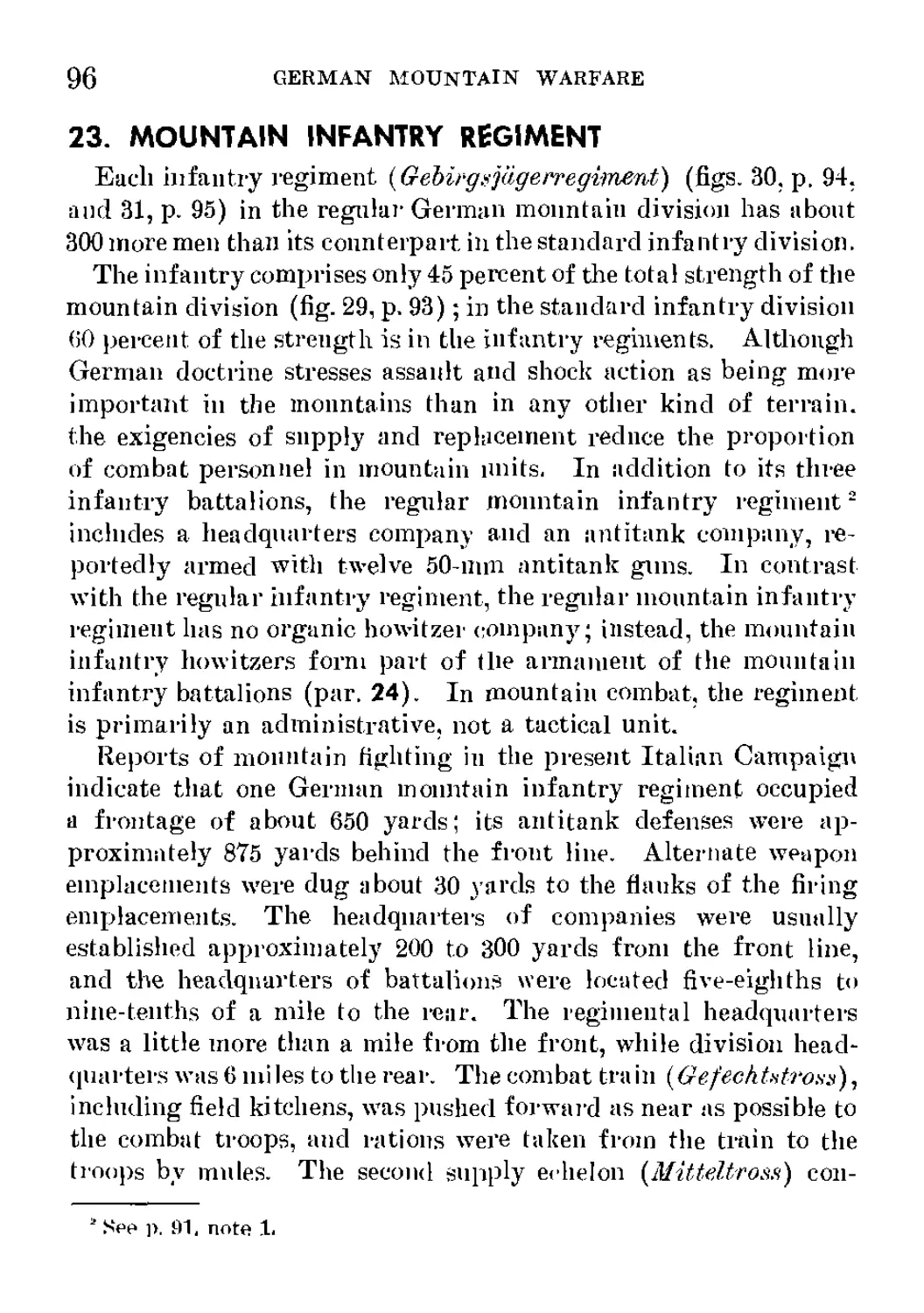







Tags: weapons military affairs military equipment army german army
Year: 1944

Text
                    SPECIAL SERIES, NO. 21	29 FEBRUARY ISM
GERMAN
MOUNTAIN WARFARE
MILITARY INTELLIGENCE DIVISION
War Department
Washington 25, D. C- 29 February 1944
SPECIAL SERIES
No. 21
MID 461
NOTICE
1. Special Series is published for the purpose of providing officers with
reasonably confirmed information (Tom official and other reliable sources.
2, By arrangement with The Adjutant General the following three publi-
cations of the Military Intelligence Division are distributed in the same
manner as is prescribed for field manuals (see EM 21-6, List of Publications
for Training, pars, 6-9, 23a) :
Intelligence Bulletin (commencing with Maixffi 1944 issue) ;
Special Series (commencing with No. 20) ;
Tactical and Technical Trends (commencing with March 1944 issue).
Requests for copies of these publications should be made to the appropriate
distributing agency of The Adjutant General. Requests for issues prior to
those listed above should be fonvarded through channels to the MID address
below,
3, Distribution of this issue of Special Series is being made on the basis of
two copies to each division and higher units, one copy to each brigade, and
one copy to each regiment. Every command should circulate available
copies among its officers.
4, Reproduction within the military service is permitted provided that (1)
the source is stated, (2) the classification is maintained, and (3) one copy
of the publication in which the material is reproduced is forwarded ro the
Dissemination Unit, Military Intelligence Division, War Department,
Washington 25, D. C.

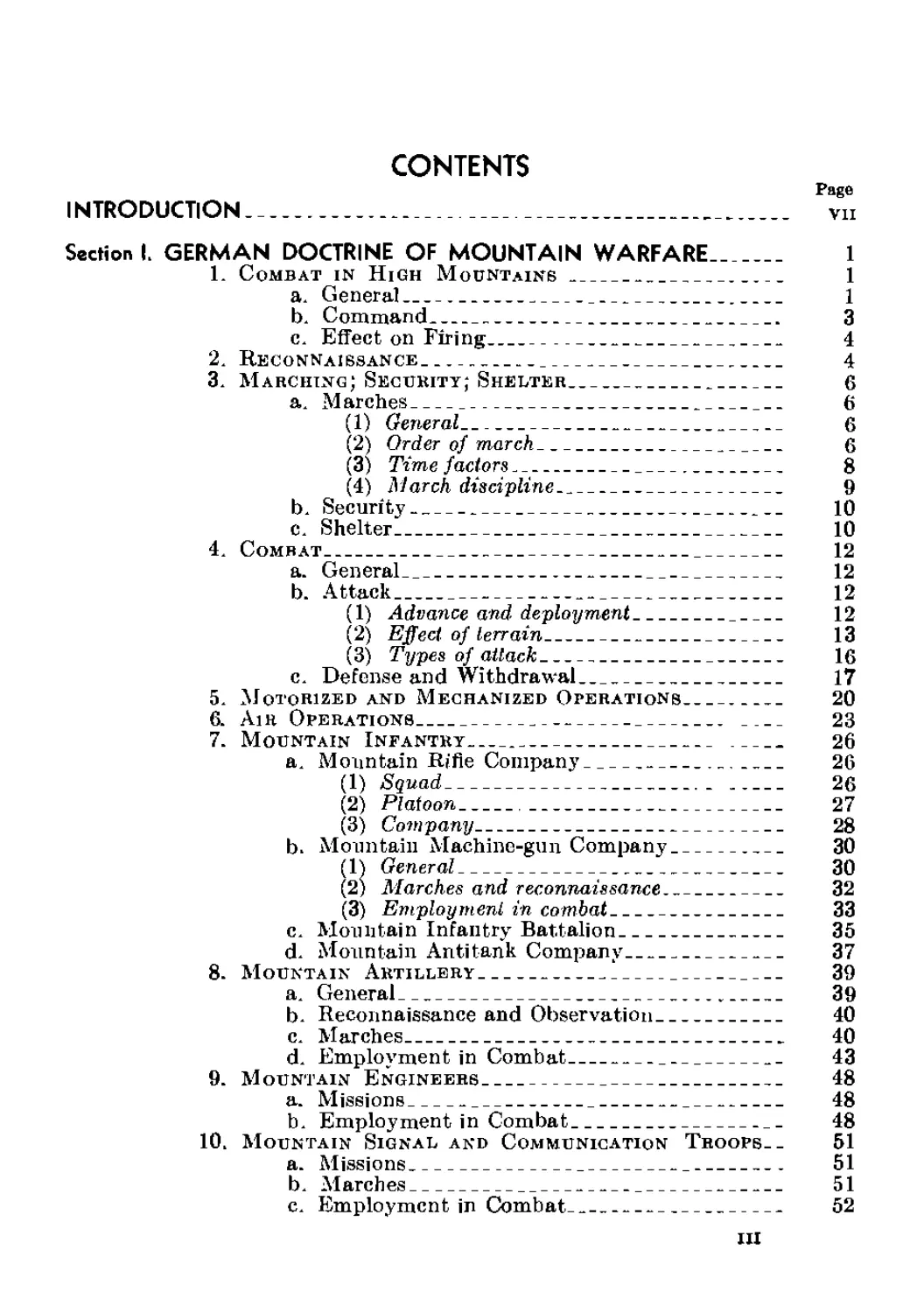
CONTENTS
Page
INTRODUCTION_________________________________________________ vn
Section I. GERMAN DOCTRINE OF MOUNTAIN WARFARE_______________	1
1.	Combat in High Mountains_________________________ 1
a.	General_________________________________   1
b,	Command___________________________________ 3
c.	Effect on Firing__________________________ 4
2.	Reconnaissance_________________________________   4
3,	Marching; Security; Shelter_____________________ 6
a.	Marches________________________________	6
(1)	General_____________________________ 6
(2)	Order of march____________________   6
(3)	Time factors______________________   8
(4)	March discipline____________________ 9
b,	Security_________________________________ 10
c.	Shelter__________________________________ 10
-1.	Combat_______________________________________   12
a.	General. ______________________________   12
b.	Attack_________________________________   12
(1)	Advance and- deployment__________   12
(2)	Effect of terrain__________________ 13
(3)	Types of attack____________________ 16
c.	Defense and Withdrawal___________________ 17
5,	Motorized	and Mechanized Operations___________ 20
6.	Air Operations______________________________     23
7.	Mountain	Infantry___________________________   26
a.	Mountain Rifle Company _ ______________   26
(1)	Squad___________________________    26
(2)	Platoon____________________________ 27
(3)	Company____________________________ 28
b>	Mountain Machine-gun Company_____________ 30
(D General______________________________ 30
(2)	Marches and reconnaissance_________ 32
(3)	Employment in combat________________ 33
c.	Mountain Infantry Battalion______________ 35
d.	Mountain Antitank Company________________ 37
8.	Mountain Artillery___________________________ 39
a.	General_________________________________  39
b.	Reconnaissance and Observation___________ 40
c.	Marches__________________________________ 40
d.	Employment in Combat_____________________ 43
9.	Mountain Engineers___________________________ 48
a. Missions_______________________________ 48
h. Employment in Combat___________________ 48
10.	Mountain Signal and Communication Troops. .	51
a.	Missions_____________________________     51
b,	Marches________________________________ 51
c.	Employment in	Combat____________________ 52
ш
IV
CONTENTS
Section I. GERMAN DOCTRINE OF MOUNTAIN WARFARE—Con.
10.	Mountain Signal and Communication Troops—
Continued.	Pa^e
d. Technical Considerations--------------  54
(1)	IFire communication_______________ 54
(2)	Radio communication_______________ 56
(3)	Visual signal communication_______ 56
11.	Mountain Services—------------------------- 57
a.	Mountain Medical Service_______________ 57
b.	Mountain Veterinary Service____________ 60
c.	Mountain Supply________________________ 61
II	, TRAINING..______________________________________   63
12.	General____-_______________________________ 63
13.	Individual and Unit	Training----------- 65
14.	Mountaineering_____________________________   66
a.	General______________________________ 66
b.	Scale of Requirements________________   66
c.	Technique___.________________________ 68
(1)	Marching_________________________	68
(2)	Climbing__________________________ 68
(3)	Special climbing	equipment ________69
d.	Bivouacs- —---------------------------  74
e.	Self-preservation;	Orientation_________ 76
II	I, ARMY MOUNTAIN GUIDES—_____________________ 79
15.	General.------------------------------------  79
16.	Guide Training..__________________________    79
17.	Missions of Guides. ________________________  82
IV, CLOTHING; IDENTIFICATION; INDIVIDUAL EQUIPMENT 84
18.	Clothing___.______._______ .	.. — ....	84
19.	Identification..__________ . . .	_ ..... . _	87
20.	Individual Equipment........... ...	. . __	89
21.	Food___________________ _____________ .	_ __	90
V. ORGANIZATION; ARMAMENT, EQUIPMENT -_______________ 91
22.	General._____________________________ _. __ 91
23.	Mountain Infantry Regiment__________________  96
24.	Mountain Infantry Battalion.-._______________ 97
25.	Heavy-Weapons Company______________________   98
26.	Reinforced Rifle Company..________________   101
27.	Mountain Antitank Battalion_________________ 101
28.	Reconnaissance Battalion____1_______________ 103
29.	Mountain Artillery Regiment_________________ 104
30.	Mountain Engineer Battalion_________________ 108
31.	Mountain Signal Battalion-________________— -	108
32.	Mountain Services______________________	108
33.	Replacement Battalion______________________ 110
Appendix. FIRING IN MOUNTAINS_____________________________ 111
34.	Peculiarities of Firing___________________— _	HI
35.	Graphic Firing Tables_____________________— -	115
36,	Use of the Graphic Firing Table___________ _ _ H8
a.	Determining Trajectory Values________ 118
(1)	Charge and elevation__________— _	118
(2)	Masks__________________________— _	119
b,	Angle of Fall; Angle of Impact-------- 119
c.	Time of Flight; Drift; Fuze-setting_—	120
CONTENTS
V
Appendix. FIRING IN MOUNTAINS—Continued.
36. Use of Graphic Firing Tables—Continued.	Page
d.	Dispersion_________________________________ 120
e.	Metro Data and Masks____________________ 121
f.	Location of a Gun Position_______________ 122
g.	Special Firing Precautions______ -______ 123
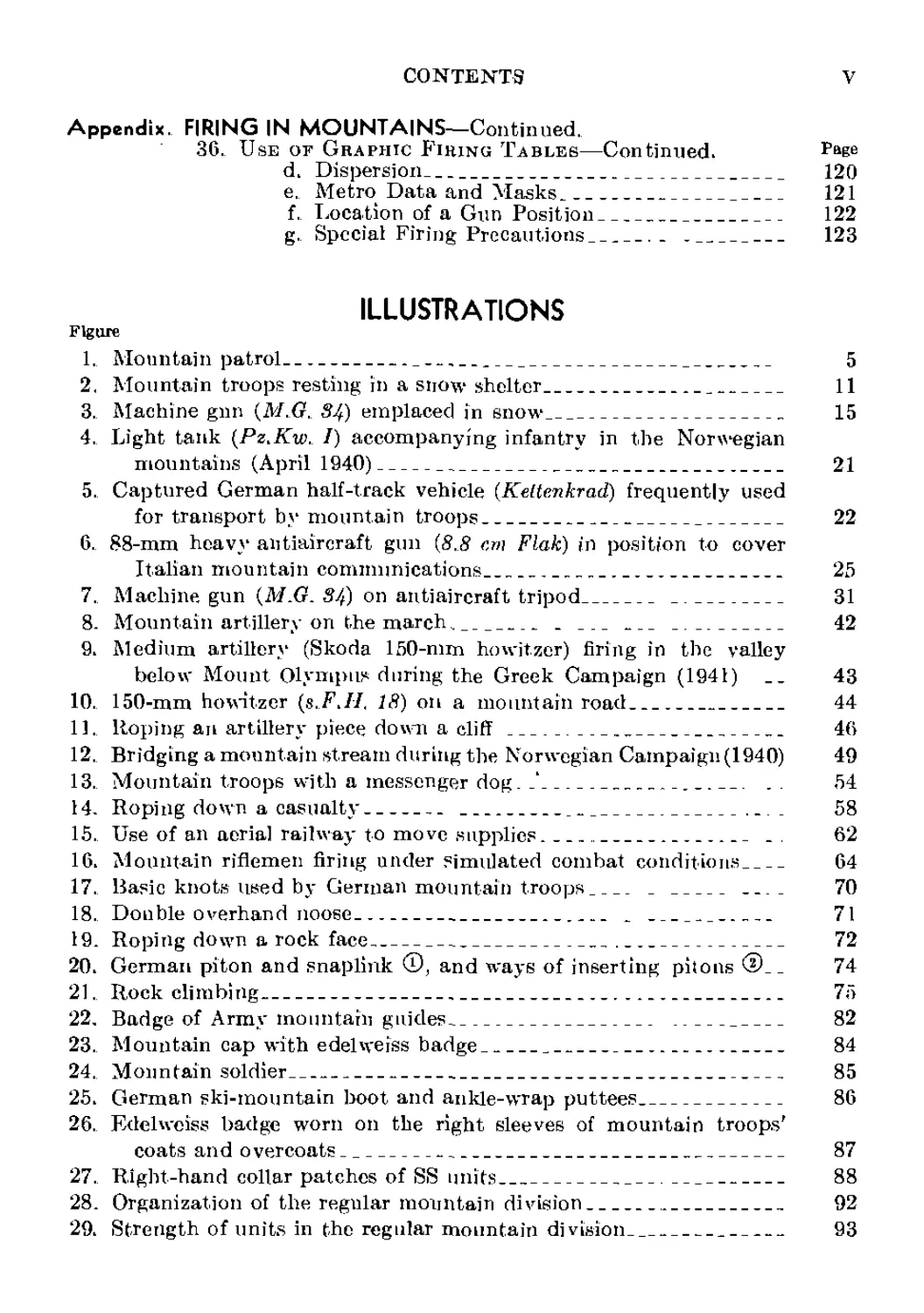
ILLUSTRATIONS
Figure
1.	Mountain patrol_____________________________________________ 5
2,	Mountain troops resting in a snow shelter__________________ 11
3.	Machine gnn (M.G. 34) emplaced in snow...__________________ 15
4.	Light tank (Pz.Kw. I) accompanying infantry in the Norwegian
mountains (April 1940)_________________________________________ 21
5.	Captured German half-track vehicle (Kettenkrad) frequently used
for transport by mountain troops_______________________________ 22
6.	88-mm heavy antiaircraft gun (8.8 cm Flak) in position to cover
Italian mountain communications________________________________ 25
7.	Machine gun (M.G. 34) on antiaircraft tripod__ ____________ 31
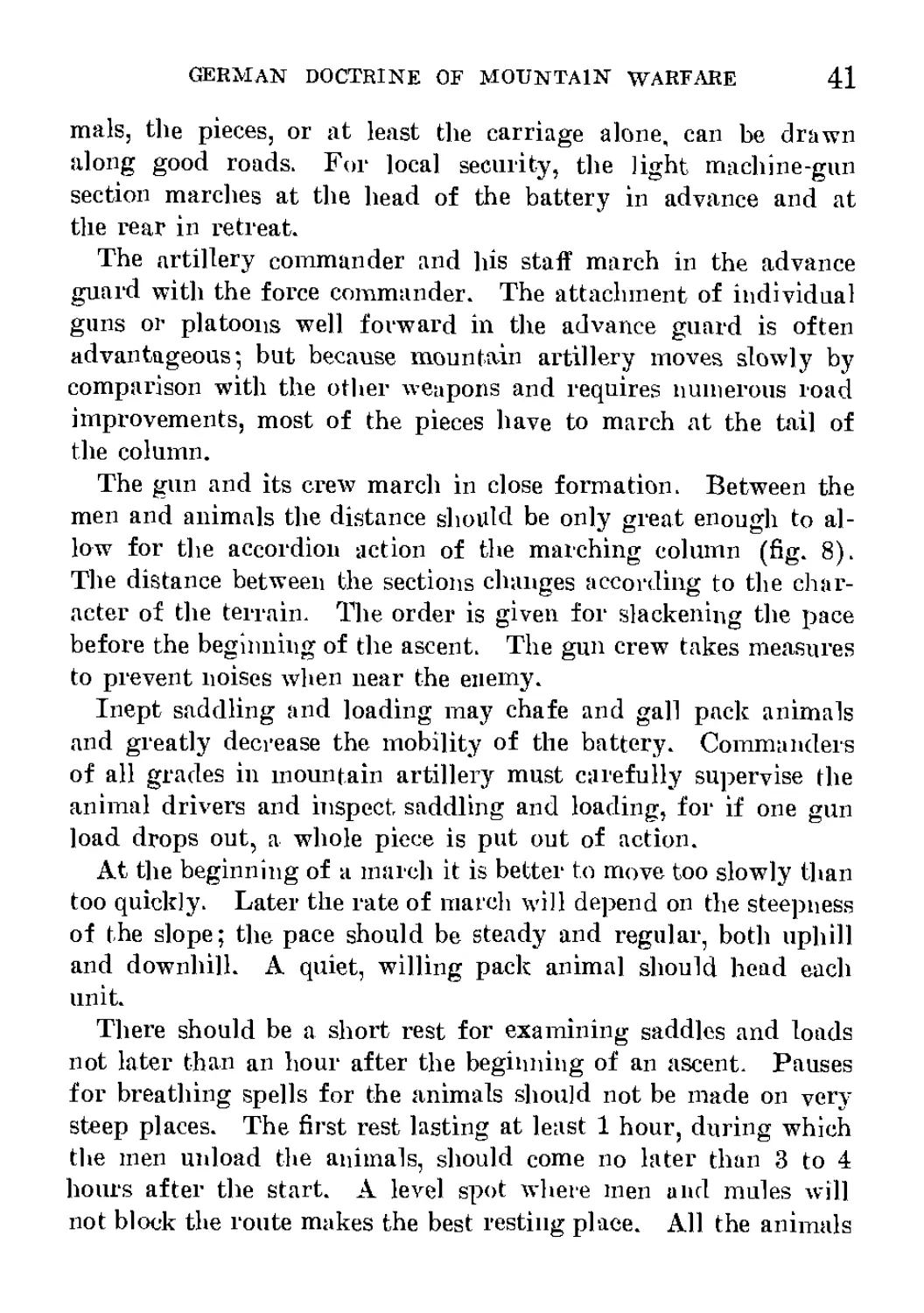
8.	Mountain artillery on the march. __ __ ____________________ 42
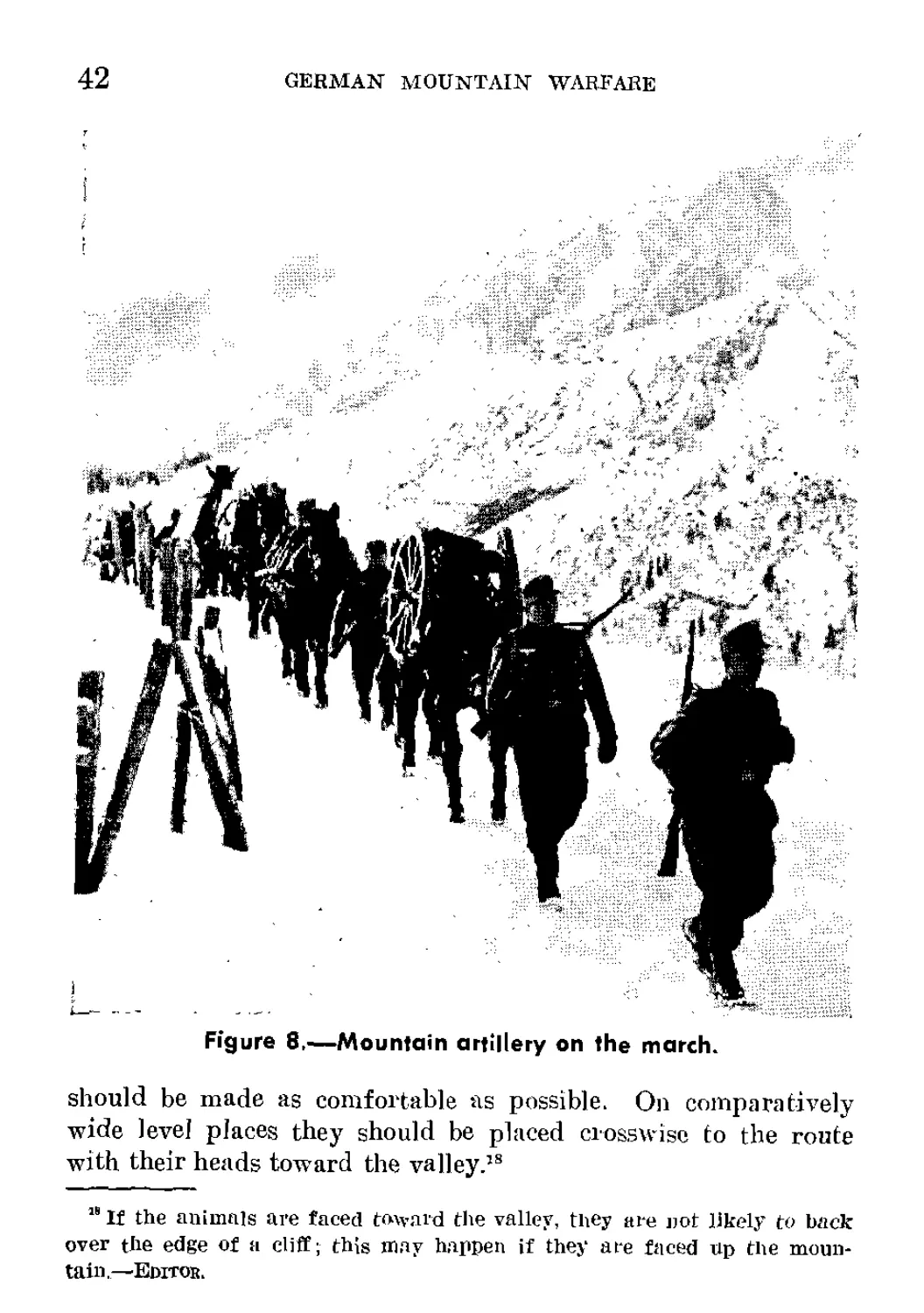
9.	Medium artillery (Skoda 150-nim howitzer) firing in the valley
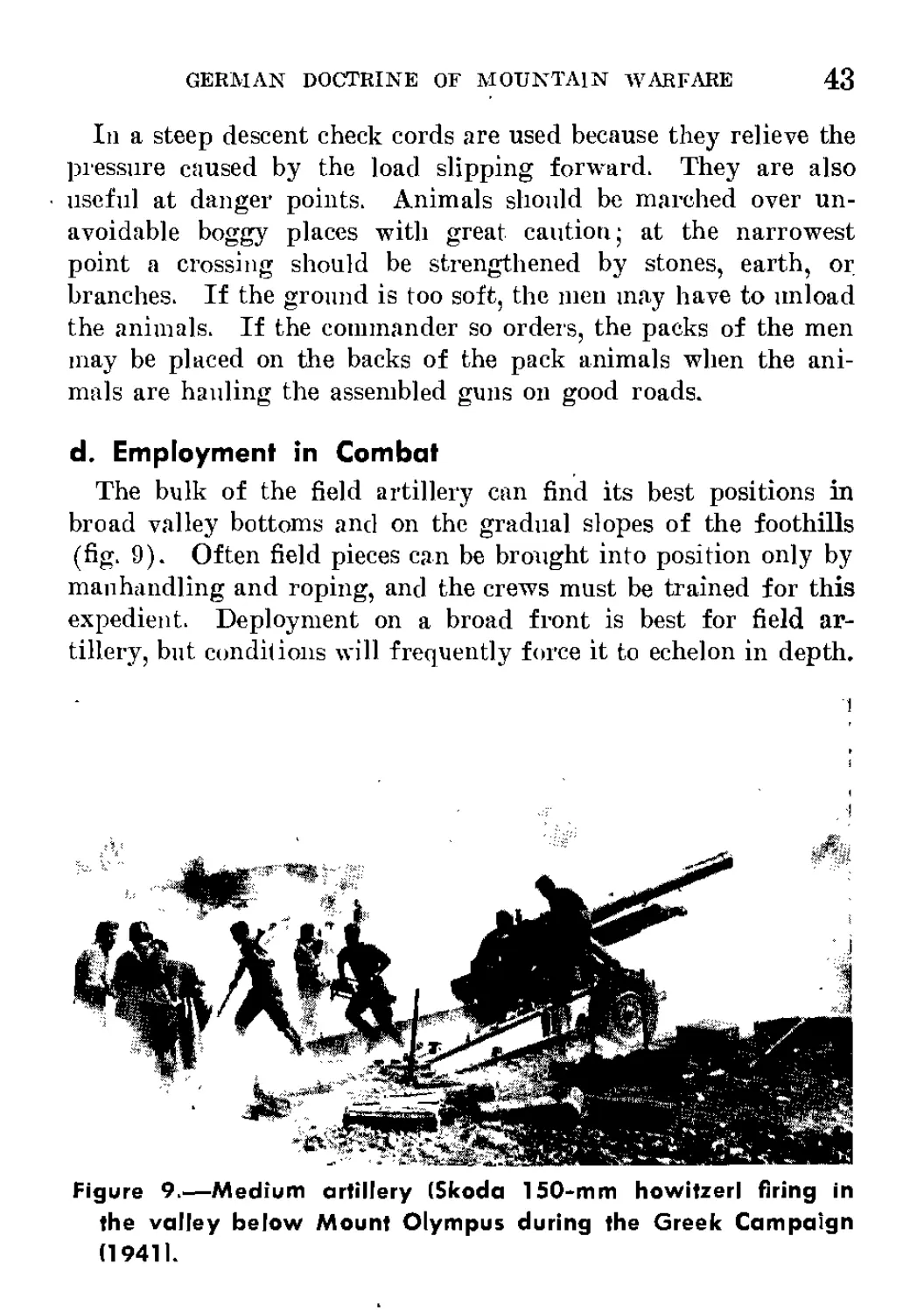
below Mount Olympus during the Greek Campaign (1941) __	43
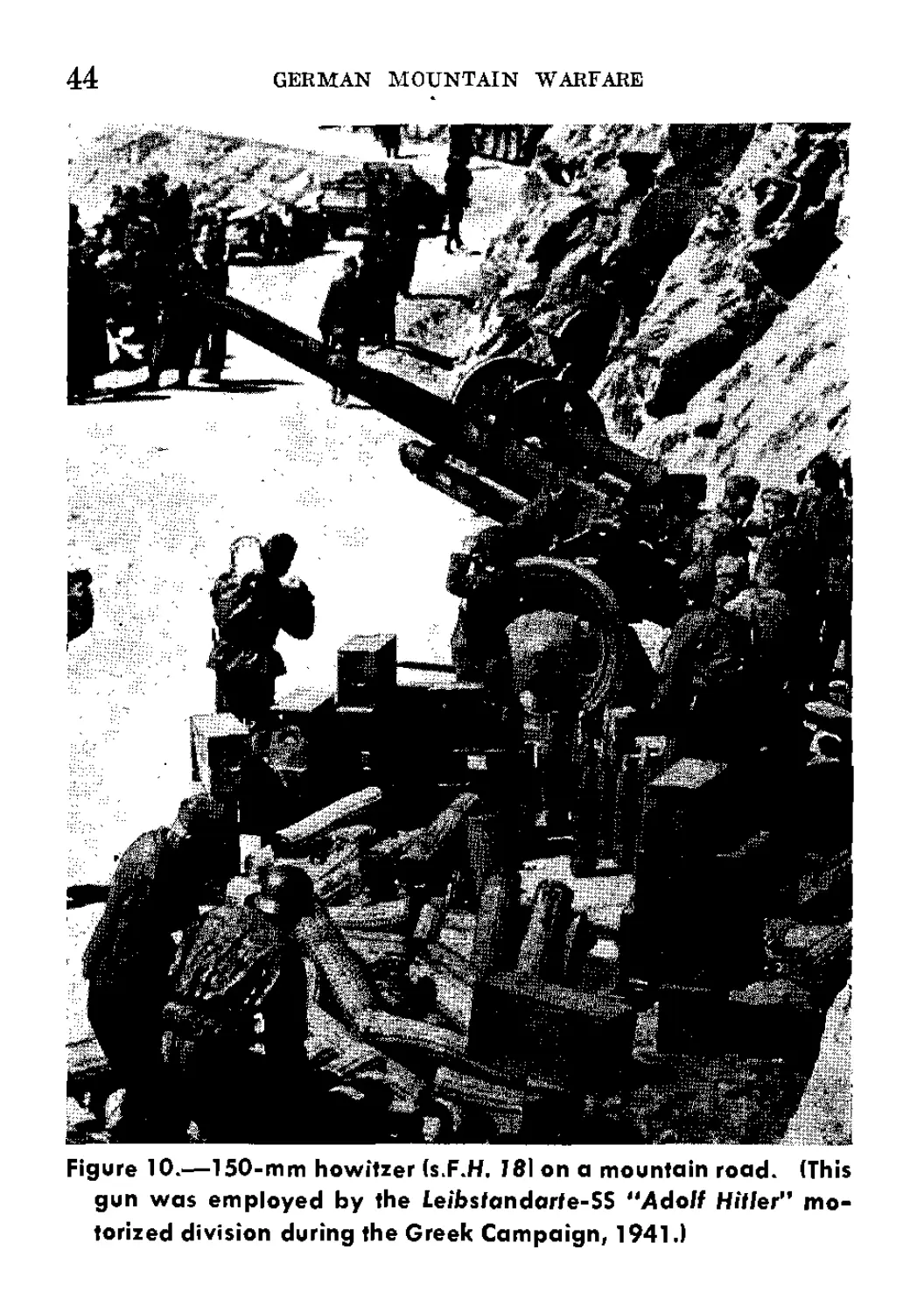
10.	150-mm howitzer (s.FJI. 18) on a mountain road_____________ 44
11.	Roping an artillery piece down a cliff_____________________ 46
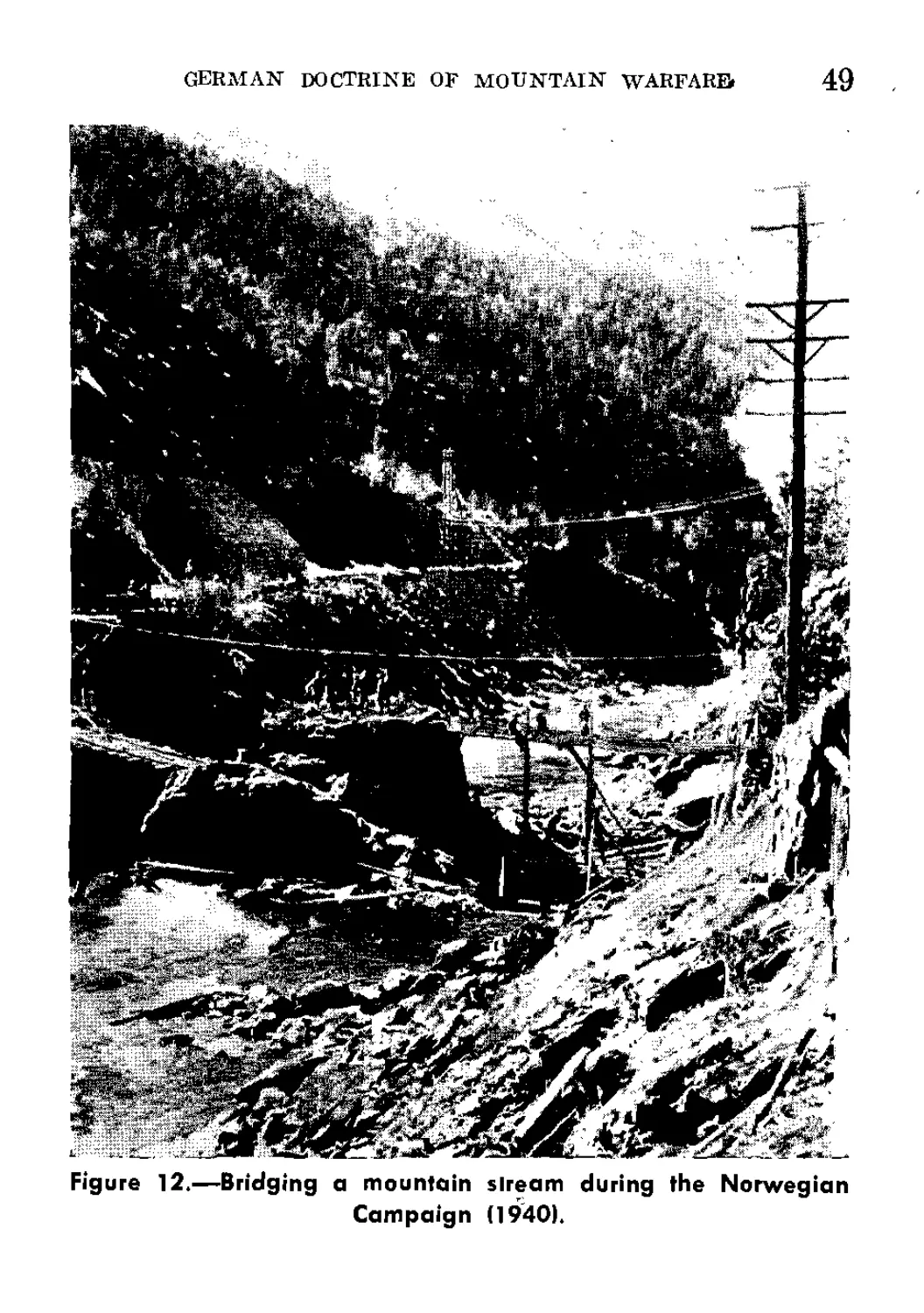
12.	Bridging a mountain stream during the Norwegian Campaign (1940)	49
13.	Mountain troops with a messenger dog. _________________ . .	54
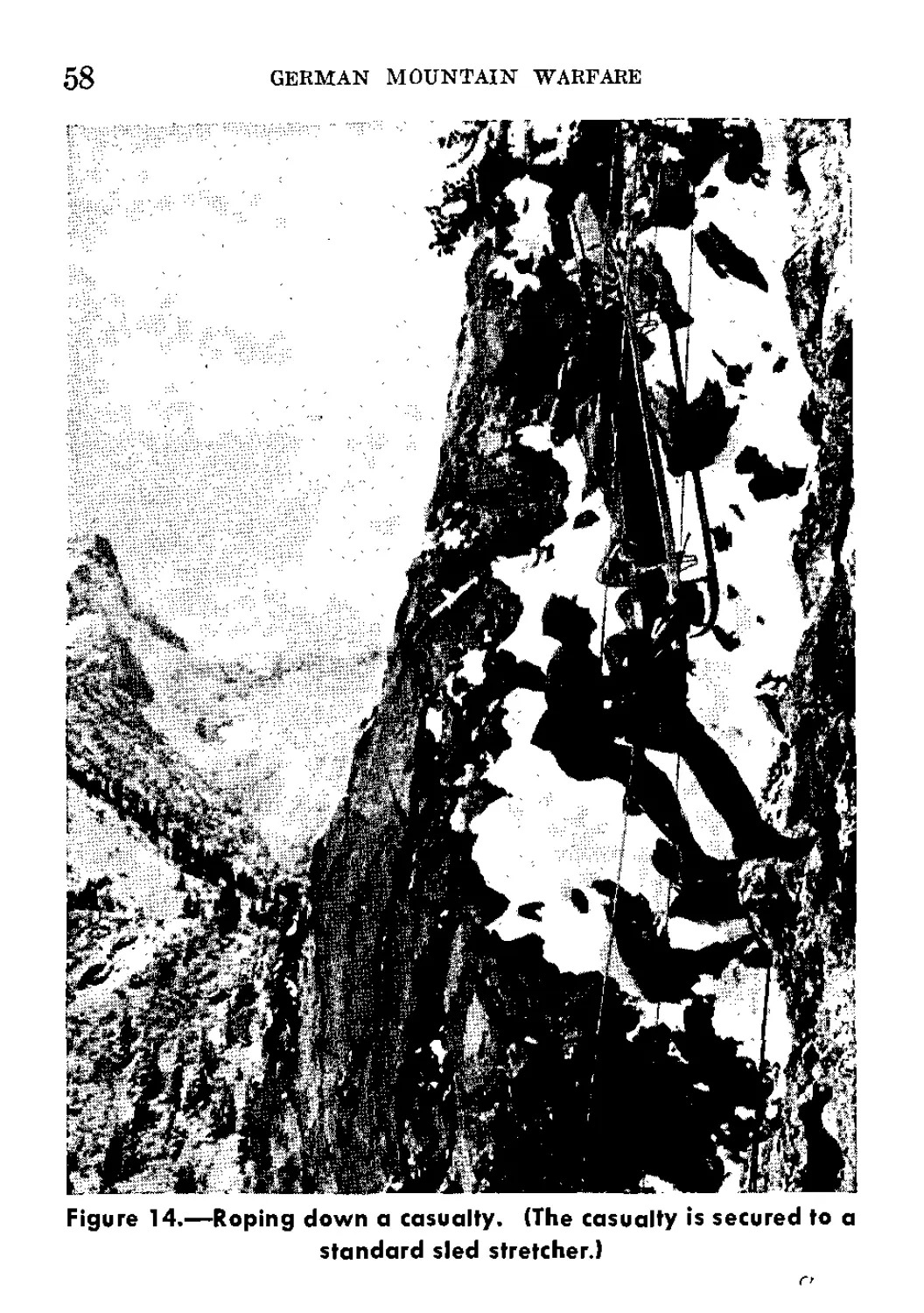
14.	Roping down a casualty______ _________________________....	58
15.	Use of an aerial railway to move supplies.______________. ..	62
16.	Mountain riflemen firing under simulated combat conditions._ _ _	64
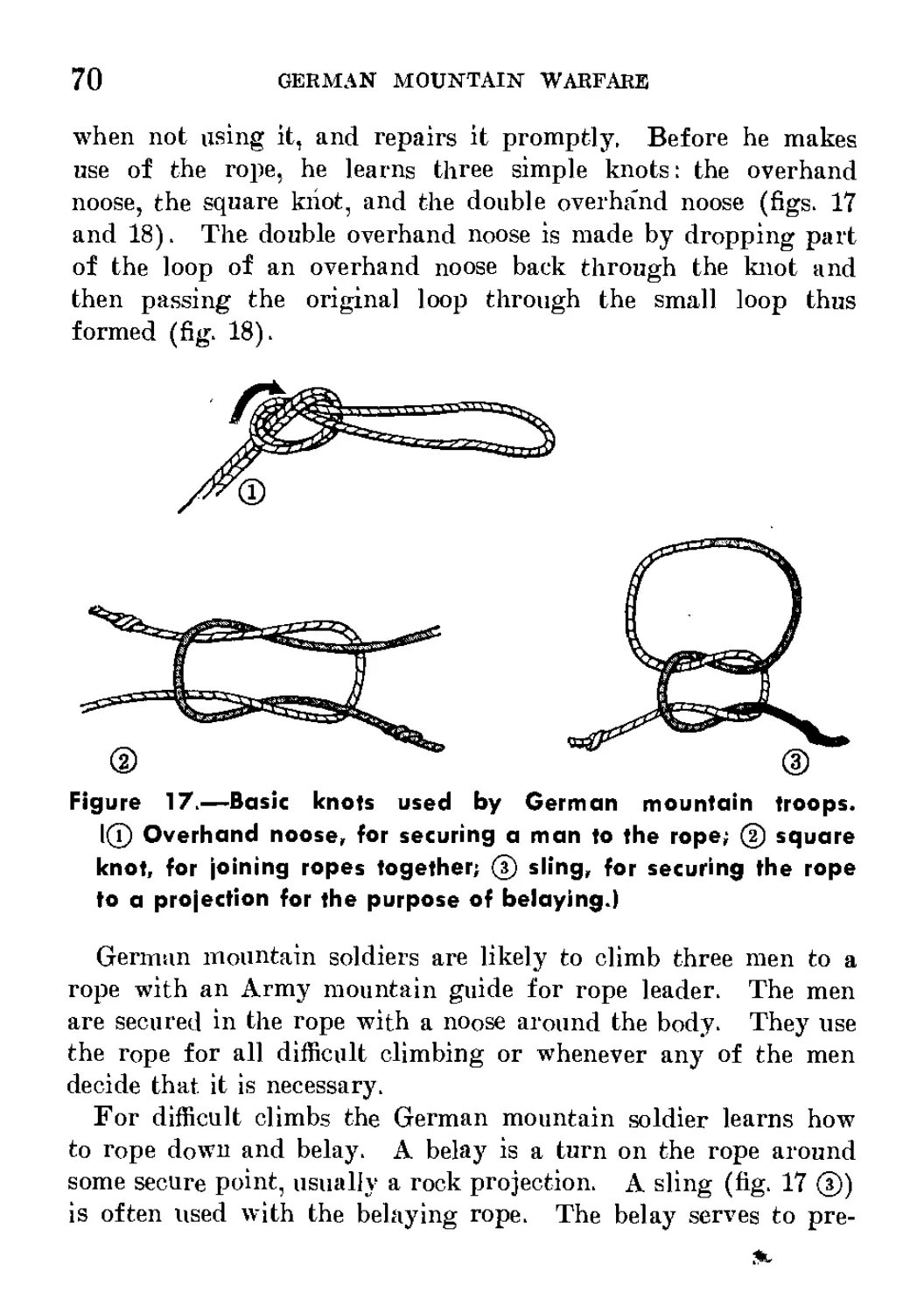
17.	Basic knots used by German mountain troops.__ ________ ___ 70
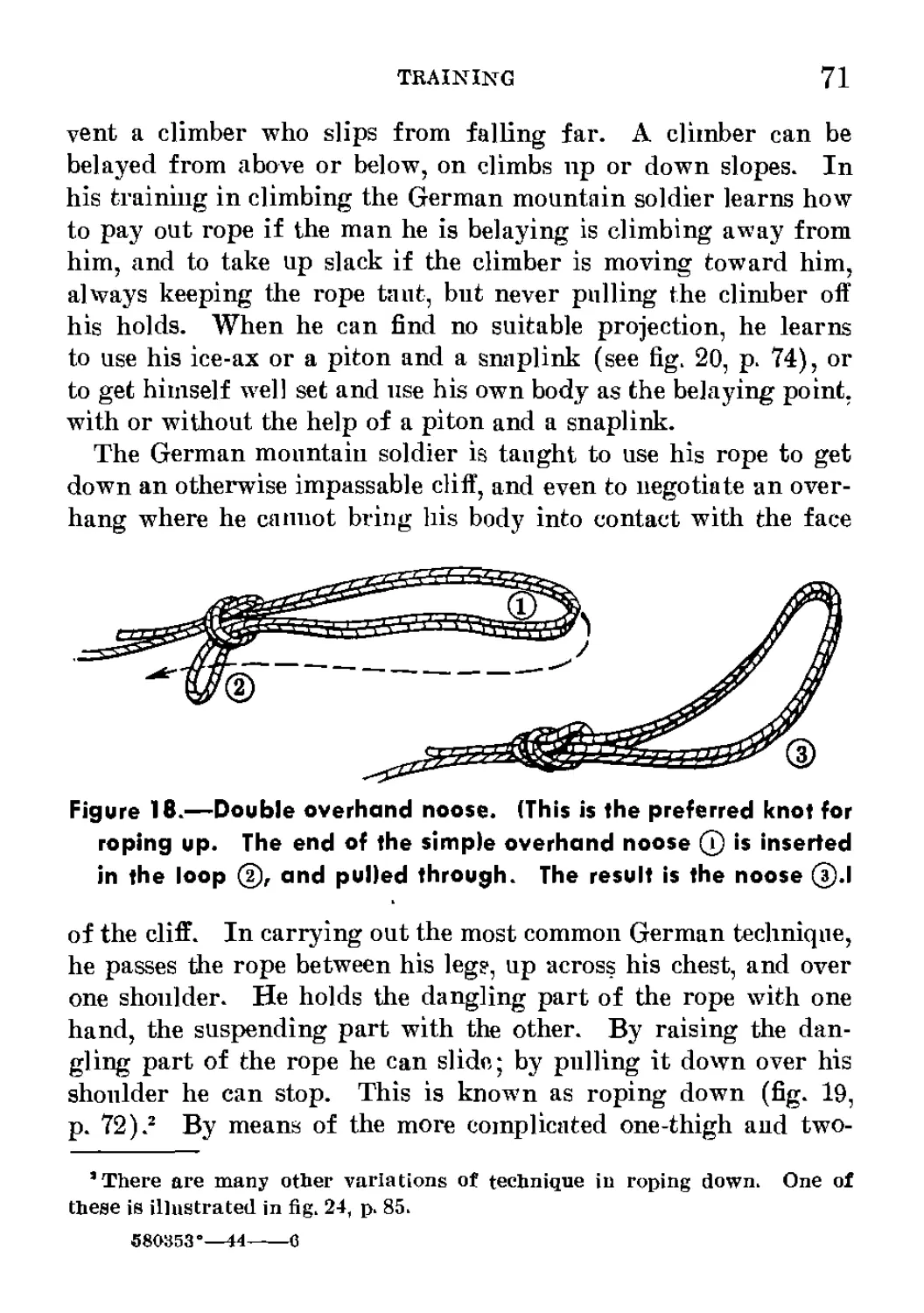
18.	Double overhand noose______________________ ___________—	71
19.	Roping down a rock face___________________________________ 72
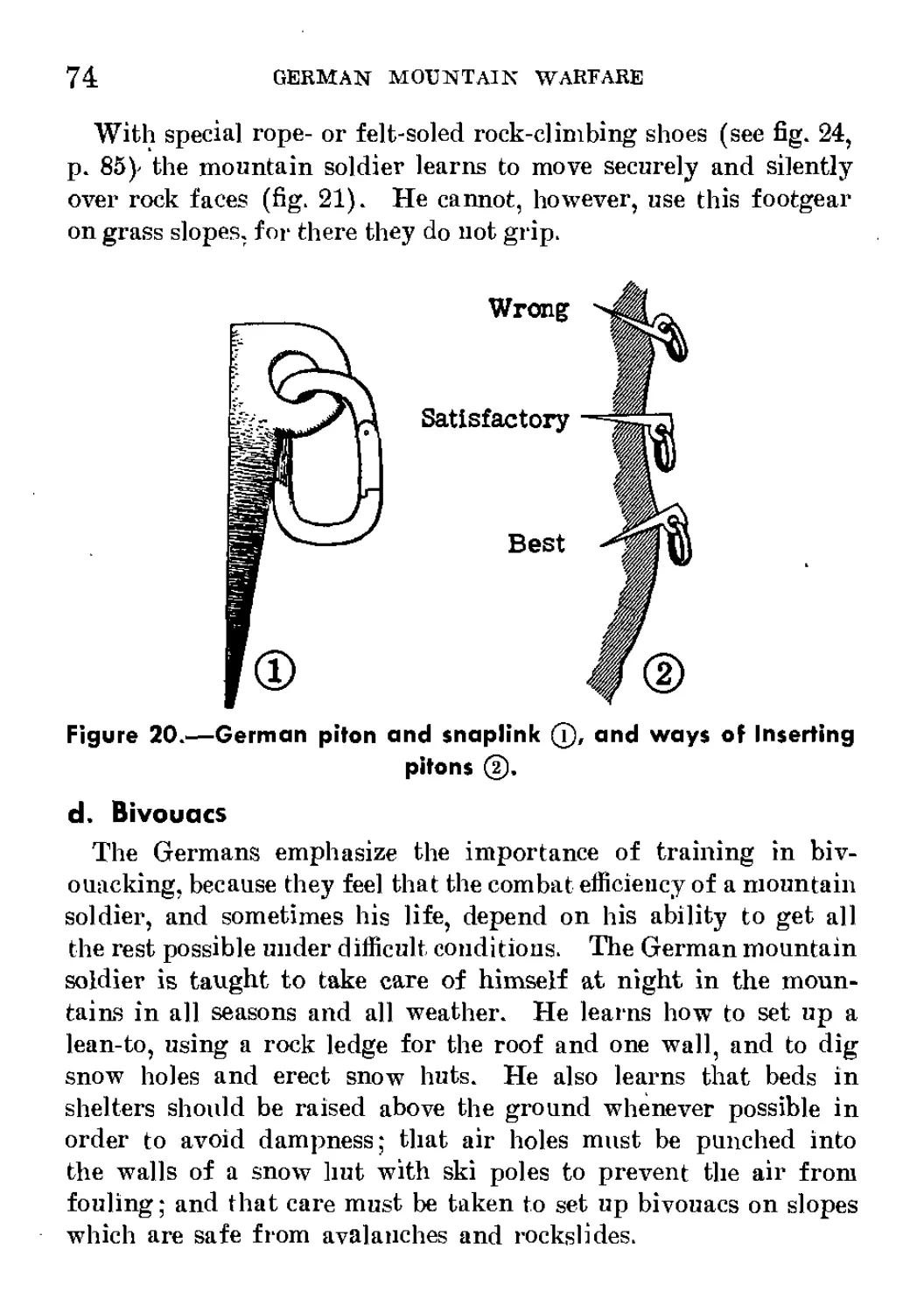
20.	German piton and snaplink ®, and ways of inserting pitons ®_ _	74
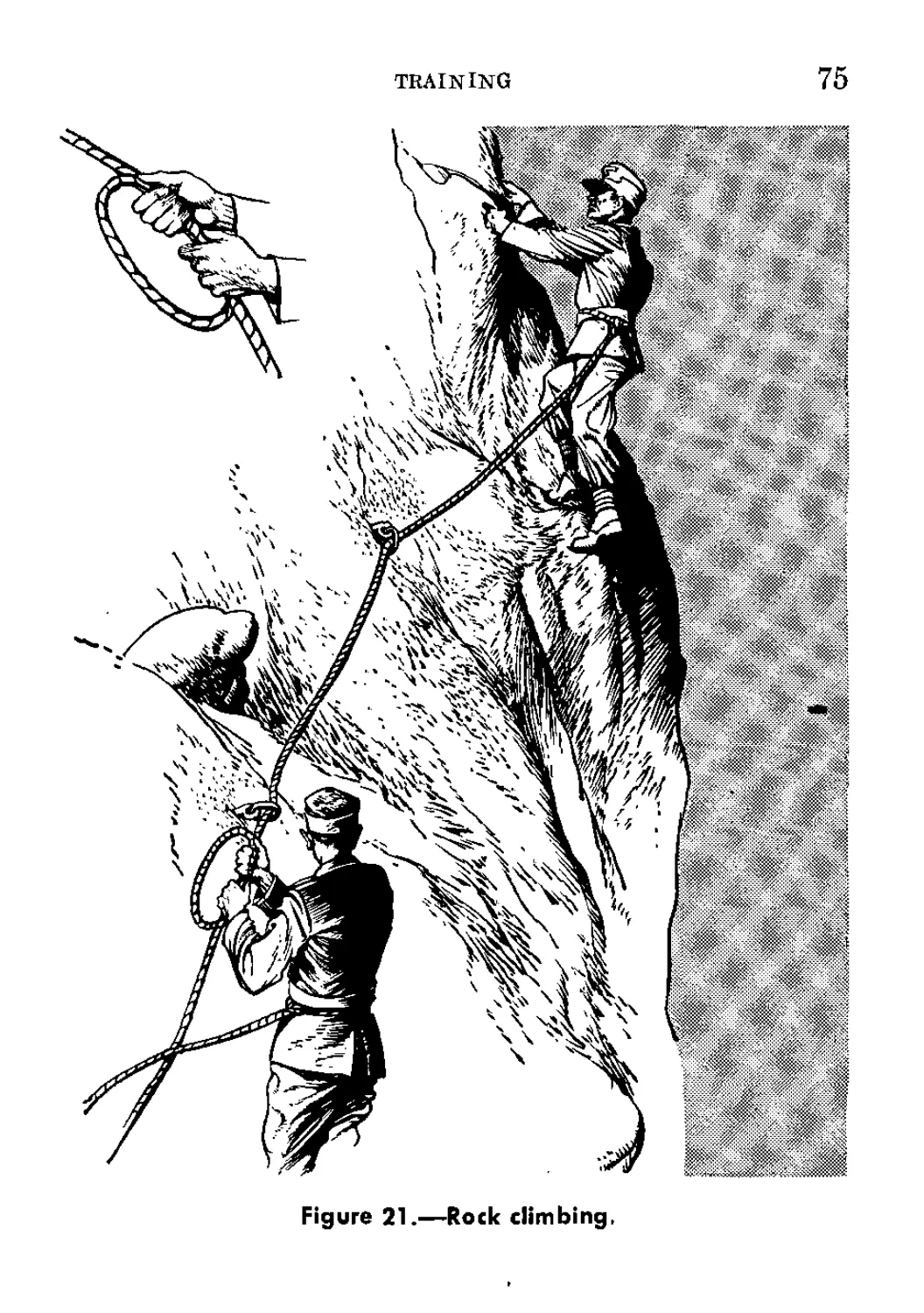
21.	Rock climbing_____________________________________________ 75
22,	Badge of Army mountain guides___________________ _________ 82
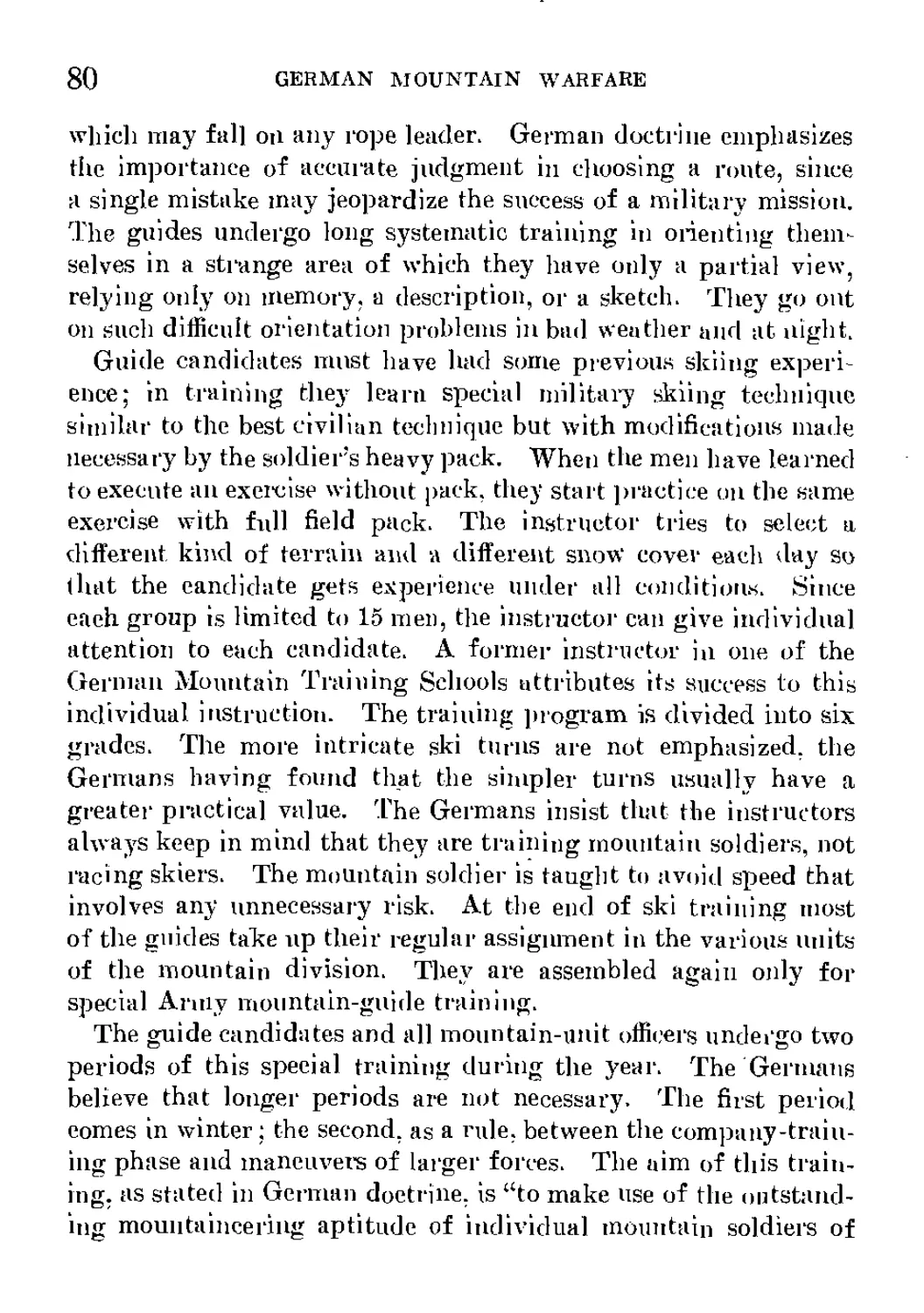
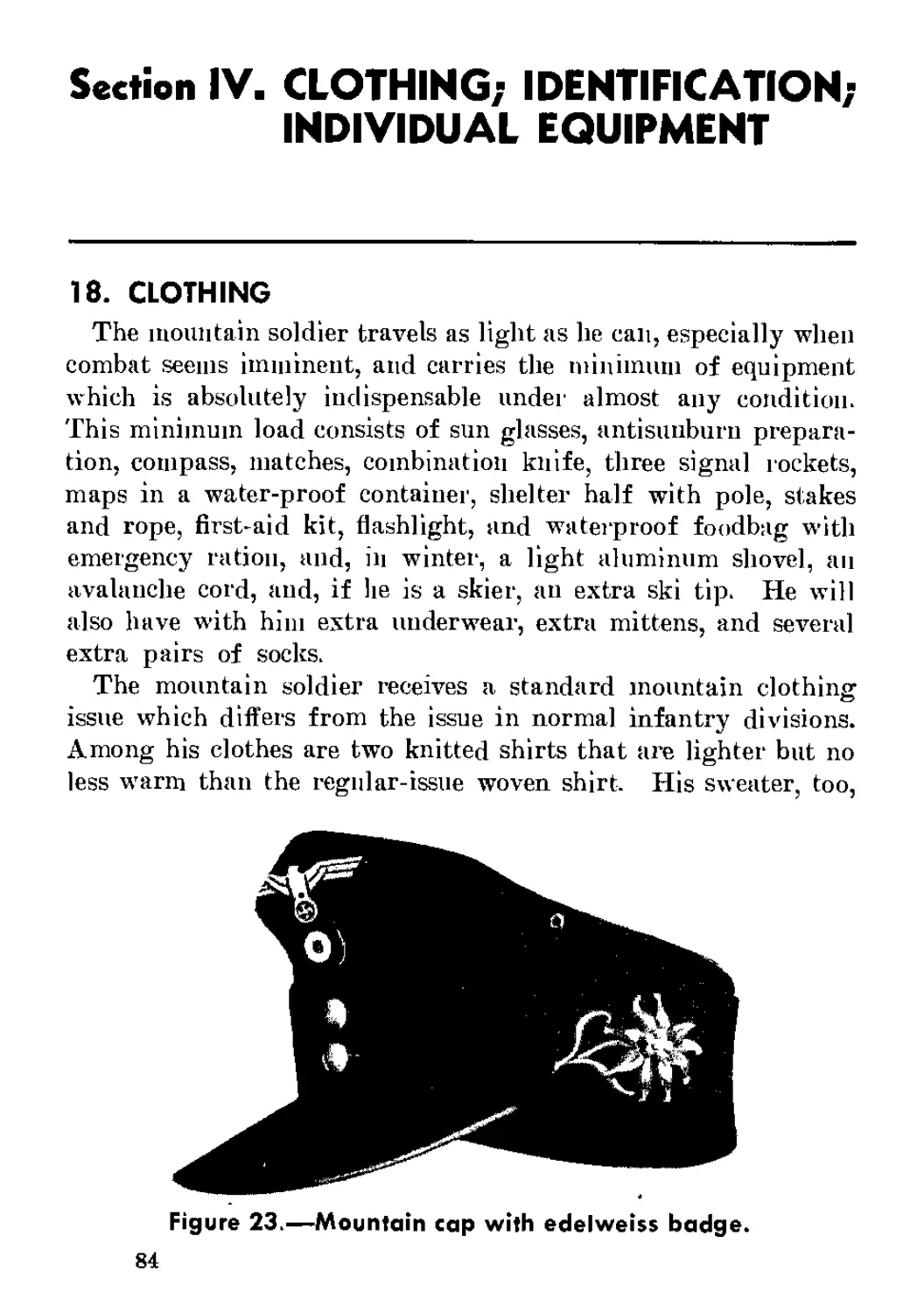
23.	Mountain cap with edelweiss badge_________________________ 84
24.	Mountain soldier__________________________________________ 85
25.	German ski-mountain boot and ankle-wrap puttees___________ 86
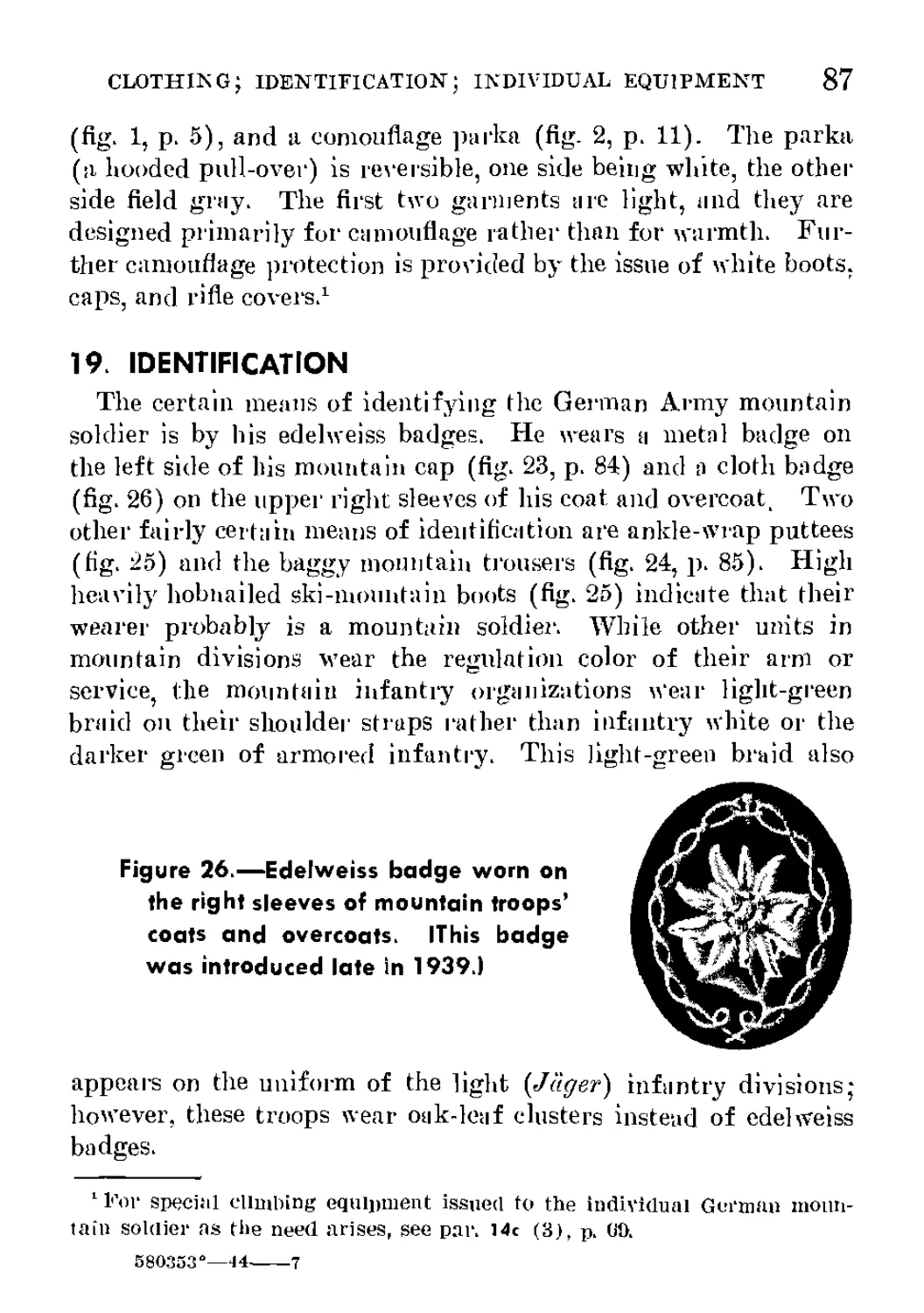
26.	Edelweiss badge worn on the right sleeves of mountain troops'
coats and overcoats____________________________________________ 87
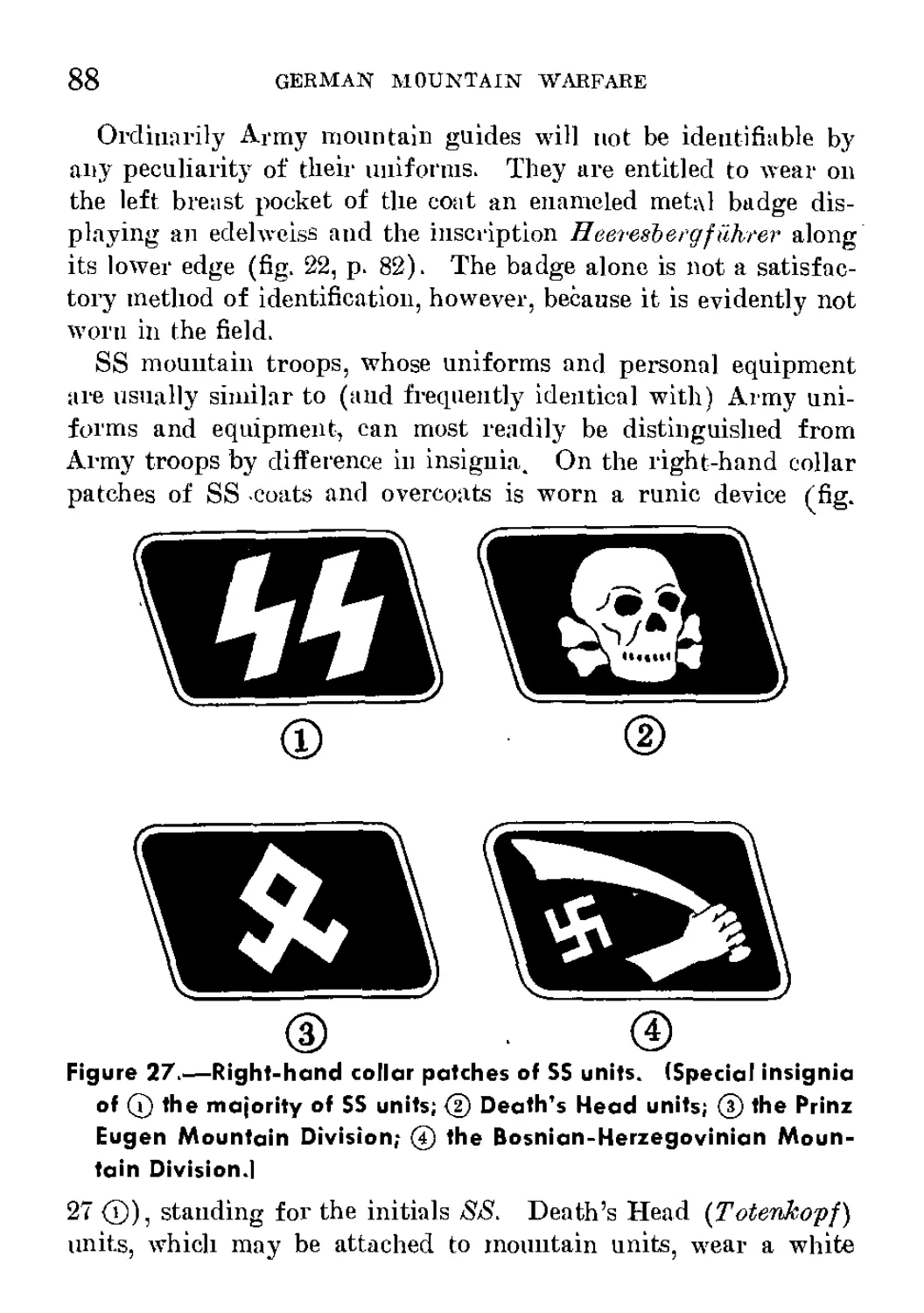
27.	Right-hand collar patches of SS units___________—_________ 88
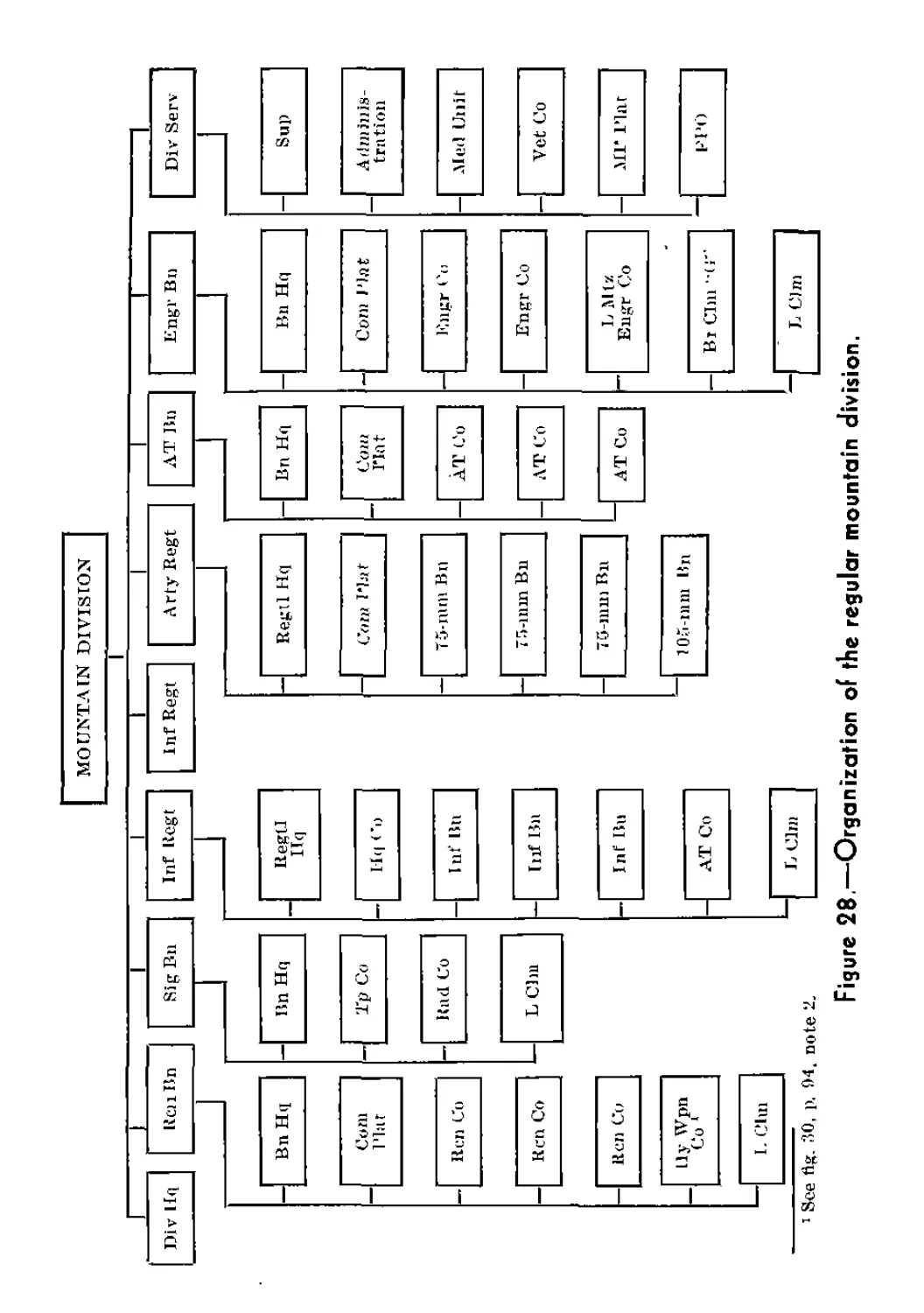
28.	Organization of the regular mountain division_____________ 92
29.	Strength of units in the regular mountain di vision.  ____ 93
VI	CONTENTS
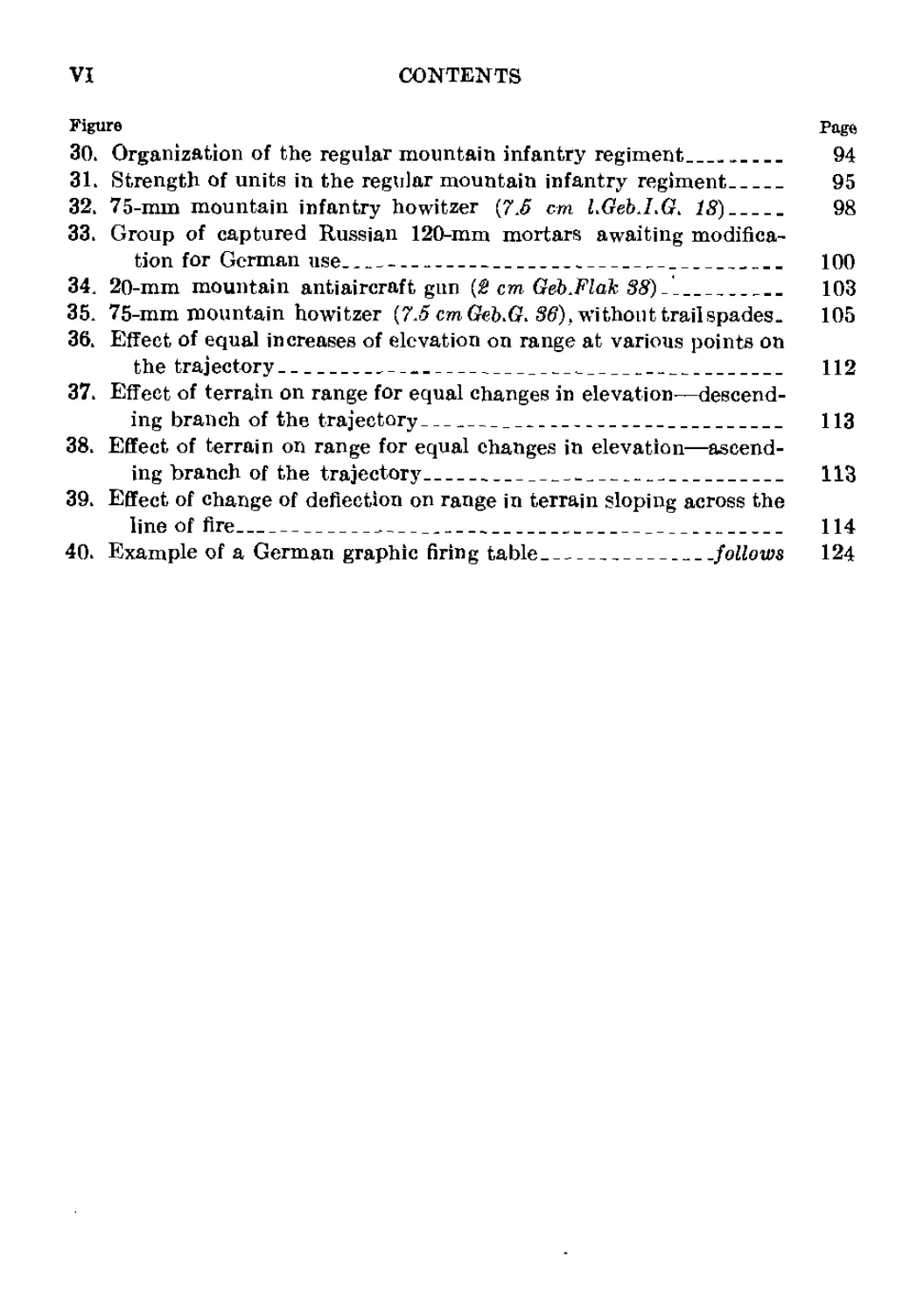
Figure	Page
30.	Organization of the regular mountain infantry regiment______ 94
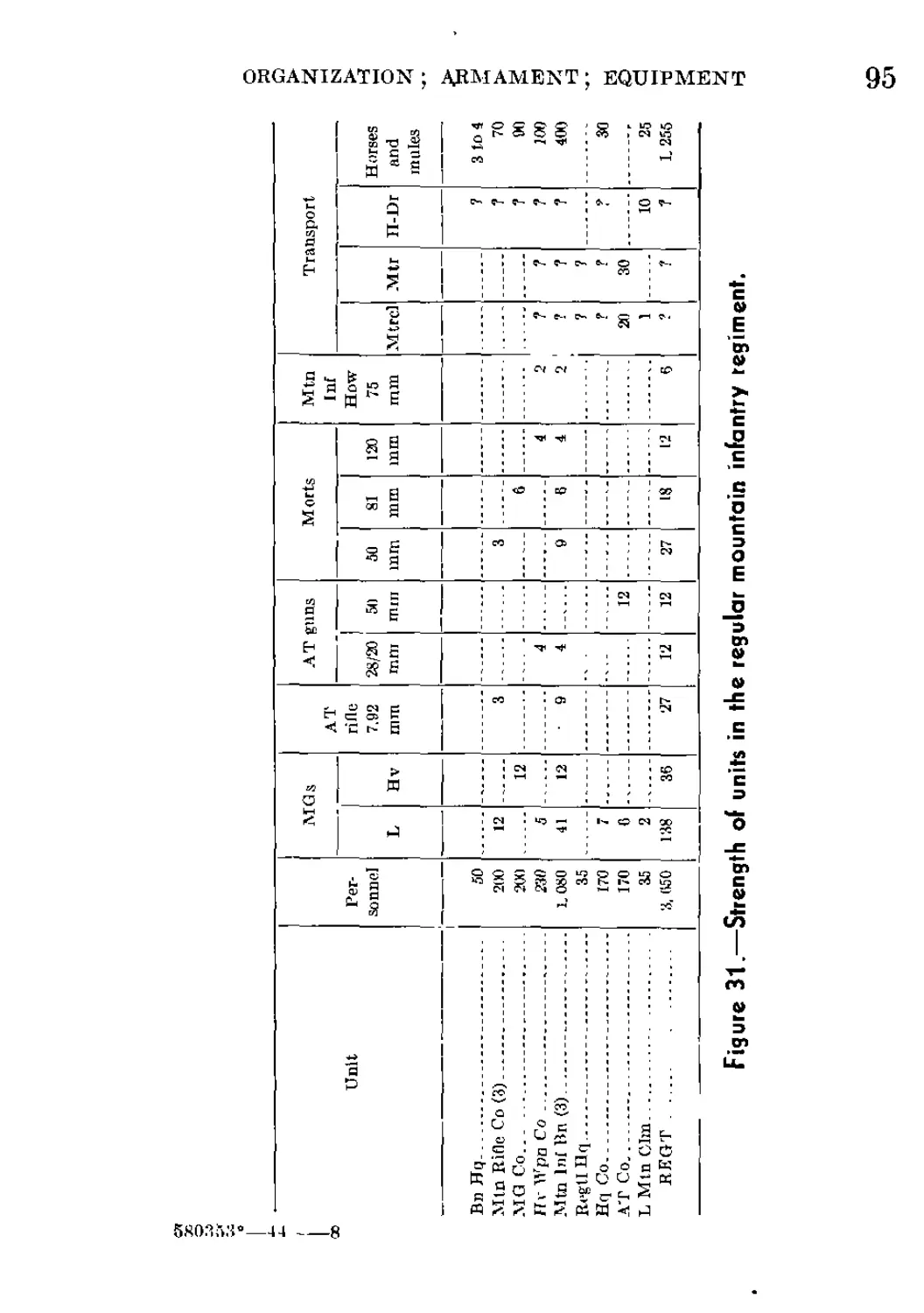
31.	Strength of units in the regular mountain infantry regiment_	95
32.	75-mm mountain infantry howitzer (7.5 cm LGeb.LG. 18)_______ 98
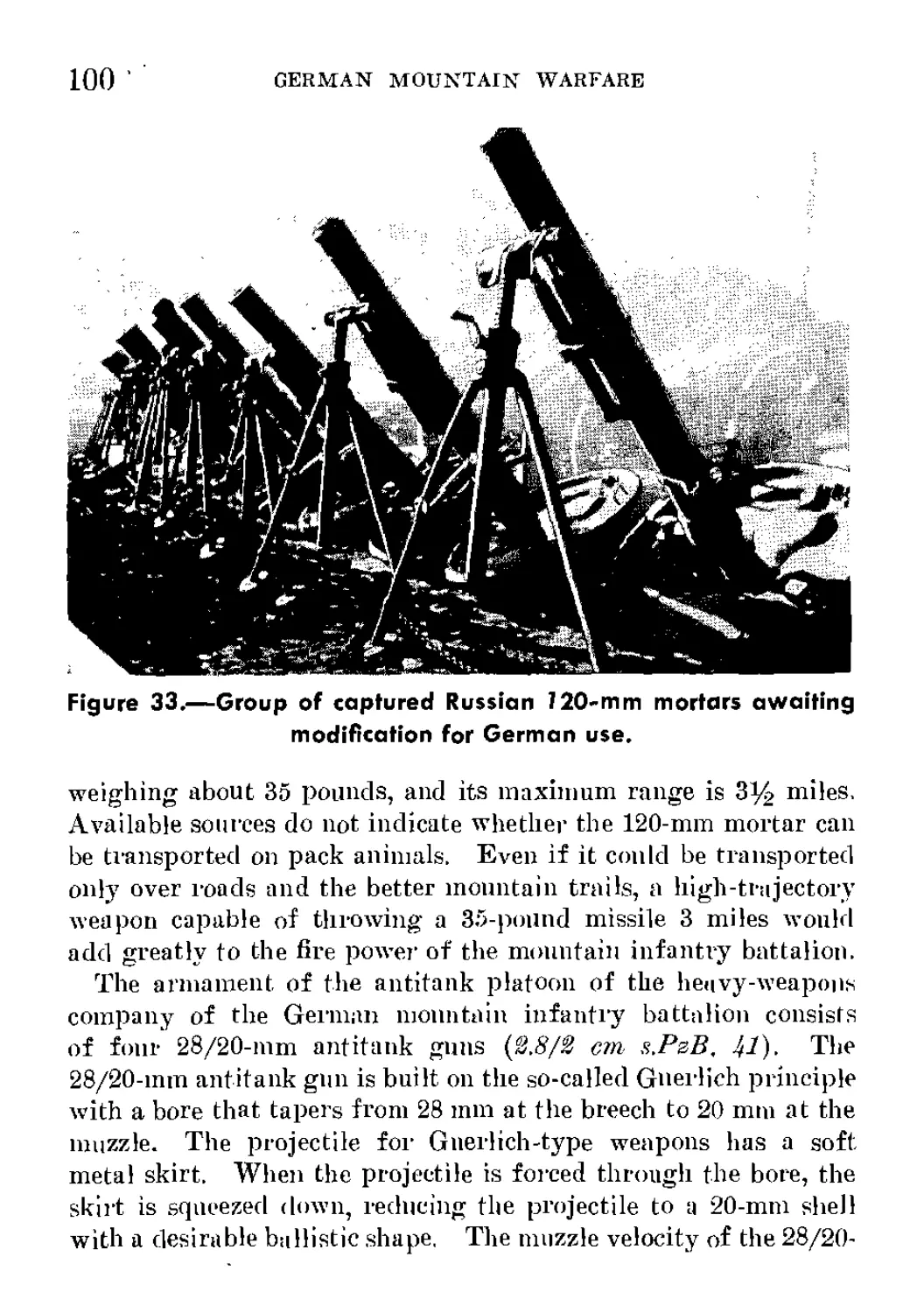
33.	Group of captured Russian 120-mm mortars awaiting modifica-
tion for German use_____________________________________________ 100
34.	20-mm mountain antiaircraft gun cm Geb.Flak 38)-___________ 103
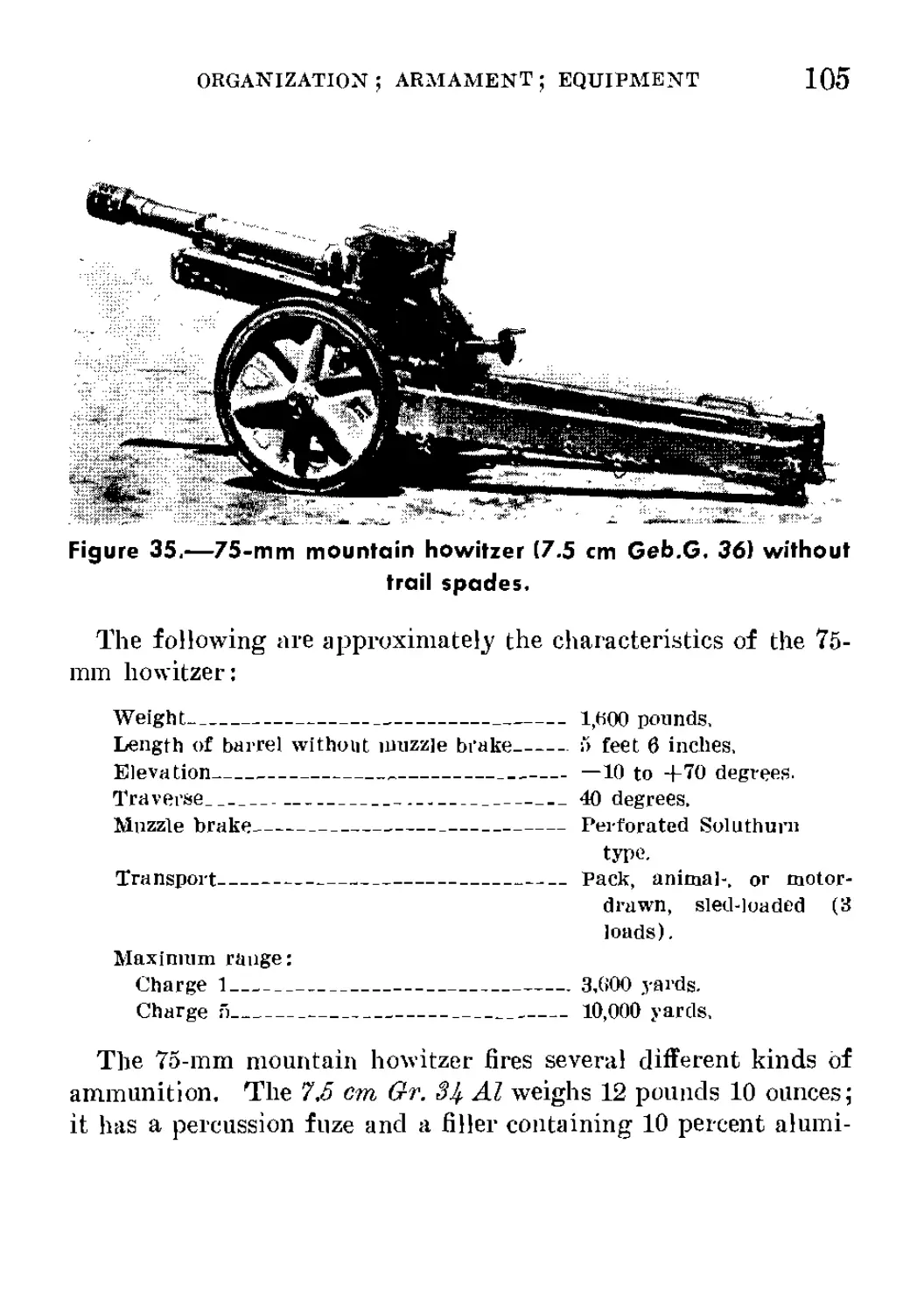
35.	75-mm mountain howitzer (7.5 cm Geb.G. 36) f without trail spades.	105
36.	Effect of equal increases of elevation on range at various points on
the trajectory__________________________________________________ 112
37.	Effect of terrain on range for equal changes in elevation—descend-
ing branch of the trajectory____________________________________ 113
38.	Effect of terrain on range for equal changes in elevation—ascend-
ing branch of the trajectory____________________________________ 113
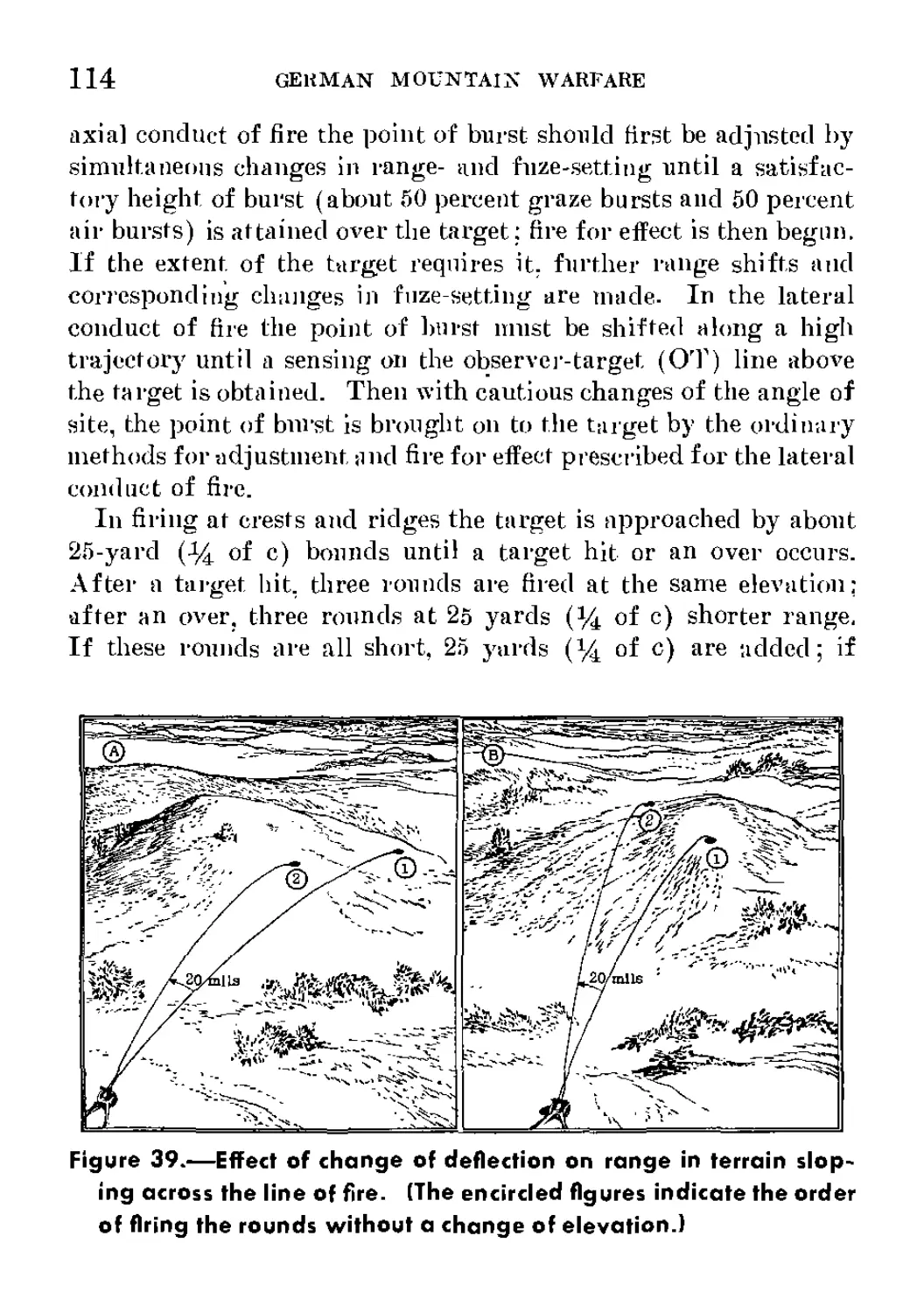
39.	Effect of change of deflection on range in terrain sloping across the
line of Are__________________—__________________________________ 114
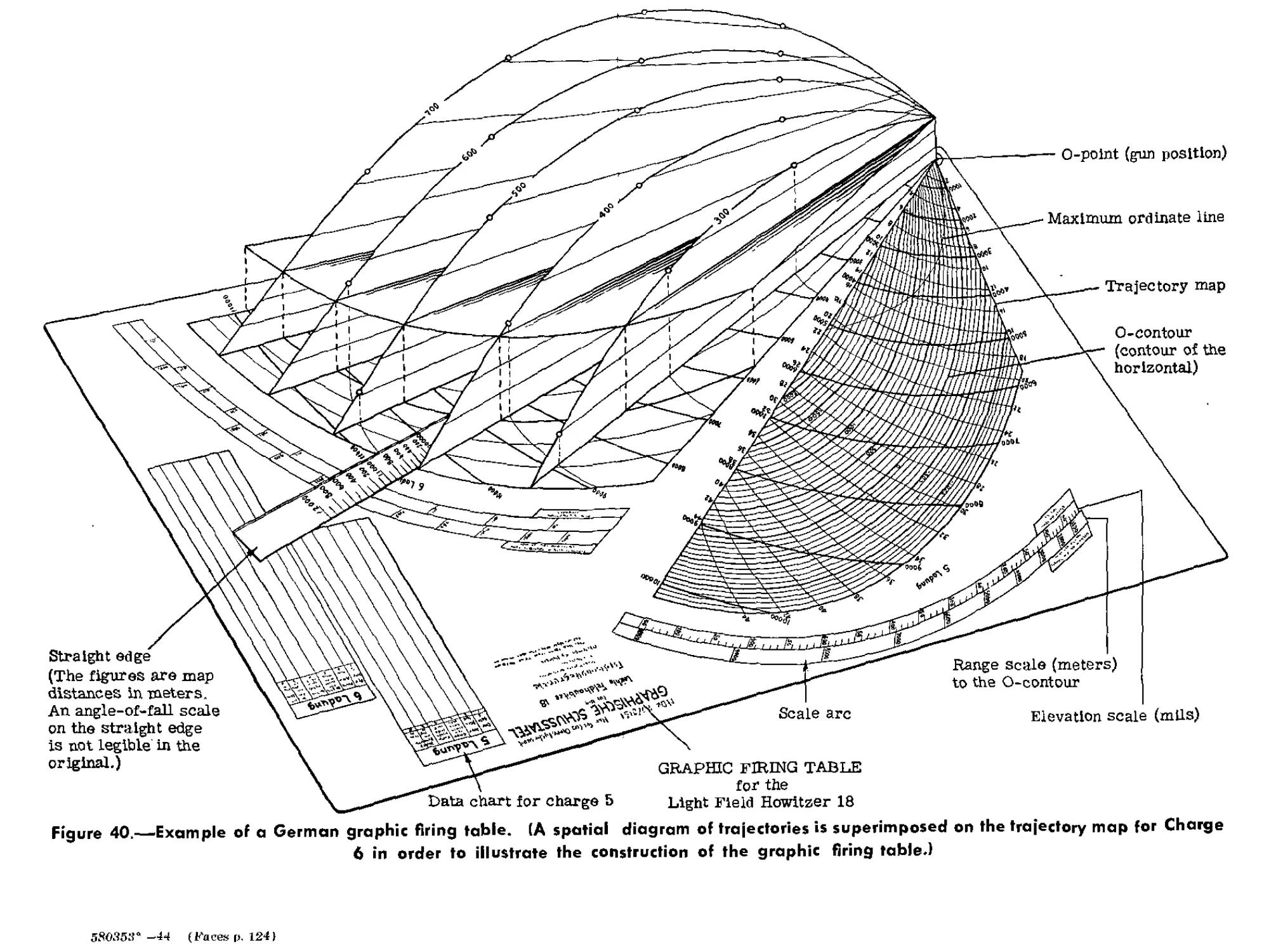
40.	Example of a German graphic firing table_____________follows 124
INTRODUCTION
The Germans believe that specially trained mountain troops
{G-ebh'gstruppen') may influence decisively the outcome of a
campaign, for mass armies must rely on specially trained small
forces to secure their advance through the broader mountain
valleys in order to reach the flat,1 where the decision usually is
sought. Small forces of mountain troops can prevent, impede,
harass, or channel the movements of the main enemy force through
the valleys, so that when the decisive battle takes place in the
flat, the enemy’s power is spent and he is compelled to fight under
the most unfavorable conditions. When on the offensive, moun-
tain troops can cover and protect the advance of their own main
force, enabling it to reach terrain of its own choice in the highest
state of readiness for combat. Thus their mission on the offensive
is to secure the route for the advance of large units through the
valleys, whereas their mission on the defensive is to deny the
valleys to the mass of the enemy forces. In either case, moun-
tain troops must gain control of the mountains.
The Germans hold that the basic tactics of warfare in moun-
tains are the same as in the flat, but that the application of the
principles must be modified to fit the high and rugged terrain.
In mountainous terrain the movement of troops and the employ-
ment of heavy equipment are limited, and deployment is re-
stricted to such an extent that only comparatively small forces
can operate. Soldiers must be prepared to advance over narrow
roads, tortuous paths, trackless terrain, steep and slippery slopes,
ravines, precipices, and glaciers. Movement frequently is threat-
ened by avalanches, rockfalls, landslides, and cornice fractures.
Besides these special terrain factors, the weather also exerts a *
’The “fiat” (Flachland) does not necessarily mean plains. This term
also denotes low, rolling country or any terrain In which troops may nor-
mally be employed without specizil training or equipment and without
modification of general tactical principles.
VII
VIII
INTRODUCTION
great influence on mountain fighting- Meteorological phenomena,
such as burning sun, heavy rain, and blinding snow coupled with
intense cold, may occur in swift sequences.
In mountains, the Germans believe, the infantry'artillery team
retains the ascendancy which on other fields of battle it yields
in part to armor and air power. Relatively unimportant roles
are played in mountain warfare by the tank and the airplane.
The employment of heavy infantry weapons and artillery is
hampered by their bulk and weight, by the considerable dead
space, and by the difficulties of observation due to weather and
intervening terrain features. It is the infantry, above all. that
must bear the brunt of the battle. Consequently, the Germans
stress the principle that the importance of shock action and close
combat increases as the efficiency of other methods of fighting
decreases, and that in some respects mountain fighting resembles
guerrilla warfare.
Because of the narrow terrain compartments in mountains,
unified control is possible only over small units. The Germans
believe that the reinforced battalion is ordinarily the largest
tactical unit whose movements a commander can effectively con-
trol during combat. In unusually rugged terrain the task unit
must be even smaller. Therefore, greater responsibility is placed
on officers of lower rank.
The focal points of mountain combat are the heights. Gun em-
placements and observation posts on commanding heights can
dominate the foreground and valley, making the task of the
advancing infantry relatively easy. But of all mountain opera-
tions the seizure of heights is the most difficult. A well-defended
height must be taken by surprise to avoid great losses. Only men
skilled in mountaineering, who have developed stamina through
long conditioning, who have the ability to maintain direction,
and who have been thoroughly trained for combat, can effectively
carry through an attack on a height in high mountains. This is a
cardinal principle of mountain warfare which the Germans
emphasize.
INTRODUCTION
IX
The following is a summary of basic characteristics of mountain
warfare which are stressed in training by the Germans:
(1)	Movement is much slower than in the flat, for it takes a
long time to bring troops into position. Artillery and heavy
weapons, particularly, move slowly. The deployment of in-
fantry, especially units with heavy weapons, requires much time.
The attack itself proceeds slowly, and the terrain prevents it from
gaining the momentum that is possible in the flat; on the other
hand, the large number of good defensive positions and the
scarcity of roads facilitate delaying actions. Reserves have to
be held very close to the front lines; otherwise, unpredictable con-
ditions of terrain and weather may delay their arrival for the
crucial phase of battle.
(2)	Signal communication is less reliable than in the flat. The
weather sometimes weakens the audibility of messages transmitted
by wire or radio. Radio is faster than wire communication, but
even less reliable. Reception may be affected by the weather and
by the configuration of the mountains. Laying lines is a slow,
arduous process, and maintenance and servicing of wire are dif-
ficult. Control of the battle by the higher commander is limited
largely to a preconceived and thorough plan, since the uncertain
channels of signal communication usually prevent him from
intervening effectively in operations once the battle has begun.
Consequently, the responsibility of subordinate commanders for
independent action is greater than in the flat. Rarely can they
expect aid from reserves, as the full force is likely to be committed
all at once.
(3)	The problem of supply becomes extremely acute in moun-
tains, and the proportion of supply troops to combat troops in-
creases. Supply routes are few; food, forage, and ammunition
must be carried over narrow roads and mountain trails as far as
possible by motor transport, then on mules and mountain horses,
and finally on the backs of the soldiers. Economy of supplies is
necessary because the danger of extending a unit beyond reach of
its supply column is great, mid. furthermore, it is impossible for
an over-extended unit to live off the country in mountains.

Section I. GERMAN DOCTRINE OF
MOUNTAIN WARFARE
Thin section its-an edited translation of part of a
German manual entitled VorlUufige Ausbildungs-
aniceisung filr die Gebirgstruppen (Provisional
Training Instructions for Mountain Troops). Al-
though the manual is dated J935, the fundamental
German principles of combat in mountains have
changed little in the interim. The German manual
is not illustrated: the illustrations that appear in
this section have been added by the editor.
1.	COMBAT IN HIGH MOUNTAINS
a.	General
In high mountains officers and enlisted men have to overcome
difficulties that are different from and generally greater than
those encountered in the flat. More time is required to execute
all movements, and plans for the disposition and commitment
of forces must be adapted to the special problems of warfare
in rugged terrain. The terrain limits the usefulness of some
weapons, and the problem of supply is continuously critical.
In general, the difficulties are caused by the steep terrain, the
great variations in altitude in different parts of the mountains,
the small number of roads and paths and their narrowness,
the limited possibilities for movement off roads and paths, and
the character and condition of the ground surface. Time of
day. season, and weather also create special problems. Account
must also be taken of the influence of terrain on the effectiveness
of enemy weapons.
Difficulties presented by high mountains are most acute in
areas of rock, cliff, and glacier. To overcome them, the officers
must have mountain experience, and the troops must be care-
1
2
GERMAN MOUNTAIN WARFARE
fully selected, specially equipped, and thoroughly trained in
mountain operations. Even peacetime service in mountains re-
quires great tenacity, strength, will, and courage; its conditions
and dangers are often comparable to those of actual warfare.
The difficulties encountered in medium mountains are less than
those in high mountains; nevertheless they are considerable,
and they increase in winter. Even in medium mountains, a
soldier cannot be fully effective unless he has proper training,
clothing, and equipment. Inexperienced men will have great
difficulty in effecting cooperation between the infantry and the
heavy infantry weapons and artillery because of the difficulties
of observation and the many unusual ballistic problems.
Winter, and the thaws before and after, greatly alter the con-
ditions of march and combat in high mountains. During this
time the activity even of excellently trained mountain troops
is limited by the cold, new snow, snow storms, clouds, avalanches,
and the increased difficulties of bringing up supplies and quar-
tering troops. Consequently, important operations are excep-
tional in winter. Since frequent great and sudden changes in
the weather affect the performance of troops in high mountains,
mountain troops must learn in training how to protect them-
selves against the effects of weather; they must know how to make
use quickly of all means of protection against cold, rain, and
storms, especially at night and when they are tired.
In high mountains, only mountain troops can be used in all
situations, For maximum combat efficiency, they must be trained
to move with heavy weapons over any kind of terrain that is
negotiable by highly skilled mountain climbers. The better
trained and the more effective they are, the greater will be their
prospects of surprise and decisive success. They must be able
to move over difficult terrain surely and easily, even on moonless
nights and in rain, fog, or heavy snowfall.
For bringing up supplies over valley highways, motor vehicles
are preferable to animal columns because their capacity and speed
GERMAN DOCTRINE OF MOUNTAIN WARFARE	3
are greater and because they occupy less of the limited road space.
Mules are the most useful pack animals; small horses are much
inferior and fail even in the higher reaches of medium mountains.
b.	Command
High mountains limit the use of large forces and greatly re-
strict deployment. Because access to some positions is difficult,
adjacent units often cannot support each other, and reserves can-
not be shifted rapidly. However, through deception and bold
surprise action, the attacker often can gain success with smaller
forces than the defender. In mountains the commander should
not hesitate to put troops into action over a wide front in order
to deceive the enemy into dispersing his forces and to achieve sur-
prise by concentrating the bulk of his own troops at points favor-
able for attack. Such maneuvers necessitate careful planning and
prompt decisions by the commander.
Mountains themselves are great obstacles to the quick personal
intervention of the higher commanders because march columns,
even of the smaller units, are extremely long, and combat gen-
erally takes place over a wide front and consists of many isolated
engagements. For this reason, higher commanders, to carry out
their plans, must depend to a great extent on subordinates of
all grades, including the best enlisted men. Only if missions are
assigned in detail and sufficient forces are allotted to carry out
each mission, can the various combat groups work together
toward a common objective. Combat in high mountains de-
mands absolute thoroughness in preparation; superficial knowl-
edge and ignorance or underestimation of mountain dangers may
result in catastrophe. The commander, conscious of his well-
considered plans, should remain calm and assured even in the
face of the greatest difficulties and thus set an example for his
subordinates. He must be tenacious in carrying out his mission
and he must insist that his subordinates follow his orders
strictly.
4
GERMAN MOUNTAIN WARFARE
c.	Effect on Firing
When there are great differences in altitude between the gun
position and the target, firing is subject to special conditions,
and the obstacles to consistent cooperation between the heavy
weapons and infantry are more numerous than those met with
in flat terrain. The mountain infantryman must be specially
trained to fire his rifle and light and heavy machine guns both
upward and downward in areas with steep slopes, to camouflage
open fire positions, to occupy them rapidly, and to open fire at
once. In high, open regions, however, firing presents fewer prob-
lems than in forested areas of low and middle altitude, where
observation is difficult.
2.	RECONNAISSANCE
In mountains, reconnaissance of routes and terrain suitable for
marching and for combat is by no means less important than
tactical reconnaissance. Frequently the plan of maneuver and
the number of men assigned to advance over each route depend
on the results of this reconnaissance. The commanders them-
selves rarely can make personal reconnaissance; they must usually
depend on general surveys, studies of maps, and tourist guide-
books, but mainly on the information obtained by reconnaissance
units.
Patrols reconnoitering routes and terrain follow close behind
the scouts who are seeking the enemy. They- mark the recon-
noitered route and determine how far pack animals can march
with heavy loads, and where they can march only without loads;
they also determine where route improvement and security forces
for men and animals are needed, where the troops must begin to
manhandle, heavy weapons, and what sections of the route can be
seen by the enemy. Tactical reconnaissance of the terrain by
scouts to find a way to carry out the commander’s special instruc-
tions for disposition of the troops must go on at the same time
as route reconnaissance. Only in urgent situations will the com-
GERMAN DOCTRINE OF MOUNTAIN WARFARE
5
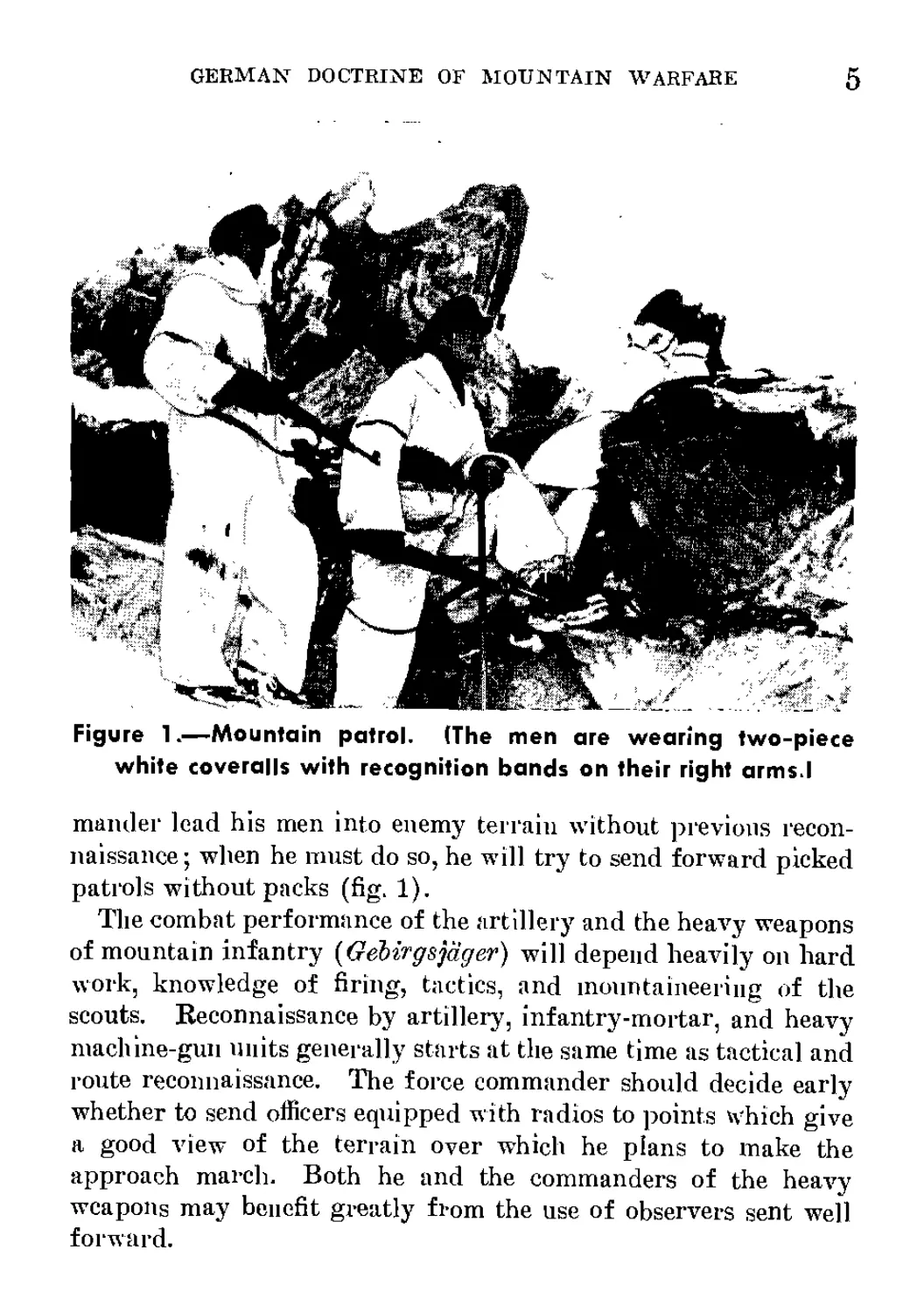
Figure 1.—Mountain patrol. (The men are wearing two-piece
white coveralls with recognition bands on their right arms.I
mander lead his men into enemy terrain without previous recon-
naissance; when he must do so, he will try to send forward picked
patrols without packs (fig. 1).
The combat performance of the artillery and the heavy weapons
of mountain infantry (Gebirgsjdger) will depend heavily on hard
work, knowledge of firing, tactics, and mountaineering of the
scouts. Reconnaissance by artillery, infantry-mortar, and heavy
machine-gun units generally starts at the same time as tactical and
route reconnaissance. The force commander should decide early
whether to send officers equipped with radios to points which give
a good view of the terrain over which he plans to make the
approach march. Both he and the commanders of the heavy
weapons may benefit greatly from the use of observers sent well
forward.
6
GERMAN MOUNTAIN WARFARE
3.	MARCHING; SECURITY; SHELTER
a.	Marches
(1)	GeneiuL—During a march in mountains, a prime considera-
tion is to save the soldier’s strength while he is loaded with weapons
and pack, for the troops must be fit for combat when they engage
the enemy. Scout parties and small detachments, without packs,
are required only in exceptional circumstances to perform missions
in which they must strain their physical resources to the limit.
A force usually inarches in several columns to make use of
all available routes in high mountains and to induce the enemy
air force to dissipate its effort. Thus the readiness of the units
for combat is increased, and there is a better possibility of quickly
overcoming weak enemy I'esistuuee. The march is also expedited,
and the troops are spared undue exertion. Furthermore, troops
marching in several columns can make maximum use of the limited
shelter available in mountains.
(2)	Order of march.—The usual formation for marching in
high mountains is mountain order, single file; the distance from
man to man may increase from time to time, depending on the
difficulties and the slope of the route, but there must be no
relaxation of very strict march discipline. The road space of
a unit is 4 to 6 times greater than in level country. Greater
intervals are prescribed in places where there is danger of rock-
falls and avalanches. Special measures and strict discipline are
necessary in marches on moonless nights over difficult mountain
terrain. Clouds or sudden storms affect marches in high regions
very differently than in the flat,1 and place a great burden on
all personnel.
The ratio of strength between the advance guard and the main
body, the distribution of weapons, and the order of march may
vary greatly, depending on the situation of the enemy, the suit- 1
1 In llic German text, Ebene. which has the same connotation as Flaeh-
land (see p, vn. note 1). The term “flat1’ has been used throughout this
study in translating both words.—Editor.
GERMAN DOCTRINE OF MOUNTAIN WARFARE
7
ability of roads for movement of heavy weapons, and the pos-
sibilities for maneuver. In mountains the advance guard often
must dispense wholly or in part with accompanying infantry
mortars and artillery, for the guard must proceed before it is
decided whether these weapons can be taken along. Under
these circumstances it should be proportionately stronger in
machine guns, In such a situation infantry mortars and artil-
lery, first from the valley and then from the lower mountain
slopes, should try to protect the forward movement of the ad-
vance guard and to give it at least some support in combat.
The march intervals of advance and rear guards depend en-
tirely on the situation and the terrain, which often give the enemy
better opportunities for observation and effective fire than he
has in the flat. In advancing toward a commanding pass over
narrow valley roads visible at a great distance, the advance guard,
motorized and protected, if possible, by tanks and motorized artil-
lery, should move out many hours ahead of the main body. The
main body should not start up roads or paths when the slopes
on either side are bare and difficult to climb, nor should it descend
bare slopes visible to the enemy until ridges in the direction of
the enemy are in the hands of the advance guard. Frequently
the main body can move up only at night.
Rules for forming the advance guard and for the approach
march of the main body cannot be given; the commander must
issue special orders in each instance. When, for example, heavily
forested regions with hidden and inconspicuous roads make it
difficult for the enemy to interfere with the inarch, smaller march
intervals will suffice. Or if, during the advance, increased readi-
ness for action is necessary, the main body may advantageously
march in deployed formation. Like considerations determine the
march intervals between the rear guard and the main body.
Orders for intervals generally give the time interval between
units.
If the commander assigns infantry mortars and artillery to the
advance guard, he should consult the commanders of these weapons
580.453°—14—2
8
GERMAN MOUNTAIN WARFARE
on the strength of the detachment and the order of march; but the
less mobile units should not precede the more mobile without some
special reason, since it is usually very difficult to move rear
elements past other troops. As a rule, the “combat staff”
{Gefechtsstab}, or commander’s party, and the “combat staff’’ of
the artillery and of the infantry mortars march in the advance
guard. The commander himself generally marches well forward
in the advance guard, accompanied by the commanders of the
machine guns, mortars, and artillery.2 Some signal troops are
assigned to the “combat staff” of the force commander: those not
otherwise employed usually march at the end of the advance guard.
The position of the engineers in the column depends on their
missions. They may march with the stronger reconnaissance
units, or, more often, ahead of the artillery, with a detachment for
special road improvement immediately behind the point of the
advance guard.
In an advance through a broad valley where conditions are like
those in the flat, the commander may well assign a heavy force of
artillery to the advance guard, especially if the main body has to
proceed for some time without support. Likewise, an advance
guard moving forward to occupy a mountain mass, since it cannot
expect relief for a long time, should have as many heavy weapons
as possible.
(3)	Time factors.—For the calculation of march time, no fixed
rules can be laid down. The time will vary with the route, the
slope, and the condition of the troops. It is well to add about 1
hour to the map distances for each 1,000 feet of ascent and 1,650
2 The doctrine expressed in this sentence applied to German mountain-
division organization at the time the manual was published. The infantry
battalion then included a machine-gun company and a mortar company.
With the inclusion of the 81-mm mortar platoon in the machine-gun company
and the replacement of the mortar company by a heavy-weapons company
(scftwere 2£ompa?iie) (see par. 25, p. 98), the doctrine would read as
follows: “The commander generally marches well forward in the advance
guard, accompanied by the commanders of the machine-gun company, the
heavy-weapons company, and the artillery.”—Editok.
german doctrine of mountain warfare
9
feet of descent, The selection of the hour of departure requires
careful thought, account being taken of the situation, the time of
year, the weather, the kind of terrain to be traversed, and the
condition of the troops. When several columns advance into
combat, cooperation should be assured by carefully scheduling the
movement of each column. Columns moving over heights often
depart 1 day or more ahead of those moving in a valley.
A 300-foot or 1-minute interval between companies and bat-
teries will keep the column moving steadily. If several battal-
ions move along the same mountain road, the distance between
them should be determined by orders, with a 30-minute interval
as the minimum. In deep snow, men with skis and snowshoes, who
must be relieved frequently, go ahead to break trails.3 Loaded
animals cannot walk through snow that is more than 16 inches
deep.
Orders for rests should be given by the force commander be-
fore the troops set out. The schedule of rests depends on the
mission, the duration of the march, the difficulty of the terrain,
the weather, and the condition of the troops. Soon after the
beginning of an ascent there should be a short halt for adjusting
saddle straps. After this halt, fresh, well-trained mountain
troops must be able to climb for 3 or 4 hours without resting:
they then need a rest of at least 1 hour. Shorter rests are worth-
less, because they do not compensate for the work of unloading
and reloading. By means of map and ground reconnaissance
a resting place should be selected where pack animals may be
unloaded and the men and animals can rest. At all halts the
men should seek cover from air attacks and protection against
strong wind. In long columns, orders must be distributed soon
enough to allow for their transmission.
(4)	March discipline,—Marching in mountains requires the
strictest discipline. All superiors must give continuous attention
to keeping march formations closed to the proper intervals, and
' See “German Ski Training and Tactics,” Special Series, No, 20 (31 Jan
10-H), par, 14, p, 38,—Editor,
10
GERMAN MOUNTAIN WARFARE
must enforce an even, rhythmical pace and a proper handling of
the pack animals. Stragglers must not be tolerated. In ascent
and descent it is forbidden to take short cuts or to stop for a
drink or for any other reason, unless ordered. The troops must
also be forbidden to eat snow or ice. When ascending they must
not smoke, even when at ease. Every unit is responsible for
maintaining contact with the unit marching ahead of it.
b.	Security
To provide security for troops resting in a large mountain
valley, the command first turns its attention to the roads and
trails which the enemy has to use. Often the enemy can make
use of observation posts and firing positions at points of vantage
on flanking or frontal heights which friendly troops are unable
to occupy; hence, to prevent surprises, it may be necessary to
organize protective fires with heavy arms. Obstacles and anti-
tank weapons can always give protection against enemy tanks
on wide valley roads.
In forested or rocky regions, trails and roads should be guarded
first of all. and then, for the security of troops at rest, patrols
should be sent out as far ahead as possible. When the enemy
is near, the terrain between the opposing forces, even if ap-
parently impassable, also should be watched carefully, especially
at night. When terrain conditions are simple, the security ele-
ments are organized as they are in the flat. In broken terrain
where observation is difficult, the security units for retreating
forces should take their rest in, or directly behind, the position
which is to be held in case of enemy attack; at night, the posi-
tion should be protected by combat outposts and scout squads.
Insufficient security, particularly when the troops are very tired,
is a false and dangerous economy of forces. Protection against
surprise air attacks must be given special attention.
c.	Shelter
In high mountain country it is difficult, even in well-settled
valleys, to find permanent shelters where large forces can quar-
german doctrine of mountain warfare
11
Figure 2.—Mountain troops resting in a snow shelter.
ter; outside the valleys the density of population and the amount
of shelter available quickly decrease in inverse ratio to altitude.
Huts in mountain pastures, hay sheds, and forest huts and shel-
ters are a last resort, for they can accommodate only small units.
Hence, especially in high places, the troops must know how to
take advantage of the terrain so that by using their tents they
can set up a weatherproof bivouac quickly, They must also
know how to make shelters in deep snow as a protection against
wind and cold (fig. 2). Mountain troops learn while in training
to spend winter nights in bivouacs at high altitudes.
Commanders, however, should not overlook the fact that over
a long period temporary bivouacs are not good shelters. The
greater the physical demands upon the troops and the more severe
the weather, the more necessary it is to replace the bivouacs by
improvised shelters as soon as the situation permits. The com-
fort of the troops should be considered; tents, huts, and bar-
racks ought to be heatable and windproof. So far as possible,
12
GERMAN MOUNTAIN WARFARE
bivouacs and emergency shelters must be protected against enemy
ground and air observation, enemy attack, and mountain dan-
gers.
4.	COMBAT
a.	General
The significance of numbers should not be underestimated even
in high mountains, but in such terrain superior leadership and
morale, toughness, and mountain training will make themselves
felt. With men able to move over all kinds of steep rock, snow,
and ice, and adept at military skiing in high mountains even
under the most difficult conditions, the command has a basis for
remarkable achievements. The combat plan must always aim
at surprise, but successful surprise action depends on efficient
soldiers and a commander who knows how to use them. Al-
though local superiority in numbers and materiel often suffices
for small-scale attacks, an assault on well-prepared positions de-
mands a considerable superiority of forces and a well-organized
plan of supply.
b.	Attack
(1)	Advance and deployment.—Combat in mountains, like
combat in the flat, usually is fluid in its early stages. The ad-
vance guard secures time and space to enable the main body to
deploy or to occupy positions from which it can attack most ef-
fectively. Usually it takes a long time in mountains for the
attack really to get tinder way. Until it does, the commander
must see to it that the advance guard is strong enough to bear
the whole burden of the battle.
When the disposition of the enemy is uncertain and the terrain
is difficult, the advance guard must often go forward by bounds;
that is, it advances from point to point mider the protection
of the heavy weapons and artillery. In open terrain, where
lateral movements are risky, the advance guard may have to ad
GERMAN DOCTRINE OF MOUNTAIN WARFARE	13
vance while deployed in order to be better prepared for action
in case of a surprise encounter with the enemy.
It is difficult to withdraw the advance guard, even before the
enemy has actually pinned it down, without subjecting it to heavy
casualties. It is possible to withdraw it with moderate losses only
if orders can be distributed quickly and the terrain is suitable
for a withdrawal.
Mountain infantry moving up to the line of departure must
take full advantage of the terrain and deploy as quietly as possible.
In difficult terrain the reinforced battalion is generally the largest
formation that can attack as a unit. When the operation takes
place at night, the routes of approach must be frequently and care-
fully marked by conspicuous signs; the men may not use lights,
and they must relay orders in whispers. In the daytime they must
use hand signals whenever possible. Crossing even short stretches
under enemy observation betrays the plan of operations. Every-
thing depends on the conscientiousness and self-discipline of
each individual. Every assault soldier must receive information
concerning the enemy and know his situation accurately.
Systematic measures of deception should veil the occupation
of the line of departure for the attack, as well as the main thrust,
so that the time, place, and direction of the attack will completely
surprise the enemy, These deceptive measures must be of many
kinds, must cover several days if necessary, and, taken together,
must show a definite trend. Even though they do not always
draw the enemy reserves to the wrong flank, it is important to
keep the enemy in a state of uncertainty until the battle has been
in progress for a considerable time.
(2)	Effect of terrain.—A unit moving downhill has the advan-
tage of being able to go into action rapidly, but ascending units
often have opportunities to use heavy weapons against an enemy
descending into open terrain. When two adversaries are both
moving uphill to seize a ridge lying between them, the heights
themselves become the focal point of combat, and the commander
must guide the action and influence its development by the capture
14
german mountain warfare
of decisive points. An energetic leader often does not wait for
precise information from combat reconnaissance, but bases deci-
sions on his general impression of the terrain, gained from the
maps, and on preliminary reports. The rest can be done by troops
fit for mountain operations. The artillery commander must see
to it that fire is immediately laid down where the advancing
infantry needs it.
In steeply rising terrain the attacking force may often have
fire support for a long time. Good gunners manning heavy
machine guns can hold down the defender until the moment before
the attacking force penetrates the enemy positions. However,
poorly placed fire which strikes friendly troops Just before they
reach the enemy positions leads to serious reverses. Support of
the attack by heavy weapons requires careful liaison with the
front line and strictest attention to the ballistic characteristics
of the weapons and the effect of the rounds in the terrain. The
cooperation of infantry mortars and artillery in preparing the
attack is particularly important when the terrain is difficult and
the enemy has had time to organize his position and dispose
favorably his heavy weapons. Troops threatened by the effects
of the dispersion of artillery fire and the probable loosening of
rocks must advance from the side so as to roll up the flank of
the enemy thus held down by the artillery.
Often very small units succeed in penetrating the enemy position.
The resolute exploitation of their successes is a matter of great
importance; but if, after a successful penetration, there are not
enough forces to exploit the attack further, then the ground
captured must be held. For this purpose all the heavy machine
guns come up first and dig in (fig. 3). Support by artillery at
this time will be more or less interrupted, because many of the
batteries cannot reach beyond the newly occupied heights without
displacing forward. Even though the forward artillery observers
reach their new positions quickly, the changing of a battery posi-
tion generally requires considerable time. Meanwhile the mortars
can provide support.
GERMAN DOCTRINE OF MOUNTAIN WARFARE
15
Figure 3.—Machine gun (M.G. 34) emplaced in snow. (The long-
legged antiaircraft tripod is used instead of the standard mount
so that the gun may be firmly emplaced in the deep snow.)
In an attack over a downward slope without special terrain
difficulties, movements are easier for the assault troops, and such
an attack often has the advantages of good observation. Dead
spaces and masks, however, may diminish the chances of putting
artillery in position if the batteries are unable to find positions
on a plateau but have to fire from a deeply cut transverse valley.
These unfavorable conditions are often encountered in combat
around positions laid out on reverse slopes by a skillful enemy.
Then only part of the artillery and the other heavy weapons of
the attackers can reach the target area, and observation posts
have to be placed on crests where they can easily be put out of
action. The defender can take full advantage of the favorable
terrain that he holds. In such a situation a bold surprise blow by
16
GERMAN MOUNTAIN WARFARE
mountain infantry frequently offers the best chances of success,
but the commander should first determine whether an assault can
be made against another part of the position which is more vulner-
able to attack,
(3)	Types of attack.—Attack against an enemy organized for
defense can succeed only after systematic reconnaissance and or-
derly preparation. The troops must come up to the assembly
area by echelon. This sometimes takes several days because of
the difficulties of the terrain and the activity of the enemy.
Because the terrain between the line of departure and the enemy
position often is difficult and sometimes is swept by enemy fire,
troops must deploy for attack as near the enemy as possible,
in order to cross the intervening ground rapidly. The heavy
infantry weapons and the artillery must in this case take posi-
tions where they can protect the advance of shock troops and
support the attack by directing the heaviest concentrations of
fire at the point of penetration until a break-through occurs. As
a rule, if the advancing troops deploy in several stages, some of
the artillery cannot give them protection without a time-consum-
ing change of positions and shift of observation posts.
Strong attacking forces usually advance simultaneously along
a valley and over adjacent heights. Whether the main effort
is through the valley or over the mountains depends on circum-
stances. In large-scale operations, however, the main attack must
always follow the general course of the valleys, where large forces
can deploy freely, where fire power can be used efficiently, and
where supplies can be brought up in quantity. The accompany-
ing attack over heights may have various purposes: to destroy
the effect of enemy weapons, to occupy flanking heights, to hold
down a possible enemy flank attack, or to support the attack in
the valley by an attack on the flank and rear of the enemy forces
in the valley. The attack over heights may be decisive when the
attack in the valley no longer has any chance of success; it then
becomes the direction of the main effort. If, on the other hand,
the attack in the valley makes rapid headway, it is all the more
GERMAN DOCTRINE OF MOUNTAIN WARFARE
17
important that the forces sent over the ridges hold the enemy
in the mountains and prevent him from acting against the column
in the valley.
In small-scale operations it is of prime importance to occupy
heights and thus increase the effectiveness of observation, use of
fire power, and commitment of forces, but the lower terrain
should not be neglected. In all mountain operations, the most
effective attack is against the enemy’s flank and rear. Although
difficult terrain often limits its effectiveness, such an attack, if it
reaches the rear communications of the enemy—who is usually
dependent ou only я few routes—may lead to his destruction. An
attack against the flunks and rear may develop from a penetration
of the enemy’s front or from outflanking or encircling a wing; it
always calls for bold and energetic leadership. When such an
attack is on a large scale, strong forces with well-organized and
w ell-protected supply lines must make a deep penetration, because
a determined enemy will fight fiercely to keep open his lines of
communication.
Firing at a withdrawing enemy soon ceases to be effective, as
does frontal pressure on him; the terrain always offers his rear
guard favorable opportunities to resist and gain time. To be
effective, pursuing forces must outstrip the enemy and, by attack-
ing his route of retreat, quickly overcome rear-guard resistance.
c.	Defense and Withdrawal
Defense demands a disproportionately large force, and in ter-
rain where it is difficult to commit adequate reserves promptly at
threatened places the defensive position must be made strong
initially. High mountains with medium-mountain features such
as wooded slopes and only moderately difficult cliffs call for a
considerable defense force, because the enemy can make a decisive
surprise attack at several points in such terrain. On the other
hand, rifle units made up of skilled mountaineers can operate
effectively in local defense, even with limited military training,
although, as a rule, they cannot carry out even short counter-
18
GERMAN MOUNTAIN WARFARE
thrusts except with further training and in combination with
trained troops.
Small groups maintain the defense of the battle position. The
points most threatened must be organized for all-around defense,
and the groups must be so disposed that they can watch terrain
that is apparently impassable, and, if necessary, cover it with fire.
Commanders of heavy-weapons and artillery units make the care-
ful reconnaissance needed to set boundaries within the main battle
area and to work out a plan of combined defensive fires. The
course of the main line of resistance will depend primarily on
the tactical requirements of the mountain infantry and on the
amount of cover it affords them.
All weapons should be organized in a unified fire plan to pro-
tect the front and to sweep with heavy and effective fire the areas
in the foreground where the enemy is most likely to re-form be-
fore continuing the attack. Fire from the flank and rear must
reach the gaps between the strongpoints on the main line of re-
sistance. Sections hard to defend and particularly threatened
must have support from reserves held nearby. Often the flank
of the threatened sector offers protection against enemy fire for
the reserve, as well as a favorable place for it to deploy. If for
lack of a field of fire the defense of a narrow crest is difficult with
the forces available, it may be best to leave only a line of battle out-
posts on or in front of the crest and place the main line of resistance
on a favorable reverse slope. Such a location for the main line
of resistance will put the enemy in an unfavorable position for
observation, employment of heavy weapons, and deployment, and
will give the defending weapons favorable positions in defilade
and on the flanks.
The more difficult the defense of the battle position, the more
important it is to have active patrols well forward to discover
the disposition of enemy forces. If the defending forces are
strong enough, their outposts block the enemy advance. The
weaker the available forces, the more the combat outposts must
rely on prepared positions, obstacles, and the denial of areas by
GERMAN DOCTRINE OF MOUNTAIN WARFARE
19
use of contaminating agents/ If the enemy pushes into the
inain line of resistance and a quick counterattack by the reserves
fails to drive him out, his penetration must be contained as much
as possible. Even outflanked or surrounded elements must fight
for each foot of ground to gain time. They have the advantage
of terrain and observation, and usually they are fresher than the
attacking forces.
The conditions of combat in mountains usually favor delaying
actions. Withdrawing forces can establish numerous strong-
points and firing positions on heights to enable them to with-
draw to the next line of resistance unobserved by the enemy. The
more difficult the terrain on which the enemy has to maneuver
and use his weapons, the more effective the resistance can be.
In operations on a larger scale, delaying actions will concentrate
on the mountain depressions and valleys which are of particular
importance to the enemy for his advance. By simulating occu-
pation of heights, very weak forces, often mere patrols, can block
roads and paths. As resistance becomes stiffer in the valley,
stronger forces must be employed on the heights. Resistance in
valleys may hold up strong forces for a long time, giving them
no chance to deploy. During this time the main task of the force
on the heights is to block the routes leading over the mountains
to the flank and rear of the main body.
It is hard to maintain centralized command over forces retreat-
ing on a broad front on various roads and under widely different
conditions of coni bat. To do so. the commander must be able
to move about fairly freely, communications must be maintained
and guarded, and subordinate commanders must be empowered
to act independently for the good of the whole. To ensure this
independence of action, missions must be assigned to the com-
manders of small units before the movement is attempted. Even
4	The original text (sec. I. par, 35, p. 29) reads as follows: “Je schwiicher
die Kriifte sind, nm so uiehr 1st von G ela nd evers Hi rkiingen, Geliludever-
giftUngen, Sperren mid Hindernissen debranch zn machen. an die sich die
Gefechtsvoi'posten anichnen.1’—Editor.
20	GERMAN MOUNTAIN WARFARE
if conditions are otherwise favorable, to break away from the
enemy is difficult if the troops must be withdrawn in the daytime
through a pass under fire of enemy artillery and airplanes. An
alternate route should be chosen, if possible, but sometimes there
is none.
Systematic withdrawal on a large scale must be masked and
the enemy deceived; otherwise he may cut off large segments of
the rear guard, particularly when the withdrawing elements are
moving toward passes and defiles over difficult terrain. To
prevent this, a strongpoint must be established in front of the pass
or defile. Although in mountainous terrain the enemy cannot
readily get a general view of the situation, withdrawal from com-
bat in terrain under his observation should take place only after
dark. Because of the limited road net it is important to withdraw
trains promptly, leaving stores of food and ammunition behind
along the route for the combat troops withdrawing later. After
a successful disengagement, troops covered by even a weak but
^veil-deployed rear guard can easily fall back on a satisfactory new
position.
5.	MOTORIZED AND MECHANIZED OPERATIONS
The development of mountain road nets and the reinforcement
of heavy-duty motor vehicles make feasible the use of motor
vehicles of all kinds in mountainous regions. Motorized units
are used in mountains on the same principles as in the flat, but
limited space, steepness of roads, and weather conditions restrict
their employment. Most motor vehicles have to stay in the large
valleys and on highways, but lighter cross-country vehicles with
sufficient ground clearance may go into the mountains. Tank
reconnaissance units may operate successfully in large valleys (fig.
4), and machine-gun carriers and motorcycle units can execute
reconnaissance missions particularly well. They can approach the
enemy fast, reach important sectors quickly, and'report at once
by radio and motorcycle. Their great speed makes them par-
GERMAN DOCTRINE OF MOUNTAIN WARFARE
21
Figure 4.—Light tank (Pz.Kw. JI accompanying infantry in the Nor-
wegian mountains (April 19401.
ticularly effective for surprise and for employment against the
flank and rear of the enemy.
Combat vehicles can rarely be used in mass for decisive action
in mountains. Light combat vehicles in small units can be used
more often in valleys and on plateaus, and in surprise action they
can render excellent service in reconnaissance, screening, pursuit,
and attack against enemy flanks. They can be sent cross-country
off roads and highways in winter if the terrain is not too steep and
has a packed snow cover.
22
GERMAN MOUNTAIN WARFARE
Figure 5.-—Captured German half-track vehicle (Keffenkrad) fre-
quently used for transport by mountain troops.
If properly adapted to the characteristics of mountain terrain,
cross-country trucks and tracked vehicles (fig. 5) can facilitate
movements of troops and supplies in the valleys. Snow more
(han 1 foot deep, ice, and darkness may considerably limit or
prevent the use of such vehicles; therefore, sidings, unloading
points, and by-passes have to be reconnoitered when weather con-
ditions are adverse.
Neither tracked vehicles nor cross-country wheeled motor ve-
hicles can negotiate steep slopes, and no vehicle should cross diffi-
cult terrain alone; help from other vehicles with tow ropes and
winches must be available. Damage and rapid wear of materiel,
delays due to motor stalling, and high fuel consumption result
from cross-country operations. In winter special measures must
be taken against severe cold. Motor units should avoid rela-
tively long stops. There is more wear and tear and a higher fuel
GERMAN DOCTRINE OF MOUNTAIN WARFARE
23
consumption in mountains than in the flat; consequently, ample
supplies of fuel and spare parts are needed for all vehicles, and
time must be allowed for overhauling,
6.	AIR OPERATIONS 6
The lack of suitable advanced and intermediate airfields may
hinder the use of reconnaissance planes assigned to the Army
for mountain operations; moreover, flying and observation of
the enemy are difficult and special care is necessary in navigating
over mountains. Observation often is made difficult by deep
shadows in the valleys, low-hanging clouds, and, in the morning
and evening hours, rising mist. Snow on the ground, however,
facilitates reconnaissance.
Reconnaissance squadrons reconnoiter mainly rear communi-
cations, Major movements cannot escape detection from the air
in fairly favorable weather. On clear nights reconnaissance
over highways has a chance of success if flares are used, although
balloon barrages in passes and valleys constitute a threat to such
activity.
In addition to reconnoitering highways and valleys which are
likely assembly areas for reserves, reconnaissance squadrons act
as artillery observers for counterbattery missions, for which the
organic artillery reconnaissance units are inadequate. Because
of the difficulty of observation, squadrons for these missions re-
quire more airplanes than in the flat. The aerial observer must
be able to determine the location of advanced friendly elements.
Recognition, however, is particularly difficult in the mountains,
and the ground troops must help by extensive use of air-ground
liaison panels.
Attacks by air-combat units against the rear communications of
the enemy can disorganize his supply system and thus destroy his
1 The rapid development in air warfare since the publication of tlie Ger-
man manual undoubtedly has resulted in changes in German doctrine.—
fCurroK,
580353°—44--3
24
GERMAN MOUNTAIN WARFARE
freedom of movement. Besides engaging enemy reconnaissance
and bombing formations, air-combat planes make low-level attacks
against troop columns more frequently than they do in the flat.
Antiaircraft artillery is most effective when used on heights.
When bad weather forces planes to follow certain routes along
passes and valleys, prospects for effective antiaircraft fire are
particularly favorable, but it is always necessary to know whether
planes can fly below the antiaircraft gun positions.
Heavy antiaircraft batteries and 150-cm antiaircraft-searchlight
batteries seldom can find good positions in the mountains, because
the road net and the carrying capacity of bridges are limited, and
because observation points and gun positions are few. These
batteries (fig. 6) can be used on heights only if suitable highways
or mountain railways are available. It takes a long time, however,
to place heavy equipment, hauled by railway, in position. Con-
sequently, heavy antiaircraft batteries are employed mainly against
enemy aerial reconnaissance, and protect important traffic centers,
depots, and assembly areas for reserves in valleys and approaches
to mountainous regions.
Light 20-inm and 37-mm antiaircraft batteries and the 60-cm
antiaircraft-searchlight platoons can usually go into position on
heights and side slopes and thus protect mountain troops in the
front lines. In mountain warfare, command of antiaircraft
artillery should be centralized, but because of the extensive disper-
sion of the combat elements of mountain troops, the direct sub-
ordination of some batteries to tactical units cannot always be
avoided.
The same rules apply for Air Force signal units operating in
high mountains as for Army signal units. Motorized air-raid
warning companies and mountain air guards, trained in peacetime,
comprise the air-raid warning service.
In mountains as elsewhere no plane may take off without a
written forecast from the weather service. Motorized weather
stations, which are subordinate to the Air Force commander with
the Army command, provide weather reports, which are based
GERMAN DOCTRINE OF MOUNTAIN WARFARE
25
Figure 6.—88-mm heavy antiaircraft gun (8.8 cm F/ak) in position
to cover Italian mountain communications.
on data from the general meteorological service supplemented by
local observation by the advanced weather sections of the Army
and the Air Force. These stations are at the disposal of Army
units in the mountains for information bearing on weather and
road conditions.
26	GERMAN MOUNTAIN WARFARE
7.	MOUNTAIN INFANTRY
a.	Mountain Rifle Company 6
(I)	Squad.—On narrow mountain paths the squad of the moun-
tain rifle company (Gebirgwagerkompanie) marches in double or
single file. In pathless terrain, it marches in single file only. The
intervals from man to man depend on the terrain, and because of
the strong tendency toward accordion movements in the column,
enough distance must be allowed for each man to climb without
causing the man following him to change his pace. Orders to
slacken pace should be issued before the men start climbing. The
men carry their rifles slung, and pack animals carry the light
machine gun and its ammunition as long as the terrain and the
situation permit. The soldier puts on special mountaineering
equipment on order of the squad leader.
In situations where light machine guns can be employed
effectively, a rifle squad working forward can provide itself with
support by overhead fire from a flank or from a height. In an
attack up л slope, however, overhead fire generally cannot come
from within the squad, and supporting fire is feasible only from
the flanks or through gaps between the men. The distance be-
tween the men in an attack changes as the character of the ter-
rain changes; but the men must be close enough together to be
able to work as a unit, and the squad leader must maintain con-
trol at all times. Especially in uphill attacks he must keep his
squad fresh by resting it from time to time under cover. Often
difficult terrain offers a better opportunity for surprise than easy
ground, but a squad cannot climb difficult places under effective
enemy fire. The closer the squad gets to the enemy, the more it
should guard against counterthrusts. In mountains, a failure of
the attack just short of the objective always leads to heavy losses
and frequently to complete annihilation. Every man of the squad
must be aware of this and carry out the attack and penetration
with the utmost determination.
e See par, 24, p. 97-—Editor.
german doctrine ok mountain warfare
27
Iii defense, a squad holding out to the last man and the last
cartridge at times determines the fate of a whole sector- A
favorable opportunity for a limited couuterthrust presents itself
when the attackeis, exhausted by their advance and hampered in
the use of their weapons, approach the defense positions. The
leader uses as little of the strength of his squad as possible to
covet approaches: he holds the main part of the squad together,
ready for combat, in a favorable position which has flank
protection.
(2)	Platoon.—After making route and terrain reconnaissance
with his platoon headquarters, the platoon commander brings up
details from the platoon to make the necessary route repairs.
Over difficult ground the platoon may have to increase the in-
tervals between squads to counteract, the effect of accordion move-
ments. On good roads and over easy ground the puck animals
follow the platoon in close order. When at times the men must
remove and back-pack the loads of the animals and help them
over difficult paths and difficult terrain, the pack animals march
with the squads. If the platoon has to advance for any consid-
erable time without its pack train, the commander of the platoon
train receives orders for his subsequent movements from the pla-
toon commander. Details from the squads reinforce the platoon
train in order to provide the train with security against the
enemy and to help bring up animals and supplies.
The fact that separate squads often have to attack over various
kinds of terrain must be taken into account, in planning the ad-
vance of the platoon. To hold the platoon together and assure
control by the commander, it may be advisable to approach the
enemy by stages, reorganizing several times. Reserves accom-
panying the attacking platoon follow closely over terrain offering
the most cover, in order to exploit its success or to intercept
enemy counterthrusts. If the heavy weapons c:m no longer sup-
port the attacking platoon and it needs fire nt once, its own
light machine guns must form a powerful fii*e echelon under a
single leader. At an early stage the platoon commander should
28	german mountain warfare
designate his exact objective so that he will have the support of
heavy weapons and artillery fire when he needs it. After a suc-
cessful penetration, he decides on the next move of the elements
which make the penetration. A bold advance by the platoon in
a favorable direction can exploit the success of the unit to an
extraordinary degree.
In defense, the platoon reserve waits in readiness just behind
or on the flank of particularly threatened points of the defensive
ai*ea. If the enemy penetrates the forward defense position, the
reserve makes an independent surprise attack in accordance with
the plans of the platoon commander. The reserve must maintain
close signal conununication with the engaged elements of the pla-
toon and must have detailed knowledge of the terrain. For the
execution of independent attack and defense missions in moun-
tain terrain, machine guns, trench mortars, and artillery fre-
quently are attached to the platoon. The platoon commander
must know the use and effect of these weapons in combat and
how to assign to them a definite mission.
(3)	С отражу >—The rules for the platoon apply also to the
company. Under ordinary circumstances the interval between
platoons is 20 paces, but it .may be changed when expedient.
Under difficult conditions the company commander may order
changes. If the coinbat train is with the company, he assigns
men from the platoons to help it in difficult places.
From the beginning of the attack the company commander must
know whether he can deploy his whole company effectively in
the sector assigned him; crowding may well lead to heavy losses
and reverses. Usually once his company has started to advance
for an attack, the commander can change his plans only with a
considerable loss of time, if at all. His influence is sharply
limited because his men generally have to advance along a wide
front over terrain which cannot be seen entirely from any one
point. To coordinate the advance of units going forward sep-
arately requires careful planning and control; the battalion may
GERMAN DOCTRINE OF MOUNTAIN WARFARE	29
have to help out by assigning the company some of its communi-
cation personnel and equipment.
In attack, the company often moves forward by stages, re-
forming frequently and continuing reconnaissance as it advances.
Surprise is the key to successful attack: the commander must
make use of the terrain to deceive the enemy about his intentions
and to direct his forces along lines and toward points where the
enemy does not anticipate an assault. It is easier to make a
surprise attack by night than by day. but such movements must
be mastered by special training. Often the area suitable for
combat widens considerably behind the point of a narrow pene-
tration so that an increased number of the enemy can deploy
effectively for defense. The attacker must take this possibility
into account in his plan so that if his main effort is in the area
of penetration, his reserves can follow through skillfully and
promptly.
In defense, the breadth of the company sector and the varied
nature of the terrain often necessitate the issuance of orders in
advance and special arrangements for communication. If the
company cannot organize its defense in depth, the commander
must offset the danger of an enemy penetration by reinforcing
the combat outposts, by increasing flanking fire, and by emplacing
silent machine guns and artillery.7 Often he can provide an
effective defense by putting the main line of resistance on a
reverse slope. He can also set up strong points on heights and
at points which the enemy must cross.
Under certain conditurns the company may have to use a
mobile defense, wholly or in part. It may be advisable, for exam-
ple, to have only outposts at an important part- of the company
sector particularly exposed to observed fire from the enemy, and
TA "silent” machine gun or “silent” artillery piece is a weapon placed in
a welt concealed position close hi to or on the flank of the main line of
resistance. It holds its fire until the enemy is at point-blank range.—
Editob.
30
GERMAN MOUNTAIN WARFARE
to hold tlie main force under cover ready to attack the ascend-
ing enemy the moment that he penetrates the line. For this kind
of defense the sector must not be too wide and the terrain must
favor a counterthrust supported by heavy weapons, which nearly
always will be attached to the company in defense as well as in
attack. When the company commander has a broad front to
defend, it will often be difficult for him to draw off a reserve
and find a satisfactory position for it, but he should not be en-
tirely without a final reserve.
b.	Mountain Machine-gun Company9
(1)	General.—The mountain niachine-gun company (Gebirgs-
Hi(Mohine/ngcwchrkumранге) is armed with heavy machine guns
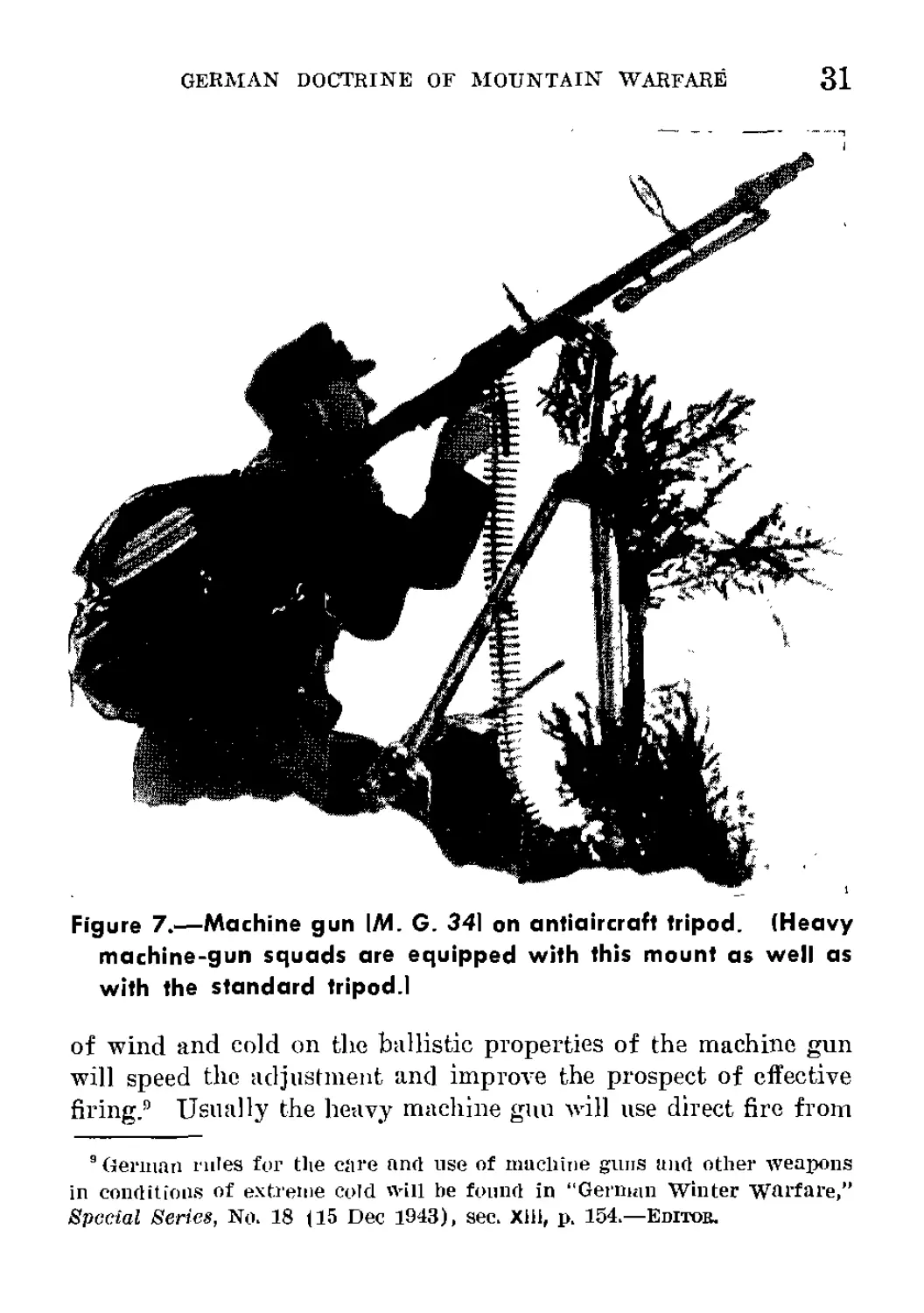
and mortars. The heavy machine gun. which can follow moun-
tain infantry everywhere, is either transported on pack animals
or carried by the crews (fig. 7). It often not merely comple-
ments, but i-eplaces, the artillery. The terrain and the ballistic
characteristics of the machine gun, which present more difficulties
in mountains than in the flat, affect its employment in combat.
The observation of the cone of fire in mountains is more im-
portant than in the flat because of the frequent contraction of
the beaten zone. Firing in rocky and dry terrain makes ob-
servation easier, and making proper allowances for the effect
’ See par. 24, p. 07. The German manna; antedates the inclusion of a
heavy-weapons company (sc/iwcre Kompanie) in the mountain infantry
hat union (see par. 25, p. t)S). At that time, 1935, German tables of organ-
ization called for a mortar company as well as a machine-gun company for
the battalion. Tactical principles for tne mortar company, however, apply
equally well to the mortar platoon of tlie uiachine-gun company, and have
been incorporated iii the appropriate sections. The only exception follows:
“Ou the mu roll the coimminder of a mountain infantry mortar coin]): my is
with the tffi-ce commander, and in combat is with him or with one of the
phi toons. He supervises the firing of the mortars to see that they follow the
tactical plan of the commander and controls supplies and replacements.” To
what extent this practice applies to the role of the present-day mortar-platoon
commander is not known.—Ешток.
GERMAN DOCTRINE OF MOUNTAIN WARFARE
31
Figure 7.—Machine gun IM. G. 341 on antiaircraft tripod. (Heavy
machine-gun squads are equipped with this mount as well as
with the standard tripod.I
of wind and cold on the ballistic properties of the machine gun
will speed the adjustment and improve the prospect of effective
firing.9 Usually the heavy machine gnu will use direct fire from
9 Gentian rules for the cure and use of machine guns it nd other weapons
in conditions of extreme cold will be found in “German Winter warfare,”
Special Series, No. 18 (15 Dec 1943), sec. Xiii, p. 154.—Editor.
32	GERMAN MOUNTAIN WARFARE
a concealed position. Alternate firing positions must be pre-
pared, but in selecting them it must be kept in mind that a major
change of position takes a great deal of time.
The mortar can follow mountain infantrymen off the road over
easy ground, and because of its range and its high trajectory it
can put fire on targets that other weapons can reach only with
great difficulty, if at all. It can also occupy positions, defiladed
from the enemy, from which artillery and other weapons cannot
fire. The rules for artillery with respect to reconnaissance,
marching, combat methods, and security apply also to mortars.
In mountain warfare, heavy machine guns generally are used
by platoons, and even when all the guns of the company are used
as a unit, the platoons will be allowed more initiative than in
the flat. For this reason the platoon commander must have a
thorough knowledge of battalion combat methods in mountains
and be able to lead his men in accoidance with sound tactics and
firing principles. The same is true to an even greater degree
for the company commander; the latter strives, even when the
platoons are separated, to control the fire of the whole company
in order to get a concentrated effect. He can thus prevent the
scattering of fire on targets of minor importance. To be capable
of independent action, the mortar-platoon commander also must
know the principles of mountain combat and be able to deliver
accurate fire with his weapons.
(2)	Marches and reconnaissance.—The rules for march inter-
vals are the same as for the mountain rifle company. To avoid
tiring the men, pack animals carry the heavy machine guns as
far as possible. Over long and very muddy stretches loads must
be taken off the animals and manhandled. If speed is required
and bad conditions force frequent unloading, the commander will
order the men to carry the equipment and fix a moderate rate of
march, particularly at the beginning. He will also take steps to
pi-event the men from falling down slopes and will arrange reliefs
for men carrying heavy loads. The pack train left behind should
receive definite orders. Often the unloaded animals must go over
GERMAN DOCTRINE OF MOUNTAIN WARFARE
33
detours and meet the company later at a rendezvous where they
may be loaded again. The heavy machine guns always must have
security against surprise attacks, for an encounter with enemy
patrols may take place at any time.
On the march, infantry mortars are generally attached to the
advance guard. If at all possible, they should be carried into
position on pack animals.
In mountains the reconnaissance of firing positions and ob-
servation posts takes a long time, if the combat zone is to be
covered effectively. The platoons must have time to find posi-
tions from which they can carry out as many missions as pos-
sible. From well-located positions machine guns can deliver
cross fires, while the forward and rear platoon positions provide
mutual support, Lateral and forward posts must supplement the
main observation post.
Hasty reconnaissance leads to an early change of position and
to an unnecessary interruption of action—a serious matter, be-
cause the heavy machine gun is frequently the only heavy weapon
available to support the rifle company. Men from the platoon
headquarters and the company headquarters detachment with
special training and much mountaineering experience should be
used for route reconnaissance. Frequently they should be as-
signed an engineer section with pack animals to carry entrench-
ing tools.
(3)	Ein-ploy ment in combat.—If the heavy machine guns are
in positions close to the forward elements of the rifle company,
they will have close contact and good communications with them
as well as a good field for effective flanking fire. If they are not
disposed in depth, however, they may not be able to fire over the
heads of the riflemen, to clear the masks close to their firing
positions, or to repel an enemy penetration. Machine guns em-
placed relatively far from the front line can deliver overhead fire
and can operate from behind cover and at points beyond the effec-
tive range of rifles and light machine guns. Machine guns so em-
placed can support riflemen attacking across a valley all the way
34
GERMAN MOUNTAIN WARFARE
up to the enemy line, and can also provide covering fire if the
riflemen are thrown back or enveloped. Crews of machine guns
echeloned in depth, however, have a hard time observing targets
and maintaining communications with the front line in an ad-
vance. They can rarely fire from defilade in high mountains, but
will generally use direct fire from concealed positions, resorting
to indirect laying only for distant targets.
In order to coordinate firing and change of firing positions so
that the riflemen closing in on the enemy will get continuous sup-
port, machine guns must be displaced by echelon. In defense,
silent machine guns 10 cover dead space and support defense at
short range, from the flanks, if possible. The coordination of the
heavy machine guns with the other heavy infantry weapons,
particularly those with a high trajectory, and with artillery, is
even more important in mountainous terrain than in the flat. To
achieve the cooperation necessary for the utmost effectiveness of
the few heavy weapons available for defense, fire plans must be
prepared in advance. Heavy machine guns are well suited for
delaying actions and withdrawals, but in mountainous terrain
they often cannot be fired at their maximum range.
Because of limited visibility in mountainous terrain heavy
machine guns are frequently attached to front-line companies,
the smallest attached unit being generally half a platoon. Because
the difficulty of supplying ammunition affects the operation of
machine guns in mountains more than in the flat, commanders and
gunners must be trained to economize on ammunition. They must
also learn to recognize the most dangerous adversary quickly and
must engage him at once.
Mortars may be used separately or as a unit, depending on the
situation. In combat they supplement the artillery, and they
are particularly suited for very close cooperation with units in
the front line. Indirect firing is usually the rule, but frequently
direct mortar fire will be very effective. After a rapid occupation
10 See p. 20. note 7.—Editor.
german doctrine of mountain warfare
35
of a concealed position, the mortars can quickly fire on point targets
and moving targets. Their fire is likely to be especially effective
on targets that are higher than the firing positions.
c.	Mountain Infantry Battalion11
Usually the mountain infantry battalion {Gebirgsjagerbatail-
lon) is the largest tactical unit which is employed for independent
missions.11 * 13 It may be reinforced with mountain artillery, heavy
weapons, combat engineers, signal-communication troops, and
supply columns.13 The personality of the commander, the example
that he sets for his men, and his mountain experience must develop
troops with spirit and an ability equal to the requirements of
mountain warfare. He must have a well-developed understanding
of terrain difficulties and a sense of timing troop movements.
The battalion usually marches in one column with advance,
flank, and rear security units whose strength depends on the situa-
tion. It rarely marches in several columns; but if the situation
requires more than one column, the separated units must know
how to fight and maintain themselves independently. To achieve
surprise, battalions may march at night and in fog, but only with
good leadership and thorough advance reconnaissance.
To recognize and reconnoiter the few routes of approach over
which attack is possible in the mountains is the task of combat-
reconnaissance; to exploit such routes tactically constitutes an art
of command. Often the initial disposition for the attack is
decisively important. To deploy heavy weapons takes a long
11 See par. 24, p. 97.—Editor.
38 The German mountain infantry regiment, for all practical purposes, Is
an administrative unit. The absence of a discussion on the tactical em-
ployment of the heavy-weapons company (лсйма?/‘с Kompanie) (see par. 25,
p. 98) in 1 He German nuiniinl is due to the fact that this organization was
uoi a part of the battalion when the manual was published.—Editor.
“The degree of reinforcement necessary may now be different because
antitank and infantry guns, the 120-nnn mortar, and an engineer platoon
were made organic in the monnhiin infantry battalion after the German
manual wim published.—-Editob.
36
german mountain warfare
time, and to change their position successfully without seriously
interrupting protective fires calls for careful planning. The bat-
talion commander detaches a reserve from the heavy-weapons com-
pany only to support a change in the battalion position. In attack,
centralized fire control of the heavy machine guns and infantry
mortars is a goal, although the terrain often demands the use of
platoons, half platoons, and even single mortars. It is necessary
to attach heavy infantry weapons to individual companies operat-
ing in mountains more frequently than in the flat.
The mountain artillery, which is nearly always under the con-
trol of the battalion commander, supports the attack as long
as possible without displacing. Individual guns whose effec-
tiveness can be increased by the allotment of additional ammu-
nition may be brought well forward even at the beginning of
the attack. By liaison with the artillery commander and by de-
pendable signal communication with all of his heavy-weapons
units, the battalion commander must try to have fire shifted
where he needs it as the attack develops.
It is well to hold reserves near elevations and crests from which
they can launch an attack downhill. Mobile mountain infantry
is particularly well adapted to pursuit in mountainous terrain.
By pressing on in a daring manner, often without artillery sup-
port and without stopping anxiously on lines where the enemy
offers little or no resistance, the battalion renders its best service
to the force of which it is a part.
Clear arrangements for the responsibility of command, for
disposition of reserves, and for careful siting of the heavy
weapons are of prime importance when the battalion is in a de-
fensive position. The numerous dead spaces and angles nearly
always found in front of mountain defense positions should re-
ceive special attention. Heavy machine gnus, trench mortars,
and, when necessary, individual cannon should protect its flanks.
Alternate firing positions must be prepared in advance so that
heavy weapons discovered by the enemy can be quickly shifted.
A fast and dependable observation and liaison service must keep
GERMAN DOCTRINE OF MOUNTAIN WARFARE
37
a sharp lookout for the approach of the enemy. If it is not
necessary to employ the whole force close to the main line of re-
sistance, and if an easily accessible position is available, the
commander creates a reserve. Sometimes a defensive disposition
in small groups may be advantageous.
d.	Mountain Antitank Company 14
The limited cross-country mobility of its prime mover limits
the antitank gun to the immediate vicinity of roads and highways
of valleys and passes.15 Although it can reach the zone in which
medium and heavy tanks can operate, it will often have trouble
negotiating mountain slopes and high valleys where small tanks
may appear. Off the road the piece nearly always has to be
manhandled. The split trail of the gun requires a firing posi-
tion as nearly level as possible. A slight difference of level
between the wheels and the trails makes it hard to elevate and
depress the tube.
The commander of the mountain antitank company (Gebirgs-
panzeyjagerkompawie} is the adviser of the regimental com-
mander on all questions of defense against tanks. He, his head-
quarters detachment, and his communication section must master
the technique of mountain climbing, but his command post must
be accessible to motor vehicles.
The platoon commander must use his platoon to create unfav-
orable conditions for enemy movement and to develop favorable
opportunities of action for himself. He must know the combat
technique of tanks and be trained to build obstacles in a skillful
manner. If his platoon is employed independently, he is re-
sponsible for the supply of ammunition, equipment, and food.
The platoon commander and his headquarters detachment must
14 This antitank company of me mountain infantry regiment is not to be
confused with the component companies of the mountain antitank battalion
(see pars. 23, p. 96. ana 27, p. 101).—Editoh.
“ Tn is would not be entirely true of an antitank guu on a self-propelled
mount.—Editoh.
38	GERMAN MOUNTAIN WARFARE
be qualified as Army mountain guides10 so that they will be able
to reach observation posts by climbing difficult slopes.
When advancing through narrow valleys, the guns should be
distributed in the march column early, because, once the march
has started, it may be impossible for them to pass other units.
If enemy armored vehicles are reported when the march column
is approaching a pass, it is advisable to manhandle the leading
piece, tube forward, over short stretches. The platoon com-
mander sees that the men moving the forward guns are properly
relieved. Snow limits the movement of the platoons to cleared
and packed roads, and ice on the roads frequently slows up the
march.
The antitank company rarely fights as a unit; the platoon is
the unit normally employed. In its area, which usually is very
small, the platoon organizes gun positions that command the
enemy’s line of approach. Under the leadership of the chief of
section the gun crews should be able to manhandle the gun up steep
slopes for short distances and even in difficult terrain should be
ready to fire quickly. They will do most of their firing by direct
laying on fast-moving targets which are visible only momentarily.
They also erect most of the antitank obstacles, but engineers are
often attached to set up extensive obstacles at key points.
The mission of the light machine-gim party of the antitank
platoon is mainly to protect the antitank gun, but it can also
help defend the antitank obstacles. The platoon commander
cannot always count on the assignment of mountain infantry
for security of the gun position. Going into position requires
so much time in mountainous terrain, and observation of the
enemy line of approach is so difficult, that it is necessary to pre-
pare to fire early.’ The antitank guns, therefore, cannot be kept
coupled to their prime movers behind the obstacle. In broad
valleys and on extensive plateaus the platoon operates as in the
flat. ’
"‘See sec. Ill, p. 79.—Editoh.
GERMAN DOCTRINE OF MOUNTAIN WARFARE
39
Because the company commander can seldom set up a central-
ized warning service the platoons themselves must operate the
warning service in their sectors. They are usually aided by per-
sonnel of the company headquarters detachment and of the com-
munication section.
For attack in a valley the guns, after a reconnaissance, should
be brought up to the rendezvous or firing position in echelons,
Defense requires careful reconnaissance of the possible line of
approach for enemy tanks and a sharp lookout for them in val-
leys on the flank and the rear. The difficulties of the terrain
usually prevent a shift of the platoon during combat,
8.	MOUNTAIN ARTILLERY 17
a.	General
The basic tactical principles for artillery in the flat remain
valid in mountains. In the approach march and in combat,
horse-drawn and motorized artillery is limited to the roads and
their immediate vicinity, The problem of clearing masks from
mountain roads usually limits flat-trajectory guns to long-range
missions, but there are many opportunities to use high-angle
guns.
Mountain artillery (Gebirgsartlllerie) can follow mountain in-
fantry off the mountain trails over easy ground, but snow, bogs,
or muddy roads, especially in the spring thaws, may seriously
hinder its employment. Mountain artillery can rarely fire in
groups of batteries, or even as single batteries, because of the
limited space for gun positions and the difficulty of fire control;
usually it is employed by platoons or individual guns. Occupa-
tion of positions and replacement of ammunition are much harder
and more time-consuming than in level country. Firing in
mountains differs from firing in the flat; the guns will usually
make precision adjustments and fire planned concentrations,
" See par, 29, p. 104.—Hditob.
580353°—44— 4
40	GERMAN MOUNTAIN WARFARE
b.	Reconnaissance and Observation
Successful and rapid employment of artillery in mountains
requires careful and early reconnaissance of routes, gun positions,
and observation posts. With the help of a map the artillery
commander gets a general idea of where the guns may find good
firing positions. Artillery reconnaissance units, sent out with
those of the mountain infantry and assigned to definite artillery
sectors, must determine the opportunities for firing which are
open to the different types of artillery. The use of motor vehicles
on roads and mountain horses on paths will speed up artillery
reconnaissance considerably. In addition to the reconnaissance
of the artillery commander, every subordinate commander must
make his own route reconnaissance and see that his approach
route is passable and is marked.
The reconnaissance of heights for possible observation points
must go on regardless of the difficulties of terrain. Because bad
weather can prevent observation for long periods, and visibility
and conditions of observation often change very quickly and un-
expectedly, it is often necessary to install several auxiliary ob-
servation posts at different altitudes. They should be distrib-
uted as widely and as irregularly as possible over the terrain to
decrease the effects of enemy fire and to provide several comple-
mentary fields of vision, especially for lateral observation^ These
posts should always be organized as small centers of defense,
and, if possible, should not be placed on conspicuous points. They
should have prompt and dependable communication with the fir-
ing positions by several independent means; lateral communi-
cation should be arranged between observation posts, and from
observation posts to adjacent units. Artillery observers with sig-
nal communication accompany the assault troops and direct fire
to keep pace with the infantry advance.
c.	Marches
Mountain artillery inarches in mountain order, closing up to
regular march formation only on roads. To save the pack ani-
german doctrine of mountain warfare
41
mals, the pieces, or at least the carriage alone, can be drawn
along good roads. For local security, the light machine-gun
section marches at the head of the battery in advance and at
the rear in retreat.
The artillery commander and his staff march in the advance
guard with the force commander. The attachment of individual
guns or platoons well forward in the advance guard is often
advantageous; but because mountain artillery moves slowly by
comparison with the other weapons and requires numerous road
improvements, most of the pieces have to march at the tail of
the column.
The gun and its crew march in close formation. Between the
men and animals the distance should be only great enough to al-
low for the accordion action of the marching column (fig. 8).
The distance between the sections changes according to the char-
acter of the terrain. The order is given for slackening the pace
before the beginning of the ascent. The gun crew takes measures
to prevent noises when near the enemy.
Inept saddling and loading may chafe and gall pack animals
and greatly decrease the mobility of the battery. Commanders
of all grades in mountain artillery must carefully supervise the
animal drivers and inspect saddling and loading, for if one gun
load drops out, a whole piece is put out of action.
At the beginning of a march it is better to move too slowly than
too quickly. Later the rate of march will depend on the steepness
of the slope; the pace should be steady and regular, both uphill
and downhill. A quiet, willing pack animal should head each
unit.
There should be a short rest for examining saddles and loads
not later than an hour after the beginning of an ascent. Pauses
for breathing spells for the animals should not be made on very
steep places. The first rest lasting at least 1 hour, during which
the men unload the animals, should come no later than 3 to 4
hours after the start. A level spot where men and mules will
not block the route makes the best resting place. All the animals
42
GERMAN MOUNTAIN WARFARE
Figure 8,—Mountain artillery on the march.
should be made as comfortable as possible. Ou comparatively
wide level places they should be placed crosswise to the route
with their heads toward the valley?8
ie If the animals are faced toward the valley, they are not likely to back
over the edge of a cliff; this may happen if they are faced up the moun-
tain.—Editor.
GERMAN DOCTRINE OF MOUNTAIN WARFARE
43
In a steep descent check cords are used because they relieve the
pressure caused by the load slipping forward. They are also
useful at danger points. Animals should be marched over un-
avoidable boggy places with great caution • at the narrowest
point a crossing should be strengthened by stones, earth, or
branches. If the ground is too soft, the men may have to unload
the animals. If the commander so orders, the packs of the men
may be placed on the backs of the pack animals when the ani-
mals are hauling the assembled guns on good roads.
d.	Employment in Combat
The bulk of the field artillery can find its best positions in
broad valley bottoms and on the gradual slopes of the foothills
(fig. 9). Often field pieces can be brought into position only by
manhandling and roping, and the crews must be trained for this
expedient. Deployment on a broad front is best for field ar-
tillery, but conditions will frequently force it to echelon in depth.
1
Figure 9.—Medium artillery (Skoda 150-mm howitzerl firing in
the valley below Mount Olympus during the Greek Campaign
(19411.
44
GERMAN MOUNTAIN WARFARE
Figure 10.—150-mm howitzer (s.F.H, 181 on a mountain road. (This
gun was employed by the Leibsfandarfe-55 "Adolf Hitler" mo-
torized division during the Greek Campaign, 1941.)
GERMAN DOCTRINE OF MOUNTAIN WARFARE
45
As a rule, flat-trajectory batteries will be in the rear and high-
trajectory batteries in front. Officers, observation sections, and
communication sections of field artillery employed in mountains
must have mountaineering equipment and training.
Mountain artillery provides the only reliable artillery weapons
in mountains, except in large valleys. Emplacing mountain guns
and replacing ammunition are generally difficult and require
considerable time. Pieces must have positions that enable the
commander to adapt the plan of fire to the conduct of the battle
and to concentrate fires in decisive places. The force commander
needs information on the availability of the artillery for certain
missions; he must know in particular how7 long the main elements
of the artillery will take before they are ready to fire. With
situations hard to evaluate, liaison with the force commander
cannot be too close.
Field artillery, especially high-trajectory batteries, initially
protect an advance into large valleys or mountainous terrain on
either side of valleys (fig, 10), When a column expects to en-
counter the enemy at the very beginning of an ascent or descent,
some artillery should protect the movement. The remainder of
the artillery remains in the march column, sending out advance
patrols to reconnoiter possible gun and observation posts.
Mountainous terrain often makes it difficult for the artillery to
provide continuously the protection needed for an assault on an
organized position; more frequently than in the flat it displaces
forward by echelon. Under the protection of the artillery units
in position, the other batteries follow7 the assault troops, and, by
leapfrogging, keep up with the advancing infantry. In ca'sfei-of
an encounter, the displaced echelon gives direct support' to tfie
forward units. Because of the time necessary in getting mountain
artillery ready to fire (fig, 11, p, 46), the artillery commander
should save time by advance planning.
Mountain artillery can rarely support an attack from all the
positions from which it has covered the deployment and assembly;
most of the observers and the pieces will have to have new7 and
46
GERMAN MOUNTAIN WARFARE
Figure 11.—Roping an artillery piece down a cliff.
german doctrine of mountain warfare
47
carefully reconnoitered positions. Because the field of vision from
the observation post will often extend up to the point of penetra-
tion but not deep into enemy terrain, artillery observers must
accompany the assault troops and further observation must be
furnished by air units.
The communications of artillery with the assault troops and
the coordination of its fire with those of other heavy weapons
require special care. The assault troops need highly effective sup-
port up to the very point of penetration. Without such support
they are likely to draw fire just before they reach their objective.
An infantry attack over rising terrain is easier to support up to
the moment of penetration than one over descending terrain, but
in the former case artillery fire may dislodge rocks which will
endanger the advancing troops. Often in the last stage machine
guns and mortars must take the place of artillery.
In a pursuit through mountains, artillery fire is needed to help
overcome quickly the resistance of enemy rear guards taking
advantage of cover, but getting enough ammunition forward in
time becomes the critical problem. In such a situation it is hard
to establish a balance between ammunition supply and food supply,
even in broad valleys.
In mountain terrain, artillery defensive fires are hard to lay
down, because the areas that the enemy uses for carrying out his
attack are often masked, full of dead spaces, and widely separated.
By means of well-placed observation posts, good communications
with batteries, platoons, and individual guns, and an abundant
ammunition supply, the commander must make up for limited fire
power by greatly enhancing the flexibility of his defense. In many
places tlie other heavy weapons supplement or replace artillery,
and in others the pieces can be used only as silent guns 19 far forward
and on the flank. In sectors where only a mobile defense of coun-
terthrusts is feasible, the artillery must adapt itself to the situation
by echeloning in depth. The fewer the possibilities of frontal
action, the more the batteries must be alert for surprises and be
10 See p, 20, note 7.—Editor,
48
GERMAN MOUNTAIN WARFARE
ready to fire on an enemy that has penetrated the defense position.
In case of a breakthrough, the batteries join with the centers of
resistance in the front line and organize strongpoints which must
fight, if necessary, until the guns are lost.
9.	MOUNTAIN ENGINEERS20
a.	Missions
Mountain engineers (Gebirgspioniere) should not be assigned
tasks of minor importance. If the loads are good, motorized
engineers may well be assigned special missions on and near them.
The most important missions of the engineers in mountain
combat are—
(1)	Construction and removal of major obstacles. The destruction of
bridges, tunnels, and embankments along major roads and railways in de-
fense and retreat and the replacement of mountain bridges in an advance
may be of utmost importance in combat.
<2)	Bridging mountain streams. The bridging of torrential streams
with steep banks and highly variable water levels, and the construction
of light, emergency bridges require special skill (fig. 12).
(3)	Improvement of supply routes in sectors of special importance by
blasting routes and paths in rock and ice, building bridges, cable railways,
and supply slides.
The commander of the mountain engineer battalion (Gebirgs-
pionierbataiUon) is the adviser of the force commander in all
engineering matters. On extensive projects the battalion oper-
ates as a unit, but usually it is divided into smaller groups.
Projects in the rear areas must be turned over as soon as possi-
ble to work battalions in order to release mountain engineers for
combat missions.
b.	Employment in Combat
Mountain engineers should be incorporated in the advance
guard, far forward, if necessary, and the mountain reconnais-
sance detachments must often be reinforced with an engineer de-
See pur. 30, p. 108-—Editor.
german DOCTRINE of mountain warfare;
49
50	GERMAN MOUNTAIN WARFARE
tachment. With equipment loaded on pack animals, the engineers
have the same mobility in mountains as the mountain artillery.
The engineers provide security for shelters by constructing ob-
stacles at particularly important and difficult points. On ap-
proaching a river the engineer commander makes plans to bring
forward engineers and bridging equipment quickly.
In attack, the mountain engineers support the advancing
troops by removing obstacles and attacking strongpoints. They
also serve units fighting away from valley roads by preparing a
route for transporting supplies.
In pursuit, motorized engineers can clear away obstacles, re-
construct destroyed bridges in collaboration with pursuit col-
umns, and block enemy routes of retreat.
In defense, the mountain engineers first set up obstacles in
important areas in front of the main line of resistance to delay
the approach of the enemy. Then they help the infantry or-
ganize the main defense zone, placing entanglements at probable
focal points of attack, camouflaging positions, building bridges
and foot paths, and improving the supply system by erecting
small aerial railways. Tile engineers by themselves prepare ma-
jor technical defense measures such as rock and snow avalanches,
which will not be used until the battle starts, when they are put
under the control of the local tactical commander. The en-
gineers can thus greatly assist weak units which are defending
a wide front. When a front becomes stabilized, they construct
caves, tunnels, and galleries of all kinds and conduct mining
operations.
In delaying action, engineers should be used to place whatever
large obstacles are needed in front of the lines of resistance and
at intermediate delaying positions linked with the road net. One
major demolition of strategic significance often furthers the gen-
eral plan of operation more than a number of small demolitions.
Engineers must be ready to reconstruct bridges destroyed by
enemy flyers in rear areas. e
When retreating, obstacles created in valleys delay the pursuit
GERMAN DOCTRINE OF MOUNTAIN WARFARE
51
by the enemy. Close communication between the infantry and
engineers is important, because combat troops must be informed
in ample time of the location and the nature of the obstacles
and the distance between them.
10.	MOUNTAIN SIGNAL AND COMMUNICATION
TROOPS 31
a.	Missions
Because the strain on the physical powers and morale of mountain
signal and communication troops {Gebirgsnachrichtenti'uppen
und GebirgBtrv/ppennaGh'richtenpeA-iiOnal'} is very great, they must
be excellent mountain climbers with great endurance. The com-
mander of the smallest unit must have a thorough technical
knowledge of signal equipment.
The mountain signal unit sets up signal communication be-
tween the command posts of divisions or brigades and the sub-
ordinate troop units. To install the network promptly, platoons
or sections must be assigned in advance to the subordinate com-
mand posts. When the signal unit commander cannot intervene
locally himself, he must consider assigning some of his troops
to certain march and combat groups. In the main, the com-
munication platoons and sections of the units themselves install
communications within regiments and battalions; but when a
major engagement develops, regular signal troops must reinforce
and relieve this network. All signal and communication officers
must work together for smooth cooperation between the signal
unit and the communication detachments. The commander of
the mountain signal unit proposes the communication plan for
the march and for combat.
b.	Marches
Mountain signal units not otherwise disposed march with the
commander of the column in the advance guard or wherever in 21
21 See par. 22, p. 91, and par. 31, p. 108.—-Editor.
52
GERMAN MOUNTAIN WARFARE
the column it seems probable that they will be used later- The
communication platoons of regiments and battalions always march
as far forward as possible. The column commander distributes
the various units after consulting the signal unit commander.
The communication sections of the artillery and of the mortar
company22 and the antitank company are divided between their
own units and the commander’s group. Other communication
sections march with their units. Only pack communication
troops can move over narrow, steep mountain trails.
c.	Employment in Combat
The mountain signal unit should be reserved for use in real
mountain terrain, where ordinary communication units cannot
go. In an advance through mountains, the mountain telephone
platoons will usually lay a trunk line, using heavy cable. Their
line should connect with the lines of telephone platoons in the
valley that follow the mountain detachments as far as they are
able. Radio and blinker stations, established on the main line,
relay messages from patrols or advance guards over that line
to the command posts. Whether the point of the advance guard,
important patrols, and flank guards are accompanied by radio
and blinker detachments or use organic communication units
depends on the equipment available.
The communication detachments of all mountain units are to
be spared during the advance and held ready for immediate use
when contact with the enemy is imminent. Mountain reconnais-
sance units and important patrols should get communications
first from the communication platoon of the regiment rather
than from the communication platoon of the battalion. For * 30
22 The German mountain division no longer has an independent mortar
company. Instead, it now usually has an 81-mm mortar platoon in the
machine-gun company of each battalion, a 120-mm mortar platoon In the
heavy-weapons company of each battalion, and a 50-mm mortar squad in
each platoon of the mountain rifle company. Also, the latest organization
of the heavy-weapons company includes a communication platoon (see fig.
30, p. 94).—Editor.
german doctrine of mountain warfare
53
communications with its patrols, the artillery depends on its
own equipment, but it may use available mountain infantry in-
stallations. Blinker and radio sections in the advance guard
maintain communication with the reconnaissance units and make
the results of reconnaissance quickly available. A telephone sec-
tion can sometimes maintain wire communications for reconnais-
sance units and advance guards. Such lines are called recon-
naissance lines.
Only radios are used for communication among the several col-
umns of battalions or regiments. They also supplement wire
nets over rear lines. Radio traffic should be carefully scheduled.
With the development of combat, the wire net should constitute
the framework for signal communication and should be extended
wherever possible with radio as a supplementary means.
Because the consumption of wire in mountains is very high,
units must carry a good supply of it. Locating and clearing
trouble on wire nets, which require much time and personnel, can
be facilitated by establishing testing points at proper intervals.
Men setting up stations must take into account rockfalls and
avalanches, wind, cold, dampness, and lightning, and they must
camouflage all the tents they set up. Since recovery of cable takes
much time, in a short engagement the commander must decide
whether to do without wire communications or to take the loss of
materiel.
In addition to telephone and long-wave radio, the following
means of communication are used in high mountains:
(1)	Portable radio sets. These can be put into action quickly if their
location and tile weather are favorable. They are good for coin шии lent ion
with the artillery.
(2)	Heliograph apparatus. When usable, it is preferable to radio, because
it cannot be intercepted.
(3)	Blinker apparatus. Its utility is limited because it transmits slowly
and depends on satisfactory terrain and weather. It can, however, transmit
prearranged messages quickly.
(4)	Signal flags. They are n good auxiliary means when other methods
are not feasible. To economize on equipment, they are used t,o supplement
communication lines wherever possible.
54
german mountain warfare
Figure 13.—Mountain troops with a messenger dog.
(5)	Messengers, Because of the time element they are not very useful
but they cannot be dispensed with entirely.
(6)	Carrier pigeons. They can be successfully used if there are no birds
of prey in the vicinity.
(7)	Messenger dogs (fig. 13). They can carry messages rapidly, but they
cannot go over even easy climbing terrain/3
d.	Technical Considerations
(1)	Wire commtfnicaiion.—On permanent lines the cables
should not be bent at a sharp angle horizontally or upward. The
lines must sag to withstand great changes in temperature, the
!a See par, 14b, p, 66.—Editoh.
‘ GERMAN DOCTRINE OF MOUNTAIN WARFARE	55
weight of ice. and high winds, and all lines should be strung high
enough to prevent them from being buried under snow. In order
to prevent breaks, frost and snow must be knocked off wire often
with long sticks. In valleys and other places protected from the
wind, poles may be 80 to 160 yards apart, but on windy heights
they must be much closer together. On very windy crests and
mountain peaks, lines must he anchored to the ground or strung
through insulated pitons. On cliffs, small wooden stakes driven
into cracks in the rock hold the cable. To avoid interruptions to
communications caused by avalanches and rockfalls, Army moun-
tain guides24 must carefully reconnoiter the threatened places, and
use should be made of the knowledge of the local inhabitants. A
specially armored cable offers some protection against rockfall.
Cables laid loose on snow and ice soon break and must be
replaced after every snowfall. When there are no natural high
supports, the cables may be strung on tripods about 1 yard
high, made of wooden slats, that can be pulled up after a snow-
fall and placed on the surface. The line may have to run through
a conduit, which must always be marked with small flags on both
ends. If there is no danger of interception, steel or strong iron
wire, with the outgoing and return lines spaced fairly far apart,
may be laid on top of the snow and allowed to freeze in.
To prevent damage and injury from lightning when wire is
strung on poles, every second or third pole should have a
grounded lightning arrester—a strong 0.2-inch steel wire or a
bundle of several thinner steel wires nailed along the pole. The
wire should be extended about 8 to 10 inches above the pole and
wrapped once or twice around the embedded part of the pole,
Cables attached to trees or laid on the ground do not need light-
ning arresters, but all switchboards do. Summits, rocky spurs,
and high ice and snow peaks offer no good ground; therefore,
telephone equipment in such terrain must be provided with a
special lightning arrester, consisting of poles with zinc-covered
2,1 See sec, lii, p, 79,-—Editor.
5901153°—44-5
56	GERMAN MOUNTAIN WARFARE
iron points on top. On these are soldered 6 to 12 iron wires
one-sixth of an inch in diameter, laid out like a screen So that
they hang down free 10 to 20 yards. The arrester works still
better if each hanging wire is split into 3 to 6 smaller wires.
Negligence can destroy communications and personnel; continual
supervision is necessary because most people incline to under-
estimate an invisible danger.
(2)	Radio communication.—On peaks or crests, radios have a
long range, but static interferes with reception. The position
of the transmitter with respect to the mountains between it and
the receiver affects the strength of the signal. If the angle from
the transmitter to the highest point on the line between the
transmitter and receiver is less than 45 degrees, the loss of energy
is of no practical significance. The greater the angle, the more
energy is absorbed by rock, and the range is reduced. The ultra-
short-wave transmitter requires an area without defilade for 100
to 200 yards, but its signal is less subject than that of long-wave
sets to atmospheric disturbance.
Strong sunshine, especially on snow- and ice-covered slopes
facing the sun, dissipates energy and temporarily lessens range.
Deep ravines and gulleys and humid, leafy woods likewise re-
duce the strength of signals, and radios in rock caves and rock
tunnels can neither send nor receive. When the signal is strong
and distances are short, indoor antennae may be used in caves
and tunnels constructed of ice or snow. Shifting a set a few
feet often improves short-wave transmission and reception. It
is necessary to ground antennae promptly and thoroughly because
of the danger from lightning.
Snow and frost should be removed from antennae and grounds,
and the whole radio set with its accessories and portable genera-
tors must be protected against dampness and cold.
(3)	Visual signal communication.—Opportunities for visual
signaling increase with altitude, but systematic employment of
such means requires reconnaissance and thorough study of large-
scale maps. Mists and clouds may limit to certain hours visual
GERMAN DOCTRINE OF MOUNTAIN WARFARE	57
communication between two points of a valley or between a
mountain and a valley or between two peaks.
The use of smoke signals facilitates mutual identification for
visual signalers. Where there is no direct visibility, a message
can be sent a short distance at night by lighting up an inter-
vening lake surface, glacier, snow' field, or cloud layers. This
is a useful expedient when the rear blinker position has to blink
toward the enemy.
For alarms and similar short-range communications the com-
mander may order special signals, such as smoke signals in the
daylight and beacons at night, which can be recognized at great
distances from many sides.
11.	MOUNTAIN SERVICES 25
a.	Mountain Medical Service
The combat units themselves must cooperate more than in the
flat in providing medical service, especially in forward areas, in
difficult terrain, and among cliffs. They must be able to give first
aid to the wounded and sick and to rescue the wounded from
particularly difficult areas.
By repeated and regular examination and instruction, medical
personnel must prevent diseases and injuries which develop from
strain and exposure. Medical officers must continuously supervise
the young soldier to determine the effects of physical exertion.
Snow blindness, sunburn, frostbite, and diseases caused by careless-
ness must be kept at a minimum. In addition to dressings, the
soldiers even in the very smallest units must carry snow goggles
and antisunburn and antifrostbite creams.
Treatment of the wounded in forward areas is most difficult
because a single company often is spread over a wide front in
terrain which is difficult of access. Without the help of the combat
troops the wounded can rarely be brought from scattered front-
See par. 32, p, 108-—Editor.
58
GERMAN MOUNTAIN WARFARE
Figure 14.—Roping down a casualty. (The casualty is secured to a
standard sled stretcher.)
GERMAN DOCTRINE OF MOUNTAIN WARFARE
59
line aid stations to the advanced emergency dressing stations or to
the regular battalion aid stations. As a rule, the wounded remain
at the battalion aid station until the litter bearers of the medical
company carry them to the clearing station.
The battalion surgeon directs evacuation and disposes his medical
platoon properly along the lines of evacuation. The most difficult
evacuations are those from steep cliffs where the wounded have to
be roped down (fig. 14). On terrain off paths and on narrow paths
the wounded are back-packed in shelter halves or carried in one-
pole litters; ou cart roads, regulation litters, ordinary local moun-
tain vehicles, or motor vehicles may be used. If slightly wounded
men ride down mountains on mountain saddle horses, detailed
safety measures should be issued. The practice of riding, however,
should be avoided as much as possible. The wounded should not
be carried by pack animals.
If the snow is right, medical personnel can use regular or ski
sleds for evacuating the wounded.20 Sometimes they may even
use skis off the road, and make use of any available aerial tram-
ways. Unless there are mountain roads, the wounded can be
loaded on ambulances only in valleys. From here on they are
evacuated as in the flat.
The difficulties of evacuating the wmunded call for a larger body
of medical personnel and litter bearers than are needed in the flat.
The men evacuating the wounded carry up fresh medical supplies
on their return trip.
The medical officers and noncommissioned officers of mountain
medical units must qualify as Army mountain guides and must be
able to train their own personnel scientifically in mountain opera-
tions, to direct the roping down of the wounded from difficult cliffs,
and to render first aid themselves in places difficult of access. The
medical troops must have the same training in mountain climbing
as other mountain soldiers.
" See “German Ski Training and Tactics,” Special Series, No. 20 (31 Jan
1944), appendix D, p. 96.—Editor.
60
GERMAN MOUNTAIN WARFARE
b.	Mountain Veterinary Service
A veterinary officer should always accompany the larger moun-
tain detachments. For this service he must be perfectly healthy,
strong, and hardened. Since the mountain veterinary service calls
for special knowledge and great experience, the standards of selec-
tion should be high. The blacksmith section must be trained for
mountain service. The noncommissioned blacksmith and his men
should not have to lead pack animals.
Sick and wounded animals still able to march are led to an
assembly place for sick animals; they are allowed plenty of rest
in protected places on the way. Animals that cannot be moved
from heights are left in alpine pastures and cared for there.
They need little care, and if necessary may be left at haystacks
with feed. If they cannot be transported at once, they need not
be shot. On suitable trails the men can lead the animals with
minor wounds to the dressing slation or to the animal ambulance,
and in winter may try to evacuate on sleds those that cannot walk.
The veterinary equipment, including oxygen apparatus, stays
with the combat train of the mountain echelon. The veterinary
officer and the blacksmiths carry veterinary pouches on their
saddles or belts for first aid.
Every pack animal should have two horseshoe pouches ou its
saddle, each with a front shoe, a hind shoe, 32 nails, 8 blunt calks,
and 8 sharp calks. In one of the horseshoe pouches there is also
a screw calk wrench. The most appropriate kind of horseshoeing
includes screw calks and sharp toes and shanks. Every pack
animal leader must know that the calks should be tightened and
renewed from time to time. The screw calk shoe can be adapted
to roads of all kinds, and hence always assures the animal a good
footing and the least possible fatigue. If the anima] marches
without calks, the screw holes should be filled with plugs of oiled
tow. The commanders and men must clearly understand that
they are responsible if the animals cannot march, become tired too
soon, or stumble because of improper use of the calks. The ani-
GERMAN DOCTRINE OF MOUNTAIN WARFARE
61
mal leader must put on the calks, properly under the supervision
of the blacksmith.
c.	Mountain Supply
As there is uo food in high mountains, the men depend entirely
on transported supplies, which are difficult to bring up. Sup-
plies usually go through valleys in motor vehicles, and by animal
or porter columns in pathless terrain; but when snow, ice, and
bad weather seriously hamper regular movement, caterpillar trac-
tors and snow plows niay be put to use.
For supply purposes, mountain troops require a valley echelon
as well as a mountain echelon. The valley echelon is responsible
for all horse-drawn and motorized vehicles including the second
rations train. Besides ammunition the valley echelon carries
food for 2 days, forage for 2 days, reserve clothing and moun-
taineering equipment, and baggage.
The mountain echelon consists of pack-animal columns which
may be supplemented by porter columns. It should be able to
carry ammunition for 1 to 2 days, food for 2 days, oats for 3
days, and a part of the baggage. It includes the pack animals
carrying medical and veterinary equipment, the mountain kitchen,
and pioneer and mountaineering equipment.
Extra mules may be needed to carry water. The number of
pack animals necessary will depend on the weight of the food,
ammunition, equipment, and baggage, and the carrying capacity
of the animals.
Ordinarily the mountain units will have food for 4 to 5 days.
If the distance from the troops to the valley echelon is greater
(han a day’s inarch, the mountain echelon must be reinforced in
order to set up new distributing points closer to the troops and
to keep them constantly supplied. When position warfare starts,
some of the pack animals of the combat units should be used for
supply purposes.
The use of aerial railways takes a great burden from the pack
62
GERMAN MOUNTAIN WARFARE
Figure 15.—Use of an aerial railway to move supplies.
animals and porter columns (fig. 15). In difficult rocky terrain
and in snow-covered, high mountains improvised rope elevators
or airplanes are often the only means for supplying large units
regularly.
When non-monntain troops fight in high mountains, they
should be equipped if possible with pack animals and light trucks
or with the usual local vehicles. Since these troops will generally
be used near roads, they may be allowed to keep their regular
baggage vehicles.
Section II. TRAINING
This section is based on translations of several
German documents and on other sources. Figures
17, 18, 19, 20, and 21 have been redrawn from
sketches in Ausbildungsvorschrift filr die Gebirgs-
truppen (A.V.G.), Heft 1, Alpine Technfk, H.Dv, Nr.
374/1 (Training Manual for Mountain Troops,
Volume 1, Alpine Technique, Army Manual, No,
374/1, no date,)
12.	GENERAL
Experience on the Austro-Italian front in the First World
War convinced German military experts that all soldiers fight-
ing in mountains needed some special training, and particularly
that soldiers fighting in high mountains should have an intensive
course of considerable duration. In the period between the
wars the German Army continued to train mountain troops. The
mountain soldiers in the days before Hitler seem to have re-
ceived the high degree of training which has since been reserved
for Army mountain guides (see sec. Ill, p. 79). When the Ger-
man Army was expanded, mountain units grew with the rest of
the Armed Forces. The Anschluss brought a further accession
of strength, because Austria had specialized in training moun-
tain soldiers for over half a century,
As the training program expanded, the standard of achieve-
ment in mountaineering was somewhat lowered, It was felt that
not all mountain soldiers need to be expert mountaineers. Con-
sequently German mountain training is now carried out on two
levels; a course for Army mountain guides, including skiing, for
officers and a number of selected enlisted personnel, and a less
thorough course for the remaining enlisted personnel of the
mountain divisions.
63
64
german MOUNTAIN warfare
The training of the mountain soldier begins in the flat, and
for 6 months he learns the fundamentals of soldiering. He usu-
ally arrives in the mountains in early summer, and remains for
a full year.
During the first phase of the course he is introduced to moun-
taineering and is led gradually on climbs of increasing difficulty.
Men who are to be trained as Army mountain guides are selected
on the basis of military performance and tests of mountaineer-
ing ability and receive separate training. They alone receive
instruction in military mountain skiing. The other soldiers learn
to move over the snow with or without snowshoes, and later their
marches are combined with training in military operations in
snow. In the middle of January the soldiers go by groups for
20 days of training in high mountain stations where they are
sure to find snow the whole time. Here they fire rifles and machine
guns under simulated combat conditions (fig. 16).
Figure 16.—Mountain riflemen firing under simulated combat
conditions.
TRAINING
65
13.	INDIVIDUAL AND UNIT TRAINING
Although there arc different degrees of specialization among
them, all German mountain soldiers may be considered specialists.
They go through a long, arduous monntam-traiiiiiig program.
During their training they are treated less like regular infantry
than like students at a military school, and they are exempted
from parades, inspection, drill, and manual of amis. This treat-
ment and this training are given not only to mountain combat
soldiers but, to ninle drivers, cooks, and other service troops as
well.
However, reports concerning German mountain units engaged
in the present Italian campaign indicate a curtailment of the
training program since the outbreak of the present war. Some of
the personnel, after they had received basic infantry training, were
merely taken on a few walks and climbs in the mountains; others
were sent to the Tyrolean Alps in Austria for advanced training,
including roping and handling of pack animals. Then, during
the summer, the latter received a three-week course in skiing in
regions of perpetual snow. Their training was completed with
participation in maneuvers in the mountains.
When he has finished his course, the mountain soldier is one of
the best trained soldiers in the German Army, and from that time
on he is likely to be one of the best equipped. Because each moun-
tain unit is largely recruited from one mountain district, mountain
soldiers are likely to add local pride to their pride as select troops.
The final result is high morale and esprit de corps, although these
attributes are likely to find expression in an individualism that
conceals the high degree of self-discipline imposed by each man
upon himself. This attitude is probably the natural outcome of
training designed to prepare the mountain soldier for a virtually
self-sustaining role in combat.
66
GERMAN MOUNTAIN WARFARE
14.	MOUNTAINEERING
a.	General
Despite the dangers and hardships of mountain training, the
Germans believe that they can instill in soldiers a love of the
mountains that will make them regard any other service as tame
and uninteresting. The joy that the individual soldier derives
from mountains and mountain climbing is a basis of training. The
hard but rewarding task of officers in charge of training is to
develop this love for the mountains and foster it. They are helped
in this by the fact that most of the recruits come from Alpine
country. To give the soldier self-confidence, officers set a patient,
systematic pace in training. They raise the physical and technical
requirements gradually so that the beginner unconsciously attains
the calm self-confidence that he needs. As the fondness for moun-
tains increases, officers will encourage the troops to climb moun-
tains and to ski as a recreation, always, however, under the super-
vision of an Army mountain guide. The alert commander, staying
close to his men on and off duty, quickly gets to know their worth,
because service in mountains quickly tests their character. Thus
he can have clearly in mind which men are best qualified as non-
commissioned-officer replacements.
b.	Scale of Requirements
To systematize training in mountaineering, the Germans have
worked out a graded series of requirements based on the degree
of difficulty of the terrain and the duration of the march. Achieve-
ment in mountaineering is marked by a steady increase in physical
endurance, as demonstrated in mountain marches, and by a cor-
responding improvement in mountain-climbing technique. While
improving his performance the mountain soldier also gets the
experience that he needs for the service.
For purposes of training, the Germans classify mountain terrain
as follows:
TRAINING
67
(1)	Easy walking terrain—pathless terrain, including ridges and slopes,
over which men can walk without danger of falling,
(2)	Difficult walking terrain—steep rock ridges and ragged slopes over
which the nt_en can move without using their hands if they choose the right
route, but where they run the risk of slipping,
(3)	Easy climbing terrain—exposed grass or rock ridges where even the
trained mountain climber must at times use his hands to keep his balance
and sense of security but has no trouble in choosing a route,
(4)	Moderately difficult climbing terrain—ridges and faces of grass or
rock with small but good handholds and footholds. This terrain requires no
very special technique, but calls for acumen and experience in selecting a
route that will avoid major difficulties,
(5)	Difficult, very difficult, and extremely difficult climbing terrain—very
steep, exposed ridges some parts of which can be climbed only with special
equipment and technique.
Bad weather or a coat of ice increases the degree of difficulty
of moving over roads, paths, and otherwise easy walking terrain.
The Germans consider that moving under full pack and arms
instead of merely with mountaineering equipment demands an
increase in efficiency corresponding to one degi’ee of increase in
terrain difficulty, as classified above.
The Germans set out minimum standards of proficiency which
all mountain soldiers must attain. They must practice until
they can make any kind of ascent (Steigeri)1 on a road or path
free of snow. They must also learn to walk on easy wooded,
grass, and scree slopes, until they can master fairly difficult ter-
rain which requires easy to moderately hard climbs. In the snow
they are required to walk with snowshoes on roads, over easy
and difficult terrain, and through woods and low, protected draws.
They must also be able to get over icy stretches and make mod-
erately hard climbs. The Germans teach that individual training
in mountaineering attains its goal only when the regular moun-
tain soldier under normal conditions of marching and combat
1 Steiffen Is used as tbe generic word for any kind of ascent, The Ger-
mans use Klefteret to denote moving up or down slopes on which the climber
must use Ыв hands.
68	GERMAN MOUNTAIN WARFARE
can move about in all kinds of terrain in a quiet. orderly,
confident way, without wasting time or unconsciously taking
unnecessary risks,
c.	Technique
(1)	Marching.—The first thing that a recruit in a German
mountain unit is required to learn is mountain marching. Moun-
tain marching means not only the ability to make ascents and
descents on and off roads, but also the development of self-assur-
ance and rooted habits of march discipline.
The German mountain soldier is taught to make ascents at a
slow and rhythmic pace, and to develop an even stride which is
not too long. He walks not on his toes and the ball of his foot
but on his entire foot from toe to heel. When his forward foot
is set, he puts his full weight on it so that he will not slip. He
walks erect, not leaning into the slope: and he keeps his knees
loose. He breathes deeply. The fundamental principle in march-
ing as elsewhere in German mountain training is conservation of
energy. So that they will be as fit as possible for combat, the
German mountain soldiers are taught to avoid hasty ascents, long
strides, stiff-kneed walking, straight uphill climbs, and steep
paths, and to zigzag gradually up steep slopes wherever they can.
Their training emphasizes inarch discipline; all marches are
closely supervised. They are taught not to bunch up but to
maintain their prescribed distances, and not to take short cuts
or stop unless ordered. They learn to cut down on talking to
save wind, and straggling is absolutely forbidden.
(2)	Climbing.—The inexperienced German mountain recruit
learns to climb by starting on easy rock so that he gradually ac-
quires confidence and gets a feel for the work. He is taught to
use his legs slowly and rhythmically, to use his arms to provide
support and balance, and to pull his body up with them only
when absolutely necessary. The Germans teach their mountain
soldiers to pick handholds and footholds not too far apart, to
grasp them slowly, test them, and always keep weight on three
TRAINING
69
points in going up. When the German mountain soldier climbs,
all his muscles work together, and he breathes quietly and easily
and tries to achieve perfect balance. In descents he avoids sitting
down, lest he slide too fast for control, and if the rock is not
very steep and the footholds are good, he goes down with his
back to the rock. He learns to be especially cautious on steep
grass slopes, because they are treacherous. In traversing them
he gets footholds on tufts, keeping the inner edge of his foot
close to the slope. On straight descents he kicks his toe well
into the grass. He never uses tufts as handholds for pulling
himself up.
On steep snow and ice the German mountain soldier is instructed
that he has to kick or cut steps for himself for safe climbing, unless
he is using crampons, As on rock he takes short steps and usu-
ally zigzags to save his strength. When he can see the bottom
of a snow slope from the top, it is permissible for him to glis-
sade, or slide down on his feet. In glissading he learns to change
his course, slow down, and stop with the aid of his ice-ax (see
(3), below). He is warned against attempting to glissade with
crampons on, or on a solid-frozen ice slope, or when he cannot
see the full length of the slope.
(3)	Special climbing equipment.—The special climbing equip-
ment used by the German mountain soldier depends on the kind
of surface he is going over. A basic principle is that the weight
of it must be kept to the absolute minimum. On rocks he learns
to use rock pitons, snaplinks, and rope- or felt-soled rock-climbing
shoes {Kletterschuhe} (see fig. 24, p. 85); on grass, crampons;
on suow, snowshoes (Sohm’m-eifen) ; on ice and snow, snaplinks
and ice pitons. On all three types of surfaces he uses his rope
and his ice-ax.
The German mountain soldier regards his rope as his most im-
portant piece of climbing equipment, and he is taught to take good
care of it. The rope consists of about 100 feet of twisted hemp
of the highest quality, seven-sixteenths of an inch in diameter.
He dries it in the open air. hangs it from a peg in loose loops
70
GERMAN MOUNTAIN WARFARE
when not using it, and repairs it promptly, Before he makes
use of the rope, he learns three simple knots: the overhand
noose, the square knot, and the double overhand noose (figs, 17
and 18), The double overhand noose is made by dropping part
of the loop of an overhand noose back through the knot and
then passing the original loop through the small loop thus
formed (fig, 18),
Figure 17,—Basic knots used by German mountain troops.
IQ Overhand noose, for securing a man to the rope; @ square
knot, for joining ropes together; @ sling, for securing the rope
to a projection for the purpose of belaying.)
German mountain soldiers are likely to climb three men to a
rope with an Army mountain guide for rope leader. The men
are secured in the rope with a noose around the body. They use
the rope for all difficult climbing or whenever any of the men
decide that it is necessary.
For difficult climbs the German mountain soldier learns how
to rope down and belay, A belay is a turn on the rope around
some secure point, usually a rock projection, A sling (fig, 17 @)
is often used with the belaying rope. The belay serves to pre-
TRAINING
71
vent a climber who slips from falling far. A climber can be
belayed from above or below, on climbs np or down slopes. In
his training in climbing the German mountain soldier learns how
to pay out rope if the man he is belaying is climbing away from
him, and to take up slack if the climber is moving toward him,
always keeping the rope taut, but never pulling the climber off
his holds. When he can find no suitable projection, he learns
to use his ice-ax or a piton and a smiplink (see fig. 20, p. 74), or
to get himself well set and use his own body as the belaying point,
with or without the help of a piton and a snaplink.
The German mountain soldier is taught to use his rope to get
down an otherwise impassable cliff, and even to negotiate an over-
hang where he cannot bring his body into contact with the face
Figure 16.—Double overhand noose. (This is the preferred knot for
roping up. The end of the simple overhand noose Q is inserted
in the loop (2), and pulled through. The result is the noose @.l
of the cliff. In carrying out the most common German technique,
he passes the rope between his leg?, up across his chest, and over
one shoulder. He holds the dangling part of the rope with one
hand, the suspending part with the other. By raising the dan-
gling part of the rope he can slide; by pulling it down over his
shoulder he can stop. This is known as roping down (fig. 19,
p. 72).2 By means of the more complicated one-thigh and two-
’There are many other variations of technique in roping down. One of
these is illustrated in fig. 24, p. 85.
580353 °—44---6
72
GERMAN MOUNTAIN WARFARE
thigh rope seats lie can take more weight off his arms and free one
hand. His instructions do not allow him to shinny down a rope
or go down hand over hand.
The German ice-ax is a 2%-pound 10-inch crosshead ax with a
3-foot wooden shaft. The crosshead has an adze end and a pick
end and the base of the shaft is shod with a long iron point. The
German mountain soldier uses the ice-ax as an extra support for
ease and firmness in walking. He handles it with care to avoid
injuring himself or his companions. In special emergencies on
rock, w7here he has no other holds and where he can drive the ax
TRAINING
73
in securely, he is taught to use it as я handhold or foothold and
to make a satisfactory belay with it on grass slopes where it can
be thrust in deep. On ice and snow it offers him support during
traverses, helps keep his body erect in descending steps kicked into
the ice, and gives him handholds and footholds, and again iii deep,
firm snow it is used by him to make a good belay. When he
glissades down a slope, the German mountain soldier uses his ice-ax
to brake his slide and to stop himself. He tests the strength of
snow crossings with it, and if a slope is too steep for crampons, he
cuts steps with the pick end of his ax and clears them with the
adze end when the ice is hard or cuts them with the adze end
on softer ice or snow.
Whenever possible, the German mountain soldier uses crampons
rather than the ice-ax as a climbing aid on icy slopes. German
crampons are steel frames with twelve 2-inch iron spikes attached.
They fit the bottom of the soldier’s ski-mountain boot and strap
on over the top. When the soldier climbs flat-foot over ice slopes,
the spikes bite into the ice, giving him a secure foothold. They
save him the labor and avoid the noise involved in cutting steps.
He is taught that he may also use crampons on a difficult grass
slope, but that he must remove them when he comes to rock.
Pitons and suuplinks help the climber when no natural belaying
point is available and a body belay is unsafe. Rock pitons (fig.
20) are iron wedges, 5 or 6 inches long and of varying width and
thickness. The German ice piton before the outbreak of the present
war was a 10-inch barbed iron spike. All pitons have an eyelet
near the top for inserting a snaplink. The snaplink is a smooth
oval metal ring with a spring-closed hinged section (fig. 20, p. 74).
To use the piton as a belaying point, the climber hammers it into
the rock or ice with a piton hammer, snaps the suaplink into the
piton eyelet, and the rope into the snaplink. Pitons are left behind
as the men climb past them. Snaplinks are collected and used
again in later belays. The mountain soldier may also use the piton
hammer as a makeshift to cut a few steps in ice, or to knock out
holds or crack oft sharp edges on a rock face.
74
GERMAN MOUNTAIN WARFARE
With special rope- or felt-soled rock-climbing shoes (see fig. 24,
p. 85), the mountain soldier learns to move securely and silently
over rock faces (fig, 21). He cannot, however, use this footgear
on grass slopes, for there they do not grip.
Figure 20.—German piton and snaplink (T), and ways of Inserting
pitons (2).
d.	Bivouacs
The Germans emphasize the importance of training in biv-
ouacking, because they feel that the combat efficiency of a mountain
soldier, and sometimes his life, depend on his ability to get all
the rest possible under difficult conditions. The German mountain
soldier is taught to take care of himself at night in the moun-
tains in all seasons and all weather. He learns how to set up a
lean-to, using a rock ledge for the roof and one wall, and to dig
snow holes and erect snow huts. He also learns that beds in
shelters should be raised above the ground whenever possible in
order to avoid dampness; that air holes must be punched into
the walls of a snow hut with ski poles to prevent the air from
fouling; and that care must be taken to set up bivouacs on slopes
which are safe from avalanches and rockslides.
training
75
Figure 21.—Rock climbing,
76	GERMAN MOUNTAIN WARFARE
German rules for mountain bivouacking are, to a considerable
extent, the same as those for winter bivouacking, with added pre-
cautions against hazards like avalanches and landslides/
e.	Self-preservation; Orientation
The Germans are convinced that the cost in casualties which
results from sending nngnided soldiers without mountain training
into high mountains is exorbitant, and that such soldiers suffer
less from the enemy than from the difficult environment in which
they find themselves. Consequently, the German mountain sol-
dier is trained to take care of himself in the midst of natural
perils.
Both the form and the height of mountains menace the moun-
tain soldier. The special dangers in mountains are rockfalls,
landslides, cornice fractures, snowdrifts, avalanches, glacial cre-
vasses. icefalls, and ice slides. Avalanches are the most serious
mountain danger; the Germans believe they a re likely to cause more
casualties than enemy fire among troops not trained for mountain
service. To detect mountain dangers unerringly and to cope with
them require technical knowledge, considerable training, and long
experience. The rescue of the casualties that they cause is highly
specialized work. The Germans place the main responsibility
with respect to these dangers on the Army mountain guides (see
sec. Ill, p. 79) rather than on the ordinary mountain soldier.
Every German mountain soldier is required to know something
about self-protect ion against dangers presented by weather.
Lightning is a particular danger on ridges and peaks. Rain,
snowstorms, clouds, and cold are especially dangerous in moun-
tains, because they occur suddenly. The mountain soldier is also
subject to snow blindness, glacial sunburn, exhaustion, and ex-
posure. Because the weather changes sharply, the Germans train
mountain troops in the fundamentals of forecasting. They are *
a For the results of the German examination of the problem of survival
in cold weather based on the Russian campaign, see “German Winter War-
fare,’1 Special Series, No. 18 (lo Dec 1943).
TRAINING
77
taught the following simple weather omens. A ring around the
moon, unusual twinkling of the stars toward morning, rising
clouds, bright red sunrise, early morning warmth, and the sun
shining through mist presage bad weather. A red sunset, eve-
ning clouds in the valleys, lack of wind in clearing weather, heavy
morning dew, and cold nights promise fair dry Weather. If the
mountains look clear and especially close and the woods blue,
rain is usually in the offing, while a down-valley wind at night
and an up-valley wind during the day are also signs of good
weather. In warm months, early morning cloud layers between
6,500 and 10,000 feet that soon disappear are a 12-hour advance
notice of lightning. Towering thunderheads precede lightning
by 2 hours; a crackling hum in metal objects and a glow in the
dark immediately precede lightning. Low, dark, rapidly moving
clouds mark the approach of a snowstorm in cold weather.
As safeguards against lightning, the German mountain soldier
is instructed to clear out of high places and off ridges, to avoid
wire cable and metal, and to refrain from huddling with his
companions. He learns that snowstorms and clouds make it
hard to judge whether nearby terrain slopes up or down, and
that light reflected from the snow produces glacial sunburn and
snow blindness. The German mountain soldier uses lanolin or
a special salve to prevent glacial sunburn, and goggles to prevent
snow blindness. Mountain sickness is a physical reaction to
heights, and dizziness is a psychological reaction. The Germans
believe that men easily prone to either of these ailments are ill-
suited for mountain service.
As the soldier moves about in the mountains, he always risks
suffering from the cold. Insufficient, protection from cold re-
sults in frostbite, exhaustion, and sometimes death from ex-
posure. The Germans say that while clothing must be warm, it
must not make the soldier sweat, since moisture on the body can
be disastrous in severe cold. The German mountain soldier wears
rather light clothing while moving and puts on heavier apparel
during rests and bivouacs. He learns to use paper as body insula-
78	GERMAN MOUNTAIN WARFARE
tion. Because the extremities suffer most in cold weather, he
is taught to take every precaution to keep his feet and hands
dry. In a very cold bivouac, where there is danger of freezing
to death, he should not sleep, and he is taught to use every avail-
able means to overcome sleepiness. If as a result of lack of
sleep and strenuous climbing a German soldier suffers exhaus-
tion, he and his comrades are expected to recognize the symptoms
and apply proper first-aid measures.
German mountain soldiers ordinarily will not separate from
their unit unless they are accompanied by an Army mountain
guide to maintain direction in the mountains. Getting lost in
the mountains, however, presents such perils that all German
mountain soldiers receive training and field experience in the use of
the compass, maps, and the clinometer. In addition, they must be
able to describe exactly and clearly, both orally and in writing,
any mountainous terrain or any path that they have gone over.
Their memory, which the complicated mountain terrain will tax
severely, is thoroughly trained and developed.
Section III. ARMY MOUNTAIN
GUIDES
15.	GENERAL
The German High Command is convinced that for success in
mountain operations it needs a certain number of specialists who
are more skilled in mountaineering than are regular mountain
troops. These experts are called Army mountain guides (Heeres-
bergfuhrer), and they include all officers of mountain divisions
and a portion of their enlisted personnel, the staffs of the mountain
training centers, and training groups used to encourage interest in
mountaineering among German youth. The entire personnel of
the so-called high-mountain battalions are also trained to qualify
as Army mountain guides. Certification as a guide carries no
increase in pay and no special rating. But high proficiency in
mountaineering is prerequisite for many of the noncommissioned
grades, and, therefore, certification as a guide opens the way to
promotion.
16.	GUIDE TRAINING
Men who show promise of making good mountain guides during
ordinary mountain training are segregated after tests on snow
in the autumn. Then they are put through a tougher training
schedule as a preparation for taking the special Army mountain
guide course.
After selecting prospective Army mountain guides, the officers
in charge organize them into special squads and platoons for
rigorous training. They make climbs of the utmost difficulty and
act as rope leaders. The rope leader is the front man on the rope
in ascents and the last in descents. For this work the guides are
required to become very proficient climbers; they also receive in-
tensive training in selecting the route for a climb, a responsibility
79
80	GERMAN MOUNTAIN WARFARE
which may fall on any rope leader, German doctrine emphasizes
the importance of accurate judgment in choosing a route, since
a single mistake may jeopardize the success of a military mission.
The guides undergo long systematic training in orienting them-
selves in a strange area of which they have only a partial view,
relying only on memory, a description, or a sketch. They go out
on such difficult orientation problems in bad weather and at night.
Guide candidates must have had some previous skiing experi-
ence ; in training they learn special military skiing technique
similar to the best civilian technique but with modifications made
necessary by the soldier’s heavy pack. When the men have learned
to execute an exercise without pack, they start practice on the same
exercise with full field pack. The instructor tries to select a
different kind of terrain and a different snow cover each day so
(hat the candidate gets experience under all conditions. Since
each group is limited to 15 men, the instructor can give individual
attention to each candidate, A former instructor in one of the
German Mountain Training Schools attributes its success to this
individual instruction. The training program is divided into six
grades. The more intricate ski turns are not emphasized, the
Germans having found that the simpler turns usually have a
greater practical value. The Germans insist that the instructors
always keep in mind that they are training mountain soldiers, not
racing skiers. The mountain soldier is taught to avoid speed that
involves any unnecessary risk. At the end of ski training most
of the guides take up their regular assignment in the various units
of the mountain division. They are assembled again only for
special Aruiy mountain-guide training.
The guide candidates and all mountain-unit officers undergo two
periods of this special training during the year. The Germans
believe that longer periods are not necessary. The first period
comes in winter: the second, as a rule, between the company-train-
ing phase and maneuvers of larger forces. The aim of this train-
ing. as stated in German doctrine, is “to make use of the outstand-
ing mountaineering aptitude of individual mountain soldiers of
ARMY MOUNTAIN GUIDES
81
all grades for special missions in mountain warfare.” In the
special course, candidates and officers train in battalion units,
while special troops such as signal personnel are trained in small
units which are attached to larger organizations.
Training takes place on snow-covered as well as bare mountain
terrain. German mountain-unit officers and guide candidates get
identical training in the difficult and technical work of leading
troops through mountains without getting lost and with a mini-
mum of casualties from mountain dangers. This part of the course
deals primarily with map reading, terrain sketching, orientation
and the use of instruments for orientation, and the selection of
routes. The guide candidates learn to read maps and to judge
terrain on the basis of their reading. In a typical exercise, an
area including difficult terrain with rocks is selected from a map
for a reconnaissance mission. On the basis of a study of the map
the men reconnoiter the terrain for suitable combat positions.
They learn to march and take bearings from a compass as they go,
and to use the altimeter for orientation by checking their altitude
against a contoured map. Besides learning to select the easiest—
and sometimes the only—route over difficult climbing terrain, the
German Army mountain guide must acquire sound technical knowl-
edge of mountain dangers so that he will not take troops within
reach of rockfalls, landslides, breaking cornices, and avalanches,
or over soft bridges across crevasses. In case of accidents he is
required to know certain fixed rules for rescue; otherwise the i-escue
effort is likely to cause more casualties than the initial accident or
to impede or delay rescue until too late.
Army mountain-guide candidates who fail to attain the required
standard in military aptitude, mountaineering, or character are
dropped from the course, but may be readmitted. Ou the recom-
mendation of the director of guide training, based on the reports
of the instructors, certificates and special insignia (fig, 22, p.82) are
awarded to the men who finish the guide course. A guide may
be deprived of his certificate for a serious military or civil offense
or for misconduct. Certifications of the guides are recorded on
their service records and on the cadre roll.
82
GERMAN MOUNTAIN WARFARE
17.	MISSIONS OF GUIDES
The Germans use their Army mountain guides for several dif-
ferent purposes. Sofne arc formed into high-mountain battalions
[Hochgebirgsbataillone], which are rifle battalions whose entire
personnel are required to have guide certificates. These units
are employed to fight in sectors which present particular moun-
taineering difficulties, or to carry out a mission which calls for
rapidity of movement beyond the capabilities of an ordinary
mountain unit, It is not known whether the high-mountain battal-
ions are different in organization or armament from the regular
mountain infantry battalions.
Figure 22.—Badge of Army mountain
guides. (This badge may be worn
on the left breast pocket of the coat J
In peacetime all officers of mountain divisions were required
not only to qualify as Army mountain guides, but also to return
annually for additional guide training. Besides the officers, al-
most all enlisted personnel in certain units, such as the signal
battalion and unit communication detachments, must qualify in
the guide course. Finally all other units need a proportionate
number of mountaineering experts to serve as squad or rope leaders,
to carry out reconnaissance missions, and to lead patrols. The
Germans estimate that in every mountain unit at least one man in
three should be an Army mountain guide.
In mountain divisions the German Army mountain guides,
both commissioned and noncommissioned officers, perform spe-
cial missions in their particular branch of the service. Guides
who are engineers join in the reconnaissance of routes and plan
ARMY MOUNTAIN GUIDES
83
the repairs and improvements necessary for the movement of
the march column, and they estimate the time, personnel, and
equipment needed for this work. In the mountain infantry units
Army mountain guides are the assault troops. They are chosen
for the harder patrol missions, for surprise movements, and for
attacks over terrain of great or extreme difficulty. Whether the
ordinary mountain rifle company has a separate platoon or squad
of Army mountain guides for carrying out difficult missions, or
whether the guides are grouped for such missions as the situation
demands, is not known. In machine-gun, mortar, infantry-
howitzer, and artillery units, certain noncommissioned officers who
are qualified as mountain guides, as well as officers, observe and
adjust fire from observation posts which can be reached only by
difficult climbing.
Sometimes it may be necessary for units without much training
in mountain warfare to pass through high mountain terrain to
reach their battle sector in medium mountains or valleys. Also,
no matter how undesirable it may be from the German point of
view, such units may have to fight in high mountains. In either
case they must have expert help. The Germans believe that offi-
cers trained only for warfare in the flat will not be able to cope
efficiently with logistic and tactical problems which arise in moun-
tain operations. To meet this situation, Army mountain guides
are attached as advisers to unit commanders when the solution of
technical problems of mountaineering has a direct bearing on plans
and decisions. The Germans direct that officers without mountain
training should accept the advice of their attached guides, whatever
their rank, on technical mountaineering questions, and that they
must accept full responsibility if they disregard such advice.
Another function of Army mountain guides attached to units
deficient in mountain training is to improve the routes for units
advancing through mountains. The guides cut steps, lay planks,
drive spikes into rock faces for climbing, and perform other duties
that will facilitate movement.
Section IV. CLOTHING; IDENTIFICATION;
INDIVIDUAL EQUIPMENT
18.	CLOTHING
The mountain soldier travels as light as he can, especially when
combat seems imminent, and carries the minimum of equipment
which is absolutely indispensable under almost any condition.
This minimum load consists of sun glasses, antisuuburn prepara-
tion, compass, matches, combination knife, three signal rockets,
maps in a water-proof container, shelter half with pole, stakes
and rope, first-aid kit, flashlight, and waterproof foodbag with
emergency ration, and, in winter, a light aluminum shovel, an
avalanche cord, and, if he is a skier, an extra ski tip. He will
also have with him extra underwear, extra mittens, and several
extra pairs of socks.
The mountain soldier receives a standard mountain clothing
issue which differs from the issue in normal infantry divisions.
Among his clothes are two knitted shirts that are lighter but no
less warm than the regular-issue woven shirt. His sweater, too,
Figure 23.—Mountain cap with edelweiss badge.
84
CLOTHING; IDENTIFICATION; INDIVIDUAL EQUIPMENT * 85
is superior to the regular-issue sweater. The high-crowned wool
mountain cap (fig. 23), formerly a distinguishing feature of the
mountain uniform, has become a standard item throughout the
German Army. The tight-woven, unlined wind jacket worn over
the coat in cold windy weather is still issued only in mountain units.
Figure 24.—Mountain soldier. (This master sergeant wears rock-
climbing shoes and the badge of a mountain guide.)
86‘
GERMAN MOUNTAIN WARFARE
Over his mittens the German mountain soldier wears canvas,
leather-palmed mitten shells which provide insulation against the
cold and help keep his mittens dry. The trousers of the mountain
soldier are voluminous and baggy (fig. 24, p< 85) and will not bind
the soldier engaged in the most arduous kind of climbing. They
lace around the ankle. The junction of the trousers (Berghose)
with the ski-mountain boots (Bergschuhe} is covered by small
ankle-wrap puttees (Gelenkbinden] (fig. 25) which are closed
with a buckle. These puttees tightly seal the top of the moun-
tain soldier’s boots, keeping out mud, snow, and ice, and help to
keep his feet dry. Except for motor-vehicle drivers and some
engineer-battalion personnel, mountain soldiers do not wear half-
length boots. In addition to ski-mountain boots they are issued
regular laced walking shoes (Schnurschuhe}.
For operations in snow, mountain units have three different
types of camouflage dress: a white surcoat, white two-piece overalls
Figure 25.—German ski-mountain boot and ankle-wrap puttees.
CLOTHING; IDENTIFICATION; INDIVIDUAL EQUIPMENT 87
(fig- 1, p. 5), and a comouflage parka (fig. 2, p. 11). The parka
(a hooded pull-over) is reversible, one side being white, the other
side field gray- The first two garments are light, and they are
designed primarily for camouflage rather than for warmth. Fur-
ther camouflage protection is provided by the issue of white boots,
caps, and rifle covers.1
19.	IDENTIFICATION
The certain means of identifying the German Army mountain
soldier is by his edelweiss badges. He wears a metal badge on
the left side of his mountain cap (fig. 23, p. 84) and a cloth badge
(fig. 26) on the upper right sleeves of his coat and overcoat. Two
other fairly certain means of identification are ankle-wrap puttees
(fig. 25) and the baggy mountain trousers (fig. 24, p. 85). High
heavily hobnailed ski-mountain boots (fig. 25) indicate that their
wearer probably is a mountain soldier. While other units in
mountain divisions wear the regulation color of their arm or
service, the mountain infantiy organizations wear light-green
braid ou their shoulder straps rather than infantry white or the
darker green of armored infantry. This light-green braid also
Figure 26.—Edelweiss badge worn on
the right sleeves of mountain troops’
coats and overcoats. IThis badge
was introduced late in 1939.)
appears on the uniform of the light {Jager) infantry divisions;
however, these troops wear oak-leaf clusters instead of edelweiss
badges.
1 For special climbing equipment issued to the individual German moun-
tain soldier as the need arises, see par. 14c (3), p. GO.
580353°—J 4----7
88	german mountain warfare
Ordinarily Army mountain guides will not be identifiable by
any peculiarity of their uniforms. They are entitled to wear on
the left breast pocket of the coat an enameled metal badge dis-
playing an edelweiss and the inscription Heeresberg fuhrer along
its lower edge (fig. 22, p. 82). The badge alone is not a satisfac-
tory method of identification, however, because it is evidently not
worn in the field.
SS mountain troops, whose uniforms and personal equipment
are usually similar to (and frequently identical with) Army uni-
forms and equipment, can most readily be distinguished from
Army troops by difference in insignia. On the right-hand collar
patches of SS -coats and overcoats is worn a runic device (fig.
Figure 27.—Right-hand collar patches of S5 units. (Special insignia
of (T) the majority of 5S units; (D Death's Head units; (з) the Prinz
Eugen Mountain Division; (?) the Bosnian-Herzegovinian Moun-
tain Division.)
27 (?)), standing for the initials /?/?. Death’s Head (Totenkopf}
units, which may be attached to mountain units, wear a white
CLOTHING; identification; individual EQUIPMENT 89
skull (fig, 27 @); the Prinz Eugen Mountain Division is iden-
tified by a rhombic device (fig. 27 @) ; and Moslems of the
Bosnian-Herzegovinian Mountain Division wear a device of a
hand grasping a scimitar (fig. 27 @). Insignia of rank, indi-
cated by a system of burs and pips, are worn on the left-hand
collar patch. Collar patches are rectangular in shape, and are
of black cloth. Final identification is furnished by arm bands,
usually sewn on the lower left sleeves of coats and overcoats.
On these bands is inscribed the name of the division or regi-
ment to which the individual belongs. Known inscriptions of
mountain units are as follows: Nord (for the SS Mountain Divi-
sion Nord), Reinhard Heydrich (for the SS Mountain Infantry
Regiment Reinhard Heydrich of the Division Nord), and Prinz
Eugen (for the mountain division of that name).
In the absence of such detailed insignia, the design and place-
ment of the national emblem differentiates SS from Army troops.
The SS emblem is an eagle, the spread wings of which, though
similar to those of the Army emblem, are pointed at the center
of their ends instead of at the top. Instead of being worn on
the right breast of the coat, this emblem is worn on the upper
left sleeve of the coat and overcoat. SS troops often wear over
their coats a light camouflage jacket with elastic around the waist.
Mountain SS troops add a mountain cap of the same mottled
camouflage material.
20.	INDIVIDUAL EQUIPMENT
Instead of an infantry pack, the mountain soldier carries a
rucksack, a big canvas bag with compartments. Since he is
likely at any time to be separated from the water supply of his
unit longer than the soldier in the flat, he is equipped with a
canteen that is larger than the regular-issue canteen.
In the extreme cold of a mountain winter, soldiers separated
from specially prepared shelters must stay awake or risk freez-
ing to death unless they have special sleeping equipment. Usu-
ally during the winter the mountain soldier is issued a sleeping
90
GERMAN MOUNTAIN WARFARE
bag of quilted wool, varying in weight from 7 to- 12 pounds, and
a 4-pound air mattress. The mattress is essential as an insulation
against dampness and cold. For extraordinary missions in which
a small group is expected to face much difficult climbing and a
considerable period of separation from its unit, the large sleeping
bag is regarded as cumbersome and it is replaced by a very light,
down sleeping bag. A former German mountain soldier, who
had used this light bag, reported that it weighs only a few pounds
and is good even in zero weather (presumably with the air
mattress).
The tent issued to the mountain soldier is a combination poncho
and shelter half. A one-piece tent weighing 6 or 7 pounds is
used in high mountain operations in the winter.
21.	FOOD
The Germans have worked out a special emergency ration for
mountain troops. Its precise content is unknown, but it is prob-
ably high in fats. It was reported shortly before the outbreak
of the present war that the ration was palatable, light, and
nourishing. Among the items were pemmican, dried eggs,
powdered milk, frozen green vegetables, dried and smoked meats,
biscuits, and coffee concentrate. Extensive use was made of pills,
probably vitamin concentrates.
The German mountain soldier uses the regular Army meat can.
which has less surface area and is much deeper than the U. S.
meat can. Moreover, the inverted top of the can will nest in
the bottom section, in which hot liquids can be placed to keep the
food in the top warm.
Section V. ORGANIZATION; ARMA-
MENT; EQUIPMENT
22.	GENERAL
At the beginning of the present war Germany had three moun-
tain divisions. Since that time four (probably five) more moun-
tain divisions, three SS mountain divisions (see par, 19, p, 87) and
several independent mountain infantry and artillery regiments
have been formed, The German mountain divisions have fought
in the mountains of Norway, Yugoslavia, Tunisia, and Italy, and
in several sectors of the Russian front. On Crete they were
employed as airborne troops. Thus they have fought in and out
of the mountains in some of the most difficult operations under-
taken by any units of the German Army,
The organization of the regular mountain division (Gebirgs'
division}1 is basically similar to that of the regular infantry divi-
sion. It has й reconnaissance battalion, a four-battalion artillery
regiment, and an engineer, a signal, and an antitank battalion, in
addition to services (fig. 28, p. 92), But instead of three infantry
regiments, the mountain division has only two. Its total arma-
ment is somewhat lighter than that of the regular infantry division,
and although its manpower is almost equal to that of the regular
infantry division, the distribution of personnel among units is
different (fig, 29, p, 93).
3 The organization of the SS mountain division, which is usually stronger
than the regular mountain division, is reported to consist of four infantry
battalions, instead of three, for each infantry regiment. Also, it is reported
to contain organically one antiaircraft battalion, and it usually has a tank
or assault-gun unit attached.
91
MOUNTAIN DIVISION
Figure 28.—Organization of the regular mountain division.
MGs
AT guns
Morts
Transport
Unit
Per-
sonnel
AT
rifle
7.92
mm
28/20	50
mm mm
Mln ____
AA/AT
gun 50
20 mm mm
81	120
mm mm
Mtrcl
Mir H-Dr
Horses
and
m ules _
Div Hq................
Mtn Inf Regt (2).....
Mtn Arty Regt.........
Mtn Ron Bn............
AT Bn________________ .
Mtn Engr Bn_________ .
Mtn Sig Bn..________
Div Scrv____________
DIV ।..........  .
175	2
3,650	138
2, 750	24
825	31
550	18
1.050	34
400	17
2. 750	30
15. 800	432
1	1
?	?
?	?
?
93	7
96	04
?	?
201	487
?
I, 255
?
7
|	250
7
1, 354
?
1 A replacement battalion may be added to any mountain division, thereby Increasing its strength and Are power (see par. 33, p. 110).
Figure 29.—Strength of units in the regular mountain division.
ORGANIZATION; ARMAMENT; EQUIPMENT
.MOUNTAIN INFANTRY REGIMENT
Figure 30.—Organization of the regular mountain infantry regiment.
KV-UOWS
Unit	Per- sonnel	MGs		AT rifle 7.92 mm	AT guns		Morts			Mtn Inf How 75 mm	Transport
		L	Hv		28/20 mm	50 min	50 mm	81 mm	120 mm		Mtrcl	Mtr	П-Dr	Horses and mules
Bn Hq...				 Mtn Rifle Co (3)..				 MG Co	50												?	3 to 4
	200	12		3			3						?	70
	2tX)		12					6					?	90
П1- Wpn Co		230	5			4				4	9	?	?	?	100
Mtn Inf Bn (3)			 Regli Hq						 Hq Co				 \T Co		1. 080 35	41	12	9	4		9	6	4	2		? ?	?	400
	170 170	6					12					? 20	? 30		30
	35	2									1		10	25
REGT		3, (150	138	36	27	Г2	12	27	18	12	6			?	I. 255
Figure 31.—Strength of units in the regular mountain infantry regiment.
ORGANIZATION ; ARMAMENT ; EQUIPMENT
co
O'
96
GERMAN MOUNTAIN WARFARE
23.	MOUNTAIN INFANTRY REGIMENT
Each infantry regiment (Gebir-g^jligerregiment) (figs. 30, p. 94.
and 31, p. 95) in the regular German mountain division has about
300 more men than its counterpart in the standard infantry division.
The infantry comprises only 45 percent of the total strength of the
mountain division (fig. 29, p. 93); in the standard infantry division
(50 percent of the strength is in the infantry regiments. Although
German doctrine stresses assault and shock action as being more
important in the mountains than in any other kind of terrain,
the exigencies of supply and replacement reduce the proportion
of combat personnel in mountain units. In addition to its three
infantry battalions, the regular mountain infantry regiment2
includes a headquarters company and an antitank company, re-
portedly armed with twelve 50-mm antitank guns. In contrast
with the regular infantry regiment, the regular mountain infantry
regiment has no organic howitzer company; instead, the mountain
infantry howitzers form part of the armament of the mountain
infantry battalions (par. 24). In mountain combat, the regiment
is primarily an administrative, not a tactical unit.
Reports of mountain fighting in the present Italian Campaign
indicate that one German mountain infantry regiment occupied
a frontage of about 650 yards; its antitank defenses were ap-
proximately 875 yards behind the front line. Alternate weapon
emplacements were dug about 30 yards to the flanks of the firing
emplacements. The headquarters of companies were usually
established approximately 200 to 300 yards from the front line,
and the headquarters of battalions were located five-eighths to
nine-tenths of a mile to the rear. The regimental headquarters
was a little more than a mile from the front, while division head-
quarters was 6 miles to the rear. The combat train (GefechtHtross),
including field kitchens, was pushed forward as near as possible to
the combat troops, and rations were taken from the train to the
troops by mules. The second supply echelon (MitteUross) con-
~ See p. 91, note 1,
ORGANIZATION; ARMAMENT; EQUIPMENT	97
taiued a I’eserve pool of mules and the bulk of the unit’s mule
transport. At one stage of the operations the third echelon {Fem-
troas) was reported to be between 25 and 30 miles behind the front
line.
24.	MOUNTAIN INFANTRY BATTALION
The Germans have emphasized the role of the reinforced in-
fantry battalion {Gebirg^'iHgerbat-aiUon) ns the basic tactical unit
in mountain warfare. The comp artmen ted terrain as well ns
the acute problem of maintaining communications makes
maneuver unwieldly and raises almost insuperable problems of
effective command for any large unit, and by the same token
dictates unique organization and armament for the mountain in-
fantry battalion. The inonntiihi infantry battalion is more heav-
ily manned and more heavily armed than the battalion in the
regular German infantry division. It consists of five companies:
three rifle companies, a machine-gun company (M asc/bin&n ge-
wehrkompanie) ,3 and a heavy-weapons company (schAvere
Kompaniey—which give it about 150 men inure than the reg-
ular infantry battalion. It is armed with the same number of
heavy machine guns, antitank rifles, 50-mm mortars, and 81-
mm mortal’s as the standard infantry battalion, but it has five
more light machine guns, and its fire power is augmented by four
28/20-mm antitank guns, four 120-nnn mortars, and two 75-mm
mountain infantry howitzers. The riflemen may be armed with
carbines rather than with the standard German infantry rifle.
3 The German machine-gun company includes, among other weUpohs. 12
heavy machine guns, whereas the U. S, heavy-weapons company includes 8
heavy machine guns. The basic weapons in both organizations are heavy
machine guns and 81-mm hioi’tars.
1 For the organization and armament of the German heavy-weapons
company, see par. 25, p. 98.
98
GERMAN MOUNTAIN WARFARE
25.	HEAVY-WEAPONS COMPANY
The increased strength and fire power of the mountain infan-
try battalion is based on its heavy-weapons company (sch/were
Kompanie).* This company, besides headquarters, a communi-
cation section, and a train, includes a howitzer, a mortar, an en-
gineer, and an antitank platoon. The fire power concentrated in
the heavy-weapons company makes the mountain infantry bat-
5 Since tins company is usually nnder the direct command (if the hut-
tali on commander, it is sometimes referred to as St аЪакош panic cine#
Gebii-fftfjaffcrb a ta ill ops.
Figure 32.—75-mm mountain infantry howitzer (7.5 cm
/.Geb./.G. 18}.
ORGANIZATION 1 ARMAMENT ; EQUIPMENT	99
talion quite independent of its regiment in all categories of
infantry weapons.
The howitzer platoon is armed with two 75-nim infantry how-
itzers (7.5 cm l.G-eb.I.G-. 18}. This weapon is a version of the
75-mm infantry howitzer (7.5 cm. IJ.G-. 18} with steel-rimmed
artillery wheels (fig. 32).6 The howitzer in its mountain version
fires a high-explosive shell (7.5 cm Igr, 18- Al} with a super-
quick and delay fuze (АгЗЗ.'п/А} or a time and super-quick
fuze (Dopp.Z.S/60s}. The Germans commonly use the mark
“Al” to indicate that the detonating charge contains aluminum.
This accords with German practice for mountain artillery
ammunition. Ten percent of the charge is an aluminum flash
composition which facilitates sensing in the irregularities of
mountain terrain or in snow and mud. For this weapon there is
also an indicator shell (7.5 cm Igr.Deut.}, which is used for mark-
ing targets for air and ground units. The detonation of the
projectile throws out a canister which emits blue smoke. The shell
is stenciled Deut. and Blau. The 75-mm mountain infantry
howitzer weighs only 880 pounds and breaks into six loads (with
a maximum load of 165 pounds) for pack transport.
Reports indicate that a platoon of 120-mm mortars has been
added to the heavy-weapons company, although the presence of
these weapons has not yet been reported from any mountain front.
It may be that the 120-mm mortar was not designed for use in
the mountains but was added to the armament of mountain divi-
sions fighting on the plains of the Eastern Front.
The Germans have used captured Russian 120-mm mortars
(12 cm G-rAW. 378} (fig. 33, p. 100), and they are believed to be
manufacturing a weapon (12 cm 6-л. ИЛ 1$} closely copied from the
Russian piece. Its estimated weight is about 600 pounds, with an
over-all barrel length of 6 feet and a bore length of 5 feet; it has
the conventional bipod and base-plate mount. It fires a shell
Tor a description of this howitzer, see “German infantry Weapons,”
SpeuiaZ Serie*. No, 14 (25 May 1943), par. 16, p, 13G.
100 '
GERMAN MOUNTAIN WARFARE
Figure 33.—Group of captured Russian ?20-mm mortars awaiting
modification for German use.
weighing about 35 pounds, and its maximum range is 3l/2 miles.
Available sources do not indicate whether the 120-mm mortar can
be transported on pack animals. Even if it could be transported
only over roads and the better mountain trails, a high-trajectory
weapon capable of throwing a 35-pound missile 3 miles would
add greatly to the fire power of the mountain infantry battalion.
The armament of the antitank platoon of the heavy-weapons
company of the Gennan mountain infantry battalion consists
of four 28/20-mm antitank guns (O/£ cm s.PzB, /7). The
28/20-inm antitank gnu is built on the so-called Gnerlich principle
with a bore that tapers from 28 mm at the breech to 20 mm at the
muzzle. The projectile for Gnerlich-type weapons has a soft
metal skirt. When the projectile is forced through the bore, the
skirt is squeezed down, reducing the projectile to a 20-mm shell
with a desirable ballistic shape, The muzzle velocity of the 28/20-
organization; ARMAMENT; EQUIPMENT	101
mm antitank gun is 4,580 feet per second. The 4.6-ounce shell will
penetrate 2.7 inches of armor with a 30° angle at 100 yards, and
2.1 inches of armor with the same angle at 400 yards. The gun
is very light, weighing only 501 pounds.
To give the battalion additional strength for independent
tactical operations in mountains, the Germans have provided the
heavy-weapons company with an engineer platoon. Its estimated
strength is 1 commissioned officer, 16 noncommissioned officers, 65
enlisted men, and 23 pack animals; its estimated equipment in-
cludes pneumatic rafts, pioneer tools for route improvement,
demolition material including 500 pounds of explosives, and hand
grenades.
26.	REINFORCED RIFLE COMPANY
Although the battalion is the smallest self-supporting German
mountain tactical unit, there is evidence that the reinforced rifle
company (verstarkte Gebipgajagepkompanie) is frequently em-
ployed on independent missions. Such a company might be em-
ployed out of necessity in long narrow compartments of terrain
with extremely difficult lateral communications in which,a larger
force could not operate. The commander of the German mountain
infantry battalion can reinforce a rifle company for an independent
mission without recourse to higher echelons, because he has at his
disposal heavy machine guns, 81-mm and 120-mm mortars,
28/20-mm antitank guns, infantry howitzers, and engineers.
27.	MOUNTAIN ANTITANK BATTALION
German tables of organization for the mountain division in-
clude an antitank battalion (G-ebirgsp^nz&i'jiig&pabten/ung') of
three companies. One of these companies may be an antiaircraft
company, as may be the case in the antitank battalion of any
German division. Each of the battalion antitank companies is
armed with twelve 50-min antitank guns7 and six machine guns.
T For a description of the 50-itun antitank gun, see “German Infantry
Weapons,’’ Special Series, No, 14 (25 May 1943), par. 17, p. 123.
102	GERMAN MOUNTAIN WARFARE
The inclusion of this battalion adapts the mountain division for
fighting in any terrain where increased antitank protection is
necessaiy. Whether a full antitank battalion would follow a
German mountain division into high mountains is unknown.
The 50-inni antitank gun (5 cm Puk) replaces the now obso-
lescent 37-mm antitank gun (3.7 cm Pak). However, it is to be
expected that this older weapon, large quantities of which are still
in existence, may still be encountered. When terrain permits.
75-mm antitank guns (7.5 cm Pah) may be incorporated in moun-
tain antitank units in order to supplement existing antitank
weapons. With the conquest of Austria, the Netherlands, and
Italy, the German Army has acquired large quantities of the
47-inin antitank gun of Biihler design. This gun was introduced
in the Italian Army in 1935, and was designated by them as the
47/32. Those guns were pack weapons and were issued to Italian
infantry divisions and mountain in fanny regiments; they sei wed
both as support and as antitank guns. They fired both high-
explosive and armor-piercing projectiles. Austrian Bohlers also
were pack weapons and were used for a time in the German Army
after the annexation of Austria. Since the Bohler design is very
satisfactory mechanically and is well adapted to pack transport,
Biihler 47-mm guns may be employed by German mountain
troops.
In the antiaircraft company, which may be organic or at-
tached to the antitank battalion, the usual weapon encountered
is the 20-mm mountain antiaircraft gun (# cm Geb.Flak 38)
(fig. 34). This weapon, weighing about 700 pounds, is a some-
what lighter version of the standard 20-mm antiaircraft gun.a
The lighter weight of the mountain gun is the result of lighten-
ing the carriage rather than of altering the gun itself.
8 For a descript io a of tile basic model of this weapon (2 cm Flak Й8), see
“German Antiaircraft Artillery,” Special Series, No, 10 (8 Feb 1943),
par. 7b. p. 20).
ORGANIZATION; ARMAMENT; equipment
103
Figure 34.—20-mm mountain antiaircraft gun (2 cm Geb,Flak 381.
28.	RECONNAISSANCE BATTALION
The reconnaissance battalion {Au fkidrung sab teilung) of the
German mountain division is a flexible organization, but it, al-
ways has one bicycle company and a heavy-weapons comp any.
It may have two or three bicycle companies, or one or two bicycle
companies and one motorcycle company or one Volkswagen com-
104
GERMAN MOUNTAIN WARFARE
pany.8 When two bicycle, one motorcycle, and a heavy-weapons
company are included in the reconnaissance battalion, its strength
and fire power considerably surpass that of the reconnaissance
battalion in the regular infantry division. The heavy armament
of the mountain reconnaissance battalion may be significant when
it is considered in relation to the limited reconnaissance missions
assigned it by German doctrine. Its weight, of armament sug-
gests that the battalion is not employed entirely for reconnais-
sance. No German document so far examined indicates that
the reconnaissance battalion fights as an infantry battalion when
not employed on its special mountain mission. Nevertheless it
is well equipped to do so.
29.	MOUNTAIN ARTILLERY REGIMENT
The German mountain artillery regiment (GelnrgffartiUerieregi-
me.nt) with four light battalions, each with three four-gun firing
batteries, has approximately the same structure as the artillery
regiment of the regular infantry division. It breaks down into
eight loads and can be towed by two special half-track vehicles
(Rawpanwhlepper-0fit). The standard weapon of one of the
battalions is the 105-min mountain howitzer (10.5 cm G-eb.H.
The standard weapon of the three other battalions is the
75-inm mountain howitzer (7.-5 cm G-eb.G. 36) (fig. 35). All
firing batteries have two machine guns for close-in protection.
0The Volkswagen is the equivalent of the TJ. S. “jeep.” Any motorcycle
conipany or Volkswagen company may he replaced by a reconnaissance
company riding on arluored troop carriers (Schittzenpanzerwagen), In
which case the strength of the company will he reduced by approximately
15 men and the fire power will be hicreused hy 1(1 light machine guns and
tilrep ST-inni anti tun к guns, each mounted on an armored personnel carrier
of platoon headquarters.
ORGANIZATION; ARMAMENT; EQUIPMENT
105
Figure 35.—75-mm mountain howitzer (7.5 cm Geb.G. 36) without
trail spades.
The following are approximately the characteristics of the 75-
mm howitzer:
Weight-___________________________________1,600 pounds.
Length of barrel without muzzle brake_____5 feet 6 inches.
Elevation_______________._________________ —10 to +70 degrees.
Traverse__________________________________40 degrees.
Muzzle brake-----—________________________Perforated Solothurn
type.
Transport_________________________________ Pack, animal-, or motor-
drawn, sled-loaded (3
loads).
Maximum range:
Charge 1__________________________________ 3,600 yards.
Charge u________________________________ 10,000 yards.
The 75-mm mountain howitzer fires several different kinds of
ammunition. The 7,5 cm G-r. 3%, Al weighs 12 pounds 10 ounces;
it has a percussion fuze and a filler containing 10 percent alumi-
106	GERMAN MOUNTAIN WARFARE
num. which produces a flash to facilitate sensing. The 7,5 cm
K,G-r. rot Al, a red-band shell with aluminum flash filler, weigh-
ing 12 pounds 13 ounces, uses a time and percussion fuze
(Dopp.ZjS/бОз.) The 7.5 cm K.Gh\ rot Bu. is similar to the last-
mentioned shell, but on detonation produces a multicolored smoke.
The 7.5 vm*Gr, 38 is a hollow-charge projectile. The 7.5 cm
K.Gr. rot Deut. with the Dopp.Z.S/бОя. fuze is similar to the
infantry howitzer indicator shell. To indicate targets for air-
support units, the fuze is set to detonate 80 to 250 meters above
the ground; for other ground units, 200 to 400 meters above the
target. The shell is stenciled Deut,
The 75-mm mountain howitzer has a horizontal sliding breech-
block. The hydropnenmatic recoil cylinder ami recuperator are
both fixed in the cradle under the tube. The steel carriage is
mounted on solid disk wheels with solid rubber tires. An equil-
ibrator spring compensates muzzle heaviness of the weapon.
The mountain howitzer has a split trail with detachable spades.
It can be 1)roken down quickly into 15 parts by releasing the lever
latches that hold it together: it can be packed for transport on
6 animals, or towed by a special half-track vehicle (Raupen-
ischlepper-Ost).
"rhe Germans have considered the feasibility of increasing the
file power of their mountain artillery by increasing the weight
of the mountain howitzers, but they seem to have concluded that
to do so would excessively lengthen the pack column and the
ammunition train. For long-range heavy shelling they rely on
attached field artillery firing from valleys or easy slopes.
Though ordinary field artillery is usually attached to moun-
tain units only for specific missions, batteries of 105-inm field
howitzers (75-5 cm l.F.II. 18) have been manned by mountain
artillerymen and become integral parts of mountain divisions. It
is believed that field artillery is incorporated in a mountain
division only when the division is expected to operate for pro-
longed periods in areas where a large proportion of the land
is flat.
ORGANIZATION; ARMAMENT; EQUIPMENT
107
Mountain troops, particularly in the Caucasus, have heen sup-
ported along mountain roads by self-propelled guns, particularly
the 75-mm assault gun (7.5 cm Stu.G-.). These self-propelled
weapons are apparently not organic weapons of mountain divi-
sions. but are attached as required.
Mountain units at fjresent operating in the Balkans are armed
principally with the former standard German 75-mni mountain
howitzer (7.5 cm СгеЪ.К. 15). This piece is of Skoda design.
Similar mountain howitzers of the same model and basic design
were in use in the Italian, Polish, and Yugoslav armies. That
these weapons have probably been introduced into German SS
mountain divisions is indicated by the capture of Polish-made
Skoda M15 howitzers in North Africa. Also included in the
armament of German mountain units in the Balkans is the Skoda
MIG 100-inin mountain howitzer. Introduced by the Austro-
Hungarian Army during the last war, this weapon proved very
valuable. After the occupation of Austria, German mountain
troops were furnished with the M16. It is to be presumed that
Skoda MiG's used in the Italian aitd Yugoslav armies are also
employed in the Balkans. The Polish Skoda version of the
M16 is believed to be slightly different from Austrian. Italian,
and Yugoslav howitzers with the same designation, but uiay never-
theless be encountered in German mountain units.
Reports of the present campaign in the Italian mountains in-
dicate that German artillery battalions have generally been dis-
posed as follows: The batteries occupied positions approxi-
mately 1 to 2 miles from the main line of resistance, and battalion
headquarters was established usually between the main line of
resistance and the batteries (five-eighths of a mile to 1 mile behind
the main line of resistance). The main observation post was
about five-eighths of a mile from the main line, and the forward
observation post was either in or in front of the main position.
The combat train (Ge.fechtstross) was taken up, like the bat-
teries, to a point 1 to 2 miles to the rear of the main line of re-
sistance, while the second echelon (Mitteltross) of the supply
108	german mountain warfare
train was generally established about 6 miles from the main posi-
tion. The rear echelon (Ferntros.s) was about 12 miles to the rear.
30.	MOUNTAIN ENGINEER BATTALION
In addition to the engineer platoon of the mountain infantry
regiments and battalions, the German mountain division has an
engineer battalion (Cfebir(ppioni-e.rba tail Ion) of about 1 ,t)00 men.
The proportion of engineers to infantry is considerably greater
in the mountain division than in the regular infantry division.
The battalion includes a light motorized engineer company, a
light motorized engineer column, 2 companies of mountain engi-
neers (pack), and a bridge column. The battalion has 34 machine
guns, 9 antitank guns or antitank rifles, and grenades, flame
throwers, barbed wire, mines, demolition equipment, and engineer
tools in approximately the same quantity as carried hy the in-
fant ry-division engineers. The special bridge column, designated
as Bridge Column “G.” carries 2 aerial tramways and other bridg-
ing equipment. The only other important distinctive feature of
the battalion is the transpoA of the mountain engineer companies.
Pack animals carry much of their equipment; such vehicles as they
have are animal-drawn.
31.	MOUNTAIN SIGNAL BATTALION
In organization and armament the German mountain signal
battalion (Grebirgsnachrichtenbataillon) is not much different
from the signal battalion of the regular infantry division. It is
armed with 17 machine guns. It is reported to have some special
equipment adapted to mountain conditions, but the nature of that
equipment is not definitely known.
32.	MOUNTAIN SERVICES
The most notable characteristic of the German mountain services
as a whole is the gjeater manpower that they require. There is
roughly one supply soldier to every four infantrymen in a regular
ORGANIZATION; ARMAMENT; EQUIPMENT	J 09
infantry division, and one for every two in the mountain division.
The necessity of maintaining a valley echelon with motor trans-
port, a mountain echelon with pack transport, a carrying unit for
back-packing, and a very large veterinary unit for the pack ani-
mals accounts for the high proportion of supply personnel.
Little is known concerning special equipment carried by the
mountain services except the medical service. The medical equip-
ment of mountain troops, from the simplest first-aid kits to the
equipment of the division medical unit, is specially designed.
Because a very small unit is likely to be separated from all
medical personnel for several days, a small German command,
before undertaking its mission, receives a pouch which the unit
medical officer fills from unit stores with essential supplies, such
as quick adhesive dressings and dressing packets, elastic band-
ages like the U. S. “Ace” bandage, metrazol (a hearl stimulant),
aspirin, and salves for sunburn, frostbite, and sweaty feet. All
doctors in German mountain units carry with them a medical
pouch similar to that issued to doctors in infantry-division units,
except that ii fits conveniently in a rucksack and contains a few
special items such as snake-bite and tetanus serums and elastic
bandages.
The use of mules and men for mountain transport necessitates
special packing for mountain medical equipment. The maximum
German medical pack load is about 220 pounds, and the maximum
man load about 90 pounds. Pack loads are balanced, putting equal
weight on both sides of the animal. The medical chest for moun-
tain troops is packed in four container's of approximately equal
weight and of special construction. On mules two containers are
packed on either side of the animal, while a single container can be
carried like a knapsack on a man’s back. The battalion surgeon’s
full set weighs over 1.000 pounds; it can be divided into loads for
five pack animals. The first animal carries the surgeon’s combat
chest, and the second a reserve chest of identical content. This
accords with the German practice of carrying duplicate allotments
по
GERMAN MOUNTAIN WARFARE
of all essential medical supplies. Specially constructed wood
carriers (Кгажен) are provided as reserve carriers; they may be
strapped to the back like a knapsack.
The mountain division medical unit has 25 mules and 3 trucks.
It is divided into 3 groups: the division aid group with 16 mules,
carrying a 1-ton load; the reserve group with 9 mules and 1 truck,
carrying a 3-ton load; and the valley group with 2 trucks. The
aid station unit carries the mountain division combat set, while
the valley group carries as a supplement to this set a regular
division combat set as well.
Mountain-division medical troops receive several special items
of equipment for the care and evacuation of the wounded. The
mountain oxygen unit in battalion and division aid stations con-
tains about 40 cubic feet of oxygen and weighs 48 pounds. Equip-
ment for evacuation of casualties includes a simple rucksack seat,
a litter attachable to an improvised ski sled, a regular sled litter,
and the army mountain stretcher, which permits moving a serious
casualty over the most difficult terrain with minimum discomfort.
33.	REPLACEMENT BATTALION
The German mountain division has attached to it a replacement
battalion (F’eldersatzbataillon) of approximately 800 men of vari-
ous arms and services who are trained mountain troops. From
this battalion the division draws its normal replacements, but in
a serious emergency it may employ whole units of the battalion
in combat. .
Appendix. FIRING IN MOUNTAINS
The materia] in this appendix is an edited transla-
tion of sections of two Ger-man artillery manuals:
Ausbildungsvorschrift fiir die Artillerie (A.V.A.),
Heft 6, Schiessvorschrift, 1337 (Training Manual
for the Artillery, Volume 6, Firing Manual, l!>-!7.
and ErlUuterungen und Anwendungsbeispiele fiir
den Gebrauch der Schiessbehilfe fiir die leichte
Feldhaubitze 18 . . НЦ0 (Explanations and Ex-
amples of the Use of Firing Aids for the Field
Howitzer 18 . . ИЦО). Figures 3G. 37, 38. and 3!>
have been redrawn from sketches in the first of the
above-mentioned manuals. The illustration of a
German graphic firing table in figure -ffl is not a
drawing in exact scale. It Is a revised reproduc-
tion of a diagram' in the second of the above-men-
tioned manuals. ЛП numbers arc illegible in the
original; those appearing in the illustration have
been, added by the editor.
34.	PECULIARITIES OF FIRING
Firing at targets on gentle, easily observed slopes that run across
the line of fire is not different from firing in the flat. In irregular,
extremely rugged terrain, however, it is likely to be difficult to
place an initial round where it can be sensed. Even after an ad-
justment has begun, successive rounds are likely to disappear after
small shifts in range and deflection. Factors which will help in
sensing on the first round arc as follows:
(a)	Accurate determination of deflection, range, and site (for this pur-
pose; a map with a scale of 1: 50,000 or larger naisi be used).
(b)	Firing the initial round into terrain in the target area where obser-
vation is easy, and then moving the succeeding rounds on to the target by
short bounds.
(c)	Adjustment with a time fuze.
580353е—-<4--0	1П
112
GERMAN MOUNTAIN WARFARE
To avoid losing or getting doubtful sensings on succeeding
rounds, it must be realized that the actual effect on the ground of
a change in elevation depends on the point on the trajectory at
which impact takes place (fig. 36) and on the slope of the terrain
with respect to the trajectory al the point of impact (figs. 37 and
38). Moreover, when the direction of slope in the target area runs
Figure 36.—Effect of equal increases of elevation on range at
various points on the trajectory.
transverse to the direction of fire, a shift in deflection can affect
the range considerably. A shift in deflection in the uphill direc-
tion will decrease the actual range (fig. 39®, p. 114), and a shift
in the downhill direction will increase it (fig. 39 (в), p. 114).
Against targets near which both longs and shorts are lost, the
first round is called long or short even though it is lost. Then
range shifts are ordered, and in unfavorable impact areas shifts
in deflection as well, until a positive sensing is obtained. Then the
rounds are brought to the target by small shifts in elevation, the
extent of which are determined by the configuration of the terrain,
FIRING IN MOUNTAINS
113
until a bracket is attained. From then on, normal firing procedure
is followed.
If the target area is extremely small, the mission can be accom-
plished best by using time fire both in adjustment and for effect.
For this purpose, two possibilities must be distinguished. Tn the
Figure 37.—Effect of terrain on range for equal changes in eleva-
tion—descending branch of the trajectory.
Figure 38.—Effect of terrain on range for equal changes in eleva-
tion—ascending branch of the trajectory.
114
GERMAN MOUNTAIN WARFARE
axial conduct of fire the point of burst should first be adjusted by
simultaneous changes in range- and fuze-setting until a satisfac-
tory height of burst (about 50 percent graze bursts and 50 percent
air bursts) is attained over the target: fire for effect is then begun.
If the extent of the target requires it. further range shifts and
corresponding changes in fuze-setting are made- In the lateral
conduct of fire the point of burst must be shifted along a high
trajectory until a sensing on the observer-target (ОТ) line above
the target is obtained. Then with cautious changes of the angle of
site, the point of burst is brought on to the target by the ordinary
methods for adjustment a nd fire for effect prescribed for the lateral
conduct of fire.
In firing at crests and ridges the target is approached by about
25-yard (44 of c) bounds until a target hit or an over occurs.
After a target hit, three rounds are fired at the same elevation:
after an over, three rounds at 25 yards (44 of c) shorter range.
If these rounds are all short, 25 yards (44 of c) are added; if
Figure 39.—Effect of change of deflection on range in terrain slop-
ing across the line of fire. (The encircled figures indicate the order
of firing the rounds without a change of elevation.)
FIRING IN MOUNTAINS
115
over, subtracted. This procedure continues until shorts and
overs are obtained at the same range-setting.
In firing at targets on steep slopes the center of impact should
not be placed on the target, but in an area above the target, in
order to profit by the effect of rockfall and avalanches.
Mountain targets are generally as follows:
(a) Strongjioints.
(li) Machine guns, mortars, and guns emplaced in the open, dug in, or
in caves.
(c)	Observers.
(d)	Riflemen in morion.
(e)	Marching columns.
(f)	Shelters.
(g)	Traffic centers.
For adjustment on (a) and (b). percussion fuzes are used; on
(c) through (g). time fuzes. In fire for effect, the choice of time
or percussion fuzes depends on the cover protecting the target,
35. GRAPHIC FIRING TABLES
Since mountain firing is usually done at targets which are either
over or under the horizontal, the firing data must be taken from
graphic firing tables. Graphic firing tables are necessary for—
(a)	Determining whether effective fire is possible.
(b)	Choosing die most suitable charge.
(c)	Determining the elevation under standard conditions for a target
that Is over or under the horizontal.
(d)	Determining the time of flight.
(e)	Determining the change in the amount of drift that results from
firing on targets above or below the horizontal.
(f)	Determining (he angle of impact.
(g)	Determining dispersion.1
(h)	Determining rhe setting for a time fuze.
(i)	Applying thecalibration correction.
(J) Adjusting by air-bursts.
(k) Clearing hilis and masks.
(1) Measuring dead space.
1 Or probable error.—Eimtob.
116
GERMAN MOUNTAIN WARFARE
An example of a graphic firing table is shown in figure 40 (fol-
lowing p. 124). This specific example cannot be used to del ermine
firing data, because certain essential data are illegible in the orig-
inal German diagram and because the diagram itself is somewhat
distorted. However, constant reference to figure 40 while read-
ing the description and explanation of the graphic firing tables
will help to make clear the German method of employing the
device.
Graphic firing tables are used to determine firing data for all
targets. especially for those not on the same level as the piece, for
which the tables of angle of site no longer give values.2 Graphic
firing tables are handy and weatherproof, and therefore especially
suitable for use in the field. They give the exact course of all
standard trajectories, but values between 20-mil bounds in eleva-
tion must be interpolated by inspection. Values which can be de-
termined only approximately on the standard firing table can be
determined exactly with the graphic firing tables. They give fir-
ing data for all factors determined by the trajectory for targets
not on the same level as the piece, and facilitate firing over masks.
When graphic firing tables are used, differences in elevation must
not be set on the angle-of-site scale of the piece; to do so would
result in a double correction for site.
If a piece is fired in a certain direction at 0-elevation and fire is
continued with 2-mil increases in elevation and 2-mil shifts to the
right in deflection until maximum elevation is reached, the result-
ing trajectories taken together are called the trajectory mass. If
no account is taken of the curve in direction resulting from drift,
and it is assumed that the trajectories lie in the plane of departure,
that is, in the perpendicular plane through the axis of the bore,
then in such a trajectory mass each of the planes of departure from
the firing position forms a trajectory at its intersection with the
surface of the trajectory mass. Now if the trajectory mass is cut
by a number of horizontal planes 25 meters apart, thus producing
2 The site table for the Geianan 105-niin howitzer	Z8) does not
give values for sites more than 80 mils plus or minus.—Editor.
german mountain warfare
117
a number of contour lines where they intersect the surface of the
trajectory mass, a projection of these contour lines as a plant*
sketch on the metal surface of the graphic firing table will give the
ground plan of the trajectory mass. This projection is similar to
a scale reproduction of the terrain on a map by means of contours.
Graphic firing tables are usually scaled 1:25,000. For each
charge a special trajectory map is necessary. To facilitate meas-
urement, the contours are marked with lines of varying thickness.
At intervals of 500 meters they are marked very heavily and their
altitude is indicated. The 100-ineter lines are lighter, and the
25-meter lines very light.3 The 0-contour, that is to say, the hori-
zontal, is a red line. The portion of the trajectory mass helow the
horizontal is bordered in red, aud the a hi hides tire underlined.
From the 0-poiut, that is, from the gun position out, map distances
are indicated by arcs at 1,000-meter intervals. Intermediate dis-
tances from the 0-poiut are indicated ai 25-meter intervals along
a straightedge that accompanies the tables.
'Г11е lighter curves that cut the contour lines show equal time of
flight; they indicate the points on the surface of the trajectory
mass which will be reached in equal times of flight on all trajec-
tories. These time-of-flight curves represent 2-second intervals,
and ai-e marked accordingly on the edges of the trajectory map.
The curves of drift, fuze-setting, and lateral and diagonal dis-
persion are similar to the tiine-of-flighl curves. These curves are
not indicated on the trajectory map, but the appropriate data are
recorded in a data chart accompanying the trajectory map for
each charge.4
The maximum ordinates of all trajectories for a single charge
are connected by a black lino (labeled “Maximum ordiiuite line”
л Ttie 2й-те1е1’ contour lines are not shown in figure 40,—Editor.
4 In the original dingrinu none of the headings of the data charts is legible.
The description in the text of a typical chart, however, indicates thin the
first column gives times of flight and tliai other columns provide the corre-
sponding data on drift, fuze-settings, intend dispersion, and diagonal
dispersion.
118
GERMAN MOUNTAIN WARFARE
in the border of fig. 40). The projections of nil trajectories would
appear on the graphic firing table only as rays ; they are not drawn
in but. are represented by the reading edge of a movable straight-
edge. Every point on the reading edge corresponds to a point on
the trajectory looked at from above. Hence the reading edge can
represent the configuration of any trajectory projected as a line.
The appropriate elevation is taken from a scale arc laid out
above the trajectory map for each charge. This arc has iwo parts.
The lower part gives the elevation in mils for the trajectory rep-
resented by the straightedge. This is the elevation for all points
on the trajectory regardless of their distance from the 0-point, or
gun position. The upper part of the scale arc gives the correspond-
ing range to the horizontal in meters as it appears in the standard
filing table. It thus represents only the distance to the point of
intersection of the trajectory with the 0-contour, that is to say,
with the horizontal,
36.	USE OF THE GRAPHIC FIRING TABLE
a.	Determining Trajectory Values
(1)	Charge and elevation.—First the range and the altitude of
the target must be determined, from a contoured map if possible.
Then if the augle-of-sile table no longer gives values, the graphic
firing table must be employed. The charge is determined by using
the straightedge to find out on which of the trajectory maps the
map distance in question intersects the contour line of the target.
Example 1
Materiel____________________105-mm howitzer (l.F.E, 18) with HE shell
(F.H.Gr,).
Man distance to target_______ 4,175 meters.
Height of target------------300 meters above the gun position.
On the chart for Charge 1 the 4,175-meter point on the straightedge does
not intersect the target at tlie 300-meter contour line; therefore, the target
cannot be reuched with Charge 1, and a greater charge must be used,
Standard German artillery procedure is then followed to de-
FIRING IN MOUNTAINS
119
tcrmhie which charge to use to take the target under fire. It is
necessary, however, to determine whether all intervening masks
can be cleared.
Continuation oF Example 1
On the map for Charge 2. rhe 4,175-meter point on the straightedge in-
tersects the 300-meter contour line, nt an elevation of (170 mils. Since this is
above the maximum fflevntion prescribed for firing on a target, Charge 3
must be used. The straightedge Is then laid on the trajectory map for
Charge 3 with Its О-point at llie gun position, and it is traversed along rhe
map until its 4,175-metor point coincides with the 300-meter contour line.
Then the elevation is read where the straightedge intersects the elevation
scale of the scale arc. The rending is 402 mils. A range to the horizontal,
or range-setting, of 4,800 meters is found at the intersection of the straight-
edge with the upper. or range, scale nf the scale arc. Note that the elevation
of 402 mils rend off the scale arc Is quadrant elevation; it includes the cor-
rection for site. Therefore, when the graphic firing table is used, the fire
command for site is always “Si 300.”
(2)	Ma^ks.—The height of this trajectory above the horizontal
at each successive map distance can be determined by sighting
backward along the Straightedge. Thus, for example, the maxi-
mum ordinate lies 2,450 meters from the piece and is 625 meters
high. In this manner it is possible to find out by inspection
whether heights and masks along the entire course of the trajectory
can be cleared. The procedure does not take dispersion into con-
sideration, but by adding a sufficiently large safety factor for un-
known influences on the trajectory, it can be determined accurately
enough whether the target can be taken under fire.
b.	Angle of Fall and Angle of Impact
The procedure to be followed in determining the angle of fall at
the point of impact is the same as that used in determining slope
of terrain on an ordinary contour map. This angle of fall can be
determined without computation by using an angle-of-fall scale
which is marked on the straightedge opposite the meter scale.5
° The nngle-of-fnll scale is not legible in tlie original.—Editoe,
120
GERMAN MOUNTAIN WARFARE
Continuation of Example 1
With the straightedge In position on the trajectory map as above, the dis-
tance between the two 100-ineter contour lines enclosing the targel is laid off
on a strip of paper, 'This distance when compared with the augle-of-fall
scale gives an angle of fall of about 350 mils.
If the target is in a flat area, then the angle of fall gives an
approximate value for the angle of impact. Tf the terrain rises or
falls, the angle of impact must be determined by more precise
methods.6
c.	Time of Flight; Drift; Fuze-Setting
'ГЬе time of flight is read directly at the intersection of the
straightedge with the time-of-flight curve at the target, or it is
estimated by interpolation between the two adjacent tiine-of-flight
curves.
Continuation of Example 1
The time of flight in (his example is determined by iulerpoiatiou to be 19.5
seconds. According to ihe data chart, stauuard drift for this time of flight
on this trajectory is R 12 for Charge 3,
After determining the time of flight, the setting for a time fuze
in degrees7 to the desired point of burst is taken from the data
chart for the appropriate charge.
Continuation of Example 1
In the present example, this procedure gives a fuze-setting of 124 degrees.
d.	Dispersion
After determining the angle of fall at the point of impact, and
• If the terrain slopes np or down In the direction of fire, the angle of im-
pact (Aufsehlagwinkel—the smallest angle between the long axis of the pro-
jectile and the ground at the point of impact) approximately equals the
algebraic stun of the angle of fall at the point of impact aiid the angle of
slope of the terrain.—Editob,
’ The German time fuze is graduated in degrees up io 360.—Editor.
FIRING IN MOUNTAINS
121
ascertaining the diagonal dispersion8 from the accompanying data
chart, axial and vertical dispersion can be found graphically or by
computation.
e.	Metro Data and Masks
Only unconnected data for computing a metro message can he
taken from the graphic filing table. The time-of-flight curve at
the target is followed to the point where it intersects the 0-con-
tour line, and the metro message is computed for the map distance
to this point. The correction is then applied to the uncorrected
elevation for the target, taken from the graphic firing table.
The chance of clearing heights up to 1,000 meters from the gun
position may be determined from the table of elevations for piece
masks in the standard firing table. If the masks and heights to
be cleared are farther from the piece and if the augle-of-site table
does not cover the differences in altitude, the graphic firing table
must be used. If standard conditions hold, that is, if the metro
corrections are no more than 2 percent of the range, one can de-
cide whether it is possible to clear the mask by rapid inspection
of the graphic firing table. First determine the elevation for the
target on the graphic firing table. Then, by the same method, de-
termine the elevation necessary to reach the crest of the mask.
To the elevation of the mask add one-half of the vertical dispersion
required for combat conditions, computed for the crest. If the
sum is less than the elevation for firing on the target, the mask can
be cleared. Ordinarily a rough estimate of vertical dispersion
will do, but if friendly troops are close to the mask or if there is a
large deviation from standard conditions, then the vertical disper-
sion must be determined accurately by a computation based on
diagonal dispersion. In these circumstances the graphic firing
table can be used only to determine the uncorrected data.
“Diagonal dispersiort (Querxtreuting) is the perpendicular distance
between the tangents to the trajectories for the ends of t]ie 50 percent zone
at tiie point of impact.—Editob.
122
GERMAN MOUNTAIN WARFARE
f.	Location of a Gun Position
The following example demonstrates the method of locating
points from which a height in the target area can be cleared.
Example 2
At a point 1,000 meters in front of the target vises a hill 250 meters higher
than the target. In order to take the target under fire, how far from it
must tne gun position be when the target lies—
(1)	On a level with the piece?
(2)	5(Ю meters higher?
(3)	300 meters lower?
(This example is based on Charge 5.)
One thonsinid meters are scaled off on a strip of paper, and the strip is hiid
on the straightedge, which is placed on the trajectory map. The straight-
edge is (hen traversed to the right, and if the target is at the same altitude
as the piece, the strip is simultaneously pushed upward to keep it in coinci-
dence with the О-contour line, until the strip fits between that contour aim
the -l-250-contour line. In the chosen example the suitable trajectory is
at an elevation of 250 mils and the corresponding map distance, as read
from t/ie straightedge, is 5,150 meters. Assuming standard co miltions and
without considering dispersion, tiie buttery or gun must go into position at
least 5,150 meters from this target in order to take it under fire.
If the target area is 500 meters above the gun position, then one end of
the 1,000-meter strip is kept in contact with the -|-500-meter contour line
until the strip fits between the -|-500-meter and the +750-meter contour
Hue (4-5004-250=+750). Here the elevation is 403, and the map distance
from the gun position to tpe target is 6,000 meters.
if the target urea is 300 feet below, then the strip Is moved with one end
on the —-SOOuneter contour line until the other end touches the —50-meter
contour line (—300+250=—50). The result is an elevation of 132 and
a distance of 4,425 meters.
Where it is safe to fire into the mask in front of the target,
dispersion does not present a serious problem. Otherwise, the
dispersion must be a Unwed for in a computation based on the diag-
onal dispersion, and thus the distance of the gun position from
the target will be considerably increased. Since nonstandard con-
ditions must be taken into account, it is important to allow a con-
siderable safety factor in the selection of a firing position. If the
FIRING IN MOUNTAINS
123
influences affecting the trajectory are far from standard or if
short rounds which would burst in the mask must be avoided, the
elevation for clearing the masks must be determined precisely on
the basis of a metro message,
g.	Special Firing Precautions
If the terrain near the target falls away sharply, even slight
shifts in elevation may cause considerable variations in the range
(see figs. 37 ® and 38 (з). p. 113). On the other hand, in the case
of steeply ascending target arcus bold range bounds may be neces-
sary, although the first rounds do not fall very far from the target
(see figs. 37 (з) and 38 @, p. 113).
The thin air and the low air pressure in the higher atmospheric
layers often cause the burning time of the powder train to increase
considerably, so that in the mountains the fuzes, unless they are
mechanical time fuzes, produce a delayed detonation. Conse-
quently, the fnze-setting must be somewhat less than for standard
conditions. After firing with a time fuze at a target accurately
located on a map, the difference between standard and adjusted
data for the fuze-setting may be taken into consideration in later
firing in the same area under similar weather conditions.
For indirect laying, the chief of section corrects for the cali-
bration of his piece according to the directions on the shield. The
directions contain accurate values only for targets which are nearly
on a level with the piece. When differences in elevation between
the gun position and the target are great, the correction, strictly
speaking, is a function of the time of flight, but correction based
tai the map distance gives sufficient accuracy. In this case the map
distance as well as the elevation for the target must be made part
of the fire command.
Example 3
A 75-rnm mountain howitzer (7.5 cm Geb> K, 15) that fires eight calibration
units over is firing with Charge 3 at a target at a map distance of 4,000
meters wiiioh is 750 meters above the gtm position. The coiuniniid is ’‘Si
300, map uishince 4,000, F 5,300,” The calibration correction correspond-
124
GERMAN MOUNTAIN WARFARE
irig to the elevation for a range of 5,300 meters in the horizontal calls for a
shortening of the range hy 200 meters; the correction corresponding to the
eievaiion for a map disinnce of 4,000 meters calls for a shortening by 160
meters. Therefore, there is a difference of 40 meters.
Distribution ;
D & H (2) ; В (1) ; R (1),
(For explanation of symbols, see FM 21-6.)
U, 9. GOVERNMENT PRINTING OFFICE L 1Й44
О-point (gun position)
Figure 40.—Example of a German graphic firing table. (A spatial diagram of trajectories is superimposed
6 in order to illustrate the construction of the graphic firing table.)
on the trajectory map for Charge
58035S" -44 (Races p, 124»