/





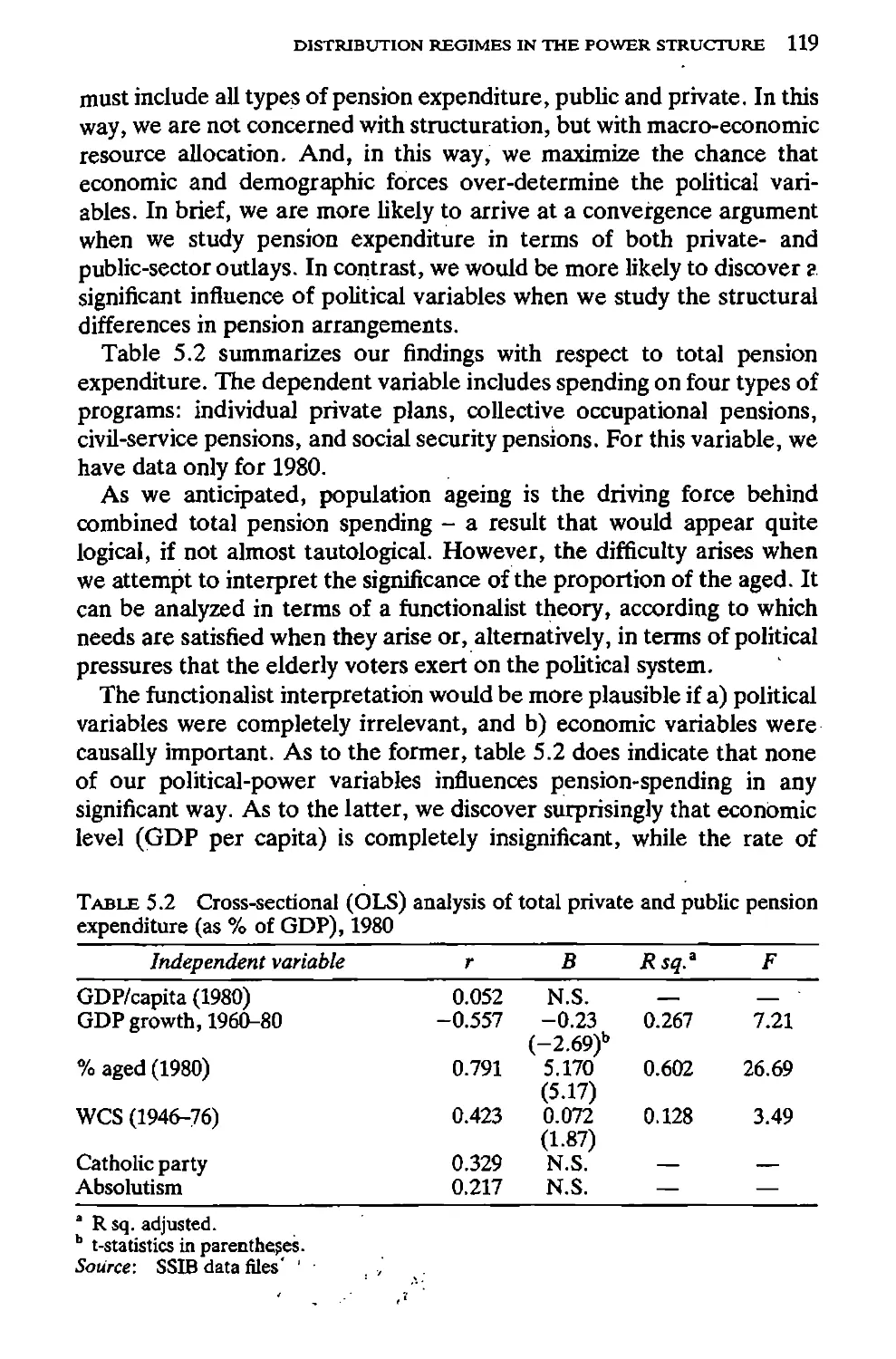
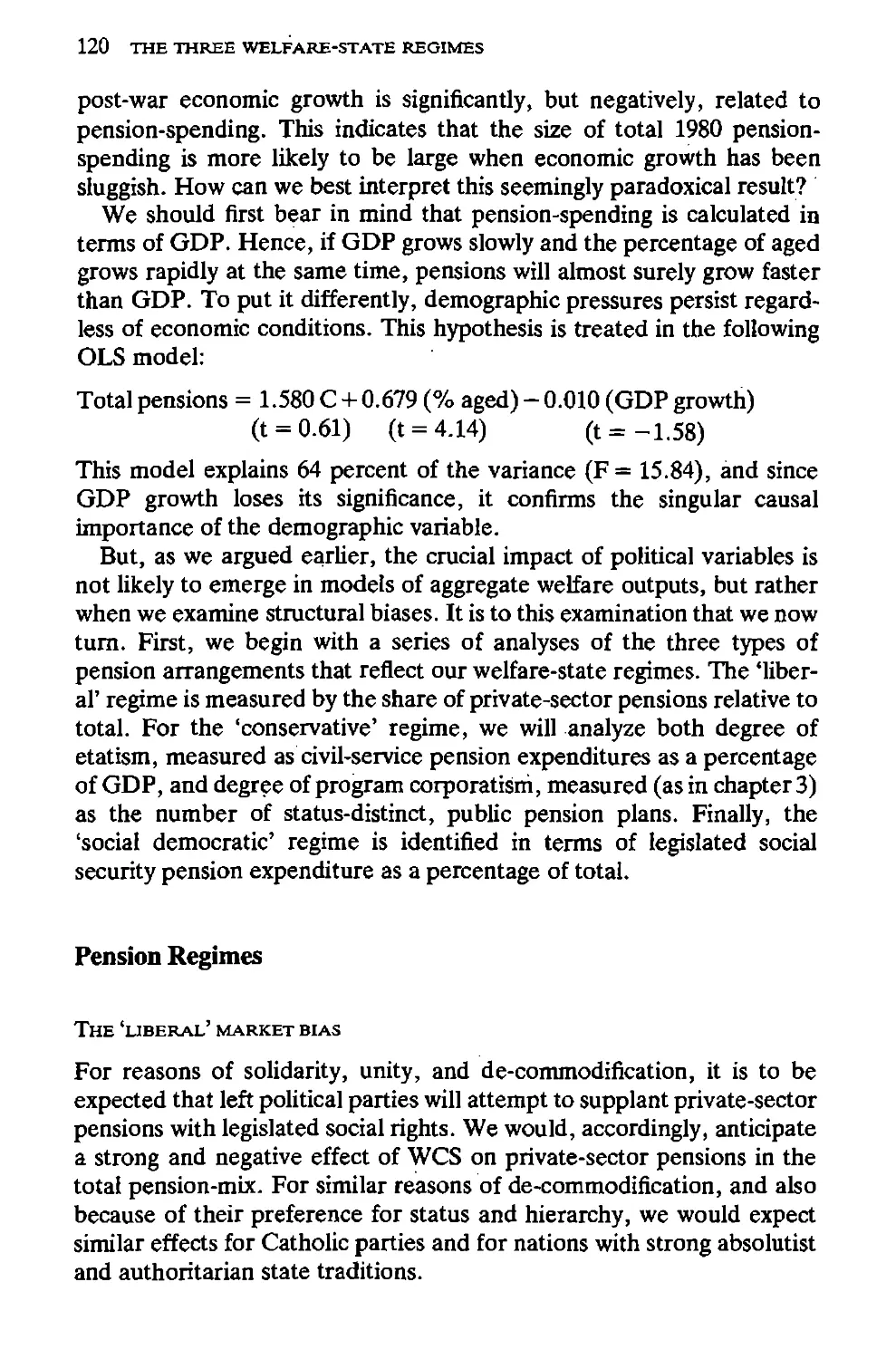
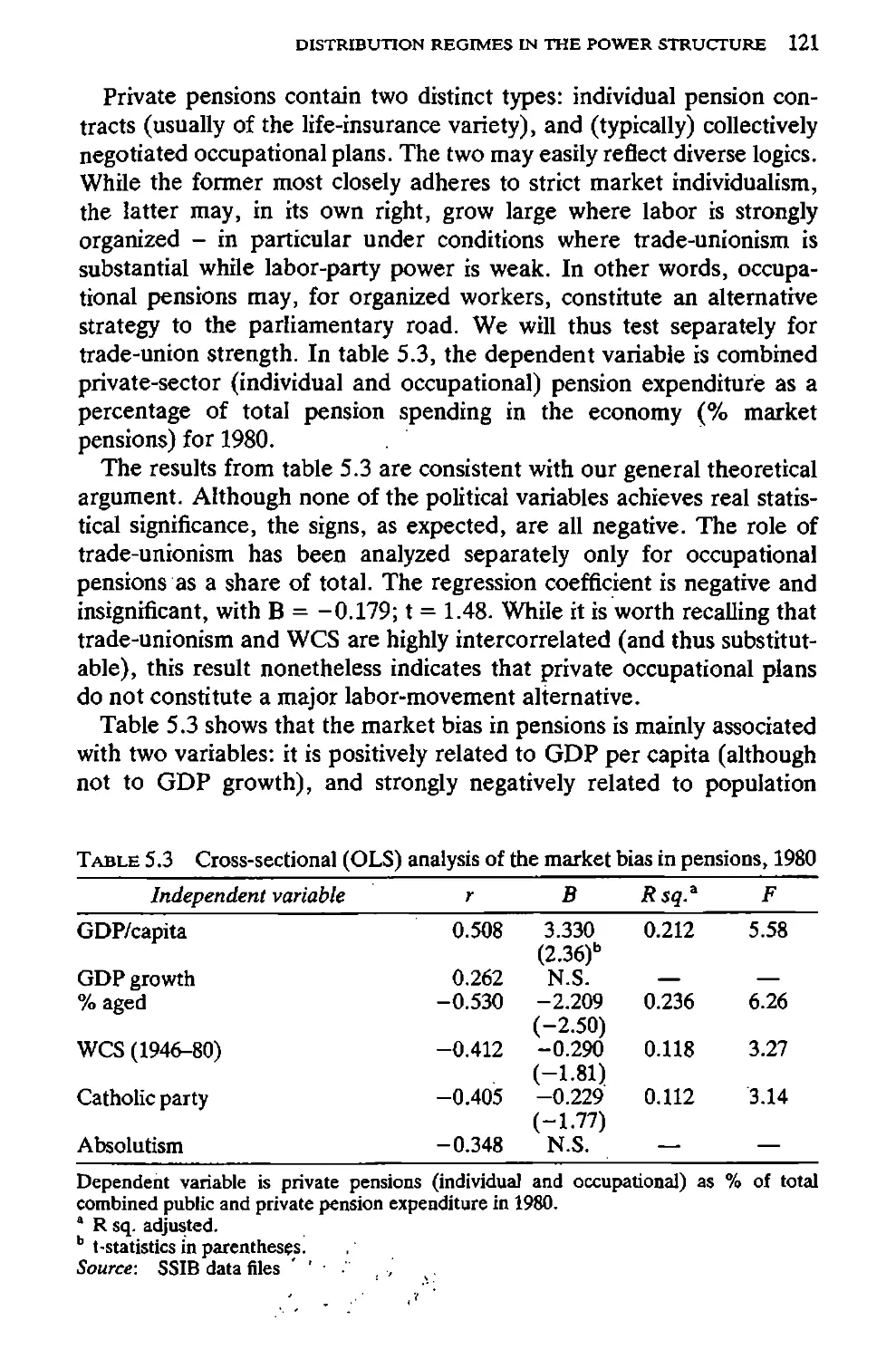
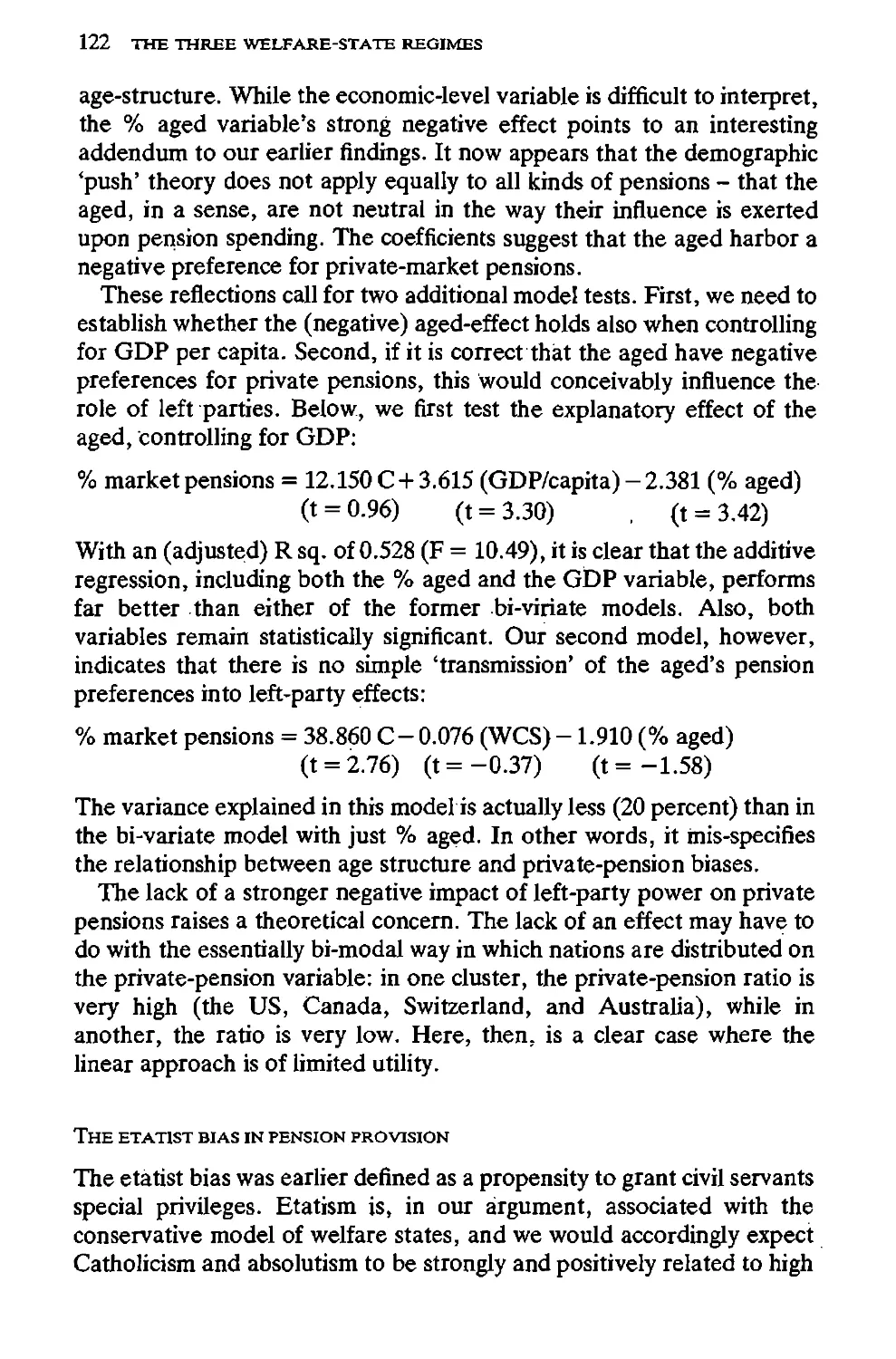
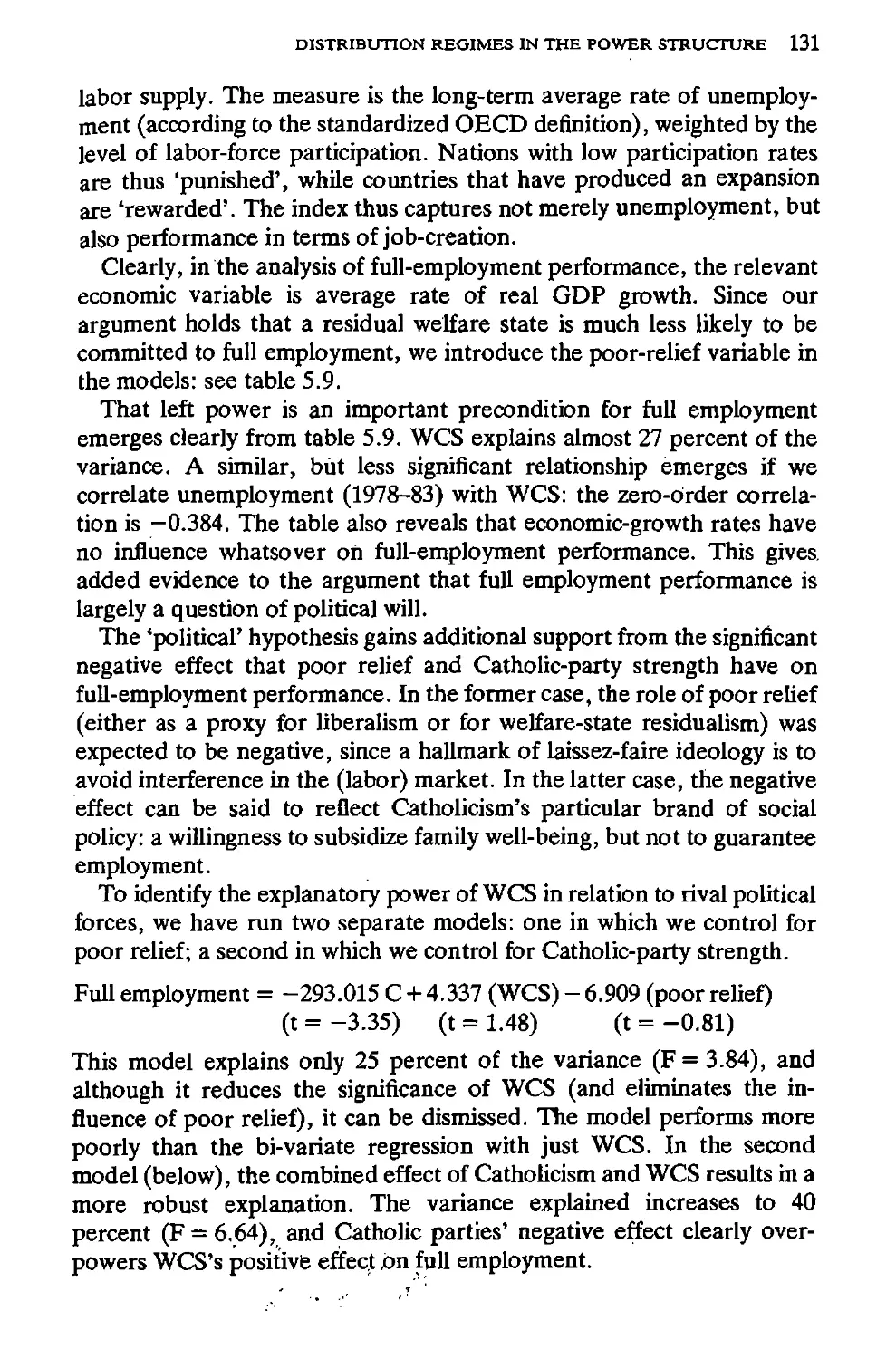
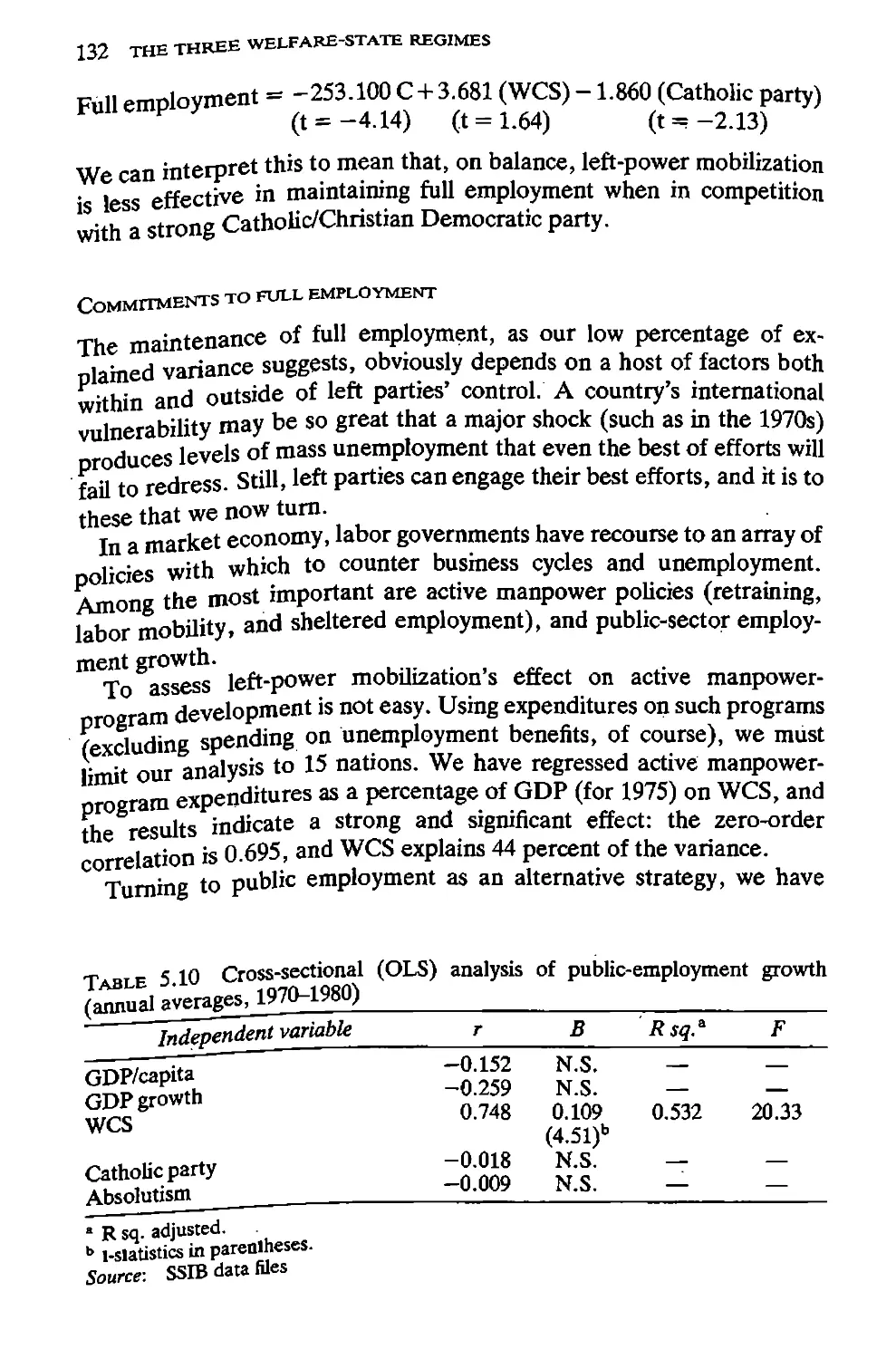
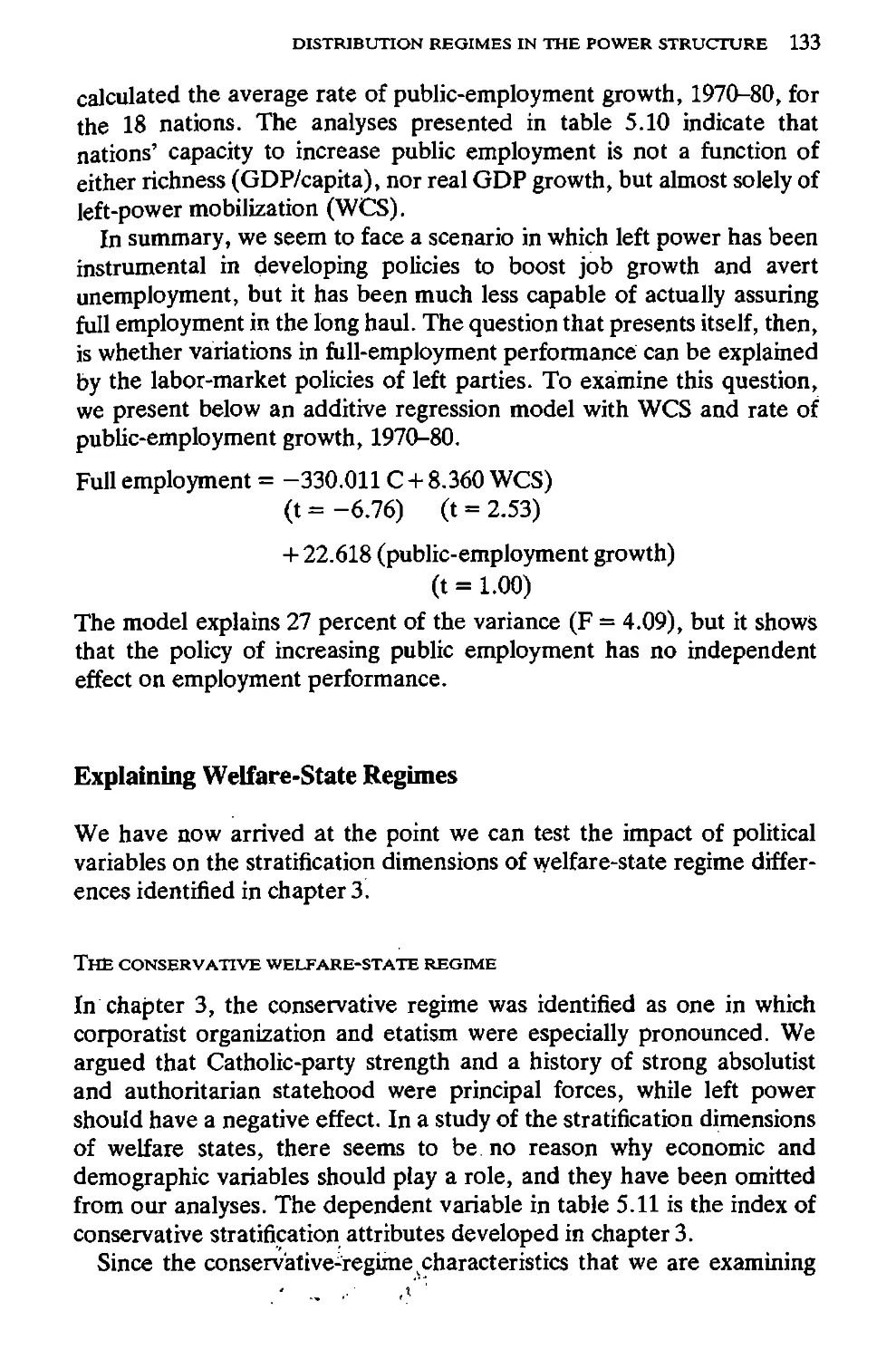
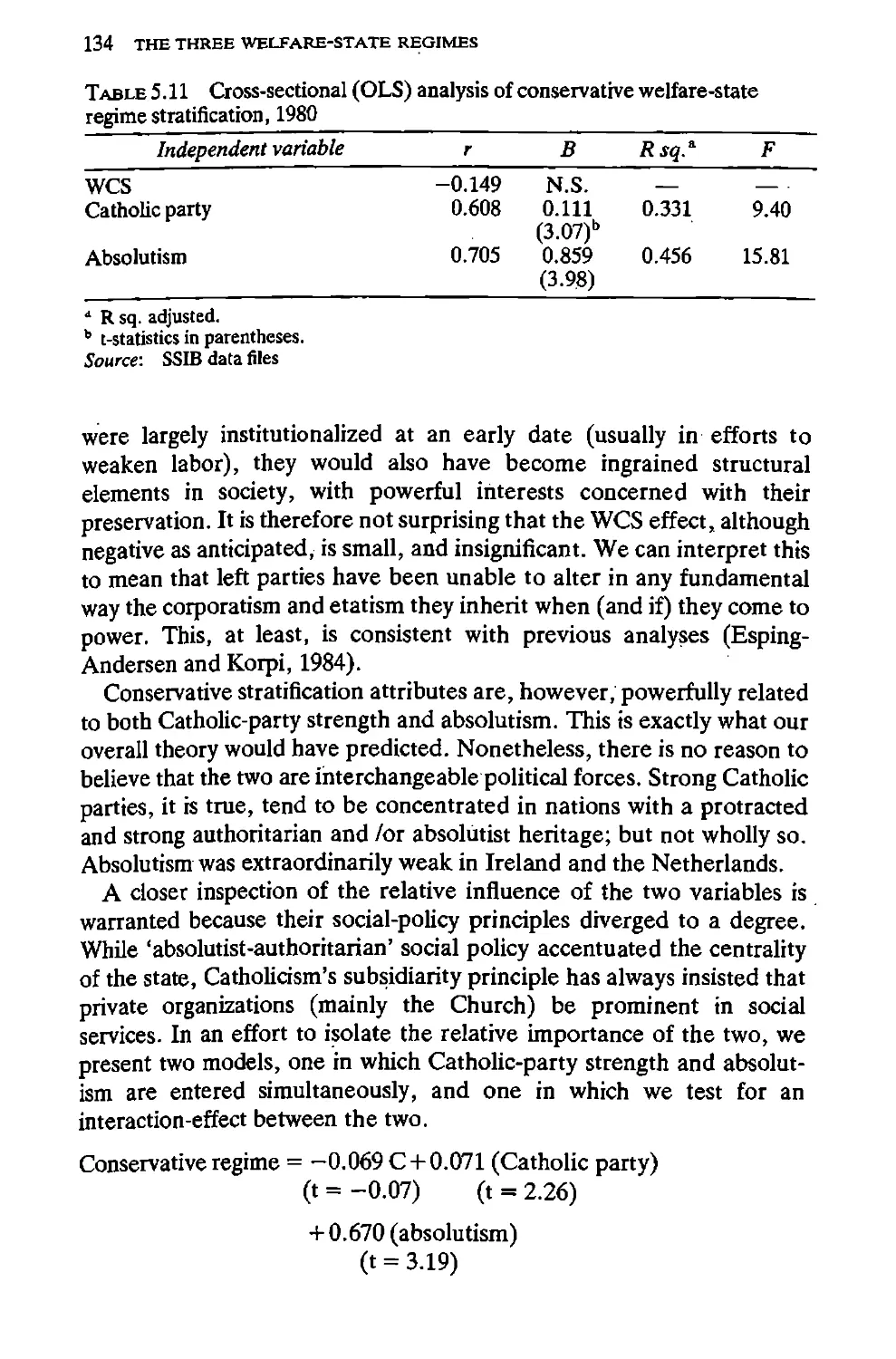



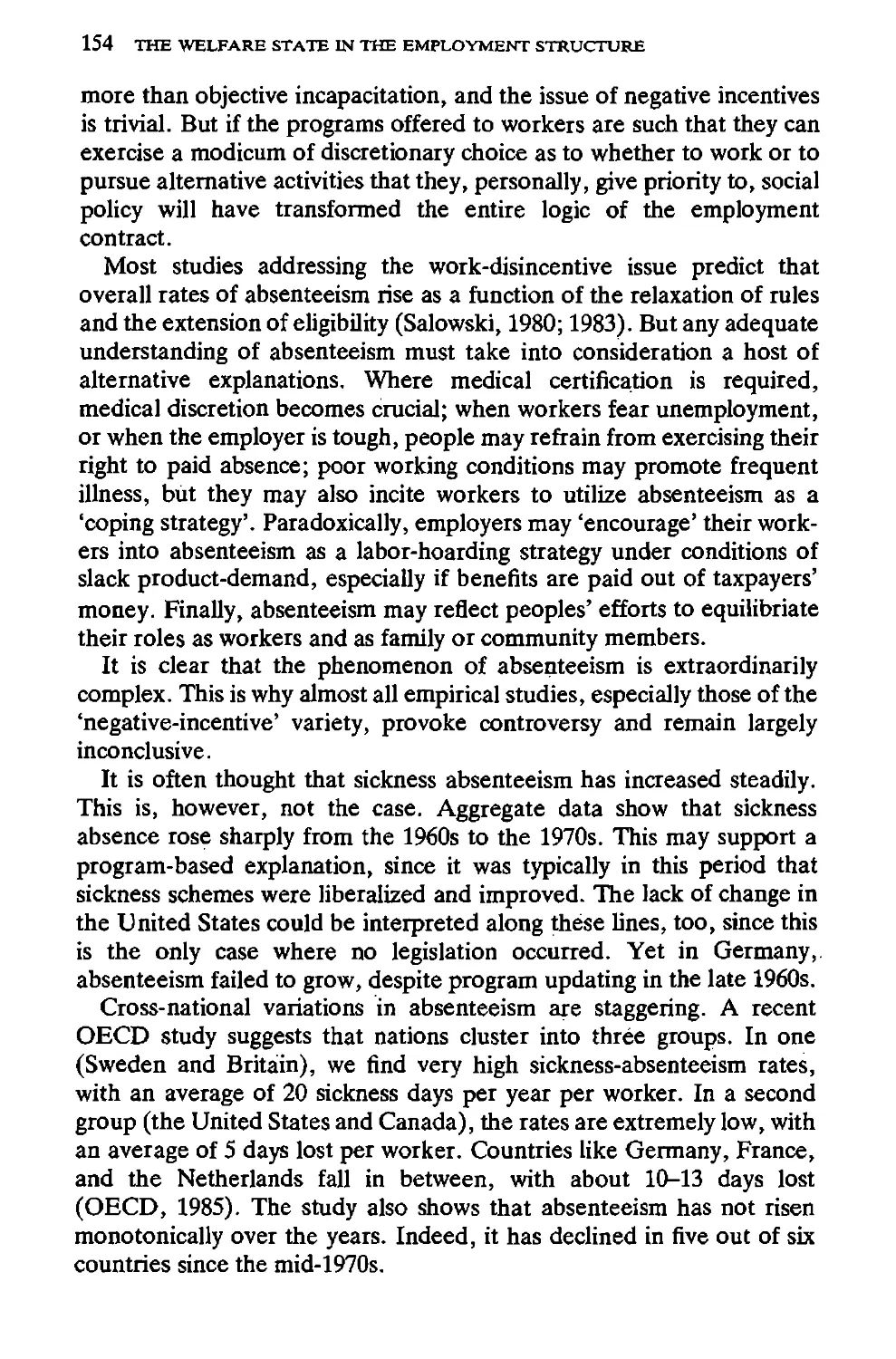
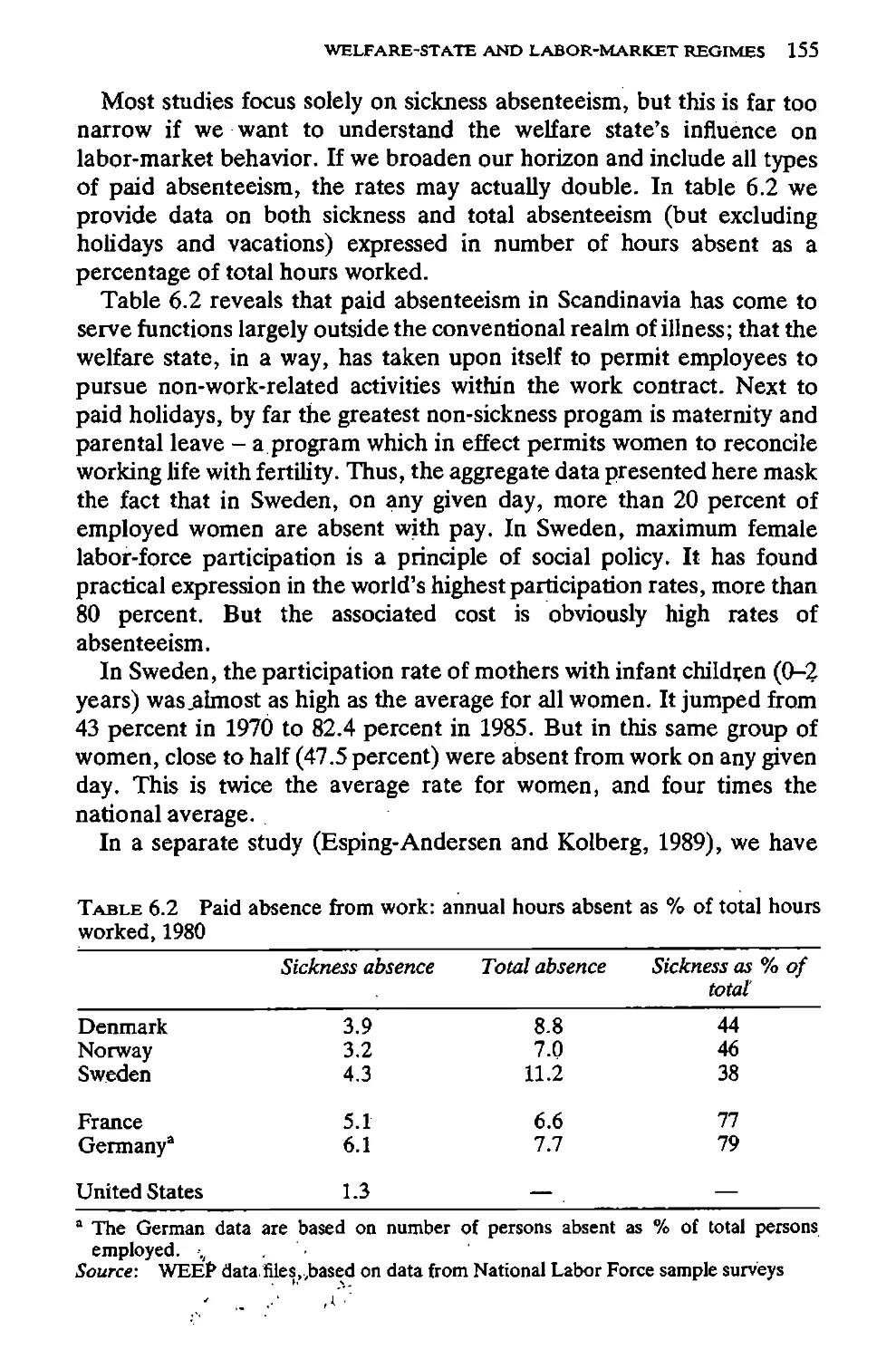
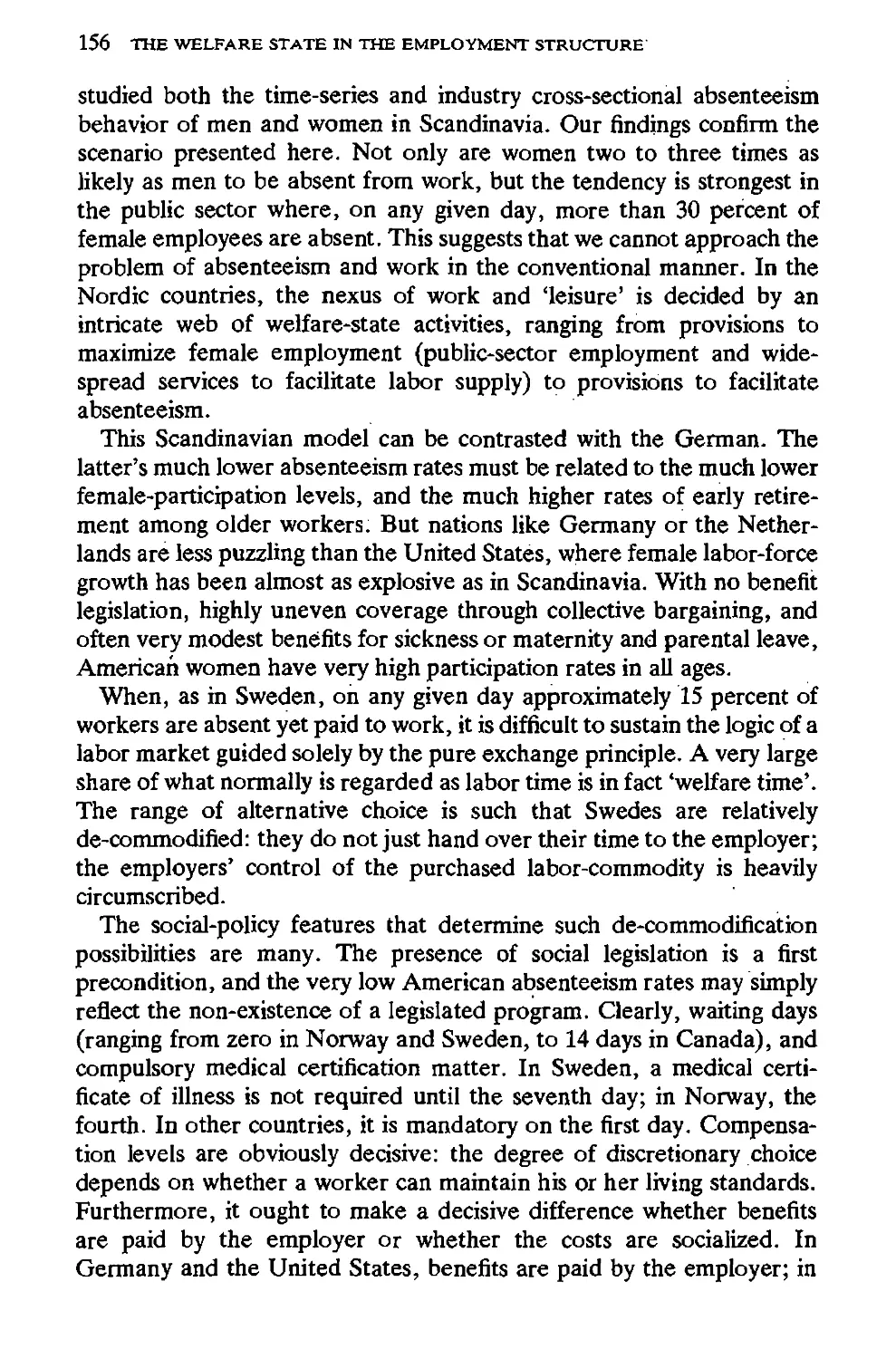
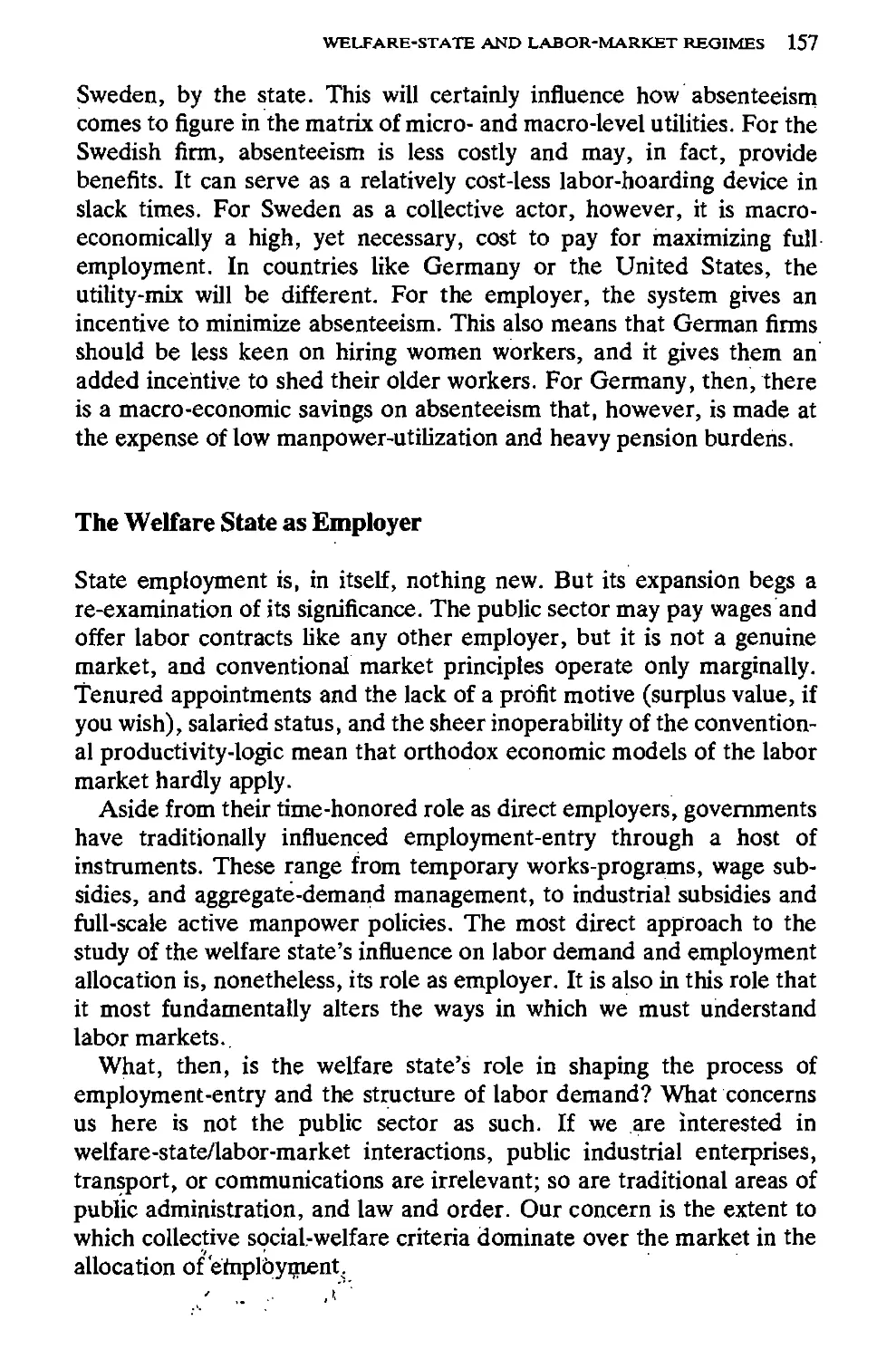

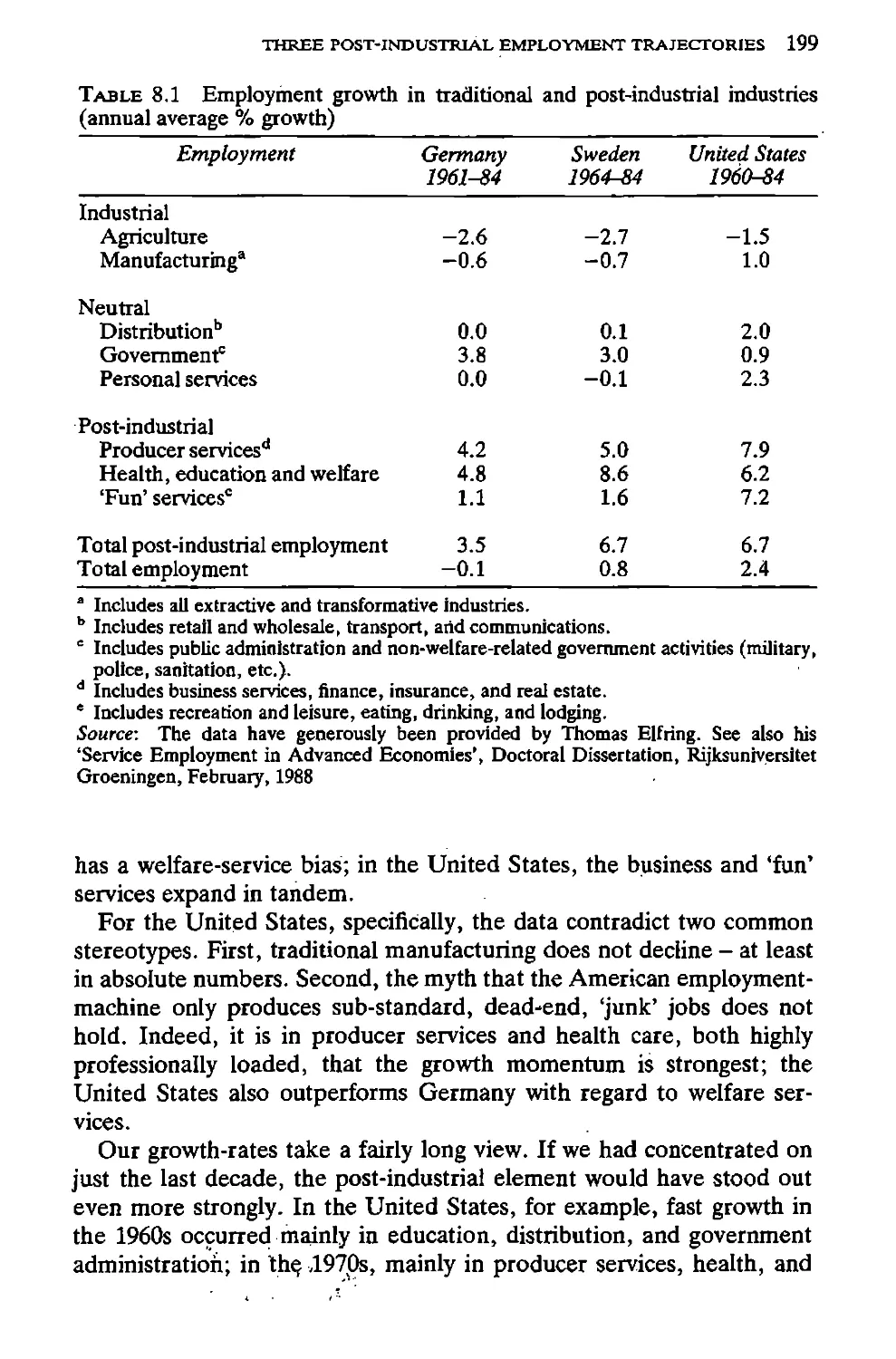
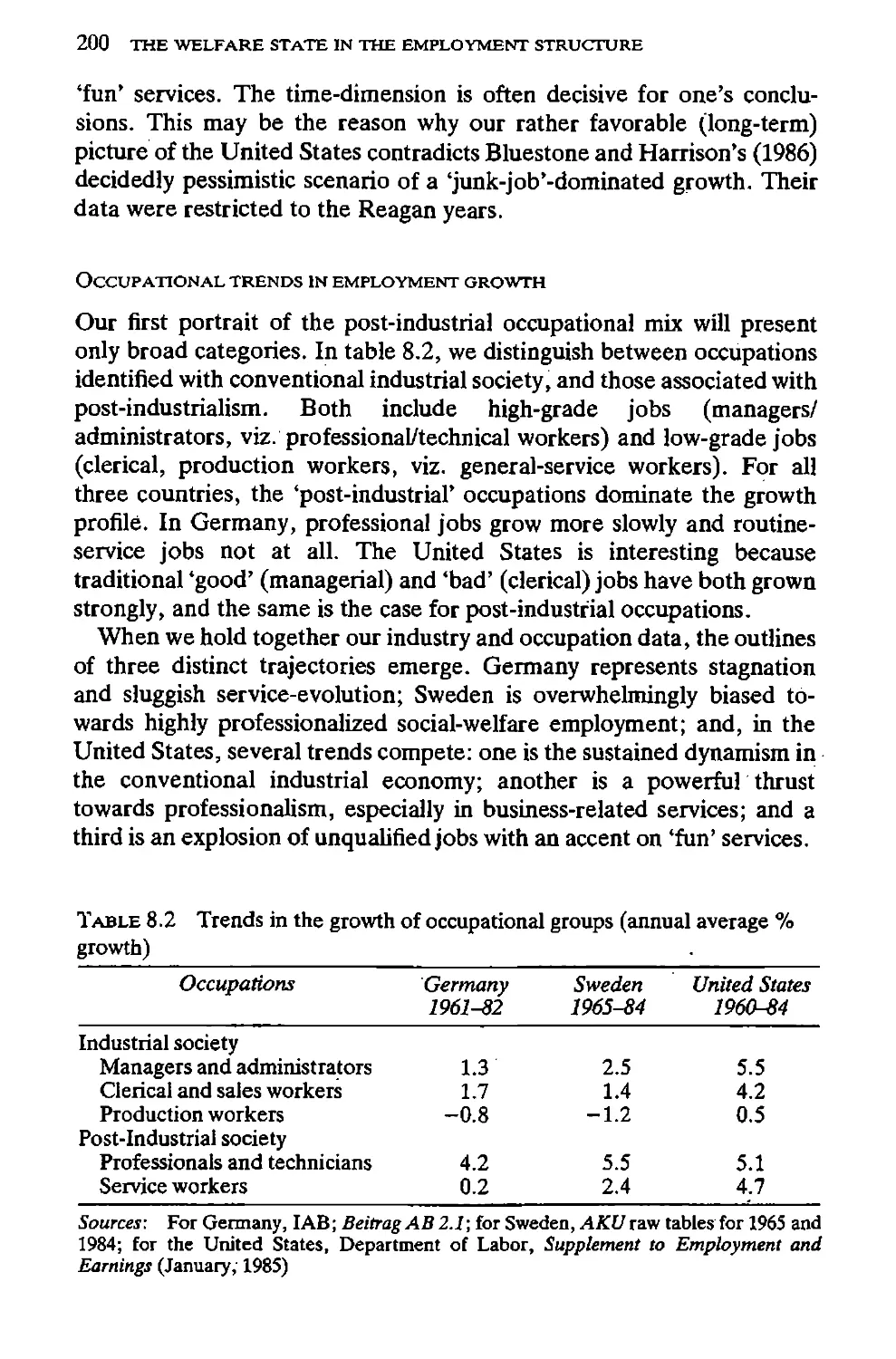
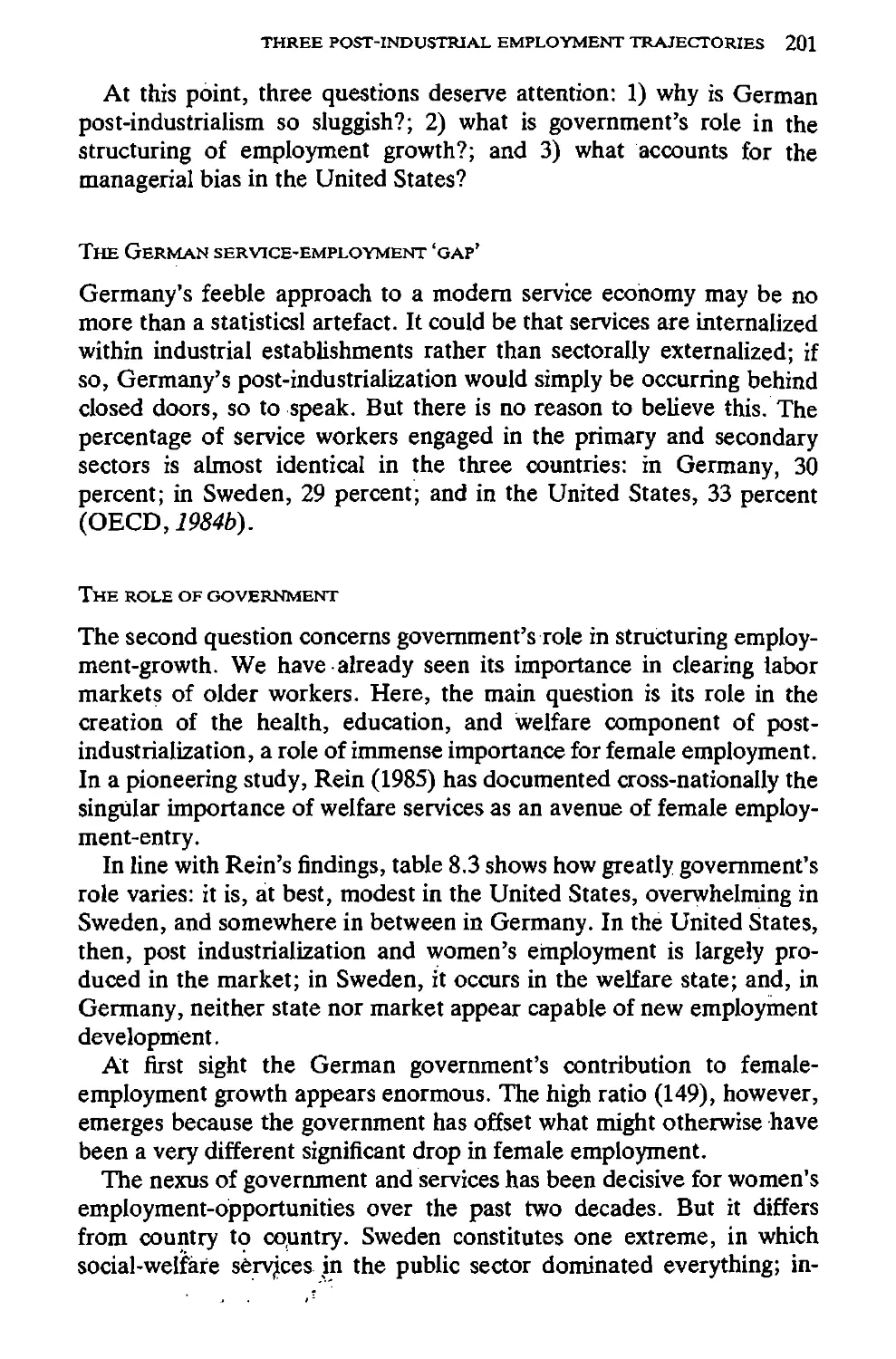
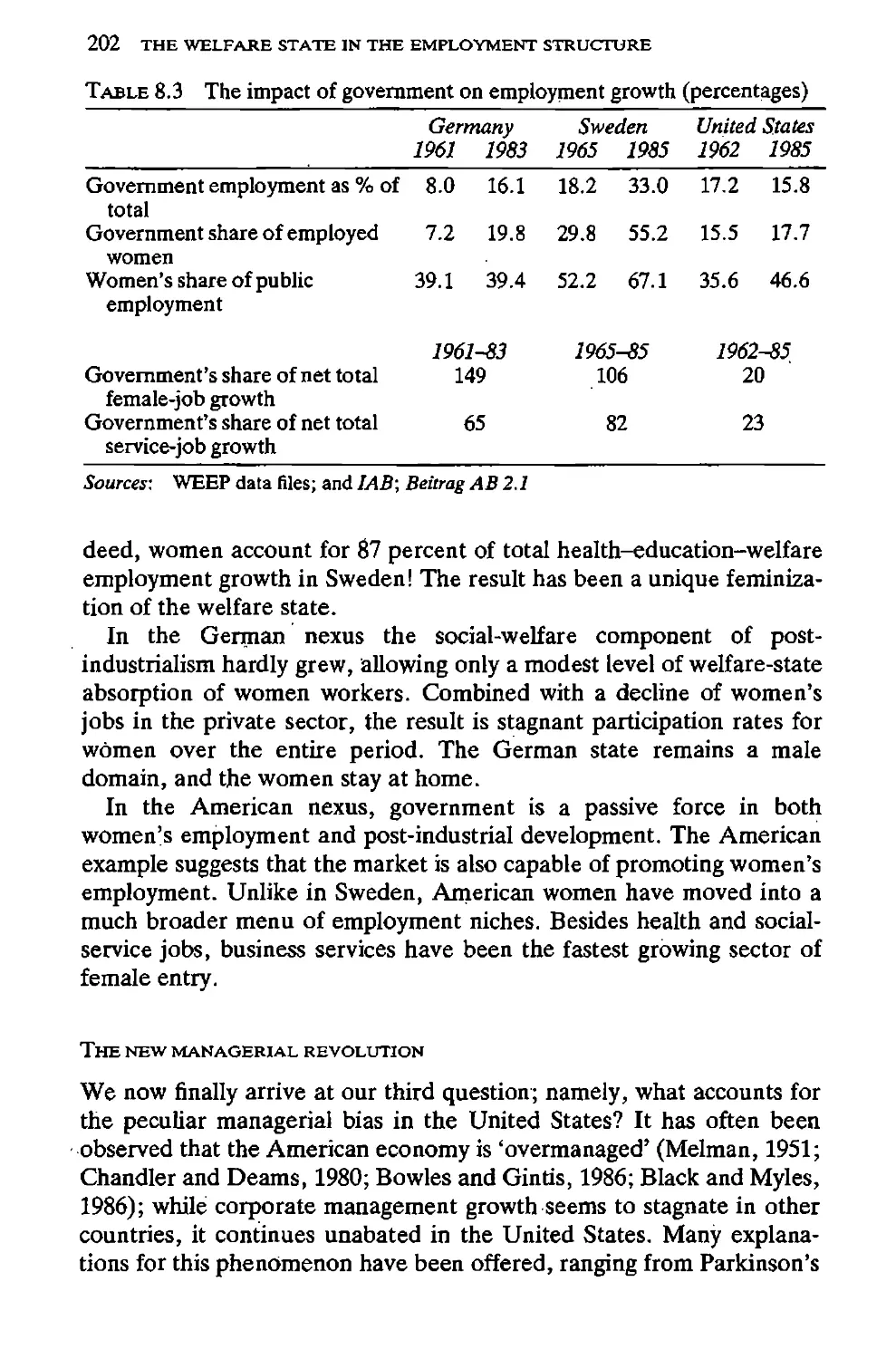
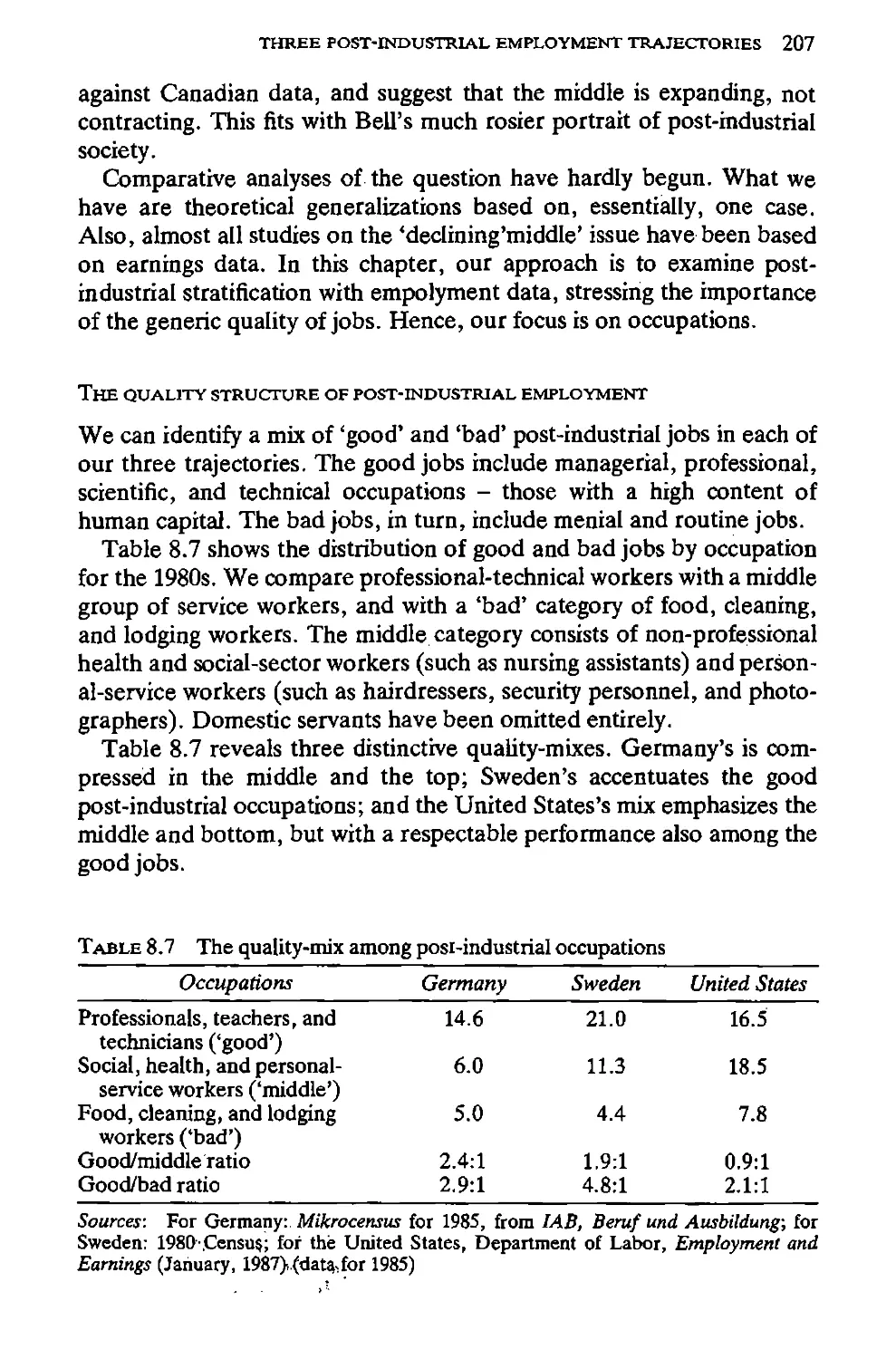
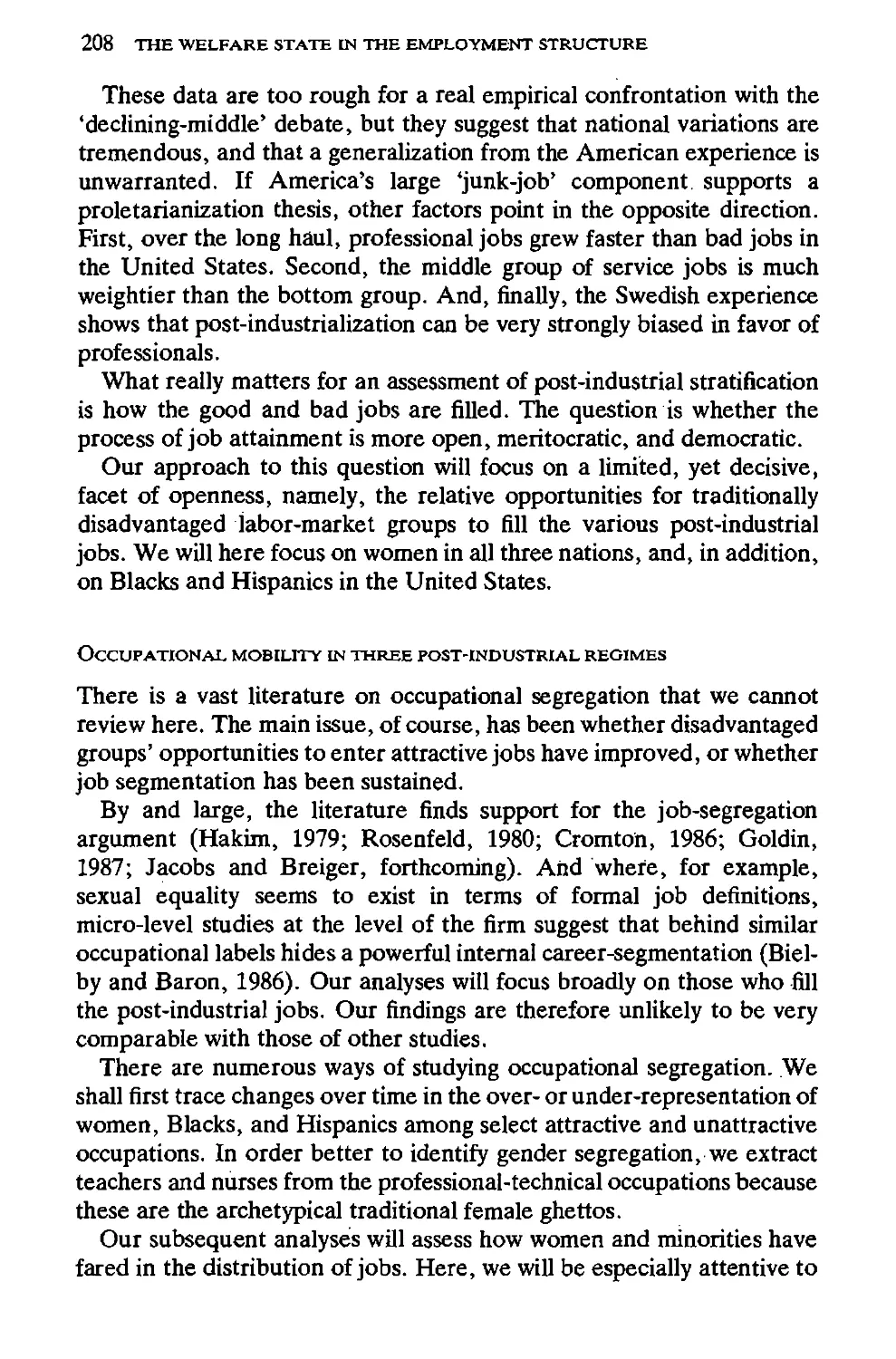
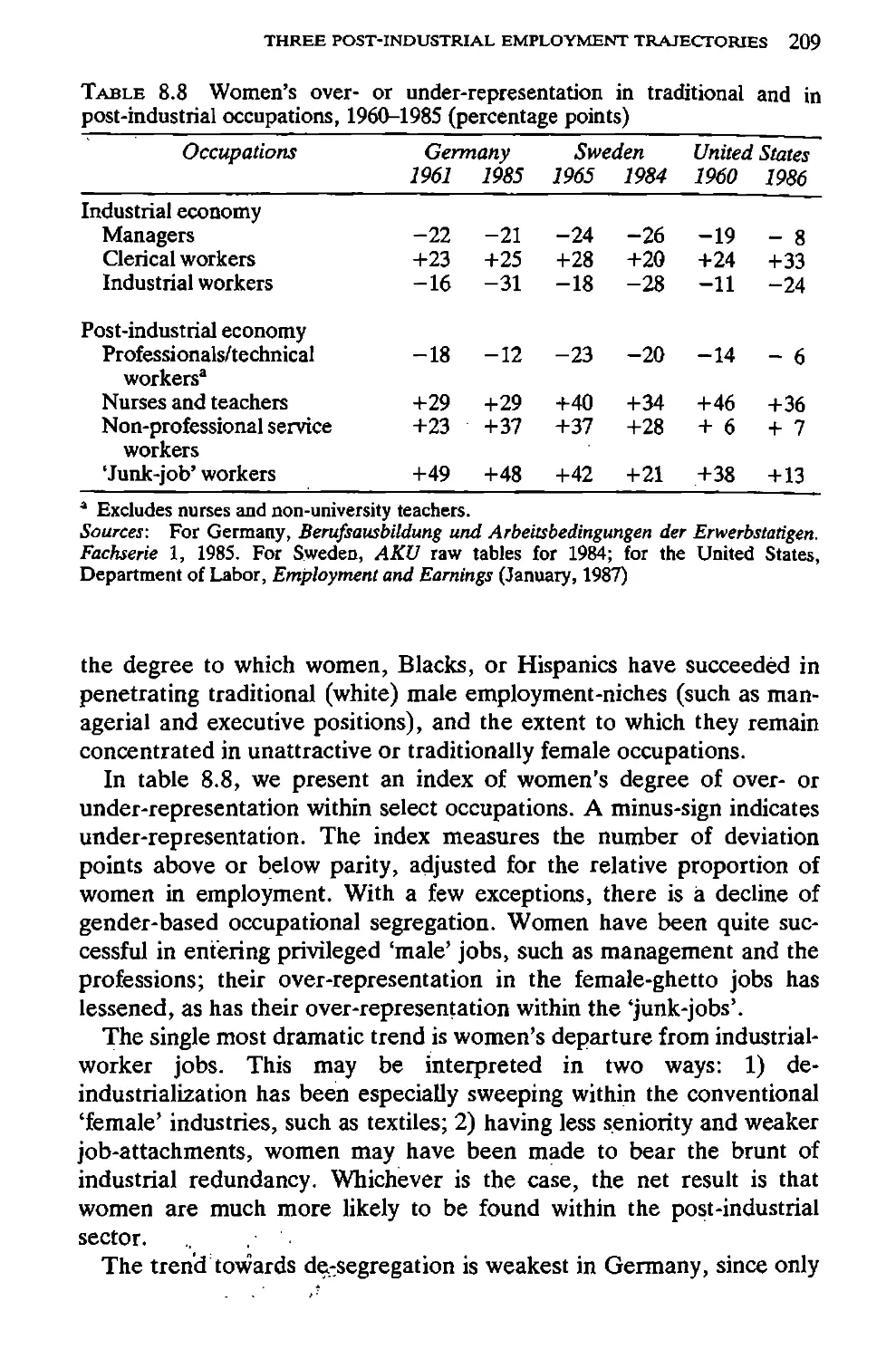
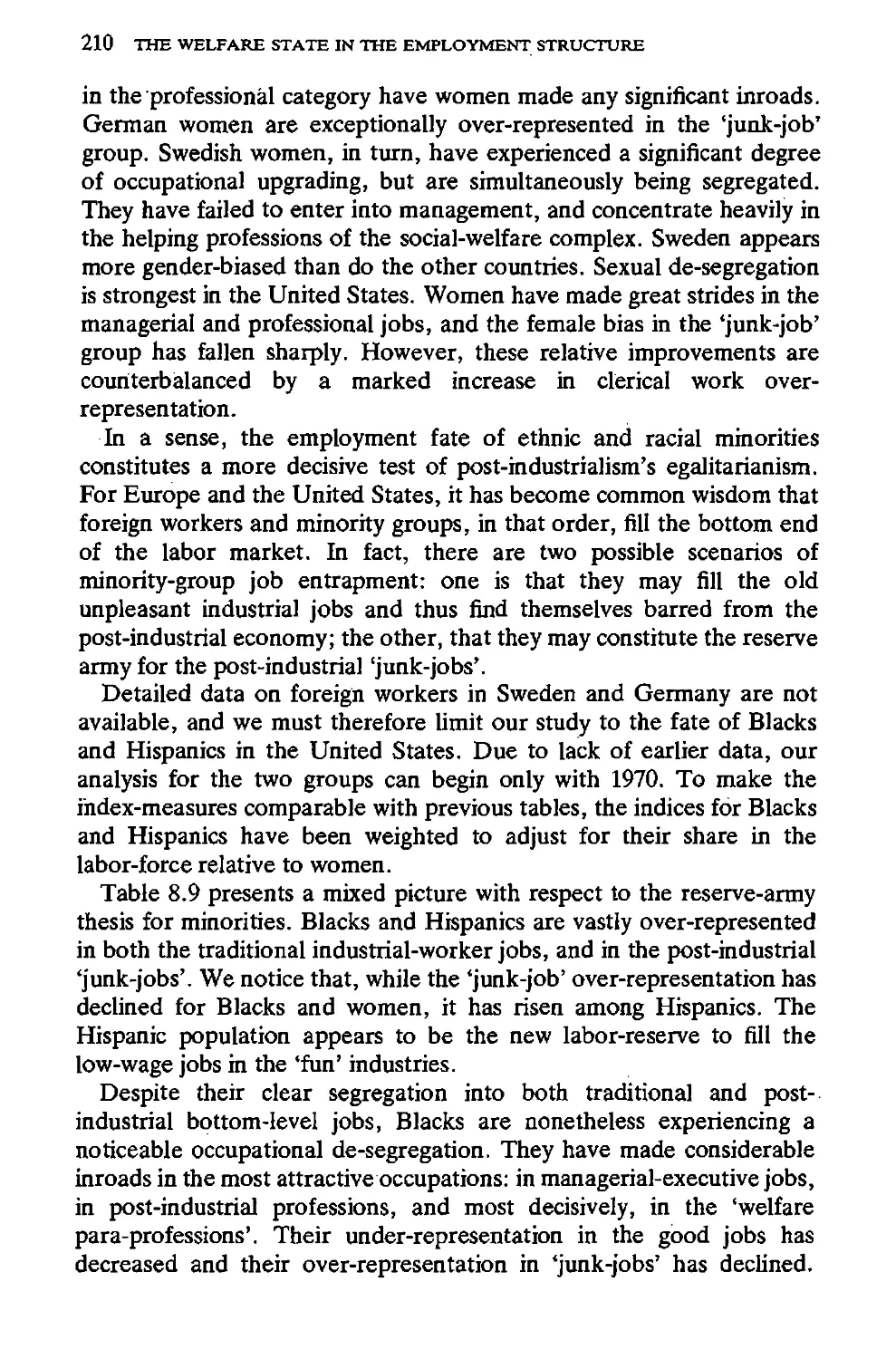









Text
                    The Three Worlds of
Welfare Cap1tal1sm
Gszista Espi11g—Andersen
Polity Press

Copyright © Gmsta Esping—Andersen 1990 E !
First published 1990 by Polity Press /
in association with Blackwell Publishers Ltd
Reprinted 1991 (twice), 1993, 1995, 1996 /
Editorial ofjice:
Polity Press
65 Bridge Street, -
Cambridge CB2 1UR, UK
Marketing and production:
Blackwell Publishers Ltd
108 Cowley Road, Oxford OX4 1JF , UK
All rights reserved. Except for the quotation of short passages for the purposes
of criticism and review, no part of this publication may be reproduced, stored in
a retrieval system, or transmitted, in any form or by any means, electronic,
mechanical, photocopying, recording or otherwise, without the prior
permission of the publisher.
Except in the United States of America, this book is sold subject to the condition
that it shall not, by way of trade or otherwise, be lent, re-sold, hired out, or
otherwise circulated without the publisher’s prior consent in any form of binding
or cover other than that in which it is published and without a similar condition
including this condition being imposed on the subsequent purchaser.
ISBN 0-7456—0665—2
ISBN 0-7456-0796-9 (pbk)
A CIP catalogue record for this book is available from the British Library.
Typeset in 10 on 12 pt Times by Wearside Tradespools, Fulwell,
Printed in Great Britain by TJ Press Ltd, Padstow, Cornwall

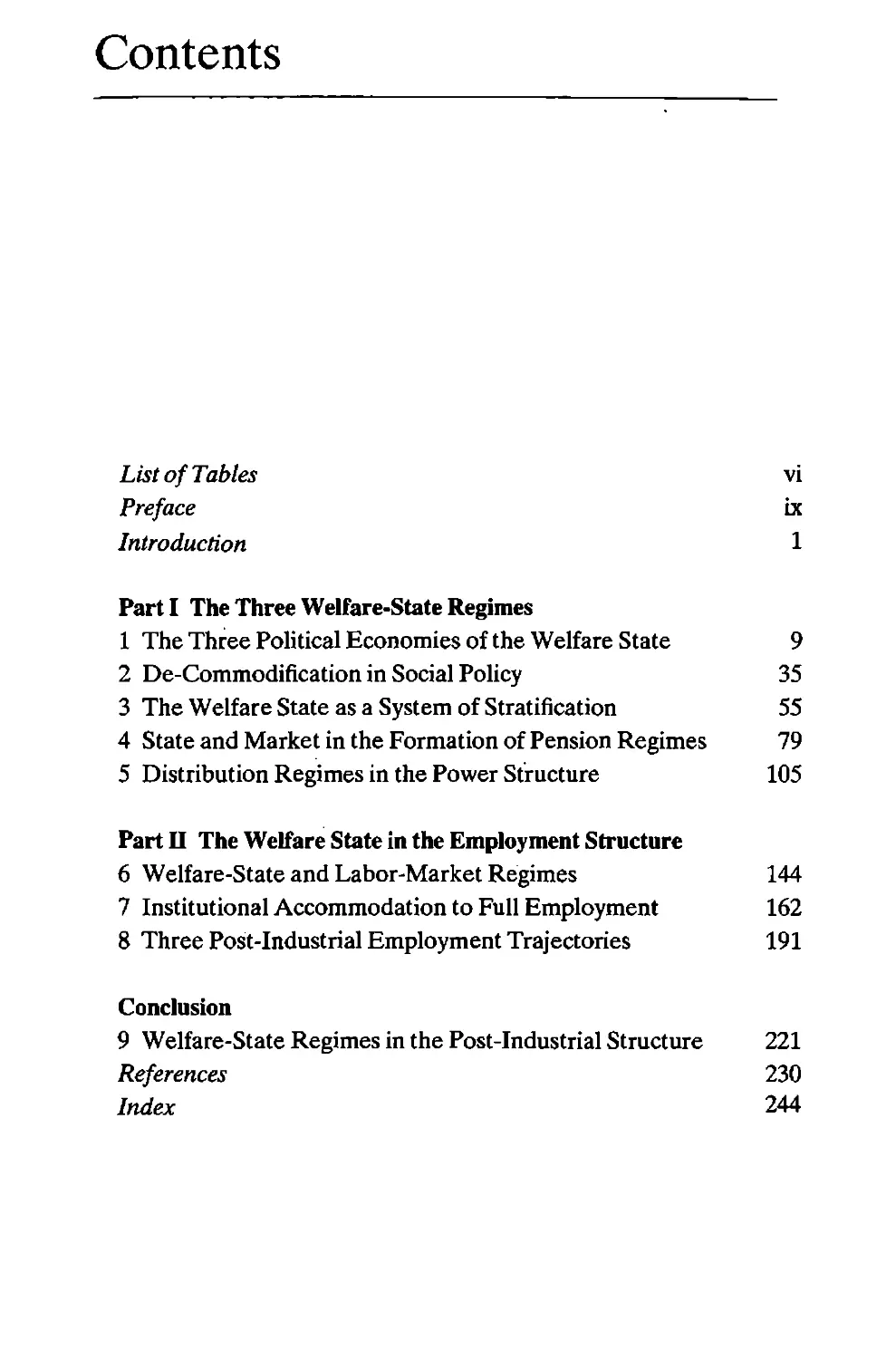
Lzlst of Tables vi
Preface ix
Introduction 1
Part I The Three Welfare-State Regimes
1 The Three Political Economies of the Welfare State 9
2 De—Commodification in Social Policy 35
3 The Welfare State as a System of Stratification 55
4 State and Market in the Formation of Pension Regimes 79
5 Distribution Regimes in the Power Structure 105
Part I.I The Welfare State in the Employment Structure
6 Welfare-State and Labor-Market Regimes 144
7 Institutional Accommodation to Full Employment 162
8 Three Post-Industrial Employment Trajectories 191
9 Welfare-State Regimes in the Post—Industrial Structure 221
References 230
Index 244

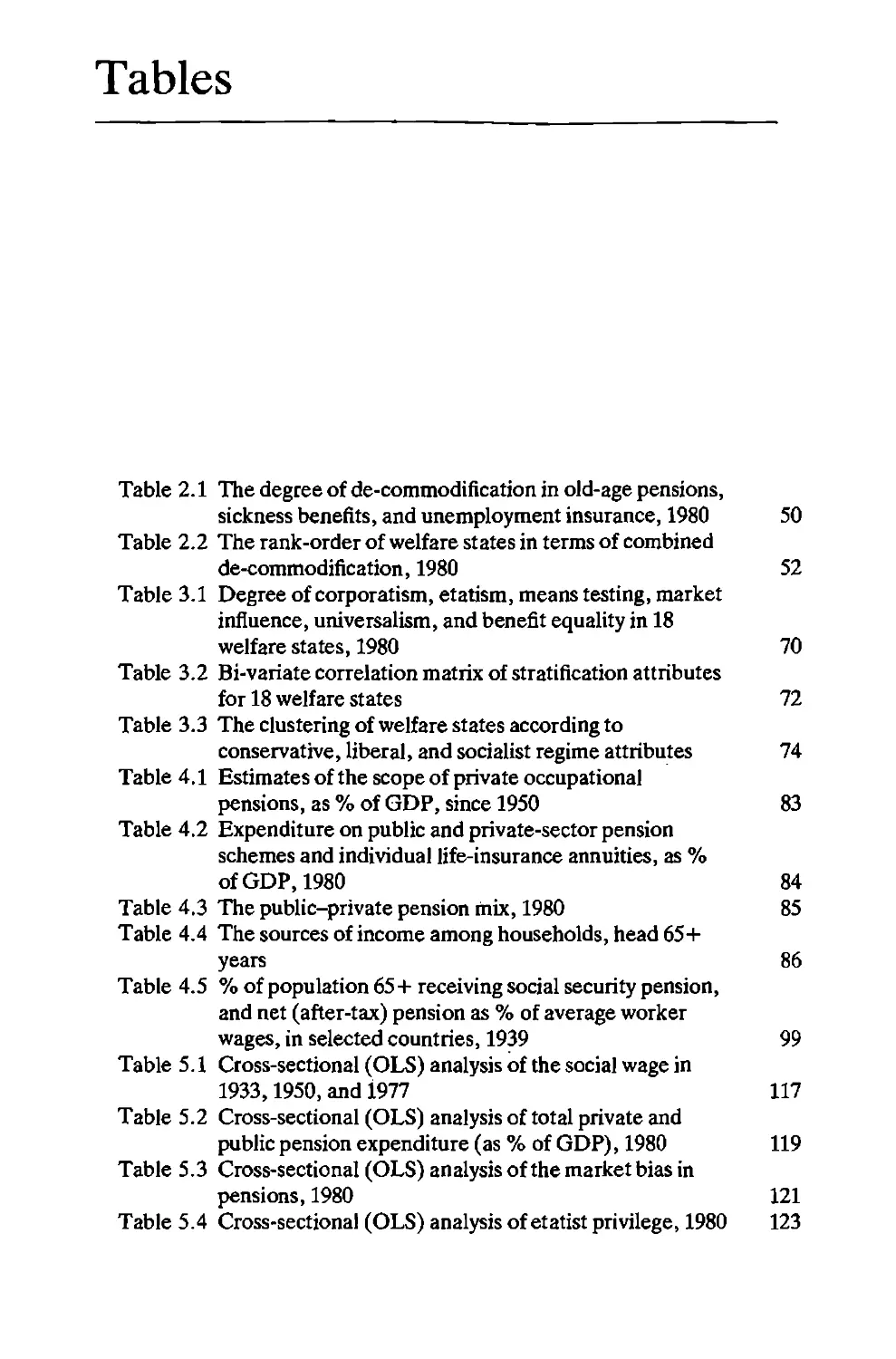
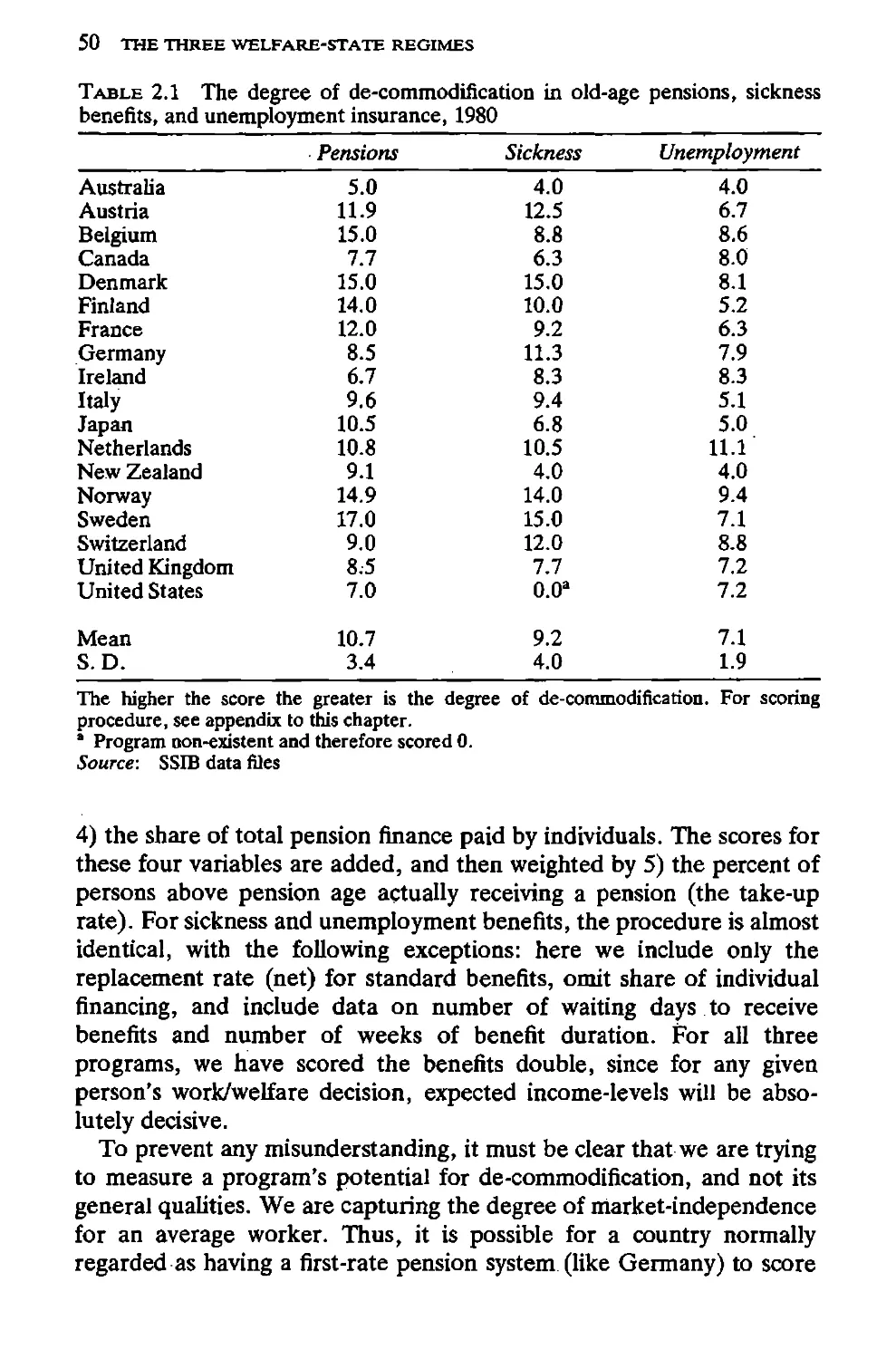
Table 2.1 The degree of de-commodilication in old-age pensions,
sickness benefits, and unemployment insurance, 1980 50
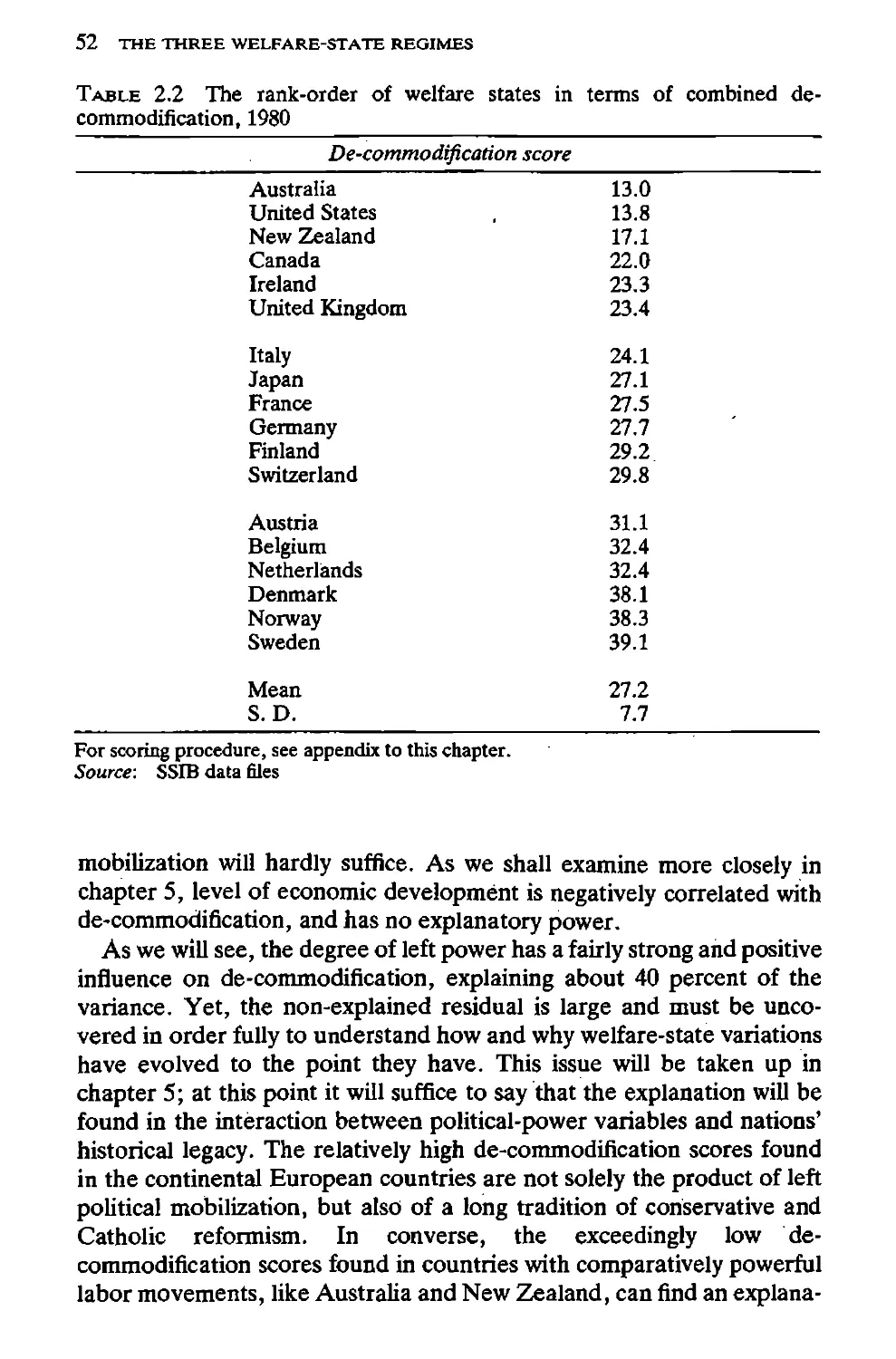
Table 2.2 The rank-order of welfare states in terms of combined
de-commodilication, 1980 52
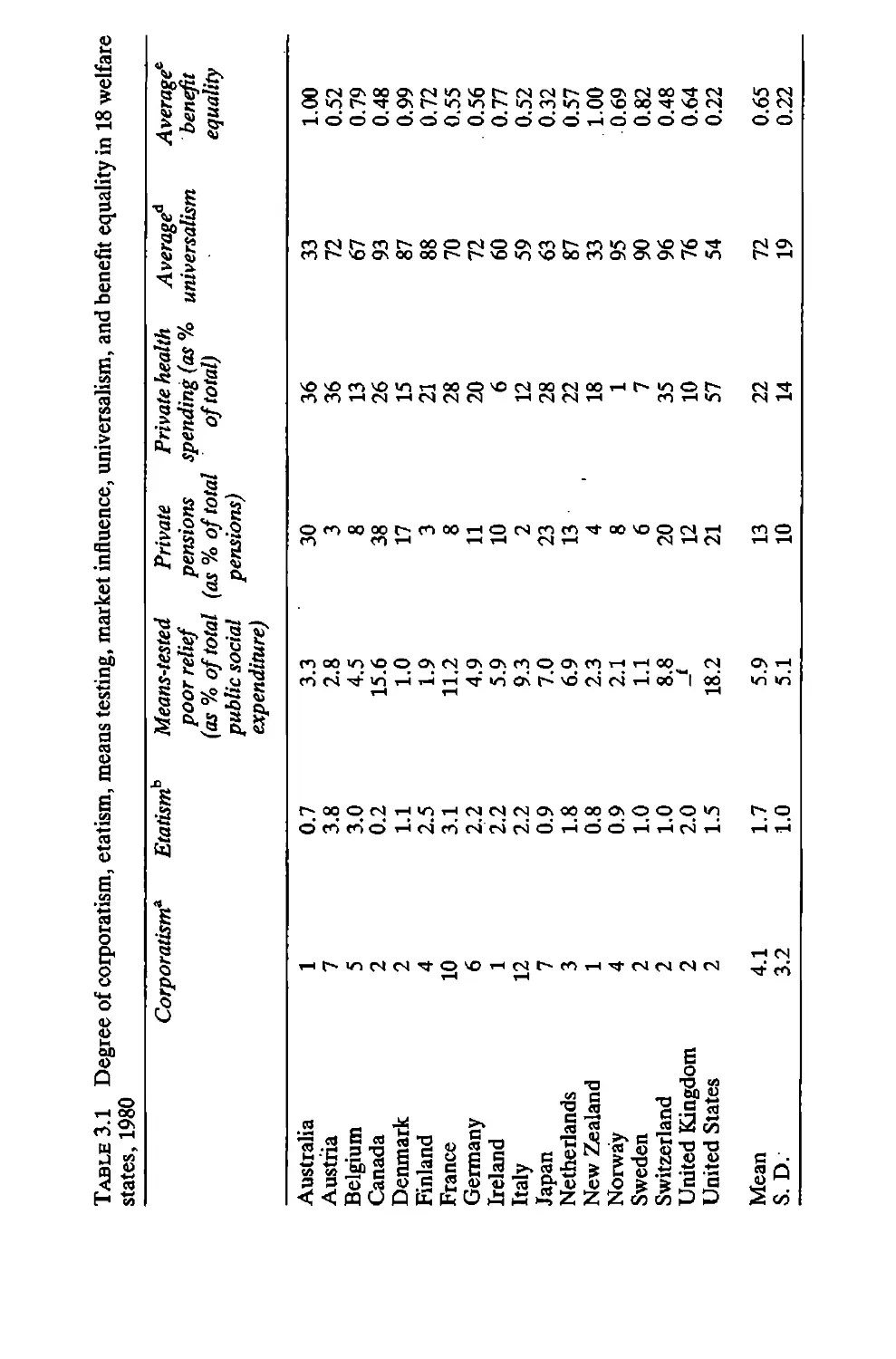
Table 3.1 Degree of corporatism, etatism, means testing, market
influence, universalism, and benent equality in 18
welfare states, 1980 70
Table 3.2 Bi-variate correlation matrix of stratification attributes
for 18 welfare states 72
Table 3.3 The clustering of welfare states according to
conservative, liberal, and socialist regime attributes 74
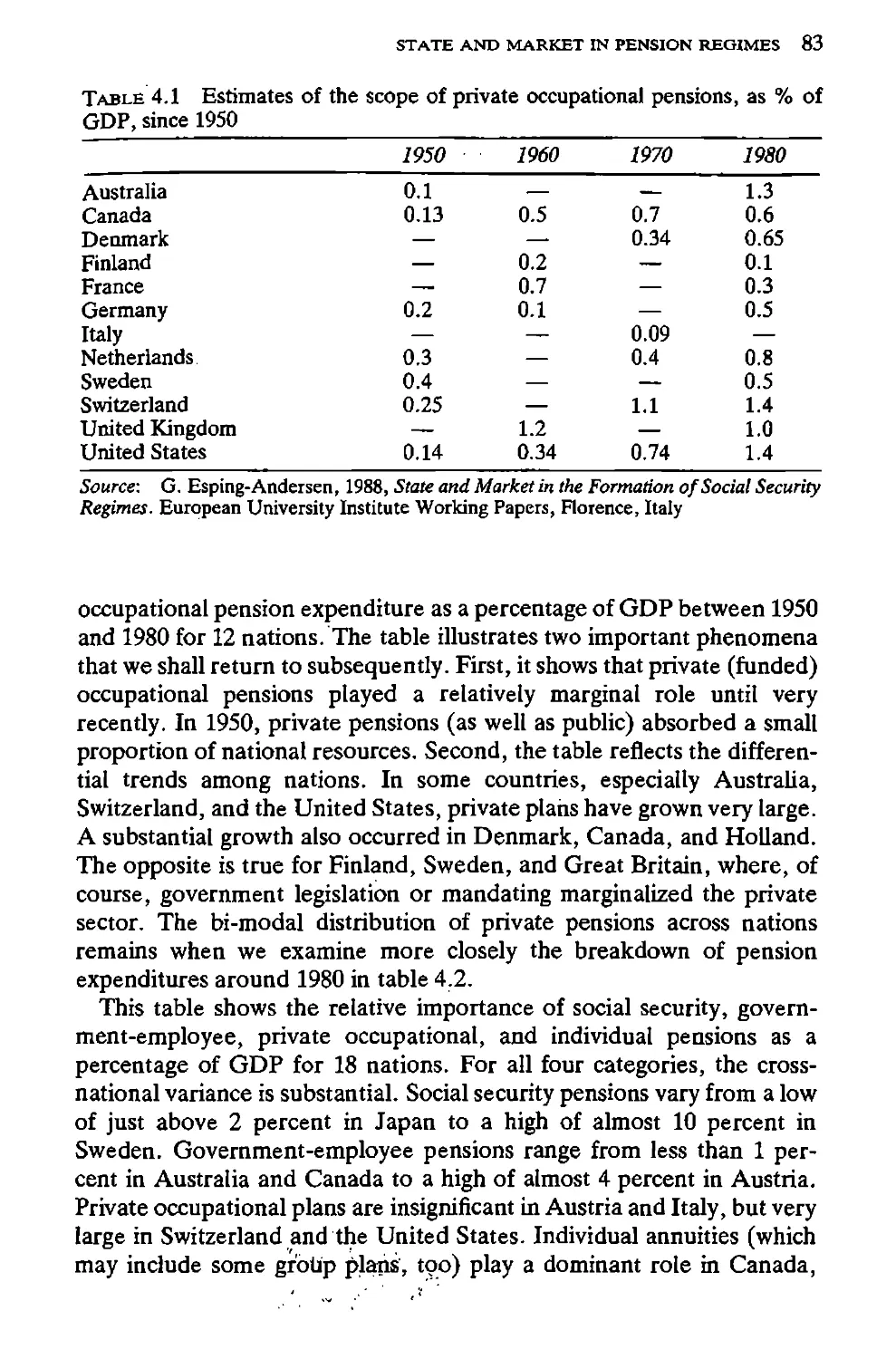
Table 4.1 Estimates of the scope of private occupational
pensions, as % of GDP, since 1950 83
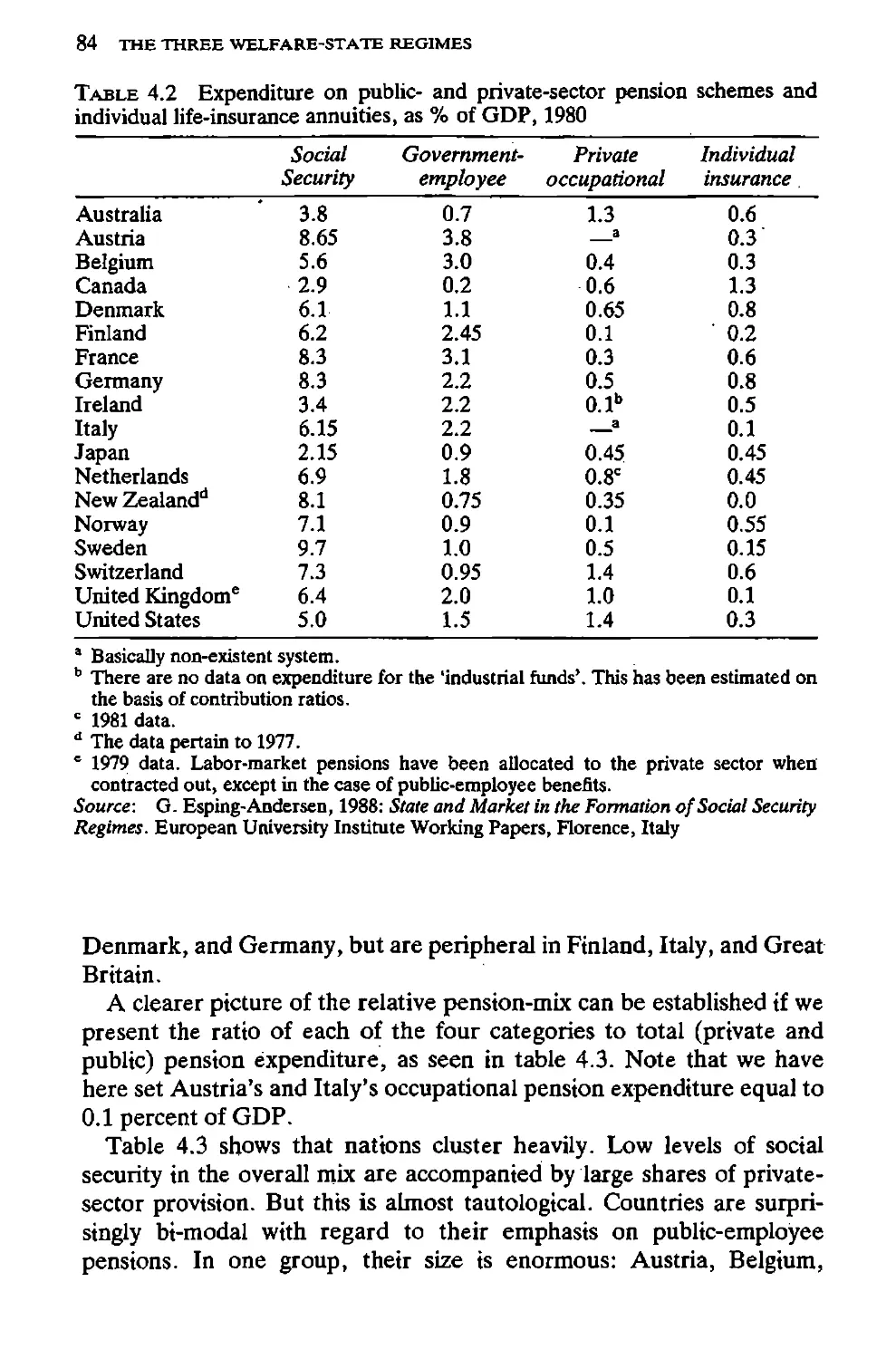
Table 4.2 Expenditure on public and private—sector pension
schemes and individual life—insurance annuities, as %
of GDP, 1980 84
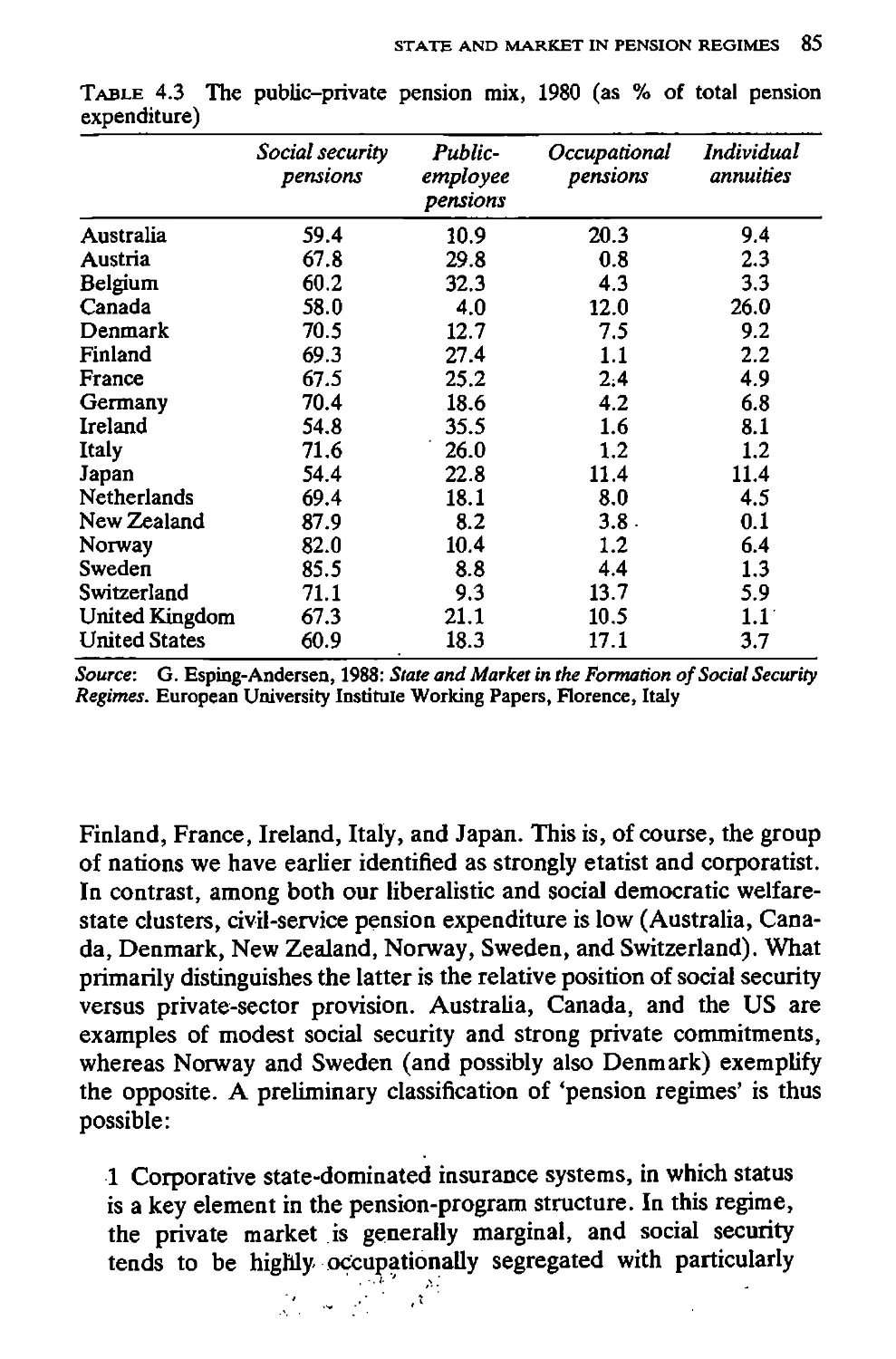
Table 4.3 The public-private pension mix, 1980 85
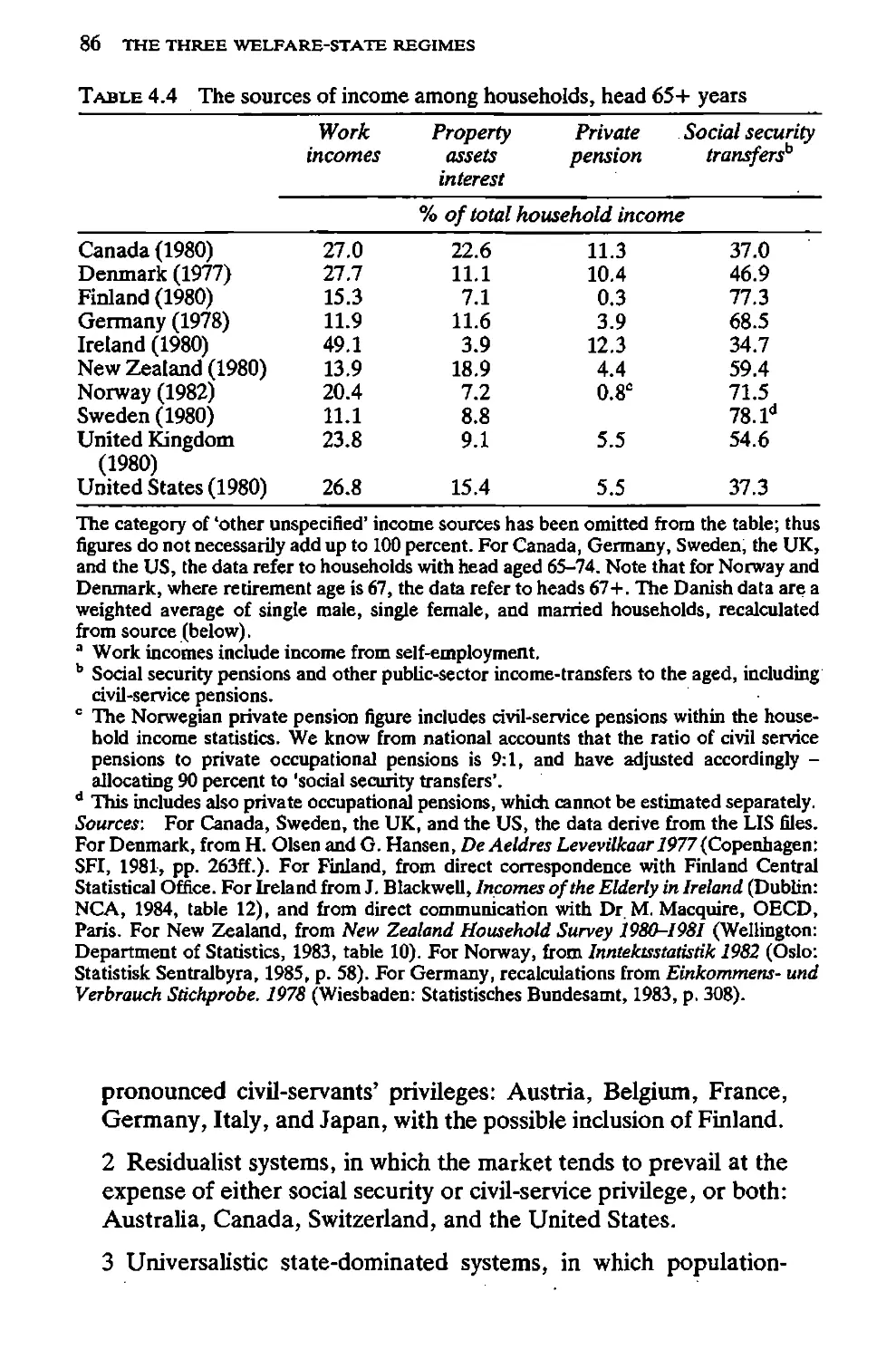
Table 4.4 The sources of income among households, head 65+
years 86
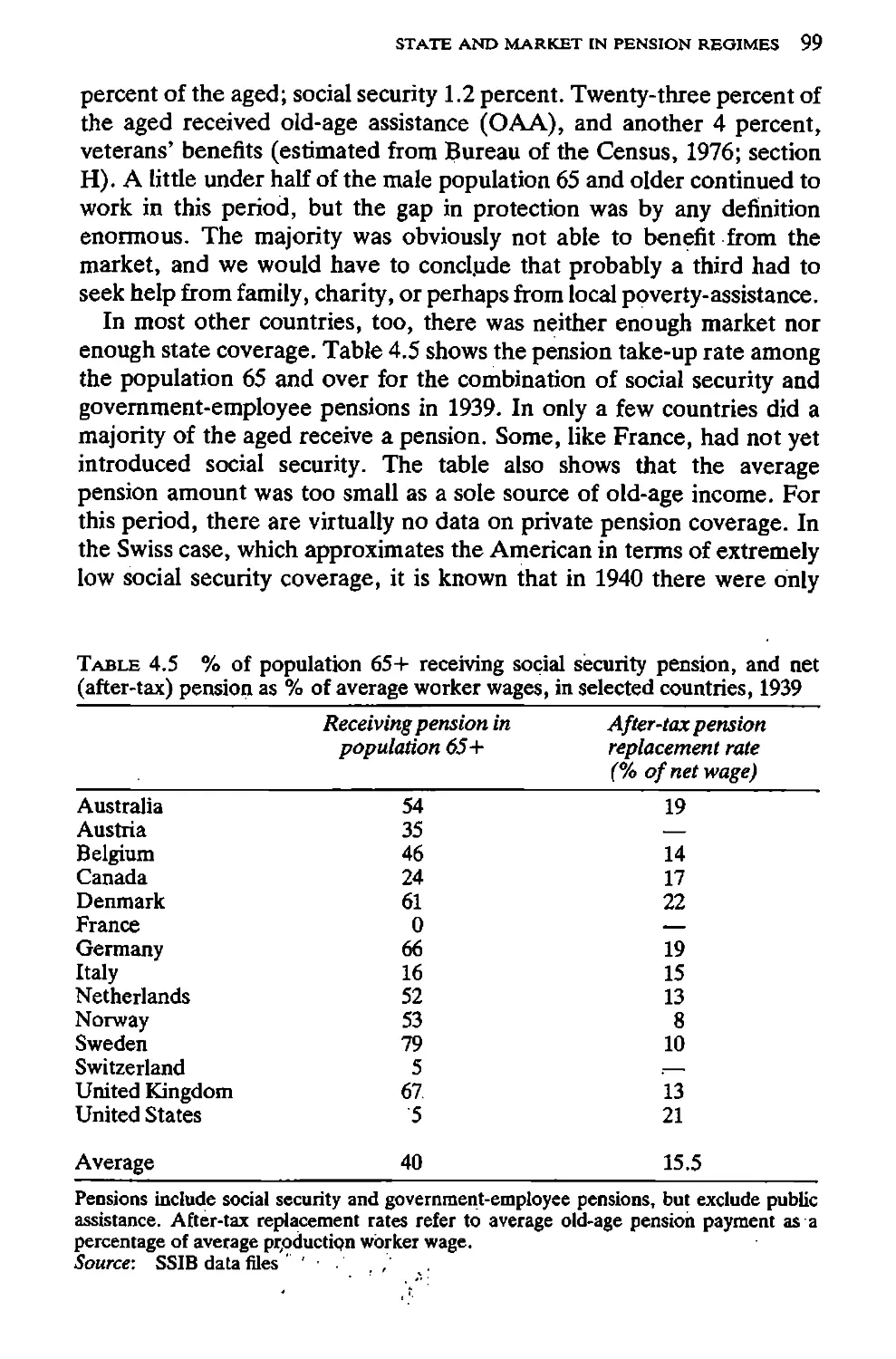
Table 4.5 % of population 65+ receiving social security pension,
and net (after-tax) pension as % of average worker
wages, in selected countries, 1939 99
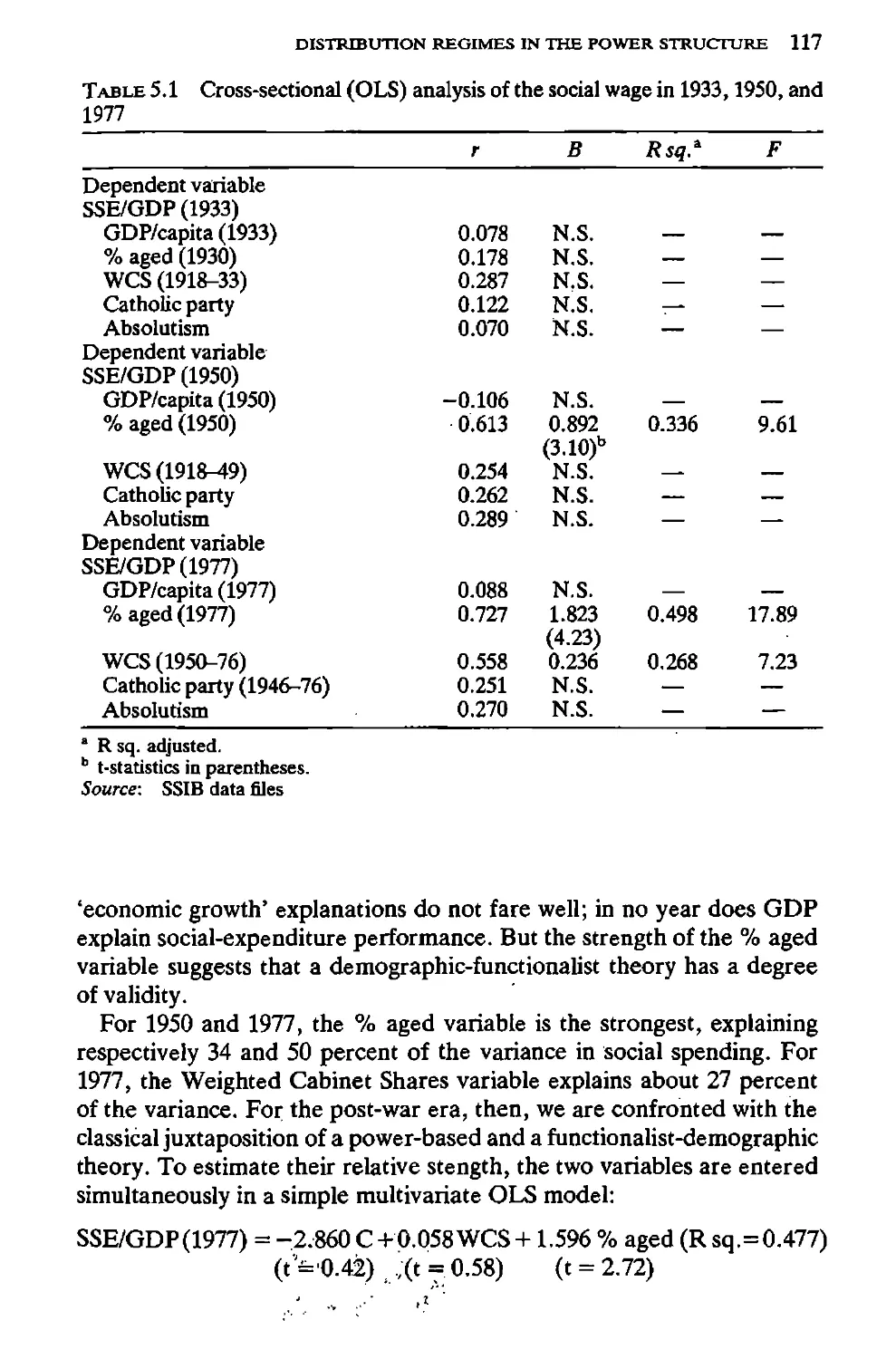
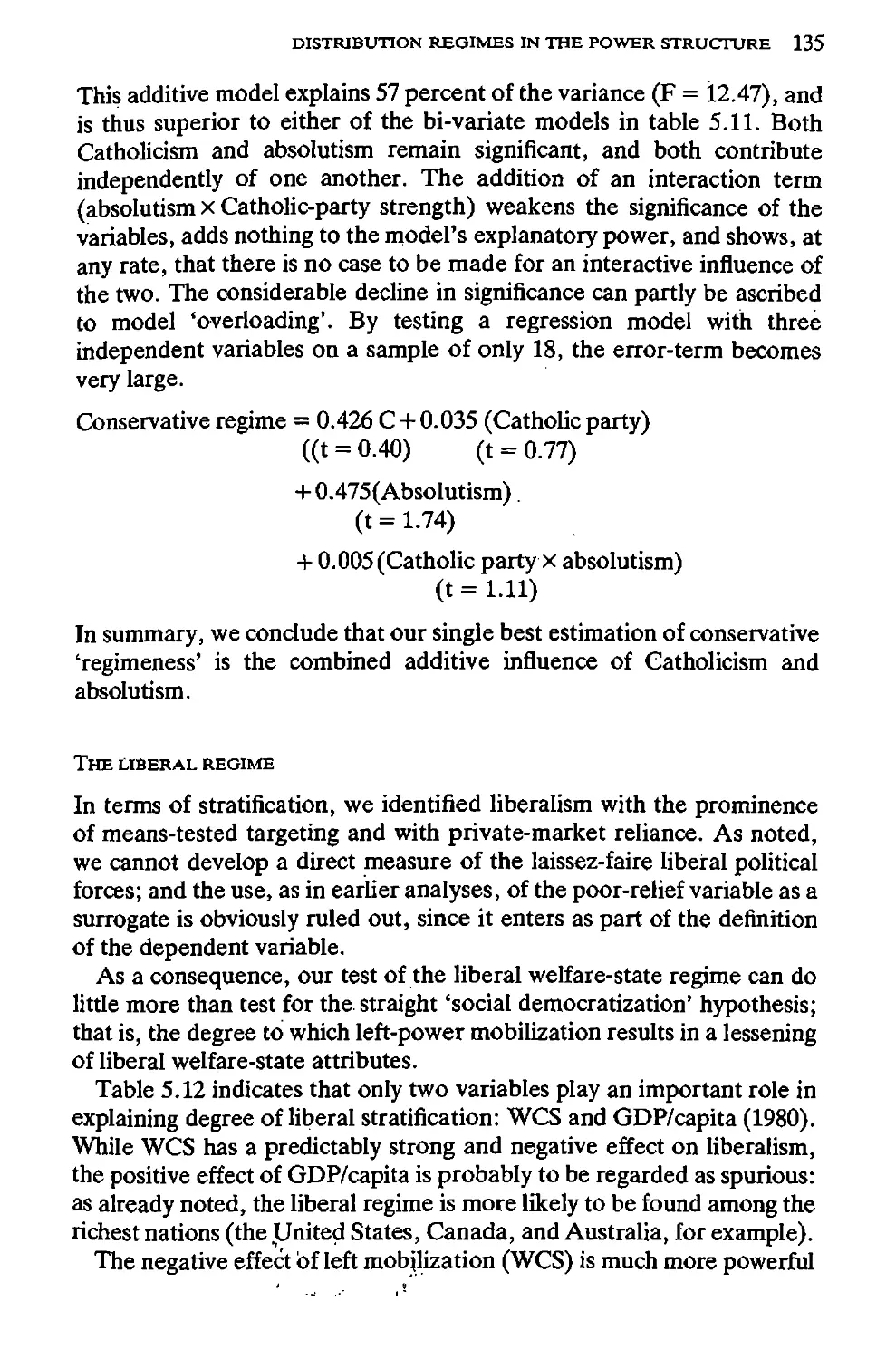
Table 5.1 Cross-sectional (OLS) analysis of the social wage in
1933, 1950, and 1977 117
Table 5.2 Cross-sectional (OLS) analysis of total private and
public pension expenditure (as % of GDP), 1980 119
Table 5.3 Cross-sectional (OLS) analysis of the market bias in
pensions, 1980 121
Table 5.4 Cross-sectional (OLS) analysis of etatist privilege, 1980 123

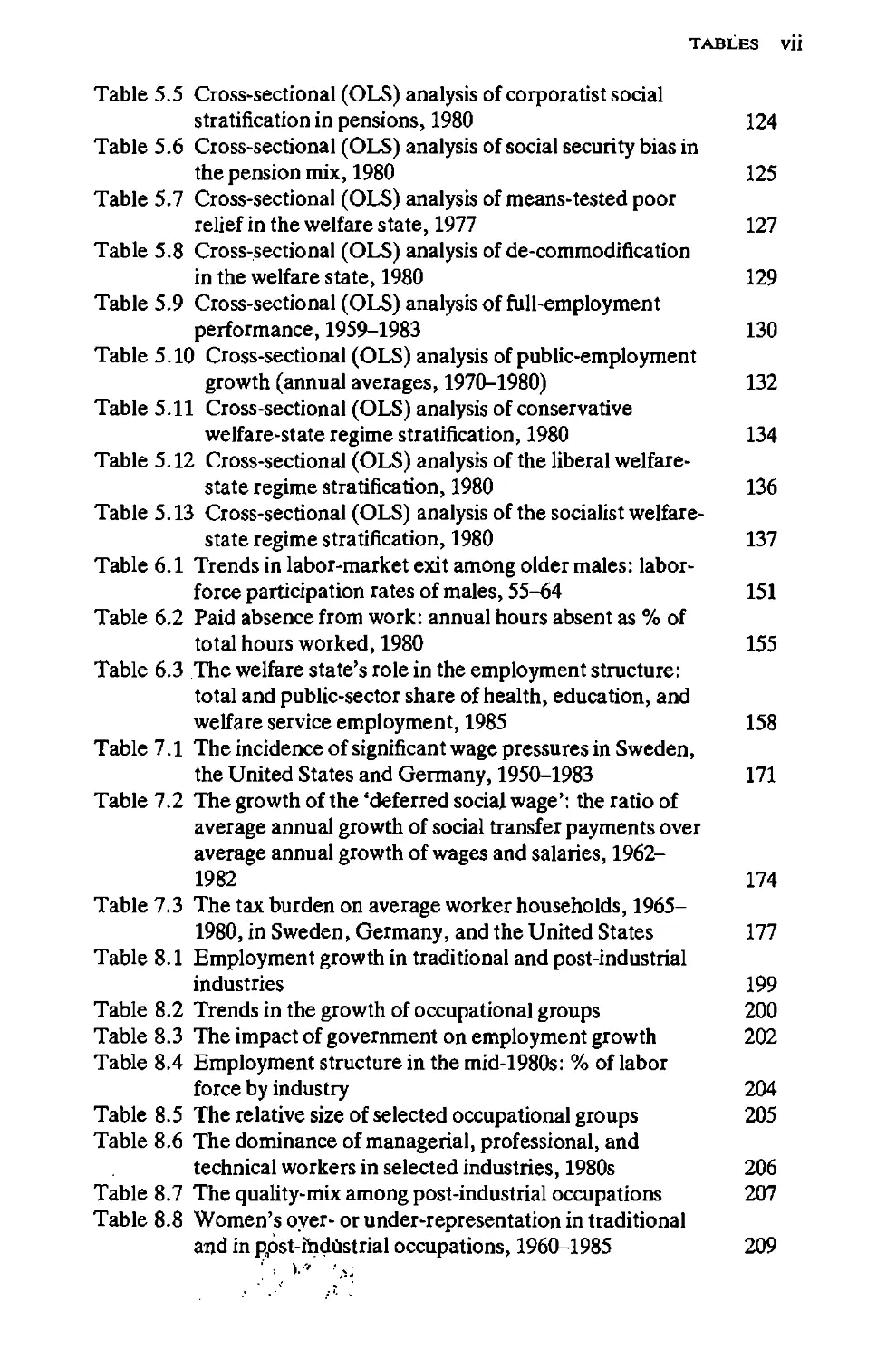
·rAm;Es vii
Table 5.5 Cross-sectional (OLS) analysis of corporatist social
stratification in pensions, 1980 124
Table 5.6 Cross-sectional (OLS) analysis of social security bias in
the pension mix, 1980 125
Table 5.7 Cross-sectional (OLS) analysis of means-tested poor
relief in the welfare state, 1977 127
Table 5.8 Cross-sectional (OLS) analysis of de-commoditication
in the welfare state, 1980 129
Table 5.9 Cross-sectional (OLS) analysis of full—employment
performance, 1959-1983 130
Table 5.10 Cross-sectional (OLS) analysis of public-employment
growth (annual averages, 1970-1980) 132
Table 5.11 Cross-sectional (OLS) analysis of conservative
welfare-state regime stratification, 1980 134
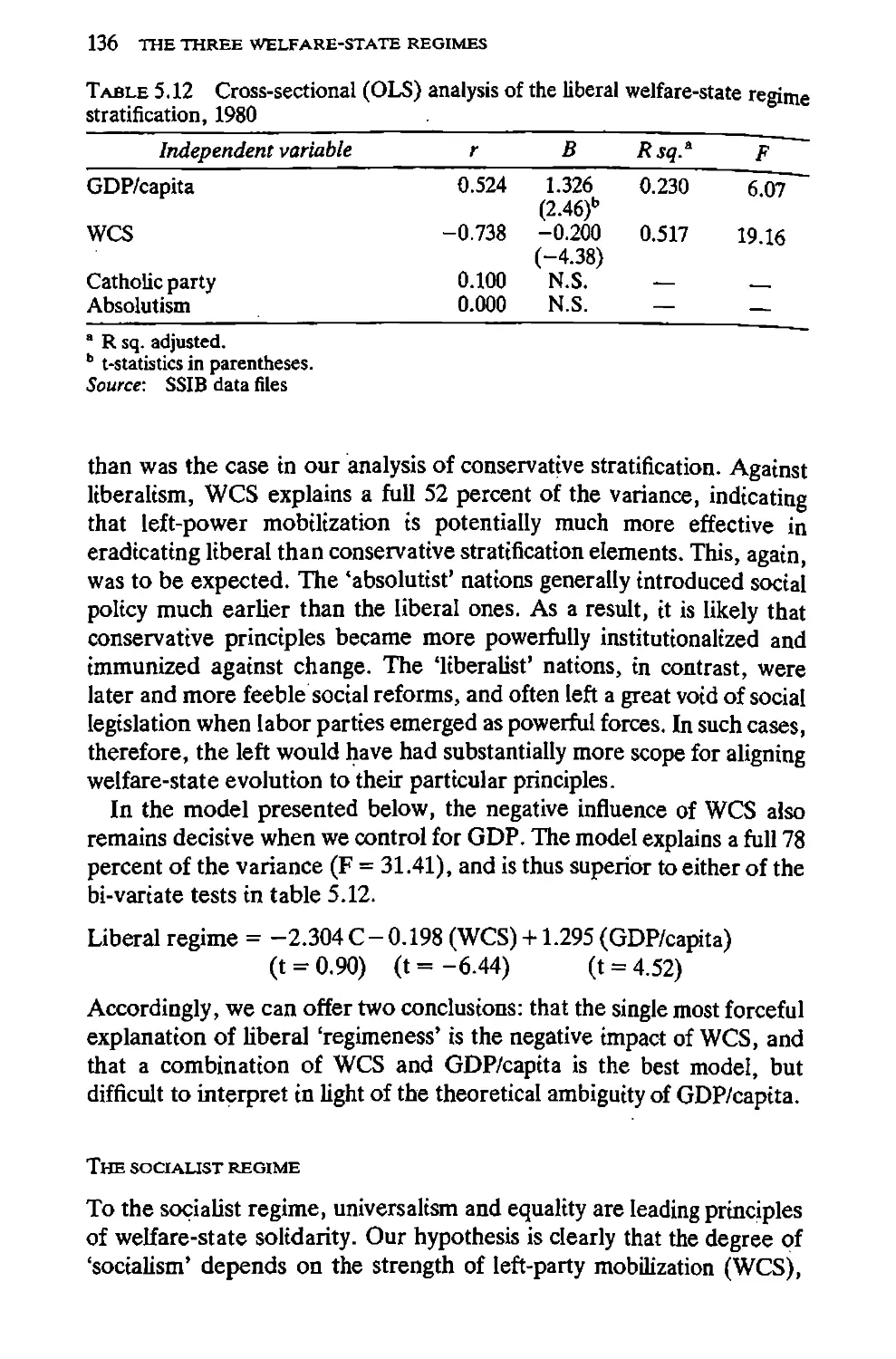
Table 5.12 Cross-sectional (OLS) analysis of the liberal welfare-
state regime stratification, 1980 136
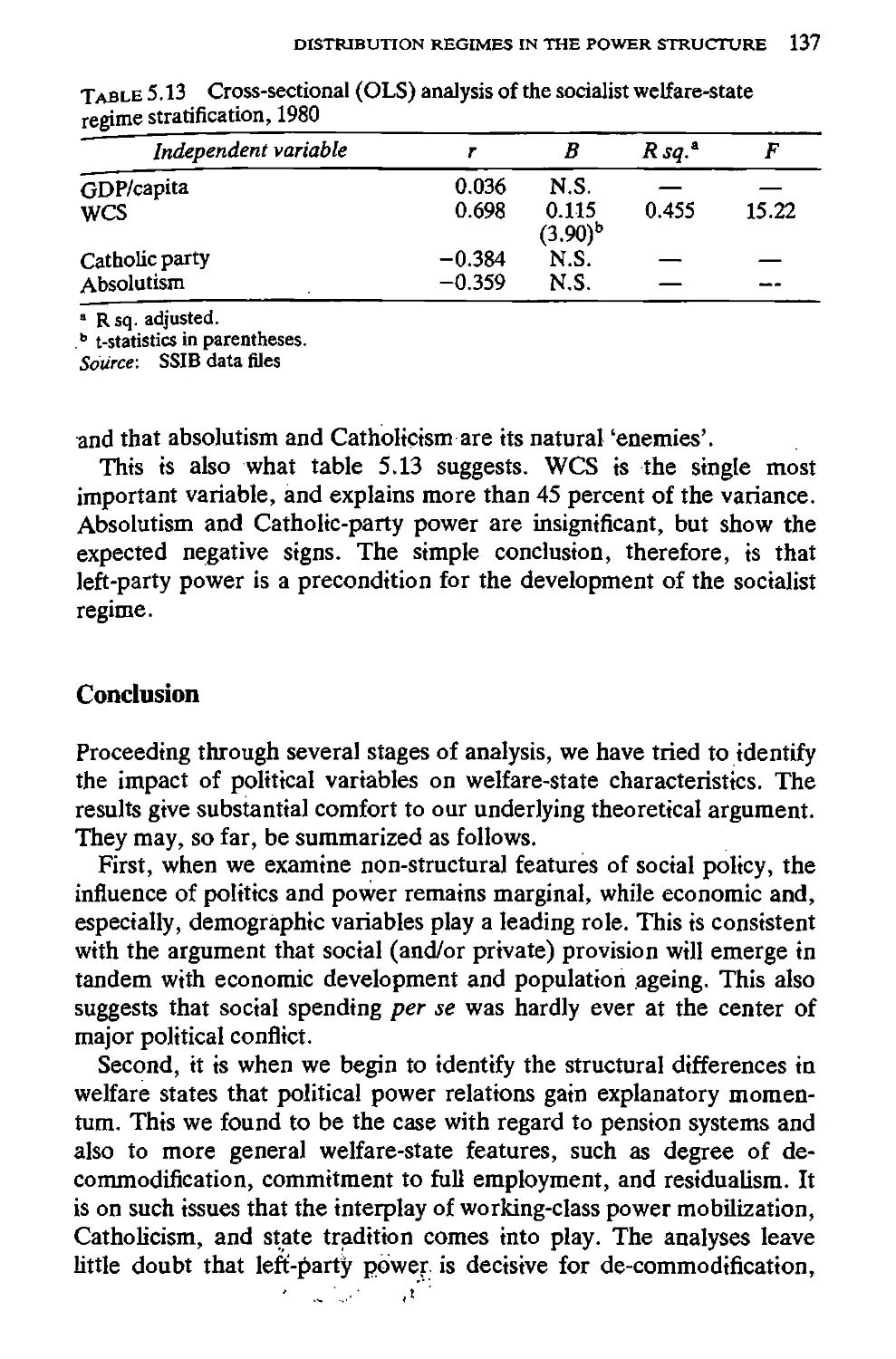
Table 5.13 Cross-sectional (OLS) analysis of the socialist welfare-
state regime stratification, 1980 137
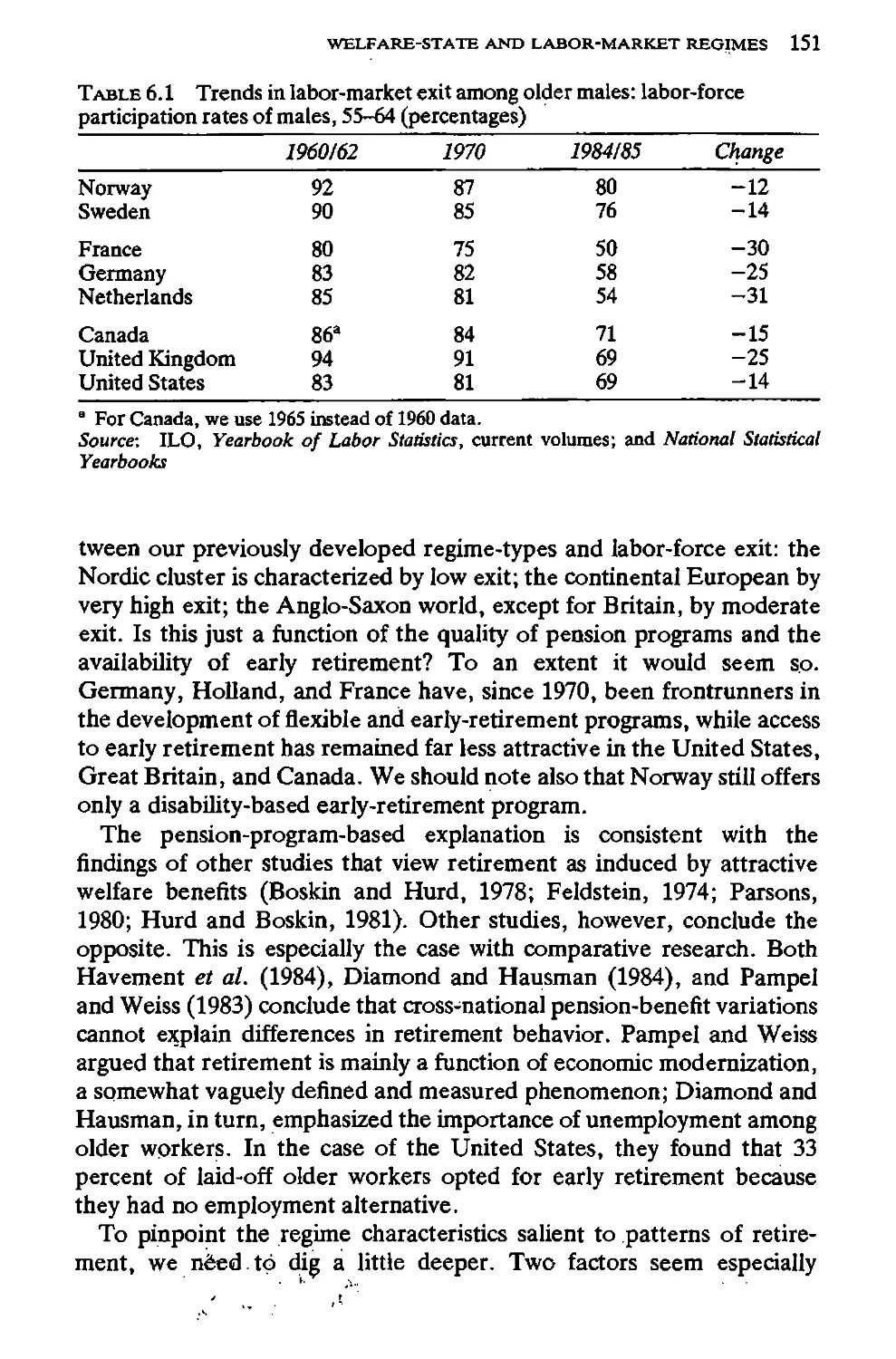
Table 6.1 Trends in labor-market exit among older males: labor-
force participation rates of males, 55-64 151
Table 6.2 Paid absence from work: annual hours absent as % of
total hours worked, 1980 155
Table 6.3 The welfare state‘s role in the employment structure:
total and public-sector share of health, education, and
welfare service employment, 1985 158
Table 7.1 The incidence of significant wage pressures in Sweden,
the United States and Germany, 1950-1983 171
Table 7.2 The growth of the ‘deferred social wage’: the ratio of
average annual growth of social transfer payments over
average annual growth of wages and salaries, 1962-
1982 174
Table 7.3 The tax burden on average worker households, 1965-
1980, in Sweden, Germany, and the United States 177
Table 8.1 Employment growth in traditional and post-industrial
industries 199
Table 8.2 Trends in the growth of occupational groups 200
Table 8.3 The impact of government on employment growth 202
Table 8.4 Employment structure in the mid-1980s: % of labor
force by industry 204
Table 8.5 The relative size of selected occupational groups 205
Table 8.6 The dominance of managerial, professional, and
. technical workers in selected industries, 1980s 206
Table 8.7 The quality-mix among post-industrial occupations 207
Table 8.8 Women’s over- or under-representation in traditional
and in p,ost—i‘ndustrial occupations, 1960-1985 209
I = l·`° 1 zi

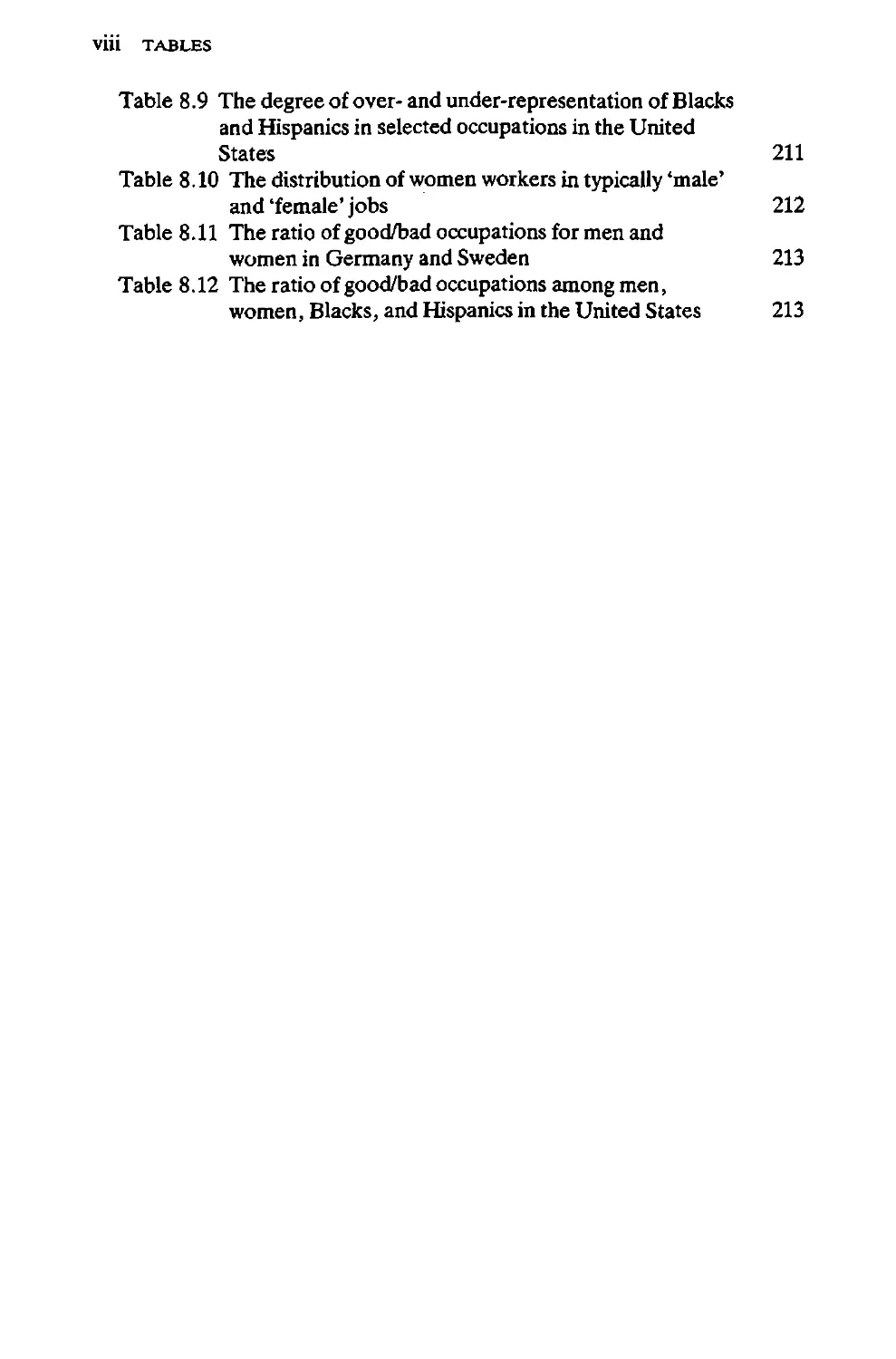
viii Tunes
Table 8.9 The degree of over- and under-representation of Blacks
and Hispanics in selected occupations in the United
States 211
Table 8.10 The distribution of women workers in typically ‘male’
and ‘female’ jobs 212
Table 8.11 The ratio of good/bad occupations for men and
women in Germany and Sweden 213
Table 8.12 The ratio of good/bad occupations among men,
women, Blacks, and Hispanics in the United States 213

It may not show, but this is a book that stands on a veritable mountain
of data and years of endless statistical manipulation. It uses three large
data bases that have been constructed over the past eight years. In_ my
analyses of the institutional characteristics of welfare-state programs,
the data derive from the comparative welfare-state project begun by
Walter Korpi and myself in 1981 at the Swedish Institute for Social
Research. Joakim Palme contributed enormously in collecting,
assembling, and now analyzing, the data. Here I must also acknow-
ledge my gratitude to the Bank of Sweden Tercentenniary Fund and
the Swedish Delegation for Social Research for research funding.
Several tables in the following chapters are constructed on the basis of
these data; the reference used is ‘SSIB data jiles’ (Svensk Socialpolitik i
International Belysning). .
Many of the analyses on welfare-state and labor-market interactions
are based on our WEEP data base (Welfare State Entry and Exit
Project); again, the reader will find a number of table references to
‘WEEP data files'. This is a multi-national project (covering ten nations
over 25 years) that, begun in 1985, was directed by Jon Eivind Kolberg
in Scandinavia and Lee Rainwater, Martin Rein, and myself at the
Science Center in Berlin. It would fill at least a whole chapter to list all
the underlying sources. In the main, however, the WEEP data derive
from national labor-force surveys and census data. The WEEP data
base would not have come into existence without the help of Kaare
Hagen, Tom Cusack, and Frieder Nashold. Much gratitude is also
owed to the Nordic Council and the Science Center in Berlin for
research financing. ,
The third data set has {been constructed here at the European

-

The welfare state has been a favored topic of research for many years
now. This is not very surprising when we consider its fantastic pace of
growth in most countries during the 1960s and 1970s. What once. were
night-watchman states, law-and-order states, militarist states, or even
repressive organs of totalitarian rule, are now institutions predominant-
ly preoccupied with the production and distribution of social well-being.
To study the welfare state is therefore a means to understand a novel
phenomenon in the history of capitalist societies.
In the league of advanced capitalist democracies, states clearly vary
considerably with regard to their accent on welfare. Even if the lion’s
share of expenditures or personnel serves welfare aims, the kind of
welfare provided will be qualitatively different, as will its prioritization
relative to competing activities, be they warfare, law and order, or the
promotion of profits and trade.
The historical characteristics of states have played a detemiinant
role in forging the emergence of their welfare-statism. In his recent
book, Giddens (1985) highlights the causal influence of wars, a factor
which has been almost wholly neglected in the large literature on
welfare-state origins. In our account, this argument cannot be con-
fronted directly. Yet, it is given some indirect support in our emphasis
on the relative strength of absolutist and authoritarian rule. The
leading theme in our account, however, is that the history of political
class coalitions is the most decisive cause of welfare-state variations.
The welfare state has been approached both narrowly and broadly.
Those who take the narrower view see it in terms of the traditional
terrain of social amelioration: income transfers and social services,
with perhaps someztoken mention of the housing question. The broad-

2 rrrrnooucuow
er view often frames its questions in terms of political economy, its
interests focused on the state’s larger role in managing and organizing
the economy. ln the broader view, therefore, issues of employment,
wages, and overall macro-economic steering are considered integral
components in the welfare-state complex. In a sense, this approach
identifies its subject matter as the ‘Keynesian welfare state’ or, if you
like, ‘welfare capitalism’. _
In this book, we follow the broad approach; this is why we begin
with the issues of classical and modern political economy, and why we
devote the last third of thebook to issues of employment and general
macro-economic steering. This is also why we prefer to employ terms
such as ‘welfare capitalism’ and ‘welfare-state regimes’. s
‘Welfare~state regimes’ is, in a way, the organizing concept of the
book. The reasons are several. First, as it is commonly used, the
concept of the welfare state is too narrowly associated with the
conventional social-amelioration policies. Second, what we will show is
that contemporary advanced nations cluster not only in terms of how
their traditional social-welfare policies are constructed, but also in
terms of howthese influence employment and general social structure.
To talk of ‘a regime’ is to denote the fact that in the relation between
state and economy a complex of legal and organizational features are
systematically interwoven.
The broader approach implies a tradeyoff. Since our intention is to
understand the ‘big picture’, we shall not be able to dwell on the
detailed characteristics of the various social programs. So, when we
study pensions, for example, our concern is not pensions per se, but
the ways in which they elucidate how different nations arrive at their
peculiar public-private sector mix. A related trade-off is that large-
scale comparisons, such as ours, prohibit detailed treatments of indi-
vidual countries. I am convinced that readers knowledgeable about any
of the 18 nations included in the study will feel that my treatment of
‘their’ country is superficial, if not `outright misrepresentative. This is
unfortunately the price to be paid for making grand comparisons,
given the intellectual limitations of the author and the page limitations
set by the publisher.
This book has been written with two beliefs in mind. The first is that
existing theoretical models of the welfare state are inadequate. The
ambition is to offer a reconceptualization and re-theorization on the
basis of what we consider important about the welfare state. The
existence of a social program and the amount of money spent on it
may be less important than what it does. We shall devote many pages
to arguing that issues of de-commodification, social stratification, and

rrrrnooucrrou _3
employment are keys to a welfare state’s identity. The second belief is
that only comparative empirical research will adequately disclose the
fundamental properties that unite or divide modern welfare states. The
_distant dream of social science is to formulate laws of societal motion.
Whether formulated in terms of the logic of capitalism, industrialism,
modernization, or nation-building, they nearly always posit similar and
convergent evolutionary paths. Obviously, laws are not supposed to
have deviant cases.
The comparative approach is meant to (and will) show that welfare
states are not all of one type. Indeed, the study presented here
identifies three highly diverse regime-types, each organized around its
own discrete logic of organization, stratification, and societal integra-
tion. They owe their origins to different historical forces, and they
follow qualitatively different developmental trajectories.
In the first chapter, our task is to reintegrate the welfare-state
debate into the intellectual tradition of political economy. This serves
to bring into sharper focus the principal theoretical questions involved.
On this basis we will be in a better position to specify the salient
characteristics of welfare states.. The convention of conceptualizing
welfare states in terms of their expenditures will no longer do. In a
sense, our ultimate goal is to ‘sociologize’ the study of welfare states.
Most studies have assumed a world of linearity: of more or less power,
industrialization, or spending. We will in this book understand welfare
states as clustering into three different types of regime that we have
labeled conservative, liberal, and ‘social democratic’. Their crystalliza-
tion and subsequent development can hardly be explained with analy-
tical parsimony.
In chapters 2, 3, and 4 we offer a reconceptualization of what we
believe to be the salient characteristics of welfare states. The extension
of social rights has always been regarded as the essence of social
policy. Inspired by the contributions of Karl Polanyi, we choose to
view social rights in terms of their capacity for ‘de-commodification’.
The outstanding criterion for social rights must be the degree to which
they permit people to make their living standards independent of pure
market forces. It is in this sense that social rights diminish citizens'
status as ‘commodities’.
Social stratification is part and parcel of welfare states. Social policy
is supposed to address problems of stratification, but it also produces
it. Equality has always been what welfare states were supposed to
produce, yet the image of equality has always remained rather vague.
In some _analyses it- is simply taken for granted that social benefits
diminish inequalities. In others, the focus is on the eradication of

4 INTRODUCTION
poverty or the overall distribution of income. The really neglected
issue is the welfare state as a stratification system in its own right. Does
it enhance or diminish existing status or class differences; does it create
dualisms, individualism, or broad social solidarity? These are the issues
of chapter 3. _
Both social rights and social stratification are shaped by the nexus of
state and market in the distribution system. To a social democrat,
reliance on the market for the basic means of welfare is problematic
because it fails to provide inalienable rights and because it is inequit-
able. To a laissez-faire liberal, reliance on the welfare state is danger-
ous because it cripples freedom and efficiency. In chapter 4, we
examine how the interplay of public and private sector has contributed
to ·the crystallization of the pension-mix in different welfare-state
regimes. The point is two—fold. First, we cannot grasp the welfare state
without locating its activities in relation to the private sector. Second,
it is a myth to think that either markets or the state are more naturally
equipped- to develop welfare. Instead, markets are often politically
created and form an integral part of the overall welfare-state regime.
Part I of the book develops the dimensions of comparative welfare
states, and demonstrates the clustering of advanced capitalist democra-
cies into three distinct regimes. Part II examines how this came to be.
In this analysis we can obviously not limit ourselves to why some
welfare states score more or less than others on some attribute. We
have to account for why the world is composed of three qualitatively
different welfare-state logics. In chapter 5, we adopt the_ standard
comparative correlational approach to identify the relative importance
of political forces in the creation of welfare states. In line with the
prevailing academic consensus today, we must conclude that politics
not only matters, but is decisive. In contrast to most studies, however,
it is not necessarily the political mobilization of the working classes
that matters here. For some regimes, their role has been marginal and
we must instead understand the evolution of welfare states here _as the
result of the state’s history of nation-building and/or the influence of
conservatism and Catholicism. We have tried to embed our‘explana—
tions in the political histories of nations. g
The second part of the book broadens the held of investigation
considerably. Here the focus is not so much on what created welfare
states as on what their effects are on our economies. Specifically, we
examine three facets of welfare-state—employment interactions. To
begin with, in chapter 6 we lay out an argument for why labor-market
structures are closely tied to welfare-state regimes. We show thatthe
coincidence of the two is striking, and that the behavioral characteris-

`11~rrRODucrroN 5
tics of labor markets cross-nationally depend on how the welfare state
is constructed. i
In chapters 7 and 8, we examine in greater detail how welfare states
affect employment by selecting a representative country from each of
our three types of regime. In chapter 7, the focus is on nations’
capacities to maintain full employment; in chapter 8, it is on the
post-industrial transformation of employment structures. In the former
chapter, we analyze how welfare states have become key institutions in
managing the dilemmas and tensions that emerge with a full-
cmployment commitment. In the latter, we argue that it is false. to
believe in the emergence of a general post-industrial employment path.
We identify three qualitatively diverse trajectories, each of which owes-
its dynamic to the structuring of the welfare state. We conclude that
each trajectory produces its own stratification outcome, and results,
therefore, in very different conflict scenarios.
The book, -then, sees the welfare state· as a principal institution in
the construction of different models of post-war capitalism. Hence, the
choice of its title, The Three Worlds of Weh‘are Capitalism.

. if _
?1i `
—> :{`
J}

The Three POl1IlC3lECOHOml€S
of the Welfare State
The Legacy of Classical Political Economy
Most debates on the welfare state have been guided by two questions.
First, will the salience of class diminish with the extension of social
citizenship? In other words, can the [welfare state fundamentally trans-
form capitalist society? Second, what are the causal forces behind
welfare-state development?
These questions are not recent. Indeed, they were formulated by the
nineteenth-century political economists 100 years before any welfare
state can rightly be said to have come into existence. The classical
political economists -— whether_ of liberal, conservative, or Marxist
persuasion - were preoccupied with the relationship between capital-
ism and welfare. They certainly gave different (and usually normative)
answers, but their analyses converged around the relationship between
market (and property), and the state (democracy).
Contemporary neo-liberalism is very much an echo of classical
liberal political economy. For Adam Smith, the market was the
superior means for the abolition of class, inequality, and privilege.
Aside from a necessary minimum, state intervention would only stiiie
the equalizing process of competitive exchange and create monopolies,
protectionism, and inefficiency: the state upholds class; the market can
potentially undo class society (Smith, 1961, II, esp. pp. 232-6).1
Liberal political economists were hardly of one mind when it came
* This chapter is adapted from an article which previously appeared in the Canadian
Review of Sociology and Anthropology, Vol. 26:2 (1989) under the title ‘The three
political economies of the welfare state’. F.

10 ·ri-rn ·r1-nazi; w·su=AnE-s·rA·rE maormias
to policy advocacy. Nassau Senior and later Manchester liberals
emphasized the laissez-faire element in Smith, rejecting any form of
social protection outside the cash nexus. J. S. Mill and the ‘reformed
liberals’, in turn, were proponents of a modicum of political regulation.
Yet they all were agreed that the road to equality and prosperity should
be paved with a maximum of free markets and a minimum of state_
interference. .
Their enthusiastic embrace of market capitalism may now appear
unjustified. But we must not forget that the reality they spoke of was a
state upholding absolutist privileges, mercantilist protectionism, and
pervasive corruption. What they attacked was a system of government
that repressed their ideals of both freedom and enterprise. Hence,
theirs was revolutionary theory, and from this vantage point, we can
understand why Adam Smith sometimes reads like Karl Marx.2
Democracy became an Achilles’ heel to many liberals. As long as
capitalism-remained a world of small property owners, property itself
would have little to fear from democracy. But with industrialization,
the proletarian masses emerged, for whom democracy was a means to
curtail the privileges of property. The liberals rightly feared universal
suffrage, for it would be likely to politicize.the distributional struggle,
pervert the market, and fuel inefficiencies. Many liberals discovered
that democracy would usurp or destroy the market.
Both conservative and Marxist political economists understood this
contradiction, but proposed, of course, opposite solutions, The most
coherent conservative critique of laissez-faire came from the German
historical school, in particular from Friedrich List, Adolph Wagner,
and Gustav Schmoller. They refused to believe that the raw cash—nexus
of the market was the only or the best guaranteee of economic
efficiency. Their ideal was the perpetuation of patriarchy and absolut-
ism as the best possible legal, political, and social shell for a capitalism
without class struggle.
One prominent conservative school promoted the ‘monarchical wel-
fare state’, which would guarantee social welfare, class harmony,
loyalty, and productivity. In this model, an efficient production system
comes not from competition, but from discipline. An authoritarian
state would be far superior to the chaos of markets in harmonizing the
good of the state, community, and individual.3
Conservative political economy emerged in reaction to the French
Revolution and the Paris Commune. It was avowedly nationalistic and
anti-revolutionary, and sought to arrest the democratic impulse. It
feared social leveling, and favored a society that retained both hierar-

·rr-nz ·rr~uzEE i=·or.r·i·1c».r. Economies or rr-is wEr.r=Ama—s·r.·.·i·s 11
chy and class. Status, rank, and class were natural and given; class
conflicts, however, were not. If we permit democratic mass participa-
tion, and allow authority and status boundaries to dissolve, the result is
a collapse of the social order. _
Marxist political economy not only abhorred the market’s atomizing
effects, but also attacked the liberal claim that markets guarantee
equality. Since, as Dobb (1946) puts it, capital accumulation disowns
people of property, the end result will be ever-deeper class divisions.
And as these generate sharpened conflicts, the liberal state will be
forced to shed its ideals of freedom and neutrality, and come to the
defence of the propertied classes. For Marxism this is the foundation
of class dominance.
The central question, not only for Marxism but for the entire
contemporary debate on the welfare state, is whether, and under what
conditions, the class divisions and social inequalities produced by
capitalism can be undone by parliamentary democracy.
Fearing that democracy might produce socialism, the liberals were
hardly eager to extend it. The socialists, in contrast, suspected that
parliamentarism would be little more than an empty shell or, as Lenin
suggested, a mere ‘talking shop’ (Jessop, 1982). This line of analysis,
echoed in much of contemporary Marxism, produced the belief that
social reforms were little more than a dike in a steadily leaking
capitalist order. By definition, they could not be a response to the
desire of the working classes for emancipation}
It took major extensions of political rights before the socialists could
wholeheartedly embrace a more optimistic analysis of parliamentarism.
The theoretically most sophisticated contributions came from the Au-
stro-German Marxists such as Adler, Bauer, and Eduard Heimann.
According to Heimann (1929), it may have been the case that con-
servative reforms were motivated by little else than a desire to repress
labor mobilization. But once introduced, they become contradictory:
the balance of class power is fundamentally altered when workers
enjoy social rights, for the social wage lessens the worker’s dependence
on the market and employers, and thus turns into a potential power
resource. To Heimann, social policy introduces an alien element into
the capitalist political economy. It is a Trojan horse that can penetrate
the frontier between capitalism and socialism. This intellectual position
has enjoyed quite a renaissance in recent Marxism (Offe, 1985; Bowles
and Gintis, 1986).
The social democratic model, as outlined above, did not necessarily
abandon the orthodoxy that, ultimately, fundamental equality requires
' . L sj

12 Tl-IE THREE WELFARE-STATE REGIMES
economic socialization. Yet historical experience soon demonstrated
that socialization was a goal that could not be pursued realistically
through parliamentarism.5 ‘
Social democracy’s embrace of parliamentary reformism as its domi-_
nant strategy for equality and socialism was premised on two argu-
ments. The first was that workers require social resources, health, and
education to participate effectively as socialist citizens. The second
argument was that social policy is not only emancipatory, but is also a
precondition for economic efficiency (Myrdal and Myrdal, 1936). Fol-
lowing Marx, in this argument the strategic value of welfare policies is
that they help promote the onward march of the productive forces in
capitalism. But the beauty of the social democratic strategy was that
social policy would also result in power mobilization. By eradicating
poverty, unemployment, and complete wage dependency, the welfare
state increases political capacities and diminishes the social divisions
that are barriers to political unity among workers.
The social democratic model, then, is father to one of the leading
hypotheses of contemporary welfare-state debate: parliamentary class-
mobilization is a means for the realization of the socialist ideals of
equality, justice, freedom, and solidarity.
The Political Economy of the Welfare State
Our forebears in political economy defined the analytic basis of much
recent scholarship. They isolated the key variables of class, state,
market, and democracy, and they formulated the basic propositions
about citizenship and class, efficiency and equality, capitalism and
socialism. Contemporary social science distinguishes itself from classic-
al political economy on two scientifically vital fronts. First, it defines
itself as a positive science and shies away from normative prescription
(Robbins, 1976). Second, classical political economists had little in-
terest in historical variability: they saw their efforts as leading towards
a system of universal laws. Although contemporary political economy
sometimes still clings to the belief in absolute truths, the comparative
and historical method that today underpins almost all good political
economy is one that reveals variation and permeability.
Despite these differences, most recent scholarship has as its focal
point the state—economy relationship defined by nineteenth-century
political economists. And, given the enormous growth of the welfare
state, it is understandable that it has become a major test case for
contending theories of political economy.

me uma; rormcitr Economies or ri-uz W'ELFARE·STATE 13
We shall review below the contributions of comparative research on
the development of welfare states in advanced capitalist countries. It
will be argued that most scholarship has been misdirected, mainly
because it became detached from its theoretical foundations. We must
therefore recast both the methodology and the concepts of political
economy in order to adequately study the welfare state. This will
constitute the focus of the final section of this chapter.
Two types of approach have dominated in explanations of welfare
states; one stresses structures and whole systems, the other, institu-
tions and actors.
Tr-re svsrems/srnucrunnrrsr Apmoncu
Systems or structuralist theory seeks to capture the logic of develop-`-
ment holistically. It is the system that ‘wills’, and what happens is
therefore easily interpreted as a functional requisite for the reproduc-
tion of society and economy. Because its attention is concentrated on
the laws of motion of systems, this approach is inclined to emphasize
cross-national similarities rather than differences; being industrialized
or capitalist over-deterrnines cultural variations or differences in power
One variant begins with a theory of industrial society, and argues
that industrialization makes social policy both necessary and possible —
necessary because pre-industrial modes of social reproduction, such as
the family, the church, noblesse oblige, and guild solidarity are des-
troyed by the forces attached to modemization, such as social mobility,
urbanization, individualism, and market dependence. The crux of the
matter is that the market is no adequate substitute because it caters
only to those who are able to perform in it. Hence, the ‘welfare
function’ is appropriated by the nation-state.
The welfare state is also made possible by the rise of modern
bureaucracy as a rational, universalist, and efficient form of organiza-
tion. It is a means for managing collective goods, but also a center of
power in its own right, and it will thus be inclined to promote its own
growth. This kind of reasoning has informed the so-called ‘log·ic of
industrialism’ perspective, according to which the welfare state will
emerge as the modern industrial economy destroys traditional social
institutions (Flora and Alber, 1981; Pryor, 1969). But the thesis has
difficulties explaining why government social policy only emerged 50
and sometimes even 100 years after traditional community was effec-
tively destroyed. The basic response draws on Wagner’s Law of 1883
(Wagner, 1962) and =on,_Alfred Marshall (1920) - namely that a certain

14 me -ri-imaza wm.i=Amz-srA·re maomzs
level of economic development, and thus surplus, is needed in order to
permit the diversion of scarce resources from productive use (invest!
ment) to welfare (Wilensky and Lebeaux, 1958). In this sense, this
perspective follows in the footsteps of the old liberals. Social redis-
tribution endangers efficiency, and only at a certain economic level will
a negative-sum trade-off be avoidable (Okun, 1975).
The new structuralist Marxism is strikingly parallel. Abandoning its
classical forebears’ strongly action-centered theory, its analytical start-
ing-point is that the welfare state is an inevitable product of the
capitalist· mode of production. Capital accumulation creates contradic—_
tions that compel social reform (O’Connor, 1973). In this tradition of
Marxism, as in its ‘logic of industrialism’ counterpart, welfare states
hardly need to be promoted by political actors, whether they be
unions, socialist parties, humanitarians, or enlightened reformers. The
point is that the state, as such, is positioned in such a way that the
collective needs- of capital are served, regardless. The theory is thus
premised on two crucial assumptions: first, that power is structural,
and second, that the state is ‘relatively’ autonomous from class direc-
tives (Poulantzas, 1973; Block, 1977; for a recent critical assessment of
this literature, see Therborn, 1986a; and Skocpol and Amenta, 1986).
The ‘logic of capitalism’ perspective invites difficult questions. If, as
Przeworski (1980) has argued, working-class consent is assured on the
basis of material hegemony, that is, self-willed subordination to the
system, it is difficult to see why up to 40 percent of the national
product must be allocated to the legitimation activities of a welfare
state. A second problem is to derive state activities from a ‘mode of
production’ analysis. Eastern Europe may perhaps not qualify as
socialist, but neither is it capitalist. Yet there we find ‘welfare states’,
too. Perhaps accumulation has functional requirements no matter how
it proceeds? (Skocpol and Amenta, 1986; Bell, 1978).
Ti-na INS'[T'I'U'I`IONAL Ai>i>1zo.·.ci-r
The classical political economists made it clear why democratic institu-
tions should influence welfare-state development. The liberals feared
that full democracy might jeopardize markets and inaugurate social-
ism. Freedom, in their view, necessitated a defence of markets against
political intrusion. In practice, this is what the laissez-faire state sought
to accomplish. But it was this divorce of politics and economy which
fuelled much institutionalist analysis. Represented best by. Polanyi
(1944), but also by a number of anti-democratic exponents of the
historicalschool, the—institutional approach insists that any effort to

rms mama POLITICAL Economies or rm; warmna-srxm 15
isolate the economy from social and political institutions will destroy
human society. The economy must be embedded in social communities
in order for it to survive. Thus, Polanyi sees social policy as one
necessary precondition for the reintegration of the social economy.
An interesting recent variant of institutional alignment theory is the
argument that welfare states emerge more readily in small, open
economies that are particularly vulnerable to international markets. As
Katzenstein (1985) and Cameron (1978) show, there is a greater
inclination to regulate class-distributional conflicts through government
and interest concertation when both business and labor are captive to
forces beyond domestic control.
The impact ofdemocracy on welfare states has been argued ever since
J. S. Mill and Alexis de Tocqueville. The argument is typically phrased
without reference to any particular social agent_ or class. It is in this
sense that it is institutional. In its classical formulation, the thesis was
simply that majorities will favor social distribution to compensate for
market weakness or market risks. If wage-earners are likely to demand
a social wage, so are capitalists (or farmers) apt to demand protection in
the form of tariffs, monopoly, or subsidies. Democracy is an institution
that cannot resist majority demands.
In its modern formulations, the democracy thesis has many variants.
One identifies stages of nation-building in which the extension of full
citizenship must also include social rights (Marshall, 1950; Bendix,
1964; Rokkan, 1970). A second variant, developed by both pluralist
and public-choice theory, argues that democracy will nurture intense
party competition around the median voter which, in turn, will fuel
rising public expenditure. Tufte (1978), for example, argues that major
extensions of public intervention occur around elections as a means of
voter mobilization. i _
This approach also faces considerable empirical problems (Skocpol
and Amenta, 1986). When it holds that welfare states are more likely
to develop the more democratic rights are extended, the thesis con-
fronts the historical oddity that the first major welfare-state initiatives
occurred prior to democracy and were powerfully motivated by the
desire to arrest its realization. This was certainly the case in France
under Napoleon III, in Germany under Bismarck, and in Austria
under von Taaffe. Conversely, welfare—state development was most
retarded where democracy arrived early, such as in the United States,
Australia, and Switzerland. This apparent contradiction can be ex-
plained, but only with reference to social classes and social structure:
nations with early democracy were overwhelmingly agrarian and
dominated by small°property__owr1ers who used their electoral powers

.6 rr-na mums WELFARE·STA'I'E maomns
to reduce, not raise, taxes (Dich, 1973). In contrast, ruling classes in
authoritarian polities were better positioned to impose high taxes on
an unwilling populace.
Social Class as a Political Agent
We have noted that the case for a class-mobilization thesis flows from
social democratic political economy. It differs from structuralist and
institutional analyses in its emphasis on the social classes as the main
agents of change, and in its argument that the balance of class power
determines distributional outcomes. To emphasize active class-
mobilization does not necessarily deny the importance of structured or
hegemonic power (Korpi, 1983). But it is held that parliaments are, in
principle, effective institutions for the translation of mobilized power
into desired policies and reforms. Accordingly, parliamentary politics
is capable of overriding hegemony, and can be made to serve interests
that are antagonistic to capital. Further, the class-mobilization theory
assumes that welfare states do more than simply alleviate the current
ills of the system: a ‘social democratic’ welfare state will, in its own
iight, establish critical power resources for wage-eamers, and thus
strengthen labor movements. As Heimann (1929) originally held,
social rights push back the frontiers of capitalist power. _
The question of why the welfare state itself is a power resource is-
vital for the theory’s applicability. The answer is that wage-eamers in
the market are inherently atomizcd and stratified — compelled to
compete, insecure, and dependent on decisions and forces beyond
their control. This limits their capacity for collective solidarity and
mobilization. The social rights, income security, equalization, and
eradication of poverty that a universalistic welfare state pursues are
necessary preconditions for the strength and unity that collective
power mobilization demands (Esping—Andersen, 1985a). _
The single most difficult problem for this thesis is to specify the
conditions for power mobilization. Power depends on the resources
that flow from electoral numbers and from collective bargaining.
Power mobilization, in turn, depends on levels of trade-union orga-
nization, share of votes, and parliamentary and cabinet seats held by
left or labor parties. But the power of one agent cannot simply be
indicated by its own resources: it will depend on the resources of
contending forces,_on the historical durability of its mobilization, and
on pattems of power alliances. ' y
There are several valid objections to the class-mobilization thesis.
Three in particular are quite fundamental. One is that the locus of

rim rrman POLITICAL Economies or me wsumna-s·rAra 17
decision—making and power may shift from parliaments to neo-
corporatist institutions of interest intermediation (Shonfield, 1965;
Schmitter and Lembruch, 1979). A second criticism is that the capacity
of labor parties to influence welfare-state development is circumscribed
by the structure of right—wing party power. Castles (1978; 1982) has
argued that the degree of unity among the conservative parties is more
important than is the activated power of the left. Other authors have
emphasized the fact that denominational (usually social Catholic)
parties in countries such as Holland, Italy, and Germany mobilize
large sections of the working classes and pursue welfare—state programs
not drastically at variance with their socialist competitors (Schmidt,
1982; Wilensky, 1981). The class—mobilization thesis has, rightly, been
criticized for its Swedocentrism, i.e. its inclination todetine the process
of power mobilization too much on the basis of the rather extraordin-
ary Swedish experience (Shalev, 1984).
These objections hint at a basic fallacy in the theory’s assumptions
about the class formation: we cannot assume that socialism is the
natural basis for wage-earner mobilization. Indeed, the conditions
under which workers become socialists are still not adequately
documented. Historically, the natural organizational bases of worker
mobilization were pre-capitalist communities, especially the guilds, but
also the Church, ethnicity, or language. A ready-made reference to
false consciousness will not do to explain why Dutch, Italian, or
American workers continue to mobilize around non-socialist princi-
ples. The dominance of socialism among the Swedish working class is
as much a puzzle as is the dominance of confessionalism among the
Dutch. .
The third and perhaps most fundamental objection has to do with
the model’s linear view of power. It is problematic to hold that a
numerical increase in votes, unionization, or seats will translate into
more welfare-statism. First, for socialist as for other parties, the
magical ‘50 percent’ threshold for parliamentary majorities seems
practically insurmountable (Przeworski, 1985). Second, if socialist par-
ties represent working classes in the traditional sense, it is clear that
they will never succeed in their project. In very few cases has the
traditional working class been numerically a majority; and its role is
rapidly becoming marginal.°
Probably the most promising way to resolve the combined linearity
and working-class minority problem lies in recent applications of
Barrington Moore’s path-breaking class-coalition thesis to the trans-
formation of the modern state (Weir and Skocpol, 1985; Gourevitch,
1986; Esping-Anderson- 1985a; _.Esping-Andersen and Friedland,

18 rms mane wnrrxmz-srxrz maomias
1982). Thus, the origins of the Keynesian full-employment commit-
ment and the social democratic welfare-state edifice have been traced
to the capacity of (variably) strong working-class movements to forge a
political alliance with farmer organizations; additionally, it is arguable
that sustained social democracy has come to depend on the formation
of a new-working-class+white-collar coalition.
The class—coalitional approach has additional virtues. Two nations,
such as Austria and Sweden, may score similarly on working~class
mobilization variables, and yet produce highly unequal policy results.
This can be explained by differences in the history of coalition forma-
tion in two countries: the breakthrough of Swedish social democratic
hegemony stems from its capacity to forge the famous ‘red—green’
alliance with the farmers; the comparative disadvantage of the Au-
strian socialists rests in the ‘ghetto’ status assigned to them by virtue of
the rural classes being captured by a conservative coalition (Esping-
Andersen and Korpi, 1984).
In summary, we have to think in terms of social relations, not just
social categories. Whereas structural functionalist explanations identify
convergent welfare-state outcomes, and class-mobilization paradigms
see large, but linearly distributed, differences, an interactive model such
as the coalition approach directs attention to distinct welfare-state
What is the Welfare State?
Every theoretical paradigm must somehow define the welfare state.
How do we know when and if a welfare state responds functionally to
the needs of industrialism, or to capitalist reproduction and legitimacy?
And how do we identify a welfare state that corresponds to the demands
that a mobilized working class might have? We cannot test contending
arguments unless we have a commonly shared conception of the
phenomenon to be explained.
A remarkable attribute of the entire literature is its lack of much
genuine interest in the welfare state as such. Welfare-state studies have
been motivated by theoretical concerns with other phenomena, such as
power, industrialization, or capitalist contradictions; the welfare state
itself has generally received scant conceptual attention. If welfare states
differ, how do they differ? And when, indeed, is a state a welfare state?
This turns attention straight back to the original question: what is the
welfare state?
A common textbook definition is that it involves state responsibility

me rr-mee POLITICAL Ecowomias or me wm.r=.·.nE-srxrn 19
for securing some basic modicum of welfare for its citizens. Such a
definition skirts the issue of whether social policies are emancipatory or
not; whether they help system legitimation or not; whether they
contradict or aid the market process; and what, indeed, is meant by
‘basic’? Would it not be more appropriate to require of a welfare state
that it satisfies more than our basic or minimal welfare needs?
The first generation of comparative studies started with this type of
conceptualization. They assumed, without much reflection, that the
level of social expenditure adequately reflects a state’s commitment to
welfare. The theoretical intent was not really to arrive at an understand-
ing of the welfare state, but rather to test the validity of contending
theoretical models in political economy. By scoring nations with respect
to urbanization, level of economic growth, and the proportion of aged in
the demographic structure, it was believed that the essential features of
industrial modernization were properly considered. Alternatively, pow-
er-oriented theories compared nations on left-party strength or work-
ing-class power mobilization.
The findings of the first-generation comparativists are difficult to
evaluate, since there is no convincing case for any particular theory. The
shortage of nations for comparisons statistically restricts- the number of
variables that can be tested simultaneously. Thus, when Cutright (1965)
or Wilensky (1975) find that economic level, with its demographic and
bureaucratic correlates, explains most welfare-state variations in ‘rich
countries’, relevant measures of working-class mobilization or economic
openness are not included. Their conclusions in favor of a ‘l0gic of
industrialism’ view are therefore in doubt. And, when Hewitt (1977),
Stephens (1979), Korpi (1983), Myles (1984a), and Esping-Andersen
(1985b) find strong evidence in favor of a working-class mobilization
thesis, or when Schmidt (1982; 1983) finds support for a neo-corporatist,
and Cameron (1978) for an economic openness argument, it is without
fully testing against plausible alternative explanations.7
Most of these studies claim to explain the welfare state. Yet their
focus on spending may be misleading. Expenditures are epiphenomenal
to the theoretical substance of welfare states. Moreover, the linear
scoring approach (more or less power, democracy, or spending) contra-
dicts the sociological notion that power, democracy, or welfare‘ are
relational and structured phenomena. By scoring welfare states on
spending, we assume that all spending counts equally. But some welfare
states, the Austrian one, for example, spend a large share on benefits to
privileged civil servants. This is normally not what we would consider a
commitment to social citizenship and solidarity. Others spend disprop-
ortionately on means-tested. social assistance. Few contemporary

20 mE THREE WELFARE—S'I`A'I’E REGIMES
analysts would agree that a reformed poor—relief tradition qualities as a
welfare-state commitment. Some nations spend enormous sums on fiscal
welfare in the form of tax privileges to private insurance plans that
mainly benefit the middle classes. But these ta.x expenditures do not
show up on expenditure accounts. In Britain, total social expenditure
has grown during the Thatcher period, yet this is almost exclusively a
function of very high unemployment. Low expenditure on some prog-
rams may signiiiy a welfare state more seriously committed to full
Therbom (1983) is right when he holds that we must begin with a
conception of state structure. What are the criteria with which we
should judge whether, and when, a state is a welfare state? There are
three approaches to this question. Therborn’s proposal is to begin with
the historical transformation of state activities. Minimally, in a genuine
welfare state the majority of its daily routine activities must be devoted
to servicing the welfare needs of households. This criterion has far-
reaching consequences. If we simply measure routine activity in terms of
spending and personnel, the result is that no state can be regarded as a
real welfare state until the 1970s, and some that we nomially label as
welfare states will not qualify because the majority of their routine
activities concem defence, law and order, administration, and the like
(Therborn, 1983). Social scientists have been too quick to accept
nations’ self-proclaimed welfare-state status. They have also been too
quick to conclude that if the standard social programs have been
introduced, the welfare state has been born.
The second conceptual approach derives from Richard Titmuss’s
(1958) classical distinction between residual and institutional welfare
states. In the former, the state assumes responsibility only when the
family or the market fails; it seeks to limit its commitments to marginal
and deserving social groups. The latter model addresses the entire
population, is universalistic, and embodies an institutionalized commit-
ment to welfare. It will, in principle, extend welfare commitments to all
areas of distribution vital for societal welfare. _
The Titrnuss approach has fertilized a variety of new developments in
comparative welfare-state research (Myles, 1984a; Korpi,· 1980; ESPi11g*
Andersen and Korpi, 1984; 1986; Esping-Andersen, 1985b; 1987b). It is
an approach that forces researchers to move from the black box of
expenditures to the content of welfare states: targeted versus universa-
listic programs, the conditions of eligibility, the quality of benefits and
services, and, perhaps most importantly, the extent to which employ-
ment and working life are encompassed in the state’s extension of
citizen rights. The shift to welfare-state typologies makes simple linear

mia ·ri-umn i>or.1·rrcAr. Econownns or me vvzumnn-s·r».·ria 21
welfare-state rankings difficult to sustain. Conceptually, we are compar-
ing categorically different types of states.
The third approach is to theoretically select the criteria on which to
judge types of welfare states. This can be done by measuring actual
welfare states against some abstract model and then scoring programs,
or entire welfare states, accordingly (Day 1978; Myles, 1984a). But this
is ahistorical, and does not necessarily capture the ideals or designs that
historical actors sought to realize in the stmggles over the welfare state.
If our aim is to test causal theories that involve actors, we should begin
with the demands that were actually promoted by those actors that we
deem critical in the history of welfare-state development. It is difficult to
imagine that anyone struggled for spending per se.
A Re-Specification of the Welfare State
Few can disagree with T. H. Marshall’s (1950) proposition that social
citizenship constitutes the core idea of a welfare state. But the concept
must be fleshed out. Above all, it must involve the granting of social
rights. If social rights are given the legal and practical status of property
rights, if _they are inviolable, and if they are granted on the basis of
citizenship rather than performance, they will entail a de-
commodiiication of the status of individuals vis-d-vis the market. But
the concept of social citizenship also involves social stratification: one’s
status as a citizen will compete with, or even replace, one’s class
The welfare state cannot be understood just in terms of the rights it
grants. We must also take into account how state activities are interlock-
ed with the market’s and the family’s role in social provision. These are
the three main principles that need to be fleshed out prior to any
theoretical specification of the welfare state.
Rrorrrs Ann DE·COMMODIF'ICATION
In pre-capitalist societies, few workers were properly commodities in
the sense that their survival was contingent upon the `sale of their labor
power. It is as markets become universal and hegemonic that the
welfare of individuals comes to depend entirely on the cash nexus.
Stripping society of the institutional layers that guaranteed social
reproduction outside the labor contract meant that people were com-
modiiied. In turn, the introduction of modern social rights implies a
loosening of the purecommodity. status. De-commodification occurs

22 me THREE wEr.1=Arua-srxria macrmizs
when a service is rendered as a matter of right, and when a person can
maintain a livelihood without reliance on the market.
The mere presence of social assistance or insurance may not neces-
sarily bring about significant de-commodification if they do not substan-
tially emancipate individuals from market dependence. Means-tested
poor relief will possibly offer a safety net of last resort. But if benefits
are low and associated with social stigma, the relief system will compel
all but the most desperate to participate in the market. This was
precisely the intent of the nineteenth—century poor laws in most
countries. Similarly, most of the early social-insurance programs were
deliberately designed to maximize labor-market performance (Ogus,
There is no doubt that de-commodification has been a hugely
contested issue in welfare state development. For labor, it has always
been a priority. When workers are completely market-dependent, they
are difficult to mobilize for solidaristic action. Since their resources
mirror market inequalities, divisions emerge between the ‘ins’ and the
‘outs’, making labor·movement formation difficult. De-
commodification strengthens the worker and weakens the absolute
authority of the employer. It is for exactly this reason that employers
have always opposed de-commodification.
De—commodified rights are differentially developed in contemporary
welfare states. In social-assistance dominated welfare states, rights are
not so much attached to work performance as to demonstrable need.
Needs-tests and typically meager benefits, however, s_ervice to curtail
the de—commodifying effect. Thus, in nations where this model is
dominant (mainly in the Anglo-Saxon countries), the result is actually to
strengthenthe market since all but those who fail in the market will be
encouraged to contract private—sector welfare.
A second dominant model espouses compulsory state social insurance
with fairly strong entitlements. But again, this may not automatically
secure substantial de-commodification, since this hinges very much on
the fabric of eligibility and benefit rules. Germany was the pioneer of
social insurance, but over most of the century can hardly be said to have
brought about much in the way of de—commodification through its social
programs. Benefits have depended almost entirely on contributions, and
thus on work and employment. In other words, it is not the mere
presence of a social right, but the corresponding rules and precondi-
tions, which dictate the extent to which welfare programs offer genuine
alternatives to market dependence.
The third dominant model of welfare, namely the Beveridge-type
citizens’ benefit, may, at first glance, appear the most de-commodifying.

THE THREE POLITICAL ECONOMIES or ·r1-rE wEr.i=».rzE-s·rA·rE 23
It offers a basic, equal benefit to all, irrespective of prior earnings,
contributions, or performance. It may indeed be a more solidaristic
system, but not necessarily de-commodifying, since only rarely have
such schemes been able to offer benefits of such a standard that they
provide recipients with a genuine option to working.
De·commodifying welfare states are, in practice, of very recent date.
A minimal definition must entail that citizens can freely, and without
potential loss of job, income, or general welfare, opt out of work when
they themselves consider it necessary. With this definition in mind, we
would, for example, require of a sickness insurance that individuals be
guaranteed benefits equal to normal earnings, and the right to absence
with minimal proof of medical impairment and for the duration that the
individual deems necessary. These conditions, it is worth noting, are
those usually enjoyed by academics, civil servants, and higher—echelon
white-collar employees. Similar requirements would be made of pen-
sions, maternity leave, parental leave, educational leave, and unem-
ployment insurance.
Some nations have moved towards this level of de—commodification,
but only recently, and, in many cases, with significant exemptions. In
almost all nations, benefits were upgraded to nearly equal normal wages
in the late 1960s and early 1970s. But in some countries, for example,
prompt medical certification in case of illness is still required; in others,
entitlements depend on long waiting periods of up to two weeks; and in
still others, the duration of entitlements is very short. As weqshall see in
chapter 2, the Scandinavian welfare states tend to be the most de-
comrnodifying; the Anglo-Saxon the least.
The Welfare State as a System of Stratification
Despite the emphasis given to it in both classical political economy and
in T. H. Marshall’s pioneering work, the relationship between
citizenship and social class has been neglected both theoretically and
empirically. Generally speaking, the issue has either been assumed
away (it has been taken for granted that the welfare state creates a more
egalitarian society), or it has been approached narrowly in terms of
income distribution or in terms of whether education promotes upward
social mobility. A more basic question, it seems, is what kind of
stratification system is promoted by social policy. The welfare state is
not just a mechanism that intervenes in, and possibly corrects, the
structure of inequality; it is, in its own right, a system of stratification. It
is an active force in the ordering of social relations.

24 me mmae wiatmne-srA·re nzormes
Comparatively and historically, we can easily identify alternative
systems of stratification embedded in welfare states. The poor-relief
tradition, and its contemporary means-tested social-assistance offshoot,
was conspicuously designed for purposes of stratification. By punishing
and stigmatizing recipients, it promotes social dualisms and has there-
fore been a chief target of labor-movement attacks.
Thelsocial-insurance model promoted by conservative reformers such
as Bismarck and von T affe, was also explicitly a form of class politics. It
sought, in fact, to achieve two simultaneous results in terms of stratifica-
tion. The first was to consolidate divisions among wage-earners by
legislating distinct programs for di_fferent class and status groups, each
with its own conspicuously unique set of rights and privileges which was
designed to accentuate the individual’s appropriate station in life. The
second objective was to tie the loyalties of the individual directly to _the
monarchy or the central state authority. 'This was Bismarck‘s motive
when he promoted a direct state supplement to the pension benefit. This
state—corporatist model was pursued mainly in nations such as Germany,
Austria, Italy, and France, and often resulted in a labyrinth of status-
specific insurance funds.
Of special importance in this corporatist tradition was the establish-
ment of particularly privileged welfare provisions forthe civil service
(Beamten). In part, this was a means of rewarding loyalty to the state,
and in part it was a way of demarcating this group’s uniquely exalted
social status. The corporatist status-differentiated model springs mainly
from the old guild tradition. The neo-absolutist autocrats, such as
Bismarck, saw in this tradition a means to combat the rising labor
The labor movements were as hostile to the corporatist model as they
were to poor relief — in both cases for obvious reasons. Yet the
alternatives first espoused by labor were no less problematic from the
point of view of uniting the workers as one solidaristic class. Almost
invariably, the model that labor first pursued was that of self-organized
friendly societies or equivalent union- or party-sponsored fraternal
welfare plans. This is not surprising. Workers were obviously suspicious
of reforms sponsored by a hostile state, and saw their own organizations
not only as bases of class mobilization, but also as embryos of an
alternative world of solidarity and justice; as a microcosm of the socialist
haven to come. Nonetheless, these micro-socialist societies often be-
came problematic class ghettos that divided rather than united workers.
Membership was typically restricted_ to the strongest strata of_ the
working class, and the weakest - who most needed protection - were

rma rnmzn r·or.mc.·.r. Economies or rms WELFARE-STATE 25
most likely excluded. In brief, the fraternal society model frustrated the
goal of working-class mobilization.
The socialist ‘ghetto approach' was an additional obstacle when
socialist parties found themselves forming governments and having to
pass the social reforms they had so long demanded. For political reasons
of coalition-building and broader solidarity, their welfare model had to
be recast as welfare for ‘the people’. Hence, the socialists came to
espouse the principle of universalism; borrowing from the liberals, their
program was, typically, designed along the lines of the democratic
flat-rate, general revenue-financed Beveridge model.
As an altemative to means-tested assistance and corporatist social
insurance, the universalistic system promotes equality of status. All
citizens are endowed with similar rights, irrespective of class or market
position. In this sense, the system is meant to cultivate cross-class
solidarity, a solidarity of the nation. But the solidarity of flat-rate
universalism presumes a historically _peculiar class structure, one in
which the vast majority of the population are the ‘little people’ for
whom a modest, albeit egalitarian, benefit may be considered adequate.
Where this no longer obtains, as occurs with growing working-class
prosperity and the rise of the new middle classes, flat-rate universalism
inadvertently promotes dualism because the better-off turn to private
insurance and to fringe-benefit bargaining to supplement modest equal-
ity with what they have decided are accustomed standards of welfare.
Where this process unfolds (as in Canada or Great Britain), the result is
that the wonderfully egalitarian spirit of universalism turns into a
dualism similar to that of the social-assistance state: the poor rely on the
state, and the remainder on the market. ‘
It is not only the universalist but, in fact, all historical welfare-state
models which have faced the dilemma of changes in class structure. But
the response to prosperity and middle-class growth has been varied, and
so, therefore, has been the outcome in terms of stratification. The
corporatist insurance tradition was, in a sense, best equipped to manage
new and Ioftier welfare-state expectations since the existing system
could technically be upgraded quite easily to distribute more adequate
benefits. Adenauer’s 1957 pension—reform in Germany was a pioneer in
this respect. Its avowed purpose was to restore status differences that
had been eroded because of the old insurance system’s incapacity to
provide benefits tailored to expectations. This it did simply by moving
from contribution- to earnings—graduated· benefits without altering the
framework of status—distinctiveness. _
In nations with either a social-assistance or a universalistic Beveridge-

_26 me 1-muzi; wizu=.·.mz-s1·.·.·na iuacmias
type system, the option was whether to allow the market or the state to
furnish adequacy and satisfy middle-class aspirations. Two alternative
models emergedfrom this political choice. The one typicalof Great
Britain and most of the Anglo-Saxon world was to preserve an
essentially modest universalismin the state, and allow the market to
reign for the growing social stratademanding superior welfare. Due to
the political power of_such groups, the dualism that emerges is not
merely one between_ state and market, but also between forms of
welfare-state transfers: in these nations, one of the fastest growing
components of public expenditure is tax subsidies for so-called ‘p1·ivate’
welfare plans. And the typical political effect is t_he erosion of middle—
class support for what is less and less a universalistic public—sector
transfer system.
Yet another alternative has been to seek a synthesis of universalism
and adequacy outside of the market. This road has been followed in
countries where, by mandating or legislation, the state incorporates the
new middle classes within a luxurious second-tier, universally inclusive,
earnings-related insurance scheme on top of the flat—rate egalitarian
one. Notable examples are Sweden and Norway. By guaranteeing
benefits tailored to expectations, this solution reintroduces benefit
inequalities, but effectively blocks off the market. It thus succeeds in
retaining universalism and also, therefore, the degree of political
consensus required to preserve broad and solidaristic support for the
high taxes that such a welfare-state model demands.
Welfare-State Regimes
As we survey international variations in social rights and welfare-state
stratification, we will find qualitatively different arrangements between
state, market, and the family. The welfare-state variations we find are
therefore not linearly distributed, but clustered by regime-types.
In one cluster we find the ‘liberal’ welfare state, in which means-
tested assistance, modest universal transfers, or modest social-insurance
plans predominate. Benefits cater mainly to a clientele of low-income,
usually working—class, state dependents. In this model, the progress of
social reform has been severely circumscribed by traditional, liberal
work-ethic norms: it is one where the limits of welfare_ equal the
marginal propensity to opt for welfare instead of work. Entitlement
rules are therefore strict and often associated with stigma; benefits are
typically modest. In turn, the state encourages the market, either

ure ·rr-nuziz vormcxi. Ecouomzs or rpm wzi.r=Aiuz—s·r·.·.·rE 27
passively — by guaranteeing only a minimum — or actively — by
subsidizing private welfare schemes.
The consequence is that this type of regime minimizes de-
comm0dification—effects, effectively contains the realm of social rights,
and erects an order of stratification that is a blend of a relative equality
of poverty among state-welfare recipients, market-differentiated wel-
fare among the majorities, and a class-political dualism between the
two. The archetypical examples of this model are the United States,
Canada and Australia. _
A s_econd regime-type clusters nations such as Austria, France,
Germany, and Italy. Here, the historical corporatist-statist legacy was
upgraded to cater to the new ‘post-industrial' class structure. In these
conservative and strongly ‘corporatist’ welfare states, theliberal obses-
sion with market efficiency and commodiiication was never preeminent
and, as such, the granting of social rights was hardly ever a seriously
contested issue. What predominated was the preservation of status
differentials; rights, therefore, were attached to class and status. This
corporatism was subsumed under a state edifice perfectly ready to
displace the market as a provider of welfare; hence, private insurance
and occupational fringe benefits play a truly marginal role. On theother
hand, the state’s emphasis on upholding status differences means that its
redistributive impact is negligible. -
But the corporatist regimes are also typically shaped by the Church,
and hence strongly committed to the preservation of traditional family-
hood. Social insurance typically excludes non-working wives, and family
benefits encourage motherhood. Day care, and similar family services,
are conspicuously underdeveloped; the principle of ‘subsidiarity’ serves
to emphasize that the state will only interfere when the family’s capacity
to service its members is exhausted.
The third, and clearly smallest, regime-cluster is composed of those
countries in which the principles of universalism and de-
commodification of social rights were extended also to the new middle
classes. We may call it the ‘social democratic’ regime—type since, in these
nations, social democracy was clearly the dominant force behind social
reform. Rather than tolerate a dualism between state and market,
between working class and middle class, the social democrats pursued a
welfare state that would promote an equality of the highest standards,
not an equality of minimal needs as was pursued elsewhere. This
implied, first, that services and benefits be upgraded to levels com-
mensurate with even the most· discriminating tastes of the new middle
classes; and, second, that equality be fumished by guaranteeing workers
full participation in the quality of_rights enjoyed by the better-off.

28 rm; runes wEi.1=,·.ma—s·r.·.1·E nsomss
This formula translates into a mix of highly de—commodifying and
universalistic programs that, nonetheless, are tailored to differentiated
expectations. Thus, manual workers come to enjoy rights identical to
those of salaried white—collar employees or civil servants; all strata are
incorporated underone universal insurance system, yet benefits are
graduated according to accustomed earnings. This model crowds out the
market, and consequently constructs an essentially universal solidarity
in favor of the welfare state. All benefit; all are dependent; and all will
presumably feel obliged to pay. `
The social democratic regime’s policy of emancipation addresses both
the market and the traditional family. In contrast to the corporatist-
subsidiarity model, the p1·inciple is not to wait until the-family’s capacity
to `aid is exhausted, but to preemptively socialize the costs of family-
hood. The ideal is not to maximize dependence on the family, but
capacities for individual independence. In this sense, the model is a
peculiar fusion of liberalism and socialism. The result is a welfare state
that grants transfers directly to children, and takes direct responsibility
of caring for children, the aged, and the helpless. It is, accordingly,
committed to a heavy social-service burden, not only to service family
needs but also to allow women to choose work rather than the
household. l
Perhaps the most salient characteristic ofthe social democratic regime
is its fusion of welfare and work. It is at once genuinely committed to a
full-employment guarantee, and entirely dependent on its attainment.
On the one side, the right to work has equal status to the tight of income
protection. On the other side, the enormous costs of maintaining a
solidaristic, universalistic, and de-commodifying welfare system means
that it must minimize social problems and maximize revenue income.
This is obviously best done with most people working, and the fewest
possible living off of social transfers.
Neither of the two alternative regime-types espouse full employment
as an integral part of their welfare-state commitment. In the conserva-_
tive tradition, of course, women are discouraged from working; in the
liberal ideal, concems of gender matter less than the sanctity of the
market.
In the chapters to follow, we show that welfare states cluster, but we
must recognize that there is no single pure case. The Scandinavian
countries maybe predominantly social democratic, but they are not free
of crucial liberal elements. Neither are the liberal regimes pure types.
The American social-security system is redistributive, compulsorY»_and
far from actuarial. At least in its early formulation, the New Deal was as
social democratic as was contemporary Scandinavian social democracy.

rms rmuza potmclu. Economies or nm wmmms-srA·r·a 29
And European conservative regimes have incorporated both liberal and
social democratic impulses. Over the decades, they have become less
corporativist and less authoritarian.
Notwithstanding the lack of purity, if our essential criteria for defining
welfare states have to do with the quality of social rights, social
stratification, and the relationship between state, market, and family,
the world is obviously composed of distinct regime-clusters. Comparing
welfare states on scales of more or less or, indeed, of better or worse,
will yield highly misleading results.
The Causes of Welfare-State Regimes
If welfare states cluster into three distinct regime-types, we face a
substantially more complex task of identifying the causes of welfare-
state differences. What is the explanatory power of industrialization,
economic growth, capitalism, or working-class political power in
accounting for regime-types? A first superficial answer would be: very
little. The nations we study are all more or less similar with regard to all
but the variable of working-class mobilization. And we find very
powerful labor movements and parties in each of the three clusters.
A theory of welfare—state developments must clearly reconsider its
causal assumptions if it wishes to explain clusters. The hope of finding
one single powerful causal force mustbe abandoned; the task is to
identify salient interaction-effects. Based on the preceding arguments,
three factors in particular should be of importance: the nature of class
mobilization (especially of the working class); class-political coalition
structures; and the historical legacy of regime institutionalization.
As we have noted, there is absolutely no compelling reason to believe
that workers will automatically and naturally forge a socialist class
identity; nor is it plausible that_their mobilization will look especially
Swedish. The actual historical formation of working-class collectivities
will diverge, and so also will their aims, ideology, and political capaci-
ties. Fundamental differences appear both in trade-unionism and party
development. Unions may be sectional or in pursuit of more universal
objectives; they may be denominational or secular; and they may be
ideological or devoted to business-unionism. Whichever they are, it will
decisively affect the articulation of political demands, class cohesion,
and the scope for labor-party action. It is ·clear that a working-class
mobilization thesis must pay attention to union structure.
The structure of trade-unionism may or may not be reflected in
labor-party formation. But_ under what conditions are we likely to

30 me mruars wrsr.FArua-s·r·.·.·rr; maorrvuas
expect certain welfare-state outcomes from specific party configura-
tions? There are many factors that conspire to make it virtually
impossible to assume that any labor, or left-wing, party will ever be
capable, single-handedly, of structuring a welfare state. Denomination-
al or other divisions aside, it will be only under extraordinary historical
circumstances that a labor party alone will command a parliamentary
majority long enough to impose its will. We have noted that the
traditional working class has hardly ever constituted an electoral
majority. It follows that a theory of class mobilization must look beyond
the major leftist parties. It is a historical fact that welfare-state construc-
tion has depended on political coalition-building. The structure of class .
coalitions is much more decisive than are the power resources of any
single class.
The emergence of alternative class coalitions is, in part, determined
by class formation. In the earlier phases of industrialization, the rural
classes usually constituted the largest single group in the electorate. If
social democrats wanted political majorities, it was here that they were
forced to look for allies. One of `history’s many paradoxes is that the
rural classes were decisive for the future of socialism. Where the rural
economy was dominated by small, capital-intensive family farmers, the
potential for an alliance was greater than where it rested on large pools
of cheap labor. And where farmers were politically articulate and
well-organized (as in Scandinavia), the capacity to negotiate political
deals was vastly superior.
The role of the farmers in coalition formation and hence in welfare-
state development is clear. In the Nordic countries, the necessary
conditions obtained for a broad red—green alliance for a full-
employment welfare state in return for farm-price subsidies. This was
especially true in Norway and Sweden, where farming was highly
precarious andadependent on state aid. In the United States, the New
Deal was premised on a similar coalition (forged by the Democratic
Party), but with the important difference that the labor-intensive South
blocked a truly universalistic social security system and opposed further
welfare-state developments. In contrast, the rural economy of continen-
tal Europe was very inhospitable to red—green coalitions. Often, as in
Germany and Italy, much of agriculture was labor-intensive; hence the
unions and left-wing parties were seen as a threat. In addition, the
conservative forces on the continent had succeeded in incorporating
farmers into ‘reactionary’ alliances, helping to consolidate the political
isolation of labor.
Political dominance was, until after World War II, largely a question
of rural class politics. The construction of welfare states in this period

rpm mime i=ou·nc;u. Economies or rm: WELFARE—$’I`A'I`E 31
was, therefore, dictated by whichever force captured the farmers. The
absence of a red—green alliance does not necessarily imply that no
welfare-state-reforms were possible. On the contrary, it implies which
political force came to dominate their design. Great Britain is an
exception to this general rule, because the political significance of the
rural classes eroded before the turn of the century. In this way, Britain’s
coalition—logic showed at an early date the dilemma that faced most
other nations later; namely, that the rising white-collar strata constitute
the linchpin for political majorities. The consolidation of welfare states
_after World War II came to depend fundamentally on the political
alliances of the new middle classes. For social democracy, the challenge
was to synthesize working-class and white-collar demands without
sacrificing the commitment to solidarity.
Since the new middle classes have, historically, enjoyed a relatively
privileged position in the market, they have also been quite successful in
meeting their welfare demands outside the state, or, as civil servants, by
privileged state welfare. Their employment security has traditionally
been such that full employment has been a peripheral concern. Finally,
any program for drastic income-equalization is likely to be met with
great hostility among a middle-class clientele. On these grounds, it
would appear that the rise of the new middle classes would abort the
social democratic project and strengthen a liberal welfare-state formula.
The political leanings of the new middle classes have, indeed, been
decisive for welfare-state consolidation. Their role in shaping the three
welfare-state regimes described earlier is clear. The Scandinavian model
relied almost entirely on social democracy’s capacity to incorporate
them into a new kind of welfare state: one that provided benefits
tailored to the tastes and expectations of the middle classes, but
nonetheless retained universalism of rights. Indeed, by expanding social
services and public employment, the welfare state participated directly
in manufacturing a middle class instrumentally devoted to social demo-
In contrast, the Anglo-Saxon nations retained the residual welfare-
state model precisely because the new middle classes were not wooed
from the market to the state. In class terms, the consequence is dualism.
The welfare state caters essentially to the working class and the poor.
Private insurance and occupational fringe benefits cater to the middle
classes. Given the electoral importance of the latter, it is quite logical
that further extensions of welfare-state activities are resisted.
The third, continental European, welfare-state regime has also been
pattemed by the new middle classes, but in a different way. The cause is
historical. Developed by- conseryative political forces, these regimes

32 rr-rE THREE WELFARE-STATE REGIMES
institutionalized a middle-class loyalty to the preservation of both
occupationally segregated social—insurance programs and, ultimately, to
the political forces that brought them into being. Adenauer’s great
pension-reform in 1957 was explicitly designed to resurrect middle-class
We have here· presented an alternative to a simple class—mobilization
theory of welfare-state development. It is motivated by the analytical
necessity of shifting from a linear to an interactive approach with regard
to both welfare states and their causes. If we wish to study welfare
states, we must begin with a set of criteria that define their role in
society. This role is certainly not to spend or tax; nor is it necessarily
that of creating equality. We have presented a framework for comparing
welfare states that takes into consideration the principles for which the
historical actors have willingly united and struggled. When we focus on
the principles embedded in welfare states, we discover distinct regime-
clusters, not merely variations ofmore’ or ‘less’ around a common
The historical forces behind the regime differences are interactive.
They involve, first, the pattem of working—class political formation and,
second, political coalition-building in the transition from a rural eco-
nomy to a middle-class society. The question of political coalition-
formation is decisive. Third, past reforms have contributed decisively to
the institutionalization of class preferences and political behavior. In the
corporatist regimes, hierarchical status-distinctive social insurance
cemented middle-class loyalty to a peculiar type of welfare state. In
liberal regimes, the middle classes became institutionally wedded to the
market. And in Scandinavia, the fortunes of social democracy over the
past decades were closely tied to the establishment of a middle-class
welfare state that benefits both its traditional working—c1ass clientele and
the new white-collar strata. The Scandinavian social democrats were
able to achieve this in part becauseithe private welfare market was
relatively undeveloped and in part because they were capable of
building a welfare state with features of sufficient luxury to satisfy the
wants of a more discriminating public. This also explains the extraordi-
narily high cost of Scandinavian welfare states.
But a theory that seeks to explain welfare-state growth should also be
able to understand its retrenchment or decline. It is generally believed
that welfare-state backlash movements, tax revolts, and roll-backs are

rr-rz rr-truss POLITICAL Economies or ri-ua WEI.FARE·STA'1'E 33
ignited when social expenditure burdens become too heavy. Paradox-
ically, the opposite is true. Anti-welfare-state sentiments over the past
decade have generally been weakest where welfare spending has been
heaviest, and vice versa. Why?
The risks of welfare-state backlash depend not on spending, but on
the class character of welfare states. Middle-class welfare states, be they
social democratic (as in Scandinavia) or corporatist (as in Germany),
forge middle-class loyalties. In contrast, the liberal, residualist welfare
states found in the United States, Canada and, increasingly, Britain,
depend on the loyalties of a numerically weak, and often politically
residual, social stratum. In this sense, the class coalitions in which the·
three welfare-state regime~types were founded, explain not only their
past evolution but also their future prospects.
1 Adam Smith is often cited but rarely read. A closer inspection of his writings
reveals a degree of nuance and a battery of reservations that substantially
qualify a delirious enthusiasm for the blessings of capitalism.
2 In The Wealth of Nations (1961, II, p. 236), Smith comments on states that
uphold the privilege and security of the propertied as follows: ‘civil govem-
ment, so far as it is instituted for the security of property, is in reality
instituted for the defence of the rich against the poor, or of those who have
some property against those who. have none at all.’
3 This tradition is virtually unknown to Anglo-Saxon readers since so little has
been translated into English. A key text which greatly influenced public
debate and later social legislation was Adolph Wagner’s Rede Ueber die
Soziale Frage (1872). For an English language overview of this tradition of
political economy, see Schurnpeter (1954), and especially Bower (1947).
From the Catholic tradition, the fundamental texts are the two Papal
Encyclicals, Rerum Novarum (1891) and Quadrogesimo Anno (1931). The
social Catholic political economy’s main advocacy is a social organization
where a strong family is integrated in cross-class corporations, aided by the
state in terms of the subsidiarity principle. For a recent discussion, see Richter
(1987). . _
Like the liberals,_ the conservative political economists also have their
contemporary echoes, although substantially fewer in number. A revival
occurred with Fascism’s concept of the corporative (Standilsche) state of
Ottmar Spann in Germany. The subsidiarity principle still guides much of
German Christian Democratic politics (see Richter, 1987).
4 Chief proponents of this analysis are the German ‘state derivation’ school
(Muller and Neususs, 1973); Offe (1972); O’Connor (1973); Gough (1979);
and also the work 'bf·P0ulantgas (1973). As Skocpol and Amenta (1986) note

34 rr-1E THREE wEu=AnE-s·rA·rE 1=.Eo1MEs
in their excellent overview, the approach is far from one-dimensional. Thus,
Offe, O’Connor and Gough identify -the function of social reforms as also
being concessions to mass demands and as potentially contradictory.
Historically, socialist opposition to parliamentary reforms was motivated
less by theory than by reality. August Bebe], the great leader of German
social democracy, rejected Bismarck’s pioneering social legislation not_ be-
cause he did not favor social protection, but because of the blatantly
anti-socialist and divisionary motives behind Bismarck’s reforms.
5 This realization came from two types of experiences. One, typilied by Swedish
socialism in the 1920s, was the discovery that not even the working-class base
showed much enthusiasm for socialization. In fact, when the Swedish
socialists established a special commission to prepare plans for socialization, it
concluded after ten years of exploration that it would be quite _imp0ssible to
undertake practically. A second kind of experience, typified by the Norwe-
gian socialists and Blum's Popular Front government in 1936, was the
discovery that radical proposals could easily be sabotaged `by the capitalists’
capacity to withhold investments and export their capital abroad.
6 This is obviously not a problem for the parliamentary class hypothesis alone;
structural Marxism faces the same problem of specifying the class character of
the new middle classes. If such a speciiication fails to demonstrate that it
constitutes a new working class, both varieties of Marxist theory face severe
(although notidentical) problems.
7 This literature has been reviewed in great detail by a number of authors. See,
for example, Wilensky et al. (1985). For excellent and more critical evalua-
tions, see Uusitalo (1984), Shalev (1983), and Skocpol and Amenta (1986).

De-Commod1iicat1on 1n SOC13l
The mainsprings of modern social policy lie in the process by which both
human needs and labor power became commodities and, hence, our
well-being came to depend on our relation to the cash nexus. This is not
to say that social policy was unknown prior to the onslaught of modern
capitalism, only that its nature and organization became transformed.
Traditional social welfare spoke to a world that was only very imperfect-
ly commoditied, Thus, in the Middle Ages it was not the labor contract,
but the family, the church, or the lord that decided a person’s capacity
for survival.
The blossoming of capitalism came with the withering away of
‘pre-commodified’ social protection. When the satisfaction of human
wants came to imply the purchase of commodities, the issue of
purchasing·power and income distribution became salient. When,
however, labor power also became a commodity, peoples' rights to
survive outside the market are at stake. It is this which constitutes the
single most conflictual issue in social policy. The problem of commod-
ilication lay at the heart of Marx’s analysis of class development in the
accumulation process: the transfomiation of independent producers
into propertyless wage-earners. The commodification of labor power
implied, for Marx, alienation.
Labor’s commodity form has been a central concern of modem
philosophy, ideology, and social theory. The classical laissez-faire
liberals opposed alternatives to the pure cash-nexus because they would
disturb ancl,even_thw,art the sacred equilibrium of supply and demand.
They held, like fheircoiitemporary followers, that a minimum social

36 me runes WELFARE-STATE maouvies
wage would not eradicate poverty but, indeed, actively contribute to its
perpetuation. Marxism, in turn, was always ambivalent, in some cases
arguing that genuine human welfare could only occur with the complete
abolition of wage labor, in other cases believing that social amelioration
would bring about decisive change. The latter view was not merely an
invention of reformist social democrats, but was voiced in the Commun-
ist Manyesto and in Marx‘s analyses of the English Factory Acts. T. H.
Marshall’s (1950) view was that the rights of social citizenship essentially
resolved the problem of commodification and that they therefore helped
erode the salience of class. Finally, traditional conservatism opposed
outright the principle of commodifying humanity because it would
jeopardize authority and social integration; conservatives feared that it
would lend a fatal blow to the perpetuation of the old order.
In The Great Transformation, Polanyi (1944) identifies a fundamental
contradiction in laissez-faire capitalism’s drive to commodify labor
power completely. While the system itself can only evolve by commod-
ifying labor, by doing so it also sows the seeds of its own self-
destruction: if labor power is nothing more than a commodity, it will
likely destruct.
With reference to Britain, Polanyi held that the pre-industrial
Speenhamland system of income security prohibited the transformation
of labor power into a pure commodity. Since the system guaranteed a de
facto social wage, it alleviated the kind of dire need that would have
forced the landless workers to move to the new mill towns. Hence, until
replaced by the new Poor Laws in 1834, Speenhamland was a fetter on
British capitalism. _
'They may not have appeared as such, but the new Poor Laws were an
active social policy designed to make wage employment and the cash
nexus the linchpin of a person’s very existence. Welfare, if not survival,
came to depend on the willingness of someone to hire one’s labor
power. We might say that Speenhamland espoused principles of pre-
commodiiication since it adhered to traditional guarantees of feudal
society. The Poor Laws of laissez-faire appear at first as an extreme case
of government passivity. Yet behind this facade we must recognize the
heavy hand of an active social policy designed to establish market
hegemony in the distribution of welfare. With no recourse to property,
and no state to which human needs can be directed, the market becomes
to the worker a prison within which it is imperative to behave as a
commodity in order to survive.
The commodification of both wants and people may strengthen the
engine of capitalist accumulation, but it weakens the individual worker.
Within the market the liberal dogma of freedom appears justified: the

oE—coMMo¤rFrcArroN uw socrxr. POLICY 37
worker can freely choose between alternative utilities, jobs, employers,
and leisure trade-offs. But Marx and Polanyi and, more recently,
Lindblom (1977) are correct in arguing that it is a freedom behind prison
walls, and hence fictitious. Workers are not commodities like others
because they must survive and reproduce both themselves and the
society they live in. It is possible to withhold washing-machines from the
market until the price is agreeable; but labor is unable to withhold itself
for long without recourse to alternative means of subsistence.
The politics of commodifying workers was bound to breed its
opposite. As commodities, people are captive to powers beyond their
control; the commodity is easily destroyed by even minor social
contingencies, such as illness, and by macro-events, such as the business
cycle. If workers actually do behave as discrete commodities, they will
by definition compete; and the iiercer the competition, the cheaper-the
price. As commodities, workers are replacable, easily redundant, and
atomized. De·commodiiication is therefore a process with multiple
roots. It is, as Polanyi argued, necessary for system survival. It is also a
precondition for a tolerable level of individual welfare and security.
Finally, without de-commodification, workers are incapable of collec-
tive action; it is, accordingly, the alpha and omega of the unity and
solidarity required for labor·movement development.
The variability of welfare-state evolution reflects competing responses
to pressures for de-commodification. To understand the concept, de-
commoditication should not be confused with the complete eradication
of labor as a commodity; it is not an issue of all or nothing. Rather, the
concept refers to the degree to which individuals, or families, can
uphold a socially acceptable standard of living independently of market
participation. In the history of social policy, conflicts have mainly
revolved around what degree of market immunity wouldbe permissible;
i.e. the strength, scope, and quality of social rights. When work
approaches free choice rather than necessity, de-commodification may
amount to de—proletarianization.
It was the commodity status of labor that lay at the heart of the
nineteenth-century debates and conflicts over the ‘social question' or, as
it was most commonly termed in Germany, the Arbeitezjfrage. It is, of
course, unlikely that the pure cornmodity-status of the worker ever
really existed. Even at the apex of laissez—faire, pre-capitalist residues of
communalism persisted, and novel mechanisms of protection emerged.
For analytical purposes, however, it is fruitful to treat the pure case of
laissez-faire as an ideal type from which we can more clearly identify the
main deviations. Since, in_ the nineteenth century, traditional conservat-
ism, by upholding` pre-capitalist norms, constituted the single major

38 rm; ri-mma WELFARE—STA'1'E mzorwzs
force against commodification, and since this significantly influenced
social-policy development, we should properly begin our treatment with
the legacy of ‘pre-commodificationl
Pre-Commodilication and the Legacy of Conservatism
We should not confuse pre-capitalist society with the absence of the
commodity form. Feudal agriculture typically produced cash crops, and
the medieval towns were heavily engaged in the production and
exchange of commodities. The manorial or absolutist economy required
taxation which, in turn, required the sale of commodities. It was the
commodity form of labor which was undeveloped.
It was certainly not the case that the pre-capitalist producers,
peasants, serfs, or journeymen could count on a lot of welfare irrespec-
tive of their work performance. One could not make many claims to
subsistence independently of one’s labors. Yet, the commodity form
was absent in the sense that the majority of people were not dependent
entirely on wage-type income for their survival. Households often
remained fairly self-sufficient; feudal servitude also assumed a degree of
reciprocity and paternal aid on the part of the lord; the urban producer
was generally a compulsory member of a guild or fraternal association;
and the destitute could normally approach the Church. Thus, in contrast
to the naked commodity-logic of capitalism, the majority could count on
prevailing norms and communal organizations for subsistence. And, in
comparison to laissez-faire poor relief, ‘pre-capitalist’ social aid was
generous and benign. `
A hallmark of conservative ideology is its view that the commodifica-
tionof individuals is morally degrading, socially corrupting, atomizing,
and anomic. Individuals are not meant to compete or struggle, but to
subordinate self-interest to recognized authority and prevailing institu-
tions. How, in practice, has conservatism addressed the_problem of
commodification? We can distinguish several models: the first is largely
feudal; the second, corporativist; and the third is etatist.
Feudal ideals are strongly antagonistic to the commodity status;
markets do not matter and wage labor is only marginally important for
human well-being. A (true) story illustrates the logic well: a typical
American corporation (textiles) decided in the 1970s to start production
in Haiti, attracted by the prospects of extraordinarily low wage-costs.
Upon completion of the plant, the firm's managers, all Americans,
decided to lure the island’s best workers by offering a marginally higher
wage. Of course, on the opening day, the unemployed came by the

on-comwonimcanou rn socmr. POLICY 39
thousands to offer their services, and management had no difficulty in
selecting a choice workforce. Yet, after only a few months, the plant
was closed down. Why? The reason was simply that American manage-
ment had failed to reckon with feudal welfare arrangements which
provide that when a worker’s mother’s house burnt down, it was the
boss’s (in Haiti, workers call him Papa) obligation to repair it, or when a
child needed medical attention or a brother was getting married, again it
was Papa’s obligation to help. Obviously, the Americans assumed
wrongly when they accepted the market wage as the real wage. Where
workers are genuinely commodifled, the manager is no Papa.
We should not dismiss the feudal paternalism of Haiti as a relic of our
own distant past. Patronage and clientelism are modern versions of the
same phenomenon, and have been extraordinarily influential in taming
the brutal world of commoditication. In the United States, the urban
machine became the mechanism through which ethnic immigrants could
integrate wage-work and welfare; in Italy, Christian Democracy’s
post-war power owes much to its welfare-clientelism, especially in the
distribution of jobs and invalid pensions. Even more relevant are the
early employer occupational fringe—beneiit schemes that emerged in
Europe and the United States. They were typically discretionary and
awarded benefits to especially favored employees. In the United States,
the American Express Company (then a shipping firm) was {lie forerun-
ner, but this style of paternal, clientelistic largesse remained a typical
feature of private corporations well into the post-war era (Weaver,
Corporate societies are a second variant of pre-capitalist and pre-
commodified arrangements. They emerged in the towns among artisans
and craftsmen as a means to close ranks and monopolize entry,
membership, prices, and production. The guilds and fraternal associa-
tions also integrated pay and social welfare, taking care of disabled
members, widows, and orphans. Their members were not commodities,
and not in the market, but were defined by their corporate status.
Significantly, the guilds merged masters and journeymen, and accepted
rank and hierarchy but not class. When the guilds were abolished, they
were often transformed into mutual societies. In Germany, the mutual
societies and the subsequent social-insurance laws were endowed with
much of the old feudal spirit, as was seen in their ideas of compulsory
membership for certain groups, and in the principle of corporative
self-administration (Neumann and Sch_apter, 1982).
The corporate model was one of the early and most prevalent
responses to commodification. It clearly penetrated the infant working-
class friendly societies, offeringga closed world of services and protection

40 ma ri-mera wiai.i=».ma-s1·».·i·E naomss
for members; not surprisingly, the friendly societies predominantly
addressed privileged craft-workers.
But the corporate model was mainly favored by the conservative
ruling circles in continental Europe. They perceived it as a way to
uphold traditional society in the unfolding capitalist economy; as a
means to integrate the individual into an organic entity, protected from
the individualization and competitiveness of the market, and removed
from the logic of class opposition. Corporatist welfare became the
dogma of the Catholic Church and was actively espoused in the two
major Papal Encyclicals on the social question: Rerunt Novarum (1891)
and Quadrogesimo Anno (1931) (Messner, 1964). The corporatist
element was especially strong in the latter, and was in line with current
Fascist ideology. In Germany, as in Italy, Fascism was not particularly
keen on nurturing a workforce of atomized commodities, but wanted to
reinstall the principle of moral desert. Thus, its social policy was
positively in favor of granting an array of social rights. These rights,
nonetheless, were conditional upon appropriate loyalty and morality;
they were seen as part and parcel of the new Fascist man (Rimlinger,
1987; Guillebaud, 1941; Preusser, 1982).
The readiness of conservatism to grant social rights, albeit conditional
upon morals, loyalties, or convention, is also evident in the etatist
tradition, historically perhaps best exemplified in the regimes of Ger-
many under Bismarck, and von Taa.ffes Austria. As in the case of
corporativism, the ulterior motives were social integration, the pre-
servation of authority, and the battle against socialism. It was also
motivated by an equally strong opposition to individualism and liberal-
ism. Intellectually guided by conservative academicians such as Gustav
Schmoller and Adolph Wagner, and the Catholic teachings, such as
Bishop Ketteler’s, there emerged the principle of ‘monarchical social-
ism’, an absolutist model of paternal-authoritarian obligation for the
welfare of its subjects. `
Etatist conservatism saw in social rights the solution to the ‘social
question? When Bismarck and von Taaffe pioneered modern social
insurance, they were in fact following the lead of Napoleon III in
France. But Bismarck wanted to go further, and even contemplated
legislating the right (or obligation, if you wish) to employment as part
and parcel of his larger vision of Sodaten der Arbeit: workers as soldiers
in an economy functioning like the army (Preller, 1949; 1970; Briggs,
1961). In the 1930s, the Nazis actually began implementing Bismarck’s
old notion of militarized labor, through work conscription, a policy
against women’s_employment, and compulsory membership in Robert
Ley’s hyper—corporativist Labor Front (Rimlinger, 1987). In conserva-

ma-coMMo¤1mcArioN uw seem. voucv 41
tive social policy, the boundary between duties and rights is often very-
Our lengthy excursion into the conservative foundations of social
rights was necessary because they are, indeed, the historical origins of
modern social policy. In almost every country, be it in Scandinavia,
Britain, or on the European continent, it was the conservative tradition
that gave rise to the first systematic and deliberate attacks on the
commoditication of labor. The reasons are not especially difficult to
discern. First, these conservative forces feared, quite correctly, that the
onward march of liberalism, democracy, and capitalism would destroy
the institutions upon which their power and privileges were based.
Labor as a commodity clearly would tear asunder feudal and absolutist
systems of labor control.
Second, the pre—commodified status of workers was a model that was
already available and typically also present in the _heyday of laissez-
faire; it was a response that came naturally, and which could claim
considerable legitimacy. The guilds may have been abolished, but
lingered on as mutual benefit societies; the capitalist company (as well
as the state) offered a menu of social benefits outside of the work
contract; and paternalism was not something that seemed especially
contradictory to the entrepreneurial spirit. As Schumpeter (1970)
argued so eloquently, the capitalist order worked because it was ruled
and organized by the protective strata of an earlier era. The social policy
of ‘pre-commodilication’ was, so to speak, one ofthe ‘flying buttresses
that prevented capitalism’s c0llapse’ (Schumpeter, 1970, p. 139). It was
also one of the cornerstones of what we today consider the modern
welfare state.
The Liberal Response to the Dilemmas of Conmnodification
The pure and undiluted labor commodity that we associate with
laissez-faire probably never existed in real life. Neither did it, in fact, ·in
any serious theory of laissez-faire. Theorists like Adam Smith or Nassau
Senior were not advocating a political economy in which the state
withholds any form of social protection. But this-does not imply that the
problem is reduced to a historical phantom. Some labor markets do
resemble the pure case, as is illustrated by the street—corner labor
auctions that take place in Texas. And in respectable theory, the state
was meant .to be absolutely minimalist, to be called upon only in
situations of genuine human- crisis.
It was among the ·laisse;-faire popularizers, such as Smiley or

42 THE THREE WE,LFARE—STATE REGIMES
Martineau, that the pure comrnodity·form was sanctified. From a
welfare perspective, their argument was a double one. First, they held
that a guaranteed social minimum would cause poverty and unemploy-
ment, not eradicate it — an argument that has found new life in recent
neo—liberalism. Second, to them, social protection caused moral corrup-
tion, thriftlessness, idleness, and drunkeness. The morals of liberalism
and conservatism were clearly at odds.
The general assumption in liberalism is that the market is emancipa-
tory, the best possible shell for self-reliance and industriousness. If not
interfered with, its self-regulatory mechanisms will ensure that all who
want to work will be employed, and thusbe able to secure their own
welfare. Private. life may be wrought with insecurity, danger, and
pitfalls; and poverty or helplessness is in principle not unlikely to occur.
Yet, this is not a fault of the system, but solely a consequence of an
individual’s lack of foresight and thrift.
This raw model of the liberal ‘good society’ contains a number of
obvious and well-known weaknesses. It assumes that all individuals are
indeed capable of market participation, something which of course they
are not. The old, the infirm, the blind, and the crippled are forced into
family dependency which, in turn, constrains the family’s capacity to
supply its labor in the market. Saving for future social catastrophies may
not be possible when wages approximate the minimum for survival. And
almost no individual can safeguard himself against a prolonged crisis.
In all such cases, the liberal dogma is forced to seek recourse in
pre-capitalist institutions of social aid, such as the family, the church,
and the community. And in doing so, it contradicts itself, because these
institutions cannot play the game of the market if they are saddled with
social responsibilities. . ‘
Liberalism recognized in the principle of public good a rationale for
social intervention. Merchant ships would run aground without light-
houses, and the population similarly would die out without public
sanitation. It was mainly in the force of circumstance that liberalism
came to accept the must of social rights. As the British discovered in the
Boer War, an empire is difficult to sustain without an army of healthy
and educated soldiers. Likewise, the performance of a poverty-stricken
and destitute English working class seemed to compare unfavorably on
efficiency terms with the industrial parvenues, such as Germany. How,
then, did liberalism come to terms with the dilemmas of labor commod-
Liberalism found two acceptable answers. One was to transfer a
modified version of the ‘less eligibility’ principle from the old poor laws
into a framework of means-tested social assistance. In this way, the

DE-COMMODIFICATION n~1 socim. poucy 43
extension of unconditional social rights was avoided, and govemment
largesse was limited to the certiiiably needy and would not induce
workers to choose welfare instead of work. A means-tested assistance
system is, in a sense, a way of ensuring that non-market income is
reserved for those who are unable to participate in the market anyhow.
Titmuss’s (1974) concept ofthe residual, or marginal, welfare state tries
to capture exactly this property of the liberal paradigm; namely, that
public obligation enters only where the market fails: the commodity-
logic is supreme. _
The social-assistance model mainly found its way into the more
liberally dominated Anglo-Saxon and early Scandinavian social policies.
Well into this century, and sometimes even after World War Il, it was
often strictly conditional upon proper ‘commodiiied’ (and sometimes
also moral) behavior. In Denmark, for example, the means-tested
assistance pension was denied persons who had failed to repay to the
state previously received poor relief. In New Zealand, social assistance
has been refused to persons of ‘amoral’ marital conduct, i.e. divorce.
It is the same philosophy which informs the second approach. Even
the purest form of liberalism never objected to charity or insurance per
se. What matters is that charity, or any kind of insurance, be based on
voluntarism and that, moreover, insurance arrangements be soundly
contractual and actuarial. Since there is no such thing as a free lunch,
rights and benefits must reflect contributions. Once liberalism came to
accept the principle of unionism, it was also perfectly capable of
extending the idea of individual insurance to collectively bargained
social benefits. Indeed, the latter came to inspire the whole ideology of
welfare capitalism that so enthused American liberalism between the
wars (Brandes, 1976). The idea here was that the United States could be
spared the ‘socialistic’ flavor of state social insurance by encouraging
company-based welfare schemes.
Liberalism’s preference is obviously for privately organized insurance
in the market. But, as Ogus (1979) has noted, the idea of public social
insurance was not as difficult to reconcile with the corrmiodity-logic of
labor as purist ideology assumed. Social insurance, like its private-sector
kin, pegs entitlements and benefits to employment, work performance,
and contributions. It should therefore strengthen the work incentive and
productivity. If built on an actuarial basis, it also retains the pure
exchange nexus of welfare. And, as Graebner (1980) has argued,
old-age pensions even came to be regarded by the business community
as a means to make the labor market more flexible: with pensions,
employers could — at others’ expense — rid themselves more easily of the
older, less efficient workers, Eyen the idea of compulsory social

44 -ri-in ·r·r·nzEE wermae-s·r».1·E maouvuzs
insurance could be accommodated to liberal dogma. For, if some groups
were to be covered and others not, the result would be unfair competi-
tion. It was clearly this, and not ideals of social solidarity, which
motivated a universally compulsory unemployment insurance in the
United States. The tendency in liberalism to favor universal solutions
once social insurance becomes inescapable is therefore not an accident.
In summary, liberalism’s accommodation of social protection is in
practice much more elastic than is normally thought, precisely because
under certain conditions it promises to actually strengthenthe commod-
ity status of labor without adverse social effects.
De-Commodification as the Politics of Socialism
Socialism, whether as a theory, an ideology, or a political strategy,
emerged very much in response to capitalism’s commodiiication of labor
power. To socialism the commodiiication of labor is an integral element
in the process of alienation and class; it is the condition under which
workers abandon control over their work in return for wages; the
condition under which their dependence on the market is affirmed, and,
therefore, also a key source of employer control. It is, moreover, a
cause of class division and an obstacle to collective unity. Simply by
definition, commodities compete, and the iiercer the competition, the
cheaper the price. It is therefore natural that the workers’ desire for
de-commodiiication became the guiding principle of labor-movement
policy. Be it the worker’s welfare or the movement’s power, both
depend on lessening the individual’s enslavement in the cash nexus.
Classical socialist ttheorygis often depicted as advocating an all-out
destruction of the commodity-logic of labor;. Certainly this is-true in
terms of the end-goal, but not with regard to practical analysis. In
Capital, Marx hailed the British Factory Acts because they helped
lessen the powerlessness of workers. In the Communist Manzfesto, the
concluding chapter propagates a series of ameliorative social reforms
that would augment the workers’ resources and strengthen their posi-
tion vis-ei-vis the market. And both Karl Kautsky and Rosa Luxemburg
actively promoted the social wage. In general, revolutionary and
reformist theories both agreed on the necessity and desirability of
struggling for the right to a social income outside of wage labor. What
divided the reformist and revolutionary wings of socialism was mainly
the issue of strategy. ·
The embryonic policies of de—commodification had. a close kinship
with the corporative conservative traditi0n.`This comes as no surprise,

DE·COMMODIFICATlON in socmr. poucv 45
since the early labor movements were largely built around restrictive
crafts unions, mutual-aid societies, and sometimes a political party. One
weakness of these schemes was, of course, their modest benefits and
limited reach among the most vulnerable members of the working
classes. It was the unorganized, the ‘slum proletariat’, that posed the
greatest threat to labor unity. These were the workers that needed to be
empowered, but micro-socialist welfare societies had difficulty reaching
them. Thus evolved the debate on whether to support the extension of
social rights in the bourgeois state.
This was a dilemma that severely stifled socialists’ capacity to act.
Until after World War I, the state in virtually all nations was controlled
by conservative or liberal forces, and the socialists saw few alternatives
but to oppose what they perceived as harmful social paciiication. This
certainly was the dominant response in German social democracy until
well into the twentieth century. Nonetheless, the schism between
socialists and conservatives was not necessarily that deep on the
question of social rights. `This was gradually realized by important
socialist figures, such as Branting in Sweden and Heiman and Kalecki in
Germany, and it fell neatly in place with the emerging paradigm of the
‘slow revolution’ espoused in Austrian and German social democracy.
These socialists, then, reconciled conservative reforrnism with social-
ist objectives. For Lederer and Marshack (1926), two prominent
German social democrats, worker protection advanced the cause of
labor because it would inevitably restrict the employers’ scope of
control. To Eduard Heiman (1929), one of the foremost theoreticians
among his contemporaries, social policy was Janus-faced: it may very
well be a means to prop up and save the capitalist system, but at the
same time it is also a foreign body, threatening to emasculate the rule of
capital. Armed with this kind of analysis, socialism could also defend
the gradualist strategy against the more apocalyptic scenario presented
in revolutionary communist dogma. Where the latter believed that the
roots of revolution lay in crisis and collapse, the reformists realizedthat
the human misery that crises bred would only weaken the socialist
project. Hence, a gradual augmentation of the scope and quality of
social rights was seen as _the precondition for the larger struggle, not
merely the fruits of its final success. It was through this strategic
realignment that socialism eventually embraced the welfare state as the
focus for its long-term project. It is in this sense that social democracy
becomes synonymous with welfare-statism. ,
It would be absolutely wrong to believe that the socialists had a
blueprint for de—commodification, Even the illustrious Swedish socialists
fumbled between a variety of policies, many of which were objectively

46 THE THREE WELFARE—STA'I`E REGIMES
on unsound socialist footing. The source of confusion was twofold. One
source had to do with an interpretation of the ‘ability—needs’ nexus, so
central to classical Marxism. If social amelioration was to be a function
of need, the socialists easily found themselves operating in the largely
liberal mold of means-tests and benefit standards tailored to the living
conditions of the poor. In many cases, such as Australia and Denmark,
the social-assistance model was embraced by the labor movements on
such grounds. The socialists struggled, perhaps, to upgrade benefits and
minimize social stigma, but they saw the assistance type of scheme as
clearly the most egalitarian: helping the really needy.
Another source of confusion had to do with the clientele for de-
commodilication. Until World War II, labor parties were strongly
‘workerist’, seeing themselves as the defenders ofthe industrial working
class. Under such conditions, it was natural to espouse class-exclusive
schemes. But, where the socialists moved towards the broader image of
embracing ‘all the little people’, they were politically compelled to
approach rights in terms of universal coverage. This, as -we discuss in
chapter 3, was the root of universalist solidarity in socialist social policy.
What characterizes almost all early socialist social policy is the notion
of basic, or minimal, social rights: the idea was to install strong
entitlements, but at fairly modest benefit levels, and typically limited to
the core areas of human need (old—age pensions, accident insurance,
unemployment and sickness benefits). Financial constraints surely play-
ed a role, but'the modesty in their approach can also be seen as a
reflection of how early socialists defined the problem - they saw the
issue in workerist terms, in terms of providing a basicfloor beneath
which no one would be allowed to fall. Indeed, until the 1950s and
1960s, the social programs of the labor parties were almost universally
of modest scope and quality, although providing for very generous
eligibility criteria. The goal was to stave off poverty, not really to
emancipate workers from market dep_endency. To do so would have
required a major realignment of social policy, including two basic
changes: first, the extension of rights beyond the narrow terrain of
absolute need; and second, the upgrading of benefits to match normal
earnings and average living standards in the nation. In reference to the
former, what mattered especially was the introduction of a variety of
schemes that pemiit employees to be paid while pursuing activities other
than working, be they child-bearing, family responsibilities, re-
education, organizational activities, or even leisure. Such programs are,
in spirit, truly de-commodifying. With respect to the latter, the crucial
issue was that the status of welfare client should impose no decline in
living standards, even over an extended time.

ma-corvrmonrrrcxrron in socrxr. i=or.rcY 47
In sum, the gist of de-commodification in the socialist paradigm is the
emancipation from market dependency. It is in the quality and arrange-
ment of social rights, not in their existence per se, that we can identify a
distinct socialist approach. In contrast to the conservative models,
dependence on family, morality, or authority is not the substitute for
market dependence; the notion is rather that of individual independ-
ence. And, in contrast to liberalism, socialisrn’s aim is to maximize and
institutionalize rights. Where the fully developed socialist paradigm is
pursued, it should, in principle, facilitate a de—proletarianization of the
worker’s status: the worker’s relationship to work will begin to approxi-
mate what privileged strata (such as the civil service) had enjoyed for
decades and even centuries.
Welfare States and De-Commodification in the Real World
Variations in the de-commodifying potential of social policies should be
empirically identifiable across time and nations. This potential can
clearly not be captured solely by social expenditure levels, but requires
analysis `of the rules and standards that pertain to actual welfare
programs. The question is how we adequately operationalize the crucial
One set of dimensions must speak to the rules that govern peoples'
access to benefits: eligibility rules and restrictions on entitlements. A
program can be seen to harbor greater de-commodilication potential if
access is easy, and if rights to an adequate standard of living are
guaranteed regardless. of previous employment record, performance,
needs-test, or financial contribution. The other side of the coin·of ‘entry’
is exit. If programs provide benefits for only limited duration, clearly
their capacity to de-commodify is diminished.
A second set of dimensions has to do with income replacement, for if
benefit levels fall substantially below normal earnings or the standard of
living considered adequate and acceptable in the society, the likely
result is to drive the recipient back to work as soon as possible. We will
therefore have to consider the levels of income replacement.
Thirdly, the range of entitlements provided for is of utmost import-
`ance. Almost all advanced capitalist countries recognize some form of
social right to protection against the basic social risks: unemployment,
disability, sickness, and old age. A highly advanced case would be
where a social wage is paid to citizens regardless of cause. The idea of a
de facto guaranteed`_citizens’ wage, as has been under discussion in
Scandinavia andfthe Netherlands, and with more modest aspirations in

48 rm; THREE wEu=ARR-siwm REGIMES
the case of the American negative income-tax proposal, comes close to
this scenario._
Counmous ron rzr~rrr·rr.r;MRn·rs
Social rights are hardly ever unconditional. Claimants will at least have
to satisfy the condition of being ill, old, or unemployed to receive the
benefits. Beyond the mere presence of a problem, however, conditions
are usually linked to type of social security arrangement.
We may in general distinguish three kinds of arrangements, each one
with its own peculiar effect on de-commodiiication. One type of system,
historically most pronounced in the Anglo-Saxon nations, builds entitle-
ments around demonstrable and abject need. With its mainsprings in the
poor-law `tradition, the social-assistance tradition is characterized by the
application of a means- or income-test with varying degrees of stringen-
cy. These systems do not properly extend citizen rights. The main
examples of this tradition are the early pension schemes in Scandinavia,
the British scheme of supplementary benefits, the American SSI, and
virtually the entire Australian welfare system. Every nation has some
type of means-tested social assistance or poor-relief arrangement. What
counts most heavily in this type of regime are the restrictiveness of
means/incomes tests and the generosity of beneiits.
A second type of system extends entitlements on the basis of work
performance. This variant has its roots in the insurance tradition that
was most consistently developed first in Germany, and then across the
European continent. Rights here are clearly conditional upon a blend of
labor-market attachment and financial contributions, and have usually
been subjected to a logic of actuarialism; i.e. the idea that the individual
has a personal entitlement of a contractual nature. The degree to which
this kind of regime offers opportunities for de-commodiiication depends
largely on how much it relaxes the actuarial principle: how much a
person will have to have worked or contributed to qualify, and how
strict is the relationship between prior performance and benefits.
The third type of system springs from the Beveridge principle of
universal rights of citizenship, regardless of degree of need or extent of
work performance. Eligibility rests instead on being a citizen or
long-time resident of the country. Invariably, these types of programs
are built on the flat-rate benefit principle. In principle, this ‘people’s
welfare’ approach has a strong de-commodifying potential, but obvious-
ly circumscribed by the largesse of the beneiits. The pe0ple’s-welfare
system has taken strongest hold in the Scandinavian nations, and has
been a long-standing principle in the socialist tradition of social policy.

¤ra—coMMo¤rrrcArro¤ nw socmr. POLICY 49
Although never implemented, it has been a perermial ideal in German
social democracy.
To an extent the three system-types mirror Titmuss’s well—known
trichotomy of residual, industrial-achievement, and institutional welfare
states (Titmuss, 1958). In reality, however, there are no one—
dimensional nations in the sense of a pure case. In the Anglo—Saxon
countries, such as Australia, Canada, and the United States, the
social-assistance system may be dominant, but is complemented by
altemative programs. In the United States, the social security system
falls into the social-insurance category; Canada has a blend of a people’s`
pension and a social—insurance based pension, and even Australia is
approaching the principle of a `people’s pension. In the continental
European nations, where the social-insurance tradition is strongest, a
host of alternatives has emerged over the years: in Italy, the social
pension; in France, the ‘soIidarity funds’. And, finally, almost all
countries dominated by a people’s-welfare approach have developed
eamings- and work—related schemes to complement the usually modest
benefits awarded by the ilat-rate universal plans. In short, every country
today presents a system mix.
Despite the complexity this involves, it is possible to empirically
distinguish welfare states’ variable capacity to de-commodify. We will
here present combined scores of de-commodification for the three most
important social-welfare programs: pensions, sickness, and unemploy-
ment cash benefits. The scores summarize an array of variables that
illustrate the ease with which an average person can opt out of the
market: first, the prohibitiveness of conditions for eligibility, such as
work experience, contributions, or means—tests; second, the strength of
in-built disincentives (such as waiting days for cash benefits) and
maximum duration of entitlements; and third, the degree to which
benefits approximate normal expected eamings-levels. The overall
de-commoditication scores are weighted by the percent of the relevant
population covered _by the social security program. This reflects the
probability that any given person will possess the right to a transfer. A
program may very well offer luxurious benefits and liberal conditions,
but if it addresses solely a small clientele, it has obviously a limited
capacity to de-commodify.
Table 2.1 presents de-commodification indices for the leading 18
industrial democracies in terms of old-age pensions. We have used five
variables to construct the index for pensions: 1) the minimum pension as
a percent of a normal worker earnings (replacement rate net oftaxes)
for a single person-; 2),the standard pension replacement rate (net) for a
single person; 3) iiurnberhof years of contributions required to qualify;

50 rr-1E THREE WELFARE·STATE REGIMES
TABLE 2.1 The degree of de-commodification in old-age pensions, sickness
benefits, and unemployment insurance, 1980
- Pensions Sickness Unemployment
Australia 5.0 4.0 4.0
Austria 11.9 12.5 6.7
Belgium 15.0 8.8 8.6
Canada 7.7 6.3 8.0
Denmark 15.0 15.0 8.1
Finland 14.0 10.0 5.2
France 12.0 9.2 6.3
Germany 8.5 11.3 7.9
Ireland 6.7 8.3 8.3
Italy 9.6 9.4 5.1
Japan 10.5 6.8 5.0 _
Netherlands 10.8 10.5 11.1
New Zealand 9.1 4.0 4.0
Norway 14.9 14.0 9.4
Sweden 17.0 15.0 7.1
Switzerland 9.0 12.0 8.8
United Kingdom 8.5 7.7 7.2
United States 7.0 0.0“ 7.2
Mean 10.7 9.2 7.1
S. D. 3.4 _ 4.0 1.9
The higher the score the greater is the degree of decommodificatiou. For scoring
procedure, see appendix to this chapter.
’ Program non-existent and therefore scored 0.
Source: SSIB data files
4) the share of total pension finance paid by individuals. The scores for
these four variables are added, and then weighted by 5) the percent of
persons above pension age actually receiving a pension (the take-up
rate). For sickness and unemployment benefits, the procedure is almost
identical, with the following exceptions: here we include only the
replacement rate (net) for standard benefits, omit share of individual
financing, and include data on number of waiting days to receive
benefits and number of weeks of benefit duration. For all three
programs, we have scored the benefits double, since for any given
person’s work/welfare decision, expected income-levels will be abso-
lutely decisive.
To prevent any misunderstanding, it must be clear thatwe are trying
to measure a program’s potential for de-commoditication, and not its
general qualities. We are capturing the degree of market—independence
for an average worker. Thus, it is possible for a country normally
regarded-as having a first-rate pension system. (like Germany) to score

me-commoorprcxuou m socrxr. r>or.rcv 51
low. Indeed, in this case, Germany scores low because it requires long
periods of contribution and a large individual financial contribution, and
because its pension benefits are relatively modest. Australia and New
Zealand score exceedingly low on both- sickness and unemployment
because they offer only means-tested benefits.
In table 2.1 we see that the three programs differ considerably in their
degree of de-commodification potential. Invariably, unemployment
insurance is associated with greater disincentive effects. Table 2.1 also
indicates that there is a substantial variation among the advanced
welfare states with regard to de-commodification. Some nations score
consistently low on all programs, while others are strongly de-
commodifying across the board. Thus, we confront a situation in which
national welfare systems appear to harbor systematic traits. The Nordic
countries are, in particular, consistently de-commodifying, while the
Anglo-Saxon countries tend to be consistently least so. This is precisely
what we would have expected in terms of our _typology of welfare-state
The idea that welfare states cluster into distinct groups becomes more
evident when we examine table 2.2. Here we present the total combined
de-commodification score for the three programs in the same 18 nations.
Based roughly on how nations cluster around the mean, we can
distinguish three groups of countries: the Anglo-Saxon ‘new’ nations are
all concentrated at the bottom of our index; the Scandinavian countries
at the top. In between these two extremes, we find the continental
European countries, some of which (especially Belgium and the Nether-
lands) fall close to the Nordic cluster.
Even if table 2.2 shows a number of borderline cases, the clustering
remains strong. And the clusters bring together the countries which, a
priori, we expected would look similar in terms of our welfare-state
regime arguments. We would anticipate a very low level of de-
commodification in the nations with a history dominated by liberalism.
And this we find in the first cluster. And in the ‘high de-
commoditication’ cluster we find the social democratically dominated
welfare states, exactly as we would have expected. Finally, thecorrtinen-
tal European countries, with their powerful Catholic and etatist in-
fluence, tend to occupy the middle group - prepared to extend a
considerable modicum of rights outside the market, but nonetheless
with a stronger accent on social control than is the case within social
How do we account for cross-national differences in de-commodifying
capabilities of welfare states? As we have already discussed, a simple
explanation in termsof econorniodevelopment or working-class power

52 me rr-riuaie w1a1.r=Ai¤.iz—s·r.·rr1a maoimss
TABLE 2.2 The rank-order of welfare states in terms of combined de-
commodiiication, 1980
. De-commadification score
Australia 13.0
United States , 13.8
New Zealand 17.1
Canada 22.0
Ireland 23.3
United Kingdom 23.4
Italy 24.1
Japan 27.1
France 27.5 I
Germany 27.7
Finland 29.2_
Switzerland 29.8
Austria 31.1
Belgium 32.4
Netherlands 32.4
Denmark 38.1
Norway 38.3
Sweden 39.1
Mean 27.2
S. D. 7.7
For scoring procedure, see appendix to this chapter. · A
Source: SSIB data files
mobilization will hardly suffice. As we shall examine more closely in
chapter 5, level of economic development is negatively correlated with
de·commodilication, and has no explanatory power.
As we will see, the degree of left power has a fairly strong and positive
influence on de—commodiiication, explaining about 40 percent of the
variance. Yet, the non-explained residual is large and must be unco-
vered in order fully to understand how and why welfare-state variations
have evolved to the point they have. This issue will be taken up in
chapter 5; at this point it will sufiice to say that the explanation will be
found in the interaction between political-power variables and nati0ns’
historical legacy. The relatively high de—commodilication scores found
in the continental European countries are not solely the product of left
political mobilization, but also of a long tradition of conservative and
Catholic reforrnism. In converse, the exceedingly low `de-
commodification scores found in countries with comparatively powerful
labor movements, like Australia and New Zealand, can find an explana-

ma-commoprmcxuow m socnu. roucv 53
tion in the historically dominant legacy of institutionalized liberalism.
The fruitfulness of a more historically grounded account of welfare-__
state clusters is evident when we examine how the different countries
clustered in earlier epochs, in particular prior to the advent of left or
labor-party influence, on social-policy legislation. In this way, we can
hold constant the ‘social democracy’ effect. In both 1930 and 1950, the
low de·commodifrcation group included most of the countries included
in 1980: Canada, the United States, New Zealand, and (in 1950)
Australia. It also included Italy and Japan, both nations under pro-
longed Fascist rule, and Finland. Finland’s post-war rise in de-
commodilication can be seen as a case of social democratization; that of
the two others cannot. In turn, the Scandinavian high de-
commodilication cluster of 1980 is nowhere to be found prior to 1950,
again a case in favor of the influence of post-war social democratic
power. Most significant, however, is the consistent historical position of
the ‘conservative-Catholic’, or etatist, regimes of continental Europe
like Germany, Austria, and France, all of which consistently score
medium to high in the 1930s, in 1950, and in 1980. We may, on this
basis, offer the following guiding hypotheses, to be further explored in
later chapters.
1 Nations with a long historical legacy of conservative and/or
Catholic reformism are likely to develop a fair degree of de-
commodified social policy at an early date. Their welfare states,
nonetheless, circumscribe the loosening of the market’s bonds
with powerful social-control devices, such as a proven record of
strong employment attachment or strong familial obligations. The
superior performance on de-commodification that we find in
countries such as Austria, Belgium, and the Netherlands after
1950 can probably best be ascribed to the strong political position
of the social democratic labor movements.
2 Nations with a powerful liberalist legacy will bifurcate, depend-
ing on the structuration of political power. Where social democra-
cy comes to political dominance, as in Denmark, Norway, and
Sweden, the liberal mold is broken and replaced with a highly
de-commodifying social democratic welfare-state regime. Where,
on the other hand, labor fails to realign the nation’s political
economy and assert dominance, the result is continuously·low or,
at most, moderate de-commodification. This is' exemplified by
Great Britain at one end, and by Canada and the United States at
the other end. The Labour Party’s breakthrough in Britain is
evidenced by the ·fact _-that _Britain scored in the top de-
commodification group in 1950E° the universalist social citizenship

54 ·rr-in ·rr-mee weu=Ane-s·rAi·n nnomxas
of the Beveridge model that was launched after the war placed
Britain as the highest scoring nation internationally. The system
certainly was not undone by the 1980s, but it failed to progress
further; Labour’s record of post-war power was too weak and
interrupted to match the accomplishments in Scandinavia. The
United States and Canada, in turn, are the ‘pure’ cases of liberal
hegemony, virtually unchallenged by the paradigmatic altematives
of socialism or, for that matter, conservative reformism.
Appendix Scoring procedure for indices of de-commodification
De-commodification in old-age pensions is measured in terms of thenadditive
qualities of 1) minimum pension benefits for a standard production worker
earning average wages. The replacement rate here (as elsewhere) is the ratio of
the benefit to normal worker earnings in that year, both benefits and eamings
net of taxes; 2) standard pension benefits for a normal worker, calculated as
above; 3) contribution period, measured as number of years of contributions (or
employment) required to qualify for a standard pension (scored inversely); 4)
individual’s share of pension financing. On the basis of the values on each of
these four indicators for the 18 nations, we have given a score of 1 for low
de-commodilication; 2 for medium; and 3 for high de-commodiiication. The
classification into the three scores has been done on the basis of one standard
deviation from the mean, in a few cases adjusted for extreme outliers. Finally,
the scores have been weighted by the percent of the (relevant) population
covered by the program (for pensions, the take·up rate). Where, as in Australia,
the pensions are based on a means-test, we have scored 0 for contribution
period, and have given the weight of 0.5 for population covered. This ‘negative’
scoring reflects the fact that means—tested programs are highly- conditional in
terms of offering rights. To take into account the singular importance of
replacement rates for people’s welfare—work choices, we have given extra
weight to these variables (multiplied by the factor of 2).
Srcxnnss Ann unnmrowmm casa snnzms
In sickness and unemployment programs, we have measured de-
commodification in terms of 1) benefit replacement rates (net) for a standard
worker during the iirst 26 weeks of illness/unemployment; 2) number of weeks
of employment required prior to qualification; 3) number of waiting days before
benefits are paid; 4) number of weeks in which a benefit can be maintained. As
with pensions, we have given scores of 1, 2, or 3 on the basis of the standard
deviation to develop a summary de—commodif1cation index. This, subsequently,
has been weighted by the (relevant) population covered as a percent of the labor
force. Means-tested programs have been dealt with as described under pensions.
As with pensions, replacement rates have been multiplied by a factor of 2.

The Welfare State as a System of
The welfare state may provide services and income security, but it is
also, and always has been, a system of social stratification. Welfare
states are key institutions in the structuring of class and the social order.
The organizational features of the welfare state help determine the
articulation of social solidarity, divisions of class, and status differentia-
That the welfare state is an agent of stratification is well recognized,
but, unfortunately, usually in a narrow and often mis-specified way. It is
an aspect that has remained severely neglected, both theoretically and
empirically. At the theoretical level, two views have dominated; one,
common to a good deal of neo-Marxism, typically argues that even the
advanced welfare state merely reproduces (and perhaps even nurtures)
existing class society (Offe, 1972; O’Connor, 1973; Muller and Neus-
suss, 1973). Thus, O’Connor’s argument is that-welfare policies provide
the legitimacy and social calm required by monopoly capitalism. In
Piven and C1oward’s (1971) study, government’s willingness to provide
relief to the poor depends less on acute need than on perceived threats
to social stability.
The second view follows in the footsteps of T. H. Marshall and, to a
degree, his pre-war forebears like Heirnann. It sees welfare reforms as a
major contribution to the declining salience of class (Lipset, 1960;
Crosland, 1967; Parkin, 1979). Here, the argument is that welfare
eliminates the essen·tial,causes_of class struggle, incorporates the work-
ing classes, and democratizes 'popular access to the state; or, as Parkin
argues, it transforms classconflict into status competition.

56 me maze WELFARE-STATE iuaormes
Empirically, the literature has almost exclusively focused on income
redistribution. The issue is of course not whether overall inequality of
income has declined — a fairly indisputable fact- but to what extent the
tax/expenditure nexus of the welfare state plays a decisiverole. As
Kraus (1981) has shown, the empirical and methodological problems of
answering such a question are severe, if not prohibitive, and so both
cross-sectional and longitudinal research findings remain little more
than speculative. Nonetheless, most studies come to rather similar
conclusions. When studied cross-sectionally, we find tremendous
national variation in the welfare state’s equalizing capacity. In some
countries, like Germany and France, the welfare state’s redistributive
effect appears quite miniscule; in contrast, its effect in Scandinavia is
substantial (Sawyer, 1976; Hewitt, 1977; Stephens, 1979; Cameron,
1987; O’I-Iiggins, 1985; Ringen, 1987; Ringen and Uusitalo, forthcom-
ing, 1990). ‘
These studies have been less concerned with the welfare state’s
impact as such than with theories of power and equality. Hence, why
welfare-state structures have such different distributional consequences
is left largely unexplained. And when the welfare state is brought into
the analysis, as in Cameron’s study, it is identified in a vague manner as
levels of social expenditure. O’I·Iiggins’ and Ringen’s studies are two of
the few in which distribution outcomes are related more directly to the
programmatic components of welfare states.
When the question is studied longitudinally over many years, the
conclusions tend to be very different. Several studies conclude that the
welfare state’s redistributive capacity has increased only slightly, not-
withstanding its phenomenal growth.(Sawyer, 1982; Kenneth Hansen,
1987). It appears that the role of tax systems is gradually replaced by
social transfers as the major weapon for redistribution. This is a trend
clearly evident in the Scandinavian welfare states (Esping-Andersen,
1985a; Kenneth Hansen, 1987). The reasons for thisj shift are fairly
straightforward: as welfare states get large, their financial requirements
are such that they need to impose heavy taxes, even on modest-income
households. As a result, the net redistributive impact of welfare states
comes to depend mostly on the structuration of their social transfers.
Paradoxically, one explanation is that the large welfare state therefore
loses its tax-redistributive capability. And with reference to transfers,
the egalitarian impulse may be blocked by the probability that the
middle classes profit disproportionately (Le Grand, 1982). The middle-
class bias is somethingthat is likely to vary across nations but, as yet, we
lack comparative evidence. The direct impact of welfare-state structures
on equality is an issue that we shall; explore in more detail below.

rm; WELFARE STATE AS A swsram or s·rnA·rn=1cA1·ror~1 57
Instead of focusing on aggregate income distribution, a number of
recent comparative studies have begun to rephrase the question in more
fruitful ways. The Luxembourg Income Study, which ghosts the world’s
only truly comparable income-distribution data at the micro-level, has
produced a series of analyses on welfare states’ ability to reduce or
eliminate poverty, among key social groups. Hedstrom and Ringen
(1985) and Smeeding, Torrey, and Rein (1988) find startling cross-
national differences: the percentage of the aged in poverty ranges from
29 percent in the UK, and 24 percent in the United States, to 11 percent
in Germany and less than 1 percent in Sweden. Parallel discrepancies
were found with respect to families with children. Since then aged and
families with children are particularly dependent on transfer ·incomes,
these studies are able to directly identify different welfare systems’
impact on stratification. .
A second pathbreaking deviation from the standard income-
distribution approach are the ‘level of living' studies, so far limited to
the Scandinavian countries. The idea here is that incomes alone provide
too narrow a basis for portraying the structure of opportunities and
inequality. Instead, the concept of resources is widened to include
health, housing, working life, education, social and political efficacy,
and other components vital to human reproduction. National surveys
are used to measure the distribution-of—resource command among the
population. Begun in Sweden in 1968, and subsequently carried out in
Denmark and Norway, the studies have been replicated in later years,
making it possible to monitor changes over time in the distribution of
resources. The Swedish and Danish data offer the most interesting basis
for evaluating the welfare state’s distributive effects because they have
surveyed the same people over many years, and because the studies
span the long era of rising unemployment and economic stagnation.
What they {ind is that, despite worsening economic conditions (particu-
larly in Denmark), living conditions have improved overall,-hard-core
resource poverty has declined, and the trend towards greater equality
continues (Erikson and Aaberg, 1984; Hansen, 1988). It is therefore
quite evident that, for Scandinavia at least, the welfare state is a mighty
opponent to the economy’s inegalitarian thrust.
In any case, poverty and income distribution constitute only one
(albeit important) aspect of welfare-state stratification. Even if inequali-
ties in living standards decline, it may still be the case that essential class
or status cleavages persist. What conerns us here is not so much incomes
as how nations differ in the structuring of social citizenship.
What, then, constitute salient dimensions of welfare-state stratifica-
tion? Apart from its purely income-distributive role, the welfare state

58 me rr-mea wermizra-srxrrs maerrvuzs
shapes class and status in a variety of ways. The education system is an
obvious and much-studied instance, in which i_ndividuals’ mobility
chances not only are affected, but from which entire class structures
evolve. As we will see in Part II of this book, the organization of social
services, particularly for women, is decisive for a natiou’s employment
structure. At this point, we will confine our attention to the stratiiication
impact of the welfare state’s traditional, and still dominant, activity:
income maintenance.
Lord Beveridge and T. H. Marshall have exhorted to the world the
peculiar and essentially ethnocentric assumption that universalism is the
hallmark of an advanced welfare state. It was the implied universalism
of p0st-War British reforms that informed the theory of the declining
significance of _class. Yet, one does not have to travel far to discover
completely different organizational features of social security. In some
countries, coverage may be quite comprehensive; yet, from pensions to
sick-pay, the system is built around a myriad of occupationally distinct
schemes, explicitly designed so as to recognize _and uphold old status
distinctions. In some nations, key social groups are given special
privileged status — the civil service, for example. In yet other countries,
social insurance is organized so as_to nurture individualism and self—
reliance rather than collective solidarity. And, in still others, social
programs are primarily targeted at the really needy, thus cultivating a
dualism between the poor_ (who depend on the welfare state) and the
middle classes (who mainly insure themselves in the market).
In other words, welfare states may be equally large or comprehensive,
but with entirely different effects on social structure. One may cultivate
hierarchy and status, another dualisms, and a third universalism. Each
case will produce its own unique fabric of social solidarity. We can
identify three models, or ideal types, of stratification and solidarity that
closely parallel the regime-types we identified with respect to de-
Stratitication in Conservative Social Policy
Traditional conservatism, as we have seen, embodies a number of
divergent models of the ideal social order. What unites them, as in the
case of social rights, is a loathing of the combined social leveling and
class antagonisms brought about by capitalism. Be it in favor of strict
hierarchy, corporatism, or of familialism, the unifying theme is that
traditional status relations must be retained for the sake of social
integration.

rms wecmnia sure AS A svsrizm or s·rnA·rn=rcA·rroN 59
Authoritarian paternalist conservatism has been historically impor-
tant in the development of welfare-state structures. With its origins in
feudal manorial society and in the absolutist monarchical regimes of
Europe and Russia, the guiding principles are hierarchy, authority, and
direct subordination of the individual (or family) to the patriarch or
state. Inspired by Hegel’s theory of the state, these organizational
notions were enthusiastically promoted by nineteenth-century academi-
cians, 'social reformers, and politicians, especially in countries like
Germany and Austria (Bower, 1947). Adolph Wagner’s idea of a
Staatswirtschaftlische Oekonomie was that the state should directly
guide and organize all economic activity. Bismarck’s notion of the
Soldaten der Arbeit was borrowed from the military, the idea being to
organize workers (as footsoldiers) on a company basis under the direct
authority of the manager (as captain) who, in turn, was answerable to
the state (as general) (Guillebaud, 1941).
When Bismarck promoted his first social-insurance schemes, he had
to battle on two fronts: on one side against the liberals, who preferred
market solutions, and on the other side against conservatives who
sponsored the guild-model or familialism. Bismarck desired the primacy
of etatism. By insisting on direct state financing and distribution of
social benefits, Bismarck’s aim was to chain the workers directly to the
paternal authority of the monarchy rather than to either the occupation-
al funds, or the cash nexus. In reality, his project was strongly
compromised, and Bismarck’s pension-legislation of 1891 retained only
a fraction of the state largesse he had sought (Rimlinger, 1971). Indeed,
the subsequent pension—system, as with most of the Wilhelmine social
programs, can be interpreted as an etatism with partial concessions to
liberalism (actuarialism), and to conservative corporativism (compul-
sory occupationally distinct schemes).
Etatist paternalism has left an especially strong mark on two areas of
social policy. One is the tradition in some nations, such as Austria,
Germany, and France, of endowing civil servants with extraordinarily
lavish welfare provisions. The motive may have been to reward, or
perhaps guarantee, proper loyalties and subservience, but there is also
evidence thatrregimes deliberately wished to mold the class structure
with their social-policy initiatives. Kocka (1981) shows how pension
policy in Imperial Germany served to create, as special classes, both the
civil servants (Beamzen) and the private-sector salaried ·employees
(Privatbeamten). Parallel policies were pursued in Austria (Otruba,
1981). The result is an especially recognizable status-barrier between
the servants of the state and its subjects, and between workers and the
more elevated ·estates*·.’w¢ can here recognize a close affinity between

60 me runes wrzrrmnn-srxre rzraorrvrns
etatism and the legacy of corporatism.
The second chief legacy of paternalism is found in the evolution of
social assistance. As many authors recognize, poor relief was consider-
ably more humane and generous under aristocratic regimes such as
Disraeli’s in Britain, Bismarck’s in Germany, and Estrup’s in Denmark
than under liberal regimes (Briggs, 1961; Rimlinger, 1971; Evans, 1978;
Viby Morgensen, 1973). Akin to their inclination to extend basic
guarantees of income protection, the c0nservatives' readiness to grant
relief was informed by the age-old principle of noblesse oblige.
Corporatism has always been a major conservative alternative to
etatism. It springs from the tradition of the estates, guilds, monopolies,
and corporations that organized social and economic life in the medieval
city economy. While the guilds were being dismantled in the eighteenth
and nineteenth centuries, their underlying principles were incorporated
into the ideologies of corporate associationalism and mutualism. Cor-
poratism evolved as a major conservative response to the social frag-
mentation and individualization brought forth by markets and industry.
It was a central theme in Durkheim’s analyses of how to combat
anomie; it emerged as a comerstone of Papal and Catholic social policy;
and it found its greatest expression in Fascist ideology.
The unifying principles of corporatism are a fraternity based on status
identity, obligatory and exclusive membership, mutualism, and
monopoly of representation. Carried over into modern capitalism,
corporatism was typically built around occupational groupings seeking
to uphold traditionally recognized status distinctions and used these as
the organizational nexus for society and economy. Often modelled
directly on the old guilds, such corporate entities as mutual associations
and friendly societies emerged among the more privileged workers, such
as plumbers or carpenters. In other cases, corporative social welfare was
erected with state participation, as occurred often among miners and
seamen. As the pace of social legislation quickened in the latter part of
the nineteenth century, the proliferation of corporatism often did also.
Either because of state recognition of particular status privileges, or
because organized groups refused to be part of a more status-inclusive
legislation, there emerged the tradition of constructing a myriad of l
status—differentiated social-insurance schemes - each with its peculiar
rules, finances, and benefit structure; each tailored to exhibit its
clientele’s relative status position. Hence, Bismarck’s pension for
workers was not to be blended with that for miners and certainly not
with the social policy for civil servants or for white-collar employees
(Kocka, 1981). In Austria, the corporative principle was carried some-
what further with the official recognition that notarians enjoyed a status

rirs WELFARE STATE AS A svsraivr or STRATIFICATION 61
privilege that had to be matched by their own pension plan. A similar
evolution occurred in French pension—legislation after World War II as a
variety of salaried groups (‘cadres’) successfully claimed status unique-
ness in social protection. Italy’s labyrinth of pensions can probably
make claim to be an international corporative leader, with its more than
120 occupationally distinct pension funds (Fausto, 1978).
Corporatism took strongest hold in the continental European nations.
The reasons for this are not difficult to trace. _First, these were
late-industrializing nations, in which traditional guild—traditions were
preserved until quite late. During the embryonic era of social protec-
tion, therefore, a viable model for programmatic development already
existed. Second, and partially as a consequence of the former, the force
of status distinction, hierarchy, and privilege has been unusually strong.
And, third, it was in these nations that the Catholic Church succeeded in
playing an instrumental role in social reform. In the late nineteenth
century, the Papal Encyclical, Rerum Navarum, advocated a blend of
etatism and corporatism; in the 1931 Encyclical, Quadrogesimo Anno,
the corporatist element is even stronger.
For the Catholic Church, corporatism was a natural response to its
preoccupation with preserving the traditional family, its search for
viable alternatives to both socialism and capitalism, and its belief in the
possibility of organizing harmonious relations between the social clas-
ses. Corporatism inserted itself easily into Catholicism’s ‘subsidiarity’
principle, the idea that higher and larger levels of social collectivity
should only intervene when the family’s capacity for mutual protection
was rendered impossible. The collective solidarity of a guild, fraternity,
or mutuality was clearly closer to the family unit, and hence more
capable of serving its needs, than was the more remote central state
(Messner, 1964; Richter, 1987).
Corporatism became quasi-ofticial ideology among the Fascist
regimes of Europe in the 1920s and 1930s, not so much for the sake of
subsidiarity as to build alternatives to large encompassing class orga-
nizations which were more amenable to central political control (Guille-
baud, 1941; Rimlinger, 1987). l
Stratification in Liberal Social Policy
The goals of liberalism can best be understood as opposition to the
vestiges of conservative stratification. It was in the abolition of estates,
guilds, mon0polies,_,a‘nd central monarchical absolutism that liberalism
saw the conditions for individualnemancipation, freedom, equal oppor-

62 THE THREE wEr.i=.·.rrE-s·i·.·.-rE REGIMES
tunities, andhealthy competitiveness. Clearly, both the heavy-handed
state and the gluey mantle of corporatism were fetters on the free
market, on voluntarism, and on the spirit of entrepreneurialism.
Liberalism’s resistance to an active state is often interpreted as
passivity with regard to social policy. This is, as Polanyi (1944) showed,
a myth. By withholding aid, or helping eliminate traditional systems of `
social protection, and by refusing to place nothing but the market in
their place, the classical liberal state attempted to grant the cash nexus a
hegemonic role in the organization of social and economic life; the
bottom line of liberal dogma was that the state had no proper reason for
altering the stratification outcomes produced in the marketplace. They
were just, because they mirrored effort, motivation, adeptness, and
self-reliance. I
In classical liberal thought, universalism and equality figure as
prominent principles, certain to materialize if organized power is
prevented from interfering with the market’s automatic ‘clearing
mechanisms’. Thus, the minimalist social policy of laissez—faire was'in
harmony with its ideals. Social policy was equated with undesirable
stratification outcomes: paternalism and elitism; dependency on the
state; the perpetuation of pauperism. With no state, and no monopolies
(like working-class unions), there would be no classes, just a web of
freely acting individuals, atomized perhaps, but equal before the law,
the contract, and the cash nexus.
Liberalism’s universalist ideals were contradicted by the dualism and
social stigma it promoted in practice. While the market was left
unfettered tolstratify its participants along the cash nexus, the liberal
state established an extraordinarily punitive and stigrnatizing poor relief
for the market failures. Disraeli’s Sybil remains probably the best
textbook on_ how, in Britain, liberalism helped create a society of two
The social humiliation of poor relief remained when liberalism, under
pressure, moved towards modern incomeétested social assistance. Den-
mark illustrates well the model’s inadvertent dualism. The old-age
assistance plan that was introduced in 1891 was little more than an
upgraded system of poor relief. When it was reformed into a de facto
universal citizens' pension after World War II, large numbers of
middle-class pensioners nonetheless reneged on their pension-right
becauseof its traditional stigma of poverty and dependency.
Means-tested relief was, nonetheless, meant to be the residual
element of liberal social policy. The real core was meant to be individual
insurance in the market, with voluntary and actuarially sound contracts.
In this framework, ‘social-policy outcomes’ would parallel market

ma WELFARE STATE AS A sys-mm or STRATTFICATION 63
outcomes: those who have been frugal, entrepreneurial, and self-reliant
will be rewarded.
In historical reality, however, the individual life—insurance model
worked poorly, and hardly ever managed to take the kind of hold over
peoples’ social-security needs that alternative market solutions and/or
the state did. As we shall discuss in much greater detail in chapter 4, the
private welfare market could grow only if and when the state came to its
aid. The more realistic liberal response, therefore, came to incorporate
a blend of welfare capitalism in the market, and social insurance in the
public sector. The principle that a minimum of collectivism had to blend
with individualism emerged in the era of the liberal ‘reform movement’
` around the turn of the century.
The liberal reform movement is usually associated with Lloyd George
in Britain, but had its counterparts across the Western world. Its origins
are multifaceted. _In Britain, the studies of Rowntree and Booth
disclosed rampant poverty, disease, and misery among the urban
working classes. The Boer War revealed that the condition of the British
fighting men was abysmally poor (Beer, 1966; Evans, 1978; Ashford,
1986, p. 62). A more general catalyst was the enfranchisement- of the
working classes, and the realization that a new type of capitalism was
unfolding, a type of economy built around large combines, organiza-
tion, bureaucracy, human capital, and a more intricate and complex
division of labor — in short, an economic order in which progress,
efficiency, and profits no longer could be premised solely on squeezing
the last drop of sweat from the laborer. It is therefore not surprising that
some of the major initiatives came from ‘corporate liberals’ (Weinstein,
1972), the new scientific managerial school, or liberal reformers such as
Albion Small and William James in the United States, people who
combined a firm commitment to the market with a belief that its salvage
required greater social responsibilities.
The reform liberals were willing to sponsor a larger measure of
collectivism with their acknowledgment of the problem of externalities,
the need for public goods, and their policy of help to self-help. Reform
liberalism was not prepared to open escape-routes from the market,
only to take steps to reduce its social pathologies and to realign
_individualism tothe new reality that society was organized in collectivi-
ties. The liberals’ favored social policy reflects this new logic. Help to
self-help was to be nurtured via mass education and sponsored equal
opportunity. The idea of occupational fringe-benefits, or welfare capi-
talism, reflected the acceptance that wage bargains were struck collec-
tively, and the hope that necessary welfare programs could be incorpo-
rated in this arena.'AndYsocial insurance gradually became an accept-

64 me mass wEu=».ma—s·rAria iuaoimzs
able policy to the extent that it remained essentially voluntarist and
actuarial, and did not interfere with work incentives and competitive-
ness. As Ogus (1979) points out, liberals were often surprised to
discover that social insurance embodied a host of liberal ideals: the
principles of an individual contract, benefits pegged to past effort,
self-reliance, and market-conformity. The state could, indeed, be
regarded as another type of insurance-carrier. The social rights of
citizenship in reform liberalism are patterned on the market.
While these were thefavored ideals, in practice liberal reforrnism
often allowed significant deviations. Lloyd George introduced non-
contributory and thus not actuarial old—age pensions in 1908. What
motivated this unprincipled initiative may, as Keir Hardy and the
Independent Labour Party suggested, have been the even more com-
pelling desire to nurture splits between the lower and upper echelons of
the working class. Yet benefit levels were kept at a minimum so as to
encourage private thrift (Hay, 1975; Pelling, 1961; Gilbert, 1966). A
rather similar story unfolded with the US Social Security Act. Meant to
adhere strictly to actuarialism, it soon became significantly redistribu-
tive, and membership became compulsory. But, as with the British
pensions, social security in the US was not meant to 'crowd out the
private-pension market and individualism. Hence, benefits and con-
tributions were pegged to fairly low standards, and the general aim was
that the system be as market-conforming as possible (Derthick, 1979;
Quadagno, 1988).
To sum up: at its core, liberalism’s ideal of stratification is obviously
the competitive individualism that the market supposedly cultivates.
However, liberalism has had great difficulties applying this conception
in state policy. Itsenthusiasm for the needsétested approach, targeting
government aid solely at the genuinely poor, is inherently logical but
creates the unanticipated result of social stigma and dualism. Its
alternative approaches, namely private insurance and bargained occu-
pational welfare on one side, and social insurance on the other side, are
equally logical in terms of liberal principles of self—reliance, ujustice,
actuarialism, and freedom of choice, yet these solutions also tend to
invoke peculiar class dualisms. Bargained or contracted private welfare
will logically replicate market inequalities, but is also guaranteed to
prevail mainly among the more privileged strata in the labor force; it
will certainly not address the welfare needs of the most precariously-
placed workers. In turn, the liberal social-insurance scheme will, if it
sticks to principles, also reproduce the profile of stratification of the
market, and it will promote private protection for the more fortunate.
If, then, we combine the three liberal approaches, the probable

·rr-ne WELFARE STATE AS A svsram or STRATIFICATION 65
outcome is a curious mix of individual self-responsibility and dualisms:
one group at the bottom primarily reliant on stigmatizing relief; one
group in the middle predominantly the clients of social insurance; and,
finally, one privileged group capable of deriving its main welfare from
the market. This is, in fact, more or less the stratification profile that
characterizes the US and, to a lesser degree, the British welfare system
(Esping—Andersen, Rein, and Rainwater, 1988).
Stratification in Socialist Social Policy
As with conservatism and liberalism, socialist reformism was always
pursued with distinct stratification outcomes in mind. For labor move-
ments, it was the construction of solidarity that mattered.
The socialists have always faced the question of how to construct the
unity upon which long-term collective mobilization could evolve. Vulgar
Marxists often portray the problem as a struggle against bourgeois class
society. This is completely misleading: the soci_alists had to struggle
against a multiplicity of historical alternatives, some of which were
strongly represented within their own ranks. On one side, they had to
fight the exclusionary corporatism of narrow status-solidarity that also
permeated early trade—unionism and friendly societies. And they had to
attack the patemalism of employers and states, a patemalism that
diverted worker loyalties and cultivated schisms. Finally, they had to
struggle against the atomizing, individualizing impulse of the market.
As most early socialist writings show, a serious obstacle to collectiv-
ism was the dualistic consequence of persistent unemployment. The
‘slum proletariat’, as Kautsky (1971) termed it in 1891, was universally
viewed as a major threat. Demoralized, uprooted, unorganized, and
resourceless, it was vulnerable to reactionary demagoguery, difficult to
organize, and likely _to undercut wages and sabotage strikes. It was a
major theme already at the 1867 Lausanne Congress of the Ist Intema-
tional; at that time, the delegates put their faith in the cooperative
movements’ ability to improve the moral fibre and economic condition
of the lumpenproletariat.
A second important obstacle lay in the social divisions institutional-
ized through earlier conservative and liberal reforms. The old poor law
systems were obviously the foremost enemy, since they drove a wedge
into the proletariat and because recipients were typically disenfranch-
ised. The abolition of the- means-test and less-eligibility rules was
therefore a top political priority. Similarly, they opposed employer-

66 THE THREE wEi.i=AizE-s·rA-rE REGIMES
sponsored paternalistic welfare for its corporativistic and particularistic
consequences, and they attacked state insurance for workers as being
social pacihsm, divisive and apt to institutionalize inequalities.
The socialists certainly saw the dangers inherent in ruling-class
reformism, but were often hard—pressed to formulate genuine alterna-
tives. An embryo of their thinking lay in the early critiques of bourgeois
social amelioration. Marx and Engels were preoccupied with the
possibility that social-pacifist reforms would retard socialism — a fear
that is understandable in light of Napoleon III’s, von Taaffe’s, and
Bismarck’s open admissions that this was exactly what they pursued.
Yet not__ even Marx held entirely to this view. In his analysis of the
British Factory Acts (1954-6, ch. 10), Marx concludes that bourgeois
reforms are both meaningful and will enhance the position of the
workers. The concluding pages of the Communist Manifesto call for
reforms that are hardly at variance with later liberalism.
The socialists had to devise a social policy which both addressed the
real need for social relief, and would help the socialist movement come
to power. The question revolved around contending principles of
solidarity. Corporatism and fraternal associations were one prevalent
model, especially among groups of skilled and craft workers. But these
were problematic if the aim was to build broad class unity and uplift the
A second approach was to place the social question in the hands of the
trade unions and win concessions through collective bargaining. But this
assumed stable and strong bargaining-power and employer recognition;
it also ran the risk of replicating labor-market inequalities or mainly
favoring the labor aristocracies. Again, it was astrategy unlikely to
produce broad solidarity. Nonetheless, it evolved as the major approach
in two kinds of societies. In Australia it came to predominate because
the unions there were in an unusually favorable bargaining position. In
the United States, its importance has had more to do with the lack of a
plausible political ally and an untrustworthy state.
The early socialist movements frequently turned to a third alterna-
tive, the micro-socialist ‘ghetto strategy’, according to which the move-
ment itself became the provider of workers’ welfare. This was an
attractive avenue, particularly where the socialists found themselves
barred from state power. It demonstrated that the leadership could
respond constructively to the acute needs of workers. Its attraction was
certainly also that a micro-socialist haven could promote organization,
membership growth, and socialist education, and present the movement
as an attractive spokesman for working-class needs. Micro—socialism was
a way to present a practical example of the good society to come, one

·m-na WELFARE STATE AS A swsrem or STRATIFICATION 67
that would reveal all the more clearly the heartlessness and brutality of
the surrounding bourgeois society. `
Micro-socialism was pursued with vigor and some success in the early
days of socialism. The movements often constructed organizational
empires with recreational facilities, chess clubs, theater troupes, music,
Boy Scout organizations, sports clubs, and often even productive
enterprises such as building societies and cooperatives.
The problem with the ghetto model lay in its own purpose, namely to
build class solidarity and power by mobilizing through membership.
Since it was financed by the workers themselves, it was vulnerable to
prolonged economic crises and costly industrial disputes. But also,
micro#socialism was pregnant with the dualism of members versus
non—members. The divide was, as always, between the privileged
workers and the groups of more precarious status. If, then, the socialists
desired broad class unity and parliamentary majorities, they were
compelled to adopt a genuinely universalistic idea of solidarity, a
universalism that helped unify what in reality was a substantially
differentiated and segmented working class.
The principle of a broad popular universalism emerged in tandem
with the extension and consolidation of democratic rights. Here, the
Scandinavians were pioneers, as manifested in Per Albin Hansson’s
rhetoric of the ‘Peoples’ Home' welfare state in the late 1920s. Indeed, it
was already explicit in the Danish socialists’ pension-proposals in the
1880s, and. in Branting’s social policy in Sweden in the first decades of
the century (Elmer, 1960; Rasmussen, 1933). After World War I, Otto
Bauer pursued the idea of a worker-peasant alliance in Austria through
broad coverage in social-welfare policy (Bauer, 1919). In such highly
corporatist systems as the German, Austrian, and Italian, the socialists
or communists have always fought for universalism with calls for
Volksversicherung and unqicazione.
The coincidence of universalism and democracy is hardly accidental.
Parliamentarism presented the socialists with new reformist vistas, but it
also imposed upon them the necessity of mobilizing solid electoral
majorities which, almost certainly, the ghetto strategy would fail to
produce. The majority problem was accentuated where the working
class was likely to remain an electoral minority.
It was this specter that Bernstein raised in 1898 in his classic
Evolutionary Socialism (Bernstein, 1961), and which electoral socialists
began to recognize in subsequent years. They could either respond by
settling for a minority opposition status, or they could forge broader
political alliances, The .latter case required a politics of cross-class
universalismi ,_»‘

68 rue rr-mes wEi.i=,·.izE-s·rA1·E maerMEs_
It was the alliance option which inspired Bauer’s thinking and, even
more clearly, the Scandinavians’ ‘People’s Home’ notion of welfare
policy. In the inter-war years, the rural classes were the linchpin of a
broad popular alliance, and the socialists tried with varying success to
mobilize the agrarian classes. Where the socialist ghetto model was
weak -— as in Scandinavia — their capacity to make inroads in the rural
social structure was vastly better. Where socialism was concentrated in
urban working-class enclaves, such as ‘Red Berlin' and ‘Red Vienna’,
ideology and rhetoric was more likely to retain its traditional revolution-
ary, workerist flavor, and a rural outreach would be less likely to receive
a favorable response.
The shift to a people’s universalism was not merely instrumental
vote-maximization. It spoke logically to the prevailing social structure
and to the socialists’ own comprehension of solidarity. The social
structure was dominated by masses of rural and urban -‘little people’.
Solidarity does not have to be workerist, since many other groups are
victims of forces beyond their control, and face poverty and basic social
risks. Universalism, therefore, became a guiding principle because it
equalized the status, benefits, and responsibilities of citizenship,· and
because it helped build political coalitions.
Still, universalism occasionally came into conflict with rival labor-
movement objectives. In many cases, the labor movements found in the
self-financed and controlled welfare funds a great source of both financial
and organizational power. To relinquish this for the sake of universal
solidarity was not always viewed with favor. In Germany, the trade unions
jealously guarded their control over sickness funds. Even the Danish and
Swedish labor movements, vanguards of universalism, would not accept
loss of control over their unemployment insurance funds.
Australia and New Zealand constitute two cases in which the labor
movements, despite being powerful, never fully embraced the universal-
ist ideal. In these countries, labor retained the traditionally widespread
preference for targeted income-tested benefits because they appear
more redistributive. But the main reason seems to be the outstanding
bargaining situation enjoyed by the trade unions for decades. Thus, as
Castles (1986) argues, 1abor’s demands for social protection could be
equally, if not better, served via wage negotiations.
The socialists’ adherence to universalism was put to a major testin the
wake of social-structural modernization. In an advanced economy, the
‘little people' disappear, only to be replaced by a new white-collar
salariat and more prosperous workers who will hardly be content with a
basic Hat-rate benefit. Hence, unless social security could be upgraded,
a massive exodus towards private·market schemes would likely ensue,

rim wm.1=».i».n s·r.·m; AS A SYSTEM or srnxriricxriou 69
leading to new inequalities. Thus, to preserve the solidarity of a
universalistic welfare state, the socialists were compelled to align social
benefits to middle-class standards.
The Swedish social democrats were the first to pave the way for a
universalism of ‘middle-class’ standards. The formula was to combine
universal entitlements with high eamings—graduated benefits, thus
matching welfare-state benefits and services to middle—class expecta-
tions. For the average worker, as social citizen, the result was an
experience of upward mobility. For the welfare state,‘the result was the
consolidation of a vast popular majority wedded to its defence. ‘Middle-
class' universalism has protected the welfare state against backlash
Comparative Dimensions of Welfare-State Stratification
If all welfare states participate in the process of social stratification, they
do so differently. The historical legacies of conservative, liberal, and
socialist principles in their early construction became institutionalized
and perpetuated, often over an entire century. The result is a clustering
of regimes that is strikingly parallel to the one we discovered in the
analyses of de-commodification. _
To identify welfare-state clusters, we need to identify the salient
dimensions of stratification. The corporatist model is best identified by
the degree to which social insurance is differentiated and segmented
into distinct occupational- and status-based programs. In this case, we
would also expect large variations between the bottom and top in terms
of benefits. To identify etatism, the simplest approach is to identify the
relative privileges accorded civil servants. In contrast, we would identify
liberal principles in tems of welfare states’ residualism, especially the
relative salience of means-testing; in terms of the relative financial
responsibility accorded to the individual insured; and in terms of the
relative weight of voluntary, private-sector welfare. And, to capture the
socialist ideals, the relevant measure is clearly degree of universalism.
The socialist regime ought to exhibit the lowest level of benefit
The degree to which clearly defined regime-clusters exist depends,
then, on the extent to which regime—specific features are exclusively
present only in one type. To give an example, we would not expect a
conservative-type system (with strong corporatism and/or civil—service
privileges)_.to also harbor liberalist traits (such as a large private market)
or socialist traits—(s*dch;as individualism). Since, however, the real world

g .
E °J•··•a~.
° °é°°§·¤ c~1c~coc¤N•n¤¤r~<~z<~¤n~¢¤~¢~1oo<v-<~1 www
B !;:§ 8!*TZ°3'7`2?'T`2**'t!C?*2°':£Z‘*2*`! Q!
2 >_gS -¤QQ¢©OOOOOOO•-•QQOQO OO
g ·¤ E
cr <¤~¥~'
0 @3 N
ON wv Ox
§ gi. $2¤‘1‘~‘B9~¤‘T>£¤~¤~%%$'¤BQ8€§l~·¤ ¤~··
C'. <g‘~
0 2
S 0
E sx
l` `•
Q S3?
. ·¤q*·· ‘
TT. .g.5_g £¢“?.‘3£_2§(i¤°£`°Ql'i.°S2”`22$ SE
·‘ `G
•-· > q
0 ·-.»:
> su
···· ¤·4¤..
5 M
4: §,_ ‘
E E39.? .
3 .§·§<?-g 2··~¤¤2:*··¤¤:.··2=*m2·=‘¤°*=2:*·(·a Q2
.E ¤·&$¤»
as €
_¥ x,.
E 'B `E'S··
€ sfsgw
E° ‘¥E‘*—$·§ *2°9?‘QQ°é°!°t°?!°:£°§2!!°‘2-°`! °§1
·= •»a,`°u-E mN<t·¤n-¢·-<•-<<·v1¤l~Dc~1<~k¤-ncolco mm
U, §°§§u ·-1 4-a •-4
0 Q .
aa N RQ.
g E°“§¤.§
Q LE
é -3 *f°°!C£!12’!°!!°`!°E°Q°Q°tQQQ2 W9
E `I Or¤t¤O•-•¢1r•‘»tl¢1(·~10¤¤QO-<—•¢'~lv-< ¤—•-1
E E
O
E· E ¤-•<'~I·
° v—•l¤hN<‘~l<rOO•-•N!~c¢5¤-•<|·r~lr~1t~1t~l wtf.-;
8 R ¤·< ·-•
8 B
··> E
Q mz Em
O gm Ugg
gp .
(Tw .=: as > Era 52m
”‘ ·;·¢¤E¢¤¤·¤u§-U :§.>~1=1.¤.¤
Ev? •-·*I:.¤'U co ;:¢D Nogqgu g·.
QB `5`g>.E*£gE%§E.§.,2.*g_€3EB.*:-§·*é gn
as 9 o¢¤0_ vom 000;; _
wa <<¤w¤¤1‘L€.w¤:»;°zzzmm¤¤ Em

g r-•
‘¤ <~s
E ¤
ai 3%
QS 00
A`··E_ I
m §§ vQ»-•
2 .2% ‘£Q°!
Mtg nt`) GGG
T; ¤·
“·* ·~· c:¤0¤nm
gg E **1*5295
E S OQ?G
{Q 0
E 9-
8 .¤ ::%Ej$$:
F B 00000
5 `· nu 1
,*3 kl
*5-`§ GV`•OG<1(l©
E n QVYWYQQY
d Q MOOQOQO
O S I I
E %
? vn '•T·
··-· G G
°¤ .2·= 2
E ra3—E0
N .2 **553EE
vi *5 ;;.·¤..¤g·¤
M séaaaaa
g &=s§:z2
H UmmmmDm

·ri-nz WELFARE sraria AS A svsrem or sriurmcanow 73
of welfare states is most likely to exhibit hybrid forms, our task is to see
to what degree there is sufficient co-variation for distinct regime-clusters
to emerge.
In table 3.1 we present data on regime-specific program attributes,
Representing conservative principles of stratification, the table shows,
first, the degree of status segregation, or corporatism, measured as
number of (major) occupationally distinct pension schemes in opera-
tion; second, it presents degree of ‘etatism’, measured as the expendi-
ture on government-employee pensions as a percentage of Gross
Domestic Product.
Table 3.1 also displays three variables designed to identify key
attributes of liberalism: first, the relative weight of means-tested welfare
benefits, measured as a percentage of total public social expenditure
(excluding benefits to govemment employees); second, it provides data
on the importance of the private sector in pensions, measured as
private-sector share of total pension spending, and in health care,
measured as private-sector share of total health spending.
Finally, table 3.1 includes two attributes most clearly associated with
socialist regimes, namely degree of program universalism (measured as
averaged percentage of population, 16-64, eligible for sickness, unem-
ployment, and pension benefits), and degree of equality in the benefit
structure. In the latter case, our measure is an average for the.
above—mentioned three programs in terms of the ratio of the basic level
of benefits to the legal maximum benefit possible. We would clearly
expect the socialist-inspired regimes to accentuate benefit equality,
while in conservative regimes inequalities should be greatest.
Beginning with the conservative attributes, we discover·a basically
bi-modal distribution of countries with regard to both corporatism and
etatism; the coincidence between the two characteristics is, moreover,
quite marked. One group of nations scores very high on both: Austria,
Belgium, France, Germany, and Italy, with the possible inclusion of
Finland. It is worth noting that this is the very same group which we
earlier identified as falling in the conservative tradition on de-
Turning to our liberal characteristics, the pattern is considerably
fuzzier. The poor-relief variable clusters nations into three groups, one
scoring very high (Canada, France, and the United States), one with
medium levels, and one in which poor-relief is truly marginal (the
Nordic countries). The private—pension variable, in contrast, disting-
uishes sharply between one group with a preponderance of private
pensions, and another in which_ they hardly exist at all. The private-
sector health variable; like ploor relief, clusters into three groups. Here

,.. »-xzzx»x»-` »·`z¤z»/¤»-`»-x rxrxzxzxrxrx
g &°;L'i»S/BQ, €,EE,3$/3,3., SLSQLSGQ
3 .
P Q ·
E ·5! E
•-¤ Q Q
N Q -¤ -5 vn
0 0: m ¤ no 0
E E 222 *6
·•-· •¥ N >sg_qq| °'°
§‘,° °5·¤,·S:g~·c: *—§E¤:§¤->1:é ¢¤ -1; 2
1-. Ein 0 ,_,_¤'U No · 8::
Nszvu {_,-•dE 50 =O
E ¤·-··-· 0 ·¤.EP•:.·»-B. ·’ ¤¤‘=.L’,?.·”·'
=_· 0500; :¤¤qu¤.>§E :r§u¤g·E'.
_<_g Q¤·ZZcn <C¤U(DZv:D <¤.»-‘:l‘»:·‘·—.D
`E- 8’§5`€a`?~¤ GGGGGFQ ’<?’&<?'§’<T65
Q .4 ,.4 ,.4 ,.• pq »z»¤.¤.4.¢»z »¢»»~.¢»z`z».x»z
IE -/•/-/_/2 ·
q: a§
.2 wg
H E); E
E °E W 8 ·¤
va UQ mhb g
§ 1:53 ’°-‘= 2
U gg gm { E. E ¤>,;_·
Q. ¢¤-U §·¤ °·‘o<¤ ¤-···¤ .E=°§’¤§¤,_,
4.. •-· 1:,,,4,; Eu 04,; •-·.,..
an §gg_.*:··*é' ¤§°2€·‘é `gE.°%..3E·3
L: N B 0;., M0) •u_ 000;
=§ <U»i.°mD ¤¤..¤D:zD <¤¤E:zzm
tg z·x»-V-V-x»-x rxeeezx »`»¤»-Vszx/¤»¤»x
3 589383 E2/FLSEDE Q,€L5L'@8S2»$L8 V
§ E
... -2
° E
3 >
eu E
O»%§ »·¤ 'SM
E?3 ¤ g := -¤g¤.°3
·;<¤ D 3 ¤·.. =¤
0 >_ ¤ ,2 •-•
U.: N N an Ng!/1
{A'-· ¢¤Eu§ U·¤ 1* =·<;¢¤g¤§¤T°·¤.¤_,¤
:15 'E·'.=’u ¤ 1:¤·>°° -·`¤E °°§0•u
¤·- ‘¤='E¤·=Ez» £E~-SE ¤é‘·=a'B.:¤-·.·=
Og ¤0E¤·>_g ,Eg_§00 ¤¤¤.>o;;Er:
KE: <c¤u..<D..· ¤.....»-.ZZ <U¤Zv>v¤DD
mm an E
»-IX 1:.* ···
0 Q ¤ g
QE 5 °’ 0
[-·... va E ..1

·¤-ns WELFARE STATE AS A svsriam or STRATIFICATION 75
we may note the substantial degree of ‘privatization’ in countries like
Austria and Germany, something which testifies to the ambiguity of
private welfare organization. In these two countries, ‘private’ health
care reflects the tradition of the Church’s influence (Caritas, for
example) rather than unbridled private entrepreneurship. But, all in all,
there is one group that systematically scores high on our liberalism
attributes: the United States and Canada, and also, slightly less distinc-
tively, Australia and Switzerland.
~ Considering, finally, our socialist regime measures, we see that
universalism is the reigning principle in the Scandinavian social demo-
cratic welfare states, and is to a degree approximated in a few liberal
regimes such as Canada and Switzerland. At the other extreme lie a
number of liberal cases where social rights are unusually underde-
veloped (the United States, Australia, and New Zealand). The con-
tinental -European countries which otherwise tend to score high on
conservatism fall in the middle here, a result that is hardly surprising
since their emphasis on compulsory membership along occupational
lines will result in a situation in which a large share of the labor force has
insurance coverage. The benefit-differential measure should in principle
facilitate a sharp distinction between the ‘socialist’ and ‘conservative’
cases. In the former, an accent on equality should produce low
differentials; in the latter, the principle of maintaining status and
hierarchy should result in sharp inequalities. To correctly interpret this
variable, we should for a moment leave aside Australia and New
Zealand. Since their systems are based on the flat-rate social assistance
tradition, benefits will, virtually by definition, be equal. Otherwise, the
tendency is largely as one would have expected: the Scandinavian social
democracies are among the most egalitarian. Yet the table is less able to
distinguish the corporative systems (which do show high differentials)
and their liberal counterparts (which also exhibit very extreme differen-
A first attempt to identify to what extent regime-clusters exist is by
the zero-order correlation matrix presented in table 3.2. Obviously, for
regimes to exist there must be a strong relationship among the particular
characteristics that supposedly identify the regime; and, in converse,
these must be negatively correlated, or uncorrelated, with attributes of
alternative regimes. The correlations in table 3.2 point towards the kind
of regime-clustering that we had anticipated. The conservative attri-
butes (corporatism and etatism) correlate positively (0.55), and they are.
negatively related or unrelated to both the liberal-regime attributes
(poor relief, privatization) and to the socialist universalism variable.
There is a positive correlation with benefit differentials, indicating that

76 THE 1-r-xmas WELFARE·STATE mzcnvrss
conservative regimes tend to replicate inequalities in the welfare state.
The liberal regime-cluster is equally evident. Poor relief is strongly
related to both private pensions and health ‘(r = 0.49 and 0.60, respec-
tively), and the last two are also positively correlated. High benefit
differentials are powerfully linked to the liberal-regime variables. We`
may therefore conclude that highinequalities in welfarebeneiits emerge
both from hierarchal systems _and from market adherence. The distinc-
tiveness of the liberal regime is evident in that its traits are all negatively
correlated or uncorrelated with both conservative and socialist attri-
The socialist regime, finally, is more difficult to pin down because its
two component variables, universalism and egalitarian benefits, are not
strongly correlated. Some countries (like Canada and Switzerland)
which are otherwise very liberalistic tend also to approach universalism,
and other liberalistic nations (like Australia), whose systems are essen-
tially of the flat-rate minimum—benefit kind, have low benefit differen-
tials. Nonetheless, the universalism characteristic does stand on its own,
distinguishing itself (by being uncorrelated) from both conservative- and
liberal-regime variables. It is a surprise, nonetheless, that we do not find
a stronger association between egalitarian and universalism. g
As in chapter 2, these data can be developed into summary indices so
as to more clearly and economically identify significant nation-clusters.
As before, we will do this (roughly) on the basis of the mean and
standard deviation in the distribution along each of our variables. In
table 3.3 we present cumulated summary scores for ‘conservatism’,
‘liberalism’,· and ‘socialism’. As explained in Appendix 1, the higher the
score, the greater the degree of conservatism, liberalism, and socialism,
respectively. We have divided the table into high, medium, and low
From table 3.3 we cannot but conclude that clusters do exist. The
nations which score high on our summary index of conservatism (Italy,
Germany, Austria, France, and Belgium) all score low, or at best,
medium on our indices of liberalism and socialism. In turn, the countries
characterized by strong liberalism (Australia, Canada, Japan, Switzer-
land, and the United States) score low or medium on conservatism and
socialism. Finally, the socialism cluster includes the nations of Scandina-
via, and the Netherlands, all countries which score low (or medium) on
the two other regime-clusters.
In other words, if we are willing to accept that welfare states play an
important role in the patterning of social stratification, and that we have
captured attributes of stratification which matter significantly 1¤‘p¢0p1es’
real and perceived experience of inequalities, status, and class differ-

rms vveu=Ama s·rA·ris AS A svsram or STRATIFICATION 77
ences, we find that it is misleading to compare welfare states as merely
‘more’ or ‘less’ egalitarian. We discover, instead, entirely different
logics of social stratification embedded in welfare-state construction. In
this sense, we may speak of regimes as we did with reference to
We can, additionally, begin to see that the clustering of de-
commodification and stratification is very similar. Recalling the evi-
dence presented in chapter 2, there is a clear coincidence of high
de—commodification and strong universalism in the Scandinavian, social
democratically influenced welfare states. There is an equally clear
coincidence of low de-commodification and strong individualistic self-
reliance in the Anglo-Saxon nations. Finally, the continental European
countries group- closely together in terms of being corporatist and
etatist, and also being fairly modestly de-commodifying.
In chapter 4, we will conclude our specification of welfare—state
regime-clusters by analyzing how the boundary between state and
market emerged in pensions, the single most important welfare-state
program. It is already clear that the public—private mix plays a key role
in shaping both de-commodification and stratification. What we wish to
explore more fully is the overall structuration of social policy or, more
specifically, pensions, in the political economy.
Appendix Scoring procedure for stratification indices
As in chapter 2, we have developed indices based·on the distribution of nations
around the mean and standard variation on the individual variables. Conserva-
tive-regime attributes_ are captured via corporatism and etatism variables;
liberal-regime attributes through social assistance and the relative importance of
private health and pensions; socialist-regime attributes are mainly captured via
the degree of universalism. The final variable, benefit differentiation, is
expected to score low for socialist regimes. '
To construct the index of corporatism, nations with less than, or equal to, two
separate occupationally distinct pension programs have been given the score of
0; nations between two and five (inclusive) have been given a score of 2; and
nations with more than five occupationally distinct programs are scored equal to
The etatism variable reiiects the degree to which the civil service is granted
special welfare privileges, and is measured in terms of pension expenditures for
civil servants as a percentage of GDP. Where the share is less than (or equal to)
1‘ percent, we have given an index score of 0; where .the share is between 1 and
2.1 percent, we haye given a score of 2; and where the share surpasses 2.2·
percent, we have given,_a`scqre of 4.

78 THE rr-rites w1ar.1=AnE—srA·rra mzormras
The index for the relative importance of social assistance is based on data on
expenditures on means-tested benefits as a percentage of total social—transfer
expenditures. The task of defining exactly the boundary between the classical
type of means-tested benefits and the more modern income-dependent transfers
is very difficult. We have decided to treat the Australian and New Zealand
welfare states as essentially income—tested, and these countries will accordingly
score fairly low. Similarly, we exclude housing allowances in Scandinavia. The
variable, in other words, has been constructed to try to include program
expenditure for what is genuinely means-tested social assistance in the tradition-
al poor—relief logic. It therefore includes programs such as AFDC in the United
States, Sozialhibie in the Germanic countries, socialhjaelp in the Nordic coun-
tries, and so forth. Great Britain poses a special problem because of the way in
which both means- and income-tested benefits there have been consolidated
under the general heading of ‘supplementary benefits’. For comparative pur-
poses, we have chosen (conservatively) to estimate the British share as being
equal to 1 percent. The index construction on this variable follows the logic
adopted previously: if the expenditure ratio on social assistance, relative to total
transfer payments, is less than 3 percent, we give a score of 0; from 3 to 8
percent, we give a score of 2; more than 8 percent is given a score of 4.
The index for the relative share of private-pension expenditures to total
pension expenditures is developed as follows: if the share is less than 10 percent,
a country is scored equal to 0; if the share is between 10 and 15 percent,
the score is 2; and if the share is more than 16 percent, we give the country a
score of 4.
For the relative share of private health expenditures, we give a score of 0 to
countries where it is less than 10 percent; from 10 to 20 percent, we give a score
of 2; and if greater than 21 percent, the country receives a score of 4.
The universalism variable measures the percentage of the relevant population
(labor force between ages 16 and 65) covered under the respective programs. A
low degree of universalism is defined as less than (or equal to) 60 percent of the
population being covered, and scored equal to 0; where coverage lies between
61 and 85 percent, we give a score of 2; and where coverage exceeds 86 percent,
we give a score of 4. Note that income-test-based programs, such as the
Australian and New Zealand unemployment and sickness benefit schemes, have
been scored equal to O. This is because these types of programs do not grant
automatic universal rights.
Finally, our variable on benefit differentials is based on what a normal
standard worker will receive as a standard benefit and what is the maximum
benefit stipulated in the rules of the system. If the standard benefits are less than
55 percent of maximum benefits, we give the system a score of 0 (reflecting very
high differentials); if they lie ·between 55 and 80 percent, the system is given a
score of 2; and if they are above 80 percent, the system is given a score of 4.

State and Market in the
Formation of Pension Regrmes
Neither state nor market was predestined as a locus of welfare provi-
sion. Yet almost every textbook on social policy will try to convince you
otherwise. Sociologists generally equate welfare distribution with gov-
ernment social policy. Liberal dogma and contemporary economic
theory want us to believe that the state is an artificial creation and that
the market, if left untampered with, is the only institution truly capable
of furnishing our various welfare needs. This may be true for auto-
mobiles, but it certainly is not true for social security.
In all advanced countries we [ind some blend of private and public
welfare provision, and it is in this relationship that we will uncover some
of the most important structural properties of welfare states. In this
chapter, the relationship will be explored for pensions, by far the most
important in the overall package of social transfers. We will discover
that states created markets and that markets created states. For
pensions, at least, it required the application of state power to build and
nurturea viable private market. In turn, the state’s role in furnishing
pensions has been decisively shaped by the nature and limits of markets.
State and market, or, if you will, political power and the cash nexus,
have interacted continuously to manufacture the peculiar blend of social
provision that goes into deiining welfare—state regimes.
If an analysis of pensions appears somewhat narrow and pedestrian,
keep in mind two circumstances: lirst, pensions account for more than
10 percent of GDP irrmanygoontemporary nations; second, pensions

80 THE THREE WELFARE-srArE ruacmras
constitute a central link between work and leisure, between earned
income and redistribution, between individualism and solidarity, be-
tween the cash nexus and social rights. Pensions, therefore, help
elucidate a set of perennially conflictual principles of capitalism.
l Welfare-State Regimes in the Nexus of State and Market
As we discussed in chapters 1 and 2, the concept of welfare-state
regimes denotes the institutionalarrangements, rules and understand—
ings that guide and shape concurrent social-policy decisions, expendi-
ture developments, problem deiinitions, and even the response—and-
demand structure of citizens and welfare consumers. The existence of
policy regimes reiiects the circumstance that short·term policies, re-
forms, debates, and decision-making take place within frameworks of
historical institutionalization that differ qualitatively between countries.
The boundaries of rights and claims that are attached to social
citizenship constitute an example of such institutional parameters,
which are relatively historically stable. Thus, the range of human needs
that are given the status of a social right is a central detinitional issue
with regard to the identification of welfare-state regimes. An ‘institu~
tional’ welfare state in Titmuss’s scheme is, in contrast to the ‘marginal-
ist’, one that recognizes no preordained boundaries for social rights
(T itmuss, 1974; Korpi, 1980).
A particularly important element in the identification of welfare-state
regimes will, accordingly, be related to the blend of publicly provided
social rights, and private initiative. In other words, regimes can be
compared with respect to which essential human needs are relegated to
private versus public responsibility. .
The division of social protection between public and private provides
the structural context of de-commodiiication, social rights, and the
stratiiicational nexus of welfare-state regimes. Private welfare must,
ironically, be analyzed in order to identify the welfare state ;‘ and as we
shall discover, the opposite is equally true. ·But, besides its relevancefor
classicatory endeavors, the role of private provision is an analytical
precondition for any serious testing of causal theories of welfare-state
growth, precisely because state provision is so powerfully intermingled
with private provision (Rein and Rainwater, 1986).

s·r».·n; Ann Mxniuar in pension Rnoiimzs 81
The Public-Private Mix of Social Provision in Advanced
Capitalist Democracies
Any study of the public—private mix faces formidable obstacles. One is
the paucity of reliable data, especially going back in time; another is the
difficulty of defining exactly what should be considered private or
The definitional question must be resolved in the light of our
theoretical concerns. Our first principle for distinguishing systems has to
do with the presence of laws, since this is the only meaningful way of
differentiating social rights from the varieties of contractual arrange-
ments. This implieslthat we must include all pensions under the rubric of
‘public’ a) if they are directly legislated and administered by the state, or
b) if there exists a clear and explicit government mandate that the
private sector provide a given type of pension. As a consequence, we
will consider the Finnish, British, and Dutch second-tier industrial
pensions as public; but, given the absence of an explicit government
dictum in Switzerland (until 1982), the labor-market pensions there are
to be classified as private. The same argument applies to the Dutch
‘company pensions’. France is the only ambiguous case: mandating
exists but is not formally legalized. Since the gist of French practice is
equivalent to the situation prevailing in the truly legislated cases, we
have chosen to treat French occupational pensions as ‘public’. The year
in which government mandating occurred defines the shift from private
to public. `
A second category that must be isolated is government civil—service
pensions. These mirror the govemment’s role as employerand are thus
occupational in nature; despite being financed by, and paid out of,
government budgets, they have very little to do with legislated social
rights but much to do with a particular status demarcation. They reflect
the legacy of etatism and corporate privilege. I “-
There remain two classes of ‘purely’ private pensions: occupational
pension plans, and individual annuities. It is important to keep the two
types separate due to the differential logic that they espouse. In a strict
sense, it is difficult to consider occupational plans as simply market-
conforming. They often refiect employer paternalism (in the form of the
traditional gratuity pension); they are sometimes the result of collective
insurance (in the fomi of group plans) and are, in this sense, private-
sector equivalents to corporatist social insurance; and they are often the
outcome of labor-market collective bargaining, and therefore constitute
a form of deferred wages. Today, the first type is relatively marginal
(except in Japan), andy we can therefore view private occupational

82 THE THREE wEi.1=A1=.E-srA·rE REGIMES
pensions primarily as a form of group insurance or of trade-unionism.
Finally, the category of individual insurance, such as life-insurance
plans, reflects the tradition of individual self~reliance within the
framework of competitive contracting.
As noted, the empirical problem is formidable because of the
generally meager and uneven statistical coverage of private plans.
Normally, there is reliable information on life-insurance plans, man-
dated occupational plans, and funded, or trusteed, labor-market pen-
sions. The major shortcoming is data on unfunded ‘gratuity-type’
pensions. For some countries, Japan especially, we cannot avoid
underestimating the scope of private provision. Historical data are,
moreover, almost impossible to assemble. This limits our inquiry to the
present. Little information is available for two nations, Austria and
Italy, but it is universally agreed that their private plans are truly
marginal; we will therefore score them equal to the lowest within the
sample (an approximation for Italy is facilitated by known private-
pension expenditures for 1970).
In the following empirical overview we present two different indices:
first, total expenditure by program category; second, the sources of
income among aged households. With respect to the former, expendi-
ture data were preferred to coverage or finance data, since they reflect
the actual state of affairs: finance data, given long-term funding, reflect
a possible future scenario. And the problem with coverage data is that
broad coverage does not necessarily imply that private pensions play
any significant role; in Sweden, for example, there is virtually universal
coverage by occupational private plans, but the benefits paid out are
exceedingly marginal.
With respect to the sources of income among aged households, we
have survey data for some nations that allow us to estimate the relative
importance of public and private pensions, as well as of work income
and individual savings, in the total income package of aged households.
This affords us the possibility of examining the continued importance of
work as well, and it allows us to compare expenditure—based data with
income—source data as a means to ascertain data reliability. Issues of
definitions anddata sources for pension expenditures are treated in
detail in the appendix to this chapter.
State and Market Provision of Pensions
For a few countries, it is possible to trace expenditure developmentsiof
occupational plans since the 1950s. Table 4.1 presents estimates of .

srxra AND MARKET nz Pension iuacnmes 83
TABLE-4.1 Estimates of the scope of private occupational pensions, as % of
GDP, since 1950
1950 · · 1960 1970 1980
Australia 0.1 — -— 1.3
Canada 0.13 0.5 0.7 0.6
Denmark — —- 0.34 0.65
Finland — 0.2 -— 0.1
France —- 0.7 — 0.3
Germany 0.2 0.1 — 0.5
Italy — —— 0.09 —
Netherlands. 0.3 — 0.4 0.8
Sweden 0.4 — — 0.5
Switzerland 0.25 — 1.1 1.4
United Kingdom —— 1.2 — 1.0
United States 0.14 0.34 0.74 1.4
50urce: G. Esping-Andersen, 1988, State and Market in the Formation of Social Security
Regime:. European University Institute Working Papers, Florence, Italy
occupational pension expenditure as a percentage of GDP between 1950
and 1980 for 12 nations.`The table illustrates two important phenomena
that we shall return to subsequently. First, it shows that private (funded)
occupational pensions played a relatively marginal role until very
recently. In 1950, private pensions (as well as public) absorbed a small
proportion of national resources. Second, the table reflects the differen-
tial trends among nations. In some countries, especially Australia,
Switzerland, and the United States, private plans have grown very large.
A substantial growth also occurred in Denmark, Canada, and Holland.
The opposite is true for Finland, Sweden, and Great Britain, where, of
course, government legislation or mandating marginalized the private
sector. The bi-modal distribution of private pensions across nations
remains when we examine more closely the breakdown of pension
expenditures around 1980 in table 4,2.
This table shows the relative importance of social security, govern-
ment-employee, private occupational, and individual pensions as a
percentage of GDP for 18 nations. For all four categories, the cross-
national variance is substantial. Social security pensions vary from a low
of just above 2 percent in Japan to a high of almost 10 percent in
Sweden. Government-employee pensions range from less than 1 per-
cent in Australia and Canada to a high of almost 4 percent in Austria.
Private occupational plans are insignificant in Austria and Italy, but very
large in Switzerland andthe United States. Individual annuities (which
may include some group plans, too) play a dominant role in Canada,

84 rr-ns THREE wE1.1=.¤.nE—s·r.·~.·rE REGIMES
TABLE 4.2 Expenditure on public- and private-sector pension schemes and
individual life-insurance annuities, as % of GDP, 1980
Social Government- Private Individual
Security employee occupational insurance ,
Australia · 3.8 0.7 1.3 0.6_
Austria 8.65 3.8 —“ 0.3
Belgium 5.6 3.0 0.4 0.3
Canada · 2.9 0.2 -0.6 1.3
Denmark 6.1- 1.1 0.65 0.8
Finland 6.2 2.45 0.1 ' 0.2
France 8.3 3.1 0.3 0.6
Germany 8.3 2.2 0.5 0.8
Ireland 3.4 2.2 0.1b 0.5
Italy 6.15 2.2 —° 0.1
Japan 2.15 0.9 0.45 0.45
Netherlands 6.9 1.8 0.8° 0.45
New Zealandd 8.1 0.75 0.35 0.0
Norway 7.1 0.9 0.1 0.55
Sweden 9.7 1.0 0.5 0.15
Switzerland 7.3 0.95 1.4 0.6
United Kingdom° 6.4 2.0 1.0 0.1
United States 5.0 1.5 1.4 0.3
Basically non-existent system. A _
There are no data on expenditure for the `ll‘ldUS[I'l3lfLI.1'ldS’. This has been estimated on
the basis of contribution ratios.
° 1981 data.
‘ The data pertain to 1977.
° 1979 data. Labor-market pensions have been allocated to the private sector when
contracted out, except in the case of public-employee benefits.
Source: G. Esping—Andersen, 1988: State and Market in the Fonnation of Social Security
Regimes. European University Institute Working Papers, Florence, Italy
Denmark, and Germany, but are peripheral in Finland, Italy, and Great-
Britain. `
A clearer picture of the relative pension-mix can be established if we
present the ratio of each of the four categories to total (private and
public) pension expenditure, as seen in table 4.3. Note that we have
here set Austria’s and Italy’s occupational pension expenditure equal to
0.1 percent of GDP.
Table 4.3 shows that nations cluster heavily. Low levels of social
security in the overall mix are accompanied by large shares of private-
sector provision. But this is almost tautological. Countries are surpri-
singly bi-modal with regard to their emphasis on public-employee
pensions. In one group, their size is enormous: Austria, Belgium,

s1·ArE AND MARKET IN Pension 1zEG1MEs 85
TABLE 4.3 The public-private pension mix, 1980 (as % of total pension
Social security Public- Occupational Individual '
pensions employee pensions annuities
Australia 59.4 10.9 20.3 9.4
Austria 67.8 29.8 0.8 2.3
Belgium 60.2 32.3 4.3 3.3
Canada 58.0 4.0 12.0 26.0
Denmark 70.5 12.7 7.5 9.2
Finland 69.3 27.4 1.1 2.2
France 67.5 25.2 2.4 4.9
Germany 70.4 18.6 4.2 6.8
Ireland 54.8 _ 35.5 1.6 8.1
Italy 71.6 26.0 1.2 1.2
Japan 54.4 22.8 11.4 11.4
Netherlands 69.4 18.1 8.0 4.5
New Zealand 87.9 8.2 3.8 . 0.1
Norway 82.0 10.4 1.2 6.4
Sweden 85.5 8.8 4.4 1.3
Switzerland 71.1 9.3 13.7 5.9
United Kingdom 67.3 21.1 10.5 1.1 '
United States 60.9 _ 18.3 17.1 3.7
Source: G. Esping-Andersen, 1988: Stare and Market in the Formation of Social Security
Regime:. European University Institute Working Papers, Florence, Italy
Finland, France, Ireland, Italy, and Japan. This is, of course, the group
of nations we have earlier identified as strongly etatist and corporatist.
In contrast, among both our liberalistic and social democratic welfare-
state clusters, civil-service pension expenditure is low (Australia, Cana-
da, Denmark, New Zealand, Norway, Sweden, and Switzerland). What
primarily distinguishes the latter is the relative position of social security
versus private·-sector provision. Australia, Canada, and the US are
examples of modest social security and strong private commitments,
whereas Norway and Sweden (and possibly also Denmark) exemplify
the opposite. A preliminary classiiication of ‘pension regimes’ is thus
-1 Corporative state-dominated insurance systems, in which status.
is a key element in the pension-program structure. In this regime,
the private market _is generally marginal, and social security
tends to be highly occupationally segregated with particularly

86 THE THREE WELFARE-srATe iuactmns
TABLE 4.4 The sources of income among households, head 65+ years
I Work Property Private Social security
incomes assets pension transfersb
interest ` _
% of total household income
Canada (1980) 27.0 22.6 11.3 37.0 `
Denmark (1977) 27.7 11.1 10.4 46.9
Finland (1980) 15.3 7.1 0.3 77.3
Germany (1978) 11.9 11.6 3.9 68.5
Ireland (1980) 49.1 3.9 12.3 34.7
New Zealand (1980) 13.9 18.9 4.4 59.4
Norway (1982) 20.4 7.2 0.8** 71.5
Sweden (1980) 11.1 8.8 78.1°
United Kingdom 23.8 9.1 5.5 54.6
United States (1980) 26.8 15.4 5.5 37.3
The category of ‘other unspecil·ied' income sources has been omitted from the table; thus
figures do not necessarily add up to 100 percent. For Canada, Germany, Sweden, the UK,
and the US, the data refer to households with head aged 65-74. Note that for Norway and
Denmark, where retirement age is 67, the data refer to heads 67+. The Danish data are a
weighted average of single male, single female, and married households, recalculated
from source _(below).
Work incomes include income from self-employment.
° Social security pensions and other public-sector income-transfers to the aged, including
civil-service pensions. ` -
° The Norwegian private pension tigure includes civil-service pensions within the house-
hold income statistics. We know from national accounts that the ratio of civil service
pensions to private occupational pensions is 9:1, and have adjusted accordingly —
allocating 90 percent to 'social security transfers'. `
‘ This includes also private occupational pensions, which cannot be estimated separately.
Sources: For Canada, Sweden, the UK, and the US, the data derive [rom the LIS Eles.
For Denmark, from H. Olsen and G. Hansen, De Aeldres Levevilkaar 1977 (Copenhagen:
SFI, 1981-, pp. 263ff.). For Finland, from direct correspondence with Finland Central
Statistical Office. For Ireland from J. Blackwell, lncomes ofthe Elderly in Ireland (Dublin:
NCA, 1984, table 12), and from direct communication with Dr_ M. Macquire, OECD,
Pa1·is. For New Zealand, from New Zealand Household Survey 1980-1981 Olllellingtonc
Department of Statistics, 1983, table 10). For Norway, from Inntektvstatistik 1982 (Oslo:
Statistisk Sentralbyra, 1985, p. 58). For Germany, recalculations from Einkornmens- und
Verbrauch Stichprobe. 1978 (Wiesbaden: Statistisches Bundesamt, 1983, p. 308).
pronounced civil-servants’ privileges: Austria, Belgium, France,
Germany, Italy, and Japan, with the possible inclusion of Finland.
2 Residualist systems, in which t.he market tends to prevail at the
expense of either social security or civil-service privilege, or both:
Australia, Canada, Switzerland, and the United States.
3 Universalistic state-dominated systems, in which population-

smra mo Manrczr LN pension naomas 87
wide social rights eradicate both status privilege and markets:
New Zealand, Norway, Sweden, with the possible inclusion of
Denmark and Holland.
This classification leaves us with only one really mixed case, Great
Britain. In Britain, the basic flat-rate state pension was never adequate-
ly supplemented with a public-sector second—tier earnings related
scheme; at the same time, the principle of contracting out has led to
some growth in private pensions. But in neither case has the evolution
been strong enough to decide the system’s overall pattern.
A similar kind of clustering ought to emerge from the data on income
sources among aged households. Hence, work, investment, and private-
pension incomes should play a relatively larger role in the overall
income-mix of households within the residualist regimes.
With a few exceptions, this isconiirmed in table 4.4. Unfortunately,
the data do not allow us to distinguish civil-service pensions from
general social security. Work incomes are important in the countries
where we would expect it: Canada and the US, but also in Denmark,
Ireland, and Britain. For Denmark and Britain, the reason is probably
the straightforward one that the social security system offers only
modest flat-rate pensions, and that a second tier either does not exist, or
is too recent to provide sufficient pension income. For Ireland, the
reason would primarily have to do with the continued importance of
rural self-employment. However, given that the table refers to house-
holds, the work income might, in large measure, refer to spouses’
earnings. ·
The distinction between investment income and private pensions in
table 4.4 corresponds to the relation between individual self-reliance
_and collective bargaining. In this sense, individualism appears especially
pronounced in Canada, New Zealand, and the United States, and least
so in Norway, Sweden, and Finland. For a few of these countries we
have household-income survey data for the early 1960s as well. This
permits us to trace major structural changes for Denmark, Canada,
Britain, and the US. The primary trends are a fall in the significance of
work, especially in Denmark and Canada; the rise of social security; and
also a rise in the role of investment-income, especially in Denmark and
Canada (OECD, 1977; Goodman, 1986).
The statistical correspondence between our two types of indicators is
fairly strong. Based on the ten—nation sub-sample for which household-
income data are available, the zero-order correlation between the
private pensions’ share in household income and occupational pension
expenditure as a percentage pf total is + 0.602. Similarly, the correlation

88 ·rr-is mane wEr.r=».nr;-sure maonvrrzs
between the two indicators of the social-security share is + 0.683. Both
work-incomes-’ share, and private-pensions’ share of household incomes
is strongly negatively correlated with the social security variable
(— 0.694, and — 0.636, respectively).
The evidence suggests a good empirical correspondence among our
various indicators of the public—private mix in pensions. This also
implies that the relevance of a ‘regime approach’ to the cross-national
comparison of welfare states may be fruitful. The clustering along our
basic dimensions is both sufficiently clear on single indicators, and is
upheld when we cumulate different indicators.
We now turn from a quantitative overview of the contemporary
pension—mix to the question of how differential public-private structures
evolved historically.
The Historical Origins of Pension Structures
We should not impose upon the nineteenth century the conceptual
meaning of pensions and retirement that we have today. Retirement
was a marginal phenomenon until World War II (Graebner, 1980;
Myles, 1984a). Neither public policy nor private choice assumed that a
person would normally withdraw from active working life at a certain
specified age, and henceforth enjoy old age in leisure. There were of
course persons drawing a pension, but it was hardly ever meant to
replace earnings or savings. It was not until very recently that a majority
of the aged were secured a level of retirement income that guarantees
against dependency, poverty, or the compulsion to work.
Social security pensions emerged at the close of the nineteenth
century, and spread more rapidly in the inter-war decades. But until
after World War II, they hardly even constituted an institutionalized
means of retirement (Perrin, 1969). This does not imply, however, that
the world of pensions was once a predominantly private domain to be
successively crowded out by the state. Indeed, from their origins to the
present, pensions have continuously progressed through an intricate mix
of private and public; the state has been instrumental in developing both
spheres. l
Income security for the aged in the nineteenth century was a question
of protection against impaired working capacity or loss of breadwinner.
Besides working (the nomr), the principal sources of old-age income¥
protection lay in family care, thrift, or charity within the private sector,
and poor relief within the public sector. As actual pension plans
emerged, the state was on center stage. In its role as employer, the state

STATE AND MARKET in pension maomes 89
often pioneered the idea of occupational pensions. The British govern-
ment introduced civil—service pensions as early as 1834. This, ironically,
was the same year in which the new Poor Laws established the principle
of less eligibility. New York City began to provide pensions for its
employees _in 1857. Taxation policy came to play a critical role in
boosting private-sector pension plans; government regulation of early
friendly societies as well as of rules pertaining to tax—exempt pension
payments has directly shaped the structure of private-pension develop-
ments. And, finally, the state’s indirect stimulus has naturally been
formidable; the absence of legislated pensions, insufficient coverage,
meager benefits, or restrictive eligibility-conditions would almost auto-
matically inspire private alternatives.
Any discussion of the history of pensions must take into account the
radically different structural conditions that prevailed in early industrial
capitalism. Due to class structure and demographic conditions, objec-
tive needs have continuously changed.
A large bulk of the nineteenth-century population was rural; self-
employment remained significant. Thus, in 1870, agriculture’s share of
total employment usually surpassed 50 percent (65 percent in Austria,
52 percent in Denmark, 50 percent in Germany and the United States,
but only 23 percent in Britain). The relatively marginal commodification
of labor that this implies means that dependence on wages or insurance
incomes in old age would be somewhat peripheral. V
Employment structure notwithstanding, prevailing demographic con-
ditions would have subdued massive demands for old-age pensions.
Around 1820, life expectancy at birth was normally well below 40 years;
by 1900, it was still below 50 years (in comparison to contemporary
societies with a life expectancy of more_ than 70 years). To adjust for
high rates of infant mortality, we may note that life expectancy at age.20
around the tum of the century hardly surpassed 60 years: 60 years in
Austria, 61 years in France, 62 years in the US, and 66 years in Sweden
(United Nations Statistics Office, 1949). In other words, it was hardly
usual for someone to survive beyond the age of 65. This, of course,
directly shaped the age profile. The population ratio of those 65 years
and older was, around 1870, between 3 and 5 percent (as compared to
11-15 percent in the mid-1970s) (Maddison, 1982).
The need for old-age pensions in nineteenth-century industrial
societies was perhaps modest, but certainly not absent. With the
consolidation of the commodity-status of labor emerged the risk that
incapacity to work would jeopardize survival. Widows, the disabled,
and the old were easily the victims of extreme poverty. Von Balluseck
(1983, p. 219) reports'that the vast majority of those receiving alms in

90 THE THREE WELFARE—STA’I`E REGIMES
Berlin in 1867 were widows, or persons over 60. But abject or
prospective need for protection was hardly matched by any sustained
capacity to ensure that it be met.
In the nineteenth century, old—age income-protection was managed in
a variety of ways. First, most people continued to work, a norm that was
pervasive well into the twentieth century. Ball (1978, p. 80) reports that
almost 70 percent of American males over age 65 worked in the 1890s;
Guillemard (1980) reports similar figures for France. In fact, the early
social security schemes or employer plans were not meant to replace
work income, but rather to compensate for diminished working capacity
(Myles, 1984). Employers would often provide sheltered jobs for their
aged and less productive personnel — a practice that, incidentally, still
enjoys widespread usage.
The family was the second major means of securing a livelihood in old
age. The importance of family was twofold: first, the means of produc-
tion were traditionally passed on to the younger generation; and with
this went the expectation that the aged would_live off the ‘dividend’; and
second, the family was the provider of a general welfare function. A
1929 New York survey showed that more than half of aged persons
depended on support from family and friends (Weaver, 1982, p. 42).
The third avenue was charity, in many nations predominantly orga-
nized by the Church. The _New York survey cited above showed that 3.5
percent of the aged were solely dependent on charity, but this rnisrepre-
sents its real significance. As late as 1927 in the United States, total
private charity payments were six times greater than total public welfare
expenditure (Weaver, 1982, p. 20).
Publicly provided poor relief constituted a fourth avenue. This, as
discussed above, remained practically the only government income-
maintenance program, at least until the turn of the century. As the
German example showed, the relief rolls were often swelled with old
workers who had neither work nor property. Even as late as 1954, there
were 1 million aged Britons dependent on social assistance (Brown and
Small, 1985, p. 136). However, where political adherence to hard-core
liberalism held sway, poor relief was not a particularly dependable
source. In the United States, there were many states which refused to
grant cash assistance to the needy (Weaver, 1982); in Britain, the reign
of the poorhouse ensured that all but the most desperate would turn
elsewhere. -
The fifth and sixth avenues, namely either state or private pension
schemes, are today dominant, but were in the nineteenth century
extremely marginal. Bismarck’s pioneering pension-insurance tirst came
in 1889, and ·most nations failed to introduce public pensions for

sure AND Manner in mansion maomes 91
workers until well into the twentieth century. This does not mean that
the state was wholly inactive; indeed, states pioneered the principle of
occupational pensions (for their own civil service), and frequently
mandated them in selected high-risk or high-priority occupations, such
as for seamen or miners. But, clearly, these kinds of plans failed to
cover those citizens with the greatest potential need, namely the
growing masses of propertyless wage-workers. Veterans’ pensions were
occasionally of some importance, especially in the United States.
Skocpol and Ikenberry (1983) argue that the surprising lack of popular
pressure for pension legislation in the US was due to the rather
promiscuous disbursement of Civil War pensions.
Private-sector insurance was not capable of substituting for the huge
gaps left by family, charity, and state; Our nineteenth-century ancestors
normally faced two private-sector pension options. First, and most
important, were friendly societies and their kindred. These were
generally thrift organizations for distinct social groups, whether defined
by occupation or by trade union; they often evolved out of the ancient
guilds. In some nations their scope was considerable. Gilbert (1966) has
estimated that about 50 percent of working-class males in Britain in 1880
were members of friendly societies; in the_ United States around 1890,
there were 3.7 million members — equivalent to about 5 percent of the
labor force (Weaver, 1982, p. 46). Ashford (1986, p. 151) notes that the
French mutual societies counted 2 million members in 1902. Friendly
societies were, on the other hand, only marginally involved in old-age
pension disbursements. Their activities centered on sickness protection,
unemployment, burial costs, and survivors. Moreover, their mem-
bership largely consisted of the better¥off, skilled sections of the
working class: those capable of furnishing the required weekly contribu-
tions. As a result, their capability of securing pension incomes among
the aged was somewhat less than impressive. This is clear in the United
States during the 1920s; while membership had grown to more than 5
million, the total number of pension recipients in 1928 was only 11,000
(Weaver, 1982). l
The altemative source of private-sector pension protection was
employer plans. There were a small number of industries that estab-
lished private pension plans at an early date, notably the railroads and
mining, and among seamen. These early forerunners of the industrial
pension were, moreover, often sponsored by governments. In addition,
a handful of private firms began in the nineteenth century to establish
company pensionsf These were almost universally corporate vanguard
firms, such as American I-Express, ATT, Carnegie Steel, and Kodak in
the United States,Krupp,,_Siemens, and Hoechst in Germany, and

92 ·ri—iE THREE WELFARE-STATE REGIMES
Cadbury, Lever, and Rowntree in Britain. Such plans, however, were
primarily addressed to salaried staff and were, above all, paternalistic
and gratuituous. Benefits were discretionary, usually contingent on
lifelong and loyal service, and were financially precarious. Thus, rather
than being premised on contractual entitlement principles, they were
paid out of current company revenues. As such, a person’s pension
prospects were intimately connected to the vagaries of company for-
The Historical Evolution of the Public-Private Mix
The nineteenth-century pension market was clearly residual and unde-
veloped. The first emergence of state pension insurance could therefore
hardly have any major ‘crowding-out’ effect. The nineteenth-century
private market had, in fact, not discovered much of a niche for pensions.
Paradoxically, public and private pensions emerged and grew in
tandem. What were gradually crowded out were the legacies of pre-
capitalist social protection such as the family and charity, together with
poor relief and friendly societies.
The causal structure of pension evolution rests on _a combination of
sociological variables (demography and employment) and political
transformation. The demographic structure began to _change dramatical-
ly around the turn of _the century, particularly with respect to family
structure and life expectancy. In the three decades after the tum of the
century, male life expectancy at age one jumped by almost ten years in
most nations; the ratio of citizens of 65 and older thus grew (United
Nations Statistics Office, 1949). It was also in this era that the shift from.
self-employment to wage labor, and from agriculture to industry, was
particularly powerful. In countries like Germany and the United States,
the share of agricultural employment declined from 50 percent in 1870
to about 33 percent in 1910. Hence, neither the family nor the farm
would afford much old-age protection for the average worker of the new
social order. And, meanwhile, need continued to grow.
It was also an era in which the meaning of work and employment was
recast, from artisan-type shops and small manufactures to modern mass
production, and from a stress on labor intensity to a growing concern
with maximizing productivity. The Progressive Era in the United States,
and its equivalent in Europe, inaugurated ideas of scientific manage-
ment and optimal efficient use of labor power; thus the desire of
management to shed itself of ageing workers also arrived (Myles, 1984a;
Graebner, 1980).

sum; AND Manner in pension izzomias 93
While need for pensions obviously grew, so did citizens’ collective
capacity to demand them. Over the course of the nineteenth and even
eighteenth centuries, there had been countless proposals and plans for
both public and private pension plans. Daniel Defoe had proposed a
‘pension office’ as early as 1697; Thomas Paine suggested that pensions
be one of the basic rights of man, and proceeded in fact to present actual
legislation to the Lower House; both revolutionary and Napoleonic
France debated old-age protection (Alber, 1982, pp. 32-3; Ashford,
1986). These plans all came to naught because there was no political
will, and probably only timid popular pressure. The period around the
turn of the century, however, changed the conditions under which
political will could find expression. In the labor market trade unions
and, gradually, industry- and nation-wide labor associations emerged.
Their legal recognition was generally established during the closing
years of the nineteenth century, and their growth was almost every-
where explosive. Universal suffrage spread around World War I,
allowing representation and some leverage to the rising labor parties. In
other words, the ‘social question' became political. `
In this historical nexus emerged the modern blend of private and
public old—age protection. In the private sector, the movement was
towards two basic systems; one was individual (life) insurance; the
other, collective types of occupational and industrial pensions. In the
public sector civil—service pensions usually emerged first, and social
security pensions only much later.
Early social legislation followed two avenues: one a basic, usually
flat-rate, minimum with its roots in the social-assistance tradition
(Denmark and Australia, for example); the other, actuarial insurance
schemes based on individual contributions and a demonstrable employ-
ment record. In a nutshell, the thrift element shifted from the friendly
society to the modern insurance company; the employer gratuity
pension was gradually transformed into a contractual fringe benefit in
collective bargaining; govemment poor relief became social security.
The early initiatives within both public and private pensions were
frequently motivated by desires to weaken the labor movements.
Private-sector employers instituted pensions as a means of dividing the
employees and glorifying management (Myles, 1984a; Graebner, 1980;
King, 1978; Jackson, 1977). Employers utilized pensions as a means of .
upholding status- and authority—distinctions among its workforce, either
by favoring their white-collar, salaried personnel, or by developing
visibly differentiated plans. Partly because the motive was to win
workers’ loyalties, and partly because the initiatives cultivated divisions,
the trade unions wefe typicallyyantagonistic. Nonetheless, restrictive

94 rr-re ri-mes WELFARE—STATE memes
occupational unions often favored exclusionary fringe-benefit plans.
Similarly, early state legislation of pensions was typically undertaken
as a means to arrest the growth of labor movements, and to redirect
workers’ loyalties towards the existing order (Rimlinger, 1971). This
was the clear rationale behind the early German, Danish, and Austrian
reforms; this was also what guided the 1891 Papal Encyclical, Rerum
Novarum. It was hardly ever labor which initiated early pension
Given their relative powerlessness in either the state or the market,
labor movements naturally concentrated on developing their own
systems for social protection. It was during the turn of the century that
these came to enjoy a fast pace of growth. As noted, the American
trade-union societies grew from 3.7 million to 5.3 million members
between 1890 and 1900; they continued to grow until the Great
Depression, when they suffered severe financial difficulties and gradual-
ly lost out to private insurance companies, employer plans, and public
pensions (Weaver, 1982, pp. 46ff.). It should be kept in mind that
probably only a quarter of the large numbers included under trade-
union plans were covered for pensions (Weaver, 1982, p. 48), and very
few actually became recipients. The situation was fairly similar in
Britain, where trade-union fund membership grew to 5.5 million by
1938 (Brown and Small, 1985), a figure that is equal to 24 percent of the
British labor force of that period.
From the point of view of labor movements, the friendly-society
strategy was discovered to be less than optimal. As we have already
seen, it risked segmenting the working class by excluding its weakest
elements. Besides, it was prone to financial difficulties due to recurrent
unemployment, costly strike action, and business cycles. Weaver (1982)
argues that the decay of trade-union funds in the United States was
primarily caused by their inability to weather the Depression.
The institutionalization of private and. public pensions coincided
during the early decades of the twentieth century. Public policy was
decisive in nourishing market expansion. First, governments began in
earnest to build up occupational plans for their employees at both
central and local levels. In Britain, for example, all loca] governments
had instituted teachers’ pensions by 1898; by 1937, this was extended to
all local-authority employees (Brown and Small, 1985). In the United
States, there was a rapid growth of both federal-employee pensions and
state/local govemment coverage. By 1928, total coverage of public
employees reached about 1 million, or about 25 percent of all (King,
1978, p. 200; Weaver, 1982, p. 48). In the same year, veterans’ pensions
were still the greatest source of pension income, benefiting almost

STATE AND MARKET ru pension mzomizs 95
500,000 individuals, or close to 85 percent of all pension recipients in the
US (Weaver, 1982, p. 48). This was also the era in which many public
utilities such as transportation, gas, and electricity were nationalized; as
a consequence the membership of government-employee plans grew. In
the United States, the federal government even came to the rescue of
the railroads, leading to the nationalization of their industrial pension
plans in 1935. _
The direct impact of govemment occupational plans on private-sector
growth was twofold. They were important as agenda-setters, stimulating
demands for equal protection among other employee groups; also they
helped _bolster insurance companies as key institutions in the further
growth of private-sector pension protection in terms of individual, _
group, and industrial schemes. In brief, government-employee plans
helped construct the private market. .
Government was also iniiuential through its fiscal and regulatory
policies. Especially in the inter—war period, governments introduced the
idea of tax expenditures to help induce private entrepreneurship in the
field of social protection. The typical technique was to allow tax
deductions for insurance contributions (as did the 1921 Finance Act in _
Britain; the 1922 and 1924 Revenue Act in Denmark, and the 1926
Revenue Act in the US). In turn, when governments granted tax
privileges, they were motivated also to regulate private-sector plans so
as to ensure that they were financially solid, accountable, and honored
contractural rights. In this manner, governments came to further bolster
the importance of insurance companies; concomitantly, they helped
reshape the nature of employer pensions, discouraging the traditional
discretionary-gratuity principle and encouraging the rise of regular,
negotiated, and contractual fringe-benefit plans.
Legislated social-insurance schemes, either by design or by- default,
left ample room for private pensions. Where legislation was slow to
emerge, as in the United States, the incentive was obvious. Where it did
happen, the private sector was often antagonistic at first, fearing a
crowding-out effect. When Germany, for example, legislated pensions
for salaried employees in 1911, the insurance industry was vehemently
opposed (Jantz, 1961, p. 149).
The effect of pension legislation on private—pension growth is in no
way clear cut, however. The social security reforms that were intro-
duced before World War II offered very meager benefits and incom-
plete coverage, and, where the insurance model was adopted, the
contribution requirements entailed that ·basically only future genera-
tions wouldhhave va chance of benefiting. Thus in Britain, the 1908 law
provided only means,-tested benefits to aged citizens beyond the age of

96 rm; mruaa WELFARE-STATE maormes
70; the subsequent contributory pension of 1925 assumed 40 years’ of
contribution and was, at any rate, designed so as to provide only a
minimum, to be supplemented with alternative incomes. The German
workers’ pension insurance was launched as a disability pension for
those unable to work, targeted for workers over 70, and premised on 35
years of contributions. As Myles (1984a) shows, those Germans who did
receive a pension were probably unable to live on it. Sweden presents a
similar picture. Old—age pension insurance was legislated in 1913, but
provided hardly any benefits at all for decades. Inall three cases, then,
social security’s role in securing pension incomes remained marginal at
best. Yet the private pension market did not help fill much of the glaring
Generally speaking, government pension-legislation before ‘World
War II was in the spirit of strict actuarialism and minimalist protection,
so as not to thwart markets and discourage labor supply; it was assumed
that necessary pension supplements should be purchased in the private
market. In the United States, the spirit of minimalism was unusually
extreme. But the same basic principle applied also to European
practice. ‘Welfare capitalism’ was a slogan that depicted well the
definition of government responsibility for the era as a whole.
The evolving pension—mix of the first decades of the twentieth century
mirrors a welfare-capitalist model. It embodies a matrix of develop-
ments that bridge the largely pre—capitalist terrain of the nineteenth
century, and the welfare-statism of the period after World War H.
Objective need for pensions had clearly asserted itself; wage-earners’
power to demand action was increasingly an inescapable reality; indus-
try’s new productivism diminished thevalue of aged workers; states had
taken decisive steps to encourage and even create a market for
pensions; social security had been set in motion, but was not permitted
to dominate.
Private pension schemes grew at a respectable pace during the first
decades of the twentieth century. But more important than their growth
was their transformation. They changed from discretionary gratuities to
contractual arrangements, from unfunded plans to insured, trusteed
schemes; and from catering to narrow strata of upper-echelon staff, they
were_ slowly extended to manual workers. Within this process also
occurred a transformation of the age—old tradition of thrift. The friendly
societies (or the family piggy—bank) gave way to the modem insurance
company’s life-insurance plan. More slowly, the savings embodied in
the family farm gave way to urban home-ownership.
It was hoped that welfare capitalism would allow the modem`capital·
ist enterprise to become a substitute for the unpleasantly communistic

smrz AND MARKET in mansion maenvms 97
Havor of social insurance. It spoke to the new world of the Progressive
Era, of the emerging modern corporation, scientific management, and a
heightened sensitivity to good labor relations.
In the United States, both companies and whole industries began to
establish funded and trusteed pension plans, increasingly in collabora-
tion with insurance companies. By 1930, the insurance industry held a·
total of 83 million policies (including individual, group, and company
plans), and was paying out benefits amounting to $2 billion (more than
charity, public-employee plans, and the scattered state-pension plans
paid out together) (Weaver, 1982, p. 42). This staggering amount
mainly included risks other than pensions, but it was in the pension held
that the life-insurance industry’s fastest growth occurred. In 1915, group
plans (almost exclusively contracted by individual manufacturing firms)
accounted for 1 percent of its business; the figure was 15 percent by 1935
(Weaver, 1982, p. 47).
Industrial pensions that were aimed at manual workers grew at a fast
pace in the 1920s. By 1928, they had outgrown trade-union plans,
covering four times as many workers. Their total assets grew ten—fold
from 1920-1929; the number of plans grew from 15 in 1900 to 440 in
1929 (Weaver, 1982, pp. 47ff.). Yet the high growth rates departed from
a base of close to zero, and welfare capitalism remained, by the
Depression, little more than an article of faith. Total coverage on the
eve of the Depression was 4 million policies (including the railroads), or
7.5 percent of the labor force. Counting all types of pension insurance,
coverage totalled 14 percent (Weaver, 1982, p. 48). And coverage ratios
disguise the fact that the probability of actually receiving a pension was _
extremely low. The lack of portability rights, long-service requirements
and other contingencies meant that, in practice, only a minority of
perhaps 10 percent of those covered actually came to enjoy the benefits
(Latimer, 1932). When they did, the beneiits were typically too meager
to live on. In 1927 prices, the pension averaged $45 per month (in 1980
dollars equal to $200 per month.
American welfare capitalism was a failure, and it was not even
especially market-conforming. Its thrust was, by and large, corporativ-
ist, with differential privileges accorded a variety of status groups and
echelons in private industry; long—service requirements and lack of
portability translated easily into corporate serfdom. The cdrporatist
flavor was not merely a result of managerial strategy, but also the
outcome of early collective bargaining: trade-unionism was, before
World War II, largely dominated by exclusive skills and crafts unions.
The American story was more or less paralleled elsewhere, even in
nations which legisla,ted.old—age pensions. In Germany, it is true, the

98 mE THREE wEi.EAnE-sr».·rE nEo1MEs
1889 and 1911 laws probably stymied private-sector pension growth. But
not altogether; both the traditional unfunded provident funds (Unter-
stutzungskassen) and company plans have remained a stable part ofthe
pension-mix. In 1933, life-insurance payments amounted to 0.6 percent
of GDP. This compares with 1.9 percent in the United States for 1929.
In 1933, German private pension-plan expenditure equalled 0.2 percent
of GDP, compared to a US figure of 0.3 for 1940 (Skolnick, 1976;
Munnell, 1982; Statistisches Bundesamt 1972, p. 217). In Germany,
private-sector plans grew steadily in terms of coverage, but remained
marginal in terms of benefit size.
In Great Britain, private occupational plans also grew rapidly, in spite
of social security legislation. Membership in occupational plans rose
from about 1 million in 1908 to 2.6 million in 1936 (about half being in
public-employee plans). The labor force coverage compares with that of
the United States, namely 10 to 12 percent. A peculiar feature of the
British model was its reliance on contributions from both employers and
employees. Also, for manual workers both contributions and benefits
were of the flat-rate kind. The weekly pension in 1936 was normally
around 20 shillings (about 25-30 percent of a worker’s normal wage).
The social security pension was about 10 shillings per week (Brown and
Small, 1985). The pension-mix that was offered in Britain was, thus, a
slightly superior welfare capitalism to that of the United States.
The private pension plans that emerged in the 1920s were surprisingly
resistant to the impact of the Depression; the victims were primarily
trade-union societies. Indeed, in the. two nations most seriously
afflicted, Germany and the United States, private-sector plans sustained
their momentum of growth. For one thing, they were increasingly
reinsured_ and funded; also, they were_ still heavily biased in favor of
white·collar employees whose risk of unemployment was significantly
lower. In addition, they were supported by government tax policy and,
occasionally, by direct goveminent rescue operations
Restructuration in the Post-War Era
The hope that a minimalist state and a buoyant market would comple-
ment one another in a harmony of capitalism and welfare was falsified
even before the Depression shattered it entirely. This was something of
which the aged in the United States were keenly aware. By 1940 (when
Social Security had just begun), the estimated total pension protection
(including all types of private and public pension payments) was 33.5
percent of the population 65 and older. Private plans benefited only 1.8

srA·nz Am; MARKET ru PENSION REGIMES 99
percent of the aged; social security 1.2 percent. Twenty—three percent of
the aged received old-age assistance (OAA), and another 4 percent,
veterans’ benefits (estimated from Bureau of the Census, 1976; section
H). A little under half of the male population 65 and older continued to
work in this period, but the gap in protection was by any definition
enormous. The majority was obviously not able to benefit from the
market, and we would have to conclude that probably a third had to
seek help from family, charity, or perhaps from local poverty-assistance.
In most other countries, too, there was neither enough market nor
enough state coverage. Table 4.5 shows the pension take-up rate among
the population 65 and over for the combination of social security and
government-employee pensions in 1939. In only a few countries did a
majority of the aged receive a pension. Some, like France, had not yet
introduced social security. The table also shows that the average
pension amount was too small as a sole source of old-age income. For
this period, there are virtually no data on private pension coverage. In
the Swiss case, which approximates the American in terms of extremely
low social security coverage, it is known that in 1940 there were only
TABLE 4.5 % of population 65+ receiving social security pension, and net
(after-tax) pension as % of average worker wages, in selected countries, 1939
Receiving pension in A fter-tax pension
population 65+ replacement rate
_ (% of net wage)
Australia 54 19
Austria 35 —
Belgium 46 14
Canada 24 17
Denmark 61 22
France O —
Germany 66 19
Italy 16 15
Netherlands 52 13
Norway 53 8
Sweden 79 10
Switzerland 5 —
United Kingdom 67. 13
United States `5 21
Average 40 15.5
Pensions include social security and government-employee pensions, but exclude public
assistance. After-tax replacement rates refer to average old-age pension payment asa
percentage of average production worker wage. ·
Source: SSIB data files ' · I ,' 5.

100 rr-re rr-nuaia WELFARE·STATE izaormrzs
about 29,000 annuities paid out by life-assurance companies (Statistis-
ches Bundesamt, 1982, p. 335). In Denmark, which appears in table 4.4
to be somewhat above average, the coverage in private pensions
immediately after the war was under 100,000 people (OECD, 1977). In
Britain, there were only 200,000 occupational-pension recipients of
which half were in the public sector (Brown and Small, 1985, p. 13).
World War II was a watershed for pension development. It had
demanded and created a level of national solidarity that catapulted
labor movements into the center of political decision-making; strict
wartime wage—price controls under conditions of over—full employment
pushed employers to offer attractive fringe benefits and unions to
demand them. The war either disrupted old social-insurance systems (as
in Germany) or it established the framework for a post-war welfare-
state promise; it had also demanded extraordinarily high public expend-
iture and tax levels that, even when subsequently scaled back, helped
establish a new plateau of popular iiscal tolerance for the post-war
decades. ‘ · `
The 1940s were a growth era for private pensions for the reasons
stated above, and also because social security remained insufficient. In
the United States, the movement was especially dramatic. There, only a
minority could count on social security checks in the foreseeable future,
and even with the 1939 (and subseqtient) ‘blanketing-in’ provisions, the
benefits were at any rate too low (on the average $25 per month in
1939). The labor reforms of the New Deal had finally permitted the rise
of mass unionism, and the war gave rise to full employment. Under
conditions of wage—price controls, the stage was set for a growth of
fringe benefits (which were exempt from the controls) (Ball, 1978;
Myles, 1984a; Graebner, 1980).
The rise of private pensions was in many cases spectacular. In Great
Britain, membership in private—sector plans grew from 1.6 million in
1936 to 3.1 million in 1953(and 5.5 million in 1960). In contrast to its
stance in the pre-war era, the TUC began seriously to encourage its
union-affiliates to bargain for pensions. In the United States, the war
years brought an additional 2.5 million workers under private-scheme
coverage (King, 1978, p. 200), and the pace continued through the 1950s
and after. Private-pension benefit expenditures grew by 68 percent from
1945 to 1950, and by 364 percent from 1950 to 1960 (Munnell, 1982,
table 8.4). Indeed, through most of the entire post-war era, but
particularly in the late 1960s and early 1970s, private-pension expendi-
tures grew almost as fast as social security. The new phenomenon of
bargained industrial pensions spread in almost all advanced capitalist
countries (the few exceptions being Austria, Germany, and Italy); in

STATE AND MARKET IN PENSION nisormss 101
France, this took the form of a labyrinth of complementary plans,
subsequently to be incorporated under the ARRCO and AGIRC
systems; in the Netherlands there emerged industrial and company
plans, the former being eventually subject to government mandate;
Finland and Sweden likewise nationalized the second-tier pensions.
The war also altered the institutional form of pensions in at least two
decisive directions. First, as noted by Munnell (1982), private pensions
became a key object of union bargaining strategies, a means of deferring
present wage-gains for future promises. Second, with the institutional
entry of unions (in the United States, following the 1948 National Labor
Relations Board ruling), the traditional gratuity pension withered. away
in favor of collectively bargained, contractual pension plans (Rein,
1982). In a sense, the unions helped accelerate the demise of remnants
of the pre-capitalist system, and put in their place collectivistic market
contracting. _ ·
The post-war surge in occupational pensions was not solely a by-
product of the war and trade-union power; it was nursed along `by a
variety of government initiatives. The state’s role in post-war capitalism
has, if anything, been even more potent than ever before. First and
foremost, its decisions regarding social security have had profound
effects. There emerged two basic types of state pensions. The first was
the universal Hat-rate pension, which usually amounted to little more
than upgrading the old minimum pension; Benefits were equal but low,
and the assumption was that they would be complemented by private
pensions. This was explicit in the British 1944 White Paper and in the
Danish 1956 refomi, and was certainly assumed in the Australian,
Norwegian, and Swedish systems as well.
The second type, based on the social-insurance pension, determined
benetits on the basis of contributions, clung to the idea of actuarialism,
and premised eligibility on employment performance. In this arrange-
ment, many citizens (such as women and mobile workers) were left out—,
and system maturation was o.ften too long for most workers to be able to
anticipate a satisfactory pension; as a result, this, too, helped stimulate
the private market. This was clearly the situation in the Netherlands and
the United States. Therefore, in either· case, public policy had left ample
scope for complementary private pensions.
The taxation policy of governments has been a second crucial
precondition for private-pension growth. Many, if not most, countries
enacted post-war tax legislation that vastly improved the tax-exempt
status of private pension contributions, and sometimes also granted
special deductions to recipients. Via tax expenditures, governments thus
helped iinance the private pension market in a major way. Today,

102 me Ti-man we1.r=AnE-s·rA·r1z Rnormns
private—pension-related tax expenditures, as a percentage of GDP, are
around 1 percent in countries such as Australia, Denmark, and the
United States, and about 0.7 percent in Great Britain (OECD, 1984a;
Vestero-Jensen, 1984). Accordingly, private pensions may be a form of
deferred wages, but they are certainly also a deferred tax. The high
marginal tax rates that were inflicted upon pOSt-Wat citizens certainly
added to the attraction of occupational pensions as fringe benefits.
One of the most important, yet typically neglected, taxation effects
has to do with home-ownership. In the United States, home-ownership
among the elderly is, without doubt, a vital source of ‘income’. Today,
almost 75 percent of aged couples own their own home, of which 80
percent are mortgage-free, This implies that 60 percent of aged house-
holds enjoy a de facto income supplement of perhaps 15 to 20 percent
(Ball, 1978, p.92; and author’s calculations). _
With tax concessions came increased government regulation of the
pension market. As Brown and Small (1985) put it, British social policy
came to be made by tax officials, following the 1947 Finance Act’s
requirement that pension schemes be separately funded and approved.
Governments both opened and closed markets in decisive ways. In
many cases, the state actually took the initiative to create new markets
for pension savings, as was the case with the Danish ‘Index Contracts’,
and the American Keogh and IRS individual retirement accounts.
When, in 1972, the German and American governments introduced
legislation to regulate occupational pensions by requiring guarantees to
employees, it was believed that this would seriously impair the prospects
for further growth. Yet in neither case was this belief warranted.
When govemments began to mandate private pensions, they also
helped create markets, as happened in Britain, the Netherlands, and
Switzerland (after 1982); in the case of France, one could speak of
quasi-mandating. The result, of course, is a major increase in com-
plementary occupational pension provision. In other countries, the
decision was to legislate complementary pensions (Norway, Sweden,
Finland, and Denmark). But it is exceedingly difficult to determine
whether the latter implies crowding-out, while the former expands
markets. The mandated system obviously imposes a collectivist type of
compulsion upon private enterprise that is not much different from
legislation. Where nationalization implies funding and administration in
governmental institutions, as happened in Norway and Sweden, the
market is unequivocally marginalized; where nationalization allows
private-sector management, as in Finland, the result is ambiguous. `
In light of our historical synopsis, the considerable cross-national
variance in the public-private mix would appear to be a function of two

siwre Amp MARKET IN rewsrow anoimes 103
types of state intervention: first, governments' tradition of granting a
privileged status to their civil service and employees; second, govern-
ments’ decision to legislate (or directly mandate) the second-tier
pension that, virtually everywhere, was growing in the private market.
In our examination of pension structuration, the state has been the
principal link between inputs and outcomes. We have seen that market-
biased regimes, as in the United States, were made possible by active
and direct government policy; status privilege, of course, is a legacy of
corporatism and authoritarian etatism; and the universalist social-
citizenship model is clearly only possible where the state crowds out
both markets and corporatism. The state thus stands in the center of
how we define regime-types. _
Our examination has also shown that welfare states must be identified
not solely in terms of what they do, how much they spend, or what they
have legislated, but also in terms, of how they interact with the market
and alternative private arrangements. From the perspective of the
pensionerthis will usually be obvious enough. A retiree will have a good
grasp of how his retirement incomes are packaged. The mix is often less
clear from the point of view of governments. A large, and perhaps even
decisive, sphere of state involvement is hidden behind the walls of the
revenue service; only a few countries have any precise idea of how much
private pensions are subsidized via tax expenditures.
In any case, the logic of any welfare system can only become clear
when we examine the interplay of public and private provision. It is the
interplay that defines the overall distributional structure, the relation
between social rights and private contracts, inequalities of class, gender,
or status, and, in the tinal analysis, defines welfare-state regimes.
When we consider both private and public provision, we will also
arrive at drastically different assessments of nations’ ‘welfare effort’.
This is important for theory-testing. Whether one adheres to an
economic-growth theory, a demographic theory, or to a working—class-
mobilization theory, one’s argument should not be tested solely against
levels of public-sector welfare effort. In some nations, the level of
pension output in the public sector may be quite modest, but concom-
itantly heavy in the private sector. If we have a theory that argues, say,
that economic development or demographic structure determines pen-
sion expenditures, itzwould seem a mistake not to examine both private—
and public-sector pension outlays ._,
I . I I

104 ri-rE THREE WELFARE·STATE REGIMES
More generally, if our concems are to explain welfare-state differ-
ences it is obvious that the public-private interplay must be included in
our specification, and that it constitutes one of the objects to be
explained. It is to these queries that we turn in chapter 5. We shall tind
that conventional hypotheses about welfare states must be seriously
reconsidered once we begin to specify more carefully the institutional
properties of welfare states, and once we examine public and private
provision together.
Appendix Explanations and data sources for chapter 4
Under ‘pensions’ are included old-age and disability pensions (excluding
work-injury pensions). Where lump-sum retirement payments are a typical
feature (usually only in private occupational pensions or in individual plans)
they have been included. Note, however, that the Japanese data exclude the
kind of lump-sum payments made directly by employers.
Data for social security pensions and public-employee pensions are derived
from ILO, The Cost of Social Security, 1980 (Geneva: ILO, 1983). For New
Zealand, from ILO, The Cost of Social Security, 1977 (Geneva: ILO, 1979). For
the United States, from Statistical Abstract ofthe United States, 1981 (Washing-
ton, DC: Govemment Printing Office, 1982).
Data for private occupational plans and for individual life-insurance annuities
are derived from govemmental sources within the countries included. A
detailed overview of all these sources can be obtained from Esping-Andersen,
‘State and Market in the formation of Social Security Schemes’, European
University Institute Working Papers, No. 87/281 (Florence, 1987).

D1str1but1on Regimes 1n the
Power Structure
Why iis social protection more marketized in some nations than in
others? Why is universalism so prominent in the Nordic countries, and
corporatism in continental Europe? Why do some states define their
social-policy responsibilities very narrowly, while others see the right to
employment as a minimal obligation, and officially bind themselves to
commitments that would dazzle the imagination of any nineteenth-
century liberal (or socialist, for that matter)? And why, finally, do
nations crystallize into distinct regime-clusters?
The task of this chapter is to identify what forces propel welfare-state
development. In the protracted controversy around this issue, func-
tionalist modernization theories have generally been pitted against
power theories. The issue is theoretically important because it highlights
paradigmatic schisms in the social sciences. Power-centered theories
rest on a particular view of the nexus between politics and society.
Foremost, they assume that govemment is no neutral arbiter, nor is it
inherently responsive to emerging social needs; its actions are dictated
by the exercise of power. Hence, the balance of power in a society is
decisive for what a welfare state will look like. The contrasting view
holds that welfare states emerge under virtually any conditions of
power. The starting point, following Marshallian economics (Marshall,
1920),_ is that redistribution can only occur with a certain level of
economic development. But the real source of social policy growth is
found in industrialism, urbanization, and population change. These
establish new urgent social needs that cannot easily be met by the
traditional family, community, or market-place.
`I _ ,1

106 ii-na rr-ima; WTELFARE-STATE maormras
The debate is difficult to settle, to a degree because we confront two
sharply divergent research styles. The historical approach, such as that
of Rimlinger (1971), Ashford (1986), Gilbert (1966), Weir, Orloff, and
Skocpol (1988), and Flora’s collection of European nation studies
(1986), is rich on detail but generally short on national comparisons.
The quantitative, usually cross-sectional, correlational research has
come to represent the main alternative. Cutright (1967) and Wilensky
(1975) represent a first generation of this approach, in which social
expenditures constituted the main variable, and cross-sectional analyses
of many countries the main methodology. Over the past decade a
second generation has evolved, applying either more sophisticated
techniques (such as pooled time-series analyses) (Hicks, 1988; Griffin,
O’Conncll, and McCammon, 1989; Pampel and Williamson, 1988),
more elaborated specifications of salient welfare-state differences (Kor-
pi, 1980; Myles, 1984a; Esping—Andersen, 1985b), or both (Korpi, 1987;
If all this research fails to add up to any unequivocal conclusion, it is
not because of lack of effort, but largely because of methodological
incompatibilities. It is analytically difficult to confront detailed histor-
iography with a table of regression coefficients. The former paints a
dense portrait of how myriads of events impinged upon social-policy
formation; the latter seeks economy of explanation, and reduces reality
to a minimum of variables. From the former, it is difficult to generalize
beyond any particular case; in the latter, we have no history.
The dominant correlational approach is additionally marred by a
frequent mismatch between theoretical intent and research practice.
First, most use data solely on expenditure as a surrogate for ‘welfare
stateness’. Earlier, we have argued why expenditures present a circums-
pect and possibly misleading picture of welfare-state differences. lf what
we care about is the strength of social rights, equality, universalism, and
the institutional division between market and politics, social·spending
levels may camouflage more than they reveal.
Second, the standard correlational approach holds a questionable
assumption of linearity: that countries’ welfare states can be compared
in terms of ‘more‘ or ‘less’ (spending, redistribution, or whatever). We
cannot exclude the fact that certain dimensions of welfare states are
linearly comparable, but many of those that we have found to be salient
are clearly not. Hence, in terms of stratification, the public—private mix,
and the strength of social rights, we find clusters and regime-types. The
problem with most studies of the correlational variety is that they test
their hypotheses without pausing to specify the nature of the beast to be
explained; the welfare state remains almost always under-theorized.

ms-muau·rro1~: Raomzs in me vovvzn smucrunz 107
The under-theorization of the welfare state is understandable in light
of the fact that most scholars are less interested in the welfare state than
in the validity of their explanatory theories of power, modernization, or
industrialization. Welfare states are often little more than another
vehicle for testing theories. The problem of under~theorization,
nonetheless, applies also to the explanatory variables. Take the role of
power. The power-explanation of welfare states normally assumes that
working-class mobilization is the driving force behind social reform.
Hence, countries with strongly mobilized and unified working classes
should produce more advanced welfare states. Yet, with rare exceptions
(such as Korpi, 1983, Wilensky, 1981, or Castles, 1981), there is hardly
any attention given to whether it is unionization or parties (and what
kind of parties) that matters, or what is a reasonable length of time
before labor-movement power can be expected to translate itself into
substantive results. The structuration of power is usually ignored.
Even cursory reflection makes the last point obvious. Take the period
leading up to the C1'lSlS of the 1930s. The difference in measurable
working-class power (unionization, left-party votes) between, say,
Britain, Germany, Austria, Sweden, and Denmark was not that great.
But differences in the structure of power within which labor was
compelled to struggle were decisive for the entire progress of Western
civilization. Or, take the p0st-War era. Al-most all studies score Austria,
Sweden, and Norway almost identically on working—class power. But
social democracy’s capacity to utilize ‘similar’ power resources in these
three countries was subject to different constraints. Scandinavian social
democracy was blessed with a chronically divided right; Austrian social
democracy was not (Esping-Andersen and Korpi, 1984; Castles, 1978).
Perhaps this results in decisive welfare-state differences?
How, then, do we formulate theoretically satisfactory propositions
about the causes of welfare-state variations? The task must begin with a
re-examination of the way we ask the questions. When we hypothesize
about the impact of working-class mobilization, we must first identify
welfare·state characteristics that have some identifiable relationship to
working-class interests and demands. In this light, social—expenditure
levels are epiphenomenal, since labor probably never demanded more
spending as such. It is also necessary to specify more precisely how any
given level of working-class power is likely to produce relevant social-
policy outcomes. This must certainly include considerations of the
parliamentary system, of divisions within labor movements, and of the
relationship between the various political forces in society. If we wish to
do good sociology, we are required to view power as a relationship, not
as a thing. I ' . ·· ',_

108 rr-na maze wei.r=Ama—srA·re ruaorivigs
The Social Democratization of Capitalism
The working-class mobilization theory must therefore begin with. a
specification of what, concretely, workers want and can be mobilized to
struggle for. It must, subsequently, provide evidence that there is a
relationship between working-class power and welfare-state outcomes
that corresponds to such identifiable wants.
On this kind of voyage, we immediately face a paradoxzthe tirst steps
towards a welfare state were almost always taken by the old ruling
classes who, be they conservative autocrats or bourgeois liberals, should
be regarded as the true architects of the modern welfare state’s
Most historians will tell us that the conservative reformers were
motivated by concerns that were quite far removed from workers’
demands. Bismarck saw the Sozialstaat as a prescription against social-
ism, and as a means to win the new proletariat’s loyalties for the
Wilhelmine autocracy (Rimlinger, 1971). The working classes were
usually the objects rather than subjects of early social policy. In some;
cases, ruling-class reformism even preceded the birth of a labor move-
ment. This was the case in Sweden.
When we theorize about the role of working-class mobilization,
therefore, we must remember that our welfare states were founded in
opposition to both labor and socialism. This is evident in the design of
early welfare policies. The corporatist model in Germany and Austria,
for example, was intended to fragment and divide what appeared as an
emerging collectivist threat. Tellingly, these countries were among the
world’s leading welfare spenders bothprior to, and after, Nazism, but
under conditions which were sharply at odds with trade-union and social
democratic party policies.
A confirmation of the working-class mobilization theory of welfare
states cannot therefore begin with the beginning. Neither can it presume
that workers, or their collective expression, have a historically imperrne-
able model for an ideal social policy. Does this leave us with a paralysis
of specification? No, because it is possible to identify properly the
characteristics relevant for a working-class mobilization thesis from an
understanding of pressing needs that emerge from workers both as
individuals and as a political collectivity.
From the perspective of the individual, it is clear that theinsecure
status of wage-earners will leadthem to demand income security, social
relief, and greater immunity from forces beyond their control. Being

orsriunurrou macrmas m me powza srnucruna 109
captive to market forces, workers are irrational if they do not seek a
modicum of ‘de-cornmodiiicationl
Social rights, however, can be granted in numerous ways, and it is
here that we must also consider the exigencies of collective action.
Workers have organized in a multiplicity of ways and have evolved a
variety of social-policy models. The traditional guild- or crafts-
community most likely produces narrow fraternal societies and occupa-
tional welfare schemes. Christian and especially Catholic workers?
movements naturally strive for a familial model in which corporatism
and the Church figure more prominently than broad class solidarity. The
reigning theory of working-class mobilization, however, is essentially
premised on the laborist, socialist, or social democratic model of
collective action, a model that was far from being dominant until well
into the twentieth century. a
There are certain, albeit quite few, principles of social policy common
to virtually all kinds of labor movements. One is clearly de-
commodiiication from the whip of the market place. Without this,
collective action itself becomes hardly possible. Workers need a basic
command of resources in order to be prevented from acting as strike
breakers or from underbidding fellow workers, and in order to be
effective and reliable participants in a solidaristic community. The early
labor organizers did not need Karl Kautsky or Rosa Luxemburg to tell
them that the lumpenproletariat constituted a formidable danger to
A second principle is that social policy helps define the relevant
boundaries of collective identity because, for workers, it constitutes-
such a vital element in their livelihood. Thus, the ways in which social
protection schemes are organized comes to delineate social identities,
status communities, and solidarities. It was for precisely these reasons
that the emerging working-class mass parties opposed narrow occupa-
tional schemes, corporatism, and status-differentiated privileges, and
instead struggled for comprehensive, egalitarian, and universalist social
It is therefore mistaken to assume that workers or working-class
movements will naturally, or inevitably, arrive at one patent model for a
welfare state. We plunge into_a world of fallacies if _we define our
relevant actor as being either the ‘working class’ (as does Therborn,
1978) or ‘working-class mobilization’ (as does almost everybody).
A workable theory of ‘working-class mobilization’ must, instead,
define its actor in terms of a peculiar kind of political class formation. In
this way our analytic task. isrmore manageable because of the clear

110 ma mann vvE1.r=».1ua-s·rA·rE iuzcimas
convergence towards wage-earner mass movements that characterizes
the post-war era. Whether under the banner of a social democracy,
communism, or laborism, almost all parliamentarian labor movements
converge with respect to their principles for social policy and designs for
welfare-state reforms.
In essence, the convergence is around what might best be called the
social democratic model. In practice, any leftist party committed to
winning power via parliamentary majorities is hard put to avoid
embarking upon what we earlier have identified as the social democratic
regime-model. The ideal of a nationally defined solidarity and universal-
ism is, perhaps, the clearest example. Left parties’ power, indeed,
depends on their capacity to eradicate status differentiation and dual-
isms that arise when large groups tie themselves to market provision,
and to minimize group stigmatization. The universalist, full-
employment welfare state such as the Scandinavian ones has in practice
become the referent for labor parties internationally.
We know already that a variety of historical forces has played a decisive
part in the formation of welfare states; this is almost certainly why they
differ, yet cluster as they do. The extraordinary power of the Church, the
aristocracy, and an authoritarian state in early continental European
capitalism is certainly a key to the explanation of this regime-type; in
converse, the weakness of absolutism and the dominance of a laissez-
faire-inspired bourgeoisie in the Anglo-Saxon nations goes a long way in
accounting for the ‘liberal’ regime. In both cases, social policy was never
neutral, but part of a more general campaign to weaken, or absorb, the
socialist impulse and to secure a lasting institutionalization of politically
preferable principles of social organization.
With this in mind, it is defensible to examine the working-class
mobilization thesis in terms of a process of social democratization of the
welfare state. By this we mean the capacity to substitute for the
characteristics dominant in either a liberal or conservative regime, a
comprehensive, universalistic, ‘de-commodifying’, full-employment
welfare state. A
Formulated in this way, a certain degree of linear analysis is war-
ranted, but only up to a point. It is clear that international variations in
welfare-state development cannot be ascribed solely to different levels
of power mobilization, but must be understood in terms of power
structuration. Within the context of modern parliamentarism, this
involves two conditions in particular: the patterns of political coalition-
formations, and the structuration of labor movements - especially the
relationship between unions and parties. We must, in particular, be
attentive to the ways in which denominational-based political mobiliza-

DISTRIBUTION iuaonvres m rr-ne voweiz srizucrums 111
tion has filtered working-class demands into policies, and the ways in
which Catholic and Christian parties have affected the position of
socialist and labor parties. In countries like the Netherlands, Italy,
Germany, and Belgium, the Christian Democratic parties of the post-
war era gained prominence in part because of their electoral success
among workers; being capable of long-term governance, they have also
been decisive in the interpretation of 1abor’s social-policy needs.
Measuring the Influence of Power
Since power fmdsa host of expressions and resides in all levels of
society, we must choose among a variety of approaches. We may, for
example, identify patriarchy in both the family and business enterprise,
and in the state. Or, we may follow the lead of the ‘neo-corporatism’
literature, and see the peak level of organized interest-intermediation as
the key mode of power articulation. However, neither appears optimal
when our chief concern is welfare-statism. In social-policy making,
interest organizations and bureaucracies may have great influence; yet it
is parliamentary and cabinet power that constitute the most obvious,
direct, and visible focus for analysis, and it is on this level of power
articulation that we shall focus.
Our study is limited to the 18 major industrialized capitalist democra-
cies. We need to assure ourselves that we are studying political systems,
economies, and social structures that are comparable. Ours is therefore
not a sample, but a universe of comparable nations. Hence, no
conclusions can be generalized beyond this rather unique group of
political economies.
The models we test will present measures that have some bearing on
differences in structuration. First, our working-class mobilization vari-
able -consists of a weighted average of legislative and cabinet seat shares
for left/labor parties, for either the period 1918-33, 1918-49, or
1949-80. The name of the variable is ‘Weighted Cabinet Shares’ (WCS).
As many studies suggest, trade unions may also influence policy, but
they are largely omitted here: first, because trade-union strength is
empirically substitutable by party strength (the correlation is 0.816);
second, because our real analytical focus is on parliamentarism.
Many studies present dubious ways of measuring power. It is, for
example, common to measure party strength in terms of vote shares.
But this is questionable, since electoral rules often do not assign seats
proportionally to votes. It is also too often the case that studies measure
party power over brief -ti1ne;perio_ds, something which risks a ‘Blum’
‘ . ` ,2

112 me rr-mera wsu=Ar=.r;-s1·A·i·s iznorrvuzs
effect: a leftist party comes to power only to be ousted a few years later,
having had little or no lasting influence.
We also introduce variables that capture the role of Catholic and
Christian Democratic mobilization. For analyses that pertain to years
prior to 1950, our measure _is simply the percentage of Catholics in a
nation. It is not until later that the phenomenon of Christian Democra-
tic mass parties fully emerged. But the specification also rests on the
presupposition that where Catholicism is strong, the dominant ideals of
social justice are likely to be colored by the world-view of the Church —
in effect, the variable seeks to capture a general presence of the Catholic
teachings on social policy. For our analyses of the contemporary era, we
use the proportion of legislative seats held by Catholic parties over the
period 1946-80. Indeed, the choice of either one or the other makes
little difference: the zero-order correlation between the first and second
measure is 0.848.
It is clear that we need to identify the historical impact of neo-
absolutism and authoritarian etatism. To condense `the complexity of
such historical experiences into something-reasonably measureable, we
have identified two basic features: 1) the strength and durability of
absolutist rule; 2) delays in the granting of full political democracy. Our
measure of the former derives from Rokkan’s classification (1970, ch.
3), and results in three groups: 1) strong and durable; 2) weak
absolutism; and 3) no absolutism. The scores given by this classification
have, in turn, been weighted by the year in which full universal (male
and female) suffrage was institutionalized.
‘ In every model, we control for the two most influential and convinc-
ing non-power-based theoretical causes of welfare-state development.
The first is economic development, which can be argued to have an
effect either because a) the rate of economic growth allows resource
redistribution or, b) the level of economic progress summarizes overall
industrial maturation and social modernization. In the former case, our
measure is the average annual rate of real GDP growth, 1960-80 (the
period in which modern welfare states really grew and matured); in the
latter case, our measure is GDP per capita. Second, we include the
percentage of the aged (65 and over) in the population as a demographic
variable most obviously related to social policy (pensions usually
account for a major share of social transfers).
Economic development and demographic pressures were usually
identified as the principal explanations in the ‘first-generation’ studies of
welfare-state causes (Cutright, 1965; Wilensky, 1975; 1987). In addi-
tion, Wilensky (1975; 1987) advocates a bureaucratic-incrementalist
theory which presupposes that once a bureaucracy has been‘put in

orsrrzriaorrorz maormas ns me powian srnucrune 113
place, it will have both an interest in, and the powers of promoting, its
own aggrandizement. Indeed, decisive events in the history of social
policy have been traced directly to the actions of welfare-state bureauc-
racies (Derthick, 1979; Skocpol, 1987; Weir, Orloff, and Skocpol,
1988). In a quantitative, comparative study like this one, bureaucracy’s
influence is exceedingly difficult to identify in a measurable way — the
argument presented in most accounts is too closely tied to the critical
intervention of key historical personalities. Moreover, if the explanan-
dum concerns entire welfare states, it is hard to construct a meaningful
bureaucracy variable, given that particular social programs emerge over
a wide range of years. In the analyses to follow, we will identify the
effect of bureaucracy solely on pensions. In this way, bureaucracy is
more immediately recognizable as potentially influential.
Measuring Welfare-State Regimcs
It should be obvious by now that the present study attaches only limited
validity to aggregate-expenditure measures in welfare-state research.
We have argued in favor of structural and institutional features, and it is
on these that our analyses will center. The following tests of welfare-
state causes progress through four distinct phases. We first present a
limited series of analyses of aggregate welfare-state measures: social
security expenditures as a percentage of GDP (for 1933, 1950, and
1977), and total (private- and public-sector) pension expenditure. In
these two cases, the causal importance of demographic and economic
variables is most likely to emerge. _
In the second analytic phase, our attention centers on pensions and,
in particular, on the structuration of pension provision. The decision to
focus especially on pensions rests partly on the fact that they constitute
by far the most important element of welfare-state activities, and partly
on the wish to shift from a highly abstract and aggregate level of
welfare-state specification to a level at which more detailed institutional
characteristics can be identified. For pensions, our analyses will disting-
uish what we argue are critical differences between regimes. We will
thus examine degree of program corporatism (number of status-delined
separate pension plans); the etatist bias (expenditure on civil—service
pensions as a percentage of GDP); the relative importance of private-
sector pensions (individual and occupational pension expenditures as a
percentage of total pension spending); and what might be called the
social security bias (proportion of total pension spending that is neither
private nor civil service);. ., nz.

114 THE THREE wEr.i=ARE-srm-E REGIMES
In the third phase, we examine general structural and institutional
features of welfare states, again with the aim of isolating key character-
istics of conservative, liberal, and socialist welfare-state regimes. Here
we will focus on the following variables: the relative significance of
targeting and means testing, i.e. welfare-state residualism (measured as
means-tested social-assistance spending as a percentage of total social
transfers), the inegalitarianism of benelit structures, de-
commoditication (all as measured in chapters 2 and 3), and the
welfare-state’s role in guaranteeing full employment (adjusted average
unemployment, 1960-80, and growth of public-sector employment,
1970-80). l
Finally, in the fourth stage, we turn to an explanation of the
welfare—state regimes identified in chapter 3; that is to say, the three
principal models of welfare states as systems of social stratification.
Methodological Design
Most theories of welfare states propound dynamic, historical argu-
ments. But they are almost always tested with purely cross-sectional
data. Herein lies a major obstacle to adequate empirical corroboration.
Using cross-sectional designs to address dynamic hypotheses can only be
undertaken with severely compromising assumptions. Chiefly, we are
substituting cross-national differences at any given point in time for
differences over time. To illustrate the point, it is almost always the case
in comparative studies that Sweden scores highest on any given welfare-
state attribute (expenditure, egalitarianism, generosity, etc.). When we
do cross-sectional research, we are implicitly assuming that other
nations would approach Swedish levels had they commensurably more
of the causal attributes with which Sweden is so happily blessed (social
democracy, trade—union strength, neo-corporatism, economic develop-
ment, or old people).
Given that one country, like Sweden, will· always be a welfare leader
in any study of the impact of power, cross-sectional designs are
especially prone to the fallacy of Swedocentrism or ‘social democratism’
identified by Shalev (1983). A cross-sectional study will focus its
attention on the variance explained by any given causal variable (say,
power). Yet it is often the case that theories are formulated such that it
is the degree of association (the B, or slope of the regression) that
constitutes the statistic of interest: we want to know, for example, how
much an augmentation of left·pa1·ty power results in a growth of social
equality. ·

Drsrrunmrou macrmas rm me rowerz srnucruruz 115
For reasons of data scarcity, proper time-series studies are few and far
between. And, if we choose to study the few variables for which long
series do exist, we often run into the problem of heavy autocorrelation -
the best explanation of this year’s spending is last year’s. Nonetheless,
on the basis of the few time-series-based studies currently available, we
do know that many assumptions from the cross-sectional studies must be
revised. Griffin, O’Connell and McCamm0n (1989) show, for example,
that the correlation between social democratic control and unemploy-
ment is -0.544 on a cross-sectional basis, but only an insignificant
-0.150 on a time-series basis.
In this study we are condemned to rely mainly on cross-sectional
analyses. For virtually all our variables, proper time-series are either
impossible to construct, or the data are so heavily trended that statistical
identification is rendered impossible. In other words, conclusions of a
dynamic nature will have to be considerably hedged.
The Welfare State as an Aggregate
THE s0c;rAr. WAGE
As we have noted, social security expenditure as a percentage of GDP
has been the most commonly used indicator of degree of ‘welfare
statism’. It reflects in a crude way the total social wage, i.e. the share of
a nation’s resources that is distributed according to social rather than
strict market criteria. Following the gist of our argument, there is no
reason to believe that expenditure commitments, as such, should be
related to left-party power. A large social wage could emerge as well
from authoritarian regimes or from Catholicism. Indeed, to the extent
that left—power mobilization were to influence social expenditures, it
would have to be relatively late in the development of welfare states.
Left cabinet-participation,_let alone power, was marginal and sporadic
prior to the post-war era.
The size. of contemporary welfare states cannot be predicted from
how large they were before World War II. Indeed, the zero-order
correlation between social expenditures (as a percentage of GDP) for
1933 and 1977 is a negative -0.120. For 1950 and 1977, however, the
relationship is considerably stronger (0.617). If the size of welfare states
in past years were a powerful predictor of today’s, clearly there would
be little left to explain other than what once caused their variation.
However, something has occurred between the 1930s and today that has
altered fundamentally~ the distribution of nations along the dimension of
social expenditures? · · l

116 THE THREE wE1.1=A1zE-s·rA·rE REGIMES
The fact that the social wage has grown in all nations is not very
surprising; our concern is to explain what has intervened to produce
contemporary differences between nations. Today, welfare states di-
verge more in terms of size than they did before. Thus, the standard
deviation from the mean has increased from 2.7 (with mean = 4.6
percent of GDP) in 1933, to 2.6 (with mean = 7.2 percent) in 1950, to
6.0 (with mean = 18.3 percent of GDP) in 1977.
`lf we disaggregate the historical panorama, we see better why today’s
national rankings have little correspondence to the situation earlier. In
1933, the social-wage leaders were Germany, Britain, and Austria; the
laggards were Finland, Holland, and Italy — today among the leaders.
And the United States ranked in the middle, despite having then
introduced virtually no single social security legislation. The ranking of
the 1930s mirrors an almost entirely different social program-mix than
exists today. Dominant were means-tested poor relief, civil-service
benefits, and, especially in the United States, patronage-flavored veter-
ans’ pensions. But, before we turn to the structural differences of
welfare states, let us examine the validity of some main explanations of
the social wage.
In table 5.1, we present bi-variate regression results on the impact of
economic, demographic, and political variables on the social wage
(social security expenditure - SSE — as a percentage of GDP) for the
years 1933, 1950, and 1977.
Perhaps the most important result that emerges from table 5.1 is that
none of our explanatory variables is significant until we arrive _at the
post-war era. For 1933 and 1950, most variables normally considered
influential on welfare-statedevelopment are inconsequential. The lack
of a left-power effect (WCS) is, of course, to be expected, but the lack
of an effect of Catholicism and absolutism in 1933 (and again in 1950)
contradicts our expectations. As we have discussed earlier, it is largely
to these two historical forces that one must credit the early establish-
ment of welfare-state schemes.
There are two variables that emerge as important in accounting for
the changed distribution of welfare spending. One is percentage aged in
the population (% aged) which is significant in both 1950 and 1977; the
other is left-power mobilization (WCS), which becomes important in
In other words, political forces influence spending commitments only
in the post—war era. This is also what we should expect. It is only after
World War II that all our nations had established full democracy, and
that working-class and socialist parties had a genuine chance of posses-
sing or, at least, sharing governmental power. It is evident that

DISTRIBUTION iuaormes in rr-re rowmz srnucruruz 117
TABLE 5.1 Cross—sectiona1 (OLS) analysis of the social wage in 1933, 1950, and
r B R sq. ‘ F
Dependent variable
SSE/GDP (1933)
GDP/capita (1933) 0.078 N.S. — —
% aged (1930) 0.178 N.S. — —
WCS (1918-33) 0.287 N.S. — —
Catholic party 0.122 N.S. - —
Absolutism 0.070 N.S. — —
Dependent variable
SSE/GDP (1950)
GDP/capita (1950) -0_.106 N.S. — —
% aged (1950) · 0.613 0.892 0.336 9.61
WCS (1918-49) 0.254 N .S. —- —
Catholic party 0.262 N.S. -— -
Absolutism 0.289 ` N.S. — —
Dependent variable
SSE/GDP (1977)
GDP/capita (1977) 0.088 N.S. — —
% aged (1977) 0.727 1.823 0.498 17.89
(4.23) ·
WCS (1950-76) 0.558 0.236 0.268 7.23
Catholic party (1946-76) 0.251 N.S. — —
Absolutism . 0.270 N.S. —- ——
’ R sq. adjusted. I
° t-statistics in parentheses.
Source: SSIB data {iles
‘economic growth’ explanations do not fare well; in no year does GDP
explain social-expenditure performance. But the strength of the % aged
variable suggests that a demographic-functionalist theory has a degree
of validity. I
For 1950 and 1977, the % aged variable is the strongest, explaining
respectively 34 and 50 percent of the variance in social spending. For
1977, the Weighted Cabinet Shares variable explains about 27 percent
of the variance. For the post-war era, then, we are confronted with the
classical juxtaposition of a power-based and a functionalist-demographic
theory. To estimate their relative stength, the two variables are entered
simultaneously in a simple multivariate OLS model:
SSE/GDP(1977) = +`0.058WCS + 1.596 % aged (R sq.=0.477)
(t '%‘0.42) 0.58) (t = 2.72)

118 T1-uz 11-mss WELFARE-STATE Rzoimas
When we control for aged population, left power loses its explanatory
strength: the demographic structure, as Wilensky (1975) and Pampel
and Williamson (1985) also_ show, is the most powerful explanation of
cross-national variations in social spending. _
This is a result that is quite consistent with the argument put forth in
this book: there is no convincing theoretical argument for why social-
expenditure levels, as such, should mirror the aspirations of workers
and the achievements of labor parties. The absence of any ‘Cath0lic’ or
‘abs0lutist’ effect is more surprising, especially for the early years. After
World War II, of course, both social democratic and Christian~Demo-
cratic forces expanded welfare spending in tandem — the socialists
perhaps more strongly -_ and this alone might account for the _absence of
an independent ‘Catholicism’ effect after 1950. But in 1933, and again in
1950, the Catholicism and the absolutism effects should have emerged
more clearly. While this contradicts our expectations, it does not
destroy our argument. The crucial issue is not aggregate expenditures,
but welfare—state structuration. It is when we turn to analyses of
structural differences that our argument concerning political forces is
put to a real test.
There are many reasons why we should choose to disaggregate the social
wage into its component parts. There are some items in the total
welfare—state package, that are more crucial than others for working-
class welfare, and demographic factors (such as ageing) do not pertain
equally to all social programs. A test for the relative impact of power
and demographic-economic variables is better done by focusing strictly
on pensions.
Myles (1984a) and Pampel and Williamson (1985) represent, so far,
the most sophisticated approaches along this line. The ways in which the
two studies measure pensions differ considerably. Myles focuses pri-
marily on the qualities of pension schemes, and finds that left-power
variables offer a decisive explanation of cross-national differences;
Pampel and Williamson concentrate on pension expenditures, and find
that demographic structure is the most powerful explanation (the aged_
constitute a powerful voting bloc). This kind of approach is, nonethe-
less, implicitly biased. Taking only welfare—state expenditures on pen-
sions, as Pampel and Williamson do, means that one is studying only a
part of the entire pension-world — the public sector. Implicitly, this
means that one is studying the structuration of pensions. `
It seems obvious that a proper test of the impact of population ageing

Drsrmaurrow iuaomns in me power. STRUCTURE 119
must include all types of pension expenditure, public and private. In this
way, we are not concerned with structuration, but with macro-economic
resource allocation. And, in this way, we maximize the chance that
economic and demographic forces over-determine the political vari-
ables. In brief, we are more likely to arrive at a convergence argument
when we study pension expenditure in terms of both private- and
public-sector outlays. In contrast, we would be more likely to discover 2.
significant influence of political variables when we study the structural
differences in pension arrangements.
Table 5.2 summarizes our findings with respect to total pension
expenditure. The dependent variable includes spending on four types of
programs: individual private plans, collective occupational pensions,
civil-service pensions, and social security pensions. For this variable, we
have data only for 1980. _
As we anticipated, population ageing is the driving force behind
combined total pension spending - a result that would appear quite
logical, if not almost tautological. However, the difficulty arises when
we attempt to interpret the significance of the proportion of the aged. It
can be analyzed in terms of a functionalist theory, according to which
needs are satisfied when they arise or,_altematively, in temis of political
pressures that the elderly voters exert on the political system. `
The functionalist interpretation would be more plausible if a) political
variables were completely irrelevant, and b) economic variables were-
causally important. As to the former, table 5.2 does indicate that none
of our political-power variables influences pension-spending in any
significant way. As to the latter, we discover surprisingly that economic
level (GDP per capita) is completely insignificant, while the rate of
TABLE 5.2 Cross-sectional (OLS) analysis of total private and public pension
expenditure (as % of GDP), 1980
Independent variable r B R sq.“ F
GDP/capita (1980) 0.052 N .S. — — ‘
GDP growth, 1960-80 -0.557 -0.23 0.267 7.21
% aged (1980) 0.791 5.170 0.602 26.69
WCS (1946-76) 0.423 0.072 0.128 3.49
Catholic party 0.329 N.S. — -—
Absolutism 0.217 N.S. — —
“ R sq. adjusted.
b t-statistics in parentheses.
Source: SSIB data files' ‘ · , Q

120 ma 11-nuza WELFARE·STA'I`E Rsomnss
post-war economic growth is significantly, but negatively, related to
pension-spending. This indicates that the size of total 1980 pension-
spending is more likely to be large when economic growth has been
sluggish. How can we best interpret this seemingly paradoxical result_?
We should first bear in mind that pension-spending is calculated in
terms of GDP. Hence, if GDP grows slowly and the percentage of aged
grows rapidly at the same time, pensions will almost surely grow faster
than GDP. To put it differently, demographic pressures persist regard—
less of economic conditions. This hypothesis is treated in the following
OLS model: ‘
Total pensions = 1.580 C + 0.679 (% aged)- 0.010 (GDP growth)
(t = 0.61) (t = 4.14) (t = -1.58)
This model explains 64 percent of the variance (F = 15.84), and since
GDP growth loses its significance, it confirms the singular causal
importance of the demographic variable.
But, as we argued earlier, the crucial impact of political variables is
not likely to emerge in models of aggregate welfare outputs, but rather
when we examine structural biases. It is to this examination that we now
turn. First, we begin with a series of analyses of the three types of
pension arrangements that reflect our welfare-state regimes. The ‘liber-
al’ regime is measured by the share of private—sector pensions relative to
total. For the ‘conservative’ regime, we will analyze both degree of
etatism, measured asicivil-service pension expenditures as a percentage
of GDP, and degree of program corporatism, measured (as in chapter 3)
as the number of status-distinct, public pension plans. Finally, the
‘social democratic’ regime is identified in terms of legislated social
security pension expenditure as a percentage of total.
Pension Regimes
Tm; ‘r.iaEiz.·u.’ maker ams
For reasons of solidarity, unity, and de-commodification, it is to be
expected that left political parties will attempt to supplant private-sector
pensions with legislated social rights. We would, accordingly, anticipate
a strong and negative effect of WCS on private-sector pensions in the
total pension-mix. For similar reasons of de—commodification, and also
because of their preference for status and hierarchy, we would expect
similar effects for Catholic parties and for nations with strong absolutist
and authoritarian state traditions.

nrsrruiaurrou neomss uw me powrap. smucrune 121
Private pensions contain two distinct types: individual pension con-
tracts (usually of the life-insurance variety), and (typically) collectively
negotiated occupational plans. The two may easily reflect diverse logics.
While the former most closely adheres to strict market individualism,
the latter may, in its own right, grow large where labor is strongly
organized — in particular under conditions where trade-unionism is
substantial while labor-party power is weak. In other words, occupa-
tional pensions may, for organized workers, constitute an alternative
strategy to the parliamentary road. We will thus test separately for
trade-union strength. In table 5.3, the dependent variable is combined
private-sector (individual and occupational) pension expenditure as a
percentage of total pension spending in the economy (% market
pensions) for 1980. . `
The results from table 5.3 are consistent with our general theoretical
argument. Although none of the political variables achieves real statis-
tical signilicance, the signs, as expected, are all negative. The role of
trade—unionism has been analyzed separately only for occupational
pensions as a share of total. The regression coefficient is negative and
insignificant, with B = -0.179; t = 1.48. While it is worth recalling that
trade-unionism and WCS are highly intercorrelated (and thus substitut-
able), this result nonetheless indicates that private occupational plans
do not constitute a major labor-movement alternative.
Table 5.3 shows that the market bias in pensions is mainly associated
with two variables: it is positively related to GDP per capita (although
not to GDP growth), and strongly negatively related to population
TABLE 5.3 Cross-sectional (OLS) analysis of the market bias in pensions, 1980
Independent variable T r B Rsq.° F
GDP/capita l 0.508 3.330 0.212 5.58
GDP growth 0.262 N.S. — —
% aged -0.530 -2.209 0.236 6.26
WCS (1946-80) -0.412 -0.290 0.118 3.27
Catholic party -0.405 (-0.223 0.112 3.14
Absolutism -0.348 N.S. _ ——- —
Dependent variable is private pensions (individual and occupational) as % of total
combined public and private pension expenditure in 1980.
R sq. adjusted. V
t·statistics in parentheses. . ‘ A
Source: SSIB data files ' · , -,

122 11-rz mime wEr.1=AnE-s·rA·rE iuscsrmes
age-structure. While the econ0mic—1evel variable is difficult to interpret,
the % aged variab1e’s strong negative effect points to an interesting
addendum to our earlier findings. It now appears that the demographic
‘push’ theory does not apply equally to all kinds of pensions — that the
aged, in a sense, are not neutral in the way their influence is exerted
upon pension spending. The coefficients suggest that the aged harbor a
negative preference for private-market pensions.
These reflections call for two additional model tests. First, we need to
establish whether the (negative) aged-effect holds also when controlling
for GDP per capita. Second, if it is correctthat the aged have negative
preferences for private pensions, this `would conceivably influence the-
role of left parties. Below, we first test the explanatory effect of the
aged, controlling for GDP:
% market pensions = 12.150 C+ 3.615 (GDP/capita) — 2.381 (% aged)
(r = 0.96) (t = 3.30) , (t = 3.42)
With an (adjusted) R sq. of 0.528 (F = 10.49), it is clear that the additive
regression, including both the % aged and the GDP variable, performs
far better than either of the former .bi—viriate models. Also, both
variables remain statistically significant. Our second model, however,
indicates that there is no simple ‘transmission’ of the aged's pension
preferences into left-party effects:
% market pensions = 38.860 C- 0.076 (WCS) — 1.910 (% aged)
(t = 2.76) (t = -0.37) (t = -1.58)
The variance explained in this modelis actually less (20 percent) than in
the bi-variate model with just % aged. In other words, it mis-specifies
the relationship between age structure and private-pension biases.
The lack of a stronger negative impact of left-party power on private
pensions raises a theoretical concern. The lack of an effect may have to
do with the essentially bi-modal way in which nations are distributed on
the private-pension variable: in one cluster, the private-pension ratio is
very high (the US, Canada, Switzerland, and Australia), while in
another, the ratio is very low. Here, then, is a clear case where the
linear approach is of limited utility.
THE erxrrsr ams in Pension pnovision
The etatist bias was earlier defined as a propensity to grant civil servants
special privileges. Etatism is, in our argument, associated with the
conservative model of welfare states, and we would accordingly expect
Catholicism and absolutism to be strongly and positively related to high

orsrmnurrow iuaomras in ri-ua Power. STRUCTURE 123
levels or etatism. Conversely, following our social democratization
theory, left-party power mobilization (WCS) should influence etatism in
a negative direction. It is hard to see how either age structure or
economic development could influence a state’s special treatment of
civil servants. In table 5.4, the dependent variable is defined as
expenditures on government-employee pensions as a percentage of
GDP (in 1980). The demographic and economic variables are, as
expected-, of little or no importance for etatism. For left-party power
(WCS), the relationship is, as hypothesized, negative but also entirely
insignificant. Since both trade unions and left parties usually attack
special-status privileges, we can interpret this to mean that labor parties
in govemment have been generally unable (or unwilling) to diminish
civil servants’ advantages.
In turn, table 5.4 shows quite powerful effects of both Catholic-party
strength and strong absolutist legacies. This is precisely what one would
have expected. The next question is what happens when Catholicism
and absolutism are entered simultaneously in the model? One `theoretic-
al possibility is that one variable overpowers the other; a second is that
they both independently add up to a total explanation. In the model
below, we test for the additive effects of both absolutism and Catho-
licism: V
Etatism = 0.599 C + 0.014 (Catholic party) + 0.127 (Absolutism)
(t = 1.76) (t = 2.84) (t = 1.82)
The combined additive model explains 54 percent of the variance
(F = 8.65), and is thus superior to either of the two bi-variate models in
table 5.4. Yet, when entered together, it is evident that the Catholic-
TABLE 5.4 Cross-sectional (OLS) analysis of etatist privilege, 1980
Independent variable ` r _ B Rsq.“ F
% Aged 0.458 -0.187 ' 0.160 4.24
GDP/capita -0.385 N.S. — —
WCS (1946-80) -0.060 N .S. — —
Catholic party 0.667 0.037 0.397 12.21
. (3.58)
Absolutism 0.534 0.198 0.241 6.39
. _ (2.53) . _
‘ R sq. adjusted. 2 .
° t-statistics in parentheses. ._ ,·
Source: SSIB datafiles ' ‘ · ._-,` ._'.
* . ,l .

124 me -ri-mee we1.1=AP~E‘$T’°·TE REGIMES
Party variable OVSSPOWGIS absolutism - the latter has essentially lost its
s‘g“‘@°‘“°°· ll confirms our expected correspondence between con-
Thlsf genera y tate regime characteristics and their political express?
sewage iililag-iorrcspondence will be re-confirmed in the following
ggéion if Jrogram eerporatism in pensions,
CORPORATISM [N SOCIAL secunrrv Pensions
As we have argucd repeatedly, the emphasis on- status differcntilalsland
_ has been vm-y strong rn both Catholicism and in the polrcres
cmpomulm . smtSS_ we should not forget, however, that occupation-
Of authoménan ISO Peyvaded many early labor movements.
al corpomnsm gf social democratization would lead us to expeet that
lamlc gggywm work actively to dismantle status differentiation. In
P C thOlic_Pm.ty strength and a legacy of absolutrsni should
converse, a Oragjsni positively- Aside ff01Tl the likely opposition
both affect. corp d Catholic parties,. a labor party’s efforts to de-
fmm nghust En ISO bg Opposed by institutionalized interests entren-
COI-poiauic wlcS;vat{On of status Segregation and privilege. Thus, we
SESS;] QXSOE: a negative, but not very powerful, effect of WCS on
c°rp0mu§m' Hume theoretical reason why either age structure or
Ther? md no EF ment should influence program corporatism. In table
cconmmc cvctfnalyses of pcnsion·prograrn corporatism, denned and
55* we prcsqn ha my 3; number of separate, occupationally defined,
mcalured as m C kg] pmgains. The results from table 5.5 are exactly as
Publwséctor pim; artjes (WCS) have a negative, albeit insignificant,
we predicted- catgny Wh€I`€3$ the effect of Catholicism and, par
;§§§c§; cggggiutjsmlis e0l0SS¤l- Indeed, the explanatory power of
TABLE 5.5 CSOSS,sgctignal (OLS) 3¤&lY$i$ of ¢0l'p0l'3.tiSt Social stratification in
W€S(¥946·8°) 0.463 0.085 0.166 4.38
Catholic palfy (2_09)b
Absohmsm 0.923 1.124 0.843 92.54
“ R sq. adjusted.
t-statistics in parentheses.
Source: SSIB data tiles .

DISTRIBUTION izzomras rw me powraiz srnucmnz 125
absolutism alone (84 percent of the variance) is startling. As before, we
need to examine the relative causal relationship between absolutism and
Catholicism in an additive multivariate model:
Corporatism = 1.072 C + 0.014 (Catholic party) + 1.054 (Absolutism)
(t = -1.85) (t = 1.66) (r = 8..87)
The model confirms that absolutism constitutes the truly decisive
variable. The variance explained in this model increases only marginally
compared to the bi-variate model with absolutism (86 percent;
F = 52.68), and the Catholic-party variable becomes insignificant.
Tr-na socmr. szcumry ams ru mansions
A social security bias in the pension mix should be most closely
associated with a ‘social democratization’ of the welfare state. Measured
as social security pensions as a percentage of total (private, public, and
civil-service), a high score will obviously also mean a crowding-out of
private plans, although not necessarily of etatism or corporatism.
It is with respect to social security pensions that the ‘bureaucracy’
theory is most appropriate. The argument, as put forward by Wilensky
(1975), rests on the assumption that, once established, bureaucracies
will amass independent powers and crystallize egoistic organizational
interests in their own perpetuation and growth. Hence, in line with
Parkinson’s law, we would anticipate that the older the system (mea-
sured as year in which it was founded), the larger it becomes. In table
5.6, we test for political, economic, demographic, and bureaucratic
TABLE 5.6 Cross-sectional (OLS) analysis of social security bias in the pension
mix, 1980
Independent variable r B R sq. “ F
% aged 0.443 1.812 0.146 3.90
GDP/capita 0.050 N.S. — —`
Bureaucracy -0.078 N.S. — —
WCS (1946-80) 0.706 0.488 0.468 15.94
Catholic party -0.164. N.S. — 4
Absolutism -0.150 - — N_S_
R sq. adjusted. Z _.
.° t-statistics in parentheses.,
Source: SSIB data files ' · , ·- _, ;

126 THE THREE WELFAR.E·STATE REGIMES
variables on the international variation in social security bias.
From table 5.6, it is clear th_at neither bureaucracy nor- economic
development influence a social security bias. It should be kept in mind
that Wilensky’s argument for the bureaucracy effect was tested on the
basis of social security spending as a percentage of GDP, not on our
structural-bias variable. Still, if we instead test the thesis against social
security pensions as a percentage of GDP for 1980 among the 18 nations
included in our study, the effect of bureaucracy remains nil.
Population ageing has a small, but insignificant, effect on the social
security bias. This comes as something of a surprise when we.recall the
negative_ effect it had on the private-pension bias. At that point, we
offered the hypothesis that the aged were a political pressure group in
favor of legislation rather than market dependency. Alone, the WCS
variable explains 47 percent of the variance. This is consistent with our
notion that labor parties will work energetically to solidify citizenship-
rights and diminish the reliance on private provision.
The importance of left power is additionally confirmed when we
control for % aged. In the multivariate OLS model below, the % aged
variable loses signiiicance altogether, thus confirming the robustness of
the WCS explanation. The total variance explained is 43 percent
(F = 7.50), which is inferior to the simple bi-variate model of WCS and
social security bias.
Social security bias = 63.750 C + 0.508 (WCS) -0.185 (% aged)
(t = 5.54) (t = 3.02) (t = -0.185)
Our predictions are upheld with regard to the influence of political
variables: indeed, the only identifiable force behind the social security
bias is labor parties in power.
The Structuration of Welfare States
Having examined the causal mechanisms behind welfare states in terms
of size, and pensions in terms of structural biases, we now turn to
explanations of structural differences in welfare states more generally.
We shall in this section concentrate on three features, all of which have
been core issues in the history of labor movements’ social policy. We
first examine the relative importance of means-tested poor relief — a
feature which is especially characteristic of the residual, liberal welfare-
state regime, and which has always been violently opposed by labor.
Thus, left power should help marginalize poor relief. Subsequently, we

DISTRIBUTION Rzonvtzs ru me rovvzn srnucruma 127
shall analyze de-commodilication and full-employment performance,
since both represent cornerstones in the ‘social democratic’ welfare
Tm; imroirrimciz or muws-rasrs
The old poor-relief tradition was opposed by labor movements, both
because they fought for solid citizens' rights, and because means-tests
tend to stigmatize and socially divide the population. Among our 18
nations, the poor—relief tradition has been almost entirely eliminated in
the social democratically dominated Nordic countries; it is still fairly
prominent in countries like the United States and Canada, and is
moderately present in the continental European nations. The relative
importance of means-tested assistance benefits in total social security
expenditure constitutes. a very appropriate measure of welfare-state
structuration, because it highlights the principles embodied in tradition-
al liberal social policy.
In table 5.7, we present analyses of the poor-relief bias on the basis of ‘
1977 data. There are clearly only two variables of any statistical
importance: GDP per capita, which, surprisingly, is positively and
significantly related to poor relief; and WCS, which, as we predicted,
has a strong and negative effect. Catholic—party strength and absolutism,
as well as the % aged, are all insignificant (although the signs point in
the expected direction). V
In light of GDP/capita’s strong explanatory power, we should enter it
as- a control variable with WCS. In the model presented below, both
WCS and GDP/capita remain as powerful as ever; jointly the two
TABLE 5.7 Cross-sectional (OLS) analysis of means-tested poor relief in the
welfare state, 1977
Independent variable r B R sq. ‘ F
GDP/capita 0.580 1.860 0.295 8Q12
% aged -0.380 N.S. —- —
WCS (1946-80) -0.652 -0.224 0.389 11.83
Catholic party 0.118 N.S. — —
Absolutism -0.063 N.S. — -
“ Rsq. adjusted. _
° t-statistics in parenthesesw ,` -'
Source: SSIB data [iles ' ‘ ,_-,` A;

128 THE mma »vE1.1=AizE-s·rA·rE Reoimas
variables now explain a full 72 percent of the variance (F = 22.38).
Poor relief = -6.922 C - 0.221 (WCS) + 1.830 (GDP/capita)
(t = -1.86) (t = -4.97) (t = 4.40)
The strong additive, linear effect of GDP/capita on the poor-relief bias
is best interpreted as spurious: the very same countries which score
highest on GDP/capita (US and Canada) also score highest on poor
relief. This conclusion is, in fact, borne out by an inspection of the
residuals. What is important is that the model confirms our argument
about the centrality of left-party power for ‘social democratization’.
WCS is clearly decisive for restricting the means-tested bias in welfare
I)E—COlv[MOD1FICATION nw rm: w.¤zi.1=Ane STATE
Our measure of de—commodif1cation derives from the composite index
developed in chapter 2. The variable seeks to measure the degree to
which social programs have the capacity to free workers from the
constraints of the cash nexus.
Clearly, we should expect left political power to have a very strong
and positive effect on de-commodification; if not, much of our entire
theoretical framework collapses. The effect of WCS should also remain
strong when controlling for economic development. This is important
because the goal of decommodiiication ought to be pursued even` under
adverse macro-economic conditions. `
Our understanding of conservative politics leads--us to expect that
their influence on de-commodification would be slightly more positive
than negative. Clearly, the strongest opposition ought to come from
liberalism, for which, alas, we have no unambiguous measure. As a
second best, in table 5.8 we include poor relief as a proxy for liberalism:
Table 5.8 shows that only two explanations are signiticant in a
bi-variate relationship: WCS is, as we expected, strongly and signilicant—
ly related to de-cornmodihcation - it explains 43 percent of the variance;
the % aged in the population has an almost equally strong impact. The
GDP variable is completely insignificant and changes absolutely nothing
when entered together with the WCS variable.
The poor-relief proxy for liberal political power is, as we thought,
negatively correlated with de-commodiiication, but does not reach
significance. The most appropriate test, then, is whether the strong
performance of the % aged variable is due- to the fact that it _has
independent explanatory power, or whether its effect is mediated
through ‘WCS .

DISTRIBUTION ruaomas ru rr-na vowerz srrwcrum; 129
TABLE 5.8 Cross-sectional (OLS) analysis of de-commodification in the
welfare state, 1980 ‘
Independent variable ‘ r B R sq? F
GDP/capita ` -0.026 N.S. — —
% aged 0.672 2.173 0.417 13.18
WCS 0.681 0.371 0.430 13.81
_ (3.72)
Catholic party 0.161 N.S. — —
Absolutism 0.284 N.S. — e
Poor relief -0.412 -0.654 0.118 3.27
_ _ (-1.81)
‘ R sq. adjusted.
t-statistics in parentheses.
Source: SSIB data files
The model below suggests the former-to be the case, since both
variables retain (in equal degree) their respective status vis-d-vis de-
commodilication; however, both lose considerably in terms of statistical
significance. The total variance explained in this model is 49 percent
(F = 9.18), i.e. hardly more than in either of the bi-variate models with
WCS and % aged, respectively.
De-commodification = 7.898 C+ 0.229 (WCS) + 1.275 (% aged)
(t = 0.92) (t = 1.81) (t = 1.71)
Clearly, then, the % aged effect is not solely transmitted via WCS (the
zero-order correlation between the two is 0.663, which might help
explain the poor performance of both variables in -the model), but
neither is de-commodification best explained by the additive effect of
the two variables. _
Regardless, our findings lend substantial support to the underlying
theory that de·commodification is an important, if not central, goal
behind the process of working-class power mobilization. The lack of any
influence of economic variables suggests that the ‘industrialisnr’ thesis
has little validity. On the other hand, since demographic forces clearly
count, we cannot here dismiss entirely the functional view of welfare-
state evolution `
FULL·EMPLOYMENT PERFORMANCE
Full employment is not only a good that benefits individual wage-
earners. Kalecki’s ,(I943)·belief that sustained full employment would
significantly push the' balance of._power in favor of the working classes

130 THE THREE W'ELFARE·STATE REGIMES
was probably shared by all labor movements. Their strength derives
substantially from tight labor-markets. .
In many countries, a public commitment to full- employment was
proclaimed and even written into the constitution in the aftermath. of
World War II. However, the commitment was unevenly granted and
even more unevenly applied. It has varied from a constitutional
guarantee, as in Norway, to a general Keynesian counter—cyclical
strategy, as in Germany between 1967 and 1974, and to a practically
passive governmental role, as in Denmark until 1958, Germany before
1967, and the United States throughout most of the post-war era.
Douglas Hibbs (1977) has shown that left political power favors full
employment over price stability. The shortcoming of his otherwise
unusually sophisticated study is that the data cover a limited number of
countries, and then only for the growth decades. The task of maintain-
ing full employment after 1973 will most likely require substantially
more power mobilization. Active employment policies must be financed
and require financial solidarity among the employed.
Many countries responded to post-1973- unemployment with prog-
rams designed to reduce labor supply, including early retirement,
exportation of foreign workers, and encouraging women to return to the
family. Obviously, this is a much softer version of the binding full-
employment commitment compared to a case where participation levels
remain maximal.
The following analyses seek to control for national differences in
TABLE 5.9 Cross-sectional (OLS) analysis of full-employment performance,
Independent variable r B R sq. “ F
GDP growth ` 0.160 N.S. -— -
WCS 0.557 5.880 0.267 7.18
Catholic party -0.448 -3.806 0.150 4.01
Absolutism 0.014 N.S. - —
Poor relief -0.492 -15.137 0.195 5.11
The full-employment index = average level of unemployment 1959-78 plus average level
of unemployment 1978-83, multiplied by the ratio of inactives in the population aged
15-64. Note that the index has been inverted so that a positive sign_ indicates a good
’ R sq. adjusted.
t—statistics in parentheses.
Source: SSIB data files

nrsrnreuuon neormes ru rr-na powmz srnucruiuz 131
labor supply. The measure is the long—term average rate of unemploy-
ment (according to the standardized OECD definition), weighted by the
level of labor-force participation. Nations with low participation rates
are thus .‘punished’, while countries that have produced an expansion
are ‘rewarded’. The index thus captures not merely unemployment, but
also performance in terms of job-creation.
Clearly, inthe analysis of full-employment performance, the relevant
economic variable is average rate of real GDP growth. Since our
argument holds that a residual welfare state is much less likely to be
committed to full employment, we introduce the poor-relief variable in
the models: see table 5.9.
That left power is an important precondition for full employment
emerges clearly from table 5.9. WCS explains almost 27 percent of the
variance. A similar, but less significant relationship emerges if we
correlate unemployment (1978—83) with WCS: the zero-order correla-
tion is e0.384. The table also reveals that economic-growth rates have
no influence whatsover on full-employment performance. This gives.
added evidence to the argument that full employment performance is
largely a question of political will.
The ‘political’ hypothesis gains additional support from the significant
negative effect that poor relief and Catholic-party strength have on
full-employment performance. In the former case, the role of poor relief
(either as a proxy for liberalism or for welfare-state residualism) was
expected to be negative, since a hallmark of laissez-faire ideology is to
avoid interference in the (labor) market. In the latter case, the negative
effect can be said to reflect Catholicism’s particular brand of social
policy: a willingness to subsidize family well-being, but not to guarantee
employment. _
To identify the explanatory power of WCS in relation to rival political
forces, we have run two separate models: one in which we control for
poor relief; a second in which we control for Catholic-party strength.
Full employment = -293.015 C + 4.337 (WCS) — 6.909 (poor relief)
(t = -3.35) (t = 1.48) (t = -0.81)
This model explains only 25 percent of the variance (F = 3.84), and
although it reduces the significance of WCS (and eliminates the in-
fiuence of poor relief), it can be dismissed. The model performs more
poorly than the bi-variate regression with just WCS. In the second
model (below), the combined effect of Catholicism and WCS results in a
more robust explanation. The variance explained increases to 40
percent (F = 6.64),, and Catholic parties’ negative effect clearly over-
powers WCS’s positive effect .on full employment.

132 -i-me -rr-mea wai.i=Ar.a-s1·.u·a iuaeimias
. = - . 00 C+ 3.681 (WCS) — 1.860 (Catholic ar
1 lo ment 253 1 P tl')
FUI cmp y (t = -4.14) (t = 1.64) (t = -2.13)
We can interpret this to mean that, on balance, left—power mobilization
° less effective in maintaining full employment when in competition
ijrith a strong Catholic/Christian Democratic party.
CoMMrrMm~rrs ro wu. Emrrowmm
The maintenance of full employment, as our low percentage of ex-
lained variance suggests, obviously depends on a host of factors both
gvithin and outside of left parties’ control. A country’s international
vulnerability may be so great that a major shock (such as in the 1970s)
roduces levels of mass unemployment that even the best of efforts will
gall to redress. Still, left parties can engage their best efforts, and it is to
these that we now turn. .
In a market economy, labor governments have recourse to an array of
olicies with which to counter business cycles and unemployment.
among the most important are active manpower policies (retraining,
labor mobility, and sheltered employment), and public-sector employ-
mc'; glacsshess left-power mobilization’s effect on active manpower-
ro ram development is not easy. Using expenditures on such programs
( (jexgluding spending on unemployment benefits, of course), we must
limit our analysis to 15 nations. We have regressed active manpower-
ro ram expenditures as a percentage of GDP (for 1975) on WCS, and
fhegresults indicate a strong and significant effect: the zero-order
orrelation is 0.695, and WCS explains 44 percent of the variance.
C Turning to public employment as an alternative strategy, we have
5.10 Cross-sectional (OLS) analysis of public-employment growth
averages, 1970-1980)
Independent vanable r B R sq. ° F
_
GDP/capitah _g-gg I I
gig g’°‘ 0.748 0.109 0.532 20.33
catholic party I I
¤ . d` d. .
Source: SSIB data tiles

prsrnreurrou Rzormzs in me power: srizucruma 133
calculated the average rate of public-employment growth, 1970-80, for
the 18 nations. The analyses presented in table 5.10 indicate that
nations’ capacity to increase public employment is not a function of
either richness (GDP/capita), nor real GDP growth, but almost solely of
left-power mobilization (WCS).
In summary, we seem to face a scenario in which left power has been
instrumental in developing policies to boost job growth and avert
unemployment, but it has been much less capable of actually assuring
full employment in the long haul. The question that presents itself, then,
is whether variations in full-employment performance can be explained
by the labor—market policies of left parties. To examine this question,
we present below an additive regression model with WCS and rate of
public—employment growth, 1970-80.
Full employment = -330.011 C+ 8.360 WCS)
(t = -6.76) (t = 2.53)
+ 22.618 (public-employment growth)
(t = 1.00)
The model explains 27 percent of the variance (F = 4.09), but it shows
that the policy of increasing public employment has no independent
effect on employment performance.
Explaining Welfare-State Regimes
We have now arrived at the point we can test the impact of political
variables on the stratification dimensions of welfare—state regime differ-
ences identified in chapter 3.
Tim cowsianvxrivia WELFARE-STATE mzomiz
Inchapter 3, the conservative regime was identified as one in which
corporatist organization and etatism were especially pronounced. We
argued that Catholic-party strength and a history of strong absolutist
and authoritarian statehood were principal forces, while left power
should have a negative effect. In a study of the stratification dimensions
of welfare states, there seems to be. no reason why economic and
demographic variables should play a role, and they have been omitted
from our analyses. The dependent variable in table 5.11 is the index of
conservative stratification attributes developed in chapter 3.
Since the conservativeiregirnepcharacteristics that we are examining

134 THE THREE WELFARE·STATE REGIMES
T ABLE 5.11 Cross-sectional (OLS) analysis of conservative welfare-state
regime stratification, 1980
Independent variable r B R sq. “ F
WCS -0.149 N.S. — — -
Catholic party 0.608 0. 1 11 0.331 9.40
. (3.07)
Absolutism 0.705 0.859 0.456 15.81
‘ R sq. adjusted.
” L-statistics in parentheses.
Source: SSIB data tiles
were largely institutionalized at an early date (usually in- efforts to
weaken labor), they would also have become ingrained structural
elements in society, with powerful interests concerned with their
preservation. It is therefore not surprising that the WCS effect, although
negative as anticipated, is small, and insignificant. We can interpret this
to mean that left parties have been unable to alter in any fundamental
way the corporatism and etatism they inherit when (and if) they come to
power. This, at least, is consistent with previous analyses (Esping—
Andersen and Korpi, 1984). `
Conservative stratification attributes are, however, powerfully related
to both Catholic—party strength and absolutism. This is exactly what our
overall theory would have predicted. Nonetheless, there is no reason to
believe that the two are interchangeablepolitical forces. Strong Catholic
parties, it is true, tend to be concentrated in nations with a protracted
and strong authoritarian and /or absolutist heritage; but not wholly so.
Absolutism was extraordinarily weak in Ireland and the Netherlands.
A closer inspection of the relative influence of the two variables is _
warranted because their social-policy principles diverged to a degree.
While ‘absolutist-authoritarian’ social policy accentuated the centrality
of the state, Catholicism’s subsidiarity principle has always insisted that
private organizations (mainly the Church) be prominent in social
services. In an effort to isolate the relative importance of the two, we
present two models, one in which Catholic-party strength and absolut-
ism are entered simultaneously, and one in which we test for an
interaction—effect between the two.
Conservative regime = -0.069 C + 0.071 (Catholic party)
(t = -0.07) (t = 2.26)
+ 0.670 (absolutism)
(t = 3.19)

mrsriuiaurron norms m me vowmz snwcrum; 135
This additive model explains 57 percent of the variance (F = 12.47), and
is thus superior to either of the bi-variate models in table 5.11. Both
Catholicism and absolutism remain significant, and both contribute
independently of one another. The addition of an interaction term
(absolutismx Catholic-party strength) weakens the significance of the
variables, adds nothing to the model’s explanatory power, and shows, at
any rate, that there is no case to be made for an interactive infiuence of
the two. The considerable decline in significance can partly be ascribed
to model ‘overloading'. By testing a regression model with three
independent variables on a sample of only 18, the error-term becomes
very large. `
Conservative regime = 0.426 C + 0.035 (Catholic party)
((t = 0.40) (t = 0.77)
+ 0.475 (Absolutism) _
(t = 1.74) _
+ 0.005 (Catholic partyi>< absolutism)
(t = 1.11)
In summary, we conclude that our single best estimation of conservative
‘regimeness’ is the combined additive influence of Catholicism and
Tm; m·.Eiz.·.1. maormn
In terms of stratification, we identified liberalism with the prominence
of means-tested targeting and with private-market reliance. As noted,
we cannot develop a direct measure of the laissez-faire liberal political
forces; and the use, as in earlier analyses, of the poor-relief variable as a
surrogate is obviously ruled out, since it enters as part ofthe definition
of the dependent variable.
As a consequence, our test ofthe liberal welfare-state regime can do
little more than test for the. straight ‘social democratization’ hypothesis;
that is, the degree to which left-power mobilization results in a lessening
of liberal welfare-state attributes.
Table 5.12 indicates that only two variables play an important role in
explaining degree of liberal stratification: WCS and GDP/capita (1980).
While WCS has a predictably strong and negative effect on liberalism,
the positive effect of GDP/capita is probably to be regarded as spurious:
as already noted, the liberal regime is more likely to be found among the
richest nations (the pnited States, Canada, and Australia, for example).
The negative effect of left mobilization (WCS) is much more powerful

136 THE THREE wEr.1=AizE-srA·rE REo1MEs
TABLE 5.12 Cross-sectional (OLS) analysis ofthe liberal welfare-state fcgime
stratification, 1980 .
Independent variable r B R sq. “ F
GDP/capita 0.524 1.326 0.230 6.07
WCS -0.738 -0.200 0.517 19.16
‘ (-4.38)
Catholic party 0.100 N.S. — —
Absolutism _ 0.000 N .S. — -
“ R sq. adjusted.
t-statistics in parentheses.
Source: SSIB data files
than was the case in our analysis of conservative stratification. Against
liberalism, WCS explains a full 52 percent of the variance, indicating
that left—power mobilization is potentially much more effective in
eradicating liberal than conservative stratification elements. This, again,
was to be expected. The ‘absolutist’ nations generally introduced social
policy much earlier than the liberal ones. As a result, it is likely that
conservative principles became more powerfully institutionalized and
immunized against change. The ‘liberalist’ nations, in contrast, were
later and more feebleisocial reforms, and often left a great void of social
legislation when labor parties emerged as powerful forces. In such cases,
therefore, the left would have had substantially more scope for aligning
welfare-state evolution to their particular principles.
In the model presented below, the negative influence of WCS also
remains decisive when we control for GDP. The model explains a full 78
percent of the variance (F = 31.41), and is thus superior to either of the
bi-variate tests in table 5.12.
Liberal regime = -2.304 C — 0.198 (WCS) + 1.295 (GDP/capita)
(t = 0.90) (t = -6.44) (t = 4.52)
Accordingly, we can offer two conclusions: that the single most forceful
explanation of liberal ‘regimeness’ is the negative impact of WCS, and
that a combination of WCS and GDP/capita is the best model, but
difficult to interpret in light of the theoretical ambiguity of GDP/capita.
THE socrnusr REGIME
To the socialist regime, universalism and equality are leading principles
of welfare—state solidarity. Our hypothesis is clearly that the degree of
‘socialism’ depends on the strength of left-party mobilization (WCS),

Drsriunurrow nncrmies IN me Rowan srnucrunis 137
TABLE 5.13 Cross-sectional (OLS) analysis of the socialist welfare-state
regime stratification, 1980
Independent variable r B R sq.“ F
GDP/capita 0.036 N. S. — —
WCS 0.698 0.115 0.455 15.22
Catholic party -0.384 N .S. — —
Absolutism I -0.359 N.S. — —-
° R sq. adjusted.
.*’ t-statistics in parentheses.
Source: SSIB data files
and that absolutism and Catholicismare its natural- ‘enemies’. _
This is also what table 5.13 suggests. WCS is the single most
important variable, and explains more than 45 percent of the variance.
Absolutism and Catholic-party power are insignificant, but show the
expected negative signs. The simple conclusion, therefore, is that
left-party power is a precondition for the development of the socialist
Proceeding through several stages of analysis, we have tried to _identify
the impact of political variables on welfare—state characteristics. The
results give substantial comfort to our underlying theoretical argument.
They may, so far, be summarized as follows. _
First, when we examine non-structural features of social policy, the
influence of politics and power remains marginal, while economic and,
especially, demographic variables play a leading role. This is consistent
with the argument that social (and/or private) provision will emerge in
tandem with economic development and population ageing. This also
suggests that social spending per se was hardly ever at the center of
major political conflict.
Second, it is when we begin to identify the structural differences in
welfare states that political power relations gain explanatory momen-
tum. This we found to be the case with regard to pension systems and
also to more general welfare-state features, such as degree of de-
commodification, commitment to full employment, and residualism. It
is on such issues that the interplay of working-class power mobilization,
Catholicism, and state tradition comes into play. The analyses leave
little doubt that left-party power. is decisive for de-commodification,
’ . ` , I

138 11-na rr-rama WELFARE·S’l`AiI'E nzcnvuas
full-employment efforts, and general social democratization. It is also
clear that Catholic parties and a historical legacy of authoritarian
statehood influence corporatist and etatist biases.
Third, we have been able to identify a fairly clear correspondence
between welfare-state regimes and political forces. Conservative stra-
tiiication principles are decisively explained by the presence of Catholic-
party strength and the history of absolutism; socialist stratification
depends, in turn, on strong social democracy. And, finally, strong labor
movements appear to be a good guarantee against liberalist welfare-
state stratification. _
Data scarcity and methodological constraints have, nonetheless,
limited the degree to which our analyses could follow the prescriptions
of` our theory. Our ability to consider the impact of power in relational
terms has been confined to analyses of the joint impact of left and
Catholic power, and of ‘absolutism’ as a reiiection of nations’ history of
· What such linear models cannot accomplish is what, in the end, must
be answered; namely, is political power a decisive or only a spurious
historical variable? When we identify the singular influence of working-
class mobilization (WCS) on, say, de-comniodification or universalism,
to what extent are socialist- parties mediating forces? Are there alterna-
tive historical influences which pre-determine a particular welfare-state
outcome? Answers to these kinds of questions must await new break-
throughs in the statistical analysis of welfare-state development.

PART 2
The Welfare State in the
Employment Structure

In the first part of this book, our concern was with the specification of
crucial welfare-state differences and the testing of leading hypotheses
about their crystallization into three distinct regime-types. In a sense,
we addressed long-standing issues in the social sciences. The present
challenge _for comparative research is to study welfare states in their role
as independent, causal variables: how do different types of welfare
states systematically influence social and economic behavior in advan-
ced capitalism? It is to such questions that we turn in Part 2.
Those who are familiar with the sociological literature on the family,
social stratification, or social organization, or those who have studied
the literature on labor markets, will easily recognize the analytical
absence of the welfare state. Yet, be it in contemporary Scandinavia,
western Europe, or even North America, the welfare state is becoming
deeply embedded in the everyday experience of virtually every citizen.
Our personal life is structured by the welfare state, and so isthe entire
political economy. Given the magnitude and centrality of the welfare
state, it is indeed unlikely that we shall understand much of contempor-
ary society unless it becomes part of our models.
Of the many social institutions that are likely to be directly shaped
and ordered by the welfare state, working life, employment, and the
labor market are perhaps the most important. On one side, the core
idea of social policy was always to safeguard persons against the
exigencies and risks that confront them in their life-cycle, especially
when their working capacities fail. The philosophy, of the traditional,
minimalist welfare state was to establish a safety net, a haven of last
resort, for those demonstrably unfit or unable to work.
On the other side, the modem, advanced welfare state has deliberate-
ly abandoned the minimalist philosophy, and espouses entirely new
principles with regarcl to its proper role in the life-cycle, now often
committing itself to optimize people’s capacities to work, to find work,
and even to count on a good job with good pay and working environ-
ment. The goal is to allow individuals to harmonize working life with
familyhood, to square the dilemmas of having children and working,
and to combine productive activity with meaningful and rewarding
leisure. In some countries, at least, this philosophy has buttressed recent
decades of social-policy development; indeed, it often underpins the
legitimacy and common understanding of many contemporary welfare
states. · 1 _
' ·l

142 THE WELFARE s·r.¤crE m THE Emrnomem s·riwcrui=.E
This is not to say that these principles enjoy undisputed consensus.
Some conservative parties, many employers, and most economists
invoke the classical fear that welfare rights distort the work incentive,
and that active government involvement in the shaping of employment
outcomes will only disequilibrate the economy.
Our concern in Part -2 of this book is not with the work-incentive
effects of welfare programs. The aim, instead, is to explore how such a
central institution as the welfare state has come to influence events
outside its traditional domain. _
In the following three chapters, we apply our findings on welfare-state
regimes to the study of major ongoing transformations in the sphere of
employment. Few will question the fact that contemporary capitalist
economies are undergoing a series of fundamental structural changes, of
which many, if not most, turn upside down our conventional notions of
working life: women’s natural place is no longer at home, but in the
labor market; the welfare- state pays thousands or even millions of
able-bodied people not to work; most people no longer find themselves
in a factory, but rather in an office or in a fast-food outlet. Today, a
typical worker may face the prospect of spending the largest slice of the
ljfe—cycle outside work, in education and leisure. The great promise of
full employment that permeated the optimistic post-war era has become
a big black cloud over the majority of advanced nations. But full
employment, as a political guarantee, has also been revolutionized. To
Lord Beveridge and his fellow post-war reformers, the concept was
assumed to apply only to the masculine half of the nation. Contempor-
ary politicians must commit themselves to a full employment that
recognizes no gender boundaries.
We will investigate the ways in which different types of welfare states
influence employment change by focusing on three select issues. First, in
chapter 6 our aim is to explore systematic connections between welfare-
state regime-types and general characteristics of labor-market behavior.
Our principal hypothesis is that the peculiarities of welfare states are
reflected in the ways in which labor markets are organized. We will
suggest that each of our three welfare-state regimes goes hand in hand
with a peculiar ‘labor-market regime'.
Second, in chapter 7 we shall examine how nations’ capacity to
maintain full employment over the post-war period has been decisively
influenced by the welfare state. And, finally, in chapter S we turn to the
much broader and more ambitious task of tracing welfare states’
influence on contemporary employment shifts and social stratification in
the emerging ‘post-industrial’ society.
In the second part of the book, we will change gears, methodological-

THE WELFARE s·r».·na m 11-nz amvtonmm srnucruma 143
ly speaking. Instead of our previous 18—nation comparisons, our strategy
is now based on a comparison of three nations, sampled from each of
the regimes identified in Part I: the United States serves as a representa-
tive of the liberal regime, Sweden of the social democratic regime, and
Germany as a convenient (if not perfect) illustration of the conservative
. l- l 5,

Welfare-State and Labor-Market
Re gimes
The objective of this chapter is to undertake a first conceptualization of
welfare-state/labor-market interactions. Our task is organized around l
three principal cornerstones of the labor market: 1) the conditions
under which people exit from the labor market and enter into the status
of welfare-state client (here, the focus is especially on retirement); 2)
the conditions under which people claim paid absence from a job; and 3)
the conditions under which people are allocated to jobs, that is, enter
into employment. `
If it can be argued that the labor market is systematically and directly
shaped by the (welfare) state, it follows that we would expect cross-
national differences in labor-market behavior to be attributable to the
nature of welfare—state regimes. This view contradicts prevailing models
of labor markets found in standard neo-classical economics, where
typically the labor market is treated as a closed and autonomous system:
its actors are discrete and independent, responding primarily to price
signals. The standard assumption is that labor markets will clear and
move towards equilibrium by_ themselves.
When mainstream economists do consider the influence of the
modern welfare state, it is generally under two headings: 1) its overall
‘Keynesian’ stimulus on demand and 2) its potential for distorting the
automatic clearing—mechanism by affecting wages, labor _supply, or
labor costs. The neo-classical model has very little room for the welfare
This problem is perhaps less present in many of the contemporary
‘institutionalist’ economic models. But, it is nevertheless rare that the

wnumnz-s·r».·ra .·u~u> rxnon-MARK;-r nuaomes 145
state is examined as an endogenous variable. Be it in dual or segmented
labor-market theory, insider-outsider models, or efficiency-wage con-
tract theories, the principal focus has been on industrial organization
and industrial—relations arrangements. A theory of what role the welfare
state plays for mobility behavior, job tenure, and more generally, for
labor-market rigidities and stratification, has yetto emerge.
In recent years, a few institutional economists have begun to pay
closer attention to the importance of the ‘social wage’ for worker
behavior and the cost of firing (Shore and Bowles, 1984; Bowles and
Gintis, 1986). This may be regarded as a first stepping-stone towards
more systematic analyses. “
Economics has obviously not ignored the relationship between labor-
market behavior and social policy entirely. There is, for example, an
enormous literature on the negative-incentive effects of social benefits
on labor supply and mobility at the micro-level, and also a few attempts
to argue their effects at the macro-level (Danziger et al., 1981; Lind-
beck, 1981). There is also an emergent literature in which employment
behavior, especially women’s, is related to government programs such
as tax laws, social service provision, and the like (Blundell and Walker,
1988; Gustavsson, 1988). But, generally, the welfare state in this
research is taken for granted,.or seen as a disturbance in the auton-.
omous clearing-process. Most studies are limited to one country and,
typically, also to one area of policy. Their intent is to estimate to what
extent social benefits affect a given worker’s labor supply.
For similar reasons, our approach also deviates from prevailing
sociological models of the labor market. Sociology boasts a long
tradition of studying the institutional mechanisms of occupational and
job attainment. On one side, its emphasis has been on socially inherited.
labor—market chances and/o_r on the mediating effects of upbringing and
education. The critique of the econornists’ view is that social forces
preclude the possibility that actors in the labor market a) act indepen-
dently, and b) start equally in the competition for jobs and rewards.
Instead, this literature identifies sociological dividers in the labor
market, such as the tendency for fathers’ class positions to affect sons’
chances of mobility (representative examples of this approach are Blau
and Duncan, 1967; Featherman and Hauser, 1978; Jencks et al., 1982;
Colbjornsen, 1986).
On the other side, sociology has focused on structural dividers in the
labor market; in particular, on organizational features within and
between industries and firms (Berg, 1981; Baron, 1984; Baron and
Bielby, 1980). _This approach is very much a sociological parallel to dual
and segmentedlabor-market theory in economics. In the sociology of

146 rr-ua wrarrxrze srxrrz ru ·r1-na Emrowram srrzucruaiz
professions it has also been found that social institutions influence
labor-market outcomes. It is, for example, typical that entry into, as
well as conduct within, professional positions is decided by corporate
monopolistic practices. But, except for the role of_ education in mobility
studies, in sociology job attainment has rarely, if ever, been related to
the welfare state.
In recent years, the social sciences have begun to pay closer attention
to the role of government in labor-market performance. This has
perhaps been clearest in recent years’ research on the determinants of
cross-national differences in full-employment performance. For exam-
ple, Manfred Schmidt (1982; 1983) and Therborn (1986b) show how
nations’ capacity to maintain full employment varieslwith the role of
active labor-market policies, Keynesian demand-management, trade-
union structure, and with their capacity for neo-corporatist interest
mediation. Recent studies on the comparative growth in service-sector
employment have demonstrated the centrality of welfare states in
accounting for international differences in service-sector employment
(Rein, 1985); Sharpf (1985) suggests that taxation levels play a role in
explaining welfare states’ capacities to expand social service employ-
ment. Cusack, Notermans, and Rein (1987) have related this to welfare
states’ budgetary structures.
· From a Marxist perspective, there have also emerged a few attempts
to reconceptualize class theory. Van Parijs (1987), for example, suggests
that the growing army of jobless welfare-state clients be analyzed as a
social class in its own right.
The labor market as autonomous from politics is a myth, sustained by
ideology and defended by antiquated theory. But as a myth it was given
material life in historical practice. Hence, the traditional norm was that
social policy should not pervert the mechanisms of the labor market.
The _architects of early welfare policies were adamant about the
principle that social protection was to be limited to those unable to
function in the labor market: the old, infirm, sick, and unemployed. The
principle of prohibiting welfare policy from shaping labor-market
decisions was obvious innineteenth-century poor relief, with its ideolo-
gy of ‘less eligibility’; in the early social—insurance laws, with their strict
actuarialism and long employment or contribution requirements; and
also in early social-assistance schemes, where means-tests and low
benefits assured that the marginal utility of working remained substan-
tially higher than that of depending on welfare.
When we examine post-war social policy, we discover no immediate
break with the philosophy of non-intervention. The Beveridge-model
for Britain, or the People’s Home model for Scandinavia, were not

wm.1=.·•.mz-s·r.·.·ria Ann rxnon-MARKET izzoimzs 147
meant to encourage exit from the market; on the contrary, they were
designed to promote maximum labor-market dependence. And, mirror-
ing the intellectual influence of the social-administration tradition, the
underlying principle of social reforms was that the welfare state and the
labor market were to remain separated. Thus, when governments
committed themselves to a ‘Keynes plus Beveridge’ formula after World
War II, they systematically kept the bureaucracies and administration of
social protection _and labor market sharply separate.
The case for the sharp, albeit fictitious, separation of the labor market
from state and societal institutions was premised on classical liberal
theory, especially on its assumptions about the equality—efiiciency
trade-off. Be they the hard-core laissez-faire advocates, or the more
tempered and reasoned liberal political economists such as Mill or, later
Alfred Marshall, such theorists universally agreed that governments’
attempts to augment equality would impair economic performance.
Still, many of our theoretical forebears recognized that institutions
were a necessary (and often desirable) way to achieve positive-sum
outcomes in this trade-off. Thus, as we have seen, conservative political
economy was adamantly against the idea of workers as commodities. Its
answer to the call for efficient allocation and productivity was ‘Soldaten
der Arbeit’: loyalty, integration, and hierarchy. Nazi Germany was—
unwilling to put its faith in a free labor market and preferred instead to
assign or conscript people to jobs, and to control their mobility with a
mandatory work-book. The reformist socialist tradition held that
efficiency and optimal productivity presumed not just educated, heal-
thy, and well-fed workers, but that modernization and rapid technolo-
gical change were easier to promote when workers were in command of
adequate income guarantees.
Thus, in much of our theoretical and political heritage, social policy
was regarded as integral to labor-market behavior. It is therefore
astonishing that contemporary scholarship ignores it. Over the past
decades, three creeping ‘rev0lutions’ have fundamentally altered the
nexus of work and welfare in such a way that the welfare state has
become directly inserted in labor markets.
The Three Creeping Revolutions
`The welfare-state edifice that was constructed in the post-war era based
itself upon certain, increasingly outdated, assumptions regarding econo-
mic growth and full employment. In the era of high industrialism,
economic growth could once be counted on to furnish a large number of
·‘ . , l

148 ·rr—n2 WELFARE sr.·:r·E IN 'l'HE Emnomnm smucrunz
new jobs. Today, however, we witness the phenomenon of jobless
economic growth. This not only implies greater difficulties of managing
full employment with given levels of investment, but also poses serious
problems for welfare-state linances.
In this context, a silent but significant revolution has occurred in our
conception of full employment. When Beveridge (and his contempor-
aries in other countries) launched a full-employment commitment,·their
reference was only to able—bodied men. One of post-war capitalism’s
most remarkable events is the broadening of the base for full employ-
ment to encompass also all women and, indeed, anyone who wishes to
work. This implies a huge increase in the population for which a
full-employment guarantee obtains, and a substantially greater task of
political management. .
It is in the context of this new dilemma that traditional welfare-state
programs increasingly have come to serve new purposes. Education and
retirement programs, for example, help reduce the economically active
part of the working population. Welfare-state social services can
become a vehicle for the absorption of new, especially female, labor-
force entrants.
As we discussed, the modem welfare state was designed in such a way
that a clear line of demarcation between the labor market and the
welfare state should be maintained. Thus, the welfare state should only
cater to those absolutely incapable of work; it was not supposed to
induce anybody to leave work for welfare. Here, again, has occurred a
silent revolution. For one thing, retirement programs have not just been
upgraded, but have also been vastly extended. Thus in Western Europe
early retirement has in recent years induced perhaps millions of
able-bodied persons to leave the labor market and enter the welfare
In many cases, early retirement became a response to rising unem-
ployment. But when the welfare state aids a mass exit from working life
into retirement, its finances are obviously additionally strained. Early
retirement also came to serve as an instrument of tirm rationalization
and restructuration. In this sense, what we observe is that the social
collectivity helps both to organize and to finance improved lirm com-
petitiveness. The result is a growing tension between the micro-
rationality of the iirm and the collective good. The welfare state aids
micro-level efficiency but creates at the same time, macro-economic
dis-utilities: under-utilization of manpower capacity, and public-budget
deticits. If, on the other hand, the welfare state had adhered to the
classical dogma of non-interference with the labor-market mechanism,

wEu=.·.n1a-s·rA·i·E. AND rxuon-MARKET nzormas 149
it is possible that countries would have been hard pressed to maintain
industrial competitiveness.
We can identify a third important silent revolution. Modern welfare
states are no longer systems of social provision only. They have, in many
nations, become virtual employment-machines, often being the only
signihcant source of job growth. Today, the Danish and Swedish welfare
states employ about 30 percent of the labor force. Again, this is a
remarkable departure from the theory of the labor market as a
self-regulating organism. Thus, the welfare state absorbs labor supply
not only to uphold promises of full employment, but also because the
welfare state’s own_economic logic demandsnthat as many work as
possible. For the welfare state it may be more cost effective to employ
excess labor than to subsidize it not to work.
Taken together, the emerging new patterns of welfare-state labor-
market relations are characterized by considerable strains. Be they for
employment or more general economic objectives, the welfare state’s
traditional responsibilities have been extended and changed. As a
result, social policy and the labor market have become interwoven and
mutually interdependent institutions. To an extent, the welfare state has
become a major agent of labor-market clearing. It eases the exit- of
women, with family programs; of older people, with early retirement. It
upholds labor demand by employing people in health, education, and
welfare. It facilitates female labor-supply by providing necessary social
services. It helps people reconcile their role as economic producers,
social citizens, and family members by granting workers paid vacations
and temporary absence from work.
In the following, we will examine more closely the three instances
(‘windows’) where working life and social policy are most evidently
interwoven. We select these in terms of the work-contract. First, we
focus on the conditions for labor supply: what determines whether
people remain in, or exit from, the labor force? Our empirical case here
is mainly the retirement behavior of older workers.
The second window examines the conditions that shape behavior
within the labor contract. In principle, the work contract stipulates the
exchange of labor time for pay. This time is in principle ‘owned’ by the
employer, and the worker has little authority over the allocation of his
time. The relevant question is to what extent and under what conditions
can workers exercise their own choices under the contract? To what
degree is their status, then, de-commodiiied? The appropriate empirical
case here is paid absence from work.
The third relevant window concerns the demand for labor, the
_ ,1

150 ·ri-in WELFARE STATE in me EMi>1.oYMEN·r smucruna
conditions under which labor enters into employment. With few excep-
tions, prevailing theory assumes that labor demand is a function of
marginal productivity and price. Much of Keynesian macro-economic
theory assumes, of course, that the welfare state’s aggregate demand-
effect influences labor demand. Economists also recognize wage-subsidy
effects. But the welfare state’s role as a major employer has been vastly
Exit and Labor Supply
There is nothing especially new in the recognition that social policy
shapes labor supply. Graebner (1980) argues that the principle of
retirement emerged as a means to manage unemployment problems,
and as a mechanism to permit employers to shed their less productive
workforce. ·
Economists have studied retirement as a function of leisure-—work
trade-offs (Aaron and Burtless, 1984; Danziger et al., 1981; Boskin and
Hurd, 1978). These kinds of studies are typically couched at the
micro-level, and are therefore unable to see how micro-level choices
and macro-level outcomes interrelate. What may be an inefficiency in
economic theory (people choosing leisure over work with the incentive
of pension benefits) may translate into efficiencies for the firm (higher
productivity and profits, financed by taxpayers). At the macro-level,
early retirement may concomitantly lower labor supply, raise aggregate
productivity, and siphon resources towards activities that yield zero
productive output (retirement).
Existing scholarship has paid very little attention to the ways in which
welfare-state variations may influence the structure of labor supply
differently. It is hard to believe that international differences in the exit.
of older males are due solely to relative pension-benefit levels or ease of
access. The demand for early retirement will depend on available
alternatives (part-time work, sheltered employment, retraining, unem-
ployment insurance), on the nature of industrial-relations systems (job
security), and on the status of the economy; these alternatives also owe
much of their existence to welfare-state activities. U
Cross—national variations in the scope of early retirement are
astonishingly large, and they have increased over the past decades. The
proper focus is on male workers in the age group 55-64. The retirement
convention in most nations has nominally been around age 65, and
women’s traditional role as housewives makes comparisons of women’s
retirement difficult. Table 6.1 suggests a systematic relationship be-

wer.1=A1ua-s·rA·rE AND r.Anort-MAruce·r iuaormes 151
TABLE 6.1 Trends in labor—market exit among older males: labor-force
participation rates of males, 55-64 (percentages)
1960/62 1970 1984/85 Cltange
Norway 92 87 80 -12
Sweden 90 85 76 -14
France 80 75 S0 -30
Germany 83 82 58 -25
Netherlands 85 81 54 -31
Canada 86“ 84 71 - 15
United Kingdom 94 91 69 -25
United States 83 81 69 - 14
“ For Canada, we use 1965 instead of 1960 data.
Source: ILO, Yearbook of Labor Statistics, current volumes; and National Statistical
tween our previously developed regime-types and labor-force exit: the
Nordic cluster is characterized by low exit; the continental European by
very high exit; the Angl0—Saxon world, except for Britain, by moderate
exit. Is this just a function of the quality of pension programs and the
availability of early retirement? To an extent it would seem s_o.
Gemiany, Holland, and France have, since 1970, been frontrunners in
the development of flexible and early-retirement programs, while access
to early retirement has remained far less attractive in the United States,
Great Britain, and Canada. We should note also that Norway still offers
only a disability-based early-retirement program.
The pension-program-based explanation is consistent with the
findings of other studies that view retirement as induced by attractive
welfare benefits (Boskin and Hurd, 1978; Feldstein, 1974; Parsons,
1980; Hurd and Boskin, 1981). Other studies, however, conclude the
opposite. This is especially the case with comparative research. Both
Havement et al. (1984), Diamond and Hausman (1984), and Pampel
and Weiss (1983) conclude that crossmational pension-beneht variations
cannot explain differences in retirement behavior. Pampel and Weiss
argued that retirement is mainly a function of economic modernization,
a somewhat vaguely defined and measured phenomenon; Diamond and
Hausman, in turn, emphasized the importance of unemployment among
older workers. In the case of the United States, they found that 33
percent of laid—off older workers opted for early retirement because
they had no employment alternative.
To pinpoint the _regime characteristics salient to patterns of retire-
ment, we _ néed . to at little deeper. Two factors seem especially

152 rm; WELFARE smrs in mn Emrrovrvrrawr srnucrunn
relevant: the risk of long—term unemployment among old workers, and
the probability of receiving a retirement income.
The probability of long-term unemployment among older workers
(i.e. long—term unemployment as a percentage of total unemployment
within the group of older workers) has been very high in countries such
as Germany, France, the Netherlands, and Britain (35-50 percent), and
quite low in Scandinavia, and in Canada and the United States (10-12
percent). This, of course, confirms the ‘unemployment-management’
hypothesis. On the benefit side, Canadian and American pensions are
meager; however, Swedish and Norwegian pension legislation compares
very favorably with the continental nations, with respect both to
largesse and ease of eligibility. Hence, we seem to confront an interac-
tion-effect. Where labor-market chances for the elderly are poor, early
retirement may be massive, but only if benefits are attractive: this is the
continental scenario. Benefits may be good, but will not induce retire-
ment when labor-market conditions are good: this is the Scandinavian
situation. And, finally, benefits may be rather mediocre and still induce
retirement because of very poor labor-market conditions, as in Britain;
If differences in labor-market exit depend on the configuration of
unemployment risks and retirement benefits, we must consider the
welfare state’s role in a broader context. First of all, part of the trend in
older—worker exit can be explained solely by the fact that when
early-retirement provisions were passed (usually_in the early 1970s),
there existed a latent pool of partially disabled workers waiting for an
opportunity to retire. This can explain the common trend, but_hardly
cross-national differences. I
Job rights are a second feature which affects the unemployment-
retirement nexus. Where job rights are strong, older workers are
difficult to lay off. But differences in job rights can hardly explain
variations in retirement since they are more or less equally strong in
Scandinavia and on the continent, and rather weak in the United States.
Probably more salient are the welfare-state alternatives offered. under
conditions of threatening unemployment among olderiworkers. It is
here that the Scandinavian—continenta1 European contrast best finds an
explanation. Whereas in Sweden older workers are offered an array of
labor-market alternatives within the active labor-market policy system,
in the continental European countries this is not so. In Sweden an older
(redundant) worker can choose partial retirement, `combined with
part-time work, paid re-training, and sheltered employment. In Ger-
many, this is not an option.
But the retirement nexus is also embedded in the natioiis’ strategies
with respect to rising unemployment and massive industrial restructura-

WELFARE*STATE AND Luzon-MARKET maormns 153
tion in the 1970s—80s. Early-retirement provisions were rarely intro-
duced speciiically to cope with the economic crisis. It was usually later
that they came to serve as instruments of crisis-management. In
countries where trade unions are powerful and seniority rules are strict,
early-retirement provisions came as a godsend to employers searching
for strategies to slim their workforce and rid themselves of their older,
and frequently less productive, employees. Here, the quality of early-
retirement provisions was a precondition for industrial rationalization.
But,.early retirement (and other means of reducing labor supply, such
as repatriating foreign workers and encouraging women to remain at
home) also came to serve broader aims of maintaining full employment,
especially in countries such as Germany, Holland, France, and Belgium,
where fiscal and monetary policies were restrictive, and active manpow-
er policies marginal. In these countries, also, the welfare state is biased
strongly against the expansion of government social services, and,
hence, against welfare-state employment as an alternative strategy for
employment promotion. In contrast, in countries like Sweden and
Norway, a policy of diminishing labor supply was regarded as in-
appropriate. In reality, it was not needed, given the commitment to full
employment, the active policies against the business cycle, and the
massive expansion of social service employment in the 1970s.
Paid Work Absence
Like pensions, sickness and related benefits were originally meant to
help only the truly incapacitated. The idea of paid absence from work
has undergone a decisive transformation in terms of both quality and
scope. In most European countries, sickness benefits today equal
normal earnings. In some countries, notably Scandinavia, legislation has
deliberately sought to emancipate the individual from work-compulsion
by extending high benefits for a broad variety_of contingencies, includ-
ing sickness, maternity, parenthood (for mother and father), education,
trade-union and related involvement, and vacation. Controls and res-
trictions have been eliminated or liberalized; waiting days have been
abolished, a medical certificate of illness is required only after one
week, no previous work-experience is required to qualify, and benefits
can be upheld for very long periods. _
It is clear that liberal access to paid absence from work can fun-
damentally alter employers’ exercise of control. And, not surprisingly,
related transfer benefits have been a favorite topic for the ‘negative
work-incentiv'e’diterature. In many cases, absenteeism mirrors nothing
·’ __ _. ,1 .

154 rrre WELFARE si·A·rE nv mia Empromam s~muc·ruruz
more than objective incapacitation, and the issue of negative incentives
is trivial. But if the programs offered to workers are such that they can
exercise a modicum of discretionary choice as to whether to work or to
pursue altemative activities that they, personally, give priority to, social
policy will have transformed the entire logic of the employment
Most studies addressing the work-disincentive issue predict that
overall rates of absenteeism rise as a function of the relaxation of rules
and the extension of eligibility (Salowski, 1980; 1983). But any adequate
understanding of absenteeism must take into consideration a host of
alternative explanations. Where medical certification is required,
medical discretion becomes crucial; when workers fear unemployment,
or when the employer is tough, people may refrain from exercising their
right to paid absence; poor working conditions may promote frequent
illness, but they may also incite workers to utilize absenteeism as a
‘coping strategy’. Paradoxically, employers may ‘encourage’ their work-
ers into absenteeism as a labor-hoarding strategy under conditions of
slack product-demand, especially if benefits are paid out of taxpayers’
money. Finally, absenteeism may reflect peoples’ efforts to equilibriate
their roles as workers and as family or community members.
It is clear that the phenomenon of absenteeism is extraordinarily
complex. This is why almost all empirical studies, especially those of the
‘negative-incentive’ variety, provoke controversy and remain largely
It is often thought that sickness absenteeism has increased steadily.
This is, however, not the case. Aggregate data show that sickness
absence rose sharply from the 1960s to the 1970s. This may support a
program-based explanation, since it was typically in this period that
sickness schemes were liberalized and improved. The lack of change in
the United States could be interpreted along these lines, too, since this
is the only case where no legislation occurred. Yet in Germany,.
absenteeism failed to grow, despite program updating in the late 1960s.
Cross-national variations in absenteeism are staggering. A recent
OECD study suggests that nations cluster into three groups. In one
(Sweden and Britain), we find very high sickness-absenteeism rates,
with an average of 20 sickness days per year per worker. In a second
group (the United States and Canada), the rates are extremely low, with
an average of 5 days lost per worker. Countries like Germany, France,
and the Netherlands fall in between, with about 10-13 days lost
(OECD, 1985). The study also shows that absenteeism has not risen
monotonically over the years. Indeed, it has declined in five out of six
countries since the mid-1970s.

wE1.1=.·.mz—s·r.·.·rE Ama Lxnon-maker nsonvuas 155
Most studies focus solely on sickness absenteeism., but this is far too
narrow if we -want to understand the welfare state’s influence on
labor-market behavior. If we broaden our horizon and include all types
of paid absenteeism, the rates may actually double. In table 6.2 we
provide data on both sickness and total absenteeism (but excluding
holidays and vacations) expressed in number of hours absent as a
percentage of total hours worked.
Table 6.2 reveals that paid absenteeism in Scandinavia has come to
serve functions largely outside the conventional realm of illness; that the
welfare state, in a way, has taken upon itself to permit employees to
pursue non-work-related activities within the work contract. Next to
paid holidays, by far the greatest non-sickness progam is maternity and
parental leave — aprogram which in effect permits women to reconcile
working life with fertility. Thus, the aggregate data presented here mask
the fact that in Sweden, on any given day, more than 20 percent of
employed women are absent with pay. In Sweden, maximum female
labor-force participation is a principle of social policy. It has found
practical expression in the world’s highest participation rates, more than
80 percent. But the associated cost is obviously high rates of
In Sweden, the participation rate of mothers with infant children (0-2
years) was almost _as high as the average for all women. It jumped from
43 percent in 1970 to 82.4 percent in 1985. But in this same group of
women, close to half (47.5 percent) were absent from work on any given
day. This is twice the average rate for women, and four times the
national average. _ ·
In a separate study (Esping-Andersen and Kolberg, 1989), we have
TABLE 6.2 Paid absence from work: annual hours absent as % of total hours
worked, 1980
Sickness absence Total absence Sickness as % of
. total'
Denmark 3.9 8.8 44
Norway 3.2 7.0 46
Sweden 4.3 11.2 38 _
France 5.1 6.6 77
Germanya 6.1 7.7 79
United States 1.3 — _ —
“ The German data are based on number of persons absent as % of total persons_
employed. =,, . V `
Source: WEEP data.‘iiles_,.,based on data from National Labor Force sample surveys
1 '_‘ rl .

156 me WELFARE srxria m rms emproymzm s·rnuc·ruma·
studied both the time-series and industry cross-sectional absenteeism
behavior of men and women in Scandinavia. Our findings confirm the
scenario presented here. Not only are women two to three times as
likely as men to be absent from work, but the tendency is strongest in
the public sector where, on any given day, more than 30 percent of
female employees are absent. This suggests that we cannot approach the
problem of absenteeism and work in the conventional marmer. In the
Nordic countries, the nexus of work and ‘leisure’ is decided by an
intricate web of welfare-state activities, ranging from provisions to
maximize female employment (public-sector employment and wide-
spread services to facilitate labor supply) to provisions to facilitate
absenteeism. _ `
This Scandinavian model can be contrasted with the German. The
latter’s much lower absenteeism rates must be related to the much lower
female-participation levels, and the much higher rates of early retire-
ment among older workers; But nations like Germany or the Nether-
lands are less puzzling than the United States, where female labor-force
growth has been almost as explosive as in Scandinavia. With no benefit
legislation, highly uneven coverage through collective bargaining, and
often very modest benefits for sickness or maternity and parental leave,
American women have very high participation rates in all ages. _
When, as in Sweden, on any given day approximately '15 percent of
workers are absent yet paid to work, it is difficult to sustain the logic of a
labor market guided solely by the pure exchange principle. A very large
share of what normally is regarded as labor time is in fact ‘welfare time’.
The range of alternative choice is such that Swedes are relatively
de—commodified: they do not just hand over their time to the employer;
the employers’ control of the purchased labor—commodity is heavily
circumscribed. `
The social-policy features that determine such de-commodification
possibilities are many. The presence of social legislation is a first
precondition, and the very low American absenteeism rates may simply
reflect the non—existence of a legislated program. Clearly, waiting days
(ranging from zero in Norway and Sweden, to 14 days in Canada), and
compulsory medical certification matter. In Sweden, a medical certi-
ficate of illness is not required until the seventh day; in Norway, the
fourth. In other countries, it is mandatory on the first day. Compensa-
tion levels are obviously decisive: the degree of discretionary _choice
depends on whether a worker can maintain his or her living standards.
Furthermore, it ought to make a decisive difference whether benefits
are paid by the employer or whether the costs are socialized. In
Germany and the United States, benefits are paid by the employer; in

WELFARE-srATE AND LABOR·MARKET 1uaG1MEs 157
Sweden, by the state. This will certainly influence howabsenteeism
comes to figure in the matrix of micro- and macro-level utilities. For the
Swedish firm, absenteeism is less costly and may, in fact, provide
benefits. It can serve as a relatively cost-less labor-hoarding device in
slack times. For Sweden as a collective actor, however, it is macro-
economically a high, yet necessary, cost to pay for maximizing full-
employment. In countries like Germany or the United States, the
utility-mix will be different. For the employer, the system gives an
incentive to minimize absenteeism. This also means that German firms
should be less keen on hiring women workers, and it gives them an`
added incentive to shed their older workers. For Germany, then, there
is a macro—economic savings on absenteeism that, however, is made at
the expense of low manpower—utiljzation and heavy pension burdens.
The Welfare State as Employer
State employment is, in itself, nothing new. But its expansion begs a
re-examination of its significance. The public sector may pay wagesand
offer labor contracts like any other employer, but it is not a genuine
market, and conventional market principles operate only marginally.
Tenured appointments and the lack of a profit motive (surplus value, if
you wish), salaried status, and the sheer inoperability of the convention-
al productivity-logic mean that orthodox economic models of the labor
market hardly apply. `
Aside from their time-honored role as direct employers, govemments
have traditionally influenced employment-entry through a host of
instruments. These range from temporary works-programs, wage sub-
sidies, and aggregate-demand management, to industrial subsidies and
full-scale active manpower policies. The most direct approach to the
study of the welfare state’s influence on labor demand and employment
allocation is, nonetheless, its role as employer. It is also in this role that
it most fundamentally alters the ways in which we must understand
labor markets._
What, then, is the welfare state’s role in shaping the process of
employment-entry and the structure of labor demand? What concerns
us here is not the public sector as such. If we _are interested in
welfare-state/labor—market interactions, public industrial enterprises,
transport, or communications are irrelevant; so are traditional areas of
public administration, and law and order. Our concern is the extent to
which collective social-welfare criteria dominate over the market in the
allocation of 'employmenti l l
’ . ,l

158 THE WELFARE s·rATE 1N me EMPLOYMENT srnucrune
TABLE 6.3 The welfare state’s role in the employment structure: total and
public—sector share of health, education, and welfare service employment, 1985
(percentages) _
‘ H E W employment Public share of Public HEW as
as share of total HEW total share of total
employment employment
Denmark 28 90 25
Norway _ 22 92 20
Sweden 26 93 25
Austria 10 61 6
France 15 75 11
Germany 11 58 7
Italy 12 85 11
Canada 15 44 7
United Kingdom - 16 77 12
United States _ 17 45 8
Source: WEEP data Files
To obtain a first idea of cross—national variations, let us examine two
indicators: the welfare state’s share of total social-service employment
(health, education, and welfare services), and welfare-state social—
service employment as a share of total employment. The first measures
the public—private mix; the second the overall national bias in favor of
welfare-state employment: see table 6.3. 5
Once again, our nations cluster. The Nordic countries, with their
extraordinarily large welfare—state employment, form one group,
occupying 20-25 percent of all employment. A second group of coun-
tries is equally homogeneous. These are nations in which social-welfare
employment as such is vastly underdeveloped and where the public
sector’s welfare-state role is only marginal in overall employment
allocation: Austria, Germany, and Italy are the clearest cases. And
there is a third cluster, in which welfare—service employment is fairly
well developed, but quite dominated by the private sector. This includes
Australia, Canada, and the United States.
In chapter 8, we shall examine the welfare state’s role in employment
change in much more detail, but even at present it seems evident that
these three clusters correspond almost totally to the three welfare-state
regime-types we have developed.

wEr.i=.·.n;-srxre Ann Lxaon-MARKET mzonvms 159
The Crystallization of Regime-Clusters
When we combine the evidence from our discussion of exit, absentee-
_ism, and entry, there is considerable support for the argument that
welfare-state structures are systematically related to labor-market out—
comes. First, some welfare states are strongly biased in favor of
maximizing labor supply; their exit rates among older males are modest
and their participation rates for women are very high. The_prime cases
here are Norway and Sweden. In contrast, there are welfare states that
strongly nourish exit and reduced labor supply. Here we find Germany,
the Netherlands, Italy, and France. Finally, there is a third group, with
the United States and Canada as examples, where the welfare state does
rather little to encourage either exit or female participation. Both
phenomena do happen, but hardly because social policy provides the
main incentives. Welfare—state policies may not explain the entire story,
but differences in the provision of child-care and related services will
affect women’s supply of labor, and so will absenteeism programs and
tax policy. In Scandinavia, there is no tax-disincentive for two—eamer
couples; in Germany the disincentive is quite strong (Gustavsson,
But the welfare state’s commitment to social-service delivery also
affects employment in another way. Where, as in Scandinavia, the
welfare state has been actively and deliberately engaged in social-service
expansion, it also provides a phenomenal multiplier-effect for female
employment: social services both allow women to work, and create a
large labor-market within which they can find employment. On these
counts, too, Scandinavia’s welfare states represent one extreme; the
continental European countries, the other.
The Anglo-Saxon nations are cases where both total and female
labor-force participation are high, but where the welfare state’s direct
effect is demonstrably marginal. When we com_bine the cross-national
behavioral characteristics within each ‘window’, the result is a powerful
degree of nation-clustering. This indicates to us that welfare-state
regimes and employment regimes tend to coincide.
There are, consequently, reasons to uphold our initial hypothesis, and
regard welfare states as fundamental forces in the organization and
stratification of modern economies. To the extent that this will be borne
out in the following empirical analyses, w_e are left with the formidable
theoretical task of recasting prevailing theories of the labor market and
social stratil‘ication__.· Such a task cannot be undertaken at this point, yet
we can begin'to identify some necessary parameters for such a project.
·/ . ` , l.

160 rr-ri; wairxna srxra nw me EMi=·r.ovM1a1~rr srniucruna
First, the lines of demarcation which once created and maintained a iirm
separation between the welfare state and the labor market no longer
operate. The ‘silent revolutions’ of the welfare state have effectively
undermined not only the ideology, but also the reality, of an autono-
mous market-mechanism. It is not just that social programs increasingly
influence peoples' and firms’ choices with respect to labor supply, labor
demand, and work—leisure trade—offs within the labor contract. The
really fundamental point is that social policy has been systematically
transformed so as to deliberately reshape the clearing mechanisms in the
labor market.
The transformation that has come about in the wake of the silent
revolutions is far from trivial. If we briefly return to our ‘windows’, this
becomes clear. Beginning with ‘exit’ from employment, according to
both economic theory and historical practice, the price signal consti-
tuted the key mechanism that guided both firm and worker behavior.
Today, firms are — at least in many countries — unable to rationalize and
shed labor without recourse to the welfare state, whether through early
retirement, unemployment, or active manpower policies. For the work-
er, the decision to quit, retire, or change jobs is similarly guided by the
menu of social policy. The decisions of women (who now begin to
approach half of the total labor force in some nations) to enter the labor
force are even more intimately patterned by the welfare state, in terms
of its service delivery (child care), transfer system (ability to utilize the
option of absenteeism), tax system, and its labor demand (social-welfare
jobs). · _
Turning to employment ‘entry’, the story is a mirror-image of exit. In
some cases, more than a third of the ‘labor market’ is no market at all in
the normal sense, but instead is a politically organized system of
collective goods-production. Welfare-state employment-, of course, is
also organized around the labor contract, exchanging labor-time for
wages. Yet its logic is qualitatively different. The concept of productiv-
ity hardly obtains; wages are to a degree determined politically; jobs are
typically tenured; and employees normally enjoy substantially more
autonomy, freedom, and authority over how they allocate their time,. do
their jobs, and make their work—welfare choices. Rather_than being a
(perhaps odd) partner within the whole economy’s labor market, the
welfare state may, indeed, constitute a separate and distinct job
‘market’, or even ghetto. Its growth may signal the formation of a new
type of dual economy. _And, if this be the case, we arrive at a strange
paradox: the seminal disintegration of the traditional state-economy
boundary, brought about by the modern welfare state, is replaced with
novel lines of demarcation. It may be that these will replace the

WELFARE-STATE AND LABOR-MARKET REGIMES 161
time-honored axis of industrial class conflict around which our societies
are organized, our politics are mobilized, and our theories are forged.
This, indeed, is what we will discover in chapter 8.
i'· ». U `.
L 7 ` 2,

Institutional Accommodation to
Full Employment
Institutional Problems of Full Employment
Pre—war reformist writers foresaw that full employment with welfare
policies would establish a capitalism that was both more humane and
more productive. Liberals, such as Beveridge, and social democrats,
such as Wigforss and Myrdal, were in basic agreement on this point.
They placed their faith in the promotion of Keynesian weifare—state
It was to these issues that Michael Kalecki addressed his now-classic
analysis of the ‘political aspects of full employment’ (Kalecki, 1943). In
his view, the principal problem was how capitalism could be accommo-
dated to the new balance of class power. Kalecki identified two distinct
responses, one a regime in which the ‘political business cycle’ constitutes
the favored stabilization policy. In this model, the pressures of wages
and decaying worker discipline are managed by govemment-induced
slumps. Accordingly, full employment is attained only intermittently,
during business-cycle peaks. Kalecki is unfortunately vague with regard
to the alternative regime, and makes only the claim that full-
employment capitalism must develop new social and political institu-
tions which will reflect the increased power of the working class.
In economies with private enterprise and with public commitments to
full employment and social justice, the issue of institutional accom-
modation condenses into the problem of how labor’s redistributional
power will not jeopardize the need for balanced economic growth. The
central question is how to tum potential zero-sum coniiicts into positive-

1'NS'1'1'l'UTIONAL ACCOMMODATION ·r0 wu. Emromam 163
sum trade-offs that are consistent with both sustained price stability and
full employment. What kind of institutional framework will permit
private enterprise and a powerful working class to coexist?
The question confronted all the advanced industrialized capitalist
democracies over the post—war era. In most nations, the leap into peace
was taken with strong ideological commitments to sustained full em-
ployment — though, to be sure, their articulation ranged from a de facto
constitutional character (as in Norway) to generally good intentions (as
in the United States and West Germany).
Promises notwithstanding, nations. faced the practical task very
differently. In some countries, like Great Britain, the United States,
and Sweden, the distributional dilemmas of full employment emerged
immediately after the war, while in others the issue would not surface
for many years.
In reality, a genuinely sustained full-employment performance has
been both temporally and cross-nationally infrequent. Only very few
nations (Norway, Sweden, and Switzerland) have been capable of
consistently securing unemployment levels below 2-3 percent over the
entire post-war era. For the majority of cases, full employment has been
confined to the brief interlude between 1960 and 1974.
, Bordogna (1981) makes a useful distinction between the handful of
countries in which a binding full-employment commitment actually
obtains (such as Norway and Sweden) on the one hand, and nations
which, on the other hand, have typically resorted to stop-go policies
with associated unemployment as a means to regulate wage pressures.
The distinction follows Kalecki’s original regime-scenarios, but, in light
of post—war developments, it inspires new questions. First, what condi-
tions a nation’s choice between these two alternative regimes? Second,
which institutional arrangements and, equally salient, which policy
instruments, are adopted to contain the wage pressures that a fully
employed working class is likely to exert? New institutional structures
may, as Kalecki anticipated, be necessary requirements. But they are
unlikely to be sufficient unless they are capable of producing policy
instruments, on the basis of which zero-sum conflict can be overcome.
Third, there are at least two crucial conditions that fundamentally alter
the original conception of how to deliver full employment. One is the
emergence of global economic integration. It is analytically necessary to
distinguish the full-employment issues of the phase of intemational
economic expansion (between the late 1950s and 1973) from those of the
post-1973 era. In this perspective, the remarkable post-1973 perform-
ance of natiops such as. Norway and Sweden demands special attention.
Have these nations, via institution-building and policy solutions, man-
I _ I [_

164 me weirxne smriz in ri-re Emiowmm srnucrums
aged to cut the Gordian knot of the Phillips-curve? The other condition,
as discussed in chapter 6, is the radically altered meaning that full
employment has been given by the inclusion of women as normal
participants in the labor market. Statistically, this might entail a
revolutionary augmentation of the full-employrnent clientele}
In this chapter, our analysis will produce pessimistic conclusions.
Despite fundamental differences in institutional accommodation and
policy choice (especially since the late 1970s), advanced capitalist
democracies appear to converge in one respect; namely, in their
incapability of ensuring both full employment and balanced economic
growth. This holds for ‘political business-cycle’ regimes as well as for the
notable Swedish and Norwegian examples. The principal reason has to
do with the limited means available (within any kind of institutional
framework that has, so far, been tried in capitalism) to channel
zero-sum conflicts into workable bargains. Within the range of limited
means, the welfare state came to play a dominant (and problematic)
In the final analysis, the kind of bargain, or accord, required in the
pursuit of full-employment policy objectives presumes the preservation
of private entrepreneurial discretionary powers. Thus, the tools avail-
able to obtain wage restraint or other sacrifices will be largely limited to
the public domain. Not surprisingly, social policy became the chief
arena within which distributional solutions were sought. However, this
has come to place the welfare state in a double bind: it is given
responsibility for both full employment performance and distributional
harmony. The two functions, as we shall discuss, are inherently incom-·
Institutional Models and Policy Regimes in the Post-War Era
For most nations, the period between the 1930s and the 1950s was a
historical watershed for socio-political realignment. Novel institutional
arrangements were built to manage distributional conflict. Several
distinct models are discernible. One, exemplified by the celebrated
Swedish case, was premised on powerful, all-encompassing, and central-
ized trade unions that, usually in liaison with a governing (or govern-
able) labor party, were willing to engage in central national-level, or
industry-wide, negotiations with employers. This institutional matrix
was based on labor’s recognition of the rights and prerogatives of
private industrial ownership, implying that neither unions nor labor
governments would interfere with decision-making of private firms.

1Ns1·rru·r1oi~mL Acc0M.Mo1:•A·rr0N TO FULL EMi>L0YM.E1~rr 165
Conflicts were therefore limited to issues of how to distribute the social
product. In brief, it was recognized that labor’s power resources would
not, and could not, be mobilized to alter the boundary between public
and private. In this model, the power of labor compelled strongly
phrased commitments to both full employment and social rights: the
presence of powerful, cohesive, and class-encompassing interest orga-
nizations secured an institutional arrangement of stable ‘social accords’
with only modest free-rider and prisoner—dilemma problems. Distribu-
tional conflicts could, in large measure, be managed through sophisti-
cated and long-term modes of political exchange.
The other basic model of post-war institutional alignment, perhaps
best exemplified by the United States, is characterized by incomplete or
fragmented class-organizational formation in both markets and politics.
Lacking institutional means for comprehensive negotiations of distribu-
tional issues, both free-rider and prisoner-dilemma problems are likely
to be pervasive, and distributional struggles will tend to be particularis-
tic and temporally short-sighted. Under such conditions, labor is likely
to favor maximization-strategies in bargaining, thus augmenting the
need for occasional strong anti-inflationary measures. Further, lacking
undisputed institutional recognition from employers, labor-movement
strength becomes, in itself, an object of conflict. In_this kind of system,
organizational power will indeed be viewed as a major obstacle to
balanced economic growth.
These two polar cases closely resemble the distributional coalitions
identified in Olson (1982), and two of the full—employment models in
Schmidt (1987), and they each represent one of our welfare-state
labor-market regimes. They obscure, of course, a rich variety of
post-war institutional expressions. The majority of nations exhibit
complex mixes of both, each nation following its own unique path
through the post-war decades. The task here, however, is not to
elaborate an exhaustive catalogue of institutional models, but to trace
how distinct ‘contrast-cases’ pursued solutions to the full—employment
The following examination will focuspredominantly on the following
three regimes: the United States, Scandinavia, and Germany; the last is
of particular interest, since it moves in the Nordic direction following
the rise of labor in the late 1950s and early 1960s, but reverts back to
anti·ini1ationary priorities in the 1970s. I

166 rr-nz WELFARB smris nr rr-re Emromem srrzucruma
The Crystallization of Institutional Arrangements in the
Post-War Era
Many countries emerged from World War II with sweeping promises of
social democratization, by which was meant commitments to social
citizenship and the abolition of unemployment. In the United States,
this was established with the New Deal reforms in social security,
agrarian subsidies and active employment promotion. The Democratic
Party, under Franklin D. Roosevelt, installed itself as an American
equivalent to the Scandinavian ‘red—green’ alliance of farmers and
workers, and one with a largely similar programmatic platform. But
lacking in the United States were nationally strong and cohesive ‘red’
and ‘green’ class organizations. The coalition was, instead, brokered by
the political system, and it remained fragile due to the South’s insistent
rejection of welfare and employment policies that would raise labor
costs and emancipate the Black population. Roosevelt’s decision to
revert to balanced—budget orthodoxy in 1936-7 may have been a
technical mistake, but it was viewed as politically necessary. This, the
first case of a ‘political business cycle’ designed to calm down wage and
price developments, was, in the immediate post-war years, exacerbated
by conservative attacks on both the social security reform and on the
full-employment promise contained in the (strongly formulated) Wag-
ner _bill and the (weaker) Taft-Hartley act. The pioneering steps towards
a modern advanced welfare state that the New Deal embodied were
effectively stopped in the period between 1945 and 1950 (Skocpol,
1987). Price stability was institutionalized as the first-order priority of
any government; the chief policy-mix for its attainment became restric-
tive budgetary policy coupled with anti-inflationary ‘political business
cycles’, especially in response to the inflationary threats of the Korean
War. Until the mid-1960s, there were no welfare—state advances, and
unemployment levels remained quite high. The relative political inde-
pendence of the Federal Reserve Bank provided an important institu-
tional means with which to ensure the long-term priority of price
stability. . _
Like the United States, other nations confronted similar dilemmas
immediately after the war. The post-war Labour govemment in Britain
presided over a powerful mandate for welfare-state institutionalization
along the lines of the Beveridge Plan, and an equally strong consensus
for full employment. The successful implementation of both helped fuel
strong inflationary pressures. Labour’s response was the imposition of
an incomes policy with wage and price controls that soon estranged the

INSTITUTIONAL Accommonanow ·ro r=ur.r. emrowmm 167
trade unions. The lack of internal cohesion in the trade unions meant,
first of all, that a viable political exchange, or bargain, between wages
and future gains was impossible to forge. Secondly, it meant that the
trade-union movement was institutionally incapable of sponsoring
strategic alternatives either to unacceptable incomes policies or to an
endless parade of stop-go policies. As Higgins and Apple (1981) argue
in their comparison of Britain and Sweden, the ‘positive-sum’ solution
launched by the Swedish Trade Union Confederation, LO, in the same
years and under similar circumstances, could not emerge in Britain - not
due to lack of policy creativity, but due to institutional barriers.
Nordic _social democracy is ofte-n portrayed as a model of balanced
full-employment welfare-state growth.2 The Nordic countries, like
Britain and the United States, confronted the dilemma between the
promises of redistribution and full employment, and the hard realities of
inflationary spirals. In the small, open Nordic economies, too much
demand fuels direct and immediate balance—of-payments crises. The
problem, therefore, is that competitiveness is jeopardized by too much
wage—push. Positioned similarly, Nordic social democracy diverged.
In Denmark, the labor movement was politically side-tracked during
the critical years of post-war institution—building. The labor—farmer
alliance that carried Denmark through the Depression with a full-
employment welfare-state program was curtailed, as the powerful
(liberalistic) farmers insisted on budgetary austerity and a price-
stablization policy in order to maintain agrarian exports. Hence,
welfare-state reforms and full employment in Denmark were not part of
the political formula until after the late 1950s. Intermittent wage and
price pressures (such as during the Korean War) were, as in the United
States and Britain, managed through the ‘political business cycle’ of
stop-go policies.
Within Scandinavia, as well as among all the capitalist democracies, it
was therefore only Norway and Sweden that were capable of translating
the full-employment commitment into - reality. These two nations
shared, with Denmark, a social democratic breakthrough that inaugu-
rated active welfare and employment policies in the 1930s. The founda-
tions were similar: strong universalist trade unions, and a labor party
capable of dominating the political coalition of farmers and workers
that, in the iirst place, permitted social democratic ascendance.
The decisive institutional contrast to Denmark, however, was that in
Norway and Sweden the trade-union movements were far more unified
and capable of central coordination of bargaining, while the farmers
were both politically ·and economically more marginal. Unlike in
Denmark, the Norwegiansand Swedish labor parties were capable of
`* . ,l

168 ·rr-na WELFARE s·rm·E rw rua Er»u¤r.oYMEi~rr srnucruniz
dominating the political terrain because there was no possibility of a
unified bourgeois coalition as an altemative. Hence, they presided over
a powerful mandate for both full employment and welfare—state re-
forms. As in Britain, the mandate was implemented over the immediate
post-war years, compelling the labor movements to find more perma-
nent and stable solutions to the problem of wage—price pressures;
In Sweden, the issue arose in the late 1940s as the balance—of—
payments situation deteriorated. As in Britain, the Social Democratic
government saw no alternative but to ask the unions to acquiesce in a
wage freeze through incomes policy. The wage controls were naturally
most effective among the weaker workers, and least effective among the
strongest. This imposed upon the trade unions two problems: first, a
future scenario of repeated incomes policies would probably shatter the
unity and solidarity of the union movement; second, incomes policies
meant that wage restraint would unequally subsidize profits. The active
labor-market policy, designed by Gosta Rehn and Rudolf Meidner, and
promoted by the trade-union movement as an altemative to incomes
policy, became in Sweden the instrument through which an accom-
modation to full employment was pursued. The instrument was brilliant
in its simplicity: across-the-board wage pressure coupled with generous
and active labor-market programs to absorb, retrain, and move the
workers made redundant in the decaying industries. The policy was,
concomitantly, designed to favor dynam-ic industries with generous
profits and an ample supply of highly qualified manpower. Finally, it
was assumed that the inevitable wage pressures would be contained
through (counter-cyclical) budgetary restraint.
The application of this instrument presumed the presence of two
crucial institutional conditions: centralized and solidaristic trade-union
organization in political harmony with government policy; and em-
ployer confidence and willingness to sustain high investment levels.3
These institutional preconditions obtained, by and large, until the
1970s, permitting a ‘positive-sum’ resolution to the problem of full-
employment wage pressures.
The Norwegian response was parallel to the Swedish, but with its own
institutional peculiarities. First and foremost, post-war Norwegian
Labor governments enjoyed absolute parliamentary majorities, and
could count on an unusually pervasive political consensus. The
bourgeois parties were, in fact, co-signatories of the post-war docu-
ments that gave binding commitments to the establishment of the
welfare state and full employment. The institutional arrangement-was,
from the beginning, designed for ‘neo-corporatist’ interest intermedia-
tion. Govemment boards would, in collaboration with the unions, set

ussrrrurromu. Accoivrmonxrroiz ro rum. Emromzm 169
wage guidelines in conjunction with economic-growth targets. The most
important instrument used to assure compliance with wage guidelines
was government’s overpowering control over industrial credits and
investments. Thus, the trade unions were in a position to trust that wage
restraint would be accompanied by investments. In this sense, credit
policy became the Norwegian equivalent to Sweden’s active labor-
market policy. Both are designed to channel labor‘s ful1—employment
bargaining power into positive-sum directions; both are applicable only
in institutional settings where labor and capital command internal
organizational consensus, are capable of relatively farsighted political
exchanges, and can, in concert with government, translate narrow
interests into national interests.
Germany represents a third variant of post-war development. Rapid.
economic growth with price stability was, in the celebrated ‘social
market’ model, allowed to flow from a combination of laissez-faire
market conditions and restrictive fiscal and monetary policy; the public
budget was explicitly prohibited from growing faster than GDP. These,
however, would probably fail in their application unless supported by
favorable institutional conditions. Aside from the unique circumstances
of post-war West Germany (foreign occupation, massive devastation,
territorial division), the crucial conditions can be summarized in three
major factors. First, the autonomy of the German Central Bank, the
Bundesbank, has been one of the basic institutional means for contain-
ing wage and public expenditure growth through restrictive monetary
policies. Second, the de facto marginalization of both the Social
Democratic Party and the trade unions meant that pressures for
redistribution remained weak; third, a constant and massive supply of
(well-qualified) manpower (from the Eastern territories) long prevented
the labor movement from exercising much wage-push. In this respect,
the German formula is equivalent to the Italian (with its capacity to_
draw on Southern labor), and,`to an extent also to the American (with
its capacity to draw on Hispanic labor).
As long as labor supply outpaced industrial job-expansion, the
German ‘economic miracle’ could proceed without inflationary wage
pressures and without effective political claims for major social reform.
But the need forinstitutional realignment presented itself when- the
labor supply dried up in the early 1960s.
The institutional adaptation to labor’s emergent redistributional
power began with the formation of the ‘Grand Coalition’ between the
Christian Democrats, CDU, and the social democrats, SPD, in 1966;
Ludwig Erhard’s neo-liberalist economic orthodoxy was shelved, in
favor of Schiller’s `Keynesianism with Globalsteuerung. Considerable

170 me w1ar.1=.·uu2 s1·A1·E IN rr-in Emrrovmsrrr srnucrune
faith was placed in the capacity of Konzertierte Aktion to regulate the
unavoidable wage pressures that full employment would entail. ‘Con—
certed Action’ was intended to provide unions, employers, and govern-
ment with an institutional framework within which distributional targets
could be coordinated. The realignment of German politics took a
second crucial step with the formation of the social democratic-liberal
coalition in 1969. This alliance promoted the major policy instruments
designed to accommodate the novel matrix of power. Of critical
importance were the Swedish—style active manpower program, and
substantial improvements in social-benefit programs.
The International Convergence of Full Employment
An international convergence of full employment emerged in the 1960s.
In its wake evolved a surprising similarity in the choice of regulatory
instruments, even within fundamentally divergent institutional systems.
Principally, the welfare state emerged as the favored outlet for distribu-
tional stand-offs and threatening wage pressures. With full employment,
labor demanded a re-negotiation of the initial post-Wat ‘social contract’.
_ Unemployment levels declined sharply from the 1950s to the 1960s.
For 1950-60, the average in the United States was 4.5 percent_, in
Germany 4.6, in Denmark, 4.3, and in Norway and Sweden 2.0 and 1.8
percent respectively. Except for the United States, the other nations
converged. during the 1960s at approximately 1.5-2.0 percent
unemployment.‘ _
A robust time-series on wage pressures back to World War II is
difficult to construct. A fairly comparable measure would be to compute
the elasticities of annual change in hourly compensation with respect to
annual change in output per hour within manufacturing industries.
However, high elasticities in just one year may not necessarily denote
wage pressure, only the first effect of negotiated wage increases that are
then absorbed the following year. Hence, a solution is to identify the
presence of significantly high elasticities over two years or more. Table
7.1 presents an overview of such wage-pressure periods for selected
nations. The only cases of significant wage pressure in the 1950s occur in
Sweden (where full employment obtained), and in the United States in
1951-2 (when unemployment levels were a record low: 3.2 and 2.9
percent). Otherwise, significant wage pressures in these, as in most
other nations, emerged in the 1960s and culminated between 1969 and
1973(Flanagan et al., 1983; Ulman and Flanagan, 1971; Crouch and
Pizzomo, 1978; Sachs, 1979).

INSTITUTIONAL Accoivrmooarrow ro FULL EMPLOYMENT 171
TABLE 7.1 The incidence of significant wage pressures in Sweden, the United
States, and Germany, 1950-1983
Years with signzfcant wage Years with significant wage
pressure moderation
Sweden 1951-2 1955-7 I
1957-8 1959
1971-2 1963-5
1975-7 1967-8
1973-4 ·
Germany 1962-3 1953-4
1970-1 1959
United States 1951-2 1962
1965-7 1968
1969-70 1971
1972-4 1976-7
1978-9 1981-3
Wage pressure is defined as annual rate of change in manufacturing hourly compensation,
divided by annual rate of change in per man-hour manufacturing output. ‘Significam' wage
pressure (or moderation) is identified by taking substantial deviations from the trend-line'.
Since nations have their own unique trends, the decision-method was fitted to each._
Source: OECD, National Accounts, detailed tables; current volumes (Paris, OECD)
The growing wage pressures of the 1960s coincided with declining
profitability, inflation, and balance-of-payments difficulties. The new
situation gave rise to four major responses. One was defiationary policy
in response to acute overheating of the economy. This was attempted in
Italy, France, and Denmark (1963), in West Germany (1965), in Great
Britain and Sweden (1966) and, if we here include devaluations, also in
Great Britain, Denmark, and Norway in 1967. The deflationary mea-
sures were primarily in response to sudden balance-of-payment difficul-
ties and, except perhaps for the German case, they were relatively mild.
They cannot, at any rate, be interpreted as a return to the logic of the
‘political business cyc1e’ in Kalecki’s use of the term. They were
0ne-shot crisis measures.
The second response was incomes policy, ranging from explicit and
comprehensivedeals to vaguer and more indirect efforts to persuade
unions to restrain themselves. An early and illustrious forerunner of the
former type was the Danish ‘package solution’ (Helhedsloesningen) of
1963, in which government - in consultation with all importantinterest
organizations gpieced together an array of social—welfare benefits for all

172 THE WELFARE STATE IN THE EMPLOYMENT STRUCTURE
in return for private—sector restraint on incomes and consumption. This
is a pioneering example of how full-employment pressures came to
cause welfare·state expansion.
The capacity for workable incomes bargains varied according to class
organizational cohesion and capacity for political exchange. France’s
attempt in 1964 included only public-sector workers, but it was hoped
that their wage restraint would trickle down (which it did not). The
policy was applied for several years and helped trigger the cataclysmic
strike and wage explosions of 1968 (Ulman and Flanagan, 1971; Crouch
and Pizzorno, 1978). In Britain, statutory incomes policy was applied in
1966 (with a six-month wage freeze) but, as in France, culminated in
strikes and deteriorating relations between the TUC and the Labour.
Party (Crouch, 1977; 1978). In Germany, the new Grand Coalition’s
Konzertierte Aktion, inaugurated in 1966, sought to include the trade
unions in setting wage guidelines. These were followed for the next two
years but, clue to the lack of ‘social symmetry’ (i.e. wage restraint was
coupled with a profits boom), the result was a proliferation of wildcat
strikes and a consequent wage explosion in 1969 (Mueller-Jentsch and
Sperling, 1978).
The third response to the new full-employment order was institutional
rearrangements to accommodate labor’s novel power: the emergence of
‘neo-corporatist’ structures of interest-interrnediation and concertation.
The literature on the ‘neo-corporatist’ phenomenon is very large.5
This, as we know, failed in Britain, France, and Italy, and was, at
best, a fragile experiment in Germany. In countries where the precondi-
tions were appreciably more fertile, such as in Scandinavia .and Austria,
the structures of interest concertation were strengthened, especially
with regard to the battery of instruments available for distributional
bargains. Thus, in Sweden, opportunities for bargains were substantially
improved by the development of the (ATP) pension funds, the appar-
atus for active labor-market policy, and the investment reserve system
(Martin, 1981; Esping-Andersen, 1985a), all of which incorporated the
trade unions as key decision-makers. In Norway, likewise, the institu-
tional network of public credit and investment agencies was extended,
permitting new deals such as redistribution in favor of poorer and
less—developed regions. New institutions, with the primary objective of
involving labor movements in negotiating distributional priorities,
sprang up in nations where they could succeed, as well as in nations
where theylwould remain structurally abortive. _
Equally importantly, such attempts at institutional realignment were
coupled with frantic searches for distributional outlets. One avenue lay
in investment-promotion policies, designed to assure that wage disci-

INSTITUTIONAL ».ccoMMo¤A·rror~z ro rum. Emproyrmm 173
pline would result innew jobs. The other, increasingly dominant, lay in
welfare-state promotion of the ‘deferred wage’, that is, promises to
improve future social benefits in return for present wage restraint. Both
led to a tremendous expansion of the public budget. .
Finally, the fourth response was to mobilize new manpower reserves.
One approach was to invite foreign guestworkers to fill the surplus of
vacancies; the other was to encourage greater female labor-force
participation. The former response dominated in Germany, Switzer-
land, and Austria; the latter prevailed in Scandinavia.6
The Incompatibilities of Sustained Full Employment
As the 1960s drew to a close, most nations had experienced prolonged
full employment; yet, despite major institutional realignments and a
variety of policy responses, a new stable equilibrium had not been
found. The changed balance of class and organizational power was
reflected in growing inflationary pressures (Hirsch and Goldthorpe,
1978), strains within the trade unions as well as between unions and the
labor parties (Crouch and Pizzorno, 1978), proliferating strike activity,
and diminishing business profitability.7 Also, as illustrated in table 7.1,
wage pressures escalated in the period 1969-73.
The solutions devised by governments and interest organizati0ns_to
the full-employment pressures of the 1960s permitted, at best, only
temporary breathing-room and were, by and large, incapable of longer-
term accommodation. First, neither government-induced slumps or the
inclusion of new manpower reserves managed to effectively alter the
durable full-employment scenario. Second, the trade-offs for wage
restraint that were negotiated in the incomes-policy settlements of the
1960s were generally not sufficient to pacify workers’ demands, in
particular when wage restraint produced profit booms, or when real
incomes were affected by inflation. Third, the mix of incomes policies,
redistributive wage bargaining, and inflation provoked intense equity
conflicts in the labor market. Wage differentials were upset, and the
strongest usually managed to compensate with wage drift.
The result was a burst of new distributional bargains. The basic
problem that confronted most countries was how to dampen prices and
labor costs, strengthen the balance-of-payments situation, and assure
sustained investment in the light of declining profitability. In distribu-
tional terms, the question was how to formulate alternatives to wage
improvements.‘The political and economic conditions that prevailed

174 rm; WELFARE srare nr me emprovmem srrizucruiua
during the late 1960s and early 1970s ruled out defiationary policy
The growing tensions and decaying consensus within the trade unions
meant, in addition, that new quid pro quos would have to _be more
attractive to the rank and file, and that they would have to help restore
solidarity. The welfare state became the cornerstone instrument of wage
restraint. But, compared to the 1960s, the ‘deferred wage' embodied in
benefit improvements and new social programs was-substantially more
costly.
The deferred—social-wage strategy is quantitatively evident in most
nations. Weisskopf (1985) has, for example, shown that the (trended)
ratio of social wages to private wages leaped from one business cycle to
another. The sharpest increases occurred between the business cycle of
the late 1960s (roughly 1963-8/9) and its successors in the early 1970s
(1968-71 and 1971-4/5). Table 7.2 illustrates the rise of the social wage
from 1965-82 in seven countries. The deferred-social-wage strategy
found variable expression depending on each nation's institutional
profile. In the United States, it took two principal forms: negotiated
employee-benefit improvements (such as health care and occupational
pensions) within the corporate ‘sector,B and social benefit improve-
ments, usually in conjunction with elections. Lacking a firm class or
electoral base, the political-exchange model typical of a European social
democracy finds its American equivalent in the institutional framework
of election maximization.
Henceonly one incumbent President (Jimmy Carter, in 1979-80)
went to elections on the backdrop of deflationary- policies. In the United
States, virtually all major improvements in social benefits coincided with
either congressional or presidential election years. Tufte (1978) shows
TABLE 7.2 The growth of the ‘deferred social wage’: the ratio of average
annual growth of social transfer payments over average annual growth of wages
_and salaries, 1962-1982
1962-5 1965-9 1969-73 1973-8 1978-82
Denmark 1.02 1.07 1.04 1.04 1.07“
Norway 1.04 1.06 1.07 1.01 1.05
Sweden 1.07 1.07 1.04 1.16 · 1.05
Germany 1.00 1.02 0.98 1.08 1.02
Netherlands 1.13 1.13 0.91 1.08 1.06
United Kingdom 1.03 1.06 1.00 1.11 1.10
United States 0.99 1.05 1.10 1.06 1.06
° 1978-B1. i
Source: OECD, National Accounts, detailed tables; current volumes (Paris, OECD)

msrrrurrouxr Accoivuvrormnou ro i=ur.r. Ewronmm 175
that nine out of 13 legislated social security improvements occurred in
election years. However, what is not evident from Tufte’s analysis is the
role that election maxirnization policies also play in counteracting
wage-push. The social-wage ratio remained firmly constant in the_
United States during the entire 1950s and up- until the mid-1960s. This
was a period in which wages generally lagged behind productivity, and
in which unemployment levels remained high. The situation was sharply
reversed after 1965. From the period 1962—5‘ to 1965-9, the annual
average elasticity of hourly compensation over productivity tripled
(Sachs, 1979). It was also in these years that the second American
welfare-state expansion occurred (Myles, 1984b).
Besides the War on Poverty (which was principally designed to align
the poor and Black electorates to the crumbling Democratic Party
coalition), the Johnson administration inaugurated Keynesian stimulus
policies (the 1964 tax cut), legislated Medicaid/Medicare, relaxed
eligibility requirements, and passed two major raises in social security
beneiits (1965 and 1967).
It was paradoxically, the Nixon administration that gave the social-
wage strategy full prominence. During the years 1969—72, the federal
government legislated huge increases in social security benetits, intro-
duced indexation, extended coverage substantially, and passed the
guaranteed pension (SSI). Pensions, as a percentage of wages, rose
sharply. These improvements coincided with the application of an
incomes policy (the wage/price controls) in late 1971. But they were
beyond doubt also tailored to winning the 1972 presidential elections.
Within the American institutional logic, however, the latter strategy
certainly does not preclude the former.
Major social·wage bargains were the order of the dayin the late 1960s
and early 1970s. Explicit bargains took place in Sweden in 1973, when
unions agreed to moderate wage claims in return for a legislated
abolition of employee pension contributions. In Denmark, the social
wage constituted, since the early 1960s, the only real outlet for wage
pressures. Thus, in virtually every case of formal incomes policy,
negotiated wage restraint, or devaluation, workers’ income restraint
was offset with beneiit improvements and social reforms. As in most
other. countries, this pattern climaxed in the early 1970s when pensions
were upgraded and major improvements were legislated in unemploy-
ment and sickness cash-benelit programs. The result was, in fact, the
development of the world’s most generous cash-benefit programs.
Turning to Germany, the SPD government’s capacity to persuade the
trade unionsto abideby the wage guidelines within the Konzerrierte
Aktion was intimately; connecte,d to its program for upgrading the

176 me wEi.1=».nE srxrz in THE EM.1>i.oYMEN·r srizucrunia
German welfare state. Following the Employment Promotion Act, in
1969 the government passed the law on wage continuation during illness
— one of the trade unions’ top-priority demands over the preceding
decade. But the trade unions’ wage restraint during the initial years of
social recovery was followed by a new wave of militancy and wage push
(wages as a share of national income jumped from 61.3 percent in 1968
to 66.3 percent in 1974-5). A second phase of major welfare-state
improvements came in 1972, including substantial pension·hikes, a
guaranteed minimum pension, and liberalized access to early retire-
ment. Like its 1971 American counterpart, this was a blend of social-
wage bargains and election maximization, since the CDU attempted to
overbid the SPD’s planned—reforrn for electoral reasons. `
The deferred social wage presupposes a willingness among workers to
delay a consumption increase that their bargaining power would other-
wise permit them to enjoy immediately. It is, however, a complex-
bargaining item. Broad acquiescence assumes a solidarity not only
among the wage-earners themselves, but also between the wage-earners
and those most likely to be the immediate beneficiaries, meaning
primarily the old. The_ deferred-social-wage strategy is caught between
two simultaneous motives: it is meant to moderate wage claims, but to
moderate also inflation. Yet, substantial growth in welfare-state ex-
penditures must invoke higher taxes, and it is possible that rapid
public-spending growth under conditions of full employment will add to
existing iniiationary pressures. Hence the search for alternative, and less
costly, instruments for induced moderation.
The major alternative that presented itself in the late 1960s and early
1970s involved various schemes to democratize working life and en-
hance workers’ influence over enterprise decision-making. These were
attractive from the point of view of welfare—state finances, and spoke
also to the trade unions’ internal legitimacy problems. The extension of
workers’ rights became a major trade-union priority. This was evident in
the passage of ‘industrial democracy’ legislation in Norway, `Sweden,
and, to a lesser extent, Denmark in the early 1970s; a parallel case is the
West German conflict over the extension of Mittbestimmwzg in the
mid-1970s. In Sweden, the trade-off was both explicit and of substantial
proportions. With a series of laws, workers were given representation
on company boards, job-tenure rights, a large degree of control over
safety and health conditions, and even over technology decisions.
Ifsocial-wage expansion strained government’s budgets_, industrial
democratization led to severe strains and, in reality, to naked conflict as
it jeopardized accustomed employer sovereignty. lts introduction meant
a de facto departure from the ‘class consensus’ upon which the post-war

n~rs·rrru·rroNAL ACCOMMODATION ·r0 FULL EMPLOYMENT- 177
welfare state and full-employment model has .been premised. And it
hardly succeeded in dampening workers’ lust for wages. ·
The incompatibilities of either approach soon became evident. Ex-
tended worker-control legislation could never provide a positive—sum
solution acceptable to employers, and has, since its passage in Sweden,
been systematically and powerfully attacked by employer organizations
and by conservative parties. It has, undoubtedly, added to the strained
circumstances in which collective negotiations have found themselves
during the past ten years. And it has also — due to its explicit break with
the original ‘social contract’ — undermined the general conditions for
class consensus that, by and large, prevailed over the post-War era in the
Scandinavian countries. _
The contradictions of the social-wage bargains are considerably more
complex. Their weakness does not seem to be that they catalyse
rank-and-iile rebellions against their labor leaders, as Leninist analyses
were ready to predict. Rather, the problem lies in their iiscal consequ-
ences. Under conditions of employment and output growth, the revenue
requirements that an expanded social wage implies can be met without
significant increases in the tax rate. _The early and rnid—1970s, however,
were a period in which growth was modest and inflation rampant. The
result was inevitably that taxes on average worker households rose
dramatically? Table 7.3 clearly illustrates the problem: workers ended
TABLE 7.3 The tax burden on average worker households, 1965-1980, in
Sweden, Germany, and the United States
1965 _ 1970 1975 1980
Sweden »
average personal tax 22 30‘ 33 33
marginal tax rate 26 ' 45 59 59°’
average personal tax 17 21 26 26
marginal ta.x rate 20 28 33 34°
United States
average personal tax 13 15 16 19
marginal tax rate 13 20 31 24
Average personal tax includes social contributions. Marginal tax rate is % of worker
earnings, assuming a family with one eamer and two children.
“ Estimated.
Figures are for 1982._
° Figures are for 1982.
Sources: OECD, The Tax/Benefit Position of a Typical Worker (Paris: OECD, 1981);
and SSIB data files; · ’- _} U

178 1-1-in »vm.i=Ap.e srxrn m ri-na EMi>i.o—mEz~rr srnucrumz
up footing much of the bill for the deferred (social) wage.
The combination of inflation and tax growth forced the trade unions
into wage-bargaining strategies that were often detrimental to economic
stability and continued full employment. In` some situations nominal
wage increases would have to be in the magnitude of 20-20 percent just
to deliver a 2-3 percent real-wage growth. For the trade unions,
therefore, tax reductions became a first-order priority and a major item
for bargaining against wage restraint. In Sweden, the legislated re-
financing of social contributions in 1973 provided a brief respite, but the
real issue was marginal taxes. Failure to bring down either taxes or
inflation effectively led to the wage explosion in 1975. It was not until
1981 that a major reform helped reduce the marginal tax rate and so,
even in the context of an international economic crisis and growing
strains of the full-employment commitment, the unions were compelled
to continue their wage-maximization bargaining. Wages grew faster
than productivity in the years 1975-7, and again in 1981.
In Denmark, the situation was even more dramatic, in part due to the
welfare state’s almost exclusive reliance on the direct income tax, and in
part due to stronger inflation and more rapidly rising marginal tax rates.
Thus, by the early 1970s, many households found themselves in the
situation that additional labor supply would have directly negative
effects on disposable income. Theresult was the famous tax revolt in
1973, led by Mogens Glistrup's Progress party. From then on, none of
the frequently shifting and parliamentarily weak cabinets could impose
additional income taxes to offset rapidly rising public expenditures.
In Britain, as Klein (1985) observes, a similar logic operated.
Following a period in which the `Labour government increased public
expenditures in retum for wage restraint, it was forced (in 1978) to
appease the TUC’s demand for considerable tax cuts.
In the United States, as one would predict, the pressure for com-
pensatory tax reductions did not emanate from well-entrenched interest
`organizations, but instead from (initially) local and (later) national tax
revolts. These gave, in 1981, a virtually unchallengeable mandate to the
Reagan administrations tax cut, despite a broad expert-consensus
regarding its detrimental effects on the economy.
The Re-Emergence of Employment as the Quid Pro Quo for
Wage Restraint
The typical advanced OECD country, be it Denmark, the United
States, or West Germany, reacted in a contradictory way to the 1973

ENSTI’I'UTlONAL ACCOMYMODATION TO Fuu. Emtomnm 179
OPEC price shock, the collapse of the Bretton Woods monetary order,
falling industrial profits, and international trade-stagnation. From one
side, the strategy of deferring wages and major improvements in social
citizenship rights made very large public expenditures necessary; con-
comitantly, government’s capacity to extract additional tax revenue was
effectively constrained. The common denominator was an impending
fiscal crisis that, over the next decade, could not find resolution in the
traditional economic-growth dividend, or in expenditure cuts.
The conditions that came to prevail after 1973 also made the
full-employment commitment more difficult to honor. The welfare state
found itself saddled with the additional responsibility of upholding full
employment or, at least, of averting large-scale unemployment. If the
deferred-social—wage strategy, with its ensuing tax constraints, was a
convergent national response to the full—employrnent wage problem
before 1973, the post—1973 era gave rise to new fundamental divergences.
The political emphasis on price stabilization versus sustained full
employment differed between systems, but a significant divergence also
emerged with respect to the means adopted to sustain employment. A
cross-national comparison of the situation after 1973, and especially of
that after 1979, suggests that none of the prevailing institutional models
has been capable of furnishing full employment and sustained balanced
growth.I°YCounter-inflationary policies based on restrictive monetary
and fiscal policies produce unemployment; employment-promotion
policies based on a menu of choices ranging from counter—cyclical fiscal
or monetary policies to active employment·creation and large-scale
production subsidies have proved incapable of delivering balanced
growth. The one obvious alternative, namely employment promotion in
return for effective and substantial wage restraint, has, so far, been
institutionally blocked.
Trade-union organization constitutes one important obstacle to full-
employment maintenance during prolonged economic stagnation.
Whether employment expansion is to be pursued through massive new
investments in the private sector or through public-sector social service
growth, it has to be financed with a reduction of disposable wages.
Since, however, the representational domain of trade unions is general-
ly confined to employed workers, the solidarity that could be mobilized
for a social-wage- or tax-based bargain is likely to be much more difficult
to marshall for employment-promotion programs directed at the non-
employed — especially since it stipulates actual real-income decline, not
merely a declining rate of real-income growth. Due to jOb—SCC1I'lIy laws,
moreover, the average unionized worker is unlikely to identify strongly
with the fateof the unemployed.

180 rm; WELFARE s·rA·¤z uw rms Emrnovmm srizucrunn
The second major obstacle has to do with the fiscal imbalance of the
welfare state. Decaying revenue-extraction capacity is matched by
rapidly growing social-wage commitments, exacerbated by rising unem-
ployment. Under _such conditions, government budget deticits provide
one of the few means by which the welfare state is capable of serving the
double-barrelled demands for social welfare and full employment.
The third important obstacle lies in the logic of economic rejuvena-
tion that advanced industrialization and heightened international com-
petition impose; namely, that the marginal-employment dividend of
new industrial investments is low, and that a restoration of international
competitiveness requires either low labor costs or significant redundan-
cies through rationalization. But reduced labor costs and redundancies
have become directly connected with welfare-state performance. A cut
in the former entails a reduction of employers’ social contributions;
redundancies assume the presence of welfare-state programs, like early
retirement, to absorb laid-off workers. In summary, no matter how the
obstacles are perceived, the welfare state emerges as the principal focus
of conflict. l
Our three welfare-state regimes, exemplified in the differences be-
tween the United States, Scandinavia, and West Germany, developed
peculiar responses to the post-war full-employment problem. They also
retain their_ distinctiveness with regard to the patterns of political
accommodation to post-1973 conditions. In one model (the United
States), the dominant characteristic is a mix of political business-cycle
management and market regulation; in the second model (Scandinavia),
the welfare state becomes the leading force in sustaining full employ-
ment, partly as direct employer, and partly through subsidies; and in the
third model (Germany), we find a blend of conservative austerity
policies and welfare-state promoted dis-employment of older workers.
In the two former models, employment continues to grow; in the latter,
it contracts. In all, the welfare state is forced to absorb costs for which it
is not financially equipped. In none is a return to stable, full-
employment—based growth imminent.
As will be recalled, the United States entered the post-1973 era with a
substantial rise in social expenditures which, of course, was not matched
with tax and social-contribution hikes. The institutionally self-financed
social security system faced bankruptcy, especially as unemployment
reduced revenues and, together with population ageing, raised outlays.
A major source of increased government tax-revenue was the effect that
inflation had on escalating incomes into higher tax—brackets. And it was
this which provoked broad support for tax reductions.11
The Carter administration’s ability to counter both inflation and

rwsrrrunownr. ACCOMMODATION ro rum. EMPLOYMENT 181
unemployment was severely constrained by its limited iinancial means
and policy options. One approach, the expansion of public-sector jobs,
was tiscally (and politically) barred. The liberalized access to early
retirement at age 63 helped iirrns shed some less productive manpower,
but further strained social security finances. The hope of introducing an
active manpower policy was aborted by concerted business resistance.
The CETA (Comprehensive Education and Training Act) program
helped absorb large numbers, but was hardly more than a parking lot for
labor reserves. `
The clear policy priority was anti-inflationary business cycle regula-
tion that produced high unemployment. The increase in employment
and growth during 1978 and 1979 was accompanied by a resurgent
wage-push (the elasticity of wage growth over productivity growth,
1978-9, was approximately 1.30). Carter’s (electorally fatal) response
was to introduce deiiationary measures in 1979.
The very deep recession that ensued produced the highest unemploy-
ment rates since the Depression (with annual averages of 9.5 percent in
1982 and 1983). And, in contrast to previous slumps, the core unionized
labor force was severely affected. This spurred the trade unions,
especially the larger industrial federations, to sponsor deals both at the
level of collective bargaining and in the political arena. The idea was to-
sacritice wages in favor of employment security and job-promotion
policies. Employment-based trade—offs did occur sporadically through
private bargains (in the automobile industry, for example), but did not
harmonize well with the new Reagan administration, whose priorities
centered on a swift dismantling of CETA, tax reductions, welfare_
cutbacks, deregulation, and anti-inflationary policies. `
Although antithetical to the notion of government employment
promotion, the Reagan administration(s) has nevertheless had recourse
to stimulation programs. For one thing, the soaring public-budget
deficits coupled with large defence purchases stimulated demand.
Government net lending as a percentage of GDP grew from 1.4 percent
in 1980 to about 5 percent in 1983.12 Second, the- 1981 tax cuts were in
effect subsidies to business. Corporate income tax as a percentage of
corporate receipts declined from 20 percent to 11.4 percent from 1980 to
Despite an actual decline in the share of government employment,
and despite very high unemployment rates (until 1984), the United
States’ rate of employment growth has been very strong. This perform-
ance, spectacular as it is, cannot be explained by reference to Reagan’s
reflationary policies, since _the trend has been strong throughout the
1970s. It is, however, thecase that the employment performance during

182 rr-in WELFARE s·rArE IN rr-its EMPLOYMENT srrtucruns
the early 1980s coincided with a policy-regime that created severe
economic imbalances, including extraordinarily large deficits on the
public budget and on the external trade accounts. Debt-service pay-
ments. as a percent of current federal government outlays were more
than 11 percent in 1983.
Norway and Sweden are among the very few nations that have been
capable of maintaining full employment since 1973. Both nations
_managed, until the recession of the 1980s, to hold open unemployment
under 3 percent. This performance testifies to the strength of the
binding full·employment commitment that reigns, and it suggests the
possibility that ·these two countries have produced an institutional
system in which the basic economic dilerrunas of capitalism are resolv-
able. A closer scrutiny, however, suggests that this is not the case.
The conditions that pattern Norway’s policy-alternatives are naturally
unique due to the impact of the oil economy. The oil revenues have
afforded Norway a means of simultaneously financing both incomes and
employment that few other countries enjoy. Oil incomes were the basis
of the extraordinary Keynesian retlation policy after 1973. Borrowing
on future revenues, the government—designed income agreement of
1974 increased government spending by 1 billion kroner, and gave
major tax reductions to employees. This expansionary incomes policy
was repeated in subsequent years, culminating in 1977 with a 2 billion
kroner increase in outlays (Esping-Andersen, 1985a, p. 244). These
income binges, in the context of full employment, pushed labor costs 25
percent above the OECD average, thus impairing economic competi-
tiveness. _
This would have been a ready—made case for heavy unemployment
had it not been for government’s recourse to production and wage
subsidies. It has been estimated that, in the late 1970s, every fifth
Norwegian worker’s job owed its existence to public subsidies (Haarr,
1982). Moreover, the sheer volume of production subsidies is stagger-
ing. As a percentage of GDP, they grew from 5.3 percent in 1972 to 7.7
percent in 1978. By 1983, they had declined to 6.1 percent. This is about
15 times the American rate, three times the West German, and about
twice the (high) Danish rate.
The result was, of course, enormous budget deficits (that were
eliminated via oil revenues) and, more seriously, a long-terrn impair-
ment of industrial competitiveness. With the prospect of declining oil·
revenues in the future, the costs of upholding full employment will
become unbearably high. A third, uniquely Scandinavian, response to
rising unemployment has also been adopted in Norway, although to a
lesser extent than in Denmark and Sweden. This includes expansion of

ms·rrru·rroNAr. Accoivrmonxrron ro wu. amrowmm 183
welfare-state jobs (an annual growth rate of about 3.5 percent in the
1970s) and active manpower programs, including retraining and shel-
tered employment.
The Swedish full—employment performance is the more impressive in
that in Sweden there was no manna from heaven 4 or from the sea
either. Moreover, badly orchestrated fiscal policy during the early 1970s
placed the Swedish economy in a very unfavorable position. First, in
reaction to severe wage-push and overheating, the Social Democratic
government manufactured a relatively deep recession in 1971-3. The
deflationary measures helped arrest income and consumption growth,
but Sweden lost out on the booming international markets that then
prevailed, and was forced to absorb considerable unemployment within
the active labor-market apparatus. Second, the prolonged income
restraint fueled a wage explosion in 1975-7 which, as in Norway,
undermined Sweden’s economic competitiveness abroad. In 1976, when
the Social Democrats were defeated, it was evident that their long-
standing ‘middle—way’ formula had exhausted its capacity to accommo-
date fullemployment to balanced growth. Aside from wage-push and
sagging competitiveness, investment rates were exceedingly sluggish,
inflation high, and real GDP growth low. The social democratic,
full-employment hegemony was maintained during the unstable
bourgeois cabinets that reigned from 1976 to 1982. Swedish politics,
however, remained imprisoned in an institutional system that no longer
functioned: wages were difficult to contain; taxes, impossible to raise;
public expenditures impossible to cut; and deflationary policies were out
of the question.
The remaining option was to accumulate large government deficits to
finance employment. Crisis industries were granted colossal subsidies;
swelling inventories were subsidized across the board (amounting to 2
percent of GDP in 1977); the labor surpluses absorbed in active
1abor—market programs mushroomed. The only available option was to
escalate welfare-state employment. During the 1970s, average annual
growth in public employment was 5 percent. As in the United States,
but under welfare-state auspices, Sweden actually expanded total
employment in a stagnant economy. The effort to sustain full employ-
ment was costly. By 1980, the government deficit was 10.4 percent of
GDP, growing to almost 12 percent in 1983. The size of this deficit must
be understood in connection with govemment taxation which, by the
1980s, amounted to 50 percent of GDP.
Sweden’s tax-extractive capacity is both unique and intimately related
to the solidarity that supports the welfare state and full employment.
Additional increases, however, appear blocked. The Social Democratic

184 me WELFARE sure in me EMPLOYMENT -s·mucrurua
government_ that was reinstalled in 1982 was saddled not only with huge
deficits, but also with the need to finance major new investments. The
government has been able to rely on the unions to sacrifice wages for the
sake of the common good since 1982, but the ensuing real-wage decline
has also triggered a growing unrest within the labor movement. In 1982,
the powerful metal-workers’ union broke ranks with the employers.
Severe tensions have emerged between private- and public-sector
federations. `
In the 1970s, Swedish distributional conflicts turned into a zero-sum
game that was only precariously patched up by def1cit—iinanced welfare-
state intervention. That it was precarious is reflected in the evaporation
of the long-standing consensus between capital and labor. In its place
developed a remarkable polarization.
Social democracy’s way out of the dilemma is premised onnthe
wage-earner funds (‘economic democracy’) introduced in combination
with the devaluation and the economic crisis program in 1982-3. The
principle is to make effective wage-discipline acceptable because, in
return, workers as a collective receive part of the resulting profits in the
form of added revenues to ailing pension funds, and in the form of
collective investment capital for future jobs and wages. In a Kaleckian
sense, the wage-earner funds constitute a novel attempt at institutional
accommodation to full employment; they serve to channel labor’s power
into positive-sum trade—offs. Their capacity to do so assumes that
business is prepared to participate; but in contrast to social democracy’s
previous institutional innovations, the wage-earner funds signify, from
the point of view of business, an additional incursion into the rights
of property ownership which is totally unacceptable. Thus, if it
can be argued that any form of institutional accommodation to full
employment must rest on an underlying social contract, one would
have to predict that the wage-earner-funds strategy is likely to ship-
The specter of a `bold new era of social democracy in West Germany
was laid to rest only a few years after the SPD came to power. West
Germany did not confront the 1973 oil crisis in a particular opportune
way. Both private and social wages had grown sharply over the
preceding years, profits had declined, inflationary pressures were
strong, and Gerrnany’s export competitiveness was we_akened. With a
rise in unemployment after 1973, the SPD naturally opted for expan-
sionary measures. Yet its counter—cyclical budget clashed with the
Bundesbank’s insistence on restrictive monetary policy to stabilize
currency and prices. The Bundesbank prevailed, and the government
was forced instead to restrict welfare expenditures and tolerate rising

n~1sm·u11owAr nccommormnon ro wu. Ewromsm 185
unemployment. Austerity policies designed to bring down inflation
persisted until the brief 1978-9 refiation. _ if
The Keynesianbreakthrough, coupled to active labor-market policy,
was therefore aborted. The trade unions saw, in this context, little
reason to maintain an obligation to the kind of neo-corporatist settle- -
ments that Konzertierte Aktion implied. Yet, due to the tight money
policies and rising unemployment levels, they were barred from exerting
wage pressures. Wage restraint in the 1970s was therefore a function of
the political business cycle; not of negotiated bargains. Indeed, the
unions found that there was precious little to bargain about.
In direct contrast to Scandinavia, the German welfare state was not
permitted to attempt the double task of social equality and employment
promotion. To cover the rising costs of unemployment and pensions,
the government was forced in 1977, 1981, and again in 1982, to impose
real cuts in social- and manpower-program expenditures and, simul-
taneously, to raise tax contributions. Most importantly, social democra-
cy’s ability to absorb unemployment in active manpower programs was
effectively vetoed, as was its freedom to expand welfare-state employ-
ment. In spite of general fiscal austerity, government began to run
budget deficits. Modest as they were in comparison to either Scandina-
via or the United States (5.7 percent of GDP in 1975; 0.3 percentnin
1980, and about 1 percent in 1983), they were not politically acceptable.
Two major policies to combat unemployment remained possible in
Germany. One was to repatriate foreign workers; the other, to encour-
age early retirement among older workers in the hope that this would
promote both productivity and jobs for younger workers. This
approach, typical of most continental European countries, caused a
substantial decline in overall employment. In Germany, the participa-
tion rate of males, aged 60 to 65, declined from 75 percent in 1970 to 44
percent in 1981.15 Yet despite the labor-force contraction, unemploy-
ment levels continued to rise (to more than 8 percent in 1983). Tight
money-supply policies inhibit both consumption and investments.
The dis-employment strategy characteristic of Germany. may have
produced productivity gains for industry, but it saddled the welfare state
with the same kinds of iiscal imbalances found in Scandinavia. The
major factor here is that dis-employment escalates transfer payments
and diminishes social contributions. Hence, to rebalance the public
budget, considerable benefit cuts or tax hikes are necessary.
The narrow scope for alternative policies in Germany, and especially
the blocked prospects of bargaining for additional employment, helps
explain the trade unions’ recourse to a policy of redistributing scarce
jobs. Thus, work-timerreduction emerged as a major demand, first in

186 me WELFARE sure m 11-ns Emrromam srnucrurua
1976 with a demand for a one-hour across-the-board reduction — a
proposal which was rejected by the separate union federation. Instead,
the Metal Workers’ Union demanded a 35-hour week combined with a 5
percent wage compensation. Backed by strikes in 1978, the strategy was
defeated. So was its successor in 1984.
The German approach to stabilization policies has imposed three
extraordinary costs; 1) fiscal pressures on the welfare state; 2) sub-
optimal utilization of manpower; and 3) sluggish investment behaviour.
This chapter has tried to construct a new interpretation of old data. The
issues dealt with here have been extensively examined before. There is a
huge literature on post-war macroeconomic policies, income policies,
the full-employment experience, the welfare state, on trade unions and
neo-corporatist concertation, on declining governability and the econo-
mic crisis that beset advanced capitalist nations since the early 1970s.
Despite this accumulation of knowledge and wisdom, a new inter-
pretative exercise seems warranted. First, with a few (very important)
exceptions, there has been little effort devoted to studying the intercon-
nections between many of the powerful structural changes that took
place over the past 40 or so years.1° This seems to me to be particularly
the case with the relationship between full employment, economic-
stabilization policies, and the welfare state. Our intellectual forebears
saw these as intricately linked in their scenarios of a new and more
democratic capitalism. Contemporary scholarship has gone its own
specialized ways. The deferred-wage concept, as Myles (1984b) points
out, affords us an analytic means by which the welfare state re-enters as
an endogenous variable in the study of post-war political economy.
.Also, the early 1970s not only created a break in the logic of post-war
social, political, and economic evolution, but also gave birth to a new
analytical problem for social science: the study of capitalism in crisis. It
strikes me that the new, post·1973 ‘crises-analyses’ are largely discon-
nected from the scholarship and the phenomena that preceded them.
The interpretation offered here is one effort to explore the direct links
between the politics of the full—employment-growth era, and the politics
of the new ‘crisis’ era.
One of the most central questions of the post-war decades has been
how to deliver upon the promises of equality, full employment, and
efiiciency. The answer that Kalecki provided — namely, through new
political and social institutions — will, in itself, hardly stir controversy.
On the other hand, if Kalecki had in mind an institutional reordering

rr~:srr·rui·roNA1. ACCONIIVIODATION ro Furi. nmrowmm 187
whereby the right of private entrepreneurship would be seriously
weakened, the issue is quite another one.
The success of post-war capitalism lies in its capacity to harmonize
democracy with private property. The synthesis of these two institutions
was made possible by the ‘social contracts’ of the 1930s and 1940s,
where labor committed itself to respecting the sanctity of entrepreneu-
rial prerogatives in return for the freedom to conduct distributional
struggles unhindered.
The stability of post-war decades had a lot to do with the capacity of
class andinterest organizations to find institutional arrangements within
which this fundamental quid pro quo could work. But, if the social
contract was a constant, the institutional arrangements came to diverge
sharply across nations; This played a vital role in shaping not only the
strength and durability of the full-employment experience, but also the
capacity for arriving at stable and workable mediations between policy
goals and distributional priorities.
Whatever institutional structure came to prevail, a common feature of
post-war nations is their rising incapability of managing the altered
balance of power which full employment brought about. The basic
difficulty lay in finding acceptable outlets for impending zero-sum
conflicts. As we have noted, the sanctity of property rights meant that
the state came to constitute the realm of the possible. The concept of
political exchange therefore connotes two things: the capacity for
deferring the fruits of power, and the dependence on the political arena
for managing distributional power.
Our cursory overview has, however, shown that the scope for
trade-offs in the state ein be quite extensive. Political exchanges have
involved govemment credit, investments, nationalizations and sub-
sidies, taxation, employment and welfare policy. The welfare state
emerged as the major outlet for full-employment pressures, principally
in the shape of the deferred social wage. `
But, in whichever form it takes, the viability of a deferred-wage
strategy depends ultimately on one’s ability to collect on it in the future.
This has proven itself the Achilles’ heel of the deferred wage. For
reasons of bargaining, labor must have to insist against tax increases; for
reasons of competitiveness, corporations must similarly refuse. As a
consequence, the welfare state found itself in a situation in which it was
either compelled to renounce on its original obligations, or to finance
the deferred wage by deficits, thereby only delaying the zero-sum
The nations’ ability to balance distributional demands in a full-
employment isitua-tiornworsened considerably as worldwide trade and

188 me WELFARE STATE rw rr-rn EMPLOYMENT srrwcruaia
growth stagnated. But it clearly also worsened because existing distribu-
tional outlets approached exhaustion. Yet empirical evidence suggests
that the limits of a deferred-wage strategy are not necessarily strictly
financial. That is, a government’s capacity to increase taxes to
accommodate rising expenditures appears to be positively related to the
strength of working-class power mobilization and societal corporatism
(Schmitter, 1981). Thus, a nation’s capacity for ‘solidarity’ is closely
associated with economic policy options. This is also a key factor in a
country’s ability to move beyond the conventional policy instruments.
The case par excellence is Sweden, where the deferred-wage strategy
was increasingly exhausted by a combination of forces; _1)i intemal
trade-union problems with cohesion and legitimacy; 2) the incapacity to
bargain nominal wages to compensate for both taxes and inflation; 3)
the growing disbelief that wage restraint was reciprocated by sustained
entrepreneurial investment. These factors led the trade unions to
question their traditional adherence to the sanctity of property rights.
The trade unions rediscovered a slogan from the 1930s, ‘Democracy
cannot stop at the factory gates’, demanded a re-negotiation of the
original contract, and launched, first, worker-control legislation and,
subsequently, economic democracy with collective wage-eamer funds.
These became in the 1970s and early 1980s the core trade-off policies.
Their introduction, unlike the trade-off policies of the 1950s and 1960s,
was, from the point of view of business, non-negotiable and unaccept-
able. They were thus the legislative victories of power, not of societal
corporatism and interest intermediation. In this way the democratiza-
tion of property rights became both a novel type of stabilization politics
(the Social Democratic govemment managed to obtain effective wage-
restraint against wage-earner funds) and at the same time a source of
de-stabilization. Although it may one day become acceptable to busi-
ness, the politics of workers’ control is certainly not so at present. Thus,
in Sweden the only possible social democratic formula for a combined
action of equality, full employment, and efficiency is precariously
upheld by slim parliamentary majorities. It still takes two to tango and,
in a world with free capital movements, your partner may choose not to
1 Between 1950 and 1980, female-labor·force supply doubled in Sweden and
the United States (from 23 to 47 percent, and from 22 to 40 percent,
respectively). In Germany, female activity rates grew only from 31 to 34
percent (ILO, Yearbook of Labour Statistics, 1960, and 1983).

INSTITUTIONAL Accommomvrrou ro FULL EMPLOYMENT 189
2 A model of post—war political-economic development that is closely parallel
to the Scandinavian model is that of the Netherlands. The Netherlands
followed quite similar welfare-state policies and strong full-employment
commitments; in addition, balanced non·inflationary growth was pursued via
an impressively consistent consensus around incomes policies (Ulman and
Flanagan, 1971; Braun and Keman, 1986). . A
3 In fact, the model also assumes that employers are highly organized and
cohesive, and that the ‘weaker’ and decaying capitalists’ political sway is
marginal. It takes two to make centralized, solidarity-wage bargaining work.
4 The total OECD average for 1960-7 was 3.1 percent and for 1968-73, 3.4
percent. In the United States, unemployment rates began first to decline
sharply after 1964 (OECD, Historical Statistics, 1960-83, (Paris, OECD,);
and Maddison, (1982). _ `
5 For some important and representative treatments, see Schmitter (1981);
Sclrmitter and Lembruch (1979); Lange (1984); Lembruch (1984); Panitch
(1980); Cameron (1984); and Regini (1984).
6 The numbers were large. At the peak, foreign workers accounted for more
than 9 percent of the labor force (1973) in Germany; in Austria, more than 7
percent (1973); for Sweden, the corresponding percentage is approximately
5 percent, including Finns, and about 3 percent excluding Finns.
7 The profit share (net profit as a percentage of net value added in manufactur-
ing) declined precipitously between 1960-7 and 1968-73 for most countries,
including the United States, Germany, Great Britain, Sweden, and Den-
mark (OECD, H13·t0ricalStatistics, 1960¤83, (Paris, OECD, 1985); Flanagan
et al., 1983; Glyn and Sutcliffe, 1972; Edgren etal., 1973; Martin, 1985;
Nordhaus, 1974).
8 Employer contributions to private pension plans, as a percentage of the total
wage bill, grew from 5 percent in 1970 to 7.3 percent in 1975 (OECD,
National Accounts, 1962-79, vol. 2 (Paris, OECD), 1981).
9 On the employer side the result was parallel. Non—wage labor costs (primari-
ly social contributions) skyrocketed. As a percentage of total, they rose
(1965-75) from 17 to 23 percent in the US, from 19 to 32 percent in Sweden,
and from 30 to 34 percent in Germany.
10 By sustained balanced growth we here mean economic growth over the
medium term which is not bought at the expense of seriously accumulating
balance-of-payments deficits or public-sector deficits, disinvestment, or
infiation. .
11 Note, however, that the first wave of tax rcvolts focused on the property tax
that spiraled in the wake of inflation. _
12 Omitting social security funds and including both current and capital
accounts, the 1983 deficit was equal to 8.3 percent of GDP.
13 Note, however, that the 1981 tax cuts for business followed a long period in
which government tax expenditures implicitly furnished a massive subsidy
towards corporations. Break (1980) shows that, in the period 1970-80, tax
expenditures in favor of corporations grew almost ·three times faster than
federal governrnentincorne-tax revenue.

190 THE WELFARE s·rA·rE rw ·rr—iE EM.PLOY'ldEN'l` srizucruize
14 The rather rosy picture of economic revitalization that is presented in a
recent survey (OECD, 1985) is not necessarily incompatible with the
gloomier scenario presented here. Our point is that a sustained revitalization
is unlikely to occur as long as its institutional framework is under serious
dispute. `
15 In Germany, total employment declined by an average of -0.7 percent from
1973-83; the figure for Belgium for that period is -1.1 percent; for Austria,
-0.5 percent; but, for the OECD as a whole, employment grew by an
average of 1.1 percent from 1973 to 1979, and 0.2 percent from 197910 1983.
16 One of the most comprehensive synthetic overviews is found in Goldthorpe
(1984b) _

Three Post—Industr1al
Employment Trajectories
The idea of post-industrial society emerged in the 1960s, provoked by
contemporary revolutions in technology, management, consumption,
and employment. It portrays a new world where technicians, profession-
als, and managers predominate; where old-fashioned manual labor
disappears; where consumers’ appetites are driven towards services.
These kinds of ‘facts’ have been given radically different interpreta-
tions. The theorists of social culture believe in the coming of a new
majority with post-materialist values focused on the quality of life. The
issues of traditional industrial society, such as poverty, scarcity, and
social class fade into historical memory (Touraine, 1971; Inglehart,
For most, however, the burning question concerns the employment
consequences of post-industrial change. To economists, the question is
whether service jobs will grow enough to permit sustained full employ-
ment. Sociologists have been more interested in the quality of jobs and
in employment stratification and segmentation.
This chapter is devoted to the study of post-industrial employment.
The term itself has rightly been received with some skepticism, in that it
too readily suggests the arrival of a society that has surpassed the need
for material production. Theories of post-industrialism are also criti-
cized for their frequent recourse to technological determinism.
We use the term ‘post-industrial’ here, not because we are sworn
adherents to the theories that begot the concept, but because it serves to

192 ·i·i-ia waumma s·rA·rE in me Emrromam srnucruaa
identify the problem we wish to address. First, under the post-industrial
label lies a real process of fundamental employment-change: new
occupations are emerging; jobs that once were scarce are becoming
abundant; physical and manual labor is a dying breed, and mind-labor at
various levels of complexity and exaltedness is becoming the norm.
Second, we wish to confront the strong undercurrent of theoretical
determinism with comparative data. The leading argument in this
chapter is that nations are following distinctly different ‘post-industrial’
trajectories; that, indeed, we confront a variety of future employment-
Most theories have stressed the causal importance of technology,
modernization, and economic affluence. Following the argument in the`
preceding chapters, contemporary trends in employment need also to be
explained politically. But, aside from general employment perform-
ance, this chapter deals more specifically with its structuration and with
its influence on social stratification.
A comparison between Germany, Sweden, and the United States
serves our purpose well, since they constitute distinct representatives of
our respective welfare-state/labor—market regimes. We shall show that
post-industrial development generates three qualitatively different em-
ployment structures. Prevailingtheory offers valuable explanations for
some of these differences, but it stops short of explaining the totality. In
terms of employment growth, structure, and stratification, we will try to
demonstrate that the -welfare state -is a midwife of post-industrial
employment evolution. Different. welfare-state/1abor—market interac-
tions produce different post-industrial trajectories. They influence not
only the rate of growth of services, but also the relative emphasis on
social-welfare activities as opposed to personal services; they influence
the skill and occupational composition of the labor force; and they
influence the distribution of jobs by gender and race/ethnic background.
Theories of Service-Employment Growth
The widespread fears of mass unemployment in the first post-war
decade were not just a legacy of the Great Depression, but were also
ignited by technological change. Kurt Vonnegut’s`novel, Player Piano,
is symptomatic of the era. He describes an imaginary future society in
which goods are in abundance, but jobs exceedingly scarce since robots
and a few administrators suffice. The fear that high—technology econo-
mies can satisfy our wants, but not our need to work, can reach dramatic
proportions. It is around this question that most debates revolve.

mana 1>os·r-n~mus·rm.·.i. Emrroymnwr rmuncromns 193
No one disputes the fact that conventional manufacturing jobs are
disappearing; the question is whether they can be offset by new kinds of
employment. In principle, new jobs can emerge within the traditional
industrial economy, or within the ‘new’ service sector. In the first case,
high technology and complex productiomorganization may call for more
managers, administrators, technicians, professionals, and clerical work-
ers. In the latter case, the demand may shift towards services, and
generate growth in the non-industrial sector.
Economists often premise their analysis on Engel’s law. As nations
become richer, consumption will shift from basic necessities to ‘luxury’
goods, such as leisure and services (Fisher, 1935; Clark, 1940).
But whether Engel’s law will produce compensatory employment-
growth is not clear. Some have questioned the assumptions of income
elasticity (Kuznets, 1957; Fuchs, 1968), but economists have, generally
speaking, been reluctant to venture into a major re-theorization of the
problem. In this vacuum of general theory, Baumol’s (1967) model
stands as the focal point for most hypotheses.
His is a largely pessimistic variation on Engel’s law. Starting with the
premise that high productivity in manufacturing will release manpower,
the service sector’s capacity to compensate with job-growth may be
limited because of its low productivity-growth. Since it is likely that
wages in services will match those in the highly productive manufactur-
ing industries, the result is a ‘cost-disease’: service-sector labor will tend
to out-price itself.
With the emergence of high-technology manufacturing, there is the
real prospect of jobless growth (Soete and Freeman, 1985). Bluestone
and Harrison (1986) cite projections for the United States, 1982 to 1990,
in which computer-programmer jobs will increase by less than 120,000.
Service jobs therefore remain the sole hope.
One source of optimism liesin the empirical weakness of the Baumol
model. On the basis of cross-national data, for example, Pomerehne
and Schneider (1980) conclude that the model fares poorly for the
European countries. More importantly, Baumol’s assumptions may be
relaxed. For one thing, it is possible that consumers are so rich that they
willingly will purchase ‘over-priced’ services. This we could call the
Yuppie-effect or, to use Fred Hirsch’s (1976) terminology, the propensi-
ty to demand positional goods. _
In addition, as Baumol himself suggests, government may offset the
productivity-wage gap by subsidizing, or directly producing, the ser-
vices. In this sense, the cost—disease problem finds its solution through
politics. A third possibility, of course, is that wages do not behave as
Baumol predictedZ _We cannot exclude the possibility, for example, that

194 ·ri-in WELFARE swans in nm EMi>1.ovMEm.srnucmnE
workers in services are willing to accept lower wage increases than in
The wage·problem has come to figure prominently in the political
debate on employment growth. In Europe, commentators, politicians,
and even some economists argue that America’s greater wage-flexibility
is what accounts for its vastly superior job-performance over the past
decade;· in Europe, trade unions and labor-market rigidities impose
prohibitively high service—sector _labor costs. In a recent study, Fritz
Sharpf (1985) tries to account for the European malaise by holding
together the wage and political dimension of Baumol’s model. He
argues that, where wages are high, the government’s capacity to
compensate with public-sector employment depends on its iiscal con-
straints. For Germany speciiically, Sharpf suggests that the combination
of high labor costs and an already overburdened transfer—state impede
service—employment growth in either the private or public sector.
The fundamental problem with the Baumol model may be not its
restrictive assumptions, but its dependence on a questionable definition
of productivity. Within the national accounting system, productivity in
service work is notoriously diflicult to identify; for public services, it is
outright impossible. Fred Block (1985) puts his linger on the problem
when he argues that services today occupy the role that industry did in-
the era of the physiocrats: we can fathom the productivity of a metal
worker, banging on a sheet of metal, but we instinctively view the
day—care assistant as living off the productivity of others.
An alternative argument for why service employment is unlikely to.
grow is that material goods allow households to engage iu self-servicing
(Gershuny, 1978; 1983). People will fail to purchase leisure or personal
services because of the availability of affordable material alternatives,
such as video recorders, food processors, and microwave ovens. '
The prospects for employment are less bleak in Gershuny’s later work
(Gershuny, 1986; 1988). In address to Baumol’s model, self-servicing
will continue to impede job growth in personal services, but not so in
business and producer services where wages are less relevant than
expertise and professionalism. He furthermore speculates that house-
h0lds’ desire to eliminate unpleasant domestic chores will fuel strong
demand for service infra—structures in areas such as shopping (Ger-
shuny, 1988).
Whether his conclusions are warranted or not, Gershuny’s analysis
confirms the widespread argument that we cannot view services as an
undifferentiated mass. The point is obvious with a minimum of history.
There is nothing new and revolutionary about services as such. As Fuchs
(1968), Bell (1973), and Singelmann (1974) note, many services (such as

THREE POST·INDUSTRI.AL EMPLOYMENT rruuscromns 195
domestics, shoe-repair, and bartending) are pre-industrial; some
emerged in tandem with industrialization (transportation, utilities, and
wholesale); and still others exploded with the mass production and mass
consumption of ‘Fordism' (retail, marketing, consumer finance, and
In some nations, service employment was already prominent 100
years ago. It accounted for more than a third of all jobs in the 1870s in
Australia, the Netherlands, and Britain (Maddison, 1982). What post-
industrial theory must unravel is therefore not service-employment
growth as such, but its novel forms.
Long-term employment data.almost invariably show that growth in
the traditional services (transport, utilities, retail, etc.) has stagnated,
and that the new vitality is concentrated in social services (health,
education, and welfare), in some areas of personal services (leisure and
eating places, for example), and in producer services (business services,
nuance, insurance, and real-estate). '
Theories of post-industrial services often imply a dynamic entirely
divorced from the functions, requirements, and organization of the
manufacturing economy: their growth has a life of its own. Such
misconceptions may derive from the appearance that services are
directly displacing industry. In the United States, industry accounted for
50 percent of employment in 1950, but accounts for only 20 per cent
today. It is services which have taken the place of industry, just as
industry once took the place of agriculture. A similar story can be told
for many other countries. _
But there are many ways of interpreting the story. Cohen and Zysman
(1-987) make a convincing case for the fallacy of regarding post-
industrial services as something divorced from material production.
Many, and perhaps ah majority, of the services enter as intermediary
goods in the manufacturing of fmal material objects. And when services
are produced as final goods, their logic cannot be divorced from the
organization of society and economy. Social services speak to the needs
of wage-eamers and the changes in family and household reproduction
that industrial society provoked; many personal services evolve in
response to our ways of consuming material goods.
Tm; CLASSIFICATION or smzvrcz Acrrvrruas
In the past, the service economy was usually defined as the residual
economy which is left when you,have accounted for agriculture and
industry. Alas, we still have no coherent definition _of what are services.
Sometimes they are`detined_by the intangible nature of the product, or

196 rue warmaz s·r».·rE m mia EMi=r.owua1~rr srnucrune
by the interpersonal character of exchange. A solution to the boundary
problem between services and physical goods will depend on whether
we focus on branches of the economy (manufacturing versus services),
or on jobs and occupations (assembly workers or advertising consul-
tants). Obviously, service occupations are plentifully present in tradi-
tional industrial establishments.
To get around the deiinitional problem, most research offers clas-
sifications rather than definitions. The most useful way to classify service_
industries is a variant of that developed by Singelmann (1974; 1978) and
Browning and Singelman (1975). Besides extractive and transformative
industries, they distinguish between distributive services, producer
services, social services, and personal services.
The Singelmann classification needs some elaboration if our focus is
on post-industrial expansion. Retail—store employment may be large and
even grow, but it is hard to see anything post-industrial about it. For a
classification by ‘industries’, our approach is to single out as post-
industrial activities those most closely associated with novel relations of
consumption, production, and human reproduction; to use the termi-
nology of the French regulation-school, we are concerned with the
transcendence of ‘Fordism’.
What, then, is post-industrial activity? Unfortunately, it is a question
without any precise answer. Its theoreticians generallyidentify it as a
preponderance of information and scientific-technical manipulation and
processing (Bell, 1973), a definition that is a good starting-point when
we tum to occupational analyses. For ‘industry’ analyses, however, we
need criteria linked to the consumption of services.
At the service-industries level, we will highlight those that mainly
service advanced modes of: 1) industrial production (producer services;
2) social reproduction (social services); and 3) consumption and leisure
(personal services). It is in practice completely impossible to identify
virtually any single activity as ‘new’ — from advertising to nursery
homes, there is nothing new under the sun except their enhanced
economic prominence. Hence, an empirical treatment, as offered here,
can be little more than heuristic. `
In the analyses to follow, we shall separate these three post-industrial
service-industries from industries related to traditional industrial society
(mining, manufacturing, construction, transportation, etc.), and also
from those that are in a sense timeless (public administration, distribu-
tion, communications, etc.). l
A purely industry-based analysis isclearly deceptive unless coupled to
occupational analyses. In some cases, manufacturing may be overwhel-
mingly post-industrial in the sense that scientific and professional

rr-mee POST·INDUSTRIAL Em>r.oyMEN·r rmuzcronrzs 197
manpower dominates the production process. On the other hand,
hospitals may operate with a heavy quota of unskilled menial labor.
To develop a useful classiiication of occupation presents its own
problems. In this study we will simply distinguish between occupations
that mainly belong to the traditional industrial world (skilled and
unskilled production workers, crafts workers, clerical and sales person-
nel, managers, and administrators); and occupations that epitomize
post-industrialism (professionals and para-professionals, scientists, and
technicians, but also generally unqualified service-workers engaged in
leisure-service production).
The comparison between Germany, Sweden, and the United States is
biased in one sense: we have sampled three nations that we already
know to be divergent in aggregate and structural employment trends.
What is important to note, however, is that these three pretty much
epitomize international variations. Hence, broader generalizations may
be warranted.
Three Trajectories of Service-Employment Growth
The advanced economies have undergone fundamental changes during
the past two decades. New technologies have revolutionized produc-
tion, the share of manufacturing has declined sharply, services have
mushroomed, households have become affluent, and the welfare state
has matured. The period is also one of an educational revolution and of
women’s emancipation from the traditional family role. And, finally, it
has brought us one of this century’s greatest economic upheavals, with
massive rationalization and restructuring among domestic industries,
and a decisive reordering of the intemational division of labor. Many
industries traditionally viewed as the core of our economies are dis-
appearing or moving elsewhere.
The aggregate employment-trends have varied sharply from one
country to the next. From 1960 to 1985, the labor force grew by almost
50 million in the United States, and by about 20 percent in Sweden. In
Germany, it actually declined. These differences serve well to summa- e
r·ize overall international developments.
Labor-force growth may be a demographic effect. Yet, if we instead
compare rates of employment participation (men and women, aged
16-65), the conclusion remains the same. Over the same period, the
American participation rates rose from 66 to 75 percent; the German
declined from 70 to 66 percent; and the Swedish jumped from 74·to a
world—record 81 percent.

198 ri-na WELFARE srxre in me Emrromnm sriwcruizz
Sex differences in labor—market participation accentuate the national
differences. Male participation has been declining almost everywhere
because of early retirement and longer schooling, but, as we have seen,
the decline in Germany is exceptionally dramatic. Female-employment
growth has been phenomenal in both the United States and Sweden, but
negligible in Germany.
Even if employment grows in terms of persons, it may decline in
terms of the actual volume of work performed; impressive job-growth
may be based on mostly part-time work. Nonetheless, the comparative
performance of the three countries changes little if we measure hours
worked. The loss of jobs in Germany goes hand in hand with an even
sharper decline in the volume of work (a 17 percent decline, 1960-80);
in Sweden, there has been no real reduction of hours; and in the United
States, there is an overall increase of 24 percent (OECD, 1983; Bureau
of the Census, 1986, pp. 295 and 322).
The main question is whether part-time work deflates the significance
of a nation’s employment—performance. If we calculate part-time jobs as
a ratio of all net employment growth, 1973-81, we discover a mirror-
image of the earlier contrasts. The German ratio is a full 165, compared
to 105 in Sweden, and only 17 in the United States. This implies, first,
that the spectacular American performa-nce cannot be ascribed at all to
part-time work; and second, that for Sweden and especially Germany,
part-time jobs have dominated new jobs, but have also replaced
erstwhile full-time jobs. As one would expect, the part-time component
is heavily associated with women’s employment. In Sweden, almost half
of all women work in part-time jobs (calculations based on OECD,
1983; and Bureau of the Census, 1986). But it is in terms of their
structuration that the three countries’ employment trajectories really
diverge. Table 8.1 presents comparative data on annual average percen-
tage employment growth (or decline) by industrial branches. We
employ the rough classification between traditional ‘industrial’, histor-
ically ‘neutral’, and post-industrial activities.
Table 8.1 displays a number of peculiar national biases that will
emerge with added force in subsequent analyses. First, Ge1·many’s
aggregate job-losses are not solely due to de-industrialization; Sweden·
experienced the same decline in agriculture and manufacturing, and
both regimes have fared similarly with regard to the ‘neutral’ industries.
Germany is peculiar in that its ‘post-industrial’ employment-growth is
sluggish, be it in producer, social, or ‘fun’ services. Its traditional
economy may be in decline, but a new one is hardly emerging.
This is not the case for either Sweden or the United States', yet they
represent two very different trajectories. In Sweden, post-industrialism

THREE POST·INDUSTRIAL EMPLOYMENT riurncronins 199
TABLE 8.1 Employment growth in traditional and post—industrial industries
(annual average % growth) _
Employment Germany Sweden United States
1961-84 1964-84 1960-84
Industrial i
Agriculture -2.6 -2.7 -1.5
Manufacturinga -0.6 -0.7 1.0
Distributionb 0.0 0.1 2.0
G0vernment° 3.8 3.0 0.9
Personal services 0.0 -0.1 2.3
Producer servicesd 4.2 5.0 7.9
Health, education and welfare 4.8 8.6 6.2
‘Fun’ services° 1.1 1.6 7.2
Total post-industrial employment 3.5 6.7 6.7
Total employment -0.1 0.8 2.4
“ Includes all extractive and transformative industries.
Includes retail and wholesale, transport, and communications.
° Includes public administration and non-welfare-related govemrnent activities (military,
police, sanitation, etc,). ·
Includes business services, finance, insurance, and real estate.
° Includes recreation and leisure, eating, drinking, and lodging.
Source: The data have generously been provided by Thomas Elfring. See also his
‘Service Employment in Advanced Economies’, Doctoral Dissertation, Rijksuniversitet
Groeningen, February, 1988 ·
has a welfare-servicebias; in the United States, the business and ‘fun’
services expand in tandem. .
For the United States, specifically, the data contradict two common
stereotypes. First, traditional manufacturing does not decline - at least
in absolute numbers. Second, the myth that the American employment-
machine only produces sub-standard, dead-end, ‘junk’ jobs does not
hold. Indeed, it is in producer services and health care, both highly
professionally loaded, that the growth momentum is strongest; the
United States also outperforms Germany with regard to welfare ser-
vices. _
Our growth-rates take a fairly long view. If we had concentrated on
just the last decade, the post—industrial element would have stood out
even more strongly. In the United States, for example, fast growth in
the 1960s occurred-mainly in education, distribution, and government
administration; in the -.197Qs, mainly in producer services, health, and

200 ri-ie WELFARE s·rA*nz11~1 rm; Emvronmm srnucruma
‘fun’ services. The time-dimension is often decisive for 0ne’s conclu-
sions. This may be the reason why our rather favorable (long-term)
picture of the United States contradicts Bluestone and I-Iarrison’s (1986)
decidedly pessimistic scenario of a ‘junk-job’-dominated growth. Their
data were restricted to the Reagan years.
OCCUPATIONAL TRENDS m Emrnoymnm GROWTH
Our first portrait of the post-industrial occupational mix will present
only broad categories. In table 8.2, we distinguish between occupations
identified with conventional industrial society, and those associated with
post-industrialism. Both include high-grade jobs (managers!
administrators, viz; professionaUtechnical workers) and low-grade jobs
(clerical, production workers, viz. general-service workers). For all
three countries, the ‘post-industrial’ occupations dominate the growth
profile. In Germany, professional jobs grow more slowly and routine-
service jobs not at all. The United States is interesting because
traditional ‘good’ (managerial) and ‘bad’ (clerical) jobs have both grown
strongly, and the same is the case for post-industrial occupations.
When we hold together our industry and occupation data, the outlines
of three distinct trajectories emerge. Germany represents stagnation
and sluggish service—evolutior1; Sweden is overwhelmingly biased to-
wards highly professionalized social-welfare employment; and, in the
United States, several trends compete: one is the sustained dynamism in -
the conventional industrial economy; another is a powerful ‘ thrust
towards professionalism, especially in business-related services; and a
third is an explosion of unqualified jobs with an accent on ‘fun’ services.
'l`A1a1.E 8.2 Trends in the growth of occupational groups (annual average %
growth) .
Occupations `Germany Sweden l United States
1961-82 1965-84 196(L84
Industrial society
Managers and administrators 1.3 2.5 5. 5
Clerical and sales workers 1.7 1.4 4.2
Production workers -0.8 — 1.2 0.5
Post-Industrial society
Professionals and technicians 4.2 5.5 5.1
Service workers 0.2 2.4 4.7
Sources: For Germany, IAB; Beitrag AB 2.1; for Sweden, AKU raw tables for 1965 and
1984; for the United States, Department of Labor, Supplement ro Employment and
Earnings (January; 1985)

·r~r~rnEE POST·lNDUSTR1AL EMPLOYMENT TRAJECTORIES 201
At this point, three questions deserve attention: 1) why is German
post-industrialism so sluggish?; 2) what is government’s role in the
structuring of employment growth?; and 3) what accounts for the
managerial bias in the United States?
Tr-rE GERMAN SERVICE·EMPLOYMENT ‘oAr=’
Germar1y's feeble approach to a modem service economy may be no
more than a statisticsl artefact. It could be that services are internalized
within industrial establishments rather than sectorally externalized; if
so, Germany’s post-industrialization would simply be occurring behind
closed doors, so to speak. But there is no reason to believe this.'The
percentage of service workers engaged in the primary and secondary
sectors is alrrrost identical in the three countries: in Germany, 30
percent; in Sweden, 29 percent; and in the United States, 33 percent
(OECD, 1984b).
Tr-rE ROLE or GOVERNMENT
The second question concerns govemment’s-role in structuring employ-
ment-growth. We havealready seen its importance in clearing labor
markets of older workers. Here, the main question is its role in the
creation of the health, education, and welfare component of post-
industrialization, a role of immense importance for female employment.
In a pioneering study, Rein (1985) has documented cross-nationally the
singular importance of welfare services as an avenue of female employ-
In line with Rein’s findings, table 8.3 shows how greatly government’s
role varies: it is, at best, modest in the United States, overwhelming in
Sweden, and somewhere in between in Germany. In the United States,
then, post industrialization and women’s employment is largely pro-
duced in the market; in Sweden, it occurs in the welfare state; and, in
Germany, neither state nor market appear capable of new employment
At first sight the German government’s contribution to female-
employment growth appears enormous. The high ratio (149), however,
emerges because the government has offset what might otherwise ·have
been a very different significant drop in female employment.
The nexus of government and services has been decisive for women’s
employment-opportunities over the past two decades. But it differs
from country to country. Sweden constitutes one extreme, in which
social-welfare services. the public sector dominated everything; in-

202 ri-na wermnz s·rA·re IN THE EMr·1.0YMEi~rr srnucruae
TABLE 8.3 The impact of govemment on employment growth (percentages)
Germany Sweden United States
l 1961 1983 1965 1985 1962 1985
Government employment as % of 8.0 16.1 18.2 33.0 17.2 15.8
Government share of employed 7.2 19.8 29.8 55.2 15.5 17.7
women .
Women’s share of public 39.1 39.4 52.2 67.1 35.6 46.6
1961-83 1965-85 1962-85
Govemment’s share of net total 149 _106 1 20
female-job growth
Government’s share of net total 65 82 23
service-job growth
Sources: WEEP data {iles; and IAB; Beitrag AB 2.1
deed, women account for 87 percent of total health—education-welfare
employment growth in Sweden! The result has been a unique feminiza-
tion of the welfare state.
_ In the German. nexus the social—welfare component of post-
industrialism hardly grew, allowing only a modest level of welfare-state
absorption of women workers. Combined with a decline of women’s
jobs in the private sector, the result is stagnant participation rates for
women over the entire period. The German state remains a male
domain, and the women stay at home.
In the American nexus, government is a passive force in both
womenTs employment and post-industrial development. The American
example suggests that the market is also capable of promoting women’s
employment. Unlike in Sweden, American women have moved into a
much broader menu of employment niches. Besides health and social-
service jobs, business services have been the fastest growing sector of
female entry.
T1-in New MANAGERIAL REVOLUTION
We now finally arrive at our third question; namely, what accounts for
the peculiar managerial bias in the United States? It has often been
»-observed that the American economy is ‘overmanaged’ (Melman, 1951;
Chandler and Deams, 1980; Bowles and Gintis, 1986; Black and Myles,
1986); while corporate management growth-seems to stagnate in other
countries, it continues unabated in the United States. Many explana-
tions for this phenomenon have been offered, ranging from Parkinson’s

maze vosr-ruvusrnm. emrmovmem rnxxecronies 203
law and technological imperatives to a Marxist emphasis on workforce
control. The problem with all these theories is that bureaucracy,
technology, and class struggle should obtain equally in other advanced
One alternative explanation is purely classificatory, in the sense that
Americans harbor a unique disposition to grant even `low-grade super-
visors a managerial label. While this is true, our data presentation has
sought to exclude this spurious fact. We propose, instead, an alternative
hypothesis. ‘ A
The starting point is that the United States lacks three features
common to European economies. First, its welfare state is under-
developed and, as a result, fringe benefits come to figure importantly in
collective bargaining and employer obligations. This calls for managers.
Second, industrial relations tend to be combative, and American unions
cannot, as in ‘neo-corporatist’ settings, be counted on to police the rank
and file. Thus, the American firm is obliged to exercise control with the
aid of armies of supervisory staff. And, third, the American labor
market is huge, complex, and lacks both a system of labor exchanges
and worker-training institutions. Hence, the corporations need talent
scouts, educators, and very large personnel departments.
The managerial manpower that a ‘welfare-state’ vacuum requires in
the American firm can be internalized, or it can be purchased in the
service sector; in the latter case, we have given it the name of business
services. If our hypotheses are correct, we have an explanation for why
both managerial work as an occupation, and business services as an
industry, grow so explosively in the United States. The same hypotheses
would predict that the highly welfare—statist and ‘neo-corporativist’
Swedish system should require unusually few managers.
Post-Industrial Structures
What are the structural results of the employment trends we have
observed? To answer this question, we will continue to examine both
‘industries’ and occupations, using our rough classification of traditional
industrial and post-industrial activities.
POST-INDUSTRIAL srnucrums ny mnus-rum. nrumcues
In table 8.4 we find three unique ‘industry-based’ employment struc-
tures. Again,,_Germany. is post-industrially very under—developed, espe-
cially with regard to its -social-service-related activities. It is an economy

204 ·r1-re w1ar.r=A1>.ra STATE in rms EMPLOYMENT srizucruiuz
TABLE 8.4 Employment structure in the mid-1980s: % of labor force by
industry _
Industry groups Germany Sweden United States
1984 1985 1984
Industrial activity
Industry 41.8 28.8 25.1
Agriculture 5.1 4.9 3.1
Subtotal 46.9 33.7 28.2
Neutral activity
Distribution 17.6 18.8 21.4
Govemment 10.0 7.1 V 8.0
Personal services 3.3 1.7 2.9
Subtotal ‘ 30.9 27.6 32.3
Post-industrial activity _
Health, education, and social 11.5 25.3 17.9
Producer services 6.7 6.4 12.3
‘Fun’ services 4.1 3.9 7.9
Subtotal 21.3 35.6 38.1
The figures will not add up to 100 due to the omission of marginal groups of activities
(domestic service in particular).
Source: SSIB data files ·
still dominated by traditional industrial work and, indeed, remains more
‘industrial’ than was either Sweden or the United States 25 years ago.
In Germany, overall employment has declined, but the share of
manufacturing employment in relation to the total has remained con-
stant since 1960. Germany’s march into ‘post—industrial’ society seems
therefore to lead to mass idleness more than to new kinds of jobs. The
growing ‘surplus population’ is absorbed by the welfare state as pension-
ers or students, or by the family as housewives. The United States and
Sweden are equally de-industrialized, but this is where the parallel
stops. Sweden’s post-industrialism lies in the welfare—state edifice. The
Swedes are great consumers of health care, schools, and day care, but
not of food, wine, and ‘fun’.‘ The American post-industrial profile is
primarily very business-oriented; it is surprisingly stronger than Ger-
many on the social-services dimension; and it is unusually ‘fun’-
Summing up the basic national differences, we can say that Ger-
many’s· traditional industrial dominance is about twice that of the
others; the Swedish social-welfare bias is similarly almost twice that of

·r1-msn 1=os·r-ruousrnuu. nwtormnm TRAJECTORIES 205
the others; and in the United States, producer services and ‘fun’ services
are twice as large as elsewhere.
T1-ns ros·r-mnusrnuu. OCCUPATIONAL smucrunn
In terms of analyzing occupational structure, our approach will differ a
little from our earlier one. In table 8.5, we present the relative size of
select occupational groups in the economy. Then, in table 8.6, we try to
assess the degree to which different industries are dominated by
intellectual scientific, and organizational work. For this purpose, we
combine managerial and administrative with professional and technolo-
gical occupations in an overall ‘MPT score'. There is a close fit between
occupational and industrial structure. In Germany, the traditional
industrial blue-collar worker continues to reign supreme; both social-
welfare occupations and other service-worker jobs are vastly underde-
veloped. As we anticipated, Sweden is the least ‘managed’ economy. It
is, instead, dominated by post-industrial occupations that are heavily
welfare-statist and have a surprisingly high professional content. Out-
side the social-welfare complex, service jobs are underdeveloped. For
the United States, table 8.5 reaffirms the over-management phe-
nomenon. In the ‘post-industrial’ complex, the ‘junk-job' occupations
(cleaning workers, waiters, kitchen workers, and the like) and other
personal—service jobs are extraordinarily large.
TABLE 8.5 The relative size of selected occupational groups (percentage)
Occupations Germany Sweden United States
· 1985 1984 1986
Managers l l 5.7 2.4 11.5
Professionals and technicians, 9.8 13.4 9.7
less nurses and teachers
Nurses, social service workers, 7.0 21.9 9.6
and teachers
‘Junk-jobs’: food, cleaning, and 5.0 4.4 7.8
Other service-sector workersa 3.8 3.8 15.7
Industrial production workers 43.9 29.4 30.5
“ Excludes domestic servants. _
For comparability, we have applied a modified ISCO-based classification system to the
occupational titles of each country. The table excludes a number of occupational groups
(such as fanners, clerical workers, or transport workers) whose role in this analysis is
marginal. ‘
Source: For Germany, .Berufrausbildung und Arbeitrbedingungen der Erwerbstutigen.
Fachserie 1, *1985. For Sweden, AKU raw tables for 1984; for the United States,
Department of Labor,. Employnzent and Earnings (January, 1987)

206 THE WELFARE s·rA·rn in rr-nz Emnomnm srizucrunn
TABLE 8.6 The dominance of managerial, professional, and technical workers
in selected industries, 1980s
Combined managers! Germany Sweden United States
professionals/technicians ratio
Industry 12.0 17.0 14.0
Distribution 8.0 8.0 14.0
Social services 59.0 62.0 39.0
Business services 44.0 44.0 31.0
‘Fun’ services N.A. 18.0 11.0
Whole economy 20.2 30. 1 28.0
Sources: For Germany, Berufsausbildung und Arbeitsbedingungen der
Erwerbstatigen. Fachserie 1, 1985. For Sweden, AKU raw tables for 1984; for
the United States, Department of Labor, Employment and Earnings (January,
1987). Note, however, that the item of service workers in industry is based on
OECD definitions and is from OECD Employment Outlook (1984).
When we turn to table 8.6, we discover that the managerial-
professional—technical (MPT) influence is substantially higher in our
post-industrial industries. This was to be expected. But, we note sharp
national differences. Economy-wide, Germany is a laggard and Sweden
a vanguard. The United States has the least professionalized post-
industrial economy.
Social Stratilication in Three Post-Industrial Economies
In the early post—industria1 literature, the future of work was depicted in
termsof high—quality jobs. Thus, Bell’s (1973) scenario focused on
scientific, information-processing, and analytic work. In contrast, many
claim that the trend in service employment is consistent with Braver-
man’s (1974) thesis of de-skilling and proletarianization. Kuttner (1983)
and Bluestone and Harrison (1986) argue that most new jobs are
low-wage, low-skill, and low-quality. Since·de-industrialization simul-
taneously sheds many traditionally well-paid, skilled jobs, the net result
is a new class polarization: the middle has shrunk, and a new,
numerically small professional managerial elite confronts a mass of
‘MacDonalds’ workers.
The declining—middle thesis has been questioned. Lawrence (1985)
argues, for example, that the facts may be correct, but that the reason is
mainly that the large baby-boom generation temporarily flooded the
labor market. Myles et al. (1988) have recently tested the argument

rrmian POST·INDUSTR1AL Emrroymzur rnmacroarss 207
against Canadian data, and suggest that the middle is expanding, not
contracting. This iits with Bel.l’s much rosier portrait of post-industrial
Comparative analyses ofthe question have hardly begun. What we
have are theoretical generalizations based on, essentially, one case.
Also, almost all studies on the ‘declining’middle’ issue have— been based
on earnings data. In this chapter, our approach is to examine post-
industrial stratilication with empolyment data, stressing the importance
of the generic quality of jobs. Hence, our focus is on occupations.
T1-is QUALITY srnucruma o1= POST·INDUSTRIAL Ewromzm
We can identify a mix of ‘good’ and ‘bad’ post-industrial jobs in each of
our three trajectories. The good jobs include managerial, professional,
scientific, and technical occupations - those with a high content of
human capital. The bad jobs, in turn, include menial and routine jobs.
Table 8.7 shows the distribution of good and bad jobs by occupation
for the 1980s. We compare professional-technical workers with a middle
group of service workers, and with a ‘bad’ category of food, cleaning,
and lodging workers. The middle_category consists of non-professional
health and social—sector workers (such as nursing assistants) and person-
al-service workers (such as hairdressers, security personnel, and photo-
graphers). Domestic servants have been omitted entirely.
Table 8.7 reveals three distinctive quality—mixes. Germany’s is com-
pressed in the middle and the top; Sweden’s accentuates the good
post—industrial occupations; and the United States’s mix emphasizes the
middle and bottom, but with a respectable performance also among the
good jobs.
TABLE 8.7 The quality—mix among post—industrial occupations
Occupations Germany Sweden United States
Professionals, teachers, and 14.6 21.0 16.5
technicians (‘good’)
Social, health, and personal- 6.0 11.3 18.5
service workers (‘middle‘)
Food, cleaning, and lodging 5.0 4.4 7.8
workers (‘bad’)
Good/middleratio 2.4:1 1.9:1 0.9:1
Good/bad ratio 2.9:1 4.8:1 2.1:1
Sources: For Germar1y:.Mikr0cen.rus for 1985, from IAB, Beruf und Ausbildung; for
Sweden: 1980·Census; for the United States, Department of Labor, Employment and
Earnings (January, 1987)».(data,for 1985)

208 me wEr.i=.·.nE srx-ri; in me Ewroymnm srrzucruma
These data are too rough for a real empirical confrontation with the
‘declining—middle’ debate, but they suggest that national variations are
tremendous, and that a generalization from the American experience is
unwarranted. If America’s large ‘junk-job’ component. supports a
proletarianization thesis, other factors point in the opposite direction.
First, over the long haul, professional jobs grew faster than bad jobs in
the United States. Second, the middle group of service jobs is much
weightier than the bottom group. And, finally, the Swedish experience
shows that post-industrialization can be very strongly biased in favor of
What really matters for an assessment of post-industrial stratification
is how the good and bad jobs are filled. The questionis whether the
process of job attainment is more open, meritocratic, and democratic.
Our approach to this question will focus on a limited, yet decisive,
facet of openness, namely, the relative opportunities for traditionally
disadvantaged labor-market groups to fill the various post-industrial
jobs. We will here focus on women in all three nations, and, in addition,
on Blacks and Hispanics in the United States.
Occui=.·.·rror~¤.··.r. Moartrw rw rr-rms; posr-runusrnrm. ruaoimizs
There is a vast literature on occupational segregation that we cannot
review here. The main issue, of course, has been whether disadvantaged
groups’ opportunities to enter attractive jobs have improved, or whether
job segmentation has been sustained.
By and large, the literature finds support for the job-segregation
argument (Hakim, 1979; Rosenfeld, 1980; Cromton, 1986; Goldin,
1987; Jacobs and Breiger, forthcoming). And `where, for example,
sexual equality seems to exist in terms of formal job definitions,
micro-level studies at the level of the firm suggest that behind similar
occupational labels hides a powerful internal career—segmentation (Biel-
by and Baron, 1986). Our analyses will focus broadly on those who fill
the post-industrial jobs. Our findings are therefore unlikely to be very
comparable with those of other studies.
There are numerous ways of studying occupational segregation. _We
shall first trace changes over time in the over- or under-representation of
women, Blacks, and Hispanics among select attractive and unattractive
occupations. In order better to identify gender segregation,.we extract
teachers and nurses from the professional—technical occupations because
these are the archetypical traditional female ghettos. _
Our subsequent analyses will assess how women and minorities have
fared in the distribution of jobs. Here, we will be especially attentive to

THREE 1>os·r—11~1¤usr1z1,·.1. EMPLOYMENT rimmcromss 209
TABLE 8.8 Womcn’s over- or under—representation in traditional and in
post-industrial occupations, 1960-1985 (percentage points)
` Occupations Germany Sweden United States
1961 1985 1965 1984 1960 1986
Industrial economy
Managers -22 -21 -24 -26 -19 - 8
Clerical workers +23 +25 +28 +20 +24 +33
Industrial workers -16 -31 -18 -28 -11 -24
Post—industria1 economy
Professionals/technical -18 -12 -23 -20 -14 — 6
Nurses and teachers +29 +29 +40 +34 +46 +36
Non-professional service +23 · +37 +37 +28 + 6 + 7
workers ‘
‘Junk—job’ workers _ +49 +48 +42 +21 _+38 +13
Excludes nurses a.ud non-university teachers.
Sources: For Germany, Berufsausbildung und Arbeitsbedingungen der Erwerbstatigen.
Fachserie 1, 1985. For Sweden, AKU raw tables for 1984; for the United States,
Department of Labor, Employment and Earnings (January, 1987)
the degree to which women, Blacks, or Hispanics have succeeded in
penetrating traditional (white) male employment-niches (such as man-
agerial and executive positions), and the extent to which they remain
concentrated in unattractive or traditionally female occupations.
In table 8.8, we present an index of women’s degree of over- or
under-representation within select occupations. A minus-sign indicates
under-representation. The index measures the number of deviation
points above or below parity, adjusted for the relative proportion of
women in employment. With a few exceptions, there is a decline of
gender-based occupational segregation. Women have been quite suc-
cessful in entering privileged ‘male’ jobs, such as management and the
professions; their over-representation in the female·ghetto jobs has
lessened, as has their over-representation within the ‘junk-jobs’.
The single most dramatic trend is women’s departure from industrial-
worker jobs. This may be interpreted in two ways: 1) de-
industrialization has been especially sweeping within the conventional
‘female’ industries, such as textiles; 2) having less seniority and weaker
job-attachments, women may have been made to bear the brunt of
industrial redundancy. Whichever is the case, the net result is that
women are much more likely to be found within the post-industrial
sector. ,_ _· I
The trendtowards degsegregation is weakest in Germany, since only

210 ·ri—nz WELFARE s·rA·rE in me Emvrovmzm srnucruiuz
in theprofessional category have women made any significant inroads.
German women are exceptionally over-represented in the ‘junk-job’
group. Swedish women, in turn, have experienced a significant degree
of occupational upgrading, but are simultaneously being segregated.
They have failed to enter into management, and concentrate heavily in
the helping professions of the social-welfare complex. Sweden appears
more gender-biased than do the other countries. Sexual de-segregation
is strongest in the United States. Women have made great strides in the
managerial and professional jobs, and the female bias in the ‘junk·job’
group has fallen sharply. However, these relative improvements are
counterbalanced by a marked increase in clerical work over-
representation. _
-In a sense, the employment fate of ethnic and racial minorities
constitutes a more decisive test of post-industrialism’s egalitarianism.
For Europe and the United States, it has become common wisdom that
foreign workers and minority groups, in that order, fill the bottom end
of the labor market. In fact, there are two possible scenarios of
minority-group job entrapment: one is that they may fill the old
unpleasant industrial jobs and thus find themselves barred from the
post-industrial economy; the other, that they may constitute the reserve
army for the post—industrial ‘junk-jobs’.
Detailed data on foreign workers in Sweden and Germany are not
available, and we must therefore limit our study to the fate of Blacks
and Hispanics in the United States. Due to lack of earlier data, our
analysis for the two groups can begin only with 1970. To make the
ii1dex—measures comparable with previous tables, the indices for Blacks
and Hispanics have been weighted to adjust for their share in the
labor-force relative to women.
Table 8.9 presents a mixed picture with respect to the reserve-army
thesis for minorities. Blacks and Hispanics are vastly over-represented
in both the traditional industrial-worker jobs, and in the post-industrial
‘junk-jobs'. We notice that, while the ‘junk-job’ over-representation has
declined for Blacks and women, it has risen among Hispanics. The
Hispanic population appears to be the new labor-reserve to fill the
low-wage jobs in the ‘fun’ industries. _
Despite their clear segregation into both traditional and post-.
industrial bottom—level jobs, Blacks are nonetheless experiencing a
noticeable occupational de-segregation. They have made considerable
inroads in the most attractiveoccupations: in managerial-executive jobs,
in post-industrial professions, and most decisively, in the ‘welfare
para—professions’. Their under-representation in the good jobs has
decreased and their over-representation in ‘junk-jobs’ has declined.

THREE rosr-rN¤us·r1uA1. EMPLOYMENT TRAJECFORIES 211
TABLE· 8.9 The degree of over- and under-representation of Blacks and
Hispanics in selected occupations in the United States (percentage points)
Blacks Hispanics
Occupation 1970 1986 1970 1986
Managers ` -27 -21 -17 -19
Clerical workers - 10 + 1 -8 +5
Industrial workers + 17 +15 +21 +21
Professionals and technical -20 - 14 -15 -19
Nurses and teachers -3 +12 -18 -18
Non-professional service +10 +20 + 1 +11
‘Junk-job' workers +31 +28 +15 +24
The data for Blacks and Hispanics have been weighted to take into account their relative
share in the labor market. By adjusting for their share, relative to women, we have sought
to make the indices fully comparable between women, Blacks, and Hispanics. The weights
used are the following: Blacks (1970): 3.4; Blacks (1986) 4.5; Hispanics (1970): 8.6;
Hispanics (1986): 6.7.
° Excludes nurses and teachers.
Sources: For Germany, Bcrufsausbildung wid Arbeitsbedingungen der Erwerbstatigen.
Fachserie 1, 1985. For Sweden, AKU raw tables for 1984; for the United States,
Department of Labor, Employment and Earnings (January, 1987)
Social, and other (non-junk) services are the main avenues for Black
upward mobility. _
The Hispanic group has fared less well. Its confinement to ‘junk-jobs'
has increased; its capacity to attain attractive managerial, executive, and
professional jobs has actually worsened; its main road to occupational
upgrading lies in clerical and non—welfare service occupations.
Still, the passage of time favors Blacks, Hispanics, and especially
women. The long¥term growth rates suggest that women outpace Blacks
and Hispanics in the race for good jobs, but that all three groups are
gaining much faster than males in general. The annual percentage of
growth into managerial positions is 17 percent for Blacks and Hispanics,
18 percent for women, but only 3 percent for men. Turning to
professional jobs (excluding nursing and teaching), the corresponding
percentages are 8 percent for Blacks, 9 percent for Hispanics, 13 percent
for women, and only 2.5 percent for men. `
Our tinal examination of post-industrial stratiiication will focus on
two issues: first, the extent to which women succeed in overcoming the
traditional, gender-barriers in the occupational structure; second, how
groups are divided between good- and bad-quality jobs. In table 8.10,
we present data for_the three countries on the change in the percentage
of women`workers-.in _Qfemale’ and ‘male’ jobs. Table 8.10 conveys a

212 rua weumne srara IN me Emrrowmm srnucrurua
TABLE 8.10 The distribution of women workers in typically ‘male' and ‘female’
jobs (percentages)
Women workers Germany Sweden United States
1961 1985 1965 1984 1960 1986
In selected ‘female’ jobs . l
Clerical workers 24 28 37 30 38. 38
Nurses and teachers 4 8 13 25 9 12
Total 28 36 50 55 47 50
In selected ‘male’ jobs
Managers 1.0 4.0 0.7 —1.1 _3.7 9.6
Professional, technical“ 2.5 6.7 3.2 7.8 4.4 8.5
Total 3.5 10.7 3.9 8.9 8.1 18.1
“ Excludes nurses and teachers. _ .
Sources For Germany, Berufsausbildung und Arbeitsbedingungeng der Erwerbstatigen.
Fachserie 1, 1985. For Sweden, AKU raw tables for 1984; for the United States,
Department of Labor, Employment and Earnings (January, 1987)
double message. Women are, at once, becoming increasingly concen-
trated in female jobs (clerical,,nursing, and teaching) and also gaining
ground in the conventional male occupations.
Again, Sweden emerges as the most gender—segregated among the
three countries. More than half of the women are locked into typical
female jobs, while very few women have penetrated the sanctuaries of
male dominance. Post—industrialization in Sweden only augrnents the
sex-segregation problem. Germany, in contrast, may be less segregated,
but here we should remember that women are exceptionally concen-
tratedat the lower end of personal and ‘junk’-services. And again, the
United States proves itself capable of diminished gender-segregation.
Although there is a small increase in ‘female’ job concentration, women
are also marching into traditional male jobs. The share of women in
privileged ‘male’ occupations is basically twice that of Germany and
Sweden. . `
In tables 8.11 and 8.12, we complete our analysis with a comparison
of the good- and bad-job distribution between groups. If you will, the
tables can be read as a rough index of class structuration within
labor-market groups. We follow our custom and present comparisons
for traditional and post-industrial occupations. For reasons of space, we
present the American data separately in table 8.12.
The data leave little doubt that a pervasive occupation upgrading has

rmuara r·osr-u~n>us·mrA1. EMPLOYNIENT TRAJECTORIES 213
TABLE 8.11 The ratio or goodfbad occupations for men and women in
Germany and Sweden
Germany Sweden
» Men Women Men Women
1960 1985 1960 1985 1965 1984 1965 1984
Ratio ofclerical and 17:1 7:1 44:1 7:1 30:1 18:1 99:1 40:1
industrial workers to
_ managers
Ratio ofprofessional 10:1 17:1 1:3 1:1 5:1 5:1 1:4 1:1
jobs to ‘junk—jobs’
Sources: For Germany, Berufsausbildung und Arbeirsbedingungen der Erwerbstatigen.
Fachserie 1,‘1985. For Sweden, AKU raw tables for 1984; for the United States,
Department of Labor, Employment and Earnings (January, 1987)
TABLE 8.12 The ratio of good/bad occupations among men, women, Blacks,
and Hispanics in the United States
All men All women Blacks Hispanics
1960 1986 1960 1986 1970 1986 1970 1986
Managers as % of 22.1 20.5 5.5 12.5 4.8 6.6 7.7 7.6
industrial and clerical
workers · -
Professionaljobs as % 565 242 . 55 126 37 74 63 ` 66
of ‘junk-jobs' `
Sources: For Germany, Berufsausbildung und Arbeitsbedingungen der Erwerbstutigen.
Fachserie 1, 1985. For Sweden, AKU raw tables for 1984; for the United States,
Department of Labor, Employment and Earnings (January, 1987)
occurred over the past decades. In the traditional industrial economy-,
the managerial-worker/clerical ratio has jumped, especially in Germany
and for women in both Germany and Sweden. Here we must of course
remember the sharp fall in female industrial-worker employment.
Swedcn’s unimpressive showing has less to do with the decline in
manual or clerical workers -than with the tiny and stagnant cadre of
management. While the post-industrial economy is much more equally
distributed between ‘good’ and ‘bad’ jobs, its evolution is less favorable
for women; in both Germany and Sweden, the rat_io of professionals to
‘junk-jobs' has deteriorated. ‘
For the United States, shown in table 8.12, the story is fairly similar.
Aside from the problem that the American managerial category may be
bloated in comparison to that in Europe, the trend is in favor of
occupational upgrading. In the manager—worker confrontation,
women’s·position_1j1as improved considerably; for Blacks and Hispanics,

214 ri-nz WELFARE sure rw me Emvromem srnucrune
this is less so. The same goes for the professionaU‘junk-job’ ratio. That
there are signticant ‘democratizing' forces at play in the American labor
market is shown not just by the improvements for minority groups, but
also by the radical deterioration in traditional male job-privileges.
We have now waded through mountains of data on the growth,
structure, and stratification—protiles of three nations on the. road to
post-industrial society. Before we draw larger analytic conclusions, it
may be worthwhile to briefly summarize the main results.
We are witnessing three divergent paths to post-industrial employ-
ment: each country is nested in its own peculiar dynamic of develop-
ment. There are, to be sure, certain basic parallels: industrial employ-
ment is losing its prominence; distributive services are generally stag-
nant; women’s employment chances have improved. Yet, the variations
overshadow convergence.
The German trajectory is, perhaps, the oddest. Services and post-
industrial occupations are not booming as they are elsewhere. Instead,
there is a decline in employment as such, and Germany remains a
largely traditional industrial society with a relatively under-developed
private- and public-service sector. Neither is the occupational structure
being upgraded and professionalized as elsewhere.
The outcome, from the point of view of social stratification, is mixed.
Being post-industrially blocked has also meant that Germany barely
engenders growth in the new ‘junk-jobs'. This results in a less polarized,
or dualistic, structure-. On the other hand, within the structure that
exists, the job distribution is quite gender-segregated. Comparatively
speaking, women have not done very well. With a stagnant labor
market, women’s employment has been unable to grow except for a
modest increase in the public sector. Neither has Germany been able to
redistribute thestock of jobs much more fairly between the sexes.
Hence, with no major growth in the social services, we lind that the state
remains decidely masculine. German women are more than two or three
times over-represented in the ‘junk-jobs’ relative to their representation
The main prognosis for the German trajectory then, is that Germany
will remain predominantly an industrial economy, but with diminishing
numbers of people involved in production, and an ever-increasing
population of housewives, the young, and the elderly excluded from
employment and dependent on the welfare state. Germany approxi-
mates Kurt Vonnegut’s workless world.
In Sweden, post—industrialization has been paved with social-welfare
services. The welfare state has been extraordinarily dynamic, notwith-
standing sluggish economic growth. But its bias is a very one-sided

mann vosr-mnusrnnu. nmvroymnm raruncronrzs 215
female one. The public sector accounted for 80 percent of new jobs; 75
percent of these were female. The welfare-state services have, in turn,
marginalized the scope for private-sector services, especially in the area
of personal and ‘fun’ services.
The outcome is an economy with a high degree of professionalism and
very few ‘junk-jobs’. But again, it is a professionalism weighted by
largely para—professional jobs in the health, social, and education
establishments. By most conventional criteria, the Swedish women have
done exceedingly well, but at the price of an unusually strong sectoral-
occupational segregation. In fact, the Swedish employment-structure is
evolving towards two economies: one, a heavily male private sector; the
· other, a female-dominated public sector.
The American trajectory looks like the product of ‘unfettered’
markets. Overall job expansion has been impressive, even in the
traditional economy. A first important conclusion thus presents itself:
post-industrial growth may very well go hand in hand with a growth in
the conventional economy. The United States has also been capable of
job expansion along a very broad front. The American case shows that
social services can expand without public provision. Moreover, the
dynamic is considerably more benign than most believe: good jobs h_ave
clearly outpaced the bad ones in the American ‘job machine'.
Nonetheless, the American trajectory harbors its own biased develop-
ment. It is at once overpoweringly biased towards business and towards
‘fun’ services, giving rise to a duality with large quantities of good and
bad jobs. The good jobs are heavily managerial, and the ‘junk-job'
sector is enormous.
The merging stratification-system appears dualistic, with a solid top
and a large, precarious bottom. Hence, there is at least a superficial
resemblance to the dualisms that marked traditional industrial job-
distribution, with women and Blacks contined to the ‘junk-jobs’, and
white males monopolizing the managerial and professional posts. Yet
this is where the American post-industrial trajectory surprises.
It is true that women, Blacks, and Hispanics remain heavily over-
represented in the less desirable jobs, but it is also true that this is
gradually being undone — in some cases, dramatically so. Women have
done best, and are today hardly under-represented at all among the
managerial and professional occupations — although much greater detail
would surely show that within these, women are overwhelmingly
relegated to the less desirable and more ‘feminine’ slots. For minority
groups, and especially Blacks, the American trajectory has not been
unfavorable._ The growth trend for Blacks and Hispanics into good jobs
is very favorable. Thedegree of Black and Hispanic over-representation

216 ri-na vviar.r=AnE si-Ara rm me raMr=r.ovMEm smucmruz
in the ‘junk-jobs’ is, today, not greater than it was for women in
Germany and Sweden in the 1960s.
The evidence, then, suggests that the American ‘market model’ of
post-industrialization can also be egalitarian in its employment distribu-
tion: both the good jobs and the ‘junk-jobs’ are being assigned more
democratically. In spite of some movement into ‘good jobs’, Hispanics
are increasingly filling the unpleasant jobs being vacated by women and
Blacks.
It seems implausible that these differences in post-industrial perform-
ance are attributable solely to economic or technological forces. Our
three countries are more similar than diverse with regard to economic
development, national wealth, and the application of high technologies
in both the economy and in the household;
There are features in their international position which can provide
partial explanations of the trajectories. Sweden, and especially Ger-
many, are exceptionally large importers of some labor-intensive ser-
vices. Germans and Swedes are probably more likely to be tourists
abroad than at home, and this affects negatively the size of their ‘fun’
industries. For Germany, we must also consider the peculiarity of its
industrial dominance: comparatively, its trimmed-down, technologically
advanced manufacturing has remained extraordinarily competitive in
world markets. t A ‘ W
These are ad hoc explanations that highlight structural peculiarities in
each of the countries, and they may have a significant bearing on
employment trends. Yet they will clearly not suffice as general compara-
tive explanations.
Baumol’s model offers one such general theory. The bottom line of
the thesis is that serviceswill fail to grow if wages are too high. This
argument has considerable immediate appeal. The American job explo-
sion may have something to do with a more flexible wage-structure and
very little unionization in the private service economy. Germany, and
especially Sweden, are renowned for their strong trade-union penetra-
tion in the economy. Sweden’s solidarity-based wage-bargaining system.
would, in fact, preclude service-job growth on the basis of low wages.
However, formulated in this way, the Baumol model runs into
difficulties. Beginning with the American experience, it is impossible
that more than a margin of the new jobs are caused by low wages. A
conservative estimate would put it equal to the 8 percent ‘junk-jobs’; a
liberal one might include other personal—services jobs, thus arriving at a
maximum total of perhaps 17 percent of jobs. A far superior estimation-
approach is to compute the employment elasticities or wage-costs by
detailed industries over time. For the United States, 1951-84, we find

1-1-mm; posr-iuousrnuu. Empromnm mxizcromas 217
indeed that it is really only among ‘junk-jobs’ that employment growth
depends on low relative wages. The Baumol model obviously cannot
explain the huge growth of producer and health services.
The Baumol model also has difficulties with a German—Swedish
comparison. In terms of total ‘post-industrial’ employment growth.
Sweden equalled the United States with 6.7 percent per annum, twice
the German rate. The explosion of professional and social-welfare jobs
in Sweden is not the result of low wages, but rather of high taxes.
The point is that it may be that even the 1ion’s share of post-industrial
jobs addresses ‘a demand which is not very price-elastic. Business
services, such as engineering and design, management consulting,
financial management, and legal advice are sought for their specialized
skills; the same goes for most professional and para-professional social
services, such as health care.
In other words, we must account for a greater complexity than most
theories are equipped for, and it is here that our typology of welfare-
states becomes crucial.

Welfare-State Regimes 11'l the
Post-Industrial Structure
We have seen _how contemporary welfare states cluster into three
distinct regime—types, and we have illustrated how different nati0ns’
labor markets derive much of their logic from how they are embedded in
the institutional framework of social policy. Our study has clearly
ignored many crucial policy arenas and institutional aspects of modern
industrialized capitalist societies. Yet, on key issues such as social
stratification, social rights (‘freedom’, if you like), the distribution of
resources, working life, and the evolution of employment, the evidence
seems clear enough to conclude that three models of welfare capitalism
have evolved.
In this, the concluding chapter, we shall not tax the reader’s patience
with a review of the evidence presented earlier. We shall, indeed,
concentrate on the argument that welfare-state and employment regim-
es not only coincide, but that welfare states indeed have a direct causal
impact on how employment-structures and, as a result, new axes of
social conflict, evolve. We return therefore to a key thesis in this book:
the contemporary welfare state is not merely a passive by—pr0duct of
industrial development. With its institutionalization, it becomes a
powerful societal mechanism which decisively shapes the future. We
shall therefore explore the degree to which the diversity of ‘post-
industrial’ evolution can be explained by the character of our welfare-
state regimes.
It will be clear that our argument is directed against most of the
prevailing. theoretical paradigms of social science. Be it in Marxism or
the developmentalist modernization school, the notion has always been

222 CONCLUSION
that principally economic forces are what propel societal change.
Orthodox and even a good dealof revisionist Marxism is incapable of
viewing the state as more than an appended superstructure to the engine
of capitalist production. Modernization theory is often captive to the
liberal myth that the modem industrial revolution occurred auton-
omously from state intervention and, indeed, required its absence.
Here, it is technology which is the driving force.
Our theoretical heritage emerged in an epoch in which the state was
visible primarily in its capacity to conduct war and police the populace.
This was also an epoch in which social and economic progress, liberty,
and modernity were associated with the dismantling of the absolutist,
interventionist, and authoritarian state. It is therefore perfectly reason-
able that the leading theoretical paradigms of our discipline saw little
relevance of the state in their analyses of economic development.
Ours is an epoch in which it is almost universally agreed that a
profound realignment, if not revolution, is underway in our economy
and society. The proliferation of labels, such as ‘post-modernist’,
‘post-materialist’, ‘post-fordist’ or ‘post-industrial', often substitutes for
analysis. But it mirrors the recognition that we are leaving behind us a
social order that was pretty much understood, and entering another the
contours of which can be only dimly recognized. It is into this mine-field
that our analysis now ventures. I do not pretend to offer a theory of the
future. The sole ambition is to take the trends that we have empirically
delineated in the previous chapters, and suggest that welfare state
regime-types offer a fruitful starting point for explaining why we are
heading towards divergent trajectories in employment and social stra-
tification and, in the last analysis, towards new conflict-scenarios.
A comparison of ‘post-industrial’ employment evolution in Sweden,
Germany, and the United States is an especially fruitful approach to the
identification of welfare-state-regime effects; each country stands as an
‘ideal-typical’ representative of the socialist, conservative, and liberal
regime-type, respectively.
The Welfare State in Post-Industrial Employment
To briefly recall the principal contours of the three employment
trajectories, Sweden has produced a social-welfare led post-industrial
employment structure; the United States, a dual one of business-
services and ‘fun’, with largely good jobs in the former, and bad jobs in
the latter; in Germany, nothing much in the way of ‘post-industrial’
change has happened.

wE1.i=.·.1>.E srxrias m me rosr-iuousrnrm. srauci-uma 223
To account for Sweden, we need to apply little more than a mix of the
Baumol model and our knowledge of the Swedish welfare state. As
noted, the rigorous application of the so1idarity—wage policy over the
past decades would have pretty much precluded a growth of ‘junk=jobs’,
except perhaps in the black economy. Swedish de-industrialization,
coupled with a rather mediocre rate of economic growth, would then
have created severe employment problems had it not been for the
welfare state’s commitment to three interlocked principles: 1) the
improvement and expansion of social, health, and educational services;
2) maximum employment-participation, especially for women; and 3)
sustained full employment. The three are united in the welfare—state
model of social democracy.
The coincidence of female and social-service employment-growth in
the Swedish public sector may appear as a last·ditch effort to meet
women’s demand for work, and part of the obligation to maintain full
employment. Yet this cannot be the case, since the welfare state’s
service expansion began in the mid-1960s, many years before the fear of
unemployment surfaced. Nonetheless, on both the supply and demand
side, the logic of the Swedish welfare state is such that it will produce a
female—biased social—service explosion. On the supply-side, it provides
services, like day care, which women need in order to work and which,
coincidentally, provide women’s jobs. It also provides flexible working-
hours and part-time opportunities for working mothers. Moreover, the
welfare state’s transfers (in particular pensions) and taxes provide
irresistible incentives for women to work. Even a part—time job suffices
to qualify for earnings>related pensions; high marginal taxes on house-
holds mean that two earners are needed to achieve a high living
standard. _
On the demand side, the Swedish welfare state is one that almost
inevitably would produce the peculiar post-industrial outcome we find.
As we have noted, its future depends on middle-class support which, in
turn, requires expanding and improving the quality and quantity of
services. Its financial underpinnings, moreover, depend on maximizing
the tax-base, meaning that most people must work and as few as
possible depend on benefits. In this nexus, it is obvious that Sweden will
refrain from the early-retirement option pursued in Europe, and that,
instead, it will optimize employment opportunities even if, as we have
seen, the risk is major imbalances in the economy, and serious public
Still, the cost-disease problem _cannot be avoided even when the
welfare state subsidizes service-employment growth, Expanding public
employment to more··than 30 percent of total employment, even if much

224 CONCLUSION
of it is part-time work, will eventually be stalled by tax-ceilings. Hence,
government must count on wage restraint. And this, as we have seen, is
the Achilles’ heel of the Swedish model. .
In Germany, too, wage policies (with very high fixed-labor costs)
prohibit a low-wage, ‘junk—job’ trajectory. The German welfare state,
however, is institutionally unequipped to act as a compensatory oper-
ator of employment. It is, in fact, powerfully biased towards reducing
labor supply. On the supply-side, it is a welfare state built on the
traditionalist conservative and Catholic principle of subsidiarity, mean-
ing that women and social services (outside health) belong to the
domain ofthe family. Hence, it has been very reluctant to provide the
kinds of services which permit women to take employment, and which,
in the end, provide them with a job-market. But, it is also a welfare state
powerfully dedicated to income maintenance for those who have
‘earned’ it. However, German eligibility-conditions are comparatively
strict, and to eam benefits requires a long work-career, a serious
disadvantage for many women. But in response to de-industrialization
and slack labor markets, early retirement could serve as the major, and
often sole, alternative available to older males in dying industries.
On the demand side, therefore, there has been little will to escalate
public services. But, even if a positive policy were to prevail (as it did
during the social democratic interlude in the late 1960s and early 1970s),
the scope for public-employment growth remains limited. For one thing,
the extraordinarily high transfer-burden constrains additional revenue
increases (Sharpf, 1985). In addition, the consistently tight fiscal and
monetary policy-regime pursued by German authorities precludes ex-
pansion in the public as well as in the private sector (Bruno and Sachs,
1985; Blanchard er al., 1986).
In the German regime, then, the decks are stacked against service-
employment growth,_ but in favorof diminished work. And where the
Swedish system is dependent on a maximum of _participation, the
German must` put its faith in the capacity of a high-productivity
industrial economy to finance the burden of maintaining a growing
population of pensioners and non-actives. It is the impending cost-crisis
of this economic ‘surplus’ population which constitutes the Achilles’
heel of the German trajectory.
In the United States, there are a number of general conditions that
clearly will affect aggregate demand and supply of labor. First, econo-
mic policy has been unusually expansionary, mainly in the 1960s and
1980s. Second, being a much more protected domestic market, it was
not until recently that the United States had to fear serious foreign
competition. Third, America’s demography affects both supply and

wianmaia srxrias tw mia r·os·r—m¤usrRrAi. sriwcwruz 225
demand; the former mainly through substantial population growth; the
latter through a comparatively belated, but nonetheless rapid popula-
tion-ageing. While such factors will influence aggregate job—growth,
they are less likely to explain the peculiar structural features in the
American trajectory.
A welfare-state-based explanation would appear at- odds with the
American market—powered trajectory, yet many of its peculiarities are
directly associated with welfare-state residualism. However, to begin
sorting out the forces behind the American evolution, we need first to
have a clear picture of its components. Of all new jobs created, the ‘fun’
services account for only 16 percent, compared to 23 percent for
business/producer services, and a full 30 percent for social and educa-
tional services. If, instead, we count occupations, we find that ‘junk-
jobs’ account for only 12 percent of total growth, compared to 24
percent for professional-technical jobs.
Baumol’s cost-disease argument may very well apply to most of the
‘fun’ sector and all of the ‘junk-jobs’, and perhaps even a little beyond.
This is consistent with the data of Bluestone and Harrison (1986). But,
as we have noted, wages cannot explain the even more impressive
performance among social and business services. Many of the social
services, education in particular, have been spurred by the public sector.
Ironically, public-sector social-welfare employment was greater in the
United States than in Sweden until the late 1960s (Cusack and Rein,
The private sector has nurtured an enormous, high-quality job-growth
in the social services and in producer services. However, we must
seriously question the ‘privateness’ of the marketf it is here that the
unique interplay of private and public in the American system becomes
important. I .
Beginning with managerial and business service jobs, we may recall
our hypothesis that much of what in Europe forms part of the
welfare-state complex is, in the United States, internalized in the
business enterprise _itself. This affects in particular personnel- and
fringe-benefit-management. There are two facets of the American
welfare state which propel this kind of managerialism. First, the lacunae
of adequate benefits and services means that they become targets of
wage bargaining. Second, the tax-expenditure side of the American
welfare— state encourages companies to offer fringe benefits instead of
direct wages. The net result is that American companies are saddled
with substantial non-legislated indirect wage-costs.
The employment result ought to be that much of Europe’s welfare-
state personnel are,, in the United States, managers or in business

226 CONCLUSION
services. There are, for example, more than 1 million people employed
in personnel supply services; this alone amounts to 8 percent of total
producer service employment. In Sweden, this group would be much
smaller and largely employed in the governmental labor-market board.
A similar logic pertains to most of the private-sector social-service
employment, be it in health care, education, or elsewhere. The tax
structure, in combination with direct subsidies (in large part provided
through the private insurance system), constitutes a massive system of
service, andtherefore also employment subsiclization. I
The role of the peculiar American welfare state _is perhaps best
identified with regard to the significant improvements in employment
among women and Blacks. Whereas an institutional welfare state, such
as that in Sweden, defines- itself as directly obliged to furnish equal
opportunities and guarantee employment, the American system’s inhe-
rent preference is to encourage the market to adhere to such lofty
ideals; hence the emergence of Affirmative Action and the Equal
Opportunity Act, which strove to induce the education system and the
job market to improve the chances of minorities.
Our findings suggest that the Equal Opportunity type of approach has
worked quite well. Officially, of course, it only applies to companies or
organizations with government contracts. Given the proliferation of
defence contracts in the United States, this is likely to be a fair number,
but probably not large enough to account for the trends we have seen.
We can therefore surmise that other companies, as well, have adopted
Affirmative Action, perhaps for image—reasons, perhaps because it has
proven itself profitable.
In summary, one must interpret the egalitarian results of the Amer-
ican ‘market model’ with caution. Where government has intervened
the least, as in the ‘junk-job’ sector, the results are not especially
attractive ; where it has intervened the most, as in the case of Affirrna-
tive Action or Equal Opportunity regulation, the egalitarian impulse
has been noticeable.
Stratification and Conflict in Post-Industrial Society
To study social stratification is to identify potential conflict-structures.
The first generation of post-industrial theorists debated two possible
scenarios: one, a general de-skilling and proletarianization; another, a
process of professional upgrading with a diminishing bottom of menial
jobs. In either case, they believed in convergence. I
Our approach to the stratification aspects of post-industrial employ-

wrarrxizra srmras rm rr-is posr-ruousrnrm. s·muc·rumz 227
ment has been little more than tentative, yet it points to the emergence
of three unique configurations that are more than likely to produce
qualitatively different conflict-structures.
At first glance, Sweden, with its remarkable degree of professiona-
lization and simultaneous reduction of poor jobs, seems to confirm the
optimistic scenario. But closer up, the system is severely gender-
segmented along the _public—private sector-axis. It is of course not
preordained that such gender-ghettoization will result in a confiict axis,
but if we recall the Achilles’ heel of the system, the likelihood of a
serious gender/sector-based contiict is high.
To sustain and expand welfare-state employment, government is
compelled to ask for wage moderation among public employees. In
Sweden, the centralized solidarity-wage policy implies that such wage
moderation will have to be spread across the entire economy; It is the
latter which is proving impossible and, as a result, the most serious
conflicts (including major strikes) in the Swedish labor market have,
throughout the 1980s, occurred between public- and private-sector trade
unions. In this sense, one might easily imagine a war between (largely)
male workers in the private sector and (largely) female workers in the
welfare state. If this, indeed, is a likely outcome, Swedish social
` democracy can only hope that the bonds of marriage are strong enough
to weather the storm of economicwarfare`.
German post-industrialism is one with jobless growth. Instead of
creating new dimensions of stratification between job-classes or employ-
ment sectors, a variant of the ‘insider-outsider’ phenomenon seems the
most likely divide to evolve. In the economic literature, the insider-
outsider problem is defined as a situation in which collective negotia-
tions are conducted solely on behalf of those with jobs, pursuing wage
maximization at the expense of job expansion for the outsiders.
Stretching this definition a little, this is the axis which seems best to fit
the German trajectory. As part of an implicit accord between business,
trade unions, and government, Germany’s response to de-
industrialization was to shed manpower through retirement and unem-
ployment programs, and by encouraging guest workers to retum. This,
of course, resulted in a much slimrner workforce and enhanced produc-
tivity. With the additional lack of incentives for female labor-supply, the
result is a diminishing yet highly productive workforce supporting a
growing but unproductive outsider population. In Germany, the inac-
tive population is 60 percent; in Sweden, only 49 percent, and this is not
because Germany has more old people than Sweden.
To support housewives, male earners must rely on high net take-
home pay; to support-.the,welfare-state clientele, the employed will have

228 CONCLUSION
to pay heavy taxes. And this is where the greatest potential for a
conliict-axis appears. One side of the insider-outsider problem is that
entry into jobs is made inaccessible to the outsiders. As van Parijs (1987)
suggests, when jobs become scarce goods, they take on the character of
an asset, of which the have-nots will feel deprived.
The other side of the insider—outsider axis is potentially more
explosive. When a shrinking active labor force is compelled to shoulder
the costs of a swelling human surplus, there is the likelihood of rising
tax-resentments, especially since the transfers are so clearly from the
productive to the non—productive segment of society. A parallel possibil-
ity is a surge in antagonistic and discriminatory behavior towards foreign
workers, who will easily be identified as unwelcome welfare scroungers
or as job-thieves. The German trajectory risks, therefore, a double-
sided conflict where the classes are defined in terms of being job-holders
or outsiders.
—In the United States, finally, post-industrial conflict-axes are less
easily discernible. To be sure, there is a polarization of the service
economy around a distinct job-dualism where not only the quality of
work but also wages and benefits are highly unequal, much more so than
in other countries. A real proletarianization-effect may be the outcome
if the ‘junk-j0b’ bias of the 1980s becomes a 1ong—run trend. At the low
end of the American service economy, wages are close to poverty-level,
and fringe benefits almost non—existent. l
The question boils down to the allocation mechanism in the employ-
ment structure. Clearly, minorities continue to be over-represented at
the bottom, yet this is changing rapidly, and there is no question that job
distribution has become more equal, both between sexes and among
races. Based on our rather limited empirical evidence, we can in fact
envisage three entirely different outcomes. The first is that Hispanics,
and perhaps other recent immigrant populations, are becoming the new
post-industrial proletariat, manning the undesirable end of the labor
market. In this case, we would expect an essentially ethnicity-based
dualism. This scenario, however, is not very credible. It is evident that
Blacks are experiencing substantial upward mobility, but it is also clear
that they remain locked into sub-standard jobs.
A second, and more realistic, scenario is that class differences will
diminish between the sexes and races, but increase within them. In the
traditional industrial economy, it was clear that the American dualism
was heavily overlaid with gender `and racial segmentation. But the
coincidence of being Black, female, and imprisoned in sub-standard
jobs is being reversed. As women and Blacks are becoming more fully
integrated into the prevailing class structure, the likelihood is that class

weimnn srxres IN me POS'l‘·INDUSTRl.AL srnucruma 229
differences will crystallize more sharply within the various minority
groups. As some women become yuppies and some Blacks become
bourgeois, the women and Blacks left behind will experience much
more keenly the phenomenon of relative deprivation.
The third possibility is clearly the most optimistic for the American
post-industrial future. In the lirst and second version, we more or less
assume that the problematic ‘junk-job’ sector is a dead—end job ghetto
from which, having once entered, it is difficult to escape. If, instead, the
huge bottom end of the American service economy were mainly a
stepping-stone, or way—station, for youth and recent immigrants, our
conclusions would have to be different. To verify this hypothesis, we
need micro-data with detailed work-histories in order to identify the
percentage of persons who remain or escape from poor jobs. It is,
nonetheless, indicative that 25 percent of all persons engaged in
food-service jobs are between the ages 16 and 20 (Bureau of Labor
Statistics, 1987; table D 20).
A final conclusion for the kind of study we have conducted here is
clearly not possible. Sweden, Germany, and the United States may very
well be heading towards three diverse ‘post-industrial’ welfare-capitalist
models. The conflict-scenarios that we have sketched here may solidify
into lasting structural features. But then, it is also possible that events
will occur or. changes will be introduced that fundamentally alter the
course on which these nations now seem to be headed.
This study has been conducted in a period of flux, and its conclusions
must accordingly remain open-ended. Hence, it is my hope that -this
book not be regarded as a more or less failed attempt at forecasting. Its
goal was not to theorize the future, but to suggest one way in which we
may fruitfully analyze contemporary change. ·

Aaron, H. and Burtless, G. (eds) 1984: Retirement and Economic Behavior.
Washington, DC: The Brookings Institute.
Alber, J. 1982: Von Armenhaus zum Wohlfahrsstaat. Frankfurt: Campus
Ashford, D. 1986: The Emergence ofthe WeU`are State. Oxford: Basil Blackwell.
Ball, R. 1978: Social Security. New York: Columbia University Press.
Baron, J. 1984: Organizational perspectives on stratification. Annual Review of
Sociology, 10.
Baron, J. and Bielby, W. 1980: Bringing the firm back in: stratiiication,
segmentation and the organization of work. American Sociological Review,
Bauer, O. 1919: Der Weg zum Sozialismus. Vienna: Volksbuchhandlung.
Baumol, W. 1967: The macroeconomics of unbalanced growth. American
Economic Review, 57.
Beer, S. 1966: British Politics in the Collectivist Age. New York: Knopf.
Bell, D. 1973: The Coming of Post-Industrial Society. New York: Basic Books.
Bell, D. 1978: The Cultural Contradictions of Modern Capitalism. New York:
Basic Books.
Bendix, R. 1964: Nation—Building and Citizenship. New York: John Wiley and
Berg, I (ed.) 1981: Sociological Perspectives on Labor Markets. New York:
Academic Press.
Bernstein, E. 1961: Evolutionary Socialism (1898). New York: Schocken.
Bielby, W. T. and Baron, J. N. 1986: Men and women at work: sex segregation
and statistical discrimination. American Journal of Sociology, 91, 759-99.
Black, D. and Myles, J. 1986: Dependent industrialization and the Canadian
class structure: a comparative analysis of Canada, the United States and
Sweden. Canadian Review of Sociology and Anthropology, 23 (2).
Blanchard, O., Dombush, R., and Layard, R. (eds) 1986: Restoring Europe’s
Prosperity. Cambridge, Mass.: MIT Press.

nerenznczs 231
Blau, P. M. and Duncan, O. D. 1967: The American Occupational Structure.
New York: John Wiley and Sons.
Block, F. 1977 : The ruling class does not rule. Socialist Review, 7 (May—June).
Block, F. 1985: Postindustrial development and the obsolescence of economic
categories. Politics and Society, 14 (1).
Bluestone, B. and Harrison, B. 1986: The Great American Job Machine: The
Proliferation of Low Wage Employment in the US Economy. Study prepared
for the Joint Economic Committee, Washington, DC.
Blundell, R. and Walker, I. 1988: The changing structure of the labour force:
married women and lone parents. Paper presented at the Symposium on
Population Change and European Society, European University Institute,
Florence (December).
Bordogna, L. 1981: The political business cycle and the crisis of Keynesian
politics. Paper presented at the American Sociological Meetings, Toronto
Boskin, M. and Hurd, M. 1978: The effect of social security on early retirement.
Journal of Political Economy, 10.
Bower, R. H. 1947: German Theories of the Corporate State. New York: Russel
and Russel.
Bowles, S. and Gintis, H. 1986: Democracy and Capitalism. New York: Basic
Brandes, S. D. 1976: American Welfare Capitalism 1880-1940. Chicago, Ill.:
University of Chicago Press. .
Braun, D. and Keman, H. 1986: Politikstrategien und`Konfliktregu1ierung in
den Niederlanden. Politischen Viertehahresschrifte, 27 (1).
Braverman, H. 1974: Labor and Monopoly Capital.· The Degredation of Work in
the Twentieth Century. New York: Monthly Review Press.
Break, G. F. 1980: The role of government: taxes, transfers and spending. In M.
Felstein (ed.), The American Economy in Transition. Chicago, Ill.: University
of Chicago Press. V
Briggs, A. 1961: The welfare state in historical perspective. European Journal of
Sociology, 2, 221-58.
Brown, J. and Small, S. 1985: Occupational Benejits as Social Security. London:
Policy Studies Institute.
Browning, H. and Singelmann, J. 1975: The Emergence of a Service Society:
Demographic and Sociological Aspects of the Sectoral Transformation of the
Labor Force in the USA. Springfield, Va.; National Technical Information
Bruno, ·M. and Sachs, J. 1985: The Economics of Worldwide Stagjiation.
Cambridge, Mass.: Harvard University Press.
Bureau of the Census (United States), 1976: Statistical History of the United
States. New York: Basic Books.
Bureau of the Census (United States), 1986: Statistical Abstract of the United
States. Washington, DC.: Government Printing Office.
_Bureau of Labor Statistics, _1987: Employment and Earnings. Washington, DC.:
Government Pririt_ing.,Office.

232 REFERENCES
Cameron, D. 1978: The expansion of the public economy: a comparative
analysis. American Political Science Review, 4.
Cameron, D. 1984: Social democracy, corporatism, labour quiescence and the
representation of economic interest in advanced capitalist society. In J. Gold-
thorpe (ed.), Order and Conflict in Contemporary Capitalism, Oxford:
Oxford University Press.
Cameron, D. 1987: Politics, public policy and distributional inequalities: a
comparative analysis. Paper presented at the Tenth Annual Scientilic Meeting
of the International Society of Political Psychology, San Francisco, Ca. (July).
Castles, F. 1978: The Social·Democratic Image of Society. London: Routledge
and Kegan Paul.
Castles, F. 1981: How does politics matter? Structure or agency in the
determination of public policy outcomes. European Journal of Political
Research, 9.
Castles, F. 1986: Working Class and WeUare.· Reflections on the Political
Development of the Welfare State in Australia and New Zealand. London:
Allen and Unwin.
Castles, F. (ed.) 1982: The Impact of Parties. London: Sage.
Chandler, A. and Deams, D. (eds) 1980: Managerial Hierarchies: Comparative
Perspectives on the Rise of the Modern Industrial Enterprise. Cambridge,
Mass.: Harvard University Press.
Clark, C. 1940: The Conditions of Economic Progress. London: Macmillan.
Cohen, S. and Zysman, J. 1987: Manufacturing Matters: The Myth of the
Post-Industrial Economy. New York: Basic Books.
Colbjornsen, T. 1986: Dividers in the Labor Market. Oslo: Norwegian Universi-
ty Press.
Cromton, R. 1986: Women and the ‘service class’. In R. Cromton and M. Mann
(eds), Gender and Stratification, Cambridge: Polity Press.
Crosland, C. A. R. 1967: The Future of Socialism. New York: Schocken.
Crouch, C. 1977: Class Conjiict and the Industrial Relations Crisis. London:
Crouch, C. 1978: The intensification of industrial conflict in the United
Kingdom. In C. Crouch and A. Pizzorno (eds), The Resurgence of Class
Confiict in Western Europe since 1968. 2 vols. New York: Holmes and Meier.
Crouch, C. and Pizzorno, A. (eds) 1978: The Resurgence of Class Conflict in
Western Europe since 1968. 2 vols. New York: Holmes and Meier.
Cusack, T., Notermans, T., and Rein, M. 1987: Political and Economic Aspects
of Public Employment. Berlin: WZB Working Papers.
Cusack, T. and Rein, M. 1987: Social policy and service employment. Berlin:
WZB Working Papers. ‘
Cutright, P. 1965: Political structure, economic development, and national
social security programs. American Journal of Sociology, 70: 537-50.
Cutright, P. 1967: Income redistribution: a cross-national analysis. Social
Forces, 46, 180-90.
Danziger, S., Haveman, R., and Plotnik, R. 1981: How income transfers affect
work, savings and income distribution. Journal of Economic Literature, 19.

REr=ERENcEs 233
Day, L. 1978: Government pensions for the aged in 19 industrialized countries.
In R. Tomasson (ed.), Comparative Studies in Sociology, Greenwich, Conn.:
J AI Press.
Derthick, M. 1979: Policymaking for Social Security. Washington, DC.: The
Brookings Institute.
Diamond, P. and Hausman, J. 1984: The retirement and unemployment
behavior of older men. In H. Aaron and G. Burtless (eds), Retirement and
Economic Behavior. Washington, DC: The Brookings Institute.
Dich, J. 1973: Den Herskende Klasse. Copenhagen: Borgen.
Dobb, M. 1946: Studies in the Development of Capitalism. London: Routledge
and Kegan Paul.
Downs, A. 1957: An Economic Theory of Democracy. New York: Harper and
Edgren, G., Faxen, K. O., and Odhner, C. E. 1973: Wage Formation and the
Economy. London: Allen and Unwin.
Elmer, A. 1960: Folkpensioneringen i Sverige. Lund, Sweden: Gleerup.
Erikson, R. and Aaberg, R. (eds) 1984: Vaeh‘aerd i Foeraendring.· Levnadsvill-
kori Sverige 1968-1981 . Stockholm: Institutet foer social forskning.
Esping-Andersen, G. 1985a: Politics against Markets. Princeton, NJ .: Princeton
University Press.
Espind-Andersen. G. 1985b: Power and distributional regimes. Politics and
Society, 14.
Esping-Andersen, G. 1987a: Institutional accommodation to full employment.
In H. Keman and H. Paloheimo (eds), Coping with the Crisis. London:
Esping-Andersen, G. 1987b: Citizenship and socialism: de-commodiiication and
solidarity in the welfare state. In G. Esping-Andersen, M. Rein, and
L. Rainwater (eds), Stagnation and Renewal in Social Policy: The Rise and
Fall of Policy Regimes. Armonk, NY: M. E. Sharpe.
Esping-Andersen, G. and Friedland, R. 1982: Class coalitions in the making of
West European economies. Political Power and Social Theory, 3.
Esping-Andersen, G. and Kolberg, J. O. 1989: Decommodiiication and work
absence in the welfare state. European University Institute Working Papers,
no. 367, Florence.
Esping-Andersen, G. and Korpi, W. 1984: Social policy as class politics in
postwar capitalism. In J. Goldthorpe (ed.), Order and Conjiict in Contempor-
ary Capitalism. Oxford: Oxford University Press.
Esping-Andersen, G. and Korpi, W. 1986: From poor relief to institutional
welfare states. In R. Erikson, E. J. Hansen, S. Ringen, and H. Uusitalo (eds),
The Scandinavian Model: Welfare States and Welfare Research. Armonk, NY:
M. E. Sharpe.
Esping-Andersen, G., Rein, M., and Rainwater, L. (eds) 1988: Stagnation and
Renewal in Social Policy: the Rise and Fall of Policy Regimes. Armonk, NY:
M. E. Sharpe. .
Evans, E. 1978: Social Policy, 1830-1914. London: Routledge and Kegan Paul.
Fausto, D. 1978: Il Sisternatltaliano di Sicurezza Sociale. Bologna: Il Mulino.

234 ruzrrarzrawces
Featherman, D. L. and Hauser, R. M. 1978: Opportunity and Change. New
York: Academic Press.
Feldstein, M. 1974: Social security, induced retirement, and aggregate capital
formation. Journal of Political Economy, 82. `
Fisher, A. 1935: The Clash of Progress and Security. London: Macmillan.
Flanagan, R., Soskice, D., and Ulman, L. 1983: Unionism, Economic Stabiliza-
tion arul Incomes Policies. Washington, DC: The Brookings Institute.
Flora, P (ed.) 1986: Growth to Limits: The Western European Welfare States
since World War I1. Berlin: De Gruyter.
Flora, P. and Alber, J. 1981: Modernization, democratization and the develop-
ment of welfare states in Europe. In P. Flora and A. Heidenheimer (eds), The
Development of Welfare States in Europe and America. London: Transaction
Fuchs, _V. 1968: The Service Economy. New York: National Bureau of
Economic Research.
Gershuny, J. 1978: After Industrial Society: The Emerging Self-Servicing Eco-
nomy. London: Macmillan.
Gershuny, J. 1983: Social Innovation and the Division of Labour. Oxford
University Press.
Gershuny, J. 1986: Time use, technology and the future of work. Journal of the
Market Research Society, 28 (4), 335-54.
Gershuny, J. 1988: The Social Economics of Post-Industrial Societies. A report
tothe Joseph Rowntree Memorial Trust, University of Bath.
Giddens, A. 1985: The Nation State and Violence. Cambridge: Polity Press.
Gilbert, B. 1966: The Evolution of National Insurance in Great Britain. London:
Michael Joseph.
Glyn, A. and Sutcliffe, R. 1972: British Capitalism: Workers and the Profits
Squeeze. London: Penguin.
Goldin, C. 1987: Women’s employment and technological change. In H. Hart-
man (ed.), Computer Chips and Paper Clips: Technology and Women’s
Employment. Washington, DC.: National Academy Press.
Goldthorpe, J. (ed.) 1984a: Order and Conflict in Contemporary Capitalism.
Oxford: Oxford University Press.
Goldthorpe, J. 1984b: The end of convergence: corporatist and dualist tenden-
cies in modern western societies. In J. Goldthorpe (ed.), Order and Conflict in
Contemporary Capitalism. Oxford: Oxford University Press.
Goodman, C. 1986: Changing structures of retirement income in Canada. ISSA
Meetings, Baltimore (May).
Gough, I. 1979: The Political Economy of the WeQ‘are State. London: Mac-
Gourevitch, P. 1986: Politics in Hard Times. Ithaca, NY: Cornell University
Press. .
Graebner, W. 1980: A History of Retirement. New Haven, Conn.: Yale
University Press. _
Griffin, L. J., O’Connell, P. J., and McCammon, H. J. 1989: National variations
in the context of struggle: post—war class conflict and market distribution in

REFERENCES 235
the capitalist democracies. Canadian Review of Sociology and Anthropology
Guillebaud, C. W. (1941: The Social Policy of Nazi Germany. Cambridge:
Cambridge University Press.
Guillemard, A. 1980: La Vieillesse et l’Etat. Paris: Presses Universitaires.
Gustavsson, S. 1988: Cohort size and female labour supply. Paper presented at
the Symposium on Population Change and European Society, European
University Institute, Florence (December).
Haarr, A. 1982: I Oljens Tegn. Oslo: Tanum.
Hakim, C. 1979: Occupational segregation. Research paper no. 9. London: UK
Department of Employment (November).
Hansen, E. J. 1988: Generationer og Livsforloeb. Copenhagen: Hans Reitzel.
Haveman, R., Wolfe, B., and Warlick, J. 1984: Disability transfers, early
retirement and retirement. In H. Aaron and G. Burtless (eds), Retirement
and Economic Behavior. Washington, DC: The Brookings Institute.
Hay, J. R. 1975: The Origins of Liberal Reforms 1906-1914. London: Mac-
Hedstrom, P. and Ringen, S. 1985: Age and income in contemporary society.
Walferdange, Luxembourg: Luxembourg Income Study Working Papers.
Heimann, E. 1929: Sociale Theorie der Kapitalismus. Frankfurt: Suhrkamp, rpt
Hewitt, C. 1977: The effect of political democracy and social democracy on
equality in industrial societies. American Sociological Review, 42.
Hibbs, D. 1977: Political parties and macroeconomic policy. American Political
Science Review, 71.
Hicks, A. 1988: Social democratic corporatism and economic growth. Journal of
Politics, 50, (3), 677-704.
Higgins, W. and Apple, N. 1981: Class Mobilisation and Economic Policy:
Struggles over Full Employment in Britain and Sweden, 1930-80. Stockholm:
Hirsch, F. 1976: Social Limits to Growth. Cambridge, Mass.: Harvard Universi-
ty Press.
Hirsch, F. and Goldthorpe, J. (eds) 1978: The Political Economy of Inflation.
Oxford: Martin Robertson.
Hurd, M. and Boskin, M. 1981: The effect of social security on retirement in
the early 1970s. National Bureau of Economic Research Working Paper,
no. 659.
Ingelhart, R. 1977: The Silent Revolution. Princeton, NJ.: Princeton University
Jackson, P. 1977: The philosophical basis of the private pension movement. In
D. M. McGill (ed.), Social Security and Private Pension Plans. Homewood,
Ill.: Irwin Press.
Jacobs, J. A. and Breiger, R. L. forthcoming: Careers, industries and occupa-
tions: industrial segmentation reconsidered. In P. England and G. Farkas
(eds), Industries, Firms and Jobs.· Sociological and Economic Approaches.
New York: Plenum. __ .

236 rzeerzneuces
Jantz, K. 1961: Pension reform in the Federal Republic of Germany. Interna-
tional Labour Review (February).
Jencks, C. etal. 1982: Inequality. New York: Basic Books.
J essop, B. 1982: The Capitalist State. Oxford: Martin Robertson.
Kalecki, M. 1943: Political aspects of full employment. Political Quarterly, 14.
Katzenstein, P. 1985: Small States in World Markets. Ithaca, NY: Comell
University Press.
Kautsky, K. 1971: The Class Struggle (1982). New York: Norton.
Kenneth Hansen, F. 1987: Redistribution of income in Denmark. In R. Erik-
son, E. J. Hansen, S. Ringen, and H. Uusitalo (eds), The Scandinavian
Model: Welfare States and Wehfare Research. Armonk, NY: M. E. Sharpe.
King, F. 1978: The future of private and public employee pensions. In B. R.
Herzog (ed.), Aging and Income. New York: Human Sciences Press.
Klein, R. 1985: Public expenditure in an inflationary world. In L. Lindberg and
C. A. Maier (eds), The Politics of Inflation and Economic Stagnation.
Washington, DC: The Brookings Institute.
Kocka, J. 1981: Class formation, interest articulation, and public policy: the
origins of the German white-collar class in the late nineteenth and early
twentieth centuries. In S. Berger (ed.), Organizing Interests in Western
Europe: Pluralism, Corporatism and the Transformation of Politics. Cam-
bridge: Cambridge University Press.
Korpi, W. 1980: Social policy and distributional conflict in the capitalist
democracies. West European Politics, 3.
Korpi, W. 1983: The Democratic Class Struggle. London: Routledge and Kegan
Korpi, W. 1987: Class, power and state autonomy in welfare state development.
Stockholm: Swedish Institute for Social Research Reprint Series.
Korpi, W. 1988: The politics of employment policy: a comparative study of
unemployment insurance, unemployment and active labor market policy in 18
OECD countries. Paper prepared for the workshop of the ISA Research
Committee on Poverty, Social Welfare and Social Policy, Stockholm (Au-
Kraus, F. 1981: The historical development of income inequality in Western
Europe and the United States. In P. Flora and A. Heidenheimer (eds), The
Development of WeU*`arc States in Europe and America. London: Transaction
Kuhnle, S. and Solheim, L. 1981: Party programs and the welfare state:
consensus and contlict in Norway, 1945-1977. Paper presented at the Euro-
pean Consortium for Political Research Joint Sessions, Lancaster.
Kuttner, B. 1983: The declining middle. Atlantic Monthly (July), 60-72.
Kuznets, S. 1957: Quantitative aspects of the economic growth of nations II:
industrial distribution of national product and labor force. Economic De-
velopment and Cultural Change, 5 (July), Supplement.
Lange, P. 1984: Unions, workers and wage regulation: the rat_ional bases of
consent. In J. Goldthorpe (ed.), Order and Conflict in Contemporary Capital-
ism. Oxford: Oxford University Press.

REFERENCES 237
Lange, P. and Vanicelli, M. 1979: From marginality to centrality: Italian
unionism in the 1970s. Paper presented at the Annual APSA Meetings,
Washington, DC.
Latimer, M. 1932: Industrial Pension Systems in the United States and Canada.
New York: Industrial Relations Councelors.
Lawrence, R. 1985: The middle class is alive and well. The New York Times,
June 23.
Lederer, E. and Marshack, J. 1926: Arbeiterschutz. Grundriss der S0zialoekono·
mik, 9. Tubingen: Mohr.
Le Grand, J. 1982: The Strategy of Equality: Redistribution and the Social
Services. London: Allen and Unwin.
Lehmbruch, G. 1984: Concertation and the structure of corporatist networks. In
J. Goldthorpe (ed.), Order and Conflict in Contemporary Capitalism. Oxford:
Oxford University Press.
Leo XIII 1891: Rerum Novarum. Papal Encyclical. Vatican City.
Lindbeck, A. 1981: Work Divincentives in the Web‘are State. Stockholm:
Institute for International Economic Studies, University of Stockholm Re-
print Series no. 176.
Lindbeck, A. and Snower, D. 1984: Involuntary unemployment as an insider-
outsider dilemma. Stockholm: Institute for International Economic Studies,
Seminar Paper no. 282.
Lindberg, L. and Meier, C. (eds) 1985: The Politics of Inflation and Economic
Stagnation. Washington, DC: The Brookings Institute.
Lindblom, CQ 1977: Politics and Markets. New York: Basic Books.
Lipset, S. M. 1960: Political Man. New York: Doubleday, Anchor.
Maddison, A. 1982: Phases of Capitalist Development. Oxford: Oxford Uni-
versity Press.
Marshall, A. 1920: Principles of Economics (1890). 8th edn. London: Mac-
Marshall. T. H. 1950: Citizenship and Social Class. Cambridge: Cambridge
University Press.
Martin, A. 1981: Economic stagnation and social stalemate in Sweden. In US
Congress, Joint Economic Committee, Monetary Policy, Selective Credit
Policy, and Industrial Policy in France, Britain, West Germany, and Sweden.
Washington, DC: Government Printing Office.
Martin, A. 1985: Wages, profits and investment in Sweden. In L. Lindberg and
C. Maier (eds), The Politics of Injiation and Economic Stagnation. Washing-
ton, DC: The Brookings Institute.
Marx, K. 1954-6: Capital. London: Lawrence and Wishart.
Melman, S. 1951: The Rise of Administrative Overhead in the Manufacturing
Industries ofthe United States, 1899-1947. Oxford: Oxford University Press.
Messner, J. 1964: Die Soziale Frage in Blickfeld der Irrwege von Gestern, die
Sozialkaempfe von Heute, die Weltenscheidungen von Morgen. Innsbruck:
Tyrolia Verlag.
Mueller·Jentsch, W. _and'Sperling, H. J. 1978: Economic development, labour
conflicts and `the industrial relations system in West Germany. In C. Crouch

238 REFERENcEs
and A. Pizzorno (eds), The Resurgence of Class Conflict in Western Europe
since 1968, 2 vols. New York: Holmes and Meier.
Muller, W. and Neussuss, C. 1973: The illusion of state socialism and the
contradiction between wage labor and capital. Telos, 25 (Fall).
Munnell, A. 1982: The Economics of Private Pensions. Washington, DC: The
Brookings Institute.
Myles, J. 1984a: Old Age in the Weh’are State. Boston: Little, Brown.
Myles, J. 1984b: Does class matter? Explaining America’s welfare state. Paper
presented at the Center for the Study of Industrial Societies, University of
Chicago (November).
Myles, J., Picot, G., and Wannell, T. 1988: Wages and Jobs in the 80s.· The
Declining Middle in Canada. Ottawa: Statistics Canada.
Myrdal, A. and Myrdal, G. 1936: Kris i Befolkningsfraagan. Stockholm: Tiden.
Neumann, L. and Schapter, K. 1982: Die Sozialordnung der Bundesrepublik
Deutschland. Frankfurt: Campus Verlag.
Nordhaus, W. 1974: The falling share of profits. In Brookings Papers on
Economic Activity, 1. Washington, DC: The Brookings Institute.
O’Connor, J. 1973: The Fiscal Crisis of the State. New York: St Martin’s Press.
OECD 1977: Old Age Pension Schemes. Paris: OECD.
OECD 1983: Employment Outlook. Paris: OECD.
OECD 1984a: Tax Expenditures. Paris: OECD.
OECD 1984b: Employment Outlook. Paris: OECD.
OECD 1985: Sweden — Economic Survey. Paris: OECD.
Offe, C. 1972: Advanced capitalism and the welfare state. Politics and Society,
Offe, C. 1984: Contradictions of the Welfare State. London: Hutchinson.
Offe, C. 1985: Disorganized Capitalism. Cambridge, Mass.: MIT Press.
Ogus, A. 1979: Social insurance, legal development and legal history. In H. F.
Zacher, (ed.), Bedingungen fur die Entstehung von Sozialversicherung. Ber-
lin: Duncker und Humboldt.
O‘Higgins, M. 1985: Inequality, redistribution and recession: the British
experience, 1976-1982. Journal of Social Policy, 14 (3).
Okun, A. 1975: Equality and Efficiency: The Big Trade-Off Washington, DC:
The Brookings Institute.
Olson, M. 1982: The Rise and Decline of Nations. New Haven, Conn.: Yale
University Press.
Otruba, G. 1981: Privatbeamten-, Handlungsgehilfen und Angestellten·
organisationen. Ihr Betrag zur Entstehung des oesterreichisehen Angestell-
tenpensionversicherung—gesetzes 1906. In J. Kocka (ed.), Angestellte im
Europaeischen Vergleich. Gottingen: Vandenhoeck und Ruprecht.
Pampel, F. and Weiss, I. 1983: Economic development, pension policies, and
the labor force participation of aged males. American Journal of Sociology,
Pampel, F. C. and Williamson, J. B. 1985: Age structure, _ politics, and
cross-national patterns of public pension expenditures. American Sociological
Review, 50, 787-98.

REFERENCES 239
Pampel, F. C. and Williamson, J. B. 1988: Welfare spending in advanced
democracies, 1950-1980. American Journal of Sociology, 93 (6).
Panitch, L. 1980: Recent theorizations of corporatismz reflections on a growth
industry. British Journal of Sociology, 31.
Parkin, F. 1979: Marxism and Class Theory: A Bourgeois Critique. London:
Croom Helm.
Parsons, D. 1980: The decline of male labor force participation. Journal of
Political Economy, 88.
Pelling, H. 1961: The Origins of the Labour Party. Oxford: Clarendon Press.
Perrin, G. 1969: Reflections on fifty years of social security. International Labor
Review, 99.
Pius XI 1931: Quadragesimo Anno. Papal Encyclical. Vatican City.
Piven, F. F. and Cloward, R. A. 1971: Regulating the Poor. New York: Vintage.
Polanyi, K. 1944: The Great Transformation. New York: Rinehart.
Pomerehne, W. and Schneider, F. 1980: Unbalanced growth between public
and private sectors. Paper presented at IIPF Conference, Jerusalem (Au-
Poulantzas, N. 1973: Political Power and Social Classes. London: New Left
Preller, L. 1949: Socialpolitik in der Weimarer Republik. Stuttgart: Mittelbach
Preller, L. 1970: Praxis und Probleme der Sozialpolitik. T ubingen: J. C. Mohr.
Preusser, N. (ed.) 1982: Armut und Sozialstaat, Vol. 3: Die Entwicklung des
Systems der sozialen Sicherung 1870 bis 1945. Munich, AG SPAK.
Pryor, F. 1969: Public Expenditures in Communist and Capitalist Nations.
London: Allen and Unwin.
Przeworski A. 1980: Material bases of consent: politics and economics in a
hegemonic system. Political Power and Social Theory, 1.
Przeworski, A. 1985: Capitalism and Social Democracy. Cambridge: Cambridge
University Press.
Quadagno, J. 1988: The Transformation of Old Age Security. Chicago, Ill.:
University of Chicago Press.
Rasmussen, E. 1933: Socialdemokratiets Stilling til det Sociale Sporgsmaal,
1890-1901. In P. Engelsoft and H. Jensen (eds), Maend og Meninger i Dansk
Sociahzolitik 1866-1901. Copenhagen: Nordisk Forlag.
Regini, M. 1984: The conditions for political exchange: how concertation
emerged and collapsed in Italy and Great Britain. In J. Goldthorpe (ed.),
Order and Conjiict-in Contemporary Capitalism. Oxford: Oxford University
Rein, M. 1982: Pension policies in Europe and the United States. Paper
presented at the Conference on Social Welfare and the Delivery of Social
Services, Berkeley, Ca. (November).
Rein, M. 1985: Women in the Social Weh’are Labor Market. Berlin: WZB
Working Papers.
Rein, M. and, Rainwater, L. (eds) 1986: Public—private Interplay in Social
Protection.· a`Comparative. Study. Armonk, NY: M. E. Sharpe.

240 nereneuces
Rein, M. and Rainwater, L. 1987: From welfare state to welfare society. In
G. Esping-Andersen, M. Rein, and L. Rainwater (eds), Stagnation and Re-
newal in Social Policy: The Rise and Fall of Policy Regimes. Armonk, NY:
M. E. Sharpe.
Richter, E. 1987: Subsidariataet und Neokonservatismus. Die Trennung von
politischer Herrschaftsbegruendung und gesellschaftlichem Stufenbau. Poll-
tische Viertehahresschrift, 28 (3), 293-314.
Rimlinger, G. 1971: WeU`are Policy and lndustrialization in Europe, America
and Russia. New York: John Wiley and Sons.
Rimlinger, G. 1987: Social policy under German Fascism. In G. Esping-
Andersen, M. Rein, and L. Rainwater (eds), Stagnation and Renewal: The
Rise and Fall of Policy Regimes. Armonk, NY: M. E. Sharpe.
Ringen, S. 1987: The Politics of Possibility: a Study in the Political Economy of
the Weh’are State. Oxford: Clarendon Press.
Ringen, S. and Uusitalo, H. forthcoming 1990: Income distribution and
redistribution in the Nordic Welfare States. In J. E. Kolberg (ed.), Compar-
ing Welfare States and Labour Markets: The Scandinavian Model. Armonk,
NY: M. E. Sharpe.
Robbins, L. 1976: Political Economy Past and Present. London: Macmillan.
Rokkan, S. 1970: Citizens, Elections, Parties. Oslo: Universitetsforlaget.
Rosenfeld, R. A. 1980: Race and sex differences in career dynamics. American
Sociological Review, 45, 583-609.
Sachs, J. 1979: Wages, profits and macroeconomic adjustment: a comparative
study. In Brookings Papers on Economic Activity, 2. Washington, DC: The
Brookings Institute.
SAF 1976: Wages and Total Labour Costs for Workers, 1965-75. Stockholm:
SAF 1984: Wages and Total Labour Costs for Workers, 1972-82. Stockholm:
Salowski, H. 1980: Individuelle Fehlzeiten in Westlichen Industrielaendern.
Cologne: DIV.
Salowski, H. 1983: Fehlzeiten. Cologne: DIV.
Sawyer, M. 19761 Income Distribution in OECD Countries. Paris, OECD.
Sawyer, M. 1982: Income distribution and the welfare state. In A. Boetho (ed.),
The European Economy, Oxford: Oxford University Press.
Schmidt, M. 1982: The role of parties in shaping macro-economic policies. In
F. Castles (ed.), The Impact of Parties. London: Sage.
Schmidt, M. 1983: The welfare state and the economy in periods of economic
crisis. European Journal of Political Research, 11.
Schmidt, M. 1987: The politics of labour market policy. In F. Castles, F, Lehrer,
and M. Schmidt (eds), The Political Management of Mbced Economies.
Berlin: De Gruyter.
Schmitter, P. 1981: Interest intermediation and regime governability in contem-
porary Western Europe and North America. In S. Berger (ed,), Organizing
Interests in Western Europe. Cambridge: Cambridge University Press.

neseneuces 241
Schmitter, P. and Lembruch, G. (eds) 1979: Trends towards Corporatist
Intermediation. London: Sage.
Schumpeter, J. 1954: History of Economic Analysis. New York: Oxford
University Press.
Schumpeter, J. 1970: Capitalism, Socialism and Democracy (1944). London:
Allen and Unwin.
Shalev, M. 1983: The social-democratic model and beyond. Comparative Social
Research, 6.
Sharpf, F. 1985: Beschaeftigungspolitische Strategien in der Krise. Leviathan,
Shonfield, A. 1965: Modern Capitalism. Oxford: Oxford University Press.
Shore, J. and Bowles, S. 1984: The cost of labor loss and the incidence of
strikes. Unpublished paper, Cambridge, Mass.: Harvard University Depart-
ment of Economies.
Singelmann, J. 1974: The Sectoral Transformation of the Labor Force in Seven
Industrialized Countries, 1920-1960. Ph.D. thesis, University of Texas.
Singelmann, J. 1978: The sectoral transformation of the labor force in seven
industrialized countries, 1920-1970. American Journal of Sociology, 83 (5).
Skocpol, T. 1987: The limits of the American New Deal. In G. Esping-
Andersen, M. Rein, and L. Rainwater (eds), Stagnation and Renewal in
Social Policy: The Rise and Fall of Policy Regimes. Armonk, NY: M. E.
Skocpol, T. and Amenta, E. 1986: States and social policies. Annual Review of
Sociology, 12.
Skocpol, T. and Ikenberry, J. 1983: The political formation of the American
welfare state in historical and comparative perspective. Comparative Social
Research, 6.
Skolnick, A. 1976: Twenty-five years of employee benefit plans. Social Security
Bulletin, 39 (3).
Smeeding, T., Torrey, B., and Rein, M. 1988: Patterns of income and poverty:
the economic status of children and the elderly in eight countries. In
J. Palmer, T. Smeeding, and B. Torrey (eds), The Vulnerable. Washington,
DC: The Urban Institute Press.
Smith, A. 1961: The Wealth of Nations (1776). Ed. E. Cannan. London:
Soete, L. and Freeman, C. 1985: New technologies, investment and employ-
ment growth. In Employment Growth and Structural Change. Paris: OECD.
Statistisches Bundesamt (West Germany) 1972: Bevoelkerung und Wirtschaft
VGR. Stuttgart: Kohlhammer.
Statistisches Bundesamt (West Germany) 1982: Statistisches Jahrbuch fuer die
Bundesrepublik Deutschland. Stuttgart: Kohlhammer.
Stephens, J. 1979: The Transition from Capitalism to Socialism. London:
Macmillan. `
Therbom, G. 1978: What Does the Ruling Class Do When It Rules? London:
New Left Books. , I

242 REFERENCES
Therbom, G. 1983: When, how and why does a welfare state become a welfare
state? Paper presented at the ECPR Workshops, Freiburg (March).
Therborn, G. 1986a: Karl Marx returning: the welfare state and neo-Marxist,
corporatist and statist theories. International Political Science Review, 7.
Therbom, G. 1986b: Why Some People are More Unemployed than Others — The
Strange Paradox of Growth and Unemployment. London: Verso.
Titmuss, R. 1958: Essays on the Wehare State. London: Allen and Unwin.
Titmuss, R. 1974: Social Policy. London: Allen and Unwin.
Touraine, A. 1971: Post-Industrial Society. New York: Random House.
Tufte, E. 1978: Political Control of the Economy. Princeton, NJ: Princeton
University Press.
Ulman, L. and Flanagan, R. 1971: Wage Restraint: A Study of Incomes Policies
in Western Europe. Berkeley: University of California Press.
United Nations Statistics Office 1949: United Nations Demographic Yearbook.
New York: United Nations.
Uusitalo, H. 1984: Comparative research on the determinants of the welfare
state: the state of the art. European Journal of Political Research, 12.
Van Parijs, P. 1987: A revolution in class theory. Politics and Society, 15 (4).
Vestero-Jensen, C. 1984: Det Tve-delte Pensionssystem. Roskilde: RVC.
Viby Morgensen, G. 1973: Socialhistorie. Copenhagen: Akademisk Forlag.
Von Balluseck, H. 1983: Origins and trends of social policy for the aged in the
Federal Republic of Germany. In A. Guillemard (ed.), Old Age and the
WeU’are State. London: Sage.
Wagner, A. 1872: Rede ueber die Soziale Frage. Berlin: Wiegandt und Grieben.
Wagner, A. 1962: Finanzwissenschaft (1883), reproduced partly in R. A.
Musgrave and A. Peacock (eds), Classics in the Theory of Public Finance.
London: Macmillan.
Weaver, C. 1982: The Crisis in Social Security. Durham, NC: Duke University
Weinstein, J. 1972: The Corporate Ideal in the Liberal State 1900-1918. Boston,
Mass.: Beacon Press.
Weir, M. and Skocpol, T. 1985: State structures and the possibilities for
‘Keynesian’ responses to the Great Depression in Sweden, Britain, and the
United States. In P. Evans, P. Rushemayer, and T. Skocpol (eds), Bringing
the State Back In. New York: Cambridge University Press.
Weir, M., Orloff, A. S., and Skocpol, T. 1988: The Politics of Social Policy in
the United States. Princeton, NJ z Princeton University Press.
Weisskopf, T. 1985: Worker security and productivity growth: an international
comparative analysis. Unpublished paper, Department of Economics, Uni-
versity of M.ichigan, (July).
Wilensky, H. 1975: The Welfare State and Equality. Berkeley: University of
California Press.
Wilensky, H. 1981: Leftism, Catholicism and democratic corporatism. In
P. Flora and A. Heidenheimer (eds), The Development of Welfare States in
Europe and America. London: Transaction Books.
Wilensky, H. 1987: Comparative social policy: theories, methods, findings. In

REFERENCES 243
M. Dierkes and A. Antal (eds], Comparative Policy Research: Learning from
Experience. Aldershot: Gower.
Wilensky, H. and Lebeaux, C. 1958: Industrial Society and Social Welfare. New
York: Russel Sage.
Wilensky, H. et al 1985: Comparative Social Policy: Theory, Methods, Findings.
Berkeley, Ca.: International Studies Research Series, 62.

absenteeism 153-7 commodiiication 35-9, 41-4
age (of a population) 112, 116-22, 126, see also de-commodiiication; pre-
`128-9 commodification
assistance, social see welfare, social conservatism
Australia 68, 70-1, 74-7 de-commodification and 53
pensions and 122-4
benefit, citizens’ see welfare, social social stratification and 58-61, 69,
Bismarck 24, 40, 59 70-8
Blacks, occupational segregation welfare and 38-41
of 208-16 see also corporatism; and under
Britain see UK regimes, weUare-state
bureaucracy 13, 112-13, 125-6 corporatism 24, 25
pensions and 85-6, 97, 113, 124-5
Canada 70-1, 73-7 social stratification and 60-1, 66, 69,
Catholicism 40, 53, 61, 112, 118, 70-3, 77, 108
122-5, 133-5 welfare-state definition and 27
class welfare-state formation and 133-4
coalitions of 17-18, 29-30 see also Catholicism; conservatism;
middle 31, 206-7 and under regimes, web‘are-state
rural 30-1
social: de-commodification and
46-7; political economy and data, sources of ix-x
11-12, 16-18; post-industrial de-commodilication 21-3, 26-8, 35-54,
206-17; social policy and 23-6; 128-9, 156-7
welfare-state formation and deliation, full employment and 171
29-32 democracy, social 11-12, 108-11,
working 11, 16-18, 24-5, 29-30; 135-6, 182-4
mobilization of 11-12, 16-18, de-commodification and 45, 53,
107-12, 116-18, 128-33, 135-6 128-9
see also stratification, social full employment and- 182-4, 188
clientelism, commodification and 39 pensions and 85-6, 125-6
coalition, class 17-18, 29-30 social stratification and 65-78, 227

mrnex 245
welfare-state formation and 127-8, Germany
135-6 absenteeism in 154, 156-7
see also socialism; and under regimes, employment policies in 169-70,
social-weUare 184-6
Denmark, 167, 175, 178 employment trends in 197-204, 214,
devaluation, full employment and 171 216-17, 224
development, economic, welfare states incomes policies in 175-6, 184-6
and 112, 119-22, 127-8, 135-6 institutionalization in 165, 169-70
· · occupational mobility in 208-14
;;::;?);lgiLE?lltlcal’ types Of 9_18’ 163 occupational structure in 200, 205-6,
female 148, 155—6,159,160, 173, 207- 21f‘· 2%; 40 59 96 9
198, 201-2, 208-14, 223ff. 1’°?'°“€' 19 · 2 3 · » L8
full: deflation and 171; difficulty of sel-Yui? In 8-.0 45
sustaining 162-4,173-80, 186-8; s°°?i °‘“?ii°‘EY ‘“. 59
€¢0I10IH1C growth and 146-7; s°°'°. “'?“ gon '“
female employment and 148,173; taxgflon m . 7 ful
global economy and 163; grow &°°?;?;1§'°’ lcmpbymcnt
institutionalization and 164-70, idan if i f 39 60
186-7; left power and 129-33; gm s’ we are 18 ° 0 ’
social democracy and 182-4, 188; Hi · · i ·
1960s increase in 170-3 spgycgbgtjzpatlona segregation
paid abs°“°° fmm 1537 home-ownership, income and 102
part-time 198
post-industrial 191-217, 222-9 inoome
retirement from 148, 149, 150-3, 160 ogeephoosehoid, sources of 82,
in services, growth of 192-203, 86_90, 102
214-17 11111 emp16ym6m and 170-8
social-welfare 149, 150, 157-8, 160, redistribution of 56_7
199'206> 23311 replacement of 47
statc 149• 1501 157'8· 163-4 service-sector employment growth
trends 1n 192-5, 197-217 and 1934, 216_17
w¢1f¤r¢-stm r¢sim=S ¤¤<1 144-61· state policies to control 171-80,
178-80, 187-8, 222-9 183_6’ 188
we al-’°4'6d” 'e8ime·‘·.We1f“'€'S’“'e industrialization, welfare states
etatism d 13, 30
p¢¤¤i¤¤$ and 85-6» 113· 122-4 1111113;.1, 1970s, t8.Xat101'1 and 177-8
P°Vf'°Y of _112 _ institutions 14-16, 164-70, 172, 186-8
S¤¢¤=¤1¤¤¤¤f1¤¤¤¤¤ and 59‘60· 69» insurance, social see welfare, social
70-3, 77
welfare-state formation and 133-4 jam;
ethnicity, occupational segregation commodjgcagion gf 35.8, 44.7
and 208-16 de-commodilication of 156-7
El.II'0p6, COl1t1I`l¢I`lt3.1 67, 70-1, market fg; ggg employment
fascism, social policy of 40, 61 liberalism . ,
· - · commodntication and 41-4
fcudggigh 1° wmmodmcatwn of de-commodification and 41-4, 53-4
France 70-1, 73-4, 76-7,81 1:;;;:* Pg;’fi‘*°“ ““d 85-6
gender, occupational segregation social stratification and 61-5, 69,
and 208-14 ` 1 1- 70-8

246 moex
Marxism pre-commodification 38-41
classical 11-12
labor P°W$i' in 35-7, 44 regimes, welfare-state ·
social stratification and 65, 66 age of population and 112, 116-20
SYFUCUJTBIISY 14 bureaucracy and 13, 112-13
means-test see under wey‘are, social class-mobilization and 11-12, 16-18,
mobility, post-industrial 107.12, 116.18, 127_g_ 135.6,
occupational 208-14 136-7
mobilization, working-class 11-12, conflict-structures in 226-9
16-18, 107-12, 116-18, 128-33, corporatist ( = continental
135-6 European) 27, 31-2; de-
nc0_c0,.p0,,a,1sm 172 commodilication in 48ff. , 51-4;
New Zealand 68, 70_1, 74_5 employment policies and 157-61,
Norway 167_9, 172, 182 184-6; E1'l`1plO}'l'l‘l€l'l1C[I`(3I'l(ZlSlIl
197-206, 224; institutions in 165,
Occupations 169-70;pensio11sin 122-5; power
classmcation of 195_7 in 133-5; social stratification
segregation Of 208_16 in 60-1; 69-78, 227-8; social-
structure of 200, 205-16, 224, 227 wclfarc °mP1°Ym°m m 157`8·
trends in 200, 205-17, 224 *99· 2°°· ?°2? _
See also employment de-commodification in 47-54, 128-9
economic development and 112,
parliamentarianisrn, power and 111-13 119-22, 127-8, 135-6
patemalism 38-9, 59-60 employment structure and 144-61
pensions 79-104 full employment and 162-70, 178-90
age of population and 118-22, 126 infiuence of 141-3
bureaucracy and 125-6 institutions and 14-16, 164-70, 172,
civil-service 81, 83-8, 94-5, 113, 186-8
122-4 liberal ( = Anglo Saxon) 26-7, 31,
de-commodification of 49-51, 54 32; de-commodification in 43,
economic development and 112, 48ff. , 51-4; employment policies
119-22 in 157-61, 180-2; employment
etatism and 85-6, 113, 122-4 trends in 197-206, 224-6;
history of 25, 40, 59, 88-103 institutions and 165, 166; pensions
individual private 81-8, 91, 96-7, 98, in 120-2; power in 135-6; social
100, 113, 121 stratification and 61-5, 69-78,
labour market and 148-53, 160 228-9; social-welfare employment
occupational 81-5, 87-8, 91-3, 97, in 157-8, 199-200, 202-6
98, 100-1, 113, 121 nature of 1-5,18-26, 32-3, 141-2
public/private mix of 79-88, 92-104, occupational mobility in 208-14
113 , 118-20 occupational structures in 200,
state-administered 81, 84-8, 94, 101, 205-8
113 pensions in 80-104, 118-26
taxation and 95, 98, 101-2 political economy of 12-16
welfare-state regimes and 118-26 political power and 105-38
unions and 94, 98, 101, 121 post-industrial 191-2, 197-217,
poor-relief see undef welfare, social 221-9
poverty, welfare and 57 social-democratic .
power, political ( = Scandinavian) 27-8, 31, 32;
full employment and 129-33 de-commodiftcation in 48-9, 50,
welfare-state formation and 105-38 51-4; employment policies in

iumax 247
157-61, 182-4; employment trends absenteeism in 155-7
in 197-202, 203, 205-6, 223-4; employment policies in 167-9, 183-4
institutions and 164-5, 167-9; employment trends in 197-204,
pensions in 125-6; power in 136-7; 214-17, 222-4, 227
social stratification and 65-78, incomes policies in 175, 183-4, 188
227; social·welfare employment industrial democracy in 176, 177,
in 157-8, 199, 200-3, 205-6 188
social democratization of 108-11, institutionalization in 167-9, 172
135-6, 182-4 occupational mobility in 208-14
social stratification and 23-6, 55-78, occupational structure in 200, 205-8,
226-9 227
social wage in 115-18, 145 services in 198-9
social-welfare employment in 157-8, social policy in 164-5
160 199, 200-6 taxation in 177, 178
structuralist approach to 13-14 Switzerland 81
retirement 148, 149, 150-3, 160 systems theory see structuralism
rights, social 21-3
Scandinavia taxation 95, 98, 101-2, 177-8
early universalism in 67, 68
employment policies in 167-9, 182-4 UK
institutionalization in 167-9 employment policies in 166-7
social stratification in 57 institutionalization in 166-7
welfare-state regimes of 57, 70-1, liberal reform movement in 63-4
73-7 pension provision in 87, 95-6, 98,
segregation, occupational 208-16 100 `
services 191-203, 206-17 poor-relief in 22, 24, 36, 126-8
socialism taxation in 178
de—commodification and 44-7, 53, unemployment 49-51, 54, 130-3,
128-9 150-3, 170
full employment and 129-33 unions
micro- 66-7 class cohesion and 29
social stratification and 65-9, 70-8 incomes policy and 174-8
welfare-state formation and 126 pensions and 94, 98, 101, 121
see also democracy, social; and under socialist social policy and 66, 164-5
regimes, weUare-state universalism 25-6
societies, corporate 39-40 social stratification and 58, 62,
society, post-industrial 191-2, 206-17 , 67-73, 75ff.
221-9 welfare-state definition and 27-8,
state, welfare see regimes, welfare-state 31, 48-9, 53-4
stratihcation, social USA
conservatism and 58-61, 69-78 employment policies in 166, 180-2
corporatism and 60-1, 66, 69, 70-3, employment trends in 195, 197-205,
77, 108 215-17, 224-6
liberalism and 61-5, 69-78, 228-9 home-ownership in 102
post-industrial 206-17, 226-9 incomes policies in 174-5
social democracy and 65-78, 227 institutionalization in 165, 166
socialism and 65-9, 70-8 labor movement in 165
welfare-state 23-6, 55-78, 226-9 occupational mobility in 208-14
structuralism, welfare,state_and 13-14 occupational structure in 200, 205-8
Sweden 114 ‘ ». * cl. pension provision in 97-9, 100

248 mmax
USA · 60% income replacement value of 47
services in, growth of 195, 199-200, means-tested 22, 126, 127-8
202-3 _ poverty and 57
taxation in 177, 178, 180, 181 sickness and 23, 48-51, 54,153-7
welfare-state regime of 70-1, 73-7 social stratilication and 24-6, 60
taxation and 95, 98, 101-2, 177-8
wage, social 115-18, 145 types of 47-54
deferred 173, 174-7, 186-8 unemployment and 49-51, 54
wages see income welfare-state definition and 22-3,
Wagner’s Law 13-14 26-8
welfare, social see aLs0 pensions; regimes, social-
absenteeism, and 153-7 welfare
cost of 113, 115-18 women
de-comrnodiiication of 21-3, 48-51, employment of; absenteeism
54 and 155-6; full employment
eligibility for 47, 48-54 and 148, 173; increase in 148,
employment in 149, 150, 157-8, 160, 159, 160, 198, 201-2; part-
199-206, 223ff. time 198; post-industrial 208-14,
historical forms of 15, 22, 24, 36, 223ff.
38-41, 59, 62-4, 66-8, 88-103, occupational segregation of 208-14
126-8