/





























Text
UNIVERSITY OF
ILLINOIS LIBRARY
AT URBANA-CHAMPAIGN
STACKS
below.
Latest Date stamped
MW
2 4
JUN
6
1989
1
Kf 22
SEP
13
C.
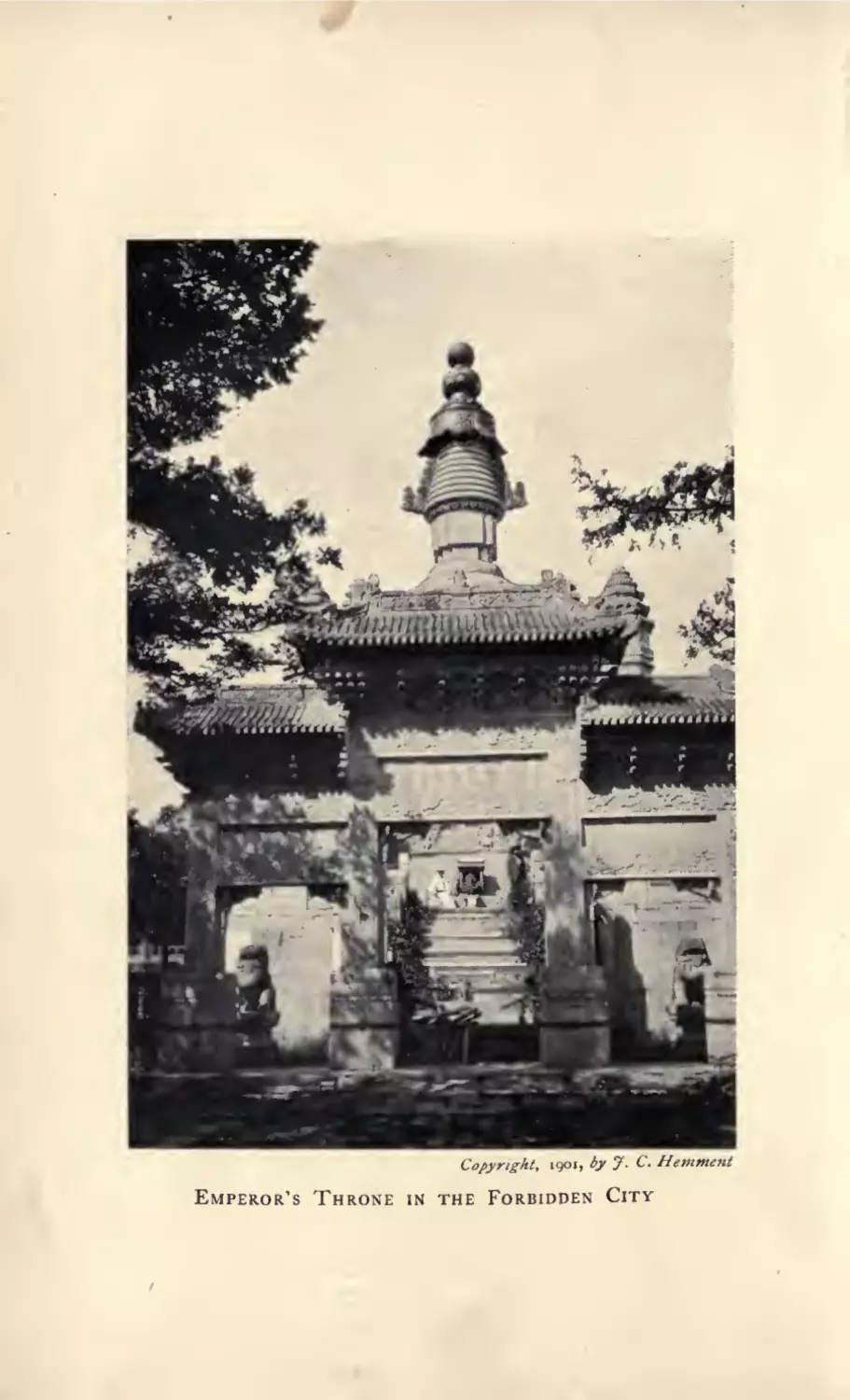
Copyright, igor, by J.
EMPEROR'S THRONE
IN
THE FORBIDDEN CITY
Hetnment
Last Days of Pekin
Translated from the French of
Pierre Loti
By
MYRTA
L.
JONES
Illustrated from Photographs^
by yessie
and Drawings
B. Jones
Boston
Little,
Brown, and Company
1902
Copyright, igo2,
BY
LITTLE, BROWN, AND COMPANY.
All
rights reserved
Published November, 190*
UNIVERSITY PRESS JOHN WILSON
AND SON
CAMBRIDGE, U. S. A.
DEDICATION
TO
VICE-ADMIRAL POTTIER
Commander-m- Chief of the Squadron of the Far East
ADMIRAL
The notes which
:
I sent to the "Figaro" from China are
volume which will be published in Paris
return, so that it will be impossible for me to look
am therefore a little uneasy as to how such a col-
to be collected in a
before
.it
over.
lection
my
I
may turn out
it
;
will doubtless contain
much
repetition.
beg that you will accept this dedication as a token of the
profound and affectionate respect of your first aide-de-camp.
You will be more indulgent than any one else, because you
from day to day
know under what conditions it was written,
Yet
I
during a painful campaign in the midst of the continual excitement of life aboard ship.
I
have restricted myself to noting the things which have
come under my own observation while undertaking the missions
which you assigned me, and in the course of the journey
which you allowed me to take into a certain part of China
hitherto almost unknown.
When we reached the Yellow Sea, Pekin had been taken,
and the war was over. I could, therefore, only observe our
to
soldiers during the
these circumstances
Under
period of peaceful occupation.
have seen them always kind and almost
I
manner toward the humblest of the Chinese. May
its small part toward destroying the
contribute
book
my
shameful stories published against them
fraternal in
I
DEDICATION
vi
Perhaps you may reproach me, Admiral, for saying almost
nothing of the sailors who remained on our ships, who were
constantly toiling with never a murmur or a loss of courage
during our long and dangerous sojourn in the waters of
Poor sequestered beings living between steel walls
did not have, to sustain them, as their superiors had,
any of the responsibilities which make up the interest of life,
or the stimulus that comes from having to decide serious quesPetchili.
!
They
tions.
sinister
They knew
nothing, they saw nothing, not even the
In spite of the heat of a
coast in the distance.
fires were burning day and night in their
they lived bathed in a moist heat, dripping
with perspiration, coming out only for exhausting drill-work
Chinese summer,
stifling quarters
;
in small boats, in
bad weather, and often
and on boisterous
seas.
in the
dead of night
One needs but a glance at their thin pale faces now,
how difficult their obscure rQle has been.
to
understand
But if I had told of the monotony of their hardships, and
of their silent unending devotion, no one would have had the
patience to read me.
PIERRE LOTI.
TRANSLATOR'S NOTE
account of his experiences in China,
THE
published by Pierre Loti under the
title
of " Les Derniers Jours de Pekin,"
first
the form of letters written to
the
appeared
"
"
Figaro
in
from China, from notes taken on the spot
when he was serving
during those memorable days
on board one of the French warships.
Loti has written
little
of late, having had no end of
trouble with his naval superiors, through jealousy,
it
is
said,
As
"
of his literary success.
Julian
Viaud, Loti
Lieutenant de vaisseau."
ranks
the
navy as
Some time ago he was
in
He took his case before the
abruptly retired.
"
Conseil d'etat," which finally gave a verdict in his
favor,
and he secured the nomination of
d'ordonnance
at the time
during which he resumed
in a
of the Chinese
his literary
officier
difficulties,
work neglected
measure on account of the tribulations con-
nected with his naval career.
viii
TRANSLATOR'S NOTE
China
is
very
personal and very national, yet, exotic that
it
is, it
His account of
his experiences in
presents such a vivid picture of certain phases of
China that it is of value as the contribution of
an observer possessing sympathy, imagination, and
knowledge, as well as the literary sense, to the
tory of our own times.
MYRTA
L.
his-
JONES.
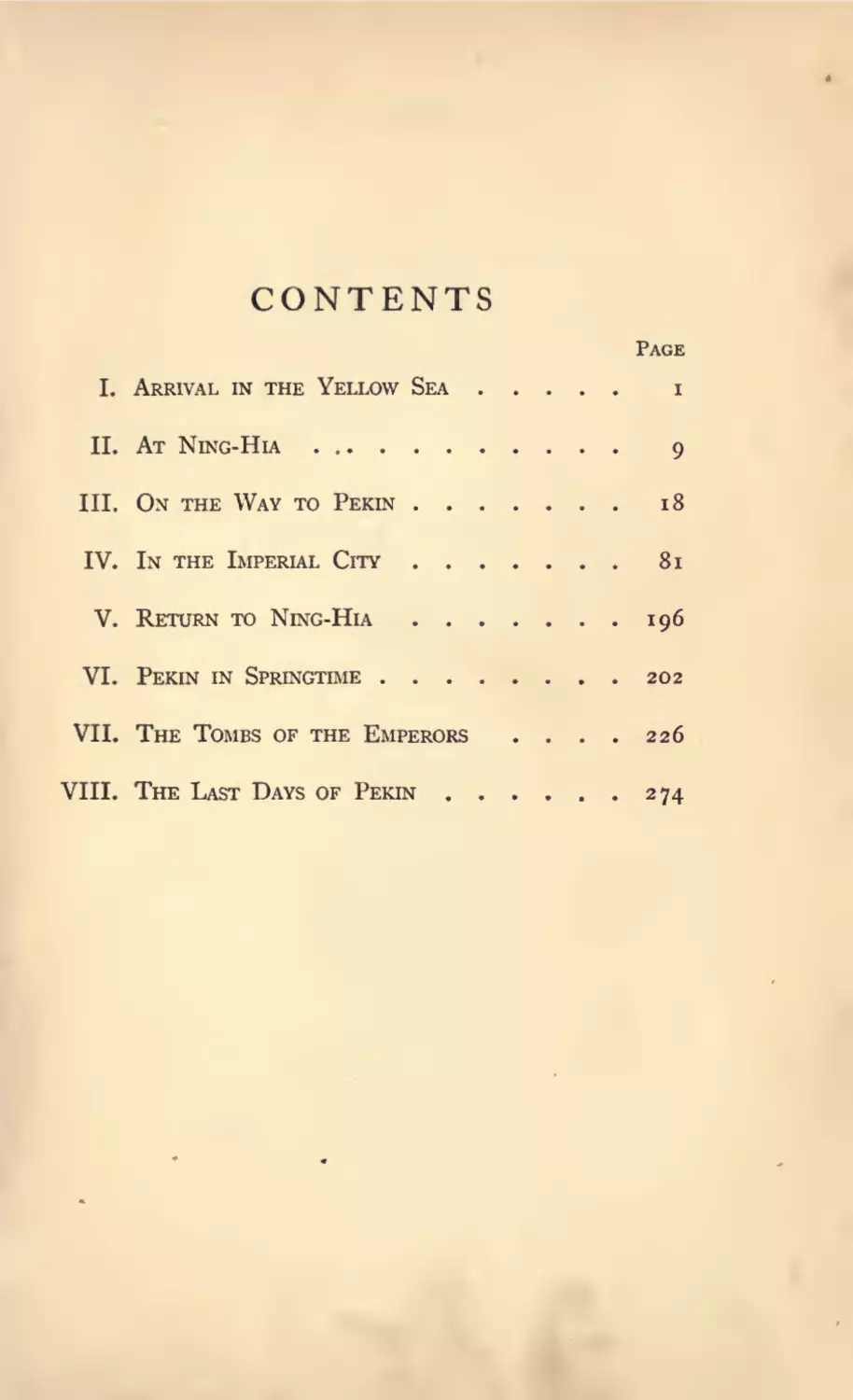
CONTENTS
PAGE
ARRIVAL IN THE YELLOW SEA
i
II.
AT NING-HIA
9
III.
ON THE WAY
IV.
IN THE IMPERIAL CITY
81
V.
RETURN TO NING-HIA
196
PEKIN IN SPRINGTIME
202
I.
VI.
VII.
VIII.
TO PEKIN
THE TOMBS OF THE EMPERORS
THE LAST DAYS OF PEKIN
18
.
.
.
.
226
274
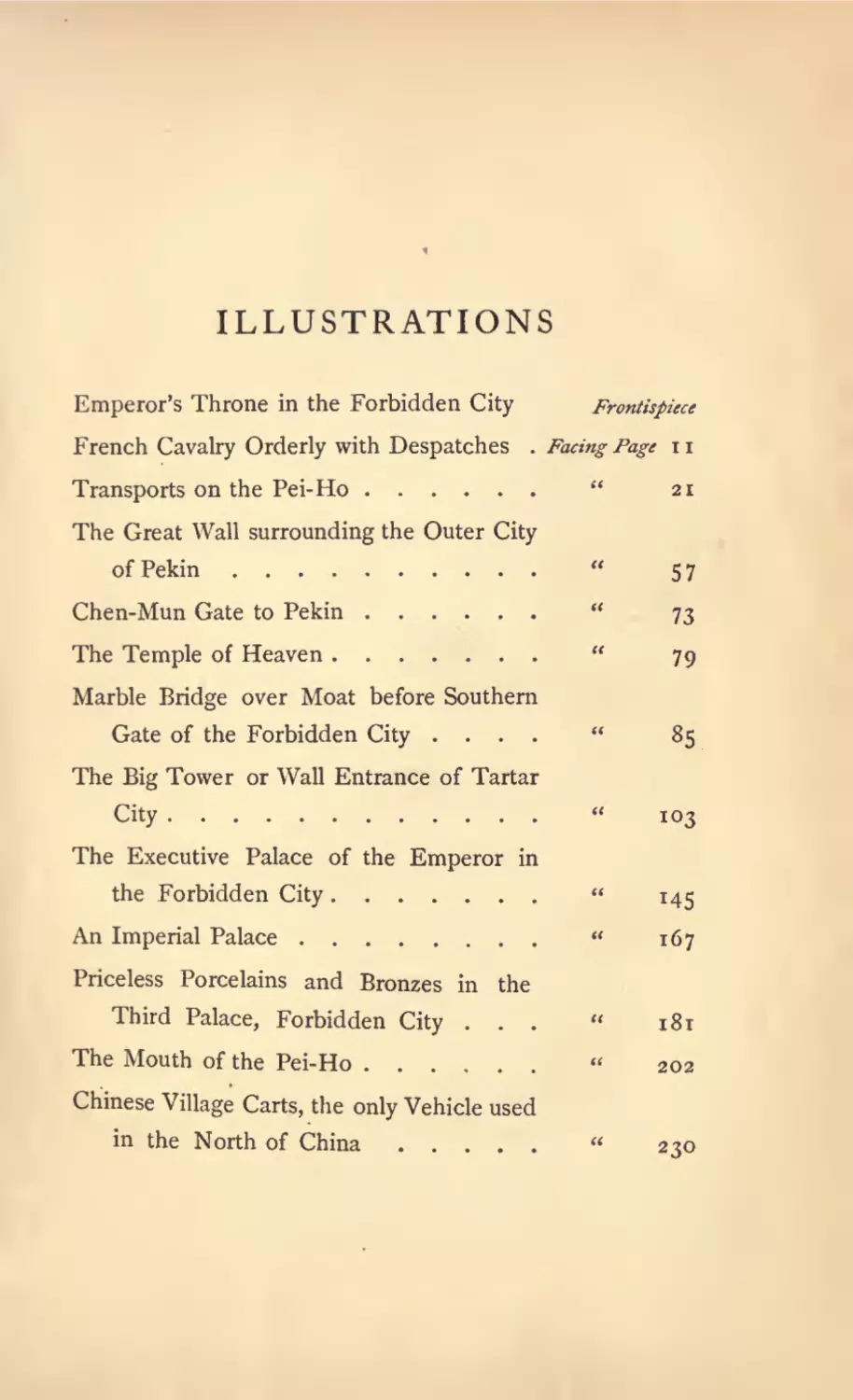
ILLUSTRATIONS
Emperor's Throne in the Forbidden City
Frontispiece
French Cavalry Orderly with Despatches
.
"
Transports on the Pei- Ho
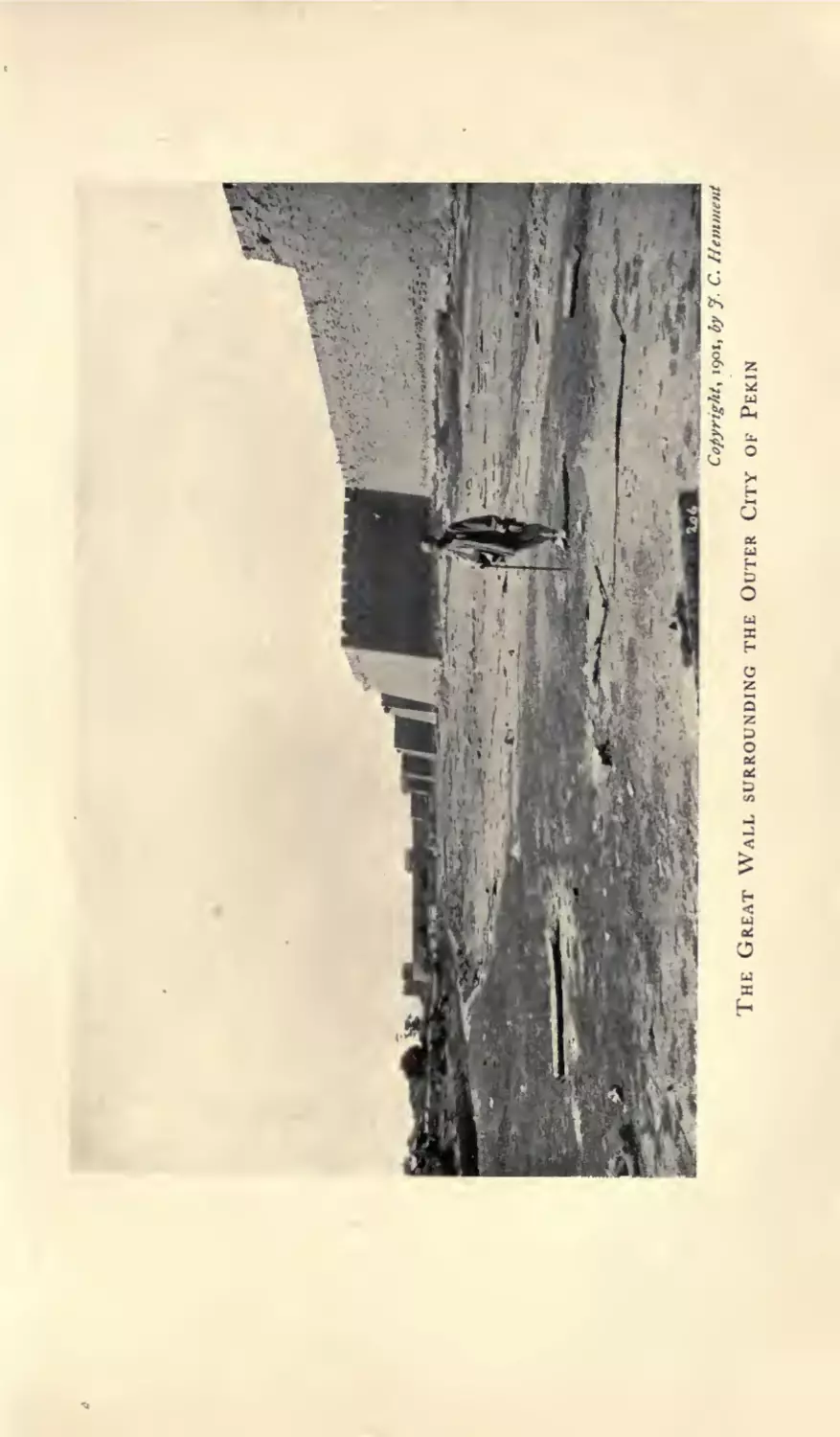
The Great Wall surrounding
Facing Page
"
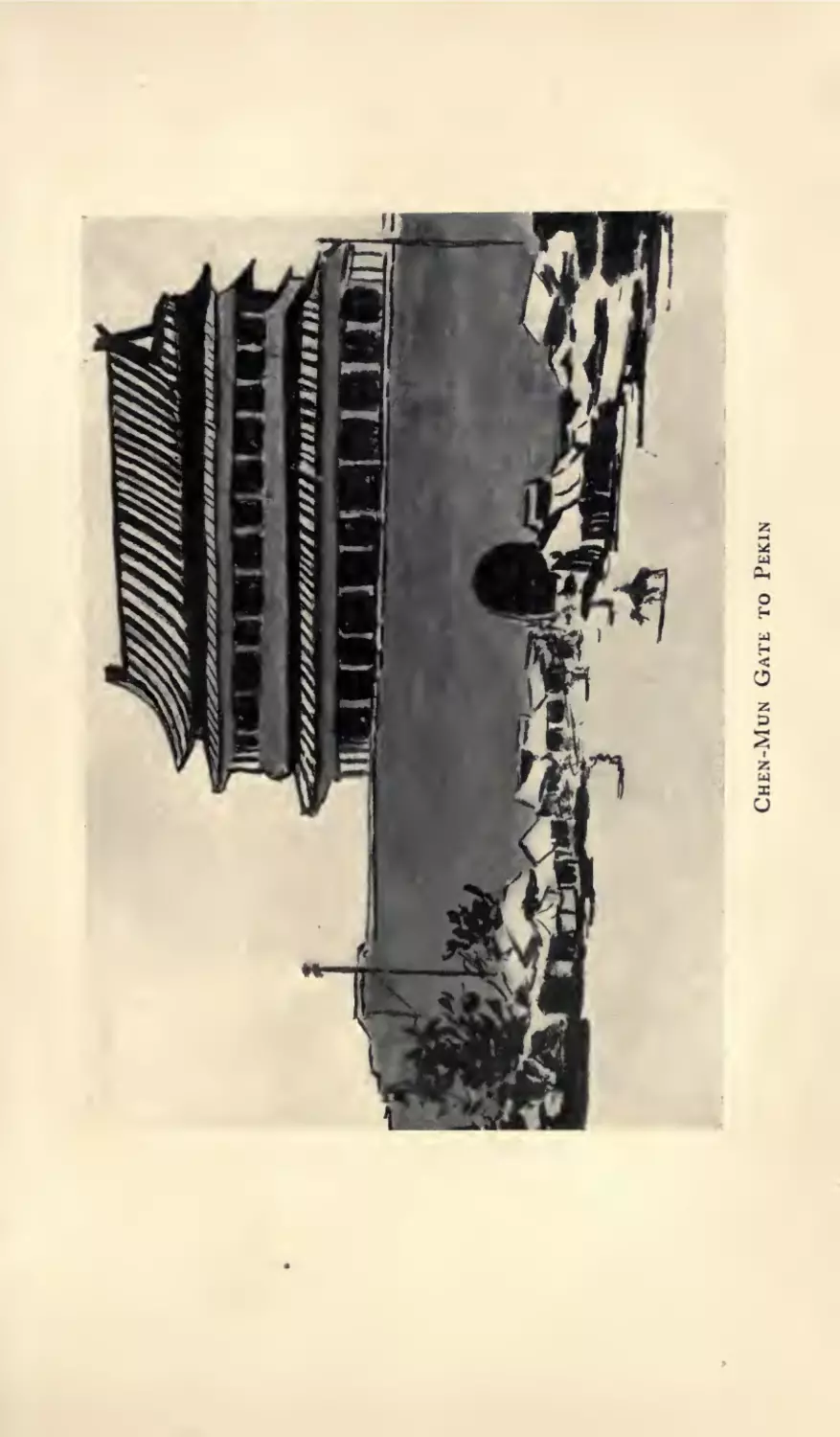
Chen-Mun Gate
"
of
21
the Outer City
ofPekin
The Temple
1 1
to Pekin
"
Heaven
57
73
79
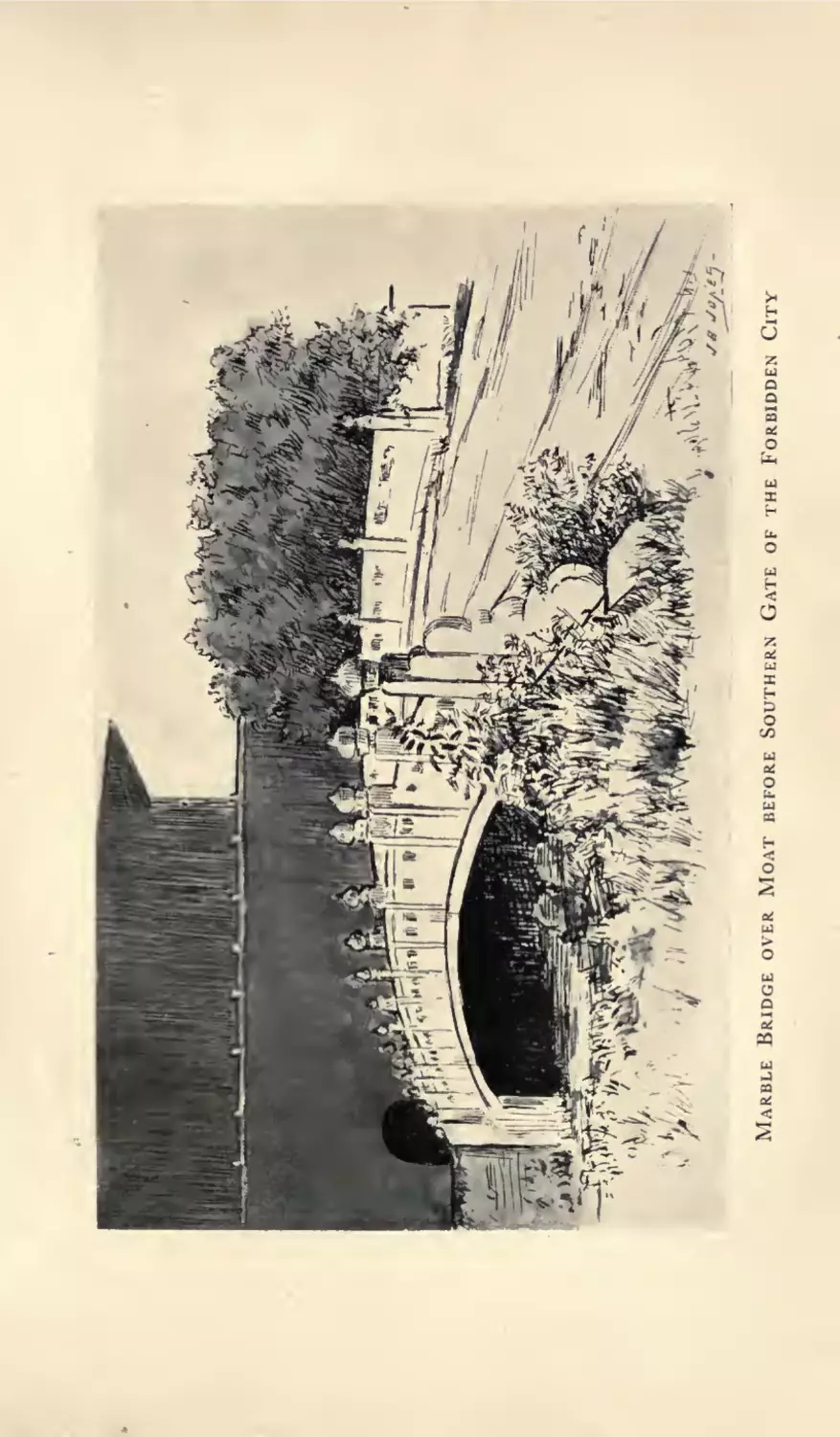
Marble Bridge over Moat before Southern
Gate of the Forbidden City
The Big Tower
....
"
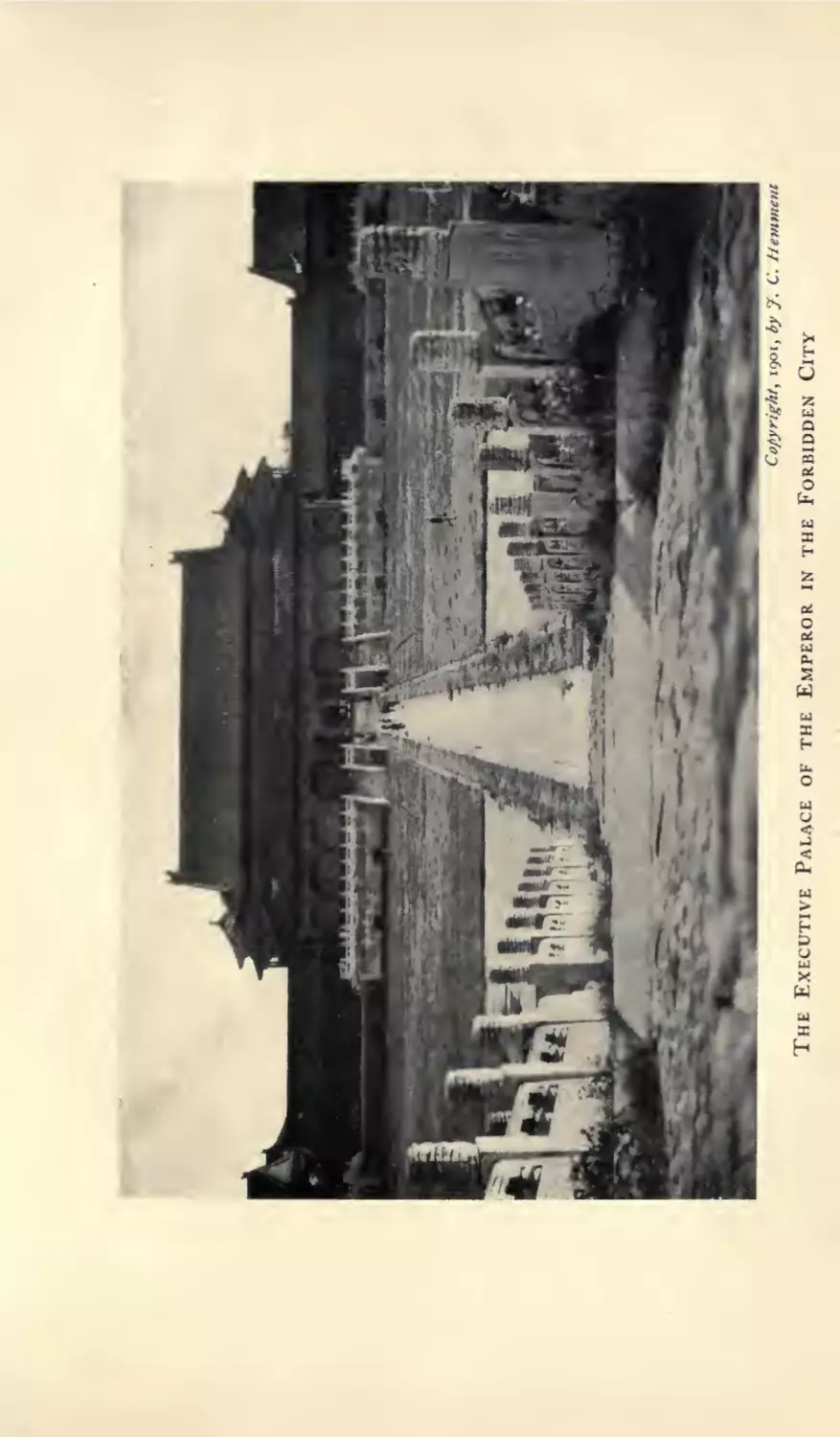
The Executive Palace
of the
Emperor
"
Imperial Palace
"
Porcelains
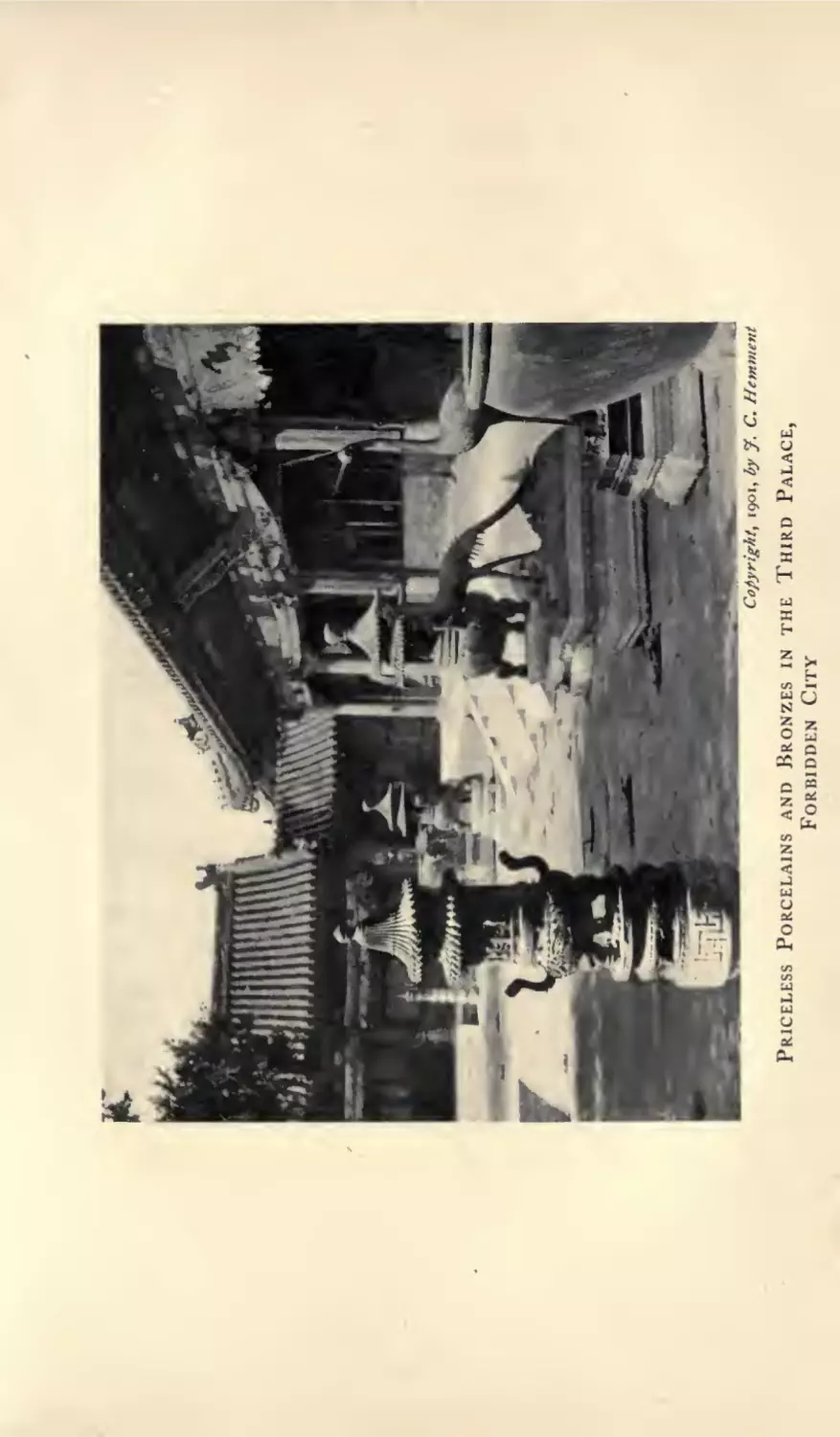
and Bronzes
Third Palace, Forbidden
City
The Mouth
in
103
in
the Forbidden City
Priceless
85
or Wall Entrance of Tartar
City
An
"
145
167
the
...
of the Pei-Ho
"
181
"
202
Chinese Village Carts, the only Vehicle used
in the
North of China
230
ILLUSTRATIONS
xii
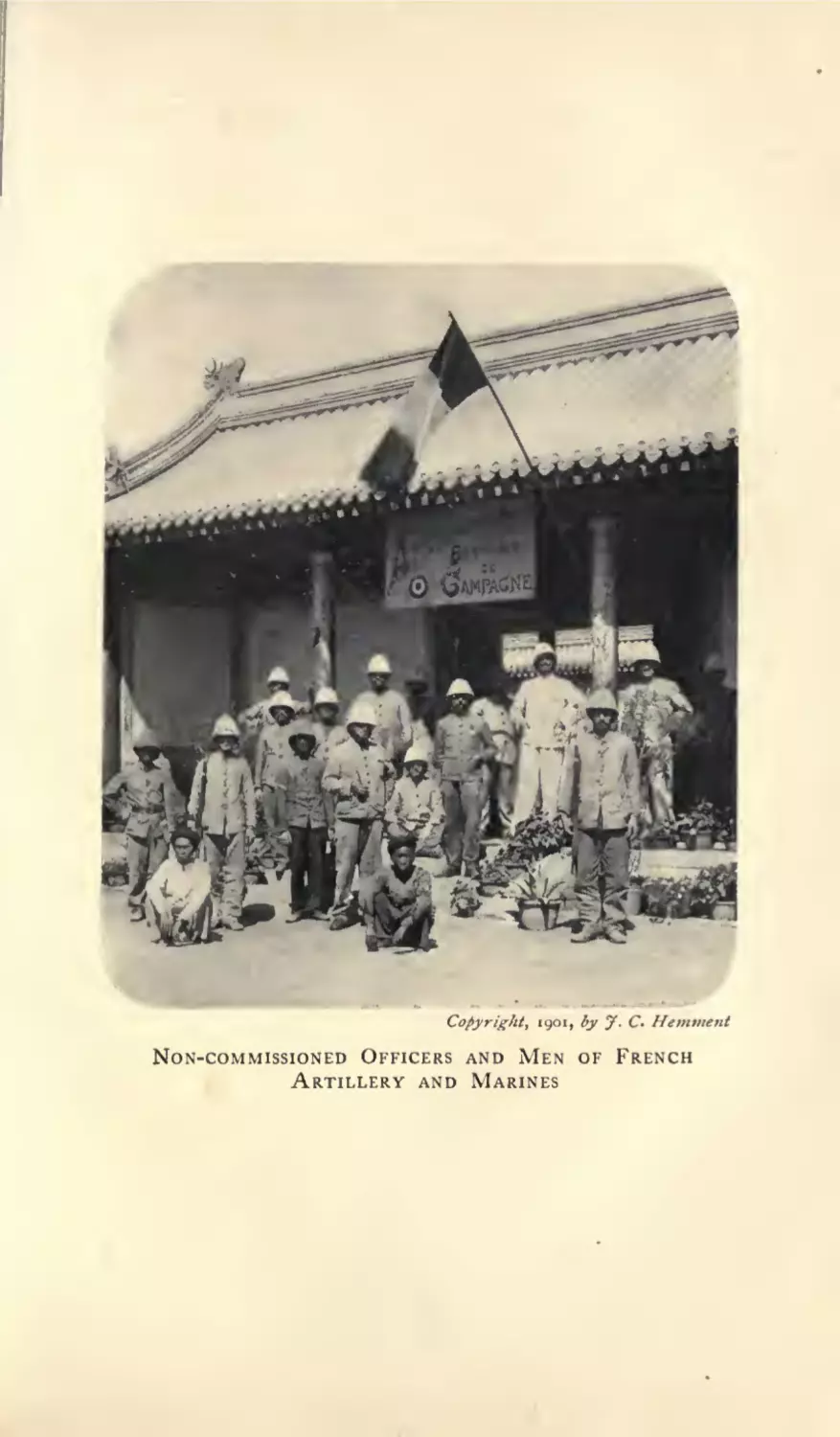
Non-commissioned
French
Chinese
Officers
Artillery
Peasants
and
and Marines
Men
.
.
of
Facing Page 235
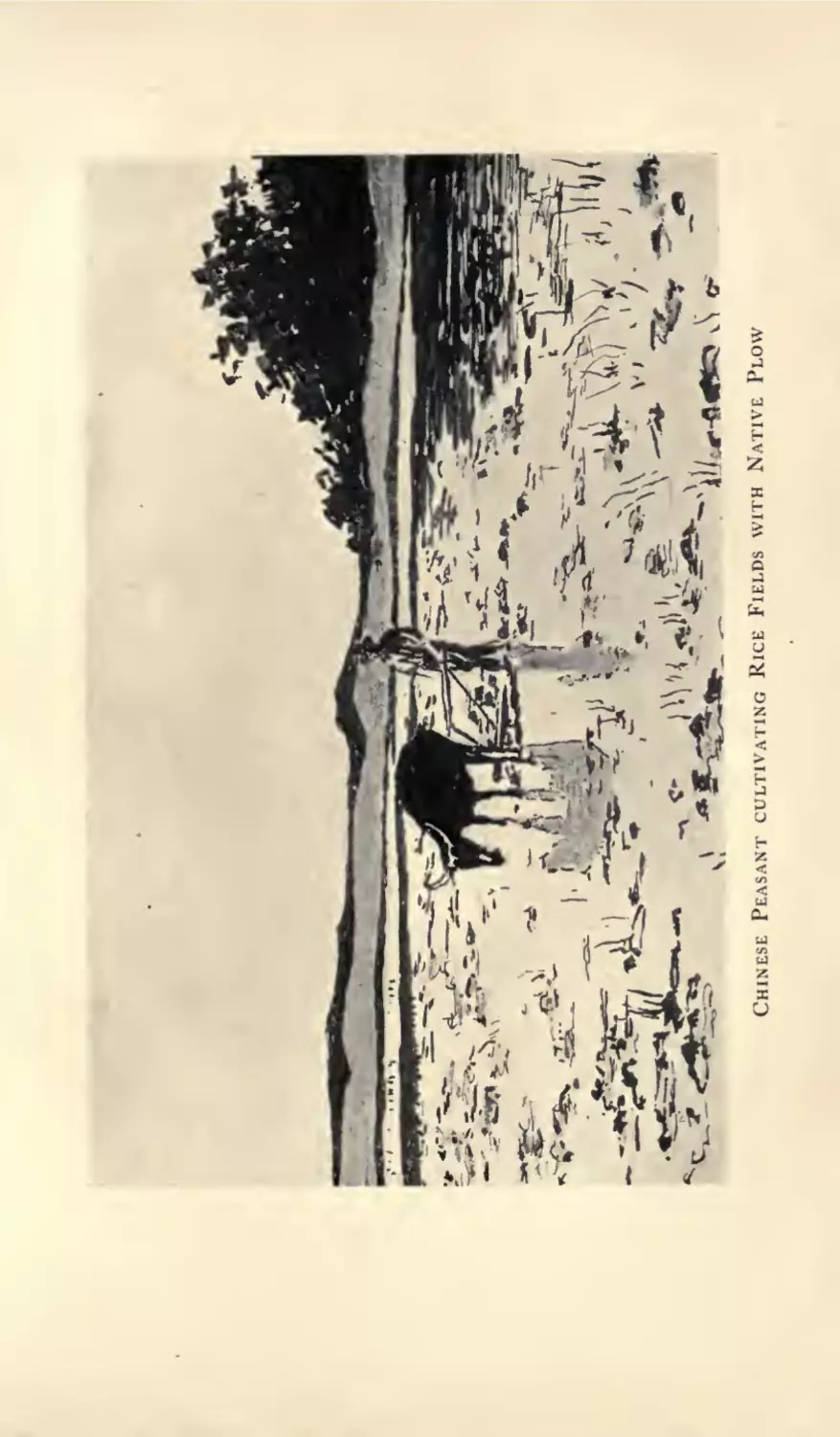
cultivating Rice Fields
"
with Native Plow
The Lake and Southern View
Palace
of
246
Summer
"
275
The
Last Days of Pekin
THE ARRIVAL
IN
THE YELLOW SEA
MONDAY,
Sept. 24, 1900.
on a calm sea and
A light on the eastern
early morning,
under a starry sky.
VERY
horizon shows that day
yet
Is
it is still
it
the
warm
night.
summer
The
is
about to break,
air is soft
and moist.
of the North, or the winter of a
Nothing in sight on any side, no
land, no light, no sail, no indication of any place
just a marine solitude in ideal weather and in
the mystery of the wavering dawn.
climate?
Like a leviathan which conceals
itself in
order
to surprise, the big iron-clad advances silently with
determined slowness, its engines barely revolving.
It has just covered five thousand miles almost
without pausing to breathe, constantly making
forty-eight turns of the screw to a minute, accomplishing without stopping and without damage of any sort, and without much wear and
tear of its substantial machinery, the longest jour-
ney, at the highest rate of sustained speed, that a
monster of its size has ever undertaken, thus de-
THE LAST DAYS OF PEKIN
2
feating in this important test ships reputed to be
faster,
and which
at first sight
might be thought
superior in speed.
This morning it has arrived at the end of its
journey, it is about to reach a part of the world
whose name but yesterday was unknown, but
toward which the eyes of Europe are now turnThis sea, where the morning light is calmly
ing.
breaking,
is
the Yellow Sea,
it is
the gulf of PetPekin.
An im-
from which one reaches
mense fighting squadron must already be assembled
chili,
very near us, although as yet nothing indicates
its vicinity.
We have been two or three days crossing this
Yellow Sea in beautiful September weather. Yesterday and the day before, junks with sails of matting have crossed our route, on their way to Corea ;
shores and islands more or less distant have appeared, but at the present
of the horizon is empty.
moment
the entire circle
Since midnight we have been moving slowly,
our expected arrival in the midst of
in order that
this fleet of ships
which
obligatory military pomp
an hour.
is
to be attended with
should not take place
at too early
Five o'clock.
Out of
the semi-obscurity sounds
the gay trumpeting,
the music of the reveille,
ARRIVAL IN YELLOW SEA
which each morning arouses the
earlier
than usual, so that there
3
It
sailors.
may
is
be ample
time to perform the toilet of the iron-clad, which
has lost some of its freshness during forty-five
days at
sea.
We still
see nothing but
empty space,
and yet the lookout, from his post aloft, reports
black smoke on the horizon. This small cloud of
coal smoke, which from below looks like nothing,
betokens a formidable presence it is produced by
great steel ships, it is the breath of this unprece;
dented squadron which we are about to join.
Before the ship's toilet comes that of the crew.
Barefooted and bare-chested, the sailors splash in
dawning light. In spite of con-
the water in the
hard work, they are no more tired than the
ship that carries them. The Redoutable is, of all
the ships that departed so suddenly, the only one
tinual
which has had neither death nor sickness on board,
even in crossing the Red Sea.
Now the sun has risen clear above the horizon,
a yellow disk which slowly climbs upward from
behind the quiet waters.
For
us,
left equatorial regions, this rising,
who have
just
luminous as
it
know
not what of melancholy and of dulsavors
of autumn and a northern cliwhich
ness,
mate.
Really in two or three days the sun has
is,
has
I
changed.
dangerous,
Now
we
it
no longer burns,
cease to fear
it.
it is
no longer
THE LAST DAYS OF PEKIN
4
In front of us, from out the cloud of coal
smoke, far-off objects begin to emerge, perceptible
only to the eye of the mariner a forest of spears,
;
one should say, planted away off at the end of
We
space, almost beyond the range of vision.'
know what
(
they
are,;
the giant chimneys, the
heavy fighting masts,; the terrible paraphernalia of
warfare, which, with the smoke, reveal from afar
the
modern squadron.
When
our morning clean-
ing,is over, when, every thing has been washed with
buckets cnt sea water the Redoutable increases her
,..
speed to the averagetof eleven and a half knots an
hour, which she has .nteintained since her departure
from France. And while the sailors are busy mak-
ing the brass and copper shine, she begins again to
trace her deep furro\v^Sirojugh the tranquil waters.
Objects on the, smoky -horizon line begin to
stand forth and take -shape.
'
able 'masts, masses of .qvery
-TT
Below the. ,innumerform and color are
.
These <are the ships themselves.
distinguishable.
Between the calm water Jtnd the pale sky lies the
terrible company, an assemblage of strange
monsters, some white and yellow, others white
and black, others the color of slime or of fog, in
whole
order to
make them
less
easily
distinguishable.
Their backs are humped and their sides half submerged and hidden like big "uneasy turtles. Their
structures vary according to the conceptions of
ARRIVAL IN YELLOW SEA
5
different persons in regard to engines of destruction,
but
which
all alike
dulls the
No more
we were
not exist.
breathe forth horrible coal smoke,
morning
light.
of the coast of China
visible
than
if
a thousand leagues away or than if it did
Yet we are close to Taku, the meeting-
place toward which for so
have been bent.
visible,
is
many days our minds
China, close by although inwhich attracts by its nearness this herd of
It is
beasts of prey, and which keeps them as immovable as fallow deer at bay, at this precise point on
some one speaks the word.
water, here where it is less deep, has lost
the seas, until
The
which we have so long been
accustomed, and has become troubled and yellow,
and the sky, although cloudless, is decidedly melancholy. Our first impression of this whole scene,
its
beautiful blue, to
of which
we
shall
undoubtedly for a long time
form a part, is one of sadness.
But now as we draw nearer and the sun rises
there is a change, and the beautiful shining ironclads with their many-colored flags begin to stand
It is indeed a remarkable squadron that
out.
here represents Europe,
Europe armed against
It
occupies an infinite amount
gloomy old China.
of space, the whole horizon seems crowded with
little steam tugs
ships, and small boats
hurry
like
busy people among the big motionless
vessels.
THE LAST DAYS OF PEKIN
6
Now
come
cannon on all sides begin a military welfor our admiral, beneath the heavy curtain
of black smoke; the gay light smoke from powder
blossoms like sheaves and goes off in white masses,
while up and
rises
and
down
falls in
the iron masts the tricolor
our honor.
Everywhere trum-
pets sound, foreign bands play our Marseillaise,
one is more or less intoxicated with this cere-
monial, always the same yet always superb, which
here borrows an unaccustomed magnificence on
account of the display of the fleet.
And now the sun is at last awake and shining,
adding to the day of our arrival a last illusion of
midsummer
heat, in this country of
sons; in two months' time
up for a long winter.
it
extreme sea-
will begin to freeze
When
evening comes, our eyes, which will
it soon enough,
are feasted upon a
grand fairy-like spectacle, given for us by the
weary of
electric lights appear on all
or green, or red, twinkling and sparkling in a dazzling manner the big ships, by means
of a play of lights, converse with one another, and
squadron.
Suddenly
sides, white,
;
the water reflects thousands of signals, thousands
of lights, while the rockets race for the horizon or
One
pass through the sky like delirious comets.
forgets all that breeds death and destruction in
ARRIVAL IN YELLOW SEA
7
phantasmagoria, and for the moment feels
oneself in the midst of a great city, with towers,
this
minarets, palaces, improvised in this part of the
world especially for this extravagant nocturnal
celebration.
September
25.
only the next day and yet everything
different.
breeze came up in the morning,
It is
is
A
hardly a breeze, just enough to spread over the
sea big vague plumes of smoke. Already furrows
are being
made
in this
open and not very deep
roadstead, and the small boats, continually going
and coming, bob up and down bathed
in spray.
A
ship with the German colors appears upon
the horizon just as we appeared yesterday; it is
immediately recognized as the Herta, bringing
Field-Marshal von Waldersee, the last one of the
military commanders
place of the Allies.
The salutes that yesterday
for him, the whole maganew
begin
is
repeated.
Again the cannon
ceremony
were for
nificent
expected at this meeting-
us,
give forth clouds of smoke, mingling tufts of white
with the denser variety, and the national air of
Germany is taken up by all the bands, and borne
on the rising wind.
The wind whistles stronger, stronger and colder
a bad autumn wind, that plays about the whalers
;
THE LAST DAYS OF PEKIN
8
and the
among
tugs, which yesterday circulated readily
the various groups of the squadron.
It presages difficult
certain harbor,
which
days for us, for in this unin an hour's time becomes
we
shall have to land thousands of
from France and thousands of tons
of war supplies. Many people and many things
must be moved over this rough water, in barges
or in small boats, in the cold and even in the
night, and must be taken to Taku across the river's
dangerous,
soldiers sent
changing bar.
To
is
organize this long and perilous undertaking
that of the marines
during
to be our task
first few months, an austere, exhausting, and
obscure role without apparent glory.
the
'
II
AT NING-HIA
Oct. 3, 1900.
the gulf of Petchili on the beach at NingHere are
Hia, lighted by the rising sun.
IN
sloops, tugs, whalers, junks, their prows in
the sand, landing soldiers and war supplies at the
foot of an immense fort whose guns are silent. On
this shore there is a
confusion and a babel such
as has been seen in no other epoch of history.
From these boats where so many people are
disembarking, float pell-mell all the flags of
Europe.
The shore
and
is
wooded with
birches and willows,
mountains with strange outThere are
their peaks to the clear sky.
in the distance
lines raise
only northern trees, showing that the winters in
thjs country are cold, and yet the morning sun is
already burning the far-off peaks are magnificently
violet, the sun shines as in Provence.
Standing
;
about
among
the sacks of earth collected for the
erection of hasty defences, are all kinds of people.
There are Cossacks, Austrians, Germans, English
THE LAST DAYS OF PEKIN
io
midshipmen, alongside of our armed sailors little
Japanese soldiers, with a surprisingly good mili;
tary bearing in their new European uniforms ; fair
ladies of the Russian Red-Cross Society, busy
unpacking material for the ambulances; and Ber-
from Naples, who have put
saglieri
their cock-
feathers onto colonial caps.
There
something about these mountains in
is
this sunshine, in this limpid air, that recalls the
on autumn mornings.
an
old
structure
rises among the
away
gray
with
twisted, crooked, bristling
dragons and
shores of the Mediterranean
Not
far
trees,
monsters.
It is
a pagoda.
The
interminable line
of ramparts which winds about and finally loses
itself behind the summits of the mountains in the
distance, is the Great
Wall of China, which forms
the boundary of Manchuria.
The
soldiers
who disembark
barefooted in the
sand, gaily calling out to one another in all tongues,
seem to be the sort who are easily amused. What
"
a peaceful capthey are doing to-day is called
and
it
seems
like
a
of unimore
celebration
ture,"
versal fusion, of universal peace, yet not far from
here, in the vicinity of Tien-Tsin and of Pekin,
the country
is
in ruins
and
is
strewn with the
dead.
The
ing
it
necessity for occupying Ning-Hia, of holdas a base of supplies, had been impressed
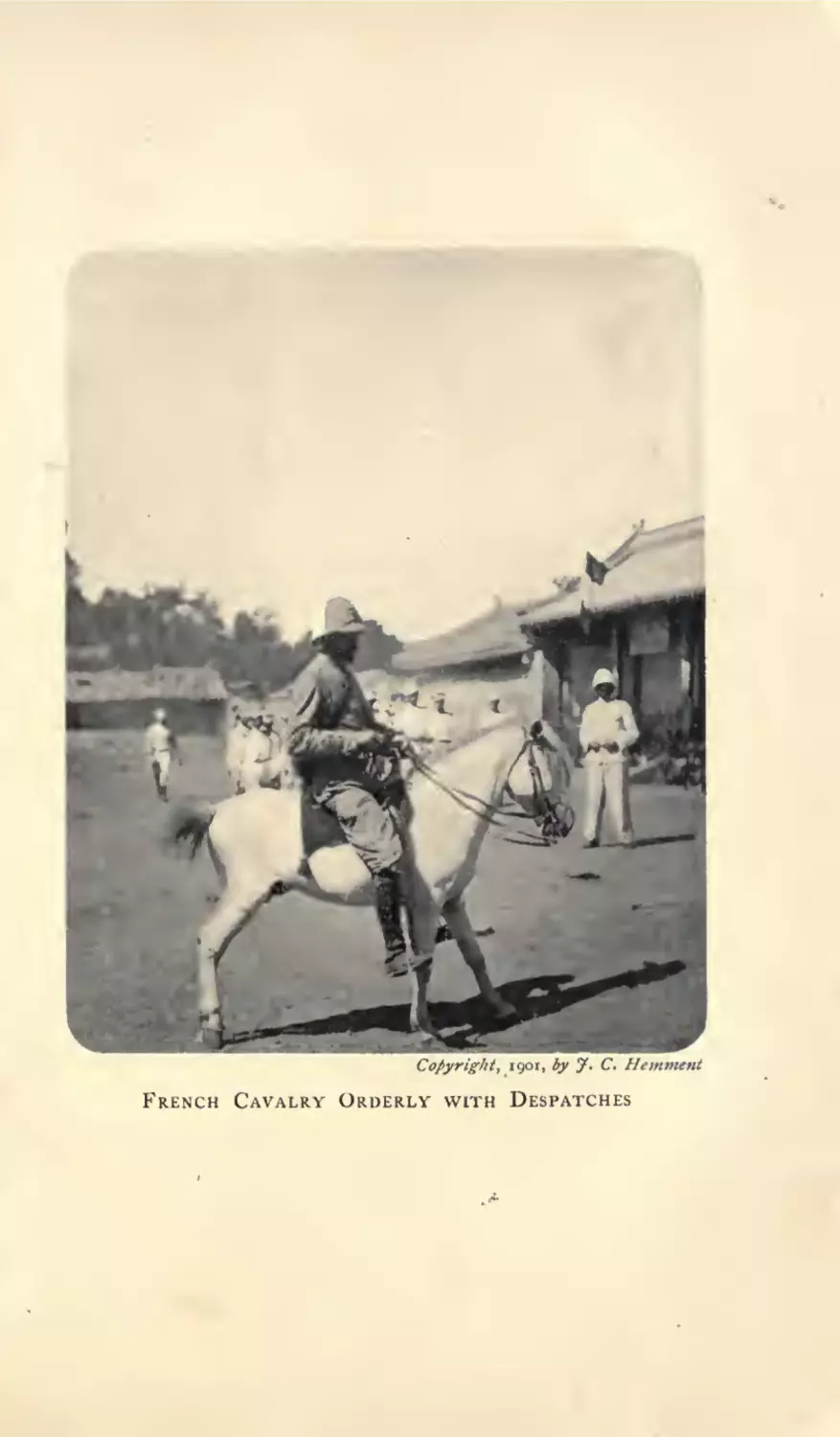
Copyright, 1901, by J. C.
Hemment
FRENCH CAVALRY ORDERLY WITH DESPATCHES
n
AT NING-HIA
upon the admirals of the international squadron,
and day before yesterday all the ships had prepared for a struggle, knowing that the forts on the
shore were well armed
here,
warned by an
;
who
lived
that a formidable
com-
but the Chinese
official
pany of cuirassiers would appear at daybreak, preso we found it deserted
ferred to leave the place
on our
arrival.
which overlooks the shore and which
forms the terminus of the Great Wall at its sea
The
fort
end, has been declared international.
\
The flags of the seven allied nations float there
together,
arranged in alphabetical order at the
end of long poles guarded by pickets,
Austria,
Great
Britain,
France, Germany,
Italy, Japan,
Russia.
The
other forts scattered over the surrounding
heights have been apportioned, the one belonging to
France being situated about a mile from the shore.
It is
reached by a dusty road, bordered with birches
frail willows, which crosses gardens and
orchards turning brown at the same season as
our own,
gardens exactly like ours, with mod-
and
est
rows of cabbages and pumpkins and long
of lettuce.
The
little
tered here and there
wooden houses
among
too,
lines
scat-
the trees, resemble
those of our villages, with red tiled roofs, vines
trained in garlands, and little beds of zinnias,
12
THE LAST DAYS OF PEKIN
and chrysanthemums.
It is a country
which should be peaceful, happy, yet which has in
two days' time become depopulated through fear
asters,
of the approach of the invaders from Europe.
On
this fresh
October morning the sailors and
and skurrying
soldiers of all nations are hurrying
along the shaded road that leads to the French
fort, seeking the pleasures of discovery; amusing
themselves in a conquered land, catching chickens
and pilfering salads and pears from the gardens.
The Russians are taking down the Buddhas and
The English are
gilded vases from a pagoda.
driving with sticks the cattle captured in the fields.
The Dalmatians and the Japanese
fast friends
of an hour's standing
are making their toilet
together on the banks of a stream, and two Bersa-
it
who have
caught a little donkey are riding
astride, almost bursting with laughter.
And yet the sad exodus of Chinese peasants
glieri
which began yesterday still continues; in spite of
the assurance given them that no harm would be
done to any one, those who were left felt themselves too near and preferred to flee. Whole famdeparted with bowed heads; men, women,
children, all dressed alike in blue cotton gowns,
ilies
and loaded with baggage, even the babies resignedly carrying their little pillows and mattresses.
One
scene was heart-breaking.
An
old Chinese
AT NING-HIA
woman
very, very old, perhaps
who could scarcely stand
old
God knows where,
13
a hundred years
up, was going,
driven from her home, where
a company of Germans had established themselves
she went away, dragging herself along with the
;
two young lads who may have been her
grandsons and who supported her as best they
could, looking at her with infinite respect and tenderness.
Seeming not to see us and looking as
she
had nothing further to expect from
though
help of
any one, she passed slowly by, her poor face filled
with despair, with supreme and irremediable distress, whilst the soldiers behind her were throwing
away with shouts
images from the
of laughter the unpretentious
of her ancestors.
The
altar
beautiful sunshine of the
autumn morning shone
calmly on her well-cared-for
ing with zinnias and asters.
The
fort
which
fell
little
garden, bloom-
to the lot of the
occupies almost the space of a town with
French
all
its
dependencies, lodgings for mandarins and soldiers,
work-shops, stables, and powder magaIn spite of the dragons that adorn the
electrical
zines.
gates and in spite of the clawed monster painted
on a stone slab in front of the entrance, it is con-
upon the most recent principles
plascasemated, and provided with Krupp guns of
structed
tered,
the latest models.
Unfortunately for the Chinese,
i
THE LAST DAYS OF PEKIN
4
who had accumulated
some
in the vicinity of
terrifying defences,
Ning-Hia
mines, torpedoes, fou-
gades, and intrenched camps,
nothing was
fin-
anywhere the movement
against foreigners began six months too soon,
before they had gotten into working order all the
material Europe had sold to Li-Hung-Chang.
A thousand Zouaves who are to arrive to-morished, nothing completed
row
;
are to occupy this fort during the winter;
while
awaiting
brought
along
their
a
arrival
score
of
we have
sailors
to
simply
take
possession.
It is curious to
doned
in haste
and
go among these houses, abanterror, and to find ourselves in
the midst of the disorder of precipitate flight;
broken fufniture and dishes, clothing, guns, bayonets, ballistic books, boots with paper soles,
brellas,
and ambulance supplies are piled
before the doors.
um-
pell-mell
In the kitchens dishes of rice
are ready for the oven, with plates of cabbage and
made of fried grasshoppers.
cakes
There are shells everywhere, cartridges strew
the grounds, gun-cotton is dangerously dispersed,
and black powder is scattered in long trains. But
side
by
side with this
droll details attest the
debauch of war materials,
side of Chinese life;
human
on all the window-sills are pots of flowers, on all
the walls are household gods placed there by the
AT NING-HIA
The
familiar sparrow abounds here, and
never interfered with, it seems, by the inhab-
soldiers.
is
15
itants of the place,
and from the roofs the
cats,
circumspect but anxious to enter into relations
with us, are observing the sort of menage that
be possible with such unexpected hosts as
will
ourselves.
Very near
us,
a hundred metres from our
fort,
passes the Great Wall of China. It is surmounted
at this point by a watch tower, where the Japanese
are
now
and there they have planted
on a barnboo stick in the red
established,
their white flag
sunlight.
smiling, especially at the French, the
Japanese soldiers invite us to come up to see
Always
little
from above the surrounding country.
The Great Wall, seven or eight hundred metres
thick at this point, descends gently amid green
grass on the Chinese side, but drops vertically on
the side toward Manchuria, where it is flanked
by enormous square bastions.
We mount, and at our feet we see the wall
plunging on one hand into the Yellow Sea, while
on the other it rises to the summits of the mountain
far
and goes winding on through the
as
the eye can
fields as
see, giving the impression
of a colossal thing which never comes to any
end.
THE LAST DAYS OF PEKIN
16
Toward
light,
we have
a view, in this clear
of the deserted plains of Manchuria.
Toward
the east
west
the
in
China
the
wooded
country has a deceptive look of peace and confidence. All the European flags hoisted on the forts
have a festive
air
amid
all
the green.
It is true
on a plain near the shore there are evidences
of an immense movement of Cossacks, but they are
that
far
away and
the noise does not reach us, though
men among the
there are at least five thousand
tents
and among the
Where
ground.
flags
which are stuck into the
the other powers send to Ningthe Russians on the
Hia only a few companies,
contrary proceed in great masses, because of their
Shan-Ha'idesigns on neighboring Manchuria.
village which has closed its
fear
of
pillage, appears in the disgates through
and
mute
as
tance, gray
though asleep behind its
Kouan, the Tartar
high crenellated walls.
On
the sea off toward the
a fleet
horizon, rests the squadron of the Allies,
of steel monsters with black smoke, friends for the
moment,
silently
The weather
assembled in the motionless blue.
is
calm, exquisite, buoyant.
rampart of China blossoms at
The
this
prodigious
its
sombre
Between
like
a
season
bricks,
garden.
loosened by time, asters, and quantities of pinks
like those at the seashore in
their
way
through.
France are pushing
AT NING-HIA
17
This legendary wall, which has for centuries
invasion from the north, will probably
nevermore see the yellow flag and the green dragon
stopped
all
of the Celestial emperors.
Its time has gone by,
is
at
an
end.
forever
passed,
Ill
ON THE WAY TO PEKIN
I
THURSDAY,
Oct.
n,
1900.
noon, on a beautiful calm day that is
almost warm and very luminous on the
AT
water, I leave the admiral's ship, the Redoutable, to go on a mission to Pekin.
We
are in the gulf of Petchili on the road to
but
at such a distance from the shore that
Taku,
it is not visible, so there is no indication of China
anywhere.
The
with a short ride on a steam
takes
us out to the Bengali, the
which
launch,
little despatch-boat which will bring me to land
trip begins
by to-night.
The water
is
softly blue in the
autumn sunshine,
which
is always bright in this part of the world.
To-day, by chance, the wind and the waves seem
to sleep.
As far as one can see, great war-ships
succeed one another, motionless and menacing.
As far as the horizon there are the turrets, the
ON THE WAY TO PEKIN
smoke of the astonishing
masts, the
squadron with
all
its
19
international
train of satellites, torpedo
and a legion of packet-boats.
The Bengali, upon which I am about to embark
for a day, is one of the little French ships carrying
boats, transports,
troops and war supplies, which for a month past
has been painfully and wearisomely going and
coming between the transports or freighters arriving from France, and the port of
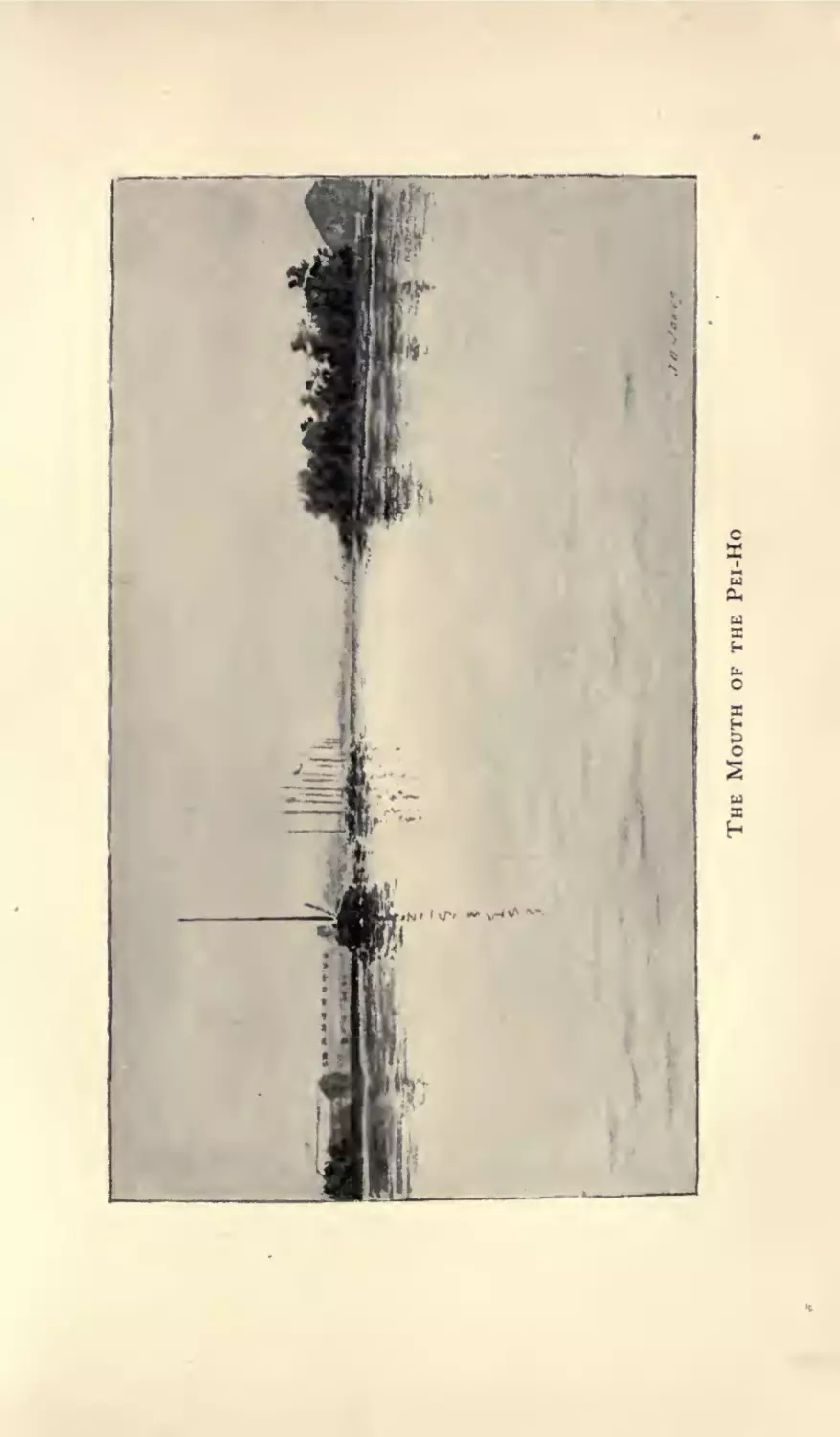
Pei-Ho
Taku beyond
the
bar.
To-day
it
is
brave Zouaves
of Zouaves,
full
who arrived yesterday from Tunis, careless and
happy, bound for this ominous Chinese land.
They
are
crowded on the bridge, packed togay and their eyes wide open
gether, their faces
for a glimpse of
China, which has
thoughts for weeks and which
hand, just over the horizon.
is
filled
now
their
near at
According to ceremonial custom, the Bengali,
it appears, must pass the stern of the Re-
when
deniable to salute the admiral.
The music waits
behind the armor, ready to play one of those
marches so intoxicating to the sailor. And when
we come up
its
shadow,
close to the big ship, almost
all
the Zouaves
return as well as those
who must
perish
wave
sound of the bugle, with hurwhich here represents France
their red caps to the
rahs for the ship,
under
those destined to
20
THE LAST DAYS OF PEKIN
and for the admiral, who from the
to their eyes,
bridge raises his cap in their honor.
At
the end of half an hour China appears.
Never has an uglier and more forbidding shore
surprised and congealed poor newly arrived solA low shore, a gray barren land without
diers.
tree
or grass.
Everywhere there are forts of
same gray as the earth, masses
colossal size of the
of geometrical outline pierced by embrasures for
Never has the approach to a country preguns.
sented a more extensive or aggressive military
array;
on both
sides of the horrible stream with
muddy waters loom similar forts, giving the
impression of a place both terrible and impregnable, giving the impression also that this harbor,
in spite of its wretched surroundings, is of the first
its
order of importance, is the key to a great country,
and gives access to a city large, rich, and powerful
as Pekin must have been. From a nearer view
first two forts, stained, full of
and ravaged by cannon-balls, bear witness
to furious and recent battles.
We know how, on the day Taku was taken,
they exhausted their strength on one another. By
a miracle, a French shell from the Lion fell right
into one of them, causing the explosion of its
enormous powder magazine so that the yellow
the walls of the
holes,
gunners
lost
their
heads.
The Japanese then
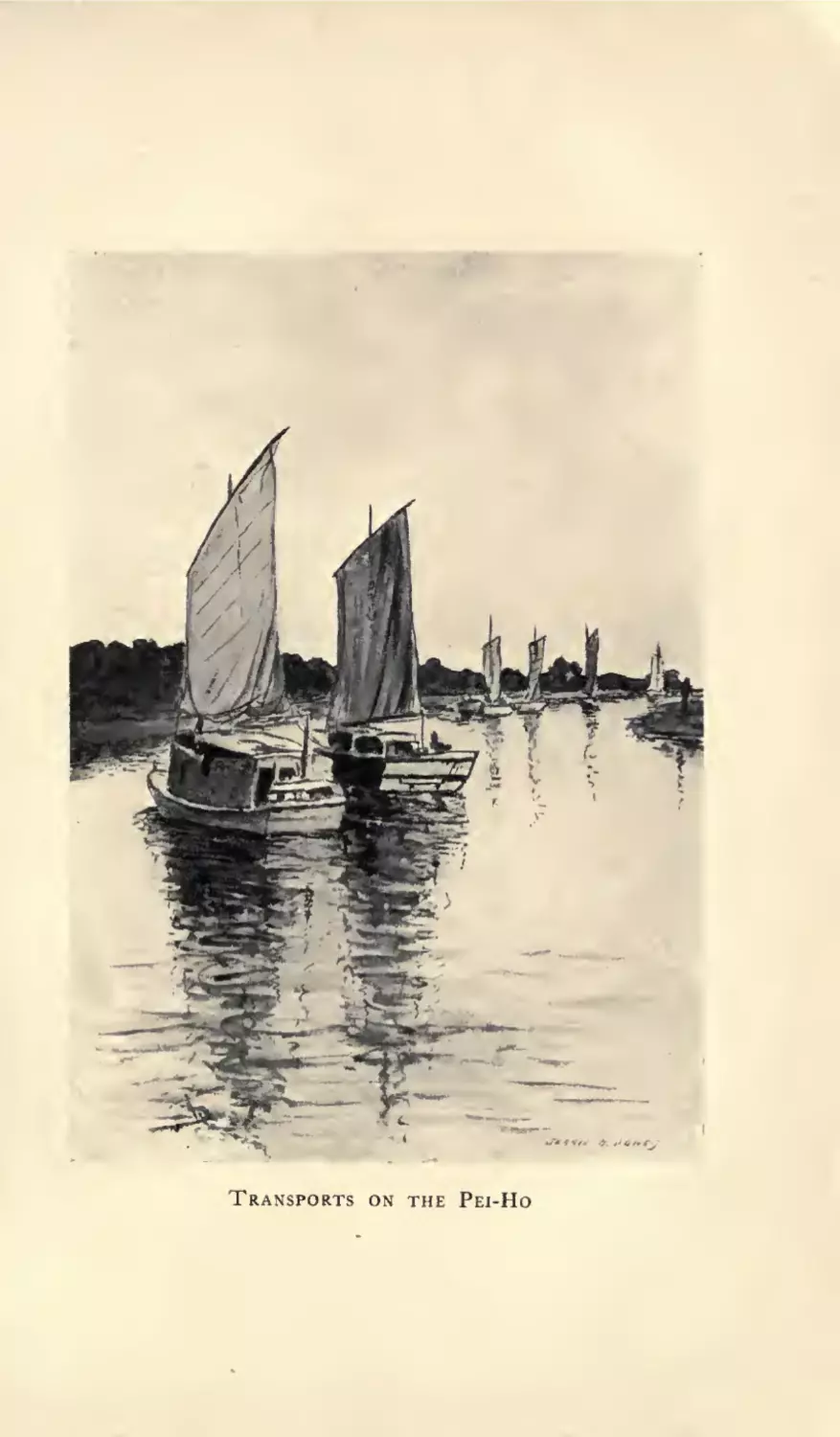
TRANSPORTS ON THE PEI-HO
ON THE WAY TO PEKIN
21
and opened an unexpected fire on
the one opposite, and immediately the overthrow
seized this fort
of the Chinese began.
Had
chance, for this shell,
and for
it
not been for this
this panic, all the
European gunners anchored in the Pei-Ho would
inevitably have been lost the landing of the Allies
would have been impossible or problematical, and
the whole face of the war changed.
;
We now
move up
infected water
the river through the
where impurities of
muddy
sorts are
all
men and animals.
we see by the light
floating, as well as the bodies of
On
both of the sombre shores
of the declining sun a procession of ruins, a uniform black and gray desolation of earth, ashes, and
calcined slopes, tumbled walls, and ruins.
On this pestilential river a feverish animation
reigns, so that
it
difficult for
is
make our
us to
way through the obstructions. Junks by the hundreds, each flying the colors and having at the
stern the
name
of the nation by
whom
it
is
France, Italy, United States, etc.
ployed
big letters above the devilry of the Chinese
scription, besides a
numberless
flotilla
emin
in-
of towing
and packets.
the
On
terrible, steep, muddy banks, amongst
filth and dead animals, there is an ant-like activity.
vessels, lighters, colliers,
Soldiers of
coolies
all
driven
the armies of
with
sticks,
Europe mingle with
unpacking military
THE LAST DAYS OF PEKIN
22
stores, tents, guns,
wagons, mules, horses.
Such
a confusion as never was of uniforms, rubbish,
cannons, debris, and provisions of all kinds. An
toward evening makes us
shiver after the hot sun of the day and brings
icy
wind which
with
it
the
rises
gloom of winter.
Before the ruins of a quarter where the flag
of France is floating, the Bengali approaches the
lugubrious shore, and our Zouaves disembark
rather discountenanced by the sombre reception
While waiting for some
given them by China.
sort of a shelter to be provided, they light fires
on the shore which the wind fans into flame, and
there they heat their evening meal in darkness and
silence and in the midst of clouds of infected dust.
On the deserted plain from which the dust, the
cold, and the squalls come, the black devastated
town, overrun with soldiers, extends, breathing
pestilence
A
and death.
small street through
its
centre, hastily rebuilt
few days' time with mud, broken timbers, and
Men
iron, is lined with dubious-looking taverns.
from I don't know where, mongrels of every race,
in a
sell
and deadly liquors to the
some drunkenness, and occa-
absinthe, salt-fish,
soldiers.
There
is
sionally knives are drawn.
Outside of this improvised quarter Taku no
longer exists.
Nothing but ruined walls, burned
ON THE WAY TO PEKIN
roofs, piles of ashes,
23
and nameless receptacles of
wherein are huddled together old clothing,
dogs, and human heads covered with hair.
filth,
I
slept
on board the Bengali,
this hospitality
having been extended to me by the commander.
Occasional shots break the nocturnal silence, and
toward morning
hear
although half asleep
horrible cries uttered by the Chinese on shore.
I
FRIDAY, October
12.
rose at daybreak to go and take the train,
still runs as far as Tien-Tsin and even a
I
which
Farther on, the road having been
destroyed by Boxers, I shall continue I do not
yet know how, either in a Chinese cart, in a junk,
little
beyond.
or on horseback, and from all accounts cannot
count on seeing the great walls of Pekin for six
I have an order which will secure
from the posts along the road, otherwise I should run the risk of dying from hunger
in this ravaged land.
I have as little baggage as
possible, nothing but a light canteen, and but one
or seven days.
me
rations
travelling companion, a faithful servant brought
from France.
At
again
the station, where I arrive at sunrise, I find
all
yesterday's Zouaves, their knapsacks on
No tickets are necessary for this
their backs.
THE LAST DAYS OF PEKIN
24
railway, everything military
conquest.
is
carried
by right of
Along with Cossack and Japanese
diers a thousand
Zouaves
pile into carriages
sol-
with
broken panes through which the wind whistles. I
find a place with their officers, and very soon we
are calling up memories of Africa, where they
have been, and longing for Tunis and Algeria the
White.
We
are two hours and a half on the road
across the mournful plain.
At first it was only
earth
as
Taku
at
then
there
were reeds and
gray
;
herbage touched with
frost.
On
all
sides are im-
mense splashes of red, like blood stains, due to
the autumn flowering of a kind of marsh plant.
On
the horizon of this desert myriads of migratory birds may be seen, rising like clouds, eddy-
ing and then falling.
it is
The north wind blows and
very cold.
Soon the plain is peopled with tombs,
tombs
each
without number, all of the same shape,
one a kind of cone of earth piled up and surmounted by a
ball of faience,
some
small, like
huts, others as large as camping tents. They
are grouped according to families and they are
little
The
a burial-place with
a gory look resulting from the splashes of red to
legion.
which
At
I
entire country
is
have referred.
the stopping-places
where the ruined
stations
ON THE WAY TO PEKIN
25
are occupied by Cossacks, there are calcined cars
damaged by fire and locomotives riddled with
there
other places we do not stop because
nothing left the few villages which mark
At
balls.
is
;
this vicinity are all destroyed.
Tien-Tsin!
It is ten o'clock in the
morning.
Pierced by the cold, we step down amid the clouds
of dust which the north wind perpetually scatters
We
are taken in hand
over this dried-up country.
by Chinese scouts, who, without even knowing
where we want to go,
us in their
little
trot off, at full speed, with
carriages.
The European
along which they are running (here called
streets
"
con-
cessions "), seen through a cloud of blinding dust,
have the look of a big city, but the almost luxuri-
ous houses are riddled with
shells, literally
ripped
open and without roofs or windows. The shores
of the rivers, here as at Taku, are like a fevered
babel; thousands of junks lie there, unloading
troops, horses, guns.
workmen
are
In the streets where Chinese
carrying enormous loads of war
all the nations of
supplies, one meets soldiers of
Europe,
officers in
back, in chairs, or
every sort of uniform, on horseAnd there is of course
foot.
on
a perpetual interchange of military salutes.
Where are we to lay our heads? Really,
have no
idea, in spite of
we
our desire for a shelter
THE LAST DAYS OF PEKIN
a6
from the
wind and dust. However, our Chinese
runners keep on like rolling balls.
We knock at the doors of two or three hotels
which have risen up among the ruins out of a conicy
fusion of broken furniture.
full to
is
full,
loft
with
Everything
overflowing; gold will not buy a
a mattress.
we must beg our board and lodging
from unknown officers, who give us the most
Willy-nilly
friendly
hospitality
houses
in
where the holes
made by
up
shot and shell have been hastily stopped
that
the wind may no longer enter.
so
SATURDAY, October
I
13.
have chosen to travel by junk as far as the
course of the Pei-Ho will permit, the junk serving
as a lodging in this country where I am forced to
dally.
This makes necessary
The
first
thing
is
to
many little preparations.
make a requisition for this
junk and to appropriate this species of sarcophagus
where I am to live under a roof of matting. The
is to buy in the more or less ruined shops of
Tien-Tsin the things necessary for a few days of
next
nomadic life, from bedding to arms and lastly, to
hire from the Lazarist Fathers a Chinese person to
;
make
tea,
face of a cat
young Toum, aged
fourteen, with the
and a queue reaching to the ground.
ON THE WAY TO PEKIN
27
I dined with General Frey, who, with his small
French detachment, was, as every one knows, ,the
to enter the heart of Pekin, the Imperial City.
first
He was good enough
magnificent journey,
Bridge and
to relate to
the
me
in detail this
taking of the Marble
his final entrance into the Imperial
that mysterious place which I shall soon
see, and into which before him no European had
City,
ever penetrated.
As
my own
small personal expedition, which
in comparison with his appears so easy and unimportant, the general kindly concerned himself with
to
what we were
to drink en route,
my
servant and
I,
time of infection, when the water is a constant danger on account of human remains, thrown
in this
there by the Chinese, left lying in all the wells;
and he made me a present of untold value,
a
case of eau d'Evian.
II
THE TWO GODDESSES OF THE BOXERS
SUNDAY, October
AN old Chinese woman,
14.
wrinkled as a winter apple,
timidly opens the door at which we have loudly
knocked. It stands in the deep shadow of a nar-
row passageway exhaling unhealthy
fetid smells,
THE LAST DAYS OF PEKIN
28
between walls blackened by
filth,
where one
feels
as shut in as in the heart of a prison.
The old woman, an enigmatical figure, looks us
over with a blank impenetrable gaze then recognizing among us the chief of the international
all
;
and permits us to
follow her into a dark little court.
police, she silently steps aside
We
enter.
autumn flowers are growing in the old
and we breathe faint sickly odors.
We are a group of officers, three French, two
English, and one Russian, who are there clearly
Poor
late
walls,
by right of conquest.
Our conductor
is a strange creature, balancing
of
her
tips
incredibly small feet. Her gray
hair fastened with long pins is so tightly drawn
on the
back that
dark dress
it
seems to raise her eyes unduly.
like face bears to
parchmenta high degree that something
appertaining to a worn-out race, which
wont
Her
in color, but her
is indefinite
to call distinction.
She appears
we
are
to be only
a servant, yet her aspect, her carriage, are disconcerting; some mystery broods over her, she seems
like a refined matron who has resorted to a shameful
This whole place,
occupation.
difficult to describe to those who do
clandestine
moreover,
not know
Beyond
is
it.
the court
door painted black,
a sordid vestibule, then a
with a Chinese inscription
is
ON THE WAY TO PEKIN
29
consisting of two big red letters. Without knockand opens it.
ing, the old woman draws the bolt
We
be mistaken, but we have come in all
prisgood faith to pay a visit to two goddesses,
For here we
oners kept shut up in this palace.
may
the lower dependencies, the
the
of
secret places
palace of the viceroy of Petchili, and to reach this spot we have had to pass
are in the
common,
over the immense desolation of a town with cyclopean walls which is at present only a mass of
debris
and dead bodies.
The animation
of
these
ruins,
accidentally
is
singular, unique,
peopled by joyous soldiers,
on this Sunday, which is a holiday in camp and
barracks. In the long streets rilled with wreckage
of
all
kinds, Zouaves
and African chasseurs, arm-
in-arm with Germans in pointed helmets, pass gaily
between the walls of roofless houses. There are
Japanese soldiers, shining and automatic,
Russians with flat caps, plumed Bersaglieri, Austrians, Americans with big felt hats, and Indian
little
cavalrymen with enormous turbans.
All the flags
of Europe are floating over the ruins of Tien-Tsin,
which has been partitioned by the allied armies.
In certain quarters the Chinese who have gradually
returned, after their flight, have established bazars
in the open air in the lovely sunshine of this
autumn Sunday,
bazars where in the midst of
30
THE LAST DAYS OF PEKIN
incendiary ashes they sell to the soldiers articles
picked up in the ruins, porcelains, jars, silk dresses,
furs. There are so many of these soldiers, so many
uniforms of every kind on our route, so many
sentinels presenting arms, that we grow weary
returning the
through
At
this
many
salutes received as
we
pass
unheard-of babel.
the farther side of the destroyed city, near
the high ramparts in front of the palace of the
viceroy, where we are going to see the goddesses,
some Chinese, undergoing torture in a kind of
pillory, are lined
tions above
up along the
them describing
wall, with inscrip-
their offences.
Two
guard the doors with bayonetted guns,
one an American, the other a Japanese, standing
pickets
alongside of the horrible grinning old stone monsters who watch, crouching, on either side of the
entrance.
There
nothing sumptuous, nothing great in
this dusty, decrepit palace which we have traversed
unheeding, but it speaks of real China, of old
is
China, grimacing and hostile. There is a profusion of monsters in marble, in broken faience, and
worm-eaten wood, falling to pieces from sheer
old age or threatening from the edges of roofs to
do so; frightful forms half buried in sand and
in
ashes, with horns, claws, forked tongues,
squinting eyes.
and big
ON THE WAY TO PEKIN
31
In the grim walled court a few late roses are
in blossom under trees a century old.
Now, after various turns along badly lighted
still
passages,
we
the one
reach the goddesses' door,
marked with two big red letters. The old Chinese
woman, ever mute and mysterious, with head held
high but with
lifeless eyes persistently downcast,
the
black doors, with a gesture of
pushes open
"
submission which means
Here they are, look
"
:
at
them
!
In a room which
is
almost dark and where the
evening sun never enters, two poor girls, two sisters who look alike, are seated with bowed heads
amid lamentable
disorder, in positions indicative
of supreme consternation,
one on a chair, the
other on the edge of an ebony bed which they must
share at night. They are dressed in humble black,
but here and there on the floor are scattered shin-
ing silks and tunics embroidered in big flowers
and gold chimeras,
the garments they put on
when going to meet the armies, in the midst of
their attire
whistling bullets on days of battle,
as warriors and goddesses.
For they are a kind of Jeanne d'Arc,
if it is
not blasphemy to pronounce a
name
of almost
ideal purity in this connection,
they are the goddesses of the incomprehensible Boxers, so atrocious and at the same time so admirable hysterical
:
THE LAST DAYS OF PEKIN
32
creatures, exciting both the hatred and terror of
the foreigner, who one day fled without fighting
in a panic of fear, and the next with the shrieks
of the possessed threw themselves straight into
the face of death, under a shower of bullets from
troops ten times as numerous as themselves.
The goddesses, taken prisoners, are the property,
the curious bibelot, if one may use the word, of
the seven Allies.
are not badly treated.
They are merely shut up for fear they will commit
suicide, which has become a fixed idea with them.
What
They
be their fate?
Already their captors
are tired of seeing them and don't know what to
do with them.
On
will
a day of defeat the junk in which they
sought refuge was surrounded, and they, with
mother, who followed them everywhere,
threw themselves into the water.
The soldiers
their
fished
much
them out fainting. The goddesses after
came to their senses. But the mamma
care
never again opened her oblique old Chinese eyes.
The girls were made to believe that she had been
taken to a hospital and would soon come back.
At first the prisoners were brave, animated,
haughty, and always well dressed. But this very
morning they have been told that their mother is
no more, and
it is
that which has stunned them,
like a physical blow.
ON THE WAY TO PEKIN
Having no money
to
buy mourning
dress,
33
which
in China is always white, they asked to be allowed
white leather shoes
which at this moment cover
and which are as
their doll-like feet,
as the crape veil is with us.
They are both slender and of a
essential here
waxen
pallor,
scarcely pretty, but with a certain grace, a certain
charm as they stand there, one in front of the
and with
They do not
other, without tears, with drooping eyes
arms
falling straight at their sides.
raise their eyes even to ascertain
what
come
wanted of them.
is
in,
who
They do not
enters or
stir
nothing matters to them now.
as
we
They
await death, indifferent to everything.
They inspire in us an unlooked-for respect by
the dignity of their despair, respect and infinite
compassion.
We
have nothing to say to one an-
other, and are as embarrassed at being there as
though we had been guilty of some indiscretion.
It occurred to us to put some money on the
disordered bed; but one of the sisters, while appearing not to see us, threw the pieces of silver
onto the floor and with a gesture invited the servant to dispose of them as she wished. So that
this was on our part a further mistake.
There
is
such an abyss of misunderstanding
between European
that
it
is
and Boxer goddesses
show our sympathy for
officers
impossible to
3
THE LAST DAYS OF PEKIN
34
in any way. So we, who came to be amused
a
curious
sight, depart in silence with a tightby
of
the
ening
heartstrings at the thought of the
them
two poor creatures imprisoned
in
a gloomy room
in the fading evening light.
My
junk, with five Chinese aboard, will go up
the river under the French flag, which is already
a protection. The war department has decided it
to be more prudent
although my servant and
I are armed
to send two soldiers with us, two
men with
Beyond
day, one
horses carrying guns and munitions.
Tien-Tsin, where I have spent another
may go an hour
further by train in the
town of Yang-
direction of Pekin, as far as the
Soon.
My
junk, with
two
soldiers,
Toum, and
me there at a bend in the
and has gone on ahead to-day with a
the baggage, will await
river,
military escort.
I dine this
one
who
evening with the consul-general, the
escaped being shot almost by miracle,
although his flag was for a long time, during the
siege, a mark for the Chinese gunners.
ON THE WAY TO PEKIN
35
III
MONDAY, October
15.
I LEFT Tien-Tsin by railway at eight o'clock in
An hour on the road, across the
the morning.
same old plain, the same desolation, the same
same dust. Then the ruins of
the train stops because there
where
Yang-Soon,
is no road left;
from this point on, the Boxers
cutting wind, the
have destroyed everything, the bridges are cut,
the stations burned, and the rails scattered over
the country.
My
junk
there awaiting me by the river's
the present, for three days at least,
is
For
must arrange for a life on the water, in the little
sarcophagus which is the cabin of this queer boat,
under the roof of matting which gives a view of
the sky through a thousand holes, and which toside.
I
night will permit the white frost to disturb our
slumbers.
But this room in which I am to live,
and sleep in complete promiscuity with my
French companions is so small, so very small that
I dismiss one of the soldiers.
We could never
eat
manage there with
The Chinese of
me
four.
my
train,
ragged and sordid,
with profound bows.
One takes the
rudder, the others jump onto the bank, where they
harness themselves to the end of a long line at-
receive
THE LAST DAYS OF PEKIN
36
tached to the mast of the junk
and we are off,
being towed against the current of the Pei-Ho, a
heavy poisonous stream in which, here and there
amongst the reeds on the banks, parts of human
bodies appear.
The
he
tells
servant
soldier I
me
have kept
named Renaud, and
is
he comes from Calvados.
Osman, both happy
He
and
my
to be
going to Pekin,
vie with one another in gaiety and good-will and
in comical ingenious inventions to make our lodging
more
convenient.
The
trip,
in
spite
of
unpleasant surroundings, begins to the sound of
merry childlike laughter. We depart in the
morning -light, under the rays of a deceptive
sunshine which pretends it is summer although
an icy wind is blowing.
The seven allied nations have established military posts from point to point along the Pei-Ho,
to insure communication by way of the river
between Pekin and the gulf of Petchili, where
their
full
their ships
come
in.
Toward
eleven o'clock I stop
the junk near a large Chinese fort from which
floats the French flag.
one of our posts occupied by Zouaves we
get out to get our rations, enough bread, wine,
preserves, sugar, and tea for two days. We shall
It is
;
no more now until Tong-Tchow (City of
Celestial Purity), which we shall reach day after
receive
ON THE WAY TO PEKIN
to-morrow
in the evening,
if
37
nothing untoward
Then
the towing of our junk begins
prevents.
again; slowly and monotonously we move between gloomy devastated banks.
The country around us remains unchanged.
On
both sides as far as the eye can reach are
"
"
of
which is a kind of giant
sorghos
millet much taller than our maize.
The war prefields
being harvested in season, and so it
stands reddened by the frost.
The monotonous
vented
little
is
its
tow-path, a narrow strip on the grayish soil,
level with the cold fetid water, at the foot
on a
of the eternal dried sorghos, which forms an endcurtain all along the river.
Sometimes a
less
phantom
on the horizon; as one
proves to be only ruins and the
village appears
approaches
it,
it
bodies of the dead.
I have a mandarin's arm-chair in my junk on
which to enthrone myself when the sun shines and
the
wind
prefer to
is
not too cutting.
More
walk along the shore doing
frequently I
my miles in
company with our towers, who plod along bending
over like beasts of burden, with the rope passed
Osman and Renaud peer out
of a port-hole after me as we walk along the
over the shoulders.
track of gray earth shut in
by the uninterrupted
border of sorghos and by the river, the wind blowing sharply
all
the while.
We are often obliged
to
THE LAST DAYS OF PEKIN
38
step aside suddenly because of a dead
man
with
one leg stretched out across the path
looking
at
us.
slyly up
The events of the day are the meeting of junks
going down the river and passing ours. They go
in long lines fastened together, flying the flag of
some one of the
sick,
allied nations,
the wounded, and the
In the twilight
we
and carrying the
spoils of war.
pass the remains of a village
in which the Russians, on their way to Manchuria,
are encamped for the night.
They are taking
carved furniture out of an abandoned house,
As we go
it up and making a fire of it.
on we see the flames mounting in great jets, and
breaking
reaching out to the sorghos near by; for a long
time its incendiary light is visible behind us, in the
mournful empty grayness of the distance. This
first nightfall on our junk is full of gloom in the
strange solitude into which hour by hour we pene-
The shadows
are cfeep about
dead
the
along
ground. In
many
the confused and infinite darkness, all about us
trate
still
further.
us and there are
seems hostile or gloomy, and the cold increases
with the silence and obscurity.
The impression of melancholy disappears at
supper when our Chinese lantern is lighted, illuminating the sarcophagus, which we have closed as
tightly as possible to shut out the wind.
I
have
ON THE WAY TO PEKIN
39
two companions to my table
my
comical little table, which they themselves have
made from a broken oar and an old plank. The
bread seems exquisite to us after our long walk
on the bank; to warm us we have the hot tea
which young Toum has prepared for us over a
fire of sorghos, and when hunger is assuaged and
invited
my
Turkish cigarettes give forth their soothing clouds
of smoke, we have almost a feeling of home and
comfort in our poor shelter enveloped in outside
darkness.
Then comes bedtime
although the junk moves
on, our towers continuing their march by feeling
their way along the sorghos of the dark path, so
full
of surprises.
Toum, although he
young Chinaman, goes
an elegant
to roost with the others
of his race in the straw in the hold.
still
is
The
rest of us,
dressed of course, with our boots on and
arms
at hand, stretch out
fire-
on the narrow camp-bed
of our cabin, looking at the stars, which, as soon
as the lantern is out, appear between the meshes
of our matting-roof, shining brightly in the frosty
sky.
Distant shots reach us from far
nocturnal dramas with which
off,
indicating
we have no
concern,
and just before midnight two guards, one Japanese and the other German, try to stop our junk
we are obliged to get up to discuss the matter, and
;
4o
THE LAST DAYS OF PEKIN
by means of a hastily lighted lantern, show the
French flag and the stripes that I wear on my
sleeve.
At midnight
a spot they say
We
all
fall
the Chinese
is safe,
make
fast
our boat, at
so that they too
may
rest.
into a profound slumber in the icy
night.
IV
TUESDAY, October
16.
WE are up at daylight and off again.
In the cold,
magnificent dawn, upon a clear pink sky, the sun
rises and shines without heat on the green plain,
and on the deserted place where we have slept.
All at once I leap to the ground with an instinctive longing for activity, anxious to move, to walk.
Horrors! At a turn in the path as I am running
fast without looking where I am going, I almost
a
step on something in the form of a cross,
naked corpse lying face downward with extended
arms, half buried in the mud and of a corresponding color the dogs or the crows, or some Chinese
who wanted the queue, have taken the scalp,
leaving the cranium white and minus hair or skin.
;
It grows colder each day as we get farther away
from the sea, and the plain begins gradually to
slope upward.
Junks pass as they did yesterday, going down
ON THE WAY TO PEKIN
41
the river in files with military stores, and are under
the care of soldiers of all the nations of Europe.
Then come long intervals of solitude, during which
no living thing appears in this region of millet and
reeds.
The wind that blows more and more bitterly is healthful; it dilates the chest, and for the
moment redoubles life. So we march along between the sorghos and the river, on the everlasting
frosty path that leads to Pekin, without fatigue,
without any desire to hurry, but always ahead of
the solemn Chinamen, who, tugging at their ropes,
continue to
draw our
floating house, keeping
up
their pace with the regularity of machines.
There are a few trees now on the banks, willows
with very green leaves of a variety unknown to us
they seem untouched by the autumn, and their
;
beautiful color is in striking contrast to the rusty
tones of the grass and the dying sorghos. There
are gardens too,
abandoned gardens that be-
longed to hamlets that have been burned; our
Chinamen sometimes send one of their number on
a marauding expedition, and he brings back armfuls of vegetables for our meals.
Osman and Renaud,
houses,
think
as we pass by ruined
sometimes pick up articles which they
necessary for the embellishment of our
dwelling,
small mirrors, carved seats, lanterns,
even bunches of
artificial
flowers
made
of rice
THE LAST DAYS OF PEKIN
42
paper, which may have adorned the headdresses
of massacred or fleeing Chinese ladies, and which
they naively use to decorate the walls of the room.
The
interior of
our sarcophagus soon takes on an
and barbaric.
air of distinction quite droll
It
is
astonishing
how soon we accustom
selves to the perfectly simple life
our-
on the junk, an
existence of healthy fatigue, devouring appetites,
and heavy
sleep.
Toward
of
the evening of this day the mountains
Mongolia, those which tower above Pekin,
begin to appear on the distant horizon, on the very
border of this infinitely level land.
There
is
something especially lugubrious about
The sinuous Pei-Ho, narrow-
the twilight to-day.
ing hour by hour at each turn, seems to be but a
tiny stream between its silent shores, and we feel
too much shut in by the confused
conceals such sombre things. The
which
growth
out
in
one of those cold dead colorings
day goes
that are a specialty of Northern winters. All that
altogether
of light comes from the water,
vividly than the sky; the
like
a
river,
mirror, reflects the sunset yellows one
might even say that it exaggerates the sad light, as
there
which
is
in the
reflects
way
more
;
it
runs between the inverted images of the reeds,
the monotonous sorghos and the already black
silhouettes of the few trees. The solitude is deeper
ON THE WAY TO PEKIN
The
than that of yesterday.
settle
down upon one
like
43
cold and the silence
a winding
sheet.
There
a penetrating melancholy in feeling the slow
oncoming of the night in this nameless spot, a
is
certain anguish in looking at the last reflections of
the neighboring
which con-
reflections
reeds,
tinue, even though ahead of us darkness claims the
and unknown distance.
Happily, the hour for supper
hostile
is here, the longedIn our little
are very hungry.
shall find again the red light of our lan-
for hour, for
retreat I
we
tern, the excellent soldier's bread, the
served by
good
smoking tea
and
the
cheerfulness
of my two
Toum,
servants.
Toward
nine o'clock, just as
of junks full of people,
junks evidently,
we
cries of distress
and death,
in the stillness.
Toum, who
understands
we
pass a group
marauders'
Chinese,
hear cries behind us,
all
cries that are horrible
lends his fine ear and
that these people are saying, exthat
are
plains
they
engaged in killing an old man
because he has stolen some rice.
were not
all
We
numerous enough or sure enough of our party, to
interfere.
I fired two shots into the air in their
direction, and all became still as if by magic; we
had, no doubt, saved the head of the old rice thief
at least until the morning.
Then
it is
quiet until daylight.
After midnight,
THE LAST DAYS OF PEKIN
44
tied
up no matter where among the
sleep a sleep that
is
undisturbed.
they do not
We
wake
we
fired
are conscious of them, but
us.
WEDNESDAY, October
We
all
calm and
There are a few shots
cold under the stars.
in the distance.
reeds,
It is
17.
daybreak and run along the bank in
the white frost; the dawn is pink, and soon the
sun rises bright and clear.
rise at
Wishing
to take a short cut
lasting sorghos
is
fields
through the everand to rejoin the junk which
obliged to follow a long turn in the river further
we cross the ruins of a hamlet where fright-
on,
on whose blackhas formed little crystals
fully contorted bodies are lying,
ened members the ice
that shine like a coating of salt.
After our noon dinner, as we
emerge from the
semi-obscurity of our sarcophagus, the Chinamen
"
point to the horizon.
Tong-Tchow, the
City
of Celestial Purity," is beginning to show itself;
great black walls surmounted with miradors, and
an astonishingly tall, slender tower, of a very
Chinese outline with twenty superimposed roofs,
It is all distant still, and the plains about us are
From
a stranded junk emerges a
long dead arm, of a bluish tone. And the bodies
of cattle borne by the current pass by us in a perfull
of horrors.
ON THE WAY TO PEKIN
45
and exhaling a bovine
A cemetery must have been violated herepest.
abouts, for on the mud of the shore there are
feet procession, all swollen
empty
coffins
with
human bones
alongside them.
V
AT TONG-TCHOW
TONG-TCHOW, which
occupies two or three kilo-
metres along the bank, is one of those immense
Chinese cities
more densely populated than many
of the capitals of Europe
almost unheard of with us.
whose very name
is
To-day, needless to
it
is
but
the
of
a
say,
ghost
city, and as one apit
it
does
not
take
proaches
long to perceive that it
is
now empty and
in ruin.
We
approach slowly. At the foot of the high
black crenellated walls, junks are crowded all along
the river. On the bank the same excitement as at
Taku and
at Tien-Tsin is complicated by some
hundreds of Mongolian camels crouching in the
dust.
There are
of war.
soldiers, invaders, cannons, materials
Cossacks
go and come
at
who
full
are trying captured horses
gallop among the various
groups, with great savage cries.
The various national colors of the European
THE LAST DAYS OF PEKIN
46
Allies are hoisted in profusion;
they float from
high up on the black walls pierced by cannon balls,
from the camps, from the junks, from the ruins.
the implacable icy wind
And the continual wind
dust
that smells of the dead
the
infected
carrying
plays upon these flags, which give an ironical
air of festivity to all the devastation.
I look for the
French
flags so as to stop
my
our neighborhood and to go at once to
junk
our quarters. I can try our country's rations there
in
this
evening; furthermore, not being able to con-
tinue our trip
on the
morrow morning
river, I must procure for toa cart and some saddle horses.
Stopping near a place which seems to belong to
some Zouaves the road to our quarters;
us, I ask
they promptly, eagerly, and politely offer to accompany me. Together we go on toward a great door
in the thick black wall.
At this entrance to the city they have, by means
of ropes and boards, established a cattle-yard for
the purpose of supplying food for the soldiers.
Besides a few live animals there are three or four
on the ground, dead from the bovine pest, and
some Chinese prisoners have this moment come
to drag them to the river, the general rendezvous
for dead bodies.
We
enter a street
where our
ployed at various kinds of
work
soldiers are
in the
em-
midst of
ON THE WAY TO PEKIN
47
heaps of rubbish. Through the broken doors and
windows of the houses the wretched interiors are
everything
visible;
is
in fragments, broken, de-
From
stroyed as though for pleasure.
dust raised by the north wind
footsteps rises
the thick
and by our own
an intolerable odor of the dead.
For two months the rage for
destruction, the
unfortunate
frenzy for murder, has beset
"
City of Celestial Purity," invaded by the troops
of eight or ten different countries.
She felt the
this
first
shock of
the Boxers
heroic
all
came
soldiers of
little
but
First
these hereditary hatreds.
her way.
Then the Japanese,
who
whom
destroy and
speak ill,
armies were wont to do.
I
do not wish
kill
Still less
to
as barbarian
do
I
wish to
speak ill of our friends, the Russians; but they
have sent here their Cossack neighbors from Tartary,
and half-Mongolian Siberians,
all
admirable
but looking at war in the Asiatic
there are the cruel cavalrymen of
India sent by Great Britain.
America has let
under
fire,
fashion.
Then
loose her soldiers.
And when,
in the first desire
for vengeance for Chinese cruelties, the Italians,
the Germans, the Austrians, and the French ar-
was left
Our commander and
rived, nothing
intact.
his officers have impro-
vised lodgings and offices in
some of the larger
Chinese houses, hastily repairing the roofs and
THE LAST DAYS OF PEKIN
48
walls.
In strong contrast to the rudeness of these
places are the
tall
sumptuous wood carvings and the
Chinese vases found intact
me
They promise
morrow morning
to
among
the ruins.
carriages and horses for tobe ready at sunrise on the
bank near my junk. When all is settled there is
about an hour of daylight left, so I wander about
the ruins of the city with my armed followers,
Osman, Renaud, and Chinese Toum.
As one gets farther away from the quarters
where our soldiers are, the horrors increase with
the solitude and the silence.
We come first to the street of the China merchants, great warehouses where the products of
the Canton manufactories were stored.
It must
have been a fine street judging from the carved
and gilded but ruined fagades which remain.
To-day the yawning shops, almost demolished,
seem to vomit onto the highway their heaps of
broken fragments. One walks on precious enamel
decorated with brilliant flowers, for
covers the ground so that one crushes
it
literally
it
in pass-
There is no knowing whose work this was;
was already done when our troops arrived. But
must have taken whole days of furious attack
ing.
it
it
with boots and clubs to reduce
bits;
it all
to such small
jars, plates, cups, are ground to atoms, pul-
verized, together with
human bones and
hair.
At
ON THE WAY TO PEKIN
49
the back of these warehouses the coarser wares
These courts
occupied a sort of interior court.
are
old
walls
with their
particularly lugubrious
this evening, in the
we found
a
dying
mangy dog
light.
In one of them
trying to drag something
it was
broken plates
broken.
had
been
the body of a child whose skull
The dog began to eat the flesh that was left on the
from underneath a
pile of
dead thing.
There was no one to be seen in the long devastated streets where the framework of the houses,
as well as the tiles and the bricks, had tumbled
legs of the poor
down.
dogs
Crows croaked
who
their tails.
in the silence.
Horrible
feed on the dead fled before us, hanging
had glimpses of Chinese prowlers,
We
wretched-looking creatures, trying to find something to steal, or of some of the dispossessed
timidly creeping along the walls attempting to
find out what has become of their homes.
The sun
as
it
cold.
already low, and the wind is rising
does every night.
shiver with the sudden
is
We
Empty
houses
These houses are
fill
the shadows.
of considerable extent, with
recesses, a succession of courts, rock work, basins,
and melancholy gardens. Crossing the threshold,
all
guarded by the ever-present granite monsters worn
by the rubbing of hands, one finds oneself in an
endless series of apartments.
4
The
intimate details
THE LAST DAYS OF PEKIN
50
are touchingly and graciously revealed by the arrangement of potted plants, flowerbeds, and little balconies where bindweed and other
of Chinese
life
vines are trained.
Here, surrounded with playthings,
is a poor
which doubtless belonged to some child
whose head has been broken; there a cage hangs
with the bird still in it, dried up in one corner
doll,
with
in the air.
its feet
Everything
furniture
is
sacked, removed, or destroyed;
broken, the contents of drawers
is
thrown about the
floors,
papers,
blood-stained
clothing, Chinese women's shoes spattered with
blood, and here and there limbs, hands, heads,
and clumps of
In
hair.
of the gardens neglected plants
continue to blossom gaily, running over into the
walks amongst the human remains. Around an
certain
arbor which conceals the body of a woman, twines
The
pink convolvulus in blossoming garlands.
blossom
and
hour of the day
of the cold nights, which quite upsets
is still
in spite
open at
this late
our European ideas of convolvulus.
In one of the houses back in a recess
loft,
something moves!
Two women
in a
dark
cower
piti-
Finding themselves discovered, they are
seized with terror and fall at our feet, trembling,
fully!
weeping, clasping their hands, and begging for
ON THE WAY TO PEKIN
51
mercy. One is young, the other older, and they
"
look alike. Mother and daughter
Pardon, sir,
Toum
little
translates
are
we
afraid,"
pardon;
!
Evi-
naively, understanding their broken words.
and then
dently they expect the worst of us
death. For how long have they lived in this hole,
these two poor things, thinking with each step that
resounds on the pavement of the deserted court that
their
end has come?
We
leave
them a few
pieces
of silver, which perhaps humiliates without helping
them, but it is all that we can do, and then we go.
Another house, a house of the rich
this
one
is,
with a profusion of potted plants in enamelled
In an
porcelain jars in the sad little garden.
apartment that
is
night
coming
is
already
dark
(for
decidedly
on, the uncertainty of twilight
is
beginning), but where the havoc is less extensive, for there are great chests and beautiful armchairs
still
intact,
Osman
terror before something
suddenly recoils with
which emerges from a
bucket placed upon a board.
Two torn thighs,
the whole lower part of a woman thrust into this
bucket with the feet in the air!
mistress of this elegant home.
Undoubtedly the
Her body?
knows what has been done with
here
is
the body?
Who
But
the head, under this arm-chair, near the
skeleton of a cat.
The mouth
the teeth, and the hair
is
long.
is
open, showing
THE LAST DAYS OF PEKIN
52
In addition to the broad, almost straight streets
whose desolation is visible from one end to the
other, there are
to
gray
walls.
tortuous streets leading up
are the most desolate to enter
little
They
at this twilight hour, with only the cry of the
as an accompaniment.
Little stone
and
their mysterious doors,
strewn with
their
crow
gnomes guard
pavements are
human heads with long
queues.
One
approaches certain turns in the streets with a heavy
It is over, and nothing in the world would
heart.
tempt us to enter again at this hour one of those
frightfully still houses where one meets with so
many gruesome
encounters.
We
had gone far into the city before night
came on, and the silence had become intoler-
We
return to the region where the troops
are quartered, cut by the north wind and chilled
by the cold and gloom; our return is rapid;
broken china and other debris impossible to de-
able.
fine crackle
under our
The banks
are
feet.
lined
with
soldiers
warming
themselves and cooking their suppers over bright
fires, where they are burning chairs, tables, and
bits of
carved
wood
the Dantesque streets,
or timbers.
it all
Coming
out of
bespeaks joy and com-
fort to us.
Near our junk there is a canteen, improvised by
a Maltese, where intoxicants are sold to soldiers.
ON THE WAY TO PEKIN
53
send my men to get whatever liquors they want
for our supper, for we need something to warm
and cheer us if possible.
celebrate with smokI
We
ing soup,
tea, chartreuse,
in
our
and
I
don't
know what
little
matting-covered dwelling,
time on the pestilential mud and enveloped as usual by cold and darkness.
besides,
tied
up
At
in
this
dessert,
when
the hour for
the floor,
tells
smoking
whom
our sarcophagus, Renaud, to
us that his squadron
is
arrives
have given
encamped on
I
the borders of a Chinese cemetery in Tien-Tsin,
and that the soldiers of another European nation.
(I prefer not to say which) in the same vicinity
spend their time ransacking the graves and taking
from them the money which
bury with the dead.
"
it
is
the custom to
"
(I am colonel to him, as he
ignorant of the naval appellation of commandant, which, with us, goes with five gold stripes),
"
to me it does not seem right.
Even though they
To me,
colonel
is
we ought to leave their dead in peace.
disgusts me is that they cut their rations up
are Chinese,
What
on the planks of the coffins.
Put it on the outside if you
'
inside,
which has touched the
savages, colonel, laugh
at
And
say to them,
will, but not on the
I
corpse.'
me."
But these
THE LAST DAYS OF PEKIN
54
VI
THURSDAY, October
18.
a surprise to awaken to a dark and sombre
sky. We counted upon having, as on the preceding
mornings, the almost never clouded autumn and
IT
is
winter sun, which in China shines and warms even
when everything is frozen hard, and which has,
up to this time, helped us to support the gruesome
sights of our journey.
When we open the door of the junk just before
dawn, our horses and cart are there, having just
arrived.
On the forbidding shore some Mongolians with their camels are crouched about a fire
which has burned all night in the dust and behind
;
their motionless
groups the high walls of the city,
of an inky blackness, rise to meet the low-hanging
clouds.
We
leave our small nomadic equipment in the
two marines of the Tong-
junk, in the care of
who
Tchow
division,
return,
and also our most precious possession, the
last of the bottles of
will look after
it
until
our
pure water given us by the
general.
The
last stage
of our journey
is
made
in the
company of the French consul-general at TienTsin and of the chancellor of the legation, who are
ON THE WAY TO PEKIN
,
both bound
for
Pekin,
55
under the escort of a
marshal and three or four artillerymen.
Our
monotonous route leads us across
fields of sorghos reddened by the early frosts, and
through deserted villages where no one is stirring.
It is a cold, gray morning, and the autumn country,
upon which a fine rain is falling, is in mourning.
At certain moments I almost fancy myself on
1
long
,
the roads of the Basque country in November,
amid the uncut maize. Then all at once some
either
unknown symbol arises to recall China,
a tomb of mysterious shape or a stele mounted
upon enormous granite
From
time to time
tortoises.
we meet
military convoys of
one nation or another, or lines of ambulances. In
one place some Russians have taken shelter from
a shower in the ruins of a village; in another a
number of Americans, who have discovered some
hidden clothing in an abandoned house, go on their
way rejoicing, with fur mantles on their backs.
Then there are tombs, always tombs, from one
end to the other; China is strewn with them;
some are almost hidden by the roadside, others are
magnificently isolated in enclosures which are like
mortuary thickets of dark green cedars.
Ten
We
should be approaching Pekin,
as
although
yet nothing indicates its nearness.
have not seen a single Chinese since our de-
We
o'clock.
THE LAST DAYS OF PEKIN
56
parture; the whole country is deserted and silent
under a veil of almost imperceptible rain.
We are going to pass not far from the tomb of
an empress, it seems, and the French chancellor,
who knows the neighborhood, proposes that he and
I
make a detour
to look at
others to continue their route,
through the
tall,
damp
it.
we
So, leaving the
take a side path
grass.
A
canal and a pool soon appear, of a pale color,
under the indefinite sky. There is no one to be
the sad quiet of a depopulated
country prevails. The tomb on the opposite bank
scarcely peeps out from its cedar wood, which is
see little but the
walled about on all sides.
seen anywhere;
We
first
marble gates leading to it and the avenue of
stele which is finally lost under the myste-
white
rious trees.
It is all rather distant,
duced in the mirror of the pool
and
is
repro-
long inverted
leaden stems of
in
Near us the tall
some lotus killed by the frost bend over the water,
where the rain drops have traced faint rings. The
whitish spheres seen here and there are heads of
reflections.
the dead.
When we
we
rejoin our
shall enter
Pekin
company they promise
in half
an hour.
that
After the
complications and delays of our journey we almost
believe we shall never arrive.
Besides, it is incredible that so large a city could be so near in
ON THE WAY TO PEKIN
this
deserted country,
such a
little
57
way ahead
of us.
"
Pekin does not proclaim itself," explains my
"
Pekin takes hold of you when
new companion.
;
you perceive
it
you are there."
The road
passes through groups of cedars and
willows with falling leaves, and in the concentration of our effort to see the City Celestial
trot
all,
on
in the fine rain,
we
which does not wet us at
so drying are the northern winds, carrying the
dust always and everywhere;
speaking.
"
we
trot
on without
"
suddenly exclaims one of our companions, pointing out an obscure mass just rising
above the trees,
a crenellated dungeon of super-
Pekin
human
!
proportions.
Pekin!
In a few seconds, during which
I
am
feeling the spell of this name, a big
gloomy wall,
of unheard-of height, is disclosed, and goes on
endlessly in the gray, empty solitude, which resembles an accursed steppe. It is like a complete
change of scene, performed without the noise of
machinery or the sounds of an orchestra, in a
silence more impressive than any music.
We are
at the very
foot of the bastions
and ramparts,
dominated by them, although a turn in the road
had up to this moment concealed them. At the
same time the rain is turning to snow, whose
58
THE LAST DAYS OF PEKIN
white flakes mingle with the suspended dirt and
dust.
The wall of Pekin overwhelms us, a giant
thing of Babylonian aspect, intensely black under
the dead light of a snowy autumn morning.
It
rises toward the sky like a cathedral, but it goes
on;
Not
prolonged, always the same, for miles.
a person on the outskirts of the city, not a
it
is
along these walls! The ground
uneven, dusty, ashen in color, and strewn with
From
rags, bones, and even an occasional skull!
green thing
all
is
the top of each black battlement a crow salutes us
we pass, cawing mournfully.
The clouds are so thick and low that we do not
see clearly; we are oppressed by long-looked-for
Pekin, which has just made its abrupt and disconas
certing appearance above our heads; we advance
to the intermittent cries of the crows, rather silent
ourselves, overpowered at being there, longing to
see some movement, some life, some one or some
thing come out from these walls.
From a gate ahead of us, from a hole in the
slowly emerges an enormous
animal
like a gigantic sheep; then
brown, woolly
two, then three, then ten.
Mongolian caravan
colossal enclosure,
A
begins to pass us, always in the same silence,
broken only by the croakings of the ravens.
These enormous Mongolian camels, with their
furry coats, muffs on their legs, and manes
ON THE WAY TO PEKIN
59
an endless procession past our
frightened horses.
They wear neither bells nor
rattles, like the thin beasts of the Arabian deserts
like lions,
file
in
;
which muffles
not broken by their
their feet sink deep into the sand,
their footsteps so the silence is
march.
Perceived through a veil of fine snow and black
dust, the caravan has passed us, and moves on
without a sound, like a phantom thing.
find
We
ourselves alone again, under this
from which the crows keep watch.
Titanic wall,
And now
it is
our turn to enter the gloomy city through the
gates by which the Mongolians have just passed
out.
VII
AT THE FRENCH LEGATION
HERE we
are at the gates, the double triple gates,
deep as tunnels, and formed of the most powerful
masonry,
gates surmounted by deadly dungeons, each one five stories high, with strange
curved
roofs,
extravagant
dungeons,
colossal
black things above a black enclosing wall.
Our horses' hoofs sink deeper and deeper, disappear, in fact, in the coal-black dust, which
is
blinding and all-pervading, in the atmosphere
as well as on the ground, in spite of the light
60
THE LAST DAYS OF PEKIN
rain
and the snowflakes which make our faces
tingle.
though we were stepping upon
or
felt, we pass under the enormous vaults
wadding
and enter the land of ruin and ashes.
Noiselessly, as
A
few
slatternly beggars shivering in corners
a few corpse-eating dogs, like
those whose acquaintance we have already made
in their blue rags,
and that is all. Silence and solitude
en route,
within as well as without these walls.
Nothing
but rubbish and ruin, ruin.
The land of rubbish and ashes, and
little
bricks,
less
bricks
all alike,
myriads upon the
sites
little
gray
scattered in count-
of houses that have
been destroyed, or upon the pavement of what once
were
streets.
this is the sole material of
Little
gray bricks,
which Pekin was built
;
a city of small, low houses
decorated with a lacework of gilded wood; a city
of which only a mass of curious debris is left,
after fire
and
shell
have crumbled away
its
flimsy
materials.
We have come into the city at one of the corners
the Tartar
where there was the fiercest fighting,
quarter, which contained the European legations.
Long
straight streets
or black;
may
still
be traced in this
of ruins; ahead of us all is gray
to the sombre gray of the fallen brick
infinite labyrinth
ON THE WAY TO PEKIN
is
61
added the monotonous tone which follows a
the gloom of ashes and the gloom of coal.
Sometimes in crossing the road they form ob-
fire,
these tiresome
stacles,
bricks
little
;
the remains of barricades where fighting
taken place.
After a few hundred metres
we
must have
enter the street
of the legations, upon which for so
many months
the anxious attention of the whole world
in ruins, of course
these are
was
fixed.
yet European
on every piece of wall, and we suddenly
as we come out of the smaller streets, the
Everything
is
;
flags float
find,
a continual
same animation as at Tien-Tsin,
coming and going of officers and soldiers, and an
astonishing array of uniforms.
big flag marks the entrance to what
A
two monsters
legation,
the threshold;
palaces.
I enter,
in white
was our
marble crouch at
this is the etiquette for all
Chinese
Two of our soldiers guard the door which
my thoughts recurring to the heroes who
defended
it.
We finally dismount,
amid
piles of rubbish, in
an
inner square near a chapel, and at the entrance to
a garden where the trees are losing their leaves as
an
effect of the icy
winds.
The
walls about us are
so pierced with balls that they look like sieves.
The pile of rubbish at our right is the legation
THE LAST DAYS OF PEKIN
62
proper, destroyed by the explosion of a Chinese
mine. At our left is the chancellor's house, where
the brave defenders of the place took refuge during
the siege, because
was
it
in
a
less
They have offered to take
tion.
exposed situa-
me
in there;
it
was not destroyed, but everything is topsy-turvy,
as though it were the day after a battle; and in
the room where I am to sleep the plasterers are at
work repairing the walls, which will not be finished
until this evening.
As
a
new
arrival, I
am
taken on a pilgrimage to
the garden where those of our sailors who fell on
the field of honor were hastily buried amid a
shower of
balls.
There
is
no grass
soming plants, only a gray
soil
here,
no
blos-
trampled by the
combatants,
crumbling from dryness and cold,
trees without leaves and with branches broken
by
shot,
and over
all
a gloomy, lowering sky, with
snowflakes that are cutting.
We
remove our hats as we enter this garden,
for we know not upon whose remains we may be
The graves will soon be marked, I doubt
-have
not yet been, so one is not sure as
but
not,
one walks of not having under foot sorae one of
treading.
the dead
who
merits a crown.
In this house of the chancellor, spared as by a
miracle, the besieged lived helter-skelter, slept on
a floor space the size of which was day by day
ON THE WAY TO PEKIN
63
damage done by shot and shell,
imminent danger of death.
In the beginning
their number, alas, rapidly
diminished
there were sixty French sailors and
decreased by the
and were
in
twenty Austrians, meeting death, side by side, with
equally magnificent courage. To them were added
a few French volunteers, who took their turns on
the barricades or on the roofs, and two foreigners,
M. and Madame Rosthorn of the Austrian legation.
Our officers in command of the defence
were Lieutenant Darcy and midshipman Herber;
the latter was struck full in the face by a ball, and
sleeps to-day in the garden.
The horrible part of this siege was that no pity
was to be expected from the besiegers, if, starved,
and at the end of their strength, it became necessary for the besieged to surrender, it was death,
and death with atrocious Chinese refinements to
prolong the paroxysms of suffering.
Neither was there the hope of escape by some
supreme sortie; they were in the midst of a
swarming city, they were enclosed in a labyrinth
of buildings that sheltered a crowd of enemies,
and were still further imprisoned by the feeling
that,
surrounding them, walling in the whole, was
the colossal black rampart of Pekin.
It was during the torrid period of the Chinese
summer;
it
was often necessary
to fight while
THE LAST DAYS OF PEKIN
64
blinded by dust, under a sun as
destructive as the balls, and with the constant
dying of
thirst,
sickening fear of infection from dead bodies.
Yet a charming young woman was there with
an Austrian, to whom should be given
them,
one of our most beautiful French crosses. Alone
amongst men
in distress, she kept an even cheerfulness of the best kind, she cared for the wounded,
prepared food for the sick sailors with her own
hands, and then went off to aid in carrying bricks
and sand for the barricades or to take her turn as
watch on the roof.
Day by day
the circle closed in upon the begrew thinner and the garden
sieged as their ranks
with the dead;
gradually they lost ground,
the enemy, who were
with
although disputing
of
wall, every pile of bricks.
legion, every piece
filled
And when
one sees their
little
barricades hastily
erected during the night out of nothing at all, and
knows that five or six sailors succeeded in defend-
ing them (for five or six toward the end were all
that could be spared), it really seems as though
there were something supernatural about it all.
As
walked through the garden with one of its
"
At the foot of
defenders, and he said to me,
I
that
and
little
"
In
wall
front
we
of
held out for so
this
little
many
barricade
days,"
we
re-
ON THE WAY TO PEKIN
sisted for a
week,"
it
seemed a marvellous
65
tale of
heroism.
And
their last intrenchment
a ditch
the house,
dug
!
It
was alongside
tentatively in a single
night, banked up with a few poor sacks of earth
and sand it was all they had to keep out the exe;
who, scarcely six metres away, were
threatening them with death from the top of a
cutioners,
wall.
"
cemetery," that is, the corner
of the garden in which they buried their dead, until
the still more terrible days when they had to put
them here and there, concealing the place for fear
Beyond
is
the
the graves would be violated, in accordance with
the terrible custom of this place.
It was a poor
little
cemetery whose
trampled upon
soil
had been pressed and
whose trees were
in close combat,
shattered and broken
by
shell.
The
interments
took place under Chinese fire, and an old whiteheaded priest
since a martyr, whose head was
dragged
in the gutter
said prayers at the grave,
in spite of the balls that whistled
about him, cutting
and breaking the branches.
"
Toward the end their cemetery was the contested region," after they had little by little lost
much ground, and they trembled for their dead;
the enemy had advanced to its very border; they
watched and they killed at close quarters over the
5
THE LAST DAYS OF PEKIN
66
sleeping warriors so hastily put to rest.
If the
Chinese had reached this cemetery, and had scaled
the last frail trenches of sand and gravel in sacks
made
of old curtains, then for all who were left
would have been horrible torture to the sound
of music and laughter, horrible dismemberment,
there
nails torn out,
and
finally the
feet torn off,
disembowelling,
head carried through the
the end of a pole.
They were attacked from
streets at
and in every
possible manner, often at the most unexpected
hours of the night. It usually began with cries and
the sudden noise of trumpets and tam-tams around
them thousands of howling men would appear,
one must have heard the howlings of the Chinese
to imagine what their voices are their very timbre
chills your soul.
Gongs outside the walls added to
all sides
;
;
the tumult.
Occasionally,
from a suddenly opened hole
in a
neighboring house, a pole twenty or thirty feet
long, ablaze at the end with oakum and petroleum,
emerged slowly and silently, like a thing out of
This was applied to the roofs in the
hope of setting them on fire.
They were also attacked from below, they heard
dull sounds in the earth, and understood that they
were being undermined, that their executioners
might spring up from the ground at any moment
a dream.
;
ON THE WAY TO PEKIN
so that
it
became necessary,
at
any
cost, to
67
attempt
to establish countermines to prevent this subterra-
One day, toward noon, two terrible dewhich brought on a regular tornado of
plaster and dust, shook the French legation, half
burying under rubbish the lieutenant in command
nean
peril.
tonations,
of the defences and several of his marines.
was not
But
but two succeeded in getting
all;
clear of the stones and ashes that covered them to
this
the shoulders, but
all
two brave
sailors
never appeared
And
so the struggle continued, desperately,
again.
and under conditions more and more frightful.
And
still the gentle stranger remained, when she
so
might
easily have taken shelter elsewhere,
at the English legation, for instance, where most
of the ministers with their families had
found
refuge the balls did not penetrate to them they
were at the centre of the quarter defended by a
few handfuls of brave soldiers, and could there feel
;
;
a certain security so long as the barricades held
out.
But no, she remained and continued in her
admirable role at that blazing point, the French
a point which was the key, the cornerlegation,
stone of the European quadrangle, whose capture
would bring about general disaster.
One time they saw with their field glasses the
posting of an imperial edict commanding that the
THE LAST DAYS OF PEKIN
68
(What they did not
against foreigners cease.
that the men who put up the notices were
attacked by the crowd with knives.) Yet a certain
fire
was
see
lull,
a sort of armistice did follow;
became
They saw
incendiaries were everywhere
heard
fusillades, cannonades, and
they
abroad;
that
prolonged cries
tricts
were
among
in flames;
their fury
other;
the attacks
less violent.
the Chinese;
they were
was fermenting
monium, and they were
entire dis-
killing
one an-
as in a pande-
suffocated,
stifled
with
the smell of corpses.
came occasionally with information to sell
in regard to
always false and contradictory
the relief expedition, which amid ever-increasing
"
It is here, it is
anxiety was hourly expected.
Spies
there,
it
is
advancing," or
"
It
has been defeated
and
it
is retreating," were the announcements, yet
persisted in not appearing.
What, then, was Europe doing? Had they
been abandoned? They continued, almost without hope, to defend themselves in their restricted
Each day they felt that Chinese torquarters.
ture and death were closing in upon them.
They began to lack for the essentials of
It
was necessary
ammunition; they were growing savwhen they captured any Boxers, instead
ticularly in
age,
life.
to economize in everything, par-
ON THE WAY TO PEKIN
69
of shooting them they broke their skulls with a
revolver.
One day
their ears,
sharpened for
all
noises, distinguished a continued deep,
outside
heavy can-
nonade beyond the great black ramparts whose
battlements were visible in the distance, and which
enclosed them in a Dantesque circle; Pekin was
It could only be by the armies
being bombarded
!
of Europe
Yet one
come
to their assistance.
last fear
Would
troubled their joy.
not
a supreme attack against them be attempted, an
effort be made to destroy them before the allied
troops could enter?
As
a matter of fact they were furiously atand this last day, the day of their deliver-
tacked,
ance, cost the life of one of our officers, Captain
Labrousse, who went to join the Austrian commander in the glorious little cemetery of the legation.
But they kept up their resistance, until all
at once not a Chinese head was visible on the barricades of the enemy; all was empty and silent in
the devastation about them;
ing and the
This
first
Allies
the Boxers were
were entering the
night of
my
city
fly-
!
arrival in Pekin
was
as
melancholy as the nights on the road, but in a
more commonplace way, with more of
workmen had
ennui.
just finished the walls of
my
The
room;
THE LAST DAYS OF PEKIN
70
the fresh plaster gave forth a chilling dampness
that penetrated to my very bones, and as the room
was empty, my servant spread my narrow mattress from the junk upon the floor, and began to
make a table out of some old boxes.
My
hosts were
to have a stove
good enough
me and
up
lighted, which called up
a picture of European discomfort in some wretched
place in the country. How could one fancy oneself
for
hastily set
Pekin
so near to mysterious enclosures, to palaces so full of wonders?
As to the French minister, whom I am anxious
in China, in
itself,
to see, to convey to him the admiral's communications, I learn that he, having no roof to cover his
head, has gone to seek shelter at the Spanish legaand furthermore, that he has typhoid fever,
tion;
which
is
epidemic on account of the poisonous
condition of the water, so that for the present no
one can see him. So my stay in this damp place
threatens to be more prolonged than I anticipated.
Through the window-panes covered with moisture
I
gloomily look out onto a court
furniture,
where the twilight
filled
is
with broken
falling
and the
snow.
Who could have foreseen that to-morrow, by
an unexpected turn of fortune, I should be sleeping on a great gilded, imperial bed in a strange
fairyland in the heart of the Forbidden City ?
ON THE WAY TO PEKIN
71
VIII
FRIDAY, October
I
AWAKE benumbed
poor lodging; water drips
the stove smokes.
I
go
me by
off to
cold of
with the
damp
down the
19.
my
walls and
perform a commission entrusted to
the admiral for the commander-in-chief of
our land troops, General Voyron, who lives in a
small house near by. In the division of the mys-
Yellow City, made by the heads of the
allied troops, one of the palaces of the Empress
He installed himself there
fell to our general.
for the winter, not far from the palace which was
to be occupied by one of our allies, Field-Marshal
von Waldersee, and there he has graciously offered
terious
me
He
hospitality.
to-day, so for the
I
occupy
shall
camp, one of
himself leaves for Tien-Tsin
week or two which
his trip will
be there alone with his aide-de-
my
old comrades,
who
has charge
of adapting this residence from fairyland to the
needs of military service.
What
a change
it
will be
from
my
plastered
walls and charcoal stove!
My
Yellow City will not take place
till to-morrow
morning, for my friend, the aidede-camp, expresses his kindly wish to arrive beflight to the
72
me
fore
reigns,
our palace, where some confusion
at
and
to prepare the place for me.
So, having no further duties to-day, I accept
the offer of one of the members of the French
legation to
Heaven.
go with him to see the Temple of
has stopped snowing, the cold north
wind has chased away the clouds, and the sun is
It
shining resplendently in the pale blue sky.
According to the map of Pekin, this Temple of
Heaven
is five
or six kilometres from here, and
is
the largest of all the temples.
It seems that it is
situated in the midst of a park of venerable trees
surrounded by double walls.
Up
to the time of
war the spot was unapproachable; the emperors came once a year and shut themselves up
the
there for a solemn sacrifice, preceded by purifications and preparatory rites.
To
reach
it
we have
to
go outside of
all
the
ashes and ruins, outside of the Tartar City where
we are staying, through the gigantic gates of the
terrible walls,
and penetrate to the Chinese City
itself.
These two walled cities, which together make
up Pekin, are two immense quadrilaterals placed
side
by
side;
one, the Tartar City, contains in a
fortress-like enclosure the
Yellow City, where
go to-morrow to take up my abode.
As we come through the separating wall and
I
see
I
ON THE WAY TO PEKIN
73
the Chinese City framed by the colossal gateway,
are surprised to find a great artery, stately and
we
of
as in the old days, running straight
through Pekin, which up to this time had seemed
like a necropolis to us; the gold decorations, the
full
life
color, the
thousand forms of monsters were
all
unexpected, as well as the sudden aggression of
noises, of music,
and
voices.
This
life, this
agita-
Chinese splendor, are inconceivable, inexplicable to us; such an abyss of dissimilarity
lies between this world and ours!
tion, this
The
and
great artery stretches on before us broad
a road three or four kilometres
straight,
long, leading finally to another
monumental gate
which appears in the distance, surmounted by a
dungeon with an absurd roof. This is an opening
through a wall beyond which is the outside solitude.
The low houses which line the street on
both sides seem to be made of gold lace, from top
to bottom the open woodwork of their fagades
they are finely carved at the top, all shinwith
ing
gold, with gargoyles similar to our own,
and rows of gilded dragons. Black stele covered
glitters
;
with gold
letters rise
much higher than
the houses,
from which jut out black and gold lacquered platforms for the support of strange emblems with
horns and claws and monsters' faces.
Through the clouds of
dust,
the gilding, the
74
THE LAST DAYS OF PEKIN
dragons, and the chimseras glisten in the dusty
Above it all
sunlight as far as one can see.
triumphal arches of astonishing lightness mount
heavenward across the avenue; they are airy
things of carved wood, with supports like the
masts of a ship, which repeat against the pale
blue
ether
more strange
hostile
forms,
horns,
claws, and fantastic beasts.
On
the broad
highway where one treads as
upon ashes, there is a dull rumbling of caravans
and horses. The stupendous Mongolian camels,
brown and woolly, attached to one another in long
endless files, pass slowly and solemnly along, unceasingly like the waters of a river, raising as they
walk the powdery bed which stifles the sounds
of this entire city.
They are going, who knows
where, into the depths of the Thibetan or Mon-
same indefatigable
and unconscious way thousands of bales of merchandise; taking the place of canals and rivers
which convey barges and junks over immense
golian deserts, carrying in the
So heavy
is the dust raised by their
can scarcely lift them; the legs of
these innumerable camels in procession, as well
distances.
feet that they
as the lower parts of the houses, and the garments of the passers-by, are all vague and con-
fused in outline, as though seen through the thick
forge, or through a shower of dark
smoke of a
ON THE WAY TO PEKIN
wool
75
but the backs of the great beasts with their
shaggy coats, emerging from the soft clouds near
;
the earth, are almost sharply defined, and the gold
of the facades, tarnished below, shines brightly at
the height of the extravagant cornices.
It seems like a phantasmagoric city with no
foundations, resting upon a cloud, a heavy
cloud, whereon gigantic sheep, with necks enreal
larged by a thick brown fleece, move inoffensively.
Above the dust the sun shines clear and white,
making resplendent the
cold, penetrating light in
stand
out
which things
Objects that
incisively.
are high up above the ground stand out with abso-
lute clearness.
The
smallest of small monsters
on
the top of the triumphal arches may be clearly
seen, as well as the most delicate carving on the
summits of the stele one can even count the teeth,
;
the forked tongues, the squinting eyes of the hundreds of gold chimseras which jut from the roofs.
Pekin, the city of carvings and gildings, the
city of claws and horns, is still capable of creating
illusions; on dry, sunny, windy days it recovers
something of its splendor under the dust of the
steppes, under the veil which then masks the shabbiness of
Yet
which
and the squalor of its crowds.
old and worn in spite of the gilding
its streets
all is
still
In this quarter there
fighting during the siege of the
remains bright.
was continual
THE LAST DAYS OF PEKIN
76
the Boxers destroying the homes of
they suspected of sympathy for the
legations,
those
whom
barbarians.
The long avenue which we have been following
now at an arched bridge of
for half an hour ends
white marble, still a superb object; here the houses
come to an end, and on the opposite bank the
gloomy steppes begin.
This was the Bridge of the Beggars,
dangerous inhabitants, who, before the capture of Pekin,
ranged themselves on both sides of its long railing and extorted money from the passers-by they
formed a bold corporation with a king at its head,
who often went armed. Their place is unoccupied
to-day the vagrants departed after the battles and
;
;
massacres began.
Beyond
this
bridge a gray plain, empty and
two kilometres, as far as the
desolate, extends for
Great Wall, far beyond where Pekin ends. The
road, with its tide of caravans, goes straight on
through
this solitude to the outside gate.
Why
should this desert be enclosed by the city's walls?
There is not a trace of previous constructions; it
must always have been as it is. No one is in sight
on it; a few stray dogs, a few rags, a few bones,
and that is all.
For a long distance into this steppe there are
sombre red walls at both right and left which
ON THE WAY TO PEKIN
77
seem to enclose great cedar woods. The enclosure
Temple of Agriculture;
at the left is the Temple of Heaven, for which we
at the right is that of the
are bound.
We
plunge into this gloomy region,
leaving the dust and the crowds behind.
The enclosure around the Temple of
Heaven
has a circumference of more than six kilometres;
it is one of the most extensive
in the whole
where everything is on an old-time scale of
grandeur which overpowers us to-day. The gate
which was formerly impassable will not close now,
and we enter the wood of venerable trees
cedars,
arbor- vitae, and willows
through which long
city,
avenues have been
cut.
and
is
silence
cavalry.
respect,
This
spot,
accustomed to
now profaned by
barbarian
Several thousand Indians sent out to
China by England are encamped there;
their
horses have trampled the grass; the turf and the
moss are filled with rubbish and manure. From
a marble terrace where incense to the gods was
formerly burned, clouds of infected smoke were
rising, the English having chosen this place for
the burning of cattle that die of the plague, and
for the manufacture of bone-black.
There
ures.
are, as in all sacred
The secondary
woods, two enclos-
temples, scattered amongst
the cedars, precede the great central temple.
Never having been here before, we are guided
THE LAST DAYS OF PEKIN
78
by our judgment toward something which must
be it, higher than anything else, above the tops
a distant rotunda with a roof of
of the trees,
blue enamel, surmounted by a gold sphere which
glistens in the sunshine.
The
to
rotunda,
when we
be the sanctuary
finally reach
it,
proves
approaches are
there are no more horses or barbarian
silent;
itself.
Its
on a high esplanade of white
marble reached by a series of steps and by an
"
imperial path," reserved for the Son of Heaven,
who is not permitted to mount stairs. An " imriders.
It
stands
"
perial path
is
an inclined plane, usually an enorat an easy angle,
mous monolith of marble placed
upon which the five-clawed dragon
is
sculptured
the scales of the great heraldic anicoils and its nails, serve to sustain the
in bas-relief;
mal,
its
Emperor's steps and to prevent his feet, dressed
from slipping on the strange path reserved
for Him alone, and which no Chinese would dare
in silk,
to tread.
We
"
mount
imperial path,"
irreverently by this
scratching the fine white scales of the dragon with
our coarse shoes.
From
the
top
of the lonely terrace,
melan-
choly and everlastingly white with the unchanging whiteness of marble, one sees above the trees
of the wood, great Pekin in its dust, which the
Copyright, 1901, by J. C. tiemment
THE TEMPLE
OF HEAVEN
ON THE WAY TO PEKIN
sun
is
beginning to gild as
it
79
gilds the tiny even-
ing clouds.
The
gate of the temple is open, and guarded
by an Indian trooper with oblong sphynx-like
eyes, as out of his element as we in this ultra-
Chinese and sacred environment.
and permits us to enter.
He
salutes us
The circular temple is bright with red and gold
and has a roof of blue enamel it is a new temple
built to replace a very old one which was burned
;
The altar is bare, it is bare everyplunderers have passed over it, leaving
nothing but the marble pavements, the beautiful
lacquered ceilings, and the walls the tall columns
ten years ago.
where;
;
of red lacquer, arranged in the form of a circle,
all taper uniforrnly and are decorated with
gar-
lands of gold flowers.
On the esplanade around
their
way
it,
weeds have pushed
here and there between the carved stones
of the pavement, attesting the extreme age of the
marble in spite of its immaculate whiteness. It is
a commanding place, erected at great expense for
the contemplation of the sovereigns, and we linger,
Sons of Heaven themselves, to gaze upon it.
like the
In our immediate vicinity the tops of the arbor-
and the cedars,
the great wood which enus
in
calm
and
come first. Then,
velops
silence,
toward the north is the endless but obscure city,
vitae
THE LAST DAYS OF PEKTN
8o
which seems almost unreal;
than sees
it,
so hidden
one divines rather
is it in
the
smoke or fog
which forms a gauzy veil. It might be a mirage
were it not for the monumental roofs of exaggerated proportions, whose tops of shining enamel
emerge from the fog here and there, clear and
real;
these
and pagodas.
are palaces
Beyond
the crest of the mounaway,
tains of Mongolia, which to-night have no base
and seem to be cut out of blue and red paper high
all this,
very far
is
Toward the west
through which we have come;
up
the gray steppe
the slow procesmarks upon it as far
in the air.
is
sion of caravans crossing it
as the eye can see an uninterrupted brown path;
we realize that this endless procession goes on
for hundreds of miles, and that on all the great
roads of China, to its most distant frontiers, similar processions are moving with identical slowness.
It is the old unchanging method of com-
munication between these
ourselves,
men with
patience, for
whom
the
men
so different from
perseverance and infinite
time, which un-
march of
does not exist; it forms for them
the arterial circulation of this boundless empire,
steadies us,
the
hundred million brains
reverse of our own and forever incomprehensible
to us
live and speculate.
where four or
five
IV
THE IMPERIAL CITY
IN
I
SATURDAY, October
The sky
snows.
is
no hope
ITwith
no
any
20.
lowering and overcast,
of clearing, as though there were
sun.
furious north wind is
longer
A
blowing, and the black dust whirls and
eddies,
commingling with the snowflakes.
This morning, my first interview with our mintook place at the Spanish legation. His tem-
ister
perature has fallen, but he
must remain
in
I
take
my
very weak, and
bed for some days, so
to postpone until
communications
is still
I
last
I
am
obliged
to-morrow or the day .after the
have to make to him.
meal with the members of the
French legation in the chancellor's house, where,
in default of sumptuous quarters, they have offered
me the most kindly hospitality. At half-past one
the
two
little
Chinese chariots arrive, lent
the emigration of myself, my people, and
to the Yellow City*
6
me
my
for
light
82
THE LAST DAYS OF PEKIN
The Chinese
chariots are very small, very mas-
sive, very heavy, and entirely without springs;
mine has something of the elegance of a hearse;
the outside
is
covered with a slaty-gray
silk,
with
a wide border of black velvet.
We
are to journey toward the northwest, in the
opposite direction from the Chinese City where
we were
and from the Temple of
Heaven. We have five or six kilometres to go
almost at a walk, on account of the pitiable condition of the streets and bridges, where most of
yesterday,
the paving stones are missing.
These Chinese chariots cannot be closed;
they
are like a simple sentry box mounted on wheels,
so to-day we are lashed by the wind, cut by the
snow, blinded by the dust.
First
come
of soldiers.
the ruins of the legation district, full
Then more lonely, almost deserted
and entirely Chinese ruins
one gray, dusty devseen
astation,,
vaguely through clouds of black
and clouds of white. At the gates and on the
bridges are European or Japanese sentinels, for the
whole city is under military rule. From time to
we meet
and ambulances carrying the
flag of the Red-Cross Society.
At last the first enclosure of the Yellow or
Imperial City is announced by the interpreter of
the French legation, who has kindly offered to be
time
soldiers
IN
THE IMPERIAL
CITY
83
guide, and to share my chariot with its funeral
I try to look, but the wind burns my
trappings.
my
eyes.
We
are passing with frightful jolts through
blood-colored
great
ramparts, not by way of a
but
a
breach
made with a mine by
gate,
through
Indian cavalrymen.
Pekin, on the farther side of this wall, is someless injured.
In some of the streets the
what
houses have kept their outside covering of gilded
woodwork and their rows of chimseras along the
edges of the roofs; all this is crumbling and decayed,
it is
true, licked
by the flames or riddled by
An evil-looking rabble,
grape-shot.
sheepskins or blue cotton rags, still
some of the houses.
dressed in
swarms
in
Another rampart of the same blood red and a
great gate ornamented with faience through which
this time it is the real gate of the
we must pass,
the
Imperial City,
gate of the region which no one
to enter
it is to me as though it
had been announced as the gate to mystery or to
an enchanted land.
We enter, and my surprise is great for it is not
a sombre wood, infested
a city, but a wood,
was ever allowed
;
;
with crows which croak in the gray branches.
trees
are the
Heaven,
same as those
cedars, arbor-vitse,
at
the
The
Temple of
and willows,
old
THE LAST DAYS OF PEKIN
84
all of them, of twisted shapes, unknown
our country.
Sleet and snow cling to their
trees
in
branches, and the inevitable dust in the narrow,
windy paths engulfs us.
There are also wooded
faience rise
it is
height,
among
hills
where kiosks of
the cedars;
in spite of their
plain that they are artificial.
by the snow and
we can
dust,
see here
Obscured
and there
wood
austere old palaces, with enamelled roofs, guarded by horrible marble monsters
in the distant
which crouch
The whole
at the thresholds.
place
is
of an incontestable beauty,
while at the same time
and disturbing under
Now
we
it
is
dismal, unfriendly,
sombre sky.
we approach some enormous object which
shall
a prison,
this
soon be alongside
or
of.
Is
it
a fortress,
something more lugubrious
still?
Double ramparts without end, always blood red,
with gloomy dungeons and a moat thirty metres
This
wide, full of water-lilies and dying roses.
is
the Violet City, enclosed in the heart of the im-
penetrable Imperial City, and more impenetrable
still.
It is the residence of the Invisible, of the
Son of Heaven
God
but the place
is
gloomy,
beneath this sombre sky!
continue to advance under the old trees into
!
hostile, savage,
We
what seems the park of death.
These dumb, closed palaces, seen
first
on one
THE IMPERIAL CITY
IN
85
then on the other, are the Temple of the God
Temple of Imperial Longevity,
or the Temple of the Benediction of Sacred Mounside,
of the Clouds, the
tains.
Their names, inconceivable to us, the names
of an Asiatic dream, make them still more unreal.
My companion assures me that this Yellow City
not always so terrible as it is to-day; for this
weather is exceptional in a Chinese autumn, which
is
He promises
usually magnificently luminous.
me afternoons of warm sunshine in this wood,
is
unique in
home
"
all
the world, where I shall
make my
for several days.
Now
look," he said,
"
look
!
This
is
the
Lake
is the Marble Bridge."
of the Lotus and the Marble Bridge!
names have long been known to me as
of the Lotus, and that
The Lake
These two
the names of things which could not be seen, but
of things whose reputations had crossed insurmountable walls. They call up images of light
and intense color, and are a surprise to me here
in this mournful desert, in this icy wind.
The Lake of the Lotus! I had pictured it as
sung by the Chinese poets, of an exquisite limpidity
with great calices open to an abundance of water,
a sort of aquatic plain covered with pink flowers,
pink from one end to the other. And this is it!
This slime and this gloomy swamp, covered
with dead leaves turned brown by the frost! It
THE LAST DAYS OF PEKIN
86
larger than
the
hand
of man;
by
is infinitely
nostalgic shores,
I
it
supposed, this lake
made
goes on and on toward
where ancient pagodas appear
among the old trees, under the gray sky.
The Marble Bridge Yes, this long, white
!
arch
supported by a series of white pillars, this exceedingly graceful curve, the balustrades with monsters'
this all
heads,
corresponds to the idea
I
had of it; it is very sumptuous and very Chinese.
I had not, however, foreseen the two dead bodies
decaying in their robes, which lay among the reeds
at the entrance to the bridge.
The
large dead leaves on the lake are really
I recognize them now that I see
lotus-leaves;
them near
at hand,
and remember
to
have seen
but oh, so green and fresh
on
the ponds of Nagasaki or of Yeddo.
And there
once must have been here the effect of an unintersimilar ones
rupted covering of pink blossoms; their fading
stems rise now by thousands above the slime.
They
will
undoubtedly
die, these fields of lotus,
which for centuries have charmed the eyes of the
emperors, for the lake is almost empty; it is the
Allies who have turned its water into the canal
that connects Pekin, with the river, in order to
re-establish this route
up
for
fear of
invaders.
which the Chinese had dried
'
its
serving the purpose of the
IN
THE IMPERIAL
CITY
87
The Marble
Bridge, white and solitary, leads
us across to the other bank of the lake, very nar-
row
at this point,
and there
of the North, which
I
is
to be
I shall find
my
the Palace
residence.
At
first
do not see that there are enclosures within enand in
from the wintry sky
closures, all with great gates, dilapidated
ruins.
A
dull
light
falls
through opaque clouds that are
filled
with snow.
In the centre of a gray wall there is a breach
where an African chasseur is on guard; on one
side lies a dead dog, on the other a pile of rags
and filth breathing a corpse-like odor. This, it
appears, is the entrance to my palace.
are black with dust, powdered with snow,
and our teeth are chattering with cold, when we
We
finally get
down from our
cumbered with
chariot in a court en-
where my comrade, Captain C, the aide-de-camp, comes to meet me.
With an approach like this, one well might wonder if the promised palace were not chimerical.
debris,
Just back of this court there is, however, the first
appearance of magnificence. Here and there is a
long gallery of glass, light, elegant, and apparently intact, amid so much destruction.
Through
the panes one has glimpses of gold, porcelains, and
imperial silks with designs of dragons and clouds.
This is one corner of the palace, completely hidden
until
you are right upon
it.
THE LAST DAYS OF PEKIN
88
Oh, our evening meal on the night of our
in this strange dwelling!
It is almost
an
dark.
At
table
ebony
my companion and
totally
I are seated, wrapped in our military cloaks
arrival
with collars turned up, our teeth chattering with
cold, and are served by our orderlies with trem-
A
feeble
bling limbs.
wax, stuck in a bottle,
little
Chinese candle of red
a candle picked up in the
debris from some ancestral altar,
sheds a dim
light,
blown as
it
is
by the wind.
Our
plates, in
fact all the dishes, are of porcelain of inestimable
imperial yellow, marked with the cipher
of a fastidious emperor, who was a contemporary
of Louis XV. But our wine and our muddy water
value,
and reboiled for fear of poison in the
are in horrible old bottles with bits of
boiled
wells
potato, cut into shape
The
long;
by the
soldiers, for corks.
gallery where this scene takes place is very
the distance is lost in obscurity where the
splendors of an Asiatic tale are dimly perceived.
Its sides are of glass up to the height of a man,
and this frail wall is all that separates us from the
sinister
darkness which surrounds us;
one has a
feeling that the wandering forms outside, the
phantoms attracted by our small light, may from
a distance see us at table, and this is disturbing.
Above
a series of light frames
containing rice-paper, which reach to the ceiling,
the glass there
is
THE IMPERIAL CITY
IN
89
from which marvellous ebony sculptures depend,
this rice-paper is torn, and
the
cold
allows
night wind to strike us.
mortally
Our frozen feet rest on imperial yellow carpets
delicate as lacework;
of the finest wool, with the five-horned dragons
Close to us gigantic insprawling upon them.
cense-burners of cloisonne of the old inimitable
blue,
with gold elephants as pedestals, are softly
magnificent and fanciful
of
enamel spread their long
screens; phrenixes
wings thrones, monsters, things without age and
there
burning;
are
;
without price abound.
And
gant, dusty, worn, soiled,
installed
barbarians,
What must
like
there
we
are, inele-
with the air of coarse
intruders in
fairyland.
have been scarcely three
months ago, when instead of silence and death
there was life, music, and flowers; when a crowd
this gallery
of courtiers and servants in silken robes peopled
these approaches so empty and ruined to-day;
when
the Empress, followed by the ladies of the
palace, passed
Having
by dressed
like
finished our supper,
goddesses!
which consisted of
the regular
army ration, having finished drinking
our tea out of museum-like porcelain, now for the
hour of smoking and conversation. No, we try in
vain to think it amusing to be here, in this unforeseen and half fantastic way.
It
the wind chills us to the marrow.
is
too cold;
do not
We
THE LAST DAYS OF PEKIN
9o
enjoy anything.
We
prefer to
go
off
and to try
to sleep.
comrade, Captain C, who has taken possession of the place, leads me with a lantern and
a few followers to the apartment set aside for me.
My
on the rez-de-chausee, of course
It is
real stories in
Chinese houses.
As
;
there are no
in the gallery,
from which we come, there is nothing between me
and tne night outside but a few panes of glass,
very light shades of white silk, and windows of
As
rice-paper torn from one end to the other.
to the door, which is made of one great pane of
glass, I fasten it with a cord, since there is no
1
lock.
There are some admirable yellow rugs on the
I have a big imperial bed
of carved ebony, and my mattress and pillows are
floor, thick as cushions.
covered with precious silk embroidered in gold,
but there are no sheets, although I have a soldier's
gray woollen blanket.
my companion tells me I may go
from her Majesty's reserve supply what-
To-morrow
and
select
ever
wish in the way of further decorations for
room, as it can do no one any harm to move
this
I
things about.
me that the gates of the outer enclosas
well
as the breach by which I entered, are
ure,
Assuring
IN
guarded by
THE IMPERIAL CITY
sentinels,
91
he retires with his orderlies
to the other end of the palace.
Dressed, and with
out on the beautiful
my
boots on,
I stretch
silk cushions,
myself
adding to
my
gray blanket an old sheepskin and two or three
imperial robes embroidered with gold chimseras.
two servants arrange themselves in like manfloor.
Before blowing out the red
candle from some ancestral altar, I am constrained
My
ner on the
to
admit in
we
are
"
my
secret soul that the accusation that
Occidental barbarians
"
has been com-
pletely confirmed since supper.
The wind has tormented and torn
left
of the rice-paper in
my
panes
;
all
above
that
me
was
there
a perpetual sound like the movement of the
wings of nocturnal birds or the flight of bats.
I distinguish occasionally, although half asleep, a
is
short fusillade or an isolated cry in the distance.
II
SUNDAY, October
21.
all that oppressed us last
has disappeared with the morning light.
sun shines warm as a summer sun.
The
COLD, darkness, death,
night,
The
somewhat disordered Chinese magnificence which
surrounds us
East.
is
bright
with the light of the
92
THE LAST DAYS OF PEKIN
It is amusing to go on a voyage of discovery
over this almost hidden palace, which lurks in
a low spot, behind walls, under trees, looking
quite insignificant as you approach it, but is, to-
gether with
its
dependencies, almost as large as a
city.
made up
It is
sides in glass
;
of long galleries enclosed on all
the light framework, the verandahs,
the small columns, are painted on the outside a
greenish bronze decorated with pink water-lilies.
One has the feeling that it was built according
to the fancies of a
woman
;
it
even seems as though
the splendid old Empress had left in it, along with
her bibelots, a touch of her superannuated yet still
charming grace.
The
one another at right angles,
the
at
courts
junctures, like little cloisters.
forming
They are filled with objects of art, which can be
galleries cross
equally well
palace
There
is
seen from without,
for the entire
transparent from one end to the
other.
glass even at
nothing to protect
the place was enclosed by so many walls
and seemed so inviolable that no other precauall this
is
night;
tion
was deemed
necessary.
Within, the architectural elegance consists of
arches of rare wood, crossing at frequent inthey are made of enormous beams so
carved, so leafy, so open, that they seem like
tervals;
IN
lace,
or,
THE IMPERIAL
rather, like
CITY
93
bowers of dark leaves that
form a perspective comparable to the lanes
in old
parks.
The wing which we occupy must have been the
wing of honor. The farther away from it one
goes in the direction of the woods where the palace
ends, the more simple does the decoration become.
At one end are the lodgings of the mandarins, the
stewards, the gardeners, the domestics, all hurriedly abandoned and full of unfamiliar objects,
household utensils or those used in worship, cere-
monial hats and court
liveries.
Then comes an enclosed garden which
is
entered
by an elaborately carved marble gate. Here one
finds small fountains, pretentious and curious
rockwork, and rows of vases containing plants
which have died from lack of water or from cold.
Further on there is an orchard where figs, grapes,
eggplant, pumpkins, and gourds were cultivated,
gourds especially, for in China they are emblems of happiness, and it was the custom of the
Empress to offer one with her own white hands to
each of the dignitaries
who came
to
pay his court
to her in
exchange for the magnificent presents
he brought her.
There are also small pavilions
for the cultivation of silkworms and little kiosks
for storing edible grains;
each kind was kept in
94
THE LAST DAYS OF PEKIN
a porcelain jar decorated with imperial dragons,
worthy of a place in a museum.
The parks
in the brush,
of this
artificial little
where they
landscape end
lose themselves
under the
wood where
to-day the crows
and the magpies are enjoying the beautiful autumn
sun. It seems that when the Empress gave up the
leafless trees of the
and we know by what an audacious
manoeuvre she so quickly managed to take it up
it was her caprice to construct a bit of
again
regency
the country here in the heart of Pekin, in the very
centre of this immense human ant-hill.
The most
is
surprising thing in all this enclosure
a Gothic church with two granite bell-towers, a
all built in other days
parsonage, and a school,
the
missionaries and all of enormous size. But
by
it was necessary to
the
limits
of
the
enlarge
Imperial City and to
include in them this Christian territory; so the
in order to create this palace
Empress gave the Lazarist Fathers more land and
more beautiful church, erected at her own expense, where the missionaries and several thousand
a
converts endured
all last
summer
the horrors of a
four-months' siege.
Like the systematic woman that she was, her
Majesty utilized the church and its dependencies
for storing her reserves of
innumerable boxes.
One
all
sorts,
packed in
could not imagine with-
IN
THE IMPERIAL CITY
95
out having seen them what an accumulation there
could be of the strange, the marvellous, and the
preposterous in the reserve stock of bibelots belonging to an Empress of China.
The Japanese were the first to forage there,
then came the Cossacks, and, lastly, the Germans,
who left the place to us. At present the church is
in
indescribable
disorder,
boxes opened, their
outside in rubbish
precious
heaps ; there are streams of broken china, cascades
contents
scattered
of enamel, ivory, and porcelain.
In the long glass galleries a similar state of
comrade, who is charged with
straightening out the chaos and making an inventory, reminds me of that person who was shut
things exists.
up by an
My
evil spirit in
a chamber
feathers of all the birds of the
pelled to sort
them by
species;
filled
with the
woods and com-
those of the finch,
the linnet, the bullfinch together.
However, he
has already set about his difficult task, and with
Chinese workmen, under the direction of a few
marines and some African chasseurs, has already
begun
to clear things away.
Five metres from here, on the opposite shores
of the Lake of the Lotus, as I was retracing my
steps last night, I found a second palace which
once belonged to the Empress, which is now ours
THE LAST DAYS OF PEKIN
96
In
also.
this palace,
which no one
is
occupying
moment, I am authorized to set up my
work-room for a few days, so that I may have
quiet and isolation.
It is called the Rotunda Palace.
Exactly opposite the Marble Bridge, it resembles a circular
fortress, on which have been placed small miraand the single
dors,
little, fairy-like castles,
low entrance is guarded day and night by soldiers, whose orders are to admit no one.
at the
When
you have crossed the threshold of this
and the guards have closed the door after
you, you penetrate into the most exquisite solitude.
An inclined plane leads you to a vast escitadel,
planade about twelve metres above the ground,
seen
the little kiosks
where the miradors
from below stand;
a garden with old,
old trees, a labyrinth of rocks, and a large pagoda
shining with gold and enamel.
there
is
From
here there is a commanding view of the
and
its park.
On one side the Lake of the
palace
Lotus is spread out; on the other, one has a
bird's-eye
view of the Violet City, showing the
almost endless succession of high imperial roofs,
a world of roofs, a world of enamel shining in
the sunshine, a world of horns, claws, and
on gable and tiling.
walk in the solitude of
mon-
sters
I
this
high place, in the
IN
THE IMPERIAL CITY
97
trees, trying to understand the
the
house and to choose a study
of
arrangement
to my fancy.
shade of the old
In the centre of the esplanade
pagoda which was struck by a
still
in battle disarray.
the magnificent
is
shell
and which
is
Its presiding divinity
a white goddess, who was the Palladium of the
Chinese empire, an alabaster goddess with a gold
dress embroidered with precious stones
meditates
with downcast eyes, sweet, calm, and smilmidst of the destruction of her sacred
ing, in the
vases, of her incense-burners
One
large
and her
gloomy room has kept
flowers.
its
furnish-
an admirable ebony throne, some
ings intact,
screens, seats of all shapes, and cushions of heavy
yellow imperial silk, brocaded with a cloud effect.
Among all the silent kiosks the
upon as my choice is at the very
one which
I fix
edge of the esplanade on the crest of the surrounding wall, overlooking the Lake of the Lotus and the Marble
Bridge, and
factitious landscape,
and human
of the whole
commanding a view
lives
to
created out of gold ingots
the weary eyes of
please
emperors.
hardly larger than a ship's cabin, but its
sides are made of glass extending to the roof, so
that I shall be kept warm until nightfall by the
It is
autumn
sun,
which here
in
7
China
is
seldom over-
THE LAST DAYS OF PEKIN
98
have a table and two ebony chairs
with yellow silk coverings brought in from the
and thus installed, I descend
adjoining room,
clouded.
I
again to the Marble Bridge and return to the
Palace of the North, where Captain C, my companion in this Chinese dream, is waiting breakfast for
me.
I arrive in time to see, before they are burned,
the curious discoveries of the morning,
the decoand
of
the
accessories
Chinese
rations, emblems,
Imperial Theatre. They were cumbersome, frail
things, intended to serve but for a night or two,
and then forgotten for an indefinite time in a
room
now
that
was never opened, and which they are
clearing out and cleaning for a hospital for
our sick and wounded.
tions
Mythological representa-
were evidently given
at
this
theatre,
the
scene taking place either in hell or with the gods
and such a collection as there was
in the clouds;
of monsters, chimaeras, wild beasts, and devils,
in cardboard or paper, mounted on carcasses made
of
bamboo or whalebone,
all
fect genius for the horrible,
devised with a per-
with an imagination
surpassing the limits of a nightmare!
The rats, the dampness, and the ants have
caused irremediable havoc
been decided to burn
all
among them,
so
it
has
these figures that have
IN
THE IMPERIAL CITY
99
served to amuse or to trouble the dreams of the
drowsy, dissipated, feeble young Emperor.
Our
soldiers are hurrying
amid joy and laughHere
ter to carry all these things out of doors.
morning sunlight of the courtyard are
apocalyptic beasts and life-sized elephants that
weigh nothing at all, and which one man can
make walk or run. They kick them, they jump
upon them, they jump into them, they walk
through them and reduce them to nothing; then
at last they light the gay torch, which in the
twinkling of an eye consumes them.
Other soldiers have been working all the mornin
the
ing pasting rice-paper into the sashes of our palace
so that the wind shall not enter. As for artificial
it comes up from below, Chinese fashion,
from subterranean furnaces which are arranged
under the rooms, and which we shall light this
heat,
evening as soon as the chill conies on.
moment the splendid sunshine suffices;
For the
so
much
the galleries, where the silks, enamels,
glass
and gold glisten, gives us the heat of a greenhouse, and on this occasion we take our meal,
in
which is always served on the Emperor's china,
in an illusion of summer.
The sky of Pekin is subject to excessive and
sudden variations of which we with our regular
climate
can form no conception.
Toward
the
middle of the day, when I find myself out of
doors again under the cedars of the Yellow City,
the sun has suddenly disappeared behind some
leaden clouds which seem heavy with snow; the
Mongolian wind begins to blow, bitter cold, as it
yesterday, and again a northern winter follows with no transition stage a few hours of the
was
radiant weather of the Midi.
I
have an arrangement to meet the members of
the French legation in the woods, to explore with
them the sepulchral Violet City, which is the
centre, the heart, the
mystery of China, the veritable abode of the Son of Heaven, the enormous
Sardanapalian citadel, in comparison with which
the small
modern
palaces in the Imperial City
where we are living seem but children's playthings.
Even since the flight it has not been easy to
all
enter the Violet City with its yellow enamelled
Behind the double walls, mandarins and
roofs.
eunuchs
still
dwell in this
home
of magnificence
and oppression, and it is said that a few women,
hidden princesses, and treasures still remain. The
the
two gates are guarded by severe sentries,
north gate by the Japanese, the south by
Americans.
It is
by the
first
of these
two entrances
that
we
IN
THE IMPERIAL
CITY
101
are authorized to pass to-day, and the group of
small Japanese soldiers that we find there smile
dark
but the austere gate
in welcome
red with gilded locks and hinges, representing the
is closed from within and
heads of monsters
upon us
resists
;
their
efforts.
The use
of centuries has
enormous doors so that through the
warped
crack one can see boards fastened on to the inside
to prevent their opening, and persons running
the
about announcing in flute-like voices that they
have received no orders.
We
threaten to burn the doors, to climb over
them, to shoot through the opening; all sorts of
things which we have no intention of doing, but
which frighten the eunuchs and put them to flight.
No one is left to answer us. What are we to
do? We are freezing our feet by this cold wall;
the moat, full of dead reeds, exhales dampness,
and the wind continues to blow.
The
kindly Japanese, however, send some of
men
who depart on a keen run
their strongest
some four kilometres around.
and
we
take
turns
where
painted woodwork,
warming
our hands while we wait; we amuse ourselves by
picking up here and there old feathered arrows
thrown by prince or emperor from the top of the
to the other gate,
They
light a fire for us out of cedar branches
102
THE LAST DAYS OF PEKIN
After an hour's patient waiting, noise and
voices are heard behind the silent gate; it is our
walls.
envoy inside cuffing the eunuchs.
Suddenly the boards creak and
doors open wide before us.
fall
and the
Ill
THE ABANDONED ROOM
THERE is a faint odor of tea in the dark room,
an odor of I know not what beside,
of dried
flowers and old silks.
There is no way of getting more light in this
curious room, which opens into a big gloomy
salon, for its windows receive only half-light because of the rice paper in all the panes they open
onto a yard that is no doubt surrounded by triple
;
walls.
The
seems to be
large and low, which
an inner wall thick as a
curtains and a cover of dark
alcove-bed,
set
into
rampart, has silk
the color of the sky at night. There are
no seats, indeed there would scarcely be room for
blue,
any; neither are there any books, nor could one
very well see to read. On the dark wooden chests
which serve as
tables, stand
melancholy bibelots in
glass cases; small vases of bronze or of jade con-
taining very
stiff
artificial
bouquets, with petals
THE IMPERIAL CITY
IN
103
A
made
of mother-of-pearl and ivory.
thick layer
of dust over everything shows that the room is
not occupied.
At
first
sight there
or the time,
-,
is
nothing to mark the place
unless, possibly, the fineness of the
ebony carving of the upper part of the bed reveals
the patience of the Chinese. Everything is sombre
and gloomy, with straight, austere lines.
Where
are we, then, in what obscure, closed,
clandestine dwelling?
Has some one lived here in our time or
was
it
in the distant past?
How many
hours
or
how many
centuries
has he been gone, and who could he have been,
the occupant of the abandoned room?
Some
sad dreamer evidently, to have chosen
retreat; some one very refined, to
behind him this distinguished fragrance,
and very weary, to have been pleased with this
this
have
shadowy
left
dull simplicity
One
and
this eternal twilight.
by the smallness of the winwhose
dows,
panes are veiled with silky paper,
and which never can be opened to admit light or
feels stifled
air because they are sealed into the wall.
And
besides, you
weary way you must take
to get here, and the obstacles you encounter, and
recall the
that disturbs you.
First, there is the big black
Babylonian wall,
THE LAST DAYS OF PEKIN
io4
the superhuman ramparts of a city more than ten
leagues around, which to-day is a mass of ruins,
empty, and strewn with corpses; then a
second wall, painted blood-red, which forms a
Then a third
second city enclosed in the first.
half
more magnificent
wall,
still,
and also the color of
surrounds the great
of
the
and
before the days of
place,
mysteries
the war and the fall of the city no European had
this is the wall that
blood;
ever gone beyond it; to-day we were detained
for more than an hour, in spite of passes, signed
and countersigned; through the keyhole of a
great gate guarded by soldiers and barricaded
from within, we were compelled to threaten and
with the guards inside, who sought
These gates once opened,
to hide and to escape.
argue
at length
another wall appeared, separated from the former
one by a road going all the way around the enclosure;
here tattered garments were scattered
about, and dogs were playing with the bones of
the dead. This wall was of the same red, but still
more
splendid,
and was crowned along
its
entire
length by a horned ornamentation and by monsters made of a golden yellow faience.
When we
had
passed this third wall, queer old beardless persons came to meet us with distrustful greetfinally
and guided us through a maze of little courts
and small gardens, walled and walled again, in
ings,
IN
THE IMPERIAL CITY
105
which old trees were growing amongst rock-work
and jars. All of it was separate, concealed, distressing; all of it protected and peopled by monsters and chimaeras in bronze or marble, by a
thousand
faces,
whose grimaces
signified ferocity
and hatred, by a thousand unknown symbols.
And every time each gate in the red walls with
the yellow faience tops closed behind us, as in
horrible dreams the doors of a series of passageways close upon
go out.
Now,
one, nevermore to permit one to
after our long journey
which seems
like
we feel, as we look at the anxious
have
conducted us, walking noiselessly
who
group
on their paper soles, that we have committed some
a nightmare,
supreme and unheard-of profanation in their eyes,
in penetrating to this modest room; they stand
there in the doorway, peering obliquely at our
every gesture; the crafty eunuchs in silken robes,
and the thin mandarins, wearing along with the
red button of their headdresses, the melancholy
raven's quill. They were compelled to yield, they
did not wish to; they tried by every ruse to lead
us to some other part of the immense labyrinth of
to interest us in the
Heliogabalus
this palace of
;
luxurious salons farther on, in the great courts,
and in the marble balconies, which we shall see
later;
in a
whole Versailles some distance farther
THE LAST DAYS OF PEKIN
io6
is
now overgrown by
weeds, and where no sound
heard but the song of the crows.
They were determined we should not come here,
on,
and
it
was by observing the
dilation of the pupils
of their frightened eyes that
way
we guessed which
to go.
Who
many
lived
walls,
here,
then,
walls more
sequestered behind so
terrible by far than
those of our western prisons?
Who could he
have been, the man who slept in this bed under
these silken covers of nocturnal blue, and in his
times of revery, at nightfall or at dawn, on glacial
winter days, was obliged to contemplate these pensive
little
bouquets under glass, ranged so sym-
metrically along the black chests?
It was he, the invisible Emperor,
Son of
and
Heaven,
feeble; he whose empire
is vaster than all Europe, and who reigns like a
vague phantom over four or five hundred millions
childish
of subjects.
It is the same person in whose veins the vigor
of half-deified ancestors is exhausted, who has too
long remained inactive, concealed in this palace
more sacred than a temple the same who neglects
;
and envelops- in twilight the diminishing place
where he is pleased to live. The immense setting
in which former emperors lived frightens him and
he abandons it all; grass and brushwood grow
IN
THE IMPERIAL
CITY
107
on the majestic marble railings and in the grand
courtyards; crows and pigeons by the hundreds
make
their nests in the gilded vaults of the throne
room, covering with dirt and dung the rich and
curious rugs left there to be ruined. This inviolable palace, a league in circumference,
which no
foreigner has ever seen, of which one can learn
nothing, guess nothing, has in store for Euro-
peans who enter it for the first time the surprise
of mournful dilapidation and the silence of a tomb.
The pale Emperor never occupied the throne
No, what suited him was the quarter
where the small gardens were, and the enclosed
yards, the quaint quarter where the eunuchs tried
rooms.
to prevent our going. The alcove-bed in its deep
recess, with its curtains like the blue of night, indicates fear.
The
small
private
apartments
behind
this
gloomy chamber extend like subterranean passages into still deeper shadows; ebony is the prevailing wood; everything is intentionally sombre,
even the mournful mummified bouquets under
their glass cases.
There is a soft-toned piano
which the young Emperor was learning to play,
in spite of his long, brittle nails; a harmonium,
and a big music-box that gives Chinese airs with
a tone that seems to come from beneath the waters
of a lake.
io8
THE LAST DAYS OF PEKIN
Beyond
this
comes what was doubtless
his
most
cherished retreat,
it is narrow and low like the
cabin of a ship, and exhales the fine odor of tea
and dried
rose-leaves.
There, in front of a small airhole covered with
rice paper, through which filters a little sombre
a mattress, covered with imperial goldenyellow silk, which seems to retain the imprint of
a body habitually extended upon it.
few books,
light, lies
A
a few private papers, are scattered about.
Fastened to the wall are two or three unimportant
pictures, not even framed, representing colorless
roses,
and written
in Chinese characters under-
neath are the last orders of the physician for this
chronic invalid.
What was the real character of this dreamer,
who shall ever say? What distorted views of
had been bequeathed to him of the things of
world and of the world beyond? What do
all these gruesome symbols signify to him?
The
emperors, the demigods, from whom he descends,
made old Asia tremble tributary sovereigns came
from great distances to prostrate themselves, filling this place with banners and processions more
life
this
;
magnificent than our imaginations can picture;
within these same walls, so silent to-day, how and
under what passing phantasmagoric aspects did
he retain the stamp of the wonderful past?
THE IMPERIAL CITY
IN
And what
fathomable
109
confusion must have entered his un-
little
brain
when
the unprecedented act
was accomplished, and events occurred which he
never in his wildest fears could have anticipated!
His palace, with its triple walls, violated to its
most secret recesses; he, the Son of Heaven, torn
from the dwelling where twenty generations of
had lived inaccessible;
his ancestors
and
flee,
in
his
flight
obliged to
himself to be
to permit
seen, to act in the light of
day
like other
men,
perhaps even to implore and to wait!
Just as
we
abandoned room
are leaving the
our orderlies, who purposely remained behind,
laughingly throw themselves on the bed with the
nocturnal blue curtains, and
remark gaily
"
in
I
hear one of them
an aside and with a Gascon ac-
old fellow, we can say that we have
lain on the bed of the Emperor of China."
cent
:
Now,
IV
MONDAY, October
CHINESE workmen,
amongst
whom we
22.
are
that there are spies and Boxers,
who
look after the fires in the two furnaces in our
warned
palace,
have kept us almost too
When we
get up there
is,
warm
as there
all
night.
was yesterday,
no THE LAST DAYS OF PEKIN
another illusion of
summer on our
light
verandah
with the green columns painted with pink lotus
An almost burning sun is rising and
flowers.
shining upon the ghostly pilgrimage which I am
about to make on horseback, toward the west, outside the Tartar City, and through the ashy, silent,
ruined suburbs.
In this direction there were, scattered through
the dusty country, Christian cemeteries which even
in 1860 had never been violated by the yellow
But this time they furiously attacked the
and
left chaos and abomination behind them.
dead,
The oldest remains, those of missionaries who had
been sleeping there for three centuries, were disinterred, crushed, piled up and set on fire in order
to destroy, according to Chinese beliefs, whatever
might still be left of their souls. One must be
race.
somewhat acquainted with the
ideas of the country
in order to understand the enormity of this su-
preme
insult to all
our Occidental races.
The cemetery of the Jesuit Fathers was singularly splendid. They were formerly very powerful
with the Celestial Emperors, and borrowed for
their
own tombs the funereal emblems of the princes
The ground is literally strewn now
of China.
with big marble dragons and tortoises, and with
all
tall stele with chimaeras coiled about them;
these carvings have been thrown down and
THE IMPERIAL CITY
IN
in
smashed; the heavy stones of the vaults have
been broken also, and the ground thoroughly
overturned.
A
more modest
enclosure, not far away, has
for a long time been the burial-place for the European legations. It has undergone the same treat-
beautiful cemetery of the Jesuits. The
Chinese have ransacked the graves, destroyed the
ment as the
bodies,
and even violated the
coffins of little chil-
Some few human bones
are still lying on
the ground, while the crosses that marked the
graves are placed upside down. It is one of the
dren.
most poignantly affecting sights that ever met
my
eyes.
Some good
school
for
who
Sisters
Chinese
lived near
children;
of
by kept a
their
houses
but a pile of bricks and ashes, even
nothing
the trees have been uprooted and stuck back in the
is left
ground head foremost.
This
is
their story
:
They were alone one night when about a thousand Boxers came along, shouting their death cries
and playing gongs. The Sisters began to pray in
their chapel as they
awaited death.
However, the
noise died away, and when day broke no one was
in sight, so they escaped to Pekin and took shel-
with the bishop, taking their frightened little
When the Boxers were asked
pupils with them.
ter
THE LAST DAYS OF PEKIN
ii2
they had not entered and killed the
"
Because we saw soldiers'
Sisters, they replied
heads and guns all around the convent walls." So
later
why
:
the Sisters
owed
their lives to this hallucination
of their executioners.
The
wells in the deserted gardens fill the air
to-day with odors of the dead. There were three
large cisterns which furnished a water so pure
that they sent all the
it.
The Boxers
way from
filled
the legations to get
these wells up to the brim
little boys from the
and from Christian families in
the neighborhood.
Dogs came to eat from the
horrible pile which came up to the level of the
ground but they had their fill, and so the bodies
were left, and have been so preserved by the cold
and dryness that the marks of torture upon them
with the mutilated bodies of
Brothers' school
;
may
still
be seen.
One poor
in stripes after the
mark
times
hand
is
manner
thigh has been slashed
which bakers some-
in
another poor
their loaves of bread,
without
nails.
And
here
is
a
woman from
whom
one of the private parts of her body has
been cut and placed in her mouth, where it was left
by the dogs between her gaping jaws. The bodies
are covered with what looks like salt, but which
proves to be white frost, which in shady places
never melts here. Yet there is enough clear, implacable sunshine to bring out the emaciation
and
IN
THE IMPERIAL CITY
113
to exaggerate the horrors of the open mouths, their
agonized expressions, and the rigidity of the an-
guished positions of the dead.
There is not a cloud to-day, but a pale sky which
All winter, it seems,
reflects a great deal of light.
it
much
the same; even in the coldest weather
and snows are very exceptional in Pekin.
After our brief soldiers' breakfast, served on
is
rains
rare china in the long gallery, I leave the Palace
of the North to install myself in the kiosk on the
opposite shore, which
yesterday, and to
about two o'clock; a sum-
I selected
begin my work. It is
mer's sun shines on my solitary path, on the whiteness of the Marble Bridge, on the mud of the
Lake, and on the bodies that sleep amongst the
frosted lotus leaves.
The guards
at
the entrance to the
Palace open and close behind
doors.
I
mount
Rotunda
me
the red lacquered
the inclined plane leading to the
esplanade, and here I
am
alone,
much
alone, in the
my lofty garden and my strange palace.
In order to reach my work-room, I have to go
along narrow passageways between old trees and
the most unnatural rockwork.
The kiosk is
flooded with light, the beautiful sunshine falls on
my table and on my black seats with their cushions
of golden yellow; the beautiful melancholy October sunshine illumines and warms my chosen
silence of
8
n 4 THE LAST DAYS OF PEKIN
retreat,
where the Empress,
sit and watch from
come and
lake
all
The
lives
it
seems, loved to
this
high point her
pink with flowers.
last
butterflies
and the
this
last wasps, their
hot-house warmth, beat
prolonged by
wings against the window-panes.
their
The
great
imperial lake is spread out before us, spanned by
the Marble Bridge; venerable trees form a girdle
around shores out of which rise the fanciful roofs
of palaces and pagodas,
roofs that are one marvellous mass of faience.
As in the landscapes
painted on Chinese fans, there are groups of tiny
rocks in the foreground, and small enamelled monsters
from a neighboring
kiosk, while in the middle
distance there are knotted branches which have
fallen
I
from some old
am
alone, entirely
cedar.
and
deliciously alone, high
up in an inaccessible spot whose approaches are
guarded by sentinels. There is the occasional cry
of a crow or the gallop of a horse down below, at
the foot of the rampart whereon my frail habitation rests, or the passing of an occasional mes-
Otherwise nothing; not a single sound
senger.
near enough to trouble the sunny quiet of my
retreat.
No
surprise
is
possible,
no
visitor.
have been working for an hour, when a light
rustling behind me from the direction of the enI
IN
THE IMPERIAL
CITY
115
me
the feeling of some discreet and
agreeable presence. I turn round, and there is a
cat who has stopped short with one foot in the air,
trance gives
hesitating and looking me straight in the eye, as
"
if to ask
are you, and what are you doing
:
Who
here?"
him quietly, he replies with a plaintive
miaul and I, always tactful with cats, go on with
my writing, knowing very well that in a first interview one must not be too insistent.
He is a very pretty cat, yellow and white,
with the distinguished and elegant air of a grand
seignior. A moment later and he is rubbing against
my leg so then I put my hand slowly down on the
I
call
;
;
sudden start,
itself
to them.
and
abandons
permits my
He is eviIt is over; the acquaintance is made.
dently a cat accustomed to petting, probably an
intimate of the Empress.
To-morrow and every
I
shall
day
beg my orderly to bring him a cold
luncheon from my rations.
small, velvety head, which, after a
caresses
The
illusion of
summer ends with
the day.
The
sun sets big and red behind the Lake of the
Lotus, all at once taking on a sad, wintry look at
;
the
same time a
chill
comes over
all
things,
and
the empty palace grows suddenly gloomy. For the
first time that day I hear footsteps approaching,
n6 THE LAST DAYS OF PEKIN
resounding in the silence on the pavement of the
esplanade. My servants, Osman and Renaud, are
for me according to instructions
they are
the only human beings for whom the gate of the
walls below has orders to open.
It is icy cold as we cross the Marble Bridge in
coming
;
the twilight to return to our home, and the moisture is gathering in clouds over the lake, as it does
every night.
After supper
we go on
a
man hunt
in the dark,
through the courts and rooms of the place. On
the preceding nights we had observed through the
transparent window-panes disturbing
little
lights
which were promptly extinguished if we made any
noise.
These lights moved up and down the uninhabited galleries,
some distance away,
like fire-
To-night's effort brings about the capture
of three unknown men who with cutlasses and
flies.
dark lanterns have climbed over the walls to
pilfer
There are two Chinese
and one European, a soldier of one of the allied
nations.
Not to make too much ado over it, we
content ourselves with putting them out after cudgelling them well and boxing their ears.
in the imperial reserves.
IN
THE IMPERIAL CITY
117
V
TUESDAY, October
LAST night
there
was a
still
harder
frost,
23.
which
covered the ground in the courtyard with small
white crystals. This we discover during our regular
morning exploration of the
galleries
and de-
pendencies of the palace.
The former lodgings of the begging missionaries
and the schoolrooms are overflowing with pack-
ing boxes containing reserve supplies of silk and
tea.
There is also a heap of old bronzes, vases,
and incense-burners
piled
up
to the height of a
man.
But the church
the most extraordinary
a regular Ali Baba's cave, quite rilled. In
mine,
addition to antiquities brought from the Violet
itself is
City, the Empress had put there all the presents
she received two years ago for her Jubilee.
(And
the line of mandarins who on that occasion brought
presents to their sovereign
an entire day.)
In the nave and side
was a league long and
lasted
aisles the
boxes and cases
are piled to half the height of the columns.
In
of
the
in
of
the
confusion,
spite
spite
hasty pillaging of those who have preceded us,
Chinese,
Japanese, German, and Russian soldiers,
vellous collection remains.
a mar-
The most enormous
of
n8
THE LAST DAYS OF PEKIN
those beneath,
protected by their
and
the
mass
of
weight
by
things on top of them,
have not even been opened. The first to go were
the innumerable smaller articles on top, most of
them enclosed in glass cases or in yellow silk coverthe chests,
ings, such as
bunches of
scapes
flowers in agate,
pagodas and blue land-
artificial
jade, coral, or lapis lazuli,
made
vellously
of the feathers of the kingfisher marutilized.
Works of Chinese patience
which have cost years of toil are now broken in
bits by the stroke of a bayonet, while the glass
which protected them is crackling under one's feet
on the floor.
Imperial robes of heavy silk brocaded with gold
dragons lie on the ground among cases of every
We
walk over them, we walk over
description.
carved ivories, over pearls and embroideries galore.
There are bronzes a thousand years old, from the
Empress's collection there are screens which seem
to have been carved and embroidered by super;
natural beings, there are antique vases, cloisonne,
crackle ware, lacquers.
Certain of the boxes un-
derneath, bearing the names of emperors who died
a century ago, contain presents sent them from
distant provinces, which no one has ever taken the
trouble to open. The sacristy of this astonishing
cathedral contains in a series of pastboard boxes,
all
the sumptuous costumes for the actors in the
IN
THE IMPERIAL CITY
Empress's theatre, with
many
119
fashionable head-
dresses of former times.
of pagan riches, has kept
its organ intact, although it has been silent for
comrade mounts with me to the
thirty years.
This church, so
full
My
gallery to try the effect of some hymns of Bach
and Handel under these vaultings, while the Afri-
can chasseurs, up to their knees in ivories, silks,
and court costumes, continue their task of clearing
things out below.
About ten
o'clock this
morning
I cross
over to
the opposite side of the Violet City to visit the
Palace of Ancestors, which is in charge of our
marines. This was the
Holy of
Holies, the Pan-
theon of dead emperors, a temple which was never
even approached.
It is in a particularly shady spot; in front of
the entrance gate are light but ornate triumphal
arches of green, red, and gold lacquer, resting on
supports, and mingling with the sombre
branches of the trees. Enormous cedars and cyfrail
presses, twisted
which crouch
by age,
marble monsters
and have given them
shelter the
at the threshold
a greenish hue.
Passing the first enclosure, we naturally find a
second. The courts, always shaded by old trees,
succeed one another in solemn magnificence.
They
THE LAST DAYS OF PEKIN
120
are paved with large stones, between which grows
a weed common in cemeteries; each one of the
cedars and cypresses which
cjast
its
shadow here
surrounded by a marble circle and seems to
spring from a bed of carving. A thick layer of
is
thousands of pine needles continually falling from
the branches, covers everything. Gigantic incenseburners of dull bronze, centuries old, rest on pedes-
bearing emblems of death.
Everything here has an unprecedented stamp of
It is a unique place,
antiquity and mystery.
tals
haunted by the ghosts of the Chinese emperors.
On each side are secondary temples, whose walls
of lacquer and gold have taken on with time the
shades of old Cordova leather.
They contain
broken catafalques, emblems and objects pertaining
to certain funeral rites.
incomprehensible and terrible one feels
profoundly incapable of grasping the meaning of
It is all
these forms
;
and symbols.
At
length, in the last court on a white marble
terrace guarded by bronze roes, the Ancestors'
Palace
lifts its
tarnished gold fagade, surmounted
by a roof of yellow lacquer.
It
consists of one
gloomy,
At
all in
the rear
is
immense room, grand and
faded gold turning to coppery red.
a row of nine mysterious double
IN
THE IMPERIAL
CITY
121
In the centre
doors, which are sealed with wax.
are the tables on which the repasts for the ancestral
shades were placed, and where, on the day the
Yellow City was taken, our hungry soldiers reAt
joiced to find an unexpected meal set forth.
each extremity of this lofty room chimes and
stringed instruments await the hour, which
never come again,
for the Shades.
zithers,
golden
when they
There
in
tone,
grave
monsters with
chimes, one of
bells,
are
shall
long,
may
make music
horizontal
which are supported by
closed eyes;
gigantic
the others of marble slabs
and jade, suspended by gold chains and surmounted by great fantastic beasts spreading their
golden wings toward the dusky gold ceiling.
There are also lacquered cupboards as big as
containing collections of old paintings,
rolled on ebony or ivory sticks, and wrapped in
houses,
imperial
silks.
Some
of these are marvellous, and are a revelation of Chinese art of which we of the Occident
have no conception,
an art at least equal to
our own, though profoundly unlike it. Portraits
of emperors in silent revery, or hunting in the
forest, portray wild places which give one a longing for primitive nature, for the unspoiled world
of rocks and trees.
Portraits of dead empresses
on faded silks recall the
painted in water-colors
122
candid
THE LAST DAYS OF PEKIN
grace of
the
Italian
Primitives,
traits so pale, so colorless, as to
reflections of persons,
of
modelling
attained
seem
por-
like fleeting
yet showing a perfection
with absolute simplicity,
and with a look of concentration in the eye that
makes you feel the likeness and enables you for
one strange moment to live face to face with these
princesses of the past who have slept for centuries
in this splendid mausoleum.
All these paintings
were sacred, never seen or even suspected to exist
by Europeans.
Other rolls, which when spread out on the
pavement are six or eight metres long, represent
processions, receptions at court, or lines of ambassadors; cavaliers, armies, banners; men of all
kinds by the thousands, whose dress, embroid-
and arms, suggest that one should look at
them with a magnifying glass. The whole history of Chinese costume and ceremonial is coneries,
tained in these precious miniatures.
here the reception, by I know not
We
even find
what emperor,
of an ambassador from Louis XIV.
small per;
sons with very French faces are represented as
though for exhibition at Versailles, with wigs
after the fashion of Roi-Soleil.
The nine magnificent sealed doors at the back
of the temple, shut off the altars of nine emperors.
THE IMPERIAL
IN
They were good enough
CITY
123
to break the red
wax
me and
to destroy the fastenings at one
of the forbidden entrances, so that I might peneseals for
trate into
that of
one of the sacred sanctuaries,
the great Emperor Kouang-Lu, who was in his
glory at the beginning of the eighteenth century.
A
accompany me
his hand a lighted
serjeant has orders to
profanation, holding in
which seems to burn reluctantly here
cold air of the tomb.
The temple
in this
candle,
in the light
itself
was
quite
dark, but here it was black night itself, and it
seemed as though dirt and cinders had been thrown
the dust that accumulates so endlessly in
Pekin seems a sign of death and decay. Passing
about;
from daylight, however dim, to the
small candle that
confusedly at
first,
is
lost in the
and there
is
a
light of
one
shadows, one sees
momentary
hesita-
tion, especially if the place is startling in itself.
I
me
a staircase rising to a sort of taberwhich
seems
to be full of artistic creations
nacle,
of some unknown kind.
see before
At both
locks,
are
mitted to
in their
right and left, closed by complicated
some severe chests which I am perexamine.
In their compartments and
double secret bottoms the sovereign's imhave been concealed by the hundreds,
perial seals
heavy
seals of
onyx, jade, or gold struck off
for every occasion of his life
and
in
commemora-
i2 4
THE LAST DAYS OF PEKIN
tion of all the acts of his reign;
priceless relics
which no one dared touch after his obsequies, and
which have- lain there for twice one hundred years.
I go up into the tabernacle and the serjeant
holds his candle before the marvels there,
sceptres
quisite
and
vases,
some of a
peculiar
workmanship in both dark and
on gold, or in plain solid
in cloisonne
jade
and ex-
light jade,
Be-
gold.
hind the altar in an obscure position a grand figure which I had not perceived followed me with
an oblique look that reached
me through two
tains of yellow imperial silk,
black with dust.
whose
folds
cur-
were
a pale portrait of the dea life-sized portrait, so obscure,
It is
funct Emperor,
as seen by the light of our single wretched candle,
as to seem like the reflection of a ghost in a tar-
nished mirror.
What
a nameless sacrilege would
our opening the chests where his treasures were
hidden seem to this dead man, nay, even our presence in this most impenetrable of
all
places in
an
impenetrable city!
When everything is carefully closed again, when
the red seals have been put back in place and the
pale image of the Emperor returned to silence, to
its
hasten to get away from
to breathe the air again, to seek
customary shadows,
the tomblike
chill,
I
on the terrace some of the autumn sunshine which
filters
through the cedar branches.
IN
I
am
THE IMPERIAL CITY
going
to take breakfast to-day
125
with the
officers at the
extreme north end of the
imperial wood, at the
Temple of the Silkworm.
French
an admirable old sanctuary, preceded
This,
by sumptuous courts with marble terraces and
too, is
This Yellow City
bronze vases.
world of temples and palaces
to last
month the
travellers
is
a complete
set in green.
Up
who thought
they
were seeing China, and to whom all this remained
closed, forbidden, could have no idea of the marvellous city opened to us
When
I
start
tunda, about
two
back to
by the war.
my
Palace of the Ro-
burning sun is shinon
the
dark
cedars
and
willows; one seeks
ing
shade as if it were summer, and the willows are
o'clock, a
losing many of their leaves. At the entrance to
the Marble Bridge, not far from my gate, the two
bodies in blue
gowns which
lie
among
the lotus
are bathed in an ironical splendor of light.
After the soldiers on guard have closed the low
postern by which one gains access to my high
garden, I am again alone in the silence until the
sun's rays, falling oblique and red upon my writing-table, announce the coming of the melancholy
evening.
I
am
scarcely
seated
at
my work
friendly head, discreetly rubbed against
before a
my
leg to
THE LAST DAYS OF PEKIN
126
my
attract
now
visit of
not unprepared for this
it
expect
An
announces the
attention,
am
I
cat.
the
visit, for I
every day.
hour of
ideal quiet goes by,
by two or three ravens'
broken only
I hear the
Then
cries.
noise of cavalry galloping over the stone pavements at the foot of my wall; it proves to be
von Waldersee,
Field-Marshal
followed by
an
escort of soldiers with small flags at the tips of
their spears.
He is returning to the palace where
not far from here, one of the most sumpall the residences of the Empress.
My
follow
the cavalcade as it crosses the Marble
eyes
Bridge, turns to the left, and is lost behind the
he
lives,
tuous of
Then
trees.
From
the silence returns, absolute as before.
go out to walk on my high
terrace, and always discover there something new.
There are enormous tam-tams under my cedars,
with which to call upon the gods; there are beds
of yellow chrysanthemums and Indian-yellow
time to time
carnations,
flowers;
I
upon which the
there
is
frost has left a
few
a kind of dais of marble and
supporting an object quite indefinite at
one of the largest blocks of jade in
sight,
faience
first
the world, cut in imitation of an ocean
wave with
monsters struggling in the foam.
I visit
with
some deserted
ebony
thrones,
kiosks,
divans,
still
and
furnished
yellow
silk
THE IMPERIAL CITY
IN
127
which seem like little clandestine love
There is no doubt that the beautiful sov-
cushions,
nests.
passionate
ereign,
isolate herself here
still,
though aging, used to
with her favorites
imperial silks in these protecting
among
the
shadows.
only companion in my palace of dreams
to-day is the big alabaster goddess robed in gold,
who perpetually smiles upon broken vases and
My
withered
fore
it
temple, where the sun
cold
and grows dark bealways
flowers;
never enters,
is
her
should.
But now
real night
feel chilly.
The
sun,
has come, and I begin to
which in France is at its
meridional apogee, is sinking; sinking here, a big
red ball without light or heat, going down behind
the Lake of the Lotus in a wintry mist.
The
of the night comes on suddenly, givthe
sensation
of an abrupt descent into a
ing
cave of ice and a furtive little feeling of anguish
chill
me
from home.
two
servants
like friends when they
my
a
me, bringing
cape for me to wear on
at being exiled so far
I greet
come
the
for
way back
to the palace.
THE LAST DAYS OF PEKIN
128
VI
WEDNESDAY, October
24.
THE
same glorious sunshine in gallery, garden,
and wood. Each day the work of our soldiers
with their gangs of Chinese laborers goes on in
the nave of the Cathedral they carefully separate
such treasures as have remained intact, or nearly
There is a
so, from what is irreparably injured.
continual coming and going across our court of
furniture and precious bronzes in hand-barrows;
;
all that is taken out of the church is put in places
not at present needed for our troops, to await its
final transportation to the Ancestors' Palace, where
it is
to
remain under lock and key.
We
have seen so many of these magnificent
that
we are satiated and worn with them.
things
The most remarkable discoveries made from the
depths of the oldest cases have ceased to astonish
us; there is nothing now that we want for the
decoration
nothing
of our apartments ;
oh, so fleeting
beautiful for our Heliogaba-
is sufficiently
There will be no to-morrow, for the
must
be finished within a few days, and
inventory
lean fancies.
then our long galleries will be parcelled out for
officers'
rooms and
In the
way
offices.
of discoveries,
ing upon a pile of bodies,
we came
this
morn-
the last defenders of
THE IMPERIAL CITY
IN
the Imperial City,
have remained
who
fell
in
all
129
a heap and
in positions indicative of
extreme
the dogs have gone down
where they lie and have devoured
eyes, chests, and intestines; there is no flesh left
on their bones, and their red spinal columns show
through their ragged raiment. Shoes are left, but
no hair; Chinamen have evidently descended into
the deep hole with the dogs and the crows, and
have scalped the dead in order to make false
agony.
The crows and
into the ditch
queues.
To-day I leave the Palace of the North early
and for all day, as I must go over to the European quarter to see our Minister at the Spanish
legation, where he was taken in; he is still in
bed, but convalescing so that at last I can make to
him the communications which
I
undertook on be-
half of the admiral.
For four days
I
have not been outside the red
walls of the Imperial City, have not left our superb
solitude.
So when
I find
myself once more
among
the ugly gray ruins of the commonplace streets of
the Tartar City, in everybody's Pekin, in the Pekin
known
I appreciate better the
of
our
unique peculiarities
great wood, of our lake,
and of all our forbidden glories.
to all
However,
travellers,
this city of the people
9
seems
less for-
ijo
THE LAST DAYS OF PEKIN
lorn than on the day of
my
arrival in the
wind
and snow. The people are beginning to return,
as I have been told; Pekin is being re-populated,
the shops are opening, houses are rebuilding, and
already a few humble and entertaining trades have
been taken up along the streets, on tables, under
The warm sunshine of
tents, and under parasols.
autumn is the
wretch who has no fire.
the Chinese
friend of
many
a poor
VII
THE TEMPLE OF THE LAMAS
THE
Temple of the Lamas, the oldest sanctuary in
Pekin, and one of the most curious in the world,
contains a profusion of marvellous work of the
old Chinese gold and silver smiths, and a library
of inestimable value.
This precious temple has seldom been seen, although it has been in existence for centuries.
Before this year's European invasion, access to it
was strictly forbidden to " outside barbarians,"
and even since the Allies have had possession of
Pekin, very few have ever gone there. It is proby its location in an angle of the Tartar wall
tected
in quite a lifeless part of the city
whose
different
IN
THE IMPERIAL
CITY
131
quarters are dying from century to century as old
trees lose their branches one by one.
Going there to-day on a pilgrimage with the
members of the French legation, we find that we
are
all
there for the
In order to reach
first
it
we
time.
first
cross the eastern
market-place, three or four kilometres through a
a Pekin that bears
sunless and desolate Pekin,
marks of war and defeat, and where things are
spread out for sale on the filth and ashes of the
the
Some
matchless objects transmitted by
one generation of mandarins to another are to
be found among the rags and old iron; ancient
ground.
palaces, as well as the houses of the poor,
have
emptied here some of their most astonishing contents; the sordid and the marvellous lie side by
here some pestilential rags, there a bibelot
side,
three thousand years old. Along the walls of the
houses as far as one can see, the cast-off garments
men and women are hung. It is a place
for the sale of extravagant clothing without end,
opulent furs from Mongolia stolen from the rich,
of dead
gay costumes of a courtesan, or magnificent heavy
silk robes which belonged to great ladies who have
The Chinese populace, who have
disappeared.
done a hundred times more than the invaders
in the way of pillage, burning, and destruction in
Pekin, the uniformly dirty populace, dressed in
THE LAST DAYS OF PEKIN
blue
cotton,
with
squinting,
evil
eyes,
swarm
and crawl about, eagerly searching and raising a
perfect cloud of microbes and dust.
Ignoble
scoundrels with long queues circulate amongst the
crowd, offering robes of ermine or blue-fox, or
admirable sables for a few piasters, in their eagerness to be rid of stolen goods.
As we approach
the object of our journey it
the
quiet;
busy, crowded streets are
that have perished
succeeded
streets
gradually
by
of old age, where there are no passers; grass
grows more
grows on the thresholds and behind abandoned
walls;
we
see trees with branches knotted like the
arms of the aged.
We dismount before a crumbling entrance which
seems to open into a park which might be a ghosts'
walk; and this is the entrance to the temple.
What sort of a reception shall we have in this
We do not know; and at
no one to receive us. But the chief
mysterious enclosure?
first
there
of the
is
Lamas soon
appears, bowing, with his keys,
and we follow him across the funereal park.
With a violet dress, a shaven head, and a face
like old wax, at once smiling, frightened, and hostile, he conducts us to a second door, opening into
an immense court paved with white stones, completely surrounded by the curious walls of the first
IN
THE IMPERIAL CITY
133
Their foundations are
buildings of the temple.
massive, their roofs curved and forked, the walls
themselves awe-inspiring on account of their
size,
and hermetically sealed; and all this is the color
of ochre and rust, with golden reflections thrown
on the high roofs by the evening sun.
The court is deserted, the grass grows between
the paving-stones.
On the white marble balustrades in front of the closed doors of these great
"
temples are ranged
prayer-mills," which are
conical thrones made of bronze, and engraved with
secret symbols, which the priests turn and turn
while murmuring words unintelligible to men of
our day.
In old Asia, which
is
our ancestor,
I
have pene-
trated to the heart of ancient sanctuaries, trem-
bling meanwhile with indefinable anguish before
symbols whose meaning has been lost for centuries.
This kind of anguish has never been so tinged
with melancholy as to-night, standing before this
"
"
in the cold, the wind,
prayer-mills
the solitude, the dilapidation of this court, with its
row of
silent
white grass-grown pavement and mysterious yel-
low
walls.
Young Lamas
appear one after the other as
noiselessly as shadows, and even Lama children,
for they begin to instruct them quite young in the
old rites no longer understood by any one.
134
THE LAST DAYS OF PEKIN
They are young, but they have no appearance of
youth; senility is upon them as well as a look of
I know not what of mystical dulness; their gaze
seems to have come from past centuries and to
have lost its clearness on the way. Whether from
poverty or renunciation, the yellow gowns that
cover their thin bodies are faded and torn. Their
faces
and
their dress, as well as their religion
and
their sanctuary, are covered, so to speak, with the
ashes of time.
are glad to show us all that we wish to
see in their old buildings
and we begin with the
They
;
study-rooms, where so many generations of obscure and unprogressive priests have been slowly
formed.
By looking closely, it is plain that all these walls,
now the color of the oxydized metal, were once
covered with beautiful designs in lacquer and gilt;
to harmonize them all into the present old-bronze
shades has required an indefinite succession of
burning summers and glacial winters, together
the incessant dust blown across
with the dust,
Pekin from the deserts of Mongolia.
Their study-rooms are very dark,
anything
would have surprised us; and this explains
why their eyes protrude so from their drooping lids.
Very dark these rooms are, but immense sumptuous still, in spite of their neglect, and conceived
else
;
IN
THE IMPERIAL CITY
135
on a grand scale, as are all the monuments of this
city, which was in its day the most magnificent in
the world.
The high
ceilings are supported
by
lacquered columns. There are small seats for the
students, and carved desks by the hundred, all
arranged in rows and worn and defaced by long
use.
ners.
Gods
The
in
golden robes are seated in the cor-
wall hangings of priceless old
work
represent the joys of Nirvana. The libraries are
overflowing with old manuscripts, some in the
form of books, and others
up
in great rolls
wrapped
in colored silks.
We
are
shown
soon as the door
into the first temple, which, as
opened, shines with a golden
the glow of .gold used discreetly, and with
glow,
the warm, reddish tones which lacquer takes on in
is
There are three golden
on which are enthroned in the midst of a
the course of centuries.
altars,
pleiad of small golden gods three great ones, with
The straight stems of the gold
eyes.
flowers standing in gold vases in front of the
altars are of archaic stiffness.
The repetition, the
downcast
persistent multiplication of the
tudes,
and
faces,
is
same
objects, atti-
one of the characteristics of
the unchanging art of pagodas.
As is the case
with all the temples of the past, there is here no
opening for the light only the light that comes in
;
through the half-opened doors illumines from be-
THE LAST DAYS OF PEKIN
136
low the smile of the great seated
idols,
and shows
dimly the decorations of the ceiling.
Nothing
has been touched, nothing taken away, not even
the admirable cloisonne vases where sticks of in-
cense are burning,
evidently this place has been
ignored.
Behind
encies, in
temple, behind
this
its
dusty depend-
which the tortures of the Buddhist
hell
are depicted, the Lamas conduct us to a second
court, paved in white stones, similar in every way
the same dilapidation, the same solisame coppery-yellow walls.
After this second court comes another temple,
identical with the first, so much so that one wonto the first;
tude, the
ders
if
one
is
not the victim of an illusion;
the
figures, the same smiles, the same gold boua patient and servile
quets in vases of gold,
the
same
of
magnificence.
reproduction
same
After this second temple there is a third court,
and a third temple exactly like the two others.
is now lower, and lights only the exof
the faience roofs and the thousands
tips
of small monsters of yellow enamel which seem
But the sun
treme
to be chasing
wind
one another over the
increases,
and we shiver with
tiling.
cold.
The
The
pigeons in the carved cornice begin to seek their
nests, and the silent owls wake up and begin to
fly
about.
IN
As we
THE IMPERIAL
CITY
expected, this last temple
possibly the
most dilapidated
the
of
other
two, save for an
repetition
oldest, certainly the
centre,
is
only a
idol in the
which, instead of being seated and
sized, is colossal
rises
137
and standing.
The gold
life-
ceiling
from about half the height of the statue into
a cupola, also gilded, which forms a sort of box
enclosing the upper part of the figure. To see the
face one must go close to the altars and look up
between the rigid flowers and the incense-burners.
It
then looks like a Titanic
mummy
in its case,
with a downcast look that makes one nervous.
But
on looking steadily, it exercises a sort of spell;
one is hypnotized and held by that smile so impartially bestowed upon all this entourage of dying
splendor, gold, dust, cold, twilight, ruins, silence.
VIII
CONFUCIUS
THERE was
still
a half-hour of sunshine after
we
left the ghostly Lamas, so we went to pay a call
on Confucius, who dwells in the same quarter,
the same necropolis, one might say,
in an abandonment equally depressing.
The big worm-eaten door slips off its hinges
THE LAST DAYS OF PEKIN
138
and
down
falls
as
we
attempt to enter, and an owl
who was
asleep there takes fright and flies away.
Behold us in a sort of mortuary wood, walking
over the brown autumn grass.
triumphal arch is the first thing
A
across, built to
thinker.
It
is
we come
pay homage to some great Chinese
of a charming design, although
very peculiar, with three
bell-towers of yellow
their curved roofs
little
enamel, which crown the whole,
decorated with monsters at each one of the corners.
It
some precious
stands there like
among
the ruins.
all else is
bibelot lost
Its freshness is surprising
so dilapidated.
One
from the archaic nature of
made of such enduring
where
realizes its great
its
but
details;
age
it
is
materials that the wear and
tear of centuries in this dry climate has not affected
it.
The base
is
white marble, the rest
is
of faience,
faience both yellow and green, with lotus leaves,
and chimseras in bold relief.
Farther on is a large rotunda which gives
clouds,
evi-
dence of extreme. antiquity ; this appears to be the
color of dirt or ashes, and is surrounded by a moat
where the
lotus
and the reeds are dying.
a retreat where wise
men may come
upon the vanities of life;
This
is
to meditate
the object of the
moat
and make it more quiet.
It is reached by an arched bridge of marble,
with railings that vaguely suggest a succession of
is
to isolate
it
IN
THE IMPERIAL
animals' heads.
CITY
139
deserted, abandoned,
crumbling away, and the gold ceiling is full of
A really magnificent desk is left,
birds' nests.
Inside,
it is
seems as though
a kind of fine clay had been scattered by handfuls
over everything the ground is covered with it too,
with an arm-chair and a
table.
It
;
so that one's feet sink into
muffled.
We
it
and one's
soon discover that there
pet underneath,
and that
it
is
really
steps are
is still
a car-
nothing but
dust which has been accumulating for centuries,
the thick and ever-present dust which the Mongolian
winds blow across Pekin.
After a short walk under the old trees
we
reach
itself, which is preceded by a court
This looks
surrounded by tall marble pillars.
exactly like a cemetery, and yet there are no dead
the temple
lying under these stele, which are there merely to
glorify the memory of the departed. Philosophers
who in bygone centuries made this region illus-
by their presence and by their dreams, profound thinkers, lost to us forever, have their names
as well as some, few of their most transcendent
utterances, perpetuated on these stele.
trious
On either side of the white steps leading to
the sanctuary, blocks of marble are arranged in the
form of a tam-tam. These are so old as to make
one's head
swim; and upon them maxims intellifew erudite mandarins have been
gible only to a
THE LAST DAYS OF PEKIN
140
written in primitive Chinese characters, in letters
contemporary with and sisters to the hieroglyphs
of Egypt.
This
the temple of disinterestedness, of abstract thought, and of cold speculation.
One is
is
struck at once by
its
absolute simplicity, for which,
China has prepared us.
up
Very large, very high as to ceilings, very grand
and of a uniform blood-red color, it is magnifiThe columns
cently empty and supremely quiet.
and walls are red, with a few discreet decorations
in gold, dimmed by time and dust. In the centre is
a bouquet of gigantic lotus in a colossal vase, and
to this point, nothing in
that
is
all.
After the profusion, the debauch of
monsters and idols, the multiplication of human
and animal forms in the usual Chinese pagoda, this
absence of figures of any sort
is
a comfort and a
relief.
In the niches
all
along the wall there are
stele,
red like the rest of the place, and consecrated to the
memory of persons still more eminent than those
of the entrance court, with quotations from their
writings carved upon them. The stele of Confularger than the others, and
has longer quotations, occupies the position of
honor in the centre of this severe Pantheon, and is
cius himself,
which
is
placed on a kind of altar.
Properly speaking, this
is
not a temple
;
it is
not
It is rather an
a place for prayer or service.
academy, a meeting-place for calm, philosophic
discussion.
In spite of
its
dust and
its
abandoned
seems that newly elected members of the
Academy of Pekin (which is even more than our
air,
it
own
the conservator of
form and ceremony,
I
am
assured) are still bound to give a conference here.
Besides various maxims of renunciation and
wisdom written from top
has
Confucius
to
bottom of the
stele,
sanctuary certain
on
literature
have
been engraved
which
thoughts
in letters of gold in such a way as to form pictures
hung on
Here
to
left
the walls.
is
one
which
who
western scholars
I
transcribe
vorite questions
"
:
for
young
are preoccupied with classiThey will find in it a reply
and inquiry.
two thousand years old
fication
twice
this
The
to
one of their
fa-
literature of the future
will be the literature of compassion."
It is almost five o'clock when the gloomy, red,
autumn sun goes down behind great China on
Europe's side, and we leave the temples and the
grove behind. I separate from my companions,
for they live in the legation quarter in the southern
part of the Tartar City, while I go to the Imperial
City, far from here.
I
have no idea
how
to get out of this
dead
re-
i
42
THE LAST DAYS OF PEKIN
gion, all new to me, where we have spent the day,
and through the lonely labyrinthine streets of
"
I have as a guide a
Pekin.
mafou," who has
been lent to me, and I only know that I have more
than a mile to go before reaching
my
sumptuous,
deserted quarters.
My companions gone,
I
walk for a few moments
in the silent old uninhabited streets before reaching
one of the long, broad avenues where blue cotton
dresses and long-queued yellow faces begin to
There is an interminable row of low
appear.
houses, wretched, gray things, on either side of
the street, where the tramp of horses raises the
black friable dust in infectious clouds.
The
street is so
wide and the houses so low
that almost the whole of the twilight sky is visible
above our heads; and so suddenly does the cold
come on after sunset that in a moment we freeze.
The crowds are dense about the food-shops,
and the air is fetid in the neighborhood of the
butchers, where dog-meat and roasted grasshoppers are sold. But what good nature in all these
who on the day after battle
and bombardment permit me to pass without so
much as an evil look! What could I do, with my
"
"
mafou and my revolver, if my apborrowed
pearance did not happen to please them?
people of the streets,
For a time
after this
we
are alone in desolate,
IN
THE IMPERIAL CITY
143
ruined quarters of the town.
According to the
it
of
the
seems to me that
sun,
position
pale, setting
we are on the right track; but if my " mafou,"
who speaks nothing but Chinese, has not understood me,
I shall
be in a predicament.
The
return journey in the cold seems inter- "*
At last, however, the artificial""
minable to me.
"mountain of the imperial park is silhouetted in
gray on the sky ahead of us, with the little faience
kiosks and the twisted trees grouping themselves
like scenes painted on lacquer.
reach one of
We
the yellow enamelled gates of the blood-red wall
surrounding the Imperial City, where two sentinels of the allied armies present arms.
I
know my way,
I
am
at
home;
From
here
so I dismiss
my
guide and proceed alone to the Yellow City, from
which at this hour no one is allowed to depart.
The
Imperial, the Yellow, the Forbidden City,
by its own terrible walls in the very heart
encircled
of great Pekin, with its Babylonian environment,
is a park rather than a city, a wood of venerable
trees,
sombre cypresses and cedars,
leagues in circumference.
several
Some
ancient temples
peep through the branches, and several modern
palaces built according to the fancies of the Empress regent. This great forest, to which I return
to-night as if it were my home, has at no former
i
44
THE LAST DAYS OF PEKIN
period of history been known to foreigners; even
ambassadors have never passed its gates; until
recently it has been absolutely inaccessible and
profoundly unknown to Europeans.
This Yellow City surrounds and protects with
tranquil shadows the still more mysterious
Violet City, the residence of the Son of Heaven,
which occupies a commanding square in the centre
its
of
it,
protected by moats and double ramparts.
silence reigns here at this hour!
What
What
a lugubrious region
it is
!
Death hovers over these
paths where formerly princesses passed in their
palanquins and empresses with their silk-robed fol-
Now that the usual inhabitants have fled
and Occidental barbarians have taken their places,
one meets no one in the woods, unless it be an
occasional patrol or a few soldiers of one nation
or another, and only the sentinels' step is heard
before palace or temple, or the cries of the crows
and the barking of dogs about the dead.
I have to cross a region rilled with trees, nothlowers.
ing but
trees of a truly Chinese contour,
trees,
whose aspect
is
in itself quite sufficient to give
one
the sharp realization of exile; the road goes on
under the deep shadow of the branches that turn
the twilight into night. Belated magpies are hopping about on the withered grass, and the crows,
too, their croakings
exaggerated by the cold and
THE IMPERIAL CITY
IN
145
At
the end of a quarter of an hour a
corner of the Violet City appears, just at a turn
the silence.
She slowly reveals
of the road.
a colossal tomb.
closed, like
herself,
silent,
Her
long, straight
walls are lost in the confusion and obscurity of
the distance. As I draw nearer to her the silence
seems to be
intensified, as
broods over
it.
One
though
it
grew as she
corner of the Lake of the Lotus begins to
like a bit of mirror placed among the
come out
reeds to receive the last reflections of the sky.
I
must pass along its edges in front of the Island of
Jade, which is approached by a marble bridge and
I know in advance, because I have seen it daily,
the horrible grimace in store for me from the
two monsters who have guarded the bridge for
;
centuries.
At
length I emerge from the shadow and oppression of the trees into open space with the
clear sky overhead, leaving the lake behind me.
The
first stars are appearing, indicating another
of the nights that pass here in an excess of solitude and silence, with only an occasional gunshot
to break the tragic calm of wood and palace.
The Lake
of flowers
of the Lotus, which during the season
must be the marvellous field of pink
blossoms described by the poets of China,
at the end of October, only a melancholy
is
now,
swamp
146
THE LAST DAYS OF PEKIN
covered with brown leaves, from which at this
hour a wintry mist rises that hangs like a cloud
over the dead reeds.
My
dwelling
and now
is
on the other
side of the lake;
have reached the Marble Bridge which
a curve that
with a beautiful curve,
I
spans it
stands out white in spite of the darkness.
At this point a corpse-like smell greets
my
nos-
For a week I have known whence it comes,
from a person in a blue gown lying with outspread arms, face downward, on the slimy shore;
and ten steps farther on his comrade is lying in
trils.
the grass.
As soon
as I cross the beautiful lonely Marble
Bridge through the pale cloud that hangs over the
water I shall be almost home. At my left is a
faience
nels,
gateway guarded by two German sentitwo living beings whom I shall not be
who will salute me in automatic
sorry to see,
unison; this will be at the entrance to the garden
where Field-Marshal von Waldersee resides, in
one of the Empress's palaces.
Two hundred metres farther on, after passing
more gates and more ruins, I shall come to a fresh
opening in an old wall, which will be
guarded by one of our own men,
chasseur.
there
my
entrance,
an African
Another of the Empress's palaces
concealed
by
its
surroundings,
a
is
frail
THE IMPERIAL CITY
IN
147
almost wholly enclosed in glass.
Once
there, I push open a glass door decorated with
palace,
pink lotus flowers, and find again
fairyland,
where
my
porcelains,
priceless
nightly
cloisonne,
and lacquer stand about in profusion on the yellow carpets under the wonderfully carved arches
of ebony.
IX
The
dwelling-place.
fires are already lighted in the subterranean furnaces, and a soft heat rises through the thick yelIT
dark when
is
low
reach
We
carpets.
comfortable
I
now
feel
in
seemed so dreary to
my
much
this
at
home and
quite
which at
palace,
first
us.
a small ebony table, which
long gallery so dark at either end,
I dine, as usual, at
is
lost in the
company with my comrade, Captain C, who
in
has discovered
new and wonderful
treasures dur-
ing the day, which he has spread out, that we
may enjoy them for at least an evening.
First, there is a throne of a style unknown to
us
some screens of
colossal size that rest in ebony
on
which
sockets,
shining birds are battling with
monkeys amid the flowers of a dream. Cande;
labra,
which have remained
since the seventeenth century,
in
their
silk
cases
now hang from
the
THE LAST DAYS OF PEKIN
148
a shower of pearls and
other indescribable things
arches above our heads,
and many
enamel,
added to-day to our wealth of
articles of antique
art.
It is the last
time
we
be able to enjoy our
shall
gallery in its completeness, for to-morrow most
of these objects are to be labelled and sent off
Retaining one salon for
to winter here, the rest of this
with the reserve stock.
the general, who is
wing of the palace is to be cut up by light partitions into lodgings and offices for the staff. This
work
who
C.,
I,
will
be done under the direction of Captain
is
chief architect
and supervisor, whilst
a passing guest, will have only a consulting
voice.
As
this
evening marks the
imperial phantasmagoria, we
usual.
For this once we are
last
sit
chapter of our
up later than
childish
enough to
array ourselves in sumptuous Asiatic garments,
then we throw ourselves down on the cushions
weary and
blase imaginations such as ours have unfortuto our aid.
Alas to be
nately begun to be
alone in this palace would have seemed magical
and
call
opium
so
favorable
to
!
enough to us a few years ago without the aid of
any avatar.
The opium,
needless
to
say,
is
of exquisite
THE IMPERIAL
IN
CITY
149
its fumes, rising in rapid little spirals,
soon make the air sweet and heavy. It quickly
quality;
brings to us the ecstasy, the forgetfulness, the relief, the youthful lightness so dear to the Chinese.
There is absolute silence without; absolute silence and deserted courts, where all is cold and
The
black.
furnace
paper,
is
gallery
heavy,
grows warm, the heat of the
and
for these walls of glass
so frail as a protection against surprises
from without, form rooms almost hermetically
and propitious to the intoxication that
comes from perfumes.
sealed
Stretched out upon the silken cushions, we gaze
row of arches so
at the receding ceiling, at the
elaborately carved into lacework, from which the
lanterns with the dangling pearls are suspended.
Chimaeras of gold stand out from the thick folds
of the green or yellow silks.
High screens of
or
the
cloisonne, lacquer,
ebony,
great luxury of
China, shut off the corners, forming luxurious
nooks
filled
with
jars,
with eyes of jade,
bronzes,
and monsters
eyes which squintingly
fol-
low you.
Absolute
silence,
one of those shots
mark
except that from a distance
heard which never fails to
is
the torpor of the night, or a cry of distress
skirmishes between Europeans in the
or alarm;
150
THE LAST DAYS OF PEKIN
posts and thieving Chinamen; sentinels afraid of
the dead or of the night shooting at a shadow.
In the foreground, which is lighted by one lamp,
the only luminous things whose design and color
are engraved upon our already fixed gaze are four
hieratic in form, and
gigantic incense-burners
made of an adorable blue cloisonne
resting on
gold elephants. They stand out against a background of black lacquer traversed by flying birds,
whose plumage
is
made
of different
kinds of
No doubt our lamp is going
mother-of-pearl.
the
with
for,
out,
exception of these nearer things,
we scarcely see the magnificence of the place until
some rare vase
five hundred years
a piece of inimitable silk, or
the brilliancy of some bit of enamel recalls it to
our memory.
the outline of
old, the reflection of
The fumes
of the opium keep us awake until
mind that is both lucid and
very late, in a state of
at the
same time confused.
We
have never
until
now
understood Chinese art; it is revealed to us
In the beginning we
for the first time to-night.
were ignorant, as is all the world, of its almost
grandeur until we saw the Imperial City
and the walled palace of the Son of Heaven now
at this nocturnal hour, amid the fragrant fumes
terrible
;
that rise in clouds in our over-heated gallery, our
IN
THE IMPERIAL CITY
151
impressions of the big sombre temples, of the
yellow enamelled roofs crowning the Titanic buildings that rise above terraces of marble, are exalted
above mere captivated admiration to respect and
awe.
its embroidery and
surround
in such profusion,
which
us
carvings
we learn how skilful and how exact this art is
In the thousand details of
in rendering the grace of flowers, exaggerating
superb and languishing poses and their
deep or deliciously pale colorings; then in order
to make clear the cruelty of every kind of living
their
thing,
down
to
dragons and
butterflies,
they place
and leering eyes upon
them
They are right these embroideries on our
cushions are roses, lotus flowers, chrysanthemums
As for the insects, the scarabs, the flies, and the
claws, horns, terrible smiles,
!
;
!
moths, they are just like those horrid things
painted in gold relief on our court fans.
When we arrive at that special form of physical
prostration which sets the mind free (disengages
the astral body, they say at Benares), everything
in the palace,
as well as in the outside world,
seems easy and amusing.
selves
upon having come
We
congratulate our-
to live in the
Yellow City
at so unique a period in the history of China, at a
moment when everything
almost alone to
and we are left
gratify our whims and curiosity.
is free,
THE LAST DAYS OF PEKIN
152
Life seems to hold to-morrows
filled
with new and
interesting circumstances. In our conversation we
find words, formulas, images, to express the inex-
the things that have never been said.
hopelessness, the misery that one carries about
pressible,
The
weight on a convict's leg, is incontestably
lessened; and as to the small annoyances of the
like the
moment, the little pin-pricks, they exist no longer.
For example, when we see through the glass gallery the pale light of a
moving
lantern in a distant
part of our palace, we say without the slightest
"
More thieves
feeling of disturbance
They
"
:
must
see us.
And
We
'11
!
hunt them down to-morrow
!
seems of no consequence, even comfortable to us, that our cushions and our imperial silks
it
are shut off from the cold and the horrors by nothing but panes of glass.
X
THURSDAY, October
I
HAVE worked
all
25.
my cat for comRotunda Palace that
day, with only
pany, in the solitude of the
I deserted yesterday.
At
the hour
when
the red sun
is
setting behind
Lake of the Lotus my two servants come as
usual to get me. But this time, after crossing the
Marble Bridge, we pass the turn which leads to
the
IN
my
THE IMPERIAL CITY
palace, for I
have to pay a
visit to
153
Monsignor
Favier, the Bishop of Pekin, who lives in our
vicinity, outside yet quite near the Imperial City.
"
CathIt is twilight by the time we reach the
olic
Concession," where the missionaries and their
band of yellow followers endured the stress
little
of a long siege. The cathedral, riddled with balls,
has a vague look against the dark sky; and it is
so dusty that we see as through a fog this newly
one the Empress paid for in
place of the one she took for a storehouse.
Monsignor Favier, the head of the French misbuilt cathedral, the
sions, has lived in
Pekin for forty years, has en-
joyed for a long time the favor of the sovereigns,
and was the
peril.
he
is
first
to foresee
and denounce the Boxer
In spite of the temporary blow to his work,
still a power in China, where the title of
Viceroy was at one time conferred upon him.
The white-walled room where he receives me,
by a cannon-ball, contains
precious Chinese bibelots, whose presence
astonishes every one at first.
He collected
in other days, and is selling them now in
lately
pierced
to be able to assist several thousand
driven by the
The bishop
here
them
order
hungry people
into his church.
is a tall man, with fine, regular
and eyes that show shrewdness and enHe must resemble in looks, as well as in
features,
ergy.
war
some
i
54
THE LAST DAYS OF PEKIN
his determined will, those bishops of the
Ages who
went on Crusades to the
Middle
Holy Land.
It is only since the outbreak of hostilities against
the Christians that he has resumed the priests'
and cut off his long Chinese queue. Permission to wear the queue and the Mandarins'
garb was one of the greatest and most subversive
cloth
favors
accorded the Lazarists by the Celestial
emperors.
He was good enough
an hour.
A
to keep
me
with him for
well-dressed Chinese served us with
tea while he told
me
of the recent tragedy ; of the
defence of fourteen hundred metres of wall, or-
ganized out of nothing by a young ensign and
thirty sailors, of their holding out for two or
months right in the heart of an enflamed
against thousands of enemies wild with fury.
Although he tells it all in a very low tone, his
three
city,
speech grows warmer, and vibrates with a sort of
soldierly ruggedness as some emotion chokes him,
whenever he mentions Ensign Henry.
Ensign Henry died, pierced by two balls, at the
end of the last great fight. Of his thirty sailors
especially
many were
killed,
and almost
all
were wounded.
This story of a summer should be written somewhere in letters of gold, lest it should be too quickly
forgotten; it should be attested,
should no longer be believed.
lest
some day
it
IN
The
THE IMPERIAL CITY
sailors 'under the
command
of this
155
young
were not picked men; they were the first
A
that came, selected hap-hazard on board ship.
a
brave
their
shared
few
noble
few
vigils,
priests
seminarists took a turn under their orders, beofficer
sides a
horde of Chinese armed with miserable
But the sailors were the heart and
old guns.
soul of this obstinate defence; there was neither
weakening nor complaint in the face of death,
which was at all times present in its most atrocious forms.
An
officer and ten Italian soldiers brought hither
also fought heroically, leaving six of
chance
by
their
number among
the dead.
Oh, the heroism, the lowly heroism of these
poor Chinese Christians, both Catholic and Protestant,
who sought
protection
in
the
bishop's
of abjuration, one
reverence to a Buddhist image would ensure their
lives, yet who remained there, faithful, in spite of
palace,
knowing
that one
word
gnawing hunger and almost certain martyrdom!
And at the same time, outside of these walls which
protected them in a measure, fifteen thousand of
were burned,
dismembered, and
thrown piecemeal into the river on account of
the new faith which they would not renounce.
their
brothers
Unheard-of things happened during
this siege:
THE LAST DAYS OF PEKIN
156
a bishop, 1 followed by an ensign and four marines, went to wrest a cannon from the enemy,
grazing their heads; theological students
manufactured powder from the charred branches
of the trees in the close, and from saltpetre, which
balls
they scaled the walls to steal at night from a
Chinese arsenal.
They
lived in a continual tumult
tinual fire of stones
and shot;
all
under a con-
the marble bell-
towers of the cathedral, riddled by
shells, tottered
At all hours,
piecemeal upon
without truce, bullets rained in the court, breakAt
ing in the roofs and weakening the walls.
and
their heads.
fell
night especially balls fell like hailstones to the
sound of the Boxers' trumpets and frightful gongs.
And all the while their death-cries, " Cha Cha "
!
!
"
"
Chao! Chao!
(Let us kill, let us kill) or
(Let
us burn, let us burn) filled the city like the cries
of an enormous pack of hounds.
was
and August under a burning sky,
and they lived surrounded by fire; incendiaries
sprinkled their roofs and their entrances with petroleum by means of pumps and threw lighted
torches onto them
they were obliged to run from
one place to another and to climb up with ladders
It
in July
;
and wet blankets
1
Monsignor
to put out the flames.
Jarlin, the coadjutor of
They had
Monsignor Favier.
IN
THE IMPERIAL CITY
to run, run all the time,
when they were
157
so ex-
hausted and their heads so heavy from having had
no food, that they could scarcely stand.
Even the good Sisters had to organize a kind
of race for the women and children, who were
It was these
stupefied from fear and suffering.
sublime
women who
decided
when
it
was
neces-
sary to change positions according to the direction from which the shells came and who chose
the least dangerous moment to fly, with bowed
heads, across a court, and to take refuge else-
where.
A
thousand
women
without wills or ideas
of their own, with poor dying babies clinging to
their breasts, followed them; a human eddy, ad-
vancing, receding, pushing, in order to keep in
sight the white caps of their protectors.
They had to run when, from lack of food, they
when a supreme
down on the ground
could scarcely stand, and
lassitude
to await
impelled them to lie
death!
They had to become accustomed to de-
tonations that never ceased, to perpetual noise, to
shot and shell, to the fall of stones, to seeing one
number fall bathed in his own blood!
the most intolerable of all.
was
Hunger
They
made soup of the leaves and young branches of
the trees, of dahlia roots from the gardens and of
The poor Chinese would say humbly,
lily bulbs.
"
We must keep the little grain we have left for
of their
158
THE LAST DAYS OF PEKIN
the sailors
who
of strength
is
The bishop
are protecting us, and
greater than ours."
whose need
woman who had been
night, who dragged herself
"
Bishop, bishop, give me a
told of a poor
confined the previous
him imploring:
handful of grain so that
"
my child may not die!
after
my
*
milk will come and
""^
All night long the feeble voices of several hundred children were heard in the church moaning
for lack of food.
use the expression of Mon"
was like the bleatings of a flock
To
signor Favier, it
of lambs about to be sacrificed."
diminished, for they
But
were buried
their cries
at the rate of
fifteen in a single day.
They knew
that not far
away
in the
European
legations a similar drama was being enacted, but,
needless to say, there was no communication be-
tween them; and
offered
to
go
if
any young Chinese Christian
a message from the
there with
bishop asking for help, or at least for news, it
was not long before they saw his head, with the
note pinned to his cheek, reappear above the wall
at the
end of a rod garnished with his entrails.
bullets rain by the hundreds every
Not only did
day, but the Boxers put anything that
their furious hands into their cannon,
bricks, bits of iron, old kettles.
no doctors they
;
hopelessly,
fell
into
stones,
The besieged had
and as best they could,
IN
THE IMPERIAL
CITY
159
bound up great horrible wounds, great holes in
the breast.
The arms of the voluntary graveexhausted with digging places in
were
diggers
which to bury the dead, or parts of the dead. And
"
the cry of the infuriated mob went on,
Cha
!
Cha!" (Let
us
us
the grim
kill!)
sounds of their iron gongs and the blasts of their
kill,
let
to
trumpets.
Mines went
off in different localities,
swallow-
ing up people and bits of wall. In the gulf made
by one of them fifty little babies in their cradles
disappeared. Their sufferings at least were over.
Each time a new breach was made the Boxers
threw themselves upon it, and it became a yawning opportunity for torture and death.
But Ensign Henry was always there; with such
of his sailors as had been spared he was seen rushing to the place where he was needed, to the exact
spot where the most effective work could be done,
on a roof or on the crest of a wall,
and they
killed and they killed, without losing a ball, every
Fifty, a hundred of them,
crouched in heaps on the ground; priests and
Chinese women, as well as men, brought stones,
bricks, marble, no matter what, from the cathedral, and with the mortar they had ready they
shot dealing death.
closed the breach
and were saved again
next mine exploded!
until the
THE LAST DAYS OF PEKIN
160
But they came to the end of their strength, the
meagre ration of soup grew less and less, and they
could do no more.
The
bodies of Boxers, piled up along the vast
which they so desperately defended,
the air with a pestilential odor; dogs were
attracted and gathered in moments of calm for a
enclosure
filled
meal.
During the latter part of the time they
dogs from the tops of the walls and
in by means of a hook at the end of
them
pulled
a cord, and their meat was saved for the sick and
killed these
for nursing mothers.
On
the day
when our
soldiers at last entered
the place, guided by the white-haired bishop standing on the wall and waving the French flag, on
the day
when they threw themselves with
tears of
joy in one another's arms, there remained just
enough food to make, with the addition of many
leaves,
"
one
last meal.
"
as
seemed," said Monsignor Favier,
though Providence had counted the grains of
It
rice."
"
"
Then he spoke once more of Ensign Henry.
The only time during the entire siege," he said,
the only time we wept was when he died. He
remained on his
feet
giving his orders, although
mortally wounded in two places. When the fight
was over he came down from the breach and fell
THE IMPERIAL CITY
IN
161
exhausted in the arms of two of the priests then
we all wept with the sailors, who had come up and
;
surrounded him.
He was
so charming, simple,
good, and gentle with even the humblest. To be
a soldier such as he was, to make yourself loved
like a little child, could there be anything more
"
beautiful ?
Then after a silence he added, " And
he had faith every morning he used to come with
;
us to prayers and to communion, saying with a
One must be always ready.'
smile,
'
It is quite
'
dark before
I
take leave of the bishop,
on whom I had intended to pay a short call. All
around him now, of course, everything is desolate
and in ruins; there are no houses left, and the
streets
two
I
cannot even be traced.
servants, our revolvers
I
go away with
and one
go thinking of Ensign Henry, of
little
my
lantern;
his glory, of
than the
everything
insignificant detail of the road to be followed
among the ruins. Besides, it is not far, scarcely
his
deliverance,
of
rather
a kilometre.
A
wind extinguishes the candle in its
paper sheath, and envelops us in dust so thick
that we cannot see two steps in front of us; it is
like
violent
a thick fog.
quarter before,
So, never having been in this
we are lost, and go stumbling
along over stones, over rubbish, over broken pottery,
and human bones.
ii
THE LAST DAYS OF PEKIN
162
We
can scarcely see the stars for the thick cloud
of dust, and we don't know which way to go.
Suddenly we get the smell of a dead body and
we
recognize the ditch we discovered yesterday
morning just in time to keep from falling into it.
So all is well only two hundred metres more and
;
we
shall
be at
home
in
our glass palace.
XI
FRIDAY, October
LEAVING my
palace a
little late,
the appointment made for me by
for nine o'clock in the morning.
I
26.
hasten to keep
Li-Hung-Chang
An
African chasseur accompanies me. Following a Chinese outrider sent to guide us, we start
off at a rapid trot through the dust and silence
under the sun's white rays, along the great walls
and marshy moats of the Emperor's Palace.
When we get outside of the Yellow City noise
and life begin again. After the magnificent solitude to which
ever
we
we have become
return
to
accustomed, wheneverybody's Pekin, we are
surprised to find such a roar
among
these
humble
hard to realize that the woods, the
crowds;
lakes, the horizons, which play at being the real
country, are artificial things surrounded on all
it is
sides
by the most swarming of
cities.
IN
THE IMPERIAL CITY
163
It is incontestable that the people are returning
in
crowds to Pekin.
(According to Monsignor
Favier, the Boxers in particular are returning in
From day to
all kinds of costumes and disguises.)
day the number of silk gowns, blue cotton gowns,
slanting eyes, and queues increases.
We must move faster in spite of all the people,
for it seems it is still some distance, and time is
Our outrider appears to be galloping.
cannot see him, for here the streets are even
dustier than in the Yellow City; we see only the
passing.
We
cloud of dust that envelops his
horse, and we follow that.
little
Mongolian
At the end of half an hour's rapid riding the
dust cloud stops in front of a ramshackle old house
Is it
in a narrow street that leads nowhere.
that Li-Hung-Chang, rich as Aladdin,
owner of palaces and countless treasures, one
of the most enduring favorites of the Empress
and one of the glories of China, lives here ?
possible
the
For reasons unknown
the entrance
to me,
guarded by Cossack soldiers
is
poor uniforms but
The room into which I
in
with naive rosy faces.
am taken is dilapidated and untidy there is a table
in the middle of it and two or three rather well;
carved ebony chairs; but that is all. At one end
is a chaos of trunks, bags,
packages, and bedding,
1
THE LAST DAYS OF PEKIN
64
tied
all
up as though
in preparation
The Chinese who comes
gown
of plum-colored
offers
me
French
that
tea.
He
correctly,
is
for flight.
to the door, in a beautiful
silk, gives me a seat and
the interpreter, and speaks
He tells me
announce me to his
even elegantly.
some one has gone
to
Highness.
At a sign from another Chinese he presently
conducts me into a second court, and there, at the
door leading into a reception-room, a tall old man
advances to meet me. At his right and his left
are silk-robed servants, both a whole head shorter
than he
colossal,
is,
on whose shoulders he
leans.
He
is
with very prominent cheek-bones, and
small, very small, quick and searching eyes. He is
an exaggeration of the Mongolian type, with a certain beauty withal, and the air of a great person-
age, although his furry
gown
of an indefinite color
worn and
spotted.
(I have been forewarned
that in these days of abomination his Highness believes that he should affect poverty.)
The
is
large shabby room where he receives me is, like
the first one, strewn with trunks and packages.
We
take arm-chairs opposite each other, while
servants place cigarettes, tea, and champagne on
a table between us. At first we stare at each other
two beings from different worlds.
After inquiring as to my age and the amount
like
THE IMPERIAL
IN
CITY
165
income (one of the rules of Chinese politeness), he bows again, and conversation begins.
of
my
When we
have finished discussing the burning
questions of the day, Li-Hung-Chang expresses
"
Havsympathy for China and for ruined Pekin.
"
of
he
I
the
have
visited
whole
Europe,"
ing
says,
seen the
museums
had her own
a
also,
museum begun
your great capitals. Pekin
for the whole Yellow City was
of
all
centuries ago,
and may be com-
pared with the most beautiful of your own.
now
And
it is
destroyed."
questions me as to what we are doing over
in the Palace of the North, informs himself by
He
adroit questioning as to whether we are injuring
anything there. He knows as well as I do what
we are doing, for he has spies
among our workmen; yet his
shows some
satisfaction
when
everywhere, even
enigmatical face
I confirm his knowl-
edge of the fact that we are destroying nothing.
When the audience is over, and we have shaken
hands, Li-Hung-Chang,
servants,
the court.
comes with
As
I
me
leaning on his two
as far as the centre of
still
turn at the threshold to
make my
bow, he courteously recalls to my memory my
offer to send him my account of my stay in Pekin,
final
if
ever I find time to write
it.
In spite of the
perfect grace of his reception of me, due especially
THE LAST DAYS OF PEKIN
i66
my
to
title
of
"
Mandarin of
Letters," this old
prince of the Chinese Arabian Nights' tales, in
his threadbare garments and in his wretched sur-
roundings, has not ceased to seem to
ing,
inscrutable,
and
ironical,
all
me
disturb-
and possibly
the
time
secretly disdainful
disguising his real
self.
I
now make my way
across
two kilometres of
rubbish to the quarters of the European legations
in order to take leave of the French minister, who
is still ill in bed, and to get from him his commissions for the admiral, for I must leave Pekin
not later than the day after to-morrow, and go
back to
my
ship.
Just as I was mounting my horse again, after
this visit, to return to the Yellow City, some one
from the legation came out and very kindly gave
precise and very curious information
which will enable me this evening to purloin two
me some
tiny shoes that once belonged to the Empress of
China, and to take them away as a part of the pillage.
On
a shady island in the southern part of
frail, almost hidden
Lake of the Lotus is a
palace, where the sovereign
the
slept that last agonizing night before her frantic flight, disguised as
a beggar. The second room to the left, at the back
was her room,
seems, under a carved bed, lie two
of the second court of this palace,
and
there,
it
IN
little
THE IMPERIAL CITY
167
red silk shoes embroidered with butterflies
and flowers, which must have belonged to
I. return to the Yellow City as fast as
her.
I can,
whence
breakfast hurriedly in the glass gallery,
the wonderful treasures are already being carried
new quarters to make way for the carpenand
who soon begin their work, here,
to their
ters,
straightway depart with my two faithful servants,
on foot this time, in search of the island, the palace,
and the pair of small shoes.
The one o'clock sun is burning the dry paths,
and the cedars overhead are gray with dust. About
two kilometres to the south of our residence we
find the island without difficulty.
where the lake divides
It is in
into various
a region
arms,
spanned by marble bridges with marble railings
The palace stands there
entwined with green.
little
and charming, half concealed among the
The roofs of
trees, on a terrace of white marble.
green faience touched with gilt and the open-work
walls shine forth with new and costly ornamentation from amid the dusty green of the old cedars.
It must have been a marvel of grace and daintiness,
and it is adorable as it is, deserted and silent.
light
Through the doors opening onto
that lead
kinds
is
the white steps
it, a perfect cascade of debris of all
up
boxes of imperial porcelains,
tumbling,
to
boxes of gold lacquer, small bronze dragons up-
THE LAST DAYS OF PEKIN
168
side
of
bits of rose-colored silk,
down,
artificial
way,
but which ?
and bunches
Barbarians have been this
flowers.
Surely not our soldiers, for
Yellow City was never placed in
their hands; they are not familiar with it.
The interior courts, from which at our approach
this part of the
a flock of crows
The pavement
rise,
are in the
strewn with
is
same
condition.
delicate, rather
fem-
inine things, which have been ruthlessly destroyed.
And so recent is this destruction that the light
stuffs, the silk flowers,
the parts of costumes have
not even lost their freshness.
"
At the back of the second court, the second
room to the left " Here it is
There remains a
!
!
throne, some arm-chairs, and a big, low bed, carved
by the hand of genius. Everything has been ransacked.
The window-glass, through which the
could
sovereign
gaze
upon
the
of
reflections
the lake and the pink blossoms of the lotus, the
marble bridges, the islands, the whole landscape
devised and realized for her eyes, has been broken
;
and a
fine
white
silk,
with which the walls were
hung, and on which some exquisite artist had
painted in pale tints, larger than nature, other
lotus blossoms, languishing, bent
wind, and strewing their
petals,
by the autumn
has been torn in
shreds.
Under
the bed, where I look immediately,
is
a
IN
pile
two
THE IMPERIAL
CITY
169
of manuscript and charming bits of silk. My
servants, foraging with sticks, like rag-pickers,
soon succeed in finding what I seek,
the two
comical little red shoes, one after the other.
They
are not the absurd, doll-like shoes
the Chinese
women who
compress
worn by
their toes;
the
Empress, being a Tartar princess, did not deform
her feet, which were, however, very small by
nature.
No, these are embroidered slippers of
natural shape, whose extravagance lies in the heels,
which are thirty centimetres high and extend over
the entire sole,
growing larger at the bottom, like
the base of a statue, to prevent the wearer from
falling; they are little blocks of white leather of
most improbable description.
had no idea that' a woman's shoes could take
up so much space. How to get them away with-
the
I
out looking like pillagers in the eyes of the servants and guards we meet on the way back is the
question
?
Osman
Renaud's
suggests suspending them by strings to
hang concealed by
belt so that they will
his long winter coat.
he can even walk
This
is
an admirable scheme
we make him
giving rise to suspicion.
I feel
try
it
;
without
no remorse, and
fancy that if she, from afar, could witness the
scene, the still beautiful Empress would be the
I
first
to smile.
i
THE LAST DAYS OF PEKIN
yo
We
now
hasten our steps back to the Palace of
the Rotunda, where I have scarcely two hours of
my work before the cold and the night
come on.
Each time that I return to this palace I am
charmed with the sonorous silence of my high
daylight for
esplanade and with the top of the crenellated wall
surrounding
it,
an
artificial
spot
whence one
commands an extended view
of artificial landscape,
the sight of which has always been forbidden, and
which, until lately, no European has ever seen.
Everything about the place is so Chinese that
one feels as though it were the heart of the yellow
These
country, the very quintessence of China.
high gardens were a favorite resort for the ultraChinese reveries of an uncompromising Empress
who
possibly
from the
who
dreamed of shutting her country
to-day sees her empire crumbling at her
rotten to the core, like her myriads of temples
gilded
off
rest of the world, as in olden times, but
feet,
and
wooden gods.
The magical hour
here is when the enormous
which the Chinese sun appears to be on
autumn evenings, lights up the roofs of the Violet
red
ball,
City before it disappears. I never fail to leave my
kiosk at this hour to see once more these effects,
unique in
all
Compared
the world.
to
this,
what barbaric ugliness
is
THE IMPERIAL
IN
CITY
171
offered by a bird's-eye view of one of our Euro-
pean
a mass of ugly gables,
cities,
tiles,
and
dirty roofs full of chimneys and stove-pipes, and,
as a last horror, electric wires forming a black
network
ful of
!
In China, where they are
into the
watchful and protecting
to-day,
its
too scorn-
pavements and sewers, everything which
rises into the air,
cable.
all
And
now
domain of the ever-
spirits,
is
always impec-
immense Imperial
this
displays for
me
retreat,
empty
alone the splendor of
enamelled roofs.
In spite of their age, these pyramids of yellow
faience, carved with a grace unknown to us, are
still
brilliant
under the red sun.
At each
of the
corners of the topmost one the ornaments simulate
great wings lower down, toward the outside, are
;
rows of monsters
recopied,
century
in poses
which are copied and
sacred and un-
after century,
These pyramids of yellow faience are
brilliant.
From far off, against the ashy blue sky,
clouded by the everlasting dust, it looks like a city
of gold; then, as the sun sinks, like a city of
changing.
copper.
First the silence of
it
moment
all;
then the croakings
the ravens go to rest;
then the death-like cold that wraps this magnificence of enamel as in a winding-sheet as soon as
that begin the
the sun goes down.
172
THE LAST DAYS OF PEKIN
To-night again, when we leave the Rotunda
Palace, we pass the Palace of the North without
stopping, and go on to
He receives me in the
Monsignor Favier's.
same white room, where
valises and travelling-bags are lying about on
the furniture.
The bishop leaves to-morrow for
he
which
has not seen for twelve years.
Europe,
He is going to Rome to see the Pope, and then to
France, to raise
money
for his suffering missions.
His great work of over forty years
annihilated,
his churches, chapels, hospitals,
sacred;
are
is
thousand of his Christian converts mas-
fifteen
destroyed, razed to the ground;
all
schools,
his
ceme-
have been violated, and yet, discouraged at
nothing, he wishes to begin all over again.
As he conducts me across his garden I admire
teries
the beautiful energy with which he says, pointing
damaged cathedral with its broken cross,
to the
which
the only building left standing, gloomily
"
I will rebuild,
outlined against the evening sky
is
:
larger and higher, all the churches they have
thrown down, and I hope that each movement of
violence and hatred against us may carry ChristiPosanity one step further on in their country.
sibly they will again destroy
knows?
shall see
of
it."
whether they or
I
my
churches;
who
them up again, and we
will be the first to weary
If so, I will build
IN
THE IMPERIAL CITY
173
He
seems very great to me in his determination
and in his faith, and I understand that China must
reckon with this apostle of the vanguard.
XII
SATURDAY, October
27.
and its throne
WANTED
rooms once more before going away, and to enter
it this time, not by round-about ways and back
doors and secret posterns, but by the great avenues
and gates that have been for centuries closed, so
to see the Violet City
I
that I
might try to imagine beneath the destrucwhat must have been in former
tion of to-day
times the splendor of the sovereigns' arrival.
No one of our European capitals has been conceived and laid out with such unity and audacity,
with the idea of increasing the magnificence of a
pageant always dominant, especially that of imparting an imposing effect to the appearance of
the Emperor. The throne is here the central idea.
This city, as regular as a geometrical figure, seems
to
have been created
the throne of the
solely to enclose
Son of Heaven,
hundred millions of souls; to be
and glorify
ruler of four
its peristyle,
to
up to it by colossal avenues which recall
Thebes or Babylon. It is easy to understand why
the Chinese ambassadors, who came to visit our
lead
174
THE LAST DAYS OF PEKIN
when their immense country
were not particularly dazzled by
the sight of the Paris of those days, of the Louvre
kings in the times
was
flourishing,
or of Versailles.
The southern gate of Pekin, by which the processions arrive, lies in the axis of this throne, once
so awe-inspiring, and six kilometres of avenues,
with gateways and monsters, lead up to it. When
one has crossed the wall of the Chinese City by
this southern gate, first passing
two huge sanctu-
aries,
Temple of Agriculture and the Temple
one follows for half an hour the
of Heaven,
the
great artery that leads to a second boundary wall,
that of the Tartar City, higher and more commanding than the first. An enormous gate looms
up, surmounted by a black dungeon, and beyond
this the avenue goes on, flawlessly straight and
magnificent, to a third gate in a third wall of
a
blood-red
color,
the
wall
of
the
Imperial
City.
Even after entering the Imperial City it
some distance to the throne to which one
is still
to this throne
which
in a straight line,
is
ad-
vancing
dominates everything and which formerly could
never have been seen; but here its presence is
indicated by the surroundings.
From this point
number of marble monsters increases; lions
the
of colossal size grin from their pedestals at right
THE IMPERIAL
IN
and
at left
;
CITY
there are marble obelisks
encircled with dragons
175
monoliths
with the same heraldic
a thin kind
beast always seated at the summit,
of jackal with long ears, which has the appear-
ance of barking or howling in the direction of the
extraordinary thing which
the throne of the Emperor.
is
on ahead, namely,
Walls are multiplied,
blood-colored walls thirty metres thick,
which
cross the road, and are surmounted by queer roofs
and pierced by low gates,
narrow ambushes that
of terror to your heart. The defending moats at the foot of the walls have marble
bridges, triple like the gates, and from here on the
send a
road
thrill
paved with superb big slabs crossing one
another at an angle, like the boards of a parquetry
is
floor.
After
it reaches the Imperial
City, this avenue,
a
in
already
league
length, is absolutely unfrequented, and goes on even wider than before be-
tween long regular buildings intended for
No more
soldiers'
gilded houses, no more
small shops, no more crowds!
At this last im-
barracks.
little
prisoning rampart the life of the people stops,
under the oppression of the throne; and at the
very end of this solitary roadway, watched over
by the slender marble beasts surmounting the
obelisks, the forbidden centre of Pekin becomes
visible, the retreat of the Son of Heaven.
176
THE LAST DAYS OF PEKIN
The last wall which appears ahead of us
that
of the Violet City
like
the preceding ones,
is,
the color of dried blood; there are numerous
watch-towers upon
it,
whose roofs of dark enamel
curve up at the corners in wicked little points.
The triple gates are too small, too low for the
height of the wall, too deep and tunnel-like. Oh,
the heaviness, the hugeness of it all, and the
strangeness of the design of the roofs, so characteristic of the peculiarities of the yellow colossus
!
Things must have begun
centuries ago;
fallen in places,
to
go
to pieces here
the red plaster of the walls has
or it has become spotted with
the marble of the obelisks and the great
squinting lions could only have grown so yellow
black;
under the rains of innumerable seasons, and the
green that pushes through wherever the granite
joined, marks with lines of velvet the design of
the pavement.
is
The
given over since the dedetachment of American soldiers, will
last triple gates,
feat to a
open to-day for any barbarian, such as
I,
who
carries a properly signed permit.
Passing through the tunnels, one enters an ima whiteness that is
mense marble whiteness,
turning into ivory yellow and is stained by the
autumn leaves and the wild growth that has in-
THE IMPERIAL
IN
vaded
this deserted spot.
The
place
CITY
is
177
paved with
marble, and straight ahead, rising like a wall, is
an extraordinary marble terrace, on which stands
its sturdy blood-red colroof of old enamel. This white en-
the throne room, with
umns and
its
closure
like
is
a cemetery
so
much green has
its way up between the paving-stones,
where the silence is broken only by the magpies
and the crows.
pushed
On
ground are ranged blocks of bronze all
similar and cone-like in shape; they are simply
placed there among the brown leaves and branches,
and can be moved about as if they were ninepins.
the
They are used during the formal entry of a promark the line for the flags and the
cession to
places
where even the most magnificent
must prostrate
Heaven deigns
the
when
visitors
'
Son of
to appear, like a god, on top of
marble terrace, surrounded by banners, and
themselves
the
one of those costumes with breastplate of gold,
monsters' heads on the shoulders, and gold wings
in
in the headdress, whose superhuman splendor has
been transmitted to us by means of the paintings
in the
Temple of Ancestors.
One mounts
Babylonian
proportions
path," reserved for the
say,
by staircases of
"
imperial
by an
to these terraces
by an inclined
and
Emperor alone, that is to
plane made of one block of
178
THE LAST DAYS OF PEKIN
one of those untransportable blocks
which men in the past possessed the secret of
marble,
moving.
The
five-clawed
sculptured coils
dragon displays his
from the top to the bottom of
which cuts the big white staircase into
two equal parts, of which it forms the centre,
and extends right to the foot of the throne. No
"
"
Chinese would dare to walk on this
path
by
which the emperors descend, pressing the high
soles of their shoes on the scales of the heraldic
this stone,
beast, in order not to slip.
The room
at the top,
winds that blow and to
open to-day to
all
all
the
the birds of heaven,
by way of roof, the most prodigious mass of
yellow faience that there is in Pekin, and the most
bristling with monsters; the ornaments at the
corners are shaped like big extended wings. Inside, needless to say, there is that blaze of reddish
has,
gold which always pursues one in Chinese palaces.
On the ceiling, which is of an intricate design,
dragons are everywhere entwined, entangled, interwoven; their claws and their horns appear,
mingled with the clouds, and one of them, which
detached from the mass and seems ready to fall,
holds in his hanging jaw a gold sphere directly
is
above the throne.
gold
The
throne, which
is
of red and
lacquer, rises in the centre of this
place on a sort of platform;
shadowy
two large screens
IN
made
THE IMPERIAL CITY
179
of feathers, emblems of sovereignty, stand
it, and along the steps which lead up to
behind
are incense-burners similar to those placed in
pagodas at the feet of the gods.
it
Like the avenues through which
like the series of bridges
throne
sents
is
its
and the
I
have come,
triple gates, this
and reprethese walls, all
in the exact centre of Pekin,
soul; were
it
not for
all
these various enclosures, the Emperor, seated there
on this pedestal of lacquer and marble, could see
to the farthest extremities of the city, to the farthest openings in the
tary sovereigns who
the armies, from the
surrounding walls the tribucome there, the ambassadors,
;
moment
of their entrance into
Pekin by the southern gate, would be, so to speak,
under the inspiration of his invisible eyes.
On
the floor a thick carpet of imperial yellow
reproduces in a much worn design the battle of
the chimseras, the nightmare carved upon the ceiling; it is a carpet made in one piece, an enor-
mous
carpet of a wool so thick and close that one's
it as on a
grassy lawn but it is torn,
feet sink into
;
eaten by moths, with piles of gray
about on
and
on
dung lying
in
for magpies, pigeons,
patches,
crows have made their nests in the roof, and
my
it
arrival the place
is filled
with the whirring
of frightened wings up high against the shin-
i8o
THE LAST DAYS OF PEKIN
ing beams, amongst the golden dragons and the
clouds.
The incomprehensible
fact
about this palace,
us uninitiated barbarians, is that there are
three of these rooms exactly alike, with ,the
same throne, the same carpet, the same ornato
ments, in the same places; they are preceded by
the same great marble courts and are constructed
on the same marble terraces; you reach them
by the same
staircases
and by the same imperial
paths.
Why
should there be three of them?
necessity, the first conceals the
two
For, of
others,
and
in
order to pass from the first to the second, or from
the second to the third, you must go down each
time into a vast gloomy court without any view
and then come up again between the piles of ivorycolored marble, so superb, yet so monotonous and
oppressive
!
There must be some mysterious reason connected with the use of the number three.
This
repetition produced
on our disordered imagina-
tions an effect analogous to that of the three similar sanctuaries
great
Temple
and the three similar courts
in the
of the Lamas.
had already seen the private apartments of the
for she
young Emperor. Those of the Empress
I
IN
THE IMPERIAL
CITY
181
had apartments here too, in addition to the frail
palaces her fancy had scattered over the parks of
the Yellow City
those of the Empress are less
gloomy and much
less dark.
Room
after
room
windows and superb yelEach one has its marble
exactly alike, with large
low enamelled
roofs.
steps, guarded by two lions all shining with gold,
and the little gardens which separate them are
filled
with bronze ornaments, heraldic beasts, phoe-
nixes, or crouching monsters.
Inside are yellow silks and square arm-chairs
of the form consecrated by time, unchanging as
China
itself.
On
the chests, on the tables, a quan-
tity of precious articles are placed in small glass
because of the perpetual dust of Pekin,
cases,
and
this
makes them as
cheerless as
mummies and
casts over the apartment the chill of a
There are many
artificial
museum.
bouquets of chimerical
flowers of neutral shades in amber, jade, agate,
and moonstones.
The great and inimitable luxury of these palace
rooms consists of the series of ebony arches so
carved as to seem a bower of dark leaves.
In
what far-away forest did the trees grow that permitted such groves to be created out of one single
And by means of what implements and
piece?
what patience are they able to carve each stem and
each leaf of light bamboo, or each fine needle of
1
82
THE LAST DAYS OF PEKIN
the cedar, out of the very heart of the tree, and to
butterflies of the most ex-
add to them birds and
workmanship?
Behind the sleeping-room of the Empress a
kind of dark oratory is filled with Buddhistic
quisite
on
divinities
mains,
left
altars.
still
re-
woman who was
queen. Among
of very old
and dull from the loss of gild-
a small creature
is
wood, quite worn
ing, who wears about
pearls.
exquisite odor
behind her by the beautiful, passion-
ate, elegant old
these gods
An
made
his neck a collar of fine
In front of him
is
a bunch of dried
a last offering, one of the guardian
flowers,
eunuchs informs me, made by the Empress to this
little old Buddha, who was her favorite fetish, at
the supreme
Violet City.
moment
before her flight from the
have reached
this retreat by a very
from the one I took on my first
pilgrimage here, and in going out I must now
pass through the quarters where all is walled and
rewalled, the gates barricaded and guarded by
more and more horrible monsters. Are there hidden princesses and treasures here? There, is always the same bloody color on the walls, the same
yellow faience on the roofs, and more horns, claws,
cruel forms, hyena smiles, projecting teeth, and
squinting eyes than ever; the most unimportant
To-day
I
different route
THE IMPERIAL
IN
things,
like
bolts
and
locks,
CITY
183
have features that
simulate hatred and death.
perishing from old age the stones
are worn away, the wooden doors are falling into
dust. There are some old shadowy courts that are
Everything
is
;
given up to white-bearded octogenarian servants,
who have
where they live like recluses, occupied in training magpies or in cultivating sickly flowers in pots under the eyes of the
everlasting grinning old marble and bronze beasts.
No cloistered green, no monk's cell, was ever half
so gloomy as these little courts, so shut in and so
dark, overshadowed for centuries by the unconbuilt cabins,
trolled caprices of the
exorable sentence,
"
Chinese emperors.
Leave hope behind,
The
all
in-
those
who
enter here," seems to belong here; as one
proceeds, the passages grow narrower and more
seems as though there were no escape,
as though the great locks on the doors would refuse to work, as though the walls would close in
upon and crush you.
intricate
;
it
Yet here
I
am
almost outside, outside the in-
and through the massive gates that
behind me. Now I am between the
close
quickly
second rampart and the first, both equally terI am on the road which makes a circle
rible.
a sort of ominous passageway
around this city,
terior wall
of great length that runs between
two dark red
1
THE LAST DAYS OF PEKIN
84
walls and which seems to meet in the distance
ahead of me.
Human
bones and old rags that
have been parts of the clothing of soldiers are
scattered here and there, and one sees two or three
crows and one of the flesh-eating dogs prowling
about.
When
the boards which barricade the outside
gate are let down for me (the gate guarded by
the Japanese), I discover, as though on awaken-
ing from a dreadful dream, that I am in the park
of the Yellow City, in open space under the great
cedars.
XIII
SUNDAY, October
THE
Island of Jade, on the
28.
Lake of the Lotus,
is
a rock, artificial perhaps, in spite of its mountainous proportions. Old trees cling to its sides, and
old temples loom up toward the sky, while crowna sort of tower or dungeon of colossal
and of a mysterious Baroque design. It may
be seen from all points its excessively Chinese outing
all is
size
;
lines
dominate Pekin, and high up on
it
stands a
whose threatening attitude and hideous
This idol our
smile look down upon the city.
terrible idol
soldiers call the
This morning
"
big devil."
"
I
big devil of China."
am
climbing up to
visit this
IN
A
THE IMPERIAL
CITY
185
bridge of white marble across the reeds and
Both ends
lotus gives access to the Island of Jade.
of the bridge are guarded, needless to say, by
marble monsters
who
the
who
leer
and squint
at
any one
The shores of
has the audacity to pass.
underneath
the cedar
island rise abruptly
branches, and one begins immediately to climb by
means of steps and rock-cut paths. Among the
severe trees
is
a series of marble terraces with
bronze incense-burners and occasional
out of whose obscurity enormous
shine forth.
pagodas,
golden idols
This Island of Jade, on account of its position
of strategic importance, is under military occupation by a company of our marines.
As
there
is
no
shelter other than the pagodas,
and no camp beds other than the sacred tables, our
soldiers have had to put out of doors the entire
population of secondary gods in order to make
room to lie down on the beautiful red tables at
and have left only the big, solemn idols on
So here they are by the hundreds,
the
thousands, lined up on the white terraces
by
like playthings. Inside the temples the guns of our
men are lying about, and their blankets and their
clothing hang on the walls, all around the big idols
who have been left in their places. What a heavy
smell of leather they have already introduced into
night,
their thrones.
1
86
THE LAST DAYS OF PEKIN
these closed sanctuaries, accustomed only to the
odor of sandalwood and incense!
the twisted branches of the cedars the
Through
horizon, which is occasionally visible, is all green,
turning to an autumn brown. It is a wood, an
infinite wood, out of which here and there roofs
of yellow faience emerge.
not at all as one imagines
This wood
it,
Pekin;
but Pekin seen from
is
the top of a very sacred place where no Europeans
were ever allowed to come.
The rocky
rises
soil
toward the
grows thinner and thinner as one
"
big devil of China," as one
approaches the peak of the isolated cone
the Island of Jade.
known
as
I meet, as I climb, a curious band
pilgrims who are coming down; they are
Lazarist missionaries in mandarin costume, wear-
This morning
of
With them are several young
ing long queues.
Chinese Catholic priests who seem frightened at
being there as though, in spite of the Christianity
;
superimposed upon their hereditary
beliefs,
were committing some sacrilege by
their
they
very
presence in so forbidden a spot.
At the foot of the dungeon which crowns these
rocks is the kiosk of faience and marble where the
"
"
dwells.
It is high up on a narrow
big devil
terrace in the pure, clear air, from which one over-
IN
THE IMPERIAL
CITY
187
looks a mass of trees scarcely veiled to-day by the
usual mist of dust and sun.
I enter the
kiosk where the
"
big devil
"
stands,
the sole guest of this aerial region. Oh, horrible
creature that he is!
He is of superhuman size,
cast in
bronze.
Like Shiva, god of death, he
he has five or six atrocious
dances on dead bodies
;
whose multiplied grins are almost intolerable
he wears a collar of skulls, and is gesticulating
with forty arms that hold instruments of torture
or heads severed from their bodies.
Such is the protecting divinity chosen by the
Chinese to watch over this city, and placed high
faces
above
;
all their
pyramidal faience roofs, high above
pagodas and towers, as we in times of
faith would have placed the Christ or the Blessed
all
their
It is a tangible symbol of their profound
the
index of the inexplicable cleft in the
cruelty,
brain of these people ordinarily so tractable and
Virgin.
gentle, so
open to the charm of
of flowers, but
little
children and
who
are capable all at once of gleeexecutioners
and torturers of the
fully becoming
most horrible
At my
feet
description.
Pekin seems
like a
wood
!
I
told of this incomprehensible effect, but
had been
my
ex-
Outside of the parks
pectations are surpassed.
in the Imperial City, it has not seemed to me that
there were
many
trees
around the houses, that
is,
1
THE LAST DAYS OF PEKIN
88
in the gardens
and
in the streets.
submerged
whose black outlines may be seen
there are
more woods,
But from here
Even beyond
in green.
all is
the walls
in the distance
endless woods.
Toward
came
and
toward
the
through
snowy morning,
north rise the Mongolian mountains, charming,
translucent, and purple against the pale blue sky.
the east alone
lies
the gray desert which I
that
The
great straight arteries of the city, drawn
according to a singular plan, with a regularity and
an amplitude to be found in none of the Euro-
pean
capitals,
stand,
resemble,
the avenues
in
from the point where
a
forest,
avenues bor-
dered by various complicated, delicate
work houses of gray pasteboard or of
Many
of these arteries are dead;
I
little
fret-
gilt paper.
in those
which
still living, this fact is indicated from
my point
of view by the constant moving of little brown
animals along the earth, recalling the migration
of ants; these caravans, which move slowly and
are
quietly away, are scattered to the four corners of
China.
A
my
feeling that is akin to regret is mingled with
afternoon's work in the solitude of my lofty
palace,
am now
regret for what is about to end, for I
on the eve of departure. And it will be an
end without any possible beginning again, for
if
IN
THE IMPERIAL
CITY
189
should return to Pekin this palace would be
closed to me, or, in any case, I should never again
find here such charming solitude.
I
Yet
this distant, inaccessible spot, of
which
it
once would have seemed madness to say that I
should ever make it my dwelling-place, has already
become very familiar to me, as well as all that
the
belongs here and all that has happened here,
presence of the great alabaster goddess in the dark
temple, the daily visit of the cat, the silence of the
surroundings, the mournful light of the October
sun, the agonies of the last butterflies as they beat
against my window-panes, the manoeuvres of the
sparrows whose nests are in the enamelled roofs,
the blowing of the dead leaves, and the fall of the
little balsam needles on the pavement of the es-
planade whenever the wind blows.
destiny, when you think of it, has
What
a strange
made me master
here for a few days
The splendors of our long gallery in the Palace
of the North are a thing of the past. It is already
!
wooden partitions which may be
removed without difficulty if ever the Empress
divided by light
thinks of returning, but which, for the time being,
cut it up into rooms and offices.
There are still
a few magnificent bibelots in the part which is to
be the general's salon, but elsewhere it has all been
simplified;
the silks, the pottery, the screens, the
bronzes, duly catalogued, have been removed to
a storehouse. Our soldiers have even found Eu-
ropean seats among the palace reserves, which
they have taken to the future apartments of the
staff to
make them more
habitable.
They
consist
of sofas and arm-chairs, vaguely Henry II. in
style, covered with old-gold plush that reminds
one of a provincial
I
hotel.
expect to leave
to-morrow morning.
When
the dinner hour unites us once again, Captain C.
and I, seated at our little ebony table, both feel
a touch of melancholy at seeing how things have
changed about us, and how quickly our dream of
being Chinese sovereigns
is
over.
MONDAY, October
29.
I have postponed my departure for twenty-four
hours in order to meet General Vayron, who returns to Pekin this evening, and undertake his
commissions for the admiral.
pected half-day to spend in
hope for a last visit from
me no more
morrow nor
in
my
So
my
my
I
have an unex-
high mirador, and
cat,
who
will find
accustomed
ever again.
It is
place, neither tonow growing colder
each day, so that in any case my work-room would
not be possible much longer.
Before the doors of this palace close behind me
I want to take a last walk into all the wind-
forever
IN
THE IMPERIAL CITY
191
ings of the terraces, into all the kiosks, so dainty
and so charming, in which the Empress no doubt
concealed her reveries and her amours.
As
to take leave of the great white goddess,
the sun already setting, and the roofs of the
I
go
Violet City bathed in the red golds of evening,
I find the aspect of things about here changed the
soldiers who were on guard at the gate have
;
climbed to the top and are putting her house in
order; they have carried off the thousand and one
boxes of porcelains and girandoles, the broken
vases and the bouquets, and have carefully swept
the place. The alabaster goddess, deliciously pale
in her golden robes, still smiles, more than ever
solitary in her
The sun
empty temple.
of this last day sets in
clouds that are cold to look
at,
little
wintry
and the Mongolian
wind makes me shiver in my thick cloak as I cross
the Marble Bridge on my return to the Palace of
the North, where the general with his escort of
cavalry has just arrived.
TUESDAY, October
On horseback,
30.
morning, a changebeautiful
I start off
sun
and
an
lessly
icy wind.
with my two servants, young Toum, and a small
escort of
at seven in the
two African chasseurs, who
will
accom-
192
We
me as far as my junk.
have about six
kilometres to cover before reaching the dreary
first cross the Marble Bridge, then,
country.
pany
We
leaving the great Imperial wood, pass through
ruined, squalid Pekin in a cloud of dust.
At
length, after going through the deep gates
high outer ramparts, we reach the outside
in the
desert, swept by a terrible wind; and here the
enormous Mongolian camels, with lions' manes,
perpetually file past in a procession,
horses start with fear.
We
reach
Tong-Tchow
making our
in the afternoon,
and
silently cross it, ruined and dead, until we come
to the banks of the Pei-Ho. There I find my junk
under the care of a
me from
brought
for our life on the water
taken during
water,
my
the
soldier,
Tien-Tsin with
my
stock of pure
but a pardonable
when the river water is
a serious loss for
theft at a time like this,
the necessities
Nothing has been
intact.
absence but
same junk that
all
us,
of danger for our soldiers.
can drink hot tea.
full
As
for us,
we
We call at the office of the commissary to get
our rations and to have our papers signed; then
we pull up our anchor from the infected bank that
breathes of pestilence and death, and begin to float
down the river toward the sea.
Although
it is
colder than
it
was coming
up,
it
IN
is
THE IMPERIAL CITY
almost amusing to take up a nomadic
193
life
again
matting roof, and
to plunge once more, as night falls, into the immense green solitude of the dark banks as we
glide along between them.
in our little sarcophagus with its
WEDNESDAY, October
31.
The morning sun
shines on the bridge of a junk
covered with a thin coating of ice. The
thermometer marks 8 above zero, and the wind
that
is
blows, cruel and violent, but health-giving,
we
feel sure.
We
have the swift current with
desolate shores, with their ruins
and
us, so that the
their dead, slip
by much more rapidly than on our other journey.
We walk on the tow-path from morning until
night in order to keep warm, almost abreast of the
Chinese who are pulling the rope. There is a fulness of physical life in the wind; one feels light
and
full
of energy.
THURSDAY, November
Our boat trip lasts only
and we have but two
time,
i.
forty-eight hours this
frosty nights to sleep
under a matting roof through which the shining
stars are visible, for toward the end of the second
day we enter Tien-Tsin.
Tien-Tsin, where we have to
the night,
is
find
a shelter for
horribly repopulated since our last
13
i
94
THE LAST DAYS OF PEKIN
stay here.
across the
It takes
immense
us almost two hours to row
city,
working our way amongst
Both banks are
myriads of canoes and junks.
crowded
with Chinese, howling, gesticulating,
buying, and selling, in spite of the fact that few
of the walls or roofs of the houses are left intact.
FRIDAY, November
2.
In spite of the cold wind and the dust, which
continues to blow pitilessly, we arrive at Taku,
at the mouth of the river, by midhorrible city,
But
alas!
it will be impossible to join the
day.
squadron to-day; the tides are unfavorable, the
bar in bad condition, the sea too high.
to-morrow or the next day.
I
had almost had time to forget the
and uncertainties of
life in this place,
Perhaps
difficulties
the per-
petual anxiety in regard to the weather, the con-
cern for this or that boat laden with soldiers or
supplies, which is running some danger outside or
which may founder on the bar complications and
;
dangers of all sorts connected with the disembarka thing which seems so simple
ing of troops,
when looked at from a distance, but which is sur-
rounded by a world of
difficulties in
such places.
IN
THE IMPERIAL
CITY
SATURDAY, November
En
195
3.
route this morning for the squadron out on
the open sea. At the end of a half hour the sinister shore of China disappears behind us, and the
smoke-stacks of the iron-clads begin to pour forth
their black
smoke upon the horizon.
We
fear
we
have to turn back, the weather is so bad.
Dripping with fog, however, we arrive at last,
shall
and
the Redoutable, where my
no
taste
of high life in China to
with
comrades,
break the monotony, have been at work for forty
days.
I
jump aboard
V
RETURN TO NING-HIA
weeks
SIX
and
ing.
later.
A
cold and
gloomy morn-
After having been at Tien-Tsin, Pekin,
strange and
to our notice, here we
other places, where so
gloomy things have come
many
are back again at Ning-Hia, which we have had
time to forget; our boat has gone back to its old
moorings, and
It is cold
we
and
return to the French fort.
autumn, which is so severe
brought with it sudden frosts;
dull;
in these parts, has
the birches and willows have lost
all
their leaves,
and the sky is cold and lowering.
The Zouaves who are living in the
fort,
and
who came
so light-heartedly only a month ago to
take the place of our sailors, have already buried
their number, who died of typhus or were
This very morning we have paid the last
honors to two of them, killed by Russian balls in
a particularly tragic manner, all the result of a
some of
shot.
mistake.
The sandy roads strewn with yellow leaves are
The Cossacks have evacuated their
solitary.
RETURN TO NING-HIA
197
camps and disappeared to the other side of the
Great Wall, in the direction of Manchuria. The
agitation of the earlier days is over; as well as
the confusion and the joyous crowds; all have
gone into winter quarters in the places assigned
and as the peasants of the vicinity have
not returned, their villages are abandoned and
to them,
empty.
The
ornamented with Chinese
emblems, now bears a French name; it is called
"
Fort Admiral-Pottier." As we entered trumpets
resounded for the admiral, and the Zouaves, ranged
under the guns, looked with respectful sorrow at
their chief, who had just honored with his presfort,
though
still
ence the funeral services of two soldiers.
As soon
as
we
cross the threshold
we
feel quite
unexpectedly as though we were on French soil;
it would be hard to say by what spell these Zouaves
have made of
and its surroundings in
one short month, something which is like a bit of
home.
There have been no great changes; they have
this place
been content with removing Chinese filth, with
putting the war supplies in order, with white-
washing their quarters, and with organizing a
bakery where the bread has a good smell, and a
hospital where the many wounded, alas, and the
All
sick, sleep on very clean little camp beds.
THE LAST DAYS OF PEKIN
198
once and quite inexplicably creates a
ing that one is in France again.
In the court of honor in the centre of the
this at
in front of the
mandarin
is
unharnessed.
feel-
fort,
door leading to the room where the
enthroned, two gun-carriages stand,
Their wheels are decorated with
and they are covered over with white sheets,
upon which are scattered poor little bouquets fastened on with pins.
They are the last flowers
from the neighboring Chinese gardens,
poor
chrysanthemums and stunted roses touched by
the frost, all arranged with touching care and
kindly soldierly awkwardness, for the dead comleaves
who
there on these carriages in coffins
covered with the French flag.
rades
It
is
lie
a surprise to find this vast mandarin's
the Zouaves into a chapel.
room transformed by
A
On the whitewashed
strange chapel truly!
walls the vests of Chinese soldiers are fastened
up and arranged
like
trophies with sabres
that stand
while the candlesticks
poniards,
the white altar-cloth are
onets,
soldier
made
and
on
of shell and baythe
thus naively and charmingly does
know how
to
manage when he
is
in
exile.
A
military mass begins with trumpet blasts that
the Zouaves fall upon their knees; mass is
make
said by the chaplain of the squadron, in
mourning
RETURN TO NING-HIA
199
a mass for the dead, for the two who are
asleep on the wagons near the door decorated with
From the court Bach's Prelude,
late flowers.
dress,
played on muffled brass, rises like a prayer, the
dominant note in this mingling of home and foreign land, of funeral service and gray morning.
Then they depart for a near-by enclosure which
we have
turned into a cemetery.
Mules are har-
nessed to the heavy gun-carriages, the admiral
himself leading the procession along the sandy
paths where the Zouaves form a double row, presenting arms.
The sun does not
pierce the
autumn clouds
that
lower this morning over the burial of these children of France. It is cold and gloomy, and the
and willows of the desolate country conupon us.
This improvised cemetery, surrounded by so
much that is exotic, has also taken on a French
no doubt because of the brave home names
air,
inscribed on wooden crosses that mark the new-
birches
tinue to drop their leaves
made graves
because of pots of chrysanthemums
brought by comrades to these sad mounds of earth.
And yet just beyond the wall which protects our
;
dead, that other wall which rises and is indefinitely prolonged into the gray November country, is the
and we are
from home.
Great Wall of China;
exile far, frightfully far
in
200
THE LAST DAYS OF PEKIN
Now
the coffins have been lowered, each one to
adding to the already long row of newmade graves; all the Zouaves approach in serried
rank while their commandant recalls in a few
its hole,
words how these two fell.
"
It was not far from here.
The company was
marching without suspicion in the direction of a
fort from which the Russian flag had just been
when suddenly balls began to rain like
The Russians behind their ramparts were
hoisted,
hail.
new-comers who had not seen the Zouaves, and
who mistook their red hats for the caps of the
Boxers.
Before they recognized their mistake
men lay on the ground; seven,
one of them a captain, were wounded, and these
two were dead. One of them was the sergeant
who waved our flag in an effort to stop the
several of our
firing."
Then
the admiral addresses the Zouaves,
eyes, all in
a row, are
filled
with tears
;
whose
and as he
steps forward upon the pile of loose earth so that
he may reach the graves with his sword, and says
to those
who
lie there,
"
I salute
for the last time," a real sob
is
you as
soldiers
audible, heartfelt,
and unrestrained, from the breast of a big hearty
fellow
who
looks to be not the least brave
those in the ranks.
among
RETURN TO NING-HIA
Beside
all
empty are
official
this,
many
how
of the
pitifully,
how
201
ironically
pompous ceremonies at
burials with their fine discourses!
In these times of weakness and mediocrity,
when nothing
is
sacred and the future
is full
of
fear, happy are they who are cut down where
they stand happy are they who, young and pure,
fall for the sake of adorable dreams of country
;
and of honor, who are borne away wrapped in the
modest flag of their country and greeted as soldiers with simple words that bring tears to the
eyes.
VI
PEKIN IN SPRINGTIME
I
THURSDAY,
terrible
April 18, 1901.
Chinese winter which has
THE
pursued us for four months in this icefilled gulf of Pekin is over, and here we
are again at our wretched post, having returned
with the spring to the thick and yellow waters at
the
mouth of the Pei-Ho.
To-day wireless telegraphy, by a
series of
im-
perceptible vibrations gathered at the top of the
Redoutable's mast, informs us that the palace of
the Empress, occupied by Field-Marshal von Waldersee, was burned last night, and that the Ger-
man
chief-of-staff perished in the flames.
We
rons
were the only ones of
who
all
the allied squad-
received this notice, and the admiral at
me to depart for Pekin to offer his
condolences, and to represent him at the funeral
ceremonies.
once ordered
There was just twenty-five minutes for
preparations,
for the packing of luggage,
my
great
PEKIN IN SPRINGTIME
and small;
for
203
must take
the boat which
me
ashore cannot wait without risk of missing the
tide, and so being unable to cross the bar of the
At
river to-night.
is
on the
soil
where
quarter,
the end of an hour
my
I
must spend the
night.
FRIDAY, April
The railway destroyed by
rebuilt,
foot
of horrible Taku, near the French
and the
train
which
19.
the Boxers has been
I
take this morning
goes straight to Pekin, arriving there about four
o'clock this
a rapid and commondifferent from the one I
afternoon,
journey, very
the beginning of winter by junk and
on horseback.
place
made
The
at
spring rains have not begun
;
the chill ver-
dure of May, the sorghos and the young willows,
later than they are in our climate, emerge with
great difficulty from the dry soil and cast a hesitating shadow upon the Chinese plains, powdered
with gray dust and burned by an already torrid
sun.
And how
different is the appearance of Pekin!
The first time we approached it, not by the superhuman ramparts of the Tartar City, but by those
of the Chinese City, less imposing and less sombre.
To my surprise the train passes right through a
THE LAST DAYS OF PEKIN
204
fresh breach in the wall, enters the heart of the
town, and lands one at the door of the Temple of
Heaven. It seems that it is the same with the
from Pao-Ting-Fou the Babylonian enclosure has been pierced, and the railroad enters Pekin
and comes to an end only at the imperial quarters.
line
;
What
unheard-of changes the Celestial Emperor
he ever returns!
locomotives whist-
will find if
and running right through
stability and decay.
ling
On
this old capital of
the platform of the temporary station there
was an almost joyous animation, and many Europeans, too, were on hand to meet the incoming
travellers.
Among the numerous officers who were there
one whom I recognize, although I never have
seen him, and toward whom I advance spontaneis
Colonel Marchand, the well-known hero,
arrived in Pekin last November, after I had
take a carriage together bound for the
ously,
who
left.
We
French quarter, where
I
am
to be entertained.
The
general quarters are a league away,
in the small Palace of the North, which
known
whose
The
to
me
earlier
in
its
Chinese splendor, and of
transformations I was a witness.
colonel himself lives near
Palace, and
still
was
we
by
in the
Rotunda
discover in the course of conver-
sation that he has chosen for his private dwelling
PEKIN IN SPRINGTIME
the
same kiosk which
I
used for
my
205
work-room
last season.
We
make
the trip by
way
of the grand avenue
used by processions and emperors, through the
triple gates in the colossal red walls under the
murderous dungeon; over the marble bridges between great grinning marble lions, and between
ivory-colored obelisks surmounted by animals out
of dreamland.
And
when, after the jolting, the noise, and the
crowds, our carriage glides at last over the large
paving-stones of the Yellow City, all this
nificence seems to me, on second sight,
than ever condemned,
its
day.
now
is
yet
it
after
magmore
a thing which has had
Imperial Pekin, in its everlasting dust,
warmed by the rays of the April sun,
does not waken, does not return to life
Not a drop of rain
long, cold winter.
its
has fallen
yet, the
ground
is
dust, the parks are
dust.
The old cedars, black and powdery, seem
mummies of trees, whilst the green of
the
like
the
monotonous willows
is just beginning to appear in
the terrible ashen-white sunshine.
The
is
highest roofs rise toward a clear sky which
light,
pyramids of
a mixture of heat and
gold-colored faience whose age and dilapidation
are more evident than ever amid the green and
206
THE LAST DAYS OF PEKIN
the birds' -nests.
The Chinese
storks have
back with the spring, and are perched
come
rows
in
along the highest parts of the great roofs, on the
precious tiles, among the horns and claws and
enamelled monsters; they are small, motionless
half lost in the dazzling whitewhite creatures,
ness of the sky,
who seem to be meditating on
the destruction of the city as they contemplate the
dismal dwellings at their feet. Really I find that
Pekin has aged since autumn, aged a century or
two; the April sunshine emphasizes all this and
classes
it
definitely
feels that its
among
possible resurrection for
One
the hopeless ruins.
end has come, and that there
is
it.
SATURDAY, April
The
no
20.
funeral of General Schwarzhof, one of the
greatest enemies of France, took place at nine
o'clock this morning under a torrid sun ; he came
most unexpected end here in this Chinese
palace just as he seemed about to become quarterto a
master-general of the
The
German army.
was not burned, only that
he
and the marshal lived,
where
superb part
the apartments with the incomparable ebony woodwork and the throne room filled with chefs-d'oeuvre
entire palace
of ancient
The
art.
casket has been placed in one of the great
PEKIN IN SPRINGTIME
207
untouched by the fire. In front of the
doorway the white-haired marshal stands in the
Somewhat overcome, but
dangerous sunshine.
the
exquisite grace of a gentleman and
preserving
rooms
left
a soldier, he receives the officers who are presented
to him,
officers from all countries in every kind
of dress, who arrive on horseback, on foot, and in
carriages, in cocked hats and in helmets decorated
with wings or with feathers. Timid Chinese dig-
who seem to belong to another world
and another age of human history come also and
nitaries
;
gentlemen high in the diplomatic service are not
lacking, brought here, by some anachronism, in
old Asiatic palanquins.
The Chinese character of the
room
is
entirely
concealed by branches of cypress and cedar, gathered from the imperial park by the German sol-
and by our own; they cover the walls and
ceiling and are strewn over the floor, exhaling a
balsamic odor of the forest around the casket,
which is half hidden by white lilacs from the
diers
Empress's garden.
After the address by a Lutheran pastor, there
is a chorus from Handel,
sung from behind the
branches by some young German soldiers with
voices so pure and fresh that they are as restful as
music from heaven. Tame pigeons, whose habits
have been interfered with by the invasion of bar-
208
THE LAST DAYS OF PEKIN
barians, fly tranquilly above our
heads.
plumed and gilded
At the sound of the military brasses the procession begins to move, to make the tour of the
Lake of the Lotus. All along the road a hedge,
such as was never seen before, is formed by the
soldiers of all nations
Bavarians are followed by
;
Cossacks, Italians by Japanese, etc.
Among so
rather
sombre
uniforms
the
red
waistcoats
many
of the small English detachment stand out sharply,
and their reflections in the lake are like cruel and
bloody
It is
trails.
a very small detachment,
al-
most ridiculously so beside those that other countries have sent; England is represented in China
chiefly by Indian hordes,
every one knows, alas,
with what a task her troops are elsewhere occupied at the present moment.
The images
of the lines of soldiers are reflected
water as well as the great desolate
palaces, the marble quays, and the faience kiosks,
inversely in the
built here
and there among the
trees;
in certain
places the lotus, which is beginning to come up
from the slimy mud, shows above the surface its
first leaves,
A
stop
of a green tinged with pink.
is
made
at a dark pagoda,
where the
This pagoda is so surtemporarily
rounded with foliage that it seems at first as though
one were simply entering a garden of cedars, wilcoffin is
left.
PEKIN IN SPRINGTIME
lows,
and white
guishes
209
but soon the eye distinthis verdure other
lilacs;
and above
behind
and more magnificent foliage, carved by the
Chinese for their gods in the form of clusters of
maple or of bamboo, which form under the ceiling
rarer
a high arbor of gold.
And here this curious funeral comes to an end.
The groups
divide, sorting themselves according
to
and soon disperse among the hot
nations,
wooded walks
in the direction of their various
palaces.
The setting of the Yellow City seems vaster,
more extensive than ever in the April light. One
is
bewildered by so
much
artificiality.
How
mar-
vellous the genius of these people has been!
To
have created bodily, in the midst of an arid plain,
a lifeless desert, a city twenty leagues in circumference, with aqueducts, woods, rivers, moun-
and lakes
To have created forest distances
and watery horizons, to give their sovereigns illusions of freshness
And to have enclosed all this,
which in itself is so large that one cannot see
its boundaries,
to have separated it from the rest
of the world, to have sequestered it, if one may
tains,
!
!
use the word, behind such formidable walls!
What their most audacious architects have not
been able to create, nor their proudest emperors,
14
THE LAST DAYS OF PEKIN
210
is
a
real springtime in this
warm
parched land,
a spring
and its tremendously
rapid growth of grass, ferns, and flowers. Here
there is no turf, no moss, no odorous hay; the
like ours,
with
its
rains
indicated here by the
thin foliage on the willows, by tufts of grass here
and there, or by the blossoming of a sort of purple
springtime resurrection
is
gillyflower that springs up out of the dusty soil.
It rains only in June, and then there is a deluge
all
flooding
things.
where we walk this morning,
meeting so many people, so many armed detachments, so many uniforms poor Yellow City, closed
to the world for so many centuries, an inviolable
refuge for the rites and mysteries of the past city
of splendor, oppression, and silence! When I saw
it in the autumn it had an air of desertion which
Poor Yellow
City,
;
;
suited
it
;
but
now
I find it
overrun by the soldiers
the palaces and golden
Europe.
"
"
barbarian
troopers drag their swords
or groom their horses under the very noses of the
of
all
In
all
pagodas
great dreamy Buddhas.
I saw to-day, at a Chinese merchant's, a collection of the ingenious terra-cotta statuettes, which
are a specialty of Tien-Tsin.
to the present
Up
year, only inhabitants of the Celestial
Empire have
PEKIN IN SPRINGTIME
been represented,
people of
and in every circumstance of
all social
211
conditions
life; but these, inspired by the invasion, represent various Occidental warriors, whose types and -costumes are
reproduced with astonishing accuracy. The modellers have given to the soldiers of certain European countries, which I prefer not to designate,
an expression of fierce rage, and have placed in
their hands light swords or bludgeons, or whips
raised as
if
to strike a blow.
Our own men wear the red cap of the country,
and are exceedingly French as to faces, with moustaches made of yellow or brown silk; each one
arms a little Chinese baby.
are posed in different ways, but all are inspired by the same idea the little Chinese is some-
carries tenderly in his
They
;
times holding the soldier by the neck and embracing
him sometimes the soldier is tossing the laughing
;
winter cloak.
ful
observers,
he
carefully wrapping it in his
in the eyes of these carethat while others are rough and
child, or, again,
Thus
is
it is,
always ready to strike a blow, our soldier is the
one who after the battle becomes the big brother
of the enemy's little children after several months
of practically living together, the Chinese have
chosen this, and this alone, to characterize the
;
French.
Examples of these various
statuettes
ought to be
THE LAST DAYS OF PEKIN
212
scattered broadcast throughout Europe: the comparison would be for us a glorious trophy to bring
back from the war, and would close the mouths
of numerous imbeciles in our
own
1
country.
In the afternoon Marshal von Waldersee came
to our headquarters.
what was
He was
kind enough to say,
in fact the truth, that the fire
was
extin-
guished almost entirely by our soldiers, led by
my friend Colonel Marchand.
About eleven o'clock, on the evening of the fire,
was dreaming on the high terrace of
the Rotunda Palace, in a favorable spot from
the colonel
which to see the great red jet shoot superbly up
from the mass of sculptured ebony and fine lacquer,
as well as
first
its reflection
He was the
few of our men, and
in the water.
to reach the spot with a
he was able to keep ten fire-engines going until
morning, while our marines, under his orders,
chopped down some of the blazing parts. It was
owing to him, also, that they were able to recover
General Schwarzhof's body.
He constantly directed a stream of water toward the spot where
he knew he had
eration
1
A
fallen, in default of
which
incin-
would have been complete.
few days later, by order of the superior officers, those accusing statues were withdrawn from the market and the models
destroyed. Only the statuettes of the French remained on sale, and
they have become very rare.
PEKIN IN SPRINGTIME
This evening
who
full
I
go
to call
213
on Monsignor Favier,
has just returned from his trip to Europe,
of confidence in his plans.
How
changed
is all
connected with the Catholic
concession since the autumn!
and destruction
all is life
and
Instead of silence
activity.
Eight hun-
workmen
almost
Boxers, the bishop
are at work repairing
says with a defiant smile
the cathedral, which is encased from top to bottom
dred
in
all
bamboo
scaffoldings.
The avenues about
it
have
been widened and planted with rows of young
and countless improvements have been
acacias,
undertaken, as though an era of peace had begun
and persecutions were over forever.
While I am conversing with the bishop in the
white parlor, the marshal arrives. He naturally
refers again to the burning of his palace, and with
delicate courtesy informs us that of all the souvenirs which he lost in the disaster the one he most
regrets
is
the Cross of the Legion of Honor.
II
SUNDAY, April
MY
easy mission over, there
is
21.
nothing for
me
do but to return to the Redoutable.
But the general is kind enough to invite me to
remain with him for a few days. He proposes
to
THE LAST DAYS OF PEKIN
2i 4
that
we pay
a
visit to the
tombs of the emperors
of the present dynasty, which are in a sacred wood
about fifty miles southwest of Pekin,
tombs
which never had been seen before this war, and
which probably never will be seen after it is over.
In order to accomplish this it is necessary to write
in advance to warn the mandarins, and especially
commandants of the French posts stationed
along the route, and there is quite an expedition
to organize. So I asked the admiral for ten days,
which he kindly granted me by telegraph, and am
the
still
than
here, a guest of the palace for
much
longer
I expected.
This Sunday morning
I
go over to Monsignor's
cathedral to take part in the grand mass for the
Chinese.
I enter at the left
of the nave, which
for men, while the right side
When I arrive the church
is
the side
is
reserved for women.
is
already packed with
men and women, kneeling close toand humming in an undertone a sort of
Chinese, both
gether,
uninterrupted chant that resembles the buzzing of
an immense hive. There is a strong smell of musk,
for both cotton and silk robes are saturated with it
and besides that there is the intolerable odor that
belongs to the yellow race, and which is something
;
indescribable.
of the church,
In front of me, to the farthest ends
with bowed heads are kneeling.
men
PEKIN IN SPRINGTIME
215
backs by the hundreds with long queues hangthem. On the women's side are bright
over
ing
a perfect medley of colors
silks,
chignons,
smooth and black as varnished ebony, with flowers
I see
;
and gold
pins.
almost closed, as
Everybody sings with mouths
if
in a dream.
Their devotion
is
obvious, and
it is touching, in spite of the extreme
of
the
drollery
people; they really pray, and seem
to do so with fervor and humility.
Now
comes the spectacle for which I confess
the coming out from mass,
a great
came,
see
of
the
some
beautiful ladies of
opportunity to
Pekin, for they do not show themselves in the
street, where only women of the lower classes walk
I
about.
There were several hundred elegant women who
slowly came out, one after another, their feet too
small and their shoes too high.
Oh, the line of
strange
little
painted
faces
and the
emerged from that narrow doorway!
finery
The
that
cut of
the pantaloons, the cut of the tunics, the combination of forms and colors, must be as old as China,
and how
far
it
seems from us
!
They
are like dolls
of another age, another world, who have escaped
from old parasols or decorated jars, to take on real-
and life this beautiful April morning.
them are Chinese ladies with deformed
ity
Among
toes
and
THE LAST DAYS OF PEKIN
216
incredibly small, pointed shoes; their stiff, heavy
masses of hair are pointed too, and arranged at
There are
the nape of the neck like birds' tails.
Tartar
known
belonging to the special aristocracy
"
the eight banners
their feet are nat-
ladies,
"
as
;
ural, but their
embroidered slippers have
stilt-like
and is wound like a skein
of black silk on a piece of board placed crosswise
back of their heads, so that it forms two horizontal
cones with an artificial flower at each end.
heels
their hair is long,
;
paint themselves like the
They
wax
figures at
white, with a bright pink spot
middle of each cheek; one feels that it is
done according to custom and etiquette, without
the hairdressers',
in the
the least attempt at creating an illusion.
They chatter and laugh discreetly they lead by
the hand the most adorable babies (who were as
;
good as
porcelain kittens during mass),
decked out, and their hair dressed in the most comlittle
ical fashion.
pretty;
comme
The
Many
almost
il
all
of the
women
are pretty, very
seem decent, reserved, and
faut.
from the church was accomplished
with
quietly,
every appearance of peace and happiexit
ness, in complete confidence in these surroundings
so recently the scene of massacre and other horrors.
The gates of the enclosure are wide open, and a
new
avenue, bordered by young trees, has been
PEKIN IN SPRINGTIME
laid out over
what was not long
217
since a charnel-
house.
A
great
stered
in
number of
beautiful
Chinese carts, upholor in blue cotton, are
little
silk
waiting, their heavy wheels decorated with copper; all the dolls get in with much ceremony, and
depart as though they were leaving some festive
performance.
Once more the Christians
in
China have won
a victory, and they triumph generously
next massacre.
until the
At two
o'clock to-day, as is the Sunday custom,
the marine band plays in the court at headquarters,
in the court of the Palace of the North,
had known
which
with strange and magnificent
debris in a cold autumn wind, but which at present
I
filled
up as neat as a pin, with the April
green beginning to show on the branches of the
is all
cleared
little trees.
This semblance of a French Sunday is rather
The feeling of exile which one never loses
sad.
here
is
made
all
the keener by the poor music, to
listeners ; no dressy women
or happy babies, just two or three groups of idle
soldiers and a few of the sick or wounded from
which there are but few
the hospital, their
and wan, one
dragging a limb, another leaning on a crutch.
young
faces pale
THE LAST DAYS OF PEKIN
218
And
yet there are moments when it does suggest home; the going and coming of the marines
and of the good Sisters reminds one of some little
corner of France
surround
;
beyond the glass
which
Gothic tower
galleries
this court rises the slender
of the neighboring church, with a large tricolored
flag floating from the top, high up in the blue sky,
dominating everything, and protecting the little
country we have improvised here in the haunts of
the Chinese emperors.
What a change
the North since
With
has taken place in this Palace of
stay here last autumn.
my
the exception of the part reserved for the
his officers, all the galleries and all the
general and
dependencies have become hospital wards for our
soldiers.
They are admirably adapted to this purpose, for they are separated
from one another by
and stand on high foundations of granite.
There are two hundred beds for the poor sick soldiers, who are most comfortably installed in them,
with light and air at pleasure, thanks to the way
courts,
this
fantastic palace
is
built.
with their white pointed caps
short,
linen,
A
The good Sisters
move about with
quick steps, distributing medicines, clean
and
smiles.
small parlor
is
set apart for the head-nurse,
an elderly woman, with a
fine,
wrinkled
face,
PEKIN IN SPRINGTIME
who
of
all
219
has just received the cross, in the presence
the troops, for her admirable services during
the siege.
Her
little whitewashed parlor is altoand charming, with its six Chinese
gether typical
Chinese table,
chairs, its
its
two Chinese water-
and fruits that hang on the wall,
all chosen from amongst the most modest of the
Sardanapalian reserves of the Empress; added to
colors of flowers
these
is
a large plaster image of the Virgin, en-
throned in the place of honor, between two jars
filled with white lilacs.
The most magnificent bunches of
White lilacs
them grow in all the walled gardens of this palace
!
;
they are the sole joyful signs of April, of real
spring under this burning sun; and they are a
boon to the Sisters, who make regular thickets of
them in honor of the Virgin and saints, on their
simple altars.
I
had known
all
these mandarins' and gardeners'
on among the trees, in com-
houses, which extend
plete disarray, filled with strange spoils,
pestilential smells;
now
filth,
and
they are clean and white-
washed, with nothing disagreeable about them.
The nuns have established here a wash-house, there
a kitchen where good broth is made for the invalids, or a linen room, where piles of cleansmelling sheets and shirts for the sick are ranged
on shelves covered with immaculate papers.
THE LAST DAYS OF PEKIN
220
Like the simplest of our
am
very much
forted by the
is
sailors or soldiers, I
inclined to be
charmed and com-
mere
sight of a good Sister's cap. It
doubt
an
no
indication of a regrettable lack in
my
imagination, but I have much less of a thrill
I look upon the head-dress of a lay nurse.
when
Outside of our quarters, in these unheard-of
times for Pekin, Sunday is marked by the great
numbers of soldiers of all countries who are circulating about
The
its streets.
city has
been divided into
districts,
each
placed under the care of one of the invading
peoples, and the different zones mingle very little
with one another the officers occasionally, the sol;
diers almost never.
come
As an
to us sometimes,
exception, the
and we go
Germans
to them, for
one
establish
war has been to
a sympathy between the men of the two
armies;
but the international
of the undeniable results of this
relations
troops are limited to this one exception.
The part of Pekin that fell to France
kilometres in circumference
is
of
our
several
the one where
the Boxers destroyed most during the siege, the
one that is most ruined and solitary, but also the
one to which
Our
life
and confidence soonest returned.
soldiers take kindly to the Chinese, both
and women, and even to the
babies.
men
They have
PEKIN IN SPRINGTIME
made
may be seen by the
them instead of running
friends everywhere, as
the Chinese approach
way
221
away.
In the French part of Pekin every little house
the tricolor as a safeguard.
Many of the
flies
people have even pasted on their doors placards
of white paper, obtained through the kind offices
of some of our men,
on which may be read
"
in big, childish
handwriting
"
"
Here
or
protected by French
:
We
we
are Chinese
are
Chinese
all
Christians."
And every little baby, naked or clothed, with his
ribbon and his queue, has learned, smilingly, to
make
At
the military salute as
we
sunset the soldiers turn
closed.
The
Silence
night
is
in,
pass.
the barracks are
and darkness everywhere.
particularly
dark.
About two
my quarters with one of my comrades of the land force. Lantern in hand, we set
o'clock I leave
forth in the dark labyrinth; challenged at first
here and there by sentinels, then, meeting no one
but frightened dogs, we cross ruins, cesspools, and
wretched
A
streets that breathe death.
is our goal.
The
who were on the lookout, ansinister cry, and we plunge
very dubious-looking house
watchmen
at the gate,
nounce us by a long,
into a series of
winding passageways and dark
THE LAST DAYS OF PEKIN
222
Then come
recesses.
low
ceilings,
which are
rooms with
and lighted only by
several small
stuffy,
dim, smoky lamps; their furnishings consist of a
divan and an arm-chair; the air, which is scarcely
with opium and musk.
The patron and the patroness have both the embonpoint and the patriarchal good nature which
breathable,
is
saturated
go along with such a house.
I beg that my reader will not misunderstand
me; this is a house of song (one of the oldest of
Chinese institutions,
now
tending to disappear),
and one comes here simply to listen to music,
surrounded by clouds of overpowering smoke.
Hesitatingly we take our places in one of the
small rooms, on a red couch covered with red
cushions embroidered with natural representations
of wild animals.
Its cleanliness is dubious and
the excessive odors disturb us.
walls
hang
water-colors
On
the papered
representing beatified
In one corner an old
among the clouds.
German clock, which must have been
sages
in Pekin at
hundred years, ticks a shrill tick-tock. It
seems as though from the moment of our arrival
our minds were affected by the heavy opium
dreams that have been evolved on this divan
under the restraint of the oppressive dark ceilings; and yet this is an elegant resort for the
least a
Chinese,
a
place
apart,
to
which,
before
the
PEKIN IN SPRINGTIME
war,
223
no amount of money would admit any
European.
Pushing aside the long, poisonous pipes that
are offered us, we light some Turkish cigarettes,
and the music begins.
The first to appear is a guitarist, and as marvellous a one as could be found at Granada or
Seville.
He makes
his strings
weep songs of
in-
finite sadness.
Afterwards, for our amusement, he imitates on
his guitar the sound of a French regiment passing, the muffled drums and the trumpets in the
"
distance playing the
March of the Zouaves."
Finally, three little old women appear, stout
and rather
tive trios
pale,
who
are to give us
some
plain-
with minor strains that correspond with
the dreams that follow
opium smoking.
But be-
fore beginning, one of the three, who is the star,
a curious, very much dressed little creature,
with a tiara of rice-paper flowers, like a goddess,
advances toward me on the toes of her torextends her hand to me in European
and
fashion,
says in French, with a Creole accent,
and not without a certain distinction of manner,
tured
"
feet,
Good evening, colonel."
It was the last thing I expected
Certainly the
of
Pekin
French
occupation
by
troops has been
prolific in
unexpected
results.
!
THE LAST DAYS OF PEKIN
224
MONDAY,
April 22.
My journey to the Tombs of the Emperors takes
some time
The
to organize.
replies that
come
to
headquarters state that the country has been less
safe for the past few days, that bands of Boxers
have appeared
and they are waiting further instructions before consenting to my
in the province,
departure.
In the meantime I
make another
visit
in the
hot spring sunshine to the horrors of the Christian cemeteries violated by the Chinese.
The confusion
there
is
unchanged; there
is
the
same chaos of melancholy marbles, of mutilated
emblems, of steles fallen and broken. The human
remains which the Boxers did not have time to
destroy before they were routed lie in the same
places; no pious hand has ventured to bury them
again, for, according to Chinese ideas, it would
be accepting the proffered injury to put them
back in the ground; they must lie there, crying
for vengeance, until the day of complete reparaThere is no change in this place of abomi-
tion.
it is no longer frozen; the sun
and here and there yellow dandelions or
nation, except that
shines,
violet gillyflowers are
As
filled
to the great
blossoming in the sandy
yawning
wells
soil.
which had been
with the bodies of the tortured, time has
PEKIN IN SPRINGTIME
225
begun to do its work; the wind has blown the
dust and dirt over them, and their contents have
dried to such an extent that they now form a
compact gray mass, although an occasional foot
or hand or skull still protrudes above the rest.
In one of these wells, on the human crust that
rises nearly to the top of the ground, lies the body
of a poor Chinese baby, dressed in a torn little
shirt and swathed in red cotton,
it is a recent
stiff
corpse, hardly
girl,
No
as yet.
for the Chinese have the
doubt
it is
a
little
most atrocious scorn
for girls; the Sisters pick them up like this along
the roads every day, thrown while still alive upon
some rubbish heap. So it was, no doubt, with this
She may have been ill, or ill-favored, or
simply one too many in a family. She lies there
face downward, with extended arms and little
doll-like hands.
Her face, from which the blood
has been running, is lying on the most frightful
rubbish a few of the feathers of a young sparrow
lie on the back of her neck, over which the flies
one.
;
are meandering.
Poor little creature in her red woollen rags with
her little hands outstretched
Poor little face hid!
den so that no one
decomposition
!
shall see
it
more before
its final
VII
THE TOMBS OF THE EMPERORS
PEKIN, Friday, April
last the
AT
day has come for
for the sacred
my
wood which
imperial tombs.
o'clock in the
At seven
departure
encloses the
morning
Palace of the North, taking with
26, 1901.
I
leave the
me my
last
au-
tumn's servants, Osman and Renaud, as well as
four African riflemen and a Chinese interpreter.
We start on horseback on animals chosen for the
journey, which will be transported by
ever we are.
First,
rail
when-
two or three kilometres across Pekin
the beautiful
morning
light,
in
along great thorough-
fares magnificent in their desolation, the route of
pageants and of emperors; through the triple red
gates, between lions of marble and obelisks of
marble, yellow as old ivory.
Now the railway station
it
is
in the centre
of the city at the foot of the wall of the second
enclosure, for the Western barbarians dared to
commit the
sacrilege of piercing the ramparts in
order to introduce their submersive system.
Men and horses go aboard. Then the train
threads
its
way
the
across
devastated
Chinese
City, and for three or four kilometres skirts the
colossal gray wall of the Tartar City, which con-
tinues
to
unfold
always the same, with
itself,
the same bastions, the
same battlements, without
a gate, without anything, to relieve
and
A
its
monotony
its
immensity.
breach in the outer wall casts us forth at
into the melancholy country.
And for three hours and a half
last
a journey
through the dust of the plain, past demolished
it is
According to the great
line, which actu-
stations, rubbish, ruins.
plans of the allied nations, this
goes to Pao-Ting-Fu, is to be extended sev.eral hundred leagues, sa as to unite Pekin and
Hang-Chow, two enormous cities. It would thus
ally
become one of the great
scattering along
its
way
arteries of
new China,
the benefits of Occidental
civilization.
At noon we
alight at
Tchou-Tchou, a great
city, whose high battlemented ramparts
and two twelve-storied towers are perceived as
walled
A
man is scarcely recas
in times of fog in
twenty paces,
the north, so filled with dust is the air; and the
through a cloud of ashes.
ognizable at
THE LAST DAYS OF PEKIN
228
sun, though
that
is
dimmed and
yellow, reflects a heat
overpowering.
The commandant and
the officers of the French
port, which has occupied Tchou-Tchou since the
autumn, were kind enough to meet me and to take
me
for breakfast to their table in the comparative
freshness of the big dark pagodas where they with
men were installed. The road to the tombs, 1
their
they tell me, which latterly has seemed quite safe,
has been less so for a few days, a band of two
hundred marauding Boxers having yesterday attacked one of the large villages through which I
must pass, where they fought all the morning,
until the appearance of a French detachment who
came to the aid of the villagers sent the Boxers
flying like a flock of sparrows.
"
Two
hundred Boxers," continued the compost, making a mental calcula-
mandant of the
tion
will
;
"let
me
see,
have to have at
have six horsemen;
more."
two hundred Boxers
least ten
I will, if
men.
:
you
You
already
add
four
wish,
you
ought to make some suitable acknowledgment, to reply that it was too much, that
he overpowered me. Then under the eyes of the
I
felt that I
1 The reference here is not to the tombs of the
Mings, which
have for many years been explored by all Europeans on their way
to Pekin, but to the tombs of the emperors of the reigning dynasty,
whose very approaches have always been forbidden.
TOMBS OF THE EMPERORS
229
Buddhas, who were watching us breakfast, we
both began to laugh, struck all at once by the air
of extravagant bluster in what
In truth it had the force of
"
and
Paraissez, Navarrois,
yet, ten
men
against
Maures
et Castillans
saying.
"
;
two hundred Boxers are
really all that are necessary.
and
we were
are tenacious
They
behind walls, those fellows; but
it is highly probable, morecountry
terrible only
in a flat
over, that
I shall
not see the queue of one. I acfour brave soldiers, who
cept the reinforcement,
will be delighted to
accompany me;
I
accept so
much the more readily, since my expedition will
thus take on the proportions of a military reconnaissance, and this, it appears, will be a good
thing just now.
At two
o'clock
we remount our
horses, for
we
are to sleep in an old walled town twenty-five kilometres farther on, called Lai-Chow-Chien (Chi-
nese cities seem to claim these names;
we know
of one called Cha-Ma-Miaou, and another, a very
large, ancient capital, Chien-Chien).
We
make a plunge and disappear at once in a
cloud of dust which the wind chases over the plain,
the immense, suffocating plain.
"
it is the
yellow
illusion possible
has arisen,
;
There
wind
"
is no
which
a wind which generally blows in
23 o
THE LAST DAYS OF PEKIN
periods of three days, adding to the dust of China
all that of the Mongolian desert.
No roads but deep tracks, paths several feet
below the surface, which could only have been
A
hollowed there in the course of centuries.
frightful country, which has, since the beginning
of time, endured torrid heat and almost hyperbo-
In this dry, powdery soil how can the
wheat grow, which here and there makes
rean cold.
new
squares of really fresh green in the midst of the
grays? There are also from time to time
infinite
a few sparse clumps of young elms and willows,
somewhat different from ours, but nevertheless
showing their first tiny leaves.
and
sadness; one would call it a poor
Monotony
landscape of the extreme north, lighted by an
African sun,
a sun that has mistaken the
recognizable, just
latitude.
At a
laborers
turn of the
crooked
who
suddenly
see
us
road a band of
spring
up,
are
frightened, and throw down their spades to run
away. But one of them stops the others, crying,
"
Fanko pink" (French soldiers). "They are
French, do not be afraid." Then they bend again
over the burning earth, and peaceably continue
their work, looking at us as we pass by from the
corners of their eyes.
Their confidence speaks
volumes on the somewhat exceptional kind of
TOMBS OF THE EMPERORS
"
barbarians
"
our brave soldiers have
to be, in the course of a
The few clumps
European
231
known how
invasion.
of willows scattered over the
plains almost always shelter under their
foliage the villages of tillers of the soil,
sparse
little
houses of clay and of gray brick, absurd
little
pagodas, which are crumbling in the sunshine.
Warned by watchmen, men and children come
we pass to look at us in silence with naive
out as
bare to the waist, very yellow, very
curiosity;
thin,
and very muscular; pantaloons of the ever
similar dark blue cotton.
Out
of politeness each
one uncoils and allows to hang down his back his
long plaited hair, for to keep it on the crown of
the head would be a disrespect to me. No women
These people must have
they remain concealed.
;
much
the
same impression of us
ants of Gaul had
when
that the peas-
Attila, chief of the
army,
passed with his escort, except that they are less
frightened.
Everything about us is astonish-
Even my
costumes, arms, and faces.
seem
is
an
Arabian
must
which
stallion,
horse,
to them a huge, unusual, superb animal beside
ing,
their
own
little
horses,
with
their
big
rough
heads.
The
willows, through which the sunlight
sifts upon the houses and tiny pagodas of these
primitive lives, scatter over us their blossoms, like
frail
THE LAST DAYS OF PEKIN
232
tiny feathers or
little
which
tufts of cotton-wool,
a shower, and mingle with the never-ending
fall in
dust.
On
the plain, which now begins again, level and
always the same, I keep two or three hundred
metres in advance of
my
little
armed
troop, to
avoid the excessive dust raised by the trot of the
a gray cloud behind me when I turn
horses' feet
;
around shows
"
me
"
that they are following.
continues to blow ; we are
The
yellow wind
powdered with it to such an extent that our horses,
our moustaches, our uniforms have become of the
color of ashes.
Toward five o'clock the old walled town where
we are to pass the night appears before us. From
afar
plain,
it
is
with
in color.
almost imposing in the midst of the
its
high crenellated ramparts so sombre
by, no doubt, it would show but
Near
ruin and decrepitude, like the rest of China.
horseman, bringing along with him the in-
A
evitable cloud of dust,
is
the officer
comes out to meet me.
commanding
the fifty
men
It
of the
marine infantry who have occupied Lai-ChouHe informs me that the
Chien since October.
has
had
the
thought of having me
kindly
general
announced as one of the great mandarins of Occi-
town is commeet me with an escort, and he has
dental letters, so the mandarin of the
ing out to
TOMBS OF THE EMPERORS
233
called together the neighboring villages for a fete
which he
In
fact,
preparing for me.
here the procession comes, from out the
is
crumbling old gates, advancing through the wasted
fields, with red emblems and music.
Now
on each
it
stops to await me, ranged in
two
lines
And
following the usual
a
of the mandarin,
some
servant
ceremonial,
one,
in
advance
of the others,
comes forward, fifty feet
side of the road.
with a large red paper, which is the visiting-card
of his master.
He himself, the timid mandarin,
standing, with the people of his house,
having come down from his palanquin out of
I extend my hand without dismountdeference.
awaits,
have been told to do, after which, in
a cloud of gray dust, we make our way toward
the great walls, followed by my cavaliers, and
ing, as I
preceded by the procession of honor with music
and emblems.
At the head are two big red parasols, surrounded
fall of silk like the canopies in a procession
than a fantastic black butterfly, as large as an owl
with extended wings, which is carried at the end
with a
;
of a stick by a child; then two rows of banners;
then shields of red lacquered
letters of gold.
As soon as
wood
we
inscribed with
begin to march
gongs commence to sound lugubriously
at regular
intervals as for a military salute, whilst heralds
234
THE LAST DAYS OF PEKIN
with prolonged cries announce
my
arrival to the
inhabitants of the village.
Here we are at the gate, which seems like the
entrance to a cavern; on each side are hung five
little wooden cages, each one containing a
or six
kind of black beast, motionless in the midst of a
swarm of flies; their tails may be seen hanging
outside the bars like dead things. What can it be
that keeps itself rolled up like a ball, and has such
a long tail?
Monkeys? Ah, horrors, they are
heads that have been severed from their bodies!
pretty cages contains a human
to
head, beginning
grow black in the sunshine,
Each one of these
with long, braided hair which has been intentionally
uncoiled.
We
are swallowed up by the big gate, and are
received by the inevitable grinning old granite
monsters which at right and at left raise their
Motionless,
great heads with the squinting eyes.
against the inner wall of the tunnel, the people
press to see me pass, huddled together, climbing
one upon the other,
yellow nakedness, blue cotton
rags, ugly faces.
The
dust
fills
and obscures
this
vaulted passage where men and horses press, enveloped in the same gloom.
We
have entered old provincial China, belong-
ing to another era entirely
unknown
to us.
Copyright, 1901, by y. C.
Heinment
NON-COMMISSIONED OFFICERS AND MEN OF FRENCH
ARTILLERY AND MARINES
TOMBS OF THE EMPERORS
235
II
RUIN and
dilapidation within the walls, as I ex-
pected, not from any fault of the Boxers or of
the Allies, for the war did not come near here,
but as a result of d^cay, of the falling into dust
of this old China, our elder by more than thirty
centuries.
The gong
in
front of
me
lugubriously at fixed intervals,
tinue to announce
cries,
me
to the people
resounding through the
under the
unused
still
land
continues to sound
and the heralds con-
little
by prolonged
powdery streets
burning evening sun.
and cultivated
fields.
One
sees
Here and
there granite monsters, defaced, shapeless, half
worn by years, indicate what was formerly
buried,
the entrance to a palace.
Before a door which surmounts a tricolored
pavilion the procession stops, and I dismount. For
seven or eight months our fifty soldiers of the
marine infantry have been quartered here, spending a whole long winter at Lai-Chou-Chien, separated from the rest of the world by snow and
icy steppes, and leading a Crusoe-like existence
in the
It is
midst of the most perplexing surroundings.
a surprise and a joy to come among them,
to see again their honest
home
faces, after all the
236
THE LAST DAYS OF PEKIN
yellow ones we have met along the road, darting
This French
sharp enigmatical glances at us.
is
like
a
bit
of
and
life, gaiety,
quarter
youth in
mummified
old
the midst of
China.
It is plain that the
winter has been good for our
soldiers, for the look of health is
on their cheeks.
They have organized themselves with a comical
and somewhat marvellous ingenuity, creating lavdouche rooms, a schoolroom where they
French to the little Chinese, and even a
atories,
teach
Living in intimate comradeship with the
people of the town, who will before long be unwilltheatre.
ing to see them go, they cultivate vegetable gardens, raise chickens and sheep, and bring up little
ravens by hand like orphan babies.
It is
arranged that
I
should sleep at the house of
the mandarin after having supped at the French
So at nine o'clock they come for me to
post.
"
"
conduct me to the Yamen with lanterns of state,
decorated in a very Chinese fashion and as big as
barrels.
The Chinese Yamen
extent.
is
In the cool night
the light of lanterns,
always of tremendous
air,
picking
my way
amongst huge stones and
tween rows of servants, I pass through a
courts two hundred metres long, with
know how many
by
be-
series of
I
don't
ruined porticoes and peristyles
with shaky steps, before reaching the crumbling
TOMBS OF THE EMPERORS
237
and dusty lodging which the mandarin intends for
a separate building in the midst of a sort
of yard, and surrounded by old trees with shape-
me,
There, under the smoky rafters,
less trunks.
I
have a great room, with whitewashed walls, containing in the centre a platform with seats like a
throne, also some heavy ebony arm-chairs; and as
wall decorations
some
rolls
of
silk
spread out, on
which poetry, in Manchou characters, is written.
In the wing on the left is a small bedroom for my
two servants, and on the right one for me with
window-panes of rice paper. On a platform is
a very hard bed with covers of red silk, and, lastly,
an incense burner, in which little sticks of incense
are burning.
All this
is
rural, na'ive,
and super-
annuated, antiquated even for China.
My timid host, in ceremonial costume, awaits
me
at the entrance,
him on the
and makes
me
take a seat with
where he offers me the
porcelain a hundred years old.
central throne,
obligatory tea in
Then he had the discretion to bring the audience
to a close and to bid me good-night.
As he with-
drew he
told
me
not to be disturbed
if I
heard a
good
coming and going over my head, as
the space above was frequented by rats. Neither
was I to be disturbed if I heard on the other side
deal of
of
my
down
paper window-panes people walking up and
in the
yard playing castanets; they would
THE LAST DAYS OF PEKIN
238
be the night watchmen, thus informing me that
they were not asleep, and were doing their duty.
"
There are many brigands in this country," he
"
added
the city with its high walls closes its
;
gates at sunset, but the workmen going to the
fields before daybreak have made a hole in the ramthis the brigands
parts,
do not
hesitate to enter
When
and
I
this
have discovered, and
it."
by
deep-bowing mandarin was gone,
was alone
in the heart of
in the darkness of
an
isolated city
my
dwelling,
whose gates were
guarded by human heads in cages, I felt myself
an infinite distance away, separated from my
own world by immense space as well as by time,
by ages; it seemed to me that I was going to
at
sleep
amongst a people
at least a
thousand years
behind our era.
SATURDAY, April
27.
The crowing of cocks, the singing of little birds
on my roof, awoke me in my strange old room;
and by the light that came in through my paper
panes
I
guessed that the
warm
sun was shining out
of doors.
Osman and Renaud, who were up before me,
came to tell me that they were hurriedly making
great preparations in the courtyard of the Yamen
in order to give me a fete, a morning fete, because
TOMBS OF THE EMPERORS
we had
to continue our route to the imperial
soon after the mid-day meal.
It began about nine o'clock.
in
I
his silken
tombs
was given a
an arm-chair beside the mandarin,
weighed down beneath
239
seat
who seemed
gowns.
In front
of me, in the dazzling sunshine, was the series of
courts with porticoes of irregular outline and old
monsters on pedestals.
men
always the
alone,
A
it
crowd of Chinese
is
understood
assembled in their eternal blue rags.
have
The yellow
wind which had died down at night, as usual,
begins to blow again, and to whiten the heavens
with dust. The acacias and the monotonous willows, which are almost the only trees scattered
over this northern China, show here and there on
their slender old branches little pale-green leaves
just barely out.
comes the slow, the very slow, passing of
many gongs, cymbals, and bells all
muffled the melody seems to be carried by a sweet,
melancholy, and persistent unison of flutes,
large
First
a band with
;
flutes,
tubes,
and
with a deep tone, some of which have several
and resemble sheaves of wheat. It is sweet
Now
a
exquisite to hear.
the musicians seat themselves near us, in
lulling,
All at once the rhythm
fete.
more
changes, grows
rapid, and becomes a dance.
Then from afar, from the retirement of the courts
circle, to
open the
2 4o
THE LAST DAYS OF PEKIN
and the old
porticoes,
one sees above the heads of
the crowd, through the dust that grows thicker
and thicker, a troop of dancing creatures two or
three times taller than men, swinging along, swing-
ing in regular time and playing citherns, fanning
themselves, and comporting themselves generally
in
an exaggerated, nervous
epileptic
manner.
Jumping Jacks? What can they be?
are approaching rapidly with long, leaping
Ah, they
steps, and here they are in front of us.
are on stilts, enormously high stilts.
They are
Giants?
They
on their wooden legs than the shepherds
of the Landes, and they hop like big grasshoppers.
They are in costume and made up,
painted,
taller
rouged. They have wigs, false beards; they represent gods, genii such as one sees on old pagodas
they represent princesses also, with beautiful robes
;
of embroidered
silk,
with cheeks too pink and
white, and with artificial flowers in their chignons,
princesses
all
very
tall,
fanning themselves in an
exaggerated way, and swinging along like the rest
of the company, with the same regular, continuous
movement, as persistent as the pendulum of a
clock.
All
these
stilt-walkers,
it
young men of a neighboring
seems,
village,
are
merely
who have
formed themselves into a gymnastic society, and
who do this for amusement. In the smallest vil-
TOMBS OF THE EMPERORS
241
lages in the interior of China, centuries, yes, thousands of years, before the custom reached us, the
men
fathers
and sons
began to devote themand skill,
selves passionately to feats of strength
founding
others balancers,
tests.
some becoming acrobats,
or jugglers, and organizing con-
rival societies,
It is especially
they exercise,
when
during the long winters that
frozen, and when each
all is
human group must
little
live alone in the
midst of
a desert of snow.
In
fact, in spite
of their white wigs and their
centenarian beards, it is obvious that all these
people are young, very young, with childlike smiles.
They
smile naively, these droll, pleasant princesses
with the over-long legs, whose fan motions are so
excited and who dance more and more disjointedly,
bending, reversing, and shaking their heads and
their bodies in a frenzy. They smile naively, these
men with children's faces; they play the cithern
or the tambourine as though they were possessed.
The persistent unison of the flutes seems to beold
witch them, to put them into a special condition
of madness, expressed by more and more convulsive
movements.
At a given
signal each one stands on a single
the
other
stilt,
leg raised, the second stilt thrown
back over the shoulder; and by prodigies of bal-
ancing they dance harder than ever, like mar16
242
THE LAST DAYS OF PEKIN
ionettes whose springs are out of order, whose
mechanism is about to break down. Then bars
two metres high are brought in, and they jump
over them, every one taking part, including the
princesses, the old
men, and the
genii, all
keeping
up an incessant play of fans and a beating of
tambourines.
At
last, when they can hold out no longer and
and
lean against the porticoes among the old
go
acacias and willows, another company just like
the first comes forward and begins again, to the
same tune, a similar dance. They represent the
same persons, the same genii, the same longbearded gods, the same beautiful mincing dames.
In their accoutrements, so unknown to us, and with
their curiously wrinkled faces, these dancers are
the incarnation of ancient mythological dreams
dreamed long ago in the dark ages by human
beings at an infinite distance from us; and these
customs are handed down from generation to
generation, and from one end of the country
unchanging way in which
and
forms,
property in China are invariably
to the other in that
rites,
transmitted.
This
fete, this
dance, extremely novel as
it
is,
and
is
as
retains its village, its rustic character,
simple as any truly rural entertainment.
They finally cease jumping the bars, and
now
TOMBS OF THE EMPERORS
two
terrible beasts
come
forth,
243
one red and one
They are big, heraldic dragons at least
green.
twenty metres long, with the raised heads, the
yawning mouths, the horns, and claws, and horeverybody knows. They
advance rapidly, throwing themselves onto the
shoulders of the crowd with the undulations of a
rible squinting eyes that
they are light, however,
covered
with some sort of
board,
reptile;
beast
is
made
stuff,
supported in the air by means of
a dozen skilful
young men who have
of pasteand each
sticks,
by
a subtle knack
of giving to their movements a serpentine effect.
sort of master of the ballet precedes them,
A
holding in his hand a ball which they never lose
sight of, and which he uses as the leader of an
orchestra uses his baton, to guide the writhings
of the monsters.
The two
great creatures content themselves with
before
me, to the sound of flutes and
dancing
in
the centre of the circle of Chinese, which
gongs,
is
extended in order to make room for them.
At
length the struggle becomes quite terrible, while
the gongs and cymbals rage.
They become entangled, they roll on top of one another, they drag
their long rings in the dust, and then, all at once,
with a bound they get up, as though in a passion,
and stand shaking their enormous heads at one
another, trembling with rage.
The
ballet master.
244
THE LAST DAYS OF PEKIN
nervously moving his director's ball, throws himself about and rolls his ferocious eyes.
The
dust on the crowd grows thicker and thicker,
and on the
invisible dragon-bearers;
this battle
it
rises
in
between the red beast
clouds, rendering
and the green beast almost fantastic.
The sun
burns as in a tropical country, and yet the sad
Chinese April, anaemic from such a drought fol-
lowing the frozen winter, is barely heralded by
the tender color of the few tiny leaves on the old
willows and acacias of the court.
After breakfast some of the mandarins of the
from the neighboring villages arrive, preceded by music and bringing me pastoral offerings,
baskets of preserved grapes, baskets of pears,
plain
chickens in cages, and a jar of rice-wine.
They wear the official winter head-dress, with a
live
raven's quill, and have on gowns of dark silk with
squares of gold embroidery, in the centre of which
depicted, surrounded by clouds, the invariable
stork flying toward the moon. They are nearly all
dried-up old men with gray beards and drooping
is
gray moustaches. We have great tchinchins with
them, profound bows, extravagant compliments,
handshakings in which one feels the scratch of
over-long
At two
off
nails, the
o'clock I
touch of thin old fingers.
remount with my men and start
through the dilapidated
streets,
preceded by the
TOMBS OF THE EMPERORS
245
same procession as upon my arrival. The gongs
are muffled, the heralds sound their cries. Behind
me my host, the mandarin, follows in his palanquin,
accompanied by the troop on
enormous dragons.
As we
stilts
and by the
leave the village, and enter the deep tun-
gateway where the crowd is already assembled to see us, the whole procession is engulfed
nelled
with
the long, striding princesses, the gods
who play the cithern or the tambourine, the red
In the semi-obscurity
beast, and the green beast.
us,
of the arched way, to the noise of all the citherns
and of all the gongs, in the clouds of black dust
which blind us, there is a compact melee, where our
horses prance and jump, troubled by the noise and
terrified by the two frightful monsters undulating
above our heads.
After conducting us a quarter of a league beyond
the walls, the procession leaves us at last, and we
find silence again on the burning plain, where we
have about twenty kilometres to go through the
"
"
dust and the
before reaching
yellow wind
another
old
walled
Y-Tchou,
city which is to be
our halting-place for the night.
Not until to-morrow do we arrive at the tombs.
THE LAST DAYS OF PEKIN
246
III
THE
little
plain resembles that of yesterday, yet
it is
a
more green and wooded. The wheat, sown
grows miraculously in this
made up of dust and cinders though it appar-
in rows, as with us,
soil,
ently
is.
Everything seems
gets farther
less desolate as
one
away from the region of Pekin, and
ascends almost imperceptibly towards those great
mountains of the west, which are appearing with
greater and greater distinctness in front of us.
The " yellow wind," too, blows with less severity,
and when
it
dies
down
for a
few moments, when
the blinding dust decreases, it
in the north of France, with
is like
its
the country
ploughed
fields
and clumps of elms and willows. One forgets
that this is the heart of China, on the other side
of the globe, and one expects to see peasants from
home pass along the paths. But the few toilers
who are bending over the earth have long braids,
coiled about their heads like crowns, and their
bare backs are saffron-colored.
All
peace in these sunshine-flooded fields, in
these villages built in the scanty shade of the wilis
The people seem to live happily, cultivating
the friendly soil in primitive fashion, guided by
the customs of five thousand years ago.
Aside
lows.
35
o
z
<
>
-
8
* I
f
ws'tt
;M.
i
TOMBS OF THE EMPERORS
247
from the possible exactions of a few mandarins,
these
and there are many who are kind,
Chinese peasants still live in the Golden Age, and
can hardly conceive of their accepting the joys
"
New China " dreamed of by Occidental
of the
I
reformers.
Up
to this time,
it
is
true, the inva-
sion has scarcely reached them; in this part of
the country, occupied solely by the French, our
troops have never played any other role than
that of defender of the villagers against pillaging
Boxers. Ploughing, sowing, all the work of the
fields,
has been quietly done in season, and
it
is
impossible not to be struck with the very different
look of other parts of the country which I will not
where there has been a reign of terror,
and where the fields have been destroyed and have
become desert steppes.
designate,
At about half-past four, against a background
of mountains which are beginning to look tall to
a village appears, the first sight of which, like
that of yesterday, is rather formidable with its
high crenellated ramparts.
us,
A
horseman comes out to meet me once more,
and again it is the captain in command of the post of marine infantry stationed
there since last autumn.
Watchers stationed on the walls have perceived
like yesterday,
248
THE LAST DAYS OF PEKIN
us from afar by the cloud of dust our horses raise
on the plain. As soon as we approach we see
emerging from the old gates the official procession coming to meet us, with the same emblems
as at Lai-Chou-Chien,
the same big butterfly,
the same red parasols, the same shields and banners.
Each Chinese ceremonial has been
for cen-
turies regulated
by unvarying usages.
However, the people who receive me to-day are
much more elegant and undoubtedly richer than
The mandarin, who comes
those of yesterday.
down from his sedan chair to await me at the side
of the road, having sent his red paper visitingcard on before him a hundred feet or so, stands
surrounded by a group of important-looking perHe himself is a
sons in sumptuous silk robes.
old
wears in his
who
man,
distinguished-looking
hat the peacock feather and the sapphire button.
There
is
an enormous crowd waiting to see me
to the funereal sound of the
make my entrance
gongs and
the" prolonged cries
of the heralds.
On
the top of the ramparts figures may be seen peering through the battlements with their small
oblique eyes, and even in the dim gateways double
rows of yellow men crowd against the walls.
interpreter confesses, however, that there is a gen"
If he is a man of letters,"
eral disappointment.
is
he
dressed like a colonel?"
they ask, "why
My
TOMBS OF THE EMPERORS
(The scorn of the Chinese
249
for the military profes-
sion is well known.)
horse, however, somewhat restores my prestige. Tired as the poor
My
Algerian animal is, he still has a certain carriage of
the head and tail when he feels that he is observed,
and
especially
if
Y-Tchou, the
he hears the sound of the gong.
city wherein we find ourselves,
shut in by walls thirty feet high, still contains fifteen thousand inhabitants in spite of its deserted
districts
and
its
ruins.
along our route, in
front of the
occupations
all
There
the
is
little
a great crowd
streets
and
in
old shops where antediluvian
are carried on.
It was from this
little
very place that the terrible movement of hatred
In a
against foreigners was launched last year.
convent of Bonze nuns in the neighboring mountain the war of extermination was first preached,
and these people who receive me so kindly were
first Boxers.
Ardent converts for the moment
to the French cause, they cheerfully decapitate
the
those of their
own
people
terms, and put their heads
adorn the gates of their
who
refuse to
come
in the little cages
city;
but
if
the
to
which
wind
should change to-morrow, I should see myself cut
up by them to the tune of the same old gongs and
with the same enthusiasm which they put into my
house
When
I
have taken possession of the
set apart for
me, back of the residence of
reception.
THE LAST DAYS OF PEKIN
250
the mandarin at the end of an interminable avenue
of old porticoes, and monsters who show me their
in tiger-like smiles, a half-hour of daystill
remains, and I go to pay a visit to a
light
teeth
young prince of
Y-Tchou in the
First
comes
twilight.
is
very
Gray
his garden, melancholy in the April
It lies
much
also
is
the imperial family, stationed at
interests of the venerable tombs.
between walls of gray brick, and
shut in for a town already so walled.
the rockwork outlining the small
squares or lozenges, where big red, lavender, and
pink peonies flourish. These, unlike our own, are
very fragrant, and to-night fill the air of this
gloomy enclosure with an excessive odor. There
are also rows of
little porcelain jars inhabited by
red fish or
tiny fish
regular monstrosities
black fish with cumbersome fins and extravagant
tails,
fish
giving the effect of a flounced petticoat;
with enormous terrifying eyes, which pro-
trude like those of the heraldic dragons and which
know what mysterious
The Chinese, who torture the
of their women, also deform their trees, so
they remain dwarfed and crooked.
They
are the result of I do not
form of breeding.
feet
that
train their fruits to resemble animals,
and
their
animals to look like the chimaeras of a dream.
It is already dark in the prince's apartment,
which looks out on this prison-like garden, and
TOMBS OF THE EMPERORS
one sees
on
first
entering, but draperies of
long canopies falling from numerous
parasols of honor," which are open and stand-
red
"
little,
251
silk,
ing upright on wooden supports.
saturated with opium and musk.
The
air is heavy,
There are deep
red divans with silver pipes lying about for smoking the poison of which China is in a fair way to
perish.
The
years old,
eyes;
he
is
is
prince,
who
is
twenty or twenty-two
of a sickly ugliness, with divergent
perfumed to excess, and dressed in
pale silk in tones
of
mauve or
lilac.
In the evening dinner with the mandarin, where
commandant of the French
two or three notables, and one of
the
a
member
of the
Academy
post,
my
the prince,
"
of China,
confreres,"
a man-
darin with a sapphire button,
are the guests.
Seated in heavy square arm-chairs, there are six
or seven of us around a table decorated with small,
exquisite, and unusual bits of old porcelain, so
Red
tiny as to seem to be part of a doll service.
candles in high copper chandeliers give us our
light.
This very morning the entire province had
orders to leave off the winter head-dress and to
a conical affair, reput on the summer one,
sembling a lamp-shade, from which fall tufts of
reddish horse-hair or peacock's or crow's feathers,
THE LAST DAYS OF PEKIN
252
And
according to the rank of the wearer.
since
the style to wear them at dinner, hats of this
description make grotesque figures of the guests.
it is
As
main
for the ladies of the house, they, alas, reand it would be the worst possible
invisible,
breach of good form to ask for them or to refer
them in any way. It is well known that a
to
Chinaman compelled
refer to her in
to speak of his wife must
an indirect way, using, whenever
possible, a qualifying term, devoid of all compli-
for example,
"
wife.
nauseating
ment,
"
as,
my
offensive
"
or
"
my
The dinner begins with preserved prunellas and
a great variety of dainty sweetmeats, which are
eaten with little chop-sticks. The mandarin makes
excuses for not offering
Y-Tchou
is
cult to secure
up for
me
sea-swallows' nests, but
so far from the coast that
what one would
this lack, there is
like.
it
But
is diffi-
to
a dish of sharks'
make
fins,
another of the bladder of the sperm whale, another
still of hinds' nerves, besides a ragout of waterlily
roots with shrimps' eggs.
inevitable odor of opium and
The
musk mingled
with the flavor of strange sauces pervades the
room, which is white with a black ceiling. Its
walls
are decorated
with water-colors on long
strips of precious yellow paper, containing representations of animals or of huge flowers.
score
A
TOMBS OF THE EMPERORS
253
of servants flock about us with the same sort of
head-dress as their masters, and clad in beautiful
silk
"
gowns with
confrere
"
At my right my
Chinese Academy discourses
velvet corselets.
of the
He is old and quite
of the fatal drug
from
the
abuse
withered-looking
his small face, shrivelled to a mere nothing, is
obliterated by his conical hat and by his big blue
to
me
of another world.
;
goggles.
"
Is
it
true," he inquires,
"
that the Middle
Em-
pire occupies the top of the territorial globe, and
that Europe hangs on one side at an uncom"
fortable angle ?
appears that he has at the ends of his fingers
It
more than
and that he
forty thousand characters in writing,
is able to improvise sweet poetry on
any subject you may choose.
I
am
From
time to time
aghast at the sight of his skeleton-like arm
emerging from sleeves like pagodas, and stretching out toward some dish. His object is to secure
with his
own
two-tined fork some choice morsel
for me, which compels
and
difficult
me
to resort to perpetual
jugglery in order not to
have to eat
the things.
After several preposterous light dishes, boned
ducks appear, then a copious variety of viands
succeed one another until the guests
that they
really
have had enough.
announce
Then they
254
THE LAST DAYS OF PEKIN
bring opium pipes and cigarettes, and soon
time to take a palanquin for the nocturnal
val they are arranging for me.
it
is
festi-
Outside, in the long avenue of porticoes, under
all the servants of the Yamen await
the starry sky,
us with big paper lanterns, painted with bats and
chimaeras.
hundred friendly Boxers are also
A
there, holding torches to light us better.
Each of
us gets into a palanquin, and the bearers trot off
with us, while flaming torches run along beside
and gongs, also running, begin the noise of
battle at the head of our procession.
us,
By
the light of dancing torches we file rapidly
stalls, past the groups of natives
past the open
assembled to watch us, past the grimacing monsters ranged along our route.
At
the rear of an
immense court stands a new
light of the torches we
"
read the astonishing inscription,
Parisiana of
"
"
Y-Tchou."
in this ultra-Chinese
Parisiana
building, where by the
town, which until the previous autumn had never
seen a European approach its walls
Our bearers
!
stop there, and
we
find
it
is
a theatre improvised
this winter by our sixty soldiers to help pass away
the glacial evenings.
I had promised to assist at a gala performance
given for me by these grown-up children this even-
ing.
And
of
all
the charming receptions that have
TOMBS OF THE EMPERORS
been tendered
me
none has moved
here and there
all
255
over the world,
me more
than this one arranged
a
in
a lost corner of China.
soldiers
exiled
few
by
smiles
of
Their reserved
welcome, the few words
one of them undertook to say for all, were more
touching than any banquet or formal address, and
I was glad to press the hands of the brave soldiers
who
dared not offer them.
might have a souvenir of their
evening's hospitality at Y-Tchou, they got up a
subscription and presented me with a very local
In order that
I
gift,
one of those red
falling
draperies, which
to carry in front of
men
silk parasols
it is
with long
the custom in China
of mark.
And cumbrous
is, even when folded, it is needless to
shall take it with great care to France.
as the thing
say that I
They next gave me an illustrated programme,
on which the name of each actor figured, followed
"
Monsieur the soldier soby a pompous title,
"
and-so of the Comedie-Frangaise," or
Monsieur
the corporal so-and-so of the Theatre Sarah-Bernhardt."
take our places. It is a real theatre
that they have made, with a raised stage, scenery,
We
and a
curtain.
In the Chinese arm-chairs, which are placed in
the first row, their captain is seated next to me;
then come the mandarin, the prince of the blood,
and two or three other notables, with long queues.
THE LAST DAYS OF PEKIN
256
Behind us are the under-officers and the soldiers;
several yellow babies in ceremonial toilettes mingle
familiarly with them, even climbing up on their
are pupils from their school.
For
they have started a school, like the one at La'iChou-Chien, to teach French to the children of
knees.
They
A
the neighborhood.
sergeant presented me ,to
an inimitable youngster of not more than six,
dressed for the occasion in a beautiful gown, his
little short, thick queue tied with red silk, who
"
recited for me the beginning of
Maitre corbeau
sur un arbre perche," in a deep voice, rolling his
eyes to the ceiling the while.
Three taps and the curtain rises. First comes
a farce, by I know not whom, but certainly much
retouched by themselves with an unexpected turn
of
wit
which
is
irresistible.
mothers-in-law, with false hair
The ladies, the
made of oakum,
Then more comic scenes and
are indescribable.
"
from
the
Black
Cat." The Chinese guests
songs
on
remain as impassive as
the Buddhas of the pagodas. What do their Asitheir throne-like chairs
atic brains
make
Before the
last
all this French gaiety?
numbers on the programme are
of
over the sudden thundering of gongs
outside, the playing of citherns,
is
heard
and the clashing
of cymbals, and of all the rest of the iron instruments of China. It is the prelude to the fete
TOMBS OF THE EMPERORS
257
which the mandarin
is to give me, which is to
take place in the courtyard of the army quarters,
and in which our soldiers naturally are to take
part.
A
profusion of lanterns illumines the court,
together with the flaming torches of a hundred
Boxers. First there is a stilt dance, then follow
all
the gymnastic societies of the adjoining dis-
in their specialties.
Little country boys
twelve years old, costumed like lords of old dy-
trict
nasties,
sham
have a
battle,
their
flourishing
swords and jumping about like kittens, prodigies
of quickness and lightness. Then come the young
men of another village, who throw off their gar-
ments and begin to twirl pitchforks all around
their naked bodies; by a twist of the wrist or by
an imperceptible movement of the foot they are
turned so rapidly that very soon they are no
longer forks to our eyes, but a row of endless
serpents about the breasts of the men. Then suddenly,
more
deftly than in the best
a horizontal bar
is
managed
circus,
placed before us, and acrobats,
naked to the waist, and superbly muscular, give a
performance. They belong to the mandarin, and
are the very men who just now served us at the
table in beautiful silken robes.
It
all
works.
ended with very long and noisy
When
the pieces
17
attached
to
fire-
invisible
THE LAST DAYS OF PEKIN
258
bamboo stems exploded in the air, delicate and
luminous paper pagodas floated off across the
starry sky, fabrics of a Chinese dream, trembling, imponderable,
which suddenly took
fire
and
disappeared in smoke.
when we
return through the little dark
Our bearers trot along, esstreets, now all asleep.
corted by a thousand dancing lights from torches
It is late
and
lanterns.
Toward midnight
I
am
depths of the Yamen, in
the avenue leading to
at last alone,
my
separate dwelling,
it
guarded by motionless,
my centre-table they have
crouching beasts. On
placed a luncheon of all the kinds of cakes
to China.
leaves,
Trees in
decorate
of course,
grown
my
in the
known
and without
dwarf trees,
and so tortured
fruit, in flower,
small tables,
in porcelain jars,
become unnatural. A little pear-tree has
assumed the regular form of a lyre composed of
as to
white blossoms;
a small peach-tree resembles a
crown made of pink
flowers.
Everything in my
room, except these fresh spring plants, is old,
warped, worm-eaten, and at the holes in a ceiling
that was once white appear the faces of innumer-
whose eyes follow me about the room.
as I put out my light and lie down in my
able rats,
As soon
great bed with carvings representing horrible ani-
TOMBS OF THE EMPERORS
mals, I hear
all
these rats
259
come down, move about
among the fine porcelains, and gnaw at my cakes.
Then from out the more and more profound still-
my surroundings the night watchmen with
muffled steps begin discreetly to use their castanets.
ness of
SUNDAY, April
An
28.
morning walk among the silver-sculpY-Tchou, then through a quite dead part
of the town to an antique pagoda half crumbled
away, which stands among some phantom trees
of which little but the bark is left.
Along its
early
tors of
galleries the tortures of the
picted;
several
hundred
Buddhist
life-sized persons
wood filled with worm-holes,
devils who are tearing them to
in
them
At
with
hell are de-
carved
are fighting with
pieces or burning
alive.
nine o'clock I
my
men,
mount
my
horse and start off
in order to cover before
fifteen or eighteen kilometres
which
noon the
still
separate
the mysterious burial-places of the emperors; for we return to Y-Tchou for the night,
and set off again to-morrow on the road to Pekin.
me from
We
go out at the gate opposite the one we entered yesterday.
Nowhere else have we seen so
monsters
as
in
this ancient town ; their great
many
THE LAST DAYS OF PEKIN
260
sneering faces appear on all sides out of the ground,
where time has almost buried them.
few entire
A
may be seen crouching on their pedestals,
guarding the approaches to the granite bridges or
ranged in rows around the squares.
figures
As we
we
leave the town,
pass a poor-looking
pagoda on whose walls hang cages containing
And then we find
recently cut off.
ourselves once more in the silent fields under the
human heads
burning sun.
The
colt as
prince accompanies us, riding a Mongolian
rough-coated as a spaniel. His rose-colored
and velvet foot-gear form a striking contrast
to our rough costumes and dusty boots, and he
leaves behind him a trail of musk.
silks
IV
THE
country slopes gently toward the range of
Mongolian mountains, which, though still some
distance ahead of us, is now growing rapidly in
Trees are more and more frequent, grass
height.
grows naturally here and there, and we have left
the dreary ashy soil.
Near by there are a few pointed-topped hills,
queerly shaped, with occasionally an old tower
perched on the summit,
the ten or twelve storied
TOMBS OF THE EMPERORS
261
kind, which at once give the landscape a Chinese
look, with superimposed roofs, curved
up like dogs'
an
JEolian
with
the
corners,
ears, at
harp at each
end.
The
air
is
growing purer; the cloud of dust
behind as
is
we approach
the unquestionably
privileged region which has been selected for the
repose of the celestial emperors and empresses.
left
We
stop at a village, after about a dozen kilometres, to take breakfast with a great prince of
higher rank than the one who rides with
is a direct uncle of the Emperor, in disthe Empress, whose favorite he has
with
grace
been, and now entrusted with the guardianship of
much
He
us.
As he is in deep mourning, he is
dressed in cotton like the poor, and yet does not
resemble them. He makes excuses for receiving
the tombs.
us in a dilapidated old house, his own Yamen
having been burned by the Germans, and offers us
a
very
Chinese breakfast,
sharks' wings
where reappear the
and hinds' nerves.
The
flat-faced
peasants of the neighborhood peer at us in the
meantime through the numerous holes in the rice-
paper window-panes.
We
remount at once, after the last cup of tea,
tombs toward which we have been jourfor
three days, and which are now very
neying
to visit the
near.
My
confrere of the Pekin Academy, with
THE LAST DAYS OF PEKIN
262
his big,
round spectacles and
body completely
his
little
bird-like
lost in his beautiful silken robes,
has rejoined us, and slowly follows along upon a
mule.
A
more and more solitary country. No more
The road winds along
villages, no more fields!
the hills,
which are covered with grass
and flowers,
surprising and enchanting our unaccustomed eyes. It seems like a glimpse of Eden
after the dusty-gray China we have come through,
where the only green thing was the wheat. The
among
perpetual dust of Petchili has been left behind;
we still perceive it, like a
but on the plain below
fog from which
we have
escaped.
We
first
continue to mount, and soon arrive at the
spurs of the Mongolian range. Here behind a
we find an immense Tartar camp, at
two thousand men, armed with lances, bows,
and arrows, guard of honor of the defunct rulers.
Once more we see a clear horizon, the very
memory of which had faded. It seems as though
wall of earth
least
Mongolian mountains suddenly huddled together as though they had all pressed forward;
these
very rocky they are, with strange outlines, peaks
like turrets or pagoda-towers rising above us,
all
of a beautiful purple iris effect.
of us we begin to see on all sides
Ahead
valleys
and
forests of cedar.
wooded
True, they are
arti-
TOMBS OF THE EMPERORS
ficial forests,
ago
although very old,
263
planted centuries
for this funeral park, covering an area twenty
miles in circumference, where four Tartar emperors sleep.
enter this silent,
We
shadowy
place, astonished
to find that, contrary to Chinese custom,
it is
sur-
rounded by no wall. No doubt it was felt that this
isolated spot would be sufficiently protected by the
terror inspired by the shades of the emperors, as
well as by a general edict of death promulgated in
advance against any one who dared to cultivate a
bit of the
ground or even sow a
It is the sacred
wood par
seed.
excellence, with all
its
and its mystery.
What marvellous
poets of the dead the Chinese are, to be able to
retirement
prepare them such dwelling-places!
Here
in the
shadows one
tempted to speak
low, as under the roof of a temple; one feels it a
is
profanity for the horses to trample down the turf,
a carpet of fine grass and blossoms, venerated
for ages past,
great
cedars
and apparently never disturbed. The
and the hundred-year-old thuyas,
scattered over the hills
and
in the valleys, are sep-
arated by open spaces where brushwood grows;
and under the colonnade formed by their massive
trunks there
is
tiny flowers,
and moss and
The
nothing but short grass, exquisite
lichens.
dust that obscures the sky on the plains
264
THE LAST DAYS OF PEKIN
apparently never reaches this chosen spot, for the
magnificent green of the trees is nowhere dimmed.
superb solitude, which men have created
here and dedicated to the shades of their masters,
In
this
the distance disclosed to us as our road takes us
past some clearing or up some height is of an
absolute limpidity.
light as from Paradise falls
A
upon us from a heaven profoundly
blue, streaked
with tiny clouds, rose-gray like turtle-doves. At
such moments one gets a glimpse of splendid distant golden-yellow roofs rising amongst sombre
branches, like the palace of the Sleeping Beauty.
Not a soul in all this shaded road. The silence
of the desert!
a raven,
Only occasionally the croaking of
too funereal a bird,
calm enchantment of
this place,
it
seems, for the
where Death
is
compelled, before entering, to lay aside its horror
and to become simply the magician of unending
rest.
In some places the trees form avenues which are
green dusk. Elsewhere
they have been planted without design, and seem
to have grown of their own accord and to form a
finally lost to sight in the
All the details recall the fact that
natural forest.
the place is magnificent, imperial, sacred; the
smallest bridge, thrown over a stream which
crosses the road,
covered
with
is
of white marble of rare design,
an heraldic
carvings;
beautiful
TOMBS OF THE EMPERORS
265
*
beast, crouching in the shadow, menaces us with
a ferocious smile as we pass by, or a marble obelisk surrounded by five-clawed dragons rises un-
expectedly in its snowy whiteness, outlined against
the dark background of the cedars.
In this wood, twenty miles in circumference, lie
that of the Em-
the bodies of but four emperors;
press Regent,
whose tomb was long
since begun,
added as well as her son's, the young Emperor, who has had his chosen place marked with
a stele of gray marble. 1
And that is all. Other
will be
sovereigns, past or to be, sleep, or will sleep, elsewhere, in other Edens, as vast and as wonderfully
arranged. Immense space is required for the body
of a Son of Heaven, and immense solitary silence
must reign round about
The arrangement
it.
of these tombs
is
regulated by
unchangeable plans,
which date back
to old extin-
guished dynasties.
They
are
all
alike,
recalling
emperors, which antedate them
by several centuries, and whose ruins have been
for a long time the object of one of the excursions
those of the
Ming
permitted to European travellers.
One invariably approaches by a cut in the sombre
forest, half
a mile in length, which has been so
His subjects have had engraven on
expressing the hope that their sovereign
*
thousand years.
'this stele
may
an inscription
live ten times ten
THE LAST DAYS OF PEKIN
266
planned by the artists of the past that it opens, like
the doors of a magnificent stage-setting, upon
some incomparable background such as a particu-
high mountain, abrupt and bold, or a mass
larly
of rock presenting one of those anomalies of form
and color that the Chinese everywhere seek.
Invariably, also, the avenue begins with great
triumphal arches of white marble, which are, need-
surmounted by monsters
less to say,
bristling with
horns and claws.
In the case of the ancestor of the present Emperor, who receives to-day our first visit, these
entrance arches appear unexpectedly in the heart
of the forest, their bases entangled with wild bind-
weed.
They seem
to
have shot up,
at the
rubbing
of an enchanter's magic ring, out of what appears
to be virgin soil, so covered is it with moss and
little plants which nothing
and
which
disturbs,
grow only in places that have
and
respected by man.
long been quiet
Next come some marble bridges with semi-
with the rare delicate
circular arches;
there are three bridges exactly
alike, for each time
alive, the
an emperor
passes,
dead or
middle bridge is reserved for him alone.
tombs were careful to have
The
architects of the
the
avenue
streams, in
several times by artificial
have
an occasion for spanning
order to
crossed
them with these charming curves of everlasting
TOMBS OF THE EMPERORS
On
white.
each
of the bridge there
rail
is
an
267
inter-
The sloping pavetwining of imperial fancies.
is white and slippery, and completely framed
ment
in grass,
all its
which pushes through and flourishes
in
joinings.
The
crossing
whose
horses,
marble
;
is
dangerously slippery for our
resound mournfully on the
steps
the sudden noise
we make
in the stillness
is almost a source of embarrassment to us, making
us feel as though our coming had disturbed in an
unseemly manner the composure of the necropWith the exception of ourselves and a few
olis.
ravens in the trees, nothing moves and nothing
in all the immensity of this memorial
lives
park.
Beyond the three arched bridges the avenue
leads
to the first temple, with a yellow enamelled roof,
which seems to bar our way. At the four corners
of the open space it occupies, rise four rostral columns made of marble, white as ivory,
admirable
monoliths, with a crouching animal at the top of
each one, similar to those enthroned on the obelisks in front of the palace at Pekin,
a sort of
slender jackal, with long, erect ears, upturned eyes,
and a mouth open as if howling to heaven. This
temple contains nothing but three giant stele,
resting on marble turtles as large as leviathans.
first
They recount
the glory of a defunct emperor; the
268
THE LAST DAYS OF PEKIN
first is
inscribed in the Tartar language, the second
in Chinese, the third in
Beyond
Manchou.
temple of stele the avenue is prothe same direction for an indefinite
this
longed in
two walls of blackand
its
green
carpet of grass, flowers,
and moss, which looks as though it were never
trampled upon. All the avenues in these woods
length, very majestic with its
cedars,
are always thus deserted, always silent, for the
Chinese come here only at rare intervals, in solemn,
respectful processions to perform their funeral
rites.
And
it
is
the air of desertion in the midst
of splendor which is the great
unique in all the world.
charm of
this place,
When the Allies have left China, this park of
tombs, open to us for a single moment, will be once
more impenetrable for how long we do not know
;
perhaps until another invasion, which may cause
the venerable yellow Colossus to crumble away,
unless, indeed, it awakes from its slumber of a
thousand years;
for the Colossus
is
still
capable
of spreading terror, and of arming itself for a
Man
revenge of which one dares not think
Dieu! the day when China,
in the place of its small
regiments of mercenaries and bandits, shall arm
in mass for a supreme revolt its millions of young
peasants such as I have recently seen, sober, cruel,
spare, muscular, accustomed to every sort of phys-
TOMBS OF THE EMPERORS
269
and defiant of death, what a
terri-
ical exercise,
will have, if
modern instruments
fying army
of destruction are placed in their hands!
On
reflection, it seems as though certain of the Allies
it
have been rather rash to have sown here so
many
much
desire
seeds of hatred, and to have created so
for vengeance.
Now, at the end of the dark deserted green
avenue the final temple shows its shining roof.
The mountain
tain,
above, the strange, crenellated
moun-
which has been chosen as a sort of back-
ground for all this sad creation, rises to-day
violet and rose against a bit of rare blue sky,
all
the blue of a turquoise turning to green. The light
continues to be modified, exquisite; the sun is
by the same clouds that in color remind one
of turtle-doves, and we no longer hear our horses'
steps, so thick is the carpet of grass and moss.
Now one catches sight of the great triple doors
veiled
of the sanctuary; they are blood-red with hinges
of gold. Then comes the whiteness of three marble
bridges with slippery pavements, in crossing which
my little army makes an exaggerated noise, as
though the rows of cedars ranged like a wall on
either side of us had the sonority of a church.
From
guard the ever more sacred
marble statues are lined up on each
here on, as
tall
if
approach,
side of the avenue.
to
We
pass between motionless
270
THE LAST DAYS OF PEKIN
elephants, horses, lions, and mute white warriors,
three times the height of man.
As we approach the white terraces of the temple
we begin to perceive the ravages of war. The
German soldiers, who were here before ours, tore
out in places, with the points of their swords, the
beautiful gilded bronze decorations of the red
doors, taking them to be gold.
In the first court of one of the lateral edifices,
whose roofs are
as sumptuously enamelled as those
of the big sanctuary, are the kitchens,
where are
at
certain
times
for
the
Shadow
prepared
repasts
extensive enough to provide for a
Enormous ovens,
legion of ogres or vampires.
enormous bronze troughs in which whole oxen are
of Death,
cooked, are
still
intact
;
but the pavement
is littered
with broken porcelains, with fragments which are
the result of a blow with the butt end of a gun or
a bayonet.
On a high terrace, after passing two or three
courts paved with marble, after two or three enclosures entered by triple doors of cedar, the central temple opens before us, empty and devastated.
magnificent in its proportions, with tall columns of red and gold lacquer, but it has been despoiled of its sacred riches.
Heavy silk hangings,
It is
idols, silver drinking-vessels, flat silver dishes for
the feasts of the Shades had almost entirely dis-
TOMBS OF THE EMPERORS
271
appeared when the French arrived, and what remained of the treasures has been collected in a
safe place by our officers. Two of them have just
been decorated by the Emperor of China for this
preservation of property, and it is one of the most
curious episodes of this abnormal war, the sovereign of the invaded country spontaneously decorating the officers of the invading army out of
gratitude.
Behind the
last
temple
the colossal
is
tomb.
For the interment of an emperor the Chinese
cut a piece out of a hill as one would cut out a
portion from a Titanic cake; then they isolate
it
by enormous excavations and surround
it
with
It thus becomes a massive
crenellated ramparts.
Then in the bowels of the earth they dig
citadel.
a sepulchral passageway
tiated,
and
at its
mummified, but
to the ini-
end they place the emperor, not
in a thick coffin
lacquered in gold,
integration.
known only
made
of cedar
which must prevent rapid
Then they
ranean door by a
kind
seal
of
dis-
forever the subterscreen
invariably yellow and green, with
of
faience,
relief
repre-
Each sovsenting the lotus, dragons, or clouds.
ereign in his turn is buried and sealed up in the
same manner,
in the midst of a forest region
equally vast and equally solitary.
At last we arrive at the end of this section of a
THE LAST DAYS OF PEKIN
272
hill
and of
this rampart, stopped in
our course by
a melancholy screen of yellow and green faience,
which seems to be the end of our forty-league
a square screen, twenty feet each
way, brilliant with color and varnish, and in strikIt is
journey.
ing contrast to the gray brick wall and gray earth.
The ravens are massed here as though they
divined the sinister thing concealed from them in
the heart of the mountain, and receive us with a
chorus of
cries.
Opposite the faience screen
is
an altar of rough-
hewn
marble, whose brutal simplicity is in strikcontrast
to the splendors of the temple and
ing
the avenue. It supports a sort of incense burner
of unknown and tragic significance, and two or
three symbolic articles intentionally rude in workmanship. One is confounded by the strange forms,
the almost primitive barbarity of these last and
supreme objects at the threshold of the tomb;
their aspect
finable
is
mountain
at
intended to create a sort of inde-
remember once, in the holy
Nikko, where sleep the emperors of
terror.
I
old Japan, that after the fairy-like magnificence
of gold-lacquered temples, outside the little bronze
door which forms the entrance to each sepulture,
I stumbled against just such an altar, supporting
two or three worn emblems,
as disturbing as these
in their artificial barbaric naivete.
TOMBS OF THE EMPERORS
It
seems that
273
in these subterranean passages of
Son of Heaven
there are heaps of treasures,
Those who are auprecious stones, and metals.
the
Chinese matters assured our generals
enough would be found about the body of a
thorities in
that
emperor to pay the war indemnity demanded by Europe, and that the mere threat of
single
violating one of these ancestral tombs would
suffice to bring the Regent and her son to
Pekin submissive and yielding, ready to make
all
concessions.
Happily for our Occidental honor, no one of
the Allies would consent to this means, so the
yellow and green faience screens have not been
broken; every dragon, every lotus, no matter
how
delicate in relief, has
have paused here.
The
remained
intact.
All
old emperors, behind their
everlasting walls, may have heard the approach of
the trumpets of the barbarian army and the beat-
ing of their drums, but each one of them could
fall asleep again, tranquil as before, surrounded
by the empty glory of
his fabulous wealth.
18
VIII
THE LAST DAYS OF PEKIN
I
PEKIN, Wednesday
May
i.
RETURNED
I
yesterday from my visit to
the tombs of the emperors after three days
and a half of journeying in the haze created
"
yellow wind," beneath a heavy sun conobscured
stantly
by the dust. I am back once
more in Pekin, with our chief general, in my old
by the
rooms in the Palace of the North. Yesterday the
thermometer registered 40 in the shade, to-day
in twenty-four
(a difference of 32
only 8
An
drives
the
wind
rain-drops that
hours).
icy
are mingled with a few white flakes, and the
neighboring mountains behind the Summer PalYet there are
ace are quite covered with snow.
people in France
Now
that
my
who complain
expedition
is
of our springs!
over,
I
ought
at
once to go back to Taku and the squadron, but
the general wants me to stay for a great fete he
is
to give to the staff officers of the allied armies,
THE LAST DAYS OF PEKIN
and so
I
275
have telegraphed to the admiral, asking
for three days more.
In the evening I walk on the esplanade of the
Rotunda Palace
in
company with Colonel Mar-
The weather is bad, stormy, and cold, and
the twilight comes on too early on account of the
As the wind parts them
rapidly moving clouds.
chand.
one gets glimpses of the mountains behind the
Summer Palace, snowy white against a background of dark clouds.
Confusion reigns about
us,
but
it
is
the confu-
sion of a fete instead of that incidental to battle
and death, as I had known it here last autumn.
Zouaves and African chasseurs are running about,
carrying ladders, draperies, and armfuls of branches
and flowers. The old cedars in the vicinity of the
beautiful pagoda shining with enamel, lacquer, and
gold, are disguised until they look like fruit-trees;
upon their almost sacred branches are thousands
of yellow balls that look like big oranges. Chains
supporting garlands of Chinese lanterns go from
one to the other.
It is
"
Colonel Marchand
Do you
think
it
it
will be a little
it
better than the others."
The
and
all
who
has planned
it all.
Do you
think
will be pretty?
unusual?
You
see, I
want
to
do
others were the Germans, the Americans,
the rest of the Allies who have given
276
THE LAST DAYS OF PEKIN
these fetes before the French.
has been in the
most feverish
So
my new
friend
state of activity for
or six days, in attempting to do something
that has never been done before, working far into
five
the night with his men,
who
share his enthusiasm,
putting into this play-work the same passionate
effort he put into conducting his little army across
Africa.
From time to time, though, his smile
betrays that he is finding amusement in all this,
and will not take its possible failure tragically, if
wind and snow come
to upset the fairyland of his
dreams.
No, but
What
shall
this
we
cold
is
do, since
annoying
it is
all
the same!
to take place in the
air on the terraces of the palace, if the north
wind should blow? What of the illuminations,
open
of the awnings?
And
the
women, won't they
freeze in their evening gowns?
For there are
women even here in the heart of the Yellow City.
Suddenly a gust of wind breaks down a whole
string of lanterns with pearl pendants, which are
already hung from the branches of the old cedars,
and upsets a row of the flower-pots, which have
been brought up here by the hundreds to give life
to these old gardens.
THE LAST DAYS OF PEKIN
277
THURSDAY, May
2.
Messengers have been sent to the four corners
of Pekin, announcing that this evening's fete has
been postponed until Saturday, in the hope that
So I
the bad weather will be over by that time.
have had to send a despatch, asking the admiral
my freedom. I came away
and have remained almost a month,
and am wearing shirts and waistcoats borrowed
here and there from my various army friends.
This morning I have the honor of breakfasting
with our neighbor in the Yellow City, Marshal
von Waldersee.
Covers are laid for the marshal and his staff
in a large room finished in marquetry and carvings, in a part of the palace untouched by the
for a prolongation of
for three days
flames.
are
correctly attired in irreproachable military garb in the midst of this fan-
They
all
Chinese setting.
the first time in my
tastically
It is
down
at a table
life
with German
that I have sat
officers,
and
I
had
not anticipated the pang of anguish with which I
arrived among them as a guest. Oh, the memo-
and the special aspects
which that terrible year had for me!
That long winter of 1870 was passed in a
ries of thirty years ago,
wretched
little
boat
on the coast of
Prussia.
278
THE LAST DAYS OF PEKIN
How
well
I
remember
my
watch on the cold
and the sil-
child that I was, almost,
decks,
houette of a certain
King William
that so often
appeared on the horizon in pursuit of us, at the
sight of which we always fled, its balls whizzing
behind us over the icy waters. Then the despair
of feeling that our small part there had been so
and unavailing!
useless
it
We
knew nothing about
long afterward; news came seldom, and
it did come it was in little sealed papers
until
when
that
we opened
what rage
filled
Over each fresh
German cruelty,
tremblingly.
disaster, over each
new
story of
our hearts,
excess of their violence,
childlike
in
the
what vows we made
ourselves never to forget! All this came
to me pell-mell, or rather a rapid synthesis of it
all, on the very threshold of this breakfast-room,
among
even before
I
had crossed the
sill,
sight of the pointed helmets that
from the mere
hung along
the
wall, and I felt like going away.
But I did not, and the feeling disappeared in
the dark backward and abysm of time.
Their
welcome, their handshakes, and their smiles of
good fellowship made me forget it in a second,
for the moment at least.
At any rate, it seems
that there is not between them and us that racial
antipathy which is less easily overcome than the
sharp rancor of war.
THE LAST DAYS OF PEKIN
During breakfast
this
Chinese palace of
accustomed to the sound of gongs and
echoes
the
to
of
strains
"
"
Lohengrin
279
theirs,
flutes,
or the
"Rheingold," played in the distance by their miliThe white-haired marshal was good
tary band.
enough to give me a seat near him, and, like all
of our people who have had the honor to come
the charm of his ex-
under his influence,
I
quisite distinction of
manner, of his kindness and
felt
goodness.
FRIDAY,
May
3.
More and more people are coming back to
Pekin, until it is almost as crowded as of yore.
The people are very much occupied with funerals.
Last summer the Chinese here were killing one
now
they are burying one another.
has
Every family
kept its dead in the house for
months, according to their custom, in thick cedar
another;
which somewhat modify the odor of decay
they bring the dead their daily meals as well as
presents; they burn red wax candles for them;
they give them music; they play the flute and the
coffins,
;
paying them
honor
and
of
their
enough
incurring
vengeance
and their ill will. The time has come now to take
them to their graves, with processions a kilometre
gong
in the continual fear of not
long, with
more
flutes
and gongs, innumerable
THE LAST DAYS OF PEKIN
28o
lanterns and gilded emblems, which they hire at
high prices; they ruin themselves for monuments
and offerings; they scarcely sleep for fear of seeing their dead return. I do not remember who it
"
was who described China as a country where a
few hundred millions of living Chinese are dominated and terrorized by a few thousand millions
of dead ones."
Tombs everywhere and of every
form one sees nothing else on the plains of Pekin.
As for all the thickets of cedar, pine, and arbor;
they are nothing but funeral parks, walled
by double or triple walls, a single park often
being consecrated to one person, thus cutting the
vitse,
in
living off
from an enormous amount of
space.
A
defunct Lama, whom I visited to-day, occupies
on his own account a space two or three kilometres
square. The old trees in his park, scarcely leafed
out as yet, give little shade from the sun, which
In the centre of it is
is already dangerously hot.
a pyramidal structure with
a marble mausoleum,
small figures and masses of white carvings which
taper skyward, terminating in gilt tips. Scattered
about under the cedars are crumbling old temples,
long ago to the memory of this holy man,
built
enclosing in their obscurity a whole population of
Just outgilded idols that are turning to dust.
cindery soil where no one ever walks, is
strewn with the resinous cones from the trees,
side, the
THE LAST DAYS OF PEKIN
281
and with the black feathers of the crows, who
habit this silent place by the hundreds.
As
in-
in the
imperial woods, April has brought out a few violet
gillyflowers and a quantity of very small iris of
the
same
color.
woods which are used for burial places
reand the country is encumbered with them
semble this one, and contain the same old temples,
the same idols, and the same crows.
The plains of Petchili are an immense necropolis, where the living tremble lest they offend one
All the
of the innumerable dead.
Pekin
hastily
not only being repeopled, but rebuilt;
though, out of small blackened bricks
is
ruins, so that the new streets will probnever
ably
display the luxurious fagades, the lacy,
of former times.
wood-work
gilded
from the
The
great eastern artery that crosses the Taris, of all the streets of old Pekin, the
tar City
nearest to
what
it
used to be;
life
here
is
becom-
ing intense, the people swarm. For the length of
a league this avenue, which is fifty metres wide,
now very
invaded by thousands of plator in some cases simply um-
of magnificent proportions, although
much
injured,
is
forms, sheds, tents,
brellas stuck in the ground, where the people who
serve horrible drinks and food dispense their
THE LAST DAYS OF PEKIN
282
wares, always in delicate China very much decorated there are charlatans, acupuncturers, Punch;
and-Judy shows, musicians, and story-tellers. The
crowd is divided into an infinite number of currents by all these small shops and theatres, like
the waters of a river
filled
with islands, so that
a constant eddy of human heads black
with dust and filth. Rough, hoarse vociferations,
there
is
in a quality of voice unfamiliar to our ears, are
heard on
an accompaniment of grating violins, noisy gongs and bells. The caravans
of enormous Mongolian camels, which all winter
encumber the streets in endless processions, have
all sides,
to
disappeared in the solitudes of the North, together
with their flat-faced drivers, who wish to escape
the torrid heat; but their place in the central part
of the street, reserved for animals and vehicles, is
taken by numerous small horses and tiny carriages,
and the cracking of whips is heard on all sides.
On the ground in front of the houses, spread
out upon the mud and filth, the extravagant ragfair that began last autumn is still going on; the
remains of so much pillage and burning are left
that it seems as though there was no end to them,
magnificently embroidered clothing spotted with
Buddhas, grotesque figures, jewels, dead
men's wigs, cracked vases, or precious fragments
blood,
of jade.
THE LAST DAYS OF PEKIN
Behind
283
these ridiculous things, behind all this
dusty display, the greater number of the houses, in
contrast with the poverty-stricken appearance of
all
the crowds, seem astonishingly rich in carvings
and decorations,
a mass of openwork and fine
gilding from top to bottom. Indefatigable artists,
with the Chinese patience and skill which confound
us, have carved crowds of little figures, monsters,
and birds in the midst of flowers, and trees on
which you can count the leaves.
Last summer, while the Boxers were burning
so continually, these astonishing fagades, representing an incalculable amount of human labor,
they made Pekin
museum of carving and gold, the like
which men of to-day will never again have the
were consumed by the hundreds
;
a veritable
of
time to construct.
SATURDAY, May
The
fete given
of the Allies
before this
we
is
by our general to the
really
coming
off to-night.
are to have a celebration
4.
staff officers
among
But
our-
the inauguration of a new boulevard in our
quarter, from the Marble Bridge to the Yellow
selves
:
Gate,
a long boulevard
whose construction was
entrusted to Colonel Marchand, and which
bear the
name
far-distant
is
to
of our general.
Never since the
epoch when her network of paved
284
THE LAST DAYS OF PEKIN
avenues was laid out has Pekin seen such a thing,
a straight, level roadway, without ruts or
humps, where carriages may drive rapidly between
two rows of young trees.
There is a great crowd to assist at this inauguration.
On both
sides of the new, freshly gravelled,
barred off by
and still empty avenue
and ropes from one end to the other
soldiers are lined up, with a sprinkling of
soldiers too,
sentinels
all
our
German
for they are quite neighborly with
ours, and a few Chinese, both men and women, in
festive array.
Quaint, charming babies, with cat-
eyes that slant upward toward the temple,
occupy the first row, directly behind the rope; our
soldiers are carrying some of them so that they
like
see better, and one big Zouave is walking up
and down with two Chinese children, three or four
years old, one on each shoulder. There are people
on the roofs, too,
many of the convalescents are
standing about on the tiled roof of our hospital,
and some African chasseurs, seeking a choice place,
have climbed the Gothic tower of the church,
may
which, with the big tricolored flag floating in the
breeze, dominates the entire scene.
There are French flags over all the Chinese
doors, and they are arranged in groups, like trophies, with lanterns and garlands on all the poles.
It is like
a sort of foreign exotic Fourteenth of
THE LAST DAYS OF PEKIN
285
July; if it were in France the decorations would
be commonplace; but here, in Pekin, they are
touching and fine, especially when the military
band
arrives,
and the
The inauguration
charge, executed on
"
Marseillaise
"
bursts forth.
consists simply of a sort of
the fresh gravel by all the
from the Yellow Gate to the other
boulevard, where the general
extremity
awaits them on a balcony trimmed with garlands
of green, and smilingly offers them champagne.
Then the frail barriers are removed, the crowd
French
officers,
of
the
disperses gaily, the children with the cat-like eyes
trudge off over the well-rolled avenue, and all is
over.
When we
is
again
have
in the
all
returned to France, and Pekin
hands of the Chinese,
Avenue du General- Vayron
pear to appreciate
it
I fear that this
though they now ap-
will not last
two
winters.
II
EIGHT
light is
o'clock in the evening. The long May twialmost over, and the curious lanterns, some
of glass with long strings of pearls, others of ricepaper in the form of birds or of lotus blossoms, are
everywhere lighted among the old cedar branches
on the esplanade of the Rotunda Palace, which I
286
THE LAST DAYS OF PEKIN
had known plunged in such a melancholy abyss of
sadness and silence.
To-night all is movement,
life, gay light.
Already uniformed officers of all
the nations of Europe, and Chinese, in long silken
robes, with official head-dresses from which depend
peacock feathers, are going and coming amid the
wonderful decorations.
set
under a
tent,
and we
A
for seventy is
are awaiting our incontable
gruous assembly of guests.
Followed by small suites, they arrive from all
quarters of Pekin, some on horseback, others in
carriages, in chairs, or in
sumptuous palanquins.
of
distinction
appears at the
any person
lower door of the inclined plane, one of our mili-
As soon
as
tary band, who is on the lookout, orders the playing of the national air of his country. The Russian
Hymn follows the German, or the Japanese the
march of the
is
heard, for
Bersaglieri.
Even
the Chinese air
some one pompously
enters with a
large red paper, which proves to be the visitingcard of Li-Hung-Chang, who is below, but who,
in accordance with the etiquette of his country,
is
announced before he makes
his
appearance.
Preceded by similar cards, the Chief- Justice of
Pekin and the Representative Extraordinary of the
Empress are the next to arrive. These 'Chinese
princes,
who
are to assist at our fete,
come
in gala
palanquins, with a cavalry escort, and they make
THE LAST DAYS OF PEKIN
287
with the most inscrutable expressions on their faces, followed by a band of servants
their entrance
dressed in
silk.
It
was hard
to
have them!
But
Colonel Marchand, with the general's permission,
made it a point of honor to invite them. Mixed
in with our Western uniforms, mandarins' robes
and pointed hats with the coral button are numerous.
Their presence at this barbarian feast right
in the heart of the Imperial City, which we have
profaned, will remain one of the most singular inconsistencies of our time.
its legs
Such a length of table as there is,
resting on an imperial carpet which seems to be
made of thick yellow velvet! Bunches of flowers
are arranged in priceless, gigantic old cloisonne
vases that have been taken out of the reserves of
the
Empress for a
single
night.
Marshal von
Waldersee, with the wife of the French minister
at his side, occupies the seat of honor; then two
bishops in violet robes, the generals and officers of
the seven allied nations, five or six women in
evening dress, and, lastly, the three great princes
of China, so enigmatical in their embroidered silks,
their eyes partly concealed by their ceremonial hats
and
falling plumes.
At
the close of this strange dinner,
when
the
roses in the big, precious vases are beginning to
288
THE LAST DAYS OF PEKIN
their heads, our general, toward the close of
"
his toast, turns to the Yellow Princes
Your
hang
:
presence here
proof that
among us," he says,
we
did not
come here
"
is
a sufficient
to
make war
against China, but only against an abominable
sect/' etc.
Then
the Empress's representative takes up the
ball with a suppleness characteristic of the far
East,
and, without turning a hair, replies
(he
"
was secretly a furious Boxer)
In the name of
Her Imperial Chinese Majesty, I thank the generous nations of Europe for having extended a
helping hand to our government in one of the
:
has ever passed through."
stupefied silence follows, and then glasses are
gravest crises
A
it
emptied.
During the banquet the esplanade is filled with
many uniformed and gaily dressed persons, of all
sorts and colors, who are invited for the evening.
The toasts having come to an end with the reply of
the Chinese, I lean over the edge of the terrace to
watch from on high and from afar the lighting
up of the
entire place below.
Coming out from under
the awnings and the
cedar branches, which obscure the view, it is a surprise and a delight to see the borders of the lake
and the melancholy,
silent landscape,
in orditimes
dark, disturbing, ghostly places as soon
nary
THE LAST DAYS OF PEKIN
as the lights
as night approaches,
for some fantastic apotheosis.
come on
289
as
if
Soldiers have been stationed in all the old palaces
and temples that are scattered amongst the trees,
and in less than an hour, by climbing along the
enamelled tiles, they have lighted innumerable red
lanterns, which form lines of fire, outlining the
curves of the multiple-storied roofs and emphasizing the Chinese characteristic of the architecture
eccentricity of the miradors and towers.
and the
All along the tragic lake where the bodies still lie,
concealed in the grass, is a row of lights; and as
far as
one can see the entire shadowy park, so
ruined and desolate, creates an illusion of gaiety.
The old dungeon on the Island of Jade throws out
bright rays and blue fire. The Empress's gondolas,
so long stationary, and more or less damaged, are
out to-night on the reflecting waters, which, with
the lights, remind one of Venice.
For a single
night an appearance of
toms of real things.
life
And
pervades these phanall this, never seen
before, will never be seen again.
What an
to see
when
astounding contrast with what I used
I
last year,
in this palace in the autumn
the lake groups of people in ball
was alone
twilight
Along
dress instead of
!
corpses,
and the
my
only
neighbors
soft mildness of this
May
night instead of the glacial cold with which I
19
290
THE LAST DAYS OF PEKIN
used to shiver as soon as the sun began to go
down.
In the foreground, at the entrance to the Marble
Bridge, the great Arc de Triomphe of China, resplendent with gilding, shines out against the
evening sky,
its
sion of lights.
much
lighted,
all emphasized by a profuthe bridge across the lake is
values
Then
although
in its eternal whiteness.
it
seems luminous
itself
In the distance the whole
phantasmagoria
empty palaces and pagodas
from
the
emerges
obscurity of the trees, and is rewater in lines of fire.
hundred guests are scattered about in
sympathetic groups on the borders of the lake beflected in the
Our
five
neath the spring-like verdure of the willows, along
the Marble Bridge or in the imperial gondolas.
As
they come down from the terrace they are given
gaily decorated lanterns on little sticks, so that
after a time these balls of color, scattered along
the paths, seem from a distance like a
glow-worms.
From where
I
stand
women
company of
in light evening
wraps may be seen on the arms of
officers, cross-
ing the white paving-stones of the bridge,
or
seated in the stern of the long imperial barques,
softly propelled by the oarsmen.
strange it
seems to see these Europeans, almost all of whom
How
underwent the tortures of the
siege,
walking quietly
THE LAST DAYS OF PEKIN
291
about in dinner dress in the retreat of the sovereigns
who had
secretly conspired to kill
them!
Decidedly the place has lost all its horrors;
there is so much light, so many people, so many
soldiers, that all the vague forms of ghosts and
have been driven away for the night.
Something like approaching thunder is heard in
evil spirits
the distance, which proves to be the noise of about
fifty tambourines announcing the arrival of the
was
form
Yellow Gate,
so as to follow the line of the new avenue, and to
disband at the foot of the Rotunda Palace. The
procession.
It
to
at the
lights of the first division appear at the entrance
of the Marble Bridge, and begin to cross
its
mag-
white archway.
Cavalry, infantry, and
all
seem
to
be
music,
rolling on in our direction,
with enough noise from the brasses and the tamnificent
bourines to
make
the sepulchral walls of the Violet
City tremble, while above the heads of the thousands of soldiers groups and rows of extravagantly Chinese colored lanterns are swinging to
the movement of the horses' hoofs or to the
rhythm of human shoulders.
The
troops have passed, but the procession is
not nearly over.
sharp, delirious noise that gets
A
on one's nerves follows the marches played by our
the noise of gongs, zithers, cymbals,
musicians,
bells.
At
the
same time gigantic green and yellow
292
THE LAST DAYS OF PEKIN
banners, curiously slashed and of unusual proportions, begin to appear on the Marble Bridge, borne
by an advancing company of
tall,
with astonishing underpinnings,
slender persons,
are swing-
who
ing along like bears. They prove to be my stilt
walkers from Y-Tchou and from La'i-Chou-Chien
from the
vicinity of the tombs,
who have
taken a
three or four days' journey in order to participate
in this
French
fete!
Behind them a crescendo of gongs, cymbals,
and other diabolical Chinese instruments, announces the arrival of the dragons,
red and
In some way
green beasts twenty metres long.
or other they are lighted from within, which by
night gives them an incandescent appearance;
above the heads of the crowds they twist and undulate like the sulphurescent serpents in a Buddhist hell.
The
entire scene reflected in the water
the outline of palace and pagoda with their mulis emphasized by lines of red lights
tiple roofs
that shine brightly this moonless and cloudy night.
When the big serpents have gone past, the
Marble Bridge continues
to pour at our feet a
stream of humanity, although an irregular one,
which moves tumultuously along with a formi-
of our troops, the free
the
following
procession with lanterns,
"
"
also singing the
SambreMarseillaise," or the
dable noise.
soldiers
It is the rest
THE LAST DAYS OF PEKIN
293
et-Meuse," at the top of their lungs. Along with
them are German soldiers arm-in-arm with them,
increasing the volume of sound by adding their
voices to the others, and singing with all their
might the old French songs.
Midnight. The myriads of little red lanterns
on the cornices of the old palace and pagodas have
burned themselves out. Obscurity and the usual
silence have come back to the lake and to the imperial woods. The Chinese princes have discreetly
withdrawn, followed by their silk-robed attendants, and have been borne far away in their palanquins to their
shadowy
own
dwellings in another part of the
city.
now
time for the cotillon, after a ball that
a ball that seemed an
was necessarily short,
It is
impossibility, for there
were scarcely a dozen danc-
ing women, even including a pretty
year-old girl and her governess, to
little
five
twelve-
hundred
dancing men. It took place in the beautiful gilt
pagoda, converted for the night into a ball-room;
the dancers occupied the centre of the great empty
space beneath the downcast gaze of the big alabaster goddess in the golden robes, who was my
companion of last summer in the solitude of this
same palace, together with a certain yellow and
white cat. Poor goddess! A bed of natural iris
THE LAST DAYS OF PEKIN
294
has been arranged for the evening at her feet, and
the injured background of her altar draped in blue
magnificent folds of which her
figure stands out in ideal whiteness; her golden
satin, against the
dress,
embroidered with sparkling stones, shows
to great advantage.
In spite of
to decorate
it
and
it
birds,
room.
It is
to light this sanctuary and
with lanterns in the form of flowers
all effort
too freakish a place for a ballimpossible to light up the corners and
is
the gilded arches of the ceiling, and the presiding
goddess is so mysteriously pale as to be embar-
rassing with that smile of hers, which seems to
pity the puerility of our Occidental hopping and
skipping; her eyes are downcast, that she may
not see.
This feeling of embarrassment is not
peculiar to myself, for the young woman who is
leading the cotillon, seized by some sudden fancy,
leaves the room, taking with her the tambourine
using in the figure that has just begun, and
followed by both dancers and onlookers, so that
she
is
is
is emptied, and our poor little cotillon,
continued
for a time in the open air,
languidly
comes to an end under the cedars of the esplanade,
the temple
where a few lanterns are
One
still
o'clock in the morning.
have departed, having far to
burning.
Most of
go
the guests
in the darkness
THE LAST DAYS OF PEK1N
295
A
few of the
before reaching their dwellings.
"
"
Allies
the
faithful
remain,
among
particularly
it is
true,
around the buffet where the champagne
continues to flow, and the toasts to France
warmer and warmer.
I was about to go
off alone to
my own
grow
palace,
already on the inclined plane leading to the Lake of the Lotus, when
"
some one called out:
Wait for me; it will rest
not far away, and was, in
me
fact,
go along with you."
was Colonel Marchand, and we walked along
together over the Marble Bridge. The great winding sheet of silence and of night has fallen upon
the Imperial City that had been filled for a single
evening with music and light.
"Well," he questioned, "how did it go? what
"
was your impression of it all ?
And I replied
as I felt,
that it was magnificently unusual, in
to
It
a setting absolutely unparalleled.
Yet
friend Marchand seems rather deand we scarcely speak, except for the
occasional word that suffices between friends.
There was, for one thing, the feeling of melancholy that comes from the fading away into the
futile though it was
which
past of an event
had brought us a few days' distraction from the
my
pressed,
preoccupations of life; and more than all this,
there -was another feeling, common to us both,
296
THE LAST DAYS OF PEKIN
which we understood almost without words as
our heels clicked on the marble pavement in the
silence that from moment to moment grew more
It seemed to us that this evening had
solemn.
commemorated
in a
way
the irremediable
down-
of Pekin, or rather the downfall of a people.
Whatever happens now, even though the remarkfall
able Asiatic court
improbable, Pekin
comes back
here,
which seems
over,
prestige gone, its
are
the
to
of
open
mysteries
light
day.
Yet this Imperial City was one of the last
is
its
refuges on earth of the marvellous and the unknown, one of the last bulwarks of a humanity
so old as to be incomprehensible
to men of our times.
fabulous
nay, almost
Glimpses of China
and
EDWARD
By
Homes
Chinese
S.
MORSE
Formerly Professor of Zoology in the Imperial University, Tokyo,
author of "Japanese Homes and their Surroundings," etc.
With more than fifty
sketches from the author* s journal.
Morse endeavored to study more
ways of the people, and especially to sketch in
kitchens, and the homely details of domestic
a short visit to China, Professor
DURING
particularly the domestic
rapid outline their rooms,
life.
His description of
street scenes, a
Manchu drill-room, Chinese mob, street
many other details of Chinese life
magicians, a pottery town, food, clothing, and
Library, Private House, Shanghai.
will surely be of interest to the general reader.
resulting in his well-known book, "Japanese
His four years' residence in Japan,
and Their Surroundings,"
Homes
and the superb quarto Catalogue of
Japanese Pottery published by the Museum of
Fine Arts, Boston, was a thorough training for the journalist's work in China.
While his Chinese experiences were of the briefest nature, his methods of observation, coupled with an intimate knowledge of a cognate nation, give an added value
to the work.
The reader will find for the first time hasty pen-and-ink sketches
of matters about which he has read, and, despite the abounding literature on the
subject,
many
features
shown
I2mo.
in a
new
light.
Decorated Cloth.
$1.60
net.
LITTLE, BROWN, & COMPANY,
254
Publishers,
WASHINGTON STREET, BOSTON, MASS.
The Town of the Conqueror
BY ANNA BOWMAN DODD
Author of
" The
American Husband
in
Paris,"
"Three Normandy Inns/' "Cathedral Days,"
etc.
WITH NUMEROUS ILLUSTRATIONS FROM PHOTOGRAPHS
J2mo.
Decorated Cloth, $2.00*
Opinions on
The book
newed
is
delight.
/-alatsr.
one to read through with delight, and to return to with rePhiladelphia Telegraph.
The famous
but well-nigh forgotten town furnishes Mrs. Dodd with an
have the same vivacious and humorous sallies, the
same sympathy, appreciation, and insight, which so charmed us in " Cathedral
Days" and "Three Normandy Inns." Commercial Advertiser, N. Y.
admirable subject.
.
.
.
We
The chief charm of Mrs. Dodd's books is that quite unexpectedly, while
are reading about some quaint corner of a quaint old Norman village, she
will lead you off on the trail of a pretty little love story or other romance of
delightful consequence, and so before you realize it you feel saturated with
you
atmosphere and personally interested in the most trivial affairs of the
Rochester Herald.
quaint people you meet in her pages.
local
Mrs.
Dodd
are stimulated
is
dull.
has eyes, sentiment, humor, and a facile pen, all of which
by Normandy and things Norman until not one line she writes
Chicago Tribune.
The
illustrations alone are sufficient to make a fascinating volume, and
they reproduce the present-day quaintness of an ever-quaint country with
Seldom have the attractions of a country fair been more vividly porfidelity.
trayed than in the bright and chatty rehearsal of the doings at the Falaise
Living Age, Boston.
"Eleventh-Century" fair.
LITTLE,
BROWN, & COMPANY,
254 Washington
Street,
Publishers
Boston, Mass.
BY ANNA BOWMAN DODD
New
with numerous full-page plate and other
edition,
12mo.
12mo.
Cloth, extra.
illustrations*
$2.00 .....
Price,
50
Paper, with frontispiece.
cents
on
The
is
who lays down this book without wishing there were more of it
... It is rarely that so thoroughly delightful a bit of travel and
reader
to be pitied.
study
is
discovered.
These sketches of Normandy coast scenes, people, and
The author has done good work before, but
inns, are really quite ideally good.
nothing so good as
Dives, and
Mont
fascinating.
St.
New
Charming
this.
.
.
.
The
Michel, and
inns so capitally treated are at Villerville,
it
hard to say which of them
is
is
the most
York Tribune.
alike in matter
and the
and
literary style.
She has the eye
of an artist
art of presenting her impressions in pure
and grace-
ful English.
Villerville
in
Nothing could be more charming than the description of
the opening chapters. It literally " breathes of the sea " and of the
fisher-folk
for the picturesque,
who have
No
their
homes within the quaint old
we
village.
San Francisco
Call.
volume without a desire
and follow in the footsteps of its author, from Villerville to
Dives, from Dives to Caen, thence to Coutance, and finally to the summit of the
cathedral-crowned Mont St. Michel.
She has the art of making pictures
for her readers which pulsate with real atmosphere and glow with veritable
color.
There is quick apprehension, close observation, a keen sense of the
comical
and there is also, here and there, a delicate touch of feeling.
one,
fancy, will be able to close this enticing
to cross the sea
.
.
.
Literary World.
LITTLE,
BROWN, & COMPANY,
254 Washington
Street, Boston,
Publishers
Mass.
Catfteftral
Tour in Southern England
BY ANNA BOWMAN DODD
New edition.
and
J2mo
Illustrated with Sketches
Photographs by E. ELDON DEANE.
Cloth, extra.
Price,
Opinions on
$1.50
........
Catfjefcral
A real addition
Dodd's
to the brief list of books that give zest to a tourist.
Mrs.
her carriage tour through the lanes and by-paths of Southern
'
It has nothing in common with those hackneyed
in fact unique.
.
.
.
recital of
England is
way-books which direct us to haunts whose beauty they do not in the least cap"
.
ture and convey.
They hire a T-cart a horse, christened Ballad," with
whom they and we are soon on terms of choice acquaintanceship and proceed
.
.
;
;
with light belongings over an ideal route, stopping at ivied country inns, when
and where they choose, subject to nothing but the weather and their own will.
Their tour begins at Arundel in Sussex, and ends at Exeter in Devon, a journey
a blended succession of rural villages, towns, heaths
of six enchanted weeks,
(Stonehenge and Bath taken in by the way), manor-house, castles, and beyond
all the sacred and inspiring Cathedrals of Chichester, Winchester,
Mrs. Dodd's wholesome and winning English
Salisbury, Wells, and Exeter.
and over
.
.
.
thoroughly individual, lightened with humor, and marked with rare beauty
in descriptive passages, is the unflagging attraction of the book.
EDMUND C.
style,
STEDMAN,
in the
Book Buyer.
A very pleasant narrative of travel. London Spectator,
How one can imprison so much English sunshine and fragrance,
mute
into style, and spread it out on the printed page, as our
saunterer in England has done, is one of the secrets of authorship.
it
LITTLE,
BROWN,
& COMPANY,
254 Washington
Street,
and
trans-
American
The Critic.
Publishers
Boston, Mass.
GLIMPSES OF CALIFORNIA
AND THE
MISSIONS.
By HELEN
" Ramona," etc. Ne^w Edition. With 37
pictures
JACKSON, author of
by Henry Sandham, including numerous full-page plates, izmo. Decorated cloth.
$1-50.
Mrs. Jackson's delightful California
now
sketches, are
Henry Sandham, who
tions for her
famous romance,
with her European travel
volume with the
"Ramona."
THE SPERONARA.
JOURNEYS WITH DUMAS.
the French of
articles, hitherto printed
addition of a series of pictures by
accompanied Mrs. Jackson in the California trip which gave sugges-
published in a separate
Translated from
Katharine Prescott Wormeley.
ALEXANDRE DUMAS by
i6mo. Cloth. $1.25.
In 1834 the great French novelist set forth upon a series of journeys which furnished
material for some delightful sketches and stories.
The great writer's tales and anecdotes
are as fresh and entertaining as ever, and from this feast Miss Wormeley, the translator of
It describes a
Balzac, has gathered a series of volumes, the first of which is now offered.
Mediterranean
IN
taking the reader through Sicily.
trip,
AND AROUND THE GRAND CANYON.
of the Colorado River in Arizona.
With
thirty full-page plates
The Grand Canyon
By GEORGE WHARTON JAMES.
and seventy
illustrations in the text.
8vo.
$3.00.
An
work of which too much can scarcely be said in praise. "The Grand
one of the world's wonders, and this volume is the most thorough and satisSan Francisco Chronicle.
fying presentation of its many rugged attractions thus far offered.
Canyon"
THE
illustrated
is
ISLES
With 19
AND
SHRINES OF GREECE.
By SAMUEL
J.
BARROWS.
8vo.
$2.00.
full-page plates.
>
The volume abounds in interest for the general reader; it contains much information
of value for students of Greek life,
language, religion, and art ; it is an engaging book on
an inspiring theme.
The illustrations are beautiful reproductions of Greek monuments,
The Christian Register.
life, and scenery.
TO ROME ON A TRICYCLE.
Two
Rome.
pen drawings by Joseph Pennell.
Ne<w
"A
LAZY TOURS
IN SPAIN
LER MOULTON.
The book is one to
its
Pilgrims'
Florence to the Eternal City of
ELIZABETH ROBINS, authors of
izmo.
Fair
Canterbury Pilgrimage,"
izmo.
edition,
AND ELSEWHERE.
etc.
With
-$1.50.
By LOUISE CHAND-
$1.50.
enchain the reader in his lazy hours, or beguile a journey, with
charm and color of foreign
RANDOM RAMBLES.
LITTLE,
Progress from
By JOSEPH PENNELL and
scenes.
Lilian
ffkiting.
By LOUISE CHANDLER MOULTON. i8mo. $1.25.
BROWN, & COMPANY,
254 Washington
Street, Boston,
Publishers
Mass.