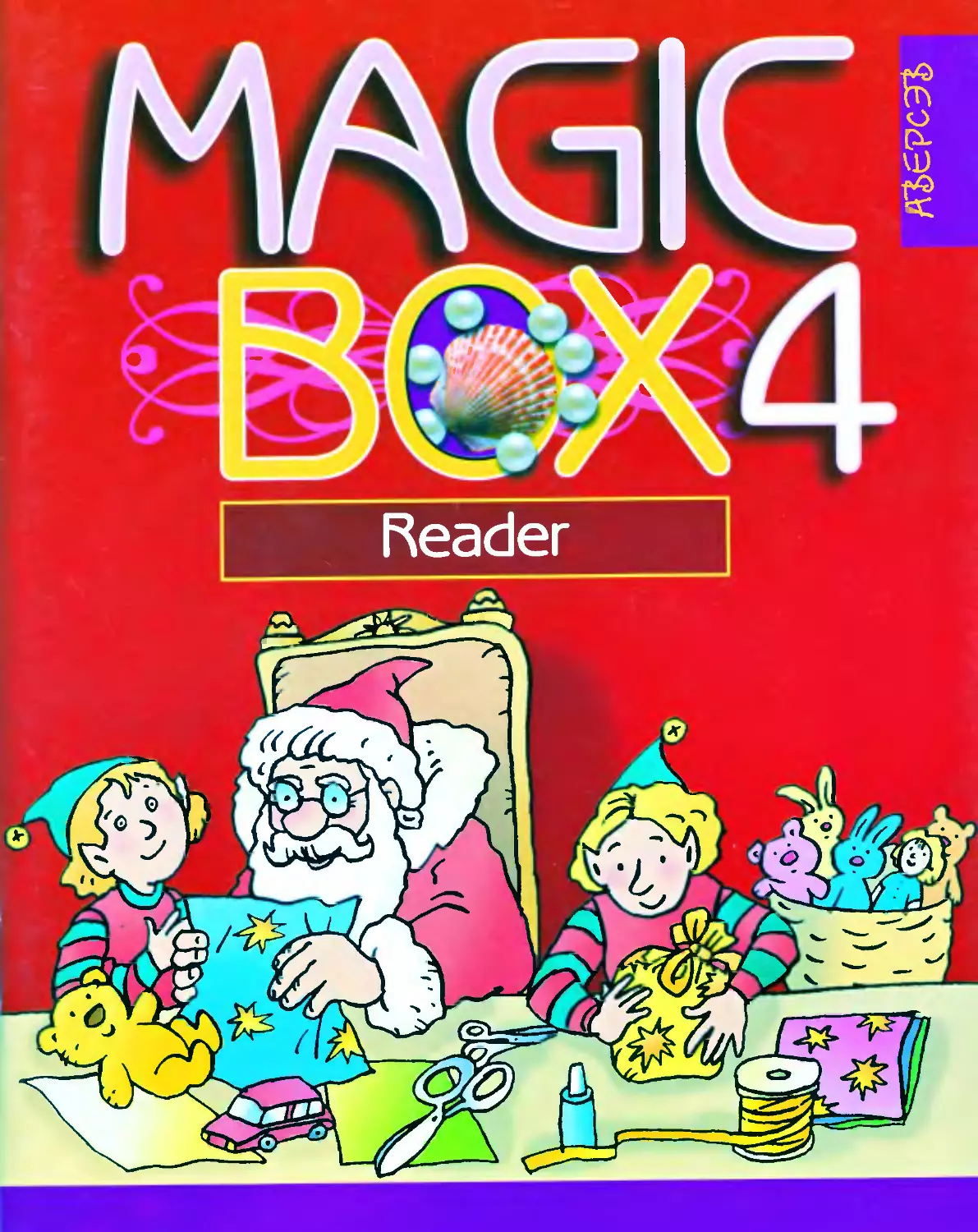


Author: Седунова Н.М. Новикова Т.С. Калишевич А.И. Пониматко А.П.
Tags: английский язык языки мира лингвистика изучение языков учебное пособие 4 класс
ISBN: 978-985-529-068-2
Year: 2009


Волшебная
шкатулка
Английский
язык
Книга для чтения
Учебное пособие для 4-го класса
учреждений, обеспечивающих получение
общего среднего образования, с русским
и белорусским языками обучения
(повышенный уровень)
Допущено
Министерством образования
Республики Беларусь
5-е издание
Минск «АВЕРСЭВ» 2009
УДК 811.111 (075.2=161.1=161.3)
ББК 81.2 Англ-922
В69
Авторы:
Н. М. Седунова, А. И. Калишевич, Т. С. Новикова,
А. Г). Пониматко, Т. Ю. Севрюкова, Л. М. Лапицкая
Рецензенты:
кандидат филологических наук, доцент кафедры теории и практики германских языков
Барановичского государственного университета Е. Г Карапетова',
преподаватель английского языка гимназии № 10 г. Минска В. М. Матвеюк
Консультанты:
помощник декана факультета международного образования колледжа
имени Св. Марка и Св. Джона (Плимут, Великобритания) Род Болито,
проректор по учебной работе МГЛУ
кандидат педагогических наук, профессор П. К Бабинская
Организатор проекта:
директор Центра лингвистического образования МГЛУ
кандидат педагогических наук, доцент Н. В. Демченко
Волшебная шкатулка : английский язык : книга для
В69 чтения : учеб, пособие для 4-го кл. учреждений, обеспе-
чивающих получение общ. сред, образования, с рус. и бе-
лорус. яз. обучения (повыш. уровень) / Н. М. Седунова,
А. Й. Калишевич, Т. С. Новикова [и др.]. — 5-е изд. —
Минск : Аверсэв, 2009. — 64 с. : ил.
ISBN 978-985-529-068-2.
Книга для чтения является составной частью учебно-методического
комплекса «Волшебная шкатулка» для 4-го класса, в который также
входят книга для ученика, рабочая тетрадь, тесты, наборы тематиче-
ских карточек для учителя и ученика, аудиокассеты (компакт-диск) и кни-
га для учителя.
Пособие содержит сказки, стихотворения, а также рассказы об ис-
тории создания мультфильмов и о том, как празднуются Рождество
и День Благодарения.
УДК 811.111 (075.2=161.1=161.3)
ББК 81.2 Англ-922
ISBN 978-985-529-068-2
© Коллектив авторов, 2005
© Коллектив авторов, с изменениями, 2006
© Оформление. ОДО «Аверсэв», 2006
Contents
К читателю.	4
At the Seaside.	5
The Adventures of Tom Sawyer.	11
The History of Cartoons.	17
Christmas and New Year.	21
It's Christmas Time.	27
Home, Sweet Home.	29
The Little Boy's Secret.	35
Magpie.	41
The History of Thanksgiving.	47
A Wonderful Trip to the Rainforest. 53
My Magic Shell.	62
Дорогие четвероклассники!
В книгу для чтения на английском языке для 4-го класса
мы включили сказки, стихотворения, а также рассказы об исто-
рии создания мультфильмов и о том, как празднуются Рожде-
ство и День Благодарения.
Перед каждым рассказом, сказкой или стихотворением
расположен “Банк слов” ("Wordbank") - раздел, включающий
незнакомые слова. Слова этого раздела, а также имена героев
рассказов и сказок сопровождаются транскрипцией.
Кроме привычных заданий и вопросов, вы найдёте
интересные кроссворды и загадки.
Некоторые рассказы и сказки мы рекомендуем для пред-
ставления в виде пьес на уроках английского языка. Попроси-
те своего учителя помочь вам распределить роли и составить
текст для каждого “актёра”. Затем отрепетируйте сцены и под-
готовьте костюмы и декорации. Пригласите на спектакль сво-
их одноклассников и родителей. Работа над изучением ролей
должна обязательно начинаться с многократного прослушива-
ния аудиокассеты, на которой записаны все произведения,
вошедшие в книгу для чтения.
Мы надеемся на то, что работа с книгой для чтения будет
для вас полезной и доставит много радостных минут от встре-
чи со старыми и новыми героями детских книг.
Авторы
At the Seaside.
1. Wordbank.
2.	Fill in the gaps with the new words.
1.	The dog saw a big crab and started to.
2.	The boys sat in a and went down the river.
3.	A big washed our shoes into the sea.
4.	Robin Hood was a- he helped people.
5.	The little boy couldn't see his mum and he started
to.
3. Look at the family.
Mum Dad
Ben Lucy Risha
Read the story and answer the questions.
1. Where did the family go?
2. Why was Risha the hero?
5
Last summer Lucy and Ben went to the seaside with their
mum and dad. Their dog Risha went with them too. Risha is
a little black dog. She is very funny and all the family love her.
She likes to play with the children, but they sometimes want
to play with their toys. Ben had a toy boat with a red and blue
flag. Lucy played with her little doll Alice. It had a nice red
dress and long brown hair. It was Granny's present and Lucy
loved her doll very much.
The weather at the seaside
was nice - it was hot and sunny.
The family went swimming and
sunbathing every day. Lucy
collected pebbles and shells.
Alice was always with her. Ben
played with crabs or sailed his
boat1. Risha ran after the crabs,
swam with Mum and played with
plastic bottles.
1 sailed his boat - запускал лодку.
6
Then Risha saw a big jellyfish in the water and started
to bark. All the children went to see the jellyfish. It was bigger
than Ben's boat. Dad didn't go there. He went to buy some
ice-cream for the children.
7
Ben and Lucy didn't see a big wave. It washed their castle
and the boat with Alice into the sea. One of the boys saw the
boat and shouted, "Look, your boat is in the sea!" Ben saw
only1 the flag and Alice's red dress. Lucy started to cry, "Alice!
Where's my Alice?"
Ben ran to his mum, "Mum,
Mum! Our boat! It's in the sea!
Alice is on the boat! Help!" Mum
jumped up and ran to the water.
Risha jumped into the water and
swam to the boat. She took the
boat with the doll and swam back.
"Hooray!" shouted the children.
"Risha, you're fantastic!"
1 only - только.
8
"Alice, my dear Alice," said Lucy. She took the doll and
ran to her dad. "There, my little princess," said Dad. "And
where's our hero? Risha, this is your ice-cream," said Dad
and gave the dog some ice-cream. Risha was happy. She
ate the ice-cream and ran to play with the children.
4.	Put the sentences in the correct order.
Dad went to buy some ice-cream.
Dad gave Risha some ice-cream.
Risha took the boat with the doll.
1 One day the children made a sandcastle.
____Ben ran to his mum.
Risha jumped into the water.
A big wave washed the sandcastle into the sea.
Lucy started to cry.
5.	Match the parts of the sentences.
1.	Lucy collected ...
2.	Ben played with ...
3.	Lucy played with ...
4.	Risha played with ..
5.	Risha saw a big ...
6.	Risha ate ...
her little doll Alice,
pebbles and shells,
plastic bottles,
a toy boat.
the ice-cream,
jellyfish.
9
6. Do the crossword.
Across
1.	Lucy collected pebbles and ....
2.	Alice had a nice red ... and long brown hair.
3.	Ben had a boat with a red and blue ....
4.	One day the children made a big ... on the beach.
5.	Then Risha saw a big ....
6.	Ben played with crabs and ... his boat.
7.	A big ... washed the boat into the sea.
Down
1.	Last summer Lucy and Ben went to the ....
7. Discuss the questions.
1.	Are dogs good friends? What can they do?
2.	Have you got a dog? Is he I she a hero?
3.	Tell a story about a dog.
10
The Adventures
of Tom Sawyer.
1. Wordbank.
2.	Fill in the gaps with the new words.
1.	In the old days people walls in their houses.
2.	The puppy was very funny and we started to.
3.	people have got a lot of money.
4.	You paint pictures with a.
5.	The cat climbed the.
3.	Look at the characters from the story.
Tom Auntie Polly Ben	the boys
Read the story and answer the question.
Who whitewashed Auntie Polly's fence?
11
It was a Saturday morning in the middle of summer. It was
sunny and hot and the best thing to do was to go swimming
in the river.
Tom wasn't happy that morning. His auntie was angry
with him and she said, "You must whitewash the fence,
naughty1 boy!"
Tom looked at the fence and felt sad because the fence
was very long. Tom didn't want to work on a sunny morning.
He wanted to go swimming and play with his friends.
"Poor me!" he thought. "The boys will laugh1 2 at me! What
shall I do?3" Tom thought and thought and thought.
1 naughty - непослушный; 2 will laugh - будут смеяться;
3 What shall I do? - Что мне делать?
12
Suddenly Tom had a great idea.
He took his brush and began to
whitewash the fence. Soon the first
boy came to him. It was Ben Rogers.
He had a big apple in his hand. He
stopped and looked at Tom. Tom
went on whitewashing the fence.
"Are you working, Tom?" Ben asked. Tom didn't look at him.
"Oh, it's you, Ben. I didn't see you, sorry," said Tom.
"I'm going swimming," said Ben Rogers. "Don't you want
to swim? It's hot today! Oh, I see, you have to work1. Poor
Tom!" Tom stopped working and looked at Ben.
"Work? What do you call 'work'?" Tom went on
whitewashing.
"Isn't that work?" Ben asked. Tom stopped working again.
"Of course, it isn't work! It's Tom Sawyer's special
mission2! Sorry, I can't talk to you now."
1 you have to work - тебе нужно работать;
special mission - специальное задание.
13
Ben didn't know what to say. He didn't
want to go swimming now. He wanted to
have a special mission, too.
"Tom, let me whitewash a little1," Ben
said.
Tom thought. "No," he said. "I can't let
you do that. Auntie Polly likes her fence
very much! Not every boy can paint it well."
"Tom, please! I'll be very careful2," said
Ben. "I ... I can give you my apple."
Tom thought and then gave Ben his
brush.
Ben Rogers worked hard3 under the hot sun, while Tom
lay in the shade4 eating the apple.
1 let me whitewash a little - дай мне немного побелить;
2 careful - аккуратный; 3 worked hard - усердно работал;
4 lay in the shade - лежал в тени.
14
One by one boys came and
stopped to laugh at the workers
but then stayed to whitewash
Auntie Polly's fence. By 12 o'clock
in the afternoon, Tom was rich.
He had a key, a piece of bottle
glass, a piece of a mirror, a knife
three old coins, five pebbles,
seven shells, a bone, a dead1 2
rat and a frog.
Auntie Polly went to look
at Tom's work. The fence was
whitewashed. The grass in
front of it was whitewashed
too. Auntie Polly was so glad
that she went to the kitchen,
took the biggest piece of cake
and gave it to Tom.
The fence was
whitewashed three times.
Tom went to Auntie Polly.
"Can I go swimming now,
Auntie?" he asked.
"What? What about the
fence?" she said.
"It's all done3, Auntie."
1 a knife [naif] - нож; 2 dead - мёртвая;
3 It's all done - всё сделано.
15
4.
7.
8.
Put the sentences in the correct order.
Auntie Polly gave a piece of cake to Tom.
Ben Rogers whitewashed the fence.
The boys stopped to laugh at the workers.
Tom wasn't happy.
Ben Rogers stopped to laugh at Tom.
1 Auntie Polly asked Tom to whitewash the fence.
The boys whitewashed the fence three times.
Answer the questions.
1.	What was the weather like that morning?
2.	What did Tom want to do?
3.	What didn't he want to do?
4.	Why did Ben Rogers want
to whitewash the fence?
5.	Why did Ben Rogers give Tom
his big apple?
6.	Did Auntie Polly like Tom's work?
Who is speaking?
1.	"You must whitewash the fence!"
2.	"I see, you have to work today."
3.	"Isn't that work?"
4.	"I can't talk to you now."
5.	"Let me whitewash a little!"
6.	"I can give you my apple."
7.	"It's all done."
Act out the story.
Discuss the question.
How do you help your parents?
Tom
Ben
16
The History of Cartoons.
1. Wordbank.
Stuart Blackton ['stjuiat ‘blaektan] Gertie ['gaiti]
Winsor McCay ['winza ma'kei] Felix [’fiiliks]
Walt Disney ['woilt 'dizni]
2.	Fill in the gaps with the new words.
1.	Cartoons are pictures.
2.	A lived in a little house in a forest.
3.	A ball is.
3.	Are the sentences true or false? Read the story and check your
answers.
_ 1. The first cartoons were made fifty years ago.
_ 2. The first cartoon character was a mouse.
3]	3. Cartoons about Mickey Mouse were the first
coloured cartoons.
4.	"Dumbo" and "Felix the Cat" are Disney films.
5.	"Toy Story" ano "Bugs' Life" are computer cartoons.
17
1
The first cartoons were
made soon1 after the first
films. In 1906, Stuart Blackton
drew a lot of faces on a
blackboard, photographed
them and made a short
cartoon called "Funny Faces."
After that, other people
started making cartoons too.
These cartoons didn't have
characters2 or stories. They
were just moving pictures.
2
In 1914, Winsor McCay
made a short cartoon called
"Gertie the Dinosaur".
Everyone loved it because it
had a character! Gertie was
the first cartoon character.
Another popular cartoon
character was Felix the Cat.
When people saw the first
cartoon about Felix they liked
him so much that the studio
made cartoons about him
again and again. "Felix the Cat
was the first cartoon series3.
12	3
soon - вскоре; characters - герои; series - сериал.
18
3
At that time, cartoons were
black and white and silent1.
Walt Disney was the first to
make cartoons with sound2
and in colour. In 1928, Disney
drew a funny character for
a cartoon - a mouse. The
mouse had short round ears,
a black nose and a funny face.
Disney called him Mickey. He
also drew a friend for Mickey
called Minnie Mouse.
Cartoons with Mickey and
Minnie became hits!
4
In 1937, the Disney Studio made the first long cartoon
called "Snow White and the Seven Dwarfs". Next came
"Dumbo", "Bambi", "Peter Pan", "The Jungle Book" and
other films. They all became very popular. The Disney Studio
soon became one of the most popular studios in the world.
5
In 1995, children all over the world saw the first computer
cartoon, "Toy Story". Then came "Toy Story 2". Some other
computer-animated cartoons are "Bugs' Life" and "Shrek".
1 silent - немые; 2 with sound - звуковые.
19
4.	Match the headings A-E to the paragraphs (1-5).
A.	The first computer cartoons.
B.	The first long cartoons.
C.	Disney's first cartoons.
D.	The first cartoon.
E.	The first cartoon characters.
5.	Match the parts of the sentences.
1.	Winsor McCay ...
2.	Gertie the Dinosaur...
3.	"Felix the Cat" ...
4.	Mickey Mouse ...
5.	Walt Disney ...
6.	"Snow White and
the Seven Dwarfs" ...
7.	"Toy Story" ...
became the most popular
cartoon character in the
world.
was the first long cartoon,
was the first cartoon series,
was the first computer
cartoon.
made the first cartoon with
a character.
was the first cartoon
character.
made the first cartoons
with sound.
6.	Guess the characters.
1
She's little and funny. She's got a round face. She's
got big black ears and a black nose.
2
She's got black hair. She's got big blue eyes. She's
got a little nose and a little pink mouth. She's beautiful.
She's very kind. She's got seven little friends.
7.	Draw your favourite cartoon character and write about him / her.
20
Christmas and New У ear.
1. Wordbank.
Christmas Eve ['krismas 'iiv] Rudolf [’ruidolf]
Trafalgar Square [tra'faelga 'skwea] Norway [’noiwei]
2.	Fill in the gaps with the new words.
1.	Santa Claus rides in his.
2.	Mr McDuck has got a lot of money, he’s very.
3.	His cousin hasn’t got any money, he’s very
4.	My dad goes to bed at.
5.	There's a big on the house.
6.	A helped Gerda to find Kay.
3.	Complete the sentences. Read the story and check your
answers.
1.	In Britain people celebrate Christmas Day on
2.	At Christmas they eat.
3.	In a cracker there's a.
21
1
Christmas Eve is on
the 24th of December.
Christmas Day is on the
25th of December.
2
Boxing Day is the day
after Christmas. People visit
their relatives1 and friends
and give them presents. In
the past, people gave boxes
of clothes and food to poor
people. They opened them
on the 26th of December.
1 relatives - родственники.
22
4
The elves help Santa Claus make all the toys in his home
in Finland.
6
Santa Claus gets into
houses through2 the chimneys
at midnight.
7
People sing Christmas
songs called carols in the
streets at Christmas time.
] ~	2
across the sky - по небу; through - через.
23
8
In Britain, children leave
a mince pie1 for Santa Claus
on Christmas Eve.
9
They eat roast turkey1 2 and Christmas pudding for their
traditional Christmas dinner.
10
Pulling crackers is another
Christmas tradition. Inside3
the cracker there is usually
a colourful party hat, a toy
or a gift and a joke4.
1 leave a mince pie - оставляют сладкий пирожок;
roast turkey - жареная индейка; 3 Inside - внутри;
4 a joke - шутка.
24
11
In London, many people celebrate New Year's Eve
in Trafalgar Square.
12
Every year, people decorate a big Christmas tree
in Trafalgar Square. It is a present from Norway.
4.	Are the sentences true or false?
1.	Boxing Day is on the 24th of December.
2.	People visit their friends on Boxing Day.
3.	Rudolf is a reindeer.
4.	Santa Claus comes at 12 o'clock at night.
5.	Children leave a cracker for Santa.
_ 6. People eat roast chicken for Christmas dinner.
_ 7. The big Christmas tree in Trafalgar Square is
a present from America.
25
5.
Do the crossword.
6.
7.
Across
1.	People ... Christmas on the 25th of December.
2.	Santa Claus gets into houses through the ... .
3.	New Year's Day is on the 1 st of... .
4.	They are Santa's animals.
5.	People ... carols at Christmas.
6.	You can find a ... in a Christmas cracker.
7.	Christmas Eve is on the 24th of... .
8.	People pull ... at Christmas.
9.	In the past, poor people got boxes of... and food
on Boxing Day.
Down
1. ... is most people's favourite holiday.
Speak about the most interesting fact from the text.
Discuss the question.
How do you celebrate Christmas?
26
It's Christmas Time!
1. Wordbank.
2. What can you see, hear and smell at Christmas time?
Read and check.
Can you see our Christmas tree,
Christmas tree, Christmas tree?
Can you see our Christmas tree
Celebrating the New Year?
Can you hear1 the Christmas carols,
Christmas carols, Christmas carols?
Can you hear the Christmas carols
That children sing so clear2?
Can you smell3 the Christmas pudding,
Christmas pudding, Christmas pudding?
Can you smell the Christmas pudding?
We're happy Christmas is here.
3.	Can you make your own verses for the poem?
1 ।	2	.	3	„
hear - слышать; clear - чисто; smell - чувствовать запах.
27
4.	Read the riddles and guess Christmas words.
It's funny, nice °
and round1 and fat2,
It's got a long scarf and a hat,
Its coat is white from head to toe,
It stands outside3 in wind and snow.
It is a ... .
He laughs4 his way with Ho-Ho-Ho!
He drives his sleigh through5 wind and snow
His hair is white, he's big and fat.
He wears black boots and a funny red hat.
He is ... .
They're little and always ready to fly,
They put Santa's sleigh up in the sky.
At Christmas time they can't be late
Because the children cannot wait6.
They are ... .
They're nice and little, white and round,
They fall right down from sky to ground7.
Children ski and skate and play
In clean white snow on a
They are ... .
5.	Draw how your family celebrate Christmas or New Year.
6.	Learn the poems and have a contest.
1 round - круглый; 2 fat - толстый; 3 outside - на улице;
4	laughs - смеётся; 5 through - сквозь;
6	cannot wait - не могут ждать; 7 ground - земля.
28
Home, Sweet Home.
7. Wordbank.
2.	Fill in the gaps with the new words.
1.	Children like to play football in the near
the village.
2.	Birds like to eat.
3.	The rabbit lived in a under a big tree.
4.	My granny can make dolls out of.
3.	Look at Country Mouse and Town Mouse .
Answer the questions. Read the story and check your answers.
1.	Which food does Town Mouse like?
2.	Which food does Country Mouse like?
29
Once upon a time there lived two cousins. They were
called Country Mouse and Town Mouse.
Country Mouse lived in a
little hole in a country house.
Town Mouse lived in a big
hole in a big town house.
One day, Town Mouse visited his cousin. "Welcome to my
home," said Country Mouse. "I think you'll love the country.
It's so nice and quiet."
Country Mouse made a big dinner of mushrooms, seeds
and grain but Town Mouse did not like the food.
"The food is better in town," he said. He didn't like his
little room or his little straw bed.
"I can't sleep," he thought. "It's so dark and cold here."
30
The next day, Country Mouse got up at 5 o'clock. He
went to the field to collect seeds for the winter. Town Mouse
didn't help him. He wanted to go back home.
"It's so quiet and boring in the country," he said. "Let's
go to town! It's more interesting there."
In the morning Country Mouse ran into the hole and
shouted, "Hurry up! The farmer is going to town! Let's jump
into his car!"
31
In the town they jumped out
of the car near a big house.
"This is where I live," said
Town Mouse. "I think you'll love
the town. It's so interesting here!"
Town Mouse made a fantastic
dinner of biscuits and cola,
chocolate cake and ice-cream.
Country Mouse didn't like the
food - it was too1 sweet for him.
At night Country Mouse didn't sleep.
"It's too noisy and too bright," he thought.
The next day, the cousins went to an amusement park.
Country Mouse looked around. He saw swings, slides, a big
wheel and a merry-go-round.
Country Mouse didn't like the big wheel, "It's too big!"
He didn't like the merry-go-round, "It's too noisy!"
He didn't like the amusement park, "There are too many
people, dogs and cats. I'm very tired!"
|	1 too - слишком.
32
At night Country Mouse had a dream1. He saw his nice
little hole and beautiful green fields.
1 had a dream - приснился сон.
33
4.	Put the sentences in the correct order.
Country Mouse collected seeds in the field.
They went to an amusement park.
1 Town Mouse came to the country.
Country Mouse didn't sleep at night.
Town Mouse made a fantastic dinner.
Town Mouse didn't like country food.
They came to town.
Country Mouse went home.
5.	Correct the sentences.
1.	Country Mouse gave Town Mouse bread and
mushrooms for dinner.
2.	Town Mouse slept very well on the straw bed.
3.	Town Mouse worked in the field.
4.	Country Mouse liked the town.
5.	Town Mouse lived in a small house.
6.	Country Mouse didn't go to an amusement park.
6.	Who is speaking?
1.	"It's too noisy."
2.	"I think you'll love the town."
3.	"This is where I live."
4.	"It's so dark and cold here."
5.	"It's so quiet and boring."
6.	"It's more interesting there!"
7.	"It's too sweet for me."
7.	Act out the story.
8.	Discuss the question.
Where do you like to live: in town or in the country?
34
The Little Boy's Secret.
1. Wordbank.
2. Fill in the gaps with the new words.
1.	A is a very big man.
2.	If you have, you should go to the doctor.
3.	When lions are angry, they.
4.	Don't. The baby is sleeping.
5.	Don't! I can't hear you!
3.	Look at the characters from the story.
the boy
his mum
the first the second the third
giant	giant	giant
Read the story and answer the questions.
1.	What secret has the boy got?
2.	Who did the boy tell his secret to?
35
One day, a little boy left school early1 because he had
a secret to tell his mum. He ran through the woods where
three giants, who were brothers, lived. Suddenly, the boy saw
the first giant.
"What are you doing in our woods, little boy?" the giant
asked.
"I'm sorry, Mr Giant, but I'm going home," answered the
little boy. "I've got a secret to tell my mum."
The giant got angry. "A secret?" he asked. "Tell me your
secret!"
"I can't tell my secret to you," said the little boy. "I can
only2 tell it to my mum. I must go home."
"Ha! Ha!" laughed the giant. "You won't go3 home. You'll
go with me and tell your secret to my brother!" He took the
little boy by his hand and ran into the woods.
12	3
early - рано; only - только; won't go - не пойдёшь.
36
Then, they met the second giant. He was bigger and
uglier than the first giant. He was also angrier!
The second giant shouted, "Who's this?" His brother, the
first giant, answered,"This is a little boy. He's got a secret but
he doesn't want to tell us."
The second giant laughed.
"Tell us your secret, little boy!
Tell it right now!" he shouted.
The little boy said, "I'm sorry,
Mr Giant. I can't tell my secret
to you. I can only tell it to my
mum. I must go home."
"Ha! Ha!" laughed the
giants. "You won't go home.
You'll go to our castle and tell
your secret to our brother!"
They took the little boy by his
hand and ran home.
At the door of the castle,
the two giants met their oldest
brother, the third giant. He was
the biggest and the ugliest.
He was also the angriest!
The third giant roared,
"Who's this?" The second
giant answered, "This is
a little boy. He's got a secret
but he doesn't want to tell us."
"Put him on the table!"
roared the third giant.
37
The little boy looked at the first giant, and then he looked
at the second giant. Finally he looked at the third giant. They
were very big, very ugly and very angry but the little boy
wasn't afraid1 of them.
The third giant roared,
“If you don't tell us your
secret, we'll eat you!" The
little boy thought a little, then
he said, "OK. I'll tell you my
secret."
The little boy asked the
first giant to bend down to
him2. Then he whispered
something into his ear. The
first giant's mouth opened
and he shouted, "Oh no! Let
me get out of here!3" He ran
out of the castle and climbed
the tallest tree in the garden.
The second giant looked
at the little boy. He wanted
to know the little boy's secret.
He bent down and the little
boy whispered something
into his ear. The second
giant's eyes rolled. "Oh no!
Let me get out of here!" he
1 wasn't afraid - не боялся;
2 bend down to him - наклониться к нему;
3 Let me get out of here! - Выпустите меня отсюда!
38
Do you know what the li
getting the chicken-pox!1”
shouted and quickly ran deep
into the woods.
Then the third giant bent
down to the little boy. The little
boy whispered something into
his ear. When the third giant
heard the secret, he jumped
up so fast that he lost his
trousers behind him. He
roared, "Oh no! Let me get
out of here!" and ran fast into
the darkest cave.
Now the little boy could go
home to his mum. When he
came home and told his secret
to her, she didn't shout or run
away. "You should have dinner
and go to bed, my dear," she
said. In the morning, all the
little boy body from head to
toe had little red spots.
boy's secret was? It was, "I'm
1 I'm getting the chicken-pox! - У меня начинается ветрянка!
39
4.	И/ho in the story...
1.	... lived in the castle in the woods?
2.	... climbed the tallest tree?
3.	... lost his trousers?
4.	... hid in the darkest cave?
5.	... had spots?
6.	... put the little boy to bed and gave him dinner?
5.	Say why...
1.	... the little boy left school early that day.
2.	... the giants got angry with the little boy.
3.	... the giants ran away and hid from the little boy.
4.	... the little boy's mum put him to bed.
6.	Make the sentences and write them.
1.	my I tell I secret 111 you I can't / to /.
The little boy:____________________________________________
2.	must I home 111 go I.
The little boy:__________________________________
3.	go I our I You'll I to I castle I.
The giants:________________________________________________
4.	doesn't / tell / secret / He I want I to I his I us I.
The giants:_______________________
5.	get I here / out / me I Let I of I!
The giants:________________________________________________
7.	Act out the story.
8.	Discuss the question.
Who helps you when you are ill?
40
Magpie.
1. Wordbank.
2.	Fill in the gaps with the new words.
1.	There's some water in the.
2.	This is very expensive!
3.	Look at my car! It's new and!
4.	A steals things.
5.	Don't the cat's tail! It will become angry!
6.	A is a black and white bird.
3. Look at the characters from the story.
Magpie the cow the field the girl the hen the old
woman
Read the story and answer the question.
What do all the characters want?
41
Once upon a time, a magpie lived in a small village.
She was a very beautiful magpie with nice black and white
feathers1 and a long beautiful blue-black tail. Like all mag-
pies, she loved nice shiny things.
One beautiful summer morning, Magpie was sitting in
a tree looking around. Suddenly, she saw something shiny
on a window-sill2 in one of the houses. She flew to the house,
jumped on the window-sill and looked at the thing carefully.
It was a gold ring! "This ring is so shiny and beautiful! I'll steal
it!" Magpie thought. Just as she took the ring, an old woman
came into the room. "Stop, you thief!" she cried and caught
Magpie by the tail. Magpie tried3 to fly away but the woman
pulled at the tail, and ... Magpie's beautiful black and blue
tail was in the woman's hand!
"Old woman, old woman," Magpie cried, "take your ring,
give me back my tail!"
"Alright," the woman answered. "I'll give you back your
tail if you bring me some milk."
1 feathers - перья; 2 window-sill - подоконник;
3 tried - попыталась; 4 if - если.
42
So what could Magpie do? She went to the cow and said,
"Cow, Cow, please, give me some milk. Then I'll give it to the
old woman and she'll give me back my tail."
"Alright," the cow answered. "I'll give you some milk if you
bring me some nice green grass."
So, Magpie went to the field.
It was a long way but she walked
because she couldn't fly without
her tail.
"Field, Field," she said when
she got there, "please, give me
some green grass. Then I'll give
it to the cow and she'll give me
some milk. I'll give the milk to
the old woman and she'll give
me back my tail."
"Alright," said the field, "I'll
give you as much grass as you
want if you bring me some fresh
water first".
43
So, Magpie went looking
for water. She walked on and
on and soon saw a young girl
with two buckets full of nice
fresh water.
"Girl, Girl," Magpie said,
"please, give me one of your
buckets. Then I'll take it to the
field and the field will give me
some grass. I'll give the grass
to the cow and she will give
me some milk. Then I'll give
the milk to the old woman and
she will give me back my tail."
"Alright," said the girl. "I'll
give you a bucket of water if
you bring me an egg for my
lunch."
So, Magpie walked away to
look for her friend, the hen.
"Hen, Hen," she said when
she found her, "please, give me
one of your eggs," and she told
the hen her story.
"Oh, my dear Magpie," said
the hen when Magpie finished her
story. "You're so tired. I'm very
sorry for you! Of course I'll give
you an egg. We're both birds and
we should help each other." She
gave Magpie a nice fresh egg.
44
"Oh, thank you, thank you, thank you, my dear hen,"
said Magpie and carefully rolled the egg back to the girl.
Magpie gave the egg to the girl.
The girl gave her a bucket of water.
Magpie gave the water to the field.
The field gave her some grass.
Magpie gave the grass to the cow.
The cow gave her some milk.
Then Magpie gave the milk to the
old woman.
"Now can I have my tail back?" she
asked. The old woman gave her back
her beautiful blue-black tail.
So, Magpie happily flew
back to her tree and the old
woman sat down to enjoy
her nice cup of tea with milk.

45
4.	Answer the questions.
1.	Why did Magpie want to steal the ring?
2.	Who caught Magpie?
3.	What animal could give Magpie some milk?
4.	Where could Magpie get some grass?
5.	Why was the hen sorry for Magpie?
6.	How did the hen help Magpie?
7.	When was Magpie happy again?
5.	Match the parts of the sentences. Who is speaking?
1.	Take your ring, ...
2.	I'll give you back your
tail ...
3.	I'll give you some milk ...
4.	I'll give you as much
grass as you want...
5.	I'll give you a bucket
of water...
6.	Of course I'll give you
an egg, ...
if you bring me some nice
green grass.
if you bring me an egg for
my lunch.
if you bring me some fresh
water.
we are both birds and we
should help each other.
if you bring me some milk,
give me back my tail!
Magpie the cow the field
6. Act out the story.
the girl the hen the old
woman
7. Discuss the question.
Why did the hen help Magpie?
46
The History of Thanksgiving'.
1.	Wordbank.
a pumpkin
['рлткш]
a pumpkin pie
['рлткт pai]
cornbread
Indians
['indianz]
2.	Fill in the gaps with the new words.
1.	We put a candle into a at Halloween.
2.	Let's play cowboys and I
3.	grows in the field.
4.	is bread made from corn.
5.	A is made from pumpkin.
3.	Answer the questions. Read the story and check your answers.
1.	Is Thanksgiving a British or an American holiday?
2.	When do people celebrate Thanksgiving?
3.	What do people do at Thanksgiving?
1 Thanksgiving - День Благодарения.
47
1
Many years ago, in 1620,
there were people in Britain
who wanted to go to America
to start a new life1 there. So,
on September 16th, a ship
called the Mayflower left
Plymouth in England with
102 passengers2 on it. On
December 11th, 1620 the
Mayflower came to America.
The people from the ship
built a settlement3 and start-
ed their life in the new land4.
They called it New England.
2
The settlers' first winter on the new continent was very
difficult. Their work was hard. They had very little food and
their houses were cold and dark. A lot of them died5 that
winter. The settlers6 made friends with some Indians and
the Indians helped them.
1 life - жизнь; 2 passengers - пассажиры; 3 settlement - поселение;
4 land - земля; 5 died - умерли; 6 settlers - поселенцы.
48
3
In the summer of 1621, the settlers collected a good
harvest1. They wanted to celebrate and give their thanks
to God2 for it, so they organised a three-day harvest festival.
The men went hunting and fishing and brought back wild
ducks, turkey and fish. The women cooked the food. The
people ate outdoors3 at big tables. There were also pumpkin
pies and cornbread on the table. Some Indians came to
celebrate the harvest festival too. All the people were happy.
1 harvest - урожай; 2 God - Бог; 3 outdoors - на улице.
49
4
Later, Thanksgiving became a national holiday in the USA.
Now it is celebrated on the fourth Thursday in November.
This holiday is usually a family day when all the family
get together. People decorate their houses with autumn fruit
and flowers. A lot of families go to church on that day. Then,
people have a traditional dinner with turkey and pumpkin pie
and watch the Thanksgiving Parade on TV.
50
4.	Match the headings А-D to the paragraphs (1-4).
A.	The first Thanksgiving festival.
B.	The Mayflower goes to America.
C.	Difficult life in the new land.
D.	Thanksgiving today.
5.	Circle the correct answer.
1.	When did the settlers have their first Thanksgiving?
a. In 1260.	b. In 1621.	c. In 1620.
2.	What country were the settlers from?
a. Germany.	b. Italy.	c. Britain.
3.	Why did the people want to have a Thanksgiving festival?
a.	To make friends with the Indians.
b.	To thank God for the harvest.
c.	To celebrate Christmas.
4.	What did they eat at the first Thanksgiving dinner?
a.	Turkey and pumpkin pie.
b.	Fruit and honey.
c.	Fish and chips.
5.	Where do people usually go on Thanksgiving Day?
a. To parties. b. To parks. c. To church.
51
6.	Correct the mistakes in the sentences.
1.	In 1619, the Mayflower left Britain.
2.	On December 11th, 1620, the ship came to Africa.
3.	The settlers' first summer on the new land was difficult.
4.	In 1621, the settlers collected a bad harvest.
5.	The people organised a three-day parade.
6.	The women bought the food.
7.	Now, Thanksgiving is a national holiday in Britain.
8.	A lot of families watch Thanksgiving films on TV.
Z Look at the photos and describe what the people are doing.
Harvest festival in Belarus.
8. Discuss the question.
How do you celebrate a harvest festival?
52
A Wonderful Trip
to the RainforeST.
1. Wordbank.
Mrs Fereira ['misiz fa'reira]	Marcus ['maikas]
Yanomani ['jaenau'maeni]	Anita [a'nita]
Kitara [ki'toira]
2.	Fill in the gaps with the new words.
1.	Mosquitoes are the worst I know.
2.	My favourite is peppermint.
3.	Don't this dog! It can bite you.
4.	can eat people.
5.	There are a lot of in South America.
3.	Answer the questions. Read the story and check your answers.
1.	What can you see in a rainforest?
2.	Why are they called rainforests?
3.	What do rainforests give to people?
53
This story happened in Brazil. One day, Mrs Fereira said,
"Tomorrow we're going on a trip1. We're going to a rainforest."
"Hurray!" shouted the children. They were all very happy.
They loved going on trips.
On the next day, all the children got on the school bus
but Marcus was late.
"Hurry up, Marcus!" said Mrs Fereira.
On the bus, Mrs Fereira
talked about rainforests.
"Rainforests are very
important2 to the world. A lot
of plants grow there. There
are also a lot of animals and
insects."
"Why are they called
rainforests?" asked Anita.
"Because it rains two
hundred days a year there."
"Wow!" said Anita.
1 X 	2 .	.
a trip - поездка; important - важный.
54
Two hours later, the bus stopped. Marcus and his friends
ran out of the bus and looked at the rainforest. It was so
beautiful! The trees were so tall. Then, the children and their
teacher walked into the forest. It was very warm and the
ground1 was wet.
"Why is it so dark, Mrs Pereira?" asked Marcus.
"Because there are a lot of very tall trees. We get a lot
of things from these trees - rubber1 2, cocoa3 and vanilla4.
People make chewing gum out of this rubber. Look! This is
a rubber tree and that is a cocoa tree. Marcus, stop it! Don't
eat this fruit, it's not chewing gum!"
"OK, Mrs Fereira," said Marcus.
1 ground - земля; 2 rubber - резина; 3 cocoa - какао;
4 vanilla - ваниль.
55
Marcus and his class walked through the rainforest.
They saw a lot of small animals and birds. Suddenly, Anita
saw a giant1 frog.
"Aaaah!" she cried.
“Don't be afraid, Anita!" said Marcus. "It's just a frog.
Look, I can touch it."
"Oh no, Marcus! Please, don't touch it!" said Mrs Fereira.
1 giant - гигантская.
56
The children went along the river.
"Are there any fish in the river, Mrs Fereira?" Marcus
asked.
"Oh yes! Some rivers have piranhas in them. They eat
meat and they can eat people, too," said the teacher.
"Do any people live here?" asked Anita.
"The people of this rainforest are called Yanomani. They
know a lot about the plants and animals."
"Where are the supermarkets, Mrs Fereira?" asked Anita.
"They don't go shopping, Anita. They get everything they
need from the rainforest," answered the teacher.
"How interesting!" said the children.
57
Suddenly, Marcus fell to the ground1. Anita shouted,
"Help, Mrs Fereira! Marcus is ill!" Everybody ran to Marcus.
His face was white.
"Oh, my stomach!" he whispered. Mrs Fereira was very
worried. “Oh no! What are we going to do now?"
Then they saw a young Yanomani girl.
"Hello. My name is Kitara. I live here
in the rainforest. My grandmother can help
this boy. She knows lots of things. Come
with me."
1 fell to the ground - упал на землю.
58
They all walked slowly
to Kitara's village. Kitara's
grandma looked at Marcus
and said, "I know what you
need." She went to a small
plant near a big tree and cut
some leaves from it. Then
she made some tea with the
leaves and gave it to Marcus.
Marcus drank it all.
In a few minutes he felt better and smiled, "Thank you
very much! I feel much better now."
"That's alright. You should thank the rainforest. A lot of
plants make medicine but you should be careful - not all the
plants are good."
"Now I know," said Marcus.
"Let's go back to the city and tell everybody about
Marcus, Yanomani and the rainforests," said Anita.
"You're right, Anita. That way, we can protect1 them."
1 can protect - сможем защитить.
59
4.	Put the sentences in the correct order.
1 The class went on a trip.
Marcus ate some fruit.
Anita was afraid of a frog.
Kitara's grandmother gave Marcus some tea.
Marcus had a stomach-ache.
Marcus felt better.
The children saw a Yanomani girl.
5.	Answer the questions.
1.	Why did the children go to the rainforest?
2.	What animals did they see there?
3.	Why is it dark in the rainforest?
4.	What do people make from rubber trees?
5.	Are there any supermarkets in rainforests?
6.	What did Kitara's grandmother give to Marcus?
6.	Make a poster.
If you go to the forest,
you should
you shouldn't
wear boots take some food drop litter
make a fire eat all berries touch animals
wear a hat take some medicine break trees
60
7. Do the crossword.
Down
1.	Some rivers have ... in them.
2.	There aren't any shops in the ... .
3.	There are a lot of very ... trees.
4.	"My name is ...", said a young Yanomani girl.
7.	It was very warm in the rainforest and
the ground was ....
Across
5.	"That way, we can ... them."
6.	"The people of this rainforest are called ... ."
8.	"There are also a lot of animals and ... ."
8. Discuss the question.
Why should people protect rainforests?
61
My Magic Shell.
Read the poem. Where did Natalie travel?
Once1 on the beach of my hotel
I found a shiny little shell.
It was a magic shell, you see,
The loveliest one2 in the Black Sea.
I touched3 the shell and suddenly
I found myself4 in Italy!
And then I went by plane to Spain.
And later on5 to France, by train.
You know, it was a long, long trip.
I went by car, by bus, by ship.
But when I came back home at last6,
I saw blue skies, I saw green grass,
The river with its yellow sand.
I saw my school, I saw my friends.
And now I know, that - East or West -
Wherever you go7 - your home is best!
Natalie Yukhnel
1 Once - однажды; 2 The loveliest one - самая красивая;
3 touched - дотронулась; 41 found myself - я оказалась;
5 later on - позже; 6 at last - в конце концов;
7 Wherever you go - куда бы вы ни поехали.
62
2.	Is this true or false?
1.	Natalie found the shell in the hotel.
2.	The shell was magic.
3.	Natalie went travelling.
4.	Natalie visited Spain.
5.	Natalie was happy to see her friends and home again.
3. Do the crossword and draw.
Across
1.	At sea you travel by ... .
2.	Natalie thinks that the best place is ... .
3.	She found the shell on the ... .
4.	In the sky you fly by ... .
5.	Natalie lived in a ... .
Down
1. It was lovely and shiny.
4. Discuss the questions.
1. Where would you like to travel?
2. What do you like about your home?
63
Учебное издание
Седунова Наталья Михайловна
Калишевич Алла Ивановна
Новикова Татьяна Станиславовна и др.
Волшебная шкатулка
Английский язык
Книга для чтения
Учебное пособие для 4-го класса учреждений,
обеспечивающих получение общего среднего образования,
с русским и белорусским языками обучения
(повышенный уровень)
5-е издание
Редактор Л. Д. Касьянова
Художественный редактор А. И. Царев
Художник Е. Э.Агунович
Ответственный за выпуск Д. Л. Дембовский
Подписано в печать с готовых диапозитивов 22.06.2009.
Формат 70x90 1/16. Бумага офсетная. 1арнитура «Helvetica». Печать офсетная.
Усл. печ. л. 4,68. Уч.-изд. л. 3,76. Тираж 15 000 экз. Зак 268.
Удостоверение № 08-33-0.350648
о государственной гигиенической регистрации продукта от 17.11.2008.
Общество с дополнительной ответственностью «Аверсэв».
ЛИ № 02330/0494066 от 03.02.2009. Контактный телефон (017) 210-18-98.
E-mail: info@aversev.com; www.aversev.com
Ул. М. Богдановича, 129а, 220123, Минск.
Для писем: а/я 135, 220123, Минск.
ИП «Принтхаус». Лицензия № 02330/0494152 от 03.04.2009.
Ул. Одоевского, 117, 8 этаж, к. 11, 220015, г. Минск.
Учебно-методический
комплекс «Magic Вок»
включает
•	книгу для ученика;
•	рабочую тетрадь;
ф книгу для чтения;
•	тесты;
•	книгу для учителя;
•	набор тематических карточек;
•	набор карточек для ученика;
•	аудиокассеты;
•	компакт-диск.
ISBN 978-985-529-068-2
9 789855 290682