/




Text
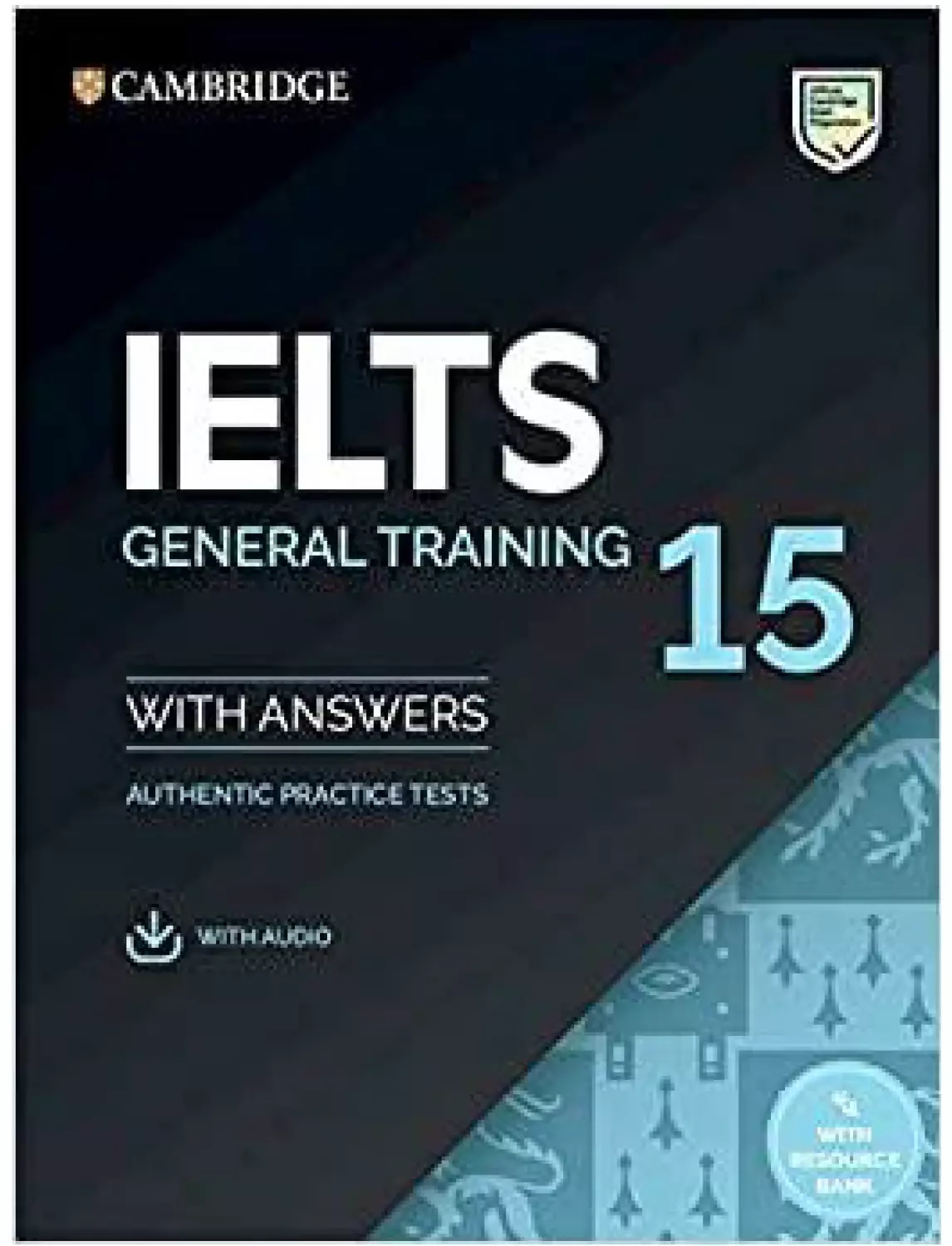
                    ф CAMBRIDGE

GENERAL TRAIN ING

WITH ANSWERS

МИ КЧТЙ Picric £ TESTS
Icon What does it mean?

Extra explanations and sample answers in Resource bank

Resources can be found at back of book

Answer key

Audioscript

Sample Writing answer

RESOURCE BANK

You can access the Listening test audio files, example Speaking test
video, answer keys with extra explanations, additional sample Writing
answers by scanning the QR code,
В CAMBRIDGE

Official
Cambridge
Exam
Preparation

WITH ANSWERS

AUTHENTIC PRACTICE TESTS

Produced by Cambridge Exams Publishing

QUNYAN PRESS

• jga »
Contents

Introduction	4

Test 1	10

Test 2	32

Test 3	54

Test 4	76

Audioscripts	98

Listening and Reading answer keys	121

Sample Writing answers	129

Sample answer sheets	137

Acknowledgements	141
I

Introduction

Prepare for the exam with practice tests from Cambridge

Inside you’ll find four authentic examination papers from Cambridge Assessment English.
They are the perfect way to practise - EXACTLY like the real exam.

Why are they unique?

All our authentic practice tests go through the same design process as the IELTS test. We
check every single part of our practice tests with real students under exam conditions, to
make sure we give you the most authentic experience possible.

Students can practise these tests on their own or with the help of a teacher to familiarise
themselves with the exam format, understand the scoring system and practise exam
technique.

Further information

IELTS is jointly managed by the British Council, IDP: IELTS Australia and Cambridge
Assessment English. Further information can be found on the IELTS official website at:
ielts.org.

WHAT IS THE TEST FORMAT?

IELTS consists of four components. All candidates take the same Listening and Speaking
tests. There is a choice of Reading and Writing tests according to whether a candidate is
taking the Academic or General Training module.

 For candidates wishing to study at : undergraduate orpostgraduatelevels, s and for those seeking professional ; J	For candidates wishing to migrate to an English-speaking country (Australia, Canada, New Zealand, UK), and for those wishing to : train or study below degree level.	у
The test components are taken in the following order:

' ’ Listening ,y

4 parts, 40 items, approximately 30 minutes

Academic Reading
3 sections, 40 items
60 minutes

or

General Training Reading
3 sections, 40 items
60 minutes

Academic Writing

2 tasks

60 minutes

or

General Training Writing

60 minutes

Speaking
11 to 14 minutes

Total Test Time
2 hours 44 minutes

GENERAL TRAINING TEST FORMAT

Listening

This test consists of four parts, each with ten questions. The first two parts are concerned
with social needs. The first part is a conversation between two speakers and the second part
is a monologue. The final two parts are concerned with situations related to educational or
training contexts. The third part is a conversation between up to four people and the fourth
part is a monologue.

A variety of question types is used, including: multiple choice, matching, plan/map/
diagram labelling, form completion, note completion, table completion, flow-chart completion,
summary completion, sentence completion and short-answer questions.

Candidates hear the recording once only and answer the questions as they listen. Ten
minutes are allowed at the end for candidates to transfer their answers to the answer sheet.

Reading

This test consists of three sections with 40 questions. The texts are taken from notices,
advertisements, leaflets, newspapers, instruction manuals, books and magazines. The
first section contains texts relevant to basic linguistic survival in English, with tasks mainly
concerned with providing factual information. The second section focuses on the work
context and involves texts of more complex language. The third section involves reading
more extended texts, with a more complex structure, but with the emphasis on descriptive
and instructive rather than argumentative texts.

A variety of question types is used, including: multiple choice, identifying information
(True/False/Not Given), identifying the writer’s views/claims (Yes/No/Not Given), matching
’-formation, matching headings, matching features, matching sentence endings, sentence
completion, summary completion, note completion, table completion, flow-chart completion,
diagram-label completion and short-answer questions.

Writing

This test consists of two tasks. It is suggested that candidates spend about 20 minutes on
Task 1, which requires them to write at least 150 words, and 40 minutes on Task 2, which
requires them to write at least 250 words. Task 2 contributes twice as much as Task 1 to the
Writing score.

In Task 1, candidates are asked to respond to a given situation with a letter requesting
information or explaining the situation. They are assessed on their ability to engage in
personal correspondence, elicit and provide general factual information, express needs,
wants, likes and dislikes, express opinions, complaints, etc.

In Task 2, candidates are presented with a point of view, argument or problem. They
are assessed on their ability to provide general factual information, outline a problem and
present a solution, present and justify an opinion, and to evaluate and challenge ideas,
evidence or arguments.

Candidates are also assessed on their ability to write in an appropriate style. More
information on assessing the Writing test, including Writing assessment criteria
(public version), is available at ielts.org.

Speaking

This test takes between 11 and 14 minutes and is conducted by a trained examiner.
There are three parts:

Part 1

The candidate and the examiner introduce themselves. Candidates then answer general
questions about themselves, their home/family, their job/studies, their interests and a wide
range of similar familiar topic areas. This part lasts between four and five minutes.

Part 2

The candidate is given a task card with prompts and is asked to talk on a particular topic.
The candidate has one minute to prepare and they can make some notes if they wish,
before speaking for between one and two minutes. The examiner then asks one or two
questions on the same topic.

Part3

The examiner and the candidate engage in a discussion of more abstract issues which are
thematically linked to the topic in Part 2. The discussion lasts between four and five minutes.

The Speaking test assesses whether candidates can communicate effectively in English.

The assessment takes into account Fluency and Coherence, Lexical Resource, Grammatical
Range and Accuracy, and Pronunciation. More information on assessing the Speaking test,
including Speaking assessment criteria (public version), is available at ielts.org.
HOW IS IELTS SCORED?

♦

IELTS results are reported on a nine-band scale, in addition to the score for overall language
ability, IELTS provides a score in the form of a profile for each of the four skills (Listening,
Reading, Writing and Speaking). These scores are also reported on a nine-band scale. All
scores are recorded on the Test Report Form along with details of the candidate’s nationality,
first language and date of birth. Each Overall Band Score corresponds to a descriptive
statement which gives a summary of the English-language ability of a candidate classified at
that level. The nine bands and their descriptive statements are as follows:

9 Expert User - Has fully operational command of the language: appropriate, accurate and
fluent with complete understanding.

8 Very Good User - Has fully operational command of the language with only occasional
unsystematic inaccuracies and inappropriacies. Misunderstandings may occur in
unfamiliar situations. Handles complex detailed argumentation well.

7 Good User - Has operational command of the language, though with occasional
inaccuracies, inappropriacies and misunderstandings in some situations. Generally
handles complex language well and understands detailed reasoning.

6 Competent User - Has generally effective command of the language despite some
inaccuracies, inappropriacies and misunderstandings. Can use and understand fairly
complex language, particularly in familiar situations.

5 Modest User - Has partial command of the language, coping with overall meaning in
most situations, though is likely to make many mistakes. Should be able to handle basic
communication in own field.

4 Limited User - Basic competence is limited to familiar situations. Has frequent problems
in understanding and expression. Is not able to use complex language.

3 Extremely Limited User - Conveys and understands only general meaning in very
familiar situations. Frequent breakdowns in communication occur.

2 Intermittent User - No real communication is possible except for the most basic
information using isolated words or short formulae in familiar situations and to meet
immediate needs. Has great difficulty understanding spoken and written English.

1	Non User - Essentially has no ability to use the language beyond possibly a few
isolated words.

0 Did not attempt the test - No assessable information provided.
MARKING THE PRACTICE TESTS

*

Listening and Reading

The answer keys are on pages 121-128.

Each question in the Listening and Reading tests is worth one mark.

Questions which require letter I Roman numeral answers

® For questions where the answers are letters or Roman numerals, you should write only
the number of answers required. For example, if the answer is a single letter or numeral
you should write only one answer. If you have written more letters or numerals than are
required, the answer must be marked wrong.

Questions which require answers in the form of words or numbers

•	Answers may be written in upper or lower case.

•	Words in brackets are optional - they are correct, but not necessary.

® Alternative answers are separated by a slash (/).

® If you are asked to write an answer using a certain number of words and/or (a) number(s),
you will be penalised if you exceed this. For example, if a question specifies an answer
using NO MORE THAN THREE WORDS and the correct answer is ‘black leather coat’,
the answer 'coat of black leather’ is incorrect.

•	In questions where you are expected to complete a gap, you should only transfer the
necessary missing word(s) onto the answer sheet. For example, to complete ‘in the ...’,
where the correct answer is ‘morning’, the answer ‘in the morning’ would be incorrect.

•	All answers require correct spelling (including words in brackets).

•	Both US and UK spelling are acceptable and are included in the answer key.

•	All standard alternatives for numbers, dates and currencies are acceptable.

« All standard abbreviations are acceptable.

« You will find additional notes about individual answers in the answer key.

Writing

The sample answers are on pages 129-136. It is not possible for you to give yourself a mark
for the Writing tasks. We have provided sample answers (written by candidates), showing
their score and the examiners’ comments. These sample answers will give you an insight
into what is required for the Writing test.
HOW SHOULD YOU INTERPRET YOUR SCORES?

At the end of each Listening and Reading answer key you will find a chart which will help
you assess whether, on the basis of your Practice Test results, you are ready to take the
IELTS test.

In interpreting your score, there are a number of points you should bear in mind. Your
performance in the real IELTS test will be reported in two ways: there will be a Band Score
from 1 to 9 for each of the components and an Overall Band Score from 1 to 9, which
is the average of your scores in the four components. However, institutions considering
your application are advised to look at both the Overall Band Score and the Band Score for
each component in order to determine whether you have the language skills needed for a
particular course of study or work environment. For example, if you are applying for a course
which involves a lot of reading and writing, but no lectures, listening skills might be less
important and a score of 5 in Listening might be acceptable if the Overall Band Score was 7.
However, for a course which has lots of lectures and spoken instructions, a score of 5 in
Listening might be unacceptable even though the Overall Band Score was 7.

Once you have marked your tests, you should have some idea of whether your listening
and reading skills are good enough for you to try the IELTS test. If you did well enough in
one component, but not in others, you will have to decide for yourself whether you are ready
to take the test.

The Practice Tests have been checked to ensure that they are the same level of difficulty
as the real IELTS test. However, we cannot guarantee that your score in the Practice Tests
will be reflected in the real IELTS test. The Practice Tests can only give you an idea of
your possible future performance and it is ultimately up to you to make decisions based on
your score.

Different institutions accept different IELTS scores for different types of courses. We have
based our recommendations on the average scores which the majority of institutions accept.
The institution to which you are applying may, of course, require a higher or lower score than
most other institutions.
Test 1

LISTENING

• . • ••

PART 1 Questions 1-10

Complete the notes below.

Write ONE WORD ANDIOR A NUMBER for each answer.

Bankside Recruitment Agency

Address of agency: 497 Eastside, Docklands

Name of agent: Becky 1....................

•	Phone number: 07866 510333

Best to call her in the 2....

Typical jobs

•	Clerical and admin roles, mainly in the finance industry

•	Must have good 3.....................skills

•	Jobs are usually for at least one 4....................

•	Pay is usually 5 £...................per hour

Registration process

•	Wear a 6..................to	the interview

•	Must bring your 7................to the interview

•	They will ask questions about each applicant’s 8..............

Advantages of using an agency

•	The 9.................you receive at interview will benefit you

•	Will get access	to vacancies which are not advertised

•	Less 10.................is involved in applying for jobs
PART 2 Questions 11-20


Questions 11-14

Choose the correct letter, A, В or C.

Matthews Island Holidays

11	According to the speaker, the company

A has been in business for longer than most of its competitors.

В arranges holidays to more destinations than its competitors.

C has more customers than its competitors.

12	Where can customers meet the tour manager before travelling to the Isle of Man?

A Liverpool

В Heysham

C Luton

13	How many lunches are included in the price of the holiday?

A three

В four

C five

14	Customers have to pay extra for

A

«1

c

guaranteeing themselves a larger room,
booking at short notice.

transferring to another date.
Complete the table below.

Write ONE WORD ANDIOR A NUMBER for each answer.

Timetable for Isle of Man holiday
	Activity	Notes
Day 1	Arrive	Introduction by manager  Hotel dining room has view of the  15
Day 2	Tynwald Exhibition and Peel	Tynwald may have been founded in 16	not	979.
Day 3	Trip to Snaefell	Travel along promenade in a tram; train to Laxey; train to the 17	of	Snaefell
Day 4	Free day	Company provides a 18	for	local  transport and heritage sites.
Day 5	Take the 19	railway  train from Douglas to Port Erin	*  Free time, then coach to Castletown - former 20	has	old  castle.
Day 6	Leave	Leave the island by ferry or plane

12

О p. 121
J PART 3 Questions 21-30

| Questions 21-26

| What did findings of previous research claim about the personality traits a
J child is likely to have because of their position in the family?

------ I Choose SIX answers from the box and write the correct letter, A-H, next to
a Questions 21-26.

Personality Traits

A outgoing

-----	В selfish
in

C independent

D attention-seeking
i;

E introverted

	F co-operative

G caring

H competitive

wn

s old

Position in family

21 the eldest child

22 a middle child

23 the youngest child

24 a twin

12» ^5 an only child

26 a child with much older siblings
Choose the correct letter, A, В or C.

27 What do the speakers say about the evidence relating to birth order and academic
success?

A There is conflicting evidence about whether oldest children perform best in
intelligence tests.

В There is little doubt that birth order has less influence on academic
achievement than socio-economic status.

C Some studies have neglected to include important factors such as family size.

28 What does Ruth think is surprising about the difference in oldest children’s
academic performance?

A	It is mainly thanks to their roles as teachers for their younger siblings.

В	The advantages they have only lead to a slightly higher level of achievement.

C The extra parental attention they receive at a young age makes little
difference.

Questions 29 and 30

Choose TWO letters, A-E.

Which TWO experiences of sibling rivalry do the speakers agree has been valuable
for them?

A
В
C
D
E

learning to share

learning to stand up for oneself
learning to be a good loser
learning to be tolerant

learning to say sorry


xi

PART 4 Questions 31-40


Complete the notes below.


Write ONE WORD ONLY for each answer.

The Eucalyptus Tree in Australia

Importance

•	it provides 31.................and	food for a wide range of species

•	its leaves provide 32.................which	is used to make a disinfectant

Reasons for present decline in number

A)

Diseases

‘Mundulla Yellows’

• Cause - lime used for making 33

was absorbed

- trees were unable to take in necessary iron through their roots

(ii)	‘Bell-miner Associated Die-back’

• Cause - 34.....................feed	on eucalyptus leaves

-	they secrete a substance containing sugar

-	bell-miner birds are attracted by this and keep away other species

B) Bushfires

William Jackson’s theory:

•	high-frequency bushfires have impact on vegetation, resulting in the growth
of 35......................

•	mid-frequency bushfires result in the growth of eucalyptus forests, because
they:

- make more 36

.. available to the trees

-	maintain the quality of the 37..............

low-frequency bushfires result in the growth of 38 ‘
which is:

rainforest'

” a 39

. ecosystem

-	an ideal environment for the 40.

...of the bell-miner

p. 101

15
reading

SECTION 1 Questions 1-14

Read the text below and answer Questions 1-6.

Consumer advice

What to do if something you ordered hasn’t arrived

If something you’ve ordered hasn’t arrived, you should contact the seller to find out where
it is. It’s their legal responsibility to make sure the item is delivered to you. They should
chase the delivery company and let you know what’s happened to your item. If your item
wasn’t delivered to the location you agreed (e.g. if it was left with your neighbour without
your consent), it’s the seller’s legal responsibility to sort out the issue.

If the item doesn’t turn up, you’re legally entitled to a replacement or refund. You can ask
for your money back if you don’t receive the item within 30 days of buying it. If the seller
refuses, you should put your complaint in writing. If that doesn’t work, you could contact
their trade association - look on their website for this information, or contact them to ask.

You might also be able to get your money back through your bank or payment provider -
this depends on how you paid.

•	If you paid by debit card, contact your bank and say you want to use the
‘chargeback’ scheme. If the bank agrees, they can ask the seller’s bank to refund the
money to your account. Many bank staff don’t know about the scheme, so you might
need to speak to a supervisor or manager. You should do this within 120 days of
when you paid.

•	If you paid by credit card and the item cost less than £100, you should contact your
credit card company and say you want to use the ‘chargeback’ scheme. There’s no
time limit for when you need to do this. If the item cost more than £100 but less than
£30,000, contact your credit card company and say that you want to make a ‘section
75’ claim.

•	If you paid using PayPal, use PayPal’s online resolution centre to report your
dispute. You must do this within 180 days of paying.
Questions 1-6
♦

Do the following statements agree with the information given in the text on page 16?

In boxes 1-6 on your answer sheet, write

TRUE	if the statement agrees with the information

FALSE	if the statement contradicts the information

NOT GIVEN if there is no information on this

1	You will receive a card telling you if an item has been left with a neighbour.

2	It may be quicker to get a refund than a replacement for a non-delivered item.

3	You are entitled to a refund if the item fails to arrive by a certain time.

4	There is a time limit when using the ‘chargeback’ scheme for a debit card payment.

5	You can use the ‘chargeback’ scheme for a credit card payment of more than £100.

6	PayPal’s online resolution centre has a good reputation for efficiency.
Read the text below and answer Questions 7-14.
в

Rice cookers

What’s the best rice cooker for you?

A Ezy Rice Cooker

This has a 1.8 litre pot and a stainless steel exterior. It has a separate glass lid, and
the handle on the lid stays cool. It produces perfectly cooked white rice, but tends
to spit when cooking brown rice. There are slight dirt traps around the rim of the
lid, and neither the pot nor the lid is dishwasher safe.

В Family Rice Cooker

This has a plastic exterior and a flip-top lid. The lid locks when closed and
becomes a secure handle to carry the cooker. The aluminium interior pot is quite
difficult to clean, and it can't be put in a dishwasher. It's programmed to adjust the
temperature once the rice is done so that it stops cooking but doesn't get cold.

C Mini Rice Cooker

This has a flip-top lid and a 0.3 litre capacity. The interior pot is made of non-stick
aluminium and is dishwasher safe. This rice cooker is ideal when cooking for one.
However it does not have any handles at the side, and water sometimes overflows
when cooking brown rice.

D VPN Rice Cooker

This has a painted steel exterior with a handle on each side and a steel inner
pot. It has a lift-off lid and comes with a booklet including a range of ideas for
rice dishes. However, the keep-warm setting must be manually selected and the
handles are tricky to grip.

E S16 Rice cooker

This is simple to use, not spitting or boiling over even when cooking brown
rice. The exterior stays cool when in use, so there's no danger of burning your
hand. However, the lack of handles is a nuisance, and a recipe book would have
been useful.


if

Look at the five reviews of rice cookers, A-E, on page 18.

Ж

li

For which rice cooker are the following statements true?

Write the correct letter, A-E, in boxes 7-14 on your answer sheet.

NB

You may use any letter more than once.

The handles at the side are hard to use.

10

11

12

13

14

It cooks brown rice without making a mess.

It automatically switches setting to keep the rice warm when cooked.

It’s difficult to get the removable top really clean.

A selection of recipes is provided with the cooker.

It has a handle at the top for carrying the cooker safely.

The outside of the cooker doesn’t get too hot.

You can put the pot in the dishwasher.
SECTION 2 Questions 15-27

»

Read the text below and answer Questions 15-22.

Safety when working on roofs

A fall from height is the most serious hazard associated with roof work. Preventing falls
from roofs is a priority for WorkSafe New Zealand. Investigations by WorkSafe into falls
that occur while working at height show that more than 50 percent of falls are from under
three metres, and most of these are from ladders and roofs. The cost of these falls is
estimated to be $24 million a year - to say nothing of the human costs that result from
these falls. More injuries happen on residential building sites than any other workplace
in the construction sector.

In order to prevent such injuries, a hazard assessment should be carried out for all
work on roofs to assess potential dangers. It is essential that the hazards are identified
before the work starts, and that the necessary equipment, appropriate precautions
and systems of work are provided and implemented. Hazard identification should be
repeated periodically or when there is a change in conditions, for example, the weather
or numbers of staff onsite.

The first thing to be considered is whether it is possible to eliminate this hazard
completely, so that workers are not exposed to the danger of falling. This can sometimes
be done at the design, construction planning, and tendering stage. If the possibility of
a fall cannot be eliminated, some form of edge protection should be used to prevent
workers from falling. It may be possible to use the existing scaffolding as edge
protection. If this is not practicable, then temporary work platforms should be used. In
cases where such protection is not possible, then steps should be taken to minimise the
likelihood of any harm resulting. This means considering the use of safety nets and other
similar systems to make it less likely that injury will be caused if a fall does occur.

Ladders should only be employed for short-duration maintenance work such as touching
up paint. People using ladders should be trained and instructed in the selection and safe
use of ladders. There should be inspection of all ladders on a regular basis to ensure
they are safe to use.
Complete the notes below.

Choose NO MORE THAN THREE WORDS ANDIOR A NUMBER from the text for
each answer.

Write your answers in boxes 15-22 on your answer sheet.

Safety when working on roofs

Investigations show that
•	over half of falls are from less than 15 -  ....................

•	most falls are from ladders and roofs

•	falls cost $24 million per year

•	the majority of falls occur on 16........................

Hazard identification should be carried out

•	before the work starts

•	when conditions such as the weather or worker numbers change

Controls

•	17.............................the	hazard at the planning stage before the

work begins if possible

•	prevent a fall by using edge protection, e.g. scaffolding or
18.................................

•	reduce the likelihood of injury, e.g. by using 19.......................

Ladders

•	these should only be used for 20............................which	does not

take a long time

•	training should be provided in their 21.........................and use

•	regular 22............................of ladders is required
Read the text below and answer Questions 23-27.

Maternity Allowance for working women

You can claim Maternity Allowance once you ve been pregnant for 26 weeks. Payments start
11 weeks before the date on which your baby is due.

The amount you can get depends on your eligibility. You could get either:

•	£140.98 a week or 90% of your average weekly earnings (whichever is less) for 39 weeks

•	£27 a week for 14 weeks

Maternity Allowance for 39 weeks

You might get Maternity Allowance for 39 weeks if one of the following applies:

•	you’re employed

•	you’re self-employed and pay Class 2 National Insurance (including voluntary
National Insurance)

•	you’ve recently stopped working

You may still qualify even if you’ve recently stopped working. It doesn’t matter if you had
different jobs, or periods when you were unemployed.

Maternity Allowance for 14 weeks

You might get Maternity Allowance for 14 weeks if for at least 26 weeks in the 66 weeks
before your baby is due:

•	you were married or in a civil partnership

•	you were not employed or self-employed

•	you took part in the business of your self-employed spouse or civil partner

How to claim

You’ll need an MAI claim form, available online. You can print this and fill it in, or fill it in
online. You also need to provide a payslip or a Certificate of Small Earnings Exemption as
proof of your income, and proof of the baby’s due date, such as a doctors letter.

You should get a decision on your claim within 24 working days.

You should report any changes to your circumstances, for example, if you go back to work,
to your local Jobcentre Plus as they can affect how much allowance you get.
Complete the sentences below.

Choose NO MORE THAN TWO WORDS ANDIOR A NUMBER from the text for
each answer.

Write your answers in boxes 23-27 on your answer sheet.

23	The maximum amount of money a woman can get each week is

£.....................

24	Being........................for	a time does not necessarily mean that a woman

will not be eligible for Maternity Allowance.

25	In order to claim, a woman must send a........................or	a Small

Earnings Exemption Certificate as evidence of her income.

26	In order to claim, a woman may need to provide a........................as

evidence of the due date.

27	Payment may be affected by differences in someone’s...........................

such as a return to work, and the local Jobcentre Plus must be informed.
SECTION 3 Questions 28-40


Read the text below and answer Questions 28-40.

The California Gold Rush of 1849

The discovery of gold in the Sacramento Valley sparked the Gold Rush, arguably one of
the most significant events to shape American history in the 7 9th century

A On January 24, 1848, James Wilson Marshall, a carpenter, found small flakes of
gold in the American River near Coloma, California. At the time, Marshall was
working to build a water-powered sawmill for businessman John Sutter. As it
happens, just days after Marshall's discovery, the Treaty of Guadalupe Hidalgo
was signed, ending the Mexican-American War and transferring California, with
its mineral deposits, into the ownership of the United States. At the time, the
population of the territory consisted of 6,500 Californios (people of Spanish or
Mexican descent); 700 foreigners (primarily Americans); and 150,000 Native
Americans.

В Though Marshall and Sutter tried to keep news of the discovery quiet, word got
out, and by mid-March 1848 at least one newspaper was reporting that large
quantities of gold were being found. Though the initial reaction in San Francisco
was disbelief, storekeeper Sam Brannan set off a frenzy when he paraded through
town displaying a small bottle containing gold from Sutter's Creek. By mid-June,
some three-quarters of the male population of San Francisco had left town for the
gold mines, and the number of miners in the area reached 4,000 by August.

C As news spread of the fortunes being made in California, the first migrants to
arrive were those from lands accessible by boat, such as Oregon, the Sandwich
Islands (now Hawaii), Mexico, Chile, Peru and even China. Only later would
the news reach the East Coast, where press reports were initially skeptical.
Throughout 1849, thousands of people around the United States (mostly men)
borrowed money, mortgaged their property or spent their life savings to make
the arduous journey to California. In pursuit of the kind of wealth they had
never dreamed of, they left their families and local areas; in turn, their wives
had no option but to shoulder different responsibilities such as running farms or
businesses, and many made a real success of them.

By the end of the year, the non-native population of California was estimated
at 100,000 (as compared with 20,000 at the end of 1848 and around 800 in
March 1848). To accommodate the needs of the '49ers, as the gold miners were
known, towns had sprung up all over the region, complete with shops and other
businesses seeking to make their own Gold Rush fortune. The overcrowded chaos
of the mining camps and towns grew ever more lawless. San Francisco, for its
part, developed a bustling economy and became the central metropolis of the
new frontier.
How did all these would-be miners search for gold? Panning was the oldest way.
The ba'sic procedure was to place some gold-bearing materials, such as river
gravel, into a shallow pan, add some water, and then carefully swirl the mixture
around so the water and light material spilled over the side. If all went well, the
heavier gold nuggets or gold dust would settle to the bottom of the pan. Gold
panning was slow even for the most skillful miner. On a good day, one miner could
wash about 50 pans in the usual 12-hour workday.

Another way was to use what was called a 'rocked. Isaac Humphrey is said to have
introduced it to the California gold fields. It was simply a rectangular wooden box,
set at a downward angle and mounted on a rocking mechanism. The dirt and rock
was dumped into the top, followed by a bucket of water. The box was rocked by
hand to agitate the mixture. The big rocks were caught in a sieve at the top, the
waste exited the lower end with the water, and the heavy gold fell to the bottom
of the box.

The rocker had advantages and disadvantages. The advantages were that it was
easily transportable; it did not require a constant source of water; and, most
importantly, a miner could process more dirt and rock than with a pan. The
primary disadvantage was that the rocker had difficulty in trapping the smallest
particles of gold, commonly known as 'flour'. Some miners added small amounts
of mercury to the bottom of the rocker. Due to its chemical composition, it had a
facility to trap fine gold. Periodically, the miners would remove and heat it. As it
vaporized, it would leave gold behind.

After 1850, the surface gold in California had largely disappeared, even as
miners continued to reach the gold fields. Mining had always been difficult and
dangerous labor, and striking it rich required good luck as much as skill and hard
work. Moreover, the average daily pay for an independent miner had by then
dropped sharply from what it had been in 1848. As gold became more and more
difficult to reach, the growing industrialization of mining drove more and more
miners from independence into wage labor. The new technique of hydraulic
mining, developed in 1853, brought enormous profits, but destroyed much of the
region's landscape.

Though gold mining continued throughout the 1850s, it had reached its peak
by 1852, when gold worth some $81 million was pulled from the ground. After
that year, the total take declined gradually, leveling off to around $45 million per
year by 1857. Settlement in California continued, however, and by the end of the
decade the state's population was 380,000.
I

Questions 28-31

*

Choose the correct letter, А, В, C or D.

Write the correct letter in boxes 28-31 on your answer sheet.

28 The writer suggests that Marshall’s discovery came at a good time for the US
because

A the Mexican-American War was ending so there were men needing work.

В his expertise in water power would be useful in gold mining.

C the population of California had already begun to increase rapidly.

D the region was about to come under the control of the US.

29 What was the reaction in 1848 to the news of the discovery of gold?

A

В

C
D

The press played a large part in convincing the public of the riches
available.

Many men in San Francisco left immediately to check it out for
themselves.

People needed to see physical evidence before they took it seriously.
Men in other mines in the US were among the first to respond to it.

30 What was the result of thousands of people moving to California?

A San Francisco could not cope with the influx of people from around
the world.

В Many miners got more money than they could ever have earned at home.

C Some of those who stayed behind had to take on unexpected roles.

D New towns were established which became good places to live.

31 What does the writer say about using pans and rockers to find gold?

A Both methods required the addition of mercury.

В A rocker needed more than one miner to operate it.

C	Pans were the best system for novice miners to use.

D	Miners had to find a way round a design fault in one system.


- <****".4
Ж

Ж
I
ж

The text on pages 24 and 25 has seven sections, A-G.

Which section contains the following information?

:<Ca‘.

Ж
1

h:'
И

В

WWte the correct letter, A-G, in boxes 32-36 on your answer sheet.

32

33


34

%

35


36

a reference to ways of making money in California other than mining for gold

a suggestion that the gold that was found did not often compensate for the hard
work undertaken

a mention of an individual who convinced many of the existence of gold

in California

details of the pre-Gold Rush population of California

a contrast between shrinking revenue and increasing population
Questions 37-40
♦

Complete the summary below.

Choose ONE WORD ONLY from the text for each answer.

Write your answers in boxes 37-40 on your answer sheet.

Basic techniques for extracting gold

The most basic method used by many miners began with digging some
37................out	of a river and hoping it might contain gold. Small amounts were

put in a pan with water. The pan was spun round, causing the liquid and less heavy
contents of the pan to come out. Gold dust, which weighed more, remained in the pan
or, if the miners were very lucky, there might even be some 38....too.

It was, however, a very laborious method.

The rocker was also used. A miner would put some earth and rock into the higher end,
together with some water. He would then shake the rocker. Larger stones stuck in the
39.....................while	gold dropped to the bottom. Unfortunately, the rocker

was not designed to catch what was called flour. However, a process was introduced
involving 40..................to ensure no gold was washed out in the water.
WRITINGS

WRITING TASK 1

You should spend about 20 minutes on this task.

A friend of yours is thinking of going on a camping holiday for the first time
this summer. HelShe has asked for your advice.

Write a letter to your friend. In your letter

•	explain why you think your friend would enjoy a camping holiday

•	describe some possible disadvantages

•	say whether you would like to go camping with your friend this summer

Write at least 150 words.

You do NOT need to write any addresses.

Begin your letter as follows:

Dear.................,
WRITING TASK 2

♦

You should spend about 40 minutes on this task.

Write about the following topic:

In many countries today, crime novels and TV crime dramas are becoming
more and more popular.

Why do you think these books and TV shows are popular?

What is your opinion ofcrime fiction and TV crime dramas?

Give reasons for your answer and include any relevant examples from your own
knowledge or experience.

Write at least 250 words.
SPEAKING

faUPART 1

The examiner asks the candidate about him/herself, his/her home, work or studies and
other familiar topics.

IiWexample

BlIlBEmail

jit®* What kinds of emails do you receive about your work or studies?

Jill • Do you prefer to email, phone or text your friends? [Why?]

J • Do you reply to emails and messages as soon as you receive them? [Why/Why not?]
|KtI* Are you happy to receive emails that are advertising things? [Why/Why not?]

PART 2

1

%
t

Ж


Describe a hotel that you know.

You should say:

where this hotel is

what this hotel looks like

what facilities this hotel has

and explain whether you think this is a nice hotel
to stay in.

You will have to talk
about the topic for one
to two minutes. You
have one minute to
think about what you
are going to say. You
can make some notes
to help you if you wish.

PART 3

Discussion topics:

Staying in hotels

Example questions:

What things are important when people are choosing a hotel?

Why do some people not like staying in hotels?

Do you think staying in a luxury hotel is a waste of money?

Working in a hotel

Example questions:

Do you think hotel work is a good career for life?

How does working in a big hotel compare with working in a small hotel?

What skills are needed to be a successful hotel manager?
LISTENING

• • • • ". • • • •• *.*. • «*•••• * ... ' •

PART 1

Questions 1-10

Questions 1-4

Complete the table below.

Write ONE WORD ONLY for each answer.

Festival information
Date	Type of event	Details
17th	a concert	performers from Canada
18th	a ballet	company called 1
19th-20th (afternoon)	a play	type of play: a comedy called Jemima has had a good 2
20th (evening)	a 3	show	show is called 4

Questions 5-10

Complete the notes below.

Write ONE WORD ONLY for each answer.

Workshops

•	Making 5................food

•	(children only) Making 6..............

•	(adults only) Making toys from 7..............using	various tools

Outdoor activities

•	Swimming in the 8................

•	Walking in the woods, led by an expert on 9..............

See the festival organiser’s 10..............for	more information
•••  •.

•ч«,	• •

Ipart 2 Questions 11-20

й Questions 11—14

Choose the correct letter, A, В or C.

Minster Park

ц The park was originally established

A as an amenity provided by the city council.

В as land belonging to a private house.

C as a shared area set up by the local community.

12	Why is there a statue of Diane Gosforth in the park?

A She was a resident who helped to lead a campaign.

В	She was a council member responsible for giving the public access.

C	She was a senior worker at the park for many years.

13	During the First World War, the park was mainly used for

A exercises by troops.

В growing vegetables.

C public meetings.

14	When did the physical transformation of the park begin?

A 2013

В 2015

C 2016
Questions 15-20

Label the map below.

Write the correct letter, A-l, next to Questions 15-20.

Minster Park

South
gate

15 statue of Diane Gosforth

16 wooden sculptures

17 playground

18 maze


4 M H*'M

19 tennis courts


20 fitness area
v::J::

|| PART 3 Questions 21-30

Questions 21 and 22

Choose TWO letters, A—E.

Which TWO groups of people is the display primarily intended for?

A students from the English department

В residents of the local area

C the university’s teaching staff

D potential new students

E students from other departments

Questions 23 and 24

Choose TWO letters, A—E.

What are Cathy and Graham’s TWO reasons for choosing the novelist Charles Dickens?

A His speeches inspired others to try to improve society.

В He used his publications to draw attention to social problems.

C His novels are well-known now.

D He was consulted on a number of social issues.

E His reputation has changed in recent times.
Questions 25-30


What topic do Cathy and Graham choose to illustrate with each novel?

Choose SIX answers from the box and write the correct letter, A-H, next to
Questions 25-30.

Topics

A poverty

В education

C Dickens’s travels

D entertainment

E crime and the law

F wealth

G medicine

H a woman’s life

Novels by Dickens

25	The Pickwick Papers

26	Oliver Twist

27	Nicholas Nickleby

28	Martin Chuzzlewit

29	Bleak House

30	Little Dorrit
!
Лл*.
I
I
g
&

PART 4 Questions 31-40

I
i

К

I

I
в

Complete the notes below.

Write ONE WORD ONLY for each answer.

&
i
i
i
i
ж
Ж

1

Agricultural programme in Mozambique

How the programme was organised

It focused on a dry and arid region in Chicualacuala district, near the Limpopo River.

People depended on the forest to provide charcoal as a source of income.

Mr

I

I

&

&
Ж

I
I
uy


I.

31

was seen as the main priority to ensure the supply of water.

Most of the work organised by farmers’ associations was done by

32.................

Fenced areas were created to keep animals away from crops.
The programme provided

-33

— 34

- water pumps.

for the fences

for suitable crops

The farmers provided

- labour

-35

for the fences on their land.

Further developments

• The marketing of produce was sometimes difficult due to lack of

36...............

•	Training was therefore provided in methods of food 37...........

•	Farmers made special places where 38...............could	be kept.

•	Local people later suggested keeping 39..............

Evaluation and lessons learned

Agricultural production increased, improving incomes and food security.

Enough time must be allowed, particularly for the 40
the programme.

.. phase of

p. 107

37
READING

—	.	•	• z ,	•

SECTION 1

Questions 1-14

Read the text below and answer Questions 1-6.

Harvey's Storage

Harvey's Storage is a well-established independent company. We are centrally
located in the city and provide excellent facilities for all your storage requirements.

We provide safe and secure units for both long- and short-term storage dependent
on your needs. Our rates are competitive and tailored to your specific requirements
and your choice of storage unit. Heavy-duty locks and keys are provided to all
of our customers and included in the prices listed. You can hire the unit with the
storage capacity you need, for the period of time that the storage is required, in a
sound and secure environment, monitored by CCTV. With 24-hour access, customers
can deliver and collect items when it is convenient to do so, unrestricted by
business or office hours. Tarmac roadways allow customers to park cars and lorries
immediately outside their units, minimising the effort required to collect or drop
items off.

Household storage Self-storage is ideal for families or individuals with either a
short- or long-term need to store their belongings. Some of our clients are
de-cluttering, or they may be getting their property decorated, or planning to go
abroad for a time.

Student storage You may be travelling or going home to see family and friends in
the vacation, or need time to find a place to stay. You may want to store all your
books and personal items, or just a few boxes or a musical instrument. We offer
no-nonsense competitive pricing with flexible hire periods and with no hidden
extras. We can provide you with short- or long-term affordable hire in a safe and
secure environment. You are responsible for organising transport but we can also
recommend local van and driver hire companies.

Business storage Free up your expensive retail space with affordable self-storage.
We have three different business storage centres to choose from so you can choose
the location that is most convenient for you.
Questions 1-6

po the following statements agree with the information given in the text on page 38?

In boxes 1-6 on your answer sheet, write


TRUE

FALSE

if the statement agrees with the information
if the statement contradicts the information

I

NOT GIVEN if there is no information on this

ж
I
I

&
&
I
в
I
в

Ж

There is an extra charge for locks and keys.

It is possible to arrange to share a storage unit with someone else.

You can pick up your property from the storage unit during the night-time.

You can drive your vehicle right next to your storage unit.

Students’ possessions can only be stored during vacation periods.

The storage company will collect and deliver students' property.

|
X/

I

ft

I

A*

&


c
1

Read the text below and answer Questions 7-14.

Local museums

A Whittlesey Museum

The museum is located in the Old Town Hall, which was originally built to house
horse-drawn fire engines. It has eight rooms, and the exhibits cover topics such as
archive photographs, costume, domestic life and local celebrities.

В Octavia Hill's Birthplace House

Built in 1740, this is the birthplace of pioneer social reformer Octavia Hill, who
was active in the late 19th and early 20th centuries in social housing and the arts,
as well as in conservation issues. Visitors are taken on a guided tour and are then
free to explore the gardens.

C Chatteris Museum

The old market town of Chatteris was largely rebuilt, after two serious fires in 1706
and 1864 destroyed many of the town's ancient buildings. The museum's exhibits
illustrate traditional aspects of the life of local farmers as well as the railway boom
of the 19th century. The museum has a touch-screen kiosk which contains over
9,000 historic photographs and texts, reproductions of which can be made on
request.

D March and District Museum

Located in the middle of the market town of March, the museum is housed in a
former school built in 1851. Its wide-ranging collections include reconstructions of
an early 20th-century kitchen, sitting room and nursery. There is also an interesting
display of historic cameras and radios, and a medal which was awarded to train
driver Ben Gimbert for his bravery in preventing loss of life when a train full of
explosives caught fire in 1944.

E Wisbech and Fenland Museum

This 19th-century gem holds collections from around the world including Ancient
Egypt. Its library, which is open to the public on the first Saturday of each month,
contains the manuscript of Great Expectations by the 19th-century novelist
Charles Dickens, and the Research Room can be booked for researching local
records.
Questions 7-14

Look at the five descriptions of museums, A-E, in one area of England, on page 40.

For which museum are the following statements true?

Ill Write the correct letter, A-E, in boxes 7-14 on your answer sheet.

MKill nb You may use any letter more than once.

||||1 7 There are exhibits related to the history of agriculture in the region.

8 Equipment for putting out fires used to be kept in this building.

Ill 9 You can find information on the rise of one type of transport.

fill 10 There are things to see both inside and outside.

фи'

T 11 It is possible to obtain copies of old pictures and documents.

Illi 12 On certain days you can see an original work by a writer of fiction.
1 ' * •

Itel 13 Someone who was interested in environmental matters lived here for a time.

• • • • *•

I 14 This museum has an exhibit related to a heroic achievement.

4

4 О p. 124
SECTION 2 Questions 15-27


Read the text below and answer Questions 15-20.

Workplace health and safety considerations for plumbers

Like many trades, plumbing can be a dangerous job. It is important to take all reasonably
practicable measures to keep customers and yourself incident and injury free.

Biohazard waste

Plumbers regularly come into contact with biohazard waste. It’s the nature of the job,
but that doesn’t mean you should be complacent about it. According to Safe Work
Australia, communicable diseases from work-related exposures to biological hazards
such as sewage have been estimated to cause 320,000 deaths across the globe each
year. In addition to this, plumbers are regularly exposed to other biohazards such as
mould, bacteria and algae. Don’t risk it - make sure appropriate protective clothing and
equipment is used.

Confined spaces

Plumbers may spend much of their time working in confined spaces, where they are at
risk from contaminants, including airborne gases, vapours and dusts, that may cause
injury from fire or explosion. They may also be exposed to high concentrations of
airborne contaminants that may be harmful to health. For example, one plumber was
fined $220,000 after an employee suffered from carbon-monoxide poisoning. Another
potential hazard for plumbers in confined spaces is that of drowning, if water sources are
not adequately cut off.

The Safe Work Australia confined spaces code of practice outlines the necessary steps
and precautions for avoiding illness and injury.

алия я	4**4

Electricity

The Master Plumbers’Association calls electricity 'plumbing’s hidden killer’. Metal
pipes are often conductive and so gloves which provide insulation should form part of a
plumber’s tool kit, as should a plumbing voltage monitor and a volt tester. Gloves should
be checked prior to every use and replaced every 12 to 14 months. Electrical equipment
like bridging conductors should be regularly checked, with appropriate tags on the
equipment to verify its safety. The project should be stopped immediately if there is any
sign of electricity, so that the power can be disconnected by a qualified electrician prior
to continuing work.
Questions 15-20

Confined
spaces

<<

i

&
&
&

fc.';
ж
1

w

1

Type of danger

Biohazard

Complete the table below.

Choose ONE WORD ONLY from the text for each answer.

Write your answers in boxes 15-20 on your answer sheet.

Examples

15

mould, bacteria,
algae_____________

contaminants e.g.

gases, vapours and
dusts

Risks involved

can lead to disease
and death

injury from fire or
explosion

£
&
XvJ-


Electricity

high concentrations
of harmful airborne
contaminants e.g.
carbon monoxide

water

metal pipes which
are conductive

16

17...

death from
electrocution

Necessary action

use protective clothing
and equipment

follow Safe Work
code of practice

follow Safe Work
code of practice

cut off water sources

-	use insulated

18

and appropriate
equipment

-	ensure equipment
has

19..................

on to show it is safe

-	make sure electricity
has been

20..................


Read the text below and answer Questions 21-27.

How to manage flexible working
with your employees

There is no denying that flexible working has grown enormously in recent years. It does,
however, require careful management.

When it comes to implementing flexible working one word is key: trust. All flexible workers
should be trusted and given well-defined objectives from the start and their contribution
should be assessed according to their output, as opposed to the time they spend on the
job. It can be a big step to implement such a change in your business, so if you are slightly
cautious then I recommend perhaps setting up an end-of-the-day review to see how much
progress has been made. As all parties find their feet with the new set-up, this contact can
slowly be reduced.

In my eyes, it is also vital that there is shared calendar access for everyone so that people
can see where their colleagues are each day. This way if they need to catch up with someone
they can plan when to do so. Technology now exists to enable employees to stay in touch
with other members of staff and external partners. iMeet, for example, is a tool which allows
all forms of collaboration for remote working, from video conferencing, live chat and file
sharing to screen sharing. The new breed of worker is therefore fully equipped to work
productively away from the office, and can still feel like they re in the same room as others
when necessary.

In my experience, employees are often more productive working at home as they can
work the exact hours they want and do not have to cope with distraction caused by other
employees. Being outside the confines of the office walls also appears to foster creativity. In
addition, we find staff are more motivated as they have a better work-life balance. In terms
of the business, we find this helps with top talent recruitment and staff retention, and a
happy workforce is a more successful one.
Questions 21-27

Complete the notes below.

Choose ONE WORD ONLY from the text for each answer.

Write your answers in boxes 21-27 on your answer sheet.

Flexible working

How to organise flexible working

•	trust your employees

•	provide them with clear 21...................

•	base measurements of performance on their output

•	initially, have a 22..................of	progress each day

•	make sure a 23.....................is accessible to give details of

colleague locations

•	use a program such as iMeet to encourage different types of

24......................between workers

Benefits of flexibility

•	greater productivity

•	less 25..............

from colleagues

increase in 26

more motivated staff

greater success for the company with staff recruitment and
27
SECTION 3 Questions 28-40

Read the text on pages 47 and 48 and answer Questions 28-40.

Questions 28-33

The text on pages 47 and 48 has six sections, A-F.

Choose the correct heading for each section from the list of headings below.

Write the correct number, i-vii, in boxes 28-33 on your answer sheet.

List of Headings

i Developing an item that appears true to life

ii Extending the project to other endangered species

iii A short but intensive investigation with longer-term follow-up

iv Problems facing sea turtles at a global level

v Collection of eggs and their possible onward routes

vi Intensive and large-scale poaching in one location

vii Why catching the poachers may not solve the problem

28

29

30

31

32

33

Section A

Section В

Section C

Section D

Section E

Section F
Preventing the theft of turtle eggs

Conservationists and law enforcement have struggled to prevent
wildlife trafficking. But could some plastic eggs and GPS
trackers change the game ?

Шд Humans have been eating sea turtle eggs (and killing adult turtles for meat) for
millennia. However, as human populations exploded and as sea turtles began
to confront additional threats such as intensive fishing, beach development and
climate change, sea turtle populations declined precipitously. Today, all but one of
the world’s seven species of sea turtles are considered threatened according to
the IUCN* Red List And the one that’s not - the flatback turtle - is listed as data
deficient, which means scientists simply don’t know how it’s doing.

В One major problem is that every year millions of sea turtle eggs are illegally taken
by poachers for sale on the black market. The situation is particularly serious in
Nicaragua, in Central America, which is home to four sea turtle species.

Kim Williams-Guillen, who works for conservation body Paso Pacifico, described
the poaching of sea turtle nests on the beaches of Nicaragua as ‘uncontrolled,
unregulated, extensive and contested’. Even the best-protected beaches are
plundered to some extent and it’s not uncommon to see poachers digging up nests
just meters from tourists watching sea turtles laying their clutch at night, she said.
This poaching becomes particularly frenzied during the arribadas - mass laying
events where thousands of turtles nest on the same beach for a single night in a
biological strategy to overwhelm natural predators.

C 'Even with armed guards, the numbers of poachers overwhelm military personnel
by ten or twenty to one,’ Williams-Guillen said. ‘Although many poachers are
locals with limited resources, during these arribadas there are influxes of gangs of
poachers from larger cities outside local communities. These are not just local poor
people without other options.’

But to protect the country’s sea turtles, Williams-Guillen said conservationists
shouldn’t just depend on catching low-level operators. ‘If one poacher decides to
stop, another one will just step into his place ... we need to know more about the
middlemen and people higher up in the distribution chain,’ she said.

D Paso Pacifico’s solution is the creation of high-tech sea turtle eggs: fake eggs
convincingly crafted to look like the real thing, but which contain GPS tracking
devices. These have the potential to reveal the destination markets for trafficked
sea turtle eggs.

Д*

N: International Union for Conservation of Nature
Making convincing sea turtle eggs is not easy, and Paso Pacifico is still working on
perfecting a prototype. In particular, it’s proving quite problematic to create the right
texture, since sea turtle eggs are not covered in a hard shell like those of birds, but
are quite flexible.

So Paso Pacifico brought in Lauren Wilde, a special effects artist in the US, to
create a convincing outer shell. First, Wilde had to get her hands on the real thing.
Since it’s illegal to send sea turtle eggs over the border, Wilde is using land turtle
eggs from California. ‘It was really eye opening and important for me to feel these
eggs and how the shell bends a little,’ she said.

To get the GPS device inside the shell, Paso Pacifico is using 3D printers to make
a plastic ball which will then have a GPS transmitter fitted inside. This will take
the place of the embryo inside the shell. Lastly the fake shells will be sealed with
silicone, waterproofing them.

Sea turtles on average lay around 100 eggs in a nest, and once the fake eggs are
finished they will be slipped in with the real ones. Williams-Guillen said it might
even be possible to deliver fake eggs into nests while poachers are at work. Wary
of tourists, poachers will often back off if strangers come near and then return when
they have gone. ‘It would be pretty easy to drop an egg in the dark into a nest they
have been digging up,’ she said.

Once the poacher picks up the fake egg along with the real ones, conservationists
and law enforcement agents will be able to track them. Experts believe most of the
stolen eggs eventually make their way out of Nicaragua, possibly to El Salvador
or Guatemala. However, there is also growing concern that sea turtle eggs from
Central America are actually heading to the USA, from where they are sold on to
other countries around the world.

To date, Paso Pacifico has yet to put a single fake egg in a nest. But Williams-
Guillen said she isn’t too concerned that publicity for their scheme will result in
poachers looking for the eggs. ‘The vast majority of the poaching is happening at
night, so already it is hard to tell [the eggs] apart, and at this point, poachers and
middlemen are not closely inspecting eggs, but rather shoving them into a sack as
quickly as possible.’

Of course, poachers will eventually become aware of the prospect of fake eggs
among the real ones - especially when customers try to bite into an egg and break
their teeth on the GPS transmitter instead. So, Paso Pacifico plans to do a massive
deployment of as many fakes as possible to gather a lot of data before poachers
get wise.

Knowing where the eggs go will allow conservationists and law enforcement agents
to focus their resources on the right places - whether it be through awareness-
building campaigns or crackdowns on illegal sellers. And eventually Paso Pacifico
hopes to share the technology with interested parties around the world.
’9 on Questions 34-37

right

>> choose the correct letter, А, В, C or D.

Ц Write the correct letter in boxes 34-37 on your answer sheet.

* • • •; • •

ОЦ 34 What does the writer suggest about the flatback turtle?

A It could be as severely threatened as other turtles.

В It has been neglected by scientists in the past.

C It is in less danger than some other species.

D It should be removed from the IUCN Red List.

Williams-Guillen says that the poaching of sea turtle eggs in Nicaragua

A is mainly carried out by local people.

В may be encouraged by the presence of tourists.

C sometimes has a highly organised structure.

D can only be controlled by the use of armed guards.

1er>| 36 In Section E, Williams-Guillen says that one way to encourage poachers to take the
}У | fake eggs is to

A make fake nests and put the eggs into them.

s f	В	put them in nests with just a few real eggs.

e |	C	distract the poachers after the fake eggs have been put in the nests.

D put them in nests that the poachers have started to dig up.

'й| 37 It is planned to use a large number of fake eggs at the beginning because
’	X.’

• • • .z,

A some of the fake eggs may be missed by the poachers.

В it may not be possible to continue the project indefinitely.

C some eggs may be hidden in the sand.

D it may not be feasible to fund long-term research.

• >:

• • <•

• <•

• к
• <.
s’
• <
Questions 38-40
»

Complete the summary below.

Choose ONE WORD ONLY from the text for each answer.

Write your answers in boxes 38-40 on your answer sheet.

Making convincing sea turtle eggs

One difficulty in creating a fake sea turtle egg is to get the appropriate texture for the
shell. Unlike a bird’s egg, a turtle’s egg has a shell which is 38.....

Lauren Wilde has studied eggs from Californian turtles that live on 39.......

to create a realistic reproduction of the shell. A GPS device will then be placed inside a
40................in	the fake shell. Finally, silicone will be applied to the shell to make

it waterproof.


WRITING

MERITING TASK 1

BIyou should spend about 20 minutes on this task.

I**’*»* . * * • * *	•	’

Uf A museum near your home is looking for people to do part-time voluntary!

HI unpaid work. You would like to do some voluntarylunpaid work at the museum.

Write a letter to the museum director to apply for the voluntarylunpaid work.
In your letter

•	explain why you want to do voluntarylunpaid work at the museum

•	describe some skills and qualities you have that would be useful

•	give details of when you would be available for work

Ц1 Write at least 150 words.

| You do NOT need to write any addresses.

||| Begin your letter as follows:

Dear Sir or Madam,
WRITING TASK 2

♦

You should spend about 40 minutes on this task.

Write about the following topic:

Nowadays many people complain that they have difficulties getting
enough sleep.

What problems can lack of sleep cause?

What can be done about lack of sleep?

Give reasons for your answer and include any relevant examples from your own
knowledge or experience.

Write at least 250 words.
SPEAKING

• • • •

PART 1

The examiner asks the candidate about him/herself, his/her home, work or studies and
other familiar topics.

EXAMPLE

Languages

•	How many languages can you speak? [Why/Why not?]

•	How useful will English be to you in your future? [Why/Why not?]

•	What do you remember about learning languages at school? [Why/Why not?]

•	What do you think would be the hardest language for you to learn? [Why?]

PART 2

Describe a website that you bought something from.

You should say:

what the website is

what you bought from this website

how satisfied you were with what you bought
and explain what you liked or disliked about using
this website.

You will have to talk
about the topic for one
to two minutes. You
have one minute to
think about what you
are going to say. You
can make some notes
to help you if you wish.

PART 3

Discussion topics:

Shopping online

Example questions:

What kinds of things do people in your country often buy from online shops?

Why do you think online shopping has become so popular nowadays?

What are some possible disadvantages of buying things from online shops?

The culture of consumerism

Example questions:

Why do many people today keep buying things which they do not need?

Do you believe the benefits of a consumer society outweigh the disadvantages?

How possible is it to avoid the culture of consumerism?
3

LISTENING

• ••• * * • • * •••• •••* ’ • •

PART 1 Questions 1-10

Complete the notes below.

Write ONE WORD ANDIOR A NUMBER for each answer.

Employment Agency: Possible Jobs

First Job
Administrative assistant in a company that produces 1.........(North

London)

Responsibilities
• data entry
• go to 2.................and take notes

• general admin
• management of 3..................

Requirements
•	good computer skills including spreadsheets

•	good interpersonal skills

• attention to 4................

Experience
• need a minimum of 5..................of	experience of teleconferencing
Second Job

Warehouse assistant in South London

Responsibilities

•	stock management

•	managing 6 л »  » » v «  ♦  ♦  b « • i	К b ♦ t ♦ * <• л

Requirements

•	ability to work with numbers

good computer skills
very organised and 7..........

good communication skills
used to working in a 8........

able to cope with items that are 9

Need experience of

•	driving in London

•	warehouse work

•	10.................service

p. 109

55
PART 2 Questions 11-20
»

Questions 11-16

Choose the correct letter, A, В or C.

Street Play Scheme

11 When did the Street Play Scheme first take place?

A two years ago
В three years ago
C six years ago

12 How often is Beechwood Road closed to traffic now?

A once a week

В on Saturdays and Sundays
C once a month

13 Who is responsible for closing the road?

A
В
C

a council official
the police
local wardens

14 Residents who want to use their cars

A have to park in another street.

В	must drive very slowly.

C	need permission from a warden.

15 Alice says that Street Play Schemes are most needed in

A	wealthy areas.

В	quiet suburban areas.

C areas with heavy traffic.

16 What has been the reaction of residents who are not parents?

A
В
C

Many of them were unhappy at first.

They like seeing children play in the street.

They are surprised by the lack of noise.
Questions 17 and 18

Choose TWO letters, A-E.

Which TWO benefits for children does Alice think are the most important?

D

increased physical activity
increased sense of independence
opportunity to learn new games
opportunity to be part of a community
opportunity to make new friends

Questions 19 and 20

Choose TWO letters, A-E.

1

S':• •

Which TWO results of the King Street experiment surprised Alice?

A

£

%:

£

I

E

more shoppers
improved safety
less air pollution
more relaxed atmosphere
less noise pollution


£


 I
: &


• J?

r
r.


P A R Т 3 Questions 21-30

Questions 21-26

Complete the notes below.

Write ONE WORD ONLY for each answer.

What Hazel should analyse about items in newspapers:

•	what 21......................the item is on

•	the 22.....................of the item, including the headline

•	any 23.....................accompanying the item

the 24..........................of	the item, e.g. what's made prominent

the writer’s main 25.........................

the 26..........................the	writer may make about the reader

Questions 27-30

What does Hazel decide to do about each of the following types of articles?

Write the correct letter, A, В or C, next to Questions 27-30.

A She will definitely look for a suitable article.

В She may look for a suitable article.

C She definitely won’t look for an article.

Types of articles

27 national news item

28 editorial

29 human interest

30 arts

58
PART 4 Questions 31-40
*

Complete the notes below.

Write ONE WORD ONLY for each answer.

Early history of keeping clean

Prehistoric times:

•	water was used to wash off 31.............

Ancient Babylon:

•	soap-like material found in 32.........cylinders

Ancient Greece:

•	people cleaned themselves with sand and other substances

•	used a strigil - scraper made of 33...............

•	washed clothes in streams

Ancient Germany and Gaul:

•	used soap to colour their 34................

Ancient Rome:

•	animal fat, ashes and clay mixed through action of rain, used for
washing clothes

•	from about 312 BC, water carried to Roman 35.................

. by aqueducts

Europe in Middle Ages:

decline in bathing contributed to occurrence of 36

37..............  began	to be added to soap

Europe from 17th century:

•	1600s: cleanliness and bathing started becoming usual

•	1791: Leblanc invented a way of making soda ash from 38.......

•	early 1800s: Chevreul turned soapmaking into a 39.............

•	from 1800s, there was no longer a 40...............on	soap

-> О P-125

p. 113
READING

. •	•	•	•	'	a •

SECTION 1 Questions 1-14

Read the text below and answer Questions 1-7.
4

Young Fashion Designer UK competition

Young Fashion Designer UK is an exciting national competition which aims to
showcase and promote the exceptional work achieved by students studying courses
in textile design, product design and fashion throughout the UK.

The competition is designed for students to enter the coursework they are currently
working on rather than specifically producing different pieces of work. If you
would like to add to your coursework, that is for you and your teacher to decide.

You can apply independently or through your school/college. To enter please
ensure you follow these steps:

1)	Provide three A3 colour copies from your design folder.

You must include:

-	initial ideas about the clothing

-	a close-up photograph of the front and back view of the finished clothing.

2)	Please label each sheet clearly with your name and school (on the back).

3)	Print off a copy of your registration form and attach it to your work.

4)	Post your entry to the Young Fashion Designer Centre.

Once the entry deadline has passed, the judges will select the shortlist of students
who will be invited to the Finals. You will be notified if you are shortlisted. You will
need to bring originals of the work that you entered. Each finalist will have their
own stand consisting of a table and tabletop cardboard display panels. Feel free
to add as much creativity to your stand as possible. Some students bring tablets/
laptops with slideshows or further images of work but it should be emphasised that
these may not necessarily improve your chances of success.

The judges will assess your work and will ask various questions about it. They will look
through any supporting information and the work you have on display before coming
together as a judging panel to decide on the winners. You are welcome to ask the
judges questions. In fact, you should make the most of having experts on hand!

There are 1st, 2nd and 3rd prize winners for each category. The judges can also
decide to award special prizes if the work merits this. The 1st, 2nd and 3rd place
winners will receive a glass trophy and prize from a kind donor.
Questions 1—7
♦

Do the following statements agree with the information given in the text on page 60?

in boxes 1-7 on your answer sheet, write

TRUE if the statement agrees with the information

FALSE if the statement contradicts the information

NOT GIVEN if there is no information on this

1	Participants are required to create a new item of clothing for the Young Fashion
Designer UK competition.

2	Participants must send information about the thoughts that led to the item they are
entering for the competition.

3	The shortlist will consist of a fixed number of finalists.

4	Finalists can choose how to present their work to the judges on their stand.

5	It is strongly recommended that finalists support their entry with additional

photographs.

6	Questions that the students ask the judges may count towards the final decisions.

7	Extra prizes may be awarded depending on the standard of the entries submitted.
Read the text below and answer Questions 8-14.
*

Which keyboard should you buy?

It's worth remembering that a bad keyboard can significantly affect your entire
computing experience. So make sure you pick the right keyboard for your needs.

A Logitech K120

Logitech's K120 offers a number of extra features. It's spill-resistant, draining small
amounts of liquid if you have an accident. It isn't particularly eye-catching, but it
feels very solid. For the price, it's a tempting choice.

В	Cherry MX 3.0 Keyboard

The Cherry MX 3.0 looks simple and neat, thanks to its compact build. It's solid,
durable and you don't need to push keys all the way down to activate them. It's
also rather loud though, which can take some getting used to.

C Logitech K780

The K780 is a compact, pleasantly modern-looking keyboard. There's an
integrated stand for smartphones and tablets too. It's quiet to type on, and the
circular keys are easy to familiarise yourself with, well-spaced and large enough to
hit accurately. For this price though, the lack of backlighting is disappointing.

D Microsoft Sculpt Ergonomic

The Sculpt's curved, strange-looking build serves a purpose. It provides wrist
support and lifts your forearms into a relaxed position so you don't hurt yourself
from typing for lengthy periods. It feels weird, but it seems to do the trick.

E Microsoft Universal Bluetooth Keyboard

Microsoft's Bluetooth keyboard has one very handy feature - you can fold it in
half and carry it around in your jacket pocket or bag, and it feels rather like a large
wallet. It has generously sized keys, though the two-piece spacebar takes some
getting used to. Another useful feature is that you can get up to three months'
use from a single charge.

F Corsair Strafe RGB Keyboard

Corsair's keyboard is expensive, flashy and extremely impressive. All of its keys
are programmable, there's eye-catching backlighting and the buttons are textured
for improved grip. All this is because it's designed for gamers. However, it's also
silent, meaning it is suitable for everyday office work too.
[ Questions 8-14

UB Look at the six reviews of computer keyboards, A-F, on page 62.

ДГгл’.’::;.

tigil For which keyboard are the following statements true?

fee?;?

|®B Write the correct letter, A-F, in boxes 8-14 on your answer sheet.

BKB

till' NB You may use any letter more than once.

fegs

ЙВ 8 This keyboard may not suit users who prefer the keys to be almost silent.

|®Ж

9	This keyboard is easily portable because it can be made to fit into a small space.

10	This keyboard includes a special place to put small devices.

This keyboard is designed to prevent injury to those who spend a lot of time on
the computer.

This keyboard offers good value for money.

This keyboard is primarily aimed at people who use their computer for
entertainment.

It shouldn’t take long for users to get used to the shape of the keys on this
keyboard.

4 О Р-126

63
SECTION 2 Questions 15-27

Read the text below and answer Questions 15-20.

Working for a small company may be better
than you think

Recent research shows that many job-seekers believe their ideal position would be in
a large company. However, working for a small or medium-sized business has many
advantages that are too easily overlooked. Here are just a few of them.

Working in a small organisation with a small workforce means it’s likely to be easy
to become part of it. It won’t be long before you’re familiar with the staff and the
departments that you need to deal with. This can provide a feeling of comfort that takes
much longer to develop in a large company. Departments are likely to be small and have
close connections with each other, which helps to make internal communication work
well - everyone knows what’s going on. You’ll also gain a better understanding of how
your own role fits into the company as a whole.

In a small business you’re likely to have considerable variety in your workload, including
opportunities to work in different areas of the company, which will allow you to identify
abilities that you didn’t know you had. An introduction to new activities could even lead to
a change of career. This variety in your work will help to make it stimulating, so you have
a good reason for getting out of bed in the morning.

There will be plenty of opportunities to show initiative, and you’ll also learn to function
well as part of a team. Because it’s much harder to overlook someone within a small
workforce than a large one, your efforts are more likely to attract the attention of those
higher up. You’ll have plenty of opportunity to show what you can do, and to have your
potential noticed. The result is very likely to be that promotion comes to you faster.

Small businesses are usually flexible, something that is rarely true of large
organisations. This means that if they’re well managed, they can adapt to make the
most of changes in the wider economy, which in turn can help you. Don’t dismiss them
as a place to work because of the myths about them. Small firms can be ideal places for
developing your career.
Questions 15-20

Complete the sentences below.

Choose ONE WORD ONLY from the text for each answer.

Write your answers in boxes 15-20 on your answer sheet.

15	In a small business it is easy to become....................with	colleagues

and other departments.

16	You may find you have...................... you were not aware of.

17	Finding that your work is..................... will make you enjoy doing it.

18	Other people are likely to realise that you have....................

19	Opportunities for.....................will come sooner than in a larger

business.

20	You can benefit from a small company being more.......................than a

large one.
Read the text below and answer Questions 21-27.

Starting a new job

A Make sure you know when and where you are expected to report on your first
day. If the route from home is unfamiliar to you, make a practice run first: the
normal first activity in a new job is a meeting with your boss, and it would be
embarrassing to be late. Dress formally until you're sure of the dress code.

В You should expect to have an induction programme planned for you: a security
pass; visits to whatever parts of the organisation you need to understand to do
your job properly; meetings with anyone who could affect your success in the role;
and someone to show you where everything is and tell you all the real rules of
the culture ™ the ones that are never written down but which everyone is meant
to follow.

C It can be a shock to join a new organisation. When you are a newcomer, feeling
uncertain and perhaps a little confused, there can be a strong temptation to
talk about your old job and organisation as a way of reminding yourself and
telling others that you really know what you are doing, because you did it in your
previous role. Unfortunately, this will suggest that you have a high opinion of
yourself, and that you think your old place was better. It has enormous power to
annoy, so don't do it.

D All employers have a core product or service paid for by customers which justifies
their existence. If you are not part of this core activity, remember that your role
is to provide a service to the people who are part of it. Understanding their
concerns and passions is essential for understanding why your own role exists, and
for knowing how to work alongside these colleagues. This is why you must see
this product or service in action.

E When I worked for a television company, all of us, whatever our job, were strongly
encouraged to visit a studio and see how programmes were made. This was
wise. Make sure you do the equivalent for whatever is the core activity of your
new employer.

F Don't try to do the job too soon. This may seem strange because, after all, you
have been appointed to get on and do the job. But in your first few weeks your
task is to learn what the job really is, rather than immediately starting to do what
you assume it is.

G Starting a new job is one of life's major transitions. Treat it with the attention it
deserves and you will find that all your work in preparing and then going through
the selection process has paid off magnificently.
Questions 21-27

The text on page 66 has seven paragraphs, A-G.

Which paragraph mentions the following?

Write the correct letter, A-G, in boxes 21-27 on your answer sheet.

NB You may use any letter more than once.

21	the emotions that new employees are likely to experience at first

22	a warning to be patient at first

23	how colleagues might react to certain behaviour

24	travelling to your new workplace before you start working there

25	an example of observing an activity carried out within an organisation

26	some things that the organisation should arrange for when you begin

27	a division of jobs within an organisation into two categories
SECTION 3 Questions 2&-40

Read the text below and answer Questions 28-40.

How animals keep fit

No one would dream of running a marathon without first making a serious effort to train for
it. But no matter how well they have stuck to their training regime, contestants will find that
running non-stop for 42 kilometres is going to hurt.

Now consider the barnacle goose. Every year this bird carries out a 3000-kilometre
migration. So how do the birds prepare for this? Do they spend months gradually
building up fitness? That’s not really the barnacle goose’s style. Instead, says environmental
physiologist Lewis Halsey, ‘They just basically sit on the water and eat a lot.’

Until recently, nobody had really asked whether exercise is as tightly connected to fitness
in the rest of the animal kingdom as it is for us. The question is tied up in a broader
assumption: that animals maintain fitness because of the exercise they get finding food and
escaping predators.

Halsey points out that this may not necessarily be the case. Take the house cat. Most
domestic cats spend much of the day lounging around, apparently doing nothing, rather
than hunting for food. But over short distances, even the laziest can move incredibly fast
when they want to. Similarly, black and brown bears manage to come out of several months’
hibernation with their muscle mass intact - without having to lift so much as a paw during
this time.

Barnacle geese go one better. In the process of sitting around, they don’t just maintain their
fitness. They also develop stronger hearts and bigger flight muscles, enabling them to fly for
thousands of kilometres in a migration that may last as little as two days.

So, if exercise isn’t necessarily the key to physical strength, then what is? One clue comes
from a broader view of the meaning of physical fitness. Biologically speaking, all it means is
that the body has undergone changes that make it stronger and more efficient. In animals
such as bears these changes appear to be triggered by cues such as falling temperatures or
insufficient food. In the months of hibernation, these factors seem to prompt the release of
muscle-protecting compounds which are then carried to the bears’ muscles in their blood
and prevent muscle loss.

Barnacle geese, Halsey suggests, may be responding to an environmental change such as
temperature, which helps their bodies somehow ‘know’ that a big physical challenge is
looming. In other bird species, that cue may be something different. Chris Guglielmo, a
physiological ecologist, has studied the effect of subjecting migratory songbirds known
as yellow-rumped warblers to changing hours of daylight. "We don t need to take little
songbirds and train them up to do a 6- or 1 О-hour flight/ he says. If they are subjected to the
right daylight cycle, ‘we can take them out of the cage and put them in the wind tunnel, and
they fly for 10 hours.’

Unlike migratory birds, however, humans have no biological shortcut to getting fit. Instead,
pressures in our evolutionary history made our bodies tie fitness to exercise.

Our ancestors’ lives were unpredictable. They had to do a lot of running to catch food and
escape danger, but they also needed to keep muscle mass to a minimum because muscle is
biologically expensive. Each kilogram contributes about 10 to 15 kilocalories a day to our
metabolism when resting — which doesn’t sound like much until you realise that muscles
account for about 40 percent of the average persons body mass. ‘Most of us are spending
20 percent of our basic energy budget taking care of muscle mass,’ says Daniel Lieberman,
an evolutionary biologist and marathon runner.

So our physiology evolved to let our weight and fitness fluctuate depending on how much
food was available. ‘This makes us evolutionarily different from most other animals,’ says
Lieberman. In general, animals merely need to be capable of short bouts of intense activity,
whether it’s the cheetah chasing prey or the gazelle escaping. Cats are fast, but they don’t
need to run very far. Perhaps a few mad dashes around the house are all it takes to keep a
domestic one fit enough for feline purposes. ‘Humans, on the other hand, needed to adapt
to run slower, but for longer,’ says Lieberman.

He argues that long ago on the African savannah, natural selection made us into ‘supremely
adapted’ endurance athletes, capable of running prey into the ground and ranging over long
distances with unusual efficiency. But only, it appears, if we train. Otherwise we quickly
degenerate into couch potatoes.

As for speed, even those animals that do cover impressive distances don’t have to be the
fastest they can possibly be. Barnacle geese needn’t set world records when crossing the North
Atlantic; they just need to be able to get to their destination. ‘And,’ says exercise physiologist
Ross Tucker, "humans may be the only animal that actually cares about reaching peak
performance.’ Other than racehorses and greyhounds, both of which we have bred to race,
animals aren’t directly competing against one another. ‘I don’t know that all animals are the
same, performance-wise ... and we don’t know whether training would enhance their ability,’
he says.
I

Questions 28-30

Choose the correct letter, А, В, C or D.

Write the correct letter in boxes 28-30 on your answer sheet.

28 The writer discusses marathon runners and barnacle geese to introduce the
idea that

A marathon runners may be using inefficient training methods.

В the role of diet in achieving fitness has been underestimated.

C barnacle geese spend much longer preparing to face a challenge.

D serious training is not always necessary for physical achievement.

29 The writer says that human muscles

A

C

0

use up a lot of energy even when resting.

are heavier than other types of body tissue,
were more efficiently used by our ancestors,
have become weaker than they were in the past.

30 The writer says that in order to survive, early humans developed the ability to

A hide from their prey.

В	run long distances.

C	adapt their speeds to different situations.

D predict different types of animal movements.
Questions 31-35
♦

Complete the summary below.

Choose ONE WORD ONLY from the text for each answer.

Write your answers in boxes 31-35 on your answer sheet.

What is the key to physical fitness?

In biological terms, when an animal is physically fit, its body changes, becoming more
powerful and 31.................... For bears, this change may be initially

caused by colder weather or a lack of 32...............  which	during

33...................causes	certain compounds to be released into their

34...................and	to travel around the body. These compounds appear

to prevent muscle loss. In the case of barnacle geese, the change may be due to a
variation in 35...........................
Questions 36-40


Look at the following statements (Questions 36-40) and the list of researchers below.

Match each statement with the correct researcher, А, В, C or D.

Write the correct letter, А, В, C or D, in boxes 36-40 on your answer sheet.

NB You may use any letter more than once.

36	One belief about how animals stay fit is possibly untrue.

37	It may not be possible to train all animals to improve their speed.

38	One type of bird has demonstrated fitness when exposed to a stimulus in
experimental conditions.

39	Human energy use developed in a different way from that of animals.

40	One type of bird may develop more strength when the weather becomes warmer
or cooler.

List of Researchers

A	Lewis Halsey

В	Chris Guglielmo

C Daniel Lieberman
D Ross Tucker
WRITING

WRITING TASK 1

You should spend about 20 minutes on this task.

A friend of yours is thinking about applying for the same course that you did
at university. HelShe has asked for your advice about studying this subject.

Write a letter to your friend. In your letter

•	give details of the course you took at the university

•	explain why you recommend the university

•	give some advice about how to apply

Write at least 150 words.

You do NOT need to write any addresses.

Begin your letter as follows:

Dear

$
%
WRITING TASK 2

You should spend about 40 minutes on this task.

Write about the following topic:

In the future, more people will choose to go on holiday in their own country
and not travel abroad on holiday.

Do you agree or disagree?

Give reasons for your answer and include any relevant examples from your own
knowledge or experience.

Write at least 250 words.
SPEAK ING

• • • ** • • •

PART 1

The examiner asks the candidate about him/herself, his/her home, work or studies and
other familiar topics.

EXAMPLE

Swimming

•	Did you learn to swim when you were a child? [Why/Why not?]

•	How often do you go swimming now? [Why/Why not?]

•	What places are there for swimming where you live? [Why?]

•	Do you think it would be more enjoyable to go swimming outdoors or at an indoor
pool? [Why?]

PART 2

You will have to talk
about the topic for one
to two minutes. You
have one minute to
think about what you
are going to say. You
can make some notes
to help you if you wish.

Describe a famous business person that you know
about.

You should say:

who this person is

what kind of business this person is involved in
what you know about this business person

and explain what you think of this business person.

PART 3

Discussion topics:

Famous people today

Example questions:

What kinds of people are most famous in your country today?

Why are there so many stories about famous people in the news?

Do you agree or disagree that many young people today want to be famous?

Advantages of being famous

Example questions:

Do you think it is easy for famous people to earn a lot of money?

Why might famous people enjoy having fans?

In what ways could famous people use their influence to do good things in the world?
Test 4

LISTENING

PART 1

Questions 1-10

Complete the form below.

Write ONE WORD ANDIOR A NUMBER for each answer.

Customer Satisfaction Survey

Customer details

Name:

Occupation:

Reason for travel today:

Journey information

Name of station returning to:

Type of ticket purchased:

Cost of ticket:

When ticket was purchased:

Where ticket was bought:

Satisfaction with journey

Most satisfied with:

Least satisfied with:

Satisfaction with station facilities

Most satisfied with:

Least satisfied with:

Sophie Bird

2


Neither satisfied nor dissatisfied with:

standard 4......................ticket

5£........................

yesterday
6.......................

the wifi

the 7......................this	morning

how much 8.........................was

provided

lack of seats, particularly on the

the 10......................available

о p. 127

p. 115
PART 2 Questions 11-20

Questions 11-16

Label the map below.

Write the correct letter, A-H, next to Questions 11-16.

Croft Valley Park

North gate

South gate


11	cafe

12	toilets

13	formal gardens

14	outdoor gym

15	skateboard ramp

16	wild flowers


» 4 » 4 » » ♦ 4 » r	к • к
Questions 17 and 18

Choose TWO letters, A-E.

What does the speaker say about the adventure playground?

A Children must be supervised.

В It costs more in winter.

C Some activities are only for younger children.

D	No payment is required.

E	It was recently expanded.

Questions 19 and 20

Choose TWO letters, A-E.

What does the speaker say about the glass houses?

A They are closed at weekends.

В Volunteers are needed to work there.

C They were badly damaged by fire.

D More money is needed to repair some of the glass.

E Visitors can see palm trees from tropical regions.

•» 0 p. 127

a

»_4
PART 3 Questions 21-30

i Questions 21-24

Choose the correct letter, A, В or C.

Presentation about refrigeration

21	What did Annie discover from reading about icehouses?

A why they were first created

В how the ice was kept frozen

C where they were located

22	What point does Annie make about refrigeration in ancient Rome?

A It became a commercial business.

В It used snow from nearby.

C It took a long time to become popular.

23	In connection with modern refrigerators, both Annie and Jack are worried about

A the complexity of the technology.

В the fact that some are disposed of irresponsibly.

C the large number that quickly break down.

24	What do Jack and Annie agree regarding domestic fridges?

A They are generally good value for money.

В There are plenty of useful variations.

C They are more useful than other domestic appliances.
Questions 25-30

Who is going to do research into each topic?

Write the correct letter, A, В or C, next to Questions 25-30.

People

A Annie

В Jack

C both Annie and Jack

Topics

25	the goods that are refrigerated

26	the effects on health

27	the impact on food producers

28	the impact on cities

29	refrigerated transport

30	domestic fridges
1ЙИЖ;	Listening

 ’•••<.»••••••• •

PART 4 Questions 31-40

ВТ Complete the notes below.
!/•*• *. • e*. • • • • • •
z:*« *»*• ’*•••

* • •• • ’• * • ’ • •

JSB Write ONE WORD ONLY for each answer.

r.,2	• •

1.. 1 Г ------------------------- ------------------------------------------.........••—•••I

* f..* •*•••*•• •• !

How the Industrial Revolution affected life in Britain

19th century

•	For the first time, people’s possessions were used to measure Britain’s
31..............................

•	Developments in production of goods and in 32.........................

greatly changed lives.
’ • • • • •

MAIN AREAS OF CHANGE

Manufacturing

•	The Industrial Revolution would not have happened without the new types of
33.............................that were used then.

»•••..	I

b • • • , •

•	The leading industry was 34........................(its	products became

widely available).

•	New 35.........................made factories necessary and so more

people moved into towns.

Transport

•	The railways took the place of canals.

•	Because of the new transport:

- greater access to 36.............................made	people more aware

of what they could buy in shops.

when shopping, people were not limited to buying

37........................goods.

Retailing

•	The first department stores were opened.

•	The displays of goods were more visible:
inside stores because of better 38...................................

outside stores, because 39..........................were	bigger.

•	40........................that was persuasive became much more common.


L
»

READING

SECTION 1

Questions 1-14

Read the text below and answer Questions 1-7.

New cycle path to Marshbrook Country Park

A A new dual-purpose cycle and pedestrian route has been built from Atherton
bus station to the country park's main entrance at Marshbrook, It avoids the main
road into Atherton on the south side, and keeps mainly to less busy roads. Once
the path leaves the built-up area, it goes through countryside until it reaches
Marshbrook.

В Funding for the cycle path has come largely from the county and town councils,
while almost a third of it was raised through crowdfunding. Maintenance of the
path is the responsibility of the county council. The cycle path was completed
ahead of schedule - partly thanks to perfect weather for construction - and
under budget.

C Annie Newcome is the chief executive of Cycle Atherton, the organisation that
aims to get people cycling more often and more safely. Cycle Atherton proposed
the 12-kilometre-long cycle path initially, and has been active in promoting it.
Ms Newcome says she is delighted that all the hard work to achieve the funding
proved successful.

D Marshbrook Country Park is a very popular recreational area, and the new path
makes it much easier to reach from the town in an environmentally friendly way.
At 2.5 metres wide, it is also suitable for users of wheelchairs, mobility scooters
and buggies, who have not previously had access to the park without using
motor vehicles.

E Although the path is now open, work is continuing to improve the signs along it,
such as warnings when the path approaches a road. New hedges and trees will
also be planted along stretches of the path, to provide some shelter from the
wind and to benefit wildlife.

Further information and a detailed map of the path including a proposed
5-kilometre extension are available online. The map can easily be downloaded
and printed. Visit the county council website and follow the links to Atherton
Cycle Path.
f Questions 1-7

The text on page 82 has six paragraphs, A-F.

Which paragraph mentions the following?

Write the correct letter, A-F, in boxes 1-7 on your answer sheet.

NB You may use any letter more than once.

1	what still needs to be done

2	the original suggestion for creating the path

3	a reason why the path opened early

4	people who no longer need to get to the park by car

5	the route of the path

6	the length of the path

7	who paid for the path
Read the text below and answer Questions 8-14.


Study dramatic arts at Thornley

If you are hoping for a career in the theatre, Thornley College of Dramatic Arts is the
place to come. For fifty years we have been providing top-quality courses for actors,
directors, producers, musicians and everyone else who wishes to work professionally
in the theatre or related industries. We also have expertise in preparing students for
the specialised requirements of TV, film and radio. We’ll make sure you’re thoroughly
prepared for the reality of work in your chosen field.

Our college-based tutors all have extensive practical experience in the entertainment
industry as well as academic qualifications, and we also collaborate with some of the
country’s best directors, writers and actors to create challenging, inspiring and exciting
projects with our students.

We are well-known around the world, with our students coming from every continent.
Every year, we receive two thousand applications for the one hundred places on our
degree courses. Only the most talented get places, and we are proud that over ninety
percent of our students gain professional work within a year of graduating - a figure few
other drama colleges in the UK can match.

To mark our fiftieth anniversary this year, we are putting on a production of Theatre
500. Written by two staff members especially for this occasion, this multimedia show
celebrates five hundred years of drama, and involves all our students in one way or
another.

Another major development is that the college is about to move. Our new premises
are now under construction in the heart of Thornley, next to the council building, which
has won a prize for its architecture. For the last two years, we have been developing
designs with Miller Furbank Architects for our new home, and one aim has been to
ensure the buildings complement the council offices. Work started on the foundations
of the buildings in March last year, and we plan to move to the new site this coming
September.

We have also been talking to cultural organisations in the district, and considering how
we can bring cost-free benefits to the local community, as well as to our students. As
a result, part of the space in the new buildings has been designed to be adaptable, in
order to accommodate classes, performances and workshops for different-sized groups
of local people.
Questions 8-14

Do the foilowing statements agree with the information given in the text on page 84?

In boxes 8-14 on your answer sheet, write

TRUE	if the statement agrees with the information

FALSE	if the statement contradicts the information

NOT GIVEN if there is no information on this

8	The college has introduced new courses since it opened.

9	The college provides training for work in the film industry.

10	Students have the chance to work with relevant professionals.

11	Many more people apply to study at the college than are accepted.

12	Theatre 500 was created by students.

13	The new building and the council building were designed by the same architects.

14	Local groups will be charged for using college premises.


SECTION 2 Questions 1&-27

Read the text below and answer Questions 15-20.

How to make your working day more enjoyable

Research shows that work takes up approximately a third of our lives. Most of us get
so bogged down with day-to-day tasks though, that we easily forget why we originally
applied for the job and what we can get out of it. Here are a few ideas for how to make
your working day better.

Physical changes to your work environment can make a massive difference to how you
feel. Get some green plants or a family photo for your desk. File all those odd bits of
paper or throw them away. All of these little touches can make your work environment
feel like it’s yours. Make sure any screens you have are at a suitable height so you’re
not straining your neck and shoulders.

Humans need a change of environment every now and then to improve productivity. Go
out at lunchtime for a quick walk. If you have the option, it’s a good idea to work from
home occasionally. And if there’s a conference coming up, ask if you can go along to it.
Not only will you practise your networking skills, but you’ll also have a day away from
the office.

Use coffee time to get to know a colleague you don’t usually speak to. There’s no point
in getting away from staring at one thing though, only to replace it with another; so leave
your mobile alone! Another tip is to try and stay out of office gossip. In the long run it
could get you in more trouble than you realise.

When you’re trying to focus on something, hunger is the worst thing. If you can, keep
some healthy snacks in your desk because if you have something you can nibble on, it
will make you work more effectively and you’ll enjoy it more. Also, if you’re dehydrated,
you won’t be able to focus properly. So keep drinking water.

Finally, if you’ve been dreaming about starting up a big project for some time, do it!
There are so many different things you can do to get you enjoying work more each day.
Complete the sentences below.

Choose ONE WORD ONLY from the text for each answer.

Write your answers in boxes 15-20 on your answer sheet.

15	Bringing a personal...............to	work will make the place feel more homely.

16	It is important to check the position of all..........before	use to avoid

pulling any muscles.

17	Leaving the office in the middle of the day may help to raise...........

later on.

18	It is advisable to avoid checking a.............during	breaks.

19	Getting involved in...............at	work may have negative results.

20	Having a few................available	can help people concentrate better

at work.
Read the text below and answer Questions 21-27.


How to get promoted

If you’re sitting at your desk wondering whether this will be the year you finally get
promoted, here are some tips.

It starts with you. You are perhaps the most important part in the ‘promotion process', so
you need to know what you want - and why you want it. Take an honest look at yourself
- your achievements and also your skills, particularly those you could exploit to take on
a different role.

Your boss is the gatekeeper. If you think your boss is likely to be on your side, ask for
a meeting to discuss your serious commitment to the organisation and how this could
translate into a more defined career plan. If you are less sure about your boss’s view
of your prospects and how they may react, start softly with a more deliberate focus
on increasing your boss’s understanding of the work you do and the added value you
deliver.

Think about how you are perceived at work. In order for you to get your promotion, who
needs to know about you? Who would be on the interview panel and whose opinion and
input would they seek? And once you’ve got a list of people to impress, ask yourself - do
they know enough about you? And I mean really know - what you do day to day at your
desk, your contribution to the team, and perhaps most importantly, your potential.

The chances are that those decision-makers won’t know all they should about you.
Raising your profile in your organisation is critical so that when those in charge start
looking at that empty office and considering how best to fill it, the first name that pops
into their heads is yours. If your firm has a newsletter, volunteer to write a feature to
include in it. If they arrange regular client events, get involved in the organisation of
them. And so on.

If you think your experience needs enhancing, then look at ways you can continue
to improve it. If you are confident in your professional expertise but lack the latest
management theory, enrol on some relevant courses that fit around your day job.

So what are you waiting for?

........./..... 2.......z	'	 . ч	..................................f"	»— .	......................................................................... . ,	--------------------------------.....................................................„------------------------------------------------------------------------------------------ >........................................................................................................-	УЛ—
Questions 21-27
♦

Complete the notes below.

Choose ONE WORD ONLY from the text for each answer.

Write your answers in boxes 21-27 on your answer sheet.

Steps to take to achieve a promotion

•	First step: examine past successes and any 21...................

that would help gain promotion

•	Set up a meeting with your boss to talk about:

-	how best to use your high level of 22................  in	future

-	or how much extra 23.....................you already bring to the company

• Focus on the important people in the company:

-	find out which ones will be members of the 24...................

who decide on the promotion

-	consider how much they are aware of your 25.....................

for the future

• Take steps to raise your profile by:

-	offering to create a feature for a company publication

-	participating in the 26..................of events for customers

• Work on self-development:

- take any 27.....................that fill in gaps in knowledge
SECTION 3 Questions 28-40


Read the text below and answer Questions 28-40.

Animals can tell right from wrong

Until recently, humans were thought to be the
only species to experience complex emotions
and have a sense of morality. But Professor Marc
Bekoff, an ecologist at University of Colorado,
Boulder, US, believes that morals are ‘hard-
wired’ into the brains of all mammals and
provide the social glue’ that allows animals to
live together in groups.

His conclusions will assist animal welfare groups
pushing to have animals treated more humanely.
Professor Bekoff, who presents his case in his
book Wild Justice, said: ‘Just: as in humans, the
moral nuances of a particular culture or group
will be different from another, but they are
certainly there. Moral codes are species specific,
so they can be difficult to compare with each
other or with humans.’ Professor Bekoff believes
morals developed in animals to help regulate
behaviour in social groups. He claims that these
help to limit fighting within the group and
encourage co-operative behaviour.

His ideas have met with some controversy in
the scientific community. Professor Frans de
Waal, who examines the behaviour of primates,
including chimpanzees, at Emory University,
Atlanta, Georgia, US, said: ‘I don’t believe
animals are moral in the sense we humans are
- with a well-developed and reasoned sense of
right and wrong - rather that human morality
incorporates a set of psychological tendencies
and capacities such as empathy, reciprocity, a
desire for co-operation and harmony that are
older than our species. Human morality was
not formed from scratch, but grew out of our
primate psychology. Primate psychology has
ancient roots, and I agree that other animals

show many of the same tendencies and have an
intense sociality.’

Wolves live in tight-knit social groups that are
regulated by strict rules. Wolves also demonstrate
fairness. During play, dominant wolves will
appear to exchange roles with lower-ranking
wolves. They pretend to be submissive and go
so far as to allow biting by the lower-ranking
wolves, provided it is not too hard. Prof Bekoff
argues that without a moral code governing
their actions, this kind of behaviour would not
be possible. Astonishingly, if an animal becomes
aggressive, it will perform a play bow’ to ask
forgiveness before play resumes.

In other members of the dog family, play is
controlled in a similar way. Among coyotes,
cubs which are too aggressive are ignored by the
rest of the group and often end up having to
leave entirely. Experiments with domestic dogs,
where one animal was given some sweets’ and
another wasn’t, have shown that they possess a
sense of fairness as they allowed their companion
to eat some.

Elephants are intensely sociable and emotional
animals. Research by Iain Douglas-Hamilton,
from the department of zoology at Oxford
University, suggests elephants experience
compassion and has found evidence of elephants
helping injured members of their herd. In
2003, a herd of 11 elephants rescued antelopes
which were being held inside an enclosure in
KwaZulu-Natal, South Africa. The top female
elephant unfastened all of the metal latches
holding the gates closed and swung them
open, allowing the antelopes to escape. This is
thought to be a rare example of animals showing
empathy for members of another species - a trait
previously thought to be the exclusive preserve of
humankind.

A laboratory experiment involved training Diana
monkeys to insert a token into a slot to obtain
food. A male who had become skilled at the task
was found to be helping the oldest female, who
had not learned how to do it. On three occasions
the male monkey picked up tokens she dropped
and inserted them into the slot and allowed her
to have the food. As there was no benefit for the
male monkey, Professor Bekoff argues that this
is a clear example of an animal s actions being
driven by some internal moral compass.

Since chimpanzees are known to be among the
most cognitively advanced of the great apes and
our closest cousins, it is perhaps not remarkable
that scientists should suggest they live by moral
codes. A chimpanzee known as Knuckles is the
only known captive chimpanzee to suffer from
cerebral palsy, which leaves him physically and
mentally impaired. What is extraordinary is
that scientists have observed other chimpanzees
interacting with him differently and he is rarely

subjected to intimidating displays of aggression
from older males. Chimpanzees also demonstrate
a sense of justice and those who deviate from the
code of conduct of a group are set upon by other
members as punishment.

Experiments with rats have shown that they will
no t take food if they know their actions will
cause pain to another rat. In lab tests, rats were
given food which then caused a second group of
rats to receive an electric shock. The rats with the
food stopped eating rather than see this happen.

Whales have been found to have spindle cells
in their brains. These specialised cells were
thought to be restricted to humans and great
apes, and appear to play a role in empathy
and understanding the emotions of others.
Humpback whales, fin whales, killer whales and
sperm whales have all been found to have spindle
cells. They also have three times as many spindle
cells as humans and are thought to be older in
evolutionary terms. This finding suggests that
emotional judgements such as empathy may
have evolved considerably earlier in history than
formerly thought and could be widespread in the
animal kingdom.
Questions 28-32

Complete the summary below.

Choose ONE WORD ONLY from the text for each answer.

Write your answers in boxes 28-32 on your answer sheet.

Complex social behaviour in wolf packs

Wolves live in packs and it is clear that there are a number of 28.....................

concerning their behaviour. Some observers believe they exhibit a sense of
29...........................The	stronger, more senior wolves seem to adopt the roles

of the junior wolves when they are playing together. They act as if they are
30........................to the juniors and even permit some gentle

31.........................What is even more surprising is that when one of the juniors

gets too forceful, it bends down begging for 32.........................Only	when that

has been granted will the wolves continue playing.
Questions 33-37


Look at the following animals (Questions 33-37) and the list of descriptions below.

Match each animal with the correct description, A-G.

Write the correct letter, A-G, in boxes 33-37 on your answer sheet.

33	coyotes

34	domestic dogs

35	elephants

36	Diana monkeys

37	rats

List of Descriptions

A often attack peers who fail to follow the moral code

В appear to enjoy playing with members of a different species

C sometimes share treats with a peer

D may assist a peer who is failing to complete a task

E may be driven away by their peers if they do not obey the moral code

F	seem unwilling to benefit from something that hurts their peers

G	may help a different type of animal which is in difficulty
Questions 38-40

Choose the correct letter, А, В, C or D.

Write the correct letter in boxes 38-40 on your answer sheet.

38 What view is expressed by Professor de Waal?

A

.1»

c

D

Apes have advanced ideas about the difference between good and evil.
The social manners of some animals prove that they are highly moral.
Some human moral beliefs developed from our animal ancestors.

The desire to live in peace with others is a purely human quality.

39 Why does Professor Bekoff mention the experiment on Diana monkeys?

A
В
C
D

It shows that this species of monkey is not very easy to train.

It confirms his view on the value of research into certain monkeys.

It proves that female monkeys are generally less intelligent than males.

It illustrates a point he wants to make about monkeys and other creatures.

40 What does the writer find most surprising about chimpanzees?

A They can suffer from some of the same illnesses as humans.

В They appear to treat disabled peers with consideration.

C They have sets of social conventions that they follow.

D The males can be quite destructive at times.
WRITING

•	• •	• •	.	'	’ г • • .	z.«

WRITING TASK 1

You should spend about 20 minutes on this task.

You have seen an advertisement from a couple, who live in Australia, for
someone to teach their two children your language for a year.

Write a letter to the couple. In your letter

•	explain why you think you would be suitable for the job

•	say what else you could do for the family

•	give your reasons for wanting the job

Write at least 150 words.

You do NOT need to write any addresses.

Begin your letter as follows:

Dear...................
WRITING TASK 2


You should spend about 40 minutes on this task.

Write about the following topic:

_____	111МШМММЖЖ«^М*М1ММ*МтММШММ|««ЙММ«м^мт"т>-—'	-——|-П"ПЧП-ПЛ11111ШШШЛ1ЛЛШ.1_1—иммнаммммм г lTTMLMJWlJVJllWilMtJViinijViint.lA.lJi.lAJ.JL-.	..

In many countries, paying for things using mobile phone (cellphone) apps is
becoming increasingly common.

Does this development have more advantages or more disadvantages?

Give reasons for your answer and include any relevant examples from your own
knowledge or experience.

Write at least 250 words.
speaking <

PART 1

The examiner asks the candidate about him/herself, his/her home, work or studies and
other familiar topics.

EXAMPLE

Jewellery

•	How often do you wear jewellery? [Why/Why not?]

•	What type of jewellery do you like best? [Why/Why not?]

•	When do people like to give jewellery in your country [Why?]

•	Have you ever given jewellery to someone as a gift? [Why/Why not?]

PART 2

Describe an interesting TV programme you watched
about a science topic.

You should say:

what science topic this TV programme was
about

when you saw this TV programme

what you learnt from this TV programme
about a science topic

and explain why you found this TV programme
interesting.

You will have to talk
about the topic for one
to two minutes. You
have one minute to
think about what you
are going to say. You
can make some notes
to help you if you wish.

PART 3

Discussion topics:

Science and the public

Example questions:

How interested are most people in your country in science?

Why do you think children today might be better at science than their parents?

How do you suggest the public can learn more about scientific developments?

Scientific discoveries

Example questions:

What do you think are the most important scientific discoveries in the last 100 years?
n" %,ou agree or disagree that there are no more major scientific discoveries left to make?
/ should pay for scientific research - governments or private companies?
1

Audioscripts

test i

PART 1

amber:	Hello William. This is Amber - you said to phone if I wanted to get more

information about the job agency you mentioned. Is now a good time?

william:	Oh, hi Amber. Yes. Fine. So the agency I was talking about is called Bankside -

they’re based in Docklands -1 can tell you the address now - 497 Eastside.

amber:	OK, thanks. So is there anyone in particular I should speak to there?

william:	The agent I always deal with is called Becky Jamieson.

amber:	Let me write that down - Becky ...

william:	Jamieson J-A-M-l-E-S-O-N.

amber:	Do you have her direct line?

william:	Yes, it’s in my contacts somewhere - right, here we are: 078 double 6, 510 triple

3.1 wouldn’t call her until the afternoon if I were you - she’s always really busy in
the morning trying to fill last-minute vacancies. She’s really helpful and friendly so
I’m sure it would be worth getting in touch with her for an informal chat.

amber:	It’s mainly clerical and admin jobs they deal with, isn’t it?

william:	That’s right. I know you’re hoping to find a full-time job in the media eventually -

but Becky mostly recruits temporary staff for the finance sector - which will look
good on your CV - and generally pays better too.

amber:	Yeah - I’m just a bit worried because I don’t have much office experience.

william:	I wouldn’t worry. They’ll probably start you as a receptionist, or something like

that. So what’s important for that kind of job isn’t so much having business skills
or knowing lots of different computer systems - it’s communication that really
matters - so you’d be fine there. And you’ll pick up office skills really quickly on
the job. It’s not that complicated.

amber:	OK good. So how long do people generally need temporary staff for? It would be

great if I could get something lasting at least a month.

william:	That shouldn’t be too difficult. But you’re more likely to be offered something for

a week at first, which might get extended. It’s unusual to be sent somewhere for
just a day or two.

amber:	Right. I’ve heard the pay isn’t too bad - better than working in a shop or a

restaurant.

william:	Oh yes - definitely. The hourly rate is about £10, 11 if you’re lucky.

amber:	That’s pretty good. I was only expecting to get eight or nine pounds an hour.

william:	Do you want me to tell you anything about the registration process?

amber:	Yes, please. I know you have to have an interview.

william:	The interview usually takes about an hour and you should arrange that about a

week in advance.

amber:	I suppose I should dress smartly if it’s for office work - I can probably borrow a

suit from Mum.

william:	Good idea. It’s better to look too smart than too casual.

amber:	Will I need to bring copies of my exam certificates or anything like that?

william:	No - they don’t need to see those, I don’t think.
amber:	What about my passport?	Q7

william:	Oh yes - they will ask to see that.

amber:	OK.

william:	I wouldn’t get stressed about the interview though. It’s just a chance for them to

build a relationship with you - so they can try and match you to a job which you’ll
like. So there are questions about personality that they always ask candidates - Q8
fairly basic ones. And they probably won’t ask anything too difficult like what your
plans are for the future.

amber:	Hope not.

william:	Anyway, there are lots of benefits to using an agency - for example, the interview

will be useful because they'll give you feedback on your performance so you can 09
improve next time.

amber:	And they’ll have access to jobs which aren’t advertised.

william:	Exactly - most temporary jobs aren’t advertised.

amber:	And I expect finding a temporary job this way takes a lot less time - it’s much Q10

easier than ringing up individual companies.

william:	Yes indeed. Well I think ...

PART 2

Good morning. My name’s Erica Matthews, and I’m the owner of Matthews Island Holidays,
a company set up by my parents. Thank you for coming to this presentation, in which I hope
to interest you in what we have to offer. We’re a small, family-run company, and we believe in
the importance of the personal touch, so we don't aim to compete with other companies on
the number of customers. What we do is build on our many years’ experience - more than Q11
almost any other rail holiday company - to ensure we provide perfect holidays in a small
number of destinations, which we’ve got to know extremely well.

I’ll start with our six-day Isle of Man holiday. This is a fascinating island in the Irish Sea, with
Wales to the south, England to the east, Scotland to the north and Northern Ireland to the
west. Our holiday starts in Heysham, where your tour manager will meet you, then you’ll	Q12

travel by ferry to the Isle of Man. Some people prefer to fly from Luton instead, and another
popular option is to go by train to Liverpool and take a ferry from there.

You have five nights in the hotel, and the price covers five breakfasts and dinners, and lunch Q13
on the three days when there are organised trips: day four is free, and most people have
lunch in a cafe or restaurant in Douglas.

The price of the holiday includes the ferry to the Isle of Man, all travel on the island, the hotel,
and the meals I’ve mentioned. Incidentally, we try to make booking our holidays as simple
and fair as possible, so unlike with many companies, the price is the same whether you book
six months in advance or at the last minute, and there's no supplement for single rooms
in hotels. If you make a booking then need to change the start date, for example because	Q14

of illness, you’re welcome to change to an alternative date or a different tour, for a small
administrative fee.

OK, so what does the holiday consist of? Well, on day one you’ll arrive in time for a short
introduction by your tour manager, followed by dinner in the hotel. The dining room looks
out at the river, close to where it flows into the harbour, and there’s usually plenty of activity Q15
going on.

On day two you’ll take the coach to the small town of Peel, on the way calling in at the
, /vald Exhibition. The Isle of Man isn’t part of the United Kingdom, and it has its own
parliament, called Tynwald. It’s claimed that this is the world’s oldest parliament that’s still
functioning, and that it dates back to 979. However, the earliest surviving reference to it is
from 1422, so perhaps it isn’t quite as old as it claims!

Day three we have a trip to the mountain Snaefell. This begins with a leisurely ride along
the promenade in Douglas in a horse-drawn tram. Then you board an electric train which
takes you to the fishing village of Laxey. From there it’s an eight-kilometre ride in the Snaefell
Mountain Railway to the top. Lunch will be in the cafe, giving you spectacular views of the
island.

Day four is free for you to explore, using the pass which we’ll give you. So you won’t have to
pay for travel on local transport, or for entrance to the island’s heritage sites. Or you might
just want to take it easy in Douglas and perhaps do a little light shopping.

The last full day, day five, is for some people the highlight of the holiday, with a ride on
the steam railway, from Douglas to Port Erin. After some time to explore, a coach will take
you to the headland that overlooks the Calf of Man, a small island just off the coast. From
there you continue to Castletown, which used to be the capital of the Isle of Man, and its
mediaeval castle.

And on day six it’s back to the ferry - or the airport, if you flew to the island - and time to go
home.

Now I’d like to tell you ...

Q16

Q17

Q18

Q19

Q20

PART 3

ruth:

100

ruth:

ed:
ruth:

ed:

ruth:

ed:

ruth:

ed:

ruth:

ed:

Ed, how are you getting on with the reading for our presentation next week?
Well, OK, Ruth - but there’s so much of it.

I know, I hadn’t realised birth order was such a popular area of research.

But the stuff on birth order and personality is mostly unreliable. From what I’ve
been reading a lot of the claims about how your position in the family determines
certain personality traits are just stereotypes, with no robust evidence to support
them.

OK, but that’s an interesting point - we could start by outlining what previous
research has shown. There are studies going back over a hundred years.
Yeah - so we could just run through some of the typical traits. Like the
consensus seems to be that oldest children are generally less well-adjusted
because they never get over the arrival of a younger sibling.

Right, but on a positive note, some studies claimed that they were thought to
be good at nurturing - certainly in the past when people had large families they
would have been expected to look after the younger ones.

There isn’t such a clear picture for middle children - but one trait that a lot of
the studies mention is that they are easier to get on with than older or younger
siblings.

Generally eager to please and helpful - although that’s certainly not accurate as
far as my family goes - my middle brother was a nightmare - always causing
fights and envious of whatever I had.

As I said - none of this seems to relate to my own experience. I’m the youngest
in my family and I don’t recognise myself in any of the studies I’ve read about. I’m
supposed to have been a sociable and confident child who made friends easily -
but I was actually terribly shy.

Really? That’s funny. There have been hundreds of studies on twins but mostly
about nurture versus nature ...

Q21

Q22

Q23
ed:

ruth:

ed:

ruth:

ed:

ruth:
ed:

ruth:

ed:

ruth:

ed:

ruth:

ed:

ruth:

ed:

ruth:

There was one on personality, which said that a twin is likely to be quite shy in Q24
social situations because they always have their twin around to depend on for
support.

My cousins were like that when they were small - they were only interested in
each other and found it hard to engage with other kids. They’re fine now though.
Only children have had a really bad press - a lot of studies have branded them
as loners who think the world revolves around them because they’ve never had Q25
to fight for their parents’ attention.

That does seem a bit harsh. One category I hadn’t considered before was
children with much older siblings - a couple of studies mentioned that these
children grow up more quickly and are expected to do basic things for	Q26

themselves - like getting dressed.

I can see how that might be true - although I expect they’re sometimes the exact
opposite - playing the baby role and clamouring for special treatment.

What was the problem with most of these studies, do you think?

I think it was because in a lot of cases data was collected from only one sibling
per family, who rated him or herself and his or her siblings at the same time.
Mmm. Some of the old research into the relationship between birth order and
academic achievement has been proved to be accurate though. Performances
in intelligence tests decline slightly from the eldest child to his or her younger
siblings. This has been proved in lots of recent studies.

Yes. Although what many of them didn’t take into consideration was family	Q27

size. The more siblings there are, the likelier the family is to have a low socio-
economic status - which can also account for differences between siblings in
academic performance.

The oldest boy might be given more opportunities than his younger sisters, for
example.

Exactly.

But the main reason for the marginally higher academic performance of oldest
children is quite surprising, I think. It’s not only that they benefit intellectually
from extra attention at a young age - which is what I would have expected. It’s Q28
that they benefit from being teachers for their younger siblings, by verbalising
processes.

Right, and this gives them status and confidence, which again contribute, in a
small way, to better performance.

So would you say sibling rivalry has been a useful thing for you?

I think so - my younger brother was incredibly annoying and we fought a lot but I
think this has made me a stronger person. I know how to defend myself. We had Q29IQ30
some terrible arguments and I would have died rather than apologise to him - but
we had to put up with each other and most of the time we co-existed amicably Q29IQ30
enough.

Yes, my situation was pretty similar. But I don’t think having two older brothers
made me any less selfish -1 was never prepared to let my brothers use any of
my stuff...

That’s perfectly normal, whereas ...

PART 4

Today I’m going to talk about the eucalyptus tree. This is a very common tree here in
tralia, where it’s also sometimes called the gum tree. First I’m going to talk about why it’s

' )rtant, then I’m going to describe some problems it faces at present.
Right, well the eucalyptus tree is an important tree for lots of reasons. For example, it gives
shelter to creatures like birds and bats, and these and other species also depend on it for Q31
food, particularly the nectar from its flowers. So it supports biodiversity. It’s useful to us
humans too, because we can kill germs with a disinfectant made from oil extracted from	Q32

eucalyptus leaves.

The eucalyptus grows all over Australia and the trees can live for up to four hundred years.
So it’s alarming that all across the country, numbers of eucalyptus are falling because the
trees are dying off prematurely. So what are the reasons for this?

One possible reason is disease. As far back as the 1970s the trees started getting a disease
called Mundulla Yellows. The trees’ leaves would gradually turn yellow, then the tree would
die. It wasn’t until 2004 that they found the cause of the problem was lime, or calcium
hydroxide to give it its proper chemical name, which was being used in the construction
of roads. The lime was being washed away into the ground and affecting the roots of the Q33
eucalyptus trees nearby. What it was doing was preventing the trees from sucking up the iron
they needed for healthy growth. When this was injected back into the affected trees, they
immediately recovered.

But this problem only affected a relatively small number of trees. By 2000, huge numbers
of eucalyptus were dying along Australia’s East Coast, of a disease known as Bell-miner
Associated Die-back. The bell-miner is a bird, and the disease seems to be common where
there are high populations of bell-miners. Again it’s the leaves of the trees that are affected.
What happens is that insects settle on the leaves and eat their way round them, destroying Q34
them as they go, and at the same time they secrete a solution which has sugar in it. The bell-
miner birds really like this solution, and in order to get as much as possible, they keep away
other creatures that might try to get it. So these birds and insects flourish at the expense of
other species, and eventually so much damage is done to the leaves that the tree dies.

But experts say that trees can start looking sick before any sign of Bell-miner Associated Die-
back. So it looks as if the problem might have another explanation. One possibility is that it’s
to do with the huge bushfires that we have in Australia. A theory proposed over 40 years ago
by ecologist William Jackson is that the frequency of bushfires in a particular region affects
the type of vegetation that grows there. If there are very frequent bushfires In a region, this
encourages grass to grow afterwards, while if the bushfires are rather less frequent, this Q35
results in the growth of eucalyptus forests.

So why is this? Why do fairly frequent bushfires actually support the growth of eucalyptus?
Well, one reason is that the fire stops the growth of other species which would consume
water needed by eucalyptus trees. And there’s another reason. If these other quick-growing Q36
species of bushes and plants are allowed to proliferate, they harm the eucalyptus in another
way, by affecting the composition of the soil, and removing nutrients from it. So some	Q37

bushfires are actually essential for the eucalyptus to survive as long as they are not too
frequent. In fact there’s evidence that Australia’s indigenous people practised regular burning
of bush land for thousands of years before the arrival of the Europeans.

But since Europeans arrived on the continent, the number of bushfires has been strictly
controlled. Now scientists believe that this reduced frequency of bushfires to low levels has
led to what’s known as ‘dry rainforest’, which seems an odd name as usually we associate Q38
tropical rainforest with wet conditions. And what’s special about this type of rainforest? Well,
unlike tropical rainforest which is a rich ecosystem, this type of ecosystem is usually a simple Q39
one. It has very thick, dense vegetation, but not much variety of species. The vegetation
provides lots of shade, so one species that does find it ideal is the bell-miner bird, which

u' lilds its nests in the undergrowth there. But again that’s not helpful for the eucalyptus tree. Q40
Ifllflll

PART 1

tim:	Good morning. You’re through to the tourist information office, Tim speaking.

How can I help you?

jean:	Oh hello. Could you give me some information about next month’s festival,

please? My family and I will be staying in the town that week.

tim:	Of course. Well it starts with a concert on the afternoon of the 17th.

jean:	Oh I heard about that. The orchestra and singers come from the USA,

don’t they?

tim:	They’re from Canada. They’re very popular over there. They’re going to perform

a number of well-known pieces that will appeal to children as well as adults.

jean:	That sounds good. My whole family are interested in music.

tim:	The next day, the 18th, there’s a performance by a ballet company called

Eustatis.

jean:	Sorry?

tim:	The name is spelt E-U-S-T-A-T-l-S. They appeared in last year’s festival, and

went down very well. Again, their programme is designed for all ages.

jean:	Good. I expect we’ll go to that. I hope there’s going to be a play during the

festival, a comedy, ideally.

tim:	You’re in luck! On the 19th and 20th a local amateur group are performing one

written by a member of the group. It’s called Jemima. That’ll be on in the town
hall. They’ve already performed it two or three times. I haven’t seen it myself, but
the review in the local paper was very good.

jean:	And is it suitable for children?

tim:	Yes, in fact it’s aimed more at children than at adults, so both performances	are

in the afternoon.

jean:	And what about dance? Will there be any performances?

tim:	Yes, also on the 20th, but in the evening. A professional company is putting	on	a

show of modern pieces, with electronic music by young composers.

jean:	Uh-huh.

tim:	The show is about how people communicate, or fail to communicate, with each

other, so it’s got the rather strange name, Chat.

jean:	I suppose that’s because that’s something we do both face to face and online.

tim:	That’s right.

Q1

Q2

Q3

Q4

tim:	Now there are also some workshops and other activities. They’ll all take place at

least once every day, so everyone who wants to take part will have a chance.

jean:	Good. We’re particularly interested in cookery - you don’t happen to have a

cookery workshop, do you?

tim:	We certainly do. It’s going to focus on how to make food part of a healthy	Q5

lifestyle, and it’ll show that even sweet things like cakes can contain much less
sugar than they usually do.

jean:	That might be worth going to. We’re trying to encourage our children to cook.

tim:	Another workshop is just for children, and that’s on creating posters to reflect the	Q6

history of the town. The aim is to make children aware of how both the town and
people’s lives have changed over the centuries. The results will be exhibited in
the community centre. Then the other workshop is in toy-making, and that’s for
adults only.
jean:	Oh, why’s that?

™: . Because it involves carpentry - participants will be making toys out of wood, so
there’ll be a lot of sharp chisels and other tools around.

jean:	It makes sense to keep children away from it.

tim:	Exactly. Now let me tell you about some of the outdoor activities. There’ll be

supervised wild swimming ...

jean:	Wild swimming? What’s that?

tim:	It just means swimming in natural waters, rather than a swimming pool.

jean:	Oh OK. In a lake, for instance.

tim:	Yes, there’s a beautiful one just outside the town, and that’ll be the venue for the

swimming. There’ll be lifeguards on duty, so it’s suitable for all ages. And finally,
there’ll be a walk in some nearby woods every day. The leader is an expert on
insects. He’ll show some that live in the woods, and how important they are for
the environment. So there are going to be all sorts of different things to do during
the festival.

jean:	There certainly are.

tim:	If you’d like to read about how the preparations for the festival are going, the

festival organiser is keeping a blog. Just search online for the festival website,
and you’ll find it

jean:	Well, thank you very much for all the information.

tim:	You’re welcome. Goodbye.

jean:	Goodbye.

Q7

Q8

Q9

Q10

PART 2

woman:	I’m very pleased to welcome this evening’s guest speaker, Mark Logan,

who’s going to tell us about the recent transformation of Minster Park. Over
to you, Mark.

mark:	Thank you. I’m sure you're all familiar with Minster Park. It’s been a feature of

the city for well over a century, and has been the responsibility of the city council
for most of that time. What perhaps isn’t so well known is the origin of the park:
unlike many public parks that started in private ownership, as the garden of a
large house, for instance, Minster was some waste land, which people living
nearby started planting with flowers in 1892. It was unclear who actually owned
the land, and this wasn’t settled until 20 years later, when the council took
possession of it.

You may have noticed the statue near one of the entrances. It’s of Diane
Gosforth, who played a key role in the history of the park. Once the council
had become the legal owner, it planned to sell the land for housing. Many local
people wanted it to remain a place that everyone could go to, to enjoy the fresh
air and natural environment - remember the park is in a densely populated
residential area. Diane Gosforth was one of those people, and she organised
petitions and demonstrations, which eventually made the council change its mind
about the future of the land.

Soon after this the First World War broke out, in 1914, and most of the park was
dug up and planted with vegetables, which were sold locally. At one stage the
army considered taking it over for troop exercises and got as far as contacting
the city council, then decided the park was too small to be of use. There were
occasional public meetings during the war, in an area that had been retained
as grass.

Q11

Q12

Q13
After the war, the park was turned back more or less to how it had been before
1944, and continued almost unchanged until recently. Plans for transforming it
were drawn up at various times, most recently in 2013, though they were revised
in 2015, before any work had started. The changes finally got going in 2016, and Q14
were finished on schedule last year.

OK, let me tell you about some of the changes that have been made - and some
things that have been retained. If you look at this map, you’ll see the familiar
outline of the park, with the river forming the northern boundary, and a gate in
each of the other three walls. The statue of Diane Gosforth has been moved: it
used to be close to the south gate, but it’s now immediately to the north of the lily Q15
pond, almost in the centre of the park, which makes it much more visible.

There’s a new area of wooden sculptures, which are on the river bank, where the Q16
path from the east gate makes a sharp bend.

There are two areas that are particularly intended for children. The playground
has been enlarged and improved, and that’s between the river and the path that Q17
leads from the pond to the river.

Then there’s a new maze, a circular series of paths, separated by low hedges.
That’s near the west gate - you go north from there towards the river and then Q18
turn left to reach it.

There have been tennis courts in the park for many years, and they’ve been
doubled, from four to eight. They’re still in the south-west corner of the park,	Q19

where there’s a right-angle bend in the path.

Something else I’d like to mention is the new fitness area. This is right next to the Q20
lily pond on the same side as the west gate.

Now, as you’re all gardeners, I’m sure you’ll like to hear about the plants that
have been chosen for the park.

PART 3

cathy:	OK, Graham, so let’s check we both know what we’re supposed to be doing.

graham:	OK.

cathy:	So, for the university’s open day, we have to plan a display on British life and

literature in the mid-19th century.

graham:	That's right. But we’ll have some people to help us find the materials and set it

up, remember - for the moment, we just need to plan it.

cathy:	Good. So have you gathered who’s expected to come and see the display? Is

it for the people studying English, or students from other departments? I’m not
clear about it.

graham:	Nor me. That was how it used to be, but it didn’t attract many people, so this

year it’s going to be part of an open day, to raise the university’s profile. It’ll be Q21IQ22
publicised in the city, to encourage people to come and find out something of

what goes on here. And it’s included in the information that’s sent to people who Q21IQ22
are considering applying to study here next year.

cathy:	Presumably some current students and lecturers will come?

graham:	I would imagine so, but we’ve been told to concentrate on the other categories

of people.

r iy:	Right. We don’t have to cover the whole range of 19th-century literature, do we?
Audioscripts	УУШ

• • • \ • • •• •♦*•

•	’• \:4

graham:	No, it’s entirely up to us. I suggest just using Charles Dickens.	Y..J

cathy: * That's a good idea. Most people have heard of him, and have probably read Q23/Q24
some of his novels, or seen films based on them, so that’s a good lead-in to life

in his time.	• \ j

graham:	Exactly. And his novels show the awful conditions that most people had to live in, Q23/Q24	|

don’t they: he wanted to shock people into doing something about it.	I

cathy:	Did he do any campaigning, other than writing?

graham:	Yes, he campaigned for education and other social reforms, and gave talks, but

I'm inclined to ignore that and focus on the novels.

cathy:	Yes, I agree.

cathy:	OK, so now shall we think about a topic linked to each novel?

graham:	Yes. I’ve printed out a list of Dickens’s novels in the order they were published, in

the hope you’d agree to focus on him!

cathy:	You’re lucky I did agree! Let’s have a look. OK, the first was The Pickwick

Papers, published in 1836. It was very successful when it came out, wasn’t it,
and was adapted for the theatre straight away.

graham:	There’s an interesting point, though, that there’s a character who keeps falling Q25

asleep, and that medical condition was named after the book - Pickwickian
Syndrome.

cathy:	Oh, so why don’t we use that as the topic, and include some quotations from the

novel?

graham:	Right. Next is Oliver Twist There’s a lot in the novel about poverty. But maybe

something less obvious ...

cathy:	Well Oliver is taught how to steal, isn’t he? We could use that to illustrate the fact

that very few children went to school, particularly not poor children, so they learnt Q26
in other ways.

graham:	Good idea. What’s next?

cathy:	Maybe Nicholas Nickleby. Actually he taught in a really cruel school, didn’t he?

graham:	That’s right. But there’s also the company of touring actors that Nicholas joins.	Q27

We could do something on theatres and other amusements of the time. We don’t
want only the bad things, do we?

cathy:	OK.

graham:	What about Martin Chuzzlewit? He goes to the USA, doesn't he?

cathy:	Yes, and Dickens himself had been there a year before, and drew on his	Q28

experience there in the novel.

graham:	I wonder, though ... The main theme is selfishness, so we could do something on

social justice? No, too general, let’s keep to your idea - I think it would work well.

cathy:	He wrote Bleak House next - that’s my favourite of his novels.

graham:	Yes, mine too. His satire of the legal system is pretty powerful.

cathy:	That’s true, but think about Esther, the heroine. As a child she lives with someone Q29

she doesn’t know js her aunt, who treats her very badly. Then she’s very happy
living with her guardian, and he puts her in charge of the household. And at the
end she gets married and her guardian gives her and her husband a house,
where of course they’re very happy.

graham:	Yes, I like that.

cathy:	What shall we take next? Little Dorrit? Old Mr Dorrit has been in a debtors’ prison

for years ...

graham:	So was Dickens’s father, wasn’t he?

cathy:	That’s right.


graham:

What about focusing on the part when Mr Dorrit inherits a fortune, and he starts
pretending he's always been rich?

cathy:	Good idea.

graham:	OK, so next we need to think about what materials we want to illustrate each

issue. That’s going to be quite hard.

PART 4

I’m going to report on a case study of a programme which has been set up to help rural
populations in Mozambique, a largely agricultural country in South-East Africa.

The programme worked with three communities in Chicualacuala district, near the Limpopo
River. This is a dry and arid region, with unpredictable rainfall. Because of this, people in the
area were unable to support themselves through agriculture and instead they used the forest
as a means of providing themselves with an income, mainly by selling charcoal. However,
this was not a sustainable way of living in the long term, as they were rapidly using up this
resource.

To support agriculture in this dry region, the programme focused primarily on making use of
existing water resources from the Limpopo River by setting up systems of irrigation, which
would provide a dependable water supply for crops and animals. The programme worked
closely with the district government in order to find the best way of implementing this. The
region already had one farmers’ association, and it was decided to set up two more of these.
These associations planned and carried out activities including water management, livestock
breeding and agriculture, and it was notable that in general, women formed the majority of
the workforce,

It was decided that in order to keep the crops safe from animals, both wild and domestic,
special areas should be fenced off where the crops could be grown. The community was
responsible for creating these fences, but the programme provided the necessary wire for
making them.

Once the area had been fenced off, it could be cultivated. The land was dug, so that
vegetables and cereals appropriate to the climate could be grown, and the programme
provided the necessary seeds for this. The programme also provided pumps so that water
could be brought from the river in pipes to the fields. However, the labour was all provided by
local people, and they also provided and put up the posts that supported the fences around
the fields.

Once the programme had been set up, its development was monitored carefully. The farmers
were able to grow enough produce not just for their own needs, but also to sell. However,
getting the produce to places where it could be marketed was sometimes a problem, as the
farmers did not have access to transport, and this resulted in large amounts of produce,
especially vegetables, being spoiled. This problem was discussed with the farmers’
associations and it was decided that in order to prevent food from being spoiled, the farmers
needed to learn techniques for its preservation.
There was also an additional initiative that had not been originally planned, but which became
a central feature of the programme. This was when farmers started to dig holes for tanks in
the fenced-off areas and to fill these with water and use them for breeding fish - an important Q38
source of protein. After a time, another suggestion was made by local people which hadn’t
been part of the programme’s original proposal, but which was also adopted later on. They	|

decided to try setting up colonies of bees, which would provide honey both for their own	Q39	|

consumption and to sell.
•

So what lessons can be learned from this programme? First of all, it tells us that in dry,	S.|

arid regions, if there is access to a reliable source of water, there is great potential for the
development of agriculture. In Chicualacuala, there was a marked improvement in agricultural	|

production, which improved food security and benefited local people by providing them with
both food and income. However, it’s important to set realistic timelines for each phase of the	|

programme, especially for its design, as mistakes made at this stage may.be hard to correct Q40
later on.	|


The programme demonstrates that sustainable development is possible in areas where ...
• ••••*•• * * * • *

PART 1

sally:	Good morning. Thanks for coming in to see us here at the agency, Joe. I’m one

of the agency representatives, and my name’s Sally Baker.

joe:	Hi Sally. I think we spoke on the phone, didn’t we?

sally:	That’s right, we did. So thank you for sending in your CV. We’ve had quite a

careful look at it and I think we have two jobs that might be suitable for you.

joe:	OK.

sally:	The first one is in a company based in North London. They're looking for an

administrative assistant.

joe:	OK. What sort of company is it?

sally:	They’re called Home Solutions and they design and make furniture.

joe:	Oh, I don’t know much about that, but it sounds interesting.

sally:	Yes, well as I said, they want someone in their office, and looking at your past

experience it does look as if you fit quite a few of the requirements. So on your
CV it appears you’ve done some data entry?

joe:	Yes.

sally:	So that’s one skill they want. Then they expect the person they appoint to attend

meetings and take notes there ...

joe:	OK, I’ve done that before, yes.

sally:	And you’d need to be able to cope with general admin.

joe:	Filing, and keeping records and so on? That should be OK. And in my last job I

also had to manage the diary.

sally:	Excellent. That’s something they want here too. I’d suggest you add it to your

CV - I don’t think you mentioned that, did you?

joe:	No.

sally:	So as far as the requirements go, they want good computer skills, of course, and

they particularly mention spreadsheets.

joe:	That should be fine.

sally:	And interpersonal skills - which would be something they’d check with your

references.

joe:	I think that should be OK, yes.

sally:	Then they mention that they want someone who is careful and takes care with

details - just looking at your CV, I’d say you’re probably alright there.

joe:	I think so, yes. Do they want any special experience?

sally:	I think they wanted some experience of teleconferencing.

joe:	I’ve got three years’ experience of that.

sally:	Let’s see, yes, good. In fact they’re only asking for at least one year, so that’s

great. So is that something that might interest you?

joe:	It is, yes. The only thing is, you said they were in North London so it would be

quite a long commute for me.

sally:	OK.

Q2

Q3

Q4

Q5

sally:

joe:
sally:

l

So the second position might suit you better as far as the location goes; that’s for
a warehouse assistant and that’s in South London.

Yes, that would be a lot closer.

And you’ve worked in a warehouse before, haven’t you?

Yes.


sally:	So as far as the responsibilities for this position go, they want someone who can

manage the stock, obviously, and also deliveries.

joe:	That should be OK. You’ve got to keep track of stuff, but I’ve always been quite

good with numbers.

sally:	Good, that’s their first requirement. And they want someone who’s computer

literate, which we know you are.

joe:	Sure.

sally:	Then they mention organisational skills. They want someone who’s well

organised.

joe:	Yes, I think I am.

sally:	And tidy?

joe:	Yes, they go together really, don't they?

sally:	Sure. Then the usual stuff; they want someone who can communicate well both

orally and in writing.

joe:	OK. And for the last warehouse job I had, one of the things I enjoyed most was

being part of a team. I found that was really essential for the job.

sally:	Excellent. Yes, they do mention that they want someone who’s used to that, yes.

Now when you were working in a warehouse last time, what sorts of items were
you dealing with?

joe:	It was mostly bathroom and kitchen equipment, sinks and stoves and fridges.

sally:	So you’re OK moving heavy things?

joe:	Sure. I’m quite strong, and I’ve had the training.

sally:	Good. Now as far as experience goes, they mention	they want someone with a

licence, and that you have experience of driving in London - so you can cope
with the traffic and so on.

joe:	Yes, no problem.

sally:	And you’ve got experience of warehouse work ... and the final thing they mention

is customer service. I think looking at your CV you’re OK there.

joe:	Right. So what about pay? Can you tell me a bit more about that, please ...

Q6

Q7

Q8

Q9

Q10

PART 2

presenter: My guest on the show today is Alice Riches who started the Street Play Scheme
where she lives in Beechwood Road. For those of you that don’t already know -
Street Play involves local residents closing off their street for a few hours so
that children have a chance to play in the street safely. She started it in her own
street, Beechwood Road, and the idea caught on, and there are now Street Play
Schemes all over the city. So when did you actually start the scheme, Alice?

alice:	Well, I first had the idea when my oldest child was still a toddler, so that’s about

six years ago now - but it took at least two years of campaigning before we
were actually able to make it happen. So the scheme’s been up and running for	Q11

three years now. We’d love to be able to close our road for longer - for the whole
weekend, from Saturday morning until Sunday evening, for example. At the	Q12

moment it’s just once a week. But when we started it was only once a month. But
we’re working on it.

presenter: So what actually happens when Beechwood Road is closed?

auce:	We have volunteer wardens, mostly parents but some elderly residents too, who Q13

block off our road at either end. The council have provided special signs but there’s
always a volunteer there to explain what’s happening to any motorists. Generally,
they’re fine about it - we’ve only had to get the police involved once or twice.

IO
Now I should explain that the road isn’t completely closed to cars. But only
residents’ cars are allowed. If people really need to get in or out of Beechwood
Road, it’s not a problem - as long as they drive at under 20 kilometres per hour.
But most people just decide not to use their cars during this time, or they park in
another street. The wardens are only there to stop through traffic.

presenter: So can anyone apply to get involved in Street Play?

alice:	Absolutely - we want to include all kids in the city - especially those who live on

busy roads. It's here that demand is greatest. Obviously, there isn’t such demand
in wealthier areas where the children have access to parks or large gardens - or
in the suburbs where there are usually more places for children to play outside.

I’d recommend that anyone listening who likes the idea should just give it a go.
We’ve been surprised by the positive reaction of residents all over the city. And
that’s not just parents. There are always a few who complain but they’re a tiny
minority. On the whole everyone is very supportive and say they’re very happy to
see children out on the street - even if it does get quite noisy.

Q14

Q15

Q16

auce:	There have been so many benefits of Street Play for the kids. Parents really like the

fact that the kids are getting fresh air instead of sitting staring at a computer screen,
even if they’re not doing anything particularly energetic. And of course it’s great that
kids can play with their friends outside without being supervised by their parents -
but for me the biggest advantage is that kids develop confidence in themselves to
be outside without their parents. The other really fantastic thing is that children get
to know the adults in the street - it’s like having a big extended family.

presenter: It certainly does have a lot of benefits. I want to move on now and ask you about
a related project in King Street.

alice:	Right. Well this was an experiment I was involved in where local residents

decided to try and reduce the traffic along King Street, which is the busiest main
road in our area, by persuading people not to use their cars for one day. We
thought about making people pay more for parking - but we decided that would
be really unpopular - so instead we just stopped people from parking on King
Street but left the other car parks open.

It was surprising how much of a difference all this made. As we’d predicted, air
quality was significantly better but what I hadn’t expected was how much quieter
it would be - even with the buses still running. Of course everyone said they felt
safer but we were actually amazed that sales in the shops went up considerably
that day - we thought there’d be fewer people out shopping - not more.

presenter: That’s really interesting so the fact that...

Q17/Q18

Q17/Q18

Q19/Q20

Q19/Q20

PART 3

hazel:
tom:
hazel:

tom:

hazel:
tom:

hazel:
tom:

Tom, could I ask you for some advice, please?

Yes of course, if you think I can help. What’s it about?

It’s my first media studies assignment, and I’m not sure how to go about it. You
must have done it last year.

Is that the one comparing the coverage of a particular story in a range of
newspapers?

That’s right.

Oh yes, I really enjoyed writing it.

So what sort of things do I need to compare?

Well, there are several things. For example, there’s the question of which page of
the newspaper the item appears on.
hazel:

tom:

hazel:

tom:

hazel:
tom:

hazel:

tom:

hazel:

tom:

You mean, because there’s a big difference between having it on the front page
and the bottom of page ten, for instance?

Exactly- And that shows how important the editor thinks the story is. Then there’s
the size - how many column inches the story is given, how many columns it
spreads over.

And I suppose that includes the headline.

It certainly does. It’s all part of attracting the reader’s attention.

What about graphics - whether there’s anything visual in addition to the text?
Yes, you need to consider those, too, because they can have a big effect on the
reader’s understanding of the story - sometimes a bigger effect than the text
itself. Then you’ll need to look at how the item is put together: what structure is
it given? Bear in mind that not many people read beyond the first paragraph,
so what has the journalist put at the beginning? And if, say, there are conflicting
opinions about something, does one appear near the end, where people
probably won’t read it?

And newspapers sometimes give wrong or misleading information, don’t they?
Either deliberately or by accident. Should I be looking at that, too?

Yes, if you can. Compare what’s in different versions, and as far as possible,
try and work out what’s true and what isn’t. And that relates to a very important
point: what’s the writer’s purpose, or at least the most important one, if they have
several. It may seem to be to inform the public, but often it’s that they want to
create fear, or controversy, or to make somebody look ridiculous.

Gosh, I see what you mean. And I suppose the writer may make assumptions
about the reader.

That’s right - about their knowledge of the subject, their attitudes, and their level
of education, which means writing so that the readers understand without feeling
patronised. All of that will make a difference to how the story is presented.

Q22

Q23

Q24

Q25

Q26

hazel:

tom:

hazel:

tom:

hazel:
tom:

hazel:

tom:
hazel:
tom:

Does it matter what type of story I write about?

No - national or international politics, the arts ... Anything, as long as it’s covered
in two or three newspapers. Though of course it’ll be easier and more fun if it’s
something you’re interested in and know something about.

And on that basis a national news item would be worth analysing - I’m quite
keen on politics, so I’ll try and find a suitable topic. What did you choose for your
analysis, Tom?

I was interested in how newspapers express their opinions explicitly, so

1 wanted to compare editorials in different papers, but when I started looking, I
couldn’t find two on the same topic that I felt like analysing.

In that case, I won’t even bother to look.

So in the end I chose a human interest story - a terribly emotional story about a
young girl who was very ill, and lots of other people - mostly strangers - raised
money so she could go abroad for treatment. Actually, I was surprised - some
papers just wrote about how wonderful everyone was, but others considered the
broader picture, like why treatment wasn’t available here.

Hmm, I usually find stories like that raise quite strong feelings in me! I’ll
avoid that. Perhaps I’ll choose an arts topic, like different reviews of a film, or
something about funding for the arts - I’ll think about that.

Yes, that might be interesting.

OK, well thanks a lot for your help, Tom. It’s been really useful.

You’re welcome. Good luck with the assignment, Hazel.

Q27

Q28

Q29

Q30
PART 4

Nowadays, we use different products for personal cleanliness, laundry, dishwashing and
household cleaning, but this is very much a 20th-century development.

The origins of cleanliness date back to prehistoric times. Since water is essential for life, the
earliest people lived near water and knew something about its cleansing properties - at least
that it rinsed mud off their hands.

During the excavation of ancient Babylon, evidence was found that soapmaking was known
as early as 2800 BC. Archaeologists discovered cylinders made of clay, with inscriptions
on them saying that fats were boiled with ashes. This is a method of making soap, though
there’s no reference to the purpose of this material.

The early Greeks bathed for aesthetic reasons and apparently didn’t use soap. Instead, they
cleaned their bodies with blocks of sand, pumice and ashes, then anointed themselves with
oil, and scraped off the oil and dirt with a metal instrument known as a striqil. They also used
oil mixed with ashes. Clothes were washed without soap in streams.

The ancient Germans and Gauls are also credited with discovering how to make a substance
called ‘soap’, made of melted animal fat and ashes. They used this mixture to tint their hair red.

Soap got its name, according to an ancient Roman legend, from Mount Sapo, where animals
were sacrificed, leaving deposits of animal fat. Rain washed these deposits, along with wood
ashes, down into the clay soil along the River Tiber. Women found that this mixture greatly
reduced the effort required to wash their clothes.

As Roman civilisation advanced, so did bathing. The first of the famous Roman baths,
supplied with water from their aqueducts, was built around 312 BC. The baths were
luxurious, and bathing became very popular. And by the second century AD, the Greek
physician Galen recommended soap for both medicinal and cleansing purposes.

After the fall of Rome in 467 AD and the resulting decline in bathing habits, much of
Europe felt the impact of filth on public health. This lack of personal cleanliness and related
unsanitary living conditions were major factors in the outbreaks of disease in the Middle
Ages, and especially the Black Death of the 14th century.

Nevertheless, soapmaking became an established craft in Europe, and associations of
soapmakers guarded their trade secrets closely. Vegetable and animal oils were used with
ashes of plants, along with perfume, apparently for the first time. Gradually more varieties of
soap became available for shaving and shampooing, as well as bathing and laundering.

A major step toward large-scale commercial soapmaking occurred in 1791, when a French
chemist, Nicholas Leblanc, patented a process for turning salt into soda ash, or sodium
carbonate. Soda ash is the alkali obtained from ashes that combines with fat to form soap.
The Leblanc process yielded quantities of good-quality, inexpensive soda ash.

Modern soapmaking was born some 20 years later, in the early 19th century, with the
discovery by Michel Eugene Chevreul, another French chemist, of the chemical nature and
relationship of fats, glycerine and fatty acids. His studies established the basis for both fat
and soap chemistry, and soapmaking became a science. Further developments during the
19th century made it easier and cheaper to manufacture soap.

Q31

Q32

Q33

Q34

Q35

Q36

Q37

Q38

Q39


Audioscripts

Until the 19th century, soap was regarded as a luxury item, and was heavily taxed in
several*countries. As it became more readily available, it became an everyday necessity, a
development that was reinforced when the high tax was removed. Soap was then something
ordinary people could afford, and cleanliness standards improved.

With this widespread use came the development of milder soaps for bathing and soaps for use
in the washing machines that were available to consumers by the turn of the 20th century.

' ‘. Г#
• 7.#
IТ Ё S Т 4

PART 1

man:	Hello. Do you mind if i ask you some questions about your journey today? We’re

doing a customer satisfaction survey.

sophie:	Yes. OK. I’ve got about ten minutes before my train home leaves. I’m on a day

trip.

man:	Great Thank you. So first of all, could you tell me your name?

sophie:	It’s Sophie Bird.

man:	Thank you. And would you mind telling me what	you do?

sophie:	I’m a journalist	Q1

man:	Oh really? That must be interesting.

sophie:	Yes. It is.

man:	So was the reason for your visit here today work?

sophie:	Actually, it’s my day off. I came here	to do	some	shopping.	Q2

man:	Oh right

sophie:	But I do sometimes come here for work.

man:	OK. Now I’d like to ask some questions about your journey today, if that’s OK.

sophie:	Yes. No problem.

man:	Right, so can you tell me which station you’re travelling back to?

sophie:	Staunfirth, where I live.	Q3

man:	Can I just check the spelling? S-T-A-U-N-F-l-R-T-H?

sophie:	That’s right.

man:	And you travelled from there this	morning?

sophie:	Yes.

man:	OK, good. Next, can I ask what kind of ticket you bought? I assume it wasn’t a

season ticket, as you don’t travel every day.

sophie:	That’s right. No, I just got a normal return ticket. I don’t have a rail card so I didn’t Q4

get any discount. I keep meaning to get one because it’s a lot cheaper.

man:	Yes - you’d have saved 20% on your ticket today. So you paid the full price for

your ticket?

sophie:	I paid £23.70.	Q5

man:	OK. Do you think that’s good value for money?

sophie:	Not really. I think it’s too much for a journey that only takes 45 minutes.

man:	Yes, that’s one of the main complaints we get. So, you didn’t buy your ticket in

advance?

sophie:	No. I know it’s cheaper if you buy a week in advance but I didn’t know I was

coming then.

man:	I know. You can’t always plan ahead. So, did you buy it this morning?

sophie:	No, it was yesterday.

man:	Right. And do you usually buy your tickets at the station?

sophie:	Well, I do usually but the ticket office closes early and I hate using ticket

machines. I think ticket offices should be open for longer hours. There’s always a
queue for the machines and they’re often out of order.

man:	A lot of customers are saying the same thing.

sophie:	So to answer your question... I got an e-ticket online.	Q6

man:	OK. Thank you. Now I’d like to ask you about your satisfaction with your journey.

So what would you say you were most satisfied with today?
sophie:	Well, I like the wifi on the train. It’s improved a lot. It makes it easier for me to

work if I want to.

man:	That’s the first time today anyone’s mentioned that. It’s good to get some positive

feedback on that.

sophie:	Mmm.

man:	And, is there anything you weren’t satisfied with?

sophie:	Well, normally, the trains run on time and are pretty reliable but today there was a

delay; the train was about 15 minutes behind schedule.	Q7

man:	OK. ГИ put that down. Now I’d also like to ask about the facilities at this station.

You’ve probably noticed that the whole station’s been upgraded. What are you
most satisfied with?

sophie:	I think the best thing is that they’ve improved the amount of information about Q8

train times etc. that’s given to passengers - it’s much clearer - before there was
only one board and I couldn’t always see it properly - which was frustrating.

man:	That’s good. And is there anything you’re not satisfied with?

sophie:	Let’s see ... I think things have generally improved a lot. The trains are much

more modern and I like the new cafe. But one thing is that there aren’t enough
places to sit down, especially on the platforms.	Q9

man:	OK - so I'll put ‘seating’ down, shall I, as the thing you’re least satisfied with?

sophie:	Yes. OK.

man:	Can I ask your opinion about some of the other facilities? We’d like feedback on

whether people are satisfied, dissatisfied or neither satisfied nor dissatisfied.

sophie:	OK.

man:	What about the parking at the station?	Q10

sophie:	Well to be honest, I don’t really have an opinion as I never use it.

man:	So, neither satisfied nor dissatisfied for that then.

sophie:	Yes, I suppose so ...

man:	OK, and what about...?

PART 2

As chair of the town council subcommittee on park facilities, I’d like to bring you up to date on
some of the changes that have been made recently to the Croft Valley Park. So if you could
just take a look at the map I handed out, let’s begin with a general overview. So the basic
arrangement of the park hasn’t changed - it still has two gates, north and south, and a lake in
the middle.

The cafe continues to serve an assortment of drinks and snacks and is still in the same place,

looking out over the lake and next to the old museum.	Q11

We're hoping to change the location of the toilets, and bring them nearer to the centre of the
park as they’re a bit out of the way at present, near the adventure playground, in the corner of Q12
your map.

The formal gardens have been replanted and should be at their best in a month or two. They
used to be behind the old museum, but we’ve now used the space near the south gate ~	Q13

between the park boundary and the path that goes past the lake towards the old museum.

We have a new outdoor gym for adults and children, which is already proving very popular.

It’s by the glass houses, just to the right of the path from the south gate. You have to look for	Q14

it as it’s a bit hidden in the trees.
One very successful introduction has been our skateboard ramp. It’s in constant use during
the evenings and holidays. It’s near the old museum, at the end of a little path that leads off
from the main path between the lake and the museum.

We’ve also introduced a new area for wild flowers, to attract bees and butterflies. It’s on
a bend in the path that goes round the east side of the lake, just south of the adventure
playground.

Q15

Q16

Now let me tell you a bit more about some of the changes to Croft Valley Park.

One of our most exciting developments has been the adventure playground. We were aware
that we had nowhere for children to let off steam, and decided to use our available funds to
set up a completely new facility in a large space to the north of the park. It’s open year-round,
though it closes early in the winter months, and entrance is completely free. Children can Q17IQ18
choose whatever activities they want to do, irrespective of their age, but we do ask adults not Q17/Q18
to leave them on their own there. There are plenty of seats where parents can relax and keep
an eye on their children at the same time.

Lastly, the glass houses. A huge amount of work has been done on them to repair the
damage following the disastrous fire that recently destroyed their western side. Over £80,000 Q19/Q20
was spent on replacing the glass walls and the metal supports, as well as the plants that had
been destroyed, although unfortunately the collection of tropical palm trees has proved too
expensive to replace up to now. At present the glass houses are open from 10am to 3pm

Mondays to Thursdays, and it’s hoped to extend this to the weekend soon. We’re grateful to Q19/Q20
all those who helped us by contributing their time and money to this achievement.

The gardens have ...

PART 3

annie:	OK, Jack. Before we plan our presentation about refrigeration, let’s discuss what

we’ve discovered so far.

jack:	Fine, Annie. Though I have to admit I haven’t done much research yet.

annie:	Nor me. But I found an interesting article about icehouses. I’d seen some 18th-

and 19th-century ones here in the UK, so I knew they were often built in a shady
area or underground, close to lakes that might freeze in the winter. Then blocks
of ice could be cut and stored in the icehouse. But I didn’t realise that insulating Q21
the blocks with straw or sawdust meant they didn’t melt for months. The ancient
Romans had refrigeration, too.

jack:	I didn’t know that.

annie:	Yes, pits were dug in the ground, and snow was imported from the mountains -

even though they were at quite a distance. The snow was stored in the pits. Ice
formed at the bottom of it. Both the ice and the snow were then sold. The ice cost	Q22

more than the snow and my guess is that only the wealthy members of society
could afford it.

jack:	I wouldn’t be surprised. I also came across an article about modern domestic

fridges. Several different technologies are used, but they were too complex for
me to understand.

annie:	You have to wonder what happens when people get rid of old ones.

jack:	You mean because the gases in them are harmful for the environment?
annie:	Exactly. At least there are now plenty of organisations that will recycle most of

the components safely, but of course some people just dump old fridges in the
countryside.

jack:	It’s hard to see how they can be stopped unfortunately. In the UK we get rid of

three million a year altogether!

annie:	That sounds a lot, especially because fridges hardly ever break down.

jack:	That’s right. In this country we keep domestic fridges for 11 years on average, and

a lot last for 20 or more. So if you divide the cost by the number of years you can
use a fridge, they’re not expensive, compared with some household appliances.

annie:	True. I suppose manufacturers encourage people to spend more by making them

different colours and designs. I’m sure when my parents bought their first fridge
they had hardly any choice!

jack:	Yes, there’s been quite a change.

jack:	Right, let’s make a list of topics to cover in our presentation, and decide who’s

going to do more research on them. Then later, we can get together and plan the
next step.

annie:	OK. How about starting with how useful refrigeration is, and the range of goods

that are refrigerated nowadays? Because of course it’s not just food and drinks.

jack:	No, I suppose flowers and medicines are refrigerated, too.

annie:	And computers. I could do that, unless you particularly want to.

jack:	No, that's fine by me. What about the effects of refrigeration on people’s health?

After all, some of the chemicals used in the 19th century were pretty harmful, but
there have been lots of benefits too, like always having access to fresh food. Do
you fancy dealing with that?

annie:	I’m not terribly keen, to be honest,

jack:	Nor me. My mind just goes blank when I read anything about chemicals.

annie:	Oh, all right then, I’ll do you a favour. But you owe me, Jack.

OK. What about the effects on food producers, like farmers in poorer countries
being able to export their produce to developed countries? Something for you,
maybe?

Jack:	I don’t mind. It should be quite interesting.

annie:	I think we should also look at how refrigeration has helped whole cities - like Las

Vegas, which couldn’t exist without refrigeration because it’s in the middle of a
desert.

jack:	Right. I had a quick look at an economics book in the library that’s got a chapter

about this sort of thing. I could give you the title, if you want to do this section.

annie:	Not particularly, to be honest. I find economics books pretty heavy going, as a

rule.

Jack:	OK, leave it to me, then.

annie:	Thanks. Then there’s transport, and the difference that refrigerated trucks have

made. I wouldn’t mind having a go at that.

jack:	Don’t forget trains, too. I read something about milk and butter being transported

in refrigerated railroad cars in the USA, right back in the 1840s.

annie:	I hadn’t thought of trains. Thanks.

jack:	Shall we have a separate section on domestic fridges? After all, they’re

something everyone’s familiar with.
annie:

jack:

What about spliffingjt into two? You could investigate 19th- and 20th-century
fridges, and III concentrate on what’s available these days, and how
manufacturers differentiate their products from those of their competitors.
OK, that’d suit me.

PART 4

Hi everyone, in this session I’ll be presenting my research about the social history of Britain
during the Industrial Revolution. I particularly looked at how ordinary lives were affected
by changes that happened at that time. This was a time that saw the beginning of a new
phenomenon: consumerism - where buying and selling goods became a major part of
ordinary people’s lives.

In fact, it was in the 19th century that the quantity and quality of people’s possessions was
used as an indication of the wealth of the country. Before this, the vast majority of people had Q31
very few possessions, but all that was changed by the Industrial Revolution. This was the era
from the mid-18th to the late 19 th century, when improvements in how goods were made as
well as in technology triggered massive social changes that transformed life for just about Q32
everybody in several key areas.

First let’s look at manufacturing. When it comes to manufacturing, we tend to think of the
Industrial Revolution in images of steam engines and coal. And it’s true that the Industrial
Revolution couldn’t have taken place at all if it weren’t for these new sources of power. Q33
They marked an important shift away from the traditional watermills and windmills that
had dominated before this. The most advanced industry for much of the 19th century was
textiles. This meant that fashionable fabrics, and lace and ribbons were made available Q34
to everyone.

Before the Industrial Revolution, most people made goods to sell in small workshops, often in
their own homes. But enormous new machines were now being created that could produce Q35
the goods faster and on a larger scale, and these required a lot more space. So large
factories were built, replacing the workshops, and forcing workers to travel to work. In fact,
large numbers of people migrated from villages into towns as a result.

As well as manufacturing, there were new technologies in transport, contributing to the
growth of consumerism. The horse-drawn stagecoaches and carts of the 18th century, which
carried very few people and goods, and travelled slowly along poorly surfaced roads, were
gradually replaced by the numerous canals that were constructed. These were particularly
important for the transportation of goods. The canals gradually fell out of use, though, as
railways were developed, becoming the main way of moving goods and people from one end
of the country to the other. And the goods they moved weren’t just coal, iron, clothes, and so

on - significantly, they included newspapers, which meant that thousands of people were not Q36
only more knowledgeable about what was going on in the country, but could also read about
what was available in the shops. And that encouraged them to buy more. So faster forms of
transport resulted in distribution becoming far more efficient - goods could now be sold all

over the country, instead of just in the local market	Q37
The third main area that saw changes that contributed to consumerism was retailing.

The number and quality of shops grew rapidly, and in particular, small shops suffered as
customers flocked to the growing number of department stores - a form of retailing that
was new in the 19th century. The entrepreneurs who opened these found new ways to
stock them with goods, and to attract customers: for instance, improved lighting inside
greatly increased the visibility of the goods for sale. Another development that made
goods more visible from outside resulted from the use of plate glass, which made it
possible for windows to be much larger than previously. New ways of promoting goods
were introduced, too. Previously, the focus had been on informing potential customers
about the availability of goods; now there was an explosion in advertising trying to
persuade people to go shopping.

Flanders claims that one of the great effects of the Industrial Revolution was that it created
choice. All sorts of things that had previously been luxuries - from sugar to cutlery - became
conveniences, and before long they’d turned into necessities: life without sugar or cutlery was
unimaginable. Rather like mobile phones these days!


Listening and Reading answer keys

TEST 1

* • . • • • • . ’«
• • • •• • • • ••••%.

LISTENING

Answer key with extra explanations
in Resource bank

Part 1, Questions 1-10

1	Jamieson

2	afternoon

3	communication

4	week

5	10/ten

6	suit

7	passport

8	personality

9	feedback

10	time

Part 2, Questions 11-20

11	A

12	В

13	A

14	C

15	river

16 1422

17	top

18	pass

19	steam

20	capital

Part 3,	Questions 21-30

21 G

22 F

23 A

24 E

25 В

26 C

27 C

28 A

29&30 IN EITHER ORDER

В

D

Part 4,	Questions 31-40

31 shelter

32 oil

33 roads

34 insects

35 grass(es)

36 water

37 soil

38 dry

39 simple

40 nest(s)

If you score...

0-17	18-27	28-40
you are unlikely to get an acceptable score under examination conditions and we recommend that you spend a lot of time improving your English before you take IELTS.	you may get an acceptable score under examination conditions but we recommend that you think about having more practice or lessons before you take IELTS.	you are likely to get an acceptable score under examination conditions but remember that different institutions will find different scores acceptable.
TEST 1

READING

Answer key with extra explanations
in Resource bank

Reading Section 1,
Questions 1-14

1	NOT GIVEN

2	NOT GIVEN

3	TRUE

4	TRUE

5	FALSE

6	NOT GIVEN

7	D

8	E

9	В

10	A

11	D

12	В

13	E

14	C

21 selection

22 inspection

23 140.98

24 unemployed

25 payslip

26 doctor’s letter

27 circumstances

Reading Section 3,
Questions 28-40

28 D

29 C

30 C

31 D

Reading Section 2,
Questions 15-27

15 3 / three metres / meters

16 residential building sites

17 eliminate

18 (temporary) (work) platforms

19 safety nets

20 (maintenance) work

33

34

35

36

37

38

39

40

gravel
nuggets
sieve
mercury

If you score ...

0—24	25-31	32—40
you are unlikely to get an acceptable score under examination conditions and we recommend that you spend a lot of time improving your English before you take IELTS.	you may get an acceptable score under examination conditions but we recommend that you think about having more practice or lessons before you take IELTS.	you are likely to get an acceptable score under examination conditions but remember that different institutions will find different scores acceptable.
LISTENING

TEST 2

• 4 • •

Answer key with extra explanations
in Resource bank

Part 1, Questions 1-10

1	Eustatis

2	review

3	dance

4	Chat

5	healthy

6	posters

7	wood

8	lake

9	insects

10	blog

Part 2, Questions 11-20

11	c

12	A

13	В

14	C

15	E

16	C

17	В

18	A

19	G

20	D

Part 3, Questions 21-30

21&22 IN EITHER ORDER

В

D

23&24 IN EITHER ORDER

В

25	G

26	В

27	D

28	C

29	H

30	F

Part 4, Questions 31-40

31	Irrigation

32	women

33	wire(s)

34	seed(s)

35	posts

36	transport

37	preservation

38	fish(es)

39	bees

40	design

If you score ...

0-18_________________________

you are unlikely to get an
acceptable score under
examination conditions and we
recommend that you spend a lot
of time improving your English
before you take IELTS.

19-27_______________________

you may get an acceptable
score under examination
conditions but we recommend
that you think about having
more practice or lessons before
you take IELTS.

28^40_______________________

you are likely to get an
acceptable score under
examination conditions but
remember that different
institutions will find different
scores acceptable.
TEST 2

READING

Answer key with extra explanations
in Resource bank

Reading Section 1,
Questions 1-14

1	FALSE

2	NOT GIVEN

3	TRUE

4	TRUE

5	FALSE

6	FALSE

7	C

8	A

9	C

10	В

11	C

12	E

13	В

14	D

Reading Section 2,
Questions 15-27

15	sewage

16	poisoning

17	drowning

18	gloves

19 tags

20 disconnected

21 objectives

22 review

23 calendar

24 collaboration

25 distraction

26 creativity

27 retention

Reading Section 3,
Questions 28-40

28 iv

29 vi

30 vii

31 i

32 v

33 iii

34 A

35 C

36 D

37 В

38 flexible

39 land

40 ball

If you score ...

0-25	26—32	33-40
you are unlikely to get an acceptable score under examination conditions and we recommend that you spend a lot of time improving your English before you take IELTS.	you may get an acceptable score under examination conditions but we recommend that you think about having more practice or lessons before you take IELTS.	you are likely to get an acceptable score under examination conditions but remember that different institutions will find different scores acceptable.
in in r ,ir	•' i f'; • m и »mh ;.i„„ j ц.... y.ii.'«iiYiri’i,«iin>\if.i-i j 1t।	।y, n i»,,»ii j,~,j f,t; ; w in'i y.nri Vi iiimi i ii i*Twn»i<

LISTENING

•

I EZ O I O

Answer key with extra explanations
in Resource bank

Part 1, Questions 1-10

1	furniture

2	meetings

3	diary

4	detail(s)

5	1 / one year

6	deliveries

7	tidy

8	team

9	heavy

10	customer

Part 2, Questions 11-20

11 В

12 A

13 C

14 В

15 C

16 В

17&18

19&20

A
E

IN EITHER ORDER

IN EITHER ORDER

Part 3, Questions 21-30

21 page

22 size

23 graphic(s)

24 structure

25 purpose

26 assumption(s)

27 A

28 C

29 C

30 В

Part 4, Questions 31-40

31 mud

32 clay

33 metal

34 hair

35 bath(s)

36 disease(s)

37 perfume

38 salt

39 science

40 tax

If you score ...

0-17	18-27	28-40
you are unlikely to get an acceptable score under examination conditions and we recommend that you spend a lot of time improving your English before you take IELTS.	you may get an acceptable score under examination conditions but we recommend that you think about having more practice or lessons before you take IELTS.	you are likely to get an acceptable score under examination conditions but remember that different institutions will find different scores acceptable.
DE Л П1МЛ

К жХ U I INI V3

Answer key with extra explanations
in Resource bank

Reading Section 1,
Questions 1-14

1	FALSE

2	TRUE

3	NOT GIVEN

4	TRUE

5	FALSE

6	NOT GIVEN

7	TRUE

8	В

9	E

10	c

11	D

12	A

13	F

14	C

Reading Section 2,
Questions 15-27

15	familiar

16	abilities

17	stimulating

18	potential

19	promotion

20	flexible

TEST 3

21

22

23

24

25

26

27

C
p
c
A
E
в
D

Reading Section 3,
Questions 28-40

28

29

30

31

32

33

34

35

36

37

38

39

40

A

efficient
food
hibernation
blood
temperature
A

If you score...

0-24	25-31	32-40
you are unlikely to get an acceptable score under examination conditions and we recommend that you spend a lot of time improving your English before you take IELTS.	you may get an acceptable score under examination conditions but we recommend that you think about having more practice or lessons before you take IELTS.	you are likely to get an acceptable score under examination conditions but remember that different institutions will find different scores acceptable.


LISTENING

Answer key with extra explanations
in Resource bank

Part 1, Questions 1-10

1	journalist

2	shopping

3	Staunfirth

4	return

5	23.70

6	online

7	delay

8	information

9	platform(s)

10	parking

Part 3, Questions 21-30

21 В

22 A

23 В

24 A

25 A

26 A

27 В

28 В

29 A

30 C

Part 2, Questions 11-20

11	D

12	C

13	G

14	H

15	A

16	E

17&18 IN EITHER ORDER

A

D

19&20 IN EITHER ORDER

A

C

Part 4, Questions 31-40

31 wealth

32 technology

33 power

34 textile(s)

35 machines

36 newspapers

37 local

38 lighting

39 windows

40 Advertising

If you score...

0-18	19-27	28-40
you are unlikely to get an acceptable score under examination conditions and we recommend that you spend a lot of time improving your English before you take IELTS.	you may get an acceptable score under examination conditions but we recommend that you think about having more practice or lessons before you take IELTS.	you are likely to get an acceptable score under examination conditions but remember that different institutions will find different scores acceptable.
TEST 4

• • •• • • ••

READING

Answer key with extra explanations
in Resource bank

Reading Section 1,
Questions 1-14

1	E

2	C

з	в

4	D

5	A

6	C

7	В

8	NOT GIVEN

9	TRUE

10	TRUE

11	TRUE

12	FALSE

13	NOT GIVEN

14	FALSE

Reading Section 2,
Questions 15-27

15	photo

16	screens

17	productivity

18	mobile

19	gossip

20	snacks

21 skills

22 commitment

23 value

24 panel

25 potential

26 organisation / organization

27 courses

Reading Section 3,
Questions 28-40

28

29

30

31

32

33

34

35

36

37

38

39

40

rules
fairness
submissive
biting
forgiveness
E

G

p

В

If you score ...

0™23	24-30	31—40
you are unlikely to get an acceptable score under examination conditions and we recommend that you spend a lot of time improving your English before you take IELTS.	you may get an acceptable score under examination conditions but we recommend that you think about having more practice or lessons before you take IELTS.	you are likely to get an acceptable score under examination conditions but remember that different institutions will find different scores acceptable.
1

Sample Writing answers

Additional sample Writing answers
in Resource bank

TEST 1, WRITING TASK 1

This is an answer written by a candidate who achieved a Band 6.0 score.

Pear Emily,

I haven't seen you for a long time so lam veq excited to meet you. I Know that you are thinking
of going on a camping holiday this summer for the first time, lam very happy about that and lam
always ready to give you some advice.

Eamping holiday is a wonderful idea. Especially in this summer. I think that not only do you
want to go camping holiday in summer but also a lot of people because that is the best time for
people to enjoy the life after hard-worKing day. One of the most important reason why you should
go camping is that you are able to see the views and meet a lot of people. That is a chance for
you to understand more a lot of culture in our country which you have never Known before. The
other reason is that you can taKe part in some social activities which are very interesting. On the
other hand, going camping in the summer has a lot of disadvantages. In the first place, it will have
negative impact on your sKin so you have to wear hat before going camping outside. Secondly, it is
easy for you to be ill because the weather in summer is quite hot so you have to prepare medicines
before. I would also liKe to go camping with you this summer because my holiday in summer is very
long so I hope that you can go on a camping holiday with me.

Hope to meet you soon.

Your close friend

Here is the examiner’s comment:

The writer has addressed all three bullet points and organisation of the information
is generally clear. There is some repetition [camping holiday] which could be
avoided by using alternative words or phrases e.g. this kind of holiday. The range
of vocabulary is sufficient for the task and there is some good use of collocation
[a wonderful idea | the best time | see the views | meet a lot of people | understand
more a lot of culture | take part in some social activities]. There is a mix of simple
and complex structures with a fair level of accuracy. Occasional errors occur [lam I
I am | Especially in this summer (sentence fragment) | One of the most important
reasons) | it will have (a) negative impact on | prepare medicines before I in
advance], but the meaning is still clear.
TEST 1, WRITING TASK 2	111 1

* "• ••••***••' • • •

This is an answer written by a candidate who achieved a Band 7.5 score.	I

The- reason behind the- rising popularity of the- crime novels and TV dramas, lies with the fad	C

that the reality transmitted in the show/booK, is our own. I am from F-io de Janeiro, a beautiful	,

place with horrible people, and we know that what soap operas show, is not our reality. Sometimes
happy endings only happen in fairytales, which leads me to "Tropa de 6-lite" (6-lite Squad, roughly
translated) and why it was a phenomenon.

The movie shows our dart: side, the drug dealers with machine guns, the dangerous environment of
the favelas and the corruption in our police forces. It shows that there is nothing glamorous about
being poor in Uracil (an idea that has been growing lately). And that? We relate. We Know the truth,	1

and we want it to be seen and heard, even if it is a fiction vision of it.

•. • •. • .*	<

this is where the fiction part enters. When we watch the brave policeman or the brilliant £51 save
the day, it gives a slight comfort. We feel like someone can save us from our reality, someone
can be our hero and get the job done, it is a rather gullible thought, but it is the truth. Wb's
popularity (F-io de Janeiro's elite police force) grew rapidly after the movie's success.

want to feel heard and to be saved, and in a mm of reality and fantasy, these books and shows
do that. 1, for example, love them and even considered to be a police officer. b>ut after careful
consideration, i gave up the idea, for i think the world's salvation lies behind a pen or inside a
booK, and not on the tip of a machine gun. ?>ut there is nothing wrong to daydream on our
favorite shows.

Here is the examiner’s comment:

This is a thoughtful response to the task and the writer explores both parts in some
depth. The ideas are relevant, extended and well-supported. Information and ideas
are logically organised and there is a clear progression throughout the answer.
Paragraphing is handled well, with a clear central topic in each one. The range
of vocabulary shows less common items [transmitted | phenomenon | corruption |
glamorous | salvation] and good use of collocations [rising popularity | soap
operas | dark side | drug dealers | save the day]. Errors in word formation are rare
[fiction I fictional vision]. There is a variety of complex structures, well-controlled for
accuracy, with only rare errors [considered to be I being a police officer | nothing
wrong to daydream I in daydreaming]. Punctuation is generally well-controlled,
apart from some lack of capitalisation in the final paragraph.
TEST 2, WRITING TASK 1


This is an answer written by a candidate who achieved a Band 6.0 score.

Ре-ar "Sir or Madam,

I saw an advert that said that pe-opl& that want to do voluntaq at this museum should contact you.
That's why I am writing this letter!

I would lite to do voluntary work at your museum. I am teen on art and histoq, and especially I
am teen on working with them. From what I kow, your museum is based on works of art that have
fabulous history.

In the museum I could work as a guide. I already know some interesting information about the
drawings that you have in the museum, but if there is something that I don't know or something
that needs improvement, I am opened to studying and developing my knowledge.

I really lite working with other people and explaining things that they are interested in, and that is
a good skill I guess for guiding.

I am free every Monday, Friday and Sunday from 3PM to 1PM.

I am waiting for your reply and I hope that you agree with my voluntary work.

Here is the examiner’s comment:

The writer has made a fair attempt at the task, covering all three bullet points,
with the second bullet point covered in more depth than the first and the third.
Organisation is logical and there is a clear overall progression, slightly spoiled
by the lack of a closing formula (Yours faithfully). The range of vocabulary is
sufficient for the task [advert | contact you | keen on j work as a guide | drawings |
studying and developing my knowledge | working with other people] and there
are only minor errors [kow / know | opened I open]. There is a mix of simple and
complex structures, generally used accurately, although there is a minor error
in the lack of an article [have (a) fabulous history]. The score could be improved
by expanding on the first and third bullet points and by using a wider range of
grammatical structures.
=

•J •

TEST 2, WRITING TASK 2

This is an answer written by a candidate who achieved a Band 7.0 score.

In the- modern world, it is argued that sleeping is not taking seriously as before. Some factors which
influence this trend can be managed. This e-ssay will discuss problems caused by lack of sleep and
give possible solutions to avoid lack of sleep. It will outline the ineffecienq of human beings as a
result of lack of sleep and point at the importance to reducing work overload to sleep well as well
as mantaining diet, physical and mental health.

Lack of sleep can cause inefficiency in human beings which results in accidents. Fatigue and tiredness
tend to overwhelm human beings when they lack sleeping. The body requires enough rest and when
this is not permitted it will shut down anytime. Overworking causes body to be sore. /К body which
is sore from overworking might not get enough from a sleep but requires treatment. Accidents in
roads and at work are sometimes a result of non sleeping people. When a body is sore performance
is decreased. It is advised to take enough sleep in order to perform duties swiftly. Accidents causes
serious damage in human life there it is encouraged to take enough sleep to avoid mishaps.

It is now an individual call to be responsible in doing what is best to avoid consequents of not
sleeping. Reducing work overload is of the solution to combat fatigue. It is not advisable to work
overload as this causes the body to be sore. Healthy eating according to dieticians provide remedies
to human health. This greatly constitutes to the communications of mind and body and work for
those who are consistent on the practice. Normal hours of working time per day and correct diet is
essential in mainting a wonderful balance in sleep and work.

In conclusion sleeping is essential. Work overloads should be reduced and deiting as well as
physical health are encouraged. Governments and stakeholders must pernalise those who work
overwork themselves by more tar-.

:

J

Here is the examiner’s comment:

The writer addresses both parts of the task, presenting ideas and developing them.
The writer’s viewpoint is clear throughout the text. Ideas are organised logically,
there is a clear progression and each paragraph has a clear central topic. The
range of vocabulary shows a number of less common items [fatigue | overwhelm
| treatment | performance | mishaps | combat | dieticians | remedies] although
there are occasional errors in spelling [ineffeciency I inefficiency | mantaining /
maintaining | consequencies / consequences | mainting I maintaining | deiting
I dieting | pernalise I penalise] and word choice [constitutes I contributes]. The
word [sore] is overused and there are occasional errors in the use of dependent
prepositions e.g. [point at / out | importance to / of]. There is a variety of complex
structures used with good grammatical control. Occasional errors occur [/s not
taking (taken as) seriously (as) | causes (the) body | is (one) of the solution^)] but
the majority of sentences are error-free.
TEST 3, WRITING TASK 1

This is an answer written by a candidate who achieved a Band 7.0 score.

Pear VltUiam,

I hope this letter finds you well.

As per your request, regarding advice, I am writing you so that you can have some more
information about the course, the university and the application process.

First of all, the course I studied was Intensive English, offered either in the morning or the evening.

The one in the morning goes from 1 to Ham Monday to Thursday, on the other hand, the one
in the evening is from 5 to fpm on the same days. The whole course is Ъ weebs. They are always
taught by the best teachers, that's really motivating.

As a second point, the university. It's so organised! besides, it's near where you live so access is
easy. The cost is something you can pay monthly and they give you different options. The university
really cares for your learning process so they also offer a tutor to help you if needed. I really
recommend you the institution.

In order to fullfill the application, you just have to call the number of registration office and the
receptionist will asK you for the course code, whic is I3f, and some personal details. ‘She'll let you
Know when the course starts.

I hope you find it useful! Po not hesitate to contact me again.

F-egards, Teanine

Here is the examiner’s comment:

This letter covers all three bullet points in some depth, as ideas are developed
and extended for each bullet point. Information is logically organised and there is
a clear progression throughout the script. Cohesive devices are used well [First
of all | Besides | In order to] and there is use of reference [They] and substitution
[The one in the morning | the one in the evening | the same days]. There are some
examples of less common vocabulary [motivating | access | learning process |
institution | receptionist] and there are only occasional spelling errors [whic I which].
There is a variety of complex structures showing a good level of grammatical
control.
TEST 3, WRITING TASK 2

*

This is an answer written by a candidate who achieved a Band 6.0 score.

Our world is fulled of amazing plac&s and almost e-ve-ry people would to visit such ones. On holiday
they are given this opportunity and people leave their country and travel f?ut what they will choose
in the future?

In my opinion, most people will prefer to spend their holidays travelling. First of all, people are fed
up with own country and they will be in the future, especially. They want to try and see something
new. Secondly, travelling improves language skills, broadens the horizons, gives an opportunity to
communicate with foreigns. People learn about culture, taste local food. Thirdly, they get an brilliant
experience which they will never forget.

Nevertheless, it is believed that people will leave in own country. To begin with, there are a lot of
places in their country which is worth to visit. People think that it is enough for them. There will be
more entertainment and interesting places in the future than nowadays. Of course, people will not
want to go far if they have everything what the need in own country. What is more, much money is
spent on travelling, so people will save it and travel towns in their country only.

( do not agree with this opinion. I think, people will a lot of opportunities to earn money in the
future as the world is developing very quickly. 5o they can afford travelling.

To sum up, travelling abroad on holiday has as many advantages as staying at own country. &ut
I strongly believe that people should not afraid of leaving their country. I hope, they will search
another places all over the world.

Here is the examiner’s comment:

The candidate looks at both points of view, presenting and developing ideas
for each one as well as giving his/her own point of view early on in the answer.
Organisation is evident and there is a clear overall progression. Some cohesive
devices are used to guide the reader through the response [In my opinion | First
of all | Secondly | Thirdly | Nevertheless | To begin with 11 think | So | To sum up].
The range of vocabulary is sufficient for the task [amazing places | travelling | see
something new | broadens the horizons | entertainment], although there are some
errors in word formation and spelling [fulled! full of] leave I live | foreigns I
foreigners | another/ other places]. The meaning is still clear, however. There is
a mix of simple and complex sentence structures, with a reasonable degree of
accuracy. Sometimes words are omitted [every people would (like) to visit | in (their)
own country | travel (to) towns | will (have) a lot of opportunities | should not (be)
afraid] and there are some lapses in grammatical control [But what they will I But
what will they | which is / are worth to visit I visiting | everything what I that the /
they need], but again the meaning is still clear.
TEST 4, WRITING TASK 1

This is an answer written by a candidate who achieved a Band 7.0 score.

Dear Sir and Madam,

I am a long standing Indian citizen who works as a professor in the ^iryarat University, 6tuijarat,
India. I am writing this to apply for a job at Hindi language teacher, what you are looting for
your chids.

The foremost reason of applying for a job is I have done PHD in Hinda literature successfully from
the reputed 6tiujarat Univerity of India, besides this I am teaching the Hindi language professionally
since last lb years. I have a wide experience of teaching among different institutions and from the
children to younger one. Considering all these factors I feel that I am a suitable candidate for
th is job.

Moreover, I can also teach the Hindi language to other family member if required so I can mate
you all aware about Indian culture and its traditions, as I have a vast Knowledge of all that too.

As I already have so many years in my home country India, now I want to migrate to different
nations of the world so I can learn about the people, their culture and traditions. I will also provide
me the opportunity to gain Knowledge and some invaluable experiences. I strongly feel that coming
to Australia could be great opportunity for me.

In anticipation waiting for your positive response at earliest.

Yours faithfull,

Vipal

Here is the examiner’s comment:

This is a quite formal letter of application, but the tone is consistent throughout
and all three bullet points are addressed, extended and supported. Information is
logically organised and there is a clear progression throughout the answer. Cohesive
devices are used and paragraphing is appropriate. The range of vocabulary is
sufficient to show some less common items [long standing | citizen | invaluable]
and collocations [wide experience | suitable candidate | vast knowledge j great
opportunity], although there are occasional errors [Giujarat I Gujarat | at i as | chids /
children or kids | Hinda I Hindu | family members) 11 will I It will j faithfull I faithfully].
Similarly, the grammatical range is wide enough to demonstrate a variety of complex
structures, used with a good level of accuracy. There are occasional errors in the
use of articles and tenses, but the majority of sentences are error-free.
TEST 4, WRITING TASK 2

This is an answer written by a candidate who achieved a Band 6.5 score.

Technology nowadays is playing a major role- in сЦ-То-йу life-, it has made- almost all activities
ve-q much easier, it has given us mary benefits. One of the major benefits in todays life is 'Online
Payment'. Toda^, 1 am going to highlight the positives and negatives of the same.

When the 0-commerce websites were launched, people were veq much pleased with the option of
paying online, but the') consider bit risq then. Net-f5>anKing was not that veq common. People were
not able to believe or put trust Therefore, thef preferred Z-ash-On-Peliveq'. &ut when gradually
time passed, people were comfortable with the 'Net-&anking' option and they used it, without ary
fear. Then the concept of wallet' came which meant that the payments were made using the
mobile phone apps. One such popular application now-a-da'fs is 'Pa^tm'. In this, 'fou have to mate
'four own account, and store some amount of monq from &ante Account. This is lite a wallet where
'jou directly pay 'four day-to-day transactions using this. This is increasingly becoming common
from a small shops to big transactions. Oach and every people are aware with this, specially after
the demonetisation, where the major concept was going cash-less.

People generally don't see this as an disadvantage, unless and until the application is leaking same
details of users, as is not registered or not reputed. So, we can say that Я out of 10 people are
agreed and comfortable excluding its negative element.

Here is the examiner’s comment:

The candidate covers all parts of the task, putting forward many of the advantages
of using mobile phone apps to pay for purchases. The reference to disadvantages
is rather brief, and the score might be improved by further discussion of these.
Ideas and information are presented logically and there is a clear progression
throughout the answer. Cohesive devices are used, including some reference
[they used it [ In this | This is like a wallet] and paragraphing is used adequately.
The range of vocabulary is wide enough to show some less common items and
collocations [a major role | highlight | websites | paying online | risky | transactions |
leaking | registered] with only occasional errors [from a small shops / shop |
specially / especially | same I some | reputed I reputable]. The opening paragraph
consists entirely of simple sentence structures, but the range broadens later to
include more variety. The majority of structures are error-free, although occasional
errors occur [they consider bit risky then / they considered it to be a bit risky then |
People were not able to believe or put trust I People were not able to believe or put
trust in it | pay (for) your day-to-day transactions | Each and every people are aware
with this / Each and every person is aware of this | an / a disadvantage].
I

•• BRITISH

•• COUNCIL

^idp

Cambridge Assessment

W* English

Candidate
Mame

Candidate
No.

IELTS Listening Answer Sheet

Test Date

Day

Year

Month

Marker 1
Signature:

Marker 2

Signature:

Listening Total:

20656
ее British

ее council

^idp

Cambridge Assessment

English

IELTS Reading Answer Sheet

Candidate
Name
Candidate
No.

Test
Module

Academic

Q General Training

T est Date

Day

Year

Monlh

Marker 2
Signature:

Marker 1

Signature:

Reading Total:

© Cambridge Assessment 2020


•• BRITISH

•• COUNCIL

Assessment

3*idp

IELTS Writing Answer Sheet - TASK 1

П Academic

General Training

Month

It you need mote space to write your answer, use an additions! sheet and write in th# s pace provtedd te indicate how many sheets you ar© using;	S he et

Й

<§

S

I

I

g

I

I
i

в
i

Candidate
Name

Candidate
No.

Test
Module

s

I


—Wil Illi


Centre

No.

Test Date

Day

Do not write below this bno

Year


Do not write in this area. Please continue your answer on the other side of this sheet.
• •• BRITISH

•• COUNCIL

^idp

gg Cambridge Assessment

W English

IELTS Writing Answer Sheet - TASK 2

tf you nefld more space to write your answer, use an additional sheet and write in the space provide to Indicate how many sheets you все usIdq; Sheet

of

Writing Task 2 Writing Task 2 Writing у Task 2 Writing <Task 2 ^45

Oo not write txriaw this Mno

Do not write in this area. Please continue your answer on the other side of this sheet.

39507


Acknowledgements

The authors and publishers acknowledge the following sources of copyright material and are grateful for
the permissions granted. While every effort has been made, it has not always been possible to identify
the sources of all the material used, or to trace all copyright holders. If any omissions are brought to
our notice, we will be happy to include the appropriate acknowledgements on reprinting and in the next
update to the digital edition, as applicable.

Text

Reading - Test 1: Citizens Advice for the adapted text from ‘If something you ordered hasn't arrived’. Copyright ©
Citizens Advice. Reproduced with permission; WorkSafe New Zealand for the adapted text from ‘Working on roofs -
good practice guidelines’, http://construction.worksafe.govt.nz/guides/working-on-roofs/. Copyright © WorkSafe New
Zealand; GOV.UK for the adapted text from 'Maternity Allowance’, https://www.gov.uk/maternity-allowance. Reproduced
under the Open Government Licence v3.0; A&E Television Networks, LLC for the adapted text from History.com Editors
‘California Gold Rush’ History.com, 29.08.2019. Reproduced with permission. All rights reserved. HISTORY® is a
trademark of A&E Television Networks, LLC. All rights reserved; Test 2: Sourceable for the adapted text from ‘Workplace
Health and Safety Considerations for Plumbers’ by Emma Bentton, 03.11.2015, https://sourceable.net/workplace-health-
and-safety-considerations-for-plumbers/. Reproduced with kind permission; PowWowNow for the adapted text from
‘How to manage flexible working with your employees’ by Candice Choo. Copyright © 2017 PowWowNow. Reproduced
with kind permission; The Guardian for the adapted text from ‘How to catch a poacher: Breaking Bad and fake eggs’ by
Jeremy Hance, The Guardian, 26.07.2016. Copyright Guardian News & Media Ltd 2019. Reproduced with permission;
Test 3: Jenny Rogers Coaching Ltd for the adapted text from Job interview Success: be your own coach by Jenny
Rogers. Reproduced with kind permission of Jenny Rogers; New Scientist Ltd for the adapted text from ‘Lazy fit animals:
How some beasts get the gain without the pain’ by Richard Lovett, New Scientist Ltd, 14.04.2017. Copyright © 2017
New Scientist Ltd. All rights reserved. Distributed by Tribune Content Agency. Reproduced with permission; Test 4: The
Institution of Engineering and Technology for the adapted text from 'How to make your working day more enjoyable’ by
Georgina Bloomfield, 29.06.2016. Reproduced with permission; Telegraph Media Group Limited for the text adapted
from ‘How to get promoted. Fast' by Louisa Symington-Mills, Telegraph Media Group Limited, 06.01.2015. Copyright©
2015 Telegraph Media Group Limited. Reproduced with permission; Telegraph Media Group Limited for the text adapted
from ‘Animals can tell right from wrong’ by Richard Gray, Telegraph Media Group Limited, 23.05.2009. Copyright© 2015
Telegraph Media Group Limited. Reproduced with permission.

Listening - Harper Collins Publishers Ltd for the adapted text Consuming passions by Judith Flanders. Reprinted
by permission of HarperCollins Publishers Ltd. Copyright© 2006 Judith Flanders. Reproduced with kind
permission; Rogers, Coleridge and White for the adapted text Consuming passions by Judith Flanders. Copyright
© 2013 Rogers, Coleridge and White; AM Heath & Co. Ltd for the adapted text Consuming Passions by Judith
Flanders. Copyright ©2008 Judith Flanders. Reproduced by permission of AM Heath & Co. Ltd; Excerpt(s) from
Collapse: How Societies Choose to Fail or Succeed by Jared Diamond, copyright © 2005 by Jared Diamond. Used
by permission of Viking Books, an imprint of Penguin Publishing Group, a division of Penguin Random House LLC.
All rights reserved; Seven hundred and ninety-one (791) words in the English language from Collapse by Jared
Diamond Copyright © Jared Diamond, 2005, 2011.

Illustration

Illustrations commissioned by Cambridge Assessment.

Audio

Audio production by Real Deal Productions and dsound recording.

Typesetting

Typeset by QBS Learning.

URLs

The publisher has used its best endeavours to ensure that the URLs for external websites referred to in this book
are correct and active at the time of going to press. However, the publisher has no responsibility for the websites
and can make no guarantee that a site will remain live or that the content is or will remain appropriate.
a Get Tips and Tricks to use in your ciassroom

e Download complete lesson plans for practice test questions'

® Explore the extra support, training and technology available for

your exam