/


Text
RECORDS DAVE ALVIN
TO LIVE BLASTERS
FOR! GUITARIST SPEAKS
ONLINE AUTHORITY: STEREOPHILE.COM
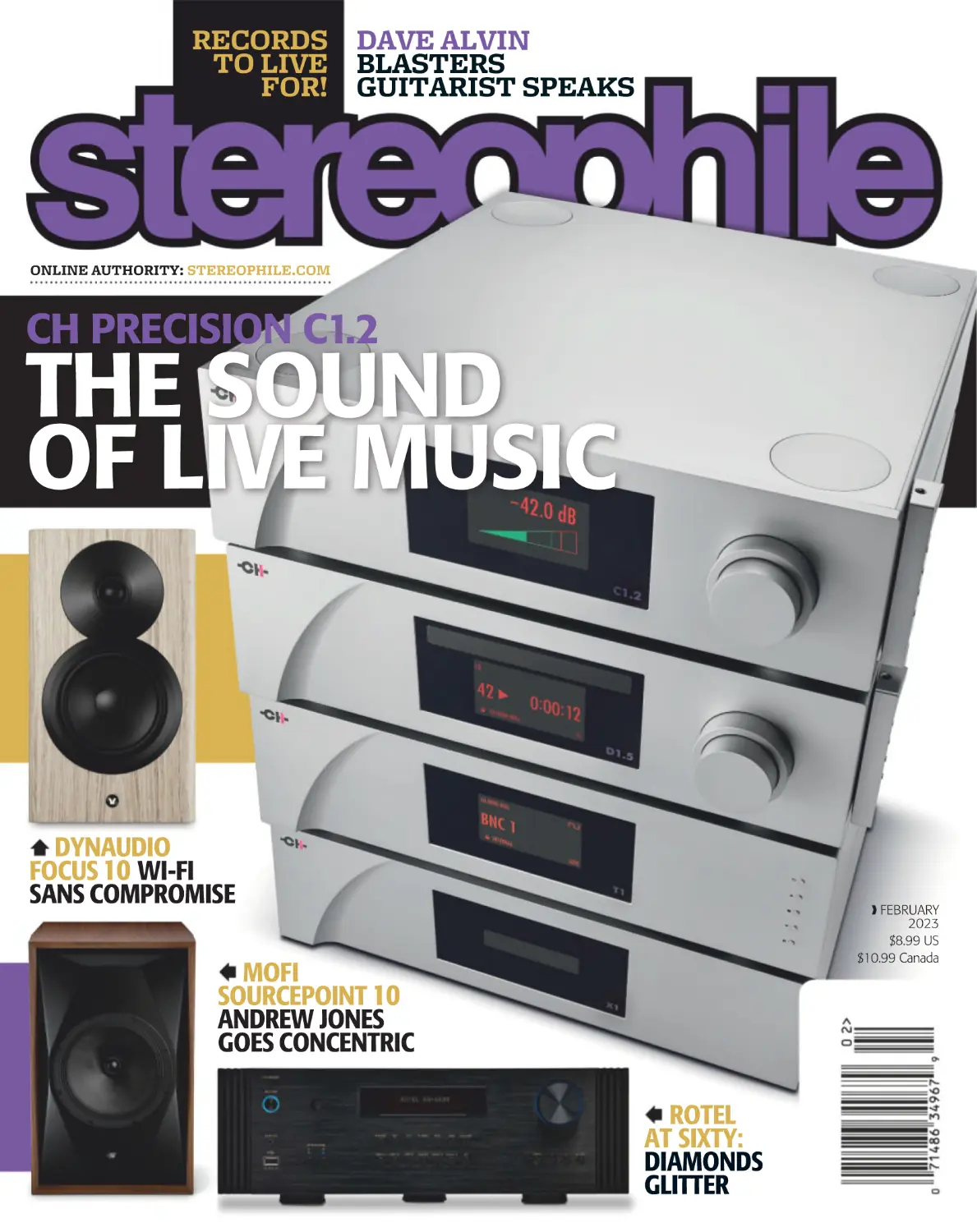
CH PRECISION C1.2
THE SOUND
OF LIVE MUSIC
DYNAUDIO
FOCUS 10 WI-FI
SANS COMPROMISE
k FEBRUARY
2023
$8.99 US
$10.99 Canada
MOFI
SOURCEPOINT 10
ANDREW JONES
GOES CONCENTRIC
ROTEL
AT SIXTY:
DIAMONDS
GLITTER
THERE ARE AS MANY OPINIONS AS THERE ARE EXPERTS
AS WE
SEE IT
BY JIM AUSTIN
THIS ISSUE :
Two concerts at
the new Geffen Hall and a
very rewarding book.
Room acoustics writ large
S
ince writing about Manhattan’s renovated Geffen Hall in this space in our January
issue, I’ve attended two concerts there. I thought I’d report back.
The first of the two performances—the hall’s “Grand Gala” concert, though they
didn’t invite me to the fancy dinner afterward—included works by young Puerto
Rico–born composer Angélica Negrón (You Are the Prelude) and Ludwig van Beethoven
(Symphony No.9). The second included works by Stravinsky (Symphonies of Wind Instruments), Bartók (Concerto for Two Pianos, Percussion and Orchestra, with Daniil Trifonov and
Sergei Babayan), and Sibelius (Symphony No.7). I’m ready, tentatively, to call Geffen’s
acoustical renovation a major success, if an idiosyncratic one. It is now a great (if slightly
odd)-sounding hall. (A caveat: There are far more great music halls in the world that I
haven’t heard than that I have heard. I have a rather small sample to compare Geffen to.)
Almost everyone praises Carnegie Hall’s
acoustics—and Geffen sounds nothing like
Carnegie, which is rich and reverberant to
a point where, for me, the music gets in its
own way, at least at the seats I’m usually
sitting in. I’ve never sat up front.
The Geffen acoustic is very dry and
clean, with very well-controlled—I’m
tempted to write “carefully engineered”—
reverberation. Music played softly by a
single instrument can be heard clearly,
easily, and with full timbre even toward the
back of the orchestra section, where I sat
both times. (I’ve so far sat in the 23rd and
I
don’t just listen to a lot of music; I
read a lot about it, too. The most
interesting of the music-related
books I’ve read recently is Sophy
Roberts’s The Lost Pianos of Siberia
(Grove Atlantic, 2020).
Roberts is neither a musician nor a
music scholar. Rather, she’s a British
adventure-travel writer. This is her first
book, but she has extensive clips from
prominent magazines including Condé
Nast Traveler, Financial Times, and 1843
magazine from The Economist.
Early on, in Mongolia, Roberts meets
up with Odgerel Sampilnorov, an “extraordinary pianist” who learned to play
on “an old instrument … trucked in from
the modern capital, Ulanbaatar.” With
assistance from a patron, she trained for
nine years in Italy. She gives local recitals inside a ger, better known here as a
yurt, “on Giercke’s Yamaha baby grand.”
(Giercke is Odgerel’s main patron.)
“Outside the ger’s wooden door was a
wide plateau cupped by mountains, the
stereophile.com
Q
February 2023
27th rows, once in the middle and once
toward the left side.) The hall has serious
grunt; inpactful bass reaches far back.
Beethoven’s Ninth is always a thrill, and
bass Davóne Tines was extraordinary as soloist, but the most successful performance
I’ve heard so far was the Sibelius. That’s
probably because of the music’s clean textures—notes rarely got in the way of notes,
and that familiar Sibelius momentum was
unimpeded. Another likely factor: Between
the two performances, the orchestra had
more time to get used to the new acoustic.
Negrón’s You Are the Prelude was a
steppe’s velvet folds studded with tombs
and ancient standing stones left by successive waves of nomadic people. Yaks
and horses, more numerous than people
in Mongolia, grazed on the riverbank below.” That Yamaha, though, was “out of
sorts,” which sent Roberts off in search
of another piano.
Roberts sets off through Siberia,
which, as we learn, has a rich musical
history. As she seeks a piano for Odgerel,
she tells stories about the land through
the lens of its musical culture. Among
many other pianos, we learn about a
very special upright, found in a piano
tuner’s shop in the imposing Novosibirsk
Opera and Ballet Theater. The piano is a
Grotrian-Steinweg, made by the German
company formed when one Heinrich
Steinweg moved to New York, changed
his name, and started a piano company.
With assistance, financial and
otherwise, from locals, the piano is
refurbished and transported to that
Mongolian ger for Odgerel’s use. “Kostya
fascinating experience. At one point in the
piece, a large chorus (the same used in the
Beethoven) bent a complex chord off-pitch
until it became black noise, harmonic
shifting into anharmonic. It was like a black
tunnel opening up in space. (I have a touch
of synesthesia, and I saw exactly that.)
The Bartók was less successful. To avoid
blocking the orchestra, the two pianos had
their lids removed. Their sound wandered
up to the rafters (or would have if there
had been rafters) and got lost.
I’ve made contact with one of the two
principal acousticians and will interview
him for a Stereophile feature. I want to
explore the connection between large-hall
acoustics and the challenges we all face in
our listening rooms. I’m hoping he’ll lead
me on a Geffen tour.
I need to hear more music, from a wider
variety of seats and sections; I’m especially
curious what the upper levels sound like.
Meanwhile, if you make it to Geffen Hall
for a performance, drop me a line and tell
me what you think. My email address is on
the masthead (p.8).
and I would lie on our backs on the tent’s
yak-hair floor,” Roberts writes. Kostya is
the man who rebuilt the piano. “Both of
us liked listening in. Sometimes Kostya
cried, sometimes he smiled, overwhelmingly proud about the piano’s sound he
had spent months repairing.”
In the end, this book is about the value
of music and our attachments to things,
the meaning we and history imbue
those things with, and how it all comes
together to make our lives better.
On the book’s website (lostpianosofsiberia.com), Roberts presents gorgeous
photographs by Michael Turek (who
accompanied Roberts on many of her
journeys), recordings of Odgerel playing
various pianos mentioned in the book,
and impressive videos of people and
landscape, also by Turek.
Odgerel has an album on the major
streaming services, the oddly named
Mongolian Composers Piano Pieces.
All of these, but especially the book,
are highly recommended. Q
3
FEBRUARY
2023
Vol.46 No.2
p.54
p.79
p.69
p.93
FEATURES
33
Records to Live For!
Our writers each choose two recordings that make
their lives worth living.
121
Dave Alvin
Judging by the experiences of the Blasters’ guitar man,
sometimes blood is thicker than a vintage 78.
p.109
EQUIPMENT REPORTS
54
CH Precision C1.2 D/A processor
by Jim Austin
69
Mobile Fidelity SourcePoint 10 loudspeaker
SEE OUR EXCLUSIVE EQUIPMENT REPORT ARCHIVE
AT WWW.STEREOPHILE.COM
by John Atkinson
79
Dynaudio Focus 10 loudspeaker
by Jason Victor Serinus
PHOTO BY CHIP DUDEN
93
Rotel Diamond Series RA-6000 streaming
integrated amplifier
by Herb Reichert
109
Audio Note Meishu Phono 300B Tonmeister
integrated amplifier
Stereophile (USPS #734-970 ISSN: 0585-2544) Vol.46 No.2, February 2023, Issue Number 517.
Copyright © 2022 by AVTech Media Americas Inc. All rights reserved. Published monthly by AVTech
Media Americas Inc., 260 Madison Avenue, 8th Floor, New York, NY 10016. Periodicals Postage paid at
New York, NY and additional mailing offices. Subscription rates for one year (12 issues) U.S., APO, FPO,
and U.S. Possessions $19.94, Canada $31.94, Foreign orders add $24 (including surface mail postage).
Payment in advance, U.S. funds only. POSTMASTER: Send all UAA to CFS. (See DMM 707.4.12.5);
NON-POSTAL AND MILITARY Facilities: send address corrections to Stereophile, P.O. Box 420235,
Palm Coast, FL 32142-0235. Mailing Lists: From time to time we make our subscriber list available to
companies that sell goods and services by mail that we believe would be of interest to our readers. If
you would rather not receive such mailings, please send your current mailing label, or an exact copy, to:
Stereophile, Mail Preference Service, P.O. Box 420235, Palm Coast, FL 32142-0235. Subscription Service:
Should you wish to change your address, or order new subscriptions, you can do so by writing to the
same address. Printed in the USA.
by Ken Micallef
stereophile.com
Q
February 2023
5
FEBRUARY
2023
Vol.46 No.2
p.25
p.131
p.25
p.15
3
p.133
As We See It
The new Geffen Hall, redux—plus, a rewarding book about
pianos in the wild in Siberia.
11
Letters
Praise for Tom Conrad; advocating “real”
stereo; praise for Rogier van Bakel; his first
gorilla; look out, Pulitzer committee.
15
G
YOUR SET ON
OA
VISIT THPBOX!
E
STEREOP
HILE.CO
FORUMS M
Industry Update
Remembering Richard Larson of Audio Research Corporation and
Al Ballard of Polk Audio; a new wireless codec from MQA; DALI’s
new premium KORE; Sonus Faber’s artful collaboration—plus,
new products and hi-fi–related meetings and events.
STAY INFORMED: GO TO STEREOPHILE.COM
FOR UP-TO-THE-MINUTE INFO.
25
Gramophone Dreams
Herb remembers Chicago’s Maxwell Street circa 1964 and
listens to the Rotel Diamond Series DT-6000 CD player.
131
Among the Musical
There is a hierarchy of cultural achievement, argues Tony
Scherman, despite the presumptuousness of some pop artists
and their fans.
133
ReDiscoveries
Larry Birnbaum enjoys a tasty new box full of Lee “Scratch” Perry
from Trojan Records.
135
Pony, and Peggy Lee, plus an all-star tribute to Billy Joe Shaver.
In classical, a recital by soprano Ruby Hughes and pianist
Huw Watkins, Brahms and Schumann from Anne-Sophie
Mutter, a recital of Mozart and Milanese contemporaries,
Israeli composer Paul Ben-Haim, and symphonic music by
Mieczyslaw Weinberg. In jazz, music from a talented Pacific
Northwest quartet, Owen Broder, and Ahmad Jamal.
149
Re-Tales
Even in a dicey (or at least confusing) economy, new brick-andmortar hi-fi storefronts are starting up.
153
Manufacturers’ Comments
Representatives of CH Precision, Dynaudio, and Audio Note
respond to our reviews of their products.
154
My Back Pages
Noted jazz critic (and new contributing editor) Andrey Henkin
describes how Miles Davis’s Bitches Brew drew him into writing
about music.
INFORMATION
150
150
151
152
Manufacturers’ Showcase
Dealers’ Showcase
Advertiser Index
Audio Mart
Revinylization
Robert Baird listens to a Craft Recordings reissue of At My
Window by Townes Van Zandt.
137
p.135
Record Reviews
Our Recording of the Month is The Wheel by Caroline Shaw with
I Giardini. Plus, rock/pop from Blancmange, Weyes Blood, Pit
stereophile.com
Q
February 2023
p.137
Follow Stereophile on Facebook:
www.facebook.com/stereophile.
7
FEBRUARY 2023
EDITOR JIM AUSTIN
JIM.AUSTIN@STEREOPHILE.COM
TECHNICAL EDITOR JOHN ATKINSON
SENIOR CONTRIBUTING EDITORS
HERB REICHERT, KALMAN RUBINSON, JASON VICTOR SERINUS
WEB PRODUCER JON IVERSON
COPY EDITOR LINDA FELACO
AVTECH MEDIA AMERICAS INC
EDITORIAL DIRECTOR PAUL MILLER
FINANCE DIRECTOR OWEN DAVIES
GENERAL MANAGER KEITH PRAY
FOUNDER J. GORDON HOLT
ART DIRECTOR JEREMY MOYLER
CONTRIBUTING EDITORS (AUDIO)
ROGIER VAN BAKEL, BRIAN DAMKROGER, ROBERT DEUTSCH,
LARRY GREENHILL, ALEX HALBERSTADT, JON IVERSON,
SASHA MATSON, PAUL MESSENGER, KEN MICALLEF,
JULIE MULLINS, THOMAS J. NORTON, ROBERT SCHRYER,
MICHAEL TREI
CONTRIBUTING EDITORS (MUSIC)
ROGIER VAN BAKEL, LARRY BIRNBAUM, PHIL BRETT,
THOMAS CONRAD, TOM FINE, KURT GOTTSCHALK,
ANDREY HENKIN, ANNE E. JOHNSON, SASHA MATSON,
MIKE METTLER, DAN OUELLETTE, TONY SCHERMAN,
STEPHEN FRANCIS VASTA
ADVERTISING
GENERAL MANAGER KEITH PRAY
KPRAY@AVTECHMEDIAUSA.COM
ADVERTISING MANAGER ED DIBENEDETTO,
EDIBENEDETTO@AVTECHMEDIAUSA.COM
SALES COORDINATOR ROSEMARIE TORCIVIA,
RTORCIVIA@AVTECHMEDIAUSA.COM
DIGITAL INQUIRIES KEITH PRAY,
KPRAY@AVTECHMEDIAUSA.COM
IMPORTANT STEREOPHILE
CONTACT INFORMATION
SUBSCRIPTION INQUIRIES
USA (800) 666-3746
CANADA & INTERNATIONAL (515) 244-0924
EMAIL: STPCustserv@cdsfulfillment.com
POST: Stereophile, PO Box 37965, Boone IA 50037-0965
Please include name, address, and phone number
on any inquiries.
REPRINTS
For high-quality custom reprints and eprints, please
contact Keith Pray at kpray@avtechmediausa.com.
SUBMISSIONS
Any submissions or contributions from readers shall be
subject to and governed by AVTech Media’s User Content
Submission Terms and Conditions, which are posted at
www.stereophile.com/images/terms.html
BACK ISSUES
To order back issues and recordings visit
shop.stereophile.com or call (888) 237-0955
SUBSCRIBER LIST
CHECK US OUT ON THE WEB AT STEREOPHILE.COM.
Occasionally our subscriber list is made available to
reputable firms offering goods and services we believe
would be of interest to our readers. If you prefer to be
excluded, please send your current address label and a
note requesting to be excluded from these promotions
to AVTech Media Americas Inc., 260 Madison Avenue,
8th Floor, New York, NY 10016, Attn: Privacy Coordinator.
PRINTED IN THE USA. COPYRIGHT © 2022 BY AVTECH MEDIA AMERICAS INC. ALL RIGHTS RESERVED.
8
February 2023
Q
stereophile.com
If Wishes Were Horses
I wanted to bring Mythical Creature goodness
to a much bigger audience. The Mythical Horses
are proof that I got my wish.
William E. Low
Founder
Black Beauty: $795/1m pair RCAs, $995/1m pair XLRs
Pegasus: $1,595/1m pair RCAs, $1,995/1m pair XLRs
LETTERS
FEEDBACK TO THE EDITOR
European jazz festivals
Thank you for Thomas Conrad’s European
jazz festival journal, “On the Road Again.” 1
I enjoyed learning about jazz festivals I had
not heard of and the reports on the musicians
from around the world. While in Prague preCOVID, we spent a couple of great evenings
in jazz clubs. And we’ve attended US jazz festivals. Now we’re motivated to try out some
festivals in Europe, hopefully avoiding Mr.
Conrad’s experience of contracting COVID.
And thank you for Stereophile’s increased
quantity and quality of reviews and articles
on jazz.
Bruce Goldstein
Berkeley Springs, West Virginia
Toward real stereo
Editor Jim Austin and Mr. Amundsen are correct in saying you must have a properly set-up
stereo system to get a real, proper threedimensional stereo effect (Letters, December
2022), but real stereo must be present on the
recording first and foremost.
I’ve been an audiophile since the earliest
days of stereo. I started very early, getting my
first hi-fi system in 1954 at the tender age
of 9. It started with a single-ended amplifier,
which my father, an electrical engineer, built
from scratch. I don’t know where he got the
design, whether from a magazine or book,
or if he designed it himself. After building
the amp, he ordered for me a BSR Monarch
record changer, complete with Astatic crystal
cartridge. Then he built a cabinet to house the
amp and record changer. The bottom part of
the cabinet housed an 8" Goodman coaxial
speaker in a ported enclosure.
In 1958, when I was 13, I salvaged another
amplifier from an old radio console someone
gave me and got my dad to build another
speaker cabinet exactly like the bottom portion of the enclosure he had built 4 years
earlier. I rewired the BSR for stereo and replaced the Astatic crystal mono cartridge with
a stereo ceramic cartridge from Sonotone.
I started buying stereo records, mostly from
Mercury and RCA Red Seal. I soon noticed
that while some of these early stereo records
were true stereo, most were what I came to
recognize as “multichannel mono.” As soon
as I could, I started buying modest stereo
recording equipment—an early Wollensak stereo tape recorder and a pair of Electro-Voice
dynamic mikes—and began to make my own
true-stereo recordings. That set me on a lifetime quest for real stereo, as one could seldom
stereophile.com
Q
February 2023
TAKE HEED! Unless marked otherwise, all letters to the
magazine and its writers are assumed to be for possible
publication. Please include your name and physical address.
We reserve the right to edit for length and content.
find such recordings commercially.
This became truer as the 1960s began.
Jazz and pop recordings were multimiked
monstrosities; while they sounded good,
they simply were not stereo. Jazz was (and
remains) largely three-channel mono. Pop was
just a microphone per instrument or voice,
arranged in a seemingly haphazard fashion. I
have continued to make my own real stereo
recordings all my life.
I lament that the recording industry
decided it was more efficient to throw up a
forest of microphones and record to multiple
tape tracks than it was to set up a true stereo
pair in a stereo mike arrangement. When that
is done, one can enjoy, at home, the same kind
of 3D magic one hears at a live event.
George Graves
Sparks, Nevada
After the sad loss of Art Dudley, and now
Michael Fremer departing to the “competition,” it has been interesting to watch how the
magazine fares. “Steady as she goes,” it seems.
No knee-jerks.
And in Rogier Van Bakel, you seem to
have unearthed an audio journalist of the
highest quality. I hope he prospers well and
that the magazine’s staffing reorders itself
appropriately in time. (I always thought JA’s
sharing the writing of As We See It to show a
strength-in-depth.)
Bari Gowan
Boevange-sur-Attert, Luxembourg
(George Graves is a former Stereophile reviewer.
His first review was of the Sony WM-D6 Professional Walkman, the first Walkman with adequate
recording capabilities.)
My first gorilla
Mr. Graves, It’s great to hear from a Stereophile
alumnus. When you write “stereo,” you are describing what many today would refer to as “purist”
stereo, which employs a single stereo microphone
pair to produce a realistic soundstage with convincing depth—in contrast to recordings made with
multiple tracks that are later fabricated in the studio
into a synthetic soundstage. “Purist” recordings can
indeed be very satisfying, but I would argue that
the dichotomy is not as stark as you make it out to
be. With the right motivations and good technique,
recordings that employ more microphones—I’m
thinking, for example, of recordings made by our
own John Atkinson—can also produce a realistic
soundstage while offering certain advantages over the
purist approach. —Jim Austin
Mr. Gowan, thank you for the kind note. Despite
those who have left us, in various ways, we continue
to thrive. The magazine is indeed fortunate to be able
to attract writers of the highest quality. —Jim Austin
Julie was spot on about tracing our obsession
back to a certain event.3 Mine started in the
seventh grade during the school year 1956–57
at Oakwood Junior High in what was then
East Detroit, Michigan.
Bell Labs put on a demonstration in our
school gym. The equipment was on the stage,
and we sat in chairs on the floor such that the
large speakers were above our heads. The
moderator spoke about what was to come, but
I don’t remember what he said.
When he turned on the system, wow! The
train came from behind the stage wall, approached us, went over our heads, and faded
in the distance behind us. There probably
were more demos, but the realism of that
train has never faded from my memory. I was
hooked on sound, which morphed into a love
of realistic music in my home.
Charles Proctor
Versailles, Kentucky
Rogier van Bakel
Just a note to congratulate you on the “find”
of Mr. Van Bakel. His writing, in the review
of the LSA VT-70 integrated amplifier,2
shows real class, in my opinion.
LETTERS TO THE EDITOR should be sent as
e-mails only. Email: stletters@stereophile.
com. Please note: We are unable to answer
requests for information about specific
products or systems. If you have problems
with your subscription, call (800) 666-3746, or
email STPCustserv@cdsfulfillment.com, or
write to Stereophile, P.O. Box 37965, Boone, IA
50037-0965.
Doggerel
Sometimes I’m inclined to hear
When listening on audiophile gear
Sounds that just aren’t there
On LP or elsewhere
To justify paying so dear
John Lewis
Lake Forest Park, Washington
1 See stereophile.com/content/road-again-three-europeanjazz-festivals.
2 See stereophile.com/content/lsa-vt-70-integratedamplifier.
3 See stereophile.com/content/you-never-forget-yourfirst-gorilla.
11
DALI KORE
STATE OF THE ART
LOUDSPEAKER TECHNOLOGY
AVAILABLE AT SELECT
NORTH AMERICAN DEALERS:
DALI-SPEAKERS.COM
SOUNDLUX, MIAMI
SIMPLY STEREO, CHICAGO
ORIGIN HIFI, AUSTIN
THE DALI KORE
IS A SPEAKER FOR ALL MUSIC, ALL
LISTENERS, AND ALL OCCASIONS.
The DALI KORE stands on the shoulders of all
DALI speakers that have come before it, seeing
futher into the landscape of music as a result. It is
a visual and sonic masterpiece with revolutionary
technologies that break with tradition and push
the boundaries of loudspeaker design. The DALI
KORE is an electro-acoustic master work, balancing
technical specifications and sound characteristics
to perfection. It represents the pinnacle of DALI
loudspeaker design and is the ultimate expression of
DALI’s passion for music.
Key Specifications:
•
•
•
•
•
•
5 unique drivers
2” x 11 ½” Balanced Drive bass drivers
Balanced Drive SMC Gen-2 technology
7-inch dedicated midrange driver with Balanced
Drive SMC Gen-2 technology
EVO-K Hybrid Tweeter module combining an
oversized 1” x ⅜” soft-dome and a ribbon that
measures just over 2” x ½”
Bespoke SMC-KORE crossover inductors
The DALI KORE is the result of tangible design,
technology, and engineering, yet its end product – the
communication and enjoyment of music – is more
unquantifiable. It reproduces music that is as close
to the original recording as possible. With virtually no
distortion or colouration, nothing is added, and nothing
is subtracted. From the quietest breath to the largest
orchestral climax, it recreates every musical nuance
with endless dynamic response and true fidelity.
Scan the QR code for detailed specifications.
®
COLOUR UP YOUR LIFE
INDUSTRY
UPDATE
AUDIO NEWS & VIEWS
REMEMBERING
RICHARD LARSON
OF AUDIO RESEARCH
Julie Mullins
On November 9, Audio Research announced that retired chief engineer
Richard Larson had passed away. Larson
was born in Little Falls, Minnesota. He
attended Bethel College and later took
courses at the University of Minnesota. He
worked as a recording engineer at Sound
80 Studios and was an electronics engineer at Telex for 25 years prior to his long
tenure at Audio Research Corporation.1
According to an obituary on legacy.com,
Larson’s passing occurred on November 4,
just a day before his 86th birthday.
Larson was a longtime collaborator of
ARC founder William Zane Johnson and
played an essential role in bringing many
amplification designs to fruition. “Rich’s
engineering expertise helped flesh out Bill’s
initial designs and, with his engineering
assistant Ward Fiebiger, guided the designs
through to production. Rich was pivotal in
development of many classic ARC products such as the SP10, SP11, D250, Classic
Those promoting audio-related
seminars, shows, and meetings should email the
when, where, and who to stletters@stereophile.com
at least eight weeks before the month of the event.
The deadline for the May 2023 issue is February
20, 2022.
SUBMISSIONS:
60, and the first- and second-generation
Reference Series amps and preamps,” the
company’s statement said. Larson specialized in transformer design and fostered the
creation of advanced, high-powered tube
amplifiers.
“Rich was so perfect in his position,”
Audio Research’s Dave Gordon wrote
by email. “[Bill Johnson] was a strongwilled and demanding boss, and Rich was
unperturbable, steady, and a great engineer
who ran our engineering department so
effectively.”
Larson worked for ARC from 1979 until he retired in 2004. “Over the years since
Rich retired, he remained available when
the current engineering team had questions
or needed help with a new design. … Until
his passing, he was consulting on the output transformer for the soon-to-be-released
1 See legcy.co/3Vdzofu.
CALENDAR OF INDUSTRY EVENTS
ATTENTION ALL AUDIO SOCIETIES: We have a page on the Stereophile website devoted to you:
stereophile.com/audiophile-societies. If you’d like to have your audio-society information
posted on the site, email Chris Vogel at vgl@cfl.rr.com. (Please note the new email address.)
It is inappropriate for a retailer to promote a new product line in “Calendar” unless it is
associated with a seminar or similar event.
PHOTO BY DAVE GORDON
california
] Sunday, January 22, 2–5pm: The Los
Angeles and Orange County Audio Society
will hold its monthly meeting at AudioQuest
in Irvine (2621 White Rd.). Guests, visitors,
and members are invited. Representatives
from AudioQuest will provide “An Insider’s
Look at AudioQuest Technologies.” A facility
tour is also planned, and lunch will be served.
Parking is free. You can get more information
by visiting laocas.com or calling LAOCAS
President and CEO Allen Taylor: (714) 2991509.
] Sunday, February 19, 2–5pm: The Los
Angeles and Orange County Audio Society
will hold its monthly meeting at Audeze
in Santa Ana (3412 South Susan St.). Dr.
Dragoslav Colich, Audeze’s co-founder
and CTO, will discuss the company’s
latest headphones and other products and
technical innovations. A facility tour is also
planned, and lunch will be served. Parking
is free. You can get more information by
visiting laocas.com or calling LAOCAS
stereophile.com
Q
February 2023
President and CEO Allen Taylor: (714) 2991509.
florida
] Saturday, January 14, 1–5pm: The Sarasota
and Suncoast Audiophile Societies are jointly
hosting a free public listening event at the
Shadow Brook Community Clubhouse (3860
63rd St. East, Palmetto). Jay Rein of North
American audio distributor Bluebird Music
and Aaron Hoffman of Kanso Audio will
be on hand. Sessions will feature the latest
products from Canton loudspeakers, AVM
Electronics, Weiss Engineering, and Kanso
Audio Furniture. Lunch and refreshments will
be provided. Sarasota/Suncoast members
can RSVP via their respective meetup.com
websites. Nonmembers must RSVP directly
with à la carte productions: info@alc-pro.
com or (386) 338-3500.
] Friday–Sunday, February 17–19: Save the
dates. The renamed Florida International
Audio Expo will be held at the remodeled
Embassy Suites by Hilton Tampa Westshore
(555 N. Westshore Blvd., Tampa)—same
venue, new look. For information, visit
floridaaudioexpo.com.
illinois
] Thursday, February 23, 11am–9pm: Holm
Audio (2050 W. 75th St., Woodridge)
hosts a musical event with representatives
from Arcam, JBL, Mark Levinson, Revel,
Kirmuss Audio, Nordost, and Cambridge
Audio showcasing those companies’ latest
offerings. Attendees are encouraged to
bring a favorite (preferably at least lightly
soiled) LP to be restored by the Kirmuss
process. Door prizes will be given away
to every attendee, and more than $1000
worth of audio gear will be raffled off. For
reservations, which are required, call Holm
Audio: (630) 663-1298.
washington
] Friday–Sunday, June 23–25: Save the
dates: Pacific Audio Fest is shifting its dates
forward from the inaugural 2022 event’s
early August weekend. In 2003, the Pacific
Audio Fest will take place at the same
location as before: the DoubleTree by Hilton
Hotel (18740 International Blvd., Seattle)
near the Seattle Airport (SeaTac). For
information, visit pacificaudiofest.com.
15
INDUSTRY UPDATE
Reference 320M monoblock amplifier.”
Ken Kessler interviewed Larson for
Audio Research’s 50th anniversary book,
Making the Music Glow.
Gordon, a longtime colleague of Larson,
also provided a more personal statement
to Stereophile. “Rich was a good friend and
a wonderful person who will be missed
by everyone who knew him. … He loved
pipe organs and old cars, and he possessed
a surprising sense of humor. His death
shocked us because he looked and sounded
great when he sat next to me at our Audio
Research old-timers’ lunch in October.
He was diagnosed with cancer and passed
within weeks, surrounded by his family.”
Larson is survived by his wife, Elaine, family, and friends.
IN MEMORIAM: AL BALLARD
of Polk Audio from a
small regional company
to one of the largest of its
type in the global market,”
the statement said.
“I hired Al at Polk as an
artist and graphics designer
to work on literature, ads,
etc.,” Gross said by email.
“He developed over the
years way beyond that into
a skilled marketing
professional. His contributions at Polk during my
tenure there were
significant and well
appreciated. … But more importantly, Al
was a great guy and a very supportive
friend. We will all miss him deeply.”
The press statement, lightly edited, reads
in part:
Paul DiComo to found
CE-Marketing Pros, a
marketing agency that
served both established
and start-up Consumer
Electronics brands. The
two had known each
other since their Polk
days and later worked
together until DiComo’s
passing in late September
2021.2
Anyone who worked
with Al at Polk Audio or
the many outside efforts
he spearheaded was swept
up by his incredible work ethic, personal and
professional honesty, and consistent integrity. He brought uncommon intelligence to
any task along with a sense of humor. …
Julie Mullins
Al Ballard, a longtime figure in hi-fi
marketing, passed away on November 5
at age 72, according to a press announcement. Ballard was born in Charlotte, North
Carolina, on April 5, 1950. He attended
college at North Carolina State University
in Raleigh, where he earned a degree in
graphic design. It would be reasonable to
call Ballard an early influencer, in the era
before social media.
Ballard’s career in hi-fi began when
Sandy Gross recruited him to develop inhouse marketing capabilities at Polk Audio
in its earlier days with Matthew Polk.
“He championed the [Polk Audio]
ambassador program Polk-Fest and Polk
Forums with zealous audiophile customers
who spread the word to other like-minded
audiophiles in several US markets. In 1988,
Al was named Vice President of Marketing.
Al was an important figure in the growth
“In January 2014, Al partnered with
2 See our December 2021 issue’s Industry Update for Paul
DiComo’s remembrance, including an obituary Al Ballard
wrote.
INDUSTRY UPDATE
Al is survived by his wife, Hedy Klopfer, his
daughter Alison Ballard, step-daughter Tracy
Klopfer and ex-wife Monica Cortada.”
MQA ANNOUNCES NEW
MQair HI-REZ CODEC FOR
WIRELESS
Julie Mullins
Bluetooth doesn’t have to be boring. Wireless playback continues to step up its notquite-hi-rez game with new codecs, such
as LDAC, LHDC, and aptX HD. Now
there’s good news for fans of MQA who’ve
been questioning—or perhaps avoiding—wireless streaming due to substandard
sound quality: MQA has a new codec for
FROM DENMARK WITH
LOVE: A DALI KORE
FACTORY TOUR
Robert Schryer
“I so envy you,” Julie Mullins said when I
told her I was going on a junket to Copenhagen, Denmark, to report on DALI’s new
$110,000 flagship loudspeaker, the DALI
KORE. Who could blame her? Denmark
is charming—the place and its citizens.
It’s a country of only 5.8 million people
whose native population descends from
the Vikings.
wireless playback applications: known
technically as SCL6, which will be released
under the name “MQair.” The codec
was created to offset wireless streaming’s
bit-depth and sample-rate transmission
limitations.
According to a press announcement, the
Japan Audio Society (JAS), a Tokyo-based
audio research organization, has certified
the SCL6 codec, which supports MQA
and PCM datastreams up to 384kHz. The
MQair codec is said to offer “low latency
and high efficiency for extended battery
life” in wireless devices. “The encoded data
rate can be scaled seamlessly from 20Mbps
to below 200kbps, covering Bluetooth,
Ultra-Wideband (UWB), and WiFi links,”
the press release stated. Many listeners
will recognize the “Hi-Res Audio” logo,
which arose from the JAS. Now that logo
has a new version, with “Wireless” added
beneath its main text.
“With MQair we can improve the
listening experience for many listeners and
extend the MQA ecosystem to wireless
devices,” MQA founder and CTO Bob
Stuart said in the release. “High resolution
isn’t necessarily defined by the big things:
It is shaped by small elements in the sound
that convey details, separation, colour and
space. Our reference for transparency is air
itself.” Hence the MQair name.
“DALI” is an acronym for “Danish Audiophile Loudspeaker Industries,” the company founded in 1983 by Peter Lyngdorf,
who also founded what is now Europe’s
largest audio retail chain, HiFi Klubben,
whose massive warehouse adjoins DALI’s
facilities. DALI’s main market has always
been Europe, but the company has made
inroads into the Americas and intends
to make more—which explains why our
North American contingent of reporters
was invited to Denmark. DALI hopes the
flagship KORE, its most ambitious speaker
to date, will earn the company recognition.
Two of DALI’s trademarked designs are
found in the KORE: The hybrid tweeter
module combines a 1.3" soft dome tweeter
with a separate ribbon. The dome handles
frequencies up to 14kHz; above that
frequency, the ribbon takes over continuing up to about 36kHz. DALI’s SMC (Soft
Magnetic Compound) material, now in its
second generation, has the advantage, the
company said, of being highly magnetic but
very low in electrical conductivity—about
1/25,000th that of iron. Such conductiv-
INDUSTRY UPDATE
ity is the source of distortion-causing
eddy currents in a driver’s magnet
assembly; that’s why DALI uses
SMC in place of iron. “By using an
SMC-core inductor in our crossovers,
we’ve been able to lower distortion
by 12dB compared to a conventional,
iron-powder core inductor,” Krestian
Pederson, head of product management, said.
DALI is so keen on the KORE that
they bought part of a woodworking
and wood-pressing plant to secure
future production of the KORE’s
wood cabinet. That pressing plant is
Hudevad Furniture, founded in 1967
by Erik Jørgensen and located in the
countryside town of Arslev, a twohour drive from DALI headquarters.
We were given a tour of the facilities
by Erik’s son, Kaare, to whom dad has
handed over the reins to the business.
As we made our way through the
labyrinthine plant, we saw steampunk
machines steaming, bending, pressing,
and heating wood into myriad shapes.
To form the KORE’s cabinet, 17
glue-covered layers of birch ply are
inserted into an Omega-shaped slot
inside the jig, topped off by an ebony
veneer. A member of our group said
the process reminded him of the
scene in which Han Solo is frozen
in a carbonite contraption. True,
except for the frozen part: The jig generates 61,000 watts of power to “bake in” the
KORE’s structure, a procedure that lasts 20
minutes and is so energy-intensive that all
other equipment at the plant must be shut
off while it’s running.
The DALI building, located in Nørager’s
picturesque industrial park, is as long as
two football fields and employs about 60
people. It looked very organized, well run,
abnormally neat and well-lit. It was impressive to witness how an audio product
comes to life—from the initial brainstorming, through the design phase, creating the
parts for it, building it, packaging it, and
deciding how to market it.
DALI is, I thought, essentially a music
factory. DALI even has its own recording studio, where it produces high-fidelity
recordings of music by contemporary local
artists, which are sold in CD and vinyl
SONUS FABER
COLLABORATES
WITH NYC’S CIMA
Julie Mullins
In recent years, there’s been increasing interest in design-based “crossover” collaborations in the hi-fi world. I use “crossover”
18
Clockwise from far left: The DALI KORE in
Ammara ebony without its grille; DALI Head
of Product Management Krestian Pederson;
assembling the KORE by hand on the DALI
production line.
formats. The goal is to create a DALI-based
legacy of great-sounding recordings, Inez
Bukdahl, DALI’s head of music culture, said.
The KORE’s unveiling—the big reveal—
happened on our final day in Denmark. It
weighs 350lb per speaker and is big and
tall, with a sharp-dressed look. It even
wears a gold tie—really a gold leaf design—
on the midsection of its bitumen-filled, diecast aluminum baffle. That baffle frames
the speaker’s dual tweeters, 7" wood-fiber
midrange, and the first of two crossover assemblies. The second assembly is hidden in
each speaker’s cast-concrete base, to isolate
it from air pressure and vibrations.
The KORE is said to be time-aligned; its
five drivers include two 11.5" bass drivers
filtered at slightly different frequencies—
which means there are asymmetric dual
drivers at both ends, low and high. (DALI’s
specifications describe the KORE as a “3 1/2
+ 1/2–way.”) Bass extension is said to
go to 26Hz, while sensitivity is specified as 88dB/2.83V/m and the nominal impedance as 4 ohms—“A very
linear, easy-to-drive 4 ohms,” CEO
Lars Worre assured us. The KORE
manual lists minimum recommended
amplifier power at 100Wpc.
We listened to the KORE in two
setups, one centered around NAD
electronics, the other with 1990s-era
DALI amplification, a Mola Mola
preamp, and a vintage Denon/Slim
Devices front end.
The speakers sounded stunningly fast, forceful, and fleet. They
produced a huge sphere of sound,
teeming with rapid-fire transients and
reverberation that reached far into
the distance. The KORE could sound
rich and was capable of devastating
bass impact; that bass was full and
clean. Detail was abundant. You want
effortless, large-scale dynamics? Hold
on to your scalp, because the dynamic
pressure will ripple it perilously
backward.
I heard viscerally percussive guitar
strings. A techno beat pounded so far
beneath my feet, I was worried the devil
would tell us to turn it down. Alive, expressive, dynamic, spacious, transparent—those
descriptors kept coming back to me.
The KORE didn’t just do power. It also
did detail, nuance, and things that tugged at
my heartstrings. It delivered Neil Young’s
“Old Man” from Live at Massey Hall 1971
on such a tender, human scale, with such
lifelike presence, that I felt myself choking
up. I’ve heard this track so often it lost its
freshness long ago—or so I thought. Now it
sounded revived, acute, real. It was easy to
imagine Neil actually there, at the peak of
his talents, singing a song I’d be listening to
a half-century later in a room in Denmark
filled with audio writers. That moment of
musical bliss reminded me of how rewarding our hobby can be. And the KORE
made this happen.
here not in the electrical sense but in the
sense of collaboration between different
cultural sectors.
The latest example: Italian loudspeaker
manufacturer Sonus Faber recently announced a partnership with the Center for
Italian Modern Art in NYC’s SoHo neigh-
borhood. The speaker maker and museum
are partnering on a series of projects and
events that highlight Italian design and
craftsmanship. You can connect the dots:
musical instruments, fine wood furniture,
loudspeakers, and so on.
For a start, Sonus Faber has sponsored
February 2023
Q
stereophile.com
INDUSTRY UPDATE
CIMA’s Bruno Munari
exhibition, which runs
through mid-January.
Munari was a multidisciplinary creator of “concrete art,” a designer of
objects, maker of tactile/
textless children’s books,
and so on. Sonus Faber’s
chief of design Livio Cucuzza referred to Munari
as “a pillar of Italian design
and [a] creative genius.”
Sonus Faber also installed their hand-crafted Il
Cremonese loudspeakers,
which pay tribute to legendary artisan Antonio Stradivari’s most famous stringed creation, the Cremonese violin. The system,
which will stay for six months in a CIMA
AN ALL-IN-ONE
INTEGRATED NETWORK
STREAMER FROM
ROTEL: THE S14
Julie Mullins
Rotel is the latest amplification maker to
produce a “full-service,” all-in-one component, the S14. Just add speakers, a streaming service, and an internet connection
(Wi-Fi or Ethernet), and you’ve got music.
The S14 contains an integrated amplifier
delivering 150Wpc into 4 ohms, 80W into
8 ohms of class-AB power. For processing
and conversion, the S14 uses a 32-bit ESS
Sabre ES9028Q2M DAC.
Alongside the control buttons (including tone controls), a volume dial, and input
source selection, the chassis’s front panel
has a full-color display that shows album
artwork and artist and track information. Inputs include optical (TosLink) and
coaxial (RCA) S/PDIF and PC-USB audio
Class 2.0, which requires driver installation,
but enables output up to 24-bit/384kHz
music streams from your own files from a
MSB INTRODUCES THE
DIGITAL DIRECTOR(S)
Jim Austin
MSB Technology has released a new product, in three versions, intended to upgrade
the company’s DACs.
All MSB DACs are modular, and the
20
gallery, includes equipment from “sister”
brands distributed by McIntosh Group’s
Fine Sounds Americas: Rotel, Pro-Ject, and
Bassocontinuo—another Italian maker.
flash drive (but not a NAS). A preamp out
allows the S14 to be joined with outside
amplification, if desired; there’s also a
subwoofer output. According to an online
press information session with Rotel marketing manager Ricky Miranda, the S14
is Roon Ready, supports Spotify Connect,
AirPlay 2, Google Chromecast, and Internet radio, and can decode and fully render
MQA files.
If you don’t want to stream, you can
connect what Rotel calls a “legacy” source,
such as a disc player or a turntable, via
analog inputs—but you’ll need phono
preamplification: In this modern Rotel,
the phono pre has been superseded by the
streamer.
The S14 comes with three antennae—
two for Wi-Fi, one for Bluetooth (Qualcomm aptX HD and AAC)—and a remote
control. For most controls, you can use
Rotel’s S14 app (available for iOS or Android) or the front-panel buttons. Available
in black or silver, the Rotel S14 will retail
for $2499.99.
Digital Director allows the MSB DAC’s
modules to be transferred from the DAC
into the Digital Director chassis so that
high-powered digital processing is separated from the DAC for noise reduction.
The Digital Director is placed between
your source and the MSB DAC with just
February 2023
Q
stereophile.com
INDUSTRY UPDATE
two connections: a Pro ISL fiberoptic input
module connection that’s “solely providing
the audio path,” providing total electrical
isolation, MSB co-owner and industrial designer Daniel Gullman said in a YouTube
video posted for the product’s introduction.
The only other connection between the
Digital Director and the DAC is an optical
control link, which is turned off completely
during playback. Both optical-cable connections can run up to about 50', allowing
data sources to be placed far from the site
of the conversion to enhance electrical
isolation between sources, conversion, and
amplification. The objective is to minimize
differences the MSB team found clearly audible even among bit-perfect data streams—
to “level the playing field” among digital
data sources, Gullman said.
Removing multiple digital inputs from
the DAC eliminates “digital management”
from the DAC and moves it to the Digital
Director, allowing the DAC to
serve exclusively
as a “dedicated
conversion engine,”
Gullman said in the
video. MSB indicates in its literature
that the optical
connection is synchronous, with the
DAC providing the
clock.
MCINTOSH RELEASES
A NEW, STAND-ALONE
MDA200 D/A CONVERTER
PCM up to 32/384.
The MDA200 D/A converter contains
seven audio inputs—two coaxial, two
optical, one USB Type B (plus another
one for service), one MCT (for use with
McIntosh’s SACD/CD transports), and
one audio-only HDMI-ARC for TV/
video pairing. With a “Roon Tested” designation from Roon Labs, balanced (XLR)
and unbalanced (RCA) analog outputs for
connection to preamplifiers or integrated
amplifiers, and the iconic McIntosh faceplate, the MDA200 can serve as a primary
digital source for a modern or classic
McIntosh system—or any other system.
To offset future obsolescence, the
MDA200 D/A converter’s DA2 module
can be replaced with a newer version
as digital audio technology evolves and
improves.
Active Optical HDMI cables (commonly
abbreviated “AOC,” political connotations
neither implied nor intended) are expected
to become more common now that the
HDMI 2.1 8K video standard requires
cables to support ultrafast 48Gbps signals
over lengths of up to five meters, because
fiber optic cables are well-suited for longer
lengths. Stellar 48 is said to support all
aspects of HDMI 2.1. Its die-cast zinc plugs
are narrow enough to be pulled through
standard electrical conduits, the company
said.
Its laser modules are manufactured by
American company II-VI, and its driver
chipset is produced by Germany’s Silicon
Line. The cable’s four optical fibers are all
OM3 laser-optimized grade, and Stellar 48
uses “double-thickness shields and several
high-strength Kevlar fiber bundles for
increased durability and freedom from
interference,” Wireworld stated. Q
Jason Victor Serinus
McIntosh has launched a stand-alone
D/A converter, the MDA200 ($4000).
At its core sits the same McIntosh DA2
digital audio module that’s central to the
company’s MA12000 integrated amplifier
and C2700 and C53 preamplifiers.
McIntosh said that the MDA200’s
DA2 module is “powered by a next
generation, quad-balanced, 8-channel,
32-bit digital-to-analog converter” that
provides improvements to dynamic range
and THD (total harmonic distortion)
specs. The MDA200’s USB Type-B input
supports playback of up to DSD512 and
WIREWORLD INTRODUCES
A STELLAR NEW HDMI
CABLE
Jason Victor Serinus
Less than two years after Wireworld introduced its original Stellar Active Optical
HDMI cable, the company has followed
up by releasing its extended-range Stellar
48 UHS-certified fiberoptic HDMI cable
($330/1m up to $750/30m), to meet the
new HDMI 2.1 8K video standard. The
cable utilizes Wireworld’s new VIVIDTECH technology, which is claimed to
reduce signal noise to help improve picture
and sound quality. The new HDMI cable
also employs “the highest quality laser
modules and driver chips” for performance
and reliability.
stereophile.com
Q
February 2023
Inside the chassis are two high-powered
DSPs “paired with two dedicated FPGAs
for some of the most powerful processing we’ve ever done: up to eight times the
processing of our existing DACs,” Gullman said in that video. “High-frequency
processing would add noise to a DAC, but
because of the isolated chassis, we’re able
to take advantage of that without compromises,” he continued.
The Select and Reference Digital Directors both utilize “a custom-built, low-noise
linear power supply”—indeed, the circuitry
of the Select- and Reference-level Digital
Directors is identical; only the chassis are
different, to match their corresponding (Select and Reference) DACs. The Premierlevel Digital Director is equipped with
a switch-mode power supply. All three
Digital Director models are manufactured
in California, from circuit boards on up.
The Premier, Reference, and Select Digital
Directors are priced at $14,500, $24,500,
and $27,500, respectively.
21
GRAMOPHONE
DREAMS
EXPLORING THE ANALOG ADVENTURE
THIS ISSUE : Herb remembers Chicago
in the 1960s and tries out a diamondanniversary CD player from Rotel.
BY HERB REICHERT
Trance dancing on Maxwell Street
E
veryone knows I’m a lucky guy. I was born in Chicago in nineteen-hundred and
forty-nine, and as far as I can tell, that was the perfect year to be born. I missed
the war, plague, and Depression horrors of the first half of the 20th century, and
I witnessed the art, music, and cinema inventions of the second half. Best of all, I
was in the right city at the right time, walking down the right streets with the right people,
to experience America’s new electrified blues—as it was being born on the sidewalks in
front of me. At least that’s how it seemed looking through my WWII aviator glasses.
I stole those green-tinted shades on the first day of my first job, at Marko’s Surplus City
on South State Street. Surplus City was a sleazy, filthy mess of a store, sandwiched between
the Rialto and Gaiety burlesques. A block north was the Monroe bookstore, where I and
my best pals, the Marko brothers, would go to speed-read dirty books on our way to the
Greyhound bus station. We had to sneak in and hide behind racks, because you were
supposed to be 18 to enter, and we were only 15. But even when they caught us, we were
treated with respect because
the Markos’ dad, the thicklipped, cigar-mouthed Alfred
Markowitz, owned Surplus
City, and he was a founding
member of this sleazy South
State Street business community.
Every Sunday, old “Al”
made me and his “boys”
come to work with him because Sunday was his busiest
day, and he needed us to keep
the record racks full and spy
for shoplifters.
Surplus City sold switchblades, a hodgepodge of army
surplus, fake ruby rings, and
records mainly (but not exclusively) from two Chicagobased record labels: Chess
and Delmark. There was a
Above: Robert Nighthawk (right) on
gin game in the back room, and a real giant
Maxwell Street with another musician.
named Tiny (the “human forklift”) who
Right: A typical Maxwell Street scene.
moved the heavy boxes while striking fear
in the eyes of potential shoplifters.
The Markos’ mother, Rose, called her
shelf-mounted speakers. Old Al
twin boys Ronnie and Freddie, but Fredtaught Freddie to “read” customers and play what he thought
die called himself “Derf”—Fred spelled
they might buy. By the time he
backward. His brother called himself
was 15, Derf was a blues savant:
“Prune” because he only wore purple (and
encyclopedic on the subject of
occasionally leopard skin).
blues records and understanding
The store’s longest wall featured a smatthe people who bought them.
tering of LPs, a fair amount of 78s, and
White blues musicians like Paul
thousands of 7" big-hole 45s—by black
Butterfield, Michael Bloomfield,
artists only.
and Ginger Baker came in to
Tiny was a churchgoer, so he was off on
hear new releases and chat with Derf.
Sunday. That meant that Prune and I had
Derf’s favorite regular customer was an
to haul boxes and stuff bins. Derf’s job was
older white boy, a guitar player named Elmaking sure something “righteous” was
playing through the store’s scratched-wood, vin who talked fast and ceaselessly about all
stereophile.com
Q
February 2023
the guitar wizards he’d met while sharing
generously from his hipflask.
One Sunday, while Marko’s old man was
in the back room playing gin with some
cops, Elvin snuck Derf and me (both winebuzzed) out of the store saying, “If you
want real blues you got to go to Maxwell
Street.” That was the summer of 1964.
Maxwell Street was this crazy, mile-long
ghetto of three-tiered shopping: little stores
run by Eastern European Jews with heavy
accents, fronted in the street by wooden
kiosks, and old immigrants with pushcarts,
surrounded by poor folks
selling merchandise on
blankets and card tables. You
could buy anything in this
unsupervised open-air market (which was centered at
West Maxwell and Halstead
streets) including guns with a
history of crime, home-stilled
liquor, and dead people’s
shoes.
As Elvin led us through
the dense Sunday crowd, the
scene morphed from cheap
shirts and kitchenware to
walls of hubcaps and crates
filled with car parts—past
cadres of three-card–monte
hustlers, cardboard-box peep
shows fronted by carnie
barkers, and on to soapbox
preachers with microphones.
Maxwell Street’s cast of characters was
intense, but the reason we were there
was the musicians, including seminal
25
GRAMOPHONE DREAMS
blues artists like harpslinger Carey Bell
and transcendent singer-guitarist Robert
Nighthawk.1 Plus! The first honest-togoodness gospel singer I ever saw live:
Carrie Robinson. Elvin introduced us to
Robinson and gave her a dollar to sing her
signature song “Power to Live Right” and
perform her “sanctified dance.”2 As I stood
there watching Carrie Robinson do her
holy trance dance, my head went numb,
and something primal broke loose in my
brain.3 I felt the “who am I?” part of my
understanding expand. Peering through
my lucky shades, I watched sweaty humans
dance in the burning sun, clap their hands,
hooting at the performers, and slug jug
wine with strangers. It felt like a picnic by a
river in the Promised Land.4
The next day, we bought a nickel bag
in Wicker Park on our way downtown to
see Carey Bell in somebody’s backyard. A
few weeks later, we saw Howlin’ Wolf at
Silvio’s, then Junior Wells with Buddy Guy
at Theresa’s Lounge. You see, it is true, I
am a lucky guy, born in the right place at
the right time, hanging with the right folks,
wearing my just-right sunglasses.
The sounds and raw musical strivings of
those Maxwell Street artists still haunt me.
I remember asking Derf what the difference was between blues and jazz. When he
finished coughing, and the smoke cleared
from around his head, he whispered in a
rough voice, “Jazz is the music people’s
fathers listen to while reading Playboy and
sipping cocktails.” He finished that thought
by saying that blues fans were mostly “poor,
lust-crazed drunkards who liked to dance
and were potentially violent.” Like me and
Derf!
I had never heard of filmmaker Mike
Shea’s 1965 documentary And This Is Free:
The Life and Times of Chicago’s Legendary
Maxwell Street, which is about the Maxwell Street music scene, until one day in
Call Today! 866-615-0399
VPI
PRIME 21 TURNTABLE WITH 3D PRINTED
GIMBAL TONEARM (BLACK)
VPI is celebrating 2021 by giving the award winning VPI Prime a
facelift and rebranding to the Prime 21. The Prime 21 is not a
complete overhaul but more of a refinement based on feedback
from customers, dealers, and editorials.
$5,499.99
2001 when the power of Carrie Robinson,
Robert Nighthawk, and harmonica player
Carey Bell came screaming back to me
in the form of a three-CD box set titled
And This Is Maxwell Street (Rooster Records
R2641). The digitally remastered tracks
on these CDs were transferred from the
original analog tapes recorded on a portable
Nagra III recorder for Mike Shea’s film.
The sounds captured by Shea’s recordist
Gordon Quinn (with a single microphone
on a boom) are bright and fantastically
clear; every track delivers not only the
raw energy of the music but also a strong
sense of place resulting from the inclusion
of peripheral street sounds and the voices
of people near the microphone, chattering,
hooting, and interacting with the performers. Each And This Is Maxwell Street track
comes wrapped in its own real-life scene
from Chicago during the summer of ’64.
At the start of a few tracks, this compilation’s producers, Ian Talcroft, Colin
Talcroft, and Allan Murphy, left in the
1 See youtu.be/AMI5KHPFDns.
2 See youtu.be/OEcCve1OF38.
3 “Trance dancing,” also known as “holy dancing,” is a
form of music-enhanced prayer-meditation that invites the
Holy Spirit to enter the body of the dancer. Notice that in
the video, Carrie Robinson never crosses her feet. That’s
important because if she did, evil spirits could enter her.
4 See bit.ly/3Gcmiuh.
or visit us online at elusivedisc.com
Hana
UMAMI RED MC CARTRIDGE 0.4MV
The HANA-Umami Red moving coil cartridge combines brilliant
materials and classic Japanese techniques with modern audio
engineering. Ebony wood, rare-earth magnets, precision-cut
diamond, high-purity copper wires, Urushi lacquering, and CNC
machined Duralumin synergize under the vision of Hana
designer Maseo Okada-san.
$3,949.99
GRAMOPHONE DREAMS
high-pitched “film-slate” synchronization tones. This was necessary to avoid
losing the beginnings of some songs. For
me, these tones have served an excellent
secondary purpose: They transmit the
directness, serendipity, and ad hoc spirit of
cinema vérité.
Besides being an important artistic/cul-
tural document, the sonic purity of these
made-in-the-street recordings is perfect for
assessing the fidelity of a CD player and the
system it’s connected to.
PERFECT SOUND FOREVER IS MY HOPE!
I never liked CDs. They’re cluttersome by
nature, their sound leans toward boring,
and their sleazy plastic “jewel cases” offend
me. Nevertheless, after I sold all but 100
of my black discs (including about 200 45s
left over from Marko’s store), I bought a
$100 Oppo CD player and began collecting
Dylan bootlegs, Grateful Dead jams, world
music anthologies, and boxed-set CD collections made from rare 78s. From 2001 to
2013, I purchased and played CDs almost
exclusively.
During those years of daily digital, I
learned that CD’s sonic shortcomings
(compared to analog) were gross but forgivable. The chief blessing of my CD years
was how I learned to bypass my audiocritical brain and listen more inquisitively
and intently to the music itself! With my
audiophile mind in check, my understanding and enjoyment of musical forms
evolved more quickly.
Then Tidal arrived, followed by Roon
and Roon Radio, then Qobuz, and now,
here I am streaming my way through the
history of world music. I haven’t played a
CD in three years.
I tell people I stopped playing CDs
not because streaming sounds better but
because all my CD players broke. Like old
inkjet printers, I had to set them out by the
curb.
Now it’s October 2022, and I am playing
CDs again. It is a gas.
“digital transport.”
When I discovered this omission, I
huffed and puffed and stamped my little
foot: “What do you mean I can’t play my
CDs through the DAC of my choice?” For
me, this was a deal killer. In my 30 years of
digital, I have only once (that $100 Oppo)
stooped low enough to use one of those
Cracker Jack–prize DACs that come inside
CD players.
Somewhat indignantly, I asked Jeff
Coates, managing director of Fine Sounds
(Rotel’s US distributor): Why no digital
out? He told me, “The DT-6000 started
its development as the CD-6000 with a
continuation of the DAC topology we had
been using, [from] Wolfson. Through various iterations, the engineers built working
samples of the unit with Wolfson, AKM,
TI, and then finally ESS DACs in their
quest for the best possible performance.
When they got to the ESS9028PRO, they
realized that they had a DAC that outperformed the needs of a strictly Red Book
CD player and modified the unit to accept
Rotel’s 60th Anniversary DAC Transport
The last time I used a new, in-production
CD player was Hegel Music Systems’
Mohican, which I reviewed in 2017. The
Mohican played only Red Book CDs—no
SACD—and offered no digital inputs, only
a true 75 ohm (BNC) digital output. But
that was long ago. Today I am using Rotel’s
new 60th Anniversary Diamond Series
DT-6000 “DAC Transport,” a CD player
with a fancy DAC that costs $2300 and
features three digital inputs (coaxial, optical,
and USB) but no digital output! So it’s not
what most people think of when they think
KirmussAudio
KA-RC-1 ULTRASONIC RECORD
RESTORATION SYSTEM PACKAGE
Includes $182.00 worth of high-quality, complimentary accessories! The KA-RC-1 Ultrasonic Record Restoration System will
increase your listening pleasure by eliminating most of those pop
and crackling sounds from both new and old records, breathing life
into your music collection.
$1,075.00
Fax: 765-608-5341 Info: 765-608-5340 2439 E 67th St. Anderson, IN 46013 sales@elusivedisc.com M-F: 9-6 Sat: 11-3 EST
GRAMOPHONE DREAMS
external digital inputs as well.”
Next, I asked, who manufactures the
transport mechanism?
“We do not identify the supplier, as we
source different parts from vendors and we
consider the manufactures and processes
a trade secret. The motors, optical laser
pickup, and CD tray are sourced from
different suppliers. We tooled our own
proprietary OPU (optical pickup) shielding
to further improve operation.”
The DT-6000’s ESS DAC plays coax and
optical inputs up to 24/192, and Class 2.0
USB up to 32/384. My unit connected automatically with my Roon core and played
DSD files splendidly. According to Rotel’s
website, it supports MQA and MQA Studio up to 24/384.
My CD experience
I chose my first CD player—a TEAC
VRDS-20—because I thought its transport
would be sturdy and reliable. It was. I
used it with a variety of expensive Audio
Note DACs. After the pro-styled TEAC, I
decided to skip the converter and bought
a C.E.C. TL 1 belt-drive CD transport.
After the C.E.C., I settled in for a long
time with a 47 Labs Flatfish transport
connected to a 47 Labs 4705 NOS DAC.
I loved that combination, because it made
CDs sound grainless and unmechanical:
almost analog. When it broke down, I
bought that $100 Oppo.
But times have changed. CD playing is
no longer on audio’s center stage. It has
become a challenge to find a quality, affordable transport or a well-built, reasonably priced CD player to use as a transport.
This makes me sad, because typically, I
prefer the sound of music in the format
it was originally issued in. When I started
buying CDs, I made it a strict rule not to
buy reissues of music originally issued on
LP. Consequently, most of the weird music
I bought on CD has not yet appeared on
Tidal or Qobuz.
But now I am big-grin happy to be
playing my cherished CDs again. They feel
exotic and sound more solid and exciting
than ever before.
Right out of the box, Rotel’s DT-6000
seemed to declare: Legacy CD players were severely handicapped by fuzzy,
blurry, dodgy-sounding DACs and wobbly
28
transports. If memory serves me, this Rotel
makes my old CD players (and those fancy
transports) sound blurry and muddy and
slow. It accomplishes this by delivering Red
Book digital with a brighter, cleaner-edged
contrast structure. And more drive.
Rotel’s Diamond Series DAC Transport
full-force animated Gordon Quinn’s field
recordings for And This Is Maxwell Street in a
manner that made me into a CD believer,
something I have never been before.
If you are not familiar with the stars
of this CD set, harmonica player Carey
Bell and guitarist Robert Nighthawk,
I promise you’ll be impressed by how
worn-shoe real-life it sounds. If you hear it
through the DT-6000, you’ll be even more
impressed by how forcefully these artists
come at you. The blues of these Chicago
artists is raw, rough, and spontaneous in
myriad street-performance ways—ways that
artists like Muddy Waters and B.B. King
were polishing out of their music to give
their performances a more high-class nightclub feel. According to legend, Nighthawk
asked Muddy to come to Maxwell Street
and “have some fun.” Muddy said, “No
thanks man: You guys are already making
me look bad.”
I was surprised by the degree to which
the DT-6000 let me experience a biggerthan-ever portion of the fast-rolling,
high-torque boogie doled out by Big John
Wrencher playing “Lucille” on Volume 1
of And This Is Maxwell Street. Wrencher’s
“Lucille” is entirely his own—nothing like
Little Richard’s 1957 rock’n’roll hit—but
once you hear Wrencher’s tune, you’ll
know you’ve experienced some full-force,
home-schooled Chicago blues.
Robert Nighthawk plays electric bass
behind Wrencher’s screeching harp, and,
along with Jimmie Collins (I think) on
drums, moves the boogie forward in a way
that could never be duplicated in the confines of a recording studio. I mention this
because Rotel’s DT-6000 DAC Transport
(and their RA-6000 integrated amplifier;
see my review in this issue) punched these
hurricane-force grooves right through. The
music’s rawness was unmitigated. This is
foot-tapping, head-bopping music in its
maximal form, and Rotel’s delta-sigma chip
did not stifle any grooves. My more expensive R2R DACs did not better the DT6000’s beat-keeping and boogie-stomping.
As we listened together, my friend
Gaucho speculated, “Delta sigma excels at
flow over time, while R2R excels at the
right-now part.” I concurred.
The sensations I am alluding to are easy
to spot and utterly tangible, but to understand, you must experience the power of
their physical form. Rotel’s pretty-faced,
suburban-styled, place-it-on-your-dresser
DAC Transport did audio vérité with all the
righteous street-boogie intact.
Evaluating audio is not so much about
having an ear for sound—although that is
a necessity. It’s more about having a mind
that’s capable of overcoming prejudice when
confronted with conflicting evidence. This
applies to the gear and the music passing
through it.
A case in point is pianist Yuja Wang’s The
Berlin Recital (Live at Philharmonie, Berlin 2018)
(24/96 FLAC, Deutsche Gramophone/
Qobuz and (16/44.1 FLAC Deutsche
Gramophone/Tidal). I’ve followed Wang
since she first appeared. The way she plays
charges me up, but I am never sure how
much art or humanity is communicated by
her spectacular performances.
What I mainly got from Yuja Wang’s
playing was the note-dense thrill of her
virtuosity and Rachmaninoff-centered
repertoire. However, during my time
with the DT-6000, I stumbled on Berlin
Recital, which, without warning, made me
think: Perhaps I’ve been missing something. I
was listening casually to see how Rotel’s
DAC would stream a well-recorded piano
(its answer: with clean, fast, well-sculpted
authority) when all of a sudden I thought
I heard the voice of a frightened child in
the darkness behind the wall of Wang’s
intense pianism. The longer I listened, the
more I felt a rapt human presence coming
through. My first sense of this emotional
communication, real or imagined, appeared
during Alexander Scriabin’s Sonata No.10,
February 2023
Q
stereophile.com
Our Never Ending Pursuit of Beauty in Design.
Every detail of Technics’ product design accentuates and enhances an extraordinary experience of
music. Our long-lasting products not only stay true to the traditional Technics clean, minimalist and
stylish lines, but feature high-grade materials, precise construction, expert craftsmanship, and
dignified colors and texture—made not only to be beautiful but functional, housing our signature
superior acoustic technology. Together, all of these elements combine to create the prestigious
centerpiece of the music lover’s listening environment.
At Technics, we will always strive to provide the ultimate audio experience.
SL-1000R Reference Class direct drive turntable
GRAMOPHONE DREAMS
Op.70, but it became more conspicuous
during the three dramatic György Ligeti
Études. I credit this hear-the-human-behind-the-sound revelation to the DT-6000.
In contrast to most mainstream digital
processors, Rotel’s DAC did not filter out
the human presence in the performances it
reproduced.
Plus!
I am sure many of you have done this
many times, but this month’s studies
allowed me to casually compare how
streaming felt compared to good-quality
CD playback.
Not surprisingly, using the same DAC—
the one in the DT-6000—made all the
sources sound similar, maybe 80% alike.
But once I recognized the differences, they
were consistent and obvious. The most
noticeable differences between Rotel’s CD
playback and its Roon/Qobuz/files playback were in energy delivery and viscosity: Music from CDs sounded denser and
better fortified than music from Qobuz
and Tidal.
Streaming was clearer, smoother, and
more open, with contrasts that weren’t
as sharp, more liquid and dreamy-spacy.
What I like most about streaming is how
it makes the passing of time and the space
around notes into something interesting.
With the DT-6000, streaming sounded
less physical than phono or CD, but it was
quite nice for late nights.
I suspect this casual comparison says
more about my streaming implementation than it does about the nature of CD
playback. The signal path for a CD is quite
simple, so it should sound better.
For me, streaming is the big adventure
I fall asleep with and wake up to, every
day. I would be trés triste to live without it.
However, whenever I pause and look at
the bigger picture, music streaming seems
like an audiophile tarpit, rife with technical uncertainties, as well as being ridiculously and unnecessarily complicated by
what people who know digital sound tell
me is necessary for best results: dedicated
computers; audiophile-grade routers and
modems; military-grade NAS devices, specialized HDMI, Ethernet, USB, AES3, and
coax cables; plus Ethernet filters, DDCs,
master clocks, network switches, add-on
power supplies; and, I almost forgot, DACs
and streamers!
That’s why I am having so much fun
rediscovering the Joy of CDs: one-box simple, stress-free, plug’n’play, and something
physical to touch, scrutinize, and collect.
Is perfect sound biodegradable?
Stereophile’s Recommended Components
(October 2022) features the product category Disc & File Players and another called
Digital Processors. It’s my opinion that
Rotel’s DT-6000 DAC Transport should
be listed in both. I say this because its CD
player made my CDs sound more revealed
and alive than I’d ever heard before. And its
vigorous, smooth, meaty-sounding DAC
streamed Tidal and Qobuz in a manner
that could please me till the day I fly away.
Other than its lack of a digital output, nothing about the DT-6000 disappointed me.
But which Recommended Components
grade level should it fall in? There are 18
components in Disc & File Players Class
A+, but most of them are file players. Only
five of them play CDs, and the cheapest
of those, the MBL Noble Line N31, costs
$17,400. And guess what? There are no
disc players in Class A. There’s only one,
the $2999 Cyrus CDi-XR, in Class B.
I am not sure how to interpret this, but it
worries me. Are CDs becoming obsolete?
If so, where will they go? Into the earth?
Under the sea?
My hope is that some number of those
trillion CDs will end up as treasured
collectables, like Joe Bussard’s 78s. This
hope will only be realized if people like us
encourage mainstream audio companies
like Rotel to continue making newly designed, well-built, great-sounding, reasonably priced CD players like the DT-6000. I
think Class A needs a CD player. Q
CONTACTS
The Rotel Co. Ltd.
US distributor:
Fine Sounds America,
11763 95th Ave., Maple Grove, MN 55369
Tel: (510) 843-4500
Web: finesounds.com
30
February 2023
Q
stereophile.com
2023
nce each year, since 1991, we’ve asked our
writers, both hi-fi and music, to name two
of their favorite albums of all time—albums
that are, to them, “to die for.” It has long
been one of our most popular features.
Originally a light-hearted conceit based
on a phrase that was popular at the time,1
there never was a real implication that anyone would give up their life for this music.
Yet, for many of us, it has always carried
that baggage. So, while this has long been
my favorite Stereophile feature, I’ve never
cared for the name.
Immediately after I became Stereophile’s editor, I started playing around with
the name. Music, after all, is the stuff of life.
So what’s all this about dying?
I quickly learned that the phrase “to live
for” is much more popular than “to die for,”
stereophile.com
Q
February 2023
and always has been. And, as measured by
its appearance in published works, “to live
for” has never been more popular.
My favorite formulation of this notion—
because of how it captures the connection
between living and dying—was laid down
by the late music critic John Swenson,
in his March 2021 My Back Pages essay.
He called his favorite records “death-row
1 Like almost every pop-culture phrase of the last
half-century, this one has had a movie named after
it—rather, three of them, including a well-known Gus
Van Sant film with an all-star cast from 1995, the year
the phrase’s popularity peaked, according to Google’s
N-gram viewer. There have also been two novels. In
music, there have three songs by that name (including
a recent one by Sam Smith), an album (by hardcore
metal band Integrity), and a Finnish goth-metal band
(with slashes between the words: To/Die/For). In 2013,
American pop-noise band Scarling released a single
called “Who Wants to Die for Art?” Yes, that’s it exactly!
No one wants to die for art!—Jim Austin
33
R2L4 2023
discs.” These are records that, at the end
of your life, you’d want—you’d need—to
hear one last time. Maybe the records—
and that desire—would even keep you
alive a little longer.
This year, I’m making it official:
R2D4—Records to Die For—is now R2L4:
Records to Live For.
How does it work? Writers choose
two albums they care about a lot. There
aren’t many rules. Writers must not repeat a previous selection, although they
can choose a new reissue of a previous
choice. The other rule is that it must be
possible to obtain the record, even if it
requires sacrifice, loss of wealth, or serious determination. I’ve been soft on this
rule: These recordings are worth some
sacrifice to obtain.
Without further ado, here it is: Records
to Live For, 2023.—Jim Austin
I am still one of the “old men
of rock and roll [who] came
bearing music,” in the words
of the song’s second verse.4
JOHN ATKINSON
BRAHMS
PIANO CONCERTO
NO.1; FOUR BALLADES
& PIANO CONCERTO
NO.2; HANDEL
VARIATIONS
JIM AUSTIN
THE BUZZCOCKS
A DIFFERENT KIND
OF TENSION
Royal Northern Sinfonia. Lars
Vogt, piano, cond. Ondine ODE
1330-2 & ODE 1346-2 (CDs; 24/48
FLAC, Qobuz). 2019 & 2020.
Jochen Hubmacher, Reijo Kiilunen,
Susann El Kassar, exec. prod.;
Julian Schwenkner, Richard Halling
(Concerto Nos.1 & 2), eng., Michael
Morawietz (Ballades, Handel
Variations), eng.
I first encountered German
pianist Lars Vogt in the
complete set of Brahms
piano trios with violinist
Christian Tetzlaff and cellist
Tanja Tetzlaff (Ondine ODE
1271-2D), which I nominated
as one of my 2017 Records to
Die For.2 I subsequently fell in
love with Vogt’s and Christian
Tetzlaff’s performance of the
Brahms violin sonatas
(Ondine ODE1284-2), so I
was devastated to learn of
the pianist’s death on
September 5, 2022, from
cancer. He was only 51. My
first 2023 R2D4 choice is
therefore Vogt’s monumental
performances of the two
Brahms Piano Concertos
with the UK’s Royal Northern
Sinfonia, which have been in
heavy rotation the past two
years. Not only was Vogt the
soloist, he also conducted
the orchestra from the piano,
which allowed him to impart
his own vision of the works in
a rhapsodic interpretation—
he even disregards the
composer’s own tempo
markings at times. The result
is new life breathed into these
often-recorded masterworks.
34
I.R.S. SP009 (LP). 1979. Martin
Rushent, prod., eng.; Martin Hannett,
prod.
The sound of the piano is
clean and clear, with excellent
low-frequency weight, though
its presentation in the second
concerto is a little larger than
life compared with the
orchestral image.
10CC
SHEET MUSIC
UK Records UKAL 1007 (UK LP, 1974;
16/44.1 FLAC, Tidal). Lol Creme,
Kevin Godley, Graham Gouldman,
Eric Stewart, prod., Eric Stewart, eng.
I was familiar with bass
player Graham Gouldman—
he wrote the hits “For Your
Love” for The Yardbirds and
“Bus Stop” for The Hollies—
and with guitarist Eric Stewart, who was a member of
1960s pop group Wayne Fontana and the Mindbenders.
But British band 10cc, based
in Manchester, was new to
me when I bought their Sheet
Music LP. Released in 1974,
this great-sounding album
was an explosion of creativity, which was perhaps to be
expected given that, along
with Gouldman and Stewart,
10cc’s other members, Lol
Creme and Kevin Godley,
were also multi-instrumentalists, composers,
and producers. People are
probably most familiar with
the album’s hit singles, “The
Wall Street Shuffle” and “Silly
Love.” The track that has
stayed in my mind all these
years is “The Old Wild Men,”
a plaintive paean honoring
aging musicians.3 A halfcentury ago, I was playing
bass guitar on sessions at
Abbey Road and Sawmills
studios as well as touring and
playing radio and TV dates
with rock bands. My last live
gig was in 2015, and although
I never regretted abandoning my fulltime music career
to become a hi-fi writer and
magazine editor, deep inside
Jon Iverson beat me to
this one by a full 20 years,
listing it as an R2D4 in 2003.
That’s okay; people can use
a reminder of how good this
record is. Besides, he recommended the CD; I listen to an
original LP, which makes me
special.
With the perspective of a
guy who, at 58, is no longer
a young punk—not that I
was ever one to stick safety
pins through my cheeks—I
acknowledge that this music
can seem overly cerebral;
“I Believe” features this
repeated lyric: There Is. No.
Love. In. This. World. A-nymoooore!; then, in that same
song, Everything is / And
that is why it is / Will be the
line. Lyrically, it shares more
with Nick Cave than, say,
Fear (Beef! Beef! Beef! / Beef
baloney!) or the Sex Pistols.
Yet, in contrast to bands with
similar pretentions (New
Wave band The Fixx comes
to mind), the Buzzcocks pull
it off, with a properly nihilistic
2 See stereophile.com/content/
records-die-2017-page-2.
3 See youtu.be/c9E9p7i7mhE.
4 Old men of rock and roll/Came
bearing music/Where are they
now?/They are over the hill and far
away/But they’re still gonna play
guitars/On dead strings, and old
drums/They’ll play and play to pass
the time/The old wild men.
February 2023
Q
stereophile.com
R2L4 2023
view and a sound to match.
I love every song on this record, but my favorite bit is in
“Mad Mad Judy”: She wanted
something she / Never got
but don’t know what it is?
/ Well does she; does she
know? Then, after some
indistinct (but decipherable)
muttering, I’ve got all the
answers!
44 years later, I still get
goosebumps. Nihilism
doesn’t get much more
enlivening.
JOHN PRINE
TREE OF FORGIVENESS
Oh Boy Records OBR-046 (LP). 2018.
Matt Ross-Spang, eng.; Dave Cobb,
prod.
This is not John Prine’s
best album. What it is, is his
last album, and it plays like
a lifetime retrospective, with
an obvious fatalism offset by
Prine’s usual edgy wit. Even
the cover is intriguing: a gate-
fold with a brilliant, very human portrait on the front and
another inside superimposed
on an image of tree rings.
Opposite the interior portrait are photographs with
intriguing juxtapositions:
Prine playing guitar next
to an overexposed foil fake
Christmas tree; dipping a
chess piece (the queen) into
a glass of whiskey; a handful
of pocket change in front of
a shiny Cadillac. The lyrics
have their own juxtapositions
(jokes about statue penises
in a song called “Lonesome
Friends of Science”?). Mainly
though, the album is full of
presumably autobiographical scenes from a life richly
lived. For pure, unpretentious
feeling, I’ll take the simple “I
Have Met My Love Today”
over any country anthem I’ve
heard in the last 20 years.
Though it can be fatalistic (“When you’re dead,
you’re a dead peckerhead,”
it concludes), for me it plays
mainly as a commitment to
faith and values so many of
us share. In “When I Get to
Heaven,” Prine tells us just
what he plans to do on that
occasion—which, he seems
to have accepted, will happen
soon. First, he’ll take off his
watch (because “what are
you gonna do with time after
you’ve bought the farm?”).
Then he’ll go find his mom
and dad and his good-ole
brother Doug, then he’ll give
World-Class
Musical Instruments
NEW Fender
x MoFi PrecisionDeck
$3,495
his aunts a hug. (Just try
listening without tearing up.)
He’s gonna have a cocktail
(vodka and ginger ale),
smoke a nine-mile cigarette,
and kiss that pretty girl on
the tilt-a-whirl. Sign me up.
ROBERT BAIRD
MAVIS STAPLES,
LEVON HELM
CARRY ME HOME
Anti 87859 1 (LP). 2022. Larry
Campbell, prod.; Justin Guip,
Brendan McDonough, engs.
Among the rarest of musical flowers—a drummer with
a fine lead-singer voice—Levon Helm, who once backed
Bob Dylan along with his
talented cohorts in The
Band, rallied from a late-’90s
bout with cancer to resume
playing in the Midnight
Rambles, held in his barn in
Woodstock, New York. The
shows were built around
R2L4 2023
guests, and this appearance
by another American musical
treasure, Mavis Staples, is a
keeper. Wisely tilted toward
Staples’s strengths, the
setlist has gospel (“Farther
Along”), blues (“Trouble in
My Mind”), protest (“This
Is My Country”), and even
a Band hit (“The Weight”).
As live sets go, this one has
a natural presence, wide
dynamic range, and a beautiful balance between vocals,
the 17-piece band, and the
enthusiastic audience.
DR. JOHN
THINGS HAPPEN
THAT WAY
Rounder Records 1166101699 (LP).
2022. Malcolm John Rebennack Jr.,
Shane Theriot, Lukas Nelson, prods.;
Misha Kachkachishvili, Jack Miele,
engs.
Mac Rebennack, aka Dr.
John, was a New Orleans
original. Equally skillful as a
guitarist and a pianist, Mac
could also write memorable
songs and produce solid records by others. In the ’70s,
he infused his love of Crescent City voodoo lore into a
saleable musical personality
known as The Night Tripper.
Given the many miles and
travails of his long career, it’s
fitting that on his final studio
recording, Mac would fashion
a sinner’s requiem of sorts
out of “Gimme That Old Time
Religion” in a duet with Willie
Nelson, another venerable
American music legend.
Nelson’s “Funny How Times
Slips Away” is the opener. A
mix focused on Mac’s voice
and the production smarts
of Shane Theriot make this a
swan song for the ages.
ROGIER VAN BAKEL
ME’SHELL
NDEGÉOCELLO
PEACE BEYOND
PASSION
Maverick 9-46033-2 (CD). 1996.
David Gamson, prod.; Rail Jon Rogut,
David Gamson, Charles Nasser,
Mike Krowiak, engs.
NdegéOcello’s most tortured album is suffused with
earnestness and a yearning
for clarity and peace. Her
songs tackle poverty, domestic abuse, racism, and the
tension between her religious
convictions and her bisexual
attractions. It’s heavy stuff,
but heavier still are the unbelievable beats. An electric
bass player—in both senses
of the word—NdegéOcello is
the equal of luminaries like
Victor Wooten and Marcus
Miller, except she doesn’t rub
Mobile Fidelity UltraDeck
$1,999
Rega P8
$3,095
Dr. Feickert Volare
$2,995
VPI Prime 21
$5,000
Pro-Ject Debut Carbon EVO
Technics SL-1200G
$499
$4,000
312-433-0200
Call for a free copy
R2L4 2023
listeners’ noses in her virtuosity. Everything she does is
in the service of the groove.
Peace Beyond Passion is an
R’n’B and funk record, and
yet, to quote David Byrne,
“this ain’t no party”; it’s a
dark confessional and a bitter
search for tranquility. It is
rooted in a personal low, but
rose to an early career high.
X
WILD GIFT
Slash Records R2 74371 (CD). 1981.
Ray Manzarek, prod.; Clay Rose, eng.
Until I heard this album, I
associated punk rock with
nihilism. Wallowing in abnegation and disgust certainly
had its moments—I confess
to a lingering weakness for
the early Sex Pistols—but
it’s an attitude with, well, no
future. By contrast, X, the
L.A. punk band fronted by
singer/bassist John Doe and
vocalist Exene Cervenka,
was passionate about life
even when it sucked. Wild
Gift is a bohemian chronicle
of urban poverty and living
on the edge, a theme that’s
juxtaposed here with an
almost un-punkish sweetness. Doe and Cervenka have
recently tied the knot, and
neither was averse to mining
the still-happy marriage for
musical nuggets. Steeped in
guitarist Billy Zoom’s glorious
rockabilly riffs, the album
stands as a reminder of two
things: that punk is hardly
synonymous with poor musicianship (see also the Clash,
Bad Religion) and that X was,
for a few years at least, one
of the rockingest bands in the
world.
LARRY BIRNBAUM
MOBY GRAPE
MOBY GRAPE
Columbia CS-9498 (LP). 1967. David
Rubinson, prod., eng.
You can hardly blame
Columbia Records for hyping
this San Francisco quintet’s
eponymous debut recording,
arguably the greatest rock
38
album of the psychedelic era.
The anticommercial reaction to the overpromotion,
however, nearly derailed the
band’s success. Fusing country rock with power pop, the
set features three grippingly
interactive guitars, gorgeous
four-part vocal harmonies,
and irresistibly catchy compositions by all five members.
Every track is a knockout,
but the real highlight has got
to be “Omaha.” The frantic
energy in this song more than
compensates for its oddly
uneven mix and cryptic lyrics,
which here, as elsewhere on
the album, hint at the drugfueled mental aberrations
that would ultimately be the
band’s undoing.
BETTY CARTER
INSIDE BETTY CARTER
Betty Carter, vocals; Harold Mabern,
piano; Bob Cranshaw, bass; Roy
McCurdy, drums.
United Artists UAS-5639 (LP).
1964/1972. Alan Douglas, prod.; Bill
Schwartau, eng.
which became her signature
song.
PHIL BRETT
STIFF LITTLE
FINGERS
INFLAMMABLE
MATERIAL
Parlophone 0190295448271 (LP).
1979. Geoff Travis, Mayo Thompson,
prods.; Mike Kemp, eng.
Inflammable Material was
possibly the last classic punk
album: fast, angry, and relevant. And what was relevant
to Belfast band Stiff Little
Fingers was “the Troubles,”
an innocuous-sounding term
that might refer to some
squabble over a hedge, but in
fact euphemizes a brutal war,
a war they grew up in. These
are songs of adolescent boredom and alienation—with
bombs and paratroopers.
When Jake Burns sings of a
mother seeing her son shot
in the street, in Bob Marley’s
“Johnny Was,” he’s singing
of real life. But it’s not all
tragedy in this album; there’s
humor too (“Barbed Wire
Love”—doowop with booby
traps!). The singles “Alternative Ulster” and “Suspect
Device” are as explosive as
Semtex but are also incredibly catchy. The times have
changed, but the power of
music hasn’t.
SONS OF KEMET
BLACK TO THE
FUTURE
Impulse Records 00602435621661
(LP). 2021. Shabaka Hutchings, Dilip
Harris, prods.; Guy Davie, master.
Understandably, Brit jazz
gets overshadowed by its
American progenitor. That’s
a shame because it means
that some truly great music
gets missed. This is Sons of
Kemet’s fourth album, and
it is a cracker. Full of energy
and passion, it is music that
demands that you listen,
The jazziest of jazz singers,
Carter makes others sound
square by comparison. In
this superb 1964 session,
she dramatizes Broadway
and Hollywood material,
bending and stretching the
notes like an expressive,
cool saxophonist, making
every number her own. She
converts the familiar “My
Favorite Things” from waltz
to common time, speeding it
up to racetrack tempo, and
turns the obscure “Spring
Can Really Hang You Up the
Most” into an impassioned
tour de force. Also included is
the first recording of Carter’s
own shimmering bossa nova
“Open the Door,” the album’s
only original composition,
February 2023
Q
stereophile.com
Come Closer…
Choices, choices: so many choices…
Playing a record used to be as simple as dropping the needle, but these days? These days things have got a whole lot
PRUHFRPSOLFDWHG)URP
ØV×çH[LGLVFVØWKURXJKWRJDXGLRSKLOHSUHVVLQJV DQGHYHU\WKLQJLQEHWZHHQ
IURPPRQRPLFURJURRYH/3VWKURXJKWR2QH6WHSSUHVVLQJV DQGGLIIHUHQW(4FXUYHVIRUSURSHUUHSURGXFWLRQ
JHWWLQJWKHPD[LPXPSHUIRUPDQFHRXWRI\RXUUHFRUGVGHPDQGVDPRUHçH[LEOHWXQHDEOHDSSURDFK
$QDSSURDFKEXLOWDURXQGDSKRQRVWDJHWKDWPDWFKHVWKHSDUDPHWHUVRIWKHUHFRUGEHLQJSOD\HGDQGWKH
FDUWULGJHGRLQJWKHSOD\LQJWKHRXWSXWFRQæJXUDWLRQRIWKHWXUQWDEOHDQGWKHLQSXWUHTXLUHPHQWVRIWKHV\VWHP
0HHWWKH&+3UHFLVLRQ3ZLGHO\UHFRJQLVHGDVWKHPRVWYHUVDWLOHQRFRPSURPLVHSKRQRVWDJHWKHUHLV
:LWKWKUHHLQGHSHQGHQWO\FRQæJXUDEOHYDULDEOHJDLQSKRQRLQSXWVWZRFXUUHQWVHQVLQJDQGRQHFRQYHQWLRQDO
YROWDJHVHQVLQJWKH3FDQEHSUHFLVHO\PDWFKHGWRDQ\SKRQRFDUWULGJHPRYLQJPDJQHWRUPRYLQJFRLOLUUHVSHFWLYH
RIRXWSXWRULQWHUQDOLPSHGDQFH,WLVHTXLSSHGZLWKERWKEDODQFHGDQGVLQJOHHQGHGLQSXWVDQGRXWSXWV
,WSURYLGHVDXQLTXHUHSOD\EDVHGVHWXSWRROWRRSWLPLVHLQSXWVHWWLQJV,WRIIHUVWKHRSWLRQRIæYHDGGLWLRQDO
(4FXUYHVWRSURSHUO\PDWFKHDUO\/3SUHVVLQJVÕPRUH/3SUHVVLQJVWKDQ\RXPLJKWWKLQN,WPDNHVLQSOD\
DGMXVWPHQWRIJDLQORDGLQJDQG(4DVVLPSOHDVRSHQLQJWKH&+&RQWURO$SS
%XWZKDWUHDOO\VHWVWKH3DSDUWLVWKHSHUIRUPDQFHVÕWKHSHUIRUPDQFHVLWUHYHDOVRQ\RXUUHFRUGV
%\PDNLQJDOOWKRVHDGMXVWPHQWVQRWMXVWSRVVLEOHEXWDOVRHDV\WKH3WDNHV\RXFORVHUWRWKHPXVLFLDQV
FORVHUWRWKHRULJLQDOHYHQWFORVHUWRWKHPXVLFLWVHOI:KHWKHULWØV+Y.FRQGXFWLQJWKH%HUOLQHU3KLOKDUPRQLNHU
0LOHVDQG0RQNRU%RE'\ODQGRLQJWKHSHUIRUPLQJDV&LOODPLJKWKDYHVDLGÚ6WHS,QVLGHÞÛ
The CH Precision P1 –
FRQæJXUDEOHH[SDQGDEOHKLVWRU\SURRISKRQRVWDJH
For a dealer or distributor near you: www.ch-precision.com/where-to-experience
www.ch-precision.us • inquiry@ch-precision.us
R2L4 2023
immediacy of its sound—is
superb. Nicholas McGegan’s
interpretation of this work is
more evocative than many
others’, ranging from the
tranquil to the tempestuous.
Elizabeth Blumenstock indulges McGegan’s vision with
a virtuoso performance that
renders a highly distinctive
depiction of each season.
think, and maybe even dance.
Saxophonist Shabaka Hutchings is at the center of it all,
directing the cross pollination
with reggae, calypso, African
beat, and grime, but keeping
it jazz. Never mind that it’s
one of the most exciting jazz
albums I’ve heard in recent
years—it’s one of the most
exciting albums I’ve heard,
period.
TOM FINE
TOM CONRAD
WAYLON JENNINGS,
WILLIE NELSON,
JESSI COLTER,
TOMPALL GLASER
WANTED! THE
OUTLAWS
RYAN TRUESDELL
LINES OF COLOR: GIL
EVANS PROJECT LIVE
AT JAZZ STANDARD
Orchestra with varied combinations
of 25 musicians, Ryan Truesdell,
cond.
Blue Note/ArtistShare ASBN
0133 (CD/download). 2015. Ryan
Truesdell, Dave Rivello, prods.;
James Farber, Tyler McDiarmid,
Geoff Countryman, engs.
Over the last 10 years,
Ryan Truesdell has devoted
much of his life to keeping the
music of a great composer/
arranger alive. His Gil Evans
Project has made two albums
that are indisputably records
to die for. The first, Centennial, gets the most attention. But the second, Lines
of Color, is rich with gems
too: an epic, nine-minute
reimagining of the Evans/
Miles Davis masterpiece
“Time of the Barracudas,”
for instance, and Marshall
Gilkes’s trombone tour de
force of “Greensleeves.” It is
also one of the most believable sonic representations
ever achieved of a big band
in a jazz club. It was recorded
live at the late lamented Jazz
Standard in New York.
CHARLES LLOYD &
THE MARVELS
I LONG TO SEE YOU
Charles Lloyd, tenor saxophone,
alto flute; Bill Frisell, guitar; Reuben
Rogers, bass; Eric Harland, drums;
Greg Leisz, steel guitar; Willie
Nelson, vocals, guitar (one track);
Norah Jones, vocals (one track).
Blue Note B002127702 (CD/
download/LP). 2016. Dorothy Darr,
Charles Lloyd, Don Was, prods.;
Dom Camardella, eng.
40
This record was Charles
Lloyd’s second for Blue Note
after he left ECM in 2015.
There was concern in some
quarters that it might be a
sellout because there is a
track with Willie Nelson and
one with Norah Jones. In fact,
I Long to See You is a profound testament, a summation, based on hymns (“Abide
with Me”) and traditional folk
songs (“Shenandoah,” “All
My Trials”). Such foundational texts allow Lloyd to, as he
puts it, “go direct”: The long
calls of his tenor saxophone
come straight from his soul
and express truths so lasting
they need only be whispered.
BRIAN DAMKROGER
FM: THE ORIGINAL
MOVIE SOUNDTRACK
MCA Records MCA-12000 (2 LPs).
1978. Al Schmitt, Roger Nichols, engs.
Let’s be honest here,
FM was at best a mediocre
movie. I wouldn’t recommend it to anyone I liked. But
this is R2L4, not DVD2L4,
and FM’s soundtrack is a
solid, if a bit mainstream,
adult-oriented rock playlist
from the late ’70s. The songs
are all great, but a few, such
as Linda Ronstadt’s live covers of “Tumbling Dice” and
“Poor Poor Pitiful Me,” are
outstanding. The consistency
and strength of this compilation have been borne out by
its enduring appeal. It just
feels right—like a cohesive
musical time capsule. The
original UK release is a little
quieter, more detailed, and
tonally richer than the US one
(MCA2-12000), but you can’t
go wrong with either.
VIVALDI
THE FOUR SEASONS;
VIOLIN CONCERTOS
RV 375, RV 277, IL
FAVORITO, RV 271
L’AMOROSO
Philharmonia Baroque Orchestra,
Nicholas McGegan, cond.; Elizabeth
Blumenstock, violin.
Philharmonia Baroque Productions
PBP-03 (CD). 2011. David v.R.Bowles,
prod., eng.
As any classical music
lover knows, there are countless recordings of Vivaldi’s
The Four Seasons. Like
many classical music lovers,
I too have several recordings of the work, some of
which are excellent. The one
I keep returning to, though,
is this performance by San
Francisco’s Philharmonia Baroque Orchestra. Everything
about it—from the unique
harmonic structures of the
period instruments to the
RCA APL1-1321 (LP), 07863-66841-2
(20th anniversary CD). 1976/1996.
Jerry Bradley, prod. (1976); Steve
Lindsey, prod. (1996).
The first country album to
go Platinum started as RCA’s
attempt to cash in on the outlaw country movement that
had reached fruition in Willie
Nelson’s successful Red
Headed Stranger. Producer
Jerry Bradley mined the
vaults for unreleased tracks
to be made into new remixes,
and this 20th anniversary
CD edition includes twice as
much music and a then-new
duet by Jennings and Nelson.
Curiously, the Glaser tracks
don’t stream.
LITTLE FEAT
WAITING FOR
COLUMBUS LIVE
DELUXE
Rhino 680966 (CD). 1978/2022.
Lowell George, prod.; Jason Jones,
reissue prod.
This eight-CD box-set reissue of Little Feat’s classic live
album includes the unedited
concerts that made up the
original two-LP album.5 It is
superbly remastered and
handsomely packaged with a
jauntily informative booklet.
The complete concerts demonstrate what a great band
peak-era Little Feat was.
5 Sasha Matson reviewed the LP
reissue in Revinylization for our
January 2023 isssue.—Jim Austin
February 2023
Q
stereophile.com
R2L4 2023
JONI MITCHELL
TRAVELOGUE
KURT GOTTSCHALK
PUBLIC IMAGE LTD.
FIRST ISSUE
Nonesuch 79817-2 (CD). 2002. Joni
Mitchell, Larry Klein, prods.; Geoff
Foster, Helik Hadar, engs.
Virgin V2114 (LP). 1978. PiL, prod.;
John Leckie, Bill Price, engs.
Post-punk is now more
hashtag than genre, but
when it blossomed, in the
late ’70s, angry and atonal,
it was the revolution punk
promised. Embracing aggression without banging
out blues progressions, the
post-punk guitar architects
rarely get their due. Andy Gill
(1956–2020, Gang of Four)
has earned acclaim, but
John McGeoch (1955–2004,
Siouxsie and the Banshees,
Magazine) is lost to the
footnotes. Keith Levene
(1957–2022) quit the Clash
early on, then fared better
with Public Image Ltd., but
was axed before “Fodderstompf” was swapped
Loath as I am to die for a
best-of, this 2002 revisitation,
intended as Joni Mitchell’s
final record, retools her songbook with orchestra and some
of the finest jazz soloists. It
spans her catalog in 22 tracks
that make a single statement
of her singular career. She
may have lost a little upper
register as she approached
60, but she more than made
up for it in command and
maturity. This lifelong travel
diary attests to Joni Mitchell’s
stature as one of the 20th
century’s finest songwriters.
for MTV fodder. His guitar
festers and howls on First
Issue in dialogue with John
Lydon’s diatribes. They
strike poses while finding
their footing, concluding in
the revealing, self-mocking
chant, “We only wanted to be
loved.” Such adorable angry
young men.
LARRY GREENHILL
THE MODERN JAZZ
QUARTET
R2L4 2023
PYRAMID
most inspired cover ever, of
Divine’s scintillating 1988
Hi-NRG gem, which goes like
this: You think you’re a man,
but you’re only a boy/You
think you’re a man, you are
only a toy/You think you’re
a man, but you just couldn’t
see/You weren’t man enough
to satisfy me. Timeless!
John Lewis, piano; Milt Jackson, vibes;
Percy Heath, bass; Connie Kay, drums.
Atlantic 1325 (LP). 1960 (Mono,
original version). Nesuhi Ertegun,
prod.; Tom Dowd, Earle Browne,
Johnny Cue, engs.
I’ve owned this mono LP
of the Modern Jazz Quartet
(MJQ) since college, and I
always find it new, sophisticated, refreshing, and
involving. Milt Jackson’s
vibes lead the group, and
Percy Heath’s bass gives
each tune a focused drive.
The MJQ’s version of “How
High the Moon” shows off
Jackson’s virtuosity on vibes,
with Heath bowing his bass
line to an ultracool effect.
The title track, “Pyramid,”
inspired by Mahalia Jackson’s
gospels, progresses in tempo
from slow to fast to slow, with
Lewis and Jackson alternately soloing and blending. Mono
or not, Pyramid continues to
be my favorite jazz album.
BOBBY HUTCHERSON
THE KICKER
Joe Henderson, tenor saxophone;
Bobby Hutcherson, vibes; Grant
Green, guitar; Duke Pearson, piano;
Bob Cranshaw, bass; Al Harewood,
drums.
Blue Note 21437 (LP). 1999. Alfred
Lion, prod.; Rudy van Gelder, eng.
Just as I relished Milt
Jackson’s vibes in Pyramid,
I reveled in Bobby Hutcherson’s vibes in this superbly
recorded LP, which I bought
after reading Fred Kaplan’s
December 2020 review in
Stereophile.6 Like Kaplan, I
loved the airy and dynamic
sound of the vinyl version and
was swept away by the musicians’ interplay. Hutcherson’s
vibes are quick, clearly
defined, without excessive
reverb. “Mirrors,” the opening track, starts with slow,
lyrical vibes, which reminded
me of Milt Jackson’s style,
and is followed by Henderson’s breathtaking tenor sax.
This is inspired jamming at
its best.
6 See stereophile.com/content/
december-2020-jazz-record-reviews.
42
ANDREY HENKIN
SLAYER
REIGN IN BLOOD
Def Jam Recordings GHS 24131 (LP).
1986. Rick Rubin, Slayer, prods.;
Andy Wallace, eng.
ALEX HALBERSTADT
MEL TORMÉ
IT’S A BLUE WORLD
Studio orchestra, Al Pellegrini,
cond.; Mel Tormé, vocal; André
Previn, Marty Paich, Russell Garcia,
Alexander Courage, Al Pellegrini,
arrs.; Hal Valentin, eng.
Bethlehem Records 20-30152
(Qobuz). 1955.
Who would have guessed
that God might place an
unearthly set of vocal cords
in the throat of a pudgy,
yellow-haired Jewish kid from
Chicago? Well she did, and
the best place to hear them
is on this session from 1955,
Tormé’s first for Bethlehem
Records. Someone with such
an extravagant gift could
have succumbed to showy
banality (see Johnny Mathis),
but Tormé searched out
great songs and venerated
Fred Astaire above all other
vocalists for his impeccable
phrasing and taste. And so,
the singer who hung an accent aigu over his made-up
surname and possessed an
instrument that critic Will
Friedwald called “the most
beautiful voice a man is
allowed to have” deployed
it with restraint and what
the counseling industry
calls emotional intelligence.
Tormé’s versions of “Isn’t It
Romantic,” “Till the Clouds
Roll By” (with lyrics by P.G.
Wodehouse!), and “All This
and Heaven Too” aren’t simply lovely—they are definitive.
THE VASELINES
ENTER THE VASELINES
Sub Pop Records SPCD 810 (Qobuz).
2009. The Vaselines, Stephen Pastel,
Jamie Watson, prods.; Streator
Johnson, Gordon Rintoul, Ian
Beveridge, Peter Haigh, engs.
Two songwriters from
Glasgow, Eugene Kelly and
Frances McKee, formed
the Vaselines in 1986 and
left a grateful world two
singles and an album before
disbanding three years later.
They made the most of their
moment: “Molly’s Lips,”
“Rory Rides Me Raw,” and
“Jesus Wants Me for a Sunbeam” happen to be some of
the most fun, singable, and
wonderfully lewd songs in
the entire punk canon. The
Vaselines weren’t the first to
deconstruct music to its basics, but no one had made a
three-chord rock song sound
so overtly sexual and funny.
The tastefully titled Enter
the Vaselines collects the
glorious early songs, demos,
live tracks, and possibly the
Even the greatest artists
need direction. Would The
Beatles have reached their
apex without George Martin?
By 1986, Slayer was a good
band, with some decent
studio dates. But it took collaboration with another early20-something in Rick Rubin,
coming out of hip-hop for his
first foray into heavy metal,
to create something iconic.
The 10 tracks and 27 minutes
of Reign in Blood, written by
guitarists Jeff Hanneman
and Kerry King, the genre’s
Lennon-McCartney, distilled
the band’s punk-like energy
while revealing subtlety and
nuance—yes, metal has
both—through superior production, especially evident
in the multilayered drumming of Dave Lombardo. No
disrespect to Brian Slagel,
who discovered the group,
but Rick Rubin made them
legends.
PAT MARTINO
BAIYINA (THE CLEAR
EVIDENCE)
Pat Martino, guitar, comp.; Bobby
Rose, guitar; Gregory Herbert, alto
saxophone, flute; Richard Davis,
bass; Charlie Persip, drums; Reggie
Ferguson, tabla; Khalil Balakrishna,
tambura
Prestige 7589 (LP). 1968. Don
Schlitten, prod.; Richard Alderson,
eng.
Musicians tend to develop
incrementally but, then, the
late ’60s were a time of bold
innovation. So it was in that
February 2023
Q
stereophile.com
R2L4 2023
heady environment that late
Italian-American guitarist Pat
Martino, Philly stalwart and
greasy soul-jazz veteran under the likes of Willis Jackson
and Jack McDuff, recorded
Baiyina (The Clear Evidence),
subtitled “A psychedelic
excursion through the magical mysteries of the Koran.”
Nothing in his first three
albums, all aesthetically consistent with his early sideman
work, could have predicted
it: Martino echoed by second
guitarist Bobby Rose and sur-
rounded by Indian percussion
and mystical flute. And, apart
from “Israfel”, Martino’s
speedy virtuosity was muted
in lieu of deep, atmospheric
playing. Too much was made
of Pat Martino’s later careerimpeding stroke and not
enough of this masterpiece.
JON IVERSON
VANCOUVER SLEEP
CLINIC
FALLEN PARADISE
Vancouver Sleep Clinic/Believe
(16/44.1 download). 2022. Charlie J.
Perry, prod.; Michael Brauer, eng.
I had no idea what to expect when this album popped
up on the new-release list
midsummer. The name
seemed a bit jive, but it only
took a couple of listens, and
I was hooked. Vancouver
Sleep Clinic (VSC) is really
Australian Tim Bettinson,
who explains, “I felt like it
could be the type of atmospheric music that people
could fall asleep to. Thus the
Sleep Clinic part. Vancouver
looks like a beautiful place,
and I thought it would be
perfect to add [its name] at
the front for originality and
experimentation.” Okay, but
the music won’t put you to
sleep. Instead, Bettinson taps
into the atmospheric riches
of predecessors Sigur Rós,
Bon Iver, and Fleet Foxes,
creating gorgeous melodic
vocal lines padded with
rich harmonies, thrumming
guitars, electronics, and
drums. In my alternate
musical universe, this gets
the Grammy, and Taylor Swift
is still playing coffee houses.
RODRIGO GALLARDO
& NICOLA CRUZ
EL ORIGEN
Wonderwheel Recordings (16/44.1
download). 2017. Rodrigo Gallardo,
Nicola Cruz, prods.
I’m still stuck on the
Central/South American
folklórico groove (likely
Introducing
Adam
by
“Alta Audio has made some of my favorite speakers
I have ever auditioned at each price point
(so far at least!). I reviewed both the Alyssa and the
Alec speakers and they blew me away...The Adam takes
what I loved about the Alec, and dials it past 10.”
—JOE CURRAO, GadgetryTech.com
Sound for your soul
For further information, visit altaspeakers.com | 631.424.5958
stereophile.com
Q
February 2023
43
R2L4 2023
forever), hence this wondrous follow-up to one of last
year’s picks, Chancha Via
Circuito’s Bienaventuranza.
This time, we get a slightly
more traditional approach
from Chile (Gallardo) and
Ecuador (Cruz), with occasional vocals, while percussion keeps the feet moving.
The combination of mostly
indigenous acoustic instruments and subtle electronica
roots everything in the here
and now. The album consists
of four songs in two sets
(eight tracks): The first contains the original Gallardo
compositions; the second,
Cruz’s remixes. If you want
to hear Gallardo stretch out
a bit more, his 2021 Indómita
is equally compelling.
Matt Malloy on flutes, and
Paddy Keenan on pipes. The
band has long been credited
with re-energizing the sound
of traditional Irish music,
including electric keyboards
in the mix along with classical
acoustic instrumentation.
Their repertoire was all ancient Celtic folk music, played
with a vengeance: from sad
funereal songs (when you
hear “The death of Queen
Jane,” I betcha you’re gonna
cry) to manic reels.
FRANK SINATRA
THE FRANK SINATRA
DELUXE SET
Nelson Riddle Orchestra, Billy May
Orchestra.
Capitol Records STFL 2814 (6 LPs).
1968. Various prods.; various engs.
ANNE E. JOHNSON
THE HILLIARD
ENSEMBLE
PÉROTIN
ECM New Series 1385 (CD). 1989.
Paul Hillier, director; Manfred Eicher,
prod.; Peter Laenger, eng.
Choral music owes a
debt to 13th century French
composer Pérotin, who
wrote organum (polyphonic
arrangement of Gregorian
chant) for the cathedral of
Notre Dame in Paris.
The Hilliard Ensemble
was not the first to record
Pérotin’s music. It was, however, the first to simulate the
temperament—the mathematical micromeasurement
of each interval—that Pérotin
himself would have expected
to hear. Director Paul Hillier
uses Pythagorean temperament, keeping the fifths and
fourths—the bedrock of
medieval organum—pure.
Boxgrove Priory, in Sussex,
England, stands in nicely
for the acoustically superb
Notre Dame, and the resulting sonorities can transport
the mind. This mesmerizing
recording was one of the
reasons I studied medieval
music history in graduate
school.
44
HARRY BELAFONTE
SWING DAT HAMMER
Belafonte Folk Singers, vocals;
Millard Thomas, guitar.
RCA Victor LSP 2194 (LP). 1960. Bob
Bollard, prod.; Bob Simpson, eng.
In 1957, folklorist Alan
Lomax released an album of
songs collected from black
convicts in chain gangs. Harry
Belafonte made those songs
his own in Swing Dat Hammer,
an intimate and heartrending
drama. The songs speak of
prisoners longing for home
and imagining escape.
The arrangements, by
Robert De Cormier, enhance
the songs’ transformation.
From the harsh, rhythmic
breaths that imitate picks
striking rock in “Look Over
Yonder” to the echoing
responses in “Go Down Old
Hannah,” the Belafonte Folk
Singers are an integral part of
the musical architecture.
Belafonte’s nuanced
expressiveness makes his
interpretations utterly compelling. Whereas the Lomax
field recordings are sonically
rough, this record was produced in high fidelity by Bob
Bollard, allowing Belafonte to
display his significant acting
abilities in song.
SASHA MATSON
THE BOTHY BAND
THE BEST OF THE
BOTHY BAND
Mulligan/Green Linnet LUN 3041
(CD). 1980. Dónal Lunny, Mícháel Ó
Domhnaill, prods.; various engs.
The Bothy Band, active
in Ireland in the 1970s, was
made up of brother and sister
Mícháel and Tríona Ní Dhomhnaill, fiddler Kevin Burke,
Dónal Lunny on bouzouki,
Capitol Records recorded
Sinatra during his greatest
singing years with the greatest arrangers. This 1968 box
set was a reissue of six of
Sinatra’s definitive albums
for Capitol on fine-sounding
’60s vinyl with the rainbow
labels. With Nelson Riddle
and Billy May at the wheel,
it doesn’t get any better.
“Only the Lonely,” “Cheek to
Cheek,” “As Time Goes By”—
there are 70 tracks here.
Sinatra, “The Voice,” sounds
Olympian here: effortless,
timeless, amazing. Used copies are plentiful, and a similar
three-CD set titled The
Capitol Years (Capitol CDP 7
94317 2) is also available.
MIKE METTLER
LINDSEY
BUCKINGHAM
OUT OF THE CRADLE
Reprise 9 26182-2 (CD). 1992.
Lindsey Buckingham, Richard
Dashut, prods.; Greg Droman, Kevin
Killen, engs.
One of my most joyous
shared listening experiences occurred in July 1999
when I played some decidedly nonclassical music for
Neeme Järvi, then the Detroit
Symphony Orchestra’s music
director. The piece I played
February 2023
Q
stereophile.com
ΖQQRYDWLRQWKURXJK7HFKQRORJLHV$TXDKDVQHYHUIROORZHGWKH
ZKLPVRIPDUNHWIDVKLRQEXWKDVDOZD\VUHPDLQHGIRFXVHGRQ
DFKLHYLQJWUXHKLJKȴGHOLW\VRXQGUHSURGXFWLRQ
R2L4 2023
was the short “Instrumental
Introduction” preceding
“This Is the Time” on Lindsey
Buckingham’s Out of the
Cradle, his June 1992 solo
album. Järvi listened attentively, conducting along, and
finally said, “That’s a good
composition.”
I reconnect with Järvi’s
joy every time I listen to
this album, whether it’s the
high-pitched caterwauling
in the back half of “Wrong”
(courtesy of Buckingham’s
Turner Model 1 guitar, which
was plugged directly into a
distortion preamp) or the Far
Eastern tones permeating
“This Is the Time” (channeled
via his 1963 hybrid Stratocaster’s B and high-E strings).
Out of the Cradle has yet
to see an official LP release,
although 9 of its 16 tracks appear on the artist’s personally curated Solo Anthology:
The Best of Lindsey Buck-
ingham (2018), a six-LP box
set, remastered by Stephen
Marcussen.
PORCUPINE TREE
DEADWING
Lava/DTS Entertainment 6928601130-9-1 (DVD-V). 2005. Steven
Wilson, Gavin Harrison, Richard
Barbieri (2.0), Elliot Scheiner (5.1),
prods.; Paul Northfield, George
Schilling, engs.
Today, Steven Wilson is
at the forefront, pushing the
limits of surround sound
and Atmos mixing. But when
Wilson’s post-prog band Porcupine Tree gained steam
in 2005 with Deadwing,
the British guitarist/vocalist was taking notes from
Elliot Scheiner, the album’s
surround mixer. Scheiner
set a strong template with
the full-channel punch of
“Lazarus” (harmonious),
“Halo” (heavenly), and “Arriving Somewhere But Not
Here” (harrowing). Until
Wilson uplifts Deadwing into
the Atmos universe himself,
Scheiner’s 24-bit/48kHz
DTS mix on this DVD-V
(so designated due to
supplemental video content)
remains the blueprint.
KEN MICALLEF
VARIOUS ARTISTS
KALEIDOSCOPE: NEW
SPIRITS KNOWN &
UNKNOWN
Soul Jazz Records SJR LP 455
(LP). 2020. Various producers and
engineers.
Whereas the US jazz
scene often seems to focus
on tradition and to prioritize
rhythm over melody, UK jazz
has weaker ties to the past
and seems freer to reinvent
the genre. This three-LP set
is the best UK-jazz overview
I’ve heard, spanning sounds
from trumpeter Matthew
Halsall’s surreal levitations
and vocalist Yazmin Lacey’s
ethereal soul to Hector Plimmer’s electronic pulsations
and keyboardist Joe ArmonJones’s profundity. Excellent
IS THIS WHAT YOUR STYLUS IS RIDING ON?
THE KIRMUSS PROCESS
PROVIDES VISUAL
CONFIRMATION OF WHAT
IS BEING REMOVED
Materials so ened y
the KA-RC-1 in cycle 2
An unscripted, real- me rec rd rest ra n at t e
A
AU
in r nt
audi p iles it e re a er audi
ning
Witnesses to where a prized and vintage record from the
Margueles Company collec on was R
R ,
URA
With the lm le over from a vacuum system
and the pressing͛s release agent removed, R U
a measured 1 dB gain over oor, and to everyone͛s delight, idden
music and m re as pressed n
nally disc vered
t y u and y ur rec rds deserve a irmuss
USING ULTRASONIC AND IONIZATION TECHNOLOGY:
The KA-RC-1 RESTORES, not surface shines: 2 X LP,
1 X ´X 45 simultaneously in 18-25 minutes. 1.3 to 4 dB
gain over floor based on record provenance.
RESTORED RECORDS repel water, records come out virtually
dry. No air or vacuum drying needed. MONTREAL SHOW
SPECIAL: $994 w/ accessories (US Model)
812 Cavins
measured
Is your sonic a
sonic or a soap
u ler
:::
&20
Universally acclaimed!
Results guaranteed!
-
HP
FNLUPXVV#IURQWLHUQHW
R2L4 2023
his Joni Mitchell friends for
this album to pay passionate
tribute to her multifaceted
folk-meets-jazz songbook.
Co-produced with Larry
Klein, the two-LP River: The
Joni Letters samples from
the broad range of Mitchell’s
brilliant career. Hancock
offers a tender instrumental
rendering of “Both Sides
Now,” from her singer/songwriter beginnings; hints at her
breakthrough jazz-inflected
period, with Norah Jones
singing into the depths of
“Court and Spark”; and playfully accompanies Leonard
Cohen on his whispery poetic
weave “The Jungle Line.” The
highlight in this collection is
JULIE MULLINS
production(s), copious liner
notes, 45rpm single included.
HATIS NOIT
AURA
Erased Tapes ERATP152LP
(LP). 2022. Robert Raths, prod.;
Francesco Donadello, eng.
Japanese vocalist/composer Hatis Noit creates melodies, rhythms, countermelodies and counterrhythms,
background vocals, arrangements, and entire productions. Her vocal layering and
manipulations can sound
like butterflies or banshees,
meditations or maelstroms.
At its core an experimental
work, Aura conjures up a
haunting, surreal otherworld
that is fully immersive and
revelatory. Incorporating
operatic enunciation, and the
occasional coyote yelp, within
peaceful perambulations,
Aura drenches the listener in
a river of tranquility.
DAN OUELLETTE
HERBIE HANCOCK
RIVER: THE JONI
LETTERS
Herbie Hancock, piano; Wayne
Shorter, soprano and tenor
saxophones; Lionel Loueke, guitar;
Dave Holland, bass; Vinnie Colaiuta,
drums; Norah Jones, Tina Turner,
Corinne Bailey Rae, Joni Mitchell,
Luciana Souza, Leonard Cohen,
vocals.
Verve 0602517468344 (LP). 2007.
Herbie Hancock, Larry Klein, prods.;
Helik Hadar, eng.
Remarkably (but deservedly), this—a jazz record—won
the 2008 Grammy Award for
Album of the Year. (The last
time this happened was in
1964!) Hancock assembled
stereophile.com
Q
February 2023
VARIOUS ARTISTS
CLUB AFRICA 2: HARD AFRICAN FUNK, AFRO-JAZZ, AND ORIGINAL AFRO-BEAT
Strut STRUTLP007 (2 LPs). 2000. Russ Dewbury, compilation.
Prepare for pulsating, driving energy. This gem lives up to its title: You can imagine the sweaty,
dusty, dance-floor scenes. Searing-hot horn and sax squeals punctuate deep funk and jazzy
vibes in a relentless rhythm fest. Start to finish, this compilation packs a punch. No filler or lightweights here, only the heaviest grooves, handpicked by Russ Dewbury. This high-octane music
mixes a tasty, heady cocktail of jazzy, funky rhythms spiked with sharp horn blasts and sass with
flutes and talking drums. Most tracks were cut in the early ’70s, so yes, there’s wah-wah pedal.
Production is solid.
I bought the CD before hearing any tracks and later purchased the two-LP version, which I
prefer. I was familiar with Fela Kuti’s catalog, for example, but he doesn’t appear here. Other big
names are included, from Nigeria, South Africa, Mali, and the US: Hugh Masekela, Ginger Johnson,
Roy Ayers, Manu Dibango, et al. A choral a cappella call-and-response intro sets up Letta Mbulu’s
impassioned vocals on “Mahlalela.” In one inspired, free-spirited moment, she suddenly pitches up
into a higher register. Masekela’s “A Long Ways from Home” brings mellower acoustic guitar jangle
and a quasi-highlife vibe with brass. Club Africa 2’s rhythms sound solid enough to sit on. But you
wouldn’t be sitting; you’d be dancing, moving, nodding your head, or tapping your foot to these
infectious grooves. This is exuberant music in the extreme—hard funk for hard times.
SHARON VAN ETTEN
REMIND ME TOMORROW
Jagjaguwar JAG331 (LP). 2019. John Congleton, prod., eng.,
mixing; Greg Calbi, mastering.
Multi-instrumentalist/songwriter Van Etten’s star
has risen higher in recent years, but this album became her breakout—a sleeper hit with a sort of lo-fi
feel. (Some critics and hipsters were already paying
attention, though.) At once revealing and mysterious—an eerie, organ- and synth-soaked atmosphere
permeates the album—this music haunts me. Van
Etten’s vocals, often understated, and plaintive
piano playing maintain a compelling raw naturalism. Tracks like “Comeback Kid” seem uplifting and
ominous in equal measure. “Jupiter 4”—named for
a Roland synthesizer model heard on this and other
cuts—sustains that sense of foreboding, adding
theremin to a wash of droning synths and guitars.
Something’s stirring, rumbling beneath the surface.
Is it pure reflection? We get glimpses: Her singing
feels real, even-keeled—then she suddenly wails
out a climactic line on “Seventeen.” The opening
track, “I Told You Everything,” takes on added depth
and potency given the abusive relationship she’s
spoken publicly about. But the album’s downcast
moments don’t linger; she moves on and lightens up
with catchy hooks, dispelling darkness. Van Etten’s
songwriting and performance remain personal and
heartfelt without devolving into overwrought confessional territory. The album’s simmering intensity
draws me in more with each listen.
47
R2L4 2023
Mitchell’s poignant autobiographic tune “The Tea Leaf
Prophecy,” with tenor-saxophone support from Wayne
Shorter.
Hancock steers into the
standards zone with fine instrumental versions of Duke
Ellington’s “Solitude” and
Wayne Shorter’s “Nefertiti,”
perfect interludes in this Joni
Mitchell celebration.
MARY HALVORSON
AMARYLLIS &
BELLADONNA
Halvorson, guitar; Adam O’Farrill,
trumpet; Jacob Garchik, trombone;
Patricia Brennan, vibraphone; Nick
Dunston, bass; Tomas Fujiwara,
drums; the Mivos Quartet (Olivia De
Prato, Maya Bennardo, violins; Victor
Lowrie Tafoya, viola; Tyler J. Borden,
cello).
Nonesuch 075597912708 (LP).
2022. John Dieterich, prod.; Chris
Allen, eng.
Mary Halvorson is an
unorthodox guitarist with
a new voice. She delivers
strong attack, dry sound,
experimental forms, and luscious lyricism. She is keen to
preserve the acoustic nature
of the guitar, although she
does use amplification and
octave-pedal effects. For the
past decade, she has been
captivating listeners with a
series of projects of exceptional beauty and breathtaking magic. Halvorson’s
two-LP, two-suite debut for
Nonesuch, Amaryllis & Belladonna, is a gem of architectural forms that reflect the
The Greatest
in Ultrasonic
Record Care
opportunity to evolve a new
language of jazz.
On Disc 1, Amaryllis,
Halvorson showcases her
new sextet and collaborates
with the Mivos Quartet, a
New York–based ensemble
specializing in contemporary
music. She opens Amaryllis
with the kaleidoscopic “Night
Shift,” which begins with her
swing around vibraphonist
Patricia Brennan—the first
time she has incorporated the
instrument into her work. The
dynamism then builds with a
charged fury of horns, featuring trumpeter Adam O’Farrill
and trombonist Jacob
Garchik. The finale, “Teeth,”
offers a sonic surprise, with
Halvorson unleashing a flurry
of octave-pedal effects from
far-left field.
On Disc 2, Belladonna,
Halvorson turns the focus
fully to the string quartet,
creating a completely different soundscape. The pensive
opening track, “Nodding
Yellow,” exhibits a fascinating interplay between the
guitarist and the quartet. An
equally mesmerizing conversation between the guitar
and strings is displayed in the
closing title track.
In both recordings, Halvorson delivers bent chords,
luscious lyricism, perplexing
guitar lines, and delicate
percussive plucks. You sense
playfulness in the collection,
but a dark side too.
Degritter Record
Cleaning Machine
“
...sparkling clean in
ways that vacuuming
cannot approach.”
– Michael Fremer, Stereophile
312-433-0200
48
February 2023
Q
stereophile.com
R2L4 2023
HERB REICHERT
AND THIS IS MAXWELL STREET
A Studio IT production: Rooster Records R2641 (3
CDs). 1998. Ian Talcroft, Colin Talcroft, Allan Murphy,
prods.; Ian Talcroft, mastering.
Chicago 1964. Maxwell Street’s open-air
market is the place where the folk and
spiritual music of European settlers and
African slaves got plugged in and amplified. They weren’t imitating rock music;
they simply needed to project their narratives into the thick, wide-street crowds,
above the din of sirens and elevated trains,
and collect donations. The power for their
sidewalk performances came from extension cords rented from shop owners.
This three-CD set features 30 of likely
hundreds of tracks recorded with a single microphone on a Nagra III recorder for Mike Shea’s
1964, unnarrated, 16mm documentary And This Is Free: The Life and Times of Chicago’s Legendary Maxwell Street. It also includes a full CD of interviews Michael Bloomfield conducted with
itinerant blues singer/electric guitarist Robert Nighthawk.
Besides the gleaming, brain-scratching sound of Nighthawk’s guitar, this album features the
wildest, rawest, most-inspired performances I’ve heard from harmonica masters Carey Bell and
Big John Wrencher. It also features the intense dance gospel of Carrie Robinson. These live-fromthe-sidewalk tracks deliver more authentic coming-at-you-hard blues than you
could ever get from a studio recording.
SKIP JAMES
DEVIL GOT MY WOMAN
Vanguard Records VSD-79273 (LP). 1968. [credits?]
Two Sunday nights ago, I played this
1968 recording on a friend’s fancy hi-fi,
and he swore his speakers never sounded
that good.
Devil Got My Woman presents some of
the purest blues sound ever pressed to
vinyl, but also what I consider the finest,
most preternatural Delta-blues singing.
Accompanied by Skip James’s Django-level guitar playing and Fats-level keyboard
work, this is soul-stirring music made on
earth and worth dying for.
KALMAN RUBINSON
SCHNITTKE/
SILVESTROV/
SHOSTAKOVICH
OUTCAST
Schnittke: String Quartet No.3,
Silvestrov: String Quartet No.1,
Shostakovich: String Quartet No.8,
Op.110.
Matangi Quartet. Northstar
Recording MTM04 (DXD 5.1
Download). 2022. V.O.F. Matangi,
prod.; Bert van der Wolf, prod., eng.
Described by Matangi as
“an ode to musical trouble-
stereophile.com
Q
February 2023
makers and outsiders,” these
quartets by Soviet-era composers reflect their struggles.
Schnittke’s String Quartet
No.3 (1983) is impressively
wide-ranging, with mournful reflections scattered
throughout. Not happy music
but deeply touching and
spiritually cleansing. And
the balance and immediacy
of sound in this recording
enhances this experience.
Silvestrov’s First String Quartet (1974) is a bittersweet
lamentation in one extended
movement (25 minutes).
Shostakovich’s powerful
Eighth String Quartet (1960),
the most familiar of the three
quartets on this recording,
has a dramatic sweep that
rivals Schubert’s Death
and the Maiden quartet but
decidedly in 20th century
terms. Most performances of
this work emphasize anguish;
the Matangis add resistance
and let in a welcome bit of
hope.
BEETHOVEN
BEETHOVEN:
SYMPHONIES 1–5
Le Concert des Nations orchestra,
Jordi Savall, cond. Alia Vox
AVSA9937 SACD (3 SACDs). 2020.
Manuel Mohino, SACD recording,
editing, and mastering.
Recorded in 2019 as part
of a planned release of all
nine Beethoven symphonies,
this set of the first five was
released in 2020. (Symphonies 6–9 were released in
2022 due to delays incurred
by the pandemic.) These
recordings are the culmination of extensive preparation
work, which included reexamination of Beethoven’s
notes and months of
rehearsals. The result is a
revelation: Almost every
note and turn of phrase is
heard anew, in fresh orchestral colors. There is clarity,
pace, and weight, all in good
measure, even to the ears
of this inveterate Beethoven
listener. The sound is outstanding, and the acoustics
of Collegiate Church of
Cardona Castle (Catalonia)
are wonderful.
Since acquiring this set, I
have done the unthinkable
and played it through in one
sitting. Many times.
49
R2L4 2023
ROBERT SCHRYER
DEAN WAREHAM
I HAVE NOTHING TO
SAY TO THE MAYOR OF
L.A.
Dean Wareham, vocals, guitar,
composer; Roger Brogan, drums;
Jason Quever, guitar, organ, cello,
drums; Britta Phillips, bass, vocals,
keyboards.
Double Feature CDDBL0018 (CD).
2021. Jason Quever, prod.; Scott
Hull, eng.
Dean Wareham, a New
Zealand native turned NYCbased American, co-founded
indie pop bands Galaxie
500 and Luna. Wareham
has delivered a gem of indie
folk with this, his third solo
release. There’s something
about the mood in this recording that I find incandescent and uplifting. Every tune
here is hooky in a chilled-out
way, cleverly written, beautifully composed, uniquely
melodic. And it is delivered by
Wareham with an androgynous suavity that’s comforting. This collection of songs
feels coherent, as if it were
put together in one afternoon rather than stretched
out over different times and
states of mind. The track sequence is impeccable: Songs
segue gracefully from one to
the next, along an unhurried
rhythmic current. It’s the musical equivalent of a scenic
boat ride on a sunny day, and
it’s got buckets of charm that
I find irresistible.
segmented movements
spanning two CDs more
a case of classical music
put to rock or rock put to
classical? On the one hand,
it’s got rock’s drum-driven
charging momentum, sky-
searing electric guitars, and
nihilistic punk aesthetic. On
the other, it has classical’s
lush string arrangements,
reflective melodic interludes,
and slow-building bolero-like
climaxes. So, who knows?
What it is, without a doubt,
is the pinnacle of post-rock,
one of the few true classics
of this nearly extinct genre.
It is cinematically sweeping,
intricately layered, majestically broad, and profoundly
human. And it is timeless:
It sounds like no specific
era. With its reams of sonic
textures, labyrinthine musical trails, and elaborate
pastiche-like construction,
this is a release that rewards
repeated, focused listening.
Even now, as often as I’ve
heard it, I’m still discovering hidden gems with every
listen.
JASON VICTOR SERINUS
MAHLER
SYMPHONY NO.4
Les Siècles, François-Xavier Roth, cond.
Harmonia Mundi HMM 905347 (CD or 24/96 stream/
download). 2022. Jiri Heger, prod. & ed.; Aurélien Bourgois, eng.
Roth and his one-of-a-kind, period-instrument
orchestra gave us the freshest approach on
record, so to speak, and a refreshing sound in
this extraordinary performance of Mahler’s
popular Fourth. The unique sonorities of the gut
strings and period woodwinds reveal detail that
is harder to discern in more typical performances of this work, using modern instruments.
You may find this performance remiss in some
ways, where the more familiar interpretation and
sound of conventional orchestras differ, but you
will enter a magical soundworld much closer to
Mahler’s.
HINA SPANI
THE COMPLETE RECORDINGS
OF HINA SPANI
Hina Spani, soprano; various orchestras.
GODSPEED YOU!
BLACK EMPEROR
LIFT YOUR SKINNY
FISTS LIKE ANTENNAS
TO HEAVEN!
Efrim Manuel Menuck, guitar; Mauro
Pezzente, bass; Mike Moya, guitar;
David Bryant, guitar; Thierry Amar,
bass; Norsola Johnson, cello; Aidan
Girt, drums, percussion; Bruce
Cawdron, drums, percussion; Thea
Pratt, French horn; Christophe,
violin; Sophie Trudeau, violin; Roger
Tellier-Craig, guitar.
Kranky krank043 (2 CDs). 2000.
Daryl Smith, prod.; John Golden (JG),
Daryl Smith, engs.
Is this epic oeuvre of four
stereophile.com
Q
February 2023
Marston 52077-2 (2 CDs). 2022. Ward Marston, Scott Kessler,
prods.; Marston, J. Richard Harris, Christian Zwerg, engs.
Virtually unknown in the United States, except
to collectors, the voice of Argentinian soprano
Hina Spani (1890–1969) embodied the vibrancy
and drama of the great Italian composers of her
age. Her popular 1931 recording of Tirindelli’s
“O primavera,” with the La Scala Opera Orchestra under Carlo Sabajno, will take your breath
away. Her high D-flat toward the end of her 1928
recording of “D’amor sull’ali rosee” from Verdi’s Il trovatore is justly famous—I’ve spent decades
trying to parse all the emotion in that unforgettable sound. And the album includes a bonus: six
Verdi arias from the renowned Giannina Arangi-Lombardi (1891–1951).
Never heard of these artists? How about Celestina Boninsegna (1877–1947)? Herbert Janssen
(1892–1965)? Recordings of these exceptional singers have all been recently remastered at Marston. Before you start raving about the homogenized vocal production of the latest conservatory
51
R2L4 2023
grad, listen to the singers
who were born during or
shortly after the creation of
the core operatic repertoire,
and hear opera with authentic realism. Marston’s digital
remasterings, which include
the great pianists, are second
to none, and the company is
finally entering the 21st century by offering downloads of
future albums.
MICHAEL TREI
SHOSTAKOVICH
CONCERTO FOR CELLO IN
E-FLAT; SYMPHONY NO.1
IN F MAJOR
The Philadelphia Orchestra, Eugene Ormandy,
cond.; Mstislav Rostropovich, cello.
Columbia Records MS 6124, 1959; Speakers
Corner Records MS 6124, 2018.
Shostakovitch dedicated both of
his cello concertos to his friend and
former student Mstislav Rostropovich,
who premiered both works. The first
concerto was completed in 1959 and
premiered in October of that year in
Leningrad. Back in the US, Rostropovich
recorded the work on November 8 with
Eugene Ormandy and the Philadelphia
Orchestra. Imbued with all the energy
and excitement of what was then a fresh
new work, the recording bristles with
electricity and vivacity. Early stereo
recordings from Columbia can be hit or
miss, but this one is clearly in the former
category, with its rich, powerful sound.
THE POLL WINNERS
STRAIGHT AHEAD
Barney Kessel, guitar; Ray Brown, bass; Shelly
Manne, drums.
Contemporary Records S-7635, 1976; Original Jazz
Classics OJC-409, 1990. Lester Koenig, prod.; Roy
DuNann, eng.
and did not do many studio
recordings. (Purportedly, he
also suffered stage fright in
concerts.)
Curzon’s ringing, authoritative tone commands the
heaven-storming Brahms
concerto. He and Szell keep
the first movement’s dramatic cauldron bubbling even
through the calmer sections.
Curzon is more subdued in
the Adagio, of course, but he
practically scampers through
the closing Rondo. Curzon’s
patrician Mozart is stylish
and perceptive. Concerto
No.23 is particularly delightful.
Szell’s tensile, volcanic
reading of Brahms’s tricky
first movement heralds a
powerful interpretation. Kertész, an underrated Mozartian, is affectionate and lyrical in Concerto No.23, while
properly taut and dramatic in
its companion, No.24.
Both albums are from the
golden age of Decca/London
analog. The CDs reproduce
the handsome, vivid sound
of the vinyl, and the slightly
tweaked treble of the Weekend Classics disc offsets the
company’s bass pre-emphasis. The supplementary
material on both albums is
lovely, too.
We tend to think of the early stereo
era of the late ’50s and early ’60s as
the glory years for West Coast jazz
label Contemporary Records and their
legendary recording team: producer
Lester Koenig and sound engineer Roy
DuNann. This album, recorded in 1975,
provides us with not just one but two reunions of legendary Contemporary teams: Koenig coaxed DuNann out of semi-retirement to turn
the dials for him, and he convinced The Poll Winners trio to reunite for the first time in 16 years.
As with just about anything involving Shelly Manne, the results swing like crazy, and DuNann
captures it with his celebrated vivid but strikingly natural sound.
STEPHEN FRANCIS VASTA
52
BRAHMS
PIANO CONCERTO
NO.1
MOZART
PIANO CONCERTI 23
& 24
The London Philharmonic Orchestra,
George Szell, cond.; Clifford Curzon,
piano.
London Symphony Orchestra, István
Kertész, cond.; Clifford Curzon,
piano.
Decca (The Classic Sound series)
425 082-2 (CD). 1995. John Culshaw,
prod.; Kenneth Wilkinson, eng.
London Weekend Classics 433 0862 (CD). 1991. Ray Minshull, John
Culshaw, prods.; Gordon Parry, eng.
The masterful Clifford Curzon, an accomplished technician and a stylish interpreter
of Mozart and Brahms, was
often overlooked by casual
listeners—perhaps because,
as Wikipedia notes, “he was
rarely at ease in the studios”
February 2023
Q
stereophile.com
C 3050 LE
STEREOPHONIC AMPLIFIER
NAD is proud to celebrate a 50-year legacy with the making of the C 3050 LE,
inspired by the design of the original 3030 model from the early 1970s. With only
1,972 units available, this limited-edition amplifier features 100 watts per channel of
UcD HybridDigital amplification, audiophile-grade DAC, the MDC2 BluOS-D module,
BluOS wireless hi-res streaming, MQA studio master recordings, Dirac Live Room
Correction and a host of digital and analogue connection options.
www.nadelectronics.com/50years/C3050
EQU IP M E NT RE PO RT
JIM AUSTIN
CH Precision C1.2
D/A PROCESSOR
I
f you’re reasonably handy, you can probably build your
own digital-to-analog converter. It won’t cost much, and if
you’re careful, and knowledgeable enough to understand
and follow some rather technical instructions, or if you have
patience enough to follow advice from a few different online discussion forums—and the judgment to distinguish the good advice
from the bad—then the DAC you make may end up sounding
very good.
So it’s no surprise that you can buy very good Chinese-made
DACs that measure very well, very cheaply. Those Chinese DACs
are probably designed by first-rate engineers, and while extracting
maximum technical performance from a good DAC chip requires
care and attention, it isn’t rocket science.1
What, then, is the point in paying tens of thousands of dollars
for a D/A converter?
It’s a reasonable question, one that every DAC shopper must
answer for themselves. Is extremely low measured jitter, noise, and
distortion all that matters in a DAC? Is it sufficient assurance that it
will sound “perfect,” as good as a DAC can sound? Or is it possible
to take this basic technology further, despite what the measurements show? It’s easy enough to find people who are quite happy
with their $1k DAC and smugly confident that they’re getting the
best possible sound. But in perfectionist audio (and certainly in
this magazine), it’s axiomatic that progress is always possible, that
you can always do better, and that measurements—at least the easy
and obvious measurements, such as S/N ratio, distortion level and
profile, and Miller-Dunn J-Test jitter—don’t tell the whole story.
And if you listen with trained ears through topnotch audio systems
well set up, it’s frankly hard to miss the improvement in sound
achieved by expensive DACs produced by companies committed
to achieving the best possible digital sound.
And if you disagree? Then you just saved yourself a ton of money.
The CH Precision C1.2 D/A Controller
I’m sitting back in my lightly chewed IKEA chair, listening to
Benjamin Grosvenor’s performance of the Liszt B-minor sonata,
S.178, recorded in Queen Elizabeth Hall at London’s South Bank
Centre. It’s from Grosvenor’s album Liszt, and it’s streaming from
Tidal (24/96 MQA, Decca). I’m listening on a system most would
consider very good; it certainly isn’t cheap. It includes the Wilson
Alexx V loudspeakers, two Burmester 218 amplifiers (each bridged
for mono, in for review 2), the Pass Labs XP-32 preamplifier, and
not-quite top-level cabling by Nordost and AudioQuest.3
The source of this music is the new CH Precision C1.2 D/A
Controller ($43,000 as equipped), aided at the moment by a
complete CH Precision digital front-end: the X1 power supply
($20,500), the T1 clock ($24,500), and the D1.5 transport ($49,500
but not currently in use). I’ve set the volume to what I’d expect to
hear if I were sitting in the first few rows of the concert hall—and
indeed, the sounds I’m hearing could be emerging from a Steinway
on the stage of a good concert hall.
Well, to be completely honest: not quite. This is a very good performance and well-recorded, but, while the highs I’m hearing have
an appropriate, crystalline “ping,” the lower-midrange keystrokes
seem ever so slightly dulled; a touch of transient bite is missing.
There’s also some congestion on the loudest passages, a sense that
the piano’s case is filling up with sound and distorting a little, some1 Yet, a look at some of JA1’s measurements reveals that commercial implementations of
common DAC chips often fall short of a chip’s potential.
2 According to Stereophile policy, reviews must be performed in a well-known room,
mainly on well-known equipment, so I have already listened extensively—for several
weeks—on my reference Pass Laboratories XA60.8 amplifiers. See my review at stereophile.
com/content/pass-laboratories-xa608-monoblock-power-amplifier.
3 You’ll find my reviews of the Wilsons and the Pass Labs preamps at stereophile.com/
content/wilson-audio-specialties-alexx-v-loudspeaker and stereophile.com/content/passlaboratories-xp-32-line-preamplifier, respectively.
SPECIFICATIONS
Description Upsampling D/A
processor with volume control,
remote control for basic functions, Android-only app for
settings and operation. Conversion type: Linearized R-2R
using four PCM1704 chips per
channel, operating at 24 bits,
705.6kHz & 768kHz, DSD via
DoP or direct conversion up to
DSD128. Bypassable volume
control operates in 0.5dB
steps. Adjustable channel balance, switchable mono (summing) and absolute phase se-
54
lection. Standard inputs: AES3,
S/PDIF, TosLink, CH-Link HD
(proprietary). Optional inputs:
Asynchronous USB, Ethernet, analog (XLR and RCA).
Class-A output stage with
zero global negative feedback.
Output levels (FS, RMS):
255V (single-ended/BNC or
RCA) or 5.1V (balanced/XLR).
S/N ratio: >120dB. THD + N:
<0.001% FS below 22kHz, Bweighted. Optional clock-sync
board. 800 × 480 pixel, 24-bit
RGB AMOLED display.
Dimensions 17.3" (440mm)
L × 6.3" (133mm) H × 17.3"
(440mm) D. Weight: 44lb
(20kg).
Finish Silver.
Serial number of unit reviewed 0Y9F1401. Manufactured in Switzerland.
Price $36,000 for stereo
version with a single HD input
board. Dual-mono version is
$77,000. Options: Digital input
board, $2500; asynchronous
USB input board, $3000; Ethernet streaming board, $6000;
analog input board (with one
balanced and one unbalanced
input), $2500; clock synchronization board, $1500. As
equipped, $46,500. Upgrade
from C1 status is $4000.
Approximate number of US
dealers 7. Warranty: Three
years, parts and labor.
Manufacturer
CH Precision Sàrl,
ZI Le Trési 6D,
1028 Préverenges, Switzerland.
Tel: (41) (0)21-701-9040.
Web: ch-precision.com.
February 2023
Q
stereophile.com
stereophile.com
Q
February 2023
55
Brinkmann Audio Taurus
Perfectionist Direct Drive
Photo © MichaelRasche.com 2023
“Brinkmann’s Turntable, Tonearm and Cartridge are essential reference tools in
my evaluation of test pressings. They simply let more of the music through.“
- Bob Ludwig, Gateway Mastering Studios
"The World's Finest Turntables ... and more!"
brinkmann-north-america.com
Wired by AudioQuest,
Powered by AudioQuest
A system that’s wired and powered by AudioQuest
is designed to exceed expectations, regardless of cost.
That’s because every product AudioQuest makes
passes the “AQ Value Test” — to, within context, be
the least expensive way to make the most difference.
These are just a few of our favorites.
Get wired and powered by AudioQuest to
experience the difference for yourself.
NRG-Z3
ZERO-Tech
$349.95/2m
Monsoon
ZERO & RF/ND
$550/2m
Golden Gate
RCA/RCA
$119.95/1m
Cinnamon
USB
$99.95/0.75m
Holiday Special: Niagara 1200 & NRG-Y3/2m
Rocket 33
Speaker Cable
$669.95/8ft pair
(FR or SBW)
HCM Audio is an authorized dealer for all AudioQuest high-performance audio products.
Trade-ins welcome. Contact us at (530) 891-8326 or visit www.hcmaudio.com.
Niagara 3000
Power Conditioner
$3,900
PowerQuest PQ3
Ultra-Linear Filter
$399.95
$995
CH PRECISION C1.2
thing I’ve noticed in live performances but not this much.
Despite these minor flaws, this system is delivering a spectacular
experience. The piano has real grunt—more than makes it to my
listening seat at most of the piano performances I attend 4 —and lots of
high-end sparkle. Decay, of notes high and low, is natural and even.
But what of those flaws I heard? Should we blame them on the
CH Precision digital front-end? No. It’s clear that the fault lies in
the way the piano is miked,
which trades transient clarity
for low-end impact.
How to build a
CH Precision DAC
If your goal is to make a DAC
that’s better than one you can
make with a very good DAC
chip, the way to do it is to start
with a concept. You need a
theory for how to proceed,
or, as baseball commentators
like to say about hitting, you
need a thoughtful, fundamentally sound approach. It helps, of
course, if your theory is correct,
and if it’s just plain wrong
you’re in trouble. But for reasons I think will soon become
apparent, your theory need not
be precisely on the money. CH
Precision’s approach—shared
generously with me by Florian
Cossy and Thierry Heeb—is
based on the notion that timing is everything. Getting the
frequency part right is easy
enough. What’s hard is getting
things right in the time domain.
Both Cossy and Heeb are
engineers. Heeb is the digital guy. In addition to being the “H” in
“CH,” he’s a senior researcher at the University of Applied Sciences and Arts of Southern Switzerland, specializing in DSP for audio.
Cossy—the “C” in “CH”—is the company’s CEO; his engineering
expertise is on the analog side.5
The first step toward understanding why timing matters in a
D/A converter—or why it makes sense to assume it matters beyond
mere 1s and 0s—is to recognize, as Heeb told me months
ago in a Zoom conversation,
that in audio, a digital signal
is best thought of as analog.
“Even if the signals or the
electrical signals are supposed to be digital, basically
just two levels, a zero and a
one, as soon as you get into
an electronic board, they are
actually analog signals, current
or voltage flowing through
components. That is especially
true, for instance, for clock
signals. If you just consider
clock signals as being a shift
between two values between
zero and one, you don’t really
get what clock is. The most
important point in clocking
is in the time domain”—well,
duh—“with finite resolution.
Basically, it boils down to an
analog signal again.”
4 Although not, I’m thinking, at Manhattan’s newly rebuilt Geffen Hall. I’ve
attended two shows there now. Though a
little bit dry, that hall has serious grunt.
5 Also, of course, “CH” stands, in Latin,
for “Confoederatio Helvetica,” or Swiss
Confederation—for Switzerland.
MEASUREMENTS
I
measured the CH Precision C1.2 with
my Audio Precision SYS2722 system,1
repeating some measurements with
the higher-performance APx500. The
external power supply and clock weren’t
available for the testing. The C1.2’s coaxial
and optical S/PDIF inputs and AES3 input
accepted data sampled at all rates up to
192kHz. Apple’s AudioMIDI utility revealed
that the C1.2 accepted 16- and 24-bit integer data via USB sampled at all rates from
44.1kHz to 384kHz. Apple’s USB Prober
app identified the C1.2 as “CH Precision
USB Audio 2.0” from “CH Precision” and
indicated that the USB port operated in the
optimal isochronous asynchronous mode.
The C1.2’s output impedance was a
usefully low 64 ohms, balanced, 73 ohms,
RCA unbalanced, and 49 ohms, unbalanced BNC, all values consistent from
20Hz to 20kHz. With the C1.2’s gain set
stereophile.com
Q
February 2023
to its maximum, the output level with a
full-scale 1kHz tone was the specified 5.1V
for the balanced output—0.5dB lower than
that of the C1.2’s predecessor, the C1—
and 2.54V for both types of unbalanced
output. Reducing the maximum gain by an
indicated 12dB reduced the output level by
exactly 12dB.
All the outputs preserved absolute
polarity, which can be seen in fig.1. This
graph indicates that the C1.2’s reconstruction filter is a very short, linear-phase type,
with just one cycle of ringing on either
side of the single high sample. This type of
time domain–optimized filter is associated with a very slow low-pass function,
which can be seen with the magenta and
red traces in fig.2, taken with 16-bit white
noise at –4dBFS. The output doesn’t reach
full stop-band attenuation until an octave
above the audioband! With a full-scale
tone at 19.1kHz (blue and cyan traces), an
aliased image at 25kHz lies at –12dB and
other aliased images can be seen between
60kHz and 70kHz. Distortion harmonics of
1 See stereophile.com/content/measurements-mapsprecision.
V
sec
Fig.1 CH Precision C1.2, impulse response (one sample
at 0dBFS, 44.1kHz sampling, 4ms time window).
57
CH PRECISION C1.2
I’ll just throw this in:
In the physical world,
music happens in the time
domain. True, we do hear
frequency—as pitch, and
combinations of frequencies at chords, or as vocal
or instrumental timbre—
but, strictly speaking,
those musical signals
exist only as a function of
time: In your ear canals,
there is only one level of
pressure at an instant of
time, and it changes.
The frequency domain is, strictly speaking, a mathematical
abstraction.
There are two things (at least) that lead to time-domain errors:
timing randomness—also known as jitter 6—and an intrinsic lack
of precision in D/A conversion, which Heeb (and others) call
time smearing. Time smearing is the same concept that MQA is
intended to address—they too call it time smearing—and, indeed,
CH Precision’s approach to dealing with that phenomenon seems
quite similar to MQA’s approach. In a comment published in my
review of the CH Precision D1.5 transport/player 7, Heeb said,
“Time smearing is basically if you put a single pulse through the
system, if you have a filter with a very long impulse response, that
single sample will extend over a large number of samples.” The
goal, then, is to shorten the impulse response so that the musical
content of an input sample extends over as little time—over as few
samples—as possible. How is that achieved? With an approach to
conversion that’s quite different from the approach outlined by the
foundational document of digital audio, Shannon’s theorem.
Shannon’s theorem says that if certain conditions are met, the
output of an A/D–D/A sequence can exactly match the input,
mathematically. But that’s not true in the real world, under any
real-world circumstances, because the conditions are unphysical.
They do not exist. For example, the basic mathematical function
Shannon employed for sampling and reconstruction—the sinc(x)
function—goes from minus infinity to plus infinity in time, which
in the real world never happens. (“There is no energy in the signal
before the instant where the musician starts playing,” Heeb wrote
6 I’ve been hearing for years, from digital designers, that jitter can affect sound at far lower
levels than previously thought—and that the effects of jitter are manifold: It’s not just the
edginess heard, for example, on the jitter tracks on Stereophile Test CD 2 that affect imaging
precision, subjective tonal balance, and other aspects of musical presentation.
7 See stereophile.com/content/ch-precision-d15-sacdcd-playertransport.
measurements, continued
the 19.1kHz tone are extremely low in level,
however, with the third lying at just –97dB
(0.0014%).
With 44.1kHz data, the C1.2’s output
was down by 3dB at 20kHz (fig.3, green
and gray traces), which is typical of a
B-spline–based reconstruction filter. The
responses with data sampled at 96kHz and
192kHz followed the same basic shape,
but with the –3dB frequency proportionally
higher. Neither the frequency responses
nor the superb channel matching changed
d
B
r
at lower volume-control settings. Channel
separation (not shown) was also superb,
at >120dB in both directions below 3kHz
and still 113dB at the top of the audioband.
The low-frequency noisefloor (fig.4) was
very clean, with no power supply–related
spuriae present.
Fig.5 shows the C1.2’s balanced output
spectrum with a dithered 1kHz tone at
–90dBFS with 16-bit data (green and gray
traces) and with 24-bit data (blue and red
traces). With the 16-bit data the noisefloor
d
B
r
d
B
r
A
A
Hz
Fig.2 CH Precision C1.2, wideband spectrum of white
noise at –4dBFS (left channel red, right magenta) and
19.1kHz tone at 0dBFS (left blue, right cyan), with data
sampled at 44.1kHz (20dB/vertical div.).
stereophile.com
is that of the dither; with 24-bit data the
noisefloor drops by around 20dB, which
suggests a high resolution between 19
and 20 bits. However, a regular series of
harmonics is present with the 24-bit data,
with the odd-order harmonics the highest
in level. (The unbalanced outputs behaved
identically, other than with lower levels of
the even-order harmonics.) This behavior
implies that the lowest significant bit is being truncated. With undithered 16-bit data
at exactly –90.31dBFS, the three DC volt-
Q
February 2023
Hz
Fig.3 CH Precision C1.2, frequency response at –12dBFS
into 100k ohms with data sampled at: 44.1kHz (left channel green, right gray), 96kHz (left cyan, right magenta),
and 192kHz (left blue, right red) (1dB/vertical div.).
Hz
Fig.4 CH Precision C1.2, spectrum of 1kHz sinewave,
DC–1kHz, at 0dBFS (left channel blue, right red; linear
frequency scale).
59
CH PRECISION C1.2
to me by email.) Anyway, CH Precision would not want to use
a sampling/reconstruction “kernel” that’s infinite in duration,
because, well, that’s a lot of time smear.8 “We prefer to use splines,
which have a much more compact support,9 which makes it so
that when the sample goes in, what comes out has, in our case,
[no more than] 100μs of pre-ringing and post-ringing,” Heeb
said. A particular spline can be used to represent music locally; a
long series of overlapping splines can represent a whole song or
symphony.
In my review of the D1.5, I found it to be a transport of obvious
quality. I also found it to be, with its two monophonic D/A converter cards, an excellent player of CDs, SACDs, and MQA CDs.10
Good as it was, though, those DAC cards are limited implementations of the CH Precision conversion approach. The C1.2 is an
outright assault.
The C1.2 upsamples everything (except, according to the Roon
Signal Path display, MQA data, which makes sense) to 16 times
the base rate: 44.1kHz data and its multiples are upsampled to
705.6kHz; 48kHz data and its multiples are upsampled to 768kHz.
This, though, is not your mother’s upsampling. In performing this
upsampling, the C1.2 does something that was common in the
early digital era but that’s surprisingly rare these days (so maybe it
is your mother’s upsampling): It keeps all the original data points,
interpolating new samples between them. Other approaches, most
notably asynchronous sample-rate conversion, obliterate the original stream completely (except the very first sample) and replace it
with a completely new datastream. The time series described by
the new stream may be very close to the old stream; nevertheless,
this strikes me as an interesting point, philosophically and perhaps
sonically: How can you claim the original spectrum is perfectly
recreated (it’s not) when all the data have different values?
The “base”-model C1.2 doesn’t include a USB input, but you
can get one ($3000). CH Precision’s USB input card is a bit different from others. While it does reclock incoming data—that’s the
advantage of an asynchronous, isochronous USB interface, in principle—it does not resample. Even via the USB input, the original
samples are preserved.
At the end of this chain of conversion technologies is something
surprising: a DAC chip. Not just any DAC chip, but one that was
an important step forward for digital audio when introduced—in
1998. It is Burr-Brown’s PCM1704 R-2R ladder DAC chip, four
per channel. Why do it this way instead of laying out an actual
R-2R ladder with resistors, as several much cheaper, excellentsounding Chinese imports do? I asked that. “The fact that it is a
monolithic chip makes it both consistent and wonderfully accurate
to work with, something that a discrete ladder cannot achieve
even with the highest precision resistors,” Cossy answered. He also
wrote, “Even though it is an ‘old’ chip, it more than meets current
requirements.”
8 Modern sampling theory long ago abandoned the idealized notion of perfect reconstruction. An example of this is the use of a reconstruction kernel (a spline function, say) that
differs from the one used for sampling (perhaps a sinc(x) function). “The key question
is, how do the sampling and reconstruction kernels combine?” Heeb wrote in answer to
another question. “In other words, what is the result of a reconstruction kernel applied
to a sampling kernel on a unit pulse? If the result is close enough to identity (in a given
frequency band and a given time space), then different kernels can be used with no apparent drawback.” So, wise designers long ago stopped being slaves to Shannon’s theorem,
favoring instead an approach that attempts to minimize error and to shift error to where it
does the least harm. This, I believe, is why there’s more than one legitimate approach to
D/A conversion—and why it remains an unsolved problem. There are various legitimate
approaches—valid assumptions as to where the inevitable error does the least sonic harm.
9 “Compact support” is a mathematical term that means that, outside a certain finite range,
the value of the function is zero.
10 Although as an MQA-CD player, I had nothing to compare it to. It was the only MQACD player I’ve ever auditioned.
measurements, continued
age levels described by the data are well
resolved (fig.6), and high-frequency noise
is extremely low in level. With undithered
24-bit data at the same level, the result was
a well-formed sinewave (not shown).
The red trace in fig.7 plots the error
in the balanced output level as a 24-bit,
1kHz digital tone steps down from 0dBFS
to –140dBFS. (This graph was taken with
the left channel’s output; the right channel
behaved identically.) The amplitude error
starts to increase below –80dBFS, which
d
B
r
is associated with the harmonic distortion
seen in fig.5. I understand that the C1.2
uses parallel pairs of PCM1704 DAC chips;
the behavior in figs.5 and 7 might be due to
the DAC pairs not being perfectly matched
in low-level linearity. (Achieving good
low-level linearity with R-2R ladder DACs
is always difficult,2 which is why many
designs use sigma-delta chips where this is
not an issue.3)
The C1.2 offered very low levels of harmonic distortion, with the third harmonic
V
A
Hz
Fig.5 CH Precision C1.2, spectrum with noise and spuriae
of dithered 1kHz tone at –90dBFS with: 16-bit data (left
channel green, right gray), 24-bit data (left blue, right
red) (20dB/vertical div.).
60
sec
Fig.6 CH Precision C1.2, waveform of undithered 16-bit
data, 1kHz sinewave at –90.31dBFS (left channel blue,
right red).
the highest in level at –100dB (0.001%,
fig.8). Though other harmonics are present,
these all lie at lower levels. These harmonics didn’t increase in level when I reduced
the load to 600 ohms, but the low-order
harmonics decreased slightly in level when
I reduced the signal level by 3dB. Fig.9 plots
2 For an example of excellent low-level ladder-DAC
linearity, see figs.11 and 12 at stereophile.com/content/
holoaudio-may-level-3-da-processor-measurements.
3 See stereophile.com/content/pdm-pwm-delta-sigma1-bit-dacs-john-atkinson.
d
B
r
d
B
r
A
A
dBFS
Fig.7 CH Precision C1.2, left channel, 1kHz output level
vs 24-bit data level in dBFS (blue, 10dB/vertical div.);
linearity error (red, 0.5dB/small vertical div.).
February 2023
Q
stereophile.com
BluOS POWERED
STREAMING SPEAKERS
INTRODUCING THE ALPHA iQ FROM PSB SPEAKERS
Meet the Alpha iQ - a pair of bookshelf speakers that are a true, all-in-one audio system.
Each speaker contains built-in amplification, wired or wireless network connectivity, and the multi-source,
high-res content streaming capabilities of BluOS. Enjoy the legendary, true-to-nature sound of
PSB in a pair of modern hi-fi speakers that are easy to set up and ready at your convenience.
psbspeakers.com/alphaiQ.com
CH PRECISION C1.2
You wouldn’t expect CH Precision to use a boring old volume
control,11 would you? Well, they don’t. Instead, the C1.2 utilizes a
hybrid analog/digital control, which combines three large analog
steps (via relays) with smaller digital domain steps.
The C1.2 from the outside in
Everything I’ve written up to now was true of the earlier C1 DAC
(except maybe the part about the volume control; I’m not sure
about that). So, what’s new in the C1.2? What has changed?
First, though, an aside on naming. Why name two products released so close together so differently? The D1.5 came out months
before the C1.2. Why not call them both “1.2” or “1.5”?
At CH Precision, the model-number increment indicates
upgradeability. Physically, the C1.2 is very similar to the C1. The
“.2” designation indicates that if you own a C1, you can upgrade
it to .2 status—for $4000. The D1.5, though, is so different from
its predecessor, the D1, that it’s not physically possible to upgrade
the older to the newer: The D1.5 uses a different transport, with a
different door height. Not to worry though: CH Precision offers a
guaranteed buy-back in cases like that.
One very visible change in the C1.2 is the introduction of MQA
support, which was not present in the C1. The C1.2 supports full
decoding—unfolding and rendering—to frequencies up to 768kHz,
including data from MQA-CDs played back on the D1.5 transport
over the proprietary CH interface as well as MQA data streamed
from Tidal.
I asked the two engineers how MQA is handled in the C1.2—
with an off-the-shelf chip, perhaps? Not hardly. The C1.2 detects
whether a datastream is MQA or not then sends it in one of two
directions, toward the MQA algorithm (MQA data) or toward
the PEtER upsampling algorithm (everything else). MQA data is
interpreted in silico using a software library provided by MQA.
Maybe the biggest news with the C1.2 is a new MEMS (microelectromechanical systems)–based clock, which is shunt-regulated (roughly, designed so that noise is shunted to ground) and
temperature-compensated for improved accuracy.
Processing power has increased by a factor of four. The most
obvious impact of this change is on the expanded range of input
formats supported; the C1.2 now supports all of them, from a file
or silver disc. The more significant impact of this increased computational power is more precise upsampling calculations. That’s possible in part because the computational space has been expanded to
32 bits fixed-point (not floating).
It has become clear over time that one key to achieving the
best possible digital sound is to keep the signal path free of noise.
So—this is new also—the C1.2 turns off all processing channels that
aren’t currently in use, in order to lower system noise.
What else has changed? That hybrid analog/digital volume
control has changed—but I’m not clear on whether it’s completely
new or just tweaked. Also, the display screen is better, although
you won’t notice it at first. It’s capable of higher resolution than
what you see most of the time. It’s still not a thing you’d watch
a movie on, but it looks pretty spiffy when you put the C1.2 in
preamp mode and change the volume.
The C1.2 is modular, and when you consider all the options,
remarkably flexible. It can utilize any common digital input, including Ethernet, plus CH Precision’s proprietary data link, which
resembles I2S and supports data-transmission rates up to the highest rates you’ll commonly see. With the analog input card, you get
two sets of analog inputs. Since it has a very good volume control,
you could make it the central component of your audio system.
11 The volume control can be difficult to locate among the C1.2’s many menu options. It’s
hidden in the “Factory” menu, presumably because it’s such a fundamental choice: whether
to use the C1.2 just as a DAC or also as a preamplifier.
measurements, continued
the spectrum of the C1.2’s balanced output
with an equal mix of 19kHz and 20kHz
tones, the 24-bit signal peaking at 0dBFS.
The use of a slow-rolloff reconstruction
filter results in high-level aliased images
of the tones at 24.1kHz and 25.1kHz, but
actual intermodulation products are very
low in level.
Finally, I tested the CH Precision’s
rejection of word-clock jitter with 16-bit,
undithered J-Test AES3 and TosLink data.
Other than those closest to the Fs/4
spectral spike, the odd-order harmonics of
the LSB-level, low-frequency squarewave
are very close to the correct levels (fig.10,
sloping green line), and no other sidebands
are present. With 24-bit J-Test data (not
shown), a single pair of sidebands was still
present at ±229.6875Hz, but the random
noisefloor lay at a very low –147dB.
Other than the possible truncation of
the 24th LSB and the mismatch of the DAC
chips’ low-level linearity, both of which
were present with the earlier C1, the CH
Precision C1.2 offers generally excellent
measured performance. The C1.2’s behavior is dominated by its use of a reconstruction filter optimized for time-domain
performance, with its very slow ultrasonic
rolloff.—John Atkinson
d
B
r
d
B
r
d
B
r
A
A
A
Hz
Fig.8 CH Precision C1.2, spectrum of 1kHz sinewave,
24-bit data, at 0dBFS, DC–10kHz, into 100k ohms (left
channel blue, right red; linear frequency scale).
stereophile.com
Q
February 2023
Hz
Fig.9 CH Precision C1.2, HF intermodulation spectrum
(DC–30kHz), 19+20kHz, 24-bit data, at 0dBFS into
100k ohms (left channel blue, right red; linear frequency
scale).
Hz
Fig.10 CH Precision C1.2, high-resolution jitter spectrum
of analog output signal, 11.025kHz at –6dBFS, sampled
at 44.1kHz with LSB toggled at 229.6875Hz: 16-bit undithered AES3 data (left channel blue, right red). Center
frequency of trace, 11.025kHz; frequency range, ±3.5kHz.
63
CH PRECISION C1.2
Listening
What do we look for—rather, listen for—in a digital music source?
Or, for that matter, any audio source, or any audio system? “Tastes
vary” may be the most important answer to that question, but I
hope there are values we can all agree on: rich timbres and textures, vivid colors, images that seem solid and real, commanding
bass, airy highs. Some will insist more than others that the sounds
our systems produce be true to the source, although that can be
hard to determine. (Loudspeaker designers, a suggestion: Don’t
release a high-end speaker that can’t accurately reproduce common
piano, like the sound of a Steinway Model D in a good hall. I hear
a few loudspeakers that can’t do that at every audio show I attend.)
Recently, over lunch with a small group of Stereophile writers, I
shared my belief that one crucial thing in experiencing reproduced
audio is a constant sense of surprise. Heads nodded. When a hi-fi
system does harm to the music, it often takes the form of
homogenization, making sounds
seem more similar to each
other, hence more ignorable
and less surprising. Dynamic
compression, for example,
reduces contrast between loud
and soft sounds, which tends
to make music less surprising (especially with so-called
microdynamics) and so, less
real.12 Homogenization of
every kind makes music less
interesting and puts us to sleep. In contrast, a constant stream of
pleasant surprises, which come through when the uniqueness of
every sound is preserved, makes us look up and smile with delight
at the music even when we’re not paying close attention. That’s a
big part of what keeps me coming back.
There’s another thing, though, that tends to come up in conversations about digital sources: a sense of relaxation in the music,
whether the music encourages or at least allows relaxation in the listener—or whether, conversely, it is itself a source of stress. Digitally
reproduced music can be stress-inducing. (So, in a different way,
can scratchy old LPs.)
It’s a peculiar idea: that something so important in hi-fi, some
of the most important stuff, is something we experience in some
unknown way but don’t directly, or consciously, hear. How else
to explain bass that (as I wrote in my review of the CH Precision
D1.5 transport/player) sounds “fundamental” (in the sense of the
root word “fundament”) and “seismic,” when we all know the LF
frequency response will measure the same? So it’s not the intensity
or depth of the bass response I’m hearing per se; rather, it’s how I
experience it—and something in the music causes that.
When Heeb, Cossy, and the C1.2 documentation talk about the
importance of precision in upsampling calculations or of reducing
timing errors, they’re not saying that if we don’t do those things
we’ll end up with awful jitter, gross errors that affect measured
frequency response, or that transients will be dulled or artificially
sharpened (although our perceptions of all those things may be
altered). In executing their design brief, they are indeed producing a more accurate signal, but the most important subjective
consequences are—let’s say, indirect. The specific mechanism is
unknown, at least to me, but when you get it right, you hear it.
They’re gaining something, but they’re also getting rid of something that, when it’s present, stands in the way of our ability to
perceive music simply and directly, with low stress and nothing
interfering. (Then again, I think much that we call distortion, measurable or not, is like that.)
64
Remember Grosvenor’s B-minor sonata, which I started
listening to earlier? After it ended, Roon Radio started up Khatia
Buniatishvili’s 2011 recording of the Mephisto Waltz No.1, also by
Liszt. The sound got better—it’s a much livelier recording. I’m listening to just two speakers, sitting 11' in front of me, but the sound
is enveloping me in a way that the Grosvenor recording didn’t,
especially in the louder passages. That sense of piano-case overload
I mentioned is absent from this recording. The perspective here
is more distant than on the Grosvenor recording, yet I can clearly
hear a difference in soundstage depth between the piano’s high
notes and low notes, sounds emerging where the hammer hits the
strings—rather, where those sounds reflect off the piano’s open lid.
I’d say I’m sitting in row 20 or so—that’s the aural perspective—so
the piano is pretty far away, but the effect is very clear. And even
the loudest sounds seem relaxed, stress-free.
Speaking of Buniatishvili: Not only does she make wonderful recordings of great music beautifully played; she also chooses
superbly interesting repertoire. The next-to-last track on her album
Labyrinth, from 2020 (24/96 FLAC, Sony Classical/Qobuz), is
John Cage’s 4'33". I won’t say it’s her best performance, but it’s
certainly her most perfect, the one with the fewest mistakes.
Over the last few months, I’ve listened to a lot of classical music,
naturalistically recorded in a real space. (Is that choice of music
affected by my current DAC? I wonder.) With such recordings,
what I hear with the C1.2 is what acoustical instruments sound
like, precisely rendered in space. The sense of that space, and of the
sounds flowing through it, is expansive and relaxed; that expansiveness and sense of relaxation are somehow connected. Except
when the pressures of getting the magazine out the door interfere
with my state of mind, I am relaxed while listening.
In this issue, Jason Victor Serinus reviews Caroline Shaw’s
recording The Wheel (24/192 wave download, Alpha), with the
French collective I Giardini; it’s Stereophile’s Recording of the
Month. It’s my Recording of the Month, too.
One track Jason didn’t mention in his review is the second, “Gustav Le Gray,” which, for its first half or so, is identical to—indeed,
is —Chopin’s Mazurka Op.17 No.4. After the halfway point, the
mazurka comes unglued. “Gustave Le Gray,” Shaw writes in the
liner notes, “is a multi-layered portrait of Op. 17 #4 using some of
Chopin’s ingredients overlaid and hinged together with my own.”
Fascinating stuff. Through the C1.2 DAC, it—especially the piano,
which is what I focused on the most—simply sounded right.
Just now, I needed a break from writing, and my six-month-old
puppy Ella (who is responsible for this lightly chewed listening
chair I’m sitting in) needed a break from not peeing, so we headed
outside then south on Riverside Drive. At last night’s dinner, a guest
had mentioned Duke Ellington Blvd., also known as W. 106th St.
12 Although even a hall acoustic—I’m tempted to say especially a hall acoustic—can
homogenize sound. Also: Used tastefully, dynamic compression is an essential tool for
audio engineers.
February 2023
Q
stereophile.com
CANADA
DISTRIBUTOR: TRI-CELL ENTERPRISES
TEL: (905) 265-7870 · TRICELL@BELLNET.CA
WWW.TRICELLENTERPRISES.COM
WWW.AUDIOVECTOR.COM
USA
BRAND MANAGER: P.J. ZORNOSA
TEL: 610.853.9171 · PJ@AUDIOVECTOR.COM
WWW.AUDIOVECTOR.COM
CH PRECISION C1.2
My wife’s grandparents lived there for a long time, on the northwest corner with Riverside Drive. Their apartment building was
across from a beaux-arts mansion, which some—including one of
my dinner guests—have said Duke Ellington lived in for a while. He
didn’t;13 he lived around the corner at a more modest address (331
Riverside, it is said). But when we both needed a break, I put Ella,
the new puppy, on a leash, and we headed toward 106th Street.
All this put me in mind of the Duke, so when we got back, I
put on one of my favorite albums—an unusual one for Duke—Jazz
Party in Stereo.14 I usually listen to this record—this album—on vinyl.
How would Jazz Party in Stereo, which is such a natural on vinyl,
with its spacious soundstage, full of all sorts of percussive sounds,
from timpani (aka kettledrum) to triangle, sound through fancy
digital gear?
This is a ping-pong-y album. All those percussive sounds distributed across the soundstage, left to right and front to back, make a
spectacular impression. Immediately, though, I noticed a lighter,
smoother character to this highly percussive album, not in a good
way. Is digital really this much worse than analog, even through a
$43,000 DAC? And then I realized I was listening to a DSD file I
bought some years ago (DSD64, Columbia). I know some people
love it, but I have often found DSD to sound unnaturally smooth—
it’s one of those homogenizing influences I mentioned earlier.
I switched to the MQA version, streaming (16/44.1 MQA/
Tidal). The C1.2’s front panel display turned green, indicating
MQA Studio. This version was louder than the DSD version, so
I turned it down a bit, matching levels by ear but only roughly.
Restarting the track, I immediately noticed more grunt and heft in
the drums, more sharpness—even harshness—in the high percussion (xylophone, vibraphones, glockenspiel, tambourine, triangle).
At first, Jimmy Woode’s bass sounded like it could be a kettledrum
or some other percussion instrument, but over time its “pluck”
emerged. Britt Woodman’s trombone had real, blatty flesh. Duke’s
piano sound was very natural—one of the better-recorded jazz
pianos I can remember from this era.
This is what this album sounds like. It’s what the record—the
LP—sounds like. I’d probably still put the vinyl on on a celebratory
Friday night, but this sounds just as good, or—it pains me to say it—
perhaps better. I’m listening at 10am on a Sunday morning, feeling
exhilarated, nothing between me and the music.15 Time to whip up
a cocktail? It’s 5 o’clock somewhere.
The CH Precision digital stack
This is a review of the C1.2 DAC, but I was privileged to hear that
instrument in the context of the full CH Precision digital frontend, with the D1.5 transport, X1 power supply, and T1 clock.
How much difference did all the fixins make?
Some difference, for sure, but I didn’t find them necessary. As
editor of Stereophile, I suppose I should be an absolute perfectionist,
but the fact is, I have limits. Not infrequently, I hear sound that’s
totally satisfying, that I could happily, joyously, live with forever.
I’m getting that with just the one box, the C1.2.
Sure, if money (and, importantly, space) were no object, I’d buy
them all. I say “pretty sure” because money and space are indeed
objects, so I can’t really put myself in that position; I can only
pretend.
In my review of the D1.5, using it as a player, digital conversions
carried out by its dual-mono DAC boards, I found—this surprised
me—the external clock made a big, meaningful difference. I did
not find that to be the case this time, with the C1.2. I heard differences, subtle and difficult to describe, but none that substantially
increased or decreased my pleasure in listening. The X1 power
supply made a bit more difference, adding, I thought, a touch more
flesh, more tangibility, to acoustic objects, but I could live without
66
ASSOCIATED EQUIPMENT
Digital sources CH Precision D1.5 transport/player (used as
transport), X1 power supply, and T1 clock. Roon Nucleus+; Synology DS918+ 4-bay Network Attached Storage device with 16TB;
Melco S100 Ethernet Dataswitch.
Preamplification Pass Labs XP-25 phono preamplifier, Pass Labs
XP-32 line preamplifier.
Power amplifiers Pass Labs XA60.8 monoblocks, Burmester 218
stereo amplifiers bridged for mono.
Loudspeakers Wilson Audio Specialties Alexx V, Estelon XB
Diamond Mk.2.
Cables Digital: AudioQuest Carbon & Cinnamon & Coffee (all
USB); Nordost Valhalla 2 (Ethernet). Interconnect: Burmester
(XLR), Nordost Valhalla 2, AudioQuest. Speaker: AudioQuest
Thunderbird ZERO. Power: Burmester, Nordost Valhalla 2,
AudioQuest Tornado High-Current C13, NRG-X3, and Monsoon
C13.
Accessories PS Audio Power Plant P10 power conditioner,
Butcher Block Acoustics RigidRack, IsoAcoustics, and Magico
footers.—Jim Austin
that, too.
Call me easy to please, but I’m willing to settle for just the
$38,500 version (with the options I’d need installed)—although
I’d also be tempted to include the analog input board for another
$2500. I guess a $40,000 DAC—this $40,000 DAC—is good
enough for me. So sue me.
If I were to buy both the D1.5 and the C1.2—and if money were
no object, I would buy both, because it’s nice to have the ability
to play discs—I would add the T1 clock. And the power supply?
Compared to the other components, it’s pretty affordable. Might as
well throw that in, too. If money were no object.
Summing up
I have little to add. There are other digital sources in this price
class, from the three-letter companies, dCS and MSB. There undoubtedly are others in a similar price class—and one manufacturer
at least is charging more. But I haven’t heard any of those other
sources in my system, so there’s no way I can compare.
If there’s a downside, it’s the price. It would be cool if it cost a
tenth as much, but then it would also be cool if I could fly. As I’ve
often said and occasionally written, value is a question of values—
and also of wealth. If you’re richer than me, I’m okay with that. It’s
a decision each of us must make on our own.
The C1.2, both with and without its external clock and power
supply, produced the best sound I’ve heard from a digital source—
far better than far cheaper chip DACs that we’ve put in Class A+
on our list of Recommended Components. Which is a problem
for Stereophile’s editor: Do we need to create a class A++? The CH
Precision C1.2 gives new meaning to “turn it up to 11!” Q
13 The mansion does have a musical history though, sort of. Back in the 1980s and ’90s,
when my wife and I were visiting her grandparents in the apartment across the street, it
was known as the Seagram building because Seagram heir Edgar Bronfman Jr. lived there.
Bronfman would soon become Seagram’s CEO and sell off valuable assets to make big
bets in the music industry just as illegal file sharing was starting to shred it. He would go
on to be CEO and chairman of the Warner Music Group and do a skillful job keeping the
company afloat during some of its worst years.
14 There’s a mono version, which is called just Jazz Party. Straight from the liner notes: “As
the crowd gathered, Duke was on the phone calling his group of nine percussionists, and
the studio lobby was filling up with kettle drums and xylophones. Chairs were set up for
our unexpected audience, and Duke, with the innocent expression of a small boy who has
just dropped a match into a gas tank, said, “Let’s see what happens.”
15 No, I’m not listening naked. That’s not what I meant.
February 2023
Q
stereophile.com
The Ultimate UHS HDMI & I2S Cable
CARBON FIBER PLUGS
ULTRA-QUIET COMPOSILEX® 3
INSULATION
FULLY ISOLATED AND FILTERED POWER
UNI-PATH™ 100 OHM DESIGN
SILVER-CLAD PLUG CONTACTS
48Gbps / 8K / eARC / HDCP2.3 / HDR
SOLID SILVER CONDUCTORS
Other cables filter your music.
Wireworld cables let the
most music through.
Technology that channels
musical expression.
© 2022 Wireworld, Inc.
www.wireworldcable.com
EQU IP M E NT RE PO RT
JOHN ATKINSON
MoFi Electronics SourcePoint 10
LOUDSPEAKER
A 10" two-way?!?!”
I couldn’t help gasping in surprise when
I unboxed the MoFi
Electronics SourcePoint 10 standmounted loudspeakers, which cost $3699/pair.
Some background is in order.
Using a large-diameter woofer
endows a conventional two-way
speaker with potentially high
sensitivity and extended low
frequencies. However, the large
woofer’s radiation pattern narrows
at the top of its passband, whereas
that of a tweeter mounted on a flat
baffle is at its widest at the bottom
of its passband. Even if the drive
units’ outputs are well-matched in
the speaker’s on-axis response, this
discontinuity in the speaker’s offaxis behavior results in an in-room
balance that will sound bright. This
is why favorably reviewed two-way
designs tend to use a woofer with a 6.5" or even smaller diameter.
But …
The SourcePoint 10 was designed by Andrew Jones, a well-respected veteran loudspeaker engineer with highly regarded models
from KEF, Infinity, Pioneer, TAD, and ELAC in his resumé.1
Andrew, who is now celebrating two years with MoFi, has indeed
done something different with his first design for the company.
The SourcePoint 10
The first thing you notice about this speaker is that the sculpted,
2"-thick front baffle has a single, centrally placed drive unit with a
1.25" soft-dome tweeter mounted concentrically at the center of
the 10" woofer’s paper-pulp cone. The second thing you notice
is that instead of a conventional half-roll rubber surround for the
cone, the woofer, which is reflex loaded with twin ports on the
rear panel, uses an old-fashioned corrugated surround. The third
thing you notice is that this is a large, heavy design for a standmount; it measures 22.5" × 14.5" × 16" with an internal volume of
50l—that’s 13.2 gallons—and weighs just over 46lb.
Andrew Jones and MoFi’s Jon Derda visited the day after I unboxed the SourcePoint 10s. As they prepared to set up the speakers
in my room, I asked Andrew why he had settled on a two-way
1 See, for example, stereophile.com/content/infinity-composition-prelude-p-fr-loudspeaker, stereophile.com/content/pioneer-s-1ex-loudspeaker, stereophile.com/content/tad-compact-reference-cr1-loudspeaker, and stereophile.com/content/elac-debut-b6-loudspeaker.
Also see my video interview with Andrew Jones at stereophile.com/content/elacs-andrewjones-talks-loudspeakers.
SPECIFICATIONS
Description Two-way,
reflex-loaded, standmounted
loudspeaker. Drive units:
10" (254mm) paper-cone
woofer with concentrically
mounted 1.25" (32mm) softdome tweeter. Crossover
frequency: 1.6kHz. Frequency
range: 42Hz–30kHz. Nominal
impedance: 8 ohms. Minimum
stereophile.com
Q
February 2023
impedance: 6.2 ohms. Sensitivity: 91dB/2.83V/m. Minimum
recommended power: 30W.
Maximum power handling:
200W. Supplied accessories:
magnetically attached grilles,
adhesive rubber feet.
Dimensions 22.5" (571.5mm)
H × 14.5" (368.3mm) W × 16"
(406.4mm) D (without grille).
Internal volume: 50l. Weight:
46.2lb (21kg) each.
Finish Satin Walnut or Satin
Black Ash real wood veneer,
matte black baffle.
Serial numbers of units
reviewed 000-0013,
000-0014. “Designed and
Engineered in USA, Made in
China.”
Price $3699/pair. Approximate number of US dealers: 75
plus 4 online retailers. Warranty: 5 years parts and labor.
Manufacturer
MoFi Electronics,
713 W. Ellsworth Rd.,
Ann Arbor, MI 48108-3322.
Tel: (734) 369-3433.
Web: mofielectronics.com.
69
MOFI ELECTRONICS SOURCEPOINT 10
concentric design rather than a three-way
and why, considering that, he had decided
to use such a large woofer.2
“Pretty much 100% of the designs I’ve
done with concentric drivers have been
three-way. And that’s because with a
concentric driver, you don’t want the cone
moving too far. The more movement you
allow it to have, the more compromises
you’re getting, because you get amplitude
modulation. … You also need a bigger
surround, [which] disrupts the wavefront
from the tweeter, [and the] delayed reflection off the cone causes differences in the
frequency response.
“The problem [with a three-way] is the
complication, the extra cost, … and trying
to pick the frequency where you should
cross over” from the woofer to the midrange. “Should it be as low as 80Hz? That
would be very, very costly to do in terms
of parts costs for a passive crossover. And
how far down do I want to take that midrange, especially given its size and everything I need to do to control how well it
works as a waveguide for the tweeter? So,
could I do a two-way concentric? Because
if I’m concerned about minimizing move-
ment of the cone in a concentric, there’s
only two ways to do it. One is to restrict
the frequency ranges, which is what you
do when you turn it into a three-way. Or
you make the woofer so big that most of
the time it doesn’t have to move hardly
at all. Going from a typical 4.5" or 5"
driver to a 10", I’ve got nearly four times
the area and a quarter of the movement,
which is significant.
“Because one of the briefs from MoFi
was to have good, impactful, and extended
bass. As well, as it’s getting back into fashion to have big woofers, it would be fun
to work with a big woofer. That could be
cool, but I’d never done one before.”
I asked how, in a two-way design with
a 10" lower-frequency driver, which will
start beaming at a relatively low frequency,
does he match it to the wider dispersion of
a tweeter?
“When you put the tweeter in a
waveguide, it’s not that it’s narrowing the
directivity everywhere. It’s narrowing it at
the lower frequencies, which is where you
have the problem in matching the directiv2 A white paper on the design of the SourcePoint 10 can
be downloaded from mofielectronics.com/sourcepoint10.
MEASUREMENTS
I
used DRA Labs’ MLSSA system and
a calibrated DPA 4006 microphone
with an Earthworks microphone
preamplifier to measure the MoFi
SourcePoint 10’s farfield frequency behavior and dispersion. I used an Earthworks
QTC-40 mike for the nearfield and in-room
responses and Dayton Audio’s DATS V2
system to measure the impedance magnitude and electrical phase angle.
MoFi specifies the SourcePoint 10’s anechoic sensitivity as a high 91dB/2.83V/m.
My estimate was within experimental error
of that figure, at 90.3dB(B)/2.83V/m. The
SourcePoint 10’s impedance, specified as
8 ohms with a minimum magnitude of 6.2
ohms, is higher than 8 ohms for most of the
audioband (fig.1, solid trace), dropping to
6.3 ohms at 143Hz. Though the electrical
phase angle (dashed trace) is occasionally
high, the effective resistance, or EPDR,1
is generally benign. It does drop below 4
ohms between 83Hz and 130Hz and between 234Hz and 608Hz, with a minimum
value of 3 ohms at 99Hz and 406Hz. The
SourcePoint 10 won’t be a difficult load for
amplifiers, though tubed designs will probably be best used from their 4 ohm taps.
The traces in fig.1 are free from the small
discontinuities in the midrange that would
imply the existence of cabinet resonances.
70
Nevertheless, when I investigated the
enclosure’s vibrational behavior with a
plastic-tape accelerometer, I found a resonant mode at 387Hz on the sidewall (fig.2).
This mode has a high Q (Quality Factor),
which will work against audibility. (A resonance needs to be stimulated with a signal
at the same frequency for the same number
of cycles as the Q to be fully excited.2) On
the other hand, at 387Hz this resonance is
close to the frequency of the note G above
Middle C (390Hz), which will increase the
possibility for the resonance having audible
consequences, unless the radiating area is
small.
The saddle between 40Hz and 50Hz
in the magnitude trace in fig.1 indicates
that the tuning frequency of the two ports
on the rear panel lies in this region. The
red trace in fig.3 shows the response of
the ports, measured in the nearfield. The
output reaches its maximum at the tuning
frequency of 41Hz, and the upper-frequency rollout is clean. The woofer’s nearfield
output (blue trace) has the expected
minimum-motion notch at the port-tuning
frequency, and while the complex sum of
1 EPDR is the resistive load that gives rise to the same
peak dissipation in an amplifier’s output devices as the
loudspeaker. See “Audio Power Amplifiers for Loudspeaker Loads,” JAES, Vol.42 No.9, September 1994, and
stereophile.com/reference/707heavy/index.html.
2 See stereophile.com/features/806/index.html.
Stereophile MoFi SourcePoint 10 Impedance (ohms) &
Phase (deg) vs Frequency (Hz)
Fig.1 MoFi SourcePoint 10, electrical impedance (solid)
and phase (dashed) (2 ohms/vertical div.).
Fig.2 MoFi SourcePoint 10, cumulative spectral-decay
plot calculated from output of accelerometer fastened
to center of sidewall (MLS driving voltage to speaker,
7.55V; measurement bandwidth, 2kHz).
February 2023
Q
stereophile.com
1HLO*DGHU7$66LQNLQWRWKHVRXQGDQGOX[XULDWH
AVITV!P! IV $
(**
AA BMK!PQ!Q!"
;QTTQ"5WL!Q(KQO
0* 8I" @MVWTP
MOFI ELECTRONICS SOURCEPOINT 10
ity to the woofer. So now you’re going to narrow it progressively
as you go down in frequency, correlating with how much sensitivity you gain due to the waveguide loading at the lower frequencies.
With a good waveguide, you can reach about +10dB of on-axis
output compared to no waveguide. And that’s a huge advantage
for working the tweeter because 10dB is a 10th of the power input
you need in a critical range where there’s still a lot of energy in the
music. The waveguide … reduces the energy
input, the thermal compression, and the
excursion requirement [of the tweeter].
“So if you can engineer a low resonant–
frequency tweeter, you can run it down
to a lower frequency”—it’s 1.6kHz in the
SourcePoint 10—“because it’s running at a
lower excursion compared to not having a
waveguide, which more than makes up for
the extra extension that you need to cross
over the tweeter lower. And with a 10"
waveguide, the improvement in efficiency
or sensitivity and the reduction in excursion more than make up
for the fact that you’re crossing over at 1.6k. It enables you to get a
very good, progressive, consistent off-axis performance.
“When the waveguide also needs to be a woofer or midrange
cone, you’ve got to decide what is the best shape for it to act as a
waveguide and what is the best shape for it to act as a cone, with
controlled cone resonances. You hope that it’s the same shape.
So there’s a choice of sizes and materials and everything else to
optimize both the shapes simultaneously. So I started designing
waveguides and getting them 3D-printed to see, what were the
directivity characteristics? I came up with a shape that seemed to
work very well. So the next thing was, okay, so now I have a cone
that’s going to work and need a surround. I knew I couldn’t have
a half-roll surround because that would disrupt the [tweeter’s]
wavefront. So it’s got to be one of these corrugated surrounds like
they use on pro speakers.”
measurements, continued
3.5kHz. The pair matching between the two
samples was excellent, meeting ±0.5dB limits between 400Hz and 20kHz. The trace
in fig.3 was taken without the skeletal grille.
Repeating the response measurement with
the grille increased slightly the amplitudes
of the small peaks and dips in the response
above 3kHz but didn’t change the overall
balance in the treble.
Fig.4 shows the SourcePoint 10’s horizontal dispersion, normalized to the response
on the tweeter axis, which thus appears
as a straight line. The radiation pattern
doesn’t start to narrow until 10kHz, and the
on-axis suckout centered on 3.2kHz tends
to fill in to the speaker’s sides. Commendably, in light of the comments I made at the
beginning of this review about the problems
with “10" two-ways,” there is no discontinuity between the radiation pattern at the
top of the woofer’s passband and that of
the tweeter at the bottom of its passband.
Fig.5 shows the speaker’s radiation pattern
in the vertical plane, again normalized
to the tweeter-axis response. With its
symmetrical drive-unit configuration, the
MoFi speaker’s dispersion is very similar to
that in the horizontal plane. And again, its
output doesn’t start to become directional
until the top octave.
Fig.4 MoFi SourcePoint 10, lateral response family at
50", normalized to response on tweeter axis, from back
to front: differences in response 60°–5° off axis, reference response, differences in response 5°–60° off axis.
Fig.5 MoFi SourcePoint 10, vertical response family at
50", normalized to response on tweeter axis, from back
to front: differences in response 45°–5° above axis,
reference response, differences in response 5°–45°
below axis.
Amplitude in dB
the woofer and port responses (black trace
below 300Hz in fig.3) has a 5dB rise in the
midbass response, this will be mostly due
to the nearfield measurement technique,
which assumes that the drive units are
mounted in a true infinite baffle. The SourcePoint 10’s low-frequency output is down
by –6dB at the port-tuning frequency, very
close to the specified extension of 42Hz.
The black trace above 300Hz in fig.3
shows the SourcePoint 10’s quasi-anechoic
farfield response, averaged across a 30°
horizontal window centered on the tweeter
axis. The response is respectably even,
though there is a gentle rising trend above
Frequency in Hz
Fig.3 MoFi SourcePoint 10, anechoic response on
tweeter axis at 50", averaged across 30° horizontal
window and corrected for microphone response, with
the nearfield responses of the woofer (blue) and ports
(red), and their complex sum (black), respectively plotted below 300Hz, 400Hz, and 300Hz.
72
February 2023
Q
stereophile.com
ADD A LITTLE
EXTRA
&9UL?Z &9 źU$źI?dL9?ź
Introducing the POWERNODE EDGEŘźÞ²Î¿ź¬É¿Þź¼²¬Éź¬É²źŵ¢ÎÃÉźsźÃ¼s£¿ÃŶźŮçź²¿źÉźÃÉ¿s«¬ź
sź²«~¬¬źÃ²Î¿ÃŘź²¬É¿²¥źs¬źs«¼¥çsɲ¬źs¥¥ź¬ź²¬źÃ¥£ź×ŝź¿×¬źÉźI?dL9?ź
źÃźsź¬Øź¥²ÃŮ¥²²¼ź¿ÉÉs¥TMźs«¼¥çsɲ¬ź¼¥sɲ¿«ź¥×¿¬źŅźÝźŇŃdź²ź¼²Ø¿źØÉź
㿲ŮÃɲ¿É²¬źs¬ź ¥ÎòάŸÃź¥sÉÃÉź¬¿sɲ¬ź¾ÎsŮ²¿ź¼¿²Ãò¿ŝź ²«¼¥ÉźÞ²Î¿źÃ²¬ź²sÃÃź
ØÉźsÃÃźÉ²źŅŃƔź¼²¼Î¥s¿ź«ÎÃźÃÉ¿s«¬źÃ¿×ÃŘź~Î¥É٬ź¬É¿¬Éź¿s²ź²¿źÉźs~¥ÉÞźÉ²ź¥Ãɬź
ɲźÞ²Î¿ź²Ø¬ź¥~¿s¿Þź²ź«ÎÃźÉ¿²Îźs¼Éiź$ź ¥Îɲ²ÉŘź¼¼¥ź¿I¥sÞźŅŘź$8&źL źs¬ź«²¿ŝź
sÉο¬ź«Î¥ÉŮ¿²²«źs¼s~¥ÉÃźØÉźÃ«s¿É¼²¬ź²¬É¿²¥ÃŘźsβ¼¥Ů¿sź²«¼²¬¬É¿Þźs¼s~¥ź
²źŮ¿ÃźÃÉ¿s«¬źÎ¼źÉ²źŅŇź~ÉŤńŌŅ£$ãźs¬źÃμ¼²¿Éź²¿ź8K؟ɟI?dL9?ź źÃźs¬ź¬ÉÎÉן
sβźÃÞÃÉ«ź²¿ź«ÎÃź¥²×¿Ãź²¬źsź~ÎÉŝź×s¥s~¥ź¬ź~²Éź~¥s£źs¬źØÉźç¬ÃÃŝ
MOFI ELECTRONICS SOURCEPOINT 10
I asked Andrew why he had
chosen a paper cone for the woofer.
Wouldn’t a 10" paper cone break up
at a low frequency?
“About 3kHz. It’s very smooth
up to that frequency if you have the
right curvature and the right pulp.
So I tooled up some cones, tooled up
some surrounds, got a sample built,
which sounds easier than it actually
was. … It took a long while before I
had anything that I could start listening to.”
We discussed the MoFi’s softdome tweeter, which, as well as
being larger than usual for a twoway design, has a relatively large
surround. Andrew explained that
the surround acts as a ring radiator,
emitting sound. He said that with a
conventional tweeter, the surround’s
output at very high frequencies may
well be in the opposite polarity to
that of the dome, resulting in a loss
of output. “I knew I wanted a slightly
larger diameter, 1.25" rather than 1", with a wide roll surround,
because that gives you extra capability at the lower frequencies.
Counterintuitively, if you put a wider roll surround on the tweeter,
you actually improve HF response.
You think it would interfere and cut
off earlier, but it doesn’t; it actually
extends it. … [T]he phases will be
additive up to a higher frequency.”
Andrew said the SourcePoint 10’s
tweeter goes out to beyond 30kHz.
Andrew talked about how he linearized the concentric motor system
and by doing so stabilized the fixed
field so it doesn’t get modulated by
the signal current, which leads to
nonlinearities, ie, distortion products
that, because they occur after the
crossover, will not be attenuated.
(The crossover filters the signal going
into the cone, not the sounds coming
out of it.) He also discussed how, in a
concentric drive unit, there’s always a
limit to how much magnetic energy
you can get to the tweeter, which
you need for it to have a high sensitivity. Andrew came up with a structure where the woofer and tweeter
magnets contribute to each other’s
magnetic field, resulting in a greater flux density than either motor
could achieve alone. He was going to call it a “compound coupled
magnet structure,” but MoFi decided on “Twin Drive.” “Being
measurements, continued
Frequency in Hz
Fig.6 MoFi SourcePoint 10, spatially averaged,
1/6-octave response in JA’s listening room (red)
and of the Mission 770 (blue).
74
in-room response up to the top audio octave. This will be due in part to the slightly
rising trend in the on-axis response but also
to the wide, even high-frequency dispersion
in both the horizontal and vertical planes.
In the time domain, the SourcePoint 10’s
step response (fig.7) indicates that the
tweeter and woofer are both connected in
positive acoustic polarity, with the tweeter’s
output arriving first at the microphone. The
decay of the tweeter’s step smoothly blends
with the start of the woofer’s step, which
implies an optimal arrangement of the drive
units’ physical placement, coupled with the
phase behavior of the crossover filters. The
SourcePoint 10’s cumulative spectral-decay
plot (fig.8) is very clean overall, though
some delayed energy is present at the bottom of the tweeter’s passband.
The combination of the MoFi SourcePoint 10’s slightly rising on-axis response
and its wide dispersion results in an inroom behavior that I would have expected
to sound bright. Yet, its tonal balance
wasn’t so much bright as clean and extended in the top octaves.—John Atkinson
3 Using the FuzzMeasure 3.0 program, a Metric Halo
MIO2882 FireWire-connected audio interface, and a
96kHz sample rate, I average 20 1/6-octave–smoothed
spectra, individually taken for the left and right speakers,
in a rectangular grid 36" wide × 18" high and centered on
the positions of my ears.
4 See stereophile.com/content/mission-770-loudspeaker.
Data in Volts
Amplitude in dB
The red trace in fig.6 shows the MoFi
SourcePoint 10s’ spatially averaged
response in my listening room.3 For reference, the blue trace in fig.6 shows the
spatially averaged response of the Mission
770s ($5000/pair with stands), which I
reviewed in November 2022.4 Both speakers’ in-room responses are almost identical
from 100Hz to 1kHz, though the MoFis
excite the lowest-frequency room mode
to a slightly great extent. While the Missions have the expected gentle slope down
in response in the treble, which will be
primarily due to the increased absorption
of the room’s furnishings as the frequency
increases, the SourcePoint 10s have a flat
Time in ms
Fig.7 MoFi SourcePoint 10, step response on tweeter
axis at 50" (5ms time window, 30kHz bandwidth).
Fig.8 MoFi SourcePoint 10, cumulative spectral-decay
plot on tweeter axis at 50" (0.15ms risetime).
February 2023
Q
stereophile.com
BARTÓK 2.0
:LJVUKNLULYH[PVUÄYT^HYL
HUKWLYMVYTHUJLLUOHUJLTLU[Z
The Bartók began with a singular vision: distill 30 years of innovation into a
beautiful, flexible, and future-proof design that embodies the essence of dCS. Most
recently, the Bartók 2.0 update includes performance upgrades, which, until now,
were exclusive to the Vivaldi and Rossini platforms. 2.0 is a significant update to the
mapping algorithm that controls the dCS Ring DAC. It also includes improvements
to DSD upsampling and adds new filter options.
Each aspect of its design has been honed and refined to deliver the purest possible
sound with the lowest possible levels of distortion and noise — providing a visceral
performance that reveals the true depth and essence of recorded music.
“Easily exceeds the performance
of the original...Simply brilliant.”≠
—The Audio Beat
Learn more at dcsaudio.com/product/bartok
dCSonlythemusic
MOFI ELECTRONICS SOURCEPOINT 10
a twin, I’ll take that one!” exclaimed
Andrew, whose twin brother Owen is
also an audio engineer.
Setting up
I left it to Jones and Jon Derda to
optimize the positions of the SourcePoint 10s in my room. I had initially
set the loudspeakers vertically on 18"
single-pillar stands. However, after
listening to some familiar recordings,
Jones and Derda felt that 24" stands
would be better, with the speakers sitting horizontally, where they
resembled the Gale 401 speakers I had
used for a while in the late 1970s. The
MoFis were attached to the stands’
top plates with Blu Tack pads, and
although the stands’ pillars were filled
with a mixture of sand and lead shot,
we stabilized the bases with small bags
of lead shot. The stands were spiked to
the wooden floor beneath the carpet.
The front baffles ended up 73.5" from the wall behind the
speakers, the right-hand woofer 51.5" from the books that line that
speaker’s closest sidewall, and the left-hand woofer 31.5" from the
LPs that line that speaker’s sidewall. Jones and Derda toed out the
SourcePoint 10s slightly from the listening position, and while the
coaxially mounted tweeters were 32" from the floor, a few inches
below the height of my ears, the 3° taper of the speakers’ sidewalls
meant the drive units were tilted up toward my ears by exactly
that much.
The main source of music was my Roon Nucleus+ server
feeding audio data over my network to a Roon Ready MBL N31
CD player/DAC, which in turn was connected directly first to the
Schiit Tyr monoblocks I reviewed in the January 2023 issue, then
to my regular Parasound Halo JC 1+ monoblocks. I didn’t use
the MoFi SourcePoint 10s’ magnetically attached grilles, and the
speakers were single-wired with AudioQuest Robin Hood cable.
Listening
To make sure the SourcePoint 10s had settled down after setup,
I used the speakers for a week’s worth of casual music playback
before I started my critical listening. Then, as always, I started with
the 1/3 -octave warble tones on my Editor’s Choice CD (STPH0162). The SourcePoint 10s cleanly reproduced the tones down to
the 40Hz band, and the 32Hz tone was reinforced by a room
mode. The 25Hz tone was audible at my usual listening level, but
I couldn’t hear the 20Hz tone. There was no audible wind noise
from the ports with these last two tones. The warble tones sounded
clean, with no distortion. The half-step–spaced tonebursts on Editor’s Choice spoke cleanly and evenly down to 32Hz, though those
around 2kHz were slightly accentuated. Listening to the enclosure’s
walls with a stethoscope while the tonebursts played, I could hear
some liveliness in a narrow band centered around 400Hz.
The dual-mono pink noise track on Editor’s Choice was reproduced as a stable central image. The noise sounded smoothly
balanced and uncolored, though with a slight lift in the high treble.
I was aware of this character imparted to the violin when I listened
to Mozart’s Flute Quartet in D Major from Serenade, which I
recorded live at the Santa Fe Chamber Music Festival in 19963
and released as a Stereophile CD (STPH009-2). The balance wasn’t
bright as such, but it sounded slightly tipped up, emphasized by
the lack of low frequencies on this recording. With orchestral
76
recordings that were more full-range, like the
1966 performance of Elgar’s Sospiri with Sir
John Barbirolli conducting the Philharmonia
Orchestra (16/44.1 ALAC, Angel 67264), which I recently ripped
from the CD, the presentation was tonally well-balanced.
Only when the recording itself had a treble-forward balance,
like the Classic Records reissue of the early 1960s performance of
Mendelssohn’s Fingal’s Cave with Peter Maag conducting the LSO
(16/44.1 ALAC rip from CD, Classic Records CSCD 6191), did I
feel that the SourcePoint 10’s high-frequency balance was getting
in the way of the music. But even then, the MoFi speaker’s treble
sounded clean—just too high in level.
I have written before that the acid test for a loudspeaker’s lack
of midrange coloration is solo piano. The absence of masking with
the instrument’s intrinsic tonal character coupled with the frequency gaps in the equal-tempered music scale allow problems no
place to hide. Robert Silverman’s Steinway D in the Stereophile recording of the Canadian pianist performing Liszt’s B-minor Sonata
(16/44.1 ALAC, from Sonata, STPH008-2) sounded uncolored,
as did Lars Vogt’s piano in his recording of the complete Brahms
Violin Sonatas with violinist Christian Tetzlaff (DSD128 files, Ondine ODE1284-2D/HDtracks). That midrange cabinet resonant
mode I heard with a stethoscope didn’t appear to color the sound
of the piano, though there was again a touch of character to the
sound of the violin at the top of its range in the Brahms.
The piano’s left-hand register in both the Liszt and Brahms
recordings sounded appropriately powerful, without any boom
or hangover. The low frequencies on my unreleased recording
of Jonas Nordwall performing Widor’s Organ Symphony No.5
(24/88.2 AIFF file) were reproduced with a combination of massive weight and good control. With the sub-40Hz pedal notes at
the work’s climax and an spl at the listening position of around
93dBC (slow ballistics), measured with the Studio Six app on
my iPhone, the woofer’s excursion appeared to be less than 1/2"
peak–peak.
The SourcePoint 10s’ stereo imaging was precise and stable. The
positions of the three string players on the stage of Santa Fe’s St.
Francis Auditorium in my Mozart’s Flute Quartet recording were
clearly presented in the soundstage behind the central image of
The SourcePoint 10s
in JA’s listening room.
3 See stereophile.com/features/209/index.html.
February 2023
Q
stereophile.com
MOFI ELECTRONICS SOURCEPOINT 10
flutist Carol Wincenc. The supportive acoustic of the Albuquerque
church in the Liszt Sonata could be heard surrounding the image
of the piano. And on “Somewhere in Hollywood,” from one of
my picks for this issue’s Records 2 Live 4 feature, 10cc’s Sheet Music
(16/44.1 FLAC, Tidal), the many multitracked voices and instruments were stably presented in a layered soundstage.
Jumping forward 50 years, from the 10cc album to a modern
pop record, a man my age has no business being a “Swiftie.” But
my wife and I were driving into Manhattan and she played a song
on the car stereo that I didn’t know at all but wanted to. It was “All
Too Well (Taylor’s Version)” from Taylor Swift’s album Red (Big
Machine Records). The following day, I cued up the 24/96 Qobuz
version in Roon and pressed Play. OMG. Taylor’s voice had a
touch of sibilance emphasis, but the sound was impressively clean.
I turned up the volume so that the spl at my chair averaged around
100dB (C-weighted). This is about as loud as I can stand to listen,
but the sound remained clean, with the bottom-octave bass line in
the chorus swelling magnificently into the room.
The SourcePoint is a high-dynamic-range, almost full-range
design. Going back to my regular KEF LS50s, which I love for
their lack of coloration and their superbly accurate stereo imaging
and soundstaging, I was painfully aware that the KEFs are small,
limited-loudness loudspeakers with restricted low frequencies and
a slightly suppressed top octave.
Conclusion
Its high-frequency balance means that the MoFi SourcePoint 10
will have a more neutral treble in rooms larger than mine. But
even in my room, it didn’t sound bright as such, though it was
very revealing of the sonic differences between the amplifiers with
which I used it. But when you consider the clean, superbly well-
ASSOCIATED EQUIPMENT
Analog source Linn Sondek LP12 turntable with Lingo power supply, Linn Ekos tonearm, Linn Arkiv B cartridge, Channel D Seta L
phono preamplifier.
Digital sources Roon Nucleus+ file server; Ayre Acoustics C5xeMP universal player; MBL N31 CD player/DAC; Ayre Acoustics
QA-9 A/D converter; NetGear Nighthawk router.
Power amplifiers Parasound Halo JC 1+ and Schiit Tyr monoblocks, Benchmark AHB2.
Loudspeakers KEF LS50, Mission 770.
Cables Digital: AudioQuest Vodka (Ethernet), AudioQuest Coffee
(USB), DH Labs (1m, AES3). Interconnect: AudioQuest Wild Blue
(balanced). Speaker: AudioQuest Robin Hood. AC: AudioQuest
Dragon Source & High Current, manufacturers’ own.
Accessories 24" Celestion loudspeaker stands; Ayre Acoustics
Myrtle Blocks; ASC Tube Traps; RPG Abffusor panels; AudioQuest Niagara 5000 Low-Z Power/Noise-Dissipation System
(amplifiers) and AudioQuest Niagara 1000 Low-Z Power/NoiseDissipation System (source components). HDPlex linear power
supply for Roon Nucleus+; AudioQuest Fog Lifters cable supports.
AC power comes from two dedicated 20A circuits, each just 6'
from breaker box.
Room 20' (left side), 25' (right side) × 16' × 8'. —John Atkinson
defined low frequencies, the natural-sounding midrange, the high
sensitivity, the easy-to-drive impedance, the ability to play loudly
without strain, and the affordable price, the SourcePoint 10 gets a
thumbs-up from this reviewer. Good job, Mr. Jones. Q
The Digital Director is a reimagining of the digital to analog
conversion chain. All computer audio sources are
significantly improved through the Digital Director’s
superior physical and electrical isolation along with
extraordinary jitter reduction.
MSB Introduces a revolutionary new product
THE DIGITAL DIRECTOR
prepare to be amazed...
Input connections including Toslink and RCA, are raised far
above previous performance optimizing all inputs!
Next-level semiconductors are running more powerful
digital filters with extraordinary measured resolution
resulting in the most believable reproduction ever heard.
To learn more about what the Digital Director has to offer,
please visit: www.msbtechnology.com/the-digital-director
Contact Vince Galbo to audition MSB products at a dealer near you
tel: (716) 688-3527 | vince@msbtechnology.com | www.msbtechnology.com | Made in California, U.S.A.
EQU IP M E NT RE PO RT
JASON VICTOR SERINUS
Dynaudio Focus 10
LOUDSPEAKER
A
lmost five years after I submitted my review of Dynaudio’s Focus 200 XD class-D active bookshelf loudspeaker—my first product review for Stereophile—word of its
imminent successor, the digital Focus 10 class-D active
bookshelf loudspeaker ($5500/pair), and its two larger siblings arrived via Mike Manousselis, Dynaudio North America’s president,
Americas. Then came the near-ubiquitous parts shortages and
COVID-related slowdowns that have plagued high-end manufacturers worldwide.
More than 18 months later, the new Focus line debuted at Munich High End 2022. I recall my excitement as I entered Dynaudio’s huge multiroom exhibit area, and my confusion when I heard
sound that, while dramatically different from the discontinued Focus 200 XD, was not what I’d hoped for or expected. Months later,
when a broken-in Focus 10 pair finally arrived here, I approached
them with a mixture of anticipation and dread. Would they sound
similar to what I heard in Munich? Spoiler answer: No!
The Focus 10 is a completely different speaker than its predecessor, and far more advanced. Smaller, lighter (16.5lb), and—
surprisingly—less expensive, the Focus 10 is a 2-way/2-driver
active bookshelf pair that Dynaudio bills as a “complete wireless
sound system.” The smallest model in an active wireless digital loudspeaker line that also includes two floorstanders—the
2.5-way/3-driver Focus 30 ($8250/pair) and 3-way/4-driver Focus
SPECIFICATIONS
Description Two-way standmount active wireless streaming loudspeaker with class-D
amplification, DAC, and Bluetooth remote control. Inputs,
Primary speaker: 2 RCA analog,
1 Ethernet, 1 TosLink. 1 RCA
digital (client, for interspeaker
link). Outputs, Primary speaker:
1 RCA (for interspeaker S/PDIF
link), 1 Sub RCA analog, 1 12V
Trigger. Wireless interspeaker
connection: WiSA (up to
stereophile.com
Q
February 2023
24/96). Network: Wi-Fi, Ethernet. D/A conversion: 24/48 or
24/96 wireless; 24/192 when
wired to client speaker. Frequency response: 43Hz–22kHz
(±3dB @ 85dB), 22Hz–36kHz
(–6dB dynamic). Amplifier
power: 280W woofer, 110W
tweeter. Standby power consumption: <0.5W). Maximum
power consumption: 280W.
Dimensions 7 1/8" (180mm) W
× 12 3/8" (315mm) H × 10 1/4"
(261mm) D. Grille adds 5/8"
(15mm) to D. Weight: 16.5lb
(7.5kg).
Finishes Black or white high
gloss, blonde or walnut wood.
Magnetic “smart” grille with
autosensing EQ: Black.
Serial numbers of units
reviewed 10122894, ...895
(auditioning), 10033212, ...213
(measuring). Manufactured in
Denmark.
Price $5500/pair. Approxi-
mate number of US dealers: 75.
Warranty: 5 years on electronics, 8 years on speaker (with
registration).
Manufacturer Dynaudio A/S.
Sverigesvej 15, 8660
Skanderborg, Denmark.
US distributor:
Dynaudio North America,
500 Lindberg Ln.,
Northbrook, IL 60062.
Tel: (847) 730-3280.
Web: dynaudio.com.
79
DYNAUDIO FOCUS 10
50 ($11,000/pair)—its multitudinous
playback options range from full support
for analog sources to wireless 24/48 or
24/96 streaming using WiSA1 and up
to 24/192 wired playback of files and
streams from various devices including
smartphones.
After chatting with John Quick,
Dynaudio North America’s VP sales
and marketing, Americas, and Stephen J.
Entwistle, Dynaudio’s Denmark-based
chief engineer, I realized that the Focus
10’s complexity requires significant space
to do it justice. Hence, I’ll dispense with
a flowery introduction and tales from my
youth in the late 18th century and instead
get down to the speaker at hand.
Among the new Focus line’s many features are the ability to use the speaker’s
wireless, digital, and analog inputs to connect to “every single” streaming service,
internet radio, a WiSA-compatible TV
or USB dongle, and your turntable. You
can stream via Spotify Connect, Tidal
Connect, Apple AirPlay 2, Google Chromecast, Roon, “high-quality” Bluetooth,
and more.
“If it’s been released as a recording, Focus will play it,” declares the website. “It”
includes anything stored on a networked
hard drive. The included subwoofer trigger is intended to autopower a sub connected to the sub-out port. No equipment rack,
external amp(s) or sources, or cables are necessary. If you use the
supplied power cables, all that’s required are two wall outlets and a
wireless network. Plus, thanks to three DSP settings—near a wall,
in a corner, or in free space—the speakers
can adapt to challenging listening environments. Dirac Live room correction is also
provided. An automatic failsafe system that
protects drivers from damage when played
at ear-deafening levels—a proprietary
sliding high-pass filter—reduces woofer
excursion as the volume rises. Its protection does not extend to your eardrums.
For optimum sound quality, each driver
is mated to its own dedicated, Copenhagen-manufactured Pascal class-D analog
amplifier module. For the Focus 10, that
means two modules with different power
ratings: 110W for the 1.1"/28mm Cerotar
soft-dome tweeter and 280W for the
5.5"/140mm Esotec+ mid/bass driver with
aluminum voice-coil.
The speaker is manufactured in Denmark. The main input stage and DSP
are proprietary to Dynaudio, designed
in-house, and manufactured by a nearby
subcontractor. The up-to-date Network
Streaming unit is made in Austria by the
same hardware company that supplies
streaming units to dCS. Dynaudio offers
an unusually generous warranty.
While many speakers sound very different when their grilles are removed, the
Focus auto-senses whether the magnetic
“Smart Grille” is on or off and automatically compensates the
speaker’s EQ to ensure consistent sound. Setup is performed via
1 Dynaudio uses WiSA to connect the speakers wirelessly because it sits outside the normal
Wi-Fi band, is much more robust, has minimal latency (1ms) to ensure stable and accurate
imaging, and allows for more distance between speakers when required.
MEASUREMENTS
80
Although Roon recognized the Dynaudio as a Roon-Ready AirPlay device, I
didn’t use Roon for the testing. Instead,
I performed a complete set of measurements with DRA Labs’ MLSSA system
using the Primary Focus 10’s analog Line
input, repeating some of the tests using the
coaxial and TosLink inputs. The coaxial input locked to data with sample rates from
44.1kHz to 192kHz; the optical input was
restricted to a maximum sampling rate of
96kHz. I used a calibrated DPA 4006 microphone for farfield measurements and an
Earthworks QTC-40 mike for the nearfield
response. I set the DSP for free space.
Because the Focus 10 is an active
loudspeaker, I calculated the single-ended
input impedance by using spot frequency
Amplitude in dB
D
ue to some logistical issues,
I couldn’t measure the Focus
10s auditioned by Jason Victor Serinus. Instead, I tested
samples that had been shipped to me
from Denmark by Dynaudio. The serial
numbers were 10033212 (Primary, left)
and 10033213 (Client, right).
I followed the manual’s instructions to
set up the Dynaudio Focus 10s, first installing the Dynaudio Connect and Control app
on my iPhone 11 then connecting the Primary speaker to my Wi-Fi network. Once
the speaker was connected to the network,
it automatically updated its firmware
to version 1.2.77.0x2250d4a. To select
the input and set the volume, I mainly
used the app, but I could also control the
speaker with its remote. I connected the
Primary speaker to the Client speaker with
a coaxial S/PDIF cable—the output was
muted unless both speakers were switched
on—but all measurements were performed
on the Primary speaker.
Frequency in Hz
Fig.1 Dynaudio Focus 10, cumulative spectral-decay
plot calculated from output of accelerometer fastened
to center of top panel (MLS driving voltage to speaker,
490mV; measurement bandwidth, 2kHz).
Fig.2 Dynaudio Focus 10, Neutral setting, anechoic response on HF axis at 50", averaged across 30° horizontal window and corrected for microphone response, with
the nearfield woofer response plotted below 300Hz.
February 2023
Q
stereophile.com
DYNAUDIO FOCUS 10
a downloadable app that allows you to
configure the speakers, connect them to
your network, assign presets, and more.
You can also control them via a lightweight plastic remote, whose battery
compartment can be removed with sharp
fingernails and determination. Firmware updates are easily downloaded and
installed wirelessly.
What’s special?
“The speakers handle digital audio in
a really unique way,” Quick explained
by phone. “If they are wired to each
other and to the source, all material is
automatically sample-rate converted to
24/192. When you use WiSA to send
signal wirelessly between the speakers,
upsampling is limited to user choice of
either 24/48 or 24/96.”
All signals pass through the DSP
module. The DSP section works at
the same sampling rate you choose for
playback, and the ADAU1979 ADC
and ADAU1962A DAC from Analog
Devices adapt to the same frequency,
ensuring that regardless of the bit and
sampling rate of the original file, sample
rate conversion is performed only once,
at the very beginning of the entire
signal chain. (This was not true for the
Focus 200 XD.) “Ours may be the only
speaker on the market that limits sample rate conversion to a
single process,” he said.
During a Zoom conversation, Entwistle emphasized that Dy-
naudio tries to simplify their crossovers,
processing, number of filters, and filter
orders as much as possible. By simplifying
the DSP, his engineering team was able
to achieve more of what they consider the
“traditional Dynaudio sound.”
That assertion inspired me to ask a
sticky question. More than once, industry
people have told me that the “problem”
with Dynaudio’s sound is that, while it’s
always well-balanced, there’s nothing distinguishable about it, nothing that stands
out as special.
“We don’t try to emphasize things or
flatter things,” Entwistle responded. “We
try to present music as it is recorded. We’re
heavily involved in the pro world,2 and this
is what the pro guys want. They want a
speaker that tells them as close to the truth
as they can get. A very honest loudspeaker,
without bells and whistles. ‘Authentic
Fidelity’ was Dynaudio’s catchphrase back
in the day, and I think it’s what our current
loudspeakers present.
“Our passive loudspeakers do tend to
show the weaknesses in your system. If
your amp is a bit flat or colored, then Dynaudios present that to you. People in the
pro world like our loudspeakers because
they sound like the output of whatever
they are working on.
“Our job as acoustical engineers is to
2 Entwistle said that the Atmos mix on the latest Arcade Fire album, the remixes of most
of Elton John’s and Katy Perry’s back catalogs, and many new movies were mixed on
Dynaudio speakers.
measurements, continued
82
control set to its maximum. The woofer’s
output rolls out very quickly below 40Hz,
with a steeper slope than the usual sealedbox 12dB/octave. The 3dB peak in the
midbass region will be due to the nearfield
measurement technique, which assumes
that the drive units are mounted in a true
infinite baffle, ie, one that extends to infinity in both planes.
To investigate the DSP in the Dynaudio’s
low frequencies, as described by Stephen
Entwistle in Jason’s review, I measured
the woofer’s nearfield response with the
Dynaudio’s volume control set to 60%, with
a swept sinewave level of –37dB then step-
Amplitude in dB
Magnitude (dB)
tones generated by my Audio Precision
SYS2722 and examining how the nearfield
sound pressure level dropped when I
increased the source impedance from 20
ohms to 600 ohms. The input impedance
calculated with this method was 8k ohms.
Dynaudio doesn’t specify the speaker’s
sensitivity, but with the line input fed white
noise at a magnitude of 200mV and the
speaker’s volume control set to its maximum, the B-weighted spl at 1m was 87.5dB.
I investigated the enclosure’s vibrational
behavior with a plastic-tape accelerometer. A resonant mode at 676Hz was present on all surfaces (fig.1). However, this
mode is fairly high in frequency, 676Hz
falls between two notes (E and F) in the
Equal Tempered Scale, and the resonance
has a high Q (Quality Factor); these factors
will mitigate the audible consequences of
this behavior.
The black trace below 300Hz in fig.2
shows the response of the woofer, measured in the nearfield, with the volume
Frequency Response (Hz), (1/12 Octave Smoothing)
Fig.3 Dynaudio Focus 10, effect of level on LF roll-off. Top
trace (green) shows a stepped sine wave at –37dB; successive lower traces step up the level in 3dB increments.
Frequency in Hz
Fig.4 Dynaudio Focus 10, effect on the Neutral setting
of the Bright setting (red trace) and Dark setting (blue)
(1dB/vertical div.).
February 2023
Q
stereophile.com
DYNAUDIO FOCUS 10
voice or tune the loudspeaker without hiding
its natural performance with the multiple DSP
options and filters that are available. We want to
let the loudspeakers speak for themselves. It’s not
about enhancing the performance; it’s about laying
it all out there.
“It’s quite a fun process to ensure that you hear
what a Dynaudio loudspeaker is. You can hear
what we’re after in the Focus 10. It’s not reliant on
what preamp or DAC or amplifier or cables you
choose; it sounds like we want a Dynaudio speaker
to sound. It’s not dull or boring.”
Active loudspeakers are unique in that the
manufacturer is in complete charge of the sound.
They choose the amplifiers, DAC, the fully digital
crossover, the right filters, and which capacitors are
in the signal path—everything but the room they’ll
eventually play in.
“Part choices can dramatically alter the sound,”
Entwistle said. “If we choose the right parts, the
loudspeaker can do its work without us having
to mess around with it too much. It’s like fine
cooking. You pick the best ingredients you can.
If you handle them with loving care, you’ll have a
fantastic meal.”
One of Dynaudio’s goals was to ensure that
every active Focus loudspeaker transmits music’s
fundamentals and harmonics, removing the need
for the brain to do extra work to fill in the gaps.
That way, Entwistle said, the brain can relax and
focus more on the musical presentation.
The Focus 10 is a closed-box design that relies
on DSP and amplifier power to extend bass
response, control bass-driver cone excursion, and
produce an accurate soundstage. “One of our main
goals is to give you a hi-fi experience in a living
room, … providing you don’t play them crazy
measurements, continued
ping up the level in 3dB increments, reducing the microphone preamp gain each time
by the same 3dB to avoid clipping. Fig.3
shows the response, with the lowest signal
level at the top (green trace) and with the
signal 30dB higher in level at the bottom
(blue trace). The spl at 1m with the latter
was approximately 90dB (C-weighted, slow
ballistics) at 1m. As the spl increases, the
LF rolloff starts higher in frequency with a
shallower slope. At the lowest level (top,
green trace), the Focus 10 has full output
down to around 30Hz; at the highest level I
measured (bottom, blue trace), full output
extends only to about 60Hz.
With the Focus 10’s tonal balance set to
Neutral with the app, its farfield response
on the tweeter axis, averaged across a 30°
horizontal angle (fig.2, black trace above
300Hz), is even overall, though there is a
slight excess of energy between 1kHz and
1.6kHz and a slight lack between 5kHz
84
and 7kHz. Fig.2 was taken without the
speaker’s grille. With the grille in place, the
small suckout in the mid-treble deepened
and the top octave was slightly higher in
level. Fig.4 shows the differences in the
tweeter-axis response made by using the
app to set the balance to Bright (red trace)
and to Dark (blue trace). These settings
tilt the response by ±1dB at 200Hz and
20kHz, with a hinge frequency of 3kHz.
The Focus 10’s horizontal dispersion,
normalized to the response on the tweeter
axis, which therefore appears as a straight
line, is shown in fig.5. The contour lines
in this graph are evenly spaced, and the
mid-treble suckout, indicated by the cursor
Fig.5 Dynaudio Focus 10, lateral response family at
50", normalized to response on HF axis, from back to
front: differences in response 90°–5° off axis, reference
response, differences in response 5°–90° off axis.
Fig.6 Dynaudio Focus 10, vertical response family at 50",
normalized to response on HF axis, from back to front:
differences in response 45°–5° above axis, reference
response, differences in response 5°–45° below axis.
February 2023
Q
stereophile.com
Seeing Red?
NRG-Z2 • ZERO-Tech
$259.95/2m
Golden Gate • RCA/RCA
$119.95/1m
Cinnamon 48 • 8K HDMI
$149.95/0.75m
NRG-Z3 • ZERO & RF/ND
Red River • Analog Pair
$349.95/2m
$229.95/1m RCA, $299.95/1m XLR
Cinnamon • USB
$99.95/0.75m
Cinnamon • Ethernet
$109.95/0.75m
Cinnamon • Optical
$79.95/0.75m
Irish Red • SubWoofer
$109.95/3m
Cinnamon • Digital Coax Rocket 33 • Speaker Cable Golden Gate • Mini/Mini
$119.95/1m
$79.95/0.75m
$669.95/8ft pair (FR or SBW)
Yes, there is a code, a reason these cables are red.
These cables are the beating heart of AudioQuest.
I am equally proud of the even more affordable high-performance cables below these models, and I am
just as proud of the incredibly more expensive Mythical Creature models at the top of our range —
but my heart has always been with these just-a-little-bit-more buys-so-much-more pleasure models.
Every cable we make passes the AudioQuest Value Test — to, within context, be the least expensive
way to make the most difference — but these red cables are my personal ambassadors.
To me, the greatest proof of AudioQuest’s right to exist doesn’t come from products that
few can afford, but from these red cables — which prove so eloquently that the attitude and
values of ‘ultimate performance’ are the crucial ingredients enabling superior products at
prices almost everyone can afford.
William E. Low
Founder
DYNAUDIO FOCUS 10
loud. If you play crazy loud or put the speakers too close to the
side wall, the bass output will be compromised.
“All our active loudspeakers use DSP limiters to protect them.
Our position is that in our active loudspeakers, our drivers should
never break. When you play at high levels, the DSP high-pass filter
moves up in frequency to protect the loudspeaker. When you play
quieter, it moves lower in frequency, down to 20Hz. If you have
quiet passages of music with low-frequency ambience, you’ll still
get the ambience from our loudspeaker that helps with imaging,
positioning, and depth. But if you play a 41-gun salute, then the
high-pass filter will move all the way up to protect the loudspeaker. You’ll still get the dynamics and high frequencies, but you
won’t get the same degree of bass. This enables the loudspeaker to
be listenable at very different volume levels.
“Higher up in the Focus line, you get extra levels of refinement.
The 10 has a 5" woofer. If you listen quietly, the speaker will go
from 20Hz to 32kHz. If you listen louder, it performs more like a
bookshelf. The two floorstanders can play louder before that begins to happen. You definitely get more detail from their dedicated
midrange, but all the speakers perform equally well in terms of
dynamics, soundstage size, etc., provided you listen at volume levels appropriate to the speaker model. Don’t put the 10s in a huge
room, turn them all the way up, and expect them to deliver all the
bass they’re capable of producing. But in a smaller, more intimate
living room or bedroom where you’re relatively close to the speakers, you’ll get far more bass than you’d expect.3
“The height of your room matters less than your distance from
the speakers. We listen at 3m (9'–10') and at an average level of
80dB.
“We have definitely improved the Focus tweeter with a device
called the Hexis. It’s a plastic shape that looks like the Death Star
and sits right behind the dome of the tweeter, very close to the
diaphragm itself. The Hexis helps control the resonant behavior
of the diaphragm and extends and helps give character to the high
frequencies. It also helps protect the tweeter so if you accidentally
push it, it won’t tend to crinkle or squash, thereby limiting highend performance.
“We’ve also improved the midwoofer’s voice-coil, magnet
3 When Entwistle explained this, I regretted that I had not asked to review one of the
Focus floorstanders. Our living room plays larger than it is thanks to its cathedral ceilings,
but it opens in back to the dining area and kitchen, and on the right side to the entry way,
stairs, and second floor flyway. I expect that I could have cranked up the floorstanders
louder without compromising bass extension.
measurements, continued
stereophile.com
Q
February 2023
domain. Repeating the capture with the
coaxial digital input gave an identical step
response with similar latency.
The Focus 10’s cumulative spectraldecay plot on the tweeter axis (fig.8) is
superbly clean, though a slight ridge of
delayed energy is seen at 1.33kHz, the
center frequency of the small peak in the
farfield trace in fig.2. (As always in my CSD
graphs, ignore the ridge just below 16kHz,
which is due to interference from the test
computer’s video circuitry.)
The Focus 10’s measured performance
indicates a well-sorted design. And props
to Dynaudio for the ease of setup and
operation with the app.—John Atkinson
Data in Volts
position, tends to fill in to the speaker’s
sides. The radiation pattern smoothly
narrows above 10kHz. Fig.6 shows the
speaker’s dispersion in the vertical plane.
A suckout appears at 2.9kHz, close to the
specified crossover frequency between the
tweeter and woofer of 2.2kHz, 10° above
and below the HF axis.
In the time domain, the Focus 10’s step
response (fig.7) indicates that both speakers are connected in positive acoustic
polarity, with the tweeter’s output arriving
first at the microphone. Note the scaling
of the horizontal axis in this graph. With
a passive loudspeaker, it takes 3.7ms for
its sound to arrive at the microphone 50”
away. By contrast, the Dynaudio’s output
arrives at 15.4ms. The delay of 11.7ms compared with a passive speaker will be due to
the latency of the Dynaudio speaker’s A/D
and D/A converters and to the fact that
the crossover is implemented in the digital
Time in ms
Fig.7 Dynaudio Focus 10, step response on HF axis at
50” (5ms time window, 30kHz bandwidth).
Fig.8 Dynaudio Focus 10, cumulative spectral-decay plot
on HF axis at 50” (0.15ms risetime).
87
DYNAUDIO FOCUS 10
system, and surround. The midrange/woofer is composed of
polypropylene with added MSP (magnesium silicate polymer).”
Because of this additive, it “delivers a much more natural sound
than you typically get from a polypropylene cone.”
The Focus 10’s class-D modules are manufactured by Pascal,
whose “robust and bullet-proof” devices are used in many PA applications; Entwistle calls the company “the biggest manufacturer
you’ve never heard of.” When Dynaudio first tried Pascal modules
in their flagship Pro range, they didn’t like the sound. When the
company told Pascal’s engineers that their modules sounded like
they put a compressor on the amplifier, their engineers fessed
up that they included a compressor to prevent blow-ups in PA
systems. Blow-ups, however, are not an issue in studio and home
situations. It took Pascal’s engineers all of five minutes to bypass
the compressor and deliver the uncompressed, natural sound that
Dynaudio wanted.
Tidal Connect
Entwistle prefers Tidal Connect to other phone/pad streaming
options because once the phone gives the speaker instructions,
the speaker automatically connects directly to the Tidal server
and pulls the music straight from the server without having to go
through the phone. This ensures that the signal is not buffered
and changed by the phone’s audio settings. Only Tidal Connect
transcends a smartphone’s limitations and avoids extra processing
and conversion. Open the Tidal app on your phone, go to HiFi or
Master in the top right corner, and turn off loudness normalization
and optimized playback (which is an option under “quality”) and
ignore any 360° reality options. Press “speaker” when you get to
the playback screen, then choose the Focus 10 and Tidal Connect.
Setup and review strategy
When Monsieur Quick made a brief visit to Port Townsend, we
discovered that by using a 2.5m Nordost Odin 2 digital interconnect—a loaner I had recently received—between the speakers,
we could position them farther apart than I typically position my
Focus 200 XDs. (“OMG,” I exclaimed, “I have a real soundstage!”)
In their final configuration, the centers of the Focus 10’s drivers
were 53" apart. The speakers were placed on the same Dynaudio
stands I used for the Focus 200 XDs, with the center point 8.5'
from my ears.
I downloaded the Dynaudio app to my iPhone 12 Pro, followed
the easy setup instructions, then used the phone for playback via
Tidal Connect. But once Dynaudio received Roon Ready designation—we stalled the review until that happened—I installed a Roon
Nucleus+ music server and used a Ghent Audio Canare umbilical
cord between it and an HDPlex 300 linear power supply. Then
I connected a Wireworld Platinum Starlight Cat8 Ethernet cable
between the Nucleus+ and a Linksys MR8300 v.1.1 mesh router
I’d set up as a wireless child node. Next, I used my phone to operate the Dynaudio control app and Roon. When I wanted to listen
wired as much as possible, I connected the child router to the
Primary (active) speaker via a second run of Wireworld Platinum
Starlight Cat8, and the Primary speaker to the Client speaker via
the Nordost Odin 2 digital interconnect. When I wanted to listen
in wireless mode, I disconnected the cable between the speakers.
Sometimes I also disconnected the Ethernet cable between the
router and the Primary speaker. An SSD-equipped Sandisk USB
stick inserted into the Nucleus+ provided some files; the rest were
streamed from Tidal and Qobuz.
Initially, I set the Dynaudio Control app’s Room Optimization
settings to neutral. But when bass was less than firm, I adjusted
those settings. Since the right/Primary speaker was close to the
front wall, I set it to “Wall.” The left Client speaker was close to
stereophile.com
Q
February 2023
the corner, so I set it to “Corner.” Now I heard much tighter bass.
I’m told one can tune the speakers even better—possibly much
better—using the built-in Dirac room correction, but there wasn’t
enough time to master and perform Dirac setup. Perhaps I can
discuss this in a follow-up review.4
As much as I was tempted to listen exclusively via wired mode,
because that’s always best, most people who buy the Focus models
will do so to take advantage of their wireless capability. Hence, I
devised every test I could think of to discover what sounded best
in what (wireless) configuration.
Let there be music
Moments after I began listening to the Focus 10, I breathed a sigh
of relief. The sound was natural, balanced from top to bottom,
and invitingly warm. I heard none of the artificial coloration and
plasticine smoothness I had found disturbing in Munich.5 Nor did
I hear any of the monotone dryness that characterized much early
class-D amplification.
Music flowed beautifully on crack hornist Sarah Willis’s recent
juicy outing for Alpha, Mozart y Mambo (24/96 WAV download
and Qobuz stream), on which she’s joined by the Havana Lyceum Orchestra. When I scrolled past Mozart’s delightful Horn
Concerto No.2 and turned instead to Pepe Gavilondo and Yasel
Muñoz’s Cuban Dances for Solo Horn, Strings, and Percussion No.1, the
rhythms, colors, and melodies of this enterprising marriage of
Cuban dance rhythms with classical forms were delightful. This
music didn’t merely flow; it ran through me and urged me to drop
my pen, tap my feet, and dance with the dogs. The only thing that
kept me in place was the realization that if I danced, their barking
would drown out the music.
As seasoned audiophiles might expect, the quality of reproduction was directly related to the mode of connection. When
a digital cable ran between the two speakers and the album was
automatically upsampled to 24/192, the track’s opening bars had
palpable weight. Willis’s trumpet was at its most dominant, with
more substance than in wireless mode, and the soundstage felt
open and deep. Colors, while not as saturated as on my many,
many times more expensive reference rig, were nicely differentiated and sufficiently compelling to pull me in.
Percussive attacks were naturally bright, but neither maracas nor
stick striking metal sounded brittle. Percussion had real body, and
bass descended convincingly low. The natural sense of depth and
layering the Focus 10s drew from this recording brought a smile
to my face. “This feels pretty damn real,” I scribbled in my notes
just before a major power outage left us resorting to flashlights
and propane. I expect the Focus 10s would sound even better if
my internet connection were wired all the way to the modem in
the second-floor office, but that is impractical with a setup in the
far corner of the first floor living room. Besides, how many people
buy a “complete” wireless active speaker system with the intention
of wiring it all the way to the modem?
Then I disconnected the digital cable that ran between the
speakers, relying instead on a WiSA connection to send signal
wirelessly from one speaker to the other. I used the app to switch
easily between 24/96 and 24/48 playback. 24/48 playback, on this
full-range selection, felt more convincingly spacious, with a better
sense of depth. That’s right: Serinus, acolyte of hi-rez music, found
that the lower sample rate sounded better. This is certainly not the
case on my reference dCS gear, but the Dynaudios are a very different animal in a very different setup.
I doubt anyone will be surprised to learn that when I went as
4 Yes, Jason, you can.—Jim Austin
5 It was an impressive display, with many speakers in a large room. Impressive, but not
ideal for a demo.—Jim Austin
89
DYNAUDIO FOCUS 10
wireless as possible—no Ethernet cable between the router and
Primary speaker and no digital cable between Primary and Client—
transparency lessened, colors were less saturated, and instruments
were surrounded by less air. As enjoyable as the presentation was,
it was a bit less of the full audiophile experience.
These observations were confirmed by the next three selections, Grant Green’s “Idle Moments” (24/192 FLAC, Qobuz),
Gustavo Dudamel and the LA Philharmonic’s take on the
Prologue to Bernstein’s music for West Side Story (16/44.1 FLAC,
Qobuz), and, to give the Focus 10 a run for its money, the start of
Semyon Bychkov and the Czech Philharmonic Orchestra’s recent
rendition of Mahler’s Symphony No.5 (both as 24/96 WAV on
USB stick and 24/96 FLAC from Qobuz). Yes, these little
speakers performed more than credibly on music as complex and
powerful as the opening of Mahler’s Fifth Symphony. I won’t
pretend that image size and weight approached that of a huge
Mahler orchestra; the image was small but precise. Yet the
soundstage was intact and credible, and diverse instrumental lines
were presented clearly, without congestion. With big-boned
orchestral fare, the Focus 10 had plenty to offer and nothing to
apologize for.
Other qualities of these speakers stood out tall. The truncation
of reverberation often observed with class-D was nowhere in evidence; the heavily reverbed whistling at the start of West Side Story’s
Prologue died off as naturally as unnatural reverb can die off, and
Bychkov’s orchestra glowed convincingly as Mahler’s tragic alarms
and ominous death march cried out then faded, like a fire’s final
embers ceasing to glow.
What sounds better, grilles on or off? A brief change of color
in the speaker’s logo, which is usually white, showed that it knew
when the grilles were removed or installed and compensated accordingly. The difference wasn’t dramatic, but the sound seemed a
bit more direct without grilles.
On the Mahler, could I hear differences between WAV
file playback from a solid state USB stick and wireless 6 FLAC
streaming from Qobuz? I could. Colors were richest and the
sound most direct from USB; wireless streaming seemed a
mite veiled. Musicality, though, rated “10” with both options,
and streaming provided far more variety than I could fit onto a
256GB USB stick.
Among the USB stick’s contents was last September’s release,
from Deutsche Grammophon, of cellist Gautier Capuçon, oboist
Andreas Ottensamer, and pianist Yuja Wang’s recording of music
by Rachmaninoff and Brahms. This recording didn’t draw me in
when I auditioned a bit of it on my reference system, but here,
the opening phrases of Brahms’s heartfelt Cello Sonata No.1 in E
minor, Op.38, had me sighing. The rich glories of Capuçon’s closemiked cello were there to savor in all their poetic complexity. The
music sounded so gorgeous, expressive, and moving on the Focus
10s that after I completed some more listening tests, I turned off
reviewer mode, started from track one, closed my eyes, and reveled in the glories of the entire sonata.
But before I closed down reviewer mode on these speakers for
good, another test was in order: With the speakers in wired mode,
how did Qobuz’s 24/192 stream of the Akademie für alte Musik,
Berlin’s maximally colorful, spacious, air-filled period instrument
recording of Bach’s Brandenburg Concertos, compare with the 16/44.1
stream automatically upsampled by the wired speakers to 24/192?
I strained to hear any difference. There was more of a difference—
small enough that a casual listener might not notice—between the
Brandenburgs stored on USB stick and the wireless stream. That’s
another way of saying that Dynaudio’s implementation of automatic upsampling is, to these ears, mighty convincing.
When I played the 24/192 files of the Brandenburgs wirelessly,
stereophile.com
Q
February 2023
ASSOCIATED EQUIPMENT
Active loudspeakers Dynaudio Focus 200 XD.
Front end Linksys Mesh router as wireless child node; Roon
Nucleus + music server; HDPlex 300 linear power supply.
Cables Digital: Nordost Odin 1 and 2 (BNC), Wireworld Platinum
Starlight Cat8 (Ethernet). AC: Nordost Odin 1 and 2, Valhalla 1;
AudioQuest Dragon HC. Umbilical cord (HDPlex): Ghent Audio
Canare.
Accessories AudioQuest Niagara 1200 power conditioner; Nordost QK1 and QV2 AC enhancers; Stein Super Naturals and Q1
Quantum Organizer; iPhone 12 Pro. —Jason Victor Serinus
which means they were automatically resampled to either 24/96
or 24/48,7 I found that the extra resolution of 24/96 delivered
more color. There also seemed to be more layered complexity to
Bach’s music when upsampled—which, of course, there is.
I had hoped to compare the sound of Tidal Connect streamed
from the Tidal app to the sound of Roon streaming Tidal wirelessly via the Roon app on the same phone. Alas, Port Townsend’s
multiday power outage produced by 60mph winds that toppled
trees onto powerlines and decimated their supporting poles made
it impossible to do so before my deadline.8
A final observation: As mentioned previously, the Focus 10’s
images cannot begin to compare in size to those produced by far
more expensive and larger loudspeakers driven by big, expensive,
high-performance amplifiers. Nor can the Focus 10 produce the
detail, complexity, and color of those ultraexpensive, larger monitors. But where the M1s could not convey the low bass pedal on
the start of Richard Strauss’s Also Sprach Zarathustra without distorting, the smaller, far less expensive Focus 10’s DSP ensured that
what bass they produced came through all of one piece. They may
not deliver much low bass, especially if you crank them up as any
Strauss lover would do, but what they do deliver is convincingly
intact and distortion-free.
I can hear Kal Rubinson cheering as JVS extols the benefits of
DSP, at least in this context.
Sum it up, Serinus!
Designed as a “complete wireless sound system,” the Dynaudio Focus 10 active monitors are the most musically satisfying
one-stop playback solution I’ve had the pleasure of hanging with.
Thanks to their wireless options, built-in upsampling DAC,
multiple streaming options, DSP, and optional Dirac room correction (which I didn’t try), all you need supply is a Wi-Fi signal,
a streaming subscription, a smartphone or tablet for control, and
a little time to fine-tune everything. If you already have Roon,
you’re ready to go; you can even skip Roon and stick with Tidal
Connect. The Focus 10s are easy to set up and optimize, and they
deliver all they promise.
If you want to rock out, or if your room is less than intimate in
size, the more expensive Focus 30 and Focus 50 models will likely
prove more satisfying. But within its limitations of image size and
bass quantity, the Focus 10 is one of the most musically satisfying active loudspeakers I’ve had the pleasure to audition. Highly
recommended. Q
6 I do not have a wired connection in the living room. This makes it a good space for
evaluating wireless active loudspeakers.
7 The choice between 24/48 and 24/96 upsampling is determined by the listener in the
Dynaudio app.
8 It took 5 days to restore our electricity and 6 to restore our internet. By then, I’d already
written and submitted the review using the internet of a neighbor, whose connection
survived the windstorm.
91
EQU IP M E NT RE PO RT
HERB REICHERT
Rotel Diamond Series RA-6000
INTEGRATED AMPLIFIER
B
efore this month, I’d never experienced Rotel amplification in one of my own systems, but I have memories of
how their amplifiers sounded back in the early 1990s. In
those days, at audio shows, I would audition every Rotel
amp I could find; I was especially interested in their $369, 60Wpc
RB-960BX. I was curious about that model because it was the
number-one competitor to the 60Wpc darling of the audiophile
proletariat: Adcom’s GFA 535 II. My friend Corey Greenberg
compared these two popular amps in Stereophile and concluded,
“The Rotel is for the budget-minded music lover who wants a
good, solid little amplifier that’s not going to make listening to
music a trying experience.”
I trusted Corey’s judgment, but the RB-960BX fascinated me
because it was a plain-clothed, black-boxed budget amplifier that
used ultra-premium, Japanese-made, “Modkateer-Approved”
Black Gate capacitors by Rubycon, for which I was the US im-
porter. I had more than an academic interest in the Rotel sounding
better than the Adcom.
The Rotel amplifier I remember best is the hip, radical-looking
RB-991, which Robert J. Reina reviewed and Thomas J. Norton
measured in the August 1999 Stereophile. When I read that review,
I thought, Damn! Rotel put the heatsinks on the front! How cool is that?
So ha!
When I first saw Rotel’s new Diamond Series 60th Anniversary
RA-6000 integrated amplifier and the matching DT-6000 DAC
Transport, at a preview demonstration at Café Kitsuné in Brooklyn, I recognized those fin sections that bookended their brushed
aluminum faceplates as an aesthetic nod to the RB-991’s coolfactor styling.
It was happy hour at Café Kitsuné, and after some relaxed
listening, I set my drink on the bar, picked up my reporter’s notebook, and asked Rotel’s super-cool PR crew, “When I write about
SPECIFICATIONS
Description Solid state stereo
integrated amplifier with DAC.
Analog inputs: 1 pair balanced
(XLR), 4 pair unbalanced
(RCA). Digital inputs: 1 aptX/
AAC wireless Bluetooth; 3 RCA,
3 coaxial, 3 TosLink S/PDIF;
1 Ethernet, 1 asynchronous
PC-USB up to 32/384; 2 trigger
ports. Outputs: 4 pairs of 3-way
speaker binding posts: 2 for
Speaker A and 2 for Speaker B;
stereophile.com
Q
February 2023
mono subwoofer and preamplifier out; 12V trigger; USB Power
Port; RS232 connector for
custom integration; 1/8" (3mm)
unbalanced headphone output
on the front panel. Output
power: 200Wpc (RMS) into
8 ohms (23dBW), 350Wpc
(maximum at 1% THD) into 4
ohms (22.4dBW).
Dimensions 17" (432mm)
W × 5.7" (145mm) H × 16"
(406mm) D. Weight 44.5lb
(18.8kg).
Finish Black or Silver.
Serial number of unit reviewed
265-2181025. Designed in
Japan, built in China.
Price $4499. Approximate
number of US dealers: 135.
Warranty: 5 years.
Manufacturer
The Rotel Co. Ltd.,
Tachikawa Building 1F, 2-11-4,
Nakane, Meguro-ku, Tokyo,
Japan 152-0031.
Email: sales@rotelglobal.com.
Web: rotel.com.
US distributor:
Fine Sounds Americas,
11763 95th Ave.,
Maple Grove, MN 55369.
Tel: (510) 843-4500.
Email:
service@sumikoaudio.net.
Web: finesounds.com.
93
Peaks
Six beautiful new models.
Exceptional musicality for every room.
yg-acoustics.com
ROTEL DIAMOND SERIES RA-6000
this, what would you like Stereophile’s readers to most
understand about these new products?”
Almost in unison, Julia Lescarbeau (global PR &
communications manager for the McIntosh Group)
and Ricky Miranda (Rotel’s marketing manager)
responded, “Tell readers that the Diamond Series RA6000 integrated amplifier and its matching DT-6000
DAC Transport are now Rotel’s flagship integrated
and CD player, designed to commemorate 60 years
of continuous family ownership.” I raised my glass in
a toast.
Later, in an email, Jeff Coates (marketing director
for Fine Sounds, Rotel’s US distributor) answered the
question further. “The Diamond Series truly represents the culmination of our 60+ years designing,
improving on, and building audio gear. We think of
this as an iterative process, and the RA-6000 is the latest iteration of who/what Rotel is. It is a big and loud,
yet articulate and controlled, work of engineering that
we know will bring decades of joy to our fans.”
Thus began this month’s listening adventure with
new products from an old Japanese manufacturer, one
I always wanted to know better.
My review samples of the RA-6000 integrated amplifier and DT-6000 DAC-CD player arrived a few
weeks after my Café Kitsuné auditions. A week after
that, curiosity forced me to install the CD player in
my everyday reference system. I fell into a maelstrom
MEASUREMENTS
I
performed the measurements of the
Rotel RA-6000 with my Audio Precision SYS2722 system.1 I preconditioned the amplifier by operating it
at 1/8 power into 8 ohms for 30 minutes.
At the end of that time, the temperature of
the top-panel grilles over the heatsinks was
almost too hot to touch, at 130.4°F/54.2°C.
The RA-6000 needs to be well-ventilated.
Looking first at the line-level analog
inputs, the Rotel RA-6000’s maximum
voltage gain from the loudspeaker output
at 1kHz into 8 ohms was 22.14dB for the
balanced input and 27.8dB for the unbalanced inputs. For the latter, the maximum
gain was 1.28dB from the Pre output and
27.84dB from the headphone output. The
amplifier preserved absolute polarity, ie,
was noninverting, from all its outputs. The
balanced input impedance was close to
the specified 100k ohms, at 94k ohms at
20Hz and 1kHz, 90k ohms at 20kHz. The
unbalanced input impedance is specified as
5.6k ohms; I measured 5.65k ohms at 20Hz
and 1kHz, 5.5k ohms at 20kHz. This is on
the low side; tubed components with a high
source impedance at low frequencies might
sound a little lightweight.
The source impedance from the Pre output was close to 100 ohms from 20Hz to
20kHz. The headphone output’s source impedance was a very high 665 ohms, again
at all audio frequencies, which won’t be optimal for low-impedance headphones. The
loudspeaker output impedance was a very
low 0.09 ohms at low and middle frequencies, increasing very slightly to 0.11 ohms at
the top of the audioband. The variation in
the Rotel amplifier’s small-signal frequency
response with our standard simulated loudspeaker2 was just ±0.1dB (fig.1, gray trace).
1 See stereophile.com/content/measurements-mapsprecision.
2 See stereophile.com/content/real-life-measurementspage-2.
d
B
r
d
B
r
A
A
Hz
Fig.1 Rotel RA-6000, frequency response at 2.83V into:
simulated loudspeaker load (gray), 8 ohms (left channel
blue, right red), 4 ohms (left cyan, right magenta), and 2
ohms (green) (1dB/vertical div.).
stereophile.com
Q
February 2023
Hz
Fig.2 Rotel RA-6000, small-signal 10kHz squarewave
into 8 ohms.
Fig.3 Rotel RA-6000, frequency response at 2.83V into
8 ohms with treble and bass controls set to “0” and to
maximum and minimum (left channel blue, right red,
5dB/vertical div.).
95
ROTEL DIAMOND SERIES RA-6000
of intense excitement, listening
to the first CDs I’ve played in
years.
I describe those CD-playing
excitements in this month’s
Gramophone Dreams column
(p.25), but I am impelled to say,
here and now, that when, later,
I mated Rotel’s $2300 DT6000 CD player to their $4500
RA-6000 integrated amplifier, I
was instantly smitten by the dynamic, super-engaging sounds
coming out of my Falcon
loudspeakers. These Diamond
Series components appeared to
enhance each other sonically,
each sounding better with the
measurements, continued
Into 8 ohms (fig.1, blue and red traces), the
RA-6000 offered a very wide small-signal
bandwidth, which correlated with the short
risetimes in the amplifier’s reproduction of
a 10kHz squarewave into this load (fig.2).
Commendably, despite the wide bandwidth, no overshoot or ringing was seen in
the squarewave response. The increase in
output impedance at very high frequencies
meant that the response into 2 ohms (fig.1,
green trace) was down by 2dB at 100kHz,
which is inconsequential.
Fig.1 was taken with the volume control
set to its maximum and with the tone
controls bypassed; the excellent channel
matching was preserved at lower settings
of the control. (The volume control operates in accurate 0.5dB steps.) Switching in
the tone controls but with them set to do
nothing reduced the level at 1kHz by 0.1dB.
Fig.3 shows the effect of the controls set
to their maximum and minimum positions.
They cut or boost the bass and high treble
by up to 14dB. The RA-6000’s channel
separation (not shown) was >80dB in both
directions below 2kHz, decreasing slightly
to 68dB at 20kHz.
The unweighted, wideband signal/noise
ratio (ref.1W into 8 ohms), taken with the
unbalanced inputs shorted to ground and
the volume control set to its maximum, was
60.5dB (average of the two channels), improving to 75.9dB when the measurement
bandwidth was restricted to 22Hz–22kHz,
and to 78.6dB when A-weighted. Spectral
analysis of the low-frequency noisefloor
while the Rotel amplifier drove a 1kHz
tone at 1Wpc into 8 ohms with the volume
control set to the maximum (fig.4, blue
and red traces) revealed the presence of
low-level AC-related spuriae at 60Hz and
stereophile.com
Q
February 2023
its odd- and even-order harmonics. The
levels of these spuriae didn’t change when
I repeated the analysis with the volume
control set to –12dB (fig.4, green and gray
traces).
Rotel specifies the RA-6000’s maximum continuous power as 200Wpc into 8
ohms (23dBW) and 350Wpc into 4 ohms
(22.4dBW). With clipping defined as when
the THD+noise reaches 1%, I measured
d
B
r
clipping powers with both channels driven
of 250Wpc into 8 ohms (24dBW, fig.5) and
410Wpc into 4 ohms (23.1dBW, fig.6). The
shape of the traces in these graphs suggests that the distortion lies beneath the
noisefloor below the clipping power.
Fig.7 shows how the percentage of
THD+N in both channels varied with
frequency at 20V, which is equivalent to
50W into 8 ohms (blue and red traces),
%
A
W
Hz
Fig.4 Rotel RA-6000, spectrum of 1kHz sinewave, DC–
1kHz, at 1Wpc into 8 ohms with volume control set to its
maximum (left channel blue, right red) and to –12dB (left
green, right gray) (linear frequency scale).
%
Fig.5 Rotel RA-6000, distortion (%) vs 1kHz continuous
output power into 8 ohms.
%
W
Fig.6 Rotel RA-6000, distortion (%) vs 1kHz continuous
output power into 4 ohms.
Hz
Fig.7 Rotel RA-6000, THD+N (%) vs frequency at 20V
into 8 ohms (left channel blue, right red), 4 ohms (left
cyan, right magenta), and 2 ohms (left green, right gray).
97
ROTEL DIAMOND SERIES RA-6000
other than they did alone.
Consequently, during the bulk of this review period, I kept the
Diamond Series integrated connected to its matching DAC-CD
player, with my Roon Nucleus+ streamer-server connected via
USB to the DT-6000’s ESS ES9028PRO DAC. I fed the RA6000’s 47k ohm phono input from a high-output (2.5mV) Goldring Eroica HX moving coil cartridge mounted on Music Hall’s
Stealth turntable. This real-life system was such a blast—so innately
compelling—that I found it almost impossible to audition the RA6000’s internal DAC or to stop listening and make a few sensible
comparisons for this review. I forced myself.
Description
When I looked at the RA-6000’s spec sheet, I saw that it was rated
at 200Wpc (continuous) into 8 ohms and 350Wpc (maximum)
into 4 ohms. The abovementioned RB-991 was rated at 200Wpc
into 8 ohms and 300Wpc into 4 ohms, but coincidently, Tom
Norton measured 349.1Wpc (max) into 4 ohms. Then I noticed
how Rotel’s $3200 RA-1592MKII integrated was also specified at
200Wpc into 8 ohms and 350Wpc (max) into 4 ohms. I asked Jeff
Coates how is the RA-6000 different from the RA-1592MKII?
He explained: “The main difference is in the power section, which
is more closely related to the one in the Michi X3. The RA6000, while not a 1:1 copy, is comparable to the front end of the
1592MKII and the power section of an X3.”
Rotel’s website specifies the RA-6000’s total harmonic distortion as < 0.0075%, so I asked Coates to define “maximum” and
“continuous” power.
“Maximum power output is the measured output power under
the stated conditions still within the rated THD specification. Power output at 4 ohms at 1.0% THD is 390 watts. However, the unit
cannot sustain this output level continuously, as the thermal sensor
would engage and put the unit into protection. … The continuous
power rating specifies the power output the unit can provide at the
rated distortion continuously, without overheating.”
Because readers want to know, I then asked Jeff where this
measurements, continued
100W into 4 ohms (cyan and magenta
traces), and 200W into 2 ohms (green and
gray traces). The THD+N was very low in
the midrange and bass into 8 and 4 ohms
but rose into 2 ohms and at high frequencies. (The latter will be due to the reduction
in open-loop bandwidth as the frequency
rises.) The distortion waveform was
predominantly the subjectively innocuous
second harmonic (fig.8), which lay close to
the level of the AC supply-related spuriae
(fig.9). Intermodulation distortion was also
very low in level, even at 100Wpc into 4
ohms (fig.10).
Turning to the Rotel’s digital inputs, its
coaxial and optical S/PDIF inputs accepted
data sampled at all rates up to 192kHz.
Apple’s AudioMIDI utility revealed that the
RA-6000’s USB input accepted 16- and 24bit integer data sampled at all rates from
44.1kHz to 768kHz. Apple’s USB Prober
app identified the RA-6000 as “ROTEL
USB Audio 2.0” from “ROTEL,” and the USB
port operated in the optimal isochronous
asynchronous mode.
All the digital inputs preserved absolute
polarity. With the volume control set to its
maximum, data representing a 1kHz tone at
–20dBFS resulted in a level of 299.3mV at
the Pre output and 6.35V at the headphone
and speaker outputs. All the following
measurements were performed at the Pre
output with the loudspeakers turned off.
However, even without the loudspeakers
active, the amplifier went into protection
mode with high-level, high-frequency digital input signals. To prevent this happening,
I set the volume control to –12dB for the
test results shown in figs.12 and 15.
Fig.11 shows the RA-6000’s impulse
response with 44.1kHz data. It is typical
stereophile.com
Q
February 2023
of a short, minimum-phase reconstruction filter, with a small amount of ringing
following the single full-scale sample. With
44.1kHz white-noise data (fig.12, magenta
and red traces), the filter rolled off slowly
above the audioband, not reaching full
stop-band attenuation until 44kHz. The
shape of the ultrasonic rolloff is familiar; it
is typical of the filter used by MQA-capable
devices for non-MQA data. With a 19.1kHz
tone at –3dBFS (cyan and blue traces), the
slow rolloff means that the aliased image
at 25kHz is only suppressed by 17dB. The
harmonics associated with the 19.1kHz
tone are all very low in level, however.
The Rotel’s frequency responses with
data sampled at 44.1, 96, and 192kHz (not
shown) all followed the same basic shape:
flat in the audioband then rolling off just
below half the sample rate.
d
B
r
A
Avg: 32
Fig.8 Rotel RA-6000, left channel, 1kHz waveform at
50W into 8 ohms, 0.0056% THD+N (top); distortion
and noise waveform with fundamental notched out (bottom, not to scale).
d
B
r
Hz
Fig.9 Rotel RA-6000, spectrum of 50Hz sinewave, DC–
1kHz, at 50Wpc into 8 ohms (left channel blue, right red;
linear frequency scale).
V
A
Hz
Fig.10 Rotel RA-6000, HF intermodulation spectrum,
DC–30kHz, 19+20kHz at 100Wpc peak into 4 ohms (left
channel blue, right red; linear frequency scale).
sec
Fig.11 Rotel RA-6000, impulse response (one sample at
0dBFS, 44.1kHz sampling, 4ms time window).
99
ROTEL DIAMOND SERIES RA-6000
amp was assembled. “Everything that has ever had the Rotel or
Michi names on them has been built in a wholly owned and run
Rotel factory. Our current factory was built from the ground up
and been in operation for close to 18 years just outside of Zhuhai,
China. The toroidal transformers used in these and almost every
other product we build are built on site from scratch. About 25%
of our factory staff builds transformers.”
After bragging about Rotel’s power transformers, Jeff answered
proudly when I inquired if the RA-6000’s power supplies were all
linear. “One hundred percent linear! It’s one of the things we feel
that sets Rotel apart. We wind our own toroidal power transformers and use them at the heart of a very carefully regulated linear
power supply, with separate secondary windings for things like
the DAC section, analog audio circuits, separate windings for each
power amplifier channel, and even a separate secondary winding
for the housekeeping portion of the products: front panel displays,
IR receiver, etc.”
The power section of the RA-6000 uses Sanken transistors
operating in class-AB. Its phono input sports 37.5dB gain and ac-
cepts high-output cartridges into 47k ohms with a specified 52mV
input overload level. Its four line-level inputs deliver 14.9dB of
maximum gain and are labeled CD, Tuner, Auxiliary, and XLR.
Bypassable analog Balance and Tone controls are included.
On its front panel, below the RA-6000’s unobtrusive 1.25" ×
5.25" display, lies a drill formation of 14 Source Selector buttons,
which struck me as the military half of Rotel’s button fetish, the
other half being the marching-band plastic remote, with 54 blue-lit
buttons in six formations with 10 different shapes.
Two front-panel buttons select speaker outputs A, B, or both,
while four more buttons assist navigation of the simple menu
shown on the display. The display dims while not in use; all I see
at night are Rotel’s signature blue ring lights around the Power
button and Volume controls.
Like many of today’s integrated amps, the RA-6000 includes a
DAC. For the 6000, Rotel’s engineers chose a Texas Instruments
PCM5242 chip, which allows conversion of PCM data at sample
rates up to 192 but no DSD conversion. For digital inputs, the
RA-6000 provides aptX and AAC Bluetooth; RCA and TosLink
measurements, continued
The red trace in fig.13 plots the error in
the analog output level as a 24-bit, 1kHz
digital tone steps down from 0dBFS to
–140dBFS. The amplitude error is negligible until the signal lies below –100dBFS,
which implies that the DAC resolution is
not significantly greater than 17 bits. This
was confirmed by the fact that an increase
in bit depth from 16 to 24 with dithered
data representing a 1kHz tone at –90dBFS
(fig.14) dropped the level of the RA-6000’s
noisefloor by around 9dB, which implies
a resolution between 17 and 18 bits. With
undithered data representing a tone at
exactly –90.31dBFS, the waveform was
symmetrical, with the three DC voltage levels described by the data well resolved (not
shown), though a small DC offset of 50ȝV
was present. Repeating the measurement
with undithered 24-bit data gave a rather
noisy sinewave (also not shown).
As implied by the blue and cyan traces
in fig.12, harmonic distortion via the digital
inputs was low, the second and third
harmonics with a full-scale 50Hz tone both
lying at –90dB (0.003%). With an equal
mix of 19kHz and 20kHz tones sampled
at 44.1kHz and peaking at –3dBFS, aliased
images at 24.1kHz and 25.1kHz are present at close to –70dB (0.03%), but the
intermodulation products are very low in
level (fig.15).
I examined the RA-6000’s rejection of
word-clock jitter with undithered, 16-bit
Miller-Dunn J-Test optical or coaxial data.
The odd-order harmonics of the undithered
Fs/192, LSB-level squarewave, particularly
those at ±229.6875Hz, are higher than
the correct levels, these indicated by the
sloping green line in fig.16. However, repeat-
stereophile.com
Q
February 2023
ing this test with 16-bit J-Test data sent
to the RA-6000’s USB input gave a much
better result (fig.17), as expected, given
that the word clock is not embedded in the
datastream with this input.
To test the Rotel’s MM-compatible
phono input, I connected a wire from the
Audio Precision’s ground terminal to the
grounding post on the Rotel’s rear panel, to
obtain the lowest noise. The maximum gain
at 1kHz was 49.6dB at the Pre output and
76.1dB at the headphone and the loudspeaker outputs. As with the digital-input
testing, I performed all the phono-input
testing using the Pre output and, other than
S/N ratio, with the volume control set to
d
B
r
d
B
r
d
B
r
A
A
A
Hz
Fig.12 Rotel RA-6000, wideband spectrum of white
noise at –4dBFS (left channel red, right magenta) and
19.1kHz tone at –3dBFS (left blue, right cyan) with data
sampled at 44.1kHz (20dB/vertical div.).
dBFS
Fig.13 Rotel RA-6000, left channel, 1kHz output level
vs 24-bit data level in dBFS (blue, 20dB/vertical div.);
linearity error (red, 1dB/small vertical div.).
d
B
r
d
B
r
A
A
Hz
Fig.14 Rotel RA-6000, spectrum with noise and spuriae
of dithered 1kHz tone at –90dBFS with: 16-bit TosLink
data (left channel green, right gray), 24-bit TosLink data
(left blue, right red) (20dB/vertical div.).
Hz
Fig.15 Rotel RA-6000, 24-bit TosLink data, HF intermodulation spectrum, DC–30kHz, 19+20kHz at –3dBFS
into 100k ohms, 44.1kHz data (left channel blue, right
red; linear frequency scale).
101
ROTEL DIAMOND SERIES RA-6000
S/PDIF; and PC-USB with MQA; plus an Ethernet port. There is
also a trigger port and an RS232 port for custom integration.
The RA-6000’s dimensions are an ordinary 17" wide × 5 7/8"
high × 16" deep. It weighs 44.5lb, substantial but easy to handle.
Listening to CDs
I tend to buy CDs in boxed sets representing artists I want to study
over time. So now, having a CD player allowed me to pick up my
explorations where I left off when the drawer stopped working on my last one. After the Maxwell Street CDs discussed in
Gramophone Dreams #69 (see p.25), I continued to examine the
music of Hungarian composer György Ligeti. My deep reverence
for Hungarian filmmaker Béla Tarr, as well as my close long-term
relationships with the music of Frans Liszt, Zoltán Kodály, and
Béla Bartók, led me to discover Ligeti, who had a talent for parlaying the odd and unexpected into the marvelous. His compositions
present music as phenomenological/metaphorical representations
of thought. But György Ligeti’s art is not about inner thoughts or
sentimental musings; it is about force of mind. It needs a strong,
clear-speaking hi-fi to reproduce it properly.
The 4-CD set of Ligeti’s complete Deutsche Grammophon,
Decca, and Philips recordings entitled Clear or Cloudy (Deutsche
Grammophon 00289 447 6443) held my attention for two long
nights. The sound from the Rotel DT-6000 sourcing the RA-6000
was moderately shy on reverb and atmosphere but fully alive and
dramatic. Like most avant-garde music, Ligeti’s art directs listeners’
attention to dramatic contrasts of volume, force, and tone—and,
more dominantly, the passage of time. The Rotel excelled at the
volume, force, and time-passage parts but fell a breath short on
recovering a full harmonic spectrum of tone.
Listening to LPs
Just as the sound quality of Rotel’s CD player forced me to bingeplay CDs, the solid sonics of the 6000’s phono input impelled
me to do the same with LPs. It applied extra torque and a welltempered demeanor to every disc I played. The RA-6000 liked
measurements, continued
–12dB in order to avoid the amplifier turning
itself off with high-level, high-frequency
signals.
The Rotel’s phono input preserved
absolute polarity at all three outputs. The
input impedance, specified as 47k ohms,
measured 64k ohms at 20Hz, 60k ohms
at 1kHz, and 52k ohms at 20kHz. The
phono input’s audioband RIAA correction
was superbly accurate in the audioband,
with excellent channel matching (fig.18),
though with a slight rise in the low bass
before rolling off to reach –3dB at 10Hz.
The response rises above 20kHz, reaching
+3dB at 100kHz. This behavior is too high
in frequency and too low in level to imply
the presence of the so-called Neumann
4th pole modification of the original RIAA
curve, but it might slightly emphasize the
audibility of record clicks by adding overshoot to the transient waveform.
The wideband, unweighted S/N ratio
with the inputs shorted to ground and the
volume control set to the maximum was
a very good 71dB in both channels, ref.
1kHz at 5mV. Restricting the measurement
bandwidth to the audioband increased
the ratio to 74dB, while an A-weighting
filter further increased the ratio to 80dB.
Spectral analysis of the phono input’s
low-frequency noisefloor revealed very
low levels of random noise, but there were
power supply-related spuriae present at
60Hz and its odd-order harmonics.
The phono input’s overload margins,
measured at the Pre output and ref. 1kHz
at 5mV, were superbly high at 23.5dB at
20Hz and 1kHz and 22.6dB at 20kHz. The
phono input’s distortion signature was
primarily odd-order harmonics, but even
with an input signal of 25mV these all lay
stereophile.com
Q
February 2023
below –90dB (0.003%, fig.19). Intermodulation distortion with an equal mix of 19 and
20kHz tones was also low in level, even
with a signal peaking just 9dB below the
overload point.
The Rotel RA-6000’s measured performance is typical of a well-designed,
modern solid state integrated amplifier.
It offers high power with low distortion
and a well-managed gain architecture for
all three types of inputs: line, digital and
phono. Although the resolution of its D/A
section is relatively limited, that should be
put against the low noise and high overload
margins of the moving magnet phono
input. —John Atkinson
d
B
r
d
B
r
A
A
Hz
Fig.16 Rotel RA-6000, high-resolution jitter spectrum of
analog output signal, 11.025kHz at –6dBFS, sampled at
44.1kHz with LSB toggled at 229.6875Hz: 16-bit TosLink
data (left channel blue, right red). Center frequency of
trace, 11.025kHz; frequency range, ±3.5kHz.
Hz
Fig.17 Rotel RA-6000, high-resolution jitter spectrum
of analog output signal, 11.025kHz at –6dBFS, sampled
at 44.1kHz with LSB toggled at 229.6875Hz: 16-bit USB
data (left channel blue, right red). Center frequency of
trace, 11.025kHz; frequency range, ±3.5kHz.
d
B
r
d
B
r
A
A
Hz
Fig.18 Rotel RA-6000, phono input, response with RIAA
correction (left channel blue, right red) (1dB/vertical div.).
Hz
Fig.19 Rotel RA-6000, phono input, spectrum of
1kHz sinewave, DC–1kHz, for 25mV input, measured
at preamp output (left channel blue, right red, linear
frequency scale).
103
Focus series
Discover the full range at www.dynaudio.com/focus
ROTEL DIAMOND SERIES RA-6000
every moving magnet cartridge I tried, but it mated exceptionally
well with the taut rhythms and crystalline detail that emerge from
Goldring’s $899 high-output (2.5mV) Eroica HX moving coil. The
Eroica HX steered by Music Hall’s Stealth turntable exposed the
best part of the RA-6000’s personality: its ability to let recordings
sound like themselves, open and clear with no issues to distract
listeners. It was a joy.
The album the Rotel integrated played best is one of the bestsounding, best performance blues albums ever set to vinyl: Skip
James’s Devil Got My Woman (Vanguard LP VSD 79273). James’s
singing is famously otherworldly, and this impeccable 1968 recording shows us his ethereal high-pitched vocals, the delicate elegance
of his guitar picking, and his Fats Waller–level piano accompaniments. The RA-6000 played the devil out of this recording: not
missing a microbeat, while putting nothing but clean soundcharged air between Skip and his microphone. Tiny rhythmic
accents, atom-scaled tonal nuance, and the goosebump tactility of
Skip’s voice came through easily via the Falcons.
With Ortofon’s $695 2M Black moving magnet cartridge, the
sound from the Rotel’s phono stage got richer, darker, and quieter.
The top tones of Skip James’s voice came down a few hertz—perceptually—and the space behind James got deeper, more real and
reverberant. The bottom strings on his guitar sounded thicker and
fuller of tone. Ortofon’s 2M Black sounded deep, smooth, and
creamy through the Rotel.
In my system, the RA-6000 played LPs even better than CDs—
and that’s saying a lot.
But what about the DAC?
Once my hot romance with Rotel’s DAC Transport cooled, and
my phono stage impressions were complete, I started switching
between the RA-6000’s internal DAC, the DT-6000’s DAC, the
$3098 HoloAudio Spring3 DAC, and the $17,000 dCS Bartók
DAC.
Generally speaking, recordings played through the RA-6000’s
DAC (based on the Texas Instruments PCM5242 chip) were no
less awake and dynamic than they were through the DT-6000’s
ESS ES9028PRO-based DAC. However, with the former, recordings sounded much dryer (atmospherically) and pared down
(information-wise), with a slight blunt, brittle quality. On stringed
instruments, the beauties of texture and harmonics were presented
less richly. Nevertheless, performances moved along and presented
themselves in a bright, lively way that kept me listening contentedly.
I like to compare every DAC, no matter what its price, to the
dCS Bartók. It’s a benchmark. Comparing less-expensive DACs
to the dCS helps me better understand what happens to sound
stereophile.com
Q
February 2023
quality when we spend more (or less) money. You know, is butter
really better than margarine? Of course, the outcome is usually the
same as it was here: Recordings through the Bartók seem more
structured, display more and subtler gradations of tone, and are
more atmospheric and transparent than they are with the RA6000’s DAC.
What I noticed also during this comparison was how, compared to my reference amplification, the RA-6000’s line-level
input blurred and slightly hardened data it received from the dCS
Bartók.
Rogue vs Rotel
Switching from Rotel’s $4499 RA-6000 to Rogue Audio’s $1295
hybrid (tube-class-D) Sphinx V3 integrated amplifier and playing
Robert Nighthawk’s “Take It Easy Baby” off And This Is Maxwell
Street (Studio IT CD R2641), the first thing I noticed was how the
sound through my Falcon Gold Badges and the Klipsch RP600M
IIs sounded distinctly darker and thicker. The class-D Rogue was
fuller and more textured but less clearly spoken than the class-AB
Rotel. With the Sphinx V3, the leading edges of Nighthawk’s
guitar strumming were slightly rounded. On every And This Is
Maxwell Street track, the sonic presentation seemed more blended,
more shadowy, and less particularized than it had been with the
Rotel. Fortunately, neither amp suppressed that Maxwell Street
trance-dance boogie power.
Rotel vs Pass Labs
The $7250, class-A Pass Labs INT-25 integrated amplifier is rated
at 25Wpc into 8 ohms or 50Wpc into 4 ohms, weighs 51lb, and
has no DAC or phono stage, just three unbalanced line-level inputs, and only five buttons on its front panel. It is my reference for
how invisible solid state amplification can be.
Using the dCS Bartók into the INT-25 to play single-miked
Nagra III field recordings from the soundtrack to Mike Shea’s
1965 documentary And This Is Free: The Life and Times of Chicago’s
Legendary Maxwell Street (16/44.1 FLAC, Shanachie/Qobuz), I
realized that the notions I hold regarding audio transparency are
influenced by my endless attraction to raw, unprocessed field recordings. These documentary recordings are typically mono; they
capture a distinct area of sound in the space around the microphone and performer.
Driving the Falcon Gold Badges, Rotel’s class-AB RA-6000
integrated did not equal the Pass Labs class-A–level detail or its
you-are-there-and-can-feel-the-air clarity, but it had no trouble
establishing a sense of space, place, and time and an avalanche of
lively audio vérité intangibles. The RA-6000 integrated amplifier did
105
BORN IN CAMBRIDGE.
ENGINEERED FOR THE WORLD.
KLH Model Three
The Sound Of Engineering Since 1957
MODEL COLLECTION
klhaudio.com
ROTEL DIAMOND SERIES RA-6000
not reduce the feelings of energy or authenticity of these valuable
cultural documents. And that is all that really matters.
Driving the GoldenEar BRX
I’ve saved the best for almost last. Rotel’s RA-6000 did its best
work, made its most music magic, made its cleanest bass and most
transparent treble, sourced by the dCS Bartók driving the hardto-drive GoldenEar BRX loudspeakers ($1599/pair). And I can’t
guess why.
On my latest favorite streaming album, Debussy’s Corner: Works for
Flute, Viola, and Harp (16/44.1 FLAC Cypres/Qobuz), it presented
Bernard Pierreuse’s flute with goosebump-level texture and much
fuller tone and harmonics than it did with my 15 ohm Falcons.
I played this recording several times, and each time I enjoyed it
more. Each time I thought, Wow, this is a great amp-speaker combo.
According to John Atkinson’s measurements, the BRX has
minimum EPDRs of 2.15 ohms at 59Hz and 1.53 ohms at 135Hz.
The EPDR remains below 4 ohms in the midrange. Consequently,
“This loudspeaker will work best with amplifiers that are comfortable driving loads below 4 ohms,” John wrote. Rotel’s RA-6000
seemed to breathe comfortably, and it looked beautiful, as it played
this endearing Debussy recording.
Listening to György Kurtág: Kafka-Fragmente (24/96 FLAC,
Harmonia Mundi/Qobuz), the top reaches of Anna Prohaska’s
soprano voice came through with chilling, undistorted clarity. Isabelle Faust made quick, loud, knife-sharp electrifying sounds with
her violin, and the Rotel-BRX pairing made reproducing them
seem easy—and Kafka-level frightening.
The headphone output
Neither Rotel’s website nor the RA-6000 owner’s manual give any
specifications (power, gain, and output impedance for example)
ASSOCIATED EQUIPMENT
Analog sources Music Hall Stealth turntable with Ortofon 2M
Black and Goldring Eroica HX MM phono cartridges.
Digital sources Roon Nucleus+ music server; Denafrips
Terminator Plus and HoloAudio Spring3, Rotel DT-6000 DAC
Transport; dCS Bartók DAC/Streamer.
Preamplification HoloAudio Serene, Lab 12 Pre 1 line preamplifiers. SunValley SV-EQ1616D phono equalizer.
Power amplifier Rogue Sphinx V3.
Integrated amplifiers Pass Labs INT-25.
Loudspeakers Falcon Acoustics LS3/5a Gold Badge, GoldenEar
BRX, Klipsch RP600M II
Cables Digital: AudioQuest Cinnamon USB. Interconnect: Siltech
Explorer Series 90i, Siltech Classic Legend 880i, Cardas Clear
Beyond. Speaker: Siltech Explorer Series 90L, Siltech Classic Legend Series 880L. AC: AudioQuest Tornado, manufacturer’s own.
Accessories AudioQuest Niagara 1000 power conditioner; Harmonic Resolution Systems isolation platform (under Parasound
A 21+ amplifier), Platis 65 Passive Isolation Platform (under Dr.
Feickert turntable), Audiophile Systems platform (under Music
Hall turntable), Sound Anchor Reference speaker stands.
—Herb Reichert
for their 1/8" front-panel headphone output. So I asked Coates for
more information. “The headphone output on the RA-6000 is designed to be used with most lower-impedance headphone designs.
32 ohms is the design reference, but there’s plenty of drive for
headphones of slightly higher impedances as well,” he wrote in an
email. “600 ohm, low sensitivity monsters need not apply, though!
The rated output is 120mW into 32 ohms full bandwidth at less
than 0.02% THD. Distortion rises quickly beyond that point, with
a maximum rated output of 140mW [also into 32 ohms]. Output impedance of the headphone amplifier circuit is rated at 680
ohms.” 1 The specified gain at the headphone output is 14.8dB.
Those specifications caused me to wonder: What headphones
might a typical RA-6000 owner use? I didn’t have a 1/4" to 1/8"
adapter, so I reached for my use-it-all-the-time, works-withevery-amp Sony MDR-Z1R headphones, which employ dynamic
drivers, cost $1798, and come stock with a 1/8" plug. Their 100dB/
mW sensitivity and 64 ohm impedance classifies them as easy to
drive, and their style suggests something a Brooklyn hipster might
use if they owned a Rotel integrated.
And guess what? I used the Z1Rs to play that chilling, spectacular-sounding György Kurtág: Kafka-Fragmente album, and it sounded
considerably less transparent than I hoped it would. Still, through
the Sony headphones, all octaves of Anna Prohaska’s voice were almost as chilling as they were coming out of the GoldenEar BRXs.
Skip James’s voice was mesmerizing enough. Robert Nighthawk’s
guitar was nasty enough. Easy-to-drive headphones should sound
nice enough for casual listening.
Conclusion
In his 1993 review, Stereophile reviewer Corey Greenberg concluded that the Rotel RB-960BX was a good, solid little amplifier.
Maybe so, but Rotel’s new Diamond Series 60th Anniversary
RA-6000 integrated amplifier is much more. It is a well-built,
timeless-looking, solid-sounding tour-de-force that should serve its
users very well for decades. Bravo, Rotel! Here’s to 60 more years
as a family-owned business! Q
1 That output impedance is quite high, which means that low-impedance ’phones could
have some trouble, too.
stereophile.com
Q
February 2023
107
Live a Fully
Balanced Life
NEW BAT
VK-80i
Integrated Amplifier
$9,995
Technics
SU-R1000 Integrated Amplifier
$9,500
Degritter
Ultrasonic Record Cleaner
$2,990
HiFi Rose
RS150B Network Streamer
$4,995
JBL
SA750 Integrated Amplifier
$3,000
312-433-0200
JBL
L100 Classic Speakers
$4,400
Call for a free copy
EQU IP M E NT RE PO RT
KEN MICALLEF
Audio Note Meishu
Phono 300B Tonmeister
INTEGRATED AMPLIFIER
M
y first high-end
component was
an Audio Note
M2 preamplifier,
which I bought from former
Audio Note distributor/current
Stereophile contributor Michael
Trei. (Senior Contributing Editor Herb Reichert was Michael’s
partner in that 1990s-era Audio
Note venture.) Herb can regale
you with tales of motoring across
the Soviet Union in an unheated
Mercedes, trunk full of Audio
Note components and American dollars, but that’s a story for
another review (most likely to
be written by Herb).
The Audio Note M2 preamplifier was one of the most
transparent audio products I’d
ever heard, its single 6SN7 tube
extremely sensitive to tube rolling.
I spent countless hours researching RCA 5692s, Mullard ECC32s,
RCA VT231s, and Sylvania 6SN7s and trying them out in the M2,
each new, used, or new-old-stock tube producing stark differences
in resolution, tone, soundstage, bass extension, and immediacy.
NOS tubes were cheap in the 1990s. I had boxes of them, especially of versions of the 6SN7 triode used in the M2. One frigid
night, I rescued boxes of ancient radio tubes from an abandoned
building on the corner of Mott and Houston in Soho, now a
fashionable district with exorbitant rents, barely a 10-minute walk
from Fi, Don Garber’s fabled shop at 30 Watts Street. How times
and real estate values have changed.
I’ve covered Audio Note rooms at several recent hi-fi shows.
After one recent show, Audio Note owner/CEO Peter Qvortrup
asked me if I’d like to review one of their most recently introduced
products, the Audio Note Meishu Phono 300B Tonmeister. After
a quick consultation with Editor Jim Austin, I said yes.
Heavy-duty hi-fi
The Meishu Phono 300B Tonmeister ($19,300) is a class-A, zero
negative feedback, single-ended-triode (SET) integrated amplifier.
It weighs about 65lb and started shipping in late 2019. I brought it
up the stairs to my sixth-floor walkup listening warren with help
from Audio Note confrere Robert Lighton. The Meishu Phono’s
new pair of Psvane Standard Hifi Series 300B tubes required
SPECIFICATIONS
Description Two-channel
SET integrated amplifier with
phono stage. Output: 8Wpc
into 4 ohms (9dBW) or 8 ohms
(6dBW). Input impedance:
100k ohms, line level; 47k
ohms, phono. Input sensitivity:
240mV for full output. Channel
balance: ±0.3dB. Tube complement: 5U4G plus two each
stereophile.com
Q
February 2023
300B, 5687, ECC82, ECC88,
and ECC83. Moving magnet
phono stage loading, 47k ohms,
47pF (fixed); gain, 37.3dB; input
sensitivity, 10.8mV at full output; channel balance, <0.25dB;
noise <1mV. Max. power consumption: 200W.
Dimensions 18.1" (460mm)
W × 8.7" (220mm) H × 20.9"
(530mm) D. Weight: 65lb
(29.5kg).
Finish Fascia, anodized aluminum or black acrylic.
Serial number of unit reviewed
3MP3-024. Manufactured in
the UK.
Price $19,300. Approximate
number of US dealers: 11.
Warranty: Two years, parts and
labor.
Manufacturer Audio Note Ltd.,
Viscount House, Units C, D &
E, Star Rd., Star Trading Estate,
Partridge Green, West Sussex,
RH13 8RA United Kingdom.
Web: audionote.co.uk.
Email: info@audionote.co.uk.
Tel: +44 (0)1273 830 800.
US distributor: As above.
109
AUDIO NOTE MEISHU PHONO 300B TONMEISTER
1–200 hours to hit their stride, advised
NYC Audio Note tech Ben Jacoby.
Burn-in commenced.
Lighton also brought along an Audio Note S4 SUT so that I could use
the Tonmeister, which has a phono
stage that’s MM-only, with my MC
cartridges.
Generating just 8Wpc into 4 or 8
ohms, the aluminum-encased Meishu
Phono 300B stands a stout 18.1" wide
× 20.9" deep, and 8.7" tall. Its weight is
mostly in its transformer-bearing rear,
which makes hauling it up stairs and
moving it on and off my equipment
rack a challenging and noisy exercise
(grunts, groans, and other emanations).
The Meishu’s back panel is made of
3mm acrylic; its fascia, 10mm acrylic.
The Meishu Tonmeister’s volume
control—no remote control here—is
designed in-house at Audio Note and
manufactured by an outside contractor
based in the UK. The amp’s snazzy gold knobs are “made for us in
Taiwan to our design, as are the RCA jacks, which are plated with
50 microns of silver. XLRs are by Neutrik,” Qvortrup said.
Made for us, or by us, was a common theme in my conversations with Audio Note folks. All Audio Note products are
assembled by the company’s 28 full-time employees in the West
MEASUREMENTS
I
performed the measurements of the
Audio Note Meishu Phono Tonmeister with my Audio Precision SYS2722
system.1 The tubes were already installed when I received the review sample.
I removed the cover to check for proper
installation. All was well. I waited for 30
minutes after powering up the amplifier
before starting the testing.
Looking first at its line inputs, the Meishu
Tonmeister preserved absolute polarity, ie, was noninverting, from both the 4
ohm and 8 ohm output transformer taps.
The maximum voltage gain at 1kHz was a
moderately low 29.65dB from the 4 ohm
tap into 8 ohms and 31.3dB from the 8 ohm
tap into the same load. The input impedance is specified as 100k ohms. I measured
a still-high 77k ohms at 20Hz, 74.5k ohms
at 1kHz, and 63.7k ohms at 20kHz.
The source impedance from the 8 ohm
output tap was a high 3.2 ohms at 20Hz
and 1kHz, increasing slightly to 3.45 ohms
at 20kHz. The variation in the small-signal
frequency response with this output with
our standard simulated loudspeaker 2
(fig.1, gray trace) was therefore high, at
±1.8dB. The variation was lower from the
4 ohm tap, at ±1.1dB, but with both output
taps, there will be audible modifications
of loudspeaker responses with almost all
loudspeakers. Into resistive loads (fig.1,
blue, red, cyan, magenta, and green traces),
the Audio Note amplifier’s output started
to roll off below 40Hz and above 20kHz,
reaching –3dB at 9Hz and 55kHz. Fig.1 was
taken with the volume control set to its
maximum; the excellent channel matching
was preserved at lower settings of the control. There is the slightest hint of a resonant
peak at 60kHz in the Meishu Tonmeister’s
frequency response, which correlated with
some damped ultrasonic ringing in the amplifier’s reproduction of a 1kHz squarewave
1 See stereophile.com/content/measurements-mapsprecision.
2 See stereophile.com/content/real-life-measurementspage-2.
d
B
r
d
B
r
A
A
Hz
Fig.1 Audio Note Meishu Phono Tonmeister, line input,
8 ohm output tap, frequency response at 2.83V into:
simulated loudspeaker load (gray), 8 ohms (left channel
blue, right red), 4 ohms (left cyan, right magenta), and 2
ohms (green) (1dB/vertical div.).
stereophile.com
Q
February 2023
Hz
Fig.2 Audio Note Meishu Phono Tonmeister, 8 ohm
output tap, small-signal 10kHz squarewave into 8 ohms.
Fig.3 Audio Note Meishu Phono Tonmeister, 8 ohm output tap, spectrum of 1kHz sinewave, DC–1kHz, at 1Wpc
into 8 ohms with volume control set to its maximum (left
channel blue, right red) (linear frequency scale).
111
AUDIO NOTE MEISHU PHONO 300B TONMEISTER
Sussex Audio Note factory. “We make many of our parts in-house,
[including] all signal transformers, signal capacitors, the top-of-therange Pallas low-capacitance cables for digital, [and] attenuators,”
Qvortrup told me. “We make or commission all sonically critical
parts, from the way our wires are drawn and the materials in
our cables, to the manufacturing technology in our nonmagnetic
tantalum and niobium resistors.” Audio Note–branded electrolytic
capacitors are made to the company’s specs by Japan’s Rubycon
Corporation. “We make our MC cartridges in house from scratch,
as well. We have about 4000 processes in our document library.”
Audio Note’s careful selection and control of critical parts is said
to play a major role in the hallowed Audio Note sound, including
its unerring naturalism.
“The output transformer, interstage transformer, and coupling
capacitors are all made in-house at our factory in the UK,” Audio
Note transformer expert Andy Grove wrote in an email. “We
use whatever materials and techniques get the performance we
require, which means some of our equipment is quite traditional
and hands-on but other pieces are very modern and high-tech,
such as our CNC winding machines. We have large stocks of
Kraft paper, Nomex, Kapton, Mylar, etc., in multiple thicknesses
and widths; a transformer will always have several of those materials used within it.
“It’s a fine art, understanding differences of various transformer
core materials and different winding designs/strategies, both on
a scientific level and in [what we call] ‘Kung Fu mastery,’” Audio
Note engineer Darko Greguras told me by email.
“The phono, filament, power board, and the PSU board are all
point-to-point wired in the Meishu Tonmeister,” Greguras added.
“This technique allows us to control the board material (FR4, Tufnol, Permali), the thickness of the board material—copper or silver—
which can be from 0.5mm to 1.2mm. We achieve solid electrical
connection by twisting a wire around resistor or capacitor leads and
valve bases so a board can even work without a solder. Then the
components are soldered in position. We use printed circuit boards
in our amplifiers up to [but not including] level 3, because it is definitely much easier to populate them; but even then, we pay special
attention to a copper thickness, FR4 board thickness, and the width
of the traces.” This Meishu Phono 300B Tonmeister is a level three
component, with no printed circuit boards.
“The standard Meishu Tonmeister”—including this Phono
version—“uses copper wire throughout,” Grove continued, “but
everything in the Meishu is balanced and aligned with exactly
the same care as it is in our silver-wired uber-products. We select
gauge, configuration (stranded or solid core), insulation (for
example, PVC, PTFE, silicone, polyurethane, silk) and supplier to
provide dimensional freedom in voicing a given product.”
The Meishu Phono 300B Tonmeister uses several tubes to get
its mojo working. Audio Note doesn’t make those. The input/
driver stage utilizes a Psvane Hifi Series 12AU7/ECC82 and a
NOS Philips ECG 5687WB, which drives an interstage transformer. The output stage is powered by two Psvane 300B tubes. An
Electro-Harmonix 5U4GB takes care of rectification. The phono
stage uses Psvane Hifi Series 12AX7/ECC83 and either Sovtek/
measurements, continued
into 8 ohms (fig.2).
The Meishu Tonmeister’s channel separation (not shown) was moderate, at 49dB,
R–L, and 36dB, L–R, at 1kHz, respectively
decreasing to 23dB and 40dB at 20kHz.
The unweighted, wideband signal/noise ratio (ref. 1W into 8 ohms) taken from the 8
ohm taps with the inputs shorted to ground
and the volume control set to its maximum
was 69.7dB (average of the two channels).
This ratio improved slightly to 71.5dB, left,
and 69.6dB, right, when the measurement
bandwidth was restricted to 22Hz–22kHz,
and to 86.7dB when A-weighted. With
their lower gain, the ratios from the 4 ohm
outputs were 1.3dB greater.
%
%
W
Fig.4 Audio Note Meishu Phono Tonmeister, 8 ohm
output tap, distortion (%) vs 1kHz continuous output
power into 8 ohms.
stereophile.com
Spectral analysis of the low-frequency
noisefloor while the Audio Note’s 8 ohm
taps drove a 1kHz tone at 1Wpc into 8
ohms with the volume control set to the
maximum (fig.3) revealed a low level of
random noise. However, AC supply–related
spuriae at 60Hz and its odd- and evenorder harmonics were present. The highest
of these, at 120Hz, lay at –76dB (0.015%).
Its level didn’t change when I experimented
with the grounding between the amplifier
and the Audio Precision analyzer.
Audio Note specifies the Meishu Tonmeister’s maximum power as 8W into both
4 and 8 ohms (9.03dBW and 6.02dBW,
respectively), though no distortion percent-
Q
February 2023
age is mentioned. With our usual definition
of clipping—when the THD+noise reaches
1%—and with both channels driven, I measured a clipping power of just 1Wpc from
the 8 ohm tap into 8 ohms (fig.4) and from
the 4 ohm tap into 4 ohms. At 3% THD+N,
I measured 4.8Wpc with each output tap
matched to the load, and at 10%, 12.2Wpc
from the 8 ohm tap (10.9dBW) and from
the 4 ohm tap (7.9dBW), again with the
taps matched to the loads. Less power
was available from the 8 ohm tap into 4
ohms, but with the 4 ohm tap driving 8
ohms (fig.5), 5.75Wpc was available at
3% THD+N and 10Wpc at 10% (10dBW).
The shape of the traces in these graphs
%
W
Fig.5 Audio Note Meishu Phono Tonmeister, 4 ohm
output tap, distortion (%) vs 1kHz continuous output
power into 8 ohms.
Hz
Fig.6 Audio Note Meishu Phono Tonmeister, 4 ohm
output tap, THD+N (%) vs frequency at 1V into: 8 ohms
(left channel blue, right red), 4 ohms (left green, right
gray).
113
HANDCRAFTED IN THE USA
LIMITED LIFETIME WARRANTY
INTERCONNECT
XLR termination (also available with RCA)
“Carbon only serves
one master—the
music itself.”
Niel Gader · The Absolute Sound · Issue 322
www.kimber.com - 801-621-5530
AUDIO NOTE MEISHU PHONO 300B TONMEISTER
Electro Harmonix 6922s or Russian ECC88s. Grove laid out the
topology. These are common tube types, making tube-rolling easy
and rewarding.
“In ĺ Volume control ĺ Input valve ĺ RC coupling ĺ Driver
valve ĺ Transformer ĺ Output valve ĺ Transformer ĺ Out,”
he wrote. “The input valve is to provide a bit more gain so that the
input signal can be line-level. RC coupling is used here because we
don’t need a lot of voltage swing and because it allows some flexibility to shape the tone and bandwidth of the system and to avoid
cascaded stages of similar nature—which is another advantage of
using transformer coupling; it’s kind of like amplifier-stage genetic
diversity. Next is the transformer-coupled stage, then the output
valve and output transformer, which is common to most amps of
this type.”
Greguras then described the Meishu Phono 300B’s tube-rectified moving magnet phono stage, which I used extensively in my
listening.
“We call our ECC83 and ECC88 phono stage a classic with
good reason,” Greguras wrote. “It’s single-ended with no feedback.
… It has the best sonic blend of the ECC83 and ECC88, both in
anode followers, with RIAA correction between the stages, optimally biased for a good dynamic transfer, yet sweet transients.
“In the M1 phono preamp, Oto and Soro integrated amplifiers,”
Greguras continued, “the [power supply] is based on solid state
diodes. But … the Meishu Phono 300B Tonmeister benefits from
valve rectification and chokes.” Those chokes, too, are made in-
house. “This means less mechanical sound, closer to real life, and
richer harmonics.”
The parts in this model are upgraded, from metal-film
Beyschlag resistors, standard electrolytic capacitors, and Audio
Note tin caps to “a mix of 0.5 and 1W Audio Note tantalum film
resistors, Audio Note Standard and KAISEI Electrolytic capacitors,
[and] an Audio Note copper coupling capacitor. As we move up
on the ladder of parts, there is less sound of its own.”
I asked Qvortrup about the manufacturing philosophy behind
Audio Note products.
“We strive for our equipment to have no sound at all but the
sound of the recording itself,” he continued. “We use an evaluation method we call ‘comparison by contrast.’ When we audition
new equipment, we do not use known recordings. We pick five or
ten recordings at random, listen to each of them, and then make a
judgement as to whether one or the other piece of equipment individualizes the sound of each recording, and the one that does can
then be considered to add/subtract the least from the recording.”
On the outside, the Tonmeister’s facade includes four gold-plated control knobs labeled function (tuner, aux, CD1, CD2), record
(source, tape), volume, and balance. Around back, things are similarly straightforward, with RCA jacks denoted Tuner, Aux, CD1,
CD2, Tape-In, Tape Out, and Phono. There are three loudspeaker
binding posts for each speaker lead, 8 ohm, and 4 ohm, and common. There’s an IEC connector for power, two ground pins (signal
ground and chassis ground), and an on/off switch. That’s it.
measurements, continued
suggests that the amplifier’s circuit doesn’t
use loop negative feedback. It is also fair
to note that the waveform wasn’t actually
clipped at these high levels of distortion;
instead, it was asymmetrically rounded off.
Figs.4 and 5 indicate that the lowest
distortion at low power is obtained from
the 4 ohm transformer tap. Fig.6 shows
how the percentage of THD+N in both
channels varied with frequency with this
tap driving 8 and 4 ohms at 1V. The THD+N
rose slightly at low frequencies and was
significantly higher into 4 ohms (green and
gray traces) than it was into 8 ohms (blue
and red traces). At the same level from
the 8 ohm tap (not shown), the distortion
Avg: 16
Fig.7 Audio Note Meishu Phono Tonmeister, 8 ohm
output tap, left channel, 1kHz waveform at 0.5W into
8 ohms, 0.72% THD+N (top); distortion and noise
waveform with fundamental notched out (bottom, not
to scale).
stereophile.com
Q
February 2023
across the audioband was close to 0.5%
into 8 ohms and 1% into 4 ohms.
The distortion waveform (fig.7) was
predominantly the subjectively innocuous second harmonic, with higher-order
harmonics progressively lower in level
(fig.8). However, the levels of the third,
fifth, and seventh harmonics were higher at
low frequencies (fig.9), which will probably
be due to the onset of core saturation in the
output transformers.
Due to masking, in itself the level of the
second harmonic may not result in audible
distortion, but this will only be true if it
is not accompanied by intermodulation
distortion. With the Meishu Tonmeister’s
4 ohm taps driving an equal mix of 19 and
20kHz tones at 1Wpc peak into 8 ohms
(fig.10), the 1kHz difference product lay just
below –50dB (0.3%), with the higher-order
products at 18 and 21kHz 10dB lower in
level. This is marginal performance, in my
opinion.
To examine the behavior of the Audio
Note’s phono input, I connected a wire
from the Audio Precision’s ground terminal
to the amplifier’s chassis ground post on its
rear panel to obtain the lowest noise. The
phono input preserved absolute polarity
and the maximum gain at 1kHz was 67.8dB
at the 8 ohm outputs and 66.14dB at the 4
ohm outputs. The gain was fixed at 36.4dB
d
B
r
d
B
r
A
A
Hz
Fig.8 Audio Note Meishu Phono Tonmeister, 8 ohm
output tap, spectrum of 1kHz sinewave, DC–10kHz, at 1V
into 8 ohms (left channel blue, right red; linear frequency
scale).
Hz
Fig.9 Audio Note Meishu Phono Tonmeister, 4 ohm
output tap, spectrum of 50Hz sinewave, DC–1kHz, at 1V
into 8 ohms (left channel blue, right red; linear frequency
scale).
115
“NEW COMPANY.
NEW SPEAKER. NEW WORLD.”
Kalman Rubinson Stereophile, December 2021
10/2022
PERLISTEN AUDIO S7T
PREIS/LEISTUNG
+++++
ÜBERRAGEND
www.stereo.de
PERLISTEN AUDIO | Wisconsin, USA
AUDIO NOTE MEISHU PHONO 300B TONMEISTER
Setup
The Tonmeister I reviewed was seen at the
New York Audio Show, but it wasn’t
playing music there because it had
been damaged in transit from the
UK. After the show, it went to Audio
Note technician Ben Jacoby, who
made the necessary repairs; then it
was sent here. It arrived at my place
with the balance control reversed, but
that didn’t affect the Meishu’s sweet
sound.
I put the Tonmeister atop an Ikea
Aptitlig bamboo board. I used the
Audio Note UK AN-S4/M step-up
transformer from my MC cartridges, into
the Tonmeister’s MM-only phono stage.
The amp’s meager 8Wpc had no trouble
driving my DeVore Orangutan O/96s, delivering smooth highs, a clear midrange that leaned
toward lush, and a surprisingly taut yet rich
low end. (These DeVores are nominal 10 ohm
speakers with a specified sensitivity of 96dB/W/m; don’t try this
at home with your 82dB-sensitive, 4 ohm floorstanders.) I listened
mostly, but not entirely, to vinyl. (It isn’t called the Meishu CD or
Meishu Stream 300B after all.)
Listening
One recent autumn evening, I came across three young folks
playing laptops and a small keyboard at the corner of Bleecker
and Lafayette Streets. This band’s name is Your Throat. They
measurements, continued
at the single-ended Source output, so, to
avoid damaging the amplifier’s output
stage, I measured the phono input’s behavior at the Source output with the volume
control set to its minimum.
The input impedance is specified as
47k ohms. I measured 48k ohms at 20Hz,
37.5k ohms at 1kHz, but just 8k ohms at
20kHz. The phono input’s RIAA equalization was very accurate, with excellent
channel matching (fig.11), though the low
frequencies rolled off a little, reaching –3dB
at 16Hz. The wideband, unweighted S/N
ratio with the inputs shorted to ground
was a good 64dB in both channels, ref.
1kHz at 5mV. Restricting the measurement
bandwidth to the audioband increased the
ratio to 68.9dB, while an A-weighting filter
further increased the ratio to 76dB. Negligible power supply–related spuriae were
present in the phono stage’s noisefloor; this
is a relatively quiet phono stage.
The low-frequency and midrange overload margins, calculated from the difference between the nominal 1kHz input level
of 5mV and the input voltage where the
THD+N reached 1%, were superbly high, at
37.8dB at 20Hz and 32dB at 1kHz. The margin at 20kHz was lower at 14dB. The phono
input’s harmonic distortion was respectably low in level, with the second harmonic
the highest in level at –60dB (0.1%, fig.12).
With the relatively low overload margin at
the top of the audioband, I wasn’t surprised
to find that the second-order difference
product with an equal mix of 19 and 20kHz
tones peaking at 25mV lay at –40dB (1%).
High-order intermodulation products were
vanishingly low in level, however, until I
increased the signal level by 10dB.
The Audio Note Meishu Phono Tonmeister’s measured performance is what
I would expect from an amplifier with a
single-ended output stage that uses a
single 300B tube for each channel. In this
respect, its behavior resembles that of the
Western Electric Type No.91E integrated
amplifier that Ken Micallef reviewed in
November 2022.3—John Atkinson
3 See stereophile.com/content/western-electric-typeno91e-integrated-amplifier-measurements.
d
B
r
d
B
r
d
B
r
A
A
A
Hz
Fig.10 Audio Note Meishu Phono Tonmeister, 8 ohm
output tap, HF intermodulation spectrum, DC–30kHz,
19+20kHz at 1Wpc peak into 4 ohms (left channel blue,
right red; linear frequency scale).
stereophile.com
Q
February 2023
Hz
Fig.11 Audio Note Meishu Phono Tonmeister, phono input, response with RIAA correction, measured at Source
output (left channel blue, right red) (1dB/vertical div.).
Hz
Fig.12 Audio Note Meishu Phono Tonmeister, MM
phono input, spectrum of 1kHz sinewave, DC–10kHz,
for 5mV input, measured at Source output (left channel
blue, right red, linear frequency scale).
117
AUDIO NOTE MEISHU PHONO 300B TONMEISTER
drenched me in Mellotron-like waves, circular melodies, layers of
gassy noise, and deep undertows of oily bass beats—all this from a
single 12" driver in a stage-monitor wedge. I was so engrossed that
I stood for 30 minutes in 40° weather, time and place suspended
as I fell under their music’s spell. (Did they have recordings to sell?
No. A Bandcamp page? A website? Anything? No.)
The Audio Note Meishu Phono 300B Tonmeister affected me
in a manner similar to Your Throat. Its performance was whole
cloth, transparent, with superquiet, black backgrounds. It was texturally and tonally beautiful. Mesmerizing, providing new insight
into familiar recordings, resolving previously unheard details. The
Tonmeister made me do what every passionate audiophile wants to
do: forget about judgment and audiophile virtues and just listen. It
did that in ways that only my Shindo Laboratories components and
a few other products have done, all of them lovingly crafted, smallbatch music-remaking machines, the best I’ve heard in-house.
The Tonmeister reproduced recordings I know intimately as
if I, or maybe they, were waking from a long sleep. The amp’s
transparency, to tube-choice, sources, and recordings, rendered
from every vinyl LP what sounded to me like original intent—
what the musicians, producer, and mastering engineer conceived
in the studio—though I realize that’s impossible to know. What
I’m sure of is that each recording I played through the Tonmeister
had more depth, physicality, and flow than I’ve previously heard
from any variation of my Greenwich Village rig. I’ve had this kind
of transcendent listening experience only in a few select rooms at
audio shows and friends’ systems.
“Having listened to this audio combo system myself,” noted my
listening buddy, hi-fi scholar and technical whiz Steven Cohen,
“what I can say is that this system served the music exceedingly
well. That’s why we’d keep coming back to listen more, and in a
sense, that is the point of having such a well-balanced system, that
it naturally gives you a great shot at hearing what the artists and
producers intended, and then some.” Exactly. Well said.
I could continue to blather about the Tonmeister’s macroscale
charms, its rich tonality, its ability to cast a sweeping soundstage, its
force, potency, energy. But the devil is in the details, so here are a
few of those.
My 1958 pressing of The Poll Winners Ride Again! (Contemporary
S7029) is a tone-saturated, superimmediate performance captured
brilliantly by engineer Roy DuNann. This LP always sounds
fantastic, with flow, swinging dynamics, and abundant detail. Via
the Tonmeister, Shelly Manne’s drums and cymbals bristled with
texture and energy; Barney Kessel’s sometimes corny guitar escapades were physical and unruly; Ray Brown’s upright bass filled
my room, bowing and blooming beyond the speakers, right into
my stomach. I felt and heard the full span of Brown’s instrument,
in both frequency and dynamic terms.
L’Orchestre de la Suisse Romande’s performance of Stravinsky’s
The Firebird (Speakers Corner/Decca SXL 2017), conducted by Ernest Ansermet, walloped me with a dense, swirling wall of sound,
its large soundstage populated by visceral, nearly-3D images. I was
riveted by the orchestra’s every nuance, the subtlety and emotion
of the piece, from those ominous strings and gentle percussion
(emanating from the Meishu’s dead-quiet background) to the textural shading of each instrument in space. It captured the essential
mood and message of every recording.
Another exceptional recording, tenor saxophonist Sonny Rollins’s Volume 1 (Blue Note BLP 1542), is a rambunctious workout
by Rollins, trumpeter Donald Byrd, pianist Wynton Kelly, bassist
Gene Ramey, and drummer Max Roach. On “Decision,” the
Tonmeister captured Rollins’s pungent tone and Byrd’s buttery
textures right down to the spit blowing through the instruments,
live sounding, immediate, and layered in ambient space. Ramey’s
stereophile.com
Q
February 2023
ASSOCIATED EQUIPMENT
Analog sources Thorens TD 124 turntable/Jelco MS350S tonearm/EMT TSD 15N MC cart.
Digital sources HoloAudio May DAC augmented with Sonore
opticalRendu, Roon Nucleus+, Small Green Computer power
supply, TRENDnet switch, streaming Roon/Tidal/Qobuz via
Apple iPad Mini.
Preamplifiers Shindo Allegro, Audio Note S9SUT.
Power amplifier Shindo Haut Brion.
Loudspeakers DeVore Fidelity Orangutan O/96.
Cables Interconnects: Triode Wire Labs Spirit II (RCA), Analysis
Plus Silver Apex (RCA), Shindo (RCA). Speaker: Analysis Plus
Silver Apex Speaker (bananas). AC: Triode Wire Labs Obsession
NCF.
Accessories Pro-Ject VC-S2 ALU Record Cleaning Machine;
Audio Desk Systeme Vinyl Cleaner Pro; Hunt Mark 6 Carbon
Fiber Record Cleaning Brush; IsoTek EVO3 Aquarius line
conditioner; Salamander five-tier rack (2); IKEA Aptitlig bamboo
chopping boards (under turntable, preamp, power amps);
mahogany blocks (2" × 2" × 0.5") under cutting boards. Hi-fi set
up on short wall firing into 10' × 12' room, wood slat on plaster
walls. —Ken Micallef
bass was taut and full, his fingers almost visible as they scaled the
strings. This recording sounds like live music, bouncing off the
walls of Rudy Van Gelder’s Hackensack studio, but that sense was
amplified by the Tonmeister.
A final observation: the Tonmeister doesn’t do air. There’s no
sense of diaphanous treble breathing a halo of iridescence around
instruments or voices. I didn’t miss it: It may not do air; instead it
does flesh. As is surely clear if you read this far, I found the amplifier’s rich, brawny, physical reproduction more than satisfying.
But then, I’m used to it: My Shindo Labs amplifier and preamp
don’t do air, either. The Tonmeister is more resolving than my
Shindos, has tighter low end, and is more transparent than my
tubed Shindo separates. It’s just as communicative as the Shindos.
None of them do air.
Conclusion
I only talked about vinyl, because I had my best experiences with
vinyl. But I also used the Meishu with my HoloAudio May DAC.
The combination was rich and fluid and brought me many hours
of musical satisfaction and surprise.
In 2011, Art Dudley wrote in his review of the Audio Note
Jinro integrated of “an abundance of that often-noted-yet-neverexplained ‘SET sound’ that allows solo voices and instruments to
stand musically and spatially proud of the rest of the mix.” That,
certainly, is part of what I heard with this Meishu amplifier. It
framed every recording within its unique space with meatiness and
viscosity, drive and dynamics, deep tone and texture.
Words fail to express the satisfaction I derived listening to music
through this expensive Audio Note integrated amplifier. I’ve got
nothing bad to say about it—except for the air thing, if you care
about that. I detected no (other) anomalies, artifacts, sonic peculiarities, or outright shortcomings. The Tonmeister, together with the
Audio Note SUT I auditioned it with, took what I hear from my
vinyl collection and made it better, portraying each performance as
a singular, unique event occurring at a particular time and place, its
secrets revealed.
If there’s a better integrated amplifier in the world than the Audio Note Meishu Phono 300B Tonmeister, I haven’t heard it yet. Q
119
Clement Perry,
stereotimes.com
DOUBLE IMPACT
$3100 $3400
151
PA I R D E L I V E R E D
Peter Breuninger,
avshowrooms.com
MOAB
NEBO
PA I R D E L I V E R E D
PA I R D E L I V E R E D
The same signature
sound as the Encores
made speciƒcally
for smaller spaces.
Rediscover your favorite
music with this new,
intimate model that
will ƒt anywhere in the
house.
The Matrix LS delivers
an accurate and
nuanced midrange using
an all-Beryllium array
of tweeters and also
features an adjustable,
rear-ƒring -way ̈́
driver and Be tweeter
ambiance depth source.
Andrew Robinson,
hometheaterreview.com
ENCORE MONITOR
MATRIX LS
$2100 $2300
$18000
$3500 $4000
PA I R D E L I V E R E D
PA I R D E L I V E R E D
PA I R D E L I V E R E D
Steve Lefkowicz,
positive-feedback.com
LORE
$1080 $1100
PA I R D E L I V E R E D
Writer’s Choice
Award
“Tekton Design’s M-Lore
[...] is stupid good and
is flat out capable
of embarrassing the
competition near, at and
even above its modest
asking price.”
A new spin on our
popular Perfect SET,
the -10 Perfect SET
boasts two 10” drivers
in additon to all the
beneƒts of the original.
“I still maintain that
the Tekton Design
Lore is the best $1000
of speakers I’ve ever
heard.”
Named after the most
prominent mountain
peak found near Tekton
Design HQ, the Nebo
packs the same punch
as our popular Moab
loudspeakers in a more
compact package.
$3900 $4200
$4700 $5025
“The Pendragon has
completely uprooted
what I thought to be
possible, not only for an
affordable loudspeaker
design, but for
loudspeakers in general.”
PENDRAGON
“Cream rises to the top,
once again, thanks to
the Tekton team. Eric
Alexander introduced his
new MOAB loudspeaker
that delivered sound over
10 times its price point.”
Mo New
de
l!
“Make no mistake, the
Tekton Design Double
Impacts are among
the best loudspeakers I
have heard in my home,
regardless of price.”
Se Bes
lle t
r!
Se Bes
lle t
r!
Improve Your Hearing.
Andrew Robinson,
hometheaterreview.com
2-10 PERFECT SET
MINI LORE
PA I R D E L I V E R E D
PA I R D E L I V E R E D
$2100
$700
14.51
Call or visit us online to order!
(801) 836-0764
www.tektondesign.com
Proudly Made
in the USA
JUDGING BY THE EXPERIENCES OF THE BLASTERS’ GUITAR
MAN, SOMETIMES BLOOD IS THICKER THAN A VINTAGE 78.
By MIKE METTLER
DAVE ALVIN PHOTO BY CHIP DUDEN
ave Alvin is a fighter. In the 1980s, when Dave and his older brother,
Phil Alvin, shared studio and stage as co-founders of Los Angeles
punkabilly band The Blasters, they frequently fought each other.
They also fought musically, tussling over every note as the four-man
band wrangled many great tunes. In that respect, their working
relationship may have been similar to the sibling push-pull output of
Ray and Dave Davies in the Kinks and Liam and Noel Gallagher in
stereophile.com
Q
February 2023
121
Power and Elegance
216 POWER AMPLIFIER
The 216 joins the legendary lineage of Burmester power amplifiers that are
recipients of numerous global awards. Employing technology and styling
directly from the Signature 159, it combines a powerful, expressive performance
with breath-taking dynamics and rhythmic attack. With its reserves of power
and headroom, it can be used in stereo or mono configuration to drive a
multitude of speakers with supreme confidence and musical authority.
EXPERIENCE THE 216 POWER AMPLIFIER AT YOUR AUTHORIZED
BURMESTER DEALER
WWW.BURMESTER.DE
DAVE ALVIN
I COULD WRITE SONGS
THAT WEREN’T QUITE
STRAIGHT BLUES, BUT
OUR ATTITUDE WAS
STILL A CHICAGO BLUES
BAND ATTITUDE
under the sword of Damocles fueled fervent musical explorations that look forward
and back at the same time, exemplified by
his recent shepherding of a special edition
of his 2011 Yep Roc effort, Eleven Eleven,
released, of course, on November 11, 2022.
Eleven Eleven 11th Anniversary Expanded Edition is available, as these things often are, in
several versions including an expanded, resequenced CD and a double 180gm black
vinyl LP set. What’s behind the clever
11/11 symmetry? For one thing, 11/11 is
Alvin’s birthday.
In a thorough and thoughtful interview,
Alvin recalls the halcyon days of collecting 78s with Phil, cautiously navigating
the adult world of record collecting, the
ways his taste in playback equipment has
changed with the passage of time, and the
valuable lessons he learned from the many
recording engineers he’s worked with over
the years.
MIKE METTLER: The care and detail you
put into the presentation and packaging of
your solo records, like the newly expand-
ed version of Eleven Eleven—that came
out of your record collecting experiences
growing up, didn’t it?
DAVE ALVIN: Yeah. I remember when I
was a kid, when you’d get an album, you
could always tell when somebody was just
throwing something together. You’d go,
“Wait a second!” You just knew. [laughs.]
METTLER: For me, it all started with 45s.
Back in the day, 45s were the test demos
that got you ready to get into the entire
album. If you liked both sides, you’d invest
in the 12".
ALVIN: Right. There used to be a place
in my hometown in Downey, California,
called Downey Music, and they had everything from saxophones to Stratocasters.
They had a rehearsal space, and a little record store where the guy who was running
it would go, “Do you want to hear this
Elmore James record?” “Oh yes!” And they
had those special listening rooms where
you’d go listen to those records.
METTLER: Did you and your older
brother Phil buy records together or
separately? You guys were only a couple
years apart,1 and I know sharing records
growing up can be dicey. Did you guys
share records or did you say, “This is
mine, and that’s yours”?
ALVIN: It depended. There were things I
1 Phil was the oldest, born in 1953, two years before Dave.
DAVE ALVIN PHOTO BY CHIP DUDEN
Oasis. Consider “American Music,” “Marie
Marie,” and “Border Radio,” all from the
band’s 1981 sophomore album The Blasters,
as examples of how internal conflict can
lead to successful collaboration.
In the years following Dave’s departure
from the Blasters, in 1986, the brothers
often sparred anew as they drifted through
the transom of their shared lives—sometimes via Blasters re-ups, other times in
self-aware duets like “What’s Up with Your
Brother?,” from Dave’s 2011 solo album
Eleven Eleven, or in joint projects like 2014’s
Common Ground: Dave Alvin & Phil Alvin
Sing the Songs of Big Bill Broonzy and 2015’s
Lost Time, the latter featuring down-home
covers of songs from Big Joe Turner, James
Brown, Willie Dixon, and others.
Through all the sibling conflict, the
one constant, which had intertwined the
brothers since they grew up together under
the same roof in Downey, California, was
a shared passion for music—and, for much
of that time, for record collecting. Teenagers as the 1970s got underway, the Alvin
brothers were notorious as the youngest,
savviest 78 collectors in Southern California. “Phil and I, we started collecting
78s and 45s real early in our lives, and we
became really adept at 78 collecting,” Dave
told me during our interview. “That was
something my brother and I shared. For us,
that’s really where we bonded as brothers—
besides all the blood feuds,” he concluded
with a knowing, brotherly laugh.
Eventually, Dave carved out a fine career
as a solo artist and songwriter steeped in
the deep-rooted traditions of the blues,
country, rockabilly, and folk. With Romeo’s
Escape, his flag-planting 1987 solo debut on
Epic, Alvin established his solo lane, leading
to a decade-plus of genre-driven works on
Hightone before settling in at Yep Roc, his
label home since 2004.
“You never know what people are
gonna like,” Alvin says, “but I do feel like
I’ve written a few songs that don’t have a
cultural expiration date.”
In addition to the other conflicts, Alvin
has had to fight for his own life in recent
years, battling cancer into a state of remission. “The past three years have been what
I call Cancer Life,” he explains. “The thing
I learned after all the surgeries and recurrences is, you don’t really beat cancer—you
learn to live with it.” Residing constantly
stereophile.com
Q
February 2023
123
Enjoy the Experience
Pass Laboratories
13395 New Airport Rd. Ste G.
Auburn, CA 95602
(530) 878-5350 - www.passlabs.com
DAVE ALVIN
liked that Phil hated.
METTLER: Like what? Give me an example.
ALVIN: I loved the guitar sound on “Get
It On (Bang a Gong),” by T. Rex.2 I love
that guitar sound! [laughs.] But Phil, he was
not so much the T. Rex fan. The thing is,
I could listen to Blind Lemon Jefferson,
Archie Shepp, Merle Haggard, and T. Rex.
I mean, why not? But I know that confuses
people.
Due to our older cousin’s taste in music,
we had already been exposed to everything from doo-wop, hardcore R&B, Ray
Charles, and Big Joe Turner. My cousin
Mike played banjo and guitar, and he was
into Dave Van Ronk and Ramblin’ Jack
[Elliott], Sonny Terry, Brownie McGhee,
and all that. By the time I was 12, we had
Sonny Boy Williamson records—and I
already knew at that age there were two
Sonny Boy Williamsons.
Then we started figuring out there was
this whole world of music on 78s. In those
days—the late ’60s and early ’70s—there
were some reissues, but in general, no, there
really weren’t. It was not like today where
you can just click on Spotify, type in “Charley Patton,” and find everything Charley
Patton ever cut.
Phil and I had all these misadventures in
the world of record collecting, and it led
us into a very adult world—a strange adult
world of strange adult 78 collectors. There
were also cool people like Bob Hite of
Canned Heat, who had one of the greatest
78 collections ever, and there were also
these oddball guys who would have all the
Louis Armstrong and His Hot Seven and
Hot Five 78s, but they wouldn’t play ’em!
We were all about the music. It was like,
“Well, we can’t find this music anywhere,
and we want to hear it.” But a lot of collectors were just the serial number collectors.
METTLER: If I can afford to do it, I will
sometimes buy two copies of certain
records—but with the intention of playing
them both, not hoarding them. If the first
copy wears out, then I have a backup I can
put on instead.
ALVIN: I respect the two-record policy.
METTLER: Could you and Phil
afford to buy both a playable copy
and a backup copy? Or was it practically impossible to do so?
ALVIN: With old 78s? No. When
you find an old Robert Johnson 78
of “I’m a Steady Rollin’ Man”—we
found that one for 55 cents in
downtown Long Beach at a thrift
store!—you just can’t go, “You
have another one of these?” [laughs
heartily.]
Looking for 78s, we discovered
a couple of places. We became wellstereophile.com
Q
February 2023
known among adult record collectors as “these two dumbbell kids out
in Downey” who were finding all
these amazing records. We found a
place out in Bell Gardens, California—a little town next to Downey—
and the place had a false front. I
don’t even want to name it, just
because. [chuckles.] From the outside,
it looked like a one-story building,
but it was really a two-story building. The first floor was full of old stoves
and washing machines, and things like that.
The second floor was all 78s. None of these
guys, the collectors, knew this place.
The great thing was, it was the equivalent of Spotify, so we had access to everything from the blues—a lot of West Coast
blues like Charles Brown, Texas blues, and
Chicago blues. It had bebop 78s—like small
label, early Dexter Gordons and Charlie
Parkers. They also had early jazz 78s.
METTLER: Wow. How much did they cost?
ALVIN: I scored in there for 25 cents. They
would be like, “You guys want to take that
old music?” “Yeah, we do!” I scored one of
Louis Armstrong’s recordings with Fletcher
Henderson & His Orchestra, “Prince of
Wails,” though I don’t recall the label. It
was a dance band arrangement. It wasn’t
one of the Hot Fletcher Henderson recordings, but it was a good record.3
Apparently, because of what we had on
blue lacquer, and everything else—and because what we had was in, I won’t say mint,
but in excellent condition—we started
having guys showing up at our house in
Downey, and they came with records.
METTLER: So they just knew you two
were “the guys”?
ALVIN: Well, they heard about us finding these 78s. Especially about me, this
13-year-old dumb kid, they’d go, “He
doesn’t know what he’s got!” But I did. I
knew. And these guys would show up with
every kind of record you could ever want.
At that point in time, I had kind of sucked
dry the Western swing 78s from that secret
78s place—and they had a lot of ’em.
There was a couple of Bob Wills reissues, and that was it for the Western swing
I had. I told this one collector, I said, “I’ll
tell you what. You give me some Chess
blues records and all the Western swing
you got, and the Louis Armstrong and
Fletcher Henderson is yours.” The guy
comes back five days later with a lot of
Chess records and about 75 Bob and Luke
Wills records, and I was like, “You got it!”
2 From 1971’s Electric Warrior.
3 “Prince of Wails” was released in 1924 on Puritan 11367,
but some pundits think Armstrong’s horn is not discernable, or even present, on the recording.
125
DAVE ALVIN
DAVE ALVIN PHOTO BY TODD WOLFSON
METTLER: Why did you make that trade?
ALVIN: Because I’d listened to the Louis
Armstrong and Fletcher Henderson, and I
had already got what I wanted out of it. It
was like, “Okay, now I’ve got 75 Western
swing records and some beloved Chicago
blues records, so I’m happy.” But then the
word got back, “That guy, he’s an idiot! He
traded the kid 75 Western swing records!”
METTLER: What equipment did you play
all those 78s on, growing up?
ALVIN: It was a set from the ’50s. Later on,
Phil got a real, state-of-the-art 78 player.
And I just played ’em all—all the records
we had. To me, it wasn’t about the condition; it was about the music. We found
a Blind Lemon Jefferson that was just
trashed, but it didn’t matter. You just put
your ear up to the speaker and listened.
METTLER: Where did you get the money
to buy your records? Did you have to mow
lawns and do yardwork, or did you parents
give you an allowance?
ALVIN: It was kind of all of that, you
know? A new album in those days was,
what—two bucks? I liked all kinds of
music, but I’d have x amount of money set
aside for them. I didn’t save up.
METTLER: It was the same thing for me.
I mowed lawns each week in the summer,
so I had just enough spending money to
buy one used and one new album whenever I went to the record store.
ALVIN: Yeah. We’re the same guy, Mike.
[both laugh.]
METTLER: Well, let’s find out for sure if
that’s true. If there was something at the
record store I couldn’t afford that particular week, I’d move it to a different part of
the stack, hoping no one else would notice
it or buy it until I came back. Or I’d put it
in a different alphabetical spot or over in
the New Arrivals section, banking on the
fact the clerk I knew there wouldn’t rackjob everything too closely. Please tell me
you did something like that.
ALVIN: Well, yeah—and there were different levels of record stores, right? There
were the ones where you knew the guys
knew their stuff, so they knew if you put
the record you wanted over in Easy Listening. You knew they’d figure it out within
an hour. [laughs.]
But there were a couple record stores—
Licorice Pizza [in Long Beach, California]
being one of them—where you knew the
people working there had no idea, so you
could take the blues or jazz or country
record you wanted and put it over behind
Mantovani or whatever. You knew they
were never gonna look for it over there.
METTLER: I bet you might have done
this too—if you saw somebody you knew
“hide” a record, you went to see what it
stereophile.com
Q
February 2023
was after they left. You thought, “Okay,
what did he put over there? What did he
think was so cool that he would do the
same thing I do?”
ALVIN: Right! I did that too. [laughs heartily.]
METTLER: Getting back to the equipment:
Did you eventually graduate to bettergrade turntables and speakers as the years
went by?
ALVIN: At first, when I’d go to the stereo
store, there would be an $800 turntable, or
a $75 one. Guess which one I got? [chuckles.]
But it was about 25 or maybe 30 years ago
when I started buying decent stuff. Johnny
Bazz, the bass player in the Blasters, was
always into high-end stereo, and I began
thinking, “You know, I should probably
have some really nice gear to play this music
on.” Now I have all this British NAD stuff. 4
After you spend enough time in recording studios, you get to thinking, “Why
doesn’t my stereo at home sound as good
as this?” In the Blasters, we worked with
Mark Linett, a great engineer,5 and he used
to have—and I imagine he still does—he
used to have what he called “the awful
tones.” When he was mixing, he’d go from
the big speakers down to the quality speak-
ers, the ones you tended to mix everything
on. You’d hear the mix and go, “Okay, that
sounds pretty good. Now let’s hear it on
the awful tones.” [laughs.]
METTLER: What’s the secret behind
the sense of space I’m hearing on Eleven
Eleven’s opening track, “Harlan County
Line”?
ALVIN: Well, I wanted to have a certain
openness to the track. There’s a tendency
among musicians where a lot of Blasters
songs were just like, “1, 2, 3—everybody
play now!” But on a more abstract blues
track like “Harlan County Line,” I told
the musicians who played on it, “Make it
cinematic. Just leave it open, and I’ll try
not to play too much.” And then I took
that take out to my car and listened to it,
and I was like, “Okay, we got lots of nice
space—but it’s missing something, and I don’t
know what.” 6 We finally figured out it was
how to handle Bob Glaub’s bass. Bob’s bass
and the late Don Heffington’s drums are
what’s holding the track together—but on
the other hand, I did want it to reflect my
mental concept of openness.
After listening to it in the car, I figured,
“Okay, we need to turn the bass down here
and take out this guitar fill.” I came back
into the studio and said to Craig Parker Adams, the engineer, “We’re just missing one
bit of magic—and I don’t know what it is.”
While we were sitting there, I saw Craig
4 Though founded in London, NAD was acquired by
Danish firm AudioNord in 1991 then sold in 1999 to the
Lenbrook Group of Pickering, Ontario, Canada.
5 Mark Linett co-produced, recorded, mixed, and mastered
the Blasters’ 2002 live release, Trouble Bound.
6 Like many musicians of that era, Dave would check
mixes on the stereo system in his car because he trusted the
sound he was hearing in it would be akin to what listeners
who bought the finished album would hear.
127
DAVE ALVIN
had these little metal tubes—almost like
something you’d see on an old train, where
the porter would walk down the aisle and
go [makes a three-note whistling noise]. It was
sitting there in the studio, and I just hit it.
If you listen to the beginning of “Harlan
County Line,” you’ll hear this tube.
METTLER: What a great “found sound”
that is. I’ve heard that track many times,
and I never knew what it was.
ALVIN: I’ve never really had the budgets to
where I could make what I call “top-end”
recordings. Those are the ones where you
can really hear the room or the studio, like
with old Broadway recordings, operas, or
on Miles Davis’s Kind of Blue. The only
thing I can do is make records where I try
to be competitive sonically. If my record
comes on after, say, a Pink Floyd record,
it doesn’t sound out of place. I can’t beat
Pink Floyd sonically, but I can at least try to
stand head and shoulders with them.
Gavin Lurssen, the brilliant mastering
engineer, he did this thing I wish more
mastering guys would do. He mastered the
second album I did with my brother Phil,
Lost Time.7 While he was working on our
record, he was also mastering a couple of
high-end artists, and he would play 30 seconds of their records for us. First, it would
be a hip-hop thing, then an urban/R&B
vocalist, followed by an Eric Clapton
record he’d just done—and then he’d play
ours. He was like, “Okay, how do we make
this record that cost 1% of what these other
records cost sound competitive?” And I
said, “Thank you for thinking that way
about what we’re going up against!” I’ve
been trying to get mastering guys to do that
for years—and I’ve worked with some really
great mastering guys.
I’m still learning. That’s fun for me.
When I was getting ready to record the
Ashgrove album [2004], Greg Leisz 8 said to
me, “I found your engineer. His name is
Craig Parker Adams. Don’t be put off by
the studio. It’s a little beat up. It’s a little
small. But you’re gonna like
it.” The room was about the
size of Sun Studio. It was an
old, beat-up Foley room from
the 1930s with a gigantic ceiling—like 20, 25 feet—and the
room itself was small.
Craig, who’s a brilliant
hard rock guitar player and a
brilliant melodic musician, he
knew exactly where to have
the drums and the guitar amp
so we could all be in the same
room, looking at each other,
in the same way Sam Phillips
knew where to put the drums
and the piano at Sun Studio.
128
The first day we were working on Ashgrove, it was like, “Well, let’s get a feel for
this.” We did a take, and I turned to Craig
and said, “Hey man, is it okay if I turn up
my amp?” And Craig said, “Sure, turn it
up! I can handle it.” After years of having
engineers tell me over and over to turn it
down—and then turn it down some more—
that’s when I said, “You are my engineer!”
Through a combination of all the things
I learned from Greg Leisz, Craig Parker
Adams, Mark Linett, Joe Gastwirt, Don
Gehman, and various other engineers over
the years, my brain grew.
With the Blasters’ first few albums, we
were a blues/R&B band that could play
other stuff. I could write songs that weren’t
quite straight blues, but our attitude was
still a Chicago blues band attitude, and
you’d just get these monolithic
sounds out of us.
On the last album I did with
the Blasters, Hard Line, we mostly
worked with a great producer named
Jeff Eyrich.9 We’d gone to high
school with Jeff, so we trusted him.
We were working over at what was
called Ocean Way Recording in
those days. With that record, I started learning, “Oh—we’re getting that
greatest hits of Broadway sound on a
couple of the tracks here!” Mostly, it
was the typical “everybody into the
pool!” Blasters—but there were other
songs on there that weren’t like that
intentionally, and that opened me up
to different styles of recording.
METTLER: Who has custody of
all those LPs and 78s, you or Phil?
Whatever happened to them?
ALVIN: When we were leaving the
mothership of Downey, we went our
separate ways. We split it up where
I got most of the LPs with a few
exceptions, and Phil got all the 78s—
and then we split the 45s.
At that point—again, with it being
all about the music—most of the stuff we
had on 78 I had on LP by then. I had all
the great Yazoo and Origin Jazz Library
LPs, and all that. If I wanted to hear Charley Patton, well—I got it.
But I have to say, I do have regrets. Over
the years, sadly, a lot of the 78s my brother
and I had collected are gone. They got
stolen by people who had passed in and out
of his life. They’re all gone. The guys who
took ’em knew what he had, and it really is
a shame.
There was a long period of time where
Phil and I didn’t speak. When we started
speaking again, one of the things we
remembered we had shared together was
that we had some great records. We had
some great 78s. We had the first Cajun
record ever made, by Joe Falcon. We
had the great Crying Sam Collins on red
lacquer. I asked Phil, “Do you still have
those?” “No.” That’s sort of the drawback
to 78 collecting.
But now, I have to start thinking about
who should get my collection once I’m
gone. After dealing the past three years
with cancer, I started making the will.
Some people are getting guitars [laughs],
but the albums [takes slight pause]—I don’t
know yet. Q
7 Lost Time was released in 2015 on Yep Roc.
8 A noted lap-steel and pedal-steel player who spent many
years working and touring with k.d. lang, Leisz first began
working with Dave Alvin in 1987.
9 Around the same time, Eyrich was also working with
T Bone Burnett. Hard Line was released in 1985. Eyrich
produced all but two tracks on the album.
February 2023
Q
stereophile.com
“The Pinnacle of Performance”
The Gryphon Apex
Mono & Stereo Power Amplifier Set New Performance Standards
www.gryphon-audio.com
AMONG
THE MUSICAL
AMONG THE PIOUS I AM A SCOFFER; AMONG THE MUSICAL I AM RELIGIOUS.
—GEORGE BERNARD SHAW, 1890
BY TONY SCHERMAN
THIS ISSUE :
The presumptuousness of the Carters.
Beyoncé, Jay-Z, and Albert Murray
T
hree or four years ago, coming back from hip surgery, I put in a stint of physical
therapy. The assistant trainer, a 24-year-old named Caitlin, was a big pop music
fan, as am I, although, to borrow from one of Hank Williams Jr.’s songs about
his daddy, Caitlin’s kind of pop and mine ain’t exactly the same.
One afternoon at Procore Physical Therapy, the talk turned to Beyoncé and Jay-Z’s
video, shot in the Louvre, for their 2018 collaborative single “Apeshit,” released under
their marital name, the Carters. Caitlin didn’t bat an eyelash at the idea of pop music’s
power couple posing themselves and their dancers in front of some of Western art’s signal
achievements, including the Mona Lisa, except to think that it was a cool idea.
To Caitlin, the Carters’ ouevre, solo or as
a duo, is entirely on a par with da Vinci’s.
To me, Caitlin’s thinking exemplified a
disturbing, growing refusal to distinguish
between levels of aesthetic experience.
Their terrific chops notwithstanding,
Beyoncé and Jay-Z are essentially (I didn’t
say entirely) a commercial enterprise that
designs and constantly retrofits its products
to make as much money as possible. The
Mona Lisa is … not that. The Mona Lisa’s
value, no matter how many hundreds of
millions of dollars or more the painting
would bring on today’s insanely inflated art
market (Jay-Z, ever the shrewd investor,
is reportedly an avid art collector), can’t be
quantitatively measured. Its value is in the
serene, at bottom ineffable, lift it provides
the informed viewer. In da Vinci, phenomenal genius intersected with intimate
familiarity with millennia of richly woven
tradition to create works that have resonated, and will, across centuries. I tried to
convey to Caitlin, though I was so worked
up I made a mess of it, how, to me, putting
Beyoncé and Jay-Z on the same aesthetic
level as da Vinci was infuriating, another
token of our long, downhill cultural slide.
I had as much chance of getting through
to Caitlin as I had of doing 50 situps fast.
She gave me a look of disgust and said,
“Well, I guess you and I have nothing to
talk about.” From then on, we stuck to
leg lifts. But the episode lingered, finally
prompting me to sit down and try to clarify
my thoughts about the varieties of artistic
achievement and aesthetic experience.
The only mentor I’ve ever had was novelist and essayist Albert Murray, in whose
booklined Harlem living room I spent
many Saturday afternoons in the mid-tolate ’90s. In his long, productive life—he
died, at 97, in 2013—Murray wrote deeply
and influentially about music, especially
stereophile.com
Q
February 2023
jazz. (See Stomping the Blues, his take-noprisoners overhaul of jazz criticism—hell, of
aesthetic theory, period.)
No populist, Murray made no bones
about establishing an aesthetic hierarchy.
“Art,” he told me in one of our first conversations, “can take place on three levels.
There’s the folk level”: the Guthriesque
strummer, with his/her three chords and
six-note melodies. “There’s the pop level,”
he continued, “which has the widest appeal,
but its bane is ephemerality.” That would be
Taylor Swift, Phil Collins, the Carters. “The
highest level,” embracing Faulkner, Cezanne,
or Murray’s hero, Duke
Ellington, “is fine art.
That’s the ultimate
extension, elaboration,
and refinement.” Those
three words were Murray’s mantra. The
more skillfully an artist extends, elaborates,
and refines a work’s basic theme, the more
profound—the finer—is his or her art.
Murray’s system is too rigidly constructed. Robert Johnson, whom Murray scorned, was a folk artist who broke
through repeatedly to high art. When the
great Mississippi Delta bluesman wrote, in
“Me and the Devil Blues,” that “me and
the Devil was walkin’ side by side,” he was
using a metaphor, a beautifully terse image,
to give listeners a glimpse into his conflicted
self, equally capable of good and evil. The
guitar solo with which Jimi Hendrix, pop
flotsam to Murray, closes “Bold as Love”
(from 1:49 on) is a gorgeous, stately, ennobling melody that’s always sounded to me
like something Bach might have written.
Aretha, with her 20 #1 R&B hits, was a pop
singer. And a fine artist, whose gospel album Amazing Grace (her biggest seller) is as
sublime a religious work as any of Mozart’s.
But despite our many disagreements,
I will go down waving Albert Murray’s
flag. Make no mistake, there is indeed an
aesthetic hierarchy. All art is not equal.
Lester Young’s tenor saxophone solo on
Billie Holiday’s 1939 release “You’re a
Lucky Guy”—just one chorus, 27 seconds
in which Prez gallantly shrugs off his many
cares—is on a higher level of grace, sly
wit, and harmonic sophistication, acquired
over thousands of nights of hard work on
American bandstands, than anything either
Carter will ever create.
Is it a question of better or worse? That’s
a toughie. One can certainly say that some
art requires a high level of sophistication,
which not every listener/viewer/
reader achieves, to fully absorb.
What I am not doing is denigrating aesthetic experiences of lesser
extension, elaboration, and refinement. I’ve been deeply affected by
Howlin’ Wolf’s “Moanin’ at Midnight” since I was 12. It makes my
hair stand on end. Does it require a
high level of sophistication to fully
absorb? It does not. But it is one
powerful haunting.
Actually, “Apeshit” represents a
cultural advance for Bey and Jay.
They’d posed once before in front
of the Mona Lisa, in a viral 2014 selfie in
which they stood, hogging the frame, their
backs to La Gioconda. What chutzpah. This
time around, the final shot is of the pair
turning toward the painting and, for five
seconds (that’s a long time in a music video), quietly taking it in. Of course the Carters
belong in the same room as a Leonardo: as
viewers in search of enlightenment. Q
131
REDISCOVERIES
A DEEP DIVE INTO OVERLOOKED AND UNDERAPPRECIATED MUSIC
BY LARRY BIRNBAUM
THIS ISSUE :
The early music
of Lee “Scratch” Perry,
courtesy of Trojan Records.
Madman skank
Whip dem, whip dem,” sings Junior Byles on “Beat Down Babylon,” to
the accompaniment of whip cracks that recall the ones on Frankie Laine’s
“Mule Train.” Produced by Mitch Miller some 20 years before Lee
“Scratch” Perry produced Byles’s reggae hit, “Mule Train” helped establish
“the primacy of the producer—even more than the artist, the accompaniment, or the material,” according to author Will Friedwald, who adds that “Miller also
conceived of the idea of the pop record ‘sound’ per se: not so much an arrangement or a
tune, but an aural texture (usually replete with extramusical gimmicks) that could be created in the studio.”
Doubtless unaware of Miller’s contributions, Perry played a similarly pivotal role
in Jamaica as producer and performer, a
pioneer of the hard-pounding dub style
that influenced punk, hip-hop, house,
techno, and more. He mixed and remixed
his recordings, removing and replacing the
vocals, pumping up the bass, adding echo
and reverb together with various instrumental and noninstrumental effects to
create a quirky, densely layered sound that
exuded warmth and power at some cost to
conventional audio quality.
Now, a year after his death at age 85,
Trojan Records has released this lavishly
illustrated and extensively annotated
compilation of Perry-produced singles
and album tracks—112 cuts in all, a small
sample of his prolific output. Beginning
in 1968 with the striking “People Funny
Boy,” considered to be one of the first
reggae records, and ending in 2002 with
the spaced-out “Jamaican E.T.,” it omits
Perry’s early work with Bob Marley as
well as his erratic later output, focusing
instead on the landmark roots reggae he
produced in the 1970s at his Black Ark
studio in Kingston, which he destroyed
in 1979. Featuring such singers as Max
Romeo, Junior Byles, Junior Murvin, Leo
Graham, the Heptones, the Congos and,
of course, Perry himself, the set includes
such reggae classics as Byles’s “Beat Down
Babylon” and Murvin’s “Police and Thief,”
the latter popularized by the Clash’s punkrock rendition, “Police and Thieves.”
Although the sound grows increasingly
polished over the years, some aspects of
the music remain constant, none more
than Perry’s devotion to the cannabisfriendly Rastafarian religion, which
pervades the lyrics. Other topics include
Jamaica’s fractious politics and Perry’s
rancor toward his rivals. Perry wrote most
stereophile.com
Q
February 2023
of the material, but some songs were written or cowritten by other artists; there are
also reggae-style covers of non-Jamaican
originals ranging from Stevie Wonder’s
“A Place in the Sun” and the Staple Singers
“I’ll Take You There” to the Bee Gees
“To Love Somebody” and Bob Dylan’s
“I Shall Be Released.”
Despite a well-earned reputation for
personal and professional oddity, which
Perry alludes to in his song
“I Am a Madman,” many of
his productions (including
“Madman”) are fairly straightahead, featuring clipped guitar,
pulsating organ, booming
bass, and one-drop drums,
with added percussion and
sometimes horns or melodica.
Others contain samples, like
the crying baby on “People Funny Boy”;
imitative noises, like the fake mooing on
“Cow Thief Skank”; and abstract effects,
like the gurgling echoes on “Cane River
Rock.” None of these tracks is as freakish
as the ones on the trailblazing 1973 album
14 Dub Blackboard Jungle, none of which is
included here, even though David Katz,
Perry’s biographer, who compiled and
annotated King Scratch, also annotated the
2004 reissue of that album.
What’s most remarkable about Perry’s
work is not its eccentricity but the degree
of sophistication he achieved with relatively crude equipment. He would layer
numerous overdubs together in perfect
rhythm so that every track rocks with
smooth precision. The balance between
the vocal, instrumental, and miscellaneous
other parts varies from track to track, seldom approximating live performance but
always musically apropos.
The basic dub concept is illustrated
on Max Romeo’s “Three Blind Mice,”
with its familiar melody, and its flip side,
“Three Times Three,” which is essentially
the same rhythm track without Romeo’s
vocal, originally recorded by Perry at King
Tubby’s studio for Leo Graham’s earlier
vocal version and credited to Tubby. The
Heptones’ “Sufferer’s Time,” recorded at
Black Ark, is paired here not with its flip
side, “Sufferer’s Dub,” but with “Sufferer’s
Heights,” where a vocal credited to Junior
Dread (not the Brazilian Junior Dread
active today) is dubbed onto the Heptones’
backing track. Max Romeo’s euphoniously
stomping “Chase the Devil” segues into
Perry’s own “Disco Devil,” one of several
versions he produced over the original
rhythm.
Although Augustus Pablo collaborated
with Perry frequently, and his winsome
melodica is heard on more than one track
here, he is credited only with
“Vibrate Onn,” the rhythm of
which is also used for Hugo
Blackwood and Dr. Alimantado’s “Reggae Music.” Other
noteworthy numbers include
Max Romeo’s throbbing
“Sipple Out Deh” aka “War
in a Babylon,” the Gatherers’
psalm-quoting “Words of My
Mouth,” and Junior Delgado’s stunningly
emphatic “Sons of Slaves.” Some tracks
were big hits in Jamaica and/or England, such as Dave Barker’s “Prisoner of
Love” and “Shocks of Mighty” and Susan
Cadogan’s “Hurt So Good,” a reggae cover
of Millie Jackson’s R&B original. But
lesser-knowns such as the Unforgettables’
Bible-thumping “Many Are Called” and
Perry’s “Jungle Lion,” a Skatalites-like take
on Al Green’s “Love and Happiness,” are
comparably impressive.
The recordings are exceptionally bassheavy to begin with, even on the CDs; the
LPs are simply drowning in bass, better
suited for the dance floor than for headphone listening. The multiple overdubs,
not to mention Perry’s habit of exposing
his tapes to smoke and various fluids for
supposed spiritual enhancement, caused
some sonic degradation, and yet the
sound, for the most part, is surprisingly
clear and bright, a testament to Perry’s
extraordinary ear. Q
133
David Lewis Audio.com
THE FINEST IN HIGH END AUDIO
SME. A NEW DIRECTION
THE BEST GETS EVEN BETTER
THE NEW SME MODEL 60
FROM THE U.K. WITH LOVE
215-725-4080 davidlewisaudio@gmail.com
ACCUPHASE
AERIAL
AESTHETIX
AMG
ATOLL
ALLUXITY
AVALON
AVM
AYRE
BACKERT LABS
BALANCED AUDIO
BEL CANTO
BOULDER
CANTON
CHARIO
CLARUS
DAN D’AGOSTINO
DCS
ESOTERIC
ESTELON
FRANCO SERBLIN
HEGEL
JADIS
JEFF ROWLAND
JOSEPH
KIMBER KABLE
KII
KUBALA SOSNA
NOLA
NORDOST
PROAC
SME
SUTHERLAND
WEISS
WHEST
VIVID
REVINYLIZATION
A MONTHLY SURVEY OF THE BEST NEW LP REISSUES
BY ROBERT BAIRD
THIS ISSUE : Craft Recordings
reissues a late-career album from
a uniquely gifted songwriter.
At My Window by Townes Van Zandt
T
o be a poet is to be tormented. And singer/songwriter Townes Van Zandt’s
demons were relentless: mental illness, addiction, willful recklessness. He constantly complicated his life and the lives of those around him. Even fans who felt
lucky just to have him play their town were unwittingly drawn in, often exhilarated but occasionally aghast. Yet judged by his recordings, he was indisputably a songwriting genius—often sad and confused but gifted nonetheless. The scion of a storied and
wealthy Texas clan, he was that rare artist who was compelled to create art. As John Prine
put it, “Townes, Bob Dylan and Leonard Cohen absolutely had to write. They had no
choice in it. They had to get it out of ’em.” Haunted and otherworldly, his songs bore the
deep scars of self-inflicted wounding. They were full of what music writer Robert Palmer
called “prickly uncomfortable truths and unsentimental reflection,” qualities on display,
eg, in the opening lines of “Still Lookin’ for You” from At My Window: “Ain’t much I ain’t
tried / Fast livin’ slow suicide / Then a-runnin’ in a place to hide.” Artists inevitably find
a strong suit; a mood, feeling, or emotion they relate to best. For Bob Dylan, it is profundity. John Philip Sousa was triumphant. The Gershwins were about joy. Primarily a ballad
singer, Townes feared heartbreak.
In the mid-1980s, Van Zandt’s life
tornado slowed, and he entered a period of
atypical calm. His finances were never better, with royalty checks arriving regularly
as other artists like Emmylou Harris and
Willie Nelson covered his magical songs.
He and his third wife, Jeanene, had a new
son, Will. His hope and energies rising, his
focus turned toward entering a recording
studio for the first time in nine years. In
March 1987, sessions commenced with his
longtime producer, “Cowboy” Jack Clement, at Clement’s Nashville studio, Cowboy
Arms Hotel and Recording Spa. The
resulting album, At My Window, has been
reissued by Craft Recordings to celebrate
its 35th anniversary. Remastered by Kevin
Gray at Cohearent Audio, this reissue was
pressed at Memphis Record Pressing in
Memphis, Tennessee, on speckled sky-blue
160-gm vinyl in a limited edition of 6000
copies ($29.99). While Gray’s remastering
is up to his usual high standards, with a
slightly clearer stereo image than either the
original 1987 pressing or the very limited
(1000 copies) 2012 RSD (Record Store
Day) reissue, my copy of this edition is
noisy and slightly warped.
As was often the case with Van Zandt albums, the collection of tunes assembled for
these sessions was a mixed bag. The title
track from his 1968 debut album, “For the
Sake of the Song,” would eventually appear
on four Van Zandt albums. Both “At My
Window” and “Buckskin Stallion Blues”
were first recorded in 1973 but remained
unreleased in their original versions until
stereophile.com
Q
February 2023
the 1993 album The Nashville Sessions. The
closer, “Catfish Blues,” a Van Zandt original, was finished in the mid-1980s but not
recorded until At My Window.
Talent attracts talent. The group of
musicians chosen for the At My Window
sessions included the cream of Nashville
players at that time. Bassist Roy Husky Jr.,
fiddler Mark O’Connor, and harmonica
player Mickey Raphael all add their consummate voices to the proceedings. Most
essential of all was Mickey White, Van
Zandt’s longtime guitarist. In John Kruth’s
excellent Van Zandt biography, To Live’s
to Fly, White, who’d seen it all by 1987,
was critical of the At My Window sessions,
saying, “Townes’ skills were not consistent.
… [H]e didn’t fingerpick as well as he
used to. And he started getting a little lazy
as a singer.” Ostensibly produced by Jack
Clement, engineer Jim Rooney did all the
actual work. In Kruth’s book, he described
fond memories of the sessions, saying in
part, “Townes was in a good place. …
The musicians responded to his songs and
his singing. It was all seamless. To make
it sound as good as we could, I brought
in Rich Adler, a real engineer, to mix the
album.”
Van Zandt’s melodies were often simple
and easy to follow. His titles often referred
to the American West, no matter where
the lyrics went. He often used the suffix of
“Blues,” though his definition of that foundational American musical form strayed far
from its well-established essence.
At My Window opens with a stone Van
Zandt classic, “Snowin’ on Raton,” which,
despite a title that refers to the mountain
pass between Colorado and New Mexico,
eloquently dives into the downside
or at least the inconstancy of love:
“Shall I cast my dreams upon your
love, babe?/And lie beneath the
laughter of your eyes.” His other ruling obsession—of course—
was death. (This is a man who
released The Late Great Townes
Van Zandt when he was 28. It
was his best album.) Here, both
love and death bubble up in the
title track, where he reckons, “Ah
living is dancing/Dying does nothing at all.” Best known for his troubled,
often desolate songs, Van Zandt also wrote
underappreciated upbeat beauties like
“Ain’t Leavin’ Your Love,” undoubtedly
written for Jeanene. The album’s other Van
Zandt classic is “Buckskin Stallion Blues.”
This brilliant, oft-covered original contains
some of his most intricate and persuasive
lyrics: “If three and four were seven only
/ Where would that leave one and two? /
If love can be and still be lonely / Where
does that leave me and you?”
The cover of At My Window features a
manipulated Polaroid cover shot, which
many have interpreted as a deliberate
representation of Van Zandt’s often-fragile
mental state. Yet, after several listens, At
My Window exhibits the camouflaged
strength that underlies Van Zandt’s work.
Insecure and attracted to self-destruction
and its resulting griefs, he was also a tenacious survivor who understood and appreciated the visionary songwriting genius that
was uniquely his. Q
135
9
39
0
5
1
6
6
6
8
!
y
a
d
o
T
ll
Ca
c.com
is
d
e
iv
s
lu
e
t
a
e
n
li
n
o
s
u
it
or vis
l
a
n
i
F
e
h
t
g
n
i
c
u
d
o
r
t
n
I
:
t
s
a
L
r
o
F
t
s
e
B
e
h
t
g
n
i
!
Sav
e
v
a
W
o
i
d
u
A
m
o
r
f
s
4
2
D
C
R
Blue Note X
inal
Mastered from the orig
hida
s
o
Y
n
la
A
y
b
s
e
p
ta
r
te
ma s
g
in
r
te
s
a
M
y
a
W
n
a
e
c
O
t
a
d
Mastered and produce
4-bit
2
4
2
D
C
R
X
’s
C
V
J
g
in
s
u
for
super analog process
highest fidelity
5-608-5340 2439 E
76
:
fo
In
41
53
860
5Fax: 76
kaging
c
a
p
le
ty
s
k
o
o
b
e
x
lu
e
D
the
with notes and behind
scenes photos
Sat: 11-3 EST
6
9:
-F
M
m
co
c.
is
ed
013 sales@elusiv
46
IN
,
on
rs
de
An
.
St
th
67
CLASSICAL
ROCK / POP
JAZZ
RECORD REVIEWS
P
rolific composer, vocalist,
EDITOR’S PICK
and violinist Caroline
Shaw, who turned 40 just
last year, possesses a
unique gift—one that earned her
the 2013 Pulitzer Prize in Music.
Shaw has translated the old
performer edict “Don’t let them
see you sweat” into her compositional craft and mastered the art of
expressing complex thoughts
economically through the simplest
of means. Using minimal gestures,
spare instrumentation, and
unpredictable shifts in rhythm,
pitch, and texture, she manages to
create one masterful, all-engrossing
composition after the other.
The latest recording of Shaw’s
music, The Wheel, from France’s
I Giardini artist collective, offers
a superb introduction to Shaw’s
talents. It’s also one of the finest recordings I’ve encountered;
engineer/producer Olivier Rosset’s
recording is on par with Jim Anderson and Ulrike Schwarz’s recent
CAROLINE SHAW
efforts for Patricia Barber and Jane
The Wheel
Ira Bloom and Morten Lindberg’s
continuing triumphs on his 2L laI Giardini: Shuichi Okada, violin; Léa Hennino, viola;
bel. The Wheel’s astoundingly wide
Pauline Buet, cello; Eriko Minami, percussion;
David Violi, piano
dynamic range rivals that of Translations, John Atkinson and Doug
Alpha 881 (24/192 WAV download). 2022.
Olivier Rosset, prod., edit., mastering.
Tourtelot’s superb recording of the
Portland State Chamber Choir. For
PERFORMANCE
air, tonal variety, depth, texture,
SONICS
and visceral/emotional impact, The
Wheel is one of the finest chamber
recordings I’ve encountered.
At one point, I heard water dripping slowly
I Giardini commissioned the title
from a spigot and imagined how such
composition, “The Wheel,” for piano and
pedestrian sounds can, inexplicably, open
cello, and premiered it in 2021. In her
universes. A little more than four minutes
ultrarevealing liner notes, Shaw describes
in, Pauline Buet’s cello grows rhapsodic
the 10:23 work as “a brief journey through
and the sounds from David Violi’s piano
a landscape made of musical memories.”
intensify. Three minutes later, the heart
She equates her sounds to “the feeling of
seems to open. Then, without warning,
walking alone through the city at night,
thoughts and memories reassert themselves
accompanied by one’s inner voices and
and we journey to another, simpler but
reflections.”
more dramatic landscape. A surprising soft
Short as “The Wheel” may be (and three vocalization brings us back home. If you
of the recording’s six compositions are even can embrace simplicity as a gateway to
shorter), I found it haunting. Often still
complexity, you can feel the impact Shaw’s
and mysterious, with a soft, steady pulse
music can have on those who sit quietly in
that shifts in unpredictable ways, its impact
the dark and allow it to have its way.
is magical. The colors and timbres Rosset
“Boris Kerner,” for cello + flower pots,
captures here and elsewhere are marvelous. blew me away. Who would have ever
stereophile.com
RECORDING
OF THE MONTH
Q
February 2023
thought that two instruments could
convey the essence of the book
Introduction to Modern Traffic Flow
Theory and Control: The Long Road to
Three-Phase Traffic Theory—a book
written by the man named in the
title—in less than eight minutes?
Not that I’ve read it—but I’ve
heard the wonders Shaw creates
from it. In her brief commentary,
Shaw states that “Boris Kerner” is
“another in a series of expositions
on the curious phrase ‘the detail of
the pattern is movement.’” Curious.
At one point, I wondered if Buet’s
cello was fighting back as Eriko
Minami’s flower pots seemed set
on altering course. As the music
continued, timbres and harmonics
were so naked as to seem almost
pornographic. I never thought
flower pots could emit sounds as
sensual and enrapturing as those
transmitted by this recording.
Buet returns in “In Manus Tuas”
for solo cello. Written in 2009
for cellist Hannah Collins, it was
conceived for a secular compline
service with a solo cello in the dark,
candlelit nave of Christ Church
in New Haven, Connecticut.
Shaw says the piece was intended
to convey a single moment of
the experience of hearing a 16th
century motet by Thomas Tallis in
that Christ Church space. After I
listened for a second time, I turned
briefly to PS Audio’s DSD recording of Zuill Bailey playing J.S. Bach’s Six
Suites for Unaccompanied Cello to see if
it would confirm my first impression that
the two recordings were equally convincing
and impactful. The answer was yes.
The Wheel ends with its shortest composition, “Limestone and Felt.” As Shaw
contrasts the textures and ranges of cello
and viola, her rhythms and melodies (to
the extent that there are melodies) sound
the most pop-ish of anything on the disc.
It’s common for string players to transition
from plucking to bowing, but here the
effect is radical, as though everything that is
known or will be known has shifted fundamentally. Like every other composition on
this 56-minute recording, it’s a must-hear.
—Jason Victor Serinus
137
EXCEPTIONAL AUDIO SYSTEMS
MIKE’S A+ RECOMMENDED
COMPONENTS
ALL NEW! WILSON
AUDIO ALEXIA V
Now available for audition is Wilson Audio’s long
awaited replacement for the Alexia 2, the Alexia V.
While similar in appearance to its predecessor, the
new speaker has many changes that take the sonic
performance to the next level. Featuring V material,
accoustic diodes, a qudramag midrange driver, plus
many other features too numerous to list, the Alexia
V must be heard to be believed. Stop by Excel and
take a listen. You’ll be glad you did.
MSRP $67,900 standard colors
Excel is now open 10-6 Monday-Saturday.
BAT VK 80i
INTEGRATED AMP
New From BAT. Fantastic sounding all-tube integrated amp utilizes the same 6C33C-B output
tubes as the top-of-the-line REX 3 amp. Conservatively rated at 55 watts per channel of pure
triode goodness, this amp produces crazy good
sound. The VK 80i driving the new Sabrina X’s is
downright amazing. All BAT products including
the fabulous REX 3 amp/preamp are available for
audition at Excel.
MSRP $9,995.00
DCS BARTOK
The new dCS Bartok is first and foremost a state of
the art network streaming dac. With the addition
of a unique headphone amplifier it brings the dCS
experience to both headphone and stereo listeners.
This level of digital playback has never been available at this price point. Feel free to bring in your
favorite headphones for a listen.
MSRP $17,950.00 w/o headphone amp
$19,950.00 with headphone amp
AMG • Audio Research • Aurender • B&W • BAT • Chord • Clearaudio
D’Agostino • dCS • Esoteric • Gold Note • Harbeth • HiFi Rose • Isotek
Klipsch • Koetsu Levinson • Line Magnetic • Luxman • MoFi • Nagra
Nordost • Rega • Technics • Wharfedale • Wilson Audio. .. and more
Located at 4678 Campus Dr., Newport Beach, CA 92660.
Come in and browse through our vinyl
records. Excel has the largest selection of
audiophile vinyl in southern CA. Titles from
Analogue Productions, Impex, MoFi, and
many more.
RECORD REVIEWS
R O C K /POP
BLANCMANGE
WEYES BLOOD
PIT PONY
Private View
And In the Darkness, Hearts Aglow
World to Me
London Records LMS 5521738 (CD; also LP, download).
2022. Neil Arthur, Ben Edwards (aka Benge), prods.;
Arthur, Edwards, Shawn Joseph, engs.
Sub Pop SPCD 1485 (CD; also LP and 24/96, Qobuz).
2022. Natalie Mering, Jonathan Rado, Rodaidh McDonald,
prods.; Kenny Gilmore, mixing; Chris Allgood, Emily Lazar,
mastering.
Clue Records CLUE118LP (LP, also CD, download). 2022.
Chris Mcmanus, prod., eng.
PERFORMANCE
SONICS
You probably know Blancmange, if you
know them at all, as a 1980s band. Back
then, they were a duo: Stephen Luscombe
(synths) and Neil Arthur (vocals). Similarsounding bands include OMD, Soft Cell,
and Gary Numan, though Blancmange is
less self-consciously robotic than Numan
was. Blancmange never charted as high as
any of those bands did, either; their second
album, Mange Tout, was their most successful, hitting #8 on the UK charts, and they
never made a mark in the US at all.
Blancmange split up in 1986 then
re-formed briefly, in 2011, releasing one
album (Blanc Burn) before Luscombe
was forced to retire due to a health issue.
Arthur, though, continued to perform and
record, keeping the name Blancmange and
working with session musicians. He has
released music steadily ever since, touching
UK’s independent music charts occasionally.
It’s easy to appreciate a band named after
a British pudding, especially one that once
released a song called “I Smashed Your
Phone,” with lyrics like these: “I smashed
your phone tonight oh joy / The consequences will reverberate / Until eternity
I’m told.” What drew me to this new
Blancmange album, Private View? Mainly
it was contributions from David Rhodes,
Peter Gabriel’s guitarist.
Today’s Blancmange sounds much like
the ’80s version, although the recent recordings sound much better than the early
stuff did; most of those albums were poorly
recorded. To me, the new album’s first
song, “What’s Your Name,” sounds like a
hit; but then what do I know? The album’s
lyrics are interesting, poetic, obscure—as
on “Everything Is Connected”: “Take the
washing down, take the whole world on
/ Take it on the chin, take in the washing
/ Everything is connected.” A subtly dark
album. —Jim Austin
stereophile.com
Q
February 2023
PERFORMANCE
SONICS
PERFORMANCE
SONICS
“These songs may not be manifestos or
solutions, but I know they shed light on the
meaning of our contemporary disillusionment.” So says singer/songwriter Natalie
Mering about her latest album, released
under the stage name Weyes Blood (pronounced like “wise,” a tribute to a Flannery
O’Connor novel).
And In the Darkness, Hearts Aglow, her
fifth album, is the second part of a planned
trilogy. Its 2019 predecessor, Titanic Rising,
brought the American singer international
attention for her rich, expressive voice
and ethereal music. That album warned
of perils humanity would soon face. Hearts
Aglow moves on to what Mering sees as the
current chaos. But she was expecting this
“time of irrevocable change” and views it
stoically.
Assisting her is a New York–based duo
called the Lemon Twigs on drums and guitar, plus a couple of keyboardists. But the
focus is always on Mering’s voice, and this
voice echoes singers of the 1970s, Karen
Carpenter and Joni Mitchell in particular.
In “Children of the Empire” and “A Given
Thing,” Mering’s arrangements—wistful,
floating melodies over piano chords—
strongly evoke Laurel Canyon in her heyday. “Twin Flame” lays syncopated, percussive electronic layers, a nod to synthpop, as
Mering’s vocal soars above. “The Worst Is
Done,” with its folky strumming through
surprising harmonic twists and its musings
on the psychological impact of COVID,
brings to mind Rufus Wainwright. The
meditation on Narcissus’s self-absorption,
“God Turn Me Into a Flower,” draws
from the tradition of church choirs singing
chordally against organ.
Whatever the last installment of the
trilogy brings, be it contentment, puzzlement, or oblivion, it’s bound to be worth
hearing. —Anne E. Johnson
Pit Pony is a young band from Newcastle,
once one of Britain’s major coal-mining
areas. In the early days of that industry, pit
ponies—think mine-sized little horses—were
the engines used for moving coal. The poor
animals rarely saw the light of day.
I truly hope this Pit Pony does, because
this is a powerhouse of an album. Categorizing music is always tricky. The obvious
labels for Pit Pony are punk or maybe
post-punk, but those labels might create
misconceptions. True, the driving force of
the quintet is two buzzsaw guitars, with the
powerful voice of Jackie Purver in between,
but their sound is hardly old-school punk;
contemporary and exciting. At times,
they remind me of Penetration, which
hails from the same region; at others,
early Blondie. But while their name may
pay homage to the past, this album is no
nostalgia trip.
World to Me, Pit Pony’s debut album, is
fresh and snappy. A great live band, their
stage energy is captured convincingly in
this Chris Mcmanus production. It’s not
fussy, it’s honest, and the sound is clear
without being clinical.
The songs on this album are mostly
concerned with love and problematic relationships, with the occasional nod to the
stresses and strains of modern British life.
They use a wide range of cultural references, from Cruella de Vil to supermarkets,
the Empire State Building to William
Blake. Some are high-speed numbers, such
as the single, “Black Tar”; others are carefully crafted songs, such as the wonderful
“Supermarket,” which builds up from a
slow tempo to a wall of sound. It’s one of
those songs that demand to be played again
and again (bearing in mind that while it’s
a joy to the listener, it may not be to the
neighbors). That’s true of a host of wonderfully catchy numbers on World to Me.
Evidently, Pit Pony have mined a superb
seam of music here. —Phil Brett
139
B AT H Y S | H I - F I B L U E T O O T H ® A N C H E A D P H O N E S
Make your travels and journeys even better with Bathys, the wireless noise cancelling headphones. Made in France in Focal workshops, its speaker
drivers deliver a pure high-fidelity sound. Experience immersive, true listening anywhere thanks to delightful usability, Bluetooth® and ANC (Active
Noise Cancellation) technology that offers perfect isolation from your surroundings.
Travel with Hi-FI
$799
focal.com | focalnaimamerica.com | Distribution by Focal Naim America | For more information : 1 800.663.9352 / info@focal-naim.com
RECORD REVIEWS
R O C K /POP
CL ASSI CA L
VARIOUS ARTISTS
PEGGY LEE
RUBY HUGHES
Live Forever: A Tribute to Billy Joe Shaver
Norma Deloris Egstrom from Jamestown,
North Dakota (Expanded Edition)
Echo: Songs Across the Ages
New West Records LPNW 5648 (LP; also CD). 2022.
Freddy Fletcher, Charlie Sexton, prods.; Steve Chadie,
Jacob Sciba, James Barone, Patrick Meese, Shani Gandhi,
Lowell Reynolds, Larry Greenhill, Ray Kennedy, engs.
PERFORMANCE
SONICS
While the tribute-record craze of the 1990s
has, thankfully, abated, many 1990s artists
remain worthy of tribute. None is more deserving than Billy Joe Shaver, who died in
October 2020. Johnny Cash called Shaver
“my favorite songwriter.”
Shaver, a native of Corsicana, Texas, inspired the outlaw movement in the 1970s.
He lived an intense, eventful life, joining
the Navy at 17, having a go at rodeo, and
shooting a man in a bar at age 68. His
rowdy, free-spirited nature and idiosyncratic religious beliefs provided raw material
for a compelling song catalog.
Produced by guitarist Charlie Sexton, a
former band member of Bob Dylan, and
Freddy Fletcher, Shaver’s former drummer,
Live Forever was recorded in five different
studios, most of them in Nashville or Austin. The album was balanced and mixed by
Jacob Sciba.
The 12 tracks follow a pattern that’s
common in tribute albums: Artists who
genuinely felt something for the songs
produced the most successful tracks. Other
than slowing the tempos, as George Strait
did in his take on “Willie the Wandering
Gypsy and Me,” no great stylistic liberties were taken. Willie Nelson, who was a
friend of Shaver, opens the album with the
title track and appears again toward the end
with a spirited take on “Georgia on a Fast
Train,” where he pulls off the best acoustic
guitar solo he’s recorded in many years.
Miranda Lambert comes off as savvy pro in
a perky cover of one of Shaver’s best, “I’m
Just an Old Chunk of Coal (But I’m Gonna
Be a Diamond Someday”), and Steve
Earle sings “Ain’t No God in Mexico.”
Edie Brickell’s whispery, tentative cover
of “I Couldn’t Be Me Without You” is
the album’s least successful tribute by far.
Overall, a fine homage to a songwriting
original. —Robert Baird
stereophile.com
Q
February 2023
Capitol B0036601 (CD), 1972/2022.
Tom Catalano, prod.; Armin Steiner, eng.; Holly Foster
Wells, reissue prod.; Robert Vosgien, remastering.
PERFORMANCE
SONICS
There are singers, crooners, songwriters,
and there’s Peggy Lee—she was all three,
earning both a Grammy and a place in the
Songwriters Hall of Fame. From her beginnings in the days of “old-time radio” and
swing music, to her pop hits of the ’50s and
’60s to her later years singing in concert
halls and lounges, Lee stood out for her
unique vocal delivery and spot-on timing,
plus her ability to adapt and evolve with
pop musical styles.
The album at hand was recorded when
Lee was age 51, an “aging” pop singer by
1972 standards. Producer Tom Catalano,
who had already struck gold with Neil
Diamond, was recruited for the project by
Lee’s manager. It was to be her last album
for Capitol, her label since 1944 aside
from a 4-year stint with Decca Records in
the early ’50s, which produced the classic
album Black Coffee.1 That album is cited as
a favorite by Catalano and arranger Artie
Butler in their extensive liner notes.
For this album, Catalano and Lee
selected songs of current vintage, including two from Leon Russell. One of them,
“Superstar,” was already a huge Carpenters hit. Lee put a world-weary, lost-love
twist on it and made it hers. She stamped
her mature, worldly-wise brand on the
then-modern songs, replacing youthful
idealism with a deeper perspective on love,
relationships, and the arc of a human life.
But it’s not heavy; it’s bracing. Superb A-list
West Coast session players make Butler’s
arrangements swing and sparkle.
Lee’s granddaughter produced this “Expanded Edition,” which includes a session
outtake, a contemporary single from the
soundtrack of the Peanuts movie Snoopy,
Come Home!, and several alternative takes. It
was done with love and respect.—Tom Fine
1 Black Coffee is currently available as a swell-sounding LP
from Verve/Analogue Productions.
Piano pieces (Bach) and songs (Watkins, Purcell,
Pritchard, Frances-Hoad, and Wallen)
Ruby Hughes, soprano; Huw Watkins, piano
BIS-2568 (24/96 WAV download, also SACD). 2022.
Robert Suff, prod.; Dave Rowell, eng.
PERFORMANCE
SONICS
I became a Ruby Hughes fan late, 13 years
after she had won two prizes at the 2009
London Handel Singing Competition.
Once I heard her tonal purity and simplicity, I was hooked.
Here, in a recital that includes two world
premieres, Hughes and longtime collaborator Huw Watkins combine contemporary
works with works from centuries past.
Somber themes connect them: the transience of life. Loss. Grief.
Watkins starts the recital with an uncommonly sensitive rendition of Bach’s Sarabande from Partita No.4. This is followed by
one of Bach’s Five Spiritual Songs, arranged
by Benjamin Britten for voice and piano.
Two other Bach keyboard works follow—
the Sarabande from French Suite No.3 and
the Corrente from Partita No.6—then two
more songs. Also included are two songs by
Purcell, “By Beauteous Softness” (arranged
by Thomas Adès) and the popular “Music
for a While” (arranged by Michael Tippett
and Walter Bergmann). Also included are
three of Britten’s arrangements of traditional songs and three songs by contemporary
British women.
In between comes the recital’s raison
d’être, the premiere recording of Watkins’s
song cycle Echo, composed for Hughes,
which the duo premiered in Carnegie
Hall in 2017. Hughes’s effortless singing is
deeply moving; listening with the lyrics in
hand makes it more affective still.
Watkins’s five Echo songs are exceptionally beautiful. Listen to the falling cascades
in his setting of Emily Dickinson’s “For
Each Ecstatic Instant.” Admire how vocally
responsive Hughes is in the Purcell, how
fragile and precious she sounds in Errollyn
Wallen’s “Peace on Earth,” and how much
she can communicate with barely a whisper of sound. Marvelous. —Jason Victor Serinus
141
RECORD REVIEWS
C LA S S IC AL
ANNE-SOPHIE MUTTER
MOZART
BEN-HAIM: SYMPHONY NO.1
Brahms Double Concerto &
Clara Schumann Piano Trio
Mozart in Milan: Sacred Music
around the Exsultate, jubilate
Lahav Shani,
Israel Philharmonic Orchestra
Anne-Sophie Mutter, violin; Pablo Ferrández, cello;
Lambert Orkis, piano; Czech Philharmonic,
Manfred Honeck
Robin Johannsen, soprano; Carlo Vistoli, alto;
Coro e Orchestra Ghislieri, Guilio Prandi
Deutsche Grammophon 00028948638970 (24/48 WAV,
also CD). 2022. Jiri Heger, prod.; Alice Ragon, eng.
Sony 807941 (24/96 WAV, also CD). 2022.
Bernhard Güttler, prod.; Oldrich Slezák, Güttler, eng.
(Concerto), Michael Hinreiner, Güttler, eng. (Trio)
PERFORMANCE
SONICS
Mutter, Ferrández, and Honeck’s recording
of the Brahms Double Concerto is more
than just another alternative to the classic
recordings of the work from Oistrakh,
Rostropovich, and Szell; it is a classic in
itself. Ferrández’s solo cello in the first
movement captures to perfection all the
texture and richness of tonality that his
Stradivarius can offer. The veteran Mutter,
39 years after her first recording of the
Brahms Double Concerto, with Meneses
and von Karajan, plays her own sweet Strad
with consummate confidence, as if Brahms
had written this work for her. Honeck
whips up a storm of passion and energy, using the resonant Rudolfinum’s Dvorák Hall
in Prague to best advantage. Tempos in
the first two movements are slower than in
the older recording, allowing the musicians
to sink deeper into the music and present
Brahms in all his passion and tenderness,
and his irrepressible gift for melodic variation. This is a wonderful recording that no
Brahms lover will want to miss.
At the start of his career, young Brahms
lived for a few months with the Schumanns
and was completely taken with Clara
Schumann, a gifted composer and pianist.
After Robert Schumann’s death, Brahms’s
relationship with Clara deepened, though
apparently not beyond a close, affectionate friendship. The uncommon pairing
of works by the two composers on this
album seems obvious. Schumann’s Piano
Trio in G minor, Op.17, was completed in
Dresden in 1846 (before she met Brahms),
during a turbulent period marked by a
miscarriage and by Robert Schumann’s
deteriorating mental health. It may not be
as memorable, thematically, as the Double
Concerto, but I find it growing on me with
each listening. —Jason Victor Serinus
stereophile.com
Q
February 2023
Arcana A538 (24/192 WAV, also CD). 2023.
Fabio Framba, prod., eng.
PERFORMANCE
SONICS
This fascinating and beautifully executed
program combines Mozart’s beloved motet,
Exsultate, jubilate K165, written shortly
before he turned 17, with less-known
music heard in Milanese churches during
that period, by Germany’s Johann Christian Bach, who embraced Catholicism
and studied in Milan; Giovanni Andrea
Fioroni, who became maestro di cappella in
Milan’s cathedral, the Duomo, in 1747; and
Melchiorre Chiesa, a musician at the Teatro
Regio Dula and La Scala.
Exsultate, jubilate was composed for
27-year-old castrato soprano Venanzio
Rauzzini, who also performed the leading
male role in Mozart’s early opera Lucio
Silla. Here, it’s sung by Robin Johannsen,
an American soprano whose European
career has included stints with René Jacobs
and the Freiburger Barockorchester as well
as the Akademie für Alte Musik Berlin.
Johannsen’s technique is astounding—her
high C rivals that of Elisabeth Schwarzkopf. Her voice is energetic, forthright,
beautiful. This “historically informed” performance, with Giulio Prandi and the Coro
e Orchestra Ghislieri, his award-winning
ensemble, highlights instrumental lines and
colors not often heard.
The real find here is male alto Carlo
Vistoli, whose jaw-dropping technique
is equaled by the beauty of his voice. His
vehicle is the world premiere of Chiesa’s
motet, Caelo tonanti. Many vocal-music
lovers will want to play this recording over
and over.
From J.C. Bach, we have two works:
the world premiere recording of his Dixit
Dominus in D (first performed in 1758)
and the Magnificat in C (first performed in
1760). They, too, are delicious. Sonics, by
producer/engineer Fabio Frama, are well
above average.—Jason Victor Serinus
PERFORMANCE
SONICS
Paul Ben-Haim’s expressive chamber music
had struck me as angular and fluid by turns,
taking in eclectic influences. The Symphony’s violent opening gestures, however,
presage a more narrowly, consistently
angular score, both in its harmonies and in
its melodic contours. Most of the writing is
edgy and turbulent; even the Hollywoodesque climax of the first movement, in
which the musical elements fight each
other, is severely conflicted. The occasional lyric passages—the first movement’s
second group; the cool, clear woodwinds
in the Molto calmo e cantabile—are inquisitive
or aspiring, recalling American postwar
symphonists. Most immediately fetching,
perhaps, is the closing Presto con fuoco: It
opens with a fugal tarantella, whose motion
continues under the woodwinds’ piquant
second theme. The final chorale is, somehow, assertively meditative.
The Israel Philharmonic returns here
to the recording lists. It has never been
the most disciplined of orchestras, but
under their current music director, Lahav
Shani, they play this tricky music with
alert cadence. String attacks are especially
incisive in this recording. Shani’s interpretation holds each movement together well,
although, when both the second and third
movements die down, they briefly turn
aimless and get becalmed.
A brief English horn solo suggests the
player doesn’t have the highest-quality instrument; neither do the thudding timpani
sound the best.
For the most part, though, the acoustic
is vivid and essentially natural, allowing
us to hear some incidental performance
noises—clicks and burrs—along with the
music. The finale’s big outburst is slightly
muffled, and the full brass textures are a bit
congested. The symphony, barely a halfhour, would be short measure for a hard
CD. —Stephen Francis Vasta
143
The LARGEST online library of home theater, home audio & turntable videos,
reviews, buying guides & more!
PRICE
GUARANTEE
HASSLE-FREE
RETURNS
FREE 2-DAY
SHIPPING
EXPERT
ADVICE
Shop online at AudioAdvice.com
Raleigh & Charlotte, NC Showrooms • 888-899-8776
RECORD REVIEWS
C L A SS I CAL
JA ZZ
WEINBERG
SCENES
Symphonies Nos.3 & 7,
Flute Concerto No.1
Variable Clouds
Marie-Christine Zupancic, flute; Kirill Gerstein,
harpsichord; City of Birmingham Symphony Orchestra,
Mirga GražinytĖ-Tyla (Symphony No.3, Flute Concerto);
Deutsche Kammerphilharmonie, Mirga GražinytĖ-Tyla
(Symphony No.7). Deutsche Grammophon 4862402
(CD). Vilius Keras, Sid McLauchlan, Andy Guthrie, prods.;
Marcus Herzog, Ian Barfoot, Jamie Hickey, engs.
PERFORMANCE
SONICS
Mieczyslaw Weinberg was a Polish/Russian composer and a contemporary of
Shostakovich, whom he knew well, and
whose compositional style greatly influenced his own. This influence, however,
isn’t immediately obvious in the first
movement of the Third Symphony, with
its two pleasant, poised, but unassuming
theme groups. The development, however,
simulates Shostakovich’s symphonic “battle
scenes”: The tumult rises to a grandiose
peak before subsiding. The movement ends
with eerie high strings and spectral reeds.
A perky, even charming Scherzo hints
at Slavic folk influence. So does the deep,
brooding Adagio, along with aspiring,
contrasting episodes. The climax could be
a scaled-down version of the analogous
passage in Shostakovich’s Fifth Symphony.
Bracing brass call the Finale to attention,
passing through a waltzy section before
recycling themes from the first movement.
The delightful Flute Concerto opens
with a quirky, cheerful scherzando that
hints at Neoclassicism, the seemingly
endless staccatos giving the flute no rest.
The second movement exploits the flute’s
midrange, and the finale takes in a piquant
waltz and a broader string passage.
The Seventh Symphony’s long-breathed,
questing string lines expand into soaring
threnodies, voiced by the violins’ pure,
lambent tone. The harpsichord’s presence
is an enigma. It covers transitions between
movements but rarely plays along with the
strings. Its interjection in the finale sounds
like a Baroque concerto gone wrong. It’s
out of place and intrusive.
The Birmingham Symphony Orchestra
is polished and powerful, and the recordings are first-class. —Stephen Francis Vasta
stereophile.com
Q
February 2023
Rick Mandyck, tenor saxophone; John Stowell, guitar;
Jeff Johnson, bass; John Bishop, drums
Origin 82862 (CD, also download). 2022. Bishop,
Johnson, Stowell, prods.; Dave Dysart, eng.
PERFORMANCE
SONICS
If these four guys are not the best players
in the Pacific Northwest on their respective instruments, they are all on very short
lists. Scenes has made eight albums in the
last 20 years. It was reduced to a trio, and
remained so for most of its history, when
one charter member, Rick Mandyck, had
to take a 15-year break from playing the
tenor saxophone due to health issues.
The news about Variable Clouds is that
Mandyck is back playing tenor—clarion,
powerful, thrilling tenor. He announces his
return on the opening track here, his own
“Tilbury Hill.” His sound is commanding
but never harsh even when he executes
his signature intervals, leaping from lower
register blasts to plaintive treble cries.
There are seven nice originals, but the
two best tracks are standards. On “It’s
Easy to Remember,” by Rodgers and
Hart, Mandyck reveals that he is a closet
romanticist. He marks out the melody
with surpassing tenderness. John Stowell
deepens the song’s atmosphere with warm,
glowing chords and flowing counterlines.
Mandyck’s aggression and Stowell’s lyrical
sensitivity create an intriguing aesthetic
tension. Jim Pepper’s “Witchi Tai To”
derives from a Native American funeral
chant. Scenes slowly, inexorably builds it
into a hypnotic ritual with passionate calls
from Mandyck at the end.
Jeff Johnson’s poetic bass solos make you
think of Scott LaFaro. John Bishop, in his
unobtrusive precision, makes you think of
Lewis Nash. All Bishop does is swing his
ass off.
This album was recorded live at Seattle’s
Earshot Jazz Festival in 2021, in a mediumsize venue. Engineer Dave Dysart comes in
close for a vivid, visceral rendering of the
four instruments and also uses room mikes
for what he calls “a little glue and a sense of
the space.” —Thomas Conrad
AUDIO EXPO NORTH AMERICA
APRIL 14-16, 2023 • CHICAGO
RENAISSANCE SCHAUMBURG HOTEL &
CONVENTION CENTER
HEARING IS
BELIEVING!
THREE DAYS OF GREAT MUSIC AND
INCREDIBLE SOUND.
Whether your passion is analog, streaming, headphones, speakers, the music or all of
the above, AXPONA is where you can discover the latest gear from the brands you
love to create your ultimate listening experience. And you can connect with fellow
enthusiasts, designers, and industry experts.
Feast your ears on more than 200 exhibits to really experience what the newest audio
products can deliver, including:
• Turntables
• Vinyl
• Loudspeakers
• Electronics
• Headphones
• Accessories
See you at AXPONA!
Tickets on Sale December 5! Visit www.AXPONA.com
For information on exhibiting,
contact Mark Freed:
mark@jdevents.com, 203-307-2688
RECORD REVIEWS
J AZZ
OWEN BRODER
AHMAD JAMAL
Hodges: Front and Center, Vol. 1
Emerald City Nights:
Live at the Penthouse 1965–1966
Broder, alto and baritone saxophones; Riley Mulherkar,
trumpet; Carmen Staaf, piano; Barry Stephenson, bass;
Bryan Carter, drums
Outside In OiM 2224L (24/96 stream, available as LP).
2022. Broder, prod.; Aaron Neveezie, eng.
Ahmad Jamal, piano; Jamil Nasser, bass; Chuck Lampkin,
Vernel Fournier, Frank Gant, drums
Jazz Detective DDJD-005 (2 CDs; also download, LP).
2022. Zev Feldman, prod.; Jim Wilke, eng.
PERFORMANCE
PERFORMANCE
SONICS
SONICS
It is highly desirable, but rarely possible,
for a critic to hear a band live, performing
a new record, right before reviewing it.
This time the stars aligned. Owen Broder
played songs from Hodges: Front and Center
at the Earshot Jazz Festival in Seattle in
November 2022. Work on this review
began right after.
Johnny Hodges was an alto saxophonist
whose resplendent, singing sound was indispensable to Duke Ellington’s orchestra
from 1928 to 1970. Broder reveres him.
Not surprisingly, his tribute album is
tighter, more concise, more “on message”
than the live gig. In its optimistic bounce,
it sometimes sounds quaint, especially
in the work of pianist Carmen Staaf and
trumpeter Riley Mulherkar, who always
stay in character.
Broder, as arranger and principal soloist,
keeps this session on a fine line that is
essential for such projects: a line between
honoring past greatness and infusing a
contemporary perspective. His impeccable
charts are faithful to the originals in their
snappy calls and responses and their orderly riffs. But they are full of fresh touches.
For example, Broder reimagines “Take the
A Train,” Ellington’s theme song, using
only fragments from the famous melody.
Then, at the end, the band plays all of it—
almost casually.
When Broder solos, there are always
moments when he channels his subject. It
is fun to be reminded of Hodges’s bright
trills and lilting glissandi. But Broder always
moves on, to make his own statements.
He is a formidable alto saxophonist, but on
Billy Strayhorn’s aching lament, “Ballad for
Very Tired and Very Sad Lotus Eaters,” he
switches to baritone, on which he is fully
capable of portraying shameless emotional
vulnerability. —Thomas Conrad
stereophile.com
Q
February 2023
Zev Feldman is building an archival jazz
empire. The new Jazz Detective is his
fourth historical label. This two-disc set,
from 1965 and 1966, like many of Feldman’s projects, comes from a gigantic stash
of tapes recorded by disc jockey Jim Wilke
at the Penthouse. Between 1962 and 1968,
it was Seattle’s premier jazz club.
Full disclosure: I was there. Well, almost.
In 1967, I saw Ahmad Jamal at the Penthouse with Jamil Nasser and Frank Gant,
the rhythm section on the 1966 tapes.
In 1958, Jamal’s At the Pershing had been
a huge hit. I owned the LP. Everyone did.
It had sold 450,000 copies its first month.
I remember that at the Penthouse I was
puzzled, because the music was different
from the Jamal I knew. On his early records, he had formed his own distinct style.
His signature mannerisms were captivating:
tinkling, tension-building right-hand runs;
internal riffs; tags; cunning vamps. His tight
little arrangements told complete stories in
three minutes.
Listening now to Emerald City Nights,
I realize that the developments I heard
in Jamal’s music at the Penthouse were
incremental, logical, and fascinating. He had
opened up his art, enlarged it, given it new
scale and impact. In 1958, when he portrayed “I Didn’t Know What Time It Was,”
it took four minutes. By 1965, the song is
15 minutes of extravagant digressions and
addenda. On Anthony Newley’s “My First
Love Song,” every statement of the melody
provokes lavish decoration, for 10 minutes.
On “Poinciana,” essentially Jamal’s theme
song, he hits the groove hard for 9 minutes.
These nine tracks from four nights long
ago bring back for me how exciting it was
to experience Jamal in person in his prime.
Too bad you weren’t there. I was. Almost.
—Thomas Conrad
147
THE ULTIMATE CONSUMER TECHNOLOGY...
REVEALED!
g
Awardinbest
the veryucts
prod
for
S
40 YEAR
EISA AWARDS 2022-23
visit www.eisa.eu for the winners
Now 40 years strong, EISA is the unique collaboration of 60 member magazines and websites
from 29 countries, specialising in all aspects of consumer electronics from mobile devices, home
theatre display and audio products, photography, hi-fi and in-car entertainment. This international
association includes expert members in Australia, India, Canada, the Far East, USA and the wider
European community, ensuring the EISA Awards and official logo are your guide to the best
in global consumer technology!
TESTED BY THE EXPERTS Q WWW.EISA.EU
RE-TALES
INSIDER DISPATCHES FROM HI-FI’S FRONT LINES
BY JULIE MULLINS
THIS ISSUE : Despite rising costs and
inflation, and economic slowdown, some
dealers are opening new stores and
expanding their reach.
Carving out space in the real world
I
n last month’s Re-Tales column, I discussed the impact the current economy is having on the hi-fi industry. Some hi-fi companies said sales have “normalized” after
widespread, dramatic increases during the COVID years—which is to say, sales are
down relative to their peak but still strong. Others have noticed customers biding
time before making expensive purchases or opting to buy less-expensive equipment than
originally planned. Yet, even in this risky economic climate, a few people are taking the
risk and opening new brick-and-mortar retail stores.
All the dealers I spoke to sell some equipment online. Some brands can only be sold
through real-world dealerships. Certain brands are allowed to be sold online only by select,
large outlets, such as Crutchfield or Best Buy; small independent dealers need not apply.
As at least one dealer pointed out, this creates “an uneven playing field” in selling online—
and those big brands already have huge advantages: massive capitalization, broad reach,
buying power, and online and real-world sales-and-support infrastructure.
Despite such challenges, two businesses that have long sold online—Tweek
Geek and Elusive Disc—have decided to
open brick-and-mortar retail showrooms.
A third, brick-and-mortar retailer Now
Listen Here of Harrisburg, Pennsylvania,
has opened a new showroom in a different
state.
As I reported in last month’s Re-Tales,
Michael Garner, founder of longtime online retailer 1 Tweek Geek, recently opened
a store outside Austin. “You can build
revenue from the online store to support
the bricks and mortar,” Garner told me by
phone. “It’s a nice safety net.” The security
offered by his online business makes the
offline business less risky. “It took me
nearly 20 years to get here, building the
online business.”
A couple of years ago, during COVID’s
darkest days, I learned that longtime online
hi-fi and audiophile vinyl seller Elusive
Disc was planning to open a real-world retail store, which would include at least one
listening room. They had recently acquired
a 12,000sf building, allowing the company
to expand their online operations and move
their offices in. Part of the plan was to turn
the space, extensively remodeled, into a
retail destination for hi-fi shoppers. The
move to the new space took place in April
2022, but the new retail store didn’t open
right away.
The new facility is located in Anderson,
Indiana, about 43 miles outside Indianapolis, close to I-69. In addition to drawing
in customers from farther away (once the
retail space was opened), they were also
looking to bring in local traffic, General
Manager Jason Marcum told me in an
stereophile.com
Q
February 2023
interview. One factor in their decision to
become earthbound was a desire to offer
higher-end products, which usually means
having a brick-and-mortar store. “There are
manufacturers out there who do not want
their products sold online with a shopping
cart,” Garner said. “And we know how
[some shipping companies] treat things,
especially loudspeakers.”
Another advantage of having a realworld sales presence, Marcum said, is
that it’s good for customers to be able to
listen to equipment before buying, especially when they’re spending more money.
“Everything is going online these days,”
Marcum said. “But I still like that brickand-mortar feel.” In a follow-up interview
in late November, Marcum said the listening room would be open by the end of the
year, the retail space sometime in 2023.
Fewer b&m dealerships exist nowadays,
which makes it harder for customers to
audition equipment before buying and
for new people to experience perfectionist audio. Aaron Sherrick, owner of Now
Listen Here, regularly sees customers who
travel from Philadelphia, Washington,
DC, Virginia, New Jersey, Maryland, and
beyond. He has realized, though, that while
a diehard audiophile thinks nothing of driving two hours to hear a particular component, a person new to the hobby has little
incentive to do so. That curious newcomer,
though, is likely to enter a hi-fi dealership
in an area she or he frequents. Recently,
Sherrick began leasing space within Jon
Archer’s Archer High Fidelity, a new
dealership in Falls Church, Virginia—suburban Washington, DC—on a street with
pedestrian traffic.2 It has become sort of a
hi-fi shopping mall: Yet another DC-area
dealer, Command Performance AV, is also
a neighbor.
Archer’s store is also new. “I always
had a dream of having my own shop,”
he told me. He has known Sherrick for
years, and both men knew Brett Mullins,3
an “audio legend” who passed away in
April 2022. Archer opened his store in
the same space Mullins occupied with his
last business, HiFi Heaven repair shop,
for eight years. Mullins also sold vintage
gear in the space. “A bit of a captive repair
audience” still comes in from the former
shop, Archer said.
“I was inspired to extend [Mullins’s]
legacy and put my kind of spin on it,”
Archer told me. “I wanted a more inviting,
welcoming environment—for anyone.” So
he invested in redesigning the space. The
store’s bay windows showcase vintage gear,
which “draws people in.” Archer enjoys
vintage gear, and he sees it as a way to get
new people into the hobby because it’s
often more affordable. But “you can’t stay
in business just selling $400–$600 receivers. You also need to offer things at higher
level.” So today he also sells new equipment from Now Listen Here.
Although each runs his own business,
Sherrick and Archer are a team. Together,
they want to be a “full-service” hi-fi resource. In addition to offering repair work
and selling Now Listen Here’s equipment
on commission, Archer buys, consigns, and
trades hi-fi gear. “A rising tide raises all
ships,” he said of their arrangement.
Like most dealerships these days, Now Listen Here sells equipment online, but that
isn’t the store’s main focus. Sherrick prefers
the more personalized approach that the
real world offers. Their orientation is service: giving advice, delivering equipment,
setting it up, helping a customer get the
most out of a system, helping new customers encounter their first gorilla.4 Q
1 In addition to selling online, Tweek Geek is a common presence at hi-fi shows. Also see JVS’s report in last
month’s Industry Update.
2 See this issue’s Industry Update for more on the Now
Listen Here/Archer High Fidelity collaboration.
3 Brett Mullins is not related to Julie, the author, as far as
she knows.
4 See stereophile.com/content/you-never-forget-yourfirst-gorilla.
149
M ANUFAC T URE RS’ & D EA LER S’ SH OW C ASE
ADVERTISING
XL DC turntable, 4Point tonearm, CAR 60 cartridge
Continuous revolution since 1983
Exclusive USA distributor:
Elite Audio Video Distribution, Glendale, CA / 818-245-6037
www.eliteavdist.com; scot@eliteavdist.com
Selected US dealers:
Common Wave
Los Angeles, CA
818-445-7775
wesley@commonwave.net
Audio Ultra
Sumner, WA 98390
253-321-3204
edward@audio-ultra.com
Liquid HiFi
Indian Land, SC
704-953-6034
ronaldbuffington@msn.com
Sound Approach
Yorktown, VA
877-370-1972
info@soundapproach.com
Kuzma Ltd, Slovenia www.kuzma.si kuzmaltd@siol.net
The Art of High Resolution Audio
The Radically Cost-Effective Sonic
Upgrade for Your Entire System
Iso.Pod
Set of 3 - $299
Set of 4 - $399
In Silver or Black
Component Isolation System
Visit us at www.VooDooCable.net
AVAILABLE AT
THE CABLE COMPANY
800.328.9973
Cable@TheCableCo.Com
150
February 2023
Q
stereophile.com
M ANUFAC T URE RS’ & D EA LER S’ SH OW C ASE
ADVERTISING
Allentown, PA
www.BEKhifi.com
Next to Double Decker Records
610-351-0764
Thousands of quality LP’s
DeVore Fidelity • Harbeth • Magnepan • Dynaudio • Tannoy
Marten • Spendor • Klipsch • Triangle • Wharfedale • Leak • Leben
Chord Electronics • Simaudio • Line Magnetic • Luxman • darTZeel
Hegel • PrimaLuna • Rogue Audio • Sugden • Innuos • Koetsu
Kuzma • Feickert • Rega • Pro-ject • Brinkmann • Mofi • HiFi Rose
Dynavector • Kiseki • Soundsmith • Ortofon • EMT • Sumiko
Nordost • Analysis Plus • Shunyata • Auditorium 23 • IsoAcoustics
Sutherland • Lehmann • HRS • Degritter • Sbooster and more...
David Lewis Audio
STEREOPHILE
ADVERTISER INDEX
Acoustic Signature
83
Alta Audio
43
Antipodes Audio
100
Aqua Acoustic Quality
45
Source Systems LDT.
110, 130
134
Luxman
142
dCS
75
Magico
2
DS Audio
19
MoFi Electronics
Dynaudio
104
Monitor Audio
35
Tekton
120
EISA
148
Morrow Audio
71
Ultra Systems
151
MSB
77
Upscale Audio
32
Elusive Disc
26, 27, 136
Estelon Audio
96
Audio Advice
144
AudioQuest
9, 85
Excel Audio
138
Audiovector
65
Fezz Audio
78
Music Direct
Back Cover
36, 37, 48, 108
NAD
Now Listen Here
53
145
62
Technics
29
Used Cable
VAC
150
90
VooDoo Cable
150
Western Electric
132
AXPONA
146
Fi-Data by I-O Data Device
110
Ortofon
BEK HiFi
151
Focal Naim America
140
Pass Laboratories
124
Wilson Audio
Bel Canto
126
Graham Engineering
10
PerListen
116
Wireworld
68
Bluesound
73
Gryphon
6
Wynn Audio
14
Brinkmann
56
Hana
50
PS Audio
22, 23
YG Acoustics
94
Burmester
122
HCM Audio
56
PSB
61
Zu Audio
71
Joseph Audio
20
Rogue Audio
41
KEF
67
Roksan
81
Cabasse
98, 102, 112
The Cable Company
16, 17
129
118, 150
Canton Loudspeakers
58
CH Precision
39
Kirmuss Audio
Clearaudio
24
KLH Audio
106
Siltech
DALI KORE
12, 13
Kuzma
150
SME Limited
86
Lumin Music Systems
130
The Sound Organisation
92
stereophile.com
Q
31
February 2023
46
Scott Walker Audio
Kimber Kable
Dan D’Agostino
114
PrimaLuna
8, 147
SVS
Sierra Sound
88
155
4
The Ad Index is provided as a
courtesy. The publisher is not
liable for incorrect information
or excluded listings. Advertisers
should contact their sales
representative to correct or
update a listing.
151
152
stereophile audio mart
To advertise, contact Ed DiBenedetto
917.662.6936 edibenedetto@avtechmediausa.com
LONG ISLAND, NEW YORK
Arcam, Audeze, Audience, Audio Desk,
Audioquest, Berkeley Audio Design, Bryston,
Cardas, Conrad-Johnson, Clarus, Esoteric,
JBL Synthesis, Jeff Rowland, Hegel, Isotek,
Koetsu, Lexicon, Lyra, Mark Levinson, Lumin,
Martin-Logan, Meitner, My Sonic Lab, Oracle
Audio, Ortofon, Purist Audio Design, Plinius,
ProAc, Revel, Rogers Fidelity, SME, Sony ES/
XBR, Stax, Sutherland, Symposium Acoustics,
Tannoy Prestige, Totem, Triangle, Tsakiridis,
VPI, and many more.
AUDIO ART
Large selection of fine pre-owned gear,
quality trades welcome, analog guru
on board
Since 1976
VIRGINIA’S OLDEST
HIGH END ESTABLISHMENT
New York Sound & Vision (631) 321-8969 or
visit www.newyorksoundandvision.com
Acoustic Signature, Avalon,
AVM, Ayre, Canton, Cardas,
Clearaudio, Fezz Audio, Fyne,
Gold Note, Grado, Hana, Hegel,
Jeff Rowland, Martin Logan,
Music Hall, Ortofon, Proac,
ProJect, Rega, Shunyata,
SME, SOTA, Vandersteen,
Vertere.
Audiophile Essentials
EDITOR
CD PACKAGE
804.358.5300
audioartusa@aol.com
VITTORA
shop.stereophile.com
Re IMAGINED
IN 2023
VOLTIAUDIO.COM
Image courtesy Geek3
Only from Stereophile
ESSENTIAL
ROBERT
SILVERMAN
FOR PIANO
The 5 CD set of
essential Robert
Silverman for
piano, including:
Sonata
Concert
Intermezzo
Variations
Rachmaninoff Sonatas
SHOP.STEREOPHILE.COM
(888) 237-0955
YOUR AUDIO AUTHORITY
ONLY
$ 50!
MANUFACTURERS’
COMMENTS
CH Precision C1.2
We’d like to thank Jim for devoting so
much time to such a considered and comprehensive review. While it is obviously
not appropriate for us to comment on Jim’s
musical findings, we are pleased that he so
obviously enjoyed the experience of living
with the C1.2 and the other CH Precision
products. We are also extremely happy
that he took so much time and devoted so
much care to the discussion of our thinking
and technical implementation. This level of
in-depth understanding is rare indeed.
The review does highlight one purely
practical issue. The physical installation
of any digital system is critical. A system
ANY CLOD CAN HAVE THE FACTS; HAVING OPINIONS IS AN ART
THIS ISSUE :
Representatives of CH Precision,
Dynaudio, and Audio Note respond to
our reviews of their products.
spike/cup stacking option is preferable to
simply standing one unit on top of another:
It minimizes the mechanical compromise,
but ultimately it remains just that—a compromise. The more boxes you stack, the
greater the compromise. The need to stack
all four boxes on a single shelf or support
is pretty rare—a worst-case scenario—but
in this instance, that was exactly what was
required.
As Jim’s experience demonstrates, at this
performance level, that impact is clearly
audible. One day, we’d love to loan him
the full stack and a rack to go with it, but it
might need to wait until Jim moves out of
New York!
Florian Cossy, CEO
CH Precision
with four separate boxes is more critical
still, vulnerable to cable choice, quality, and
consistency, grounding concerns, and the
supporting surfaces. The spiking system
incorporated into all CH Precision components, which Jim utilized, is designed
to allow for precise leveling and effective
mechanical grounding. As a side benefit, it
can be used in conjunction with the supplied screw-in cups. These mount into the
threads otherwise used for the spike covers
and allow the components to be stacked as
well as independently leveled.
The T1 clock is particularly sensitive
to mechanical vibration. The D1.5 and
X1 both generate significant amounts of
mechanical energy. That’s why, if possible,
isolating each unit is the preferred option.
Optimum performance will always be
achieved if each component is spiked to its
own supporting surface or shelf. However,
we are well aware that this is not always
practical, with limitations on space and
rack capacity being very real issues—as in
Jim’s setup—where it’s simply not possible
to give each component its own shelf. The
stereophile.com
Q
February 2023
Dynaudio Focus 10
On behalf of everyone here at Dynaudio, we would like to thank Jason Victor
Serinus, John Atkinson, and Stereophile for
the amazing and thorough review of our
new Focus 10 streaming active loudspeakers. The company is extremely proud of
what we’ve achieved with our new range
of Focus models, as a great deal went into
their development to ensure delivery of a
class-leading product, one that improves on
its predecessors in every aspect. This meant
revisiting everything, and as a result, the
new Focus range shares virtually nothing
with our previous Focus generations. The
drivers, cabinets, network streaming, DSP
electronics, and the amplifiers are all new
and improved.
The entire range of new Focus models
do indeed function as an easy-to-set-up
and complete wireless sound system. Yet,
as Jason discovered and enthusiastically
reported, they truly perform at the level
of proper high-end audio separates. It was
incredibly rewarding to read Jason’s comments that “they deliver all they promise”
and that the Focus 10s sounded “so gor-
geous, expressive, and moving” that he was
compelled to “turn off reviewer mode.”
Isn’t that what it’s all about?
Once again, many thanks to Stereophile
for helping bring attention and kudos to
our Focus 10. We urge readers to experience them at your nearest Dynaudio
authorized retailer for yourself, as hearing
is believing!
Michael Manousselis & John Quick
Dynaudio North America, Inc.
Audio Note Meishu Phono Tonmeister
We’d like to thank Ken for taking the time
to review the Meishu Phono Tonmeister
along with John for the measurement
work and the wider Stereophile and Audio
Note UK team for making this happen.
Developing this amplifier has been a very
special project for us that took a great deal
of effort, time, and resources to complete.
Bringing together traditional amplifier
design with the application of our newly
found knowledge in material technology allowed us to create what we believe
represents the best execution of this type of
amplifier design.
Audio Note UK is well-known for amplifiers that cost over five times this price.
The knowledge and expertise that we have
gained designing and manufacturing these
higher-level products directly influences
and informs our work when we approach
products like the Meishu Tonmeister.
The outcome is sonic performance that
is unmistakably Audio Note UK. John’s
scrupulous and exacting measurements add
an invaluable context, which we would describe as being unashamedly different from
solid state, feedback designs. The guiding
principle of paying respect to musicians,
composers, and performers by creating an
experience of captivating and beguiling
music reproduction certainly seems to have
hit the mark with Ken’s review.
The Audio Note UK team
153
MY BACK PAGES
GOOD AND BAD, I DEFINE THESE TERMS QUITE CLEAR...—BOB DYLAN
BY ANDREY HENKIN
THIS ISSUE :
A teenage chance
encounter leads to a career
writing about jazz.
Spelunking jazz caverns
I
never collected baseball cards, played Cops & Robbers, or was a Boy Scout. From the
moment I heard the opening guitar riff of Blondie’s “One Way or Another,” at age
6, it was clear that music would be central to everything I was going to do. It was my
first important big thing, and my last.
Soon I was exposed to heavy metal, during its golden era. I devoured it with the voraciousness of one of the demons on those album covers. Money I made from chores went
right into the cash registers of my town’s record stores. But unlike my friends, I wasn’t
satisfied with the big, obvious bands; I read whatever books and magazines I could find to
discover new groups and new music. When my parents went on business trips overseas, I
would have them bring back albums I couldn’t find at home.
Wanting to investigate the punk and
hardcore scenes but not having enough
money for a deep dive, I made a list of
the cassettes I wanted to sell and circulated it among my classmates. My school’s
guidance counselor thought I was having
trouble at home and didn’t get that I just
needed money to buy Black Flag and Dead
Kennedys albums.
One way I came across new music
was the 99-cent cassette section at Sam
Goody—big, round bins whose depth
defied my short arms. These were filled,
pell-mell, with the usual Billy Joel, Bonnie
Raitt, and Steely Dan, but also sometimes
Ozzy Osbourne or Dio. One expedition to
the bins changed my life. Rifling through
hundreds of cassettes, I came across a
double-cassette package. I had never seen
a cassette tape that opened both ways, with
A, B, C, and D sides—and still 99 cents!
Twice the music for the same price!
It was Miles Davis’s Bitches Brew. I had no
idea what a Miles Davis was; my parents
didn’t listen to jazz, I had no siblings, and
certainly none of my peers were that hip.
But the title sounded vaguely heavy metal
to me, and the psychedelic artwork had the
same epic quality. I got home and, as per
ritual, sat in front of my boombox.
For whatever auspicious reason, I put
on the second cassette first. If I had heard
Joe Zawinul’s “Pharaoh’s Dance” first, with
its light cymbals and swirling keyboards,
I might have stopped after a few minutes
and gone to dental school. Instead, the first
track I heard was “Spanish Key.” The beat
from drummers Lenny White and Jack
DeJohnette was heavy and chugging like
Black Sabbath, and John McLaughlin’s
guitar was spiky and raw. There was an
eerie, mesmerizing presence I later would
learn was Bennie Maupin’s bass clarinet.
154
Each player on
Bitches Brew was a
piece to a brand-new
puzzle to solve.
The piece is more than 17 minutes long;
I was used to long songs via Iron Maiden
and Helloween, but this was overwhelming. It wasn’t heavy metal, to be sure, but
I was transfixed. I rewound the cassette
and played it over and over, trying to
understand what I was hearing. The more
I listened, the less I comprehended as my
small frame of reference fell short.
I kept at it. After a week, I was brave
enough to listen to the next song on the
side, the four-minute “John McLaughlin,”
a feature for its dedicatee. Even coming out
of heavy metal, where guitar is god, I was
perplexed by what McLaughlin was playing
and why he was playing it. He seemed to
be pushing against his bandmates in a way
I’d never heard before.
It took me about a month to absorb the
two cassettes. I did my usual reading and
found out I was listening to something
called jazz but that this particular form—
fusion, also called jazz-rock—was as divisive
and repellent to some as my beloved heavy
metal. That just made it more interesting.
In contrast to heavy metal, where bands
are the discrete entities, learning about jazz
meant learning about individual musicians.
I started with McLaughlin. Anything I
could find, I got. This led me in three
directions: The Mahavishnu Orchestra,
Shakti, and McLaughlin’s debut as leader,
Extrapolation. The first introduced me to
fusion; I learned that many of my favorite
metal players had been influenced by that
genre. The second opened me up to Indian
classical music, something I had not known
existed. And the third took me across the
Atlantic, to the British jazz scene, from
whence McLaughlin originated. That led
me on to British collaborations with
Germans, Dutch, Italians, French, and so
on. I had read that jazz was American
music, but I soon learned that its reach was
international.
I spelunked assiduously with every musician on Bitches Brew. Through DeJohnette
and bassist Dave Holland, the latter another
vantage point of the British jazz scene, I
came to another soon-to-be-favorite guitarist: John Abercrombie. Keyboard player
Chick Corea pointed the way to reed
player Anthony Braxton, and, by extension,
the fertile Chicago jazz sphere, centered on
the seminal Association for the Advancement of Creative Musicians. Maupin, that
wizard of the bass clarinet, was my calling
card to his illustrious forebear, Eric Dolphy,
and Dolphy led to bassist Charles Mingus.
Each player on Bitches Brew was a piece to a
brand-new puzzle to solve.
That one chance encounter led to a
career as a jazz critic. And even though
I should already have entered my jaded
years, there are still moments when I put
on an album by a musician completely new
to me and, as unfamiliar sounds waft out
of my speakers, I find I’m that kid again,
in front of the boombox, spellbound and
eager to learn. Q
Andrey Henkin is a new contributing editor for
Stereophile and editorial director for the New
York City Jazz Record.
February 2023
Q
stereophile.com
Crowning Siltech’s world
Explorer
Classic Legend
Royal Crown
Triple Crown
www.siltechcables.com
US & Canada distribution by Monarch Systems Ltd.
tel: +1 (720) 399-0072
www.monarch-systems.com
MonarchSystemsLtd
Monarchsystemsltd
Systemsmonarch