/


Author: Susskind Leonard Cabannes André
Tags: theory of relativity
ISBN: 978-0-241-56258-1
Year: 2023
Similar

Text
e.,
iv
\ t"'c.t.
p,.;"C\p\t -
--.
d 1. '-' J
" )(
- -- -- "2-
-, 3 u j + j'lj
"
r t Leonard Susskind \ +
& Andre Cabannes \
V'" V
.= T
tI\
-..............
-
r
}- c 8
----- -.......
?
1
---. - ..... -
Tt
so
M
tw\ oA, (S
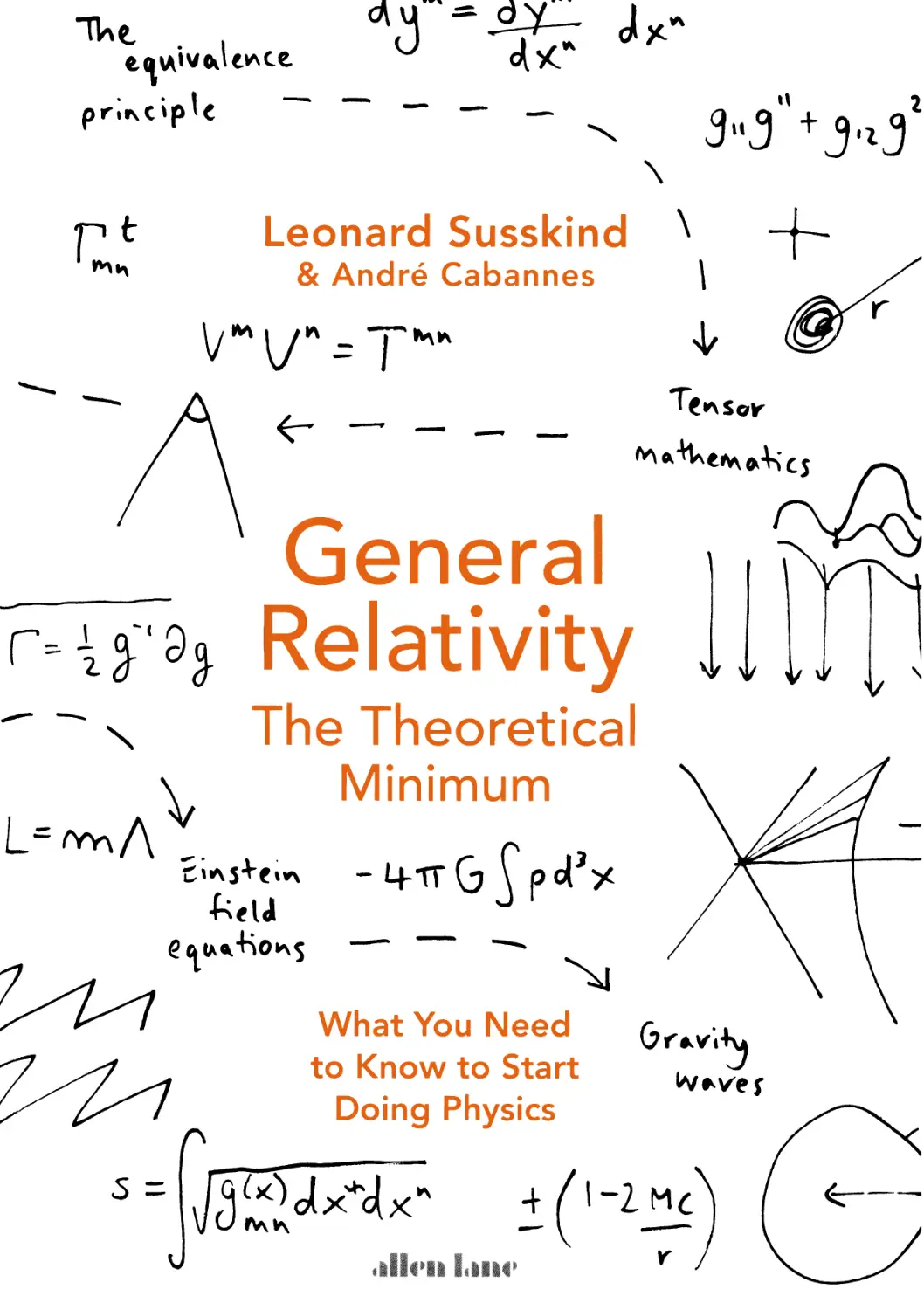
General
Relativity
The Theoretical
Minimum
- 4-"IT G S' p cfl)(
---- -
What You Need
to Know to Start
Doing Physics
..
S = [3 c,:
Jx
)(
I ', J
, i'(iii.Wi/flM !
. I[
,M.
_.I
/
P
ha';t Zk
"
\
L == fYY\/\
C;
S
t
tld
e 'l.
' +)O
S
,
6f""'v
w
ve f
.! (\ -2 _ H (
y
-
One book at a time, the Theoretical Minimum
series makes the power and grandeur of physics
accessible.
First came classical mechanics, then quantum
mechanics and special relativity. Now,
physicist Leonard Susskind, assisted by a new
collaborator, Andre Cabannes, returns to tackle
Einstein's masterpiece: the general theory
of relativity. Starting from the equivalence
principle and covering the necessary
mathematics of Riemannian spaces and tensor
calculus, Susskind and Cabannes explain
the link between gravity and geometry. They
delve into black holes, establish Einstein field
equations, and solve them to describe gravity
waves. The authors provide vivid explanations
that, to borrow a phrase from Einstein himself,
are as simple as possible (but no simpler).
An approachable yet rigorous introduction to
one of the most important topics in physics,
General Relativity is a must-read for anyone
who wants a deeper knowledge of the
universe's real structure.
£25.00
GENERAL
RELATIVITY
This book is the fourth volume of The Theoretical Minimum series.
The first volume, The Theoretical Minimum: What You Need to
Know to Start Doing Physics, covered classical mechanics, which
is the core of any physics education. We will refer to it from time
to time simply as volume 1. The second book, volume 2, explains
quantum mechanics and its relationship to classical mechanics.
Volume 3 covers special relativity and classical field theory. This
fourth volume expands on that to explore general relativity.
Also by Leonard Susskind
Special Relativity and Classical Field Theory:
The Theoretical Minimum
Quantum Mechanics: The Theoretical Minimum
The Theoretical Minimum: What You Need to
Know to Start Doing Physics
The Black Hole War: My Battle with Stephen Hawking
to Make the World Safe for Quantum Mechanics
The Cosmic Landscape: String Theory and
the Illusion of Intelligent Design
An Introduction to Black Holes, Information and the String
Theory Revolution: The Holographic Universe
GENERAL
RELATIVITY
THE THEORETICAL MINIMUM
LEONARD SUSSKIND
&. ANDRE CABANNES
t.
ALLEN LANE
an imprint of
PENGUIN BOOKS
ALLEN LANE
UK I USA I Canada I Ireland I Australia
India I New Zealand I South Africa
Allen Lane is part of the Penguin Random House group of companies
whose addresses can be found at global.penguinrandomhouse.com.
Penguin
Ranao1IlHouse
UK
First published in the United States of America by Basic Books,
Hachette Book Group 2023
First published in Great Britain by Allen Lane 2023
001
Copyright @ Leonard Susskind and Andre Cabannes, 2023
The moral rights of the authors have been asserted
Printed and bound in Great Britain by Clays Ltd, Elcograf S.p.A
The authorized representative in the EEA is Penguin Random House Ireland,
Morrison Chambers, 32 Nassau Street, Dublin D02 YH68
A CIP catalogue record for this book is available from the British Library
ISBN: 97 241-66258-1
www.greenpenguin.co.uk
IJ
MIX
p.... from
1'8IpoI...... ......
!. FSce C018178
Penguin Random House is committed to a
sustainable future for our business. our readers
and our planet This book IS made from Forest
Stewardship Counci'- certified paper.
To my family
-LS
To my parents,
who taught me work and tenacity
-AC
Contents
Preface
x
Lecture 1: Equivalence Principle and Tensor
Analysis
Lecture 2: Tensor Mathematics
Lecture 3: Flatness and Curvature
Lecture 4: Geodesics and Gravity
Lecture 5: Metric for a Gravitational Field
Lecture 6: Black Holes
Lecture 7: Falling into a Black Hole
Lecture 8: Formation of a Black Hole
Lecture 9: Einstein Field Equations
Lecture 10: Gravitational Waves
1
53
85
121
165
197
235
263
295
331
Index
367
Preface
This fourth volume in The Theoretical Minimum (TTM) series on
general relativity is the natural continuation of the third volume
on special relativity.
In special relativity, Einstein, starting from a very simple princi-
ple - the laws of physics should be the same in indistinguishable
Galilean referentials - deeply clarified in a couple of papers pub-
lished in 1905 the various disturbing observations physicists had
made and the equations they had written in the last years of the
nineteenth and the first years of the twentieth century concerning
light and other phenomena.
Special relativity led to a strange description of space-time where
time and space were inextricably mingled. For instance, it ex-
plained how particles whose lifetime is measured in fractions of a
second can have, in our referential, a travel time from the Sun to
Earth of more than eight minutes.
Then, from 1907 until 1915, essentially alone, Einstein reproduced
his feat starting now from another very simple principle - acceler-
ation and uniform gravity are equivalent. He generalized special
relativity to a space-time containing massive bodies. The theory is
called general relativity (GR). It led to an even stranger descrip-
tion of space-time where masses bend light and more generally
warp space and time.
In lecture 1, we prepare the groundwork. We show how the equiv-
alence principle inescapably leads to the bending of light rays by
massive bodies.
Lecture 2 is devoted to tensor mathematics because in GR we
must frequently change referentials and the equations relating co-
ordinates in one referential to coordinates in another are tensor
equations.
. .
XlI
General Relativity
Then a large part of the theory is expressed using tensor equa-
tions because they have the great quality that if they hold in one
referential, they hold in all of them.
Lectures 3, 4, and 5 are devoted to the geometry of Riemannian
space and Minkowskian space-time because it can be said, very
summarily, that gravity is geometry in a Minkowskian space-time.
In lectures 6, 7, and 8, we explore black holes, not so much because
they are interesting astronomical phenomena per se, than because
they are the equivalent in Minkowskian space-time of point masses
in Newtonian mechanics. Space-time however presents a stranger
behavior in the vicinity of a black hole than Newtonian space in
the vicinity of a point mass. Understanding well black holes, the
metric they create, their horizon, time and gravity in the vicinity
of their horizon, the way people in and out of a black hole can
communicate, etc. is a prerequisite to understanding GR.
In lecture 9 we sketch the derivation of Einstein field equations.
And in lecture 10 we present a simple application predicting grav-
ity waves.
This book, as the preceding ones in the series, is adapted from a
course I gave for several years, with much pleasure, at Stanford in
the Continuing Studies program to an audience of adults.
My coauthor this time is Andre Cabarines. Even though he is not
a professional scientist, his scientific training, including a Stanford
doctorate and a couple of years of teaching applied mathematics
at the Massachusetts Institute of Technology (MIT), helped him
assist me.
May Einstein's way of doing physics - starting from the sim-
plest principles and pursuing dauntlessly the mathematics and
the physics to their ultimate consequences, however unsettling
they may be - as I have strived to show in this book, be a source
of inspiration to young and future physicists.
Leonard Susskind
Palo Alto, California
Fall 2022
Preface
XlII
Ten years ago, when two of my children, then in their late teens,
were studying sciences to enter the French system of grandes
ecoles, I decided to brush up what I had learned in the seventies
in order to accompany them in their studies. I discovered that
the Internet had profoundly changed the learning landscape. Be-
side reading books, one could now also take excellent free courses
on the Net. I leisurely attended courses in mathematics, physics,
computer science, etc. from MIT, Stanford, and other places.
The subject matters often were better explained, the courses more
lively and easier to understand, than what I had experienced in
the past. One could choose courses by the world's best teachers.
Among these courses was The Theoretical Minimum series by
Leonard Susskind, famous among other reasons for his pioneer-
ing work on string theory. I liked them so much that when I
discovered that two of his filmed physics courses had already been
transformed into books, I decided to translate them in French.
Later I also translated the third book. Then, since the next vol-
ume didn't exist in English yet, I took up writing the English
notes as well, having in mind that this work might turn out to
be useful. After a lot more work with Professor Susskind and Ba-
sic Books team, volume 4 in The Theoretical Minimum series, on
general relativity, that you hold in your hands is the result.
I belong to the group of people to whom these so-called Con-
tinuing Studies courses were intended: individuals who studied
physics at the undergraduate and sometimes graduate level when
they were students, then did other things in life, but kept an in-
terest in sciences and would like to have some exposure to where
physics stands today at a level above plain vulgarization. Indeed,
personally, I have always found vulgarization more confusing and
harder to understand than real explanations with some equations.
Leonard's courses gave me access to Lagrangian classical mechan-
ics, quantum mechanics, and classical field "theory with a clarity
that I had never known before. With his pedagogy and presenta-
tion it becomes a pleasure to learn. Of course, it is all the more
true when there is no examination of any sort at the end. But the
courses and books turned out to be useful for students as well, to
prepare for more advanced and academic studies.
.
XlV
General Relativity
So whether you are someone who only wants to have some real
understanding of what general relativity is about - the stuff on
gravitation that is geometry, masses that bend space, light, and
time, black holes out there that you should avoid falling into, grav-
ity waves that we begin to detect, etc. - or you are a student in
physics who wants to have a first presentation of general relativity,
this book is for you.
Andre Cabannes
Saint- Cyr-sur-mer,
French Riviera
Fall 2022
Lecture 1: Equivalence Principle
and Tensor Analysis
Andy: So if I am in an elevator and I feel really heavy, I can't
know whether the elevator is accelerating or you mischievously put
me on Jupiter?
Lenny: That's right, you can't.
Andy: But, at least on Jupiter, if I keep still, light rays won't
bend.
Lenny: Oh yes they will.
Andy: Hmm, I see.
Lenny: A nd if you are falling into a black hole, beware, things will
get really strange. But, don't worry, I'll shed some light on this.
Andy: Er, bent or straight?
Introduction
Equivalence principle
Accelerated reference frames
Curvilinear coordinate transformations
Effect of gravity on light
Tidal forces
Non-Euclidean geometry
Riemannian geometry
Metric tensor
Mathematical interlude: Dummy variables
Mathematical interlude: Einstein summation convention
First tensor rule: Contravariant components of vectors
Mathematical interlude: Vectors and tensors
Second tensor rule: Covariant components of vectors
Covariant and contravariant components of vectors and tensors
2
General Relativity
Introduction
General Relativity is the fourth volume in The Theoretical Mini-
mum (TTM) series. The first three were devoted respectively
to classical mechanics, quantum mechanics, and special relativity
and classical field theory. The first volume laid out the Lagrangian
and Hamiltonian description of physical phenomena and the prin-
ciple of least action, which is one of the fundamental principles
underlying all of physics (see volume 3, lecture 7 on fundamental
principles and gauge invariance). They were used in the first three
volumes and will continue in this and subsequent ones.
Physics extensively uses mathematics as its toolbox to construct
formal, quantifiable, workable theories of natural phenomena. The
main tools we used so far are trigonometry, vector spaces, and
calculus, that is, differentiation and integration. They have been
explained in volume 1 as well as in brief refresher sections in the
other volumes. We assume that the reader is familiar with these
mathematical tools and with the physical ideas presented in vol-
umes 1 and 3. The present volume 4, like volumes 1 and 3 (but
unlike volume 2), deals with classical physics in the sense that no
quantum uncertainty is involved.
We also began to make light use of tensors in volume 3 on special
relativity and classical field theory. Now with general relativity
we are going to use them extensively. We shall study them in de-
tail. As the reader remembers, tensors generalize vectors. Just as
vectors have different representations, with different sets of num-
bers (components of the vector) depending on the basis used to
chart the vector space they form, this is true of tensors as well.
The same tensor will have different components in different co-
ordinate systems. The rules to go from one set of components
to another will playa fundamental role. Moreover, we will work
mostly with tensor fields, which are sets of tensors, a different
tensor attached to each point of a space. Tensors were invented
by Ricci-Curbastro and L evi-Civita 1 to develop work of Gauss 2
1 Gregorio Ricci-Curbastro (1853-1925) and his student Tullio Levi-Civita
(1873-1941) were Italian mathematicians. Their most important joint paper
is "Methodes de calcul differentiel absolu et leurs applications," in M athema-
tische Annalen 54 (1900), pp. 125-201. They did not use the word tensor,
which was introduced later by other people.
2Carl Friedrich Gauss (1777-1855), German mathematician.
1. Equivalence Principle and Tensor Analysis 3
on curvature of surfaces and Riemann 3 on non-Euclidean geome-
try. Einstein 4 made extensive use of tensors to build his theory of
general relativity. He also made important contributions to their
usage: the standard notation for indices and the Einstein summa-
tion convention.
In Savants et ecrivains (1910), Poincare 5 writes that "in mathe-
matical sciences, a good notation has the same philosophical im-
portance as a good classification in natural sciences." In this book
we will take care to always use the clearest and lightest notation
possible.
Equivalence Principle
Einstein's revolutionary papers of 1905 on special relativity deeply
clarified and extended ideas that several other physicists and math-
ematicians - Lorentz,6 Poincare, and others - had been working
on for a few years. Einstein investigated the consequences of the
fact that the laws of physics, in particular the behavior of light,
are the same in different inertial reference frames. He deduced
from that a new explanation of the Lorentz transformations, of
the relativity of time, of the equivalence of mass and energy, etc.
After 1905, Einstein began to think about extending the principle
of relativity to any kind of reference frames, frames that may be
accelerating with respect to one another, not just inertial frames.
An inertial frame is one where Newton's laws, relating forces and
motions, have simple expressions. Or, if you prefer a more vivid
image, and you know how to juggle, it is a frame of reference in
which you can juggle with no problem - for instance in a rail-
way car moving uniformly, without jerks or accelerations of any
sort. After ten years of efforts to build a theory extending the
principle of relativity to frames with acceleration and taking into
account gravitation in a novel way, Einstein published his work
in November 1915. Unlike special relativity, which topped off the
work of many, general relativity is essentially the work of one man.
3Bernhard Riemann (1826-1866), German mathematician.
4 Albert Einstein (1879-1955), German, Swiss, German again, and finally
American physicist.
5Henri Poincare (1854-1912), French mathematician.
6Hendrik Antoon Lorentz (1853-1928), Dutch physicist.
4
General Relativity
We shall start our study of general relativity pretty much where
Einstein started. It was a pattern in Einstein's thinking to start
with a really simple elementary fact, which almost a child could
understand, and deduce these incredibly far-reaching consequences.
We think that it is also the best way to teach it, to start with the
simplest things and deduce the consequences.
So we shall begin with the equivalence principle. What is the
equivalence principle? It is the principle that says that gravity
is in some sense the same thing as acceleration. We shall explain
precisely what is meant by that, and give examples of how Einstein
used it. From there, we shall ask ourselves: what kind of mathe-
matical structure must a theory have for the equivalence principle
to be true? What kind of mathematics must we use to describe it?
Most readers have probably heard that general relativity is a the-
ory not only about gravity but also about geometry. So it is
interesting to start at the beginning and ask what is it that led
Einstein to say that gravity has something to do with geometry.
What does it mean to say that "gravity equals acceleration"? You
all know that if you are in an accelerated frame of reference, say,
an elevator accelerating upward or downward, you feel an effective
gravitational field. Children know this because they feel it.
What follows may be overkill, but making some mathematics out
of the motion of an elevator is useful to see in a very simple exam-
ple how physicists transform a natural phenomenon into math-
ematics, and then to see how the mathematics is used to make
predictions about the phenomenon.
Before proceeding, let's stress that the following study on an ele-
vator, and the laws of physics as perceived inside it, is simple. Yet
it is a first presentation of very important concepts. It is funda-
mental to understand it very well. Indeed, we will often refer to it.
In lectures 4 to 9, it will strongly help us understand acceleration,
gravitation, and how gravitation "warps" space-time.
So let's imagine the Einstein thought experiment where somebody
is in an elevator; see figure 1. In later textbooks, it got promoted
to a rocket ship. But I have never been in a rocket ship, whereas
1. Equivalence Principle and Tensor Analysis 5
I have been in an elevator. So I know what it feels like when it
accelerates or decelerates. Let's say that the elevator is moving
upward with a velocity v.
% z'
velocity v
p
.
- - z' = 0
Let)
I
I
%=0-- ------j-----------------
Figure 1: Elevator and two reference frames.
So far the problem is one-dimensional. We are only interested in
the vertical direction. There are two reference frames: one is fixed
with respect to Earth. It uses the coordinate z. The other is fixed
with respect to the elevator. It uses the coordinate z'. A point P
anywhere along the vertical axis has two coordinates: coordinate
z in the stationary frame, and coordinate z' in the elevator frame.
For instance, the floor of the elevator has coordinate z' = O. Its
z-coordinate is the distance L, which is ob-yiously a function of
time. So we can write for any point P
z'=z-L(t)
(1)
We are going to be interested in the following question: if we know
the laws of physics in the frame z, what are they in the frame z'?
One warning about this lecture: at least at the start, we are going
to ignore special relativity. This is tantamount to saying that
we are pretending that the speed of light is infinite, or that we
are talking about motions so slow that the speed of light can be
regarded as infinitely fast. You might wonder: if general relativity
is the generalization of special relativity, how did Einstein manage
to start thinking about general relativity without including special
relativity?
6
General Relativity
The answer is that special relativity has to do with very high ve-
locities, while gravity has to do with heavy masses. There is a
range of situations where gravity is important but high velocities
are not. So Einstein started out thinking about gravity for slow
velocities, and only later combined it with special relativity to
think about the combination of fast velocities and gravity. And
that became the general theory.
Let's see what we know for slow velocities. Suppose that z' and
z are both inertial reference frames. That means, among other
things, that they are related by uniform velocity:
L(t) = vt
(2)
We have chosen the coordinates such that when t = 0, they line
up. At t = 0, for any point, z and z' are equal. For instance, at
t = 0 the elevator's floor has coordinate 0 in both frames. Then
the floor starts rising, its height z equaling vt. So for any point
we can write equation (1). In view of equation (2), it becomes
z' = z - vt
(3)
Notice that this is a coordinate transformation involving space
and time. For readers who are familiar with volume 3 of TTM on
special relativity, this naturally raises the question: what about
time in the reference frame of the elevator? If we are going to
forget special relativity, then we can just say that t' and t are the
same thing. We don't have to think about Lorentz transforma-
tions and their consequences. So the other half of the coordinate
transformation would be t' = t.
We could also add to the stationary frame a coordinate x going
horizontally and a coordinate y jutting out of the page. Corre-
spondingly, coordinates x' and y' could be attached to the eleva-
tor; see figure 2. The x-coordinate will playa role in a moment
with a light beam. As long as the elevator is not sliding horizon-
tally, x' and x can be taken to be equal. Same for y' and y.
For the sake of clarity of the drawing in figure 2, we offset a bit the
elevator to the right of the z-axis. But think of the two vertical
axes as actually sliding on each other, and at t = 0 the two origins
o and 0' coincide. Once again, the elevator moves only vertically.
1. Equivalence Principle and Tensor Analysis 7
z z'
p
.
Xl
o
X
y
Figure 2: Elevator and two reference frames, three axes in each case.
Finally our complete coordinate transformation is
z' = z - vt
t' = t
x' = x
y' = y
(4)
It is a coordinate transformation of space-time coordinates. For
any point P in space-time, it expresses its coordinates in the mov-
ing reference frame of the elevator as functions of its coordinates
in the stationary frame. It is rather trivial. Only one coordinate,
namely z, is involved in an interesting way.
Let us look at a law of physics expressed in the stationary frame.
Take Newton's law of motion F = ma applied to an object or a
particle. The acceleration a is z, where z is the vertical coordinate
of the particle. So we can write
F=mz
(5)
As we know, z is the second time derivative of z with respect to
time - it is called the vertical acceleration - and F of course is
the vertical component of force. The other components we will
take to be zero. Whatever force is exerted, it is exerted verti-
cally. What could this force be due to? It could be related to
the elevator or not. There could be some charge in the elevator
pushing on the particle. Or it could just be a force due to a rope
8
General Relativity
attached to the ceiling and to the particle that pulls on it. There
could be a field force along the vertical axis. Any kind of force
could be acting on the particle. Whatever the causes, we know
from Newton's law that the equation of motion of the particle, ex-
pressed in the original frame of reference, is given by equation (5).
What is the equation of motion expressed in the primed frame?
This is very easy. All we have to do is figure out what the original
acceleration is in terms of the primed acceleration. What is the
primed acceleration? It is the second derivative with respect to
time of z'. U sing the first equation in equations (4)
z' = z - vt
one differentiation gives
z' = i-v
and a second one gives
z' = z
The accelerations in the two frames of reference are the same.
All this should be familiar. But I want to formalize it to bring out
some points. In particular, I want to stress that we are doing a
coordinate transformation. We are asking how the laws of physics
change in going from one frame to another. What can we now
say about Newton's law in the primed frame of reference? We
substitute ;., for z in equation (5). As they are equal, we get
..
F = mz'
(6)
We found that Newton's law in the primed frame is exactly the
same as Newton's law in the unprimed frame. That is not sur-
prising. The two frames of reference are moving with uniform
velocity relative to each other. If one of them is an inertial frame,
the other is an inertial frame. Newton taught us that the laws of
physics are the same in all inertial frames. It is sometimes called
the Galilean principle of relativity. We just formalized it.
Let's turn to an accelerated reference frame.
1. Equivalence Principle and Tensor Analysis 9
Accelerated Reference Frames
Suppose that L(t) from figure 1 is increasing in an accelerated
way. The height of the elevator's floor is now given by
1
L(t) = _gt 2
2
(7)
We use the letter 9 for the acceleration because we will discover
that the acceleration mimics a gravitational field - as we feel when
we take an elevator and it accelerates. We know from volume 1
of TTM on classical mechanics or from high school, that this is a
uniform acceleration. Indeed, if we differentiate L(t) with respect
to time, after one differentiation we get
L=gt
which means that the velocity of the elevator increases linearly
with time. After a second differentiation with respect to time,
we get
L=g
This means that the acceleration of the elevator is constant. The
elevator is uniformly accelerated upward. The equations connect-
ing the primed and unprimed coordinates are different from equa-
tions (4). The transformation for the vertical coordinates is now
I 1 2
Z = Z - -gt
2
(8)
The other equations in equations (4) don't change:
t ' = t
x' = x
y' = y
These four equations are our new coordinate transformation to
represent the relationship between coordinates that are acceler-
ated relative to each other.
We will continue to assume that in the z, or unprimed, coordinate
system, the laws of physics are exactly what Newton taught us.
In other words, the stationary reference frame is inertial, and we
10
General Relativity
have F = mz. But the primed frame is no longer inertial. It is
in uniform acceleration relative to the unprimed frame. Let's ask
what the laws of physics are now in the primed frame of reference.
We have to do the operation of differentiating twice over again on
equation (8). We know the answer:
z' = z - 9
(9)
Ah ha! Now the primed acceleration and the unprimed accelera-
tion differ by an amount g. To write Newton's equations in the
primed frame of reference, we multiply both sides of equation (9)
by m, the particle mass, and we replace mz by F. We get
mz' = F - mg
(10)
We have arrived at what we wanted. Equation (10) looks like a
Newton equation, that is, mass times acceleration is equal to some
term. That term, F - mg, we call the force in the primed frame
of reference. You notice, as expected, that the force in the primed
frame of reference has an extra term: the mass of the particle
times the acceleration of the elevator, with a minus sign.
What is interesting about the "fictitious force" -mg, in equa-
tion (10), is that it looks exactly like the force exerted on the
particle by gravity on the surface of the Earth or the surface of
any kind of large massive body. That is why we called the accel-
eration g. The letter 9 stood for gravity. It looks like a uniform
gravitational field. Let me spell out in what sense it looks like
gravity. The special feature of gravity is that gravitational forces
are proportional to mass - the same mass that appears in New-
ton's equation of motion. We sometimes say that the gravitational
mass is the same as the inertial mass. That has deep implications.
If the equation of motion is
F=ma
(11)
and the force itself is proportional to mass, then the mass cancels
in equation (11). That is a characteristic of gravitational forces:
for a small object moving in a gravitational force field, its mo-
tion doesn't depend on its mass. An example is the motion of
the Earth about the Sun. It is independent of the mass of the
Earth. If you know where the Earth is at time t, and you know
1. Equivalence Principle and Tensor Analysis 11
its velocity at that time, then you can predict its trajectory. You
don't need to know what the Earth's mass is.
Equation (10) is an example of fictitious force - if you want to
call it that.- mimicking the effect of gravity. Most people before
Einstein considered this largely an accident. They certainly knew
that the effect of acceleration mimics the effect of gravity, but they
didn't pay much attention to it. It was Einstein who said: look,
this is a deep principle of nature that gravitational forces cannot
be distinguished from the effect of an accelerated reference frame.
If you are in an elevator without windows and you feel that your
body has some weight, you cannot say whether the elevator, with
you inside, is resting on the surface of a planet or, far away from
any massive body in the universe, some impish devil is accelerat-
ing your elevator. That is the equivalence principle. It extends
the relativity principle, which said you can juggle in the same way
at rest or in a railway car in uniform motion. With a simple ex-
ample" we have equated accelerated motion and gravity. We have
begun to explain what is meant by the sentence: "gravity is in
some sense the same thing as acceleration."
We have to discuss this result a bit, though. Do we really believe
it totally or does it have to be qualified? Before we do that, let's
draw some pictures of what these various coordinate transforma-
tions look like.
Curvilinear Coordinate Transformations
Let's first consider the case where L(t) is proportional to t. That
is when we have
z' = z - vt
In figure 3, every point - also called event - in space-time has a
pair of coordinates z and t in the stationary frame and also a pair
of coordinates z' and t' in the elevator frame. Of course, t' = t
and we left out the two other spatial coordinates x and y, which
don't change between the stationary frame and the elevator. We
represented the time trajectories of fixed z with dotted lines and
of fixed z' with solid lines.
12
General Relativity
A fundamental idea to grasp is that events in space-time exist irre-
spective of their coordinates, just as points in space don't depend
on the map we use. Coordinates are just some sort of convenient
tags. We can use whichever we like. We'll stress it again after we
have looked at figures 3 and 4.
t
z' = 0 z' = 1 z' = 2
z=O z=l z=2 z=3
z
Figure 3: Linear coordinate transformation. The coordinates (z', t')
are represented in the basic coordinates (z, t). An event is a point on
the page. It has one set of coordinates in the (z, t) frame and another
set in the (z', t') frame. Here the transformation is simple and linear.
That is called a linear coordinate transformation between the two
frames of reference. Straight lines go to straight lines, not sur-
prisingly since Newton tells us that free particles move in straight
lines in an inertial frame of reference. What is a straight line
in one frame had therefore better be a straight line in the other
frame. Not only do free particles move in straight lines in space,
when we add x and y, but their trajectories are straight lines in
space-time - straight in space and with uniform velocity.
Let's do the same thing for the accelerated coordinate system. The
transformation equation is now equation (8) linking z' and z. The
other coordinates don't change. Again, in figure 4, every point in
space- time has two pairs of coordinates (z, t) and (z', t') . The
time trajectories of fixed z, represented with dotted lines, don't
change. But now the time trajectories of fixed z' are parabolas
lying on their side. We can even represent negative times in the
past. Think of the elevator that was initially moving downward
with a negative velocity but a positive acceleration 9 (in other
words, slowing down). Then the elevator bounces back upward
1. Equivalence Principle and Tensor Analysis 13
with the same acceleration g. Each parabola is just shifted relative
to the previous one by one unit to the right.
%=0 %=1 %=2 %=3
t
%1 = 0 Zl = 1 z' = 2
Figure 4: Curvilinear coordinate transformation.
What figure 4 illustrates is, not surprisingly, that straight lines in
one frame are not straight lines in the other frame. They become
curved lines. As regards the lines of fixed t or fixed t', they are
of course the same horizontal straight lines in both frames. We
haven't represented them.
We should view figure 4 as just two sets of coordinates to locate
each point in space-time. One set of coordinates has straight axes,
while the secon - represented in the first frame - is curvilinear.
Its lines z' = constant are actually curves, while its lines t' = con-
stant are horizontal straight lines. So it is a curvilinear coordinate
transformation.
Let's insist on the way to interpret and use figure 4 because it is
fundamental to understand it very well if we want to understand
the theory of relativity - special relativity and even more impor-
tantly general relativity. The page represents space-time - here,
one spatial dimension and one temporal dimension..
Points (= events) in space-time are points on the page. An event
does not have two positions on the page, Le., in space-time. It has
14
General Relativity
only one position on the page. But this position can be located,
mapped,"charted"one also says, using several differen1systemfDf ref-
erence. A system of reference, . also called a frame of reference, is
nothing more than a complete set of "labels," if you will, attach-
ing one label (consisting of two numbers, because our space-time
here is two-dimensional) to each point, Le., to each event.
In a two-dimensional space, the system of reference can be geo-
metrically simple, like orthogonal Cartesian axes in the plane.
However this is not a necessity. For one thing, on Earth, which is
not a plane, the axes are not straight lines. The usual axes used
by cartographers and mariners are meridians and parallels. But
on a 2D surface, be it a plane or not, we can imagine quite fancy or
intricate curvilinear lines to serve as a frame of reference - so long
as it attaches unequivocally two numbers to each (by definition,
fixed) point. This is what figure 4 does in the space-time made of
one temporal and one spatial dimension represented on the page.
We will see many more in lecture 2.
Something Einstein understood very early is this:
There is a connection between gravity and curvilinear coordinate
transformations of space-time.
Special relativity was only about linear transformations - transfor-
mations that take uniform velocity to uniform velocity. Lorentz
transformations are of that nature. They take straight lines in
space-time to straight lines in space-time. However, if we want to
mock up gravitational fields with the effect of acceleration, we are
really talking about transformations of coordinates of space-time
that are curvilinear. That sounds extremely trivial. When Ein-
stein said it, probably every physicist knew it and thought: "Oh
yeah, no big deal." But Einstein was very clever and very per-
sistent. He realized that if he followed very far the consequences
of this, he could then answer questions that nobody knew how to
answer.
Let's look at a simple example of a questipn that Einstein an-
swered using the curved coordinates of space-time representing
acceleration, and consequently, if the two are the same, gravity.
The question is: what is the influence of gravity on light?
1. Equivalence Principle and Tensor Analysis 15
Effect of Gravity on Light
When Einstein first asked himself the question "what is .the in-
fluence of gravity on light"? around 1907, most physicists would
have answered: "There is no effect of gravity on light. Light is
light. Gravity is gravity. A light wave moving near a massive
object moves in a straight line. It is a law of light that it moves
in straight lines. And there is no reason to think that gravity has
any effect on it."
But Einstein said: "No, if this equivalence principle between accel-
eration and gravity is true, then gravity must affect light. Why?
Because acceleration affects light." It was again one of these ar-
guments that you could explain to a clever child.
Let's imagine that, at t = 0, a flashlight (today we might use a
laser pointer) emits a pulse of light in a horizontal direction from
the left side of the elevator; see figure 5. The light then travels
across to the right side with the usual speed of light c. Since
the stationary frame is assumed to be an inertial frame, the light
moves in a straight line in the stationary frame.
%
gt elevator
light beam
x=o
%=0
t = 0
x
Figure 5: Trajectory of a light beam in the stationary reference frame.
The equations for the light ray are
x=ct
z=o
(12)
The first of these equations just says that the light moves across
the elevator with the speed of light - no surprise here.
16
General Relativity
The second says that in the stationary frame the trajectory of the
light beam is horizontal.
Let's express the same equations in terms of the primed coordi-
nates. The first equation becomes
x' = ct
And the second takes the more interesting form
z' = - 9 t 2
2
It says that as the light ray moves across the elevator, at the same
time the light ray accelerates downward - toward the floor - just
as if gravity' were pulling it.
We can even eliminate t from the two equations and get an equa-
tion for the curved trajectory of the light ray:
z' = _JL x ,2 (13)
2c 2
Thus, the trajectory, in the primed frame of reference, is a parabola,
not a straight line.
But, said Einstein, if the effect of acceleration is to bend the tra-
jectory of a light ray, then so must be the effect of gravity.
Andy: Gee Lenny, that's really simple. Is that all there is to it?
Lenny: Yup Andy, that's all there is to it. And you can bet that a
lot of physicists were kicking themselves for not thinking of it.
To summarize, in the stationary frame, the photon trajectory (fig-
ure 5) is a straight line, while in the elevator reference frame, it
is a parabola (figure 6).
Let's imagine three people arguing. I am in the elevator, and I
say: "Gravity is pulling the light beam down." You are in the
stationary frame, and you say: "No, it's just that the elevator is
accelerating upward; that makes it look like the light beam moves
on a curved trajectory." And Einstein says: "They are the same
thing!"
1. Equivalence Principle and Tensor Analysis 17
Zl
gt
elevator
Xl = 0
Zl = 0
t l = 0
light beam
Xl
Figure 6: Trajectory of a light beam in the elevator reference frame.
This proved to him that a gravitational field must bend a light
ray. As far as I know, no other physicist understood this at the
time.
In conclusion, we have learned that it is useful to think about
curvilinear coordinate transformations in space-time.
When we do think about curvilinear coordinates transformations,
the form of Newton's laws changes. One of the things that happen
is that apparent gravitational fields materialize, which are physi-
cally indistinguishable from ordinary gravitational fields.
Well, are they really physically indistinguishable? For some pur-
poses yes, but not for all. So let's turn now to real gravitational
fields, namely gravitational fields of gravitating objects like the
Sun or the Earth.
Tidal Forces
Figure 7 represents the Earth, or the Sun, or any massive body.
The gravitational acceleration doesn't point vertically on the page.
It points toward the center of the body.
It is pretty obvious that there is no way that you could do a
coordinate transformation like we did in the preceding section
that would remove the effect of the gravitational field. Yet, if you
18
General Relativity
are in a small laboratory in space and that laboratory is allowed
to simply fall toward Earth, or toward whatever massive object
you are considering, then you will think that in that laboratory
there is no gravitational field.
1
small laboratory
D
/
/
'"
i
Figure 7: Gravitational field of a massive object, and small laboratory
falling toward the object, experiencing inside itself no gravitation.
Exercise 1: If we are falling freely in a uniform gravita-
tional field, prove that we feel no gravity and that things
float around us like in the International Space Station.
But, again, there is no way globally to introduce a coordinate
transformation that is going to get rid of the fact that there is
a gravitational field pointing toward the center. For instance, a
very simple transformation similar to equations (12) might get rid
of the gravity in a small portion on one side of the Earth, but the
same transformation will increase the gravitational field on the
other side. Even more complex transformations would not solve
the problem.
One way to understand why we can't get rid of gravity is to think
of an object that is not small compared to the gravitational field.
My favorite example is a 2000-mile man who is falling in the
Earth's gravitational field; see figure 8. Because he is so big, differ-
ent parts of his body feel different gravitational fields. Remember
that the farther away you are, the weaker is the gravitational field.
1. Equivalence Principle and Tensor Analysis 19
His head feels a weaker gravity than his feet. His feet are being
pulled harder than his head. He feels like he is being stretched,
and that stretching sensation tells him that there is a gravitating
object nearby. The sense of discomfort that he feels, due to the
nonuniform gravitational field, cannot be removed by switching to
a free-falling reference frame. Indeed, no change of mathematical
description whatsoever can change this physical phenomenon.
1
/
2000-mile
man
/'
I
Figure 8: A 2000-mile man falling toward Earth.
The forces he feels are called tidal forces, because they play an
important role in the phenomenon of tides, too. They cannot
be removed by a coordinate transformation. Let's also see what
happens if he is falling not vertically but sideways, staying per-
pendicular to a radius. In that case his head and his feet will be
at the same distance from Earth. Both will be subjected to the
same force in magnitude pointing to Earth. But since the force
directions are radial, they are not parallel. The force on his head
and the force on his feet will both have a component along his
body. A moment's thought will convince us that the tidal forces
will compress him, his feet and head being pushed toward each
other. This sense of compression is again not something that we
can remove by a coordinate transformation. Being stretched or
shrunk, or both, by the Earth's gravitational field - if you are big
enough - is an invariant fact.
In summary, it is not quite true that gravity is equivalent to going
to an accelerated reference frame.
20
General Relativity
Andy: Aha! So Einstein was wrong after all.
Lenny: Well, Einstein was wrong at times, but no, Andy, this was
not one of those times. He just had to qualify his statement and
make it a bit more precise.
What Einstein really meant was that small objects, for a small
length of time, cannot tell the difference between a gravitational
field and an accelerated frame of reference.
It raises the following question: if I present you with a force field,
does there exist a coordinate transformation that will make it
vanish? For example, the force field inside the elevator, asso-
ciated with its uniform acceleration with respect to an inertial
reference frame, was just a vertical force field pointing downward
and uniform everywhere. There was a transformation canceling
it: simply use z- instead of z' -coordinates. It is a nonlinear co-
ordinate transformation. Nevertheless, it gets rid of the force field.
With other kinds of coordinate transformations, you can make
the gravitational field look more complicated, for example trans-
formations that affect also the x-coordinate. They can make the
gravitational field bend toward the x-axis. You might simultane-
ously accelerate along the z-axis while oscillating back and forth
on the x-axis. What kind of gravitational field do you see? A
very complicated one: it has a vertical component and it has a
time-dependent oscillating component along the x-axis.
If instead of the elevator you use a merry-go-round, that is, a
carousel, and instead of the (x', Zl, t) coordinates of the elevator,
you use polar coordinates (r, 0, t), an object that in the station-
ary frame was fixed, or had a simple motion like the light beam,
may have a weird motion in the frame moving with the merry-go-
round. You may think that you have discovered some repulsive
gravitational field phenomenon. But no matter what, the reverse
coordinate change will reveal that your apparently messy field is
only the consequence of a coordinate change. By choosing funny
coordinate transformations, you can create some pretty compli-
cated fictitious, apparent, also called effective, gravitational fields.
Nonetheless they are not genuine, in the sense that they don't re-
sult from the presence of massive objects.
1. Equivalence Principle and Tensor Analysis 21
If I give you the field everywhere, how do you determine whether
it is fictitious or genuine, Le., whether it is just the sort of fake
gravitational field resulting from a coordinate transformation to
a frame with all kinds of accelerations with respect to a simple
inertial one, or it is a real gravitational field?
If we are talking about Newtonian gravity, there is an easy way.
You just calculate the tidal forces. You determine whether that
gravitational field will have an effect on an object that will cause
it to squeeze and stretch. If calculations are not practical, you
take an object, a mass, a crystal. You let it fall freely and see
whether there were stresses and strains on it. If the crystal is big
enough, these will be detectable phenomena. If such stresses and
strains are detected, then it is a real gravitational field as opposed
to only a fictitious one.
On the other hand, if you discover that the gravitational field
has no such effect, that any object, wherever it is located and let
freely to move, experiences no tidal force - in other words, that
the field has no tendency to distort a free-falling system - then
it is a field that can be eliminated by a coordinate transformation.
Einstein asked himself the question: what kind of mathematics
goes into trying to answer the question of whether a field is a
genuine gravitational one or not?
Non-Euclidean Geometry
After his work on special relativity, and after learning of the math-
ematical structure in which Minkowski 7 had recast it, Einstein
knew that special relativity had a geometry associated with it. So
let's take a brief rest from gravity to remind ourselves of this im-
portant idea in special relativity. Special relativity was the main
subject of the third volume of TTM. Here, however, the only thing
we are going to use about special relativity is that space-time has
a geometry.
7Hermann Minkowski (1864-1909), Polish-German mathematician and
theoretical physicist.
22
General Relativity
In the Minkowski geometry of special relativity, there exists a
kind of distance between two points, that is, between two events
in space-time; see figure 9.
t
Q
p/
LtX = (Ltt, Ltx, Lty, Ltz)
x
Figure 9: Minkowski geometry: a 4-vector going from P to Q.
The distance between P and Q is not the usual Euclidean distance
that we could be tempted,to think of. It is defined as follows. Let's
call dX the 4-vector going from P to Q. To the pair of points P
and Q we assign a quantity denoted dr, defined by
dr 2 = dt 2 - dx 2 - dy2 - dz 2
Notice that dr does not satisfy the usual properties of a distance.
In particular, dr 2 can be positive or negative; and it can be zero
for two events that are not identical. The reader is referred to
volume 3 of TTM for details. Here we only give a brief refresher.
The quantity dr is called the proper time between P and Q. It is
an invariant under Lorentz transformations. That is why it qual-
ifies as a sort of distance, just as in three-dimensional (3D) Eu-
clidean space the distance between two points, dx 2 + dy2 + dz 2 ,
is invariant under isometries.
We also define a quantity ds by
ds 2 = -dt 2 + dx 2 + dy2 + dz 2
We call ds the proper distance between P and Q. Of course, dr
and ds are not two different concepts. They are the same - just
differing by an imaginary factor i. They are just two ways to talk
1. Equivalence Principle and Tensor Analysis 23
about the Minkowski "distance" between P and Q. Depending on
which physicist is writing the equations, they will rather use dr
or ds as the distance between P and Q.
Einstein knew about this non-Euclidean geometry of special rela-
tivity. In his work to include gravity, and to investigate the con-
sequences of the equivalence principle, he also realized that the
question we asked at the end of the previous section - are there
coordinate transformations that can remove the effect of forces? -
was very similar to a certain mathematics problem that had been
studied at great length by Riemann. It is the question of deciding
whether a geometry is flat or not.
Riemannian Geometry
What is a flat geometry? Intuitively, it is the following idea: the
geometry of a page is flat. The geometry of the surface of a sphere
or a section of a sphere is not flat. The intrinsic geometry of the
page remains flat even if we furl the page like in figure 10. We
will expound mathematically on the idea in a moment.
page flat
page furled
Figure 10: The intrinsic geometry of a page remains flat.
For now, let's just say that the intrinsic geometry of a surface is
the geometry that a two-dimensional bug roaming on it, equipped
with tiny surveying tools, would see if it were trying to establish
an ordnance survey map of the surface.
If the bug worked carefully, it might see hills and valleys, bumps
and troughs, if there were any, but it would not notice that the
24
General Relativity
page is furled. We see it because for us the page is embedded in
the 3D Euclidean space we live in. By unfurling the page, we can
make its flatness obvious again.
Einstein realized that there was a great deal of similarity in the two
questions of whether a geometry is non-flat and whether a space-
time has a real gravitational field in it. Riemann had studied the
first question. But Riemann had never dreamt about geometries
that have a minus sign in the definition of the square of the dis-
tance. He was thinking about geometries that were non-Euclidean
but were similar to Euclidean geometry - not Minkowski geometry.
Let's start with the mathematics of Riemannian geometry, that
is, of spaces where the distance between two points may not be
the Euclidean distance, but in which the square of the distance is
always positive. 8
X2
jdP
Xl
x 3
Figure 11: Small displacement between two points in a space.
We look at two points in a space; see figure 11. In our example
there are three dimensions, therefore three axes, Xl, X 2 , and X 3 .
There could be more. Thus a point has three coordinates, which
we can write as X m , where m is understood to run from 1 to 3
or to whatever number of axes there is. And a little shift between
one point and another nearby has three components, which can
be denoted dX m or, if it is to become an infinitesimal, dX m .
BIn mathematics, they are called positive definite distances.
1. Equivalence Principle and Tensor Analysis 25
If this space has the usual Euclidean geometry, the square of the
length of dX m is given by Pythagoras theorem
dS 2 = (dX 1 )2 + (dX 2 )2 + (dX 3 )2 + . . . (14)
If we are in three dimensions, then there are three terms in the
sum. If we are in two dimensions, there are two terms. If the space
is 26-dimensional, there are 26 of them and so forth. That is the
formula for Euclidean distance between two points in Euclidean
space.
For simplicity and ease of visualization, let's focus on a two-
dimensional space. It can be the ordinary plane, or it can be
a two-dimensional surface that we may visualize embedded in 3D
Euclidean space, as in figure 12.
X2=4
X 2 =3
X2=2
X2= 1
Xl = 0 Xl = 1 Xl = 2 Xl = 3
Figure 12: Two-dimensional manifold (Le., 2D surface) and its curvi-
linear coordinates viewed embedded in ordinary 3D euclidean space.
There is nothing special about two dimensions for such a surface,
except that it is easy to visualize. Mathematicians think of "sur-
faces" even when they have more dimensions. Usually they don't
call them surfaces but manifolds or sometimes varieties.
Gauss had already understood that on curved surfaces the formula
for the distance between two points was more complicated in gen-
eral than equation (14). Indeed, we must not be confused by the
fact that in figure 12 the surface is shown embedded in the usual
three-dimensional Euclidean space. This is just for convenience
26
General Relativity
of representation. We should think of the surface as a space in
itself, equipped with a coordinate system to locate any point, with
curvy lines corresponding to one coordinate being constant, etc.,
and where a distance has been defined. We must forget about the
embedding 3D Euclidean space. The distance between two points
on the surface is certainly not their distance in the embedding 3D
Euclidean space, and is not even necessarily defined on the sur-
face with the equivalent of equation (14). We will come shortly
to exactly how these distances are represented mathematically.
Riemann generalized these surfaces and their metric (the way to
compute distances) to any dimensions. But let's continue to use
our picture with two dimensions in order to sustain intuition. And
let's go slowly, so as not to miss any important detail.
The first thing we do with a surface is put some coordinates on
it, which will allow us to quantify various statements involving
its points. We just layout coordinates as if drawing them with a
piece of chalk. We don't worry at all about whether the coordinate
axes are straight lines or not, because for all we know when the
surface is a really curved surface, there probably won't even be
things that we can call straight lines. We still call them X's.
dX m
Figure 13: Two neighboring points and the shift dX m between them.
The values of the X's are not related directly to distances. They
are just numerical labels. The points (Xl = 0, X 2 = 0) and
(Xl = 1, X 2 = 0) are not necessarily separated by a distance
of one. Now we take two neighboring points; see figure 13. The
two neighboring points are again related by a shift of coordinates.
1. Equivalence Principle and Tensor Analysis 27
But, unlike in figure 11, which was still a Euclidean space, now
we are on an arbitrary curved surface with arbitrary coordinates.
Now we define a distance on the surface for points separated by
a small shift like dX m . It won't be as simple as equation (14),
though it will have similarities with it. Here is the new definition
of dS 2 :
dS 2 = L 9mn (X) dX m dX n
(15)
m, n
The functions 9mn(X)'s, considered altogether, form what is called
the metric of the space. It is a set of functions of the position X
on the manifold under consideration.
Formula (15) is very general and applies whether the manifold is
flat or curved. It is a very important formula in Riemannian ge-
ometry, and - we will soon see - even in the Minkowski geometry
of relativity.
We will also see in a moment how the Einstein summation conven-
tion will enable us to rewrite formula (15) in a lighter form. The
convention is explained in the section "Mathematical Interlude:
Einstein Summation Convention," see infra.
Incidentally, formula (15) applies even to flat geometries equipped
with curvilinear coordinates. Suppose that you take a flat geome-
try, like the surface of the page, but for some reason you use some
curvilinear coordinates to locate points, and you ask what is the
distance between two points close to each other. Then in gen-
eral, the square of the distance between two points close to each
other will be a quadratic form in the coordinate shifts dXm,s. A
quadratic form means a sum of terms, each of which is the prod-
uct of two little coordinate shifts, times a coefficient like 9mn that
depends on X.
The surface of the Earth offers a simple example of distance on a
curved manifold. Look at the distance between two nearby points
characterized by longitude and latitude, as shown in figure 14.
Let's denote with R the Earth radius. We take two points (<jJ, 0)
and (<jJ + d<jJ, 0 + dO), where 0 is the latitude and <jJ the longitude.
28
General Relativity
((J, 8)
Figure 14: Formula for distance on the Earth surface. Shown are the
points (4), 8) and (4) + d4>, 8 + d8), and the segment joining them.
Apply Pythagoras theorem in a small, approximately flat, rectan-
gular region to compute the square of the length of its diagonal.
One pair of sides along a meridian have length RdO. The other
pair of sides along a parallel have length Rd<jJ but corrected by the
cosine of the latitude. At the equator it is the full Rd<jJ, whereas
at the pole it is zero.
The general formula for the square of the distance is
dS 2 = R 2 [d0 2 + (cosO)2d<jJ2]
(16)
It is an example of squared distance not just equal to d0 2 + d<jJ2
but having some coefficient functions in front of the differentials.
In this case the interesting coefficient function is (cos 0)2 in front
of one of the terms (dX m )2. Note that the coefficient (cosO)2 is
often written cos 2 O. Note also that in this case there are no terms
of the form dO d<jJ because the natural curvilinear coordinates we
chose on the sphere are still orthogonal at every point. 9
In other examples - on the sphere with more involved coordi-
nates, or on a more general curved surface like in figure 13 - where
the coordinates are not necessarily locally perpendicular, the for-
mula for dS 2 would be more complicated and comprise terms in
dxmdx n . But it will still be a quadratic form. There will never
be d0 3 terms. There will never be things linear. Every term will
9Note that spherical coordinates like we use here, which are a bit more
sophisticated than Cartesian coordinates, were already much used in the six-
teenth century, while Cartesian coordinates began to be used in analytic ge-
ometry only in the seventeenth century.
1. Equivalence Principle and Tensor Analysis 29
always be quadratic. Moreover in Riemannian geometry, at every
point X, the quadratic form defining the metric locally is always
positive definite.
You may wonder why we define the distance dB only for small
(actually infinitesimal) displacements. The reason is that to talk
about distance between two points A and B far away from each
other, we must first of all define what we mean. There may be
bumps and troughs in between. We could mean the shortest dis-
tance as follows: we put a peg at A and a peg at B and pull a
string as tight as we can between the two points. That would
define one notion of distance. Of course, there might be several
paths with the same value. One might go around the hill this way.
Then the other would go around the hill that way. Simply think
on Earth of going from the North Pole to the South Pole.
Furthermore, even if there is only one answer, we have to know
the geometry on the surface everywhere in the whole region where
A and B are located, not only to calculate the distance but to
know actually where to place the string. Therefore the notion
of distance between any two points is more complicated than in
Euclidean geometry. But between two neighboring points it is not
so complicated. That is because locally a smooth surface can be
approximated by the tangent plane and the curvilinear coordinate
lines by straight lines - not necessarily perpendicular but straight.
Metric Tensor
Let's go deeper into the geometry of a curved surface and its
links with equation (15), which defines the distance between two
neighboring points on it. Recall the equation
dS 2 = L 9mn(X) dxmdx n
m, n
In order to get a feel about the geometry of the surface and its
behavior, let's imagine that we arrange elements from a Tinkertoy
Construction Set along the curved surface. For instance, they
could approximately follow the coordinate lines on the surface.
We would also add more rigid elements diagonally. This would
30
General Relativity
create a lattice as shown in figure 15. But any reasonably dense
lattice, sort of triangulating the surface, would do as well. Suppose
furthermore that the Tinkertoy elements are hinged together in a
way that lets them freely move in any direction from each other.
Figure 15: Lattice of rigid Tinkertoy elements arranged on the surface.
Imagine that we lift our lattice from the surface. Sometimes it
will keep its shape rigidly, sometimes it won't. It will not keep
its shape if it is possible to go from the initial shape to a new
shape without forcing any Tinkertoy element to be stretched or
compressed or bent.
In some cases it will even be possible to lay it out flat. It is the
case, for instance, in figure 10 going from the shape on the right
to the shape on the left - which is just a flat page.
Exercise 2: Is it possible to find a curved surface and a
lattice of rods arranged on it that cannot be flattened out,
but can change shape?
Answer: Yes. According to Gauss's Theorema Egregium, which
we invite the reader to look up, a surface can be modified without
stretching or compressing it as long as we preserve everywhere its
Gaussian curvature. For instance, it is possible to change in such
a way a section of a hyperbolic paraboloid.
We shall see that the initial surface being able to take other shapes
or not corresponds to the 9mn's of equation (15) having certain
mathematical properties.
1. Equivalence Principle and Tensor Analysis 31
The collection of 9mn's has a name. It is called the metric tensor.
It is the mathematical object that enables us to compute the dis-
tance between two neighboring points on our Riemannian surface.
Mind you, the 9mn'S are functions of X (the points of the mani-
fold). So, strictly speaking, we are talking about a tensor field.
But it is customary to talk casually of the metric tensor, keeping
in mind that the collection of its components depends on X.
When the lattice of Tinkertoy elements can be laid out flat, the
geometry of the surface is said to be intrinsically flat, or just flat.
We will define it more rigorously later.
Sometimes, on the other hand, the lattice of little rods cannot be
laid out flat. For example on the sphere, if we initially layout a
lattice triangulating a large chunk of the sphere, we won't be able
to lay it out on a flat plane. 10
The question we have to address is this: if I made a lattice of
little rods covering a surface, and I gave you the length of each
rod, without yourself building the lattice how could you tell me
whether it is a flat space or an intrinsically curved space, which
cannot be flattened and laid out on a flat plane? .
Let's formulate the problem more precisely and mathematically.
We start from the metric tensor 9mn(X), which is a function of
position, in some set of coordinates. Keep in mind that there are
many different possible sets of curvilinear coordinates on the sur-
face, and in every set of coordinates the metric tensor will look
different. It will have different components, just like the same 3-
vector in ordinary 3D Euclidean space has different components
depending on the basis used to represent it, but in addition the
components will vary with position in different ways.
I select one set of coordinates and I give you the metric tensor of
my surface. In effect I tell you the distance between every pair of
neighboring points. The question is: is my surface flat or not?
lOThis is a well-known problem of cartographers, which led to the invention
of various kinds of maps of the world, the most famous being the Mercator
projection map invented by Flemish cartographer Gerardus Mercator (1512-
1594) .
32
General Relativity
To answer that question, you may think of "checking Pi." Here
is the way it would go. Think of a 2D surface embedded in the
usual 3D Euclidean space as shown in figure 12. You select a point
and mark out a disk around it. Then you measure its radius r
as well as its circumference l, and you divide l by 2r. If you get
3.14159. .. you would say that the surface is flat. Otherwise you
would say that it is not flat, it is intrinsically curved. Notice that
this procedure is good for a two-dimensional surface, under cer-
tain conditions. Anyway it is not so great for higher-dimensional
surfaces.
What is the mathematics of taking a metric tensor and asking if
its space is flat? What does it mean for it to be flat? By defini-
tion, it means this:
The space is flat if we can find a coordinate transformation, that
is, a different set of coordinates, in which, at any point on the sur-
face, the distance formula for dS 2 becomes just (dX 1 )2 + (dX2)2 +
... + (dxn)2, as it would be in Euclidean geometry.
It is not necessary that the initial 9mn(X)'s form everywhere the
unit matrix, with ones on the diagonal and zeroes elsewhere - as
if equation (15) were just Pythagoras theorem. But we must find
a coordinate transformation that brings it to that form.
In that sense, it has a vague similarity with the question of whether
you can find a coordinate transformation that removes the grav-
itational field. In fact, it turns out not to be a vague similarity
at all but a close parallel. The question is: can we find a co-
ordinate transformation that removes the curvy character of the
metric tensor 9mn?
To answer that geometric question, we have to do some math-
ematics essential to relativity. It is not possible to understand
general relativity without it. The mathematics is tensor analysis
plus some differential geometry. At first it looks annoying because
we have to deal with all these indices floating around, and differ-
ent coordinate systems, and partial derivatives of components, etc.
But once we get used to it, we will see that it is simple. It was in-
1. Equivalence Principle and Tensor Analysis 33
vented, as said, by Ricci-Curbastro and Levi-Civita at the end of
the nineteenth century to build on works of Gauss and Riemann.
It was further simplified by Einstein, who set rules for the position
of indices and astutely got rid of most summation symbols.
Before explaining what is the Einstein summation convention elim-
inating most summation symbols, let's spend a few moments ex-
plaining the simple concept of dummy variable.
Mathematical Interlude: Dummy Variables
We are accustomed to equations where all the variables have a
substantial mathematical or physical meaning. A physical exam-
ple is equation (7), reproduced here:
1
L(t) = 2 9t2
This famous equation was found by Galileo Galilei in the first half
of the seventeeth century, 11 before the invention of calculus. In
fact, it is one of the equations that triggered the invention of cal-
culus by Newton and Leibniz. It describes the fall of an object: L
stands for the distance of fall as a function of time, 9 stands for
the acceleration on the surface of the Earth, and t stands for time.
Another even simpler and purely mathematical example is
A=ab
where a is the length of a rectangle, b is its width, and A is its area.
But we are also familiar with equations where one of the vari-
ables is only a handy mathematical notation without a substantial
meaning. A simple example is the well-known identity expressing
the value of the sum of all the squares of the integers from 1 to m
n-m
m(m+l (2m+l) = L n 2
n=1
llWe give it here in its modern form. Galileo (1564-1642) just wrote that
the distance of the fall was proportional to the square of the fall duration,
which, if you think of it, is a mind-blowing discovery.
34
General Relativity
Here the variable m has a substantial meaning: it is the number
up to which we sum. But the variable n on the right-hand side
does not have such a substantial meaning. We could rewrite the
equation as
k-m
m(m + 1 (2m + 1) = L k2
k=l
It would be exactly the same equation.
The variable n, or the variable k, is called a dummy variable. It
is only used to conveniently express the sum.
We will meet many formulas containing one or several dummy
variables, usually expressing sums, in general relativity. They are
so frequent that Einstein came up with a rule to simplify them.
His rule, or convention, turned out to be not only a great sim-
plification, but also a very useful notational device to write gen-
eral relativity equations, providing a guide rail as well as having
a meaning on its own. The convention is the topic of the next
mathematical interlude. Later in this lecture and in the rest of
the book, we will discover its remarkable usefulness.
Mathematical Interlude:
Einstein Summation Convention
As we go along, we will see that certain patterns keep recurring
in the equations. One such pattern involves expressions in which
an index such as J.L is repeated in a single expression. Here is an
example. For the moment it doesn't matter what it means; it's
just a pattern that we will see over and over.
LVILU IL
J.L
There are a few things to note. First of all, there is a summation
over J.L, which means that J.L is a dummy index. It is just another
name, in the specific context of vectors and tensors, for a dummy
variable. As a consequence, what letter we use doesn't matter.
The expressions with J.L, as above, or with v, as below, represent
exactly the same thing, whence, as we saw, the term dummy.
L VIIU II
v
1. Equivalence Principle and Tensor Analysis 35
Secondly, the dummy index appears twice in the same expression
- not once, not three times, twice.
Finally, the repeated index occurs once as a superscript and once
as a subscript. I often say that it appears once upstairs and once
downstairs. That's the pattern: a sum over an index that appears
once upstairs and once downstairs.
Einstein's famous trick - the so-called Einstein summation con-
vention - was just to leave out the summation sign. The rule is:
whenever we see something like VJ.LUJ.L' we automatically sum over
the index J.l.
We can readily apply the convention to formula (15) that we met
earlier expressing the general form of the metric in a Riemannian
space (or for that matter in a Minkowskian space as well, we shall
see). It was -
dS 2 = L 9mn(X) dxmdX n
m, n
With the Einstein summation convention it becomes
dS 2 = 9mn(X) dXmdx n
Simpler! Isn't it?
Usually, not forgetting that the 9mn'S components depend on X,
Le., remembering that the metric tensor is actually a tensor field,
we simplify it even further to
dS 2 = 9mn dX m dX n
Andy: Did it really take Einstein to invent the summation con-
vention '?
Lenny: I guess it did. When I was a student, I read Einstein's
famous 1916 paper "The Foundation of the General Theory of
Relativity." It was my habit when I learned new physics to write
out the equations as I read them. At the start of the paper, the
equations were written as anyone else would write them. Here's
his equation 2:
dX v = L avudxu
u
36
General Relativity
But then all of a sudden, right after equation 7, Einstein casually
remarks that there is always a summation when indices appear
twice. 12 So from now on, he said, we'll just keep that in mind and
stop writing the summation sign. It's pretty clear that he just got
tired of writing them. I was pretty tired of writing them too. What
a relief it was.
End of interlude on Einstein summation convention.
Let's return to the metric and its various forms in several differ-
ent coordinate systems. To find a set of coordinates that make
equation (15) become equation (14) is a more involved procedure
than just diagonalizing the matrix 9mn. The reason is that there
is not one matrix. As we stressed, each component 9mn depends
on X.
It is the same tensor field, but it has a different matrix at each
point. 13 You cannot diagonalize them all at the same time. At a
given point, you can indeed diagonalize 9mn(X) even if the sur-
face is not flat. It is equivalent to working locally in the tangent
plane of the surface at X, and orthogonalizing the coordinate axes
there. But you cannot say that a surface is flat because it can be
made at any given point locally to look like the Euclidean plane.
Let's examine equation (14) more closely. It can be written in
terms of a special matrix whose components are the K ronecker-
delta symbol 8mn, defined in the following way. 14
First of all, 8mn is zero unless m = n. For example, in three di-
mensions 8 12 , 8 13 , and 8 23 are all zero, but 8 11 , 8 22 , and 8 33 are
nonzero. In other words, at each point the Kronecker-delta sym-
bol is a diagonal matrix.
12 Later, Einstein devised the superscript and subscript notations for the
indices of tensors, and his rule henceforth applied only to pairs of indices,
with the same dummy variable, one upstairs and the other downstairs.
13For a given set of coordinates, we have a collection of matrices - one at
each point. For another set of coordinates, we will have another collection
of matrices. At each point, the components of the tensor depend on the
coordinates, but the tensor itself is an abstract object that doesn't. We
already met the distinction with 3D vectors.
14Named after the German mathematician Leopold Kronecker
(1823-1891) .
1. Equivalence Principle and Tensor Analysis 37
Secondly, the diagonal elements are all equal to 1:
8 11 = 8 22 = 8 33 = 1
Armed with the Kronecker-delta and the Einstein summation con-
vention, we can rewrite equation (14) in the compact form,
dS 2 = 8mn dX m dX n
(17)
To determine if a space is flat, we look for a coordinate transfor-
mation, X Y, that turns 9mn into 8mn everywhere. Remember
that X and Y represent the same point P. This point P is simply
located with two different reference systems, which, as we stressed,
are nothing more than some geometric labeling procedure.
Later, the points P will be events in space-time, and the Kronecker-
delta will be replaced by a slightly more involved diagonal matrix
in Minkowski geometry (also called Minkowskian or Einsteinian
geometry), but many of the ideas will remain unchanged. However
let's not go too fast, and for the moment let's stay in Riemannian
geometry. Riemannian geometry is everywhere locally Euclidean.
It can be thought of as "Euclidean geometry on a piece of rubber."
For most metrics it is not possible to find a coordinate transfor-
mation that transforms everywhere the 9mn into 8mn. It is only
when the space is intrinsically flat that we can.
In summary, I give you the metric tensor of my surface, that is,
the 9mn of equation (15), which we now write
dS 2 = 9mn(X) dxmdx n
The question I ask you is: can you, by a coordinate transformation
X Y, reduce it to equation (17)? That is, in the Y system,
dS 2 = 8mn dy m dy n
There is no need to write 8mn (Y), since the Kronecker-delta sym-
bol by definition has a unique form. However, for the sake of
clarity, we will sometimes still write 8mn (Y) because it reminds
us of which system of coordinates we are using.
38
General Relativity
If the answer is yes, the space is called flat. If it is no, the space
is called curved. Of course, the space could have some portions
that are flat. There could exist a set of coordinates such that in a
region the metric tensor is the Kronecker-delta. But the surface
is called flat only if it is everywhere flat.
This becomes a pure mathematics problem: given a tensor field
9mn(X) on a multidimensional space (which mathematicians call
a manifold), how do we figure out if there is a coordinate trans-
formation that would change it into the Kronecker-delta symbol?
To answer that question, we have to understand better how things
transform when we make coordinate transformations. That is the
subject of tensor analysis. We begin to present the subject in the
rest of this lecture, and will treat it in more depth in lecture 2.
The analogy between tidal forces and curvature actually is not an
analogy, it is a very precise equivalence. In the general theory of
relativity, the way you diagnose tidal forces (or said more accu-
rately, their generalization) is by calculating the curvature tensor.
A flat space is defined as a space where the curvature tensor is
zero everywhere. Therefore it is a very precise correspondence.
Simply stated:
Gravity is curvature.
But we will come to this conclusion as we get through tensor
analysis. Obviously, in trying to determine whether we can trans-
form away 9mn(X) and turn it into the trivial 8 mn (Y), the first
question to ask is: how does 9mn(X) transform when we change
coordinates? We have to introduce notions of tensor analysis that
are rather easy.
We shall express the first tensor rule, then present a mathematical
interlude spelling out some general facts on vectors and tensors,
then present the second tensor rule.
We will conclude this copious lecture again with some general con-
siderations on covariant and contravariant components of vectors
and tensors.
1. Equivalence Principle and Tensor Analysis 39
First Tensor Rule: Contravariant Components of
Vectors
Sometimes tensor notations are a bit of a nuisance because of all
the indices. At first we can get confused by them. But soon we
will discover that the manipulations obey strict rules and turn out
to be rather simple.
We shall begin with a simpler thing than 9mn(X). Suppose that
there are two sets of coordinates on our surface: a set of coor-
dinates xm, and a second set that we could call X' as we did
earlier. But then we would be running into horrible notations
with cluttered expressions like X'I. So we denote the second set
of coordinates ym. To be very explicit, if we are on a space of
dimension N, the same point P has coordinates
[X 1 (P), X2(p), ... , X N (P) ]
and also has coordinates
[yl(p), y2(p), ... , yN (P) ]
The X's and y's are related because if you know the coordinates
of a point P in one set of coordinates, then in principle you know
where the point is. Therefore you also know its coordinates in the
other coordinate system. Thus each coordinate xm is a function
of all the coordinates yn. We can use whatever dummy index we
want if that helps avoid confusion. We will simply write
Xm(y)
Likewise each ym is assumed to be a known function of all the
xn,s:
ym(x)
In short, we have two coordinate systems, each one a function of
the other. The correspondence is one-to-one since these are coor-
dinate systems. And we assume that the functions are nice and
smooth.
Now we ask: how do the differential elements dxm transform?
The collection of differential elements dX m is a small vector, as
shown in figure 16. Remember that the vector itself is a pair of
40
General Relativity
points (an origin and an end). It is independent of the coordinate
system. But in order to work with it, it is useful to express it
using its components dX m .
Q
I
dX m
p
Figure 16: Small displacement expressed in the X coordinate system.
The notation dX m is used to represent the small vector
dX m = [ dX I , dX 2 , ... , dX N ]
Said another way, when we change X a little bit, the point P
moves to a nearby point Q, and the displacement is dX m .
Let's look at the same displacement, expressed in the y coordinate
system. We want to know how dym 'can be expressed in terms of
the dXP's. It is an elementary result of calculus that
dym = Gym dXP
axp
P
or using the summation convention,
dym = Gym dXP
axp
(18)
Let's spell out even more explicitly what equation (18) says: the
total change of some particular component ym is the sum of the
rate of change of ym when you change only Xl, times the little
change in xl, namely dX I , plus the rate of change of ym when
you change only X 2 , times the little change in X 2 , namely dX 2 ,
and so forth up to X N and dX N because equation (18) means a
sum over the dummy index p going from 1 to N.
We now turn to some general considerations on vectors and tensors.
So far we have used several times the term tensor (tensor calculus,
metric tensor, curvature tensor, first tensor rule, etc.), without ex-
plaining what is a tensor! As the reader has understood, it is a
1. Equivalence Principle and Tensor Analysis 41
fundamental mathematical tool in general relativity. You may
even remember that "it extends the concept of vector." But that
is certainly not a sufficient explanation to grasp what it is.
We won't go into a full fledged exposition of linear algebra and
tensors - which the reader may find in any good manual on the
subject. However, as I have done several times in The Theoretical
Minimum series, for instance, when I dared to explain in volume 1
integral calculus or partial differentiation in brief interludes of a
few pages, because we needed those tools for classical mechanics, it
is time in this lecture for a third mathematical interlude presenting
in some detail vectors and tensors.
Mathematical Interlude:
Vectors and Tensors
Let's begin with the simplest notion of a tensor, namely a scalar.
A scalar S(X) is a function of position with the property that it
has the same value in every coordinate system. For that reason,
we could also denote it S(P), but we want to insist on the coor-
dinate system we chose to use, so we write instead S(X). For the
same scalar in the Y coordinate system, we will temporarily use
the notation S'(Y). (Later we will use S(Y) and S(X) for both,
because it is clearer when we talk about the chain rule.)
Its transformation properties are trivial: it doesn't transform at
all. An example drawn from meteorology would be the temper -
ture at a point in space. The transformation property of a scalar
reflects this triviality,
S'(Y) = S(X)
In the case of temperature, this says that the temperature at a
point is just a number. I5 It does not depend on the orientation
15 Number and scalar are two equivalent terms for the same thing. What
is the reason for talking about "scalars"? Numbers are often called scalars
because one number can always be obtained from another number with a
change of scale: for instance, you can obtain 7 from 2, just by multiplying
2 by 3.5. You cannot do that with any pair of vectors. It is possible only
with colinear vectors. Strictly speaking, the term scalar is reserved for real
numbers. But we often also casually call complex numbers scalars.
42
General Relativity
of the coordinate system at that point. Note too that scalars do
not have components, or perhaps more accurately, they have only
one component: the value of the scalar itself.
Let's turn to the next simple kind of tensors, namely vectors. We
shall see that there are two kinds.
We all have an intuitive idea of what a vector in a Riemannian
geometry is. It is a little arrow, usually attached to a point in
space. It points in a direction and it has a magnitude. An exam-
ple, again from meteorology, would be the wind velocity.
In a Riemannian geometry, a vector is a thing unto itself, but
given a coordinate system and a metric, it can be described by
components in one of two ways: either contravariant or covariant
components.
Since the terms can be a little confusing, let's stress right away
that what are called the contravariant components of a vector are
the good old components with which we construct the vector as a
linear combination of the basis vectors.
We will see that we can also attach to a vector another set of num-
bers, called its covariant components. They are not its ordinary
contravariant components, but something else, the geometrical
meaning of which will be explained in lecture 2. The contravari-
ant and covariant components of a vector will be simply related
to each other with the help of the metric.
These components, like the components of the metric itself, will
vary when the coordinates system changes. For the moment, how-
ever, let's not think of a metric, only of a system of coordinates X
and a system of coordinates Y. We position ourselves at a point
P. At this point, we consider a set of numbers attached to it and
that depends on the coordinate system.
Disregarding any geometric interpretation, this set of numbers
can be viewed as an abstract "vector." As said, we are in the case
where the vector will change with the coordinate system.
1. Equivalence Principle and Tensor Analysis 43
In that case we will have two kinds of vectors: covariant or con-
travariant vectors. Notice I said covariant or contravariant vectors
- not covariant or contravariant components. Later, when we have
introduced a metric, we can put the two together to describe a
single kind of vector (the intuitive arrow) in two ways.
What is it that makes a collection of numbers like dX m a con-
travariant vector, rather than just a collection of numbers? The
answer is the transformation properties under a coordinate trans-
formation. Equation (18) defines the paradigm for the transfor-
mation of a contravariant vector.
A contravariant vector is a set of numbers vm that transform as
follows:
(v')m = 8ym VP
8XP
(19)
In this equation the variables V are the components of the vector
in the X coordinate system and (V') are the components in the
Y system. Looking back at equation (18), we see that the differ-
ential displacement dxm is a contravariant vector.
There are a couple of things to note. First of all, I have used
the summation convention so that the index p is summed over.
Secondly, the index p in the expression 8ym /8XP is a downstairs
index. That's a convention that we have already mentioned in the
interlude on Einstein summation convention and that the reader
will have to remember: when an upstairs index occurs in the de-
nominator of an expression, it counts as a downstairs index.
Generally speaking, in a "level" expression (Le., with no denom-
inator) or in the numerator of a fraction, a superscript index is
called a contravariant index. And a subscript index is a called
a covariant index. But, as we said, according to the summation
convention, a superscript in the denominator of a fraction acts
like a covariant index.
Let's move on to the second kind of vector - a covariant vector.
If the iconic contravariant vector is the displacement dX m , the
iconic covariant vector is the gradient of a scalar S(X).
44
General Relativity
Its components are given by the derivatives of the scalar along the
coordinate axes:
as(x)
axp
(20)
Clearly these components depend on the choice of coordinates,
and will transform when the coordinates are transformed. For
example, suppose we transform from the X to the Y system. To
compute the components of the gradient in the Y system, we use
a version of the chain rule of calculus (see lecture 2 of volume 1
of TTM, in which the chain rule is explained). We get
as
aYm
as ax p
-
axp aym
(21)
From this we can abstract the general rule for the transformation
of a covariant vector:
ax p
(W')m = W p BY m
(22)
Thus, in equation (18), we met the first example of transforma-
tion of a tensor, because an ordinary vector, corresponding for
instance to the position of a point, or to a displacement (in other
words, a translation), or to a velocity, etc., is a contravariant vec-
tor, which is a simple kind of tensor.
Indeed, we now have the expressions, in two different coordi-
nate systems, of the small displacement of a point on the surface
(figure 16). They are dX m and dym. Let's repeat that the dX m
and dym are two sets of components for the same displacement.
And we know how to go from one set to the other.
Figure 17, which completes figure 16, shows the small displace-
ment, and also locally the two sets of coordinates.
By now the reader has understood that equation (18) is simply the
transformation property of the components of the displacement
vector when this displacement vector (which is itself a well-defined
1. Equivalence Principle and Tensor Analysis 45
geometric object, being defined independently of any coordinate
system 16) is expressed in the X system and in the Y system.
Y-coordinate curves
'"
"
'"
-- - X-coordinate
*- curves
Figure 17: Small displacement, and two sets of coordinates. The small
vector has components (dX 1 , dX 2 ) shown, but also (dyl, dy2) not
shown.
Note on terminology: because we will deal with vectors that can
have contravariant expressions but also covariant expressions, we
will prefer to speak of the contravariant components of a vector
or the covariant components of a vector.
In short, the term contravariant comes from the fact that if we
change the unit vectors in the coordinate system, for instance if
we simply divide the length of each of them by ten, the compo-
nents of a vector representing a translation will be multiplied by
ten. 'I\1rning to the other term, covariant comes from the fact
that, in the same kind of change of coordinates, the components
of a gradient will be divided by ten.
16Notice, however, that it is difficult to speak of geometric concepts with-
out some kind of coordinate system. The two famous American geometers
Oswald Veblen (1880-1960) and John Whitehead (1904-1960), aware of the
difficulty to define what is geometry, wrote in their book The Foundations
of Differential Geometry that geometry is what experts call geometry. :-)
This statement was considered outrageous by the Russian mathematician
AndreI Kolmogorov (1903-1987) and his coauthors Alexander Alexandrov
(1912-1999) and Mikhail Lavrentiev (1900-1980) in their famous book on
mathematics, the English translation of which is Mathematics: Its Content,
Methods and Meaning, MIT Press, 1969.
46
General Relativity
The interlude presented the simplest kind of tensors: tensors of
rank 0, which are simply scalars; and tensors of rank 1, which
are contravariant vectors and covariant vectors. The next kinds
of tensors, of rank 2 or more, will be presented in the last section
of this lecture.
Second Tensor Rule: Covariant Components of Vectors
Although we have already mentioned it cursorily in the preced-
ing mathematical interlude, for the sake of symmetry, let's spell
out the second tensor rule concerning the covariant components
of vectors. These vectors are used to represent other things than
position or translation or velocity or acceleration, etc. The reader
may primarily think of gradients of scalar fields.
Examples of scalar fields are the temperature, the atmospheric
pressure, the Higgs field, whatever has, at any point in the space,
a value that is not multidimensional but simply a number, and
that doesn't change if we change coordinates.
The wind velocity is not a scalar field because at every point it
has a vector value. It is a vector field. It is important to note the
following point, which should clarify things:
If we tried to consider only the first component of the vector repre-
senting the wind, we would not get a scalar field, because it would
not be invariant under change of coordinates.
Thus the gradient of a scalar function is a vector (in the sense
of a collection of components). But it is not an ordinary vector.
Indeed, its components don't transform in the same way as do the
contravariant components of ordinary vectors.
We saw earlier that an application of the chain rule gave us equa-
tion (21), which we reproduce here:
as as ax p
aym axp aym
Denoting by (W') the gradient of S with respect to the Y's, and
by W its gradient with respect to the X's, it can be rewritten
1. Equivalence Principle and Tensor Analysis 47
as equation (22), which we also reproduce, attributing it a new
number:
ax p
(W')m = Gym W p
(23)
Equation (23) doesn't apply only to gradients; it is the funda-
mental equation linking the primed and unprimed versions of the
covariant components of a vector, that is, its components in the
y system and in the X system.
Notice that the indices m of W' and p of Ware downstairs. The
index p is a dummy index that is to be summed over as it also
appears upstairs in ax p . It is a nice example of the very useful
Einstein summation convention and of its smooth workings.
Let's rewrite equations (19) and (23) next to each other, and re-
label them:
Contravariant components
(v')m = Gym VP
axp
(24a)
Covariant components
ax p
(W')m = Gym W p
(24b)
They look very much alike except that aym /ax p appears in the
first one, and the inverse, ax p / aym, in the second.
Let's recall one last time that displacements, or positions, or ve-
locities, etc., are described with vectors having contravariant com-
ponents. We saw that these change contrary to the basis change.
Gradients, on the other hand, are described with vectors the com-
ponents of which change like the basis change. That is why their
components are called covariant. But these vectors are different
from the somewhat more intuitive contravariant vectors.
48
General Relativity
In mathematics, vectors with covariant components are sometimes
viewed as vectors in the dual space of the primary vector space
under consideration. They are then dual vectors like linear forms
are. But we won't adopt this approach. For us vectors will be
things that have a one-indexed collection of contravariant compo-
nents and also of covariant components.
Equations (24a) and (24b) are fundamental equations for this
course. The reader needs to understand them, become familiar
and at .ease with them, because they are absolutely central to the
entire subject of general relativity. You need to know where the
indices go for different kinds of objects, and how these objects
transform. That is in some sense what gener:al relativity is all
about: the transformation properties of different kinds of objects.
Covariant and Contravariant Components
of Vectors and Tensors
We have seen two ways to think about an ordinary vector. First
of all, we can think of it like we have learned in high school: it is a
displacement with a length and a direction, that is, an arrow in a
space. This is geometrically well defined even before we consider
any basis.
We can also think of it more abstractly as some object that has
components. These components depend on the basis. If the com-
ponents transform in a certain way when we change basis, namely
according to equation (24a), then the object behaves exactly like
our good old vectors. Therefore we can also equate the object to
an ordinary vector. In tensor analysis we call them vectors whose
components are contravariant.
Similarly, some other objects have components that transform ac-
cording to equation (24b). They cannot be equated to our old
ordinary vectors, but to other geometric things. We mentioned
that mathematicians view them as dual vectors. We will just call
this second type of object vectors whose components are covari-
ant. In fact, we will see in lecture 2 that our abstract vectors have
a contravariant version and a covariant version.
1. Equivalence Principle and Tensor Analysis 49
In tensor calculus, of which general relativity makes heavy use,17
paradoxically for those people who have a geometric mind or in-
tuition, it is often useful, at least at first, to forget about the
geometric interpretation of the objects we manipulate, and to fo-
cus only on how collections of numbers attached to points in our
space behave when we change systems coordinates.
A vector - be it with contravariant or covariant components - is
a special case of a tensor. Following what we just said, we are
not going to define tensors geometrically. For us, at first, tensors
will be things that are defined by the way they transform. The
way they transform means the way they change (or if you prefer,
their components change) when we go from one set of coordinates
to another. Later we will give a geometric interpretation of some
tensors. We will also go deeper into contravariant and covariant
components. We will see that an object with one index can have
a contravariant version and a covariant version. All this will be
developed in the next lecture. For the time being, let's continue
to proceed step by step in our construction of the mathematical
tools necessary for general relativity.
The next step, for us now, is to talk about tensors with more than
one index.
The best way to approach tensors with several indices is to con-
sider a special, very simple case to start with. Let's imagine the
"product" of two vectors with contravariant components. 18 We
consider the two vectors with contravariant components, V and
U, and we consider the following product:
17Einstein developed his ideas in special relativity without using tensor
calculus nor even Minkowski geometry, which Minkowski, who had been Ein-
stein's teacher at Zurich, introduced only in 1908. Poincare also did some
preliminary work in this direction. At first Einstein did not think that this
heavy mathematical recasting of the theory of relativity was useful. But he
soon changed his mind. When general relativity was completed, in 1915, Ein-
stein said it would not have been possible without abstract non-Euclidean
geometry and tensor calculus. Hermann Minkowski (1864-1909) did not par-
ticipate in the development of general relativity because he died in 1909. His
good friend David Hilbert (1862-1943) however, did playa role in 1915; see
lecture 9.
18It is not the dot product nor the cross product. It is going to be called
the outer product or tensor product. Anyway, it is an operation that to two
things associates a third thing.
50
General Relativity
ymu n
Without further ado, we will now always use the convention that
contravariant components, or contravariant indices refering to these
components, are noted upstairs.
The vectors Y and U don't have to come from the same space. If
the dimensionality of the space of Y is M, and the dimensionality
of the space of U is N, there are M x N such products. As usual,
we use the notation ymun to denote one product as well as the
collection of all of them - just like ym denotes one component of
the vector y, but is also a notation, showing explicitly the posi-
tion of the index, and therefore the nature of the full vector Y
itself.
Let's define Tmn as
T mn = ymu n
(25)
Notice that it matters where and in which order we write the in-
dices of Tmn, because, for instance, Tmn is not the same as Tnm.
The reader is invited to explain why. Soon we will also see com-
binations of indices upstairs and downstairs.
Product Tmn is a special case of tensor of rank 2. Rank 2 means
that the collection of component products has two indices. It
runs over two ranges: m runs from 1 to M, and n runs from 1 to
N. For example, if both Y and U come from a four-dimensional
space, there will be 16 components ymu n . In that case Tmn, as
we saw, represents one component but also the entire collection
of 16 components.
How does Tmn transform?
For example ym and un could be the components of the vectors
y and U in the unprimed frame of reference, the reference frame
using the X coordinates. Since we know how the individual com-
ponents transform, when we go to the Y coordinates, we can figure
out how T transforms. Let's call (T')mn the mn-th component of
the tensor in the primed frame:
1. Equivalence Principle and Tensor Analysis 51
(T')mn = (V')m(u')n
Then using equation (24a) twice, this can be rewritten as
(T')mn = 8ym V p 8yn U q
axp aXq
The four terms on the right-hand side are just four numbers, so
we can change their order aI.1d write it
{T')mn = 8ym 8yn V p uq
axp 8Xq
Finally, VP uq is just Tpq. So the way T transforms is
(T')mn = 8ym 8yn Tpq
axp axq
(26)
We found in the special case of a product of ordinary vectors how
T transforms. Now this leads us to the following definition:
Anything that transforms according to equation (26) is called a
tensor of rank 2 with two contravariant indices.
If there were more indices upstairs, the rule would be adapted in
the obvious manner. A tensor of rank 3, all indices contravariant,
would transform like this:
(T')lmn = 8yl 8ym 8yn 'J'Pqr
axp aXq aX r
What kinds of things are tensors like that? Many things. Products
of vectors are particular examples, but there are other things that
are not products and still are tensors according to this definition.
We are going to see that the metric object 9mn is a tensor. But
it is a tensor with covariant indices. So to finish this lecture, let's
see how things with covariant indices transform. Equation (24b)
shows how an object with only one covariant index transforms. It
is a tensor of rank 1 of covariant type.
52
General Relativity
Let's begin again with the particular case of the product of two
covariant vectors Wand Z, or to speak less casually, two vectors
with covariant components. Their product transforms as follows:
ax p ax q
(W')m(Z')n = 8ym 8yn WpZ q
Here we have discovered a new transformation property of a thing
with two covariant indices, that is, two downstairs indices.
More generally let's consider an object that we will denote Tmn.
It is no longer simply a product of vectors but a different object.
However, the letter T signals that it is something that will still be
a tensor. It is a tensor with two lower indices, and it transforms
according to this equation:
ax p ax q
T:n n = 8ym 8yn T mn
(27)
Again, anything that transforms according to equation (27) is
called a tensor of rank 2 with two covariant indices.
It is left to the reader to figure out how a tensor with one upper
index and one lower index must transform.
In the next lecture, we will also see how the metric object 9 of
equation (15) transforms. We will see that it is a tensor with two
covariant indices.
Then the question we will ask is: given that equation (27) is the
transformation property of g, can we or can we not find a coordi-
nate transformation that will turn gmn into mn?
That is the mathematics question. It is a hard question in general.
But we will find the condition.
Lecture 2: Tensor Mathematics
Andy: These components you call contrarian, they really deserve
their name! They are difficult to understand.
Lenny: Not contrarian, contravariant! It's simple enough, if you
express your height in feet, it's about six. If you change for the
smaller inches, it becomes 72. It varies contrary to the unit used.
Andy: Well, maybe, but I think I prefer covariant components.
I've always preferred empathic people.
Lenny: Yeah, but sometimes a bit of contradiction is fruitful. Any-
way, we will use both types of components.
Introduction
Flat space
Metric tensor
Scalar, vector, and tensor fields
Geometric interpretation of contravariant and covariant
components of a vector
Mathematical interlude: Dot product of two vectors
Tensor mathematics
Tensor algebra
More on the metric tensor
Mathematical interlude: The metric is a symmetric tensor
The matrix inverse of the metric
Introduction
In this lecture we study vectors and tensors in a Riemannian ge-
ometry. For us, it is an intermediary step toward our study of
vectors and tensors in a Minkowski geometry. Remember that a
Riemannian geometry is a cousin of the Euclidean geometry that
54
General Relativity
all of us studied in high school. The distance between two close
points is always positive, as the natural concept of distance should
be. But it doesn't have the nice and simple global properties -
with parallel lines, translations of everything as a block, etc. -
of Euclidean geometry. To use an informal image, a Riemannian
geometry is the intrinsic geometry of a 2D piece of rubber. And
it can be extended to any number of dimensions.
However in general relativity, we will need an even more baroque
geometry, where two distinct points, called events, in space-time
can be separated by a distance whose square can be positive,
null, or even negative. Such a geometry is also sometimes called
Minkowskian or Einsteinian and will be studied in later lectures.
So for the time being, we are in a space with a Riemannian ge-
ometry. The Holy Grail we are seeking is a method to distinguish
really flat spaces from really non-flat ones.
A good notation, as we said, will carry us a long way. When it
is well conceived, it automatically tells us what to do next. That
means that we can do physics in a completely mindless way - at
least until we stumble upon the next subtle point.
It is like Tinkertoys. It is pretty clear how to assemble the ele-
ments. A stick can only go into a piece with a hole. You can try
putting a hole into a hole or forcing a stick into a stick. There is
only one thing you can do. You can put the stick into the hole,
and the other end of the stick can go into another hole. Then
there are more sticks and more holes you can put them into.
The notation of general relativity is much like that. If you follow
the rules, you almost can't make mistakes. But you have to learn
the rules. They are the rules of tensor algebra and tensor analysis.
Flat Space
The goal we are aiming at is to understand enough about tensor
algebra and analysis, and metrics, to be able to distinguish a truly
flat geometry from a truly non-flat geometry. That seems awfully
2. Tensors Mathematics
55
simple. Flat means like a plane. Non-flat means with bumps and
lumps in it. You would think we could tell the difference very
easily. Yet sometimes it is not so easy.
For example, as discussed in the last lecture, if I consider the page
of a book, its natural configuration is flat. If I roll it or furl it, the
page can look curved but it is not really, intrinsically, curved. It is
exactly the same page. The relationship between the parts of the
page, the distances between the letters, the angles, and so forth,
don't change. At least the distances between the letters measured
along the page don't change. So a folded page, if we don't stretch
it, if we don't modify the relations between its parts, doesn't ac-
quire a new geometry. In particular, it doesn't acquire curvature.
Technically, folding the page introduces only what is called an ex-
trinsic curvature. Extrinsic curvature has to do with the way a
space - in our case the page - is embedded in a higher-dimensional
space. For instance, whatever I do with the page is embedded in
the three-dimensional space of the room. When the page is laid
out flat on the desk, it is embedded in the 3D embedding space
in one way. When it is furled, as shown in figure 10 of lecture 1,
it is embedded in the same 3D space another way.
The extrinsic curvature we perceive has to do with how the space
of the page is embedded in the larger space. But it has nothing
to do with its intrinsic geometry. If you like, you can think of the
intrinsic geometry as the geometry of a little bug who roams over
the surface. It cannot look out of the surface. It only looks around
while crawling along the surface. It may have surveying instru-
ments with which it can measure distances along the surface. It
can draw a triangle, measure also the angles within the surface,
and do all kinds of interesting geometric studies. But it never sees
the surface as embedded in a larger space. Therefore the bug will
never detect that the page might be embedded in different ways
in a higher-dimensional space. It will never detect it if we create
a furl like in figure 10 of lecture 1, or if we remove the furl and
flatten the page out again. The bug just learns about the intrinsic
geometry. The intrinsic geometry of the surface means the geom-
etry that is independent of the way the surface is embedded in a
larger space.
56
General Relativity
General relativity and Riemannian geometry, and a lot of other
geometries, are all about the intrinsic properties of the geome-
try of the space under consideration. It doesn't have to be two-
dimensional. It can have any number of dimensions.
Another way to think about the intrinsic geometry of a space is
like this. Imagine sprinkling a bunch of points on the page - or
on a three-dimensional space, but then we would have to fiddle
with it in four dimensions or more. . .. Then draw lines between
them so they triangulate the space. Finally state what the dis-
tance between every pair of neighboring points is. Specifying those
distances specifies the geometry.
Sometimes that geometry can be flattened out without chang-
ing the length of any of these little links. In the case of a two-
dimensional surface, it means laying it out flat on the desk with-
out stretching it, tearing it, or creating any distortion. Any small
equilateral triangle has to remain an equilateral triangle. Every
small little square has to remain a square, and so on. The small
square cannot be bent into a parallelogram because its diagonals
must also keep their length. All angles must be preserved.
But if the surface is intrinsically non-flat, there will be parts of
the surface that cannot be flattened out. The other day on his
motorbike, Andy saw on the road a bulge, probably due to pine
roots, with lines drawn on it, and the warning "watch the bump"
painted on the pavement. The road menders must have taken a
course in general relativity! Such a bump cannot be flattened out
without stretching or compressing some distances.
A curved space is basically one that, viewed or embedded into a
larger one, cannot be flattened out without distorting it. It is an
intrinsic property of the space, not an extrinsic one.
Metric Tensor
We want to answer the following mathematical question: gIven a
space and its metric defined by the equation
2. Tensors Mathematics
57
dS 2 = 9mn(X) dxmdx n
(1)
is it flat or not?
It is important to understand that the space may be intrinsically
curved, like the road with a bump, or we may think that it is
curved because equation (1) looks complicated, when actually it
is intrinsically flat.
For instance, we can draw on a flat page curvilinear coordinates
as shown in figure 1.
X 2 =4
X 2 =3
X 2 = 2
X 2 = 1
Xl = 1 Xl = 2 Xl = 3
Figure 1: Curvilinear coordinates X's of a flat page.
Let's forget that we look comfortably at the page from our em-
bedding 3D Euclidean space. At first sight the coordinate axes
X's suggest that it is curved.
At each point A, if we want to compute the distance between A
and a neighboring point B, we cannot apply Pythagoras theorem
unless the local coordinate axes are orthonormal. In general we
have to apply AI-Kashi's theorem, 1 which generalizes Pythagoras
1 AI-Kashi (c. 1380-1429) was a Persian mathematician, born in Kashan,
Iran. He discovered how, in Euclidean geometry, to adapt to any triangle
Pythagoras theorem, which states that in a right triangle, whose shorter sides
are a and b and the hypotenuse is c, we have
c 2 = a 2 + b 2
AI-Kashi's theorem says that, for any triangle, if the angle between the two
shorter sides is (}, then we have
c 2 = a 2 + b 2 - 2abcos(}
58
General Relativity
taking into account the cosine of the angle between the coordi-
nate axes. We may also have to correct for units that are not
unit distances on the axes. Yet the page is intrinsically flat, be it
rolled or not in the embedding 3D Euclidean space. It is easy to
find a set of coordinates Y's that will transform equation (1) into
Pythagoras theorem. On the pages of primary school notebooks,
they are usually shown. It doesn't disturb us to look at them,
interpret them, and use them to locate a point, even when the
page is furled.
Our ultimate mathematical goal, concerning the geometry of space-
time in general relativity, 2 matches closely the question we ad-
dressed in the previous lecture of whether there is a real gravi-
tational field or the apparent gravitational field is just due to an
artifact of funny space-time coordinates. For instance, in figure 4
of lecture 1, the curvilinear coordinates were due to the acceler-
ated frame we were using, not to tidal forces. The space-time was
intrinsically flat. So we want to tackle the mathematical question:
Given the metric of a space-time as in equation (1), is the space-
time really flat or not? Or, to put it another way, are there tidal
forces or not? 3
The mathematical question is a hard one. It will keep us busy
during this lecture and the next.
As said in the introduction, we will first consider the question in
a Riemannian geometry, where distance is defined locally and is
always positive.
However, before we come to that, we need to get better acquainted
with tensors. We began to talk about them in lecture 1. We intro-
duced the basic contravariant and covariant transformation rules.
In this lecture, we want to give a more formal presentation of
tensors.
2 An even more ultimate goal is to link the geometry of space-time with
the distribution of masses and related concepts in space. These will be the
Einstein field equations, which are the topic of lecture 9.
3If there are tidal forces, it is truly not flat in the sense of the geometry
of space-time in general relativity.
2. Tensors Mathematics
59
Scalars and vectors are special cases of tensors. Now we are in-
terested in the general category of tensors.
Scalar, Vector, and Tensor Fields
For us, tensors are indexed collections of values that depend on
coordinate systems. Moreover they transform according to certain
rules when we go from one coordinate system to another.
We are going to be interested in spaces such that at every point P
of the space - the point P being located by its coordinates X in
some system - there may be some physical quantities associated
with that point. Such a function, which to each point of a space
associates a thing (a scalar, a vector, a tensor, etc.), is called a
field (respectively a scalar field, a vector field, and tensor field,
etc.). The things or quantities that will interest us will be ten-
sors. There will also be all kinds of quantities that will not be
tensors. However we will mostly be interested in tensor fields.
The simplest kind of tensor field is a scalar field S(X). It is a
function that to every point in space associates a number, and
everybody, no matter what coordinate system they use, agrees on
the value of that scalar. So the transformation property in going,
let's say, from the xm coordinates to the ym coordinates is sim-
ply that the value of S at a given point P doesn't change.
We could use extremely cumbersome notations to express this fact
in the most unambiguous way. But we will simply denote it
S'(y) = S(X)
(2)
The right-hand side and the left-hand side denote the value of the
same field at the same point P, one in the Y -system, the other
in the X-system. The multidimensional quantity Y is the coordi-
nates of P in the Y -system, while X is the coordinates of P in the
X -system. For convenience, we add a prime to S when we talk of
its value at P using the Y -coordinates. We saw in lecture 1 that
sometimes we do without the prime sign (for instance, when we
invoked the chain rule), but here we will keep it for the sake of
60
General Relativity
clarity. With practice, equation (2) will become clear and unam-
biguous.
Remember that not all functions mapping the space onto the real
numbers are scalar fields. They must also not change under a
change of coordinates. For instance, when looking at a vector
field in some coordinate system, if we decided to look only at its
first component, it would not be a scalar field.
Let's represent, on a two-dimensional surface, the X coordinate
system. Now, to avoid confusion, let's not embed the surface in
any larger Euclidean space. But it can be truly curved.
x2=4
x2=3
X 2 =2
X2= 1
Xl = 1
X l _ 3 Xl = 4
Xl = 2 -
Figure 2: Curvilinear coordinates X's on a possibly curved surface.
Any point P of the surface can be located knowing the values of
its two coordinates Xl and X 2 in the X-system. Pay attention
to the fact that we placed the indices of the coordinates upstairs,
in other words, for the time being, we use superscripts.
Of course, we could think of a higher-dimensional space. There
would then be more coordinates. Globally, we denote them xm.
Now on the same space, there could be another coordinate system,
a Y -system, to locate points, as shown in figure 3. In our figure,
the point P has coordinates (2, 2) in the X-system and (5, 3)
in the Y -system. Of course, these coordinates don't have to be
integers. They can take their values in the set of real numbers.
2. Tensors Mathematics
61
y2= 4
y2= 3
y2= 2
y2 = 1
yl = 7
yl = 6
yl = 5
yl = 4
Figure 3: Second coordinates, the Y-system, on the surface.
What is important to note is that at any point P, there are two
collections of coordinates: x m and ym. The X m and ym are
related. At any point P, each coordinate X m is a function of all
the ym. And conversely. We write it this way:
x m = Xm(y)
ym = ym(x)
(3a)
(3b)
Equation (3a) is a coordinate transformation, and equation (3b)
is its inverse. They can be pretty complicated, as long as they
are one-to-one. We will also assume that the functions defined by
equations (3a) and (3b) are continuous, and that we can differen-
tiate them when need be, but nothing more.
Scalar fields transform trivially. If you know the value of S at a
point P, you know it no matter what coordinate system you use.
Next are vectors. For us they come in two flavors. There are con-
travariant vectors, which we denote with an upstairs index v m .
And there are covariant vectors, which we denote with aO down-
stairs index V m . We spoke about them in the last lecture. Now
we are going to delve deeper into their geometrical interpreta-
tion. What does it mean intuitively to be contravariant or to be
covariant?
62
General Relativity
Geometric Interpretation of Contravariant
and Covariant Components of a Vector
In this section and the mathematical interlude that follows, in
order to distinguish as clearly as possible vectors from numbers,
we shall use boldface for vectors and normal-face for numbers. In
the subsequent sections on tensor mathematics and the follow-
ing, however, we will revert to normal-face for everything. Even
though boldface for vectors has advantages, it comes at the price
of more cluttered equations. And equations of general relativity
are already complicated enough!
Let's consider a coordinate system, and draw its axes as straight
lines because we are not interested at the moment in the fact that
the coordinates may be curved and may vary in direction from
place to place. We could also think of them locally, where every
manifold is approximately flat (a smooth surface, locally, is like
a plane) and every coordinate system is formed of approximately
straight lines, or surfaces if we are in more than two dimensions.
We are mostly concerned with the fact that the coordinate axes
may not be perpendicular, and with the implications of that non-
perpendicularity of these coordinates. Furthermore the distance
between two axes, say Xl = 0 and Xl = 1, is not necessarily 1.
The values of the coordinates are just numerical labels, which
don't directly refer to distances.
P
X 1 =O
Xl=2
X2=O
Figure 4: Coordinate system X. For simplicity we placed the point P
under consideration at the origin of the system.
2. Tensors Mathematics
63
Now let's introduce some ordinary vectors pointing along the co-
ordinates axes. On our two-dimensional surface, we introduce two
vectors, el and e2, as shown in figure 4.
If we had three dimensions, there would be a third vector e3 stick-
ing out of the page, possibly slanted. We can label these vectors
ei. As the index i goes from 1 to the number of dimensions, the
geometric vectors ei's correspond to the various directions of the
coordinate system.
Next in our geometric explanation of contravariant and covariant
components of vectors, we consider an arbitrary ordinary vector
V; see figure 5.
Figure 5: Vector V.
We have known since high school that the vector V can be ex-
panded into a linear combination of the ei's:
V = VIel + V2e2 + V3e3
(4)
On the right-hand side of this formula, the quantities that are
vectors are the ei's. The Vi's are just a collection of numbers. As
we explained in lecture 1, they are the contravariant components
of the vector V in the ei basis.
In summary, the contravariant components are the expansion co-
efficients of V, Le., the numbers that we have to put in front of
the three vectors el, e2, and e3 to express a given vector as a sum
64
General Relativity
of vectors colinear to those of the basis. This jibes with what we
have said previously: the most usual vectors (used for position,
translation, velocity, etc.) are contravariant vectors.
Earlier, I said that in Riemannian geometry a vector is just a
vector - neither contravariant nor covariant - but that it has con-
travariant and covariant components. Our next job is to under-
stand what the covariant components of the same vector V mean.
To take a peep into what's coming: to the vector V, we will at-
tach another collection of numbers, this time denoted Vj's. They
won't be the numbers to put in front of the units vectors el and
e2 to construct a linear combination equal to V. They will be
other things.
But first, a short interlude.
Mathematical Interlude: Dot Product of Two Vectors
Let's recall the elementary concept of the dot product between
two vectors. I will keep it simple, assuming that you have seen it
before (for instance, on page 27 of volume 1 of TTM).
Given any two vectors V and W, their dot product is defined as
follows:
V. W = IVIIWI cosO (5)
where IVI and IWI stand for the lengths of the vectors V and W,
and 0 is the angle between the two vectors. For example, if IVI
and I W I are pointing in the same direction (0 = 0), then the dot
product is just the product of their lengths. If on the other hand
they point in opposite directions (0 = 1r), then the dot product is
minus the product of their lengths. If IVI and IWI are orthogonal
(0 = 1r /2), their dot product is zero.
If we have an orthonormal basis at our disposal, then if V has
the components yl, y2, ..., Y N in that basis and W has the
components WI, w 2 , ..., W N, where N is the dimension of the
space, we know that the dot product also has the simple expression
V · W = ylW I + y 2 W 2 + ... + yNW N (6)
2. Tensors Mathematics
65
Exercise 1: Prove that, in an orthonormal basis, equation
(5) is equivalent to equation (6).
Hint: Do it in two dimensions. Then - it is slightly more
involved - we encourage you to try to do it in any dimension.
End of interlude.
We shall consider the dot products of V with the el's. Note that
(V . el) is a number, whereas el is a vector. For that reason the
dot product is also called the scalar product.
By definition, the numbers (V · el), (V . e2), ..., (V . eN) are
called the covariant components of the vector V. We denote them
with subscripts:
Vi = V . ei
(7)
Andy: Hey Lenny, when I went to high school and learned about
vectors, the teacher never said covariant or contravariant compo-
nents. Just plain old components. What gives?
Lenny: Yeah, that's because the teacher was using ordinary Carte-
sian coordinates. I'll explain:
Cartesian coordinates are perpendicular to each other, and the
ei 's are unit vectors. In that case the contravariant and covariant
components are exactly the same. But if the coordinates are more
general - for example, if they intersect at peculiar angles - then
they won't be the same at all.
Andy: This is crazy, Lenny. Why don't we just use the good old
high school Cartesian coordinates and avoid all this complexity?
Lenny: Good question. You tell me.
Andy: Oh yeah, I forgot. In curved spaces there are no Cartesian
coordinates.
Lenny: Yup.
66
General Relativity
Let's see how we can relate the contravariant components V m and
the covariant components V n . To reach that goal, we take the dot
product of each side of equation (4) with en. This yields
v · en = V m em . en
(8)
The left-hand side, V . en, is what we just defined as V n . But
the quantities em . en are something new. Note that they have
two lower indices, which might lead us to expect that they are
the components of a tensor of some sort. In fact, we will see that
em . en turns out to be the metric tensor, expressed in the ei's
basis.
Pay attention also to the fact that on the right-hand side of equa-
tion (8) there is a sum to be done. The index m is a dummy
index, to be summed over. This simplification of our work on
vectors and their various components is a nice aftereffect of the
summation convention.
Let's see how this connection between em . en and the metric ten-
sor comes about.
The squared length of a vector is the dot product of the vector with
itself. 'Let's calculate the length of V . Using twice equation (4)
we write (for the squared length)
V . V = V m em . V n en
(9)
We must use two different indices m and n. Indeed, recall that,
in the implicit summation formula Vme m , the symbol m is only
a dummy index. So in order not to mix things up, we use another
dummy index n for the second expression of V. If you are not yet
totally at ease with Einstein summation convention, remember
that, written explicitly, the right-hand side of equation (9) means
nothing more than
(V1el + V2e2 + V3e3) · (V1el + V2e2 + V3e3)
But now, using the distributive property of the dot product, the
right-hand side of equation (9) can be reorganized as
V . V = V m V n (em. en)
(10)
2. Tensors Mathematics
67
The quantity em · en we call 9mn. So equation (10) becomes
V. V = vmvn9mn
(11)
This is exactly what the metric tensor is supposed to do; namely
it tells us how to compute the square of the length - and therefore
the length - of a vector. The vector could be, for instance, a small
displacement dX.
In the following, in order not to clutter notations, we won't use
boldface to denote vectors when we talk about dX's. And eventu-
ally, beginning with the next section, "Tensor Mathematics," we
will altogether get rid of boldface for vectors.
In the case of a vector dX, equation (11) would be the compu-
tation of the square of the length of a little interval between two
neighboring points
dX . dX = dX m dX n 9mn
which is written more customarily
dX · dX = 9mn dX m dX n
(12)
We now have a better understanding of the difference between
covariant and contravariant indices, that is to say the covariant
and contravariant components of a vector:
Contravariant components are the coefficients we use to construct
a vector V out of the basis vectors. Covariant components are the
dot products of V with the basis vectors.
The two types of components describe different geometric things.
They would, however, be the same if we were speaking of ordinary
Cartesian coordinates - meaning by that a basis made of vectors
mutually orthogonal and each of unit length.
We inserted that discussion in order to give the reader some ge-
ometric idea of what covariant and contravariant mean and also
what the metric tensor is. For a given collection of basis vectors
ei's and a given vector V, we summarize all this in the next box.
68
General Relativity
We shall also include another important formula..
There is indeed a very important equation relating the contravari-
ant components of a vector with its covariant components. It uses
the metric tensor gmn. The relation is
V n = 9nm vm
(13)
We leave it to the reader to prove this. We will also meet the rela-
tion in the other direction with the help of the twice contravariant
form of the metric, namely the tensor gnm. But this, we will see
later.
For the time being, let's recapitulate the important relations we
established.
v = Vme m
V n = V · en
(14)
gmn = em . en
V n = 9nm vm
These relations are essential. We will make frequent use of them
in the construction of the theory of general relativity.
Let's just make one more comment about the case when the coor-
dinates axes are Cartesian coordinates from an orthonormal basis.
Then, as we saw, the contravariant and the covariant components
of V are the same, and the metric tensor is the unit matrix. Let's
stress that this means that the basis vectors are perpendicular and
of unit length.
Indeed, they could be orthogonal without being of unit length. In
polar coordinates (see figure 14 of lecture 1), the basis vectors at
any point P on the sphere are orthogonal, but they are not all
of unit length. The longitudinal basis vector has a length that
depends on the latitude. We have to use a coefficient equal to the
2. Tensors Mathematics
69
cosine of the latitude. That is why, on the sphere of radius one,
to compute the square of the length of an element dB, we can use
Pythagoras theorem, but we must add d(}2 and cos 2 () dcP 2 (see
formula (16) of lecture 1).
We now come to the tensor mathematics that we will need through-
out the rest of the book.
Tensor Mathematics
As we have said now several times, and we'll say it again, tensors
are objects that are characterized by the way they transform un-
der coordinate transformations. Let's just review quickly what we
have found, and then go further. The transformation properties
of the contravariant and covariant components of a vector were
given in equations (24a) and (24b) of lecture 1. I repeat them
here, with new labels.
Contravariant components
(v')m = 8ym VP
axp
(15a)
Covariant components
ax p
(W')m = 8ym W p
(15b)
Let's go to tensors of higher rank. A tensor of higher rank simply
means a tensor with more indices. Again, for the sake of pedagogy
and completeness in this second lecture, there is some overlap with
what we said at the end of the first lecture.
We start with a tensor of rank 2, with one contravariant index and
one covariant index. It is a mathematical "thing" represented in
70
General Relativity
a given basis by a collection of numbers. 4 These numbers are
indexed with two indices. Furthermore in another basis the same
"thing" is represented by another collection of numbers and the
two collections satisfy specific transformation rules related to the
relationship between the two bases. Let's consider the tensor in a
Y basis, that is to say, a Y -coordinate system. We denote it
(w')mn
The simplest example of such a thing would be the outer product
of two vectors, one with a contravariant index and one with a
covariant index. By "outer product of the vectors" we mean the
collection of all the products of components. 5 What makes the
thing a tensor is its transformation property. So let's write it
(W')m = aym ax q WP
n axp ayn q
This tells us how a tensor of rank 2, with one contravariant and
one covariant index, transforms. For each index on the left-hand
side, there must be a ay/ax or a ax/ay on the right-hand side.
You simply track where the indices go.
(16)
Let's do another example of a tensor of rank 2 with two covariant
indices:
(W')mn
How does it transform? By now you should begin to be able to
write it mechanically
ax p ax q
(W')mn = aym ayn W pq
(17)
These rules are very general. If you take a tensor with any number
of indices, the pattern is always the same. To express the trans-
formation rules from an unprimed system X to a primed system
y, you introduce partial derivatives, in one sense or the other as
we did, on the right-hand side, and you sum over repeated indices.
4 A tensor does have a geometric representation that by definition doesn't
depend on the basis used. But in this course, we won't spend much time on
this aspect of tensors. For us, in general relativity, it is the transformation
properties of their components that are essential.
5The outer pJ"oduct is sometimes called the tensor product.
2. Tensors Mathematics
71
Notice one important property of tensors. If they are zero in one
frame, they are necessarily zero in any frame. This is obvious
for scalars: if a scalar is 0 in one frame, it is 0 in every frame,
because its value depends only on the geometric point where it
is measured, not the coordinates of that point. Now suppose a
vector V is zero in some frame, let's say the X-frame. To say that
V is zero doesn't mean that some component is equal to zero, it
means all of its components are zero. Equation (15a) or equation
(15b) then show that they are all going to be zero in any frame.
Likewise with any tensor, if all of its components are null in one
frame, that is, in one coordinate system, then all of its compo-
nents are null in every frame.
That has an important and very useful consequence: once we have
written down an equation equating two tensors in one frame, for
instance
T lmn = u lmn
pqr pqr
it can be rewritten
T lmn _ u lmn = 0
pqr pqr
Thus, considering that T - U is still a tensor (see the next section,
"Tensor Algebra"), we see that
if two tensors are equal in one frame, they are equal in any frame.
That is the basic value of tensors. They allow you to express equa-
tions of various kinds, equations of motion, equations of whatever
you are working on, in a form where the same exact equation will
be true in any coordinate system. That is of course a deep advan-
tage to thinking about tensors.
We will also meet and use extensively other objects that will not
be tensors. Unfortunately it will be possible for them to be zero
in some frames and not zero in other frames. This will make life
a bit more complicated for us, but we will see how to deal with it.
Tensors have a certain invariance to them. Their components
are not invariant. They change from one frame to another. But
the statement that a tensor is equal to another tensor is frame-
independent. Incidentally, when you write a tensor equation, the
72
General Relativity
components have to match. It doesn't make sense to write an
equation like we, where p is contravariant and q covariant, equals
Tpq, where both indices are contravariant. Of course, you can
write whatever you like, but if, let's say in one coordinate system,
the equation We = Tpq happened to be true (for all pairs p, q
these are only numbers after all, so it is not meaningless), then it
would usually not be true in another. So normally we wouldn't
write equations like that.
One more point concerning vectors and higher-rank tensors: in
Euclidean geometry, or in non-Euclidean geometry with a posi-
tive definite distance, for V = W to be true, it is necessary and
sufficient that the magnitude of V - W be equal to zero.
But this statement is not true in the Minkowski geometry of rela-
tivity, where the proper distance between two events may be zero
without them being the same event. The magnitude of a vector
and the vector itself are two different things. The magnitude of
a vector is a scalar, whereas the vector is a complex object. It
has components. It points in a direction. To say that two vec-
tors are equal means that their magnitudes are the same and their
directions are the same. A tensor of higher rank is yet a more com-
plicated object, which points in several directions. It has some as-
pect of it that points in one direction and some aspects that point
in other directions. We will talk a bit about their geometry. But
for the moment we define them by their transformation properties.
The next topic in tensor mathematics is operations on tensors. It
usually bears the specific name of tensor algebra.
Tensor Algebra
What can we do with tensors that will produce new tensors? We
are not interested at this point in operations we can do with ten-
sors that produce other kinds of objects that are not tensors. We
are interested in the operations we can do with tensors that will
produce new tensors. That way we will be able to build equations
having the very useful feature that they are frame-independent.
2. Tensors Mathematics
73
First of all we can multiply a tensor by a number. The result will
still be a tensor. That rule is obvious and we don't need to spend
time on it.
We shall examine three additional algebraic operations.
1. Addition of tensors. We can add two tensors of the same
type, that is, of the same rank and the same numbers of
contravariant and covariant indices. Addition of course also
includes subtraction. If you multiply a tensor by a negative
number and then add it, you are doing a subtraction.
2. Multiplication of tensors. We can multiply any pair of
tensors to make another tensor.
3. Contraction of a tensor. From certain tensors we can
produce tensors of lower rank.
Adding tensors. You only add tensors if their indices match
and are of the same kind. For example, if you have a tensor
T = T m ...
.. .p
with a collection of upstairs contravariant indices and a collection
of downstairs covariant indices, and you have another tensor of
the same kind
S = sm...
.. .p
in other words their indices match exactly, then you are allowed
to add them and construct a new tensor, which we can denote
T+S
It is constructed in the obvious way: each component of the sum
(T + S) p.
is just the sum of the corresponding components of T and S. It is
obvious too to check that T + S transforms as a tensor with the
same rules as T and S. The same is true of T - S. I t is a tensor.
This is the basis for saying that tensor equations are the same in
every reference frame, because T - S = 0 is a tensor equatipn.
74
General Relativity
Multiplication of tensors. Unlike addition, multiplication of
tensors can be done with tensors of different rank and type. The
rank of a tensor is its number of indices. We know that the two
types, for each index, are contravariant or covariant. We can mul-
tiply T n by S . The tensor multiplication being not much more
than the multiplication of components and of the number of in-
dices, we will get a tensor of the form pl!:tnq.
Let's see again the simple example we already met: the tensor
multiplication, also called tensor product, of two vectors. Suppose
V m is a vector with a contravariant index. Let's multiply it by
a vector W n with a covariant index. This produces a tensor with
one upstairs index m and one downstairs index n:
v m W n = Tr;;
(18)
A tensor is a set of values indexed by zero (in the case of a scalar),
one (in the case of a vector), or several indices. This tensor T of
equation (18) is a set of values (which, as we said many times,
depend on the coordinate system in which we look at it) indexed
by two indices m and n, respectively of contravariant and covari-
ant type. It is a tensor of ra k 2, contravariant in one index and
covariant in the other.
We could have done the multiplication with some other vector
X n . This would have produced some other tensor:
v m X n = u mn
(19)
The tensor product is sometimes denoted with the sign @. Equa-
tions (18) and (19) would then be written
v m @ W n
V m @ X n
T m
n
u mn
In this book we denote the tensor product by just writing the
tensors next to each other.
The tensor product of two vectors generalizes to the product of
any tensors. We produce a tensor of higher rank by just juxta-
posing somehow all the components of the multiplicands.
2. Tensors Mathematics
75
How many components does ym X n have? Since we are going to
work mostly with 4-vectors in space-time, let's take Y and X to
be both 4-vectors. Each is a tensor of rank 1 with a contravariant
index. Their tensor product U is a tensor of rank 2. It has 16 inde-
pendent components, each of which is the ordinary multiplication
of two numbers:
U ll = yl Xl, U l2 = yl X 2 , U l3 = yl X3,
... U 43 = y 4 X 3 , U 44 = y 4 X 4
Observe that the tensor product of two vectors is not their dot
product. We will see how the dot product of two vectors is re-
lated to tensor algebra in a moment. The dot product has only
one component, not 16, and you might suspect that it is a. scalar.
You'd be right. It is a frame-independent number.
Typically the tensor product of two tensors is a tensor of different
rank than either one of the multiplicands. The only way you can
make a tensor of the same rank is for one of the factors to be a
scalar. A scalar is a tensor of rank o. You can always multiply
a tensor by a scalar. Take any scalar S and multiply it by, say,
ym. You get another tensor of rank 1, Le., another vector. It is
simply Y elongated by the value of S. But generally you get back
a tensor of higher rank with more indices obviously.
Contraction. Contraction is also an easy algebraic process. But
in order to prove that the contraction of a tensor leads to a tensor,
we need a small theorem. No mathematician would call it a theo-
rem. They would at most call it a lemma. Here is what the lemma
says. Consider the following quantity:6
ax b aym
aym aX a
(20)
Remember that the presence of m upstairs and downstairs means
implicitly that there is a sum to be performed over m. Expres-
sion (20) is the same as
ax b aym
l: 8ym 8X a (21)
m
6We begin to use also letters a, b, c, etc. for indices because there just
aren't enough letters in the m range or the p range for our needs.
76
General Relativity
What is the object in expression (20) or (21)? Do you recognize
what it is? It is the change in X b when we change ym a little bit,
times the change in ym when you change X a a little bit, summed
over m. That is, we change yl a little bit, then we change y2 a
little bit, etc. What is expression (21) supposed to be?
Let's go over it in detail. Instead of X b , consider any function F.
Suppose F depends on (yl, y2, ..., yM) and each ym depends
on X a . Then, from elementary calculus, the quantity
8F 8ym
8ym 8X a
is nothing more than the partial derivative of F with respect to
X a (partial because there can be other Xn,s on which the ym,s
depend). That is
8F 8ym 8F
8ym 8X a 8X a
What if F happens to be X b ? Well, there is nothing special in
the formulas. We get
8X b 8ym 8X b
8ym 8Xa 8xa
What is 8X b /8xa? It looks trivial. The xn,s are independent
variables, so the partial derivative of one with respect to another
is either 1, if they are the same, or 0 otherwise. So 8X b /8xa is
the Kronecker-delta symbol. We shall denote it
8 b
a
Notice that we use an upper index and a lower index. We shall
find out that 8 itself also happens to be a tensor. That is a little
weird because it is just a set of numbers. But it is a tensor with
one contravariant and one covariant index.
Now that we have spelled out the little lemma we need in order
to understand index contraction, let's do an example. Then we' l
define contraction more generally.
2. Tensors Mathematics
77
Consider a tensor built out of two vectors, one with a contravariant
index and the other with a covariant index:
Tr;: = ym W n
(22)
What contraction means is: take any upper index and any lower
index and set them to be the same and sum over them. In other
words, take
ymW m
(23)
Expression (23) means y1W 1 + y 2 W 2 + y 3 W 3 + ... + yMWM,
if M is the dimension of the space we are working with. We have
identified an upper index with a lower index. We are not allowed
to do this with two upper indices, nor with two lower indices. But
we can take an upper index and a lower index. Let's see how
expression (23) transforms. For that, look at the transformation
rule applied first to expression (22). We already know that it is a
tensor. Here is how it transforms: 7
( ym ) ' = aym ax b ( ya )
n aX a ayn b
(24)
Equation (24) is the transformation property of the tensor T"::,
which has one index upstairs and one index downstairs.
Now let m = n and contract the indices by identifying the upper
and the lower index and sum over them. On the left-hand side we
get
(ym W m )'
How many indices does it have? Zero. So the contraction of
ym W n did create another tensor, namely a scalar.
We can check what equation (24) says. It should confirm that
(ym W m )' is the same as ym W m . Now our little lemma comes
in handy. On the right-hand side of (24), when we set m = nand
7We write (V m W n )', but we could also write (V m )' (W n )', because we
know that they are the same. Indeed, that is what we mean when we say
that the outer product of two vectors forms a tensor: we mean that we can
take the collection of products of their components in any coordinate system.
Calculated in any two systems, (V m )' (W n )' and V m W n will be related by
equation (24).
78
General Relativity
sum over m, the sum of the products of partial derivatives is c) .
So the right-hand side is va W a . But a or m are only dummy
indices, therefore equation (24) says indeed that
(V m W m )' = V m W m
It is easy to prove, and the reader is encouraged to do it, that if
you take any tensor with a bunch of indices, any number of indices
upstairs and downstairs,
T nmr
pqs
(25)
and you contract a pair of them (one contravariant and one co-
variant), say rand q, you get
T nmr
prs
(26)
where the expression implicitly means a sum of components over
r, and this is a new tensor.
Notice that the tensor of expression (25) has six indices, whereas
the tensor of expression (26) has only four.
Notice also two more things:
1. If we looked at V m W n , we would be dealing with a tensor
that cannot be contracted. The analog of equation (24)
would involve
aym ayn
aX a aXb
This quantity doesn't become the Kronecker-delta when we
set m = n and sum over it. The sum Em(V m )' (wm)'
would not be equal to Em v m wm.
2. The dot product of two vectors V and W is the contraction
of the tensor V m W n . But in that case one vector must have
a contravariant index, and the other a covariant index.
In other words, contraction is the generalization of the dot prod-
uct, also called inner product, of two vectors. We are going to
deal with inner products as soon as we work again with the met-
ric tensor.
2. Tensors Mathematics
79
More on the Metric Tensor
Of all the tensors in Riemannian geometry, the metric tensor is the
most important. In equations (14) we described its construction
in terms of the basis vectors em's:
9mn = em.e n
Let's now define it on its own terms abstractly. These are things
we have already covered before, but let's do them again now that
we have more practice with tensors.
To define the metric tensor, consider a differential element dxm
that represents the components of a displacement vector dX lo-
cated at a point P as in figure 6. . And we consider an infinitesimal
displacement, which we call dX.
/dX
P
Figure 6: Displacement vector dX.
The contravariant components of dX are the coefficients of the
vector dX in the expansion given by equation (4). In the case of
three dimensions,
dX = dX1el + dX2e2 + dX3e3
(27)
What is the length of that displacement vector? To answer that,
we need to know more about the geometry - in particular we need
to know the metric tensor 9mn(X) and how it varies from place to
place. Writing the length of dX as dS, the generalization of the
Pythagoras theorem is
dS 2 = 9mn(X) dxmdx n
(28)
80
General Relativity
Mathematical Interlude: The Metric is a Symmetric
Tensor
Any rank-2 tensor - let's call it T - can be written as a sum of a
symmetric tensor and an antisymmetric tensor,
Tmn = Smn + Amn
where the symmetric part satisfies
Smn = Snm
and the antisymmetric part satisfies
Amn = -Anm
It follows that
dS 2 = Smn dX m dX n + Amn dX m dX n
Notice that because A is antisymmetric, the second term will al-
ways be zero. Thus without any loss of generality, we may assume
that the metric tensor is symmetric:
9mn = 9nm
The metric, like any other rank-2 tensor, can be displayed as a
matrix with N 2 components. For example, if the space is four-
dimensional, the metric would be a 4 x 4 matrix with 16 compo-
nents, but because it is symmetric there are only 10 independent
components, as shown in figure 7.
Xl X2 X3 X4
Xl V V V V
X2 V V V
X 3 V V
X4 V
Figure 7: Independent components in 9mn.
2. Tensors Mathematics
81
Similarly in a three-dimensional space there would be six indepen-
dent components in 9mn. In two dimensions there would be three.
End of interlude
So far we haven't proved that 9mn is a tensor. I called it the metric
tensor, but let's now prove that it is indeed such an object. The
basic guiding principle is that the length of a vector is a scalar,
and that everybody agrees on that length. People using different
coordinate systems won't agree on the components of dX (see
figure 6), but they will agree on its length. Let's write again the
length of dX, or rather its square:
dS 2 = 9mn(X) dX m dX n
(29)
Now let's go from the X-coordinates to the Y-coordinates. Be-
cause dS 2 is invariant, the following holds:
9mn(X) dX m dX n = 9 q(Y) dYP dyq (30)
Then let's use this elementary calculus fact:
dXm = 8X m dYP
ayp
(31)
Plug expression (31) for dxm and for dxn into (30). We get
9mn(X) : : dYP dyq = 9 q(Y) dYP dyq (32)
The two sides of equation (32) are expressions of the same quadratic
form in the dYP's. That can only be true if the coefficients are the
same. Therefore we have established the following transformation
property:
axm axn
9 q(Y) = 9mn(X) 8YP 8yq
(33)
This is precisely the transformation property of a tensor with two
covariant indices. So we discovered that the metric tensor is in-
deed really a tensor. It transforms as a tensor. This will have
numerous applications.
82
General Relativity
The metric tensor has two lower indices because it multiplies the
differential displacements dXm,s in equation (29), which have up-
per indices.
The metric tensor can also be viewed as a matrix with m n indices.
Remembering that 9ij = 9ji, it is the following matrix, which we
still denote 9mn,
9mn =
911 912
912 922
913 923
914 924
913 914
923 924
933 934
934 944
It is a symmetric matrix.
There is one more fact about this matrix, that is, about the tensor
9mn thought of as a matrix. It has eigenvalues. These eigenvalues
are positive and never zero.
The reason that the eigenvalues are never zero is because a zero
eigenvalue would correspond to a eigenvector of length zero. But
there is no vector of length zero (unless of course its components
are all zero). In Riemannian geometry every direction has a pos-
itive length associated with it.
The Matrix Inverse of the Metric
What do we know about matrices that are symmetric and whose
eigenvalues are all nonzero? Answer: they have inverses. The ma-
trix of the metric tensor - denoted 9mn or 9 for simplicity - has
an inverse 9- 1 whose components are themselves the components
of a tensor, albeit with contravariant elements. The components
of 9- 1 are written 9 mn .
In matrix terms the product of the matrices 9 and 9- 1 is the
identity matrix. This is represented by the formal equation
9- 1 9 = the unit matrix
2. Tensors Mathematics
83
In terms of components, it takes the form
gmn gnp = 8
(34)
where 8 is the identity matrix.
Equation (34) is the definition of the matrix inverse, but it is also
a tensor equation. We've already seen that the Kronecker-delta
8 is a tensor with one lower and one upper index. That's enough
to prove that gnp is a tensor with two upper indices.
In fact the three tensors gmn, gmn, and g are really just a sin-
gle tensor written in three forms B - the first with two covariant
indices, the second with two contravariant indices, and the third
with a covariant and a contravariant index.
The fact that there is a metric tensor with downstairs indices and
a metric tensor with upstairs indices will play an important role.
So far everything we have seen on tensors was easy. It is essentially
learning and getting accustomed to the notation.
This lecture was about tensor algebra. The next lecture deals
with tensor calculus: in particular with the dark art of paral-
lel transporting tensors, differentiating tensors, and most impor-
tantly building a curvature tensor from the derivatives.
It is the curvature tensor that will tell us if a geometry is flat
or curved, and in general relativity whether a gravitational field
exerts tidal forces.
8 Similarly, we saw that a rank-l tensor, Le., what we called in lecture 1
an abstract vector, has a contravariant form and a covariant form.
Lecture 3: Flatness and Curvature
Lenny: Today, we shall study the difference between flat space and
non-flat space.
Andy: I guess I know: we can always tile a plane with an infinite
number of identical flat square tiles. And that's unrelated to the
fact that we may, for some reason, use curvilinear coordinates.
But we cannot tile in such a way the surface of the Earth.
Lenny: That's exactly right.
Andy: But the 3D space, we can always fill with identical cubes!
I remember from my kindergarten days.
Lenny: Only locally. Globally, we're not sure what's the shape of
the universe. We will talk about it in the next volume.
Andy: Oh, I get it. It's like: Think globally, act locally.
Lenny: Sort of. This is the kind of gentle answer one makes to a
suggestion that bears no relation to the subject. :-)
Introduction
General relativity in modern physics
Riemannian geometry
Gaussian normal coordinates
Covariant derivatives
Christoffel symbols
Curvature tensor
Introduction
General relativity has a reputation for being very difficult. I think
the reason is that it is very difficult. It is calculation-intensive:
symbols, indices, awe-inspiring equations. There are ways people
have invented to express things in more condensed notations, but
just learning them in itself is a task. Things like vierbeins, forms,
86
General Relativity
spinors, and twistors and all sorts of other mathematical objects.
You could call many of them just notational devices if you like.
And they do simplify the equations. So I sometimes feel that in
presenting these things the way I do, it is sort of like Maxwel1 1
who wrote down every single equation of his set of Maxwell equa-
tions. At first he wrote twenty altogether. Now we write only
four. We don't usually write all components of the equations. We
put them together into vector notation and so forth. If we are
smart, we can even avoid the indices by inventing symbols like
del, curl, or Laplacian. The same thing could be done to some
extent for general relativity. But in the end the computational
techniques are unquestionably harder.
I will tend to downplay the computational side of things and con-
centrate on the principles. If you are really interested in doing the
computations in general relativity, there are packages. You just
put in the metric as a function of position, and the computer will
spit out the various tensors that you ask it for: Riemann tensors,
Ricci tensors, Einstein tensors, this kind of tensor, that kind of
tensor. Then you can say, without even looking at the results:
"Okay, please Mr. Computer, set the Einstein tensor equal to the
energy momentum tensor and tell me what comes out." So, yes,
computers can do a lot better than us.
General Relativity in Modern Physics
When I was a young physicist in the 1960s, general relativity
was a bit of a backwater in theoretical physics. Partly this was
because the technology for detecting the subtle non-Newtonian
effects mostly did not yet exist. But also physicists like myself,
who were interested in the fundamental aspects of the subject,
had other fish to fry. Elementary particle physics - both theoreti-
cal and experimental - was in its golden age with new discoveries
almost every year.
Things have changed since then. New technologies allowed new
experiments and astronomical observations, which finally cleared
any doubt about the correctness and importance of general relativ-
ity. It became clear that E instein's theory was absolutely central
Ijames Clerk Maxwell (1831-1879), Scottish theoretical physicist.
3. Flatness and Curvature
87
to cosmology - the study of the origin and structure of the uni-
verse. Black holes were discovered at the centers of galaxies. It
became urgent to have computational tools to numerically solve
the equations of general relativity. That entailed a deeper under-
standing of those equations. The field of numerical relativity was
born and flourished.
On a more theoretical side, string theory, which was originally de-
signed to understand particle physics, provided new and powerful
tools for analyzing gravity. Perhaps even more important were the
clashes that were being discovered between quantum mechanics
and general relativity. By the year 2000 there was no alternative:
the dominant question for theoretical physicists was to understand
how quantum physics and general relativity could be reconciled,
or even unified.
There was more. One of the big surprises for me was the way the
theoretical tools of gravity and quantum gravity found application
to other fields, including condensed matter physics and quantum
computer science. In short, general relativity is no longer a back-
water. It is the mainstream.
Riemannian Geometry
This is the last lecture in which we will be studying Riemannian
geometry as such, without really discussing gravity. In the next
lecture we will really get into gravity. What do all these manip-
ulations of tensors have to do with gravity? We already had a
glimpse of the answer in the first lecture.
The problem of finding out whether there is a real gravitational
field, as opposed to just some artifact of curvy coordinates, is
mathematically identical to the problem of finding out if a certain
geometry - characterized by its metric tensor - is flat or not.
Let's think of a two-dimensional space or "manifold" to begin
with. That means a surface S where each point is located with
two real coordinates Xl and X 2 , see figure 12 of lecture 1, where
it is shown embedded in the usual 3D space for convenience.
88
General Relativity
We assume that S has a metric that defines infinitesimal lengths,
the squares of which are given by
dS 2 = 9mn(X) dX m dX n
(1)
where m and n run over the indices {I, 2}.
A flat geometry is one for which all Euclid's axioms, including
the famous fifth one called Euclid's postulate, are correct. 2 There
are points, lines, parallel lines, distances, right angles, etc., all the
stuff we learned in high school that is called Euclidean geometry.
Moreover, the surface S - if we think of it embedded in 3D - is not
necessarily a plane, but can be laid out on a plane without im-
posing any distortion, stretching, or compression, on its intrinsic
geometry. Such surfaces in 3D are called developable. Cylinders
and cones are examples.
A flat geometry is one where we can find another system of co-
ordinates Y such that at any point P, now located by those Y-
coordinates, the metric has a simple form
dS 2 = (dyl)2 + (dy2)2
(2)
Such a transformation is always possible locally at any given point
P, because locally any smooth surface is like a plane. But it is
not always possible to find such a transformation globally over the
whole surface. In other words, given an arbitrary metric tensor
that varies from place to place - assuming it is smooth and has all
the good differential properties - finding such coordinates doesn't
always have a solution. And determining whether there exists one
or not is in general a difficult problem.
The bad way to approach it is to search through all possible coor-
dinate systems Y and see whether the transformed metric is the
Kronecker matrix. This would take an infinite amount of time.
We need a better technique. The better technique is to search for
a diagnostic quantity, built out of the metric and its derivatives,
that we, or the computer, can calculate. If it is zero everywhere,
2It was called a postulate because for 2000 years people thought that it
was "really true in reality," until their epistemology got more sophisticated.
3. Flatness and Curvature
89
then the space is flat. If it is nonzero at some location, this will
tell us that the space shows some curvature there.
In the two-dimensional case, the diagnostic quantity that does the
job is called the Gaussian curvature. More generally in higher di-
mensions, it is the curvature tensor. It's a bit of a slog, but it's
worth the effort. Once we have mastered the curvature tensor, we
have a very powerful tool, both for pure geometry and for under-
standing gravity.
What do we start with? We start with a space. And a space
means, first of all, a number of dimensions. In Riemannian ge-
ometry the number of dimensions can be any positive integer. In
principle you can even have a zero-dimensional space, but that is
just a point! There isn't much to be said about the geometry of
a point. So let's go to the next number of dimensions.
Andy: Lenny, you don't seem to be well-versed in Leibniz's mon-
ads. 3 Actually a space consisting of only one point is fascinating!
:-)
Lenny: Evidently Leibniz thought so - Newton not so much. :-(
A one-dimensional space is either an infinite line or a closed curve
- that is, a loop. If it is a closed curve, what is it intrinsically
characterized by? One thing and only one: the total length of the
curve. Every loop is equivalent to every other loop of the same
length. In other words - just think about it for a moment - take a
piece of rope that closes on itself to form a loop and has a certain
length. Wiggle it or curve it in any kind of way, it can always still
be mapped into or put on top of another piece of rope of exactly
the same length. To a one-dimensional bug living on the loop,
there is no more - just the length. All the bug can do is count the
number of steps it takes to walk around the loop. For instance,
the bug might make an initial mark someplace, then go around
the loop till it comes back to the mark, and record the number
3Leibniz's monads didn't lead to any interesting understanding of the
world. One then wonders why he devised such a weird concept. The reason
is probably to be found in his invention of integral calculus, which met with
fantastic success and rested on infinitesimal quantities. Monads are cousins of
those. But, if infinitesimals - put on a firm footing in the nineteenth century
- turned out to be very useful to this day, monads did not.
90
General Relativity
of steps that it took. That is the only thing the bug can say, or
measure, about the loop.
In short, in one-dimensional spaces, there is no notion of curva-
ture, only a notion of length. The reader might find this strange,
because when we drive on a road - a one-dimensional space -
there are straight sections and there are turns! That is correct,
but one must understand that the notion of turns on a road is
meaningful only if we consider the road embedded in a space of at
least two dimensions, that is, a plane or surface, or a 3D space, etc.
Two-dimensional spaces are where things start to be more com-
plicated - and more interesting. There are flat ones. And there
are curved ones. A flat one is a plane. A curved one could be a
sphere. It could be a space with bumps, the surface of the Earth
including the mountains and the valleys. It could even have a
weird topology, for instance the surface of a donut, also called a
torus. You can poke another hole in the torus and make a torus
with two holes, and so forth.
Things only get worse as the dimension increases. The sheer
variety of different types of spaces in three-, four-, and higher-
dimensional spaces is bewildering, but luckily we only need to
know about a few simple cases.
Let us come to our main goal of finding a tensor that can dis-
tinguish whether a space is flat or curved by whether the tensor
is zero or not. Why a tensor? Because flatness does not depend
of the choice of coordinates. And tensors, if they are zero in one
frame, then they are zero in all frames. The curvature tensor is
traditionally denoted R in honor of Riemann. We will see that
the curvature tensor is of rank 4, meaning it has four indices.
Gaussian Normal Coordinates
If an N-dimensional space is flat, we can choose coordinates in
which the metric has the form
dS 2 = (dyl)2 + (dy2)2 +... + (dyN)2
(3)
3. Flatness and Curvature
91
or, using the Kronecker-delta symbol,
dS 2 = 8 ij dyidyj
(4)
To what extent can we force the metric to look like this by a
choice of coordinates? In general the best we can do is to make
the metric tensor be approximately 8 ij over a small region of space
surrounding a point.
Here is a theorem that will be very useful to us:
At any given point P in the space, we can find a system of coordi-
nates in which the metric is 8mn to first order in small deviations
from the point; see figure 1. In general, unless the space is flat,
the attempt will fail beyond first order.
Such coordinates are called Gaussian normal coordinates at the
point P. Here is how we proceed. We position ourselves at point
P and we move along any first direction as straight as we possibly
can. Later we will learn what is meant by "as straight as we
possibly can"; it will mean along a geodesic. So you make as
straight a curve as you can.
Figure 1: Displacement of length D.S along the surface and along the
tangent plane in the same direction. The coordinates are represented
on the tangent plane at P. We could have represented them too -
slightly curved - on the surface itself.
As an example, suppose that you are a little bug driving a tiny
car on a two-dimensional surface. You move along the surface
pointing your steering wheel straight ahead. That's what I mean
by "as straight as you can."
92
General Relativity
That defines one coordinate axis. Then you come back to point P.
You have some surveying tools to figure out which other directions
make a right angle with the first line. On a two-dimensional sur-
face there is only one other direction (in one sense or the other).
In three dimensions, there is a whole plane. You go off in an or-
thogonal direction, again as straight as you can. That way you
build a complete set of coordinates based on those directions.
The theorem says that at every point P of the surface, you can
choose Gaussian normal coordinates such that, at that point whose
coordinates are, say, Xo, we have
9mn(X o ) = 8mn
(5)
You can do that in more than one way. If you found coordinates
for which equation (5) is true, you can obviously rotate the coordi-
nates. This will produce a different set of axes such that equation
(5) in the new set is still true. In figure 1, think of pivoting the
coordinate system around P.
The theorem says, furthermore, that at point P once you have
chosen the directions, you can also choose the X's such that the
derivative of any element of the metric tensor 9mn(X) at that
point with respect to any direction in space, xr, can be set equal
to zero:
8g mn = 0 (6)
axr
The proof is actually very simple. It is just a counting argument.
You count how many independent variables you have, and how
many constraints they must satisfy.
Equation (6) will be true, at a given point, only for the first deriva-
tives. Unless the space is flat, the derivatives of higher order at
that point won't be zero:
82gmn f:. 0
axraxs
(7)
So, at a point, there is no content really in saying that the metric
can be chosen to be, so to speak, flat-like. Up to the first deriva-
tives included, that can always be done.
3. Flatness and Curvature
93
It is in the second derivatives of the metric tensor that the flatness
or non-flatness of the space somehow starts to show up.
How do we prove it? As said, this is actually not hard. Let's do
it. We set the point of interest, which we called P, of coordinates
Xo, to be the origin:
Xo =0
Now suppose that we have some general metric and some coordi-
nates Y in which the metric has some form that does not satisfy
equations (6).
Let's look for some X's, which will be functions of the Y's, and
choose them in the following way: at the place where X = 0, in
other words at the origin, let's also assume that Y = O. So the
two sets of coordinates have the same origin. That means that X
will start out just equal to Y plus something quadratic in Y:
X m = y m +Cm ynyr
nr
(8)
plus some more complicated terms. We are simply expanding each
xm in powers of yl, y2, . . ., yN, where N is the number of di-
mensions of the space.
How many such C are there? Suppose we work in four dimen-
sions. Then there are 10 distinct combinations ynyr, because
ynyr = yryn. For each nand r, we have four C when m runs
from 1 to 4. That means there are 40 independent coefficients.
Now how many independent components of 9 are there? Answer:
10. So there are 40 equations (6). Finally we have reached 40
equations to solve for 40 unknowns. That allows us to be sure, at
point P, not only that 9mn(X) = mn' but also that the deriva-
tives of 9mn and mn will match up to quadratic order. 4 It means
that we will be able to solve the 40 equations (6), and, moreover,
that we will fail to set the left-hand sides of equations (7) equal
to zero.
To summarize: at any point P, a smooth space (or surface, or
manifold) is locally flat. We can approximate it by its tangent
4It is easy to check that we are in a case where the 40 equations with 40
unknowns do lead to an existing and unique solution. The reader is invited
to verify it in two dimensions.
94
General Relativity
space, as in figure 1. And we can construct coordinates X's such
that P is located at the origin and the metric tensor has the form
9mn(X) = 8mn + o(X)
(9)
where o(X) represents terms of second order and higher. We in-
terpret equation (9) as saying that the metric is locally Euclidean
up to second order.
The fact that we cannot generally satisfy the equations to higher
order demonstrates that generally spaces are not flat.
Our next goal is to learn to differentiate tensor fields with respect
to position, so as to produce new tensors. This is a subtle busi-
ness that will lead to the very important notion of the covariant
derivative of a tensor.
Covariant Derivatives
To differentiate a tensor with respect to position, we could think:
"Okay. Let's take the components of the tensor - for instance,
contravariant components - and just differentiate them." That
would yield a new collection of components - with one more in-
dex - which would be simply the derivatives of the components
of the initial tensor. But we would run into a problem. Let's see
what the problem is.
Think for instance of the derivatives of a vector. We could differ-
entiate each component with respect to each direction. We can
certainly do that. This would produce a two-dimensional collec-
tion of values. But it would not be a tensor. Here is why.
Consider a surface and a point P on it, figure 2. We have two sets
of coordinates on the surface, coordinates X and coordinates Y.
If the space is flat, for X we just use ordinary flat Cartesian coor-
dinates. Or if the space is curved, we use a set of Gaussian normal
coordinates at P, that is, coordinates X that are locally, at P, as
straight and orthogonal as possible, as we explained. And there
is another set of coordinates Y, for instance the initial ones. For
3. Flatness and Curvature
95
convenience, at P we chose X such that the X2-axis is tangent to
the y2- ax is. Remember that we can rotate the Gaussian coordi-
nates that we built so that they suit whatever purpose we have.
So it's not a problem to make the X2-axis parallel to the y2- ax is.
X2
curvilinear coordinates Y
yl
Xl
Gaussian coordinates X
Figure 2: Surface viewed at P with Gaussian normal coordinates X,
and arbitrary curvy coordinates Y.
,
Think of a vector field defined over the surface. The vector field is
made of a different vector at every point. In order not to clutter
the picture, these vectors are not shown on figure 2 yet. There is
one at P and there are plenty around P - one at each point.
Before we ask how to differentiate a vector field, let's ask what
it would mean for the vector field to be constant in space. We
run into the following difficulty: because the space is curved, it
becomes hard to compare the vector at one point with the vector
at another point.
The coordinates X cannot be chosen to be everywhere flat. Then
what exactly do we mean by saying that a vector at one point
is equal to a vector at another point? It does not really mean
anything because to compare a vector at P with a vector at Q,
unless we have nice flat coordinates over the whole surface, there
is no unique way to do that. Let's look at this in detail.
If the space is really flat, then we know what it means for a vector
at one point P of the surface to be the same as a vector at another
point Q of the surface; see figure 3. It means that they point in
96
General Relativity
the same direction and have the same length. Therefore in the X
coordinates they have the same components.
yl
X2
Xl
y2
Figure 3: Two equal vectors, at P and at Q.
What about their components in the Y coordinate system?
To understand clearly what's going on, let's take a special case.
Suppose that both vectors point vertically in the X-axes; see
figure 4. In that case, Vp only has an X 2 component in the flat
coordinates. And so does VQ. They have the same components
in the X-axes.
Are the components of Vp and VQ in the Y-coordinates the same?
Answer: No. Along the Y-axes, VQ has a y 1 component and a
y 2 component, while Vp only has a y 2 component.
It's clear that even though the vectors Vp and VQ are the same,
their components are not the same in the Y coordinate system.
This will be true, be it for covariant components or for contravari-
ant components: when we have curvilinear coordinates, we cannot
easily judge the equality of two vectors at separated points.
Furthermore, to make matters worse - or more interesting - in
curved space there are only curvilinear coordinates.
3. Flatness and Curvature
97
X2
Xl
Figure 4: Two equal vertical vectors, at P and at Q. (We have repre-
sented a part of the grid in the Y-axes, in the vicinity of point P, but
not in the X-axes. In the X -axes, the grid is approximately rectangular
like in Euclidean geometry.)
Another way to say the same thing is that the derivative of the
m-th component of V, with respect to the r-th direction of the
coordinate system, might be zero in one coordinate system and
not zero in the other coordinate system:
aV m = 0
8X r
av f: 0
8yr
It might even be the case - as in figure 3 or 4 - that all of the
derivatives of V m are zero in one coordinate system and not zero
in the other coordinate system. That will be because the coordi-
nates are shifting, not because the vector is changing.
You see what we are driving at: the equation saying that the
derivatives of a vector are all equal to zero may be true in one
reference frame, but untrue in another. Therefore it cannot be a
tensor equation. Let's highlight this fact:
The ordinary derivatives of the components of a vector with re-
spect to the coordinates do not themselves form a tensor.
98
General Relativity
If they were components of a tensor, we would think of this
quantity
aV m
Tmr = aXr
as a rank-2-tensor with an m index and an r index. But if it were
a tensor, the following fact would have to be true: if T mr is zero in
one frame or one coordinate system, it is zero in every coordinate
system. Yet it is simply not true with that Tmr - not because
the vector may change from point to point, but, as we illustrated,
because the orientation of the coordinates changes.
We need a better definition of the derivative of a vector than just
differentiating its components. We need something that if it is
zero in one frame is zero in every frame.
Here is how we will define the derivative of a vector. As a pre-
liminary, notice that to define the derivative at a point P we only
need to look at points in the vicinity of P. The first thing we
do is to construct a set of Gaussian normal coordinates at point
P. Remember: Gaussian normal coordinates are as straight as
possible near P. They are well defined over the whole space, and
they make up an approximately Euclidean system of coordinates
in the vicinity of P. So we re-express all the vectors of the vector
field in the new coordinates X that are locally flat Euclidean at P.
To follow the procedure geometrically, let's look again at two vec-
tors of the vector field: the vector corresponding (or "attached")
to point P and the other vector corresponding to a nearby point
Q, as in figure 5. For clarity make the second vector also slightly
different from the first. Then pretend that the Gaussian normal
coordinates are really nice flat coordinates over the whole vicinity
of P. Visually translate the vector VQ so that its origin is the
same as Vp's, and look at the difference between VQ and Vp.
The components, in Gaussian normal coordinates, of the difference
between VQ and Vp are the kind of elements that we will use to
define the derivatives of the vector field at P. For instance, if we
were interested in the derivative along the PQ direction, it would
approximately be the vector VQ - V p divided by the small distance
3. Flatness and Curvature
99
between P and Q. But we shall be interested in the derivatives of
V along the X-axes.
X2
V Q
Xl
Figure 5: Two vectors corresponding to nearby points.
Now the derivatives 8V m /8xr, in the Gaussian normal coordi-
nates, define the derivatives of V at P.
Finally, if we want to work with our initial Y -coordinates, we take
the double-indexed collection of partial derivatives produced by
the differentiation in Gaussian normal coordinates at P. We treat
it as a tensor; that is, we consider this collection as the components
of a tensor in the X -coordinates. And we transform it back into
the Y -coordinates using the tensor equations linking X and Y.
This necessarily produces a tensor, since when transformed from
any Y -coordinates into the X -coordinates, it gives the same thing.
When we look at the derivatives of a vector in the general coordi-
nates Y, we will have the addition of two terms: one term because
the vector may be changing and the other term because the coor-
dinates may be changing. As we saw, the coordinates may shift,
may be rotating out from under you, even if the vector doesn't
change; see figures 3 and 4.
Before we look into these two terms, let's repeat the prescription
as a methodical procedure.
100
General Relativity
We have a vector field V on a space equipped with any coor-
dinate system Y. We want to calculate the derivative of V at
a point P. Then we follow these steps:
1. Change coordinates to use Gaussian normal coordinates
at P, let's call them X (notice that they are valid over
the whole surface and approximately flat at P).
2. Differentiate V at P in the usual way, using the
X -coordinates.
3. Consider the collection of partial derivatives we got
as the components of a tensor of rank 2 In the
X -coordinates.
4. Switch back to our original coordinate system Y, and re-
express in that original system the tensor we got, using
the tensor equations linking X and Y.
Let's look at what we get and then comment on each term. We
find that, with this new definition, the derivatives at P are the
old ones corrected by the addition of another term:
DrVm = arv m - r;m vt
(10)
Here is how to read equation (10):
1. The notation Dr V m is by definition the partial derivative of
V m with respect to the r-th direction in X obtained from
the procedure, that is, in the Gaussian normal coordinates
X, and then re-expressed in the Y -coordinates.
2. The term a r V m is the ordinary partial derivative of V m with
respect to the r-th direction in Y calculated directly in the
Y -coordinates. Note that a r is a shorthand for atr .
3. Lastly, - r m vt is the additional term due to the fact that
the coordinates Y themselves vary in the vicinity of P. The
minus sign is a pure convention. This whole second term on
the right-hand side of equation (10) must clearly be propor-
tional to vt. If you double the size of vt, it must be twice as
3. Flatness and Curvature
101
big. The coefficient r m in front of vt is a new mathematical
object appearing in the differentiation procedure. We shall
talk more about it.
The term r m vt does not have a derivative related to the vector
because it doesn't come from the fact that the vector is changing.
It comes from the fact that the coordinates are changing in the
vicinity of P.
The right-hand side of equation (10) is what you will get if you
take a vector, differentiate it in Gaussian normal coordinates,
and then transform the double-indexed collection of derivatives
to other coordinates as a tensor. In any other coordinate system,
what you will get is the usual derivative in that coordinate sys-
tem minus an object times the components of V themselves. As
usual, r m vt means the sum over t. Equation (10) holds in any
arbitrary coordinate system. Of course, the V m's or vt's and the
r m's depend on the coordinate system. Notice that there is not
only one number r m: they are a three-indexed collection.
We succeeded in defining a kind of derivative of a vector, which
actually is a tensor. It is called the covariant derivative of V m .
Andy: That's cool! And I'm guessing it is called the covariant
derivative because the index is downstairs.
Lenny: Brilliant Andy! But wrong. In this context the term
covariant has nothing to do with the placement of indices. It sim-
ply means that the procedure gives back another tensor. You could
raise the indices and make them contravariant, and it would be
the contravariant components of the covariant derivative. Get it?
Andy: Huh? Don't go too fast . . .
Lenny: Tell you what: forget covariant; let's just call it the shmovari-
ant derivative
Andy: I think I get it. So equation (10) is the covariant component
of the shmovariant derivative?
Lenny: Yeah. Now can we go back to calling it the covariant
derivative?
102
General Relativity
Christoffel Symbols
The coefficients r m have two names: connection coefficients and
Christoffel symbols.
The name connection coefficients comes from the fact that they
connect neighboring points and tell us how to calculate the rate
of change of a vector field from one point to another nearby, even
though the coordinate system may be changing.
They are also called Christoffel symbols after Elwin Christoffel. 5
They have been known on occasion as the "Christ awful" symbols
because they seem complicated. With some practice, however, the
reader will discover that they are not that complicated. They are
just an extra linear term. But I grant you that they are compli-
cated and unlikeable enough.
Let's investigate what follows from the definition of the covariant
derivative and the Christoffel symbols. We are not going to prove
every single fact we state, because there are just too many little
pieces. But they are easy to check.
It follows from the definition of the covariant differentiation -
namely, to differentiate a vector V at a point P, go to a set of
Gaussian normal coordinates at P, differentiate the vector in the
ordinary manner, treat the object you obtain as a tensor with two
indices, change coordinates, etc. - that the Christoffel symbols
have a symmetry:
r;m = r r
(11)
There are generalized Riemannian geometries, also called geome-
tries with torsion, in which this symmetry is not true. But those
geometries are not widely in use in ordinary gravitational the-
ory. The geometry of general relativity is the Minkowski-Einstein
geometry, which is an extension of Riemannian geometry with a
non-positive definite metric. But it doesn't involve torsion. So
the Christoffel symbols we will use will be symmetric as in (11).
5Elwin Bruno Christoffel (1829-1900), German mathematician at the Uni-
versity of Strasbourg - when it was in the German empire between 1871 and
1918 - who did fundamental work in differential geometry.
3. Flatness and Curvature
103
To build our physical intuition, let's observe that calculating the
derivative in Gaussian normal coordinates, which are almost flat,
or as flat as can be, and then treating what we obtain as an ob-
ject in its own right, is very similar to what we do in gravitational
theory when we evaluate something in a free-falling frame.
For example, in lecture 1, in a free-falling frame we calculated
how light moved across an elevator, and then we transformed it
to the frame of reference in which the elevator was accelerating. 6
That is closely related to the operations we have been doing in
this lecture: we calculate something because we know how to do
it in coordinates that are as flat as possible. That would be a
free-falling frame in general relativity. Then we transform it in
any coordinate we like, accelerated coordinates or anything we
need, and we translate the statement from one coordinate system
to another. In the construction of the covariant derivative, the
calculation of the variation of a vector from point to point is done
first in Gaussian normal coordinates, and then it is transformed
in any coordinate system. Equation (10), reproduced here
DrVm = OrVm - r m Vi
(12)
is the form that you get for the corresponding collection of com-
ponents. It is a tensor. However, Or V m is not a tensor. Therefore
r m Vi cannot be a tensor. And r m cannot be a tensor either.
We will see that the r m's are built up out of the derivatives of the
metric Or9mn. In fact in a coordinate system in which the deriva-
tives of the metric are zero, the Christoffel symbols are zero. But
a tensor, if it is zero in one coordinate system, is zero in every co-
ordinate system - that's, among other things, what makes them
so useful. So that is another way to see that they can't be tensors.
Let's look now at the covariant derivative of higher-rank tensors,
because we will need this for curvature. Suppose that we have a
tensor with more than one index, say
Tmn
6If we consider the trajectory of a light ray in the vicinity of a mass, and
a small laboratory free-falling toward that mass, and the light ray crossing
the laboratory, we will see, in the laboratory, the light ray going straight.
104
General Relativity
and we want to differentiate it covariantly along the r-th axis. We
denote the resulting tensor
DrTmn
Its expression is the analog of equation (12), except that for every
index in the tensor Tmn, there will be a term like r;m yt. Let's
see in more detail how it works.
We start by working only on the m index, letting n be passive.
Writing the equivalent of (12), we get
DrTmn = orTmn - r mTtn - ...
This is only a part of what we want. We have to do exactly the
same with the n index, letting this time m be passive:
DrTmn = orTmn - r mTtn - r nTmt
(13)
That is the form of the covariant derivative at point P of the ten-
sor Tmn. The rule is the same: we switch to Gaussian normal
coordinates at P, and we do the ordinary differentiation of the
tensor with respect to each direction X r . This adds one more in-
dex to the collection of components that formed Tmn. 7 Then we
re-express the new tensor in the original coordinate system with
the usual tensor equations (equations (16) and (17) of lecture 2
and their generalizations).
This allows us to differentiate any tensor. At the moment we are
only dealing with tensors with covariant indices. We will come in
a moment to tensors with contravariant indices.
The reader may wonder: what is all this intricate business of co-
variant differentiation of tensors for?
It is for comparing things at different points. We want to be able
to talk about rates of variation of things along coordinate lines,
with objects that have an existence irrespective of the system of
coordinates we work with.
7In order not to clutter equations, we no longer use prime signs for one
system and un-prime for the other. The last time we did it in this lecture was
in our comments following figure 4.
3. Flatness and Curvature
105
Remember that a vector in ordinary three dimensions has an exis-
tence irrespective of the basis we are using. For certain works and
calculations with it - not all of them - we need a representation
of the vector in a basis. The collection of components to represent
it and work with it is different from one basis to another, but the
vector we are talking about is the same. 8
Where are we going to use covariant derivatives? Answer: in field
equations. Field equations are going to be differential equations
that represent how a field changes from one place to another. But
we want them to be the same equations in every reference frame.
We don't want to write down equations that are specific to some
peculiar frame. We want them to be valid in general. That is, if
they are true in one frame, they will be true in all frames. That
means they have to be tensor equations. So we have to know how
to differentiate tensors to get other tensors.
Another point worth stressing: the Christoffel coefficients will be
present in equation (13) even in a flat space -like a plane, or this
page, or the ordinary 3D Euclidean space - if you chose funny
coordinates; see figure 1 of lecture 2. That is an important point:
terms like r mTtn are there even in flat space if you are using
funny coordinates. In fact if you choose any coordinates in which
the derivatives of the 9mn'S are not zero, that is, in which the
coordinates vary from point to point sinuously (viewed from an
embedding space, for instance), terms like r mTtn will be present.
The presence of terms like r mTtn in the covariant derivative of
a tensor is not a characteristic feature of curved spaces, it is a
feature of curved coordinates.
To begin to use our new tool, let's apply equation (13) to the met-
ric tensor itself. There is something special, however, about the
metric tensor: in Gaussian normal coordinates, its derivatives are
all zero. It's easy to check. But that in turn implies the following
fact:
BIt is even like the difference between things and their notations. When
we talk about 12 in the decimal system or 1100 in the binary system, we
are actually talking about the same thing: the number twelve - which some
other people call douze (in French) or shi'er (in Chinese, written in pinyin)
or dvenadtsat' (in Russian, written with roman characters), etc.
106
General Relativity
The covariant derivative of the metric tensor is zero.
This simple observation turns out to be very powerful. It is what
allows us to compute the Christoffel symbols. Let's write equa-
tion (13) for the metric tensor:
Dr9mn = 8r9mn - r;m9tn - r;n9mt
We know that this is zero, because, as said, the ordinary derivative
of the metric tensor in Gaussian normal coordinates is zero. So,
in any coordinate system, we have
8r9mn - r;m9tn - r;n9mt = 0
( 14a)
Let's write the same equation, except with permutation of the
indices. It is a little trick to get as much juice from the Christoffel
symbols as we can and, eventually, via some nice cancellations, to
be able to isolate one Christoffel symbol and express it in terms
of the ordinary partial derivatives of 9 with respect to the axes in
any coordinate system. Equation (14a) becomes
8m9rn - r r9tn - r n9rt = 0
The middle term, by symmetry, can be rewritten interchanging m
and r:
8m9rn - r;m9tn - r n9rt = 0
(14b)
Similarly we can write
8n9rm - r;n9tm - r n9rt = 0
(14c)
Let's write these three interesting equations next to each other to
look at them more conveniently:
8r9mn - r;m9tn - r;n9mt = 0
8m9rn - r;m9tn - r n9rt = 0
8n9rm - r;n9tm - r n9rt = 0
(15)
How can we add them, or subtract them, or do something clever,
to isolate only one of the terms with a gamma?
3. Flatness and Curvature
107
Let's add equation (14b) to (14c) and subtract (14a). Of course,
we will get 8n9rm + 8m9rn - 8r9mn plus some other terms. But
the middle term of (14a), r m9tn' will disappear, and so will the
last term of (14a), r n9mt. We will be left with twice the same
last term with a gamma, 'r n9rt. So we are in luck: (14b) + (14c)
- (14a) yields
8n9rm + 8m9rn - 8r9mn = 2r n9rt
(16)
We are still not done. We would like to get r n by itself. Our
goal, indeed, is to find out what the Christoffel symbols are in
terms of derivatives of the metric. We are almost there. The
reader may have guessed what we are going to do.
Notice that equation (16) shows that if all the derivatives of the
metric are zero, then the Christoffel symbols must be zero.
How are we going to get rid of the 9rt on the right-hand side of
equation (16)? The answer comes from recalling that 9rt has an
inverse. We saw that in the form of matrix equations, as well as
in the form of tensor equations; see equation (34) of lecture 2. We
multiply both sides of equation (16) by the inverse tensor, and
move also the factor 2. It yields
r n = 9 rt [8n9rm + 8m9rn - 8r9mn ] (17)
This is the expression of the Christoffel symbols in terms of the
ordinary derivatives of the metric tensor.
It is rather simple. The indices m and n are symmetric. You can
interchange them, the Christoffel symbol won't change. There are
two positive terms and one negative term. It is not very compli-
cated. The problem is that there is a boatload of them. When
you think about a four-dimensional space and let all the coeffi-
cients range from 1 to 4, there is just a lot of Christoffel symbols.
That is what makes doing calculations in general relativity a very
tedious business. Intrinsically there is nothing hard about it. But
doing a calculation in a general relativity context usually fills page
after page of nothing more complicated than just computing these
derivatives and assembling them together.
108
General Relativity
Equation (17) holds for any coordinate system and any metric ten-
sor. Notice that all our calculations are at one point P. Whatever
coordinate system our manifold is equipped with, we position our-
selves at a point on it, consider the metric tensor gmn there, and
calculate the gammas there with equation (17). The use of Gaus-
sian normal coordinates at P was just for intermediate reasoning,
calculation, and proof purposes. We are now back in the initial
coordinate system of our space. The gmn, gmn, and r n all de-
pend on P; they are fields. But equation (17) is general. At every
point, it expresses the connection coefficients - the other name for
the Christoffel symbols - in terms of the derivatives of g. These
connection coefficients enable us to figure out how any vector or
tensor varies when we move a bit along a coordinate line.
The problem with the Christoffel symbols is that they are not
tensors. 9 They can be zero in one frame of reference and not zero
in another. For example, in a set of Gaussian normal coordinates
at point P, all of the r n are equal to zero. This can be seen in
many ways. Since the metric tensor in that case is constant (even
equal to the Kronecker-delta tensor, but that is not necessary),
equation (17) tells us that r n = o. Yet in some other coordinate
systems, the Christoffel symbols are not.
We mentioned several times that even in an intrinsically flat space,
we can have coordinates such that the metric tensor is not con-
stant. Then the Christoffel symbols won't be zero. Let's repeat:
the Christoffel symbols are related to the coordinate system, not to
the intrinsic geometry of the space.
A sphere is intrinsically non-flat. In the polar coordinates () and
</J (see lecture 1, figure 14), the components of 9 are not constant,
therefore the Christoffel symbols are not zero in that system of
coordinates. Even on a sphere, however, at any given point we
can build a set of Gaussian normal coordinates - like maps do -
then the Christoffel symbols at that point will be zero.
9 At this point, after pages of higher mathematics, the reader may like
to pause and remember a simple and familiar example of something very
useful, yet which doesn't have the nice properties of a tensor: at a point 'P,
an ordinary contravariant vector is a tensor (of rank 1 with one superscript
index), but the first component of the vector is not a scalar tensor (a tensor
of rank 0), because it will change depending on the coordinate system.
3. Flatness and Curvature
109
Exercise 1: Explain why the space can be flat and neverthe-
less the Christoffel symbols not zero.
Exercise 2: Explain why the covariant derivative of the met-
ric tensor is always zero.
Exercise 3: On Earth, with the polar coordinates 0 for lati-
tude and l/J for longitude, find
1. the metric tensor 9mn
2. its inverse gmn
3. the Christoffel symbols at point (0, l/J).
When we meet all this for the first time, it appears conceptually
tricky. But at the end of the day, the rule is simple: calculate
the Christoffel symbols and, in many contexts, replace ordinary
derivatives with covariant derivatives.
You could write your equations in Gaussian normal coordinates.
Then they would just involve ordinary derivatives, and we would
not have to wade through a river of Christoffel symbols. But if
you want the same equations in general coordinates, then replace
the ordinary derivatives by covariant derivatives.
That is the procedure. It will require the reader to think about it.
You will have to sit down, carefully follow the reasoning, do the
exercises we propose and many more. Then what we are doing
will become clear.
Curvature Tensor
What is curvature? It is easiest to start with two-dimensional cur-
vature. Intuitively it is easy to understand: it is a characteristic
110
General Relativity
of something that is round and cannot be flattened out. But we
are going to give it some more mathematical definition. How do
we probe for curvature?
Let's begin by drawing a space that is curved. A sphere is curved,
yet a curved surface that resembles a cone will be more illuminat-
ing for our purpose. It is going to be a cone with a round summit;
see figure 6.
Figure 6: Cone with a rounded summit.
Think of the top of a mountain the sides of which are nice and
flat like those of a volcano, and the top is round.
If you are away from the top of the mountain, below the dotted
line, around you the surface is flat. 1o It may not look flat because,
like the furled page in figure 10 of lecture 1, we represented the
mountain embedded in 3D Euclidean space. But the surface is
what mathematicians call developable: any section with no hole
in it, cut from the side of the mountain, can be flattened onto a
plane without distortion.
The rounded cone only differs from a flat space in the vicinity
of the summit. To see that, just take the same space below the
dotted line but continue it so that it really does form a genuine
cone.
10 Technically it is flat because one of its two principal one-dimensional
curvatures is zero. Consequently its Gaussian curvature, which is the product
of the two, is zero, and it can be shown that the surface (below the dotted
line) necessarily can be unfurled into a flat one. For a good chapter on curves
and surfaces, see, for instance, the book that Andy is a fan of by Alexandrov,
Kolmogorov & Lavrentiev, Mathematics, Dover, 1999, chapter VII.
3. Flatness and Curvature
111
Figure 7: Genuine cone.
Then slice the cone along a generat ix, Le., a straight line on the
cone going to the top. And open it up. You can layout flat on
a plane the shape that you get. It is a disk with a missing piece,
see figure 8.
conical
deficit
Figure 8: Cone opened up and laid flat (smaller scale and smaller angle
than in figure 7).
The missing piece is called the deficit angle, or the conical deficit.
We can see that the bigger the conical deficit is, the pointier the
cone will be.
Now, on the flat surface of figure 8, let's consider a collection of
identical vectors arranged around the shape as shown in figure 9.
On the flat surface, all the vectors point in the same direction.
But when we fold the shape to form the cone, we see that the
vectors no longer point in the same direction. Think of them as
very small so that they don't have to be bent. The first one on
112
General Relativity
the left is along a generatrix, but the last one on the right points
away from it.
Figure 9: Identical vectors.
We can describe this effect another way. Let's suppose that our
bug on the surface has a short vector - a pointer that points in
some direction lying within the surface. Whenever the bug moves,
it is very careful to keep the direction of the vector fixed. In three
dimensions, it might do this with the aid of a gyroscope, and you
can imagine a similar apparatus in two dimensions.
You might think that if the bug travels in a closed circuit, when
it gets back to the starting point its vector will point in the same
direction as when it started. But you'd be wrong if its orbit took
it around the tip of the cone; in that case the vector will undergo a
rotation. You can see that in figure 9. 11 The angle of the rotation
is the same as the conical deficit.
Exactly the same is true on the rounded cone of figure 6: if we
take a vector on the flat side, below the dotted line, and we carry
it around the mountain in such a way that, when the surface is
opened up and laid on a plane, the vector is always pointing in
the same direction, by the time we get back to' the other side, it
will be pointing in a rotated direction.
That is the effect of curvature: when you parallel transport a vec-
tor in a closed loop around a region with curvature, the vector
undergoes a rotation, despite all your efforts to keep it parallel to
its initial direction.
11 It is also clearly shown in figure 3 of lecture 4.
3. Flatness and Curvature
113
There is another way to say this, which is equivalent and actu-
ally more useful. Consider a curved space with some curvature at
point P, as in figure 10. Take a vector field and differentiate it
along one axis (first displacement in figure 10). Then differentiate
it along the second axis (second displacement in figure 10). That
is, you consider the vector field at P; then you move a bit along
one axis and consider the new value of the vector field at I; then
you move another bit along the second axis and consider the value
of the vector field at. Q.
Over each displacement, the vector will change. How will it
change? The vector will change typically by differentiating it
along the two axes in sequence. We first differentiate the vec-
tor along one axis and then differentiate it along the second axis.
This will produce a small change in the vector due to the two
derivatives.
second small displacement dX r
I
p first small displacement dX s
Figure 10: Displacements to differentiate a vector field along two axes.
The total change in the vector consists of two changes. And that
total change is proportional to a second derivative. That is true
in any coordinates: if, to compare the vectors at Q and at P, you
compared the vector at I with the vector at P, and then compared
the vector at Q with the vector at I, what you would be calculat-
ing is the second partial derivative of the vector with respect to
the two directions.
In figure 10, if the first displacement is along the direction XS and
the second displacement along the direction X r , then the variation
of the m-th component of the vector V - let's say it has covariant
indices - would be
DrDs V m
(18)
114
General Relativity
This expression is calculated covariantly. In Gaussian normal co-
ordinates, expression (18) would just contain ordinary derivatives.
We could have also gone in the other direction, as in figure 11.
That is to say, we could have gone first in the r direction and then
in the s direction and calculated the way the vector changes from
P to J and then from J to Q.
Q
second small displacement dXS
J
first small displacement dxr /
I
p
Figure 11: Displacements in the other order.
The variation of V would then be
DsDr V m
(19)
Ordinarily, and in flat space in general, expression (18) and ex-
pression (19) are equal to each other:
DrDs V m = DsDr V m
(20)
This is just a version of the fact, in calculus, that the partial
derivatives of a nicely behaved function of several variables can
be taken in the order you like (see interlude 3 in volume 1 of
TTM) .
Equation (20) is not true in curved space. In that case the differ-
ence between the two sequences of differentiation, which is
DrDs V m - DsDr V m
can be thought of as taking the vector around the closed loop
P--1>I--1>Q--1>J--1>P
3. Flatness and Curvature
115
Let's go back to our cone, either the genuine cone (figure 7) or
the cone with a rounded top but looking at the part below the
dotted line (figure 6). Consider a vector field that, when the cone
is opened and laid flat, is constant. Fold the flat shape to form the
cone. We discovered that if we follow the vector field on a closed
loop around the top, we don't get back to the same vector we
started with. This is due to the following fact, which is important
enough to stress:
In flat space covariant derivatives are interchangeable. In curved
space they are not.
That will enable us to test whether the space is flat or not.
We will test whether differentiating tensors, and in particular vec-
tors, in opposite order gives the same result.
. If the answer is yes everywhere in the space for any vector,
then the space is flat.
. If we discover that there are places in the space where the
order of differentiation gives different answers, then we know
that the space has some kind of defect in it (like the point of
the genuine cone) or has curvature (like the summit of the
rounded cone).
All we have to do is compute the second covariant derivatives of a
vector in opposite order and compare them. In principle it is not
complicated. In practice it will be a little complicated, but will
remain manageable. We have all the tools at our disposal. Now
it is a mechanical operation, consisting of pure plug-ins. We will
sketch the steps, and then give the answer.
We start with a vector expressed with covariant components:
V n
We compute its covariant derivative in the r direction:
DrVn
Then we differentiate this, still covari ant ly, in the s direction:
DsDrVn
(21)
116
General Relativity
After completing this step, we will interchange the indices sand
r and subtract.
Let's replace the first covariant derivative of V n , with respect to
r, by its expression given in equation (12). We get
DsDrVn = Ds [OrVn - r nvt]
Notice that [or V n - r n vt] is a tensor. We know how to differen-
tiate it: use equation (13). Continue to crank mechanically the
calculations.
In the end, the difference between the two second-order covariant
derivatives yields a tensor, denoted Rs;n, multiplied by Vi:
DsDr V n - DrDs V n = Rs:n Vi
(22)
Here is the tensor:
Rs:n = Orr;n - osr n + r nr r - r nr s (23)
There are two terms involving derivatives of Christoffel symbols
and two terms that are sums over p of products of Christoffel sym-
bols.
The tensor Rs;n is the curvature tensor, also called the Riemann
curvature tensor or Riemann-Christoffel tensor.
It has a complicated expression. It is even more complicated when
you remember that the Christoffel symbols are given by the equa-
tion
r n = 9 rt [On9rm + Om9rn - Or9mn ]
Let's see what are the elements in the curvature tensor given by
equation (23). The Christoffel symbols involve derivatives of g. So
differentiating again produces second derivatives of g. Remember
that the second derivatives of 9 are the things that we cannot gen-
erally set equal to zero. For the first derivatives of g, we saw that
we can find a frame of reference where they are equal to zero. But
for the second derivatives of g, we can't. So by the time we are fin-
ished calculating the curvature tensor, the second derivatives of 9
3. Flatness and Curvature
117
have come into it. The second derivatives are testing and probing
out the geometry of the surface a little more thoroughly than just
the first derivatives. In a similar way, in the theory of functions,
when at a point x you know I(x) and I'(X) and I"(x), you are
better off than if you just know I (x) and its first derivative I' (x).
Thus the curvature tensor contains second derivatives of the met-
ric g, and it has squares or quadratic things involving first deriva-
tives of g. It is a complicated creature. If we were to actually
write it in terms of the metric, or we were to try to calculate it
for a given metric, it could rapidly fill up pages. But conceptually
what it is doing is simply calculating the difference in a vector if
you transport it around the loop in figure 11, keeping it parallel
to itself, as much as you can locally at every point, until you have
come all the way around. It calculates the little change in a vector
in parallel transport going around a loop.
The curvature tensor has a complicated formula, but we can cal-
culate it. We can put the metric tensor into a computer and ask
the computer: "Is the curvature tensor O?" It is even better if
you have software that can do algebra. If you have the metric in
some algebraic form, you can do all the operations of equations
(17) and (23) and then test out whether the curvature tensor is
zero everywhere. If the curvature tensor is zero everywhere, that
is, all its components are zero everywhere, then your space is flat.
We shall study the curvature tensor a little more. As said, it is a
complicated thing. Its main use is to tell us whether the space is
flat. And, if not, how unflat it is.
It is closely related to a quantity in gravitational physics. Can
you guess which one? A local quantity that tells you that the
space is not flat. It must be something telling you whether there
is really a gravitational field present or not. Answer: it is the
tidal forces. It is exactly related to tidal forces, those things that
in a gravitational field squeeze bodies one way and stretch them
another way. Tidal forces are represented by the curvature tensor.
Here is another way to get a feel for what the curvature tensor
is. Imagine a surface that is flat away from a point in the center
118
General Relativity
where there is a bulge. It doesn't have to be a rounded cone. It
can simply be a plane with a bulge, as in figure 12.
sticks hinged into a probing object
Figure 12: Probing the curvature with a little structure of Tinkertoy
sticks.
You have a small structure of Tinkertoy sticks, all hinged at their
extremities, so that their directions can move freely from each
other, while remaining attached. At first, the probing structure
lies flat, without stress or distortion, in a flat part of the surface,
because the probe is itself flat.
Then you start moving the probe. While you move it in the flat
region, nothing happens to it. It remains perfectly happy. It
doesn't get stretched, it doesn't get distorted or deformed. This
would have also been the case on the side of the rounded cone
away from the summit, by the way.
What happens when you try to move the probe into the curved
region? Then it simply can't follow the curvature without hav-
ing to stretch or compress some of its lengths. It has to follow
the metric properties of the curved space. In particular, if you
go around the probe, what you are doing somehow is sampling
the double covariant derivatives of equation (18) or (19). You are
going to find out that various angles between sticks change from
their value in flat space. The lengths of the sticks shift too; they
get stressed, they get deformed. The measure of how much the
probe gets stressed locally is given by the curvature tensor.
3. Flatness and Curvature
119
The curvature is an important property because, if you are in a
region where there is curvature, you can feel it, either with tidal
forces in a gravitational field or with the probe in the experiment
of figure 12.
Uniform gravitational fields don't have curvature. That is why in
free fall, in a perfectly uniform gravitational field, you simply feel
nothing. Indeed, uniform gravitational fields don't create tidal
forces. Of course, perfectly uniform gravitational fields don't re-
ally exist in nature. You can simulate one with acceleration, but
you cannot see one in nature. They exist only approximately on
the surface of big massive objects, if you limit yourself to a small
solid angle. This leads us to a last remark.
Tidal forces, or curvature on a surface, have a bigger effect on big-
ger objects. The 2000-mile man in free fall toward the Earth will
feel tidal forces more strongly than a free-falling bacteria. Simi-
larly, in figure 12, if the probe is small compared to the bulge, it
won't be much deformed when it goes over it. Whereas, if it were
a bigger Tinkertoy structure, made for instance of many more
hexagons, covering a larger region of the plane, like floor tiles,
but still hinged so that any two connected sticks can change their
direction from each other, but not their length, then the probe
would feel the curvature more strongly.
Let's pause and see where we have arrived. At the end of this
third lecture, we have reached the curvature tensor. It is compli-
cated. Its expression is given by equation (23). I wish we could
do without the sea of symbols and indices, but that is not pos-
sible if we really want to understand the nature of the curvature
tensor. Nevertheless, the essential point is that we can compute it.
Often you will be presented with the metric tensor in some ana-
lytic form. There will be a formula for it. With the formula you
can do differentiation. Everything will consist then of analytic
functions that you can calculate.
Therefore we have finally reached our initial goal. Remember that
it was to find a method to determine whether a space is flat. By
definition, the space is flat if there exists a set of coordinates in
120
General Relativity
which the metric tensor is everywhere equal to the Kronecker-
delta tensor.
The idea of trying out every possible set of coordinates, and check-
ing them at every point, was not a practical solution. So we found
the curvature tensor. If it is zero everywhere, then we can find a
set of coordinates such that the metric tensor is everywhere equal
to the Kronecker-delta tensor. You just position yourself at any
fixed point and start to build Euclidean coordinates, like we did
when we built Gaussian normal coordinates. If our space has no
curvature, these Euclidean coordinates won't be limited to a small
vicinity.
In summary:
. The space is flat if and only if the curvature tensor is every-
where equal to zero.
. The curvature tensor has a complicated form given by equa-
tion (23). But when we know the metric, the curvature ten-
sor can be computed at every point of the space. Therefore
it is a practical tool.
Notice that knowing the metric of the space at every point is not a
stringent condition; it is the basic knowledge we must have about
it. If we don't know its metric, we really don't know what our
space looks like.
We are finished with our mathematical study of Riemannian ge-
ometry, metrics, tensors, curvature, etc. The interested reader
who wants to go further into the mathematical aspects of these
topics can open any good manual on differential geometry oriented
toward applications. As far as we are concerned, our new toolbox
is now complete. We are ready to use it.
In the next lecture, we will enter into gravity land. We will see
what has to change to go from Riemann geometry to Einstein
geometry. Then we will study a famous simple example: the
Schwarzschild geometry. It is the geometry of a black hole, a star,
or any gravitating mass.
Lecture 4: Geodesics and Gravity
Andy: Lenny, if I keep going straight ahead, following my nose,.
do I follow a geodesic?
Lenny: Yup, that's the idea. But what straight ahead means de-
pends on the geometry of the surface. It's affected by the presence
of masses.
Andy: So a guy on a drunk going from bar to bar, crossing the
street several times, he follows a geodesic?
Lenny: Well I suppose you could say that the bars are like masses;
they exert an attractive force.
Introduction
Parallel transport
Tangent vectors and geodesics
Example of calculations with Christoffel symbols
More on geodesics
Space-time
Special relativity
Uniform acceleration
Uniform gravitational field
Motion of a particle
Introduction
In this lecture we gradually move from Riemannian geometry,
where the squared distance between two points is always a positive
number, to Minkowski geometry, where the squared "distance" be-
tween two points, Le., two events in space-time, can be positive,
null, or negative.
122
General Relativity
Let's begin by recalling the basic formulas established in the previ-
ous lecture on Riemannian geometry. Many of them will transfer
with no change, but the metric will be less intuitive.
The covariant derivative of the simplest kind of tensor (leaving
aside scalars), when we consider a covariant vector, 1 is given by
the formula
DrVm = arv m - r;mvt
(1)
where r m is called a Christoffel symbol.
For a tensor with more covariant indices, the formula is a sim-
ple generalization of equation (1), carrying an extra term with a
Christoffel symbol for each index. For instance
DrTmn = arTmn - r mTtn - r nTmt
(2)
Equations (1) and (2) are valid in any coordinate system. At any
given point, if we are locally using a coordinate system that is
as close as possible to Cartesian, then the Christoffel symbols are
zero, and the right-hand sides reduce to their first terms, that is,
to ordinary derivatives.
We now turn to a specific tensor: the metric tensor. Cartesian
coordinates are by definition a coordinate system in which the
metric does not depend on the point P, moreover is equal to the
Kronecker-delta tensor. A space in which such a system can be
found is called flat.
Similarly, locally, a Gaussian normal coordinate system is one in
which the metric tensor is locally the Kronecker-delta tensor up
to second order (that is, still behaving like the Kronecker tensor
in the first order but not in the second). Therefore, at any given
point P, in a set of Gaussian normal coordinates at that point,
the ordinary partial derivatives of the components of the metric
tensor are zero:
a r 9mn = 0
(3)
1 We saw in the previous lectures that, for us, vectors are abstract things
which have a contravariant form, Le., a collection of contravariant compo-
nents, and also a covariant form. When we talk about a covariant vector, we
mean, to be more rigorous, a vector expressed with its covariant components.
4. Geodesics and Gravity
123
This is true only in a set of Gaussian normal coordinates at the
given point.
As a consequence, considering the way we have defined it, the
covariant derivative (which is always itself a tensor) of the metric
tensor in any coordinate system, at any point P on the surface, is
equal to zero:
Dr 9mn = 0
(4)
Looking again at the Christoffel symbols appearing in equations
(1) and (2), we saw in many ways why they are not tensors. Un-
like tensors, they can be zero in one coordinate system and not
zero in another. We calculated their value, in any given coordi-
nate system, in terms of the ordinary partial derivatives of the
components of the metric tensor:
r n = 9 rt [On9rm + Om9nr - Or9mn ] (5)
Equation (5) shows again that if the ordinary partial derivatives
of the metric tensor components are zero, as is the case in a best
local coordinate system, then the Christoffel symbols are zero in
that coordinate system. If they were tensors, they would have to
be zero in any coordinate system, but they are not.
Andy: Lenny, how can I remember equation (5)?
Lenny: Same way as the Gettysburg Address. Just memorize it.
Covariant derivatives are designed to study the rate of varia-
tion of tensors, when we move in space, in a way that is frame-
independent. They are rather complicated objects if we write
them out in full. Christoffel symbols are a shorthand for simpli-
fying them.
Equation (1) was the covariant derivative of a vector with covari-
ant components. Let's talk about the covariant derivative of a
vector with contravariant components. We denote it
Dr vm
As always it starts out with an ordinary partial derivative, and
there is another term. The calculations are exactly the same as
124
General Relativity
what we did to calculate the covariant derivative of a covariant
vector. To do them, remember the following trick: there is a
simple relation between the covariant form and the contravariant
form of a vector. We can write
v m .= gmpV p
It is a variant of the fourth of equations (14) in lecture 2. Then
take the covariant derivative of each side. Since in a best set of
coordinates, 2 the covariant derivative is a standard derivative, it
is easy to verify that it will satisfy the rule of differentiation for a
product (see lecture 2 in volume 1 of TTM):
Dr vm = (Drgmp)V p + gmp(DrV p )
(6)
On the right-hand side appears the covariant derivative of the
inverse metric. Just like Drg mp = 0, see equation (4), it is easy to
prove that it must also be true for the inverse metric: Drgm p = o.
Therefore the first term disappears, and equation (6) becomes
Dr vm = gmp(DrV p )
(7)
We know how to calculate the covariant derivative of a vector with
lower indices: it is equation (1). If you plug that in equation (7),
after some algebraic manipulation you will find the formula for co-
variantly differentiating a vector with a contravariant index, that
is, with an upper index. Here is the result:
Dr vm = or vm + r vt
(8)
As before, the formula begins with a simple derivative. Then it
has a term that would be zero in a set of best coordinates, be-
cause the covariant derivatives would simply be the ordinary ones.
However they are not zero in general coordinates. In this second
term with the Christoffel symbol, there is a sum over t. Generally
speaking in equation (8), we check that all the indices are in place
as expected. The only peculiarity is the plus sign instead of the
minus sign that appeared in the covariant derivative of a vector
with a lower index, as in equation (1). That minus sign was a
convention. Here too, but it must be the opposite sign.
2That is the informal way we call local Gaussian coordinates.
4. Geodesics and Gravity
125
Just as we generalized the covariant derivative of a covariant vec-
tor to tensors with covariant indices when we went from equa-
tion (1) to equation (2), we can generalize the covariant derivative
to a tensor with any collection of lower and upper indices. A lower
index will entail an extra term with a Christoffel symbol with a
minus sign, while an upper index will entail an extra term with a
Christoffel symbol with a plus sign.
We arrive at the idea of parallel transport. We already touched
upon it in the previous lecture. But let's now spell it out in detail.
Parallel Transport
Suppose we have a curved surface, or a higher-dimensional curved
space, and some vector field defined on it. That is, at every point
of our space, there is attached a vector. In what follows, to start
with, the vectors of the vector field will always be in the tangent
plane - or in the higher tangent flat space - to the space.
We are interested in knowing, when we move along a curve on the
space, as in figure 1, whether the field stays parallel to itself. In
the figure we have represented the space and the curve, but neither
the vectors of the vector field nor the curvilinear coordinates on
the surface.
Figure 1: Vector field and curve on a space.
At each point of the curve, imagine there is a vector. Let's move
along the curve. What we want to know is whether the vector (or
if you prefer, the field) stays parallel to itself. "Parallel to itself"
between X and X + dX on the curve means the following:
126
General Relativity
The vector stays parallel to itself, when we move from X to X +
dX, by definition if its covariant derivative in the direction of the
curve at that point X is O.
The covariant derivative is the difference between the vectors at
X + dX and at X, as they are written in best local coordinates,
divided by the components of dX. Let's write again the tensor
that is the covariant derivative of a contravariant vector:
D V n avn rn r
m = axm + mr V
(9)
Now we want to consider the derivative along the trajectory or
curve. How does the vector change from point to point? That
simply corresponds to taking the covariant derivative Dm V n and
multiplying it by dxm. Hence, the small change in the vector is
DmVndx m
(10)
This formula accounts for the fact that the coordinates themselves
may evolve as we go from point to point. That is the essence of
covariant derivative.
Expression (10) is the small change in the vector V in going from
one point to its neighbor, measured by the change of its compo-
nents in a set of best coordinates and then considered abstractly
in any coordinate system. Let's give it a name:
DV n = DmVndx m
(11 )
is the covariant change in the vector going from one point to a
neighboring point on the trajectory.
Let's express this covariant change with the building blocks we
have. We multiply the right-hand side of equation (9) by dxm
and get
DV n = av n dX m + r n V r dX m
aXm mr
(12)
The first term on the right-hand side has a simple interpretation.
It is the ordinary differential change in V disregarding anything
related to a possible change in coordinates. We denote it dV n .
Equation (12) becomes
4. Geodesics and Gravity
127
DV n = dV n + rn V r dX m
mr
(13)
The formula reads as follows: the covariant change in V is equal
to the ordinary change in V plus a term equal to a Christoffel
symbol multiplied by V r and by dX m . This second term is of
course a double sum following the summation convention.
Equation (13) is the formula that tells you how a vector changes
from point to point.
Suppose we are interested in finding a vector that is parallel to
itself as we move along the curve. "Parallel to itself" means that
it doesn't change as we move from X to X + dX. At each point
X, we erect some best coordinates, and in those coordinates we
test whether the vector is changing. If it doesn't change in the
first order - Le., its first derivative is zero - we say: good, the
vector is constant along the little segment. We go to the next
little segment, erect best coordinates at the new point, and test
again. We do that all along the curve. If the sequence of tests say
that the vector never changes in the first order, the vector is said
to be parallel to itself along the curve.
In summary, if all along the curve the vector V satisfies
dV n + r n Vrdx m = 0
mr
(14)
then the vector maintains a relationship of being parallel to itself.
Taking a vector from one point and transporting it like this along
a given curve, in such a way that it stays parallel to itself, is called
parallel transport. Making up a benign neologism, we say that we
"parallel- transport" the vector.
A very important fact about parallel transport on a curved space
is that it is trajectory-dependent. On the surface in figure 2, if
we start at point A, take a vector V there, which lives in the
tangent plane, and parallel-transport it to B, then the vector we
end up with at B will depend on the path we followed from A to B.
128
General Relativity
In figure 2, we represent the vector V at A and suggested its
evolution along two paths. We did not represent any coordinate
system. Indeed, it is important to understand that parallel trans-
port is dependent on the trajectory, but is independent of any
coordinate system used to locate points on the surface. At each
point, anyway, we use a set of best local coordinates to do the in-
finitesimal parallel transport of the vector there. When we arrive
at B, the final vector we end up with depends not only on V of
course, but also on the path we followed. The final vector depends
on the bumps and troughs we encountered along the path, that is
on the local curvatures along the path. Even if we came back to
the same point A, depending on the loop we followed, we would
end up with one or another vector. If there exists a flat connected
region - Le., flat and with no hole - and we follow a loop entirely
in that region we will end up with the same vector V.
Figure 2: Parallel-transporting V from A to B. Depending on the path
followed, the end vector at B is not the same.
We already saw this phenomenon on the cone - pointy or rounded,
it doesn't matter - in the previous lecture. When we started with
a vector on the side of the cone and parallel-transported it around
the cone, we did not end up with the same vector. An alternative
path would be not to go around the top of the cone, in which case
we would end up with the Same vector. This illustrates that two
paths don't always lead to the same result; see figure 3.
Remember that the side of a cone is flat according to our defi-
nition, even though we see it embedded in 3D and in ordinary
language it is not flat. The side of a cone is intrinsically flat,
because any section of it with no hole can be laid out on a plane
without exerting any distortion on it. More mathematically, any
4. Geodesics and Gravity
129
connected section of the side is flat because there exists a coor-
dinate system the metric of which is the Kronecker-delta tensor
over the whole section.
Figure 3: Parallel-transport of the vector V on a cone along two differ-
ent paths, both starting and ending at A.
Parallel-transporting a vector, that is, moving it on the surface
while making sure that its covariant derivative remains null, also
preserves its length. It can be shown as a consequence of equa-
tion (14).
The next topic will concern tangent vectors to a curve, and whether
the tangent vector stays constant or not. When the tangent vec-
tor stays parallel to itself, we will see that the curve is a geodesic.
Geodesics are intuitive. However they are a bit trickier than we
may think. For instance, on the cone of figure 4, if we go from
A to B around the cone as shown (in 3D, staying parallel to the
horizontal plane), we don't follow a geodesic.
Figure 4: Going from A to B on a cone.
We will see that geodesics are shortest curves. In figure 4, going
from A to B as shown is not a shortest curve. It becomes evident
if we think of a very flat cone.
130
General Relativity
On Earth, boats and airplanes try to follow geodesics because
they are the most economic routes. They are the so-called great
circles. When, while we are sitting on an airplane, going to a very
distant destination, the crew shows on a screen our trajectory, we
are often surprised to discover that we do not follow a "straight"
line. That is because a great circle is not mapped into a straight
line on the usual flat representations of the Earth.
Tangent Vectors and Geodesics
We arrive at the notion of tangent vector to a curve and of geodesic.
On a surface where we consider two points A and B, a geodesic
between A and B is a curve with certain properties. It can be
defined in several ways:
1. The curve with the shortest distance between A and B is a
geodesic.
2. A curve whose length is stationary when you wiggle it is a
geodesic.
3. A third, better definition looks at what happens locally
along the curve: a curve that at each point is as straight
as possible is a geodesic.
Of course, this last definition is more intuitive than mathemati-
cal. Let's make it more precise. If at each point along the curve,
the covariant derivative of the tangent vector 3 is zero, that is, if
the tangent vector doesn't change, then the curve is as straight as
possible.
Let's try to build more intuition about geodesics before turning
to the mathematics. Imagine a curved terrain, as in figure 5. For
convenience, it is a two-dimensional example, but there is nothing
special about two-dimensional spaces in defining the notion of
geodesic. Secondly, imagine that we are driving a car on this
terrain. And assume that the size of the car, in particular the
distance between the front wheels, is small by comparison with
3When we talk about the tangent vector without further specification, it
is of length one.
4. Geodesics and Gravity
131
any curvature and that the steering wheel is locked in the straight-
ahead position. We start from A in some direction, and driving
straight in the above sense - never turning the steering wheel -
we end up at B. Our trajectory will wind between the hills. We
may also start from the top of a hill, that is, from a point with
clear curvature, that doesn't change anything. The curve that we
will execute with our car in the space, keeping the steering wheel
straight, will nevertheless be as straight as possible. It will be a
geodesic in the space.
Figure 5: Driving a car straight ahead on a curved terrain.
Another way to characterize a geodesic is to say that the tangent
vector along the curve is constant. We have an intuitive perception
of what the tangent vector is. But let's define it more precisely.
Consider a curve, and a point at coordinate X on it. And take
a neighboring point; see figure 6. The points X and X + dX
are separated by dX, which we can also denote, in tensor style,
dxm. Consider a vector the origin of which is at X, going through
X + dX, and of length one. Then take the limit when the second
point X + dX approaches the first point X. The resulting vector
is called the tangent vector to the curve at X.
curve
Figure 6: Construction of the tangent vector at a point.
132
General Relativity
Consider the distance dS between the two points X and X + dX.
As we remember, it is defined by
dS 2 = 9mn dX m dX n
(15)
The way we construct the tangent vector in the X coordinate
system is very simple. The m-th component of that vector is
dxm
t m = dB
(16)
It can be proved that equation (16) produces a vector of length
one. The exercise is left to the reader. There is one such vector
at each point along the curve. That, as said, is what we call the
tangent vector. It points in the direction between two neighboring
points and is of length one.
Let's turn our attention to curves the tangent vector of which is
constant. If we plug in the tangent vector in equation (14), these
curves satisfy the following equation:
dt n + r n trdx m = 0
mr
(17)
Equation (17) holds because once you have set your steering wheel
straight ahead, you are moving in as straight a line as you can. So
the covariant change of the tangent vector is zero. Next we give
an example to build our intuition.
Example of Calculations with Christoffel Symbols
Building a correct intuition about geodesics is important because
it is easy to be misled. This is particularly true when the surface
has curvature - like a round hill. Indeed, the embedding 3D space
in which we ordinarily view the intrinsic curvature of the surface
suggests that the tangent vector changes when in fact it doesn't.
Consider a point P on the surface of a sphere; see figure 7. Math-
ematicians call such a surface a 2-sphere, because its points can
4. Geodesics and Gravity
133
be located with two coordinates. Let's use the ordinary latitude 0
and longitude 4>, and the ordinary distance we are familiar with,
for instance on Earth.
Figure 7: 2-sphere with polar coordinates.
The objective of the exercise is to show that a meridian is a
geodesic. In other words, when we follow a meridian, the tan-
gent vector doesn't change.
Exercise 1: We are on a 2-sphere of radius one with polar
coordinates 0 and 4>, as in figure 7.
1. Show that the metric tensor of the ordinary distance is
( co 2 0 )
2. Express the eight Christoffel symbols using this metric.
Show that
r 2 = sin 0 cos 0
rI2 = r l = - tan 0
and all the others are zero.
3. Show that the tangent vector to a meridian has every-
where components t 1 = 1 and t 2 = o.
134
General Relativity
4. Show that the tensor that is the covariant derivative of
this tangent vector is
( - t nO )
5. Show that if we follow a meridian, the covariant change
of the tangent vector is always zero.
Doing this exercise will show you that the actual calculations with
Christoffel symbols, even on a simple example, quickly fill pages.
It will also show you that even on a surface with curvature there
are paths where the tangent vector doesn't change. These are the
geodesics.
In the exercise we looked at a meridian, because the polar coordi-
nates make it simple to study, but by symmetry any great circle
is a geodesic.
In figure 7, we might feel that the tangent vector changes when we
move along a meridian, but that is because we look at the 2-sphere
embedded in 3D Euclidean space.
If we turned our steering wheel, however, and in the tangent plane
swerved from our straight path, that would be another story. Then
the tangent vector of our trajectory would change.
More on Geodesics
We can write equation (17) of a geodesic in a slightly neater form.
Let's divide both sides of the equation by dB, that is, by the little
distance between two neighboring points with coordinates X and
X + dX; see figure 6.
Equation (1 7) becomes
dt n n r dxm
dB = - r mr t dB
4. Geodesics and Gravity
135
But dX m / dB is t m , so we can rewrite equation (17) as
dt n n r m
dB = - r mr t t
(18)
This equation only involves the tangent vector. Of course, it also
involves the Christoffel symbols, but let's suppose they are given.
Then equation (18) is the "equation of motion" of a geodesic.
One more thing: since the tangent vector t itself is a derivative,
we can write the left-hand side as a second derivative:
d 2 X n r n r m
dB2 = - mr t t
(19)
Does this look familiar? If we were to think of B as some measure
of time as we moved along the curve, then, on the left, the second
derivative of position would be acceleration. Thus if B were like
time, or were increasing uniformly with time, equation (19) would
read like this: an acceleration is equal to something that depends
on the metric and on the components of the tangent vector. We
might even see on the right a kind of force.
For the time being, let's just observe that equation (19) has the
look of a Newton equation: acceleration is equal to something
that depends on the gravitational field, because, as we will see,
the metric is the gravitational field. We will see that equation (19)
replaces Newton's equation for the motion of a particle in a grav-
itational field. In other words, in some sense a particle in a gravi-
tational field moves along the straightest possible trajectory. But
it moves along the straightest possible trajectory not just through
space but through space-time.
Space-Time
So far we have been studying the mathematics of curved spaces, as
Riemann would have understood it. Yet Riemann's spaces were,
so to speak, ordinary curved spaces in which distance was gov-
erned locally by Pythagoras theorem (in an appropriate reference
136
General Relativity
frame). In particular, in Riemann's spaces the square of the dis-
tance is always positive. General relativity, however, is not just
about space; it is a theory of space-time geometry.
The coordinates of space-time are the coordinates of space, x, y, z,
and time t. Frequently we will use the more symmetrical notation:
x = Xl, Y = X 2 , Z = Z3, ct = XO
where c is the speed of light.
Space-time also has a natural measure of distance along curves or
between points, called events in space-time, be they neighboring
points or not. As in Riemannian geometry, in Minkowski geom-
etry the distance is generally expressed through its square. But
in Minkowski space this square can be zero for distinct events, or
even be negative.
Let's begin with flat space-time in the analog of Cartesian coordi-
nates. The theory of flat space-time is of course special relativity
- the subject of volume 3 of TTM. You will recall that in special
relativity the squared space-time distance is given by4
(Llr)2 = (Llt)2 - (LlX)2
where (LlX)2 is shorthand for (Llx)2 + (Lly)2 + (Llz)2. We may
also use the more relativistic notation just mentioned
( r)2 = (LlX O )2 - (LlX)2
There are three possibilities: (Llr)2 can be positive, in which case
the separation between the two points is said to be time-like; it
can be negative, in which case the separation is space-like; or it
can be zero, in which case the separation is light-like.
When the interval is time-like, we refer to Llr as the proper time
between t he points. Whe n (Llr)2 is negative, we redefine things
and call y' (LlX)2 - (Llt)2 the proper distance between the points.
4For simplicity we are using units in which the speed of light is equal to 1.
The more general formula is ( T)2 = ( t)2 - ( X)2.
c
4. Geodesics and Gravity
137
That leaves the case D.r = O. Such an interval is called null. It
represents two events that can be joined by a light ray in space-
time. A null interval is also called light-like.
In flat space these definitions apply to any pair of events, far away,
close, even infinitesimally close. When the events are infinitesi-
mally close, the square of the proper distance is rewritten
(dr)2 = (dXO)2 - (dX)2
We have put parentheses around all the intervals to make it clear
that we take the square of the interval, but in later equations we
will drop these parentheses when they are not necessary, assuming
the meaning of the notation is clear. Thus the previous equation
will simply be written
dr 2 = (dXO)2 - dX 2
(20)
Remember too that XO is the same thing as t.
t
Q
.
p.
1:!'t 2 = I:!t 2 - f1X2
x
Figure 8: Proper time r'between two events P and Q. (When we write
dr 2 , we mean (dr)2; same comment for the other intervals.)
When dr 2 is negative, it is conventional to rewrite equation (20)
as
dt 2 - dX 2 = -dS 2
where S is called the proper distance. (The speed of light squared
is in front of dt 2 . But we took it to be equal to 1.)
138
General Relativity
Another convention is to write equation (20) as
dS 2 = 9J1.v dXJ1. dX v
(21a)
or
dr 2 = -9J1.v dXJ1. dX v
(21b)
where readers who have read volume 3 on special relativity are
familiar with the notation XJ1. with a Greek upper index:
t
XJ1.= X
Y
z
According to standard convention, this is also sometimes noted
XO
Xl
x 2
X3
XJ1.=
where the Greek index J.L runs over 0 to 3.
When we use a Latin index, we mean only the three spatial coor-
dinates, that is, if you read Xi, this means that i runs over 1, 2,
and 3. In other words, Xi runs only over the spatial coordinates.
Let's comment on equation (21a). The indices J.L and 11 run over
o to 3. The equation has exactly the same form as the usual
equation for the distance in Riemannian geometry that we have
already often used; see equation (1) of lecture 3, for instance.
The only new thing in the Minkowski geometry is the metric tensor
9J1.v or its corresponding matrix. It is still diagonal, but it has a
minus 1 corresponding to the time axis, and three plus l's for the
space axes. As it plays a central role, it has a name. We use the
Greek letter 'f/ (pronounced "eta") to name this matrix. And we
write it 'f/J1.V (pronounced "eta mu nu"):
'f/J1.V =
-1 0
o - 1
o 0
o 0
o 0
o 0
1 0
o 1
(22)
4. Geodesics and Gravity
139
With this form for the metric tensor, we can check that equa-
tion (21b) expressing the proper time is the same equation as
dr 2 = dt 2 - dx 2 - dy2 - dz 2
Thus far we have been speaking about special relativity. In general
relativity, the metric tensor becomes a function of space and time.
We then call it 9J1.v(X) (where X stands for an event in space-time,
Le., a point with four coordinates). Equation (21b) becomes
dr 2 = -gJ1.v(X) dXJ1. dX v
(23)
There is one more important thing, which we must stress at the
outset, concerning the metric tensor in relativity. What is the
difference between the matrix of equation (22) and the identity
matrix of Euclidean metric? Well, it has a minus 1 in first posi-
tion. But more importantly, there is an invariant concept about
gJ1.v(X): it has one negative eigenvalue and three positive eigen-
values. These four signs define its so-called signature. In general
relativity, no matter how curved the space-time, or otherwise un-
familiar, the signature of the Minkowski metric will always be the
same: three pluses and one minus, or denoted more compactly,
(-+++).
We are not going to spend much time dealing with this math-
ematical notion. Fortunately the equations of general relativity
automatically guarantee that the signature is always (- + ++ ).
What does it mean that there is one negative eigenvalue and three
positive? It means that there is one dimension of time and three
dimensions of space. We could write a metric with two minus
signs on the diagonal. It would correspond to a crazy space with
two time dimensions and two space dimensions. Fortunately that
is not only disallowed, but it can never occur if the equations of
general relativity are correctly solved.
Other than that, all that we have Qone in Riemannian geometry,
all the equations involving metrics, covariant derivatives, curva-
ture, geodesics, etc. will be exactly the same in the Minkowski-
Einstein space-time geometry of general relativity.
140
General Relativity
Now comes a big question: What does flat mean in space-time?
It no longer means that there is a coordinate system in which
the metric is the Kronecker-delta. It now means there is a coordi-
nate system in which the metric has the form 'f/J.LV of equation (22).
In Riemannian geometry, global flatness required the existence of
a metric built with the Kronecker symbol everywhere. Similarly,
in space-time, global flatness requires the existence of a system of
coordinates in which the metric has the form 'f/J.Lv everywhere.
How do we check whether the space-time is curved? We proceed
exactly analogously as we did in Riemannian geometry.
Here is a recap of the analogies that we have already made so far,
as well as those we shall see:
Flat spaces
Euclidean geometry Minkowski geometry
Kronecker 8 tensor 'f/ tensor
Newtonian physics special relativity
Non-flat spaces (always locally flat)
Curved metric gravitational field
Riemannian geometry Einstein general relativity
Before going into a space whose curvature is due to real gravita-
tional fields, Le., to the presence of massive bodies, we shall spend
some time with a "flat" space in Minkowski geometry.
We will wind up looking at it in polar coordinates - not ordinary
polar coordinates but hyperbolic polar coordinates. The name is
awe-inspiring, but the concept is simple and well adapted to space-
time and particles moving in it, notably particles accelerating in it.
Since we know from lecture 1 that there is a link between gravity
and acceleration, and our ultimate goal is to describe relativistic
motion of particles in gravitational fields, it is natural to start
with studying particles accelerating in the framework of special
relativity.
4. Geodesics and Gravity
141
Special Relativity
We are in the space-time of special relativity, which we call a
Minkowski space. Its metric is defined by the tensor
'fJ J.£V =
-1 0 0 0
o 100
o 0 1 0
o 0 0 1
(24)
Our objective is to define the notion of a uniformly accelerated
reference frame in special relativity.
We have already met a uniformly accelerated frame in lecture 1
when we illustrated the principle of equivalence with a uniformly
accelerated elevator. The gravitational field of the Earth (in a
small region where it can be viewed as uniform) and the appar-
ent field we experienced in the elevator being uniformly acceler-
ated were indistinguishable. But in lecture 1 we used Newtonian
physics.
In special relativity, there is a difficulty with the notion of a uni-
formly accelerated reference frame. It is no longer as simple and
intuitive as in Newtonian mechanics.
Let's see what is the difficulty, and how we deal with it. Consider
a bunch of point-like observers, separated by a fixed distance, as
in figure 9. Think of them as forming a frame.
.
.
.
.
.
.
.
Figure 9: Points in space with a fixed separation. We want to accelerate
them "uniformly."
Suppose that the observers are accelerating along the X -axis, each
having the same constant acceleration. We would think that they
would remain the same distance apart. That is true in Newtonian
mechanics, but in special relativity distances, time and simultane-
ity behave oddly as the velocity grows.
142
General Relativity
If we gave all the observers the same acceleration, we would dis-
cover that, viewed from the rest frame of the first observer, the
distance to the second observer would grow. If there were strings
between the observers, as they started simultaneously moving,
those strings would stretch and eventually break. That is not
what we would think of a uniformly accelerated reference frame,
as we are accustomed to from non-relativistic physics. What is
nice in non-relativistic physics, about a uniformly accelerated ref-
erence frame, is that it keeps the same structure, the same shape.
The distances between points stay the same. If you had strings
connecting the points, they wouldn't get stretched. But that is
not so in relativity.
There is a second difficulty about the simplistic idea of uniform
acceleration in special relativity:
In the naive conception of a uniformly accelerated reference frame,
if we waited long enough, the observers would eventually exceed the
speed of light. However in the theory of relativity, particles that
we can observe never exceed the speed of light.
Uniform acceleration, to the extent that it exists and makes good
physical sense, is not as simple as just moving the points in fig-
ure 9 all with the same acceleration.
We are going to construct what a relativist (Le., a specialist in rel-
ativity theory) would call a uniformly accelerated reference frame.
To do so, it will be helpful to go back to Euclidean space in polar
coordinates, as in figure 10.
Surprisingly enough, the uniformly accelerated coordinate system
in relativistic space-time is the analog of polar coordinates in or-
dinary space.
Here are some equations, expressing the coordinate transforma-
tion from polar to Cartesian coordinates, with which the reader
should be familiar:
x = r cos ()
y = r sin ()
(25)
4. Geodesics and Gravity
143
y
/
circle r = constant
y
p'
o
x
x
Figure 10: Euclidean and polar coordinates in the plane.
We also have
cos 2 () + sin 2 () = 1
which is the same as saying that
(26)
x 2 + y2 = r2
(27)
Finally there are two more equations to remember
e i8 + e- i8
cosO = 2i
e i8 _ e- i8
sinO = 2i
(28)
You can check that cos 2 () plus sin 2 () is equal to 1. It is a simple
identity, true for all possible (). Equations (25) to (28) are the
basic equations governing ordinary polar coordinates.
What is the equation of a circle around the origin? It is just
r = constant
Imagine a point moving around the circle with uniform velocity,
therefore uniform angular velocity. Then the magnitude of the
acceleration of that point is constant around the circle, the vec-
tor acceleration constantly pointing toward the center of the circle.
144
General Relativity
What does it have to do with relativity? We will see that in rel-
ativity we write almost the same equations to define a uniformly
accelerated point.
We turn to the basic diagrammatic representation of space-time,
which is the analog in special relativity of figure 10 in Newtonian
physics. It is figure 11.
In figure 11, we see the light cone: the two diagonal straight lines.
From volume 3, we know that they represent the trajectory of a
light ray starting at time 0 from the origin and going either to the
right or to the left. Remember that in the simplest Minkowski
diagram, shown below, there is only one spatial dimension. Ev-
erything moves on the straight X -axis in space.
T
light cone
hyperbola of uniformly
accelerated particle
o
x
Figure 11: Light cone. It would actually be a cone if we had two spatial
coordinates. Pay attention to the fact that in this familiar Minkowski
diagram there is only one spatial dimension.
Notations: We use the variables X and T because later we will
make a change of coordinates and arrive at variables y and t (little
t) when we study a uniformly accelerated frame like the elevator
of lecture 1. We will discover that uniformly accelerated frames
produce a fictitious gravity, like we already observed in lecture 1.
Let's consider for a moment the analog of the circle in figure 10,
but in Minkowski space. The circle of course is the locus of points
a fixed distance from the origin:
x 2 + y2 = r2
4. Geodesics and Gravity
145
By analogy we can consider the locus of all points a fixed space-
like Minkowski distance from the origin in figure 11. It has the
form of a hyperbola:
x 2 _ T 2 = r 2
This suggests the following definition of a uniformly accelerated
particle in special relativity.
For the moment, we will define a uniformly accelerated observer
as one moving on a hyperbola as shown in figure 11. It is clearly
not moving with constant velocity along the X -axis but is accel-
erating. Indeed, constant velocity would correspond to a straight
line with a slope higher than 45° because things don't go faster
than the speed of light.
In figure 11, we see that from the past until time 0 (Le., the lower
part of the diagram beneath the X-axis), the point or particle or
observer (henceforth we shall talk of observers, rather than par-
ticles, in these positions), moves, spatially on the X-axis, to the
left to a minimum point M. At M its velocity has come to zero.
Therefore, in the (X, T) diagram, at M the tangent to the trajec-
tory is vertical. After point M, the observer changes course going
again to the right. In the Minkowski diagram, as the point moves
up and up, the tangent to the trajectory gets closer and closer to
45°, that is, the observer moves on the X-axis closer and closer to
the speed of light, without ever exceeding it.
Equations (25) describing a circle centered at 0 have an analog
for the hyperbola in figure 11. The equations are obtained by
simply replacing the trigonometric functions sin and cos by their
hyperbolic counterparts, sinh 5 and cosh. The correspondence is
cos () cosh w
sin () sinh w
The mathematical definitions of the hyperbolic sine and cosine
functions are very similar to those of ordinary sine and cosine.
But, unlike in equations (28), there is no more i = A coefficient
in the exponents and the denominator:
5The hyperbolic sine is denoted sinh. Lenny likes to pronounce it "cinch"
presumably because after a while we find this function very easy.
146
General Relativity
e W + e- W
coshw = 2
(29)
e W - e- w
sinh w =
2
Analogously to equation (26), the reader can verify that
cosh 2 w - sinh 2 w = 1
(30)
The coordinates of a point P in the (X, T) diagram are now
X = rcoshw
T = rsinhw
(31)
Equations (31) define rand w from X and T. The parameter
w is not a geometric angle. But when we move along a hyper-
bola with the light ray trajectories as asymptotes (figure 11), it
is what increases from -00 to +00, just like () was the parameter
that changed as we moved along a circle centered at the origin.
On such a hyperbola, r doesn't change. The parameter w plays on
the hyperbola the role of the angle on the circle. It is sometimes
called the hyperbolic angle.
As before, equations (31) express nothing more than a coordinate
transformation between the Minkowski coordinates (X, T) and
the hyperbolic coordinates (r, w). Recall that an event in space-
time corresponds to one point on the page. It can be located by
its Minkowski coordinates (X, T) or by its hyperbolic coordinates
(r, w), or by any other system we like. That's what frames of ref-
erence are: the mathematics changes, but the physics (Le., the
space-time and what happens in it) doesn't.
In figure 12, all the points on the hyperbola have the same r. It is
called the hyperbolic radius. Its value is the distance between 0
and M. It characterizes the curve. On the other hand, the hyper-
bolic angle w increases up to infinity as we move on the hyperbola
closer and closer to its asymptote, that is, as the observer moves
spatially farther and farther away to the right on the X -axis.
4. Geodesics and Gravity
147
T
o
P2 (r, lU 2 )
PI (r, lU 1 )
x
Figure 12: Hyperbola and hyperbolic coordinates.
Thus we have in Minkowski geometry the analog of the circle in
Euclidean geometry: the hyperbola, as in figures 11 and 12, in
hyperbolic polar coordinates given by equations (31), corresponds
to a constant value r and to the parameter w going from -00 to
+00. This will be handy to study a uniformly accelerated particle
because by definition it moves along such a trajectory.
The analog of equation (27) on a circle becomes, on a hyperbola,
X 2 - T 2 = r 2 (32)
Of the two coordinates rand w, one of them is space-like, the
other time-like. You can probably guess which is which, but let's
go through the reasoning. On the X-axis, coshw = 1, so if we
move to the right on this axis, we just increase r. Therefore r is
like a space coordinate.
On the other hand, if from point M we travel upward on the
hyperbola of figure 12, r stays fixed and we increase w. Going up-
ward is the analogy with traveling around the circle in figure 10
with increasing angle, but in this case it moves us in a time-like
direction. So w is like a time coordinate.
On the hyperbola in figure 12, w is proportional to the proper time
measured along the trajectory. More precisely it is the proper time
T measured in units of r:
T
w=-
r
148
General Relativity
If the observer who is at a fixed value of r carried a wristwatch,
it would register a proper time rw along the trajectory.
Just as there was a uniformity to the circle - at any point you
could define the radius r and it was constant - there is an analog
uniformity to the hyperbola: the hyperbolic radius r is constant
on a hyperbola. Figure 13 shows hyperbolas for different values
of r.
Let's return to the family of accelerated observers, separated by
the same distance (as shown at first in figure 9). They are repre-
sented in figure 13.
T
x
Figure 13: Hyperbolas for different values of r.
At fixed values of w, the distances between the observers corre-
sponding to r = 1, r = 2, r = 3, etc., are always the same. If
in figure 13 we define the proper distance between two points M
and N to be IMNI, then by construction
IMNI = INPI
But it is not hard to show that the equal spacing of observers is
also true at a later value of w:
IMNI = IN PI = IRSI = ISTI
This can be checked with the tools we learned in volume 3 on
special relativity.
4. Geodesics and Gravity
149
Exercise 2: In figure 13, what is the speed, relative to the
stationary frame, of the observer who seeS R, S, and T as
simultaneous events?
Uniform Acceleration
All of what we just saw means that as the Lorentz frame of refer-
ence accelerates, the distance between neighboring observers does
in fact stay the same. However, there is a price to be paid. What
is different from a non-relativistic accelerated frame of reference, is
that the accelerations along the different trajectories correspond-
ing to r = 1, r = 2, r = 3, etc. are different.
One can see this intuitively by looking at the various trajectories
in figure 14.
T
o
p X
/
r very small
Figure 14: The hyperbola with a very small r corresponds to a very
high acceleration.
On the hyperbola with a very small r, the trajectory makes a
sudden change of direction when it comes close to the origin, and
then speeds off to the right again very fast. That indicates that the
trajectory has a large acceleration. By contrast, the trajectories
farther out to the right have a much gentler change of direction,
indicating a smaller acceleration.
150
General Relativity
This was all intuitive, but so far we have not defined relativistic
acceleration in any systematic way.
To do so, let's first begin with velocity.
. The ordinary velocity of a particle is a 3-vector defined by
the time-derivative of its spatial position. This is expressed
by
. dx i
v =-
dt
. The relativistic velocity is a 4-vector defined by
dXJ.L
uJ.L =
d'T
where 'T is the proper time along the trajectory.
As long as the particle is moving slowly, the space components of
the relativistic velocity are very close to the ordinary velocities v.
Similarly for acceleration, the relativistic acceleration is also a
4- vector defined by
d 2 X J.L
aJ.L =
d'T 2
What do we mean when we say that the acceleration is constant
along a hyperbolic trajectory? We mean that the proper length
of aJ.L is constant. In other words,
lal 2 = (a 1 )2 - (aO)2 = constant
Recall that XO and Xl refer to T and X in figure 14.
Let's check it for a motion along the hyperbolic trajectory with
r = 1. Using equations (31) and the fact that wand the proper
time'T are the same for r = 1, the trajectory is described by
X = cosh 'T
T = sinh 'T
Now it's very easy to compute the components of the acceleration.
Using the properties of sinh and cosh, from these formulas one
easily finds that
4. Geodesics and Gravity
151
a 1 = cosh T
aD = sinhT
Finally using the identity cosh 2 T - sinh 2 T = 1, we get
lal 2 = 1
Thus we indeed find that the magnitude of the acceleration is con-
stant on the hyperbola corresponding to r = 1. The same is true
(with a different acceleration) on each hyperbola of figure 14.
We leave it as an exercise to prove it. More precisely, for an
arbitrary r, the magnitude of the acceleration is
1
lal =-
r
(33)
Let's come to questions of units, as we have already done in vol-
ume 3 of TTM. Equation (33) does not look consistent unit-wise.
What is the unit of acceleration? It is length divided by time
divided by time, Le., [L]/[T]2. Let's rewrite this dimension as
1 [L] 2
--
[L] [T]2
It is clear that to restore the units in equation (33), all we need
to do is introduce a factor c 2 :
c 2
lal=-
R
(34)
This means that for a fixed radius R, at human scale - say, R =
1 meter - the acceleration of a particle (or an observer on the cor-
responding hyperbola) in figure 9 is extremely strong. We have to
go to a very large R before we get to trajectories with a moderate
acceleration.
By the way, the acceleration on a given trajectory in figure 14, for
example the acceleration at point N on the hyperbola R = 2, is
the ordinary acceleration. And it is the constant acceleration we
would experience all along the trajectory.
152
General Relativity
Uniform Gravitational Field
We have introduced a somewhat arbitrary set of coordinates X, T
for our stationary frame. In that set of coordinates, we are now
going to write the equation of motion for a geodesic in the so-called
accelerated coordinates r, w. We will see that the equations look
very much like a particle falling in a uniform gravitational field.
Let's first talk about the metric of the Euclidean plane in ordinary
polar coordinates as shown in figure 10:
dS 2 = r 2 d0 2 + dr 2
(35)
The matrix for this two-dimensional metric has the form
( r2
9mn = 0
)
(36)
Why is it not the Kronecker-delta? It is not because the space
is curved, but because the coordinates are curvilinear. The space
itself is flat. Indeed, it is the plane, and we can go back to Carte-
sian coordinates (x, y) in which the metric is the Kronecker-delta.
Staying in the flat plane, the analog with the hyperbolic coordi-
nates (r, w) is
dr 2 = r 2 dw 2 - dr 2
(37)
We are still considering only two dimensions, the time T and one
spatial coordinate X. For the moment we ignore Y and Z.
The particle of interest is falling in a gravitational field along an
axis denoted X (in the usual Minkowski diagram it is horizontal,
but we are used to it). The coordinates Y and Z would be the
other spatial coordinates. But they don't matter for the problem
we are discussing. The two coordinates that we will be interested
in are wand r. Equation (37) is the metric.
Note: This might be a good place to go back and review what we
did in lecture 1 when we looked at Newton's equation in the frame
of a uniformly accelerated elevator. We are going to do something
similar, but in Minkowski space.
4. Geodesics and Gravity
153
Recall from the previous section that the formula for the acceler-
ation is
c 2
R
To be on familiar ground, we want to set this equal to g, the ac-
celeration on the surface of the Earth, approximately 9.80 meters
per second squared, but let's use 10. It gives
c 2
R=-
9
We have to go out this distance from 0 to find an observer with
acceleration g. The speed of light is c = 3 X 10 8 meters per second,
so c 2 is approximately 10 17 . That gives R equal to about 10 16 me-
ters. Therefore we have to go out ten thousand billion kilometers
to find an observer with approximately the acceleration we are
familiar with on the surface of the Earth.
So let's go there!
And while there, if we don't move too much along the r direc-
tion, 6 the acceleration 9 = c 2 / R won't change much. It is similar
to moving on a vertical axis near the surface of the Earth: the
gravitational field doesn't change much.
We will now analyze what an observer in an elevator at position R
is feeling when the elevator is accelerating uniformly (Le., evolving
in time along a hyperbola that is almost vertical). In figure 15,
the spatial axis is horizontal, therefore the elevator is somehow
on its side. But of course we should think of it as vertical - we
are used to this presentation of the spatial axis in a Minkowski
diagram. We will show that there is a fictitious gravity.
Since we are focusing on the vicinity of the point R, let's introduce
a new spatial coordinate y measuring the distance from R.
In order to reach, in the vicinity of R, equations that look as much
as possible like the Minkowski equations we are familiar with, we
will also change the time variable.
6The r direction is nothing more than the X-axis in the Minkowski dia-
gram of figure 14.
154
General Relativity
T
g
R X
Figure 15: Hyperbolas at Rand R + y. Both are almost vertical lines.
We define
y=r-R
(38)
All the observers with a small value of y have approximately the
same acceleration g. Then we rewrite the metric of equation (37)
using the new local coordinate y (note that dr = dy):
dr 2 = (R 2 + 2Ry + y2) dw 2 _ dy2
Let's present it as
(39)
dr 2 = (1 + + : ) R 2 dw 2 - dy2
(40)
We will simplify it by focusing on a limited region around R.
One more step concerning coordinates: as said, we also introduce
a new time coordinate. We give Rw a new name: we call it t.
In order to simplify equation (40), let's observe that y / R is very
small. Indeed, the quantity y is measured in meters, or perhaps
kilometers, while R is huge.
The quantity y2 / R 2 is even much smaller. So we are going to
keep y / R and neglect y2 / R 2 . After all this dressing and adjusting,
equation (40) becomes
dr 2 = (1 + ) dt 2 - dy2
(41)
4. Geodesics and Gravity
155
We end up with a metric that apart from the term 2y / R, which is
small, just looks like the good old Minkowski metric dt 2 - dy2. It
is space and time in a more or less ordinary way, but with a little
corrective term. That little corrective term 2y / R is what accounts
for gravitation in the accelerated reference frame. Keep in mind,
though, that we are still in flat space, like when we traveled in the
accelerated elevator of lecture 1. So far we have not dealt with
any curvature.
With a change of coordinates, we could go back to the Minkowski
metric defining a flat space. Therefore ftny gravitation that we find
is, in a sense, the same fake gravitation that we found in lecture 1.
Let's step back to see where we are. We are studying physics in
an accelerated coordinate system. It is the elevator being pulled
toward the right (because on the usual diagram the spatial axis is
horizontal). What do we expect to find? We expect to find that
in that elevator there is an effective gravitational field (also called
a fictitious gravitational field). It is this field that is associated
with the term 2y/ R in equation (41).
To get a better understanding of the connection, let's now study
the motion of a particle in a metric given by equation (41). In
units where c is equal to 1, we have 9 = 1/ R. The metric can be
rewritten
dr 2 = (1 + 2gy) dt 2 - dy2
(42)
Have you ever seen the expression gy in studying gravitation in
a uniform field? If we introduce the mass m of the particle, mgy
is simply the potential energy. The term gy is called the gravi-
tational potential. And the term (1 + 2gy) is one plus twice the
gravitational potential.
This is extremely general. In any kind of gravitational field, as
long as it is more or less constant with time, and not doing any-
thing too radically relativistic, the coefficient in front of dt 2 in the
metric is always one plus twice the gravitational potential.
Why do we call gy the gravitational potential other than that it
just looks like it? It is because if we work out the equation of
motion of a particle in the metric given by equation (42), we will
156
General Relativity
find that, as long as the particle is moving slowly, as long as we
can make a good Newtonian approximation, as long as things are
not too relativistic, the equation of motion that we will find is the
same as that of a particle falling along the y-axis in a uniform
gravitational field, as we have calculated it in classical mechanics;
see volume 1 of TTM. What we mean by the y-axis of course is
still the unique spatial axis, but near point R.
The whole point of the preceding section on uniform accelera-
tion was to explain that a uniformly accelerated reference frame
is something more subtle than just accelerating a system of ob-
servers along the X -axis. We had to define what we meant by a
uniformly accelerated frame. It led to a construction where points
at different distances from 0, measured for instance at time 0, each
have a fixed proper acceleration, but different from point to point.
On the other hand, we can check with a Lorentz transformation,
in the frame of one of the moving points at velocity v, that the
distances measured simultaneously by P between the points don't
change. It also led to hyperbolic coordinates and to figure 13.
Aside from the somewhat fancy looking mathematics, it is really
fairly ordinary physics. There is an accelerated elevator at M,
shown in figure 16. There is another accelerated elevator at N.
There is another one at P. There is one at R, etc. The uniformly
accelerated frame is just a collection of elevators at different po-
sitions, each being accelerated, but with a different acceleration.
They have to be accelerated, according to equation (34), with ac-
celeration c? / R.
We are interested, in figure 16, in the accelerated elevator at hy-
perbolic radius R. Of course, let's stress once more that the ele-
vator should be imagined on its side.
The bottom of the elevator follows the trajectory with hyperbolic
radius R. It is the thick trajectory shown in figure 16.
The metric of space-time in the coordinate system (t, y), which
we built to locate things inside the uniformly accelerated elevator,
is given by equation (42) reproduced here:
dr 2 = (1 + 2gy) dt 2 - dy2
4. Geodesics and Gravity
157
T
g
elevator
/ floor
R X
Figure 16: On the floor of the uniformly accelerated elevator at radius
R, an observer experiences a fictitious gravity g. Everything is oriented
horizontally on the diagram, but think of the X -axis as vertical.
We had to do some work to arrive at the last equation. Now it
is going to be a given. It is the metric tensor, in the coordinate
system (t, y), at points in the vicinity of a point moving with
acceleration g. In order to show the equivalence of a uniform
acceleration and a gravitational field, we chose for the acceleration
9 the same value as the gravitational field of the Earth.
Motion of a Particle
What is the rule to figure out how a particle moves? The rule is
that free particles move on geodesics - not geodesics of space but
geodesics of space-time.
That is an important point that we proved with equation (19),
and that is at the heart of general relativity. So let's stress it
.
agaIn:
In space-time, free particles always move along geodesics. It is
true whether the space-time is flat or curved by masses.
When the space-time is curved by masses, the geodesics are no
longer simple straight lines (when we use Minkowski coordinates).
There are geometric distortions similar to those we represented in
figure 5.
158
General Relativity
In other words, we take the metric of space-time, whatever it is,
and we go through exactly these same operations.
The metric of space-time that we are given is equation (42). And
the equation of motion of a particle is equation (19). Let's repro-
duce it with a change of sign and a new number:
d 2 X n
= r n t r t m
dS 2 mr
It is the equation of motion that says: move along a geodesic. Go
straight ahead. But not straight ahead in space, straight ahead
in space-time. Otherwise the equations are the same. We shall
write it slightly differently, using dr instead of dS. Remember
that, when we work with c = 1, dr 2 is just the opposite of dS 2 .
So the left-hand side of (43) becomes
(43)
d 2 X n
dr 2
This is called the proper acceleration. As long as the elevator is
moving slowly, in other words if it hasn't been accelerating long
enough to get near the speed of light, then the proper time and
the ordinary time are essentially the same. And expression (44)
is just the ordinary acceleration.
(44)
We choose X to be y. We want the y component of acceleration.
Then expression (44) is simply
d 2 y
dr 2
Now we turn to the right-hand side of equation (43). The n-th
component of X stands for y. What is t r ? It is dX r IdS, because
we are on a geodesic. And dS is idT. So equation (43) becomes
d 2 y dX r dX m
dr2 = -r r dr dr (45)
Since m and r each run over four coordinates,7 the right-hand side
has a whole collection of te rms - ten of them to be precise because
7To be consistent with standard notations in relativity, it would be better
to use J.L and II. We leave it to the reader to make the change in these dummy
variables to the usual ones.
4. Geodesics and Gravity
159
the gammas are symmetric in m and r. Fortunately most, of them
are extremely small as long as the elevator is moving slowly, and
as long as the movement of the object we are interested in, namely
the particle with coordinate y, is slow. Under these conditions,
only one of the combinations r r dIrT d Tm is significant.
What is the value of dt/dr for slow motion? It is essentially 1,
because time and proper time in that case are almost the same.
On the right-hand side of equation (45), the differential elements
are the components of the 4-velocity of the particle. We just saw
that dIr° is essentially 1.
What are the derivatives of the space components with respect to
r? They are proportional to their actual ordinary spatial velocity.
We are assuming that the spatial velocity is small compared to
the speed of light, so the only important contribution on the right-
hand side of (45) comes when rand m are time indices. Let's use
t instead of 0 for the time index. Equation (45) reduces to
d 2 y
- r Y
dr 2 - - tt
(46)
The right-hand side must be the gravitational force. It must be
the derivative of the gravitational potential energy.
Let's go back to the expression of the Christoffel symbols in terms
of the metric as we saw in equation (5),-which we reproduce here
in a slightly different form:
r p = pn [ 8gnr 8g ns _ 8g rs ]
rs 2 9 8Xs + 8Xr 8xn
(47)
We need the symbol with two time covariant indices and one space
contravariant index. The space index is y. Among the terms gyn,
the only one that is not negligible is gYY and it is 1. Since X t is
just what we denote t and XY what we denote y, we get
r Y - ( 89Yt 8g yt _ 8 9 tt )
tt-2 ot + at oy
160
General Relativity
The terms 8 t and 8 t , which are equal, are both zero. So finally
r Y - _ 8g tt
tt - 2 oy
Equation (46) can be rewritten
d 2 y
dr 2
1 ogtt
--
2 oy
(48)
An equation like (48), where the second derivative of a spatial
variable y with respect to time is proportional to the first deriva-
tive of some quantity with respect to y, reminds us of an equation
of motion with potential energy. Somehow one half of gtt must
be the opposite of a potential energy. But we saw that indeed it
is minus a potential energy with m = 1, also called gravitational
potential.
In equation (42), reproduced here
dr 2 = (1 + 2gy)dt 2 - dy2
gtt is the coefficient -(1 + 2gy) in the metric defining dS 2 , which
is the same as dr 2 with a minus sign. Therefore one half the
derivative of gtt with respect to y is -g. Equation (48) finally
becomes
d 2 y
-=-g
dr 2
(49)
That is the equation of motion of a particle in a uniform gravita-
tional field. We went through a rather complicated derivation to
reach it, but in so doing we learned the following points:
1. Space-time has a metric. In arbitrary coordinates, the met-
ric can have a fairly complicated structure. In uniformly ac-
celerated coordinates, however, it is almost the Minkowski
metric, but with the extra term 2gy in equation (42).
2. The equation of motion along a geodesic in space-time -
at least as long as things are going slowly, that is, as long
as a Newtonian approximation is valid 8 - is just Newton's
equation in a uniform gravitational field.
8This means setting the terms where c appears in the denominator to o.
4. Geodesics and Gravity
161
Uniform gravitational field, constant acceleration, equality with
-9, etc., it is what we expected. But to analyze the physics prop-
erly, using the metric, the Christoffel symbols, the geodesics, and
so forth, we followed a mathematically fairly heavy procedure.
Einstein guessed it. The hypothesis that a particle moves along
a geodesic in space-time was his starting point, and he went in
the opposite direction. He knew about uniformly accelerated co-
ordinate systems, but he didn't know about Christoffel symbols.
Somewhere along our own derivations is where he started. And
for a uniform acceleration - with Newtonian approximation - the
metric is simply given by equation (42).
We have come around full circle from the first lecture where we
studied accelerated elevators in flat Newtonian space giving rise to
some sort of gravitation. We have shown that in the Minkowski-
Einstein space-time a uniformly accelerated reference frame simi-
larly does give rise to an effective gravitational field.
But so far we haven't gotten to real gravitational fields. The grav-
itational field we observed is not a real gravitational field because
our entire analysis took place in a flat space-time.
If we took the metric of equation (42) and calculated the cur-
vature tensor, it would be exactly zero, indicating that there do
exist coordinates where the metric has the simple form dT 2 - dX 2 .
Thus the gravitation that we are experiencing is really exactly the
gravitation due to an accelerated frame of reference, not to any
real gravita ing matter.
We can guess what the effect of real gravitating matter would be.
Instead of 2gy in equation (42), what is the gravitational potential
due to a gravitating object? It is -G/y.9
9By convention, for a uniform gravitational field, the gravitational poten-
tial is taken to be zero at ground level and increases to +00 when the height
increases, while for the radial field created by an object, the gravitational
potential is taken to be zero infinitely far away and goes to -00 when the
radius goes to zero. That is why y is now in the denominator and there is a
minus sign.
162
General Relativity
-
We can expect, when we study the metric of a real gravitational
field, that we will have something looking like this:
dr 2 = (1 _ 2 M ) dt 2 _ dy2
(50)
where G is Newton's constant and M is the mass of the gravitating
object, such as the one depicted in figure 17.
y
Figure 17: Gravitating object of mass M and gravitational potential
-G/y.
That is almost the Schwarzschild metric, but not quite. We will
work out what is the Schwarzschild metric of a gravitating object.
Equation (50) will lead to a weird phenomenon. When y is large,
the term 2G M / y is small. That is good because (1 - 2G M / y) is
positive. But something crazy happens at the point where y is
equal to 2GM. The coefficient in front of dt 2 becomes zero. That
point y where the coefficient changes sign is called the horizon of
the black hole. 10
Real gravitational fields and the Schwarzschild metric will be the
subject of the next lecture. We are not going to derive the metric
entirely from what we already know. To derive it, we need field
equations. We haven't discussed them yet, and we won't do so
until lecture 9.
So far we have only discussed geometry, flatness, curvature, geode-
sics, etc. When we finally arrived at the space-time of relativity
lOFor the Earth, supposing all its mass was almost point-like, the horizon
would be 9 millimeters.
4. Geodesics and Gravity
163
and its peculiar geometry, we ended up with a little demonstration
of how, in a uniformly accelerated reference frame in space-time,
movement along a geodesic gives rise to Newton's equation.
In lecture 5, we will finally be in a space-time where, as opposed
to what we studied here, where we found only effective 11 curva-
ture in a basically flat space-time, there will be gravitating masses
creating real curvature of space-time.
We will begin by studying a black hole, and the metric of space-
time created by such a thing, because a black hole is the simplest
kind of massive object in general relativity - equivalent to a point
mass in Newtonian physics.
11 Where - we remember - effective is opposed to real.
Lecture 5:
Metric for a Gravitational Field
Andy: Ah, we now come to this mysterious name: Schwarzschild.
It has always puzzled me. Does it mean he is the son of a black
hole?
Lenny: No. But Karl Schwarzschild did some fundamental work
with Einstein equations that led to the hypothesis that black holes
must exist.
Andy: But what are they?
Lenny: Be patient! They are coming. However, we have some
work to do first.
Andy: I can see them looming on the horizon.
Time-like, space-like, and light-like intervals and light cones
Geodesics and Euler-Lagrange equations
Schwarzschild metric
Black holes
Event horizon of a black hole
Motion of a light ray
Time-like, Space-like, and Light-like Intervals
and Light Cones
Let's begin with time-like, space-like, and light-like intervals. For
that we go back to special relativity to spell out what that means.
We have discussed the metric many times. We call it proper time.
The square of the proper time is defined as
dr 2 = dt 2 - dx 2 - dy2 - dz 2
(1)
166
General Relativity
Remember that equation (1) is the expression of the proper time
when we work with units in which the speed of light is c = 1. Its
full expression making the speed of light explicit is
1
dr 2 = de - c 2 (dx 2 + dy2 + dz 2 )
(2)
One can also use, for the four variables of space-time, t, x, y, z,
the more relativistic notations, Xo, Xl, X 2 , X3. Equation (1)
then becomes
dr 2 = {X O )2 _ {X 1 )2 _ {X 2 )2 _ {X 3 )2 (1')
And equation (2) becomes
dr 2 = {XO)2 - :2 [{X 1 )2 + {X 2 )2 + {X3)2J (2')
Let's also recall that when we use the notation xm with a Latin
index, we mean the 3- vector of spatial coordinates (X I, X 2 , X3),
while when we use the notation XJ.L with a Greek index, we mean
the full 4-vector (XO, Xl, x 2 , X3), where the first coordinate,
with index 0, is time.
t or XO
light beam
X + dX JL
x
xm
Figure 1: Flat space-time in the usual Minkowski diagram, and a small
displacement represented by the 4-vector dXJ1..
The rationale to sometimes introduce the speed of light explicitly
in equation (2), or its variant with the relativistic notation (2'), is
5. Metric for a Gravitational Field
167
to keep track of what is small and what is big under certain cir-
cumstances. For example, if we want to go to the non-relativistic
limit, that is, the limit where everything is moving slowly, it is
good to put back c because it reminds us that it is much bigger
than any other velocities in the problem. And it makes it easy to
see which terms can be neglected and which cannot.
In what follows, unless it is necessary to show explicitly c, we will
set it equal to 1. Notice that in the standard Minkowski diagram
of special relativity, because we take c = 1, light rays have a slope
at 45°. 1 When we represent two spatial dimensions beside the
time dimension, light cones have a generatrix tilted at 45°.
Let's look at the sign of dr 2 . Of course, when we look at real
numbers, their square is always positive. But dr 2 is not defined
as the square of a real number, it is defined by equation (1) or
(2). It can be positive, null, or negative, depending on whether
dx 2 + dy2 + dz 2 s smaller than dt 2 , equal to it, or bigger than it.
If dr 2 > 0, then the little element dXJ.L in figure 1 on the pre-
ceding page is said to be time-like. It contains more time than it
contains space, so to speak. Its vertical component is bigger than
its horizontal component. Its slope is greater than 45°.
dXJ1
Figure 2: Time-like interval.
The time-like nature of dXJ.L, in this case, can also be described
in terms of a light cone, shown in figure 2. If we represent two
spatial coordinates x and y, in addition to the time coordinate t,
and a light cone whose center is at X, then dr 2 > 0 means that
the little 4-vector dXJ.L lies in the interior of the cone. It could
lOne also meets an alternative diagram where instead of t the vertical
axis charts ct, and light rays are still at 45 0 irrespective of the units.
168
General Relativity
also lie in the backward direction in the same picture, pointing to
the past. Either way, dXJ.L is called a time-like interval.
Space-like is exactly the opposite of time-like. It corresponds to
dr 2 < 0, or equivalently dx 2 + dy2 + dz 2 greater than dt 2 . In
that case, we usually define another quantity dS called the proper
distance. Let's temporarily reintroduce explicitly c to recall what
it is. By definition the square of the proper distance is
dS 2 = dx 2 + dy2 + dz 2 - c 2 dt 2
(3)
When we are in units where c = 1, dS 2 has the same form as dr 2 ,
shown in equation (1), except for a change of signs. Otherwise, in
general, we have dS 2 = -c 2 dr 2 .
Space-like vectors are those for which dS 2 > o. If we represent as
before the cone at X, a space-like little interval dXJ.L is shown in
figure 3.
dX
Figure 3: Space-like interval.
Finally there are light-like vectors. They are those for which
dr 2 = 0, and therefore equivalently dS 2 = O. In the standard
diagram, their slope is at 45°. They are trajectories of light rays,
and they lie on the surface of the cone of figure 3.
Those are the three kinds of 4-vectors in Minkowski space.
Just for a moment, consider what it would mean if there were
two positive signs and two negative signs instead of one positive
sign. and three negative signs in the definition of the metric. This
would correspond to two time dimensions. It doesn't mean any-
thing in physics. There are never two time dimensions. There is
always one time and three space dimensions. Can you imagine a
world with two times? Personally I cannot imagine what it would
5. Metric for a Gravitational Field
169
mean to have two different time dimensions. So we will simply
take the view that it is not an option: there is always one time-
like dimension in the metric of equation (1), or its variant forms,
and three space-like.
That doesn't mean that there is a unique direction that is time-
like. There are many time-like directions pointing within the light
cone of figure 2.
The invariant property, corresponding to the fact that at any point
there is one time and three space variables, concerns the metric
tensor. We are familiar with the expression of the metric tensor
as follows:
dr 2 = -9J1.v dXJ1. dX v
(4)
The minus sign in front of 9J1.v is a convention. When we choose
to use dS 2 , the square of the infinitesimal proper distance, it is
given by the same expression but without the minus sign.
Let's stress the following important point about the proper time
dr, whose square is defined by equation (4): it is the time recorded
by a clock accompanying the particle along its trajectory - its
wristwatch if you will. In other words, it has a physical practical
meaning, which is often useful to remember. Of course, for par-
ticles going slowly - and by "slowly" we mean up to thousands
of miles per second - the proper time is essentially the same as
the standard time t of the stationary observer in the stationary
frame of figure 1. This is easily derived from equation (2), be-
cause c is very big compared to ordinary velocity, or to the spatial
components of the 4-velocity. (Go to volume 3 of TTM on special
relativity, if you need to brush up on these ideas.)
Similarly, the proper distance dS, along the trajectory of a par-
ticle, is distance measured by a meter stick carried along by the
particle.
In summary, proper distance, V dS 2 , really is a distance. And
proper time, vdr 2 , really is a time. Let's keep that in mind.
Equation (3) is the definition of the metric with the coordinates
(t, x, y, z). It can always be written in terms of a matrix. In
170
General Relativity
this case (and we are back to c = 1), it is the matrix 'f/ shown here
'f/ J.LV =
-1 0 0 0
o 100
o 0 1 0
000 1
(5)
Remember that it is the analog in Minkowski space of the Kronecker-
delta, which is simply the unit matrix, in Euclidean space.
The matrix 'f/ has obviously three positive eigenvalues and one
negative eigenvalue. That is the invariant story: there is always
only one negative eigenvalue in the metric. In special relativity
as well as in general relativity, that will still be the case whatever
the metric is and whatever the coordinate system is. Since the
metric, in general, depends on the point in space-time where we
look at it, this invariance statement will be true at any point.
A metric that would have two negative eigenvalues or three nega-
tive eigenvalues, would have more than one time dimension (not
to be confused with a time-like direction, of which there are many
- they are those inside the Minkowski cone 2 ). We just don't even
think about several time dimensions. Several time axes is some-
thing that physics does not seem to have a use for.
The concepts of time-like, space-like, and light-like displacements
are not restricted to special relativity. They apply generally what-
ever the metric, and whatever the point we consider. In the pre-
ceding discussion, we were in the flat space of special relativity,
but the concepts apply in general relativity where the space is
intrinsically not flat.
Now we shall consider a metric ore general than 'f/J.Lv. We denote
it 9J.Lv(X). At every X (Le., every event in space-time), there is
a matrix. Furthermore that matrix must have one negative and
three positive eigenvalues. In other words, wherever you stand,
you should experience a world with one time dimension and three
space dimensions, or more exactly a metric with one negative
eigenvalue and three positive.
2 Another name for the light cone.
5. Metric for a Gravitational Field
171
That means that every point in space has a light cone associated
with it; see figure 4. These light cones can be tilted and change
shape depending on the curvy aspect of the coordinates at each
point.
Figure 4: Light cone at each point.
But at each point the metric has three positive and only one neg-
ative eigenvalue. And at each point there is the notion of time-
like displacement, space-like displacement, and light-like displace-
ment.
The property of having a certain number of eigenvalues positive
and a certain number negative is called the signature of the metric.
Recall that we already presented the concept of signature in lec-
ture 4 (in the paragraph following equation (23) of that lecture).
What is the signature of the metric of ordinary flat space? I'm
not talking about ordinary space-time, I just mean the page you
are reading. It is + +. And the signature of the Minkowski metric
in special relativity with three spatial coordinates is - + + +.
When somebody gives us a metric, or wherever we get it from -
we might get it as a present in the mail, or we might have calcu-
lated it from some equations of motion, or some field equations -
we should make sure that that metric has the signature - + + +.
If it doesn't, it means something's wrong. Moreover, not only
should we have that signature at some point, but we should have
it at every point in space-time.
Notice that the shape of the light cone, in particular its angle of
openness, is a pure coordinate issue; see figures 2, 3, and 4. In
particular, if in the standard Minkowski metric and representation
172
General Relativity
of figure 2, we chose units such that the speed of light is not 1, but
for instance the huge number 3 x 10 8 , the cone would be extremely
flat, and the picture not very useful. We already mentioned that
in volume 3 on classical field theory and special relativity.
So much on the signature of the metric.
In this lecture, our ultimate objective is to study the metric around
a massive body, and more specifically around a special kind of
massive body: a black hole. But first, let's revisit geodesics in
space-time, deriving them in a different way than what we did
before.
Geodesics and Euler-Lagrange Equations
We learned in lecture 4 the definition of a geodesic in space-time. 3
We used the corresponding equation - equation (19) of lecture 4
- in the example of a free particle moving in a uniformly acceler-
ated reference frame. A geodesic is a curve whose tangent vector
stays parallel to itself all along the curve. Said in another, more
informal way, it is a trajectory where we always go straight.
In this lecture, we are going to use a different definition, which
in many ways is more useful. But let us first recall the original
definition: 4
d 2 XJ.L dXu dXP
= - fJ.L
dr 2 up dr dr
(6)
The left-hand side is the derivative of the tangent vector along
some curve, which all along the curve should be equal to the dou-
ble sum involving Christoffel symbols of the right-hand side. That
is the standard definition of a geodesic.
3 A geodesic in ordinary curved space, Le., Riemannian space, is a rather
intuitive concept: it is a curve that minimizes ordinary distance. On Earth,
for instance, it is a portion of great circle. In space-time it is less intuitive. We
already gave a technical definition related to "straightness," and mentioned
others in lecture 4. We will now study it as the result of a minimization
problem.
4It was equation (19) of chapter 4. Here we write it with 'T instead of S,
and with the more explicit expressions for the tangent vector components on
the right-hand side.
5. Metric for a Gravitational Field
173
Remember that in lecture 4, we also mentioned another: it is the
analog of the definition of a geodesic in ordinary space, that is,
the curve of shortest distance between two points. Or better yet,
it is the curve between two points whose length is stationary.
Remember too that on a geodesic the covariant derivative of the
tangent vector is everywhere zero.
Another way to arrive at equation (6) is to "extremelize" - by
that I mean make minimum - the length of the curve between
two points.
Let's start with ordinary space to refresh our memory on
geodesics. So we are on the page of this book, or a curved version
of the page with hills and valleys, for instance after it stayed in
the rain and then dried. We take two points in that space and
any curve between them, as shown in figure 5. We calculate the
distance along the curve.
shortest curve
A
Figure 5: Determination of a geodesic between A and B. When the
space is flat, it is the straight segment joining them.
Then we search for the curve that minimizes its length, denoted
shortest curve on the figure.
How to calculate it? Let's spell out the logic. We start, as said,
with any curve C between A and B. There are plenty of them
shown in grey in figure 5. On that selected curve C, whichever it
is, for each little segment along the curve, we have
dS 2 = 9mn(X) dX m dX n
(7)
174
General Relativity
dS = V 9mn(X) dXm dXn
(8)
This is just Pythagoras theorem applied to a little segment on
curve C. Then we add them all up. This gives the distance along
the curve C we have selected:
s =" f V 9 mn(X) dXm dXn
J along curve C
(9)
Finally we look for the curve C that makes S minimum or ex-
tremum. That's the logic. By now we are familiar with the math-
ematics that implements this logic. We learned it in volume 1 of
TTM on classical mechanics. It is a problem in calculus of vari-
ation, analogous to minimizing the action of a particle along a
trajectory.
In other words, we can think of equation (9) as expressing the
action of a particle moving from A to B along curve C. Then the
rule for calculating the geodesic is to "extremelize" that quantity,
or more accurately to make it stationary. The equation that tells
us how to minimize a quantity like S in equation (9) is called the
Euler-Lagrange equation.
When we go from the principle of least action to the Euler-
Lagrange equation, the principle of least action turns into a differ-
ential equation involving a Lagrangian. Typically, when rewritten
as explicitly as possible, the Euler-Lagrange equation becomes an
equation of the type F = ma. Going from minimizing the quan-
tity in equation (9) to equation (6) is exactly the same operation.
In fact equation (6) looks like equating an acceleration to some
thing. That thing is a kind of force.
Now let's come back to relativity and to our actual problem
of geodesic, where we are not concerned with ordinary distance
but with proper distance, or equivalently proper time.
If we want to express the quantity to be minimized, which involves
proper time, we deal with almost exactly the same expression as
in equation (9) except for a minus sign in front of the metric.
From equation (4) we find that the proper time between point 1
and point 2 in space-time is given by
5. Metric for a Gravitational Field
175
r = 1 2 J -gILV(X) dXIL dXv
(10)
This is the expression that we will want to minimize.
Notice that a time-like geodesic maximizes proper time (it is one
of the explanations of the twin paradox). The usual definition of
action is proportional to minus the proper time:
action = -m J dr
Minimizing action means maximizing expression (10).
Let's suppose that the expression defined by equation (10) really
corresponds to the motion of a particle that starts at point 1 and
ends at point 2 in space-time, as in figure 6.
t
2
trajectory of particle
(always entirely time-like)
1
x
Figure 6: Trajectory of a particle: geodesic in space-time.
The action we are interested in depends on one more quantity. It
depends on the mass m of the particle. The actual action then is
A = -m 1 2 J -gILV(X) dXIL dXv
(11)
This is a definition of the mass. We will find out that putting
a coefficient called mass here is important for thinking about en-
ergy and so forth; and the minus sign is strictly a convention in
the definition of mass. We want to make this action A stationary.
176
General Relativity
What do we do with the right-hand side of equation (II)? A pri-
ori it is a completely unrecognizable object to work on with our
mathematical toolbox. That is, it is just a sum of infinitely many
infinitely small elements. 5 But where is the differential element?
What is the variable to integrate over?
Usually for us, an integral we know how to calculate, or at least
manipulate, has the form
J F( some variable) d some variable
where the variable may be some spatial quantity or may be time,
or some other clearly identified physical quantity. Normally we
don't see integrals where beneath the integral there is a square
root, and inside the square root there is a product of differentials
like dXJ.L dXv.
Remember that we already met the same kind of integral in volume 3
on special relativity.
t
2
1
x
Figure 7: Breaking the trajectory into little time segments dt.
To start with, let's break up the trajectory of the particle into
little time segments dt, as in figure 7. Equation (11) becomes
A = -m 1 2
dXJ.L dXv
-gILV(X) dt dt dt 2
(12)
5Mathematically speaking, it is more precisely defined as the limit, when
the number N of elements goes to infinity and the sizes of the elements go to
zero, of finite sums of N elements of the form f(un)D.un. Such a definition
is also due to Riemann.
5. Metric for a Gravitational Field
177
Some of the differentials dXJ.L are in fact dt, because t is one of
the four coordinates in XJ.L = (t, x, y, z). Remember that we set
c = 1; otherwise XJ.L would be (ct, x, y, z). That would produce
a coefficient c 2 in factor next to the mass m. We will reinsert c 2
in the next section when we study the Schwarzschild metric.
What happens when we have dt/dt? It is just 1. And what
happens when we have dx/dt or the analog with y or z? It is
just the ordinary velocity. We can also pull dt 2 out of the square
root and obtain a standard differential element dt in the integral:
1 2
dXJ.L dXv
A = -m 1 J -glLv(X) dt dt dt
(13)
At each time t, the quantity J -glLv(X) d " d " , which is inte-
grated over time, has a definite value along the trajectory. It is a
certain function of the velocity and the position X. Thus we have
transformed our expression (11) for the action into a conventional
integral over time along the trajectory in figure 7.
The integrand in equation (13) (where we put m back beneath
the integral sign) is the Lagrangian. It is the quantity that, in
the calculation of a geodesic, plays exactly the same role as the
Lagrangian when we apply the principle of least action to calculate
the trajectory of a particle in classical non-relativistic physics.
Action, by definition, is equal to the integral of the Lagrangian,
which is itself a function of velocities and positions:
A = J .c(X, X) dt
(14)
In summary, "extremelizing" the action given by equation (13)
brings us back to a problem that we already met in classical me-
chanics, in volume 1. How do we find an equation of motion from
an action? In order to do that, we solve the Euler-Lagrange equa-
tion (or equations) that the Lagrangian must satisfy.
In our present problem, the Lagrangian is
J dXIL
.c = -m -glLv(X) dt
dXv
dt
(15)
178
General Relativity
Incidentally, is the quantity inside the square root positive?6 Can
we take its square root, even though there is a minus sign in front
of 9J.Lv? Answer: yes, it is positive. The quantity -gJ.Lv(X) dXJ.L dXv
is the square of the proper time over a small element dX along
the trajectory; see equation (1). It is always positive for a time-
like trajectory. And, as we already said in lecture 4 (as well as
in many places in volume 3), particles always move on time-like
trajectories. It is equivalent to saying that they never exceed the
speed of light.
This is a point worth stressing:
Particles do not move faster than the speed of light.
Therefore, on the standard Minkowski diagram, the trajectory of
a particle never has a tangent with a slope lower than 45°. The
simplest example of course is a particle that doesn't move in the
referential of the Minkowski diagram: its trajectory in space-time
is vertical.
We also saw that fact with the hyperbolas on which a collection of
observers were moving simultaneously when we studied the con-
cept of uniform acceleration in lecture 4. That is why in figures 6
and 7 we were careful to draw curves with tangents always higher
than 45°.
To finish on this remark: a space-like trajectory would be one
where the point moves faster than the speed of light. But this
is impossible. Thus on a space-like interval (for instance the sim-
plest one: a horizontal segment), we necessarily see many different
particles (this is obvious also because the time is the same).
Let's recall what are the Euler-Lagrange equations that the La-
grangian must satisfy. First of all we are going t partially differ-
entiate £, with respect to each of the variables X J.L. But the first
of these variables, which is the derivative of time with respect to
time, is just 1. There is no corresponding equation. We are only
6Remember that when we deal with actions and Lagrangians, we are
dealing with real quantities, for which the notion of maximizing or minimizing
has a meaning. This would not be the case if we were dealing with complex
numbers.
5. Metric for a Gravitational Field
179
concerned with the three partial derivatives of r, with respect to
the components of ordinary velocity. On the left-hand side, for
each of these partial derivatives, we take the derivative with re-
spect to time and equate it to the partial derivative of r, with
respect to the corresponding component of position. Therefore
the Euler-Lagrange equations are the three equations
d or,
dt oxm
or,
oXm
(16)
where m runs from 1 to 3. We learned them in classical mechanics.
The point is that if you know the metric 9J.Lv(X), from equation
(16) you can work out an equation of motion for the particle. The
particle's motion will be a geodesic in the sense of the trajectory
with shortest proper time when integrated along the curve.
How does this relate to the definition of a geodesic given by equa-
tion (6)? Answer: if you work out exactly equation (16) with the
given metric 9J.Lv(X), you will discover that you arrive precisely at
equation (6).
Exercise 1: Given the metric 9J.Lv(X), show that the
Euler-Lagrange equation (16) (we drop the "s"), to minimize
the proper time along a trajectory in space-time,
d or, or,
dt oxm - oxm
where the Lagrangian r, is
J dXIJ
/:, = -m -glJv(X) dt
dXv
dt
is equivalent to the definition of a geodesic given by equa-
tion (6), which says that the tangent vector to the trajectory
in space-time stays constant:
d 2 XJ.L dXu dXP
= - fJL
dr 2 up dr dr
180
General Relativity
In general, working with the action defined by equation (13), and
with the Euler-Lagrange equations (16), which come from mini-
mizing this action, is much easier than working with a geodesic
defined by equation (6).
We are going to work out some equations of motion for particles
in a particular metric. The metric will be everybody's favorite
metric: the Schwarzschild metric.
Schwarzschild Metric
We come to the questions of the metric of space-time and the mo-
tion of a particle in a real gravitational field, the gravitational field
of the Sun, the Earth, or another massive spherically symmetric
object.
e
x
.
Figure 8: Massive object and its gravitational field, and a point X in
space at some distance from the object.
Assume that we are outside the mass of the object, at some dis-
tance from it, like in figure 8. We are interested in the metric
of space at point X. First we are going to write a formula for
the metric, and then we shall verify that the formula really does
make sense. We mean that, using the equations of motion (16),
it would give rise to something that looks very familiar, namely
Newton's equations for a particle moving in a gravitational field -
at least when we are far away from the gravitating object, where
the gravitation is fairly weak.
Here is the metric we are going to use. First of all, if we were in
a flat space, making c explicit, it would have the form
1
dr 2 = dt 2 - - dX 2
c 2
(17)
5. Metric for a Gravitational Field
181
where henceforth dX 2 stands for dx 2 + dy2 + dz 2 . We expect
indeed, as we go far away from the gravitating object, that the
space-time there will look flat.
But we know that the gravitating object does something to space-
time - warps it. So equation (17) should not be quite right for
the metric of the space-time created by the object. It should be
right only in the limit when we are far away. Therefore we add a
coefficient in front of dt 2 , and we leave the part with dX 2 as is:
dr 2 = ( 1 + 2U(X) ) dt2 - dX 2
c 2 c 2
(18)
We guessed in lecture 4 (equation (50) of that lecture) that U(X)
is the gravitational potential due to the massive object in figure 8.
Let's check that, as long as our particle is moving slowly, its
geodesic equation, in the Lagrangian form (16), just becomes New-
ton's equation for a particle moving in a gravitational potential
U(X).
The general form of the Lagrangian is given by equation (15),
where inside the square root there is just dr 2 . Now that we know
the metric, from equation (18), we can write the Lagrangian or
the action more explicitly:
A = -mc 2
( 2U(X) ) d 2 1 dX2 d 2
1+ 2 t-2"- d 2 t
c. c t
(19)
Noting that dd 22 is X 2 , after some rearranging, this becomes
A = -mc 2
( 1 + 2U(X) ) _ X2 dt
c 2 c 2
(20)
When we work with c explicitly present in the formulas, as we
said, the expression for the action carries a c 2 next to the mass.
We are familiar with that. It can be derived from a dimensional
analysis, or we can remember that the action has units of energy
multiplied by time.
182
General Relativity
We could work with the Lagrangian (putting back -mc 2 inside
the integral) as it is, but what we are interested in is what happens
when we move with a speed that is slow compared to c. There-
fore the next step is to approximate the Lagrangian, and look at
the Euler-Lagrange equations with the approximate Lagrangian. 7
We are going to study these equations in the non-relativistic limit
where the speed of light is huge. It will involve some approxima-
tions that we will spell out as we proceed.
We are interested in slow motion because we want to show that
equation (20) really gives rise to Newton's equations in the non-
relativistic limit. It is the limit where c is taken to be very large.
This is the reason why in this section we chose to make c explicit.
Inside the square root, we can reorganize the terms as one plus a
small quantity:
J 1 + :2 (2U - X 2 )
(21)
Next we use the beginning of the binomial theorem:
V I + € 1 + €
2
Indeed, the quantity (2U - X2) is small because we are look-
ing at a situation, as said, where c 2 is much bigger than (2U -X 2 ).
Thus expression (21) can be approximated by
1 ( · 2 )
1 + - 2U - X
2c 2
(22)
Going back to the expression for the action in equation (20), we
get
A = / (-mc 2 - mU + ; X2) dt
(23)
7 As usual, we rely on the mathematical fact that, in this case, it is okay
to approximate the Lagrangian first and then to solve the Euler-Lagrange
equations rather than solve properl the Euler-Lagrange equations first and
then look at the limit case when X is small. In other words, here we can
reverse the order of two big operations.
5. Metric for a Gravitational Field
183
Inside the in egral, we have the Lagrangian when the speed of the
particle is small and we can make a non-relativistic approximation.
If we use this Lagrangian in the Euler-Lagrange equations, the
constant term -mc 2 has no effect. The only thing we do with a
Lagrangian is differentiate it. When we differentiate a constant,
we get zero. So -mc 2 can be disregarded.
The other two terms in the Lagrangian are a conventional kinetic
energy, r; X 2 , minus a potential energy, mU(X), which actually
depends on X. For the potential energy we can choose the func-
tion we like. Incidentally, in a gravitational problem the potential
energy of a particle is always proportional to its mass.
Finally, when we use this Lagrangian, the Euler-Lagrange equa-
tions will of course simply produce Newton's equation for a par-
ticle in a gravitational field U(X), just as it did when we carried
out exactly the same calculations in volume 1.
We arrive at
.. au
mX = -m-
ax
(24)
On the right-hand side it is a force. On the left-hand side, it is an
acceleration multiplied by the mass. The mass cancels.
The main point here is that the action given by equation (13),
which is equivalent to the geodesic given by equation (6), is easily
worked out using the Euler-Lagrange method. It is even easier to
work out if we are in the non-relativistic limit, where we say that
c is very large and 1/c 2 is very small, and we can simply expand
the square root in the expression of the action.
The important point that we learned carrying out these calcula-
tion is that, at least in some first approximation, we can write
-goo = (1 + 2Uc X) )
(25)
In fact that turns out to be exact for 900.
184
General Relativity
Of course, in equation (18), which we wrote for 7 2 , there could
be even smaller terms than 1/ c 2 , terms in 1/ c 4 or 1/ c 6 , etc. But
they would be insignificant in the non-relativistic limit.
In short, we cannot say with complete confidence that -goo is one
plus twice the potential energy of a particle divided by c 2 . But we
can say that it must be true to the first order in small quantities
- small quantities meaning quantities with 1/ c 2 .
Now for the gravitational potential energy created in space by a
body of mass M, as in figure 8, we shall use
U(X) = _ MG
. r
(26)
where G is Newton's constant and r is the distance away from the
center of the body.
We can write down our first guess at the metric of space-time
surrounding a gravitational mass in figure 8. It is
( 2M G ) 1
d7 2 = 1 - 2 dt 2 - 2: (dx 2 + dy2 + dz 2 ) + . . .
ere
(27)
where r = V dx 2 + dy2 + dz 2 . The three dots after the spatial
terms stand for smaller things, one or more orders of magnitude
smaller than 1/ c 2 .
Readers familiar with cosmology8 may recognize the Schwarzschild
metric, or the metric of a black hole - but not quite.
Let's turn our attention to the term
dx 2 + dy2 + dz 2
(28)
It is the ordinary metric of 3D space. In equation (27) defining
the metric of space-time created by a massive body, we have only
fiddled with the time-time component of the metric so far. The
space-space components of the metric and everything else have
not yet been studied in detail. They will in a moment.
8Cosmology is the subject of volume 5 of TTM.
5. Metric for a Gravitational Field
185
The space-space components in equation (27) are the metric of the
ordinary flat space. Let's consider flat space in three-dimensional
polar coordinates. These coordinates are characterized by a ra-
dius, namely the distance from the center of, say, the Sun, if we
think of the body in figure 8 as the Sun, and a pair of angles.
They can be a polar angle and an azimuthal angle, as shown in
figure 9.
Figure 9: Spherical polar coordinates.
Coordinate r is the distance from the Sun 0 to P. The angle ()
can be taken from the pole or from the equator. Let's measure
it from the equator like on a terrestrial globe. It is the latitude.
And the azimuthal angle 4> is the longitude (or its opposite).
How is the ordinary 3D Euclidean metric dx 2 +dy2+dz 2 expressed
in spherical polar coordinates? The formula, that the reader may
have learned in trigonometry, is
dx 2 + dy2 + dz 2 = dr 2 + r 2 (d(}2 + cos 2 () d4>2) (29)
Despite its complicated look, it is simply the square of the length
element on the surface of the sphere, r 2 (d(}2 + cos 2 () d4>2) that we
have already met, to which is added dr 2 to complete Pythagoras
theorem in three dimensions.
Why are we considering polar coordinates? Simply because polar
coordinates are the most appropriate coordinates for studying a
central force problem. So we are going to express the metric given
by equation (27) in polar coordinates.
186
General Relativity
Let's introduce a convenient notation: we give d0 2 + cos 2 0 d4>2 a
name, so as not to repeatedly write it out. We call it d0 2 . There
is no other reason than to avoid writing it all the time in its full
expression with 0 and 4>. Equation (27) can be rewritten
2 ( 2MG ) 2 1 2 1 2 2
dr = 1 - 2 dt -"2 dr -"2 r dO +...
ere c
(30)
The variable r is the radial distance. And d0 2 is the metric on the
surface of the unit sphere. If we keep r fixed, the term r 2 d0 2 is
the contribution to the space-time metric when we move by some
angles 0 and 4> on the sphere.
Now if we look at this metric, be it with expression (27) in Carte-
sian coordinates or with (30) in polar coordinates, there is some-
thing terribly wrong. It is fine when we are far away. But there
is something deeply disturbing when we get close to the center.
What happens when r decreases? At some point, 2MG/c 2 r be-
comes bigger than one, and the coefficient
( 1 _ 2M G )
c 2 r
becomes negative. In other words, the time-time part of the square
of the proper time dr, the coefficient -900, becomes negative.
Since the other terms, which are the space-space parts in the defi-
nition of dr 2 given by equation (30) or (27), are also negative, we
have a problem. The matrix 9J.Lv(X) expressing the metric tensor
then only has positive terms on its diagonal, the terms off diagonal
being all zero. Therefore it has four positive eigenvalues instead
of one negative and three positive as it should.
Where does the problem arise? It arises where (1 - 2MG/c 2 r)
changes sign, that is, when
2MG
r >
c 2
(31)
The quantity 2M G / c 2 is just some positive number, specific of the
body we are looking at in figure 8. The metric no longer has three
5. Metric for a Gravitational Field
187
positive eigenvalues and one negative. Of course, this happens if
all the mass of the body is somehow point-like. 9
This leads us to the topic of black holes.
Black Holes
A black hole is a massive body whose mass M is extremely con-
centrated in a very small sphere. It is concentrated in a sphere of
radius smaller than the value 2M G / c 2 , which we discovered to be
the cause of a problem in the metric.
2MG/c 2 is a distance characteristic of the black hole. It is called
the Schwarzschild radius of the black hole. Later we will see that
it is also the radius of the horizon of the black hole.
When we approach a black hole, for instance radially, at some
point, which is when we cross the Schwarzschild radius, the co-
efficient -goo changes sign and becomes negative, or equivalently
goo becomes positive, and the whole metric of equation (30) now
has four positive eigenvalues.
The meaning of this is that we somehow entered into a region
where there are four space directions and no time direction. That
is bad! That is something we don't want. General relativity, or
simply physics, doesn't allow that.
What really happens? When we study the field equations of gen-
eral relativity in lecture 9, we will discover what really happens.
For the time being, let me just say that at the point where the
quantity (1 - 2MG/c 2 r) changes sign, the rest of equation (30)
will also change. We shall put an extra coefficient in front of the
term dr 2 /c 2 in equation (30) to the effect that when the time-time
component of the tensor changes sign, the r-r component will also
change sign.
9 As the reader knows, if we enter inside Earth, we will only be submitted
to the gravitational field created by the mass at a radius shorter than where
we are, the mass farther away than us, within Earth, will play no role.
188
General Relativity
So what happens? The term (1 - 2M G / c 2 r) dt 2 turns into a space
direction, but simultaneously the term with dr 2 turns into a time
direction. The signature of the metric is saved: one time-like di-
mension and three space-like dimensions.
What can we put, in equation (30), in front of the term dr 2 /c 2 to
make it flip sign when the time-time component flips sign? Well,
we could also put (1- 2MG/c 2 r) in front of dr 2 /c 2 . So if we
crossed the Schwarzschild radius, the first term would change sign
and the dr 2 term would too. But that turns out not to be quite
the right thing.
Einstein's field equations give us a different answer. Instead of
the same coefficient as in front of dt 2 , use its inverse. From now
on, disregarding the smaller terms in 1/c 4 or more, we will use the
following metric. It is the Schwarzschild metric in all its glory:
dr 2 = ( 1 _ 2M G ) dt2 _ ( 1 ) dr 2 _ r 2 d0 2
c 2 r 1 - 2MG c 2 c 2
(32)
When we cross the Schwarzschild radius, we do have both coef-
ficients changing sign. The signature - + ++ is preserved. But
something very odd happens: the thing that we are calling t be-
comes a space-like dimension, and the thing that we are calling r
becomes a time-like dimension. They flip.
It is not easy to visualize, but I will later give you the tools to
visualize it. Something happens as we cross a certain threshold
- the surface of a sphere of radius r = 2M G / c 2 . The radius r
becomes a time variable, and the time t becomes a space variable.
This is completely mysterious for the moment, but some diagrams
will clarify what is happening at the Schwarzschild radius.
We will discover that, when we are moving radially toward the
black hole, to cross the Schwarzschild radius takes an infinite
amount of coordinate time t but a finite amount of proper time
r. In other words, somebody with a wristwatch who is falling will
5. Metric for a Gravitational Field
189
say it takes them a finite amount of time to cross that thresh-
old. But somebody standing outside and watching that person
fall through will say it takes an infinite amount of time. That is
a characteristic of the metric given by equation (32). And that is
one of the things we want to work out in this lecture.
Event Horizon of a Black Hole
The peculiar phenomenon of time-space switch is happening at
coordinate r = 2M G / c 2 . The speed of light c is a huge number,
and its square is in the denominator. Therefore r is a priori a
very small distance. This observation is correct, however, only if
M itself is not huge, because the Schwarzschild radius depends
on the mass of the gravitating object. For the Earth, if its mass
were concentrated in a smaller distance than a centimeter, the
Schwarzschild radius would be about a centimeter.
When we cross the Schwarzschild radius, the reader may wonder
what happens to his or her wristwatch. Does it begin to record
spatial distance? No, it keeps ticking in a time dimension. Clocks
don't care about which coordinates we use.
We shall discover that the phenomenon of time-space switch is an
artifact of our coordinate system. There is nothing special going
on at the Schwarzschild radius. We will see that (t, r, 0, 4» are
just awkward coordinates: it is they which make it look like some-
thing funny is happening at r = 2G M / c 2 .
Nothing funny is happening at the Schwarzschild radius. We are
going to work this out and see exactly why. But for the moment it
does look like there is something going on there. When we look at
the metric tensor expressed in the coordinates (t, r, 0, 4», when
the 9tt coefficient vanishes, the 9rr coefficient becomes infinite. So
it looks like terrible things happen to the geometry.
In fact the geometry is completely smooth over the threshold
r = 2G M / c 2 . The light cones are perfectly normal allover the
region around the Schwarzschild radius. But we have some work
to do to clarify this point.
190
General Relativity
On a historical note, Einstein submitted his field equations to
the Prussian Academy of Science on November 25, 1915. Then
Schwarzschild 10 studied Einstein's paper and, in December 1915,
while fighting on the Russian front during World War I, wrote
down equation (32) for the metric of a gravitating body, when we
are outside the body. Unfortunately he died shortly afterward.
What did Einstein already know of the metric? He knew about
the first term in front of dt 2 , and he knew part of the second term
in front of dr 2 in equation (32).
To understand what we mean, let's examine this second term when
r is not too small, that is, when 2MG/c 2 r is small. Using our
favorite tool to make approximations - the binomial theorem - in
equation (32) the coefficient in front of dr 2 can be expanded as
follows:
1 2MG ( 2MG ) 2
2MG = 1 + 2 + 2 + . . .
1- cr cr
c r
(33)
On the right-hand side the first term after 1 has 1/ c 2 , the sec-
ond term 1/ c 4 , etc. In other words, what we are doing, in equa-
tion (32), is correcting the dr 2 /c 2 of equation (30) with correction
terms that are very small - of the order of magnitude of 1/c 4 or
smaller. They contribute to the motion of the particles, but not
in the non-relativistic limit.
If we are not studying the non-relativistic limit, we don't need to
keep the c in our equations. We can choose units in which it is
equal to 1. Then the metric looks like this:
dr 2 = ( 1 - 2MG ) dt2 _ ( 1 ) dr2 - r 2 df22 (34)
r 1 _ 2MG
r
Two kinds of trajectories are easy to study: circular orbits and
radial trajectories. Both will provide some interesting surprises.
In this lecture, let's study a radial trajectory: a spacecraft falling
along a straight line and going to crash into the black hole.
lOKarl Siegmund Schwarzschild (1873-1916), German astrophysicist. He
taught at the University of Gottingen, where he had among his colleagues
Minkowski and Hilbert.
5. Metric for a Gravitational Field
191
rocket
Figure 10: Radial trajectory of a spacecraft falling toward a black hole.
The question is: how long does it take for the spacecraft to reach
the horizon? We are going to measure this duration from two
points of view:
1. that of an external observer, using coordinate time t, and
2. that of an astronaut in the spacecraft, using the proper time
r of the spacecraft.
The results are very different.
When we have to do any such calculation, it is best to start with
the Lagrangian for the particle and then work out the Euler-
Lagrange equations. There are tricks that can be used. I will
show some of the tricks that allow us to solve the problem.
Let's go back to the Lagrangian for the in-falling particle or rocket.
Remember that particles follow geodesics in space-time, there-
fore, from equation (11), the Lagrangian is just -m J { ; )2. We
get dr 2 from equation (34). Assuming that the spacecraft goes
straight and that f2 doesn't change, we can omit the term r 2 df22.
Thus the action, which must be stationary, is
A=-m
( 1 - 2 G) dt 2 - (1 _ ; G ) dr 2
As we did before, to make sense out of this integral, below the
integral sign we divide, inside the square root, by dt 2 , and simul-
taneously multiply outside the square root by dt:
A=-m
( 1 - 2 G) - (1 _ ; G ) :: dt
192
General Relativity
The ratio dr 2 / dt 2 is the radial velocity squared, that is f2. So we
got our Lagrangian:
£=-m
( 1 _ 2M G ) _ ( 1 ) f2
r 1 _ 2MG
r
(35)
First of all, there is a conserved quantity, namely the energy.
What is energy in terms of the Lagrangian? Remember, in vol-
ume 1 of TTM, the sixth lecture on the least action principle. In
it we saw that
the energy is the Hamiltonian.
The Hamiltonian itself is expressed in terms of the Lagrangian.
To compute the Hamiltonian, the first thing to do is calculate the
generalized conjugate momentum of r. It is
o£
P= of
In the general case, when instead of one coordinate r we have a
collection of coordinates qi and their conjugates Pi, the general
formula for the Hamiltonian is 11
H = L Piqi - .c
i
In our case it becomes simply H = pi- - £. The calculations are
left to the reader. The result is
H = m (1- 2MGjr) (36)
V (l - 2MG/r) - f/(l - 2MG/r)
It is an ugly expression, but it is a definite thing. What does it de-
pend on? It depends on the mass m of the particle or spacecraft,
the distance r to the center of the black hole, and the velocity
r. It is the energy. We shall call it E instead of H. It does not
change with time.
11 It is equation (4) of lecture 8 of volume 1.
5. Metric for a Gravitational Field
193
Then equation (36), giving the energy, enables us to express f as
a function of that energy E. With some algebra we get
f2 = (1 _ 2 G ) 2
(1 _ )3
E2
(37)
This expression again looks unwieldy. But it doesn't matter.
What is important is that from it we can easily see what hap-
pens when r approaches 2MG, that is, when the spacecraft gets
close to the radius (or horizon) of the black hole.
Equation (37) tells us that as the spacecraft approaches the hori-
zon of the black hole, its velocity slows down to zero. Contrary to
intuition, when the spacecraft falls toward the Schwarzschild ra-
dius, instead of accelerating, its velocity gets smaller and smaller!
Exercise 2: Show that from equation (36) for the energy,
and equation (37) for f2, it follows that
· '" J r - 2M G
r"J 2MG
as r 2MG
(38)
Equation (38) offers another way to see that as r approaches 2MG,
the spacecraft decelerates.
The speed converges asymptotically to zero, and the spacecraft
itself never passes the Schwarzschild radius. You might say figu-
ratively that it takes forever to reach the horizon. But that, as
we stressed, is in the time frame of an external observer.
Let's go back to the Schwarzschild metric given by equation (34).
We write it again leaving aside the d0 2 piece, which does not play
any role:
dr 2 = (1- 2 G ) de - ( 1- ) dr 2 (39)
We want to examine how a light ray moves. To finish this lecture,
we will look at a radial light ray.
194
General Relativity
Motion of a Light Ray
The motion of a radial light ray leads to a special case of equation
(38), which is especially easy to solve. In fact, we don't really
need the Lagrangian equations of motion. All we need to know
is that light rays move along null trajectories. That is the name
given to trajectories that satisfy dr 2 = o.
r
.
..
Figure 11: Radial light ray beamed from position r in each direction.
Following a null trajectory, a light ray satisfies
( 1 _ 2 G ) 2 dt2 = dr 2
or equivalently
dr =:i: ( 1 _ 2M G )
dt r
(40)
A light ray is of course the fastest thing that can exist; indeed it
moves with the speed of light. 12 When r is big, the right-hand
side of equation (40) is almost 1 in absolute value, which in our
current units is the speed of light.
But as r decreases to the Schwarzschild radius, we see that the
magnitude of the radial velocity, which is (r - 2MG)/r, goes to
zero. In other words, even a light ray somehow gets stuck as it
approaches the black hole's horizon!
Is it moving with the speed of light? Yes, of course, it is moving
with the speed of light. What else can a light ray do? But the
12It is the fastest thing that we can observe. We are not talking about
stars very distant from us that can move away from us at speeds higher than
the speed of light.
5. Metric for a Gravitational Field
195
speed of light c has this property that in the particular set of co-
ordinates (t, r, (), ljJ), c measured by dr / dt goes to zero as you get
closer and closer to the Schwarzschild radius. Therefore nothing,
including light rays, can get past the surface of the horizon. Or
so it seems.
The velocity goes to zero at the horizon, whether we are incoming
or outgoing. Therefore wherever we are, something odd happens
beyond the horizon. We are going to work that out.
Let's turn to someone moving with the rocket of figure 10, or
with the photon of figure 11. From the point of view of a person
falling in, time is the proper time T. They will just go sailing right
through the Schwarzschild radius. The phenomenon of dr / dt go-
ing to zero is an artifact at r = 2M G / c 2 of the peculiar spherical
polar coordinates used for the stationary frame. There is nothing
really going on that is strange at that distance. Moreover the
person will reach the black hole in a finite amount of proper time.
We will examine this phenomenon in more detail in lecture 6. In
particular, we will see the relation between the stationary time
t and the proper time T. Equation (39) shows that when r ap-
proaches the Schwarzschild distance, the coefficient (1 - 2MG/r)
goes to zero. When the coefficient is going to zero, a given amount
of dt corresponds to a smaller "and smaller amount of proper time
dT. As a consequence, proper time in some sense "slows down."
That is why something can take an infinite amount of time in one
frame (the frame where time is t) and a finite amount of time in
the other frame (the frame where time is T).
One last point we should like to emphasize is that if we were really
talking about the Sun or the Earth, these bodies are not nearly
compact enough to be black holes. Let's repeat:
A black hole is a body whose mass is contained within its Schwarz-
schild radius.
The radius is about 3 kilometers for the Sun and about 9 millime-
ters for the Earth.
196
General Relativity
Equation (32) or (34) for the metric, or equation (37) for f, is
only valid outside the gravitating body itself. Only if the Earth
somehow collapsed within a radius of 9 millimeters - while keeping
its mass - would there be a Schwarzschild radius to speak about,
leading to dr / dt going to zero and so forth when we approach to
within 9 millimeters of the center.
The same comment applies to the Sun: only if it collapsed within
a sphere less than 3 kilometers in radius would it have a black hole
horizon, and strange coordinate artifacts would take place there.
Inside the gravitating body, the metric is different from that ex-
pressed by equation (34). And nothing bizarre happens inside the
Earth, near its center. There is no black hole horizon of any kind
there.
The next lecture will be devoted to deepening our knowledge of
black holes.
Lecture 6: Black Holes
Andy: Lenny, au secours, je tombe dans un trou noir !
Lenny: What did you say?
Andy: Depechez-vous, l 'horizon approche !
Lenny: Wait a minute, I'll get my French dictionary.
Andy: Trop tard, je pense que je l'ai franchi.
Lenny: Sorry, I can't hear you. I
Schwarzschild metric
Schwarzschild radius or black hole event horizon
Light ray orbiting a black hole
Photon sphere
Hyperbolic coordinates revisited
Interchange of space and time dimensions at the horizon
Black hole singularity
No escaping from a black hole
Schwarzschild Metric
Last lecture, we began discussing the properties of a black hole
and the Schwarzschild metric it creates. Let's review quickly what
we did, before going on.
The Schwarzschild solution is an idealized solution in the same
sense that the Newtonian force law
F=_ mMG
r 2
(1)
is an idealization under the assumption that the mass creating the
gravitational field is a point at the origin of the coordinates.
1 Notice that if Lenny stays outside the black hole at some distance from
the horizon, in Lenny's proper time Andy's crossing of the horizon happens
after an infinite amount of time. So Lenny can never hear Andy's last words.
198
General Relativity
If the mass is spread out, then of course we don't really believe
that equation (1) holds in the interior of where there is mass. For
instance, in the Earth's interior, equation (1) is not correct. But
it is correct in the exterior, beyond the surface of the Earth, at
least if we ignore the atmosphere and the other forms of mass.
The point mass of Newtonian mechanics is clearly an idealization
because you never have all the mass concentrated in one point.
Real materials have a certain stiffness. You can compress them
but you can never squeeze them to an infinitely small radius. They
just have a certain resistance to being squeezed.
Gravity is only so strong, even though the gravitational field ap-
pears to get very, very large at short distances. The nature of
all materials is always such that if you squeezed them down to
arbitrarily small distance, they will spring back.
These natural considerations, however, do not transfer without
some profound changes to general relativity. We are going to
see an example where, if matter gets too close to the singularity,
which is itself by definition at r = 0, it gets sucked in in a way
that doesn't happen in Newtonian gravity.
To take another illustration of the differences between Newtonian
physics and general relativity, in Newtonian physics, if we have a
force center, and we shoot a particle with infinite precision along
a radius toward the force center, it will indeed hit the center.
But if we deviate in the slightest way from a perfectly radial shot
- and that is true even if the momentum mv given to the particle
is not particularly big - the particle will not hit the center. It will
swing around it as shown in figure 1.
There is a kind of effective force repelling the particle from the
center. 2 It is a centrifugal force. If you don't aim perfectly, the
particle will have some angular momentum relative to the center,
and the effective centrifugal force will keep it from going to the
center.
2 Remember that in the physical context here the word effective is syn-
onymous with fictitious.
6. Black Holes
199
In Newtonian mechanics, even though the center pulls everything
very hard toward itself, when you get close to it, it is nevertheless
infinitely unlikely for an in-falling point particle to actually hit
the center.
Figure 1: Shooting a particle toward a force center without perfect
precision. In Newtonian mechanics, the resulting trajectory is a branch
of a hyperbola that, viewed from afar, looks almost like two straight
half lines.
The situation is quite different in the general theory of relativity.
Gravity is even stronger. It is so strong that it overwhelms the
centrifugal barrier and pulls anything into the center.
Let's go back to the Schwarzschild metric that we began to study
in lecture 5. Notice that we did not derive it. We just wrote
it with various heuristic justifications. We need Einstein's field
equations, which will be established in lecture 9, to show that
the Schwarzschild metric is a solution to them. So far for us it
is a specific metric, Le., a specific geometry, that is a given. Our
objective presently is to analyze the consequences of the metric.
The metric is expressed (with c = 1) by the following formula:
dT 2 = ( 1 - 2MG ) dt2 _ ( 1 ) dr2 - r 2 d0 2 (2)
r 1 _ 2MG
r
or equivalently
dS 2 = _ ( 1 - 2MG ) dt2 + ( 1 ) dr2 + r 2 d0 2 (2')
r 1 _ 2MG
r
To see where c appears, go to equation (32) of lecture 5.
200
General Relativity
Remember that d0 2 is simply the ordinary metric on the unit
sphere expressed with two spherical angles, the angle () from the
equator and the azimuthal angle 4>; see figure 9 and equation (29)
of lecture 5. The metric on the unit sphere in spherical coordi-
nates, therefore with r = 1, is expressed as
d0 2 = d(}2 + cos 2 (} d4>2
(3)
Remember also that as r crosses the value 2MG, in equation (2)
the coefficient in front of dt 2 changes sign, but so does the coef-
ficient in front of dr 2 , therefore the signature of the metric dS 2
(which is simply the opposite of dr 2 when we work with c = 1)
retains essentially the same structure.
Regarding the two spherical angles, () and 4>, sometimes we may
be interested in only one of them. This is the case for circular
orbits. For instance, when we study an orbiting particle, we can
locate it in space-time with t and 4>. Radius r will remain constant
and () = 0 - if we use latitude measured from the equator as in
figure 9 of lecture 5. If we used the polar angle - Le., position
measured from the pole - we would have () = 1r /2.
Schwarzschild Radius
or Black Hole Event Horizon
Let's draw a picture of the metric, with the time axis t vertical,
and two spatial axes x and y forming a horizontal plane at t = 0;
see figure 2. Of course, there should be three spatial axes, x, y
and z, and the plane at t = 0 should really be a 3D space, but it
is not possible to draw such a thing, together with the time axis,
on a page.
The radius r = 2MG, corresponding to the cylinder,3 is called the
Schwarzschild radius, or the event horizon of the black hole. We
will understand why as we go along.
Let's look at what is going on very far away. When r is very big,
the coefficient in front of dt 2 , in equation (2), becomes almost 1,
3We will usually call the circle that the cylinder cuts in the (x, y) plane
in figure 2 a sphere, because we think of three spatial coordinates.
6. Black Holes
201
and the coefficient in front of dr 2 almost -1. Then it is just flat
space-time in polar coordinates.
As we move along decreasing r and eventually cross the sphere
defined by r = 2MG, something happens. The geometry becomes
very different. Something looks bad at that value of r. First of
all, the coefficient of dt 2 becomes zero. But, even worse, the coef-
ficient of dr 2 becomes infinite. Our equation somehow blows up.
t r=O
x
r=2MG
y
Figure 2: Space-time in the vicinity of a black hole.
However we will see that nothing really singular happens at r =
2MG. The "blow up" is a coordinate artifact that can be removed
by a new choice of coordinates.
At r = 0 there is also a problem in the equation. And this time
it does correspond to a real singularity in the physics. The co-
efficient in front of dt 2 becomes infinite, and that in front of dr 2
zero. What is going on at r = 0 is that the curvature is becoming
infinite there.
At the Schwarzschild radius r = 2MG, no large curvature or enor-
mous deviation from flat space is observed. But at r = 0 all hell
breaks loose. If we calculated the curvature tensor to find out how
curved the geometry is at the center, we would find that all of its
components become infinite.
There is another way to describe that phenomenon. Curvature
means tidal forces. Anything falling in, when it would hit r = 0,
202
General Relativity
would experience infinitely strong tidal forces and be torn to
shreds. It would be stretched radially and squeezed between two
angular directions by an infinite amount. So r = 0 is the actual
place where disaster occurs. It is not at the event horizon. .
We talked about radially in-falling things. Let's go over the con-
clusion we reached. We won't need to go into the mathematics
again, because this time we are going to see what is happening
with the help of pictures. We will see again that from one point
of view it takes an infinite ti e for something to cross r = 2MG,
while from another point of view it takes a short time.
In figure 2, the surfaces of constant time t are the horizontal planes
at different heights. Something falling in, say, along the x-axis,
would have a trajectory shown in figure 3.
t r=O
'"
r = 2MG
r
Figure 3: Trajectory of a particle falling toward a black hole, in spher-
ical polar coordinates (with (J = 4> = 0).
"The particle or object accelerates for a while. But as it gets closer
and closer to the horizon, its trajectory approaches asymptotically
the vertical axis r = 2MG, while it never gets quite there. If the
object is a meter stick falling in, with its direction pointing to the
center, Le., oriented radially, its front end and back end would
follow the trajectories shown in figure 4.
The only way to make sense out of this phenomenon is to say, at
least in these coordinates, that the gap in r between the front end
and the back end of the meter stick shrinks to zero.
6. Black Holes
203
It is actually a form of Lorentz contraction. As something falls
in, even though it appears to be slowing down, its momentum in
fact is increasing, and the object is Lorentz-contracting.
t ....-- r = 0
,
r=2MG
r
meter stick
Figure 4: Meter stick falling in radially.
Think next about a clock. Let's imagine that the meter stick was
a clock. How do we build a clock that is also a meter stick? We
can use two mirrors, one at each extremity of the meter stick, and
allow a light beam to go back and forth, and count the number of
reflections. But clocks as they move - whatever motion they have
- don't tick off time t of equation (2). They tick off proper time.
It is the meaning of the proper time: it is the ticking of a clock
traveling together with the moving object under study.
Time t of equation (2) is called coordinate time. It is just the
coordinate we are using to describe the entire system. Remember
that space-time exists irrespective of the coordinate system we use
to chart it. We can use many different ones. The Schwarzschild
metric is expressed in equation (2) with the spherical polar coor-
dinates of a stationary observer sitting outside the black hole.
Notice that if we are very far away, where r is very big, and if we
are not moving, then dT is equal to dt, at least to a very good
approximation, because 1 - 2M G / r is essentially 1. And dr and
dO are 0 for someone who doesn't move. In other words, very far
away, proper time and ordinary time are the same.
204
General Relativity
As we get closer and closer to the black hole, though, for a given
amount of dt, we see from equation (2) that the incremental proper
time dr gets smaller and smaller. For instance, consider the coor-
dinate time elapsing from tl to t2. Think oftl and t2 as horizontal
lines in figure 4. How much proper time elapses along the trajec-
tory of the object between these two horizontal lines? When t2
increases by dt over tl, the corresponding proper time increment
dr gets smaller and smaller, as the values t l and t2 get bigger.
While it appears that the amount of coordinate time t it takes
to reach the Schwarzschild radius of the black hole is infinite, we
could ask how much r has elapsed by the time an in-falling object
eventually arrives at the horizon. And that proper time is finite.
Again we are going to see this in pictures, without any mathe-
matics.
Consider somebody falling in with a clock. Will that person expe-
rience an infinite amount of time before they get to the horizon,
or a finite amount? (By the way, the clock doesn't have to be a
mechanical device. By "experience" we mean the time the person
feels. It can be heart beats, r any other physiological process
that is also a time-keeper.) The answer is: they experience the
proper time. So the question is: how much proper time does it
take to reach the horizon?
To answer the question, we could solve equations, we could calcu-
late, do integrals. But fortunately it is not necessary. Diagrams
will directly give the answer.
Before we get to the diagrams, let's solve another problem that
does not have to do with somebody falling into a black hole, but
with another phenomenon: orbiting the black hole.
Light Ray Orbiting a Black Hole
Orbiting a black hole means going round it as time t goes on.
When we think about a circular orbit, in the space-time represen-
tation of figure 2, the trajectory will have the shape of a corkscrew
(either an ordinary "right" corkscrew or a "left" corkscrew).
6. Black Holes
205
If we don't need to represent the coordinate time t-axis, we can
figure out the trajectory as in figure 5. It is a view showing only
space. Think of figure 2 "viewed from above."
horizon
+
orbiting
particle
Figure 5: Particle orbiting a black hole.
The center of the black hole has coordinate r = 0, and the horizon
r = 2MG. The radius at which the particle is orbiting is some
larger value.
In fact we won't study the trajectory of any kind of particle; we
will study the trajectory of a light ray. As we know from Einstein's
starting point in his work on general relativity, a light ray passing
by a massive body is bent.
light-ray
o
black hole
Figure 6: Light ray trajectory bent by a black hole (or any other massive
body) .
In lecture 1 we saw that in Newtonian physics a uniformly accel-
erated elevator has an effective gravitational field inside it. From
206
General Relativity
that, we inferred the equivalence principle: accelerated frames and
gravitation fields are equivalent. 4
Secondly, we saw that a light ray crossing the elevator appears
bent to someone in the elevator, whence we deduced that real
gravity should bend light rays. Then in lecture 4, we saw that
in special relativity a uniformly accelerated frame of reference -
which was something subtle to define - shows an effective gravi-
tational field.
In figure 6 the same thing is happening: gravity bends trajecto-
ries. And obviously as the light ray passes closer to the black hole,
it will be bent more. Why? Because gravity becomes stronger.
As it skims the Schwarzschild radius closer and closer, the light
ray really whips around the black hole. Eventually, at some point,
not at the horizon but a bit farther out, the trajectory will circle
the object in a closed orbit.
By the way, this will never happen near the surface of the Earth.
You would have to squeeze the Earth to a small enough volume to
transform it into a black hole. We already said that this would be
a ball - with the same mass as the entire Earth! - of radius less
than 9 millimeters. So we are not going to see light rays circling
around the Earth. Nevertheless it is very illuminating to try to
understand orbiting light rays around black holes.
The next step is somewhat calculation-intensive. I'll show the se-
quence of operations to calculate the circular orbits. We are going
to do it using the rules of classical mechanics that we learned in
volume 1. The reason we will do it this way is because it is the
only easy W?1Y, and even then it is not so easy.
An important point to keep in mind is that the material we learned
in classical mechanics is not disconnected from the rest of physics
and from what we are doing now. The principle of least action is
universal. It applies in classical mechanics, quantum mechanics,
4Recall that in the accelerated elevator we felt only an apparent effect,
also called effective phenomenon. It can be compared only to a special, ideal
gravitational field because it is a field with no curvature, no tidal effect. This
is approximately true in any very small region of a real gravitational field
created by a massive body.
special and general relativity, Maxwell electrodynamics, quantum
field theory, etc. The rules for deriving the Hamiltonian from the
Lagrangian remain the same.
We shall use some conservation laws, plus the basic principle of
equilibrium, which says this: equilibrium happens at stationary
points of potential energy. Finally we are going to use the mechan-
ics of an object orbiting, but not an object moving in space-time
according to Newtonian mechanics, an object moving in space-
time with the Schwarzschild metric given by equation (2).
We already talked about it. Yet let's review quickly the principles
of the Euler-Lagrange minimization approach. Then we will go
into the calculations. We start with the action. Whenever you
are working out equations of motion for anything, it is almost al-
ways easiest to start with the action principle. From the action
principle derive a Lagrangian, and from the Lagrangian derive
the Euler-Lagrange equations of motion. Or, from the action, use
some other trick of the same nature.
In our case we are going to use conservation laws. We start with
the metric given by equation (2), written again here:
dr 2 = ( 1 _ 2M G ) dt2 _ ( 1 ) dr2 _ r 2 df22
r 1 _ 2MG
r
In units with c = 1, the action of a moving particle 5 of mass m is
A = -m J dr
The proper time increment dr is the square root of the right-hand
side of the metric equation defining dr 2 . Let's write the action
more explicitly. In order not to write over and over the coefficient
(1- 2MG/r), we will denote it F, and its inverse F- 1 .
(4)
With these notations, the action of equation (4) is written
A = -m J vi Fdt 2 - F- 1 dr 2 - r 2 dSV
(5)
5We begin the calculations with a massive particle. Then we will pass to
the limit when m 0 in order to study massless photons.
208
General Relativity
We are considering a particle circling around the black hole, so
in the coordinates (t, r, 0, 4», we can take one of the angles to
be fixed and the other to be the angular parameter of the orbit.
Going back to figure 9 of lecture 5, suppose that the angle 0,
which we chose to measure from the equator, is fixed at zero, then
dO = O. The azimuthal angle 4>, which varies from 0 to 21r, will be
used to track the orbiting particle. From equation (3), we deduce
that df22 = d4>2.
By now the reader should be familiar with the next step: beneath
the integral, we divide by dt 2 inside the square root and multiply
by dt outside the square root. Equation (5) becomes
A = -m J J F(r) - F-l(r)r 2 - r2 2 dt (6)
For a circular orbit, r = o. Therefore the formula can be simpli-
fied further, but we don't want to quite go there yet.
What do we read off the Lagrangian? Remember that the La-
grangian is the quantity under the integral sign when -m has
been brought back in. The factor dt is not part of the Lagrangian;
it is the infinitesimal time multiplying it. As usual we denote the
Lagrangian by the letter £:
/:, = -m J F (r) - F-l(r)r 2 - r2 2
(7)
There are two conservation laws we want to use.
1. Conservation of energy. When the Lagrangian of a sys-
tem doesn't explicitly depend on t, the energy is conserved.
2. Conservation of angular momentum. The angular mo-
mentum of an orbiting particle is the conjugate momentum
to 4>. When the Lagrangian is invariant under rotation, it is
also conserved. 6
6The angular momentum is the analog for rotating objects of the linear
momentum - simply called momentum or impulsion - for objects moving in
a straight line. Remember too that, if £, is invariant under translation, the
momentum of the object, or system of particles, is conserved. These results
are various applications of Noether theorem; see volume 1 of TTM.
6. Black Holes
209
Let me remind you of the definition of conjugate momentum in
Lagrangian mechanics: if we have a coordinate q - also called
a degree of freedom - the momentum associated with q is equal
to the derivative of the Lagrangian with respect to q. We have
seen and used it repeatedly in volume 1. We use it again here.
Our degree of freedom is the angle 4>. Let's call L its conjugate
momentum. It is naturally called the angular momentum:
L= a
84>
(8)
Using the expression for £, given by equation (7) and the chain
rule of differentiation, we first write the derivative of the square
root of the intermediate variable 9 with respect to g, where
9 = F(r) - F-l(r)r 2 - r2 2
(9)
Then we multiply it by the derivative of 9 with respect to 4>,
carrying along the factor -me Two factors 2 and the minus signs
disappear. We get
mr2
L=
V9
(10)
Since the Lagrangian £, doesn't depend on 4> - only on 4> - the
angular momentum L is constant. It is also proportional to the
mass m of the particle.
Let's rewrite the angular momentum more explicitly:
mr2
L=
J F (r) - F-l(r)r 2 - r2 2
As said, for a circular orbit it simplifies a bit because r is equal
to o. But we are not doing the circular orbit yet.
(11)
Note that L was the conjugate momentum associated with 4>.
Let's turn our attention to the other degree of freedom, the radius
r, which also has a conjugate momentum. We denote it Pro To
find Pr, we also have to differentiate the Lagrangian, this time
with respect to r. We find
8£, mF- l r
D _ _
.Lr - - -
8r V9
(12)
210
General Relativity
Unlike the angular momentum L, which was conserved because
the Lagrangian did not depend on 4>, the radial momentum Pr is
not conserved. Indeed, the Lagrangian depends on r. As a conse-
quence there is a radial potential, and there are radial forces. We
could calculate them from the Euler-Lagrange equations. They
determine accelerations along the radial axis.
If there are accelerations along the radial axis, we see again that
Pr cannot be conserved. But what is conserved is the energy.
Let's write the general expression for the energy.
It is of course the good old Hamiltonian. Remember the expression
of the Hamiltonian (see volume 1, lecture 8, equation (4)). If
we have N generalized coordinates qi, the index i running from
1 to N, and the Pi'S are the conjugate momenta, and £, is the
Lagrangian, then the Hamiltonian H is
H = L Pi qi - .c
(13)
The point is that there is always an energy given by equation (13).
Equation (13) actually defines it. And the energy is conserved so
long as the Lagrangian £, does not explicitly depend on time.
In our case, there are only two coordinates, rand 4>. From equa-
tion (13), we can calculate H. It is
H = F(r)m
V9
(14)
The letter H refers to the name of William Hamilton (1805-1865).
In what follows however, we shall denote the energy with the
letter E.
E=H
Let's re-express the energy given by equation (14), but now we
shall write explicitly the quantity that we denoted g. And we are
going to use the fact that we are on a circular orbit. Hence the
radius doesn't change: r = o. The energy takes then the form
E = F(r)m
J F(r) - r2 2
(15)
6. Black Holes
211
This is partly kinetic energy due to the motion of ljJ. Note that
there is no kinetic energy due to the motion of r, because r is not
changing on a circular orbit. And it is partly potential energy.
The energy E combines potential energy, because it depends on
r, and inetic energy, because it also depends on the angular ve-
locity ljJ. The important point is that it is conserved.
What about the angular momentum? We got it in equation (11).
It has the same denominator as the energy. We can write it now
mr2
L=
J F(r) - r2 2
(16)
It is also conserved.
What do we do with these two conserved quantities given b equa-
tions (15) and (16)? First of all, we solve equation (16) for ljJ. This
will give us the angular velocity as a function of the angular mo-
mentum. It is very easy and is left to the reader. Then we plug
it back into equation (15) for the' energy. The result will be an
expression of the energy E as a function of r and the angular mo-
mentum. We will write in a moment what we get.
Physics always consists of this alternation between principles -
having fun figuring out the principles, and what they tell us to
do - and the boring work of calculations. This second part is
like turning the crank - not quite number crunching but "letter
crunching," if you will. Then we go back to the principles and see
what the results say in light of the principles.
Let's shortcut the calculations. Her e is what we g et for the energy:
v'F(r) J r2 ( )2 + r 4
E=m
r 2
(17)
This does not depend on r. It depends only on r and L. What we
are interested in is the value of r that corresponds to a position
of equilibrium of the energy. The equilibrium position depends -
as intuition suggests - on the angular momentum.
212
General Relativity
In the preceding analysis, we considered a particle with some mass
m. Now we want to go to the limit of a photon orbiting the black
hole on a circular trajectory. A photon is massless, so a priori the
analysis should collapse. However it can easily be adapted.
Photons also have momentum and angular momentum. A photon
moving around in orbit, or even if it is just going past the star,
does have an angular momentum with respect to the star.
In equation (17), take the factor m that is in front, and introduce
it inside the second square root. Inside that square root we get
r 2 L 2 + m 2 r 4
(18)
The angular momentum L is constant, and the term m 2 r 4 goes
to zero. After simplification, we end up with the simple formula
E=L P
r
(19)
This shows that, for a given angular momentum L - which is just
a multiplicative factor - the energy of the photon depends only
on r . You can think of this E as a kind of potential energy.
The radial velocity r has been eliminated since on a ircular or-
bit there is no radial velocity. The angular velocity 4> has been
eliminated by expressing it in terms of the angular momentum L.
Thus the energy E of the photon depends only on r. Let's now
study it. In particular, let's find its point of equilibrium.
Photon Sphere
The question we are interested in is: where is the equilibrium
of E in terms of r? To find the value of r, all we have to do
is differentiate the left-hand side of equation (19) with respect
to r and set th e der ivative equal to zero. At that value of r,
the function L y F(r)/r will either have a maximum or minimum
value. Remember that the Schwarzschild factor, which we decided
to denote F(r) to make the expressions lighter, is
F(r) = 1 _ 2MG
r
6. Black Holes
213
When r becomes very big, E is asymptotically equal to Llr. And,
on the contrary, when r gets close to the horizon 2MG, E gets
close to zero. In between E is positive, and there is a point where
its derivative is zero.
In figure 7 is plotted the energy, given by equation (19), as a
function of r. We see clearly that it reaches a maximum before
declining as r increases. Elementary calculations left to the reader
show that the point where E is stationary is at
r=3MG
(20)
It does not depend on the angular momentum. The interesting
fact is that where E is stationary, it is at a maximum.
E
2MG 3MG
r
Figure 7: Energy E of a photon as a function of r.
If you have a potential energy that has a maximum, does that
correspond to an equilibrium position? The answer is yes, but
it is an unstable equilibrium. It is like placing a marble on top
of a smooth metal sphere: if you place it absolutely precisely, the
marble will stay there. But the slightest misplacement off the top,
or the slightest flick, and the marble will roll off. The smaller the
flick you give it, or the smaller the imprecision in putting it right
up at the top, the longer it will last at or near the top before
eventually rolling down.
Here we are not talking about marbles on smooth spheres, but
about the circular orbit of a massless particle around a black hole.
What we found is that exactly at r = 3MG a photon can orbit
a black hole. It is not at the Schwarzschild radius. It is at one
214
General Relativity
and a half times that distance. For obvious reasons, the sphere at
that radius is called the photon sphere.
You might expect that if you had a black hole, and you looked at
that distance, you would find photons orbiting around it. After
all any photon that gets started in that orbit, will stay in that
orbit.
Of course, if the photon starts slightly away from the photon
sphere at r > 3MG, it will whip around and come out - not
necessarily in the opposite direction. The closer you get to the
photon sphere, the more angle the photon will sweep before it
eventually goes away. A photon coming in very close can circle
around several times before escaping; see figure 8.
photon sphere
close
photon
very close
photon
Figure 8: Photons passing slightly outside the photon sphere.
Photons whipping around or temporarily orbiting the black hole
before escaping correspond to a distance to the black hole slightly
off to the right of 3M G in figure 7, in other words, slightly farther
than the radius of the photon sphere.
What happens, on the other hand, if a photon is on the left of
3MG? It will get sucked in. If it finds itself slightly inside the
photon sphere, it can't withstand gravity. It might orbit a few
times, but it will spiral first to the horizon and then of course to
the singularity.
What we just did was an example of calculations with the Schwarz-
schild metric. We showed the surprising fact that massless parti-
cles can have an unstable equilibrium orbit at radius r = 3MG.
6. Black Holes
215
We recommend that the reader compare the calculations we did
with the corresponding Newtonian calculations. You will see that
all the pieces are the same. But the outcome is quite different.
In Newtonian physics, light rays don't orbit anything. In inertial
frames of reference, they move in straight lines whatever the field.
Massive particles in a central gravitational field move along conics.
And with the right configurations of E and L, massive particles
can follow a circular orbit around a force center, not only at dis-
tance r = 3MG, but at any distance.
Whereas, in space-time with the Schwarzschild metric, particles
below the photon sphere, whether massive or massless, will in-
escapably get pulled in.
The phenomenon of photons temporarily orbiting near the photon
sphere before escaping again has interesting consequences.
Let's look at a black hole from a distance. The black hole itself
emits no light, but light rays coming from outer space behind the
black hole, relative to you, display strange patterns. For instance,
a light ray arrives from a light emitter, say, a distant star, in outer
space behind the black hole. It may bend a bit and then hit your
eye, as in figure 9. So instead of seeing the light ray coming from
its real direction in the backdrop, you see it apparently coming
from another direction.
.. apparent direction
....
....
....
....
.....
....
....
....
....
....
....
real direction
o
black hole
Figure 9: Distant light emitter apparently displaced.
It is worse than that. A light ray coming from the same distant
source may pass the black hole near another point, for instance
216
General Relativity
not above but below the black hole of figure 9. Then it will appear
to be coming from yet another direction than the first one. The
result is that the light emitter behind the black hole will appear
to your eye as a ring around the black hole. A black hole is a bad
place for your enemy to hide from you.
What you see is even worse. Other points in the backdrop may
emit light rays that will come near the photon sphere, orbit for a
while, then happen to leave in a direction that will hit your eye,
as in figure 10.
}>
-
-
-
-
-
-
--
--
-
Figure 10: Another light emitter apparently displaced.
Light emitters don't have to be far away to display this phe-
nomenon. Light-emitting points near the horizon of the black
hole, anywhere on the sphere, can emit light rays that will come
out of the photon sphere. Some can also end up in your eye.
In short, what you will see from the backdrop as well as from the
vicinity of the black hole will form a complicated pattern in your
eye due to light ray trajectories modified in various ways by the
black hole. That makes looking at a black hole a rather dizzying
.
experIence.
Notice that the ring created by a source behind the black hole,7
called an Einstein ring, is a physically observable phenomenon.
7Black holes are convenient massive bodies to observe light deviation,
because they don't emit light on their own. Therefore, unlike with the Sun,
we don't have to wait for an eclipse to study light rays flying in their vicinity.
See also the topic of gravitational lens.
6. Black Holes
217
The first complete one was observed by the Hubble space tele-
scope in 1998.
In recent years, supposedly sensational "photographs" of black
holes have been circulating in the popular science press. As the
reader understands, what they show is somewhat different and
more complicated than what the articles seem to want us to think.
Exercise 1: Explain why a light ray emitted from inside the
photon sphere can escape, but a light ray cannot enter the
photon sphere and come out again.
Hyperbolic Coordinates Revisited
Now we want to understand better what is happening at the event
horizon of the black hole; see figure 11. As we pointed out, some-
thing curious happens in the equation of the metric, equation
(2) or its variant (2'). The sign of the coefficient in front of dt 2
changes. At the same time the sign of the coefficient in front of
dr 2 changes too - thus preserving the signature of the metric.
t
\
2MG
r
Figure 11: Black hole horizon.
We know that clocks "slow down," in the sense that when r gets
close to 2MG, for a given dt the corresponding dr is smaller and
smaller. We saw that a stick falling in vertically contracts, etc.
218
General Relativity
But I also explained that in some other sense, nothing is happen-
ing. Someone falling in will not experience anything special while
crossing the horizon.
We will pursue our study with the following idea in mind: many
things that happen in gravity can be understood by first under-
standing them for accelerated coordinate frames in a flat space-
time. It is the meaning and the usefulness of the equivalence
principle. Gravity is not exactly the same as a uniformly accel-
erated coordinate system of course, but it is often a good idea,
when studying a question, to first look at how it manifests in a
uniformly accelerated coordinate system. So let's go back to that.
In lecture 4, we saw that defining a uniformly accelerated refer-
ence frame in relativity is more complicated than in Newtonian
physics. Furthermore it is best studied in a coordinate system
which is the analog of polar coordinates, but is hyperbolic polar
coordinates. Let's review it quickly.
We are in a flat space-time now. It is not a black hole, nor
the gravitational field of a massive body, it is plain old flat space-
time. We have a usual frame in which any point P has standard
Minkowski coordinates denoted (T, X). In another frame, it has
hyperbolic polar coordinates denoted (w, p). There may be more
spatial coordinates Y and Z, but we leave them aside because
they don't playa role in the subsequent analysis.
We called coordinate w the hyperbolic angle, because it is the ana-
log of the ordinary angle in polar coordinates. However, instead
of varying from 0 to 27r, it varies from -00 to +00. It is a kind of
time. As regards the other coordinate, p is sometimes called the
hyperbolic radial coordinate. A point, Le., an event, in space-time
can be located with its T- and X-coordinates, and also with its
w- and p-coordinates; see figure 12. 8
8Figure 12 is the standard Minkowski diagram of flat space-time in special
relativity, with two axes, the horizontal 1D spatial axis, and the vertical time
axis. The diagram also enables us to show the construction of any other frame
of reference, that is, any other "labeling system" of all the events. In the
Minkowski diagram the trajectory of a particle moving with constant velocity
on the X-axis is a straight line with a slope equal to or greater than 45 0 . The
diagram also nicely shows the trajectories of points uniformly accelerating.
6. Black Holes
219
Remember the following facts on figure 12:
. points on a horizontal line have the same T
. points on a vertical line have the same X
. points on the same dotted line have the same w
. points on the same hyperbola have the same p.
T
light ray
x
light ray
Figure 12: Flat space-time with standard Minkowski coordinates (X, T).
Hyperbolas of constant acceleration are shown together with their hy-
perbolic polar coordinates (p, w). 9
Finally the algebraic correspondence between the Minkowski co-
ordinates and the hyperbolic polar coordinates of P is
X = pcoshw
T = psinhw
(21)
What about the Minkowski squared distance X 2 - T 2 ?
In hyperbolic polar coordinates, it becomes p2(cosh 2 w - sinh 2 w),
which is equal to p2. So on each hyperbola in figure 12, X 2 - T 2
is constant when w varies.
9From figure 12 on, when we use the standard Minkowski diagram of flat
space-time, the Minkowski coordinates are denoted with the capital letters X
and T. In particular, it will be the reference frame of an observer free-falling
through the horizon of the black hole, and describing what is seen as in flat
space-time. They will see objects fixed in space as accelerating.
220
General Relativity
We studied transformation (21) in lecture 4. It enabled us to
define a uniformly accelerated reference frame in special relativity.
Let's recall the reasoning:
1. In Newtonian physics:
( a) The concept of a uniformly accelerated collection of
points, fixed relative to each other, is intuitive and
clear.
(b) Points rotating on a given circle, all fixed relative to
each other, are all subjected to the same acceleration
(in magnitude) toward the center of the circle.
2. In special relativity:
(a) A collection of points, each with its own fixed p, and all
moving with the same w (see the dotted line in figure 12
going through 0 and whose angle increases up to 45°),
are said to be uniformly accelerated. In this latter case,
it is a definition.
(b) Just like on concentric circles, points with the same
angular velocity have decreasing acceleration as the ra-
dius increases, on different hyperbolas points moving
with the same w have different accelerations.
The metric of ordinary flat space-time, expressed in the hyperbolic
polar coordinates, is
dr 2 = p2 2 _ dp2
(22)
It is the analog of r 2 dljJ2 + dr 2 in ordinary polar coordinates on
the Euclidean plane, Le., in ordinary geometry. Equation (22) is
its equivalent in Minkowski flat space-time of special relativity.
In order to study conveniently what is going on in the vicinity
of the event horizon of a black hole, we are going to change co-
ordinates. We don't change coordinates just for the heck of it,
but in order to make it easy to compare with the Schwarzschild
metric. The new coordinates will be denoted (the Greek letter
6. Black Holes
221
pronounced "ksi") and t. They are defined as follows:
p2
=-
4
t = 2w
(23)
Now let's re-express the metric. Elementary algebraic manipula-
tions on equation (22) yield
dr2 = dt2 _ de
(24)
So far, this is just the ordinary Minkowski metric equation ex-
pressing the square of the increment of proper time in flat space-
time. But it is expressed in coordinates and t.
We notice a similarity with the Schwarzschild metric. In the
Schwarzschild metric, equation (2) or its variant (2'),10 we have
a coefficient in front of dt 2 , and we have the inverse of the same
coefficient in front of dr 2 . If we think of as r, equation (24)
bears some resemblance.
Notice another point: (1 - 2MG/r) and its inverse both simulta-
neously change sign when r crosses the horizon. Somehow anal-
ogously, changes sign simply when it becomes negative, and
so does 1/ simultaneously of course. Does becoming negative
means something? Yes, we shall see what it means.
Now we shall go the other way around. We shall start from
the Schwarzschild metric and produce coordinates such that the
metric, in some local region, is similar to (in fact exactly like)
equation (24); but it will be an approximation.
On the black hol , we want to focus on the place where r = 2MG,
that is, we want to study the Schwarzschild metric of equation (2)
in a small region near the horizon.
The first coefficient in the Schwarzschild metric is (1 - 2M G / r ) ,
lOIn what follows we choose to work with the proper time. We won't repeat
each time that we could equivalently work with the proper distance.
222
General Relativity
which can be rewritten
r - 2MG
r
Since we won't let r change very much near 2MG, to the first
order approximation (in f = r - 2MG) it is equal to
r - 2MG
2MG
This is like in Newton's mechanics: if you study a phenomenon, a
movement near the surface of the Earth, for many purposes you
can set r equal to the radius of the Earth.
Omitting for the moment the term r 2 df22, which only concerns
changes in the spherical angles, the Schwarzschild metric becomes
d 2 = ( r - 2MG ) d 2 _ ( 2MG ) d 2
r 2MG t r _ 2MG r
(25)
To simplify the expression further, we set the mass of the black
hole to a specific number in such a way that 2MG = 1. We can
always do that without loss of generality. It is just a choice of
units.
What are the units of 2MG? They are units of length, because
2MG is the Schwarzschild radius. II For a particular black hole
we can choose units of length where the Schwarzschild radius is
just one. We cannot do it for all black holes simultaneously, but if
we are interested in one particular black hole, it is not a problem.
That makes formula (25) much simpler. It now becomes:
dr 2 = (r - 1 )dt 2 _ ( 1 ) dr2
r-1
(26)
Next step is to redefine r - 1: we call it . It is just a change of
variables. Since with our preceding change of units, the horizon
had coordinate r = 1, we are now translating coordinates so that
the horizon has coordinate = O. In other words measures the
deviation from the horizon. Finally equation (26) becomes
lIThe implicit presence of the factor c 2 = 1 in equation (25) makes it
dimensionally consistent; see equations (1), (1'), (2), and (2') of lecture 5.
6. Black Holes
223
1
dr 2 = dt2 - -dr 2 (27)
Notice that dr and d are the same thing since = r - 1. After
all these various changes (local analysis at the horizon, change of
units of length, change of units of mass of the black hole, and
change of spatial variable near the horizon), the Schwarzschild
metric is now
dr 2 = dt2 _ de (28)
This equation (28) is exactly the same as equation (24). It tells us
that the vicinity of the horizon is, in some at-first-sight startling
way, just flat space-time, or approximately flat space-time. Noth-
ing dramatic in the geometry is happening there. No large cur-
vature, only more or less flat space-time. This may be surpris-
ing because of what we saw earlier - the slowing down of clocks,
the contraction of lengths, etc. - but as stressed these were just
coordinate-related phenomena. As we see, with an appropriate
change of coordinate, the space-time of the black hole displays no
special features at its horizon. It is locally more or less flat like
everywhere else - except at the real singularity r = O.
Of course, we discover that space-time near the horizon is flat
because we use a uniformly accelerated coordinate system to see
it clearly - just like on the surface of the Earth inside a free-
falling elevator, there is no gravity. Uniform gravity or uniform
acceleration don't make the flat space become non-flat. They
are essentially equivalent to a change of frame of reference. The
reader may want to go back to lecture 1, if necessary, to clearly
understand that point. The essential point to remember from the
analysis just done is that nothing special happens at the black hole
horizon.
Why would we be interested in a coordinate system, for a grav-
itating object, that is mimicking uniform acceleration? Here is
why: standing motionless, I am experiencing an acceleration of
approximately 10 meters per second per second. It is exactly the
same feeling that I would have if I were in free space and the floor
under me was being pushed upward with an acceleration of 10
meters per second per second.
224
General Relativity
Similarly, when you are studying the gravitating black hole from
the perspective of somebody standing still, being maintained by
a support, let's say, somewhere above the horizon of the black
hole, you are effectively doing physics in a uniformly accelerated
reference frame in flat space-time.
What does physics feel like there? What does it do there? It does
whatever the uniformly accelerated reference frame does. And
that is exactly what we experience near the horizon of a black hole:
we experience whatever is effectively created by a uniformly ac-
celerated coordinate system - just like you, in Newtonian physics,
sitting in your chair. Yet the space-time itself is flat.
Interchange of Space and Time Dimensions
at the Horizon
Let's talk about the interchange of space into time and time into
space, to which we have already alluded, when we cross the hori-
zon of the black hole. We shall now make full use of the facts we
just established - that in the vicinity of the horizon, the gravita-
tional field in the space-time is equivalent to that of a uniformly
accelerated reference frame. We defined as
=r-1
or, if we put back M and G, would be proportional to r - 2M G.
The variable can change sign. How? It changes sign by go-
ing from outside the horizon to inside the horizon. It makes sense
- at least in the black hole context - to say that can change sign.
This requires some clarifications, though, because in a uniformly
accelerated reference frame in space-time, from equations (23), we
also have
p2
=-
4
(29)
How can p2 change sign? Coordinate p is a real number and p2 is
always positive. But that is not the right way to look at p2.
6. Black Holes
225
The right way to look at p2 is to look at the right-hand side of
the following equation:
x 2 _ T2 = p2
(30)
For a fixed right-hand side, in equation (30), it is the equation of
a hyperbola. If p2 is positive, it is a hyperbola the two branches
of which are in therfirst and third quadrants. If p2 is negative, the
branches are in the second and fourth quadrants; see figure 13.
2nd quadrant
p2<O
3rd quad.
1st quadrant
p2 > 0
4th quad.
Figure 13: Hyperbolas with positive and negative p2. The point 0 is
not the center of the black hole, but a point on its horizon.
Let's forget about the left and lower quadrants, and concentrate
on the right and upper quadrants.
When p2 is negative, this simply corresponds to points in the
second, also called upper, quadrant. Going from positive to
negative, we are simply passing from the right quadrant to the
upper quadrant.
Imagine that we follow the space coordinate till we get to = o.
Then, where would we go from there? Let's reformulate the ques-
tion. We are somewhere on the horizontal axis, therefore above
the horizon. The hyperbolic angle w, to make life simple, is equal
to zero. And we are following our way with decreasing toward
the origin. At the origin 0, which is not the center of the black
hole but is the point where we cross the horizon (with () and 4>
fixed), changes sign. Then, where do we go if we keep moving
with now varying in the negative numbers, and w still zero?
226
General Relativity
The answer is: we don't go left into the third quadrant; we now
go upward into the second quadrant.
On the X-axis, in figure 13, w = 0 and > o. And on the T-axis,
w = 0 and < o.
What happens is that a space-like coordinate, namely , jumps
to become a time-like coordinate. Indeed, when is positive, a
variation in entails an interval displacement of the space-like
type. Then, when is negative, a variation in entails an interval
displacement of the time-like type.
Let's now turn to the coordinate w. In the first quadrant, the hy-
perbolic angle w is a time-like coordinate. When it varies alone,
on a given hyperbola, we move on a time-like interval (with a
slope> 45°). What happens to it after we pass the origin O?
Now, in the second quadrant, letting w vary while is fixed, we
move along a hyperbola of the second quadrant that is along a
space-like interval, as seen in figure 13. In summary, when we
pass 0, that is, when we cross the horizon, the space and time
dimensions in the coordinate system ( , w) are interchanged.
Let's not be mistaken: remains , and w remains w. But the
former, which was space-like, becomes time-like. And the latter,
which was time-like, becomes space-like.
These considerations concern coordinates of events in space-time.
Nothing physically meaningful happens to particles following tra-
jectories in space-time - except when they hit the singularity at
the center of the black hole, but that is another story. In the next
section we shall study several trajectories crossing the horizon.
We shall see in more detail what makes the singularity singular.
Black Hole Singularity
Instead of thinking about a particle crossing the horizon, we now
think about the black hole itself.
The coordinate is simply r - 1. Decreasing r until we got to
r = 1 and then r < 1, while keeping t fixed, consisted in reaching
6. Black Holes
227
and then crossing the event horizon. This also consisted in reach-
ing and crossing the origin in figure 13. Then continuing to let
r decrease toward zero, we are now moving up along the vertical
axis. That is the nature of these coordinates, and is not the most
important point from a physical point of view.
Eventually we will reach r = 0, and that is what we want to study
now. So let's redraw the previous figure with less information; see
figure 14. And let's now focus on the singularity.
At r = 0 something nasty happens. Where is r = o? It is in the
upper quadrant on the hyperbola shown in figure 14. We are then
behind the horizon, inside the sphere of radius r = 2MG. The
coefficient (1 - 2MG/r) has changed sign and gone to -00.
x
Figure 14: Singularity r = O. It is not a vertical straight line, but a
time-like curve in the upper quadrant.
Lo and behold: the singularity at r = 0 is not a place, it is a time!
More accurately, it is not a single place but many places all on
a time-like curve. The surface r = 0 is not what we would nor-
mally think of. Normally a place corresponds, in the Minkowski
diagram, to a vertical line. But this is not true of the singularity
of a black hole at r = O. In this case it is the hyperbola in the up-
per quadrant in figure 14. And it is more time-like than space-like.
This is difficult to figure out and of course is at first confusing.
But this is what the black hole really is. You will get used to it,
if you think about it and practice with it.
228
General Relativity
An important point to note about the interior of the black hole
is this: once we got past the horizon, we cannot avoid eventually
running into the singularity. Why? Because we cannot avoid the
future.
Indeed, there is no way to escape from the future the way we can
escape from a place we dislike. Think of a place in front of you
that you don't want to run into: you can avoid it by just going
around it. Once we are past the origin in figure 14, and we are in-
side the horizon, which is in the upper quadrant, no matter what
we do we will run into the hyperbola r = O.
The singularity is not avoidable the way it would be in Newtonian
physics. Indeed, in Newtonian physics the center of the coordi-
nates is a place. We can go around a place, but we cannot go
around a time. That is the nature of the black hole singularity.
What about the horizon? The horizon is the point 0 in figure 14.
But we are going to think about it a little differently eventually.
We are going to think about the whole straight line at 45 0 as being
the horizon.
Figure 14 illustrates clearly the idea that it takes an infinite amount
of time for an object to fall through the horizon - at least an in-
finite amount of coordinate time T. But still, it falls through in
its own time keeping, which is its proper time. And .with that
time it falls through in a finite amount of time. Let's redraw the
figure and see if we can understand that; see figure 15. And now
rather than objects we will study people falling into the black hole.
Consider the two famous protagonists in physics: Alice and Bob.
Alice, one way or another, manages to stay outside the horizon of
the black hole at some fixed distance p from the horizon. And she
pushes Bob or at least observes him fall into the black hole.
In figure 15, the origin 0 is the point on the horizon below her,
as in figure 14. The straight lines from the origin are time slices
of constant w. Remember that w is like time. The relationships
between standard Minkowski coordinates and hyperbolic coordi-
nates are given by the following familiar equations:
6. Black Holes
229
x = pcoshw
T = psinhw
(31)
Alice's trajectory is the hyperbola in figure 15. Even though
she doesn't move, it is not a vertical straight line because of the
Schwarzschild metric, which corresponds to a gravitational field.
We saw that, at any point except the center of the black hole, it
is everywhere locally equivalent to a uniformly accelerated frame,
even in the vicinity of the horizon. Therefore a motionless point
above the horizon follows a hyperbol like we studied in lecture 4.
.
Alice
., OJ= 3
...... OJ= 2
......
......'
--- OJ= 1
---
---
OJ=O
.,
B
Bob
Figure 15: Alice stays outside the black hole horizon at a fixed position.
Her trajectory in space-time is the hyperbola. On the other hand, the
unfortunate Bob falls in.
Alice's p doesn't change, and the time, measured by w, ticks as
she passes each radial dotted line in the picture. Remember that
w is proportional to her proper time since dp = 0; see equation
(22). The variable w asymptotically goes to infinity when the ra-
dial lines become closer and closer to the 45° line. For Alice that
line (or cone in several spatial dimensions) with 45° slope corre-
sponds to infinite time. Notice that the coordinate time T, Le.,
the time of the physicist observer of the whole situation if you
like, becomes infinite if and only if w becomes infinite; see equa-
tion (31).
If we consider now Bob's unfortunate trajectory, it is not until an
infinite amount of Alice's proper time has elapsed that Bob has
230
General Relativity
gone through the horizon. In other words Alice never sees Bob
go through the horizon. According to her reckoning, it takes an
infinite amount of w before Bob falls into the black hole. That, as
just said, also corresponds to an infinite amount of T.
On the other hand, just looking at the diagram in figure 15, we
can see immediately that the amount of proper time it takes Bob
to go from point A to point B is finite. Bob goes through the
horizon in a finite time. The surface X = T is the horizon. We
will come back to it.
It is only due to the coordinates she uses that Alice is led to
reckon that Bob takes an infinite amount of time to fall through
the horizon. Bob says: "No, I watched it on my clock, it only
takes a finite amount of time." The reason is the difference be-
tween proper times and coordinate time. Alice uses her proper
time, which is linked to coordinate time by T = p sinh w, while
Bob uses his own proper time.
We can figure out how Alice "sees" Bob. It requires somehow
for Alice to look back in time, because when we speak of looking,
we refer to light arriving to our eyes, and light takes time to travel.
But let's talk of "looking" in a different way: when we say Alice
looks at Bob at time w, we mean she figures out what does Bob
do at this simultaneous time w, in other words, where is Bob on
the radial line of value w. Well, we know from figure 15 where he
is. We deduce that Alice sees Bob slow down. Each heartbeat of
Bob takes longer in Alice's time.
Now let's turn to the question of how Bob sees Alice. We apply
the same idea: by what Bob "sees" of Alice, we mean what hap-
pens to Alice at the same Bob's time, when he "looks back," that
is, going into the past coordinate time, but simultaneous for him.
Those lines of simultaneous times for Bob are -45 0 lines that link
points on Bob's trajectory and Alice's trajectory, as in figure 16.
We see that Bob doesn't see anything special. He sees Alice before
he plunges through the horizon. He sees Alice while he is at the
horizon. And he keeps on seeing her afterward without problem.
6. Black Holes
231
While on his trajectory, on which he does not notice anything
particular happening when crossing r = 2MG, Bob doesn't see
Alice shrink. True, he does see Alice accelerate away from him.
But that's all. At any point, he sees Alice perfectly normally,
except that she is accelerating away from him.
B
.
Alice
Bob
Figure 16: How Bob sees Alice. The light rays reaching Bob, coming
from Alice, come from the past, therefore they are at a 45° angle turned
to the left.
Notice that when Bob is at B, he can see Alice. Whereas Alice
can never see Bob at point B. In other words, it is a very asym-
metric situation.
What happens when Bob hits the singularity? By that point,
the tidal forces will become so large that Bob will no longer be
with us. Bob will have been destroyed by the time he gets to the
center of the black hole field. That is why we don't think about
trying to answer the question: what does Bob see when he gets
to, say, a negative r? By the time he gets to negative r, he has
experienced infinitely strong tidal forces and there is no more Bob.
Notice that in the upper quadrant Bob will probably use r for
time or something like r. Inside the horizon, where r varies from
r = 2MG to r = 0, Bob's clock would have more to do with r
than with t of equation (2). And t would be more like position.
But, as I said, Bob doesn't feel any funny thing happening with
space or time. His clock doesn't become a meter stick, and his
meter stick doesn't becomes a clock. Nothing of the sort happens.
232
General Relativity
He just sails through.
Yet the line at 45° in figure 16 and the previous ones is rather
special. Let's see what can and cannot happen once something -
a person, an object, a particle, even a photon - has crossed the
horizon.
No Escaping from a Black Hole
We repeated many times and showed that "nothing special hap-
pens at the horizon." Yet, to dispel the idea that the horizon is
like any other place, let's now explain in detail why it is not quite
so. Indeed, anything that crossed the horizon can no longer es-
cape. It is somehow trapped into the black hole. And it is doomed.
Remember, in the coordinates that we are using, light moves with
a 45° angle. Therefore light cannot escape from the upper quad-
rant in figure 17.
Figure 17: Trajectories starting inside or outside the horizon. (We
changed the name of point 0 to point H.)
All it can do is eventually hit the singularity. And anything that
is moving slower than the speed of light has a slope closer to the
vertical, and will also hit the singularity. Consequently, anybody
who at some point is in the upper quadrant is doomed.
On the other hand, somebody in the right quadrant has the pos-
sibility of escaping.
6. Black Holes
233
Let's focus again on a light ray because it is simple. Consider one
originating in the right quadrant, Le., outside the black hole. If
it is moving radially outward, it will escape. It will simply just
keep going. If it is pointing radially inward, it is of course also
doomed. The light ray will hit the singularity, as in figure 17.
There is also everything in between. If a light ray is pointing out
of the page, depending on whether it is inside or beyond the pho-
ton radius, it will fall in or not.
Figure 17, and its variants figures 15 and 16, are pictures you'
should familiarize yourself with, until they no longer have any
secrets. If you want to understand and be able to resolve weird
paradoxes about who sees what in the black hole, I recommend
that you always go back to these diagrams.
A good understanding of black holes is a prerequisite to under-
standing general relativity. The reason is that black holes are
the simplest, ideal form of massive bodies. Their mass is concen-
trated at a point. It is the equivalent in relativity of point masses
in Newtonian physics.
Point masses in Newtonian physics give rise to Newtonian grav-
itation, trajectories solved with Newton's equation, etc. Their
physics has a singularity at the central point itself, but nowhere
else. In relativity the analog of point masses are black holes, and
their metric. It is the Schwarzschild metric. Black holes display of
course a singularity at their center, but also strange phenomena
at r = 2MG and below. We stressed that the peculiar phenomena
happening at r = 2MG only come from the coordinates, not from
real physical strangeness. A black hole horizon, nonetheless, is
special in the sense that it is the limit of no return.
The next two lectures will be devoted to strengthening our under-
standing of these phenomena and more generally deepening our
knowledge of black holes, which are an indispensable preliminary
topic to understand general relativity.
Lecture 7: Falling into a Black Hole
Lenny: Today we shall study black holes in even more depth.
Ready for the trip?
Andy: You said that there is no escape from the future ... so I
guess I have no choice. The interior of a black hole reminds me
of the time when a friend of mine took me on the Ferris wheel at
Santa Cruz. But she went with me and we both came back.
Introduction
Schwarzschild metric, event horizon, and singularity
Fundamental diagram of space-time near a black hole
Notes on the fundamental diagram
History of black holes
Falling into a black hole
Questions / answers session
Introduction
We shall review, become familiarized with, and deepen what we
began to learn in the previous lectures, namely what happens
around a black hole, outside the horizon, at the horizon, inside the
black hole, and at the singularity. So there will be some repetition
of what we have already said, but it should serve a useful purpose.
236
General Relativity
Schwarzschild Metric, Event Horizon, and Singularity
Let's get back to the Schwarzschild metric, which describes the
geometry of space-time caused by the presence of a black hole.
To begin, we shall simplify the metric by rescaling the coordinates.
This won't change anything about the physics of course, but it will
make the mathematics simpler. Let's first write it as we learned
it in the previous lectures, but with one slight change. We put
primes on the time and radial coordinates, so that after the change
of variables, the new variables will be as usual (t, r, (), 4»:
dr 2 = ( 1 - 2MG ) dt,2 _ ( 1 ) dr,2 - r'2d0 2 (1)
r' 1 _ 2MG
r'
This is exactly the equation we learned earlier, except for the
slight change of notation.
Let's give a new name to the Schwarzschild radius 2MG:
Rs = 2MG
(2)
The index S of Rs stands for "Schwarzschild." Next, we rescale
the time and radial coordinates. We define rand t as follows:
r'
r=-
Rs
t'
t=-
Rs
(3)
Normally radii have units of length. Moreover if we set c = 1, and
here we use the convention that it implicitly multiplies the time
variable t', time also has units of length.! But when we divide a
length by a length, we get something dimensionless. So our new
rand t, defined by equations (3), are dimensionless.
The equation of the metric takes the simpler universal form
lSometimes one meets the implicit c as a dividing factor in front of the
spatial variables, in which case the time variable retains units of time. But
here we want the time variable t' to be a length. Then t, defined by equa-
tion (3), will become dimensionless.
7. Falling into a Black Hole 237
dr 2 = R [ (1 - ) dt 2 - ( 1 ) dr 2 - r 2 d0 2 ] ( 4)
Inside the brackets is the metric that would have been written
down in the first place had 2M G been equal to 1.
What we find out from this exercise is that basically the metrics
of all Schwarzschild black holes are the same, except for an overall
factor proportional to the square of the radius of the black hole.
Everything inside the brackets is dimensionless. And dr 2 has the
same units as R .
For most purposes in studying the geometry of a black hole, we
can simply set Rs equal to one. We are in the same situation as
when we study the metric of a sphere. There are big spheres and
small spheres, but, up to a factor equal to their radius, they all
have the same geometry.
Now let's turn to an important question: what is the curvature of
space-time near a black hole?
The curvature tensor, which we studied in lecture 3, is the tool
that tells us, at any point, whether the space-time is flat or curved.
Curvature is analogous to tidal forces; it is the tendency for the
geometry to distort objects. Tidal forces are the effect of curva-
ture. You may say that, in some sense, they are curvature.
The expression for the curvature tensor is
Rs;n = Orr;n - osr n + r nr r - r nr s (5)
Our question is: how big are the components of the curvature ten-
sor, let's say at the horizon? (The horizon corresponds to r = 1.)
At first sight one might think they are infinite, but that's not so.
As a preliminary question let's ask ourselves: what are the units
of curvature? Remember that a Christoffel symbol is expressed,
in terms of the metric components, with the formula
r t = g rt [ a a a ]
mn 2 ngrm + mgrn - r9mn
(6)
238
General Relativity
Also remember that
dS 2 = gJ.LvdXJ.LdX V
(7)
From equation (7), it follows that gJ.Lv is dimensionless, and so
is its inverse gJ.Lv. Then, since the Christoffel symbols, in equa-
tion (6), contain spatial derivatives of g, they have units inverse of
length. We conclude, from equation (5), that the curvature ten-
sor components have units inverse of length squared. Using the
standard notation with brackets for dimension, this is expressed
by writing
[ R ] - 1
- [length] 2
(8)
Let's come back to our question: what is the curvature at r = I?
We are going to use a nice argument resting only on dimensions
to find the answer, Le., we shall carry out what is called a dimen-
sional analysis. Looking again at the metric, the only quantity
on the right-hand side of equation (4) that has units is the radius
Rs, which is a length. Everything else is dimensionless. There-
fore when we calculate the curvature, the only possibility for the
curvature to have units inverse of length squared is if it is in-
versely proportional to R itself, that is, to the Schwarzschild
radius squared. 2 We write it
1
'R.Horizon rv R2
S
(9)
where"-J stands for "proportional to," with a fixed proportionality
ratio, the same for all black holes.
For different black holes, the bigger the black hole, the smaller the
curvature at its horizon, in other words the flatter it is there. So
the tidal forces at the horizon of a large black hole are less severe
than the tidal forces at the horizon of a small black hole. A small
black hole is a much nastier thing near its horizon than a very big
black hole.
2This should not be a surprising fact. Recall that the Gaussian curvature
of a sphere of radius r is everwhere 1/r 2 .
7. Falling into a Black Hole
239
Now let's concentrate on the geometry whose metric is represented
by equation (4). To begin, let's throwaway the R , that is, let's
replace it by 1. We consider, if you like, a "unit black hole," a
black hole of radius 1.
We will introduce a new coordinate to replace r. Figure 1 shows
the r-axis.
horizon
1
I
r=O
I
r=l
)
r
Figure 1: Radial coordinate r.
We want to construct a new coordinate that measures proper dis-
tance from the horizon. How do we calculate the distance from
the horizon? We go back to the expression of proper distance 3
dS 2 = - (1 - ) dt 2 + ( 1 ) dr 2 + r 2 d0 2 (10)
Now let's move away from the horizon radially outward. Consider
two points A and B at distance respectively rand r + dr from
the point of abscissa r = 0, as in figure 2. What is the proper
distance between these two points?
To find out, we use equation (10).
First, notice that we compare two points at the same time, so
dt = o. Secondly, we .move radially, so n doesn't change either.
Therefore between A and B, the proper distance squared is simply
dS 2 = dr 2 1
1--
r
3Recall that when we work with c = 1, the square of the differential of
the proper distance, dS 2 , is simply the opposite of dr 2 given by equation (4).
240
General Relativity
which can be rewritten as
dS = ..J r r 1 dr
(11)
horizon
1 AB
I I I I )
r= 0 r= 1 f r
dS
Figure 2: Proper distance dB between A and B.
Let's call the proper distance from the horizon p, as in figure 3.
horizon
1 p
...
I
r=O
r
I
r=l
,
I
P
)
r
Figure 3: Proper distance p from the horizon.
How do we find the proper distance between the point P and the
horizon? We integrate equation (11):
l u =r
u
p= du
u=l U - 1
(12)
The integral is not hard to do, but in what follows we will only
be interested in the region near the horizon where u 1. In that
7. Falling into a Black Hole
241
region the integral can be approximated by
l u =r d u=r
u = 2 v u - 1 = 2 v r - 1
u=l V U - 1 u=l
(13)
Thus we found the proper distance p from P to the horizon as a
function of r:
p = 2 v r - 1
This holds when r is not too big. We can easily invert this relation
to obtain as well r as a function of p:
2
+l=r
4
(14)
The metric given by equation (11) can then be expressed either
in terms of r or in terms of p.
To give equations a nice form, we also redefine the time variable.
We define w as
t
w=-
2
(15)
Now let's re-express dS 2 of equation (10) with the variables p and
w instead of rand t. The second term, which is r / (r - 1) dr 2 , is
simply d p 2. We see this from equation (11), or its squared variant,
remembering that we decided to call the proper distance p.
Regarding the first term - (r - 1) / r dt 2 , it can be expressed as a
function of p times dw 2 . For reasons that will become clear in a
moment, let's write this function as -F(p)p2.
With the change of variables from (t, r) to (w, p), we can re-
express the metric. Let's switch back to dr 2 , which is just -dS 2
and which we have generally chosen to express the metric; see
equation (1). We get
dr 2 = F(p)p 2 dw 2 - dp2 - r(p)2df22
(16)
It is possible to calculate explicitly the last coefficient r(p)2, but
we don't need to. The form of the metric is sufficiently interesting
as it is in equation (16) if we also have some knowledge about
what F(p) and r(p) are like.
242
General Relativity
So far we just went over matter that we already cursorily saw in
the last section of lecture 6, entitled "Hyperbolic coordinates re-
visited." But we are going into more detail. Moreover we now
use explicitly the proper distance, which we denoted p, whereas
in lecture 6 we worked differently: we stayed near the horizon,
at r 1, and worked directly with the quantity r - 1, which we
denoted ; see equations (26) to (28) of lecture 6.
Where is the horizon in terms of p? It is at p = 0, because p is
the (proper) distance from the horizon.
Poring over equation (16), we can say a number of things. First
of all, when p becomes very big, far away, it is easy to show that
lim F(p)p2 = 4
p-++oo
(17)
That just reflects the metric far from the black hole. It is a first
thing. Next, let's look at what happens when p goes to zero. That
is moving leftward in figure 3 right up against the horizon. Again
we easily establish that
lim F(p) = 1
p-+O
(18)
The first term in the expression of dr 2 , in equation (16), becomes
p 2 dw 2 . You may find that familiar. That was the reason, by the
way, for defining the term function of p in front of dw 2 as F (p ) p2 .
Indeed, that way, close to the horizon F(p)p2 is just p2, or.equiv-
alently F(p) is just equal to one.
Finally, let's look at the limit of r(p) when p goes to zero. That
we can work out. As we said, p = 0 means we are at the horizon.
There r = 1, but we can do better. We can show that
p2
lim r(p) = 1 + _ 4
p-+O
(19)
This nonstandard way to write a limit means, if you prefer, that
r(p)/(l + p2/4) tends to one.
Equations (17), (18), and (19) are basically everything that we
need to know to study the metric.
7. Falling into a Black Hole
243
Now the most important thing is to look at equation (16) when p
is small. It is approximately
dr 2 = p2 dw 2 _ dp2 - d0 2
(20)
That is exactly the same as the metric of flat space but expressed
in hyperbolic polar coordinates.
Let's review quickly hyperbolic coordinates in the vicinity of a
point H on the horizon; see figure 4. Recall that there are two
important quadrants in the picture (we are talking about the four
quadrants defined by the diagonals, not by the X-and T -axes):
the right quadrant of events located farther than the horizon, and
the upper quadrant of events located inside the horizon.
T
Q}= 3
Q}= 2
Q}=l
Q}=O
x
Figure 4: Hyperbolic coordinates (w, p) near the horizon H. The pair
of variables (X, T) are the Minkowski coordinates used by an observer
near H who is free-falling in the gravitational field of the black hole.
He perceives space-time as flat, and a fixed object as accelerating.
Look first at the right quadrant. The first hyperbola correspond-
ing to p == 1 is the trajectory over time of a particle fixed at one
unit of p away from the horizon. The second hyperbola is the
trajectory of a particle fixed at p = 2, etc. That is just looking
at the metric of equation (16) and noticing that, apart from the
coefficient F(p), near the horizon it just has the form of flat space
in hyperbolic coordinates that we studied in lecture 4.
The lines of constant ware the straight lines fanning out of the
origin in figure 4, that is, the point, or event, H on the horizon.
244
General Relativity
We drew w = 0, which is the horizontal axis, and w = 1, w = 2,
w = 3. Where is w = +oo? It is right along the light cone, which
on the diagram is the line at 45°. Remember what is w: it is
simply t/2. We had defined t and r as follows:
x = rcosht
T = r sinh t
Thus we constructed - or, you may say, discovered - some coor-
dinates, (w, p), in which time is like a hyperbolic angle. Time-
infinit y 4 is the light cone whose generatrix is at 45°.
What about the upper quadrant? We already talked about it in
the last lecture. It is the region where r < 1. In that region
the sign of the first two terms in equation (10), or equivalently in
equation (16), interchange. In the upper quadrant p2 is negative.
We can see this from equation (19).
In the upper quadrant the curves of constant p, or equivalently
constant r, are the hyperbolas shown in figure 5 in the next sec-
tion. We drew r = 1/2 and r = O. When we have several spatial
variables, the hyperbolas are hyperboloids.
Nothing crazy physically is going on in the upper quadrant. Time
has not become space, space has not become time. We have just
introduced coordinates that have the funny property that when
you go from the right quadrant to the upper quadrant, what was
time-like becomes space-like and conversely. It is entirely a coor-
dinate artifact.
Despite this coordinate artifact, there are many interesting points
about the diagram. We will describe them in this lecture and the
next one. To start with, let's mention that if we go far away from
H, we have to remember that F(p) in equation (16) is not just 1;
and r(p) is not just 1 either. That means the metric along the w
direction, F(p )p2, does differ from flat space. But the difference
shows up in the way F(p) varies as we move away from the black
hole. The same comment applies to r(p) in front of d0 2 .
4By time-infinity, we mean the line fanning out of H corresponding to
infinite time W; see figure 4.
7. Falling into a Black Hole
245
Fundamental Diagram of Space-Time near a Black Hole
Figure 5 presenting space-time viewed by a free-falling observer
near the horizon of a black hole is the fundamental diagram of
space-time near a black hole. We must understand it very well.
T p2<O
r=O
lV=3
Q)= 2
{J)=1
lV=O
x
Figure 5: Constant p's and constant w's in the right quadrant and in
the upper quadrant; H is a point on the horizon of the black hole.
The origin H corresponds to p = o. It is also r = 1, Le., it is
not the center of the black hole. What happens as we move up
into the upper quadrant and r decreases? Eventually we hit the
nasty point where r = O. In our diagram it is an entire branch of a
hyperbola. But that is an abstract representation, just like a fixed
point in space in the classical Minkowski diagram is represented
by a vertical line. However, we are no longer just in the presence
of a coordinate glitch, we are at a real geometrical and physical
singulari ty.
If we calculated the curvature near the hyperbola r = 0 (or the
hyperboloid in several spatial dimensions), it is not too hard to
figure out what we would find. As r goes to zero, the sphere is
getting smaller and smaller and the curvature larger and larger.
It becomes infinite on the hyperbola r = O. This is a true singu-
larity. It is a place of infinite tidal forces. Basically it is a place
where we don't want to be.
246
General Relativity
The problem with the singularity is that once we are in the upper
quadrant, Le., once we have gone through the horizon and are "in-
side the black hole," we can't avoid eventually hitting it. Indeed,
it is not really a place. As already discussed last lecture, it is
really, in a sense, a time. We can avoid an obstacle in space - we
go around it - but we cannot avoid "hitting the future." We can
escape from things, even from freedom, but not from the future.
If you are orbiting in a space station far away from the horizon
of the black hole, as long as you don't do anything doltish - like
jump off and allow yourself to get sucked in by gravity - you are
safe in your capsule. Nothing bad will happen to you. But if you
are foolish enough to think "I want to explore what is in there"
and decide to go and see, as soon as you pass the horizon of the
black hole, you are doomed. Not only is there no way you can get
out, but there is even no way you can avoid eventually flying into
the singularity and being destroyed by tidal forces.
In order to get out you would have to exceed the speed of light.
That corresponds to the straight lines with a 45° slant in figure 5,
or to the corresponding light cones if we add the other spatial
dimensions. Once you are in the upper quadrant, the best you
can do to try to escape - if we assume that nothing can exceed
the speed of light - is to follow a 45° trajectory. Yet they all run
into the hyperbola r = 0 in a finite amount of your proper time.
Where is the point of no return? It is actually the entire diagonal
line at 45°. To understand why, let's ask ourselves: what is that
light cone? In the right quadrant each hyperbola is at a different
value of p. The entire hyperbola corresponds to its value of p. In
figure 5 we have drawn the hyperbolas p = 3, p = 2, p = 1. At
point H, p = O. But in fact p is equal to zero all along the limit
hyperbola that consists of two lines at 45° and -45°.
There is something very different about this kind of geometry than
ordinary geometry. Suppose we drew ordinary geometry, as in fig-
ure 6, and asked: where is the point r = O? Well we know that
there is only one point where r = O. It is the origin. Where is the
point where r = €? It is not a point, it is a tiny circle around O.
As € goes to zero, the circle eventually becomes just point o.
7. Falling into a Black Hole
247
y
p = (x, y)
.
o
x
r 2 = x2 + y2
Figure 6: Flat plane in ordinary Euclidean geometry. The quantity r
is the distance from 0 to P.
It is quite different in the geometry of space-time. Where is p = €?
It is an entire hyperbola very close to the light cone. As p gets
smaller and smaller, it tends to the light cone, not just to the
point H. And p = 0 is the horizon.
Anyone who happens to be beyond a point on the diagonal line,
meaning by that in the upper quadrant, is "inside the black hole,"
in the sense of inside its horizon. As we can see just looking at
figure 5, such a person is doomed.
To summarize, the point of no return is indeed r = 1, or equiva-
lently p = O. But it is not only the point H. It is the whole line
at 45°. This whole line in figure 5 is the horizon of the black hole.
Notes on the Fundamental Diagram
As already said, it is very important to grasp perfectly the funda-
mental diagram of space-time near a black hole, shown in figure 5,
in order to understand gravitational fields created by massive bod-
ies, and eventually the theory of general relativity. Here is a list
of notes to strengthen our understanding:
1. In the upper quadrant, the hyperbolas of constant r, or
equivalently constant p, correspond to p2 < o. Therefore
the p's are imaginary.
248
General Relativity
2. In the same upper quadrant, the straight lines coming out
of H are still lines of constant t, or equivalently constant w.
But they are now space-like. And the hyperbola of a given
r is time-like.
3. The coordinates (X, T) are those naturally used by an ob-
server who is near the horizon of the black hole, and is free-
falling in the gravitational field of the black hole.
4. Indeed, even though space-time is not flat, the observer free-
falling through the horizon perceives it as flat. Therefore
they might find it convenient to use the rectangular coor-
dinates (X, T) to chart what is going on around them. T
is by definition the proper time of the observer. It is some-
times called the coordinate time. Coordinate X of course
measures distances with the stick of the observer.
5. A particle that, unlike the unfortunate observer, is at a fixed
distance from the black hole, for instance at p = 2 from its
horizon, follows a trajectory in space-time that, viewed in
the frame of reference of the observer, is the hyperbola in
the right quadrant indexed with p = 2.
6. Time T and time t are different. Time T is the time of the
observer. Time t is the time of any particle fixed relative
to the black hole. Such a particle is living on one of the
hyperbolas in figure 5. More accurately, for each particle, its
proper time is proportional to t, or equivalently proportional
to w, which is t/2.
7. It is important to understand that, just as in Newtonian
physics we need a reference frame to represent space and
time - time being a neatly separate and universal coordinate
- in relativity we also need a reference frame to represent
space-time. Since, due to massive bodies in the universe,
there are no genuine uniform fields, no frame is clearly su-
perior to any other. However the frame of reference of a
free-falling observer remains particularly convenient.
The coordinates (w, p) have a name: they are called the K ruskal
coordinates, named after the American mathematician and physi-
cist Martin Kruskal (1925-2006).
7. Falling into a Black Hole
249
History of Black Holes
When, in late 1915, Karl Schwarzschild wrote down the metric
now bearing his name, he didn't know that the horizon was a
horizon. For some time, as far as he - as well as Einstein and
all the other people who studied this subject - could tell, r = 1
was a nasty place where two coefficients in the metric given by
equation (4) changed sign and also one of them - the one in front
of dr 2 - went through infinity. They said: "Oh dear, this coeffi-
cient is divergent at r = 1, something bad is happening there."
The conclusion was that the horizon was some sort of singularity.
In other words, the first people who studied black holes did not
realize that the horizon was a smooth nonsingular ordinary place.
Sometime in the 1950s, David Finkelstein 5 realized that the hori-
zon of a black hole was the point of no return, but also that at
the horizon itself nothing nasty happened yet to someone falling
through. Only some finite proper time later would that person be
annihilated at the singularity. He rediscovered coordinates that
had already been written down by Arthur Eddington. 6 So they
were called the Eddington-Finkelstein coordinates. They are not
exactly the same as the Kruskal coordinates, but are similar.
Martin Kruskal was not a specialist of relativity. He was a plasma
physicist but was very good at equations and very good at chang-
ing coordinates. He loved to change coordinates. Somebody
showed him the Schwarzschild metric. He tried many changes
of coordinates and eventually, in 1960, found these coordinates
(w, p) in which the metric has the nice form of equation (16),
that is,
dT 2 = F(p)p2dJ.,,;2 - dp2 - r(p)2df22
He proposed the now familiar diagram that accompany them, that
is figure 5, which we called the fundamental diagram of space-time
near a black hole.
5David Finkelstein (1929-2016), American physicist.
6 Arthur Eddington (1882-1944), English astronomer. He headed the ex-
pedition that, during the solar eclipse of May 29, 1919, photographing the
deflection of light rays by the mass of the Sun, first confirmed Einstein's the-
ory. Since then the predictions of the theory have been verified many times
with more accuracy. Nowadays general relativity plays an important role in
some applications like, for instance, the Global Positioning System.
250
General Relativity
Before being called a black hole, this kind of object was called a
collapsed star or massive collapsed star. The term black hole was
coined by John Wheeler. 7
John Wheeler was a very nice and very sweet man. He was a good
friend of mine too. He was politically very conservative, contrary
to me. His political conservativeness had to do with one thing
and only one thing: he was concerned about the Soviet Union
having any nuclear weapons. So he was very anti-Soviet Union
and especially anti-Soviet expansionism. We would argue about
it, not so much me, but some of my friends. He was, however, a
very thoughtful, gentle person.
His political conservativeness did not extend to social issues. I re-
member once we were sitting in a cafe in Valparaiso, Chile, John
- he was like 85 years old at the time - my wife, and I. While
sitting, he started to look restless. I said: "What's the matter
John, do you feel well?" He said: "I feel fine, I just want to get up
and take a walk." I said: "Where are you walking? Do you want
me to take a walk with you?" He said: "No, no, I'm gonna take
a walk by myself." I asked: "What are you going to do John?"
He answered: "I want to check out the bikinis." So he was not a
social conservative.
In his first paper on the Schwarzschild metric, he coined the term
black hole. That caused a stir. The Physical Review did not want
to publish it. It was before my time as an active scientist, or
just about that time, but I knew there had been a problem. I
didn't know what it was. I learned it was not just the Physical
Review being its usual conservative self. To be true, they were
being hyper-conservative: they thought that the term black hole
was obscene. So they refused to publish the paper at first. And
John fought and fought and fought with them, and eventually
won. Then just to get back at them in his next paper he wrote
that "black holes have no hair."
Incidentally, what does it mean for black holes not to have any
hair? It means that if you take a non-rotating black hole, gravity
is so strong that it will always pull it together into a perfect sphere.
7 John Wheeler (1911-2008), American theoretical physicist.
7. Falling into a Black Hole
251
Even if it starts very asymmetric, like two rocks coming together,
after a very small amount of time, the horizon will pull itself into
a sphere and become indistinguishable from a perfect one. John
called that characteristic of not having any visible structure nor
any visible defects on it, the property of having no hair.
If the black hole is rotating, however, the sphere can get deformed.
It can become an oblate spheroid. But the nature of the oblate
spheroid depends only on the angular momentum.
Now, let's talk about things or people falling into a black hole,
and in particular what communications are possible and what are
impossible.
Falling into a Black Hole
Back to the diagram in figure 5, you might ask what do the left
and bottom quadrants represent. We are going to see that this
other half of the diagram, the half on the left and below the -45 0
line, has no real significance. But for the moment we are mainly
interested in the upper and right parts. The exterior of the black
hole is the right quadrant. The interior of the black hole is the
upper quadrant.
Let's redraw the picture; see figure 7. It is Alice's turn to fall in.
For simplicity of notations, we revert to coordinates (t, r), which
are equivalent to (w, p), the close correspondence being given by
equations (14) and (15). Bob stands somewhere outside the black
hole at a fixed position. Therefore his trajectory is a hyperbola of
constant r as his proper time ticks proportionally to t.
The horizon is t = +00. It is very strange but this line, which we
thought of as being a place, also has the character of being a time.
If you prefer to use the time-like variable w, it is where w = +00.
Looking at the diagram, we can see that while Alice is falling in,
she doesn't pass the horizon until t equals infinity. It is in that
sense that an in-falling object never passes the horizon. But it is
a statement with the time of the outside observer Bob. Indeed,
Bob cannot see an object nor a person fall through the horizon.
252
General Relativity
r=O
t = 3
t = 2
t = 1
t - 0
r
hyperbolas of constant r
Figure 7: Alice is falling into the black hole. For simplicity we now use
the coordinates t and r. Remember that t is twice w, see equation (15),
and r is some function of p, see equation (14).
Nevertheless Ali e of course does pass the horizon. 8 We can see
her in the diagram sailing into the singularity. Nothing special
happens to her as she passes the horizon. It is just the strange
set of coordinates that says that t = +00 when Alice crosses the
horizon of the black hole.
So you might think: well, the fact that Alice never gets in doesn't
really mean anything to anybody. Yet, on the other hand, Bob
is out there, staying at a fixed position, that is, on a hyperbola
of constant r. And Bob is watching Alice. Let's examine more
precisely what he sees of Alice, what it means "to see Alice." How
does he see Alice?
"To see Alice" at time t means for Bob to receive a light ray emit-
ted by Alice sometime earlier 9 and arriving at Bob at time t. In
other words, Bob "looks into the past"; see figure 8. For instance,
at time tl, when Bob is at point P B , he sees Alice at point P A.
At time t2, when Bob is at point Q B, he sees Alice at point Q A.
Remember that light travels at a 45° angle in our representations.
8 Notice the ambiguity of this statement . It is inherent to the theory of
general relativity. For Bob she never crosses the horizon. For herself she
unfortunately does.
9The lines of simultaneous time for Bob are the straight lines fanning out
from the origin of the diagram.
7. Falling into a Black Hole
253
Figure 8 makes it clear that Bob will never see Alice cross the
horizon, that is, the line t = +00. As long as Bob stays outside
the black hole and looks back, what he 'will see is Alice getting
closer and closer to the horizon, but never passing it. So in fact,
you may say that it is not just a coordinate artifact that Alice
"never crosses the horizon." What Bob can see or not is a physical
fact. As far as he is concerned, Alice never passes the horizon.
T= 0
+- t = + infinity
t 2
t 1
Bob
Figure 8: What Bob sees of Alice when it is Alice who is falling into
the black hole. He cannot see her crossing the horizon.
If Alice, in her own frame of reference, passes the horizon, she can-
not send a signal to Bob warning him: "Hey Bob, I just passed
the horizon," like some people send a postcard to their friends
when they pass the equator. Why? Because such a signal would
travel on a 45° line in figure 8 and never reach Bob.
Everything that Bob can observe and measure, his entire physical
observations, his entire universe, all involve Alice outside the hori-
zon. As far as he knows, her heart slows down as she approaches
the horizon. It somehow stops beating, in the sense that each beat
takes longer and longer. For him, she all but dies at the horizon
- but it happens only at the end of times. He can have no idea
about what happens to her past the horizon, because for him it
happens "after the end of times." She is indeed doomed then.
One important point should be mentioned: we are considering a
very big black hole. Indeed, we assume that the tidal forces at
the horizon are negligible. The apparent squashing of Alice at the
254
General Relativity
horizon, viewed by Bob, has nothing to do with tidal forces. It is
only a variety of Lorentz contraction 10 already studied in the last
lecture (see also volume 3 of TTM). No tidal-force-related defor-
mation happens to Alice at the horizon.
For a collapsed star with the mass of the Sun, the Schwarzschild
radius is approximately 3 kilometers, and the tidal forces at the
horizon would already be huge. The Sun when it collapses mayor
may not make a small black hole (see questions/answers session).
If it makes a black hole, it will be of the nasty type. On the other
hand, at the center of our galaxy, there is a humongous black hole,
which is rather mild even close to its horizon - but of course you
would be ill-advised to go in and explore.
When Bob watches Alice, he sees her slow down. Even her heart-
beats slow down - rather zen for someone about to fall into a black
hole! Does this mean that Alice sees something special happening
to Bob when she watches him?
Let's turn to that question: while she is falling into the black hole,
what does Alice see when she looks at Bob? Again all the answers
are in the diagrams. Now it is figure 9 that tells the story.
r=O
Bob
Figure 9: What Alice (falling into the black hole) sees of Bob. She sees
him all along - as long as she is alive.
As Alice sails along her trajectory, there is no problem for her
to see light rays emitted by Bob at times in her past. When she
10 Also known as Lorentz-FitzGerald contraction.
7. Falling into a Black Hole
255
is at R A , outside the horizon, she sees Bob at R B . When she
crosses the horizon at SA, she sees Bob at SB. Until she hits the
singularity at the center of the black hole, in the vicinity of which
tidal forces will shred her apart, and where she will finally get an-
nihilated, she continues for a while to see Bob without difficulty.
Moreover there is nothing indicating that she would clearly see
Bob speed up, or slow down.
In short, Alice can still see Bob when Bob can no longer see her.
And Alice doesn't see anything peculiar happening to Bob. To
her, everything looks normal and as usual. Of course, Alice can-
not see Bob past a point a little after TB on Bob's trajectory. But
that is only because, by then, the tidal forces will have torn her
apart and terminated her.
To conclude, there is a total asymmetry between Bob and Alice.
Exercise 1: Use the various diagrams we drew to describe
what a third person, say Charlie, following Alice sometime
behind her would see of Alice and of Bob at different times.
In exercise 1, so long as Charlie or Alice is still outside the black
hole, Bob can receive a message from him or her. And, for Bob,
the "last" messages will be infinitely late in time. Thus he does
not see either of them ever cross the horizon.
With the diagram, you can also analyze how Alice and Charlie are
able to communicate with each other. In the case that Alice and
Charlie are both in free fall, their trajectories will be parallel and
look almost like straight lines. However they fall, you can think
of Bob being eventually unable to see them as a consequence of
the fact that he has to accelerate to stay outside the black hole.
In all cases, what one of the protagonists can see of the others is
simply and strictly related to the pair of points, in their respective
trajectories, that 45° light rays can link.
In short, the diagram says it all.
256
General Relativity
Questions / Answers Session
This book stems from a course that was given live in front of an
audience of students. There were questions/answers sessions to
make breaks from the formal lecturing and to offer students an
opportunity to get answers to specific questions they had. The
questions treated were naturally less organized than the sections
of a lecture, yet they will illuminate and complement what we
have explained. Here is the first questions/answers session.
Question: Is there a way to figure out how a person would per-
ceive the world around them while falling inside a black hole?
Answer: There are some movies that purport to show what is
happening when someone falls into a black hole. Andrew Hamilton
has made some simulations of what it looks and feels like to fall
into a black hole, which can be viewed on You Tube. 11 In my
opinion, these movies are not very illuminating. You won't get
much out of them, but it might be fun to watch one. They really
are disorienting. If you are in an auditorium and one of them is
projected on a big screen in front of you, it can make you nauseous
and seasick.
Q: If, as you said, when we fall into a black hole, we perceive
nothing special happening while crossing the horizon, then what
is special inside the black hole?
A: We said that nothing special happens at the horizon but of
course the light that is coming at you is coming in very peculiar
and funny ways.
You might wonder what happens at the origin in the diagram of
figure 5, that is, at the point H on the horizon. Nothing much
happens there because, in fact, for a real. black hole, which is
formed for example by stellar collapse or something like that, the
center part of the diagram isn't even on the figure. Only a portion
of the diagram in the upper and right parts is relevant.
11 See Andrew Hamilton, "Journey into a realistic black hole," at https:
//www.youtube.com/watch?v=HuCJ8s_xMnI
7. Falling into a Black Hole
257
Figure 5 in truth is the diagram of a very idealized black hole.
For a real black hole that forms by collapse, only a portion of the
diagram, which does not include H, means anything.
Q: When things fall into a black hole, the mass of the black hole
increases. What happens to its Schwarzschild radius?
A: As a black hole gulps a mass coming from the outside, its own
mass of course gets larger. Therefore the Schwarzschild radius
gets larger too; see equation (2).
The pictures we drew are appropriate only when the objects or
people falling in are much lighter than the black hole. So the black
hole doesn't react strongly to them.
If a big mass, of a size not negligible compared to that of the
black hole, falls into it, as the mass approaches the black hole,
the horizon of the black hole will bulge to merge with the coming
mass, as shown in figure 10.
0°
0 0
Figure 10: Black hole (shown on the left) gulping another sizable mass
(shown on the right).
Then because black holes have no hair, it will quickly pull itself
together back into a sphere. The process is extremely fast, of the
order of magnitude of light going from one black hole to another.
For two solar masses merging, it would be, I believe, of the order
of magnitude of a millisecond.
258
General Relativity
The sphere will be slightly larger. If we know how much mass is
added, the dynamic of the process in figure 10 can be calculated
with Einstein field equations, which we will study in lecture 9.
Q: How can we see the black hole at the center of the Milky Way?
A: We don't "see" the black hole itself. We identify phenomena
that are due to the presence of the black hole.
The light that we see from a black hole is not coming from the
horizon. It is coming from all sorts of stuff, hot stuff, that is cir-
culating around the horizon and that is heated up by energy and
collisions.
Remember from lecture 6 that at a certain distance around the
black hole, for instance, we can have photons of light moving
around in circles.
Around the black hole all sorts of very complicated collisions can
take place, which send out particles and light, some of which end
up in our eyes or measuring apparatus.
In figure 5, we are talking about the idealized situation of one
black hole in empty space. But in reality there are all kinds of
stuff around it. There is an accretion disk. There are plenty of
things falling in.
What you see is not coming precisely from the horizon. It is
coming from all this activity at some distance from the horizon.
Q: You said that the merging of two black holes happens very
quickly, but you also said that it is related to their sizes. So can't
it take very long in some cases?
A: Well in theory, you can consider black holes as big as you like.
Then their merging can also take any time you like.
The biggest black hole that is known, however, has a mass of
something like 10 9 solar masses. With two such black holes, the
7. Falling into a Black Hole
259
merging time we are talking about, the time for them to equili-
brate into one perfect sphere, would be of the order of 20 minutes.
Q: Suppose that Alice, while falling into the black hole, carries
with her a big mass. Wouldn't that alter the analysis we just
made of the communications between her and Bob?
A: Your question really is about what happens inside' the black
hole when its mass increases. We haven't talked about that, Le.,
what happens inside the black hole when a mass is absorbed. This
is in truth a question about their formation.
In the next lecture, we are going to describe exactly how a black
hole can form, how the horizon forms, and, if you throw in more
material, how the horizon responds. We will examine a simple
example and see that things are different from expected. They
are surprising and yet logical.
Q: Does anything change if Bob is orbiting the black hole?
A: No, not much. It becomes a more complicated problem to be
quantitative about exactly what he sees. But there is no funda-
mental change.
Q: Don't the analyses presented depend on the distribution of
mass inside the black hole?
A: No, no. I understand what you mean, but you have to realize
that what you call "the distribution of mass" is neither on the
horizon, nor nicely spread inside.
There are not even shells of mass inside the black hole - like there
is for instance when we go inside the Earth and, because of a the-
orem due to Newton, which we will talk about in the next lecture
and again in the next volume of TTM on cosmology, the gravity
goes down to zero as we approach the center. In fact there is no
relevant distribution of mass in a black hole. It is all at the sin-
gularity, all of it.
260
General Relativity
One important point to keep in mind about black holes is this:
A black hole is the analog in general relativity of a point mass in
Newtonian physics.
All the mass is at the center. There is no such thing as getting
deeper and deeper into the mass of the black hole after we pass
the horizon, like we can enter into Earth and gravity decreases
progressively to zero as we get to the center.
Concerning the evolution of the black hole, how it forms, etc.,
these are very interesting questions. We will talk about them,
about the creation of a black hole, in the next lecture.
Q: You haven't talked about the angular momentum of black
holes. You just said that when they rotate they are no longer
spherical. Can you say more about this?
A: The vast majority of things or collections of things in the uni-
verse have some angular momentum. As a consequence the vast
majority of black holes rotate, and even rotate fast. Why? Be-
cause in the process of collapsing and forming a black hole, even
if at first the material does not show much rotation, it has some
angular momentum. Then, as its dimension shrinks, like an ice
skater pulling the arms closer to the body, it will spin faster and
faster. This, however, doesn't change the angular momentum, of
course. The angular momentum of an isolated system is a con-
served quantity.
Rotating black holes are more complicated to analyze than non-
rotating ones. The geometry of space-time is quite a bit more
involved. They sort of carry some space, as well as some time,
along with them in their rotation. 12 The singularity of a rotating
black hole is also a different thing from that of a non-rotating one.
We won't discuss rotating black holes.
120n a subject close to rotating black holes, the reader may look up for
instance Tipler's cylinders, which can deform space-time in very odd ways,
leading to apparent paradoxes like time travel.
7. Falling into a Black Hole
261
We study non-rotating black holes in this course not so much be-
cause they are a subject in themselves - and in fact we study only
simple ideal ones - but because they are a natural intermediate
step in the study of general relativity. In the same way, the study
of point masses and springs is a natural intermediate step in the
study of Newtonian mechanics.
Q: Do black holes appear in a process of condensation of existing
matter, or do they have a quantum origin?
A: They don't have a quantum origin. They appear at the end of
the life of certain stars.
Stars form when materials agglomerate and start to radiate. The
interior of the star burns hydrogen or helium or whatever during
its lifetime. When the star eventually runs out of fuel, the forces-
due to the radiation pressure that is preventing it from collapsing
- disappear and the star begins to contract.
Depending on how heavy it is, a star might contract into a white
dwarf, which is a more-or-less ordinary thing, pretty dense but
still made out of nuclei and atoms and so forth. Or if it is heavier,
it might collapse into a neutron star. That is a very compact ob-
ject, but it can still support itself because the material is strong
enough to support itself against gravity. If it is yet heavier, then
it may contract past its own Schwarzschild radius. Once it tails
past its own Schwarzschild radius, it becomes a black hole.
The Sun, when it eventually "turns off," will not form by itself
a black hole. If nothing else happens to it, like merging with
something else, it will form a white dwarf.
Q: Is it true that black holes can evaporate?
A: In theory black holes can "evaporate" and disappear. But it
is only a possibility stemming from the equations. The process
would take immensely long. It would be faster for small black
holes and slower for big black holes. For instance, a black hole
262
General Relativity
with the mass of Mount Everest would take as long as about the
age of the universe to evaporate.
It is very difficult, however, to imagine such a process in reality.
In an object the size of Mount Everest, there is just not enough
matter for it to collapse and form a black hole.
The whole Earth could not form a black hole. It is not heavy
enough to do anything when it cools down. As already said, the
Sun will not form by itself a black hole. At least that's what most
people think. It'll form a white dwarf.
There are only two ways we can think of that can lead to the
formation of a black hole:
- One is gravity collapse of a massive body as we described.
- The other is via violent collisions. Velocity can replace grav-
ity and slam stuff together. If there is enough violence, a
black hole can form even though there was not enough ma-
terial for gravity collapse.
Q: Is it conceivable that this second type of formation of a black
hole could happen in a particle collider?
A: The smallest imaginable black hole that makes any sense is a
black hole of Planck mass. 13 By slamming particles hard enough,
you could theoretically make small black holes.
Similar collisions happen naturally, with higher energies than in
man-made accelerators, when cosmic rays hit the Earth's upper
atmosphere. Therefore, possible artificial black holes, created for
instance at the LHC in Geneva, would be no more dangerous.
Let's end the questions/answers session here.
The study in more detail of the formation of black holes will be
the subject of the next lecture.
13 mp = jfi ::::: 1.22 x 10 19 GeV jc 2 ::::: 2.18 x 10- 8 kg
Lecture 8: Formation of a Black Hole
Lenny and Andy are in a meditative mood. It is surprising how
the physics of general relativity, black holes and wormholes, which
are high-level math and abstract physics, bring one close to time
immemorial questions about the world, the time, the meaning of
life, usually the realm of philosophers and ecclesiastics.
Andy: I'm keen to know more about wormholes. Then I will sneak
into one and go say hello to a few of my stars in history.
Lenny: I'd love to have a conversation with Albert, or Ludwig,
or Joseph-Louis. But I'm afraid, Andy, wormholes are only odd
mathematical solutions to the equations. That doesn't automati-
cally bestow on them existence. In fact, we will see why they are
only science fiction. 1
Introduction
Kruskal-Szekeres coordinates
Penrose diagrams
Wormholes
Formation of a black hole and Newton's shell theorem
Discussion of the time variable
Introduction
We begin this lecture by recalling what we already learned on
black holes: the horizon, the locally flat space-time, the change of
variables to Kruskal coordinates - also called Kruskal-Szekeres 2
coordinates - the fundamental diagram of the geometry of space-
time near a black hole, what free-falling people and people staying
at fixed distances from the black hole experience.
1 They are science fiction insofar as for human beings traveling into the
past or other universes is impossible. But they do playa role in quantum
gravitation.
2 George Szekeres (1911-2005), H ungarian- Australian mathematician.
264
General Relativity
These at first intricate notions should progressively become clearer
and more familiar. The reader should begin to see their deep sim-
plicity. It is imperative to understand them well and feel at ease
with them in order to go further, and finally reach a good un-
derstanding of the theory of general relativity, in particular the
Einstein field equations, which will be the subject of the next lec-
ture.
After the reminder, we shall use a different type of diagram to
represent the geometry of space-time near a black hole, and see
what other phenomena it reveals. Finally we shall examine the
formation of real black holes.
Kruskal-Szekeres Coordinates
Last lecture we presented the fundamental diagram of space-time
geometry created by a black hole, reproduced in figure 1. It is the
geometry viewed in the flat coordinates of a free-falling observer.
T
liJ=3
liJ=2
liJ=l
liJ=O
x
Figure 1: Kruskal diagram near the horizon of a black hole.
Indeed, space-time near the horizon of a black hole is locally, to
a very good approximation, flat space-time 3 in which there is a
3In fact, it is locally like Minkowski flat space-time anywhere except at
the singularity, just like any smooth surface in Euclidean space looks locally
like a plane. What makes the horizon special however is that it is the radius
of no return.
8. Formation of a Black Hole
265
uniform gravitational field. Someone free-falling near the horizon
would perceive space-time as flat. The coordinates X and T used
to chart space-time and expressing its local flatness are respec-
tively called coordinate space and coordinate time.
We built hyperbolic coordinates showing that the Schwarzschild
metric of space-time 4 created by a black hole and its gravitational
field, is equivalent near the horizon to a flat metric expressed in
a uniformly accelerated frame. 5 This is the analog in general rel-
ativity of what we saw. in lecture 1 in Newtonian mechanics.
Namely, when we are in the ordinary space-time of Newtonian me-
chanics and there is no gravitation field, say, far away from any
gravitating body, then in the frame of reference of a uniformly ac-
celerated elevator, an object - be it fixed or with a certain move-
ment, like for instance a photon of a light ray, or free - appears
to be submitted to a uniform gravitational field.
Analogously, near the horizon of a black hole, people staying out-
side the horizon at fixed distances have the same sensations as if
they were uniformly accelerated in a flat space-time.
When we consider this phenomenon, the specificities of the black
hole don't even playa role. It is true in the vicinity of any mas-
sive body - like for instance the Earth. Indeed, while standing
motionless in front of you, I have a similar feeling: although I
don't move, I experience gravitation. It is exactly equivalent to
the feeling I would have if I were uniformly accelerated in space
with no gravitation field. We are so used to being subjected to
gravitation, equivalent to being in an accelerated elevator, that
we don't even think of it. But astronauts coming back from a
long stay at the International Space Station are aClltely reminded
of this gravitation/acceleration when they come back to Earth.
4Remember that the metric of a space, or space-time, is an intrinsic fea-
ture of that space. It does not depend on the coordinates. But it is expressed
in a system of coordinates with the general formula
dr 2 = -g,."v{X) dXIJ. dX v
In a different system of coordinates, the tensor 9 IJ.V would have different com-
ponents. The rules of transformation of the components of a tensor were
studied in lecture 2.
5 Uniformly accelerated frames in relativity were studied in lecture 4.
266
General Relativity
Let's go back to the fundamental diagram of figure 1 and recall
its main features. The 45° lines represent the motion of light rays
either going to the right or going to the left. The right quadrant
represents the exterior of the black hole, that is, places farther
away than the horizon. The second, also called upper, quadrant
represents the interior of the black hole. We saw that not only
point H but the entire lines at 45° form the horizon. We are go-
ing to see that the left quadrant and the bottom quadrant don't
have any physical significance for a real black hole. Only the right
quadrant and the upper quadrant have true significance.
Outside the black hole, somebody at rest at a fixed distance r,
or equivalently a fixed distance p from the horizon, 6 follows in
space-time a trajectory that in the (X, T) frame of reference is
represented by a hyperbola. As we said, this person is experienc-
ing an effective acceleration..
To nail these important points, let's recall in more detail the ge-
ometry of space-time in Newtonian physics.
On the surface of the Earth, in Newtonian physics, we represent
the geometry of space and time with a Euclidean space plus a uni-
versal time coordinate. For simplicity, we reason with only one
spatial axis, which is radial from the center of the Earth.
Various points above each other 7 fixed with respect to Earth, when
viewed in the stationary reference frame of an observer at rest on
Earth, have trajectories that are parallel lines as time varies (they
are the vertical dotted lines in figure 3 of lecture 1). Notice also
that lines of fixed time don't converge to a center point but are
parallel too, orthogonal to the trajectories. Finally the time coor-
dinate is the same in any reference frame. It is called the universal
time.
A uniformly accelerated frame is simply that of an observer inside
an accelerated elevator.
6 P is the proper distance. When r > 1, p is related to r by a simple
increasing function that we studied in lecture 7.
7We say "above each other" because the spatial axis is a radius from the
center of the Earth, but on our graphs it is represented as the horizontal axis.
8. Formation of a Black Hole
267
The trajectories of points now fixed with respect to the accelerat-
ing elevator, when they are viewed in the stationary frame of the
observer at rest on Earth, are parabolas (figure 4 of lecture 1).
We would of course have the same situation if we represented, in
the frame of the elevator, points fixed with respect to Earth.
Continuing to nail the important points, let's turn to space-time
in the theory of relativity and again let's go into more details.
In relativity, the geometry of space-time is different from that
in Newtonian physics. Space and time are intimately mingled.
Simultaneity, for instance, is frame-dependent. However, a uni-
formly accelerated reference frame, far away from the origin of
the Minkowski diagram, is very much like an ordinary accelerated
reference frame near the surface of the Earth (see figure 15 of lec-
ture 4): trajectories are almost parallel vertical lines, and time
and proper time are almost the same.
In figure 1, spread on a radial axis jutting out of the horizon of the
black hole (angles () and 4> play no role, they are constant), we con-
sider a collection of people, at proper distances respectively p = 1,
p = 2, p = 3, etc. When the time variable w = 0, these people
are regularly spaced on the horizontal axis. Then, as w increases,
the axis they are on turns while still going through the point H.
The people are still regularly spaced, and this even remains true
on the fundamental diagram showing their hyperbolic trajectories.
Coordinates T and X, in figure 1, are those of a free-falling ob-
server, who is anywhere in space-time except at the singularity
r = 0, and happens to look, in their coordinate frame, at what
is going on near the horizon of the black hole. The observer sees
the collection of people at the various p's as being uniformly ac-
celerated. They form what we defined as a uniformly accelerated
frame in relativity; see lecture 4.
The actual acceleration - the physical push felt by each person -
is not the same at different p's. The smaller p is, the stronger is
the acceleration. This is shown by the growing acuteness of the
hyperbolas near H. On the other hand, the acceleration stays the
same along a hyperbola of constant p.
268
General Relativity
In the right quadrant, the straight lines fanning out of H are the
lines of constant proper time t or w for the peopte in that acceler-
ated frame. As w tends to +00, the lines become closer and closer
to the 45° line of a light ray emitted from H.
We just described the outside of the black hole, that is, what
happens in the right quadrant. By contrast, the inside of the
black hole is represented in the upper quadrant. In this upper
quadrant, there is a point where the geometry of space-time is no
longer equivalent to locally flat. There is something nasty happen-
ing. It is the singularity at the center of the black hole. Strangely
enough, the singularity is represented by a whole curve in figure 1.
It is the hyperbola marked with r = O. The tidal forces are very
strong near the singularity.
The problem for an adventurous person exploring space-time is
that once you find yourself inside the horizon of a black hole, Le.,
in the upper quadrant, there is no way out - unless you could
travel faster than c. Since your trajectory tangents are always
steeper th n 45°, you will inescapably eventually hit the singular-
ity, and that will happen in a finite amount of your own time.
In summary, outside a black hole people, objects, or light rays can
enter into the black hole. They also have the possibility to stay
outside. But once . inside the black hole nothing can get out, and
everything ends up at the singularity in a finite amount of proper
time. That is all there is to know about the geometry of black
holes. Although outside and inside it is locally approximately
equivalent to flat space-time, it is not so everywhere. There is a
singularity. Furthermore the horizon is the distance of no return.
Penrose Diagrams
It is very convenient to redraw the diagram in figure 1 differently.
We are going to end up with Penrose coordinates and Penrose
diagrams. But these are built in several steps. As usual, let's take
the steps one by one.
8. Formation of a Black Hole
269
In the geometry of space-time created by a black hole, space is in-
finite. Time may come to an end at the singularity, but the light-
like directions off at 45° are also infinite. Therefore, in figure 1,
we cannot draw the entire space-time in the limited dimensions of
the page. For many purposes it would be useful, however, to be
able to draw the entire space-time on a finite sketch. We will do
it, and it will provide some new visual tools and sustain intuition.
Let's try doing that, but first of all let's do it with good old flat
space-time. We shall do a coordinate transformation that pulls
the whole thing into some finite region of the page.'
This is useful, incidentally, for geometries in space-time that dis-
play rotational symmetry. Rotational symmetry, or invariance,
means that what happens at any event in space-time doesn't de-
pend on the direction of the event from some center.
Let's focus for a moment on ordinary 3D Euclidean space. To
describe a system that displays rotational symmetry, it is usually
useful to use ordinary polar coordinates. And when we have ro-
tational symmetry, we often don't need to worry too much about
the angular direction. Aside from time, the other coordinate that
matters is the radial distance.
Therefore, to start with, before shrinking the whole space-time
into the page, we think of ordinary flat space-time as having a
time axis T and a space axis R, which is a radial direction, as
shown in figure 2. The time goes from -00 to +00. And the spa-
tial coordinate R goes from 0 to +00.
We put some markers: T = 0, T = 1, T = 2, T = -1, T = -2,
etc. And R = 0, R = 1, R = 2, R = 3, etc. The entire space-time
is not yet shrunk on the page. So far T can go up to heaven, and
down to hell. Similarly, the radial axis R doesn't have any limit
on the right.
In all cases, we will imagine using units so that the speed of light
is c = 1. For instance, if we used seconds for time, then the space
units would be light-seconds.
270
General Relativity
T
.4
....
,..
R
o
R=O
2
3
1
T=2
T=l
T=O
T= -1
T= -2
Figure 2: Flat space-time shown with the most ordinary diagram.
Then some light rays follow 45° lines. But not all of them. Light
rays coming from the past aimed at the spatial origin and then
going on into the future, form a pair of 45° half lines, as shown in
figure 3.
ray 2 ray 1
T
T=2
T=1
0 T=O
R
T= -1
T= -2
R=O
Figure 3: Two light rays aimed at the spatial origin.
Another picture will help us understand why some light rays follow
paths like in figure 3, and others don't. Figure 4 shows space in
polar coordinates centered on the same point as above. The time
axis is not represented.
8. Formation of a Black Hole
271
ray 4
ray 3
Figure 4: Two light rays, one aimed at the center, the other not.
In figure 4, ray 3 is aimed at the center. That ray, represented in
figure 3, would appear to bounce against the vertical line R = 0,
like ray 1 and ray 2.
But ray 4, if we represented it in figure 3, would not bounce against
R = O. It would be coming from far away in the past, from what
we call light-like infinity. As long as it is far away, unless we have
very good instruments, we could not say whether it would hit the
center. But near the vertical line R = 0, it would swerve before
hitting it, as shown in figure 5.
T
ray 3
I
I
ray 4
o
R
R=O
Figure 5: Light ray 4 passing by the origin, but not hitting it.
Light ray 4 doesn't hit the origin because it was not aimed at it.
Far away from the small radii it follows almost 45° lines in figure 5.
In fact the trajectory of ray 4 is a hyperbola.
272
General Relativity
In figure 5, light ray 4 looks like it is repelled from the origin.
Of course, it is not repelled from anything, it just passes by near
the origin before flying off again, all in a straight line as shown
in figure 4. The phenomenon appearing in figure 5 really is what
we call centrifugal force. It is the centrifugal force that keeps the
light ray from hitting the origin.
We went over those considerations in figures 2 to 5 to establish
some preliminaries and prepare for the next step.
The next step is to squeeze the diagram in figures 2, 3, and 5 to fit
the entire space-time on the page. In particular, what we dubbed
the light-like infinity will now appear as a point somewhere on the
graph. Of course, the diagram will be deformed. It is not going to
look the same. But we are going to keep one feature fixed: light
rays will keep following 45 0 lines or asymptotes. That is a useful
thing to do ,because then we can see how light rays move, and we
can see what is going slower or faster than the speed of light.
The shrinking of the whole space-time into a limited diagram is
done mathematically itself in two steps. We introduce a first set
of new coordinates:
T+ = T + R
(1)
T- = T - R
In this set of coordinates, lines of constant T+, for instance, are
diagonal lines at -45 0 angle, as shown in figure 6.
Similarly, lines of constant T- are diagonal lines at +450. Thus
now we have two sets of coordinates to describe our flat space-
time. We have (T, R) and we have (T+, T-).
Let's look at the vertical line going through O. It is R = 0 in
the old coordinates (T, R). And it is easy to see that in the new
coordinates (T+, T-), it has the equation
T+ = T-
(2)
8. Formation of a Black Hole
273
T
T+
-+-
I
t--
I
T-
I
-t T+ = constant
Figure 6: Coordinates T+ = T + Rand T- = T - R.
One way to see it is to notice that it is the usual equation for
the line splitting the angle formed by the two axes T+ and T- in
half. Or we can write T+ = T- as T + R = T - R, which becomes
2R = 0, or R = O. For obvious reasons, the coordinates (T+, T-)
are called light-like coordinates.
Now we introduce a second set of new coordinates, so as to shrink
the whole plane (T+, T-) into a bounded area of the page. The
second set is U+ and U-. The coordinate U+ will be an increasing
function of T+ such that when T+ goes from -00 to +00, the
coordinate U+ goes from -1 to + 1; see figure 7.
u+
+1
T+
-1
Figure 7: U+ as a function of T+ .
There are plenty of such functions. It is customary to use the
hyperbolic tangent. We will also apply the same transformation
to T-. Thus we define U+ and U- as follows:
274
General Relativity
u+ = tanh T+
(3)
U- = tanh T-
You don't need to know much about the hyperbolic tangent, ex-
cept that is has a graph as in figure 7 (we have taken a horizontal
unit twice as long as the vertical one in the figure).
Now we represent the flat space-time of figures 2 to 6 with coordi-
nates (U+, U-). When T+ goes to infinity, U+ never gets bigger
than one. Same for T- and U-. It becomes figure 8:
u+= U-__...
u+= 1
/'
Figure 8: Space-time in coordinates (U+, U-).
All we've done is squish the geometry of figure 6, vertically and
horizontally, onto a finite triangle. This will become clearer when
we look at light rays in figure 9.
Let's look at an in-going light ray aimed at the origin. It corre-
sponds to
T+ = constant
After hitting the origin, it becomes an outgoing light ray from the
origin. It then corresponds to
T- = constant
The coordinate transformation using tanh has the property that
such light rays are still straight lines as shown in figure'9.
8. Formation of a Black Hole
u+= u-
275
u+= 1
u+ = -1
Figure 9: Light rays going through the origin, in (U+, U-) coordi-
nates.
Another enlightening graph is that of constant times; see figure 10.
T=+oo
T3
T 2
Tl
U+= U-
T=-oo
/R = + 00
Figure 10: Lines of constant time.
We have also squished "spatial infinity" into the point R+oo. It
is called space-like infinity. As we look at bigger and bigger fixed
times, the corresponding lines, when R increases, will be closer
and closer to the line U+ = 1.
Now let's look at fixed spatial positions. The corresponding tra-
jectories will all go to T +00' coming from T -00. We see them in
figure 11.
The diagram is "the same" as that of figure 6. But we have
operated a change of coordinates so that every point that had
some coordinates (T, R) gets mapped somewhere onto a finite
triangle.
276
General Relativity
curve of fixed R
T=+oo
T3
T 2
Tl
vertical bar
u+ = u-
diagonal
U+= 1
rightmost point
R=+oo
= space-like infinity
T=-oo
curve of fixed T
Figure 11: Fixed T's and fixed R's in (U+, U-) coordinates. The fixed
R's naturally come from T-oo and go to T+oo.
The process of bringing everything from figure 6 into a finite di-
agram (figure 11), without changing the way radial light ray tra-
jectories appear (figure 9), is called compactification. Figure 11 is
called a Penrose 8 diagram or a Carter9 -Penrose diagram.
That closes our section on the Penrose diagram of a flat space-
time. Now we turn to black hole geometry. This will lead us to a
discussion of wormholes.
Wormholes
We succeeded in representing the entire flat space-time on the
page. Now the question is: can we apply the technique to black
hole geometry?
To start with, let's recall some terminology: the right tip of the
triangle in figure 11, where R = +00, is called spatial infinity, or
space-like infinity.
Let's introduce some new natural terms: the tip of the triangle on
top, along the right side, where T = +00, is called future time-like
infinity. And the tip at the bottom is called past time-like infinity.
8Roger Penrose (born 1931), English mathematician and physicist.
9Brandon Carter (born 1942), Australian theoretical physicist.
8. Formation of a Black Hole
277
Furthermore, the 45° line between T-oo and R+ oo is where all
light rays come from, as in figure 9. And the line between T+ oo
and R+ oo is where they all go, after hitting the origin or swerving
past it.
The standard notation for the segment T -00 to R+ oo is I-, read
"script i minus," or sometimes "scry minus." And the segment
T+ oo to R+ oo is I+, read "script i plus," or "scry plus."
They are called respectively past light-like infinity and future light-
like infinity. They are the places where light rays begin and where
light rays end. This is all summarized in figure 12, which shows
what flat space-time looks like when compactified.
future
time-like -+
infinity
past
time-like --+
infinity
space-like
infinity
Figure 12: Flat space-time compactified.
Let's turn our attention to a black hole. How do these diagrams
apply to the geometry of space-time created by a black hole? We
can do exactly the same thing. We can take the entire diagram
in figure 1 (where we can rename the X-axis the R-axis), that
is, the original Kruskal coordinates and diagram. We can again
introduce light-like coordinates, T+ = T + Rand T- = T - R,
and shrink them into functions varying between only -1 and + 1.
We do exactly the same operations. What shall we get?
What it will look like is the diagram in figure 13. Again it shrinks
the original four quadrants into four squares, but the upper square
is halved by the singularity. And we disregard momenta ily the
lower quadrant.
278
General Relativity
singularity
right quadrant
exterior of black hole
/ horizontal curves
fixed times
tV=3
tlJ=2
tV=1
tlJ=O
tV= -1
left quadrant
vertical curves
fixed positions
Figure 13: Black hole space-time compactified into a Penrose diagram.
Note that the letter H, for horizon, denotes the entire line slanted
at +450 in the middle of the diagram.
The exterior of the black hole is the right square. In this square,
the hyperbolas of fixed positions hovering above the horizon H be-
come the curves going from bottom to top. The original straight
lines of constant time w become the curves going from left to right.
The interior of the black hole is the upper half square. It is
the place where, if we find ourselves in it, we are doomed. It
is bounded by the singularity line. The singularity is not off at
infinity. Remember that once we are inside the horizon, we cannot
stay at a fixed point on the graph because we cannot avoid the
future,10 and it takes a finite amount of proper time to travel to
the singularity and be annihilated by infinite tidal forces.
Figure 13 shows the entire space-time of a black hole in a Penrose
diagram. If we are in the right part, we can stay where we are,
but that takes acceleration in the sense that we have to oppose
gravitation pulling us in. We can even escape to farther away. We
can also fall beyond the horizon like through a floor.
lONot being able "to avoid the future" is also true in the right square, of
course. But there, even if we stay at a fixed position in space, our trajectory
in space-time will go to infinite time (its top) while keeping away from the
inside of the black hole. Therefore we are never destroyed by the singularity.
8. Formation of a Black Hole
279
The picture in figure 13 raises an obvious question: what could
possibly correspond to the left square? Same for the lower part.
These are the compactified representations of the left quadrant
and the lower quadrant of figure 1. 11
The left quadrant and the lower quadrant have no real meaning
for a real physical black hole. We will see that when we work out
a real physical black hole, how it forms, etc.
Nevertheless, we can ask ourselves: what kind of geometry is de-
scribed by the full extended Kruskal-Penrose diagram of figure 13?
It seems to have two exterior regions - the right and left squares
- connected together at the horizon H. Remember that, at the
horizon, R = 2MG. This value of R, denoted Rs, is called the
Schwarzschild radius. It is the place where (1- 2MG / R) changes
sign. We arrive from the right, that is, from the exterior region,
the coefficient changes sign, and we continue in the interior region,
represented in the upper quadrant or upper half square.
Now suppose, at a fixed time, say T = 0, we look at a slice of
space, or at the entire space. What does it look like? In figure
13, it is just the complete horizontal segment from the right to
the left of the figure. But in all our diagrams so far, for the sake
of drawing, space was only one-dimensional. Think of space as
three-dimensional. Then for each R, it is the surface of a sphere
- also called a 2-sphere - of radius R.
When we start far away, the celestial sphere is very big. Then, as
we approach H, the 2-sphere shrinks to R = 2M G.
If, for drawing purposes, we think of space as only two-dimensional,
for each R the 2-sphere becomes a "I-disk," that is, the bound-
ary of a disk, in other words a circle. Flipping the diagram from
horizontal to vertical with H down below, we can represent these
circles in figure 14.
11 A bit of epistemology: the reader may think that these speculations are
very abstract and a kind of game with pictures and mathematics. But in
truth, that's how the human brain reflects on any perception. Our senses
provide us only with raw perceptions, which the brain organizes into phe-
nomena described using a 3D space plus time. The theory of relativity, which
at first left most people skeptical, made these interpretations more involved.
280
General Relativity
On figure 13, at the horizon H, instead of turning into the interior
region (upper half quadrant), let's suppose that we just "kept
going" left. It is represented as the lower part in the flipped figure
14. It corresponds to the left quadrant in the previous Penrose
diagram.
right quadrant
exterior of black
hole
R = 2MG
left quadrant
Figure 14: Wormhole.
Once we have passed the horizon in this way, the space of each
R starts expanding again. It looks like we can pass from one side
to the other by going through what people call a wormhole. It is
also called an Einstein-Rosen 12 bridge.
It connects two seemingly external regions of the black hole, which
get bigger and bigger as we move away from the bottleneck. In
other words, it looks like the black hole is connecting two uni-
verses, or two asymptotic regions.
You might think: well, we could pass through the bottleneck at
the horizon going from right to"left. But we can't. Let's think of
somebody who wants to make such a trip. If that person starts
anywhere on the right and is to end up anywhere on the left, their
trajectory at some point must have a slope smaller than 45°, that
is, they will have to exceed the speed of .light.
12Nathan Rosen (1909-1995), American- Israeli physicist who in the 1930s
collaborated with Einstein in general relativity on these "bridges," now more
commonly called wormholes. He also collaborated on the so-called EPR
(Einstein-Podolsky-Rosen) paradox in quantum mechanics.
8. Formation of a Black Hole
281
In fact the diagram of figure 14 is somewhat misleading. It shows
everything at an instant of time. But there simply isn't really time
to go from the upper part to the lower part. We cannot go from
the real exterior of the black hole to the left quadrant (shown in
the lower part of figure 14). Therefore the Einstein-Rosen bridge
isn't really a bridge.
One way to think about it is that the bottleneck opens up and
closes again before anything can pass through it. But the best
way is just to look at.figure 13 and say: "yeah, if we could exceed
the speed of light and move horizontally, yes we would move from
right to left going through the neck at the center. However we
can't do that. We can only move along 45° lines or steeper."
Wormholes have been the source of much science fiction, passing
from one universe to another through the horizon of a black hole
(not into its inside but into its left region). However as we saw, it
cannot happen. These wormholes don't allow us to access other
universes. They are of a kind called non-traversable wormholes.
There are also versions where we could apparently travel into the
past, but they are as fantastic as those we just described.
It may come as a disappointment that we won't be able to go on a
field trip to other universes or go say hello to Moses at the end of
the lecture. But in fact, as we shall see in the next section, there
is no real meaning to the left side of figure 13 anyway. It is not a
real place.
Let's turn to the creation of a black hole, not in the laboratory
because that is too hard, but in an infinite space by having some
in-falling matter.
Formation of a Black Hole
and Newton's Shell Theorem
In order to study the formation of a black hole, we are going to
take a very special kind of in-falling matter.
We begin with a point in space-time, where there is no black hole
nor anything, and with a very distant shell; see figure 15. The
282
General Relativity
shell is not made of iron or other matter like that. It is a thin
shell of incoming radiations.
Figure 15: Shell of incoming radiations toward a central point.
Radiation carries energy. Radiation carries momentum. We sup-
pose that, for one reason or another, it has been created far away.
And it is incoming, with spherical symmetry, at the speed of light,
toward a central point.
At some point in time for the observer, as the shell radius gets
small enough, there will be so much energy in a small region that
a black hole will form. This is the simplest version of black hole
formation.
A star isn't really made up of things that fall in with the speed of
light. What we are looking at is the idealized problem of a black
hole being formed by stuff coming in with the speed of light, the
stuff being on a thin spherical shell. It is also one of the simplest
relativity problems.
There are only two important things to know to understand this
formation of a black hole:
1. The shell moves in with the speed of light.
2. We need to know a famous theorem of Newton in classical
mechanics, and a version of it in relativity.
8. Formation of a Black Hole
283
Here is what Newton's theorem in classical mechanics says. If
we have a shell of matter forming a 2-sphere, that is, uniformly
spread on the surface of a sphere, then the following hold:
(a) The gravitational field inside the sphere is null.
(b) The gravitational field outside the sphere is identical to that
of a point mass at the center with the same amount of mass.
It is even true if the shell is moving, for example, collapsing to-
ward the center. Of course, as time passes, there will be less inside
space, with no gravitational field, and more outside space, with a
gravitational field. But it is still true.
The theorem is also true in general relativity. It now says the fol-
lowing: if you have a shell of in-falling mass or energy of any kind,
then the interior region is just flat space-time. It is like space-time
where there is no point source, or no mass.
Thus, for the interior of the shell, the theorem is. similar to its
classical mechanics version.
For the exterior region, the situation is different. It doesn't look
like a Newtonian point source with an ordinary gravitational met-
ric around it. The reason is simply because no such thing exists
in general relativity. What does it look like then? It looks like
the Schwarzschild metric, that is, the solution to Einstein field
equations that we shall study in lecture 9.
In other words, in general relativity the inside of a shell of mass
or energy (it's the same thing) is flat space-time. And the outside
of it looks like a Schwarzschild black hole.
If you have a static, non-moving shell, what you would do to con-
struct the actual solution, Le., the actual metric, is sort of paste
together the metric inside, which is flat, with the metric outside,
which is the Schwarzschild metric.
Notice that we do the same thing in Newtonian physics: we paste
together no gravitational field on the inside with, on the outside,
the standard gravitational field due to a central point source. And
284
General Relativity
it is the way we solve problems of Newtonian physics involving a
2-sphere of mass. 13 We will do exactly the same thing in general
relati vi ty.
Let's redraw, with fewer details, the Penrose diagram of a black
hole to illustrate what we are going to find; see figure 16.
left quadrant
right quadrant
exterior of black hole
singularity
horizontal curves
fixed times
vertical curves
fixed positions
Figure 16: Penrose diagram of a black hole.
And let's also redraw the Penrose diagram of flat space-time. But
we now add an incoming shell of radiations, shown in figure 17.
We can think of the incoming shell of radiations as a sort of pulse
of incoming photons, a pulse distributed nicely on a sphere.
The pulse of incoming photons comes from past light-like infinity
(what we also call scry-, pronounced "scry minus"). In 3D they
form a continuous collection of shells focusing on the origin, but
in figure 17 where we can draw only one spatial dimension, they
are represented simply as a straight line. Nonetheless, let's think
of it as a shell.
At any given instant of time, where is the interior and where is the
exterior of the shell? The diagram makes it easy to answer. The
triangle represents space-time with Rand T. But both shrunk so
that the entire half plane of figure 2 fits into the triangle.
13Notice a comparable fact in electromagnetism: consider a conducting
body with electric charges in a stable, that is static, configuration. Then-
whatever the shape of the body - the charges are on the outer surface, and
there is no electric field inside the body.
8. Formation of a Black Hole
285
Figure 17: Pulse of incoming photons in flat space.
A point in time and space (the latter being represented with only
one dimension) is a point in the triangle, as in figure 18. The
trajectory of the shell is the straight line (parallel to the top side
of the triangle). All the events at a given time form t.he curve
going to space-like infinity on the right (see also figure 11). At
a given time, the shell is at the intersection. The interior of the
shell is the part of the curve to the right of the shell. The exterior
goes from the shell to space-like infinity.
inside
the shell
outside
the shell
pulse of
incoming photons
Figure 18: Interior and exterior of the shell at any given instant of time.
The curve is a given time. Where it intersects the shell is the position
of the shell at that time.
What Newton's theorem or its general relativity version says is
that on the interior of a shell everything is flat space-time.
286
General Relativity
On the diagram of figure 18, we have a dynamic view of the interior
of the shell as it moves. In other words, it is correctly represented
by the space-time that we drew in figures 8 and 9, which was just
a representation of flat space-time. Therefore, first of all, for the
interior of the shell the Penrose diagram of flat space-time is the
correct representation of everything that is going on, which is the
shaded area of figure 19.
flat
space-time
pulse of
incoming photons
Figure 19: Flat space-time inside the shell as the shell moves in time.
What about the exterior? On the exterior we are told that there
is a gravitational field. And we know that it does not look like
flat space-time. 14 Therefore the upper region of the triangle in
figure 19, shown in white, is not the correct representation of the
physics or of the geometry of the in-falling shell.
Beyond the shell, what is the correct representation? It is the
representation of the Schwarzschild black hole of figure 16. Let's
redraw it without all the unnecessary details about fixed time
curves and fixed position curves; see figure 20.
Somebody on the outside (the right square) throws in the shell.
The in-falling shell, represented with one spatial dimension, is a
radially incoming light ray. It must move along a 45° straight line.
It comes in from far away. It experiences nothing special when it
crosses the line called horizon. It keeps going and eventually hits
the singularity. That is what the light ray would look like on the
Schwarzschild geometry.
14Recall that a uniform gravitational field is still flat space-time, since by
placing ourselves in a "free-falling frame," the Minkowski metric is correct.
8. Formation of a Black Hole
287
singularity
horizon
/
space-like 00
/
'" incoming
shell
light-like 00
Figure 20: Shell in the black hole diagram, as it moves in time.
Which part of the diagram, in figure 20, is correctly representing
the physics that we are doing? Notice that the interior of the shell
is not correctly represented by the black hole diagram of figure 20,
because its correct representation is the flat space-time diagram
of figure 19.
On the other hand, the exterior of the shell is correctly represented
by the black hole diagram shown in figure 21, as the shaded area.
singularity
horizon
/
outside
the shell
I
,
,
,
'" incoming
shell
Figure 21: Outside the shell, over time, in the black hole diagram.
We have two diagrams, one representing correctly the inside and
incorrectly the outside, and the other representing correctly the
outside but incorrectly the inside.
288
General Relativity
How do we put the two together in order to make a single geome-
try? It is pretty easy. In each diagram, we throwaway the wrong
part, then we paste together the correct parts, as in figure 22.
horizon
interior
exterior
in-falling
shell of photons
Figure 22: Interior and exterior of the shell pasted together.
The in-falling shell is the thing that the two parts of figure 22
have in common. On one side of the shell, we put flat-space ge-
ometry. On the other side, we put black hole geometry. This is
applying Newton's theorem. The complete diagram represents the
geometry of a black hole that is being formed by an in-falling shell.
In figure 22, we also plotted the horizon. It is the 45° line ending
up at the intersection of the singularity and scry+. Nothing spe-
cial is experienced by someone crossing the horizon. But once you
are inside the horizon, there is no way you can avoid eventually
hitting the singularity. On the other hand, if you are outside the
shell and outside the horizon, you can get away. You can escape
to the scry+, for example.
Notice something very curious. Even in the little shaded triangle
shown in figure 23, where it seems that life should be trouble free,
you are doomed.
In that little triangle you are still in flat space-time. The shell
hasn't even gotten in yet. You cannot see the shell. If you looked
backward on your light cone, you would not see it, because for
you looking backward means looking either at light rays coming
from the past parallel to the shell trajectory or on the other 45°
line of rays coming from the other direction. In both cases, they
don't meet the shell in the past.
8. Formation of a Black Hole
289
You don't know the shell is coming. You are standing in the
flat, apparently trouble-free, space-time region. Yet you are also
standing behind the horizon defined by the shell. In other words,
even though the shell is still far away, and the horizon still very
small, you are already in the doomed region.
inside
the shell
and
inside
the horizon
horizon
exterior
in-falling
shell of photons
Figure 23: Surprising region inside the shell, where everything is flat
and apparently trouble-free, but also inside the horizon. Therefore
people there are doomed.
To understand this paradoxical situation, let's see what could hap-
pen. If you choose not to move in space, the shell will come in and
pass you. Then there is no question that you will be inside the
Schwarzschild radius. If you choose to move, trying to get out
you can only move on trajectories steeper than 45°. So you will
hit the singularity anyway, and in a finite amount of your proper
time at that.
The horizon itself starts very small at some time in space-time
(see the next section for a detailed discussion). Then, as the shell
approaches, the horizon grows. At some point in time, the shell
crosses its horizon. Then the horizon does not grow anymore. In
figure 23, the horizon, after the intersection with the shell, corre-
sponds to a fixed R = 2M G .
The usefulness of the Penrose diagram, combining the geometries
inside and outside the shell, is to show us clearly, given that we
cannot exceed the speed of light, that there is no path out from
beyond the horizon, no matter where the shell is.
290
General Relativity
Of course, if we are inside the shell but outside the horizon, we
are not doomed. As long as the shell has not passed us, we can
stay where we are effortlessly. Once the shell has passed us, to
stay still we will have to fight gravitation with acceleration (like
you and I do when we are sitting on a chair, even though we tend
to forget it). If we don't fight acceleration, we will fall beyond the
horizon and face the dire consequences. But if we accelerate, not
only can we stay fixed, but we can even fly off to scry+ if we move
fast enough.
Let's look at the black hole formation with the more conventional
concrete diagram shown in figure 24.
Inside the shell, space-time is flat. Outside the shell, space-time
has the same metric as that of a black hole of the same mass
at the center of the picture. The horizon is growing toward the
Schwarzschild radius, then it doesn't grow anymore. Whatever is
inside the horizon is doomed even if the shell is not there yet.
So long as the shell has not crossed its horizon, it could presumably
change its mind and accelerate back out. Well, we can suppose
that shells of photons don't have minds. But if they had one,
the photons could turn around as long as they are farther away
than 2MG.
When the shell crosses the horizon, nothing special happens, ex-
cept that now the photons are trapped for good. They can no
longer turn around. Or, well, they could try to turn around, but
would not get very far. They are also now doomed to hit the
singulari ty.
In figure 23, we can visualize the point where the shell (the tra-
jectory slanted at -45°) crosses its own horizon. It happens at
R = 2MG. Afterward, we can say that the black hole has formed
for good.
Let's discuss the paradoxical aspect of the horizon before the shell
has crossed it, using figure 24. It seems that as long as the shell
is outside its horizon, someone inside the horizon could possibly
move outside of it, while still inside the shell, because in that
8. Formation of a Black Hole
291
region space-time is tranquil. Therefore the person would escape
its fatal destiny. But that is a mistaken view. There would not
be time. Or, if you prefer, the person would have to exceed the
speed of light.
horizon
in-falling shell
Figure 24: Shell, black hole in formation, and its horizon.
That is the superiority of the diagram of figure 23 over the more
conventional diagram of figure 24. The Penrose diagram is more
abstract, but it shows explicitly the possible and impossible space-
time trajectories.
The horizon is a quaint thing. It begins to exist in a ghostly way,
and at first is very small. That happens at some point in time
after the shell has begun to fail in but is still far away. The hori-
zon grows up to the Schwarzschild radius and then does not grow
anymore. Remember that the horizon is the point of no return; it
is one of its equivalent definitions.
Exercise 1: Suppose that there is a spherical mirror at some
distance farther than the Schwarzschild radius, and that when
the in-falling radiations hit the mirror, they are reflected back
outward.
1. In figure 23, draw the trajectory of the shell of radia-
tions.
2. Discuss in which region people are doomed.
292
General Relativity
Discussion of the Time Variable
Let us look more closely at the relationship between figure 23 and
figure 24, and at the significance of the time variable.
Figure 24 is the conventional picture of the in-falling radiations.
It is a snapshot at an instant of time.
Figure 23 is the Penrose diagram for the formation of a black
hole. It shows in the same picture space and time, that is, the
entire space-time.
In order to speak of an instant in time, we have to specify which
time we are using. Time is just a coordinate. We can make
coordinate transformations. To talk about an instant in time re-
ally means picking a surface, from a collection of surfaces that
are everywhere space-like; see figure 25. From this collection of
space-like surfaces indexed by some number, time can be taken to
be the index of the surface we are on.
Figure 25: Defining a time variable simply as the index of a collection
of space-like surfaces.
If we follow this time variable, at time T A there is a shell far away.
There is no horizon. At time T B the shell is closer. The horizon
has not begun to form yet. At time To, the horizon exists, but
the radiations are still outside. Sometime between To and T D ,
the shell crosses its horizon. Then we can say that the black hole
exists.
8. Formation of a Black Hole
293
To summarize: as the shell falls in, at some point in time the hori-
zon appears, at first as a tiny point. It grows until the shell meets
it, at R = 2MG. Then it stays at the Schwarzschild radius. As
long as the horizon is below the shell, it is in the flat space-time
region. Someone crossing the horizon doesn't feel anything. On
either side the person is still in gravitation-free space. However,
beyond the horizon, even in the flat region, the person is doomed.
The boundary is the upper 45° line in figure 25. It is not when
we cross this boundary, that is, the horizon, that we begin to feel
gravity. It is when we cross the shell.
The importance of the diagrams cannot be overemphasized. If
you try to do calculations to find out where, for example, the
horizon forms, you will find that you can't do it. You will wind
up drawing the picture, drawing the line from the intersection of
scry+ and the singularity, at 45°.
If you want to get a good idea of what is going on, the way to
do it is to become familiar with all the diagrams in this lecture,
particularly with the Penrose diagrams - for flat space-time, for
the black hole, and for their combination.
If you try to reason the problems out, ithout a good picture in
front of you that accurately represents the relationships between
the different parts of space-time, you will run into difficulties.
By the way, the important relationship is not the relative size of
things in the pictures. A small circle at the intersection of scry+
and the singularity represents a huge space-time region. The same
small circle where the horizon is born, along the vertical side in
figure 25, represents a tiny region. The important relationships
shown by the Penrose diagrams are what light rays - which are
45° lines - and other trajectories can link or not.
The diagrams illustrate causal relationships, what can cause what,
what signals can propagate, who can send a signal to whom. Can
a signal from Alice here get to Bob there? In technical language
we would say that the diagrams reflect the causal structure - cause
and effect. It means: what can influence what. The rule is that
an event E - Le., a point in the space-time diagram - can only
294
General Relativity
influence things in front of it, in other words things in the region
where light emitted from E or slower-traveling objects sent from
E can get to. Event E cannot influence events outside its light
cone.
The Penrose diagrams were built first of all to be able to draw and
examine everything on one page, and secondly to reflect faithfully
the causal relations, what can have an effect on what. For that
reason they are constructed in such a way that light rays still
travel along straight lines tilted at 45 0 or -45 0 . All this makes
these diagrams very valuable. It is very difficult to think with-
out them. With the Penrose diagrams, we see things much more
clearly than without them. For instance, we saw how the Penrose
diagram of figure 23 is much more talkative than the more con-
ventional diagram of figure 24.
If you play with the Penrose diagrams, it won't take you long to
become familiar with them and to be able to use them efficiently.
You may say that the Penrose diagrams are abstract pictures. Yet
general relativity is still classical physics. It is much less abstract
than for instance quantum mechanics or quantum field theory.
General relativity can be represented. It is more or less easy of
course, but in the end usual intuition works. Not so in quantum
mechanics, which, as we saw in volume 2 of TTM, is much further
away from ordinary experience.
In the next lecture we shall finally arrive at Einstein's field equa-
tions, which are the keystone of general relativity.
Lev Landau 15 said of general relativity that it is the most beautiful
physical theory ever built.
1SLev Landau (1908-1968), Russian theoretical physicist. He coined the
expression "The Theoretical Minimum" - used as the name .of Professor
Susskind's series of courses and books - to speak of what one should know
to start doing physics. When Lev Landau made his comment, he spoke, of
course, of the theories up to his time.
Lecture 9: Einstein Field Equations
Andy arrives, big earphones on his head, listening to music.
Lenny: Relaxing before today's chat?
Andy: I'm in awe of the beauty of general relativity. I used to think
that physics was a collection of nice theories to explain Newton's
cradle or the lift of a wing wonderfully using complex variables or
other stuff like that. But it's like comparing a popular song on the
guitar and Bach's St Matthew Passion. So I'm listening to it.
Lenny: Wait until today's ninth lesson on Einstein field equations!
It'll appropriately be like Beethoven's Ninth Symphony.
Introduction
Newtonian gravitational field
Continuity equation
Energy-momentum tensor
Ricci tensor and curvature scalar
Einstein tensor and Einstein field equations
Questions / answers session
Introduction
We finally arrive at Einstein field equations. We will introduce the
continuity equation, which says that certain things cannot disap-
pear from here to reappear there without passing in between, and
the energy-momentum tensor, which extends the idea of distribu-
tion of masses in space and their motions. Then we will be able to
derive Einstein's equations, which are the analog in general rela-
tivity to Newton's equations of motion in classical non-relativistic
physics, in their version using the concept of field.
296
General Relativity
We are not going to get deep into solving Einstein field equations.
They are mathematically rather complicated. Even writing them
down explicitly is intricate.
That is a feature of general relativity we have already mentioned:
the principles are pretty simple, but the equations are computa-
tionally nasty. Almost everything we try to calculate gets com-
plicated fast. There are lots of independent Christoffel symbols,
elements of the curvature tensor, derivatives, etc. Each Christoffel
symbol has a bunch of derivatives. The curvature tensor has more
derivatives. The equations become hard to write on a single piece
of paper.
The best way to solve them, or even write them, is just to feed
them into your computer. And Mathematical will spit out an-
swers whenever it can. As said, the basic principles are simple,
but going anywhere past the basic principles tends to be compu-
tationally intensive.
So we won't do much computation. We will concentrate on the
meaning of the symbols. And then we will see what happens when
we try to solve them in various circumstances.
In the final lecture, we will solve the equations in a simple case
when we talk about gravitational waves. But in the present lec-
ture, the topic is not gravitational waves, it is the fundamental
equations of general relativity: Einstein field equations.
Newtonian Gravitational Field
Before we talk about Einstein field equations, we should talk
first about the corresponding Newtonian concepts. Newton didn't
think in terms of fields. 2 He didn't have a concept of field equa-
tions. Nevertheless, in classical non-relativistic physics, there
are field equations that are equivalent to Newton's equations of
motion.
1 Symbolic mathematical computation program created by Stephen Wol-
fram (born 1959), English computer scientist. .
2The invention of the concept of a field in physics is usually credited to
the British physicist Michael Faraday (1791-1867).
9. Einstein Field Equations
297
Field equations of motion are always a sort of two-way street.
Masses affect the gravitational field and the gravitational field af-
fects the way masses move. Let's talk about this interplay in the
context of Newton.
First of all, a field affects particles. That is just a statement that a
gravitational force F can be written as minus a mass m times the
gradient of the gravitational potential. The gravitational potential
is usually denoted as 4>, which is a function of position x. We write
F = -m V'4>(x)
(1)
This equation means that everywhere in space, due to whatever
reason, there is a gravitational potential 4>( x) that varies from
place to place. You take the gradient of 4>(x). You multiply it by
m, the mass of the object whose motion you want to figure out,
and tack on a minus sign. That tells you the force on the object.
Equation (1) can be one-dimensional, in which case the gradient
is just the ordinary derivative of the function 4> with respect to
the independent space variable x. Then equation (1) just equates
two scalars.
Equation (1) can also be multidimensional. It is the case when x
is a vector position, which we could then denote X = (x, y, z).
The sign V', which reads "gradient" or "del," is used to express
the vector of partial derivatives
V' 4>( X) = ( 8ljJ , 8ljJ , 8ljJ )
ax ay az
In that case, of course, the force F is also a vector. For sim-
plicity, however, we will continue to use the notation x, be it
one-dimensional or multidimensional. Same remark for F and for
the acceleration that we shall presently introduce.
Equation (1) is one aspect of the field 4>( x). It tells particles how to
move. In the case that concerns us, it does so by telling them what
their acceleration should be. This comes from Newton's equation
linking the force F exerted on the particle to its acceleration a:
F=ma
(2)
298
General Relativity
Combining equations (1) and (2), the mass m cancels. We obtain
a = -\14>(x)
(3)
That is one direction of the two-way street. It is how a field tells
a particle how to move.
On the other hand, that is, in the other direction, masses in space
tell the gravitational field what to be. The equation that tells
the gravitational field what to be is Poisson's equation. 3 It says
that the second derivative of 4> with respect to space (or the sum
of second partial derivatives with respect to space in the multidi-
mensional case) is related to the distribution of masses in space
as follows:
\124> = 41rG p(x, t)
(4)
Let's explain how to read equation (4):
(a) As said, if we are in several dimensions,4
2 8 2 4> 8 2 4> 8 2 4>
\l 4> = 8x2 + 8y2 + 8Z2
(b) The multiplicative factor 41r is a convention. It originates
from the geometry of the sphere, because we often deal with
a field that is invariant under rotation, Le., spherical.
(c) G is Newton's gravitational constant. It is equal to
6.674 X 10- 11 N m 2 /kg 2
(d) Finally, p is the density of mass at each position x, or
(x, y, z). It can depend also on time because masses can
move around.
Equation (4) expresses how the distribution of masses in space
determines the gravitational field.
3It is one of the great equations of mathematical physics, named after
Simeon Denis Poisson (1781-1840), French mathematician and physicist.
4V 2 , which is a notation for the formal dot product V. V, is called the
Laplacian operator and has its own notation: it is sometimes denoted .
9. Einstein Field Equations
299
We just saw the two aspects: the field tells particles how to move,
and masses, particles in other words, tell the field how to be -
how to curve, as we will see.
In general, the density p, which is by definition the amount of
mass per unit volume, will be a complicated function over the
whole space, depending also on time, leading to complicated cal-
culations. However, we can easily solve equation (4) in the special
case when the distribution of masses (or the densit y 5) p consists
simply in all the mass concentrated at one point.
In the case when p(x) is "concentrated" like that, it is actually a
Dirac distribution 6 - we met these extended or generalized math-
ematical functions in volume 2 of TTM. They are manipulated
mostly through their integral or the int'egral of their product with
some other function over some region.
At first, we may be considering a real star or a planet or a bowling
ball of mass M, as in figure 1. The only constraint is that it
must be a spherically symmetric object of total mass M. It does
not matter whether the mass is uniformly distributed inside the
volume provided it is symmetric with respect to rotation. Like in
an onion, there could be layers with different density, for instance
more density near the center than near the outer surface.
Figure 1: Spherically symmetric object of mass M, equivalent, accord-
ing to Newton's theorem, to a point mass of same mass M concentrated
at the center if we are outside the object.
5The mass in any small volume around a point x being then the local
density of mass p(x) multiplied by the small volume of space dx or dx dy dz.
6 Named after Paul Dirac (1902-1984), British theoretical physicist and
mathematician, who used them first.
300
General Relativity
Anyhow, once we are outside the region where the mass is, accord-
ing to Newton's theorem, which we saw in the previous lecture,
we can treat the body as a point mass, that is, a Dirac density
(another name for a Dirac distribution) with its peak at the center.
The solution to equation (4) in this case is easy. It is
MG
4>(r) =--
r
(5)
where we replaced the spatial coordinate x by a radius r.
If we consider that the body is a point mass, then equation (5) is
the valid solution to equation (4) everywhere except at the central
point (where 4> is not defined since -MG/r tends to infinity).
Let's explore further this example where 4> is given by equation (5).
Taking its gradient just puts another r downstairs, while changing
the sign. Indeed, differentiating l/r with respect to the radius,
which is what V does, produces -1/r 2 . We wind up with
F = mMG
r 2
(6)
This is a kind of primitive field theoretic way to think about grav-
itation. Instead of action at a distance - a concept that modem
physics 'Pejects - we have a gravitational field.
In truth here our field still implies action at a distance, because
in Newton's theory if you move a mass around, 4> instantly reacts
to it and changes. This is seen in equation (4). But it is a way of
writing the theory, making it look like a field theory.
Equations (3) and (4) correspond respectively to these relations:
. equation (3): field motion of mass,
. equation (4): mass structure of field.
It is these equations we want to replace by something making
sense in general relativity.
9. Einstein Field Equations
301
To begin to understand what we are going to do, let's remember
the Schwarzschild geometry. In lecture 5, we pulled the Schwarz-
schild geometry out of a hat - it was a given. Of course, it was
the solution to Einstein's equations in the case of a central point
mass field. But we did not have the tools to establish it yet.
Equations (3) and (4) are not Einstein's equations, they are New-
ton's equations. Their solution, in the simple case of a central
spherically symmetric field, is ljJ(r) = -MG/r.
In lecture 5, we wrote down the Schwarzschild metric, see equa-
tion (32) of that lecture. We are not going to write the whole
shebang again. But let's examine what 900 was:
2MG
900 = 1 -
r
(7)
As usual, we have set the speed of light c equal to 1.
Our aim presently is to guess some correspondence between 900,
given by equation (7), and anything in the Newtonian framework.
Using equation (5), the above equation (7) can be rewritten as
900 = 1 + 2ljJ. Therefore V2900 is just twice V 2 ljJ. This leads to
V2900 = 81rG p
(8)
This formula should be taken with a grain of salt. It is just a
mnemonic device to remember the relationship between some as-
pects of general relativity and matter.
Nonetheless, interestingly enough, it already suggests that matter
or mass is affecting geometry. When we make this correspondence
between Newton's ljJ and the Schwarzschild metric, we see roughly
that matter is telling geometry how to curve, so to speak. Roughly
only, because we are going to be more precise.
Equation (8) is not really the part "mass structure of field" of
Einstein's equations. It is a good deal more complicated, but we
begin to get a sense of where we are heading.
302
General Relativity
What about the other part "field motion of mass"? In New-
ton's framework, we saw equation (1) or (2), which specifies how
the field dictates the motion of mass. In general relativity, the
equation x = - V ljJ( x) is replaced by the statement that once we
know the geometry, Le., once we know 900, the rule is:
Particles move on space-time geodesics.
For the other direction, we saw that the Newtonian field equation,
V 2 ljJ = 41rG p
is replaced by something we naively wrote as
V2900 = 81rG p
We are going to do better. We have to figure out exactly how the
mass distribution affects the field. A little more than a c ntury
ago, Einstein figured it out exactly.
Before we write down the field equations, we need to understand
more about the right-hand side of each equation: 41rGp in Newton
field equations, or 81rGp in Einstein field equations. We need to
develop our knowledge of the density of mass.
Mass really means energy. Indeed, we saw in volume 3 on special
relativity that E = mc 2 . If we forget about c - that is, if we
set it equal to one - then energy and mass are the same thing.
Therefore what goes on the right-hand side of the field equations
is really energy density.
The question is: what kind of quantity in relativity is the energy
density? It is part of a complex of things that includes more than
just the energy density. It is one component of some tensor, the
other components of which have other meanings.
Let's go back and review quickly the notion of conservation in
physics. In the present case, it will be conservation of energy and
momentum. But we will begin with a simpler case: conservation
of charge.
9. Einstein Field Equations
303
Continuity Equation
Conservation, densities, flows of things like charge and mass, etc.
- let's review briefly these concepts.
To begin with, consider the electric charge. It is simpler than en-
ergy for reasons we will come to.
The total electric charge of a system is called Q. It is the standard
notation for the electric charge. In many situations the electric
charge density is called p, but to avoid confusion with the mass
density or the energy density, which we already call p, we shall
denote the charge density with the letter a.
What is electric charge density? Consider a small volume of space,
a differential volume of space at a given point. Take the electric
charge in that volume, and divide it by the volume. This gives
you the electric charge density at that point. The density can be
schematically written
Q
a=
volume
(9)
It has units of charge divided by volume.
Let's look at an infinitesimal volume, as in figure 2.
dy
I
I
I
I
--
dz ,,"
"
"
"
"
"
"
dx
Figure 2: Infinitesimal volume in 3D space.
If we look at electric charges moving around in space, between
time tl and time t2, we see some entering the volume dx dy dz,
some leaving, some passing by, some passing through, etc. This
is shown in figure 3.
304
General Relativity
dy d
z ,.
,.
,.
,.
,.
,.
dx
Figure 3: Trajectory in space, between time tl and time t2, of various
moving electric charges.
The current in direction x is defined as the quantity of charge
passing through the side dy dz per unit of time. It is denoted JX.
There are analogous definitions and notations for y and z.
Similarly to equation (9), notice that each current along one spa-
tial dimension can be schematically written
Jm= Q
area x time
(10)
In relativity, however, we have four dimensions more or less on
an equal footing. Time and space are nice and symmetric to each
other. So dividing by area times time is again dividing by three
dimensions. One happens to be time-like, two happen to be space-
like.
Both equations (9) and (10) can be thought of as a charge divided
by a three-dimensional volume. In the case of equation (9), it is
a pure spatial volume. In the case of equation (10), it is a mixed
space-and-time three-dimensional thing.
The combined density a plus the three currents JX, JY, and JZ
happen to form a 4-vector in the sense of relativity. 7 Following the
standard notation we became familiar with in volume 3, instead
7In a change of coordinates, they change according to the tensor equations
of a change of frame of reference, which we studied in lecture 2.
9. Einstein Field Equations
305
of (0-, JX, JY, JZ) we simply write
JJ.L
(11)
where the Greek index J.l runs from 0 to 3. JO (read "J naught")
is the electric charge density a. And the other three elements are
the components of the current indexed with 1, 2, and 3 instead of
x, y, and z.
We arrive at an important physical fact:
The conservation of electric charge is a local property.
We haven't yet talked about the familiar relationship between the
evolution of the charge Q inside the volume dx dy dz and the
current going through its sides, because we want to stress that, in
theory, conservation could hold in a system without being local.
The electric charge carried by an object in a system could at time t
disappear from the object and instantaneously reappear elsewhere
in a distant part of the system. If the system we are considering
is the entire universe, the charge could disappear from my desk
and reappear in Alpha Centauri. I always use Alpha Centauri as
someplace so far away that it doesn't matter.
If that were possible, conservation would still hold. You would say
rightly: "Well, charge is conserved." I would retort: "Who cares
if charge is conserved, if it can just disappear to some arbitrarily
distant place. It is just as good as saying it wasn't conserved."
In the laboratory, however, charge doesn't disappear that way. If
it leaves the laboratory, it goes through the walls or the windows
or the roof, or simply through the door. In other words, the elec-
tric charge cannot change in a given volume without some current
flowing through the boundary.
That idea is called continuity. There is an equation that goes with
it, called the continuity equation.
If we look at a box of volume one in some units, the charge inside
the box is a, that is, the charge density times one. The charge
leaving the box over a unit time is -a. Thus it is minus the time
derivative of a. Why minus? Because it is leaving the box.
306
General Relativity
That has to be equal to the sum of the currents passing through
the box. A basic theorem of multivariate calculus, called the diver-
gence theorem, also known as Gauss's theorem or Ostrogradsky's
theorem, 8 states that the diminution of charge inside the box is
equal to the divergence of the current:
-a = v . J
(12)
The "formal dot product" V . J on the right-hand side is a con-
venient wa y to mean 8J X + 8JtJ + 8J z .
8x 8y 8z
Remembering that t is one of the four components of space-time
in relativity, this can be rewritten nicely, first as
oa oJx oJY oJz
-+-+-+-=0
at ox oy oz
(13)
Then, since JO is by definition a, see expression (11), using the
summation. convention _yve can write this even more nicely as
oJJ1-
oXJ1- = 0
(14)
The divergence theorem has led us to a simple tensor-type equa-
tion satisfied by JJ.L.
JJ.L is a 4-vector. The XJ.L's are the four components of space-time.
Therefore equation (14) has the earnest look of a good equation
involving the derivative of a tensor with respect to position. Since
equation (14) is true in any frame (because it is a tensor equa-
tion), it expresses a conservation law.
Note that in curved coordinates we would have to be more care-
ful. Equation (14) would be correct only in ordinary flat coordi-
nates. In curved coordinates, we might have to replace the ordi-
nary derivative by the covariant derivative of the tensor:
BIt was actually first stated by Lagrange in 1762, then independently by
Gauss in 1813, Ostrogradsky in 1826, Green in 1828, etc. It is the multivariate
generalization of f: f(x)dx = F(b) - F(a).
9. Einstein Field Equations
307
DJJ1-
DXJ1- = 0
(15)
Remember the covariant derivative of tensors, which we studied
in lecture 3. It turns out that in the case of electric current it
doesn't matter. But in general it would matter.
So when we go to curved coordinates, we should replace all ordi-
nary derivatives by covariant derivatives, otherwise the equations
we get are not good tensor equations.
Why do we want tensor equations? We want such equations be-
cause we want them to be true in any set of coordinates.
That is the theory of electric charge, flow, current, and the con-
tinuity equation. Equation (15) is called the continuity equation
for electric charge. The physics of it is that when charge either
appears into or disappears from a volume, it is always traceable to
a current flowing in or out through the boundaries of that volume.
Let's now turn to energy and momentum, which are a bit more
involved.
Energy-Momentum Tensor
Energy and momentum are also conserved quantities, though not
as simply as electric charge. We will see that energy and momen-
tum altogether form a 4-vector.
Like charge, they can be described in terms of density of energy
and density of momentum, that is, density of each component of
momentum. We can ask how much energy there is in a volume,
in the form of particles or whatever it happens to be, including
the mc 2 part of energy. We can ask how much momentum is in a
volume. Just look at all the particles within a volume and count
their momentum.
Photons, or electromagnetic radiations, have both energy and mo-
mentum. That energy and momentum can be regarded as the in-
tegral of a density. So in that sense, each one of them, each energy
308
General Relativity
and each component of the momentum, is like the electric charge.
They are conserved. They can flow. If an object is moving, the
energy and momentum will be flowing too.
The question is: how do we represent the same set of ideas for
energy and momentum as we just did for electric charge?
Now there is a difference between, on the one hand, charge and,
on the other hand, energy and momentum. Let's talk first about
charge. Electric charge is an invariant. No matter how the charge
is moving, the charge of an electron is always the same. It does
not depend on its state of motion.
Pursuing on charge, the density of charge and the current of
charge, however, are not invariants. For example, suppose we
have a given charge, taking a certain volume of space, and I de-
cide to look at it in a different frame of reference than you. I run
by it with a certain velocity. Because of Lorentz contraction I
say that the volume of that charge is one thing. You, sitting still
relative to the charge, assign a different volume to it. Since the
charge itself does not change, we will not agree about the value of
the charge density. The currents will also obviously be different.
Indeed, in my frame of reference I can see some charges moving,
while you see them at rest. You say those charges create no cur-
rent. I'm moving and I see a wind of charges passing me by. So I
say there is current. We are both right of course because charge
density and charge current are not invariant.
The solution was to observe that charge density, J O , and the three
dimensions of current, In, are the components of a 4-vector (see
volume 3 of TTM to refresh your memory about 4-vectors). De-
pending on the reference frame, their components change accord-
ing to tensor equations of change of frame. But if the 4-vector is
zero in one frame, it is zero in every frame.
Let's turn to energy and momentum. The situation is a bit more
complicated. The total energy and momentum - I'm not talking
now about the density of them but about the total energy and
momentum - are not invariant.
9. Einstein Field Equations
309
I see a particle standing still - I'm talking about the whole particle
not the density. I say there is some energy of a certain magnitude.
You are walking past it and you see not just the E = mc 2 part of
the energy, but you also see kinetic energy of motion.
You see more energy in the particle or object not because of any
Lorentz contraction of the volume it is in, but because the same
object when you look at it has more energy than when I look at it.
The same is true of the total momentum, not the flow of it, not
the density of it, but the momentum itself. It is also frame depen-
dent. You see an object in motion, you say there is momentum
there. I see the same object at rest, I say there is no momentum.
So energy and momentum, unlike charge, are not invariant. They
together form the components of a 4-vector:
pJ1. = (E, pm)
(16)
The quantity E is the energy, also called, naturally enough, pO.
And the pm are the components of momentum, where the Roman
index m labels the directions of space. So zero is the index for
energy, and the others are for momentum.
Each of the four components of pJ1. is like a charge Q. In other
words, it is a conserved quantity in the sense of invariance of 4-
vectors. Let's repeat the tensor rule we are referring to: if two
4-vectors are equal in one frame, they are equal in every frame.
Remember, in equation (14) or (15), density was the zeroth com-
ponent of JJ1.. So zero is also the index for density, and the others
are for flow.
Let's turn to the energy in pJ1.. As we just said, it is pO. Consider
now the density of energy. In other words, how much energy is in
a small volume. We are going to denote this as follows:
TOO
(17)
The first index 0 refers to energy as opposed to momentum, and
the second 0 to the fact that we are considering a density.
310
General Relativity
It is a function of position, so we will sometimes write explicitly
TOO(X)
(18)
where X stands for (XO, Xl, X 2 , X 3 ).
Energy can also move. Like charge it can disappear from a re-
gion, and like charge too it does so by crossing the boundary of
the region. In other words, the continuity equation applies to en-
ergy density and energy flow, as it applied to charge density and
electric current.
The amount of energy flowing through a unit surface, along the
Xl direction, per unit time - the "current of energy" you might
call it - is denoted
TO I (X)
(19)
The first index, that is, index 0, refers to an energy, and the sec-
ond index, that is, index 1, to a flow along the first spatial axis.
Likewise there is a T0 2 and a T0 3 .
In summary, the three components (TOI, T02, T03) form the flow
of energy, while TOO is the density of energy.
The continuity equation for energy is derived in exactly the same
way as we did for charge. It involves now the components TOv.
And what does it say? For the moment the first index 0 is just
passive. It signals that we are talking about energy. It is the
second index v running over 0, 1, 2, and 3, which is like the index
J-L of JIl- in equation (15). Since v is a dummy index, we may as
well use the letter J-L. 9 The continuity equation for energy then is
DT°1l-
DXIl- = 0
.(20)
Next step: everything that we said about energy we could now
say about anyone of the components of the momentum.
9Go back to the mathematical interlude on dummy variables in lecture 1,
if you are unsure about what they are.
9. Einstein Field Equations
311
Let's go to the momentum components of the 4-vector pJ.L. These
are the last three components, customarily indexed with the Ro-
man letter m running from 1 to 3.
The component pm also has a density, denoted TmO. The naught
indicates that it is a density. The m indicates that we are talking
about the m-th component of momentum. It is also a function of
the position X in space-time.
Likewise we can consider the flow of the m-th component of mo-
mentum, along the n-th direction of X. It is denoted T mn .
Momentum is a conserved quantity, in the sense that, together
with the energy, the three momenta form a 4-vector. Momentum
can flow. Each of its components can flow along some direction.
We can then go a little further. We can say that the same equation
as equation (20) is true even if we replace energy by a component
of momentum. In other words we could replace naught by n.
Now we have the same equation for all four possibilities of the
first index. So, switching J.L and lJ again for cosmetic reasons, we
can finally write
DTJ.LV
DXv = 0
(21)
Let's step back and see where we arrived. The densities and flows
of energy and momentum form a tensor with two indices. The
first index tells us whether we are talking about energy or mo-
mentum, the other index whether we are talking about density or
flow. The matrix we obtain is called the energy-momentum tensor.
This energy-momentum tensor has an interesting property, which
we have not proved. Take for example TmO, that is, the density of
the m-th component of momentum. Compare it with TOm, that
is, the flow of energy in the m-th direction. It is a general property
of relativistic systems, which we are not going to prove, that the
matrix formed by the components of the energy-momentum tensor
is symmetric. In other words,
T mO = T mO and more generally TJ.LV = TVJ.L
312
General Relativity
Relativistic invariance allows you to connect TmO with TmO. It
is a theorem of all relativistic field theories, which requires some
work to prove: the energy-momentum tensor is symmetric. Here,
let's take it for granted and write the energy-momentum tensor
in matrix form:
TJ1.V =
TOO T OI T0 2 T 03
T OI T II T l2 T l3
T0 2 T l2 T 22 T 23
T 03 T l3 T 23 T 33
(22)
We will come back to the meaning of these elements in a mo-
ment. The term TOO is clear: it is energy density. The terms
(TOI, T02, T03) are fairly clear too: they are flows of energy. The
term TIO (which is the same as TOI) is momentum density. Then
we have flows of momentum. So their meaning is pretty clear.
But we will find out that some of the elements of TJ1.V have other
meanings, connected with pressure and other notions of that na-
ture.
The important idea is that the flow and density of energy and
momentum form an energy-momentum tensor. And this energy-
momentum tensor satisfies four continuity equations, one for each
type of physical quantity we are talking about (energy, that is, pO,
or momentum along one of the three spatial axes, that is, pm).
What we have learned it that the notion of energy density, p,
which we tried to relate to the metric in equation (8), reproduced
here,
\72900 = 81rG P
(23)
is incomplete. It is part of a complex of things. It is part of a
tensor, of course.
This is a fundamental observation: the right-hand side of equa-
tion (23) is part of a tensor, because p is TOo. So the left-hand
side must also be part of a tensor.
In physics an equation which says that some particular component
of a tensor is equal to the same component of some other tensor
9. Einstein Field Equations
313
is usually meaningless or wrong - unl ss its full version says that
the two tensors are equal. We already met this idea several times
in lecture 1 and lecture 2, and in the other volumes of TTM. Be-
cause it plays an important role in the present lecture, to build
up Einstein field equations, let's repeat it. It is easier to explain
it with vectors, which are a simple type of tensor.
Suppose we have two 3D spatial vectors A and B (what we some-
times call 3-vectors). Suppose we assert that there is a law saying
that A3 is equal to B 3 , the index 3 being the z direction. Does
this make sense as a law of physics?
Well, it only makes sense as a law of physics if it is also true that
A 2 = B 2 and Al = BI. Why is that? Because if it is a law of
physics, it means that it is true in every reference frame. But we
can always rotate the coordinates so that the first axis in the old
frame becomes the third axis in the new frame, so Al must also
be equal to B 1 , etc.
This is an illustration of the general idea that vectors and tensors
are entities, geometric or otherwise, which exist independently of
any consideration of coordinates or components. "Go five steps in
this direction," if I show you a direction whil telling you that, is
meaningful without referring to coordinates. Of course, with ap-
propriate coordinates, it may become "go three steps to the east,
and four steps to the south." But these coordinates are frame-
dependent. My injunction may have its first coordinate equal to
3 in one frame, but only equal to 1 in another.
When we go to relativity, the same considerations are true for
4-vectors, including the time component, because it can be trans-
formed into a space component through a Lorentz transformation.
They are also true for any two tensors of the same type.
To summarize: tensor equations, to be good laws of physics, must
equate all the components of two tensors, not just two components
of them. If we have an equation, which we believe should reflect
a law of physics, that equates two components of tensors, then it
should be true for all the components of the two tensors.
314
General Relativity
Equation (23) is a formula that equates the naught naught com-
ponent of the energy-momentum tensor with something else. If
it is to be a law of physics, we should figure out which tensors it
actually equates.
Let's not worry too much about whether the left-hand side is cor-
rect or not. We just made a guess of what the left-hand side might
look like, and found something related to the metric, that is, to
the geometry.
The right-hand side is the energy density, and it is what you would
expect to be on the right-hand side of Newton's equations.
Therefore the right-hand side of Einstein's equations must involve
not a particular component of a tensor; it must generalize to some-
thing that involves all components of a tensor. That means Ein-
stein's generalization of Newton must be as follows. The right-
hand side should be
. . . = 81rGTJ1.V
A special case of it is when both J.l and lJ are time. Then it becomes
the energy density. But if the equation that we are constructing is
to be true in every frame, it has to be a tensor equation involving
all the J.l lJ components.
What must there be on the left-hand side? There must also be a
rank-2 tensor. Otherwise the equation would not make sense. It
must be symmetric because the right-hand side is symmetric. It
must have whatever other properties the right-hand side has.
But the left-hand side will not be something made up out of mat-
ter. It will be made up out of the metric. It will have to do with
geometry, not with masses and sources.
We shall call the left-hand side GJ1.V, and we shall pursue our guess
work on the equation
GJ1.V = 81rGTJ1.v
(24)
The only thing we know about GJ1.V is that it is made up out of the
metric. It probably has second derivatives in it to be the analog
9. Einstein Field Equations
315
of the Laplacian of Newton's equation (4). In other words, it will
involve the metric in some form or other and very likely second
derivatives of the metric.
Ricci Tensor and Curvature Scalar
We began to see what kind of object we would like to have on the
left-hand side of equation (24), which will generalize Newton's
field equation in the general relativity setting of Einstein.
When we find a good candidate for it, in order to evaluate it we
can ask the following question: when we are in a situation where
non-relativistic physics should be a good approximation, does this
GJ1.V reduce to just V 2 g o0 ? Perhaps it does. Perhaps it doesn't.
If it doesn't, then we throw it away and try to find a different
candidate.
Let's explore the possibilities for GJ1.v. It is a tensor made up out
of the metric. It has second derivatives, or at least it must have
some terms that have second derivatives. So it is not the metric
by itself. What kind of tensor can we make out of a metric and
second derivatives? We already met one: the curvature tensor.
Recall what is the curvature tensor. It is made up out of the
Christoffel symbols, which themselves are functions of the metric.
Let's start with the Christoffel symbols
r r = gU{, [arg{,,,, + a",g{,r - a{,g",r ] (25)
The only important thing in this equation is that the right-hand
side involves the first derivatives of 9 terms.
Next, let's write the curvature tensor in all its glory.1o
RJ1. T = aVr T - aJ1.r T + r Tr V - r Tr J1. (26)
lOIt is the same as expression (25) in lecture 3, with different dummy
indices.
316
General Relativity
This rank-4 tensor is the object - the "mathematical probe" -
that tells us whether there is real curvature in space-time, not
just curvature due to curvilinear coordinates that could be flat-
tened (like a uniform acceleration can be flattened; see lecture 1,
figure 4, and lecture 4, figure 15). If any component of the curva-
ture tensor is nonzero at any point or in any region of space, then
the space is curved.
The right-hand side of equation (26) uses the summation con-
vention for the index A in the last two terms. Again, the only
important point in the expression of RJ.L T is that it involves an-
other differentiation.
The Christoffel symbol - which, the reader remembers, is not a
tensor - involves first derivatives of the metric. And the first two
terms of the curvature tensor are first derivatives of the Christoffel
symbols. Therefore the curvature tensor has second derivatives of
the metric in its first two terms, and squares of first derivatives in
. its last two terms.
Therefore R is a candidate, or various functions of it are candi-
dates, to appear on the left-hand side of equation (24). But wait!
The Riemann curvature tensor RJ.L T has four indices, whereas the
energy-momentum tensor has only two.
What can we do with the curvature tensor to transform it into
a thing with only two indices? We can contract it. 11 Remember
the rule: if we set the upper index a equal to one of the lower
indices and apply the summation convention, we eliminate two
indices and get a rank-2 tensor. If we used T for the lower index
in the contraction, we would discover that we get zero. The vari-
ous symmetries and minus signs in the expression of RJ.L T would
wind up yielding O.
However if we set a and lJ equal, we won't get zero. We will get
something that we can call the tensor RJ.LT. So from a tensor with
four indices, by contraction we can build a tensor with two indices.
But we have to be careful not to get zero.
11 We saw in lecture 2 that, for instance, the dot product of two vectors V
and W is the contraction of the tensor V m W n . And this can be generalized.
9. Einstein Field Equations
317
We won't get the zero tensor when we contract a with lJ or a with
J.L. In fact the two tensors we get by contracting a with lJ and a
with J.L happen to be the same tensor except for the sign.
So there is only one tensor that we can build out of two derivatives
acting on the metric and that has only two indices. It is actually
a well-known theorem.
This tensor is called the Ricci tensor, in honor of Gregorio Ricci-
Curbastro whom we mentioned in lecture 1. It is a contraction
of the Riemann tensor. The Riemann tensor has a lot more com-
ponents. The Ricci tensor carries less information. As a conse-
quence, it can be zero while the Riemann tensor is not zero.
As always, if you have a tensor, you can raise and lower its indices.
That means there are also things denoted R , R , and RJ.tT. Re-
call that we raise and lower indices using the metric tensor.
Another fact about the Ricci tensor is that it happens to be sym-
metric. And this is true of its version with upper indices as well:
RJ.tT = RTJ.t
(27)
This can be chec ed from its definition. I don't know any simple
quick argument. All these tensors have fairly complicated expres-
sions, but checking the facts we stated is most of the time pretty
mechanical.
The Ricci tensor RJ.tT, we said, is symmetric. The right-hand side
of equation (24) is a rank-2 tensor, with two contravariant indices,
and is symmetric too. So the Ricci tensor RJ.tT is a candidate for
the left-hand side:
RJ.tv = ? 81rGTJ.tv
(28)
There is another tensor that we can make out of the Ricci tensor.
It is by contracting its two indices (after having raised or lowered
one of them). We define
R = R = RJ.tT 9J.tT
(29)
318
General Relativity
The quantity R defined by equation (29) is called the curvature
scalar. It is a scalar tensor. It has no indices left. So it's not
something we want on the left-hand side of equation (24). But we
can multiply it by something suitable.
For instance, we can multiply it like this: gJ.LVR. This does give us
again a tensor of the type we are looking for. So another possibility
would be
gJ.LVR = ? 81rGTJ.LV
(30)
I'm not recommending either of these at the moment. I'm just
saying, from what we have said so far, that either of the formulas
we reached could be possible laws of gravitation. The left-hand
sides of equation (28) and (30) both involve second derivatives of
the metric tensor, equated to something on the right-hand side
that looks like a density and flow of energy and momentum.
Which one should we pick? Well, we know one more thing. It is
the conservation of energy and momentum or, better yet, the con-
tinuity equation for energy-momentum. If we believe that energy
and momentum have the property that they can only disappear by
flowing through walls of systems, then we are forced to conclude
that
DJ.LTJ.Lv = 0
That is the continuity equation. It follows that we must also have
DJ.LGJ.LV = 0
(31)
The first thing we could do is check whether either of the candi-
date solutions to equation (24), that is, those in equation (28) or
equation (30) satisfy condition (31). If not then the left-hand side
simply cannot equal the right-hand side, unless we give up local
continuity of the energy and momentum.
Let's check the left-hand side of equation (30). We want to calcu-
late
D J.L (gJ.LVR)
Covariant derivatives satisfy the usual product rule of differentia-
tion. So we have
DJ.L (gJ.LvR) = (DJ.L gJ.LV)R + gJ.Lv (DJ.L R) (32)
9. Einstein Field Equations
319
First of all, the covariant derivative of the metric tensor is zero. It
is a consequence of the definition of covariant derivative; see lec-
ture 3. Covariant derivatives are by definition tensors that in the
special good frame of reference are equal to ordinary derivatives.
The good frame of reference is by definition the frame of reference
in which the derivative of 9 is O. So the first term on the right-
hand side of equation (32) is eliminated.
Secondly, R is a scalar. The covariant derivative of a scalar is just
the ordinary derivative. So we can rewrite
D J.L (gJ.LvR) = gJ.Lv 8J.L R
(33)
Certainly, in general, the derivative of the curvature is not zero.
We know that there are geometries that are more curved in some
places and less curved in others. So it cannot be the case that
8J.LR is identically equal to zero. The factor gJ.LV doesn't change
anything. Therefore we are led to eliminate the candidate gJ.LvR.
What about the other candidate, the Ricci tensor with upper in-
dices?
We do the same thing. We calculate
D RJ.LV
J.L
The calculation is a little harder, but not much. The answer is
D J.£ 'Rp v = ! gJ.£V a J.£ 'R
2
(34)
Again, it cannot be zero, for the same reason that the right-hand
side of equation (33) can't be zero. The covariant derivative of
the Ricci tensor happens to be exactly one half that of the other
candidate, gJ.LvR.
But now, from equations (33) and (34), we know the answer!
320
General Relativity
Einstein Tensor and Einstein Field Equations
Now we know which tensor on the left-hand side of equation (24)
will satisfy all the conditions, including having covariant derivative
zero. The left-hand side of the gravity equation (24) that will
work is
GJ.tv = 'R,J.tv - gJ.tv 'R,
2
(35)
A theorem can be proved that says there is no other tensor (up
to a multiplicative factor) made up out of two derivatives acting
on the metric that is covariantly conserved.
Of course, we could have twice GJ.Lv or half of it, or seventeen
times it. But now it just becomes a question of matching equa-
tion (24), with the GJ.Lv we found, to Newton's equations in the
appropriate approximation, that is, where everything is moving
non-relativistically. Either there is some correct numerical multi-
ple that will ensure the match or there isn't. If there isn't, then
we're in trouble.
When we say that we want to match formulas, we mean that we
take equation (24), we look at the time-time component of GJ.LV
given by equation (35), and we want, with some appropriate mul-
tiplicative factor in front of GJ.LV, in the non-relativistic limit -
that is, everybody moving slowly, not too strong a gravitational
field - to find Newton's equation (4).
The answer is that it works. And the multiplicative factor hap-
pens to be simply 1. It is just a piece of luck that it is not some
other number. There is nothing deep about this factor.
We finally arrived at the equation we were looking for, generalizing
Newton's equation:
'R,J.tv - gJ.tv 'R, = 81rG TJ.tv
2
(36)
The path that we followed in this lecture is essentially Einstein's
calculations. He knew pretty much what was going on. But he
9. Einstein Field Equations
321
didn't quite know what the right equation linking the energy-
momentum tensor and the geometry was. I believe in the begin-
ning he actually did try RJ.LV = TJ.Lv. He eventually realized that
it didn't work. And he searched hard for a suitable left-hand side.
I don't know how many weeks of work it took him to do all of
this,12 but in the end he discovered GJ.Lv.
GJ.LV is the Einstein tensor, RJ.LV is the Ricci tensor, R is the cur-
vature scalar. Equation (36) is now known as the Einstein field
equations. They generalize Newton's equations. And in the ap-
propriate limit, they do reduce to Newton's equations.
The continuity equation has played a fundamental role in this
derivation. It is what has led us to look only for candidates, on
the left-hand side, that are covariantly conserved. Notice that the
principle is as fundamental in classical non-relativistic physics as
in relativity. It says that conservation of energy or of momentum
is a local property. Things cannot disappear here and immedi-
ately materialize in Alpha Centauri. They have to travel through
intermediate locations.
There is another way to derive Einstein field equations, using the
action principle. It is much more beautiful and much more con-
densed. We introduce the principle of least action for the gravi-
tational field. The calculations are harder than what we did. But
in the end the field equations just pop out.
Equation (36) reveals something interesting. We see that in gen-
eral the source of the gravitational field is not just energy density.
It can involve energy flow. It can involve momentum density, and
it can even involve momentum flow.
12In early summer 1915, at the invitation of Hilbert, Einstein gave a se-
ries of lectures in Gottingen, exposing his work of the past few years and his
present problem to link sources and geometry. This led, during the summer
and fall of 1915, to an exchange of friendly letters, but also to a race, be-
tween Einstein and Hilbert. Einstein published his final correct equations on
November 25. Simultaneously Hilbert attained the same equations via the
Lagrangian approach (see lecture 10). That is why the name of Hilbert is
sometimes attached next to Einstein's to the field equations of general rela-
tivity. However Hilbert never denied that all the credit for general relativity
should go to Einstein.
322
General Relativity
As a rule, however, the momentum components, and even the en-
ergy flow, but certainly the momentum flow and the momentum
density, are much smaller than the energy density. Why can we
say that? It has to do with the impact of the speed of light in the
formulas. When we put back the speed of light (that is, when we
use ordinary SI units), the energy density is always huge because
it gets a factor c 2 , like in E = mc 2 .
On the other hand, momentum is typically not huge because it is
just mass times velocity. When you are in a non-relativistic situ-
ation, when velocity is slow, energy density is by far the biggest
component. The other components of the energy-momentum ten-
sor are much smaller. They are typically smaller by powers of v / c.
In other words, in a frame of reference where the sources of a
gravitational field are moving slowly, the only important element
on the right-hand side of equation (36) is TOo, that is, the energy
density p.
It is also true that, in the same limit, the only important element
on the left-hand side is the second derivative of GOo. So in the
non-relativistic limit these elements match and reduce to New-
ton's equations.
If you are outside the non-relativistic limit, however, in places
where sources are moving rapidly, or even places where the sources
are made up of particles that are moving rapidly, even though the
whole system may not be moving so much, other components of
the energy-momentum tensor do generate gravitation.
Since we now know that, in a sense, gravitation is just geome-
try, we see that in relativistic situations all the components of the
energy-momentum tensor do participate in the generation of the
curvature. It is not just energy - or mass - that causes it.
Let's consider a special case. Just as in Maxwell's equations there
are solutions that involve no sources, the same situation is true
here. Consider the case either with no sources or in a region of
space where they are too far away to play a role. Then, on the
right-hand side of equation (36), we have zero.
9. Einstein Field Equations
323
When T V = 0, Einstein field equations simplify to
'R,/L V = g/L V 'R,
2
(37)
Let's calculate R by contracting, on both sides, J.L and lJ. Since
contraction is done on one upper and one lower index, we must
first lower the lJ index on both sides. This is done by multiplying
with the appropriate version of the metric tensor. We get
1
RJ.L = - g J.L R
v 2 v
(38)
Then contraction of the left-hand side yields precisely R. On the
right-hand side, g is the Kronecker delta. Its contraction yields
the number 4. We arrive at R = 2R. Therefore R = o.
We established that in the case of no sources, the curvature scalar
is zero. Therefore in equation (36), where the right-hand side is
already zero, we can also drop the R term on the left-hand side.
We arrive at
RJ.LV = 0
(39)
In the case when there are no sources, Einstein's equation has be-
come simpler! It is called the vacuum case. In this case, the Ricci
tensor is zero. As we have already pointed out, it doesn't imply
that the Riemann curvature tensor be zero. There are nontrivial
solutions to equation (39). Among them are gravitational waves
with no sources, just like there can be electromagnetic waves even
in space without electric charges.
There is also the Schwarzschild metric. It is roughly speaking
analogous to a point mass. Outside the point mass there is no
matter, no sources, nothing. Thus, just like Newton's equations,
anywhere outside the mass, are the same as for empty space, the
Schwarzschild metric, outside the singularity, is a solution to the
vacuum Einstein field equation. 13
13We use indifferently the singular or the plural when talking about Ein-
stein field equation ( s). It is one tensor equation, so it can be viewed as one
or several equations.
324
General Relativity
It is conceptually a simple check, although the calculations are a
real nuisance. You start from the Schwarzschild metric, sit down
and spend the rest of the day calculating a ream of Christoffel
symbols, get to the curvature tensor, contract it to arrive at the
Ricci tensor, RJ.LV, and observe that it is equal to zero. You can
also do it by feeding the Schwarzschild metric into Mathematica
on your computer.
Metrics for which the Ricci tensor is zero are called Ricci flat.
Anywhere except at the singularity - where everything is crazy
and meaningless anyway, just like for Newton's point masses -
the Schwarzschild metric is Ricci flat. Let's repeat that Ricci flat
is not the same as flat.
The Schwarzschild metric satisfies equation (36), except at the sin-
gularity. Gravitational waves satisfy it too. These are first basic
facts about Einstein field equations. We will finish this volume of
introduction to general relativity by studying gravitational waves
in the next lecture. But first let's do a questions/answers session
to answer specific questions from the audience.
Questions/ Answers Session
Question: What happens if we do the contraction to calculate
R not on the simplified equation (38), but directly on Einstein's
equation where we leave TJ.LV?
Answer: Okay, let's do that. So we start from
1
'Rp,v - 2 9p,v 'R = 81rG Tp,v
It doesn't matter if the indices are upstairs or downstairs. After
multiplying by the appropriate version of 9 to move one of the
indices upstairs, we contract the two indices. That gives us
R - 2R = 81rG TJ.L
J.L
Tt is the same thing as TJ.Lv gJ.Lv. Let's call it T. This scalar T is
by definition what you get when you contract the two indices of
9. Einstein Field Equations
325
Tt. So we have
R = -87rG T
Then we put this back into Einstein's equation. After minor re-
organizing we get
'Rp,v = 81fG (Tp,v - 9p,v T )
(40)
In other words, Einstein's equation can be written like equation
(40) equating the Ricci tensor to something. But on the right-
hand side you have to compensate by subtracting 4 9J1. v T.
Q: Does T have an interpretation?
A: Yes. It is called the trace of the energy-momentum tensor. It
is 0 for electromagnetic radiations, that is, for massless particles
like photons or gravitons. For particles with mass, the trace of
the energy-momentum tensor is not zero.
Q: You explained the interpretation of the Riemann tensor. Can
you explain in the same way how to interpret the Ricci tensor and
the curvature scalar?
A: We saw indeed that the Riemann tensor has to do with going
around a little bump and seeing how much a vector, which locally
doesn't change in each local flat ("best") coordinates, has rotated
when we come back. I don't know any particular physical signifi-
cance or geometric significance to the Ricci tensor or the curvature
scalar. Whatever it is, it is not very transparent. They are much
simpler objects than the full Riemann tensor. They average over
directions. We lose information when we go from Riemann to
Ricci. We can have RJ1.v = 0 while the Riemann curvature tensor
is not zero. An example that we will explore in the next and final
lecture is gravitational waves (aka gravity waves).
Gravitational waves are comparable to electromagnetic waves:
they don't require any sources to exist. Of course, in the real
world you expect electromagnetic waves to be produced by an an-
tenna or something. But as solutions of Maxwell's equations, you
326
General Relativity
can have electromagnetic waves that just propagate from infinity
to infinity like the Flying Dutchman.
In the same way, you can have gravitational waves that also have
no sources. Those waves satisfy RJ.Lv = o. But they are certainly
not flat space. It will be somewhat satisfying to meet a geometry
that is Ricci flat but whose curvature tensor itself is not equal to O.
This is of course also the case of the Schwarzschild metric as long
as you stay away from the singularity.
There is something in such space-time. There is real curvature,
tidal forces, all sorts of stuff. But RJ.Lv = O. So RJ.Lv has less
information in it than the curvature tensor.
Notice that it actually depends on the dimensionality. In four
dimensions there is less information in the Ricci tensor than in
the Riemann tensor. In three dimensions, it turns out that the
amount of information is the same. You can write one in terms of
the other. And in two dimensions, all of the information is in the
scalar. That is all there is. There is the scalar, and from it you
can make the other things.
Q: The information that gets lost when we go from the Riemann
tensor to the Ricci tensor does not affect the energy-momentum
tensor nor Einstein's equations. What is the meaning of this lost
information then?
A: It means that for a given source configuration, there can be
many solutions to Einstein's equations. They all have the same
right-hand side, namely TJ.LV. But they simply have different phys-
ical properties. For example the simplest case is to ask: what if
this energy-momentum stuff is zero?
If it is zero, does it mean that there is no gravitation, no interest-
ing geometry at all? No. It allows gravitational waves.
Furthermore, select an energy momentum tensor and construct a
solution. Then you can add gravitational waves on top of it. It is
not exactly true, but it is roughly true that to any solution you
9. Einstein Field Equations
327
can always add gravitational waves. So the gravitational waves
must be something that contains more information than just the
Ricci tensor. And they do.
Q: Shouldn't Einstein's equations contain a cosmological con-
stant?
A: We haven't said anything about the cosmological constant -
whether it exists or not - because it can be thought of as part
of TJ.LV. From this point of view, the "cosmological constant" is
an extra tensor term on the right-hand side of equation (36). We
could denote it
TJ.LV
cosmological
And that would not change the look of Einstein's equation. If it
was indeed a scalar, we could write it
TJ.LV - A J.LV
cosmological - 9
Then it would make sense to shift it on the left-hand side, because
it would only be a part of the geometry. This yields the following
equation frequently met in the literature:
1
RJ.LV - - gJ.Lv R + A gJ.Lv = 87rG TJ.LV
2
Here is a brief history of this added term. When Einstein wrote
his equation, the common view among cosmologists was that the
universe was the Milky Way, and that it was stable. But Einstein
soon realized that his equation implied that the universe could not
be stable. So he added an extra term to counter the instability.
Then, in 1929, Hubble 14 observed with instruments that the uni-
verse was expanding, as Friedmann 15 and Lemaitre 16 had pre-
dicted theoretically some years before (see volume 5 of TTM on
14Edwin Hubble (1889-1953), American astronomer.
15 Alexander Friedmann (1888-1925), Russian physicist and mathemati-
cian.
16Georges Lemaitre (1894-1966), Belgian astronomer, physicist, and math-
ematician.
328
General Relativity
cosmology). Then the cosmological plug-in became irrelevant.
Later Einstein called it "the biggest blunder of my career."
In fact, to this day, the cosmological constant is the subject of
debate because it can frequently be called to the rescue as an "ex-
planatory factor" in various riddles of the cosmos. However most
theoretical physicists dislike ad hoc factors or procedures to solve
(or fudge) a problem. 17
Yet an ad hoc adaptation is sometimes definitely fruitful if one
thinks of the introduction of quantas by Max Planck as an ad hoc
sleight of hand to overcome a problem with black-body radiations.
Q: Did Einstein use the equation you derived in this lecture to
explain the precession of the perihelion of the orbit of Mercury?
And do you know of a document where we can see how this cal-
culation was done?
A: It is certainly in one of Einstein's papers.
Let's talk about the two great successes that general relativity
quickly achieved: the prediction of the bending of light rays from
distant stars by the Sun (see the note on Arthur Eddington in lec-
ture 7), and the explanation of the oddities in the orbit of Mercury.
Concerning the bending of light rays, Einstein did not have the
Schwarzschild solution. But he did have the approximation to the
solution at fairly large distances. Of course, the Sun is not a black
hole. But outside the solar Schwarzschild radius the geometry is
exactly the same as that of Schwarzschild.
Far away from the Schwarzschild radius, Einstein knew how to
make a good approximation. The fact that the Sun is so big
means that the corrections from Newton are small. They can be
17Remember Ockham's principle, also called Ockham's razor, named after
the Franciscan friar and scholastic philosopher William of Ockham (1285-
1347): "Pluralitas non est ponenda sine necessitate." It can be translated
as "One should not hypothesize complexity without necessity," that is, it
is ill-advised to introduce additional parameters in a model just to fit the
observational facts more easily.
9. Einstein Field Equations
329
done using the technique of perturbation theory: you add some
small corrections to something you already know, and fit them so
that the equations still hold. For a light ray, you start from a nice
straight line, do a little bit of perturbation theory, and work out
the modification of the trajectory.
For the orbit of Mercury, most likely what he did was to start from
the Keplerian orbits. That is, he started from Newton's solution.
Then he fitted the small correction on the left-hand side to the
small correction on the right-hand side. And he found exactly the
right discrepancy in the perihelion of Mercury.
But then, within a few weeks after Einstein's first publication,
Schwarzschild calculated his exact solution of the equation. And
from them you could do much better than perturbation theory.
Let me mention one last point concerning the orbits of planets.
The ordinary gravitational potential in l/r, leading to a cen-
tripetal force law in 1/r2, is pretty much the only law that leads,
in the simplest case, to elliptical closed orbits without precession.
You can see it as a curious accidental fact. IS Or you can try to
explain it with a theory.
In the next lecture, which ends the book, as an example of the
exploitation of Einstein field equations, we will study gravitational
waves, which are a particularly simple solution to those equations
when the energy-momentum tensor is null, that is, when space-
time contains no mass, or equivalently no energy.
18 "Accidental facts" are precisely the kind of facts that Einstein did not
take for granted. It is the rejection of the accidental character of the equality
between inertial mass and gravitational mass that ultimately led him to the
theory of general relativity.
Lecture 10: Gravitational Waves
Lenny: After the strenuous efforts of the last lessons, we will finish
our conversation with easier stuff: the derivation of very simple
solutions to Einstein field equations, which predict gravitational
waves.
Andy: Those we begin to detect?
Lenny: Exactly.
Andy: Perhaps another chance to hear from aliens in the uni-
verse?
Lenny: Who knows? Enrico Fermi used to ask: But if they exist,
they should already have visited us. Where are they?
Andy: Actually life can take so many forms that it is a narrow
view to expect other brains similar to ours communicating with us.
Lenny: Yes, the best is to keep developing our own, while not
disturbing too much the universe or even our planet.
Introduction
Weak gravitational fields
Gravitational waves
Questions / answers session
Einstein-Hilbert action for general relativity
Steps to derive the field equations from the action
Introduction
The questions we want to address in this lecture are weak gravita-
tional fields, linearity versus nonlinearity, and gravitational waves.
We will finish with an overview of how Einstein field equations can
be derived from the action principle.
332
General Relativity
Again working out the equations of general relativity is always un-
pleasant. We are not going to do it here. The calculations would
fill pages even for simple things. And they probably would not
be terribly illuminating. To learn the subject, you really have to
sit down and compute yourself and solve the equations. On the
other hand, the principles are straightforward. It is easy enough
to explain what we get when we do solve equations. That is the
way we will talk about gravitational waves: by writing down the
equations and then writing their solutions.
To start with, we are interested in what could be called weak
gravitational waves or fields.
Weak Gravitational Fields
We talk of a weak gravitational field when the gravitational vari-
ations over space-time are small enough that we can make the
following approximation: the variations squared of the gravita-
tional field can be taken to be zero.
When a quantity is small and we expand an equation involving
it, the usual rule is to ignore terms that are of higher order than
power 1 in that small quantity. The typical example is reducing
the binomial theorem expansion to its first two terms:
(1 + €)n 1 + n€
One general technique to obtain new interesting solutions of an
equation is to start from an equilibrium, then to consider small
fluctuations, or perturbations, about the equilibrium situation.
In this lecture, we shall look at the simplest equilibrium solution
of Einstein's equations. We write Einstein field equations (equa-
tions (36) of the last lecture) in the case without any matter - no
energy-momentum tensor on the right-hand side. The equations
of motion are then simply
1
RJ.Lv - 2 9J.Lv R = 0
(1)
10. Gravitational Waves
333
This can be simplified further. To do that let's see how we can
figure out the value of R. If we take the trace of both sides, after
having raised one index upstairs, since R i the trace of the Ricci
tensor R , and 4 is the trace of g (which is the Kronecker-delta),
we end up with R = O. The curvature scalar is zero.
Notice that neither the Ricci tensor nor the Riemann tensor have
to be zero. But we can ignore the second term in equation (1).
The equation becomes simply
RJ.LV = 0
(2)
In fact, this equation won't really matter to us because we are
not going to write down the details anyway. But it is Einstein's
equation in a context when there is no energy-momentum tensor
on the right-hand side of the full field equation.
What is an equilibrium situation? Generally speaking, it is a so-
lution that has no time dependence. In our case it also doesn't
have any matter on the right-hand side - matter being another
word for the energy-momentum tensor.
Then there is only one equilibrium situation. It is just empty
space with no time dependence. By such empty space we mean
empty flat space, 1 no curvature, no interesting gravitational field.
In that case, the metric gJ.LV can have the simple '17J.LV form we are
familiar with.
Remember that it is improper to say "the metric is equal to such
and such matrix," because the metric is a rank-2 tensor. In each
coordinate system, it has a different expression with different com-
ponents. For instance, in Euclidean geometry, if I wrote that
the metric of a flat plane was just the Kronecker-delta symbol,
you would correct me: "N 0, the metric of a flat plane is not the
Kronecker-delta. What is true is that in an appropriate coordinate
system it is possible to express the flat metric with the Kronecker-
delta." Indeed, if I used other coordinates, the expression of the
metric would not be the Kronecker-delta. We could use curved
1 We specify empty flat space, because in this lecture we shall indeed find
a solution to Einstein field equations that corresponds to empty space-time
but not flat. It will have, however, a time dependence.
334
General Relativity
coordinates, polar coordinates, or any other kind of coordinates.
Go back to figure 1 of lecture 2, if necessary, to refresh your mem-
ory. In other words, what is special about flat space in Euclidean
geometry, or in Riemannian geometry, is that you can find coor-
dinates in which the metric has a nice simple form.
The same is true in general relativity - in which, we have seen,
the geometry is Minkowski-Einstein geometry. At each point X
in space-time, the local metric has three positive and one negative
eigenvalues. For flat space-time with no gravitational field, there
is a choice of coordinates in which the metric 9J.Lv doesn't depend
on X and has the simple form
"'J.LV =
-1 0 0 0
o 100
o 0 1 0
000 1
(3)
The first row and the first column correspond to time. The four
columns correspond to (t, x, y, z). Same for the four rows. This
is the metric of flat space- time in the most appropriate coordinate
system. It is an equilibrium solution, that is, it is a solution of the
Einstein field equations, and this solution doesn't depend on time.
Remember that the complete description of motion is "the field
tells the sources how to move" (they move along geodesics in
space-time) and "the sources tell the field what to be" (it is a
solution to Einstein field equations, which themselves generalize
Poisson's equation of the Newtonian case; see equation (4) of lec-
ture 9). In general the solution is time-dependent, of course. But
here we are interested in an equilibrium solution, that is, inde-
pendent of time. Secondly, we are interested in the equilibrium
solution for the simplest type of source configuration, namely no
sources.
We are looking at the case where Einstein field equations reduce
to RJ.Lv = O. They say that certain components of curvature are
equal to zero. It is a purely geometric condition, and we have a
solution that is particularly simple: no curvature at all anywhere.
It is easy to check that it satisfies RJ.Lv = O. This concludes the
first step toward weak gravitational waves.
10. Gravitational Waves
335
Let's turn now to a space-time that is close to empty space-time
with no time dependency.
Suppose that, very far away from where we stand, some big phe-
nomenon is happening. For example, a binary pulsar - which
are two stars going around each other - is rotating rapidly and
emits some complicated gravitational waves. Near the pulsar the
gravitational field may be very strong. Even the gravitational
waves might be rather strong. But if you go far enough away, the
gravitational radiation, that is, the gravitational waves that are
produced by this thing, are going to be very weak.
What does "weak" mean? It means that the metric can be chosen
- again, we emphasize, in the appropriate coordinate system -
to be equal to 'fJJ.LV plus something small. Small means that the
components of the added term are much smaller than those of "I.
We write this
gJ.LV = 'fJJ.LV + hJ.Lv
(4)
As far as I know, the added term is usually called h simply be-
cause it is the next letter after g.
Unlike 'fJJ.LV, the perturbation tensor hJ.Lv is in general a function of
position. When we say "position" we mean the position or event
X with four coordinates in space-time, of course. The added small
tensor hJ.Lv varies from place to place and also from time to time,
and it might describe a wave.
We will come back to waves in a moment. But let's first ask our-
selves: what are we going to do with this hJ.Lv? Answer: we will
take the metric of equation (4), calculate its Ricci tensor RJ.Lv, and
set it equal to zero. That will give us an equation for the tensor h.
The equation that we actually get for h is not big enough to fill a
whole page, but it is sufficiently big to be unpleasant. So I'm just
going to be schematic. I'm going to show what goes into it.
First, let's look at the Ricci tensor RJ.Lv. It is really a combination
of components of the Riemann curvature tensor RJ.L T. I'm not
going to write again the full curvature tensor (see equation (26)
336
General Relativity
of lecture 9), I'll just remind you what it contains, its structure.
The R shown below doesn't denote the curvature scalar, but the
full rank-4 curvature tensor. It has the following structure:
R = ar + rr
(5)
It contains first derivatives of the Christoffel symbols, and it con-
tains the Christoffel symbols quadratically, that is, products of
two Christoffel symbols. I could put the indices everywhere, spell
out the various terms that look like ar and the various terms that
look like rr, But expression (5) giving the structure is really all
we need.
What about the Christoffel symbol 2 r? Likewise its structure is
1
r = 2 9- 18 9
(6)
The symbol g-1 means the inverse matrix of g, or equivalently
the metric tensor with two contravariant indices.
Just like 9 with covariant indices can be expanded as in equa-
tion (4), g-1 can also be expanded in powers of h. The first con-
tribution to it is simply the inverse of the 'fJ symbol. It happens to
be 'fJ it elf, because 'fJ is its own inverse. Then we have the same h
term but with a minus sign, just like 1/(1 + €) (1 - f). So the
expansion of g-1 up to the first perturbation term is pleasantly
enough simply
g-1 = 'fJ - h
(7)
where actually the same matrix h appears with a minus sign.
Now, dropping the factor 1/2 because we are only looking at struc-
tures, equation (6) becomes
r "-I ('fJ - h) ah
(8)
2When we talk of "the" Christoffel symbol, it is really a collection of
objects indexed by three indices each running from 0 to 3; see lecture 3.
Since they display some symmetry, there are not quite 64 of them, though.
10. Gravitational Waves
337
The wiggly equal sign rv is used to equate things that are not
equal at all. :-)
Equation (8) is the structure of the Christoffel symbol. It contains
one term that has the power one of h. And this is multiplied by
the first derivative of h.
We are also going to assume that oh is small. This would make
a mathematician jump. But physically it means that, far away
from the pulsar, not only the ripple h itself is small, in the sense
that it has a small amplitude, but its variations are attenuated
too. So the derivative of h is also considered to be a small thing.
The term ",oh is one order of magnitude small. The term hoh is
two orders of magnitude small. It is quadratic in the fluctuation,
or in the small gravitational field, so we ignore it. For instance, if
h = 0.01 and oh = 0.01, then their product is 0.0001.
In this approximation procedure ",oh is just oh. From equa-
tion (8) we deduce that, in the approximation of weak gravita-
tional radiation, the Christoffel symbol is simply proportional to
some collection of derivatives of h.
What about the Riemann tensor then? It will contain deriva-
tives of r and products of two r's. That will produce various
kinds of 0 2 h, and various products of the form ohoh, that is,
second derivatives of the gravitational field and products of first
derivatives of the gravitational field. Incidentally, h is called the
gravitational field, or the field of gravitational waves. We have
R=02h+ohoh
(9)
Immediately, we say that ohoh is much smaller than o2h and
again we ignore it.
Finally the Ricci tensor is built by contracting the Riemann ten-
sor. So whatever the devil the Ricci tensor RJ.Lv is, it is composed
of simple second derivatives of the metric tensor.
From that analysis we can conclude that Einstein's equations have
a relatively simple form. There are still swarms of indices around;
338
General Relativity
the number of different terms involving second derivatives of h#-tv
is significant. It is complicated enough, and we don't want to write
it out here, but it is basically built out of second derivatives - sec-
ond derivatives with respect to position, second derivatives with
respect to time, and maybe even some terms combining a deriva-
tive with respect to position and a derivative with respect to time.
Furthermore there are several components of it. How many? Well,
the Ricci tensor has a J.L and a lJ, each running from 0 to 3. That
makes 16 components. But the whole works, whatever it is, is
composed of second derivatives of h.
In summary, our equation of motion is some kind of equation that
looks like this:
{)2h = 0
(10)
This leads naturally to the next topic, namely waves.
Gravitational Waves
Equations like equation (10), especially in relativity, are usually
wave equations. Let's recall what the wave equation for an ordi-
nary wave looks like. 3 Let's say we look at a wave that is moving
along the z-axis as time flows. So consider a wave field that we
can call 4>( t, z). It will satisfy
{)24>
dt 2
{)24>
dz 2
(11)
This is the simplest wave equation that you can imagine. Simple
solutions to it are sinusoidal waves that move either to the right
or to the left, as in figure 1.
You can add different solutions, for instance a wave going to the
right and a wave going to the left. It is still a solution of equa-
tion (11) because the equation is linear.
3The wave equation belongs to the great general equations of mathemat-
ical physics, along with Poisson's equation that we met in lecture 9 and the
heat equation.
10. Gravitational Waves
339
If we had more directions of space, the structure of the equation
would be a little more complicated. Instead of just the derivative
of 4> with respect to z, we would also have derivatives with respect
to x and to y. The equation could be rewritten
8 2 4> 8 2 4> 8 2 4> 8 2 4>
-------=0
dt 2 dx 2 dy2 dz 2
(12)
There is an evident family similarity between the kind of equation
like (10), and the kind of equation like (12). In fact by clever
manipulation you can make these equations look exactly alike.
wave at t
(J
z
wave at t + dt
Figure 1: Simple wave ljJ(t, z) moving to the right.
Pay attention to the fact that equation (10) is not just one equa-
tion. There is one for each pair J.L, v. Let's put brackets around it
to remind ourselves that RJ.Lv has sixteen components. Equation
(10) is rewritten
[a 2 h]JLV = 0
(13)
The components are not all independent. It is really quite a bit
simpler than that. But still in principle there are 16 components,
therefore 16 equations.
The collection of equations (13) is somewhat similar to Maxwell's
equations in that respect. Maxwell's equations have the form of
wave equations, for example for the electric and magnetic field.
But there are several components. There are three components
of the electric field and three components of the magnetic field.
It sounds like there are only six equations, but in fact there are
340
General Relativity
eight equations in the complete set of Maxwell's equations.
It is the same sort of pattern with equations (13): several equa-
tions, but all of similar form, and not all independent.
We wrote equations (13) only in a suggestive form. But we proved
that they involve only second derivatives. In the process of pro-
ducing equations (13), anything that involves h, or a derivative
of h or a second derivative of h, is small, so when it is multiplied
by another small quantity (as is the case when we do contraction,
which introduces multiplicative terms, each of the form TJ + h),
we omit the products of small terms because they become of a
higher order of magnitude in smallness.
Remember that what we do is an approximation. But it is a
well-defined approximation. Technically, it is the linearization of
Einstein's equations. It simply means that in Einstein field equa-
tions we throwaway everything of higher power than h. It is a
good legitimate approximation when the gravitational radiation
is weak. We reached equations of the form [a 2 h]JLV = 0, which
we are not going to write down full fledged because they are messy.
Before we discuss their solutions, let's go back to an observation
we made earlier - and in fact we repeated many times since lec-
ture 2 on Riemannian geometry - that for the space-time to be
flat, the metric doesn't have to be necessarily TJ. But with a proper
choice of coordinates it can be expressed using TJ.
There are other ways to represent flat space-time. We can make
a coordinate transformation on TJJ.Lv. The expression of the metric
will change, as well as the form of the solution to Einstein field
equations, but it will still be exactly the same physical solution.
Therefore there must be solutions of equations (13) that look like
they are nontrivial. They will represent almost flat space-time:
flat space-time with little ripples in it. Let's do that first in Eu-
clidean geometry to clearly see this point.
Let's consider the flat page in Euclidean geometry. It is a flat
space. So one of its metric's expressions is simply d mn , where
10. Gravitational Waves
341
m stands for the X-axis and n for the Y-axis. Let's start with
"good" Cartesian coordinates X and Y. Then we introduce co-
ordinates X' and Y', which incorporate little disturbances. And
let's express the coordinates (X, Y) in the coordinates (X', Y'):
X = X' + f(X', Y')
Y = y' + g(X', Y')
(14)
This is a coordinate change. We haven't changed the space in any
way. All we have done is change coordinates. The new slightly
wriggly coordinates represented in the old "good" ones are shown
in figure 2.
Xl = 0 1 2 3 4. . .
x = 0 1 2 3 4 ...
Figure 2: Flat space with "good" coordinates (dark lines) and slightly
wriggly coordinates (grey lines). We represented the X -coordinate;
think also of the Y-coordinate, which is perpendicular, and its wriggly
kin.
The metric in the "good" coordinates is
dS 2 = dX 2 + dy 2
(15)
What is the metric in the (X', Y') coordinates? Remember: we
are just in a Euclidean space, we are not doing space-time. So
let's work out, just for fun, the metric in (X', Y'). We can write
dX = dX' + 8 f dX' m
ax'm
and likewise
(16a)
dY = dY' + 89 dX' m
ax,m
(16b)
342
General Relativity
Our notations are a little awkward, because X' m represents the
collection X' 1, X' 2, that is, simply X' and Y'. And equa-
tions (16a) and (16b) incorporate a sum with the summation con-
vention.
Then we plug equations (16) into equation (15). We find out that
dS 2 is not just (dX')2 + (dy')2. It contains (dX')2 + (dy')2 plus
some cross-terms. If you work it out - assuming that j and g, and
their derivatives, are small so that you can make the appropriate
approximations - you will find that
dX 2 + dy 2 = (dX')2 + (dy')2 + h mn dX' m dX' n (17)
The right-hand side is the square of the infinitesimal distance be-
tween two points calculated with the metric tensor expressed in
the new wriggly coordinates.
Does this small correction to the metric tensor mean that the page
is not flat anymore? Of course not. It just means that the new co-
ordinates we use have wriggles in them (when we represent them
in "good" coordinates; see figure 2).
It is a nice little exercise to compute, in equation (17), what the
correction h is. You will get
8j 8g
h mn = ay' + ax' (18)
That will mean nothing to you until you try to work out an ex-
ample, or until you try to prove it.
It is a small perturbation on the metric. It has the form that we
already met in equation (4). But it doesn't represent anything
physical. It is just a somewhat trivial change of coordinates.
In other words, there exist perturbations on the metric, which
don't correspond to any physical effect on the space-time - it can
remain flat even though the metric has the form of equation (4).
Once again a flat space-time is one not where the metric is neces-
sarily TJ but where we can find coordinates such that the metric
in those coordinates becomes TJ.
10. Gravitational Waves
343
Likewise, in equations (13), there are small perturbations we can
write down that just represent curvilinear coordinates of space-
time but don't change its geometry or its physics.
How can we eliminate those phony solutions that automatically
solve the equation because they are just flat space-time, in curvi-
linear coordinates, and don't represent any real physics?
We do it by imposing more equations on the metric. I could
write down the equations but it is not important. What is impor-
tant is that they will wipe out the unwanted spurious solutions,
the ambiguities on the coordinates, in other words the unphysical
meaningless solutions of Einstein's equations. We can do that in
a variety of ways.
Once that is done, the equations become pretty simple. They be-
come wave equations. The components of h then satisfy perfectly
ordinary wave equations, like equation (12). It becomes
8 2 hJ.Lv
dt 2
8 2 hJ.LV
dx 2
8 2 hJ.Lv
dy2
8 2 hJLV = 0
dz 2
(19)
Each component of the fluctuation satisfies a wave equation. It
means that all the components of the metric move down its axis
like a wave, a linear wave.
On the other hand, there are also some constraints. There are
more equations than one for each J.L and lJ. The reason is that we
have these extra equations to eliminate spurious fake solutions,
which we saw because of the coordinate ambiguity. Once we do
that, we find out the physical solutions, the ones that really have
meaning. We shall classify them.
Suppose we have a wave moving down the z-axis. Here is its
equation:
8 2 hJ.LV
dt 2
8 2 hJLV = 0
dz 2
(20)
What does it look like? The simplest solution has the form
4> = sink(z - t)
(21)
344
General Relativity
It is a wave that at any fixed time t is a sinusoid; see figure 1. As
time flows, it moves to the right down the z-axis with unit veloc-
ity. Unit velocity here means the speed of light. The parameter
k is the frequency of the wave, also called the wave number. It
is the number of complete oscillations per unit length. And of
course, it can be any number. Short wave lengths have large k;
long wave lengths have small k.
Each component of h will have a solution like that. It will be
proportional to sink(z - t). So let's write
h v(t, z) = h v sin k(z - t)
(22)
The coefficient h v is not a function of position. It is just a numer-
ical coefficient that multiplies the sine of k(t - z). That's about
all that we can write down. Equation (22) is the nature of a gravi-
tational wave, each component of the metric behaving like a wave
moving down the axis.
However, as we said, there are more equations, to filter out spuri-
ous solutions. When we impose them all, we find out something
interesting. To see it, let's first of all remember some facts about
electromagnetism.
In electromagnetism we do the same thing: we solve Maxwell's
field equations. We can solve them either for the vector potential
or for the electric and magnetic fields, as in figure 3.
electric field in the horizontal ex, z) plane
magnetic field in the vertical (y, z) plane
Figure 3: Electric and magnetic fields photographed at an instant t.
10. Gravitational Waves
345
When we write down all the equations, we find some constraints.
The constraints are called the transversality of the field. It means
that the electric and magnetic fields always point in directions
perpendicular to the motion of the wave.
Not only the electric field and magnetic field solutions are waves,
but they are transverse waves. That is, they are perpendicular to
the axis of progression of the wave, which is the z-axis. And they
are perpendicular to each other.
All the horizontal and vertical undulations shown in figure 3 vary
over time in such a way that suggests a movement down the
z-axis. 4
Very similar things happen with gravitational waves. The conse-
quence of the constraints, introduced to filter out spurious solu-
tions, is that the waves have to be transverse.
To say that the waves are transverse means that the components
hJ.Lv involving t or z are zero. The only components of h that are
allowed to be nonzero are. the components in the plane perpendic-
ular to the direction of the wave.
If we incorporate this fact into the full set of equations - equa-
tions (13) plus the equations removing fake fluctuations - we
find that a gravitational wave has a very simple form. The only
nonzero components of the perturbation term added in the metric
are
hij(t, z) = h?j sink(z - t)
(23)
where we use the dummy variables i and j, each of which taking
its value in the set {x, y}.
Let's think of the spatial part of space-time at time t. And let's
slice it into planes at different z values; see figure 4.
4When talking about transverse moving waves, usually nothing physically
moves in the longitudinal direction. Think for instance of ripples moving on
the surface of a pond. If you look at a cork floating somewhere, it will move
up and down as the wave passes, but it won't move longitudinally.
The simplest example of a longitudinal wave, as opposed to transversal, is
when we give a longitudinal bump to a long horizontal spring.
346
General Relativity
At a given location z and a given time t, the metric h ij is the
metric in one of the two-dimensional planes shown in figure 4.
The components are simply numbers. In other words, at each z
and t, the metric is just a set of numbers.
y
x
.
z
Figure 4: Spatial coordinates at a given time. The x y planes at differ-
ent z locations.
There is one more equation. It comes from Einstein's field equa-
tions. And it says that the trace of the metric h ij is equal to zero.
In equation form, this is
hxx + hyy = 0
(24)
Equations (23) and (24) form the whole set of equations. What
it tells us is that the metric of a gravitational wave first of all
satisfies
hoo=O
hox . 0
hoy=O
h oz = 0
h zx = 0
h zy = 0
h zz = 0
10. Gravitational Waves
347
That is to say, any component involving either t or z is equal to
zero. The only components tha are nonzero are
hxx
hyy
h xy
They are given by equation (23). Furthermore, from equation (24),
hxx and hyy are opposite to each other. The metric tensor is sym-
metric, so for any pair J.L v we have hJ.Lv = hvJ.L.
That is pretty simple. But what does it mean?
Firstly, all of these components of the perturbation term vary with
t and z, and only with t and z. If the wave is going down the z-
axis, then by definition the variation is along the z-axis.
The quantity hxx is equal to some coefficient h x multiplied by the
sine of k(z - t). We can write the formulas for the three nonzero
terms:
hxx = h x sin k(z - t)
hyy = h y sin k(z - t) = -h xx
h xy = h y sin k(z - t) = hyx
(25)
That hyy = -h xx comes from equation (24).
Let's look at equations (25) at a fixed instant in time, for exampl.e
time t = o. As we move down the z-axis, there is perturbation
on the metric. The metric tensor is a little bit different from just a
flat space metric - and it is a real curvature not just a coordinate
effect. It oscillates as we go down the z-axis.
The components that oscillate are the components that have to
do with the metric of the plane perpendicular to the wave.
What does it mean to have an hxx added to "'xx - the latter being
equal to 1 in the most natural coordinates? We write it
9xx = 1 + h x sink(z - t)
(26)
348
General Relativity
It means that proper distances along the x-axis are a little bit
different than what they would be if there was no perturbation
term. Suppose we are talking about the distance between the
point x = -1/2 and the point x = +1/2 (and y = 0). The proper
distance is the real distance between the two points. Remember:
the coordinates x's are just labels. The proper distance is given
by the metric. And this proper distance may be either a little
bit more than 1 meter or a little bit less than 1 meter (if we are
working in meters). That depends on where we are on the z-axis.
For instance, at time t = 0, if we are at a point z where h x sin kz
is positive, that would mean that a stick of length 1 meter would
be a little bit shorter than the distance between the two points. It
would not be because the meter stick would be shorter - a meter
stick is a meter stick - but because the plane would be stretched
in the x direction.
Still at t = 0, what about the other spatial dimension? We have
9yy = 1 + h ysink(z - t)
(27)
But hyy is minus h xx , from equation (24). We can write
9yy = 1- h xsink(z - t)
(28)
In other words, at a point z where the x direction is stretched, the
y direction is compressed. A meter stick oriented along the y-axis
would exceed a little bit the distance between the points with y-
coordinates 1/2 and -1/2. And conversely, when x is compressed,
y is stretched. This is shown in figure 5.
x
y
f!
.
z
«
Figure 5: Alternative stretching and compression.
10. Gravitational Waves
349
We can also reason at one fixed point z and see what happens
over time. As time flows, the wave passes us. So alternatively our
x-axis is stretched or compressed, and our y-axis is compressed or
stretched.
This is a real physical effect. The gravitational wave creates cur-
vature. The wave is, if you like, a ripple of curvature of space-time
moving with the speed of light. At a given point on the z-axis,
when the wave passes it, that is, when time flows, it creates a kind
of tidal force there. The nature of the tidal force is to actually
cause a meter stick in the plane at that position to be compressed
and stretched. When it is compressed horizontally, it is stretched
vertically, and when it is compressed vertically, it is stretched hor-
izontally.
This is a measurable effect. Remember the 2000-mile man in
figure 8 of lecture 1: he can feel the tidal forces, and with appro-
priate apparatus measure them. For instance, at a given point, if
we took a piece of plywood, as in figure 6, we would see it alterna-
tively being compressed horizontally and stretched vertically, and
stretched horizontally and compressed vertically.
t
. .
.
Figure 6: Tidal forces on a piece of plywood.
It is interesting to observe that there is also another solution.
Then it is not hxx and hyy that are nonzero, but hxy:
h xy = h y sin k(z - t)
(29)
And hyx is the opposite.
350
General Relativity
The metric would look like
d xy + (-t y haY)
(30)
where xy is the Kronecker-delta symbol, or equivalently the unit
matrix. It still has hxx + hyy = 0, because both are zero.
It is the same phenomenon as in figure 6, except that the oscil-
lating squeezing and stretching are along the 45° axes. It is not a
new solution. It is just the initial solution rotated by 45°. Then
any linear superposition of these two solutions is also a solution.
That is all the gravi ational waves there are. You first pick the
longitudinal direction in which the wave is moving, then you pick
a set of perpendicular axes in the perpendicular plane, and you
construct the wave alternatively stretching and compressing as
described.
Questions/ Answers Session
Question: How can we measure this squeezing and compressing?
Answer: We can use a strain gauge. The wave will create genuine
stresses in the piece of plywood. A strain gauge will register them
when the wave is going past.
If the wave were static instead of moving, then the piece of ply-
wood would really be unaffected. Everything would be simul-
taneously squeezed, or stretched, the same way, the rulers that
measure the plywood, the strain gauges that measure the stress,
etc. But it is the oscillating character of the solution that really
does create real honest stresses and strains in it. It does have real
curvature oscillation.
Q: What triggers the gravitational wave?
A: In electromagnetism a moving charge, for example an electron
rotating around a proton, or a current alternating in an antenna,
creates electromagnetic waves. Similarly in gravitation, a moving
10. Gravitational Waves
351
mass will create a gravitational wave, for instance a star or a black
hole or a pulsar or whatever, in orbit around another one.
The famous binary pulsar of Hulse 5 and Taylor 6 discovered in
1974, for instance, is made of two very concentrated masses, which
rotate around each other at a rather small distance. Neither is a
black hole. The whole thing is not a black hole. But it has a very
strong varying gravitational field and it produces waves.
Near the binary pulsar, 9J.Lv = 1JJ.LV + hJ.Lv is a bad approximation.
The field is too strong to linearize the equation this way. But if
you go some distance away, then the wave spreads out, dilutes it-
self, and gets weak enough that it becomes a good approximation.
If you are far away and take the z-axis as the radial line between
you and the pulsar, you will feel a gravitational wave passing you,
which has expression (26). There will be stresses and strains in
the plane perpendicular to the line of sight to the pulsar.
Q: How can we detect deformation if the meter sticks are deformed
too?
A: Meter sticks made of matter would indeed be affected. But a
wooden meter stick and a steel meter stick would probably react
differently. So in theory that is one way to detect the tidal forces
created by the wave.
Another way to detect the gravitational wave is to create some
system that has a resonance at the frequency of the gravitational
wave. A system usually has its own natural frequency of oscil-
lation. If it is reinforced by an oscillating force of the same fre-
quency, bringing in some energy to compensate for that loss in
the vibrations, it enters into a sustained or so-called driven reso-
nance. 7 Under those circumstances the response will be particu-
larly big.
5Russell A. Hulse (born 1950), American physicist.
6 Joseph H. Taylor (born 1941), American astrophysicist.
7S ee for instance the famous example of the destruction of the Tacoma
N arrows Bridge after it entered in resonance like a clarinet reed under the
effect of wind: https: / /www.youtube.com/watch?v-=3mclp9QmCGs
352
General Relativity
Notice that the gravitational waves we expect from various sources
in astronomy are extremely weak. The additional terms hJ.Lv are
extremely small, so small that the dimensionless effect on a rod
would be something like 10- 21 . The fact that people even con-
template measuring them is qu.ite astonishing.
However they can be measured. That is the purpose of the Laser
Interferometer Gravitational-Wave Observatory (LIGO) experi-
ments conducted by Caltech and the Massachusetts Institute of
Technol ogy 8 in Livingston, Louisiana, and Hanford, Washington.
LIGO is a gravitational wave detector. It is not a steel rod. It
is a pair of mirrors, plus laser beams, like a modern version of
the Fabry-Perot interferometer. An interference effect, due to the
relative motion in the x and y directions, is produced and mea-
sured. But basically a gravitational detector is a system that is
allowed to be set into oscillation.
The gravitational collapse of a black hole or the collision of two
black holes happens once in a while in the universe. We can cal-
culate how many such events, which are within range of the best
imagined detectors, happen per unit of time. I think we could
detect, in theory, one black holes collision per year. It is a lot.
The wave moves at the speed of light. Therefore, if we had at our
disposal other means of detection of the black holes collision than
the gravitational wave produced, we should see the signal at the
same time as the wave.
Gravitational radiation is a pretty weak effect when you are far
away. From the collision of two black holes, it is an enormous
effect when you are close to it. It is then much bigger than any
other kind of radiation that is emitted. But if the collision is tak-
ing place at large cosmological distances, it can be the case that
the only way to detect it would be through gravitational radia-
tion. That is indeed why LIGO is interesting. For astronomy it
is a new instrument opening a new window on the universe:
8Waves were detected for the first time on September 14, 2015. See
"Gravitational Waves Detected 100 Years After Einstein's Prediction," news
release, LIGO, February 11, 2016, retrievable at https: / /www .ligo. caltech
.edu/news/ligo20160211
10. Gravitational Waves
353
Gravitational waves, which are vibrations of space-time, will en-
able us to detect and study events that took place before the time
when the universe became transparent.
We can therefore look forward to making great progress in our
knowledge of the beginnings of the universe (see volume 5 of TTM
on cosmology).
Before the LIGO detection of 2015, gravitational waves had never
been observed "directly."g But they had already been observed
"indirectly" through other physical effects. Just like an orbiting
system 'of electric charges emits electromagnetic radiations that
carry off energy, masses that rotate about each other emit waves
and lose energy. Their rotation will speed up a little bit due to
this loss of energy.
The study of the binary pulsar of Hulse and Taylor showed a per-
fect match between the gravitational waves it should emit, the
energy loss, and the rotation acceleration. This last effect can
be measured by the change of frequency of the pulsating light re-
ceived. Gravi ational waves are the main phenomenon that causes
the energy of the pulsar to decrease. The orbital period of the
Hulse-Taylor binary pulsar is 7.75 hours. Since its discovery half
a century ago, we have observed the decrease of its period exactly
as predicted.
Q: The components hoo, h ox , hoy, h oz are all zero. Does this mean
there is no curvature along the time axis?
A: No. There is curvature in the time direction. The first deriva-
tives ah mn / at are not necessarily equal to zero. The curvature
tensor has a whole bunch of products of such first derivatives and
also has second derivatives. So it will have nonzero components
involving time. But still it is a very special kind of curvature that
is not generic.
9We put the word directly in quotes, because the concept of "direct"
observation as opposed to "indirect" is in the view of some epistemologists,
including Andy, a dubious distinction.
354
General Relativity
Q: Considering that Einstein's equations are nonlinear, how did
we end up with solutions that are linear?
A: This is only because we assumed that the discrepancy between
flat space-time and the actual (truly non-flat) solution to equa-
tion (1) was very small. The linearity is because the wave is weak.
Generally speaking, small oscillations about an equilibrium, in a
first approximation, can be taken to be linear. Remember the
formula for the Taylor expansion:
h 2 h 3
f(x + h) = f(x) + hf'(x) + "2 f"(x) + 6 f"'(x) + ...
If h is small we can take h 2 and the higher powers of h to be zero.
Then we have
f(x + h) f(x) + hf'(x)
That is the kind of approximation we make, for instance, when
we assimilate a swinging pendulum (with oscillations of small am-
plitude) to a mass attached to a spring whose restoring force is
an exact linear function of the displacement around the rest po-
sition. This is also the approximation we make when we linearize
any type of vibration around a static equilibrium.
Q: How far off from an accurate solution are we? How much error
do we make?
A: It depends how big is h. If h is 1/10, and we want to add terms
in h 2 , the corrections would be 1 %.
Q: If h is large enough that we have to add higher-order terms,
will that affect the transversality of the waves?
A: No. The solutions will still be transverse, but won't simply
add to give new solutions. For instance, two waves in opposite
directions will no longer go through each other, they will scatter.
Q: If we compare these gravitational waves to mechanical waves,
can we say that their speed depends on some stiffness coefficient?
10. Gravitational Waves
355
A: The speed of gravitational waves is the speed of light. It is
true that for mechanical waves propagating in some material, their
speed depends upon the stiffness of the material, what is called
its Young lO modulus. So you can substitute stiffness of support
for velocity of propagation. In that sense, that is, in that mecha-
nistic way to understand physical phenomena, inherited from the
sixteenth and seventeenth centuries, the medium in which light or
gravitational waves propagate - what used to be called the ether
- is.the stiffest support possible.
In the old days, in the nineteenth century and before, people
thought there was an ether. It was some sort of immaterial space,
encompassing the whole universe, in which the notion of absolute
location made sense. They thought that waves - for instance,
light, after Young had shown it had wave-like properties - moved
through the ether as mechanical waves move through a steel bar,
or sound moves through the air. In other words, they thought
that light was a vibration of the ether, which was propagating
very fast. The very high speed of light was explained by the fact
that the ether was very stiff. This mysterious substance was at
the same time immaterial and the stiffest that existed. It had
to have a very big Young coefficient because the speed of light is
much higher than the speed of a wave propagating in a steel bar
(which is itself about 20 times the speed of sound in air).
This way of thinking about the w rld, even though apparently
sensible, led to all sorts of difficulties and subtle contradictions.
Anyway, it was definitively shattered by the Michelson-Morley
experiments of the 1880s and by Einstein's explanation of 1905:
the speed of light and all the laws of physics are the same in every
inertial reference frame. Speeds don't exactly add up like they do
in Newtonian physics. There is no ether. There is no such thing
as an absolute motionless reference frame. We don't have an ab-
solute position - let alone at the center of God's creation. Time
is not universal, simultaneity is frame-dependent, etc. It took a
while for the scientific community to accept it.
lOThomas Young (1773-1829), English polymath who made important
contributions in optics (Young slits), solid mechanics, medicine, Egyptology,
etc.
356
General Relativity
We all have in the mathematical toolbox we carry in our mind
a 3D Euclidean space. But we cannot apply it, as would seem
natural, to the entire universe. Most surprisingly, it is more like
a ruler that we can use locally to measure things.
In recent history every century has brought new disturbing ways
of thinking about the world. Let's mention the spherical Earth
floating in space, the heliocentric theory, light travel that is not
instantaneous, the relativity of inertial frames, etc. - to limit our-
selves to a small sample and to stay in the realm of physics. One
must be prepared for new scientific revolutions in every domain
of knowledge, because scientific revolutions will not stop coming
about. Curiously enough, another common sense idea - the idea
that knowledge progresses toward a final universal truth - must
also be relinquished.
Scientific revolutions are not new and will not stop, but - like
in many other human affairs nowadays - one thing is new: their
speed of renewal.
That is it for gravitational waves. You can learn more about them
from any good book on general relativity. They will write down
all the details of the solutions to the equations. These will fill a
page or two, and won't be terribly illuminating. But we covered
the basic principles.
Einstein-Hilbert Action for General Relativity
To finish this course, we want to present another way of thinking
about the equations of general relativity. Again, solving the equa-
tions is too complicated, and we won't do it here.
Nevertheless, the basic idea is easy to grasp. It is to apply to gen-
eral relativity the most central principle of physics that we have,
namely the principle of least action. Indeed, all the systems that
we know of, mechanical systems, electromagnetic radiation, quan-
tum field theory, the standard model of particle physics, etc., are
governed by an action principle.
10. Gravitational Waves
357
In ordinary particle mechanics, the action attached to a trajectory
is an integral over time along the trajectory of the particle. We
met it in volume 1 of TTM. In field theory, the action attached
to a field is an integral over space and time. A field configuration
is a value of the field at every point of space and time. We met it
in volume 3.
We also saw that the first case is a special instance of the more
general second case. The trajectory of a particle can be seen as
a field whose substrate space-time is reduced to simply one time
axis, instead of a space-time with spatial and time coordinates;
see figure 7.
f/J (t, X)
t
I
I
I
I
I
----------1
,
,
,
,
,
,
,
,
,
,
,
I "
I ,
,
X
Figure 7: Field l/J(t, x). If we omit the spatial dimension x, we have,
in the l/J t plane, the trajectory of a particle over time.
Not every configuration of the field is a solution of the equations
of the theory, just like not every trajectory is a solution of the
equations of motion. Every trajectory is a thinkable trajectory,
but not every trajectory satisfies the equations of motion. In
the same way, every configuration or, better yet, every history,11
4>( t, x) is a thinkable possible value of the field in space and time.
But they are not all solutions.
llThe variable t allows us to view ljJ(t, x) as the history of a spatial field
evolving over time, just like the trajectory of a particle can be viewed as the
history of its position.
358
General Relativity
In both cases, the behavior of the particle (its actual trajectory),
or the behavior of the field (its actual configuration), is that which
minimizes the action. Or more accurately, as we stressed many
times, it is the configuration that makes the action stationary.
In the case of a particle, the quantity integrated over is called the
Lagrangian. In the simplest situations, it is the kinetic energy mi-
nus the potential energy of the system. In the case of a field, the
quantity integrated over is called the Lagrange density (because
there is a spatial integration as well as an integration over time).
Let's focus on the case of a field with time and space in its sub-
strate set, that is, ljJ( t, x). And x is a generic variable, which we
could also denote X, standing for x, y, and z.
The action attached to this field has the form
A = ! dX dt £(cp, CPp.)
(31)
where £, is the Lagrange density. It depends on ljJ as well as on its
derivatives with respect to the four coordinates XJ.L (coordinate
XO being then t). We denote these four derivatives ljJJ.L. Un er the
integral sign, dX stands for dX 1 dX 2 dX 3 , that is, dx dy dz.
What do we do with this A? We want to minimize it, or more
accurately to make it stationary. In other words, we want to find
the field configuration that minimizes (we won't repeat each time
"or make it stationary") the action subject to a constraint.
The constraint is that we are given the values of the field on the
boundary of a region of space-time. Then the minimization pro-
cess will yield the value of the field in the whole region. This
region boundary plays the same role as the initial and final posi-
tions of a particle, at time t 1 and time t2, in the case of particle
motion. The solution of the minimization of the action yields, in
that case, the whole particle trajectory between tl and t2.
In the case of our field ljJ(t, x), or ljJ(t, X) if we have several spa-
tial dimensions, the boundary can be the rectangular region in the
x t plane of figure 7, or it can be a more elaborate boundary.
10. Gravitational Waves
359
The aim of this brief review of what we learned in volumes 1 and
3, about minimizing an action for a particle trajectory or for a
field 4>( t, X), is that the Einstein field equations can be derived
from an action principle. It is a long computation but the action
expressed by equation (31) is simple.
From the Lagrange density, we write the Euler-Lagrange partial
differential equations in the multidimensional space-time case (see
an example of such calculation in volume 3), which generalize
d ar, ar,
dtax - ax
(32)
And after a few hours of tedious but straightforward calculations,
we land on the Einstein field equations.
Let's look at what the Lagrange density is. There are some inter-
esting pieces in it. But first of all let's review what the concept of
space-time volume is and how it is calculated.
Going one more step back, let's consider first an ordinary space,
say a two-dimensional Riemannian manifold. The index m of the
coordinates runs over 1 and 2, and so does n. When convenient,
the first coordinate is simply denoted x and the second y. The
manifold has a metric expressed by
dS 2 = 9mn dX m dX n
(33)
The square of the distance between two neighboring points is given
by this formula (33).
Suppose now that we are interested in the volume of a small re-
gion of space, let's say a small rectangle with sides x to x + dx,
y to y + dy; see figure 8. And suppose the metric has only two
diagonal components 9xx and 9yy. We want to know the volume.
Note on terminology: we use the generic term "volume," but of
course in two dimensions, it is customarily called the area.
We would know it if we knew the actual proper distance associ-
ated with dx and the actual proper distance associated with dYe
360
General Relativity
dy
dx
Figure 8: Small area, also called small "volume."
What is the proper distance associated with dx? It is given by
equation (33): it is y9xx dx.
So the area, or "volume," of the rectangle is
volume = y 9xx 9yy dx dy
(34)
The important point is that it is not just dx dYe No more so, mind
you, than the proper distance between two neighboring points on
the x-axis would be just dx. The coordinates are only labels. It
is the metric that gives the distances - that is why it is called
the metric. It warps everything if you will. Only in Euclidean
geometry do the labels correspond directly to distances. 12
We used the case where the metric only has diagonal terms, be-
cause it is easier to calculate the volume, and to illustrate the
difference between dx dy and the volume. In other words, equa-
tion (34) is just a special case when the metric has the form
( 9xx
9mn = 0
g:y)
(35)
121f you take a flat rectangular piece of rubber, print on it Euclidean co-
ordinate axes, and then deform the piece of rubber with bumps, troughs,
stretching, and compressing, the coordinate axes no longer give directly dis-
tances, but they remain useful labels to mark points on curvilinear axes. For
the actual distances you will now need to know exactly the metric everywhere.
10. Gravitational Waves
361
There could be, however, other off-diagonal components to the
metric. Its general form is
( 9xx
9mn =
9yx
9xy )
9yy
(36)
In that case, the area, or "volume," is obtained from the deter-
minant of the matrix expressed in (35). For a 2 x 2 matrix, the
reader remembers that the determinant is 9xx9yy - 9xy9yx. For
3 x 3, it is a bit more complicated; it is given by Cramer's rule.
For 4 x 4, it is obtained as a linear combination of 3 x 3, etc.
But we don't need to know the formulas. The notation for the
determinant is 191. And the general formula for the volume in
figure 8 is
volume = Ji9T dx dy
(37)
This formula holds in any space, be it flat or curved.
If we consider a whole region on the 2D manifold, and we want to
know its area, you guessed how we are going to calculate it: we
integrate formula (37). It yields
volume = { Ji9T dx dy
J 2D region
(38)
If we are talking about the volume of a three-dimensional space,
the formula is the straightforward generalization of equation (38),
with a dz appearing as an extra differential element:
volume = { Ji9T dx dy dz
J 3D region
(39)
If we are in a four-dimensional space-time, it is useful to define a
similar concept, which would now involve the fourth component
dt as well. The rank-2 metric tensor is then expressed by a 4 x 4
matrix. In general relativity the metric is not Riemannian but
Minkowskian, Le., its signature is - + ++. Nevertheless at each
point in space-time, it has a value and a determinant. And the
volume can be defined generalizing again equation (39):
362
General Relativity
v = 1 JI9T dt dx dy dz
4D region
(40)
It is called the space-time volume, and it is an interesting quan-
tity. It is an in'ljariant. It is the same in every coordinate system.
That is an important characteristic of the space-time volume. If
you "re-coordinatize" the region, that is, if you change coordi-
nates, in some sense the physical space-time volume of any region
stays the same - which intuitively makes good sense.
Other quantities that will be invariant under change of coordinates
are based on 191. If we take, for instance, the volume element
v19f dt dx dy dz and integrate it multiplied by any scalar S(t, X),
where X stands for x y z,
J JI9T S(t, X) dt dX
(41)
we also get an invariant quantity.
Indeed, it is just a sum of little volume elements, each multiplied
by the value of a scalar field. Since the scalar is, by definition of a.
genuine physical scalar value, therefore an invariant too, the inte-
grand in formula (40) is invariant. We deduce that expression (41)
is invariant, even though writing it down explicitly necessitates the
use of a set of coordinates.
In relativity theory - as in all theories - the action is always sup-
posed to be the same in every coordinate system. Otherwise the
laws of physics that came out of it would depend on the coordi-
nate system.
If the laws of physics must be the same in every coordinate system,
one way of ensuring that is to make the action an invariant. So it
is natural to take for the action
J dX 4 JI9T x some scalar depending on X (42)
where dX 4 stands for the complete differential element.
10. Gravitational Waves
363
Let's take Einstein's theory without any energy-momentum ten-
sor. No sources, just a pure gravitational field, nothing else in
space-time. What kind of scalar can we introduce in expres-
sion (42)? How many scalars are there that we could make up
only out of the metric?
There is for instance the curvature scalar. Anything else? Answer:
well, simply any number, 7, 4, or 16, or any number you like. So
we can use for the scalar
S(t, X) = R + a number
because numerical numbers are always regarded as invariant. If
you see the number 7 at some point in space-time (not the com-
ponent of something, but a pure number), everybody else sees the
same number 7.
The number we add next to the curvature scalar depends on the
laws of physics. It is itself a law of physics. It has a standard
notation: it is denoted A (read lambda). And the formula for the
action is
f dX 4 Ji9T ('R. + A)
(43)
This additional number A is our controversial friend the cosmo-
logical constant. It creates a term in the Lagrange density that is
proportional to the volume itself.
In the last lecture, we did not introduce the cosmological constant;
we just discussed it in the questions/answers section that ended
that lecture. If we don't introduce it, the action reduces to
f dX 4 Ji9T 'R.
(44)
Einstein field equations are what we obtain when we minimize
expression (44), or make it stationary. Therefore at the solution
we must have
8 f dX4Ji9T 'R. = a
(45)
When we write 8A, we mean the variation in A when we vary
infinitesimally any variable upon which A depends.
364
General Relativity
Question: Where would the energy-momentum tensor appear in
the Lagrange density Ji9I R?
Answer: The energy-momentum tensor would come in as addi-
tional terms in the Lagrange density that would depend on the
material and other fields. For example there could be electromag-
netic energy. There could be other kinds of energy. They would
come in as additional terms in the integral in equation (45).
Equation (45) corresponds to the vacuum case. It is what governs
gravitational waves.
Other things could indeed enter into the Lagrange density, to start
with, as just said, sources of course. But they could also be made
up from different fields. The Lagrange density, however, will al-
ways have the square root of determinant of 9 in factor. Its general
form will be
JI9T (R + other terms)
(46)
For instance, recalling your course in electromagnetism, the elec-
tromagnetic field is described by an antisymmetric tensor FJ1.v.
Expression (46) would then be
JI9T (R + FJ1.v FJ1.V)
(47)
That would govern the electromagnetic field.
But let's leave that out. And let's just finish with the Hilbert-
Einstein action for the vacuum case given in equation (44), which
we reproduced here:
A = J dX 4 JI9T 'R
(48)
It was discovered, I think, just about simultaneously by Einstein
and Hilbert. But Einstein already had the field equations that he
had derived following the method presented in lecture 9:
'RJ.tv - gJ.tv 'R = 87rG TJ.tv
2
(49)
10. Gravitational Waves
365
He already had the whole works and knew how it all fitted to-
get her.
Hilbert and Einstein independently sat down and asked them-
selves: is it possible to derive equations (49) from an action prin-
ciple?
Both came up with the same answer that it is. They derived
the field equations (49) from the action given by an extension
of equation (48) when there are sources in space-time, that is,
when elements from the energy-momentum tensor complete the
Lagrange density.
In short, equation (45) is a physical principle that contains all the
Einstein field equations.
To clarify further what we said in this section about fields and ap-
plying the principle of least action to them, let's ask ourselves the
following question: what is the field 4>(t, X) in general relativity,
which appears in equation (31)? Answer: it is the metric
4>(t, X) = g v(t, X)
(50)
Equation (48) describes an action that is made up out of a metric.
The principle to find the actual metric created by the physics is,
as we have seen several times, to vary the metric a little bit in
equation (48) and look for that which minimizes the action.
If we move away from the solution g, the action given by equa-
tion (48) should be somewhat bigger than at the solution.
The mathematics is to solve the Euler-Lagrange equation for a
field
8 8£ 8£
L aXJ1. a..2!L = alj)
aXIL
(51)
where £(4), 4> ) = Ji9i 'R, and 'R is itself a function of g.
366
General Relativity
In conclusion, the Einstein-Hilbert form of general relativity is
equation (45), reproduced here:
<5 J dX 4 JiYf 'R = 0
(52)
Steps to Derive the Field Equations from the Action
The following steps describe the complete procedure, starting from
equation (52), to arrive at Einstein field equations:
1. Express the Christoffel symbols in terms of the metric. It
involves first derivatives of the metric components.
2. Express the curvature tensor in terms of the Christoffel sym-
bols. It involves first derivatives of the Christoffel symbols
and products of Christoffel symbols.
3. Express the curvature scalar by contracting the curvature
tensor.
4. Multiply that scalar by the square root of the determinant
of the metric. The metric is a matrix of four rows and four
columns. The determinant is a great big thing made up out
of lots of components of the metric.
5. Apply the Euler-Lagrange variational equations (51) to the
Lagrange density that you wrote.
After a few hours of calculatioIls, you will end up with Einstein
field equations.
This ends the book on general relativity. We hope that you en-
joyed it. And we look forward to seeing you for the next books in
The Theoretical Minimum series, which are Cosmology (volume 5)
and Statistical Mechanics (volume 6).
Index
4-vector
electric density and current,
304
energy and momentum, 309
4-velocity of particle, 159
binomial theorem, 332
black hole, 187, 197
Alice and Bob, 228, 251
angular momentum, 260
at center of Milky Way, 254
collision of two, 352
in compactified (or Penrose)
graph, 277
definition, 195
event horizon, 189, 193
falling into a, 235, 251
formation of a, 263, 281
gravitational collapse, 352
gulping extra objects, 257
history of, 249
inside, 243, 268
interchange of space and
time axes, 224
light ray orbiting a, 204
movies, 256
nasty type, 254
no escaping from, 232, 246
observation, 216
outside, 243
of Planck mass, 262
questions / answers seSSIon,
256
simplest examples to under-
stand GR, 233
singularity, 226, 245, 268,
277
space-time near a, 200
tidal forces, 246
unit black hole, 239
black hole horizon, 162
not singularity, 249
point of no return, 249
bug on surface, 23, 55, 91
accelerated frame, 9
action
at distance, 300
Einstein-Hilbert, 356
AI-Kashi, 57
Alexandrov, Alexander, 45
Alice and Bob, 228, 251
and Charlie, 255
asymmetry between, 255
Alpha Centauri, 305, 321
Caltech, 352
Carter, Brandon, 276
causal relationships, 293
centrifugal force, 272
Christoffel symbols, 102
are not tensors, 108
example of calculations, 132
in terms of ordinary deriva-
tives, 107
units, 238
Christoffel, Elwin, 102
compactification of graph, 276
conservation
of angular momentum, 208
of charge, local property, 305
of electric charge, 302
of energy, 208, 302
of momentum, 302
368
General Relativity
conservation laws, 208
conserved quantities, 307
continuity equation, 303
for electric charge, 306
for energy, 310
for energy-momentum ten-
sor components, 312
contraction of Lorenz, 203
contravariant components of vec-
tor, 39
coordinate
curvilinear, 11
Eddington-Finkelstein, 249
hyperbolic, 217
Kruskal-Szekeres, 249, 264
light-like, 273
on piece of rubber, 360
slightly wriggly, 341
time, 203
transformation, 6, 11, 292
cosmological constant, history of,
327
divergence theorem, 306
driving car on hilly terrain, 131
dummy variables, 33
covariant
change in V, 127
component of vector, 46
derivative, 94, 101, 306
curvature
becoming infinite, 201
Gaussian, 89
tensor, 89, 109, 315
units, 237
Eddington, Arthur, 249, 328
effective gravitational field, 155
eigenvalues, 139
Einstein
field equations, 188, 295, 320
linearization, 340
ring, 216
summation convention, 34
tensor, 320, 321
Einstein, Albert, 3
Einstein-Hilbert action, 356
Einstein-Rosen bridge, 280
electric charge, 303
current, 304
density, 303
electric field, 345
elevator, 4, 141
embedding, 26, 55
energy, 302
density TOo, 309
E = mc 2 , 302
equivalence with mass, 302
flow TOi 310
,
Hamiltonian, 192
energy and momentum
4-vector plJ., 309
not invariant, 308
energy-momentum tensor, 307,
332
matrix form, 312
trace of, 325
EPR paradox, 280
equilibrium situation, 333
equivalence principle, 3, 141, 205
ether, 355
Euler, Leonhard, 263
Euler-Lagrange equations, 172
action, 1 75, 191
Lagrangian, 1 77
trick with energy, 192
events in space-time, 136
extrinsic curvature, 55
death of stars, 261
del operator, 297
density of mass, 298
derivative
covariant, 94, 101
ordinary, 97
diagonalization, 36
difficulties with uniform accelera-
tion, 141
dimensional analysis, 238
Dirac
density, 300
distribution, 299
Dirac, Paul, 299
discussion of time variable, 292
distance
on Earth, 27
metric, 27
positive definite, 24
Fabry, Charles, 352
Faraday, Michael, 296
Fermi, Enrico, 331
fictitious force, 11
fictitious gravitational field, 155
field equations of motion
Einstein version, 320
Newton version, 296
two-way street, 297
field of gravitational waves, 337
Finkelstein, David, 249
flat space, 54, 152
force
centrifugal, 272
fictitious, 11
gravitational, 10
tidal, 17, 117
frame
accelerated, 9
inertial, 3
free fall, 119
free- falling
bacteria, 119
elevator, 223
laboratory, 18
very tall man, 119
Friedmann, Alexander, 327
fundamental diagram near black
hole
comments, 247
origin, 249
picture, 245, 264
right quadrant, 243, 268
upper quadrant, 243, 268
fundamental principles of physics,
2
Galilean principle of relativity, 8
Galileo Galilei, 33
gauge invariance, 2
Gauss
Theorema Egregium, 30
theorem on divergence, 306
Gauss, Carl Friedrich, 2, 25
Gaussian curvature, 89
Gaussian normal coordinates, 90,
123
generalized conjugate momentum,
192
Geneva, LHC, 262
geodesics, 130
equation of motion, 135
Euler-Lagrange equations,
172
in Riemann space, 130
Index
369
in space-time, 157
time-like, 175
geometry
intrinsic, 23
intrinsic and extrinsic, 55
Minkowski-Einstein, 334
Minkowskian, 22
non-Euclidean, 21
of space-time, 247, 267
Riemannian, 23, 87
gradient, 297
gravitational field, 165, 337
uniform, 10
gravitational potential, 155, 297
gravitational waves, 331, 338
gravi ty
curvature, 38
effect on light, 15
link with geometry, 14
Greek index, 138
Green, George, 306
Gottingen, University of, 321
Hamilton, Andrew, 256
Hamiltonian, 192, 210
Higgs field, 46
Hilbert, David, 49
horizon of black hole, 162
Hubble space telescope, 217
Hubble, Edwin, 327
Hulse, Russell, 351
hyperbolic
angle, 146, 218
paraboloid, 30
polar coordinates, 140, 217
radius, 146
sine and cosine functions,
145
inertial frame, 3
infinite line, 89
interferometer, 352
International Space Station, 18,
265
interval
light-like, 168
space-like, 168
time-like, 167
intrinsic geometry, 23
Kolmogorov, AndreI, 45
370
General Relativity
Kronecker, Leopold, 36
Kronecker-delta matrix, 333
Kronecker-delta symbol, 36
Kruskal diagram, 245, 264
Kruskal, Martin, 248
Lagrangian, 208
conservation laws, 208
Laplacian operator, 298
Large Hadron Collider (LHC),
Geneva, 262
Latin index, 138
Lavrentiev, Mikhail, 45
laws of conservation, 302
least action, . principle of, 2, 192,
206, 321, 356
Leibniz monad, 89
Leibniz, Gottfried, 89
Lemaitre, Georges, 327
Leonardo da Vinci, 263
Levi-Civita, Tullio, 2
light cone, 165, 246
light-like infinity, 271
future, 277
past, 277
light-like interval, 168
LIGO, 352
linearization of Einstein equa-
tions, 340
components, 31
covariant indices, 81
matrix representation, 82
in Minkowski geometry, 138
ordinary derivatives, 107
Michelson, Albert, 355
Minkowski
diagram, 22, 144
flat matrix, 1 70
geometry, 22, 136, 140
signature, 171
simplest form of metric, 334
space, 141
Minkowski, Hermann, 21, 49
monad, 89
Morley, Edward, 355
loop, 89
Lorentz, Hendrik, 3
Lorentz-FitzGerald contraction,
203, 254
neutron star, 261
Newton
action at distance, 300
binomial theorem, 332
equations, 301
gravitational constant, 298
gravitational field, 296, 298
law of gravity, 197
law of motion, 7, 180, 296
shell theorem, 281
no escape from future, 228
Noether theorem, 208
Noether, Emily, 208
non-Euclidean geometry, 21
normal coordinates, 90
notation, 3, 54
null trajectories, 194
magnetic field, 345
manifolds, 25
Massachusetts Institute of Tech-
nology, 352
Mathematica (software), 296
Maxwell equations, 322, 326, 339
Maxwell, James Clerk, 86
Mercator, Gerardus, 31
Mercury, perihelion of, 328
metric
and gravitational field, 165
definition of a, 26
in polar coordinates, 152
on sphere, 186
Ricci flat, 324
Schwarzschild, 180, 197, 301
metric tensor, 29
Ockham's razor, 328
Ockham, William of, 328
operator
del, 297
Laplacian, 298
ordinary
change in V, 127
derivative, 97
metric in polar coordinates,
152
polar coordinates, 140
Ostrogradsky theorem, 306
Ostrogradsky, Mikhail, 306
outer product, 49
parallel transport, 125
on cone, 128
Penrose diagrams, 268
black hole, 277
causal relationships, 293
compactification, 276
construction of finite trian-
gle, 275
light rays, 270
light-like infinity, 271
representation of black hole,
277
segments I- & I+, 277
space-like infinity, 275
superiority over conven-
tional diagrams, 291
T+ and T- axes, 272
time-like infinities, 276
U+ and U- axes, 273
Penrose, Roger, 276
perihelion of Mercury, 328
Perot, Alfred, 352
perturbation, 332
term hp,v, 335
theory, 329
photon
momenta, 212
sphere, 212, 258
photosphere, 258
Physical Review, 250
Planck, Max, 328
Poincare, Henri, 3
Poisson equation, 298, 334
establishment, 298
resolution, 300
Poisson, Simeon Denis, 298
polar coordinates
hyperbolic, 140,217
ordinary, 140
potential energy, equation of mo-
tion with, 160
potential, gravitational, 297
principle of equivalence, 3, 141,
206
principle of least action, 2, 192,
206, 321, 356
probe for curvature, 118
proper
acceleration, 158
distance, 22, 137, 169
from horizon, 239
time, 169
Index
371
ticking of clock, 203
Prussian Academy of Science, 190
pulsar, 351
pulse of incoming photons, 284
Pythagoras, 57
Pythagoras theorem, 25, 57, 69,
79, 185
quadrants dividing space-time,
225, 243
quadratic form, 27, 81
quantities
conserved, 307
invariant, 308
satisfying continuity equa-
tion, 303
which are not invariant, 308
which form 4-vectors, 308
radial trajectory, 190
radiations, 282
real gravitational field, 161
-.Ricci tensor, 315, 321, 335
Ricci-Curbastro, Gregorio, 2
Riemann curvature tensor, 116,
316, 335
aka Riemann-Christoffel
tensor, 116, 316, 335
Riemann, Bernhard, 3
Riemann-Christoffel tensor, 116,
316, 335
Riemannian geometry, 56, 87, 136
Rosen, Nathan, 280
rotational symmetry, 269
scalar, 41
Schwarzschild
horizon, 187
radius, 187
Schwarzschild metric, 180, 197,
301
coefficient gOO, 183, 301
rescaling, 236
Schwarzschild, Karl, 190
script i minus & plus, 277
scry minus & plus, 277
shell of incoming radiations, 282
paradox of horizon, 290
shooting particle, 198
signature of Minkowski metric,
139
372
General Relativity
Tacoma Narrows Bridge, 351
tangent vectors
and geodesics, 130
along meridian, 133
Tay lor, Joseph, 351
temperature, 41
tensor
addition, 73
algebra, 72
analysis, 1
contraction, 75
convariant and contravari-
ant indices, 48
covariant derivative, 122
curvature tensor, 89, 109
Einstein tensor, 320, 321
energy-momentum, 307, 332
field, 2, 36
first rule, 39
geometric entity, 313
higher rank, 69
mathematics, 53, 69
metric, 29, 56, 66
product, 49, 74
rank 0, 45
rank 1, 45
rank 2, 50
rank 3, 51
Ricci tensor, 315, 321, 335
Riemann curvature tensor,
116, 316, 335
Riemann-Christoffel tensor,
116, 316, 335
scalars and vectors, 58
second rule, 46
summation convention, 34
thought experiment, 4
tidal forces, 17, 117, 246, 254
near singularity, 268
on piece of plywood, 349
time
discussion of variable, 292
flexibility in definition, 292
space-time, 136
time-like infinity -
future, 276
past, 276
time-like interval, 167
Tinkertoys, 30, 54, 118
Tipler's cylinders, 260
trace of energy-momentum ten-
sor, 325
trajectory of particle as field, 357
transport, parallel, 125
transversality of field, 345
twistors, 86
two time axes, 168
simultaneity, 267
singularity of black hole, 226, 245
software Mathematica, 296
space, flat, 54, 152
space-like infinity, 275
space-like interval, 168
space-time, 135
basic representation, 144
geometry of, 247
special relativity, 141
speed of light, 166
spinors, 86
standard convention, Greek and
Latin indices, 138
Strasbourg, University of, 102
Szekeres, George, 263
uniform acceleration, 149
difficulties with, 141
space coordinate, 147
uniform gravitational field, 152
uniformly accelerated reference
frame, 141, 218, 267
University
of Gottingen, 321
of Strasbourg, 102
Valparaiso, Chile, 250
variety, 25
Veblen, Oswald, 45
vector
contravariant, 43, 61
contravariant components,
39
covariant, 44, 61
covariant component, 46
tangent, 130
vierbeins, 85
waves
alternative stretching and
compression, 348
gravitational, 331, 338
transverse, 345
weak gravitational fields, 332
Wheeler, John, 250
white dwarf, 261
Whitehead, John, 45
wind velocity, 42
Wolfram, Stephen, 296
Index
wormhole, 276, 280
non-traversable, 281
science fiction, 281
Young, Thomas, 355
373
..
.. .
;..
"
........
{ I.
Leonard Susskind has been the Felix
Bloch Professor in Theoretical Physics at
Stanford University since 1978, and his
online lectures are viewed all around the
world. One of the fathers of string theory,
he is the author of The Black Hole War
and The Cosmic Landscape.
,
\
Andre Cabannes taught mathematics at
the Massachusetts Institute of Technology
and translated the Theoretical Minimum
series into French. He lives in France.
an imprint of Penguin Books since 1967
Cover design by Manhew Young.
Photograph of Leonard Susskind
by Anne Warren. Photograph of Andre
Cabannes L' Atelier Photo Marie.
..11.-1. 1..1..-
CD
I
'"
"-
/'
""".
d h
"
"
)
hic. -hr- D\
9 '" t....b'l)"'''' \
./J d
. """"
"
/
'\
u '" (}
" flCAft1fS S ",d
c I,\(''' t ve,
v@w T "\
J'\ \
)( f;: ,
)(.
&(0 cAts, C "
o cJ. 9r,,";t
/
,/
)(f 3
PRAISE FOR THE THEORETICAL MINIMUM SERIES:
150 what do you do if you enjoyed science at school
or college but ended up with a different career and
are still wondering what makes the universe tick? ...
The Theoretical Minimum is the book for you I ..,.. 1 _ v'1 _ t.t 1 _
John Gribbin, Wall Street Journal '/'-- J 4
/'
/
For "'
Ot- bf(Act(
?J 1", k
S l dh
d ;f (f, r ) \ '
rz o \
J t!
I A pleasure to read... a beautiful, high-level overview
of the entire subject l Physics Today
IWhat a wonderful and unique resource. For anyone
who is determined to learn physics for real, looking
beyond conventional popularizations, this is the ideal
place to start. It gets directly to the important points,
with nuggets of deep insight scattered along the wayl
Sean Carroll
IA good and noble book l Sunday Times
IYou get the sense of being led up a legendary
mountain by a trained guide. The guide knows
you are an amateur, but wants you to get to the
top on your own, without being airlifted over risky
terrain ... itls accessible. And you do get to the top.
As an amateur myself, I found it thrilling I Nature
jV\\" V}""" + h ()({.)
}A'v
"
S'Qlck:. "tj
- --- ...........
"
IS B N 978-0-241-56258-1
IIIII
9 780241 562581
9rrOr fl
"
.t "''' .') il\ +u
fA. "t ck. \Q.
\
-"2
t)
,,--,
'-)
,
.-.-( r\
8 tv\
CJ x-r"
/
\
\
I