/
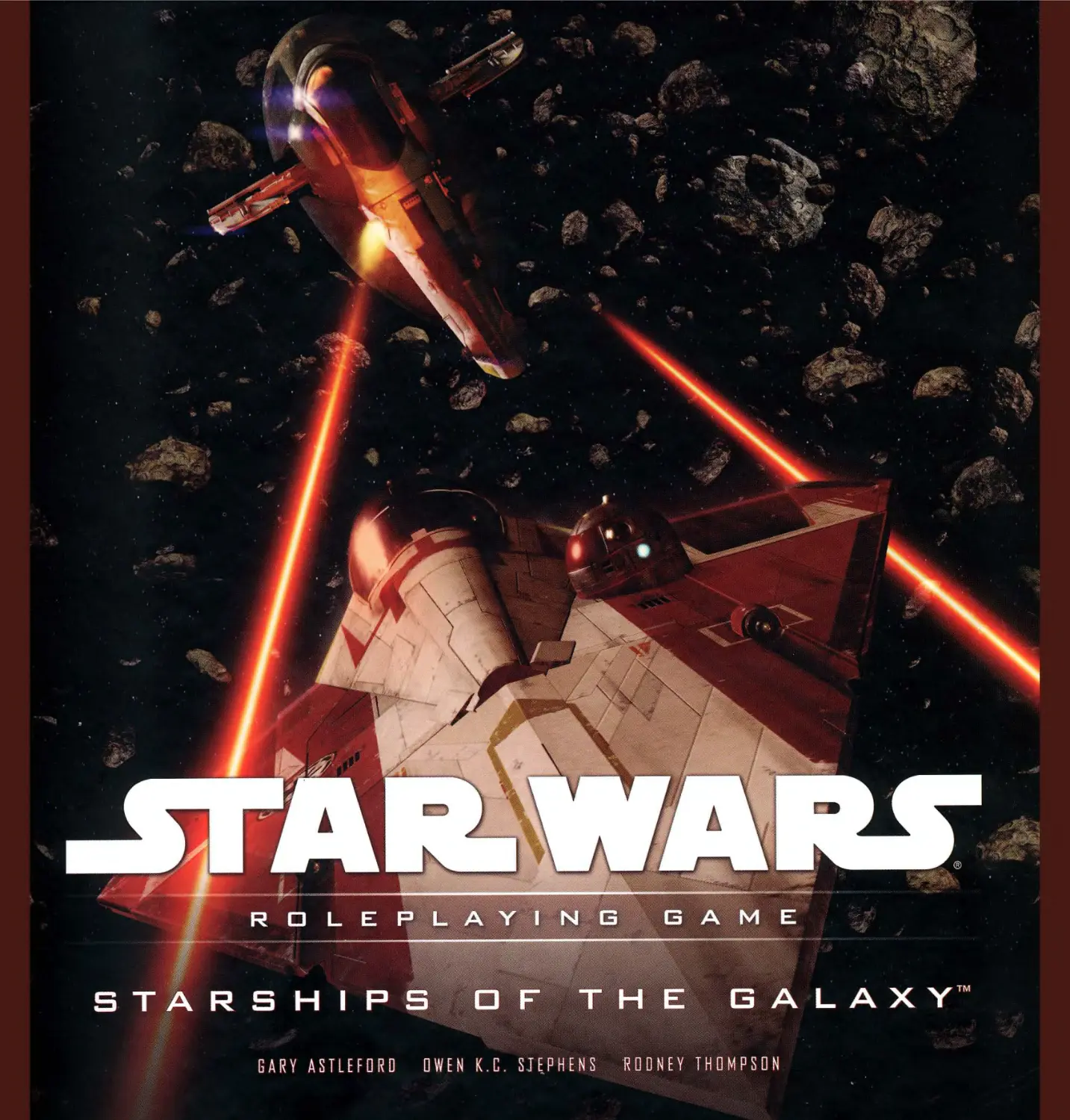


Author: Thompson R. Astleford G. Stephens O.K.C.
Tags: fantasy stories role-playing game
ISBN: 978-0-7869-4823-9
Year: 2007



Text
GARY ASTLEFORD, OWEN K.C. STEPHENS, RODNEY THOMPSON

Gary Astleford, Owen K.C. Stephens,
Rodney Thompson
PRODUCTION MANAGERS
Shari Overbay, Cynda Callaway
DEVELOPER
Rodney Thompson
ART DIRECTORS
Paul Hebron, Ryan Sansaver
COVER DESIGNER
Michael Martin
ADDITIONAL DEVELOPMENT
Stephen Radney-McFarland
draphic designers	Keven Smith, Michael Martin
editor	Gary M. Sarli
CARTOGRAPHER
Christopher West

LUCAS LICENSING
EDITORS
DESIGN MANAGER
Frank Parisi, Sue Rostoni
Christopher Perkins
GRAPHIC PRODUCTION
SPECIALIST
INTERIOR ARTISTS
Angelika Lokotz
Jeffrey Carlisle, Gonzalo Flores, Langdon Foss,
Tomas Giorello, Ron Lemen, Mark Tedin,
Francis Tsai, Christopher West
managing editor	Kim Mohan
imaging technician	Travis Adams
director of rpg r&d Bill Slavicsek
SPECIAL THANKS
Leland Chee
Some rules mechanics are based on the Star Wars Roleplaying Game Revised Core Rulebook by Bill Slavicsek, Andy Collins, and ID Wiker, the original Dungeons & Dragons® rules created by E. Gary Gygax and Dave Arneson, and the new Dungeons & Dragons game designed by
Jonathan Tweet, Monte Cook, Skip Williams, Richard Baker, and Peter Adkison.
This Wizards of the Coast game product contains no Open Game Content. No portion of this work may be reproduced in any form without written permission. To learn more about the Open Gaming License and the d20 System™ License, please visit www.wizards.com/d20.
U.S., Canada. Asia,
Pacific, & Latin America
Wizards of the Coast, Inc.
P.O. Box 707
Renton. WA 98057-0707
Questions? 1-800-324-6496
GREAT BRITAIN
Hasbro UK Ltd
Caswell Way
Newport, Gwent NP9 OYH
GREAT BRITAIN
Please keep this address for your records
EUROPE
Wizards of the Coast. Belgium
’t Hofveld 6D
1702 Groot-Bijgaarden
Belgium
+32 2 467 3360
ISBN: 978-0-7869-4823-9
620-21714720-001-EN
987654321
FIRST PRINTING: DECEMBER 2007
WWW.WIZARDS.COM
WWW.STARWARS.COM
©2007 LUCASFILM LTD. & ® OR ™ WHERE INDICATED. ALL RIGHTS RESERVED.
USED UNDER AUTHORIZATION.
Dungeons & Dragons, d20 System. Wizards of the Coast, and their respective logos are trademarks of Wizards of the Coast in the U.S.A. and other countries. This material is protected under the copyright laws of the United States of America. Any reproduction or unauthorized use
of the material or artwork contained herein is prohibited without the express written permission of Wizards of the Coast, Inc. This product is a work of fiction. Any similarity to actual people, organizations, places, or events is purely coincidental. Printed in the U.S.A.
CONTENTS
INTRODUCTION . . . .
Lock S-Foils in Attack Position!.... 5
Get Everyone Involved...........6
Starship Specialists.............6
Starship Codex...................6
Make it Your Own.................6
Enhanced Encounters.............7
Updated Statistics...............7
CHGAPTERI: Starship
ADVENTURES. . . . S
Starship Basics.................9
Getting Your Own Starship.......9
Permits and Licenses...........10
Travel in Realspace............11
Travel in Hyperspace...........12
Communications.................13
Docking, Fuel, and Maintenance.. 14
Starship Talents...............15
Affecting Targets..............15
Specific Talents...............15
New Talents....................16
Force Talents..................16
Noble Talents..................16
Scoundrel Talents..............16
Ace Pilot Talents..............17
Officer Talents................18
Starship Skills................18
Deception......................18
Perception.....................18
Stealth........................18
Use Computer...................19
Starship Feats.................19
New Feats......................20
CHAPTER II: s та r s h i p
Comb at...............22
Starship Maneuvers............23
Learning New Maneuvers........23
Using Starship Maneuvers......24
Maneuver Descriptors..........24
Starship Maneuver Descriptions.. 24
Making Starship Encounters
Interesting...............30
Start Small...................31
Handling Large Battles...........31
But I’m Not a Pilot!.............32
Designing Starship
Combat Encounters...............32
Give Objectives Other than
Destruction...................33
Build Interesting Battlefields ... 33
Create Exciting Scenarios with
Complications...............35
Challenge Level Adjustments for
Starship Disparities.......35
CHAPTER III: Starship
MODIFICATIONS . .36
How to Use this Chapter..........37
Cost Modifiers...................38
A Note on Costs................38
Emplacement Points...............38
Gaining Emplacement Points... 38
Unused Emplacement Points ... 39
Nonstandard Modifications........39
Installation.....................39
Installation Work Force........39
Installation Time..............39
Installation Checks............40
Starship Systems.................40
Movement Systems...............40
Defense Systems................43
Weapon Systems.................44
Accessories....................48
Stock Ships......................53
CHAPTER IV: s та rship
CODEX...............5^-
Tactical Fire..................55
Focused Fire...................55
Acdamator-class Assault Ship.... 56
Acdamator-ll...................57
Action VI Transport.............58
Advanced Ship (Template)........59
Aethersprite Interceptor........60
ARC-170 Starfighter.............61
Archaic Ship (Template).........62
A-wing..........................63
Banking Clan Frigate............64
Baudo-dass Star Yacht...........65
B-wing..........................66
Carrack-dass Light Cruiser......68
Chiss Clawcraft.................69
Citadel-Class Cruiser...........70
CloakShape Fighter..............71
Commerce Guild Destroyer........72
Coralskipper....................73
Corvette, Corellian.............74
The CR70 Corvette...............75
Dreadnaught-dass Heavy Cruiser.. 76
The Outbound Flight Project.... 77
Droid Starfighters..............78
Dynamic-class Freighter.........80
Eta-2 Actis Interceptor.........82
E-wing..........................83
Firespray-31 Patrol Craft.......84
Original Prototypes.............85
Slave I.........................85
Geonosian Starfighter...........86
Ginivex-dass Starfighter........87
Ghtroc 720 Freighter............88
Gozanti Cruiser.................90
Krayt's Honor...................91
Gunship, Corellian..............92
Hapan Battle Dragon.............93
Hapes Nova Cruiser..............94
Imperial Assault Shuttle........95
Imperial Star Destroyer.........96
The Victory Il-class
Star Destroyer................98
The Pellaeon-dass
Star Destroyer................99
Interdictor Cruiser............100
Origin of the Vindicator........101
Imperial Customs Corvette.......102
J-Туре Star Skiff..............103
Junker (Template)..............104
K-wing.........................105
Lambda-class Shuttle............106
Lancer-dass Frigate............108
Mankvim-814 Light Interceptor.. 109
Marauder Corvette...............110
Medium Transport................111
Miy’til Fighter/Bombers.........112
Miy’til Assault Bomber..........113
Mon Calamari MC80 Cruiser.... 114
Home One........................115
Mon Calamari Star Defender.... 116
Naboo Royal N-1 Starfighter.... 118
Nebula-dass Star Destroyer.....119
Nebulon-B Frigate.............120
P-38 Starfighter..............121
Predator-dass Starfighter......122
Prototype (Template)...........123
Rebel Assault Frigate Mk I.....124
Rebel Assault Frigate Mkll .... 125
Republic Cruiser..............126
Scimitar Assault Bomber........127
Sith Infiltrator..............128
Sith Interceptor..............130
Skipray Blastboat.............131
SoroSuub Patrol Fighter........132
Star Galleon-dass Frigate......133
StarViper (Virago)............134
Strike-class Medium Cruiser.... 135
Super Star Destroyer..........136
Executor......................137
Lusankya......................138
Eclipse.......................138
System Patrol Craft...........140
Capabilities..................140
Theta-class Shuttle...........141
TIE Fighter...................142
TIE Bomber....................142
TIE Interceptor...............143
TIE Advanced..................144
TIE Defender..................145
Trade Federation Battleship....146
The Core Ship.................147
Venator-dass Star Destroyer.... 148
V-19 Torrent Starfighter.......149
V-wing Starfighter............150
X-83 TwinTail Starfighter......151
X-wing........................152
T-65XJ3.......................152
T-65BR........................153
YT-Series Transports..........154
YT-2000 ..................... 154
YT-2400 ..................... 155
Millennium Falcon.............156
Y-wing........................158
Y-wing Longprobe..............159
Y-wing Courier................159
Z-95 Headhunter...............160
coNTENT-g	©(p>	®
INTRODUCTION!
I The cold stillness of space is shattered by the chaos of dozens of turbolasers
discharging at once. An Imperial Star Destroyer fires broadsides at a Nebulon-
B frigate, the two passing one another in opposite directions like oceangoing
I ships passing in the night. In between exchanges of heavy weapons fire, a trio
of TIE fighters twists between glowing laser blasts while two X-wing fight-
ers mimic their movements, swirling around in a deadly dance. A Corellian
f Corvette, leaking atmosphere and listing heavily, slams into the bridge of the
Star Destroyer, setting off a chain reaction that destroys both vessels.
Sound exciting? It does. Want it in your Star Wars campaign? You
should.
That is what Starships of the Galaxy is all about. This book is designed to
give Gamemasters and players everything they need to inject space combat,
on both small and large scales, into any Star Wars Roleplaying Game cam-
paign. This book contains new options for heroes looking to make their mark
on the galaxy from the cockpit of a starfighter and features information for
Gamemasters to help make this happen. Whether you are simply looking for
some new ships to throw into the mix or want to make space combat a larger
part of your campaign, this book provides everything you need to enhance
your Star Wars starship-based experience.
Lock S-F*au_s iim
Attack Position!
The contents of this book are intended to allow players and Gamemasters to
inject starship combat into an ongoing campaign. The Star Wars Roleplaying
Game Saga Edition core rulebook presents basic rules for space combat that
mimic the rules for character combat and provide a quick and easy way to
rate starship combat into the game. Although those rules are perfectly
for most encounters, some players and GMs may wish to include more
and diversity in their space combat. Likewise, Gamemasters who
to run a campaign that focuses on a starfighter squadron will likely
need more robust rules for space combat and more options for enemies,
allowing them to create diverse encounters in starships just as they would
at character scale.
This book was designed as a campaign supplement that expands starship
combat to be more than just the occasional chase scene in which the heroes
escape from TIE fighters without engaging in serious combat. By using the
options in this book, a Gamemaster can shift the focus in a campaign to
starship combat or simply expand existing space combat encounters to make
them more exciting. Though adding options from this book will likely add
complexity to your game, the new mechanics presented here will expand
and enhance your spacefaring adventures.
INTRODUCTION	STARSHIPS OF THE OALAXY
Introduction В I	(s)^ <тгаС=0@ ®
Although many of the rules in this book can be used for vehicles on the
ground (or even in the air), most of the book focuses on starships operating
in space. Starship statistics still contain atmospheric movement speeds (fol-
lowing the standard format established in the core rulebook), but the new
mechanics are mostly geared toward starship combat.
Get Everyone Involved
In the past, one of the more common drawbacks to starship combat was that
it left many players sitting and waiting for the encounter to end due to their
lack of starship-relevant skills. Even when participating, many characters
found their options limited by their roles aboard the ship. One of the primary
goals of Starship of the Galaxy is to make starship combat more accessible
to characters of all roles and archetypes. For example, the noble will find
information on using her talents for inspiration and leadership in starship
combat, while the scoundrel will be able to disrupt and damage his opponents
just like he does in character-scale combat. Starships of the Galaxy should
encourage all players-not just pilots and gunners-to get involved and use
their special abilities in space combat scenes.
Moreover, this book presents a variety of new options for the core classes
and relevant prestige classes (such as the ace pilot and the officer). Members
of each class will find new talents (and even new talent trees), some new
uses for skills, and some new feats that will round out their characters. The
goal of these new abilities is to get each character more involved in space
combat. The Saga Edition rules set goes a long way toward encouraging this
behavior; even characters untrained in the Pilot skill have some capacity to
pilot a ship, and their ability to make attacks with vehicle weapons is equally
enhanced by many of the same talents and feats that affect normal ranged
attacks. Essentially, any character’s basic abilities make that character
capable of participating in space combat in one way or another.
Starship Specialists
One of the best uses for this book, as mentioned above, is enabling char-
acters to take full advantage of the new starship combat rules presented
here. These new options range from the aforementioned talents and feats
to an entirely new space combat maneuvers system. Similar in design to the
Force system from the Saga Edition core rulebook, this maneuvers system
turns starship combat into more than just a matter of moving and shooting.
With the expanded system presented in this book, starship combat becomes
a more tactical affair for some characters, letting them do incredible things
when behind a flight stick.
Fortunately for heroes not piloting the ship, there are plenty of new
options in this book as well. Engineers and other technically inclined char-
acters will find a number of new rules in this book that should make it easier
for them to jump in and participate in space combat. Similarly, many of
the starship maneuvers can be used by gunners as well as pilots, allowing
weapons operators to take advantage of special bonuses and abilities just
as pilots might. With this book in hand, you won’t have to be an ace pilot
just to be effective at starship combat, encouraging all character types to
take part in space combat encounters.
Starship Codex
Though the new character options certainly make starship combat more
appealing, the bulk of this book is dedicated to presenting statistics and
information for a wide variety of starships, ranging from small starfighters
to massive capital ships and space stations. Players might be tempted to view
this book as a catalog of potential purchases, and as heroes rise in stature
and wealth, many new options (including those available in this book) become
open to them. The Starship Codex (Chapter 4) also serves Gamemasters as
a collection of challenges just waiting to be thrown at the heroes. Whether
you are looking for a new personal starfighter or the perfect ship to add to
an admiral's fleet, that chapter should have you covered.
The Starship Codex presents ships of all types and sizes, drawn from the
full breadth of the Star Wars saga and Expanded Universe of comics, novels,
and video games. The majority of the statistics in this book are for the stock,
unmodified versions of these ships, making it easier for players to obtain
these ships and make them their own. For example, rather than presenting
statistics for the Ebon Hawk (from the Knights of the Old Republic video
game series), this chapter contains statistics for the stock version of this
ship (the Dynamic-c\ass freighter), which players can then modify to their
own tastes. In some cases, statistics are presented for ’’famous" versions
of these ships, but each one also contains the stock statistics for the vessel
without modifications.
Make it Your Own
Starships of the Galaxy presents a complete guide to modifying your starship
to make it the way you want it. Han Solo’s famous line about having made
a few "special modifications" to the Millennium Falcon comes to life in the
form of the starship modification rules. Want to put a new engine in your
freighter? Want to upgrade the laser cannons on your X-wing? Want to give
that old Corellian Corvette some new hull plating? Now you can, and it's not
just a matter of paying someone else to do it. Techie characters will enjoy
getting their hands dirty and making the modifications themselves, using
new abilities to enhance the modifications.
The starship modification rules can also be used to build a starship from
scratch. Though doing this is far more time-consuming than heroes simply
purchasing a new starship and enhancing it to fit their needs, these rules
allow you to take a standard, base model of ship and add each component
individually to come up with a custom spacecraft. Though most good outlaw
techs will prefer the tinkering and reworking of a starship that the modifica-
tion rules provide, a noble seeking her own custom space transport might
use these rules to order a ship directly from the factory, giving her a ship
that is unlike any other vessel in the galaxy.
Additionally, some of the ships in this book are presented with deckplans
suited for use by adventuring heroes. These deckplans allow players and
Gamemasters to create interesting adventures aboard the starship itself; after
all, you never know when you're going to need to repel boarders or ambush
stormtroopers after hiding in your own smuggling compartments.
Enhanced Encounters
Gamemasters will find this book exceptionally useful for designing starship
combat encounters. One of the primary goals of this book is to help make
space combat just as exciting, dynamic, and engaging as character combat.
One of the means by which this is accomplished is in helping Gamemasters
design interesting encounters. An encounter's design is critical to holding
the players' interest, and the advice and options in this book should make it
easy for Gamemasters to come up with encounters that are more interest-
ing than simply shooting at enemy ships from a distance. Additionally, the
information in this book should make it easier for the Gamemaster to keep
all members of the party-not just the pilot and gunners-engaged and
interested in space combat encounters.
Good space combat encounter design involves more than just populating
the battlefield with interesting enemies. Chapter 2 of this book provides new
options for space combat terrain (such as debris fields and gaseous nebulae)
and helps Gamemasters introduce complications and other new factors into
combat to increase tension or provide a sense of urgency. Gamemasters who
take full advantage of this book should be able to create starship combat
encounters that not only challenge their players but also create memorable
battles like those seen in the Star Wars films.
Updated Statistics
This book features a number of updated and expanded statistics for ships
appearing in the Star Wars Roleplaying Game Saga Edition core rulebook. In
some cases, the statistics in this book are different from those featured in
the core rulebook, having been changed due to new rules presented in this
book or to improve game play. Although the statistics in the core rulebook
will still work for your game, those found in this book should supersede the
ones from the core rulebook in most cases. However, since no two starships
of the same model need to be identical, Gamemasters should feel free to use
statistics from both books to provide variety in game play.


Chapter i
IP ADVENTURES
IK.

The very title of the Star Wars setting makes it clear-most adventures are
going to take place at least partially in space. Whether they're running past
an enemy blockade of a planet, escaping Star Destroyers through an asteroid
field, or fighting epic space battles to decide the fate of the galaxy, Star Wars
heroes are going to end up in space. This chapter provides advice on adding
starship-scale encounters to a game and rules for heroes to go beyond being
part-time pilots and fighter jockeys.
Starship Basics
This section covers some of the basics of starships and space travel, giving
players and Gamemasters a sense of how space travel and starships work in
the Star Wars universe. Gamemasters should feel free to use as much or as
little of this material as they like; though this section includes information
on established protocols and traditions of the Star Wars universe, none of
these features are so integral to the central themes of Star Wars that they
cannot be ignored if so desired.
Many adventuring parties might see fit merely to obtain passage on a hired
vessel as a part of their adventures, and that's perfectly fine. Others will
want to obtain their own ships as soon as possible, which usually means at
the time of character creation. Although nobles with the Wealth talent will
quickly build up enough credits to buy a used freighter, there are several other
ways for players to obtain a ship within the first few sessions of a campaign,
provided the Gamemaster agrees to one or more of the following options.
Chapter
Joining an Organization
Large organizations, such as the Rebel Alliance or the Judicial Department
of the Republic Senate, can make starships available to heroes who work
for them. The organization still owns the starship and can take it back if
the heroes refuse a mission or violate the organization’s rules; however, at
the Gamemaster's discretion, the heroes might have the option to buy their
starship from the organization when they accumulate enough funds.
Wealthy Benefactors
Serving a wealthy individual might allow the heroes to have access to a
starship. Convincing a noble to sponsor your group's endeavors might be
difficult (typical Will Defense 20, must achieve attitude of helpful), but the
result is usually a mutually beneficial relationship that can last an entire
campaign. In exchange for a cash advance to buy a starship, the noble asks
the heroes to perform tasks until they repay the loan (generally devoting
about 1/2 the normal adventure rewards for this purpose). This situation
can lead to a variety of adventure hooks: Perhaps the heroes need to escort
Record-kebpino v©.
Upkeep
The Saga Edition core rulebook gives basic costs for upkeep on a per-
month basis (see page 141). These costs can be applied to starships and
also serve as a simple way of keeping track of such expenses instead of
the more detailed methods described in this section. Generally, a star-
ship of Colossal or smaller size can be maintained in working condition
(including fuel, maintenance, docking, and astrogational updates) by any
character with at least comfortable upkeep (2,000 credits per month)
instead of maintaining a residence. If you don't own your ship and still
make payments for it, the minimum upkeep required is wealthy (5,000
credits per month) for at least five years.
Similarly, the licensing and registration for a starship can be
abstracted by the normal rules for purchasing a restricted item, assum-
ing that any black market purchase also includes appropriate forged
documents.
a Senator to a dangerous planet, or they need to deliver precious cargo
to refugees deep behind enemy lines at the behest of their benefactor.
Legitimate Financing
As a general rule, legitimate financing (such as through a bank) is available
with a down payment of 20% of the starship's cost, with monthly payments
equal to 2% of the starship’s cost for the next five years. You can make
a Persuasion check to haggle and reduce the size of the down payment,
treating the loan officer as indifferent (unfriendly for characters who have
a criminal record).
Loan Sharks and Gangsters
Less appealing but much more interesting is the option of seeking out a loan
shark and obtaining an under-the-table loan. Repayment terms are steep
(usually at least 10% of the ship's value every month for three years), and
missed payments can result in interest rates so high that the loan can never
be repaid. If the heroes don't pay off the loan shark quickly enough, he might
decide to send his thugs to rough up the heroes-or worse.
Shipjacking and Theft
A third option for obtaining a vessel is to steal one from a legitimate owner,
either before the campaign begins or as the objective of the heroes' first
adventure. Shipjacking is an old profession in the Star Wars setting, and it
is extremely dangerous. The authorities (and the original owners) are con-
stantly on the lookout for stolen starships, and if the heroes fail to properly
falsify the documentation that identifies the ship as theirs, they could find
themselves the subjects of a rather uncomfortable investigation.
Permits aisio Licenses
All starship owners and operators are required to have at least three different
pieces of registration aboard their ships at all times, each of which is obtained
through the Bureau of Ships and Services, or BoSS (see sidebar).
•	Captain's Accredited License: Certifies that the captain is capable of
piloting and operating the starship. Cost:200 credits. Requirements: DC
15 Pilot check, 10 years of starship experience (any character who takes
the Spacehound talent at 1st character level automatically qualifies);
experience requirement can be waived for additional "expediter fee" of
300 credits. Time: 1 day.
•	Ship's Operating License: Tracks the ship's make, manufacturer, port of
origin, transponder codes, and owner. Cost: 1,000 credits. Requirements:
captain's accredited license, ship must pass inspection (all systems func-
tioning, no escape pods missing, no illegal modifications, functioning
transponder code), DC 10 Knowledge (bureaucracy) check. Time: 1 day.
•	Arms Load-Out Permit: Registers the ship's weapons. Cost: By weapon
availability (see page 118, Saga Edition core rulebook). Requirements:cap-
tain's accredited license, ship's operating license, Knowledge (bureaucracy)
check (DC varies by weapon availability). Time: By weapon availability.
Though these registrations are required by law, many starship captains
operating on the fringes of society forge these documents to hide the ship’s
true identity (or their own). Forging BoSS documents requires a Deception
check, counting as both a deceptive appearance (to produce a BoSS-secure
datapad that seems authentic) and deceptive information (to create plausible
ship records). However, such forgeries won't appear in the BoSS computer
system, so they will not survive close scrutiny.
Transponder Codes
Every starship has a transponder code, a unique signal that allows that ship
to be distinguished from any other. If you look up a specific transponder
Used Starshirs
Owning and operating a used starship can be a risky business. Though
used starships are cheaper and easier to get hold of, they often develop
their own unique quirks that prevent them from operating at full
capacity. Whenever a used starship moves -3 steps on the condition
track (to the point where the vessel is taking a -5 penalty on attack
rolls, skill and ability checks, and defenses) or lower, the used ship's
condition becomes persistent. Until the ship receives repairs (using the
repair object application of the Mechanics skill), it cannot move up the
condition track by means of the reroute power action (although other
means, such as jury-rigging, can still be used).
The Bureau of Ships and
Services (Boss)
One of the oldest and most eccentric organizations in the galaxy, the
Bureau of Ships and Services is the galactic agency responsible for
managing the data related to the massive number of starships flying
through the galaxy at any time. An independent organization main-
taining neutrality in all galactic conflicts, the BoSS has survived for
thousands of years, continuing to compile starship data in its arcane
record-keeping system.
Information on a ship’s licenses, certifications, and transponder codes
is kept on file at the BoSS at all times. This data is distributed to local
spaceports upon request, but it is very expensive; as a result, most small
spaceports (such as Mos Eisley) purchase an update only once or twice
a year, making such locales a natural haven for smugglers, pirates, and
others who would like to outrun their criminal records.
The security on BoSS computer systems is very tight (Will Defense
25, hostile), making it almost impossible to add, edit, or remove records
in the BoSS database without the proper access codes.
code in a BoSS database, you can find the ship's name, type, modifications
and armament, owner, and even history (including the time of its arrival and
departure from every legitimate spaceport in the galaxy).
A ship's transponder code is built into the ship's sublight engines, so any
attempt to remove or alter the code can fuse the wiring and destroy the
engine. Some smugglers and pirates have been known to mask their tran-
sponder signal to preserve anonymity, but most governments will attempt
to capture or destroy such a ship immediately. Instead, many criminals and
others operating outside the law will tamper with their transponders to
broadcast false transponder codes. Though highly illegal, altering a tran-
sponder code will allow a ship to identify itself by another name. (See page
53 for details on altering transponder codes.)
IFF Transponders: Military ships also broadcast a unique transponder
code that identifies the ship by its type, designation, and allegiance. These
Identify Friend/Foe (IFF) transponders are separate from the transponders
built into starship engines, and they are not included on civilian starships.
Travel in Realspace
All starships have sublight drives to propel them through space, using them
when taking off, landing, or flying within a star system. Starships also have
ion drives capable of incredible acceleration (thousands of times the force
of gravity) due to a combination of exceptional thrust and manipulation of
the starship's mass relative to that of its exhaust. In addition, repulsorlift
drives are preferred for delicate maneuvering during takeoff and landing;
in fact, the mass manipulation that makes ion drives so efficient in deep
space is markedly less efficient in atmosphere, so almost all starships use
both drives in conjunction during atmospheric flight, particularly when near
the surface of a planet.
You can use the following guidelines to determine travel time in realspace
for an average starship:
DISTANCE
Surface of planet to orbit
Orbit to safe hyperspace jump distance
Planetary orbit to planet's moon
Planetary orbit to another planet in same system
Planetary orbit to outer edge of system
TIME REQUIRED
1-5 minutes
1 minute
10-30 minutes
2-6 hours
12-24 hours

CHAPTER I I
Travel ini Hyperspace
The only way to span the long distances between star systems is to travel
through hyperspace. Hyperspace is described by many scientists as another
dimension, though its true nature is still a mystery. When a starship’s
hyperdrive activates, the vessel accelerates well beyond the speed of light
as it enters hyperspace. A starship in hyperspace is effectively cut off from
communication with starships in realspace. For the duration of a trip through
hyperspace, a starship effectively does not exist in realspace.
Large objects that generate substantial gravity, such as stars and planets,
produce what is known as a "mass shadow" that projects into the realm of
hyperspace, and one of these mass shadows can destroy a starship that
collides with it. As a result, a starship's course through hyperspace must
be plotted carefully. All hyperdrives have built-in safeguards that prevent a
ship from entering hyperspace too close to a mass shadow and cause a ship
to revert to realspace if a mass shadow is detected in time. Ultimately, this
situation led to the rise of interdictor vessels and other technologies designed
to keep ships from fleeing into hyperspace. Interdiction vessels use gravity
well generators to keep other ships from activating their hyperdrives, and
some pirates have been known to drag massive asteroids into well-traveled
hyperspace lanes in order to bring prey out of hyperspace.
Detecting Hyperspace Travel
When a starship enters or exits hyperspace, it produces a short burst of
Cronau radiation. Any starship, station, or sensor array within the same star
system can detect a Cronau radiation burst with a DC 25 Use Computer check
made as a reaction. Success indicates that the sensor operator detects the
ship entering or exiting hyperspace, and is aware of its point of arrival or
departure. Tracking a ship through hyperspace also relies on the presence
of residual Cronau radiation. Taking a full-round action to make a DC 25
Use Computer check measures the amount of Cronau radiation as well as
the angle of departure of the vessel fleeing into hyperspace, indicating the
most likely destination. Cronau radiation lingers for several hours after a ship
has fled into hyperspace, though each hour since the ship made the jump to
lightspeed increases the DC of the Use Computer check by 5.
□therspace
An extradimensional space accessible only through hyperspace, other-
space is a strange and alien dimension populated by a race known as
the Charon. Consisting of a storm-gray backdrop with pinpoints of black
representing stars, otherspace is a strange place that only a very few
travelers have visited. Hyperdrive malfunctions have been responsible
for shunting starships into otherspace, which scientists believe exists
parallel to the normal universe. Finding a way home from this alien
dimension is an adventure all its own....
- kW.
Astrogation
Plotting a suitable hyperspace course requires incredibly difficult calculations;
normally, only a character trained in the Use Computer skill can calculate a
jump to hyperspace. However, the use of a navicomputer (see page 42) not
only grants a bonus on the Use Computer check but also allows an untrained
character to plot a course to hyperspace. Some small starfighters, having no
room for a navicomputer, instead use astromech droids programmed with a
finite number of jumps to provide a hyperspace course.
The difficulty of plotting a course through hyperspace is determined
by how recently you have updated your astrogation data, as shown on the
table below.
DC	AGE OF ASTROGATION DATA
10	Less than 1 day
15 At least 1 day but less than 1 standard week (5 days)
20	At least 1 week but less than 1 standard month (35 days)
25	At least 1 month but less than 1 standard year (368 days)
30 At least 1 year old
You can acquire astrogation data in several different ways.
Using Your Own Data: If you use your own data, the age of the data is
determined by the last time you finished a journey between the two planets
in question.
The Space Ministry: This organization (called the Imperial Space Ministry
during the days of the Galactic Empire) is a bureaucracy whose influence is
felt all across the galaxy. It disseminates hyperspace travel information and
enforces the laws and regulations of the space lanes. Responsible for provid-
ing spacers with the 5,947-datapage Spacers' Information Manual (a compi-
lation of the latest laws, regulations, addenda, and other red tape; available
to all pilots when renewing their certifications for a mere 25 credits), the
Space Ministry is the keeper of the law in the space lanes, and it provides
local spaceports with up-to-date hyperspace navigational data.
A starship can download the latest Ministry-provided astrogational updates
either directly through the HoloNet (prior to the Clone Wars) or from spaceport
control (any era); this service costs 150 credits and requires a current captain's
accredited license and ship's operating license (see Permits and Licenses, page
10). Generally, data for the Outer Rim is less than 1 month old, data for other
regions is less than 1 week old, and data for major hyperlanes or routes within
the same sector (Gamemaster's determination) is less than 1 day old. No data
is available for the Deep Core, Unknown Regions, Wild Space, classified instal-
lations, and any planet without a certified spaceport.
Those who operate outside the law can usually obtain the data with a
proper bribe (typically 300 credits with a DC 10 Gather Information check)
or by making a Use Computer check to access secret information in the
spaceport's computer (Will Defense 20, indifferent).
The Hyperspace Navigator's Guild: In the early days of the Old Repub-
lic, the Hyperspace Navigator’s Guild was responsible for maintaining the
charts and navigational records used for hyperspace travel. The Navigator's
Guild (based on the planet later known as Empress Teta) employed a variety
of scouts and pilots whose sole responsibility was to chart new and faster
hyperspace lanes, opening up new avenues to known worlds. Though the
need for the Navigator's Guild would eventually dwindle, during its time the
Guild was one of the most important institutions in the galaxy. Even in later
eras, the organization remains one of the best sources for new hyperspace
routes, particularly those in Wild Space and the Deep Core, and on the fringes
of the Unknown Regions.
Purchasing astrogation data for traveling between any two planets costs
500 credits. This data is less than 1 week old for most destinations and less
than 1 month old for destinations in Wild Space or the Deep Core. When
available, data for the Unknown Regions is usually less than 1 year old.
Hyperspace Hazards
Traveling through hyperspace can be exceptionally dangerous. If a starship
is disabled because of a poorly plotted hyperspace course (as described on
page 237 of the Saga Edition core rulebook), the Gamemaster usually chooses
the point at which the ship drops out of hyperspace at random. Gamemasters
looking for a more in-depth description of the hyperspace mishap can use
the table below to determine the exact result of a poorly plotted course.
Major Hyperlanes
Although literally thousands of local and regional hyperlanes exist in
the galaxy, a few major hyperlanes are familiar to virtually all space
travelers. These hyperlanes (as well as some notable planets, sectors,
and spurs on or near their paths) are given below.
Corellian Run: Coruscant, Coreilia, Nubia, Denon, Rhommamool,
Druckenwell, Tatooine, Geonosis, Ryloth, Rothana.
Corellian Trade Spine: Coreilia, Duro, Devaron, Bestine, Yag'Dhul,
Ison Trade Corridor (Bespin, Hoth, Anoat, Ison).
Hydian Way: Corporate Sector, Toprawa, Bandomeer, Taris, Bogden,
Brentaal, Rendili, Denon, Malastare, Eriadu.
Perlemian Trade Route: Coruscant, Anaxes, Corulag, Brentaal,
Carida, Nak Shimor, Taanab, Kulthis, Rhen Var, Vaynai, Макет Те,
Quermia.
Rimma Trade Route: Abregado-rae, Fondor, Ghorman, Thyferra,
Yag'Dhul, Vandelhelm, Sullust, Eriadu, Sluis Van, Clak'Dor VII, Coyn Route
(Elrood Sector), Minos Cluster, Kathol Sector.
Table 1-1:
Hyperspace Mishaps
D20 RESULT
1-5 Starship passes too close to a supernova, overloading internal
computer systems with solar radiation. Use Computer checks
aboard the starship take a -5 penalty until all persistent
conditions are removed.
6-10 Starship skirts the edge of a black hole, causing the intense gravity
to warp the vessel’s structural integrity. The starship's armor bonus
is reduced by -5 until all persistent conditions are removed.
11-15 Starship nearly collides with a massive gas giant, corroding the
ship's hull plating and causing the ship to take an additional 10%
of its total hit points in damage.
16-19 Starship flies through a superdense cluster of stars, the stress
of which causes the ship's hyperdrive to burn up. Starship's
hyperdrive is destroyed.
20 Reroll on the table above twice.
Communications
All starships are equipped with basic systems that allow for communica-
tion in realspace. Typically, starship communications systems are limited to
contacting ships and planets within the same star system, although subspace
radios can reach distances of up to several light-years. Opening a channel
to a willing recipient is a simple matter (covered under the new uses of the
Use Computer skill, page 19). Once a channel is open, the ships can com-
municate freely. Some starships, particularly capital ships, also boast video
and holographic communications systems that allow crewmembers on either
vessel to see one another.
HoloNet
The HoloNet is an instantaneous communication system that allows planets
to stay in contact despite the vast distances between systems. A HoloNet
transceiver transmits and receives information through hyperspace, allowing
the communications to travel millions of times faster than the speed of light
across vast distances. Countless hyperwave transceivers (simple satellites
equipped with a variety of communications gear) are embedded in hyperspace
and transmit signals from one side of the galaxy to the other. This network
allows for instantaneous, three-dimensional holographic communication at
virtually any distance, making it one of the primary means of communication
for space fleets and planetary governments. During the Clone Wars and the
reign of the Empire, the HoloNet is reserved for military use only, and news
must be transmitted between worlds by other means (such as subspace radio
Table 1-2:
System oamaoe
D20	RESULT*
1-10	No system damage
11-15	Starship becomes "used" (see sidebar,	page	10)
16	Communications/sensors destroyed
17	Weapons destroyed
18	Hyperdrive destroyed
19	Sublight engines destroyed
20	Life support destroyed; 2d12 hours of	life	support remaining
*lf a result is not applicable (for example, a used starship cannot become
"more used"), roll twice and apply both results.
CHAPTER I I I
relays). However, some slicers are able to connect to HoloNet satellites and
broadcast pirate signals across the network, gaining access to its information
and enabling clandestine transmissions. A HoloNet node's security is difficult
to penetrate, however (Will Defense 20, hostile).
Most smaller military vessels have hypertransceivers, allowing access
to the HoloNet and instantaneous communication over great distances but
lacking the bandwidth and range of a HoloNet transceiver.
METOSP (Message to Spacers)
Upon arrival in a star system, most starships immediately connect to the
communications frequency responsible for broadcasting the prerecorded
Message to Spacers, abbreviated METOSP. A METOSP might be as simple as
a welcome message, but it usually informs incoming ships about flight haz-
ards (blockades, dangerous weather, debris, collisions) and local regulations
or customs that could be relevant (embargoes, tariffs, landing procedures).
All METOSPs are broadcast in Basic, though many worlds also broadcast
in native languages and common languages such as Воссе, Huttese, and
Binary. A METOSP provides star pilots with contact information for space-
port control and often includes information on landing patterns and space
traffic lanes. Most METOSPs are brief, and if more information needs to be
communicated on a particular subject, the METOSP will refer listeners to
other broadcast channels.
Planetary Information Channels
Most planets also provide incoming space traffic with basic computer com-
munications channels. These channels connect the ship to planetary infor-
mation networks that provide everything from communications directory
assistance to tourism information and planetary maps. Planetary information
channels allow you to make Use Computer checks to access information (per
the normal use of the skill) relevant to that planet, and it is possible for a
slicer to access other functions (Will Defense 20, indifferent).
Dqckind, Fuel, ano
Maintenance
All starships require refueling, restocking, routine maintenance, and a place
to dock where they can get these services.
Docking Fees
Docking fees vary substantially from planet to planet, but they average
around 20 credits per day in an average spaceport. Long-term storage is
also available in some locations (200 credits per month). It generally requires
about eight hours to get a ship out of storage and ready for flight.
Refueling and Restocking
All ships must have fuel to operate; a ship without fuel is adrift and immobile,
effectively disabled. In general, most starships refuel each time they put into
port, and during refueling other essential ship consumables (such as water
and oxygen) are restocked as well.
Refueling: For a starship of Colossal or smaller size, refilling one day's
worth of fuel (approximately 1 kg of fuel) costs about 50 credits. Larger
starships are substantially more expensive: Multiply the cost by 100 for every
size category above Colossal. A starship uses this much fuel after one day
of flight in realspace or hyperspace, after one hour of flight in atmosphere
or combat, or in a single jump to lightspeed.
Restocking: Consumables cost about 10 credits x the number of living
creatures on board x days of operation.
Routine Maintenance
After twenty hyperspace jumps, a starship needs to undergo routine main-
tenance. Routine maintenance includes a thorough check of essential ship
systems (including the backup hyperdrive and escape pods), replacing coolant
and other ship fluids, and a complete scrubbing of air filters and recycling
systems. Routine maintenance costs the same as about four days of fuel (200
credits for a ship of Colossal or lesser size). If a ship does not receive routine
maintenance after twenty hyperspace jumps, roll twice when checking for
system damage (see below).
System Damage
Some Gamemasters might wish to introduce complications when a ship
is disabled from taking damage. Whenever a starship is disabled by being
reduced to 0 hit points, the ship has a chance of sustaining system damage
requiring emergency repairs. Roll d20 and refer to Table 1-2; if a system
is destroyed, it must be replaced (which can typically be done only at a
spaceport or dry dock).
Starship Talents
As a general rule, talents apply to starship-scale combat in the same way
they apply to character-scale combat. Guidelines on how to determine line
of sight in starship scale and how specific talents function on that scale
are given below.
No talents relating to melee combat are relevant at starship scale. Even if
you ram or collide with an enemy ship, having melee-related talents doesn't
give you any advantage. (You can of course use melee-related feats normally
if engaging in melee combat at character scale while on a starship.) Ranged
talents that add to damage do so before any multiplier from the weapon is
applied. For example, a TIE fighter pilot with Weapon Specialization (heavy
weapons) firing his laser cannons deals 4d10+2x2 points of damage on a
successful hit.
Unless a talent specifically says it affects the hit point total or condition
track of starships, it doesn't. Many such talents can still be used against
specific characters, such as enemy pilots, under the right circumstances
(see below).
AFFECTING TARGETS
In many cases, talents work only on creatures able to see, hear, and under-
stand you, orthose to which you have line of sight. However, it is possible to
use communications equipment on board vehicles to meet these conditions, if
both sides involved are willing and have access to basic communications gear.
You can make a Use Computer check (see page 19) to be in communication
with a character so long as you and a willing target have either two-way
video/holo communication or both two-way audio communication and IFF
transponders using the same "friend" encryption code. Of course, you might
find yourself the victim of communications jamming, making it impossible
to get through to other vessels.
Unless otherwise noted, a talent's requirements can be satisfied under
the following circumstances.
Target Must See, Hear, and Understand You (commander or system
operator): This can be established by being in communication with the target
or targets, but the target must still be able to understand your language.
Mind-Affecting Effect (commander or system operator): To use
a mind-affecting effect while on board a vehicle, you must be in com-
munication with any target that is not on board the same vehicle. A
mind-affecting effect can affect only living targets (such as the crew of
a starship), not nonliving targets (such as the starship itself or a droid-
operated vehicle).
Line of Sight (commander, gunner, or system operator): If you are using
a talent that can target a starship, you are considered to have line of sight so
long as you are your vehicle's commander or systems operator and you have
line of sight between your vehicle and the target vehicle. In addition, you
have line of sight to any target with which you are in communication.
Specific Talents
Some talents might be exceptions to the rules outlined above or otherwise
work in a unique way when used against a vehicle. These talents are dis-
cussed below.
Jedi Talents
Adept Negotiator/Master Negotiator: You affect the condition track of
a specific character (usually the vehicle's commander), not a starship.
Battle Meditation: This affects all allied gunners within 6 squares at
starship scale.
Force Haze: You may use this talent to hide a single vehicle while you
are on board. The vehicle can’t have a size penalty to Reflex Defense, Ini-
tiative, or Pilot checks greater than your heroic level. Thus, a Gargantuan
starship (size penalty of -5) can be hidden only by a character of 5th level
or higher.
Force Intuition: You may use this talent to determine the Initiative of a
starship if you are the pilot.
Noble Talents
Demand Surrender: Unlike other mind-affecting effects, you need
only to hail a vehicle to demand surrender. You can demand surrender
of a vehicle that has been reduced to one-half or fewer of its hit points,
even if the crew is uninjured. You make your check against the vehicle's
commander; all nonunique crews are assumed to have a Will Defense of
10. If the CL of the target vehicle is greater than your heroic level or the
CL of your vehicle, the target gains a +5 bonus to its Will Defense. You
can't use this talent to demand surrender from a vehicle that is more than
one size larger than yours under any circumstances-Star Destroyers don't
surrender to X-wings.
Rally: Unlike other mind-affecting talents, Rally affects both allied vehicles
and characters with less than half their hit points. The vehicle gainsa +2 bonus
to its Reflex Defense, all crewmembers gain a +2 bonus to their Will Defense
so long as they are on board, and all gunners gain a +2 bonus on damage
with vehicle weapons (before multiplier, if any). Any crewmember who has
less than half its hit points also gains the normal benefits of this talent even
if it leaves the vehicle, but note that these bonuses do not stack.
Weaken Resolve/lmproved Weaken Resolve: Unlike with other mind-
affecting effects, you need only to hail a vehicle to weaken the crew's resolve.
When you deal damage that equals or exceeds a vehicle's damage threshold,
you may use this talent; in addition, you may ready an action to use this
talent after any gunner on your vehicle deals damage that equals or exceeds
a vehicle's damage threshold. You make your check against the vehicle’s
commander; all nonunique crews are assumed to have a Will Defense of 10.
The effect is automatically negated if the target vehicle's Challenge Level is
greater than your heroic level or your vehicle's Challenge Level.

Scoundrel Talents
Dastardly Strike: This talent can be used only against characters, not
objects or vehicles.
Fool’s Luck: If you use this talent to grant yourself a luck bonus to your
defenses, this bonus also applies to the defenses of any vehicle you are on
(even if you are not the pilot).
Skirmisher: You gain the benefits of this talent with vehicle weapons
only if you are the vehicle's pilot.
Stellar Warrior: This talent works with both vehicle weapons and per-
sonal weapons used aboard a starship.
Walk the Line: This talent has a range of 6 squares at starship scale.
Scout Talents
Acute Senses: This talent applies to Use Computer checks made to
perceive enemy ships (see Starship Skills, page 18).
Evasion/Uncanny Dodge: If you are the pilot, this talent applies to your
vehicle.
Hidden Movement/lmproved Stealth: These talents apply to Stealth
checks made while piloting a starship (see Starship Skills, page 18).
Soldier Talents
Battle Analysis: If you succeed at both a DC 15 Knowledge (tactics) check
and a DC 15 Use Computer check, you may use this talent to determine what
vehicles are reduced to at least half their maximum hit points.
Devastating Attack/Penetrating Attack/Weapon Specialization: If
you select heavy weapons as the weapon group these talents apply to, you
may use the talents with vehicle weapon attacks.
Draw Fire/Harm’s Way: If you are the pilot of a vehicle, you may use
this talent to protect allied vehicles. You may use it to protect vehicles no
more than one size category larger than your own.
Indomitable: This talent does not affect the condition track of a
vehicle.
Bounty Hunter Talents
Hunter's Mark: This talent can be used only against characters, not
objects or vehicles.
Gunslinger Talents
Debilitating Shot: This talent can be used only against characters, not
objects or vehicles.
New Talents
The following new talents are particularly useful to characters involved in a
great deal of starship activity.
force Talents
The following new talent is intended for use by any character who has the
Force Sensitivity feat.
Sense Talent Tree
The following new talent is intended for use as a part of the Sense talent
tree.
Force Reflexes: When activating a starship maneuver, you may spend a
Force Point to reroll your Pilot check, keeping the better result.
See Chapter 2 for more information on starship maneuvers.
Prerequisites: Force Sensitivity, Starship Tactics, Force Pilot.
Noble Talents
The following new talent is intended for use with the noble class.
Lineage Talent Tree
The following talent is intended for use as a part of the Lineage talent
tree.
Engineer: You are trained in the Mechanics skill. Additionally, when
installing new systems into a vehicle, the efficiency of your designs reduces
the time it takes to install the system by 25%.
Prerequisites: Educated, trained in the Knowledge (technology) skill.
Scoundrel Talents
The following new talent tree is intended for use with the scoundrel class.
Outlaw Tech Talent Tree
Scoundrels learn a variety of tricks that allow them to squeeze more life
out of ailing technology, enhancing their gear in ways the manufacturer
never intended.
Fast Repairs: Whenever you jury-rig an object or vehicle, the vehicle
gains a number of temporary hit points equal to the result of your Mechan-
ics check. Damage is subtracted from these temporary hit points first,
and temporary hit points go away at the conclusion of the encounter.
Prerequisites: Trained in the Mechanics skill.
Hot Wire: You can use your Mechanics check modifier instead of
your Use Computer check modifier when making Use Computer checks
to improve access to a computer system. You are considered trained
in the Use Computer skill for purposes of using this talent. If you are
entitled to a Use Computer check reroll, you may reroll your Mechanics
check instead (subject to the same circumstances and limitations).
Prerequisites: Trained in the Mechanics skill.
Quick Fix: Once per encounter, you may jury-rig an object or vehicle that
is not disabled. All normal benefits and penalties for jury-rigging still apply.
Prerequisites: Trained in the Mechanics skill.
Personalized Modifications: As a standard action, you may tweak the
settings, grips, and moving parts of a powered weapon you wield, tailoring
it to your needs. For the remainder of the encounter, you gain a +1 equip-
ment bonus on attack rolls and a +2 equipment bonus on damage rolls with
that weapon. You can use this talent only on powered weapons (those that
require a power cell to operate), including weapons connected to a larger
power source (such as vehicle and starship weapons).
Ace Pilot Talents
The following new talents and the Squadron Leader talent tree are intended
for use with the ace pilot prestige class.
Expert Pilot Talent Tree
The following talents are intended for use as a part of the Expert Pilot
talent tree.
Blind Spot: You can fly a vehicle you pilot so close to a target at least
two sizes larger than your vehicle that it is difficult for the target to avoid or
attack you. You must be adjacent to the target (at starship scale) to use this
talent. As a swift action, make an opposed Pilot check against the target. If
you succeed, you move into the same space as your target. You move with
your target if it moves (assuming your vehicle has sufficient speed to keep
up), and you must make another opposed Pilot check each round as a swift
action to stay in its blind spot.
As long as you stay in the target’s blind spot, any attack you make against
the target gains a +2 bonus, and the target takes a -2 penalty on attacks
made against you.
Close Scrape: Whenever you are piloting a vehicle of Colossal size or
smaller, you may make a Pilot check as a reaction to turn a critical hit into a
normal hit. The DC for the Pilot check is equal to the attack roll total of the
critical hit. If you are successful, the damage from the attack is not doubled
(though it is still considered an automatic hit).
Improved Attack Run: You do not have to move in a straight line when
using the attack run action.
Vehicle Focus: Choose a single type of vehicle from the following list:
airspeeder, capital ship, space transport, speeder, starfighter, or walker. When
you are the pilot or gunner of that type of vehicle, you gain +2 to all attack
rolls with a vehicle weapon, and may take 10 on any Pilot checks made while
piloting that type of vehicle, even when you are otherwise unable to.
Prerequisites: Wisdom 13.
Wingman: As a swift action, you can make a DC 15 Pilot check to assist
any allied starfighter or airspeeder within 2 squares at starship scale. If you
succeed, the pilot of that vehicle gains a +5 bonus on all opposed Pilot checks
relating to the dogfight action until the start of your next turn.
Prerequisites: Wisdom 13.
Gunner Talent Tree
The following talents are intended for use with the Gunner talent tree.
Crippling Hit: Whenever you make an attack that causes a vehicle to
move -1 or more steps down the condition track, you may also cause it to
lose one of the following systems: hyperdrive, one weapon or weapon battery,
or communications. The system remains inoperative until the target regains
all steps on the condition track.
Prerequisite: Expert Gunner, System Hit.
Great Shot: When firing a vehicle weapon, you treat the distance to the
target as though it were one range category less than it actually is. For exam-
ple, when targeting an enemy at short range, you treat it as though it were at
point blank range for the purpose of determining bonuses or penalties.
Synchronized Fire: Once per encounter, you may ready to fire a single
weapon at the same target as an ally, and you coordinate with a single
weapon of your ally. If both attacks hit, you add the damage of the two
weapons together before applying the target's SR or DR, and treat it as a
single attack for purposes of exceeding the target's damage threshold.
Prerequisite: Expert Gunner.
Squadron Leader Talent Tree
You are an expert at leading a squadron of smaller vehicles into combat as
a unit.
All talents in the Squadron Leader talent tree apply to other airspeeders,
starfighters, and space transports in a squad you command. A squadron
includes any airspeeder, starfighter, or space transport you pilot, plus a
maximum number of vehicles equal to your ace pilot class level plus your
Charisma modifier (minimum one other ship). Vehicles must be able to com-
municate with you to gain the benefit of your Squadron Leader talents, and
you designate which vehicles are in your squadron at the beginning of your
first turn as a free action.
Each squadron can benefit from the talents of only a single squadron
leader. A squadron leader is normally designated when an encounter begins,
but vehicles without a squadron leader can join a squadron as long as both
the vehicle and the squadron leader are willing, and the squadron leader has
not reached his maximum squadron size.
Begin Attack Run: As a swift action, you designate a single target. When
using the attack run action against that target, vehicles in your squadron
gain a +5 bonus on their attack rolls (instead of the normal +2). You may
have only one target designated at a time.
c^OC=O©£)'
Prerequisite: Charisma 13.
Regroup: Once per encounter as a standard action, you can move all
vehicles in your squadron +1 step on their condition tracks.
Prerequisite: Charisma 13.
Squadron Maneuvers: Choose one talent that you already possess. The
talent you select must be from the Expert Pilot or Gunner talent trees. Once
per encounter as a standard action, you can impart the benefits of the chosen
talent to all members of your squadron. Once gained, its benefits last until
the end of the encounter.
Prerequisite: Charisma 13, any other ace pilot talent.
Squadron Tactics: Once per encounter, when you use a starship
maneuver, you grant all ships in your squadron the ability to use the same
maneuver once on their next turn. The pilot of each ship that chooses to
use the maneuver must make any Pilot checks or attack rolls the maneuver
requires-your success or failure with the maneuver has no bearing on the
success of other units of your squadron.
Prerequisite:Charisma 13, Wisdom 13, any other ace pilot talent, Squadron
Maneuvers, Starship Tactics.
Officer Talents
The following new talent tree is intended for use with the officer prestige
class.
Naval Officer Talent Tree
You are skilled at commanding starships and small fleets.
Combined Fire: As a swift action, you may designate a single creature,
vehicle, or object within your line of sight as the target of combined fire.
Any weapon batteries attacking that target deal an extra die of damage for
every 2 points their attack roll exceeds the target’s Reflex Defense (instead
of every 3 points). In addition, when using the tactical fire option for a capital
ship (see ship descriptions in Chapter 4), you may designate a weapon or
weapon battery to make a single attack.
Fleet Deployment: As a full-round action, you can designate a number of
vehicles equal to your class level and within your line of sight. Those vehicles
may immediately move a number of squares equal to their speed.
Prerequisites: Charisma 13.
Fleet Tactics: As a standard action, you may designate a single vehicle
as the target of a large-scale assault. If you succeed on a DC 15 Knowledge
(tactics) check, all allied gunners within line of sight deal 1 additional die of
damage to the target with each successful ranged attack until the start of
your next turn. This is a mind-affecting effect.
Prerequisites: Charisma 13, Fleet Deployment.
It's a Trap!: You are skilled at sensing the plans of enemy naval officers
and counteracting them. Once per encounter as a reaction, you can grant
the pilot of any single vehicle within line of sight (including a vehicle you are
commanding) an immediate move action.
Legendary Commander: When you are the commander of a capital ship,
calculate its Reflex Defense using your heroic level plus one-half the ship’s
armor bonus (round down), the pilot's heroic level, or the ship’s armor bonus,
whichever is more. In addition, all gunners on your ship add one-half your
heroic level or one-half their heroic level, whichever is more, to damage rolls
with vehicle weapons. Finally, you treat any generic crew as being one quality
level higher (maximum of ace).
Prerequisites: Charisma 13, Intelligence 13, Born Leader.
S та r s н i p Skills
Several skills can be used in new ways in starship-scale encounters. Anyone
can attempt these uses if filling the appropriate position on a starship (nor-
mally the pilot or systems operator).
DECEPTION
If you are the pilot of a vehicle, you can make Deception checks to feint or
create a diversion to hide. Add your vehicle's size modifier and Dexterity
modifier to your Deception check, and take a -5 penalty if you are not trained
in the Pilot skill. If you successfully feint against a target, it is considered
flat-footed against only your first attack, not those of any gunners on your
vehicle.
Perception
Perception is considerably less effective at the greater distances involved
in starship-scale combat. As such, you take a -5 penalty on your Perception
check for every square of range (rather than for every 10 squares).
STEALTH
If you are the pilot, you can use Stealth to sneak in a starship just as you do
normally. Add your vehicle's size modifier (as detailed in the Stealth skill)
and Dexterity modifier to your Stealth check, and take a -5 penalty if you
are not trained in the Pilot skill. The Stealth check result sets the DC of a
Use Computer check to locate you with a vehicle's sensors or the Perception
check to notice you with normal senses (normally impossible at starship
scale, but not when you try to hide your starship in a swamp or the back
of a hangar).
Normally, you can make a Stealth check in a vehicle only if you have con-
cealment or cover (for example, from asteroids, other starships, or even clouds
in the upper atmosphere). You can even attempt to hide against the hull of
an enemy starship that is at least two sizes larger than your vehicle, provided
that you make a Deception check to create a diversion to hide and you can
reach the enemy starship with a single move action. (Han Solo uses this trick
to hide on the Star Destroyer Avenger in The Empire Strikes Back.)
USE COMRUTER
The following are some expanded applications of the Use Computer skill.
Astrogate (Trained Only): As mentioned on page 42, a navicomputer
allows a character aboard a starship to make a Use Computer check to
astrogate untrained.
Additionally, you may choose to plot a hyperspace course more aggres-
sively than normal, reducing your travel time by increasing the chance of
something going wrong. For every 5 points by which you increase the Use
Computer check DC, you may reduce your travel time by 1 day; if this would
reduce the travel time to less than 1 day, you instead reduce the remaining
travel time by one-half, to a minimum of 1 hour. You must make the decision
to increase the Use Computer check DC before making the check. Alterna-
tively, you may gain a +5 circumstance bonus on your Use Computer check
if you voluntarily double the travel time.
Use Communications: As a swift action, you can make a DC 5 Use
Computer check to hail a vehicle (DC 0 if the other vehicle is using an
IFF transponder with the same encryption codes as yours); if willing, that
vehicle’s system operator can then open communications as a reaction. You
can also attempt to establish secure communications, but doing this requires
both system operators to make a Use Computer check as a move action. The
greater of the two check results sets the DC for any attempts to intercept
As a standard action, you can attempt to intercept communications
between two othervehicles. If the other vehicles take no special precautions,
this is a DC 20 Use Computer check; otherwise, the DC is set by the higher of
their Use Computer check results for securing communications. Furthermore,
if the other vehicles are using encrypted communications systems (such as
an encrypted comlink or IFF transponders with matching encryption codes),
add 10 to the DC. If your check result fails by 10 or less when attempting
to intercept encrypted communications, you can identify what encryption
protocols they are using. ("It might be an Imperial code.”)
Use Sensors: Using a ship's sensors involves making Use Computer checks
for much the same functions as the Perception skill is normally used. You
make a Use Computer check to use a ship's sensors to avoid surprise, notice
targets, or search a ship's exterior for hidden weapons or compartments. On
starship-scale maps, your Use Computer check has a -5 penalty for every
10 squares between you and the target, and you take a -5 penalty on your
check if attempting to detect a target that is powered down or otherwise
not emitting an energy signature. Obstacles, cloaking devices, jammers, and
sensor masks can also impose penalties.
In addition, you may attempt to learn more about a target by making a
Use Computer check (modified by range, as above). A DC 10 check result
identifies the size of a vehicle and determines whether it has shields active.
A DC 15 check result reveals the exact make of the starship (if the observer
would recognize it-alien ships are simply identified as being of unknown
manufacture) and the number of weapons it has (but not the exact type of
weapons). The first time a vehicle moves within 30 squares of yours, you
may make a Use Computer check as a reaction to identify it. Further efforts
require a move action.
Starship Feats
Many feats designed primarily for character-scale combat still function in
vehicles. The training that makes an ace pilot a dangerous shooter in the
chaotic tumult of a dogfight also serves him well during a running blaster-
fight with a squad of stormtroopers. The relevant feats from the Star Wars
Saga Edition core rulebook that apply to starship combat (and how to apply
them) are discussed below.
No feats relating to melee combat are relevant at starship scale. Even if
you ram or collide with an enemy ship, having melee-related feats doesn't
give you any advantage. (You can of course use melee-related feats normally
if engaging in melee combat at character scale while on a starship.)
Ranged feats that add dice of damage do so before any multiplier from
the weapon is applied. For example, a TIE fighter pilot using Burst Fire with
his laser cannons deals 7d10x2 points of damage on a successful hit.
Burst Fire: Vehicle weapons capable of autofire can be used with this
feat normally. This is, in fact, the only time autofire attacks are useful in
starship-scale combat.
Careful Shot/Deadeye: Pilots can use these feats, but since they must
spend at least one move action operating their vehicles, they must split their
aim (two swift actions) and attack (standard action) into two separate turns,
making it more likely that the target will break line of sight or otherwise
avoid you.
Coordinated Attack: You may use this feat to aid an ally's attack. You
can't use the aid another action to suppress a vehicle, but you can suppress
an individual gunner (such as the lead gunner for a single weapon battery).
You may use this feat even if you are using the aid another action as a sensor
operator using a Use Computer check or a commander using a Knowledge
(tactics) check.
Dodge: The pilot of a vehicle may use Dodge to grant the vehicle a
+1 dodge bonus against a single opponent (whether a vehicle or a single
character).
Double Attack/Triple Attack: If you take these feats with heavy weap-
ons, they work normally with vehicle weapons.
Dual Weapon Mastery: Vehicle weapons cannot be used in one hand, so
none of the Dual Weapon Mastery feats apply in vehicle combat.
Far Shot/Point Blank Shot/Rapid Shot: This feat works normally with
vehicle weapons. However, if you are using a missile or a torpedo and you
miss with your attack roll, the projectile does not gain the benefit of this
feat for the second attack roll.
Improved Defenses: This feat does not apply to the defenses of a vehicle,
even if you are piloting or commanding it. This is one reason many pilots
prefer the Dodge feat to Improved Defenses.
Triple Crit: It's possible, to take Triple Crit with a specific vehicle weapon.
Weapon Focus: If you take this feat with heavy weapons, it works nor-
mally with vehicle weapons.
New Feats
The following feats are particularly useful for characters regularly involved
in starship-related encounters.
Starship Designer
You are trained to design (and redesign) starships.
Prerequisites: Tech Specialist, trained in the Mechanics skill.
Benefit: You can design a starship from scratch. Doing so takes a mini-
mum of 30 days and a DC 25 Mechanics check, adding 1 to the DC and 1
day to the time for every additional 100,000 credits of the design's final cost
beyond the first 100,000 credits (even a genius starship designer can spend
years working out the blueprints for a Star Destroyer). Other characters
trained in the Mechanics skill may use the aid another action to assist your
Mechanics check; if any assisting character also has the Starship Designer
feat, divide the starship's cost by the number of characters who have this feat
(including the primary designer) when determining the time required.
When making modifications to starships, you never treat the work as if
though it were a nonstandard modification, even if it normally would be (see
Nonstandard Modifications, page 39).
Additionally, you can make custom modifications to starships. Each of
these modifications has a base cost of 5,000 credits (multiplied by the star-
ship size cost modifier given on page 38) and requires a DC 25 Mechanics
check. On a failed check, the modification fails; you must spend half again
as much time and money to make a second attempt, and you gain a +2
bonus on your Mechanics check for each attempt after the first. Installa-
tion of a custom modification normally takes one day per 5,000 credits of
final cost.
The same system can be customized multiple times, but doing so becomes
increasingly difficult and expensive. For every previous custom modification
on a given system, increase the DC by 5 and the base cost by 10,000 credits.
No system can be customized more than three times. Multiple benefits from
successive customizations stack.
Typical customizations are described below. The Gamemaster may allow
other modifications.
Add Emplacement:You add 1 unused emplacement point to a starship.
Improve Hull: You add a number of hit points to a starship equal to 1/2
its Strength score (rounded down to the nearest multiple of 10).
Improve Hyperdrive:You can reengineer a hyperdrive to improve its class
by 1 step (x2 to x1, x1 to x.75, and so on). The hyperdrive obeys all the
restrictions of its new class. (This is the primary way that class .75 and class
.5 hyperdrives come into existence.)
Improve Shields: Yhe SR of the shields is increased by 5.
Improve Weapons: You can grant one weapon a +1 equipment bonus on
attack rolls.
See Chapter 3 for more information on designing and modifying starships.
Starship Tactics
You are trained to make use of starship maneuvers and are skilled at space
combat.
Prerequisites: Vehicular Combat, trained in the Pilot skill.
Benefit: You add to your starship maneuver suite a number of starship
maneuvers equal to 1 + your Wisdom modifier (minimum of one). You can
add the same maneuver more than once.
Special: You can take this feat more than once. Each time you take this
feat, you add to your starship maneuver suite a number of new maneuvers
equal to 1 + your Wisdom modifier (minimum of one).
If your Wisdom modifier permanently increases, you immediately gain a
number of starship maneuvers equal to the number of Starship Tactics feats
you have taken.
See Chapter 2 for more information on starship maneuvers.
Tactical Genius
You are a master at using multiple starship tactics over the course of long
space combats.
Prerequisites: Starship Tactics, Vehicular Combat, trained in the Pilot
skill.
Benefit: You regain all spent starship maneuvers at the end of any round
in which you roll a natural 20 on an attack roll.
Normal: Only a natural 20 rolled on a Pilot check to activate a starship
maneuver restores all starship maneuvers.
See Chapter 2 for more information on starship maneuvers.
Tech Specialist
You can make custom modifications to armor, weapons, vehicles, droids,
and devices.
Prerequisite: Trained in the Mechanics skill.
Benefit: You can modify a device, suit of armor, weapon, droid, or vehicle
so that it gains a special trait. Specific traits are given on the table below. You
may perform only one modification at a time. Unless noted otherwise, you
cannot grant more than one benefit to a single device, suit of armor, weapon,
droid, or vehicle, and you cannot apply the same benefit more than once.
Before beginning the modification, you must pay one-tenth the cost of
the device, suit of armor, weapon, droid, or vehicle you wish to modify or
1,000 credits, whichever is more. Completing the modification requires 1 day
per 1,000 credits of the modification's cost. At the end of this time, make a
DC 20 Mechanics check; you can't take 10 or take 20 on this check. If the
check succeeds, the modification is completed successfully, and the object
gains the desired trait. If the check fails, you lose all credits spent making
the modification, and the object doesn’t gain the desired trait. However, you
may start over if you wish.
Other characters trained in the Mechanics skill can assist you, reducing
proportionately the time needed to complete the modification. At the end
of the modification process, they can make a Mechanics check to aid your
check.
The market value of a modified item is equal to the base cost of the item
+ double the cost of the modifications made to it (not including credits
wasted on failed modification attempts).
Special: Nobles and scoundrels may take this feat as a bonus feat.
ARMOR TRAIT
Agile Armor
Fortifying Armor
Protective Armor
DEVICE TRAIT
Enhanced Strength
Improved Durability
Mastercraft Device
BENEFIT
The armor's maximum Dexterity bonus increases by 1.
The armor's equipment bonus to Fortitude Defense
increases by 1.
The armor's armor bonus to Reflex Defense increases
by 1.
BENEFIT
Increase the device's Strength score by 2.
The device's damage reduction increases by 1, and
it gains extra hit points equal to one-quarter of its
maximum hit points.
Skill checks made using the device gain a +1
equipment bonus, or the device's existing equipment
bonus increases by 1.
DROID TRAIT BENEFIT
Enhanced Dexterity Increase the droid's Dexterity score by 2.
Enhanced Intelligence Increase the droid's Intelligence score by 2.
Enhanced Strength	Increase the droid's Strength score by 2.
VEHICLE TRAIT BENEFIT
Enhanced Dexterity
Improved Speed
Improved Shields
WEAPON TRAIT
Improved Accuracy
Improved Damage
Selective Fire
Increase the vehicle’s Dexterity score by 2.
Increases the vehicle's speed by one-quarter of its
base speed (minimum 1 square).
Increases the vehicle's shield rating by 5.
BENEFIT
The weapon gains a +1 equipment bonus on attack
rolls.
The weapon deals +2 points of damage with a
successful hit. If the weapon has a damage multiplier
(for example, 6d 10x2), apply the extra damage
before applying the multiplier.
An autofire-only ranged weapon can be set to fire
single shots, or a single-shot ranged weapon can be
made to have an autofire mode. (Not allowed for
weapons that have a burst radius or splash radius.)

— Chapter II
Starship Combat
ВЫЯИИ^^-У <  ;	MfjFJT I I ш и      иг	r—' ДЖДИИНГ—WliniMII—M—

Starship combat in the Star Wars universe is fast-paced and frantic:
Starfighters clash in a void littered with obstacles and debris, capital ships
fire broadsides at one another, and transport ships run blockades while
evading pursuit. All of these scenes are examples of the kind of excitement
that starship combat generates.
The rules set for starship combat presented in the Saga Edition core
rulebook works for fast and cinematic space battles, but some players and
Gamemasters might wish to add additional depth to their starship encounters.
This chapter presents new rules as well as guidelines for including additional
mechanics and options for starship combat.
Starship Maneuvers
The starship maneuvers system provides new options for any character acting
as a pilot or a gunner during a starship-scale encounter. Similar to the system
for using Force powers, the starship maneuvers system allows characters to
perform incredible stunts or make use of advanced tactics in order to gain the
upper hand in starship-scale combat. Except for maneuvers used by gunners,
only pilots of starfighters and airspeeders may make use of the mechanics in
this section-capital ships and space transports are too large and cumber-
some. (However, see the combat thrusters modification, page 40.)
A starship maneuver is a special action that allows a pilot or gunner to do
something beyond the bounds of the Pilot skill and the abilities provided by
the ace pilot prestige class. Starship maneuvers enhance attacks, strengthen
defenses, reduce damage, or produce other unique effects.
Learning New Maneuvers
A character who takes the Starship Tactics feat (see page 20) automatically
learns a number of starship maneuvers equal to 1 + her Wisdom modifier
(minimum one). A character can learn additional starship maneuvers by taking
the Starship Tactics feat again or by increasing her Wisdom modifier.
For example, Syal Antilles is a 5th-level soldier with a Wisdom score of 13
(+1 modifier). When she advances to 6th level, she takes the Starship Tactics
feat and immediately gains two starship maneuvers. She chooses attack pat-
tern delta and Corellian slip. At 8th level, Syal raises her Wisdom score from
13 to 14, thereby increasing her ability modifier from +1 to +2; at that time,
she gains an additional starship maneuver (since she has taken the Starship
Tactics feat once); she chooses target lock. At 9th level, Syal selects the
Starship Tactics feat again, granting her three new maneuvers. She chooses
Tallon roll, angle deflector shields, and a second use of Corellian slip.
chapter и j	С; оме at
Using Starship Maneuvers
©<Тг^©С=ЭО(р)
When your character uses a starship maneuver, make a Pilot check. The check
result determines the starship maneuver's result.
Most maneuvers have varying degrees of success, but some (including
all maneuvers with the [attack pattern] descriptor) have an all-or-nothing
effect. For those with multitiered effects, your check result determines the
maximum effect you can achieve, though you can also choose a lesser effect.
If your check is too low to activate the starship maneuver's most basic effect,
nothing happens, the starship maneuver is spent, and the action is wasted.
Your Starship Maneuver Suite: Your character's starship maneuvers
collectively form a suite. When your character uses a starship maneuver, that
maneuver is spent and is no longer available for use by your character until
it is recovered. You may have multiple uses of the same starship maneuver
in your suite.
Regaining Starship Maneuvers: You have different ways to regain spent
starship maneuvers, making them available for use once more.
When a starship combat sequence is over and you have a chance to rest
for 1 minute, you regain all starship combat maneuvers.
If you roll a natural 20 on a Pilot check to activate a starship maneuver
(but not for any other uses of the Pilot skill), you regain all spent starship
maneuvers at the end of your turn.
You can spend a Force Point as a reaction and immediately regain one
spent starship maneuver.
Some unique abilities allow you to regain spent starship maneuvers in
other ways.
Maneuver Descriptors
Some starship maneuvers fall into special categories that affect how they
are used and who can use them. The following descriptors are applied to any
relevant starship maneuvers mentioned in this chapter:
Attack Pattern: Maneuvers that have the [attack pattern] descriptor
represent formations and flying patterns that form an overall starship combat
strategy. An attack pattern maneuver differs from other maneuvers in that,
once activated, its effects last until the end of the encounter. Additionally,
you may gain the benefit from only one attack pattern maneuver at a time,
and if you activate an attack pattern maneuver while already gaining the
benefits of another, the second maneuver replaces the effects of the first.
Dogfight: Maneuvers that have the [dogfight] descriptor represent
tactics and actions that apply only in close combat situations. A dogfight
maneuver may be activated only while your ship is engaged in a dogfight
with another starship or group of starships.
Force: A maneuver that has the [Force] descriptor is one that relies on
the user's connection to the Force for its benefit. Only characters who are
trained in the Use the Force skill may make use of Force maneuvers, and
activating a Force maneuver is considered using the Force.
Gunner: A maneuver that has the [gunner] descriptor does not require
you to be the pilot of the ship in order to activate the maneuver. Any gunner
maneuvers may be activated either by the pilot (using pilot-controlled weap-
ons) or by a character serving as a gunner aboard a starship or airspeeder.
Starship maneuver
Descriptions
The following starship maneuvers are available to any character who has
the Starship Tactics feat (see page 20). Each Force power includes the fol-
lowing information:
Starship Maneuver Name [descriptor]
If a starship maneuver has a descriptor, it appears in square brackets after
the starship maneuver's name. The name of the starship maneuver is followed
by a brief description of the starship maneuver's effect. Time: The type of
action needed to use or activate the starship maneuver. Target: The target
or targets affected by the starship maneuver.
Make a Pilot check OR Make an attack roll. The results of the Pilot
check or attack roll are described here.
Special: Some starship maneuvers have special rules, which are covered
here.
Ackbar Slash
A starship tactic made famous by the Mon Calamari Admiral Ackbar, the
Ackbar slash involves a ship moving into the midst of enemy forces in order
to cause an opponent to strike its own allies. Time: Reaction. Target: One
adjacent opponent.
Make a Pilot check. When you are the target of an attack made by an
adjacent opponent that misses, you may activate this maneuver. The results
of the Pilot check are as follows:
DC20: The missed attack is instead redirected to a different adjacent
opponent of your choice. Compare the original attack roll to the Reflex
Defense of the new target; if the attack roll exceeds the target's Reflex
Defense, resolve damage as normal.
DC 25: As DC 20, but add a +1 circumstance bonus to the redirected
attack roll.
DC 30: As DC 20, but add a +2 circumstance bonus to the redirected
attack roll.
DC35: As DC 20, but add a +5 circumstance bonus to the redirected
attack roll.
Special: The new target of the redirected attack may not in turn use the
Ackbar slash maneuver to redirect that attack.
Afterburn
This maneuver allows a pilot to throttle up and blast past enemies, to avoid
becoming entangled in dogfights. Time: Full-round action. Target: You.
Make a Pilot check. The result of the Pilot check determines the effect,
if any:
DC 15: You immediately take the all-out movement action as a free action.
Additionally, during this action you gain a +1 maneuver bonus on all Pilot
checks made to resist another pilot initiating a dogfight.
DC20: As DC 15, except the maneuver bonus on Pilot checks increases
to +2.
DC25: As DC 15, except the maneuver bonus on Pilot checks increases
to+5.
DC 30: As DC 15, except the maneuver bonus on Pilot checks increases
to +10.
Angle Deflector Shields [attack pattern]
This attack pattern focuses deflector shields in a particular direction, making
it easier to absorb incoming attacks coming from a certain angle. Time: Swift
action. Target: You (and special; see text).
Make a Pilot check. If you succeed on a DC 15 Pilot check, you success-
fully activate this maneuver. While you are engaged in combat, choose a
single other vehicle or space station as the target of angle deflector shields.
Your SR is considered doubled for the purpose of absorbing attacks originat-
ing from that particular target. However, your SR is considered halved (round
down) for the purpose of absorbing attacks from all other opponents.
You may change the target of this attack pattern as a swift action.
Special: You must be piloting a vehicle that has SR 5 or more to use
angle deflector shields.
You may choose to deactivate this attack pattern with a swift action. The
maneuver remains spent if you do so.
Attack Formation Zeta Nine [attack pattern]
This attack pattern is typically used to approach capital ships or other vessels
that have heavy firepower. It emphasizes the role of shields over firepower.
Time: Swift action. Target: You.
Make a Pilot check. If you succeed on a DC 20 Pilot check, you success-
fully activate this maneuver. While you are using attack formation zeta nine
as your chosen attack pattern, you subtract 1 die of damage from all vehicle
weapon damage rolls to add +20 to your vehicle's SR.
Special: You must be piloting a vehicle that has SR 5 or more to use
attack formation zeta nine.
You may choose to deactivate this attack pattern with a swift action. The
maneuver remains spent if you do so.
Starship Maneuvers in
YOUR OAME
Adding the starship maneuvers system to your game can greatly change
it, so Gamemasters should feel free to allow or disallow this system as
fits their campaign. Taking the Starship Tactics feat consumes a valuable
feat slot, and players should likely do so only if the campaign features
a good amount of space or airspeeder combat. A good rule of thumb is
that if the player won't have a chance to use any of these maneuvers
at least once per adventure, the Gamemaster should seriously consider
whether to allow the maneuvers system in the game.
Attack Pattern Delta [attack pattern]
This attack pattern utilizes dose-range maneuvering by allied ships to make
it more difficult to target and hit an individual vessel. The attack pattern
typically requires the vessels to fly in a straight line toward their target,
shielding the ships to the rear. Time: Swift action. Target: You.
Make a Pilot check. If you succeed on a DC 20 Pilot check, you success-
fully activate this maneuver. While you are using attack pattern delta as your
chosen attack pattern, you gain a +1 maneuver bonus to your vehicle's Reflex
Defense any time you are adjacent to an allied starfighter or airspeeder.
Special: If any adjacent allies are using attack pattern delta as well, your
maneuver bonus to Reflex Defense increases to +2.
Corellian Slip
A teamwork-focused starfighter tactic, the Corellian slip maneuver allows a
pilot to destroy an opposing starship that threatens one of his or her allies
by flying at the enemy vessel head-on. Time: Full-round action. Target: One
enemy airspeeder or starfighter within (2 x your vehicle’s speed) squares.
Make a Pilot check. When you activate this maneuver, you move up to
twice your vehicle's speed in a straight line through your opponent's square.
If something halts your movement before you enter your opponent's square
(such as being drawn into a dogfight), the maneuver fails to activate. When
you enter your opponent's square, you make an attack as a swift action
against the target. The result of the Pilot check determines the effective-
ness of the maneuver:
DC 15: If you destroy your target with your attack, a collision does not
occur.
DC20: As DC 15, but add a +1 circumstance bonus to your attack roll.
DC25: As DC 15, but add a +1 circumstance bonus to your attack roll
and +1 die of damage.
DC30: As DC 15, but add a +2 circumstance bonus to your attack roll
and +1 die of damage.
DC 35: As DC 15, but add a +2 circumstance bonus to your attack roll
and +2 dice of damage.
CHAPTER iil
Special: If you fail to successfully activate this maneuver, you still move
through your opponent's square and a collision occurs. You do not get to
make an attack as a swift action, and you cannot make a Pilot check to avoid
the collision. (Your opponent may do so, however.)
Counter [dogfight]
This maneuver allows a pilot to take a quick action while engaged in a dog-
fight after being the target of an attack. Time: Reaction. Target: You.
Make a Pilot. The result of the Pilot check determines the effect, if any:
DC20: You may immediately take one swift action.
DC25: You may immediately take one move action.
DC30: You may immediately take one standard action.
Special: You may activate this maneuver only as a reaction to being
attacked by another vehicle with which you are engaged in a dogfight. The
result of the attack is resolved before you take your action, and your Initia-
tive is not modified by this maneuver.
Darklighter Spin
Originally an improvised combat maneuver, the Darklighter spin maneuver
allows you to attack multiple targets with your starship's weapons. Time:
Standard action. Target: One 2x2-square area within weapons range.
Make a Pilot check. You may make a starship-scale area attack with a
vehicle weapon even if it is not normally capable of making area attacks at
starship scale. The vehicle weapon must be capable of autofire. The result
of the Pilot check also determines the success of your attack:
DC25: You may make an autofire attack at the normal -5 penalty.
DC30: As DC 25, except you take only a -2 penalty on your attack roll.
DC35: As DC 25, except you take no penalty on your attack roll.
Devastating Hit [gunner]
This maneuver lets you score an incredibly precise hit on a target, punching
holes in vital systems and potentially disabling your target. Time: Standard
action. Target: A single vehicle within weapons range.
Make an attack roll. The result of the attack roll determines the effect,
if any:
ExceedsTarget's Reflex Defense by 0-4: You deal normal weapon damage
to the target, +1 extra die of damage.
ExceedsTarget's Reflex Defense by 5-9: You deal normal weapon damage
to the target, +2 extra dice of damage.
Exceeds Target's Reflex Defense by 10 or more: You deal normal weapon
damage to the target, +3 extra dice of damage.
Engine Hit [gunner]
This maneuver allows you to target an opponent's engines, slowing them
down with a successful hit. Time: Reaction. Target: One vehicle that you
just attacked.
Make an attack roll. If you deal damage to a vehicle with a critical
hit or deal damage to a vehicle that is equal to or greater than its damage
threshold, you may activate this maneuver as a reaction. Compare the
result of your attack roll to the target's Reflex Defense to determine the
effect, if any:
Exceeds Target's Reflex Defense by 0-4: Target's speed is reduced by 1
square for the remainder of the encounter. An engineer aboard the target
ship may spend a full-round action to repair the damage to the engines (DC
20 Mechanics check).
Exceeds Target's Reflex Defense by 5-9: As above result, except the
target's speed is reduced by 2 squares (DC 25 Mechanics check to repair).
Exceeds Target's Reflex Defense by 10 or more: As above, except the
target's speed is reduced by 3 squares (DC 30 Mechanics check to repair).
Evasive Action [dogfight]
This maneuver allows a starship to slip free of close pursuit, escaping from
a dogfight more easily. Time: Move action. Target: You.
Make a Pilot check. The result of the Pilot check determines the effect,
if any:
DC 15: You immediately attempt to disengage from the dogfight (no action
required). You gain a +2 bonus on your opposed Pilot check to disengage.
DC20: As DC 15, except the bonus on your Pilot check is +5.
DC25: As DC 15, except the bonus on your Pilot check is +10.
DC30: As DC 15, except the bonus on your Pilot check is +20.
Explosive Shot [gunner]
You target critical ship systems and fuel cells, causing your target to explode
with incredible force. Time: Reaction. Target: All targets adjacent to a ship
you just destroyed.
Make an attack roll. Compare the result of the attack roll to the Reflex
Defense of all targets adjacent to a vehicle you just destroyed. The result of
the attack roll determines the effect, if any:
Exceeds Target's Reflex Defense by 0-4: Target caught in the explosion of
the destroyed ship, dealing 3d10x2 points of damage to the target.
Exceeds Target's Reflex Defense by 5-9: As above, except target takes
4dl0x2 points of damage from the exploding ship.
Exceeds Target's Reflex Defense by 10 or more: As above, except target
takes 5d10x2 points of damage from the exploding ship.
Special: You activate this maneuver as a reaction to making an attack
that destroys a vehicle (that is, reduces the target vehicle to 0 hit points
with an attack that deals damage equal to or exceeding the target's damage
threshold).
Howlrunner Formation [attack pattern]
This attack pattern divides an attacking force into two or more groups,
making it easier to attack an enemy's flanks. Time: Swift action. Target:
You.
Make a Pilot check. If you succeed on a DC 20 Pilot check, you success-
fully activate this maneuver. While you are using howlrunner formation as
your chosen attack pattern, you gain a +1 maneuver bonus on attack rolls
made with vehicle weapons while adjacent to any other allied airspeeder
or starfighter.
Special: If any adjacent vehicles are using howlrunner formation as well,
your maneuver bonus on attack rolls increases to +2.
I Have You Now
This maneuver allows a ship to close in on its target, striking from short range
with devastating effect. Time: Swift action. Target: One adjacent vehicle.
Make a Pilot check. The result of the Pilot check determines the effect,
if any:
DC 15: If you successfully damage the target of this maneuver this turn,
compare your attack roll to the target's Fortitude Defense. If your attack
roll exceeds the target's Fortitude Defense, the target moves -1 step down
the condition track.
DC20: As DC 15, except you gain a +1 maneuver bonus on your attack
roll.
DC25: As DC 15, except you gain a +2 maneuver bonus on your attack
roll.
DC 30: As DC 15, except you gain a +5 maneuver bonus on your attack
roll.
Intercept
This maneuver allows a ship to fire thrusters and intercept a passing target,
engaging it in a dogfight. Time: Reaction. Target: You.
Make a Pilot check. If an enemy starfighter or airspeeder moves into
a square up to 2 squares away from you, you may activate this maneuver
to attempt to initiate a dogfight. The result of the Pilot check determines
the effect, if any:
DC20: You may initiate a dogfight as an attack of opportunity against a
target up to 2 squares away. If successful, you immediately move 1 square
toward your target as a reaction.
DC25: As DC 20, except you gain a +1 maneuver bonus on your Pilot
check to initiate the dogfight.
DC 30: As DC 20, except you gain a +2 maneuver bonus on your Pilot
check to initiate the dogfight.
DC35: As DC 20, except you gain a +5 maneuver bonus on your Pilot
check to initiate the dogfight.
Special: You activate this maneuver as a reaction to a starfighter or
airspeeder moving into a square up to 2 squares away from you.
Overwhelming Assault [attack pattern]
Vehicles that use an overwhelming assault attack pattern concentrate their
fire on a single target to the exclusion of all others. Time: Swift action.
Target: You (and special; see text).
Make a Pilot check. If you succeed on a DC 20 Pilot check, you activate
this maneuver. While you are engaged in combat, choose one other vehicle
as the target of overwhelming assault. On your action, before making an
attack roll, you may choose to subtract a number from all vehicle weapon
attack rolls you make against that target and add twice that number to all
vehicle weapon damage rolls (before multipliers are applied). The penalty
on attack rolls applies to all attacks you make until the start of your next
turn, but the bonus on damage rolls applies only on attacks against the
target you designate.
You may change the target of this attack pattern as a swift action.
Special: You may choose to deactivate this attack pattern with a swift
action. The maneuver remains spent if you do so.
chapter TFT
Segnor's Loop
This maneuver allows a pilot to accelerate quickly away from an opponent
before returning to make an attack. Time: Reaction. Target: One target
within weapons range.
Make a Pilot check. If you end your turn farther away from your target
than when your turn began, you may activate this maneuver as a reaction
to make an immediate attack run against that target. The result of your
Pilot check determines the penalty to your Reflex Defense imposed by the
attack run:
DC 20: The attack run imposes a -10 penalty to Reflex Defense instead
of the normal -2.
DC 25: The attack run imposes a -5 penalty to Reflex Defense instead
of the normal -2.
DC 30: The attack run imposes the normal -2 penalty to Reflex
Defense.
DC35: The attack run imposes a -1 penalty to Reflex Defense instead
of the normal -2.
Shield Hit [gunner]
This maneuver allows you to target an opponent's shield generators, reducing
their effectiveness with a successful hit. Time: Standard action. Target: A
single vehicle within weapons range.
Make an attack roll. If your attack roll exceeds the target's Reflex
Defense, you deal normal weapon damage to the target (reduced by DR and
SR as normal). Additionally, the target has its shields reduced in power by
the attack. The amount by which the target's SR is reduced depends on the
result of your attack roll:
Exceeds Target's Reflex Defense by 0-4: Target's SR is reduced by 5. An
engineer aboard the target ship may use the recharge shields action to restore
the loss to shield rating as normal.
Exceeds Target's Reflex Defense by 5-9: As above result, except the ship's
SR is reduced by 10.
Exceeds Target's Reflex Defense by 10 or more: As above result, except
the ship's SR is reduced by 15.
Special: The damage from your attack is reduced normally by the target's
DR and SR; apply the effect of shield hit after resolving damage. If your
damage exceeds the SR of the target's shields, its SR is reduced by 5 in
addition to any effect from this maneuver.
Skim the Surface
This maneuver allows a starship to get down beneath a larger ship’s shields,
dealing damage that bypasses shields and directly impacts on the hull. Time:
Full-round action. Target: One starship or space station of Colossal (frigate)
or larger in size whose fighting space you fly through.
Make a Pilot check. You may move up to twice your speed, passing
through the target’s fighting space before ending your turn in an unoc-
cupied square. When you enter the target's fighting space, you attempt to
dip below the target's shields, allowing you to make a single vehicle weapon
attack against the target that ignores the target's SR. You take a penalty
on your attack roll while making this attack, determined by the result of
your Pilot check:
DC20: You take a -10 penalty on your attack roll.
DC25: You take	a -5	penalty on	your attack	roll.
DC30: You take	a -2	penalty on	your attack	roll.
DC35: You take	a -1	penalty on	your attack	roll.
Special: If your	Pilot	check result to activate skim the surface is 19 or
lower, you collide with the target vehicle. You may not attempt to avoid the
collision, but the target may do so if it wishes.
Any gunners aboard a ship using skim the surface that has readied an
action to attack during the maneuver may take their attacks when the pilot
does. Such attacks ignore SR and take the same penalties on the attack
roll as the pilot does. A gunner who readies an action to attack in this way
moves his or her place in the initiative order to immediately before the
pilot's, as normal.
Skywalker Loop [dogfight]
This maneuver allows a pilot to loop a vehicle through the same location it
just left, launching a surprise attack on an unsuspecting opponent. Time:
Reaction. Target: One target engaged in a dogfight with you.
Make a Pilot check. If you are engaged in a dogfight and an opponent
fails his opposed Pilot check to make an attack against you, you may activate
this maneuver with a DC 20 Pilot check as a reaction. If successful, you may
make an attack of opportunity against that opponent.
Snap Roll
This maneuver lets a pilot peel his or her vehicle away from its current location
with incredible speed, causing attackers to fire at where it was just moments
ago. Time: Reaction. Target: You.
Make a Pilot check. Your Pilot check result replaces your Reflex Defense
until the start of your next turn. If your Pilot check result is lower than
your normal Reflex Defense, you may choose to retain your normal Reflex
Defense.
Special:You use this maneuver as a reaction toan incoming attack;when
you do so, you make your Pilot check and replace your Reflex Defense before
the result of that attack is resolved. You must declare that you are using this
maneuver before the attack is resolved and damage is rolled.
Strike Formation [attack pattern]
Pilots who use a strike formation attack pattern devote themselves to over-
whelming an enemy with damage rather than concerning themselves with
their own defense. Time: Swift action. Target: You.
Make a Pilot check. If you succeed on a DC 20 Pilot check, you activate
this maneuver. While you are using strike formation as your chosen attack
pattern, you add +1 die of damage as a maneuver bonus on all damage
rolls made with weapons aboard your ship, but take a -2 penalty to Reflex
Defense as well.
Special: You may choose to deactivate this attack pattern at any time
with a swift action. The maneuver remains spent if you do so.
Tallon Roll [dogfight]
This maneuver allows a pursuing starfighter to stay with a maneuvering
opponent even when its target is attempting to escape. Time: Reaction.
Target: One target engaged in a dogfight with you.
Make a Pilot check. Wheneveryou are engaged in a dogfight and one of
your opponents attempts to disengage from that dogfight, you may activate
this maneuver as a reaction. The result of your Pilot check determines the
effect of this maneuver:
DC20: If the target fails to disengage, you may make an attack of oppor-
tunity against the target.
DC25: As DC 20, except the target takes a -1 penalty on its opposed
Pilot check to disengage.
DC30: As DC 25, except the penalty is -2.
DC35: As DC 25, except the penalty is -5.
Special: You use this maneuver as a reaction to an opponent attempt-
ing to disengage from a dogfight; you must declare that you are using this
maneuver after the opponent declares the attempt but before the opposed
Pilot check takes place.
Starship Maneuvers and
Crew Quality
Though the generic crews aboard starships do not come with any stock
maneuvers, Gamemasters who allow the use of the maneuvers system
may wish to allow generic crews to make use of some maneuvers in
combat. Use the guidelines below to determine the feats and maneu-
vers (of any type) available to a generic crew. If a given vehicle has any
weapons not operated by the pilot, it may also gain additional gunner
maneuvers (given in parentheses):
•	Untrained or Normal: None.
•	Skilled: Vehicular Combat, 1 maneuver (+1 gunner maneuver).
•	Expert: Vehicular Combat, 2 maneuvers (+2 gunner maneuvers).
•	Ace: Vehicular Combat, 4 maneuvers (+4 gunner maneuvers).
The table below lists some of the most common maneuvers for starships
that fill certain roles. When a Gamemaster wishes to add the maneuver
system to a generic starship's repertoire, he need only consult the table
below, determine the relevant maneuvers for that starship's role, and
then choose a number of maneuvers from that list based on the crew's
quality. (Gunner maneuvers are marked with an asterisk.)
STARSHIP ROLE	SUGGESTED MANEUVERS
Bomber	angle deflector shields, attack pattern delta, devastating hit* evasive action, explosive shot*, overwhelming assault, Segnor's loop, shield hit*, skim the surface, strike formation
Superiority	attack pattern delta, attack formation zeta nine, Corellian slip, Darklighter spin, howlrunner formation, 1 have you now, shield hit* Skywalker loop
Interceptor	Ackbar slash, afterburn, Corellian slip, counter, Darklighter spin, 1 have you now, intercept, Skywalker loop, snap roll, Tallon roll, target lock, thruster hit*
Scout	afterburn, attack formation zeta nine, counter, engine hit*, evasive action, snap roll, Wotan weave
Shuttle/Transport	Ackbar slash, angle deflector shields, engine hit* evasive action, shield hit* thruster hit*, Wotan weave
Target Lock [dogfight]
This maneuver allows a pilot to focus on a single target, lining up a shot with
careful precision. Time: Standard action. Target: One target with which you
are engaged in a dogfight.
Make a Pilot check. The result of the Pilot check determines the effect,
if any:
DC 15: When attempting to attack the target in a dogfight, you gain a
+1 maneuver bonus on opposed Pilot checks and attack rolls.
DC20: As DC 15, except the maneuver bonus on opposed Pilot checks
increases to +2.
DC25: As DC 15, except the maneuver bonuses on opposed Pilot checks
and attack rolls increase to +2.
DC30: As DC 15, except the maneuver bonus on opposed Pilot checks
increases to +5 and the maneuver bonus on attack rolls increases to +2.
DC35: As DC 15, except the maneuver bonuses on opposed Pilot checks
and attack rolls increase to +5.
Special: If the target of this maneuver successfully disengages from the
dogfight, the benefit of this maneuver is lost, even if you initiate a dogfight
with that target again.
Target Sense [Force]
This maneuver allows a Force-sensitive pilot to target opponents without the
use of a vehicle's targeting computer. Time: Swift action. Target: You.
Make a Use the Force check. When you activate this maneuver, it
allows you to use your Charisma bonus on your attack rolls made in this
round. This replaces the vehicle’s Intelligence bonus on attack rolls made
with the vehicle's weapons. Your Use the Force check determines the bonus
this maneuver grants:
DC20: You may add your Charisma bonus on all attack rolls made until
the start of your next turn.
DC25: As DC 20, except you gain an additional +2 maneuver bonus on
your attack rolls.
DC30: As DC 20, except you gain an additional +5 maneuver bonus on
your attacks rolls.
Special: The bonus on attack rolls provided by this maneuver stacks with
the bonus provided by the battle strike Force power.
Thruster Hit [gunner]
This maneuver allows you to target an opponent's maneuvering thrusters,
reducing the maneuverability they provide to a ship. Time: Reaction. Target:
One vehicle that you just attacked.
Make an attack roll. If you deal damage to a vehicle with a critical hit or
deal damage to a vehicle that is equal to or greater than its damage threshold,
you may activate this maneuver as a reaction. Compare the result of your
attack roll to the target's Reflex Defense to determine the effect, if any:
Exceeds Target's Reflex Defense by 0-4: Target takes a -1 penalty to
Reflex Defense, Initiative checks, and Pilot checks for the remainder of the
encounter.
Exceeds Target's Reflex Defense by 5-9: As above, except the penalty
is -2.
Exceeds Target's Reflex Defense by 10 or more: As above, except the
penalty is -5 and the target can move only in a straight line.
Wotan Weave
This maneuver allows the ship to fly in a corkscrew, moving forward as normal
but making the ship difficult to hit. Time: Swift action. Target: You.
Make a Pilot check. When you fight defensively or use the total defense
action, you may make a Pilot check as a swift action in the same turn to
improve your Reflex Defense at the expense of lost speed. The result of the
Pilot check determines the effect, if any:
DC 15: Your vehicle's speed is reduced by one-half (round down), but you
gain an additional +1 maneuver bonus to your vehicle's Reflex Defense until
the start of your next turn.
DC20: As DC 15, except the maneuver bonus is +2.
DC25: As DC 15, except the maneuver bonus is +5.
Special: If the Wotan weave would reduce your vehicle's speed to 0
squares, you automatically fail to activate this maneuver.
Making Starship
Encounters
INTERESTING
Many Gamemasters avoid starship-based encounters for fear of boring
(or overwhelming) some of their players. The fact is that starship combat
works much the same way as character-scale combat, and it can be just
as exciting. Neither the players nor the Gamemaster need to specialize in
starship rules to add a few starfighter combat encounters to a campaign,
but players who want to focus their characters on being ace pilots have
plenty of ways to become more adept than a typical character trained in
the Pilot skill.
For the Gamemaster, the key to starship-scale combat is tailoring
encounters to fit the different roles of the heroes. A group that includes
four ace pilot characters is going to be more interested in dogfights and
skirmishes with numerous smaller craft, while a group using a single light
freighter most likely expects fights to involve the whole crew working
together against whatever foe threatens them. Although it’s a good idea to
take the players out of their comfort zone at times, don’t overdo it: Any feat,
talent, or starship maneuver taken to support a particular type of encounter
is "wasted" if those encounters don’t show up at least occasionally.
Combined Encounters
There's no requirement that an encounter deal only with starships. Often,
having an encounter combine starship-scale and character-scale elements
creates a more interesting result. While the heroes most interested in starship
activities are dealing with attacking raiders or flying through an asteroid
field, other characters might have to deal with more typical character-level
threats. Since the initiative system is capable of keeping track of both starship
scale and character scale at once, there’s no reason an encounter can’t have
TIE fighters, X-wings, stormtroopers, and Rebel commandos all in action at
the same time. Although range is different in starship scale and character
scale, the time frame is the same for both.
There are two basic ways to create combined encounters: split-screen
encounters, and character-scale encounters on board starships that are
already engaged in space combat. The split-screen method assumes that
action is taking place at different locations and different scales at the same
time. The end of Return of the Jedi is a perfect example of this: Luke fights
Vader on the Death Star while Lando fights a few TIE fighters inside the
station's superstructure, Admiral Ackbar engages in fleet combat, and Han,
Leia, and Chewbacca battle stormtroopers around the Imperial deflector
shield station.
Encounters on starships engaged in combat work the same way, except
the two scales can more directly affect one another. If pirates have boarded
the heroes' Corellian Corvette as it flies through a blockade, the heroes might
be engaged in fighting a holding action to keep the pirates from rushing
the ship's bridge while shooting down starfighters swarming around the
outside of the ship.
Start Small
If the idea of running a starship-scale battle worries you, start on a very
small scale, both in the number of ships and the risk to the heroes. Allow the
players and yourself to get used to the rules with a battle with the heroes,
on a large capital ship, fighting two or three starfighters. Not only will the
smaller number of ships make things easier, the fact that the heroes are in
little danger allows everyone to grow comfortable with starship battles.
When the heroes get ships of their own, use the same basic idea. Set up
the first few hostile starship-scale encounters against ships of a much lower
Challenge Level than typical for the heroes' level. Once you get a feel for
what kinds of encounters the heroes deal with easily, you can begin giving
them greater challenges.
Proportional Battles
An epic battle that features thousands of starships on a side is clearly going to
be difficult to run, and it will likely involve players waiting for long stretches
between turns as dozens or hundreds of GM characters shoot at each other.
Although that much action looks great on a movie screen, it can bog down
a roleplaying game.
Instead, try to keep each encounter down to a size at which the heroes,
their nearby allies, and a few noteworthy enemies are the main focus. If an
adventure calls for a massive star battle with the Rebellion trying to defeat
a squadron of Star Destroyers before they can jump to hyperspace, don't try
to run the whole fight. Tell the players that the heroes are assigned to stop
one of the Star Destroyers, and run only that part of the battle.
HANDLING LAROE BATTLES
Even when you follow the advice above, there are still times when you'll want
to have a large number of opponents in a single battle. At such times, use
the tips in this section to keep large battles running smoothly.
Weapon Batteries: Capital ships should use weapon batteries to keep
things moving along-no one wants to make attack rolls for the dozens
of weapons on a Star Destroyer. There are two ways you can use weapon
batteries:
Narrow Salvo: This method, the default use of a weapon battery (as
described on page 170 of the Saga Edition core rulebook), is ideal for capital
ships that are attacking other capital ships and space stations because it
brackets the target while concentrating fire, dealing significant damage to
targets that have a high SR or DR.
Proximity Spread: Instead of trying to land multiple hits, a weapon bat-
tery can spread its fire in a way that maximizes the chance that one will hit
(ideal for attacking starfighters). A proximity spread is resolved as an area
attack, but it affects only 1 starship-scale square on the battle grid. As with
autofire, the weapon battery takes a -5 penalty on its attack roll.
Tactical Fire: If a ship has a tactical fire ability, use it in any situation
where it might apply. Tactical fire greatly speeds up large battles, especially
when capital ships are present.
Fighter Groups: Fighter groups are formations of two to six starfight-
ers or airspeeders that act almost as a single unit, greatly speeding up large
battles. Anyone trained in the Pilot skill can join a fighter group by moving
into the same space as a willing allied vehicle of the same size. The fighter
group then acts on the initiative count of the last pilot to join, occupying
the same space on the battle grid. The fighter group's leader (designated
by mutual consent) makes all decisions and actions for the group. (A pilot
can leave a fighter group at any time by delaying his initiative count until
immediately after the group’s turn.)
The fighter group uses the group leader's attack bonus and skill modi-
fiers, but the worst defenses and damage for each weapon type in the group.
When attacked, the group leader may either designate a vehicle operated
by a generic crew as the target or determine the target randomly. On the
group’s turn, the group leader can gain one of these benefits:
I
>
и
ч
ш
л
32
©
I
3
2
3
I
•	Act as a weapon battery (+2 on attacks per additional vehicle, plus
narrow salvo or proximity spread, as above).
•	Gain a +2 circumstance bonus per additional vehicle on either opposed
Pilot checks for dogfighting, Use Computer checks to operate sensors,
or Perception checks.
Connect Space to the Adventure
In most Star Wars campaigns, characters end up on starships quite often.
Any time they travel between worlds, visit stations, or even go long distances
on the same planet, they're likely to do it in a starship. These are natural
opportunities for starship-scale conflict and good times for foes to make
themselves known. After all, tracking down four diplomats on the surface
of a whole planet is a lot harder than waiting for their ship to fly out of the
atmosphere.
Similarly, setting up certain kinds of challenges almost guarantees some
starship-scale encounters in an adventure. If a Hutt crime lord has a fleet
of pirate ships he uses to extort merchants and miners, and he never leaves
his own star yacht, the heroes are going to have to deal with those ships at
some point. Just set up a situation that calls for some starfighter dogfighting,
and the players will seek out the encounters for you.
But Pm Not a Pilot!
Despite what Han Solo might think, being a starship pilot in the Star Wars
universe isn't as specialized a skill as being a fighter pilot in the real world.
Although ace pilots are certainly a rare breed-and highly valued by any
military that can recruit them-most individuals can fly a starship well enough
to be of some use in starship-scale combat scenes. There might be a few
exceptions-an Ewok fresh off the forest moon of Endor, for example-but
as a general rule, unless you have a good reason to assume that a group of
characters can't fly starfighters, they probably can. Obi-Wan Kenobi didn't
fly a fighter in the opening sequence of Revenge of the Sith because he was
a master pilot: He flew one because there was a fight going on in space, and
he needed to be part of it.
In many ways, starship-scale combat is the same as any other arena in
which characters can specialize. Not everyone is a sniper, but that doesn't
stop diplomats and engineers from picking up a blaster when things get rough.
It makes no more sense for a consular to refuse to get involved in starship
combat than it does for a mercenary to refuse to negotiate when the fighting
stops. Even if whizzing around in starfighters and space transports isn't the
focus of your character, there’s no reason not to be involved in those scenes
when they take center stage. Whatever your character's area of expertise
is, it will come along soon enough. When the situation called for it, Leia
was able to copilot the Millennium Falcon through an asteroid field, and
Anakin Skywalker found that his experience with Podracers was enough to
be familiar with the basic controls of a starfighter. In fact, characters who
haven't focused on starship-scale combat might find that they have talents
and skills the ace pilots don't, and these can still be useful in a starship-scale
scene. Given this, you shouldn't fear space battles just because you're out
of your element; instead, look at them as a change of pace, an opportunity
to find a new way to meet a challenge.
Designing Starship
Combat Encounters
Creating interesting starship encounters can be a challenging task. Unlike
in character-based encounters, Gamemasters are limited by the more con-
strained nature of starship combat: The heroes are confined to an environ-
ment that might limit their abilities, and coming up with encounters that
do more than just pit two squads of starfighters against one another takes
more work. Despite this, creating an exciting starship combat encounter can
make an adventure much more memorable, encouraging players to become
just as involved as they would in ground-based encounters.
One of the most important elements of a good starship encounter is giving
each player something to do. Gunners should have plenty of targets, a goal
that is relatively easy to accomplish. Pilots should have plenty of obstacles
to maneuver around and ships to fly past, making the environment of the
encounter very important. Engineers and system operators should be engaged
in interacting with both the pilot and the gunners, providing bonuses to
attack rolls or detecting hazards before the ship flies through them. Character
combat holds players' interests because each player has something to do in
every round. Engaging players in the same manner during a starship combat
encounter requires the Gamemaster to design aspects of the encounter that
give every player something to do in every round.
Certainly, designing a starship encounter that keeps several players active
on every turn can be daunting. An alternative solution is to create encounters
that encourage several characters to fly their own starship. For example,
in a party of four characters, one character might serve as the pilot of the
party's transport, one might serve as the gunner aboard that transport, and
the other two would pilot starfighters in the same encounter. This gives three
players-the three pilots-the ability to move and attack in each round, just
as they would in character combat. Even characters untrained in the Pilot
skill can perform basic movement and actions, and trained pilots can help
protect those untrained pilots during starship combat.
To simulate larger battles and more significant space combat sequences,
Gamemasters should consider stringing together a series of encounters that
act as plot sequences of their own. Though individual encounters are great
for simulating events like fast getaways-such as when the Millennium Falcon
flees the first Death Star-sometimes the story can call for a longer scenario
better played as a series of encounters rather than one long encounter. An
individual encounter should have a clearly defined goal-whether it's simply
the destruction of all enemies or something more complex-and as that
goal is accomplished, the heroes should move on to the next encounter in
the sequence. Each encounter then brings with it new foes, new obstacles,
new objectives, new environmental effects, and even a new battlefield.
Large-scale conflicts, such as the Battle of Yavin, are actually composed of
multiple smaller encounters strung together into a sequence that tells an
ongoing story (in this case, that of Luke Skywalker’s discovery of his faith in
the Force and the destruction of the Death Star).
The following section provides hints and guidelines for Gamemasters look-
ing to create more compelling and engaging starship combat encounters.
Dive Objectives Other
than Destruction
One of the best ways to make a starship combat encounter more engaging is
to give the players an objective other than simply eradicating the opposition.
Although destroying one's opponents can certainly be a key component in
accomplishing that objective, it doesn't necessarily have to be all of it (and,
in fact, it rarely is). When designing an encounter, try to pick an objective
that still allows the heroes to engage their enemy in combat (though stealth
encounters can work, they are much more difficult to execute aboard star-
ships) while giving them some other goal to focus on. A goal other than all-
out destruction also encourages the heroes to be more cautious and think
tactically rather than going in with blaster bolts flying. Just as you might not
have character combat just for combat's sake, starship combat encounters
should serve the purpose of moving the plot forward.
One option for an alternative objective is an encounter in which the
heroes are required to protect something or someone. Escort missions are
common among starship pilots in the Star Wars setting, and providing the
heroes with the goal of protecting something from coming to harm means
that the players will have to do more than unleash their weapons. Protecting
something requires the heroes to think tactically (they do not want to be
too far away from their charge at any time) while still allowing for the high
action and dogfighting that makes space combat exciting. The encounter
might require the heroes to escort a ship through dangerous territory, fend
off attackers as escaping Rebels board transport ships, or keep enemy vessels
from getting close enough to detect a secret base.
Alternatively, the heroes might simply be trying to get from one place
to another through an encounter or series of encounters. The heroes of the
Star Wars movies experience several encounters trying to get to a particular
location. For example, Obi-Wan and Anakin try to get to the Invisible Hand
during the Battle of Coruscant, and Wedge Antilles and Lando Calrissian
attempt to penetrate the core of the second Death Star so that they can
destroy it at the Battle of Endor. Other encounters might involve the heroes
trying to get to a safe place to make a jump to lightspeed, while others might
involve running a blockade or dashing to obtain sensor readings before being
captured or destroyed. Getting from point A to point В might seem like a
simple goal, but with the right combination of obstacles and enemies, it can
be both challenging and exciting.
Finally, the heroes might have the task of obtaining something during a
starship combat encounter. This could be a job as simple as using a tractor
beam to drag away a derelict ship, or it might involve the heroes actually
landing somewhere, obtaining an item, and rejoining combat. In some cases,
the object in question might be another starship, requiring the heroes to
disable the ship with ion weapons rather than simply destroying it. Encoun-
ters of this kind are very similar to encounters in which the heroes need to
protect something, but in this case they are protecting it only so they can
take it for their own.
Build Interesting
Battlefields
Another key element of good space combat encounters is creating combat
arenas that are interesting. Certainly, encounters involving two groups of
ships engaging one another in open space can be fun, but adding a certain
element of environmental challenge to the encounter makes it that much
more memorable. For example, the Millennium Falcon's daring escape from
the forces of the Empire is made far more interesting by the fact that it flees
through an asteroid belt wrought with peril, and Obi-Wan Kenobi's dogfight
with Jango Fett in Slave I is made more exciting by the hazards found in the
rings of Geonosis. Just as in character-scale combat, adding terrain features
to space battles creates more lively combat sequences that require creativity
and tactical thinking on the parts of the heroes.
The presence of environmental obstacles also creates a more dynamic
battlefield, adding another dimension to the placement and movement of
starships. Terrain challenges in space combat necessitate movement and
encourage players to be more creative in their actions. The following terrain
hazards can be part of any space combat sequence.
Asteroids, Debris, or Other Objects
Space is a lot less empty than one might think, and a square that contains
asteroids, debris, or other objects is difficult to move through and can
potentially damage a starship. It requires 2 squares of movement to enter
a square that contains an object hazard. Additionally, any vehicle passing
through asteroids or debris must succeed on a Pilot check or take collision
damage, as given on the table below. Finally, a square that conains asteroids
or debris provides cover (+5 cover bonus to Reflex Defense) against any
attacks passing through or into the square.
Vehicle Traffic: Vehicle traffic functions the same as any other object
hazard, but such squares of traffic are usually arranged in straight lines with a
single designated direction of movement. Generally, these squares are sparse
if you move with traffic, moderate if you move through traffic, and heavy if
you move against traffic. In addition, if you move with the flow of traffic at
the same speed (usually no more than 2 squares per round), you gain a +10
circumstance bonus on your Pilot check to avoid a collision.
Unless a particular vehicle in a line of traffic is significant for some
reason, it is generally not necessary to use normal vehicle combat statistics
to represent their movement or the effects of a collision.
HAZARD	PILOT CHECK DC	COLLISION DAMAGE
Sparse objects	15	4d6+20
Moderate objects	25	6d6+30
Dense objects	35	8d6+40
0
I
>
и
4
(D
Л
Damaging Environment
Though most space combat takes place in a vacuum, some battles might take
place in thick dust clouds, the upper atmosphere of a corrosive gas giant,
electromagnetically charged nebulae, or even in close proximity to a star-and
any of these features can damage a vehicle. If a vehicle is in a damaging
environment square at any point during the pilot’s turn, the hazard makes an
attack roll using the modifier given in the table below. If the attack equals
or exceeds the target’s Fortitude Defense, the vehicle takes full damage. If
the attack roll fails, the vehicle takes half damage. Specific guidelines for
different environments are described below.
Corrosive Gases: Occasionally encountered in planetary atmospheres and
some nebulae, corrosive gases can also be the result of a massive industrial
accident (such as a fuel tanker spilling antimatter, hypermatter, or large
amounts of radioactive fuel in orbit). Corrosive gases ignore the target's SR
(but not DR) when dealing damage. Corrosive gases might also provide poor
visibility (see Visibility, below).
Dust Clouds: Usually encountered as a part of an asteroid field (see
above) or as a part of a planetary ring system, light and moderate dust
clouds provide poor visibility while heavy dust clouds provide very poor vis-
ibility (see Visibility, below). Dust clouds deal no damage if a vehicle doesn't
move, but they deal +1 die of damage for every square of movement during
the pilot's turn.
Ionic Discharges: Some nebulae (and a few planetary atmospheres)
produce nearly continuous discharges of highly ionized particles, dealing
ion damage to all vehicles within affected squares.
Radiation: In close proximity to a star or other source of intense elec-
tromagnetic radiation, a vehicle can take substantial damage. Generally,
these hazards will extend to all squares on the battle grid, but you might
designate some squares as being in the shadow of a planet or moon, thus
avoiding the effects of radiation.
INTENSITY	ATTACK BONUS	DAMAGE
Light	+15	2d10x2
Moderate	+30	4d10x2
Heavy	+45	6d10x2
Enclosed Terrain
The Star Wars universe is full of examples of space combat that take place
within an enclosed environment, such as the trench run on the Death Star.
Any time a vehicle is in a square that is adjacent to enclosed terrain, that
vehicle runs the risk of catastrophic collision. If a pilot in such a square fails
a Pilot check by 5 or more, that pilot's ship has a collision with the wall,
taking damage as though colliding with a Colossal (station) object; unlike
most collisions at starship scale, the vehicle still takes half damage even after
a successful Pilot check to avoid the collision. Additionally, some enclosed
terrain squares have protrusions or other hazardous elements, increasing the
DC of all Pilot checks made in adjacent squares by 5.
Periodic Damage
Some hazards in combat produce periodic effects that happen intermittently.
These hazards typically affect only certain squares and generally do not
take effect in every round. For example, a nebula charged with static might
produce a burst of electricity along a certain path every 1 d4+1 rounds, or
an automated cargo hauler might pass through the middle of the battle grid
every other round on a regular delivery schedule.
When a periodic damage hazard is present on a battlefield, it affects only
certain squares and automatically damages any target within 1 square of
those squares. Periodic damage hazards always occur on an initiative count
of 10. Since such hazards can vary widely in form and effect, the following
guidelines should provide Gamemasters with a general idea of how much
damage the hazard should do, and how often.
HAZARD	FREQUENCY	DAMAGE DEALT
Rare and light	Every 1d4+1 rounds	3d10x2
Often and light	Every other round	3d10x2
Frequent and light	Every round	3d10x2
Rare and moderate	Every 1d4+1 rounds	6d10x2
Often and moderate	Every other round	6d10x2
Frequent and moderate	Every round	6d10x2
Rare and severe	Every 1d4+1 rounds	3d10x5
Often and severe	Every other round	3d10x5
Frequent and severe	Every round	3d10x5
Visibility
Clouds, storms, nebulae, and dust can all obscure the visibility of any targets
inside, creating natural hiding places for pirates or starfighters wishing to
spring an ambush. In conditions of poor visibility, all nonadjacent targets
have concealment. In very poor visibility, adjacent targets have concealment
and nonadjacent targets have total concealment. Specific guidelines for
different environments are described below.
Clouds, Fog, or Vapor: Ordinary clouds, fog, or vapor normally provides
poor visibility, but very thick clouds (such as just before a major storm or in the
aftermath of a volcanic eruption) might provide very poor visibility. Volcanic
eruptions might also be corrosive (see Damaging Environment, above).
Nebulae: Gaseous nebulae usually provide poor visibility, but the thicker
gases of a very young nebula might provide very poor visibility. In addition,
some nebulae might be corrosive or create ionic discharges (see Damaging
Environment, above).
Storms: Ordinary storms (heavy rain, snowfall, dust storms, and so forth)
provide poor visibility and impose a -2 penalty on Pilot checks. Severe storms
(tropical storms, hurricanes, blizzards, and the like) provide very poor visibility
and impose a -5 penalty on Pilot checks.
Create Excitino Scenarios
with Complications
One of the best ways to create tension in a space combat sequence is to
present complications that affect the way combat takes place. Although
battles in which starships simply square off against one another are fine, a
battle with some larger complication can increase the level of tension and
excitement. Complications are factors that affect combat without affecting
the battlefield itself.
One of the most often-used complications is a time limit. Placing a limit
on the amount of time-in rounds or otherwise-that the heroes have to
complete their task creates a sense of urgency that makes space combat more
exciting. For example, the attack of the Death Star in A Л/ew Hope became
all the more desperate because they had to stop the battle station before it
destroyed Yavin 4. A variant of the time limit is having a space limit, a sort of
"finish line" for the encounter: Perhaps the heroes must reach a certain point
to escape to the safety of hyperspace, or perhaps they must stop a shuttle
carrying an Imperial governor before it reaches a Star Destroyer in orbit.
Similarly, limiting the perception or communication of space combatants
can add an air of the unknown to a combat encounter. In addition to terrain
that impairs visibility (see above), other examples might include a wide-area
jamming field that makes it impossible for heroes to communicate with one
another or a sensor-scrambling field that imposes penalties on Pilot checks
as the ship's onboard computers struggle to clear out the interference.
Challenge Level
ADJUSTMENTS FOR STARSHIP
Disparities
Gamemasters might wish to consider altering the experience rewards for
heroes aboard starships that are clearly superior to their enemies' ships. For
example, heroes aboard a Corellian Corvette clearly outgun enemies aboard
a Lambda-class shuttle; as such, they have a distinct advantage over their
foes. Rather than awarding full experience points for such a mismatched
encounter, a Gamemaster can optionally alter the effective Challenge Level
of the enemies to account for the disparity.
First, calculate the Challenge Level value of the heroes' vehicle (or aver-
age value for multiple vehicles). Unless the heroes have the aid of a generic
crew-such as when on board a capital ship-subtract the CL modifier for the
crew's quality from the given CL for the vehicle (see the Crew Quality sidebar
on page 174 of the Saga Edition core rulebook). Second, take that number
and divide by 2 (rounding down), then subtract the result from the CL of
all opponents in the encounter. The new result is the enemy's adjusted CL.
Use this adjusted CL when determining both the difficulty and the rewards
(experience or credits) of an encounter.
Example: Four 5th-level heroes flying X-wings (CL 10) clearly outmatch
enemies in TIE fighters (CL 7). The CL value of an X-wing is 9 (CL 10, minus
1 for a skilled crew); dividing 9 by 2 and rounding down yields a result of
4. Subtracting 4 from the CL of the TIE fighters gives them an adjusted CL
of 3. Thus, two to four TIE fighters would be an appropriate challenge for
the heroes.
If the same heroes were flying a lone YT-1300 (CL 6), the disparity is not
quite so great. The CL value of a YT-1300 is 6 (no adjustment for a normal
crew); dividing by 2 yields a result of 3. Subtracting 3 from the CL of the TIE
fighters gives them an adjusted CL of 4. Thus, one to two TIE fighters would
be an appropriate challenge for the heroes.
Chapter hi
Starship Modiricatioisis

4 (fl
As soon as heroes get their hands on a starship, they want to modify it. The
desire for faster hyperdrives, more weapons, better shields, and possibly
even some space for smuggled goods generally comes even before the first
payment to a Hutt loan shark is due. Modifying a starship gives players a
sense of ownership that makes them more connected to a campaign, and it
serves other useful purposes as well.
Heroes who want to improve a starship have a built-in reason to take
risks to earn credits (or the help-and the use of the repair bay-of a grate-
ful military group). Although Star Wars focuses on heroic action-adventure
rather than the act of cobbling together credits for tinkering with a ship,
many characters are simply more motivated if they know there's a material
reward on the line. Furthermore, a starship acts as a good base of operations,
allowing heroes to have a place that seems like home even as they gallivant
across the galaxy. Finally, as the heroes gain levels, a better-equipped ship
prepares them for greater challenges.
A Gamemaster should find these rules also useful for enhancing starships
flown by friends and foes of the heroes as well as for creating new starships to
represent the thousands of different models of spacecraft found throughout
the galaxy. Though designing a new model of starship is a lengthy process,
it gives you a completely new class of starship from which you can build
yet more variants.
n
i
At its core, this chapter is a catalog of new options to add to a starship.
Though it includes rules for figuring the cost of a new system, what resources
the system needs, and how long it takes to install it, these are secondary
concerns. Some players love carefully calculating how many quad lasers they
can add to a freighter before they have to sacrifice some cargo space, and
the rules are here for them to do that.
There’s nothing wrong, however, with just choosing a new system and
’•T' : asking the Gamemaster what it will take to add it to your ship. Acquiring
new starship components can be as easy as doing the right job for the right
patron or paying a professional to bring your ship up to par with your needs.
The GM might not make everything available when you want it, but eventu-
ally you should see improvements become available without having to count
every credit and every day in the dock.
Similarly, if you’re a Gamemaster, you don't need to worry about these details
any more than you want to. If the heroes' ship seems underpowered compared
to other starships of an appropriate Challenge Level, you might add an extra
system or two (perhaps contributed by a patron, friend, or even a bounty hunter
who steals their ship and modifies it before the heroes get it back). This chapter
should be a jumping-off point for more adventure and excitement, not a chore

□
D
0
$
0
z
(0
in number-crunching. The style of campaign you're running is going to impact
the relative value of any starship so much that no hard-and-fast set of rules
could tell you for sure what to allow for the heroes, anyway. Simply use your
best judgment: If it turns out that a ship is overpowered, simply arrange for
a new system to short out when the starship next moves down its condition
track. Make sure you provide an explanation to the players, though-faulty parts,
incompetent labor, and sabotage are all reasonable possibilities. Each of these
reasons can spark new adventures as, for example, the heroes track down the
crooked outlaw tech who sold them a shoddy engine motivator.
о
I
>
и
ч
П)
и
Cost Modifiers
It costs more to build a hyperdrive that can move a capital-class ship than
one for a starfighter. Bigger starships are simply costlier to improve or modi-
fier. Thus, each size of starship has a cost modifier, which is applied to the
base cost of starship systems added to starships of that size. For example,
regenerating shields have a base cost of 5,000 credits. When added to a
Colossal ship, this price is multiplied by the ship’s cost modifier of x5, for
a final cost of 25,000 credits. If added to a Colossal (cruiser) starship, the
modifier is x500, for a final cost of 2,500,000 credits.
TABLE 3-1: COST MODIFIERS
STARSHIP SIZE
Colossal (station)
Colossal (cruiser)
Colossal (frigate)
Colossal
Gargantuan
Huge
COST MODIFIER
x5,000
X500
x50
x5
x2
x1
A Note on costs
All costs given in this chapter are, by necessity, approximate. The Star Wars
galaxy is a vast market, and it’s impossible to create a system that realistically
represents the thousands of factors that could affect a major purchase's final
cost. As a result, the Gamemaster should feel free to modify these prices up
or down as much as necessary to suit the plot of an adventure, the storyline
of a campaign, or even personal preference.
э
е
г
Emplacement Points
You must meet certain size, bracing, and power requirements before adding
a system to a starship. Often, it simply isn't practical to add numerous new
systems to an existing starship. Emplacement points represent the numerous
factors that combine to limit how many systems a single starship can have.
Each modification or new system has a rating in emplacement points to
represent the effort required to add that feature to an existing starship. The
more emplacement points a modification requires, the greater its demand in
terms of room, bracing, power, and integration with other systems.
If you lack the emplacement points to support a system, you can still install
it; however, more time and credits are needed to add the subsystems that
enable your new systems to function. For every emplacement point you lack for
a system, add 2 days to the base installation time, 5 to the Mechanics check DC
to install it, and 20% to the system cost. Additionally, any starships that have
modifications installed in this manner are automatically considered "used" (see
page 10), and any systems added without sufficient emplacement points are
damaged beyond repair if the starship is disabled. This represents the harder
work of finding ways to route power to your system, squeeze through already
jammed conduits, and overcome the limitations of your overstuffed starship.
Additionally, Gamemasters should feel free to rule that some modifications
cannot be installed without sufficient emplacement points, such as passenger
conversions when no cargo space is available.
Gaining Emplacement Points
A ship can gain additional emplacement points in one of three ways. Existing
systems can be removed, making their emplacement points available for new
systems. Thus, if a smuggler decides he needs a quad laser more than he needs
maneuvering jets, he can remove the jets and gain the emplacement points
needed to install a quad laser. Removing systems in this way takes half as
long as installing them would take and involves no associated cost. In fact,
the old system can normally be sold for 1/4 of its original value (assuming
it's in good working condition and you can find a buyer).
Alternatively, a starship can give up cargo capacity to gain more emplace-
ment points (a favorite tactic among pirate and Rebel engineers). The freed
space makes it much easier to reroute power lines, add small power genera-
tors, and securely lock new systems into the ship's superstructure. It takes a
number of tons of cargo capacity equal to a starship’s cost modifier for size
(see Table 3-1: Cost Modifiers) to equal 1 emplacement point. For example,
to gain an additional 4 emplacement points for a Corellian Corvette, you
must sacrifice 200 tons of cargo capacity: 1 ton x 50 for a Colossal (frigate)
starship for each point.
Finally, a starship of Colossal or larger size can gain emplacement points by
removing escape pods, gaining 1 emplacement point per 10% of the escape
pods removed. However, doing this is illegal on anything other than a military
starship, and it takes only a DC 10 Perception check to notice. A first offense
might lead to a fine of 1,000 credits, a second 5,000 credits, and a third offense
results in the ship being impounded and the captain's accredited license being
revoked. A decent bribe and a Persuasion check might avoid this unpleasant-
ness, however, particularly in a seedy spaceport on a backwater planet-and
some such spaceports don’t bother with safety inspections in any event.
Table 3-2:
Unused emplacement Points
STOCK SHIP UNUSED POINTS		STOCK SHIP UNUSED POINTS
Action IV transport	3	Firespray-31	3
fioudo-class star yacht	2	Ghtroc-720	3
Blockade runner	5	J-Туре transports	2
Citadel cruiser	3	Republic cruiser	5
CloakShape fighter	2	SoroSuub patrol fighter	3
Corellian gunship	5	Star Go//eon-class frigate	4
Dreadnaught	3	YT-series	10
Dynom/c-dass freighter	6
Unused Emplacement Points
Any off-the-rack starship has some unused capacity, allowing some modi-
fications to be made more easily. A standard, unmodified starship design
generally has 1 unspent emplacement point. In some cases, this capacity is
later used for a ’'standard" upgrade. For example, an unmodified V-19 Torrent
has 1 unspent emplacement point, but it became standard practice to use
this to install a hyperdrive generator in later models of the starfighter.
Some stock ships are renowned for being easily modified. In part, this is
the result of extra attachment points, power outlets, access hatches, and
unused carrying capacity left over after the ship's core systems are installed.
Such ships have even more unused emplacement points, allowing multiple
systems to be added without removing anything or dealing with additional
expenses. (Stock starships designed by the Core 11 ia n Engineering Corporation
have 5 unused emplacement points unless otherwise specified.) For ships with
more than 1 spare emplacement point from the Sago Edition core rulebook
and this book, see Table 3-2: Unused Emplacement Points.
Nonstandard
Modifications
Rare or nonstandard system modifications (including those deemed by the
Gamemaster to be ill suited for installation on a given ship) require substan-
tially more effort to install, doubling the number of emplacement points
required and multiplying the cost by 5. A modification is nonstandard if the
starship does not have any similar system in its stock version. For example,
adding a hyperdrive, shields, or a passenger compartment to a TIE fighter
would be nonstandard, but adding new laser cannons (or replacing its existing
laser cannons) would not. The GM is the final arbiter of what systems are
sufficiently dissimilar to qualify as nonstandard, and particularly unusual
combinations may be forbidden altogether.
Installation
Installing a new system, or modifying an old one, is normally a matter
of work force, time, and a Mechanics check. This assumes the starship
in which you are installing the system is otherwise fully functional, the
system to be installed is freely available, and you have the tools and space
needed. Remember that making Mechanics checks aboard a starship that
has moved down the condition track incurs the normal penalties associated
with that spot on the track. Under less optimal conditions, the time, money,
and Mechanics check DC required could be increased by as much as 100%,
and the Gamemaster may decide that modifications are impossible in these
circumstances. Frequently, a given modification might be possible only if the
heroes get hold of the system directly, such as stealing a shield generator
from a Trade Federation shipyard, recovering mothballed fighters from an old
Imperial supply depot, or trading rare spices to a Hutt crime lord for the last
known example of a particular hyperdrive component. Whenever possible,
a GM should make modifying the heroes' starship as much an adventure as
a design issue.
Installation work Force
The bigger a ship, the more people it takes to make modifications. For ships
of Gargantuan size or smaller, a single person can do everything necessary
(though it's often much easier with help). For Colossal ships, the minimum
work force is larger: Colossal, 5; Colossal (frigate), 10; Colossal (cruiser),
20; and Colossal (station), 50. The minimum work force can make a modi-
fication or add a new system in the normal installation time (see below). It
isn't practical for a smaller work force to make changes to such big ships,
regardless of how much time the workers have. If your work force is bigger
than your minimum, the installation can go faster, but the maximum work
force that can be used on any given installation is 10 x the minimum work
force for the ship's size.
Installation Time
The base time needed to add a modification or system is calculated as follows:
time (in days) = (emplacement points)x(ship's cost modifier) /
(number of workers)
In many cases, a new system can be added to a starfighter with just a single
day of work. This is possible because many systems are modular, allowing
different hyperdrives, weapons, and computer systems to be easily removed
and new ones slotted in. Even something like reinforced bulkheads represents
a predesigned kit ofclamps and brackets that bolt on to existing hull plating.
Still, some installations take large amounts of time unless a huge work force
can be brought to the project.
chapter in I	(^Q=D(L@©
INSTALL AT I ON CHECKS
Proper installation requires a Mechanics check at the end of the installation
time. The base DC for such a check is 20, +1 for each point of emplace-
ment a system or modification uses. If the check fails by less than 10,
the installation is a partial failure. You must spend half as much time and
money to try again, and gain a +5 bonus on your next Mechanics check
to install the system or modification. A check that fails by 10 or more is a
total failure-all the time and money spent is wasted, and you must start
over from the beginning.
Starship Systems
A starship’s systems can be upgraded, replaced, and modified many times
throughout the ship’s operational lifetime. A starship system falls into one
of four categories: movement, defense, offense, or accessories. Each system
has a number of factors that affect its cost and availability, detailed in the
table that accompanies each section.
Emplacement Points: This value is the number of emplacement points
required to install the system in a starship without incurring an additional
cost or time delay.
Availability: Some starship accessories have limited availability or are
strictly regulated (see Restricted Items, page 118 of the Saga Edition core
rulebook). A system that is normally available without restriction is catego-
rized as common.
Size Restriction: Some systems can be placed only in starships of a
certain size. Systems are normally limited to ships of a given size or larger,
and some systems can function only in smaller ships.
Cost: Sometimes a starship accessory has a flat cost or weight. Often
the cost is determined by multiplying a base number by the starship's cost
factor, which is determined by its size. If a cost is given as "base," you must
multiply it by the cost modifier for the starship’s size (see Table 3-1: Cost
Modifiers). If the cost is just given as a number of credits, the cost is the
same no matter what size starship you add the system to.
Movement Systems
Starship movement falls into three basic categories-character scale, star-
ship scale, and hyperspace. A starship might be described as "fast" if it has
an advanced hyperdrive, yet still be relatively slow at starship-scale move-
ment. Movement systems are extremely popular modifications for pirates,
smugglers, and-to a lesser degree-military designers.
Atmospheric Thrusters
Atmospheric thrusters increase a starship's speed when the ship is flying in
the atmosphere of a planet. Any starship able to operate in an atmosphere
has some engine system designed for air flight, normally a combination of
repuIsorlifts and ion engines. Atmospheric thrusters are an augmentation of
these basic systems, designed to make the starship more competitive with
a dedicated airspeeder.
Basic atmospheric thrusters increase a starship's maximum velocity and
fly speed by 10%, and an advanced atmospheric thruster increases these
by 25% (rounding down to the nearest square of speed and 10 km/h). Thus,
an X-wing with an atmospheric thruster has a maximum velocity of 1,150
km/h and a fly speed of 17 squares at character scale.
Atmospheric thrusters have no effect on starship-scale movement.
Combat Thrusters
Often used by smugglers, bounty hunters, and blockade runners, combat
thrusters are modifications to a space transport's existing engines and
maneuvering thrusters that allow the ship to engage in space combat as
though it were a starfighter. A ship with combat thrusters is treated as one
size category smaller than its actual size category for the purpose of being
targeted by capital ship weapons (thus imposing the penalty for attacking
targets smaller than Colossal size). Additionally, the space transport is treated
as a starfighter for the purpose of dogfighting (meaning that it can engage
in and be engaged in dogfighting) and combat maneuvers (see Chapter 2 for
more on starship maneuvers). This modification does not change the ship's
size modifier to Reflex Defense.
Hyperdrives
The hyperdrive is the most important piece of technology in the known
galaxy. Modern civilization was driven by the realization of fast and reliable
galactic travel thousands of years ago with the advent of the hyperdrive.
Hyperdrives are rated by numeric class: The smaller the number, the better the
hyperdrive (see Astrogation in Chapter 12 of the Saga Edition core rulebook
or page 12 of this book for more information).
The best hyperdrive ever created is the class .5. It's not possible to install
a class .5 hyperdrive, because no manufacturer creates such a delicate and
unreliable piece of equipment. The only way to achieve a hyperdrive of this
type is to modify a class .75 hyperdrive using the Starship Designer feat.
Because of its inherent unreliability, class .5 hyperdrives are illegal under all
but the most unusual circumstances.
A class .5 hyperdrive is very carefully tuned and delicate, so it tends to mal-
function much more often than a standard hyperdrive. It requires eight hours
of maintenance per month and a DC 20 Mechanics check to keep one running
smoothly. If the maintenance isn't kept up, or the Mechanics check for doing
so fails, you take a -5 penalty on Use Computer checks made to astrogate until
the hyperdrive receives proper maintenance. Furthermore, any time you would
normally have an astrogation mishap, the hyperdrive is instead disabled until
repaired (normally requiring 1 hour of work and a DC 20 Mechanics check).
The class 1 hyperdrive is considered the pinnacle of stable hyperdrive
technology from the Clone Wars forward. It is the favored technology of
military vessels, but its high cost often results in designers settling for a
class 2 or class 3 drive, which were state of the art during most of the Rise
of the Empire era.
A hyperdrive of class 4 to class 6 is normally either old technology or an
aftermarket retrofit crammed into a vessel not designed to support a hyper-
drive. Backup hyperdrives, usually ranging from class 8 to class 15, are often
used as emergency systems. Though no one wants to wait a month to arrive
someplace when using a class 10 backup hyperdrive, often the alternative
is to drift aimlessly in space for centuries.
Starfighters: Because of their bulk, hyperdrives are always treated as
nonstandard modifications for starfighters. Some alternatives have been
devised to allow starfighters to travel through hyperspace without installing
expensive internal hyperdrives.
Hyperdrive Sleds: A hyperdrive sled is bolted onto the exterior of a
starfighter, such as a CloakShape fighter. The sled costs five times as much
В L. E C3 C3 ’ N4 OVE N4 E ГМ *		4ц
		i	т sa i
SYSTEM	EMPLACEMENT POINTS		AVAILABILITY	SIZE RESTRICTION	COST
Atmospheric thruster	2		Common	Colossal or smaller	2,000 credits base
Atmospheric thruster, advanced	5		Common	Gargantuan or smaller	5,000 credits base
Combat thruster	1		Common	Colossal	2,000 credits base
Hyperdrive, class .75	4		Military	Colossal (cruiser) or smaller	5,000 credits base
Hyperdrive, class 1	3		Licensed	Colossal (cruiser) or smaller	3,000 credits base
Hyperdrive, class 1.5	3		Licensed	Colossal (cruiser) or smaller	2,500 credits base
Hyperdrive, class 2	3		Common	-	2,000 credits base
Hyperdrive, class 3	2		Common	—	1,500 credits base
Hyperdrive, class 4	2		Common	—	1,000 credits base
Hyperdrive, class 5	2		Common	—	500 credits base
Hyperdrive, class 6	2		Common	—	400 credits base
Hyperdrive, class 8	1		Common	—	300 credits base
Hyperdrive, class 10	1		Common	-	200 credits base
Hyperdrive, class 15	1		Common	—	100 credits base
Maneuvering jets +2	2		Common	—	2,000 credits base
Maneuvering jets +4	3		Common	Colossal or smaller	5,000 credits base
Maneuvering jets +6	4		Licensed	Gargantuan or smaller	10,000 credits base
Navicomputer, limited	0		Common	—	500 credits
Navicomputer	1		Licensed	-	2,000 credits
Navicomputer, advanced	2		Licensed	—	20,000 credits
SubLight Accelerator Motor	2		Military	Gargantuan or smaller	25,000 credits base
Sublight drive (speed 1 square)	2		Common	-	1,000 credits base
Sublight drive (speed 2 squares)	3		Common	—	2,000 credits base
Sublight drive (speed 3 squares)	4		Licensed	Colossal (cruiser) or smaller	5,000 credits base
Sublight drive (speed 4 squares)	5		Restricted	Colossal (cruiser) or smaller	10,000 credits base
Sublight drive (speed 5 squares)	6		Military	Colossal or smaller	20,000 credits base
Sublight drive (speed 6 squares)	7		Military	Gargantuan or smaller	100,000 credits base
©®=D(n)£) G%9(s)0AV@0<^)0<a)©CR9 <^)0C=O@£JVA®
as a normal hyperdrive, but it is not considered nonstandard, it requires no
emplacement points, and it can be added with 1 hour of work and a DC 15
Mechanics check. A sled does interfere with maneuverability, however, so a
starfighter takes a -2 penalty to its Dexterity while attached to a sled.
Hyperdrive Rings: A hyperdrive ring is designed for only occasional or
temporary use. A ring costs as much as a normal hyperdrive for a starfighter
of a given size, but it is not considered nonstandard and it requires no
emplacement points. The pilot of a starfighter must take a standard action
and make a DC 10 Pilot check to dock with or disconnect from a hyperdrive
ring. If the Pilot check fails, the docking or undocking was unsuccessful; if it
fails by 10 or more, a collision occurs, destroying the hyperspace ring.
In addition to requiring docking and undocking, hyperspace rings have
some other drawbacks. If a starship attached to a hyperdrive ring takes
damage equal to or exceeding its damage threshold, the hyperdrive ring is
destroyed. Like a hyperdrive sled, a hyperdrive ring is bulky and awkward,
so a starfighter docked to one takes a —4 penalty to its Dexterity. Finally, a
starfighter can't enter atmosphere or land with a hyperdrive ring attached,
so it must be left in orbit-and some pirates and shipjackers enjoy the easy
pickings of an unattended target.
Maneuvering Jets
It is possible to increase a starship’s ability to pitch, jink, and roll by adding
additional small ion jets that automatically fire during extreme maneuvers.
Although all starships include some maneuvering thrusters, special maneu-
vering jets give more power to perform maneuvers beyond a starship's
normal capability.
Maneuvering jets give a starship a +2, +4, or +6 equipment bonus to its
Dexterity score.
Navicomputer
A navicomputer is an astrogation calculator designed to make all the calcu-
lations necessary to travel through hyperspace. Most starships have navi-
computers, but those that lack hyperdrives and some fighters that depend
on astromech droids do not.
Though extremely expensive, advanced navicomputers exist. These grant
a +10 bonus on Use Computer checks made for astrogation, rather than a
typical navicomputer’s +5. Additionally, a character aboard a ship that has
a navicomputer need not be trained in the Use Computer skill to make use
of the astrogate aspect of the skill.
Starfighters: Most navicomputers are nonstandard for starfight-
ers—these ships simply don't have the room for the memory core required to
store and track the locations of untold billions of celestial objects. Instead,
starfighters often have limited navicomputers that store only two jumps'
worth of information, enough to get to a destination and return. Some
limited navicomputers have a greater memory capacity, but these are rare
and more expensive.
SubLight Accelerator Motor
A SubLight Accelerator Motor (SLAM) is an overdrive system designed to draw
power from systems not in use to give a starship a brief burst of additional
speed. A starship's SLAM system provides a +5 bonus on Pilot checks to
increase a vehicle's speed. This bonus increases to +10 if the pilot is using
all-out movement.
Sublight Drive
A sublight drive is what makes a ship move through space. Though a SubLight
Accelerator Motor can enhance a ship's space speed, sometimes a new sub-
light drive is required to reach such speeds with minimal effort from the pilot.
Replacing a ship’s sublight drive can be expensive, though, and many ships
cannot reach high speeds due to the bulk of their sublght drives. Additionally,
only military vessels are permitted to use incredibly fast ion drives. A sublight
drive determines a ship's speed when moving through realspace.
Defense Systems
Defense systems include anything that reduces the chance a starship will be
destroyed. They are often less regulated than weapon systems, since even
the Empire acknowledges that citizens and merchants have a right to avoid
suffering at the hands of pirates and rogue planetary defense forces.
Table	Defense Systems
SYSTEM	EMPLACEMENT POINTS	AVAILABILITY	SIZE RESTRICTION	COST
Armor, +1	2	Licensed	None	2,000 credits base
Armor, +2	5	Restricted	Colossal or larger	5,000 credits base
Armor, +3	10	Military	Colossal (frigate) or larger	10,000 credits base
Armor, +4	20	Military	Colossal (cruiser) or larger	20,000 credits base
Jamming suite	1	Common	None	5,000 credits base
Jamming array	5	Common	Colossal or larger	20,000 credits base
Regenerating shields	2	Restricted	None	5,000 credits base
Reinforced bulkheads +10%	2	Common	None	2,000 credits base
Reinforced bulkheads +20%	5	Licensed	None	5,000 credits base
Reinforced bulkheads +30%	10	Restricted	None	10,000 credits base
Shields, SR 10	1	Common	None	750 credits base
Shields, SR 15	1	Common	None	1,000 credits base
Shields, SR 20	1	Common	Gargantuan or larger	1,250 credits base
Shields, SR 25	1	Common	Gargantuan or larger	1,500 credits base
Shields, SR 30	2	Common	Gargantuan or larger	2,000 credits base
Shields, SR 35	2	Common	Gargantuan or larger	2,500 credits base
Shields, SR 40	2	Common	Colossal or larger	3,000 credits base
Shields, SR 45	2	Common	Colossal or larger	4,000 credits base
Shields, SR 50	3	Common	Colossal or larger	5,000 credits base
Shields, SR 55	3	Common	Colossal or larger	6,000 credits base
Shields, SR 60	3	Common	Colossal (frigate) or larger	8,000 credits base
Shields, SR 70	3	Common	Colossal (frigate) or larger	10,000 credits base
Shields, SR 80	4	Common	Colossal (frigate) or larger	12,500 credits base
Shields, SR 90	4	Common	Colossal (frigate) or larger	15,000 credits base
Shields, SR 100	5	Common	Colossal (frigate) or larger	20,000 credits base
Shields, SR 125	6	Common	Colossal (frigate) or larger	25,000 credits base
Shields, SR 150	7	Common	Colossal (cruiser) or larger	30,000 credits base
Shields, SR 175	8	Common	Colossal (cruiser) or larger	40,000 credits base
Shields, SR 200	10	Common	Colossal (cruiser) or larger	50,000 credits base
chapter III I
Armor
A basic level of armor exists on all starships-it’s a necessary part of building
a hull strong enough to survive the rigors of space-and armor never has to
be completely replaced, just patched up. However, it's possible to add addi-
tional armor beyond what’s needed to keep a starship intact while traveling
through hyperspace, and doing so can boost a ship's chance of making it
out of a firefight. Additional armor is heavy and generally obvious, giving
a starship a blocky, military appearance. Armor is bought as an equipment
bonus to the armor a starship adds to its Reflex Defense. Skilled pilots often
prefer ships without heavy armor, since they can use their character level in
place of a ship's armor bonus in any case.
g
Jammers
Jammers come in many forms, from small jamming suites used in starfighters
and space transports to massive jamming arrays carried by some capital ships.
Not all jammers are effective enough to alter game statistics-the jamming
suite in an ARC-170, for example, has too small an effect on other ships to
modify game statistics in any way.
A sensor jamming system is capable of blinding enemy sensors and
fire-control computers, making the starship carrying the jammer a more
elusive target. The effectiveness of a jamming suite is limited to small craft
and space transports, and a single target within 6 squares (starship scale)
must be selected as the target of the jammer (as a swift action). A jamming
array affects all enemy starships within 6 squares of the starship carrying
it, regardless of the size of those ships.
A ship affected by a jammer takes penalties on Use Computer checks made
for starship communications or sensors. For a jamming suite, the penalty is -4
for starfighters and -2 for space transports. For a jamming array, the penalty
is -6 for starfighters, -4 for space transports, and -2 for capital ships. This
penalty also applies to enemy fire control systems, although it cannot reduce
a ship's Intelligence ability modifier on attack rolls below +0.
A system operator can attempt to overcome the effect of a jammer. Doing
this is a swift action and involves a Use Computer check (with the jammer
penalty) opposed by the Use Computer check of the ship with the jammer.
On a successful result, the jammed ship takes no penalties from jamming
until the start of the system operator's next turn.
Regenerating Shields
Because of the importance of shields, many engineers have tried to devise
ways to improve their performance. For example, the Mon Calamari install
backup shield generators on their warships to keep their defenses strong,
while others have added additional power generators or special computers
to ensure that shield generators have the most power when they need it. All
these systems are essentially ways to have shields regenerate more quickly,
even if they work on different principles.
If you have regenerating shields, your current shield rating increases
by 10 (up to the ship's maximum shield rating) when you use the recharge
shields action. Normal shields increase their shield rating by only 5 when
recharged.
Reinforced Bulkheads
The overall durability of a craft can be increased by reinforcing its internal
bulkheads. Reinforced bulkheads increase a starship's hit points by 10%,
20%, or 30%. (These improvements don't stack.)
Shields
Not all starships have deflector shields, and they are an extremely popular
addition for those that lack them. However, the energy and space cost of
shields is extremely high, and it grows with the size of the craft to be pro-
tected; thus, only the largest vessels have enough power and internal space
necessary to operate the most powerful shields.
Weapon Systems
Most starships carry at least one or two weapons, for defense against
pirates and asteroids if nothing else. Every weapon is required to have an
arms load-out permit, but as long as a civilian ship isn't bristling with proton
torpedo launchers, very few officials care to check such things. Similarly, no
matter what documentation you have, a vessel outfitted with heavy turbo-
lasers is viewed with suspicion unless it belongs to a well-known ally.
Several common (and some not-so-common) weapon systems are
detailed below. Note that the damage given for these weapons is typical,
not absolute, and naming conventions are far from universal. It's impossible
to detail every weapon system for every manufacturer throughout every
era. These values are representative, and a Gamemaster is free to modify
them as he desires.
Autoblaster
Blaster cannons can be designed with a higher cyclic firing rate so long
as they have sufficient cooling systems to keep the firing elements from
overheating. Only single-mounted blasters are generally made into auto-
blasters, however.
Blaster Cannons
Blasters are more commonly found on airspeeders and ground vehicles than
on starships, but they are frequently mounted on starfighters. Blasters are
somewhat less expensive than lasers, but they have a more limited range.
Cannon, Double/Quad
Double and quad versions of blasters, lasers, ion cannons, and turbolasers
are available, creating reciprocating multibarrel weapons. A double or quad
cannon has the given availability or the availability of its base weapon,
whichever is more restrictive.
Autofire: Double or quad blaster cannons, laser cannons, light ion can-
nons, and light turbolasers can fire normally or in autofire mode, with a swift
action required to switch between the two.
Triple Cannons: Some starships also carry triple cannons. These are
functionally identical to double cannons, using three cannons (with slightly
less power individually) instead of two standard cannons.
Cannon Enhancements
It’s possible to boost the damage output of a blaster, a laser (but not a
turbolaser), or an ion cannon with a series of modifications designed to
increase power draw and the cohesion of the energy bolts. Enhanced power
cyclers, high-volume gas feeds, and larger energization crystals (coupled
with enhanced or redundant cooling packs and compressors) create multi-
stage laser weapons that have significantly more stopping power. Advanced
cannon enhancements are also available, but they are substantially more
expensive.
Because these modifications create a multistage laser, such weapons are
sometimes referred to as turbolasers, but they are substantially weaker than
the larger weapons mounted on capital ships.
Concussion Missiles
A concussion missile carries a warhead containing a compact energy pack.
When one explodes, it gives off a powerful concussive blast that disrupts
delicate instruments and equipment, causing shock and blast damage to
more durable targets. Because of their bulk, concussion missiles are gener-
ally preferred for space transports and capital ships. All concussion missiles
have a 4-square splash radius.
Armor-Piercing Concussion Missiles: Although all concussion missiles
are designed for heavily armored targets, some are optimized for this role;
however, these warheads require a more precise shot to detonate properly.
Such missiles have penetration 10 (ignoring the first 10 points of DR or SR)
but cause a -5 penalty on attack rolls with the weapon.
Launchers: The ammunition capacity of a concussion missile launcher is
determined by its size: light, 6; medium, 16; heavy, 30. Additional capacity
can be added, increasing the cost by 20% for each additional missile (up to
a maximum of double capacity).
Docking Guns
Smugglers and pirates often add character-scale weapons to fighters and
freighters, in order to allow them to open fire while docked without risking
blowing up an entire docking facility. Any character-scale ranged weapon can
be added as a docking gun, though repeating blaster rifles and heavy blaster
rifles are most common. Docking guns count as heavy weapons once installed
(regardless of their original weapon category). They draw power from the ship,
operating as long as the ship has power, instead of requiring power packs.
The idea has occasionally been used on military vessels-adding heavy
guns to docking bays to assist in efforts to offload troops onto a battlefield,
for example.
The cost of a docking gun is for the mount only-the gun itself is bought
normally. Docking guns have no effect on starship-scale combat.
Droid Jammer
Toward the end of the Clone Wars, many ships were outfitted with special-
ized jamming equipment keyed to affect droid sensors and avionics. When
the jammers are employed, attacks from the starship gain a +2 equipment
bonus to hit automated craft, such as the droid starfighters and tri-fighters
employed by the Trade Federation. The jammers affect only droid-controlled
spacecraft within a 5-square radius.
Fire-Linked Weapons
Weapons of any type that deal damage can be fire-linked to increase their
output, using up more space than a double or quad weapon but costing less.
(Fire-linked turbolasers are often described as "batteries,’’ but this is not the
same thing as a weapon battery in game terms.) With every attack, fire-linked
missiles and torpedoes consume a number of shots of ammunition equal to the
number of fire-linked launchers. Afire-linked weapon has the given availability
or the availability of its base weapon, whichever is more restrictive.
Autofire: Fire-linked blaster cannons, laser cannons, light ion cannons,
and light turbolasers can fire normally or in autofire mode, with a swift
action required to switch between the two.
Optional Fire Link: Some fire-linked weapons, such as missiles and tor-
pedoes, are designed to have their link deactivated to conserve ammunition.
The link can be turned on or off as a swift action, and the extra damage and
ammunition consumption applies only while the link is activated.
Gravity Well Projectors
Gravity well projectors are unique weapons in that they do not deal damage
but instead produce a special effect. Projecting a gravity well is treated like
firing a weapon in an area attack; the gravity well operator must choose
a 4x4-square (starship scale) area within the generator’s range and make
an attack roll against a Reflex Defense of 10. If successful, the gravity well
projector creates a hyperspace interdiction field in those target squares. Any
starship that starts its turn in a square covered by a hyperspace interdiction
field may not activate its hyperdrive on that turn.
Ion Bombs
Ion bombs are primitive, fin-stabilized weapons used to knock out electron-
ics and droid targets on the surface of a world. Because of their primitive
с^)ОС=О®К | ш ызх^умо
fin-stabilized guidance system, the bombs are usable only in an atmosphere,
and attacks with them take a -5 penalty. Ion bombs may target a square
directly beneath the ship that deploys them. On impact, they create a strong
ion field that deals 5d 10 points of ion damage within a 1O-square radius. Ion
bomb racks can hold up to four ion bombs.
Ion Cannons
Ion cannons are generally viewed as defensive armament, but they are
quite common on pirate and military vessels. Ion cannons deal ion damage,
as detailed in Chapter 9 of the Saga Edition core rulebook. Of starship-
mounted ion cannons, all but the smallest don’t have a cyclic rate of fire
high enough to allow autofire, even when mounted in double, quad, or fire-
linked configurations.
Hapan Triple Ion Cannon: The Hapan triple ion cannon is a special capital
ship weapon that acts like a point-defense weapon (using point-defense ranges
and taking no penalty for attacking ships of smaller than Colossal size). It is
also capable of autofire mode, but it may not make starship-scale area attacks.
Until the New Jedi Order era, Hapan triple ion cannons are illegal outside the
Hapan Consortium, and the Hapans do not sell them to outsiders.
Laser Cannons
Laser cannons are the most common starship weapons, carried by starfighters
and space transports as primary armament and capital ships as point-defense
weapons. They generally have a better range than blaster cannons, but they
are somewhat more expensive.
Point-Defense Weapon
Normally, only blaster cannons, laser cannons, and light ion cannons can be
point-defense weapons. Modifying a weapon to be a point-defense weapon
costs 4,000 credits per weapon but has no emplacement point requirement
(other than what is required to mount the weapon itself). A point-defense
weapon takes no penalty for attacking targets of smaller than Colossal size
(see page 170 of the Saga Edition core rulebook).
Proton Torpedoes
Proton torpedoes use a proton-scattering warhead that essentially causes a
miniature nuclear explosion on the target's surface. Because of their small
size and compact launcher, they are preferred for starfighters and other rela-
tively small vessels. All proton torpedoes have a 4-square splash radius.
Launchers: A standard proton torpedo launcher holds three torpedoes.
Additional capacity may be added, increasing the cost by 25% for each
additional torpedo (up to a maximum of sixteen torpedoes).
Shieldbuster Torpedoes
These are plasma-based torpedo weapons that create bursts of radiation spe-
cifically designed to overwhelm a vehicle’s shields. The T-33 used by K-wings
is typical of weapons of this type. Against anything but shields, shieldbusters
deal half damage. If an attack from a shieldbuster torpedo exceeds a target's
SR, the target loses 10 points from its SR (rather than the normal 5). Shields
damaged in this way can be recharged normally.
Launchers: A standard shieldbuster torpedo holds four torpedoes. Addi-
tional capacity may be added, increasing the cost by 25% for each additional
torpedo (up to a maximum of eight torpedoes).
Space Mines
A space mine can be deployed as a swift action at any point along a starship's
movement path. Whenever any ship enters a square in which a space mine was
deployed, the mine detonates and makes an area attack against the Reflex
Defense of all ships in that square. On a hit, it deals full damage to the target;
on a miss, it deals only half damage. It is also possible for mines to be designed
not to be detonated by ships with specific IFF codes (to allow defenders to
fly freely past them) or to be command-detonated (requiring a gunner to
detonate them as a standard action, often after readying an action).
A space mine has a Stealth bonus of +5 (including size modifiers), which
sets the DC to notice the space mine. Whenever a starship is about to enter
the same square as a space mine, the pilot can make a Perception check as
a reaction to notice the mine and choose a different square to move into
instead. If the ship has a system operator, the system operator may make a
Use Computer check as a reaction as well, using the ship's sensors to detect
the mine.
A typical space mine has a +5 attack bonus and deals 7d10x2 points of
damage. An advanced space mine has a +10 attack bonus and deals 9d10x2
points of damage. A heavy space mine has a +5 attack bonus and deals
6d10x5 points of damage; however, like all capital ship weapons, it takes a
-20 penalty on attack rolls against targets of smaller than Colossal size.
Mine Launcher: All mine launchers hold six mines. Additional capacity
may be added, increasing the cost by 25% per each additional mine (up to
a maximum of twelve mines).
Tractor Beams
Massive devices that require enormous outlays of energy to operate, trac-
tor beams are generally found only on capital ships and stations. Tractor
beams are considered nonstandard modifications for space transports and
starfighters, making such installations almost impossible for all but the best
engineers. The rules for tractor beams are detailed on page 174 of the Saga
Edition core rulebook.
*имнвнннннвнннннмннниннниь
			EMPLACEMENT					EMPLACEMENT
WEAPON	DAMAGE	POINTS	AVAILABILITY	COST	WEAPON	DAMAGE	POINTS	AVAILABILITY	COST
Autoblaster	—	+0	Restricted	x2	Ion bomb	5d10 ion	-	Military	500
Blaster cannon, light	3d10x2	1	Licensed	1,200	Ion bomb rack	—	1	Military	1,000
Blaster cannon, medium	4d10x2	1	Restricted	2,500	Ion cannon, light	3d10x2 ion	1	Licensed	2,000
Blaster cannon, heavy	5d10x2	2	Military	5,500	Ion cannon, medium	5d10x2 ion	2	Restricted	3,000
Cannon, double	+1d10	+0	Licensed	x3	Ion cannon, heavy (1)	3d10x5 ion	5	Military	6,000
Cannon,quad	+2d10	+1	Restricted	x5	Ion cannon,	5d10x5 ion	3	Illegal	12,000
Cannon enhancements	+1dl0	+1	Military	x2	Hapan triple (1)
Cannon enhancements,	+2d10	+2	Military	x5	Laser cannon, light	3d10x2	1	Licensed	1,500
advanced					Laser cannon, medium	4d10x2	1	Restricted	4,000
Concussion missile, light	7d10x2	0	Military	500	Laser cannon,heavy	5d10x2	2	Military	6,000
Concussion missile,	9d10x2	0	Military	750	Point-defense weapon (1)	—	0	Restricted	+4,000
medium					Proton torpedo	9d10x2	0	Military	800
Concussion missile,	9d10x5	0	Military	2,000	Proton torpedo launcher	-	1	Military	2,500
heavy (1)					Shieldbuster torpedo	10d10x2	0	Military	1,000
Concussion missile	—	2	Military	2,000	Shieldbuster torpedo	—	3	Military	10,000
launcher, light					launcher
Concussion missile	-	5	Military	3,500	Space mine, standard	7d10[ts[2	0	Military	1,000
launcher, medium					Space mine, advanced	9d10x2	0	Military	5,000
Concussion missile	—	20	Military	30,000	Space mine, heavy	6d10x5	0	Military	5,000
launcher, heavy (1)					Space mine launcher	—	2	Military	5,000
Docking gun	By weapon	1	Licensed	+1,000	Space mine launcher,	—	4	Military	5,000
Droid jammer	Special	1	Licensed	8,000	heavy (1)
Fire-linked weapon, 2	+1d10	+1	Licensed	x2	Tractor beam	Special	10	Licensed	10,000
Fire-linked weapon, 4	+2d10	+2	Restricted	x4	Turbolaser, light (1)	3d10x5	2	Military	5,000
Fire-linked weapon,	Special	. +0	Licensed	+1,000	Turbolaser, medium (1)	5d10x5	5	Military	10,000
optional					Turbolaser, heavy (1)	7d10x5	10	Military	20,000
Gravity well projector (1)	Special	5	Military	50,000	1 Colossal or larger starships only
table 3-e	► : Weapon		Ranges		&
- CHARACTER SCALE (IN SQUARES) -	- STARSHIP SCALE (IN SQUARES) -
WEAPON TYPE	POINT BLANK SHORT MEDIUM LONG	POINT BLANK SHORT MEDIUM LONG
Gravity well projector (1)	0-1,500	_	_	_	0-10	_	_	_
Shieldbuster torpedo	0-450	451-900	901-2,250	2,251-4,000	0-3	4-6	7-15	16-30
1 Colossal or larger starships only
chapter »n T<-. @'Tr’<A(^j@c=goip) (»кО(°)©01р,0@г£ьсй=0(°)С5{1 (р!У)(1=®@
Turbolasers
Turbolasers are capital ship weapons designed to use the immense power
necessary to blast through the dense armor and shielding of other large
targets. They use turbine generators to build the necessary energy, stor-
ing it in a capacitor bank until it is discharged. The barrels of turbolasers
require substantial cooling to survive the enormous energy involved, so many
are designed to recoil into a cryogenic "sleeve" immediately after firing.
Because of this longer firing sequence, all but the smallest turbolasers are
incapable of autofire even when mounted in double, quad, or fire-linked
configurations.
ACCESSORIES
Accessories include any systems that do not fall under one of the previous
categories. They add functions or improve existing systems on a starship,
making them more capable and efficient.
Cargo Jettison System
A cargo jettison system allows a ship to dump part or all of its cargo into
space without docking or slowing down. The system is most often used by
smugglers, though such designs were originally built for large freighters
hauling explosive materials that might become unstable. A pilot or systems
operator can dump any single cargo bay, or all cargo on the ship, as a swift
action. If this is done while the starship is moving in space, it takes a DC 30
Perception or Use Computer check made as a reaction to notice the action
from another starship.
Cargo Pods
Cargo pods are additional storage space added to a ship to boost its total car-
rying capacity. Though they allow independent traders to carry more goods,
they also reduce a ship's ability to maneuver quickly, making them unpopular
with pirates and military craft. Each cargo pod added to a starship reduces
its Dexterity score by 2. You can add multiple cargo pods to a starship, but
cannot add a pod if it would drop the starship's Dexterity below 1.
The additional carrying capacity is based on the size of the starship. A
small cargo pod adds (starship's cost modifier) x 1 tons of cargo. A medium
cargo pod adds (starship's cost modifier) x 5 tons of cargo. A heavy cargo
pod adds (starship’s cost modifier) x 10 tons of cargo.
A cargo pod can be made detachable (to act as an escape pod) for five
times the cost.
Cloaking Device
A cloaking device creates a field of invisibility around a ship, making it
nearly impossible to detect with sensors or the naked eye. The oldest form
is the stygium crystal cloaking device, which uses rare crystals found only
on Aeten II, a planet of the Outer Rim. These devices were used extensively
on military craft during the time of the Old Republic. They were fantastically
expensive, but fairly small and extremely effective. The supply of stygium
crystals was so limited that they were almost impossible to find by the time
of the Empire. A second technology uses hibridium, an ore found on the
planet Garos IV. These cloaks are much larger and produce a "double-blind"
effect, making it impossible for those within the ship to see out as long as
the cloaking field is operating.
A cloaked ship is considered to have total concealment, and may always
make a Stealth check to sneak. (Remember to apply the -10 penalty to notice
a target that has total concealment when making checks to notice a cloaked
ship.) Noticing a cloaked ship does not negate its concealment, but does
allow you to make attacks against it, taking the normal penalty on attacks
for concealment. A starship using a hibridium cloak also treats all other
targets as having total concealment as long as the cloak is active.
Cryogenic Chambers
Cryogenic chambers are hibernation systems that allow live creatures to
be carried in stasis. Originally developed prior to the invention of safe
hyperdrive systems, they are now used to haul herds of livestock (often
nerf or bantha herds) and to transport critically injured passengers. Each
unit of cryogenic chambers can carry a number of Medium or smaller
creatures equal to (starship's cost modifier)/5. Large creatures take up
five times as much space, and Huge creatures take up twenty times as
much space.
Docking Clamp
A docking clamp allows a starship to dock with other starships in space.
Normally, this accessory is used by passengers to move from shuttles
to larger ships, but larger vessels can use them as makeshift starfighter
launches. Once the clamp is in place, creatures can safely move between
the clamped ships. A starship can maneuver, fight, and even travel through
hyperspace with ships of smaller size clamped to it. However, if a ship takes
damage in excess of its damage threshold, all starships attached to it by
docking clamps are shaken off.
Docking clamps on smaller ships aren't strong enough to do much more
than hold the ship in place during routine docking. These are built into the
cost of all starships and have no special game effect.
Droid Repair Team
A droid repair team automatically deploys to repair a starship when it moves
-1 or more steps down the condition track-no action on the part of the
crew is necessary to activate it. A droid repair team does not take any action
other than to make a Mechanics check to jury-rig a starship, moving it +1
step on the condition track. A droid repair team has a Mechanics check
modifier of +13.
Table 3-'7: Starship Accessories
ACCESSORY	EMPLACEMENT POINTS	AVAILABILITY	SIZE RESTRICTION	COST
Cargo jettison system	1	Licensed	—	1,000 credits base
Cargo pod, light	0	Common	Gargantuan or larger	500 credits base
Cargo pod, medium	1	Common	Colossal or larger	1,000 credits base
Cargo pod, heavy	2	Common	Colossal (frigate) or larger	1,500 credits base
Cloaking device, hibridium	3	Military	Colossal or larger	50,000 credits base
Cloaking device, stygium	1	Military	Huge or larger	100,000,000 credits base
Cryogenic chambers	2	Common	Colossal or larger	500 credits base
Docking clamp	1	Common	Colossal (frigate) or larger	2,000 credits base
Droid repair team	1	Common	Colossal or larger	5,000 credits base
Escape pod, small lifeboat	1	Common	Colossal or larger	400 credits base
Escape pod, large lifeboat	2	Common	Colossal (frigate) or larger	800 credits base
Extended range	2	Common	-	100 credits base
Hangar bay	8	Common	Colossal (frigate) or larger	10 credits base
Hangar bay, concealed	40	Restricted	Colossal (frigate) or larger	1,000 credits base
HoloNet transceiver	4	Restricted	Colossal or larger	50,000 credits base
Hypertransceiver	1	Licensed	—	2,000 credits base
Luxury upgrade, basic	1	Common	-	10,000 credits base
Luxury upgrade, advanced	1	Common	-	20,000 credits base
Luxury upgrade, extreme	1	Common	-	50,000 credits base
Medical suite	1	Common	Colossal or larger	3,000 credits base
Passenger seating	1	Common	-	200 credits base
Passenger quarters	10	Common	Colossal or larger	500 credits base
Sensor array computer +2	1	Common	-	5,000 credits base
Sensor array computer +4	2	Common	-	25,000 credits base
Sensor array computer +6	3	Licensed	—	50,000 credits base
Sensor enhancement package	1	Common	—	15,000 credits base
Slave circuits, basic	1	Common	-	1,000 credits base
Slave circuits, advanced	1	Common	-	4,000 credits base
Slave circuits, recall	0	Military	Colossal or smaller	6,000 credits base
Smuggler's compartments	1	Illegal	—	200 credits base
Transponder, IFF	0	Military	-	1,000 credits
Transponder, masked	0	Illegal	-	200 credits base
Transponder, disguised (1)	0	Illegal	-	500 credits base
Transponder, disguised (2)	0	Illegal	—	1,000 credits base
Transponder, disguised (3)	0	Illegal	-	2,000 credits base
G^®Oc[LV©0<^)0(a]©0^) (^)0С=0©^)^уУк®
If a starship takes damage that gets past its SR (if any) in a round when
a droid repair team is active, there’s a 25% chance that the droid repair
team is destroyed.
Escape Pods
All space transports and capital ships automatically include enough escape
pods for all nondroid passengers and crew-they're built into the cost of the
ship. By law, starships are required to have sufficient escape pods on board at
all times, but military starships are exempt from this rule and may carry fewer
than the normal amount (see Gaining Emplacement Points, page 38).
If a Colossal or larger starship is destroyed, any character on board who
survives may make a DC 20 Acrobatics check to reach an escape pod. On a failed
check, the character is stuck in a bit of wreckage that has enough air and heat
to keep him alive for about an hour. (Obviously, a character who gets into an
escape pod prior to a ship's destruction does not need to make a check.)
Typical escape pods are small, single-use vehicles providing 1 day of life
support for eight Medium creatures plus rations for another week and just
enough fuel to reach a nearby planet. Many large ships upgrade their escape
pods to more capable models.
Escape Pod	CL 1
Huge starfighter
Init -2; Senses Perception +0
Defense Ref 10 (flat-footed 10), Fort 25; +2 armor
hp 40; DR 10; Threshold 35
Speed fly 8 squares (max. velocity 250 km/h), fly 1 square (starship scale)
Fighting Space 3x3 or 1 square (starship scale); Cover total
Base Atk -5; Grp +20
Abilities Str 31, Dex 10, Con -, Int 10
Skills Initiative -2, Mechanics +0, Perception +0, Pilot -2, Use Computer +0
Crew 0 (untrained); Passengers 8
Cargo none; Consumables 1 day; Carried Craft none
Availability Common; Cost 1,200
Small Lifeboats: These vessels, which can be installed on ships of Colos-
sal (frigate) size or larger, provide life support for fifteen Medium creatures
for up to 1 week, and they have enough fuel to fly across a star system to
reach a hospitable planet. They include extensive survival gear, including
emergency shelters, 1 week of rations, water purifiers, and a small hunting
blaster. One bay includes (starship's cost modifier)/50 lifeboats, and multiple
bays may be installed.
Large Lifeboats: These vessels, which can be installed on ships of Colossal
(cruiser) size or larger, provide life support for up to 50 Medium creatures
for up to 2 months, and they include a x15 hyperdrive with enough fuel
for a single hyperspace jump (plus a little left over for the ion engines and
repulsorlifts to use during landing). Survival gear is similar to that of a small
lifeboat. One bay includes (starship's cost mod if ier)/100 large lifeboats, and
multiple bays may be installed.
Extended Range
Some starships need to operate for extended periods without ever return-
ing to port. Such a ship can be built with oversized fuel tanks, extra stores
of food, and improved recycling systems. Doing this improves a starship's
consumables by 10% of its original value (rounded down, minimum 1
day) x the number of times you have installed extended range on the
starship.
Hangar Bay
A hangar bay can be installed on a ship of Colossal (frigate) size or larger. It
holds secondary craft such as starfighters or shuttles. Each bay has (starship's
cost mod if i er) / 50 units of hangar space, and multiple bays may be combined
for more space. The hangar space taken up by a carried vehicle is determined
by its size: Huge, 1 unit; Gargantuan, 5 units; Colossal, 20 units. A vehicle
can enter or exit a hangar with two move actions.
Concealed Hangars: The presence of a concealed hangar isn't obvious
to an external examination. Determine the hangar space as for a regular
hangar, above. It takes a DC 30 Perception check to recognize a concealed
fighter bay for what it is from an external observation, though any thorough
internal search of a ship reveals it. It takes two full rounds for a starship to
exit or enter a concealed fighter bay.
HoloNet Transceiver/Hypertransceiver
All starships come equipped with basic communications systems, including
speed-of-light comms and subspace transceivers. These systems allow for
communication within a star system, including sending and receiving signals
to personal comlinks.
Some ships require superior communications and are equipped with
hypertransceivers or HoloNet transceivers. Hypertransceivers effectively
have an unlimited range, allowing ships at opposite ends of the galaxy to
communicate with each other, although such communications can experience
significant time lag. Hypertransceivers also give a ship access to information
on the HoloNet, though not with the full detail of a HoloNet transceiver.
Most military vessels carry a hypertransceiver.
HoloNet transceivers are extremely rare and expensive systems that
allow for real-time audio, visual, and holographic communication over an
unlimited range. HoloNet transceivers function by taking advantage of the
vast system of HoloNet satellites built during the days of the Old Republic.
Only the most important ships carry HoloNet transceivers; during the reign
of the Galactic Empire, HoloNet transceivers have an availability of military
instead of restricted. All Use Computer checks made to gain information
with a HoloNet transceiver gain a +5 equipment bonus.
Hypertransceivers and HoloNet transceivers are the only means of com-
municating with a starship in hyperspace. However, they can do so only if
both ships are traveling along the same path in hyperspace or if one ship is
near the point of arrival or departure for the ship in hyperspace.
If multiple ships with HoloNet transceivers work together, they can create
their own secure communications network, such as was done with Banking
Clan Frigates.
Luxury Upgrade
A luxury upgrade is a shipwide increase in the quality of a starship's accom-
modations. Panels of calming colors, stylish trim, and quality artwork cover
bulkhead walls and access panels. Bunks and stowage lockers are replaced
with comfortable beds and wooden wardrobes. Lounges are upgraded with
recliners, desks, and multipurpose game boards. Music systems are installed
throughout the ship, and food preparation areas are adapted to allow gourmet
cooking and fresh food storage.
A basic luxury upgrade changes a starship from a harsh travel vehicle to
a comfortable home on the move. An advanced luxury upgrade goes a step
farther, making the ship the equivalent of an upper-scale hotel. An extreme
luxury upgrade turns a starship into a palace in space, fit for emperors and
lords of industry. So satisfying is life on a ship with an extreme luxury upgrade
that the crew quality of the ship increases by one step (maximum of expert),
though this has no effect on the statistics of a crew of heroes.
To maintain such luxury is not cheap, requiring 1/50 of the cost of the
upgrade each month to keep music current, quality foods stored, and worn
pillows replaced. After any month when this expense is not paid, the luxury
level of the ship is reduced one step (extreme to advanced, advanced to
basic, basic to a typical starship) until proper upgrading is again established
(including recouping the cost of all missed months of maintenance).
Medical Suite
A medical suite, which can be installed on ships of Colossal (frigate) size
or larger, provides the necessary facilities to maintain the health of a crew
over a long period. A medical suite includes (starship’s size modifier)/5
medical beds and (starship's size mod if ier)/50 bacta tanks. (A starship may
combine multiple medical suites when determining the facilities available.)
When a starship can't accommodate a bacta tank, a medical bed is usually
sufficient to stabilize a patient. A medical bed contains monitoring equip-
ment to keep track of vital signs and the medical gear needed to deal with
most common injuries and illnesses. Treat a medical bed as a medpac (10
uses, with a single charge costing as much as a medpac), a medical kit,
and a surgical kit.
Passenger Conversion
Some space transports and small capital ships specialize in transporting
passengers instead of cargo. One section of passenger space has sufficient
room for a number of passengers equal to the ship's size modifier, and these
passengers can either have seats (typically for voyages of only 1 day or less) or
quarters. In either case, these are steerage-quality accommodations (shared
rooms, bunk beds, storage lockers, and so on); for higher quality, the ship
may also have a luxury upgrade (see above).
Sensor Array Computer
One of the main functions of a starship's computer is to gather and interpret
data collected from various sensors. Of course, this can take quite a lot of
processing power, limiting the computer's ability to perform other tasks. To
boost overall computer performance, a sensor array computer can exclusively
process sensor data, leaving the ship's main computer free to aid in targeting
and handling the ship's many computerized systems.
A sensor array computer gives a starship a +2, +4, or +6 equipment bonus
to its Intelligence score.
Sensor Enhancement Package
A sensor enhancement package includes sensors superior to those normally
carried by starships, providing better detection and early-warning capabil-
ity. A sensor enhancement package gives a system operator a +5 bonus on
Perception and Use Computer checks made to operate the ship's sensors.
Slave Circuitry
Slave circuitry reduces the number of crewmembers required to operate a
starship. This accessory is most commonly present in older capital ships,
which require tens of thousands of crew. Basic slave circuitry reduces the

crew requirements of a starship by 1/3, and advanced slave circuitry reduces
it by 2/3. The crew requirement for a starship is never reduced to less than
1 —only certain exceptional and custom-built slave circuits are capable of
such a feat, such as those guiding the Katana fleet. The crew quality of a
starship that has slave circuits is still based on its remaining crew.
Recall Circuits: Available only for starships equipped with advanced
slave circuits, recall circuits allow a starship to be summoned by com-
link to the owner even when no one is aboard the ship. A ship piloted
by its recall circuits can only lift off, fly directly to the comlink used to
summon it, and land at that location-it can take no other actions. The
crew quality of a ship under control of recall circuits is untrained (+0
check modifier), and anyone in the pilot's position can disable the recall
circuits as a swift action.
Smuggler's Compartments
Smuggler's compartments are hidden cargo spaces designed to resist detec-
tion. It takes a detailed inspection and a DC 30 Perception check to find a
smuggler's compartment. One section holds up to (starship's cost modifier)
x 200 kg of cargo, and multiple compartments may be combined for greater
cargo capacity. However, a starship can never have more than 5% of its
original cargo capacity in smuggler's compartments; beyond that, the missing
cargo space is immediately obvious to anyone inspecting the ship.
Transponders
Because a ship's transponders are built into its sublight engines, it is difficult
to remove or alter a ship's transponder code. However, there are two options:
You can mask your ship's code (making it impossible to read), or you can
disguise your ship's code (making it look like a different code).
A masked transponder requires you only to reroute engine power to
overheat the transponder director, but if your Mechanics check to install the
modification fails by 10 or more, you destroy your sublight engines in addition
to losing the cost of the modification. Furthermore, a masked transponder
is immediately apparent to everyone who detects your ship, attracting the
attention of the authorities.
A disguised transponder transmits a second signal that modifies the
broadcast signal pattern of your ship's transponder, making it look like a
different ship altogether. Activating or deactivating a disguised transponder
is a swift action.
Table Э	-a: Stdci	< Ship	Types
CLASS	SIZE	STR	DEX	INT	SPEED	HP	DR	ARMOR	COST
Battlecruiser	Colossal (cruiser)	124	12	18	-/2	2,000	20	+16	20,000,000
Cruiser	Colossal (cruiser)	118	14	16	-12	1,500	20	+14	10,000,000
Frigate	Colossal (frigate)	114	16	16	-12	800	15	+12	2,000,000
Corvette	Colossal (frigate)	110	18	16	-13	600	15	+12	1,000,000
Heavy freighter	Colossal (frigate)	106	10	12	-/1	400	15	+12	500,000
Gunship	Colossal	50	14	16	12/3	150	15	+12	200,000
Shuttle	Colossal	46	14	14	12/3	120	15	+12	50,000
Light freighter	Colossal	42	10	12	12/2	120	15	+12	20,000
Bomber	Gargantuan	46	18	14	16/3	150	10	+8	50,000
Superiority fighter	Gargantuan	42	22	14	16/4	120	10	+7	50,000
Interceptor	Huge	38	24	14	16/6	90	10	+3	100,000
Light fighter Speed: This entry at character scale.	Huge	34	20	14 gives the ship's fly speed in squares, first for character scale				16/5	60	10	+3	30,000 and then starship scale. If the first value is a —, the ship does not function
Armor: The starship's armor bonus to its Reflex Defense.
Cost: The cost for the stock ship's basic frame. This does not include the cost of hyperdrives, cargo space, weapons, or shields. It does include the basic
systems required for a ship to function, including ion drives, life support, and basic facilities. The given cost assumes a typical new starship from a typical
production facility.
Do not multiply the costs for stock ships by the cost multiple for ships of that size. All multipliers for the basic starship frame have already been included
in these costs.
TABLE 3-	Э: Stock	Ship	Base values		мтппняниииипапм1пмипмпяиитяпяш1
STARSHIP	CREW	PASSENGERS	CARGO	CONSUMABLES	EMPLACEMENT POINTS
Battlecruiser	20,000	5,000	20,000 tons	2 years	200
Cruiser	5,000	1,000	10,000 tons	2 years	100
Frigate	1,000	200	5,000 tons	1 year	50
Corvette	50	200	2,000 tons	1 year	20
Heavy freighter	10	10	100,000 tons	6 months	5
Gunship	4	4	5 tons	1 month	20
Shuttle	4	8	20 tons	1 month	5
Light freighter	2	6	100 tons	2 months	5
Bomber	2	0	50 kg	2 days	10
Superiority fighter	1	0	50 kg	2 days	5
Interceptor	1	0	50 kg	2 days	5
Light fighter	1	0	50 kg	2 days	2
Emplacement Points: If you worsen a stock ship's starting value in a category by 25%, you gain a number of emplacement points equal to 10% of the
ship’s stock emplacement points (or twice that many if you worsen it by 50%). For the purpose of the crew required to operate a starship, worsening means
increasing the crew required (by 25% or 50%). Any emplacement points gained in this way may be kept as spares or used to purchase additional cargo space,
adding tons of cargo capacity equal to the starship’s cost modifier for each emplacement point spent.
You must make a Use Computer check to access private information in
order to find the transponder code for a ship similar to yours and then make
a Deception check to create a deceptive appearance, forging a signal that
will appear authentic. After this, installation may proceed normally. If suc-
cessful, your transponder's signal will make you appear to be the mimicked
ship. You may install more than one disguised transponder signal to give
your ship different identities that can be turned on and off, but you take a
-5 penalty on your Deception check for every disguised transponder already
on your ship.
IFF Transponders: This is a blank Identify Friend or Foe transponder of
the type normally installed on military starships, and you can activate or
deactivate it as a swift action. If you have the proper IFF codes for a given
military unit, you can upload them to your IFF transponder and appear as a
"friend" to its sensors.
If you do not have these codes, you can attempt a Use Computer check
to improve access to an enemy ship's computer using your IFF transponder,
sending queries and analyzing the other ship's response. The enemy ship's
Will Defense is equal to 15 + its Intelligence modifier, its starting attitude is
unfriendly (-5 penalty on your Use Computer check), and the DC of your Use
Computer check is increased by 10 due to the encrypted signal. If you manage
to improve the attitude of the enemy ship's computer to helpful, you have
successfully loaded your IFF transponder with the correct "friend" codes for
that unit. If the attitude of the enemy ship's computer ever becomes hostile,
you will appear as an enemy unit on that ship's sensors.
Stock Ships
If you need to design a ship from scratch, rather than modify an existing
ship, simply start with one of the following stock ships. Each stock ship has
a cost and basic description for a generic, no-frills version of a starship of
that size. To improve the design, use the starship modification rules to add
and improve the systems and abilities you need. A lone character can't design
a starship from scratch without the Starship Designer feat, and even then
normally needs the aid of a shipyard to build one.
Once you have determined all the systems you want to add to your stock
ship, you can determine its Initiative, Perception, base attack, grapple,
attacks, damage threshold, and fighting space using the standard rules for
these values (see Chapter 10 of the Saga Edition core rulebook). Remember
to select a crew quality when determining these values.
There is no hard and fast rule to determine the Challenge Level of a new
stock starship. The easiest way to do so is to compare the new stock ship to
comparable ships and use that as the basis of a CL, adjusting as necessary
for the crew rating of the ship.
chapter in I @T<£>(^©C=00(p> M@©0(^0©AV0©G^) (^Q=DQ=@@

~ CHAPTER IV
Starship Codex
«fer-.V——^3^—. ц .——.11 •'•
----------------------------—
This chapter features new starships from a variety of eras and locales. Each
starship has its own entry, with a complete stat block and an illustration
of the starship. Many entries describe multiple ships, sometimes variants or
famous individual ships, to further expand the usefulness of each entry.
Additionally, some space transports have deckplans included in their
entries. These ships are among the most suitable vessels for heroes to use
as a base of operations and means of transport, and the deckplans are
designed to let Gamemasters use the ships as an adventuring locale as well
as a means of transport.
Tactical Fire
A number of capital ships in this book have a tactical fire option, an alternate
ability that allows them to function more like commanders than like individual
ships. Each tactical fire option produces an "aura" around the ship that
affects the battlefield, replacing all of the capital ship's normal attacks in a
given round. When engaged in combat against other capital ships, a capital
ship is better off using its normal attacks because they have the greatest
chance of dealing the most damage.
The tactical fire option is provided as a means of using capital-scale ships
in space combat scenarios without making them another enemy that the
heroes need to defeat. In essence, using the tactical fire option transforms
a capital ship from an opponent into an obstacle or complication. This should
allow you to include capital ships in a combat scenario, adding an interesting
element to the fight without the danger of blowing the heroes out of the
sky with a lucky shot.
Focused Fire
All capital ships have the ability to focus their weapons on a large area of
space, allowing the vessel to make a starship-scale area attack. Essentially,
focused fire creates dangerous "terrain" in space by filling large areas of the
battlefeId with a hail of weapons fire. Much like the tactical fire option, this
allows Gamemasters to use capital ships in a new way without making the
ship into a direct combatant. A Colossal (frigate) size ship can attack a single
square with focused fire, a Colossal (cruiser) size ship can attack a 2x2-
square area, and a Colossal (station) ship can attack a ЗхЗ-square area.
The capital ship selects a single laser, turbolaser, or ion cannon system
as its primary source of focused fire. The capital ship must forgo all other
attacks in the round it uses focused fire, making an attack roll against a
Reflex Defense of 10 (range penalties apply). If successful, that area is
targeted by focused fire. If a starship ends its turn in an area targeted by
focused fire, compare the result of the attack roll to the starship's Reflex
Defense. If the attack roll is higher, the target takes normal damage from the
chosen weapon system; if the target's Reflex Defense is higher, the target
takes half damage.
Chapter IV
Acclamatdr-class
Assault Ship
CHAPTER IV В
Rothana Heavy Engineering Acclamator-class
Transgalactic Military Assault Ship	CL 18
Colossal (cruiser) capital ship
Init -2; Senses Perception +6
Defense Ref 14 (flat-footed 12), Fort 48; +12 armor, Vehicular Combat
hp 960; DR 20; SR 120; Threshold 248____________________________________
Speed fly 12 squares (max. velocity 1,200 km/h), fly 4 squares
(starship scale)
Ranged 2 quad turbolaser batteries +15* (see below) and
4 point-defense light laser cannon batteries +15 (see below) and
4 proton torpedoes +5 (see below)
Fighting Space 2x2 (starship scale); Cover total
Base Atk +2; Grp +60
Atk Options autofire (point-defense light laser cannons)
Abilities Str 86, Dex 14, Con -, Int 16
Skills Initiative -2, Mechanics +6, Perception +6, Pilot -2,
Use Computer +6
Crew 20,141 (skilled); Passengers 16,000 (clone troopers)
Cargo 11,250 tons; Consumables 2 years; Carried Craft 320 speeder
bikes, 48 AT-TE walkers, 80 LAAT gunships, and 36 self-propelled heavy
artillery units
Payload 100 proton torpedoes
Hyperdrive x.75, advanced navicomputer
Availability Military; Cost not available for sale
*Apply a -20 penalty on attacks against targets smaller than Colossal size.
Quad turbolaser battery (6 gunners)
Atk +15 (-5 against targets smaller than Colossal), Dmg 6d10x5
Point-defense light laser cannon battery (6 gunners)
Atk +15 (+10 autofire), Dmg 2d10x2
Proton torpedoes (gunner)
Atk +5, Dmg 9dl0x2, 4-square splash
The Accla motor-class assault ship, produced by Rothana Heavy Engineering
for Kamino's cloners, quickly became a staple of the Old Republic’s clone
legions. Produced on a scale to match that of the clone troopers it was
designed to carry, dozens of the ships were crewed and ready to depart when
Jedi Master Yoda arrived to mobilize an invasion force. Though formidable in
appearance, the ships had never been tested in battle. Given the Acclamator's
role as the primary delivery system for ground forces, the entire conflict
hinged on its ability to survive under combat conditions.
The Acclamator saw its baptism of fire during the invasion of Geonosis.
A small number of the assault ships were lost to ground fire following the
deployment of troops to the planet surface, but the casualties were deemed
acceptable. Those that remained pulled back to provide orbital fire support.
By the end of the first day, the Separatist forces were scattered and in com-
plete retreat. The Acclamator had proved its worth and stood as a chilling
omen of the Star Destroyers that would eventually take its place.
Following the Clone Wars, the Acclamator was replaced in service by
newer, larger, and more powerful ships, such as the Victory- and Imperial-
class Star Destroyers. The Acclamators that remained in Imperial service
were relegated to duty in rear-echelon areas. Scattered reports reveal that
Acclamators were used as transports for prisoners and slaves following the
beginning of the rebellion against the Empire, but these rumors are difficult
to confirm. Many of the venerable assault ships were eventually decommis-
sioned and stripped, their hulls broken down and recycled by Kuat Drive Yards
in order to produce newer and more terrifying weapons.
Capabilities
The Acclamator is designed as a legion-level troop transport. Using excep-
tionally efficient hyperdrive engines, an assault ship is capable of traversing
the vastness of space in a short amount of time. In addition to 16,000 clone
troopers, a typical Acclamator carries 48 AT-TE walkers, 80 LAAT gunships,
36 self-propelled heavy artillery units, and 320 speeder bikes. Once a force
is deployed, the assault ship has the capacity to function as an orbital com-
mand center.
In dire situations, several Acclamators could join forces to perform an
orbital bombardment designed to eradicate all factors of production (includ-
ing all sentients). Codenamed Base Delta Zero by Old Republic, Confederacy,
and (later) Imperial forces, such a technique was sparingly used against
systems that were too rebellious to be conquered.
If the Acclamator has one weakness, it is its overspecialization as a ground
attack platform. Though it can certainly defend itself from small spaceborne
threats, it doesn’t have the staying power or flexibility to stand against a
concerted attack by capital ships. It is for this reason, more than any other,
that the Acclamator design was eventually abandoned by the Empire in favor
of larger, less specialized vessels.
Tactical Fire: As troop transports, Accla motor-class starships specialize
in protecting its shuttles until they can land safely. As a standard action,
an Acclamator-class ship can forgo all attacks to provide tactical fire to all
squares in a 2-square radius around itself. All allied starships within that
area gain a +2 bonus to Reflex Defense.
ACCLAMATOR-II
The Acclamator II was put into circulation near the end of the Clone Wars.
Though similar in design and function to the original Acclamator series, the
second iteration was designed specifically with orbital bombardment in mind.
Equipped with several batteries of powerful turbolasers, as well as a pair
of heavy proton torpedo tubes, the Acclamator II was a fearsome sight for
anyone unlucky enough to be on the receiving end of its deadly payload.
Though several other variants of the Acclamator appeared during the
course of the Clone Wars, only the Acclamator II was utilized by the Old
Republic in significant numbers.
Capabilities
When used for planetary bombardment, the Acclamator II exceeded all
expectations. Armed with two heavy proton torpedo tubes, in addition to
a full complement of turbolasers, a single assault ship could snuff out life
on an entire continent in the course of a few hours. Additionally, the ship's
turbolasers could easily be used in ship-to-ship combat, increasing the
vessel's survivability during protracted space battles.
The heavy torpedoes utilized by the Acclamator II were forerunners of
those that would eventually see use on Imperial torpedo spheres. Though
capable of locking on to capital-scale targets in space, the torpedoes were
specifically tailored to breach planetary shields and spread deadly proton
energy across population centers. When used against other targets of any
size, the torpedoes take a -10 penalty on attack rolls (already included in
its statistics), in addition to any other penalties.
In order to make room for so many powerful weapon systems, the design-
ers of the Acclamator II were forced to reduce the ship's troop complement
by nearly eighty percent. Because of these reductions, this iteration of the
Acclamator was rarely, if ever, used to land significant numbers of troops.
Tactical Fire: Specializing in orbital bombardments, Acclamator//-class
starships can unleash a heavy assault on a single target, sometimes catch-
ing other ships in the crossfire. As a standard action, an Acclamator//-class
ship can forgo all attacks to provide tactical fire to all squares in a 2-square
radius around itself. Any ship that is reduced to 0 hit points within that area
is automatically destroyed, even if the attack that reduced it to 0 hit points
did not deal enough damage to exceed its damage threshold.
Rothana Heavy Engineering Acclamator Il-class
Transgalactic Military Assault Ship	CL 18
Colossal (cruiser) capital ship
Init -2; Senses Perception +6
Defense Ref 14 (flat-footed 12), Fort 48; +12 armor, Vehicular Combat
hp 960; DR 20; SR 120; Threshold 248____________________________________
Speed fly 12 squares (max. velocity 1,200 km/h), fly 4 squares
(starship scale)
Ranged 4 turbolaser batteries +11* (see below) and
2 heavy proton torpedoes -5** (see below)
Fighting Space 2x2 (starship scale); Cover total
Base Atk +2; Grp +60
Abilities Str 86, Dex 14, Con -, Int 16
Skills Initiative -2, Mechanics +6, Perception +6, Pilot -2,
Use Computer +6
Crew 20,141 (skilled); Passengers 3,200 (clone troops)
Cargo 10,000 tons; Consumables 2 years; Carried Craft 64 speeder
bikes, 10 AT-TE walkers, 16 LAAT gunships, and 8 self-propelled heavy
artillery units
Payload 60 heavy proton torpedoes
Hyperdrive x.75, advanced navicomputer
Availability Military; Cost not available for sale
* Apply a -20 penalty on attacks against targets smaller than Colossal size.
**Apply a -20 penalty on attacks against targets smaller than Colossal size,
ora +10 bonus on attacks against planetary shields.
Turbolaser battery (4 gunners)
Atk +11 (-9 against targets smaller than Colossal), Dmg 6d10x5
Heavy proton torpedoes (gunner)
Atk -5 (-25 against targets smaller than Colossal, +5 against
planetary shields), Dmg 9d10x5, 4-square splash
chapter iv I	©@©@£3
Action VI
Transport
Corellian Engineering Corporation Action VI
Bulk Transport	CL 7
Colossal (frigate) capital ship
Init -5; Senses Perception +5
Defense Ref 12 (flat-footed 12), Fort 36; +12 armor
hp 600; DR 15; Threshold 136____________________________
Speed fly 12 squares (max. velocity 650 km/h), fly 1 square
(starship scale)
Fighting Space 1 square (starship scale); Cover total
Base Atk +0; Grp +46
Abilities Str 62, Dex 10, Con -, Int 12
Skills Initiative -5, Mechanics +5, Perception +5, Pilot -5,
Use Computer +5
Crew 8 (normal); Passengers none
Cargo 90,000 tons; Consumables 3 months; Carried Craft none
Hyperdrive x3
Availability Licensed; Cost 1,000,000 (500,000 used)
The Action VI bulk transport is a moderately successful freighter design
manufactured by the Corellian Engineering Corporation. As one of the more
recent entries in the Action line of starships, the Action VI is a prevalent sight
on the hyperspace lanes, especially in the vicinity of the Inner Rim and the
Core Worlds. It has much in common with other bulk freighters, and many
consider it to be the industry standard-albeit a lackluster one. The Action
VI is a favorite among trade guilds because it is easily modified, readily
available, and relatively inexpensive.
Bulk freighters such as the Action VI are responsible for hauling the vast
majority of cargo from system to system. The ship’s engines are typically
powerful, but the ships themselves are correspondingly slow and unre-
sponsive. Given the sluggishness of the typical bulk transport, combined
with the fact that most are sold without armament or deflector shields, it
is little surprise that they suffer terribly at the hands of pirates and other
interstellar brigands.
Capabilities
Given that they lack even rudimentary defensive systems, unmodified Action
VI transports are rarely seen outside the safer areas of known space. Those
that travel in high-risk sectors either stay with a large, escorted convoy or
rely on major defensive modifications to fend off an attack.
The major selling point of the Action VI, or of any bulk freighter for that
matter, is cargo capacity. The Action Vi's 90,000-ton cargo capacity means
that it can haul vast quantities of goods from port to port. However, the
design of the ship’s holds dictates that they must be loaded with similar types
of goods or materials, rather than mixed cargoes. With some modifications,
this limitation can be remedied easily enough, but the cost of compartmen-
talizing each of the massive holds is steep.
As originally sold, the Action VI has few frills. The Corellian Engineer-
ing Corporation ceased production of the model decades ago, but it still
sees modest sales on the secondary market. A few independent shipyards
produce ships that are similar enough in design that they might as well be
Action Vis. Due to the fact that most of the available Action Vis are sold
secondhand, it is quite possible that any one could feature any manner of
aftermarket modification.
Advanced Ship
(Template)
An advanced ship is on the cutting edge of technology, one that includes
numerous new systems and improvements to old systems. Individual pro-
totypes of new ship classes, specially modified private vessels for the rich
and powerful, and special ships built by cultures that have particularly
advanced technology are all represented by adding this template to standard
starships.
Advanced ships are rarely a class of vessel. Even the most cutting-edge
culture can't make more than a few of these vessels at a time. They require
regular maintenance (taking 1 day and a DC 30 Mechanics check each week)
or move -1 persistent step on the condition track until missed Mechanics
checks are made.
Modifications
To create an advanced starship, make the following changes to an existing
starship.
CL: The CL of an advanced ship is 125°/o its normal value (round up).
SR: Increase the ship's SR by an amount based on its size: Huge +5,
Gargantuan +10, Colossal +20, Colossal (frigate) +30, Colossal (cruiser) +40,
Colossal (station) +50. If the base ship doesn't have shields normally, give
it shields with a total SR of double the given bonus +10.
Hit Points: Increase by 25°/o.
Strength: Increase Strength by the following bonus based on size; Huge
+2, Gargantuan +6, Colossal +10, Colossal (frigate) +16, Colossal (cruiser)
+22, Colossal (station) +36. Increase Fort Defense, damage threshold, and
Grapple to represent the new Strength modifier.
Dexterity: Increase the Dexterity of Huge and Gargantuan starships by
8, Colossal (station) ships by 2, and all others by 4. Increase Initiative, Reflex
Defense, and Pilot check to represent the new Dexterity modifier.
Intelligence: Increase Intelligence by 4. Increase your weapon attack
bonuses to represent your new Intelligence modifier.
Weapons: Increase the damage dealt by all weapons by 1 die.
Cost: Advanced ships are normally cutting-edge prototypes with project
costs easily reaching millions of credits.
The following is an example of an advanced starfighter, created by adding
the advanced ship template to a V-19 Torrent starfighter.
Advanced V-19 Torrent Starfighter	CL 12
Gargantuan starfighter
Init +12; Senses Perception +6
Defense Ref 23 (flat-footed 12), Fort 27; +7 armor
hp 125; DR 10; SR 30; Threshold 47_____________________________________
Speed fly 16 squares (max. velocity 1,150 km/h), fly 4 squares
(starship scale)
Ranged laser cannons +9 (see below) or
Ranged medium concussion missiles +9 (see below)
Fighting Space 4x4 or 1 square (starship scale); Cover total
Base Atk +2; Grp +34
Atk Options autofire (laser cannons), fire-link (medium concussion
missiles)
Abilities Str 45, Dex 33, Con Int 20
Skills Initiative +8, Mechanics +6, Perception +6, Pilot +12,
Use Computer +6
Crew 1 (skilled); Passengers none
Cargo 70 kg; Consumables 1 week; Carried Craft none
Payload 6 medium concussion missiles
Hyperdrive x1 or xl with booster ring, limited navicomputer (2-jump
memory)
Availability Military; Cost not available for sale
Laser cannons (pilot)
Atk +9 (+4 autofire), Dmg 6d10x2____________________________________
Medium concussion missiles (pilot)
Atk +9, Dmg 9dl0x2, 4-square splash
CHAPTER tV	©@©@£3
Aethersprite
Interceptor
Delta-7 Aethersprite Light Interceptor	CL 10
Huge starfighter
Init +13; Senses Perception +8
Defense Ref 18 (flat-footed 11), Fort 22; +3 armor, Vehicular Combat
hp 65; DR 10; SR 15; Threshold 32_____________________________
Speed fly 16 squares (max. velocity 1,150 km/h), fly 5 squares
(starship scale)
Ranged laser cannons +9 (see below)
Fighting Space 3x3 or 1 square (starship scale); Cover total (crew), +5
(astromech droid)
Base Atk +5; Grp +27
Atk Options autofire (laser cannons)
Abilities Str 34, Dex 24, Con -, Int 14
Skills Initiative +13, Mechanics +6 (+11*), Perception +8, Pilot +13,
Use Computer +6 (+11*)
*lfthe ship has an astromech droid, use these skill modifiers instead.
Crew 1 plus astromech droid (expert); Passengers none
Cargo none; Consumables none (1 week with booster ring); Carried Craft
none
Hyperdrive x1 (with booster ring), 10-jump memory (astromech droid)
Availability Military (Jedi only); Cost 180,000 (145,000 used)
Laser cannons (pilot)
Atk +9 (+4 autofire), Dmg 6d10x2
Kuat Systems Engineering developed the Delta-7 Aethersprite when Jedi
Master Saesee Tiin suggested that the Jedi form its own corps of starfighter
pilots. In the time prior to the Clone Wars, these fighters provided an eco-
nomical-and combat-effective-means for Jedi to get from place to place.
Despite its utility, the Delta-7 was distinctly Jedi in nature. For this reason,
it was rarely used by Jedi during covert operations.
Although the design was well received by the Jedi, Saesee Tiin was none-
theless dissatisfied with the Aethersprite light interceptor’s performance. He
insisted on modifying two Aethersprites to his own specifications, adding
additional weaponry, a hyperdrive of his own design, and a meditation chair
in place of the pilot's seat.
The Delta-7 is available only to Jedi through the Supreme Chancellor's
office, and is not legally available on the open market. The prices given are
for a Delta-7 found on the black market, which is rare but not unheard of.
Capabilities
The Delta-7 was conceived primarily as a light reconnaissance starfighter, and
its relatively light armament reflects this. Though not designed for extended
combat operations, the Aethersprite is a capable weapons platform when
flown by a Jedi pilot.
Like its successor, the Eta-2 Act/s-class Interceptor, the Jedi Starfighter
is not hyperdrive capable, and it requires a separate hyperdrive module to
travel long distances.
Each Aethersprite comes equipped with an R-4P astromech droid, which
is hardwired directly into the starfighter. Due to the nonstandard nature of
the ship’s components, the pilot takes a -2 penalty on Mechanics and Use
Computer checks if the R4-P is not installed. These penalties are also taken
by the droid (if present) and are reflected in the statistics given above.

ARC-I7Q
STAR FIGHTER
Incom/Subpro ARC-170 Starfighter	CL 11
Gargantuan starfighter
Init +5; Senses Perception +6
Defense Ref 17 (flat-footed 13), Fort 28; +8 armor, Vehicular Combat
hp 150; DR 10; SR 25; Threshold 48__________________________________
Speed fly 16 squares (max. velocity 1,050 km/h), fly 4 squares
(starship scale)
Ranged laser cannons +4 (see below) and
medium laser cannons +4 (see below) and
proton torpedoes +6 (see below)
Fighting Space 4x4 or 1 square (starship scale); Cover total (crew), +5
(astromech droid)
The Aggressive Reconnaissance fighter, or ARC-170-developed as a joint
venture by the Incom and Subpro Corporations-serves as both a long-range
scout and a heavy assault fighter. The ACR-170 is part of a line of starfight-
ers, including the Z-95 Headhunter, that eventually led to the development
of the X-wing. The narrow frame, flanked by powerful twin engines and
S-foils, was innovative at the time of the ARC-170's introduction. Though it
served with distinction during the later days of the Clone Wars, the fighter
was never built in the vast numbers of many other designs.
The ARC-170's ultimate failing was not lack of firepower or ability, but the
high supply cost to keep it in combat. The starfighter needs regular main-
tenance and requires a three-person crew, making it expensive in terms of
training, personnel, and upkeep. As a result, once the TIE fighter replaced it
in Imperial squadrons, there was very little demand for the ARC-170. Though
some were liberated by the Rebellion, most were mothballed or scrapped
simply because the Rebels lacked the flight crews and repair bays necessary
to keep the older ARC-170s ready for combat.
Base Atk +2; Grp +35
Atk Options autofire (laser cannons, medium laser cannons), fire-link
(proton torpedoes)
Abilities Str 46, Dex 18, Con Int 14
Skills Initiative +5, Mechanics +6 (+13*), Perception +6, Pilot +5,
Use Computer +6 (+13*)
*lfthe ship has an astromech droid, use these skill modifiers instead.
Crew 3 plus astromech droid (skilled); Passengers none
Cargo 110 kg; Consumables 5 days; Carried Craft none
Payload 6 proton torpedoes
Hyperdrive x1.5, 10-jump memory (astromech droid)
Availability Military; Cost 155,000 (70,000 used)
Laser cannons (gunner)
Atk +4 (-1 autofire), Dmg 6d10x2
Medium laser cannons (gunner)
Atk +4 (-1 autofire), Dmg 5d10x2
Proton torpedoes (pilot)
Atk +6, Dmg 9d10x2, 4-square splash
Capabilities
The ARC-170 is a heavy-hitting fighter, with long-range capabilities and
enough stowage to operate for 5 days without resupply. Though taxing, it
was possible for the crew to sleep in shifts, allowing the starfighter to be
alert and ready for action for days at a time. This made it popular as a scout
and a picket ship, keeping an eye on likely targets, enemy forces, or even
friendly planets until larger ships could arrive for permanent duty. An ARC-
170 could be sent deep into enemy territory, and its shield generator gave it
a good chance of surviving even if it ran into a larger force of fighters when
performing such missions.
The durability and range of the vessel came at a cost, however. The ARC-
170 has slow acceleration and poor maneuverability compared to smaller
fighters.
П
I
>
и
4
Chapter iv ©<1Г£^©С=<)0(Я>
Archaic Shir
(Template)
An archaic ship is one from a much earlier era of technology. Despite poten-
tially having all the same basic technology as modern vessels (laser cannons,
shields, hyperdrives, and so on), an archaic ship suffers some disadvantages
when facing vessels from higher levels of technology. The archaic ship
template can also be used to represent a starship built by a culture whose
technology is less developed than the galactic norm.
Even extremely ancient starships can be sufficiently upgraded that they
no longer suffer the disadvantages of the archaic template. This requires 1
week of work x the ship's cost modifier and credits equal to 1/10 the ship’s
original cost For each week of work, you must succeed on a DC 25 Mechanics
check, or that week's effort is lost. If multiple characters work on upgrading
an archaic ship, divide the total time required by the number of characters
who succeed on the Mechanics check.
MODIFICATIONS
All the modifications for the archaic ship template apply only when the ship
is in combat with modern starships. If two archaic ships engage in combat,
ignore all changes made by this template.
CL: The CL of an archaic ship is 2/3 its normal value.
Threshold: Against modern weapons, an archaic ship has only half its
normal damage threshold.
SR: Any time the SR value of an archaic ship's shields is exceeded, there
is a 50% chance they fail entirely. They may be recharged normally.
Weapons: The weapons of an archaic ship can’t score critical hits against
nonarchaic vessels.
All attack rolls made by archaic ships against modern vessels take a -2
penalty, since older scanners have difficulty tracking modern ships.
Cost: Archaic ships generally can be obtained on the black market for
50% of their original cost.
Archaic Heavy Cruiser	CL 12
Colossal (cruiser) capital ship
Init -4; Senses Perception +6
Defense Ref 13 (flat-footed 13), Fort 53; +13 armor, Vehicular Combat
hp 1,680; DR 20; SR 115 (50% failure chance if SR exceeded); Threshold
126____________________________________________________________________
Speed fly 1 square (starship scale)
Ranged 2 turbolaser batteries +11* (see below) and
2 light quad turbolaser batteries +11* (see below) and
2 light turbolasers +3* (see below)
Fighting Space 2x2 (starship scale); Cover total
Base Atk +2; Grp +65
Abilities Str 96, Dex 10, Con -, Int 16
Skills Initiative -4, Mechanics +6, Perception +6, Pilot -4,
Use Computer +6
Crew 16,210 (skilled); Passengers 3,000
Cargo 9,000 tons; Consumables 2 years; Carried Craft 12 starfighters
Hyperdrive x2 (backup xl8), navicomputer
Availability Military; Cost not available for sale (black market value
17,777,500 used)
Turbolaser battery (5 gunners)
Atk +11 (-9 against targets smaller than Colossal), Dmg 7d10x5
Light quad turbolaser battery (5 gunners)
Atk +11 (-9 against targets smaller than Colossal), Dmg 4d10x5
Light turbolasers (gunner)
Atk +3 (-17 against targets smaller than Colossal), Dmg 2d10x5
The following is an example of an archaic cruiser, created by adding the
archaic template to a Dreadnaught.
A-WINO
Alliance A-wing Starfighter	CL 9
Huge starfighter
Init +12; Senses Perception +6
Defense Ref 19 (flat-footed 11), Fort 23; +3 armor, Vehicular Combat
hp 80; DR 10; SR 15; Threshold 33______________________________________
Speed fly 16 squares (max. velocity 1,300 km/h), fly 6 squares
(starship scale)
Ranged laser cannons +7 (see below) or
Ranged medium concussion missiles +7 (see below)
Fighting Space 3x3 or 1 square (starship scale); Cover total
Base Atk +2; Grp +25
Atk Options autofire (laser cannons), fire-link (medium concussion
missiles)
Abilities Str 36, Dex 26, Con -, Int 16
Skills Initiative +12, Mechanics +6, Perception +6, Pilot +12,
Use Computer +6
Crew 1 (skilled); Passengers none
Cargo 40 kg; Consumables 1 week; Carried Craft none
Payload 12 medium concussion missiles
Hyperdrive x1, limited navicomputer (2-jump memory)
Availability Military; Cost 175,000 (70,000 used)
Laser cannons (pilot)
Atk +7 (+2 autofire), Dmg 5d10x2
Medium concussion missiles (pilot)
Atk +7, Dmg 7d10x2, 4-square splash
Jammer (pilot)
Atk n/a, Dmg special
Developmentof the A-wing began in secret shortly after the Battle of Yavin.
General Dodonna realized that the speed of Imperial fighters had nearly cost
the Alliance its victory, and he intended to remedy the situation by designing
a newer, faster starfighter. With the aid of starship engineer Walex Blissex,
the A-wing was born. Although not as durable as other Alliance starfighters,
the A-wing is often considered to be the fastest starfighter to see service
during the Galactic Civil War.
Though the A-wing is a finicky spacecraft that is often difficult to
maintain in the field, it has proven itself to be a capable strike fighter and
reconnaissance craft. Due to its speed and maneuverability, it excels at "hit
and fade” operations and surgical strikes carried out behind enemy lines.
Despite its relatively light armament, the A-wing is deadly in the hands of
a skilled pilot. During the Battle of Endor, A-wings were responsible for the
destruction of the Super Star Destroyer Executor.
CAPABILITIES
A-wings are phenomenally fast and agile spacecraft, making them capable
dogfighters. A-wing pilots quickly learn to use this fact to their advantage
in battle, for even a single hit from an enemy weapon can mean a quick and
fiery death. During its earliest months in service, the A-wing was armed
only with laser cannons and a sophisticated suite of electronic jammers. In
time, many A-wings were modified to carry concussion missile launchers,
adding to the nimble ship's versatility. (This configuration was standard by
the time of the New Republic.)
The A-wing's jamming system is capable of blinding enemy sensors and
fire-control computers, making it an even more elusive target. The effective-
ness of the jamming suite is limited to small craft and space transports, and
does little more than make the A-wing a more tempting target for capital-
scale ships. When activated, the A-wing's jammers cause adjacent ships of
Colossal size and smaller to take penalties to their Intelligence score (-5 for
starfighters, -2 for space transports).
CHARTER IV | I	©@©@£2
Banking Clan
Frigate
Banking Clan Munificent-class Frigate	CL 18
Colossal (cruiser) capital ship
Init -3; Senses Perception +6
Defense Ref 13 (flat-footed 12), Fort 49; +12 armor, Vehicular Combat
hp 1,080; DR 20; SR 165; Threshold 249___________________________________
Speed fly 3 squares (starship scale)
Ranged heavy turbolasers +7* (see below) and
medium ion cannons +7* (see below) and
5	twin turbolaser batteries +15* (see below) and
2	light turbolaser batteries +15* (see below) and
3	point-defense laser cannon batteries +17 (see below)
Fighting Space 2x2 (starship scale); Cover total
Base Atk +2; Grp +61
Abilities Str 88, Dex 12, Con -, Int 20
Skills Initiative -3, Mechanics +6, Perception +6, Pilot -3,
Use Computer +6
Crew 200 (skilled); Passengers 150,000 compressed battle droids
Cargo 40,000 tons; Consumables 2 years; Carried Craft 12 landing
craft/shuttles
Hyperdrive x1 (backup xIO), navicomputer
Availability Restricted; Cost 57,000,000 (40,000,000 used)
'Apply a -20 penalty on attacks against targets smaller than Colossal size.
Heavy turbolasers (gunner)
Atk +7 (-13 against targets smaller than Colossal), Dmg 11 d10x5
Medium ion cannons (gunner)
Atk +7 (-13 against targets smaller than Colossal), Dmg 9d10x2 ion
Twin turbolaser battery (5 gunners)
Atk +15 (-5 against targets smaller than Colossal), Dmg 4d10x5
Light turbolaser battery (5 gunners)
Atk +15 (-5 against targets smaller than Colossal), Dmg 3d10x5
Point-defense laser cannon battery (6 gunners)
Atk +17, Dmg 3d10x2
The InterGalactic Banking Clan learned early in its existence that security
meant profit. As a result of that philosophy, the clan decided it needed its
own communications network separate from the HoloNet, and military ships
to protect its communications and other investments. The result was the
Munificent-c\ass star frigate, a ship so closely associated with the business
that custom-ordered its design that it is almost always referred to as the
Banking Clan Frigate.
When San Hill brought the Banking Clan into the Separatists' fold, he
brought the frigates with him. After the defeat of the Confederacy, most
of the remaining frigates were scuttled. A few escaped with their crews,
becoming pirates or (eventually) members of the Rebellion. In many cases,
the ships were extensively rebuilt by Rebels, radically changing the ships’
appearance.
Capabilities
Banking Clan Frigates serve as communication ships, troop transports, and
front-line ships. In an ideal situation, a star frigate could focus on protect-
ing larger capital ships and eliminating smaller, more weakly armed ships.
Its prow-mounted heavy turbolasers could punch through the shielding and
armor of smaller capital ships, allowing the Munificent-c\ass ship to take
on military-grade targets. In practice, however, the Banking Clan vessels
often had to contend with Star Destroyers-conflicts that rarely went well
for the frigates.
Tactical Fire: The Munificent-c\ass frigate is designed to be a disrup-
tive presence in the midst of an enemy fleet, using jamming arrays and its
forward weapons to destroy weaker vessels and disrupt the coordination of
incoming vessels. As a standard action, a Munificent-c\ass frigate can forgo
all attacks to provide tactical fire to all squares in a 2-square radius around
itself. All enemy starships lose any morale or insight bonuses on attack rolls,
defenses, or skill checks while within that area.
В AUDO-CLASS
STAR YACHT
Baudo-class Star Yacht	CL 6
Colossal space transport
Init -3; Senses Perception +5
Defense Ref 13 (flat-footed 11), Fort 22; +11 armor
hp 60; DR 15; SR 15; Threshold 72_____________________________________
Speed fly 12 squares (max. velocity 1,200 km/h), fly 5 squares
(starship scale)
Ranged light laser cannons +2 (see below)
Fighting Space 12x12 or 1 square (starship scale); Cover total
Base Atk +0; Grp +32
Abilities Str 34, Dex 14, Con -, Int 14
Skills Initiative -3, Mechanics +5, Perception +5, Pilot -3,
Use Computer +5
Crew 1 (normal); Passengers 8
Cargo 35 tons; Consumables 1 month; Carried Craft none
Hyperdrive x2 (backup x7), navicomputer
Availability Licensed; Cost 400,000 (250,000 used)
Light laser cannons (gunner)
Atk +2, Dmg 2d10x2
The fioudo-class star yacht is a favorite vessel of the galaxy's wealthy. It
is especially popular among the younger set of spoiled rich kids who fancy
themselves as rakes and bravos. It is a good-looking ship, with smooth,
organic lines that are more reminiscent of a deep sea creature than a high-
tech pleasure craft.
The manufacturer of the Baudo yacht is a small shipyard owned by a
reclusive and eccentric Aqualish named Mendel Baudo. His company produces
every ship he makes on a custom-order basis, implementing each customer's
requirements to produce a yacht that is both functional and opulent. The
basic capabilities and external appearance of each vessel remain the same,
but the internal amenities can differ vastly from ship to ship.
Baudo is a difficult being to find, and he accepts contracts only from
people who are referred to him by his prior customers. He takes his time in
the construction of each yacht, and he has been known to spend an entire
standard year on a ship in an effort to get things precisely right. It is rumored
that he keeps a couple of completed ships on hand for less discerning buyers,
but he almost always insists on creating each ship to order.
Capabilities
As far as star yachts go, the Baudo is a standard example of conspicuous
consumption. No single Baudo is identical with any other one; each is built
according to the requirements and specifications of its buyer. The differences
rarely affect the performance of the vessel; rather, they embellish the ship's
luxury and appeal in ways that only the original owners will appreciate. One
Baudo might have the internal bulkheads lined in polished hardwood and
precious metals, while another might include a full bar complete with rare
spirits from every system in the Core Worlds.
Though relatively fast given its size, the Baudo is more attuned to a
slow and steady pace. It doesn't accelerate particularly quickly at sublight
speeds, and it features only a class 2 hyperdrive. Despite these deficiencies,
Baudos are simple to operate, and even amateur pilots find the controls easy
to use. Its weapon and defense systems include only a single laser cannon
and modest shields.
B-WINO
Slayn St Korpil B-wing Starfighter	CL 10
Gargantuan starfighter
Init +3; Senses Perception +6
Defense Ref 13 (flat-footed 11), Fort 24; +6 armor, Vehicular Combat
hp 90; DR 10; SR 30; Threshold 44
Speed fly 12 squares (max. velocity 950 km/h), fly 3 squares
(starship scale)
Ranged autoblasters +8 (see below) or
Ranged laser cannons +8 (see below) or
Ranged light ion cannons +8 (see below) or
Ranged proton torpedoes +8 (see below) or
Fighting Space 4x4 or 1 square (starship scale); Cover total
Base Atk +2; Grp +31
Atk Options autofire (autoblasters, light ion cannons), fire-link (proton
torpedoes)
Abilities Str 38, Dex 15, Con -, Int 18
Skills Initiative +3, Mechanics +6, Perception +6, Pilot +3,
Use Computer +6
Crew 1 (skilled); Passengers none
Cargo 45 kg; Consumables 1 week; Carried Craft none
Payload 12 proton torpedoes
Hyperdrive x2, limited navicomputer (2-jump memory)
Availability Restricted; Cost 220,000 (120,000 used)
Autoblasters (pilot)
Atk +8 (+3 autofire), Dmg 4d10x2
Laser cannons (pilot)
Atk +8, Dmg 7d10x2
Light ion cannons (pilot)
Atk +8 (+3 autofire), Dmg 4d10x2 ion
Proton torpedoes (pilot)
Atk +8, Dmg 9d10x2, 4-square splash
Designed by Admiral Ackbar, the B-wing starfighter is a mobile weapons
platform designed to provide heavy assault support to the Rebel fleet.
Possessing a unique design that includes folding S-foils and a cockpit that
rotates within its housing in the starfighter's superstructure, the B-wing
is a difficult craft to master. Heavily armed with a variety of weapons, the
B-wing can deliver a punishing blow to slower targets (particularly capital
ships), though it lacks the maneuverability of other contemporary fighters,
such as the X-wing or the A-wing.
The B-wing/E2 variant is an upgraded version of the standard B-wing
fighter. Boasting an elongated cockpit that allows a gunner to ride behind the
pilot, the B-wing/E2 also features a strongly reinforced hull and upgrades to
nearly all ship systems. The B-wing/E2 is an especially dangerous opponent
due to the fact that its pilot need only concentrate on flying the ship, allowing
the gunner to focus on operating the fighter’s weapons.
Capabilities
Capital ships often find the B-wing starfighter to be an extremely danger-
ous opponent. Particularly fearsome are the proton torpedoes, which can
be brought to bear against a starship with devastating results. In fact, a
squadron of B-wing fighters was responsible for destroying an Imperial Star
Destroyer at the Battle of Endor, a feat that no other fighter type could claim
at the battle. With a gunner aboard, a B-wing fighter can unleash its weapons
in deadly pairs, giving the fighter a slight advantage even in dogfighting.
Despite its durability and exceptional armament, the B-wing starfighter is
still slow, sluggish, and difficult to operate. As a result, most B-wing attack
groups usually have an escort of faster and more maneuverable starfighters,
protecting the B-wing until it can slip past the first line of enemy defenses
and strike at a vulnerable target. Additionally, a character who is not trained
in the Pilot skill takes a -2 penalty on Initiative and Pilot checks while pilot-
ing a B-wing starfighter.
B-wings also feature exceptionally modular weapon systems, allowing
them to be modified as per the needs of the mission. When swapping out
one of the B-wing's weapon systems for another weapon system, reduce the
time taken to make the modification by half.
Slayn ft Korpil B-wing/E2 Starfighter	CL 12
Gargantuan starfighter
Init +3; Senses Perception +6
Defense Ref 15 (flat-footed 13), Fort 28; +8 armor, Vehicular Combat
hp 150; DR 10; SR 50; Threshold 48
Speed fly 12 squares (max. velocity 950 km/h), fly 3 squares
(starship scale)
Ranged laser cannons +8 (see below) and
light ion cannons +6 (see below) or
Ranged laser cannons +8 (see below) and
proton torpedoes +6 (see below)
Fighting Space 4x4 or 1 square (starship scale); Cover total
Base Atk +2; Grp +35
Atk Options autofire (laser cannons, light ion cannons), fire-link (proton
torpedoes)
Abilities Str 46, Dex 15, Con -, Int 18
Skills Initiative +3, Mechanics +6, Perception +6, Pilot +3,
Use Computer +6
Crew 2 (skilled); Passengers none
Cargo 50 kg; Consumables 1 week; Carried Craft none
Payload 8 proton torpedoes
Hyperdrive x2, limited navicomputer (2-jump memory)
Availability Restricted; Cost 250,000 (135,000 used)
Laser cannons (pilot)
Atk +8 (+3 autofire), Dmg 8d10x2_____________________________________
Light ion cannons (gunner)
Atk +6 (+1 autofire), Dmg 4d10x2 ion_________________________________
Proton torpedoes (gunner)
Atk +6, Dmg 9d10x2. 4-square splash
Slayn ft Korpil B-wing Shuttle	CL 10
Gargantuan starfighter
Init +3; Senses Perception +6
Defense Ref 13 (flat-footed 11), Fort 24; +6 armor, Vehicular Combat
hp 90; DR 10; SR 20; Threshold 44______________________________________
Speed fly 12 squares (max. velocity 950 km/h), fly 3 squares
(starship scale)
Ranged laser cannons +6 (see below) or
Ranged light ion cannons +6 (see below) or
Fighting Space 4x4 or 1 square (starship scale); Cover total
Base Atk +2; Grp +31
Atk Options autofire (light ion cannons)
Abilities Str 38, Dex 15, Con Int 14
Skills Initiative +3, Mechanics +6, Perception +6, Pilot +3,
Use Computer +6
Crew 1 (skilled); Passengers 2
Cargo 45 kg; Consumables 1 week; Carried Craft none
Hyperdrive x2, limited navicomputer (5-jump memory)
Availability Restricted; Cost 220,000 (120,000 used)
Laser cannons (pilot)
Atk +6, Dmg 6d10x2
Light ion cannons (pilot)
Atk +6 (+1 autofire), Dmg 4d10x2 ion
Carrack-class
Licht Cruiser
Damorian Manufacturing's Carrack-class Light Cruiser CL 18
Colossal (frigate) capital ship
Init +0; Senses Perception +6
Defense Ref 17 (flat-footed 13), Fort 40; +13 armor, Vehicular Combat
hp 1,000; DR 15; SR 130; Threshold 140__________________________________
Speed fly 4 squares (starship scale)
Ranged 2 heavy turbolaser batteries +13* (see below) and
4	point-defense light laser cannon batteries +13 (see below) and
5	tractor beam batteries +5* (see below)
Fighting Space 1 square (starship scale); Cover total
Base Atk +2; Grp +52
Abilities Str 70, Dex 18, Con -, Int 16
Skills Initiative +0, Mechanics +6, Perception +6, Pilot +0,
Use Computer +6
Crew 1,092 (skilled); Passengers 142 (troops)
Cargo 3,500 tons; Consumables 1 year; Carried Craft 4 TIE fighters on
external racks
Hyperdrive x1 (backup x12), navicomputer
Availability Military; Cost not available for sale
'Apply a -20 penalty on attacks against targets smaller than Colossal size.
Heavy turbolaser battery (5 gunners)
Atk +13 (-7 against targets smaller than Colossal), Dmg 7d10x5
Point-defense light laser cannon battery (5 gunners)
Atk +13, Dmg 2d10x2
Tractor beam battery (5 gunners)
Atk +5 (-15 against targets smaller than Colossal), Dmg
- (grapple +52)
The Carrack was designed during the waning years of the Old Republic as a
less expensive alternative to other capital ships. Because of its speed and
agility when compared to other Clone Wars-era capital ships, the Carrack was
used as a fast-attack escort for larger vessels. The design also saw heavy use
as an armed escort for merchant convoys, which were continuously targeted
by Separatist forces. A group of Carracks assisted in the destruction of the
Separatist flagship Invisible Hand during the Battle of Coruscant.
After the introduction of larger and more powerful capital ships, groups
of Carracks were most often utilized as scouts and skirmishers for larger
fleet elements. In addition, the Carrack was popularly used as a personal
transport for Imperial officers and political dignitaries throughout the rise
of the Empire.
Capabilities
The Carrack is very heavily armed for its size. Given the amount of weaponry
that a Carrack can bring to bear on a target, it poses a significant threat,
even to larger enemy vessels. When employed in small squadrons, Carracks
can wreak havoc on starships ten times their size.
One reason that Carrack crews are so fond of their vessels is that the
ship is a sturdy design that incorporates redundant internal bracing and
compartmentalized bulkheads. Crew survivability ratings for destroyed and
damaged Carracks are some of the highest on record. Because of the inter-
nal schematics of the Carrack, it has no significant internal hangar space.
Instead, the Carrack is equipped with external racks that can transport up
to four TIE fighters.
Tactical Fire: The Carrack-c\ass light cruiser is a heavily armed vessel that
packs quite a punch, and can often combine fire with other vessels easily.
As a standard action, a Carrack-class light cruiser can forgo all attacks to
provide tactical fire to all adjacent squares. All allied starships attacking
targets within that area deal +1 die of damage on a successful attack.
Chiss Clawcraft
Chiss Nssis-class Clawcraft	CL 10
Huge starfighter
Init +14; Senses Perception +8
Defense Ref 20 (flat-footed 12), Fort 24; +4 armor, Vehicular Combat
hp 90; DR 10; SR 25; Threshold 34_______________________________
Speed fly 16 squares (max. velocity 1,000 km/h), fly 5 squares
(starship scale)
Ranged laser cannons +11 (see below)
Fighting Space 3x3 or 1 square (starship scale); Cover total
Base Atk +5; Grp +29
Atk Options autofire (laser cannons)
Abilities Str 38, Dex 26, Con -, Int 18
Skills Initiative +14, Mechanics +8, Perception +8, Pilot +14,
Use Computer +8
Crew 1 (expert)
Cargo 25 kg; Consumables 1 week; Carried Craft none
Hyperdrive x1.5
Availability Military; Cost not available for sale
Laser cannons (pilot)
Atk +11 (+6 autofire), Dmg 6d10x2
The Chiss use the term ''clawcraft" to describe a broad class of fast, maneu-
verable starfighters popular with their pilots and with military strategists. In
fact, there have been dozens of models of clawcraft over the history of the
Chiss Ascendancy, as would be expected of any long-lasting galactic govern-
ment. When used by non-Chiss, however, the term almost always refers to a
Л/ss/s-class Clawcraft, a fusion of Imperial and Chiss technology.
The Л/ss/s-class Clawcraft can be traced directly to the Imperial forces
under the command of Grand Admiral Thrawn. Thrawn had access to Chiss
technology in the form of his Household Phalanx and to Imperial resources
as a grand admiral. Sometime after the Battle of Yavin, Thrawn began trying
to merge these technologies, resulting in custom-built craft using the ball
cockpit of the TIE design coupled with the claw-wing design common among
Chiss Clawcraft. In time, this design was perfected and standardized, becom-
ing the Л/ss/s-class. Rather than being a hybrid or “ugly," the Л/ss/s-class
Clawcraft is a customized fighter design drawing on the strong points of two
different lines of technology. The design is so efficient that it sees use with
Imperial forces, the Chiss Ascendancy, and the Empire of the Hand.
Capabilities
The Л/ss/s-class Clawcraft was intended to be an improvement over the TIE
interceptor. It had similar armament to a TIE/ln, but added more armor,
modest shields, and a class 1.5 hyperdrive. Though not as fast on a straight-
out run as a TIE/ln, the Clawcraft was significantly more maneuverable. With
a week of consumables, the Л/ss/s-class could do anything a TIE/ln could,
additionally acting as a long-range scout or attacking far-off targets in large
numbers without the aid of a carrier ship.
Early versions of the Clawcraft had neither astromech droids nor navi-
computers to plot hyperspace jumps, instead depending on data from a
beacon ship. Such ships could not make a hyperspace jump more than a day
away from a beacon ship or similar source of hyperspace coordinates. Later
models crammed a navicomputer into each Clawcraft.

Citadel- Class
Cruiser
CHARTER IV	©@©@£3
Koensayr ILH-KK Citadel-Class Cruiser	CL 7
Colossal space transport
Init -4; Senses Perception +5
Defense Ref 15 (flat-footed 14), Fort 26; +14 armor
hp 120; DR 15; SR 30; Threshold 76_____________________________________
Speed fly 12 squares (max. velocity 830 km/h), fly 3 squares
(starship scale)
Ranged laser cannons +1 (see below) and
2 ion cannons +1 (see below) and
medium concussion missiles +3 (see below) or
Ranged laser cannons +1 (see below) and
2 ion cannons +1 (see below) and
tractor beam +3 (see below)
Fighting Space 12x12 or 1 square (starship scale); Cover total
Base Atk +0; Grp +36
Atk Options autofire (laser cannons)
Abilities Str 42, Dex 12, Con -, Int 12
Skills Initiative -4, Mechanics +5, Perception +5, Pilot -4,
Use Computer +5
Crew 3 (normal); Passengers 14
Cargo 50 tons; Consumables 6 months; Carried Craft 2 starfighters
Payload 12 medium concussion missiles
Hyperdrive x2, navicomputer
Availability Licensed; Cost 205,000 (120,000 used)
Laser cannons (gunner)
Atk +1 (-4 autofire), Dmg 5d10x2
Ion cannons (gunner)
Atk +1, Dmg 5d10x2 ion
Medium concussion missiles (pilot)
Atk +3, Dmg 8d10x2, 4-square splash
Tractor beam (pilot)
Atk +3, Dmg - (grapple +36)
The Koensayr ILH-KK Citadel-class cruiser is a popular armed transport
developed during the last years of the Old Republic. It's well regarded as a
ship able to take a considerable pounding before failing, and many have been
successfully rebuilt even after being virtually destroyed in battle. Designed
as a response to increasing fears among the moderately wealthy that star
travel was not safe, the Citadel peaked in popularity during the Clone Wars
and waned during the Galactic Civil War. Many were converted into luxury
yachts, while others became minor warships for Rebels, freebooters, the
CSA, and pirates.
Capabilities
Designed for those who can afford a starship but not a capital ship, the
Citadel-class is geared for small groups traveling together. It is popular with
small diplomatic parties, wealthy merchants, mid-level military officers,
and galactic adventurers. The ships are so durable that most go through
many owners and many different intended uses. As a result, it's not unusual
to find one with a mix of tacked-on military hardware, a few smuggling
compartments, a diplomatic council room, and fading murals painted on
the bulkheads.
The factory-installed weapons of the Citadel are largely defensive in
nature. Citadels also have two docking clamps used as external fighter
mountings attached to the ships' undersides. This feature allows the Cita-
del to carry fighters that lack hyperdrives of their own through hyperspce.
Military groups working on a budget and some pirate groups have used this
potential to create small fleets of Citadels carrying TIE fighters or similar
craft on deep-space missions.
CldakShape Fighter
CloakShape Fighter	CL 7
Gargantuan starfighter
Init +2; Senses Perception +5
Defense Ref 14 (flat-footed 12), Fort 27; +7 armor
hp 140; DR 10; Threshold 47
Speed fly 15 squares (max. velocity 950 km/h), fly 4 squares
(starship scale)
Ranged laser cannons +4 (see below) or
Ranged medium concussion missiles +4 (see below)
Fighting Space 4x4 or 1 square (starship scale); Cover total
Base Atk +0; Grp +32
Atk Options autofire (laser cannons), fire-link (medium concussion
missiles)
Abilities Str 44, Dex 15, Con -, Int 14
Skills Initiative +2, Mechanics +5, Perception +5, Pilot +2,
Use Computer +5
Crew 1 (normal); Passengers none
Cargo 40 kg; Consumables 1 day; Carried Craft none
Payload 16 medium concussion missiles
Availability Restricted; Cost 60,000 (15,000 used)
Laser cannons (pilot)
Atk +4 (-1 autofire), Dmg 4d10x2
Medium concussion missiles (pilot)
Atk +4, Dmg 7d10x2, 4-square splash
The Kuat Systems Engineering CloakShape fighter is a contemporary of the
Z-95 Headhunter. Originally designed as an atmospheric fighter, the Cloak-
Shape has proven to be easily adapted to space conflict, though always as
a short-range fighter. Many Jedi used modified CloakShapes in the years
before the Clone Wars, modifying them with enhanced maneuverability and
painting them bright white (causing them to be called Whitecloak fighters).
When custom Jedi starfighters came into production, this practice ended.
Sales of the CloakShape were initially very good, and vast numbers were
manufactured in the first decade of production. When superior designs
came into production, Kuat Systems Engineering licensed the design of the
CloakShape so other shipyards (usually small planetary businesses) could
produce them for local markets. Though overshadowed by later fighters,
CloakShapes continue to appear in pirate and local planetary defense groups
well into the era of the Galactic Alliance.
Efforts to upgrade CloakShapes so they can compete with more modern
starfighters, usually by adding shield generators and replacing the concussion
missiles with linked proton torpedo tubes, inevitably fail or cost so much
they aren't economically viable. Still, some modifications have stood the
test of time, such as adding maneuvering jets (Initiative +3, Pilot +3, Reflex
15 [flat-footed 12], Dex 17, +4,800 credits) and a hyperdrive sled with an
astromech socket for an R2 unit (hyperdrive x3,10-jump memory, Mechanics
+13, Use Computer +13, +19,500 credits).
Capabilities
The CloakShape depends on durability rather than agility to survive combat.
Armed with both laser cannons and concussion missiles, these ships pack a
heavy punch-as long as their payload lasts. The lack of shields limits their
ability to survive multiple hits, however. As such, they are most popular
with groups that expect to strike larger, lightly armed vessels such as bulk
freighters. Some early Rebellion units even successfully took on Imperial
capital ships with CloakShapes by luring away enemy fighters. This tactic
proved extremely expensive in the end, because the CloakShapes that were
used to draw off the enemy fighters inevitably suffered heavy losses in
dogfighting.
Commerce Guild
Destroyer
Hoersch-Kessel Drive/Free Dac Volunteers
Recusant-class Light Destroyer	CL 19
Colossal (cruiser) capital ship
Init -2; Senses Perception +6
Defense Ref 14 (flat-footed 12), Fort 50; +12 armor, Vehicular Combat
hp 1,290; DR 20; SR 150; Threshold 250
Speed fly 3 squares (starship scale)
Ranged heavy turbolasers +6* (see below) and
2 heavy turbolaser batteries +14* (see below) and
3 point-defense double laser cannon batteries +14 (see below) and
5 point-defense light laser cannon batteries +16 (see below) and
2 point-defense double light laser cannon batteries +14 (see below)
Fighting Space 2x2 (starship scale); Cover total
Base Atk +2; Grp +62
Abilities Str 91, Dex 14, Con Int 18
Skills Initiative -2, Mechanics +6, Perception +6, Pilot -2,
Use Computer +6

Crew 300 (skilled); Passengers 40,000 (battle droids)
Cargo 10,000 tons; Consumables 2 years; Carried Craft none
Hyperdrive x2 (backup xl2), navicomputer
Availability Military; Cost not available for sale
*Apply a -20 penalty on attacks against targets smaller than Colossal size.
Heavy turbolasers (gunner)
Atk +6 (-14 against targets smaller than Colossal), Dmg 10d10x5
Heavy turbolaser battery (5 gunners)
Atk +14 (-6 against targets smaller than Colossal), Dmg 7d10x5
Point-defense double laser cannon battery (5 gunners)
Atk +14, Dmg 5d10x2___________________________
Point-defense light laser cannon battery (5 gunners)
Atk +14, Dmg 3d10x2___________________________
Point-defense double light laser cannon battery (4 gunners)
Atk +12, Dmg 5d10x2
The Recusant- cl ass light destroyer was based on technical schematics
that were stolen from the Mon Calamari by Quarren Separatists. Like so
many other Confederate warships, the Recusant was controlled in
large part by automated droid technology.
The Confederacy produced a large number of Recusant destroyers, deploy-
ing them en masse against the Republic. During the height of the Clone
Wars, it was rare to see fewer than four Recusants deployed at once, each
concentrating its fire on the same target. They were most often used in raids
against Republic shipping, but the poor judgment of the automated systems
often resulted in the destroyers biting off more than they could chew.
After the Separatists were defeated, the Recusant still found use through-
out the galaxy. The Rebel Alliance had at least one such vessel-albeit heavily
modified and more amenable to organic crewmen-while another half-dozen
continue to serve in the fleet of the Corporate Sector Authority.
Capabilities
The most significant strength of the Recusant-class light destroyer was its
heavy armament, including heavy turbolasers in a fixed mount on the ship's
prow. If the light destroyer had one weakness, it was its droid brain's single-
mindedness. The ship would stubbornly attack a single target, ignoring all
others until the object of its ire was finally destroyed or disabled.
Tactical Fire: The Recusant-class light destroyer is packed to the bulk-
heads with weaponry, much of which can be turned against starfighters. As
a standard action, a Recusant-class light destroyer can forgo all attacks to
provide tactical fire to all squares in a 2-square radius around itself. The
pilots of any ships of Gargantuan size or smaller within that area at the
beginning of their turn or entering that radius during their turn must suc-
ceed on a DC 20 Pilot check as a reaction; failure causes the ship to take
4d10x2 points of damage.
CORALSKIPPER
Coralskipper	CL 12
Gargantuan living starfighter
Init +9; Senses Perception +8
Defense Ref 18 (flat-footed 12), Fort 24; +7 armor, Vehicular Combat
hp 100; DR 10; SR 25; Threshold 44_____________________________________
Speed fly 8 squares (max. velocity 400 km/h), fly 4 squares
(starship scale)
Ranged volcano cannons +11 (see below) or
Ranged dovin basal +11 (see below)
Fighting Space 4x4 or 1 square (starship scale); Cover total
Base Atk +5 (crew); Grp +36
Abilities Str 39, Dex 22, Con 39, Int 18
Skills Initiative +9, Mechanics +8, Perception +8, Pilot +9,
Use Computer +8
Crew 1 (expert); Passengers none
Cargo 1.3 tons; Consumables 1 day; Carried Craft none
Availability Military; Cost not available for sale
Volcano cannons (pilot)
Atk +11, Dmg 6d10x2
Dovin basal (pilot)
Atk +11, Dmg 7d10x2 dovin basal
Like all Yuuzhan Vong vessels, their starfighters are grown rather than built
and are made of entirely biological components. When the Yuuzhan Vong
fighter-analog vessels were first encountered by the New Republic, their
true name (yorik-et) was unknown. Pilots noted their obviously coral-based
construction and their high speed and maneuverability and thus dubbed them
"coralskippers." Approximately as maneuverable in space as X-wings, though
lacking a hyperdrive and being much less maneuverable in an atmosphere,
coralskippers in large numbers spearheaded the Yuuzhan Vong invasion of
the galaxy.
Capabilities
Though not significantly more dangerous than a New Republic starfighter in
overall ability, coralskippers initially had the advantage of being an unknown
and mysterious enemy with strange technology. In fact, coralskippers register
as asteroids to computers not familiar with them. As a result, targeting com-
puters intentionally don't lock on to them, preventing attackers from adding
the Intelligence bonus of their ship to their attack rolls. (Reprogramming a
ship's computer to recognize coralskippers as a threat takes 1 minute and a
DC 15 Use Computer check.)
The SR of a coralskipper represents not a shield generator, but a dovin
basal, an organic gravity generator able to both move the ship and absorb
enemy fire. Because it does not have a shield generator, the coralskipper's
SR is not reduced by any single shot, even when damage exceeds its value.
This significant advantage stymied New Republic pilots until new tactics
could be developed to overwhelm coralskippers through concentrated fire:
A weapon switched to autofire mode can be used to attack a coralskipper,
reducing its SR as normal if this "splinter shot" attack is successful. The dovin
basal can also be used as a weapon to damage the shields of enemy ships.
This is treated as a weapon attack, but the damage applies only to shields
(though if it exceeds the shield's SR, the SR is reduced by 10, rather than
the normal 5). The dovin basal can also be used as a tractor beam, though
the coralskipper is so small this is rarely tried.
The dovin basal can propel the coralskipper, protect it, and strip away
enemy defenses. It can excel at one of those tasks at any given time. As a
swift action, the pilot of a coralskipper can grant himself one of the following
abilities: a +2-square bonus to movement at starship scale, +5 to SR, or +1
die of damage with the dovin basal.
Corvette, Corellian
Corellian Engineering Corporation CR9O Corvette CL 16
Colossal (frigate) capital ship
Init +0; Senses Perception +6
Defense Ref 16 (flat-footed 12), Fort 38; +12 armor, Vehicular Combat
hp 800; DR 15; SR 100; Threshold 138_____________________________________
Speed fly 12 squares (max. velocity 950 km/h), fly 3 squares
(starship scale)
Ranged 2 turbolaser batteries +10* * (see below)
Fighting Space 1 square (starship scale); Cover total
Base Atk +2; Grp +50
Abilities Str 66, Dex 18, Con -, Int 18
Skills Initiative +0, Mechanics +6, Perception +6, Pilot +0,
Use Computer +6
Crew 30 to 165** (skilled); Passengers 600**
Cargo 3,000 tons**; Consumables 1 year; Carried Craft none
Hyperdrive x2, navicomputer
Availability Licensed; Cost 3.5 million (1.5 million used)
*Apply a -20 penalty on attacks against targets smaller than Colossal size.
★★Maximum values for different configurations; typical values are crew 48,
passengers 150, and cargo 3,000 tons with given weapons.
0
I
>
D
4
m
г
<^)oc=a©^)VJL©
Turbolaser battery (3 gunners)
Atk +10 (-10 against targets smaller than Colossal), Dmg 5d10x5
One of the most common and popular vessels produced by the Corellian Engi-
neering Corporation, the CR90 Corvette serves multiple purposes in fleets
of all types throughout the galaxy. A smaller capital ship that is just a step
up from a space transport, the Corellian Corvette is large enough to carry a
significant complement of passengers or troops while requiring a relatively
small crew to operate. Durable vessels that complement any battle group
(and, indeed, they are often seen in Rebel and pirate fleets), many Corellian
Corvettes are owned by individuals and private organizations. Often referred
to as blockade runners, these ships boast a distinctive "hammerhead" design
that is recognizable almost anywhere in the galaxy.
Capabilities
Though excellent as consulars or transport ships, Corellian Corvettes also
see extensive use as military and pirate vessels. Most Corellian Corvettes
are easily modified (a common trait among many of the ships produced by
the Corellian Engineering Corporation), and as such they can be tailored to
a specific owner's needs. The ease with which CR90 Corvettes are modified
makes adding weaponry, shielding, and even secondary hull plating a simple
matter, meaning that aftermarket modifications that boost the ship's offen-
sive capability are among the most common upgrades made to the vessel.
Pirates, gunrunners, shipjackers, and smugglers favor the CR90 Corvette
because even a heavily modified ship can appear innocuous at first glance,
The Vanouaro c2C
Retrofit
When the Corellian Engineering Corporation began producing the CR90
Corvette as its standard (rather than as an upgrade), current owners
of CR70 Corvettes were given the option of purchasing an aftermarket
modification suite that brought the vessels up to date technologically
with the CR90 Corvette. Known as the Vanguard c20 retrofit, this
modification enhanced the combat prowess of the Corellian Corvette
and ensured that the CR70 remained on par with the CR90, essentially
transforming the former into the latter. The Tantive IV, for example,
began as a CR70 Corvette that was used by Bail Organa at the tail end
of the Clone Wars. By the time of the Galactic Civil War, the Tantive IV
had undergone retrofitting that transformed it into a CR90 Corvette.
A Vanguard c20 retrofit costs 500,000 credits (which includes both
raw materials as well as labor costs for having the retrofit applied) and
usually takes 2 to 3 weeks of work by trained professionals. The process
changes the base statistics for the CR70 Corvette to those of the CR90
Corvette, though this does not change the crew quality by default.
making it easy to launch surprise attacks on unsuspecting targets (or sneak
past the watchful eyes of the authorities).
Corellian Corvettes often see use in small-scale naval skirmishes, such
as breaking planetary blockades. In fact, many planetary defense fleets use
Corellian Corvettes to breach enemy lines and set up flanking maneuvers.
Since the ship's configuration can be changed to suit a variety of roles
(including naval combat, escort, troop carrier, and cargo hauler), these ships
are often considered dynamic assets, allowing their owners to get greater
use out of the ship when compared to more static vessels. As such, they are
highly valued in both military and civilian roles (and can often shift between
the two over the course of a single ship's lifetime).
Tactical Fire: Corellian Corvettes work well as blockade runners and can
use their weapons and shielding to punch through enemy lines. As a standard
action, a Corellian Corvette can forgo all attacks to provide tactical fire to
all adjacent squares. All allied starships within this area automatically avoid
being engaged in a dogfight when moving through a square adjacent to an
enemy starfighter.
The CR7O Corvette
The predecessor to the more widely used CR90 Corvette, the CR70 Corvette
saw frequent use in diplomatic and transport roles. Unarmed and boasting
additional escape pods, the CR70 was among the most popular civilian
transports in the galaxy prior to the rise of the Empire. The CR70 Corvette
had been in service for many years before the outbreak of the Clone Wars,
and though it was considered an older design, it was still in production in
large quantities during the years prior to the Battle of Geonosis.
The CR70 Corvette features an interior layout that is nearly identical to
that of the CR90 Corvette. The vessel has escape pods where the CR90's
turbolasers would be, disguised to look like weapon emplacements in order
to deter pirates and raiders. Without the turbolaser batteries, some inte-
rior space dedicated to weapon support systems aboard the CR90 acts as
cargo space or passenger quarters, making space less of a premium aboard
a CR70.
Corellian Engineering Corporation CR70 Corvette CL 8
Colossal (frigate) capital ship
Init -1; Senses Perception +5
Defense Ref 16 (flat-footed 12), Fort 38; +12 armor
hp 800; DR 15; SR 90; Threshold 138_______________________________
Speed fly 12 squares (max. velocity 950 km/h), fly 3 squares
(starship scale)
Fighting Space 1 square (starship scale); Cover total
Base Atk +0; Grp +48
Abilities Str 66, Dex 18, Con -, Int 18
Skills Initiative -1, Mechanics +5, Perception +5, Pilot -1,
Use Computer +5
Crew 18 to 150* (normal); Passengers 600*
Cargo 5,000 tons*; Consumables 1 year; Carried Craft none
Hyperdrive x2, navicomputer
Availability Licensed; Cost 2.9 million (1.0 million used)
* Maximum values for different configurations; typical values are crew 30,
passengers 250, and cargo 5,000 tons.
Dreadnaudht-class
Heavy Cruiser
Rendili StarDrive Dreadnaught-class Heavy Cruiser CL 18
Colossal (cruiser) capital ship
Init -4; Senses Perception +6
Defense Ref 13 (flat-footed 13), Fort 53; +13 armor, Vehicular Combat
hp 1,680; DR 20; SR 115; Threshold 253___________________________________
Speed fly 1 square (starship scale)
Ranged 2 turbolaser batteries +13* (see below) and
2 light quad turbolaser batteries +13* (see below) and
2 light turbolasers +5* (see below)
Fighting Space 2x2 (starship scale); Cover total
Base Atk +2; Grp +65
Abilities Str 96, Dex 10, Con -, Int 16
Skills Initiative -4, Mechanics +6, Perception +6, Pilot -4,
Use Computer +6
Crew 16,210 (skilled); Passengers 3,000
Cargo 9,000 tons; Consumables 2 years; Carried Craft 12 starfighters
Hyperdrive x2 (backup xl8), navicomputer
Availability Military; Cost not available for sale (black market value
35,555,000 used)
'Apply a -20 penalty on attacks against targets smaller than Colossal size.
Turbolaser battery (5 gunners)
Atk +13 (-7 against targets smaller than Colossal), Dmg 7d10x5
Light quad turbolaser battery (5 gunners)
Atk +13 (-7 against targets smaller than Colossal), Dmg 5d10x5
Light turbolaser (gunner)
Atk +5 (-15 against targets smaller than Colossal), Dmg 2d10x5
Designed by Rendili StarDrive in the waning days of the Old Republic, the
Dreadnaught-class heavy cruiser is a heavily armed battleship that remains
in active use despite being supplanted by superior technologies. The Dread-
nought-class heavy cruiser came into service well before the beginning of
the Clone Wars, but by the time the conflict arrived it had already become
outdated. The newer ships, developed specifically for galaxywide warfare,
quickly outstripped the Dreadnaught-class heavy cruiser in both power and
reliability, but despite this fact the bulky heavy cruiser was a mainstay of
the Republic fleet.
During the Clone Wars, most Dreadnaught-class heavy cruisers were
operated by volunteers or planetary defense forces, not clones. The high
number of crewmembers required to operate a Dreadnaught-class heavy
cruiser made it a huge drain on personnel; however, the Republic chose to
man these ships with volunteers, reserving their more advanced ships for
their specially trained clone units and highly loyal officers. The Dreadnaught-
class heavy cruiser continues to be found in service throughout the galaxy;
though the ship is considered antiquated at best, it boasts armament that,
despite its age, is not to be trifled with.
Capabilities
The Dreadnaught-class heavy cruiser's lack of shielding (compared to more
cutting-edge capital ships, such as the Imperial /-class Star Destroyer) is
offset by its general toughness, meaning that if a shot does get through,
it is less likely to reduce the ship's capabilities even if it destroys a large
chunk of the ship. Most Dreadnaught-class heavy cruisers were built with
multiple redundant systems, allowing them to fight on despite suffering
severe hits to certain parts of the ship. As a result, many Dreadnaught-class
heavy cruisers are used as shields to protect more delicate ships, soaking up
damage that would devastate a smaller vessel. The Dreadnaught-class heavy
cruiser's smaller size (compared to the Star Destroyer and its ilk) makes it
less intimidating than other capital ships, but its sturdiness and reliability
more than compensates for this drawback.
Tactical Fire: The Dreadnaught-class heavy cruiser is designed to absorb
damage intended for other, adjacent, capital ships by interposing itself
between the target ship and its attackers. As a standard action, a Dread-
naught-class heavy cruiser can forgo all attacks to provide tactical fire to
all squares in a 2-square radius around itself. Any attacks targeting allied
ships of Colossal (frigate) size or larger within that area are automatically
directed at the Dreadnaught-class heavy cruiser instead.
The Outbound Flight
Project
The Outbound Flight Project was a mission whose goal was to explore the
farthest reaches of the galaxy and beyond. An exploratory mission originally
proposed by the Jedi, the Outbound Flight Project became the personal
project of Jedi Master Jorus C'baoth, who fought with the Senate at every
turn to get the project funded and under way. The Outbound Flight Project
was created not only to explore new places, but also to set up colonies
and-unbeknownst to all but a few of C'baoth's confidants-find new Force-
sensitive apprentices to bolster the numbers of the Jedi Order.
However, the grand exploratory mission did not go as planned. In the
Republic's first encounter with the Chiss that would eventually go on to
become Grand Admiral Thrawn, the Outbound Flight Project was derailed and
the ship was lost, never reaching its destination in the Unknown Regions.
Outbound Flight
The Outbound Flight Project revolved around the use of a massive ship,
appropriately called Outbound Flight, that was composed of six Rendili
StarDrive Dreod naught-class heavy cruisers arranged in a ring around a
central fuselage, all connected by a web of metal that made all the vessels
into a single, massive ship. The central fuselage carried the supplies needed
to feed the crewmembers and passengers aboard Outbound Flight for the
duration of its journey, and also carried the relevant material for colonizing
any habitable planets the explorers discovered. Each of the Dreadnaught-
class heavy cruisers was connected to the central fuselage and to each other
by a series of access tunnels, and crewmembers could move between the
six Dreadnaughts or the central core by means of speeders kept aboard for
just that reason. Additionally, each Dreadnought-class heavy cruiser could
be detached from the central core, and it would do so in order to remain
behind and protect any colonies the mission might find.
Outbound Flight	CL 22
Colossal (station) capital ship
Init -6; Senses Perception -4
Defense Ref 11 (flat-footed 11), Fort 114; +13 armor, Vehicular Combat
hp 9,000; DR 20; SR 165; Threshold 514____________________________________
Speed fly 1 square (starship scale)
Ranged 15 turbolaser batteries* +15 (see below) and
3 laser cannon batteries* +13 (see below) and
5 quad laser cannon batteries* +15 (see below)
Fighting Space 2x2 (starship scale); Cover total
Base Atk +2; Grp +126
Atk Options autofire (quad laser cannons)
Abilities Str 218, Dex 6, Con -, Int 16
Skills Initiative -6, Mechanics +6, Perception +6, Pilot -6,
Use Computer +6
Crew 5,000 (skilled); Passengers 46,000
Cargo 19,000 tons; Consumables 10 years; Carried Craft various
shuttlecraft
Hyperdrive x2 (backup xl8), navicomputer
Availability Military; Cost not available for sale (unique)
Turbolaser battery (6 gunners)
Atk +15 (-5 against targets smaller than Colossal), Dmg 9d10x5
Laser cannon battery (5 gunners)
Atk +13 (-7 against targets smaller than Colossal), Dmg 6d10x5
Quad laser cannon battery (6 gunners)
Atk +15 (+10 autofire), Dmg 7d10x2
Droid Starfidhters
Baktoid Armor Workshop Vulture-class Starfighter CL 7
Huge starfighter/ground vehicle (walker)
Init +9; Senses Perception +8
Defense Ref 14 (flat-footed 11), Fort 22; +3 armor
hp 60; DR 10; Threshold 32
Immune droid traits
Speed 6 squares, fly 16 squares (max. velocity 1,180 km/h), fly 4 squares
(starship scale)
Ranged laser cannons +7 (see below) and
Ranged medium concussion missiles +7 (see below)
Fighting Space 3x3 or 1 square (starship scale); Cover none
Base Atk +5; Grp +27
Atk Options autofire (laser cannons), fire-link (medium concussion
missiles)
Abilities Str 34, Dex 16, Con Int 14
Skills Initiative +9, Mechanics +8, Perception +8, Pilot +9,
Use Computer +9
Crew 0 (expert); Passengers none
Cargo none; Consumables 2 days; Carried Craft none
Payload 6 medium concussion missiles
Availability Restricted; Cost 19,000
Laser cannons
Atk +7 (+2 autofire), Dmg 4d10x2
Medium concussion missiles
Atk +7, Dmg 8d10x2, 4-square splash
A favored weapon of the Confederacy of Independent Systems during the
Clone Wars, the droid starfighter is a marvel of engineering and artificial
intelligence. Combining the deadly technology of a starfighter with the
advanced brains of a battle droid, droid starfighters provide the Separatists
with an endless supply of combat-worthy vessels without the need to recruit
and train living pilots.
Droid starfighters are small, cheap, and expendable, just the way the Trade
Federation likes them. Mostly manufactured by companies supporting the
Confederacy, droid starfighters are churned out of factories nearly as quickly
as Republic forces can destroy them. The only limits on the number of droid
starfighters that can appear on the battlefront lie within the command and
control computers or a Droid Control Ship. Though the automated nature
of droid starfighters makes them more prone to large-scale difficulties (a
single computer virus can scramble the programming of thousands of droid
starfighters at a time), it also makes them easier to coordinate and com-
mand as a group.
The most common droid starfighter, the Vulture-class starfighter, oper-
ates in both a flight mode and a walker mode and was used as early as the
Battle of Naboo. These fighters are common throughout the duration of the
Clone Wars, but when the Separatist fleet was deactivated, many of these
starfighters were lost or destroyed. Also used during the Clone Wars was the
Scarab-class starfighter and the droid tri-fighter. Both craft, while not nearly
as popular as the Vulture-class starfighter, serve throughout the Confederate
fleet and are seen on almost all fronts of the war.
Capabilities
Droid starfighters usually receive their commands from a Droid Control Ship,
which coordinates their attacks for maximum efficiency. Though the failure
of a single Droid Control Ship can have devastating results on the starfight-
ers under its control (as seen at the Battle of Naboo), few squadrons are
refitted with independent droid brains due to cost issues. For the most part,
the Confederacy combats this problem by having redundant control vessels
DROID TRI-FIOHTER
present at any battle, ensuring that if one such ship is destroyed, the droid
starfighters will continue to operate.
Given the computerized nature of its piloting system, a droid starfighter
can attack with all weapons as though each had its own gunner, despite the
fact that the ship has no actual crew. This allows the ship to use each of its
formidable weapon systems in a single round, without the need to coordinate
multiple crewmembers.
Droid starfighters also have the added benefit of not being affected by
the Force or other effects to which living pilots would be susceptible. They
cannot be bargained with; they cannot be reasoned with; they do not feel
pity, remorse, or fear. Droid starfighters have all droid immunities, includ-
ing immunity to mind-affecting effects, and will not willfully communicate
with enemy starships. They cannot be demoralized and will never contradict
their orders; in essence, they are the most disciplined starfighter corps in
the galaxy.
Phlac-Arphocc Automata Industries Droid Tri-Fighter CL 9
Huge starfighter
Init +10; Senses Perception +8
Defense Ref 16 (flat-footed 12), Fort 24; +4 armor
hp 100; DR 10; Threshold 34___________________________________________
Speed fly 16 squares (max. velocity 1,050 km/h), fly 4 squares
(starship scale)
Ranged laser cannon +7 (see below) and
Ranged 3 light laser cannons +7 (see below) and
Ranged medium concussion missiles +7 (see below)
Fighting Space 3x3 or 1 square (starship scale); Cover none
Base Atk +5; Grp +29
Atk Options autofire (laser cannons, light laser cannons), fire-link
(medium concussion missiles)
Abilities Str 38, Dex 18, Con Int 14
Skills Initiative +10, Mechanics +8, Perception +8, Pilot +10,
Use Computer +8
Crew 0 (expert); Passengers none
Cargo none; Consumables 2 days; Carried Craft none
Payload 6 medium concussion missiles
Availability Restricted; Cost 40,000
Laser cannon
Atk +7 (+2 autofire), Dmg 4d10x2
Light laser cannons
Atk +7 (+2 autofire), Dmg 3d10x2
Medium concussion missiles
Atk +7, Dmg 8d10x2, 4-square splash
Haor Chall Engineering Scarab-class Starfighter	CL 6
Huge starfighter
Init +6; Senses Perception +6
Defense Ref 13 (flat-footed 11), Fort 23; +3 armor
hp 80; DR 10; SR 20; Threshold 43_________________________________________
Speed fly 12 squares (max. velocity 900 km/h), fly 3 squares
(starship scale)
Ranged blaster cannons +4 (see below)
Fighting Space 3x3 or 1 square (starship scale); Cover none
Base Atk +2; Grp +25
Atk Options autofire (blaster cannons)
Abilities Str 36, Dex 14, Con -, Int 14
Skills Initiative +6, Mechanics +6, Perception +6, Pilot +6,
Use Computer +6
Crew 0 (skilled); Passengers none
Cargo none; Consumables 2 days; Carried Craft none
Availability Restricted; Cost 17,000
Blaster cannons
Atk +4 (-1 autofire), Dmg 5d10x2
Chapter IV Г I ©^^(^©(XJO^
vulture s tarf io mt er
Dynamic-class
Freighter
п
I
>
и
ч
m
л
ео
э
2
Dynamic-class Freighter	CL 6
Colossal space transport
Init -5; Senses Perception +5
Defense Ref 12 (flat-footed 12), Fort 25; +12 armor
hp 110; DR 15; Threshold 75____________________________________________
Speed fly 12 squares (max. velocity 800 km/h), fly 2 squares
(starship scale)
Ranged double laser cannons +3 (see below)
Fighting Space 12x12 or 1 square (starship scale); Cover total
Base Atk +0; Grp +35
Atk Options autofire (double laser cannons)
Abilities Str 40, Dex 10, Con -, Int 16
Skills Initiative -5, Mechanics +5, Perception +5, Pilot -5,
Use Computer +5
Crew 2 (normal); Passengers 6
Cargo 60 tons; Consumables 2 months; Carried Craft none
Hyperdrive x3, navicomputer
Availability Licensed; Cost 80,000 (30,000 used)
Double laser cannons (gunner)
Atk +3 (-2 autofire), Dmg 4d10x2
The Dynam/c-classfreighter is a sturdy if rare type of starship whose origins
date back to the earliest days of the Old Republic. Manufactured by a subsid-
iary of Core Galaxy Systems based on the planet Transel, the Dynamic-class
freighter has been produced only in limited quantities by a single factory on
that obscure, backwater world. The manufacturing plant that produces the
Dynamic-class freighter was originally the production facility for a small,
independent starship engineering firm that was purchased by Core Galaxy
Systems during a period of rapid company expansion. However, in ensuing
reorganizations little attention was paid to the Dynamic-class freighter or
its manufacturing plant, and as a result the ship continued to be produced
for many years, using the funding from Core Galaxy Systems to build each
vessel one at a time.
The Ebon Hawk was a heavily modified Dynamic-class freighter that
played an integral role in the Jedi Civil War.
Capabilities
The Dynamic-class freighter gets its name from the ease with which it is
modified. The ship is particularly well suited to customization, and the hand-
crafted feel that each vessel possesses only enhances this reputation. Though
not particularly fast or tough, the ship is sturdy and can handle extensive
modifications without losing any efficiency. When a character attempts to
make a Mechanics check to repair or modify a Dynamic-class freighter, that
character gains a +2 circumstance bonus on the skill check.
The basic model of the ship does not have impressive armament or any
shielding, though the manufacturers were sure to engineer the vessel to
allow the ship to accept such modifications with ease. Less spacious than
larger freighters such as the YT-1300, a Dynamic-class freighter can hold
less cargo but maintains the ability to transport a number of passengers,
making it a more utilitarian starship than most freighters.
Dynamic-class Freighter
chapter iv I ,
2.
3.
4.
5.
6.
7.
8.
9.
10.
II.
12.
Cockpit
Communications
Security/Main Hold
Medical Bay
Turret Access
Engine Room
Cargo Hold
Carage
Port Dormitory
Starboard Dorimtory
Storage Compartment
Exit Ramp
Eta-2 Actis
Interceptor
Kuat Systems Engineering Eta-2 Actis Interceptor CL 11
HUGE STARFIGHTER
Init +18; Senses Perception +12
Defense Ref 19 (flat-footed 11), Fort 22; +3 armor, Vehicular Combat
hp 70; DR 10; Threshold 32____________________________________
Speed fly 16 squares (max. velocity 1,500 km/h), fly 6 squares
(starship scale)
Ranged laser cannons +14 (see below) or
Ranged ion cannons +14 (see below)
Fighting Space 3x3 or 1 square (starship scale); Cover total (pilot), +5
(astromech droid)
Base Atk +10; Grp +32
Atk Options autofire (laser cannons, ion cannons)
Abilities Str 34, Dex 26, Con -, Int 14
Skills Initiative +18, Mechanics +12 (+13*), Perception +12, Pilot +18,
Use Computer +12 (+13*)
* If the ship has an astromech droid, use these skill modifiers instead.
Crew 1 plus astromech droid (ace); Passengers none
Cargo 60 kg; Consumables 2 days (1 week with booster ring); Carried
Craft none
Hyperdrive x1 (with booster ring), 10-jump memory (astromech droid)
Availability Military; Cost 290,000 (140,000 used)
Laser cannons (pilot)
Atk +14 (+9 autofire), Dmg 4d10x2__________________________
Ion cannons (pilot)
Atk +14 (+9 autofire), Dmg 4d10x2 ion
A light and fast starship designed for use during the Clone Wars, the Eta-2
Actis interceptor is a predecessor to the TIE fighter and one of the fastest
and smallest ships in the Republic fleet. Popularized by the Jedi during the
waning days of the Clone Wars (and often referred to colloquially as the
"Jedi Interceptor"), the Eta-2 is a marvel of compact engineering. Featuring
twin S-foils designed to diffuse engine heat and a more impressive arma-
ment than other contemporary starfighters, the Eta-2 is a dangerous, if
fragile, starfighter that helped turn the tide against the onslaught of the
Confederacy's droid starfighter corps.
Capabilities
The Eta-2 Actis interceptor packs a lot of firepower into a very small package.
Though stripped of any shielding (and possessing only a very limited amount
of hull strength), the Eta-2 is designed to take advantage of the incredible
reflexes exhibited by both Jedi as well as expert pilots. Though the ship is
likely to be destroyed by a solid hit, the Eta-2 is fast and maneuverable,
allowing it to avoid attacks altogether rather than be able to absorb and
deflect incoming damage.
Unlike its predecessor (the Delta-7 Aethersprite fighter) and its successor
(the TIE fighter), the Eta-2 features a complement of ion cannons that allows
it to disable foes in combat, adding to the versatility of the ship. Though not
as heavily armed as other fighters active during the Clone Wars, the Eta-2
uses its speed and maneuverability to slip past enemy lines and deliver a
concentrated attack on both starfighters as well as small transports and
frigates.
A limited number of Eta-2 fighters were outfitted with concussion mis-
siles during the Clone Wars. Though such a modification was usually made
only for special missions, some Jedi and other pilots found the increased
armament to be a boon when fighting against droid enemies (since there
was no concern for taking lives). Such a modification was rare, and usually
required the removal of the ion cannons to compensate for the concussion
missile launcher and its payload (usually only four missiles).
E-WINIO
FreiTek Inc. E-wing Starfighter, Type В	CL 12
Gargantuan starfighter
Init +9; Senses Perception +8
Defense Ref 19 (flat-footed 13), Fort 28; +8 armor, Vehicular Combat
hp 150; DR 10; SR 15, Threshold 48__________________________________
Speed fly 16 squares (max. velocity 1,300 km/h), fly 6 squares
(starship scale)
Ranged triple heavy blaster cannons +10 (see below) or
Ranged proton torpedoes +10 (see below)
Fighting Space 4x4 or 1 square (starship scale); Cover total (crew), total
(astromech droid)
Base Atk +5; Grp +38
Atk Options autofire (triple heavy blaster cannons), fire-link (proton
torpedoes)
Abilities Str 46, Dex 23, Con -, Int 17
Skills Initiative +9, Mechanics +8 (+13*), Perception +8, Pilot +9,
Use Computer +8 (+13*)
*lfthe ship has an astromech droid, use these skill modifiers instead.
Crew 1 plus astromech droid (expert); Passengers none
Cargo 110 kg; Consumables 1 week; Carried Craft none
Payload 16 proton torpedoes
Hyperdrive x2, 10-jump memory (astromech droid)
Availability Military/Restricted/Licensed; Cost 200,000 (80,000 used)
Triple heavy blaster cannons (pilot)
Atk +10 (+5 autofire), Dmg 6d10x2
Proton torpedoes (pilot)
Atk +10, Dmg 9d10x2, 4-square splash
Shortly after the Battle of Endor, FreiTek was founded by the engineers
and scientists who had designed the X-wing for Incom. The company's first
design, which was supported by the fledgling New Republic, was the E-wing
starfighter. Given that many of the E-wing's design team had been involved
in Incom's X-wing project, the new starfighter had an excellent pedigree
from the very beginning. Expectations were also high, especially when the
versatility and power of the X-wing fighter were taken into account.
The E-wing was originally conceived as a replacement for the A-wing
starfighter. Initial trials of the fighter exceeded all expectations, since
it was fast, well armed, and quite agile. After a time, problems with the
design of the E-wing's weapon lasers became obvious, requiring that they
be redesigned. The result was the Type В E-wing. Though it is still host to a
few minor technical issues, the Type В is a solid design that continues to be
a favorite among Republic fighter pilots.
Though they are available only in small numbers, E-wings have nonethe-
less been distinguished in combat several times. They have seen service
against the remnants of the Imperial Navy as led by Grand Admiral Thrawn,
during the Black Fleet Crisis, and in the Yuuzhan Vong War. Given the expense
of these starfighters, as well as their advanced capabilities, they are almost
always flown by ace pilots.
Capabilities
The E-wing is extremely maneuverable due to its innovative control surfaces.
These systems are inherently tied to the ship's astromech droid, which must be
installed for them to function at peak efficiency. To make matters somewhat
more complicated, the E-wing isn't able to employ standard astromech droids
unless they are retrofitted (at a cost of 10,000 credits). The R7 astromech
droid is the standard for which the E-wing was designed, and it can be used
with no modification whatsoever. So long as the ship is equipped with an
R7 (or sufficiently modified) astromech droid, the pilot benefits from a +2
equipment bonus on Pilot checks.
CHARTER IV I I @T<A(^®C=00(P> ©©©@£3
Firespray-31
Patrol Craft
Kuat Systems Engineering Firespray-31 Patrol Craft CL 9
Colossal space transport
Init -2; Senses Perception +6
Defense Ref 15 (flat-footed 13), Fort 28; +13 armor, Vehicular Combat
hp 150; DR 15; SR 30; Threshold 78_______________________________________
Speed fly 12 squares (max. velocity 850 km/h), fly 3 squares
(starship scale)
Ranged blaster cannons +6 (see below) or
Ranged tractor beam +6 (see below)
Fighting Space 12x12 or 1 square (starship scale); Cover total
Base Atk +2; Grp +40
Atk Options autofire (blaster cannons)
Abilities Str 46, Dex 14, Con Int 14
Skills Initiative -2, Mechanics +6, Perception +6, Pilot -2,
Use Computer +6
Crew 1 (skilled); Passengers 6
Cargo 70 tons; Consumables 1 month; Carried Craft none
Hyperdrive x3 (backup xl5), navicomputer
Availability Licensed; Cost 120,000
Blaster cannons (pilot)
Atk +6 (+1 autofire), Dmg 5d10x2
Tractor beam (pilot)
Atk +6, Dmg — (grapple +40)
Designed to function as a prisoner transport and system patrol ship, the
Firespray-31 patrol craft is a highly customizable vessel that is favored by
law enforcement officials and bounty hunters alike. With an unorthodox
design and a moderate stock armament, the Firespray-31 is a tough and
durable vessel that can withstand the rigors of patrol and escort duty and
deliver a punishing counterattack against any assailants.
The Firespray-31 boasts an unusual design that keeps the cockpit facing
the sky while landing, but facing forward while in flight. Though such an
unusual configuration requires some getting used to by the pilot, most owners
of this system patrol craft insist that the design keeps the engines from being
damaged when the vessel lands and allows for very rapid vertical takeoffs.
Though most of the original Firespray-31 prototypes were destroyed
some time before the Clone Wars, a few of the ships (such as Slave I) made
their way into the hands of private citizens. Most were constructed from
blueprints sold by Kuat Systems Engineering to buyers who had the means
of constructing the ships themselves, since Jango Fett destroyed all of the
officially manufactured prototype models. Following the rise of the Empire,
Kuat Systems Engineering began to produce the ship in large numbers,
advertising the vessels as highly customizable starships that could be used
for a number of roles, including patrol, pursuit, and escort. Kuat Systems
Engineering also sold a large number of the craft to Mandalorian mercenar-
ies, including the Mandalorian Protectors, who continued to use the ships
up through the Yuuzhan Vong War.
Capabilities
The stock Firespray-31 patrol craft boasts a pair of potent blaster cannons
and a powerful tractor beam, allowing buyers who purchase the ship right off
the assembly line to put the vessel into service with minimal modifications.
The ship is modestly armored and has a hull integrity that few similar ships
can claim; likewise, the Firespray-31 comes standard with shielding, giving it
an edge over cheaper transport ships such as the YT-1300. The combination
of a strong hull and moderately powerful shields allows the Firespray-31 to
take a beating while continuing to fight on.
The ease with which the Firespray-31 is modified makes it a favorite ship
for bounty hunters, the most famous example being Jango and Boba Fett
and their ship, Slave I. Unlike most other ships, the Firespray-31 has 3 unused
emplacement points that can be used to add weapons or other equipment to
the ship (see page 38 for more information on emplacement points).
Original Rrototyres
When Kuat Systems Engineering began manufacturing the Firespray-31 patrol
craft, it did so using the blueprints for the prototype stolen by Jango Fett.
However, the blueprints for the other five prototype models still remained
in Kuat Systems Engineering's possession, and for a short while were made
available for sale to those who could afford them. As a result, many of the
Firespray-31 ships in the galaxy prior to their mass production are actually
different designs based on variant prototype blueprints.
When Kuat Systems Engineering decided to mass-produce the Firespray-31,
it ceased the sales of its prototype blueprints in order to create a single
"stock" model of the vessel for sale on the general market. However, many of
the original prototype blueprints have found their way onto the black market
over the years, meaning that, for the right price, a buyer could obtain the
blueprints and build his own reproduction of one of the original six prototype
variants. Locating these blueprints usually requires a week of negotiation on
the black market, a DC 30 Gather Information check, and 12,000 credits.
Though the stock Firespray-31, the ship stolen by Jango Fett, is the
most common, the other prototype models had their own advantages and
disadvantages as well. One model boasted increased engine strength at the
cost of shield strength, while another included built-in maneuvering jets
but reduced hull strength. Gamemasters wishing to introduce these variant
Firespray-31 prototypes should feel free to tweak the ship's basic statistics
without spending any of the vessel's 3 unused emplacement points.
Slave I
Slave I is the personal transport of the bounty hunter Boba Fett. The ship,
once belonging to his father Jango, is a heavily modified Firespray-31 system
patrol craft. Armed with more weapons than many capital starships carry,
Slave I represents an example of how a Firespray-31 can be customized to
fit the needs of an individual owner.
Slave I is fast, agile, and includes the combat thrusters modification,
allowing it to act like a starfighter in space combat. Combined with the excel-
lent piloting skills of the Mandalorian bounty hunter, Slave I is a dangerous
foe in space combat that can lay waste to unsuspecting starfighters with
only a few shots from its more potent weapons. Any target hit by Slave I's
proton torpedoes is covered in proton tracking devices; the pilot of Slave I
has a +5 bonus on Use Computer checks made to locate the target again if
it subsequently escapes from detection.
Slave I	CL 1
Colossal* space transport
Init +8; Senses Perception +16
Defense Ref 17 (flat-footed 15), Fort 28; +13 armor
hp 150; DR 15; SR 45; Threshold 78___________________________________
Speed fly 16 squares (max. velocity 1,000 km/h), fly 4 squares
(starship scale)
Ranged blaster cannons +18 (see below) or
Ranged concussion mines +18 (see below) or
Ranged medium concussion missiles +18 (see below) or
Ranged ion cannons +18 (see below) or
Ranged proton torpedoes +18 (see below) or
Ranged tractor beam +18 (see below)
Fighting Space 12x12 or 1 square (starship scale); Cover total
Base Atk +14; Grp +52
Atk Options autofire (blaster cannons, ion cannons), Double Attack
Abilities Str 46, Dex 14, Con Int 14
Skills Initiative +8, Mechanics +9, Perception 16, Pilot +8,
Use Computer +9
Crew 1 (unique; Boba Fett); Passengers 6
Cargo 70 tons; Consumables 1 month; Carried Craft none
Payload 16 concussion mines, 8 concussion missiles, 4 proton tracking
beacons
Hyperdrive x1 (backup x8), navicomputer
Availability Unique Cost not available for sale
'This ship is treated as a Gargantuan starfighter for the purposes of being
targeted by capital ship weapons, dogfighting, and using starship
maneuvers.
Blaster cannons (pilot)
Atk +18 (+13 autofire), Dmg 5d10x2________________________________
Concussion mines (pilot)
Atk +18, Dmg 8d10x2
Medium concussion missiles (pilot)
Atk +18, Dmg 8d10x2, 4-square splash
Ion cannons (pilot)
Atk +18 (+13 autofire), Dmg 5d10x2 ion
Proton torpedoes (pilot)
Atk +18, Dmg Special (proton beacon)
Tractor beam (pilot)
Atk +18, Dmg - (grapple +52)
chapter iv В Щ ©V<£>(^©C=00О
□ EDNDSIAN
Starfiohter
CHAPTER IV L
Huppla Pasa Tisc Shipwrights Collective Nantex-class
Territorial Defense Starfighter	CL 7
Huge starfighter
Init +10; Senses Perception +6
Defense Ref 18 (flat-footed 12), Fort 24; +4 armor, Vehicular Combat
hp 100; DR 10; Threshold 34______________________________________________
Speed fly 16 squares (max. velocity 1,250 km/h), fly 5 squares
(starship scale)
Ranged laser cannons +6 (see below)
Fighting Space 3x3 or 1 square (starship scale); Cover total
Base Atk +2; Grp +26
Atk Options autofire (laser cannons)
Abilities Str 39, Dex 22, Con -, Int 14
Skills Initiative +10, Mechanics +6, Perception +6, Pilot +10,
Use Computer +6
Crew 1 (skilled); Passengers none
Cargo 50 kg; Consumables 2 days; Carried Craft none
Availability Military; Cost not available for sale
Laser cannons (pilot)
Atk +6 (+1 autofire), Dmg 3d10x2
When the Republic's clone army invaded Geonosis, its assault ships, starfight-
ers, and gunships were met in orbit by swarms of Geonosian fighters. Though
the Geonosian defenses were eventually swept aside, their swift response to
the Republic’s invasion force bought the Confederacy enough time to mobilize
its ground forces. Instead of accepting defeat at the hands of the Jedi and
their clone legions, the Geonosian military castes became even more devoted
to the cause of the Confederacy. The defeat of their homeworld polarized
their support for the Separatists and became a rallying cry for the entire
species. Though limited in numbers, the Geonosian A/ontex-class fighters
were a common sight in just about every major battle to come.
Capabilities
The /Vontex-class starfighter, dubbed the "beak wing" by the Republic navy,
is a Geonosian-designed interceptor. Though underestimated by many pilots
in the early days of the Clone Wars, the Nantex soon earned a fearsome
reputation. Despite its small size, the Nantex is a durable and effective craft
in the hands of a Geonosian pilot.
From the time each one hatches, a Geonosian pilot is paired with a specific
flight computer. This has the effect of forming a seamless bond between the
pilot and his starfighter. So strong is this connection that pilots who lose
their ships in combat often waste away and die within weeks of the loss.
The fighter’s avionics are tailored to Geonosian physiology, and they include
pheromone emitters and specialized scent stimulators. Though this makes
the craft impossible for members of other species to operate, it serves to
further increase the frightening efficiency of Geonosian pilots.
The Nantex is modular and easily configurable to a number of different
mission profiles. The forward section of the fighter is equipped with scores
of small tractor-beam emitters that are used to increase the accuracy of
the fighter's laser cannon. As a result, a Nantex within 2 squares of a target
gains a +1 equipment bonus on attack rolls. Geonosian starfighters have
been clocked at over 20,000 km/h under optimal atmospheric conditions,
but effective maneuvers are practically impossible at such speeds.
GINIVEX-CLASS
STAR FIGHTER
Huppla Pasa Tisc Shipwrights Collective Ginivex-class
Starfighter	CL 10
Huge starfighter
Init +13; Senses Perception +8
Defense Ref 18 (flat-footed 11), Fort 23; +3 armor, Vehicular Combat
hp 80; DR 10; SR 30; Threshold 33_____________________________
Speed fly 16 squares (max. velocity 1,250 km/h), fly 5 squares
(starship scale)
Ranged double laser cannons +11 (see below)
Fighting Space 3x3 or 1 square (starship scale); Cover total
Base Atk +5; Grp +28
Atk Options autofire (double laser cannons)
Abilities Str 36, Dex 24, Con -, Int 18
Skills Initiative +13, Mechanics +8, Perception +8, Pilot +13,
Use Computer +8
Crew 1 (expert); Passengers none
Cargo 50 kg; Consumables 1 week; Carried Craft none
Hyperdrive x1, limited navicomputer (5-jump memory)
Availability Military; Cost not available for sale
Double laser cannons (pilot)
Atk +11 (+6 autofire), Dmg 6d10x2
According to captured Separatist records, only six G/n/vex-class starfight-
ers were manufactured by the Geonosians for Count Dooku. Referred to as
"fanblades" due to their distinctive fan-shaped solar sails, these fighters
were as effective as they were exotic. Dooku eventually bequeathed the
six fighters to his disciple, Asajj Ventress, who had them transported to her
homeworld of Rattatak. In a short time, the unique starfighters became
Ventress's calling card, striking dread into any pilot unlucky enough to face
one in combat.
During the course of the Clone Wars, Asajj Ventress suffered the theft of
two of her fighters by Obi-Wan Kenobi and his padawan, Anakin Skywalker.
The last known location of these appropriated ships was the Jedi Temple
on Coruscant, but it is assumed that they were subsequently destroyed or
taken by the Emperor during the Jedi Purge. Ventress's remaining four ships
vanished with her, and their whereabouts are currently unknown. Rumors
that several fanblade fighters took part in the Second Battle of Coruscant
remain unconfirmed.
Capabilities
The Ginivex's solar sail is its most distinctive asset. Although it increases the
target silhouette of the fighter and makes it stand out like a small sun on
shipboard sensors, it also serves as a transmission plane for deflector shield
energy. The solar sail increases the Ginivex's shield rating from 30 to 45,
so long as it is deployed. The extra 15 points of SR are depleted before any
others, and they recharge at the normal rate. If the solar sail is retracted,
any SR it provides is immediately lost. As an added bonus, the solar sail can
be used to propel the Ginivex if its sublight drives are damaged.
Like other Geonosian fighters, the Ginivex boasts impressive speed and
maneuverability. Unlike other Geonosian designs, such as the Nantex, the
Ginivex is designed specifically for human pilots; none of the standard Geono-
sian avionics are included in the design. In another deviation from Geonosian
fighter doctrine, the G/n/vex-class is equipped with an integral hyperdrive
engine and a limited-use navicomputer. These additions were incorporated
at great expense and at the insistence of Count Dooku.
OHTROC 720
Freighter
Ghtroc Industries Class 720 Freighter	CL 6
Colossal space transport
Init -3; Senses Perception +5
Defense Ref 14 (flat-footed 12), Fort 25; +12 armor
hp 110; DR 15; SR 15; Threshold 75_______________________________________
Speed fly 12 squares (max. velocity 750 km/h), fly 2 squares
(starship scale)
Ranged double laser cannons +1 (see below)
Fighting Space 12x12 or 1 square (starship scale); Cover total
Base Atk +0; Grp +35
Atk Options autofire (double laser cannons)
Abilities Str 40, Dex 14, Con -, Int 13
Skills Initiative -3, Mechanics +5, Perception +5, Pilot -3,
Use Computer +5
Crew 2 (normal); Passengers 10
Cargo 135 tons; Consumables 2 months; Carried Craft none
Hyperdrive x2 (backup xl5), navicomputer
Availability Licensed; Cost 98,500 (23,000 used)
Double laser cannons (gunner)
Atk +1 (-4 autofire), Dmg 4d10x2
Ghtroc Industries produced the class 720 freighter in an effort to compete
with Corellian Engineering's YT-1300. Despite an ingenious marketing cam-
paign, factory incentives, and positive reviews, the 720 failed to match the
popularity of the YT-1300 within the Core Worlds and Inner Rim systems. It
did manage to gain a foothold among traders within the Outer Rim colonies,
though this modest success wasn't enough to push Corellian Engineering out
of its position as industry leader.
Although Ghtroc Industries eventually fell by the wayside, wallowing in
the throes of bankruptcy, tens of thousands of class 720 freighters are still
in operation throughout the galaxy. Many veteran traders, smugglers, and
pilots consider the 720 to be just as good as, if not better than, the YT-1300.
The freighters are affordable, easily configured, and user-friendly, making
them popular with both old hands and rookies.
Many of the galaxy's pilots have flown a 720 at one time or another.
When he was investigating Poderis's possible use as an Imperial transfer
point, Luke Skywalker employed a heavily modified Ghtroc 720 to secretly
ferry his X-wing fighter. The Ghtroc's cargo bay was gutted by Alliance techs
and retrofitted with a modified hull section that could break away, allowing
the X-wing to depart the 720 while in flight.
Capabilities
When compared to the stock YT-1300, the Ghtroc 720 has several compelling
standard features. It comes equipped with a small shield generator, which is
probably its most attractive benefit. It is also much more maneuverable than
the YT-1300, and it includes a cargo area that is more than a third larger
than the YT-1300's. Given the ubiquitous nature of the 720, spare parts are
easy to find, even in remote or far-flung settlements.
On the other hand, the Ghtroc is slightly slower than the YT-1300.
Although it is armed with a double laser cannon emplacement, the weapon
is in a fixed-forward firing position instead of in a turret mount. Starship
techs often complain that the Ghtroc's ion drives and hyperdrive are spread
out between the craft’s fore and aft instead of being centrally located. This
configuration requires that engineers share time between two locations,
which can be inconvenient under combat conditions.
Ghtroc Industries class
I square = 1.5 meters
720 Freighter
I Pilot station
2 Co-Pilot Station
3 System Operator
4 Connery Station
5 Ladder Well
В Port Engine Room
7 Starboard Engine Room
8 Crew Quarters
9 Refresher
10 LoungePort
II Port Cargo Lift
12 Port Cargo Hold
13 Starboard Cargo Lift
14 Starboard Cargo Hold
15 Engineering Station
IB Repair Bay/Machine Shop
17 Port Escape Pod Access
18 Starboard Escape Pod Access
19 Port Escape Pod
20 Starboard Escape Pod
21 Storage #1
22 Storage #2
23 Reacor Core
24 Exit Ramp/Airlock
□ □zanti Cruiser
Gozanti Cruiser	CL 8
Colossal space transport
Init -3; Senses Perception +5
Defense Ref 16 (flat-footed 14), Fort 29; +14 armor
hp 180; DR 15; SR 15; Threshold 79________________________________
Speed fly 6 squares (max. velocity 400 km/h), fly 1 square (starship scale)
Ranged proton torpedoes +4 (see below) and
2 laser cannon batteries +8 (see below) and
2 quad laser cannon batteries +4 (see below)
Fighting Space 12x12 or 1 square (starship scale); Cover total
Base Atk +0; Grp +39
Atk Options autofire (quad laser cannon batteries)
Abilities Str 48, Dex 14, Con Int 14
Skills Initiative -3, Mechanics +5, Perception +5, Pilot -3,
Use Computer +5
Crew 12 (normal); Passengers 12
Cargo 75 tons; Consumables 1 month; Carried Craft none
Payload 8 proton torpedoes
Hyperdrive x3 (backup xl2), navicomputer
Availability Licensed; Cost 150,000 (50,000 used)
Proton torpedoes (pilot)
Atk +4, Dmg 9d10x2, 4-square splash
Laser cannon battery (4 gunners)
Atk +8, Dmg 4d10x2_____________________________________________
Quad laser cannon battery (2 gunners)
Atk +4 (-1 autofire), Dmg 5d10x2
The Gozanti Cruiser was designed by the Corellian Engineering Corpora-
tion, but few were actually built by the CEC. Instead, the design was leased
to numerous other companies for construction, often on a special-order
basis. Because of this, the same basic design was produced under differ-
ent names, including the nickname given to the design during early drafts:
"Brocklander" ships.
The Gozanti was conceived as an antipiracy freighter; hence the term
"cruiser," which is something of an overstatement. Though heavily armed
for a civilian vessel, the Gozanti is essentially an armed freighter with
unusually heavy armor and internal hull bracing. First produced during the
Old Republic, the ship was intentionally made extremely slow, to prove to
Republic inspectors that the ship wouldn’t be useful as a pirate vessel. The
tactic worked, and while many independents and even some Hutts ended up
buying Gozantis for various reasons, none of the ships have ever been used
in a direct act of piracy.
The design fell out of favor with shipyards during the reign of the Galactic
Empire, though the Rebellion happily put any older ships it found into service.
Soon after the fall of the Emperor, the demand for heavily armed and armored
civilian ships shot up, and the Gozanti was rushed back into production.
Capabilities
The Gozanti is extremely slow for a starship its size-so slow that it cannot
be used for most perishable cargo deliveries. However, its relative tough-
ness and extremely heavy armament for a civilian ship make it popular with
merchants needing to transport valuable materials securely. Although it lacks
the firepower to hold off a large military craft (and certainly can’t outrun
one), the Gozanti is more than a match for casual pirates using second-rate
starfighters and retrofitted space transports.
The very fact that the ship is a marginal cargo vessel often makes it a
popular choice for conversion into a noncargo vessel. When such ships did
end up in the hands of criminals and outlaws, they were inevitably turned
into either prison ships or secure personal transports (often traveling with
several faster escort ships). A few were converted for use as diplomatic
vessels, especially in the last days of the Old Republic and the early days of
the New Republic. Gozantis are also a popular choice for mobile command
centers, and they have been used as flying fortresses by bounty hunters,
archeologists, slavers, and even Jedi.
Krayt’s Honor
Krayt’s Honoris a Gozanti cruiser most famous for once defending the per-
sonal luxury yacht of Jabba the Hutt prior to the Clone Wars. At that time
it was captained by a Kel Dor, Siqo Vass. However, in an effort to avoid the
prejudices of increasing humanocentrism, he often had the human female
Layn Wynest pose as captain. Captain Vass hired his ship out as a Q-Ship, a
military-grade vessel posing as a common cargo craft to lure pirates in close
enough to destroy them. Vass was willing to defend legitimate merchant-
men from any attackers, including Trade Federation starships attempting to
enforce illegal embargoes. The Trade Federation placed a bounty on Vass's
head, but the patronage of a grateful Jabba ensured that Kroyt's Honor could
always find a safe harbor.
Capabilities
Krayt’s Honor was significantly upgunned with the addition of three turbo-
lasers and a second proton torpedo launcher (and an expanded payload).
The proton torpedo launchers are fire-linked and often used by the captain
as an opening salvo (since the captain is trained in Pilot, he gains a +2
on attack rolls with the proton torpedoes, already added into the ship's
statistics). Its biggest offensive surprise was its three turbolasers, able to
pack a heavy enough punch to damage capital ships. However, Captain Vass
tried not to reveal the big guns' presence unless forced to, since they were
highly illegal.
In addition to its expanded offensive capability, Vass had his ship rein-
forced and augmented with military-grade deflector shields. The resulting
defenses weren't enough to hold off a capital-class ship, but could absorb
a great deal more starfighter hits than the ship's humble appearance would
suggest.
Krayt’s Honor	CL 11
Colossal space transport
Init +0; Senses Perception +8
Defense Ref 20 (flat-footed 14), Fort 32; +18 armor, Vehicular Combat
hp 180; DR 20; SR 50; Threshold 82_____________________________________
Speed fly 6 squares (max. velocity 400 km/h), fly 1 square (starship scale)
Ranged proton torpedoes +13 (see below) and
Ranged turbolaser battery +13 (see below) and
Ranged 2 laser cannon batteries +15 (see below) and
Ranged quad laser cannon battery +11 (see below)
Fighting Space 12x12 or 1 square (starship scale); Cover total
Base Atk +5; Grp +47
Atk Options autofire (quad laser cannon batteries)
Abilities Str 54, Dex 14, Con -, Int 18
Skills Initiative +0, Mechanics +8, Perception +8, Pilot +0,
Use Computer +8
Crew 6 (expert); Passengers 12
Cargo 65 tons; Consumables 1 month; Carried Craft none
Payload 24 proton torpedoes
Hyperdrive x3 (backup x12), navicomputer
Availability Licensed; Cost 150,000 (50,000 used)
Proton torpedoes (pilot)
Atk +13, Dmg 10d10x2, 4-square splash_______________________________
Turbolaser battery (3 gunners)
Atk +13, Dmg 5d10x5_________________________________________________
Laser cannon battery (4 gunners)
Atk+15, Dmg 4d10x2__________________________________________________
Quad laser cannon battery (2 gunners)
Atk +11 (+4 autofire), Dmg 5d10x2
□ unship, Cdrellian
CHAPTER IV ®V<£>(^©C=OO(^
Corellian Gunship	CL 17
Colossal (frigate) capital ship
Init +0; Senses Perception +6
Defense Ref 16 (flat-footed 12), Fort 39; +12 armor, Vehicular Combat
hp920;DR 15; SR 115; Threshold 139______________________________________
Speed fly 12 squares (max. velocity 1,000 km/h), fly 3 squares
(starship scale)
Ranged 8 double turbolasers +5* (see below) and
point-defense quad laser cannon battery +15 (see below) and
4 heavy concussion missiles +5* (see below)
Fighting Space 1 square (starship scale)
Base Atk +2; Grp +51
Atk Options autofire (double turbolasers)
Abilities Str 68, Dex 19, Con Int 16
Skills Initiative +0, Mechanics +6, Perception +6, Pilot +0,
Use Computer +6
Crew 91 (skilled); Passengers none
Cargo 300 tons; Consumables 8 months; Carried Craft none
Payload 120 heavy concussion missiles
Hyperdrive x2 (backup [x16), navicomputer
Availability Restricted; Cost 4.8 million (2.4 million used)
'Apply a -20 penalty on attacks against targets smaller than Colossal size.
Double turbolasers (gunner)
Atk +5 (-15 against targets smaller than Colossal, +0 autofire), Dmg
5d10x5_______________________________________________________________
Point-defense quad laser cannon battery (6 gunners)
Atk +15 (+10 autofire), Dmg 6d10x2
Heavy concussion missiles (gunner)
Atk +5 (-15 against targets smaller than Colossal), Dmg 9d10x5,
4-square splash
Corellian Gunship is the common name applied to a series of closely related
ship designs (the most common being the DP20 frigate) built by the Corellian
Engineering Corporation from the last decades of the Old Republic through
the time of the Yuuzhan Vong invasion. A departure from most CEC designs,
the gunship is not modular, not easily modified, and not meant to carry a
significant number of passengers or a large cargo load. It is a small capital
ship designed to deal with fighters and armed space transports. Originally
built for use by the Republic Navy, the gunship soon found itself popular
with merchant companies, wealthy travelers, planetary defense forces, and
pirates.
Capabilities
The Corellian Gunship is primarily an escort vessel, designed to protect bulk
cargo carriers from attacks by starfighters and space transports or to cover
larger capital ships from attacks by starfighters. Though it lacks long staying
power and is often overwhelmed if acting alone, it has proven a useful part
of many different fleet complements. Although unable to outfight larger
dedicated military craft, the gunship has the firepower and defenses to
engage such ships briefly.
Unlike most capital ships, the gunship does not arrange its heaviest weap-
ons to be fired in batteries. Instead, each double turbolaser is controlled by an
independent gunner with no ability to tie in to the fire of the other gunners.
This disconnected fire control allows the gunship to carry a few extra heavy
weapons, but it also means the turbolasers can’t be fired in batteries.
Tactical Fire: Corellian Gunships are escort vessels designed to deter
attackers from targeting protected starships while eliminating incoming
threats. As a standard action, a Corellian Gunship can forgo all attacks to
provide tactical fire to all adjacent squares. All allied starships within that
area gain a +1 bonus to Reflex Defense, and enemy starships within that
area take a -1 penalty to Reflex Defense.
Hapan
Battle Draoon
Hapan Battle Dragon	CL 18
Colossal (cruiser) capital ship
Init -2; Senses Perception +6
Defense Ref 17 (flat-footed 15), Fort 57; +15 armor, Vehicular Combat
hp 2,280; DR 20; SR 150; Threshold 257_____________________________
Speed fly 2 squares (starship scale)
Ranged 2 turbolaser batteries +12* (see below) and
2 ion cannon batteries +12* (see below) and
2 proton torpedo batteries +12* (see below) and
2 triple ion cannons +4 (see below) and
tractor beam +4* (see below) and
4 mass pulse tubes (no attack roll) (see description)
Fighting Space 2x2 (starship scale); Cover total
Base Atk +2; Grp +69
Abilities Str 104, Dex 14, Con Int 14
Skills Initiative -2, Mechanics +6, Perception +6, Pilot -2,
Use Computer +6
Crew 12,190 (skilled); Passengers 500 (troops)
Cargo 6,000 tons; Consumables 1 year; Carried Craft 36 Miy’til or
X-wing fighters, various support vehicles
Payload 200 proton torpedoes, 16 pulse mass mines
Hyperdrive x2 (backup x[14), navicomputer
Availability Military; Cost not available for sale
'Apply a -20 penalty on attacks against targets smaller than Colossal size.
Turbolaser battery (5 gunners)
Atk +12 (-8 against targets smaller than Colossal), Dmg 7d10x5
Ion cannon battery (5 gunners)
Atk +12 (-8 against targets smaller than Colossal), Dmg 7d10x5 ion
Proton torpedo battery (5 gunners)
Atk +12 (-8 against targets smaller than Colossal), Dmg 9d10x2,
4-square splash
Triple ion cannons (gunner)
Atk +4, Dmg 5d10x5 ion
Tractor beam (gunner)
Atk +4 (-16 against targets smaller than Colossal), Dmg
-(grapple +69)
The Hapan Battle Dragon is the primary capital ship of the Hapes Consortium.
Because of the consortium's long isolation, Hapan technology developed
along somewhat different lines from that of the rest of the galaxy. This
unusual technology in turn drove the development of the Battle Dragon, a
ship built with two disclike hull sections and rotating weapon tracks running
around the outer hull.
Capabilities
Early Hapan Battle Dragons had extremely limited targeting computers,
designed to lock onto only a single vessel at a time. Attempts to fire at more
than one target in the same round result in a -10 penalty on all attack rolls.
Later Battle Dragons are updated to more modern technology, and don’t
suffer this drawback. Further, Hapan turbolasers had a slow recharge rate
(preventing them from firing more often than once every 3 rounds), though
again these were later updated.
One advantage Battle Dragons had from their earliest encounters was
the use of mass pulse mines. A mass pulse mine prevents ships in a 4-square
radius from entering hyperspace. A mass pulse mine can be dropped at any
point in a Battle Dragon's movement, and it functions for 10 minutes.
Tactical Fire: The Hapan Battle Dragon is exceptionally good at falling
upon prey and keeping it from escaping. As a standard action, a Hapan Battle
Dragon can forgo all attacks to provide tactical fire to all squares in a 2-
square radius around itself. All enemy starships within that area have their
starship-scale speed reduced by 1 square (to a minimum of 1 square).
Hares Nova Cruiser
Hapes Nova Cruiser	CL 17
Colossal (frigate) capital ship
Init +1; Senses Perception +6
Defense Ref 18 (flat-footed 13), Fort 52; +13 armor, Vehicular Combat
hp 1,000; DR 20; SR 100; Threshold 152____________________________________
Speed fly 4 squares (starship scale)
Ranged 5 turbolaser batteries +13* (see below) and
2 point-defense laser cannon batteries +13 (see below) and
2 ion cannon batteries +13* (see below)
Fighting Space 2x2 (starship scale); Cover total
Base Atk +2; Grp +64
Atk Options autofire (laser batteries)
Abilities Str 94, Dex 20, Con Int 16
Skills Initiative +1, Mechanics +6, Perception +6, Pilot +1,
Use Computer +6
Crew 1,790 (skilled); Passengers 600 (troops and support crew)
Cargo 600 tons; Consumables 1 month; Carried Craft 24 fighters, 6
assault bombers, various support vehicles
Hyperdrive x1.5, navicomputer
Availability Military; Cost not available for sale (black market value
20,000,000 used)
*Apply a -20 penalty on attacks against targets smaller than Colossal size.
Turbolaser battery (5 gunners)
Atk +13 (-7 against targets smaller than Colossal), Dmg 7d10x5
Point-defense laser cannon battery (5 gunners)
Atk +13 (+8 autofire), Dmg 5d10x2______________________________________
Ion cannon battery (5 gunners)
Atk +13 (-7 against targets smaller than Colossal), Dmg 5d10x5
Though the Hapan Battle Dragon is a formidable capital ship, encounters
with smugglers and pirates utilizing small attack craft revealed a weakness in
its design. A Battle Dragon has little chance of hitting multiple starfighters,
and it can be picked apart by wings of swift, nimble craft firing at it with
concentrated fire from missiles and heavy lasers. To solve this problem, the
Hapes Consortium scoured the galaxy for solid design ideas.
The resulting /Vova-class cruiser is deployed as a dedicated support ship
for Battle Dragons, or used in small three-ship patrols to guard the borders
of the Consortium. The crews of the cruisers see their duty as defense, of
both their patrol routes and any ship they are assigned to guard.
Capabilities
With technology and ideas stolen from numerous major shipyards, the
A/ovo-class cruiser is a functional cruiser in its own right, but truly shines
as a support ship. Standard Л/ova-class tactics call on focusing firepower
on smaller, faster enemy ships first, and placing the ship between oncoming
fighter wings and escorted Battle Dragons. When working in small groups
the cruisers use similar tactics, assigning two or three A/ova-class ships to
take the "primary" role as if they were a single Battle Dragon, and having
all other cruisers maintain standard tactics.
Refits of the A/ova-class upgrade the turbolasers to a standard firing rate,
expand consumables to a year, and mount regenerating deflectors, allowing
its shields to gain +10 SR when the recharge shields action is taken. This
comes at the cost of downgrading to a complement of twelve fighters. Such
refitted A/ova-class ships are CL 19.
Tactical Fire: The Hapes A/ova-class battlecruiser is an excellent support
ship designed to work in concert with the Hapan Battle Dragon. As a standard
action, a A/ova-class battlecruiser can forgo all attacks to provide tactical
fire to all squares in a 2-square radius around itself. Any successful attack
against an enemy starfighter within that area that deals damage equal to
or exceeding the target ship's damage threshold automatically moves the
target ship an additional -1 step down the condition track (in addition to
the normal -1 step from damage).
Imperial
Assault Shuttle
Telgorn Corp Gamma-class Assault Shuttle	CL 15
Colossal space transport
Init +0; Senses Perception +6
Defense Ref 17 (flat-footed 13), Fort 28; +13 armor, Vehicular Combat
hp 360; DR 15; SR 230*; Threshold 78____________________________________
Speed fly 16 squares (max. velocity 1,050 km/h), fly 4 squares
(starship scale)
Ranged 4 turbolasers +6** (see below) and
tractor beam +6** (see below) or
Ranged 4 turbolasers +6** (see below) and
medium concussion missiles +6 (see below)
Fighting Space 15x15 or 1 square (starship scale); Cover total
Base Atk +2; Grp +54
Atk Options autofire (turbolasers)
Abilities Str 74, Dex 18, Con Int 18
Skills Initiative +0, Mechanics +6, Perception +6, Pilot +0,
Use Computer +6
Crew 5 (skilled); Passengers 40 (troops)
Cargo 5 tons; Consumables 1 week; Carried Craft none
Payload 15 concussion missiles
Hyperdrive x2 (backup x18), limited navicomputer (3-jump memory)
Availability Military; Cost 850,000 (340,000 used)
* Loses 5 points of SR after every hit; SR reduced to 0 if assault shuttle takes
damage greater than its current SR.
**Apply a -20 penalty on attacks against targets smaller than Colossal size.
Turbolasers (gunner)
Atk +6 (-14 against targets smaller than Colossal), Dmg 2d10x5
Medium concussion missiles (gunner)
Atk +6, Dmg 8d10x2, 4-square splash
Assault shuttles, unlike their standard counterparts, are designed specifically
to carry troops into battle. Telgorn Corp's Gamma-class assault shuttle is an
excellent example of such a ship. It is well regarded by both Imperial officers
and troops, due in part to its effectiveness and resilience to damage. The
shuttle has some of the heaviest deflector shields of any ship in the Imperial
Navy, and nearly sixty-two percent of its power output is funneled directly
into them.
Since its introduction, the Gamma-class assault shuttle has been used
primarily to assist in the boarding and capture of enemy vessels and space
facilities. It accommodates Imperial spacetroopers quite well, allowing them
easy access to their armor, as well as convenient hatchways to expedite their
entry and egress from the shuttle's main cabin.
Capabilities
The shuttle's crew requirements are a pilot, a copilot/navigator, and three
gunners. Two gunners control the turbolasers, while the third gunner operates
the missile launcher and tractor beam projector. Its shields are incredibly
powerful, but the shuttle's generator can't support them under a sustained
assault: The shields automatically lose 5 points of SR from every successful
attack (not just those that penetrate SR), and SR is reduced to 0 if any attack
deals damage that equals or exceeds current SR.
When it is utilized in boarding actions, the shuttle's primary tactic is to
disable the enemy vessel using a combination of pinpoint turbolaser blasts
and ion bursts. Once a target has been rendered immobile, the shuttle clamps
onto it with its tractor beam and gets close enough to dock so that it can
deploy its troops. In other situations, spacetroopers are deployed through
their hatchways and sent to the enemy ship under their own power. All the
while, the shuttle provides covering fire as the troopers close the distance.
Imperial
Star Destroyer
Chapter iv I I
Kuat Drive Yards Imperial Il-class Star Destroyer CL 20
Colossal (cruiser) capital ship
Init -2; Senses Perception +6
Defense Ref 18 (flat-footed 16), Fort 56; +16 armor, Vehicular Combat
hp 2,100; DR 20; SR 125; Threshold 256___________________________________
Speed fly 3 squares (starship scale)
Ranged 5 heavy turbolaser batteries +15* (see below) and
5 turbolaser batteries +15* (see below) and
4 heavy ion cannon batteries +15* (see below) and
2 tractor beam batteries +15* (see below) and
Fighting Space 2x2 (starship scale); Cover total
Base Atk +2; Grp +68
Abilities Str 103, Dex 14, Con -, Int 20
Skills Initiative -2, Mechanics +6, Perception +6, Pilot -2,
Use Computer +6
Crew 37,085 (skilled); Passengers 9,700
Cargo 36,000 tons; Consumables 6 years; Carried Craft 72 TIE fighters
(any variant; see page 142), 8 Lombda-c\ass shuttles (see page 106),
20 AT-ATs, 20 AT-STs, various support vehicles
Hyperdrive x2 (backup x8), navicomputer
Availability Military; Cost not available for sale
*Apply a -20 penalty on attacks against targets smaller than Colossal size.
Heavy turbolaser battery (5 gunners)
Atk +15 (-5 against targets smaller than Colossal), Dmg 11d10x5
Turbolaser battery (5 gunners)
Atk +15 (-5 against targets smaller than Colossal), Dmg 8d10x5
Heavy ion cannon battery (5 gunners)
Atk +15 (-5 against targets smaller than Colossal), Dmg 3d10x5 ion
Tractor beam battery (5 gunners)
Atk +15 (-5 against targets smaller than Colossal),
Dmg - (grapple +68)
Few starships inspire terror the way an Imperial Star Destroyer can. A symbol
of the Empire's might and an instrument of its tyranny, the Imperial Star
Destroyer is a dagger-shaped vessel of pure destruction. Armed with powerful
weapons and nearly impregnable defenses, the Imperial Star Destroyer is a
one-ship command platform that can be used to fill a variety of roles. Star
Destroyers act as assault warships, planetary defenders, and even escort
vessels for extremely important ships. An Imperial Star Destroyer carries
enough troops and assault vehicles to stage an invasion on a lightly defended
planet, and acts as a mobile fortress from which the Empire can engage in
entire military campaigns.
During the height of the Empire, Star Destroyers were deployed in every
sector, and some planets even have their own Star Destroyers assigned to
them. The Imperial fortress worlds of the Deep Core often had multiple Star
Destroyers assigned to the planet, and important planets such as Coruscant
might have as many as a dozen Star Destroyers, if not more, in orbit at any
given time. Unlike the Old Republic, the Empire built enough ships to extend
its reach all the way to the Outer Rim, and multiple Star Destroyers patrolled
the space lanes on a regular basis.
Star Destroyers are among the few vessels used for orbital bombardment,
a favorite tactic of the ruthless Empire. Entire planets have been frightened
Using тые Star Destroyer
The Star Destroyer is an iconic ship from Star Wars lore that symbolizes
the might and power of the Empire. At the same time, Star Destroyers are
incredibly powerful vessels that can put out the kind of firepower that
can decimate a space transport in an instant. Using Star Destroyers in
the roleplaying game can be problematic, since although they are easily
recognizable (and thus help instill a Star Wars feel to the game), they
can be inappropriately powerful for most encounters.
The Imperial Star Destroyer can be used in two ways. As an individual
ship engaging in an encounter, an Imperial Star Destroyer can be a high-
level challenge that the heroes intend to disable or destroy. These kinds of
challenges are high on the CL scale and are appropriate only for equally
high-level heroes. However, including an Imperial Star Destroyer as a set
piece, something that is a part of the encounter but not a target to be
destroyed, can be a rewarding way to simulate the action of the movies.
For the latter situation, a Star Destroyer should almost always use the
tactical fire option, leaving the actual combat to the ship's complement
of TIE fighters. This approach allows the Gamemaster to include the ship
in an encounter without introducing the potential to wipe out the heroes
with one lucky shot. The Star Destroyer then effectively becomes a "ter-
rain hazard" rather than an opponent, and XP should not be awarded
for the Star Destroyer unless the ship is destroyed.
О
I
>
u
4
(П
3
<
into submission by the mere presence of an Imperial Star Destroyer in orbit.
Imperial Star Destroyers are capable of delivering precise orbital strikes—
destroying only a small section of a planet-as well as delivering bombard-
ments that wipe out all life and industry on a world (a tactic known as Base
Delta Zero). Only those planets that have powerful shields can withstand
the turbolasers of an Imperial Star Destroyer, and some worlds (including
Caamas) have been devastated by such tactics.
The Star Destroyer
Designation
Though the term "Star Destroyer" is typically used only to describe
the dagger-shaped capital ships used by the Empire, the designation
is general enough that it can be applied to many other heavily armed
capital ships. However, during the time of the Empire, the term "Star
Destroyer" comes to be colloquially associated with the Imperial-class
Star Destroyer. As such, most references to a Star Destroyer are actually
to the Imperial I- and Imperial //-class ships. Some larger ships, such as
the Execu tor- cl ass star dreadnaught and the Eclipse, are often referred
to as Star Destroyers, though this is not an official designation and more
of a generic descriptor.
Capabilities
An Imperial Star Destroyer bristles with weapons, and for good reason. With
twenty turbolaser batteries, a Star Destroyer can pound on other capital
ships, reducing their shields in a matter of minutes. Likewise, its ion cannons
can quickly disable ships, allowing the Empire to tear the ship apart and take
the prisoners alive. Another ten tractor beam generators ensure that few ships
will escape its grasp, especially smaller capital ships. Though less effective
against starfighters, a Star Destroyer is not to be trifled with. Even the best
starfighter corps fears the armament of an Imperial Star Destroyer, since a
lucky shot from a turbolaser will turn even the most nimble starfighter into
a smoldering cloud of debris in an instant.
Tactical Fire: An Imperial Star Destroyer is designed to provide heavy
gunnery support in any situation, and excels at disrupting other capital ships
above all. Its weakness against other ships, such as starfighters, is usually
overcome by its own complement of starfighters. As a standard action, a
Star Destroyer can forgo all attacks to provide tactical fire to all squares in
a 2-square radius around itself. All allied starships attacking targets within
that area gain a +2 bonus on attack rolls.
CHAPTER IV 1	©^<^©©0=00© ©@©@23
THE VICTORY ll-CLASS
Star Destroyer
Produced after the end of the Clone Wars, the Victory //-class Star Destroyer
is a deep-space interdiction vessel designed to serve as a sector patrol ship.
Unlike its predecessor, the Victory /-class Star Destroyer, this ship boasts
no limited-resource weapons (such as concussion missiles or proton torpe-
does) and instead utilizes turbolasers and tractor beams while patrolling the
space lanes. Though smaller and less durable than the Imperial //-class Star
Destroyer, the Victory //-class ships are still incredibly powerful and often
operate in pairs. Since the ship lacks a large TIE fighter complement, the Vic-
tory ll-c\ass Star Destroyer is often paired with escort ships or fleet carriers
that have a large number of starfighters that can be quickly deployed.
The Victory //-class Star Destroyer makes extensive use of ion cannons to
halt an enemy vessel without destroying it. Usually assigned to interdiction
duty, the Victory //-class Star Destroyer specializes in capturing and secur-
ing enemy ships while dealing minimal damage to the vessels themselves.
For this reason, the Victory //-class Star Destroyer is often used to capture
smugglers and pirates when the Empire needs information, leaving the heavy
assault work to the larger Star Destroyer types.
Rendili StarDrive Victory Il-class Star Destroyer CL 18
Colossal (cruiser) capital ship
Init -2; Senses Perception +6
Defense Ref 14 (flat-footed 12), Fort 51; +12 armor, Vehicular Combat
hp 1,380; DR 20; SR 150; Threshold 251____________________________________
Speed fly 2 squares (starship scale)
Ranged 4 heavy turbolaser batteries +14* (see below) and
4 double turbolaser batteries +14* (see below) and
2 heavy ion cannon batteries +14* (see below) and
2 tractor beam batteries +14* (see below) and
Fighting Space 2x2 (starship scale); Cover total
Base Atk +2; Grp +63
Abilities Str 92, Dex 14, Con —, Int 18
Skills Initiative -2, Mechanics +6, Perception +6, Pilot -2,
Use Computer +6
Crew 5,200 (skilled); Passengers 2,040 (troops)
Cargo 6,107 tons; Consumables 4 years; Carried Craft 24 TIE fighters
(any variant; see page 142), 5 Lambda-c\ass shuttles (see page 106),
10 AT-ATs, 15 AT-STs, 10 Juggernauts, various support vehicles
Hyperdrive x1 (backup x15), navicomputer
Availability Military; Cost not available for sale
'Apply a -20 penalty on attacks against targets smaller than Colossal size.
Heavy turbolaser battery (5 gunners)
Atk +14 (-6 against targets smaller than Colossal), Dmg 7d10x5
Double turbolaser battery (5 gunners)
Atk +14 (-6 against targets smaller than Colossal), Dmg 4d10x5
Heavy ion cannon battery (5 gunners)
Atk +14 (-6 against targets smaller than Colossal), Dmg 4d10x5 ion
Tractor beam battery (5 gunners)
Atk +14 (-6 against targets smaller than Colossal), Dmg
- (grapple +63)
The Pell aeon-class
Star Destroyer
Named for Grand Admiral Gilad Pellaeon, a brilliant Imperial officer who
studied under the tutelage of Grand Admiral Thrawn, the Pellaeon-class Star
Destroyer is one of the largest and most powerful vessels in the Imperial
Fleet. Coming into service more than a hundred years after the Battle of
Endor, the Pe//oeon-dass Star Destroyer can be found both in Darth Krayt's
Empire and in Emperor Roan Fel’s Empire-in-exile. The Pellaeon-class Star
Destroyer combines the best aspects of the Imperial //-class Star Destroyer
and the Executor-class star dreadnaught to produce a starship of unparal-
leled engineering and firepower.
Typically used as a command ship and flagship of the various Imperial
fleets, the Pe//oeon-class Star Destroyer boasts an impressive starfighter
complement in addition to its own weapons. The Pellaeon-class Star
Destroyer also features a heavily sloped forward hull that gives the main
gun batteries an excellent view of the battlefield, increasing their fire arcs
while still keeping the turbolasers close to the hull for protection. The tall,
sloping profile of the Pellaeon-class Star Destroyer allows the ship to be
shorter in length than the Imperial //-class Star Destroyer while still carrying
a significant complement of landing craft and starships, presenting a smaller
profile when firing broadsides at other capital ships.
Crew 8,450 (skilled); Passengers 2,700 (troops)
Cargo 11,000 tons; Consumables 6 months; Carried Craft 48 Predator-
class starfighters, 6 shuttles
Payload 200 proton torpedoes
Hyperdrive x.75, navicomputer
Availability Military; Cost not available for sale
*Apply a -20 penalty on attacks against targets smaller than Colossal size.
Heavy turbolaser battery (5 gunners)
Atk +16 (-4 against targets smaller than Colossal), Dmg 12d10x5
Turbolaser battery (5 gunners)
Atk +16 (-4 against targets smaller than Colossal), Dmg 8d10x5
Heavy ion cannon battery (5 gunners)
Atk +16 (-4 against targets smaller than Colossal), Dmg 6d10x5 ion
Tractor beam battery (5 gunners)
Atk +16 (-4 against targets smaller than Colossal), Dmg
- (grapple +69)______________________________________________________
Proton torpedo battery (5 gunners)
Atk +16 (-4 against targets smaller than Colossal), Dmg 10d10x5,
4-square splash
Kuat Drive Yards Pellaeon-class Star Destroyer
Colossal (cruiser) capital ship
Init -2; Senses Perception +6
Defense Ref 16 (flat-footed 47), Fort 57; +14 armor
hp 2,350; DR 20; SR 140; Threshold 257____________________
Speed fly 3 squares (starship scale)
Ranged 5 heavy turbolaser batteries +16 (see below) and
5 turbolaser batteries +16 (see below) and
4 heavy ion cannon batteries +16 (see below) and
3 tractor beam batteries +16 (see below) and
5 proton torpedo batteries +16 (see below)
Fighting Space 2x2 (starship scale); Cover total
Base Atk +2; Grp +69
Abilities Str 105, Dex 14, Con Int 22
Skills Initiative -2, Mechanics +6, Perception +6, Pilot -2,
Use Computer +6
CL 28

INTERDICTOR CRUISER
Immobilizer 418 Interdictor-class Heavy Cruiser CL 17
Colossal (cruiser) capital ship
Init -2; Senses Perception +6
Defense Ref 17 (flat-footed 15), Fort 52; +15 armor, Vehicular Combat
hp 1,500; DR 20; SR 150; Threshold 252___________________________
Speed fly 2 squares (starship scale)
Ranged 5 light quad turbolaser batteries +12* (see below) and
4 gravity well projectors +12 (see below)
Fighting Space 2x2 (starship scale); Cover total
Base Atk +2; Grp +64
Abilities Str 94, Dex 14, Con Int 18
Skills Initiative -2, Mechanics +6, Perception +6, Pilot -2,
Use Computer +6
Crew 2,807 (skilled); Passengers 80 (troops)
Cargo 5,500 tons; Consumables 1.2 years; Carried Craft 24 starfighters
Hyperdrive x2 (backup x8), navicomputer
Availability Military; Cost not available for sale (black market value
52,240,000)
*Apply a -20 penalty on attacks against targets smaller than Colossal size.
Light quad turbolaser battery (4 gunners)
Atk +12 (-8 against targets smaller than Colossal), Dmg 4d10x5
Gravity well projector (gunner)
Atk +12 (4x4 square starship-scale area attack), Dmg special
with gravity well generators in order to provide a more powerful platform
for interdiction technology.
Capabilities
The Immobilizer 418 is typically accompanied by a contingent of more heavily
armed vessels, not only to lie in ambush but also to protect the Interdictor-
class heavy cruiser from the ships they are trapping. Pulling a Rebel fleet
out of hyperspace typically makes the Immobilizer 418 the primary target
of the trapped fleet, and as a result the ship needs protection in order to
keep from being destroyed.
Once the Immobilizer 418 has pulled the targets from hyperspace,
the ship's crew must keep the gravity wells focused on the trapped fleet;
otherwise their prey will escape into hyperspace simply by outrunning the
Immobilizer and its fellow ships. Directing a gravity well is no simple matter,
requiring the same kind of precision and expertise as is required to operate a
tractor beam, and the Immobilizer 418's crew is specially trained to maintain
gravity wells in the heat of combat.
Tactical Fire: The Vindicator-class heavy cruiser and the Immobilizer
418 were both designed to keep enemy ships from fleeing, by the use of
either firepower or gravity wells. As a standard action, an Immobilizer 418
or Vindicator-class heavy cruiser can forgo all attacks to provide tactical
fire to all squares in a 2-square radius around itself. All enemy starships
moving into that area must succeed on a DC 20 Pilot check or stop moving
for the remainder of the round. Once a ship is within this area, no further
Pilot checks are required, though if a ship leaves this area and then moves
into it again, a new Pilot check must be attempted.
The Immobilizer 418 Interdictor-class heavy cruiser is a capital starship used
to pull ships out of hyperspace and prevent them from reentering, trapping
them in realspace and keeping them from escaping. The Immobilizer 418
uses four massive gravity well generators that produce a gravity shadow
in hyperspace (similar to that projected by a planet or a star) that makes
hyperspace travel through that area impossible. When an Immobilizer 418 has
its gravity well projectors fired up, any ships traveling through hyperspace
in the vicinity immediately revert to realspace, and no ship within a hyper-
space interdiction area can make the jump to lightspeed until the gravity
well generators are shut down.
The Immobilizer 418 was developed in response to the hit-and-run
tactics of the Rebel Alliance. The success of the Immobilizer 418 once .
again gave the Empire an advantage over Rebel tacticians, though
fortunately for the Alliance, only a relatively small number of ЛИНК
Interdictor-class heavy cruisers were converted for use
during the Galactic Civil War. However, the ships were
so successful that some Star Destroyers were retrofitted
Origin of the Vindicator
The Immobilizer 418 is actually a refit of the Vindicator-class heavy cruiser.
The Vindicator-class ship's tractor beams, point-defense weapons, and
turbolaser batteries were stripped out during the refit, making room for
the massive gravity well generators and their associated systems. Not all
Vindicator-class ships were converted to In terdictor- class heavy cruisers,
and some remain armed and active in the Imperial fleet.
Vindicator-class Heavy Cruiser	CL 18
Colossal (cruiser) capital ship
Init -2; Senses Perception +6
Defense Ref 17 (flat-footed 15), Fort 54; +15 armor, Vehicular Combat
hp 1,800; DR 20; SR 150; Threshold 254___________________________________
Speed fly 2 squares (starship scale)
Ranged 5 light quad turbolaser batteries +12* (see below) and
5 light turbolaser batteries +14* (see below) and
4 point-defense laser cannon batteries +14 (see below) and
4 point-defense light ion cannon batteries +14 (see below) and
tractor beam battery +16* (see below)
Fighting Space 2x2 (starship scale); Cover total
Base Atk +2; Grp +66
Abilities Str 98, Dex 14, Con —, Int 18
Skills Initiative -2, Mechanics +6, Perception +6, Pilot -2,
Use Computer +6
Crew 2,551 (skilled); Passengers 400 (troops)
Cargo 8,000 tons; Consumables 1.5 years; Carried Craft 24 starfighters
Hyperdrive x2 (backup x8), navicomputer
Availability Military; Cost not available for sale (black market value
43,000,000)
'Apply a -20 penalty on attacks against targets smaller than Colossal size.
Light quad turbolaser battery (4 gunners)
Atk +12 (-8 against targets smaller than Colossal), Dmg 4d10x5
Light turbolaser battery (5 gunners)
Atk +14 (-6 against targets smaller than Colossal), Dmg 4d10x5
Point-defense laser cannon battery (5 gunners)
Atk +14, Dmg 4d10x2__________________________________________
Point-defense ion cannon battery (5 gunners)
Atk +14, Dmg 4d10x2 ion
Tractor beam battery (6 gunners)
Atk +16 (-4 against targets smaller than Colossal),
Dmg - (grapple +66)
Gravity Well Projectors
Gravity well projectors are unique weapons in that they do not deal
damage but instead produce a special effect. Projecting a gravity well is
treated like firing a weapon in an area attack; the gravity well operator
must choose a ЗхЗ-square (starship scale) area within the generator's
range and make an attack roll against a Reflex Defense of 10. If suc-
cessful, the gravity well projector creates a hyperspace interdiction
field in those target squares. Any starship that starts its turn in a
square covered by a hyperspace interdiction field may not activate its
hyperdrive on that turn.
0
I
>
и
4
(П
3
<
I
©
Imperial
Customs Corvette
Rendili Star Drive Light Corvette	CL 14
Colossal (frigate) space transport
Init +0; Senses Perception +6
Defense Ref 17 (flat-footed 13), Fort 33; +13 armor, Vehicular Combat
hp 320; DR 15; SR 45; Threshold 133_____________________
Speed fly 16 squares (max. velocity 1,050 km/h), fly 4 squares
(starship scale)
Ranged double laser cannon battery +14 (see below)
Fighting Space 1 square (starship scale); Cover total
Base Atk +2; Grp +45
Abilities Str 56, Dex 18, Con -, Int 14
Skills Initiative +0, Mechanics +6, Perception +6, Pilot +0,
Use Computer +6________________________________
Crew 58 (skilled); Passengers 20 (troops)
Cargo 500 tons; Consumables 2 months; Carried Craft none
Hyperdrive x2 (backup x8), navicomputer
Availability Military; Cost not available for sale
Double laser cannon battery (6 gunners)
Atk +14, Dmg 4d10x2
Rendili Star Drive's light corvette is the mainstay
of the Imperial Customs Office. Because Rendili
Star Drive sells the craft to the Customs Office
under a sole source contract, it is almost
universally referred to as the Imperial Customs
Corvette. These ships prowl the space lanes like
sleek predators, ordering civilian starship traffic to halt for inspection
at their captains’ whims. In addition to enforcing Imperial customs
laws, the ships are also used to deter pirates, as well as to perform
search and rescue operations.
In addition to Rendili's smaller Imperial Customs Frigate, the Customs
Corvette is the bane of both smugglers and honest merchants alike. Even
freighter captains who have nothing to hide dread the thought of being
boarded by a Customs crew. Although the majority of Customs officers
are honest Imperial citizens, a handful of others wallow in their own
corruption like dianogas in sewage. Even though bribery is common-
place throughout the Imperial bureaucracy, these uniformed criminals
are dreaded by honest traders due to their unpredictable appetites and
whims.
Most star systems have at least one Customs Corvette patrolling them,
with some of the larger systems being patrolled by three or more. Even remote
star systems can expect a visit from Customs once every three or four weeks,
depending on how thinly the Customs fleet is spread. Customs ships often
wait patiently near common hyperspace exit points, scanning passing ships
for obvious signs of illicit cargo.
Capabilities
The Imperial Customs Corvette is an excellent ship, well designed for its
intended use. Though it is not meant to go toe to toe with bona fide war-
ships, it is more than capable of dealing with freighters, transports, and some
starfighters. The six double laser cannon turrets mounted along the ship's
flanks only add to its threatening demeanor. Each light corvette is assigned
a single stormtrooper platoon for use during boarding actions.
These ships can easily remain on patrol for two months at a stretch,
longer than that if their consumable supplies can be refreshed by the crew
during capture operations. The light corvette is also able to enter a planet's
atmosphere, something that sets it apart from the largest ships in the
Imperial fleet.
J-Type Star skiff
J-Type Star Skiff	CL 14
Colossal* * space transport
Init +8; Senses Perception +12
Defense Ref 20 (flat-footed 14), Fort 29; +14 armor, Vehicular Combat
hp 200; DR 15; SR 50; Threshold 79______________________________________
Speed fly 16 squares (max. velocity 1,050 km/h), fly 4 squares
(starship scale)
Ranged laser cannons +14 (see below)
Fighting Space 12x12 or 1 square (starship scale); Cover total
Base Atk +10; Grp +49
Atk Options autofire (laser cannons)
Abilities Str 48, Dex 22, Con -, Int 18
Skills Initiative +8, Mechanics +12, Perception +12, Pilot +8,
Use Computer +12
Crew 3 (ace); Passengers 3
Cargo 10 tons; Consumables 1 month; Carried Craft none
Hyperdrive x.5, navicomputer
Availability Restricted; Cost not available for sale (black market value
5,000,000 used)
*This ship is treated as a Gargantuan starfighter for the purposes of being
targeted by capital ship weapons, dogfighting, and using starship
maneuvers.
Laser cannons (gunner)
Atk +14 (+9 autofire), Dmg 7d10x2
As the Clone Wars raged and numerous Senators became increasingly
uncomfortable with the political climate of the republic, even the most
peaceful of traditions had to be reexamined. The J-Type star skiff was the
first diplomatic vessel of Naboo to be armed (with a modest pair of linked
lasers) and the first to have a gunner’s console. Its design also sacrificed the
sleek, all-chromium hull to place more practical (and sturdy) access grills and
powerful sublight engines. Still a thing of beauty, the star skiff was clearly
designed with potential combat, escape, and repair in mind.
Though Queen Apailana of Naboo herself never used the armed star skiff,
it was loaned out to Senator Amidala, a sign of the Senator's great popularity
with her homeworld and her monarch. After Amidala died, the star skiff was
retired, because it had become a painful reminder of the Senator’s last days
in service to her people. However, other Senators, seeking to increase their
own standing and political power, began purchasing similar vessels (often
with faux chromium, to save on costs).
Capabilities
Lovingly and skillfully hand-crafted, as are all royal vessels built by the Theed
Palace Space Vessel Engineering Corps, the star skiff is superior in design
and construction to any mass-produced vessel. A class .5 hyperdrive allows
it to carry out diplomatic missions with alacrity, its interior reflects the full
comfort of an advanced luxury upgrade, and its considerable storage space
allows any number of diplomatic gifts to be transported in style (and could
even double as small cabins for a few guests). However, it also has laser
cannons that are augmented to the edge of laser technology, two medical
beds, and a shield generator as powerful as those on most gunships. Though
far too expensive to be practical as a warship, a star skiff could fly next to
Naboo starfighters as a flag vessel if the situation called for it
0
I
>
D
4
ГО
л
Junker (Template)
The junker template represents starships (most often fighters and space
transports, though a junker capital ship is certainly possible) that are badly
put together. Many junkers are older starships that haven't been properly
maintained for so long that it's simply not possible to bring them back to fully
functional status. Junkers can also represent ships that are poorly designed,
making them junkers right off the assembly line.
Junkers can also be used to represent "uglies,” starships constructed from
parts of different ship designs. The most common uglies are TYE-wings, which
combine the ball cockpit of a TIE fighter with the engines of a Y-wing. TYE-
wings are slower than TIEs and lack the increased durability of Y-wings, but
because spare parts for those two models are so common, combining them
into clunky, ugly hybrid starfighters sometimes makes sense.
Modifications
CL: Reduce the CL of a junker by 20% (round down).
Initiative: Reduce a junker's Initiative by 5 after all other
modifications.
Abilities: Reduce Strength by 4, Dexterity by 2 and Intelligence by 2
(all minimum 10). Recalculate all statistics derived from these abilities’
modifiers.
Systems Failure: A junker is always on the verge of falling apart, and
sometimes does so in the middle of combat. Every time a junker moves down
-1 step on its condition track, one of its systems fails. A failed system is
totally nonfunctional and remains that way until the junker moves back up
the condition track. Roll percentile dice to see what system fails (see below).
If you roll a system your junker does not have (such as rolling a hyperdrive
malfunction on a ship lacking a hyperdrive), simply ignore the result-you
got lucky.
Patchwork: The one benefit of a junker is that its cobbled-together
systems are easier to patch back together into the semifunctional state
they normally operate in. Reduce the DC of any Mechanics check made on
a junker by 2.
The following is an example of a junker TYE-wing, created by adding the
junker template to a TIE/ln fighter (and representing a Y-wing with TIE fighter
wings instead of engine nacelles).
Junker TYE-wing	CL 5
Huge starfighter
Init +2; Senses Perception +6
Defense Ref 14 (flat-footed 11), Fort 20; +3 armor, Vehicular Combat
hp 60; DR 10; Threshold 30
Speed fly 16 squares (max. velocity 1,200 km/h), fly 5 squares
(starship scale)
Ranged laser cannons +5 (see below)
Fighting Space 3x3 or 1 square (starship scale); Cover total
Base Atk +2; Grp +22
Atk Options autofire (laser cannons)
Abilities Str 30, Dex 16, Con -, Int 12
Skills Initiative +8, Mechanics +6, Perception +6, Pilot +7
Crew 1 (skilled); Passengers none
Cargo 65 kg; Consumables 2 days; Carried Craft none
Availability Military; Cost 60,000 (25,000 used)
Laser cannons (pilot)
Atk +5 (+0 autofire), Dmg 4d10x2
D%	FAILED SYSTEM
01-30	Hyperdrive
31-60	Engines (reduce starship-scale speed by 1	square, and character-
scale movement by the same percentage)
61-85 One weapon or weapon battery (determine which randomly)
86-95 Computer core (-5 to all Perception and Computer Use checks
made with the starship's equipment)
96-100 Shields
K-WIhJO
Koensayr Manufacturing BTL-58 K-wing	CL 12
Gargantuan starfighter
Init +10; Senses Perception +6
Defense Ref 18 (flat-footed 13), Fort 28; +8 armor, Vehicular Combat
hp 160; DR 10; SR 30; Threshold 48___________________________________
Speed fly 16 squares (max. velocity 1,000 km/h), fly 4 squares
(starship scale)
Ranged laser cannons +7 (see below) and
quad laser cannon +7 (see below) and
medium concussion missiles +7 (see below) or
Ranged laser cannons +7 (see below) and
quad laser cannon +7 (see below) and
proton torpedoes +7 (see below) or
Ranged laser cannons +7 (see below) and
quad laser cannon +7 (see below) and
shieldbuster torpedoes +7 (see below) or
Fighting Space 4x4 or 1 square (starship scale); Cover total
Base Atk +2; Grp +35
Atk Options autofire (laser cannon, quad laser cannon)
Abilities Str 46, Dex 20, Con —, Int 20
Skills Initiative +6, Mechanics +6, Perception +6, Pilot +6,
Use Computer +6
Crew 4 (skilled); Passengers none
Cargo 440 kg; Consumables 1 day; Carried Craft none
Payload 18 proton torpedoes, 4 concussion missiles, 6 plasma torpedoes
Availability Military; Cost 250,000 (120,000 used)
Laser cannons (gunner)
Atk +7 (+2 autofire), Dmg 4d10x2
Quad laser cannon (gunner)
Atk +7 (+2 autofire), Dmg 6d10x2
Medium concussion missiles (gunner)
Atk +7 (+2 autofire), Dmg 8d10x2, 4-square splash
Proton torpedoes (gunner)
Atk +7 (+2 autofire), Dmg 9d10x2, 4-square splash_________________
Shieldbuster torpedoes (gunner)
Atk +7 (+2 autofire), Dmg 8d10x2, 4-square splash
The Koensayr Manufacturing BTL-S8 K-wing is an assault starfighter intro-
duced as part of the New Republic Defense Fleet. These ships are designed to
serve as bombers and heavy starfighters, roles previously filled by increas-
ingly aged Y-wings. The K-wings serve well during the Black Fleet Crisis,
though their crew complement of four eventually causes them to become
less popular as the New Republic continues to have major crises (making
it difficult to train enough bombardiers and gunners for the whole K-wing
fleet). Though still in use for decades after their deployment, they are much
less common after the Yuuzhan Vong war.
Capabilities
The prototypes and first production wave have no built-in weaponry; they
carry whatever armament is appropriate to an individual mission. A typical
load is given in the statistics block. Any normal missile or mine payload (or
weapon system designed for a starfighter, with an emplacement point cost
no higher than 0), can replace any of the given missile payload choices with
a DC 10 Mechanics check and 5 minutes of work.
A second generation of K-wing designs added two turrets and reconfig-
ured the cockpit to increase the bombardier's field of vision. The quad laser
in the forward turret was augmented to be a multistage laser and thus is
often called a turbolaser, though it remains a starfighter class weapon, not
a capital ship turbolaser.
K-wings have no hyperdrive, and thus must be carried to striking distance
of each battle. They do have a SLAM system (see page 42), allowing them to
move quickly into attack positions once they are deployed. In case of emer-
gency, the cockpit of a K-wing can detach and act as an escape pod.
Lambda-class
Shuttle
Sienar Fleet Systems Lambda-class Shuttle	CL 12
Colossal space transport
Init -2; Senses Perception +6
Defense Ref 14 (flat-footed 12), Fort 26; +12 armor, Vehicular Combat
hp 120; DR 10; SR 25; Threshold 76______________________________
Speed fly 12 squares (max. velocity 850 km/h), fly 4 squares
(starship scale)
Ranged blaster cannon battery +6 (see below) and
blaster cannon +4 (see below) and
twin laser cannons +6 (see below)
Fighting Space 4x4 or 1 square (starship scale); Cover total
Base Atk +2; Grp +38
Atk Options autofire (blaster cannons, twin laser cannons)
Abilities Str 42, Dex 14, Con -, Int 14
Skills Initiative -2, Mechanics +6, Perception +6, Pilot -2,
Use Computer +6
Crew 6 (skilled); Passengers 20
Cargo 80 tons; Consumables 2 months; Carried Craft none
Hyperdrive x1 (backup x10), navicomputer
Availability Military; Cost not available for sale (likely valued at 240,000)
Blaster cannon battery (2 gunners)
Atk +6 (+1 autofire), Dmg 5d10x2
Blaster cannon (copilot)
Atk +4 (-1 autofire), Dmg 5d10x2
Twin laser cannons (pilot)
Atk +6 (+1 autofire), Dmg 2d10x2
One of the most recognizable Imperial spacecraft is the Lambda-class shuttle.
A workhorse of the Imperial fleet, Lambda-class shuttles have transported
Imperial luminaries such as Lord Darth Vader, as well as Emperor Palpatine
himself. It is perhaps ironic that one particular Lambda, the Tydirium, was
employed by the Rebel Alliance to deliver a strike force to the forest moon
of Endor. It was this strike team that ultimately brought the second Death
Star’s defensive shields down, allowing the Rebel fleet to converge and
subsequently destroy the space station.
The Lambda design was developed as the direct successor to the Theta-
class shuttle by a group of former Cygnus Spaceworks engineers. These
engineers had been enticed into defecting to Sienar, lured by promises of
high pay and tangible benefits. Even though Sienar was responsible for the
ship's design and initial production run, Cygnus Spaceworks was later sub-
contracted to produce a heavily armed military version that was equipped
with ten laser cannons.
The Lambda was not used solely by the Empire. Even though upward of
ninety percent of all Lambdas were in Imperial possession, the nonmilitary
version, produced by Sienar, was available for sale on the open market for a
short time, and numerous craft were sold to different sector governments,
corporate fleets, and other private parties. Similarly, the Rebel Alliance
kept a small fleet of the shuttles on hand for the transportation of sensitive
personnel between different fleet elements. These shuttles were identical
to the standard model, but lacked the code transponders of those utilized
by the Empire.
Following the collapse of the Empire, Cygnus Spaceworks continued to
produce Lambda shuttles. Many of these shuttles were put to use by both
the New Republic and the Galactic Federation of Free Alliances.
Capabilities
The Lambda shuttle is best known as a multiuse transport, capable of ferry-
ing both troops and dignitaries. When used as a troop transport, it excels at
high-profile missions that require a significant amount of discretion. When
the ship is used as a personal transport for Imperial dignitaries and officers,
the cargo space is often converted into a comfortable living area with many
of the amenities of a star yacht. Those Lambdas used to ferry troops are
much less comfortable, and are equipped with bench seating and a limited
number of bucket seats.
Though the ship was designed primarily for space flight, the tri-wing
construction of the Lambda gives it excellent stability when flown in an
atmosphere. It is a fast ship when compared to others of its class, yet it is
especially vulnerable to enemy fire when landing or taking off. Though it is
equipped with a number of effective weapon systems, the Lambda is unable
to outmaneuver most starfighters. Because the Lambda is well armed, it does
not technically require a fighter escort. Regardless, few of the shuttles trav-
eled alone, depending on the sensitivity of their individual missions.
Sienar Fleet Systems
Lambda-class Shuttle
I square = 1.5 meters
2.
3.
4.
5.
9.
7.
8.
9.
ID.
II.
12.
13.
14.
15.
19.
Pilot Station
Co-Pilot Station
System Op Station
Gunnery Station
Auxiliary Station #1
Auxiliary Station #2
Entry Ramp
Lower Level Maintenance Hatch
Emergency Life Support Cabinets
Equipment Storage
Passenger Bucket Seats
Port Bench Seating
Starboard Bench Seating
Refresher
Weapons/Storage Locker
Cargo Holds (accessible to lower level)
П
I
>
и
4
m
и
<
When not used as a troop transport, the Lambda is capable of carrying
up to 80 tons of cargo. These cargoes consist primarily of mundane supplies,
such as spare parts and other consumables. It is rare, though not unheard of,
for a shuttle to arrive insystem by itself in order to deliver supplies. Much
of the time, Lambdas ferry supplies directly from orbital stations and ships
to planetary surfaces.
The Lambda is normally operated by a crew of six, including a pilot, a
copilot, a navigator, a gunner, a communications officer, and an engineer.
In a pinch, the ship can be flown by a single individual, though he would be
hard-pressed to monitor all the ship's vital systems. The cockpit is typically
open to the cargo/passenger area, but a blast door can be closed between
the two compartments if circumstances dictate it.
Lambda-class shuttles are rarely modified from their base configuration,
though some exceptions to this rule obviously exist. The specifications of the
Emperor's personal shuttle, for instance, were highly classified, and can be
extrapolated based only upon rumors and hearsay. It has been put forth that
Palpatine's shuttle was equipped with a cloaking device, as well as a secure
HoloNet transceiver, heavier weaponry, and an ultra-efficient hyperdrive.
Since it was destroyed with the second Death Star, none can say for certain
if any of these reports are accurate.
Lancer-class
Frioate
Kuat Drive Yards Lancer-class Frigate	CL 14
Colossal (frigate) capital ship
Init -3; Senses Perception +5
Defense Ref 14 (flat-footed 12), Fort 38; +12 armor
hp 800; DR 15; SR 125; Threshold 138___________________________________
Speed fly 3 squares (starship scale)
Ranged 4 point-defense quad laser cannon batteries +12 (see below)
Fighting Space 1 square (starship scale); Cover total
Base Atk +0; Grp +48
Atk Options autofire (quad laser cannons)
Abilities Str 66, Dex 14, Con -, Int 18
Skills Initiative -3, Mechanics +5, Perception +5, Pilot -3,
Use Computer +5
Crew 850 (normal); Passengers 40 (troops)
Cargo 300 tons; Consumables 1 week; Carried Craft none
Hyperdrive x2 (backup xl5), navicomputer
Availability Military; Cost not available for sale
Point-defense quad laser cannon battery (5 gunners)
Atk +12 (+7 autofire), Dmg 4d10x2
Though no specific Lancers in the Imperial Navy have distinguished them-
selves, one frigate-captured by the Rebel Allianee—has been made famous by
its success. The Fowler, a late-model Lancer captured by Alliance forces near
Malastare, was put into service as an anti-TIE fighter platform. Retrofitted
with an improved hyperdrive, the Fowler was sent on strike missions, provid-
ing cover for Y-wing fighters. In its role as an antistarfighter platform, the
Rebel Lancer racked up an impressive number of kills, surviving long enough
to be decommissioned after the formation of the New Republic.
Capabilities
Because it is slower than its intended targets, the /.oncer-class frigate is
unable to actively seek out and engage enemy starfighters on its own. Instead,
it is used by the Empire as a picket vessel, deployed on the outskirts of a
fleet's perimeter. The ship's excellent capabilities in an antistarfighter role
are perhaps its greatest weakness when it comes up against capital ships.
The relatively light laser cannons it is equipped with cannot compete with
the armor and shields of capital-scale ships. Likewise, the range of capital-
scale weaponry far exceeds that of the weapons the Lancer employs, thus
guaranteeing that it is an easy target when pitted against them.
Tactical Fire: The /.oncer-class frigate is exceptionally good at punching
through enemy starfighters' defenses, weakening their shields so that allied
fighters can finish them off. As a standard action, a Lancer-class frigate
can forgo all attacks to provide tactical fire to all adjacent squares. Enemy
starships of Gargantuan size and smaller have their SR halved while within
these squares.
After the Imperial defeat at the Battle of Yavin, Naval Command
developed the Lancer-class frigate as an antifighter
escort for larger ships that might be susceptible to
the Alliance's starfighter tactics. Although it is the
size of a light cruiser, the Lancer was designed to
destroy small ships at close range. Early Lancers
were plagued with severe fire control malfunc-
tions that could shut down more than half of
the ship's laser cannons, making the craft less
than useless.
Overall, the Lancer was eventually considered a
failure by Imperial command. Because the ship was too
expensive to see much more than sporadic deployment within
the Imperial Fleet, the majority of Lancers are assigned to planetary defense
and rear guard actions. Despite this, Grand Admiral Thrawn employed the
Lancer's capabilities to excellent effect, using them to raid New Republic
worlds that were largely equipped with starfighter-based defenses.
м AisiKviM-ai-4
Lidht Interceptor
Feethan Ottraw Scalable Industries Mankvim-814 Light
Interceptor	CL 5
Gargantuan starfighter
Init +3; Senses Perception +5
Defense Ref 14 (flat-footed 11), Fort 21; +6 armor
hp 50; DR 10; SR 15; Threshold 41
Speed fly 16 squares (max. velocity 1,450 km/h), fly 6 squares
(starship scale)
Ranged light laser cannons +4 (see below)
Fighting Space 4x4 or 1 square (starship scale); Cover total
Base Atk +0; Grp +26
Atk Options autofire (light laser cannons)
Abilities Str 32, Dex 17, Con -, Int 14
Skills Initiative +3, Mechanics +5, Perception +5, Pilot +3,
Use Computer +5
Crew 1 droid (normal); Passengers none
Cargo none; Consumables 2 hours; Carried Craft none
Availability Licensed; Cost 15,000 (6,000 used)
Union reside. Though originally built on Utapau, the Mankvim-814 continues
to see limited production runs in the Corporate Sector, and some members
of the Corporate Sector Authority utilize the starfighters to augment their
already expansive fighter corps.
Capabilities
The Mankvim-814 is a speedy starfighter that can blast its way across the
battlefield in a matter of moments. Among the fastest of all starfighters,
the Mankvim-814 isn't as maneuverable as some ships in the days of the
Galactic Civil War and tends to be used only by civilians looking for a quick
ship, regardless of defenses or armament. Though the Techno Union cared
little for the ship's defenses (after all, most pilots were expendable droids),
the ship does have minimal shielding to give it some durability. However, if a
shot penetrates the vessel's shields, the chances of its survival are slim.
Hastily put together (and likely engineered just as rapidly), the Mankvim-
814 is not the most survivable ship ever produced, though it is fast enough
that many of the models left over from the Clone Wars were converted into
one-person courier vessels. Since the ships do not have a hyperdrive, they are
effective only within a star system, and most are used to ferry small cargoes
or sensitive messages between nearby planets and moons.
Light laser cannons (pilot)
Atk +4 (-1 autofire), Dmg 2d10x2
Another cheap and expendable fighter used by the Confederacy during
the Clone Wars, the Mankvim-814 Light Interceptor (often referred to as
the Techno Union fighter) was a speedy but fragile starship constructed on
the planet Utapau. Though flown mostly by droid pilots, the
Mankvim-814 boasted an actual cockpit and controls, so that
a living pilot could take the controls of the ship (unlike the
droid starfighters, which featured no cockpit whatsoever).
Bulbous and sleek, the Mankvim-814 was a fast ship that
relied upon its speed for defense rather than the strength of its hull
or shields.
During the latter days of the Clone Wars, the Techno Union needed
starfighters desperately for its war efforts, and the Mankvim-814 is the
result of this need. When the Clone Wars ended and the Empire rose, the
Mankvim-814 was relegated to the ranks of mostly forgotten ships from the
time before the Emperor. However, the Mankvim-814 continues to be used
heavily in the Corporate Sector, where many of the remnants of the Techno
MARAUDER CORVETTE

Sienar Technologies Marauder Corvette	CL 14
Colossal (frigate) capital ship
Init -3; Senses Perception +5
Defense Ref 14 (flat-footed 12), Fort 37; +12 armor
hp 720; DR 20; SR 115; Threshold 137_____________________________________
Speed fly 3 squares (starship scale)
Ranged 2 double turbolaser batteries +10* (see below) and
tractor beam battery +8* (see below) and
Fighting Space 1 square (starship scale); Cover total
Base Atk +0; Grp +47
Atk Options autofire (double turbolasers)
Abilities Str 64, Dex 15, Con -, Int 18
Skills Initiative -3, Mechanics +5, Perception +5, Pilot -3,
Use Computer +5
Crew 177 (normal); Passengers 80 (troops)
Cargo 300 tons; Consumables 3 months; Carried Craft 12 starfighters, 2
landing barges, 4 shuttles
Hyperdrive x2 (backup xl2), navicomputer
Availability Military; Cost 2,400,000 (1,450,000 used)
'Apply a -20 penalty on attacks against targets smaller than Colossal size.
Double turbolaser battery (4 gunners)
Atk +10 (-10 against targets smaller than Colossal) (+5 autofire),
Dmg 4d10x5
Tractor beam (3 gunners)
Atk +8 (-12 against targets smaller than Colossal),
Dmg - (grapple +47)
The Marauder was designed by Sienar Technologies to serve as a light Repub-
lic patrol cruiser. However, for some reason the Republic Senate would not
approve purchase of the starships. Sales were opened to other governments
and organizations, but never met Sienar’s high expectations. Eventually, the
rights to produce the design were sold to the Corporate Sector Authority,
which liked the ship's combination of firepower, range, and economical build-
ing and operating costs. As a result, two types of Marauders exist-those built
by Sienar during the early days of the design (well prior to the Clone Wars)
and those built by the Corporate Sector Authority shortly after the Clone
Wars. There are few differences between the two types externally, though
the Sienar models generally have nicer (if older) interiors.
Like many patrol ships, the Marauder makes a perfect pirate vessel if it
falls into the wrong hands. Older Sienar-built frames are often mothballed
by the groups that originally bought them, and then end up as pirate or
planetary defense ships (or even armed luxury yachts). The Rebel Alliance
also found Marauders easier to come by than many other capital ships,
and pressed them into service to cover a variety of roles, including escort,
merchant raider, starfighter carrier, and mobile repair ship.
Capabilities
The Marauder is often called a "pocket cruiser," since its armament is suf-
ficient to allow it to function as a front-line warship. It does best, however,
when facing smaller capital ships or serving as an escort vessel. The Marauder
is vulnerable to attack by swarms of starfighters, and is designed to carry
twelve fighters of its own to provide fighter cover. Many Marauders convert
some cargo space to carry extra fighters and shuttles, as well as small walk-
ers and other ground craft.
Several Marauders were used by the Rebel Alliance as missile cruisers and
starfighter carriers. These vessels had all their double turbolasers removed
and replaced with four concussion missile launchers. Depending on how
many concussion missiles were carried, as many as 36 starfighters could be
supported by such a ship as well.
Tactical Fire: Marauder Corvettes are excellent starfighter support craft,
but their vulnerability to outside attack requires their escorts to stick close
to the ship. As a standard action, a Marauder Corvette can forgo all attacks
to provide tactical fire to all adjacent squares. Allied starships of Gargantuan
size and smaller gain +2 on attack rolls while in the affected area.

Medium Transport
Gallofree GR-75 Medium Transport	CL 8
Colossal (frigate) capital ship
Init -5; Senses Perception +5
Defense Ref 14 (flat-footed 14), Fort 34; +14 armor
hp 400; DR 15; SR 45; Threshold 134_____________________________
Speed fly 12 squares (max. velocity 650 km/h), fly 2 squares
(starship scale)
Ranged 4 point-defense double laser cannons +1 (see below)
Fighting Space 12x12 or 1 square (starship scale); Cover total
Base Atk +0; Grp +44
Atk Options autofire (double laser cannons)
Abilities Str 58, Dex 10, Con -, Int 12
Skills Initiative -5, Mechanics +5, Perception +5, Pilot -5,
Use Computer +5
Crew 6 (normal); Passengers 40
Cargo 19,000 tons; Consumables 6 months; Carried Craft none
Hyperdrive x4, navicomputer
Availability Licensed; Cost 350,000 (125,000 used)
Point-defense double laser cannons (gunner)
Atk +1 (-4 autofire), Dmg 4d10x2
Though numerous transport ships are employed across the galaxy, the
Gallofree Yards transport is one of the most ubiquitous and often-used.
It is a sleek-looking vessel, especially considering its size, but its outward
appearance belies its slow and ponderous nature. The ships can be used as
freighters, but due to their low speed are most often used as short-range
transports, moving goods and passengers from planet to planet, planet to
station, or star system to star system.
During the Clone Wars, the Gallofree was popular with the Republic Navy
as a resupply craft. Large numbers of the transports were used to supple-
ment the Old Republic's extensive supply lines, enabling those lines to be
stretched thin without significant interruption to the flow of goods to the
front. A scant few were modified with improved shields and heavy weaponry
and used to lure unwary pirates to their doom.
As the Clone Wars wound down and the Rise of the Empire began, many
of these venerable transports found themselves in the employ of the Rebel
Alliance. Following the Battle of Endor, many Gallofrees were modified into
salvage ships. They became integral to the New Republic's initial campaigns
against the Imperial Remnant, because parts and equipment salvaged from
long-dead ships were valuable commodities.
Capabilities
In its stock configuration, the Gallofree GR-75 is utilitarian and unexciting.
Equipped with a large cargo hold and precious little in the way of defensive
systems, it is a sitting duck on the space lanes unless accompanied by an
escort. Its sublight engines and hyperdrive are slow, and it maneuvers like a
sick bantha. The ship is relatively easy to modify, however, given the appro-
priate parts and mechanical expertise.
The GR-75s used by the Alliance are often equipped with upgraded weap-
onry, shields, and engines. Internal systems are often rearranged, giving each
Gallofree a unique floor plan depending on its specific function. Most often,
the GR-75 is utilized to move troops and material. Others are modified to
serve as hospital ships, landing craft, or salvage vessels. Regardless of its
specific function, the GR-75 rarely looks different from the outside.
MIY’TIL- FlOHTER/
Bombers
И ©VA(^©c=ooo ©@©@£3
Olanji/Charubah Miy'til Fighter	CL 9
Huge starfighter
Init +10; Senses Perception +6
Defense Ref 17 (flat-footed 11), Fort 24; +3 armor, Vehicular Combat
hp 90; DR 10; SR 20; Threshold 34______________________________________
Speed fly 16 squares (max. velocity 1,150 km/h), fly 4 squares
(starship scale)
Ranged laser cannons +7 (see below) or
Ranged medium concussion missiles +7 (see below)
Fighting Space 3x3 or 1 square (starship scale); Cover total (pilot), +5 or
total (astromech droid, see description)
Base Atk +2; Grp +26
Atk Options autofire (laser cannons)
Abilities Str 38, Dex 22, Con -, Int 16
Skills Initiative +10, Mechanics +6 (+13*), Perception +6, Pilot +10,
Use Computer +6 (+13*)
*lfthe ship has an astromech droid, use these skill modifiers instead.
Crew 1 plus astromech droid (skilled); Passengers none
Cargo 25 kg; Consumables 1 week; Carried Craft none
Payload 6 medium concussion missiles
Hyperdrive x1.5 (backup x12), 5-jump memory (astromech droid)
Availability Military; Cost 210,000 (85,000 used)
Laser cannons (pilot)
Atk +7 (+2 autofire), Dmg 5d10x2
Medium concussion missiles (pilot)
Atk +7, Dmg 8d10x2, 4-square splash
The Miy'til is a small, fast, lightly armed starfighter built by Olanji/Charubah
for use by the Hapes Consortium. The manufacturer enjoys great support
from the Hapan royal family, guaranteeing that no other starfighter is con-
structed in large numbers within the Consortium. Of course, that protection
lasts only as long as the Miy’til is seen as a quality product worthy of the
Hapan tradition of beauty and excellence. Although it's true that Olanji/
Charubah goes to great lengths to polish and decorate every Miy'til, it
also constantly reevaluates the design to ensure that it remains current
with other starfighters.
Because of the Hapes Consortium's long history of isolationism, it’s impos-
sible to say exactly when the Miy'til first entered service, but it’s certain
to be after the Clone Wars. Many starship engineers fled the losing side of
that conflict, and it seems likely that some took refuge in the Consortium
and brought their starship design expertise with them. The Miy'til is the
standard starfighter of all Hapan military units, carried in fair numbers by
Battle Dragons and smaller ships. Although X-wings are also valued for their
better ability to sustain damage, the Miy'til is piloted with pride by its pilots
as proof of Hapan equality with other starship designers.
Capabilities
The Miy'til fills its role as a space superiority starfighter brilliantly. As a small,
fast craft, the ship makes it easy for the Hapans to get wings of fighters
wherever they are needed quickly. Outfitted with a week's worth of supplies
and a good hyperdrive, patrols of Miy'tils can sweep through large volumes
of space with very little additional support.
The original generation of Miy'til fighters placed an astromech droid in a
top-mounted socket, similar to how ARC-170S carry them. Later generations
built a fully enclosed compartment for onboard astromechs, giving them
slightly better protection. Many of the older Miy'til are still in service. Com-
mand fighters also exist, which add a third laser cannon, two ion cannons, and
a second missile launcher. Such command fighters are extremely expensive,
but highly valued by wing leaders. Members of Hapan noble families often
own Miy'til fighters that they modify yet further, personalizing them as a
sign of rank and wealth.
Miy’til- Assault Bomber
To satisfy military planners who argued that a single starfighter couldn’t do
everything, the designers at Olanji/Charubah built the heavier, larger Miy'til
assault bomber. However, a successful design and political support isn't
always enough to turn a design into an effective fleet. Though the Miy'til
assault bomber is a magnificent starfighter, especially in its primary mission
of direct assault, the Hapan Consortium doesn't have the spare manufac-
turing capacity to build enough assault bombers to meet its military needs.
Though not unreasonably expensive individually, the new starfighters can’t
be built in the same slips as a standard Miy'til. As a result, only one shipyard
slip has been reconfigured for assault bomber construction, resulting in low
overall numbers.
One benefit of smaller numbers is the increased ease of keeping them
secret. No one outside the Hapan military has a good idea of the exact capa-
bilities of the assault bombers. They are never deployed outside the Hapan
Cluster, being reserved for home defense and generally stationed only on
the most renowned Battle Dragons.
Though there's nothing revolutionary about the assault bomber, it does a
simple thing very well. With the pilot controlling the starfighter's lasers, the
gunner is free to focus on where to place missiles to do the most damage.
With an impressive payload for a starfighter, a Miy'til assault bomber can
hammer at large targets numerous times, to either help weaken shields or
finish off ships already exposed to turbolaser fire from Battle Dragons.
Olanji/Charubah Miy’til Assault Bomber	CL 11
Gargantuan starfighter
Init +5; Senses Perception +6
Defense Ref 17 (flat-footed 11), Fort 27; +8 armor, Vehicular Combat
hp 120; DR 10; SR 30; Threshold 47_____________________________________
Speed fly 16 squares (max. velocity 1,000 km/h), fly 4 squares
(starship scale)
Ranged laser cannons +7 (see below) and
medium concussion missiles +7 (see below)
Fighting Space 4x4 or 1 square (starship scale); Cover total (crew), +5
(astromech droid)
Base Atk +2; Grp +34
Atk Options autofire (laser cannons)
Abilities Str 44, Dex 18, Con Int 16
Skills Initiative +5, Mechanics +6 (+13*), Perception +6, Pilot +5,
Use Computer +6 (+13*)
*lfthe ship has an astromech droid, use these skill modifiers instead.
Crew 2 plus astromech droid (skilled); Passengers none
Cargo 400 kg; Consumables 2 days; Carried Craft none
Payload 32 medium concussion missiles
Hyperdrive x2 (backup xl2), 5-jump memory (astromech droid)
Availability Military; Cost not available for sale (black market value
150,000 used)
Laser cannons (pilot)
Atk +7 (+2 autofire), Dmg 5d10x2
Medium concussion missiles (gunner)
Atk +7, Dmg 9d10x2, 4-square splash
Capabilities
Slower, shorter-ranged, and requiring more support, the assault bomber is
intended to be put into use only when a heavy assault (generally against
large capital ships) is called for. The starfighters must be carried into battle,
and they are equipped with hyperdrives only for very short-range hyperspace
jumps prior to an attack and as an emergency escape option.
(	Chapter IV
[ 113
0 3 © © © 0	w c- o
Mon Calamari
mcbo Cruiser
Mon Calamari MC80 Star Cruiser	CL 19
Colossal (cruiser) capital ship
Init -1; Senses Perception +6
Defense Ref 16 (flat-footed 13), Fort 54; +13 armor, Vehicular Combat
hp 1,800; DR 20; SR 150; Threshold 254____________________________________
Speed fly 3 squares (starship scale)
Ranged 4 turbolaser batteries +15* (see below) and
5 heavy ion cannon batteries +11* (see below) and
tractor beam battery +15* (see below)
Fighting Space 2x2 (starship scale); Cover total
Base Atk +2; Grp +66
Abilities Str 98, Dex 16, Con -, Int 16
Skills Initiative -1, Mechanics +6, Perception +6, Pilot -1,
Use Computer +6
No two MC8Os are the same, despite the fact that they have identical
alphanumeric designations. Their capabilities are roughly the same, but their
external appearance and internal structure are quite different. When placed
side by side, the variations between these enormous ships can be noticed by
beings that are attentive enough to see them.
The crew complements of Alliance MC80s feature a large cross-section
of galactic species, but the command crews of these vessels are made up
exclusively of Mon Calamari volunteers. The reasons for this are practical
rather than elitist, since the controls and other ship systems were created
with Mon Calamari physiology in mind. Although a human might be able to
contribute to the control of such a warship, he would never be as adept at
doing so as his Mon Calamari counterparts.
It is often said by galactic historians that the Rebel Alliance would never
have gained victory over the Galactic Empire if not for the generosity and
sacrifice of the Mon Calamari. No one knows this more than the Mon Cala-
mari themselves. Regardless, the Mon Calamari are a humble species, and
they have never sought glory for their role in the conflict.
©
©
М
X?
Tractor beam battery (6 gunners)
Atk +15 (-5 against targets smaller than Colossal),
Dmg - (grapple +66)
Of the dozens of Mon Calamari warships that joined the Rebel fleet, the
MC80 is the most powerful. As equipped, the MC80 is the largest ship in
the Rebel arsenal. Even though the MC80 is a full 400 meters shorter than
an Imperial-class Star Destroyer, it is more than capable of giving its larger
Crew 5,402 (skilled); Passengers 1,200 (troops)
Cargo 20,000 tons; Consumables 2 years; Carried Craft 36 A-, B-,
X—, and/or Y-wing fighters, two stock light freighters
Hyperdrive x1 (backup x9), navicomputer
Availability Military; Cost not available for sale
'Apply a -20 penalty on attacks against
targets smaller than Colossal size.
Turbolaser battery (6 gunners)
Atk +15 (-5 against targets smaller than
Colossal), Dmg 5d10x5
Heavy ion cannon battery (4 gunners)
Atk +11 (-9 against targets smaller than Colossal),
Dmg 3d10x5 ion
opponent a sound beating. The recklessness of Imperial commanders, com-
bined with the skill of the Mon Calamari gun crews, cost the Empire several
of their most powerful warships. Following these losses, the Empire began
to take the Mon Calamari threat more seriously.

Capabilities
Despite the superior engineering that went into their construction, the
fact remains that Mon Calamari ships are smaller and less well armed than
Imperial Star Destroyers. In order to make up for these deficiencies, the Mon
Calamari have developed several tactics that take advantage of their ships’
exceptional speed and maneuverability. Although the Imperial Navy's initial
contact with Mon Calamari cruisers resulted in the destruction of several
Star Destroyers, this was a result of the recklessness and audacity of Imperial
Commanders. The Empire has learned its lesson, and such careless behavior
on the part of its naval crews can no longer be assumed.
It is rare for a Mon Calamari cruiser to directly engage an Imperial Star
Destroyer. There are so few MC80s that such tactics would quickly decimate
the Rebel fleet. Even if losses were equal on either side, the Empire would
still have a vast numerical advantage over the Alliance. The one thing that
often makes all the difference are the small, well-equipped starfighters that
are so commonly employed by the Alliance. A single MC80 is equipped with
as many as 36 fighter craft, and this number can include any ratio of A-, B-,
X-, or Y-wing starfighters. More often than not, an MC80 will sit at a safe
distance and provide covering fire for its fighter wing and support ships.
Aside from its agility and the superior starfighters in its launch bay, the
MC80 has one other benefit over the Imperial Star Destroyer: a series of
highly advanced backup shield generators. These generators allow an MC80’s
deflector shields to recharge at twice the normal rate, adding to the ship's
overall durability. For every three swift actions taken to recharge its shields,
an MC80 will regain 10 shield points instead of the normal 5. This benefit
has made all the difference in a number of battles.
Tactical Fire: Mon Calamari MC80 Star Cruisers often use their advanced
shields to protect their fellow starships from harm. As a standard action, an
MC80 cruiser can forgo all attacks to provide tactical fire to all squares in a
2-square radius around itself. All allied starships within that area gain +10
SR as long as the star cruiser's SR is greater than 0.
Home One
Though no two Mon Calamari Star Cruisers are exactly alike, most fall into one
of two categories. The Liberty type (named after the Liberty, which fought
at the Battle of Endor) is considered the "standard" design type for all MC80
cruisers. The other variant, referred to as the Home One type (named for the
Rebel command ship), is slightly tougher and more heavily armed. Though
only a small number of MC80 Star Cruisers fit this profile, most starship
designers consider it to be a subclassification of MC80 cruisers and not an
entirely new class of ship.
Home One	CL 19
Colossal (cruiser) capital ship
Init -1; Senses Perception +6
Defense Ref 16 (flat-footed 13), Fort 54; +13 armor, Vehicular Combat
hp 1,950; DR 20; SR 150; Threshold 254___________________________________
Speed fly 3 squares (starship scale)
Ranged 6 turbolaser batteries +15* (see below) and
6 heavy ion cannon batteries +15* (see below) and
tractor beam battery +15* (see below)
Fighting Space 2x2 (starship scale); Cover total
Base Atk +2; Grp +66
Abilities Str 98, Dex 16, Con Int 16
Skills Initiative -1, Mechanics +6, Perception +6, Pilot -1,
Use Computer +6
Crew 5,402 (skilled); Passengers 1,200 (troops)
Cargo 20,000 tons; Consumables 2 years; Carried Craft 120 A-, B-, X-,
and/or Y-wing fighters
Hyperdrive x1 (backup x9), navicomputer
Availability Military; Cost not available for sale
'Apply a -20 penalty on attacks against targets smaller than Colossal size.
Turbolaser battery (6 gunners)
Atk +15 (-5 against targets smaller than Colossal), Dmg 5d10x5
Heavy ion cannon battery (6 gunners)
Atk +15 (-5 against targets smaller than Colossal), Dmg 3d10x5 ion
Tractor beam battery (6 gunners)
Atk +15 (-5 against targets smaller than Colossal), Dmg
- (grapple +66)
CHARTER IV I
MOb4 CALAMARI
Star Defender

Mon Calamari Star Defender	CL 45
Colossal (station) space station
Init -3; Senses Perception +6
Defense Ref 20 (flat-footed 19), Fort 72; +19 armor, Vehicular Combat
hp 2,700; DR 20; SR 400; Threshold 572___________________________________
Speed fly 2 squares (starship scale)
Ranged 25 heavy turbolaser batteries +17* (see below) and
25 turbolaser batteries +17* (see below) and
25 point-defense laser cannon batteries +17 (see below) and
25 heavy ion cannon batteries +19* (see below) and
8 tractor beam batteries +17* (see below) and
5 heavy concussion missile batteries +17*
Fighting Space 2x2 (starship scale); Cover total
Base Atk +2; Grp +84
Abilities Str 134, Dex 12, Con -, Int 24
Skills Initiative -3, Mechanics +6, Perception +6, Pilot -3,
Use Computer +6
Crew 68,174 (skilled); Passengers 12,500 (troops), 200,000 (support ship
crews/refugees)
Cargo 200,000 tons; Consumables 6 years; Carried Craft 168
starfighters, 48 heavy starfighters, up to 1,000 other small craft
Payload 6,000 medium concussion missiles
Hyperdrive x1 (backup x 12), navicomputer
Availability Military; Cost not available for sale
'Apply a -20 penalty on attacks against targets smaller than Colossal size.
Heavy turbolaser battery (5 gunners)
Atk +17 (-3 against targets smaller than Colossal), Dmg 11 di0x5
Turbolaser battery (5 gunners)
Atk +17 (-3 against targets smaller than Colossal), Dmg 8d10x5
Point-defense laser cannon battery (5 gunners)
Atk +17, Dmg 4d10x2___________________________________________________
Heavy ion cannon battery (6 gunners)
Atk +19 (-1 against targets smaller than Colossal), Dmg 4d10x5 ion
Tractor beam battery (5 gunners)
Atk +17 (-3 against targets smaller than Colossal), Dmg
- (grapple +84)
Heavy concussion missile battery (5 gunners)
Atk +17 (-3 against targets smaller than Colossal), Dmg 12d10x5,
4-square splash
The death of the Emperor and the destruction of the second Death Star were
massive blows to the Empire, but they were far from conclusive defeats.
The Empire had dozens of battle groups still controlling vast sections of
space, and many of those battle groups had a Super Star Destroyer to lead
them. Though Admiral Ackbar had successfully engaged and destroyed the
Executor, the very difficulty of that victory convinced him that Imperial
Super Star Destroyers were the greatest threat the fledgling New Republic
would face for the next several years. The Republic had nothing that could
go toe-to-toe with a Super Star Destroyer. Though design and construction
of such ships would take years, the decision was made to commit to a Super
Star Destroyer scale of ship. The result is the massive, 17-kilometer-long
Viscount- cl ass Star Defender.
For obvious political reasons, no one in the New Republic was going to
allow their most powerful ship to be called a Star Destroyer. To symbolize
the change in philosophy, the classification of Star Defender was created. A
Viscount-class is equipped with the firepower and support ships to defend an
entire star system, without fleet support if necessary. The sheer size of the
Viscount-class caused numerous delays in its construction, and by the time
the first ship of its type was completed (25 years after the Battle of Yavin),
the threat of enemy Super Star Destroyers was minimal and the Imperial
Remnant was seen as an annoyance rather than a well-matched foe. Indeed,
many Super Star Destroyers had fallen into the Republic's control, reducing
the pressing need for Star Defenders. The Viscount did track down and engage
a few warlords who turned to mass piracy, but such engagements were rare
events. Many political agents began to suggest that the Viscount-class had
been a waste of resources, and that the Mon Calamari should cease building
the next few in the class.
The Yuuzhan Vong invasion changed that opinion. Suddenly the galaxy
was once more embroiled in massive warfare, and the need for ships able to
engage entire fleets was again clear. As the New Republic collapsed and was
replaced by the Galactic Federation of Free Alliances, the Viscount-class Star
Defenders were among the few ships that could face Vong attack forces with
a fair expectation of success. Ships of the class formed the backbone of the
Galactic Alliance defense fleet and were crucial to the Alliance's survival at
the Battle of Mon Calamari.
Capabilities
As with the Super Star Destroyers that inspired its creation, it's difficult
to overstate the power of a Viscount Star Defender. Each ship carried the
firepower of a small fleet, enough support ships to take control of a star
system, and massive deflector shields to protect the ship itself. In general
the electronics, computers, and sensors of a Viscount-class are superior to
those of a Super Star Destroyer. Conversely, a Viscount does not carry nearly
as many ground troops or heavy walkers, and it completely lacks the mobile
garrisons common in Super Star Destroyers. The designers of the Viscount-
class assume that its fights will take place in areas where the planetary
population supports the ship, rather than in areas where the Star Defender
must oppress the populace.
When fully stocked, a Star Defender carries a mix of support vessels.
Optimally this includes 120 X-wings/Y-wings/E-wings, 48 A-wings, and 48
B-wings or K-wings. It also has enough troop transports and landing barges
to carry its troop complement planetside and dozens of shuttles, patrol
craft, and support vessels, allowing the Star Defender to carry all its own
resupply cargo up from a planet or space station. Although the hangar bays
and flight decks of a Star Defender can support hundreds more starships,
its operating doctrine calls for these berths to be left open so that damaged
ships flying in the Viscount's support fleet can be taken in and repaired or
evacuated. Lacking the massive open docking bay of Star Destroyer designs,
a Star Defender can carry ships only of Colossal (frigate) size or smaller, but
it can carry dozens of such ships. If no larger support ships are available, a
Viscount can often carry its entire support fleet internally.
Concentrate Your Fire
When extremely large ships-such as Super Star Destroyers and Mon
Calamari Star Defenders-enter the fray of battle, they can pose an
incredible threat to other starships. The high number of weapons they
bring to bear makes it statistically probable that several of their attacks
will result in critical hits. Smaller ships, such as space transports and
starfighters, will almost certainly be wiped out instantaneously thanks
to the likelihood of one of these massive capital ships scoring a critical
hit, since no size disparity can save them. When using these massive
vessels in an encounter, Gamemasters should be careful to limit the
number of attacks originating from these ships that are aimed at vessels
occupied by player characters and important NPCs. Instead, consider
placing other large, threatening targets on the battlefield for these ships
to shoot at. If these massive vessels are tied up attacking one another,
they will spare few shots for passing space transports and starfighters,
allowing player characters to move about the battlefield without the
risk of errant critical hits.
Like many Mon Calamari ships, the
Viscount-c\ass Star Defender has backup shield
generators, giving it regenerating shields. This makes
it even more difficult to take down than other ships of its
size class, since its shields can quickly recover from massive bom-
bardment. This capacity is backed by the incredibly massive armor the
ship carries (which is the reason its hangar bays aren't as large as a Super
Star Destroyer's). It is also equipped with hundreds of bacta tanks, enough
lifeboat and lifepod escape pods for 500,000 personnel (to ensure that even
if additional spaceships are carried, escape pods are provided for everyone),
a HoloNet transceiver, dozens of docking clamps (to directly dock with other
capital ships), and a droid repair team large enough for the entire ship.
Tactical Fire: The Star Defender is the ultimate defense vessel, capable
of protecting its allies from incoming assaults. As a standard
action, a Star Destroyer can forgo all attacks to provide
tactical fire to all squares in a 3-square radius
around itself. All allied starships in that
area gain +20 SR and a +1 bonus
to Reflex Defense.

Nabdo Royal fsl-1
Starfiohter
Theed Palace Space Vessel Engineering Corps N-1 Royal
Starfighter	CL 8
Gargantuan starfighter
Init +5; Senses Perception +6
Defense Ref 15 (flat-footed 11), Fort 22; +6 armor, Vehicular Combat
hp 60; DR 10; SR 15; Threshold 42_________________________
Speed fly 16 squares (max. velocity 1,100 km/h), fly 4 squares
(starship scale)
Ranged laser cannons +6 (see below) or
Ranged proton torpedoes +6 (see below)
Fighting Space 4x4 or 1 square (starship scale); Cover total (crew), +5
(astromech droid)
Base Atk +2; Grp +29
Atk Options autofire (laser cannons), fire-link (proton torpedoes)
Abilities Str 34, Dex 18, Con -, Int 14
Skills Initiative +5, Mechanics +6 (+13* *), Perception +6, Pilot +5,
Use Computer +6 (+13*)
*lfthe ship has an astromech droid, use these skill modifiers instead.
House. Primarily used for defensive missions, the N-1 fighter also serves as
part of the monarchy's honor guard when traveling abroad, escorting the
Royal Transport ships throughout the galaxy. N-1 starfighters are sometimes
loaned to VIPs and other important visitors to escort their starships while in
the Naboo system, though this is a relatively rare occurrence.
Capabilities
Unlike many other planetary defense fighters, the N-1 starfighter is equipped
with powerful weapon systems. Despite its outward appearance as a piece
of art, the N-1 carries laser cannons and proton torpedoes that rival those
used by strictly military vessels. The mere presence of proton torpedoes
puts the vessel in a higher class of combat starships, allowing it to drive off
raiders that have competitive weaponry. Though N-1 pilots are not always
the most experienced, the weapons aboard the ship can usually make up
for the discrepancy.
At first glance, the N-1 's offensive capabilities seem out of place for a
world where war and violence are eschewed. However, the N-1 is used as
a vehicle of deterrence, responding to attacks by pirates and raiders with
enough force to encourage enemies to seek out other star systems to prey
upon. Additionally, the N-1 starfighter's shields and other defense systems
are robust enough that even persistent attackers will suffer heavy casualties
in the time it takes to penetrate Naboo's defenses.
Payload 10 proton torpedoes
Hyperdrive x1, 10-jump memory (astromech droid)
Availability Restricted; Cost not available for sale
Laser cannons (pilot)
Atk +6 (+1 autofire), Dmg 5d10x2
Proton torpedoes (pilot)
Atk +6, Dmg 10d10x2, 4-square splash
An example of the beauty and artistry of the Naboo people, the N-1
starfighter is the premier space combat vessel for the security volunteers of
that tranquil world. Designed to be aesthetically appealing as well as eco-
logically friendly, the N-1 starfighter was a moderately armed space combat
vessel created to protect Naboo and the space around it from pirates and
raiders. Despite the pleasing appearance of the N-1, the vessel is a capable
defense fighter that sees a surprising amount of action while protecting the
peaceful world of Naboo.
Each N-1 starfighter is embellished with a chromium coating on the nose
and forward sections of the engines, a sign that it is a part of the Naboo Royal
Nebula-class
Star Destroyer
Nebula-class Star Destroyer	CL 26
Colossal (cruiser) capital ship
Init +1; Senses Perception +8
Defense Ref 19 (flat-footed 16), Fort 56; +16 armor, Vehicular Combat
hp 2,100; DR 20; SR 250; Threshold 256___________________
Speed fly 3 squares (starship scale)
Ranged 4 heavy turbolaser batteries +18* (see below) and
4 turbolaser batteries +18* (see below) and
4 heavy ion cannon batteries +18* (see below) and
2 tractor beam batteries +16* (see below) and
2 heavy concussion missile batteries +16* (see below)
Fighting Space 2x2 (starship scale); Cover total
Base Atk +5; Grp +81
Abilities Str 102, Dex 16, Con -, Int 22
Skills Initiative +1, Mechanics +8, Perception +8, Pilot +1,
Use Computer +8
Crew 7,039 (expert); Passengers 1,600 (troops)
Cargo 15,000 tons; Consumables 6 months; Carried Craft 60
starfighters (any), 12 space transports (any)
Payload 240 heavy concussion missiles
Hyperdrive x1 (backup x10), navicomputer
Availability Military; Cost not available for sale
'Apply a -20 penalty on attacks against targets smaller than Colossal size.
The A/ebu/a-dass Star Destroyer is the largest warship in the New Republic’s
"New Class" modernization program. The ships were to serve as the backbone
of a new, unified fleet to help the New Republic establish its territories and
defend its new borders. Because of its long design period and high cost,
relatively few of the ships had been completed by the time of the Yuuzhan
Vong invasion, and political pressure kept them close to the Core Worlds as
reserves. Once the ships finally saw combat, they acquitted themselves quite
well against the extragalactic invaders.
CAPABILITIES
A A/ebu/a-class can take on anything short of a Super Star Destroyer and is
designed to act as a respectable threat even to those adversaries. Coupled
with the support ships that almost always accompany it and the ship's own
complement ofcraft, a Nebula can face down any threat short of a massed
armada.
A variant, the Endurance-c\ass fleet carrier, also exists. It trades the heavy
turbolasers, all but two turbolaser batteries, half the tractor beams, the ion
cannons, and 1 month of consumables for the ability to carry an additional
two wings of heavy starfighters and four batteries of point-defense laser
cannons.
Tactical Fire: The mere presence of a A/ebu/o-class Star Destroyer can
turn the tide of battle, thanks to its impressive fire support. As a standard
action, a Nebula-c\ass Star Destroyer can forgo all attacks to provide tactical
fire to all squares in a 2-square radius around itself. All attacks made against
a starship of Colossal (frigate) size or larger within that area deal triple
damage on a critical hit. If the attack would normally deal triple damage on
a critical hit, it deals four times as much damage instead.
Turbolaser battery (5 gunners)
Atk +18 (-2 against targets smaller than Colossal),
Dmg 8d10x5
Heavy ion cannon battery (5 gunners)
Atk +18 (-2 against targets smaller than Colossal),
Dmg 3d10x5 ion
Tractor beam battery (4 gunners)
Atk +16 (-4 against targets smaller than Colossal),
Dmg - (grapple +81)
Heavy concussion missile battery (5 gunners)
Atk +16 (-4 against targets smaller than Colossal), Dmg 9d10x5,
4-square splash
Heavy turbolaser battery (5 gunners)
Atk +18 (-2 against targets smaller than Colossal), Dmg 11 d10x5
Nebuldn-B Frio ate
Kuat Drive Yards Nebulon-B Frigate	CL 16
Colossal (frigate) capital ship
Init -2; Senses Perception +6
Defense Ref 14 (flat-footed 12), Fort 37; +12 armor, Vehicular Combat
hp 720; DR 15; SR 100; Threshold 137_____________________________________
Speed fly 3 squares (starship scale)
Ranged 2 turbolaser batteries +14* (see below) and
2 point-defense laser cannon batteries +14 (see below) and
2 tractor beams +4* (see below)
Fighting Space 1 square (starship scale); Cover total
Base Atk +2; Grp +49
Atk Options autofire (laser cannons)
Abilities Str 64, Dex 14, Con -, Int 14
Skills Initiative -2, Mechanics +6, Perception +6, Pilot -2,
Use Computer +6
Crew 920 (skilled); Passengers 75 (troops)
Cargo 6,000 tons; Consumables 2 years; Carried Craft 24 fighters
Hyperdrive x2 (backup x12), navicomputer
Availability Military; Cost not available for sale
'Apply a -20 penalty on attacks against targets smaller than Colossal size.
Turbolaser battery (6 gunners)
Atk +14 (-6 against targets smaller than Colossal), Dmg 4d10x5
Point-defense laser cannon battery (6 gunners)
Atk +14 (+9 autofire), Dmg 2d10x2
Tractor beam (gunner)
Atk +4 (-16 against targets smaller than Colossal),
Dmg - (grapple +49)
In the earliest days of the Rebellion, the Alliance was hugely successful in its
attacks against Imperial shipping and supply convoys. Much of the reason
behind these successes was the Empire's reluctance to assign its valuable Star
Destroyers to something as menial as escort duty. What the Empire required
was a less expensive capital ship with the capacity to carry TIE fighters.
Well armed and able to carry two dozen TIE fighters, the Nebulon-
B quickly stymied the majority of Alliance raids on Imperial shipping.
Rebel pilots were dismayed to discover that raids on convoys, which
were once considered to be veritable cakewalks, had become much more
dangerous.
Despite the Empire's dominance in regard to the Nebulon-B, the Alliance
has managed to acquire several of the ships for its own use. A number of
these ships were captured by daring attacks on Imperial dockyards, while
others were placed under Alliance control by their sympathetic captains.
These Nebulon-B frigates functioned as the Alliance's primary assault ships
during the early stages of the Galactic Civil War, until the Mon Calamari
joined the cause against the Empire.
Several of the Alliance's Nebulon-B frigates, such as the Redemption,
are modified to function as medical frigates. Up to 700 wounded can be
tended aboard a single cruiser, and the most technically advanced medical
equipment available is used to treat them. In addition to organic doctors,
these ships employ numerous medical droids.
Capabilities
The Nebulon-B escort frigate was incredibly well suited to a number of
tasks, such as antistarfighter screening and suppression of mid-sized
warships. Aside from performing escort duty, the Nebulon-B was easily
adapted to other purposes. It was well suited to long-range patrols, able to
go up to two years before its stores ran dry. Search and rescue duties were
second nature for the Nebulon-B, and several such frigates were employed
as deterrents to space pirates and smugglers. Because the Nebulon-B was
equipped with sophisticated scanners and deep-space antenna arrays, it
performed exceptionally well as a command center during space battles
and planetary assaults.
Tactical Fire: The Nebulon-B escort frigate acts as a combination com-
mand ship and defensive vessel. As a standard action, a Nebulon-B can forgo
all attacks to provide tactical fire to all adjacent squares. All allied starships
within that area gain a +5 insight bonus on Pilot checks.
P’38 STARFIDHTER
Buuper Torsckil Abbey Devices Porax-38 Starfighter CL 10
Gargantuan starfighter
Init +6; Senses Perception +6
Defense Ref 16 (flat-footed 11), Fort 24; +6 armor, Vehicular Combat
hp 90; DR 10; SR 25; Threshold 44
Speed fly 16 squares (max. velocity 1,200 km/h), fly 5 squares
(starship scale)
Ranged laser cannons +6 (see below)
Fighting Space 4x4 or 1 square (starship scale); Cover total
Base Atk +2; Grp +31
Atk Options autofire (laser cannons)
Abilities Str 38, Dex 20, Con -, Int 14
Skills Initiative +6, Mechanics +6, Perception +6, Pilot +6,
Use Computer +6
Crew 1 (skilled); Passengers none
Cargo 65 kg; Consumables 2 days; Carried Craft none
Hyperdrive x1, limited navicomputer (4-jump memory)
Availability Military; Cost 120,000 (50,000 used)
Laser cannons (pilot)
Atk +6 (+1 autofire), Dmg 5d10x2
Prior to the occupation of Utapau by the Separatists during the Clone Wars,
the port administrator at the time, Tion Medon, instructed that the planetary
militia was to hide its starfighter fleet in the multitude of caves and
recessed sinkholes that covered the planetary surface. With the
arrival of Obi Wan Kenobi, the hidden starfighters (including several
squadrons of P-38s) were readied for battle.
When the Republic invasion force landed, the fighters were sent
out on sorties in support of clone-piloted ARC-170s. Although the
Porax-38 was the standard model available to pilots during the Clone
Wars, several variants also saw use. The most influential variant was the
P-38 "Jenta." The Jenta was the primary ground assault craft of the militia,
and it proved invaluable when used to neutralize droid forces on the ground,
thanks to its fin-guided ion bombs.
Capabilities
The P-38 was specifically manufactured to hold Utai pilots, rather than the
taller Pau’an who ruled the planet Utapau. With some effort, the starfighter
can be modified to suit Medium characters, but this can be costly given the
rarity of spare parts outside Utapau space. Smaller species, such as Ewoks
or Jawas, find the fighter much more comfortable.
Foremost among the Р-38's strengths is its advanced sensor system, which
grants a +2 equipment bonus on Use Computer checks made when operat-
ing sensors. The ship is also outfitted with specialized jamming equipment
that is keyed to affect droid sensors and avionics. When the jammers are
employed, a P-38 pilot gains a +2 equipment bonus on attack rolls against
automated craft, such as the droid starfighters and tri-fighters employed by
the Trade Federation. The jammers affect only droid-controlled spacecraft
within a 5-square radius.
The Jenta variant of the P-38 carries the same equipment as the stan-
dard fighter, with the addition of six fin-guided ion bombs. Because of their
primitive fin-stabilized guidance system, the bombs are usable only in an
atmosphere, and attacks with them take a -4 penalty. On impact, they create
a strong ion field that deals 5d 10 points of ion damage within a 20-square
(character-scale) radius.
П
I
>
*0
4
JO
<

I @’Тг^(^©0=00(^) @@©@£3
Predator-class
Star fighter
Predator-class Starfighter	CL 11
Gargantuan starfighter
Init +10; Senses Perception +6
Defense Ref 21 (flat-footed 12), Fort 24; +7 armor, Vehicular Combat
hp 100; DR 10; SR 15; Threshold 44____________________________
Speed fly 16 squares (max. velocity 1,500 km/h), fly 6 squares
(starship scale)
Ranged laser cannons +6 (see below)
Fighting Space 4x4 or 1 square (starship scale); Cover total
Base Atk +2; Grp +31
Atk Options autofire (laser cannons)
Abilities Str 39, Dex 28, Con -, Int 14
Skills Initiative +10, Mechanics +6, Perception +6, Pilot +10,
Use Computer +6
Crew 1 (skilled); Passengers none
Cargo 70 kg; Consumables 1 week; Carried Craft none
Hyperdrive x1, navicomputer
Availability Military; Cost not available for sale
Laser cannons (pilot)
Atk +6 (+1 autofire), Dmg 5d10x2
The Predator-classstarfighterisoneoftheforemost weapons in Darth Krayt’s
Imperial fleet. Designed over a hundred years after the Empire's defeat at
Endor, the Predator-class fighter bears more than just a passing resemblance
to the Imperial TIE fighter. However, the Predator-class starfighter is far more
than just turbolaser fodder; these ships are fast, agile, shielded, and a far
more formidable foe than even the most advanced starfighters
used during the Galactic Civil War. These ships boast
hyperdrives that allow them to travel over long distances
without the need of a capital ship, though most Imperial
vessels carry a complement of Predator-class starfight-
ers for protection.
The Predator-class starfighter has two variant cockpit
styles; the more traditional, TIE fighter-like cockpit is reserved for squad
leaders and commanders, while the remaining ships have a cockpit with a
diagonally slashed set of viewing slots. Though the standard cockpit offers
a reduced view of the battlefield, the interior of a Predator-class starfighter
contains advanced computer technology with sophisticated heads-up dis-
plays to compensate for the reduction in visibility.
Capabilities
The Predator-class starfighter shares many of the characteristics of the
TIE series, most notably the TIE defender. Though more lightly armed,
the Predator-class fighter boasts shields and increased hull strength that
makes a single Predator-class ship last longer in combat. The Predator-class
starfighter is also incredibly fast and agile, making it more adept at avoiding
incoming attacks than its predecessors. In fact, the combination of enhanced
durability with technology designed to avoid taking damage at all makes the
Predator-class starfighter a fearsome ship to face in combat.
The Predator-class starfighter is primarily used as a space superiority
fighter. Launched out of special hanging racks aboard larger capital ships, a
Predator-class starfighter does not need to swarm over its enemies in huge
numbers like its predecessors. Instead, small wings or squadrons of Preda-
tor-class fighters are dispatched to handle most problems, with impressive
results. A Predator-class starfighter can stand up to nearly any comparable
starfighter, including the X-83 TwinTail fighters, and as such Darth Krayt’s
Empire has seen a much higher survival rate among pilots of Predator-class
ships than the Empire ever did with TIE fighter pilots. The Predator-class
starfighter is also the favored starfighter of the Imperial Knights, whose
Force-assisted piloting makes them as deadly in a cockpit as they are in a
lightsaber duel.
Prototype
(Template)
The prototype template represents the model of a starship that is used to
find any hidden flaws and test new systems before the starship goes into
production. A prototype is lovingly hand-built by teams of engineers, since
no mass-production line exists to churn it out yet. Some classes of ships are
always built as prototypes, and then have the prototype template removed
as a final construction stage.
The prototype template can also be used to represent a unique ship built
by a small group that has no intention of ever turning it into a mass-produced
starship. Some pirates and rich traders have custom ships hand-crafted for
their use, and occasionally a ship is so extensively rebuilt that it qualifies as
a prototype of a new class of ship. Some Rebel Alliance capital ships built
from older vessels fall into this last category.
A ship can have the prototype template removed by a massive overhaul
that reengineers all its systems to normal tolerances. This is a time-consum-
ing and expensive proposition. It has a base cost of 50,000 credits modified
by the starship's cost modifier based on size (see Cost Modifiers, page 38),
and takes 1 day per 5,000 credits of that cost.
Modifications
Threshold: A prototype isn’t quite as resistant to incoming damage,
since it doesn’t have the benefit of being redesigned after every bad
design element has been discovered. Lower its damage threshold by an
amount equal to its size modifier (-1 Large, -2 Huge, -5 Gargantuan,
-10 for Colossal and larger).
Abilities: Increase Strength, Dexterity, and Intelligence by 2. Prototypes
have the advantage of having their systems double-checked, fine-
tuned, and carefully recalibrated, and they enjoy a level of precision
engineering impossible to maintain on a production line. Recalculate
all statistics derived from these abilities' modifiers.
Speed: The careful tuning of a prototype's engines gives it a +1-square
bonus to starship-scale movement.
Random Benefit/Drawback: A prototype always has at least one benefit
and one drawback over standard starships of its class, which are lost in
mass production. (Some prototypes have two benefits and drawbacks.)
Roll randomly to see which statistic increases and which is reduced:
armor (+2/-2), hit points (+10%/-10%), SR (+25%/-25%), starship-
scale speed (+1 square/-1 square), crew (-7O°/o/+3O°/o), passengers
(+50% total/-50% total), cargo (+50% totaI/—50% total), carried
craft (-75%/+25%), or weapons (double number of one weapon
type, half number of one weapon type). You can't have a benefit and
drawback in the same category.
Maintenance Requirement: A prototype manages to maintain its high
precision tuning only if it is regularly given good maintenance. A
prototype requires 8 hours of maintenance a month and a DC 20
Mechanics check to keep it running smoothly. If the maintenance isn’t
kept up, or the Mechanics check for doing so fails, the prototype loses
its +2 ability increases and its random benefit (but not its random
drawback), and moves -1 step down its condition track.
The following is an example of a prototype, using a Dreadnaught and convert-
ing it into a Rebel Assault Frigate with benefits to crew twice, and drawbacks
to hit points and carried craft. The final versions of the assault frigates were
further modified from this baseline.
Rebel Assault Frigate Prototype	CL 18
Colossal (cruiser) capital ship
Init -3; Senses Perception -4
Defense Ref 14 (flat-footed 13), Fort 54; +13 armor, Vehicular Combat
hp 1,440; DR 20; SR 115; Threshold 244____________________________________
Speed fly 1 square (starship scale)
Ranged 2 heavy turbolaser batteries +14* (see below) and
2 light quad turbolaser batteries +14* (see below) and
2 turbolaser batteries +14* (see below)
Fighting Space 2x2 (starship scale); Cover total
Base Atk +2; Grp +66
Abilities Str 98, Dex 12, Con -, Int 18
Skills Initiative -3, Mechanics +6, Perception +6, Pilot -3,
Use Computer +6
Crew 1,459 (skilled); Passengers 3,000
Cargo 9,000 tons; Consumables 2 years; Carried Craft 3 shuttles
Hyperdrive x2 (backup x18), navicomputer
Availability Military; Cost not available for sale (black market value
40,250,000 used)
Heavy turbolaser battery (5 gunners)
Atk +14 (-6 against targets smaller than Colossal), Dmg 7d10x5
Light quad turbolaser battery (5 gunners)
Atk +14 (-6 against targets smaller than Colossal), Dmg 4d10x5
Turbolaser battery (5 gunners)
Atk +14 (-6 against targets smaller than Colossal), Dmg 2d10x5
Rebel Assault
Frioate Mk I
Rebel Assault Frigate Mk I
Colossal (cruiser) capital ship
Init -2; Senses Perception +5
Defense Ref 16 (flat-footed 13), Fort 52; +13 armor
hp 1,500; DR 20; SR 150; Threshold 252
Speed fly 3 squares (starship scale)
Ranged 3 light turbolaser batteries +11* (see below) and
4 quad turbolaser battery +11* (see below) and
3 turbolaser batteries +11* (see below)
Fighting Space 2x2 (starship scale); Cover total
Base Atk +0; Grp +62
Atk Options autofire (laser cannon batteries)
Abilities Str 94, Dex 16, Con Int 16
Skills Initiative -2, Mechanics +5, Perception +5, Pilot -2,
Use Computer +5
Crew 5,000 (normal); Passengers 100 (troops)
Cargo 7,500 tons; Consumables 1.5 years; Carried Craft 1
Imperial assault shuttle
Hyperdrive x2 (backup xl2), navicomputer
Availability Military; Cost not available for sale
'Apply a -20 penalty on attacks against targets smaller than
Colossal size.
Light turbolaser battery (5 gunners)
Atk +11 (-9 against targets smaller than Colossal),
Dmg 2d10x5
Quad turbolaser battery (5 gunners)
Atk +11 (-9 against targets smaller than Colossal),
Dmg 4d10x5
Turbolaser battery (5 gunners)
Atk +11 (-9 against targets smaller than Colossal),
Dmg 7d10x5
The Rebel Assault Frigate is a unique addition to the Alliance
fleet due to its origins. Though they are hardly recognizable as
such, these Alliance craft are heavily modified Imperial Dreadnaughts.
Although it is common for the Alliance to modify and adapt starships to its
own specifications, the Assault Frigate is set apart by the sheer amount of
modification that it has seen.
When the Alliance acquired a number of Old Republic-era Dreadnaughts,
the initial excitement was replaced by apprehension. The crew requirements
of the old warships were astronomical, especially considering the Alliance’s
limited pool of available crew. True, the ranks of the Alliance swelled with
CL 16 every new atrocity committed by the Empire, but this growth was neither
fast nor specialized enough to generate several of the 16,ООО-member crews
that Dreadnaughts ordinarily require. Something needed to be done in order
to make use of the Dreadnaughts, which were badly needed if the Alliance
was to have a chance of defeating the Empire.
To begin with, huge amounts of the Dreadnaught’s superstructure have
been removed. Not only does this increase the engine capacity of the vessels,
but the reduced mass ofthe ship greatly increases fuel efficiency. In order to
improve the ship's maneuverability, two large solar fins were installed along
the assault frigate’s dorsal ridge. Even with these adjustments, the crew
complement of the frigate would still be too extreme. In order to reduce the
number of crewmembers required to operate the assault frigate, automated
systems, including large numbers of droids, have been implemented through-
out the design. These automated systems reduce the crew requirements of
the vessel by nearly sixty percent.
The Alliance has precious few of these ships in operation, mostly due
to the expense of retrofitting captured or salvaged Dreadnaughts. Those
that have been put into service have performed exceptionally well, with
no losses reported prior to the Battle of Endor. Though the extensive
automation of ship systems requires additional maintenance, the trade-
off is well worth the extra work.
c APABILITIES
Compared to the Dreadnaught, the Rebel Assault Frigate is slightly less
resilient, but this is the only area in which the Dreadnaught exceeds the
assault frigate’s capabilities. Due to its widespread modifications, the assault
frigate has augmented deflector shield capacity, a wider range of weaponry,
increased speed, and greater maneuverability.
Because much of the assault frigate's superstructure has been stripped,
it lacks docking bays and landing platforms. To make up for this deficiency,
Alliance techs have installed twenty umbilical docking fixtures along the
ship’s surface, six of which are large enough to accommodate a standard Alli-
ance transport. The remaining fourteen of these fixtures are better suited to
docking starfighters and light freighters. Ships connected to these umbilical
fixtures cannot be carried through hyperspace, and can be seriously damaged
if an attempt is made to do so.
The only concession made by Rebel techs in regard to smaller ships is
the inclusion of a modified Imperial assault shuttle at the top of the assault
frigate's superstructure. When properly docked, the assault shuttle can
accompany the frigate into hyperspace with no adverse effect.
Tactical Fire: Rebel Assault Frigates (both the Mark I and Mark II
models) put out large amounts of firepower that can make it difficult for
attacking starships to line up a clear shot. As a standard action, a Rebel
Assault Frigate can forgo all attacks to provide tactical fire to all squares
in a 2-square radius around itself. Enemy ships within that area take a -2
penalty on attack rolls.
Rebel Assault Frigate MkH
The Rebel Assault Frigate Mk II is a further development of the Alliance
project to modify captured or salvaged Old Republic Dreadnaughts. Although
the Mk II uses the same Dreadnaught hull as the Mk I, it looks vastly different
from its cousin. Only experienced starship engineers who know what to look
for can tell that the two ships are related.
Although the Mk I assault frigate retained a good deal of the Dread-
naught's hull design, the Mk II is a much more original design. The design was
produced by engineers and technicians within Rendili Star Drive who were
sympathetic to the cause of the Alliance. Working in secrecy, they took the
original assault frigate several steps beyond the Alliance's vision. Unfortu-
nately for the effort, Rendili Star Drive caught wind of the covert project and
shut it down from the inside out. Many of these rogue engineers were killed
or captured, but a few managed to defect to the Rebel Alliance. As a result,
the Alliance fleet has far fewer Mk II assault frigates than Mk Is.
Capabilities
Like the Rebel Assault Frigate Mk I, the Mk II uses a large array of automated
ship systems, reducing its reliance on organic crewmen by an additional
180.
Aside from the external differences between the Mk I and Mk II, one other
significant change sets the Mk II apart: a shield generator based on Mon
Calamari designs. This feature allows the Mk II assault frigate to regenerate
its shield rating at twice the normal rate, increasing it by 10 for every three
swift actions taken to recharge it
Rebel Assault Frigate Mk II	CL 17
Colossal (cruiser) capital ship
Init -2; Senses Perception +5
Defense Ref 16 (flat-footed 13), Fort 52; +13 armor
hp 1,500; DR 20; SR 150; Threshold 252; regenerating shields
Speed fly 3 squares (starship scale)
Ranged 3 light turbolaser batteries +11* (see below) and
3 quad turbolaser batteries +1Г (see below) and
3 turbolaser batteries +1Г (see below)
Fighting Space 2x2 (starship scale); Cover total
Base Atk +0; Grp +62
Atk Options autofire (laser cannon batteries)
Abilities Str 94, Dex 16, Con -, Int 16
Skills Initiative -2, Mechanics +5, Perception +5, Pilot -2,
Use Computer +5
Crew 4,820 (normal); Passengers 100 (troops)
Cargo 7,500 tons; Consumables 1.5 years; Carried Craft 1 Imperial
assault shuttle
Hyperdrive x2 (backup x12), navicomputer
Availability Military; Cost not available for sale
'Apply a -20 penalty on attacks against targets smaller than Colossal size.
Light turbolaser battery (5 gunners)
Atk +11 (-9 against targets smaller than Colossal), Dmg 3d10x5
Quad turbolaser battery (5 gunners)
Atk +11 (-9 against targets smaller than Colossal), Dmg 4d10x5
Turbolaser battery (5 gunners)
Atk +11 (-9 against targets smaller than Colossal), Dmg 7d10x5
charter IV I
Republic Cruiser
0
I
>
•D
4
m
и
I
Corellian Engineering Corporation Consular-class Cruiser CL 8
Colossal (frigate) space transport
Init +0; Senses Perception +6
Defense Ref 18 (flat-footed 14), Fort 39; +14 armor, Vehicular Combat
hp 960; DR 15; SR 100; Threshold 139_____________________________________
Speed fly 3 squares (starship scale)
Fighting Space 1 square (starship scale); Cover total
Base Atk +2; Grp +51
Abilities Str 69, Dex 18, Con -, Int 14
Skills Initiative +0, Mechanics +6, Perception +6, Pilot +0,
Use Computer +6
Crew 8 (skilled); Passengers 16
Cargo 1,000 tons; Consumables 6 months; Carried Craft none
Hyperdrive x2, navicomputer
Availability Licensed; Cost 1,250,000 (400,000 used)
Corellian Engineering Corporation's Consular-class cruiser is in service toward
the end of the Old Republic, though decades before the Clone Wars. It is
an economic and simple starship, a change from the more grandiose ves-
sels the Republic built before budgets got tight. This simple and utilitarian
design does not sit well with all Republic diplomats, but it does make the
ships appealing to Jedi negotiators who seek to draw as little attention to
themselves as possible.
Though they were built to be unarmed diplomatic vessels, the ease of
changing out the salon pod (as well as the highly modifiable nature of all
CEC vessels) naturally led to the addition of weapons on Consular-class
cruisers when times got hard. Modified vessels served in the Judicial Forces
and made up part of a war fleet during the Stark Hyperspace War. Several
of the cruisers, including the flagship Invincible, were heavily modified into
Republic light assault cruisers (over the course of months in a major ship-
yard), while others were given more modest battle pods to replace their
typical salon pods.
During the Clone Wars, Consular-class ships with
specialized salon pods served as fighter carriers, missile
cruisers, medical ships, long-range scouts, and point-
defense escorts. After the war, ships of this type were
often left for junk, scrapped, or sold to private enterprises.
Many ended up as pirate craft, planetary patrol ships, and Rebel
Alliance cruisers. Smugglers also valued modified Consular-class
ships, but could rarely afford them. (Those who succeeded in acquiring one,
such as Rebel sympathizer Rif Taranu and his Dead Reckoning, were gener-
ally very successful.)
Capabilities
A Consular-class cruiser is designed to be a utilitarian ship, able to perform
multiple types of missions. One major component of the Consular-class is
the salon pod, an easily swapped-out section of the lower front of the ship.
Each pod was an area of luxury accommodations and secure communications
equipment. Different salon pods catered to different species, allowing a single
Consular with a dozen or so pods kept in spacedock to serve as a diplomatic
vessel for multiple Senatorial groups as they needed it. Salon pods can also
be ejected from the starship to act as lifeboat escape pods.
Other kinds of pods can be swapped out as well, including pods with
concussion missiles, bacta tanks, or sensor and jamming suites. Such pods
might have as many as 20 emplacement points' worth of systems and
can be swapped out in a matter of minutes. Combined with the 5 unused
emplacement points common to most CEC starships, the ability of a Con-
sular-class to adapt to new missions is only as limited as the mechanics
who are modifying it.
Scimitar
Assault Bomber
Sienar Fleet Systems Scimitar Assault Bomber	CL 11
Gargantuan starfighter
Init +5; Senses Perception +6
Defense Ref 17 (flat-footed 13), Fort 28; +8 armor, Vehicular Combat
hp 150; DR 10; SR 25; Threshold 48
Speed fly 16 squares (max. velocity 1,150 km/h), fly 4 squares
(starship scale)
Ranged 2 medium concussion missiles +6 (see below) and
light laser cannons +8 (see below)
Fighting Space 8x8 or 1 square (starship scale); Cover total
Base Atk +2; Grp +35
Atk Options autofire (light laser cannons)
Abilities Str 46, Dex 19, Con -, Int 18
Skills Initiative +5, Mechanics +6, Perception +6, Pilot +5,
Use Computer +6
Crew 2 (skilled); Passengers none
Cargo 200 kg; Consumables 2 days; Carried Craft none
Payload 16 medium concussion missiles
Availability Military; Cost 120,000 (45,000 used)
Though the ship was effective when used in large numbers, deployment
of the Scimitar was impeded by the fact that the Empire’s strength was at
the lowest point that it had been in years. The once-powerful war machine
had crumbled, its supply lines either nonexistent or stretched hopelessly thin.
Those Scimitars that saw combat performed quite well, earning a reputation
as dangerous prey among the New Republic pilots who opposed them.
Capabilities
Despite its Imperial pedigree, the Scimitar is not a TIE design, even though it
shares some of the TIE'S features. For one, it incorporates powerful shields,
something that was nigh unthinkable within the previous Imperial regime.
Even though it wasn't equipped with a hyperdrive, making it reliant on larger
ships for transport between star systems, it did incorporate another feature
that was new to experienced pilots: an escape pod. In emergency situations,
the forward section of the ship could be detached, allowing the pilot and
copilot to survive their vessel's destruction. Thrawn's reasoning was that
the experienced crews that manned the bombers were at least as valuable
as the ships they flew.
When deployed, Scimitars would launch from their mother ship en masse,
descending upon their objective in a swarm. Once their target had been
acquired, each bomber would launch its full complement of missiles in a
single, sustained volley, virtually guaranteeing its destruction. The ship's
laser cannons could be angled as well, allowing the Scimitar to make brutally
effective strafing runs against ground targets.
Medium concussion missiles (copilot)
Atk +6, Dmg 9d10x2, 4-square splash
Light laser cannons (pilot)
Atk +8 (+3 autofire), Dmg 4d10x2
The Scimitar Assault Bomber was developed by Imperial engineers
at the behest of Grand Admiral Thrawn following the Battle of
Endor. Thrawn saw the need for a craft that would be more
effective than the aging TIE bomber, which suffered from
poor maneuverability and a distinct lack of shields. The result
was a dedicated bomber that combined the best features of
the TIE bomber and the TIE interceptor, as well as some of
the more successful features of the fighter craft used by the
Alliance. It was dubbed the Scimitar, in honor of the Scimitar
Assault Wing, the Empire's most decorated and experienced
bomber wing.
Sith Infiltrator

Modified Republic Sienar Systems Armored Star Courier CL 16
Colossal* space transport
Init +7; Senses Perception +12
Defense Ref 16 (flat-footed 11), Fort 24; +11 armor, Vehicular Combat
hp 90; DR 15; SR 30; Threshold 74______________________________________
Speed fly 16 squares (max. velocity 1,180 km/h), fly 4 squares
(starship scale)
Ranged laser cannons +15 (see below)
Fighting Space 12x12 or 1 square (starship scale); Cover total
Base Atk +10; Grp +44
Atk Options autofire (laser cannons)
Abilities Str 38, Dex 20, Con Int 16
Skills Initiative +7, Mechanics +12, Perception +12, Pilot +7,
Use Computer +12
Crew 1 (ace); Passengers 6
Cargo 2.5 tons; Consumables 1 month; Carried Craft 1 Sith speeder
Hyperdrive x1.5 (backup xl2), navicomputer
Availability Military; Cost not available for sale
*This ship is treated as a Gargantuan starfighter for the purposes of being
targeted by capital ship weapons, dogfighting, and using starship
maneuvers.
Laser cannons (pilot)
Atk +15 (+10 autofire), Dmg 3d10x5
One of a Kind?
The Sith Infiltrator is the only produced example of a starship design
by Sienar Design Systems. Though technically a prototype, the ship was
given directly to Darth Sidious, and no other examples of the ship were
manufactured. As a result, the Sith Infiltrator is widely thought to be one
of the few unique starships in the galaxy, although some have doubts
as to the veracity of this statement.
Though the Scimitar remains under Emperor Palpatine's control
throughout the reign of the Empire, at least one other person- an
Imperial Inquisitor by the name of Valin Draco-owns and pilots a ship
strikingly similar to the Sith Infiltrator. Whether this is the Scimitar or
merely a ship of similar design is unknown. The vessel makes its berth
on the Imperial fortress world of Prakith at the Citadel Inquisitorius, and
few have ever witnessed the ship's arrival or departure.
Though Sienar Design Systems produced only one Sith Infiltrator, it is
theoretically possible that the blueprints for the vessel could have found
their way into the hands of a third party. However, unlike with other
starship blueprints, merely owning the plans for this ship is extremely
dangerous. It is said that Darth Sidious had every engineer and mechanic
who worked on the Sith Infiltrator executed (lending credence to Raith
Sienar’s claim that he had nothing to do with the ship's design). If the
plans ever found their way into the hands of another person, chances
are that the Sith Lord would be equally ruthless-not to mention what he
would do to someone who actually tried to build a replica of the ship.
Sleek, deadly, and unique, the Sith Infiltrator (codenamed the Scimitar) is the
personal vessel of Darth Maul prior to the Battle of Naboo. Designed by Sienar
Design Systems as a prototype armored star courier, the Sith Infiltrator never
saw production as a full line of ships, but rather remained in the prototype
stage indefinitely. The first working prototype of the ship was given by Darth
Sidious to his apprentice, and it served as Darth Maul's personal transport
ship until his death at the hands of Obi-Wan Kenobi.
The Sith Infiltrator is clearly a vessel created for stealth and subterfuge.
Its design, which appears to be inspired by the same design philosophy as
that of the TIE fighter series, gives the vessel a low but menacing profile.
Everything about the ship's appearance suggests darkness and secrecy,
encouraging others to avoid the ship at all costs.
Following Darth Maul’s death on Naboo, the Sith Infiltrator was taken to
a top-secret hangar in Theed for inspection. In truth, Supreme Chancellor
Palpatine had the vessel hidden away until such a time as he needed it again.
Though his subsequent apprentices would have no need of the Sith Infiltrator,
the vessel was secretly maintained and kept in working order as a precaution
in case the Sith Lord needed the transport on a moment's notice.
I square = 1.5 meters
Lower Deck
Upper Deck
Sith Infiltrator
2.
3.
4.
5.
B.
7.
8.
8.
10.
Cockpit
Passenger Seating
Lift
Cargo Hold
Maintenance Crawlspace
Engineering Access Chamber
Ready Room
Sleeping Compartment/Holding Cells
Storage Bays
Aft Airlock
I ©^^©©0=00©

Capabilities
The Sith Infiltrator itself is a precise and deadly weapon, much like a light-
saber. Armed with six laser cannons that can fire with a combined power
rivaling that of many turbolasers, the ship is exceptionally deadly, and a
single shot from its weapons can vaporize even a durable space transport.
The Sith Infiltrator is designed to leave no witnesses to its passing, and the
impressive power of its weapons ensures that anyone who gets a good look
at the ship doesn't live to tell about it.
The Sith Infiltrator is outfitted for stealth as well. Sleek and fast, it can
slip past an enemy without being noticed. However, to ensure the ship's
secrecy, it is outfitted with a stygium crystal cloaking device, allowing it to
become effectively invisible. The ship also boasts an impressive sensor suite
that grants any character aboard an additional +5 equipment bonus on Use
Computer checks when attempting to detect other starships with sensors
(see page 19 for more rules on detecting starships with sensors).
The ship also carries all the personal effects of a Sith Lord. These include
Dark Eye probe droids, bombs, poisons, torture devices, and other weapons
of war.
 ©^<^©©0=00© ©©©Ж
Si ты Interceptor	capabilities
Those who favor the Sith interceptor might call it "light," but most pilots
Sith Interceptor	CL 5 Huge starfighter Init +9; Senses Perception +5 Defense Ref 17 (flat-footed 11), Fort 21; +3 armor hp 50; DR 10; Threshold 31 Speed fly 16 squares (max. velocity 1,250 km/h), fly 5 squares (starship scale) Ranged laser cannons +4 (see below) Fighting Space 3x3 or 1 square (starship scale); Cover total Base Atk +0; Grp +21 Atk Options autofire (laser cannons) Abilities Str 32, Dex 22, Con -, Int 14 Skills Initiative +9, Mechanics +5, Perception +5, Pilot +9, Use Computer +5 Crew 1 (normal); Passengers none Cargo 40 kg; Consumables 1 day; Carried Craft none Availability Military; Cost not available for sale Laser cannon (pilot) Atk +4 (-1 autofire), Dmg 3d10x2 The Sith interceptor is a starfighter seen during the days of the Jedi Civil War. Mass-produced and designed with a philosophy that would later be embraced by the Galactic Empire, a Sith interceptor is both light and agile, relying on the strength of numbers over that of its hull or shields. Thousands of Sith interceptors might be used in any given battle, and some enemy pilots even refer to squadrons of the ships as "swarms" because of the overwhelming number of ships the Sith might field at any time. Though most pilots consider a single Sith interceptor to be little challenge, the odds are rarely so favorable; many battles see Sith interceptors outnumbering their opposition by a ratio of ten to one.	1	would merely call it fragile. A single good hit from a laser cannon is usu- ally enough to seriously damage, if not destroy, a Sith interceptor. Despite its fragility, the Sith interceptor is still a dangerous opponent that can linger in battle for quite some time. The ships are relatively nimble and can avoid damage from larger ships. Though they suffer in comparison to other starships, their numbers are usually enough to make up for their fragile nature. The pilots of Sith interceptors learn quickly to rely on one another for assistance during combat (often using the aid another action to increase their chances to hit enemy starships or to suppress incoming fire). Addition- ally, Sith interceptors tend to fly in small groups, or wings, to ensure that at least of few of their number make it to their target to deal damage upon the enemy. The Sith care little for the lives of their pilots, and if their interceptors are destroyed in the process of making an attack run, this is considered an acceptable loss. VS1	Hn
Skipray Blastbdat
Sienar Fleet Systems GAT-12h	CL 15
Colossal* space transport
Init -1; Senses Perception +6
Defense Ref 17 (flat-footed 14), Fort 33; +14 armor, Vehicular Combat
hp 230; DR 15; SR 100; Threshold 83
Speed fly 16 squares (max. velocity 1,200 km/h), fly 4 squares
(starship scale)
Ranged laser cannons +5 (see below) and
heavy ion cannons +5* (see below) or
Ranged laser cannons +5 (see below) and
heavy proton torpedoes +5 (see below) or
Ranged laser cannons +5 (see below) and
heavy concussion missiles +5 (see below)
Fighting Space 12x12 or 1 square (starship scale); Cover total
Base Atk +2; Grp +45
Abilities Str 56, Dex 16, Con -, Int 16
Skills Initiative -1, Mechanics +6, Perception +6, Pilot -1,
Use Computer +6
Crew 4 (skilled); Passengers none
Cargo 20 tons; Consumables 1 month; Carried Craft none
Payload 4 heavy proton torpedoes, 8 heavy concussion missiles
Hyperdrive x2, limited navicomputer (4-jump memory)
Availability Military/Restricted/Licensed; Cost 624,000 (250,000 used)
*This ship is treated as a Gargantuan starfighter for the purposes of
being targeted by capital ship weapons, dogfighting, and using
starship maneuvers.
**Apply a -20 penalty on attacks against targets smaller than
Colossal size.
Laser cannons (gunner)
Atk +5, Dmg 5d10x2
Heavy ion cannons (gunner)
Atk +5 (-15 against targets smaller than Colossal), Dmg 4d10x5
ion
Heavy proton torpedoes (gunner)
Atk +5, Dmg 10d10x2, 4-square splash
Heavy concussion missiles (gunner)
Atk +5, Dmg 9d10x2, 4-square splash
The Sienar Fleet Systems GAT-12h, commonly referred to by the nickname
''Skipray," was released into service just prior to the Battle of Yavin. It was
distinguished from the start as the smallest Imperial vessel (except for a
handful of TIE prototypes) to be equipped with hyperdrive engines. The
original design was intended to be used as an unescorted system patrol craft,
capable offending off starfighters and small capital ships.
Even though the naval units that used the Skipray raved about the vessel's
awesome performance, it never quite caught on with Imperial high command.
Despite its capabilities, the ship was never accepted, and became another
victim of the volatile politics that often controlled Imperial Naval doctrine.
As a result, a large number of Skiprays wound up in service to planetary
militias, corporate navies, mercenaries, pirates, and smugglers.
Capabilities
The Skipray blastboat was intended to fill the void between smaller "snub"
fighters and larger capital-scale ships. In this regard, the Skipray was a
complete success. Though a few Imperial fleet elements were equipped with
Skiprays, the bulk of the ships were assigned to planetary defense forces
or space stations. When possible, the GAT-12h is deployed in conjunction
with TIE fighters, or is teamed with one or more other blastboats. When
working in tandem, Skiprays team up to disable larger enemy ships before
peeling off to deal with the incidental threat posed by starfighters and/or
space transports.
Given its capabilities, it is somewhat surprising that the GAT-12h hosts
a crew of only four: a pilot, a copilot/sensor operator, and two gun-
ners. One gunner controls the ship's laser cannons, while the
other operates its ion cannons, missiles, and proton
torpedoes. Though it is somewhat sluggish in
space, the Skipray is incredibly maneuver-
able when employed as an atmospheric craft.
In an atmosphere, the blastboat gains a +2
bonus to its Dexterity score.
SOROSUUB
PATROL FlOHTER
SoroSuub Cutlass-9 Patrol Fighter
Gargantuan starfighter
Init +2; Senses Perception +5
Defense Ref 13 (flat-footed 11), Fort 26; +6 armor
hp 80; DR 10; SR 10; Threshold 46___________________________
Speed fly 12 squares (max. velocity 800 km/h), fly 4 squares
(starship scale)
Ranged laser cannons +4 (see below) or
Ranged medium concussion missile +4 (see below)
Fighting Space 4x4 or 1 square (starship scale); Cover total
Base Atk +0; Grp +31
Atk Options autofire (laser cannons)
Abilities Str 42, Dex 14, Con -, Int 14
Skills Initiative +2, Mechanics +5, Perception +5, Pilot +2,
Use Computer +5
Crew 1 (normal); Passengers none
Cargo 110 kg; Consumables 2 weeks; Carried Craft none
Payload 8 medium concussion missiles
Hyperdrive x2, navicomputer
Availability Licensed; Cost 140,000 (65,000 used)
Laser cannons (pilot)
Atk +4 (-1 autofire), Dmg 4d10x2
Medium concussion missile (pilot)
Atk +4, Dmg 8d10x2, 4-square splash
During the height of the Old Republic, the SoroSuub
Corporation decided to design and build a starfighter it
could produce, modify, and utilize for its own needs. This patrol
fighter was the Cutlass series, the last (and most successful)
model of which was the Cutlass-9. Originally intended purely
as a corporate asset, the Cutlass-9 was popular enough to spur
some sales to other species, especially nonhumans. As the Old Republic began
Once the Empire came to power, SoroSuub had to tread a much more
careful line. Having supported the Confederacy of Independent Systems,
the company had to take extreme measures to prove itself to the Empire.
One such step was to stop production of the Cutlass-9, which the Empire
CL 5 saw as a ship preferred by malcontents and rebels. By the time SoroSuub
underwent an internal revolution and switched to supporting the Rebel
Alliance, the Rebels needed capital ships far more than fighters, and no
further Cutlass-9s were built. Being sturdy and easily modified vessels, some
survived in independent hands, but they became increasingly rare after the
end of the Galactic Civil War.
Capabilities
The basic Cutlass-9 was a simple fighter, with two mid-grade lasers and a
single concussion missile launcher. It had a class 2 hyperdrive with a navi-
computer and weak shields, making it a good long-range fighter when it was
produced. Because it was always intended to be modified to suit the needs
of SoroSuub, it was built with additional unused power conduits (giving it
3 unused emplacement points). This additional capacity was often used to
upgrade the shields or hyperdrive, or to add more powerful lasers and mis-
sile weapons. As the Clone Wars spurred development of starfighters, the
Cutlass-9 went from cutting-edge to outdated. It was possible to upgrade
it with the unused emplacement points, but few owners bothered.
to groan under the weight of its own success, many humanocentric com-
panies began treating nonhuman buyers as second-class citizens. SoroSuub
never had that attitude, and sold many more Cutlass-9s as a result.
Star Oalledn-class
Fridate
Kuat Drive Yards Star Galleon	CL 16
Colossal (frigate) capital ship
Init -3; Senses Perception +5_________________________________
Defense Ref 15 (flat-footed 13), Fort 41; +13 armor
hp 1,120; DR 15; SR 100; Threshold 141________________________
Speed fly 2 squares (starship scale)
Ranged 2 turbolaser batteries +12* (see below) and
heavy concussion missiles +4 (see below)
Fighting Space 1 square (starship scale); Cover total
Base Atk +0; Grp +51
Abilities Str 72, Dex 14, Con -, Int 18
Skills Initiative -3, Mechanics +5, Perception +5, Pilot -3,
Use Computer +5____________________________________________
Crew 150 (normal); Passengers 300 (troops)
Cargo 100,000 tons; Consumables 6 months; Carried Craft cargo hold
(see description)
Payload 16 heavy concussion missiles
Hyperdrive x2 (backup x15), navicomputer
Availability Military; Cost not available for sale
*Apply о -20 penalty on attacks against targets smaller than Colossal size.
Turbolaser battery (5 gunners)
Atk +12 (-8 against targets smaller than Colossal), Dmg 4d10x5
Heavy concussion missiles (gunner)
Atk +4, Dmg 9d10x2, 4-square splash
The Star Galleon was initially conceived as a transport vessel that could
escort itself in hostile space. Given the rise of piracy on major trade routes,
combined with the Navy's need to wage a civil war on a galactic scale, such
a design was heartily embraced by Imperial Command. Since its introduc-
tion, the Star Galleon has earned a reputation for being nearly impossible to
capture. Only the most desperate pirate bands dare to assault a Star Galleon,
and even then they do so at great risk.
Capabilities
With its thick armor, heavy deflector shields, and formidable weaponry, the
Star Galleon is able to stand its ground against small capital ships and snub
fighters. Ideally, it is supposed to be deployed in flotillas of between three
and five such vessels, with each providing covering fire for the rest. The ships
are more often encountered at the center of a supply convoy, supported
by several smaller escort ships. Despite their durability and firepower, Star
Galleons are slow and sluggish when compared to their adversaries, and
additional escort, when available, is always preferred.
The defensibility of the Star Galleon doesn’t end with its armament and
shielding. Strategically designed choke points combine with reinforced
emplacements to provide the ship's guards with a limitless supply of defen-
sible positions. As many as 300 troops, typically drawn from the ranks of
Imperial Naval troopers, can be assigned to defend a single Star Galleon.
As if this wasn’t enough, the Star Galleon’s cargo hold is nestled in the
center of the craft. The hold is designed as a separate vessel, equipped with
its own hyperdrive. In dire circumstances, the cargo hold can be detached and
enter hyperspace, conveying itself and its contents to a designated point in
space. Imperial forces, informed of the hold’s location by a homing beacon,
can then retrieve the cargo.
Tactical Fire: The Star Galleon is designed to be one of the most surviv-
able frigates in the Imperial fleet. As a standard action, a Star Galleon can
forgo all attacks to provide tactical fire to all adjacent squares. Enemy star-
ships within that area deal -1 die of damage on successful attacks against
any target.
Starviper (Virago)
MandalMotors StarViper Assault Fighter	CL 12
Gargantuan starfighter
Init +3; Senses Perception +6
Defense Ref 19 (flat-footed 12), Fort 27; +7 armor, Vehicular Combat
hp 140; DR 15; SR 40; Threshold 47____________________________________
Speed fly 16 squares (max. velocity 1,200 km/h), fly 5 squares
(starship scale)
Ranged heavy double laser cannons +6 (see below) or
Ranged proton torpedoes +6 (see below)
Fighting Space 10x10 or 1 square (starship scale); Cover total
Base Atk +2; Grp +34
Atk Options autofire (heavy double laser cannons), fire-link (proton
torpedoes)
Abilities Str 44, Dex 24, Con Int 14
Skills Initiative +3, Mechanics +6, Perception +6, Pilot +3,
Use Computer +6
Crew 1 (skilled); Passengers none
Cargo 1 ton; Consumables 2 months; Carried Craft none
Payload 6 proton torpedoes
Hyperdrive x1 (backup xIO), navicomputer
Availability Military; Cost not available for sale
Heavy double laser cannons (pilot)
Atk +6 (+1 autofire), Dmg 7d10x2
Proton torpedoes (pilot)
Atk +6, Dmg 9d10x2, 4-square splash
The Virago was the personal starship of Prince Xizor, Black Sun's Underlord.
He personally commissioned MandalMotors to design a unique starfighter
for his personal use. Xizor's demands were steep: He required a ship that
could match the TIE interceptor in speed and that was both versatile and
combat-capable. The spacecraft that was produced as a result was the first
Star V/per-class assault fighter, and the criminal prince christened his ship
the Virago. To ensure that his ship remained unique and unrivaled, Xizor
purchased all rights to the new design.
The Virago served Xizor well for many years, paying for itself many times
over. It was eventually lost over Coruscant when Xizor's skyhook was destroyed
by the Imperial Super Star Destroyer Executor. MandalMotors wasted little
time in regaining the rights to the Star Viper design following Xizor's death. The
newest iteration of the Star Viper is not as fast or as agile as Xizor’s original
prototype, but MandalMotors felt that some concessions were unavoidable
in order to bring the price into line with the market as a whole.
Capabilities
The Star V7per-class assault fighter is distinctive, in large part due to its
four independently adjusting wing nacelles. Two microthrusters within
each wing provide exceptional maneuverability in space. As the starfighter
travels through space, each wing moves separately from the others. This
fluid motion gives the Star Vipers shifting, albeit graceful, silhouette as
it effortlessly performs complex maneuvers. Though they are efficient in
the vacuum of space, the wings and thrusters are best left retracted during
atmospheric flight.
In addition to being nimble and fast, the StarViperis also incredibly well
armed. A pair of heavy double laser cannons are mounted on either side of
the ship's cockpit. The cannons are mounted on articulated arms that, when
extended, allow for an extremely wide field of fire. Two forward-firing proton
torpedo launchers complete the starfighter's weapons package. The ship is
well armored and includes a formidable shield generator.
The latest Star Viper design lacks some of the original's maneuver-
ability and has a Dexterity score of only 20. In addition, its shield rating
is only 20.
Strike-class
Medium Cruiser
Loronar Corporation Strike-class Medium Cruiser CL 18
Colossal (frigate) capital ship
Init -3; Senses Perception +6
Defense Ref 15 (flat-footed 14), Fort 54; +14 armor, Vehicular Combat
hp 1,200; DR 20; SR 125; Threshold 154______________________
Speed fly 3 squares (starship scale)
Ranged 2 turbolaser batteries +13* (see below) and
4 light turbolaser batteries +13* (see below) and
2 ion cannon batteries +13* (see below) and
2 tractor beam batteries +13* (see below) and
Fighting Space 2x2 (starship scale); Cover total
Base Atk +2; Grp +66
Abilities Str 98, Dex 12, Con -, Int 16
Skills Initiative -3, Mechanics +6, Perception +6, Pilot -3,
Use Computer +6
Crew 2,112 (skilled); Passengers 1,020 (troops)
Cargo 9,000 tons; Consumables 2 years; Carried Craft 18 starfighters,
2 AT-STs and 4 additional AT-STs or 2 AT-ATs, various dropships and
support craft
Hyperdrive x2 (xl2 backup), navicomputer
Availability Military; Cost not available for sale (black market value
17,000,000 used)
*Apply о -20 penalty on attacks against targets smaller than Colossal size.
The Strike-class is designed from the ground up to be a flexible, efficient,
modular starship with half the functionality of a Victory Star Destroyer for
25% of the cost. Strike cruisers became an important tool in the Imperial
fleet, able to be equipped for any mission and built in numbers great enough
to replenish those lost in battle. The Rebel Alliance valued the few Strike
cruisers it captured, often modifying them to serve in specific missions.
The Imperial Remnant depends on these ships even more heavily than Star
Destroyers, since this is one of the few classes of capital ship it still has the
capacity to produce in large numbers.
Capabilities
The greatest advantage of the Strike cruiser is its flexible nature. With 6,000
tons of cargo space and modular troop and hangar sections, it can easily go
from being a starfighter carrier to a planetary assault ship or system garrison
flagship. The amount of cargo and number of troops, starfighters, or walkers
carried by a Strike cruiser can be doubled (along with all support craft needed
for the increased complement) by reducing some other cargo category by
50%. Thus, a ship might have only 510 troops but 36 starfighters, or carry
2,040 troops but have only 4,500 tons of cargo space.
Tactical Fire: Strike-class medium cruisers have a modular design that
allows them to fulfill a variety of roles. As a standard action, a Strike-class
cruiser can forgo all attacks to provide tactical fire to all squares in a 2-
square radius around itself. All allied ships within that area gain either a
+1 bonus to Reflex Defense or a +1 bonus on attack rolls (commander's
choice), but not both.
Turbolaser battery (5 gunners)
Atk +13 (-7 against targets smaller than Colossal), Dmg 7d10x5
Light turbolaser battery (5 gunners)
Atk +13 (-7 against targets smaller than
Dmg 2d10x5
Ion cannon battery (5 gunners)
Atk +13 (-7 against targets smaller than
Colossal), Dmg 3d10x5 ion
Tractor beam battery (5 gunners)
Atk +13 (-7 against targets smaller than
Colossal), Dmg - (grapple +66)

Super Star
Destroyer
Fondor Shipyards Super Star Destroyer	CL 40
Colossal (station) space station
Init -4; Senses Perception +6
Defense Ref 18 (flat-footed 18), Fort 74; +18 armor, Vehicular Combat
hp 3,000; DR 20; SR 400; Threshold 574__________
Speed fly 1 square (starship scale)
Ranged 25 heavy turbolaser batteries +15* * (see below) and
25 turbolaser batteries +15* (see below) and
25 heavy ion cannon batteries +15* (see below) and

8 tractor beam batteries +15* (see below) and
25 heavy concussion missile batteries +15* (see below)
Fighting Space 2x2 (starship scale); Cover total
Base Atk +2; Grp +86
Abilities Str 138, Dex 10, Con Int 20
Skills Initiative -4, Mechanics +6, Perception +6, Pilot -4,
Use Computer +6
Crew 280, 734 (skilled); Passengers 38,000 (troops)
Cargo 250,000 tons; Consumables 6 years; Carried Craft 144
starfighters, various support craft
Payload 50,000 heavy concussion missiles
Hyperdrive x2 (backup x10), navicomputer
Availability Military; Cost not available for sale
*Apply a -20 penalty on attacks against targets smaller than Colossal size.
Heavy turbolaser battery (5 gunners)
Atk +15 (-5 against targets smaller than Colossal), Dmg 11 di0x5
Turbolaser battery (5 gunners)
Atk +15 (-5 against targets smaller than Colossal), Dmg 8d10x5
Heavy ion cannon battery (5 gunners)
Atk +15 (-5 against targets smaller than Colossal), Dmg 5d10x5 ion
Tractor beam battery (5 gunners)
Atk +15 (-5 against targets smaller than Colossal), Dmg
- (grapple +86)
Heavy concussion missile battery (5 gunners)
Atk +15 (-5 against targets smaller than Colossal), Dmg 10d10x5,
4-square splash
The 19-kilometer-long Super-class Star Destroyers were the largest class of
ships built by the Empire. (Though a few larger mobile space stations, such as
the two Death Stars, were also put into service, they were neither common
enough to qualify as a class nor, properly speaking, starships.) Each was
equipped to shatter the backbone of enemy fleets, smash planetary defenses,
and land enough troops to control important population centers. The only
possible weakness of the ships is their lack of point-defense weapons, leaving
them potentially vulnerable to massed fighter attacks if they lack escorts.
Some confusion exists about the official name of the Super Star Destroyer
classes, much of it rooted in the idea that nothing 19 kilometers long qualifies
as a mere "destroyer," super or not. This misunderstanding is based in the fact
that the term Star Destroyer does not indicate a Destroyer-class vessel that
happens to be a starship (unlike the terms star cruiser and star dreadnaught).
A Star Destroyer is named after the idea of a ship that has the power needed
to destroy entire star systems, an ominous naming convention that goes back
to the days of the Old Republic. Any ship that follows the design basics of
those early ships (including a combination of massive firepower and a dagger
shape to focus that firepower forward) can be a class of Star Destroyer. For
this reason, the term Star Destroyer is always capitalized, unlike star frigate
or star cruiser. A typical Star Destroyer qualifies as a star cruiser, and a Super
Star Destroyer qualifies as a star dreadnaught.
Super Star Destroyers sometimes served as mobile repair bases, starfighter
carriers, or communications ships (carrying dozens of HoloNet transceivers),
but most served the standard Super Star Destroyer role of sector com-
mand ship and mobile headquarters. Two Super Star Destroyers
that fit this model are the Executor (described below) and
the Vengeance. The latter vessel served as the com-
mand ship for the Dark Jedi named Jerec, and
though visually distinctive it had the
same specifications as other
Super Star Destroyers.
0
I
>
D
4
m
г
<
137
Executor
The Executor is Darth Vader's command ship, and the flagship of the Death
Squadron. Built in secret at Fondor Shipyards, the Executor was designed
as a terror weapon just as surely as the Death Star was. Although it lacked
the Death Star's planet-destroying superweapon, the Executor became a
harbinger of Imperial aggression and Darth Vader's personal attention to a
problem. More than one Rebel force fled a mission as soon as the Executor
arrived insystem, making the ship in practice a more successful tool of fear
than the Death Star.
The destruction of the Executor came at the Battle of Endor, when
Admiral Ackbar had the entire firepower of the Rebel fleet directed at the
Executor alone. Although that assault managed to breach the Executor's
shields, the ship survived even that apocalypse in functional condition. It
was not until an A-wing fighter smashed into the Executor's bridge that
the ship lost functional control. It fell into the second Death Star and was
destroyed on impact.
Capabilities
The mass of the Executor is an advantage in terms of the power of the shields
it can carry and the weapons it can mount, but it's a drawback in terms of
keeping the ship supplied. More than one hundred times as massive as an
Imperial-class Star Destroyer, the Executor can hold far more resources than
the Empire normally has available to fill it. The massive hangar of the ship can
hold thousands of fighters and a not inconsiderable number of small capital
ships, but such an arrangement is rarely advantageous. Standard practice
sets the complement of the Executor at 144 TIEs of various types, 200 sup-
port ships, three pregenerated garrisons, and hundreds of heavy walkers. In
theory, the ship can carry many times that number of troops and vessels,
but such resources are never available.
Nor is it realistically necessary. The Executor always has at least few
escort ships with it, giving it whatever ground support is required. In space
battle, the Executor is unmatched by anything the Alliance can bring to
bear short of a massed fleet, which the Rebels are unlikely to risk in conflict
with Vader's ship.
Tactical Fire: Super Star Destroyers of all kinds are exceptionally dan-
gerous foes that can eradicate almost any enemy in mere moments. As a
standard action, a Super Star Destroyer can forgo all attacks to provide tacti-
cal fire to all squares in a 3-square radius around itself. All allied starships
within that area gain a +1 bonus on attack rolls and deal +1 die of damage
on a successful attack.
©
$
3
s
1
©
©
Q
SI
Lusankya
The Lusankya is the Executor's sister ship, with keel laid and final rivet
finished at the same time as Vader's flagship. By having all expenses for the
Lusankya attributed to construction of the Executor, the Empire kept the
existence of the second Super Star Destroyer secret from the galaxy at large.
The Lusankya was covered in a superframe of girders and electronics, then
lowered onto Coruscant disguised as a massive planetary shield generator
and its repulsorlift cradle. The fact that a Super Star Destroyer was at the
heart of the "generator" was kept secret, allowing the Lusankya to serve as
a secret prison facility. Exactly why the Emperor went to such great lengths
to hide a Super Star Destroyer is unknown, though it's certainly possible that
he intended the ship to serve as an emergency command vehicle, should his
throne world ever come under siege.
As events occurred, the Lusankya was used by intelligence officer Ysanne
Isard to flee Coruscant after the Emperor's death. She built a command group
around the ship and engaged in such gambits as the Bacta War. Eventually
she was defeated and killed, and the Lusankya entered the service of the
New Republic. For twenty years the ship acted as a medical research and
quarantine ship, a research vessel, and the command ship of an extensively
built-up Rogue Squadron. During the Yuuzhan Vong invasion, the Lusankya
suffered extensive damage and was stripped of weapons and turned into a
suicide weapon to destroy the largest Vong battle-operational worldship.
Capabilities
Though the Lusankya has fewer heavy weapons than a typical Super-class
Star Destroyer, it uses the saved space for extensive personnel quarters.
It needs less overall crew and has superior computers (an advantage of
constantly receiving computer upgrades while hidden within Coruscant),
but can carry more troops and thousands of prisoners. With the addition of
point-defense lasers, the Lusankya is perfectly equipped to single-handedly
smash through a planet's defenses and take command of its major cities.
Unlike other Super Star Destroyers, which rely on support ships to some
degree, the Lusankya is by itself enough to forge a new, if small, multiplanet
government.
Lusankya	CL 36
Colossal (station) space station
Init -4; Senses Perception +6
Defense Ref 17 (flat-footed 17), Fort 74; +17 armor, Vehicular Combat
hp 3,000; DR 20; SR 350; Threshold 574___________________________________
Speed fly 1 square (starship scale)
Ranged 15 heavy turbolaser batteries +15* (see below) and
25 turbolaser batteries +15* (see below) and
25 point-defense laser cannon batteries +15 (see below) and
10 heavy ion cannon batteries +15* (see below) and
8 tractor beam batteries +15* (see below) and
10 heavy concussion missile batteries +15* (see below)
Fighting Space 2x2 (starship scale); Cover total
Base Atk +2; Grp +86
Abilities Str 138, Dex 10, Con -, Int 20
Skills Initiative -4, Mechanics +6, Perception +6, Pilot -4,
Use Computer +6
Crew 207,381 (skilled); Passengers 57,000 (troops), 115,000 (prisoners)
Cargo 250,000 tons; Consumables 6 years; Carried Craft 72 starfighters,
up to 1,000 other small craft
Payload 10,000 heavy concussion missiles
Hyperdrive x1 (backup x8), navicomputer
Availability Military; Cost not available for sale
'Apply a -20 penalty on attacks against targets smaller than Colossal size.
Heavy turbolaser battery (5 gunners)
Atk +15 (-5 against targets smaller than Colossal), Dmg 11 di0x5
Turbolaser battery (5 gunners)
Atk +15 (-5 against targets smaller than Colossal), Dmg 8d10x5
Point-defense laser cannon battery (5 gunners)
Atk +15, Dmg 7d10x2
Heavy ion cannon battery (5 gunners)
Atk +15 (-5 against targets smaller than Colossal), Dmg 4d10x5 ion
Tractor beam battery (5 gunners)
Atk +15 (-5 against targets smaller than Colossal),
Dmg - (grapple +86)___________________________________________________
Heavy concussion missile battery (5 gunners)
Atk +15 (-5 against targets smaller than Colossal), Dmg 10d10x5,
4-square splash
Eclipse
The only two Eclipse-c\ass ships to be built began construction at approxi-
mately the same time as the destruction of the first Death Star, though
their development was shrouded in so much secrecy that little else can be
said about the process. The first of the line briefly fell into the hands of
Tyber Zann, head of the criminal Zann Consortium, but the crime lord real-
ized the Empire would never allow him to keep the ship (and would place
his destruction above even that of the Rebel Alliance if he tried), and he
abandoned it in space.
Neither ship of the class was completed prior to the death of the Emperor.
As the most powerful ships left in the known galaxy, they naturally served as
focal points for efforts to prevent the Empire from collapsing, but ultimately
both were destroyed before they could begin reconquering the galaxy.
Capabilities
At 17.5 kilometers in length, the £c//pse-class is shorter than the Super-
class Star Destroyers, but it’s a mistake to think of them as smaller. In fact,
an Eclipse masses much more than any other Super Star Destroyer ever
built, and uses much of the additional mass to carry a keel-mounted axial
superlaser. The Eclipse-cl ass axial superlaser is two-thirds as powerful as
one of the component projectors of a Death Star superlaser, and thus lacks
the power to destroy a planet-sized target. It can, however, smash through
any conceivable shields and render a planet uninhabitable or destroy any
lesser target. The weapon is difficult to aim, however, requiring the entire
ship to be aligned to do so. As a result, the superlaser takes a -20 penalty
on attacks against targets smaller than Colossal (cruiser).
The fighting capacity of an Fc//pse-class Super Star Destroyer is
unmatched, and neither ship was destroyed by conventional forces. Had
they not fallen to sabotage and trickery, it's not unreasonable to think the
two massive ships might have rebuilt the Empire one system at a time, with
or without supporting starships.
Eclipse	CL 50
Colossal (station) space station
Init -4; Senses Perception +6
Defense Ref 20 (flat-footed 20), Fort 182; +20 armor, Vehicular Combat
hp 6,000; DR 20; SR 500; Threshold 682___________________________________
Speed fly 1 square (starship scale)
Ranged superlaser +7** (see below) and
25 heavy turbolaser batteries +15* (see below) and
25 turbolaser batteries +15* (see below) and
25 point-defense laser cannon batteries +15 (see below) and
15 heavy ion cannon batteries +15* (see below) and
20 tractor beam batteries +15* (see below) and
Fighting Space 2x2 (starship scale); Cover total
Base Atk +2; Grp +194
Abilities Str 354, Dex 10, Con -, Int 20
Skills Initiative -4, Mechanics +6, Perception +6, Pilot -4,
Use Computer +6
Crew 712,645 (skilled); Passengers 150,000 (troops)
Cargo 600,000 tons; Consumables 10 years; Carried Craft 600
starfighters, 96 fighter/bombers, various support craft
Hyperdrive x2 (backup x6), navicomputer
Availability Military; Cost not available for sale
*Apply a -20 penalty on attacks against targets smaller than Colossal size.
"Apply a -20 penalty on attacks against targets smaller than Colossal
(cruiser) size.
Superlaser (gunner)
Atk +15 (-5 against targets smaller than Colossal [cruiser]),
Dmg 8d10x50
Heavy turbolaser battery (5 gunners)
Atk +15 (-5 against targets smaller than Colossal), Dmg 10d10x5
Turbolaser battery (5 gunners)
Atk +15 (-5 against targets smaller than Colossal), Dmg 7d10x5
Point-defense laser cannon battery (5 gunners)
Atk +15, Dmg 6d10x2
Heavy ion cannon battery (5 gunners)
Atk +15 (-5 against targets smaller than Colossal), Dmg 3d10x5 ion
Tractor beam battery (5 gunners)
Atk +15 (-5 against targets smaller than Colossal),
Dmg - (grapple +194)
System Patrol
Craft
IPV-1 System Patrol Craft	CL 13
Colossal (frigate) capital ship
Init +0; Senses Perception +5
Defense Ref 17 (flat-footed 12), Fort 36; +12 armor
hp 660; DR 15; SR 165; Threshold 136___________________________________
Speed fly 4 squares (starship scale)
Ranged point-defense light turbolasers +2 (see below) and
medium concussion missiles +2* (see below)
Fighting Space 1 square (starship scale); Cover total
Base Atk +0; Grp +46
Abilities Str 63, Dex 20, Con —, Int 14
Skills Initiative +0, Mechanics +5, Perception +5, Pilot +0,
Use Computer +5_____________________________________________________
Crew 12 (normal); Passengers 10 (troops or prisoners)
Cargo 200 tons; Consumables 1 month; Carried Craft 2 shuttles
Payload 24 medium concussion missiles
Availability Military; Cost not available for sale (black market value
3,000,000 used)
★Apply a -20 penalty on attacks against targets smaller than Colossal size.
Point-defense light turbolasers (gunner)
Atk +2, Dmg 5d10x5
Medium concussion missiles (gunner)
Atk +2 (-18 against targets smaller than Colossal), Dmg 8d10x2,
4-square splash
The IPV-1 is a typical system patrol craft, a starship designed to guard a single
star system. Built by Sienar, the IPV-1 was originally designated the Indepen-
dent Patrol Vehicle to represent its primary mission-operating independently
in antipirate and antismuggling activities. After the rise of the Empire, it was
designated an Imperial Patrol Vehicle, though little else changed. Ships of
this type are also often called monitors or system frigates.
Since a system with a serious problem is likely to have larger and more
powerful fleets assigned to it, IPV-1 s are used only to hold down essentially
secure systems and rarely get the most promising recruits as crew. IPV-1
crews also develop strong relationships with local officials and businessmen,
since the IPV-1 has no hyperdrive and is normally assigned to the same system
for years at a time. This situation leads to creeping laxity regarding military
protocol, or even corruption and outright rebellion. An IPV-1 makes a perfect
pirate ship if it can find a vessel able to carry it through hyperspace or can
have a hyperdrive installed—a fact not lost on the crews of such ships.
Capabilities
Though a capital ship, an IPV-1 isn’t primarily designed to fight other capital
ships. It's an antipirate vessel, focused on catching and destroying smaller
ships, especially armed light freighters. An IPV-1 can take a considerable
amount of damage for its size, but its short-range light turbolasers pose
little threat to anything bigger than a frigate. As its crews are fond of saying,
however, an IPV-1 can outrun anything it can't outfight. Lacking a hyperdrive
of its own, an IPV-1 depends on powerful ion engines to get it into action
before targets can escape into hyperspace.
During the Galactic Civil War, numerous IPV-1s were used for missions
far from their original design expectations. Before the development of the
/.oncer-class frigate, some Imperial commanders used spare IPV-1s as escort
vessels, either carried inside a Star Destroyer or equipped with jury-rigged
hyperdrives.
Tactical Fire: As a standard action, an IPV-1 system patrol craft can forgo
all attacks to provide tactical fire to all adjacent squares. All attacks made
against enemy starships of Colossal size or smaller within that area score a
critical hit on a natural 19 or 20 (though a natural 19 must still be able to
hit the target's Reflex Defense, or else the attack misses).
Theta-class
Shuttle
Theta-class Shuttle	CL 11
Colossal space transport
Init +5; Senses Perception +5__________________________________________
Defense Ref 15 (flat-footed 12), Fort 26; +12 armor, Vehicular Combat
hp 120; DR 10; SR 20; Threshold 76_____________________________________
Speed fly 12 squares (max. velocity 825 km/h), fly 3 squares
(starship scale)
Ranged quad laser cannon +4 (see below) and
laser cannons +4 (see below)
Fighting Space 4x4 or 1 square (starship scale); Cover total
Base Atk +2; Grp +38
Atk Options autofire (quad laser cannons)
Abilities Str 42, Dex 16, Con -, Int 14
Skills Initiative +5, Mechanics +6, Perception +6, Pilot +5,
Use Computer +6_____________________________________________________
Crew 5 (skilled); Passengers 16
Cargo 50 tons; Consumables 2 months; Carried Craft none
Hyperdrive x1 (backup x 15), navicomputer
Availability Restricted; Cost 1,000,000 (210,000 without luxury
upgrades)
Quad laser cannon (gunner)
Atk +4 (-1 autofire), Dmg 6d10x2
Laser cannons (gunner)
Atk +4, Dmg 4d10x2
Officially, the Theta-class is a "personnel transport" rather than a shuttle,
a sign of how hard its manufacturer (Cygnus Spaceworks) works to prevent
the Theta from being considered ordinary or pedestrian. The Theta-class
was aimed squarely at the rich and important, and it quickly became the
shuttle of choice among Old Republic (and later Galactic Empire) Senators.
Its combination of speed, comfort, range, and safety made it a perfect choice
for those of rank on Coruscant and elsewhere who needed to travel in both
safety and style. The design elements that made the Theta such a success
were mimicked in many later designs, including the Lambda-c\ass shuttle.
For those who can afford it, a luxury-upgraded Theta is perfect both
for short trips with a dozen or so passengers, and for longer trips with a
smaller complement. Some Thetas were converted to act as light freighters,
especially after the Galactic Senate was disbanded and the Empire sold many
Thetas at auction. Such vessels rarely have the appointments of an original
Theta, however, and are too small to carry enough cargo to be economically
viable in most cases. Some end up being repurchased by collectors of the
original, classic design.
Capabilities
Not much larger than a typical snub fighter, a Theta-class is designed to
provide all the comforts of a luxury transport plus the fighting power of a
military craft and the safety of a major space liner. A Theta is too small to
survive against a capital ship, but it has a respectable chance against a small
number of light attack craft or airspeeders. This fact is particularly remark-
able when you consider the amount of space it takes to convey 21 people
in luxurious comfort for a two-month trip. In fact, the quarters do become
claustrophobic during anything longer than a day trip, but the knowledge
that even a massive hyperdrive failure would not result in death by starvation
was often important to Senators.
A typical Senatorial shuttle includes an extreme luxury upgrade, a Holo-
Net transceiver, a medical bed, and slave circuitry. Individual Senators and
other wealthy owners often added their own modifications, including droid
repair teams, sensor jammers, cargo jettison systems, and even smuggler's
compartments.
TIE FlOHTER
о
i
>
u
(П
D
Sienar Fleet Systems TIE/ln Fighter	CL 7
Huge starfighter
Init +8; Senses Perception +6
Defense Ref 15 (flat-footed 11), Fort 22; +3 armor, Vehicular Combat
hp 60; DR 10; Threshold 32_______________________________________________
Speed fly 16 squares (max. velocity 1,200 km/h), fly 5 squares
(starship scale)
Ranged laser cannons +6 (see below)
Fighting Space 3x3 or 1 square (starship scale); Cover total
Base Atk +2; Grp +24
Atk Options autofire (laser cannons)
Abilities Str 34, Dex 18, Con -, Int 14
Skills Initiative +8, Mechanics +6, Perception +6, Pilot +8
Crew 1 (skilled); Passengers none
Cargo 65 kg; Consumables 2 days; Carried Craft none
Availability Military; Cost 60,000 (25,000 used)
Laser cannons (pilot)
Atk +6 (+1 autofire), Dmg 4d10x2
The Empire, wanting to standardize its starfighter fleet with smaller ships,
selected the TIE to replace a number of disparate models that were cur-
rently in use. In time, and with continual upgrades to the design, the TIE/ln
became the standard Imperial starfighter craft. It is relatively inexpensive
to produce, and though often maligned by both Imperial and Alliance pilots,
it is nonetheless effective.
Capabilities
In order to save on production costs, the TIE/ln lacks many of the features
that are considered to be standard on other starfighters. The relatively fragile
craft is not equipped with deflector shields, a hyperdrive, or a life support
system. In order to survive the rigors of space when piloting their fighters,
TIE pilots must don distinctive, fully sealed flight suits. Without the proper
supports or docking scaffolds, TIE fighters are also unable to land in any sort
of conventional manner.
Although the TIE'S versatility is somewhat limited by these deficiencies,
it does have several points in its favor. Its agility, combined with its small
size and speed, makes it a difficult target for all but the most talented or
well-trained gunners. TIE fighters, being inexpensive and easy to produce, are
deployed in large quantities. Imperial starfighter tactics stress that enemies
must be overwhelmed by sheer force of numbers, and casualty rates among
TIE pilots are much higher than average.
TIE Bomber
Designated the TIE/sa, the TIE bomber is one of the few TIE craft that does
not incorporate its sister craft's distinctive hull shape. Instead, it employs a
distinctive double hull design, with two cylindrical pods mounted side by side
between two bent solar array panels. The starboard pod houses the cockpit
and flight controls, while the portside pod stores the bomber's payload. Rebel
pilots commonly referred to TIE bombers as "dupes."
During the Battle of Hoth, these formidable bombers were tasked with
destroying Rebel transports but were largely foiled by Alliance X-wings.
Following the Rebel evacuation of the icy planet, a squadron of TIE bombers
razed what little remained of Echo Base before joining in the search for the
Millennium Falcon amid Moth's asteroid belt. Several squadrons were also
used against Alliance capital ships during the Battle of Endor.
Capabilities
TIE bombers form the backbone of the Imperial Navy's strike capability.
They are commonly deployed against enemy capital ships, space stations,
and ground targets. They are able to employ heavy weapons, delivering
payloads with uncanny precision. TIE bombers are most often equipped
with a rack of sixteen medium concussion missiles. Two forward-mounted
laser cannons, used primarily for strafing runs and self-defense, are also
standard armament.
Several other payload configurations are used, depending on specific
mission parameters. Instead of missiles, as many as eight proton torpedoes
can be loaded into the ship's ordnance pod. By decreasing the missile or
torpedo payload by half, up to eight proton bombs or six orbital mines can
also be deployed. When providing ground support, a TIE bomber is capable
of carrying as many as 64 thermal detonators that are used to carpet-bomb
enemy infantry formations. Nonconventional payloads include leaflets filled
with demoralizing Imperial propaganda, as well as supply canisters for iso-
lated Imperial infantry units.
Sienar Fleet Systems TIE Bomber	CL 9
Gargantuan starfighter
Init +7; Senses Perception +6
Defense Ref 15 (flat-footed 12), Fort 26; +7 armor, Vehicular Combat
hp 130; DR 10; Threshold 46
Speed fly 12 squares (max. velocity 850 km/h), fly 3 squares
(starship scale)
Ranged laser cannons +7 (see below) or
Ranged medium concussion missiles +7 (see below)
Fighting Space 4x4 or 1 square (starship scale); Cover total
Base Atk +2; Grp +33
Abilities Str 43, Dex 16, Con -, Int 17
Skills Initiative +4, Mechanics +6, Perception +6, Pilot +4,
Use Computer +6
Crew 1 (skilled); Passengers none
Cargo 15 tons (bomb bay); Consumables 2 days; Carried Craft none
Payload 16 medium concussion missiles
Availability Military; Cost 150,000 (60,000 used)
Laser cannons (pilot)
Atk +7, Dmg 3d10x2_________________________________________________
Medium concussion missiles (pilot)
Atk +7, Dmg 9d10x2, 4-square splash
TIE Interceptor
After the Battle of Yavin, Imperial Naval commanders demanded a starfighter
that could counter the speed and firepower of the X-wing fighters that the
Rebel Alliance had employed. The TIE interceptor, which incorporated several
of the TIE advanced prototype's features, was the ultimate result. Prototypes
similar to the initial interceptor design had undergone testing prior to the
Battle of Yavin, but these had seen little action outside Sienar's test yards.
It was only a short time later that the final TIE interceptor design was
integrated into existing starfighter squadrons. The Imperial Navy's eventual
plan was to replace all standard TIE fighters with TIE interceptors. This
lofty goal was never quite met, with interceptors representing only twenty
percent of all TIE fighters by the time the Battle of Endor took place. As the
number of interceptors in the Imperial Navy increased, it became standard
procedure to include at least one squadron of TIE/ln starfighters aboard
each Star Destroyer.
Capabilities
The TIE interceptor is a consummate dogfighter, possessed of increased speed
and maneuverability when compared to the standard TIE fighter. Not only is
the interceptor faster and more agile than the TIE fighter, it also incorporates
four fire-linked laser cannons mounted on the tips of its bent, dagger-shaped
solar arrays. The solar arrays themselves featured a horizontal notch that
improves pilot visibility to both sides. Although it lacks shields, armor, and
life support, the TIE interceptor has proven to be more than a match for the
X-wing fighter. Interceptor tactics are nearly identical to those utilized by
standard TIE fighters.
Sienar Fleet Systems TIE Interceptor	CL 8
Huge starfighter
Init +11; Senses Perception +6
Defense Ref 18 (flat-footed 11), Fort 24; +3 armor, Vehicular Combat
hp 90; DR 10; Threshold 34
Speed fly 16 squares (max. velocity 1,250 km/h), fly 5 squares
(starship scale)
Ranged laser cannons +7 (see below)
Fighting Space 3x3 or 1 square (starship scale); Cover total
Base Atk +2; Grp +26
Atk Options autofire (laser cannons), fire-linked (laser cannons)
Abilities Str 38, Dex 24, Con -, Int 16
Skills Initiative +11, Mechanics +6, Perception +6, Pilot +11
Crew 1 (skilled); Passengers none
Cargo 75 kg; Consumables 2 days; Carried Craft none
Availability Military; Cost 120,000 (50,000 used)
Laser cannons (pilot)
Atk +7 (+2 autofire), Dmg 6d10x2
TIE Advanced
The first TIE advanced prototype was built by Sienar Fleet Systems to
Darth Vader's specifications. Only limited quantities of these starfighters
were produced, due in large part to the fighter's excessive price tag. Those
prototypes that did see use were instead assigned to elite squadrons and
utilized to great effect during high-risk sorties against the Rebel Alliance.
Vader himself flew the first prototype during the Battle of Yavin, taking the
lives of many Rebel pilots in the process.
Despite the fact that the TIE advanced was manufactured only in limited
quantities, it can still be found in use many years after the collapse of the
Empire. These fighters, rare as they are, occasionally turn up on the open
market, or are found mothballed in abandoned Imperial caches throughout
the Core. Lando Calrissian, for instance, utilized modified TIE advanced
starfighters for sport in the D ubril I ion asteroid belt.
Capabilities
The TIE advanced is much more robust than the standard TIE/ln. This is
due to a sturdier frame, which is visually obvious when one examines the
fighter’s thicker wing struts and elongated rear deck. Utilizing the same
powerful drive system that would eventually propel the TIE interceptor, the
TIE advanced was exceptionally swift for its size. Despite this, the larger
mass of the fighter, further exacerbated by the presence of a hyperdrive and
shield generators, meant that it was no faster and less maneuverable than
an unmodified TIE fighter.
Sienar Fleet Systems TIE Advanced x1	CL 9
Huge starfighter
Init +9; Senses Perception +8
Defense Ref 14 (flat-footed 11), Fort 24; +3 armor, Vehicular Combat
hp 90; DR 10; SR 20; Threshold 34_______________________________________
Speed fly 16 squares (max. velocity 1,200 km/h), fly 5 squares
(starship scale)
Ranged heavy blaster cannons +10 (see below)
Fighting Space 3x3 or 1 square (starship scale); Cover total
Base Atk +5; Grp +29
Atk Options autofire (heavy blaster cannons)
Abilities Str 38, Dex 16, Con -, Int 16
Skills Initiative +9, Mechanics +8, Perception +8, Pilot +9,
Use Computer +8
Crew 1 (expert); Passengers none
Cargo 150 kg; Consumables 5 days; Carried Craft none
Hyperdrive x4, limited navicomputer (10-jump memory)
Availability Military; Cost 160,000 (65,000 used)
Heavy blaster cannons (pilot)
Atk +10 (+5 autofire), Dmg 6d10x2
TIE DERENDER
Sienar Fleet Systems, under the direct supervision of Admiral Demetrius
Zaarin, produced the TIE defender in complete secrecy shortly before the
Battle of Endor. The defender's design was cutting-edge, and completely
outside the scope of standard Imperial starfighter doctrine. Because of the
project's secrecy, the upper-echelon Naval officers who had panned the
TIE advanced project were never made aware of the TIE defender. Had such
information been made available, it is doubtful that the defender would
have seen the light of day.
Because only a handful of defenders were produced, they did not see
widespread use during the Galactic Civil War. Ironically, the TIE defender's
first use in combat was against rogue naval elements commanded by Admiral
Zaarin himself. In the end, the defender was instrumental in engineering
Zaarin's ultimate defeat. At least one element of defenders from Onyx
Squadron participated in the Battle of Endor, but they were too few to swing
the battle in the Empire's favor.
Capabilities
The TIE defender deviates from standard Imperial starfighter design philoso-
phy in a number of ways. Not only is it a heavily armed assault fighter, it is
equipped with a hyperdrive, heavy deflector shields, and thick armor plating.
Because of its durability and firepower, the defender is capable of facing
Alliance starfighters, such as the X-wing and Y-wing, on their own terms. In
addition to four fire-linked laser cannons, the defender comes equipped with
a pair of medium ion cannons and the ability to fire proton torpedoes.
The TIE defender is much faster than any other TIE variant. An array of
maneuvering jets on each of the defender's three wing assemblies allows it
to perform turns, dives, and complex acrobatic maneuvers with ease. It is
also more than five times as expensive to produce as a standard TIE fighter.
As a result, it is rarely deployed except in the most dire and unusual of
circumstances.
Sienar Fleet Systems TIE Defender	CL 11
Huge starfighter
Init +15; Senses Perception +8
Defense Ref 21 (flat-footed 12), Fort 24; +4 armor, Vehicular Combat
hp 100; DR 10; SR 30; Threshold 34____________________________________
Speed fly 16 squares (max. velocity 1,680 km/h), fly 8 squares
(starship scale)
Ranged laser cannons +10 (see below) or
Ranged medium ion cannons +10 (see below) or
Ranged proton torpedoes +10 (see below)
Fighting Space 3x3 or 1 square (starship scale); Cover total
Base Atk +5; Grp +29
Atk Options autofire (laser cannons, ion cannons), fire-link (proton
torpedoes)
Abilities Str 39, Dex 28, Con -, Int 16
Skills Initiative +15, Mechanics +8, Perception +8, Pilot +15,
Use Computer +8
Crew 1 (expert); Passengers none
Cargo 65 kg; Consumables 2 days; Carried Craft none
Payload 8 proton torpedoes
Hyperdrive x2, limited navicomputer (10-jump memory)
Availability Military; Cost 200,000 (80,000 used)
Laser cannons (pilot)
Atk +10 (+5 autofire), Dmg 6d10x2
Medium ion cannons (pilot)
Atk +10 (+5 autofire), Dmg 4d10x2 ion______________________________
Proton torpedoes (pilot)
Atk +10, Dmg 9d10x2, 4-square splash
CHAPTER IV	©@©@£3
TRADE FEDERATION
BATTLESHIP
О
I
>
О
ч
m
л

Hoersch-Kessel Drive Inc. Lucrehulk-class Battleship CL 18
Colossal (cruiser) capital ship
Init -3; Senses Perception +6
Defense Ref 14 (flat-footed 13), Fort 54; +13 armor, Vehicular Combat
hp 1,800; DR 20; SR 150; Threshold 254___________________________________
Speed fly 2 squares (starship scale)
Ranged 5 turbolaser batteries +16* (see below) and
5 heavy turbolaser batteries +14* (see below) and
5 point-defense quad laser cannon batteries +14 (see below)
Fighting Space 2x2 (starship scale); Cover total
Base Atk +2; Grp +66
Atk Options autofire (point-defense quad laser cannon battery)
Abilities Str 98, Dex 13, Con -, Int 18
Skills Initiative -3, Mechanics +6, Perception +6, Pilot -3,
Use Computer +6
Crew 150-300 (skilled); Passengers 100,000+
Cargo 5 million tons; Consumables 1.5 years; Carried Craft 1,500 droid
fighters (any variant), 6,250 AATs, 1,500 troop carriers, various support
vehicles
Hyperdrive x2 (backup x10), navicomputer
Availability Military; Cost not available for sale
'Apply a -20 penalty on attacks against targets smaller than Colossal size.
Turbolaser battery (6 gunners)
Atk +16 (-4 against targets smaller than Colossal), Dmg 5d10x5
Heavy turbolaser battery (5 gunners)
Atk +14 (-6 against targets smaller than Colossal), Dmg 8d10x5
Point-defense quad laser cannon battery (5 gunners)
Atk +14 (+9 autofire), Dmg 3d10x2
The mainstay of the Trade Federation space fleet, the Lucrehulk-c\ass battle-
ship is a dangerous and heavily armed vessel that can be a threat to any ship
that gets too close. These battleships come in two varieties: normal battle-
ships, and Droid Control Ships. The Droid Control Ships are far more rare, and
usually were nestled behind a defensive screen where they could organize the
droid starfighters and ground troops accordingly. Each Droid Control Ship
houses massive command and control computers which broadcast control
signals to all nearby droid troops and starfighters, coordinating their actions
and issuing commands. Without the Droid Control Ships the droid members
of the Confederacy could not function.
Originally designed as freighters but retrofitted with weapons, the
Lucrehulk-c\ass battleship was further upgraded at the start of the Clone
Wars to be a more formidable combat vessel in comparison to the Republic
space fleet. Since the ships are usually not engaged in direct combat with
enemy starships, the Droid Control Ships were given a lower priority than
other Lucrehulk-c\ass battleships, and as such retain the same armament
that they had around the time of the Battle of Naboo.
Capabilities
Trade Federation battleships operate much like any other capital ship. They
use turbolasers and heavy laser cannons to pound opposing capital ships
into submission, while the point-defense quad lasers remain effective against
starfighter assaults. Since the Lucrehulk-c\ass battleships are converted
freighters they carry no special systems designed specifically for combat,
and have a number of design flaws that make them vulnerable to attack.
These ships have extremely volatile reactors positioned near the cargo bays,
and (as at least one Droid Control Ship at the Battle of Naboo discovered)
an attack from within a cargo bay can destroy an entire ship.
Tactical Fire: Though their droid gunners are less capable of adaptation
than living gunners, Trade Federation battleships can spray an enormous
volume of laser fire into its immediate area, making it difficult for starfighters
and space transports to approach. As a standard action, a Trade Federation
battleship (or Core Ship) can forgo all attacks to provide tactical fire to all
squares in a 2-square radius around itself. All enemy starships of Colossal
size and smaller within that area take a -1 penalty to Reflex Defense and a
-1 penalty on attack rolls.
Hoersch-Kessel Drive Inc.
Lucrehulk-class Droid Control Ship	CL 18
Colossal (cruiser) capital ship
Init -3; Senses Perception +6
Defense Ref 14 (flat-footed 13), Fort 54; +13 armor, Vehicular Combat
hp 1,800; DR 20; SR 150; Threshold 254________________________________
Speed fly 2 squares (starship scale)
Ranged 7 quad turbolaser batteries +16* (see below)
Fighting Space 2x2 (starship scale); Cover total
Base Atk +2; Grp +66
Abilities Str 98, Dex 13, Con -, Int 18
Skills Initiative -3, Mechanics +6, Perception +6, Pilot -3,
Use Computer +6
Crew 150-300 (skilled); Passengers 150,000+
Cargo 4.3 million tons; Consumables 1.5 years; Carried Craft 1,500 droid
fighters (any variant), 6,250 AATs, 1,500 troop carriers, various support
vehicles
Hyperdrive x2 (backup x10), navicomputer
Availability Military; Cost not available for sale
'Apply a -20 penalty on attacks against targets smaller than Colossal size.
Quad turbolaser battery (6 gunners)
Atk +16 (-4 against targets smaller than Colossal), Dmg 7d10x5
The Core: Ship
The Lucrehulk-class battleship is unique among capital ships in that it can
separate into two sections. The spherical central section of the starship can
detach from the cargo arms, descend to land on a planet, and act as a mobile
command center. When detached from the cargo arms, this spherical vessel
is known as a Core Ship. Additionally, while operating independently, a Core
Ship has a slightly different armament than it makes use of while attached
to the rest of the vessel, revealing several weapon systems that normally do
not have an open firing arc when surrounded by the cargo ring.
Though Core Ships are tough, they can be brought down more easily
than when attached to the cargo ring. Slow and lacking maneuverability,
Core Ships are not the ideal landing craft; they are typically deployed to a
planet only when the ship's operators believe that a long-term occupation
is called for. Core Ships serve as mobile ground fortresses, carrying within
them a large number of droid troops that can be deployed quickly. For more
rapid (or more temporary) invasions, the Trade Federation continues to use
normal landing craft and troop carriers, since a Core Ship on the ground is
far more vulnerable than one in space.
Hoersch-Kessel Drive Inc. Lucrehulk-class Core Ship CL 17
Colossal (cruiser) capital ship
Init -3; Senses Perception +6
Defense Ref 13 (flat-footed 13), Fort 52; +13 armor, Vehicular Combat
hp 1,500; DR 20; SR 130; Threshold 252____________________________________
Speed fly 2 squares (starship scale)
Ranged turbolaser battery +16* (see below) and
2 heavy turbolaser batteries +14* (see below) and
2 point-defense quad lasers +14 (see below)
Fighting Space 2x2 (starship scale); Cover total
Base Atk +2; Grp +64
Atk Options autofire (point-defense quad laser cannon battery)
Abilities Str 94, Dex 13, Con Int 18
Skills Initiative -3, Mechanics +6, Perception +6, Pilot -3,
Use Computer +6
Crew 150-300 (skilled); Passengers 30,000 droid troops
Cargo 75,000 kg; Consumables 1 year; Carried Craft 10 shuttles
Availability Military; Cost not available for sale
'Apply a -20 penalty on attacks against targets smaller than Colossal size.
Turbolaser battery (6 gunners)
Atk +16 (-4 against targets smaller than Colossal), Dmg 5d10x5
Heavy turbolaser battery (5 gunners)
Atk +14 (-6 against targets smaller than Colossal), Dmg 8d10x5
Point-defense quad laser cannon battery (5 gunners)
Atk +14 (+9 autofire), Dmg 3d10x2
Venator-class
Star Destroyer
Venator-class Star Destroyer	CL 19
Colossal (cruiser) capital ship
Init -3; Senses Perception +6
Defense Ref 14 (flat-footed 13), Fort 52; +13 armor, Vehicular Combat
hp 1,590; DR 20; SR 200; Threshold 252__________________________________
Speed fly 2 squares (starship scale)
Ranged 2 heavy turbolaser batteries +11* (see below) and
2 medium double turbolasers +5* (see below) and
4 point-defense laser cannon batteries +13 (see below) and
2 tractor beam batteries +9* (see below) and
4 proton torpedoes +5* (see below) and
Fighting Space 2x2 (starship scale); Cover total (crew), +5 (ships in
flight deck when plates open)
Base Atk +2; Grp +64
Abilities Str 95, Dex 12, Con Int 16
Skills Initiative -3, Mechanics +6, Perception +6, Pilot -3,
Use Computer +6
Crew 7,400 (skilled); Passengers 2,000 (troops)
Cargo 20,000 tons; Consumables 2 years; Carried Craft 192 V-wing or
V-19 Torrents, 192 Eta-2s, 36 ARC-170s, 40 heavy airspeeders, 24
heavy walkers, various support craft
Payload 64 proton torpedoes
Hyperdrive x1 (backup x12), navicomputer
Availability Military; Cost not available for sale (black market value
50,000,000 used)
'Apply a -20 penalty on attacks against targets smaller than Colossal size.
Heavy turbolaser battery (4 gunners)
Atk +11 (-9 against targets smaller than Colossal), Dmg 8d10x5
Medium double turbolasers (gunner)
Atk +5 (-15 against targets smaller than Colossal), Dmg 6d10x5
Point-defense laser cannon battery (5 gunners)
Atk +13, Dmg 4d10x2__________________________________________________
Tractor beam battery (3 gunners)
Atk +9 (-11 against targets smaller than Colossal), Dmg
- (grapple +64)
Proton torpedoes (gunner)
Atk +5 (-15 against targets smaller than Colossal), Dmg 9d10x2,
4-square splash
The Venator-class Star Destroyer was the brainchild of designer Lire Blissex,
who created it to serve as a multipurpose warship during the Clone Wars. Also
called a Republic attack cruiser, the ship was very successful as an escort and
a battle-group leader and often served as a flagship for Jedi commanders.
An able warship and among the most dangerous ships of its era, eventually
the Venator serves best as part of a massive fleet, acting as both a primary
fighting ship and a starfighter carrier while supporting numerous more spe-
cialized capital ships. By itself, or as part of a group with smaller ships, the
Venator lacks the ability to carry out long-range missions. Its relatively small
capacity for supplies, coupled with its need for constant influx of dozens
of new fighters and fighter parts, forces a Venator to either stay near Core
worlds or support a long supply line of large freighters.
Capabilities
Intended to be in the thick of the fighting beside its own starfighter comple-
ment, the Venator carries several point-defense laser cannon batteries. These
are thickest around its massive flight deck, to ensure that enough firepower
exists to prevent enemy fighters from entering the ship.
To allow its hundreds of fighters to quickly launch and be recovered, a
Venator has a dorsal flight deck with sliding armored doors. When a Venator's
dorsal flight deck is opened, the ship's armor bonus is reduced by 2 (Reflex
Defense 11, 10 flat-footed). After too many ships of the class were lost to
hits into the open flight deck, the feature was abandoned for future Star
Destroyer designs.
Tactical Fire: A Venator-class Star Destroyer is an excellent starfighter
carrier capable of operating close to the action and supporting its fighter
corps. As a standard action, a Venator-class Star Destroyer can forgo all
attacks to provide tactical fire to all squares in a 2-square radius around
itself. All allied starships of Gargantuan size or smaller within that area gain
a +2 bonus on attack rolls and increase their damage dice by one step (for
example, from 4d10x2 to 4d12x2).
V-19 Torrent
Starfi outer
V-19 Torrent Starfighter	CL 9
Gargantuan starfighter
Init +8; Senses Perception +6
Defense Ref 19 (flat-footed 12), Fort 24; +7 armor, Vehicular Combat
hp 100; DR 10; Threshold 44
Speed fly 16 squares (max. velocity 1,150 km/h), fly 4 squares
(starship scale)
Ranged laser cannons +7 (see below) or
Ranged medium concussion missiles +7 (see below)
Fighting Space 4x4 or 1 square (starship scale); Cover total
Base Atk +2; Grp +31
Atk Options autofire (laser cannons), fire-link (medium concussion
missiles)
Abilities Str 39, Dex 24, Con —, Int 16
Skills Initiative +8, Mechanics +6, Perception +6, Pilot +8,
Use Computer +6
Crew 1 (skilled); Passengers none
Cargo 70 kg; Consumables 1 week; Carried Craft none
Payload 6 medium concussion missiles
Hyperdrive x1 orx1 with booster ring, limited navicomputer (2-jump
memory)
Availability Military; Cost 135,000 (70,000 used)
Laser cannons (pilot)
Atk +7 (+2 autofire), Dmg 5d10x2
Medium concussion missiles (pilot)
Atk +7, Dmg 8d10x2, 4-square splash
The V-19 Torrent starfighter came into prominence at the beginning of the
Clone Wars and was the favorite ship of the Galactic Republic during the
early days of the conflict. Though the V-wing starfighter and the ARC-170
fighter would later replace it, the V-19 Torrent served as a fast and agile
fighter that was critical to the Republic's victory at the Battle of Muunilinst.
The V-19 Torrent is a capable ship that draws a great deal of inspiration from
folding-wing designs, such as those that would later be implemented in the
Theta-and Lambda-Q\ass shuttles.
V-19 prototypes saw their first use at the Battle of Geonosis, and were
quickly rushed into production after that success. Though these ships were
rarely seen in the first days of the Clone Wars, by the midpoint of the war
they were serving the Republic on nearly every front. Early models of the
V-19 Torrent did not boast hyperdrives (instead using TransGalMeg booster
rings), but a retrofit later in the war saw hyperdrives installed in almost all
of the remaining fighters.
Capabilities
The V-19 starfighter is a moderately durable space superiority fighter that,
while lacking shields, can take a few shots before succumbing to attrition.
The starfighter has a tough hull that allows it to last a bit longer than some
future starfighters (such as the TIE fighter) and is maneuverable enough to
be able to avoid taking too much damage. Though the Torrent is nowhere near
as capable of absorbing weapons fire as a shielded starfighter, the number
of V-19 Torrents deployed often outweighs the losses suffered. The V-19
embodies the first steps toward the philosophy of lightly armored fighters
in massive quantities that would form the core of Imperial starfighter design
throughout the reign of the Empire.
Additionally, the V-19 Torrent is more than adequately armed, and actu-
ally boasts armament superior to that of other contemporary ships. A pair
of concussion missile launchers backs up the ship's powerful laser cannons,
providing a diverse weapons platform from which the Torrent can launch a
variable assault. Despite their lack of shielding, V-19 Torrents can serve as
adequate front-line fighters, especially when supported by capital starships
or other starfighter squadrons.
V-WlbJ(3 STARFIDHTER
CHAPTER IV | ©TA(=)©[M)O₽
Kuat Systems Engineering
Alpha-3 Nimbus V-wing Starfighter	CL 8
Huge starfighter
Init +8; Senses Perception +6
Defense Ref 15 (flat-footed 11), Fort 23; +3 armor, Vehicular Combat
hp 80; DR 10; SR 15; Threshold 33_____________________________________
Speed fly 16 squares (max. velocity 1,450 km/h), fly 6 squares
(starship scale)
Ranged light laser cannons +6 (see below)
Fighting Space 3x3 or 1 square (starship scale); Cover total (crew), +5
(astromech droid)
Base Atk +2; Grp +25
Atk Options autofire (light laser cannons)
Abilities Str 36, Dex 18, Con Int 14
Skills Initiative +8, Mechanics +6 (+13*), Perception +6, Pilot +8,
Use Computer +6 (+13*)
*lfthe ship has an astromech droid, use these skill modifiers instead.
Crew 1 plus astromech droid (skilled); Passengers none
Cargo 60 kg; Consumables 15 hours; Carried Craft none
Hyperdrive x1 (with booster ring), 10-jump memory (astromech droid)
Availability Military; Cost 102,500 (45,000 used)
Light laser cannons (pilot)
Atk +6 (+1 autofire), Dmg 3d10x2
Designed to act as a short-range fighter in the waning days of the Clone
Wars, the Alpha-3 NimbusXJ-wing is a solidly built starfighter that remains in
service throughout the Galactic Civil War. Engineered by Walex Blissex for use
by the Galactic Republic, the V-wing starfighter boasts light armament and
some shielding but leaves heavy assault missions to other starfighters. Unlike
the TIE fighter, which would replace the V-wing as the Empire’s starfighter of
choice early on, the V-wing makes use of an astromech droid for repairs and
pilot assistance. Despite the astromech's presence, the V-wing starfighter is
not, on its own, hyperspace-capable and must rely on a hyperdrive booster
ring to travel at faster-than-light speeds.
Capabilities
Though less durable and more lightly armed than other craft of its time, the
V-wing starfighter is among the fastest ships in the galaxy and remains so
for years to come. Not quite as agile as its successor craft, the V-wing makes
an excellent pursuit fighter capable to catching up to slower starships and
running them down. Similarly, V-wings are often used in hit-and-run mis-
sions where getting past the enemy's defenses is a matter of speed; in many
ways, the V-wing serves as the inspiration for the Rebel Alliance’s guerrilla
tactics, since some veterans of the Clone Wars will go on to serve under the
Alliance banner during the Galactic Civil War.
The V-wing starfighter also makes an excellent escort fighter. Requiring
only a single pilot and capable of running circles around almost any space
transport, the V-wing can race ahead to engage any threats while still being
quick enough to return and protect the transport if trouble arises. Though
weaker than many escort fighters, the V-wing can usually create enough of
a diversion for its charge to escape or delay an attack until reinforcements
can arrive. Additionally, since the V-wing doesn't usually have hyperdrive
capability, the ship must be launched from a larger vessel (such as a Star
Destroyer), and as such is usually limited to missions within the same star
system or to escorting shuttlecraft launched from a capital ship.
х-аз twinitail
S tar fi outer
X-83 TwinTail Starfighter	CL 12
Gargantuan starfighter
Init +8; Senses Perception +6
Defense Ref 20 (flat-footed 13), Fort 29; +8 armor, Vehicular Combat
hp 170; DR 10; SR 30; Threshold 49______________________________________
Speed fly 16 squares (max. velocity 1,200 km/h), fly 5 squares
(starship scale)
Ranged laser cannons +7 (see below) or
Ranged proton torpedoes +7 (see below)
Fighting Space 4x4 or 1 square (starship scale); Cover total (crew), +5
(astromech droid)
Base Atk +2; Grp +36
Atk Options autofire (laser cannons)
Abilities Str 48, Dex 24, Con -, Int 16
Skills Initiative +8, Mechanics +6 (+13*), Perception +6 (+3*), Pilot +8,
Use Computer +6 (+13*)
*lfthe ship has an astromech droid, use these skill modifiers instead.
Crew 1 plus astromech droid (skilled); Passengers none
Cargo 70 kg; Consumables 6 days; Carried Craft none
Hyperdrive xl, navicomputer
Availability Licensed; Cost 160,000 (75,000 used)
Laser cannons (pilot)
Atk +7 (+2 autofire), Dmg 8d10x2
Proton torpedoes (pilot)
Atk +7, Dmg 10d10x2, 4-square splash
The X-83 TwinTail starfighter is the Incom Corporation's eventual successor
to the wildly popular X-wing series. Frequently used by the Jedi in the years
before the rise of Darth Krayt, the X-83 is a sturdy and agile fighter that
can take a beating and continue to fight. Built upon many of the same basic
principles that made the X-wing so popular, the TwinTail fighter relies on its
durability as much as its firepower, and it makes an excellent choice for a
well-balanced fighter that can fulfill a number of roles.
X-83 TwinTail starfighters also have a reputation for being a bit quirky,
since their astromech droids are hardwired into the ship and can eventually
develop a personality as all droids do. Unless its droid receives regular memory
wipes, a ship can develop idiosyncrasies as the droid exerts more control
over its computer systems. Some X-83 pilots allow their ships to develop
personalities in this manner, believing it makes the ship respond better when
the droid can anticipate the pilot's actions.
Capabilities
The strength of the TwinTail lies in its balance between durability and
firepower. The X-83 TwinTail has shields comparable in strength to some
transports and light frigates, while it boasts a stronger hull than most
shuttlecraft. Small, dense, and tough, the TwinTail can take a beating, and its
shields can absorb a large amount of damage before they fail, making these
fighters exceptionally good choices for front-line combat. Some squadrons
of TwinTails are used to absorbing the brunt of the initial damage from
opposing forces and soaking up attacks so that more delicate fighters can
move through a defensive screen unscathed.
Though the TwinTail has a reputation for durability, its weapon systems
are also second to none. Its laser cannons combine to produce a high-yield
energy output that can devastate any target put before them. A single Twin-
Tail ship is more than a match for most fighters one-on-one, and even when
outmatched it can usually take down most of the opposing forces before
succumbing to their assault.
X-wiisjo
Incom T-65B X-wing Starfighter	CL 10
Gargantuan starfighter
Init 4-7; Senses Perception +6
Defense Ref 18 (flat-footed 12), Fort 26; +7 armor, Vehicular Combat
hp 120; DR 10; SR 15; Threshold 46__________________________________
Speed fly 16 squares (max. velocity 1,050 km/h), fly 4 squares
(starship scale)
Ranged laser cannons +7 (see below) or
Ranged proton torpedoes 4-7 (see below)
Fighting Space 4x4 or 1 square (starship scale); Cover total (crew), 4-5
(astromech droid)
Base Atk 4-2; Grp 4-33
Atk Options autofire (laser cannons), fire-link (proton torpedoes)
Abilities Str 42, Dex 22, Con -, Int 16
Skills Initiative 4-7, Mechanics 4-6 (4-13*), Perception 4-6 (4-3*), Pilot 4-7,
Use Computer 4-6 (+13*)
*	If the ship has an astromech droid, use these skill modifiers instead.
Crew 1 plus astromech droid (skilled); Passengers none
Cargo 110 kg; Consumables 1 week; Carried Craft none
Payload 6 proton torpedoes
Hyperdrive x1, 10-jump memory (astromech droid)
Availability Military; Cost 150,000 (65,000 used)
Laser cannons (pilot)
Atk 4-7 (4-2 autofire), Dmg 6d10x2
Proton torpedoes (pilot)
Atk 4-7, Dmg 9d10x2, 4-square splash
The X-wing was designed following the formation of the Empire. Incom
Corporation, suspected by the Empire of harboring Rebel sympathizers,
was forced to halt production of non-Navy combat craft during an Imperial
Security Bureau investigation into allegations of treason within the company.
Members of the X-wing design team were placed under arrest while they were
interrogated by Imperial agents. As the Imperial investigation intensified, a
group of Rebel commandos infiltrated the facility and rescued the X-wing's
senior design team, taking all T-65 plans and prototypes with them.
Following the acquisition of the X-wing’s schematics, the Alliance began
to produce and test small numbers of the new starfighter. Most of the initial
trials were done under combat conditions. With its efficacy proven beyond
a doubt, Rebel factories ramped up production of the T-65B. The craft soon
became a favorite of Rebel fighter pilots, and it has been a staple of Rebel
strategy ever since.
Capabilities
The T-65B is an excellent all-around starfighter, capable of filling a number
of roles with little or no modification. Not only is it maneuverable and easy
to fly, it is equipped with modest shields, heavy weaponry, and an integrated
hyperdrive. It is also a durable craft, capable of sustaining heavy damage
while remaining operational. Were it not for this inherent sturdiness of design,
the Rebel Alliance could never hope to match the sheer number of Imperial
fighters that are thrown against it.
Each X-wing is equipped with a socket that is capable of carrying an
astromech droid. The astromech droid is an integral component of the X-wing,
and only adds to the starfighter’s versatility. Not only can the diminutive
droid see to minor repairs, it also uses its systems to help compute and store
hyperspace coordinates.
T-65XJ3
The T-65XJ3 was developed as an offshoot of the T-65XJ during the Yuuzhan
Vong invasion. The starfighter’s design implemented a number of technical
changes that were designed to give it an edge against the bizarre technology
utilized by the Yuuzhan Vong. As such, it represents the pinnacle of starship
design, and it is a favorite of Jedi starfighter pilots.
Capabilities
Compared to the earlier T-65XJ, the XJ3 incorporated increased shield
capacity, backup shield generators, more efficient fire control, and improved
maneuverability. The backup shield generators allow a pilot to recharge his
shields at twice the normal rate, increasing the current shield rating by 10
points, up to the XJ3's normal maximum of 30.
The starfighter's weaponry has likewise been upgraded, including wing-
mounted heavy laser cannons and three proton torpedo tubes armed with
four heavy proton torpedoes apiece. Further, the laser cannons are '’stut-
ter-fire" capable, allowing them to bypass the dovin basal defenses used by
Yuuzhan Vong vessels. A Yuuzhan Vong ship’s dovin basals provide only half
shield rating when defending against stutter-fire lasers.
Incom T-65XJ3 X-wing Starfighter	CL 11
Gargantuan starfighter
Init 4-9; Senses Perception 4-6
Defense Ref 21 (flat-footed 13), Fort 28; 4-8 armor, Vehicular Combat
hp 150; DR 10; SR 30; Threshold 48_____________________________
Speed fly 16 squares (max. velocity 1,100 km/h), fly 4 squares
(starship scale)
Ranged heavy laser cannons 4-8 (see below) or
Ranged proton torpedoes 4-8 (see below)
Fighting Space 4x4 or 1 square (starship scale); Cover total (crew), 4-5
(astromech droid)
Base Atk +2; Grp +35
Atk Options autofire (heavy laser cannons), fire-link (proton torpedoes)
Abilities Str 46, Dex 26, Con -, Int 18
Skills Initiative +9, Mechanics +6 (+13*), Perception +6 (+3*), Pilot +9,
Use Computer +6 (+13*)
*lfthe ship has an astromech droid, use these skill modifiers instead._
Crew 1 plus astromech droid (skilled); Passengers none
Cargo 35 kg; Consumables 3 days; Carried Craft none
Payload 12 proton torpedoes
Hyperdrive x1, 10-jump memory (astromech droid)
Availability Military; Cost 315,000 (220,000 used)
Heavy laser cannons (pilot)
Atk +8 (+3 autofire), Dmg 7d10x2____________________________________
Proton torpedoes (pilot)
Atk +8, Dmg 10d10x2, 4-square splash
T-eseR
Incom's T-65BR, commonly referred to as the Recon X-wing, was originally
developed as an attempt to replace the venerable Y-wing Longprobe. Despite
these initial intentions, Longprobes were never completely put out to pasture
by the introduction of the T-65BR. Although it is widely accepted that the
T-65BR is an excellent reconnaissance craft, it is by no means inexpensive to
produce. This situation has led to the New Republic’s doctrine of "Improve and
Replace," whereby older X-wings that are already in service are overhauled
and converted into recon craft with similar, if not identical, capabilities.
Capabilities
A T-65BR with sensors active shows up like a beacon on even the weakest
interstellar detection equipment. These sensors, when paired with the T-
65BR’s high-speed hypertransceiver, allow the pilot to transmit sensor data
to base in real time. These sensors provide a +10 equipment bonus on Use
Computer checks to operate sensors, but impose a -10 penalty on Stealth
checks to hide the ship.
The ship's pilot is paired with an astromech droid that can take control of
the ship should the pilot require rest. Given the sensitive nature of the ship's
onboard systems, it is the pilot's obligation to prevent his craft from falling
into enemy hands. This is accomplished through the use of a self-destruct
switch. When activated, the switch simultaneously erases all onboard com-
puter memory, detonates a shaped charge that destroys the ship's astromech
droid, and injects the pilot with a lethal toxin. A dead man’s switch, tied to
the pilot's vital signs, then detonates a large baradium charge, effectively
destroying whatever remains.
Incom T-65BR X-wing Starfighter	CL 9
Gargantuan starfighter
Init +7; Senses Perception +6__________________________________________
Defense Ref 18 (flat-footed 12), Fort 26; +7 armor, Vehicular Combat
hp 120; DR 10; SR 15; Threshold 46_____________________________________
Speed fly 16 squares (max. velocity 1,150 km/h), fly 5 squares
(starship scale)
Ranged laser cannons +6 (see below)
Fighting Space 4x4 or 1 square (starship scale); Cover total (crew), +5
(astromech droid)
Base Atk +2; Grp +33
Atk Options autofire (laser cannons)___________________________________
Abilities Str 42, Dex 22, Con -, Int 14
Skills Initiative +7 (+9*), Mechanics +6 (+13*), Perception +6 (+3*),
Pilot +7 (+9*), Use Computer +6 (+13*)
*	If the ship has an astromech droid, use these skill modifiers instead.
Crew 1 plus astromech droid (skilled); Passengers none
Cargo 110 kg; Consumables 1 week; Carried Craft none
Hyperdrive x1, 10-jump memory (astromech droid)
Availability Military; Cost 150,000 (95,000 used)
Laser cannons (pilot)
Atk +6 (+1 autofire), Dmg 6d10x2
Y “Г-Series
Transports
Corellian YT-13OO Transport	CL 6
Colossal space transport
Init -5; Senses Perception +5
Defense Ref 12 (flat-footed 12), Fort 26; +12 armor
hp 120; DR 15; Threshold 76
Speed fly 12 squares (max. velocity 800 km/h), fly 2 squares
(starship scale)
Ranged laser cannons +2 (see below)
Fighting Space 12x12 or 1 square (starship scale); Cover total
Base Atk +0; Grp +36
Abilities Str 42, Dex 10, Con Int 14
Skills Initiative -5, Mechanics +5, Perception +5, Pilot -5,
Use Computer +5
Crew 2 (normal); Passengers 6
Cargo 100 tons; Consumables 2 months; Carried Craft none
Hyperdrive x2 (backup x12), navicomputer
Availability Licensed; Cost 100,000 (25,000 used)
Laser cannons (gunner)
Atk +2, Dmg 4d10x2
The YT series is a popular line of light freighters built by the Corellian Engi-
neering Corporation that includes the YT-1300, the model of vessel that
includes the Millennium Falcon. The first YT freighters were built during
the height of the Old Republic, and new models continue to be produced in
every era since. The core design of the YT series is built around two basic
components-а disc-shaped main body and a large external cockpit area
with extensive windows. Although some models moved away from these
core design elements, they would return in later designs. Indeed, CEC made
a point of reusing as many of the same parts as possible between designs,
which had the advantage of allowing many different YT lines to be produced
at one time without retooling the CEC shipyards. As a side effect, this helped
make all YT ships extremely modular and easily modified, a fact that went
far to explain the line's ongoing popularity with independent traders, smug-
glers, and pirates.
By far the most successful YT designers are the YT-1300 (found in the
Saga Edition core rulebook), YT-2000, and YT-2400. However, all YT ships
have at least small dedicated followings and in some cases are the subject
of collector's clubs and vintage ship shows. Further, because the YT ships
are so easily modified, it's not always easily to tell what stock ship is at the
core of a particular customized YT vessel.
Capabilities
All YT-series ships are solid light freighters, renowned for being sturdy and
reliable. Their greatest asset is their easily modified nature. With less effort
than for nearly any other ship line, a YT-series vessel can be fine-tuned to
act as a smuggler, bulk hauler, luxury transport, or even a gunship or patrol
craft. Every YT-series ship has 10 unused emplacement points as a stock
ship (see page 38 for more information on emplacement points), and new
captains are quick to use them to add more guns, better shields, or whatever
else their minds can conjure up. This adaptability is intentional, and has often
led to authorities claiming that CEC designs the ships for use by smugglers
and pirates. The CEC points out that thousands of YT ships are being used
by law-abiding free traders and small companies. Of course, how many of
those "law-abiding" customers are actually smugglers or spies is unknown
and, more important, not provable in court.
YT-ZOOO
The YT-2000 was designed to be a straight improvement of the YT-1300,
borrowing successful concepts from other YT designs as well (such as the YT-
1930's symmetrical layout). Because it was produced in a more turbulent era,
the YT-2000 boasted heavier standard shields and weapons than most civilian
freighters, a fact that caused many Imperial officials to view its "civilian"
market with suspicion. Extensive corporate espionage leaked the early design
specifications to competing shipyards, leading to CEC putting the YT-2000
into production before all its potential drawbacks had been worked out. As a
result, the ship is somewhat touchier than most of the extremely reliable YT
designs (a character making a Mechanics check to modify or repair a YT-2000
takes a -2 penalty). However, its extensive cargo capacity, good defenses,
and amazing maneuverability for a ship its size, coupled with plenty of spare
space and power to make custom modifications, catapulted the YT-2000 in
popularity among its owners. The line was discontinued early not because of
poor sales, but so CEC could push the new YT-2400 design, which had not
been compromised by espionage or rushed design work.
Crew 4 (normal); Passengers 7
Cargo 115 tons; Consumables 3 months; Carried Craft none
Hyperdrive x2 (backup x 12), navicomputer
Availability Licensed; Cost 150,000 (45,000 used)
Double laser cannons (gunner)
Atk +2 (-3 autofire), Dmg 5d10x2
YT-24OO
The YT-2400 is CEC's bid to produce a "perfect" light freighter. An upgrade
of the YT-2000 design, it incorporates everything learned during the run of
the long and successful YT line. Though it uses many of the same technology
upgrades as the short-run YT-2000, the YT-2400 returned to the off-center
cockpit arrangement. Though for both smaller and larger craft a center-
mounted cockpit makes sense, it turned out that many pilots preferred an
offset cockpit so they could easily dock their ships with the cockpit side
directly against a wall or similar obstruction.
Though the YT-2400 isn't as sturdy as the YT-2000, it has thirty percent
more cargo capacity, an escape pod built into the cockpit section (+5 to
Acrobatics checks to enter the escape pod from the cockpit if the YT-2400
is destroyed), and better maneuverability. Since most owners end up adding
additional weapons and defenses after purchase anyway, the slightly reduced
martial capability of the YT-2400 does little to discourage sales.
Among the most well-known YT-2400s is the Outrider, the ship of smug-
gler and mercenary Dash Rendar.
Corellian YT-2000	CL 8
Colossal space transport
Init -2; Senses Perception +5
Defense Ref 18 (flat-footed 15), Fort 27; +15 armor
hp 180; DR 15; SR 30; Threshold 77_______________________________________
Speed fly 12 squares (max. velocity 800 km/h), fly 3 squares
(starship scale)
Ranged 2 double laser cannons +2 (see below)
Fighting Space 12x12 or 1 square (starship scale); Cover total
Base Atk +0; Grp +37
Atk Options autofire (double laser cannons)
Abilities Str 44, Dex 16, Con Int 14
Skills Initiative -2, Mechanics +5, Perception +5, Pilot + -2,
Use Computer +5
о
I
>
•О
ч
га
л
<
IS6
Corellian YT-2400	CL 10
Colossal space transport
Init -1; Senses Perception +5
Defense Ref 19 (flat-footed 15), Fort 27; +15 armor
hp 120; DR 15; SR 30; Threshold 77_________________________________
Speed fly 12 squares (max. velocity 800 km/h), fly 3 squares
(starship scale)
Ranged laser cannons +2 (see below)
Fighting Space 12x12 or 1 square (starship scale); Cover total
Base Atk +0; Grp +37
Abilities Str 42, Dex 18, Con —, Int 14
Skills Initiative -1, Mechanics +5, Perception +5, Pilot + -1,
Use Computer +5
Crew 3 (normal); Passengers 6
Cargo 150 tons; Consumables 2 months; Carried Craft none
Hyperdrive x2 (backup x12), navicomputer
Availability Licensed; Cost 130,000 (32,000 used)
Laser cannons (gunner)
Atk +2, Dmg 5d10x2
Millennium Falcon
The Millennium Falcon is among the most famous starships in the galaxy.
Originally a stock YT-1300, it’s not clear how many hands and technicians
the vessel went through before it came to the possession of Lando Calris-
sian. Though cobbled together from different ships, the Falcon is proof that
the whole is often more than the sum of its parts. It is often flown under
false registration, and has been identified at the Argos, Sunlight Franchise,
Longshot, and Shadow Bird, among other aliases.
It served Lando Calrissian, Han Solo, and Princess Leia and was at vari-
ous points piloted by any number of copilots and allies. (For this reason, the
statistics given here assume a “typical" crew of ace smugglers; if the ship
is encountered with Lando, Han Solo, or Chewbacca flying it, their abilities
may be used rather than those of a generic crew.)
Capabilities
The Millennium Falcon is a fast, agile ship able to take and dish out consider-
ably more damage than its appearance would suggest. Any other description
of its abilities is a generalization and guess, because the ship is constantly
modified, upgraded, damaged, jury-rigged, and redesigned. The configura-
tion given here is typical, and a good representation of the ship’s status as
of the Battle of Yavin. At this time it has smuggler's compartments, a cargo
jettison system, a medical bed, a docking clamp, a hypertransceiver, and a
sensor array computer (+2, included in statistics).
Millennium Falcon	CL 12
Colossal* space transport
Init +6; Senses Perception +12
Defense Ref 18 (flat-footed 14), Fort 26; +14 armor, Vehicular Combat
hp 180; DR 15; SR 45; Threshold 76_____________________________________
Speed fly 16 squares (max. velocity 1,050 km/h), fly 6 squares
(starship scale)
Ranged 2 quad laser cannons +13 (see below) and
medium concussion missiles +15 (see below) and
docking gun (blaster cannon) +15 (see below)
Fighting Space 12x12 or 1 square (starship scale); Cover total
Base Atk +10; Grp +56
Atk Options autofire (quad laser cannons), fire-link (medium concussion
missiles)
Abilities Str 42, Dex 18, Con -, Int 16
Skills Initiative +6, Mechanics +12, Perception +12, Pilot +6,
Use Computer +12
Crew 4 (ace); Passengers 6
Cargo 100 tons; Consumables 2 months; Carried Craft none
Payload 8 medium concussion missiles
Hyperdrive x.5 (backup x 10), navicomputer
Availability Unique; Cost not available for sale
'This ship is treated as a Gargantuan star fighter for the purposes of being
targeted by capital ship weapons, dogfighting, and using starship
maneuvers.
Quad laser cannon (gunner)
Atk +13 (+8 autofire), Dmg 6d10x2
Medium concussion missiles (pilot)
Atk +15, Dmg 9d10x2, 4-square splash
Docking gun (blaster cannon) (pilot)
Atk +15, Dmg 3d12, character scale only
Corellian Engineering
Corporation
YT-1300 Stock .
Light Transport Л
(Freight Configuration) ZoS
I square =
1.5 meters /1 I
Me

П
I
>
0
4
m
и
I Boarding Ramps
2	Docking Rings
3	Main Corridor <
4	Observation Deck
5	Cockpit Access Corridor
Б Cockpit
7	Main Hold
8	Circuitry Bay
9	Refresher
ID Freight Loading Room
II Cargo Holds
12 Engineering Bay
I
3
2
3
©
©
(u)
к
c
c
c
c
Y-WINQ
о
i
>
и
ч
m
в
ise
%
©
Koensayr BTL-S3 Y-wing	CL 10
Gargantuan starfighter
Init +5; Senses Perception +6
Defense Ref 16 (flat-footed 12), Fort 26; +7 armor, Vehicular Combat
hp 120; DR 10; SR 10; Threshold 46____________________________________
Speed fly 16 squares (max. velocity 1,000 km/h), fly 4 squares
(starship scale)
Ranged laser cannons +7 (see below) and
ion cannons +5 (see below) or
Ranged proton torpedoes +7 (see below) and
ion cannons +5 (see below)
Fighting Space 4x4 or 1 square (starship scale); Cover total (crew), +5
(astromech droid)
Base Atk +2; Grp +33
Atk Options autofire (laser cannons, ion cannons), fire-link (proton
torpedoes)
Abilities Str 42, Dex 18, Con -, Int 16
Skills Initiative +5, Mechanics +6 (+13*), Perception +6, Pilot +5,
Use Computer +6 (+13*)
*lfthe ship has an astromech droid, use these skill modifiers instead.
Crew 2 plus astromech droid (skilled); Passengers none
Cargo 110 kg; Consumables 1 week; Carried Craft none
Payload 8 proton torpedoes
Hyperdrive x1, 10-jump memory (astromech droid)
Availability Military; Cost 135,000 (60,000 used)
Laser cannons (pilot)
Atk +7 (+2 autofire), Dmg 4d10x2
Ion cannons (gunner)
Atk +5 (+0 autofire), Dmg 4d10x2 ion
Proton torpedoes (gunner)
Atk +7, Dmg 9d10x2, 4-square splash
Built by Koensayr Manufacturing, the Y-wing was designed to be used in
the Clone Wars, but wasn't in production until after that conflict ended.
Having already spent the money to retool shipyards to produce the ships,
and unable to interest the Empire in the design, Koensayr began selling the
ships to anyone who had credits to spare. Officially all such purchases were
to legitimate planetary or business concerns, but Koensayr was happy to
look the other way if a Hutt or a Rebel managed to produce even halfway
realistic documents supporting a sale.
As a result, the Y-wing fighter, lovingly called the "wishbone" by Rebel
Alliance pilots, was the workhorse and backbone of the early Rebellion. As
the X-wing became increasingly available to the Rebellion, Y-wings became
second-line starfighters used only because so many were available. Plans to
decommission all Y-wings are periodically drawn up, but some of the ships
continue to serve through the Yuuzhan Vong invasion and the conflicts
that follow it.
Capabilities
Although not as swift as an X-wing or as powerful as a B-wing, the Y-wing
was a sturdy, well-shielded craft with a powerful attack in the form of two
ion cannons and proton torpedo tubes. Ungainly for a snubfighter, the Y-wing
served as a joint fighter/bomber, able to both enter dogfights with TIE fight-
ers and take out armored targets, such as enemy freighters and planetary
bunkers. Few ships its size mounted ion cannons, and the success of the
Y-wing is one reason that the B-wing was similarly armed.
Y-WIND LDNQPROBE
The "Longprobe" variant of the Y-wing is a scouting vessel. It replaces a
gunner with additional supplies and fuel, a navicomputer, a backup hyper-
drive, and a sensor enhancement package. This is hardly enough to turn it into
a dedicated long-range scout, though it can do a better job at that task than
a typical starfighter. One side effect of this alteration is that Longprobes are
unusually well armed for a scout, making them more likely to get home to
report their limited intelligence, and occasionally allowing the Longprobe pilot
to blow up some valuable target uncovered during a scouting mission.
Even so, very few Longprobes were sent out on their own. Because of their
high availability, such jury-rigged scouts were generally sent out in groups
of six to twelve fighters, called recon teams. Although a single Longprobe
wasn't a particularly effective scout ship, a group of these fighters could
scour a fairly large area of space in a reasonable time frame. Longprobe
pilots actually took great pride in doing good jobs despite their secondhand
equipment.
Koensayr BTL-A4 LP "Longprobe"	CL 10
Gargantuan starfighter
Init +5; Senses Perception +11
Defense Ref 16 (flat-footed 12), Fort 26; +7 armor, Vehicular Combat
hp 120; DR 10; SR 10; Threshold 46______________________________________
Speed fly 16 squares (max. velocity 1,000 km/h), fly 4 squares
(starship scale)
Ranged laser cannons +9 (see below) or
Ranged ion cannons +9 (see below) or
Ranged proton torpedoes +9 (see below)
Fighting Space 4x4 or 1 square (starship scale); Cover total (crew), +5
(astromech droid)
Base Atk +2; Grp +33
Atk Options autofire (laser cannons, ion cannons), fire-link (proton
torpedoes)
Abilities Str 42, Dex 18, Con Int 20
Skills Initiative +5, Mechanics +6 (+13*), Perception +11, Pilot +5,
Use Computer +6/+11 to operate sensors (+13/+18 to operate
sensors*)
* If the ship has an astromech droid, use these skill modifiers instead.
Crew 1 plus astromech droid (skilled); Passengers none
Cargo 220 kg; Consumables 1 month; Carried Craft none
Payload 8 proton torpedoes
Hyperdrive x1 (xl2 backup), navicomputer
Availability Military; Cost 185,000 (90,000 used)
Laser cannons (pilot)
Atk +9 (+4 autofire), Dmg 4d10x2
Ion cannons (pilot)
Atk +9 (+4 autofire), Dmg 4d10x2 ion
Proton torpedoes (pilot)
Atk +9, Dmg 9d10x2, 4-square splash
Y-wino Courier
The Y-wing Courier is another example of what happens when technicians
have lots of ships of one type, but are told to produce ships of another.
By gutting the ion cannons, the Courier added room for several additional
passengers, extra fuel and supplies, and a backup hyperdrive. The main
cockpit was also modified to have its canopy split and fold open, allowing
all aboard to get on or off simultaneously. The cockpit was also designed to
eject from the rest of the starfighter to serve as an escape pod (no Acrobatics
check required to enter).
Koensayr BTL-S3 "Courier"	CL 8
Gargantuan starfighter
Init +4; Senses Perception +6
Defense Ref 15 (flat-footed 12), Fort 26; +7 armor, Vehicular Combat
hp 120; DR 10; SR 10; Threshold 46__________________________________
Speed fly 16 squares (max. velocity 1,000 km/h), fly 4 squares
(starship scale)
Ranged laser cannons +7 (see below) and
proton torpedoes +5 (see below)
Fighting Space 4x4 or 1 square (starship scale); Cover total (crew), +5
(astromech droid)
Base Atk +2; Grp +33
Atk Options autofire (laser cannons), fire-link (proton torpedoes)
Abilities Str 42, Dex 16, Con Int 16
Skills Initiative +4, Mechanics +6 (+13*), Perception +6, Pilot +4,
Use Computer +6 (+13*)
*lfthe ship has an astromech droid, use these skill modifiers instead.
Crew 2 plus astromech droid (skilled); Passengers 3
Cargo 800 kg; Consumables 1 month; Carried Craft none
Payload 4 proton torpedoes
Hyperdrive x1 (x12 backup), 10-jump memory (astromech droid)
Availability Military; Cost 210,000 (90,000 used)
Laser cannons (pilot)
Atk +7 (+2 autofire), Dmg 4d10x2
Proton torpedoes (gunner)
Atk +5, Dmg 9d10x2, 4-square splash
CHAPTER IV
Z-9S HEADHUNTER
Incom/Subpro Z-95 Headhunter	CL 9
Gargantuan starfighter
Init +3; Senses Perception +6
Defense Ref 14 (flat-footed 12), Fort 26; +7 armor, Vehicular Combat
hp 120; DR 10; SR 15; Threshold 46_____________________________________
Speed fly 16 squares (max. velocity 1,150 km/h), fly 4 squares
(starship scale)
Ranged triple light blaster cannons +5 (see below) or
Ranged medium concussion missiles +5 (see below)
Fighting Space 4x4 or 1 square (starship scale); Cover total
Base Atk +2; Grp +33
Atk Options autofire (triple light blaster cannons), fire-link (medium
concussion missiles)
Abilities Str 42, Dex 14, Con -, Int 12
Skills Initiative +3, Mechanics +6, Perception +6, Pilot +3,
Use Computer +6_____________________________________________________
Crew 1 (skilled); Passengers none
Cargo 85 kg; Consumables 1 day; Carried Craft none
Payload 6 medium concussion missiles
Availability Restricted; Cost 80,000 (45,000 used)
Triple light blaster cannons (pilot)
Atk +5 (+0 autofire), Dmg 3d10x2
Medium concussion missiles (pilot)
Atk +5, Dmg 7d10x2, 4-square splash
The Z-95 Headhunter is a venerable starfighter design that still sees use
throughout the galaxy. Even though it is no longer produced, either by
Incom Industries or Subpro Corporation, unlicensed copies and variants can
be found throughout the Outer Rim territories. Without taking into account
the number of knock-offs in circulation, there are still more Headhunters in
service with planetary fleets, customs personnel, paramilitary organizations,
and law enforcement agencies than any other starfighter.
The original Headhunters were more akin to atmospheric fighters than
starships. After several generations of continued development, the Z-95
was close to the form and function that it would become famous for. The
T-65 X-wing owes much of its success to the Z-95, and the two craft are
obvious cousins when placed side by side. It should come as little surprise
that many of the galaxy’s heroes have flown the Headhunter on more than
one occasion.
For its time, the Z-95 Headhunter was a state-of-the-art starfighter
that made an indelible mark on the galaxy. Space combat tactics of the
time were designed with the Z-95 in mind, and many modern maneuvers
are based on those originally flown in the Headhunter by the starfighter
aces of yesteryear.
Capabilities
The stock Z-95 is not equipped with hyperdrive engines, but it wasn't long
before Alliance technicians created a number of variant Headhunters that
could traverse hyperspace. Prior to implementing hyperdrives, the Rebel
Alliance was reluctant to assign the craft to its fleet, instead keeping a
handful of Headhunters for short-range defense in remote sectors. Though
still a relative rarity in the Alliance fleet, they are ubiquitous enough to
be utilized for sensitive operations in areas where their discovery will not
immediately reveal the Alliance's presence the same way that an A-wing or
X-wing would.
Another point in favor of the Z-95 is its durability and ease of repair. It is
a rugged craft that can take a beating and keep flying. Use of the craft is so
widespread, and so many have been manufactured over the years, that it is
a simple matter to find spare parts, even on most backwater worlds.
“She’s the fastest hunk of junk in the galaxy. .
Throughout the Star Wars® saga, space battles have determined the fate of entire
worlds and altered the course of galactic history. They set the scene for heroes to
meet their destinies, putting victory and glory—or death and defeat—within the
range of a turbolaser cannon.
Featuring:
CD Statistics and descriptions for nearly IDO starships, spanning all Star Wars eras.
starwars.com
О New character options, including talents and feats, as well as expanded uses
of character abilities featured in the Star Wars Roleplaying Same Saga Edition
core rulebook.
О A starship upgrade and enhancement system.
CD To use this accessory, players and Eamemasters also need
the Star Wars Roleplaying Same Saga Edition core rulebook.
sysfilm
®2007 Lucasfilm Ltd. & ™. All rights reserved. Used under authorization.
Wizards ot the Coast, d20 System and their respective logos are
trademarks of Wizards of the Coast. Inc. in the USA and other countries.