/








Tags: weapons military affairs
Year: 2012




Text
                    FNH USA
FN Five-seveN®
AUTOLOADING PISTOL
OWNER’S MANUAL

2
NEW GUN OWNER’S RECORD
Model : .........................................................................................
Serial number (*) : .......................................................................
Date of purchase : .......................................................................
Purchased from : .........................................................................
Purchase price : ...........................................................................
Caution :
This manual has been written exclusively for the FNH USA / FN HERSTAL Five -seveN®.
If your FN Five -seveN® pistol has an
inscription other than “cal. 5 ,7x28” on
its right side or on the rear right end of
the barrel (visible through the ejection
port) or if the external appearance of
the pistol does not correspond to the
illustrations of this manual, you must
contact your dealer / departmental
armorer or write us immediately to
obtain the free Owner’s Manual that
has been written specifically for your
pistol.
If you have any questions or comments regarding your new firearm, please contact us.
FNH USA Product Service Center, (800) 635-1321, www.fnhusa.com
(*) The serial number of your pistol has been engraved in the right side of the frame, just
above the accessory rail.
Serial number
Inscriptions

3
Foreword
The FN Five-seveN® is an autoloading, single-action pistol which
represents the highest level of reliability, consistent performance and
functional design and which provides the operating precision and
safety expected from a sporting handgun.
The pistol, which exhibits the
latest technical evolutions in
pistol design for military, law
enforcement and sporting use,
has been conceived based on
the experience of a collective
team of experts in every field
related to autoloading pistols.
Simple in design, this pistol is very easy to maintain : with a
reasonable amount of care, your FN Five-seveN® should give you
many years of dependable, enjoyable service.
In order to take maximum advantage of the many features of your
FN Five-seveN®, regularly review this Owner ’s Manual which should
be kept in the slot especially provided in the storage box of the
pistol.
Please feel free to contact us if you have any observation or
question regarding the performance or the operation of your pistol.

4
Safety and warranty notes
Like all firearms, the FN Five -seveN®, if handled in a careless or reckless manner, can be very
dangerous.
For that reason, the pistol has been sold under the express understanding that FN HERSTAL
and FNH USA, LLC decline any responsibility and invalidate any guarantee and liability
claims for incidental or consequential damages (injuries, loss of use of property, commercial
loss, loss of earnings and profits, ...) resulting in whole or partly from :
l the use of reloaded ammunition
l a discharge with criminal intent or through negligence
l improper or careless handling
l unauthorized servicing
l the modification or the alteration of the basic pistol design
l the use of non-original parts
l the alteration of the safety devices
l the use of incorrect “arms & ammunition” combinations
l the use of defective, damaged, unsafe, ... ammunition
l inadequate care of the pistol (e.g. corrosion, damage)
l a disregard of malfunctions
l a resale in contradiction to legislation
l other circumstances beyond our direct and immediate control
FN HERSTAL and FNH USA, LLC reserve the right to refuse servicing a pistol which has been
modified (removal of metal from the barrel, modifications of the firing mechanism and/or
other parts, ...) and will, in such a case, always recommend to restore the pistol to its original
specifications. Parts and labor required for such a restoration are payable by the owner of
the pistol.

5
SUMMARY
1. Safety information
6
2. Technical information
14
2.1 . Nomenclature
14
2.2 . Functioning
15
2.3 . Magazines and ammunition
18
3. Contents of the storage box
21
4. Using the pistol
22
4.1 . Safety checks
22
4.2 . Rear sight adjustment
25
4.3 . Loading the magazine
26
4.4 . Loading the pistol
27
4.5 . Firing
28
4.6 . Reloading during shooting
29
4.7 . Unloading the pistol
31
4.8 . Decocking the hammer
34
5. Maintenance
35
5.1 . Disassembling and reassembling the pistol
35
5.2 . Disassembling and reassembling the magazine
38
5.3 . Reversing the magazine catch
40
5.4 . Cleaning and lubrication
43
5.4 .1. Cleaning and lubrication before firing
44
5.4 .2. Cleaning and lubrication after firing
45
5.4 .3. Cleaning and lubrication of the magazine
46
5.5 . Additional care
47
6. Additional information
48
7. Service policy
49
8. Warranty or service
49
9. Technical specifications
51

6
1. SAFETY INFORMATION
As a firearm owner, you accept a set of demanding responsibilities.
How seriously you take these responsibilities can be the difference
between life and death.
There is no excuse for careless or abusive handling of any firearm.
At all times, handle this firearm and all other firearms with intense
respect for their power and potential danger.
Please read and understand all the cautions, warnings, notices,
proper handling procedures and instructions outlined in this
Owner ’s Manual before using your new firearm.
x Always keep the muzzle of your firearm pointed in a safe
direction even though you are certain that it is unloaded.
Never point any firearm at anything you do not intend to shoot. Be
extremely alert and aware of all persons and property within the range
of your ammunition.
x Never rely totally on your firearm’s mechanical “safety ” devices.
Like any mechanical device, a “safety ” can sometimes fail; it
can be jarred or inadvertently manipulated into an unsafe
condition.
The word “safety” describes a firearm’s trigger block mechanism, sear
block mechanism, hammer block mechanism or firing pin block
mechanism.
Failure to follow any of the following warnings could
result in serious injury or death.

7
Mechanical “safeties” are designed to place your firearm in a safer
status, and no guarantee can be made that the firearm will not fire, even
if the “safety” is at the ‘safe’ position. Mechanical “safeties” merely aid
safe gun handling and are no excuse for pointing your firearm’s muzzle
in an unsafe direction. For more information about the operation of this
firearm’s “manual safety”, refer to § 2.2.
Remember, safe gun handling does not stop with your firearm’s
mechanical “safety” devices, it starts there. Always treat this firearm with
the respect due to a loaded, ready-to-fire firearm.
Some firearms do not have a mechanical “safety”. Many target firearms,
lever-action firearms and pistols do not have manual “safety”
mechanisms. Therefore it is critical to read and understand the Owner’s
Manual for every firearm in order to be informed about the safe
operation of the firearm.
While it is a good idea to “test” your firearm’s mechanical “safety”
periodically for proper function, never test it while your firearm is loaded
or pointed in an unsafe direction.
x Whenever you handle any firearm, or hand it to someone,
always ensure that the firearm is completely unloaded.
For the FN Five- seveN®, this is done by pulling the slide completely
rearwards and then visually checking if the chamber is empty.
If necessary, completely unload your firearm as described in § 4.7 .
Ensure that the firearm does not inadvertently contain any ammunition.
Always keep the chamber empty and the manual safety at the (raised)
‘safe’ position, unless shooting is imminent.
x Always wear eye and hearing protection when shooting.
Unprotected, repeated exposure to gunfire can cause hearing damage.
Wear ear protectors (shooting earplugs or muffs) to guard against such
damage.

8
Wear shooting glasses to protect your eyes from flying particles. Allow
proper distance (eye relief) between the rear sight of the pistol and your
eye when shooting. Do not use unorthodox shooting methods that could
cause the rearward travel of the slide of your firearm to contact your
eyes, face or hands. Always keep a safe distance between the muzzle of
your firearm and any persons nearby, as muzzle blast, debris and
ejecting shells could inflict serious injury.
Always wear eye protection when disassembling and cleaning your
pistol to prevent the possibility of springs, spring-tensioned parts,
solvents or other agents from contacting your eyes.
x Keep all firearms unloaded during transport, even when stored
in a holster, a gun case or another container.
For law enforcement and military personnel, refer to the procedures of
your department on carrying a loaded firearm.
x Dropping or jarring a loaded firearm can cause an accidental
discharge.
This can occur even with the manual safety at the (raised) ‘safe’ position
or with the hammer in the decocked position. Be extremely careful while
hunting or during any shooting activity, to avoid dropping any firearm.
x Shooting from elevated surfaces is dangerous.
Doing so may increase the risk of incorrect handling a firearm.
The following rules should always be observed :
-
Always ensure that the surface being used is safe and stable.
-
Always ensure that your firearm is unloaded when it is being taken up
and down from the surface.
-
Always ensure that your firearm is not dropped from the surface, or
dropped while it is being taken up or down from the surface.
Remember, your loaded firearm may discharge when dropped, even with
the manual safety at the (raised) ‘safe’ position or with the hammer not
cocked.

9
x Store your firearm and ammunition separately, well beyond the
reach of children.
Take prudent safeguards in order to ensure that your firearm does not
become available to untrained, inexperienced or unwelcome hands.
Store all firearms in secure, locked cases or in a gun safe.
Keep your firearm unloaded when not in use.
At all times, comply with the local and state laws.
For law enforcement and military personnel, refer to the procedures of
your department on storing your firearm.
x Beware of barrel obstructions.
Mud, snow and an infinite variety of other objects may inadvertently
lodge in the bore of a barrel. It only takes a small obstruction to cause
dangerously increased pressures which can damage your firearm and
cause serious injury to yourself and others.
Before checking for a barrel obstruction, ensure that your firearm is
completely unloaded, that there is no round in the chamber and that the
manual safety is at the (raised) ‘safe’ position.
Completely unload your firearm as described in § 4.7 . After having
ensured that the firearm is completely unloaded, pull the slide
completely rearwards and look through the barrel in order to ensure that
it is clear of any obstruction. If an obstruction is seen, no matter how
small it may be, clean the bore of the barrel as described in § 5.4 .1 .
x Be alert to the signs of ammunition malfunction. If you detect an
off sound or a light recoil when a round is fired, do not load
another round into the chamber.
If your firearm fails to fire, keep the muzzle pointed in a safe direction
for a minimum of 30 seconds. Carefully pull the slide completely
rearwards in order to remove the round from the chamber and then
completely unload your firearm as described in § 4.7 .

10
If the primer is indented, the defective round should be disposed of in a
way that can not cause harm. If the primer is not indented, your firearm
should be examined by a qualified gunsmith / your departmental
armorer and the cause of the malfunction should be corrected before
further use.
With the slide open, glance down the barrel in order to ensure that there
is no obstruction in the barrel. If there is an obstruction, completely clear
the barrel before loading and firing again.
Failure to follow these instructions can cause extensive damage to your
firearm and possible serious injury to yourself and others.
x Never insert a round of the incorrect caliber into any firearm.
The caliber of your firearm is marked on the right side of the slide and
on the rear right end of the barrel. Store rounds of different calibers in
completely separate and well-marked containers. Never store rounds of
mixed calibers in a common container or in your pockets.
For more information about the correct ammunition for your firearm,
refer tothe end of§2.3.
x Examine every round you put in your firearm.
We assume no responsibility for the use of unsafe or improper firearm
and ammunition combinations or damage or injury caused by damaged
ammunition. It is your responsibility to read and heed all the warnings in
this Owner’s Manual and on the ammunition boxes.
For more information about the correct ammunition for your firearm,
refer tothe end of§2.3.
x Use the proper ammunition.
The barrel and the slide of your firearm have been made with substantial
safety margins with regard to the pressures developed by the
5.7 x 28 mm ammunition designed by FN HERSTAL.

11
However, FN HERSTAL and FNH USA, LLC assume no liability for
accidents which occur through the use of reloaded ammunition or
5.7 x 28 mm rounds not fabricated according to the FN HERSTAL
standards.
x Use only specially coated factory loaded ammunition.
The use of any non-factory loaded and coated ammunition can result in
pressures leading to personal injury as well as to damage to the pistol.
x Make sure of adequate ventilation in the area in which you
discharge a firearm. Lead exposure can occur from discharging
firearms in poorly ventilated areas, from cleaning firearms or
from handling ammunition.
Lead is a substance that has been known to cause birth defects,
reproductive harm and other serious injury. Wash your hands thoroughly
after exposure to ammunition or after having cleaned a firearm.
x Do not snap the firing pin on an empty chamber : the chamber
may not be empty !
Treat every firearm with the respect due to a loaded firearm, even
though you are certain that the firearm is unloaded.
x Keep your fingers away from the trigger while unloading,
loading and removing the magazine.
Only touch the trigger when you are ready to shoot or when decocking
the hammer as described in § 4.8 .
x Always unload your firearm’s chamber before crossing a fence,
climbing a tree, jumping a ditch or negotiating other obstacles.
Never place your firearm on a fence, a tree, a car or any unstable
object.
For law enforcement and military personnel, refer to the procedures of
your department.

12
x Be sure of your target and backstop, particularly during low
light periods.
Know the range of your ammunition. Never shoot at water or at hard
objects.
x Be defensive and on guard against unsafe gun handling around
you and others.
Don’t be timid when it comes to gun safety. If you observe other shooters
violating any of these safety precautions, politely suggest safer handling
practices.
x Be certain your firearm is unloaded before cleaning.
Because so many gun accidents occur when a firearm is being cleaned,
special and extreme care should be taken to ensure that your firearm is
unloaded before disassembly, cleaning and reassembly. Keep
ammunition away from the cleaning location. Never test the mechanical
function of any firearm with live ammunition.
x Teach and supervise firearms safety to all the members of your
family, especially to children and non-shooters.
Closely supervise newcomers to the shooting sports. Encourage
enrollment in hunting and shooting safety courses.
Read and heed all warnings in this Owner ’s Manual, on the
ammunition boxes and with all the accessories that you
install on your firearm.
It is your responsibility to secure the most up-to-date
information on the safe handling procedures for your FN
HERSTAL / FNH USA firearm.
FN HERSTAL and FNH USA, LCC assume no liability for
incidents which occur when unsafe or improper pistol
accessories or ammunition combinations are used.

13
x Never drink alcoholic beverages or take any type of drug before
or during shooting.
Your vision, motor skills and judgment could be dangerously impaired,
making your gun handling unsafe to you and to others.
x Practice periodic maintenance, avoid unauthorized servicing.
Your firearm is a mechanical device which will not last forever, and as
such, is subject to wear and requires periodic inspection, adjustment and
service. FN HERSTAL / FNH USA firearms should be serviced by a FN
HERSTAL / FNH USA, LLC Product Service Center or by our service
facility in Arnold, Missouri.
FN HERSTAL and FNH USA, LLC can not assume any responsibility for
injuries suffered or caused by unauthorized servicing, alterations or
modifications of FN HERSTAL / FNH USA firearms.
x FN HERSTAL and FNH USA, LLC reserve the right to refuse
service on firearms that have been altered, added to or
substantially changed.
Removal of metal from the barrel or modifications of the firing
mechanism and/or operating parts may lead to a refusal of service on
such firearms. FN HERSTAL and FNH USA, LLC will charge the owner for
parts and labor to return the firearm to original FN HERSTAL / FNH USA
specifications.
Do not, under any circumstance, alter the trigger, the safety or
other parts of the firing mechanism of this or any other
firearm.
Failure to obey this warning may result in injury or death to
yourself or others.
BE CAREFUL !

14
2. TECHNICAL INFORMATION
2.1 . Nomenclature
In conventional gun terminology, the position and movement of pistol parts are described as
they occur with the pistol horizontal and in normal firing position : the muzzle is forward or
front, the pistol grip is rearward or rear, the trigger is downward or underneath, the sights
are upward or on top.
Right view of the pistol
Left view of the pistol
Front sight
Rear sight
Muzzle
Grip
Trigger
Ejection port
Slide
Manual safety
Magazine
Slide
stop
Accessory rail
Manual safety
Take down lever
Magazine catch
Frame
Loaded chamber
indicator

15
2.2 . Functioning
The FN Five-seveN® pistol is a modern 5.7 x 28 mm single-action,
delayed blowback, semi-automatic pistol.
With the chamber and the magazine loaded (as described in § 4.3 and
§ 4.4) and the manual safety at the (lower) ‘fire’ position, the pistol will fire
a single shot with each successive pull of the trigger until the magazine and
the chamber are empty.
The slide of this pistol is designed to lock into the rear position after the last
round has been fired.
Loaded chamber indicator
If the loaded chamber indicator, located at the left side on top of the
pistol, is protruding, this means that there is a round in the
chamber.
As the hammer of the FN Five-seveN® pistol is not visible
(so that its condition cannot be determined at a glance),
ALWAYS consider the pistol as ready-to-fire when the
loaded chamber indicator is protruding and the manual
safety is at the (lower) ‘fire’ position !
Loaded chamber
indicator

16
Manual safety
The FN Five-seveN® pistol has an ambidextrous manual safety : a
manual safety lever is on both the right and left sides of the frame
for the convenience of both right- and left-handed shooters.
The manual safety can be set at one of the following 2 positions :
• The (raised) ‘safe’ position
(NO red marks visible)
When the manual safety is at
its raised position, the
trigger is blocked from
moving.
The ‘safe’ position should be selected in one of the following cases :
-
At the end of the safety checks
-
When the FN Five -seveN® pistol is not operational (carrying, cleaning,
stored, ...)
-
When preparing the FN Five -seveN® pistol for firing
• The (lower) ‘fire’ position
(red marks visible)
When in this mode, the
trigger can be moved and,
on the condition that a
round has been loaded in
the chamber as described in
§ 4.4, a single round will be
fired when the trigger is
pulled (always keep the
muzzle of your pistol pointed
in a safe direction).
Manual safety
Manual safety

17
Operation of the hammer
The single-action FN Five-seveN® pistol has a hidden (not visible)
hammer with decocked and cocked positions.
• Decocked position
The recommended position when shooting is not imminent or
for storage.
At this position, the hammer is fully fallen and resting against the inertia
firing pin which is not in contact with the primer of the round.
• Cocked position
Never try to decock a loaded FN Five-seveN® pistol.
The hammer is all the way to the rear.
In the cocked position, with the manual safety at the (lower) ‘fire’
position and with a round in the chamber, the pistol is ready to fire by
pulling the trigger.
ALWAYS consider the pistol as ready-to-fire when the
loaded chamber indicator is protruding and the manual
safety is at the (lower) ‘fire’ position !
Decocked hammer
Cocked hammer
Views after having removed the slide assembly from the pistol
Hammer
Hammer

18
2.3 . Magazines and ammunition
Magazines
The magazines supplied with the
pistol have a total magazine capacity
of 20 rounds (10 rounds where
restricted by law).
With an additional round in the chamber,
the pistol has a total capacity of 11 or
21 rounds. However, as we recommend
that, unless shooting is imminent, no
round should be loaded in the chamber
of the pistol, the recommended maximum
carrying capacity is 10 or 20 rounds in
the magazine with the chamber empty.
This magazine is unique for the FN Five -
seveN® pistol and should not be used in
other pistols and no other magazines
should be used in your FN Five - seveN®
pistol.
The left side of the magazine has been provided with four openings
which allow you to estimate the number of rounds left.
If a round is visible in the hole ‘20’ (or ‘10’), the magazine is fully loaded
while the other holes simply offer you the possibility to estimate the number
of rounds still in the magazine.

19
The magazine is ejected from the FN Five-seveN® by pressing the
magazine catch.
It is recommended to use the thumb
of the shooting hand to press the
magazine catch and to use the
support hand to catch the ejected
magazine.
The magazine catch is reversible and
can be switched to the other side (for
more information, refer to § 5.3 of
this Owner ’s Manual).
Magazine catch
&
The FN Five-seveN® pistol contains a magazine disconnect. This
disconnect is designed to prevent the FN Five-seveN® pistol
from being fired if the magazine has been removed.

20
Ammunition
The FN Five-seveN® pistol should only be used with new factory
manufactured 5.7 x 28 mm ammunition.
The caliber is indicated by an inscription engraved in the right side of the
pistol (as well as on the rear right end of the barrel).
The barrel and the slide of your firearm have been
made with substantial safety margins with regard to
the pressures developed by the 5.7 x 28 mm
ammunition designed by FN HERSTAL.
However, FN HERSTAL and FNH USA, LLC assume no
liability for accidents which occur through the use of
reloaded ammunition or 5.7 x 28 mm rounds not
fabricated according to the FN HERSTAL standards.
EXAMINE EACH ROUND BEFORE YOU PUT IT IN YOUR
PISTOL !

21
3. CONTENTS OF THE STORAGE BOX
The pistol and its accessories are
supplied in a practical storage box.
Contents of the storage box :
l A pistol with 20-round magazine
(10-round magazine when
required by law)
l A safety lock
l Two additional 20-round
magazines (10-round magazines
when required by law)
l An empty cartridge case fired by
the pistol
l An Owner’s Manual
Use the safety lock to safely store and
transport the pistol.

22
4. USING THE PISTOL
4.1 . Safety checks
Carry out the following procedures in order to ensure that the
pistol can be operated, stored and/or transported without any
risk :
❖ If not already done, and using the right or left safety lever,
set the manual safety at the (raised) ‘safe’ position.
When the manual safety is at the (raised) ‘safe’ position, the red
marks are NOT visible.
Before using your FN Five-seveN® pistol, be familiar with the
safety information given in chapter 1 of this Owner ’s Manual.
Manual safety

23
❖ Press the magazine
catch in order to eject
the magazine.
If the magazine does
not eject, pull on the
bottom plate of the
magazine.
❖ Pull the slide completely rearwards and hold it in that
position.
❖ Through the ejection port, look into the chamber of the
pistol in order to ensure that there is no round in the
chamber.
If there is a round in the chamber, unload the pistol as described
in § 4.7.
Magazine catch
&
Chamber
Ejection port
&

24
❖ If the chamber is empty, release the slide.
❖ Ensure that the magazine is empty and insert it into the
magazine well.
If the magazine is not empty, unload it as described in § 4.7 .
If necessary, also unload the spare magazines.
❖ Decock the cocked hammer as described in § 4.8 .
Initial cleaning
It is mandatory to clean your FN Five-seveN® before using it
for the first time, and after every subsequent use.
❖ Carry out the cleaning procedure of § 5.4 .1 ‘Cleaning and
lubrication before firing’ in order to remove any
preservation lubricant.
For law enforcement and military personnel, refer to the
procedures of your department.
If the pistol contains hardened grease or other substances that you
cannot remove, have the pistol checked by your dealer /
departmental armorer.
Keep your finger away from the trigger while loading,
unloading or removing the magazine.
Only touch the trigger when you are ready to shoot or when
decocking the hammer as described in § 4.8.

25
4.2 . Rear sight adjustment
Before carrying out the following adjustment, carry out the safety checks as
described in § 4.1 .
Horizontal setting of the rear sight (Fig. 1)
The point of impact can be moved towards the right (left) by moving the rear
sight towards the right (left) by turning the windage adjustment screw ‘A’ in
the clockwise (counterclockwise) direction by using an appropriate
screwdriver.
Vertical setting of the rear sight (Fig. 2)
The point of impact can be moved down (up) by moving the rear sight down
(up) by turning the vertical adjustment screw ‘B’ in the clockwise
(counterclockwise) direction by using an appropriate screwdriver.
B
A
Rear sight
Fig. 1
Fig. 2

26
4.3 . Loading the magazine
As explained in § 2.3, the magazines supplied with the pistol have a capacity of
10 or 20 rounds.
❖ If the magazine to be loaded is still in the pistol, first set the
manual safety at the (raised) ‘safe’ position and then press the
magazine catch in order to eject the magazine.
❖ Load the rounds, one by one, into the magazine.
Place the round on top of the lips of the
magazine, with the rear of the cartridge
aligned with the rear of the magazine.
With the thumb, push down on the round
(against the force of the spring) until it
locks into position under the lips of the
magazine.
The side openings in the magazine body
allow you to estimate the number of rounds
present in the magazine.
It is recommended only to load the number of rounds you intend to
shoot. Do not insert the magazine back into the pistol nor load a
round into the chamber unless shooting is imminent. Never keep a
loaded magazine next to the pistol.
For law enforcement and military personnel, refer to the procedures
of your department on carrying a loaded pistol with a round in the
chamber.

27
4.4 . Loading the pistol
It is assumed that the chamber of the pistol is empty, that no magazine has been
inserted, that the slide is at its forward position and that the manual safety is at
the (raised) ‘safe’ position.
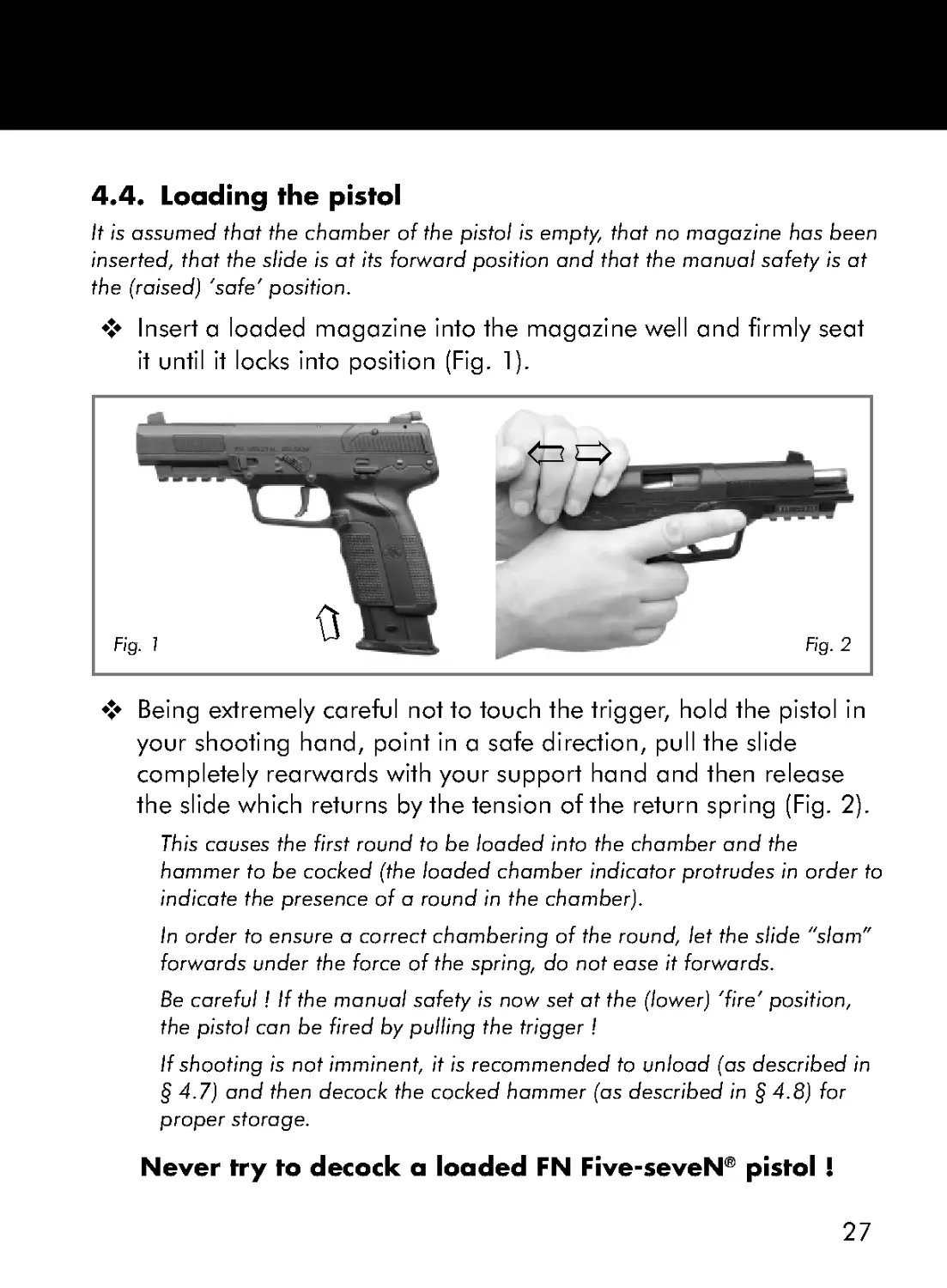
❖ Insert a loaded magazine into the magazine well and firmly seat
it until it locks into position (Fig. 1).
❖ Being extremely careful not to touch the trigger, hold the pistol in
your shooting hand, point in a safe direction, pull the slide
completely rearwards with your support hand and then release
the slide which returns by the tension of the return spring (Fig. 2).
This causes the first round to be loaded into the chamber and the
hammer to be cocked (the loaded chamber indicator protrudes in order to
indicate the presence of a round in the chamber).
In order to ensure a correct chambering of the round, let the slide “slam”
forwards under the force of the spring, do not ease it forwards.
Be careful ! If the manual safety is now set at the (lower) ‘fire’ position,
the pistol can be fired by pulling the trigger !
If shooting is not imminent, it is recommended to unload (as described in
§ 4.7) and then decock the cocked hammer (as described in § 4.8) for
proper storage.
Never try to decock a loaded FN Five-seveN® pistol !
&
&
&
Fig. 1
Fig. 2

28
4.5 . Firing
Before firing, read the entire Owner ’s Manual : warnings and instructions are
different for each pistol.
It is assumed that the rear sight has been adjusted correctly (also refer to
§ 4.2).
Ensure that § 5.4 .1. “Cleaning and lubrication before firing” has been carried
out.
❖ If not already done, load the pistol as described in § 4.4.
❖ Pointing the pistol in a safe direction, and using the right or left
safety lever, set the manual safety at the (lower) ‘fire’ position.
When firing, the slide will move approx. 2” past the rear end of the
frame : never hold your hand in a position where it could be hit by the
slide and never hold the pistol close to the eyes when aiming !!
❖ While aiming the pistol,
pull the trigger to fire the
first round.
The FN Five - seveN® pistol is
a single -action pistol
resulting in a rather light
and short trigger pull.
After firing a shot, release the trigger so that it resets to the forward
position.
Trigger

29
❖ Keep the pistol pointed at the target and fire additional rounds
as required.
After each fired round, the pistol will cock the hammer, eject the used
cartridge case and feed a round from the magazine into the chamber.
If the pistol is fired until the magazine is empty, the slide will remain
locked into the rear position when the last round has been fired (refer to
the following § 4.6).
If the shooting is interrupted, even shor tly, place the manual safety at the
(raised) ‘safe’ position.
After firing is completed, remove the magazine and unload the pistol.
4.6 . Reloading during shooting
After firing the last round, the slide will remain locked into the rear
position.
At this point, the empty magazine can quickly be replaced with a
loaded magazine, by proceeding as follows :
❖ Keep the muzzle pointed in a safe direction and press the
magazine catch in order to eject the empty magazine (also refer
to § 2.3).
❖ Insert a loaded magazine into the magazine well and firmly
seat it until it locks into position.

30
❖ Grab the slide, pull slightly to the rear with your support hand
and then press the slide stop downwards in order to disengage
it (Fig. 1) or pull the slide rearwards and let go (Fig. 2) : the
slide will return to the forward position and the first round will
be loaded into the chamber.
Ensure to allow the slide to return forwards under full force of the return
spring. Failure to do so may result in a feeding failure.
During this operation, be careful not to touch the trigger.
Please note that the hammer is still in the cocked position : the pistol will
be ready to fire.
The loaded chamber indicator protrudes in order to indicate the
presence of a round in the chamber.
❖ Resume firing.
If the shooting is interrupted, even shortly, place the manual safety at the
(raised) ‘safe’ position.
After firing is completed, remove the magazine and unload the pistol.
&
&
Slide stop
&
Fig. 1
Fig. 2

31
4.7 . Unloading the pistol
❖ If not already done, set the manual safety at the (raised) ‘safe’
position by using the right or left safety lever.
When the manual safety is at the (raised) ‘safe’ position, the red marks
are NOT visible.
❖ Press the magazine catch in order to eject the magazine.
If the magazine does not eject, pull on the bottom plate of the magazine
while pressing the magazine catch.
Manual safety
Magazine catch
&

32
❖ Pull the slide completely
rearwards and then
release it in order to eject
the remaining round from
the chamber.
If the slide is already automatically locked into the rearward position
after having fired the last round (also refer to § 4.6), this step is not
necessary : grab the slide with your support hand and then press the
slide stop downwards or pull the slide rearwards in order to let the slide
return to its forward position.
Do not forget to pick-up, clean and store the ejected round.
❖ Pull the slide completely
rearwards and hold it in
that position.
&
&
Chamber
Ejection port
&

33
❖ Through the ejection port, look into the chamber of the pistol in
order to ensure that there is no round in the chamber.
If there is a round in the chamber, release the slide and then try to
extract and eject the remaining round by pulling the slide completely
rearwards and then releasing it.
❖ If the chamber is empty, release the slide.
❖ Doublecheck the chamber of the pistol in order to ensure
that it is empty.
❖ Unload the magazine by removing the rounds one by one.
Slightly push down on the top round and then carefully push it forwards
out and release it from the lips of the magazine.
Repeat this procedure until the magazine is completely empty.
Do not forget to unload the spare magazines as well.
❖ Insert an empty magazine into the magazine well.
Please note that a special magazine disconnect prevents to pull the
trigger if the pistol does not contain a magazine.
❖ Set the manual safety at the (lower) ‘fire’ position.

34
4.8 . Decocking the hammer
Before proceeding, read and understand § 2.2 which shor tly describes the
functioning of your pistol, and especially of its (hidden) hammer.
This procedure should be carried out to decock the cocked hammer, especially
if you do not intend to shoot immediately after having cocked the pistol.
The procedure starts with unloading the pistol (also refer to § 4.7) :
never try to decock the cocked hammer of a loaded FN Five-seveN® pistol !
For law enforcement and military personnel, refer to the procedures of your
department on decocking a cocked hammer.
❖ If not already done, set the manual safety at the (raised) ‘safe’
position.
❖ Press the magazine catch in order to eject the magazine.
❖ Pull the slide completely rearwards in order to eject the
remaining round from the chamber and hold it in that position.
Do not forget to pick-up, clean and store the ejected round.
❖ Looking through the ejection port, ensure that there is no round
in the chamber of the pistol.
❖ If the chamber is empty, release the slide.
❖ Doublecheck the chamber of the pistol in order to ensure
that it is empty.
❖ Insert an empty magazine into the magazine well.
Please note that a special magazine disconnect prevents to pull the
trigger if the pistol does not contain a magazine.
❖ Set the manual safety at the (lower) ‘fire’ position.
❖ After having ensured that the pistol is unloaded, point it in a
safe direction and then pull the trigger to decock the hammer.
❖ Set the manual safety at the (raised) ‘safe’ position.

35
5. MAINTENANCE
5.1 . Disassembling and reassembling the pistol
It is very important to become familiar with the disassembly procedure of the
pistol as disassembly is required during the cleaning and lubrication procedure
which ensures reliable operation of the pistol.
❖ Carry out the safety checks (refer to § 4.1).
After having carried out the safety checks, DO NOT insert a magazine
into the pistol.
❖ Remove the slide assembly from the frame of the pistol :
• Hold the pistol in the right hand.
• With the palm of the left hand, push the slide approx.
0.5 cm (0.25”) rearwards and hold it in that position.
At the same time, and using the left thumb, push the take
down lever completely rearwards and hold it in that
position.
• Release the slide so that it returns forward.
&
± 0.5 cm (0.25”)
Slide
Take down
lever
&
&
Slide
assembly
Frame
assembly

36
• With the right
thumb, push
forwards on the rear
end of the slide in
order to disengage
the complete slide
assembly from the
frame.
• Lift the slide assembly up and off the frame.
❖ With the slide assembly held upside down, disengage the rear
end of the barrel.
❖ Take the barrel out of the slide.
This level of disassembly is sufficient to perform thorough
cleaning : further disassembly should only be carried out by an
authorized armorer or by FN HERSTAL or FNH USA, LLC.
Barrel
Barrel
Frame assembly
Slide
Magazine
(

37
To reassemble the pistol, proceed as follows :
Î Ensure that all the
components of the
pistol are perfectly clean
(refer to § 5.4 .2).
Î Insert the muzzle of the
barrel into the barrel
opening at the front
side of the slide.
Î Push the barrel slightly forwards against the force of the return
spring and then fit the rear end of the barrel into position in the
slide.
Before carrying out the next step, ensure that the take down
lever is at the rear position, that the frame does not contain a
magazine and that the hammer is in the cocked position.
Î Reinstall the slide assembly onto the frame of the pistol :
• While holding the slide
assembly parallel
above the frame, align
the rear end of the
slide assembly with the
front end of the rear
guide rails of the
frame.
Slide assembly
Rear guide
rails
Frame
assembly
)
Barrel

38
• Lower the slide assembly onto the frame and then move it
slightly rearwards just enough to fit the front and rear guide
rails of the frame into the grooves of the slide assembly.
• Ensure that the slide assembly has correctly engaged the
frame.
• Move the slide assembly completely rearwards.
• Check if the slide can smoothly be moved back and forth.
5.2 . Disassembling and reassembling the magazine
Disassembling the magazine for cleaning and lubrication is only necessary if
the magazine becomes inoperable due to dirt, debris or other obstructions.
❖ If not already done, press the magazine catch in order to eject
the magazine from the pistol and completely unload the
magazine (refer to § 4.7).
❖ While holding the rear
end of the magazine
bottom plate against a
hard surface (e.g. a table),
press down on the
magazine in order to
disengage the bottom
plate.
Magazine
bottom plate
Magazine body
&
&

39
❖ Taking into account that the magazine bottom plate is subject to
the force of the magazine follower spring, slide the bottom plate
off the magazine body and then carefully release the pressure on
the follower spring.
❖ Take the magazine follower assembly out of the magazine body.
This level of disassembly is sufficient to perform thorough
cleaning : further disassembly should only be carried out by an
authorized armorer or by FN HERSTAL or FNH USA, LLC.
To reassemble the magazine, follow the above steps in reverse order,
taking into account the following points :
Î Ensure that the components of the magazine are perfectly clean.
Î Ensure that the magazine follower assembly is correctly oriented.
Î The magazine bottom plate can only be slid back into position
when the magazine follower spring is compressed and held flush
with the edge of the magazine body.
Î Ensure that the magazine bottom plate correctly locks into
position.
Magazine
bottom plate
Magazine
body
Magazine body
Magazine
follower
assembly
Magazine
follower spring
&
Magazine
bottom plate

40
5.3 . Reversing the magazine catch
If desired, the magazine catch can be moved to the other side of the
FN Five- seveN® pistol.
The following procedure describes the reversal of the magazine catch
from the left side towards the right side.
For a reversal from the right side towards the left side, use the same
procedure.
First of all, ensure that your FN Five-seveN® pistol is unloaded (refer to
§ 4.7).
Proceed as follows :
O Remove the slide assembly as described in § 5.1 .
O Set the manual safety at the (lower) ‘fire’ position in order to be
able to pull the trigger when asked during the following
procedure.
O While pulling the trigger and using a 3/32” drift punch, pull the
magazine catch spring out of its housing inside the frame and
then remove it.
&
Magazine catch spring
&

41
❖ Take the magazine catch
out of the right side of
the pistol.
❖ From the left side, insert the magazine catch, oriented correctly
and with its grooved end at the right side, into its housing in the
frame.
Magazine catch
spring
Magazine catch
&
&
Magazine catch
&

42
❖ While pulling the trigger, reinstall the magazine catch spring,
oriented as shown below, into its housing inside the frame.
Ensure that the extremities of the magazine catch spring fit correctly into
the frame and into the notch of the magazine catch.
❖ Using the 3/32” drift
punch, push the
magazine catch spring
completely home.
Ensure that the magazine
catch spring fits correctly
into position : 2 ‘clics’
should be heard.
❖ Reassemble the pistol.
&
Magazine catch
spring
Magazine catch
spring
&

43
5.4 . Cleaning and lubrication
The frequency at which the pistol should be cleaned and lubricated
depends on the ammunition used, the weather and shooting
conditions and other external factors.
A good rule is to clean and lubricate the pistol after every use or, in
case of intensive shooting, after 500 rounds : correct maintenance
will enhance the longevity and the performance of your pistol.
Excessively dirty ammunition may require more frequent cleaning and too
much dirt can affect the functioning of even the finest firearm.
It is important to keep your pistol clean and correctly lubricated !
Do not use too much lubricant as this could cause the build-up of dirt, grit or
powder residue which could affect the functioning of the pistol.
For more information about the recommended lubricants, refer to
‘Lubricants’ in § 6.
Before cleaning the pistol, ALWAYS ensure that it is unloaded
(also refer to § 4.7).
Keep the ammunition away from the cleaning site and never
test the mechanical function of your pistol with live ammunition.
We do not recommend exposure to hydrocarbons,
trichlorethylene nor ammonia. These chemicals could cause
damage to your pistol !

44
Before each shooting sequence, ALWAYS check the barrel for
obstructions and ensure that it is dry and clean.
Completely unload the pistol, ensure that there is no round in the
chamber of the pistol and then glance down the barrel in order to
ensure that it is free of any obstruction.
Take into account that the smallest obstruction can dangerously
increase pressures.
5.4 .1 . Cleaning and lubrication before firing
The following procedure assumes that the pistol has correctly been cleaned and
lubricated the last time it was used (also refer to § 5.4 .2).
❖ Disassemble the pistol as described in § 5.1 .
❖ Using a cleaning rod and cleaning patches and working back
and forth, remove any lubricant from the bore and the chamber
of the barrel until the last cleaning patch is clean.
❖ Ensure that the inside of the barrel is perfectly dry.
❖ Reassemble the pistol.

45
5.4.2. Cleaning and lubrication after firing
❖ Disassemble the pistol as described in § 5.1.
❖ Using cleaning brushes or a spray, apply solvent inside the
barrel (bore and chamber) and let the product work a few
minutes.
❖ Using a cleaning rod and cleaning patches and working back
and forth, remove the solvent and the residues from the bore
and the chamber of the barrel until the last cleaning patch is
clean.
❖ When the bore and the chamber of the barrel are clean, again
use a cleaning patch, this time moistened with lubricant, to
protect the inside of the barrel until the next use.
Please note that the inside of the barrel should be wiped dry before
shooting (also refer to § 5.4 .1).
❖ Using cleaning brushes and solvent, remove any carbon and
other deposits from the areas of the pistol attracting powder
and primer residues : the slide, the extractor, the upper part of
the frame, ...
❖ Using a soft cloth or a cleaning patch (if necessary, dipped in
solvent), remove any dirt from the magazine housing of the
frame.
❖ Check the disassembled parts of the pistol for signs of wear
and/or damage.
In case of doubt about the condition of a part, consult your dealer /
departmental armorer.

46
O Thoroughly clean all the parts of the pistol in order to remove
any dirt, debris or fouling.
O Apply one drop of lubricant to the outer chrome-plated surface
of the barrel, the return spring, the inside of the slide (especially
the grooves for the guide rails and the part of the bottom of the
slide which comes into contact with the hammer), the guide rails
of the frame as well as the hammer (its contact area with the
slide).
Never apply lubricant to the breech face.
O Reassemble the pistol (refer to § 5.1).
O Clean the outside of the pistol in order to remove dirt, finger
print residue and excessive lubricant.
5.4 .3. Cleaning and lubrication of the magazine
Cleaning and lubrication of the magazine is only necessary in case of apparent
soiling of the magazine.
O Disassemble the magazine (refer to § 5.2).
O Thoroughly clean all the parts of the magazine (if necessary, use
solvent).
O Using a cleaning patch moistened with lubricant, lightly apply
lubricant to the magazine follower spring.
Wipe off excess lubricant. Ensure that the inside of the magazine is dry.
O Reassemble the magazine (refer to § 5.2).

47
5.5 . Additional care
x Always keep the pistol in immaculate condition and good
working order.
x Always clean and lubricate the pistol after use.
x Regularly inspect the pistol, its parts and the accessories.
If something seems abnormal, do not hesitate to report it to your
dealer / departmental armorer.
x Never modify or repair parts of your pistol by yourself.
Your pistol is a mechanical device subject to wear and
which will not last forever : it requires periodic
inspection, adjustment and service.
The pistol should be checked every 2000 rounds and/or
once a year because damage, wear, corrosion, ... are
not always visible from the outside.
For that purpose, send the pistol to your dealer.
Law enforcement and military personnel have a
departmental armorer which will inspect the pistol on a
yearly basis.
FN HERSTAL and FNH USA, LLC cannot assume any
responsibility for injuries caused by unauthorized
servicing, alterations or modifications to its firearms.

48
6. ADDITIONAL INFORMATION
Sight adjustment
For a more accurate setting of the sights than the procedures
described in § 4.2, consult your dealer / departmental armorer.
Lubricants
FN HERSTAL and FNH USA, LLC recommend using lubricant
Nycolube 127 CLP or equivalent (reference US MIL - PRF63460 or
NATO S-758).
For the US Market, CLP is available under the following names and
trademarks :
-
CLP-NC by BREAK-FREE INC
-
SENT-CLP by SENTINEL CANADA
-
ROYCO-634 by ROYAL LUBRICANTS Co, INC
Be aware that some solvents can be harmful to the surface finish of the
pistol, so consult your dealer / departmental armorer.
Disposal
Strictly observe the current national legislation concerning the
disposal of handguns, return the pistol to your dealer /
departmental armorer or, if it is not contrary to the current national
legislation, send it back to FN HERSTAL or FNH USA , LLC.

49
7. SERVICE POLICY
FN HERSTAL or FNH USA products are serviced by the FNH USA
Product Service Center in Arnold, Missouri.
Please call (800) 635-1321 to discuss any product repair requirement.
Shipping Address :
FNH USA Product Service Center
3005 Arnold Tenbrook Road
Arnold, MO 63010-4728
8. WARRANTY OR SERVICE
If your FN HERSTAL or FNH USA product should require service or
repairs, we suggest you to contact the FNH USA Product Service
Center in Arnold, Missouri.
Law enforcement and military personnel should contact their
departmental armorer.
For technical questions about your firearm or service, contact :
FNH USA Product Service Center
3005 Arnold Tenbrook Road
Arnold, MO 63010-4728
Phone : (800) 635-1321

50
When returning your FN firearm for servicing, you must do the
following :
1. Ensure that it is completely unloaded.
2. Remove the scope, optics or accessories.
3. Package it securely in a cardboard container.
4. Enclose the service/repair form available at www.fnhusa.com or
a letter that clearly describes the trouble experienced, the
ammunition used and the repairs desired. Also include your
name and a daytime phone number where you can be reached.
5. If convenient, send a copy of the service/repair form or letter to
us separately.
6. Never return ammunition with your firearm : it is against postal
and most commerce regulations.
If you have any question about this Owner ’s Manual or other FN
HERSTAL or FNH USA products, contact :
FNH USA Product Service Center
3005 Arnold Tenbrook Road
Arnold, MO 63010-4728
Phone : (800) 635-1321
Or visit us online at www.fnhusa.com .
If you do not understand the instructions for operating your FN
firearm, it is your responsibility to contact the FNH USA Product
Service Center at (800) 635-1321 before using the firearm.
This Owner’s Manual should always accompany this pistol and be
transferred with it upon any change of ownership.

51
9. TECHNICAL SPECIFICATIONS
Caliber
: 5.7x28mm
Type of fire
: Semi-automatic
Trigger pull
: Single-action : 4.50 to 7.87 lb
Weight
: Without magazine : 1.36 lb
Length
: 8.19“
Height
: 5.77”
Width
: 1.34”
Barrel length
: 4.75“
Rifled length
: 3.66“
Number of grooves : 8
Twist and direction : 1:9.1”, right-hand
Magazine capacity : 20 rounds (10 rounds where restricted by law)
All specifications subject to changes without notice.

FNH USA
FNH USA, LLC
www.fnhusa.com
Catalog 3860054170-00
December ‘12