/
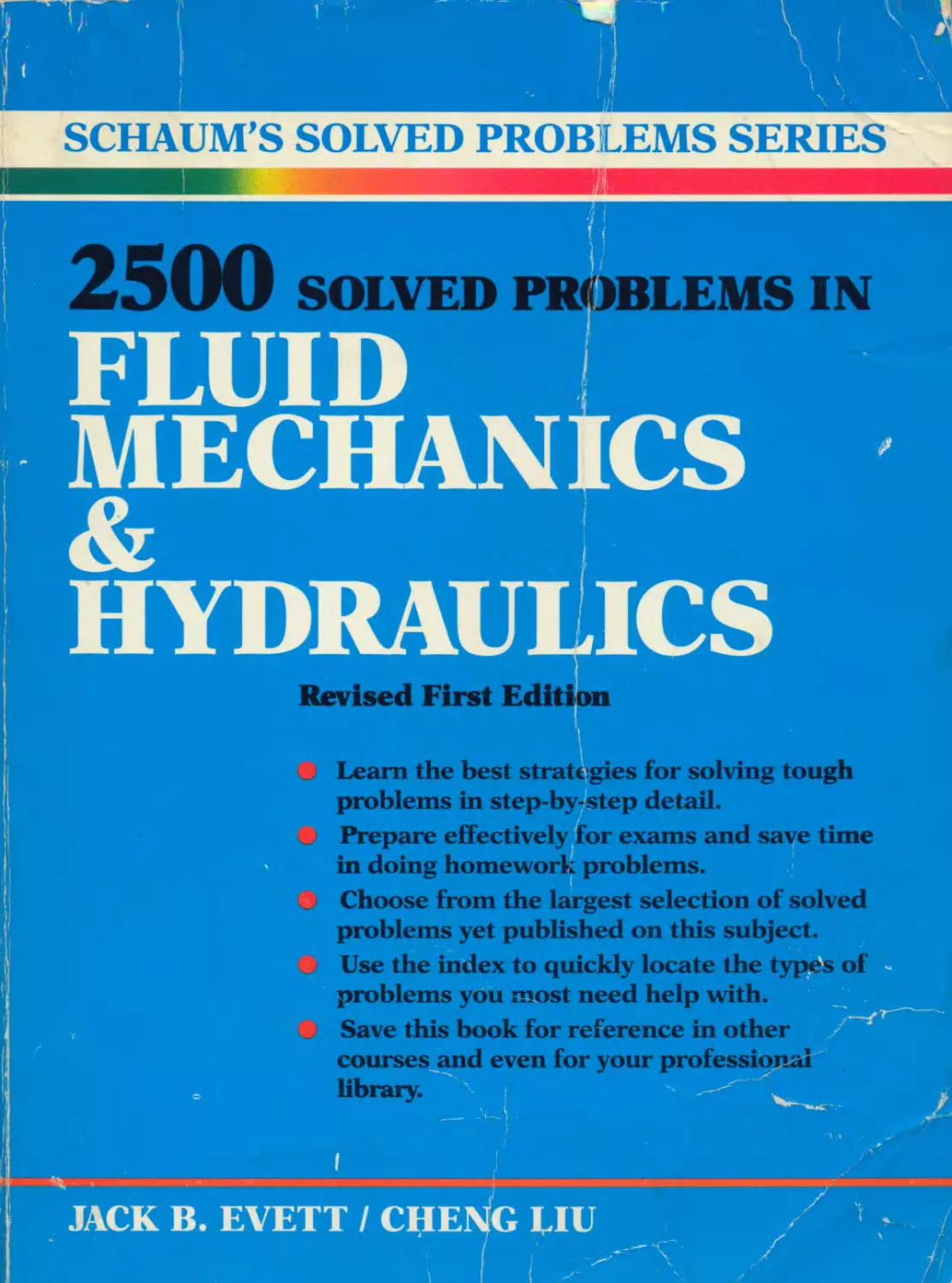


Author: Evett Jack B. Liu Cheng
Tags: problem solving hydraulics fluid mechanics
ISBN: 0-07-019783-0
Year: 1989




Text
                    SCHAUM'S SOLVED
PROBLEMS SERIES
2500 SOLVED PROBLEMS IN
FLUID
MECHANICS
AND
HYDRAULICS
by
Jack B. Evett, Ph.D
Cheng Liu, M.S.
The University of North Carolina at Charlotte
McGRAW-HILL, INC.
New York St. Louis San Francisco Auckland Bogota Caracas
Hamburg Lisbon London Madrid Mexico Milan Montreal
New Delhi Paris San Juan Sao Paulo Singapore
Sydney Tokyo Toronto

Jack B. Evett, Ph.D., Professor of Civil Engineering, and Cheng
Liu, M.S., Associate Professor of Civil Engineering Technology,
both at the University of North Carolina at Charlotte.
Both authors have extensive teaching experience in the domain of fluid
mechanics and hydraulics. They are coauthors of a textbook in fluid
mechanics for the McGraw-Hill College Division.
Project supervision by The Total Book.
Cover design by Wanda Siedlecka.
Index by Hugh C. Maddocks, Ph.D.
Library of Congress Cataloging-in-Publication Data
Evett, Jack B.
2500 solved problems in fluid mechanics and hydraulics / by Jack B.
Evett, Cheng Liu.
p. cm. — (Schaum's solved problems series)
ISBN 0-07-019783-0
1. Fluid mechanics—Problems, exercises, etc. 2. Hydraulics—Problems,
exercises, etc. I. Liu, Cheng. II. Title. III. Title: Twenty-five hundred
solved problems in fluid mechanics and hydraulics. IV. Series.
TA357.3.E84 1988
620.1'06'076-dc 19 88-13373
CIP
34567890 SHP/SHP 9 3 2 1
ISBN O-OV-OnVflM-T (Formerly published under ISBN 0-07-019783-0)
Copyright © 1989 McGraw-Hill, Inc. All rights reserved. Printed in the
United States of America. Except as permitted under the United States
Copyright Act of 1976, no part of this publication may be reproduced or
distributed in any form or by any means, or stored in a data base or retrieval
system, without the prior written permission of the publisher.

CONTENTS
To the Student v
List of Abbreviations vii
List of Conversion Factors xi
Chapter 1 PROPERTIES OF FLUIDS 1
Chapter 2 FLUID STATICS 25
Chapter 3 FORCES ON SUBMERGED PLANE AREAS 53
Chapter 4 DAMS 77
Chapter 5 FORCES ON SUBMERGED CURVED AREAS 85
Chapter 6 BUOYANCY AND FLOTATION 108
Chapter 7 KINEMATICS OF FLUID MOTION 132
Chapter 8 FUNDAMENTALS OF FLUID FLOW 157
Chapter 9 FLOW IN CLOSED CONDUITS 197
Chapter 10 SERIES PIPELINE SYSTEMS 269
Chapter 11 PARALLEL PIPELINE SYSTEMS 278
Chapter 12 BRANCHING PIPELINE SYSTEMS 302
Chapter 13 PIPE NETWORKS 315
Chapter 14 FLOW IN OPEN CHANNELS 356
Chapter 15 FLOOD ROUTING 459
Chapter 16 FLOW OF COMPRESSIBLE FLUIDS 469
Chapter 17 FLOW MEASUREMENT 520
Chapter 18 DIMENSIONAL ANALYSIS AND SIMILITUDE 574
Chapter 19 UNSTEADY FLOW 589
Chapter 20 PUMPS AND FANS 610
Chapter 21 TURBINES 638
Chapter 22 HYDRAULIC AND ENERGY GRADE LINES 657
iii

r.
iv D CONTENTS
Chapter 23 FORCES DEVELOPED BY FLUIDS IN MOTION 664
Chapter 24 DYNAMIC DRAG AND LIFT 684
Chapter 25 BASIC HYDRODYNAMICS 703
Appendix 709
Index 787

To the Student
This book contains precisely 2500 completely solved problems in the areas of fluid mechanics
and hydraulics. Virtually all types of problems ordinarily encountered in study and practice in
these areas are covered. Not only you, but teachers, practitioners, and graduates reviewing
for engineering licensing examinations should find these problems valuable.
To acquaint you with our "approach," particular steps taken in presenting the problems and
their solutions are itemized below.
• First and most important of all, each problem and its solution are essentially independent
and self-contained. That is to say, each contains all the data, equations, and computations
necessary to find the answers. Thus, you should be able to pick a problem anywhere and
follow its solution without having to review whatever precedes it. The exception to this is
the occasional problem that specifically refers to, and carries over information from, a
previous problem.
• In the solutions, our objective has been to present any needed equation first and then
clearly to evaluate each term in the equation in order to find the answer. The terms may
be evaluated separately or within the equation itself. For example, when solving an
equation that has the parameter "area" as one of its terms, the area term (A) may be
evaluated separately and its value substituted into the equation [as in Prob. 14.209], or it may
be evaluated within the equation itself [as in Prob. 14.94].
• Virtually every number appearing in a solution is either "given" information (appearing as
data in the statement of the problem or on an accompanying illustration), a previously
computed value within the problem, a conversion factor (obtainable from the List of
Conversion Factors), or a physical property (obtainable from a table or illustration in the
Appendix). For example, in Prob. 1.77, the number 1.49, which does not appear elsewhere
in the problem, is the dynamic viscosity (fi) of glycerin; it was obtained from Table A-3 in
the Appendix.
• We have tried to include all but the most familiar items in the List of Abbreviations and
Symbols. Hence, when an unknown sign is encountered in a problem or its solution, a scan
of that list should prove helpful. Thus, the infrequently used symbol V is encountered in
Prob. 25.6. According to the list, V represents the stream function, and you are quickly on
your way to a solution.
Every problem solution in this book has been checked, but, with 2500 in all, it is
inevitable that some mistakes will slip through. We would appreciate it if you would take the
time to communicate any mistakes you find to us, so that they may be corrected in future
printings. We wish to thank Bill Langley, of The University of North Carolina at Charlotte,
who assisted us with some of the problem selection and preparation.
v

Abbreviations and Symbols
a acceleration or area
A area
abs absolute
a (alpha) angle between absolute velocity of fluid in hydraulic machine and linear velocity of a point on a
rotating body or coefficient of thermal expansion or dimensionless ratio of similitude
atm atmosphere
atmos atmospheric
/3 (beta) angle between relative velocity in hydraulic machines and linear velocity of a point on a rotating
body or coefficient of compressibility or ratio of obstruction diameter to duct diameter
b surface width or other width
B surface width or other width
bhp brake horsepower
bp brake power
Btu British thermal unit
c speed of sound or wave speed (celerity)
C Celsius or discharge coefficient or speed of propagation
cal calorie
c.b. or CB center of buoyancy
Cc coefficient of contraction
Cd coefficient of discharge
CD drag coefficient
Cf friction-drag coefficient
CF force coefficient
cfs cubic foot per second
e.g. or CG center of gravity
C, Pitot tube coefficient
CL lift coefficient
cm centimeter (10~2 m)
cP centipoise
c.p. center of pressure
cP specific heat at constant pressure
c„ specific heat at constant volume
C„ coefficient of velocity
Cw weir coefficient
d depth or diameter
D depth or diameter or drag force
5 (delta) thickness of boundary layer
6, (delta) thickness of the viscous sublayer
A (Delta) change in (or difference between)
dc critical depth
Deff effective diameter
Dh hydraulic diameter
d„ mean depth
d„ normal depth
dN normal depth
E modulus of elasticity or specific energy or velocity approach factor
eh hydraulic efficiency
el elevation
i\ (eta) pump or turbine efficiency
e (epsilon) height or surface roughness
Ep pump energy
E, turbine energy
exp exponential
/ frequency of oscillation (cycles per second) or friction factor
VII

viii 0
ABBREVIATIONS AND SYMBOLS
F
F„
Fo
FH
FL
fps
F.S.
ft
Fv
Fy
8
G
gal
Y (gamma)
T (Gamma)
GN
GPa
gpm
h
h
h
H
h,
hcg
hcp
hf
Hg
HGL
hL
hm
hp
Hz
/
ID
in
» (infinity)
J
K
*
kcal
kg
kJ
km
kN
kPa
kW
L
X (lambda)
lb
lbm
Lt
*-*m
*»
m
m
M
MB
mbar
mc
mgd
Fahrenheit or force
buoyant force
drag force
horizontal force
lift force
foot per second
factor of safety
foot
uplift force on a dam
vertical force
acceleration due to gravity or gage height or gram
weight flow rate
gallon
specific (or unit) weight ^
circulation
giganewton (10* N)
gigapascal (10* Pa)
gallons per minute
enthalpy per unit mass or height or depth or pressure head or hour
average height or depth or head
enthalpy per unit weight
energy head or total energy head
unit head loss
vertical depth to center of gravity
vertical depth to center of pressure
head loss due to friction
mercury
hydraulic grade line
total head loss
head loss due to minor losses
horsepower
hertz (cycles per second)
inflow or moment of inertia
inside diameter
inch
sometimes used as a subscript to indicate upstream
joule
bulk modulus of elasticity or Kelvin or minor loss coefficient
specific heat ratio
kilocalorie (103cal)
kilogram (103 g)
kilojoule(103J)
kilometer (103 m)
kilonewton (103 N)
kilopascal (103 Pa)
kilowatt (103 W)
length or lift force or liter
model ratio or wave length
pound
pound mass
equivalent length
linear dimension in model
linear dimension in prototype
mass or meter
mass flow rate
mass flow rate or molecular weight or moment or torque
distance from center of buoyancy to metacenter
millibar (10 3 bar)
metacenter
million gallons per day

ABBREVIATIONS AND SYMBOLS 0 ix
ml milliliter (1(T3 L)
min minute
mm millimeter (10~3 meter)
MN meganewton (lO'N)
MPa megapascal (106 Pa)
mph mile per hour
MR manometer reading
fi (mu) absolute or dynamic viscosity
MW megawatt (106 W)
n Manning roughness coefficient or number of moles
N newton or rotational speed
NB Brinkman number
NF Froude number
NM Mach number
NPSH net positive suction head
A/r Reynolds number
N, specific speed of pump or turbine
v (nu) kinematic viscosity
A'w Weber number
O outflow
OD outside diameter
Q (ohm) rotational rate
(0 (omega) angular velocity
p pressure or poise
P force (usually resulting from an applied pressure) or power
Pa pascal
4> (phi) peripheral-velocity factor
n (pi) constant = 3.14159265
II (pi) dimensionless parameter
Pr power ratio
p„ stagnation pressure
psi pound per square inch
tp (psi) stream function
psia pound per square inch absolute
psig pound per square inch gage
p*' pressure for condition at A^ = 1/V&
p„ vapor pressure
pw wetted perimeter
q flow rate per unit width or heat per unit mass
Q discharge or heat or volume flow rate
QH heat transferred per unit weight of fluid
Q/w volume flow rate per unit width of channel
qt quart
r radius
R gas constant or Rankine or resultant force or hydraulic radius
R' manometer reading
rad radian
Rc critical hydraulic radius
Rh hydraulic radius
p (rho) mass density
r, inside radius
r0 outside radius
rpm revolutions per minute
Ru universal gas constant
s entropy of a substance or second or slope
S slope or storage
sc critical slope
s.g. specific gravity
s.g.w specific gravity of manometer fluid
s.g.F specific gravity of flowing fluid

ABBREVIATIONS AND SYMBOLS
a (sigma)
a'
£ (sigma)
S
So
t
T
r(tau)
T0 (tau)
Ts
u
"& ■
V
Vc
V
v„
Vt,
v£
vm
v.
v,
v,
v,
VT
w
w
*cp
l(xi)
y
yc
yc
y«
y*
**
z*
pump cavitation parameter or stress or surface tension
cavitation index
summation
specific gravity of flowing fluid
specific gravity of manometer fluid
thickness or time
surface width or temperature or torque or tension
shear stress
shear stress at the wall
stagnation temperature
velocity
centerline velocity
velocity e
velocity
critical velocity
velocity or volume
average velocity
centerline velocity
volume of fluid displaced
velocity in model
velocity in prototype
specific volume
shear velocity
tangential velocity
terminal velocity
width
watt or weight or weight flow rate or work
distance from center of gravity to center of pressure in x direction
vorticity
depth
critical depth
distance from center of gravity to center of pressure in v direction
normal depth
normal depth
inclined distance from liquid surface to center of gravity
inclined distance from liquid surface to center of pressure

Conversion Factors
0.00001667 m3/s = 1 L/min
0.002228 ft3/s = 1 gal/min
0.0145 lb/in2 = 1 mbar
0.3048 m = 1 ft
2.54 cm = 1 in
3.281 ft = 1 m
4 qt = 1 gal
4.184 kJ = lkcal
4.448 N = 1 lb
6.894 kN/m2 = 1 lb/in2
7.48 gal = lft3
12 in = 1 ft
14.59 kg = 1 slug
25.4 mm = 1 in
60 min = 1 h
60 s = 1 min
100cm = lm
100 kPa = 1 bar
101.3 kPa = latm
144 in2 = 1 ft2
550ft-lb/s = lhp
778 ft-lb = 1 Btu
1000 N = 1 kN
1000 L = 1 m3
1000 mm = 1 m
1000 Pa = 1 kPa
1728 in3 = 1 ft3
2000 lb = 1 ton
3600 s = 1 h
4184J = lkcal
5280 ft = 1 mile
86400s = lday
1000000N = 1MN
1000000Pa=lMPa
1000 000 000N = 1GN
1000000000Pa = lGPa

CHAPTER 1
Properties of Fluids
Note: For many problems in this chapter, values of various physical properties of fluids are obtained from
Tables A-l through A-8 in the Appendix.
1.1 A reservoir of glycerin (glyc) has a mass of 1200 kg and a volume of 0.952 m3. Find the glycerin's weight (W),
mass density (p), specific weight (y), and specific gravity (s.g.).
f F = W = ma = (1200)(9.81) = 11770N or 11.77 kN
p = m/v = 1200/0.952 = 1261 kg/m3
y= W/V = 11.77/0.952= 12.36 kN/m3
s-g- = yglyc/yH2oa,4-c= 12.36/9.81 = 1.26
1.2 A body requires a force of 100 N to accelerate it at a rate of 0.20 m/s2. Determine the mass of the body in
kilograms and in slugs.
I F = ma
100 = (m)(0.20)
m = 500 kg = 500/14.59 = 34.3 slugs
1.3 A reservoir of carbon tetrachloride (CCL,) has a mass of 500 kg and a volume of 0.315 m3. Find the carbon
tetrachloride's weight, mass density, specific weight, and specific gravity.
f F = W = ma = (500)(9.81) = 4905 N or 4.905 kN
p = mlv = 500/0.315 = 1587 kg/m3
y = W/V = 4.905/0.315 = 15.57 kN/m3
s.g. = yccl4/yH2oa«4-c = 15.57/9.81 = 1.59
1.4 The weight of a body is 100 lb. Determine (a) its weight in newtons, (fc) its mass in kilograms, and (c) the rate
of acceleration [in both feet per second per second (ft/s2) and meters per second per second (m/s2)] if a net
force of 50 lb is applied to the body.
f (a) W = (100)(4.448) = 444.8 N
(ft) F = W = ma 444.8 = (m)(9.81) m= 45.34 kg
(c) m = 45.34/14.59 = 3.108 slugs
F = ma 50 = 3.108a a = 16.09 ft/s2 = (16.09)(0.3048) = 4.904 m/s2
1.5 The specific gravity of ethyl alcohol is 0.79. Calculate its specific weight (in both pounds per cubic foot and
kilonewtons per cubic meter) and mass density (in both slugs per cubic foot and kilograms per cubic meter).
f y = (0.79)(62.4) = 49.3 lb/ft3 y = (0.79)(9.79) = 7.73 kN/m3
p = (0.79)(1.94) = 1.53 slugs/ft3 p = (0.79)(1000) = 790 kg/m3
1.6 A quart of water weights about 2.08 lb. Compute its mass in slugs and in kilograms.
I F = W = ma 2.08 = (m)(32.2)
m= 0.0646 slug m = (0.0646)(14.59) =0.943 kg
1.7 One cubic foot of glycerin has a mass of 2.44 slugs. Find its specific weight in both pounds per cubic foot and
kilonewtons per cubic meter.
f F = W = ma = (2.44)(32.2) = 78.6 lb. Since the glycerin's volume is 1 ft3, y = 78.6 lb/ft3 =
(78.6)(4.448)/(0.3048)3 = 12 350 N/m3, or 12.35 kN/m3.

2 0 CHAPTER 1
1.8 A quart of SAE 30 oil at 68 °F weighs about 1.85 lb. Calculate the oil's specific weight, mass density, and
specific gravity.
I V = l/[(4)(7.48)] = 0.03342 ft3
y =W/V = 1.85/0.03342 = 55.4 lb/ft3
P = Y/g = 55.4/32.2 = 1.72 slugs/ft3
s-g-=/on//h2o a«4-c = 55.4/62.4 = 0.888
1.9 The volume of a rock is found to be 0.00015 m3. If the rock's specific gravity is 2.60, what is its weight?
' /rock = (2.60)(9.79) = 25.5 kN/m3 WIock = (25.5)(0.00015) = 0.00382 kN or 3.82 N
1.10 A certain gasoline weighs 46.5 lb/ft3. What are its mass density, specific volume, and specific gravity?
I P = Ylg= 46.5/32.2 = 1.44 slugs/ft3 Vs = Up = 1/1.44 = 0.694 ft3/slug
s.g. = 1.44/1.94 = 0.742
1.11 If the specific weight of a substance is 8.2 kN/m3, what is its mass density?
f p = Y/g = 8200/9.81 = 836 kg/m3
1.12 An object at a certain location has a mass of 2.0 kg and weighs 19.0 N on a spring balance. What is the
acceleration due to gravity at this location?
I F = W = ma 19.0 = 2.0a a=9.50m/s2
1.13 If an object has a mass of 2.0 slugs at sea level, what would its mass be at a location where the acceleration due
to gravity is 30.00 ft/s2?
f Since the mass of an object does not change, its mass will be 2.0 slugs at that location.
1.14 What would be the weight of a 3-kg mass on a planet where the acceleration due to gravity is 10.00 m/s2?
f F = W=ma = (3)(10.00) = 30.00N
1.15 Determine the weight of a 5-slug boulder at a place where the acceleration due to gravity is 31.7 ft/s2.
f F = W = ma = (5)(31.7) = 158 lb
1.16 If 200 ft3 of oil weighs 10 520 lb, calculate its specific weight, density, and specific gravity.
f y = wiV = 10 520/200 = 52.6lb/ft3 p = y/g = 52.6/32.2= 1.63 slugs/ft3
s.g. = rJY»2o a«4 -C = 52.6/62.4 = 0.843
1.17 Find the height of the free surface if 0.8 ft3 of water is poured into a conical tank (Fig. 1-1) 20 in high with a
base radius of 10 in. How much additional water is required to fill the tank?
' ycone = flrr2/i/3 = flr(10)2(20)/3 = 2094in3 V„.,0 = 0.8 ft3 = 1382 in3
Additional water needed = 2095 - 1382 = 713 in3. From Fig. 1-1, ro/10 = /io/20, or r0 = ho/2.0;
Kmpty(top)cone = tf(/»o/2.0)2/io/3 = 713; h„ = 13.96 in. Free surface will be 20 - 13.96, or 6.04 in above base of
tank.
20 in
Fig. 1-1

PROPERTIES OF FLUIDS Q 3
1.18 If the tank of Prob. 1.17 holds 30.5 kg of salad oil, what is the density of the oil?
' Vcone = 2094 in3 (from Prob. 1.17)
= ^(0.3048)3 = 0.03431 m3
p = miv = 30.5/0.03431 = 889 kg/m3
1.19 Under standard conditions a certain gas weighs 0.14 lb/ft3. Calculate its density, specific volume, and specific
gravity relative to air weighing 0.075 lb/ft3.
' P = ylg = 0.14/32.2 = 0.00435 slug/ft3 Vs = 1/p = 1/0.00435 = 230 ft3/slug
s.g.= 0.14/0.075 = 1.87
1.20 If the specific volume of a gas is 360 ft3/slug, what is its specific weight?
I p = l/Vs = 5^5 = 0.002778 slug/ft3 Y = Pg = (0.002778)(32.2) = 0.0895 lb/ft3
1.21 A vertical glass cylinder contains 900.00 mL of water at 10 °C; the height of the water column is 90.00 cm. The
water and its container are heated to 80 °C. Assuming no evaporation, what will be the height of the water if the
coefficient of thermal expansion (a) for the glass is 3.6 X 10~6oC-1?
f Mass of water = pV = p10V10 = PmVm (1000)(900 X 10"6) = 971^ Vm = 926.9 X 10"6 m3 = 926.9 cm3
A10 = Vjh 10 = 900.00/90.00 = 10.000 cm2
Aw=nr\0 10.000 = nr\0 rl0= 1.7841 cm
rm = r,o[l + (Ar)(a)] = (1.7841)[1 + (80 - 10)(3.6 X 10~6)] = 1.7845 cm
^so = nr%, = >r(1.7845)2 = 10.004 cm2 hm = VgoMa, = 926.9/10.004 = 92.65 cm
1.22 If a vessel that contains 3.500 ft3 of water at 50 °F and atmospheric pressure is heated to 160 °F, what will be the
percentage change in its volume? What weight of water must be removed to maintain the original volume?
f Weight of water = yV = YsoV^o = Yv*>V160 (62.4)(3.500) = 61.0V160 V160 = 3.5803 ft3
Change in volume = (3.5803 - 3.500)/3.000 = 0.027, or 2.7% (increase). Must remove (3.5803 - 3.500)(61.0),
or 4.90 lb.
1.23 A vertical, cylindrical tank with a diameter of 12.00 m and a depth of 4.00 m is filled to the top with water at
20 °C. If the water is heated to 50 °C, how much water will spill over?
' Vtank = (V„2o)2o=*(12.00/2)2(4.00) = 452.4 m3
W„2o=(9.79)(452.4)=4429kN (Vh2o)5o = 4429/9.69 = 457.1 m3
Volume of water spilled = 457.1 - 452.4 = 4.7 m3
1.24 A thick, closed, steel chamber is filled with water at 50 °F and atmospheric pressure. If the temperature of water
and chamber is raised to 100 °F, find the new pressure of the water. The coefficient of thermal expansion of steel
is 6.5 X 10⁻⁶ per °F.
f The volume of water would attempt to increase as the cube of the linear dimension; hence,
Ho = V50[l + (100 - 50)(6.5 X 10'6)]3 = 1.000975 V50; weight of water = yV = y50 V50 = y» V», 62.4^ =
790(1.000975^0), Y90 = 62.34lb/ft3. From Fig. A-3,p*> = 1300 psia (approximately).
1.25 A liquid compressed in a cylinder has a volume of 1000 cm3 at 1 MN/m2 and a volume of 995 cm3 at 2 MN/m2.
What is its bulk modulus of elasticity (K)7
' K= ~AW?= ~(995-1000)/1000 = 20°MPa
1.26 Find the bulk modulus of elasticity of a liquid if a pressure of 150 psi applied to 10 ft3 of the liquid causes a
volume reduction of,0.02ft3.
' K= ~A^= -(1-oTm/(ir-108000001b/tf or 75000psi

4 0 CHAPTER 1
1.27
1.28
1.29
If K = 2.2 GPa is the bulk modulus of elasticity for water, what pressure is required to reduce a volume by 0.6
percent?
K =
W/V 22=-S^ P, = 0-0132 GPa or 13.2 MPa
Find the change in volume of 1.00000 ft3 of water at 80 °F when subjected to a pressure increase of 300 psi.
Water's bulk modulus of elasticity at this temperature is 325 000 psi.
K= -
AV/V
325 000 =
300-0
Ay/1.00000
AV =-0.00092 ft3
From the following test data, determine the bulk modulus of elasticity of water: at 500 psi the volume was
1.000 ft3, and at 3500 psi the volume was 0.990 ft3.
K= -
500 - 3500
Ap
AV/V (1.000-0.990)/1.000
= 300 000 psi
1.30 A rigid steel container is partially filled with a liquid at 15 atm. The volume of the liquid is 1.23200 L. At a
pressure of 30 atm, the volume of the liquid is 1.23100 L. Find the average bulk modulus of elasticity of the
liquid over the given range of pressure if the temperature after compression is allowed to return to its initial
value. What is the coefficient of compressibility (j8)?
K= -
Ap
(30-15)(101.3)
AV/V (1.23100 -1.23200)/1.23200
p = l/K = 1/1.872 = 0.534 GPa"1
= 1.872 X 10⁶ kPa or 1.872 GPa
1.31 A heavy tank contains oil (A) and water (B) subject to variable air pressure; the dimensions shown in Fig. 1-2
correspond to 1 atm. If air is slowly added from a pump to bring pressure p up to 1 MPa gage, what will be the
total downward movement of the free surface of oil and air? Take average values of bulk moduli of elasticity of
the liquids as 2050 MPa for oil and 2075 MPa for water. Assume the container does not change volume. Neglect
hydrostatic pressures.
K =
Ap
AV/V
2050 =
1-0
Ayoil/[600^(300)2/4]
Ayoil = -20 6901
2075 = - -
1-0
AyH2o = -23 850 mm3
Ay„2o/[700^(300)2/4]
Aytotal=-44540mm3
Let x = distance the upper free surface moves. —44 540 = -[^(300)2/4pc, x = 0.630 mm.
^Z
200 mm
__r_.
Water-
300 mm—&.
md
Air
LIijujjX
600 mm
700 mm
±.
V//////AY////////////A
Fig. 1-2
1.32 A thin-walled spherical tank is filled with water at a pressure of 4666 psig; the tank's volume is then 805.407 in3.
If the water is released from the tank, how many pounds will be collected at atmospheric pressure? 805.4069 in3

PROPERTIES OF FLUIDS Q 5
when the pressure is 4666 psig. Use 305 000 psi as an average value of the bulk modulus of elasticity.
_ Ap 0-4666
' K=~WN 30500°=-(y2-805.407)/805.407 *-817.73 tf
W = (62.4)(817.73/1728) = 29.5 lb
1.33 Water in a hydraulic press, initially at 20 psia, is subjected to a pressure of 17 000 psia at 68 °F. Determine the
percentage decrease in specific volume if the average bulk modulus of elasticity is 365 000 psi.
' K= --TTTfT, 365 000= - 1?A°^)~2° ^=-0.0465 or 4.65% decrease
AVIV AV/Vx V,
1.34 At a depth of 7 km in the ocean, the pressure is 71.6 MPa. Assume a specific weight at the surface of
10.05 kN/m3 and an average bulk modulus of elasticity of 2.34 GPa for that pressure range. Find (a) the change
in specific volume between the surface and 7 km; (ft) the specific volume at 7 km; (c) the specific weight at 7 km.
I (a) (V,\ = l/pi=g/Yi = 9.81/10 050 = 0.0009761 m3/kg
(ft) (K)2 = (VJ, + AV, = 0.0009761 - 0.0000299 = 0.000946 m3/kg
(c) y2 = g/V2 = 9.81/0.000946 = 10 370 N/m3
1.35 Approximately what pressure must be applied to water at 60 °F to reduce its volume 2.5 percent?
' *=-aWv 3nm=-Si to-™,*
1.36 A gas at 20°C and 0.21 MPa abs has a volume of 41 L and a gas constant (R) of 210 m • N/(kg • K). Determine
the density and mass of the gas.
I p =p/RT = 0.21 X 10⁶/[(210)(20 + 273)] = 3.41 kg/m3 m = pV = (3.41)(0.041) = 0.140 kg
1.37 What is the specific weight of air at 70 psia and 70 °F?
I y=plRT. From Table A-6, R = 53.3 ft/°R; y = (70)(144)/[(53.3)(70 + 460)] = 0.357 lb/ft3.
Note: p/RTgives p (Prob. 1.36) or y (Prob. 1.37), depending on the value of R used. Corresponding values of
R in Table A-6 differ by a factor of g.
1.38 Calculate the density of water vapor at 350 kPa abs and 20 °C if its gas constant (R) is 0.462 kPa • m3/kg • K.
I p=p/RT = 350/[(0.462)(20 + 273)] = 2.59 kg/m3
1.39 Nitrogen gas (molecular weight 28) occupies a volume of 4.0 ft3 at 2500 lb/ft2 abs and 750 °R. What are its
specific volume and specific weight?
f R = RJM = 49 709/28 = 1775 ft • lb/(slug • °R)
[where Ru, the universal gas constant, = 49 709 ft • lb/(slug • °R)]
p = l/VJ=p/fl7' = 2500/[(1775)(750)] Vs = 532.5 ft3/slug
y = pg = (1/Vs)(g) = (l/532.5)(32.2) = 0.0605 lb/ft3
1.40 One kilogram of hydrogen is confined in a volume of 200 L at —45 °C. What is the pressure if R is
4.115 kJ/kg-K?
I p = pRT = (mlV)RT = (l/0.200)(4115)(-45 + 273) = 4.691 X 10⁶ Pa or 4.691 MPa abs
1.41 What is the specific weight of air at a temperature of 30 °C and a pressure of 470 kPa abs?
I y=p/flr = 470/[(29.3)(30 + 273)] = 0.0529 kN/m3

6 0 CHAPTER 1
1.42 Find the mass density of helium at a temperature of 39 °F and a pressure of 26.9 psig, if atmospheric pressure is
14.9 psia.
I p = p/RT = (14.9 + 26.9)(144)/[(12 420)(39 + 460)]
= 0.000971 lb V/ft4 or 0.000971 slug/ft3 >
1.43 The temperature and pressure of nitrogen in a tank are 28 °C and 600 kPa abs, respectively. Determine the
specific weight of the nitrogen.
I y=p/flr = 600/[(30.3)(28 + 273)] = 0.0658 kN/m3
1.44 The temperature and pressure of oxygen in a container are 60 °F and 20.0 psig, respectively. Determine the
oxygen's mass density if atmospheric pressure is 14.7 psia.
I p =p/RT = (20.0 + 14.7)(144)/[(1552)(60 + 460)] = 0.00619 slug/ft3
1.45 Calculate the specific weight and density of methane at 100 °F and 120 psia.
I y =p/RT = (120)(144)/[(96.2)(100 + 460)] =0.321 lb/ft3
p=Y/g = 0.321/32.2 = 0.00997 slug/ft3
1.46 At 90 °F and 30.0 psia, the specific weight of a certain gas was 0.0877 lb/ft3. Determine the gas constant and
density of this gas.
I y=plRT 0.0877 = (30.0)(144)/[(/?)(90 +460)] fl=89.6ft/°R
p = y/g = 0(.0877732.2 = 0.00272 slug/ft3
1.47 A cylinder contains 12.5 ft3 of air at 120 °F and 40 psia. The air is then compressed to 2.50 ft3, (a) Assuming
isothermal conditions, what are the pressure at the new volume and the bulk modulus of elasticity?
(fc) Assuming adiabatic conditions, what are the final pressure and temperature and the bulk modulus
of elasticity?
I (a) PiVi=p2V2 (for isothermal conditions)
(40)(12.5) = (p2)(2.50)
p2 = 200 psia
Ap 40-200 .
K= ~Wiv~ -(12.5-2.5)/12.5 = 20°pS1
(ft) plVkl=p2V$ (for adiabatic conditions). From Table A-6, k = 1.40. (40)(12.5)14O = (p2)(2.50)'"°,
p'2 = 381 psia; T2/Tt = (p2/PlYk'm, r2/(120 + 460) = (^)O «-»'>«, Tl = 1104°R, or 644°F; K = kp' =
(1.40)(381) = 533psi.
1.48 Air is kept at a pressure of 200 kPa and a temperature of 30 °C in a 500-L container. What is the mass of the
air?
f p=p/Rr = [(200)(1000)]/[(287)(30 + 273)] = 2.300 kg/m3 m = (2.300)(i8&) = 115 kg
1.49 An ideal gas has its pressure doubled and its specific volume decreased by two-thirds. If the initial temperature
is 80 °F, what is the final temperature?
f p = i/Vs=p/RT PVS=RT p.ra.-Ur, P2(VS)2 = RT2
(p2/p1)[(Vs)2M)l] = (R/R)(T2/T1) (2)0) = 7,7(80 + 460) 72 = 360°R or -100°F

PROPERTIES OF FLUIDS D 7
1.50 The tank of a leaky air compressor originally holds 90 L of air at 33 °C and 225 kPa. During a compression
process, 4 grams of air is lost; the remaining air occupies 42 L at 550 kPa. What is the temperature of the
remaining air?
f p, = pjRTt = (225 X 103)/[(287)(33 + 273)] = 2.562 kg/m3 m = (2.562)(0.090) = 0.2306 kg
Pi=PilRTi (0.2306-0.004)/0.042 = (550 Xl03)/(287r2) 72 = 355K or 82°C
1.51 In a piston-and-cylinder apparatus the initial volume of air is 90 L at a pressure of 130 kPa and temperature of
26 °C. If the pressure is doubled while the volume is decreased to 56 L, compute the final temperature and
density of the air.
f p, = pjRTx = (130 X 103)/[(287)(26 + 273)] = 1.515 kg/m3 m = (1.515)(0.090) = 0.1364 kg
p2=p2/RT2 0.1364Ais = (2)(130 X 103)/(28772) r2 = 372K or 99 °C
p = 0.1364/(0.056) = 2.44 kg/m3
1.52 For 2 lb mol of air with a molecular weight of 29, a temperature of 90 °F, and a pressure of 2.5 atm, what is the
volume?
f PVlnM = RT [(2.5)(14.7)(144)]{V/[(2)(29)]} = (53.3)(90 + 460) V = 321 ft3
1.53 If nitrogen has a molecular weight of 28, what is its density according to the perfect gas law when p = 0.290 MPa
and T = 30 °C?
I R = RJM = 8312/28 = 297 J/(kg • K) [where Ru = 8312 J/(kg • K)]
p = plRT = 290 000/[(297)(30 + 273)] = 3.22 kg/m3
1.54 If a gas occupies 1 m3 at 1 atm pressure, what pressure is required to reduce the volume of the gas by 2 percent
under isothermal conditions if the fluid is (a) air, (b) argon, and (c) hydrogen?
f pV = nRT = constant for isothermal conditions. Therefore, if V drops to 0.98Vo, p must rise to (l/0.98)po,
or 1.020po. This is true for any perfect gas.
1.55 (a) Calculate the density, specific weight, and specific volume of oxygen at 100 °F and 15 psia. (fc) What would
be the temperature and pressure of this gas if it were compressed isentropically to 40 percent of its original
volume? (c) If the process described in (fc) had been isothermal, what would the temperature and pressure have
been?
I (a) p=p/flr = (15)(144)/[(1552)(100 + 460)] =0.00248 slug/ft3
Y = pg = (0.00248)(32.2) = 0.0799 lb/ft3 Vs = 1/p = 1/0.00248 = 403 ft3/slug
(A) P.(Vs)* = p2(Vsf2 [(15)(144)](403)'■« = [(p2)(144)][(0.40)(403)]1« p2 = 54.1 psia
P2=p2RT2 (54.1)(144) = (0.00248/0.40)(1552)(72 + 460) 72 = 350oF
(c) If isothermal, T2=TX = 100 °F and pV = constant.
[(15)(144)](403) = [(p2)(144)][(0.40)(403)] p2 = 37.5 psia
1.56 Calculate the density, specific weight, and volume of chloride gas at 25 °C and pressure of 600 000 N/m2 abs.
I p =p/RT= 600 000/[(118)(25 + 273)] = 17.1 kg/m3
Y = Pg = (17.1)(9.81) = 168 N/m3 Vs = 1/p = 1/17.1 = 0.0585 m3/kg
1.57 If methane gas has a specific gravity of 0.55 relative to air at 14.7 psia and 68 °F, what are its specific weight and
specific volume at that same pressure and temperature? What is the value of R for the gas?
' yair = p/flr = (14.7)(144)/[(53.3)(68 + 460)] =0.07522 lb/ft3
ygas = (0.55)(0.07522) = 0.0414 lb/ft3
V. = 1/p = g/Y (V;)gas = 32.2/0.0414 = 778 ft3/slug
Since R varies inversely with density for fixed pressure and temperature, RgaB = 53.3/0.55 = 96.9 ft/°R.

8
CHAPTER 1
1.58 A gas at 40 °C under a pressure of 21.868 bar abs has a unit weight of 362 N/m3. What is the value of R for this
gas? What gas might this be?
f Y = plRT 362 = (21.868 Xl05)/[W(40 +273)] fl = 19.3m/K
This gas might be carbon dioxide, since its gas constant is 19.3 m/K (from Table A-6).
1.59 If water vapor (R = 85.7 ft/°R) in the atmosphere has a partial pressure of 0.60 psia and the temperature is
80 °F, what is its specific weight?
I y=p/flr = (0.60)(144)/[(85.7)(80 + 460)] = 0.00187 lb/ft3
1.60 Refer to Prob. 1.59. If the barometer reads 14.60 psia, calculate the partial pressure of the air, its specific
weight, and the specific weight of the atmosphere (air plus water vapor).
f palr = 14.60 - 0.60 = 14.00 psia y=plRT
yalr = (14.00)(144)/[(53.3)(80 + 460)] = 0.0700 lb/ft3 yatm = yair + y„20(vap)
yH2o(vap) = 0.00187 lb/ft3 (from Prob. 1.59) yatm = 0.0700 + 0.00187 = 0.0719 lb/ft3
1.61 (a) Calculate the density, specific weight, and specific volume of oxygen at 20 °C and 40 kPa abs. (fc) If the
oxygen is enclosed in a rigid container, what will be the pressure if the temperature is reduced to —100 °C?
f (a) p=p/flr = (40)(1000)/[(260)(20 + 273)] = 0.525 kg/m3
Y = pg = (0.525)(9.81) = 5.15 N/m3 Vs = 1/p = 1/0.525 = 1.90 m3/kg
(ft) p = 1/y, =p/RT. Since Vs and R are constants, VJR = Tip = constant, (20 + 273)/40 = (-100 + 273)/p2>
p2 = 23.6 kPa.
1.62 Helium at 149 kPa abs and 10 °C is isentropically compressed to one-fourth of its original volume. What is its
final pressure?
' PiVkx=p2Vk2 149y1156 = (p2)(Vi/4)156 p2 = 1488kPa abs
1.63 (a) If 9 ft3 of an ideal gas at 75 °F and 22 psia is compressed isothermally to 2 ft3, what is the resulting pressure?
(fc) What would the pressure and temperature have been if the process had been isentropic?
' («) P^=p2V2 (22)(9) = (p2)(2) p2 = 99psia
(A) P.V\=p2Vk2 (22)(9)130 = (p2)(2)130 p2 = 155 psia
T2ITx=(p2lpxfk-lVk 72/(75 + 460) = (W)"-30"1"1-30 r2 = 840oR or 380 °F
1.64 (a) If 12 m3 of nitrogen at 30 °C and 125 kPa abs is permitted to expand isothermally to 30 m3, what is the
resulting pressure? (b) What would the pressure and temperature have been if the process had been isentropic?
f (a) p,V,=p2y2 (125)(12) = (p2)(30) p2 = 50.0 kPa abs
(b) PiVk=p2Vk2 (125)(12)l4O = (p2)(30)1''0 p2 = 34.7 kPa abs
T2/T1 = (p2/pl)('"m T2/(30 + 273) = (34J/l25Yi4O-iyi4° T2 = 2WK or -63 °C
1.65 If the viscosity of water at 68 °F is 0.01008 poise, compute its absolute viscosity (fi) in pound-seconds per square
foot. If the specific gravity at 68 °F is 0.998, compute its kinematic viscosity (v) in square feet per second.
f The poise is measured in dyne-seconds per square centimeter. Since 1 lb = 444 800 dynes and 1 ft = 30.48 cm,
1 lb • s/ft2 = 444 800 dyne • s/(30.48 cm)2 = 478.8 poises
,=M^?=2.llxlo-5lb.s/ft2 v^ = ^^J211xl0-y2.2) = 109xl0_5
478.8 p y/g Y (0.998)(62.4)
1.66 Convert 15.14 poises to kinematic viscosity in square feet per second if the liquid has a specific gravity of 0.964.
f 1 lb • s/ft2 = 478.8 poises (from Prob. 1.65)
H = 15.14/478.8 = 0.03162 lb • s/ft2 v = ugly = (0.03162)(32.2)/[(0.964)(62.4)] = 0.0169 ft2/s

PROPERTIES OF FLUIDS 0 9
1.67 The fluid flowing in Fig. 1-3 has an absolute viscosity (ju) of 0.0010 lb • s/ft2 and specific gravity of 0.913.
Calculate the velocity gradient and intensity of shear stress at the boundary and at points 1 in, 2 in, and 3 in
from the boundary, assuming (a) a straight-line velocity distribution and (6) a parabolic velocity distribution.
The parabola in the sketch has its vertex at A and origin at B.
f (a) For the straight-line assumption, the relation between velocity v and distance y is v = 15y, dv = I5dy.
The velocity gradient = dv/dy = 15. Since ju = r/(dv/dy), r = fi (dv/dy). For y = 0 (i.e., at the boundary),
v = 0 and dv/dy = 15 s"1; r = (0.0010)(15) = 0.015 lb/ft2. For y = 1 in, 2 in, and 3 in, dv/dy and r are also 15 s"
and 0.015 lb/ft2, respectively. (6) For the parabolic assumption, the parabola passes through the points v = 0
when y = 0 and v = 45 when y = 3. The equation of this parabola is v = 45 — 5(3 — y)2, dv/dy = 10(3 — y),
x = 0.0010 (dv/dy). For y = 0 in, v = 0 in/s, duAfy = 30 s~\ and r = 0.030 lb/ft2. For y = 1 in, u = 25 in/s,
du/dy = 20 s~\ and r = 0.020 lb/ft2. For y = 2 in, v = 40in/s, dv/dy
v = 45 in/s, duAfy = 0 s"\ and r = 0 lb/ft2.
10 s"\ and r = 0.010 lb/ft2. For y = 3 in,
1.68 A cylinder of 0.40-ft radius rotates concentrically inside a fixed cylinder of 0.42-ft radius. Both cylinders are
1.00 ft long. Determine the viscosity of the liquid that fills the space between the cylinders if a torque of
0.650 lb • ft is required to maintain an angular velocity of 60 rpm.
f The torque is transmitted through the field layers to the outer cylinder. Since the gap between the cylinders
is small, the calculations may be made without integration. The tangential velocity v, of the inner cylinder = rco,
where r = 0.40 ft and w = In rad/s. Hence, v, = (0.40)(2w) = 2.51 ft/s. For the small space between cylinders,
the velocity gradient may be assumed to be a straight line and the mean radius cari be used. Then,
dv/dy = (2.51 — 0)/(0.42 — 0.40) = 125.5 s~\ Since applied torque equals resisting torque, applied torque =
(r)(area)(arm), 0.650 = r[(1.00)(2w)(0.40 + 0.42)/2][(0.40 + 0.42)/2], r = 0.615 lb/ft2 = ju (dv/dy), 0.615 =
(ju)(125.5), ii = 0.00490 lb • s/ft2.
1.69 Water is moving through a pipe. The velocity profile at some section is shown in Fig. 1-4 and is given
mathematically as v = (j8/4ju)(d2/4 — r2), where v = velocity of water at any position r, j8 = a constant,
(i = viscosity of water, d = pipe diameter, and r = radial distance from centerline. What is the shear stress at the
wall of the pipe due to the water? What is the shear stress at a position r = d/4? If the given profile persists a
distance L along the pipe, what drag is induced on the pipe by the water in the direction of flow over this
distance?
f u = (j8/4ju)(d2/4-r2) dv/dr = (j8/4ju)(-2r) = -2j8r/4ju
r = n (dv/dr) =n(-2Pr/4n) = -2j8r/4
At the wall, r = d/2. Hence,
^wall — "
-2j6(d/2)_
£d
4
Tr=d/4 — "
-2j8(d/4)
fid
8
Drag = (rwall)(area) = (rwal])(^dL) = (pd/4)(ndL) = pd2nL/4
™>»»»»»M»»»mM ^
•»»»»»»»»»»>■
Velocity profile
f»»J»Wm»WMS»MM»MM»>»»J»W»mi
Kg. 1-4

10 0 CHAPTER 1
1.70 A large plate moves with speed v0 over a stationary plate on a layer of oil (see Fig. 1-5). If the velocity profile is
that of a parabola, with the oil at the plates having the same velocity as the plates, what is the shear stress on
the moving plate from the oil? If a linear profile is assumed, what is the shear stress on the upper plate?
f For a parabolic profile, v2 = ay. When y = d, v = v0. Hence, vl = ad, a = v\/d. Therefore,
v2 = (v20/d)(y) = (v20)(y/d) v = v0\fyjd dv/dy = [(t>o)(l/VS)G)()'-1'2)]
r = n (dv/dy) = n[(v0)(l/y/d)ti)(y-l!2)]
For y = d, x = ju[(u0)(l/VS)(|)(d"1/2)] = nv0/(2d). For a linear profile, dv/dy = v0/d, x = n(vjd).
mwmzwmwm.
Assumed profile
HOil rgg
y. layer b~-I
Fig. 1-5
1.71 A square block weighing 1.1 kN and 250 mm on an edge slides down an incline on a film of oil 6.0 jum thick (see
Fig. 1-6). Assuming a linear velocity profile in the oil, what is the terminal speed of the block? The viscosity of
the oil is 7mPa • s.
I r = n (dv/dy) = (7 x 10"3)[ur/(6.0 x 10"6)] = 1167ur Ff = xA = (1167ur)(0.250)2 = 72.9ur
At the terminal condition, equilibrium occurs. Hence, 1100 sin 20° = 72.9ur, vT = 5.16 m/s.
1.1 kN
1.1 kN
0.0060 mm
Fig. l-6(a)
0.0060 mm
Fig. 1Mb)
1.72 A piston of weight 21 lb slides in a lubricated pipe, as shown in Fig. 1-7. The clearance between piston and pipe
is 0.001 in. If the piston decelerates at 2.1 ft/s2 when the speed is 21 ft/s, what is the viscosity of the oil?
I r = n (dv/dy) = n[v/(0.001/12)] = 12 OOOjuu
Ff= xA = 12 000/iu [(.*)(£)(£)] = 7854juu
-£F = ma 21 - (7854)(ju)(21) = (21/32.2)(-2.1) ju = 1.36 x 10⁻⁴lb • s/ft2
U-5in -A
6in
Fig. 1-7
1.73 A piston is moving through a cylinder at a speed of 19 ft/s, as shown in Fig. 1-8. The film of oil separating the
piston from the cylinder has a viscosity of 0.0201b • s/ft2. What is the force required to maintain this motion?
f Assume a cylindrically symmetric, linear velocity profile for the flow of oil in the film. To find the frictional
resistance, compute the shear stress at the piston surface.
dv
x = n — = 0.020
dr
k
19
(5.000-4.990)/2
](12) = 912 lb/ft2 Ff = xA = 912[*pir)(i|)] = 298 lb

PROPERTIES OF FLUIDS 0 11
'/////
Y////
5.000 in
'////////////.
.
■
--^
■
ji = 0.020 lb - s/f t2
■+ 19ft/S
^4.990 in
W//7///////y/>///////////////////////A Fig.l-8(a)
Fig. 1-8(6)
1.74 To damp oscillations, the pointer of a galvanometer is fixed to a circular disk which turns in a container of oil
(see Fig. 1-9). What is the damping torque for w = 0.3 rad/s if the oil has a viscosity of 8 X 10 3 Pa • s? Neglect
edge effects.
f Assume at any point that the velocity profile of the oil is linear dv/dn = r(o/(Q. 5/1000) =
(r)(0.3)/(0.5/1000) = 600r; r = ju (dv/dn) = ju(600r) = (8 x 10⁻³)(600r) = 4.80r. The force dF/0n dA on the
upper face of the disc is then dFf = xdA = (4.8Or)(rd0 dr) = 4.80r2 dd dr. The torque dT for dA on the upper
face is then dT = rdFf = r(4.80r2 dd dr) = 4.80r3 dd dr. The total resisting torque on both faces is
U 0.075/2 ,2,i -| r-4-i 0.075/2
I 4.8Or3d0dr| = (9.6O)(2w)^-| = 2.98 x 10"5N • m
I
~r
0.5 mm
Oil
75 mm
0.5 mm
I
__J
Disk
Fig. l-9(a)
Fig. 1-9(6)
1.75 For angular velocity 0.3 rad/s of the mechanism of Prob. 1.74, express the damping torque (in N • m) as a
function of displacement x (in mm) of the disk from its center position (Fig. 1-10).
f Assume at any point that the velocity profile of the oil is linear; r = ju (dv/dn). For the upper face,
du/dn = rw/[(0.5-*)/1000] = (r)(0.3)/[(0.5-*)/1000]; r = (8 x 10⁻³){(r)(0.3)/[(0.5 -*)/1000]} =
2.40r/(0.5 - x). The force dFf on dA on the upper face of the disc is then dFf = xdA = [2.40r/(0.5 - x)](r dd dr) =
[2.40r7(0.5 - x)] (dd dr). The torque dT for dA on the upper face is then dT = r dFf = r[2.40r2/(0.5 - x)] (dd dr) =
[2.40r3/(0.5-;c)] (dddr). For the lower face, dv/dn =rw/[(0.5 +*)/1000] = r(0.3)/[(0.5 +*)/1000];
r = (8 x 10_3){r(0.3)/[(0.5 + *)/1000]} = 2.40r/(0.5 +x). The force dFf on dA on the lower face of the disc is
then dFf = xdA = [2.40r/(0.5 + x)](rd8dr) = [2.40r2/(0.5 + x)] (dd dr). The torque dT for dA on the lower face
is then dT = rdFf = r[2.40r2/(0.5 + x)] (dddr) = [2.40r3/(0.5 + x)] (dddr). The total resisting torque on
both faces is
Jr0.O75/2 fin 9 AQfJ f0.075/2 r.
0 J0 0.5 -X Jo Jo
2.40r3
dddr
/ 1 1 \ [r*T a I
0.5 +x
4-, 0.075/2 /Q.5+^+0.5-
0.25 -x2
>
46 x 10"6)
7.46 x 1Q-
= 0.25-*2

12 0 CHAPTER 1
-0,M«»
£
*-0.5'**»,M','»
1.76
Fig. 1-10
A conical body turns in a container, as shown in Fig. 1-11, at constant speed 11 rad/s. A uniform 0.01-in film of
oil with viscosity 3.125 x 10~7 lb • s/in2 separates the cone from the container. What torque is required to
maintain this motion, if the cone has a 2-in radius at its base and is 4 in tall?
f Consider the conical surface first (r/2 = z/4, r = z/2). The stress on this element is r = ju (dv/dx) =
ju(ro>/0.01) = (3.125 x l(T7)[(z/21(ll)/0.01] = 1.719 x 10~4z. The area of the strip shown is
dA = 2Jirds = (2^z/2)[dz/(4/\^0)] = 3.512z dz. The torque on the strip is dT = x (dA)(r) =
(1.719 x l(T4z)(3.512z dz)(z/2) = 3.019 x l(T4z3 dz.
7i=f 3.019 xl(TVdz= 3.019x10⁻⁴^-1 = 0.01932 in • lb
iider the base: dFf = xdA, x = ju(rw/0.01) = (3.125 x 10⁻⁷)[(r)(ll)/0.01] = 3.438 x 10"4r, dFf =
[Q4r)(r dd dr) = 3.438 x 10~V2 dd dr, dT2 = (3.438 x 10"V2 dd dr)(r) = 3.438 x lO'V3 de dr.
T2=\ I 3.438 x 10"4r3dOdr = (3.438 x 10⁻⁴)(2w)[ jl = 0.00864in • lb
Jo Jo L 4 Jo
Ttot = 0.01932 + 0.00864 = 0.0280 in • lb
Next consider
(3.438 x 10
CP10 rad/s
mmmmmmmm
mmrymfammmm'/,
0.01 in
Fig. l-il(fl)
CPlO rad/s
Fig. 1-11(6)
1.77 In Fig. 1-12, if the fluid is SAE 30 oil at 20 °C and D = 7 mm, what shear stress is required to move the upper
plate at 3.5 m/s? Compute the Reynolds number based on D.
I r = ju(du/<&) = (0.440)[3.5/(u2B)]=220Pa
NR = pDvln = (888X^X3.5)/0.440 = 49.4
Moving
plate:
u = V
Viscous.
fluid ■
^^7777777777777777777777777777777777777*
ii = o Fixed plate
Fig. 1-12

PROPERTIES OF FLUIDS 0 13
1.78 Benzene at 20 °C has a viscosity of 0.000651 Pa • s. What shear stress is required to deform this fluid at a strain
rate of 4900 s"1?
f r = ju(dW<£c) = (0.000651)(4900) = 3.19Pa
1.79 SAE 30 oil at 20 °C is sheared between two parallel plates 0.005 in apart with the lower plate fixed and the
upper plate moving at 13 ft/s. Compute the shear stress in the oil.
f x = n (dv/dh) = (9.20 x 10⁻³)[13/(0.005/12)] = 287 lb/ft2
1.80 An 18-kg slab slides down a 15° inclined plane on a 3-mm-thick film of SAE 10 oil at 20 °C; the contact area is
0.3 m2. Find the terminal velocity of the slab.
f See Fig. 1-13.
ZF, = 0 Wsin0-r>lbottom = O
x = n (dv/dy) = (8.14 x 10~2)(ur/0.003) = 27. lvT
[(18)(9.81)](sin 15°) - (27.1ur)(0.3) = 0 vT = 5.62 m/s
h
x
Fig. 1-13
1.81 A shaft 70.0 mm in diameter is being pushed at a speed of 400 mm/s through a bearing sleeve 70.2 mm in
diameter and 250 mm long. The clearance, assumed uniform, is filled with oil at 20 °C with v = 0.005 m2/s and
s.g. = 0.9. Find the force exerted by the oil on the shaft.
f F=xA x = n(dv/dr) ju = pv = [(0.9)(998)](0.005) = 4.49kg/(ms)
dr = (0.0702 - 0.0700)/2 = 0.0001 m x = (4.49)(0.4/0.0001) = 17 960 N/m2
A = (w)(7.00/100)(25/100) = 0.05498 m2 F = (17 960)(0.05498) = 987 N
1.82 If the shaft in Prob. 1.81 is fixed axially and rotated inside the sleeve at 2000 rpm, determine the resisting torque
exerted by the oil and the power required to rotate the shaft.
f T = xAr x = fi (dv/dr)
v = r(o = [(7.00/2)/100][(2000)(2w/60)] = 7.330 m/s dr = 0.0001 m
r = (4.49)(7.330/0.0001) = 329.1 x 10³ N/m2 A = (^)(7.00/100)(^) = 0.05498 m2
T = (329.1 x 10³)(0.05498)[(7.00/2)/100] = 633 N • m
P = wT = [(2000)(2w/60)](633) = 132.6 x 10³ W or 132.6 kW
1.83 A steel (7850-kg/m3) shaft 40.0 mm in diameter and 350 mm long falls of its own weight inside a vertical open

14 0 CHAPTER 1
1.84
1.85
1.86
1.87
tube 40.2 mm in diameter. The clearance, assumed uniform, is a film of SAE 30 oil at 20 °C. What speed will
the cylinder ultimately reach?
' Wshm = xA = [(7850)(9.81)][(0.350)(w)(0.0400)2/4] = 33.87 N
dr = (0.0402 - 0.0400)/2 = 0.0001 m
r = n (dy/dr) = (0.440)(ur/0.0001) = 4400ur
A = (w)(4.00/100)(lj) = 0.04398 m2 33.87= (4400ur)(0.04398) ur = 0.1750 m/s
Air at 20 °C forms a boundary layer near a solid wall, in which the velocity profile is sinusoidal (see Fig. 1-14).
The boundary-layer thickness is 7 mm and the peak velocity is 9 m/s. Compute the shear stress in the boundary
layer at y equal to (a) 0, (6) 3.5 mm, and (c) 7 mm.
I x = n (dv/dy) v = vm„sin[xy/(26)]
dv/dy = [nvmJ(2d)] cos [nyl(28)\ = {(*0(9)/[(2)(O.OO7)]} cos {*ry/[(2)(0.007)]} = 2020 cos (224Ay)
Note: "224.4)'" in the above equation is in radians.
r = (1.81 x 10~5)[2020cos (22AAy)] = 0.03656 cos (224Ay)
(a) At y = 0, r = 0.03656 cos [(224.4)(0)] = 0.0366 Pa. (6) At y = 0.0035 m, r =
0.03656 cos [(224.4)(0.0035)] = 0.0259 Pa. (c) At y = 0.007 m, r = 0.03656 cos [(224.4)(0.007)] = 0.
9 m/s
Peak
Sine wave
Fig. 1-14
A disk of radius r0 rotates at angular velocity w inside an oil bath of viscosity ju, as shown in Fig. 1-15. Assuming
a linear velocity profile and neglecting shear on the outer disk edges, derive an expression for the viscous torque
on the disk.
* r = fi (dv/dy) = n(ra)/h) (on both sides)
dT = (2)(rxdA) = (2){(r)[n(rw/h)](2}trdr)} = (4nwJt/h)(r3 dr)
H
^Afuon;, 3 4fiwjt [r4]'0 nyi.<or%
(r*dr)=-
^P
*
h
B>-
Clearance
h
-r<r
A
Fig. 1-15
A 35-cm-by-55-cm block slides on oil (fi = 081 Pa • s) over a large plane surface. What force is required to drag
the block at 3 m/s, if the separating oil film is 0.6 mm thick?
I r = fi (dv/dx) = (0.81)[3/(0.6/1000)] = 4050 N/m2 F = xA = (4050)[(^)(^)] = 780 N
The 1.5-in (0.125-ft) gap between two large plane surfaces is filled with SAE 30 oil at 80 °F
(fi = 0.0063 lb • s/ft2). What force is required to drag a very thin plate of 5-ft2 area between the surfaces at a
speed of 0.5 ft/s if this plate is equally spaced between the two surfaces?
I r = (u(dvAfr) = (0.0063)[0.5/(0.125/2)] =0.0504 lb/ft2 F = xA = (0.0504) (5) = 0.252 lb
Since there are two sides, Frequired = (2)(0.252), or 0.504 lb.

PROPERTIES OF FLUIDS D 15
1.88 Rework Prob. 1.87 if the plate is at a distance of 0.50 in (0.0417 ft) from one surface.
I r = fi(dv/dx) r, = (0.0063)(0.5/0.0417)= 0.0755 lb/ft2
F = xA F, = (0.0755)(5) = 0.3775 lb r2 = (0.0063)[0.5/(0.125 - 0.0417)] = 0.0378 lb/ft2
F2 = (0.0378)(5) = 0.1890 lb Frequired = F, + F2 = 0.3775 + 0.1890 = 0.566 lb
1.89 A 10.000-in-diameter plunger slides in a 10.006-in-diameter cylinder, the annular space being filled with oil
having a kinematic viscosity of 0.004 ft2/s and specific gravity of 0.85. If the plunger moves at 0.6 ft/s, find the
frictional resistance when 9 ft is engaged in the cylinder.
f x = n(dv/dx) p = y/g = [(0.85)(62.4)]/32.2 = 1.647 slugs/ft3
fi = pv = (1.647)(0.004) = 0.006588 lb • s/ft2 dx = [(10.006 - 10.000)/2]/12 = 0.000250 ft
r = (0.006588)(0.6/0.000250) = 15.81 lb/ft2 Ff = xA = (15.81)[(9)(w)(j§)] = 373 lb
1.90 A 6.00-in shaft rides in a 6.01-in sleeve 8 in long, the clearance space (assumed to be uniform) being filled with
lubricating oil at 100 °F (ju = 0.0018 lb • s/ft2). Calculate the rate at which heat is generated when the shaft turns
at 90 rpm.
f dv = to (circumference) = l[w(6.00/12)] = 2.356 ft/s
dx = [(6.01 - 6.00)/2]/12 = 0.0004167 ft
r = n (dv/dx) = (0.0018)(2.356/0.0004167) = 10.18 lb/ft2
Ff= XA = 10.18[ar(8.00/12)(£)] = 10.661b
Rate of energy loss = Ffv = (10.66)(2.356) = 25.11 ft • lb/s
Rate of heat generation = (25.11)(3600)/778 = 116 Btu/h
1.91 A 10.00-cm shaft rides in an 10.03-cm sleeve 12 cm long, the clearance space (assumed to be uniform) being
filled with lubricating oil at 40 °C (ft = 0.11 Pa • s). Calculate the rate at which heat is generated when the shaft
turns at 100 rpm.
f dv = w(circumference) = Tsr[ar(0.10)] = 0.5236m/s dx = (0.1003-0.1000)/2 = 0.00015 m
x = n (dv/dx) = (0. ll)(0.5236)/0.00015) = 384.0 N/m2
Ff= xA = 384.0[ar(0.12)(0.10)] = 14.48 N
Rate of energy loss = Ffv = (14.48)(0.5236) = 7.582 N • m/s = 7.582 W
1.92 In using a rotating-cylinder viscometer, a bottom correction must be applied to account for the drag on the flat
bottom of the cylinder. Calculate the theoretical amount of this torque correction, neglecting centrifugal effects,
for a cylinder of diameter d, rotated at a constant angular velocity to, in a liquid of viscosity ft, with a clearance
A/i between the bottom of the inner cylinder and the floor of the outer one.
f Let r = variable radius. T = J rxdA, x = ju (dv/dx) = n(rco/Ah), dA = 2nr dr.
Xfitod*
, C \ (rto\\ Invito f"2 3 InvLtoXr'Y*
32A/I
1.93 Assuming a boundary-layer velocity distribution as shown in Fig. 1-16, which is a parabola having its vertex 3 in
from the wall, calculate the shear stresses for y = 0, 1 in, 2 in, and 3 in. Use ju = 0.00835 lb • s/ft2.
I x = n (dv/dy). At y = 0, v = 0 and at y = 3 in, v = 6 ft/s, or 72 in/s. The equation of the parabola is
v = 72 - (8)(3 -y)2 (y in inches gives v in inches per second); dv/dy = (16)(3 - y); x = (0.00835)[(16)(3 -y)] =
0.4008-0.1336y. Aty=0, r = 0.4008-(0.1336)(0) = 0.401 lb/ft2. Aty = 1 in, r = 0.4008 - (0.1336)(l) =
0.267 lb/ft2. At y = 2 in, r = 0.4008 - (0.1336)(2) = 0.134 lb/ft2. At y = 3 in, r = 0.4008 - (0.1336)(3) = 0.

16 D CHAPTER 1
Vma, = 6fpS
1.94
1.95
1.96
1.97
Tzmmmfi^mmmmm?, Fig. 1-16
In Fig. l-17a, oil of viscosity ju fills the small gap of thickness Y. Determine an expression for the torque T
required to rotate the truncated cone at constant speed w. Neglect fluid stress exerted on the circular bottom.
f See Fig. \-Ylb. r = ft (dv/dy), v = rco = (y tan a)(co), dv/dy = (y tan a)(co)/Y.
[(y tanar)(a>)] _ juyw tan or
Y J~ Y
dA = 2nrds = 2it{y tan a)(dy/cos a) = 2;ry(tan ar/cos a)(dy)
fiyw tan a\f^ /tan a\/J A"] _ (Infio) tan2 a\
dF=xdA
/uyo) tan ar\r /tanar\ .1 (2nuwXa.n <x\ , ,
™ ,„ , . (2tcuo) tan2 a\ , , (2ituo) tan3 a\ , ,
dT = rdF= y tan *) —£ )y2<*y = —£ y3o>
\ r cos or / \ r cos a I
_ r+b I2n\i<x> tan3 a\ 3 _ /2n(iw tan3 a\ \y*V+b _ /2n(io) tan3 a\ f (a + b)4 «"l
~I V y cos a )y y~\ Y cos a /L 4 J„ \ Y cos or /|_ 4 4 J
= (i
\ 2Y cos i
/^tan^X
Fig. l-17(fl)
Fig. 1-17(6)
dy
ds
ds cos a
_dy_
cos a
A Newtonian fluid fills the gap between a shaft and a concentric sleeve. When a force of 788 N is applied to the
sleeve parallel to the shaft, the sleeve attains a speed of 2 m/s. If a 1400-N force is applied, what speed will the
sleeve attain? The temperature of the sleeve remains constant.
f r = F/A = fi (dv/dx);F/dv = fiA/dx = constant. Therefore, Fxldvx = F2/dv2, ™ = 1400/dv2, dv2 = 3.55 m/s.
A plate separated by 0.5 mm from a fixed plate moves at 0.50 m/s under a force per unit area of 4.0 N/m2.
Determine the viscosity of the fluid between the plates.
f r=fi(dv/dx) 4.0 = ju[0.50/(0.0005)] ju = 0.00400 N • s/m2 = 4.00 mPa • s
Determine the viscosity of fluid between shaft and sleeve in Fig. 1-18.
f r = F/A = n(dv/dx) 25/[(«)(&)(£)] = f«[0.5/(0.004/12)]
H = 0.0212 lb -s/ft2
tin diam
25 lb g—
TfetfTCT
• v=ayt/s
OOb in
9in
Fig. 1-18

PROPERTIES OF FLUIDS D 17
1.98 A 1-in-diameter steel cylinder 10 in long falls at 0.6 ft/s inside a tube of slightly larger diameter. A castor-oil film
of constant thickness is between the cylinder and the tube. Determine the clearance between the cylinder and
the tube, if the temperature is 100 °F, s.g. = 7.85 for steel, and ju = 6 X 10~3 lb • s/ft2 for castor oil.
f t = F/A = h (dv/dx)
F = W = yV = [(7.85)(62.4)][(l§)(«)(&)2/4] = 2.226 lb 2.226/[($)(«)(A)] = (6 X 10"3)(0.6/^)
dx = 0.0003528 ft or 0.00423 in
1.99 A piston of diameter 70.00 mm moves inside a cylinder of diameter 70.10 mm. Determine the percent decrease
in force necessary to move the piston when the lubricant warms from 0 to 120 °C. Values of ju for the lubricant
are 0.01820 Pa • s at 0 °C and 0.00206 Pa • s at 120 °C.
f r = F/A = n (dv/dx); F/ft = A (dv/dx) = constant. Therefore, AF/F0.C = Aju/ju0.c = (0.01820 -
0.00206)/0.01820 = 0.887, or 88.7%.
1.100 A body weighing 100 lb with a flat surface area of 3 ft2 slides down a lubricated inclined plane making a 35°
angle with the horizontal. For viscosity of 0.002089 lb • s/ft2 and a body speed of 3.5 ft/s, determine the
lubricant film thickness.
f F = weight of body along inclined plane = 100 sin 35° = 57.4 lb
r = F/A = n (dv/dx) 57.4/3 = (0.002089)(3.5Afr) dx = 0.0003821 ft or 0.00459 in
1.101 A small drop of water at 80 °F is in contact with the air and has a diameter of 0.0200 in. If the pressure within
the droplet is 0.082 psi greater than the atmosphere, what is the value of the surface tension?
f p(Tcd2/A) = (itd)(a) a =pd/4 = [(0.082)(144)](0.0200/12)/4 = 0.00492 lb/ft
1.102 Estimate the height to which water at 70 °F will rise in a capillary tube of diameter 0.120 in.
I h=4ocos 6/(yd). From Table A-l, a = 0.00500lb/ft and y = 62.3lb/ft3 at 70°F. Assume 0 = 0° for a clean
tube, h = (4)(0.00500)(cos 0°)/[(62.3)(0.120/12)] = 0.0321 ft, or 0.385 in.
1.103 The shape of a hanging drop of liquid is expressible by the following formulation developed from photographic
studies of the drop: a = (y — y0)(de)2/H, where a = surface tension, i.e., force per unit length, y = specific
weight of liquid drop, y0 = specific weight of vapor around it, de = diameter of drop at its equator, and H = a
function determined by experiment. For this equation to be dimensionally homogeneous, what dimensions must
H possess?
I Dimensionally, (F/L) = (F/U)(L2)/{H}, {H} = (1). Therefore, H is dimensionless.
1.104 Two clean, parallel glass plates, separated by a distance d = 1.5 mm, are dipped in a bath of water. How far
does the water rise due to capillary action, if a = 0.0730 N/m?
f Because the plates are clean, the angle of contact between water and glass is taken as zero. Consider the
free-body diagram of a unit width of the raised water (Fig. 1-19). Summing forces in the vertical direction gives
(2)[(a)(0.0015)] - (0.0015)2(/i)(y) = 0, (2)[(0.0730)(0.0015)] - (0.0015)2(/i)(9790) =0, h = 0.00994 m, or
9.94 mm.
|#^
Fig. l-19(c)

18 D CHAPTER 1
1.105 A glass tube is inserted in mercury (Fig. 1-20); the common temperature is 20 °C. What is the upward force on
the glass as a result of surface effects?
f F = (o)(nd0)(cos 50°) + (ar)(^;)(cos 50°) = (0.514)[(ar)(0.035)](cos 50°) + (0.514)[(ar)(0.025)](cos 50°) =
0.0623 N
r^
50'
£1
d0 :35mm
■d, :25mm
50°
Fig. 1-20
1.106 In Fig. l-21a estimate the depression h for mercury in the glass capillary tube. Angle 6 is 40°.
f Consider the meniscus of the mercury as a free body (see Fig. \-2\b) of negligible weight. Summing forces in
the vertical direction gives -(a)(ard)(cos 6) + (p)(3td2/4) = 0, -(0.514)[(ar)(0.002)](cos 40°) +
[(13.6)(9790)(/i)][(ar)(0.002)2/4] = 0, h = 0.00591 m, or 5.91 mm. Actual h must be larger because the weight of
the meniscus was neglected.
ro
^^
->»:-»;
---_-:-_-_->_
*4.
^~>
-_-_-.
_----i
— d = 2mm
Free
r^ surface
mm
._.'_ ___— Mercuiy
:--^?^.--7------_---
—-6-^ Fig. l-21(a)
SI/fTK
uttv
p-yh \0.
Fig. 1-21(6)
1.107 A narrow trough (Fig. 1-22) is filled with water at 20 °C to the maximum extent. If the gage measures a gage
pressure of 2.8458 kPa, what is the radius of curvature of the water surface (away from the ends)?
f p = o/r= pgage - yd = 2845.8 - (9790)(0.290) = 6.70 Pa gage
6.70 = 0.0728/r r = 0.01087 m or 10.87 mm
290mm
_J__
=0
Fig. 1-22
1.108 Water at 10 °C is poured into a region between concentric cylinders until water appears above the top of the
open end (see Fig. 1-23). If the pressure measured by a gage 42 cm below the open end is 4147.38 Pa gage, what
is the curvature of the water at the top?
f p = o/r=Pgase- yd = 4147.38- (9810)(0.42) = 27.18 Pa gage
27.18 = 0.0742/r r = 0.00273 m or 2.73 mm

PROPERTIES OF FLUIDS D 19
\0 «"''**
Top view
Fig. 1-23
1.109 The rate of twist or of a shaft of any shape may be found by using Prandtl's soap-film analogy. A soap film is
attached to a sharp edge having the shape of the outside boundary of the shaft cross section (a rectangle here, as
shown in Fig. 1-24). Air pressure is increased under the film so that it forms an elevated curved surface above
the boundary. Then
<x =
WAp_
4oGV
(radians per unit length)
where Ap = gage air pressure under the soap film, Mx = torque transmitted by actual shaft, G = shear modulus
of actual shaft, and V = volume of air under the soap film and above the cross section formed by the sharp
edge. For the case at hand, Ap = 0.4 lb/ft2 gage and V = 0.5 in3. The angle 8 along the long edge of the cross
section is measured optically to be 30°. For a torque of 600 lb • ft on a shaft having G = 10 X 106 lb/in2, what
angle of twist does this analogy predict?
a =
MAP
4oGV
To get a, consider a unit length of the long side of the shaft cross section away from the ends (see Fig. l-24c).
For equilibrium of the film in the vertical direction (remembering there are two surfaces on each side)
(-4)[(a)(L)(cos 6)]+pA = 0, (-4)[(a)(£)(cos 30°)] + (0.4)[(0.5)(1)/144] = 0, a = 0.00481 lb/ft;
<x =
(600)(0.4)
(4)(0.00481)[(10 X 106)(144)](0.5/1728)
= 0.0299rad/ft
Soap film
0.5 in
Soap
film
Edge of the
shaft
i—^ p
-0.5 in
Fig. l-24(a)
Closed
end
Fig. 1-24(6)
.5 ••»
Fig. l-24(c)
1.110 In using Prandtl's soap-film analogy (see Prob. 1.109), we wish to check the mechanism for measuring the
pressure Ap under the soap film. Accordingly, we use a circular cross section (Fig. 1-25) for which we have an
accurate theory for determining the rate of twist a. The surface tension for the soap film is 0.1460 N/m and
volume V under the film is measured to be 0.001120 m3. Compute Ap from consideration of the soap film and
from solid mechanics using the equation given in Prob. 1.109 and the well-known formula from strength of
materials
M*
GJ
a-
where J, th6 polar moment of inertia, is Tcr*/2. Compare the results.

20 0 CHAPTER 1
f From consideration of the film (see Fig. 1-25), — 2ondcos45°+ (Ap)(ard2)/4 = 0,
-(2)(0.1460)(ar)(tS&)(cos 45°) + (Ap)[(*)@)2/4] = 0, Ap = 4.13 Pa gage. From strength of materials, equate
ar's for the equations given in this problem and in Prob. 1.109.
*Ap ± J=.[m/iooor=aoooi571m4
Ap
AaGV GJ ' 2 "' (4)(0.1460)(0.001120) 0.0001571
The pressure measurement is quite close to what is expected from theory.
Ap = 4.16 Pa gage
Soap
film *
Edge
200 mm-
Fig. l-25(fl)
Fig. l-25(c)
1.111 Find the capillary rise in the tube shown in Fig. 1-26 for a water-air-glass interface (0 = 0°) if the tube radius is
1 mm and the temperature is 20 °C.
. , la cos 6 (2)(0.0728)(cos0°) „
I h= = nnnnwooiw i ;=0°148m or 14.8mm
pgr (1000)(9.81)(TTJio)
u
— 1r Fig. 1-26
1.112 Find the capillary rise in the tube shown in Fig. 1-26 for a mercury-air-glass interface with 6 = 130° if the tube
radius is 1 mm and the temperature is 20 °C.
h =
_ 2a cos 6 _ (2)(0.514)(cos 130°)
pgr ~(13 570)(9.81)(1?k)~
-0.0050 m or -5.0 mm
1.113 If a bubble is equivalent to an air-water interface with a = 0.005 lb/ft, what is the pressure difference between
the inside and outside of a bubble of diameter 0.003 in?
f p = loir = (2)(0.005)/[(0.003/2)/12] = 80.0 lb/ft2
1.114 A small circular jet of mercury 200 fim in diameter issues from an opening. What is the pressure difference
between the inside and outside of the jet at 20 °C?
f See Fig. 1-27. Equating the force due to surface tension (2oL) and the force due to pressure (pDL),
2oL =pDL, p = 2o/D = (2)(0.514)/(200 X 10~6) = 5140 Pa.

PROPERTIES OF FLUIDS 0 21
Fig. 1-27
1.115 The surface tensions of mercury and water at 60 °C are 0.47 N/m and 0.0662 N/m, respectively. What
capillary-height changes will occur in these two fluids when they are in contact with air in a glass tube of radius
0.30 mm? Use 6 = 130° for mercury, and 0° for water; y = 132.3 kN/m3 for mercury, and 9.650 kN/m3 for water.
For mercury:
For water:
h =
2a cos 8
Pgr
h =
(2)(0.47)(cos 130°)
(132 300)(0.30/1000)
=-0.0152m or -15.2mm
h =
(2)(0.0662)(cos0°)
(9650)(0.30/1000)
= 0.0457 m or 45.7 mm
1.116 At 30 °C what diameter glass tube is necessary to keep the capillary^height change of water less than 2 mm?.
2<xcos0 2 (2)(0.0712)(cos0°)
(996)(9.81)(r)
h=-
pgr 1000
r = 0.00729 m or 7.29 mm d = (2)(7.29) = 14.6 mm (or greater)
1.117 A 1-in-diameter soap bubble has an internal pressure 0.0045 lb/in2 greater than that of the outside atmosphere.
Compute the surface tension of the soap-air interface. Note that a soap bubble has two interfaces with air, an
inner and outer surface of nearly the same radius.
f p=4a/r (0.0045)(144) = (4)(a)/[(|)/12] a = 0.00675 lb/ft
1.118 What force is required to lift a thin wire ring 6 cm in diameter from a water surface at 20 °C?
f Neglecting the weight of the wire, F = ah. Since there is resistance on the inside and outside of the ring,
F = (2)(o)(nd) = (2)(0.0728)[(jt)(0.06)] = 0.0274 N.
1.119 The glass tube in Fig. 1-28 is used to measure pressure px in the water tank. The tube diameter is 1 mm and the
water is at 30 °C. After correcting for surface tension, what is the true water height in the tube?
h =
la cos 6 (2)(0.0712)(cos 0°)
pgr ~ (996)(9.81)[(|)/1000]
True water height in the tube = 17 - 2.9 = 14.1 cm.
= 0.029 m or 2.9 cm
T
17cm
1
Pi
.———'
Fig. 1-28

22 0 CHAPTER 1
1.120 An atomizer forms water droplets 45 ^m in diameter. Find the excess pressure within these droplets for water at
30 °C?
I p = 2alr = (2)(0.0712)/[(45 x l(T6)/2] = 6329 Pa
1.121 Rework Prob. 1.120 for droplets of 0.0018 in diameter and at 68 °F.
f p=2<x/r = (2)(0.005)/[(0.0018/2)/12] = 133 lb/ft2 or 0.93 lb/in2
1.122 What is the pressure difference between the inside and outside of a cylindrical water jet when the diameter is
2.2 mm and the temperature is 10 °C? (See Fig. 1-27.)
I p = a/r = 0.0742/0.0011 = 67.5 Pa
1.123 Find the angle the surface tension film leaves the glass for a vertical tube immersed in water if the diameter is
0.25 in and the capillary rise is 0.08 in. Use a = 0.005 lb/ft.
h=-
2a cos 0 0.08
Pgr
(2)(0.005)(cos 0)
12 ~(1.94)(32.2)[(0.25/2)/12]
cos 0 = 0.433806 0 = 64.3°
1.124 Develop a formula for capillary rise between two concentric glass tubes of radii r„ and r, and contact angle 0.
f See Fig., 1-29. Equating the force due to pressure and the force due to surface tension,
(h)(Y)(Jtr20 - jcr2,) = a(2Jtr, + 2ot„)(cos 0)
(2)(<x)(r, + r„)(cos 0) la cos 0
h=-
Yirl-r2)
Y(r0 ~ r,)
IV
1
Fig. 1-29
1.125 Distilled water at 10 °C stands in a glass tube of 9.0-mm diameter at a height of 24.0 mm. What is the true static
height?
- , 2a cos 0 (2)(0.0742)(cos0°) nnMA
True static height = 24.0 - 3.4 = 20.6 mm.
1.126 What capillary depression of mercury (0 = 140°) may be expected in a 0.08-in-diameter tube at 68 °F?
fc =
2a cos 0 _ (2)(0.0352)(cos 140°)
pgr (26.34)(32.2)[(0.08/2)/12]
= -0.01908 ft or -0.23 in
1.127 At the top of Mount Olympus water boils at 85 °C. Approximately how high is the mountain?
f From Table A-2, water boiling at 85 °C corresponds to a vapor pressure of 58.8 kPa. From Table A-8, this
corresponds to a standard atmosphere elevation of approximately 4200 m.

PROPERTIES OF FLUIDS D 23
1.128 At approximately what temperature will water boil at an elevation of 12 500 ft?
I From Table A-7, the pressure of the standard atmosphere at 12 500-ft evevation is 9.205 psia, or 1326 lb/ft2
abs. From Table A-l, the saturation pressure of water is 1326 lb/ft2 abs at about 189 CF. Hence, the water will
boil at 193 CF; this explains why it takes longer to cook at high altitudes.
1.129 At approximately what temperature will water boil in Denver (elevation 5280 ft)?
f From Table A-7, the pressure of the standard atmosphere at 5280-ft elevation is 12.12 psia, or 1745 lb/ft2
abs. From Table A-l, the saturation pressure of water is 1745 lb/ft2 abs at about 202 CF. Hence, the water will
boil at 198 °F.
1.130 Water at 105 CF is placed in a beaker within an airtight container. Air is gradually pumped out of the container.
What reduction below standard atmospheric pressure of 14.7 psia must be achieved before the water boils?
f From Table A-l, pv = 162 lb/ft2 abs, or 1.12 psia at 105 °F. Hence, pressure must be reduced by 14.7 - 1.12,
or 13.58 psi.
1.131 At what pressure will 50 °C water boil?
I From Table A-2, pv = 12.3 kPa at 50 °C. Hence, water will boil at 12.3 kPa.
1.132 At what pressure will cavitation occur at the inlet of a pump that is drawing water at 25 CC?
f Cavitation occurs when the internal pressure drops to the vapor pressure. From Table A-2, the vapor
pressure of water at 25 CC is 3.29 kPa.
1.133 For low-speed (laminar) flow through a circular pipe, as shown in Fig. 1-30, the velocity distribution takes the
form v = (B/fi)(rl — r2), where fi is the fluid viscosity. What are the units of the constant B?
f Dimensionally, (L/T) = [{B}/(M/LT)](L2), {B} = ML'2T~2. In SI units, B could be kg/(m2 • s2), or Pa/m.
Pipe wall
Fig. 1-30
1.134 The mean free path L of a gas is denned as the mean distance traveled by molecules between collisions.
According to kinetic theory, the mean free path of an ideal gas is given by L = 1.26(fi/p)(RT)~ln, where R is
the gas constant and T is the absolute temperature. What are the units of the constant 1.26?
I Dimensionally, L = {1.26}[(M/LT)/(M/L3)][(L2/T2D)(D)]-in, L = {1.26}(L), {1.26} = 1. Therefore, the
constant 1.26 is dimensionless.
1.135 The Stokes-Oseen formula for the drag force F on a sphere of diameter d in a fluid stream of low velocity v is
F = Infidv + (9n/16)(pv2d2). Is this formula dimensionally consistent?
I Dimensionally, (F) = (1)(M/LT)(L)(L/T) + (1)(M/L3)(L/T)2(L)2 = (ML/T2) + (ML/T2) = (F) + (F).
Therefore, the formula is dimensionally consistent.
1.136 The speed of propagation C of waves traveling at the interface between two fluids is given by C = (jto/pji)112,
where X is the wavelength and pa is the average density of the two fluids. If the formula is dimensionally
consistent, what are the units of a? What might it represent?
I Dimensionally, (L/T) = [(l){a}/(M/L3)(L)]1/2 = [{a}(L2/M)]ln, {a} =M/T2 = F/L. In SI units, a could be
N/m. (In this formula, a is actually the surface tension.)

24 0 CHAf*TERi
1.137 Is the following equation dimensionally homogeneous? a = 2d It2 - 2v0/t, where a = acceleration, d = distance,
t>0 = velocity, and t = time.
I LIT2 = (L)/(T2) - (L/T)/(T) = (L/T2) - (L/T2). Therefore, the equation is homogeneous.
1.138 A popular formula in the hydraulics literature is the Hazen-Williams formula for volume flow rate Q in a pipe of
diameter D and pressure gradient dpldx. Q = 61.9DX63(dp/dx)054. What are the dimensions of the constant
619?
' 7={61-9}(L) VZ??2') {f>m = L1MT°<»M-0»
\

CHAPTER 2
Fluid Statics
For the dam shown in Fig. 2-1, find the horizontal pressure acting at the face of the dam at 20-ft depth.
f p = yh = (62.4)(20) = 1248 lb/ft2
40 ft
s\>'/XS>/x!Ay/AV//W
'SW//&//W/W/, ^g- 2-1- Dam.
For the vessel containing glycerin under pressure as shown in Fig. 2-2, find the pressure at the bottom of the
tank.
f p = 50 + yfc = 50 + (12.34)(2.0) = 74.68kN/m2 or 74.68 kPa
2 m
Fig. 2-2
If the pressure in a tank is 50 psi, find the equivalent pressure head of (a) water, (6) mercury, and (c) heavy
fuel oil with a specific gravity of 0.92.
f h-ply
(a) fc = [(50)( l44)]/62.4= 115.38 ft
(b) fc = [(50)(144)]/847.3 = 8.50ft
(c) h = [(50)(144)]/[(0.92)(62.4)] = 125.42 ft
25

26 0 CHAPTER 2
2.4 A weather repprt indicates the barometric pressure is 29.75 in of mercury. What is the atmospheric pressure in
pounds per square inch?
f p = yfc = [(13.6)(62.4)][(29.75/12)]/144 = 14.61 lb/in2 or 14.61 psi
2.5 Find the atmospheric pressure in kilopascals if a mercury barometer reads 742 mm.
f p = yfc = (133.1)Cfii;) = 98.8kN/m2 or 98.8 kPa
2.6 A pressure gage 7.0 m above the bottom of a tank containing a liquid reads 64.94 kPa; another gage at height
4.0 m reads 87.53 kPa. Compute the specific weight and mass density of the fluid.
f y=Ap/Afc = (87.53 - 64.94)/(7.0 - 4.0) = 7.53 kN/m3 or 7530 N/m3
P = ylg = 7530/9.81 = 786 kg/m3
2.7 A pressure gage 19.0 ft above the bottom of a tank containing a liquid reads 13.19 psi; another gage at height
14.0 ft reads 15.12 psi. Compute the specific weight, mass density, and specific gravity of the liquid.
f Ap = y(Afc) (15.12-13.19)(144) = (y)(19.0-14.0) y = 55.6 lb/ft3
p = y/g = 55.6/32.2 = 1.73 slug/ft3 s.g. =55.6/62.4 = 0.891
2.8 An open tank contains 5.7 m of water covered with 2.8 m of kerosene (y = 8.0 kN/m3). Find the pressure at the
interface and at the bottom of the tank.
I P,m = yh = (8.0)(2.8) = 22.4 kPa
Pbo, = 22.4 + (9.79)(5.7) = 78.2 kPa
2.9 An open tank contains 9.4 ft of water beneath 1.8 ft of oil (s.g. = 0.85). Find the pressure at the interface and at
the bottom of the tank.
' Pin, = yh = [(0.85)(62.4)](1.8)/144 = 0.663 psi
Pbo, = 0.663 + (62.4)(9.4)/144 = 4.74 psi
2.10 If air had a constant specific weight of 0.076 lb/ft3 and were incompressible, what would be the height of the
atmosphere if sea-level pressure were 14.92 psia?
f li=p/y = (14.92)(144)/0.076 = 28 270ft
2.11 If the weight density of mud is given by y = 65.0 + 0.2li, where y is in lb/ft3 and depth h is in ft, determine the
pressure, in psi, at a depth of 17 ft.
f dp = ydh = (65.0 + 0.2/i) dh. Integrating both sides: p = 65.0li + 0. \h2. For h = 17 ft:
p = (65.0)(17)/144 + (0.1)(17)2/144 = 7.87 psi.
2.12 If the absolute pressure in a gas is 40.0 psia and the atmospheric pressure is 846 mbar abs, find the gage pressure
in (a) lb/in2; (6) kPa; (c) bar.
f (a) pMm = (846)(0.0145) = 12.3 lb/in2 pgage = 40.0-12.3 = 27.7 lb/in2
(6) Pab, = (40.0)(6.894) = 276 kPa patm = (846)(0.100) = 85 kPa pgage = 276 - 85 = 191 kPa
(c) pabs = 40.0/14.5 = 2.759 bar pgage = 2.759-0.846= 1.913 bar
2.13 If the atmospheric pressure is 0.900 bar abs and a gage attached to a tank reads 390 mmHg vacuum, what is the
absolute pressure within the tank?
f P = yh pMm = 0.900x100 = 90.0 kPa
/W = [(13.6)(9.79)]Cnl) = 51.9 kPa vacuum or -51.9 kPa
pabs = 90.0 + (-51.9) = 38.1 kPa

FLUID STATICS 0 27
2.14
2.15
2.16
If atmospheric pressure is 13.99 psia and a gage attached to a tank reads 7.4 inHg vacuum, find the absolute
pressure within the tank.
f P = yh pgage = [(13.6)(62.4)][(7.4/12)/144] = 3.63 psi vacuum or -3.63 psi
pab8 = 13.99 + (-3.63) = 10.36 psia
The closed tank in Fig. 2-3 is at 20 °C. If the pressure at point A is 98 kPa abs, what is the absolute pressure at
point B? What percent error results from neglecting the specific weight of the air?
I Pa + Y^ac ~ YH2ohDC ~ YtJiDB =Pb, 98 + (0.0118)(5) - (9.790)(5 - 3) - (0.0118)(3) =pfl = 78.444 kPa.
Neglecting air, pB = 98 - (9.790)(5 - 3) = 78.420 kPa; error = (78.444 - 78.420)/78.444 = 0.00031, or 0.031%.
1
5m
3m
A
Air
^7
C
B
D S7 **
~
Water
T
3m
5m
1 Kb.
Kg. 2-3
The system in Fig. 2-4 is at 70 °F. If the pressure at point A is 2900 lb/ft2, determine the pressures at points B,
C, and D.
f pB = 2900 -(62.4)(4- 3) = 2838 lb/ft2 pD = 2900 + (62.4)(6) = 3274 lb/ft2
pc = 2900 + (62.4)(6 - 2) - (0.075)(5 + 3) = 3149 lb/ft2
4ft
6ft
Air
Air
vf
^"
Water
3ft
Air
5ft
V
D
•
2 ft
Fig. 2-4
2.17 The system in Fig. 2-5 is at 20 °C. If atmospheric pressure is 101.03 kPa and the absolute pressure at the bottom
of the tank is 231.3 kPa, what is the specific gravity of olive oil?
f 101.03 + (0.89)(9.79)(1.5) + (9.79)(2.5) + (s.g.)(9.79)(2.9) + (13.6)(9.79)(0.4) - 231.3 s.g. = 1.39
SAE30oil
Water
Olive oil
Mercury
1-5 m
2-5 m
2-9 m
0-4 m
Kg. 2-5

28 0 CHAPTER 2
2.18 Find the pressures at A, B, C, and D in Fig. 2-6.
I pA = (62.4)(4 + 2) = 374 lb/ft2, pB - -(62.4)(2) = -125 lb/ft2. Neglecting air, pc=pB = -125 lb/ft2;
pD = -125 - (62.4)(4 + 2 + 2) = -624 lb/ft2.
--------
Air
A
A
B
____-.
K--------
.-_-_---_-_ --.water---- -
r
C
— _ — _ -
— — _ _
— — _ _
:-:z»:
-Water-
_ — — _—
—_ _ _ -
_ — _ _ _
: ■_- -r
t
4ft
4-
2ft
2ft
4 ft
1
Fig. 2-6
2.19 The tube shown in Fig. 2-7 is filled with oil. Determine the pressure heads at A and B in meters of water.
I CiHjo)(yH2o) = Cioii)(y<,ii) = (*ou)[(s.g.on)(yHjo)]; therefore, hH20 = (hoil)(s.g.oil). Thus, hA =
-(2.2 + 0.6)(0.85) = -2.38 m H20 and hB = (-0.6)(0.85) = -0.51 m H20.
—?
0
2.2 m
4—
0.6m
*
il
-— ?.<j.- 0.85-—
Air
B
Oil <
Fig. 2-7
2.20 Calculate the pressure, in kPa, at A, B, C, and D in Fig. 2-8.
I Pa = -(0.4 + 0.4)(9.790) = -7.832 kPa; pB = (0.5)(9.790) = 4.895 kPa. Neglecting air, pc=Ps = 4.895 kPa;
pD = 4.895 + (0.9)(9.790)(1 + 0.5 + 0.4) = 21.636 kPa.
Fig. 2-8
2.21 Convert 9 psi to (a) inches of mercury, (6) feet of water, (c) feet of ichor (s.g. = 2.94).
f (a) li=p/y = [(9)(144)]/[(13.6)(62.4)] = 1.527 ft, or 18.33 inHg
(6) li = [(9)(144)]/62.4= 20.77 ft of water
(c) h = [(9)(144)]/[(2.94)(62.4)] = 7.06 ft ichor
2.22 Express an absolute pressure of 5 atm in meters of water gage when the barometer reads 760 mmHg.
I Pab, = (5)(101.3)/9.79 = 51.74 m of water paon = (0.760)(13.6) = 10.34 m of water
pglM!e = 51.74 - 10.34 = 41.40 m of water

FLUID STATICS D
Figure 2-9 shows one pressurized tank inside another. If the sum of the readings of Bourdan gages A and B is
34.1 psi, and an aneroid barometer reads 29.90 inHg, what is the absolute pressure at A, in inHg?
f h=ply hA + hB= 34.1/[(13.6)(62.4)/(12)3] = 69.44 inHg
(Mab, = 29.90 + 69.44 = 99.34 inHg
Fig. 2-9
Determine the heights of columns of water, kerosene (ker), and nectar (s.g. = 2.94) equivalent to 277 mmHg.
I (fining) = (#H2o)(yH2o) = C»ker)(yker) = (>»■,.<*»)(?,«««)
0.277[(13.6)(9.79)] = (li„2O)(9.79) li„20 = 3.77 m
0.277[(13.6)(9.79)] = (liker)[(0.82)(9.79)] liker = 4.59 m
0.277[(13.6)(9.79)] = (linecttr)[(2.94)(9.79)] linecu^= 1.28 m
In Fig. 2-10, if h = 25.5 in, determine the pressure at A. The liquid has a specific gravity of 1.85.
f p = yli = [(1.85)(62.4)][25.5/12] = 245.3 lb/ft2 or 1.7Qpsi
Fig. 2-10
For the pressure vessel containing glycerin, with piezometer attached, as shown in Fig. 2-11, what is the
pressure at point A?
f p = yli=[(1.26)(62.4)](40.8/12) = 267 lb/ft2
Open to atmosphere
Glycerin
40.8 in
Fig. 2-11

30 0 CHAPTER 2
2.27 For the open tank, with piezometers attached on the side, containing two different immiscible liquids, as shown
in Fig. 2-12, find the (a) elevation of the liquid surface in piezometer A, (b) elevation of the liquid surface in
piezometer B, and (c) total pressure at the bottom of the tank.
f (a) Liquid A will simply rise in piezometer A to the same elevation as liquid A in the tank (i.e., to elevation
2 m). (6) Liquid B will rise in piezometer B to elevation 0.3 m (as a result of the pressure exerted by liquid B)
plus an additional amount as a result of the overlying pressure of liquid A. The overlying pressure can be
determined by p = yh = [(0.72)(9.79)](2 - 0.3) = 11.98 kN/m2. The height liquid B will rise in piezometer B as a
result of the overlying pressure of liquid A can be determined by h =p/Y - 11.98/[(2.36)(9.79)] = 0.519 m.
Hence, liquid B will rise in piezometer B to an elevation of 0.3 m + 0.519 m, or 0.819 m.
(c) Pbottom = [(0.72)(9.79)](2 - 0.3) + [(2.36)(9.79)](0.3) = 18.9 kPa.
E! 2 m
E! 0.3 m
E! 0 m
■a
Liquid A
(s.g. = 0.72)
Liquid B
(s.g. - 2.36)
A B
r
Fig. 2-12
2.28 The air-oil-water system shown in Fig. 2-13 is at 70 °F. If gage A reads 16.1 lb/in2 abs and gage B reads
2.00 lb/in2 less than gage C, compute (a) the specific weight of the oil and (6) the reading of gage C.
f («) (16.1)(144) + (0.0750)(3) + (yoil)(2) = pB, pB + (yoil)(2) + (62.4)(3) =Pc. Since Pc -pB = 2.00,
(yoil)(2) + (62.4)(3) = (2.00)(144), yoil = 50.4 lb/ft3. (6) (16.1)(144) + (0.0750)(3) + (50.4)(2) =pB,
pB = 2419 lb/ft2; pc = 2419 + (2.00)(144) = 2707 lb/ft2, or 18.80 lb/in2.
Air
V
Oil
v
Water
1
3ft
2ft
2ft
3ft
16.1 lb /in2 abs
HZ
kz.
HZ
Fig. 2-13
2.29 For a gage reading at A of -2.50 psi, determine the (a) elevations of the liquids in the open piezometer
columns E, F, and G and (6) deflection of the mercury in the U-tube gage in Fig. 2-14. Neglect the weight of
the air.
f (a) The liquid between the air and the water would rise to elevation 49.00 ft in piezometer column £ as a
result of its weight. The actual liquid level in the piezometer will be lower, however, because of the vacuum in
the air above the liquid. The amount the liquid level will be lowered (h in Fig. 2-14) can be determined by

FLUID STATICS 0 31
(-2.50)(144) + [(0.700)(62.4)](/i) = 0, h = 8.24 ft. Elevation at L = 49.00- 8.24 = 40.76 ft; (-2.50)(144) +
[(0.700)(62.4)][49.00 - 38.00) =pM, pM = 120.5 lb/ft2. Hence, pressure head at M = 120.5/62.4 = 1.93 ft of
water. Elevation at N = 38.00 + 1.93 = 39.93 ft; 120.5 + (62.4)(38.00 - 26.00) =p0, p0 = 869.3 lb/ft2. Hence,
pressure head at O = 869.3/[(1.600)(62.4)] = 8.71 ft (of the liquid with s.g. = 1.600). Elevation at Q =
26.00 + 8.71 = 34.71 ft. (ft) 869.3 + (62.4)(26.00 - 14.00) - [(13.6)(62.4)](/i,) = 0, hx = 1.91 ft.
El. 65.00'
%L
Air
El. 49.00 ^ | H
h
sp gx 0.700 *
El. 38.00 ;A
Water
El. 26.00 f^ Q
gp gr 1.000
Bl.ao.00f* B
E F G
L
N
-- M
Q
R
_|dJ2_ El. 14.00 ft
y
Fig. 2-14
2.30 A vessel containing oil under pressure is shown in Fig. 2-15. Find the elevation of the oil surface in the attached
piezometer.
I Elevation of oil surface in piezometer = 2 + 35/[(0.83)(9.79)] = 6.31 m
Elev. 2 m
Elev. 0 m
Air pressure = 35 kPa
V
Oil
(s.g. = 0.83)
Fig. 2-15
2.31 The reading of an automobile fuel gage is proportional to the gage pressure at the bottom of the tank
(Fig. 2-16). If the tank is 32 cm deep and is contaminated with 3 cm of water, how many centimeters of air
remains at the top when the gage indicates "full"? Use ygasoline = 6670 N/m3 and yair = 11.8 N/m3.
I When full of gasoline, pgage = (6670)(0.32) = 2134 Pa. With water added, 2134 = (9790)(0.03)+
(6670)[(0.32 - 0.03) - h] + (11.8)(/j), h = 0:0141 m, or 1.41 cm.

32
D CHAPTER 2
32cm
/pJVenl
Air
Gasoline
Vent
Water
3cm
Fig. 2-16
232 The hydraulic jack shown in Fig. 2-17 is filled with oil at 55 lb/ft3. Neglecting the weight of the two pistons, what
force F on the handle is required to support the 2200-lb weight?
f The pressure against the large and the small piston is the same, p = W/AUrge = 2200/[jt(r)2/4] =
44 818 lb/ft2. Let P be the force from the small piston onto the handle. P = pAsmM = (44 818)[jt(^)2/4] = 244 lb.
For the handle, S.MA = 0 = (16 + 1)(F) - (1)(244), F = 14.4 lb.
2.33
Fig. 2-17
Figure 2-18 shows a setup with a vessel containing a plunger and a cylinder. What force Fis required to balance
the weight of the cylinder if the weight of the plunger is negligible?
f 10000/500-[(0.78)(62.4)](15)/144 = F/5 F = 74.6 lb
F = ?
• Plunger area = 5 i
^Cylinder
^Weight = 10,000 lb|
| Cross-sectional
|area = 500 in2
15 ft
Oil (s.g. = 0.78)
Fig. 2-18
2.34
For the vertical pipe with manometer attached, as shown in Fig. 2-19, find the pressure in the oil at point A.
I p.4 + [(0.91)(62.4)](7.22)-[(13.6)(62.4)](1.00) = 0 pA = 438.7 lb/ft2 or 3.05 lb/in2

FLUID STATICS B 33
Oil
(s.g. = 0.91)
7.22 ft
y
1.00 ft
■ Mercury
(s.g. - J 3.6) Fig. 2-19
135 A monometer is attached to a tank containing three different fluids, as shown in Fig. 2-20. What will be the
difference in elevation of the mercury column in the manometer (i.e., v in Fig. 2-20)?
I 30 + [(0.82)(9.79)](5 - 2) + (9.79)(2 - 0) + (9.79)(1.00) - [(13.6)(9.79)] v =0 y = 0,627 m
Elev. 6 m
Elev. 3 m
Elev. 2 m
Elev. 0 m
Air pressure = 30 kP* v
Oil
(s.g. = 0.82)
Water
f 1
1.00i
Mercury
(s.g. = 13.6)
Fig. 2-20
2.36 Oil of specific gravity 0.750 flows through the nozzle shown in Fig. 2-21 and deflects die mercury in the U-tube
gage. Determine the value of h if the pressure at A is 20.0 psi.
20.0 + [(0,750X62,4)3(2.75 +, A)/144 - [(13.6)(62.4)}(/»)/144 = 0 h = 3.75 ft

34 0 CHAPTER 2
Fig. 2-21
2.37 Determine the reading h in Fig. 2-22 forp^ = 39 kPa vacuum if the liquid is kerosene (s.g. = 0.83).
f -39+[(0.83)(9.79)]fc=0 fc = 4.800m
^
Fig. 2-22
2.38 In Fig. 2-22, the liquid is water. If h = 9 in and the barometer reading is 29.8 inHg, find pA in feet of water
absolute.
I pA + £ = (13.6)(29.8/12) pA = 33.0 ft of water absolute
2.39 In Fig. 2-23, s.g.t = 0.84, s.g.2 = 1.0, h2 = 96 mm, and ht = 159 mm. Find pA in mmHg gage. If the barometer
reading is 729 mmHg, what is pA in mmH20 absolute?
I p„ + (0.84)(96)-(1.0)(159) = 0
pA = 78.4 mmH20 gage = 78.4/13.6 = 5.76 mmHg gage
= 78.4 + (13.6)(729) = 9993 mmH20 absolute
Fig. 2-23
2.40 At 20 °C, gage A in Fig. 2-24 reads 290 kPa abs. What is the height h of water? What does gage B read?
290 - [(13.6)(9.79)](t§s) - 9.19h = 175 h = 2.227 m
Pb ~ (9.79)(& + 2.227) = 175 pB = 204 kPa

FLUID STATICS 0 35
2.41
2.42
2.43
2.44
Air: 175 kPa abs
__2
Water
70 cm
Fig. 2-24
The U-tube shown in Fig. 2-25a is 10 mm in diameter and contains mercury. If 12.0 mL of water is poured into
the right-hand leg, what are the ultimate heights in the two legs?
f After the water is poured, the orientation of the liquids will be as shown in Fig. 2-256; h =
(12.0 X 103 mm3)/^(5 mm)2 = 152.8 mm, (13.6)(240 - L) = 13.6L + 152.8, L = 114.4 mm. Left leg height above
bottom of U-tube = 240 - 114.4 = 125.6 mm; right leg height above bottom of U-tube = 114.4 + 152.8 =
267.2 mm.
120 mm
120mm
J~~ ■ Mercn
120 mm
Fig. 2-25(a)
120 mm
Fig. 2-25(6)
Assuming sea water to have a constant specific weight of 10.05 kN/m3, what is the absolute pressure at a depth
of 10 km?
I p = l + (10.05)(10000)/101.3 = 993atm
In Fig. 2-26, fluid 2 is carbon tetrachloride and fluid 1 is benzene. If pMm is 101.5 kPa, determine the absolute
pressure at point A.
I 101.5 + (15.57)(0.35)-(8.62)(0.12) = pA pA = 105.9 kPa
^atm
fluid 1
35cm
fluid 2
Fig. 2-26
In Fig. 2-21 a, the manometer reads 4 in when atmospheric pressure is 14.7 psia. If the absolute pressure at A is
doubled, what is the new manometer reading?
I pA + (62.4)(3.5) - [(13.6)(62.4)](£) = (14.7)(144), pA = 2181 lb/ft2. If pA is doubled to 4362 lb/ft2, the
mercury level will fall x inches on the left side of the manometer and will rise by that amount on the right side of
the manometer (see Fig. 2-276). Hence, 4362 + (62.4)(3.5 + x/12) - [(13.6)(62.4)][(4 + 2x)/12] = (14.7)(144),
x = 16.0 in. New manometer reading = 4 + (2)(16.0) = 36.0 in.

36 0 CHAPTER 2
r0
3.5 ft
- Water
4-1
Mercury ^ ^^
T
©
3-5ft
1
u
J_
.4 m
Fig. 2-27(6)
2.45 In Fig. 2-28a, A contains water, and the manometer fluid has density 2900 kg/m3. When the left meniscus is at
zero on the scale, pA = 100 mm of water. Find the reading of the right meniscus forp^ = 10 kPa with no
adjustment of the U-tube or scale.
f First, determine the reading of the right meniscus for/^ = 100 mm of water (see Fig. 2-28ft):
100 + 500 - 2.90/i = 0, h = 206.9 mm. WhenpA = 10 kPa, the mercury level will fall some amount, d, on the left
side of the manometer and will rise by that amount on the right side of the manometer (see Fig. 2-28ft). Hence,
10/9.79 + (500 + d)/1000 - [(206.9 + 2d)11000](2.90) = 0, d = 192.0 mm. Scale reading torpA = 10 kPa is
206.9 + 192.0, or 398.9 mm.
— 0
^
Fig. 2-28(a)
Fig. 2-28(ft)
2.46 A manometer is attached to a conduit, as shown in Fig. 2-29. Calculate the pressure at point A.
I pA + (62.4)[(5 + 15)/12] - [(13.6)(62.4)](fi) = 0 pA = 957 lb/ft2
Water
Mercury
(s.g.= l3.6)
Fig. 2-29
2.47 A manometer is attached to a pipe containing oil, as shown in Fig. 2-30. Calculate the pressure at point A.
' p„ + [(0.85)(9.79)](0.2)-(9.79)(1.5) = 0 pA = 13.02 kN/m2

FLUID STATICS 0 37
/f=\
Oil (s.g. = 0.85)
1.5 m
\J
Water
Fig. 2-30
2.48 A monometer is attached to a pipe to measure pressure, as shown in Fig. 2-31. Calculate the pressure at
pointA
I p„ +(62.4)(}§)-[(13.6)(62.4)](&) = 0 pA = 331 lb/ft2
Water
Orifice
Mercury
(s.g. = 13.6)
Fig. 2-31
2.49 A glass U-tube open to the atmosphere at both ends is shown in Fig. 2-32. if the U-tube contains oil and water
as shown, determine the specific gravity of the oil.
I [(s.g.oU)(9.79)](0.35)-(9.79)(0.30) = 0 s.g.^0.86
0.3
:
> m
c
-Oil
.
o.:
■
0m
Water
Fig. 2-32

38 0 CHAPTER 2
2.50
2.51
2.52
A differential manometer is shown in Fig. 2-33. Calculate the pressure difference between points A and B.
I pA + [(0.92)(62.4)][(x + 12)/12] - [(13.6)(62.4)](j§) - [(0.92)(62.4)][(x + 24)/12] =pB
pA-pB = 906 lb/ft2
Oil (s.g. = 0.92)
Oil (s.g. = 0.92)
24 in
-fr
X
12 in
Mercury (s.g. = 13.6)
Kg. 2-33
A differential manometer is attached to a pipe, as shown in Fig. 2.34. Calculate the pressure difference between
points A and B.
I pA + [(0.91X62.4)]0>/12) - [(13.6)(62.4)K£) - [(0.91)(62.4)][(^ - 4)/12] =pB
Pa ~Pb = 264 lb/ft2
Oil
A V B
Oil (s.g. = 0.91)
Mercury
(s.g.= 13.6)
Fig. 2-34
A differential manometer is attached to a pipe, as shown in Fig. 2-35. Calculate the pressure difference between
points A and B.
I pA - [(0.91)(62.4)]O/12) - [(13.6)(62.4)](£) + [(0.91)(62.4)][(^ + 4)/12] =pB
pA-pB = 264 lb/ft2
Fig. 2-35

FLUID STATICS D 39
2.53 For the configuration shown in Fig. 2-36, calculate the weight of the piston if the gage pressure reading is
70.0 kPa.
I Let W = weight of the piston. W/[(jt)(1)2/4] - [(0.86)(9.79)](1) = 70.0, W = 61.6 kN.
Gage
Fig. 2-36
2.54 A manometer is attached to a horizontal oil pipe, as shown in Fig. 2-37. If the pressure at point A is 10 psi, find
the distance between the two mercury surfaces in the manometer (i.e., determine the distance y in Fig. 2-37).
I (10)(144) + [(0.90)(62.4)](3 + y) - [(13.6)(62.4)]y =0 y = 2.03 ft or 24.4 in
•A
Oil (s.g. = 0.90)
3ft
w7
-Mercury (s.g. = 13.6)
Fig. 2-37
2.55 A vertical pipe with attached gage and manometer is shown in Fig. 2-38. What will be the gage reading in
pounds per square inch if there is no flow in the pipe?
I Gage reading + [(0.85)(62.4)](2 + 8)/144 - [(13.6)(62.4)](j§)/144 = 0 Gage reading = 5.16 psi
2.56 A monometer is attached to a vertical pipe, as shown in Fig. 2-39. Calculate the pressure difference between
points A and B.
I ju-(62.4)(5 + l)-[(13.6)(62.4)](2) + (62.4)(2 + l)«p.
Pa-Pb = 1884lb/ft2 or 13.1 lb/in2
257 A manometer is attached to a water tank, as shown in Fig. 2-40. Find the height of the free water surface above
the bottom of the tank.
(9.79)(tf - 0.15) - [(13.6)(9.79)](0.20) =0 H - 2.87 m

40 D CHAPTER 2
Gage
Oil
(s.g. = 0.85)
T
2ft
8ft
W
T
18 in
- Mercury
(s.g. = 13.6)
i. 2-38
B»
A»
Q
-Mercury (s.g. = 13.6)
2ft
5 ft
Water
Fig. 2-39

FLUID STATICS D 41
Mercury
(s.g. - 13.6) Rg. 2-40
A differential manometer is attached to two tanks, as shown in Fig. 2-41. Calculate the pressure difference
between chambers A and B.
I pA + [(0.89)(9.79)](1.1) + [(13.6)(9.79)](0.3) - [(1.59)(9.79)](0.8) =pB
/^-/>B = -37.1kN/m2 (le.,pa>pA)
1.1 m
Mercury
Fig. 2-41
Calculate the pressure difference between A and B for the setup shown in Fig. 2-42.
f pA + (62.4)(66.6/12) - [(13.6)(62.4)](40.3/12) + (62.4)(22.2/12)
- [(13.6)(62.4)](30.0/12) - (62.4)(10.0/12) =pa
Pa~Pb = 4562 lb/ft2 or 31.7 lb/in2
Calculate the pressure difference between A and B for the setup shown in Fig. 2-43.
f pA - (9.79)x - [(0.8)(9.79)](0.70) + (9.79)(x - 0.80) =pB pA-pB = 13.3 kN/m2
Calculate the pressure difference between A and B for the setup shown in Fig. 2-44.
f pA + (62.4)(x + 4) - [(13.6)(62.4)](4) + (62.4)(7 -x) =pB
Pa~Pb = 2708 lb/ft2 or 18.8 lb/in2

42 0 CHAPTER 2
Mercury
(s.g.= 13.6)
Fig. 2-42
Oil (s.g. = 0.8)
|0.70 m
x m + 0.70 m - 1.50 m = (.* - 0.80) m
Wa,er 1.50 m
., i
Water
Fig. 2-43

/f^""^
T
4 ft
CL
FLUID STATICS 0 43
7ft
KD1
Mercury (s.g. = 13.6)
Fig. 2-44
Vessels A and B in Fig. 2-45 contain water under pressures of 40.0 psi and 20.0 psi, respectively. What is the
deflection of the mercury in the differential gage?
f (40.0)(144) + (62.4)(x + l«)-[(13.6)(62.4)]l«+62.4>' = (20.0)(144). Sincex +>> = 16.00- 10.00, or6.00ft,
It = 4.14 ft.
Water
X
T
i
_ 16.00 p.4:
r
D
V"\irj-
10.00 ft
Fig. 2-45
For a gage pressure at A in Fig. 2-46 of -1.58 psi, find the specific gravity of gage liquid B.
f (-1.58)(144) + [(1.60)(62.4)](10.50 - 9.00) - (0.0750)(11.25 - 9.00) + [(s.g.Uq.B)(62.4)](11.25 - 10.00) = 0
s.g.ik,.B=1.00

44 0 CHAPTER 2
S-^- = 1.60
Fig. 2-46
2.64 In Fig. 2-47, liquid A weighs 53.5 lb/ft3 and liquid B weighs 78.8 lb/ft3. Manometer liquid M is mercury. If the
pressure at B is 30 psi, find the pressure at A.
I pA- (53.5)(6.5 + 1.3) + [(13.6)(62.4)](1.3) + (78.8)(6.5 + 10.0) = (30)(144)
pA = 2334 lb/ft2 or 16.2 lb/in2
I
1.3 ft
6.5 ft
10.0 ft
(b
Fig. 2-47
2.65 What would be the manometer reading in Fig. 2-47 if p„ -pA is 165 kPa?
f Converting to lb/ft2, Pb—Pa = 3446 lb/ft2. The mercury level will rise some amount, x, on the left side of the
manometer and will fall by that amount on the right side of the manometer (see Fig. 2.48). Hence, taking
weight densities from Prob. 2.64, pA - (53.5)(6.5 + 1.3 +x) + [(13.6)(62.4)](1.3 + 2x) + (78.8)(6.5 + 10.0 -x) =
pB, 1644* + 1986 = pB ~Pa = 3446, x = 0.89 ft; manometer reading = 1.3 + (2)(0.89) = 3.08 ft.
Fig. 2-48
2.66 In Fig. 2-49, water is contained in A and rises in the tube to a level 85 in above A; glycerin is contained in B.
The inverted U-tube is filled with air at 23 psi and 70 °F. Atmospheric pressure is 14.6 psia. Determine the

FLUID STATICS 0 45
difference in pressure (psi) between A and B if y is 16 in. What is the absolute pressure in B in inches of
mercury and in feet of glycerin?
I p„-(62.4)(f§) = (23)(144) pA = 3754.0 lb/ft2
pB - [(1.26)(62.4)][(85-16)/12] = (23)(144) pB = 3764.1 lb/ft2
Pa~Pb = 3754.0 -3764.1 = -10. lib/ft2 or -0.0701b/in2
(pabs)B = (3764.1/144 + 14.6)/[(13.6)(62.4)/(12)3] = 83.0 inHg
(Pabs)B = (3764.1/144 + 14.6)/[(1.26)(62.4)/(12)3] = 895.4 in or 74.6 ft of glycerin
OQ
Fig. 2-49
2.67 Gas confined in a rigid container exerts a gage pressure of 150 kPa when its temperature is 7 °C. What pressure
would the gas exert at 67 °C? Barometric pressure remains constant at 719 mmHg.
' patm = [(13.6)(9.79)](0.719) = 95.7kPa p^ = 95.7+ 150= 245.7 kPa
PiVJT, = p2V2/T2 (245.7)(V)/(273 + 7) = (p2)(V)/(273 + 67) [V (volume) is constant]
p2 = 298.4 kPa (absolute) = 298.4 - 95.7 = 202.7 kPa (gage)
2.68 In Fig. 2-50, atmospheric pressure is 14.6 psia, the gage reading at A is 6.1 psi, and the vapor pressure of the
alcohol is 1.7 psia. Compute x and y.
I Working in terms of absolute pressure heads, [(6.1 + 14.6)(144)]/[(0.90)(62.4)] - x =
(1.7)(144)/[(0.90)(62.4)], x = 48.72ft; [(6.1 + 14.6)(144)]/[(0.90)(62.4)] + (y + 4.2) - (4.2)(13.6/0.90) = 0, y =
6.19 ft.
Alcohol vapor only
Ml
!&
Air + vapor
Alcohol
s.g.=o.90
^
4.2ft
Wercury Fig. 2-50
2.69 In Fig. 2-50, assume the following: atmospheric pressure = 858 mbar abs, vapor pressure of the
alcohol = 160 mbar abs, x = 2.90 m, y = 2.10 m. Compute the reading on the pressure gage (pA) and on the
manometer (z).

46 a CHAPTER 2
f Working in terms of absolute pressure heads, [(pA)gagf + 858](0.100)/[(0.90)(9.79)] - 2.90 =
(160)(0.100)/[(0.90)(9.79)], (pA)^ = -442 mbar; [(-442 + 858)(0.100)]/[(0.90)(9.79)] + (2.10 + z) -
(z)(13.6/0.90) = 0, z = 0.483 m.
2.70 A pipeline contains an incompressible gas (y = 0.05 lb/ft3) at rest; at point A the pressure is 4.69 in of water.
What is the pressure, in inches of water, at point B, 492 ft higher than Al
# The change in pressure in the atmosphere must be considered; assume, however, that yair = 0.076 lb/ft3 is
constant.
(Pa/y)*** = (Pa/y).™ + 4.69/12 ft of water (I)
(pB/y)abS=(pB/y)a.m+*/12ftofwater (2)
Subtracting Eq. (2) from Eq. (I),
(PA/Y),bs-(pB/Y).bs=(PA/Y).tm-(pB/y).aB + 4.69/12-^/12 (3)
(p^/y)a,m - (Pb/y).** = 492 ft of air = (492)(0.076/62.4) = 0.599 ft of water
(p^/y)abS - (pB/y)abs = 492 ft of gas = (492)(0.05/62.4) = 0.394 ft of water
Substituting these relationships into Eq. (3), 0.394 = 0.599 + 4.69/12 - */12, x = 7.15 in of water.
2.71 Determine the pressure difference between points A and B in Fig. 2-51.
I pA + [(0.88)(9.79)](0.21) - [(13.6)(9.79)](0.09) - [(0.82)(9.79)](0.41 - 0.09)
+ (9.79)(0.41 - 0.15) - (0.0118)(0.10) =pB
Pa -pB = 10.2kPa
/ Kerosene
/ Air
10 cm
Benzene
Mercury
Water
Fig. 2-51
2.72 In Fig. 2-52, if pB -pA = 97.4 kPa, calculate H.
I pA- (9.79)(tf/100) - [(0.827)(9.79)](^) + [(13.6)(9.79)][(34 + H + 17)/100] =pB
1.234H + 66.53 =pB-pA = 97.4 # = 25.0cm
Meriam
red oil,
S.g. = 0.827-
Water
17cm
4
-Mercury
34cm
Fig. 2-52

FLUID STATICS Q 47
2.73 For Fig. 2-53, if fluid 1 is water and fluid 2 is mercury, and zA = 0 and zx = -11 cm, what is level z2 at which
P/l=Patm?
I 0 + (9.79)[0 - (-11)]/100 - [(13.6)(9.79)][z2 - (-11)]/100 = 0 z2 = -10.19 cm
Open,pQtm
V
2.74
2.75
2.76
^-/^
^
r
i Fig. 2-53
The inclined manometer in Fig. 2-54a contains Meriam red manometer oil (s.g. = 0.827). Assume the reservoir
is very large. What should the angle 6 be if each inch along the scale is to represent a change of 0.8 lb/ft2 in
gage pressure pAl
I From Fig. 2-546, Ap = yAz, or
0.8 lb/ft2 = [(0.827)(62.4 lb/ft3)](^ ft)(sin 6)
from which 6 = 10.72°.
AZ
Reservoir Fig. 2-54(a)
The system in Fig. 2-55 is at 20 °C. Compute the absolute pressure at point A.
I pA + [(0.85)(62.4)](£) - [(13.6)(62.4)](£) + (62.4)(£) = (14.7)(144) pA = 2691 lb/ft2 abs
Water
Fig. 2-54(6)
Oil, ».).= 0.85 (J ^
i T 6in
T
7 in
Mercury
i
9in
I
1
pa = 14.7 lb /in
Water
Fig. 2-55
Very small pressure differences pA -pB can be measured accurately by the two-fluid differential manometer
shown in Fig. 2-56. Density p2 is only slightly larger than the upper fluid Pj. Derive an expression for the
proportionality between h and pA—pB if the reservoirs are very large.
I Pa + Pighi - p2gh - Pig(hi - h) =pB, pA-pB = (p2 - Pi)gh. If (p2 - Pi) is small, h will be large (sensitive).
V p*
f>\
X7 Pb
f>\
^zz2zzzzzzzzzzz$
•
T
h
L
Fig. 2-56

48 0 CHAPTER 2
2.77
2.78
Water flows downward in a pipe at 35°, as shown in Fig. 2-57. The pressure drop pt — p2 is partly due to gravity
and partly due to friction. The mercury manometer reads a 5-in height difference. What is the total pressure
droppj — p2? What is the pressure drop due to friction only between 1 and 2? Does the manometer reading
correspond only to friction drop?
I Pl + (62.4)(6sin350+*/12 + ^)-[(13.6)(62.4)](^)-(62.4)(^/12)=p2
P\—pi= 112.9 lb/ft2 (total pressure drop)
Pressure drop due to friction only = [(13.6)(62.4) - 62.4](^) = 327.6 lb/ft2
Manometer reads only the friction loss.
Mercury
Fig. 2-57
Determine the gage pressure at point A in Fig. 2-58.
I Pa ~ (9.79)(0.50) + (0.0118)(0.33) + [(13.6)(9.79)](0.17) - [(0.83)(9.79)](0.44) = 0
Pa
= -14.17kPa
Air
(r
50 cm
33 cm
0
Water
Oil,
s.g.=0.83
17cm
V2ZZZZZZZZZZZZ0
44 cm
Mercury
Fig. 2-58
2.79 In Fig. 2-59, calculate level h of the oil in the right-hand tube. Both tubes are open to the atmosphere.
I 0 + (9.79)(0.110 + 0.240) - [(0.83)(9.79)](0.240 + h) = 0 h = 0.1817 m = 181.7 mm
110 mm
Oil,
s.g.=0-83
Water
240 mm
280mm
Fig. 2-59

FLUID STATICS 0 49
In Fig. 2-60a the inclined manometer measures the excess pressure at A over that at B. The reservoir diameter
is 2.5 in and that of the inclined tube is \ in. For 6 = 32° and gage fluid with s.g. =0.832, calibrate the scale in
psi per ft.
I pA = y(Ah + Ay) + pB (see Fig. 2-606) pA - pB = y(Ah + Ay)
From Fig. 2-606, (AA)(Ay) = (AB)(R) or Ay =ABR/AA, Ah = R sin 6, pA-pB = y{R sin 6 +ABR/AA) =
y/?(sin 6 + ABIAA), AB/AA = l>(±)2/4]/[;r(2.5)2/4] = ^5;pA-pB = [(0.832)(62.4)](/?)(sin 32° + ife)/144 =
0.1947/?. The scale factor is thus 0.1947 psi/ft.
a*
Ar7 V^
Fig. 2-60(a)
or«a a.
Fig. 2-60(6)
Determine the weight W that can be equilibrated by the force acting on the piston of Fig. 2-61.
f p1=p2 = F1/A1 = F2/A2 1.25/[^(35)2/4] = W/[n(250)2/4] W = 63.8kN
1.25 KN
250 mm diam
■« >
35mm diam
\w
~W
W
sa
Oil
V/M/ms////; "w,vv/////A Fig. 2-61
Neglecting the container's weight in Fig. 2-62, find the force tending to lift the circular top CD.
I Pen -[(0.8)(62.4)](4) = 0 pCD = 199.7lb/ft2 F=pA = (199.7)[»(2.5)2/4] = 9801b
2.0 in,
diam
4ft
5ft
2Sftdiam
lft b4
\ 1
D
t- 3 in. diam
—A
--Oil
s.g. =0.8
Fig. 2-62

50 D CHAPTER 2
2.83 Find the force of oil on the top surface CD of Fig. 2-62 if the liquid level in the open pipe is reduced by 1.3 m.
' Pcd -[(0.8)(62.4)][4-(1.3)(3.281)] = 0 pCD = -13.24lb/ft2 (i.e., a downward pressure by CD)
F=pA = (-13.24)[^(2.5)2/4] = -65.0 lb
2.84 A drum 2.25 ft in diameter filled with water has a vertical pipe of 0.70-in diameter attached to the top. How
many pounds of water must be poured into the pipe to exert a force of 1500 lb on the top of the drum?
f p = FM = 1500/[^(2.25)2/4] = 377.3 lb/ft2 ft =p/y = 377.3/62.4 = 6.05 ft
V = (6.05)[^(0.70/12)2/4](62.4) = 1.01 lb
2.85 In Fig. 2-63, the liquid at A and B is water and the manometer liquid is oil with s.g. = 0.80, ft, = 300 mm,
ft2 = 200 mm, and ft3 = 600 mm. («) Determine pA - pB. (b) lfpB = 50 kPa and the barometer reading is
730 mmHg, find the absolute pressure at A in meters of water.
I («)
pA ~ (9.79)(^) - [(0.80)(9.79)](fj&) + (9.79)(® =pB
pA-pB = -1.37 kPa
(b)
pA ~ (9.79)(t^) - [(0.80)(9.79)](fj&) + (9.79)(® = 50
pA = 48.63 kPa (gage) = 48.63/9.79 + ^(13.6) = 14.90 m water (absolute)
S.<
T
h2
4
«-3-
W,
(3^-
3-3
Fig. 2-63
2.86 In Fig. 2-63, s.g., = 1.0, s.g.2 = 0.96, s.g.3= 1.0, /», = /«2 = 269mm, and h3= 1.2m. ComputepA -pBin
millimeters of water.
f pA - (1.0)(269) - (0.96)(269) + (1.0)(1200) = pB pA~pB = -673 mm of water
2.87 In Fig. 2-63, s.g.i= 1.0, s.g.2 = 0.94, s.g.3 = 1.0, /», = 300mm, h3= 1.1m, andp,, -pB = -360 mm of water.
Find the gage difference (h2).
I p/4-(1.0)(300)-(0.94)(/«2) + (1.0)(1100)=pfl p.4-pfl = -360=-800 + (0.94)(fc2) A2 = 468mm
2.88 What is the pressure difference, in pounds per square inch, of a 1000-ft water column?
f p = yh = (62.4)(1000)/144 = 433 psi
2.89 Find the pressure at a point 9.5 m below the free surface in a fluid whose density varies with depth h (in m)
according to
p = (450 kg/m3) + (11 kg/m4)fc
I dp=ydh = pgdh = (g)(450 + lift) dh. Integrating both sides: p = (g)(450ft + llft2/2). For ft = 9.5 m:
p = (9.81)[(450)(9.5) + (ll)(9.5)2/2] = 46.807 kPa.
2.90 If atmospheric pressure is 29.72 inHg, what will be the height of water in a water barometer if the temperature
of the water is («) 50 °F, (b) 100 °F, and (c) 150°F?
f p = yft = [(13.6)(62.4)](29.72/12) = 2102 lb/ft2 or 14.60 lb/in2
(«) At 50 °F, y = 62.4 lb/ft3 and pvapor = 25.7/144, or 0.178 lb/in2, ftH2o = (14.60 - 0.178)(144)/62.4 = 33.28 ft.
(b) At 100 °F, y = 62.0 lb/ft3 and pvapor = |f|, or 0.938 lb/in2, ftH2o = (14.60 - 0.938)(144)/62.0 = 31.73 ft.
(c) At 150°F, y = 61.2 lb/ft3 andpvapor = f£, or 3.78 lb/in2, ftH2o = (14.60 - 3.78)(144)/61.2 = 25.46 ft.

2.91
2.92
FLUID STATICS 0 51
A bicycle tire is inflated at sea level (where atmospheric pressure is 14.6 psia and the temperature is 69 °F) to
65.0 psi. Assuming the tire does not expand, what is the gage pressure within the tire on the top of Everest
(altitude 30000ft), where atmospheric pressure is 4.3 psia and the temperature is -38 °F?
I Let subscript 1 indicate sea level and subscript 2 indicate altitude 30 000 ft.
(Pi)»bs = 14.6 + 65.0 = 79.6 psia PiVJT,=p2V2/T2
(79.6)(V)/(460 + 69) = (p2)(V)/[460 + (-38)] (Vis constant)
(P2)ai» = 63.5 psia (P2W = 63.5 - 4.3 = 59.2 psi
Find the difference in pressure between tanks A and B in Fig. 2-64 if dx = 330 mm, d2 = 160 mm, d3 = 480 mm,
and dt, = 230 mm.
I pA + (9.79)(0.330) - [(13.6)(9.79)](0.480 + 0.230sin 45°) =pB pA-pB = 82.33 kPa
Water
Kg. 2-64
2.93
A cylindrical tank contains water at a height of 55 mm, as shown in Fig. 2-65. Inside is a smaller open cylindrical
tank containing cleaning fluid (s.g. = 0.8) at height h. lipB = 13.40 kPa gage and pc = 13.42 kPa gage, what are
gage pressure pA and height h of cleaning fluid? Assume that the cleaning fluid is prevented from moving to the
top of the tank.
pA + (9.79)(0.055) = 13.42 pA = 12.88 kPa
12.88 + (9.79)(0.055 - h) + [(0.8)(9.79)]fc = 13.40 h = 0.00942 m = 9.42 mm
Kerosene pB
Fig. 2-65
2.94 An open tube is attached to a tank, as shown in Fig. 2-66. If the water rises to a height of 800 mm in the tube,
what are the pressures pA and pB of the air above the water? Neglect capillary effects in the tube.
pA - (9.79)[(800 - 300 - 100)/1000] = 0 pA = 3.92 kPa
pfl-(9.79)[(800-300)/1000] = 0 pfl = 4.90kPa

52 D CHAPTER 2
Pa
Q>
A
Water
piezometer ^
P°Q>
100 mm
~1
B
*
300 mm
.. i
80C
.
)mm
Fig. 2-66
2.95 For the setup shown in Fig. 2-67, what is the pressure pA if the specific gravity of the oil is 0.82?
f pA + [(0.82)(9.79)](3) + (9.79)(4 - 3) - [(13.6)(9.79)](0.320) =0 pA = 8.73 kPa
A,r PA
Oil ; • .. :'\3 m'ij,£
•s-sv-::. .•.••:x-:-*:>Jss.v.
--z.-.-.z-----------------z<-
■h2o:;-:-x->:X;:>:>->;
4
fl
1
m
Hg-
^Open
1320 mm
Fig. 2-67
2.96 For the setup shown in Fig. 2-68, calculate the absolute pressure at a. Assume standard atmospheric pressure,
101.3 kPa.
f 101.3 + (9.79)(0.600 - 0.200) - [(13.6)(9.79)](0.140) + [(0.83)(9.79)](0.140 + 0.090) =pA
pA = 88.44 kPa
Air
Oil
specific
gravity = 0.83
Fig. 2-68
2.97 A force of 460 N is exerted on lever AB, as shown in Fig. 2-69. End B is connected to a piston which fits into a
cylinder having a diameter of 60 mm. What force FD acts on the larger piston, if the volume between C and D is
filled with water?
I Let Fc = force exerted on smaller piston at C: Fc = (460)(fi) = 843 N. Fc/Ac = FD/AD, (843)/[n(mo)2/4] =
FD/[n($&)2/4], FD = 15 830 N, or 15.83 kN.
«^»i%y^
460 N
H
220 mm
I 120mm
. ~~f/60mm.
260 mm
3-*-
C
Fig. 2-69

CHAPTER 3
Forces on Submerged Plane Areas
If a triangle of height d and base b is vertical and submerged in liquid with its vertex at the liquid surface (see
Fig. 3-1), derive an expression for the depth to its center of pressure.
fcc = h„ +
2d bd3/36
= —+
hcgA 3
3d
(2d/3)(bd/2) ~ 4
h
Fig. 3-1
If a triangle of height d and base b is vertical and submerged in liquid with its vertex a distance a below the
liquid surface (see Fig. 3-2), derive an expression for the depth to its center of pressure.
0 'eg / 2d\ bd3/36 I 2d\
' ho = h«+J^A = (a +Y)+(a+2d/3)(bd/2r\a+j) ■
_l8(a2 + 4ad/3 + 4d2/9)+d2 6a2 + 8ad + 3d2
18(a+2d/3) ~ 6(a+2d/3)
18(a + 2d/3}
hH
Fig. 3-2
If a triangle of height d and base b is vertical and submerged in liquid with its base at the liquid surface
(see Fig. 3-3), derive an expression for the depth to its center of pressure.
**-*-+j£rf+
bd3/36 d d_d
(d/3)(bd/2)~3+6~2
53

54 D CHAPTER 3
3.4
Kg. 3-3
A circular area of diameter d is vertical and submerged in a liquid. Its upper edge is coincident with the liquid
surface (see Fig. 3-4). Derive an expression for the depth to its center of pressure.
TC<?I(A
= d d=5d
hceA 2 (d/2)(nd2/4) 2 8 8
3.5
Kg. 3-4
A vertical semicircular area of diameter d and radius r is submerged and has its diameter in a liquid surface (see
Fig. 3-5). Derive an expression for the depth to its center of pressure.
/ =£L4_/£dyi^2_/f_AVrn h *r , fr/8-8/(9tt)](r4) n ,oo,
Kg. 3-5
3.6 A dam 20 m long retains 7 m of water, as shown in Fig. 3-6. Find the total resultant force acting on the dam and
the location of the center of pressure.
f F = yhA = (9.79)[(0 + 7)/2][(20)(7/sin 60°)] = 5339 kN. The center of pressure is located at two-thirds the
total water depth of 7 m, or 4.667 m below the water surface (i.e., h^ = 4.667 m in Fig. 3-6).
Fig. 3-6

FORCES ON SUBMERGED PLANE AREAS 0 55
A vertical, rectangular gate with water on one side is shown in Fig. 3-7. Determine the total resultant force
acting on the gate and the location of the center of pressure.
f F = yh^A = (9.79)(3 + 1.2/2)[(2)(1.2)] = 84.59 kN
3/12
u -u , 4g _/, , 1.2\ (2)(1.2)3
2/2)[(2)(1.2)]
= 3.633 m
i-i
3m
T
1.2 m
J_
- 2m-
11
lift
K, k
- I
I
I
I
I
I
I
I
'3y
W//WA
4.2y
d:
fE*
C.J.
- c.p.
*//s//w/w/jev/w//s//w/w//4y//s//Av/w/4y/
Fig. 3-7
Solve Prob. 3.7 by the integration method.
f F=[yfcd/1=[ (9.79)(3+>)(2dy) = (19.58)[33'+|-l = 84.59 kN
jyh'dA [ (9.79)(3 +>)2(2^)
K— F
84.59
(19.58)[9y+3y2+y3/3]j-:
84.59
= 3.633 m
A vertical, triangular gate with water on one side is shown in Fig. 3-8. Determine the total resultant force acting
on the gate and the location of the center of pressure.
F = yhcgA = (62.4)(6 + 3/3)[(2)(3)/2} = 1310 lb
(2)(3)3/36
^ + ^ = H) + (6T
3/3)[(2)(3)/2]
= 7.07 ft
^X^WAW^XkVSWXA'
6 ft
2 ft,
3 ft
y -«\i x
liL
K, "<.
■dy
90°
*<AX*/)Si(/>XV>X<s>X<^^^
O.f.
Fig. 3-8

56 0 CHAPTER 3
3.10 Solve Prob. 3.9 by the integration method.
I F = yhCiA = [(0.82)(9.79)][4 + (1 + 1.2/2)(sin 40°)][(0.8)(1.2)] = 38.75 kN
F = [ (62.4)(6 +j;)[(2 - 2y/3) dy] = j (62.4)(12 - 2y - 2y2/3) <fy = (62.4)[12y - y2 - 2//9]03 = 1310 lb
jyh2dA j (62.4)(6+y)\2 - 2y/3) dy J (62.4)(72 - 6y2 - 2y3/3) dy
K=: F
1310
1310
(62A)[72y-2y3-yV6]l
1310
= 7.07 ft
3.11 An inclined, rectangular gate with water on one side is shown in Fig. 3-9. Determine the total resultant force
acting on the gate and the location of the center of pressure.
I F = yh^A = (62.4)[8 + \{4 cos 60°)][(4)(5)] = 11230 lb
Zop ZCg T "
l \cos60° 2/
(5)(4)3/12
Zeg/1 \cos60° 2/ (8/cos60° + |)[(4)(5)]
= 18.07 ft
y/xsy/xv//f^
Fig. 3-9
3.12
3.13
Solve Prob. 3.11 by the integration method.
I F = jyhdA = j (62.4)(8 + ycos60°)(5dy) = (312)[ty + ^-1 = 11230lb
jyh2dA j (62.4)(8 + y cos 60°)2(5 dy) f (312)(64 + 8> + y2/4) dy
K= F
11230
(312)[64y + 4y2 + y3/12]40
11230
11230
= 9.04 ft
Note: Acp is the vertical distance from the water surface to the center of pressure. The distance from the water
surface to the center of pressure as measured along the inclination of the gate (z^) would be 9.04/cos 60°, or
18.08 ft.
An inclined, circular gate with water on one side is shown in Fig. 3-10. Determine the total resultant force
acting on the gate and the location of the center of pressure.
I F = yh^A = (9.79)[1.5 + J(1.0 sin 60°)][;r(1.0)2/4] = 14.86 kN
^cp ^cg + *
_^= r_J^_ + iri V , »(1.0)4/64
z^A Lsin60° 2K '\ [1.5/sin60° + Kl-0)][»i
(1.0)2/4]
= 2.260 m

FORCES ON SUBMERGED PLANE AREAS 0 57
\V^\S^VC\V<A
'^^V<^\VA\y>VvV/W«WCW
Fig. 3-10
3.14 A vertical, triangular gate with water on one side is shown in Fig. 3-11. Determine the total resultant force
acting on the gate and the location of the center of pressure.
f F = yhcsA = (9.79)[3 + §(l)][(1.2)(l)/2] = 21.54 kN
u -u ■ *<* n,fflmi, d-2)(l)3/36
ncp~ncs + hcgA~li+ (3)Wi [3 + l(l)][(1.2)(l)/2]
= 3.68 m
/VAVV/^W^^
fig. 3-11
3.15 Solve Prob. 3.14 by the integration method.
f F = j" yh dA. From Fig. 3-11, y/x = 1/1.2. Therefore, x = 1.2y.
F = jf (9.79)(3 + y)(1.2y dy) = J* (11.75)(3y + y2) dy = (11.75)[^ + £]' = 21.54 kN
J yfc2 <M J'(9.79)(3 + y)\l.2y dy) j (11.75)(9y + 6y2 + y3) dy
K- F
21.54
(11.75)[9y2/2 + 2y3 + //4]*
21.54
21.54
= 3.68 m

58 D CHAPTER 3
3.16 A tank containing water is shown in Fig. 3-12. Calculate the total resultant force acting on side ABCD of the
container and the location of the center of pressure.
I F = yhA = (62.4)[(0 + 6)/2][(20)(6)] = 22 500 lb
'•cp = (!)(6) = 4.00 ft (vertically below the water surface)
Fig. 3-12
3.17 The gate in Fig. 3-13 is 4 ft wide, is hinged at point B, and rests against a smooth wall at A. Compute (a) the
force on the gate due to seawater pressure, (A) the (horizontal) force P exerted by the wall at point A, and
(c) the reaction at hinge B.
I (a) F=yAcg/l = (64)(17-¥)[(4)(12)] = 301061b
,M -h. sing -[(4)(12)3/12]fjf)
(A) ••
y*&
h^A (17-
¥)[(4)(12)]=-0-537ft
(c)
2 MB = 0 (P)(7.2) - (30106)(12 - 6 - 0.537) = 0 P = 22 843 lb
~Zfx = 0 Bx + (30106)(^)-22 843 = 0 5,= 4779 lb
~ZFy = 0 By-(30106)(^) = 0 By=240851b
'atm
Seawater:
V = 64 lb/ft3
17ft
Wall
"atm
Hinge
Fig. 3-13(a)
Fig. 3-13(6)
3.18 Repeat Prob. 3.17, but instead let the hinge be at point A and let point B rest against a smooth bottom.
f (a) From Prob. 3.17, F = 30106 lb. (A) From Prob. 3.17, ycp = -0.537 ft; E MA = 0;
(By)(9.6) - (30106)(6 + 0.537) = 0, By = 20 500 lb.
(c)
2^ = 0 (30106)(^|)-/lx = 0 At = 180641b
2^ = 0
/ly-(30106)(^|) + 20500 = 0 /I =3585 lb

FORCES ON SUBMERGED PLANE AREAS 0 59
3.19 A tank of dye has a right-triangular panel near the bottom as shown in Fig. 3- 14a. Calculate the resultant force
on the panel and locate its center of pressure.
F = yh^A = pgh^A = (820)(9.81)(6 + 8)[|(8 +16)(8 + 4)] = 16.22 MN
£>=(4jt8)g±l^ 4
36 36
jcp
-/„ sin 9
-(4608)(sin30°)
hcsA (6 + 8)B(8 + 16)(8 + 4)]
Iv = b(b - 2s)(hfni = (4 + 8)[(4 + 8) - (2)(4 + 8)](8 + 16)772 = -1152 m4
=-1.143 m
_ — lxy sin 9
-(-1152)(sin30°)
- = +0.286 m
(6+ 8)[|(8+16)(8 + 4)]
(The resultant force acts at 1.143 m down and 0.286 m to the right of the centroid.)
Dye: p =820 kg/m3
patm p
12 m
12 m
Fig. 3-14(fc)
3.20 Gate AB in Fig. 3-15 is 1.0 m long and 0.9 m wide. Calculate force F on the gate and the position X of its center
of pressure.
f F = yhCiA = [(0.81)(9.79)][3 + (1 + 1.0/2)(sin 50°)][(0.9)(1.0)] = 29.61 kN
-Ixx sin 9 -[(0.9)(1.0)3/12](sin 50°)
y* hCiA [3 + (1 + 1.0/2)(sin 50°)][(0.9)(1.0)]
= —0.015 m from the centroid
X = 1.0/2 + 0.015 = 0.515 m from point A
)^%1.0m
Fig. 3-15

60
0 CHAPTER 3
3.21 A fishpond gate 6 ft wide and 9 ft high is hinged at the top and held closed by water pressure as shown in Fig.
3-16. What horizontal force applied at the bottom of the gate is required to open it?
f F=yfccgJ4 = (62.4)(8 + 4.5)[(6)(9)] = 421201b
hcp = hc.J,+
_-cg__
I,Ma = o
= (8+4.5)+-
(6)(9)712
"'hegA ""■ '"" (8 + 4.5)[(6)(9)]
(P)(9) - (42 120)(13.04 - 8) = 0
= 13.04 ft
P = 23 587 lb
sf/t-
-4—
=^p
/-
if*
f
®
A
&
*./■
Fig. 3-16
3.22 A vat holding paint (s.g. = 0.80) is 8 m long and 4 m deep and has a trapezoidal cross section 3 m wide at the
bottom and 5 m wide at the top (see Fig. 3-17). Compute (a) the weight of the paint, (b) the force on the
bottom of the vat, and (c) the force on the trapezoidal end panel.
f (a)
(b)
(c)
W = yV = [(0.80)(9.79)][(8)(4)(5 + 3)/2] = 1002 kN
F = yhcgA
F^,ttom = [(0.80)(9.79)](4)[(3)(8)] = 752 kN
F ^ = F
M end * set
, + 2Ftriangle = [(0.80)(9.79)][(0 + 4)/2][(4)(3)] + (2)[(0.80)(9.79)](|)[(4)(l)/2] = 230 kN
|«— 3m—sl^"
Fig. 3-17
3.23 Gate AB in Fig. 3-18 is 5 ft wide, hinged at point A, and restrained by a stop at point B. Compute the force on
the stop and the components of the reaction at A if water depth h is 9 ft.
I F = yh^A = (62.4)(9 - 1)[(3)(5)] = 7020 lb
-I„ sin 6 -[(5)(3)7l2](sin90°)
*P~
h^A
-=-0.100 ft
(9-3/2)[(3)(5)]
2,MA=0 (fii)(3)-(7020)(1.5 + 0.100) = 0 Bx = 37441b
2^=0 7020-3744-^=0 A, = 3276 lb
If gate weight is neglected, Ay = 0.

FORCES ON SUBMERGED PLANE AREAS 0 61
t h f ~f
//'// s/ss
3R
kj
$+°r
Fig. 3-18(a)
It ^
at*
-?-* 'y j
Fig. 3-18(6)
3.24 In Fig. 3-18, stop B will break if the force on it reaches 9000 lb. Find the critical water depth.
F = yh^ = (62.4)(*cg)[(3)(5)] = 936*C]
*P =
-/„ sin 6 _ -[(5)(3)3/12](sin 90°) 0.750
"* **A (*J[(3)(5)]
2 M4 = 0 (9000)(3) - (936fccg)(1.5 + 0.750/fcJ = 0
/»cg = 18.73 ft
A™. = 18.73+1.5 = 20.23 ft
3.25 In Fig. 3-18, hinge A will break if its horizontal reaction becomes equal to 8000 lb. Find the critical water depth.
f From Prob. 3.24, F = 936^ andy^ = -0J50/hcg; SMB=fl; (936fccg)(1.5 - 0.750/fcJ - (8000)(3) = 0,
hcg = 17.59 ft; A,*. = 17.59 + 1.5 = 19.09 ft.
3.26 Calculate the resultant force on triangular window ABC in Fig. 3-19 and locate its center of pressure.
I F = yhcgA = (10.08)[0.25 + (|)(0.60)][(0.40)(0.60)/2] = 0.786 kN
/„ = bh3/36 = (0.40)(0.60)3/36 = 0.00240 m4
-/„ sin 6 -(0.00240)(sin 90°)
*P =
hCiA
■ = —31 mm (i.e., below the centroid)
[0.25 + (l)(0.60)][(0.40)(0.60)/2]
lxy = b(b - 2s)(h)2/72 = 0.40[0.40 - (2)(0.40)](0.60)2/72 = -0.000800 m4
-Ixy sin 6 -(-0.000800)(sin 90°)
Xcp K,A
[0.25 + (l)(0.60)][(0.40)(0.60)/2]
= +10 mm (i.e., right of the centroid)
Seawater
20° C
Y=10.08 kN/m3
F »■
A-*.-.
25cm
V
60 cm
.1-.
B.C
Side
c.p.\ v'ew £
...A
♦40cm
Fig. 3-19

62 0 CHAPTER 3
3.27
Freshly poured concrete approximates a fluid with s.g. = 2.40. Figure 3-20 shows a slab poured between wooden
forms which are connected by four corner bolts A, B, C, and D. Neglecting end effects, compute the forces in
the four bolts.
f F=yl«cgJ4 = [(2.40)(62.4)](f)[(9)(12)] = 97 0441b
Xp"
-ksinfl -[(9)(12)7l2](sin90°)
=-2.00 ft
,cp hcgA [(¥)][(9)(12)]
^Mx = 0 (2)(Fc)(12)-(97044)(6 + 2.00) = 0 Fc = FD = 32 348 lb
2Afc = 0 (97 044)(6-2.00)-(2X^(12) =0 iu = FB = 16 174 lb
12ft
-*\ Sin (•*-
Fig. 3-20
3.28
Find the net hydrostatic force per unit width on rectangular panel AB in Fig. 3-21 and determine its line of
action.
I F»2o = (9.79)(2 + 1 +1)[(2)(1)] = 78.32 kN F^ = (12.36X1 + !)[(2)(1)] = 49.44 kN
f-e. = f„2o - F^ = 78.32 - 49.44 = 28.88 kN
*» = -
-/„ sin 8
"* hcgA
(yjw,--!ii)(2)'/:?gn.y-o.o833m
Vvcp/glyc
(2+1 + 1)1(2X1)]
-[(1)(2)3/I2](sin90°)
= -0.1667 m
r*»*y [(1 + 1)][(2)(1)]
2 Mb = 0 (78.32)(1 - 0.0833) - (49.44)(1 - 0.1667) = 28.88D
D = 1.059 m (above point B, as shown in Fig. 3-21c)
2m
+
1m
"ft
Water 2m
+
1m
m
A
Ar
Glycerin
Y = 1£36kN/rri3
~~f i*.M kl<
_i o.Z3i
r-*7
0. /667 m
"4S.44- ktf
28.88 klj—^
JL
£
Fig. 3-21(a)
Fig. 3-21(6)
Fig. 3-21(c)

FORCES ON SUBMERGED PLANE AREAS 0 63
3.29
A cylindrical, wooden-stave barrel is 3.5 ft in diameter and 5 ft high, as shown in Fig. 3-22. It is held together by
steel hoops at the top and bottom, each with a cross section of 0.40 in2. If the barrel is filled with orange juice
(s.g. = 1.04), compute the tension stress in each hoop.
I F = yh^A = [(1.04)(62.4)](f)[(3.5)(5)] = 2839 lb
-Ixx sin 6 -[(3.5)(5)3/12](sin90°)
>cp=-
h^A
![(3.5)(5)]
-= -0.833 ft
2 MB = 0 2839(|-0.833) - 2(Fupper)(5) = 0 F^, = 473 lb
JlMA=0 2(Flower)(5) - 2839(1 + 0.833) = 0 Flower = 9461b
<7»pper = 473/0.40 = 1182 psi fflower = 946/0.40 = 2365 psi
1 F
2.5ft
2.5 ft
**cp= 0.833 ft
X? fi
Fig. 3-22(a)
Fig. 3-22(6)
3.30
Gate AB in Fig. 3-23a is 16 ft long and 8 ft wide. Neglecting the weight of the gate, compute the water level h
for which the gate will start to fall.
>cp
F = yhctA = (62.4)(fc/2)[(8)(fc/sin 60°)] = 288.2A2
_ -/„ sin 6_ -[8(ft/sin 60°)7l2](sin60°) Q ^^
hctA
(fc/2)[8(fc/sin60°)]
XMB=0 (11000)(16)-(288.2fc2)[(fc/sin60°)/2-0.1925fc] = 0 h = 11.7 ft
Fig. 3-23(a)
Fig. 3-23(6)

64 0 CHAPTER 3
331 Repeat Prob. 3.30, including the weight of the 2-in-thick steel (s.g. = 7.85) gate. (See Fig. 3-24.)
I WW = [(7-85)(62.4)][(16)(8)(£)] = 10 450 lb. From Prob. 3.30, F = 288.2A2; £ MB = 0, (11000)(16)
(288.2fc2)[(fc/sin60°)/2-0.1925fc]- 10450(f cos60°) = 0, h = 10.7ft.
O.o/k
Fig. 3-24
3.32 A horizontal duct coming from a large dam is 2.5 m in diameter; it is closed by a circular door whose center or
centroid is 45 m below the dam's water level. Compute the force on the door and locate its center of pressure.
F = yhcgA = (9.79)(45)[tf(2.5)2/4)] = 2163 kN
/„ = nr*IA = tf(¥)74 = 1.917 m4
y<*=
-l„ sin 6 -(1.9l7)(sin90°)
h^A
(45)[*(2.5)2/4)]
Line of action of Fis 8.7 mm below the centroid of the door.
= -0.0087 m
3.33 Gate AB in Fig. 3-25 is semicircular, hinged at B. What horizontal force P is required at A for equilibrium?
f 4r/(3n) = (4)(4)/(3tf) = 1.698 m F = yh^A = (9.79)(6 + 4 - 1.698)[tf(4)2/2)] = 2043 kN
-I„ sin 6 -[(0.10976)(4)4](sin90°)
2mb = o
h^A
(6 + 4-1.698)[*(4)2/2)]
(2043)(1.698 - 0.1347) - 4P = 0
=-0.1347 m
P = 798kN
7^ = 0.10976^
/„ = 0
A,
■yep* 0.134-7 m
Fig. 3-25(a)
Fig. 3-25(6)
5
Fig. 3-25(c)
3.34 Dam ABC in Fig. 3-26 is 38 m wide and made of concrete weighing 22 kN/m3. Find the hydrostatic force on
surface AB and its moment about C. Could this force tip the dam over?

I
FORCES ON SUBMERGED PLANE AREAS 0 65
I F = yh^A = (9.79)(f )[(38)(80)] = 952 371 kN. F acts at (|)(80), or 53.33 m from A along surface AB (see
Fig. 3-266). For the given triangular shape, the altitude from C to AB intersects AB 51.2 m from A
(see Fig. 3-266). Hence, Mc = (952 371)(53.33 - 51.2) = 2 028 550 kN. Since the moment of F about point C is
counterclockwise, there is no danger of tipping.
Fig. 3-26(a)
Fig. 3-26(6)
3.35 Isosceles triangular gate AB in Fig. 3-27 is hinged at A. Compute the horizontal force P required at point B for
equilibrium, neglecting the weight of the gate.
I AB = 3/sin 60° = 3.464 m F = yhcgA = [(0.82)(9.79)](2 +1.00)[(1.2)(3.464)/2] = 50.05 kN
-4. sin 6_ -[(1.2)(3.464)3/36](sin 60°)
2>„=o
h^A
(2 + 1.00)[(1.2)(3.464)/2]
3P - (50.05)(3.464/3 + 0.1924) = 0
=-0.1924 m
P = 22.47 kN
Fig. 3-27(a)
Fig. 3-27(6)
3.36 The tank in Fig. 3-28 is 40 cm wide. Compute the hydrostatic forces on horizontal panels BC and AD. Neglect
atmospheric pressure.
I p = yh pBC = [(0.84)(9.79)](0.35 + 0.40) + (9.79)(0.25) = 8.615 kPa
F = pA FBC = (8.615)[(1.20)(0.40)] = 4.135 kN
Pad = [(0.84)(9.79)](0.40) = 3.289 kPa FAD = (3.289)[(0.55)(0.40)] = 0.724 kN

66 0 CHAPTER 3
-55 cm-
T
"Oc
1
40cm
-H (-»-10cm
Sol vent, sg =0.84
Water
T
35 cm
-120cm-
25cm
\c Fig. 3-28
3.37 Water in a tank is pressurized to 85 cmHg (Fig. 3-29). Determine the hydrostatic force per meter width on panel
AB.
I On panel AB, Pcg = [(13.6)(9.79)](0.85) + (9.79)(4 + §) -167.0 kPa, FAB = (167.0)[(3)(1)] = 501 kN.
85cm
Hg. 20°C
Fig. 3-29
3.38
3.39
Calculate the force and center of pressure on one side of the vertical triangular panel ABC in Fig. 3-30.
f F = y/«cg,4 = (62.4)(l + 6)[(9)(6)/2] = 117941b /„ = (6)(9)3/36 = 121.5 ft4
_ -lxx sin 6_ -(121.5)(sin 90°) Q^ ft
hcsA
(l + 6)[(9)(6)/2]
7 _6[6-(2)(6)](9)2^ 4Q5ft4 _ -/^sinfl -(-40.5)(sin90°)
= 0.21 ft
72 "■* h^A (l + 6)[(9)(6)/2]
Thus, the center of pressure is 6 + 0.64, or 6.64 ft below point A and 2 + 0.21, or 2.21 ft to the right of point B.
In Fig. 3-31, gate AB is 4 m wide and is connected by a rod and pulley to a massive sphere (s.g. = 2.40). What is
the smallest radius that will keep the gate closed?
f F = yh^A = (9.79)(9 + !)[(4)(3)] = 1234 kN
-I„ sin 6 _ -[(4)(3)3/12](sin 90°) _
y* hcgA (9 + !)[(4)(3)]
(Wsphere)(7 + 9 + 3) - (1234)(3 - 1.5 - 0.071) = 0 Wvhac = 92.8 kN
- y(4*r3/3) 92.8 - [(2.40)(9.79)](4jrr3/3) r = 0.98 m
S^=o
w,
sphere

FORCES ON SUBMERGED PLANE AREAS 0 67
9 ft
_2_
Water
Fig. 3-30(a)
Kg. 3-30(6)
T
7m
i
T
1
~~Q w
o
Spherical
weight
9m
3m Water
T
Fig. 3-31
3.40
The triangular trough in Fig. 3-32 is hinged at A and held together by cable BC at the top. If cable spacing is
1 m into the paper, what is the cable tension?
F = yh^A = (9.79)(|)[(8.717)(1)] = 213.3 kN
-4. sin 6 -[(l)(8.717)3/12](sin 35°)
A 1[(8.717)(1)]
2^ = 0 (r)(2 + 5)-(213.3)(4.359-1.453) = 0 T = 88.5kN
y<v=-
-=-1.453 m
Cable
Fig. 3-32(a)
Fig. 3-32(6)

68 Q CHAPTER 3
3.41 In Fig. 3-33, gate AB is 4 ft wide and opens to let fresh water out when the ocean tide is falling. The hinge at A
is 3 ft above the fresh-water surface. At what ocean depth h will the gate open? Neglect the gate's weight.
f F = yhcgA F1 = (62.4)(^)[(12)(4)] = 17 9711b F2= [(1.025)(62.4)](A/2)[(4)(A)] = 127.9A2
X^ = 0 (127.9I«2)(12 + 3-Ij/3)-(17971)(3 + 8) = 0 h = 11.8 ft
Seawater
= 1.025
Fig. 3-33(o)
's
^-f
±1
12 P
8^t
f,
->
4ft
>L
x">V?vvV
Il±
±
^V~\
3
Fig. 3-33(6)
3.42 Show that depth h in Prob. 3.41 is independent of gate width b (perpendicular to the paper).
f Areas, and hence pressure forces, are directly proportional to b. Thus b will cancel out of the equation
E Ma = 0 that determines h.
3.43 Compute the force on one side of parabolic panel ABC in Fig. 3-34 and the vertical distance down to the center
of pressure.
f F= yhcgA = (9.79)(1 + 6)[(|)(10)(6)] = 2741 kN
lxx = lx. - A(Ah)2 = $(bh>) - [Kbh)][Kh)Y = (l)(6)(10)3 - [(§)(6)(10)][(§)(10)]2 = 274.3 m4
-Ixx sin 6 -(274.3)(sin 90°)
/cp
hcgA
(1 + 6)[(|)(10)(6)]
Hence, the center of pressure is 6 + 0.980, or 6.980 m below point A.
-0.980 m
ZllrL
l«* 7

FORCES ON SUBMERGED PLANE AREAS U 69
3.44 Circular gate ABC in Fig. 3-35 is 4 m in diameter and is hinged at B. Compute the force P just sufficient to keep
the gate from opening when h is 8 m.
f F=y/icg>l = (9.79)(8)[^(4)2/4] = 984.2 kN lxx = jid4/64= ^(4)4/64 =12.57 m4
-4. sine -(12.57)(sin90°)
y^p = —:—:— = —,„.,, . -,,— = —u. 125 m
hctA
^MB=0
(8)[(^)(2)2]
(P)(2)-(984.2)(0.125) = 0
P = 61.5kN
Water
O
2m
2m
Fig. 3-35(o)
^T
8m
A
2m
2m
€—* p
Fig. 3-35(ft)
3.45 For the conditions given in Prob. 3.44, derive an analytical expression for P as a function of h.
I F = YhcgA = y/icg[;r(r)2] lxx = ;r(r)4/4
-lxx sin 9 -[(tt)(r)4/4](sin 90°) -r2
?<*> =
KtA
*[(*)W2
4/i
2MB=0 Pr-[y/,cg(;r)(r)2][(r)2/(4r)] = 0 P = ynr^A,
(Note that force P is independent of depth h.)
3.46 Gate ABC in Fig. 3-36 is 2 m square and hinged at B. How large must h be for the gate to open?
f The gate will open when resultant force F acts above point B—i.e., when \ycp\ < 0.2 m. (Note in Fig. 3-36/)
that yep is the distance between F and the centroid of gate ABC.)
?=P =
-4. sin 0 -[(2)(2)7l2](sin90°) -1.333
hcgA
(h +1.0)[(2)(2)] 4/1 + 4
For lyj < 0.2, 1.333/(4/i + 4) < 0.2, h > 0.666 m. (Note that this result is independent of fluid weight.)

70 0 CHAPTER 3
3.47 Gate AB in Fig. 3-37 is 6 ft wide and weighs 2000 lb when submerged. It is hinged at B and rests against a
smooth wall at A. Determine the water level h which will just cause the gate to open.
I F = yhCiA F1=62.4(/i + l)[(10)(6)] = 3744/1+ 14 976 F2 = 62.4(5 + |)[(10)(6)] = 33 6% lb
5>s = °
y<*>=-
-4, sin e
hcgA
(^2 =
(ycp)i =
-[(6)(10)3/12](jjQ _ -6.67
(* + !)[(10)(6)] h + A
-[(6)(10)3/12](f0)
= -0.741 ft
(5 + !)[(10)(6)]
(3744/1 + 14 976)[5 - 6.67/(fc + 4)] - (33 696)(5 - 0.741) - (2000)(§) = 0
h= 5.32 ft
Water
^J^^^J555fe^5?5J55^^55^?5^
Fig. 3-37(ft)
3.48 The tank in Fig. 3-38 contains oil and water as shown. Find the resultant force on side ABC, which is 4 ft wide.
I F = yhCiA FXB = [(0.80)(62.4)](f)[(10)(4)] = 99801b
FAB acts at a point (|)(10), or 6.67 ft below point A. Water is acting on area BC, and any superimposed liquid
can be converted to an equivalent depth of water. Employ an imaginary water surface (IWS) for this
calculation, locating IWS by changing 10 ft of oil to (0.80)(10), or 8 ft of water. Thus, FBC =
(62.4)(8 + |)[(6)(4)] = 16 470 lb.
X*> =
-/, sin 6 -[(4)(6)3/12](sin90°)
h^A
(8+|)[(6)(4)]
= -0.27 ft (i.e., below the centroid of BC)
FBC acts at a point (2 + 8 + | + 0.27), or 13.27 ft below A. E MA = 0; (9980 + 16 470)(/icp) - (9980)(6.67) -
(16 470)(13.27) = 0, h^ = 10.78 ft from A. Thus, the total resultant force on side ABC is 9980 + 16 470, or
26 450 lb acting 10.78 ft below A.
Fig. 3-38

FORCES ON SUBMERGED PLANE AREAS D 71
3.49
3.50
3.51
Gate AB in Fig. 3-39 is 4 ft wide and hinged at A. Gage G reads -2.17 psi, while oil (s.g. = 0.75) is in the right
tank. What horizontal force must be applied at B for equilibrium of gate AB?
I F = YhcgA Foil = [(0.75)(62.4)](2)[(6)(4)] = 33701b
Foil acts (f)(6), or 4.0 ft from A. For the left side, the negative pressure due to the air can be converted to its
equivalent head in feet of water, h =ply = (-2.17)(144)/62.4 = -5.01 ft. This negative pressure head is
equivalent to having 5.01 ft less water above A. Hence, FHl0 = (62.4)(6.99 + f )[(6)(4)] = 14 960 lb.
-L sin 6 _ -[(4)(6)3/12](sin 90°)
ycp = -
h„A
(6.99 + l)[(6)(4)]
0.30 ft
FH2o acts at (0.30 + f), or 3.30 ft below A. E MA = 0; (3370)(4.0) + 6F - (14 960)(3.30) = 0, F = 5980 lb (acting
leftward).
Air
18'
-IWS 5.01
A ]f
§k m •'
4
6'
t
C Fig. 3-39
A vertical circular disk 1.1 m in diameter has its highest point 0.4 m below the surface of a pond. Find the
magnitude of the hydrostatic force on one side and the depth to the center of pressure.
I F = yh^A = (9.79)(0.4 + 1. l/2)[(*)(l.l)2/4] = 8.84 kN
fc -A + ** -/n,,l-l\. (*)(!■ l)4/64
"--"- + ^-la4 + Tj + (0.4+l.l/2)[(^)(l.l)V41 = 1-03m
The vertical plate shown in Fig. 3-40 is submerged in vinegar (s.g. = 0.80). Find the magnitude of the
hydrostatic force on one side and the depth to the center of pressure.
F = yhnA
F, = [(0.80)(9.79)](2 + ?)[(3)(7)] = 905 kN
K~K + hZA
(3)(7Wl2
(/icp), = 2 + \ + /<1\ /2\//,\^,1 = 6.24 m F2 = [(0.80)(9.79)][2 + 3 + 4/2][(2)(4)] = 439 kN
(2 + I)[(3)(7)]
(A„,)2« P+ 3 + 4/2]+-
(2)(4)3/12
r = 7.19m
(2 + 3 + 4/2)[(2)(4)]
F = 905 + 439 = 1344 kN 1344/^ = (905)(6.24) + (439)(7.19)
/icp = 6.55 m
s
7m
r
2
3m
A
1
Vinega
m
r surface
3m
2m
■A*
i
4m
5m
Fig. 3-40
3.52 The irrigation head gate shown in Fig. 3-41 a is a plate which slides over the opening to a culvert. The coefficient
of friction between the gate and its sliding ways is 0.5. Find the force required to slide open this 1000-lb gate if it
is set (a) vertically and (A) on a 2:1 slope (n = 2 in Fig. 3-41a), as is common.

72 a CHAPTER 3
I (a) F = y*^4 = (62.4)[14 + (8)/2][(8)(8)] = 25 740 lb. Let T = force parallel to gate required
to open it. E Fy = 0; T - 1000 - (0.5)(25 740) = 0, T = 13 870 lb. (ft) See Fig. 3-41ft F =
(62.4)[14 + !§(l/V5)/2][(f§)(f§)] = 23 584 lb. Let N = total force normal to gate; N =
23 584 + (1000)(2/V5) = 24 478 lb. E Fy = 0; T - (1000)(1/V5) - (0.5)(24 478) = 0, T = 12 686 lb
3.53
V77777777777777777777777777777777777777777777.
Fig. 3-41(o)
v^v'A'Aia'avaVw
Fig. 3-41(ft)
A 65-in-square floodgate, weighing 2200 lb, is hinged 44.5 in above the center, as shown in Fig. 3-42 and the
face is inchned 5° to the vertical. Find the depth to which water will rise behind the gate before it will open.
f Closing moment of gate about hinge = (2200)[(^)(sin 5°)] =711 lb ft
F = yhciA = (62.4)(/i/2)[(f§)(/i)/cos 5°] = 169.6A2
SAfhinge = 0 (169.6fc2)[(65 + 12)/12- (A/cos 5°)/3] - 711 = 0 fc = 0.826 ft
3.54
Fig. 3-42
Gate MN in Fig. 3-43 rotates about an axis through N. If the width of the gate is 5 ft, what torque applied to the
shaft through AT is required to hold the gate closed?
f F = vh„A R=f\2Mf\4.C\A.£\mteij.A\t*Xl^'>n'7Aaiu c _ /^ ,iw4x
F = yhcgA
F, = 62.4[6 + (3 + 4)/2][(3 + 4)(5)] = 20 748 lb
?<*> =
F2 = (62.4)(|)[(5)(4)] = 24961b
r^sinS _-[(5)(3 + 4)3/12](sin90°)
hctA Kycph ~ rAxrtx^rtir«x^«i = °-430 ft
[6+(3 + 4)/2][(3 + 4)(5)]
F2 acts at (|)(4), or 1.333 ft from JV.E^ = 0; (20 748)[(3 + 4)/2 - 0.430] - (2496)(1.333) - torque. = 0,
torque^ = 60 369 lb • ft.
1
6ft
M i
3ft
Water
'-*
-t
• 4ft Water
.V
Fig. 3-43

FORCES ON SUBMERGED PLANE AREAS U 73
3.55 Find the minimum depth of z for which the gate in Fig. 3-44 will open, if the gate is (a) square and (b) isosceles
triangular, with base = height.
I (a)
F = yh^A F„20 = (62.4)(z - §)[(3)(3)] = (561.6)(z - 1.5)
x*>=-
-4. sin 6
h^A
(3,cp)h20 —
-[(3)(3)3/12](sin90°) -0.750
(z-§)[(3)(3)]
z-1.5
Moment due to water = [(561.6)(z - 1.5)][§ + 0.750/(z - 1.5)] = (561.6)(1.5z - 1.500)
F^ =°pA = [(5)(144)][(3)(3)] = 6480 lb. F^ acts at |, or 1.5 ft below hinge. Moment due to gas = (6480)(1.5) =
9720 lb • ft. Equating moments gives (561.6)(1.5z - 1.500) = 9720, z = 12.54 ft.
(ft) FH20 = (62.4)[z - (l)(3)][(3)(3)/2] = (280.8)(z - 2.000)
= -[(3)(3)3/36](sin 90°) = 0.500
(ycp)H2o - [z _ (|)(3)][(3)(3)/2] ~z _ 2.000
Moment due to water = [(280.8)(z - 2.000)][| + 0.500/(z - 2.000)] = 280.8z - 421.2
F&* = [(5)(144)][(3)(3)/2] = 3240 lb. F^ acts at |, or 1.000 ft below hinge. Moment due to gas =
(3240)(1.000) = 3240 lb • ft. Equating moments gives (280.8z - 421.2) = 3240, z = 13.04 ft.
Water
5psi
3-
3ft
Gas
(a) (6)
End view Fig. 3-44
3.56 The triangular gate CDE in Fig. 3-45 is hinged along CD and is opened by a normal force P applied at E. It
holds a liquid of specific gravity 0.82 above it and is open to the atmosphere on its lower side. Neglecting the
weight of the gate, find (a) the magnitude of force exerted on the gate, by direct integration; (6) the location of
the center of pressure; and (c) the force P needed to open the gate.
f (a) F = J yh dA — J y(y sin d)(x dy). When y = 8, x = 0, and when y = 8 + ", or 14, x = 6, with x varying
linearly with y. Hence, x = y - 8. When y = 14, x = 6, and when y = 8 + 12, or 20, x = 0, with x varying linearly
with v. Hence, x = 20 — v.
/■14 ,20
F = [(0.82)(62.4)](v sin 30°)[(v - 8) dy] + [(0.82)(62.4)](v sin 30°)[(20 - v) dy]
= [(a82)(62.4)](sin30°){[^--4v2] +[10^-3-] } = 12 894 lb
(ft)
Sincelxy =0, xcp = 0,
3'cP = -
—lxy sin 6
hCiA
-!„ sin 6 -[(2)(6)(¥)3/12](sin 30°)
h^A
= -0.43 ft
[(8 + ¥)(sin30°)][(12)(6)/2]
(i.e., the pressure center is 0.43 ft below the cehtroid, measured in the plane of the area).
(c) 'ZMCD = 0 6P = (12894)(|) P = 4298 lb

U CHAPTER 3
Fig. 3-45
Determine the force acting on one side of vertical surface OACO in Fig. 3-46 and the location of the center of
pressure, if y = 8.4 kN/m3. The curved edge is an arc of the parabola v = x2/S.
I F = jYydA = jo (8.4)00(2* dy) = j (8.4)(y)(2V8y~) dy = f 47.52yM dy = [19.01y5/2]0 = 19.01 kN
jyy2dA j"(8.4)(y)2(2*dv) f(8.4)(y)2(2V8y~)dy f \l'.52y5/2 dy
v~ = = — = — Jo [13.58y ]0
19.01
19.01
19.01
19.01
= 0.714 m
Fig. 3-46
Find the force exerted by water on one side of the vertical annular disk shown in Fig. 3-47. Also locate the
center of pressure.
' F = yh^A = (9.79)(3)[(;r)(l)2 - (*)(^)2] = 59.05 kN
/* = (*)(l)4/4 - (jt)(^)</4 = 0.6836 m4
4g ' 0.6836
K K + h^A 3 + 3[(*)(l)2-(*)(«
= 3.113 m
Kg. 3-47

FORCES ON SUBMERGED PLANE AREAS Q 75
3.59 Determine y in Fig. 3-48 so that the flashboards will tumble only when the water reaches their top.
f The flashboards will tumble when y is at the center of pressure. Hence, y = f, or 1.333 m.
V
4m
W///W
s§ ♦
1
y
1 1
77///777S7?
V///'///// Fig. 3-48
3.60 Determine the pivot location v of the square gate in Fig. 3-49 so that it will rotate open when the liquid surface
is as shown.
f The gate will open when the pivot location is at the center of pressure.
Fig. 3-49
3.61 The gate in Fig. 3-50a (shown in raised position) weighs 350 lb for each foot normal to the paper. Its center of
gravity is 1.5 ft from the left face and 2.0 ft above the lower face. For what water level below the hinge at O
does the gate just begin to swing up (rotate counterclockwise)?
f Refer to Fig. 3-50/> and consider 1 ft of length. F = yhA = (62.4)[(>«0/2)][(>«0)(l)] = 31.2/1?,; E M0 = 0;
(2)(350) - (5 - /j0/3)(31.2/i?,) = 0, h0 = 2.30 ft.
Zv.hj*
"i-i-L.-:;
A ft
Fig. 3-50(a)
Fig. 3-50(6)

76 D CHAPTER 3
3.62 For the gate described in Prob. 3.61 and Fig. 3-50a, find h for the gate just to come up to the vertical position
shown in Fig. 3-50a.
f See Fig. 3-51. F, = yhA = (62.4)(fc)[(5)(l)] = 3l2h, F2 = (62.4)(fc/2)[(fc)(l)] = 31.2fc2; E M0 = 0;
(1.5)(350) + {h/3){3\.2h2) - (2.5)(312/i) = 0, h = 0.68 ft.
3.63
3.64
Fig. 3-51
For the gate described in Prob. 3.61 and Fig. 3-50a, find h and the force against the stop when this force is a
maximum for the gate.
f See Fig. 3-51. F, = yhA = (62.4)(fc)[(5)(l)] = 312h, F2 = (62A){h/2)[{h)(l)] = 31.2h2; £ M0 = 0;
(1.5)(350) + (h/3)(3l.2h2) - (2.5)(312fc) + (5)(F5top) = 0, Fstop = 156h - 2.0Sh3 - 105.
dFst
dh
;=156-6.24fc2 = 0
fc=5.00ft
Fstop = (156)(5.00) - (2.08)(5.00)3 - 105 = 415 lb
Compute the air pressure required to keep the gate of Fig. 3-52 closed. The gate is a circular plate of diameter
0.8 m and weight 2.0 kN.
f F = yhA Fliq = [(2)(9.79)][1.7 + G)(0.8)(sin 45°)][^(0.8)2/4] = 19.52 kN
tt[G)(0-8)r74
£-[=Sr+(5M
= 2.818 m
z^A LCOS45" \ZJ- J [1.7/cos45°+G)(0.8)][w(0.8)2/4]
2 *W = 0 (19.52)(2.818 - 1.7/cos 45°) + 2.0[(J)(0.8)(cos 45°)] - [*(0.8)2/4](pair)[G)(0.8)] = 0
pair = 42.99 kPa
Fig. 3-52

CHAPTER 4
Dams
In Fig. 4-1, calculate the width of concrete dam that is necessary to prevent the dam from sliding. The specific
weight of the concrete is 150 lb/ft3, and the coefficient of friction between the base of the dam and the
foundation is 0.42. Use 1.5 as the factor of safety (F.S.) against sliding. Will it also be safe against overturning?
f Working with a 1-ft "slice" (i.e., dimension perpendicular to the paper) of the dam, Wdam =
(20)(tv)(l)(150) = 3000tv, F = yhA, FH = (62.4)[(0 + 15)/2][(15)(1)] = 7020 lb.
F.S.
sliding ~
sliding resistance
1.5 =
(0.42)(3000tv)
F.S.0
sliding force 7020
total righting moment [(3000)(8.36)](8.36/2)
overturning moment
Therefore, it should be safe against overturning.
(7020)(^)
w = 8.36 ft
= 2.99
y^ws^vx^^
$&?$< Fig. 4-1
Figure 4-2 is the cross section of an earthwork (s.g. = 2.5) dam. Assuming that hydrostatic uplift varies linearly
from one-half the hydrostatic head at the upstream edge of the dam to zero at the downstream edge, find the
maximum and minimum pressure intensity in the base of the dam.
f F = yhA F„ = (62.4)[(0 + 97)/2][(97)(l)] = 293 56llb
For equilibrium, Rx = 293 561 lb.
W, = t(2.5)(62.4)][(l)(10)(90 + 30)] = 187 200 lb W2 = [(2.5)(62.4)][(l)(60)(90)/2] = 421200 lb
Fv = [(62.4)(48.5 + 0)/2][(6O + 10)(1)] = 105 924 lb R, = 187 200 + 421200 - 105 924 = 502 476 lb
2 Mo = 0 (293 561)(32.33) + (187 200)(5) + (421200)(30) - (105 924)[(60 + 10)/3] - 502 476x = 0
x = 40.98 ft Eccentricity = 40.98 - (60 + 10)/2 = 5.98 ft
Since the eccentricity is less than one-sixth the base of the dam, the resultant acts within the middle third of the
base.
F M,x Mxy 502476 [(502 476)(5.98)](60 + 10)/2
P=^±'t± L
±0 = 7178 ±3679
, .x (60 + 10)(l) (1)(60 +10)3/12
Pmax = 7178 + 3679 = 10 857 lb/ft2 pmia = 7178 - 3679 = 3499 lb/ft2
77

78 D CHAPTER 4
CO
Fig. 4-2
4.3 For linear stress variation over the base of the dam of Fig. 4-3a, find where the resultant crosses the base and
compute the maximum and minimum pressure intensity at the base. Neglect hydrostatic uplift.
f Figure 4-3f> shows the forces acting on the dam. F, = y[(19 + 6)/2][(19 + 6)(1)] = 312y, F2 = y[(6)(3)(l)] =
18y, F3 = y[(l)(19)(3)/2] = 28.5y, F4 = [(2.5)(y)][(4)(19 + 6)(1)] = 250y, F5 = [(2.5)(y)][(l)(19)(3)/2] = 71.25y,
F6 = [(2.5)(y)][(l)(19)(ll)/2] = 261y; Ry = 18y + 28.5y + 250y + 71.25y + 261y = 628.75y. E MA = 0;
(628.75y)(*) - (312y)[(19 + 6)/3] - (18y)(1.5) - (28.5y)(l) - (250y)(3 + 2) - (71.25y)(3 - 1) - (261y)(4 + 3 + ty
* = 10.87 m. Eccentricity = 10.87 - (11 + 4 + 3)/2 = 1.87 ft. Since the eccentricity is less than one-sixth the base
of the dam, the resultant acts within the middle third of the base.
F MyX M,y=(628.75)(9.79) [(628.75)(9.79)(1.87)](11+ 4 +3)/2 , n
(ll + 4+3)(l)
,= 342 + 213 = 555kPa
(l)(ll + 4 + 3)3/12
Pmi» = 342-213=129kPa
342 ± 213 kPa
^Jn%
4 m
Fig. 4-3(a)
Fig. 4-3(6)

DAMS 0 79
For the conditions given in Prob. 4.3 with the addition that hydrostatic uplift varies linearly from 19 m at A to
zero at the toe of the dam, would the resultant still act within the middle third of the base?
I Fv= y[(19 + 0)/2][(4 + 3 + 11)(1)] = 171y Ry = 18y + 28.5y + 250y + 71.25y + 261y - 171y = 457.75y
2 MA = 0 (457.75y)(*) - (312y)[(19 + 6)/3] - (18y)(1.5) - (28.5y)(l) - (250y)(3 + 2)
- (71.25y)(3 - 1) - (261y)(4 + 3 + ^) + (171y)[(4 + 3 + ll)/3] = 0
x = 12.68 m Eccentricity = 12.68 - (11 + 4 + 3)/2 = 3.68 ft
Since the eccentricity is greater than one-sixth the base of the dam, the resultant acts outside the middle third of
the base.
A concrete dam retaining water is shown in Fig. 4-4a. If the specific weight of the concrete is 150 lb/ft3, find the
factor of safety against sliding, the factor of safety against overturning, and the pressure intensity on the base.
Assume the foundation soil is impermeable and that the coefficient of friction between dam and foundation soil
is 0.45.
f The forces acting on the dam are shown in Fig. 4Ab. F = yhA, Fx = (62.4)[(0 + 42)/2][(42)(l)] = 55 040 lb.
From Fig. 4-4b, CO/42 = $,CD = 8.40 ft; Fy = (62.4)[(8.40)(42)/2](l) = 11010 lb.
component
1
2
3
Fy
weight of component (kips)
(^)(10x50)(0.15)(l) = 37.50
(10x50)(0.15)(l)= 75.00
(^)(10x50)(0.15)(l) = 37.50
11.01
£ V= 161.01 kips
moment aim
from toe, B (ft)
20 + % = 23.33
10 + f = 15.00
(§)(10)= 6.67
30 -(i)(8.40) = 27.20
righting moment
about toe, B
(kip. ft)
875
1125
250
299
£Afr = 2549kh>ft
M.
overturning = (55.04)(f) = 771 kip-ft F.S.sliding =
F.S
sliding resistance (0.45)(161.01)
sliding force
total righting moment 2549
55.04
= 1.32
• overturning
overturning moment 771
= 3.31
RX = FX = 55.04 kips and Ry = £ V = 161.01 kips; hence, R = V55.042 +161.012 = 170.16 kips.
£ MB £ Ur - M0 2549 - 771
x =-
£V
161.01
•= 11.04 ft Eccentricity = f - 11.04 =3.96 ft
Since the eccentricity is less than one-sixth the base of the dam, the resultant acts within the middle third of the
base.
F Myx Mxy_ 161.01 [(161.01)(3.96)](15)
^=I±T±"T-P0KI)± (D(30)V12 i0-5-37*4-25
pB = 5.37 + 4.25 = 9.62 kips/ft2 pA = 5.37 - 4.25 = 1.12 kips/ft2
The complete pressure distribution on the base of the dam is given in Fig. 4-4c.

80 0 CHAPTER 4
42 ft
50 ft
jft'ioftuc
'tOft'lOft' 10ft>
Fig. 4-4(a)
y//WA\v//^/A>^/^y//sy/xv/<^
loftiioftlioftl
Fig. 4-4(6)
12 kips/ft2 n|i|n
Ml I M MM
e= 3.96 ft H
XI
9.62 kips/ft2
|RV = 161.01 kips
30 ft
Fig. 4-4(c)
4.6 A concrete dam retaining water is shown in Fig. 4-5a. If the specific weight of the concrete is 23.5 kN/m3, find
the factor of safety against sliding, the factor of safety against overturning, and the pressure intensity on the
base. Assume there is a hydrostatic uplift that varies uniformly from full hydrostatic head at the heel of the dam
to zero at the toe and that the coefficient of friction between dam and foundation soil is 0.45.
f The forces acting on the dam are shown in Fig. 4-5i>. F = yhA, Fx = (9.79)[(0 + 14)/2][(14)(1)] = 959.4 kN,
Fy = (9.79)[(3)(14 - 3)(1)] = 323.1 kN. Hydrostatic uplift varies from (14)(9.79), or 137.1 kN/m2 at the heel to
zero at the toe, as shown in Fig. 4-5i>. Fv = (137.1/2)(15)(1) = 1028 kN. It acts at (^)(15), or 5.0 m from point A,
as shown in Fig. 4-5f>.

DAMS 0 81
component
1
2
3
Fy
weight of component (kN)
(i)(15 - 3 - 4)(12)(23.5)(1) = 1128
(4)(12+3)(23.5)(1) = 1410
(15)(3)(23.5)(1) = 1058
= 323
E V = 3919kN
moment aim
from toe, B (m)
(|)(15-3-4)= 5.333
(15 - 3 -1) = 10.000
¥ = 7.500
(15 -1) = 13.500
righting moment
about toe, B
(kN m)
6016
14100
7 935
4 360
E Mr = 32411 kNm
F.S.
A/„vcr«umu,g = (959.4)(f) + (1028)(10) = 14 760 kN
sliding resistance (0.45)(3919 - 1028)
sliding "
sliding force
959.4
= 1.36
total righting moment = 32 411
*.&.«««*, overturning moment U76Q £'M
RX = FX = 959.4 kN and Ry = E V - F„ = 3919 - 1028 = 2891 kN; hence, R = V959.42 + 28912 = 3046 kN.
EAffl EAfr-Af„ 32411-14760
x =-
EV
2891
= 6.105 m Eccentricity = f -6.105= 1.395 m
Since the eccentricity is less than one-sixth the base of the dam, the resultant acts within the middle third of the
base.
F M£ M,y = jm_ ±[(2891)(1.395)](¥)
P A± Iy ± Ix (ISJd)* (1)(15)V12 ±U ly2-/±107-5
pB = 192.7 + 107.5 = 300.2 kN/m2 pA = 192.7 - 107.5 = 85.2 kN/m2
The complete pressure distribution on the base of the dam is given in Fig. 4-5c.
Fig. 4-5(a)

82 D CHAPTER 4
Rg. 4.5(b)
R, - 2891 kN
Fig. 4.5(c)
4.7 A concrete dam retaining water is shown in Fig. 4-6a. If the specific weight of the concrete is 23.5 kN/m3, find
the factor of safety against sliding, the factor of safety against overturning, and the maximum and minimum
pressure intensity on the base. Assume there is no hydrostatic uplift and that the coefficient of friction between
dam and foundation soil is 0.48.
I The forces acting on the dam are shown in Fig. 4-6b. F = yhA, FH = (9.79)[(0 + 6)/2][(6)(l)] = 176.2 kN.
component
1
2
weight of component (kN)
(§)(2)(7)(23.5) = 164.5
(2)(7)(23.5) = 329.0
E V = 493.5 kN
moment arm from toe,
A(m)
(f)(2) = 1.333
2 + 1 = 3.000
righting moment
about toe,
A (kN-m)
219
987
EM,= 1206 kN • m

DAMS 0 83
M„
, = (176.2X1)= 352.4 kN
F „ _ slinding resistance (0.48)(493.5)
**■«*"- sliding force ~~~mJ. lM
F.S.
total righting moment 1206
overturning overturning moment 352.4
Rx = FH = 176.2kN and Ry = E V = 493.5 kN; hence, /? = Vl76.22 + 493.52 = 524kN.
HMA ZMr-Mo 1206-352.4
x=-
EV
493.5
= 1.730 m Eccentricity = | - 1.730 = 0.270 m
Since the eccentricity is less than one-sixth the base of the dam, the resultant acts within the middle third of the
base.
= F Myx Mxy = 493.5 [(493.5)(0.270)](*)
P A ly Ix (4)(1) (l)(4)s/12
±0=123.4±50.0
pm„ = 123.4 + 50.0 = 173.4 kN/m2
U 2m
Pmia = 123.4 - 50.0 = 73.4 kN/m2
XZZZZZ&ZZZZ&ZZZZZ^
4m
Fig. 4-6(a)
h2H
i
7
1
m
f A
u
1 a'
/ " •
16
/ . ' 0
] h-
■ «
* *
.-.(£>■■•
0
^
B
V
i
6
F1I
2 m
m
'
L- 2 m-*L-2 m-9-l
Kg. 4-6(6)

84 Q CHAPTER 4
4.8 For the dam shown in Fig. 4-7, what is the minimum width b for the base of a dam 100 ft high if hydrostatic
uplift is assumed to vary uniformly from full hydrostatic head at the heel to zero at the toe, and also assuming
an ice thrust Pt of 12 480 lb per linear foot of dam at the top? For this study, make the resultant of the reacting
forces cut the base at the downstream edge of the middle third of the base (i.e., at O in Fig. 4-7) and take the
weight of the masonry as 2.50y.
I F=yhA F„ = (62.4)[(100 + 0)/2][(100)(l)] = 3120001b Fv = [(100)(62.4)/2][(l)(ft)J = 3120ft
Wt = [(2.50)(62.4)][(20)(100)(1)] = 312 000 lb W2 = [(2.50)(62.4)][(ft - 20)(100)(l)/2] = 7800ft -156 000
£Mo = 0
(312 000)^) + (3120&)(&/3) - (312 000)[(|)(ft) - f ] - (7800ft -156 000)[(|)(ft - 20) - ft/3] + (12 480)(100) = 0
3ft2 + 100ft -24400 = 0 ft=75.0ft
Fig. 4-7

CHAPTER 5
Forces on Submerged Curved Areas
The submerged, curved surface AB in Fig. 5-la is one-quarter of a circle of radius 4 ft. The tank's length
(distance perpendicular to the plane of the figure) is 6 ft. Find the horizontal and vertical components of the
total resultant force acting on the curved surface and their locations.
f The horizontal component of the total resultant force acting on the curved surface is equal to the total
resultant force, FH, acting on the vertical projection of curved surface AB (i.e., BF in Fig. 5-lft). This projection
is a rectangle 6 ft long and 4 ft high. For the portion of F„ resulting from horizontal pressure of BHEF in Fig.
5-lb, p, = (8)(62.4) = 499 lb/ft2, A = (6)(4) = 24 ft2, F, = (499)(24) = 11980 lb. For the portion of F„ resulting
from horizontal pressure of HGE in Fig. 5-lb, p2 = (62.4)[(0 + 4)/2] = 125 lb/ft2, F2 = (125)(24) = 3000 lb;
FH = Fi + F2 = 11980 + 3000 = 14 980 lb. The vertical component of the total resultant force acting on the curved
surface is equal to the weight of the volume of water vertically above curved surface AB. This volume consists
of a rectangular area (AFCD in Fig. 5-lc) 4 ft by 8 ft and a quarter-circular area (ABF in Fig. 5-lc) of radius
4 ft, both areas being 6 ft long. This volume (V) is V = [(4)(8) + (^)(4)2/4](6) = 267.4 ft3, Fv = weight of water
in V = (267.4)(62.4) = 16 690 lb. The location of the horizontal component (Fw) is along a (horizontal) line
through the center of pressure for the vertical projection (i.e., the center of gravity of EFBG in Fig. 5-lfe). This
can be determined by equating the sum of the moments of Fx and F2 about point C to the moment of F„ about
the same point. (11980)(8 + \) + (3000)[8 + (|)(4)] = 14 980/^, h^ = 10.13 ft. (This is the depth from the water
surface to the location of the horizontal component. Stated another way, the horizontal component acts at a
distance of 12 - 10.13, or 1.87 ft above point B in Fig. 5-lfe.) The location of the vertical component (Fv) is
12 ft
i^\*.
S ft
w
Fig. S-l(a)
8 ft
4 ft
X
'
'
— 4
ft —
A
ixT
in
c&
Kg. 5-1(6)
Fig. 51(c)

D CHAPTER 5
along a (vertical) line through the center of gravity of the liquid volume vertically above surface AB (i.e., the
center of gravity of ABCD in Fig. 5-lc). This can be determined by referring to Fig. 5-lc and equating the sum
of the moments of the rectangular area (AFCD in Fig. 5-lc) and of the quarter-circular area (ABF in Fig. 5-lc)
about a vertical line through point B to the moment of the total area about the same line. (-*)[(8)(4) +
(;r)(4)2/4] = [(8)(4)](|) + [(tf)(4)2/4][(4)(4)/(3;r)], x = 1.91 ft. (This is the distance from point B to the line of
action of the vertical component.)
Solve Prob. 5.1 for the same given conditions except that water is on the other side of curved surface AB, as
shown in Fig. 5-2.
f If necessary, refer to the solution of Prob. 5.1 for a more detailed explanation of the general procedure for
solving this type of problem, p =pavg = (y)[(/i, + h2)/2] = (62.4)[(8 + 12)/2] = 624 lb/ft2, A = (6)(4) = 24 ft2,
FH=pA = (624)(24) = 14 980 lb. The vertical component (Fv) is equal to the weight of the imaginary volume of
water vertically above surface AB. Hence, Fv = [(4)(8) + (;r)(4)2/4](6)(62.4) = 16 690 lb. The location of the
horizontal component is 10.13 ft below the water surface (same as in Prob. 5.1 except that F„ acts toward the
left). The location of the vertical component is 1.91 ft from point B (same as in Prob. 5.1 except that Fv acts
upward).
Fig. 5-2
The submerged sector gate AB shown in Fig. 5-3a is one-sixth of a circle of radius 6 m. The length of the gate is
10 m. Determine the amount and location of the horizontal and vertical components of the total resultant force
acting on the gate.
f If necessary, refer to the solution of Prob. 5.1 for a more detailed explanation of the general procedure for
solving this type of problem. Refer to Fig. 5-36. F„ = yhA = (9.79)[(0 + 5.196)/2][(10)(5.196)] = 1322 kN,
Area^BC = area^CBD + areaBDO - area^BO = (5.196)(3) + (3.000)(5.196)/2 - (^)(6)2/6 = 4.532 m2, Fv =
(area^BC)(length of gate)(y) = (4.532)(10)(9.79) = 444 kN. The location of the horizontal component (FH) is
along a (horizontal) line 5.196/3, or 1.732 m above the bottom of the gate (A). The location of the vertical
component (Fv) is along a (vertical) line through the center of gravity of section ABC. Taking area moments
about AC, 4.532x = [(5.196)(3)](|) + [(i)(3.000)(5.196)](3 + 3.000/3) - [(*)(6)76]{6 - [cos (60°/2)](2)(6)/;r},
x = 0.842 m.
V
— — ~~"^__r~—
Water /
A
;/Ay/Ay/,
*^^
^~
6-m
/60f\
: ~
radius
O
(a)
Fig. 5-3(a)

Fv
FORCES ON SUBMERGED CURVED AREAS D 87
H
6 sin 60'
5.196 m
6 cos 60° - 3.000 m
Fig. 5-3(6)
5.4 The curved surface AB shown in Fig. 5-4a is a quarter of a circle of radius 5 ft. Determine, for an 8-ft length
perpendicular to the paper, the amount and location of the horizontal and vertical components of the total
resultant force acting on surface AB.
f If necessary, refer to the solution of Prob. 5.1 for a more detailed explanation of the general procedure for
solving this type of problem. Refer to Fig. 5-46. F„ = yhA = (62.4)[(0 + 5)/2][(5)(8)] = 6240 lb, area^BD =
area/4CBD - area^c = (5)(5) - (;r)(5)2/4 = 5.365 ft2, Fv = (area/4BD)(length)(y) = (5.365)(8)(62.4) = 2678 lb.
FH is located at §, or 1.67 ft above C. Fv is located at x from line AD. 5.365* = [(5)(5)](|) -
[(;r)(5)74][5 - (4)(5)/(3w)], x -1.12 ft.
Fig. 5-4(a)
5S Determine the value and location of the horizontal and vertical components of the force due to water acting on
curved surface AB in Fig. 5-5, per foot of its length.
f If necessary, refer to the solution of Prob. 5.1 for a more detailed explanation of the general procedure
for solving this type of problem. FH = yhA = (62.4)[(0 + 6)/2][(6)(l)] = 1123 lb, Fv = (area)(length)(y) =
[(;r)(6)74](l)(62.4) = 1764 lb. F„ is located at (§)(6), or 4.00 ft below C. Fv is located at the center of gravity
of area ABC, or distance x from line CB. x = 4r/(3;r) = (4)(6)/(3;r) = 2.55 ft.
5.6
The 6-ft-diameter cylinder in Fig. 5-6 weighs 5000 lb and is 5 ft long. Determine the reactions at A and B,
neglecting friction.

88 D CHAPTER 5
Fig. 5-Mb)
Hinge
Fig. 5-5
I The reaction at A is due to the horizontal component of the liquid force acting on the cylinder (F„).
F„ = yhA = [(0.800)(62.4)][(0 + 6)/2][(3 + 3)(5)] = 4493 lb. F„ acts to the right; hence, the reaction at A is
4493 lb to the left. The reaction at B is the algebraic sum of the weight of the cylinder and the net vertical
component of the force due to the liquid. (Fv)up= (areaECOBDE)(length)(y), (Fv)^™ = (areaECOE)(length)(y),
(Fv)na = (Fv)up - (Fv)dmm = (areaCOBDC)(length)(y) = [(^)(3)2/2](5)[(0.800)(62.4)] = 3529 lb (upward). The
reaction at B is 5000 - 3529, or 1471 lb upward.
SsS5S^$S5S\ Fig. 5-6

FORCES ON SUBMERGED CURVED AREAS 0 89
5.7 Referring to Fig. 5-7, determine the horizontal and vertical forces due to the water acting on the cylinder per
foot of its length.
' (F„)cda = 62.4{[4 + (4 + 4.24 + 0.88)]/2}[(2.12 + 3)(1)] = 2096 lb
(F„)AB = (62.4){[(4 + 4.24) + (4 + 4.24 + 0.88)]/2}[(0.88)(l)] = 477 lb
(F»)« = (FH)CDA - (FH)AB = 20% - 477 = 1619 lb (right)
(FV)M = {FV)DAB - {FV)DC = weight of volumeDABFED - weight of volumeDCCED = weight of volumeD^BTOCD
= weight of (rectangleGF7C + trianglecs + semicircleCDAB)
= 62.4[(4)(4.24) + (4.24)(4.24)/2 + (*)(3)2/2](l) = 2501 lb (upward)
4.24 it F
^
fig. 5-7
5.8 In Fig. 5-8, an 8-ft-diameter cylinder plugs a rectangular hole in a tank that is 3 ft long. With what force is the
cylinder pressed against the bottom of the tank due to the 9-ft depth of water?
' (^U = (Fy)CDE - (Fy)^ - (Fy)BB = 62.4[(4 + 4)(7) - (*)(4)2/2](3)
- 62.4[(7)(0.54) + 6i;)(*)(4)2 - (2)(3.46)/2](3)
- 62.4[(7)(0.54) + (ife)(*)(4)2 - (2)(3.46>/2](3) = 4090 lb (downward)
fig. 5-8
5.9 In Fig. 5-9, the 8-ft-diameter cylinder weighs 500 lb and rests on the bottom of a tank that is 3 ft long. Water
and oil are poured into the left- and right-hand portions of the tank to depths of 2 ft and 4 ft, respectively. Find
the magnitudes of the horizontal and vertical components of the force that will keep the cylinder touching the
tank at B.
I (F„U = (FH)AB - (FH)CB = [(0.750)(62.4)][(0 + 4)/2][(4)(3)] - (62.4)[(0 + 2)/2][(2)(3)] = 749 lb (left)
(FvU = (FV)AB + (FV)CB = [(0.750)(62.4)][(*)(4)2/4](3) + (62.4)[(^)(^)(4)2 - (2)(Vl2)/2](3)
= 2684 lb (upward)
The components to hold the cylinder in place are 749 lb to the right and 2684 - 500, or 2184 lb down.

90
0 CHAPTER 5
\JTL
Fig. 5-9
5.10 The half-conical buttress ABE shown in Fig. 5-10 is used to support a half-cylindrical tower ABCD. Calculate
the horizontal and vertical components of the force due to water acting on the buttress.
I FH = yhcgA = (62.4)(3 + §)[(6)(2 + 2)/2] = 3744 lb (right)
Fv = weight of (imaginary) volume of water above curved surface
= (62.4)[(^)(6)(;r)(2)2/3 + (|)(,r)(2)2(3)] = 1960 lb (up)
5.11
Fig. 5-10
A dam has a parabolic shape z = Zo(x/x0)2, as shown in Fig. 5-lla. The fluid is water and atmospheric pressure
may be neglected. If x0 = 10 ft and Zo = 24 ft, compute forces FH and Fv on the dam and the position c.p. where
they act. The width of the dam is 50 ft.
I FH = yhA = 62.4[(24 + 0)/2][(24)(50)] = 898 600 lb. The location of F„ is along a (horizontal) line f, or
8.00 ft above the bottom of the dam. Fv = (area0/,B)(width of dam)(y). (See Fig. 5-llfc.) Area^s =2*0Z<>/3 =
(2)(10)(24)/3 = 160 ft2, Fv = (160)(50)(62.4) = 499 200 lb. The location of Fv is along a (vertical) line through the
center of gravity of areata. From Fig. 5-116, x = 3x0/8 = (3)(10)/8 = 3.75 ft, z = 3z0/5 = (3)(24)/5 = 14.4 ft,
^resultant = V499 2002 + 898 6002 = 1 028 000 lb. As seen in Fig. 5-llc, FrosuIun, acts down and to the right at an
angle of arctan (499 200/898 600), or 29.1°. Fresuitant passes through the point (x, z) = (3.75 ft, 8 ft). If we move
down alone the 29.1° line until we strike the dam, we find an equivalent center of pressure on the dam at
x = 5.43 ft and z = 7.07 ft. This definition of c.p. is rather artificial, but this is an unavoidable complication of
dealing with a curved surface.
z = 24 ft
3z0
5
Area = —-r—*-
A / 3 6
t J
iz / \
*S\ Parabola i
^**^ i i ^
Fig. 511(a)
3*o
"8
x0= 10 ft
Fig. 5-11(6)

FORCES ON SUBMERGED CURVED AREAS U 91
rre5«H»>VT ' '
acts along z = 10.083 - 0.5555*
Parabola z = 0.24.r2
5.43 ft
Kg. 5-ll(c)
The canal shown in cross section in Fig. 5-12a runs 40 m into the paper. Determine the horizontal and vertical
components of the hydrostatic force against the quarter-circle wall and the point c.p. where the resultant strikes
the wall.
I FH = yhA = 9.79[(18 + 0)/2][(18)(40)] = 63 439 kN. The location of FH is along a (horizontal) line f, or
6.00 m above the bottom of the wall. Fv = 9.79[(40)(x)(18)2/4] = 99 650 kN. The location of Fv is along a
(vertical) line through the center of gravity of area0/4B. x = 4r/(3x) = (4)(18)/(3jt) = 7.64 m, Fltmaum =
V63 439* + 99 6502 = 118130 kN. As seen in Fig. 5-12&, Fresultan, acts down and to the right at an angle of arctan
(99 650/63 439), or 57.5°. Fresulun, passes through the point \x, z) = (7.64 m, 6.00 m). If we move down along the
57.5° line until we strike the wall, we find an equivalent center of pressure at x = 8.33 m and z = 2.82 m.
■Frei»\K»t = 118,130 kN
63,4-2* KN'
Fig. 5-12(a)
Fig. 5-12(6)
Gate AB in Fig. 5-13a is a quarter circle 8 ft wide into the paper. Find the force F just sufficient to prevent
rotation about hinge B. Neglect the weight of the gate.
I F„ = yhA = 62.4[(7 + 0)/2][(7)(8)] = 12 230 lb (left). The location of FH is along a (horizontal) line 1, or
2.333 ft above point B. (See Fig. 5-13&.) Fv = F, - F2 = 62.4[(8)(7)(7)] - 62.4[(8)(x)(7)2/4] = 24 461 - 19 211 =
5250 lb (up). The location of Fv can be determined by taking moments about point B in Fig. 5-13i>.
5250x = (24461)(1) - (19 211)[7 - (4)(7)/(3x)], x = 1.564 ft. The forces acting on the gate are shown in
Hg. 5-13c. S MB = 0; IF - (2.333)(12230) - (1.564)(5250) = 0, F = 5249 lb (down).

92 0 CHAPTER 5
BII \j Water
^^J?i^^^^^^^^^^ Kg. 5-13(o)
B
1
K-J
F,
Fig. 5-13(6)
0
tZ,230lb
S2SO »
Fig. 5-13(c)
5.14 Repeat Prob. S.13 if the gate is steel weighing 3000 lb.
f The weight of the gate acts at the center of gravity of the gate shown in Fig. 5-14. 2r/n ■■
(2)(7)/x = 4.456 ft; E MB = 0. From Prob. 5.14, IF - (2.333)(12 230) - (1.564)(5250) +
(3000)(7 - 4.456) = 0, F = 4159 lb.
Aooo It
Fig. 5-14
5.15 Compute the horizontal and vertical components of the hydrostatic force on the quarter-circle face of the tank
shown in Fig. 5-15a.
I Fw=yfc^4-9.79(4+ i][(lX7)]-308 kN
Fv = F, - F2 = (9.79)[(7)(1)(5)] - (9.79)[(7)(*)(l)2/4] = 289 kN (See Fig. 5-156.)

FORCES ON SUBMERGED CURVED AREAS D 93
,-u.
Water /
L.
7m
T
4m
1
1m
1m
+
Fig. 5-15(o)
\r
im
It*
5.16 Compute the horizontal and vertical components of the hydrostatic force on the hemispherical boulder shown in
Fig. 5-16a.
f From symmetry, F„ = Q,Fv = Fl- F2 (see Fig. 5-166). Fv = 62.4[(*)(3)2(12)] - (62.4)[(£)(£)(*)(3)3] =
17 643 lb.
12ft
Water
Fig. 5-16(o)
Mfo,
nft
3-ff radiu.5
Fig. 5-16(6)
3-ff r*cll'"S
5.17 The bottled cider (s.g. = 0.%) in Fig. 5-17 is under pressure, as shown by the manometer reading. Compute the
net force on the 2-in-radius concavity in the bottom of the bottle.
f From symmetry, F„ = 0,Paa + [(0.96)(62.4)](£) - [(13.6)(62.4)](£) =patm = 0, pAA = 339 lb/ft2 (gage);
Fv =PAAAbottmn + weight of liquid below AA = 339[(*)(£)2/4] + [(0.96)(62.4)][(£)(*)(£)2/4] -
[(0.%)(62.4)][(i)(f)(x)(A)3] = 32. lib.

94 0 CHAPTER 5
r = 2 in
Mercury Fig. 5-17
5.18 Half-cylinder ABC in Fig. 5-18a is 9 ft wide into the paper. Calculate the net moment of the pressure forces on
the body about point C.
f From symmetry, the horizontal forces balance and produce no net moment about point C. (See Fig. 5-186.)
Fv = F, - F, = Fbuoyancyofbody/4BC = [(0.85)(62.4)][(9)(*)(f)2/2] = 15 184 lb, x = 4r/(3*) = (4)(§)/(3*) = 1.910 ft,
Mc = (15184)(1.910) = 29 001 lb • ft (clockwise).
4ft
W///////W/////////////, Fig. 5-18(a)
R
t _
ir.
3-r
Fig. 5-18(6)
5.19 Compute the hydrostatic force and its line of action on semicylindrical indentation ABC in Fig. 5-19a per meter
of width into the paper.
f FH= yh^A = [(0.88)(9.79)](2 + 2 + ¥)[(2.5)(1)] = 113.1 kN
-/„ sin 6 -[(l)(2.5)3/12](sin90°)
** A^ (2 + 2 + ¥)[(2.5)(l)] UUWm
As demonstrated in Prob. 5.18, Fv = ^buoyancy<* bo*, abc and it acts at 4r/(3w) from point C. iv =
[(0.88)(9.79)][(l)(;r)(¥)2/2] = 21.14 kN, x = 4r/(3n) = (4)(¥)/(3*) = 0.531 m. The forces acting on the
indentation are shown in Fig. 5-196. F^u™ = V21.142 + 113.12 = 115.1 kN. As shown in Fig. 5-196, Fre„,ltant
passes through point O and acts up and to the right at an angle of arctan (21.14/113.1), or 10.59°.

FORCES ON SUBMERGED CURVED AREAS D
5Z_|
Fluid s.g.=0-88
2m
2m
b( +2.'5m
C
Z.3n
\
1m
JL
Fig. 5-19(a)
0.099 m
113:1kN
0.513 m
21.14 kN
O -• 10.59°
Fig. 5-19(6)
Find the force on the conical plug in Fig. 5-20. Neglect the weight of the plug.
' Fv = Mhoic + weight of water above cone = [(4.5)(144)][(;r)(l)2/4] + (62.4)[(4)(;r)(l)2/4]
- (62.4)[G)(1.207)(;r)(l)2/4] = 685 lb
p=4.5lb/in2 gage
2ft
4ft
Fig. 5-20
The hemispherical dome in Fig. 5-21 is filled with water and is attached to the floor by two diametrically
opposed bolts. What force in either bolt is required to hold the dome down, if the dome weighs 25 kN?
f Fv = weight of (imaginary) water above the container
= 9.79[(5 + 1.5)(*)(1.5fl - 9.79[(5)(;r)(0.04)2/4] - 9.79[(|)(f)(w)(1.5)3] = 380.5 kN (up)
net upward force on dome = 380.5 - 25 = 355.5 kN
force per bolt = 355.5/2 = 177.7 kN

96 0 CHAPTER 5
ja« i 4m
5m
Water x^m
VA?s/ASy/s//swsss//sssswss/////ssj/>Al5vs/. Fig. 5-21
5.22 A 3-m-diameter water tank consists of two half-cylinders, each weighing 3.5 kN/m, bolted together as shown in
Fig. 5-22a. If support of the end caps is neglected, determine the force induced in each bolt.
f See Fig. 5-226. Assuming the bottom half is properly supported, only the top half affects the bolt force.
Pl = (9.79)(1.5 + 1) = 24.48 kN/m2; E Fy =pxAx - 2JU - W„20 - WMkhal, = 0, 24.48[(3)(^)] - 2FU -
9.79[CJ§0(;r)(1.5)2/2] - 3.5/4 = 0, JU = 4.42 kN.
Bolt
sparing
25 cm
Fig. 5-22(a)
Fb.l+
4ft*|c Kfc»-f
5.23 The cylinder in Fig. 5-23a extends 5 ft into the paper. Compute the horizontal and vertical components of the
pressure force on the cylinder.
f See Fig. 5-23fe. Note that the net horizontal force is based on the projected vertical area with depth AB.
F„ = yh^A = 62.4[(4 + 2.828)/2][(4 + 2.828)(5)] = 7273 lb; Fy = equivalent weight of fluid in regions 1, 2, 3,
and 4 = (62.4)(5)[(w)(4)2/2 + (2.828)(4) + (2.828)(2.828)/2 + (w)(4)2/8] = 14 579 lb.
g K^"
Water
\\^VW\V5s\\\<
Fig. 5-23(a)
Fig. 5-23(6)
5.24 A 3-ft-diameter log (s.g. = 0.82) divides two shallow ponds as shown in Fig. 5-24a. Compute the net vertical and
horizontal reactions at point C, if the log is 12 ft long.

FORCES ON SUBMERGED CURVED AREAS U 97
f F = yhA. Figure 5-24fe shows the forces acting on the log.
(F„), = 62.4[(0 + 3)/2][(1.5 +1.5)(12)] = 3370 lb (F„)2 = 62.4[(0 + 1.5)/2][(1.5)(12)] = 842 lb
(Fy)t = 62.4[(12)(w)(1.5)2/2] = 2646 lb (Fv)2 = 62.4[(12)(w)(1.5)2/4] = 1323 lb
~Zfx = 0 3370-842-Cx = 0 Cx = 2528lb (left)
2 F, = 0 2646 +1323 - [(0.82)(62.4)][(12)(w)(1.5)2] + Cy = 0 Cy = 371 lb (up)
J2_
Water
c
Fig. S-24(a)
Rg. 5-24(6)
The 1-m-diameter cylinder in Fig. 5-25a is 8 m long into the paper and rests in static equilibrium against a
frictionless wall at point B. Compute the specific gravity of the cylinder.
f See Fig. 5-25fe. The wall reaction at B is purely horizontal. Then the log weight must exactly balance the
vertical hydrostatic force, which equals the equivalent weight of water in the shaded area. Wlos = FV =
(9.79)(8)[(i)(;r)(0.5)2 + (0.5)(0.5)] = 65.71 kN, ylog = 65.71/[(8)(;r)(0.5)2] = 10.46 kN/m3, s.g. = 10.46/9.79 =
1.07.
Water
Fig. 5-25(a)
r = 0.5m
Fig. 5-25(6)
The tank in Fig. 5-26a is 3 m wide into the paper. Neglecting atmospheric pressure, compute the hydrostatic
horizontal, vertical, and resultant force on quarter-circle panel BC.
' FH = YhcgA = (9.79)(4 +1)[(5)(3)] = 954.5 kN, Fv = weight of water above panel BC = (9.79)[(3)(5)(4)] +
(9.79)[(3)(w)(5)2/4] = 1164 kN, Fresulwnt = V954.52 +11642 = 1505 kN. As seen in Fig. 5-26b, FrMultMt passes
through point O and acts down and to the right at an angle of arctan (1164/954.5), or 50.6°.
_2
Water
5m
—U.
■5m-
1505 kN
Fig. 5-26(a)
Fig. 5-26(6)

98 0 CHAPTER 5
5.27 Gate AB in Fig. 5-27a is a quarter circle 7 ft wide, hinged at B and resting against a smooth wall at A. Compute
the reaction forces at A and B.
F„ = yh^A = (64)(11 -1)[(7)(6)] = 21504 lb
ycp = Zh™? = -ty!!!5!!^^ -0.375ft
h^A
(11-1)[(7)(6)]
Thus, FH acts at % - 0.375, or 2.625 ft above point B. Fv = weight of seawater above gate AB =
(64)(7)[(11)(6)] - (64)(7)[(w)(6)2/4] = 29 568 -12 667 = 16 901 lb. The location of Fv can be determined by
taking moments about point A in Fig. 5-27*>. (29 568)(1) - (12 667)[(4)(6)/(3w)] = 16 901*, x = 3.340 ft. The
forces acting on the gate are shown in Fig. 5-27c.
^MB = 0 (21504)(2.625) + (16901)(6-3.340)-6y4x=0 ylx = 169011b
^F,=0 21504-Bx-16 901 = 0 Bx=46031b
2^=0 By-16901=0 By = 169011b
Fig. 5-27(a)
6 ft
lUt
Fw-16,^Ollb
A
6 ft
F. =2=1,56© lb
Fig. 5-27(6)
F^- 12.667 lb
eft
Fv= l6,°lO\ to
P, = 2l,504lb
—1
2.6ZSft
By Fig.5-27(c)

FORCES ON SUBMERGED CURVED AREAS 0 99
Curved wall ABC in Fig. 5-28a is a quarter circle 9 ft wide into the paper. Compute the horizontal and vertical
hydrostatic forces on the wall and the line of action of the resultant force.
f See Fig. 5-28fc. FH = yh^A = (62.4)(3.536)[(7.072)(9)] = 14044 lb, Fv = weight of (imaginary) water in
crosshatched area in Fig. 5-28fe = (62.4)(9)[(w)(5)2/4 - (2)(5 sin 45°)(5 cos 45°)/2] = 4007 lb; F^^* =
V40072 + 140442 = 14 604 lb. FresultWM passes through point O and acts at an angle of arctan -$m, or 15.9°, as
shown in Fig. 5-28c.
OX
Water
V777777777777777777777777/
0\
^.o^2.ft
O-
EreJk|u.-i = 14,604 lb
Fig. 5-28(c)
Pressurized water fills the tank in Fig. 5-29a. Compute the net hydrostatic force on conical surface ABC.
I From symmetry, F„ = 0. The gage pressure of 100 kPa corresponds to a fictitious water level at 100/9.79, or
10.215 m above the gage or 10.215 - 7, or 3.215 m above AC (see Fig. 5-29b). Fy = weight of fictitious water
above cone ABC = 9.79[(3.215)(nr)(3)2/4 + (!)(6)(jr)(3)2/4] = 361 kN (up).
,1-^0
0 t\/ '
6m \ /
1
Water
Kg. 5-29(a)
100 kPa
gage
(fc>
Kg. 5-29(6)

100 0 CHAPTER 5
5.30
5.31
532
Gate AB in Fig. 5-30o is 7 m wide into the paper. Compute the force F required to prevent rotation about the
hinge at B. Neglect atmospheric pressure.
f F„ = yhA = 9.79[(9.6 + 0)/2][(9.6)(7)] = 3158 kN. FH acts at sf, or 3.200 m above B (see Fig. 5-30b).
Fy = weight of water above the gate = 9.79[(|)(6)(9.6)(7)] = 2632 kN. Fv acts at f, or 2.250 m right of B (see
Fig. 5-30fo). E MB = 0; (3.200)(3158) + (2.250)(2632) - 9.6F = 0, F = 1670 kN.
J^ - 2632 kN
Fu r 3158 kN
Parabola
Fig. 5-30(a)
Fig. 5-30(6)
The cylindrical tank in Fig. 5-31 has a hemispherical end cap ABC. Compute the total horizontal and vertical
forces exerted on ABC by the oil and water.
f F = YhciA (F„)1 = [(0.9)(9.79)](3 + |)[(^)(2)2/2] = 221kN (left)
(FH)2 = {[(0.9)(9.79)](3 + 2) + (9.79)(§)}[(jt)(2)2]/2 = 338 kN (left)
(FH)toal = 221 + 338 = 559 kN (left)
Fv = weight of fluid within hemisphere = [(0.9)(9.79)][(1)(|)(^)(2)3] + (9.79)[(|)(|)(nr)(2)3] = 156 kN (down)
.2.
Fig. 5-31
A cylindrical barrier holds water, as shown in Fig. 5-32. The contact between cylinder and wall is smooth.
Consider a 1-m length of cylinder and determine its weight and the force exerted against the wall.
f (FvW = (9.79)(l)[(;r)(2)2/2 + (2)(2) + (2)(2)] = 139.8 kN (up)
(FV)AB = (9.79)(1)[(2)(2) - (;r)(2)2/4] = 8.4 kN (down)
139.8-^,^-8.4 = 0
W,
cylinder
= 131.4 kN
2*v = o
FH = yhciA (F„ W = (9.79)(2)[(2 + 2)(1)] = 78.3 kN (right)
(FH)DC = (9.79)(2 + !)[(2)(1)] = 58.7 kN (left) (F„)agail„, wau = 78.3 - 58.7 = 19.6 kN (right)
Fig. 5-32

FORCES ON SUBMERGED CURVED AREAS 0 101
The revolving gate in Fig. 5-33 is a quarter-cylinder with pivot through O. What force F is required to open it?
(Treat the gate as weightless.)
f At each point of ABC the line of action of the pressure force passes through O; hence the pressure has no
moment about O. It follows that any F, no matter how small, suffices to produce a net opening moment.
Kg. 5-33
534 Find the vertical component of force on the parabolic gate of Fig. 5-34a and its line of action.
Fy = weight of imaginary liquid above gate =yL (H-y)dx (see Fig. 5-34b)
J-0.8 p Wr 3/2-10.8
(2-V5Jc)dx = (9.00)(3) 2x--^—• = 14.40 kN
0 L 2 Jo
YLJ(H-y)xcb
(see Fig. 5-34b)
JrO.8 /.as
(2 - V5Jc)jc dx (9.00)(3) (2x - y/5x3a) dx
11 JO
14.40 ~ 14.40
= (9.00)(3)[jc2 - (V5jc5/2)/|]0 714.40 = 0.240 m
Gate 3 m-
wide
&///////;>////////>////;//////;;;>//}#.*
Fig. 5-34(a)
X*=G* »H
—i
H-y ,
*A y=<r.*o W/~5 Hf2W
Q
Gate 3 m
wide (L=3m)
WWW//W." V//V V
■**>
Fig. 5-34(6)
Determine the moment M needed to hold the gate of Fig. 5-34a shut. Neglect its weight.
I F„ = yhA = 9.00[(0 + 2)/2][(2)(3)] = 54.0 kN (left). F„ acts at 1, or 0.667 m above point 0. Fv = 14.40 kN
(up) and jc^ = 0.240 m (from Prob. 5.34 and Fig. 5-34b). E M„ = 0; M - (14.40)(0.240) - (54.0)(0.667) = 0,
M = 39.5kNm.

102 0 CHAPTER 5
5.36 Find the force on the body (part of a parabolic cylinder) of Fig. 5-35. The length normal to the paper is
L = 4.5 m, and y is 9.20 kN/m3.
FH = yhA = (9.20)(|)[(1)(4.5)] = 20.70 kN
3-i Vif
Fv = weight of liquid above OA = [ yLy dx = [ (9.20)(4.5)(M dx = (9.20)(4.5)[^-l = 39.03 kN
t = V39.032 + 20.702 = 44.18 kN
Fig. 5-35
5.37 The curved plate in Fig. 5-36 is an octant of a sphere. Find the resultant force, including its line of action, acting
on the outer surface, if the radius of the sphere is 600 mm and its center is 2 m below the water surface.
f See Fig. 5-36. FH = yhA = y[H - 4r/(3;r)](;rr2/4), Fx = Fz = FH = 9.79[2 - (4)(0.6)/(3;r)][(;r)(0.6)2/4] =
4.831 kN (both Fx and Fz act toward 0); Fy = Fv = weight of water above curved surface = y[(H)(jr)(r)2/4 -
(t)(*0(r)3/8] = 9.79[(2)(;r)(0.6)2/4 - (|)(;r)(0.6)3/8] = 4.429 kN. Fre,„„an, acts on a line through 0 making a 45°
angle with the x and z axes because of symmetry; Fxc,uXaiM = V4.429* + 4.8312 + 4.8312 = 8.142 kN. It acts at an
angle 6 = arccos (4.429/8.142) = 57.0°.
t
\ 7-
>
k—0.6 t
'Test
,
H
.
-2m
*-)C
-45'
Fig. 5-36
5.38 Find the horizontal and vertical components of the force per unit width exerted by fluids on the horizontal
cylinder in Fig. 5-37a if the fluid to the left of the cylinder is (a) a gas confined in a closed tank at a pressure of
35.0 kN/m2 and (6) water with a free surface at an elevation coincident with the uppermost part of the cylinder.
Assume in both instances that atmospheric pressure occurs to the right of the cylinder.
f (a) The "net vertical projection" (see Fig. 5-37a) of the portion of the cylinder surface under consideration
is 4 - (2 - 2 cos 30°), or 3.732 m. F„ = pA = 35.0[(1)(3.732)] = 130.6 kN (right). Note that the vertical force of
the gas on surface ab is equal and opposite to that on surface be. Hence, the "net horizontal projection'Narith
regard to the gas is ae (see Fig. 5-386), which is 2 sin 30°, or 1.000 m. Fv = 35.0[(1)(1.000)] = 35.0 kN (up).
(6)
FH = yhA = (9.79)(3.732/2)[(l)(3.732)] - 68.2 kN (right)
Fv = weight of crosshatched volume of water (Fig. 5-37b)
- (9.79)(l)[(fi)(^)(4)2/4 + (§)(1.000)(3.732 - |) + (1)(|)] = 99.8 kN (up)

FORCES ON SUBMERGED CURVED AREAS 0 103
Net horizontal
projection
-...--1 -———
Net vertical [
projection l
T
1 '.^>^
r^n
>£. ^^^
ST®'
^^
Kg. 5-37(a)
Kg. 5-37(6)
5.39
5.40
A vertical-thrust bearing consists of an 8-in-radius bronze hemisphere mating into a steel hemispherical shell. At
what pressure must grease be supplied to the bearing so that an unbroken film is present when the vertical
thrust on the bearing is 600 000 lb?
f Projected area = jit2 = (;r)(8)2 = 201.1 in2 p = F/A = 600 000/201.1 = 2984 lb/in2
Find horizontal and vertical forces per foot of width on the Tainter gate shown in Fig. 5-38.
f F„ = yhA = (62.4)[(0 + 25)/2][(25)(l)] = 19 500 lb. F„ acts at (|)(25), or 16.67 ft below the water surface.
Fv = weight of imaginary water in ACBA = (62.4)(l)[(nr)(25)2/5 - (2)(25 cos 36°)(25 sin 36°)/2] = 5959 lb. Fy
acts through the centroid of segment ABC A.
Kg. 5-38
5.41 The tank indicated in cross section in Fig. 5-39 is 6 m long normal to the paper. Curved panel MN is one-quarter
of an ellipse with semiaxes b and d. If b = 5 m, d = 7 m, and a = 1.0 m, calculate the horizontal and vertical
components of force and the resultant force on the panel.
I F„ = yfccgA = 9.79(1.0 + I)[(6)(7)] = 1850 kN
H"~H^ + htaA
k = «n,lu (6*7>3/12 -
(1.0 +1) + ■ ^itf'f'Z-v = 5.407 m below water surface
cg" (10 + 5)l(6)(7)J
Fv = weight of water above surface MN= (9.79)(6)[(nr)(5)(7)/4 + (1.0)(5)] = 1908 kN
JCcp = 4b/(3Jt) = (4)(5)/(3ji:) = 2.122 m to the right of N Flcaultam = V19082 + 18502 = 2658 kN
t acts through the intersection of FH and Fv at an angle of arctan (1908/1850), or 45.9°.
M
Water ,
JJ
N
e(»wc. twu-W ,1 «\^?e
_ irJlrcL
Art*.
p*.<»4«l«
- 7. ArL
Kg. 5-39

104 0 CHAPTER 5
5.42
5.43
5.44
5.45
5.46
Solve Prob. 5.41 if a = 1.0 ft, b = 5 ft, d = 7 ft, the tank is 6 ft long, and MN represents a parabola with vertex
at AT.
FH = yh^A = (62.4)(1.0 + !)[(6)(7)] = 11794 lb
K=h-+&'(1° +*> + (lo+^Sd] = 5M7ft below water surface
Fv = weight of water above surface MN = (62.4)(6)[(|)(7)(5) + (1.0)(5)] = 10 608 lb
*cp = (t)(*>) = (g)(5) = 1.88 ft to the right of N Fresultall, = Vl0 6082+11 7942 = 15 863 lb
^Usuitant acts through the intersection of F„ and Fv at an angle of arctan (10 608/11794), or 42.0°.
In the cross section shown in Fig. 5-40, BC is a quarter-circle. If the tank contains water to a depth of 6 ft,
determine the magnitude and location of the horizontal and vertical components on wall ABC per 1 ft width.
f FH = yhA = (62.4)[(0 + 6)/2][(l)(6)] = 1123 lb h^ = (|)(6) = 4.00 ft
Fv = weight of water above surface BC = (62.4)(1)[(6)(5)] - (62.4)(l)[(^)(5)2/4] = 1872 - 1225 - 647 lb
The location of Fv can be determined by taking moments about point B. (1872)(|) - (1225)[(4)(5)/(3^)] =
647xcp,xcp = 3.22 ft.
Fig. 5-40
Rework Prob. 5.43 where the tank is closed and contains gas at a pressure of 10 psi.
f FH=pAv = [(10)(144)][(1)(6)] = 8640 lb
Fv =pA„ = [(10)(144)][(1)(5)] = 7200 lb
/»cp = ! = 3.00 ft
*cp = i = 2.50 ft
A spherical steel tank of 22 m diameter contains gas under a pressure of 300 kPa. The tank consists of two
half-spheres joined together with a weld. What will be the tensile force across the weld? If the steel is 25.0 mm
thick, what is the tensile stress in the steel?
f F=M = 300[(.)(22)V4] = 114040kN a = io™^m "*°^> = 66000kPa
thickness 25.0/1000
Determine the force required to hold the cone shown in Fig. 5-41a in position.
f Figure 5-416 shows the vertical projection above the opening. pair = 0.6 - [(0.83)(62.4)](5.1)/144 =
-1.23 psi, Fair = [(1.23)(144)][(;r)(0.804)2] = 360 lb, F^^ = (62.4)(0.83)[(;r)(0.804)2(5.1 + 3)] = 852 lb,
fW = (62.4)(0.83)[(3)(^)(0.804)2/3] = 105 lb; E Fy = 0, 360 - 852 + 105 + F = 0, F = 387 lb.
Fig. 5-41(a)
H
- o.toA ft
(red.'*.$) Fig. 5-41(6)

5.47
FORCES ON SUBMERGED CURVED AREAS 0 105
The cross section of the gate in Fig. 5-42 is given by 10* = 3y2; its dimension normal to the plane of the paper is
7 m. The gate is pivoted about O. Find the horizontal and vertical forces and the clockwise moment acting on
the gate if the water depth is 1.8 m.
I F„ = yhA = 9.79[(0 + 1.8)/2][(7)(1.8)] = 111.0 kN
f18 f1.8 [-Q 3v3-|1.8
Fv = weight of water above the gate = (9.79)(7)(x dy) = (9.79)(7) 0.3>>2 dy = (9.79)(7) -~f- = 40.0kN
Jo Jo L 3 J0
M0 = (111.0)68) + jf " (9.79)(7)(|)(;c dy) = 66.6 + (9.79)(7) jf "^|^!dy
ro.o9v5~i18
= 66.6 + (9.79)(7)| —^~ I = 78.3 kN •
Water
Fig. 5-42
5.49
Find the wall thickness of steel pipe needed to resist the static pressure in a 36-in-diameter steel pipe carrying
water under a head of 750 ft of water. Use an allowable working stress for steel pipe of 16 000 psi.
f p = y/i = (62.4)(750) = 46 800 lb/ft2 or 325 lb/in2
r=pd/2 = (325)(36)/2 = 5850 lb/in of pipe length t = 5850/16 000 = 0.366 in
A vertical cylindrical tank is 6 ft in diameter and 10 ft high. Its sides are held in position by means of two steel
hoops, one at the top and one at the bottom. The tank is filled with water up to 9 ft high. Determine the tensile
stress in each hoop.
f See Fig. 5-43. F = yhA = 62.4[(0 + 9)/2][(9)(6)] = 15 163 lb, T = F/2 = 15 163/2 = 7582 lb; stress in top
hoop = (7582)(^) = 2275 lb, stress m bottom hoop = (7582)[(10 - 3)/10] = 5307 lb.
Fig. 5-43(a) Fig. 5-43(6)

106 D CHAPTER 5
5.50 A 48-in-diameter steel pipe, \ in thick, carries oil of s.g. = 0.822 under a head of 400 ft of oil. Compute the
(a) stress in the steel and (b) thickness of steel required to carry a pressure of 250 psi with an allowable stress of
18000psi.
f
(«)
(b)
p = y/, = [(0.822)(62.4)](400) = 20 517 lb/ft2 or 142.5 lb/in2 a = ^
g = (142.5)(48/2) = 1368Qps.
18 000 =
(250)(48/2)
t = 0.333 in
5.51 A wooden storage vat, 20 ft in outside diameter, is filled with 24 ft of brine, s.g. = 1.06. The wood staves are
bound by flat steel bands, 2 in wide by \ in thick, whose allowable stress is 16 000 psi. What is the spacing of the
bands near the bottom of the vat, neglecting any initial stress? Refer to Fig. 5-44.
f Force P represents the sum of all the horizontal components of small forces dP acting on length y of the vat,
and forces T represent the total tension carried in a band loaded by the same length y.
2^ = 0 2T-P = Q r = A,ee.<W,= [(2)^)1(16 000) = 8000 lb
p = yhA = [(1.06)(62.4)](24)(20>>) = 31 749>> (2)(8000) - 31 749? = 0 y= 0.504 ft or 6.05 in
Fig. 5-44
5.52
5.53
5.54
A 4.0-in-ID steel pipe has a j-in wall thickness. For an allowable tensile stress of 10 000 psi, what is the
maximum pressure?
0 =
pr
10 000 =
00(4-0/2)
p = 1250 lb/in2
A thin-walled hollow sphere 3.5 m in diameter holds gas at 1700 kPa. For an allowable stress of 50 000 kPa,
determine the minimum wall thickness.
f Considering half a sphere of diameter d (3.5 m) and thickness t, (ndt)(o) = (p)(jtd2/4),
[(^)(3.5)(<)](50 000) = 1700[(;r)(3.5)74], t = 0.02975 m, or 29.75 mm.
A cylindrical container 8 ft high and 3 ft in diameter is reinforced with two hoops a foot from each end. When it
is filled with water, what is the tension in each hoop due to the water?
f See Fig. 5-45. F = yhA = 62.4[(0 + 8)/2][(8)(3)] = 5990 lb. F acts at (|)(8), or 5.333 ft from the top of the
container.
2£=o
2r1 + 2T2- 5990 = 0 (1)
EMx=0 (273(1.667) - (270(4.333) = 0
T2 = 2.60^ (2)
Solve simultaneous equations (1) and (2). 2TX + (2X2.607;) - 5990 = 0, Tt = 832 lb, T2 = (2.60)(832) = 2163 lb.

FORCES ON SUBMERGED CURVED AREAS D 107
4.33-Sft
J4
1.667ft
%
IT.
-*■ 2T,
Fig. 5-45
5.55
A 30-mm-diameter steel (y = 77.0 kN/m3) ball covers a 15-mm-diameter hole in the bottom of a chamber in
which gas pressure is 27 000 kPa. What force is required to push the ball up into the chamber?
I F = pA + weight of ball = 27 000[(^)(^o)2/4] + [(!)(*)(il>)3](77.0) = 4.780 kN

CHAPTER 6
Buoyancy and Flotation/
6.1
6.2
6.3
A stone weighs 105 lb in air. When submerged in water, it weighs 67.0 lb. Find the volume and specific gravity
of the stone.
f Buoyant force (FA) = weight of water displaced by stone (W) = 105 - 67.0 = 38.0 lb
W=yV = 62AV 38.0 = 62.4K V = 0.609 ft3
weight of stone in air 105
s.g. =
weight of equal volume of water (0.609)(62.4)
= 2.76
A piece of irregularly shaped metal weighs 300.0 N in air. When the metal is completely submerged in water, it
weighs 232.5 N. Find the volume of the metal.
I F„ = W 300.0-232.5 = [(9.79)(1000)](K) V = 0.00689 m3
A cube of timber 1.25 ft on each side floats in water as shown in Fig. 6-1. The specific gravity of the timber is
0.60. Find the submerged depth of the cube.
I Fb = W 62.4[(1.25)(1.25)(£>)] = [(0.60)(62.4)][(1.25)(1.25)(1.25)] D = 0.750 ft
Fig. 6-1
6.4 Determine the magnitude and direction of the force necessary to hold a concrete cube, 0.300 m on each side, in
equilibrium and completely submerged (fl) in mercury (Hg) and (b) in water. Use s.g.^,,,.;^ = 2.40.
f (fl) Since s.g.Hg = 13.6 and s^.,^.^ = 2.40, it is evident that the concrete will float in mercury. Therefore, a
force F acting downward will be required to hold the concrete in equilibrium and completely submerged in
mercury. The forces acting on the concrete are shown in Fig. 6-2a, where F is the force required to hold the
concrete cube in equilibrium and completely submerged, W is the weight of the concrete cube in air, and Fb is
the buoyant force. E Fy = 0, F + W - Fb = 0, F + [(2.40)(9.79)][(0.300)(0.300)(0.300)] -
[(13.6)(9.79)][(0.300)(0.300)(0.300)] = 0, F = 2.96 kN (downward). (6) Since s.g.mimtc = 2.40, it will sink in
water. Therefore, a force F acting upward will be required to hold the concrete in equilibrium and completely
submerged in water. The forces acting on the concrete in this case are shown in Fig. 6-2b. S Fy = 0,
W - F - Fb = 0, [(2.40)(9.79)][(0.300)(0.300)(0.300)] - F - 9.79[(0.300)(0.300)(0.300)] = 0, F = 0.370kN
(upward).
6.5 A concrete cube 10.0 in on each side is to be held in equilibrium under water by attaching a lightweight foam
buoy to it, as shown in Fig. 6-3. (In theory, the attached foam buoy and concrete cube, when placed under
water, will neither rise nor sink.) If the specific weight of concrete and foam are 150 lb/ft3 and 5.0 lb/ft3,
respectively, what minimum volume of foam is required?
108

BUOYANCY AND FLOTATION D 109
Fig. 6-2(a)
Fig. 6-2(6)
f The forces acting in this problem are shown in Fig. 6-3, where Wf and Wc are the respective weights of the
foam and the concrete, and Fbf and F^ are the respective buoyant forces on the foam and the concrete. S Fy = 0,
Wf - Fbf + WC- Fbc = 0, 5.0VW - 62AVtoam + 150[(i)(}§)(}§)] - 62.4[(?§)(j§)(j§)] = 0, Vtoam = 0.883 ft3.
Wire-
Concrete cube 10.0 in on each side-
Foa
M
^^
m !
j
Concrete
W
f.
f
i
r
Wire
Fig. 6-3
6.6 A barge is loaded with 150 tons of coal. The weight of the empty barge in air is 35 tons. If the barge is 18 ft
wide, 52 ft long, and 9 ft high, what is its draft (i.e., its depth below the water surface)?
I Fb = W 62.4[(18)(52)(£>)] = (150 + 35)(2000) D= 6.33 ft
6.7 Determine the submerged depth of a cube of steel 0.30 m on each side floating in mercury. The specific gravities
of steel and mercury are 7.8 and 13.6, respectively.
I Fb = W [(13.6)(9.79)][(0.3)(0.3)(£>)] = [(7.8)(9.79)][(0.3)(0.3)(0.3)] D= 0.172 m
6.8 A cube of wood (s.g. = 0.60) has 9-in sides. Compute the magnitude and direction of the force F required to
hold the wood completely submerged in water.
f Since s.g.wood = 0.60, it is evident that the wood will float in water. Therefore, a force F acting downward will
be required to hold the wood in equilibrium and completely submerged. The forces acting on the wood are
essentially the same as those shown acting on the concrete cube in Fig. 6-2a: E^V = 0, F +W — Fb = 0,
F + [(0.60)(62.4)][(£)(£)(&)] - 62.4[(£)(£)(13)] = 0, F = 10.5 lb (downward).

110
D CHAPTER 6
6.9 A hollow cube 1.0 m on each side weighs 2.4 kN. The cube is tied to a solid concrete block weighing 10.0 kN.
Will these two objects tied together float or sink in water? The specific gravity of the concrete is 2.40.
f Let W = weight of hollow cube plus solid concrete block, (i^)i = buoyant force on hollow cube, and
(FA)2 = buoyant force on solid concrete block. W = 2.4 + 10.0 = 12.4 kN, (FA)i = 9.79[(1)(1)(1)] = 9.79 kN,
Vwock = 10/[(2.40)(9.79)] = 0.4256 m3, (FA)2 = (9.79)(0.4256) = 4.17 kN, (F^ + (FA)2 = 9.79 + 4.17 = 13.96 kN.
Since [W = 12.4] < [(FA)i + (F»)2 = 13.96 kN], the two objects tied together will float in water.
6.10 A concrete cube 0.5 m on each side is to be held in equilibrium under water by attaching a light foam buoy to it.
What minimum volume of foam is required? The specific weights of concrete and foam are 23.58 kN/m3 and
0.79 kN/m3, respectively.
f Let Wf = weight of foam in air, (Fb)f = buoyant force on foam, Wc = weight of concrete in air, and
(FA)C = buoyant force on concrete. E Fy = 0, Wf - (Fb)f + WC- (FA)C = 0, 0.79Vfoam - 9.79V,oam +
23.58[(0.5)(0.5)(0.5)] - 9.79[(0.5)(0.5)(0.5)] = 0, Vtoam = 0.192 m3.
6.11 A prismatic object 8 in thick by 8 in wide by 16 in long is weighed in water at a depth of 20 in and found to
weigh 11.0 lb. What is its weight in air and its specific gravity?
f The forces acting on the object are shown in Fig. 6-4. E Fy = 0, T + Fb — W = 0, Fb = weight of displaced
water = 62.4[(8)(8)(16)/1728] = 37.0 lb, 11.0 + 37.0 - W = 0, W = 48.0 lb, s.g. = 48.0/37.0 = 1.30.
V
■ :y
w
r = n.o lb
zsr-*" *
Fk Fig. 64
6.12 A hydrometer weighs 0.00485 lb and has a stem at the upper end which is cylindrical and 0.1100 in in diameter.
How much deeper will it float in oil of s.g. 0.780 than in alcohol of s.g. 0.821?
' WbydIomctcr = Wdhpta-dfi**!. For position 1 in Fig. 6-5 in the alcohol, 0.00485 = [(0.821)(62.4)](V,),
Vi = 0.0000947 ft3 (in alcohol). For position 2 in Fig. 6-5 in the oil, 0.00485 = [(0.780)(62.4)][0.0000947 +
(A)(jr)(0.1100/12)2/4], h = 0.0750 ft, or 0.900 in.
V
-9-
1
-=
i
S-
I
s.a =0.821 s.%- 0.780 Fig. 6-5
6.13 A piece of wood of s.g. 0.651 is 3 in square and 5 ft long. How many pounds of lead weighing 700 lb/ft3 must be
fastened at one end of the stick so that it will float upright with 1 ft out of water?
" "wood and lead "displaced water
[(0.651)(62.4)][(5)(£)(£)] + 700V = 62.4[(5 - 1)(£)(£) + V]
V = 0.00456 ft3 W^ = (0.00456)(700) = 3.19 lb
6.14 What fraction of the volume of a solid piece of metal of s.g. 7.25 floats above the surface of a container of
mercury?
I Let V = volume of the metal and V = volume of mercury displaced. Fb = W, [(13.6)(62.4)]( V) =
[(7.25)(62.4)](V), V'/V = 0.533. Fraction of volume above mercury = 1 - 0.533 = 0.467.

BUOYANCY AND FLOTATION U 111
A rectangular open box 25 ft by 10 ft in plan and 12 ft deep weighs 40 tons and is launched in fresh water.
(a) How deep will it sink? (b) If the water is 12 ft deep, what weight of stone placed in the box will cause it to
rest on the bottom?
I Fb = W
(a) 62.4[(25)(10)(D)] = (40)(2000) D = 5.13 ft
(b) 62.4[(25)(10)(12)] = (40+Wstone)(2000) WstotK = 53.6 tons
A block of wood floats in water with 2.0 in projecting above the water surface. When placed in glycerin of
s.g. 1.35, the block projects 3.0 in above the liquid surface. Determine the specific gravity of the wood.
I Let,4 = area of block and/i = height of block. Wblock = [(s.g.)(62.4)](,4fc/12), Wdisplacedwater = 62A[(A)(h - 2)/12],
^displaced giycenn = [(1-35)(62.4)][(A)(A - 3)/12]. Since the weight of each displaced liquid equals the weight
of the block, WdisplacedwMer = WdisplaCedglyCeri„: 62A[(A)(h - 2)/12] = [(1.35)(62.4)][(A)(* - 3)/12], h = 5.86 in.
AlSO, "block — "displacedwater■ [(s.g.)(62.4)][(A)(5.86/12)] = 62.4[(A)(5.86- 2)/12], s.g. = 0.659.
To what depth will an 8-ft-diameter log 15 ft long and of s.g. 0.425 sink in fresh water?
f The log is sketched in Fig. 6-6 with center O of the log above the water surface because the specific gravity is
less than 0.5. (Had the specific gravity been equal to 0.5, the log would be half submerged.) Fb = W, Fb= weight
of displaced liquid = 62.4{(15)[(20/36O)(jr42) - (2)(|)(4 sin 0)(4 cos 0)]} = 261.40 - (14 976)(sin 0)(cos 0),
W= [(0.425)(62.4)][(15)(jt42) = 19996.
261.40 - (14 976)(sin 0)(cos 0) = 19 996
This equation can be solved by successive trials.
Try 0 = 85°: (261.4)(85) - (14 976)(sin 85°)(cos 85°) = 20919 (#19 996)
Try 0 = 83°: (261.4)(83) - (14 976)(sin 83°)(cos 83°) = 19 885 (#19 996)
Try 0 = 83.2°: (261.4)(83.2) - (14976)(sin 83.2°)(cos 83.2°) = 19 988 (#19 996)
Try 0 = 83.22°: (261.4)(83.22) - (14 976)(sin 83.22°)(cos 83.22°) = 19 998 (close enough)
Depth of flotation = DC = OC-OD= 4.00 - 4.00 cos 83.22° = 3.53 ft
Fig. 6-6
(a) Neglecting the thickness of the tank walls in Fig. 6-7a, if the tank floats in the position shown what is its
weight? (b) If the tank is held so that the top is 10 ft below the water surface, as shown in Fig. 6-7b, what is the
force on the inside top of the tank? Use an atmospheric pressure equivalent to a 34.0-ft head of water.
' (a) Wunk = Wdisplacedliquid = 62.4[(l)(*42/4)] = 784 lb
(b) The space occupied by the air will be less at the new depth shown in Fig. 6-7b. Assuming that the
temperature of the air is constant, then for positions a and b, pAVA =pDVD, [62.4(34.0 + 1)][(4)(jt42/4)] =
[(62.4)(34.0 + 10 + y)][(y)(jr42/4)], y2 + 44.0y - 140 = 0, y = 2.98 ft. The pressure at D is 10 + 2.98, or 12.98 ft
of water (gage), which is essentially the same «s the pressure on the inside top of the cylinder. Hence, the force
on the inside top of the cylinder is given by F = yhA = (62.4)(12.98)(jt42/4) = 10180 lb.
A ship, with vertical sides near the water line, weighs 4000 tons and draws 22 ft in salt water (y = 64.0 lb/ft3)(see
Fig. 6-8). Discharge of 200 tons of water ballast decreases the draft to 21 ft. What would be the draft d of the
ship in fresh water?

112 0 CHAPTER 6
:^%-:n %
i
10 ft
"*• E
Fig. 6-7(a)
Air
«T
Fig. 6-7(6)
I Because the shape of the underwater section of the ship is not known, it is best to solve this problem on the
basis of volumes displaced. A 1-ft decrease in draft was caused by a reduction in weight of 200 tons, or
yVd = 64.0[(1)04)] = (200)(2000) where Vd represents the volume between drafts 22 ft and 21 ft, and [(1)(j4)]
represents the water-line area times 1 ft, or the same volume Vd. From the equation above, Vd =
(200)(2000)/64.0 = 6250 ft3 (this is per foot depth), F„ = weight of displaced liquid = yVd, Vd = FJy. In Fig. 6-8,
the vertically crosshatched volume is the difference in displaced fresh water and salt water. This difference in
volume can be expressed as W/ybcshH2o ~ W/y^h2o, or (4000 - 200)(2000)/62.4 - (4000 - 200)(2000)/64.0.
Since Vd = 6250 fP/ft depth, the vertically crosshatched volume can also be expressed as 6250y. Hence,
6250y = (4000 - 200)(2000)/62.4 - (4000 - 200)(2000)/64.0, y = 0.49 ft; d = 21 + 0.49 = 21.49 ft.
F.W.-
s.w.-»
iiimiiiiiiiiHiir
T
21 Hd 22 {t
Fig. 6-8
6.20
6.21
A barrel containing water weighs 283.5 lb. What will be the reading on the scales if a 2 in by 2 in piece of wood
is held vertically in the water to a depth of 2.0 ft?
I For every acting force, there must be an equal and opposite reacting force. The buoyant force exerted by the
water upward against the bottom of the piece of wood is opposed by the 2 in by 2 in area of wood acting
downward on the water with equal magnitude. This force will measure the increase in scale reading.
Fb = 62.4[(2)(£)(£)] = 3.5 lb, new scale reading = 283.5 + 3.5 = 287.0 lb.
Find the weight of the floating can in Fig. 6-9.
I Fb = W 9.79[(^)(^)(Ii5)2/4] = W
W= 0.00344 kN or 3.44 N
Water
d=8cm pjg £.9

BUOYANCY AND FLOTATION D 113
6.22 The weight of a certain crown in air was found to be 14.0 N and its weight in water, 12.7 N. Was it gold
(s.g. = 19.3)?
I Fb = 14.0 - 12.7 = 1.3 N Va^d^o = V^ = 1.3/[(9.79)(1000)] = 0.0001328 m3
/crown =14.0/0.0001328 =105 422 N/m3 or 105.4 kN/m3 8^.^,^=105.4/9.79=10.77
Thus the crown was not pure gold.
6.23 Repeat Prob. 6.22 assuming the crown is an alloy of gold (s.g. = 19.3) and silver (s.g. = 10.5). For the same
measured weights, compute the fraction of silver in the crown.
I From Prob. 6.22, s.g.^,^ = 10.77. Let a = fraction of silver in crown. (a)(10.5) + (1 - a)(19.3) = 10.77,
10.5a + 19.3 - 19.3a = 10.77, a = 0.969.
6.24 A plastic sphere is immersed in sea water (y = 64.0 lb/ft3) and moored at the bottom. The sphere radius is 15 in.
The mooring line has a tension of 160 lb. What is the specific weight of the sphere?
I The mooring line tension (T) and sphere weight (W) act downward on the sphere, while the buoyant force
(F6) acts upward. E Fy = 0; Fb - T - W = 0, 64.O[(§)(*0(}§)3] - 160 - (ysphe„)[(l)(^)(if)3] = 0, ysphcrc =
44.4 lb/ft3.
6.25 If the total weight of the hydrometer in Fig. 6-10 is 0.035 lb and the stem diameter is 0.35 in, compute the
elevation h for a fluid of specific gravity 1.4.
f Let AV = submerged volume between s.g. = 1 and s.g. = 1.4, V^= submerged total volume when s.g. = 1.0,
y = specific weight of pure water, and W = weight of hydrometer. W = yV0 = (s.g.)(y)( V0 - A V) =
(s.g.)(y)(K.) - (s.g.)(y)(AV0. Since (y)(V„) = W and AV = HA - h(nd2/4), W = (s.g.)(W) -
(sg)(y)[C«)(^2/4)], 0.035 = (1.4)(0.035) - (1.4)(62.4)[(/i)(jr)(0.35/12)2/4], h = 0.240 ft, or 2.88 in.
T
/i
_i_
Fluid
5.g. >l
-L
.= 1.0
^
Fig. 6-10
6.26 For the hydrometer of Fig. 6-10, derive a formula for float position h as a function of s.g., W, d, and the specific
weight y of pure water. Are the scale markings linear or nonlinear as a function of s.g.?
I From Prob. 6.25, W = (s.g.)(W) - (s.g.)(y)[(/i)(jrd2/4)].
._ (s.g.)(WQ-W_ (WQ(s.g.-l)
(s.g.)(y)(^2/4) (s.g.)(y)(^2/4)
When plotted in Fig. 6-11 (in arbitrary units), it is slightly nonlinear.
6.27 A hydrometer weighs of 0.17 N and has a stem diameter of 11 mm. What is the distance between scale markings
for s.g. = 1.0 and s.g. = 1.1? Between 1.1 and 1.2? v
I Let hx = distance between markings for s.g. = 1.0 and s.g. = 1.1 and h2 = distance between scale markings
for s.g. = 1.1 and s.g. = 1.2. From Prob. 6.26,
(WQ(s.g. -1) (0.17)(1.1-1)
(s.g.)(y)(jrd2/4) * l.l[(9.79)(1000)][(*0(0.011)2/4]
0.17(1.2-1)
1.2[(9.79)(1000)][(jt)(0.011)2/4]
h2 = 30.5- 16.6= 13.9 mm
*-'-----i74) *' = 1. l[(9.79)(10W)][(*)(0.011)2r = °-°166 m °r 166mm
0.17(1.2-1)
hi + h2= , ^,n m^n^n^T,_J,n m^2ia-, = 0-0305m or 30.5mm

114 0 CHAPTER 6
£>*w
Fig. 6-11
6.28 A square pole (s.g. = 0.68), 80 mm by 80 mm by 6 m long, is suspended by a wire so that 4 m is submerged in
water and 2 m is above the surface. What is the tension in the wire?
I Tension (7) and buoyant force (F„) act upward on the pole, while pole weight (W) acts downward. E Fy = 0;
T + Fb-W = 0, T + 9.79[(0.O80)(0.080)(4)] - [(0.68)(9.79)][(0.080)(0.080)(6)] = 0, T = 0.00501 kN, or 5.01 N.
6.29 The spar in Fig. 6-12 is wood (s.g. = 0.62), 2 in by 2 in by 10ft, and floats in sea water (s.g. = 1.025). How many
pounds of steel (s.g. = 7.85) should be attached to the bottom to make a buoy that floats with exactly h = 1.5 ft
of the spar exposed?
I Kpar=(^)(^)(10) = 0.2778 ft3 Vsubmcrgcd = (^)(^)(8.5) = 0.2361 ft3
Wstccl/[(7.85)(62.4)] = 0.002041 Wu
fch ~ Vvwn0H + Wst
[(1.025)(62.4)](0.2361 + 0.002041 Wstccl) = [(0.62)(62.4)](0.2778) + W„
Wsteel = 5.011b
SL
Fig. 6-12
6.30 A right circular cone is 50 mm in radius and 170 mm high and weighs 1.5 N in air. How much force is required
to push this cone vertex-downward into ethanol so that its base is exactly at the surface? How much additional
force will push the base 6.5 mm below the surface?
f Downward force (F) and cone weight (W) act downward on the cone, while buoyant force (F„) acts upward.
E Fy = 0; F„ - F - W = 0, [(0.79)(9.79)(1000)][(jt)(0.050)2(0.170)/3] - F - 1.5 = 0, F = 1.94 N. Once the cone
is fully submerged, F is constant at 1.94 N.
631 A 2-in by 2-in by 10-ft spar has 7 lb of steel weight attached (Fig. 6-12); the buoy has lodged against a rock 7 ft
deep, as depicted in Fig. 6-13. Compute the angle 6 at which the buoy will lean, assuming the rock exerts no
moment on the buoy.
I From Prob. 6.29, VspaT = 0.2778 ft3. Wvood = [(0.62)(62.4)](0.2778) = 10.75 lb and F„ = 62.4[(£)(£)(L)] =
1.733L. Wwood acts downward at a distance of 5 sin 6 to the right of A, and F„ acts upward at a distance of
(L/2)(sin 6) to the right of A; while the steel force passes through point A. Hence, E MA = 0, 10.75(5 sin 6) —
(1.733L)[(L/2)(sin 0)] = 0, L = 7.876 ft; cos 6 = 1/L = 7/7.876 = 0.88878, 0 = 27.3°.
6.32 The submerged brick in Fig. 6-14 is balanced by a 2.54-kg mass on the beam scale. What is the specific weight of
the brick, if it displaces 2.197 liters of water?

BUOYANCY AND FLOTATION D 115
Fig. 6-13
I F = mg = (2.54)(9.81) = 24.92 N. Upward force (F) and buoyant force (F„) act upward on the brick, while its
weight (W) acts downward. E Fy = 0; Fb + F - W = 0, [(9.79)(1000)](2.197 x 10~3) + 24.92 - W = 0, W =
46.43 N; y = 46.43/(2.197 X 10"3) = 21133 N/m3, or 21.13 kN/m3.
2.54 kg
Fig. 6-14
The balloon in Fig. 6-15 is filled with helium pressurized to 111 kPa. Compute the tension in the mooring line.
I Y=P/RT; yair = [(101)(1000)]/[(29.3)(273 + 20)] = 11.76 N/m3, y„e = [(111)(1000)]/[(212.0)(273 + 20)] =
1.787 N/m3. Weight of helium (W) and tension in mooring line (T) act downward on the balloon, while buoyant
force (F„) acts upward. E Fy = 0; F„ - W - T = 0, 11.76[(|)(^)(1)3] - 1.787[(f)(jr)(l)3] - T = 0, T = 3807 N.
Air at 101 kPa
and 20 'C
Fig. 6-15
A 1.1-ft-diameter hollow sphere is made of steel (s.g. = 7.85) with 0.015-ft wall thickness. How deep will the
sphere sink in water (i.e., find h in Fig. 6-16)? How much weight must be added inside to make the sphere
neutrally buoyant?
I F„ = W = weight of displaced water = y[(w/3)(/i)2(3r - h)]
= 62.4{(^/3)(/«2)[(3)(V) - h)]} = 107.8/I2 - 65.35/i3
W = (y^e.XK.ee,) ysteel = (7.85)(62.4) = 489.8 lb/ft3
Vaee. = (l)W(¥)3 - (!)(*){[1.1 - (2)(0.01500)]/2}3 = 0.05548 ft3
W = (489.8)(0.05548) = 27.17 lb 107.8/i2-65.35/i3 = 27.17

116 0 CHAPTER 6
Two roots of this equation are complex. The other, obtained by trial and error, is h = 0.643 ft. For neutral
buoyancy, the total weight of the sphere plus added weight must equal the weight of water displaced by the
entire sphere. Hence, 27.17 + Wadded = 62.4[(t)(*)(V)3], W^ = 16.32 lb.
d = 1.1ft
t=0.015ft
Submerged volume: -|- h2(3r-h)
Fig. 6-16
6.35 When a 6-lb weight is placed on the end of a floating 5-in by 5-in by 10-ft wooden beam, the beam tilts at 1.6°
with the weight at the surface, as shown in Fig. 6-17. What is the specific weight of the wood?
f tanl.6° = /i/10 h= 0.2793 ft Vwood = (£)(tk)(10) = 1.736 ft3
F„ = W = 62.4[1.736 - G)(0.2793)(tk)(10)] = 72.02 lb
W-(yMd)(1.736) + 6 72.02=(ywood)(1.736) + 6 ywood = 38.0 lb/ft3
Water
5inx5in
Fig. 6-17
6.36 A wooden beam (s.g. = 0.64) is 140 mm by 140 mm by 5 m and is hinged at A, as shown in Fig. 6-18. At what
angle 8 will the beam float in water?
I The forces acting on the beam are shown in Fig. 6-18. W^ = [(0.64)(9.79)][(0.140)(0.140)(5)] = 0.6140 kN
and Fb = 9.79[(0.140)(0.140)(L)] = 0.1919L. E MA = 0; (0.1919L)[(5 - L/2)(cos 6)] - (0.6140)[(i)(cos 0)] = 0,
-0.0960L2 + 0.9595L - 1.535 = 0, L = 2.000 m; sin 6 = 1/(5 - 2.000) = 0.33333, 6 = 19.5°.
Fig. 6-18
6.37
6.38
A barge weighs 45 tons empty and is 18 ft wide, 45 ft long, and 9 ft high. What will be its draft when loaded with
125 tons of gravel and floating in sea water (s.g. = 1.025)?
F„ = W
[(1.025)(62.4)][(18)(45)(/i)] = (45 + 125)(2000) h = 6.56 ft
A block of steel (s.g. = 7.85) will "float" at a mercury-water interface as in Fig. 6-19. What will be the ratio of
distances a and b for this condition?
I Let w = width of block and L = length of block. Fb = W, (yH2o)(aLw) + (13.6)(yH2o)(fe^»«') =
(7.85)(yH2o)(a + b)(Lw), a + 13.6b = 7.85a + 7.85fe, alb = 0.839.

BUOYANCY AND FLOTATION £7 117
Water
Mercury'
Fig. 6-19
6.39 A balloon weighing 3.2 lb is 5.5 ft in diameter. Upon release it is filled with hydrogen at 17 psia and 65° F. At
what altitude in the standard atmosphere will this balloon be neutrally buoyant?
f F„ = W Y=P/RT y„ = (17)(144)/[(765.5)(460 + 65)] =0.006091 lb/ft3
(/-,)[(!) (*)(¥)3] = 3.2 + (0.006091)[(!)(*)(¥)3] 7air = 0.04282 lb/ft3
From Table A-7, altitude = approximately 18 600 ft.
6.40 A rectangular barge 18 ft wide by 46 ft long by 9 ft deep floats empty with a draft of 4 ft in a canal lock 28 ft wide
by 56 ft long and water depth 7 ft when the empty barge is present. If 170 000 lb of steel is loaded onto the
barge, what are the new draft of the barge (h) and water depth in the lock (H)?
f The weight of the barge (Wb) is equal to the buoyant force when the draft is 4 ft. Wb = 62.4[(18)(46)(4)] =
206 669 lb; F„ = W, 62.4[(18)(46)(/i)] = 206 669 + 170 000, h = 7.290 ft. Volume of water in lock = (7)(28)(56) -
(4)(18)(46) = 7664 ft3. After steel is added, (H)(28)(56) - (7.290)(18)(46) = 7664, H = 8.74 ft.
6.41 A 4-in-diameter solid cylinder of height 3.75 in weighing 0.85 lb is immersed in liquid (y = 52.0 lb/ft3) contained
in a tall, upright metal cylinder having a diameter of 5 in. Before immersion the liquid was 3.0 in deep. At what
level will the solid cylinder float? See Fig. 6-20.
f Let x = distance solid cylinder falls below original liquid surface, y = distance liquid rises above original
liquid surface, and x + y = depth of submergence. VA = VB, x[(n)(4f/4] = y[(n)(5)2/4\ - y[(n)(4f/4], x =
0.5625?. Fb = W, 52.0[(^)(^)2/4][(x + y)/12] = 0.85, x + y = 2.248, 0.5625y + y = 2.248, y = 1.44 in, x =
(0.5625)(1.44) = 0.81 in. The bottom of the solid cylinder will be 3.0 - 0.81, or 2.19 in above the bottom of the
hollow cylinder.
r1
i
3
J
I 1
W//y^//A
^-A
I >
Fig. 6-20
6.42 An iceberg in the ocean floats with one-seventh of its volume above the surface. What is its specific gravity
relative to ocean water? What portion of its volume would be above the surface if ice were floating in pure
water? y^^^o = 64.0 lb/ft3.
" \ 'iceberg^ submerged \± 1) 'iceberg U.OJ / 'iceberg
** " . ^./ocean H20,H ' icebergj submerged \YiccbcTg)\ ' icebergj
S*§*iceberg /iceberg' /ocean H2O I, " iceberg^ submerged/ 'iceberg
= 00.857Viceberg/Viceberg = 0.857 (relative to ocean water)
/iceberg = (0.857)(64.0) = 54.85 lb/ft3 s.g.iceberg = 54.85/62.4 = 0.879 (relative to pure water)
Therefore, 1 — 0.879 = 0.121, or 12.1 percent of its volume would be above the water surface in pure water.
6.43
A hydrometer consists of an 11-mm-diameter cylinder of length 220 mm attached to a 26-mm-diameter weighted
sphere. The cylinder has a mass of 1.5 g, and the mass of the sphere is 13.0 g. At what level will this device float

118
0 CHAPTER 6
in liquids having specific gravities of 0.8,1.0, and 1.2? Is the scale spacing on the cylindrical stem uniform? Why
or why not?
I Let y = submerged length of cylinder in millimeters. V,phere = (t)(^)(¥)3 = 9203 mm3, Kubmergedcylinder =
()0W(ir)2 = 95.03y, F„ = W = (s.g.)[(9.79)(1000)/10003](9203 + 95.03y) = (0.09010)(s.g.) +
(0.0009303)(s.g.)(y), W = mg = (1.5 + 13.0)(9.81) = 142.2 g • m/s2, or 0.1422 N, (0.09010)(s.g.) +
(0.0009303)(s.g.)(y) = 0.1422, y = [0.1422 - (0.09010)(s.g.)]/[(0.0009303)(s.g.)].
For s.g. =0.8 y = [0.1422 - (0.09010)(0.8)]/[(0.0009303)(0.8)] = 94.2 mm
For s.g. = 1.0 y = [0.1422 - (0.09010)(1.0)]/[(0.0009303)(1.0)] = 56.0 mm
For s.g. = 1.2 y = [0.1422 - (0.09010)(1.2)]/[(0.0009303)(1.2)] = 30.5 mm
Scale spacing is not uniform because buoyant force is not directly proportional to submergence.
6.44 A typewriter weighs 6 lb in water and 8 lb in oil of specific gravity 0.86. Find its specific weight.
I Fb = W, 62.4V = W - 6, [(0.86)(62.4)](V) = W - 8. Subtracting the second equation from the first gives
62.4V - [(0.86)(62.4)](V) = -6 - (-8), V = 0.229 ft3; (62.4)(0.229) = W - 6, W = 20.3 lb. y = 20.3/0.229 =
88.6 lb/ft3.
6.45 A balloon weighs 270 lb and has a volume of 14 900 ft3. It is filled with helium, which weighs 0.0112 lb/ft3 at the
temperature and pressure of the air, which weighs 0.0807 lb/ft3. What load will the balloon support?
F„ = W (0.0807)(14900) = 270+ (0.0112)(14900) +load Load = 766 lb
6.46 A small cylindrical drum 32 cm in diameter and 52 cm high, weighing 27.0 N, contains perfume (s.g. = 0.83) to a
depth of 22 cm. (a) When placed in water, what will be the depth y to the bottom of the drum? (6) How much
perfume can the drum hold and still float?
I (a) Fb = W 9.79[(y)W(-l)2/4] = 27.0/1000+ [(0.83)(9.79)][(0.22)(^)(0.32)2/4]
y= 0.217 m or 21.7 cm
(6) 9.79[(0.52)(^)(0.32)2/4] = 27.0/1000+[(0.83)(9.79)][(/t)(^)(0.32)2/4] h= 0.585 m or 58.5cm
Since h = 58.5 cm is greater than the height of the drum (52 cm), the drum will float when full. Therefore,
Vm« = (0.52)(^)(0.32)2/4 = 0.0418 m3, or 41.8 L.
6.47 A block (y = 124 lb/ft3) 1 ft square and 9 in deep floats on a stratified liquid composed of a 7-in layer of water
above a layer of mercury, (a) Determine the position of the bottom of the block.
(6) If a downward vertical force of 260 lb is applied to the center of mass of this block, what is the new position
of the bottom of the block?
I (a) Fb = W. Let x = depth into mercury below water-mercury interface. [(13.6)(62.4)][(l)(l)(x)] +
62.4[(1)(1)(^)] = (124)[(l)(l)(t5)], x = 0.0667 ft, or 0.800 in. (A) In this case the top of the block will be below
the water surface. Hence, [(13.6)(62.4)][(l)(l)(x)] + 62.4[(l)(l)0s - x)] = 124[(1)(1)(^)] + 260, x = 0.389 ft, or
4.67 in.
6.48 Two spheres, each 1.3 m in diameter, weigh 5 kN and 13 kN, respectively. They are connected with a short rope
and placed in water. What is the tension (T) in the rope and what portion of the lighter sphere protrudes from
the water? (
f For the lower (heavier) sphere, the buoyant force and T act upward and its weight acts downward. Hence,
E Fy = 0, Fb = 9.79[(|)(^)(1.3/2)3] = 11.26 kN, 11.26 + T - 13 = 0, T = 1.74 kN. For the upper (lighter) sphere,
the buoyant force acts upward and its weight and T act downward. Hence, Fb — 5 — 1.74 = 0, Fb = 6.74 kN.
Portion above water = (11.26 - 6.74)/11.26 = 0.401, or 40.1 percent of volume.
6.49 A board weighing 2.2 lb/ft and of cross-sectional area 8 in2 dips into oil as shown in Fig. 6-21. If the hinge is
frictionless, find 8.
I The forces acting on the board are shown in Fig. 6-21. W = (2.2)(11) = 24.2 lb; Fb = (53)[(i|4)(x)] = 2.944x,
E M^nge = 0, (24.2)[(^)(sin 6)] - (2.944x)[(ll - x/2)(sin 6)] = 0, 1.472*2 - 32.3&C + 133.1 = 0; x, = 16.53 ft and

BUOYANCY AND FLOTATION £7 119
6.50
6.51
x2 = 5.47 ft. Using x = 5.47 ft (since x = 16.53 ft is impossible for this situation), cos 6 = 5/(11 - 5.47) = 0.90416,
0 = 25.3°.
5ft
W
0,1 i'c
Fig. 6-21
A cube 2.2 ft on an edge has its lower half of s.g. = 1.6 and upper half of s.g. = 0.7. It rests in a two-layer fluid,
with lower s.g. = 1.4 and upper s.g. = 0.8. Determine the height h of the top of the cube above the interface
(see Fig. 6-22).
I Fb=W
[(1.4)(62.4)][(2.2)(2.2)(2.2 - h)] + [(0.8)(62.4)][(2.2)(2.2)(/«)]
= [(1.6)(62.4)][(2.2)(2.2)(¥)] + [(0.7)(62.4)][(2.2)(2.2)(¥)]
h = 0.917 ft
u «.
22U
I
2.2-h
r
s.g. = 0.7
s.g.
:1.6
s.g.=0.8
interface
s.g.=1.4
2.2ft
Fig. 6-22
Determine the volume and density of an object that weighs 4 N in water and 5 N in an alcohol of s.g. 0.80.
I F„ = W [(9.79)(1000)](Vobject) = Wobject - 4 [(0.80)(9.79)(1000)](Vobject) = Wobjea - 5
Subtracting the second equation from the first gives 9790^^ - 7832^^ = 1, V,,,,^ = 0.0005107 m3
[(9.79)(1000)](0.0005107) = Wobjcct - 4, Wobjec, = 9.000 N; y = 9.000/0.0005107 = 17 623 N/m3.
"-i-^f-™^-
V'*p"IS6"0000557,nS/k8
6.52 With how many pounds of concrete (y = 25 kN/m3) must a beam of volume of 0.2 m3 and s.g. = 0.67 be coated
to insure that it sinks in water?
I Fb = W (9.79)(0.2)+9.79VconcrMe=[(0.67)(9.79)](0.2) + 25Vconcie,e Vmnmtc = 0.04248 m3
WconcrMe=(0.04248)(25) = 1.062 kN or 1062 N or 1062/4.448 = 239 lb
6.53 The gate of Fig. 6-23 weighs 160 lb/ft normal to the page. It is in equilibrium as shown. Neglecting the weight of
the arm and brace supporting the counterweight, find W (weight in air). The weight is made of concrete,
s.g. = 2.50.
I F„=yM = (62.4)(!)[(6)(l)] = 11231b 2*^ = 0 (1123)(|) - (W)(5 sin 30°) = 0
W = 898 lb
This is the submerged weight.
Fb = W 62.4Vconcrett = [(2.50)(62.4)](VconCTett)-898 Vconcrett = 9.594 ft3
W^. = [(2.50)(62.4)](9.594) = 1497 lb

120 £7 CHAPTER 6
Kg. 6-23
6.54 A wooden pole (s.g. = 0.55), 550 mm in diameter, has a concrete cylinder (s.g. = 2.50), 550 mm long and of the
same diameter, attached to one end. Determine the minimum length of pole for the system to float vertically in
static equilibrium.
I The system will float at minimum length of wooden cylinder as shown in Fig. 6-24. Fb = W,
(Y)(A)(L + 0.550) = [(0.55)(y)](L)(A) + [(2.50)(y)](;4)(0.550), L = 1.833 m.
L
550 mm
s.g. =0.55
s.g.r2.50
rh
550 mm -»f
diameter
Fig. 6-24
6.55
6.56
A hydrometer weighs 0.040 N and has a stem 7 mm in diameter. Compute the distance between specific gravity
markings 1.0 and 1.1.
I From Prob. 6.26,
(W)(s.g.-1)
h =
(0.040)(1.1 - 1)
(s.g.)(y)(^2/4) (1.1)[(9.79)(1000)][(*)(0.007)74]
= 0.0097 m or 9.7 mm
What is the weight of the loaded barge in Fig. 6-25? The barge is 7 m in width.
I F„ = W 9.79{(7)[(14)(2.4) + (2)(2.4)(2.4)/2]} = W W = 2359kN
Fig. 6-25
6.57 In Fig. 6-26, a wedge of wood having specific gravity 0.66 supports a 160-lb mermaid (not shown). The wedge is
3 ft in width. What is depth dl
I The 160-lb force and the weight of the wood (W) act downward on the wedge, while the buoyant
force (F„) acts upward. E Fy = 0, Fb - 160 - W = 0, 62.4[(2)(3)(d)(d tan 30°)/2] - 160 -
[(0.66)(62.4)]{(2)(3)(§)[(i)/tan 30°]/2} = 0, d = 2.44 ft.
6.58 The tank in Fig. 6-27 is filled brimfull with water. If a cube 700 mm on an edge and weighing 530 N is lowered
slowly into the water until it floats, how much water flows over the edge of the tank? Neglect sloshing, etc.
I F„ = W. Let h = the depth to which the cube will sink in the water. [(9.79)(1000)][(0.700)(0.700)(/i)] = 530,
h = 0.120 m, V^^ = [(0.700)(0.700)(0.120)] = 0.0588 m3. This is the amount of water that will overflow.

BUOYANCY AND FLOTATION £7 121
-3 ft
7\
"-T
:-:
.—"_
- -
—
-
?v~:
-~-\
>:-:
~.~_
- —
—* 4 -hw 30 H^
y^y^:-?^^:
~_.-_—_"_--/_-— -■
Vieo:/^-::-::
.. .^^__
. _ T .. _ .._.__
_ _ I„ _ ,.
---■* 1601b -:-.
+<x* 3o"
Fig. 6-26
3.1m
4 6m y^
s
s
/
5.9 m
Fig. 6-27
6.59 A stone cube 280 mm on a side and weighing 425 N is lowered into a tank containing a layer of water over a
layer of mercury. Determine the position of the block when it has reached equilibrium.
' 7cube = 425/(0.280)3 = 19.360 kN/m3. Since the cube is heavier than water but lighter than mercury, it will
sink beneath the water surface and come to rest at the water-mercury interface, as shown in Fig. 6-28. Fb = W,
9.79[(0.280)(0.280)(0.280 -x)] + [(13.6)(9.79)][(0.280)(0.280)(x)] = 0.425, x = 0.0217 m, or 21.7 mm. Thus, the
bottom of the cube will come to rest 21.7 mm below the water-mercury interface.
Fig. 6-28
6.60
An iceberg (y = 9 kN/m3) floats in ocean water (y = 10 kN/m3) with 3000 m3 of the iceberg protruding above
the free surface. What is the volume of the iceberg below the free surface?
F„ = W 10000Vbetow = 9000(Vbelow + 3000)
= 27 000 m3
6.61 A rectangular tank of internal width 7 m, partitioned as shown in Fig. 6-29, contains oil and water, (a) If the
oil's specific gravity is 0.84, find its depth h. (b) If a 900-N block of wood is floated in the oil, what is the rise in
free surface of the water in contact with air?
' («) P«m + [(0.84)(9.79)](/») + (9.79)(3) - (9.79)(4) = patm, h = 1.190 m. (*) Let h' = the new value of h with
the 900-N block in flotation. Since the volume of oil does not change, (1.190)(0.5)(7) = (A')(()■ 5)(7) -
900/[(0.84)(9.79)(1000)], h' = 1.221 m. If the oil-water interface drops by a distance 8, the free surface of
water with air will rise by 8/2. patm + [(0.84)(9.79)](1.221) + 9.79(3 - 8) - 9.79(4 + 8/2) =patm, 8 = 0.01709 m,
or 17.09 mm. The free surface of the water will rise by 17.09/2, or 8.54 mm.
Fig. 6-29

122 a CHAPTER 6
6.62 A balloon is filled with 3000 m3 of hydrogen having specific weight 1.1 N/m3. What lift does the balloon exert
(a) at the earth's surface, if the balloon weighs 1400 N and the temperature is 15 °C; (6) at an elevation of
10 km, assuming that the volume has increased 6 percent?
I From Table A-8, y^ = 12.01 N/m3 at elevation 0 and 4.04 N/m3 at elevation 10 000 m. E Fy = 0,
Fb — "balloon — WH = 0.
(a) (12.01)(3000)- 1400 - (1.1)(3000) - lift =0 Lift = 31330N or 31.33kN
(*) 4.04[(1.06)(3000)]-1400-(l.l)(3000)-lift = 0 Lift = 8147 N or 8.15 kN
6.63 A wooden rod weighing 4 lb is hinged at one end (Fig. 6-30). The rod is 9 ft long and uniform in cross section,
and the support is 4 ft below the free surface of a freshwater pond. At what angle a will it come to rest when
allowed to drop from a vertical position? The cross section of the stick is 1.4 in2 in area.
f The forces acting on the beam are shown in Fig. 6-30.
Ffc=62.4[(9-e)(1.4/144)] = 5.460 -0.6067c 2^4 = 0
4(4.5 cos a) - (5.460 - 0.6067e)[(9 - e)/2](cos a) = 0 -0.303c2 + 5.46e - 6.57 = 0 e = 1.297 ft
sin a = 4/(9 - e) = 4/(9 - 1.297) = 0.51928 a = 31.3°
6.64 A block of wood having a volume of 0.034 m3 and weighing 300 N is suspended in water as shown in Fig. 6-31.
A wooden rod of length 3.4 m and cross section of 2000 mm2 is attached to the weight and also to the wall. If
the rod weighs 16 N, what will angle 0 be for equilibrium?
' (F»)b.«k = [(9.79)(1000)](0.034) = 333 N (F„)rod = [(9.79)(1000)][(AC)(2000/106)] = 19.5&4C N
333(3.4 cos 6) + (19.5&AC)[(AC/2) + (£ft)/an 0](cos 6) - 300(3.4cos 6) - (16)(3.4/2)(cos d) = 0
AC-3.4-($ft)/8in0
333(3.4 cos 0) + 19.58[3.4 - (issO/sin 0]
x {[3.4 - Cn&)/sin 0]/2 + ®)/sin 0}(cos 0) - 300(3.4 cos 0) - (16)(3.4/2)(cos 0) = 0
4.341 = [3.4 - (lgg;)/sin 0][1.7OO + ($ft)/(2 sin 0)] 4.341 = 5.780 - 0.048/sin2 0
sin2 0 = 0.033357 sin 0 = 0.18264 0 = 10.5°
Fig. 6-31

BUOYANCY AND FLOTATION D 123
A barge with a flat bottom and square ends has a draft of 6.0 ft when fully loaded and floating in an upright
position, as shown in Fig. 6-32a. The center of gravity (CG) of the barge when fully loaded is on the axis of
symmetry and 1.0 ft above the water surface. Is the barge stable? If it is stable, what is the righting moment
when the angle of heel is 12°?
I MB = I/Vd = [(42)(25)7l2]/[(25)(42)(6)] = 8.68 ft. Therefore, the metacenter (mc) is located 8.68 ft above
the center of buoyancy (CB), as shown in Fig. 6-326. Hence, it (the metacenter) is located 8.68 - 3 -1, or
4.68 ft above the barge's center of gravity and the barge is stable. The end view of the barge when the angle
of heel is 12° is shown in Fig. 6-32c. Righting moment = (F„)(x), Fb = 62.4[(25)(42)(6)] = 393120 lb,
x = (sin 12°)(distance from mc to CG) = (sin 12°)(4.68) = 0.973 ft, righting moment = (393120)(0.973) =
382 500 lb ft.
-25ft
^
42 ft
(a) Top view
17
Water
_u
Iftr
CG
i
T"
-J-
r
\
ion
1
(b) End view
A
Fig. 6-32(a)
m mc
4ft
6ft
MB = 8.68 ft
J_i
I ft
3ft
J_
CG
CB
10 ft
Water
Fig. 6-32(6)

124 0 CHAPTER 6
^atei
Fig. 642(c)
6.66 Would the wooden cylinder (s.g. = 0.61) in Fig. 6-33a be stable if placed vertically in oil as shown in the figure?
f The first step is to determine the submerged depth of the cylinder when placed in the oil. Fb = W,
[(0.85)(9.79)][(Z))(;t)(0.666)74)] = [(0.61)(9.79)][(1.300)(jt)(0.666)74)], D = 0.9333 m. The center of buoyancy
is located at a distance of 0.933/2, or 0.466 m from the bottom of the cylinder (see Fig. 6-336).
MB = I/Vd = [(*)(0.666)764]/[(0.933)(,r)(0.666)74] = 0.030m. The metacenter is located 0.030 m above the
center of buoyancy, as shown in Fig. 6-336. This places the metacenter 1.300/2 - 0.466 - 0.030, or 0.154 m
below the center of gravity. Therefore, the cylinder is not stable.
Oil (s.g. = 0.85)
0.666-m
diameter
CB
1.300 m
Oil (s.g. = 0.85)
Fig. 6-33(a)

BUOYANCY AND FLOTATION D 125
Oil (s.g. = 0.K5)
Fig. 6-33(6)
6.67 Figure 6-34a shows the cross section of a boat. The hull of the boat is solid. Show if the boat is stable or not. If
the boat is stable, compute the righting moment when the angle of heel is 10°?
I MB = I/Vd = [(20)(10)7l2]/[(10)(5)(20)] = 1.67 ft. Therefore, the metacenter is located 1.67 - 0.5, or 1.17 ft
above the center of gravity, as shown in Fig. 6-346, and the barge is stable. The end view of the barge when the
angle of heel is 10° is shown in Fig. 6-34c. Righting moment = (Fb)(x), Fb = 62.4[(10)(5)(20)] = 62 400 lb,
x = (sin 10°)(1.17) = 0.203 ft, righting moment - (62 400)(0.203) = 12 670 lb • ft.
(a) Top view
(b) End view
=^F
-10 ft-
20 ft
I ft
Water
5ft
Fig. 6-34(<j)

126 D CHAPTER 6
10 ft
T
1.17 ft
t mc
e.g.
1.67 ft
T"
0.5 ft
c.b.
+
2.5 ft
r~
i ft
5 ft
Fig. 6-34(6)
Fig. 6-34(c)
6.68 A solid wood cylinder has a diameter of 2.0 ft and a height of 4.0 ft. The specific gravity of the wood is 0.60. If
the cylinder is placed vertically in oil (s.g. = 0.85), would it be stable?
I Fb = W, [(0.85)(62.4)][(O)(^)(2)2/4] = [(0.60)(62.4)][(4)(^)(2)2/4], D =2.82 ft. The center of buoyancy is
located at a distance of 2.82/2, or 1.41 ft from the bottom of the cylinder (see Fig. 6-35). MB = I/Vd =
[(^)(2)4/64]/[(2.82)(^)(2)2/4] = 0.09 ft. The metacenter is located 2 - 1.41 - 0.09, or 0.50ft below the center of
gravity, as shown in Fig. 6-35. Therefore, the cylinder is not stable.

BUOYANCY AND FLOTATION 0 127
O
4 ft
2.82 ft
' i
Fig. 6-35
6.69 A wood cone floats in water in the position shown in Fig. 6-36a. The specific gravity of the wood is 0.60. Would
it be stable?
f The center of gravity is located ", or 2.50 in from the base of the cone or 7.50 in from the tip, as shown in
Fig. 6-36b. Weone = [(0.60)(62.4)][(10)(jit)(7)2/12]/1728 = 2.779 lb. Let x = submerged depth.
Dx = 0.700x Vd = (jt)(*r)(L02/12 = (jt)(jjr)(0.70Qx)2/12 = 0.1283*3
Fb = W 62.4(0.1283x3) = 2.779 x= 0.703 ft or 8.44 in
^ = (0.700X8.44) = 5.91 in V(i = (0.1283)(0.703)3 = 0.0446 ft3 or 77.1in3
MB = I/Vd = [(*r)(5.91)4/64]/77.1 = 0.78 in
The metacenter is located 0.78 in above the center of buoyancy. Hence, the metacenter is located
7.50 — 6.33 — 0.78, or 0.39 in below the cone's center of gravity, and the cone is not stable.
6.70 A block of wood 6 ft by 8 ft floats on oil of specific gravity 0.751. A clockwise couple holds the block in the
position shown in Fig. 6-37. Determine the (a) buoyant force acting on the block and its position,
(6) magnitude of the couple acting on the block, and (c) location of the metacenter for the tilted position.
f (a) F„ = W = [(0.751)(62.4)][(10)(4 + 4)(4.618)/2] = 8656 lb. Fb acts upward through the center of gravity O'
of the displaced oil. The center of gravity lies 5.333 ft from A and 1.540 ft from D, as shown in Fig. 6-37.
AC = AR + RC = AR + LO' = (5.333)(cos 30°) + (1.540)(sin 30°) = 5.388 ft. Hence, the buoyant force of
8650 lb acts upward through the center of gravity of the displaced oil, which is 5.388 ft to the right of A.
(6) One method of obtaining the magnitude of the righting couple (which must equal the magnitude of the
external couple for equilibrium) is to find the eccentricity e. This dimension is the distance between the two
parallel, equal forces W and Fb, which form the righting couple. e = FC = AC - AF, AF = AR + RF =
(5.333)(cos 30°) + GR sin 30° = 4.619 + (0.691)(sin 30°) = 4.964 ft, e = 5.388 - 4.964 = 0.424 ft; couple =
(8656)(0.424) = 3670 ft lb.
(c) Metacentric distance MG = MR-GR= RC/sin 30° -GR = 0.770/sin 30° - 0.691 = 0.85 ft
Oil (s.g. - 0.85)
v
> t
2 ft
1
0.50 ft
0.09 ft
-f-»c.'b.
1.41 ft
*

128 0 CHAPTER 6
Water
FIg.M6<«)
fig. 6-36<t)

BUOYANCY AND FLOTATION 0 129
^A
* *
All k^j+Ws i* -fefci.
Fig. 6-37
6.71 A rectangular scow 7 ft by 18 ft by 32 ft long; its load of garbage has its center of gravity 2 ft above the
waterline, as shown in Fig. 6-38. Is the scow stable for this configuration?
I MB = I/Vd = [(32)(18)7l2]/[(5)(18)(32)] = 5.40ft. The metacenter is located 5.40 ft above the center of
buoyancy, which is 2.5 ft above the bottom of the scow. Hence, the metacenter is located at 5.40 — 4.5, or
0.90 ft above the center of gravity, and the scow is stable.
Fig. 6-38
6.72 In Fig. 6-39, a scow 20 ft wide and 60 ft long has a gross weight of 225 tons. Its center of gravity is 1.0 ft above
the water surface. Find the metacentric height and restoring couple when Ay = 1.0 ft.
f Fb = W, 62.4[(60)(20)(fc)] = (225)(2000), h = 6.01 ft. To locate CB', the center of buoyancy in the tipped
position, take moments about AB and BC. (6.01)(20)(x) = (6.01 -1.0)(20)(10) + [(1.0 + 1.0)(20)/2](f),
x = 9.45 ft; (6.01)(20)(y) = (6.01 -1.0)(20)[(6.01 - 1.0)/2] + [(1.0 + 1.0)(20)/2][(6.01 -1.0) + (1.0 +1.0)/3],
y = 3.03 ft. By similar triangles AEO and CB'PM,
Ay =CB'P
b/2~ MP
1.0 10-9.45
20/2 ~ MP
MP = 5.50 ft
CG is 6.01 + 1.0, or 7.01 ft from the bottom. Hence, CGP = 7.01 - 3.03 = 3.98 ft, MCG = MP - CGP =
5.50 - 3.98 = 1.52 ft. The scow is stable, since MCG is positive. Righting moment = W(MCG) sin 6 =
[(225)(2000)](1.52)[1/V(f )2 +-1.02] = 68 060 ft • lb.
Fig. 6-39
6.73
What are the proportions of radius to height (rjh) of a right-circular cylinder of specific gravity s.g. so that it
will float in water with end faces horizontal in stable equilibrium?

130 0 CHAPTER 6
f See Fig. 6-40.
*1 »(»■*)(*)
hB = hJ2 Fb=W y(*i«rS) = [(s.g.)(y)P*7-2)
hB = {s.g.)(h)/2 MG = MB-GB
MB = //V„ = (wS/4)/(*,«^) = rS/(4*,) = rS/[(4)(B.g.)(*)]
GB = hG-hB = h/2 - (».g.)(*)/2 = (*)(1 - s.g.)/2 MG = rJ[(4)(B.g.)(*)] - (*)(1 - ».g.)/2
For stable equilibrium, MG s 0, in which case rg/[(4)(s.g.)(/i)] > (/#)(! - s.g.)/2, rjh > V(2)(s.g.)(l-s.g.).
rf
1
r
we*
C6»
&3
Fig. 6-40
6.74 The plane gate in Fig. 6-41a weighs 2.1 kN/m normal to the paper, and its center of gravity is 2 m from the
hinge at O. (a) Find h as a function of 0 for equilibrium of the gate. (6) Is the gate in stable equilibrium for any
values of 0?
f Consider a unit width of gate, as shown in Fig. 6-41£>.
(a) F = yhA Fx = [(9.79)(1000)](A/2)(A/sin 6) = 4895fc2/sin 0
2^0 = 0
(4895fc2/sin 0)[(fc/sin 0)/3] - 2100[(|)(cos 0)] = 0 h3 = 2.574 sin2 0 cos 0 fc = 1.370(sin2 0 cos 0)1/3
(6) From part (a) E M0 = (1632fc3)/sin2 0 - 4200 cos 0, dM/dd = -32€4h3 sin-3 0 cos 0 + 4200 sin 0.
Substituting fc = 1.370(sin2 0 cos 0)1/3 [from part (a)], dM/dd = -(3264)(1.370)3(cos2 0/sin 0) + 4200 sin 0 =
-(8393)(cos2 0/sin 0) + 4200 sin 0. For stability, dM/dd <0, in which case 4200 sin 0 < 8393(cos2 0/sin 0),
0.500 sin 0 <cos2 0/sin 0, tan2 0 < (1/0.500 = 2.00). This occurs for 0 < 54.7° (upper limit). For the lower limit
(when water spills over the top of the gate), h = 4 sin 0, E M0 = (1632fc3)/sin2 0 - 4200 cos 0. Substituting
h = 4 sin 0, E M0 = 1632(4 sin 0)3/sin2 0 - 4200 cos 0 = 104 448 sin 0 - 4200 cos 0. In this case, E M0 = 0,
tan 0 = 4200/104448 = 0.040211, 0 = 2.3°. Thus for stable equilibrium, 0 must be between 2.3° and 54.7°.
Fig. 6-41(a)
:::::::::;;:w=21oon:;:;:::
:" Water" --yjm^-co^l
Fig. 6-11(6)
6.75 The barge shown in Fig. 6-42 has the form of a parallelopiped having dimensions 10 m by 26.7 m by 3 m. The
barge weighs 4450 kN when loaded and has a center of gravity 4 m from the bottom. Find the metacentric height
for a rotation about its longest centerline, and determine whether or not the barge is stable.
f First, find the center of buoyancy of the barge. Fb = W, 9.79[(10)(26-7)(£>)] = 4450, D = 1.702 m. Hence, the
center of buoyancy (CB) is at a distance 1.702/2, or 0.851 m above the bottom of the barge. MB = I/Vd —
[(26.7)(10)3/12]/[(10)(26.7)(1.702)] = 4.896. The distance from CB to CG is 4 - 0.851, or 3.149 m. Therefore,
the metacenter is located 4.896 - 3.149, or 1.747 m above the CG, and the barge is stable.

BUOYANCY AND FLOTATION 0 131
w
fjK.
r^lCb
m
l~
4 m
26.7 m
irz.
1
i
-4
Fig. 6-42
6.76 A plastic cube of dimension L and specific gravity 0.82 floats in water. Is the cube stable?
f The cube's center of gravity is at 0.5L above its bottom. If the cube has a s.g. = 0.82, it will float at a
submerged depth of 0.82L, and its center of buoyancy will be at 0.41L above its bottom. MB = I/Vd =
[(L)(L)3/12]/[(L)(L)(0.82L) = 0.1016L. Therefore, the metacenter is located 0.1016L above the center of
buoyancy and 0.1016L + 0.41L - 0.5L, or 0.0116L above the center of gravity, and the cube is stable (although
just barely).
6.77 For the cube specified in Prob. 6.76, determine the range of values of specific gravity between 0 and 1.0 for
which the cube is stable.
f The cube's center of gravity is at 0.5L above its bottom. For any specific gravity s.g., the cube will float at a
submerged depth of (s.g.)(L), and its center of buoyancy will be at (s.g.)(L)/2 above its bottom.
MB = I/Vt = [(L)(L)3/12]/{(L)(L)[(s.g.)(L)]} = 0.08333L/(s.g.). Therefore, if the cube is stable, the
metacenter must be located 0.08333L/(s.g.) above the center of buoyancy and 0.08333L/(s.g.) + (s.g.)(L)/2 -
0.5L above the center of gravity. For this to occur, 0.08333L/(s.g.) + (s.g.)(L)/2 - 0.5L > 0, (s.g.f/2 -
(0.5)(s.g.) + 0.08333 > 0. This condition is true (i.e., the cube is stable) for s.g. > 0.789 and s.g. < 0.211.

CHAPTER 7
Kinematics of Fluid Motion
7.1 A nozzle with base diameter 75-mm and a 35-mm-diameter tip discharges 12 L/s of fluid. Derive an expression
for fluid velocity along the nozzle's axis. Measure distance x along the axis from the plane of the larger
diameter.
f Let L = length of nozzle and D = diameter of nozzle at any point. D = ^m - (iotb - imo)(x/L) = 0.075 -
0.040x/L, v = Q/A = 0.012/[;r(0.075 - 0.040x/L)2/4] = 1.528/(0.70 - 0.40x/L)2. Note: x and L in millimeters
gives v in m/s.
7.2 What angle a of jet is required to reach the roof of the building in Fig. 7-1 with minimum jet velocity v0 at the
nozzle? What is the value of v0l
f d^/di2 = —g, dy/dt = —gt + cx. At t = 0, dy/dt = v0 sin a. Therefore, cx = v0 sin a, and dy/dt = —gt +
v0 sin a, y = -gt2/2 + tv0 sin a + c2. At t = 0, y = 0. Therefore c2 = 0, and y = -gt2/2 + tv0 sin a, L = tv0 cos a,
t = L/(y0cosa).
H = -g[L/(v0 cos a)]2/2 + [L/(v0 cos a)](v0 sin a) (J)
Let F = gL2/(2vl). Then, from Eq. (J), F = (cos a)(L sin a — H cos a) = L cos a sin a — H cos2 a. Find
maximum F for minimum v0.
dF/da = L(cos2 a — sin2 a) + 2H sin a cos a = 0 2///L = —(cos2 a — sin2 a)/(sin a cos a) = —2 cot 2ar
(2)(28)/24 = -2 cot 2a a = 69.7°
Substituting into Eq. (J), 28 = -(9.807)[24/(u0 cos 69.7°)]2/2 + [24/(v0 cos 69.7°)](v0 sin 69.7°), v0 = 25.2 m/s.
/
/
/
V
-L=24m
t:
E
oo
CM
Fig. 7-1
7J Given the velocity field, V(x, y, z, t) = (5xy2 + t)i + (2z + 8)j + 18k m/s, with x, y, z in meters and t in seconds.
Calculate V(9, -2,1,4). What is the magnitude of this velocity?
f V = [(5)(9)(-2)2 + 4]i + [(2)(l) + 8]j + 18k=184i+10j + 18k m/s
|V| = V1842 +102 + 182 = 185 m/s
Note: Boldface letters are used herein and hereafter to denote vectors.
7.4 The velocity components in a flow of fluid are specified as vx = Axt + y2z + 14 m/s, vy = 2xy2 + t2 + y m/s, and
v2 = 3 + 2ty m/s, where x, y, and z are given in meters and t in seconds. What is the velocity vector at
(2,4,3) m at time t = 4 s? What is the magnitude of this vector at this point and time?
f y = [(4)(2)(4) + (4)2(3) + 14]i + [(2)(2)(4)2 + 42 + 4] j + [3 + (2)(4)(4)]k = 94i + 84j + 35k m/s
|V| = V942 + 842 + 352 = 131 m/s
7.5 Given the velocity field V = (5x)i + (I5y + ll)j + (19f2)k m/s, determine the path of a particle which is at
(4,6,2) m at time t = 3 s.
132

KINEMATICS OF FLUID MOTION £7 133
f vx = dx/dt = 5x (J)
vy = dy/dt = 15y + U (2)
vz = dz/dt = 19? (3)
From (1), dx/x = 5 dt, lnx = 5t + cx. At t = 3, x = 4. Hence, In 4 = (5)(3) + cu ct = -13.6.
lnx = 5f-13.6 (4)
From (2), dy/(15y + 11) = dt, In (15y + 11) = 15r + c2. Au = 3, y = 6. Hence, In [(15)(6) + 11] = (15)(3) + c2,
c2=-40.4.
In (15y + 11) = 15t - 40.4 (5)
From (3), dz = 19P A, z = 19f3/3 + c3. At t = 3, z = 2. Hence, 2 = (19)(3)3/3 + c3, c3 = -169.
z = 19P/3-169 (6)
Add Eqs. (4) and (5) to get
lnx + ln(15y + ll) = 20f-54.0 (7)
Solve for f in Eq. (6): f = [(z + 169)(^)]1/3. Substitute this value of t into Eq. (7): lnx + In (15y + 11) =
20[(z + 169)(^)]1/3 - 54.0, In [(x)(15y + 11)] = 10.81(z + 169)1/3 - 54.0.
An incompressible ideal fluid flows at 0.5 cfs through a circular pipe into a conically converging nozzle, as shown
in Fig. 7-2. Determine the average velocity of flow at sections A and B.
f As a first step, an approximate flow net is sketched to provide a general picture of the flow. Since this is an
axially symmetric flow, the net is not a true two-dimensional flow net. At section A, the streamlines are parallel;
hence, the area at right angles to the velocity vectors is a circle. Thus, vA = Q/AA = 0.5/[(;r)(£)2/4] = 1.43 ft/s.
At section B, however, the area at right angles to the streamlines is not clearly defined; it is a curved,
dish-shaped section. As a rough approximation, it might be assumed to be the portion of the surface of a sphere
of radius 2.0 in that is intersected by a circle of diameter 2.82 in. vB = Q/AB = Q/(2jtrh) =
0.5/[(2)(*)(&)(0.59/12)] = 9.71 ft/s.
B
r
4 in
J*
Fig. 7-2
Water flows at 6 gal/min through a small circular hole in the bottom of a large tank. Assuming the water in the
tank approaches the hole radially, find the velocity in the tank at 2, 4, and 8 in from the hole.
f The area through which flow occurs is a hemispherical surface, with A = 2nr2. Q = 6/[(7.48)(60)] =
0.01337 ft3/s, v = Q/A. At 2 in from the hole, v = 0.01337/[(2)(;r)(£)2] = 0.0766 ft/s. At 4 in from the hole,
v = 0.01337/[(2)(;r)(£)2] = 0.0192 ft/s. At 8 in from the hole, v = 0.01337/[(2)(;r)(£)2] = 0.00479 ft/s.

134 0 CHAPTER 7
7.8 Given the eulerian velocity-vector field V(x, y, z, t) = 3ri + xzj + ty2^., find the acceleration of a particle.
- dV 3V 1 3V 3V 3V\
f — = -—+ [u — + v —— + w—- I u = 3t v=xz w = ty
dt 3t \ 3x 3y 3z) '
3V .3u ,3v , 3w „. 2l 3V . 3V „ , 3V .
3f 3t J 3t 3t '3x J 3y ' 3z J
— = (3i +y2k) + (3f)(zj) + {xz)(2tyk) + «y2)(xj) = 3i + (3tt + tey2)j + (y2 + 2ryz0k
If V is valid everywhere as given, this acceleration applies to all positions and times within the flow field.
7.9 How through a converging nozzle can be approximated by a one-dimensional velocity distribution u = u(x). For
the nozzle shown in Fig. 7-3, assume the velocity varies linearly from u = v0 at the entrance to u = 3v0 at the
exit: u(x) = v0(l + 2x/L); du/dx = IvjL. (a) Compute the acceleration du/dt as a general function of x, and
(6) evaluate du/df at the entrance and exit if v0 = 10 ft/s and L = 1 ft.
a , „ du 3u 3u 3u 3u 3u 3u 3u n I 7x\ 3u
(6) At the entrance, where x = 0, du/<fr = [(2)(10)2(1)][1 + (2)(0)/(l)] = 200 ft/s2. At the exit, where x = 1 ft,
du/<fr = [(2)(10)2(1)][1 + (2)(1)/(1)] = 600 ft/s2.
Fig. 7-3
7.10 A two-dimensional velocity field is given by u = 2y2, v = 3x, w — 0. At (x, y, z) = (1, 2, 0), compute the
(a) velocity, (6) local acceleration, and (c) convective acceleration.
f (a) V = i[(2)(2)2]+j[(3)(l)] = 4i + 3j
3V
(&) ^r=o
dt
(c) f="S+MS+vl^+,v£=()+(23,2)(0)+{3x){Ay)+(o)(o)=i2xy
dv dv dv dv dv
~dt=l~t + U'3x' + V'3y' + W'3z' = 0 + {2y){3) + (3X)(0) + ^°) = 6>
a = (12)(l)(2)i + (6)(2)2j = 24i + 24j
7.11 For the velocity field described in Prob. 7.10, at (1,2,0) compute the (a) acceleration component parallel to the
velocity vector and (6) component normal to the velocity vector.
f From Prob. 7.10, V = 4i + 3j and a = 24i + 24j at (1,2,0).
(a) Tangential acceleration:
n^ = v/|V| = ii + U a, = a • n* = (24i + 24j) • (fi + |j) = 19.2 + 14.4 = 33.6 units parallel to V

KINEMATICS OF FLUID MOTION 0 135
(6) From Fig. 7-4, the angle 0 between V and a is determined by cos 0 = a,/|a| = 33.6/(242 + 242)1/2 = 0.98995,
0 = 8.13°, an = |a| sin 0 = (242 + 242)1/2(sin 8.13°) = 4.80 units normal to V.
Fig. 7-4
7.12 Is the flow with velocity field V = 2tx\ - t2yj + 3xzk steady or unsteady? Is it two- or three-dimensional? At the
point (x, y, z) = (2, -2, 0), compute the (a) total acceleration vector and (6) unit vector normal to the
acceleration.
f Row is unsteady because time t appears explicitly. Row is three-dimensional because u, v, w # 0.
TrTt + Ufx + Vfy + Wfz = 7x + (2te)(2° + (-'2^°)+ ^W)= 7x+ 4'2jc
dv 3v 3v 3v dv .,
~dt=Tt + U~3x'+V~3y'+WTz = ~7*y + (2te)(0) + (_'y){~'} + (3xz)(0) = ~2ty + ty
dw dw dw dw dw „ ,
~di= Tt*" a7 + v3^ + * 3z~=0 + (2te)(3z) + (~' 3')(0) + (3*z)(3*) = 6tez + 9* z
.du .dv „ dw
At point (2, -2,0), du/<fr = (2)(2) + (4)(r2)(2) = 4 + 8f2, dv/dt = -(2)(t)(-2) + (t*)(-2) = 4t- 2t\ dw/dt =
(6)(0(2)(0) + (9)(2)2(0) = 0. Hence, a = (4 + 8f2)i + (At - 2f4)j. (6) The unit vector normal to a must satisfy
a • n = 0 = nx(A + 8t2) + ny(4t - 2t*) + n2(0) plus n\ + n2 + n2 = 1. A special case solution is n = ±k.
7.13 For steady flow through a conical nozzle, the axial velocity is approximately u = l/0(l - x/L)~2, where U0 is the
entrance velocity and L is the distance to the geometrical vertex of the cone. Compute (a) a general expression
for the axial acceleration du/dt and (6) its values at the entrance and at x = 2 m, if U0 = 4 m/s and L = 3 m.
'«f=s-s-i^s=°+K'-in[('-r<-»o,(-z)]--=('-!r(f)
(6) At entrance (x = 0): ^ = (1 - §r5[(2)(4)2/3] = 10.7 m/s2
Atx = 2m: ^ = (1 - l)-5[(2)(4)2/3] = 2592m/s2
7.14 A two-dimensional velocity field is given by V = (x2 — 2y2 + 2x)i — (3xy + y)y At x = 2 and y = 2, compute the
(a) accelerations ax and ay, (6) velocity component in the direction 0 = 32°, and (c) directions of maximum
acceleration and maximum velocity.
- du du du du du n , , „ , „ w„ , „ w ^ * . «
' — = a,= —+m —+ v —+iv —=0+(x2-2y2 + 2x)(2x + 2) + (-3xy-y)(-4y) + 0
or 3f 3x 3y 3z

136 Q CHAPTER 7
dv dv dv dv dv „
— = ay= — +u — + v^+w— = 0 + (x2-2y2 + 2x)(-3y) + (-3xy-y)(-3x-l) + 0
(a) ax = [22 - (2)(2)2 + (2)(2)][(2)(2) + 2] + [(-3)(2)(2) - 2][(-4)(2)] = 112
ay = [22 - (2)(2)2 + (2)(2)][(-3)(2)] + [(-3)(2)(2) - 2][(-3)(2) - 1] = 98
(6) V30. = V • n30- V = [22 - (2)(2)2 + (2)(2)]i - [(3)(2)(2) + 2]j = Oi - 14j
n3r = 0.8481 + 0.530J v3r = (Oi - 14j)(0.848i + 0.530J) = -7.42
(c) Direction of a: a = arctan (98/112) = arctan 0.87500 = 41.2°. Direction of V (direction of -j): 0 = -90°.
7.15 The velocity field in the neighborhood of a stagnation point is given by u = Uox/L, v = — U0y/L, w = 0.
(a) Show that the acceleration vector is purely radial. (6) If L = 3 ft, what is the magnitude of U0 if the total
acceleration at (x, y) = (L, L) is 29 ft/s2?
f du du du du du n /UoX\/Uo\ n n Ulx
dt dt 3x 3y 3z \ L )\L) L2
dv dv 3v 3v dv n n /-Uoy\/-U0\ n U%y
— = ay = — +« — + v— + w — = 0 + 0+ —T2^) \—~) +0 = -yf
dt y dt 3x 3y 3z \ L l\ L I L2
(a) a = ax\ + ayj = (Ul/L2)(xi + yj) = (t/?/L2)(r). (Hence, purely radial.)
(6) |a| = a(L, L) = (U20/L2) \L\ + Lj| = U20yj2/L. If L = 3 ft and |a| = 29ft/s2, 29 = t/2V2/3, U0 = 7.84ft/s.
7.16 A particle moves around the circular path x2 + y2 = 9 m2 at a uniform speed of 4 m/s. Express the u and v
components as functions of time, assuming 6 = 0 at t = 0. See Fig. 7-5.
f u = ur cos 0 — ug sin 0 = —4 sin 0 m/s v = vr sin 8 + ve cos 0 = +4 cos 8 m/s
But ve = r8, 4 = 30, 0 = |f; hence u = -4 sin |r and v = +4 cos |f.
Fig. 7-5
7.17 A perfect fluid flows from the bottom of a large tank through a small hole at the rate Q = 0.9 L/s. If the fluid
flows radially toward the hole with the same volume flow across every section, compute the convective
acceleration at points 100 mm and 200 mm from the hole.
f Consider the radial velocity (vr): vr = -Q/A, = -Q/(2ar2) (Ar is the area of a hemisphere).
„ -„ 3v'^(-Q\(Q\- Gl
' ' 3r KlnfAitr3) 2;rV
At r = 0.100 m, a, = -(0.9 X 10"3)2/[(2)(^)2(0.100)5] = -0.0041 m/s2, or -4.1 mm/s2. At r = 0.200 m, a, =
-0.0041/32 = -0.000128 m/s2, or -0.128 mm/s2.

KINEMATICS OF FLUID MOTION £7 137
Given the velocity field V(x, y, z, i) = lOx2! - 20yxj + lOOfk, determine the velocity and acceleration of a
particle at position x = 1 m, y = 2 m, z = 5 m, and t = 0.1 s.
I V=(10)(l)2i-(20)(2)(l)j + (100)(0.1)k=10i-4Qi + 10km/s
. . 3V ( 3V 3V 3V\
a = 100k + [(10x2)(20xi - 20yj) + (-20yx)(-20xj) + (1000(0)] = 200tc3i + (-200tc2y + 400yx2)J + 100k
At position x = 1 m, y = 2 m, z = 5 m, and t = 0.1 s, a = (200)(l)3i + [(-200)(1)2(2) + (400)(2)(l)2]j + 100k =
200i + 400j + 100km/s2.
If the flow in Fig. 7-2 is steady at 0.50 cfs, find the acceleration in the flow at sections A and B.
I Since the flow at section A is uniform and also steady, a„ = 0.
3V 3V 3V 3V „ 3V 3V „ 3V 3V
For point B on the axis of the pipe at section B, v = 0; hence,
3V
*B=U—-
3x
The effective area through which the flow is occurring in the converging section of the nozzle may be expressed
approximately as A = 2nhr, where h = r(l- cos 45°) = 0.293r and r is the distance from point C. Thus
A = (2;r)(0.293r2) = 1.84r2, and the velocity in the converging nozzle (assuming the streamlines flow radially
toward C) may be expressed approximately as v = Q/A = 0.50/(1.84r2). At section B, r = 2 in = 0.167 ft; hence,
v = 0.50/[(1.84)(0.167)2] = 9.744 fps.
3V_ 3V r(-2)(0.50)1 (2)(0.50) ,,,-..» 3\ ,Q_„V11,_ 11TTft/ 2
^= -»=_L l-84r3 J=(1.84)(0.1673) = 116-7fps/ft «« = »^= (9-744)(116-7) = 1137ft/s
A two-dimensional flow field is given by u = 2y, v=x. Sketch the flow field. Derive a general expression for the
velocity and acceleration (x and y are in units of length L; u and v are in units of L/T). Find the acceleration in
the flow field at point A (x = 3.5, y = 1.2).
f The flow field is sketched in Fig. 7-6a. Velocity components u and v are plotted to scale, and streamlines are
sketched tangentially to the resultant velocity vectors. This gives a general picture of the flow field.
V = («2 + v2)1/2 = (4y2 + x2)1/2 a, = «^ + v|^ = 2y(0)+x(2) = 2x a, = «g +vg = 2y(l)+x(0) = 2y
a = (a2 + a2)1/2 = (4x2 + 4y2)1/2 (aA = 2x = 7.0L/r2 (aA)y =2y =2AL/T2
aA = [(aAfx + (aA2]1" = K™)2 + (2.4)2]1/2 = 7.4L/72
To get a rough check on the acceleration imagine a velocity vector at point A. This vector would have a
magnitude approximately midway between that of the adjoining vectors, or VA « 4L/T. The radius of curvature
of the sketched streamline at .4 is roughly 3L. Thus (a^)n=42/3 = 5.3L/7'2. The tangential acceleration of the
particle at A may be approximated by noting that the velocity along the streamline increases from about
3.2L/T, where it crosses the x axis, to about 8L/T at B. The distance along the streamline between these two
points is roughly 4L. Hence a very approximate value of the tangential acceleration at A is
W-vf-^V.^
Vector diagrams of these roughly computed normal and tangential acceleration components are plotted
(Fig. 7-6b) for comparison with the true acceleration as given by the analytic expressions (Fig. 7-6c).
The velocity along a streamline coincident with the x axis is u = 9 + x1'3. What is the convective acceleration at
x = 3.2? Specify units in terms of L and T. Assuming the fluid is incompressible, is the flow converging or
diverging?

a CHAPTER 7
l*-One L-J
Flow field
Fig. 7-600
ay = 2.4 L/T
Kg. 7-6(6)
Fig. 7-6(c)
Since
3m 3m 3m n du ,„ ,n-./x 2/3\ -, -in 1 -
3r 3y
At x - 3.2, a, = (3)(3.2)_2/3 + (3)(3.2)"1/3 = 1.61L/T2. For incompressible flow, the flow is converging.
A large hemispherical vat has a small taphole centered on its lowest point. Ideal liquid drains through the hole
according to Q = 11 — 0.5t, where Q is in cubic feet per second and t is in seconds. Find the total acceleration at
a point 3 ft from the center of the hole at t = 16 s. Assume that liquid approaches the center of the hole radially.
f v = Q/A. The area through which flow occurs is a hemispherical surface, so v = (11 - 0.5f)/(2*r2).
3v 3v r(ll -0.5r)ir-(ll -0.5r)1 0.5
In?
At r = 3 ft and t = 16s, atottl = {[11 - (0.5)(16)]/[(2)(;r)(3)2]}{-[ll - (0.5)(16)]/[(;r)(3)3]} - 0.5/[(2){x)(tf\ =
-0.0107 ft/s2.
Under what conditions does the velocity field V = (axx + bty + c^i + (a2x + b2y + c2z)j + (a^x + b3y + c3z)k,
where au a2, etc. = constant, represent an incompressible flow which conserves mass?
. 3m 3v 3w n 3 . , 3 3
lto + 3~y~ + !z~ = g-;^x + b^y+^) + -^(a2x + b2y + c2z) + — (a3x + b3y+c3z) = 0

KINEMATICS OF FLUID MOTION 0 139
or at + b2 + c3 = 0. At least two of the constants au b2, and c3 must have opposite signs. Continuity imposes no
restrictions whatever on the constants bu cu a2, c2, a3, and b3, which do not contribute to a mass increase or
decrease of a differential element.
7M An incompressible velocity field is given by u = a(x2 — y2), v unknown, w = b, where a and b are constants.
What must the form of the velocity component v be?
. du dv dw „ d , , ,v dv db „ 3u
3* 3y 3z 3x 3y 3z dy
This is integrated partially with respect to y: v(x, y, z, t) = —2axy +/(*, z, t). This is the only possible form for
v that satisfies the incompressible continuity equation. The function of integration/is entirely arbitrary since it
vanishes when v is differentiated with respect to y.
135 An incompressible flow field has u = xz3 and w = xe~y (dimensional factors omitted). What form does continuity
imply for the velocity component u?
an a* i
v = -z3y+f(x, z)
7.26 A two-dimensional incompressible velocity field has u = K(l - e'ay), for x £ L and 0 £ L s ». What is the most
general form of u(x, y) for which continuity is satisfied and v = v0 at y = 0? What are the proper dimensions for
the constants K and a?
f Dimensions of constants: {X} = {LIT}, {a} = {IIL).
du dv dw „ „ 3u „ „ dv „ „, „
— + — + -—0 0 + —+ 0 = 0 — = 0 v=f(x) only
dx dy dz dy dy
If v = u0 at y = 0 for all x, then u = v0 everywhere.
7.27 Which of the following velocity fields satisfies conservation of mass for incompressible plane flow?
(a) u = —x,v=y (ft) M=3y, v = 3x (c) m=4x, u = — Ay
{d) u = 3xt,v=3yt (e) u=xy+y2t,v=xy+x*t (f) u = Ax2y3, v = -2xy4
du dv dw „
—+ —+— = 0
dx dy dz
■x dv „ „
z3+ —+ 0 = 0
dy
dv
3y~
-z3
Ignore dimensional inconsistencies,
f In order to satisfy continuity,
du dv „ du dv
^- + -^- = 0 or —=- —
dx dt dx dy
(«)
(ft)
(c)
(d)
(e)
(f)
Yx = ~l
3x
— = 3f
3x
— = &cy3
dx
du dv
and — = 1 therefore, it does satisfy continuity.
dv
and — = 0 therefore, it does satisfy continuity.
dv
and — = -4 therefore, it does satisfy continutiy.
dv
and — = 3t therefore, it does not satisfy continuity.
dv
and — = x therefore, it does not satisfy continuity.
dv
and — = —&cy therefore, it does satisfy continuity.
7.28 If the radial velocity for incompressible flow is given by vr = b cos 6/ r2, b = constant, what is the most general
form of ve(r, 6) that satisfies continuity?
m 1 a , s 1 3 , s 3vz n 1 d I", s/ftcos0\l ldv„ n n
dve b cos 6 b sin 6 -, „

140 0 CHAPTER 7
7.29 A two-dimensional velocity field is given by
7.30
7.31
7.32
7.33
M= -
Ky
x2 + y2
v =
Kx
x2 + y2
where K is constant. Does this field satisfy incompressible continuity? Transform these velocities into polar
components v, and ve. What might the flow represent?
9u dv dw_ 2xKy 2yKx
dx + dy+dz~ (x2 + y2)2 (x2 + y2)2
+ 0 = 0
Therefore, continuity is satisfied, x2 + y2 = r2, cos 6 = x/r, sin 6 = y/r.
■y J\r/ \x +y
u=-MSin0+ucos0=-[-tT?)](7) + (^)(;)=¥+^-- -^ r
Hence, in polar coordinates vr(r, 6) and ve(r, 6), vr = 0, ve = K/r. (This represents a potential vortex.)
- + -^ = (/ + *2)R)=?
For incompressible polar coordinate flow, what is the most general form of a purely circulatory motion,
ve = v(r, 6, t) and vr = 0, which satisfies continuity?
1 \i^ + -rTe^ + 3t=Q ;|KO(0)] + ~(«.) + o-o ~(«.)-o «.-/W
What is the most general form of a purely radial polar coordinate incompressible flow pattern, vr = vr(r, 6, 0
and ve = 0 that satisfies continuity?
' -1^^%-° ;!<->+(>+°-° ;!<-)-» -(>)
An incompressible steady flow pattern is given by u = x4 + 3z4 and w = y4 - 3yz. What is the most general form
of the third component, v(x, y, z), that satisfies continuity?
- du dv 3w n A 3 dv dv
' ^" + ^r + ^—° 4*3 + —-3y=0 —
dx dy dz By By
= 3y - Ax3 v = \y2- Ax3y +f(x,z)
A certain two-dimensional shear flow near a wall, as in Fig. 7-7, has the velocity component
« = "(--£)
\ax a2x2/
where a and U are constants. Derive from continuity the velocity component v(x, y) assuming that v = 0 at the
wall, y = 0.
- du dv dw n du dv n n dv du
dx dy dz dx dy dy dx
\ ax2 a2x3/ \2
Enforce no-slip condition: v(x, 0) = f/(0 - 0) +/(*) = 0, f(x) = 0.
\2ax2 3a2x
i) +/W
Fig. 7-7
7.34 Consider the flat-plate boundary-layer flow in Fig. 7-8. From the no-slip condition v = 0 all along the wall y = 0,
and u = U = constant outside the layer. If the layer thickness 8 increases with x as shown, prove with

KINEMATICS OF FLUID MOTION D 141
incompressible two-dimensional continuity that (a) the component v(x, y) is everywhere positive within the
layer; (ft) v increases parabolically with y very near the wall; and (c) v reaches a positive maximum at y = d.
f (a) If d increases with x, the streamlines in the shear layer must everywhere move upward to satisfy
continuity. Therefore, du/dx < 0 everywhere inside the shear layer. Since continuity requires
du dv „
9x dy
everywhere, it follows that dv/dy > 0 everywhere in the shear layer.
(ft) Near the wall, u = yf(x), dv/dy = -du/dx = -fix); therefore,
y2
v = -—f'(x) (parabolic)
(c) At y s d(x), du/dx => 0; therefore dv/dy = 0, and v = maximum.
Layer thickness 6C*)
V - constant
Fig. 7-8
7.35 The axial velocity field for fully developed laminar flow in a pipe is v2 = Mmax(l - r2/R2) and there is no swirl,
ve = 0. Determine the radial velocity field vr(r, z) from the incompressible relation if Mmax is constant and vr = 0
at r = R. (r denotes radial distance from the pipe's center; R denotes the pipe's radius.)
if vr(R) = 0 for all 0, z, vr = 0.
7.36 An incompressible flow field has the cylindrical components ve = Cr, vz = K(R2 — r2), vr = 0, where C and K
are constants and r ^ R, z^L. Does this flow satisfy continuity? What might it represent physically?
0 + 0 + 0 = 0 (satisfies continuity)
This flow represents pressure-driven, laminar, steady flow in a rotating tube (fully developed).
7.37 An incompressible flow in polar coordinates is given by vr = K cos 6(1 - b/r2), ve = -K sin 6(1 + b/r2). Does
this field satisfy continuity? For consistency, what should the dimensions of the constants K and b be?
' li^lr^^-o £[—('-?)]*;s[-*-(1+?)]+—
-Kcos6\l+-A--Kcos6(l+-2J = 0 0 = 0 (satisfies continuity)
Dimensions of constants: {K} = {L/T}, {b} = {L2}.
7 J8 The x component of velocity is u = x3 + z4 + 6, and the y component is v = y3 + z4. Find the simplest z
component of velocity that satisfies continuity.
| **+<*. o 3^ + 3^ + ^ = 0 |^=_3(^ + ^) „—*(*» + ,»)
9* dy dz dz dz v ' . K ' '

142 0 CHAPTER 7
739 Is the continuity equation for steady, incompressible flow satisfied if the following velocity components are
involved?
u = 2x -xy+z v=x -Axy+y w = -2xy-yz+y
f —+— + —= 0 (4*-y) + (-4* +2y) + (-y) = 0 (satisfies continuity)
ax ay az
7.40 For steady, incompressible flow, are the following values of u and v possible?
(a) u = 4xy + y2, v = 6xy+3x (ft) u = 2x2 + y2, v = -4xy
. du dv dw n
ax ay az
(a) 4y + 6x + 0 =£ 0 (How is not possible.)
(ft) 4*-4*+0 = 0 (How is possible.)
7.41 Determine whether the velocity field V = 3fi + xzj + fy2k is incompressible, irrotational, both, or neither,
f The divergence of this velocity field is
v-v=i(3')+!(*z)+!(*2)=0
Therefore, this velocity field is incompressible. The curl of this velocity field is
= (2/y-*)i + zk
VXV =
i j k
3_ 3_ 3_
dx dy dz
3t xz ty2
This is not zero; hence, the flow field is rotational, not irrotational.
7.42 If a velocity potential exists for the velocity field u = a(x2 - y2), v = -2axy, w = 0, find it and plot it.
f Since w = 0, the curl of V has only one (z) component, and we must show that it is zero.
fiti fill fi r5
(V X \)z = 2oiz = — - — = — (-2axy) - — {ax2 - ay2) = -lay + lay = 0 checks
ax dy dx ay
The flow is indeed irrotational. A potential exists. To find <f>(x, y), set
34> 2 2 (f
u= — = ax-ayz (I
ax
Integrate (i) ^
4>= — -axy2+f(y) (3
Differentiate (3) and compare with (2)
^=-2axy+f'{y) = -2axy (4
Therefore/' = 0, orf = constant. The velocity potential is <f> = ax3/3 - axy2 + C. Letting C = 0, we can plot the
<f> lines as shown in Fig. 7-9.
7.43 Given the velocity field V = 13x2yi + 18(yz + *)j + 15k, find the angular velocity vector of a fluid particle at
(2,3,4)m.
»-4(f-£H<°-"»~» »>-Hf-fH<°-°>=°
"*=\ (S " ly)= l(18 " 13*2)=9 " 6'5*2 w = ~9yi + ^ + (9 " 65*2)k
At point (2,3,4) m, u> = (-9)(3)i + [9 - (6.5)(2)2]k = -271 - 17k rad/s.

KINEMATICS OF FLUID MOTION Q 143
7.44
7.45
747
7.48
0 -a " Fig. 7-9
Given the velocity field V = 6x2yi -{Ax - 4z)j + 12z2k m/s, compute the angular velocity field u>(*, y, z).
»-4(f-fH<°-<>- »^(f-fH<°-°>-°
£Uz=2('ar~'^f) = l(~4~6]c2) = ~(2+3jc2) «>=-2i + 0j-(2 + 3*2)krad/s
Show that any velocity field V expressible as the gradient of a scalar $ must be an irrotational field.
I Show curl (grad <)>) = 0
[i(f)-Ki)]-[i(S)-4(S)i+[i(i*)-i(f)>-
Since d^Q/dy dz = d*4>/dz dy, etc., we see that we have proven our point provided the partial derivatives of <f>
are continuous.
7.46 Is the following flow field irrotational or not? V = 12x3yi + 3*4j + 10k ft/s.
-——r2=12x3-12x3 = 0
ay 3*
dz dy
3jc dz
Therefore, the flow is irrotational.
For the velocity vector V = 3ri + xz\ + ty\ evaluate the volume flow and the average velocity through the
square surface whose vertices are at (0,1,0), (0,1,2), (2,1,2), and (2,1,0). See Fig. 7-10.
f The surface 5 is shown in Fig. 7-10 and is such that n = j and dA = dxdz everywhere. The velocity field is
V = 3ri + xzj + ty*k. The normal component to S is V • n = V • j = v, the y component, which equals xz. The
limits on the integral for Q are 0 to 2 for both dx and dz. The volume flow is thus
Q = J VndA = [ [ xzdxdz = 4.0units
The area of the surface is (2)(2) = 4 units. Then the average velocity is Vav =Q/A = 4.0/4.0 = 1.0 unit.
At low velocities, the flow through a long circular tube has a paraboloid velocity distribution
" = "oim(1 — rz/Rz), where R is the tube radius and Mm„ is the maximum velocity, which occurs at the tube
centerline. (a) Find a general expression for volume flow and average velocity through the tube; (ft) compute
the volume flow if R = 3 cm and «max = 8 m/s; and (c) compute the mass flow if p = 1000 kg/m3.

144 0 CHAPTER 7
(0,1,2)
dA = dx dz
(2,1,0)
*-x
Fig. 7-10
7.49
I (a) The area S is the cross section of the tube, and n = i. The normal component V • n = V • i = u. Since u
varies only with r, the element dA can be taken to be the annular strip dA = 2jtr dr. The volume flow becomes
Q = judA~J u^l-^Jirdr
Carrying out the integration over r, we obtain Q = |«max^/?2. The average velocity is «av = Q/A =
§umax;r/?2M/?2 = l«max- The average velocity is half the maximum, which is an accepted result for low-speed,
or laminar, flow through a long tube, (ft) For the given numerical values Q = §(8);r(0.03)2 = 0.0113 m3/s.
(c) For the given density, assumed constant, m = pQ = (1000)(0.0113) = 11.3 kg/s.
For low-speed (laminar) flow through a circular pipe, as shown in Fig. 7-11, the velocity distribution takes the
form u = (B/u)(rl - r2), where u is the fluid viscosity. Determine (a) the maximum velocity in terms of B, u,
and r0 and (ft) the mass flow rate in terms of B, u, and r0.
I (a) "max occurs when du/dr = 0. du/dr = -2Br/u = 0, r = 0, umM = Brl/u.
(ft)
Pipe wall
2/■ = /■„
r = 0
% Fig. 7-11
7.50 If the fluid in Fig. 7-11 is water at 20 °C and 1 atm, what is the centerline velocity U0 if the tube radius is 20 mm
and the mass flow through the tube is 1.3 kg/s?
f From Prob. 7.49, m = (p/2)um„(jir2), 1.3 = (^)(Mmai)[(^)(0.020)2], «mai = U0 = 2.07 m/s. (Actually, this is
unrealistic. At this u, NR > 2000, so the flow is probably turbulent.)
7.51 A velocity field in arbitrary units is given by V = 3x^ - xyj - 6xzk. Find the volume flow Q passing through the
square with corners (x, y, z) = (1, 0, 0), (1,1, 0), (1, 1, 1), and (1,0,1). See Fig. 7-12.
' Q = Uiu)x^dydz. Sincen = i, V• n = u = 3*2. Q = JJ JJ(3)dy dz = 3 units.

KINEMATICS OF FLUID MOTION 0 145
1ft*)
* (fin
Fig. 7-12
For an incompressible fluid, express the volume flow Q across the upper surface in Fig. 7-13 in terms of the inlet
velocity UQ and the height 6 of the fluid region shown in the figure?
I Q=j U0bdy-j f/„sin(^dy = f/0ft[y]*-f/„ft(|)[-cos(^)]
= U0b8 - U0b(^\[l + 1] = U0b8 - 2U0b(-)
= U0b8(l - 21 n) = 0.363t/0&6
l
1 »-
»-
—►-
»-1
y
y = S
zr^-
s^
y = 0
u= Un sin —
Plate (width b into paper)
Fig. 7-13
The velocity profile in water flow down a spillway is given approximately by u = (U^)(ylh)m where y = 0
denotes the bottom and the depth is h (see Fig. 7-14). If U0 = 1.4 m/s, h = 3m, and the width is 17 m, how long
will it take 105 m3 of water to pass this section of the spillway?
I Q = judA = j {U0)(fy {bdy) = U0bh-1"[Zr] =l£/„W« = G)(1.4)(17)(3)=62.5m3/s
f = V/G = 10762.5 = 1603 s or 26.7 min
Fig. 7-14

146 Q CHAPTER 7
7.54 Find the total derivative, dp/dt, at x = 1 and y = 3 of the density field p = 3x3 - Ay2 corresponding to the
velocity field V = (x2 - y2 + x)i - (Sxy + y)j.
I ^ = ^+M££+u£P+M,|£=0 + (jc2-y2 + Jc)(9jc2)-(3jc}'+y)(-8y) + 0
dt 3t 3x 3y 3z y } Jy ' " "
At x = 1 and y = 3, dp/dt = (l2 - 32 + 1)[(9)(1)2] - [(3)(1)(3) + 3][(-8)(3)] = 279 units.
7.55 A frictionless, incompressible (p = p0) steady flow field is given by V = 3*yi - ly2} in arbitrary units. Neglecting
gravity, calculate the pressure gradient and evaluate this gradient at (3,1,0).
dV I 3V 3V 3V\
1 P ~d7 = Po(" ~3x~+V~dy~+W~di) = p^xy^y^ + (~2y2)(3jci - W) + °1 = - VP VP = Po^yH +. 4y^|)
At (3,1,0), Vp = p„[(6)(3)(l)2i + (4)(l)3j] = p„(18i + 4j).
7.56 A temperature field T = 5xy2 is associated with a velocity field given by u = 2y2, v = 3x, w = 0. Compute the
rate of change dT/dt at the point (x, y) = (3, 4).
Jm ■J'F ■3171 ■J'T'
f T = "T"t"Uir+M'i— (VXV) + (3x)(10cy) + 0 = 10y4 + 30*2y
At (3,4),
— = (10)(4)4 + (30)(3)2(4) = 3640 units
at
7.57 Take the velocity field u = a(x2 — y2), v = —2axy, w = 0 and determine under what conditions it is a solution to
the Navier-Stokes momentum equation. Assuming that these conditions are met, determine the resulting
pressure distribution when z is "up" (gx = 0, gy =0,gz = -g).
(&u 32u &u\ du dp t&v 32v c?v\ dv
dp (&u 92u FuX du dp t&v 92v 32v\ dv
32w c?w\_ dw
3y2+ 3z2)~P dt
dp (&w 92w ci2w\ dw
P^-^ + "te + ^ + ^) = P^
Make a direct substitution of u, v, w.
P(0) - fx + fi{2a - Id) = 2a2p(*3 + xy2) (i)
P(0)-^+n{0) = 2a2p{x2y+y3) (2)
P("g)-f+M(0) = 0 (3)
The viscous terms vanish identically (although ju is not zero). Equation (3) can be integrated partially to obtain
p = -pgz +fl(x, y) (4)
i.e., the pressure is hydrostatic in the z direction, which follows anyway from the fact that the flow is two-
dimensional (w = 0). Now the question is: Do Eqs. (I) and (2) show that the given velocity field is a solution?
One way to find out is to form the mixed derivative 32p/(3x dy) from (I) and (2) separately and then compare
them.
Differentiate Eq. (I) with respect to y
-^-=-4a2pxy (5)
dxdy
Now differentiate Eq. (2) with respect to x
~&/=k[2a2p{x2y+y3)]=~^2pxy {6)
Since these are identical, the given velocity field is an exact solution to the Navier-Stokes equation.

KINEMATICS OF FLUID MOTION 0 147
To find the pressure distribution, substitute Eq. (4) into Eqs. (1) and (2), which will enable us to find/,(x, y)
g=-2a2p(*3 + *y2) (7)
^=-2a2p(x2y+y3) (8)
Integrate Eq. (7) partially with respect to x
/i = -|fl2p(x4 + 2x2y2)+/2(y) (9)
Differentiate this with respect to y and compare with Eq. (8)
Comparing (8) and (10), we see they are equivalent if
or fi(y) = -2a2py3
&(y) = Wpy4 + c
where C is a constant. Combine Eqs. (4), (9), and (11) to give the complete expression for pressure distribution
p(x, y, z) = -pgz - \a2p(x* + / + 2x2y2) + C (12)
This is the desired solution. Do you recognize it? Not unless you go back to the beginning and square the
velocity components:
u2 + v2+w2=V2 = a2(xA + yA + 2x2y2) (13)
Comparing with Eq. (12), we can rewrite the pressure distribution as
p + kpV2 + pgz = C (14)
The sprinkler shown in Fig. 7-15 on p. 148 discharges water upward and outward from the horizontal plane so
that it makes an angle of 6" with the t axis when the sprinkler arm is at rest. It has a constant cross-sectional
flow area of A0 and discharges q cfs starting with co = 0 and t = 0. The resisting torque due to bearings and seals
is the constant T0, and the moment of inertia of the rotating empty sprinkler head is I„. Determine the equation
for a) as a function of time.
I The control volume is the cylindrical area enclosing the rotating sprinkler head. The inflow is along the axis,
so that it has no moment of momentum; hence, the torque -T0 due to friction is equal to the time rate of
change of moment of momentum of sprinkler head and fluid within the sprinkler head plus the net efflux of
moment of momentum from the control volume. Let Vr = q/2A0-
" t°=21 r A°p(ori dr+i°it~ [^p (Vr °os e ■ aro)\
The total derivative can be used. Simplifying gives
dw
— (/, + \pA0rl) = pqr0(Vr cos 0 - ar0) - T0
For rotation to start, pqr0Vr cos 8 must be greater than T0. The equation is easily integrated to find w as a
function of t. The final value of co is obtained by setting dco/dt = 0 in the equation.
A turbine discharging 10 m3/s is to be so designed that a torque of 10 000 N • m is to be exerted on an impeller
turning at 200 rpm that takes all the moment of momentum out of the fluid. At the outer periphery of the
impeller, r = lm. What must the tangential component of velocity be at this location?
I T = pQ[(rv,)2- (ro,),] 10000= (1000)(10)[(l)(t;()i„-0] (tvL = 1.00m/s
The sprinkler of Fig. 7-16 discharges 0.01 cfs through each nozzle. Neglecting friction, find its speed of rotation.
The area of each nozzle opening is 0.001 ft2.
I The fluid entering the sprinkler has no moment of momentum, and no torque is exerted on the system
externally; hence the moment of momentum of fluid leaving must be zero. Let co be the speed of rotation; then

148 0 CHAPTER 7
Fig. 7-15
the moment of momentum leaving is pQi^v^ + pQ2r2va in which vn and t>,2 are absolute velocities. Then
u(l = vn — (OTj = Q,/0.001 — tor, = 10 — <b and v,2 = vn — car2 = 10 — |co. For the moment of momentum to be
zero, pQ(rxvn + r2va) = 0 or (1)(10 - co) + (|)(10 - \w) = 0 and w = 11.54 rad/s, or 110.2 rpm.
,P
w
net
-8 in—^
-12 in
Fig. 7-16
7.61 The velocity profile for laminar flow between two plates, as in Fig. 7-17, is
U= -5 U = W=0
h
If the wall temperature is Tw at both walls, use the incompressible-flow energy equation to solve for the
temperature distribution T(y) between the walls for steady flow.
dT d2T (du\2
d2T (du\2
JyJ
Ty = (rife)^ _ 2hy2 + (i)(yf + CJ
Since dT/dy = 0 at y = h/2, C, = -/i3/6.
If r = r»,aty = 0andy=/i, thenC2=r»,.
T
A"(y)
\T(y)
Tw Fig. 7-17

KINEMATICS OF FLUID MOTION 0 149
Consider a viscous, steady flow through a pipe (Fig. 7-18a). The velocity profile forms a paraboloid about the
pipe centerline, given as
V=-C(r2-D2/4) m/s CO
where C is a constant, (a) What is the flow of mass through the left end of the control surface shown dashed?
(b) What is the flow of kinetic energy through the left end of the control surface? Assume that the velocity
profile does not change along the pipe.
I In Fig. 7-18&, we have shown a cross section of the pipe. For an infinitesimal strip, we can say noting that V
and dX are collinear but of opposite sense: pV • dX = p[C(r2 - D2/4)]2nr dr. For the whole cross section, we
have
CC CDa I D2\ |>4 DVf"2 pCnD* . .
\\PV-dX = pl c(r2--)2nrdr = 2«pC{----\o = -^~ kg/s
(2)
We now turn to the flow of kinetic energy through the left end of the control surface. The kinetic energy for an
element of fluid is \ dmV2. This corresponds to an infinitesimal amount of an extensive property N. To get r),
the corresponding intensive property, we divide by dm to get
r, = W2 (3)
We accordingly wish to compute J J t)p\ • dX = J"J" (W2){p\ • dX}. Employing Eq. (J) for V, and noting again
that V and dX are collinear but of opposite sense, we get
jf„V.,A-f>(,-£)>[c(,-^4
(4)
, Control volume
u>jj/>>/j/)/>mjj>riJiritJH.
+
j7 /U.,,—-J >
\
Left control
surface
Fig. 7-18(a)
Fig. 7-18(6)
In Prob. 7.62, assume a one-dimensional model with the same mass flow. Compute the kinetic energy flow
through a section of the pipe for this model. That is, compute kinetic energy flow with an average constant
velocity. What is the ratio of the actual kinetic energy to the kinetic energy flow for the one-dimensional model
flow?
I We first compute the constant velocity at a section for the one-dimensional model. Hence, using Eq. (2) of
Prob. 7.62,
32
V,v =
CD2
8
m/s
(1)
The kinetic energy flow for the one-dimensional model is then
^3/~nA pC3D8n
ccv2 o/CD2y/jtD2\ pC'D'it XT .
JJy(pV.<*A)=-f(—)(—)-—i^ N-m/s
(2)
We now define the kinetic-energy correction factor or as the ratio of the actual flow of kinetic energy through a

150 Q CHAPTER 7
7.64
7.65
7.66
cross section to the flow of kinetic energy for one-dimensional model for the same mass flow. That is
KE flow for section
a — -
KE flow for \-D model
For the case at hand, we have from Eq. (2) of this problem and Eq. (4) of Prob. 7.62
(3)
a =
-pC3jrPg/2048
~ -pC3tfD8/4096~
= 2
(4)
The factor a exceeds unity, so there is an underestimation of kinetic energy flow for a one-dimensional model.
The velocity field in a diffuser is u = (Joe'2*"-, and the density field is p = p0e~"L. Find the rate of change of
density at x = L.
I
Mx = L,
dt 3t ox dy dz
>m
+ 0 + 0= _££?£«-*«•
Li
dp= _PM -31jl= 00498pot/o
dt
Gas is flowing in a long 4-in-diameter pipe from A to B. At section A the flow is 0.30 lb/s, while at the same
instant at section B the flow is 0.33 lb/s. The distance between A and B is 700 ft. Find the mean value of the
time rate of change of the specific weight of the gas between sections A and B at that instant.
f YiAxvx - Y2A2v2 = I —) (volume of section). Since G = yAv,
0.30-0.33= (?A [(700)(*)(£)2/4] (%) =-0.000491 lb/fP/s
An incompressible flow field is given by V = x*i — z*\ - 3xzk with V in meters per second and (x, y, z) in
meters. If the fluid viscosity is 0.04 Pa • s, evaluate the entire viscous stress tensor at the point
(x,y,z) = (3, 2,1).
T« =
r„ = 2n — = 4nx
ox
Tyy ^ t« = 2/* —=-6jujc
. J3u 3v\ n , Jdv 3w\ _ , /3m 3h>\
^3y flbt/ " '" "" vr"'\3z ' 3y
At (x, y, z) = (3, 2,1) for /* = 0.04 kg/(m • s):
0.48 0 -0.12
t„= 0 0 -0.08
-0.12 -0.08 -0.72
7.67 Given the velocity distribution
u = Kx
v = -Ky
Pa
w = 0
(1)
where k is constant, compute and plot the streamlines of flow, including directions, and give some possible
interpretations of the pattern.
f Since time does not appear explicitly in Eqs. (I), the motion is steady, so that streamlines, path lines, and
streaklines will coincide. Since w = 0 everywhere, the motion is two-dimensional, in the xy plane. The
streamlines can be computed by substituting the expressions for u and v into
dx dy dz dr dx dy (dx f dy
——— -=~Ty or J 7= "J 7
u v w V Kx
Integrating, we obtain lnx = -lny + In C, or
xy = C
(2)

KINEMATICS OF FLUID MOTION Q 151
This is the general expression for the streamlines, which are hyperbolas. The complete pattern is plotted in
Fig. 7-19 by assigning various values to the constant C. The arrowheads can be determined only by returning
to Eqs. (I) to ascertain the velocity component directions, assuming K is positive. For example, in the upper
right quadrant (x > 0, y > 0), u is positive and t; is negative; hence the flow moves down and to the right,
establishing the arrowheads as shown.
Note that the streamline pattern is entirely independent of the constant K. It could represent the
impingement of two opposing streams, or the upper half could simulate the flow of a single downward stream
against a flat wall. Taken in isolation, the upper right quadrant is similar to the flow in a 90° corner.
Finally note the peculiarity that the two streamlines (C = 0) have opposite directions and intersect each other.
This is possible only at a point where u = v = w = 0, which occurs at the origin in this case. Such a point of zero
velocity is called a stagnation point.
Fig. 7-19
7.68 A velocity field is given by u = V cos 0, v = V sin 0, and w = 0, where V and 6 are constants. Find an
expression for the streamlines of this flow.
dx _dy _dz_dr
u v w V
dx
dy
dz
V cos 6 V sin 6 0
(Note: dz/0 indicates that the streamlines do not vary with z.)
dy V sin 6
■ = tan 6
y=xtand + C
dx Vcos0
Hence, the streamlines are straight and inclined at angle 8, as illustrated in Fig. 7-20.
% Fig. 7-20

152 Q CHAPTER 7
7.»
A two-dimensional steady velocity field is given by u = 3x2 - 2y2, v = -6xy. Derive the streamline pattern and
sketch a few streamlines in the upper half-plane.
dx dy dz dr
dx dy
u v w V 3x2-2y2 -6xy
-6xydx = (3x2-2y2)dy df = 6xy dx + (3x2 — 2y2) dy f(x, y) = 3x2y - 2y3/3 = const.
Hence, the streamlines represent inviscid flow in three corners, as illustrated in Fig. 7-21.
Fig. 7-21
7.70 A two-dimensional unsteady velocity field is given by u = x(l + 3t), v=y. Determine the one-parameter (t)
family of streamlines through the point (x0, y0).
dx _dy _dz _dr dx _dy
u~ v ~ w~ V x(l + 3t) ~ y
Integrate, holding t constant.
\nx
1 + 3*
= lny+C yCxw+Ui
Ify=y0atx=x0)y„ = CxJ/(,+3').
- C=^z y-[5fe5][*"0+J*l-.W)©
Some streamlines of the family are sketched in Fig. 7-22.
1/(1+3«)
t = -0.4 -0.2
Fig. 7-22

KINEMATICS OF FLUID MOTION 0 153
Investigate the stream function in polar coordinates
ip=U sin 8(r-R2/r)
where U and R are constants, a velocity and a length, respectively. Plot the streamlines. What does the flow
represent? Is it a realistic solution to the basic equations?
f The streamlines are lines of constant i/>, which has units of square meters per second. Note that ty/UR is
dimensionless. Rewrite Eq. (1) in dimensionless form
t/»/l//? = sinfl(ij-l/ij) r\ = rlR
Of particular interest is the special line t/> = 0. From Eq. (1) or (2) this occurs when (a) 6 = 0° or 180° and
{b) r = /?. Case (a) is the x axis and case (b) is a circle of radius R, both of which are plotted in Fig. 7-23.
For any other nonzero value of i/> it is easiest to pick a value of r and solve for 8:
(1)
(2)
sin 6 = ■
y/UR
r/R - R/r
In general, there will be two solutions for 0 because of the symmetry about the y axis. For example take
y/UR= +1.0:
(3)
Guess r/R
Compute 6
3.0
22°
158°
2.5
28°
152°
2.0
42°
138°
1.8
54°
126°
1.7
64°
116°
1.618
90°
This line is plotted in Fig. 7-23 and passes over the circle r = R. You have to watch it, though, because there is a
second curve for \plUR = +1.0 for small r < R below the x axis:
Guess r/R
Compute 8
0.618
-90°
0.6
-70°
-110°
0.5
-42°
-138°
0.4
-28°
-152°
0.3
-19°
-161°
0.2
-12°
-168°
0.1
-6°
-174°
This second curve plots as a closed curve inside the circle r = R. There is a singularity of infinite velocity and
indeterminate flow direction at the origin. Figure 7-23 shows the full pattern.
The given stream function, Eq. (1), is an exact and classic solution to the momentum equation for frictionless
flow. Outside the circle r = ft it represents two-dimensional inviscid flow of a uniform stream past a circular
cylinder. Inside the circle it represents a rather unrealistic trapped circulating motion of what is called a line
doublet.
Streamlines converge,
high-velocity region
-►X
Singularity
at the origin
Fig. 7-23
In two-dimensional, incompressible steady flow around an airfoil, the streamlines are drawn so that they are
10 mm apart at a great distance from the airfoil, where the velocity is 40 m/s. What is the velocity near the
airfoil, where the streamlines are 7.5 mm apart?
Q=Av = (^s)(40) = 0.40
m3/s
m
0.40 = (7.5/1000)(u) v = 53.3 m/s

154 D CHAPTER 7
7.73
7.74
7.75
7.76
A three-dimensional velocity distribution is given by u = -x, v = 2y, w = 6-z. Find the equation of the
streamline through (1,2,3).
dx dy dz
dx dy
« = S_« «a^ -inx-taV^ + lnC, XV5--C
u v w -x 2y
Atx = 1, y = 2, lV2 = -C1( Ct = -1.414; xVy = 1.414.
dx dz
—x 5 — z
-lnx = -In (6 - z) + In C2
6-z
= C2
At x = 1, z = 3, (6 - 3)/l = C2, C2 = 3; (6 - z)/x = 3. Therefore, xVy = 1414 and (6 - z)/x = 3 is the equation
of the streamline.
A two-dimensional flow can be described by u = -yfb2, v = x/a2. Verify that this is the flow of an
incompressible fluid and that the ellipse x2/a2 + y2/b2 = 1 is a streamline.
f — + — = 0 + 0 = 0 (Therefore, continuity is satisfied.)
dx dy
dx dy dz
U V W
dx dy
-y/b2~x/a2
xdx —ydy
a2 b2
x2/a2 + y2/b2 = constant (Therefore, ellipse x2/a2 + y2/b2 = 1 is a streamline.)
A velocity potential in two-dimensional flow is <f> = xy + x2 — y2. Find the stream function for this flow.
dd> dip dd>
-^ = y + 2x t/> = |y2 + 2*y+/(x)
d<p dip d<f>_ _aV*_ _9
dy dx dy dx
Therefore,/(x) = -|x2(+C) and \p = Ixy + \y2 - |x2(+C).
-2y-f{x) = x-2y
For the steady two-dimensional flow shown in Fig. 7-24, the scalar components of the velocity field are Vx = -x,
Vy—y> V2=0. Find the equations of the streamlines and the components of acceleration.
f {dyldx)^^^ = Vy/Vx = —y/x, dy/y = -dx/x, Iny = -lnx + In C. Hence, xy = C. Note that the streamlines
form a family of rectangular hyperbolas. The wetted boundaries are part of the family, as is to be expected.
a*=¥ +(^S+^^+KS)=° + (-J:)(-1) + (y)(0)+0 = J:
dV I dV dV dV\
a*=0
a = xi + yj
Fig. 7-24

KINEMATICS OF FLUID MOTION D 155
7.77 A two-dimensional dipole source at the origin produces steady incompressible flow with stream function
x2+y2
Find the direction of motion of a fluid particle at the point x = 6, y = 9.
f Along the streamline ty = const, through the given point,
(*2+y2) dy - y (2x d* + ly dy)
7.78
7.79
0 = dt/> = -
(x2 + y2)2
from which
<fy_ 2*y 2(6)(9)
Therefore the particle is moving at an angle of arctan (-2.4) = -67.4° with the positive x-axis.
Sketch the streamlines for Prob. 7.77.
f The streamline i/> = 1/2A has the equation
fJ?-s w *2+(>-*)2=*2
It is thus a circle of radius |A| centered at (0, A); see Fig. 7-25.
•J
Fig. 7-25
In Prob. 7.76 find the normal acceleration of a fluid particle as it moves through the position x = 3, y = 5.
I At (3,5), V = -3i + 5j and a = 3i + 5j. Therefore (see Fig. 7-26),
. -a,Vy (3)(-3) + (5)(5) . - „
V"lvF (-3)2 + (5)2 (-3i + 5i)--^i + ^
aN = a-av = if(5i + 3j)
X Fig. 7-26

156 0 CHAPTER 7
7.80 Repeat Prob. 7.70 to find the equation of the path line that passes through (x0, y0) at time t = 0. Sketch it.
f u = dx/dt=x(l + 3t) dx/x = (l + 3t)dt lnjc = f + 1.5f2 + C,
x = exp (f + 1.5f2 + C,) = [exp (f + 1.5f2)](C2)
Atx = x0 and t = 0, x0 = e°C2, C2 = Jc0; x = jc0exp (f + 1.5f2), v = dy/df = y, dy/y = dt,\ny = t + C3,
y = exp (r + C3) = e'C„.
At y = y0 and f = 0, y0 = e°C4, C4 = y0; y = y0e', f = In (y/y0)» * = x0 exp (f + 1.5f2) = x0 exp [In (y/y0) + 15
In2 (y/y0)]- This pathline is sketched in Fig. 7-27.
Fig. 7-27

CHAPTER 8
Fundamentals of Fluid Flow
8.1 Water flows through a 3-in-diameter pipe at a velocity of 10 ft/s. Find the (a) volume flow rate in cfs and gpm,
(ft) weight flow rate, and (c) mass flow rate.
I (a) Q=Av = [{ji){£)2/4]{W) = 0.4909 cfs = 0.4909/0.002228 = 220 gpm
(ft) W = yAv = 62.4[(^)(^)2/4](10) = 30.6 lb/s
(c) M = pAv = 1.94[(;t)(t?02/4](10) = 0.952 slug/s
8.2 Benzene flows through a 100-mm-diameter pipe at a mean velocity of 3.00 m/s. Find the (a) volume flow rate in
m3/s and L/min, (ft) weight flow rate, and (c) mass flow rate.
I (a) e=>lu = [(^)(t^)2/4](3.00) = 0.0236 m3/s = 0.0236/0.00001667 =1416 L/min
(ft) IV = yAv = 8.62[(;r)(^)2/4](3.00) = 0.203 kN/s
(c) Af = pAv = 879[(;r)(tJ&)2/4](3.00) = 20.7 kg/s
8J The flow rate of air moving through a square 0.50-m by 0.50-m duct is 160 m3/min. What is the mean velocity of
the air?
I v = Q/A = 160/[(0.50)(0.50)] = 640 m/min or 10.7 m/s
8.4 Assume the conduit shown in Fig. 8-1 has (inside) diameters of 12 in and 18 in at sections 1 and 2, respectively.
If water is flowing in the conduit at a velocity of 16.6 ft/s at section 2, find the (a) velocity at section 1,
(ft) volume flow rate at section 1, (c) volume flow rate at section 2, (</) weight flow rate, and (e) mass flow rate.
I (a) AlVl=A2v2 [W(ii)2/4](v1) = [W(Ti)2/4](16.6) Wl = 37.3ft/B
(ft) e, = AlVl = [(;r)(i§)2/4](37.3) = 29.3 ft3/s
(<0 £?2 = -^2^2 = [(jt)(i§)2/4](16.6) = 29.3 fP/s. (Since the flow in incompressible, the flow rate is the same at
sections 1 and 2.)
(«0 W = y^V! = 62.4[(^)(H)2/4](37.3) = 1828 lb/s
(e) M = p^V! = 1.94[(;r)(j§)2/4](37.3) = 56.8 slugs/s
©
*£
Fluid flow -
Fig. 8-1
8.5 A gas flows through a square conduit. At one point along the conduit, the conduit sides are 0.100 m, the
velocity is 7.55 m/s, and the gas's mass density is (for its particular pressure and temperature) 1.09 kg/m3. At a
second point, the conduit sides are 0.250 m, and the velocity is 2.02 m/s. Find the mass flow rate of the gas and
its mass density at the second point.
I Af = p1>l1u1 = 1.09[(0.100)(0.100)](7.55) = 0.0823 kg/s PiAtvl = p2A2v2
1.09[(0.100)(0.100)](7.55) = (p2)[(0.250)(0.250)](2.02) p2 = 0.652 kg/m3
8.6 Water enters the mixing device shown in Fig. 8-2 at 150 L/s through pipe A, while oil with specific gravity 0.8 is
forced in at 30 L/s through pipe B. If the liquids are incompressible and form a homogeneous mixture of oil
globules in water, find the average velocity and density of the mixture leaving through the 30-cm-diameter
pipeC.
f M = pAv = pQ X (mass flow in unit time),„ = X (mass flow in unit time),,,,,
(1000)(0.15) + [(0.8)(1000)](0.03) = (p)[(;r)(0.30)2/4](v) pv = 2462 kg/m2 • s
157

158 D CHAPTER 8
8.7
8.8
We can assume no chemical reaction between oil and water and its mixture is incompressible; it is clear that
volume is conserved. Hence, Q = 0.15 + 0.03 = 0.18 m3/s; Q = Av, 0.18 = [(jt)(0.30)2/4](u), vc = 2.55 m/s;
pc = 2462/2.55 = 965 kg/m3.
Oil-
■ Mixture
Fig. 8-2
Water flows into a cylindrical tank (Fig. 8-3) through pipe 1 at the rate of 25 ft/s and leaves through pipes 2 and
3 at 10 ft/s and 12 ft/s, respectively. At 4 is an open air vent. Inside pipe diameters are: Dt = 3 in, D2 = 2 in,
D3 = 2.5 in, D4 = 2 in. Calculate (a) dh/dt; (b) the average velocity of airflow through vent 4, assuming that the
flow is incompressible.
f (a) With the entire volume of the tank as control volume,
M = pAv = pQ 5) (mass flow in unit time)ta = 5) (mass flow in unit time)ou,
(p)[(*)(A)2/4](25) = (P)[(^)(ft)2/4](10) + (p)[(;r)(2.5/12)2/4](12) + {p)[{n)(2)2/4](dh/dt)
dh/dt = 0.1910 ft/s
(ft) Consider only air in the control volume. It must be conserved. Hence, (Prir)[(^)(ft)2/4](u) =
(p.ir)[(*)(2)2/4](0.1484), v = 21.4 ft/s.
4
I*
Fif.8-3
The piston of a hypodermic apparatus (Fig. 8-4) is being withdrawn at 0.30in/s; air leaks in around the piston at
the rate 0.0012 in3/s. What is the average speed of blood flow in the needle?
f Choose as a control volume the region between the piston and the tip of the needle.
M = pAv = pQ 5) (mass flow in unit time)to = 2) (mass flow in unit time),*,,
(Pb.ood)[(>r)(0.02/12)2/4](u) + (pblood)(0.0012/1728) = (pblood)[(;r)(0.2/12)2/4](0.30/12) v =2.18 ft/s
Fig. 8-4

FUNDAMENTALS OF FLUID FLOW 0 159
8.9 Air at 30 °C and 110 kPa flows at 16 N/s through a rectangular duct that measures 160 mm by 320 mm. Compute
the average velocity and volume flux.
f W = yAv y=p/R7'=(110)(1000)/[(29.3)(30+ 273)] = 12.39 N/m3
16 = 12.39[(0.160)(0.320)](u) v = 25.2 m/s Q = Av = [(0.160)(0.320)](25.2) = 1.29 m3/s
8.10 Oil (s.g. = 0.86) flows through a 30-in-diameter pipeline at 8000 gpm. Compute the (a) volume flux, (6) average
velocity, and (c) mass flux.
f (a) e = 8000/[(7.48)(60)] = 17.8ft3/s
(A) Q=Av 17.8 = [(^)(i)2/4](u) u = 3.63ft/s
(c) M = pAv = [(0.86)(1.94)][(*)(?§)2/4](3.63) = 29.7 slugs/s
8.11 In the rectilinear chamber of Fig. 8-5, section 1 has a diameter of 4 in and the flow in is 2 cfs. Section 2 has a
diameter of 3 in and the flow out is 36 fps average velocity. Compute the average velocity and volume flux at
section 3 if D3 = 1 in. Is the flow at 3 in or out?
2=[(*)(£)2/4](36) + G3
Q\ = Qt. + Qi (assuming Q3 is out)
Q3 = 0.233 cfs (out) u = QM = 0.233/[(jr)(£)2/4] = 42.7 fps
1
Water
If
R)
Fig. 8-5
8.12 The water tank in Fig. 8-6 is being filled through section 1 at u, = 5 m/s and through section 3 at
Q3 = 0.012 m3/s. If water level h is constant, determine exit velocity v2.
Gi + Gs=G2
[(tf)(0.040)2/4](5) + 0.012 = Q2
Q2 = 0.01828 m3/s v2 = QJA2 = 0.01828/[(jr)(0.060)2/4] = 6.47 m/s
D* =40mm
D2=60mm
Fig. 8-6
1.13 If the water level varies in Prob. 8.12 and v2 = 8 m/s, find rate of change dh/dt. Assume d — 1.0 m.
Qi + Q3 = Q2 +
dhnd2
dt 4
[(*)(i3o)2/4](5) + 0.012 = [(*)(i§o)2/4](8) + f£ [(*)(1.0)2/4]
dh/dt = -5.52 mm/s (i.e., falling)

160 0 CHAPTER 8
8.14
8.15
8.16
For the general case of the flow depicted in Fig. 8-6, derive an expression for dh/dt in terms of tank size and
volume flows Qu Q2, and Q3 at the three ports.
Qi + Q3 = Q2 +
dhnd2 dh 4(Q1-Q2+Q3)
dt 4 dt nd2
Water at 20 °C flows steadily through the nozzle in Fig. 8-7 at 60 kg/s. The diameters are D, = 220 mm and
D2 = 80 mm. Compute the average velocities at sections 1 and 2.
I Q = M/p = igf = 0.0601 m3/s
t>i = QIAX = 0.0601/[(jr)(0.220)2/4] = 1.58 m/s v2 =Q/A2 = 0.0601/[(jr)(0.080)2/4] = 12.0 m/s
Fig. 8-7
The inseminator in Fig. 8-8 contains fluid of s.g. = 1.04. If the plunger is pushed in steadily at 1.0 in/s, what is
exit velocity V21 Assume no leakage past the plunger.
' yiAV, = y2A2V2
[(1.04)(62.4)][(^)(0.80/12)2/4](1.0/12) = [(1.04)(62.4)][(^)(0.04/12)2/4](V2)
V2 = 33.3 ft/s
(Note that the answer is independent of the fluid's specific gravity.)
O. =0.80 in
D2 =0.04 in
*2
Fig. 8-8
8.17 Repeat Prob. 8.16 assuming there is leakage back past the plunger equal to 1/4 of the volume flux out of the
needle. Compute Vz and the average leakage velocity relative to the needle walls if the plunger diameter is
0.796 in.
' G = G,= .4, V, = [(tf)(0.750/12)2/4](1.0/12) = 0.000256 ft3/s
Qt = (!)(0.000256) = 0.000192 ft3/s
V2 = Q2/A2 = 0.000192/[(jr)(0.040/12)2/4] = 22.0 ft/s
Gi«k " (|)(0.000256) = 0.000064 ft3/s
Vi^ = Q*JA** = 0.000064/[(jr)(0.80/12)2/4 - (^)(0.796/12)2/4] = 1.84 ft/s
8.18 A 100-mm-diameter plunger (1) is being pushed at 60 mm/s into a tank filled with a fluid of s.g. = 0.68. If the
fluid is incompressible, how many pounds per second is being forced out at section 2, D2 = 20 mm?
I A1v1=A2v2 [(jr)(0.100)2/4](0.060) = [(jr)(0.020)2/4}(t;2) v2= 1.500 m/s
W = yy4u = [(0.68)(9.79)][(*)(0.020)2/4](1.500) = 0.003137 kN/s or 3.137 N/s
= 3.137/4.448 = 0.705 lb/s
8.19 A gasoline pump fills a 80-L tank in 1 min 15 s. If the pump exit diameter is 4 cm, what is the average pump-flow
exit velocity?
f e = V/f = (^)/(60 +15) = 0.001067 m3/s v = QM = 0.001067/[(;r)(0.04)2/4] = 0.85 m/s

FUNDAMENTALS OF FLUID FLOW D 161
8.20
8.21
8.22
8.23
The tank in Fig. 8-9 is admitting water at 100 N/s and ejecting gasoline (s.g. = 0.69) at 52 N/s. If all three fluids
are incompressible, how much air is passing through the vent? In which direction?
' Q\ — Qt. + Qi (assuming airflow is out)
Qi = WJyhio = 100/[(9.79)(1000)] = 0.01021 m3/s
Q2 = Wily** = 52/[(0.69)(9.79)(1000)] = 0.007698 m3/s
0.01021 = 0.007698 + Q3 Q3 = 0.002512 m3/s (out)
ymit=plRT = (l)(101.3)/[(29.3)(20 + 273)] = 0.01180 kN/m3
W3 = (yair)(e3) = (0.01180)(0.002512) = 0.00002964 kN/s or 0.0296 N/s
£j
Air at 20°C, I atm
Gasoline
ag=0.69
&
Water
Fig. 8-9
Air at 72 °F and 16 psia enters a chamber at section 1 at velocity 210 fps and leaves section 2 at 1208 °F and
202 psia. What is the exit velocity if D, = 8 in and D2 = 3 in? Assume the flow is steady.
I p1A1v1 = p2A2v2 p=p/RT p, = (16)(144)/[(1716)(460 +72)] = 0.002524 slug/ft3
p2 = (202)(144)/[(1716)(460 + 1208)] = 0.01016 slug/ft3
0.002524[(*)(&)2/4](210) = 0.01016[(^)(^)2/4](u2) v2 = 371 fps
Kerosene (s.g. = 0.88) enters the cylindrical arrangement of Fig. 8-10 at section 1, at 0.08 N/s. The
80-mm-diameter plates are 2 mm apart. Assuming steady flow, compute the inlet average velocity vu outlet
average velocity v2 assuming radial flow, and outlet volume flux.
' W1 = YoiAiVi 0.08=[(0.88)(9.79)(1000)][(^)(0.004)2/4](u1) u, = 0.739 m/s
G, = .41t;1 = [(tf)(0.004)2/4](0.739) = 0.00000929m3/s Q2= Q, = 0.00000929m3/s or 9.29mL/s
v2 = Q2lA2 = 0.00000929/[(^)(0.080)(0.003)] = 0.0123 m/s or 12.3 mm/s
Fig. 8-10
In Fig. 8-11, pipes 1 and 2 are of diameter 3 cm; D3 = 4 cm. Alcohol (s.g. = 0.80) enters section 1 at 6 m/s while
water enters section 2 at 10 m/s. Assuming ideal mixing of incompressible fluids, compute the exit velocity and
density of the mixture at section 3. The temperature is 20 °C.
' Qi + Q2=Q3 [(^)(0.03)2/4](6) + [(^)(0.03)2/4](10) = e3 Q3 = 0.01131 m3/s
v3 = G3M3 = 0.01131/[(,r)(0.04)2/4] = 9.00 m/s M1 + M2 = M3
P„ioh<*<4it/i + pHl0A2v2 = p„,txturei43u3
[(0.80)(998)][(*)(0.03)2/4](6) + 998[(*)(0.03)2/4](10) = (pnll„ure)[(^)(0.04)2/4](9.00) Pmbam = 923 kg/m3

162 0 CHAPTER 8
(2)
(3)
Ideal mixing
V3p3
Fig. 8-11
8.24 In the wind tunnel of Fig. 8-12, the test-section wall is porous; fluid is sucked out to provide a thin viscous
boundary layer. The wall contains 800 holes of 7-mm diameter per square meter of area. The suction velocity
out each hole is Vs = 10 m/s, and the test section entrance velocity is V, = 46 m/s. Assuming incompressible flow
of air at 20 °C and 1 atm, compute (a) V0, (b) the total wall suction volume flow, (c) V2, and (<f) Vf.
(«)
(6)
(c)
(<*)
A0V0 = A1Vl [(*)(2.6)2/4](V0) = [(jr)(0.9)2/4](45) V0 = 5.4m/s
&„«*» = AU.0U. AC, = 800[(*)(0.9)(4)] = 9048
Gho.. = A^V^ = [(*)(t£o)2/4](10) = 0.0003848 m3/s
&«<*.» = (9048)(0.0003848) = 3.48 m3/s
Gi = G2+G,uc«ton [(*)(0.9)2/4](46) = Q2 + 3.48 Q2 = 25.78 m3/s
v2 = Q2/A2 = 25.78/[(jr)(0.9)2/4] = 40.5 m/s
AfVf=A2V2 [(^)(2.4)2/4](V/) = [(^)(0.9)2/4](40.5) V, = 5.70 m/s
,=2.4 m
Test section
'/Uniform suction
-J Tin in
i = 4m
Fig. 8-12
8.25 A rocket motor is operating steadily as shown in Fig. 8-13. The exhaust products may be considered an ideal j
of molecular weight 26. Calculate v2.
I M2 = M, + M3 = 0.7 + 0.1 = 0.8 slug/s = p2A2v2 R = 49 709/26 = 1912 lb • ft/(slug • °R)
p2 =p/RT = (16)(144)/[(1912)(1105 + 460)] = 0.000770 slug/ft3
0.8 = 0.000770[(jr)(6.0/12)2/4](t;2) v2 = 5291 ft/s
Liquid
fuel:
. 0.1 slug/s
£>2=6.0in
Fig. 8-13

FUNDAMENTALS OF FLUID FLOW D 163
8.26 For the solid-propellant rocket in Fig. 8-14, compute the rate of mass loss of the propellant, assuming the exit
gas has a molecular weight of 30.
d d
f Mta = M„„, + — (/Wpropen,,,,,) 0 = Mo,,, + — (fRp^^)
d
~7 ('"propellant) = — ™out — ~ Pe^e'e
R = W = 277 N • m/(kg • K) pe = p€/RT€ = (105)(1000)/[(277)(800)] = 0.4738 kg/m3
| ("Wn.,,,) = -(0.4738)[(,r)(04200)2](1100) = -16.4 kg/s
Exit section
D,= 200mm
— P, = i05kPa
v =1100m/s
T =800K
wzuEEmm
Fig. 8-14
8JF7 The water-jet pump in Fig. 8-15 injects water at t/, = 80 ft/s through a 4-in pipe which is surrounded by a
secondary flow of water at U2 = 8 ft/s. The two flows become fully mixed downstream, where U3 is
approximately constant. If the flow is steady and incompressible, compute U3.
I Gi + G2 = G3 [(^)(A)2/4](80)+{(^)[(ii)2-(^)2]/4}(8) = [(^)(ii)2/4](t/3) U3 = 16.0 ft/s
D1 =4 in
Intel
Mixinf
region
Fully
mixed
IJJ
-^
-H '•'.
—►I
^t/2
-— -»V
..
—^
- *■
D2=12in
Fig. 8-15
8.28 The flow in the inlet between parallel plates in Fig. 8-16 is uniform at U0 = 50 mm/s, while downstream the flow
develops into the parabolic laminar profile u = az(zo — z), where a is a constant. If Zo = 20 mm, compute um„.
f Let b = width of plates (into paper).
idA
Gin = Gout ZobU0 = ju
a = 6t/0/zu " = az(zo - z) = (6t/0/zJ)(z)(zo - z)
abz3,
~6~
m»„ occurs at z = Zo/2 = 0.020/2 = 0.010 m: umax = [(6)(0.050)/(0.020)2](0.01)(0.020 - 0.010) = 0.0750 m/s or
75.0 mm/s.
fry/////////////////////////.
tfn
Wt/Wt/tf/W/W/tW
Z=Z0
M(Hf/ T =
^2=0
Fig. 8-16

164 0 CHAPTER 8
8.29
8.30
Assuming the container in Fig. 8-17a is large and losses are negligible, derive an expression for the distance X
where the free jet leaving horizontally will strike the floor, as a function of h and H. Sketch the three
trajectories for h/H = 0.25, 0.50, and 0.75.
I v0 = \/2g(H-h) h=gt2/2 f = V2A/i X = v0t = yj2g{H-h)y/2hTg = 2y/h{H-h)
For h/H = 0.25, or h = 0.25//, X = 2V(0.25//)(//-0.25//) = 0.866//. For h/H = 0.50, or h = 0.50//, X =
2V(0.50//)(// - 0.50H) = //. For /i/// = 0.75, or h = 0.75//, * = 2V(0.75//)(//-0.75) = 0.866//. These three
trajectories are sketched in Fig. 8-17b.
\
*- Fig. 8-17(a)
0.&W- * Fig. 8-17(4)
In Fig. 8-18 what should the water level h be for the free jet just to clear the wall?
I v0 = \/2gh Fall distance = gt2/2 = 0.40 f = 0.8944/Vg
Horizontal distance = v0t = (V2gA)(0.8944/Vg) = 0.50 /i = 0.156 m = 15.6cm
80cm
L -*
40 cm
i
50cm p
gl Thin
g "*" wall
t2 Fig. 8-18
831 When 500 gpm flows through a 12-in pipe which later reduces to a 6-in pipe, calculate the average velocities in
the two pipes.
f Q = 500/[(7.48)(60)] -1.114 ft3/s
wB = CMu = 1- 114/[(tf)G!)74] = 1.42 ft/s u6 = GM6 = 1.114/[(jr)(^)2/4] = 5.67 ft/s
8.32 If the velocity in a 12-in pipe is 1.65 ft/s, what is the velocity in a 3-in-diameter jet issuing from a nozzle
attached to the pipe?
f AlVl=A2v2 [W(il)2/4](1.65) = [(^)(^)2/4](t;2) v2 = 26.4 ft/s
8.33 Air flows in a 6-in pipe at a pressure of 30.0 psig and a temperature of 100 °F. If barometric pressure is 14.7 psia
and velocity is 10.5 ft/s, how many pounds of air per second are flowing?
f y=p/RT = (30.0 +14.7)(144)/[(53.3)(100 + 460)] = 0.2157 lb/ft3
W = yAv = 0.2157[(;r)(&)2/4](10.5) = 0.445 lb/s
8.34 Carbon dioxide passes point A in a 3-in pipe at a velocity of 15.0 ft/s. The pressure at A is 30 psig and the
temperature is 70 °F. At point B downstream, the pressure is 20 psig and the temperature is 90 °F. For a
barometric pressure reading of 14.7 psia, calculate the velocity at B and compare the flows at A and B.
I y = p/RT yA = (30 + 14.7)(144)/[(35.1)(70 + 460)] = 0.3460 lb/ft3
yB = (20 +14.7)(144)/[(35.1)(90 + 460)] = 0.2588 lb/ft3 yAAAvA = yBABvB

FUNDAMENTALS OF FLUID FLOW D 165
Since AA = AB, (0.3460)(15.0) = (0.2588)(vB), vB = 20.1 ft/s. The number of pounds per second flowing is
constant, but the flow in cubic feet per second will differ because the specific weight is not constant.
QA = AAvA = [(*0(£)2/4](15.O) = 0.736 ft3/s; QB = ABvB = [(;r)(£)2/4](20. l) = 0.987 ft3/s.
8.35 What minimum diameter of pipe is necessary to carry 0.500 lb/s of air with a maximum velocity of 18.5 ft/s?
The air is at 80 °F and under an absolute pressure of 34.0 psi.
I W = yAv yaiI = p/RT = (34.0)(144)/[(53.3)(80 + 460)] = 0.170 lb/ft3
0.500 = (0.170)[(^r)(d)2/4](18.5) d = 0.450 ft or 5.40 in
8.36 In the laminar flow of a fluid in a circular pipe, the velocity profile is exactly a true parabola. The rate of
discharge is then represented by the volume of a paraboloid. Prove that for this case the ratio of the mean
velocity to the maximum velocity is 0.5.
I See Fig. 8-19. For a paraboloid, u = Kmax[l - (r/r0)2].
Vmean = QIA = wmax(^/2)/(^rS) = Mmax/2. Thus Vmean/Kmax = 0.5.
8.37 A gas (y = 0.05 lb/ft3) flows at the rate of 1.6 lb/s past section A through a long rectangular duct of uniform
cross section 2 ft by 2 ft. At section B, the gas weighs 0.060 lb/ft3. Find the average velocities of flow at sections
A and B.
f W = yAv 1.6=(0.05)[(2)(2)](u„) u„ = 8.00 ft/s 1.6 = (0.060)[(2)(2)](uB) vB= 6.67 ft/s
8.38 The velocity of a liquid (s.g. = 1.26) in a 6-in pipeline is 1.6 ft/s. Calculate the flow in: (a) ftVs, (6) slug/s.
I (a) g=,4t; = [(;r)(&)2/4](1.6)= 0.314 ft3/s
(6) M = pAv = [(1.26)(1.94)][(;r)(&)2/4](1.6) = 0.768 slug/s
HJ9 Oxygen flows in a 3-in by 3-in duct at a pressure of 42 psi and a temperature of 105 °F. If atmospheric pressure is
13.4 psia and the velocity of flow is 18 fps, calculate the weight-flow rate.
I y=p/RT = (42 +13.4)(144)/[(48.2)(460+ 105)] = 0.2929 lb/ft3
W = yAv = (0.2929)[(^)(^)](18) = 0.330 lb/s
8.40 Air at 42 °C and at 3 bar absolute pressure flows in a 200-mm-diameter conduit at a mean velocity of 12 m/s.
Find the mass flow rate.
I p =p/RT = 3 x 10⁵/[(287)(273 + 42)] = 3.318 kg/m3 M = pAv = 3.318[(;r)(0.200)2/4](12) = 1.25 kg/s
8.41 A 120-mm-diameter pipe enlarges to a 180-mm-diameter pipe. At section 1 of the smaller pipe, the density of a
gas in steady flow is 200 kg/m3 and the velocity is 20 m/s; at section 2 of the larger pipe the velocity is 14 m/s.
Find the density of the gas at section 2.
f p1A1v1 = p2A2v2 200[(;r)(0.120)2/4](20) = (p2)[(;r)(0.180)74](14) p2= 127 kg/m3

166 0 CHAPTER 8
8.42 The Peconic River is spanned by Noyack Bridge and Smith's Bridge. At noon on July 4, the measured flows
under the two bridges were QN = 50 m3/s and Qs = 40 m3/s. Neglecting losses, compute the instantaneous rate
of water storage between the two bridges.
f QN-Qs = dSldt 50-40 = dS/dt dS/dt= 10 m7s
8.43 A worker in a children's playground is cleaning a slide with a hose. She observes that a horizontal stream
directed into the low end climbs to a point 12 ft above the nozzle. What is the nozzle velocity of the stream?
f v = y/lgh = V(2)(32.2)(12) = 27.8 ft/s
8.44 At section 1 of a pipe system carrying water the velocity is 3.0 fps and the diameter is 2.0 ft. At section 2 the
diameter is 3.0 ft. Find the discharge and velocity at section 2.
I Q1 = Q2 = Av = [(;r)(2.0)2/4](3.0) = 9.42 cfs v2 = Q2/A2 = 9.42/[(;r)(3.0)2/4] = 1.33 fps
8.45 In two-dimensional flow around a circular cylinder (Fig. 8-20), the discharge between streamlines is 34.56 in3/s
per foot of depth. At a great distance the streamlines are 0.25 in. apart, and at a point near the cylinder they are
0.12 in. apart. Calculate the magnitudes of the velocity at these two points.
I v = (Q/d)/w. At great distance, v = (34.56/12)/0.25 = 11.52 in/s. Near the cylinder, v = (34.56/12)/0.12 =
24.0 in/s.
Fig. 8-20
8.46 A pipeline carries oil (s.g. = 0.86) at v = 2 m/s through a 20-cm-ID pipe. At another section the diameter is
8 cm. Find the velocity at this section and the mass flow rate.
f Q = Axvx = [(;r)(0.20)74](2) = 0.06283 m3/s v2 = Q/A2 = 0.06283/[(;r)(0.08)2/4] = 12.5 m/s
M = pAv = [(0.86)(1000)][(;r)(0.20)2/4](2) = 54.0 kg/s
8.47 Hydrogen is flowing in a 3.0-in-diameter pipe at the steady rate of 0.03 lbm/s. Calculate the average velocity
over a section where the pressure is 30 psia and the temperature is 80 °F.
f M = pAv p=p//?r = (30)(144)/[(765.5X460+ 80)] = 0.01045 lbm/ft3
0.03 = (0.0l045)[(;r)(3.0/12)74](u) v = 58.5 ft/s
8.48 If a jet is inclined upward 30° from the horizontal, what must be its velocity to reach over a 10-ft wall at a
horizontal distance of 60 ft, neglecting friction?
I K)o = v0 cos 30° = 0.8660u0, (vz)0 = v0 sin 30° = 0.5000u0. From Newton's laws, x = (0.8660u0)(0 = 60,
z = 0.5000u0f - 32.2^/2 = 10. From the first equation, t = 69.28/u0- Substituting this into the second equation,
(0.5000)(uo)(69.28/uo) - (32.2)(69.28/u0)2/2 = 10, v0 = 56.0 fps.
8.49 Water flows at 10 m3/s in a 150-cm-diameter pipe; the head loss in a 1000-m length of this pipe is 20 m. Find the
rate of energy loss due to pipe friction.
f Rate of energy loss = yQH = (9.79)(10)(20) = 1958 kW
8.50 Oil with specific gravity 0.750 is flowing through a 6-in pipe under a pressure of 15.0 psi. If the total energy
relative to a datum plane 8.00 ft below the center of the pipe is 58.6 ft • lb/lb, determine the flow rate of the oil.
f H = z+v2/2g+p/y 58.6 = 8.00 + u2/[(2)(32.2)] + (15)(144)/[(0.750)(62.4)]
v = 16.92 ft/s Q =Av =[(;r)(&)2/4](16.92) = 3.32ft3/s

£
FUNDAMENTALS OF FLUID FLOW D 167
8.51 In Fig. 8-21, water flows from A, where the diameter is 12 in, to B, where the diameter is 24 in, at the rate of
13.2 cfe. The pressure head at A is 22.1 ft. Considering no loss of energy from A to B, find the pressure head
at 5.
* pJY + v2J2g + zA =pB/Y + v\l2g + zB vA = Q/AA = 13.2f[{jt){$fH] = 16.81 ft/s
vB = QIAB = 13.2/[(^r)(i)2/4] = 4.202 ft/s
22.1 + 16.812/[(2)(32.2)] + 0 = pB/y + 4.2022/[(2)(32.2)] +(25.0- 10.0) pB/y = 11.2 ft of water
z. = 26.0 f+
Fig. 8-21
8.52 A pipe carrying oil with specific gravity 0.877 changes in size from 6 in at section E to 18 in at section R.
Section £ is 12 ft lower than R, and the pressures are 13.2 psi and 8.75 psi, respectively. If the discharge is
5.17 cfs, determine the lost head and the direction of flow.
f H = z + v2/2g +p/y. Use the lower section (£) as the datum plane. vE = Q/AE = 5.17/[(;r)(£)74] =
26.33 ft/s, vR = QIAR = 5.17/[(;r)G§)74] = 2.926 ft/s; HB = 0 + 26.332/[(2)(32.2)] +
(13.2)(144)/[(0.877)(62.4)] = 45.50ft, HR = 12 + 2.9262/[(2)(32.2)] + (8.75)(144)/[(0.877)(62.4)] = 35.16ft.
Since the energy at E exceeds that at R, flow occurs from E to R. The lost head is 45.50 - 35.16, or 10.34 ft,
EtoR.
8.53 A horizontal air duct is reduced in cross-sectional area from 0.75 ft2 to 0.20 ft2. Assuming no losses, what
pressure change will occur when 1.50 lb/s of air flows? Use y = 0.200 lb/ft3 for the pressure and temperature
conditions involved.
f Q = 1.50/0.200 = 7.500 ft3/s pjy + v2J2g + zA =pB/y + v2B/2g + zB
pjy + (7.500/0.75)2/[(2)(32.2)] + 0 = pB/y + (7.500/0.20)7[(2)(32.2)] + 0
Pa/y -PbIy = 20.28 ft of air pA-pB = (20.28)(0.200)/144 = 0.0282 psi
8.54 A turbine is rated at 600 hp when the flow of water through it is 21.5 cfs. Assuming an efficiency of 87 percent,
what head is acting on the turbine?
f Rated horsepower = (extracted horsepower)(efficiency) = (yQH/550)(efficiency)
600 = [(62.4)(21.5)(#)/550](0.87) H = 283 ft
8.55 A standpipe 20 ft in diameter and 40 ft high is filled with water. Calculate the potential energy of the water if the
elevation datum is taken 10 ft below the base of the standpipe.
f PE = Wz = [(62.4)(40)(;r)(20)74](10 + 40/2) = 2.35 x 107 ft • lb
8.56 How much work could be obtained from the water in Prob. 8.55 if run through a 50-percent-efficient turbine
that discharged into a reservoir 30 ft below the base of the standpipe?
f Work = »jPE = f)Wz = (0.50)[(62.4)(40)(;r)(20)74](30 + f) = 1.96 x 107 ft • lb
%SI Determine the kinetic-energy flux of 0.01 m3/s of oil (s.g. = 0.80) discharging through a 40-mm-diameter nozzle.
f v = Q/A = 0.01/[(;r)(0.040)74] = 7.96 m/s
KE = mu72 = pQv2/2 = [(0.80)(1000)](0.01)(7.96)72 = 253 W
8.58 Neglecting air resistance, determine the height a vertical jet of water will rise if projected with velocity 58 ft/s.
f PE = KE Wz=mu72 = (W732.2)(58)72 z = 52.2 ft

168 0 CHAPTER 8
8.59 If the water jet of Prob. 8.58 is directed upward 45° with the horizontal and air resistance is neglected, how high
will it rise?
f At 45°, vH = vv = (58)(0.7071) = 41.01 ft/s; Wz = mv2/2 = (W732.2)(41.01)2/2, z = 26.1 ft.
8.60 Show that the work a liquid can do by virtue of its pressure is / p dV, in which V is the volume of liquid
displaced.
f Work = /F<fa. Since F = pA, v/oik = f pAds. Since A ds = dV, work = /pdV.
8.61 A fluid is flowing in a 6-in-diameter pipe at a pressure of 4.00 lb/in2 with a velocity of 8.00 ft/s. As shown in
Fig. 8-22, the elevation of the center of the pipe above a given datum is 10.0 ft. Find the total energy head
above the given datum if the fluid is (a) water, (6) oil with a specific gravity of 0.82, and (c) gas with a specific
weight of 0.042 lb/ft3.
f H = z + v2/2g+p/Y
(a) H = 10.0 + 8.002/[(2)(32.2)] + (4.00)(144)/62.4 = 20.22 ft
(6) H = 10.0 + 8.002/[(2)(32.2)] + (4.00)(144)/[(0.82)(62.4) = 22.25 ft
(c) if = 10.0 + 8.002/[(2)(32.2)] + (4.00)(l44)/(0.042) = 13 725 ft
6-in diameter
10 ft
1
Datum T
Fig. 8-22
8.62 A 100-mm-diameter suction pipe leading to a pump, as shown in Fig. 8-23, carries a discharge of 0.0300 m3/s of
oil (s.g. = 0.85). If the pressure at point A in the suction pipe is a vacuum of 180 mmHg, find the total energy
head at point A with respect to a datum at the pump.
f w = GM = 0.0300/[(^)(^)2/4] = 3.820 m/s p = yh = [(13.6)(9.79)](-^) = -23.97 kN/m2
H = z + v2/2g +p/Y = -1.200 +3.8207[(2)(9.807)] + (-23.97)/[(0.85)(9.79)] = -3.337 m
8.63 Figure 8-24 shows a pump drawing water from a reservoir and discharging it into the air at point B. The
pressure at point A in the suction pipe is a vacuum of 10 in mercury, and the discharge is 3.00 ft Vs. Determine
the total head at point A and at point B with respect to a datum at the base of the reservoir.
I H = z+v2/2g+p/Y vA = QIAA=3MI[{n){$Yl*\ = 5-50 ft/s
HA = 25 + 5.507[(2)(32.2)] + [(13.6)(62.4)](-^)/62.4 = 14.14 ft
vB = QIAB = 3.00/[(;r)(£)2/4] = 8.59 ft/s HB = (25 +15 + 40) + 8.592/[(2)(32.2)] + 0 = 81.15 ft
8.64 If the total available head of a stream flowing at a rate of 300 ft3/s is 25.0 ft, what is the theoretical horsepower
available?
f p = QyH = (300)(62.4)(25.0) = 468 000 ft • lb/s = 468 000/550 = 851 hp
8.65 A 150-mm-diameter jet of water is discharging from a nozzle into the air at a velocity of 36.0 m/s. Find the
power in the jet with respect to a datum at the jet.
f Q = Av = [(*)(iH§02/4](36.0) - 0.6262 m3/s
H = z+v2/2g+p/Y~0 + 36.(?/[(2)(9.8ff7)]+0 = 66.08 m
P = QYH = (0.6362)(9.79K66.08) = 412 kN- m/s or 412 kW

FUNDAMENTALS OF FLUID FLOW 0 169
Suction pipe
I 200 m
L_
■ -4
Oil
(s.g. = 0.85)
- Discharge pipe
Datum
Oil
(s.g. = 0.85)
Fig. 8-23
IO-in-diumeter
suction pipe
Fig. 8-24
Oil (s.g. =0.84) is flowing in a pipe under the conditions shown in Fig. 8-25. If the total head loss (hL) from
point 1 to point 2 is 3.0 ft, find the pressure at point 2.
Pxly + v\/2g + zx =p2ly + u|/2g + Zi + hL
Vi = (2Mi = 2.08/[(^)(^)2/4] = 10.59 ft/s v2 = Q/A2 = 2.08/[(*)(&)2/4] = 4.71 ft/s
(65)(144)/[(0.84)(62.4)] + ia592/[(2X32.2)] + 10.7Q=p2/y + 4.712/[(2)(32.2)] + 4.00+3.00
p2/y = 183.67 ft p2 = [(0.84)(62.4)](183.67) = 9627 lb/ft2 or 66.9 lb/in2

170 0 CHAPTER 8
Point 1
D, =6 hi
Pi = 65 psi
Q = 2.08 cfs —£
©
10.70 ft
©
Point 2
D2 = 9 in
P2=?
4.00 ft
6 = 2.08 cfs
Reference datum
Fig. 8-25
8.67 An 8-in-diameter horizontal pipe is attached to a reservoir, as shown in Fig. 8-26. If the total head loss between
the water surface in the reservoir and the water jet at the end of the pipe is 6.0 ft, what are the velocity and flow
rate of the water being discharged from the pipe?
pjy + v\/2g + z1 =p2ly + v\llg + Za + hL
0 + 0+15 = 0 +1#[(2)(32.2)] + 0 + 6.0
t/2 = 24.1ft/s
Q ~A2v2 - [(*)(&)2/4](24.1) = 8.41 ft3/s
©
Water
15 ft Water jet
8-ta diameter
Fig. 8-26
8.68
8.69
A 50-mm-diameter siphon is drawing oil (s.g. = 0.82) from an oil reservoir, as shown in Fig. 8-27. If the head
loss from point 1 to point 2 is 1.50 m and from point 2 to point 3 is 2.40 m, find the discharge of oil from the
siphon and the oil pressure at point 2.
pJY + v2J2g + 2! =p3/y + vl/2g + zy+hL
0 + 0 + 5.00 = 0 + t/f/[(2)(9.807)] + 0 + 3.90
v3 = 4.645 m/s Q =A3v3 = [(^)(t§b)2/4](4.645) = 0.00912 m3/s
pjy + v\l2g + z1 =p2/y + t;^/2g + Z2 + hL
0 + 0 + 5.00 =p2/y + 4.6452/[(2)(9.807)] + 7.00 + 1.50
p2/y = -4.60 m p2 = [(0.82)(9.79)](-4.60)=-36.9kN/m2 or -36.9 kPa
Figure 8-28 shows a siphon discharging oil (s.g. = 0.84) from a reservoir into open air. If the velocity of flow in
the pipe is v, the head loss from point 1 to point 2 is 2.0v2/2g, and the head loss from point 2 to point 3 is

FUNDAMENTALS OF FLUID FLOW 0 171
50-mm-diameter siphon
Fig. 8-27
3.0v2/2g, determine the volume flow rate in the siphon pipe and the absolute pressure at point 2. Assume an
atmospheric pressure of 14.70 psia.
I pjy + v\l2g + 2l =p3/y + v23/2g + z3 + hL 0 + 0+10 = 0+ t/23/[(2)(32.2)] + 0 + 5{t/2/[(2)(32.2)]}
v3 = 10.36 ft/s Q = A3v3 = [(*)(£)2/4](10.36) = 0.509 ft3/s pjy + v2j2g + z1=p2/y + v\llg + z, + /iL
0 + 0+10 =p2/y + 10.362/[(2)(32.2)] + 15 + 2{10.362/[(2)(32.2)]} pjy = -10.0 ft of oil
p2 = [(0.84)(62.4)](-10.0)= -524 lb/ft2 or -3.64 lb/in2 p2= 14.70-3.64= 11.06 lb/in2 abs
©
f Fig. 8-28
Once it has been started by sufficient suction, the siphon in Fig. 8-29 will run continuously as long as reservoir
fluid is available. Using Bernoulli's equation with no losses, show (a) that the exit velocity v2 depends only
upon gravity and the distance H and (b) that the lowest (vacuum) pressure occurs at point 3 and depends on the
distance L + H.
I Pjy + v2/2g + z1 =pjy + v\/2g + z2 + hL, 0 + 0 + 2, = 0 + v22/2g + z2 + 0, v2 = y/2gjz^rz2) = y/2g~H.
For any point Bin the tube,pBly + t/|/2g + zB =p2/y + v\l2g + 22 + /iz.. Since vB = t/2 andp2=p»m,
Pb =P«m - y(zB - Z2). The lowest pressure occurs at the highest zB, oipmjn =p3=pMm - y(L + H).
Fig. 8-29

172 0 CHAPTER 8
8.71 The siphon of Fig. 8-30 is filled with water and discharging at 150 L/s. Find the losses from point 1 to point 3 in
terms of velocity head v2/2g. Find the pressure at point 2 if two-thirds of the losses occur between points 1
and 2.
' pJY+v\l2g + zx=p3ly + vll2g + z3 + hL 0 + 0+1.5 = 0 + t/!/2£ + 0 + (A-)(t/!/2g)
v3 = Q/A3 = (»[(*)(ti02/4] = 4.775 m/s 1.5 = 4.7752/[(2)(9.807)] + tf{4.7752/[(2)(9.807)]}
K = 0.2904 /iz. = (0.2904){4.7752/[(2)(9.807)]} =0.338 m
pjy + v \l2g + zx =p2/Y + v22/2g + Z2 + hL 0 + 0 + 0 =p2/y + 4.7752/[(2)(9.807)] + (|)(0.338)
p2/Y = -3.388 m of water p2 = (-3.388)(9.79) = -33.2 kN/m2
Control volume boundary 1-2
Fig. 8-30
8.72 For the water shooting out of the pipe and nozzle under the conditions shown in Fig. 8-31, find the height above
the nozzle to which the water jet will "shoot" (i.e., distance h in Fig. 8-31). Assume negligible head loss.
' Pa/y + v\l2g + zA =ptjY + v 2op/2g + 2top + hL
55.0/9.79 + v2A/2g + 0 = 0 + 0+ (1.00 + h) + 0 h= 4.518+ v2J2g
Pa/y + v\l2g + zA =pnozzle/y + t/2„zZle/2g + 2nozzle + hL 55.0/9.79 + v2A/2g + 0 = 0 + v2aoaij2g + 1.100 + 0
A A vA = AnozzievnoIzlc [(* )($85)74K = [(^)(l^)2/4]t;mKI,e tw,* = 4.Q0vA
55.0/9.79 +1;21/[(2)(9.807)] + 0 = 0+ (4.00uy4)2/[(2)(9.807)] + 1.100 + 0
vA = 2.431 m/s h= 4.518 + 2.4312/[(2)(9.807)]= 4.82 m
8.73 Water flows from section 1 to section 2 in the pipe shown in Fig. 8-32. Determine the velocity of flow and the
fluid pressure at section 2. Assume the total head loss from section 1 to section 2 is 3.00 m.
I q=aiVi=A2v2 [(^)(Tm)2/4](2.0) = [(^)(^)2/4](t;2) v2 = 8.00 m/s
pJY + v\l2g + z-, =p2/Y + v\l2g + 2z + hL
300/9.79 + 2.07[(2)(9.807)] + 2 =p2/9.79 + 8.002/[(2)(9.807)] + 0 + 3.00 p2 = 260 kPa
8.74 A nozzle is attached to a pipe as shown in Fig. 8-33. The inside diameter of the pipe is 100 mm, while the water
jet exiting from the nozzle has a diameter of 50 mm. If the pressure at section 1 is 500 kPa, determine the water
jet's velocity. Assume head loss in the jet is negligible.
f Q=AlVl=A2v2 [(^)(m)2/4](t/1) = [(^)(i^)2/4](f2) ^ = 0.250^
Pi/Y + v\l2g + 2l =p2/Y + v\l2g + Z2 + hL
500/9.79 + (0.250t/2)2/[(2)(9.807)] + 0 = 0 +1/!/[(2)(9.807)] + 0 + 0 v2 = 32.7 m/s

FUNDAMENTALS OF FLUID FLOW 0 173
i _-•
Water
r^ Nozzle
D=100i
1 100.
®
■d).
Point A
D = 200 mm
p^ = 55.0kP»
Fig. 8-31
r, = 2 m/s
p, = 300 kPa
50-mm diameter
<3ir
Fig. 8-32
100-mm diameter
0p,-5OOkPl
(D »,-?
Water
®
!$&£§££! 50- mm
©
Fig. 8-33

174 D CHAPTER 8
8.75
Oil flows from a tank through 500 ft of 6-in-diameter pipe and then discharges into the air, as shown in
Fig. 8-34. If the head loss from point 1 to point 2 is 1.95 ft of oil, determine the pressure needed at point 1
to cause 0.60 ft3 of oil to flow.
I u2 = GM=0.60/[(;r)(&)2/4] = 3.06ft/s Pl/Y + v2/2g +z1=p2/Y + v22/2g 4-^ + ^
pJY + 0 + 80 = 0 + 3.062/[(2)(32.2)] +100 + 1.95 pjy = 22.10 ft of oil
px = [(0.84)(62.4)](22.10)/144 = 8.04 lb/in2
©
Elev. 80 fl
Elev, 100 ft
-500 ft of
6-in-diameter pipe
8.76
Fig. 8-34
Water is to be delivered from a reservoir through a pipe to a lower level and discharged into the air, as shown in
Fig. 8-35. If head loss in the entire system is 11.58 m, determine the vertical distance between the point of water
discharge and the water surface in the reservoir.
I v2 = Q/A2 = 0.00631/[(^)(^o)2/4] = 3.214 m/s pjy + v\/2g + zx =p2/Y + v22/2g + z2 + hL
0 + 0 +2, = 0 + 3.2142/[(2)(9.807)] + 0 +11.58 z1 = 12.11 m
50-mm-diameter pipe
:t
— — _ —
Water
„
.
= 9
Q = 0,00631 m3 s
Fig. 8-35
8.77
Determine the velocity and pressure at section 2 and section 3 if water flows steadily through the pipe system
shown in Fig. 8-36. Assume a head loss of 6.0 ft from section 1 to section 2 and of 15.0 ft from section 2 to
section 3.
f AlVl=A2v2 [(^)(ii)2/4](5.0) = [(^)(i)2/4](t;2) u2 = 20.0ft/s
pjY + v\l2g + z1 =p2/y + v\/2g +z2 + hL
(25)(144)/62.4 + 5.02/[(2)(32.2)] + 20 = (p2)(144)/62.4 + 20.02/[(2)(32.2)] + 15 + 6.0
p2 = 22.0 lb/in2 A1v1=A3v3
[(^)(M)2/4](5.0) = [(^)(i|)2/4](t;3) u3 = 8.99ft/s
pjy + v\l2g + 2, =p3/y + v23/2g + z3 + hL
(25)(144)/62.4 + 5.02/[(2)(32.2)] + 20 = (p3)(144)/62.4 + 8.892/[(2)(32.2)] + 10 + (15.0 + 6.0)
p3 = 19.9 lb/in2

FUNDAMENTALS OF FLUID FLOW D 175
D,-16ta
Pt - 25 pi
t>, = 5 ft/*
©
/
D2 = 8 in
p2 = ?
r, = ?
(T)
Dj= 12 in
Pj = "
Datum Fig. 8-36
1.78 Compute the ideal flow rate through the pipe system shown in Fig. 8-37.
' Pxly + v\l2g + Zi = p2/y + vlllg + z2 + hL pjy + u2/[(2)(9.807)] + 0.6 sin 30° = p2/y + 0+0 + 0
u2/[(2)(9.807)] =p2/y -pjy - 0.300
From the manometer reading, p^ - 9.79(1.2 sin 60°) =p2, Pi-Pi = 10.17 kN/m2; u2/[(2)(9.807)] = 10.17/9.79 ■
0.300, vx = 3.807 m/s; Q = .4,11, = [(w)S)2/4](3.807) = 0.120 m3/s.
100 mm
Fig. 8-37
1.79 A large tank with a well-rounded, small opening as an outlet is shown in Fig. 8-38. What is the velocity of a jet
issuing from the tank?
I Pi/Y + vV2g + z1=p2/Y + vl/2g + z2 + hL 0 + 0 +fc = 0 + u|/2g + 0 + 0 v2 = VIgh
t
"Datum
Fig. 8-38
MO Neglecting friction, find the velocity and volumetric discharge at the exit 2 in Fig. 8-39.
' Pxly + vV2g + z1=p2/y + v\l2g + z2 + hL 0 + 0 + (3.0 + 0.6 + 1.5) = 0 + u|/[(2)(9.807)] + 0 + 0
v2 = 10.0 m/s Q = Av = [(ar)(^i)2/4](10.0) = 0.177 m3/s

176 D CHAPTER 8
1.5 m
0.6 m
«-150mm 3.0m
Fig. 8-39
8.81 One end of a U-tube is oriented directly into the flow (Fig. 8-40) so that the velocity of the stream is zero at this
point. The pressure at a point in the flow that has been stopped in this way is called the stagnation pressure. The
other end of the U-tube measures the undisturbed pressure at that section in the flow. Neglecting friction,
determine the volume flow of water in the pipe.
' Pi/Y + v\l2g + z, =p2/y + v\l2g + z2 + hL, pJY + 0 + 0 =p2/y + v22/2g + 0 + 0, v22/2g =pjy -pjy. From
the manometer reading, Pl + (62.4)(%f) - [(13.6)(62.4)](M) =p2, Pi ~p2 = 163.81b/ft2; u|/[(2)(32.2)] =
163.8/62.4, u2 = 13.00ft/s; £)=>!" = [(jt)(&)2/4](13.00) = 4.54ft3/s.
Fig. 8-40
8.82 A cylindrical tank contains air, oil, and water, as shown in Fig. 8-41; the air is under gage pressure p = 4 lb/in2.
Find the exit velocity at 2, neglecting any friction and the kinetic energy of the fluid above elevation A. The jet
of water leaving has a diameter of 1 ft.
f pJr + v\l2g + 2, =p2/y + v22/2g + z2 + hL p, = (4)(144) + [(0.8)(62.4)](2) = 675.8 lb/ft2
675.8/62.4 + 0 + 8 = 0 + u|/[(2)(32.2)] + 0 + 0 v2 = 34.8 ft/s
&
£p
2ft
8ft
1 ft
Air
Oil
specific gravity
= 0.8
-Water
Fig. 8-41
8.83 A large tank contains compressed air, gasoline at specific gravity 0.68, light oil at specific gravity 0.80, and
water, as shown in Fig. 8-42. The pressure p of the air is 120 kPa gage. If we neglect friction, what is the mass
flow of oil from a 20-mm-diameter jet?
I pJY + v\l2g + z1=p2/y + v22/2g + Z2 + hL Pl = 120 + [(0.68)(9.79)](2) = 133.3 kN/m2
133.3/[(0.80)(9.79)] +0 + 0 = 0 + u|/[(2)(9.807)] +4 + 0 v2 = 15.98 m/s
M = pAv = l(0.80X1000)][(jr)(Tio)2/4](15.98) = 4.02 kg/s

FUNDAMENTALS OF FLUID FLOW U 177
Oil specific gravity = 0.80
Gasoline
specific
gravity = 0.68
Water
fl
-
Air
■■
1.
T"
2m
I
/.: - >
\ ,
20 mm
3 I
4
f
m
2 m
1
Fig. 8-42
8J4 A flow nozzle is a device inserted into a pipe as shown in Fig. 8-43. If A2 is the exit area of the flow nozzle, show
that for incompressible flow we get for Q,
^vOT^)]
where Cd is the coefficient of discharge, which takes into account factional effects and is determined
experimentally.
y 2g A y 2g y 2g y 2g °\ y I
ButpB -pA =p2-Pi and v2 = (vi)(Ai/A2);hence,
Multiplying by A\IA\ in the numerator and denominator of the radical gives
Fig. 8-43
M5 In Prob. 8.84, express Q in terms of h, the height of the mercury column (Fig. 8-43), and the diameters of the
pipe and flow nozzle.
f From Prob. 8.84,

178 D CHAPTER 8
From the manometer, Pi-p2 = (Yhs - YiyoW).
— r «g/4 /
2g(ym-Yw)(h)-\
yHjo J
8.86 A hump of height d is placed on the channel bed in a rectangular channel of uniform width over its entire width
(see Fig. 8-44). The free surface has a dip d as shown. If we neglect friction, we can consider that we have
one-dimensional flow. Compute the flow q for the channel per unit width. This system is called a venturi flume.
I pJY+v2j2g+z1=p2/Y + v22/2g+z2 + hL 0 + v2/2g + h=0 + vl/2g+(h-d) + 0
v\ = v\-2gd Axvx= A2v2 [(l)(h)](vO = [(l)(h -d-8)](v2)
Wi=Vr3
-2gd
[h/(h-d-d)f
' = hvx = yj-
-2gd
1/h2-[l/(h -d-d)f
w%%z%%zmw/.
''W////////////////////////A
Fig. 8-44
8.87 In the fountain of Fig. 8-45, water flows steadily up the vertical pipe, enters the annular region between the
circular plates, and emerges as a free sheet. Find the volume flow of water through the pipe, if the pressure at .A
is 70 kPa gage and friction is negligible.
' pJY + v2A/2g+zA=pE/Y + v2E/2g+zE + hL
70/9.79 +1^/[(2)(9.807)] + 0 = 0 + u|/[(2)(9.807)] + 1.5 + 0
AAvA = AEvE [(n)(0.200)2/4](vA) = [(0.013)(^)(0.3 + 0.3)](vB) vA = 0.780uE
70/9.79 + (0.780uE)2/[(2)(9.807)] +0 = 0 + u|/[(2)(9.807)] +2.0 + 0 vE = 16.06 m/s
Q = ABvE = [(0.015)(jr)(0.5 + 0.5)](16.06) = 0.757 m3/s
0.5 m
15mm
View BB
2<0m
~200
Fig. 8-45

FUNDAMENTALS OF FLUID FLOW 0 179
8.88 If the velocity at point A in Fig. 8-46 is 18 m/s, what is the pressure at point B if we neglect friction?
I pB/Y + v2B/2g+zB=pA/y + v2A/2g + zA + hL
pB/9.79 + u|/[(2)(9.807)] +0 = 0 + 182/[(2)(9.807)] + (0.5 + 15) + 0
pB = -0A99lv2B + 313.5
Pc/Y + v2c/2g + zc =pA/Y + v2J2g + zA+hL
0 + t£/[(2)(9.807)] +0 = 0 + 182/[(2)(9.807)] + 15 + 0 vc = 24.86 m/s ABvB = Acvc
[(*)(ws)2/4](vB) = [(*)(iio)2/4](24.86) vB = 3.496 m/s
pB = (-0.4991)(3.496)2 + 313.5 = 319.6 kN/m2
A
15m
I
0.5 m
D= 75 mm
-D = 200 mm
^
B
^
3-
Fig. 8-46
W9 A rocket-powered sled is used in the training of astronauts (Fig. 8-47). For braking, scoops are lowered to
deflect water from a stationary tank of water. To what height h does a sled traveling at 100 km/h deflect water?
f In an inertial frame fixed to the sled, apply Bernoulli's equation between the scoop (point 1) and the highest
point in the trajectory (point 2);pjy + v\/2g + Zi=p2/Y + v\/2g + Zz + hL, 0 + v2/[(2)(9.807)] + 0 = 0 +
(v, cos 20°)2/[(2)(9.807)] + (h - 0.150) + 0. From the data, v, = (100)(1000)/3600 = 27.78 m/s,
27.782/[(2)(9.807)] = (27.78 cos 20°)2/[(2)(9.807)] + (h - 0.150), h = 4.80 m.
:3;
(a)
Rail
150 mm
Scoop
from sled
(6)
Fig. 8-47
; 8.90
A venturi meter is a device which is inserted into a pipe line to measure incompressible flow rates. As shown in
Fig. 8-48, it consists of a convergent section which reduces the diameter to between one-half and one-fourth the
pipe diameter. This is followed by a divergent section. The pressure difference between the position just before
the venturi and at the throat of the venturi is measured by a differential manometer as shown. Show that

180 0 CHAPTER 8
8.91
8:92
where Cd is the coefficient of discharge, which takes into account factional effects and is determined
experimentally.
Y 2g y 2g y 2g y 2g V y /
-V^S^F^)
°-»-**£=^ ^^-4vot ^PJ]
Venturi meter
Fig. 8-48
A necked-down, or venturi, section of a pipe flow develops a low pressure which can be used to aspirate fluid
upward from a reservoir, as shown in Fig. 8-49. Using Bernoulli's equation with no losses, derive an expression
for the exit velocity v2 that is just sufficient to cause the reservoir fluid to rise in the tube up to section 1.
I p1/Y + vV2g + z1=p2/Y + v22/2g+z2 + hL pJY + vV2g+0 = pMm/Y + vl/2g + 0 + 0
AlVl = A2v2 (nd\l4){v,) = (nd\IA)(v2) v, = (v2)(d2ld,f
pjy + [{v2){d2ldxyfl2g =Pam/Y + v\l2g Pma-Pl = (y/2g)(v22)[(d2/d04" 1]
For fluid to rise in the tube,pMm-pi =s yfc; hence, (y/2g)(vi)[(^2/^i)4-1]s yh,
! 2gh
<P2 =Pat*»
Water
Fig. 8-49
Neglecting losses, find the discharge through the venturi meter of Fig. 8-50.
f pJy + v\/2g + zx =p2ly + vl/2g + Z2 + hL. From the manometer, pJy - (it + 0.200) + (zx -Z2 + k) =p2ly\
A,vx = A2v2, [(*)(0.300)2/4](w,) = [(*)(0.150)2/4](u2), v, = 0.250v2;Pl/y + (0.250v2)2/[(2)(9.807)] + z, =
[pjy~(k + 0.250) + ^-2* + it)] + v|/[(2)(9.807)] + Zj. + 0, v2 = 2.287m/s; Q = A2v2 =
[(«)(0.150)2/4](2.287) = 0.0404 m3/s.
300 mm diam
Fig. 8-50

FUNDAMENTALS OF FLUID FLOW 0 181
8.93 With losses of 0.2v\/2g between sections 1 and 2 of Fig. 8-50, calculate the flow in gallons per minute.
f From Prob. 8.92, vx = 0.250v2 = (0.250)(2.287) = 0.5718 m/s; pjy + (0.250u2)2/[(2)(9.807)] + z, =
bi/y ~ (* + 0250) + (z, - z2 + k)] + v|/[(2)(9.807)] + z2 + 0. For Prob. 8.93, add a term 0.2v\/2g to the
previous equation, givingpjy + (0.250v2)2/[(2)(9.807)] + zx = [pjy ~(k + 0.250) + (zx - z2 + k)] +
v|/[(2)(9.807)] + z2 + (0.2){0.57182/[(2)(9.807)]}, v2 = 2.272 m/s; Q = A2v2 = [(*)(0.150)2/4](2.272) =
0.0401 m3/s = [0.0401/(0.3048)3](7.48)(60) = 636 gpm.
8.94 The device shown in Fig. 8-51 is used to determine the velocity of liquid at point 1. It is a tube with its lower
end directed upstream and its other leg vertical and open to the atmosphere. The impact of liquid against
opening 2 forces liquid to rise in the vertical leg to the height z above the free surface. Determine the
velocity at 1.
Pi/Y + vV2g + z1=p2/y + v22/2g + z2 + hL k + v\/2g + 0 = 0 + (k + Az) + 0 + 0 vx = V2g Az
8.95
:-i-:-'2£i;
Az
•:*-:-
^
XH^HH>{H?:>^:^00£H^^ Fig. 8-51
In Fig. 8-52 the losses in the exit pipe equal Kv2/2g, where K = 5.0. The tank reservoir is large. Compute the
flow rate in cubic feet per minute.
I p1/Y + vV2g + zl=p2/Y + vl/2g + z2 + hL
(15)(144)/[(0.86)(62.4)] + 0 + 6 = (14.7)(144)/[(0.86)(62.4)] + v22/[(2)(32.2)] + 0 + (5.0){u2/[(2)(32.2)]}
u2 = 8.54 ft/s G=Av = [(w)(^)2/4](8.54) = 0.0466 ft3/s or 2.80ft3/min
Air: '
P = 15 lb /in2 abs
V '
Alcohol I
s.g.O.86 g|t
l._
u= 14.7 lb in' abs
D = l in
_i 2.*'
I Fig. 8-52
8.96 The manometer fluid in Fig. 8-53 is mercury. Neglecting losses, calculate the flow rate in the tube if the flowing
fluid is (a) water, (6) air. Use 60 °F as the fluid temperature.
I PxlY + v\l2g + zx =p2/Y + v\l2g + z2 + hL, pjy + v2J2g + 0 = p2/y + 0 + 0 + 0, p2 -px = (y)(u2/2g). From
the manometer,Pl + (62.4)(y/12) + [(13.6)(62.4)](£) - (62.4)(£) - (62.4)(y/12) =p2, p2-px = 65.52lb/ft2;
(Y)(vV2g) = 65.52.
(a) (62.4){v2/[(2)(32.2)]} =65.52 vx = 8.223 ft/s Q = Axvx = [(*)(£)2/4](8.223) = 0.718 ft3/s
(6) (0.0763){v2/[(2)(32.2)]} =65.52 vx = 235.2 ft/s g = A,v, = [(w)(^)2/4](235.2) = 20.5ft3/s
Fig. 8-53

182 0 CHAPTER 8
8.97
8.98
8.99
In Fig. 8-54 the fluid is air (y = 12 N/m3), and the manometer fluid has s.g. = 0.827. Assuming no losses,
compute the flow rate in L/s.
I pjy + v2J2g + z, = p2/y + vl/2g + z2 + hL,pjy + 0 + 0 = p2/y + v22/2g + 0 + 0,Pl-p2 = (y)(u2/2g). From
the manometer, p, + (12 x \Q'3)(y + 0.080) - [(0.827)(9.79)](0.080) - (12 x 10'3)y =p2, px-p2 =
0.6467kN/m2; (y)(v22/2g) = 0.6467, (12 x 10-3){v2/[(2)(9.807)]} = 0.6467, v2 = 32.51 m/s; Q = A2v2 =
[(.*)(0.050)2/4](32.51) - 0.0638 m3/s = 63.8 L/s.
:100 mm
50mm
(J)
(2)
Fig. 8-54
The flow from two reservoirs mixes together and flows through a common pipe. The elevations and pipe
diameters are indicated in Fig. 8-55. Both reservoirs contain the same liquid and are open to the atmosphere.
The common pipe empties to the atmosphere. Neglecting any frictional effects, find the flow rate through the
common pipe.
I pl/Y + v2/2g + z1=p2/y + v22/2g + z2 + hL p^Jy + 0 + h^pJy + v\l2g +0 + 0
P*un+Yhl=p2+yvl/2g
pjy + v\l2g + z3=pjy + v2J2g + z, + hL Pmaly + 0 + h2 =pjy + v2J2g +0 + 0
P*m+Yh2=P4+YV24/2g
pjy + v\!2g + z5 =pjy + v2J2g + z6 + hL p5/y + u2/2g + 0 =patm/y + v2J2g + (-h3) + 0
Since v5 = v6,
P5=pma-yhi (3)
Assume p5 =p2=p4- Substituting this common value of pressure back into Eqs. (1) and (2) and solving for the
velocity in each branch, we get v2 = V2g(/t1 + h3), v4 = V2g(ft2 + h3) Q=Av = (nd2/4)yj2g(hi + h3) +
(nd22/4)y/2g(h2 + h3) = (n/4)[dW2gW+Jh) + d22y/2g(h2 + h3)].
A steady jet of water comes from a hydrant and hits the ground some distance away, as shown in Fig. 8-56. If
the water outlet is 1 m above the ground and the hydrant water pressure is 862 kPa, what distance from the
hydrant does the jet hit the ground? Atmospheric pressure is 101 kPa.
f The magnitude of vx can be obtained by noting that at the hydrant outlet the flow is entirely in the x
direction, vx = V2. Applying the Bernoulli equation between the interior of the hydrant and the outlet gives
Pi+ Pgyi + %PV2 =p2 + pgy2 + \pV\. The pressure in the hydrant/?! is given, and the outlet is open to the
atmosphere, p2 =pMm. The elevation of points 1 and 2 is the same, yt = y2. We assume that the outlet area is
small enough compared with the hydrant cross-sectional area for the hydrant to be essentially a reservoir,
V\« V\. Neglecting Vlt we get vx = '\/(2/p)(pl — paun)- Since vx is constant, it can be brought outside the
integral for /, giving l = vxT.
To find the time T required for a fluid particle to hit the ground, we apply the Bernoulli equation between
point 1 and some arbitrary point on the jet having elevation y and velocity V:p1 + pgh =patm + pgy + \pV2.
Now V2 = v\ + v2y. When we use the previously determined value of vx and note that vy = dyldt, the Bernoulli
equation becomes {dyldt)2 = 2g(h - y). We take the square root (the negative root is the appropriate one since
dyldt must be negative): dyldt = -y/2g(h - y). Then we separate variables and integrate between the limits of
y = h, t = 0 and y = 0, t = T:
fv£r-^f>
Integrating and solving for T gives T = V2A/g. The y component of the fluid motion is that of a body freely
falling under the influence of gravity.
Finally, we substitute numerical values to get vx = Vtb5o[(862- 101)(1000)] = 39.0 (m • N/kg)1/2, or 39.0 m/s;
T = V(2)(1.0)/9.807 = 0.452 s; L = vt = (39.0)(0.452) = 17.6 m.

FUNDAMENTALS OF FLUID FLOW 0 183
''•tmos
■^».«.^„
Reservoir I
Reservoir 2
n
*-d^-
6
1
cv
Datum for
potential energy
^»tm os
Fig. 8-55
Fig. 8-56
Water flows between the two reservoirs in Fig. 8-57 at the rate of 16 L/s. What is the head loss in the pipe? If
atmospheric pressure is 100 kPa and the vapor pressure is 8 kPa, for what constriction diameter d will cavitation
occur? Assume no additional losses.due to changes in the constriction.
I Pi/Y + vV2g + z1=p2/Y + vl/2g + z2 + hL,0 + 0 + 20=0 + 0+5 + hL,hL=15tn,v0tromt=Q/Aa,IO„ =
0.016/(^/4). Assume a central constriction, with ¥, or 7.5-m head loss on each side. Apply Bernoulli's
equation between point 1 and the constriction, with p\ = pam = 100 kPa and pv = 8 kPa at the constriction.

184 0 CHAPTER 8
8.101
100/9.79 + 0 + 20 = 8/9.79 + i>Lx/[(2)(9.807)] +0 + 7.5, vm„ = 20.7 m/s; 20.7 = 0.016/(^74), d = 0.0314 m, or I
2.98 cm. I
20 m
J,
1
K7 Z
5m
5 cm
Fig. 8-57
The horizontal wye fitting in Fig. 8-58 splits Q1 into two equal flow rates. At section 1, Q1 = 4 ft3/s and
Pt =20 psig. Neglecting losses, compute pressures p2 and p3.
I pjY + vyig + z^pJy + vlllg + Zi + hL w1 = G,M1 = 4/[(^)(^)2/4] = 20.37 ft/s
v2 = Q2/A2 = |/[(^)(^)2/4] = 22.92 ft/s
(20)(144)/62.4 + 20.372/[(2)(32.2)] + 0 = (p2)(144)/62.4 + 22.922/[(2)(32.2)] + 0 + 0
p2 = 19.3 psig pjy + v2j2g + z1=p3/Y + vl/2g + z3 + hL v3= QJA3 = |/[(^)(A)2/4] = 40.74 ft/s
(20)(144)/62.4 + 20.372/[(2)(32.2)] + 0 = (p3)(144)/62.4 + 40.742/[(2)(32.2)] + 0 + 0 p3 = 11.6 psig
CD
[ Water
3o//y
sL2 =4in
)i«-
«t| = 6 in
50°
«L, =3 in pig. g.^
8.102 A cylindrical tank of diameter d0 contains liquid to an initial height h0. At time ( = 0a small stopper of diameter
d is removed from the bottom. Using Bernoulli's equation with no losses, derive a differential equation for the
free-surface height h during draining and an expression for the time t0 to drain the entire tank.
I Letting point 1 be the liquid surface and point 2 at the exit, pjy + v\/2g + z1=p2/y + v\l2g + Z2 + hL,
0 + v\l2g + h = 0 + v\l2g + 0 + 0, v\ = v\-2gh\A^v-, =A2v2, (arfS/4)(w1) = (;rd74)(i>2), v2 = (d0/d)2(i>0;
v\ = [(dJd)2(Vl)]2 - 2gh, v, = V2gh/(d*0/d*-l). Or i>, = \fKh where K = 2g/[(d0/d)4 -1]. But also,
v, = -dA/df, dh/dt = - V^E
j*^=j[-V*<*f (2)[A1X=-V^Wi {2){h™-hl*) = -VKt h = (k^-^f
Or, I. = {h? - lg/(2)(d*/d4 -1)]^}2-
8.103 In the water flow over the spillway in Fig. 8-59, the velocity is uniform at sections 1 and 2 and the pressure
approximately hydrostatic. Neglecting losses, compute vt and v2. Assume unit width.
' pJY + vlftg + z^pJY + ving + Zi + hL 0+i>72g + 6 = 0 + i>!/2g + l + 0
AlVl = A2v2 [(6)(l)](t>0 = [(l)(l)](v2) v2 = 6vt
i>7[(2)(9.807)] + 6 = (6i>07[(2)(9.807)] + 1 t>, = 1.67 m/s v2 = (6)(1.67) = 10.02 m/s

FUNDAMENTALS OF FLUID FLOW D 185
8104
*T-
Fig. 8-59
For the water channel flow down the sloping ramp of Fig. 8-60, h^ = 1 m, H = 3 m, and v1 = 4 m/s. The flow is
uniform at 1 and 2. Neglecting losses, find the downstream depth h2 and show that three solutions are possible,
of which only two are realistic. Neglect friction.
' Pi/Y + v2J2g + z^pJy + v22/2g + z2 + hL 0 + 42/[(2)(9.807)] + (3 +1) = 0 +1>!/[(2)(9.807)] + h2 + 0
AlVl - A2v2 [(1)(1)](4) = [(h2)(l)](v2) v2 = 4/h2
42/[(2)(9.807)] + 4 = (4/fc2)2/[(2)(9.807)] + h2 h\- 4.816A1 + 0.8157 = 0
There are three mathematical solutions to this equation:
h2 = 4.78 m (subcritical)
h2 = 0.432 m (supercritical)
h2 = -0.396 m (impossible)
-v;
Fig. 8-60
1.105 For water flow up the sloping channel in Fig. 8-61, ht - 0.5 ft, Vi -15 ft/s, and H = 2ft. Neglect losses and
assume uniform flow at 1 and 2. Find the downstream depth h2 and show that three solutions are possible, of
which only two are realistic.
' Pi/Y + v\l2g + z, =p2/y + v\l2g +Zt + hL 0 +152/[(2)(32.2)] + 0.5 = 0 + u22/[(2)(32.2)] + (2 + h2) + 0
i*it»i- A2v2 [(0.5)(l)](15) = p2)(l)](u2) v2 = 7.5/h2
152/[(2)(32.2)] + 0.5 = (7.5/l.2)2/[(2)(32.2)] + (2 + h2) h\ -1.9941.1 + 0.8734 = 0
There are three mathematical solutions to this equation:
h2 = 1.69 ft (subcritical)
h2 = 0.887 ft (supercritical)
h2 = -0.582 ft (impossible)
Fig. 8-61

186 D CHAPTER 8
8.106 A constant 12-lb force is applied to the piston in Fig. 8-62, and flow losses are negligible. Compute the water-jet
exit velocity v2.
I Pi/Y + vf/2g + Zi =paOB/y + vl/2g + z2 + hL. Considering the force acting on the piston, 12 =
0>.-/>„«n,)[(*)(&)2/4],pi-p,m = 34.38lb/ft2; A,v,=A2v2, [(x)(&fW>i) = [(*)(£)2/4](i>2), «, = 0.250i>2;
(Pi -P«*)IY + (0.250i>2)2/[(2)(32.2)] + 0 = i>2/[(2)(32.2)] + 0 + 0, 34.38/62.4 + (0.250i>2)2/[(2)(32.2)] + 0 =
i>l/[(2)(32.2)] + 0 + 0, v2 = 6.15 ft/s.
Fig. 8-62
d2=4in
F=12lb p|
—■*• E^§ |^ W.ter —*.
vr
Fig. 8-63
8.107 The horizontal lawn sprinkler of Fig. 8-63 is fed water through the center at 1.2 L/s. If collar friction is
negligible, what is the steady rotation rate for (a) 6 = 0° and {b)MA 30°?
_ Q (1.2xl0~3)/3
1 ^ = f=U(0.007)2/4 = 1°39m/S
Choose an inertial (nonrotating) frame with origin at the center of the sprinkler; let (p, <f>) be polar coordinates
relative to this frame.
An emergent water jet has velocity components
vp = vasin 0 v^ = vacosd-rw
For zero reactive torque—the criterion for the steady state—v$ = 0, or w = (v0 cos 6)1 r.
(a) a> = (10.39)(cos0°)/0.20 = 51.95 rad/s or 496 rpm
(A) a) = (10.39)(cos30°)/0.20 = 44.99 rad/s or 430 rpm
8.108 Water flows at 6 ft/s through a pipe 500 ft long with diameter 1 in. The inlet pressure pt = 200 psig, and the exit
section is 100 ft higher than the inlet. What is the exit pressure p2 if the friction head loss is 350 ft?
f pJY + vi/2g + z1=p2/Y + vl/2g + z2 + hL
(200)(144)/62.4 + v2J2g + 0 = (p2)(144)/62.4 + v22/2g + 100 + 350 v\l2g = v22/2g p2 = 5.00 psig
8.109 A 30-in-diameter pipeline carries oil (s.g. = 0.86) at 600 000 barrels per day. The friction head loss is 10 ft per
1000 ft of pipe. Compute the pressure drop per mile.
f pJY + v\l2g + Zi=p2ly + v\l2g + z2 + hL
Pl/[(0.86)(62.4)] + v\/2g + 0 =/>2/[(0.86)(62.4)] + v\/2g + 0 + (10/1000)(5280)
v\l2g = v\l2g Pi~p2 = 2833 lb/ft2 or 19.7 lb/in2
8.110 The long pipe in Fig. 8-64 is filled with water. When valve A is closed, p2—p\ = 12 psi. When the valve is open
and water flows at 10 ftVs, p\ — p2 = 25 psi. What is the friction head loss between 1 and 2 for the flowing
condition?
pJY + vtng + z^pJY + vlVg + Zi + hL v\l2g = v\l2g

FUNDAMENTALS OF FLUID FLOW D 187
Valve closed:
Valve open:
(P2 - p0(144)/62.4 = zl-z2 Zt-Zi** (12)(144)/62.4 = 27.69 ft
(Pi-p2)(144)/62.4+(z1-z2)-fct (25)(144)/62.4 +27.69 = ^ hL = 85A ft
Constant-
diameter
pipe
Fig. 8-64
8.111 Find the manometer reading in the lossless system of Fig. 8-65.
I pJY + vV2g + z1=p2/y + v22/2g + z2 + hL
AlVl=A2v2 [(*)(£)2/4](2) = [(;r)(£)74](i>2) u2 = 18.0ft/s
PJY + 22/[(2)(32.2)] +0 = 0 + 18.02/[(2)(32.2)] + 8 + 0 pjy = 12.97 ft
For the manometer, 12.97 + 2.5 - 13.6A = 0, h = 1.14 ft.
1 in
t
3 in
i
u, = 2ft/s
E
9
Water
_L
h
T
m
8ft
2.5ft
' Mercury
Fig. 8-65
8.112 In Fig. 8-66 on p. 188 the pipe exit losses are (1.5)u2/2g, where v is the exit velocity. What is the exit weight
flux of water?
I pjy + v\l2g+z,=p2ly + v22/2g + z2 + hL p1 = (20)(144) + [(0.68)(62.4)](4) = 3050 lb/ft2
3050/62.4 + 0 + 5 = 0 +1>!/[(2)(32.2)] +0 + (1.5){i>!/[(2)(32.2)]} v2 = 37.25 ft/s
W = yAv = (62.4)[(;r)(£)74](37.25) = 50.7 lb/s
8.113 In Fig. 8-67 the fluid is water, and the pressure gage reads pt = 180 kPa gage. If the mass flux is 15 kg/s, what is
the head loss between 1 and 2?
I pJY + vV2g + z1=p2/y + v22/2g + z2 + hL
M = pAv 15 = 1000[(^)(0.08)2/4](u0 v, = 2.984 m/s 15 = 1000[(;r)(0.05)74](i>2) v2 = 7.639 m/s
180/9.79 + 2.9842/[(2)(9.807)] + 0 = 0 + 7.6392/[(2)(9.807)] + 12 + hL hL = 3.86 m

188 0 CHAPTER 8
Air:
20 lb /in2 gage \J
Gasoline
S. J. =0-68
ft . V
Water
5 ft
L
T
4 ft
1
D= 2irt
U^,
Fig. 8-66
S cm
Fig. 8-67
8.114 Oil at specific gravity 0.761 flows from tank A to tank E, as shown in Fig. 8-68. Lost head items may be
assumed to be as follows: A to B = 0.60v212/2g; BtoC = 9.0v212/2g; CtoD= 0.40vl/2g; DtoE = 9.0vl/2g.
Find the flow rate and the pressure at C.
' Pa/y + v2A/2g + zA=pB/Y + v\l2g + Zb+Jil
0 + 0 +40.0 = 0+0+0+ (0.60i>22 + 9.0i>?2 + 0.40i>! + 9.0t>!)/[(2)(32.2)]
9.60u?2 + 9.40t;! = 2576 AlVl = A2v2 [(*)(i§)74](i>12) = [(n)(&)2/4](v6) v6 = 4.Wv12
9.60u?2 + (9.40)(4.00i>12)2 = 2576 v12 = 4.012 ft/s
Q = Av = [(;r)G§)74](4.012) = 3.15 fp/s
Pa/y + vA/2g'+ zA =Pc/Y + v2c/2g + zc + hL
0 + 0 + 40.0 = 0>c)(144)/[(0.761)(62.4)] + 4.0122/[(2)(32.2)]
+ (40.0 + 2) + [(0.60)(4.012)2 + (9.0)(4.012)2]/[(2)(32.2)]
pc = -1.53 lb/in2
C D L ^2 f^
.0 ft-
Fig. 8-68
8.115 (a) What is the pressure on the nose of a torpedo moving in salt water at 100 ft/s at a depth of 30.0 ft? (6) If the
pressure at point C on the side of the torpedo at the same elevation as the nose is 100 psig, what is the relative
velocity at that point?
f (a) In this case, greater clarity in the application of the Bernoulli equation may be attained by considering
the relative motion of a stream of water past the stationary torpedo. The velocity of the nose of the torpedo will

FUNDAMENTALS OF FLUID FLOW D 189
then be zero. Assume no lost head in the streamtube from a point A in the undisturbed water just ahead of the
torpedo to a point B on the nose of the torpedo: pjy + v2A/2g + zA -pB/Y + vl/2g + zB + hL, 30.0 +
1002/[(2)(32.2)] + 0 =pB/Y + 0 + 0 + 0, pB/y = 185.3ft, pB = (64.2)(185.3)/144 = 82.6psi. This pressure is
called the stagnation pressure and may be expressed as ps = p0 + pvl/2.
(b) Pa/y + v 2J2g + zA=pc/Y + v2c/2g + 2c + hL
30.0 + 1002/[(2)(32.2)] + 0 = (10.0)(144)/64.2 + i£/[(2)(32.2)] + 0 + 0 vc = 102.4 ft/s
8.116 A sphere is placed in an air stream which is at atmospheric pressure and is moving at 100.0 ft/s. Using the
density of air constant at 0.00238 slug/ft3, calculate the stagnation pressure and the pressure on the surface of
the sphere at a point B, 75° from the stagnation point, if the velocity there is 220.0 ft/s.
f From Prob. 8.115, ps =p„ + pvl/2 = (14.7)(144) + (0.00238)(100.0)2/2 = 2129 lb/ft2, or 14.8 lb/in2. ps/y +
v2s/2g + zs = PbIy + v%/2g + zB+ hL, 2129/[(0.00238)(32.2)] + 0 + 0 = Pb/y + 220.02/[(2)(32.2)] + 0 + 0,
pBlY = 27 029 ft of air, pB = [(0.00238)(32.2)](27 029) = 2071 lb/ft2, or 14.4 lb/in2.
8.117 A large closed tank is filled with ammonia (NH3) under a pressure of 5.30 psig and at 65 °F. The ammonia
discharges into the atmosphere through a small opening in the side of the tank. Neglecting friction losses,
calculate the velocity of the ammonia leaving the tank assuming constant density. The gas constant for ammonia
is 89.5 ft/°R.
I Apply Bernoulli's equation between the tank (1) and the atmosphere (2). pjy + wi/2g + Zi = p2/y +
v\J2g + z2 + hL, y^pIRT, yNH3 = (5.30 + 14.7)(144)/[(89.5)(460 + 65)] = 0.06129 lb/ft3, (5.30)(144)/0.06129 +
0 + 0 = 0 + u^/[(2)(32.2)] + 0 + 0, v2 = 896 ft/s.
8.118 Water at 90 °F is to be lifted from a sump at a velocity of 6.50 ft/s through the suction pipe of a pump. Calculate
the theoretical maximum height of the pump setting under the following conditions: patm = 14.25 psia,
pv = 0.70 psia, and hL in the suction pipe = 3 velocity heads.
f The minimum pressure at the entrance to the pump cannot be less than the vapor pressure of the liquid.
Apply Bernoulli's equation between the water surface outside the suction pipe and the entrance to the pump:
pJY + v\\2g + z,=p2/y + v\\2g + z2 + hL, (14.25)(144)/62.1 + 0 + 0 = (0.70)(144)/62.1 + 6.502/[(2)(32.2)] +
22 + 3{6.502/[(2)(32.2)]}, z2 = 28.8 ft. (Under these conditions, serious damage due to cavitation will probably
occur.)
8.119 For the Venturi meter shown in Fig. 8-69, the deflection of mercury in the differential gage is 14.3 in. Determine
the flow of water through the meter if no energy is lost between A and B.
' PAlY + v2J2g + zA=pB/Y + v2B/2g + zB + hL
Pa/y + v2J[(2)(32.2)] + 0 = pB/Y + t>2fl/[(2)(32.2)] + 30.0/12 + 0 pJy-pBly = 0.01553(u2fl - v\) + 2.500
AAvA = ABvB [(*r)G!)2/4]K) = [(Jr)(£)2/4](ufl) vA = 0.250ufl
From the manometer, pjy + z + 14.3/12 - (13.6)(14.3/12) - z - 30.0/12 =pB/y, pA\y-pB\y = 17.52 ft,
17.52 = 0.01553[u| - (0.250ufl)2] + 2.500, vB = 32.12 ft/s; Q = Av = [(jr)(£)2/4](32.12) = 6.31 ft3/s.
T,
30.0 in
4
z
H.3 m
_1
R Fig. 8-69

190 0 CHAPTER 8
8.120 For the meter in Fig. 8-69, consider air at 80 °F with the pressure at A = 37.5 psig. Consider a deflection of the
gage of 14.3 in of water. Assuming that the specific weight of the air does not change between A and B and that
the energy loss is negligible, determine the amount of air flowing in pounds per second.
t PAly + v2Al2g + zA=pBly + v2B/2g + zB + hL
Pa/y + v2J[(2)(32.2)] + 0 =pB/y + v|/[(2)(32.2)] + 30.0/12 + 0 pjy -pB/Y = 0.01553(v| - vA) + 2.500
AAvA = ABvB [^){%flA](vA) = [{n)(MlA](vB) vA = 0.25OvB
Y = p/RT y™ = (37.5 + 14.7)(144)/[(53.3)(460 + 80)] = 0.2612 lb/ft3
From the manometer, pjy + z + 14.3/12 - (62.4/0.2612)(14.3/12) - z - 30.0/12 =pB/y, Pa/y ~ Pb/y =
286.0 ft of air; 286.0 = 0.01553[v| - (0.250V*)2] + 2.500, vB = 139.5 ft/s; W = yAv =
0.2612[(*:)(&)74](139.5) = 7.15 lb/s.
8.121 Given a frictionless flow of water at 125.6 ft3/s in a long, horizontal, conical pipe, of diameter 2 ft at one end
and 6 ft at the other. The pressure head at the smaller end is 18 ft of water. Find the velocities at the two ends
and the pressure head at the larger end.
I v, = QIA, = 125.6/[(;r)(2)2/4] = 39.98 ft/s v2 = Q/A2 = 125.6/[(^)(6)2/4] = 4.44 ft/s
pJY + v\l2g + Zl =p2/Y + vl/2g + z2 + hL
18 + 39.982/[(2)(32.2)] + 0 = p2/y + 4.442/[(2)(32.2)] + 0 + 0 p-Jy = 42.5 ft of water
8.122 Water flows through a long, horizontal, conical diffuser at the rate of 4.0 m3/s. The diameter of the diffuser
varies from 1.0 m to 2.0 m; the pressure at the smaller end is 8.0 kPa. Find the pressure at the downstream end
of the diffuser, assuming frictionless flow and no separation from the walls.
I Pi/Y + v21/2g + z1=p2/Y + v22/2g + z2 + hL
Vl = Q/Aj = 4.0/[(^)(1.0)2/4] = 5.093 m/s v2 = Q/A2 = 4.0/[(^)(2.0)2/4] = 1.273 m/s
8.0/9.79 + 5.0932/[(2)(9.807)] + 0 = p2/9.79+ 1.2732/[(2)(9.807)] + 0<tJ>/ p2 = 20.13kPa
8.123 A vertical pipe 3 ft in diameter and 30 ft long has a pressure head at the upper end of 22 ft of water. When water
flows through it with mean velocity 15 fps, the friction loss is 6 ft. Find the pressure head at the lower end of the
pipe when the flow is (a) downward and (b) upward.
I (a) p1/Y + v2/2g + z1=p2/Y + vl/2g + z2 + hL
22 + 152/[(2)(32.2)] + 30 =p2/y + 152/(2)(32.2)] + 0 + 6 p2lY = 46-0 ft
(6) PilY + v\l2g + z2=Pi/y + v\/2g + z^ + hL
pJY + 157[(2)(32.2)] + 0 = 22 + 152/[(2)(32.2)] + 30+6 p2/y = 58.0 ft
8.124 A vertical conical pipe has diameter 1.5 ft at the top and 3.0 ft at the bottom, and is 60 ft long. The friction loss
is 10 ft for flow in either direction when the velocity at the top is 30 fps and the pressure head there is 6.5 ft of
water. Find the pressure head at the bottom when the flow is (a) downward and (b) upward.
I Q = AIwI = [(*)(1.5)74](30) = 53.01 ft3/s v2 = Q/A2 = 53.01/[(*)(3.0)2/4] = 7.50 ft/s
(a) pJY + v\/2g + Zl =p2/Y + v\l2g + z2 + hL
6.5 + 307[(2)(32.2)] + 60 = p2/Y + 7.502/[(2)(32.2)] + 0+10 p2/Y = 69.6 ft
(*) PilY + «l/2g + z2 =Pj/y + v\l2g + z^ + hL
Pil Y + 7.52/[(2)(32.2)] + 0 = 6.5 + 302/[(2)(32.2)] + 60 + 10 pj y = 89.6 ft
8.125 The inclined pipe in Fig. 8-70 is of uniform diameter. The pressure at A is 20 psi and at B, 30 psi. In which
direction is the flow, and what is the friction loss of the fluid, if the liquid has specific weight (a) 30 lb/ft3 and
(6) 100 lb/ft3?
' Pa/y + vA!2g + zA =pBlY + v\!2g + zB + hL. Assume flow is from A to B.

FUNDAMENTALS OF FLUID FLOW 0 191
(a) (20)(144)/30 + vA/2g + 25 = (30)(144)/30 + v2B/2g + 0 + hL, v2J2g = v%/2g, hL = -23.0 ft. Since hL is
negative, flow is actually from B to A.
(b) (20)(144)/100 + v2J2g + 25 = (30)(144)/100 + v2B/2g + 0 + hL, v2J2g = v2B/2g, hL = 10.6ft. Since hL is
positive, flow is from A to B, as assumed.
25 ft
Fig. 8-70
8.126 In Fig. 8-70, if the difference in elevation between A and B is 10 m and the pressures at A and B are 150 kPa
and 250 kPa, respectively, find the direction of flow and the head loss. The liquid has specific gravity 0.85.
f pjy + v2J2g + zA =pB/y + v2Bl2g + zB + hL. Assume flow is from A to B. 150/[(0.85)(9.79)] + v2J2g +
10 = 250/[(0.85)(9.79)] + v2B/2g + 0 + hL, vA/2g = v2B/2g, hL = -2.02 m. Since hL is negative, flow is actually
from B to A.
8.127 An irrigation line carries water from a lake down into an arid valley floor 810 ft below the surface of the lake.
The water is discharged through a nozzle with a jet velocity of 220 fps; the diameter of the jet is 4 in. Find the
power of the jet and the power lost in friction.
' pJY + v2A/2g + zA=pB/Y + v2B/2g + zB + hL 0 + 0 + 810 = 0 + 2202/[(2)(32.2)] + 0 + /i/.
^ = 58.45 ft Q=Av = [(n)(&f/4](220) = 19.2 tf/s
Pj« = Qyv22/2g = (19.2)(62.4){2202/[(2)(32.2)]} = 900000 ft • lb/s = 900 000/550 = 1636 hp
/tost = Qy^l = (19.2)(62.4)(58.45) = 70000ft • lb/s = 70000/550 = 127hp
8.128 Water is flowing in a channel, as shown in Fig. 8-71. Neglecting all losses, determine the two possible depths of
flow >>i and y2. s /
I Pa/Y + v2J2g + zA=pB/Y + v\l2g + zB + hL
Q = AAvA = [(4)(10)](16.1) = 644 ft3/. vB = Q/AB = 644/(10y) = 64.4/y
0 + 16. l2/[(2)(32.2)] + (8 + 4) = 0 + (64.4/y)2/[(2)(32.2)] + y + 0 64.4/y2 + y- 16.02 = 0
>>3 - 16.02>>2 + 64.4 = 0 y1 = 2.l6ft y2= 15.8ft
16.1 tt/s
Fig. 8-71
8.129 Neglecting all losses, in Fig. 8-71 the channel narrows in the drop to 6 ft wide at section B. For uniform flow
across section B, determine the two possible depths of flow.
f Pa/y + vA/2g + za=Pb/y + v2B/2g + zB + hL
Q = AAvA = [(4)(10)](16.1) = 644 ft*/. vB = Q/AB = 644/(6>>) = 107.3/y
0+ 16.12/[(2)(32.2)] + (8 + 4) = 0+ (107.3/>>)2/[(2)(32.2)] +y +0 m.8/y2+y - 16.02 = 0
>>3-16.02>>2+ 178.8 = 0 ^ = 3.83 ft y2= 15.3 ft

192 a
CHAPTER 8
8.130 If the losses from section A to section B of Fig. 8-71 are 1.9 ft, determine the two possible depths at section B.
I pJY + v2J2g+zA=pBly + v\l2g+zB+hL
Q = AAvA = [(4)(10)](16.1) = 644 ft3/* vB = Q/AB = 644/(10y) = 64.4/?
0+ 16.12/[(2)(32.2)] + (8 + 4) = 0 + (64.4/y)7[(2)(32.2)] + y + 1.9 64.4/y2+y - 14.12 = 0
y3 -14.12>2 + 64.4 = 0 y1 = 2.34 ft >2=13.8ft
8.131 High-velocity water flows up an inclined plane, as shown in Fig. 8-72. Neglecting all losses, calculate the two
possible depths of flow at section B.
I pJY + vA/2g + zA=pB/y + v2B/2g + zB+hl.
Q = AAvA = [(«2)](9.806) = 9.806 m3/s vB = Q/AB = 9.806/(2?) = 4.903/y
0 + 9.8062/[(2)(9.807)] + ^ = 0 + (4.903/y)7[(2)(9.807)] + (2.5 +y) + 0 1.226/y2 +y - 2.903 = 0
>3-2.903>2 +1.226 = 0 >1 = 0.775 m y2 = 2.74 m
2.5 m I
9.806 m/s
777777777$
Channel 2 m wide
Fig. 8-72
8.132 In Fig. 8-72, the channel changes in width from 2 m at section A to 3 m at section B. For losses of 0.3 m between
sections A and B, find the two possible depths at section B.
I PaIy + ting + zA =pB/Y + v2B/2g +zB + hL Q = AAvA = [(m>(2)](9.806) = 9.806 m3/s
vB = Q/AB = 9.806/(3>) = 3.269/y
0 + 9.8062/[(2)(9.807)] + jft « 0 + (3.269/>)2/[(2)(9.807)] + (2.5 +y) + 0.3
0.5448/>2+>-2.603 = 0 >3-2.603>2 +0.5448 = 0 y1 = 0.510 m y2 = 2.52 m
8.133 For losses of 0.05H through the nozzle of Fig. 8-73, what is the gage difference R in terms of HI
I 1.2H+1.2y + 1.2/?-3.0/?-1.2y = (0.95)(1.2)(H) /T=0.0333H
S.9 =3.0 Fig. 8-73
8.134 Neglecting losses, calculate H in terms of R for Fig. 8-73.
I 1.2H + 1.2y + 1.2R - 3.0R -1.2y = 1.2H. Therefore, R = 0 for all H.
8.135 At point A in a pipeline carrying water, the diameter is 1 m, the pressure 100 kPa, and the velocity 1 m/s. At
point B, 2m higher than A, the diameter is 0.5 m and the pressure is 20 kPa. Determine the head loss and the
direction of flow.

FUNDAMENTALS OF FLUID FLOW D 193
f Assume the direction of flow is from A to B. pjy + vA/2g + zA =pB/y + v2B/2g + zB + hL, Q= Ai v^ =
[(^)(1)2/4](1) = 0.7854 m3/s, v2 = Q/A2 = 0.7854/[(*:)(0.5)2/4] = 4,00 m/s, 100/9.79 + l2/[(2)(9.807)] + 0 =
20/9.79 + 4.002/[(2)(9.807)] + 2 + hL, hL = 5.40 m. Since hL is positive, flow is from A to B as assumed.
8.136 Water is flowing in an open channel at a depth of 2 m and velocity of 3 m/s, as shown in Fig. 8-74. It then flows
down a contracting chute into another channel where the depth is 1 m and the velocity is 10 m/s. Assuming
frictionless flow, determine the difference in elevation of the channel floors.
f The velocities are assumed to be uniform over the cross sections, and the pressures hydrostatic.
Pa/y + v2J2g + zA =pB/Y + v%/2g + zB + hL,0 + 32/[(2)(9.807)] + (y + 2) = 0 + 102/[(2)(9.807)] + 1 + 0, y =
3.64 m.
y ♦ ~lv"
10 m/s
Fig. 8-74
8.137 For losses of 0.1 m, find the velocity at A in Fig. 8-75. The barometer reading is 750 mmHg.
' PB/Y + v\l2g + zB=pA/Y + v2J2g + zA + hL
75/9.79 + 0 + 3 = [(13.6)(9.79)](0.750)/9.79 + v2J[(2)(9.807)] + 0 + 0.1 vA = 2.66 m/s
Fig. 8-75
8.138 For flow of 375 gpm in Fig. 8-76, determine H for losses of 5v2/2g.
Q (375/7.48)/60
£■ + !!!!+, -PA + ?k +h
r — + ZB — H — + ZA + tlL
Y 2g Y 2g
«- = -' , wt^ = 4.255ft/s
0 + 0 + tf = 0 + 4.2552/[(2)(32.2)] + 0 + 5{4.2552/[(2)(32.2)]} H = 1.69 ft
ft
7=55 lb/ftJ
6 in diam
—*V -i
Fig. 8-76
8.139 For 1500-gpm flow and H = 30 ft in Fig 8-76, calculate the losses through the system in velocity heads, Kv2/2g.
PbVb PaV2a
-~ + -z- + zB = — + — + zA + hL
Y 2g y 2g
Q (1500/7.48)/60
v — — /_x/6\2<^— = 17.02 ft/s
(*)(£)2/4
0 + 0 + 30 = 0+ 17.022/[(2)(32.2)] + 0 + K{17.022/[(2)(32.2)]} K = 5.67 (i.e., 5.67 velocity heads)

194 0 CHAPTER 8
8.140
8.141
8.142
8.143
The losses in Fig. 8-76 for H = 20 ft are S(v2/2g). What is the discharge?
f Pb/y + vl/2g + zB =pJY + v2J2g + zA + hL 0 + 0 + 20 = 0 +1£/[(2)(32.2)] + 0 + 8{i£/[(2)(32.2)]}
vA = 11.96 ft/s Q = AvA = [(*:)(£)74](11.96) = 2.35 ft3/s
In Fig. 8-77, the losses up to section A are 5v\l2g and the nozzle losses are 0.05v\l2g. Determine the discharge
and pressure at A, if H = 8 m.
' pB/Y + v2B/2g + zB=pc/Y + v2c/2g + zc + hl.
0 + 0 + 8 = 0 + u|/[(2)(9.807)] + 0 + 5{i/2/[(2)(9.807)]} + 0.05{u|/[(2)(9.807)]}
0.05353t/2 + 0.2549v2-8 = 0 A1v1=A2v2 [W(t^)2/4](u0 = [ (*)(t!>)74](i/2) v1 = 0.1111u2
0.05353u| + (0.2549)(0. llllu2)2 -8 = 0 v2 = 11.88 m/s v1 = (0.1111)(11.88) = 1.320 m/s
Q = A2u2 = [(*)(i§§o)74](11.88) = 0.0233 m3/s Pb/y + v2B/2g + zB =pA/Y + v2J2g + zA + hL
0 + 0 + 8 =pA/9J9 + 1.3202/[(2)(9.807)] + 0 + 5{1.3202/[(2)(9.807)]} pA = 73.1 kN/m2
»
Fig. 8-77
For pressure at A of 25 kPa in Fig. 8-77 with the losses given in Prob. 8.141, determine the discharge and the
head H.
I pB/Y + v2B/2g + zB=pA/Y + v2J2g+zA + hL
0 + 0 + H = 25/9.79 + u2/[(2)(9.807)] + 0 + 5{u2/[(2)(9.807)]}
// = 0.3059u2 + 2.554
pBlY + v%/2g + zB=pclY + v2c/2g +zc + hL
0 + 0 + // = 0 + u|/[(2)(9.807)] + 0 + 5{u2/[(2)(9.807)]} + 0.05{u|/[(2)(9.807)]}
0.05353ul + 0.2549U2 - H = 0 AIwI = A2v2 [(»)flg|j)74](ui) = [(*)(tbk074](u2) v2 = 9.0001;!
(0.05353)(9.000u1)2 + 0.2549u2 = // (2)
Solving Eqs. (1) and (2) simultaneously, (0.05353)(9.000u1)2 + 0.2549u2 = 0.3059u2 + 2.554, t/j = 0.7720 m/s;
Q = Ajt/j = [(^)(^)2/4](0.7720) = 0.0136 m3/s, H = (0.3059)(0.7720)2 + 2.554 = 2.736 m.
The system shown in Fig. 8-78 involves 6-in.-i.d. pipe. The exit nozzle diameter is 3 in. What is the velocity ve of
flow leaving the nozzle? Neglect losses.
I Pi/Y + v21/2g+z1=pA/Y + v2A/2g + zA + hL
(14.7)(144)/62.4 + 0 + 40 = 4000/62.4 + v2J[(2)(32.2)] + 0 + 0
1/^ = 25.14 ft/s AAvA = ADvD [(*)(&)2](25.14) = [(*)(£)2](iv) v. = 100.56 ft/s
4000 lb/ft2 abs
Water
Fig. 8-78

FUNDAMENTALS OF FLUID FLOW 0 195
8.144 In Fig. 8-79, H = 6 m and h = 5.75 m. Calculate the head loss.
f v2 = Vfyh = V(2)(9.807)(5.75) = 10.62 m/s p,/y + v2J2g + z1=p2/y + v22/2g + z2 + hL
0 + 0+6 = 0+10.622/[(2)(9.807)] + 0 + /it hL = 0.250 m
wJ2L
w
~T
s.g. = 1.20
JS5-
100 mm diam
L
r
Fig. 8-79
8.145 In Fig. 8-80, 0.1 m3/s of water flows from section 1 to section 2 with losses of 0.4(t>! - v2)2/2g. If/>! = 100 kPa,
findp2-
I pjy + v\l2g + zl=p2lr + v\l2g + z2 + h^
Vl = Q/Ax = (0. 1)/[(jt)(0.300)2/4] = 1.415 m/s v2 = Q/A2 = (0. l)/[(jr)(0.450)2/4] = 0.629 m/s
0.4(1.415-0.629)2
100/9.79 + 1.4152/[(2)(9.807)] + 0 =p2/9.79 + 0.6292/[(2)(9.807)] + 0 + -
(2)(9.807)
p2 = 100.8 kPa
20" 450 mm diam
Fig. 8-80
8.146 Neglecting losses, determine the discharge in Fig. 8-81.
I pl/Y+vV2g + zl=p2/Y+vl/2g + z2 + hL [(0.86)(62.4)](3)/62.4 + 0 + 4 = 0 + t>2/[(2)(32.2)] + 0 + 0
v2 = 20.59 ft/s Q=>lt; = [(jr)(^)2/4](20.59)=0.45frVs
Fig. 8-81
8.147 A pipeline leads from one reservoir to another which has its water surface 10 m lower. For a discharge of
l.Om'/s, determine the losses in meters and in kilowatts.
I p1/Y+vV2g + z1=p2/Y + vl/2g + z2 + hL 0 + 0+10 = 0 + 0 + 0 +J^ hL = 10 m
Losses = QyK = (1.0)(9.79)(10) = 97.9 kW

196 0 CHAPTER 8
8.148 In the siphon of Fig. 8-82, /i1 = lm,/i2 = 3m,(i1 = 3m, and d2 = 5m, and the losses to section 2 are 2.6vl/2g,
with 10 percent of the losses occurring before section 1. Find the discharge and the pressure at section 1.
I pB/Y + v2B/2g + zB=p2/y + vl/2g + Z2 + hL
0 + 0 +(1+3) = 0 +t>2/[(2)(9.807)] + 0 + 2.6t>!/[(2)(9.807)] v2 = 4.668 m/s
Q = A2v2 = [(jt)(5)2/4](4.668) = 91.7 m3/s u, = G/A = 91.7/[(jt)(3)2/4] = 12.97 m/s
pBlY + vBl2g + zB=pJY + v\l2g + zx+hL
0 + 0 + (1 + 3) =p1/9J9 + 12.977[(2)(9.807)] +3+0.10{(2.6)(4.668)2/[(2)(9.807)]}
P!=-77.0kPa
- Fig. 8-82
8.149 Find the pressure at A of Prob. 8.148 if it is a stagnation point (velocity zero).
' pB/Y + v2B/2g + zB=pA/Y + v2A/2g + zA+hL 0 + 0 + 0 = ^/9.79 + 0 + 4 + 0 p^ = -39.2kPa
8.150 In the friction-free siphon shown in Fig. 8-83, what are the pressures of the water in the tube at B and at At
I Pd/y + v l/2g + zd=Pc/y + v2c/2g + zc + hL
0 + 0 + 3.0 = 0 + uy[(2)(9.807)] +0 + 0 vc = 7.67 m/s = vB = vA
PdIy + vl/2g + zD =pBlY + v\l2g + zB + hL
0 + 0 + 3.0 = pB/9.79 + 7.672/[(2)(9.807)] + (3.0 + 1.5) +0 pB = -44.0 kPa
PolY + v „/2g + zD =pA/Y + v2J2g + zA + hL
0 + 0 + 3.0 = /u/9.79 + 7.677[(2)(9.807)] + 3.0 + 0 pA = -29.4 kPa
Siphon
-iT\l
D
H 1.5 m
3m
Fig. 8-83
8.151 If the vapor pressure of water is 0.1799 m of water, how high (h) above the free surface can point B be in
Prob. 8.150 before the siphon action breaks down? Assume atmospheric pressure is 101 kPa.
I PdIy + v2D/2g + zD= pB/Y + v|/2g + zB + hL. Using absolute pressures and considering that vB = 0 at
maximum h when the siphon action breaks down, 101/9.79 + 0 + 3.0 = 0.1799 + 0 + (3.0 + h) + 0, h = 10.14 m.

CHAPTER 9
Flow in Closed Conduits
9.1 Water at 10 °C flows in a 150-mm-diameter pipe at a velocity of 5.5 m/s. Is this flow laminar or turbulent?
I NR = dv/v = (0.150)(5.5)/(1.30 x 1(T6) = 634 615. Since 634 615 > 4000, the flow is turbulent.
92 SAE10 oil at 68 °F flows in a 9-in-diameter pipe. Find the maximum velocity for which the flow will be laminar.
I NR = pdv/ii. For laminar flow, assume NR s 2000. 2000 = (1.68)(&)(u)/(1.70 x 10"3), v = 2.70 ft/s.
9.3 The accepted transition Reynolds number for flow past a smooth sphere is 250 000. At what velocity will this
occur for airflow at 20 °C past a 10-cm-diameter sphere?
I NR = dv/v 250000= (0.10)(u)/(1.51xl0-5) u=37.8m/s
9.4 Repeat Prob. 9.3 if the fluid is (a) water at 20° and (6) hydrogen at 20 °C (v = 1.08 x 10"4 m2/s).
I (a) NR = dv/v 250000 = (0.10)(u)/(1.02xnr6) v= 2.55 m/s
(6) NR = dv/v 250000= (0.10)(u)/(1.08 x 10"4) v= 270 m/s
9.5 A 2-in-diameter water pipe is 60 ft long and delivers water at 5 gpm at 20 °C. What fraction of this pipe is taken
up by the entrance region?
I Q = (5)(0.002228)= 0.01114 ft3/s V = Q/A = 0.01114/[(jt)(0.5/12)2/4] = 8.170 ft/s NR = dv/v
From Table A-2, v = 1.02 x 10"6 m2/s at 20 °C, which equals 1.10 x 105 ft2/s; hence, NR =
(0.5/12)(8.170)/(1.10 x 10"5) = 30 947. Since 30 947 > 4000, the flow is turbulent and for entrance length,
Ljd = 4.4A^/6 = (4.4)(30947)1/6 = 25. The actual pipe has Lid = 60/[(|)/12] = 1440; hence,
T7^ = T = Wo = 0017 or 1-7 percent
L/d L
9.6 An oil with p = 900 kg/m3 and v = 0.0002 m2/s flows upward through an inclined pipe as shown in Fig. 9-1.
Assuming steady laminar flow, (a) verify that the flow is up and find the (6) head loss between section 1 and
section 2, (c) flow rate, (a*) velocity, and (c) Reynolds number. Is the flow really laminar?
I (a) HGL = z +p/pg HGL1 = 0 + 350000/[(900)(9.807)] = 39.65 m
HGLj = (10)(sin 40°) + 250 000/[(900)(9.807)] = 34.75 m
Since HGL! > HGL2, the flow is upward.
(6) li/=HGL1-HGL2 = 39.65 -34.75 = 4.90 m
(c) p = pv=(900)(0.0002) = 0.180kg/(m-s)
npgd% (*)(900)(9.807)(^)4(4.90) nnrY7fi4m,.
Q-~mir-—(i28)(o.i80)(io)—=000764m/s
(d) u = GM = 0.00764/[(*)(i&)74]= 2.70 m/s
(e) Ak = du/v = (ife)(2.70)/0.0002 = 810
This value of NR is well within the laminar range; hence, the flow is most likely laminar.
p, =350,000 Pa, z, =0 Fig. 9-1
197

198 0 CHAPTER 9
9.7 For flow of SAE10 oil through a 100-mm-diameter pipe, for what flow rate in cubic meters per hour would we
expect transition to turbulence at (a) 20 °C [p = 0.104 Pa • s], and (6) 100 °C [p = 0.0056 Pa • s]?
f Assume transition to turbulence occurs at NR = 2300. NR = pdv/fi.
(a) 2300 = (869)(0.100)(u)/0.104 v = 2.753 m/s
Q = Av = [(jt)(0. 100)2/4](2.753) = 0.0216 m3/s or 77.76 m3/h
(6) 2300 = (869)(0.100)(u)/0.0056 v = 0.1482 m/s
Q=>lt, = [(jr)(0.100)2/4](0.1482) = 0.00116 m3/s or 4.18m3/h
9.8 A fluid at 20 °C flows at 0.8 L/s through an 100-mm-diameter pipe. Determine whether the flow is laminar or
turbulent if the fluid is (a) hydrogen (v = 1.08 x 10⁻⁴ m2/s), (*) air, (c) gasoline (v = 4.06 x 10"7 m2/s),
(a*) water, (c) mercury (v = 1.15 x 10~7 m2/s), or (/) glycerin.
I NR = dvlv v = Q/A = (0.8 x 10"3)/[(jr)(0. l00)2/4] = 0.1019 m/s
(a) NR = (0.100)(0.1019)/(1.08 x 10"4) = 94 (laminar)
(6) NR = (0.100)(0.1019)/(1.51 x 10"5) = 675 (laminar)
(c) NR = (0.100)(0.1019)/(4.06 x 10"7) = 25 099 (turbulent)
(d) NR = (0.100)(0.1019)/(1.02 x 10"6) = 9990 (turbulent)
(c) NR = (0.100)(0.1019)/(1.15 x 10"7) = 88 609 (turbulent)
</) A^ = (0.100)(0.1019)/(1.18xl0-3) = 9 (laminar)
9.9 Oil (s.g. = 0.9, v = 0.0003 m2/s) enters a 50-mm-diameter tube. Estimate the entrance length if the flow rate is
1 L/s.
I NR = dv/v
v = Q/A = 0.001/[(jt)(0.050)2/4] = 0.5093 m/s NR = (0.050)(0.5093)/0.0003 = 85 (laminar)
LJd = 0.06NR L, = (0.050)(0.06)(85) = 0.255 m
9.10 What is the Reynolds number for a flow of oil (s.g. = 0.8, n - 0.00200 lb • s/ft2) in a 6-in-diameter pipe at a flow
rate of 10 ft3/s. Is the flow laminar or turbulent?
I u = GM = 10/[(jr)(^)2/4]=50.9ft/s
NR = pdvln = [(0.8)(1.94)](£)(50.9)/0.00200 = 19 749 (turbulent)
9.11 Gasoline at a temperature of 20 °C flows at the rate of 2 L/s through a pipe of inside diameter 60 mm. Find the
Reynolds number.
I v = Q/A = (2 x 10⁻³)/[(jt)(0.060)2/4] = 0.707 m/s
NR = pdv/n = (719)(0.060)(0.707)/(2.92 x 10~4) = 104452
9.12 The Reynolds number for fluid in a pipe of 10 in diameter is 2000. What will be the Reynolds number in a
6-in-diameter pipe forming an extension of the 10-in pipe? Take the flow as incompressible.
I NR = dv/v. Since v is constant, [NJidv)], = [NR/(dv)]2, 4it>i =A2v2, [(jr)(|§)2/4](t;1) = [(*)(&)74](t>2),
w, = 0.360t>2) 2000/[(fi)(0.360wi)] = (AfcVK&Xv*)], (NR)2 = 3333.
9.13 Water is flowing through capillary tubes A and B into tube C, as shown in Fig. 9-2. If QA = 3 mL/s in tube A,
what is the largest QB allowable in tube B for laminar flow in tube C? The water is at a temperature of 40 °C.
With the calculated QB, what kind of flow exists in tubes A and Bl
I For laminar flow, assume NR < 2300. NR = dv/v. In tube C, 2300 = (0.006)(t;c)/(6.56 x 10"7), vc =
0.2515 m/s; Gc =Acvc = [(jt)(0.006)2/4](0.2515) = 7.11 x 10"6m3/s, or 7.11 mL/s, QB = 7.11 - 3 = 4.11 mL/s.
In tube ,4, t^ = QJAA = (3 x 10⁻⁶)/[(jt)(0.005)2/4] = 0.1528 m/s,
Ak = (0.005)(0.1528)/(6.56 x 10"7) = 1165 (laminar)

FLOW IN CLOSED CONDUITS D 199
In tube B, vB = QB/AB = (4.11 x 1(T6)/[(ji;)(0.004)74] = 0.3271 m/s,
NR = (0.004)(0.3271)/(6.56 x 10"7) = 1995 (turbulent)
.L-
5 mm
B
V-4,
,<£,- = 6 mm
Fig. 9-2
9.14 Incompressible steady flow of water occurs in a tube of constant cross section, as shown in Fig. 9-3. What is the
head loss between sections A and B1
I PA/Y + v2A/2g + zA=pB/y+vB/2g+zB + hL
(90)(144)/62.4 + v2J2g + 0 = (30)(144)/62.4 + w|/2g + 100 + hL
t£/2g = vi/2g
h, = 38.5 ft
30psig '
Fig. 9-3
9.15 Water flows through a pipe at 5 L/s, as shown in Fig. 9-4. If gage pressures of 12.5 kPa, 11.5 kPa, and 10.3 kPa
are measured for px, p2 and p3, respectively, what are the head losses between 1 and 2 and 1 and 3?
I pJY + v\l2g + zx =p2ly + v\l2g + zz + {hL)x_2 12.5/9.79 + v\/2g + 10 = 11.5/9.79 + v22/2g + 10 + (*J,_2
v\/2g = v22/2g (hL)x_2 = 0.1021 m pjy + v\/2g + zx=p3/y + v\l2g + z3 + (h J1_3
vx = QlAx = (5 x 10⁻³)/[(jt)(0.050)2/4] = 2.546 m/s v3 = Q/A3 = (5 x 10"3)/[(jr)(0.030)2/4] = 7.074 m/s
12.5/9.79 + 2.5462/[(2(9.807)] + 10 = 10.3/9.79 + 7.0742/[(2)(9.807)] + 0 + (hL)x-3 (hL)x_3 = 8.00 m
-s
9* 9
©
P2
a
© —
^j = 50 mm 10m
*3
- • = 50 mm
®
i^j = 30 mm
Fig. 9-4
9.16 A large oil reservoir has a pipe of 3 in diameter and 7000-ft length connected to it, as shown in Fig. 9-5.
Assuming laminar flow through the pipe, compute the amount of oil issuing out of the pipe as a free jet.

200 0 CHAPTER 9
Compute the velocity and Reynolds number to see if the flow is laminar, v^ = 1 x 10 4 ftVs. Neglect entrance
losses to the pipe.
I p2/Y + vl/2g + z2=p3/Y + vl/2g + z3 + hL p2/62.4 + vl/2g + 0 = 0 + v23/2g + 0 + h, v2J2g = vl/2g
p2/62A = hf (1)
npgtthf
G =
128fiL
U&QliL 12S[(Jtd2/4)(v2)]iiL 32v2vL _ (32)(u2)(l X 1Q-4)(7000) _
*'_ xpgd4 npgd* gd2 (32.2)(3/12)2 ' 2
(2)
pJY + v2J2g + Zr =p2/y + v\l2g + z2 + hL 0 + 0 + 10 = p2/62.4 + ul/[(2)(32.2)] + 0 + 0
p2/62.4 = 10 - ul/[(2)(32.2)] (3)
Equating fyfrom Eqs. (J) and (2),.
p2/62.4 = 11.13t>2 (4)
Equatingp2/62.4 from Eqs. (3) and (4), 11.13t>2 = 10 - ul/[(2)(32.2)], v\ + 716.8t;2 - 644 = 0, v2 = 0.8973 ft/s;
Q=Av = [(^)(^)2/4](0.8973) = 0.0440 ft3/s; N„ = dv/v = (£)(0.8973)/(l x 10~4) = 2243 (barely laminar).
©
Oil
~1
10 ft
3 in
s
-7000 ft-
&3)
Fig. 9-5
9.17 If 140 L/s of water flows through the system shown in Fig. 9-6, calculate the total head loss between 2 and 3.
I p2/Y + vV2g + z2=P3/Y + vl/2g + z3 + HL
v2 = QIA2 = (140 x 10-3)/[(;r)(0.300)2/4] = 1.981 m/s v3 = Q/A3 = (140 x 10"3)/[(^)(0.150)2/4] = 7.922 m/s
p2/9.79 + 1.9812/[(2)(9.807)] + 0 = 0 + 7.9222/[(2)(9.807)] + 15 + *t hL=p2/9J9 - 18.00
PxlY + v\l2g + z, =p2/Y + v22/2g + z2 + hL 0 + 0 + 30 =p2/9.79 + 1.9812/[(2)(9.807)] + 0 + 0
p2/9.79 = 29.80m hL = 29.80-18.00 = 11.80 m
e(=300
mm
Rg. 9-6
9.18 Determine the maximum velocity for laminar flow for (a) medium fuel oil at 60 °F (v = 4.75 x 10 5 frVs) flowing
through a 6-in pipe and (6) water at 60 °F flowing in the 6-in pipe.
f For laminar flow, assume NR s 2000. NR =dv/v.
(a) 2000 = (£)(t>)/(4.75xl0-5) u = 0.190 ft/s
(6) 2000 = (£)(t>)(1.21xl0-5) t> = 0.0484 ft/s

FLOW IN CLOSED CONDUITS D 201
Determine the type of flow occurring in a 12-in pipe when (a) water at 60 °F flows at a velocity of 3.50 ft/s and
(b) heavy fuel oil at 60 °F (v = 221 x 10~5 ff/s) flows at the same velocity.
f NR = dv/v
(a) NR = (if)(3.50)/(1.21 x 10-5) = 289 256 (turbulent)
(6) NR = (g)(3.50)/(221 x 10-5) = 1584 (laminar)
For laminar flow conditions, what size pipe will deliver 90 gpm of medium fuel oil at 40 °F
(v = 6.55xl0-5fr7s)?
i Q = (90)(0.002228) = 0.2005 tf/s. For laminar flow, assume NR <; 2000. NR = dv/v, v = Q/A =
0.2005/(^ d2/4) = 0.2553d-2, 2000 = {d)(0.2553d-2)/(6.55 x 10-5), d = 1.95 ft.
What is the Reynolds number of flow of 0.4 m3/s of oil (s.g. = 0.86, \i = 0.025 Pa • s) through a
450-mm-diameter pipe?
f v = Q/A = 0.4/[(^)(0.450)2/4] = 2.515 m/s
NR = pdv/n = [(0.86)(1000)](0.450)(2.515)/0.025 = 38932
An oil with s.g. = 0.85 and v = 1.8 x 10⁻⁵ m2/s flows in a 10-cm-diameter pipe at 0.50 L/s. Is the flow laminar or
turbulent?
f v = Q/A = (0.50)(1000)/[(*)($)2/4] = 0.06366 m/s
NR = dv/v = Cn|)(0.06366)/(1.8 x 10-5) = 354 (laminar)
Fluid with kinematic viscosity 0.00015 ftVs flows through a pipe of diameter 9 in. What is the maximum velocity
for laminar flow?
f For laminar flow, assume NR < 2000. NR = dv/v, 2000 = (£)(i>)/0.00015, v = 0.400 ft/s.
An oil with v = 0.005 ft2/s flows through a 6-in-diameter pipe at 10 ft/sec. Is the flow laminar or turbulent?
f NR = dv/v = (£)(10)/0.005 = 1000 (laminar)
Hydrogen at atmospheric pressure and 50 °F has a kinematic viscosity of 0.0011 ft2/s. Determine the maximum
mass flow rate for laminar flow in a 3-in-diameter pipe, y = 0.00540 lb/ft3.
f For laminar flow, assume NR < 2000. NR = dv/v, 2000 = (^)(v)/0.0011, v = 8.80 ft/s; W = yAv =
(0.00540)[(^)(^)2/4](8.80) = 0.001037 lb/s.
Air at 1500 kPa abs and 100 °C flows in a 20-mm-diameter tube. What is the maximum laminar flow rate?
f For laminar flow, assume NR <; 2000. NR = pdv/n, p =p/RT = (1.5 x 10⁶)/[(287)(273 +100)] = 14.01 kg/m3,
2000 = (14.01)(0.020)(i>)/(2.17 x 10-5), v = 0.1549 m/s; Q = Av = [(^)(0.020)2/4](0.1549) = 0.0000487 m3/s, or
0.0487 L/s.
What is the hydraulic radius of a rectangular air duct 8 in by 14 in?
I /?*=4/p„ = [(8)(14)]/(8 + 8 + 14 + 14) = 2.55in or 2.55 ft
What is the percentage difference between the hydraulic radii of 30-cm-diameter circular and 30-cm square
ducts?
f Rh=A/pw
(«*)**, = [(*)(30)2/4]/[(;r)(30)] = 7.50 cm (/?*)„,_ = (30)(30)/(30 + 30 + 30 + 30) = 7.50 cm
Since they are equal, the percentage difference is zero. Note that the hydraulic radius of a circular section is
one-fourth its diameter.
Two pipes, one circular and one square, have the same cross-sectional area. Which has the larger hydraulic
radius, and by what percentage?

202 0 CHAPTER 9
9.30
9.31
9.32
f Let d = diameter of the circular pipe and a = the side of the square one. Since they have the same
cross-sectional area, nd2/4 = a2,a = \Jtd/2; (/?*)circular = d|^ = 0.2500d, (/?*)„,„,„ = A/pw = a2/4a = a/4. Since
a = '\/jtd/2, (/?*)„,„,„ = (V^d/2)/4 = 0.2216d, hence, the circular pipe has the larger hydraulic radius by
(0.2500 - 0.2216)/0.2216 = 0.128, or 12.8 percent.
Steam of weight density 0.26 lb/ft3 flows at 100 fps through a circular pipe. What is the shearing stress at the
wall, if the friction factor is 0.015?
I *o = (//4)(y)(v2/2g) = (0.015/4)(0.26){1002/[(2)(32.2)]} = 0.151 lb/ft2
Glycerin at 68 °F flows 120 ft through a 6-in-diameter new wrought iron pipe at a velocity of lO.Oft/s.
Determine the head loss due to friction.
h, = (f)(L/d)(v2/2g)
NR = pdv/n = (2.44)(&)(10.0)/(3.11 x 10~2) = 392
Since NR < 2000, the flow is laminar and/ = 64/NR = ^ = 0.1633, h, = 0.1633[120/(^)]{10.02/[(2)(32.2)]} =
60.9 ft.
SAE10 oil flows through a cast iron pipe at a velocity of 1.0 m/s. The pipe is 45.0 m long and has a diameter of
150 mm. Find the head loss due to friction.
f hf = (f)(L/d)(v2/2g) NR = pdv/fi = (869)(t^)(1.0)/0.0814 = 1601
Since NR < 2000, the flow is laminar and/ = 64/JV* = i§r = 0.0400, hf = 0.0400[45.0/(^)]{1.02/[(2)(9.807)]} =
0.612 m.
9.33 A 60-mm-diameter pipe (Fig. 9-7) contains glycerin at 20 CC flowing at 8.5 m3/h. Verify that the flow is laminar.
For the pressure measurements shown, is the flow ascending or descending? What is the head loss for these
pressures?
f v = Q/A = (8.5/3600)/[(*:)(0.060)74] = 0.835 m/s
NR = pdv/fi = (1258)(0.060)(0.835)/1.49 = 63 (laminar)
HGL = z +p/pg HGL.* = 0+ (2.0)(101400)/[(1258)(9.807)] = 16.44 m
HGLB = 12 + (3.8)(101400)/[(1258)(9.807)] = 43.23 m
Hence, the flow is from B to A (i.e., descending). Head loss = 43.23 — 16.44 = 26.79 m.
SLS.atm
Fig. 9-7
9.34 For the data of Prob. 9.33, compute the theoretical head loss if the pipe length is 30 m between A and B.
Compare with the head loss corresponding to the measured pressures.
8.5 =(tt)(1258)(9.807X0.060)%)
3600 ~ (128)(1.49)(30)
which is only 10 cm greater than the value found in Prob. 9.33.
= npgd4hf
U 128/iL
hf = 26.89 m
9.35 Two horizontal infinite plates keep a distance h apart as the upper plate moves at speed V, as in Fig. 9-8. There
is a fluid of constant viscosity and constant pressure between the plates. If V = 5 m/s and h = 20 mm, compute
the shear stress at the plates, given that the fluid is SAE 30 oil at 20 °C.

FLOW IN CLOSED CONDUITS 0 203
I NR = phV/n = (888)(0.020)(5)/0.440 = 202. Since the flow is laminar,
du
dy
where u = (V/h)(y), x = (n)(V/h) = 0.440[5/(2.0/100)] = 110 Pa.
S\\\\\\\\\\\\\\\\\\\\\ ^ y
y ►- u h
h
X
V\\\\\\\\\\\\<\' Fixed
Fig. 9-8
936 Find the head loss per unit length when a fluid of s.g. 0.86 and kinematic viscosity 0.008 ft2/s flows in a
3-in-diameter pipe at a rate of 5 gpm.
' Q = (5X0.002228) = 0.01114 ft3/s hf = (f)(L/d)(v2/2g) v = Q/A = 0.01114/[(^)(^)2/4] =0.2269 ft/s
NR = dv/v = (^)(0.2269)/0.008 = 7.09
Since NR < 2000, the flow is laminar and/ = 64/JV* = 64/7.09 = 9.03, hf = 9.03[l/(^)]{0.22692/[(2)(32.2)]} =
0.0289 ft per foot of length.
931 Tests made on a certain 12-in-diameter pipe showed that, when V = 10 fps, / = 0.015. The fluid used was water
' at 60°F. Find the unit shear at the wall and at radii of 0,0.2, 0.3, 0.5, and 0.75 times the pipe radius.
' r0 =(//4)(y)(V2/2g) = (0.015/4)(62.4){102/[(2)(32.2)]}= 0.3634 lb/ft2
The stress distribution is linear; hence,
r/r„
0
0.2
0.3
0.5
0.75
t, lb/ft2
0
0.0727
0.1090
0.1817
0.2726
938 If oil with a kinematic viscosity of 0.005 ft2/s weighs 54 lb/ft3, what will be the flow rate and head loss in a
3600-ft length of 4-in-diameter pipe when the Reynolds number is 800?
I NR = dv/v 800 = (^)(w)/0.005 v = 12.00 ft/s Q =Av = [(^)(^)2/4](12.00) = 1.047 ft3/s
/ = 64/NR = 64/800 = 0.0800 *, = (/)(L/d)(t>2/2g) = 0.0800[3600/(£)]{12.002/[(2)(32.2)]} = 1932 ft
9.39 How much power is lost per kilometer of length when a viscous fluid (p = 0.20 Pa • s) flows in a
200-mm-diameter pipeline at 1.00 L/s? The fluid has a density of 840 kg/m3.
I v = Q/A = (1.00 x 10⁻³)/[(^)(0.200)2/4] = 0.03183 m/s
NR = pdvln = (840)(0.200)(0.03183)/0.20 = 26.74 hf/L = {/)(!/d)(v2/2g)
Since NR < 2000, the flow is laminar and/ = 64/NR = 64/26.74 = 2.393, hf/L =
2.393[1/(0.200)]{0.031832/[(2)(9.807)]} = 0.0006180 m, P/L = QyhfIL = Qpghf/L =
(1.00 x 10⁻³)(840)(9.807)(0.0006180) = 0.00509 W/m = 5.09 W/km.
9.40 Calculate the discharge of the system in Fig. 9-9, neglecting all losses except through the pipe.
f Assume laminar flow and use the conversion 1.0 centipoise = 0.0002089 lb • s/ft2.
rAftd2^ (55)(18)[q)/12]2
32(iL (32)(0.0002089)(16) 4U1/n/s
NR = pdvln = (y/g)(d){v)/n = (55/32.2)[(J)/12](4.017)/0.0002089 = 684 (laminar)
Q =Av = {(^)[(^)/12]2/4}(4.017) = 0.00137 ft3/s

204 0 CHAPTER 9
9.41
T = 55 lb/ft
I
16 ft
18
diam
J_
|i=1.0centipoise Fig. 9-9
In Fig. 9-10, H = 25m, L = 40 m, 0 = 30°, d = 8 mm, y = 10 kN/m3, and n = 0.08 Pa ■ s. Find the head loss per
unit length of pipe and the discharge in liters per minute.
f Assuming laminar flow,
Y*hd2 (10*)(25)(8xl0-y ni,,_ ,
"-l^T (32)(0.08)(40) -01563m/s
NR = pdvln = (y/g)(d)(v)/(i = [10V9.807K8 x 10-3)(0.1563)/0.08 = 16 (laminar)
Q = ,4i> = [(^)(8 x 10~3)2/4](0.1563) = 7.857 x 10⁻⁶ m3/s = 0.471 L/min
AA/L = I = 0.625m/m
2^2 Fig. 9-10
9A2
9.43
9.44
9.45
For the data of Prob. 9.41, find H if the velocity is 0.1 m/s.
f By proportion, H = (0.1/0.1563)(25) = 16.0 m.
Water flows at 0.20 m3/s through a 300-mm-diameter, 120-m-long pipe, under a pressure difference of
280 mmHg. Find the friction factor.
' hf = (f)(L/d)(v2/2g). From the pressure gradient, hf = (13.6/1)(0.280) = 3.808 m; v = Q/A =
0.20/[(^)(0.300)2/4] = 2.829 m/s, 3.808 = (/)[120/(0.300)]{2.8292/[(2)(9.807)]}, / = 0.0233.
Use the Blasius equation for determination of friction factor to find the horsepower per mile required to pump
3.0 ft3/s of liquid (v = 3.3 x 10"4 ft2/s, y = 60 lb/ft3) through an 18-in pipeline.
f hf = (f)(L/d)(v2/2g) / = 0.316/JVr v = Q/A = 3.0/[(n)(W/*\ = 1-698 ft/s
NR = dv/v = Gl)(1.698)/(3.3 x 10-") = 7718 / = 0.316/77181'4 = 0.03371
hf = 0.03371[5280/(i|)]{1.6982/[(2)(32.2)]} = 5.312 ft
P = Qyhf = (3,0)(60)(5.312) = 956.2 ft ■ lb/s per mile 956.2/550 = 1.74 hp per mile
Determine the head loss per kilometer required to maintain a velocity of 3 m/s in a 20-mm-diameter pipe, if
v = 4xl0-5m2/s.
f hf = (f)(L/d)(v2/2g) NR= dv/v = (0.020)(3)/(4xl(T5) = 1500 (laminar)
/ = 64/JV* = 64/1500 = 0.04267 h, = 0.04267[1000/(0.020)]{32/[(2)(9.807)]} = 979.0 m per km

FLOW IN CLOSED CONDUITS £7 205
Fluid flows through a 10-mm-diameter tube at a Reynolds number of 1800. The head loss is 30 m in a 120-m
length of tubing. Calculate the discharge in liters per minute.
I hf = (f)(L/d)(y2/2g). Since NR < 2000, flow is laminar and / = 64/NR = 64/1800 = 0.03556,
30 = 0.03556(120/(0.010)]{i>7[(2)(9.807)]}, v = 1.174m/s; Q =Av = [(^)(0.010)2/4](1.174) =
92.21 x 10" m3/s = 5.53 L/min.
Oil of absolute viscosity 0.00210 lb • s/ft2 and specific gravity 0.850 flows through 10 000 ft of 12-in-diameter cast
iron pipe at the rate of 1.57 cfs. What is the lost head in the pipe?
f hf = (f)(L/d)(v2/2g) v = Q/A = 1.57/[(;r)G§)74] = 1.999 ft/s
NR = pdv/fi = [(0.850)(1.94)](}f)(1.999)/0.00210 = 1570 (laminar)
/ = 64/NR = iffo = 0.04076 hf = 0.04076[10 000/Gi)]{1.9997[(2)(32.2)]} = 25.3 ft
When first installed between two reservoirs, a 4-in-diameter metal pipe of length 6000 ft conveyed 0.20 cfs of
water, (a) If after 15 years a chemical deposit had reduced the effective diameter of the pipe to 3.0 in, what then
would be the flow rate? Assume / remains constant. Assume no change in reservoir levels, (ft) What would be
the flow rate if in addition to the diamater change, / had doubled in value?
f (a) (/,)(L1/d1)(v2/2g) = (/2)(L2/d2)(i>2/2g). Since/, L, and g are constant and v = Q/A = Q/{jid2/4),
Q\ld\ = Ql/di 0.20745 = Ql/3.(f, Q2 = 0.0974cfs.
(*) tf)(G?/«*i) = OzXGlA*!). Since/2 = 2/„ Q\/d\ = (2)(Q22/d52), 0.202/45 = (2)(Q22/3.05),
Q2 = 0.0689 cfs.
A liquid with y = 58 lb/ft3 flows by gravity through a 1-ft tank and a 1-ft capillary tube at a rate of 0.15 ft3/n, as
shown in Fig. 9-11. Sections 1 and 2 are at atmospheric pressure. Neglecting entrance effects, compute the
viscosity of the liquid in slugs per foot-second.
I pJy + v\/2g + z, =p2/y + v\l2g + z2 + hL v2 = QlA2 = (0.15/3600)/[(^)(0.004)2/4] = 3.316 ft/s
0 + 0+(l + l) = 0 + 3.3162/[(2)(32.2)] + 0 + hf hf = 1.829 ft
Assuming laminar flow,
hf =
32fiLv
1.829 =
(32)(,i)(l)(3.316)
H = 1.600 xl0-5slug/(fts)
yd2 """' (58)(0.004)2
NR = pdv/n = {Y/g)(d)(v)/n = (58/32.2)(0.004)(3.316)/(1.600 x lO"5) = 1493
(laminar)
1 ft
(l)
-**-*■
1 ft
\'/
-£/= 0.004 ft
(2)
C=0.15ft3/h
Fig. 9-11
In Prob. 9.49, suppose the flow rate is unknown but the liquid viscosity is 2.1 x 10 5 slug/(ft • s). What will be
the flow rate in cubic feet per hour? Is the flow still laminar?
' PJY + v\l2g + z1=p2/y + v\/2g + z2 + hL
0 + 0+(l+l) = 0 +1>2/[(2)(32.2)] + 0 + hf
hf = 2 -0.01553V2

206 0 CHAPTER 9
Assuming laminar flow,
hf = 32fiLv/Yd2 2 - 0.01553t>2 = (32)(2.1 x l(r5)(l)(t>)/[(58)(0.004)2]
u2 + 46.63i>- 128.8 = 0 v = 2.616 ft/s
Q =Av = [(*0(0.004)74](2.616) = 0.00003287 ft3/s = 0.118 ft3/h
NR = pdv/fi = (Ylg)(d)(v)ln = (58/32.2)(0.004)(2.616)/(2.1 x 10~5) = 897 (laminar)
9.51 In the syringe of Fig. 9-12 the drug has p = 900 kg/m3 and (i = 0.002 Pa • s. What steady force F is required to
produce a flow of 0.4 mL/s through the needle? Neglect head loss in the larger cylinder.
' pjpg + v2J2g + zA = pBlpg + v\/2g + zB + hL
vB = Q/AB = 0.4 x 10⁻⁶/[(*)(0.25 x 10-3)2/4] = 8.149 m/s
NR = pdv/n = (900)(0.25 x 10⁻³)(8.149)/0.002 = 917 (laminar)
Ji2ji.Lv = (32)(0.002)(0.020)(8.149)
' pgd2 ~(900)(9.807)(0.25xl0-3)2_18-91m
Pm/[(900)(9.807)] + 0 + 0 = pB/[(900)(9.807)] + (8.149)2/[(2)(9.807)] + 0 + 18.91
pA-pB=19678Sn/m2
F= (Pa -pB)(^pi,ton) = 196 788[(*)(0.010)74] = 15.5 N
<^5 = 10mm
cLf = 0.25 mil
e
3
]K-
-20 mm—*+«—30mm
-I
Fig. 9-12
9.52
Paint issues from the tank in Fig. 9-13 at Q = 45 tf/h. Find the kinematic viscosity. Is the flow laminar?
' pjpg + v2A/2g + zA =pB/pg + v\l2g + zB + hL vB = Q/AB = (3sjjo)/[(a:)(0.5/12)74] = 9.167 ft/s
0 + 0 + 9 = 0 + 9.1672/[(2)(32.2)] + 0 + hf fy= 7.695 ft
Assuming laminar flow,
(128XvX6X#)
, 128vLQ
«f = \—
' ngd4
7.695 =
(*0(32.2)(O.5/12)4
NR = dv/v = (0.5/12)(9.167)/0.0002444 = 1563
v = 0.0002444 ft2/s
(laminar)
9 ft
Jt
L = 6ft
cL= i in
6
fig. 9-13
9.53
In Prob. 9.52, what will the flow rate be if the paint properties are p = 1.78 slugs/ft3 and n = 0.00217 lb • s/ft2?
I PA/pg + v2A/2g + zA=pB/pg + v2B/2g + zB + hL 0 + 0 + 9 = 0 + i>7[(2)(32.2)]+0 + fy

FLOW IN CLOSED CONDUITS £7 207
9.54
Assuming laminar flow,
32(iLv (32)(0.00217)(6)Q>)
' pgd2 (1.78)(32.2)(0.5/12)2 418/
0 + 0 + 9 = 0 + i>2/[(2)(32.2)] + 0 + 4.187i> u2 + 269.6i> - 579.6 = 0 v = 2.133 ft/s
Q=y4i> = [0r)(0.5/12)2/4](2.133) = 0.002908 ft3/s or 10.47 ft3/h
NR = pdv//i = (1.78)(0.5/12)(2.133)/0.00217 = 73 (laminar)
The smaller tank in Fig. 9-14 is 50 m in diameter. If the fluid is ethanol at 20 °C, find the flow rate.
' PA/Y + VA/2g+zA=pB/Y + vl/2g + zB + hL 0 + 0+(0.4 + 0.6) = 0 +0 +0 + ^
1.000m =
128fiLQ
1.000 =
(128)(1.20 x 1Q-3)(Q.8 + 0.4)(Q)
Jtpgd* (jt)(788)(9.807)(0.002)4
Q= 2.107x10 6m3/s or 7.59 L/h
V
V
A
1
t
0.6 m
t
*-2mm 0.4m
B
0.8 m
.
i
1 m
'
'
Fig. 9-14
9.55
9.56
For the system in Fig. 9-14, if the fluid has density of 920 kg/m3 and the flow rate is unknown, for what value of
viscosity will the capillary Reynolds number exactly equal the critical value 2300?
f fy = l.Q0Om = ^£ (from Prob. 9.54)
1.000 =
Pgd2
(32)Qi)(0.8 + 0.4)(t;)
(920)(9.807)(0.002)2
v =-
0.0009398
J"
NR = pdv/n 2300=(920)(0.002)(0.0009398/ju)/ju ju = 0.000867 Pa • s
For the pressure measurements shown in Fig. 9-15, determine (a) whether the flow is up or down, and (6) the
flow rate. Use p = 917 kg/m3 and ju = 0.290 Pa • s.
f HGL = z+p/pg
(a) HGL„ = 15 + (200)(1000)/[(917)(9.807)] = 37.24 m
HGL^ = 0 + (600)(1000)/[(917)(9.807)] = 66.72 m
Since HGL^ > HGL„, the flow is from A to B (i.e., up).
(6) Assume flow is laminar.
128uLQ
hf = J? = 66.72 - 37.24 = 29.48 m
L = V152 + 202 = 25.00
m
294S = (128)(0.290)(25.00)«2)
npgd* - ,- . — — '"" (;r)(917)(9.807)(0.030)4
Q = 0.000727 m3/s or 2.617 m3/h v = Q/A = 0.000727/[0r)(0.030)2/4] = 1.028 m/s
Ak = p<*WJu = (917)(0.030)(1.028)/0.290 = 98 (laminar)

208 0 CHAPTER 9
PB =200 kPa
9.57
9.58
d s 30 mm
Fig. 9-15
Repeat Prob. 9.56 if the pressures are the same but there is a pump between A and B which adds a 10-m head
rise in the flow direction. Is the flow still laminar?
I hf = HGIm - HGLfl + hpump. Using values of HGL^ and HGLfl from Prob. 9.56,
12SfiLQ
j. L- 25.00 m (from Prob. 9.56)
xpgd*
(128)(0.290)(25.00)(e) nmM7. 3/ ... ,..
Q - 0.000974 m/s or 3.51 m/h
hf = 66.72 - 37.24 + 10 = 39.48 m =
39.48 =
(w)(917)(9.807)(0.030)4
v = Q/A = 0.000974/[(;r)(0.030)74] = 1.378 m/s
NR = pdvln = (917)(0.030)(1.378)/0.290 = 131 (laminar)
Water at 40 °C flows from tank A to tank B as shown in Fig. 9-16. Find the volumetric flow, neglecting entrance
losses to the capillary tube as well as exit losses.
' PA/Y + v2A/2g + zA=pB/Y+v2B/2g + zB + hL 0 + 0+(0.22+0.1) = 0 + 0 + 0 + /t/ hf = 0.32
Assume laminar flow.
(128)(6.51 x 10_4)(0.22 + 0.08)(e)
hfJ2^g o.32 =
Q = 3.912 x 10⁻⁷ m3/s = 1.41 L/h
f npgd* "'""* (;r)(992)(9.807)(0.001)4
v = QIA = 3.912 x 10⁻⁷/[(w)(0.001)2/4] = 0.4981 m/s
NR = pdv/fi = (992)(0.001)(0.4981)/(6.51 x 10-4) = 759 (laminar)
0.1 m
1
<L = \
B
022 m
0.08 m
y///////////////////. Rg. 9-i6
9.59 In Prob. 9.58, what should the internal diameter of the tube be to permit a flow of 2.16 L/h?
f Assuming laminar flow, Q « d* or d <x Q1'4; hence
j^j-J (1mm) =1.534 mm
Computation of NR shows the flow to be indeed laminar.

FLOW IN CLOSED CONDUITS 0 209
9.60 A hypodermic needle has an inside diameter of 0.3 mm and is 60 mm in length, as shown in Fig. 9-17. If the
piston moves to the right at a speed of 18 mm/s and there is no leakage, what force Fis needed on the piston?
The medicine in the hypodermic has a viscosity ju of 0.980 x 10~3 Pa • s and its density p is 800 kg/m3.
Consider flows in both needle and cylinder. Neglect exit losses from the needle as well as losses at the juncture
of the needle and cylinder.
f For cylinder:
Q=Av = [(w)(0.005)74](0.018) = 3.534 x 10~7 m3/s
NR = pdvln = (800)(0.005)(0.018)/(0.980 x 10"3) = 73 (laminar)
12SfiLQ (128)(0.980 x 10_3)(0.050)(3.534 x 10~7) , , „„
P = -^T Pl (*xo.oo5)< =1129Pa
For needle:
v = Q/A = 3.534 x 10"7[(;r)(0.3/1000)74] = 5.000 m/s
NR = (800)(0.3/1000)(5.000)/(0.980 x 10"3) = 1224 (laminar)
(128)(0.980xlQ-3)(0.060)(3.534xl0-7) „tJWI>
P2~ (*)(0.3/1000)4 -104 525 Pa
F = (Aj»)(4*ta*,) = (104 525 - 1.129)[(^)(0.005)74] = 2.05 N
/Cylinder
/ ^Needle
Vs 18 mm/s
I ft t 5 mm ) . ' "ft-
N^ = 0.3mm
-50 mm—*
-60 mm-
Flg. 9-17
9.61 In Prob. 9.60, suppose that medicine is drawn from a bottle at atmospheric pressure. What is the largest flow of
fluid if the fluid has a vapor pressure of 4.8 kPa abs? Neglect losses in the cylinder.
I Ap = 101400-4800 = 96600Pa = ^ 96600=(128)(0.980 x: lO^ffl«0)(0,,>
ndr (tf)(3 x 10 )
Gn,a„ = 3.27 x 10⁻⁷ m3/s = 0.327 mL/s
9.62 In Prob. 9.60, it took a force of 2.05 N to move the piston to the right at a speed of 18 mm/s. What should the
inside diameter be for the cylinder if the force needed is only 1.2 N for the same piston speed? Neglect losses in
cylinder.
f „ F- 12 - fiiiifiP.-. n -l2SftLQ Am* (128X0-980 x 10-3)(0.060)(3.534 x IP'7)
■ Pi = "T ,—^,~ „„.,.,. = ol lib ra p— 2— olllo = 7i
y A (w)(0.005)2/4 jut ltd*
d = 0.343 mm NR = pdv/fi = (800)(0.343/1000)(0.018)/(0.980 x 10"3) = 5 (laminar)
9.63 Water at 70 °F flows through a new cast iron pipe at a velocity of 9.7 ft/s. The pipe is 1200 ft long and has a
diameter of 6 in. Find the head loss due to friction.
f hf = (f)(L/d)(v2/2g) NR = dv/v = (£)(9.7)/(1.05 x 10"5) = 461905
From Table A-9, e = 0.00085 ft for new cast iron pipe; e/d = 0.00085/(£) = 0.0017. From Fig. A-5, / = 0.0230;
hf = 0.0230[1200/(£)]{9.77[(2)(32.2)]} = 80.6 ft.
9.64 A 96-in-diameter new cast iron pipe carries water at 60 °F. The head loss due to friction is 1.5 ft per 1000 ft of
pipe. What is the discharge capacity of the pipe?
f hf = (f)(L/d)(v2/2g) 1.5 = (/)[1000/(f§)]{v7[(2)(32.2)]} fu2 = 0.7728
Assume/ = 0.0150; (0.0150)(u2) = 0.7728, v = 7.178ft/s; NR = dv/v = (ff)(7.178)/(1.21 x 10"5) = 4.75 x 10⁶.

210 0 CHAPTER 9
9.65
9.66
From Table A-9, e = 0.00085 ft for new cast iron pipe, e/d = 0.00085/(f§) = 0.000106. From Fig. A-5,
/ = 0.0124. Evidently, the assumed value of/of 0.0150 was not the correct one. Try a value of/of 0.0124.
(0.0124)(u2) = 0.7728, v = 7.894 ft/s; NR = (i)(7.894)/(1.21 x 10"5) = 5.22 x 10*. From Fig. A-5, / = 0.0124.
Hence, 0.0124 must be the correct value of/ and v = 7.894 ft/s. Q = Av = [(w)(?§)74](7.894) = 397 fP/s.
Water at 70 T is being drained from an open tank through a 24-in-diameter, 130-ft-long new cast iron pipe, as
shown in Fig. 9-18. Find the flow rate at which water is being discharged from the pipe. Neglect minor losses.
' Pi/Y + v2j2g + zl=p2/y + v22/2g + Z2 + hL
hL = hf = (f)(L/d)(v2/2g) = (/)[130/(B)]{wi/[(2)(32.2)]} = 1.009M
0 + 0 + 150.5 = 0 + v|/[(2)(32.2)] + 98.4 + 1.009/v|
Assume/= 0.0240.
150.5 = v|/[(2)(32.2)] + 98.4 + (1.009) (0.0240) (u|) v2 = 36.21 ft/s
NR = dvlv = (?|)(36.21)/(1.05 x 10"5) = 6.90 x 10⁶
From Table A-9, e = 0.00085, e/d = 0.00085/(?|) = 0.000425. From Fig. A-5, / = 0.0162. Evidently, the
assumed value of/of 0.0240 was not the correct one. Try a value of/of 0.0162.
150.5 = u|/[(2)(32.2)]+98.4+ (1.009)(0.0162)(u|) u2 = 40.43 ft/s
NK = (f|)(40.43)/(1.05 x 10~5) = 7.70 x 10⁶
From Fig. A-5, / = 0.0162. Hence, 0.0162 must be the correct value of/ and v = 40.43 ft/s. Q = Av =
[(*)(ff)2/4](40.43) = 127ft3/s.
®
Water
Elev. 130.5 ft
Elev. 98.4 ft
Fig. 9-18
Gasoline is being discharged from a pipe, as shown in Fig. 9-19. The pipe roughness (e) is 0.500 mm, and the
pressure at point 1 is 2500 kPa. Find the pipe diameter needed to discharge gasoline at a rate of 0.10 m3/s.
Neglect any minor losses.
' Pi/Y + v21/2g + z1=p2/Y + vl/2g + Z2 + hL
hL = hf = (f)(L/d)(v2/2g) = (/)(965.5/d){«I/[(2)(9.807)]} - 49.23/t/i/d
2.500/7.05 + v\/2g + 82.65 = 0 + vl/2g + 66.66 + 49.23/u|/d v2j2g = v\l2g
fv\ld = 0.3320 u2 = GM2 = 0.10/(^2/4) = 0.1273/d2 (f)(0.1273/d2)2/d = 0.3320 d = (0.04881/)w
Assume/ = 0.0200. d = [(0.04881)(0.0200)]1/5 = 0.2500m, v2 = 0.1273/0.25002 = 2.037 m/s; NR = pdv/fi =
(719)(0.2500)(2.037)/(2.92 x 10"4) = 1.25 x 10*. From Table A-9, e = 0.00050 m. e/d = 0.00050/0.2500 =
0.0020. From Fig. A-5,/ = 0.0235. Evidently, the assumed value of/of 0.0200 was not the correct one. Try a
value of /of 0.0235.
d = [(0.04881)(0.0235)f5 = 0.2582 m v = 0.1273/0.25822 = 1.909 m/s
NR = (719)(0.2582)(1.909)/(2.92 x 10~4) = 1.21 x 10*
e/d = 0.00050/0.2582 = 0.00194 / = 0.0235
Hence, 0.0235 must be the correct value of/ and d = 0.2582 m.

Elev. 82.65 m
FLOW IN CLOSED CONDUITS D 211
Fig. 9-19
9.67 Water at 20 °C flows through a new cast iron pipe at a velocity of 4.2 m/s. The pipe is 400 m long and has a
diameter of 150 mm. Determine the head loss due to friction.
I hf = (f)(L/d)(v2/2g) NR = dv/v = (^)(4.2)/(1.02 x 10"6) = 6.18 x 10⁵
From Table A-9, e = 0.00026 m. e/d = 0.00026/0.150 = 0.00173. From Fig. A-5, / = 0.0226. h, =
0.0226[400/(^)]{4.22/[(2)(9.807)]} = 54.20 m.
9.68 SAE10 oil at 68 °F is to be pumped at a flow rate of 2.0ft3/s through a level 6-in-diameter new wrought iron
pipe. Determine the pressure loss in pounds per square inch per mile of pipe and compute the horsepower lost
to friction.
f hf = (f)(L/d)(v2/2g) v = gM = 2.0/[(;r)(£)74]=10.19ft/s
NR = pdv/n = (1.68)(£)(10.19)/(1.70 x 10-3) = 5035 (turbulent)
From Table A-9, e = 0.00015 ft. e/d = 0.00015/(£) = 0.00030. From Fig. A-5, / = 0.038. h, =
0.038[5280/(£)]{10.192/[(2)(32.2)]} = 647 ft of oil; p = yh = (54.2)(647)/144 = 244 psi/mile.
9.69 Water at 20 °C flows in a 100-mm-diameter new cast iron pipe with a velocity of 5.0 m/s. Determine the
pressure drop in kilopascals per 100 m of pipe and the power lost to friction.
I hf = (f)(L/d)(v2/2g) NR = dv/v = ($|,)(5.0)/(l.a2 x 10"6) = 4.90 x 10⁵
From Table A-9, e = 0.00026 m. e/d = 0.00026/Crag,) = 0.0026. From Fig. A-5, / = 0.0252.
hf = 0.0252[1W/Cn$s)]{5.07[(2)(9.807)]} = 32.12 m p = (9.79)(32.12) = 314 kN/m2 per 100 m of pipe
Q=Av = [(*)(^)74](5.0) = 0.03927 m3/s
Power lost = Qyhf = (0.03927)(9.79)(32.12) = 12.35 kW per 100 m of pipe
9.70 Determine the discharge capacity of a 150-mm-diameter new wrought iron pipe to carry water at 20 °C if the
pressure loss due to friction may not exceed 35 kPa per 100 m of level pipe.
f NR = dv/v = Cn§;)(u)/(1.02 x 10~6) = 1.47 x ltfv
Trial No. 1
Assume v = 3.0 m/s: NR = (1.47 x 10⁵)(3.0) = 4.41 x 10⁵, e/d = 0.000046/(^) = 0.000307. From Fig. A-5,
/ = 0.0164, hf = (f)(L/d)(v2/2g) =p/y = 35/9.79 = 3.575 m, 3.575 = 0.0164[100/(^)]{v2/[(2)(9.807)]}, v =
2.53 m/s.
Trial No. 2
Assume v = 2.53 m/s: NR = (1.47 x 10⁵)(2.53) = 3.72 x 10⁵, / = 0.0166, 3.575 =
0.0166[100/(^)]{v2/[(2)(9.807)]}, v = 2.52 m/s; Q =Av = [(^)(t^)2/4](2.52) = 0.0445 m3/s.
9.71 SAE30 oil at 68 °F is to be pumped at a flow rate of 3.0 ft3/s through a level new cast iron pipe. Allowable pipe
friction loss is 10 psi per 1000 ft of pipe. What size commercial pipe should be used?
I p = yh (10)(144) = 55Ahf hf = 26.0ft of oil per 1000ft of pipe

212 0 CHAPTER 9
Trial No. 1
Assume v = 5.0 ft/s:
Q=A/v 3.0=(nd2/4)(5.0) d = 0.874 ft
NR = pdv/fi = (1.72)(0.874)(5.0)/(9.2 x 10-3) = 817 (laminar)
hf = (f)(L/d)(v2/2g) f = 64/% = & = 0.0783
26.0= (0.0783)(1000/0.874){u7[(2)(32.2)]} v = 4.32 ft/s
Trial No. 2
Assume v = 4.32 ft/s:
3.0=(^2/4)(4.32) d = 0.940 ft NR = (1.72)(0.940)(4.32)/(9.2x 10~3) = 759 (laminar)
/ = ^ = 0.0843 26.0=(0.0843)(1000/0.940){u7[(2)(32.2)]} v= 4.32 ft/s
Hence, a pipe diameter of 0.940 ft, or 11.28 in, would be required. A 12-in-diameter commercial pipe should be
used, which would result in a pipe friction loss somewhat less than the allowable 10 psi per 1000 ft of pipe.
9.72 SAE10 oil at 20 °C is to flow through a 300-m level concrete pipe. What size pipe will carry 0.0142 m3/s with a
pressure drop due to friction of 23.94 kPa?
I P = Yh 23.94 = 8.52^ h, = 2.81 m
Trial No. 1
Assume u = 1.5 m/s:
Q = A/v 0.0142 = (nd2/4)(1.5) d = 0.110 m
NK = pdvln = (869)(0.110)(1.5)/(8.14 x 10-2) = 1761 (laminar)
hf = (f)(L/d)(v2/2g) f = 64/JV* = t^t = 0.0363
2.81 = (0.0363)(300/0.110){u2/[(2)(9.807)]} v = 0.746 m/s
Trial No. 2
Assume v = 0.746 m/s:
0.0142 = (^2/4)(0.746) d = 0.156 m Ak = (869)(0.156)(0.746)/(8.14/10-2) = 1242 (laminar)
/ = ^ = 0.0515 2.81 = (0.0515)(300/0.156){u7[(2)(9.807)]} v = 0.746 m/s
Hence, a pipe diameter of 0.156 m, or 156 mm, would be required.
9.73 Compute the friction factor for flow having a Reynolds number of 5 x 10³ and relative roughness (e/d) of 0.015
(transition zone). Use the Colebrook formula, the Swamee-Jain formula, and the Moody diagram.
f Colebrook formula:
l/y/f= 1.14 - 2.0log [e/d + 9.35/(NFy/f)] = 1.14 - 2.0log [0.015 + 9.35/(5 x lO3"^)]
/ = 0.0515 (by trial and error)
Swamee-Jain formula:
/ - 0.25/[log (e/3.7d) + (5.47/N°R9)]2 = 0.25/{log (0.015/3.7) + [5.47/(5 x 103)0»]}2 = 0.0438
Moody diagram (Fig. A-5): / = 0.0512
9.74 Repeat Prob. 9.73 for flow having a Reynolds number of 4 x 10s and relative roughness (e/d) of 0.0001
(rough-pipe zone).
f Colebrook formula:
/ = 1/[1.14 - 2.0 log (e/d)]2 = 1/[1.14 - 2.0 log (0.0001)]2 = 0.0120
Swamee-Jain formula:
/ = 0.25/[log (e/3.7d) + (5.74/Aft9)]2 = 0.25/{log (0.0001/3.7) + [5.74/(4 x 1(f)09]}2 - 0.0120
Moody diagram (Fig. A-5):
/ = 0.0125

FLOW IN CLOSED CONDUITS D 213
We have oil of kinematic viscosity 8 x 10~5 ftVs going through an 80-ft horizontal pipe. If the initial pressure is
5.0 psig and the final pressure is 3.5 psig, compute the mass flow if the pipe has a diameter of 3 in. At a point
10 ft from the end of the pipe a vertical tube is attached to be flush with the inside radius of the pipe. How high
will the oil rise in the tube? p = 50 lbm/ft3. Pipe is commercial steel (e = 0.000145 ft).
I Pi/Y + vi/2g+Zi=p2/Y + vl/2g + Z2 + hL
(5.0)(144)/(50/32.2) + v\/2g + 0 = (3.5)(144)/(50/32.2) + v22/2g +0 + hf
v2/2g = v22/2g hf = 139.1 ft = {f)(L/d)(v2/2) 139.1 = (/)[80/(£)](u2/2) fv2 = 0.8694
Try/ = 0.020: 0.020t>2 = 0.8694, v = 6.593 ft/s; NR = dv/v = (£)(6.593)/(8 x 10~5) = 2.06 x 10⁴; e/d =
0.000145/(£) = 0.000580. From Fig. A-5,/ = 0.0265. Try/ = 0.0265: 0.0265u2 = 0.8694, v =5.728ft/s;
NR = (&)(5.728)/(8 x 10~5) = 1.79 x 10⁴;/ = 0.0267, 0.0267t>2 = 0.8694, v = 5.706 ft/s; M = pAv =
50[(>r)(t3)74](5.706) = 14.0 lbm/s. To find the pressure at the point 10 ft from the end of the pipe (call it point
A), apply the Bernoulli equation between point 1 and point A:
(5.0)(144)/(50/32.2) + v\/2g + 0 =p„/(50/32.2) + v\l2g + 0 + hf
hf = 463.7 - 0.6440/1.4 = 0.0267[70/(^)](5.7062/2) = 121.7 ft
121.7 = 463.7 -0.6440p.4 pA = 531.1 lbm/ft2 h =p/p =531.1/50 = 10.62ft
How much water is flowing through the pipe shown in Fig. 9-20? Take v = 0.114 x 10~5 m2/s and
e = 0.0000442 m.
I Pi/Y + v2/2g + Zi=P2/Y + v22/2g + Z2 + hL 1.6 + v2/2g +0 = 0.3 + v22/2g +0 + hf
v\/2g = v\l2g hf = 1.3 m = if)(L/d)(v2/2g)
Try/= 0.015:
1.3 = 0.015[10/(0.150)]{t>7[(2)(9.807)]} v = 5.050 m/s
NR = dv/v = (0.150)(5.050)/(0.114 x 10~5) - 6.64 x 10⁵ e/d = 0.0000442/(0.150) = 0.000295
From Fig. A-5,/ = 0.016.
1.3 = 0.016[10/(0.150)]{t>7[(2)(9.807)]} v =4.889m/s
M = pAv = 1000[(jr)(0.150)74](4.889) = 86.4 kg/s
h.
.
1
1
•»
6m
O -150 mm
t "
10
0.3 m
|
\
m—
—^ to
2 1
Whiskey (s.g. = 0.6, v = 5.0 x 10~7 m2/s) is drawn from a tank through a hose of inside diameter 25 mm (see
Fig. 9-21). The relative roughness for the hose is 0.0004. Calculate the volumetric flow and the minimum
pressure in the hose. The total length of hose is 9 m and the length of hose to point A is 3.25 m. Neglect minor
losses at head entrance.
I Pi/Y + v 72g + z1 =P2/y + v\/2g + Z2 + hL 0 + 0 +(5-1.5) = 0 + v|/[(2)(9.807)] + 0 + hf
hf = 3.5 - 0.05098U2 = (f)(L/d)(v2/2g)

214 0 CHAPTER 9
Try/= 0.016:
hf = 0.016[9/(0.025)]{t>|/[(2)(9.807)]} = 0.2937t>|
0.2937t>| = 3.5 - 0.05098t>|
u = 3.187m/s
NR = dv/v = (0.025)(3.187)/(5.0 x 10~7) = 1.59 x 10⁵
From Fig. A-5 with e/d = 0.0004, / = 0.019. Try / = 0.019:
hf = 0.019[9/(0.025)]{t>!/[(2)(9.807)]} = 0.3487t>| 0.3487t>| = 3.5 - 0.05098t>| v = 2.959 m/s
NR = dv/v = (0.025)(2.959)/(5.0 x 10~7) = 1.48 x 10⁵ / = 0.019
Q =Av = [(?r)(0.025)2/4](2.959) = 1.45 L/s pjy + v\/2g + z, = pA/y + v2A/2g + zA+hL
0 + 0 + (5 - 1.5) = pA/[(0.6)(9J9)] + 2.9592/[(2)(9.807)] + 5 + hf pA = -11.43 - 5.874^
hf = 0.019[3.25/(0.025)]{2.9592/[(2)(9.807)]} = 1.103 m pA = -11.43 - (5.874)(1.103) = -17.91 kPa
1.£
\
I
' m
■
m
\
/
r
"~
5 m
9
Fig. 9-21
9.78
9.79
9.80
In using the Darcy-Weisbach equation for flow in a pressure conduit, what percentage error is introduced in Q
when/is misjudged by 20 percent?
f hf = (f)(L/d)(v2/2g) = KJQ2 (where Kt is a constant)
Assume fyis constant. Q = K2/Vf= K2f~m, dQ = -h(K2)if~m)(df)
*q_-K/Q(ry/)= ig._G)(020)=_010 or _10percent
^ /
Q
K2f-
For the system in Fig. 9-13, find the flow rate if the liquid is water at 68 °F.
f Assume smooth-wall turbulent flow, pA/y + v2A/2g + zA = pB/y + v2B/2g + zB + hL, 0 + 0 + 10 = 0 +
t>i/[(2)(32.2)] + 0 + hf, hf = 10 - 0.01553t>| = (f)(L/d)(v2/2g). Try/ = 0.02:
hf = 0.02[6/(0.5/12)]{t>|/[(2)(32.2)]} = 0.04472t>| 10 - 0.01553t>| = 0.04472t>| vB = 12.88 ft/s
NR = pdv/n = (1.93)(0.5/12)(12.88)/(2.04 x 10~5) = 5.08 x 10⁴ (turbulent)
From Fig. A-5,/ = 0.0208. Try / = 0.0208:
hf = 0.0208[6/(0.5/12)]{v|/[(2)(32.2)]} = 0.04651t>| 10 - 0.01553t>| = 0.04651t>| vB = 12.70 ft/s
NR = pdv/p = (1.93)(0.5/12)(12.70)/(2.04 x 10~5) = 5.01 x 10⁴ (turbulent)
/ = 0.0208 Q = Av = [(;r)(0.5/12)74](12.70) = 0.0173 ft3/s
If 1 mile of 3-in-diameter wrought iron pipe carries water at 68 °F and v = 23 ft/s, compute the head loss and the
pressure drop.
hf = (f)(L/d)(v2/2g)
NR = pdvlp = (1.93)(£)(7/0.3048)/(2.04 x 10~5) = 5.43 x 10⁵
e/d = 0.00015/(£) = 0.000600

FLOW IN CLOSED CONDUITS 0 215
From Fig. A-5,/ = 0.0182.
hf = 0.0182[5280/(£)]{(23)2/[(2)(32.2)]} = 3157 ft p = yh, = (62.4)(3157)/144 = 1368 lb/in2
Ml Mercury at 20 °C flows through 3 m of 6-mm-diameter glass tubing with average velocity 2.0 m/s. Compute the
head loss and the pressure drop.
I hf = (f)(L/d)(v2/2g) NR = pdv/n = (13 570)(0.006)(2.0)/(1.56 x 10~3) = 1.04 x 10⁵
From Fig. A-5,/ = 0.0180 (assuming glass to be "smooth").
hf = 0.0180[3/(0.006)]{2.02/[(2)(9.807)]} = 1.835 m P = yhf = [(13.6)(9.79)](1.835) = 244 kPa
9.82 Gasoline at 20 °C is pumped at 0.2 m3/s through 16 km of 180-mm-diameter cast iron pipe. Compute the power
required if the pumps are 75 percent efficient.
f hf = (/)(L/d)(v2/2g) v = Q/A = 0.2/[(?r)(0.180)2/4] = 7.860 m/s
NR = pdvlyL = (719)(0.180)(7.860)/(2.92 x 10~4) = 3.48 x 10⁶ e/d = 0.00026/(0.180) = 0.00144
From Fig. A-5,/= 0.0216.
hf = 0.0216[(16)(1000)/(0.180)]{7.8602/[(2)(9.807)]} = 6048 m
P = pgGV»? = (719)(9.807)(0.2)(6048)/0.75= 11.37 xlO'W or 11.37MW
9M
Vinegar (s.g. = 0.86, v = 0.00003 ft2/s) flows at 1 ft3/s through a 6-in asphalted cast iron pipe. The pipe is 2000 ft
long and slopes upward at 10° in the flow direction. Compute the head loss and the pressure change.
f hf = (f)(L/d)(v2/2g) v = Q/A = l/[{n)m2/4\= 5.093 ft/s
NR = dv/v = (£)(5.093)/0.00003 = 8.49 x 10⁴ e/d = 0.0004/(&) = 0.000800
From Fig. A-5, / = 0.0219.
hf = 0.0219[2000/(^)]{5.0932/[(2)(32.2)]} = 35.28 ft hL = 35.28 + 2000 sin 10° = 382.6 ft
P = Yhf = [(0.86)(62.4)](382.6)/144 = 142.6 lb/in2
The pipe flow in Fig. 9-22 is driven by pressurized air in the tank. What gage pressure px is needed to provide a
flow rate of 50 m3/h of water? Assume a "smooth" pipe.
I Pjy + v 2/2g + 2l =p2/y + w|/2g + z2 + hL v2= Q/A2 = (50/3600)/ [(?r)(0.050)2/4] = 7.074 m/s
hL = hf = (f)(L/d)(v2/2g) NR = pdv/fi = (998)(0.050)(7.074)/(1.02 x 10~3) = 3.46 x 10⁵
From Fig. A-5, / = 0.0140.
hL = 0.0140[(40 + 80 + 20)/0.050]{7.0742/[(2)(9.807)]} = 100.0 m
Pj/9.79 + 0 + 10 = 0 + 7.0742/[(2)(9.807)] + 80 + 100.0 p, = 1689 kPa gage
Smooth pipe:
Pl 1
10 m
JL
i i
20 m
4 *
Open jet
80 m
|*-40m-»
Fig. 9-22

216 0 CHAPTER 9
9.85 In Fig. 9-22 suppose the fluid is methanol at 20 °C and px = 900 kPa gage. What flow rate Q results?
' pJY+vV2g+z1=p2/Y + v22/2g + z2 + hL 900/7.73 + 0 + 10 = 0 + t>2/[(2)(9.807)] +80 + hL
hL = 46.43 - 0.05098t>| = h, = (f)(L/d)(v2/2g)
Try/= 0.02:
hL = 0.02[(40 + 80 + 20)/0.050]{t>2/[(2)(9.807)]} = 2.855t>2 2.855t>2 = 46.43 - 0.05098t>| v2 = 4.000 m/s
NR = pdvln = (788)(0.050)(4.000)/(5.98 x 10~4) = 2.64 x 10⁵
From Fig. A-5, / = 0.0150. Try / = 0.0150:
/iz. = 0.0150[(40 + 80 + 20)/0.050]{v|/[(2)(9.807)]} = 2.141vl 2.141u2 = 46.43-0.05098t>2 u2 = 4.602m/s
NR = (788)(0.050)(4.602)/(5.98 x 10~4) = 3.03 x 10⁵
Try/= 0.0145:
hL = 0.0145[(40 + 80 + 20)/0.050]{t>|/[(2)(9.807)]} = 2.070t>| 2.070t>| = 46.43 - 0.05098t>| v2 = 4.679 m/s
NR = (788)(0.050)(4.679)/(5.98 x 10"4) = 3.08 x 10⁵ / = 0.0145
At this Reynolds number, Q=Av = [(jr)(0.050)2/4](4.679) = 0.00919 m3/s or 33.1 m3/h.
9.86 In Fig. 9-22 suppose the fluid is carbon tetrachloride at 20 °C and px = 1300 kPa. Calculate the pipe diameter
needed for a volumetric flow of 5.555 L/s.
' pjy + v\l2g +zl=p2ly + v22/2g + z2+hL Pi/y + 0 + z1 = 0 + v22/2g + z2 + (/)(L/d)(v|/2g)
2 _ (2g)(Pi/r + z1-z2)^ (2)(9.807)(1300/15.57 +10 - 80) _ 264.7
Vl ~ 1+fL/d ~ 1 + (/)(40 + 80 + 20)/d ~l + 140f/d
= (G /A2f = [(5.555 x 10⁻³)/(;rd2/4)]2 = 0.00005004/d4
v2 = 0.007074/d2
0.00005004 264.7 (1 + 140//d)1/4
d* ~l + 140f/d ~ 47.96
Try d = 50mm, or 0.050 m: NR = pdv/n = (1588)(0.050)(0.007074/0.0502)/(9.67 x 10~4) = 2.32 x 10⁵. From
Fig. A-5, / = 0.0151. d = [1 + (140)(0.0151/0.050)]1M/47.96 = 0.0535 m. Try d - 0.0535 m:
NR = (1588)(0.0535)(0.007074/0.05352)/(9.67 x 10~4) = 2.17 x 10⁵ / = 0.0155
d = [1 + (140)(0.0155/0.0535)]1M/47.96 = 0.0529 m
Try d = 0.0529 m:
NR = (1588)(0.0529)(0.007074/0.05292)/(9.67 x 10"4) = 2.20 x 10⁵ / = 0.0155
d = [1 + (140)(0.0155/0.0529)]1M/47.96 = 0.0531 m
Try d = 0.0531 m:
NR = (1588)(0.0531)(0.007074/0.OSSl2)/^.67 x 10-4) = 2.19 x 10⁵ / = 0.0155
d = [1 + (140)(0.0155/0.0531)]1/4/47.96 = 0.05301 m
Hence, use d = 0.053 m, or 53 mm.
9.87 The reservoirs in Fig. 9-23 contain water at 20 °C. If the pipe is smooth, with L = 7 km and d = 50 mm, what will
the flow rate be for Az = 98 m?
f pjy + v\/2g +z1=p2/y + v\l2g + z2 + hL 0 + 0 +100 = 0 + 0 + 0 + 11/ li/ = 98m = (f)(L/d)(v2/2g)
98 = (/)[7000/0.050]{t>7[(2)(9.807)]} v = 0.1172/V^
Try/ = 0.02: v = 0.1172/VaO2 = 0.8287 m/s, NR = pdv/fi = (998)(0.050)(0.8287)/(1.02 x 10"3) = 4.05 x 10⁴.
From Fig. A-5,/ = 0.022. Try/ = 0.022:
v = 0.1172/V0T022 = 0.7902 m/s NR = (998)(0.050)(0.7902)/(1.02 x 10~3) = 3.87 x 10⁴
/ = 0.022 (O.K.)
G=Au = [(a0(0.050)74](0.7902) = 0.00155 m3/s or 5.58 m3/h

FLOW IN CLOSED CONDUITS 0 217
Fig. 9-23
9.88
9.89
9.90
9.91
Repeat Prob. 9.87 to find Q if L = 2500 ft, d = 3 in, and Az = 82 ft.
I pJY + ving+z^pJY + vlng+Zi+hL 0 + 0 + 82 = 0 + 0 + 0 + ^ h, = 82 ft = (f)(L/d)(v2/2g)
82 = (/)[2500/(£)]{t>7[(2)(32.2)]} v = 0.7267/vf
Try/= 0.02:
v = 0.7267/VoTra = 5.139 ft/s NR = pdv/fi = (1.93)(£)(5.139)/(2.04 x 10~5) = 1.22 X 10⁵
From Fig. A-5, / = 0.0175. Try / = 0.0175:
v = 0.7267/V0.0175 = 5.493 ft/s JVR = (1.93)(^)(5.493)/(2.04 x 10~5) = 1.30 x 10⁵ / = 0.0170
Try/ = 0.0170:
v = 0.7267/V0.0170 = 5.574 ft/s JVR = (1.93)(£)(5.574)/(2.04 x 10~5) = 1.32 x 10⁵
/ = 0.0170 (O.K.) G=Av = [(^)(^)2/4](5.574) = 0.2736 ft3/s or 985ft7h
Repeat Prob. 9.88 if the pipe has a roughness of 0.2 mm.
f From Prob. 9.88, v = 0.7267/v£ Try / = 0.02:
NR = 1.22 x 10⁵ eld = 0.2/[(3)(25.4)] = 0.00262
From Fig. A-5, / = 0.0265. Try / = 0.0265:
v = 0.7267/V0.0265 = 4.464 ft/s NR = (1.93)(£)(4.464)/(2.04 x 10~5) = 1.06 x 10⁵
/ = 0.0265 (O.K.) G=Av = [(^)(^)2/4](4.464) = 0.2191 tf/s or 789^/11
This is (985 - 789)/985 = 0.199, or 19.9 percent less than when the pipe is smooth.
Water at 20 °C flows through a 598-m pipe 150 mm in diameter at 60 L/s. Determine the pipe roughness if the
head loss is 49 m.
I hL = (f)(L/d)(v2/2g) v = Q/A = 0.06/[(*)(0.150)2/4] = 3.395 m/s
49 = (/)[598/(0.150)]{3.3957[(2)(9.807)]} / = 0.0209
NR = pdv/n = (998)(0.150)(3.395)/(1.02 x 10~3) = 4.98 x 10⁵
From Fig. A-5 with/ = 0.0209 and NR = 4.98 x 10⁵, e/d = 0.0012; e = (150)(0.0012) = 0.180 mm.
A 4-in-diameter commercial steel pipe is to be sloped so that 198 gpm of water at 20 °C passes through it in
gravity flow. Find the declination 0 of the pipe.
f Q = (198)(0.002228) = 0.4411 ft3/s v = Q/A = 0.4411/[(a0(£)2/4] = 5.055 ft/s
e/d = 0.00015/(A) = 0.00045 NR = dv/v = (£)(5.055)/(1.05 x 10~5) = 1.60 x 10⁵

218 0 CHAPTER 9
9.92
9.93
From Fig. A-5,/ = 0.0190. sin 6 = Az/L = hf/L = (f)(l/d)(v2/2g), sin 6 = 0.0190[l/(£)]{5.0552/[(2)(32.2)]},
0 = 1.30°.
In Prob. 9.91 find the volume flow corresponding to 6 = 3°.
f From Prob. 9.91, (f)(l/d)(v2/2g) = sin 6, (/)[l/(£)]{t>7[(2)(32.2)]} = sin 3°, v = 1.060/Vf. Try / = 0.02:
v = 1.060/V0T02 = 7.495 ft/s NR = dv/v = (£)(7.495)/(1.05 x 10~5) = 2.38 x 10⁵
eld = 0.00045 (from Prob. 9.91)
From Fig. A-5, / = 0.0182. Try / = 0.0182:
v = 1.060/V0.0182 = 7.857 ft/s NR = (£)(7.857)/(1.05/10~5) = 2.49 x 10⁵
/ = 0.0182 (O.K.) Q = Av = [(tf)(£)74](7.857) = 0.6857 ft3/s = 0.6857/0.002228 = 308 gpm
A tank containing 1 m3 of water at 20 °C has an outlet tube at the bottom, as shown in Fig. 9-24. Find the
instantaneous volume flux Q, if the roughness of the tank is e = 1.5 fim.
1 pl/Y + v21/2g+z1=p2/Y + vl/2g + z2 + hL
hL = hf = (f)(L/d)(v2/2g) = (/)[0.82/0.04]{t>!/[(2)(9.807)]} = 1.045/v!
0 + 0 + (1 + 0.82) = 0 +1>!/[(2)(9.807)] + 0 + 1.045/v| v2 = 1.349/V0.05098 + 1.045/
Try/= 0.02:
v2 = 1.349/V0.05098 + (1.045)(0.02) = 5.032 m/s
NR = dv/v = (0.04)(5.032)/(1.02 x 10"°) = 1.97 x 10⁵ e/d = 0.0000015/0.04 = 0.0000375
From Fig. A-5, / = 0.016. Try / = 0.016:
v2 = 1.349/V0.05098 + (1.045)(0.016) = 5.185 m/s NR = (0.04)(5.185)/(1.02 x 10"°) = 2.03 x 10⁵
/ = 0.016 (O.K.) G=Av = [(^)(0.04)2/4](5.185) = 0.006516 m3/s = 6.516 L/s
1 m
V '
1 m3
o\
L = 82 cm
cC= 4cm
Fig. 9-24
9.94
Repeat Prob. 9.93 for a fluid with p = 917 kg/m3 and n = 0.29 Pa ■ s.
' pjy + v2/2g + Zi = p2/y + v\l2g + z2 + hL. Assume laminar flow.
_ 32/iLv (32)(0.29)(0.82)(«)_
Hl ~ Hf ~ ~^F~ (917)(9.807)(0.04)2 " °'5288t'2
0 + 0 + (1 + 0.82) = 0 +1>!/[(2)(9.807)] +0 + 0.5288v2 v\ + 10.37v2 - 35.70 = 1
JVR = pdW/4=(917)(0.04)(2.726)/0.29 = 345 (laminar)
Q = Av = [(*)(0.04)74](2.726) = 0.003426 m3/s = 3.426 L/s
v= 2.726 m/s

r
FLOW IN CLOSED CONDUITS 0 219
9.95 What depth of water behind a dam (Fig. 9-25) will yield a flow rate of 0.02 ft3/s through the 0.5-in commercial
steel exit pipe?
I pJY + v2J2g + zx =p2/Y + v22/2g + z2 + hL v2=Q/A = 0.02/[(jr)(0.5/12)2/4] = 14.67 ft/s
hL = hf = (f)(L/d)(v2/2g) NR = dv/v = (0.5/12)(14.67)/(1.05 x 10~5) = 5.82 x 10⁴
eld = 0.00015/(0.5/12) = 0.00360
From Fig. A-5, / = 0.0295: hL = 0.0295[100/(0.5/12)]{14.672/[(2)(32.2)]} = 236.6 ft, 0 + 0 + H =
0 + 14.672/[(2)(32.2)] + 0 + 236.6, H = 239.9 ft.
MJ-
Water
20 -C
H
L = 100 ft
—"H
Fig. 9-25
9.96 In Fig. 9-25, imagine the fluid to be benzene at 20 °C and H = 100 ft. What pipe diameter is required for the
flow rate to be 0.02 ft3/s?
I pJY + v2j2g + z1=p2/Y + v22/2g + z2 + hL
hL = hf = (f)(L/d)(v2/2g) = (/)(100/d){v2/[(2)(32.2)]} = 1.553fv22/d
0 + 0+100 = 0 +1>2/[(2)(32.2)] + 0 + 1.553/v|/d v2 = Q/A2 = 0.02/(jrd2/4) = 0.02546/d2
100 = (0.02546/d2)7[(2)(32.2)] + (1.553)(/)(0.02546/d2)2/d d = [(1.007 x 10"7) + (1.007 x 10'5f/d)]u
Try d = 0.05 ft: NR = pdv/n = (1.70)(0.05)(0.02546/0.052)/(1.36 x lO"5) = 6.36 x 10⁴, e/d = 0.00015/0.05 =
0.00300. From Fig. A-5, / = 0.028. d = [(1.007 x 10~7) + (1.007 x 10⁻⁵)(0.028)/0.05]1M = 0.0489 ft. Try d =
0.00489 ft:
NR = (1.70)(0.0489)(0.02546/0.04892)/(1.36 x 10"5) = 6.51 x 10⁴
d = 0.0489 ft or 0.59 in
/ = 0.028 (O.K.)
9.97 Water at 70 °F flows through 102 ft of 0.5-in-diameter piping whose roughness is 0.01 in. Find the volumetric
flow if the pressure drop is 60 psi.
f Pi/Y + v2i/2g + z1=p2/Y + v22/2g + z2 + hL
hL = hf = (f)(L/dXv2/2g) = (/)[102/(0.5/12)]{u2/[(2)(32.2)]} = 38.01/v2
(60)(144)/62.3 + t>2/2g + 0 = 0 + u2/2g+0 + 38.01/v2 v2j2g = v\l2g v2 = 1.910/\/f
Try/ = 0.05:
v2 = 1.910/VO05 = 8.542 ft/s NR = dv/v = (0.5/12)(8.542)/(1.05 x 10~5) = 3.39 x 10⁴
e/d = 0.01/0.5 = 0.0200
/ = 0.050 (O.K.) Q=Av = [(^)(0.5/12)2/4](8.542) = 0.0116 ft3/s
9M Ethanol at 20 °C flows at 3.2 m/s through a 10-cm-diameter pipeline (e = 1.5 ftm). Compute (a) the head loss
per kilometer of tube and (b) the wall shear stress.
I (a) hf = (f)(L/d)(v2!2g) NR = pdW/i = (788)(0.10)(3.2)/(1.20xl0-3) = 2.10xl05
e/d = 0.0000015/0.10 = 0.0000150
From Fig. A-5,/ = 0.0158. h, = 0.0158[1000/0.10]{(3.2)2/[(2)(9.807)]} = 82.5m per 1000m.
(b) w* = uVf/8 = (3.2)V0.0158/8 = 0.1422 m/s Twall = (p)(«*)2 = (788)(0.1422)2 = 15.9 Pa

220 0 CHAPTER 9
9.99 In Fig. 9-26, the 50-m duct is 60 mm in diameter. Compute the flow rate if the fluid has p = 917 kg/m3 and
p =0.29 Pa-s.
f Assume laminar flow from 1 to 2.
Pi/pg + vl/2g+z1=p2/pg + vl/2g + z2 + hL
^myLQ (128)(0.29)(50)(e)
L f npgd* ~(^)(917)(9.807)(0.060)4 DUWy
0 + 0 + 12 = (205)(1000)/[(917)(9.807)] + 0 + 0 + 5069G Q = -0.002130 m3/s or - 7.67 m3/h
Since Q is negative, flow is from 2 to 1.
v = Q/A = 0.002130/[(jr)(0.060)74] = 0.7533 m/s
NR = pdv/fi = (917)(0.060)(0.7533)/0.29 = 143 (laminar)
V »
V
t
12 m
I
205 kPa
gage
J
£ = 50m
Fig. 9-26
9.100 Compute the diameter of duct in Fig. 9-26 required to maintain a flow rate of 25 m3/h.
f £2 + v|+ =£i+jjf+ +h h =h _ 128/iLQ = (128)(0.29)(50)(25/3600) 4.5621 x lpr*
pg 2g ** pg 2g Zl L L f npgd* (jr)(917)(9.807)(d)4 d*
(205)(1000)/[(917)(9.807)] +0 + 0 = 0 + 0 +12+ 4.5621 x lO'Vd* d = 0.0806m
v = Q/A = (25/3600)/[(?r)(0.0806)74] = 1.361 m/s
N„ = pdv/fi = (917)(0.0806)(1.361)/0.29 = 347 (laminar)
9.101 A 40-ft-long conduit, having an annular cross section with a = 1 in and ft = 0.5 in, connects two reservoirs which
differ in surface height by 21 ft. Compute the flow rate if the fluid is water at 20 °C and the conduit is made of
commercial steel.
f Hydraulic diameter = D„ = (2)(a - b) = (2)(1 - 0.5) = 1.00 in pjy + v\Hg + zl =p2ly + v\l2g + Z2 + hL
0 + 0 + 21 = 0 + 0 + 0 + hL hL = 2\ft = hf = (f)(L/d)(v2/2g)
21 = (/)[40/(1.00/12)]{v7[(2)(32.2)]} v = 1.679/Vf
Try/= 0.02:
v = 1.679/V0T02 = 11.87 ft/s NR = dv/v = (1.00/12)(11.87)/(1.05.x 10"5) = 9.42 X 10⁴
eld = 0.00015/(1.00/12) = 0.00180
From Fig. A-5, / = 0.0246. Try / = 0.0246:
v = 1.679/V0.0246 = 10.70 ft/s NR = (1.00/12)(10.70)/(1.05 X 10"5) = 8.49 X 10" / = 0.0250
Try/= 0.0250:
v = 1.679/V0.0250 = 10.62 ft/s NR = (1.00/12)(10.62)/(1.05 X 10"5) = 8.43 X 10⁴
/ = 0.0250 (O.K.) Q=Av = {(jr)[(1.00/12)* -(0.5/12)2]}(10.62) = 0.174 ft3/s

FLOW IN CLOSED CONDUITS 0 221
9.102 An annular capillary causes a very large pressure drop and is useful in an accurate measurement of viscosity. If
a smooth annulus 1 m long with a = 50 mm and b =49 mm carries an oil flow at 0.0012 m3/s, what is the oil
viscosity if the pressure drop is 260 kPa?
f Q = (^/8ju)(Ap/L)[«4 - b* - (a2 - b2)2/ln {alb)]
0.0012 = (^/8ju)(260 000/1M0.0504 - 0.049" - (0.0502 - 0M^f/ln (0.050/0.049)] ju = 0.0738 Pa • s
9.103 A metal ventilation duct (e = 0.00015 ft) carries air at 20 °C and 1 atm. The duct section is an equilateral
triangle 1 ft on a side, and its length is 100 ft. If a blower can deliver 1 hp to the air, what flow rate can occur?
f From Fig. 9-27,
^ = 5(l)(i\^)=0.4330ft2
P = Qyhf Q=Av= 0.4330v hf = (f)(L/d)(v 2/2g) d = D„ = AAIpw
Dh = (4)(0.4330)/[(12 + 12 + 12)/12] = 0.5773 ft hf = (/)(100/0.5773){v2/[(2)(32.2)]} = 2.69/v2
(1)(550) = (0.4330u)(0.0750)(2.69/v2) v = 18.47//"3
Try/= 0.02:
v = 18.47/0.021'3 = 68.04 ft/s NR = dv/v = (0.5773)(68.04)/(1.64 X 10"4) = 2.40 X 10⁵
e/Dk = 0.00015/0.5773 = 0.000260
From Fig. A-5, / = 0.0176. Try / = 0.0176:
v = 18.47/0.0176"3 = 71.00 ft/s NR = (0.5773)(71.00)/(1.64 X 10-") = 2.60x 10⁵
/ = 0.0176 (O.K.) Q = (0.4330)(71.00) = 30.7 ft3/s
Fig. 9-27
9.104 A fluid with p = 917 kg/m3 and ju = 0.29 Pa • s flows between two smooth parallel plates 5 cm apart (h = 5 cm) at
an average velocity of 3 m/s: Compute the pressure drop, centerline velocity, and head loss for each 100 m of
length.
f d = Dk=2h = (2)(0.05) = 0.1000 m NR = pdv/(i = (917)(0.1000)(3)/0.29 = 949 (laminar)
v = (h2/12n)(Ap/L) 3={(0.05)2/[(12)(0.29)]}(Ap/100) Ap = 417 600Pa
hf = Ap/pg = 417 600/[(917)(9.807)] = 46.44 m M(£ = 1.5v = (1.5)(3) = 4.50 m/s
9.105 Air at STP is forced at 25 m/s through a 30-cm-square steel duct 148 m long. Compute the head loss, pressure
drop, and power required if the blower efficiency is 60 percent. Use e = 0.000046 m.
I d = D/,=4,4/pB, = (4)[(0.30)(0.30)]/[(4)(0.30)] = 0.3000 m
hf = (f)(L/d)(v2/2g) = (/)(148/0.3000){252/[(2)(9.807)]} = 15 720/
NR = pdv/n = (1.20)(0.3000)(25)/(1.81 X 10~5) = 4.97 X 10⁵ e/d = 0.000046/0.3000 = 0.000153
From Fig. A-5,/= 0.0150.
hf = (15 720)(0.0150) = 235.8 m Ap = pghf = (1.20)(9.807)(235.8) = 2775 Pa
Q =Av = [(0.30)(0.30)](25) = 2.25 m3/s
P = PgQhflT) = (1.20)(9.807)(2.25)(235.8)/0.60 = 10406 W or 10.4 kW

222 0 CHAPTER 9
9.106 A 50-m-long wind tunnel has a wooden (e = 0.0001 m) rectangular section 40 cm by 1 m. The average flow
velocity is 45 m/s for air at STP. Compute the pressure drop, assuming fully developed conditions, and the
power required if the fan has 70 percent efficiency.
f d = D„ = AAlpw = (4)[(£)(l)]/(£ + & + 1 + 1) = 0.5714 m
hf = (f)(L/d)(v2/2g) = (/)(50/0.5714){452/[(2)(9.807)]} = 9034/
NR = pdv/n = (1.20)(0.5714)(45)/(1.81 X 10"5) = 1.70 X 10⁶ e/d = 0.0001/0.5714 = 0.000175
From Fig. A-5, / = 0.0140.
hf = (9034)(0.0140) = 126.5 m Ap = pghf = (1.20)(9.807)(126.5) = 1489 Pa
Q =Av = [(^)(1)](45) = 18.00 m3/s
P = PgQhf/v = (1.20)(9.807)(18.00)(126.5)/0.70 = 38 281W or 38.3 kW
9.107 A smooth rectangular duct 82 m long, of aspect ratio 6 :1, is designed to transport 0.6 m3/s of hydrogen at STP.
If the pressure drop is 75 Pa, calculate the dimensions of the cross section. For hydrogen, p = 0.0838 kg/m3 and
H = 9.05 juPa • s.
f Let h = height of duct; then duct width = 6h.
d = Dh = AA/pw = (4)[(6h)(h)]/(6h +6h+h+h) = UUh v = Q/A = 0.6/[(6h)(h)] = 0.1000/Ji2
hf = (f)(L/d)(v2/2g) = (/)(82/1.714/i){(0.1000//i2)2/[(2)(9.807)]} = 0.02439///15
Ap = pghf 75 = (0.0838)(9.807)(0.02439///i5) h = 0.1929/1'5
Try/ = 0.02: h = (0.1929)(0.02)"5 = 0.08821 m, NR = pdv/n =
0.0838[(1.714)(0.08821)](0.1000/0.088212)/(9.05 X 10"6) = 1.80 X 10⁴. From Fig. A-5, / = 0.0265. Try / =
0.0265: h = (0.1929)(0.0265)"5 = 0.09332 m, NR = 0.0838[(1.714)(0.09332)](0.1000/0.093322)/(9.05 X 10'6) =
1.70 X 10⁴, / = 0.0267. Try / = 0.0267: h = (0.1929)(0.0267)"5 = 0.09346 m, NR =
0.0838[(1.714)(0.09346)](0.1000/0.093462)/(9.05 X 10"6) = 1.70 X 10⁴.
/ = 0.0267 (O.K.)
Hence, h = 9.35 cm and width = 6h = 56.1 cm.
9.108 Kerosene at 10°C flows steadily at 15 L/min through a 150-m-long horizontal length of 5.5-cm-diameter cast
iron pipe. Compare the pressure drop of the kerosene flow with that of the same flow rate of benzene at 10°C
through the same pipe. At 10 °C, p = 820 kg/m3 and ju = 0.0025 N • s/rn11 for kerosene, and p = 899 kg/m3 and
H = 0.0008 N • s/m2 for benzene.
I For kerosene:
v = Q/A = [(tMo)/60]/[(^)(5.5/100)2/4] = 0.1052 m/s
NR = pdv/n = (820)(5.5/100)(0.1052)/0.0025 = 1898 (laminar)
Ap = 8nvL/rl = (8)(0.0025)(0.1052)(150)/[(5.5/100)/2]2 = 417 Pa
For benzene:
NR = (899)(5.5/100)(0.1052)/0.0008 = 6502 (turbulent)
Ap = (f)(L/d)(p)(v2/2) e/d = 0.00026/(5.5/100) = 0.00473
From Fig. A-5,/ = 0.040: Ap = (0.040)[150/(5.5/100)](899)(0.10522/2) = 543 Pa. The pressure drop is greater
for the benzene than the kerosene, although the benzene has a lower viscosity. If both flows had been laminar
or both turbulent, the lower-viscosity fluid, benzene, would have had the lower pressure drop. However, the
viscosity of the kerosene is high enough to give laminar flow, while the lower viscosity of the benzene causes a
high enough Reynolds number for turbulent flow.
9.109 Water at 60 °F flows through a 250-ft length of horizontal 2-in-diameter drawn tubing. If the pressure drop
across the tubing is 10 psi, what is the flow rate?
f Assume turbulent flow. hf = (f)(L/d)(v2/2g), hf = (10)(144)/62.4 = 23.08 ft, 23.08 =
(/)[250/(£)]{v2/[(2)(32.2)]}, v = 0.9954/Vf. Try v = 5 ft/s: NR = pdv/fi = (1.94)(^)(5)/(2 35 X IP"5) = 6.88 x
104 (turbulent), e/d = 0.000005/(^) = 0.000030. From Fig. A-5,/ = 0.0195. v = 0.9954/V0T0195 = 7.13ft/s.

FLOW IN CLOSED CONDUITS 0 223
Try v = 7.13 ft/s: NR = (1.94)(^)(7.13)/(2.35 X 10"5) = 9.81 X 10⁴, / = 0.0180, v = 0.9954/V0.0180 = 7.42 ft/s.
Try v = 7.42 ft/s: NR = (1.94)(£)(7.42)/(2.35 x 10"5) = 1.02 x 10⁵, / = 0.0180 (O.K.); Q = Av =
[(jr)(£)2/4](7.42) = 0.162ft2/s.
9.110 Air at 200 °F and 15 psig is to be passed through a 150-ft length of new galvanized iron pipe at a rate of 15 ft3/s.
If the maximum allowable pressure drop is 5 psi, estimate the minimum pipe diameter.
f h, = (f)(L/d)(v2/2g) = p/y y =p/RT = (15 + 14.7)(144)/[(53.3)(200 + 460)] = 0.1216 lb/ft3
hf = (5)(144)/0.1216 = 5921 ft v = Q/A = 15/(jtd2/4) = 19.10/d2
5921 = (/)(150/<0{(19.10/d2)2/[(2)(32.2)]} d = 0.6782/1'5
Try d = 0.5 ft:
NR = pdv/n = (y/g)(dv)/n = (0.1216/32.2)(0.5)(19.10/0.52)/(4.49 x 10"7) = 3.21 x 10⁵
e/d = 0.0005/0.5 = 0.0010
From Fig. A-5, / = 0.0205; d = (0.6782)(0.0205)"5 = 0.3117 ft.
Try d = 0.3117 ft:
NR = (0.1216/32.2)(0.3117)(19.10/0.31172)/(4.49 X 10"7) = 5.15 X 10⁵ e/d = 0.0005/0.3117 = 0.0016
/ = 0.0225 d = (0.6782)(0.0225)"5 = 0.3175 ft
Try d = 0.3175 ft:
NR = (0.1216/32.2)(0.3175)(19.10/0.31752)/(4.49 X 10"7) = 5.06 X 10⁵ e/d = 0.0005/0.3175 = 0.0016
Hence, <* = 0.3175 ft, or 3.81 in. / = °-0225 <OJL>
9.111 Compute the loss of head and pressure drop in 200 ft of horizontal 6-in-diameter asphalted cast iron pipe
carrying water with a mean velocity of 6 ft/s.
f hf = (f)(L/d)(v2/2g) NR=dv/v = (£)(6)/(1.05xlO-5) = 2.86 x 10s e/d = 0.0004/(&) =
0.00080
From Fig. A-5,/ = 0.020:
hf = (0.020)[200/(£)]{62/[(2)(32.2)]} = 4.47 ft Ap = yhf = (62.4)(4.47) = 279 lb/ft2
9.112 Oil with p = 900 kg/m3 and v = 0.00001 m2/s flows at 0.2 m3/s through 500 m of 200-mm-diameter cast iron
pipe. Determine (a) the head loss and (6) the pressure drop if the pipe slopes down at 10° in the flow direction.
I (a) h, = (f)(L/d)(v2/2g) v = Q/A = 0.2/[(n)(^)2/4] = 6.366 m/s
NR = dv/v = (^)(6.366)/0.00001 = 1.27 x 10⁵ e/d = 0.00026/(1^) = 0.00130
From Fig. A-5,/ = 0.0225, hf = 0.0225[500/@)]{6.3662/[(2)(9.807)J} = 116.2 m.
(6) hf = Ap/(pg) + L sin 10° 116.2 = Ap/[(900)(9.807)] +(500)(sin 10°)
Ap = 259 300Pa or 259.3 kPa
9.113 Oil with p = 950 kg/m3 and v = 0.00002 m2/s flows through a 30-cm-diameter pipe 100 m long with a head loss
of 8 m. The roughness ratio e/d is 0.0002. Find the average velocity and flow rate.
f hf = (f)(L/d)(v2/2g) 8=(/)[100/(^)]{v2/[(2)(9.807)]} v = 0.6861/Vf
Try v = 5 m/s: NR = dv/v = (^)(5)/0.00002 = 7.50 x 10⁴. From Fig. A-5, / = 0.020, v = 0.6861/VO020 =
4.851 m/s. Try v = 4.851 m/s: NR = (^)(4.851)/0.00002 = 7.28 x 10⁴, / = 0.020 (O.K.). Q =Av =
[(*)(!&)2/4](4.851) = 0.343 m3/s.
9.114 Fluid flows at an average velocity of 6 ft/s between horizontal parallel plates a distance of 2.4 in apart
(h = 2.4 in). Estimate the head loss and pressure drop for each 100 ft of length for p = 1.9 slugs/ft3 and
v = 0.00002 tf/s. Assume smooth walls.
f hf = (f)(L/d)(v2/2g) d = Dh=2h A, = (2)(2.4/12) = 0.400 ft
NR = dv/v = (0.400)(6)/0.00002 = 1.20 x 10⁵ (turbulent)

224 0 CHAPTER 9
From Fig. A-5,/ = 0.0173.
hf = (0.0173)(100/0.400){62/[(2)(32.2)]} = 2.42 ft Ap = pghf = (1.9)(32.2)(2.42) = 148 lb/ft2
9.115 Repeat Prob. 9.114 if v = 0.002 ft2/s.
f Ak = dWv = (0.400)(6)/0.002 = 1200 (laminar) f = 96/NR =i^ = 0.0800
hf = (f)(L/d)(v2/2g) = (0.0800)(100/0.400){62/[(2)(32.2)]} = 11.18 ft
Ap = pghf = (1.9X32.2X11.18) = 684 lb/ft2
9.116 Estimate the reservoir level h needed to maintain a flow of 0.01 m3/s through the commercial steel annulus 30 m
long shown in Fig. 9-28. Neglect entrance effects and take p = 1000 kg/m3 and v = 1.02 x 10"6 m2/s for water.
f pjy + v\l2g + z, =P2/y + v22/2g + Z2 + hf v = Q/A = 0.01/{(;r)[(i3g)2 - (^f]} = 1.989 m/s
hf = (f)(L/d)(v2/2g) d = D„ = (2)(«-b) Dh = (2)^-^) - 0.0400 m
hf = (/)(30/0.0400){1.9892/t(2)(9.807)]} = 151.3/ 0 + 0 + li=0 +1.9892/[(2)(9.807)] + 0 + 151.3/
h = 0.2017 +151.3/ NR = dv/v = (0.0400)(1.989)/(1.02 x 10-6) = 7.80 x 10⁴
c/d = 0.000046/0.0400 = 0.00115
From Fig. A-5,/ = 0.0232, h = 0.2017 + (151.3)(0.0232) = 3.71 m.
(!)
A = ?
X
> a = 5 cm
tb = 3 cm
-*— V. MJMW//////S/////A
Water
so — j cm v
(2)
Q,-<r
£ = 30m
Fig. 9-28
9.117 Air with p = 0.00237 slug/ft3 and v = 0.000157 ft2/s is forced through a horizontal square 9-in by 9-in duct 100 ft
long at 25 ftVs. Find the presssure drop if e = 0.0003 ft.
f hf = (f)(L/d)(v2/2g) NR = dv/v A, = 4.4/pw = 4[(£)(£)]/[(4)(£)] = 0.7500 ft
From Table A-10, for b/a = %, or 1.0, the effective diameter is d = DM= (64/56.91)(D*) = (64/56.91)(0.7500) =
0.8434ft, v = Q/A = 25/[(&)(£)] = 44.44ft/s, NR = (0.8434)(44.44)/0.000157 = 2.39 X 10⁵, e/d =
0.0003/0.8434 = 0.000354. From Fig. A-5,/= 0.0177; hf = (0.0177)(100/0.7500){44.442/[(2)(32.2)]} =72.37ft,
Ap = pghf = (0.00237)(32.2)(72.37) = 5.52 lb/ft2.
9.118 Find the head loss in 1 ft of 6-in-diameter pipe (e = 0.042 in) when turpentine (s.g. = 0.86) having a viscosity of
0.0008 lb • s/ft2 flows at a rate of 16 cfs. Also find the shear stress at the wall of the pipe.
f hf = (f)(L/d)(v2/2g) v = GM=16/[(>rX£)2/4] = 81.49 ft/s
NR = pdv/n = [(0.86)(1.94))(£)(81.49)/0.0008 = 8.50 x 10⁴ e/d = 0.042/6 = 0.00700

FLOW IN CLOSED CONDUITS 0 225
FromFig. A-5,/= 0.0324.
h, = 0.0324^/(.|OK81.4^/U2X32-2)1\ = 6.68 ft
To =fpv2/8 = 0.0324[(0.86)(1.94)](81.49)2/8 = 44.9 lb/ft2
9.119 When water at 150 °F flows in a 0.75-in-diameter copper tube at 1.0 gpm, find the head loss per 1000 ft. Also
find the centerline velocity.
f Q = (1.0X0.002228) = 0.002228 tf/s v = Q/A= 0.002228/{(jr)(0.75/12)2/4] = 0.7262 ft/s
hf = (f)(L/d)(v2/2g) NR = dv/v = (0.75/12)(0.7262)/(4.68 X 10~6) = 9.70 X 10³
e/d = 0.000005/(0.75/12) = 0.0000800
FromFig. A-5,/ = 0.030.
hf = (0.030)[1000/(0.75/12)]{0.72622/[(2)(32.2)]} = 3.93 ft
"max = (f )(1 + 133/1/2) = 0.7262[1 + (1.33)(0.030)1/2] = 0.893 ft/s
6,=32.8v/(vfva) = £2.«H4.«S * 10-6M(0.m2X0.030H - 0.00122ft
9.120 Refer to Prob. 9.119. How thick is the viscous boundary layer for a flow of 20 gpm?
f The Reynolds number is now (20/1.0)(9.70 x 103) = 1.94 x 10⁵. From Fig. A-5, / = 0.016. Then,
6X = 32.8v/(u/1/2) = (32.8)(4.68 x 10⁻⁶)/l(20)(0.7262)(0.016)1/2] - 8.36 x 10s ft
9.121 Find the maximum velocity in a 100-mm-diameter pipe (e = 0.00085 m) when oil (s.g. = 0.84), of viscosity
0.0052 Pa • s flows at a rate of 40 L/s.
I v = Q/A = (40 Xl0-3)/[(jr)(0.100)2/4] = 5.093 m/s
NR = pdv/n = [(0.84)(1000)](0.100)(5.093)/0.0052 = 8.23 X 10⁴ e/d = 0.00085/(0.100) = 0.0085
From Fig. A-5, / = 0.0365. Hence,
"max = (f )(1 + 1.33/"2) = 5.093[1 + (1.33)(0.0365)1/2] = 6.387 m/s
9.122 The head loss in 240 ft of 6-in-diameter pipe is known to be 30 ft when oil (s.g. = 0.90) flows at 2.0 ff/s.
Determine the shear stress at the wall of the pipe.
I v = GA4 = 2.0/[(jr)(&)2/4] = 10.19ft/s
NR = pdv/n = [(0.90)(1.94)](&)(10.19)/0.0008 = 1.11 X 10⁴ (turbulent)
h, = (f)(L/d)(v2/2g) 30=(/)[240/(^)]{10.192/(2)(32.2)]} / = 0.0388
To =/pv2/8 = 0.0388[(0.90)(1.94)](10.19)2/8 = 0.879 lb/ft2
9.123 If, in a 1-m-diameter pipe, velocities are 5.03 m/s on the centerline and 4.85 m/s at r = 100mm, what is the flow
rate?
' u = umax - (5.75)(r0/p)1/2 log [r0/(r0 - r)]
4.85 = 5.03 - (5.75)(r0/p)1/2log[500/(500- 100)] (r0/p)^ = 0.3230
v = «m,x - (l)(2.5VWp) = 5.03 - (|)(2.5)(0.3230) = 3.819m/s Q = Av = [(jr)(l)2/4](3.819) = 3.00m3/s

226 0 CHAPTER 9
9.124 The velocities in a 30-in-diameter pipe are measured as 15.0 and 14.5 ft/s at r = 0 and r = 4 in, respectively.
Approximate the flow rate.
' « = "max - (5.75)(r0/p)1/2log [r0/(r0 - r)] 14.5 = 15.0 - (5.75)(r0/p)1/2log [15/(15 - 4)]
(Wp)1/2= 0.6456 T„/p=fv2/8 (T0/p)lf2=(fv2/8)m = 0.6456 / = 3.3344/v2
"m« = (f )(1 + 1-33/"2) 15.0 = (v)(l + 1.33/"2) 15.0 = (v)[l + (1.33)(3.3344/v2)1/2]
15.0 = v+2.4286 v = 12.57ft/s Q =Av = [(;r)(?§)2/4](12.57) = 61.7ft3/s
9.125 With turbulent flow in a circular pipe, prove that the mean velocity occurs at a distance of approximately 0.78r0
from the centerline of the pipe.
I u = (1 + 1.33/1/2)(u) - (2.04)(f1,2)(v) log [r0/(r0 -r)] 0 = l.33fmv - (2.04/1/2v){log [r0/(r0 - r)]}
log [r0/(r0-r)] = 0.65196 r0l{r0- r) = antilog0.65196 = 4.487 r = 0.776r0
9.126 The flow rate in a 12-in-diameter pipe is 8 cfs. The flow is known to be turbulent, and the centerline velocity is
12.0 fps. Determine the velocity profile, and determine the head loss per foot of pipe.
I u = GM = 8/[(rc)(!§)2/4] = 10.19ft/s Mmax = (u)(l + 1.33/"2) 12.0 = (10.19)(1 +1.33/la)
f = 0.01784 hf = (f)(L/d)(v2/2g) = 0.01784[1/({§)]{10.192/[(2)(32.2)]} = 0.0288 ft per foot
*o = (//4)(p)(u2/2) = (0.01784/4)(p)(10.192/2) (r„/p)1/2 = 0.4812
u = umax - 5.75(Wp)1/2 log [rj(r0 - r)]
For r = 0, u = 12.0 - (5.75)(0.4812) log [6/(6 - 0)] = 12.0 ft/s. For r = 2, u = 12.0 - (5.75)(0.4812) log [6/(6-
2)] = 11.5 ft/s. For r = 4, u = 12.0 - (5.75)(0.4812) log [6/(6 - 4)] = 10.7 ft/s. For r = 5, u = 12.0 -
(5.75)(0.4812) log [6/(6 - 5)] = 9.85 ft/s. For r = 5.5, u = 12.0 - (5.75)(0.4812) log [6/(6 -5.5)] = 9.01 ft/s. For
r = 5.9, u = 12.0 - (5.75)(0.4812) log [6/(6 - 5.9)] = 7.08ft/s. For r = 5.99, u = 12.0 - (5.75)(0.4812) log[6/(6-
5.99)] =4.31 ft/s.
9.127 Tung oil (s.g. = 0.82) flows at a temperature of 80 °F (v = 2.21 x 10"5 ft2/s) in a 2-in-diameter smooth brass
pipeline at 10 gpm. Find the head loss per mile.
I Q = (10)(0.002228) = 0.02228 ft3/s v = Q/A =0.02228/[(^)(^)2/4] = 1.021 ft/s
hf = (f)(L/d)(v2/2g) NR = dv/v = (£)(1.Q21)/(2.21 x 10"5) = 7.70 x 10³
From Fig. A-5 for smooth pipe,/ = 0.0333. hf = 0.0333[5280/(^)]{1.0212/[(2)(32.2)]} = 17.1 ft per mile.
9.128 Water at 40 °C flows in a 20-cm-diameter pipe with v = 5.1 m/s. Head loss measurements give/ = 0.022.
Determine the value of e and find the shear stress at the wall of the pipe and at r = 3 cm.
I NR=dv/v = (0.20)(5.1)/(6.56 x 10"7). From Fig. A-5, e/d = 0.0015, e = (20)(0.0015) = 0.0300cm; r0 =
/pu2/8 = (0.022)(992)(5.1)2/8 = 71.0 Pa; r = (r0)(r/r0) = (71.0)(0.03) = 21.3 Pa.
9.129 Water at 15 °C flows through a 200-mm-diameter pipe with € = 0.01 mm. (a) If the mean velocity is 3.6 m/s,
what is the nominal thickness 5, of the viscous boundary layer? (ft) What will be the boundary layer thickness if
the velocity is increased to 6.0 m/s?
I (a) 5, = 32.8v/(u/1/2) NR = dv/v= (0.200)(3.6)/(1.16 x 10"6) = 6.21 x 10⁵
e/d = (0.01/10)/20 = 0.0000500
From Fig. A-5,/ = 0.0133. 5, = (32.8)(1.16 x 10⁻⁶)/[(3.6)(0.0133)1/2] = 9.16 x 10"5 m, or 91.6 jum.
(ft) A^ = (0.200)(6.0)/(1.16xl0-6) = 1.03xl06 / = 0.0126
5, = (32.8)(1.16xl0-6)/[(6.0)(0.0126)1/2] = 5.65xl0-5m or 56.5 jum

FLOW IN CLOSED CONDUITS D 227
9.130 When water at 50°F flows at 3.2 cfe in a 2-ft pipeline, the head loss is 0.0004 ft per foot. What will be the head
loss when glycerin at 68 °F flows through the same pipe at the same rate?
I hf = (f)(L/d)(v2/2g) v = Q/A = 3.2/[(^)(f|)2/4] = 1.0186 ft/s
For water:
0.0004 = (/)[1/(2)]{1.01867[(2)(32.2)]} / = 0.04966
NR = pdv/n = (1.94)(2)(1.0186)/(2.72 x 10"5) = 1.45 x 10⁵ (turbulent)
From Fig. A-5, e/d = 0.021.
For glycerin:
NR = (2.44)(2)(1.0186)/(3.11 x 10"2) = 160 (laminar)
/ = 64/Ak = 64/160 = 0.4000 h, = 0.4000[l/(2)]{1.01862/[(2)(32.2)]} = 0.00322 ft per ft
9.D1 Air flows at 50 lb/min in a 4-in-diameter welded steel pipe (e = 0.0018 in) at 100 psia and 60 °F. Determine the
head loss and pressure drop in 200 ft of this pipe. Assume the air to be of constant density.
I ht = (J)(L/d)(v2/2g) NR = pdvln p=p/Rr = (100)(144)/[(1716)(460 + 60)] = 0.01614 slug/ft3
W = yAv = pgAv i = (0.01614)(32.2)[(;t)(£)2/4](u) u = 18.37 ft/s
NR = (0.01614)(£)(18.37)/(3.74 x 10"7) = 2.64 x 10⁵ e/d = 0.0018/4 = 0.00045
From Fig. A-5,/ = 0.018. h, = 0.018[200/(£)]{18.372/[(2)(32.2)]} = 56.6 ft of air, Ap = pghf =
(0.01614)(32.2)(56.6) = 29.4lb/ft2, or 0.204 lb/in2.
9J32 Air flows at an average velocity of 0.5 m/s through a long, 3.2-m-diameter, circular tunnel. Find the head-loss
gradient at a point where the air temperature and pressure are 16 °C and 109 kPa abs, respectively. Assume
e = 2 mm. Find also the shear stress at the wall and the thickness of the viscous sublayer.
I hfIL = (f/d)(v2/2g) p=p/RT = (109)(1000)/[(287)(273 + 16)] = 1.314 kg/m3
Ak = pdv/n = (1.314)(3.2)(0.5)/(1.79 x 10"5) = 1.17 x 10⁵ e/d = (0.002)/3.2 = 0.000625
From Fig. A-5,/= 0.021.
hfIL = (0.021/3.2){0.52/[(2)(9.807)]} = 8.36 x 10"5 m/m or 83.6 /im/m
r0 =/pu2/8 = (0.021)(1.314)(0.5)2/8 = 0.862 mPa
5, = 32.8v/(u/,/2) = (32.8)(/i/p)/(u/,/2) = (32.8)(1.79 x 10⁻⁵/1.314)/[(0.5)(0.021),/2] = 0.00620 m or 6.20 mm
9.133 Repeat Prob. 9.132 for the average velocity 5.0 m/s.
I From Fig. A-5, for NR = (5.0/0.5)(1.17 x 105) = 1.17 x 10⁶ and e/d = 0.000625, / = 0.018.
hfIL = (f/d)(v2/2g) = (0.018/3.2){5.07[(2)(9.807)]} = 7.17 x 10"3 m/m
r0=/pv2/8 = (0.018)(1.314)(5.0)2/8 = 73.9 mPa
5, = 32.8v/(vf112) = (32.8)(/i/p)/(iO
= (32.8)(1.79 xl0-5/1.314)/[(5.0)(0.018),,2] = 6.66 xl0-"m or 0.660mm
9.134 Air at 20 °C and atmospheric pressure flows with a velocity of 6 m/s through a 50-mm-diameter pipe. Find the
head loss per meter of pipe if e = 0.0025 mm.
I h,IL = {f){\ld)(v2/2g) iV„ = du/v = (0.050)(6)/(1.51xl0-5) = 1.99xl04
e/d = 0.0025/50 = 0.000050
From Fig. A-5,/ = 0.026. h,/L = 0.026[l/0.050]{62/[(2)(9.807)]} = 0.954 m/m.

228 D CHAPTER 9
9.135 What is the head loss per foot of pipe when oil (s.g. = 0.88) having a viscosity of 1.9 x 10 4 lb • s/ft2 flows in a
2-in-diameter welded steel pipe at 0.15 cfs?
f hflL = (f/d)(v2/2g) v = Q/A = 0.15/[(rc)(-fe)2/4] = 6.875 ft/s
NR = pdv/n = [(0.88)(1.94)]Cn>)(6.875)/(1.9 x 10"4) = 1.03 x 10⁴ e/d = 0.00015/(^) = 0.00090
From Fig. A-5,/ = 0.033. hf/L = [0.033/(£)]{6.8752/[(2)(32.2)]} = 0.145 ft/ft.
9.136 Water at 50 °F flows in a 36-in-diameter concrete pipe (e = 0.02 in). For a flow rate of 202 cfs, determine NR and
f „ = q/a = 202/[(^)(i)2/4] = 28.58 ft/s NR = dv/v = (ff)(28.58)/(1.40 x 10"5) = 6.12 x 10⁶
r0=fpv2/8 €/d= 0.02/36 = 0.000556
From Fig. A-5,/= 0.0175.
r0 = (0.0175)(1.94)(28.58)2/8 = 3.47 lb/ft2
9.137 What is the flow regime in Prob. 9.136?
I 5, = 32.8v/(u/1/2) = (32.8)(1.40 x 10⁻⁵)/[(28.58)(0.0175)1/2] = 0.000121 ft
Since [5, = 0.000121] < [0.3e = (0.3)(0.02/12) = 0.000500], regime is "rough."
9.138 Find the flow rate if water at 60 °F experiences a head loss of 355 ft/ft in 6-in cast iron pipe.
f hf/L = (f)(l/dXv2/2g) 3fe = (/)[l/(£)]{i>2/[(2)(32.2)]} W=0.2809/Vf
Try v = 2ft/s: NR = dv/v = (£)(2)/(1.21 X 10"5) = 8.26 x 10⁴, e/d = 0.00085/(£) = 0.00170. From Fig. A-5,
/ = 0.0245. v = 0.2809/yo.0245 = 1.79ft/s. Try v = 1.79ft/s: NR = (£)(1.79)/(1.21 x 10"5) = 7.40 x 10⁴,
/ = 0.025, v = 0.2809/V0.025 = 1.78 ft/s. Try v = 1.78 ft/s: A^„ = (&)(1.78)/(1.21 X 10~5) = 7.40 x 10⁴,
/ = 0.025 (O.K.); Q = Av = [(*)(&)2/4](1.78) = 0.350 ft3/s.
9.139 Kerosene with kinematic viscosity 5.1 x 10 7 m2/s flows in a 30-cm-diameter smooth pipe. Find the flow rate
when the head loss is 0.4 m per 100 m.
f hf = (J)(L/d)(v2/2g) 0.4 = (/)[100/(^)]{u2/[(2)(9.807)]} u = 0.1534/Vf
Try v = lm/s:JV, = dv/v = Cra0(l)/(5.1 x 10"7) = 5.88 x 10⁵. From Fig. A-5,/ = 0.0128. v =
0.1534A/blH28" = 1.36 m/s. Try v = 1.36 m/s: NR = Crab)(1.36)/(5.1 x UT7) = 8.00 x 10⁵,/ = 0.0122, v =
0.1534/V0.0122 = 1.39 m/s. Try v = 1.39 m/s: NR = (Hfe)(1.39)/(5.1 x 10"7) = 8.18 x 10⁵,/ =0.0122 (O.K.);
Q = Av = [(rc)(i&)2/4](1.39) = 0.0983 m3/s.
9.140 A pipe with e = 0.00015 ft is required to carry fluid of kinematic viscosity 0.00021 ft2/s at the rate of 8.0 cfs. If
the head loss is to be 0.004 ft/ft, calculate the pipe diameter.
f hfIL = (fld)(v2l2g) u = eM = 8.0/(;rd2/4) = 10.19/d2 0.004= (//d){(10.19/d2)2/[(2)(32.2)]}
d = 3.320/1'5 NR = dv/v = (d)(10.19/d2)/0.00021 = 48 524/d
Try d = 1 ft: W„ = 48 524/1 = 4.85 x 10⁴, e/d = 0.00015/1 = 0.00015. From Fig. A-5,/ = 0.0215. d =
(3.320)(0.0215)"5 = 1.54ft. Try d = 1.54ft: NR = 4S 524/1.54 = 3.15 x 10⁴, e/d = 0.00015/1.54 = 0.0000974,
/ = 0.0235, d = (3.320)(0.0235)"5 = 1.57 ft. Try d = 1.57 ft: NR = 50 950/1.57 = 3.25 x 10⁴, e/d = 0.00015/1.57 =
0.0000955,/= 0.0235 (O.K.). Hence, d = 1.57 ft, or 18.8 in.

FLOW IN CLOSED CONDUITS D 229
9.141 (a) Find the shear stress on 40-in-diameter asphalted iron pipe if the fluid is water at 72 °F and the average
velocity is 10 fps. (ft) What will be the shear stress if the average velocity is reduced to 5 fps?
f r0=fpv2/8 NR = dv/v
(a) NR = (®(10)/(1.02 x 10 5) = 3.27 x 10⁶ e/d = 0.0004/(ff) = 0.00012
From Fig. A-5,/ = 0.0127.
r0 = (0.0127)(1.93)(10)2/8 = 0.306 lb/ft2
(ft) Ak = ($)(5)/(1.02xl0-5) = 1.63xl06 / = 0.0132
r0 = (0.0132)(1.93)(5)2/8 = 0.0796 lb/ft2
9.142 A straight steel pipeline (e = 0.00015 ft) slopes downward at a small angle 6, where sin 6 = 6 = 0.01523. For
gravity flow of oil (v = 0.0006 ft2/s) at 10 ffVs, what pipe size is needed?
f sin8 = hf/L=(f/d)(v2/2g) v = Q/A = W/(jid2/4) = \2J3/d2
0.01523 = (//d){(12.73/d2)2/[(2)(32.2)]}
d = 2.777/"5 NR=dv/v = (d)(12.73/d2)/0.(m6 = 212n/d
Tryd = lft:NR = 2l 217/1 = 2.12 x 10⁴, e/d = 0.00015/1 = 0.00015. From Fig. A-5,/ = 0.0265. d =
(2.777)(0.0265)1/5 = 1.34ft. Try d = 1.34ft: AT* = 21217/1.34 = 1.58 x 10", e/d = 0.00015/1.34 = 0.00011, / =
0.0284, d = (2.777)(0.0284)1/5 = 1.36ft. Try d = 1.36ft: NR = 21217/1.36 = 1.56 x 10⁴, e/d = 0.00015/1.36 =
0.00011, / = 0.0284 (O.K.). Hence, d = 1.36ft, or 16.3 in.
9.143 Water at 140 °F flows in a 0.824-in-diameter iron pipe (e = 0.00015 ft) of length 400 ft between points A and B.
At point A the elevation of the pipe is 104.0 ft and the pressure is 8.50 psi. At point B the elevation of the pipe
is 100.3 ft and the pressure is 9.00 psi. Compute the flow rate.
' pA/y + v2A/2g + zA=pB/y + v2B/2g+zB + hL
(8.50)(144)/61.4 + v2J2g + 104.0 = (9.00)(144)/61.4 + v\/2g + 100.3 + hL v\/2g = v\/2g
^ = 2.52ft hf=hL=(f)(L/d)(v2/2g) 2.52 = (/)[400/(0.824/12)]{u2/[(2)(32.2)]} u=0.1669/V/:
Try v = 1 ft/s: AT* = dv/v = (0.824/12)(l)/(5.03 x 10 6) = 1.37 x 10⁴, e/d = 0.00015/(0.824/12) = 0.0022. From
Fig. A-5,/ = 0.0325. v = 0.1669/V0.0325 = 0.926ft/s. Try v = 0.926ft/s: NR = (0.824/12)(0.926)/(5.03 x
10"6) = 1.26 x 10⁴, / = 0.0330, v = 0.1669/VO0330 = 0.919 ft/s. Try v = 0.919 ft/s: NR =
(0.824/12)(0.919)/(5.03 x 10"6) = 1.25 x 10⁴, / = 0.0330 (O.K.); Q = Av = [(^)(0.824/12)2/4](0.917) =
0.00339 ft3/s.
9.144 Air at 50 psia and 160 °F flows in a 1-ft by 1.5-ft by 1000-ft duct at the rate of 1 lb/min. Find the head loss if
€ = 0.0005 in.
f hf=(f)(L/d)(v2/2g) d = 4Rh Rh = A/pw = (1)(1.5)/(1 +1 + 1.5 +1.5)= 0.300 ft
d = (4)(0.300) = 1.20 ft W = yAv y =p/RT = (50)(144)/[(53.3)(460 + 160)] = 0.2179 lb/ft3
1/60 = 0.2179[(l)(1.5)](u) v = 0.05099 ft/s hf = (/)(1000/1.20){0.050992/[(2)(32.2)]} = 0.03364/
NR = dv/v = (1.20)(0.05099)/(2.06 x 10 4) = 297 (laminar)
/ = 64/Ak = 64/297 = 0.2155 h, = (0.03364)(0.2155) = 0.00725 ft
9.145 Find the approximate rate at which 60 °F water will flow in a conduit shaped in the form of an equilateral
triangle if the head loss is 2 ft per 100 ft. The cross-sectional area of the duct is 120 in2, and e — 0.0018 in.
f First, find the length of each side (?) of the cross section (see Fig. 9-29):
A = bh/2 120 = (x+*)(V3.x)/2 * = 8.324in s = 2x = (2)(8.324)= 16.65 in
hf = (f)(Lld)(y2/2g) Rh =A/pw = 120/[(3)(16.65)] = 2.402 in or 0.2002 ft
d = 4R„ = (4)(0.2002) = 0.8008 ft 2 = (/)(100/0.8008){u2/[(2)(32.2)]} v = 1.016/y/f

230 0 CHAPTER 9
Try v = lOft/s: NR = dv/v = (0.8008)(10)/(1.21 x 10~5) = 6.62 x 10⁵, e/d = (0.0018/12)/0.8008 = 0.000187.
From Fig. A-5,/ = 0.0150. v = 1.016/V0.0150~ = 8.30 ft/s. Try v = 8.30 ft/s: NR = (0.8008)(8.30)/(1.21 x
10~5) = 5.49 x 10⁵,/ = 0.0155, v = 1.016/V0.0155 = 8.16ft/s. Try v = 8.16ft/s: NR = (0.8008)(8.16)/(1.21 X
10 5) = 5.40 x 10s, / = 0.0155 (O.K.); Q = Av = flg)(8.16) = 6.80ft3/s.
9.146
9.147
9.148
Fig. 9-29
When fluid of weight density 50 lb/ft3 flows in a 6-in-diameter pipe, the factional stress between the fluid and
the pipe wall is 0.5 lb/ft2. Calculate the head loss per mile of pipe. If the flow rate is 2.5 cfs, how much power is
lost per mile?
f Rh=d/4=(£)/4 = 0.1250 ft A/ = (ro)(L/RAy) = 0.5{5280/[(0.1250)(50)]}= 422.4 ft per mile
p = Qyhr = (2.5)(50)(422.4) = 52 800 ft • lb/s per mile = 52 800/550 = 96.0 hp per mile
Prove that for a constant rate of discharge and a constant value of/the friction head loss in a pipe varies
inversely as the fifth power of the diameter.
f v = Q/A = 4Q/jtd2 hf = (f)(L/d)(v2/2g) = (f)(L/d)[(4Q/jzd2)2/2g] = (f)(L/d5X8Q2/K2g)
Thus for constant/and constant Q, hf « 1/d5.
Two long pipes are used to convey water between two reservoirs whose water surfaces are at different
elevations. One pipe has a diameter twice that of the other. If both pipes have the same value of/ and if minor
losses are neglected, what is the ratio of the flow rates through the two pipes?
f hf = (J)(L/d)(v2/2g) = A elevation
h, « Q2/d5
ihf\ = (hf\
(fromProb. 9.147)
Therefore, Q\/d\ = Q\/d\, QJQt = {d2ldlf2 = 25a = 5.66. Thus the flow in the larger pipe will be 5.66 times
that in the smaller one.
9.149 Points C and D, at the same elevation, are 500 ft apart in an 8-in pipe and are connected to a differential gage
by means of small tubing. When the flow of water is 6.31 cfs, the deflection of mercury in the gage is 6.43 ft.
Determine the friction factor/
f pcly + v2c/2g + zc =pD/Y + v2Dl2g + zD + hf. Since v2c/2g = v2D/2g and zc = zD, PJy -pDly = hf =
(6.43)(13.6 - 1) = 81.02 ft, v = Q/A = 6.31/[(^)(ft)2/4] = 18.08 ft/s, h, = (/)(L/d)(u2/2g) =
(/)[500/(£)]{18.082/[(2)(32.2)]} = 3807/, 81.02 = 3807/,/ = 0.0213.
9.150 Oil flows from tank A through 500 ft of 6-in new asphalt-dipped cast iron pipe to point B, as shown in Fig. 9-30.
What pressure in pounds per square inch will be needed at A to cause 0.450 cfs of oil to flow? (s.g. = 0.840;
v = 2.27 X 10~5 ft2/s; € = 0.0004 ft.)
' Pa/y + v2A/2g + zA =pBly + v2B/2g + zB + hL vB = Q/AB = 0.450/[(^)(^)2/4] = 2.292 ft/s
hL - hf = (f)(L/d)(v2/2g) = (/)[500/(£)]{2.2922/[(2)(32.2)]} = 81.57/
p/1/[(0.840)(62.4)] + 0 + 80.0 = 0 + 2.2922/[(2)(32.2)] + 100.0 + 81.57/ pA = 1053 + 4276/
NR = dv/v = Cn>)(2.292)/(2.27 x 10"5) = 5.05 x 10"
e/d = 0.0004/(£) = 0.000800
From Fig. A-5,/ = 0.0235. pA = 1053 + (4276)(0.0235) = 1153 lb/ft2, or 8.01 lb/in2.

FLOW IN CLOSED CONDUITS D 231
,. El. 100.0 f +
B
Fig. 9-30
9.151 An old 12-in by 18-in rectangular duct carries air at 15.2 psia and 68 °F through 1500 ft with an average velocity
of 9.75 ft/s. Determine the loss of head and the pressure drop, assuming the duct to be horizontal and the size
of the surface imperfections is 0.0018 ft.
f R„=A/pw = ($)($)/($ +ft + 8 + H)=* 0.300 ft d = 4R„ = (4)(0.300) = 1.20 ft
hf = (f)(L/d)(v2/2g) = (/)(1500/1.20){9.752/[(2)(32.2)]} = 1845/
Ak = du/v = (1.20)(9.75)/[(14.7/15.2)(1.64x 10-4)] =7.38x 10⁴ (turbulent) e/d = 0.0018/1.20 = 0.00150
From Fig. A-5,/ = 0.024.
hf = (1845)(0.024) = 44.28ft of air Ap = yhf = [(15.2/14.7)(0.0750)](44.28)/144 = 0.0238 lb/in2
9.152 What size of new cast iron pipe, 8000 ft long, will deliver 37.5 cfs of water at 70 °F with a drop in the hydraulic
grade line of 215 ft?
I PA/v + v2A/2g + zA=pB/y + v%/2g + zB + hL [(pjy + zA)-(pB/y + zB)] = hL
[(Pa/V + zA) - (pB/y + Zb)] = HGL = 215 ft v = Q/A = 37.5/(^2/4) = 47.75/d2
hL = hf = (f)(L/d)(v2/2g) = (/)(8000/<0{(47.75/d2)2/[(2)(32.2)]} = 283 238f/d5
215 = 283 238f/d5 d = 4.207/1'5 N„ = dv/v = (d)(47.75/d2)/(1.05 x 10~5) = 4.55 x 10⁶A*
Try d = 2 ft: AT* = (4.55 x 10⁶)/2 = 2.28 x 10⁶, eld = 0.00085/2 = 0.000425. From Fig. A-5, / = 0.0164. d =
(4.207)(0.0164)"5 = 1.85 ft. Try d = 1.85 ft: AT* = (4.55 x 10⁶)/1.85 = 2.46 x 10⁶, e/d = 0.00085/1.85 = 0.000459,
/ = 0.0164 (O.K.). Hence, d= 1.85 ft, or 22.2 in.
9.153 What rate of flow of air at 68 °F will be carried by a new horizontal 2-in-diameter steel pipe at an absolute
pressure of 3 atm and with a drop of 0.150 psi in 100 ft of pipe? Use e = 0.00025 ft.
f At 68 °F and standard atmospheric pressure, y = 0.0752 lb/ft3 and v = 1.60 x 10 4 ft2/s. At a pressure of
3 atm, y = (0.0752)(3) = 0.2256lb/ft3 and v = (1.60 x 10~4)/3 = 5.333 x 10 5 ft2/s. hf = (J)(L/d)(v2/2g),
(0.150)(144)/0.2256 = (/)[100/(^)]{u2/[(2)(32.2)]}, v = 3.206/V/. Try v = 10 ft/s: NR = dv/v =
Cn>)(10)/(5.333 x 10~5) = 3.13 x 10", e/d = 0.00025/(^) = 0.00150. From Fig. A-5,/ = 0.027.
v = 3.206/V0.027 = 19.51 ft/s. Try v = 19.51 ft/s: NR = Cn>)(19.51)/(5.333 x 10~5) = 6.10 x 10⁴, / = 0.0248,
v = 3.206/V0.0248 = 20.36ft/s. Try v = 20.36ft/s: NR = (£)(20.36)/(5.333 x 10~5) =» 6.36 x 10⁴,
/ = 0.0248 (O.K.); Q = Av = [(^)(^)2/4](20.36) = 0.444 ft3/s.
9.154 Determine the nature of the distribution of shear stress at a cross section in a horizontal, circular pipe under
steady flow conditions.
f For the free body in Fig. 9-31a, since the flow is steady, each particle moves to the right without
acceleration. Hence, the summation of the forces in the* direction must equal zero. (pi)(^r2) — (p2)(nr2) —
(x)(27irL) = 0 or
r = (p,-/»*)(r)/(2L) (1)
When r = 0, the shear stress r is zero; and when r = r0, the stress r0 at the wall is a maximum. The variation is
linear and is indicated in Fig. 9-31fr. Equation (1) holds for laminar and turbulent flows as no limitations
concerning flow were imposed in the derivation. Since (p, — p2)/y represents the drop in the energy line, or the
lost head hL, multiplying Eq. (1) by y/y yields r = (yr/2L)[(p, — p2)/y] or
r = (y*z./2L)(r) (2)
9.155 Develop the expression for shear stress at a pipe wall.
I hL = (f)(L/d)(v2/2g). From Prob. 9.154, hL = 2r0L/yr„ = AxQL/yd, AxQL/yd = (J)(L/d)(v2/2g), x0 =
fYV2/Sg=fpv2/8.

232 D CHAPTER 9
Energy Line
Hhi
Lost head At.
_i-
«uia m&A
(a)
Fig. 9-31
9.156 For steady, laminar flow (a) what is the relationship between the velocity at a point in the cross section and the
velocity at the center of the pipe, and (ft) what is the equation for velocity distribution?
' (a)
r = -(n)(dv/dr) = (p, -p2)(r)/(2L) (from Prob. 9.154)
-(ji)(dv/dr) = (Pl-p2)(ry(2L)
Since (pt — p2)/L is not a function of r,
.rdv=exi£±i'rdr
L 2fiL J0
r.,1" -El £2r-zv
v^v iPizE^rl
*■ 4juL
-(u - u€) =
(Pi -Pi)r2
4fiL
But the lost head in L feet is hL={pi — p2)/y, hence,
yhLr2
(ft) Since the velocity at the boundary is zero, when r = rot v = 0 in Eq. (1), we have
(PiZP^s (at centerline)
4juL
Thus, in general,
~e&y-->
w
(2)
(^)
(4)
9.157 Develop the expression for the loss of head in a pipe for steady, laminar flow of an incompressible fluid. Refer
to Fig. 9-31d.
„ IvdA \(v)(2jtrdr) , w
"" A [dA ** ^o){4t*L) I
i!i-r*){rdr)
8/xL
Thus for laminar flow, the average velocity is half the maximum velocity v,. in Eq. (J) of Prob. 9.156.
Rearranging Eq. (i), we obtain
*t-
Pi ~ P2 8/xLuav 32/xLua
These expressions apply for laminar flow of all fluids in all pipes and conduits.
(1)
(2)
9.158 Determine (a) the shear stress at the walls of a 12-in-diameter pipe when water flowing causes a measured head
loss of 15 ft in 300 ft of pipe length, (ft) the shear stress 2 in from the centerline of the pipe, (c) the shear
velocity, (rf) the average velocity for an/value of 0.50, and (e) the ratio u/u*.

FLOW IN CLOSED CONDUITS 0 233
I (a) t0 = yhLrJ2L = (62.4)(15)[(H)/2]/[(2)(300)] = 0.780 lb/ft2, or 0.00542 lb/in2.
(b) Since r varies linearly from centerline to wall, r = (0.00542)(1) = 0.00181 lb/in2.
(c) v, = \fxjp = V0.780/1.94 = 0.634 ft/s.
(rf) x0 =fpv2/8, 0.780 = (0.050)(1.94)(u2)/8, v = 8.02 ft/s.
(<?) t„ = (tJ.)(v/y), v = n/p, r0 = pv(v/y), rjp = (v)(v/y) = vl = (v)(v/y), v/v2*=y/v, v/v* = vlfy/v.
9.159 If in Prob. 9.158 the water is flowing through a 3-ft by 4-ft rectangular conduit of the same length with the same
lost head, what is the shear stress between the water and the pipe wall?
I Rh= Alpw = (3)(4)/(3 + 3 + 4 + 4) = 0.8571 ft
r=(y/«f./L)(/?A) = [(62.4)(15)/300](0.8571) = 2.67 lb/ft2 or 0.0186 lb/in2
9.160 Medium lubricating oil (s.g. = 0.860) is pumped through 1000 ft of horizontal 2-in pipe at the rate of 0.0436 cfs.
If the drop in pressure is 30.0 psi, what is the absolute viscosity of the oil?
f Assuming laminar flow,
PlZllJlt^ (from Prob. 9.157)
Y Yd
fav = Q/A = 0.0436/[(^r)(^)2/4] = 1.998 ft/s
(30.0)(144)/[(0.860)(62.4)] = (32)(/x)(1000)(1.998)/{[(0.860)(62.4)](i)2} /x = 0.00188 lb • s/ft2
NR = pdv/fi = [(0.860)(1.94)]Cn>)(1.998)/0.00188 = 296 (laminar)
9.161 A horizontal wrought iron pipe, 6-in inside diameter and somewhat corroded, is transporting 4.50 lb of air per
second from A to B. At A the pressure is 70 psia and at B the pressure must be 65 psia. Flow is isothermal at
68 °F. What is the length of pipe from A to B? Use e = 0.0013 ft.
| P. ~P2 = 2[2 In (u2/u,) + (f)(L/d))(v2/2g)
Yi 1+pJpi
y, = (0.0752)(70/14.7) = 0.3581 lb/ft3 y2 = (0.0752)(65/14.7) = 0.3325 lb/ft3
W = yAv 4.50 = (0.3581)[(^r)(^)2/4](u,) u2 = 64.00ft/s
4.50 = 0.3325[(^r)(^)2/4](u2) u, = 68.93 ft/s
NR =dv/v = (£)(64.00)/[(14.7/70.0)(1.60 x lO"4)] = 9.52 x 10⁵ e/d = 0.0013/(£) = 0.0026
From Fig. A-5,/ = 0.025.
(70-65)(144) 2{2 In (68.93/64.00) + 0.025[L/(£)]}{64.002/[(2)(32.2)]}
0.3581 = m i L = 60?ft
9.162 Heavy fuel oil flows from A to B through 3000 ft of horizontal 6-in steel pipe. The pressure at A is 155 psi and at
B is 5.0 psi. The kinematic viscosity is 0.00444 ft2/s and the specific gravity is 0.918. What is the flow rate?
f Assuming laminar flow, from Eq. (2) of Prob. 9.157,
p, -p2 _ 32/xLuav (32)(vp)(Luav) (155 - 5.0)(144) _ 32{(0.00444)[(0.918)(1.94)]}(3000)(u1,v)
y yd2 yd2 (0.918)(62.4) [(0.918)(62.4)](£)2
v,v = 7.11 ft/s N„=du/v = (£)(7.11)/0.00444 = 808 (laminar)
Q =Av = [(jt)(^)2/4](7.11) = 1.40ft3/s
9.163 What size pipe should be installed to carry 0.785 cfs of heavy fuel oil (v = 0.00221 ft2/s, s.g. = 0.912) at 60 °F if
the available lost head in the 1000-ft length of horizontal pipe is 22.0 ft?
f Assuming laminar flow,
hf =¥E^- n = pv= [(0.912)(1.94)](0.00221) = 0.003910 lb • s/ft2
v = Q/A = 0.185/(jid2/4) = 0.9995/d2 22.0 = (32)(0.003910)(1000)(0.9995/d2)/{[(0.912)(62.4)](rf2)}
d = 0.562 ft or 6.75 in NR =dv/v = (0.562)(0.9995/0.5622)/0.00221 = 805 (laminar)

234 0 CHAPTER 9
9.164 Determine the head loss in 1000 ft of new, uncoated 12-in-ID cast iron pipe when water at 60 °F flows at
5.00 ft/s. Use e/d = 0.0008.
I h, = (f)(L/d)(v2/2g) NR = dv/v = (jf)(5.00)/(1.21 x 10"5) = 4.13 x 10⁵
From Fig. A-5, / = 0.0194. h, = 0.0194[1000/(||)]{5.002/[(2)(32.2)]} = 7.53 ft.
9.165 Rework Prob. 9.164 if the liquid is medium fuel oil at 60 °F (v = 4.75 x 10~5 ft2/s) flowing at the same velocity.
I hf = {f)(Lld)(v*2g) NR = dv/v = (H)(5.00)/(4.75 x lO"5) = 1.05 x 10⁵
From Fig. A-5, / = 0.0213. hf = 0.0213[1000/(i|)]{5.002/[(2)(32.2)]} = 8.27 ft.
9.166 Points A and B are 4000 ft apart along a new 6-in-ID steel pipe. Point B is 50.5 ft higher than A and the
pressures at A and B are 123 psi and 48.6 psi, respectively. How much medium fuel oil at 70 °F will flow from A
to B? Use s.g. = 0.854, v = 4.12 x 10⁻⁵ ft2/s, e = 0.0002 ft.
' PA/Y + v2A/2g + zA=pB/Y + v%/2g+zB + hL
(123)(144)/[(0.854)(62.4)] + v2J2g + 0 = (48.6)(144)/[(0.854)(62.4)] + v%/2g + 50.5 + hL
v2J2g = v2B/2g hL = 150.5 ft = hf = (f)(L/d)(v2/2g)
150.5 = (/)[4000/(£)]{u2/[(2)(32.2)]} „ = i. m/\/f
Try v = 10 ft/s: NR = dv/v = (£)(10)/(4.12 x lO"5) = 1.21 x 10⁵, e/d = 0.0002/(^) = 0.000400. From Fig. A-5,
/ = 0.0195. v = 1.101/V0.0195 = 7.884ft/s. Try v = 7.884ft/s: NR = (^)(7.884)/(4.12 x 10~5) = 9.57 x 10⁴,
/ = 0.0195 (O.K.); Q =Av = [(^)(^)2/4](7.884) = 1.55 ft3/s.
9.167 How much water (60 °F) would flow under the conditions of Prob. 9.166.
' PA/Y + v2A/2g + zA=pB/Y + v%/2g + zB + hL
(123)(144)/62.4 + v\/2g + 0 = (48.6)(144)/62.4 + v2B/2g + 50.5 + hL
v2J2g = v2B/2g hL=121.2ft = hf = (f)(L/d)(v2/2g)
121.2 = (/)[4000/(£)]{u2/[(2)(32.2)]} v = 0.9878/\^
Try v = 10 ft/s: NR = dv/y = (£)(10)/(1.21 x 10"5) = 4.13 x 10⁵, e/d = 0.0002/tn>) = 0.000400. From Fig. A-5,
/ = 0.0172. v = 0.9878/-y€0172 = 7.532 ft/s. Try v = 7.532 ft/s: NR = (£)(7.532)/(1.21 x 10~5) = 3.11 x 10⁵,
/ = 0.0176, v = 0.9878/V0.0176 = 7.446 ft/s. Try v = 7.446 ft/s: NR = (£)(7.446)/(1.21 x 10"5) = 3.08 x 10⁵,
/ = 0.0176 (O.K.); Q =Av = [(^r)(^)2/4](7.446) = 1.46ft3/s.
9.168 To transport 300 cfs of air, p = 16 psia, T = 68 °F, with a head loss of 3 in of water per 1000 ft, what size
galvanized pipe is needed? (e = 0.0005 ft.)
f d = 0.66[(e125)(LQ2/ghfY15 + (v)(Qr(L/ghff2]004
Y = p/RT = (16)(144)/[(53.3)(460 + 68)] = 0.08187 lb/ft3 hf = (£)(62.4/0.08187) = 190.5 ft of air
9.169 Two tanks of a solvent (/x = 0.05 Pa • s, y = 8 kN/m3) are connected by 300 m of commercial steel pipe. What
size must the pipe be to convey 50 L/s, if one tank is 4 m higher than the other?
I d = 0.66[(e125)(LQ2/ghfy" + {v){Qf\L/ghff2fM
v = fi/P = fig/Y = (0.05)(9.807)/[8 x 103] = 6.129 x 10~5 m2/s
4 = O.^O.OOOMtf »)[«|f ]"' + (6.129 x ir«r[^]T=.^ »
9.170 Calculate the diameter of a wooden conduit (e = 0.006 ft) that is to carry 300 ft3/s of water at 60 °F a distance of
1000 ft with a head loss of 1.1 ft.
f d = 0.66[(e125)(LQ2/ghfy15 + (v)(Q)9\L/ghff2fM

FLOW IN CLOSED CONDUITS 0 235
9.171 An old pipe 2 m in diameter has a roughness of e = 30 mm. A 12-mm-thick lining would reduce the roughness
to e = 1 mm. How much would pumping costs be reduced per kilometer of pipe for water at 20 °C with
discharge of 6 m3/s? The pumps are 75 percent efficient, and the cost of energy is $1 per 72 MJ.
f Vl = Q/A1 = 6/[(ji)(2f/4] = 1.910 m/s NR = dv/v
(A^)t = (2)(1.910)/(1.02 x 10~6) = 3.75 x 10⁶ ex/dx = (0.030)/2 = 0.015
From Fig. A-5, fx = 0.044.
d2 = [2- (2)(0.012)] = 1.976m v2= Q/A2 = 6/[(^r)(1.976)2/4] = 1.957m/s
(NR)2 = (1.976)(1.957)/(1.02 x 10~6) = 3.79 x 10⁶ e2/d2 = (0.001)/1.976 = 0.000506
f2 = 0.017 hf = (f)(L/d)(v2/2g)
(hf\ = 0.044[1000/2]{1.9102/[(2)(9.807)]} = 4.902 m
(/l/)2 = 0.017[1000/1.976]{1.9572/[(2)(9.807)]} = 1.680 m
Saving in head = 4.092 - 1.680 = 2.412 m P = Qyhf/r] = (6)(9.79 x 10³)(2.412)/0.75 = 0.1889 MJ/s
Savings per year = (0.1889)[(365)(24)(3600)]/72 = $82 738
9.172 What size of new cast iron pipe is needed to transport 0.5 m3/s of water at 25 °C for 1000 m with head loss of
2 m?
f d = 0.66[(€125)(LQ2/ghfy75 + (v)(Q)94(L/ghf)52]004
d = 0.66{(0.00026-)[»|]4 " + (9.02 x ur^^ff = 0.713 m
9.173 Pure water at 70 °F runs at 2.778 lb/s through a smooth tube between two reservoirs 30 ft apart and having a
difference in elevation of 4.1 ft. What size tubing is needed?
I Q = 2.778/62.3 = 0.04459 ft3/s h, = (f)(L/d)(v2/2g)
v = Q/A = 0.0U59/(jid2/4) = 0.05677Id2 4.1 = (/)(30/d){(0.05677/d2)2/[(2)(32.2)]} d = 0.2055/1'5
NR = dv/v = (d)(0.05677/d2)/(1.05 x 10~5) = 5.41 x l(f/d
Try/ = 0.020: d = (0.2055)(0.020)1/5 = 0.09398 ft, NR = 5.41 x 10³/0.09398 = 5.76 x 10⁴. From Fig. A-5,
/ = 0.0205. Try/ = 0.0205: d = (0.2055)(0.0205)1/5 = 0.09444 ft, NR = 5.41 x 10³/0.09444 = 5.73 x 10⁴,
/ = 0.0205 (O.K.). Hence, d = 0.09444 ft, or 1.13 in.
9.174 In Fig. 9-10, H = 20 m, L = 150 m, d = 50 mm, s.g. = 0.85, n = 0.400 N • s/m2, and e = 1 mm. Find the newtons
per second flowing. Neglect minor losses.
f hf = (f)(L/d)(v2/2g) 20 = (/)[150/(1$5)]{u2/[(2)(9.807)]} u=0.03616/Vf
NR = pdv/n = [(0.85)(1000)](i§5)(v)/0.004 = 10 625u
Try/ = 0.050: v = 0.3616/V0.050 = 1.617 m/s, NR = (10 625)(1.617) = 1.72 x 10⁴, e/d = (i^o)/(iio) = 0.0200.
From Fig. A-5,/ = 0.051.
v = 0.3616/V0.051 = 1.601 m/s A^ = (10 625)(1.601)= 1.70 x 10⁴ / = 0.051 (O.K.)
W=y/tu = [(0.85)(9.79)][(^)(iio)2/4](1.601) = 0.0262 kN/s or 26.2 N/s
1.175 Determine the head loss for flow of 140 L/s of oil, v = 0.00001 m2/s, through 400 m of 200-mm-diameter cast
iron pipe.
I hf = (f)(L/d)(v2/2g) v = Q/A = ($&)/[(n)(^f/4] = 4.456 m/s
NR = dv/v = (fiJj)(4.456)/0.00001 = 8.91 x 10⁴ e/d = 0.00026/@) = 0.00130
From Fig. A-5,/ = 0.023. h, = 0.023[400/(ls»)]{4.4562/[(2)(9.807)]} = 46.6 m.
M76 Water at 15 °C flows through a 300-mm-diameter riveted steel pipe, 6 = 3 mm, with a head loss of 6 m in 300 m.
Determine the flow.

236 0 CHAPTER 9
f hf = (f)(L/d)(v2/2g). Try/ = 0.040:6 = 0.040[300/(^)]{u2/[(2)(9.807)]}, v = 1.715 m/s; N„ =dv/v =
(to)(1-715)/(1.16 x 10-6) = 4.44 x 10⁵; e/d = 355 = O.OIOO. From Fig. A-5,/ = 0.038. Try/ = 0.038:
6 = (0.038)[300/(^)]{u2/[(2)(9.807)]}, v = 1.760 m/s; NR = (^)(l".760)/(l. 16 x 10"6) = 4.55 x 10⁵;
/ = 0.038 (O.K.); Q = Av = [(ff)(iHi)2/4](1.760) = 0.124 m3/s.
9.177 Determine the size of clean wrought iron pipe required to convey 4000 gpm of oil, v = 0.0001 ft2/s, 10000ft
with a head loss of 75 ft.
I Q = (4000)(0.002228) = 8.912 ft3/s hf = (f)(L/d)(v2/2g)
v = QlA = 8.912/\7id2l4) = 11.35 /d2 75 = (/)(10000/d){(11.35/d2)2/[(2)(32.2)]} d = 3.056/"5
Try/ = 0.020: d = (3.056)(0.020)1/5 = 1.398ft, NR = dv/v = (1.398)(11.35/1.3982)/0.0001 = 8.12 x 10⁴,
eld = 0.00015/1.398 = 0.000107. From Fig. A-5,/ = 0.019. Try/ = 0.019: d = (3.056)(0.019)"5 = 1.383 ft,
NR = (1.383)(11.35/1.3832)/0.0001 = 8.21 x 10\ / = 0.019 (O.K.). Hence, d = 1.383 ft, or 16.6in. :
9.178 In Prob. 9.177, for d = 16.6 in, if the specific gravity is 0.85, pt = 40 psi, zt = 200 ft, and z2 = 50 ft, determine
pressure at point 2.
I Pxly + v\l2g + zl=pJy + v\l2g + z2 + hL
(40)(144)/[(0.85)(62.4)] + v\l2g + 200 = (/>2)(144)/[(0.85)(62.4)] + v\l2g + 50 + 75
v\l2g = v\l2g p2 = 67.6 lb/in2
9.179 What size galvanized iron pipe is needed to be "hydraulically smooth" at NR = 3.5 x 10⁵? (A pipe is said to be •
hydraulically smooth when it has the same losses as a smoother pipe under the. same conditions.)
I From Fig. A-5, e/d = 0.00001 is equivalent to smooth pipe. 0.0005/d = 0.00001, d = 50.0 ft.
9.180 Above what Reynolds number is the flow through a 3-m-diameter riveted steel pipe, e = 30 mm, independent of
the viscosity of the fluid?
I e/d = 0.030/3 = 0.010. From Fig. A-5, NR = 1.0 x 10⁵ at complete turbulence.
9.181 Determine the absolute roughness of a 1-ft-diameter pipe that has a friction factor of 0.032 when NR = 1.0 x 10".
I From Fig. A-5, e/d = 0.006. e/l = 0.006, e = 0.006 ft.
9.182 Galvanized iron pipe of diameter d has the same friction factor for NR = 100 000 as 400-mm-diameter cast iron
pipe. Evaluate d.
I For cast iron: e/d = 0.00026/0.400 = 0.00065.
For galvanized iron: e/d = 0.00015/d = 0.00065, d = 0.231 m, or 231 mm.
9.183 Calculate the friction factor for atmospheric air at 80 °F, flowing at v = 40 ft/s in a 2-ft-diameter galvanized pipe.
f / = 1.325/[ln (e/3.Id + 5.74/A^9)]2 NR = dv/v = (3)(40)/(1.69 x 10~4) = 710 059
/ = 1.325/{ln [0.0005/(3.7)(2) + 5.74/710 059° 9]}2 = 0.0156
9.184 Atmospheric air at 92 °F is conducted through a 4-ft-diameter, 1000-ft-long wrought iron pipe. Find the head
loss corresponding to a flow of 266.7 cfs.
I hf = (f)(L/d)(v2/2g) p=p/RT = (14.7)(144)/[(1716)(460 + 92)] = 0.002234 slug/ft3
v = Q/A = 266.7/[(^r)(4)2/4] = 21.22 ft/s
NR = pdvlfi = (0.002234)(4)(21.22)/(3.90 x 10~7) = 4.86 x 10⁵ e/d = 0.00015/4 = 0.0000375
From Fig. A-5,/ =0.013. hf = (0.013)(1000/4){21.222/[(2)(32.2)]} = 22.72ft.

FLOW IN CLOSED CONDUITS 0 237
9.185 A smooth toroidal wind tunnel is 60 m around at the centerline and has cross-sectional diameter 2 m; the fluid is
air at 1 atm and 20 °C. Determine the horsepower rating of a fan that will produce a 500-km/h airstream.
I hf = (f)(L/d)(v2/2g) u = 5xl05/3600=138.9m/s
N„ = dv/v = (2)(138.9)/(1.46 x 10~5) = 1.90 x 10⁷
From Fig. A-5, / = 0.0072 (extrapolated).
hf = (0.0072)(60/2){138.92/[(2)(9.807)]} = 212.5 m Q = Av = [(^r)(22/4)](138.9) = 436.4 m3/s
p = Qyhf = (436.4)(11.8)(212.5) = 1.09 x 10⁶ W or 1460 hp
1186 Assume that 2.0 cfs of oil (/x = 0.0003342 slug/ft • s, p = 1.677 slug/ft3) is pumped through a 12-in pipeline of
cast iron. If each pump produces 100 psi, how far apart can they be placed?
I hf = (f)(L/d)(v2/2g) =plpg = (100 x 144)/(1.677)(32.2) = 266.7ft
v = Q/A = 2.0/[(;r)(jf)2/4] = 2.546 ft/s
Ak=pdW/x = (1.667)(|f)(2.546)/0.0003342=1.27xl04 e/d = 0.00085/(|f) = 0.00085
From Fig. A-5, / = 0.031. 266.7 = 0.031[L/(g)]{2,5462/[(2)(32.2)]}, L = 85 473 ft, or 16.2 miles.
9.187 A 60-mm-diameter smooth pipe 160 m long conveys 36 m3/h of water at 25 °C from a sidewalk hydrant to the
top of a building 25 m tall. What pressure can be maintained at the top of the building, if the hydrant pressure is
1.6 MPa?
f p1/Y+vV2g + z1=p2/Y + vV2g + z2 + hL hL = hf=(f)(L/d)(v2/2g)
v = Q/A = (36/3600)/[(^r)(0.060)2/4] = 3.537 m/s N„ = dv/v = (0.060)(3.537)/(9.10 x 10~7) = 2,33 x 10⁵
From Fig. A-5, / = 0.016.
hL = 0.016[160/0.060]{3,5372/[(2)(9.807)]} = 27.21 m
(1.6)(1000)/9.79 + v\/2g + 0 = (p2)(1000)/9.79 + v22/2g + 25 + 27.21 v\/2g = v\/2g p2 = 1.09 MPa
>.M8 Calculate the discharge for the pipe of Fig. 9-32; the fluid is water at 150 °F,
f hL = hf = (f)(L/d)(v2/2g) 258 = (/)[238/(i|)]{u22/[(2)(32.2)]}
u = 3.411/Vf
Try/ = 0.019: v = 3.411/V0.019 = 24.74 ft/s, e/d = 0.00015/(fi) = 0.000900, NR =dv/v = (£)(24.74)/(4.68 x
10~6) = 8.81 x 10⁵, From Fig. A-5,/ = 0.019 (O.K.); Q =Av = [(^)(^)2/4](24.74) = 0.540 ff/s.
.—
2-in-
roufh
diam.
t iron
-
23
'
.
-
8ft
258 ft
L. Fig. 9-32
1.189 In Fig. 9-32 how much power would be required to pump 160 gpm of water at 60 °F from a reservoir at the
bottom of the pipe to the reservoir shown?
I £> = (160)(0.002228) = 0.3565 ft3/s pjy + v\/2g +z, =p2/y + v\/2g +z2 + hL
v, = Q/A, = 0.3565/[(^r)(^)2/4] = 16.34 ft/s hL = hf = (f)(L/d)(v2/2g)
NR = dv/v = (^)(16.34)/(1.21 x 10"5) = 2.25 x 10⁵ e/d = O.OOOIS/G^) = 0.000900

238 £7 CHAPTER 9
From Fig. A-5,/ = 0.0205.
hL = 0.0205[238/(£)]{16.342/[(2)(32.2)]} = 121.4 ft pjy + 16.342/[(2)(32.2)] + 0 = 0 + 0 +260+ 121.4
pjy = 377.3 ft P = Qy(&ply) = (0.3565)(62.4)(377.3) = 8393 ft • lb/s = 15.3 hp
9.190 A 12-mm-diameter commercial steel pipe 16 m long is used to drain an oil tank. Determine the discharge when
the oil level in the tank is 2 m above the exit end of the pipe, (/x = 0.10 Pa • s, y = 8 kN/m3.)
f Assuming laminar flow,
hgd2 2[(8)(1000)](0.012)2 _.___,
V ~ 32/xL - (32)[(0.1)(0.10)](16) " °A5°° m/*
NR = pdv/n = (Y/g)(dv)/n = [(8)(1000)/9.807](0.012)(0.4500)/[(0.1)(0.10)] = 440 (laminar)
Q = Av = [(jr)(0.012)2/4](0.4500) = 0.0000509 m3/s or 0.0509 L/s
9.191 Two liquid reservoirs are connected by 198 ft of 2-in-diameter smooth tubing. What is the flow rate when the
difference in elevation is 50 ft? (v = 0.001 ft2/s).
I Pi/Y + vV2g + z1=p2/Y + v22/2g + z2 + hL hL = hf = (f)(L/d)(v2/2g)
Assuming laminar flow,
/ = 64/NR NR = dv/v = (£)(u)/0.001 = 166. Iv hL = (64/166.7u)[198/(£)]{u2/[(2)(32.2)]} = 7.082u
0 + 0 + 50 = 0 + 0 + 0 + 7.082u v= 7.060 ft/s NR = (^)(7.060)/0.001 = 1177 (laminar)
Q = Av = [(*)(t|)2/41(7.060) = 0.154 ft3/s
9.192 Atmospheric air at 16 °C flows for 200 m through a 1.25-m-diameter duct (e = 1 mm). Calculate the flow
volume, if the head loss measures 80 mmH20.
f hf = (f)(L/d)(v2/2g) (YhfU = (Yhf)u2o Y*=p/*T= 101.4/[(29.3)(273 + 16)] =
0.01197 kN/m3
(0.01197)(/«/)air = (9.79)(0.080) (hf)air = 65.43 m 65.43 = (/)(200/1.25){u2/[(2)(9.807)]} v=2.S32/\/f
Try / = 0.020: v = 2.832/V0.020 = 20.03 m/s, NR = dv/v = (1.25)(20.03)/(1.46 x 10'5) = 1.71 x 10⁶, e/d =
0.001/1.25 = 0.000800. From Fig. A-5, / = 0.0205. Try / = 0.0205: v = 2.832/V0.0205 = 19.78 m/s, NR =
(1.25)(19.78)/(1.46 x 10-5) = 1.69 x 10⁶, / = 0.0205 (O.K.); Q =Av = [(jr)(1.252/4)](19.78) = 24.3 m3/s.
9.193 Water at 20 °C is to be pumped through 2 km of 200-mm-diameter wrought iron pipe at the rate of 60 L/s.
Compute the head loss and power required.
f hf = (f)(L/d)(v2/2g) v = Q/A = (6Qx 10-3)/[(jr)(0.200)2/4] = 1.910 m/s
NR = dv/v = (0.200)(1.910)/(1.02 X 10~6) = 3.75 x 10⁵ e/d = 0.000046/(0.200) = 0.000230
From Fig. A-5,/= 0.016.
hf = 0.016[2000/0.200]{1.9102/[(2)(9.807)]} = 29.76 m P = QyH{ = (60 x 10~3)(9.79)(29.76) = 17.48 kW
9.194 An industrial ventilation system contains 4000 ft of 12-in-diameter galvanized pipe. Neglecting minor losses,
what head must a blower produce to furnish 3 ton/h of air at p = 14 psia, T = 90 °F?
I hf = (f)(L/d)(v2/2g) NR = pdv//i p=p//?r = (14)(144)/[(1716)(460 +90)] = 0.002136 slug/ft3
M = pAv 6000/3600= [(0.002136)(32.2)][(^)(ii)2/4](u) u = 30.85 ft/s
NR = (0.0O2136)(i|)(30.85)/(3.90 x 10~7) = 1.69 x 10⁵ e/d = 0.0005/(}§) = 0.000500
From Fig. A-5,/= 0.019.
/j/ = 0.019[4000/(j§)]{30.852/[(2)(32.2)]} = 1123.2 ft of air or 1.24 ft of water

FLOW IN CLOSED CONDUITS 0 239
185 A 2.0-m-diameter pipe of length 1560 m for which 6 = 1.5 mm conveys water at 12 °C between two reservoirs at
a rate of 8.0 m3/s. What must be the difference in water-surface elevations between the two reservoirs? Neglect
minor losses.
' Pi/Y + v2j2g+z1=p2/Y + vl/2g + z2 + hL 0 + 0 +z1 = 0 + 0 +z2 +hf
z1-zt = hf = (f){L/d)(v32g)
v = Q/A = 8.0/[(rt)(2.0)2/4] = 2.546 m/s NR = dv/v = (2.0)(2.546)/(1.24 x 10-6) = 4.11 x 10⁶
e/d = (1.5/1000)/2.0 = 0.000750
From Fig. A-5,/ = 0.018. hf = (0.018)(1560/2.0){2.5462/[(2)(9.807)]} = 4.64 m. Hence, the difference in
water-surface elevations between the two reservoirs is 4.64 m.
196 Water flows from reservoir 1 to reservoir 2 through a 4-in-diameter, 500-ft-length pipe, as shown in Fig. 9-33.
Assume an initial friction factor (/) of 0.037 and a roughness (e) of 0.003 ft for the pipe. Find the flow rate.
' Pi/Y + v21/2g+z1=p2/Y + vl/2g+z2 + hL 0 + 0 + 700.6 = 0 + 0 + 655.5 + /^ hL = 45.2ft = hf + hm
(I) Friction loss: h, = (f)(L/d)(v2/2g) = 0.037[500/(^)](u2/2g) = 55.50u2/2g.
(II) Minor losses: -v
(a) Due to entrance: From Fig. A-7, take Kx = 0.45.
(b) Due to globe valve: From Table A-ll, #open = 5.7. From Table A-12, take K2/Kopcn = 1.75. Hence,
tf2 = (5.7)(1.75) = 9.98.
(c) Doe to bend: R/D = f = 3.0, e/D = 0.003/(4) = 0.00900. From Fig. A-12, K3 = 0.45.
(d) Due to elbow: From Table A-ll, K4 = 0.23.
(e) Due to exit: From Fig. A-7, K5 = 1.0.
Thus,
hf + hm = {u2/[(2)(32.2)]}(55.50 + 0.45 + 9.98 + 0.45 + 0.23 + 1.0) = 1.050u2
1.050u2 = 45.2 v = 6.561 ft/s
NR = Dv/v = (£)(6.561)/(1.90 x 10~5) = 1.15 x 10⁵ e/D = 0.003/(4) = 0.00900
From Fig. A-5,/ = 0.037. (Assumed value of/O.K.) Q =Av = [(^r)(4)2/4](6.561) = 0.573 ft3/s.
©
Elev. 700.6 ft
Sharp-edged entrance
12-in-bend radius
Elev. 655.5 ft
-^ fr
Globe valve,
25 "„ closed
©
Sharp-edged exit
90° long-radius elbow
Fig. 9-33

240 0 CHAPTER 9
9.197 Determine the head loss in the system shown in Fig. 9-34 and the discharge in the pipe.
hL = hf+ h„
pjy + v\/2g + z, =p2/y + v22/2g + z2 + hL 0 + 0+100 = 0+ v|/[(2)(32.2)] + 0 + hL
hf = (f)(L/D)(v2/2g) =/[500/(£)]{u22/[(2)(32.2)]} = 15.53M hm = (K)(v2/2g)
hm = 0.5{ul/[(2)(32.2)]} = 0.007764ul hL = 15.53/wf + 0.007764ul
A-= 0.5
100 = 0.01553u^ + 15.53/1)1 + 0.007764u
v2 = VlOO/ (0.02329 + 15.53/)
Try u2 = 10 ft/s: ty, = Pu/v = (£)(10)/(1.21 x 10'5) = 4.13 x 10⁵, e/D = 0.00015/(£) = 0.00030. From
Fig. A-5,/ = 0.0165. v2 = Vl00/r(0.02329 + (15.53)(0.0165)] = 18.91 ft/s. Try v2= 18.91 ft/s: ty, =
(£)(18.91)/(1.21 x 10~5) = 7.81 x 10⁵, / = 0.0157, v2 = Vl00/[0.02329 + (15.53)(0.0157)] = 19.35 ft/s.
Try v2 = 19.35 ft/s: AfR = (£)(19.35)/(1.21 x 10"5) = 8.00 x 10⁵, / = 0.0157 (O.K.); hL =
(15.53)(0.0157)(19.35)2 + (0.007764)(19.35)2 = 94.2 ft of water, Q = Av = [(w)(£)2/4](19.35) = 3.80 tf/s.
Water
at60°F
100 ft
6-in-diameter new wrought iron pipe
-500 ft
Fig. 9-34
9.198 Figure 9-35 shows two reservoirs containing water at 60 °F. The water in the upper reservoir is to be drained to
the other reservoir at a lower level as shown. The total length of commercial steel pipe is 100 ft, and the
diameter of the pipe is 4 in. What will be the flow rate of water through the pipe when the water surface
elevations are as shown in Fig. 9-35?
f pJy + v\l2g + zl=p2ly + v\l2g + z2 + hL 0 + 0 + 335 = 0 + 0 + 300 + ^
*,. = *,+ hm hf = (/)(L/D)(v2/2g) =/[100/(ik)]{v22/[(2)(32.2)]} = 4.658/i;I hm = (K)(v2/2g)
Due to entrance, take Kx = 0.45. Due to elbow, K2 = 0.64. Due to gate valve, Kopm = 0.11
Take K3/Kopen = 17. Hence, K3 = (0.11)(17) = 1.87. Due to exit, K4 = 1.0.
hm = (0.45 + 0.64 + 1.87 + 1.0){u2/[(2)(32.2)]} = 0.06149u2
fci. = 4.658/v2 + 0.06l49u2
335 = 300+ 4.658/v2 +0.06149v2 v = V35/(4.658/ + 0.06149)
Try/ = 0.019: v = V35/[(4.658)(0.019) + 0.06149] = 15.28 ft/s, NR = Dv/v = (£)(15-28)/(1.21 x 10"5) =
4.21 x 10⁵. From Fig. A-5, / = 0.0175. Try / = 0.0175: v = V35/[(4.658)(0.0175) + 0.06149] = 15.64 ft/s,
Nr = (£)(15.64)/(1.21 x 10~5) = 4.31 x 10⁵, / = 0.0175 (O.K.); Q =Av = [(*0(£)2/4](15.64) = 1.36 tf/s.
9.199 A 15-in-diameter new cast iron pipe connecting two reservoirs as shown in Fig. 9-36 carries water at 60 °F. The
pipe is 120 ft long, and the discharge is 20 ft/s. Determine the difference in elevation between water surfaces in
the two reservoirs.
I Pily + v\l2g + z1=p2ly + v\l2g + z2 + hL 0 + 0 + zt = 0 + 0 + ^ + ^
Since zx-z2 = HandhL = hf+ hm, H = hf+ hm, hf = (f)(L/D)(v2/2g).
v = Q/A = 20/[(*;)G!)2/4] = 16.30 ft/s
NR = Dv/v = (j§)(16.30)/(1.21 x 10~5) = 1.68 x 10s e/D = 0.00085/(if) =0.00068
From Fig. A-5,/ = 0.018. h, = 0.018[120/(i|)]{16.302/[(2)(32.2)]} = 7.13 ft, hm = (K)(v2/2g). For entrance,
take K^ =0.45. For exit, K2 = 1.0. hm = (0.45 + 1.0){16.302/[(2)(32.2)]} = 5.98 ft, H = 7.13 + 5.98 = 13.11ft

FLOW IN CLOSED CONDUITS D 241
Elev. 335 ft
90° regular elbow
4
Gate vajve, screwed type, 50% dosed
Elev. 300 ft
Fig. 9-35
Water
at60°F
"T
H = ?
I
Sharp-edged entrance
Sharp-edged exit
Water
at60°F
Rg. 9-36
$.200 Repeat Prob. 9.87 by including losses due to a sharp-edged entrance, the exit, and a fully open flanged globe
valve.
f For entrance, Kx = 0.5. For exit, K2 = 1.0. For globe valve, K3 = 8.5. From Prob. 9.87, hL = hf + hf =
[(f)(L/d) + Kl + K2+ K3](y*l2g), 98 = {/[7000/0.050] + 0.5 + 1.0 + 8.5}{u2/[(2)(9.807)]}, 1922 = (140000/ +
10.0)(u2), v = [1922/(140 000/ + 10.0)]"2. Try/ = 0.02: v = {1922/[(140 000)(0.02) + 10.0]}"2 = 0.8270 m/s,
NR = pdv/fi = (998)(0.050)(0.8270)/(1.02 x 10-3) = 4.05 x 10". From Fig. A-5,/ =0.022. Try/ =0.022:
v = {1922/[(140000)(0.022) + 10.0]}"2 = 0.7887 m/s, NR = (998)(0.050)(0.7887)/(1.02 x 10-3) = 3.86 x 10⁴,
/ = 0.022 (O.K.); Q=Av = [(jt)(0.050)2/4](0.7887) = 0.001548 m3/s, or 5.57 m3/h.
9.201 Repeat Prob. 9.95 by including losses due to a sharp entrance and a fully open screwed swing-check valve.
f For sharp entrance, Kx = 0.5. For swing-check valve, K2 = 5.1. hm = (K, + K2)(v2/2g). From Prob. 9.95,
v = 14.67 ft/s. hm = (0.5 + 5. l){14.672/[(2)(32.2)]} = 18.71 ft. From Prob. 9.95, 0 + 0 + fc=0 +
14.672/[(2)(32.2)] + 0 + (236.6 + 18.71), h = 258.7 ft.
9.202 Two lakes (Fig. 9-37) communicate via two 20-ft-long wrought iron pipes joined abruptly. The entrance and exit
are sharp-edged. Including minor losses, compute the flow rate if lake 1 stands 59 ft higher than lake 2, and the
average temperature of the system is 20 °C.
f p1/y + u2/2g+z1=p2/y + u2./2g + z2 + fci. hL = hf + hm
h, = (/)(L/D)(v2/2g) = (/o)[20/(A)]{v2/[(2)(32.2)]} +/»[20/(A)]{«2/[(2)(32.2)]}
A„va = Abvb [(Jr)(£)2/4](v0) = [(*)(£)2/4](vfc) vb = vJA
hf = 3J21favl + (1.863)(/fc)(v0/4)2 = 3.727/.V2 + 0.01164/fcv2

242 0 CHAPTER 9
For sharp entrance, Kt = 0.5. For sharp exit, K2 = 1.0. For sudden expansion, K2 = (1 — 0.5)2 = 0.5625.
hm = (0.5 + 0.5625){u2/[(2)(32.2)]} + (1.0){u?/[(2)(32.2)]} = 0.01650u2 + (0.01553)(uo/4)2 = 0.01747u2, 0 + 0 +
59 = 0 + 0 + 0 + [(3.727/„u2 + 0.1164/6u2) + 0.01747uf]. Try/, =fb = 0.020:
59 = (3.727)(0.020)(u2) + (0.1164) (0.020) (u2) + 0.01747u2 va = 25.01 ft/s v„ = 25.01/4 = 6.253 ft/s
NR = Dv/v (NR)a = (£)(25.01)/(1.11 x 10~5) = 1.88 x 10⁵ (e/£>)„ = 0.00015/(£) = 0.00180
From Fig. A-5,/„ = 0.024. (NR)b = (£)(6.253)/(l. 11 x 10~5) = 9.39 x 10", (e/D)„ = 0.00015/CnO = 0.000900,
fb = 0.022. Try/, = 0.024 and/„ = 0.022:
59 = (3.727)(0.024)(u2) + (0.1164)(0.022)(u2) + 0.01747u2 va = 23.21 ft/s v„ = 23.21/4 = 5.803 ft/s
(AW, = (i)(23.41)/(l. 11 x 10"5) = 1.76 x 10⁵ /„ = 0.024
(NR)„ = (£)(5.852)/(l.ll x 10-5) = 8.79 x 10⁴ /„ = 0.022
Therefore,/,, = 0.024 and/6 = 0.022 is O.K. Q=Av = [(jt)(^)2/4](23.21) = 0.127 ft3/s.
SL
(1)
D= 2 in
L = 20 ft
\
(2)
r-
D = • 1 in
L = 20 ft
Fig. 9-37
9.203 Two reservoirs containing water at 20 °C are connected by 800 m of 180-mm cast iron pipe, including a sharp
entrance, a submerged exit, a gate valve 75 percent open, two 1-m-radius bends, and six regular 90° elbows. If
the flow rate is 9 m3/min, find the difference in reservoir elevations.
I P,/y + v2/2g + z,=p2/y + v2/2g + z2 + fcz. hL = hf+hm hf = (f)(L/D)(v2/2g)
v = Q/a = (9/60)/[(jt)(0. 180)2/4] = 5.895 m/s NR = Dv/v = (0.180)(5.895)/(1.02 x 10"6) = 1.04 x 10⁶
e/D = 0.00026/0.180 = 0.00144
From Fig. A-5,/ = 0.0217. h, = 0.0217[800/0.180]{5.8952/[(2)(9.807)]} = 170.9 m. For sharp entrance, K, =0.5.
For exit, K2 = 1.0. For gate valve 75 percent open, K3 = 0.3. For bends, K4 = (2)(0.15) = 0.30. For elbows,
Ks = (6)(0.27) = 1.62. hm = (0.5 + 1.0 + 0.3 + 0.30 + 1.62){5.8952/[(2)(9.807)]} = 6.6m, hL = 170.9 + 6.6 =
177.5 m, 0 + 0 + z, = 0 +0 + z2 + 177.5, zl-z2= 177.5 m.
9.204 The system in Fig. 9-38 consists of 1000 m of 50-mm cast iron pipe, two 45° and four 90° flanged long-radius
elbows, a fully open flanged globe valve, and a sharp exit into a reservoir. What gage pressure is required at
point 1 to deliver 5 L/s of water at 20 °C into the reservoir, whose free surface lies 100 m above point 1?
' pJY + vV2g + zl=p2/Y + v22/2g + z2 + hL hL = hf + hm hf = (J)(L/D)(v2/2g)
v = Q/a = 0.005/[(jt)(0.050)2/4] = 2.546 m/s NR = Dv/v = (0.050)(2.546)/(1.02 x lO-6) = 1.25 x 10⁵
e/D = 0.00026/0.050 = 0.00520
From Fig. A-5,/ = 0.0315. h, = 0.0315[1000/0.050]{2.5462/[(2)(9.807)]} = 208.2 m. For 45° elbows, K, =
(2)(0.20) = 0.40. For 90° elbows, K2 = (4)(0.30) = 1.20. For the open valve, K3 = 8.5. For exit, K4 = 1.0.
hm = (0.40 + 1.20 + 8.5 + 1.0){2.5462/[(2)(9.807)]} = 3.7 m, hL = 208.2 + 3.7 = 211.9 m, p,/9.79 +
2.5462/[(2)(9.807)] + 0 = 0 + 0 + 100 + 211.9, p, = 3056 kPa gage.
Fig. 9-38

FLOW IN CLOSED CONDUITS D 243
9.205
A 1-in-diameter smooth water pipe slopes upward at 30° (Fig. 9-39); the flanged globe valve is fully open.
Calculate the flow rate.
' Pi/Y + v21/2g + z1=p2/Y + vl/2g + z2 + hL v2j2g = v22/2g hL = hf + hm
Therefore, pjy + Zi=pJy + z2 + hf + hm,
(Pi-P2)/Y = z2-z1+hf + hm (J)
From manometer,
Pi - p2 = (yHg - yH2o)(Ti) + (yH2o)(z2 - z,) (2)
Combining Eqs. (J) and (2), [(y„g - y„2o)/yH2o](Ti) = hf+hm,h, = (f)(L/D)(v2/2g) = (/)[(9/cos 30°)/
(£)]{"2/[(2)(32.2)]} = 1.936fv2, hm = (K)(v2/2g). For globe valve, K = 13. hm = 13{v2/[(2)(32.2)]} =
0.2019u2, {[(13.6)(62.4) - 62.4]/62.4}(£) = 1.936/v2 + 0.2019v2, v = V7.350/(1.936/ + 0.2019).
Try/ = 0.02: v = V7.350/[(1.936)(0.02) +0.2019] = 5.527 ft/s, NR = Dv/v = (■fe)(5.527)/(1.05 x 10"5) =
4.39X 10⁴. From Fig. A-5,/ = 0.0217. Try/ = 0.0217: v = V7.350/[(1.936)(0.0217) + 0.2019] = 5.489ft/s,
Ak = (-fe)(5.489)/(1.05x 10~5) = 4.36 x 10⁴,/ = 0.0217 (O.K.); Q = Av = [(jt)(^)2/4](5.489) = 0.0299 ftVs.
Mercury
Fig. 9-39
9.206
A pipe system carries water from a reservoir and discharges it as a free jet, as shown in Fig. 9-40. How much
flow is to be expected through a 200-mm steel commercial pipe with the fittings shown?
I Pi/Y + v2t/2g + zl=p2/Y + v22/2g + z2 + hL hL = hf+hm
h, = (f)(L/D)(v2/2g) =/[(60 + 20 + 60)/(^)]{v2/[(2)(9.807)]} = 35.69M
hm = (K)(v2/2g) = [0.05 + (2)(0.40)]{v2/[(2)(9.807)]} = 0.04334v22
0 + 0 +30 = 0 + i>!/[(2)(9.807)] + 20 + (35.69/t;2. + 0.04334u2)
v2 = Vl0/(35.69/ + 0.09432)
Try/ = 0.014: v2 = Vl0/[(35.69)(0.014) + 0.09432] = 4.103 m/s, NR = Dv/v = (^)(4.103)/(0.0113 x 10"4) =
7 26 x 105, e/D = 0.000046/(^gO = 0.000230. From Fig. A-5,/ = 0.0152. Try/ = 0.0152: v2 =
Vl0/[(35.69)(0.0152) + 0.09432] = 3.963 m/s, NR = (3&)(3.963)/(0.0113 x 10"4) = 7.01 x 10⁵,
/ = 0.0152 (O.K.); Q = Av = [(w)(^)2/4](3.963) = 0.125 m3/s.
=Reservoir ==
30 m£
F
-60m-
'l^ta.pj^mS.Sili.iSfl.ili.Pi.p.^.iM.p.Sli^^^;
-K-0.05 -f—f l-^m*m*m^A-~-T
B
200-mm
natiim ^ V&*£&™~ —-.- Arr-1 J steel commercial
Da,um »" pipe throughout
-60 m—: A 2-90° elbows
K = 0.40
v=.0113X V0r*mV%
p=999kgMv» Fig. 9-40
9.207 A pipe system having a given centerline geometry as shown in Fig. 9-41 is to be chosen to transport a maximum
of 1 ft3/s of oil from tank A to tank B. What is a pipe size that will do the job?
' Pc/Y + v2c/2g + zc=pp/Y + vl/2g + zp+hL hL = hf + hm
hf = (J)(L/D)(v2/2g) =/[(100 + 130 + 300)/£>]{v2/[(2)(32.2)]} = 8.230/v2/£>
hm = (K)(v2/2g) = (0.05 + 0.5 + 0.5 + l){u2/[(2)(32.2)]} = 0.03183v2

244 D CHAPTER 9
9.208
9.209
(100X144)/50 + 0 + 130 = (50)(144)/50 + v2/[(2)(32.2)] + 0 + 8.230fv2p/D + 0.03183v2 ,
0.04736i>2 + 8.230fv2p/D = 274 vp = 274/(0.04736 + 8.230//D) vp = Q/Ap = l/(^D2/4) = 1.273/D2 '
(1.273/D2)2 = 274/(0.04736 + 8.230//D)
Try/ = 0.015: (1.273/D2)2 = 274/[0.04736 + (8.230)(0.015)/O]. By trial and error, D = 0.240 ft.
v = 1.273/0.2402 = 22.1 ft/s NR = pDv/n = (Y/g)(Dv)/n = (50/32.2)(0.240)(22. l)/(50 x 10~5) = 1.65 x 10* '
e/D = 0.00015/0.240 = 0.000625
From Fig. A-5, / = 0.0285. Try / = 0.0285: (1.273/D2)2 = 274/[0.04736 + (8.230)(0.0285)/£>l. By trial and error,
D= 0.272 ft. \
u = 1.273/0.2722 = 17.2 ft/s
Hence, P = 0.272 ft, or 3.26 in.
OH
100
lb/in2 gage
Tank A
NR = (50/32.2)(0.272)(17.2)/(50 x 10~5) = 1.45 x 10⁴
/ = 0.0285 (O.K.)
-100 ft-1
K-0.05
/ /-K-0.6
J 130 ft J
Datum
ON
M-50xlO~5lbs/ft2
7-50 lb/ft3
J-tS
300 ft-
K-05
K=l
J"
Tankfl
Steel
pipe
lb/in7 gage
Fig. 9-41
What gage pressure p, is required to cause 5 ft3/s of water to flow through the system shown in Fig. 9-42?
Assume that the reservoir is large, that minor losses are negligible, and that v = 2.11 x 10~5 ft2/s.
' pJY + v2/2g + zl=p2/Y + v22/2g + z2 + hL v2=Q/A2 = 5/[(jt)(&)2/4] = 25.46 ft/s
hL = hf = (f)(L/D)(v2/2g) NR = dv/v = (£)(25.46)/(2.11 x 10"5) = 6.03 x 10⁵
e/d = 0.00015/Cr.) = 0.00030
From Fig. A-5,/= 0.016.
hL = 0.016[(400 + 160 + 250)/(£)]{25.462/[(2)(32.2)]} = 260.9 ft
(p,)(144)/62.4 + 0 + 120 = 0 + 25.462/[(2)(32.2)] + 160 + 260.9 Pl = 135 lb/in2 gage
iijmiiii
160 ft
120 ft
4-
f
X
■*— 6-in new commercial
pipe
-400 ft-
Fig. 9-42
In Prob. 9.208, let 6 in be the nominal diameter of the pipe. For the entrance fitting, r/d = 0.06. Calculate the
pressure p,. The elbows are screwed elbows and there is now an open globe valve in the pipe system. Include
minor losses.
I Used = 6.065in
Pi/Y + *>2/2g + z, =p2ly + v\l2g + z2 + hL v2 = Q/A2 = 5/[(jr)(6.065/12)2/4] = 24.92 ft/s
hL = hf + hm hf = (f)(L/d)(v2/2g) NR = dv/v = (6.065/12)(24.92)/(2.11 x 10'5) = 5.97 x 10⁵
e/d = 0.00015/(6.065/12) = 0.000297

FLOW IN CLOSED CONDUITS 0 245
!'
5-'
; From Fig. A-5,/ = 0.016. h, = 0.016[(400 + 160 + 250)/(6.065/12)]{24.922/[(2)(32.2)]} = 247.3 ft, hm =
\> (K)(y2/2g). For entrance, K, = 0.15. For elbows, K2 = (2)(0.45) = 0.90. For globe valve, K3 = 5.1.
; fcm=(0.15+0.90 + 5.1){24.922/[(2)(32.2)]}=59.3ft fcL = 247.3 + 59.3 = 306.6 ft
(p,)(144)/62.4 + 0 +120 = 0 + 24.922/[(2)(32.2)] +160+ 306.6 /?, = 154 lb/in2 gage
«10 The industrial scrubber B of Fig. 9-43 consumes water (v = 0.113 x 10~5 m2/s) at the rate of 0.1 m3/s. If the pipe
is 150-mm commercial pipe, compute the necessary tank pressure /?,.
' pA/Y + v2J2g + zA=pB/Y + v2B/2g + zB + hL vB = QIAB = 0.1/[(jt)(0.150)2/4] = 5.659 m/s
hL = hf+ hm h, = (f)(L/d)(v2/2g) NR = dv/v = (0.150)(5.659)/{0.113 x 10'5) = 7.51 x 10⁵
eld = 0.000046/0.150 = 0.000307
From Fig. A-5,/= 0.016.
hf = 0.016[(300 + 150 + 295)/0.150]{5.6592/[(2)(9.807)]} = 129.7 m
hm = (K)(v2/2g) = (0.4 + 0.9 + 0.9 + l){5.6592/[(2)(9.807)]} = 5.2 m hL = 129.7 + 5.2 = 134.9 m
P./9.79 + 0+ 25 = 40/9.79 +5.6592/[(2)(9.807)]+150+134.9 />, = 2600kPa gage
1
25 m
Air
Pi
1=0
"Water -
K = 0.4
°m
300 m
K = 0.9 29S m
p2=40kPa gauge
150 m
K = 0.9
3tf=1
B
Fig. 9-43
9.211 What pressure p, is required in Fig. 9-44 to cause 1 ft3/s of water to flow, given p2 = 5 psig? Take
(i = 2.11 x 10"5 lb • s/ft2 for water.
' Pa/y + v2A/2g + zA =pB/y + v\l2g + zB + hL pjy = (p,)(144)/62.4 + (10)(0.8) = 2.308/?! + 8.00
vfl = GMfl = l/[(*)(£)74] = 5.093 ft/s hL = hf + hm hf = (f)(L/d)(v2/2g)
NK = pdv/n = (1.94)(£)(5.093)/(2.11 x 10~5) = 2.34 x 10⁵ e/d = 0.00015/(£) = 0.00030
From Fig. A-5,/= 0.0175.
hf = 0.0175[2800/(&)]{5.0932/[(2)(32.2)]} = 39.47 ft hm = (K)(v2/2g) = (0.5 + l){5.0932/[(2)(32.2)]} = 0.60 ft
hL = 39.47 + 0.60 = 40.07 ft
(2.308/?! + 8.00) + 0 + 25 = (5)(144)/62.4 + 5.0932/[(2)(32.2)} + 0 + 40.07 Pl = 8.2 psig
1
jqjj [Oil, specific gravity:
. :v.m<°a8vmv;
T
25 ft
->>>: Water:-;-:-:
C-I-I- Reservoir »!->:
3 \ V 64
2800 ft
7/=
%
>
Device
B
6-in new commercial
K = 0.5 steel pipe K = 1
Fig. 9-44

246 0 CHAPTER 9
9.212 Find the flow through the system of Fig. 9-45. Use e = 0.00015 ft.
I PA/Y + VA/2g + zA=pB/Y + v2B/2g + zB + hL 0 + 0 + (100+ 100) = 0 + 0 + 100 + hL hL=VOQft. = hf+hm
hf = (f)(L/D)(v2/2g) =/[(500 + 100 + 102)/(£)]{t>2/[(2)(32.2)]} = 21.80/v2
h„ = (K)(v2/2g) = (0.4 + 0.8 + 0.8 + l){u2/[(2)(32.2)]} = 0.04658v2 hL = 21.80/t/2 + 0.04658v2
100 = 21.80/v2 + 0.04658V2 v = VlOO/(21.80/+0.04658)
Try/ = 0.015: v = Vl00/[(21.80)(0.015) + 0.04658] = 17.49 ft/s, NR = Dv/v = (£)(17.49)/(1.21 x 10~5) =
7 23 x 1Q5, e/D = 0.00015/Q&) = 0.00030. From Fig. A-5,/ = 0.016. Try / = 0.016: v =
Vl00/[(21.74)(0.016) + 0.04658] = 15.92 ft/s, NR = (£)(15.92)/(1.21 x 10"5) = 6.58 x 10⁵, / = 0.016 (O.K.);
Q=Av = [(;r)(£)74](15.92) = 3.13 tf/s.
T-60°F
—102 ft-4
Fig. 9-45
9.213 A flow of 170 L/s is to go from tank A to tank B in Fig. 9-46. If v = 0.113 x 10"5 m2/s, what should the diameter
be for the horizontal section of pipe?
' PA/Y + v2A/2g + zA=pB/Y + v2B/2g+zB + hL 0 + 0+(35 + 35) = 0 + 0+16 + /«i. hL = 54m = h, + hm
Wi = CM, = ®)/(^D2/4) = 0.2165/D2 v2 = Q/A2 = (^)/[(^)(^)2/4] = 9.620 m/s
hf = (f)(L/D)(v2/2g) = (/,)(65/D){(0.2165/D2)2/[(2)(9.807)]}
+/2[35/(1^)]{9.6202/[(2)(9.807)]} = 0.1553/,/D5 + 1101/2
hm = (K)(y2l2g) = (0.4 + 0.9){(0.2165/£>2)2/[(2)(9.807)]}
+ 1.0{9.6202/[(2)(9.807)]} = 0.003107/D4 + 4.718
hL = 0.1553/,/D5 + 1101/2 + 0.003107/D4 + 4.718
54 = 0.1553/,/D5 + H01/2 + 0.003107/D4 + 4.718
Try/ =/2 = 0.015: 54 = (0.1553)(0.015)/D5 + (1101)(0.015) + 0.003107/D4 + 4.718.
By trial and error, D - 0.154 m.
v, = 0.2165/0.1542 = 9.129 m/s
(AWi = (0.154)(9.129)/(0.113 x 10"5) = 1.24 x 10⁶
NR = Dvlv
(e/D)! = 0.000046/0.154 = 0.00030
From Fig. A-5,/, = 0.0155. {NR)2 = (£&)(9.620)/(0.113 x 10~5) = 1.28 x 10⁶, (e/D)2 = 0.000046/(1^) =
0.00031, f2 = 0.0155. Try/, =/2 = 0.0155: 54 = (0.1553)(0.0l55)/£>5 + (1101)(0.0155) + 0.003107/D4 + 4.718. By
trial and error, D = 0.155 m.
v, = 0.2165/0.1552 = 9.011 m/s (JV„), = (0.155)(9.011)/(0.113 x 10~5) = 1.24 x 10⁶
(e/D), = 0.000046/0.155 = 0.00030 /, = 0.0155
(Ak)2 = (^)(9.620)/(0.113xl0-5) = 1.28xl06 /2 = 0.0155 (O.K.)
Therefore, D = 0.155 m, or 155 mm.

FLOW IN CLOSED CONDUITS 0 247
35 m
W////////////////
,K = 0A
,D = ?
65 m
tv^
if = 0.9
£>= 150 mm
16m
q = 170 L/s
o = 0.113X 10"5 m2/s
commercial steel pipe
35 m
£
K= 1
V///////////////
Fig. 9-46
9.214 In Prob. 9.208, if pt = 200 lb/in2 gage, what should the inside pipe diameter be to enable transport of 12 ft3/s of
water? Again neglect minor losses.
' PxlY + v\l2g + z1=p2ly + v22l2g + z2 + hL v2 = Q/A2 = 12/(nd2/4) = 15.28/d2
hL = hf = (f)(L/d)(v2/2g)
hf = (/)[(400 + 160 + 250)/d]{(15.28/d2)2/[(2)(32.2)]} = 2937f/d5
(200)(144)/62.4 + 0 + 120 = 0 + (15.28/d2)2/[(2)(32.2)] + 160 + 2937f/d5 421.5 = 3.625/d4 + 2937f/d5
Try/ = 0.015: 421.5 = 3.625/d4 + (2937)(0.015)/d5. By trial and error, d = 0.643 ft. v = 15.28/0.6432 =
36.96ft/s, NK = dv/v = (0.643)(36.96)/(2.11 x 10~5) = 1.12 x 10⁶, e/d = 0.00015/0.652 = 0.00023. From Fig.
A-5,/ = 0.015 (O.K.). Therefore, d = 0.643 ft, or 7.72 in.
9.215 Under the pressures established in Prob. 9.210, what size pipe is needed to double the flow?
' PA/Y + v2J2g + zA=pB/Y + v2B/2g + zB + hL vB = Q/AB = 0.2/(nd2/4) = 0.2546/d2
hf = (f)(L/d)(v2/2g) =/[(300 + 150 + 295)/d]{(0.2546/d2)2/[(2)(9.807)]} = 2.462f/d5
hm = (K)(v2/2g) = (0.4 + 0.9 + 0.9 + l){(0.2546/<f )2/[(2)(9.807)]} = 0.01058/d4
hL = hf + hm = 2.462f/d5 + 0.01058/d4
2600/9.79 + 0 + 25 = 40/9.79 + (0.2546/d2)2/[(2)(9.807)] + 150 + 2.462f/d5 + 0.01058/d4
136.5 = 2.462f/d5 + 0.01388/d4
Try/ = 0.015: 136.5 = (2.462)(0.015)/<f + 0.01388/d4. By trial and error, d = 0.196 m. v = 0.2546/0.1962 =
6.627 m/s, NR = dv/v = (0.196)(6.627)/(0.113 x 10~5) = 1.15 x 10⁶, e/d = 0.000046/0.196 = 0.000235. From Fig.
A-5,/ = 0.015 (O.K.). Therefore, d = 0.196 m, or 196 mm.
9.216 A 12-in-diameter pipe with a friction factor of 0.02 conducts fluid between two tanks at 10 fps. The ends of the
pipe are flush with the tank walls. Find the ratio of the minor losses to the pipe friction loss if the length of the
pipe is (a) 10 ft, (6) 250 ft, and (c) 1500 ft.
f
(a)
(6>
(c)
hf = (f)(L/d)(v2/2g) hm = (K)(v2/2g)
hf = 0.02[(10/i|)](u2/2g) = 0.20w2/2g hm = (0.5 + 1.0)(w2/2g) = 1.5w2/2g
*„./*, = (1.5w2/2g)/(0.20w2/2g) = 7.5 (7.5:1)
*, = 0.02[250/(i|)](u2/2g) = 5.0w2/2g hm = (0.5 + 1.0)(w2/2g) = 1.5w2/2g
hjhf = (1.5w2/2g)/(5.0w2/2g) = 0.3 (0.3:1)
*, = 0.02[1500/(i|)](u2/2g) = 30w2/2g hm = (0.5 + 1.0)(w2/2g) = 1.5w2/2g
hjhf = (1.5v2/2g)/(30v2/2g) = 0.05 (0.05:1)

248 0 CHAPTER 9
9.217 A smooth pipe 30 cm in diameter and 100 m long has a flush entrance and a submerged discharge. The velocity
is 3 m/s. If the fluid is water at 15 CC, what is the total loss of head?
f hL = hf+hm hf = (f)(L/d)(v2/2g) JVR = du/v = (0.30)(3)/(l. 16 xHr6) = 7.76 x10s
From Fig. A-5,/ = 0.0122. h, = 0.0122[100/0.30]{32/[(2)(9.807)]} = 1.87 m, hm = (K)(y2/2g) =
(0.5 + 1.0){32/[(2)(9.807)]} = 0.69 m, hL = 1.87 + 0.69 = 2.56 m.
9.218 The water of Prob. 9.217 is replaced by oil with kinematic viscosity 9.3 x 10~5 m2/s and specific gravity 0.925.
Determine the pressure loss.
f hL = hf+hm hf = (f)(L/d)(v2/2g) NR = dv/v = (0.3O)(3)/(9.3x 10"5) =9.68x 10³
From Fig. A-5,/= 0.031.
hf = 0.031[100/0.30]{32/[(2)(9.807)]} = 4.74 m hm = (K)(v2/2g) = (0.5 + 1.0){32/[(2)(9.807)]} =0.69m
hL = 4.74 + 0.69 = 5.43 m of oil Ap = yhL = [(0.925)(9.79)](5.43) = 49.2 kPa
9.219 A smooth pipe consists of 100 ft of 8-in pipe followed by 200 ft of 24-in pipe, with an abrupt change of cross
section at the junction. It has a flush entrance and a submerged exit. If it carries water at 60 CF in the smaller leg
with a velocity of 18 fps, what is the total head loss?
f hL = hf+hm hf = (f)(L/d)(v2/2g) NK = dv/v (Ak)d=8 = (£)(18)/(1.21x 10*) = 9.92 x10s
From Fig. A-5, (/)„_„ = 0.0117.
AlVl=A2v2 A = [(^)(n)2/4] = 0.3491ft2 A2 = [(^)(i)2/4] = 3.142 ft2
(0.3491)(18) = (3.142)(u2) v2 = 2.000ft/s (NR)d=24 = (ff)(2.000)/(1.21 x 10~5) = 3.31 x 10s
(fh-24 = 0.0142 hf = 0.0117[100/(^)]{182/[(2)(32.2)]} + 0.0142[200/(f£)]{2.0007[(2)(32.2)]} = 8.92 ft
hm = (K)(v2/2g)
For entrance, Kt = 0.5. For abrupt change, K2 = (1 - AjA2f = (1 - 0.3491/3.142)2 = 0.7901. For exit, K3 = 1.0.
hm = (0.5 + 0.7901){182/[(2)(32.2)]} + 1.0{2.0002/[(2)(32.2)]} = 6.55 ft, hL = 8.92 + 6.55 = 15.47 ft.
9.220 A 6-in-diameter pipe (/ = 0.032) of length 110 ft connects two reservoirs whose water-surface elevations differ
by 10 ft. The pipe entrance is flush, and the discharge is submerged, (a) Compute the flow rate, (b) If the last
10ft of pipe were replaced with a conical diffuser with a cone angle of 10°, compute the flow rate.
' Pi/Y + v21/2g + z1=p2/Y + v22/2g + z2 + hL
(a) hf = (f)(L/d)(v2/2g) = 0.032[110/(&)]{w2/[(2)(32.2)]} =0.1093v2
hm = (K)(v2/2g) = (0.5 + 1.0){w2/[(2)(32.2)]} = 0.02329v2
hL = hf + hm*= 0.1093u2 + 0.02329U2 = 0.1326u2
0 + 0 + 10 = 0 + 0 + 0 + 0.1326u2 u = 8.684ft/s
Q =Av = [(^)(^)2/4](8.684) = 1.71 ft3/s
(6) hf = 0.032[(110- 10)/(^)]{u2/[(2)(32.2)]} = 0.09938u2 hm = (0.5 + 0.40){u2/[(2)(32.2)]} = 0.01398u2
hL = 0.09938u2 + 0.01398u2 = 0.1134u2 0 + 0+10 = 0 + 0 + 0 + 0.1134u2
v =9.391 ft/s Q =Av = [(^)(^)2/4](9.391) = 1.84ft3/s
9.221 Given two pipes in series with a diameter ratio of 1:2 and flow velocity of 15 fps in the smaller pipe, find the
loss of head due to abrupt (a) contraction and (6) enlargement.
' hm = (K)(v2/2g)
(a) d/£>=0.5 AT = 0.33 hm = 0.33{152/[(2)(32.2)]} = 1.15ft
(6) K = 0.55 hm = 0.55{152/[(2)(32.2)]} = 1.92 ft
9.222 In a 50-ft length of 4-in-diameter wrought iron pipe there are one open globe valve (K = 10), one 45° regular
elbow (K = 0.75), and one pipe bend with a radius of curvature of 40 in (K = 0.10). The bend is 90°, and its

FLOW IN CLOSED CONDUITS 0 249
length is not included in the 50 ft. No entrance or discharge losses are involved. If the fluid is water at 72 CF and
the velocity is 6 fps, what is the total head loss?
I hL = hf+hm hf = (f)(Ltf)(v2/2g)
NR = dv/v = (£)(6)/(1.02 x 1(T5) = 1.96 x 10⁵ e/d = 0.00015/(^) = 0.00045
From Fig. A-5,/= 0.0185.
L = 50 + M(2)(^)(t§)] = 55.2 ft h, = 0.0185[55.2/(£)]{62/[(2)(32.2)]} = 1.71 ft
hm = (K)(y2/2g) = (10 + 0.75 + 0.10){62/[(2)(32.2)]} = 6.07 ft hL=l.7l + 6-07 = 7.78 ft
9.223 Compute the friction head per 1000 ft of pipe for laminar flow at Reynolds number 50 000 (the empirical upper
limit). Consider two situations: one where the fluid is water at 60 °F, the other where the fluid is SAE10 oil at
150 °F (v = 0.00016 ft2/s). Pipe diameter is 2.0 in.
I hf = (f)(L/d)(v2/2g) / = 64/JVR = 64/50 000 = 0.00128 NR = dv/v
For water:
50 000 = (2.0/12)(v)/(1.21 x 10~5) v = 3.630 ft/s
hf =0.00128[1000/(2.0/12)]{3.6307[(2)(32.2)]} = 1.57 ft
For oil:
50000=(2.0/12)(v)/0.00016 v = 48.00 ft/s
h, =0.00128[1000/(2.0/12)]{48.002/[(2)(32.2)]} = 275 ft
9.224 Repeat Prob. 9.223 if the flow is turbulent in a smooth pipe.
f hf = (f)(L/d)(v2/2g). From Fig. A-5, / = 0.0207.
For water: From Prob. 9.223, v = 3.630 ft/s. h, =0.0207(1000/(2.0/12)]{3.6302/[(2)(32.2)]} =25.4 ft.
For oil: From Prob. 9.223, v = 48.00 ft/s. h, = 0.0207[1000/(2.0/12)]{48.002/[(2)(32.2)]} = 4443 ft.
9225 Repeat Prob. 9.223 if the flow is turbulent in a rough pipe with e/d = 0.05.
I hf = (f)(L/d)(v2/2g). From Fig. A-5, / = 0.072.
For water: From Prob. 9.223, v = 3.630 ft/s. h, = 0.072(1000/(2.0/12)]{3.6302/[(2)(32.2)]} = 88.4 ft.
For oil: From Prob. 9.223, v = 48.00 ft/s. h, = 0.072(1000/(2.0/12)]{48.002/[(2)(32.2)]} = 15 455 ft.
9226 Water at 60 CF flows through 10 000 ft of 12-in-diameter pipe between two reservoirs whose water-surface
elevation difference is 200 ft. Find the flow rate if e = 0.0018 in.
I Pi/Y + vV2g + z1=p2/Y + v2J2g + z2+hL 0+0+200 = 0 + 0 + 0 + ^
hL = 200 ft = *, = (f)(L/d)(v2/2g) =/[l0000/(i|)]{U2/[(2)(32.2)]} = 155.3/v2
200 = 155.3fv2 v = 1.135/Vf
Try/ = 0.03: v = 1.135/VO03 = 6.553 ft/s, NR =dv/v = (i§)(6.553)/(1.21 x 10"5) = 5,42 x 10⁵,
eld = 0.0018/12 = 0.00015. From Fig. A-5,/ = 0.015. Try / = 0.015: v = 1.135/VO.015 = 9.267 ft/s,
NR = (jt)(9.267)/(1.21 x 10-5) = 7.66 x 10⁵, / = 0.0145. Try / = 0.0145: v = 1.135/V0.0145 = 9.426 ft/s,
N* = ({1)(9.426)/(1.21 x lO"5) = 7.79 x 10⁵, / = 0.0145 (O.K.); Q =Av = [(^)(i)2/4](9.426) = 7.40 fP/s.
9227 Repeat Prob. 9.226 if e is twenty times larger than in Prob. 9.226.
f v = 1.135/Vf (from Prob. 9.226). Try/ = 0.03: v = 1.135/V&T03 = 6.553 ft/s, NR = dv/v =
(i)(6.553)/(1.21 x UT5) = 5.42 x 10⁵, e/d = (20)(0.0018)/12 = 0.00300. From Fig. A-5, / = 0.027.
Try/ = 0.027: v = 1.135/V0.027 = 6.907 ft/s, NR = (g)(6.907)/(1.21 x 10~5) = 5.71 x 10⁵, / = 0.027 (O.K.);
Q =Av = [(*)(j§)2/4](6.907) = 5.42 ft3/s.

250 0 CHAPTER 9
9.228 How large a wrought iron pipe is required to convey oil (s.g. = 0.9, (i = 0.0008 lb • s/ft2) from one tank to
another at a rate of 1.0 cfs if the pipe is 3000 ft long and the difference in elevation of the free liquid surfaces is
40ft?
f Pi/Y + v21/2g + Zi*=p2/Y + vl/2g + z2 + hL 0 + 0 + 40 = 0 + 0 + 0 + ^
hL = 40 ft = hf = (f)(L/d)(v2/2g) v = Q/A = 1.0/(nd2/4) = 1.273/d2
hL = (/)(3000/d){(1.273/d2)2/[(2)(32.2)]} = 75.49//<f 40 = 75.49//<f d = l. 135/,/5
Try/ = 0.03: d = (1.135)(0.03)1/5 = 0.5629 ft, NR = pdv/fi = [(0.9)(1.94)](0.5629)(1.273/0.56292)/0.0008 = 4936,
e/d = 0.00015/0.5629 = 0.00027. From Fig. A-5,/ = 0.0375. Try/ = 0.0375: d = (1.135)(0.0375),/5 = 0.5886ft,
NR = [(0.9)(1.94)](0.5886)(1.273/0.58862)/0.0008 = 4720, / = 0.038. Try/ = 0.038: d = (1.135)(0.038)1/5 =
0.5901 ft, NR = [(0.9)(1.94)](0.5901)(1.273/0.59012)/0.0008 = 4708, / = 0.038 (O.K.). Therefore, d = 0.5901 ft,
or 7.08 in.
9.229 If the diameter of a pipe is doubled, what effect does this have on the flow rate for a given head loss if the flow
is laminar?
I hL = (32)(v)(L/gd2)(v) = (constsmt)(v/d2) v = kd2 Q=Av = k'd4
Thus, doubling the diameter will increase the flow rate by a factor of 24, or 16.
9.230 If the diameter of a pipe is doubled, what effect does this have on the flow rate for a given head loss if the flow
is turbulent?
f If/ = constant (complete turbulence): hL = k{v2ld, v = k2dV2, Q=Av = k3d512. Thus, doubling the diameter
will increase the flow rate by a factor of 25/2, or 5.66.
For smooth pipe with NR < 100 000: / = 0.316/A^25, hL = (f)(L/d)(v2/2g) = (fc1)(u7/4/0. " = M5/7,
Q =Av = k3d1917. Thus, doubling the diameter will increase the flow rate by a factor of 219/7, or 6.56.
9.231 A 150-mm-diameter pipeline 100 m long discharges a 50-mm-diameter jet of water into the atmosphere at a
point 60 m below the water surface at intake. The entrance to the pipe is a projecting one, with K = 0.9, and the
nozzle loss coefficient is 0.05. Find the flow rate and the pressure head at the base of the nozzle, assuming
/ = 0.03.
I pJY + v2/2g + z1=p2/Y + v2./2g + z2 + hL (1)
hf = (f)(L/d)(v2/2g) = 0.03[100/0.150]{u2/[(2)(9.807)]} = 1.020u2
hm = (K)(v2/2g) = (0.9){w2/[(2)(9.907)]} + (0.05){w2et/[(2)(9.907)]} = 0.04589w2 + 0.002549w2et
hL = hf + hm = 1.020u2 + 0.04589u2 + 0.002549u2et = 1.066u2 + 0.002549u2et
0 + 0 + 60 = 0 + u2et/[(2)(9.807)] + 0 + 1.066u2 + 0.002549u2et
Since velocity varies as the square of the diameter, ujet = (¥)2(u) = 9v, 60 = (9u)2/[(2)(9.807)] + 1.066u2 +
(0.002549)(9u)2, v = 3.333 m/s; Q = Av = [(^)(0.150)2/4](3.333) = 0.0589 m3/s. Applying Eq. (1) to the nozzle,
p,/9.79 + 3.3332/[(2)(9.807)] + 0 = 0 + [(9)(3.333)]2/[(2)(9.807)] + 0 + 0.05{[(9)(3.333)]2/[(2)(9.807)]}, px =
46.9 kPa.
9.232 A 2.0-m-diameter, 1600-m-long concrete pipe (e = 1.5 rum) carries water at 12 CC between two reservoirs at
8.0m3/s. Find the difference in water-surface elevation between the two reservoirs, considering minor losses at
entrance and exit.
I Pi/Y + v2/2g + z1=p2/Y + v22/2g + z2 + hL hL = hf + hm h, = (f)(L/d)(v2/2g)
v = Q/A = 8.0/[(^)(2.0)2/4] = 2.546m/s NR = dv/v = (2.0)(2.546)/(1.24 x 10 6) = 4.11 x 10⁶
eld = 0.0015/2.0 = 0.00075
From Fig. A-5, / = 0.0185.
hf = (0.0185)(1600/2.0){2.5462/[(2)(9.807)]} = 4.89 m
hm = (K)(v2/2g) = (0.5 + 1.0){2.5462/[(2)(9.807)]} = 0.50 m
^ = 4.89+ 0.50 = 5.39 m 0 + 0 + z, = 0 + 0 + z2 +5.39 m z,-z2 = 5.39 m

FLOW IN CLOSED CONDUITS 0 251
9.233 A pipe of mean diameter 5 ft and length 6000 ft delivers water to a facility 1300 ft below the water surface at
intake. Assume/ = 0.025. When the pipe delivers 300 cfs, what is the horsepower delivered?
f v2=eM2 = 300/[(^)(fi)2/4] = 15.28 ft/s
hf = (f)(L/d)(v2/2g) = 0.025[6000/(i)]{15.282/[(2)(32.2)]} = 108.76 ft
hm = (K)(v2/2g) = 0.50{15.282/[(2)(32.2)]} = 1.81 ft
hL = hf + hm = 108.76 + 1.81 = 110.57 ft
P = Qy(Az - hL) = (300)(62.4)(1300 - 110.57) = 2.227 x 107 ft • lb/s = (2.227 x 10⁷)/550 = 40491 hp
9.234 Find the kilowatt loss in 500 m of 50-cm-diameter pipe for which e = 0.05 mm when dye at 45 CC (s.g. = 0.86,
v = 4.4 x 10~6 ft2/s) flows at 0.22 m3/s. Neglect minor losses.
f h, = (J)(L/d)(v2/2g) v = Q/A = 0.22/[(^)(-^)2/4] = 1.120 m/s
NR = dv/v = (0.50)(1.120)/(4.4 x 10~6) = 1.27 x 10⁵ e/d = (5 X 10~5)/(5 x 10"1) = 0.0001
From Fig. A-5,/ = 0.018. h, = 0.018[500/0.50]{1.1202/[(2)(9.807)]} = 1.151 m, P = Qyhf =
0.22[(0.86)(9.79)](1.151) = 2.13kW.
9.235 Linseed oil, of kinematic viscosity 0.0005 ft2/s and weight density 59.8 lb/ft3, is pumped through a 3-in pipe
(e = 0.001 in), (a) At what maximum velocity would the flow still be laminar? (6) What would then be the loss
in energy head per 1000 ft of pipe?
I (a) Assume laminar flow exists for NR < 2000. NR = dv/v, 2000 = (^)(v)/0.0005, v = 4.00 ft/s.
(6) / = 64/Ak = ^o = 0.032 *, = (f)(L/d)(v2/2g) = 0.032[1000/(^)]{4.002/[(2)(32.2)]} = 31.80ft
p*=yhf = (59.8)(31.80)/144= 13.2psi per 1000 ft
9.236 Repeat Prob. 9.235 if the velocity is three times the maximum velocity for laminar flow.
I v = (3)(4.00) = 12.00 ft/s *, = (f)(L/d)(v2/2g)
NR = dv/v = (|0(12.00)/0.0005 = 6000 e/d = 0.001/2 = 0.00050
From Fig. A-5,/= 0.036.
hf = 0.036[1000/(^)]{12.002/[(2)(32.2)]} = 322.0 ft
p = yhf = (59.8)(322.0)/144 = 134 psi per 1000 ft
9.237 Water flows upward at 3 m/s through a vertical 150-mm-diameter pipe standing in a body of water with its lower
end 1.0m below the surface. Considering all losses and with/ = 0.022, find the pressure at a point 3 m above
the surface of the water.
f pjy + v2/2g + z, = pi/y + v\/2g + z2 + hL. Let point 1 be at the water surface and point 2 be 3 m above the
water surface. hL = hf + hm, h, = (J)(L/d)(v2/2g) = 0.022[(3 + 1.0)/0.150]{32/[(2)(9.807)]} = 0.269 m, hm =
(K)(v2/2g). For entrance loss, assume K = 0.8. hm = 0.8{32/[(2)(9.807)]} = 0.367 m, hL = 0.269 + 0.367 =
0.636 m, 0 + 0 + 0 = p2/9J9 + 32/[(2)(9.807)] + 3 + 0.636, p2 = -40.1 kPa.
9.238 Work Prob. 9.237 if the flow is downward.
' pJY + v\/2g + z2 = pjy + v\/2g + z1 + hL hL = hf + hm
hf = 0.269 m (from Prob. 9.237) hm = (K)(v2/2g)
For exit loss, assume K = 1.0.
hm = 1.0{32/[(2)(9.807)]} = 0.459 m hL = 0.269 + 0.459 = 0.728 m
p2/9.79 + 32/[(2)(9.807)] +3 = 0 + 0 + 0 +0.728 p2 = -26.7kPa

252 0 CHAPTER 9
9.239 A horizontal pipe 20cm in diameter and for which/ = 0.030 projects into a pond 1 m below the surface.
Considering all losses, find the pressure at a point 4 m from the end of the pipe if the flow is at 3 m/s from the
pipe into the pond.
f pxly + v2/2g + z, = p2/y + v\Hg + z2 + hL. Let point 1 be 4 m from the end of the pipe and point 2 be
at the water surface. hL = hf+ hm, h, = (f)(L/d)(v2/2g) = 0.030[4/0.20]{32/[(2)(9.807)]} = 0.275 m,
hm = (K)(v2/2g). For exit loss, K = 1.0. hm = 1.0{32/[(2)(9.807)]} = 0.459 m, hL = 0.275 + 0.459 = 0.734 m,
p,/9.79 + 32/[(2)(9.807)] + 0 = 0 + 0+1 + 0.734, px = 12.5kPa.
9.240 Repeat Prob. 9.239 if the flow is from the pond into the pipe.
' P2/Y + v22/2g + z2=pJY + v2/2g + z1 + hL hL = hf + hm
hf = 0.275 m (from Prob. 9.239) hm = (K)(v2/2g)
For entrance, K = 0.8.
hm = 0.8{32/[(2)(9.807)]} = 0.367 m hL = 0.275 + 0.367 = 0.642 m
0 + 0 + 1 = p,/9.79 + 32/[(2)(9.807)] + 0 + 0.642 px = -0.99 kPa
9.241 A pipe runs from one reservoir to another, both ends of the pipe being under water. The intake is
nonprojecting; the length of pipe is 480 ft; its diameter is 10.25 in; and the difference in the two water levels is
106 ft. If/ = 0.02, what will be the pressure at a point 300 ft from the intake and 120 ft below the surface of the
water in the upper reservoir?
I pJY + v2/2g + z1=p2/y + v22/2g + z2 + hL (1)
Let points 1 and 2 be at the water surface in the upper and lower reservoirs, respectively.
hf = (f)(L/d)(v2/2g) = 0.02[(480)/(10.25/12)]{v2/[(2)(32.2)]} = 0.1745v2
hm = (K)(v2/2g) = (0.5 + 1.0){v2/[(2)(32.2)]} = 0.02329u2
hL = hf + hm = 0.1745v2 + 0.02329V2 = 0.1978v2 0 + 0+106 = 0 + 0 + 0 + 0.1978v2 v = 23.15 ft/s
Now apply Eq. (i) between the upper reservoir (point 1) and the point 300 ft from the intake (point 2).
hf = 0.02[(300)/(10.25/12)]{23.152/[(2)(32.2)]} = 58.46 ft hm = 0.5{23.152/[(2)(32.2)]} = 4.16 ft
^ = 58.46+ 4.16 = 62.62 ft 0 + 0+120 = (p2)(144)/62.4 + 23.152/[(2)(32.2)]+ 0 +62.62 p2 = 21.3 lb/in2
9.242 A 9.5-in-diameter pipeline runs from one reservoir to another, both ends being under water, and the intake end
is nonprojecting. The difference in water levels between the two reservoirs is 110 ft, and the length of pipe is
1000ft. What is the discharge if/ = 0.06?
I pllY + v\l2g + zl=p2ly + vll2g + z2 + hL
hf = (f)(L/d)(v2/2g) = 0.06[(1000)/(9.5/12)]{v2/[(2)(32.2)]} = 1.1769v2
*„, = (K)(v2/2g) = (0.5 + 1.0){v2/[(2)(32.2)]} = 0.02329v2
hL = hf + hm = 1.1769v2 + 0.02329v2 = 1.200v2 0 + 0 +110 = 0 + 0 + 0+ 1.200v2
v = 9.57 ft/s Q = Av = [(^)(9.5/12)2/4](9.57) = 4.71 ft3/s
9.243 A jet of water is discharged through a nozzle at a point 200 ft below the water level at intake. The jet is 4 in in
diameter, and the loss coefficient of the nozzle is 0.15. If the pipeline is 12 in in diameter, 600 ft long, with a

FLOW IN CLOSED CONDUITS 0 253
9.244
nonprojecting entrance, what is the pressure at the base of the nozzle? Assume/ = 0.0125.
I p1/y + v2/2g + z1=p2/y + v22/2g + z2 + hL
hf = (f)(L/d)(v2/2g) = 0.0125[<m/(£)]{v2/[(2)(32.2)]}=0.U65v2
hm = (K)(v2/2g) = 0.5{u2/[(2)(32.2)]} + (0.15){u2et/[(2)(32.2)]} = 0.007764u2 + 0.002329u2,
(1)
hL = hf+ h„
■■ 0.1165u2 + 0.007764u2 + 0.002329U2,, = 0.1243u2 + 0.002329u2et
0 + 0 +200 = 0+ u2et/[(2)(32.2)] + 0 + 0.1243u2 + 0.002329u2et
Since velocity varies with the square of diameter, ujet = (t)2(v) = 9v, 200 = (9u)2/[(2)(32.2)] + 0.1243u2 +
(0.002329)(9u)2, v = 11.28 ft/s. Applying Eq. (I) to the nozzle, (p,)(144)/62.4 + 11.282/[(2)(32.2)] + 0 =
0 + [(9)(11.28)]2/[(2)(32.2)] + 0 + (0.15){[(9)(11.28)]2/[(2)(32.2)]}, p, = 78.9 lb/in2.
Compute the losses due to flow of 25 m3/min of air, p = 1 atm, T — 20 °C, through a sudden expansion from
300-mm pipe to 900-mm pipe. How much head would be saved by using a 10° conical diffuser?
1 For sadden expansion: hm = [1 - (Dl/D2)2]2(v2J2g), vx = Q/At = (g)/[(*)(l^)2/4] = 5.895 m/s,
hm = [1 - (f$)2]2{5.8952/[(2)(9.807)]} = 1.400 m.
For conical diffuser: hm = 0.152[(u, - u2)2/2g], v2 = Q/A2 = (S)/[(^)(^)2/4] = 0.655 m/s,
hm = 0.152{(5.895 - 0.655)2/[(2)(9.807)]} = 0.213 m.
Saving in head =1.400-0.213 = 1.187 m or 1.187 Nm/N or 1.187 J/N
9.245 Calculate the value of H in Fig. 9-47 for 125 L/s of water at 15 °C through commercial steel pipe.
pjy + v\l2g + z, = p2/y + v22/2g + z2 + hL hL-
hf+h„
hf = (f)(L/d)(v2/2g)
v = Q/A = (125 x 10-3)/[(*)(0.30)2/4] = 1.768 m/s
NR = dv/v = (0.30)(1.768)/(1.16 x 10"6) = 4.57 x 10⁵ eld = 0.000046/0.30 = 0.00015
From Fig. A-5,/= 0.015.
hf = 0.015[50/0.30]{1.7682/[(2)(9.807)]} = 0.398 m
hm = (K)(v2/2g) = (0.5 + 1.0){1.7682/[(2)(9.807)]} = 0.239 m
hL = 0.398 + 0.239 = 0.637 m 0 + 0 + z, = 0 + 0 + z2 +0.637 z, - z2 = H = 0.637 m
- ":;-- ::':
■_'■__-_ .~_-
:-»:,-,:-
50ml30-cm-diam.
"__"_". - -
*
H
-~_-
:-:-: :oc
Fig. 9-47
9.246 In Fig. 9-47, for H = 3 m and a fluid with s.g. = 0.8 and \i = 0.007 Pa ■ s, calculate the discharge through smooth
pipe.
' pJy+v2/2g + zi=p2/y + vl/2g + z2 + hL
hf = (f)(L/d)(v2/2g) = (/)[50/0.30]{u2/[(2)(9.807)]} = 8.497/u2
hm = (K)(v2/2g) = (0.5 + 1.0){u2/[(2)(9.807)]} = 0.07648u2 hL = hf + hm = 8.497/u2 + 0.07648u2
0 + 0 + 3 = 0 + 0 + 0 + 8.497/u2 + 0.07648u2 v = V3/(8.497/+ 0.07648)
Try/ = 0.02: v = V3/[(8.497)(0.02) + 0.07648] = 3.489 m/s, NR = pdv/y = [(0.8)(1000)](0.30)(3.489)/
0.007 = 1.20 x 10⁵. From Fig. A-5,/ = 0.017. Try/ = 0.017: v = V3/[(8.497)(0.017) + 0.07648] =
3.685 m/s, NR = [(0.8)(1000)](0.30)(3.685)/0.007 = 1.26 x 10⁵, / = 0.017 (O.K.); Q = Av =
[(*)(0.30)2/4](3.685) = 0.260 m3/s.

254 0 CHAPTER 9
9.247 Evaluate K for a valve that, placed in the line in Prob. 9.246, would reduce the discharge by 50%.
I From Prob. 9.246, H = 3 = [(/)(50)/0.30 + 0.5 + 1.0 + /i:valve]{(3.685/2)2/[(2)(9.807)]}, ,Kvalve = 15.83 -
166.7/, NR = pdvln = [(0.8)(1000)](0.30)(3.685/2)/0.007 = 6.32 x 10⁴. From Fig. A-5,/ = 0.0197. ,Kvalve =
15.83 - (166.7)(0.0197) = 12.5.
9.248 A water line connecting two reservoirs at 70 °F has 4860 ft of 24-in-diameter steel pipe, three standard elbows
(K = 0.9), a globe valve (K = 10), a re-entrant pipe entrance (K = 1.0), and a submerged pipe exit (K = 1.0).
What is the difference in reservoir elevations for 20 cfs?
f pJy + vV2g + z1=p2/y + v22/2g + z2 + hL hL = hf+hm hf = (f)(L/d)(v2/2g)
v = Q/A = 20/[(*)(f!)2/4] = 6.366ft/s NR = dv/v = (!|)(6.366)/(1.05 x 10"5) = 1.21 x 10⁶
eld = 0.00015/(f|) = 0.000075
From Fig. A-5,/= 0.013.
hf =0.013[4860/(?|)]{6.3662/[(2)(32.2)]} = 19.88 ft
hm = (K)(v2/2g) = [(3)(0.9) + 10 + 1.0 + 1.0]{6.3662/[(2)(32.2)]} = 9.25 ft
hL = 19.88 + 9.25 = 29.13ft 0+ 0+ z, =0+ 0+ Z2 + 29.13 z, -z2 = 29.13ft
9.249 For the conditions given in Prob. 9.248, determine the discharge if the difference in elevations is 40 ft.
I From Prob. 9.248, 40 = hf + hm = {t;2/r(2)(32.2)1>{(/,)r4860/(2|)l + f(3)(0.9) + 10 + 1.0 + 1.0]},
v = V2576/(2430/ + 14.7). Try/ = 0.013: v = V2576/[(2430)(0.013) + 14.7] = 7.46 ft/s, NR = dv/v =
(tI)(7.46)/(1.05 x 10"5) = 1.42 x 10⁶, e/d = 0.000075 (from Prob. 9.248). From Fig. A-5,
/ = 0.0125. Try / = 0.0125: v = V2576/[(2430)(0.0125) + 14.7] = 7.560 ft/s, NR = (?f )(7.560)/(1.05 x 10"5) =
14.4 x 10⁶, / = 0.0125 (O.K.); Q = Av = [(*)(ft)2/4](7.560) = 23.8 ft3/s.
9.250 What size commercial steel pipe is needed to convey 200 L/s of water at 20 °C a distance of 5000 m with a head
drop of 4 m? The line connects two reservoirs, has a re-entrant (K = 1.0), a submerged outlet (K = 1.0), four
standard elbows (K = 0.9), and a globe valve (K = 10).
' Pi/y + "2/2g + z, =p2/y + vl/2g + z2 + hL 0 + 0 + 4 = 0 + 0 + 0 + ^ hL = hf + hm
v = Q/A = (g& )/(*d2/4) = 0.2546/d2
hf = (f)(L/d)(v2/2g) = (/)(5000/d){(0.2546/d2)2/[(2)(9.807)]} = 16.52f/d5
hm = (K)(v2/2g) = [1.0 + 1.0 + (4)(0.9) + l0]{(0.2546/d2)2/[(2)(9.807)]} = 0.05156/d4
4=16.52//d5 + 0.05156/d4
Try / = 0.02: 4 = (16.52)(0.02)/d5 + 0.05156/d4. By trial and error, d = 0.619 m.
v = 0.2546/0.6192 = 0.6645 m/s NR = dv/v = (0.619)(0.6645)/(1.02 x 10"6) = 4.03 x 10⁵
e/d = 0.000046/0.619 = 0.000074
From Fig. A-5,/ = 0.0145. Try/ = 0.0145: 4 = (16.52)(0.0145)/d5 + 0.05156/d4, d = 0.588 m, v =
0.2546/0.5882 = 0.7364 m/s, NR = (0.588)(0.7364)/(1.02 x 10"6) = 4.25 x 10⁵, / = 0.0145. Therefore,
d = 0.588 m, or 588 mm.
9.251 Find the equivalent lengths of 167-mm-diameter pipe,/ = 0.024, for (a) a re-entrant pipe entrance (K = 1.0),
(6) a sudden expansion from 167 mm to 334 mm diameter, and (c) a globe valve and a standard tee?
I Le = KDlf
(a) L, = (1.0)(0.167)/0.024 = 6.94 m
(6) K = [1 - (DJD2)2]2 = [1 - (|)2]2 = 0.5625 Le = (0.5625)(0.167)/0.024 = 3.91 m
(c) A-= 10+ 1.8 =11.8 L, = (11.8)(0.167)/0.024 = 81.9 m

FLOW IN CLOSED CONDUITS 0 255
9.252 Find H in Fig. 9-48 for 200 gpm of oil (ju = 1 cP, y = 60 lb/ft3) for the angle valve wide open (K = 5.0).
I pJy + v2/2g + zi=p2/y + v22/2g + z2 + hL hL = hf + hm hf = (f)(L/d)(v2/2g)
Q = (200)(0.002228) = 0.4456 ft3/s v = Q/A = 0.4456/[(^)(^)2/4] = 9.078 ft/s
By Prob. 9.40, n = 0.0002089 lb ■ s/ft2; NR = (y/g)(dv)/n = (60/32.2)(^)(9.078)/0.0002089 = 2.02 x 10\
e/d = 0.00015/i^) = 0.000600. From Fig. A-5,/ = 0.0275.
hf= 0.0275[212/(ft)]{9.0782/[(2)(32.2)]} = 29.84 ft
hm = (K)(v2/2g) = [0.5 + 5.0 + 1.0]{9.0782/[(2)(32.2)]} = 8.32 ft
hL = 29.84 + 8.32 = 38.16ft 0 + 0 +z, = 0 + 0 +Zz+38.16 z, -z2= H = 38.16ft
I
'-.Hi
1 steel pipe
■in.-aiam y
valve
Fig. 9-48
9.253 Find K for the angle valve in Prob. 9.252 for a flow of 10 L/s at the same H.
f „ = Q/A = [(t^b)/0.30483]/[(^)(^)2/4] = 7.194 ft/s
NR = pdvln = (y/g)(dv)/n = (60/32.2)(^)(7.194)/0.0002089 = 1.60 x 10⁴
e/d = 0.000600 (from Prob. 9.252)
From Fig. A-5, / = 0.0285. From Prob. 9.252, H = [(f)(L/d) + K, + K2 + K3](v2/2g), 38.16 =
{(0.0285)[212/(^)] + 0.5 + K2 + 1.0} {7.1942/[(2)(32.2)]}, K2 = 21.8.
9.254 Calculate the discharge through the system of Fig. 9-48 for water at 25 °C and H = 8 m.
' Pxly + v2l2g + zx=p2ly + v22l2g + z2 + hL
In British Engineering units, we have
hf = (f)(L/d)(v2/2g) = (f)[212/a)]{v2/[(2)(32.2)]} = 13.17/u2
hm = (K)(v2/2g) = (0.5 + 5.0 + 1.0){u2/[(2)(32.2)]} = 0.1009u2 hL = hf+hm = 13. llfv2 + 0.1009u2
0 + 0 + 8/0.3048 = 0 + 0 + 0+13.17/u2 + 0.1009u2 v = V26.25/(13.17/+ 0.1009)
Try/ = 0.02: v = V26.25/[(13.17)(0.02) + 0.1009] = 8.489 ft/s, NR =dv/v = (^)(8.489)/(9.56 x 10"6) =
2.22 x 1Q5, e/d = 0.00015/(^) = 0.000600. From Fig. A-5,/ = 0.019. Try/ = 0.019: v =
V26.25/[(13.17)(0.019) + 0.1009] = 8.646ft/s, NR = (^)(8.677)/(9.56 x 10"6) = 2.27 x 10⁵, / = 0.019
(O.K.); Q = Av = [(*)(i|)2/4](8.646) = 0.4244 ft3/s = (0.4244)(0.3048)3 = 0.0120 m3/s, or 12.0 L/s.
9.255 Find the discharge through the pipeline in Fig. 9-49 for H = 10 m, as shown. Use minor loss coefficients for the
entrance, elbows, and globe valve of 0.5, 0.9 (each), and 10, respectively.
f p,/y + u2/2g + z, =p2/y + v\/2g + z2 + hL
hf = (f)(L/d)(v2/2g) =/[(30 + 12 + 60)/(1^)]{U22/[(2)(9.807)]} = 34.67/v2
*., = (K)(v2/2g) = [0.5 + (2)(0.9) + 10]{u22/[(2)(9.807)]} = 0.6271u2
hL = hf+hm= 34.67/uz + 0.6271U2. 0 + 0+10 = 0 + u^/[(2)(9.807)] + 0 + 34.67fv22 + 0.6271U2.
u=VlO/(34.67/ +0.6781)
Try/ = 0.02: v = Vl0/[(34.67)(0.02) + 0.6781] = 2.700 m/s, NR = dv/v = On!)(2.700)/(1.02 x 10"6) =
3.97 x 10⁵, e/d = 0.00026/(^1) = 0.00173. From Fig. A-5,/ = 0.023. Try/ = 0.023: v =
Vl0/[(34.67)(0.023) + 0.6781] = 2.603m/s, NR = (^)(2.603)/(1.02 x 10"6) = 3.83 x 10⁵, / = 0.023
(O.K.); Q =Av = [(*)(t!02/4](2.603) = 0.0460 m3/s, or 46.0 L/s.

256 0 CHAPTER 9
9.256
9.257
9.258
Water;---
20 "C-yi-
H=10m
-J—
12 m
t-
150-mm-diam clean cast iron pipe
#X
— 30 m —
Square edged entrance
Rework Prob. 9.255 to find H if Q = 60 L/s.
' pJY+v21/2g + zl=p2/y + v22/2g + z2 + hL
L Globe valve
Standard elbows
60 m
Fig. 9-49
hL = hf + hm hf = (f)(L/d)(v2/2g)
v = Q/A = (t$o)/[(*«)74] = 3.395 m/s
e/d = 0.00173
NR = dv/v = (-j$jj)(3.395)/(1.02 x 10~6) = 4.99 x 10⁵
(from Prob. 9.255)
From Fig. A-5, / = 0.0225.
hf = 0.0225[(30 + 12 + 60)/S)]{3.3952/[(2)(9.807)]} = 8.99 m
hm = (K)(v2/2g) = [0.5 + (2)(0.9) + 10]{3.3952/[(2)(9.807)]} = 7.23 m
hL = 8.99 + 7.23 = 16.22 m
0+0+z, = 0 + 3.3952/[(2)(9.807)] + Zz + 16.22
z, - 22 = H= 16.81m
Assume that water at 10 °C is to be conveyed at 300 L/s through 500 m of commercial steel pipe with a total
head drop of 6 m. Minor losses are 12u2/2g. Determine the required diameter.
f NR = R5/D (1)
f = R7/[ln{R3/D + R2/N%9)]2 (2)
x=R6 + R4D/f (3)
D = (R0){x4-75 + RlX5-2)004 (4)
whereR0 = (0.66)(e1-25G9-5)004, *i = v/e^Q*1, R2 = 5.74, R3 = e/3.7, R4 = K/gh„ R5 = AQ/xv, R6 = L/ghf,
R7 = 1.325, e = 0.000046 m, Q = 300 L/s, or 0.300 m3/s, v = 1.30 x 10~6 m2/s.
K=12 hf = 6mm R0= (0.66)(0.0000461-250.3009-5)004 = 0.25351
Rt = 1.30 x 10⁻⁶/(0.0000461250.3000') = 0.38707 R3 = 0.000046/3.7 = 1.2432 x 10"5
R4 = 12/[(9.807)(6)] = 0.20394 Rs = (4)(0.300)/[(*)(1.30 x 10"6)] = 2.9382'x 105
R6 = 500/[(9.807)(6)] = 8.4973
AssumeD = lm. Substituting into Eqs. (J), (2), (3), and (4),
NR = 2.9382 x 1071 = 2.9382 x 10⁵ / = 1.325/{ln [(1.2432 X 10"5)/1 + 5.74/(2.9382 x 105)09]}2 = 0.014938
x = 8.4973 + (0.20394)(l)/0.014938 = 22.150 D = (0.25351)[22.150475 + (0.38707)(22.15052)]004 = 0.47418 m
Try D = 0.47418 m: NR = 2.9382 x 1070.47418 = 6.1964 x 10⁵, / = 1.325/{ln [(1.2432 X 10~5)/0.47418 +
5.74/(6.1964x 105)09]}2 = 0.014086,x = 8.4973 + (0.20394)(0.47418)/0.014086 = 15.363, D =
(0.25351)[15.363475 + (0.38707)(15.3635-2)]004 = 0.44063m. Try D = 0.44063m: NM = 2.9382 x 1070.44063 =
6.6682 x 10⁵, / = 1.325/{ln [(1.2432 x 10~5)/0.44063 + 5.74/(6.6682 x 105)0-9]}2 = 0.014075, x = 8.4973 +
(0.20394)(0.44063)/0.014075 = 14.882, D = (0.25351)[14.882475 + (0.38707)(14.882")]ao4= 0.43783 m. Try D =
0.43783 m: NR = 2.9382 x 1070.43783 = 6.7108 x 10⁵, / = 1.325/{ln [(1.2432 x 10~5)/0.43783 + 5.74/(6.7108 x
1(f)0-9]}2 = 0.014074,x = 8.4973 + (0.20394)(0.43783)/0.014074 = 14.842, D = (0.25351)[14.842475 +
(0.38707)(14.8425-2)]004 = 0.43759m. Therefore, D = 0.438m, or 438mm.
One equation for determining the friction factor is 1/Vf = 0.869 In (NR\/f) - 0.8. Compare the smooth pipe
curve on the Moody diagram (Fig. A-5) with results from the equation above for values of Reynolds number of
105,106, and 107.
f For NR = 105, from Fig. A-5,/ = 0.0178. From the equation, l/y/f = 0.869{ln [(lO'XVO]} - 0.8. By trial and
error,/ = 0.0183. For NR = 106, from Fig. A-5,/ = 0.0116. From the equation, l/y/f = 0.869{ln [(lO6)^)]} -
0.8. By trial and error, / = 0.0116. For N„ = 107, from Fig. A-5, / = 0.0082. From the equation,
1/Vf = 0.869{ln [(107)(VO]} ~ 0.8. By trial and error,/ = 0.00810.

FLOW IN CLOSED CONDUITS 0 257
9.259 An equation for determining the friction factor developed by Colebrook is l/Vf= -0.869 In [(e/D)/3.7 +
2.523/(NR\/f)]. Check the location of line e/D = 0.0002 on the Moody diagram (Fig. A-5) with the equation
above for a Reynolds number of 105.
I From Fig. A-5, / = 0.0190. From the equation, 1/Vf= -0.869 In {0.0002/3.7 + 2.523/[(105)(VO]}. By trial
and error, / = 0.0192.
9.260 Find the head loss in a pipeline consisting of 200 ft of 4-in steel pipe, a 90° bend on 24-in radius (K = 0.15), 4-in
gate valve (fully open) (K = 0.20), 100 ft of 4-in steel pipe, expansion to 6 in with a 20° taper (K = 0.4), 300 ft of
6-in steel pipe, abrupt contraction to 3-in diameter (K = 0.35), and 50 ft of 3-in steel pipe. The discharge rate is
1.5 cfs.
I hf = (f)(L/d)(v2/2g), hm = (K)(v2/2g). For 200 ft of 4-in pipe: v, = Q/A = 1.5/[(*)(£)2/4] = 17.19 ft/s,
NR = dvjv = (tI)(17. 19)/(1.05 x 1(T5) = 5.46 X 10⁵, e/d.= 0.00015/(£) = 0.00045. From Fig. A-5, / = 0.0175.
hf = 0.0175[200/(£)]{17.192/[(2)(32.2)]} = 48.2 ft.
For bend: hm = 0.15{17.192/[(2)(32.2)]} = 0.7 ft.
For gate valve: hm = 0.20{17.192/[(2)(32.2)]} = 0.9 ft.
For 100 ft of 4-in pipe: hf = 0.0175[100/(i|)]{17.192/[(2)(32.2)]} = 24.1 ft.
For expansion: v2 = 1.5/[(w)(£)2/4] = 7.639 ft/s, hm = 0.4{17.19 - 7.639)7[(2)(32.2)]} = 0.6 ft.
For 300 ft of 6-in pipe: NR = tn>)(7.639)/(1.05 x 1(T5) = 3.64 x 10⁵, e/d = O.OO0l5/(£) = 0.00030, / = 0.0170,
hf = 0.0170[300/Cn>)]{7.6397[(2)(32.2)]} = 9.2 ft.
For abrupt contraction: v3 = 1.5/[(^)(^)2/4] = 30.56 ft/s, hm = 0.35{30.562/[(2)(32.2)]} = 5.1 ft.
For 50 ft of 3-in pipe: NR = (£)(30.56)/(1.05 x 10"5) = 7.28 x 10⁵, e/d = O.OO0l5/(^) = 0.00060, / = 0.0180,
hf = 0.0180[50/(^)]{30.562/[(2)(32.2)]} = 52.2ft, hL = 48.2 + 0.7 + 0.9 + 24.1 + 0.6 + 9.2 + 5.1 + 52.2 = 141.0ft.
9.261 Using the Darcy-Weisbach formula, find the head loss in 1000 ft of 6-ft-diameter smooth concrete pipe carrying
80 cfs of water at 50 °F.
I hf = (f)(L/D)(v2/2g) u = GM = 80/[(^)(6)2/4] = 2.829 ft/s
NR = Dv/v = (6)(2.829)/(1.40 x 10"5) = 1.21 x 10⁶ e/D = 0.001/6 = 0:000167
From Fig. A-5,/= 0.014.
hf = (0.014)(ifQ){2.8297[(2)(32.2)]} = 0.290 ft
9.262 Solve Prob. 9.261 using the Manning formula.
I u = (1.486/n)(i?)^(s)1/2 = 2.829 ft/s (from Prob. 9.261)
n =0.013 (from Table A-13) R = D/4 = | = 1.500 ft
2.829 = (1.486/0.013)(1.500)^(s)1/2 s = 0.0003567 hf = (0.0003567)(1000) = 0.357 ft
9.263 Solve Prob. 9.261 using the Hazen-Williams formula.
I v = 1.318CKa(V-S4 = 2.829ft/s (from Prob. 9.261)
C = 120 (from Table A-14) R = 1.500 ft (from Prob. 9.262)
2.829 = (1.318)(120)(1.500)° 63(s)054 s = 0.0003618 hf = (1000)(0.0003618) = 0.362 ft
9.264 Using the Darcy-Weisbach formula, find the head loss in 100 ft of 3-ft-diameter welded steel pipe carrying
15 cfs of water at 60 "F.
I hf = (f)(L/D)(v2/2g) v = Q/A = 15/[(*)(3)2/4] = 2.122 ft/s
NR = Dv/v = (3)(2.122)/(1.21 x MT5) = 5.26 x 10⁵ e/D = 0.00015/3 = 0.000050
From Fig. A-5, / = 0.0135. hf = (0.0135)(1§a){2.1222/[(2)(32.2)]} = 0.031 ft.

258 0 CHAPTER 9
9.265 Solve Prob. 9.264 using the Manning formula with n = 0.012.
I v = (1.486/n)(K)M(s)I/2 = 2.122 ft/s (from Prob. 9.264)
R = 0/4 = 1 = 0.7500 ft 2.122 = (1.486/0.012)(0.7500)2*(s)1/2 s = 0.0004309
hf = (0.0004309)(100) = 0.043 ft
9.266 Solve Prob. 9.264 using the Hazen-Williams formula with C = 120.
I v = 1.318CK0 «V54 = 2.122 ft/s (from Prob. 9.264)
R = 0.7500 ft (from Prob. 9.265)
2.122 = (1.318)(120)(0.7500)° 63(s)°54 s = 0.0004769 hf = (100)(0.0004769) = 0.048 ft
9.267 A 36-in-diameter concrete pipe is 4000 ft long and has a head loss of 12.7 ft. Find the discharge capacity of water
for this pipe by the Hazen-Williams formula
f v = 1.318CK0 «V54 = (1.318)(120)[(ff)/4]° 63(12.7/4000)°54 = 5.906 ft/s
Q =Av = [(*)(ff)2/4](5.906) = 41.7ft3/s
9.268 Solve Prob. 9.267 using the Manning formula.
f v = (1.486/n)(i?)2/3(s)1/2 = (1.486/0.013)[(i)/4f3(12.7/4000)1/2 = 5.317 ft/s
Q =Av = [(*)(f§)74](5.317) = 37.6ft3/s
9.269 A 1-m-diameter new cast iron pipe is 845 m long and has a head loss of 1.11 m. Find the discharge capacity of
water for this pipe by the Hazen-Williams formula.
f v = O.S492CR063s054 = (0.8492)(130)(J)063(l.ll/845)054 = 1.281 m/s
Q =Av = [(*)(1)2'/4](1.281) = 1.01 m3/s
9.270 Solve Prob. 9.269 using the Manning formula.
I v = (1.0/n)(i?)2/3(s)1/2 = (1.0/0.013)(i)^(l.ll/845)1/2 = 1.106 m/s
Q =Av = [(*)(1)2/4](1.106) = 0.869 m3/s
9.271 A riveted steel pipe must transport 2.4 ft3/s of water a distance of 190 ft with a head loss of 2.7 ft. Find the
necessary pipe diameter using the Hazen-Williams formula.
I v = 1.318CK0 6V54 = Q/A = 2A/(nD2/4) = 3.056/D2
3.056/D2 = (1.318)(110)(D/4)063(2.7/190)°54 D= 0.7695 ft or 9.23 in
9.272 A square concrete conduit must transport 4.0 m3/s of water a distance of 45 m with a head loss of 1.80 m. Find
the necessary conduit size using the Hazen-Williams formula.
f v = 0.8492CR063s05\ Let a = length of conduit side, v = Q/A = 4.0/a2, 4.0/a2 =
(0.8492)(120)(a74a)063(1.80/45)054, a = 0.788 m.
9.273 Solve Prob. 9.267 using the Hazen-Williams pipe diagram.
I Let ht = unit head loss. ht = 12.7/4000 = 0.003175. From Fig. A-13 with ht = 0.003175 and D = 3 ft, or 36in,
G=41.5ft3/s.
9.274 Solve Prob. 9.269 using the Hazen-Williams pipe diagram.
f hi = 1.11/845 = 0.001314. From Fig. A-14 with ht = 0.001314 and D = 1 m, or 1000 mm, Q = 0.91 m3/s. This
value of Q is for C = 120 (since the pipe diagram is for C = 120). Inasmuch as C = 130 for new cast iron (Table
A-14), this value of Q must be adjusted. Since Q varies directly with C, 0.91/(Q)c=13O = i§8, (Oc-130 =
0.99 m3/s.
9.275 Water is flowing in a 500-mm-diameter new cast iron pipe at a velocity of 2.0 m/s. Using the Hazen-Williams
pipe diagram, find the pipe friction loss per 100 m of pipe.

FLOW IN CLOSED CONDUITS 0 259
f C = 130 for new cast iron pipe. In order to use the pipe diagram (Fig. A-14) for which C = 120, the given
velocity must be adjusted for a value of C of 120. Since velocity varies directly with C, 2.0/(u)c=120 = ii.
(w)c=i2o = 1-85 m/s. From Fig. A-14 with v = 1.85 m/s and D = 500 mm, hx = 0.0067 m/m, or 0.67 m per 100 m.
p=yh = (9.79)(0.67) = 6.6 kPa per 100 m.
9.276 A new cast iron pipe must carry 30 cfs of water at a head loss of 19.0 ft per mile of pipe length. Find the
required pipe diameter using the Hazen-Williams pipe diagram.
f ^ = 19.0/5280 = 0.003598. C = 130 for new cast iron pipe. In order to use the pipe diagram (Fig. A-13) for
which C = 120, the given discharge must be adjusted for a value of C of 120. Since discharge varies directly with
C, 30/(G)c-i2o = m, (G)c=i2o = 27.7 cfs. With Q = 27.7 cfs and ht = 0.003598, a pipe diameter of 30 in is
determined from Fig. A-13.
9.277 Solve Prob. 9.270 using the Manning pipe diagram with n = 0.012.
I ht = 1.11/845 = 0.001314. With D = 1 m, or 1000 mm, and hi = 0.001314, a discharge of 0.88 m3/s is
determined from Fig. A-16. Inasmuch as Fig. A-16 is for n = 0.013 and n is 0.012 in this problem, this discharge
must be adjusted. Since discharge varies inversely with n, 0.88/(G)r.=o.oi2 = 0.012/0.013, (G)„=0.oi2 = 0.95 m3/s.
9.278 A concrete pipe must carry 80 cfs of water at a head loss of 1.5 ft per 100 ft of pipe length. Find the required
pipe diameter using the Manning pipe diagram.
f hi = 1.5/100 = 0.015. With Q = 80 cfs and hi = 0.015, a pipe diameter of about 36 in is determined from
Fig. A-15.
9.279 Solve Prob. 9.278 for the same given conditions except that the pipe has an n value of 0.015.
I ^ = 0.015 (from Prob. 9.278)
The Manning pipe diagram (Fig. A-15) is for a value of n of 0.013. The given discharge (80 cfs) is for a value of
n of 0.015. In order to use Fig. A-15, the given discharge must be adjusted for a value of n of 0.013. Since
discharge varies inversely with n, 80/(G)„=o.oi3 = 0.013/0.015, (G)n=o.oi3 = 92.3 cfs. With Q = 92.3 cfs and
hi = 0.015, a pipe diameter of about 38 in is determined from Fig. A-15.
9.280 A capillary tube of inside diameter 6 mm connects tank A and open container B, as shown in Fig. 9-50. The
liquid in A, B, and capillary CD is water having a specific weight of 9780 N/m3 and a viscosity of
0.0008 kg/(m ■ s). The pressurepA = 34.5 kPa gage. Which direction will the water flow? What is the flow rate?
f Assume laminar flow from B to A.
Y 2g y 2g
128»LQ (128)(0.0008)(4.3)(6)
*'-~^— W(9780)(^r " G
0 + 0 + (1.4 + 4.3 sin 45°) = 34.5/9.79 + 0+1 + 11058G
G = -7.55xl0"6m3/s or -7.55 x 10⁻³ L/s
Since Q is negative, the flow must be from A to B. Check for laminar flow: v = Q/A = (7.55 x
10-6)/[(^)(^o)2/4] = 0.2670 m/s, NR = pDvlfi = (9780/9.807)Cn|o)(0.2670)/0.0008 = 1997 (laminar).
Tank A
Datum
y/?///////////////;;////.
Fig. 9-50

260 0 CHAPTER 9
9.281 An equivalent length of pipe is one whose head loss for the same value of flow is equal to that of some other
system of different geometry for which it is equivalent. Consider a steel pipe of inside diameter 10.02 in having
in it an open globe valve (K = 4.8) and four screwed 90° elbows (K = 0.42 each). The length of the pipe is
100 ft, and 5 ft3/s of water at 60 °F flows through the pipe. What is the equivalent length of pipe with inside
diameter 13.00 in?
f For the given pipe: hL = hf+hm,hf = (f)(L/d)(v2/2g), v = Q/A = 5/[(^)(10.02/12)2/4] = 9.131 ft/s,
NR = dV/v = (10.02/12)(9.131)/(1.21 x 10"5) = 6.30 x 10⁵, e/d = 0.00015/(10.02/12) = 0.00018. From
Fig. A-5, / = 0.015. hf = 0.015[100/(10.02/12)]{9.1312/[(2)(32.2)]} = 2.33 ft, hm = (K)(v2/2g) = [4.8 +
(4)(0.42)]{9.1312/[(2)(32.2)]} = 8.39 ft, hL = 2.33 + 8.39 = 10.72 ft.
For the equivalent pipe: v = 5/[(^)(13.00/12)2/4] = 5.424 ft/s, NR = (13.00/12)(5.424)/(1.21 x 10"5) = 4.86 x
105, eld = 0.00015/(13.00/12) = 0.000138,/ = 0.015, 10.72 = 0.015[Le/(13.00/12)]{5.4242/[(2)(32.2)]}, Le =
1695 ft.
9.282 A 100-ft-long duct transports air at 50 °F (assumed constant) at the rate of 8000 ft3/min. The duct is made of
galvanized iron and has a cross section of 2 ft by 1 ft. Find the outlet pressure, if the inlet pressure is 16.7 psia.
f Assume incompressible, isothermal, fully turbulent flow.
Pl/y + v2J2g + zl=p2ly + v22/2g + z2 + hL hL = hf = (f)(L/d)(v2/2g) NR = pdv/p.
p = p/RT = (16.7)(144)/[(1716)(460 + 50)] = 0.002748 slug/ft3 y = pg = (0.002748)(32.2) = 0.08849 lb/ft3
d = Dh = AA/pw = 4[(2)(l)]/[(2)(2 + 1)] = 1.333 ft v = Q/A = (aSB)/[(2)(l)] = 66.67 ft/s
NR = (0.002748)(1.333)(66.67)/(3.68 x 10"7) = 6.64 x 10⁵ (O.K.) e/d = 0.0005/1.333 = 0.000375
From Fig. A-5, / = 0.0165.
hL = (0.0165)(l00/1.333){66.672/[(2)(32.2)]} = 85.43 ft
P./0.08849 + v\/2g + 0 = p2/0.08849 + v\/2g + 85.43
v\l2g = v\l2g p,-p2 = 7.56 lb/ft2 p2= 16.7 -7.56 = 9.1 psia
9.283 In a heating system, there is a run of insulated duct of 50 m carrying air at a temperature of 35 °C at a pressure
at the inlet of 100 kPa. The duct has a rectangular cross section of 650 mm by 320 mm. If there is a pressure
drop from inlet to outlet of 5 mm of mercury, what is the volumetric flow? For such a small pressure drop in the
duct, treat the flow as incompressible. Take R = 287 J/(kg • K). The duct is galvanized iron. Consider that the
flow is entirely turbulent.
I plly + v\l2g + zl=p2ly + v22/2g + z2 + hL hL = hf = (f)(L/d)(v2/2g) NR = pdv/p.
p=p/RT = (100)(1000)/[(287)(273 + 35)] = 1.131 kg/m3 y = pg = (1.131)(9.807) = 11.09 N/m3
d = Dh =4A/p„ = 4[(^)(&ft)]/[(2)(-g& + &&)] = 0.4289 m hL = (/)(50/0.4289){u2/[(2)(9.807)]} = 5.944/v2
P,-p2 = i5io[(13.6)(9.79)] = 0.6657kPa or 665.7 Pa pt/y-p2/y + v\/2g + z, = v\/2g + z2 + hL
v\/2g = v22/2g 665.7/11.09 + 0 = 0 + 5.944/u2 u = 3.178/V7
Try / = 0.016: v = 3.178/V0.016 = 25.12 m/s, NR = (1.131)(0.4289)(25.12)/(1.88 x 10~5) = 6.48 x 10⁵, e/d =
0.00015/0.4289 = 0.000350. From Fig. A-5,/ = 0.0165. Try/ = 0.0165: v = 3.178/V0.0165 = 24.74 m/s,
ATR = (1.131)(0.4289)(24.74)/(1.88xl0-5) = 6.38x10s, / = 0.0165 (O.K.); Q =Av = [(^s)(^l)](24.74) =
5.15m3/s.
9.284 Water, at 60 °F flows through a smooth pipe of 12 in diameter at 9 ft3/s. Estimate the shear stress at the wall and
the thickness of the viscous sublayer.
I v = Q/A = 9/[(*0(H)2/4] = 11.46 ft/s
To = 0.03325pu2(v/flu)"4 = (0.03325)(1.94)(11.46)2{(1.21 x 10⁻⁵)/[(£)(11.46)]}"4 = 0.323 lb/ft2
6, = 5v/u„ = 5vVp7ro"= (5)(1.21 x 10"5)Vl. 94/0.323 = 0.000148 ft or 0.00178 in

FLOW IN CLOSED CONDUITS D 261
9.285 Solve Prob. 9.284 if the shear stress is given by t0 = (//4)(pu2/2).
f NR = dv/v = Gf)(11.46)/(1.21 x 1(T5) = 9.47 x 10⁵
From Fig. A-5, / = 0.0118.
t0 = (0.0118/4)[(1.94)(11.46)2/2] = 0.376 lb/ft2
r5, = 5v/u, = 5vVpho= (5)(1.21 x 10-s)Vl.94/0.376 = 0.0001374 ft or 0.00165 in
9.286 What head H is needed in Fig. 9-51 to produce a discharge of 0.3 m3/s? Use minor loss coefficients of 0.5 for the
entrance and 0.12 for the diffusers.
I Pa/y + v2A/2g + zA=pB/y + v%/2g + zB + hL hL = hf + hm h, = (f)(L/d)(v2/2g) NR = dv/(n/p)
t>i = GMi = 0.3/[(^)(0.210)2/4] = 9.549 m/s (ATR), = (0.210)(9.549)/[(0.04)(0.1)/1000] = 5.01 x 10⁵
From Fig. A-5, /, = 0.013.
v2 = Q/A2 = 0.3/[(^)(0.305)2/4] = 4.244 m/s (NR)2 = (0.305)(4.244)/[(0.04)(0.1)/1000] = 3.24 x 10s
f2 = 0.014 hf = 0.013[30/(0.210)]{9.5492/[(2)(9.907)]} + 0.014[60/(0.305)]{4.2442/[(2)(9.907)]} = 11.64 m
For entrance: hm = (K)(v2/2g), (&„),= 0.5{9.5492/[(2)(9.907)]} = 2.32 m.
For first diffuser: hm = (K)(v, - v2)2/2g, (hm)2 = (0.12)(9.549 - 4.244)2/[(2)(9.807)] = 0.17 m.
For second diffuser: v3 = Q/A3 = 0.3/[(^)(0.450)2/4] = 1.886 m/s, (hm)3 = (0.12)(4.244 - 1.886)2/[(2)(9.807)] =
0.03 m.
For exit: (hm)4 = 1.0{1.8862/[(2)(9.807)]} = 0.18 m,
H = h,= 11.64 + 2.32 + 0.17 + 0.03 + 0.18 = 14.34 m.
-Lite beer -^
S 9.= 1.00 :-:
ti =004 poise-_-4r
~&
30 m
210 mm
diam
60 m
305 mm
diam
B
F
»:-:!6°>:->: z »;-:-:-;-6°I450 mmdiam
—* ---- 0-_: 3 _T_:;-:->
Square edge
Smooth pipe
Fig. 9-51
9.287 Calculate the discharge through the siphon of Fig. 9-52 (H = 4 ft) without the conical diffuser. Use minor loss
coefficients of 1.0 for both the entrance and exit, and 0.9 for each elbow.
I pA/Y + v2J2g + zA=pB/Y + v2B/2g + zB + hL
hf = (f)(L/d)(v2/2g) =/[(10 + 18 + 12)/(£)]{u2/[(2)(32.2)]} = 0.9317/i,2
hm = (K)(v2l2g) = [(1.0 + (2)(0.9) + 1.0]{u2/[(2)(32.2)]} = 0.05901u2 hL = hf + hm= 0.9317/u2 + 0.05901u2
0 + 0 + 4 = 0 + 0 + 0 + 0.9317/u2 + 0.05901u2 v = V4/(0.9317/ + 0.05901)
Try / = 0.016: v = V4/[(0.9317)(0.016) +0.05901] = 7.356ft/s, NR = dv/v = (£)(7.356)/(1.21 x W'5) =
4.05 x10s, e/d = 0.00015/(&) = 0.000225. From Fig. A-5,/= 0.016 (O.K.). Q = Av = [(;r)(&)2/4](7.356) =
257ft3/s.
/
- Standard elbow -
6" *.
10'.ft
Water
60" F
-18ft-
H
8-in.-diam
steel pipe
m
cf
12 ft
—I kl.5£>
Fig. 9-52

262 0 CHAPTER 9
9.288 Calculate the discharge in the siphon of Fig. 9-52 for H = 8 ft and with diffuser included. Use minor loss
coefficients of 1.0 for both the entrance and exit, 0.9 for each elbow, and 0.15 for the diffuser.
I Pa/y + v2A/2g + zA=pB/y + v2B/2g +zB + hL
hL = hf+ hm hf = (f)(L/d)(v2/2g) =/[(10 + 18 + 12)/(4)]{w?/[(2)(32.2)]} = 0.9317/u2
hm = (K)(v2/2g) for entrance, exit, and elbows. hm = (^)(u, - v2)2/2g for diffuser.
AlVl=A2v2 [(^)(^)2/4](u1)={(^)[(l-5)(^)]2/4}(u2) ^ = 0.4444^
hm = [1.0 + (2)(0.9)]{i>2/[(2)(32.2)]} + 0.15(1;, - 0.4444Wl)2/[(2)(32.2)]
+ 1.0{(0.4444u1)2/[(2)(32.2)]} = 0.04726u2
hL = 0.9317/u2 + 0.04726u2 0 + 0 + 8 = 0 + 0 + 0 + 0.9317/u2 + 0.04726u2
(1)
v = V8/(0.9317/ + 0.04726)
Try/ = 0.015: v = V8/[(0.9317)(0.015) + 0.04726] = 11.43 ft/s, NR = dv/v = (&)(11.43)/(1.21 x lO'5) =
630 x 10s, eld = 0.00015/(^) = 0.000225. From Fig. A-5,/= 0.0155. Try/= 0.0155: v =
V8/[(0.9317)(0.0155) + 0.04726] = 11.39ft/s, NR = (^)(11.39)/(1.21 x NT5) = 6.28 x 10⁵,
/ = 0.0155 (O.K.); Q = Av = [(^)(^)2/4](11.39) = 3.98 ft3/s.
9J89 Find the discharge through the siphon of Fig. 9-53, as well as the minimum pressure in the system. Use minor
loss coefficients of 1.0 for the entrance, 0.1 for the nozzle, and 2.2 for the bend.
f Let v — velocity of water in the pipe and v2 = velocity through the nozzle. Since velocity varies with the
square of diameter, v2 = 4v.
pjy + v\l2g + Zx=pJY + v22/2g + z2 + hL
hf = (f)(L/d)(v2/2g) =/[(6 + 1.8 + 3.6)/0.100]{u2/[(2)(9.807)]} = 5.812/v2
hm = (K)(v2/2g) = (1.0 + 2.2){u2/[(2)(9.807)]} + (0.1){u22/[(2)(9.807)]}
= (1.0 + 2.2){u2/[(2)(9.807)]} + (0.1){(4u)2/[(2)(9.807)]} = 0.2447u2
hL = hf+ hm = 5.812/u2 + 0.2447u2 0 + 0 + (6 - 1.8) = 0 + (4u)2/[(2)(9.807)]
+ (6 - 1.8 - 3.6) + 5.812/t-2 + 0.2447u2 v = V3.6/(5.812/ + 1.060)
0)
Try/ = 0.03: v = V3.6/[(5.812)(0.03) + 1.060] = 1.708 m/s, NR = pdv/n = [(0.81)(1000)](0.100)(1.708)/0.01 =
1.38 x 10⁴. From Fig. A-5,/ = 0.028. Try/ = 0.028: v = V3.6/[(5.812)(0.028) + 1.060] = 1.716 m/s, NR =
[(0.81)(1000)](0.100)(1.716)/0.01 = 1.38 x 10⁴, / = 0.028 (O.K.); Q = Av = [(^)(0.100)2/4](1.716) =
0.0135 m3/s, or 13.5 L/s.
Minimum pressure would occur at point 3. Apply Eq. (i) between points 1 and 3: hf =
0.028[6/0.100]{1.7162/[(2)(9.807)]} = 0.2522 m, hm = (1.0 + 2.2){1.7162/[(2)(9.807)]} = 0.4804 m, hL =
0.2522 + 0.4804 = 0.7326 m, 0 + 0 + 0 = p3/[(0.81)(9.79)] + 1.7162/[(2)(9.807)] + 1.8 + 0.7326, p3 = -21.3 kPa.
1.8 m
i
tf^
-Close return bend
6 m
Fluid,*.*? 0.81
n. = 0.01 Pa-S
100 mm diam
smooth pipe
—r
3.6 m
•l
150 mm
50 mm diam nozzle
Fig. 9-53

FLOW IN CLOSED CONDUITS 0 263
9.290 With reference to Fig. 9-54, what is the maximum height of point A for no cavitation? Barometer reading is
29.5 in of mercury. Use minor loss coefficients of 1.0 for both entrance and exit, and 4.5 for the globe valve.
f First calculate the flow velocity v.
pjy + v\l2g + z, =p2/Y + vl/2g + z2 + hL (1)
hf = (f)(L/d)(v2/2g)=f[(100 + 70 + 105)/(£)]{u2/[(2)(32.2)]} = 6.405/u2
hm = (K)(v2/2g) = (1.0 + 4.5 + 1.0){u2/[(2)(32.2)]} = 0.1009u2
hL = hf + hm = 6.405/u2 + 0.1009u2 0 + 0 +12 = 0 + 0 + 0 + 6.405/u2 + 0.1009u2
u = Vl2/(6.405/ +0.1009)
Try / = 0.013: v = Vl2/[(6.405)(0.013) + 0.1009] = 8.072 ft/s, NR = dv/v = (&)(8.072)/(1.21 x 10s) =
4.45x10s. From Fig. A-5,/= 0.0135. Try/= 0.0135: v = Vl2/[(6.405)(0.0135) + 0.1009] = 8.003 ft'/s,
NR = (ft)(8.003)/(1.21 x 10"5) = 4.41 x 10s, / = 0.0135 (O.K.). Now, to find the maximum height of point A,
apply Eq. (i) between points 1 and A: hf = 0.0135[100/(^)]{8.0032/[(2)(32.2)]} = 2.014 ft, hm = 0, hL =
2.014 + 0 = 2.014 ft. From Table A-l, pv = 36.5 lb/ft2. pMm = [(13.6)(62.4)](29.5/12) = 2086.2 lb/ft2. At
cavitation, p = (2086.2 - 36.5)/62.4 = 32.85 ft (vacuum), or -32.85 ft, 0 + 0 + 0 = -32.85 + 0.995 + zA+ 2.014,
zA = 29.8 ft. (zA is the height of point A above the water surface in the left reservoir.)
Water at 60=F r Fig. 9-54
9.291 What diameter smooth pipe is required to convey 8 L/s of kerosene (v = 1.93 X 10 6 m2/s) at 32 °C, 150 m with
a head of 5 m? There are a valve and other minor losses with total K of 7.6.
' pJY + v\l2g + zi=p2ly + v\l2g + z2 + hL v = Q/A = (ih)/(nD2/4) = 0.01019/D2
hf = (J)(L/d)(v2/2g) = (/)(150/D){(0.01019/D2)2/[(2)(9.807)]} = 0.0007941//D5
hm = (K)(v2/2g) = 7.6{(0.01019/D2)2/[(2)(9.807)]} = 0.00004023/D4
hL = hf + hm = 0.0007941//D5 + 0.00004023/D4 pjy + z, - pjy - z2 = 5
v2J2g = v\l2g 5 = 0.0007941//D5 + 0.00004023/D4
Try/= 0.02: 5 = (0.0007941)(0.02)/D5+0.00004023/D4. By trial and error, D = 0.0826 m. NR = Dv/v =
(0.0826)(0.01019/0.08262)/(1.93 x 10"6) = 6.39 x 10⁴. From Fig. A-5,/ = 0.0195. Try/ = 0.0195: 5 =
(0.0007941)(0.0195)/D5 + 0.00004023/D4, D = 0.0822 m, NR = (0.0822)(0.01019/0.08222)/(1.93 x 10"6) =
6.42 x 10", / = 0.0195. Therefore, D = 0.0822 m, or 82.2 mm.
9.292 Find the value of the Hazen-Williams coefficient for the water flow in Prob. 9.130.
f v = 1.318CK0 6V54 = Q/A = 3.2/[(^)(i)2/4] = 1.0186 ft/s
1.0186 = (1.318)(C)[(fi)/4]° 63(0.0003/l)°54 C = 95.5
9.293 Find the value of the Hazen-Williams coefficient for the case where water flows at 0.20 m3/s in a 1-m-diameter
pipeline with a head loss of 0.0012 m/m.
f v = 0.8492CK0 6V54 = Q/A = 0.20/[(^)(l)2/4] = 0.2546 m/s
0.2546 = (0.8492)(C)[1/4]063(0.0012)°54 C = 27.1
9.294 Manning's n equals 0.0132 when water at 50 °F flows at a Reynolds number of 1.10 x 10⁷ through a tunnel that is
16 ft in diameter. Determine the average value of e.

U CHAPTER 9
Equating s and hJL gives
Vl.486/?2'3) =\d)\Yg) L(1.486)(frJ =Vl6/l(2)(32.2)J ^ = 00128
From Fig. A-5 with / = 0.0128 and NR = 1.10 x 10⁷, e/d = 0.00015; e = (16)(0.0O015) = 0.00240 ft, or 0.0288 in.
Prepare a computer program that will determine for a single pipe with constant diameter either the flow rate or
the required conduit diameter for closed conduit, incompressible flow. The program must be usable for
problems in both the USCS and the SI.
c
c
c
c
c
c
c
c
c
c
c
c
c
c
c
c
c
c
c
c
c
c
c
c
c
c
c
c
c
c
c
c
c
c
c
c
c
c
c
c
c
c
c
c
c
c
c
c
c
c
c
c
c
c
c
c
c
c
c
c
THIS PROGRAM DETERMINES THE FLOW RATE OR THE REQUIRED CONDUIT
DIAMETER FOR CLOSED CONDUIT, INCOMPRESSIBLE FLOW. IT CAN BE USED
FOR PROBLEMS IN BOTH THE ENGLISH SYSTEM OF UNITS AND THE
INTERNATIONAL SYSTEM OF UNITS. THE APPLICATION OF THE PROGRAM IS
LIMITED TO CASES INVOLVING A SINGLE PIPE WITH CONSTANT DIAMETER.
THIS PROGRAM IS BASED ON THE SOLUTION OF THE BERNOULLI EQUATION;
ACCORDINGLY, CERTAIN DATA MUST BE ENTERED FOR EACH OF TWO POINTS
IN A PIPE SYSTEM. HOWEVER, BOTH THE VELOCITY AT POINT 1 AND THE
VELOCITY AT POINT 2 ARE NOT CONSIDERED AS KNOWN VALUES INITIALLY.
IF EITHER VALUE OF VELOCITY IS ESSENTIALLY ZERO (SUCH AS AT A
RESERVOIR OR TANK SURFACE) , ENTER 0 (ZERO) FOR THAT VELOCITY (OR
FOR BOTH VELOCITIES IF BOTH ARE ESSENTIALLY ZERO) . OTHERWISE,
ENTER 1.0 FOR ALL OTHER VELOCITIES.
INPUT DATA MUST BE SET UP AS FOLLOWS.
CARD 1 COLUMN 1
COLUMNS 2-79
CARD 2 COLUMNS 1-10
COLUMNS 11-20
COLUMNS 21-30
COLUMNS 31-40
COLUMNS 41-50
COLUMNS 51-60
COLUMNS 61-70
COLUMNS 71-80
CARD 3 COLUMNS 1-10
COLUMNS 11-20
COLUMNS 21-30
COLUMNS 31-40
COLUMNS 41-50
POINT 1
ENTER 1
ENTER 0
POINT 2
ENTER 0 (ZERO) OR BLANK IF ENGLISH SYSTEM
OF UNITS IS TO BE USED. ENTER 1 (ONE)
IF INTERNATIONAL SYSTEM OF UNITS IS TO
BE USED.
ENTER TITLE, DATE, AND OTHER INFORMATION,
IF DESIRED.
ENTER NUMBER INCLUDING DECIMAL GIVING
GAUGE PRESSURE AT POINT 1 (IN POUNDS
PER SQUARE INCH OR KILOPASCALS) .
ENTER NUMBER INCLUDING DECIMAL GIVING
GAUGE PRESSURE AT POINT 2 (IN POUNDS
PER SQUARE INCH OR KILOPASCALS) .
ENTER 0 (ZERO) OR BLANK IF VELOCITY AT
IS ESSENTIALLY ZERO; OTHERWISE,
.0.
(ZERO) OR BLANK IF VELOCITY AT
IS ESSENTIALLY ZERO; OTHERWISE,
ENTER 1.0.
ENTER NUMBER INCLUDING DECIMAL GIVING
ELEVATION AT POINT 1 (IN FEET OR METERS).
ENTER NUMBER INCLUDING DECIMAL GIVING
ELEVATION AT POINT 2 (IN FEET OR METERS).
ENTER NUMBER INCLUDING DECIMAL GIVING
ACTUAL ENERGY ADDED (IN HORSEPOWER OR
KILOWATTS).
ENTER NUMBER INCLUDING DECIMAL GIVING
ACTUAL ENERGY REMOVED (IN HORSEPOWER OR
KILOWATTS) .
ENTER NUMBER INCLUDING DECIMAL GIVING
TOTAL "MINOR LOSSES" (IN FEET OR METERS).
ENTER NUMBER INCLUDING DECIMAL GIVING
DIAMETER OF CONDUIT (IN INCHES OR
MILLIMETERS) .
ENTER NUMBER INCLUDING DECIMAL GIVING
LENGTH OF CONDUIT (IN FEET OR METERS).
ENTER NUMBER INCLUDING DECIMAL GIVING
KINEMATIC VISCOSITY OF FLUID (IN SQUARE
FEET PER SECOND OR SQUARE METERS PER
SECOND).
ENTER NUMBER INCLUDING DECIMAL GIVING
ROUGHNESS OF CONDUIT MATERIAL (IN FEET
OR METERS) . ENTER A VALUE OF 0 (ZERO)
FOR "SMOOTH" CONDUITS.

FLOW IN CLOSED CONDUITS D 265
C COLUMNS 51-60 ENTER NUMBER INCLUDING DECIMAL GIVING
C SPECIFIC (OR UNIT) WEIGHT OF FLUID (IN
C POUNDS PER CUBIC FOOT OR KILO-
C NEWTONS PER CUBIC METER) .
C COLUMNS 61-70 ENTER NUMBER INCLUDING DECIMAL GIVING
C FLOW RATE OF FLUID (IN CUBIC FEET PER
C SECOND OR CUBIC METERS PER SECOND) .
C CARD 4 COLUMNS 1-24 ENTER TYPE OF FLUID
C COLUMNS 25-48 ENTER TYPE OF CONDUIT.
C
Q **********************************************************************
C * *
C * NOTE WELL EITHER THE FLOW RATE (COLUMNS 61-70) OR THE *
C * CONDUIT DIAMETER (COLUMNS 11-20), WHICHEVER ONE IS TO BE DETER- *
C * MINED BY THIS PROGRAM, SHOULD BE LEFT BLANK ON CARD 3. *
C * *
Q **********************************************************************
c
C MULTIPLE DATA SETS FOR SOLVING ANY NUMBER OF PROBLEMS MAY BE
C INCLUDED FOR PROCESSING.
C
REAL L
DIMENSION TITLE(13).FLUID(4),PIPE(4)
INTEGER UNITS
COMMON F.ED.RN
PI=3.14159265
1 READ(5,100,END=2)UNITS,TITLE
FACTOR=12.0
IF (UNITS. EQ. 1) FACTOR= 1000.0
100 FORMAT(I1,13A6)
WRITE(6,101)TITLE
101 FORMATC 1* ,13A6,////)
READ(5,102)P1,P2,V1,V2,Z1,Z2,HA,HR,HM,D,L,VIS,E,SW,Q,FLUID,PIPE
102 FORMAT(8F10.0/7F10.0/8A6)
P1SW=P1/SW*FACT0R**?
IF(UNITS.EQ.1)P1SW=P1/SW
G=32.2
IF(UNITS.EQ.1)G=9.807
P2SW=P2/SW*FACTOR**2
IF(UNITS.EQ.1)P2SW=P2/SW
FF=0.02
IF(Q.GT.0.0001)GO TO 117
IF(Vl.GT.0.0001)Vl=1.0/2.0/G
IF(V2.GT.0.0001)V2=1.0/2.0/G
105 HF=FF*L/D*FACTOR/2.0/G
HAT=550.*HA/SW
IF(UNITS.EQ.1)HAT=HA/SW
HRT=550.*HR/SW
IF (UNITS. EQ. 1 )HRT=HR/SW
Q=0.001
VTRY=(Q/(PI*(D/FACTOR)**2/4.0))**2
TRY1=P1SW+VTRY*V1+Z1+HAT/Q-HRT/Q-(P2SW+VTRY*V2+Z2+HF*VTRY)
116 Q=Q+0.001
VTRY=(Q/(PI *(D/FACTOR)** 2/4.0))**2
TRY2=P1SW+VTRY*V1+21+HAT/Q-HRT/Q-(P2SW+VTRY*V2+Z2+HF*VTRY)
IF(TRY1*TRY2)114,114,115
115 TRY1=TRY2
GO TO 116
114 Q=Q-0.0005
V=Q/(PI*(D/FACTOR)**2/4.0)
RN=D/FACTOR*V/VIS
ED=E/D*FACTOR
CALL ROUGH
DIFF=ABS(F-FF)
IF(DIFF.LT.0.0001)GO TO 104
FF=F
GO TO 105
104 IF(V1.GT.0.0001)V1=V
IF(V2.GT.0.0001)V2=V
IF(UNITS.EQ.0)WRITE(6,106)PI,P2,Z1,Z2,HA,HR,HM,D,L,FLUID,PIPE,Q,
*V1,V2
106 FORMAT(lX,'GIVEN DATA FOR A CIRCULAR CLOSED CONDUIT CARRYING INCOM
*PRESSIBLE FLOW',//5X,'PRESSURE AT POINT 1 =*,F7.1,' PSI',//5X,'PRE

266 0 CHAPTER 9
*SSURE AT POINT 2 =',F7.1,' PSI',//5X,'ELEVATION AT POINT 1 = ',
*F7.1,' FT*,//5X,'ELEVATION AT POINT 2 =',F7.1,' FT',//5X,'ACTUAL E
*NERGY ADDED BETWEEN POINTS 1 AND 2 =',F5.1,' HP',//5X,'ACTUAL ENER
*GY REMOVED BETWEEN POINTS 1 AND 2 =',F5.1,' HP',//5X,'MINOR HEAD L
*OSSES BETWEEN POINTS 1 AND 2 =*,F5.1,' FT',//5X,'DIAMETER OF CONDU
*IT =',F6.2,' IN',//5X,'LENGTH OF CONDUIT =',F8.1,' FT',//5X,'FLUID
* FLOWING IS ',4A6,//5X,'CONDUIT MATERIAL IS ',4A6,////1X,'THE FLOW
* RATE WILL BE',F7.1,' CU FT/S',//5X,'VELOCITY AT POINT 1 =',F6.2,
*' FT/S',//5X,'VELOCITY AT POINT 2 =',F6.2,' FT/S')
IF(UNITS.EQ.1)WRITE(6,107)P1,P2,Z1,Z2,HA,HR,HM,D,L,FLUID,PIPE,Q,
*V1,V2
107 FORMAT (IX,'GIVEN DATA FOR A CIRCULAR CLOSED CONDUIT CARRYING INCOM
*PRESSIBLE FLOW',//5X,'PRESSURE AT POINT 1 =',F7.1,' KPA',//5X,'PRE
*SSURE AT POINT 2 =',F7.1,' KPA',//5X,*ELEVATION AT POINT 1 =*,
*F7.1,' M ',//5X,*ELEVATION AT POINT 2 =',F7.1,' M ',//5X,'ACTUAL E
*NERGY ADDED BETWEEN POINTS 1 AND 2 =*,F5.1,' KW',//5X,'ACTUAL ENER
*GY REMOVED BETWEEN POINTS 1 AND 2 =',F5.1,' KW',//5X,'MINOR HEAD L
*OSSES BETWEEN POINTS 1 AND 2 =',F5.1,' M ',//5X,'DIAMETER OF CONDU
*IT =',F7.1,' MM',//5X,'LENGTH OF CONDUIT =',F8.1,' M ',//5X,'FLUID
* FLOWING IS ',4A6,//5X,'CONDUIT MATERIAL IS ',4A6,////1X,'THE FLOW
* RATE WILL BE',F7.3,' CU M/S',//5X,'VELOCITY AT POINT 1 =',F6.2,
*' M/S ',//5X,'VELOCITY AT POINT 2 =*,F6.2,' M/S ')
GO TO 1
117 V1=V1*(Q/PI*4.0)
V2=V2*(Q/PI*4.0)
103 HF=FF*L*(Q/PI*4.0)**2/2.0/G
HAT=550.*HA/SW/Q
IF(UNITS.EQ.1)HAT=HA/SW/Q
HRT=550.*HR/SW/Q
IF(UNITS.EQ.1)HRT=HR/SW/Q
D=0.001
TRYl=HF/D**5+(V2**2/2.0/G)/D**4-(Vl**2/2.0/G)/D**4-PlSW-Zl-HAT
*+HRT*P2SW+Z2+HM
110 D=D+0.001
TRY2=HF/D**5+(V2**2/2.0/G)/D**4-(Vl**2/2.0/G)/D**4-PlSW-Zl-HAT
*+HRT+P2SW+Z2+HM
IF(TRY1*TRY2)108,108,109
109 TRY1=TRY2
GO TO 110
108 D-D-0.0005
RN=D*Q/(PI*D**2/4.0)/VIS
ED=E/D
CALL ROUGH
DIFF=ABS(F-FF)
IF(DIFF.LT.0.0001)GO TO 111
FF=F
GO TO 103
111 V1=V1/D**2
V2=V2/D**2
D=D*FACTOR
IF(UNITS.EQ.0)WRITE(6,112)PI,P2,Zl,Z2,HA,HR,HM,Q,L,FLUID,PIPE.D,
*V1,V2
112 FORMAT(IX,'GIVEN DATA FOR A CIRCULAR CLOSED CONDUIT CARRYING INCOM
*PRESSIBLE FLOW',//5X,'PRESSURE AT POINT 1 =',F7.1,' PSI ' ,/.'5X, ' PRE
*SSURE AT POINT 2 =',F7.1,' PSI',//5X,'ELEVATION AT POINT 1 =',
*F7.1,' FT',//5X,'ELEVATION AT POINT 2 =',F7.1,' FT',//5X,'ACTUAL E
*NERGY ADDED BETWEEN POINTS 1 AND 2 =',F5.1,' HP',//5X,'ACTUAL ENER
*GY REMOVED BETWEEN POINTS 1 AND 2 =',F5.1,' HP',//5X,'MINOR LOSSES
* BETWEEN POINTS 1 AND 2 =',F5.1,' FT',//5X,'FLOW RATE =',F7.1,
*' CU FT/S',//5X,"LENGTH OF CONDUIT =',F8.1,' FT',//5X,'FLUID FLOKI
*NG IS ',4A6,//5X,'CONDUIT MATERIAL IS ' ,4A6,///1X, "THE CONDUIT DIA
*METER REQUIRED WILL BE',F6.2,' IN',//5X,'VELOCITY AT POINT 1 =',
*F6.2,' FT/S',//5X,'VELOCITY AT POINT 2 =',F6.2,' FT/S')
IF(UNITS.EQ.1)WRITE(6,113)PI,P2,Zl,Z2,HA,HR,HM,Q,L,FLUID,PI?E,D,
*V1,V2
113 FORMAT(IX,'GIVEN DATA FOR A CIRCULAR CLOSED CONDUIT CARRYING INCOM
*PRESSIBLE FLOW',//5X,'PRESSURE AT POINT 1 =',F7.1,' KPA',//5X,'PRE
*SSURE AT POINT 2 =',F7.1,' KPA',//5X,'ELEVATION AT POINT 1 =',
*F7.1,' M •,//5X,'ELEVATION AT POINT 2 =',F7.1,' M ',//5X,'ACTUAL E
*NERGY ADDED BETWEEN POINTS 1 AND 2 =*,F5.1,' KW',//5X,'ACTUAL ENER
*GY REMOVED BETWEEN POINTS 1 AND 2 =*,F5.1,' KW',//5X,'MINOR LOSSES
* BETWEEN POINTS 1 AND 2 =',F5.1,' M ',//5X,'FLOW RATE =',F7.3,
*' CU M/S ',//5X,'LENGTH OF CONDUIT ■=',F8. 1 ,' M ' ,//5X,'FLUID FLOWI

FLOW IN CLOSED CONDUITS 0 267
*NG IS ',4A6,//5X,'CONDUIT MATERIAL IS ' , 4A6,///1X, "THE COlfDUIT DIA
*METER REQUIRED WILL BE',F7.1,' MM',//5X,'VELOCITY AT POINT 1 =',
*F6.2,' M/S •,//5X,'VELOCITY AT POINT 2 =',F6.2,' M/S *)
GOTO i
2 STOP
END
SUBROUTINE ROUGH
COMMON F,ED,RN
IF(RN.LE.2000.0)F=64.O/RN
IF(RN.LE.2000.0)RETURN
IF(RN.LT.4000.0)WRITE(6,103)
103 FORMAT(lX,'A REYNOLDS NUMBER IS IN THE CRITICAL ZONE, FOP. WHICH TH
*E FRICTION FACTOR IS UNCERTAIN. HENCE, PROGRAM EXECUTION WAS TERM
*INATED.')
IF(RN.LT.4000.0)STOP
F=0.006
TRYl=1.0/SORT(F)+2.0*ALOG10(ED/3.7+2.51/RN/SORT(F))
102 F=F+0.00001
TRY2=1.0/SQRT(F)+2.0*ALOG10(ED/3.7+2.51/RN/SORT(F))
IF(TRY1*TRY2)100,100,101
101 TRY1=TRY2
GO TO 102
100 F=F-0.000005
RETURN
END
For the data given in Prob. 9.65, find the flow rate at which water is being discharged from the pipe, utilizing
the computer program of Prob. 9.295.
INPUT
t l i * I i i a i ioiiiiui4iluinaii2Qiiuu34»uiruatMiiil»>4HMirM»404i4l4]«44l444r«49feli»»s4HuiMaii«aiii3iiMiiMiruM>o7inr]r4rlH7rnnN
0SAMPLE ANALYSIS 0F INC0MPRESSIBLE FL0W
1.0 150.5 98.4
24.0 130.0 0.0000105 0.00085 62.4
WATER NEW CAST IR0N
OUTPUT
SAMPLE ANALYSIS OF INCOMPRESSIBLE FLOW
GIVEN DATA FOR A CIRCULAR CLOSED CONDUIT CARRYING INCOMPRESSIBLE FLOW
PRESSURE AT POINT 1 = 0.0 PSI
PRESSURE AT POINT 2 = 0.0 PSI
ELEVATION AT POINT 1 = 150.5 FT
ELEVATION AT POINT 2 = 98.4 FT
ACTUAL ENERGY ADDED BETWEEN POINTS 1 AND 2 ■ 0.0 HP
ACTUAL ENERGY REMOVED BETWEEN POINTS 1 AND 2 = 0.Q HP
MINOR HEAD LOSSES BETWEEN POINTS 1 AND 2 = 0.0 FT
DIAMETER OF CONDUIT = 24.00 IN
LENGTH OF CONDUIT = 130.0 FT
FLUID FLOWING IS WATER
CONDUIT MATERIAL IS NEW CAST IRON
THE FLOW RATE WILL BE 127.0 CU FT/S
VELOCITY AT POINT 1 = 0.00 FT/S
VELOCITY AT POINT 2 = 40.44 FT/S

268 0 CHAPTER 9
9.297 For the data given in Prob. 9.66, find the pipe diameter, utilizing the computer program of Prob. 9.295.
INPUT
IMU1MI I0H t]!l!4!SU!MM1»l!Ul]14UUl?Mlt Mil U 11 H1SM1? lt»4041 4] 41444! 444? 40* »lt S3 II HUUI7 It 1*1011 U 11*411441? 10 It >0 M M71 M H HTIJtnm
1SAMPLE ANALYSIS 0F INC0MPRESSIBLE FL0W
2.5 1.0 1.0 82.65 66.66
965.5 .000000406.00050 7.05 .10
GAS0LINE (R0UGHNESS = 0.500 MM)
OUTPUT
SAMPLE ANALYSIS OF INCOMPRESSIBLE FLOW
GIVEN DATA FOR A CIRCULAR CLOSED CONDUIT CARRYING INCOMPRESSIBLE FLOW
PRESSURE AT POINT 1 = 2.5 KPA
PRESSURE AT POINT 2 - 0.0 KPA
ELEVATION AT POINT 1 = 82.7 M
ELEVATION AT POINT 2 = 66.7 M
ACTUAL ENERGY ADDED BETWEEN POINTS 1 AND 2 = 0.0 KW
ACTUAL ENERGY REMOVED BETWEEN POINTS 1 AND 2 = 0.0 KW
MINOR LOSSES BETWEEN POINTS 1 AND 2 = 0.0 M
FLOW RATE = 0.100 CU M/S
LENGTH OF CONDUIT = 965.5 M
FLUID FLOWING IS GASOLINE
CONDUIT MATERIAL IS (ROUGHNESS = 0.500 MM)
THE CONDUIT DIAMETER REQUIRED WILL BE 257.5 MM
VELOCITY AT POINT 1 = 1.92 M/S
VELOCITY AT POINT 2 = 1.92 M/S

n CHAPTER 10
U Series Pipeline Systems
10.1 For a 12-in-diameter concrete pipe 12 000 ft long, find the diameter of a 1000-ft-long equivalent pipe.
I Assume a flow rate of 3.0 cfs. (The result should be the same regardless of the flow rate assumed.) From Fig.
A-13, with D = 12 in and Q = 3.0 ft3/s, hx = 0.0052 ft/ft. Therefore, hf = (0.0052)(12 000) = 62.40 ft. For a
1000-ft-long equivalent pipe with the same head loss, A, = 62.40/1000 = 0.06240 ft/ft. From Fig. A-13, with
/i, = 0.06240 ft/ft and Q = 3.0 ft3/s, D = 7.3 in.
10.2 A 480-ft-long, 18-in-diameter concrete pipe and a 590-ft-long, 12-in-diameter concrete pipe are connected in
series. Find the length of an equivalent pipe of 10 in diameter.
I Assume a flow rate of 5 cfs through the two given pipes. For the 18-in-diameter pipe, from Fig. A-13,
hi = 0.00180 ft/ft. For the 12-in-diameter pipe, hx = 0.0137 ft/ft. The total head loss for both pipes is
h, = (0.00180)(480) + (0.0137)(590) = 8.947 ft. For a 10-in-diameter pipe with Q = 5.0 cfs, from Fig. A-13,
hi = 0.032 ft/ft. Since the equivalent pipe must have the same head loss as that of the system it replaces (i.e.,
8.947 ft), the required length of a 10-in-diameter equivalent pipe can now be determined by 0.032L = 8.947,
L = 280 ft. Note that the required length of pipe can be determined in a single computation as follows:
L = (0.00180)(480)/0.032 + (0.0137)(590)/0.032 = 280 ft.
10.3 A 225-m-long, 300-mm-diameter concrete pipe and a 400-m-long, 500-mm-diameter concrete pipe are
connected in series. Find the diameter of a 625-m-long equivalent pipe.
f Assume a flow rate of 0.1 m3/s. For the 300 -mm-diameter pipe, from Fig. A-14, h\ — 0.0074 m/m. For the
500-mm-diameter pipe, hi = 0.00064 m/m. The total head loss for both pipes is h, = (0.0074)(225) +
(0.00064)(400) = 1.921 m. For a 625-m-long equivalent pipe with this head loss, /i, = 1.921/625 = 0.00307 m/m.
From Fig. A-14, D = 360 mm.
10.4 Water flows at a rate of 0.020 m3/s from reservoir A to reservoir B through three concrete pipes connected in
series, as shown in Fig. 10-1. Find the difference in water-surface elevations in the reservoirs. Neglect minor
losses.
' PA/Y + v2J2g + zA=pB/Y + v2B/2g + zB + hL 0 + 0 +zA = 0 + 0 +zB +hL hL = hf = zA-zB
With Q = 0.020 m3/s and D = 160 mm, from Fig. A-14, hi = 0.0082 m/m. With Q = 0.020 m3/s and D =
200 mm, hi = 0.0028 m/m. With Q = 0.020 m3/s and D = 180 mm, hi = 0.0046 m/m. H = hf = (0.0082)(1000) +
(0.0028)(1600) + (0.0046)(850) = 16.59 m.
v A
Water
*__!
Water
Fig. 10-1
269

270 0 CHAPTER 10
10.5
10.6
10.7
10.8
10.9
Compute the flow rate of water through the three concrete pipes connected in series as shown in Fig. 10-2 by
the equivalent length method.
f hf = zA - zB = 20ft/ft. Assume Q = 1 cfs. From Fig. A-13, (/»i),2m = 0.00067ft/ft; (AOhh. = 0.0016ft/ft;
(*i).* = 0.00475 ft/ft.
Consider a 10-in-diameter equivalent pipe: L, = 120 + (0.00475)(150)/0.0016 + (0.00067)(100)/0.0016 = 607 ft.
With D = 10 in and h1 = §f = 0.0329 ft/ft, from Fig. A-13, Q = 5.1 cfs.
Fig. 10-2
Solve Prob. 10.5 by the equivalent diameter method.
f Using values obtained from Prob. 10.5, h, = (0.00067)(100) + (0.00475)(150) + (0.0016)(120) = 0.972 ft.
With Q = 1 cfs and ht = 0.972/(100 + 150 + 120) = 0.00263 ft/ft, D = 8.9 in. With D = 8.9 in and hr = & =
0.0541 ft/ft, Q = 5.1 cfs.
Two concrete pipes are connected in series. The flow rate of water through the pipes is 0.14 m3/s with a total
friction loss of 14.10 m for both pipes. Each pipe has a length of 300 m. If one pipe has a diameter of 300 mm,
what is the diameter of the other one? Neglect minor losses.
f For first pipe: With Q = 0.14 m3/s and D = 300 mm, ht = 0.014 m/m. hf = (0.014)(300) = 4.20 m.
For second pipe: h, = 14.10 - 4.20 = 9.90 m, hx = 9.90/300 = 0.033 m/m. With Q = 0.14 m3/s and ht =
0.033 m/m, D = 250 mm.
Three concrete pipes are connected in series, as shown in Fig. 10-3. Determine the length of an 8-in-diameter
equivalent pipe.
f Assume Q = 1 cfs. (hi)^ = 0.00475 ft/ft; (hj)^ = 0.0195 ft/ft; (fciVu, = 0.0016 ft/ft; Le = 1200 +
(0.0195)(1000)/0.00475 + (0.0016)(2000)/0.00475 = 5979 ft.
1200 ft, 8-ta diameter
1000 ft, 6-ta diameter
2000 ft, 10-ia diameter
k
#
4200 ft
Fig. 10-3
For the three pipes in Fig. 10-3, determine the diameter of a 4200-ft-long equivalent pipe.
f Using values obtained from Prob. 10.8, for a 4200-ft-long equivalent pipe, hf = (0.00475)(1200) +
(0.0195)(1000) + (0.0016)(2000) = 28.4 ft, hx = 28.4/4200 = 0.00676 ft/ft. With Q = 1 cfs and ht = 0.00676 ft/ft,
D = 7.5in.

SERIES PIPELINE SYSTEMS 0 271
10.10 For three pipes in series, the total pressure drop is Pa~Pb = 150 000 Pa, and the elevation drop is
zA — zB = 5 m. The pipe data are
pipe
1
2
3
L,m
100
150
80
d, cm
8
6
4
6, mm
0.24
0.12
0.20
eld
0.003
0.002
0.005
The fluid is water, p = 1000 kg/m3, and v = 1.02 x 10 6 m2/s. Calculate the flow rate in cubic meters per hour
through the system. Neglect minor losses.
I The total head loss in the system is hL = {pA -pB)/pg + (zA ~ zB) = 150 000/[(1000)(9.807)] + 5 = 20.30 m =
hf = (f)(L/d)(v2/2g). From the continuity relation, v2 = (djd2)\vl) = (|)2(u,) = 1.778u,, v3 = (d,/d3)2(u,) =
(|)2(u1) = 4.000u„ and
20.30 =/,[100/(ife)]{u?/[(2)(9.807)]} +/2[150/(^5)]{(1.778u1)2/[(2)(9.807)]} +/3[80/(^o)]{(4.000u1)2/[(2)(9.807)]}
20.30 = (63.73/! + 402.9/2 + 1631/3)(u,)2
From Fig. A-5 from the fully rough regime, estimate / = 0.0262, /2 = 0.0234, and /3 = 0.0304.
20.35 = [(63.73)(0.0262) + (402.9)(0.0234) + (1631)(0.0304)](u,)2 u, = 0.5791 m/s NR = dv/v
(AWi = (i§o)(0.5791)/(1.02 x 10~6) = 4.54 x 10⁴
(A^)2 = (l-333)(4.54x 10-") = 6.05X10" {NR)3 = (2.000)(4.54 x 10"4) = 9.08 x 10"
From Fig. A-5,/, = 0.0288, f2 = 0.0260, and/3 = 0.0314. 20.35 = [(63.73)(0.0288) + (402.9)(0.0260) +
(1631)(0.0314)](u,)2. u, =0.5660 m/s; Q=Av = [(^)(iio)2/4](0.5660) = 0.002845 m3/s, or 10.2 m3/h. An
additional iteration (not shown) gives essentially the same result.
10.11 For a head loss of 5.0 ft/1000 ft, and using C = 120 for all pipes, how many 8-in pipes are equivalent to a 16-in
pipe? To a 24-in pipe?
f From Fig. A-13, for ht = 5.0/1000, or 0.005, and d = 8 in, Q = 1.0 cfs. For d = 16 in, Q = 6.6 cfs. For
d = 24 in, Q = 17 cfs. Thus it would take 6.6/1.0, or 6.6 eight-in pipes to be hydraulically equivalent to a 16-in
pipe of the same relative roughness. Likewise, 17/1.0, or 17 eight-in pipes are equivalent to a 24-in pipe for a
head loss of 5.0ft/1000ft, or for any other head loss condition.
10.12 A series piping system consists of 6000ft of 20-in new cast iron pipe, 4000 ft of 16-in, and 2000 ft of 12-in pipe.
Convert the system to an equivalent length of 16-in pipe.
f Assume a value of Q of 3.8 cfs. For new cast iron, C = 130. In order to use Fig. A-13, change £>130 to Q120-
G120 = Gii)(3.8) = 3.5 cfs. From Fig. A-13, (/i,)i = 0.00064 ft/ft, (A1)2 = 0.00187 ft/ft, and (A,)3 = 0.0070 ft/ft.
hL = (0.00064)(6000) + (0.00187)(4000) + (0.0070)(2000) = 25.32 ft. The equivalent 16-in pipe must carry 3.8 cfs
with a head loss of 25.32 ft (C = 130). Hence, 25.32/L, = 0.00187, Le = 13 540 ft.
10.13 Convert the system of Prob. 10.12 to an equivalent size pipe 12 000 ft long.
I The 12 000 ft of pipe, C = 130, must carry 3.8 cfs with a head loss of 25.32 ft. Hence, A, = 25.32/12 000 =
0.00211. From Fig. A-13, using Q = 3.5 cfs, d = 15.5 in.
10.14 Suppose in Fig. 10-4 pipes 1, 2, and 3 are 300 m of 30-cm-diameter, 150 m of 20-cm-diameter, and 250 m of
25-cm-diameter, respectively, of new cast iron and are conveying water at 15 °C. If h = 10 m, find the rate of
flow from A to B by the equivalent velocity method. Neglect minor losses.
f (e/d), = 0.00026/(^) = 0.000867 (e/d)2 = 0.00026/(^) =0.00130 (e/d)3 = 0.00026/(^) =0.00104

272 D CHAPTER 10
From Fig. A-5, assume/! = 0.019, f2 = 0.021, and/3 = 0.020. h, = (f)(L/d)(v2/2g) = 10 =
0.019[300/(tg;)]{u2/[(2)(9.807)]} + 0.021[150/(«,)]{t»i/[(2)(9.807)]} + 0.020[250/(^)]{uI/[(2)(9.807)]},
10 = 0.9687u2 + 0.8030u? + 1.020u|. From the continuity relation, v2 = (djdtftyd = (lj)2(ui) = 2.250ulf
v3 = (djd.fiv,) = (§)>,) = 1.440w„ and
10 = 0.9687u2 + (0.8030)(2.250u02 + (1.020)(1.440u1)2 vt = 1.183 m/s NR = dv/v
{NR\ = (t&)(1.183)/(1.16 X 10"6) = 3.06 x 10⁵ (NR)2 = (1.500)(3.06 x 10⁵) =4.59 x 10⁵
(NR)3 = (1.200)(3.06 x 10⁵) = 3.67 x 10⁵
From Fig. A-5,/j = 0.021, f2 = 0.021, and/3 = 0.020.
h, = 10 = 0.021[300/(i&)]{u2/[(2)(9.807)]} + 0.021[150/(^)]{u22/[(2)(9.807)]} + 0.020[250/(^)]{ul/[(2)(9.807)]}
10 = 1.071u2 + 0.8030u? + 1.020u| = 1.071u2 + (0.8030)(2.250u!)2 + (1.020)(1.440u1)2
v, = 1.174 m/s Q =Av = [(jt)(^)2/4](1. 174) = 0.0830 m3/s
h
B
— Fig. 10-4
10.15 Solve Prob. 10.14 by the equivalent length method.
f Using data from Prob. 10.14 and choosing a 30-cm pipe as the standard,
(Le)2 = (150)(0.021/0.020)(i)5 = 1196 m of 30-cm pipe
(L,)3 = (250)(0.020/0.020)(i)5 = 622 m of 30-cm pipe
(Le)toM = 300 + 1196 + 622 = 2118 m of 30-cm pipe h = 10 = 0.020[2118/(^)]{u2/[(2)(9.807)]}
v = 1.179 m/s Q = [(w)(i§s)V4](1.179) = 0.0833 m3/s
10.16 In Fig. 10-4 pipes 1, 2, and 3 are 500 ft of 3.068-in, 200 ft of 2.067-in, and 400 ft of 2.469-in wrought iron pipe.
Given a head loss of 19.5 ft from A to B, find the flow of water at 60 °F.
f (e/d),= 0.00015/(3.068/12) = 0.000587 (e/d)2 = 0.00015/(2.067/12) = 0.000871
{e/d)3 = 0.00015/(2.469/12) = 0.000729
From Fig. A-5, assume/, = 0.0172, f2 = 0.0190, and/, = 0.0181.
hf= {f){L/d)(v2/2g) = 19.5 - 0.0172[500/(3.068/12)]{u2/[(2)(32.2)]} + 0.0190(200/(2.067/12)] {v22/[{2){32.2)}}
+ 0.0181[400/(2.469/12)]{u|/[(2)(32.2)]}
19.5 = 0.5223u2 + 0.3426u? + 0.5464u|
From the continuity relation, v2 = (di/d2)2(vi) = (3.068/2.067)2(u0 = 2.2031^, v3 = (d,/d3)2(u,) =
(3.068/2.469)2(u,) = 1.544u„ and
tN\ lV2dA(K,\ r(2-203u1)(2.067)l,x, , ,UB.W>
(^)2 = Im;JWi = [ (Ul)(3.068) J(AWl = <L484X"i.).
{N")3 = ta)(JV-)j - I (Ul)(3.068) Fk)> = (i-243)^)'
20 = 0.5223u2 + (0.3426)(2.203u,)2 + (0.5464)(1.544u,)2 "i = 2.365 ft/s
NR = dvlv (/VR)1 = (3.068/12)(2.365)/(1.21xlO-') = 5.00xl04
(NR)2 = (1.484)(5.00 x 10⁴) = 7.42 x 10⁴ (NR)3 = (1.243)(5.00 x 10⁴) = 6.22 x 10⁴

SERIES PIPELINE SYSTEMS 0 273
From Fig. A-5, /, = 0.0228, f2 = 0.0225, and f3 = 0.0225.
hf = 19.5 =0.0228[500/(3.068/12)]{u2/[(2)(32.2)]} + 0.0225[200/(2.067/12)]{u27[(2)(32.2)]}
+ 0.0225[400/(2.469/12){u2./[(2)(32.2)]}
19.5 = 0.6924V? + 0.4057uf + 0.6792uj = 0.6924u2 + (0.4057)(2.203u,)2 + (0.6792)(1.544u,)2 "i = 2.134 ft/s
Q = Av = [(jt)(3.068/12)2/4](2.134) =0.110ft3/s
An additional iteration (not shown) produces an insignificant difference.
10.17 Suppose that 100 ft of 1-in (e = 0.000005 ft) pipe and 500 ft of 6-in (e = 0.0008 ft) pipe are connected in series.
For a total head loss of 24 ft, find the flow of water at 60 °F.
f (e/d),= 0.000005/^) = 0.0000600 (e/d)2 = 0.0008/(£) = 0.00160
From Fig. A-5, assume /, = 0.0110and/2 = 0.0215.
h, = (f)(L/d)(v2/2g) = 25 = 0.0110[100/(£)]{u2/[(2)(32.2)]} + 0.0215[500/(£)]{u?/[(2)(32.2)]}
25 = 0.2050u2 + 0.3339u2.
From the continuity relation, v2 = (di/4z)2(t>i) = (s)2(vi) = 0.02778^ and
24 = 0.2050u2 + (0.3339)(0.02778u,)2 u, = 11.04 ft/s NR=dv/v
(NR)i = (£)(11.04)/(1.21 x 10"5) = 7.60 x 10" {NR)2 = (0.1667)(7.60 x 10") = 1.27 x 10"
From Fig. A-5, /, = 0.0195 and f2 = 0.032.
hf =24 = 0.0195[100/(A)){u2/[(2)(32.2)]} + 0.032[500/(£)]{u2/[(2)(32.2)]}
24 = 0.3634u2 + 0.4969i^ = 0.3634u2 + (0.4969)(0.02778u,)2 "i = 8-122 ft/s
(NR)t = (A)(8.122)/(1.21 x 10"5) = 5.59 x 10" (NR)2 = (0.1667)(5.59 x 10") = 9.32 x 10³
From Fig. A-5,/, = 0.0203 and f2 = 0.033.
hf-24-0.0203[100/(A)]{u2/[(2)(32.2)]} + 0.033[500/(£)]{t>l/[(2)(32.2)]}
24 = 0.3783u2 + 0.5124U2. = 0.3783u2 + (0.5124)(0.02778u,)2 "i = 7.961 ft/s
Q = Av = [(jt)(^)2/4](7.961) = 0.0434 ft3/s
An additional iteration (not shown) produces an insignificant difference.
10.18 Repeat Prob. 10.16 for the case where the fluid has s.g. = 0.9 and ft = 0.0008 lb • s/ft2.
f First apply hf = (f)(L/d)(v2/2g), using values from Prob. 10.16 and assuming/ = 0.03 for all pipes.
19.5 = 0.03[500/(3.068/12)]{u2/[(2)(32.2)]} + 0.03[200/(2.067/12)]{u2/[(2)(32.2)]}
+ 0.03[400/(2.469/12)]{ul/[(2)(32.2)]}
= 0.9110U2 + 0.5409u2 + 0.9056U2,
= 0.9110u2 + (0.5409)(2.203u,)2 + (0.9056)(1.544u,)2
u, = 1.850 ft/s NR = pdv/n (fy,), = [(0.9)(1.94)](3.068/12)(1.850)/0.0008 = 1032
(W*)2 = (1.484)(1046) = 1532 (NR)3 = (1.243)(1046) = 1283
Therefore, the flow is laminar and hL = (32)(^/y)(L/d2)(u).
19.5 = 32{0.0008/[(0.9)(62.4)]}[500/(3.068/12)2](u1)
+ 32{0.0008/[(0.9)(62.4)]}[200/(2.067/12)2](2.203u,)
+ 32{0.0008/[(0.9)(62.4)]}[400/(2.469/12)2](1.544u1)
u, = 1.074 ft/s Q = Av = [(^)(3.068/12)2/4](1.074) = 0.0551 ft3/s
10.19 One end of a 150-m-long, 300-mm-diameter pipe is submerged in a reservoir; the other end abuts on a
90-m-long, 200-mm-diameter pipe at a point 30 m below the reservoir surface. Water discharges freely (K = 1.0)
from the free end of the shorter pipe, which is 15 m below the junction. [This implies a 2° bend at the junction.]

274 D CHAPTER 10
Determine the pressure heads just above and just below the junction, if/ = 0.04, K = 0.8 for the entrance, and
K = 0.24 for the contraction-bend at the junction.
I pJy + v2/2g + Zl=p2/y + v22/2g + z2 + hL (1)
hf= (f)(L/d)(v2/2g) = 0.04[150/0.300] {u2/[(2)(9.807)]} + 0.04[90/0.200] {ui/[(2)(9.807)]} = 1.020u2 + 0.9177i^
hm = {K){v2/2g) = 0.8{u2/[(2)(9.807)]} + 0.24{u2/[(2)(9.807)]} = 0.04079u2 + 0.01224u2
hL = hf+hm = (1.020u2 + 0.9177U2.) + (0.04079u2 + 0.01224i^) = 1.061u2 + 0.9299u^
Aivi=A2v2 [(^)(0.300)2/4](u,) = [(n )(0.200)2/4](u2) Ul=0.4444u2
hL = (1.061)(0.4444u2)2 + 0.9299u! = 1.Vi9v\ 0 + 0 +45 = 0 + u?./[(2)(9.807)] +0+1.\39v\
v2 = 6.149 m/s u, = (0.4444)(6.149) = 2.733 m/s Q = A2v2 = [(^)(0.200)2/4](6.149) = 0.193 m3/s
Now apply Eq. (1) between the water level at intake and a point just above the junction. 0 + 0 + 30 =
p2/Y + 2.7332/[(2)(9.807)] + 0 + (1.020u2 + 0.04079u2), 30 = p2/y + 0.3808 + (1.020 + 0.04079)(2.7332), p2/y =
21.70 m. Finally apply Eq. (1) between the water level at intake and a point just below the junction.
0 + 0 + 30 =p2ly + 6.1492/[(2)(9.807)] + 0 + (1.020u2 + 0.04079u2 + 0.01224U2.), 30 = p2/y + 1.928 + [(1.020 +
0.04079)(2.7332) + (0.01224)(6.1492)], p2ly = 19.69 m.
10.20 Repeat Prob. 10.19 neglecting minor losses.
1 pJy + v2/2g+Zi=p2/y + v22/2g + z2 + hL (1)
hL = hf + hm hm=0
Using data from Prob. 10.19, h, = 1.020u2 + 0.9177U2, hL = (1.020)(0.4444u2)2 + 0.9177ui = 1.119ui, 0 + 0 +
45 = 0 + u?/[(2)(9.807)] + 0 + 1. \\9v\, v2 = 6.202 m/s, u, = (0.4444)(6.202) = 2.756 m/s; Q = A2v2 =
[(jt)(0.200)2/4](6.202) = 0.195 m3/s. For the pressure head just above the junction, 0 + 0 + 30 =p2ly +
2.7562/[(2)(9.807)] + 0 + 1.020u2, 30 =p2/y + 0.3873 + (1.020)(2.7562), p2/y = 21.87 m. For the pressure head
just below the junction, 0 + 0 + 30 =p2/y + 6.2022/[(2)(9.807)] + 0 + 1.020u2, 30 =p2/y + 1.961 +
(1.020)(2.7562), p2/y = 20.29 m.
10.21 Three new cast iron pipes, having diameters of 30 in, 24 in, and 18 in, respectively, each 500 ft long, are
connected in series. The 30-in pipe leads from a reservoir (flush entrance), and the 18-in pipe discharges into the
air at a point 11.5 ft below the water surface in the reservoir. Assuming all changes in section to be abrupt, find
the rate of discharge of water at 60 °F.
f pJy + v2/2g + zl=p2/y + v22/2g + z2 + hL hL = hf+hm hf = (f)(L/d)(v2/2g)
Assume/ = 0.016 for each pipe. v2 = velocity for 18-in pipe, velocity for 24-in pipe = (5f)2(u2) = 0.5625u2,
velocity for 30-in pipe = (i)2(u2) = 0.3600u2.
hf = 0.016[500/(i)]{(0.3600u2)2/[(2)(32.2)]} + 0.016[500/(ff)]{(0.5625u2)2/[(2)(32.2)]}
+ 0.016[500/(H)]{^/[(2)(32.2)]} = 0.1089U2.
hm = {K)(v2/2g)
For entrance, take K = 0.5 (Fig. A-7). For sudden contractions, with d/D = §g, or 0.80, K = 0.15 and with
d/D = if, or 0.75, K = 0.18 (Fig. A-9). For exit, K = 1.0 (Fig. A-7).
hm = (0.5)(0.3600u2)2 + (0.15)(0.5625u2)2 + 0.18U2. = 0.2923U2. hL = 0.1089u| + 0.2923u^ = 0.4012u^
0 + 0+ 11.5 = 0 + ui7[(2)(32.2)] +0 + 0.4012u^ v2 = 5.253 ft/s NR=dv/v
(AWao-in = f§[(0.3600)(5.253)]/(1.21 x 10"5) = 3.91 x 10⁵ (Ak)24.in = f|[(0.5625)(5.253)]/(1.21 x 10"5) = 4.88 x 10s
(A^)iwn = (ii)(5.253)/(1.21 x 10"5) = 6.51 x 10⁵ (e/d)^ = 0.00085/(f§) = 0.000340
(e/^Vin = 0.00085/(ft) = 0.000425 (e/d)^m = 0.00085/(ff) = 0.000567
From Fig. A-5, /30,„ = 0.0168, /^ = 0.0172, and /1(Hn = 0.0176.
hf = 0.0168[500/(f§)]{(0.3600u2)2/[(2)(32.2)]} + 0.0172[500/(i)]{(0.5625u2)2/[(2)(32.2)]}
+ 0.0176[500/(H)]{u?/[(2)(32.2)]} = 0.1190i^
hL = QA\90v\ + Q.292iv\ = 0.4113U2. 0 + 0 + 11.5 = 0 + v22/[(2)(32.2)] + 0 + 0AU3v22 v2 = 5.191 ft/s
An additional iteration (not shown) gives no significant change in v2. Q = Av = [(jt)(t§)2/4](5. 191) = 9.17 frVs.

SERIES PIPELINE SYSTEMS 0 275
10.22 In Fig. 10-5, Ke = 0.5, L, = 300 m, D, = 600 mm, e, = 2 mm, L2 = 240 m, D2 = 1 m, e2 = 0.3 mm,
v = 3 x 10~6m2/s, and H = 6m. Determine the discharge through the system.
' pJY + vV2g + z1=p2/Y + v22/2g + z2 + hL hL = hf+hm. hf = (f)(L/d)(v2/2g)
Assume/, = 0.026 and/2 = 0.015. v2 = [(^BoO/l]2^,) = 0.3600u„ h, = 0.026[300/(^)]{u?/[(2)(9.807)]} +
(0.015)(240/l){(0.3600u,)7[(2)(9.807)]} =0.6866u2.
For entrance: hm = (K)(v2/2g) = 0.5{u2/[(2)(9.807)]} = 0.02549u?.
For exit: hm = 1.0{u?./[(2)(9.807)]} = 0.05098i^ = (0.05098)(0.3600u,)2 = 0.006607U2,
For sudden contraction:
hm = (t>, - u2)2/2g = (u, - 0.3600u,)7[(2)(9.807)]
= 0.02088u2(/im),ota, = 0.02549u2 + 0.006607u2 + 0.02088u2 = 0.05298u2
hL = 0.6866u2 + 0.05298u2 = 0.7396u2 0 + 0 + 6 = 0 + 0 + 0 + 0.7396u2 u, = 2.848 m/s
v2 = (0.3600)(2.848) = 1.025 m/s
NR = dv/v (NR)t = (flft)(2.848)/(3 x 10"6) = 5.70 x lp5 (NR)2 = (l)(1.025)/(3 x 10"6) = 3.42 x 10⁵
(e/d)i = 6Bo = 0.00333 (e/d)2 = (0.3/1000)/l = 0.000300
From Fig. A-5, f^ = 0.0265 and f2 = 0.0168.
hf = 0.0265[300/(^)]{u2/[(2)(9.807)]} + (0.0168)(240/l){(0.3600u1)2/[(2)(9.807)]} = 0.7022u2
hL = 0.7022u2 + 0.05298u2 = 0.7552u2 0 + 0 + 6 = 0 + 0 + 0 + 0.7552u2 u, = 2.819 m/s
An additional iteration (not shown) gives no significant change in vt. Q =Av = [(^)(^)2/4](2.819) =
0.797 m3/s. '
A
-------L----------| H~[ H
Fig. 10-5
10^3 Solve Prob. 10.22 by means of equivalent pipes.
f Expressing the minor losses in terms of equivalent lengths gives for pipe 1: K^ = 0.5 + [1 — (t§b)2]2 = 0.9096,
(Lt\ = KrDJfr = (0.9096)(^)/0.026 = 20.99 m; and for pipe 2: K2 = 1.0, (Le)2 = K2D2/f2 = (1.0)(1)/0.015 =
66.67 m. The values of/j and/2 are selected for the fully turbulent range as an approximation. The problem
is now reduced to 300 + 20.99, or 320.99 m of 600-mm pipe and 240 + 66.67, or 306.67 m of 1-m pipe.
Expressing the 1-m pipe in terms of an equivalent length of 600-m pipe, Le = {f2/fi)(L2)(DJD2)5 =
(0.015/0.026)(306.67)[(^55)/l]5 = 13.76 m. By adding to the 600-mm pipe, the problem is reduced to finding the
discharge through 320.99 + 13.76, or 334.75 m of 600-mm pipe, et = 2 mm, H = 6 m: h, = (/)(L/D)(u2/2g),
6 = (/)[334.75/tra&)]{u7[(2)(9.807)]}, v = 0.4593/Vf. Try / = 0.026: v = 0.4593/VO26 = 2.848 m/s, NR =
Dv/v = C/otb)(2.848)/(3 x 10"6) = 5.70 x 10s. From Fig. A-5, with NR = 5.70 x 10s and e/D = 0.00333,
/ = 0.0265. Try/ = 0.0265: v = 0.4593/V0.0265 = 2.821 m/s, NR = (totJb)(2.821)/(3 x 10"6) = 5.64 x 10⁵,
/ = 0.0265 (O.K.); Q = Av = [(^)(^)2/4](2.821) = 0.798 m3/s.
10.24 Two reservoirs are connected by three clean cast iron pipes in series: hx = 300 m, Dj = 200 mm; L2 = 400 m,
D2 = 300 mm; L3 = 1200 m, D3 = 450 mm. If the flow is 360 m3/h of water at 20 °C, determine the difference in
elevation of the reservoirs.
f v = Q/A u, = (360/3600)/[(^)(0.200)2/4] = 3.183 m/s
v2 = (360/3600)/[(;r)(0.300)2/4] = 1.415 m/s u3 = (360/3600)/[(^)(0.450)2/4] = 0.6288 m/s
NR = Dv/v (#„), = (0.200)(3.183)/(1.02 x 10"6) = 6.24 x 10⁵
(NR)2 = (0.300)(1.415)/(1.02 x 10"6) = 4.16 x 10⁵ {NR)3 = (0.450)(0.6288)/(1.02 x 10") = 2.77 x 10⁵
(e/D), = 0.00026/0.200 = 0.00130 (e/D)2 = 0.0026/0.300 = 0.000867
(e/D)3 = 0.00026/0.450 = 0.000578
From Fig. A-5,/, = 0.0215, f2 = 0.020, and/3 = 0.0185. H = hf = (f)(L/D){v2/2g) =
0.0215[300/0.200]{3.1832/[(2)(9.807)]} + 0.020[400/0.300]{1.4152/[(2)(9.807)]} +
0.0185[1200/0.450]{0.62882/[(2)(9.807)]} = 20.37 m.

276 D CHAPTER 10
10.25 Solve Prob. 10.24 by the method of equivalent lengths.
f Express pipes 2 and 3 in terms of pipe 1:
Le = {f2/fl)(L2)(DJD2y
(Le)2 = (0.020/0.0215)(400)(105 = 49.00 m (L,)3 = (0.0185/0.0215)(1200)(|g)5 = 17.91 m
(^)totai = 300 + 49.00 + 17.91 = 366.9 m
H = hf = (f)(L/D){v2/2g) = 0.0215[366.9/0.200]{3.1832/[(2)(9.807)]} = 20.37 m
10.26 Air at atmospheric pressure and 60 °F is carried through two horizontal pipes (e = 0.06 in) in series. The
upstream pipe is 360 ft of 24 in diameter, and the downstream pipe is 120 ft of 36 in diameter. Estimate the
equivalent length of 18-in (e = 0.003 in) pipe. Neglect minor losses.
f e/D,= 0.06/24 = 0.0025 e/D2 = 0.06/36 = 0.00167
From Fig. A-5, assuming high Reynolds numbers,/, = 0.025 and/2 = 0.022.
Le = (0.025//3)(360)(if)5 + (0.022//3)(120)Gl)5 = 2.218//3
3
e3/D3 = 0.003/18 = 0.000167 f3 = 0.013 Le = 2.218/0.013 = 171 ft
10.27 What pressure drop is required for flow of 6000 ft3/min in Prob. 10.26? Include losses due to sudden expansion.
I hL = hf + hm hf=(f)(L/D)(v2/2g)
From Prob. 10.26, e/D, =0.0025, e/D2 = 0.00167.
v, = QIAX = (^)/l(Jt)(Mf/4\ = 31.83 ft/s v2 = Q/A2 = (^)/[(*)(f§)2/4] = 14.15 ft/s
NR = Dv/v (AfR), = (f|)(31.83)/(1.58 X 10-") = 4.03 X 10⁵ (NR)2 = (ff)(14.15)/(1.58 X 10-") = 2.69 X 10⁵
From Fig. A-5, /, = 0.025 and/2 = 0.022.
hf = 0.025[360/(ff)]{31.837[(2)(32.2)]} + 0.022[120/(f|)]{14.152/[(2)(32.2)]} = 73.53 ft
hm = (w, - w2)2/2g = (31.83 - 14.15)2/[(2)(32.2)] =4.85 m hL = 73.53 + 4.85 = 78.38 ft
Ap = yh y=p/RT
y = (14.7)(144)/[(53.3)(460 + 60)] = 0.07637 lb/ft3 Ap = (0.07637)(78.38) = 5.99 lb/ft2
10.28 Two pipes, D, = 3 in, L, = 300 ft, and D2 = 2 in, L2 = 180 ft, are joined in series with a total pressure drop of
3 lb/in2. What is the flow rate of syrup (p = 1.78 slugs/ft3, n = 0.00606 lb • s/ft2) at 20 °C?
I l./ = Ap/y=Ap/pg = (3)(144)/[(1.78)(32.2)] = 7.537 ft
Assume laminar flow
128»LQ (128)(0.00606)(300)(6) , (128)(0.00606)(180)(6) _ nnn„,ft3/c
"/= ^T 7.537= »1TOmii»3\4 + / vno\miw2N4 Q =0.00564 ff/s
JtpgD* (^r)(1.78)(32.2)(^)4 (^)(1.78)(32.2)(^)4
Computation of NR (not shown) indicates the flow is indeed laminar.
10.29 Convert the piping system shown in Fig. 10-6 to an equivalent length of 6-in pipe.
I Pa/Y + V2A/2g + zA= pjy + V2J2g + zM + hL hL = hf+ hm
hf = (f)(L/d)(V2/2g) = 0.025[150/(i)]{V22/[(2)(32.2)]} + 0.020[100/(£)]{Vi/[(2)(32.2)]}
= 0.05823V22 + 0.06211Vl
hm = (K)(V2/2g) = [8.0 + (2)(0.5) + 0.7 + 1.0]{V22/[(2)(32.2)]}
+ [0.7 + 6.0 + (2)(0.5) + 3.0 + 1.0]{V|/[(2)(32.2)]}
= 0.1661V22 + 0.1817Vi
hL = 0.05823 V\2 + 0.06211K1 + 0.1661 V\2 + 0.1817V1 = 0.2243V22 + 0.2438 V\
0 + 0+11=0 + 0 + 0 + 0.2243V22 + 0.2438V| V12 = (£)2(V6) = 0.2500V6
h = (0.2243)(0.2500V6)2 + 0.2438V| = 0.2578V|
For a 6-in equivalent pipe, h = 0.020[L,/(|0]{V2J[(2)(32.2)\} = 0.000621 \L,V\, 0.2578V\ = 0.000621 \LeV\,
L, = 415ft.

SERIES PIPELINE SYSTEMS 0 277
Factors K
Strainer B
12"
12"
12"
12"
6"
6"
6"
Bends C,
TeeD
Valve E
F(each)
x 6" Cross G (x Vl/2g)
Meter //
Bends J,
Valve L
K (each)
=
=
=
=
=
=
=
z=
8.0
0.5
0.7
1.0
0.7
6.0
0.5
3.0
For the compound piping system described in Prob. 10.12, what flow will be produced for a total head loss of
70.0 ft?
f From Prob. 10.12,13 540 ft of 16-in pipe is equivalent to the compound system. For a head loss of 70.0 ft,
Ji, = 70.0/13 540 = 0.00517. From Fig. A-13, Q = 6.3 cfs. This is for C = 120. For new cast iron pipe (C = 130),
Q = (S)(6.3) = 6.8cfc.
For the system shown in Fig. 10-7, when the flow from reservoir A to main D is 3.25 mgd, the pressure at D is
20.0 psi. The flow to D must be increased ta 4.25 mgd with the pressure at 40.0 psi. What size pipe, 5000 ft long,
should be laid from B to C (shown dashed) parallel to the existing 12-in pipe to accomplish this?
f The elevation of reservoir A can be determined as follows: Q = (3.25 x 10⁶)/[(7.48)(86 400)] = 5.03 cfs.
From Fig. A-13, (Ji,)16 = 0.0038 ft/ft, (Ji,)12 = 0.0150 ft/ft. These values of ht are for C = 120; they must be
adjusted for C = 100:
(fci)i6 = (}i)(0.0038) = 0.0046 ft/ft (*t)u = (|i)(0.0150) = 0.018 ft/ft
(Mi6 = (0.0046)(8000) = 36.8 ft (hf)a = (0.0l8)(5000) = 90.0 ft (M«<>«i = 36.8 + 90.0 = 126.8 ft
The hydraulic grade line drops 126.8 ft to an elevation of 46.2ft above D (the equivalent of 20.0 psi). Thus
reservoir A is 126.8 + 46.2, or 173.0 ft above point D. For a pressure of 40.0 psi, the elevation of the hydraulic
grade line at D will be 92.4 ft above D, or the available head for the flow of 4.25 mgd will be 173.0 - 92.4, or
80.6 ft. In the 16-in pipe with Q = 4.25 mgd, or 6.58 cfs, (Ji,)i6 = 0.0062 ft/ft for C = 120.
ForC = 100: (fc,),6 = (ii)(0.0062) = 0.0074ft/ft, (Ji/)16 = (0.0074)(8000) = 59.2ft, (^,^=80.6-59.2 =
21.4ft.
For the existing 12-in pipe: (Ji,)i2 = 21.4/5000 = 0.0043 ft/ft, Qi2 = 2.7 cfs for C = 120.
For C = 100, G12 = (i§)(2.7) = 2.3 cfs. The flow in the new pipe must be 6.58 - 2.3, or 4.28 cfs with an available
head (drop in the hydraulic grade line) of 21.4 ft from B to C. hx = 21.4/5000 = 0.0043 ft/ft. From Fig. A-13,
D = 14 in, approximately.
• A i
__ C = 100 'P
c~=m C Fig. 10-7
100'-6" (/ = .020)
Fig. 10-6
B ~==

CHAPTER 11
Parallel Pipeline Systems
11.1 Figure 11-1 shows a looping pipe system. Pressure heads at points A and E are 70.0 m and 46.0 m, respectively.
Compute the flow rate of water through each branch of the loop. Assume C = 120 for all pipes.
' C»/U-e = 700 - 460 = 24° m- From FiS- A-14, for pipe ABE, with Ji, = 24.0/3000, or 0.0080 m/m, and
D = 300 mm, QABE = 0.105 m3/s. For pipe ACE, with Ji, = 24.0/1300, or 0.0185 m/m, and D = 200 mm,
Qace = 0056 m3/s. For pipe ADE, with Ji, = 24.0/2600, or 0.0092 m/m, and D = 250 mm, QADE = 0.070 m3/s.
B
3000 m, 300-mm diameter
1300 m, 200-mm diameter
D
2600 m, 250-mm diameter
Fig. 11-1
11.2 A looping concrete pipe system is shown in Fig. 11-2. The total flow rate of water is 18.0 cfs. Determine the
division of flow and the loss of head from point B to point E.
f Assume a head loss of 20 ft from point B to point E. With (hi)BCE = fgk, or 0.0040 ft/ft and D = 15 in,
Qbce = 4.75 cfs. With (hx)BOE = Jjo, or 0.0050 ft/ft and D = 18 in, QBDE = 8.60 cfs. Fraction of flow through
pipe BCE = 4.75/(4.75 + 8.60) = 0.356. Fraction of flow through pipe BDE = 8.60/(4.75 + 8.60) = 0.644.
Qbce = (18.0)(0.356) = 6.4cfs, QBDE = (18.0)(0.644) = 11.6cfs. With QBCE = 6.4cfs and D = 15 in, (Ji,)B.E =
0.0070 ft/ft. (hf)B.E = (0.0070)(5000) = 35.0 ft.
11.3
3000 ft, 30-in diameter
(2=18 ft3/s
5000 ft, 15-fai diameter
D
4000 ft, 24-in diameter
Q = 18 ft3/s
4000 ft, 18-in diameter
Fig. 11-2
The discharge of water in the concrete pipe looping system shown in Fig. 11-3 if 15.0ft3/s. Compute the head
loss from point A to point G.
I With QA_B = 15.0 cfs and D = 30 in, (hx)A_B = 0.00116 ft/ft. With QFC = 15.0 cfs and D = 24 in, (Ji,)Fg =
0.00345 ft/ft. (hf)AB = (0.00116)(2500) = 2.90 ft, (hf)^ = (0.00345)(3000) = 10.35 ft. Assume (hf)BF = 30 ft.
With D = 18 in and (h,)BCF= ^ = 0.020ft/ft, QBCF = 18.1 cfs. With D = 12 in and (h,)BDF = igs> = 0.030 ft/ft,
Qbdf= 77 cfs. With D = 15 in and (fc,W= 3555 = 0.015 ft/ft, QBEF = 9.6 cfs. Fraction of flow through pipe
BCF = 18.1/(18.1 + 7.7 + 9.6) = 0.511, fraction of flow through pipe BDF = 7.7/(18.1 + 7.7 + 9.6) = 0.218,
fraction of flow through pipe BEF = 9.6/(18.1 + 7.7 + 9.6) = 0.271; QBCF= (15.0)(0.511) = 7.67 cfs. With
QBCF=7.67 and D = 18 in, (fc,W= 0004° ft/ft- (Mb-f= (0.0040)(1500) = 6.00 ft; (hf)A^ = (hf)AB +
(hf)B_F+(hf)FG = 2.90 + 6.00 + 10.35 = 19.25 ft.
278

PARALLEL PIPELINE SYSTEMS D 279
2500 ft, 30-in diameter
A Q=15ft3/s
1500 ft, 18-in diameter
D
1000 ft, 12-in diameter
3000 ft, 24-in diameter
Q = 15ft3/s
2000 ft, 15-in diameter
Fig. 11-3
If the flow rate of water through the pipe system shown in Fig. 11-4 is 0.050 m3/s under total head loss of 9.0 m,
determine the diameter of pipe C. Assume a C coefficient of 120 for all pipes.
I With QA = 0.050 m3/s and DA = 200mm, (h^A = 0.015 m/m and (hf)A = (0.015)(300) = 4.50 m. With
QD = 0.050 m3/s and DD = 250 mm, (Ji,)D = 0.0049 m/m and (hf)D = (0.0049)(510) = 2.50 m. (h,)B = (hf)c =
9.0 - 4.50 - 2.50 = 2.00 m. With (fc,)fl = 2.00/266 = 0.0075 m/m, QB = 0.019 m3/s. Qc = 0.050 - 0.019 =
0.031 m3/s. With Qc = 0.031 m3/s and (fc,)c = 2.0/190 = 0.0105 m/m, Dc = 180 mm.
Pipefl
'"266 m, 160-mm diameter^
Pipe A
300 m, 200-mm diameter
Pipe D
510 m, 250-mm diameter
Fig. 11-4
For the looping pipe system shown in Fig. 11-5, the head loss between points A and F is 160.0 ft of water.
Determine the flow rate of water in the system. Assume C = 120 for all pipes.
f Assume a head loss of 12 ft from point B to point E. With (Ji,)flcE = 48Bo = 0.0030 ft/ft and D = 15 in,
qbce = 4.0 cfs. With (fci)flDE = sis = 0.0040 ft/ft and D = 12 in, QBDE = 2.6 cfs. Fraction of flow through pipe
BCE = 4.0/(4.0 + 2.6) = 0.606; fraction of flow through pipe BDE = 2.6/(4.0 + 2.6) = 0.394; QAB = QEF =
4.0 + 2.6 = 6.6 cfs. With QAB = 6.6 cfs and D = 24 in, (h,)AB = 0.00075 ft/ft; (hf)AB = (0.00075)(8000) = 6.0 ft.
With QEF = 6.6 cfs and D = 18 in, (Ji,)EF = 0.0030 ft/ft; (hf)BF = (0.0030)(6000) = 18.0 ft. Fraction of total head
loss through pipe AB = 6.0/(6.0 + 12.0 + 18.0) = 0.167, fraction of total head loss from B to E = 12.0/(6.0 +
12.0 + 18.0) = 0.333, fraction of total head loss through pipe EF = 18.0/(6.0 + 12.0 + 18.0) = 0.500. Actual head
losses are, therefore, (hf)AB = (160)(0.167) = 26.72 ft, (hf)B.E = (160)(0.333) = 53.28 ft, (h,)EF = (160)(0.500) =
80.00ft. With (h,)AB = 26.72/8000 = 0.00334 ft/ft and D = 24 in, QAB = 14.5 cfs. With (h,)EF = 80.00/6000 =
0.0133ft/ft and D = 18 in, QEF = 14.5 cfs. QBCE = (14.5)(0.606) = 8.8 cfs, QBDE = (14.5)(0.394) = 5.7 cfs.
8000 ft, 24-in diameter
4000 ft, 15-in diameter
D
6000 ft, 18-in diameter
3000 ft, 12-in diameter
Fig. 11-5
A flow of 570 L/s is proceeding through the pipe network shown in Fig. 11-6. For a pressure of 690 kPa at node
A, what pressure may be expected at node Bl Neglect minor losses. Take p = 1000 kg/m3.
' Pa/y + vA/2g + zA= pBly + v\l2g + zB + hL. Assume that a flow Qi of 170 L/s is proceeding through
branch 1.
h, = (f)(L/D)(v2/2g) fi = Gi = (t£§>)/[(*)(tot)2/4] = 2.405 m/s NR = Dv/v
(Ak)i = (tra>)(2.405)/(0.0113 x 10-") = 6.38 x 10⁵ e/D, = 0.00026/(^5) = 0.00087
From Fig. A-5,/ = 0.0198. hL = {hf\ = 0.0198[600/(^)]{2.4052/[(2)(9.807)]} = 11.68 m. For branch 1,
Pa/y + (v\)J2g + 6 =pfl/y + (v2)B/2g + 15 + 11.68 (v2)J2g = (W)B/2g [(pA -pB)ly\, = 20.68 m

280 D CHAPTER 11
Using this pressure head, which must be the same for each loop, for branch 2,
20.68 + (uI)/,/2g + 6 = (^)fl/2g + 15 + (|I/)2 (v\)J2g = (u2)fl/2g (hf)2= 11.68 m
11.68 =/2[460/(^)]{i>22/[(2)(9.807)]} = 49.90/2u| (e/D)2 = 0.00026/(^0 = 0.00055
Estimate/2 = 0.018.
11.68 = (49.90)(0.018)(u|) v2 = 3.606 m/s
g2 = A2v2 = [(n)(MjY/4](3.606) = 0.6256 m3/s or 625.6 L/s
Now the desired actual flows g, and Q2 may be computed so as to maintain the ratio Q[/Q2 and to satisfy
continuity so that g, + g2 = 570 L/s.
g, = [170/(625.6 + 170)](570) = 121.8 L/s Q2 = [625.6/(625.6 + 170)](570) = 448.2 L/s
u, = (121.8/1000)/[(^)(^)2/4] = 1.723 m/s v2 = (448.2/1000)/[(^)(^)2/4] = 2.583 m/s
(AWi = («1.723)/(0.0113 x 10"4) = 4.57 x 10⁵ (AfR)2 = (^)(2.583)/(0.0113 x lO"4) = 1.07 x 10s
/, = 0.0198 f2 = 0.0180 (*,), = 0.0198[600/(^)]{1.7232/[(2)(9.807)]} = 5.99 m
Pa/y + (v2)J2g + 6 =pfl/y + (u2)fl/2g + 15 + 5.99 [(pA -pB)/Y]i = 1499 m
{hf)2 = 0.0180[460/(^)]{2.5832/[(2)(9.807)]} = 5.99 m
pjY + (yl)J2g + 6 =pBly + (v22)B/2g + 15 + 5.99
l(PA-pB)/Yh= 14.99 m [(690 -pB)/9.79]= 14.99 pfl = 543kPa
C?
Branch 1, L <■ 600 m, D « 300 mm
•>U=6m y8=15ml
[Branch 2, L <■ 460 m, D » 470 mm J
O
Cast iron pipe
throughout
v =0.0113 xl0-4m*/s
3 —
Fig. 11-6
11.7 The system shown in Fig. 11-7 receives at A 66 ft3/min of water at a pressure of 95 psig. Neglecting minor losses,
find the pressure at B. The pipe is commercial steel and ju = 2.11 x 10"5 lb • s/ft2.
' Pa/y + v2A/2g + zA =pc/Y + v2c/2g + zc + hL.
Assume that a flow g,' of 30 ft3/min = 0.5 ft3/s is proceeding through branch 1.
hf = (f)(L/D)(v2/2g) Vi = G;M1 = 0.5/[(^)(^)2/4] = 2.546 ft/s NK = pDvl»
(AfR)1 = (1.94)(^)(2.546)/(2.1lX 10-5) = 1.17x 10⁵ e/D, = 0.00015/(&) = 0.00030
From Fig. A-5, / = 0.0195. hL = (hf\ = 0.0195[(35 + 1200 + 35)/(£)]{2.5462/[(2)(32.2)]} = 4.985 ft.
For branch \,pjy + (v2)A/2g + 0 =pB/Y + (u2)fl/2g + 0 + 4.985, (v\)j2g = (v2)fl/2g, [(pA -pfl)/y], =
4.985 ft. Using this pressure head, which must be the same for each loop, for branch 2,
4.985 + (vl)J2g + 0 = (vl)B/2g + 0 + (hf)2 (vl)J2g = (vl)B/2g (hf)2 = 4.985 ft
4.985 =/2[(35 + 1200 + 35)/(&)]{uI7[(2)(32.2)]} = 29.58/2uI (e/D)2 = 0.00015/(£) = 0.000225
Estimate/2 = 0.018.
4.985 = (29.58)(0.018)(u|) v2 = 3.060 ft/s g2 = A2v2 = [(*)(£)2/4](3.060) = 1.068 ft3/s
Now the desired actual flows g, and Q2 may be computed so as to maintain the ratio Q'JQ2 and to satisfy
continuity so that g, + Q2 = 66 ftVmin = 1.1 ft3/s.
g, = [0.5/(0.5 + 1.068)](1.1) = 0.3508 ft3/s g2 = [1.068/(0.5 + 1.068)](1.1) = 0.7492 ft3/s
v, = (0.3508)/[(^)(^)2/4] = 1.787 ft/s v2 = (0.7492)/[(*)(&)2/4] = 2.146 ft/s
(AW, = (1.94)(£)(1.787)/(2.11 X 10"5) = 8.22 X 10⁴ (NR)2 = (1.94)(£)(2.146)/(2.11 X 10"5) = 1.32 X 10⁵
/, =0.0205 /2 = 0.0190 (Mi =0.0205[(35 +1200+ 35)/(^)]{1.7872/[(2)(32.2)]} = 2.582 ft

PARALLEL PIPELINE SYSTEMS D 281
Pa/y + (f \)J2g + 0 =pcly + (u2)c/2g + 0 + 2.582 [(pA -pfl)/y], = 2.582 ft
(hf)2 = 0.0190[(35 + 1200 + 35)/(£)]{2.1462/[(2)(32.2)]} = 2.588 ft
PAlY + (v\)Al2g+Q=pcly + (v%cl2g + 0 + 2.588 [(Pa-Pc)/y]2 = 2.588 ft
[(95-pc)(144)/62.4] = 2.588ft pc = 93.9 lb/in2
For pipe Cfl,
w = fiM = 1. 1/[(«)(t&)2/4] = 3.151 ft/s AfR = (1.94)(£)(3.151)/(2.11 X 10~5) = 1.93 X 10⁵ / = 0.0178
hf = 0.0178[3200/(&)]{3.1512/[(2)(32.2)]} = 13.17 ft
pB = 93.9 - (13.17)(62.4)/144 = 88.2 psig
I-
ri
i
35 ft
1H
i -
1a'-1
35 ft
1-
\
- 1200 ft
----- n—
T V
^D=6in
, -/)=8in
. .... J
V
c
:
*-
v .
/-n-% in
£---- ■■ //—-•
__c
!
B
3
Fig. 11-7
11.8 Repeat Prob. 11.7 using nominal pipe sizes (6.065 in and 7.981 in diameters) and supposing an open globe valve
in the 8-in pipe just before B. The fittings are all screwed fittings. Use K = 0.45 for a 6-in standard tee, 0.30 for
elbows, and 4.8 for the globe valve.
' Pa/y + v2A/2g + zA -PclY + wc/2g + zc + hL. Assume that a flow Q[ of 0.5 ft3/s is proceeding through
branch 1.
hL = hf + hm hf = (/)(L/D)(u2/2g) u, = QUA, = 0.5/[(*)(6.065/12)74l = 2.492 ft/s
NR = pDv/fi (AfR), = (1.94)(6.065/12)(2.492)/(2.11 X 10~5) = 1.16 X 10³ e/D, =0.00015/(&gs) = 0.00030
From Fig. A-5,/ = 0.0198.
(hf)i = 0.0198[(35 + 1200 + 35)/(6.065/12)]{2.4922/[(2)(32.2)]} = 4.798 ft
hm = (K)(v2/2g) (hm), = [(2)(0.30) + (2)(0.45)]{2.4922/[(2)(32.2)]} = 0.145 ft
(hL)i = 4.798 + 0.145 = 4.943 ft
For branch 1,
Pa/y + (v\)J2g + 0=pB/Y + (v2)B/2g + 0 + 4.943 (v2)/1/2g = (u2)fl/2g
Using this pressure head, which must be the same for each loop, for branch 2,
4.943 + (vl)J2g + 0 = (ul)fl/2g + 0 + (hL)2 (vf)J2g = (v2)fl/2g
4.943 =/2[(35 + 1200 + 35)/(7.981/12)]{u2/[(2)(32.2)]} + [(2)(0.30) + (2)(0.45)]{u2/[(2)(32.2)]}
= 29.65/2u| + 0.02329u|
(e/D)2 = 0.00015/(7.981/12) = 0.000226
Estimate/2 = 0.018.
4.943 = (29.65)(0.018)(w2) + 0.02329u| v2 = 2.979 ft/s Q2 = A2v2 = [(^)(7.981/12)2/4](2.979) = 1.035 fP/s
Now the desired actual flows Qi and Q2 may be computed so as to maintain the ratio Q'JQ2 and to satisfy
continuity so that g, + Q2 = 1.1 ft3/s.
g, = [0.5/(0.5 + 1.035)](1.1) = 0.3583 ft3/s Q2 = [1.035/(0.5 + 1.035)](1.1) = 0.7417 fP/s
u, = (0.3583)/[(^)(6.065/12)2/4] = 1.786 ft/s v2 = (0.7417)/[(^)(7.981/12)2/4] = 2.135 ft/s
(AfR), = (1.94)(6.065/12)(1.786)/(2.11 x 10-5) = 8.30 x 10"
(AfR)2 = (1.94)(7.981/12)(2.135)/(2.11 X 10~5) = 1.31 X 10⁵
/, =0.0205 f2 = 0.019
[(Pa-Pb)Iy\x= 4.943 ft
(l.L)2 = 4.943 ft
,.2/

1
282 0 CHAPTER 11
(fy), = 0.0205[(35 + 1200 + 35)/(6.065/12)]{1.7862/[(2)(32.2)]} = 2.551 ft
(Jim), = [(2)(0.30) + (2)(0.45)]{1.7862/[(2)(32.2)]} = 0.074 ft (hL)t = 2.551 + 0.074 = 2.625 ft
Pa/y + (v2)J2g + 0 =Pc/y + (y2)c/2g + 0 + 2.625 [(pA -pa)/y], = 2.625 ft
(A/)2 = 0.019[(35 + 1200+ 35)/(7.981/12)]{2.1352/[(2)(32.2)]} =2.568 ft
(hm)2 = [(2)(0.30) + (2)(0.45)]{2.1352/[(2)(32.2)]} = 0.106 ft
(*J, = 2.568 + 0.106 = 2.674 ft pjy + (y\)Al2g + 0 =pcly + (u2)c/2g + 0 + 2.674
[{PA-Pc)/Yh = 2.674ft [(95-pc)(144)/62.4] = 2.674ft pc = 93.8 lb/in2
For pipe CB,
v = qia = 1. l/[(;r)(7.981/12)2/4] = 3.166 ft/s NR = (1.94)(7.981/12)(3.166)/(2.11 x 10~5) = 1.94 x 10⁵
/ = 0.0178 hf =0.0178[3200/(7.981/12)]{3.1662/[(2)(32.2)]} = 13.33 ft
hm = 4.8{3.1662/[(2)(32.2)]} = 0.75 ft hL = 13.33 + 0.75 = 14.08 ft
pB = 93.8 - (14.08)(62.4)/144 = 87.7 lb/in2
11.9 A two-branch, commercial steel pipe system (Fig. 11-8) delivers 0.42 m3/s of water at 5 °C. The pressure at B is
22 kPa gage. What is the pressure at A? Neglect minor losses.
' Pa/y + vAl2g + zA =PbIy + v»/2g + zB + hL. Assume that a flow Q[ of 0.20 m3/s is proceeding through
branch 1.
hf = (f)(L/D)(v2/2g) (u,)25o=GIM, = 0.20/[(^)(0.250)2/4]= 4.074 m/s
("1)200 = QiMi = 0.20/[(^r)(0.200)2/4] = 6.366 m/s NR = Dv/v
[(AWikso = (0.250)(4.074)/(1.52 x 10~6) = 6.70 x 10⁵ (e/D,)25o = 0.000046/0.250 = 0.000184
From Fig. A-5, (/,)25o = 0.015.
[(A^)i]2oo = (0.200)(6.366)/(1.52 x lO"6) = 8.38 x 10⁵ (e/D,)™ = 0.000046/0.200 = 0.00023 (/Ozoo = 0.015
hL = 0.015[(60 + 110 + 40)/0.250]{4.0742/[(2)(9.807)]} + 0.015[(110 + 40)/0.200]{6.3662/[(2)(9.807)]} = 33.91 m
For branch 1,
Pa/Y + (f2V2g + 0 =Pb/y + (,v\)J2g + 0 + 33.91 (yf)A/2g = (v2)fl/2g [(pA -pfl)/y], = 33.91 m
Using this pressure head, which must be the same for each loop, for branch 2,
33.91 + (vl)A/2g + 0 = (vl)B/2g + 0 + (hf)2 (vl)J2g = (vl)B/2g (hf)2 = 33.91 m
33.91 =/2[(20 + 220)/0.200]{u27[(2)(9.807)]} = 61.18fv22 (e/D)2 = 0.000046/0.200 = 0.00023
Estimate f2 = 0.015.
33.91 = (61.18)(0.015)(i^) v2 = 6.079 m/s Q2 = A2v2 = [(^)(0.200)2/4](6.079) = 0.1910 m3/s
Now the desired actual flows Q, and Q2 may be computed so as to maintain the ratio Q[/Q2 and to satisfy
continuity so that Q, + Q2 = 0.42 m3/s.
e, = [0.20/(0.20 + 0.1910)](0.42) = 0.2148 m3/s Q2 = [0.1910/(0.20 + 0.1910)](0.42) = 0.2052 m3/s
(VO250 = 0.2148/[(^)(0.250)2/4] = 4.376 m/s (u,)™ = (0.2148)/[(^)(0.200)2/4] = 6.837 m/s
v2= (205.2/1000)/[(^)(0.200)2/4] =6.532 m/s
Since the assumed value of Qx is close to 0.2148 m3/s, the values of/of 0.015 should be close enough.
(hf), = 0.015[(60 + 110 + 40)/0.250]{4.3762/[(2)(9.807)]}
+ 0.015[(110 + 40)/0.200]{6.8372/[(2)(9.807)]} = 39.11 m
Pa/Y + (v2)J2g + 0 =pB/y + (v\)Bl2g + 0 + 39.11 [(pA -pB)/y]i = 39.11 m
(hf)2 = 0.015[(20 + 220)/0.200]{6.5322/[(2)(9.807)]} = 39.16 m
Pa/Y + (vl)J2g + 0 =pB/Y + (vl)B/2g + 0 + 39.16 [(pA -pfl)/y]2 = 39.16 m
These values of [(Pa~Pb)/y] are close enough, so take an average value of (39.11 + 39.16)/2, or 39.14 m:
(pA - 22)19.19 = 39.14, pA = 405 kPa.

PARALLEL PIPELINE SYSTEMS 0 283
110 m
11.10
a
60 m
/
40 m
tl
110 m
20 m
/ Branch I
D, = 250 mm
) A I), = 200 mm
Dt = 200 mm
Branch II
40 m
B
h
220 m
Fig. 11-8
The vertical, commercial steel pipe system shown in Fig. 11-9 (D = 300 mm throughout) carries 0.82 m3/s of
water. Find the pressure drop between A and B if B is 100 m higher than A. Neglect minor losses. The water is
at 5 °C.
' pA/Y + v2J2g + zA=pB/y + v2B/2g + zB + hL
For branch I: Estimate Q{ = 0.25 m3/s, hf = (f)(L/D)(v2/2g). Let/ = 0.014: v[ = Q[/A, =
0.25/[(^)(0.300)2/4] = 3.537 m/s, hf = 0.014[(250 + 550 + 250)/0.300]{3.5372/[(2)(9.807)]} = 31.25 m,pjy +
v2J2g + 0=Pb/y + v\/2g + 100 + 31.25, v2J2g = v2B/2g, (pA -pB)ly = 131.25m.
For branch II: Let/ = 0.015: hf = 0.015[550/0.300]{(u,'I)2/[(2)(9.807)]} = (1.402)(i>;,)2, pjy + v2J2g + 0 =
Pb/Y + vl/2g + 100 + (1.402)(i>,',)2, (pA -pB)/y = 100 + (1.402)(u,',)2. Use (pA-pB)/Y = 131.25 m. 131.25 =
100 + (1.402)(u,',)2, u,', = 4.721 m/s.
For branch HI: Let/ = 0.013: hf = 0.013[(350 + 550 + 350)/0.300]{(uI'„)2/[(2)(9.807)]} = (2.762)(u;„)2, pjy +
v2J2g + 0 = pB/Y + v2B/2g + 100 + (2.762)(u,'n)2, (pA ~Pb)Iy = 100 + (2.762)(wJ„)2. Use (pA -pB)/Y =
131.25 m. 131.25 = 100 + (2.762)(i>;„)2, v{„ = 3.364 m/s. The new values of Q are Q, = 250 L/s;
e„ = [(^)(0.300)2/4](4.721) = 0.3337 m3/s, or 333.7 L/s; Qm = [(^)(0.300)2/4](3.364) = 0.2378 m3/s, or
237.8 L/s. Find new values of Q. Q, = [250/(250 + 333.7 + 237.8)](820) = 249.5 L/s, Q„ = [333.7/(250 +
333.7 + 237.8)](820) = 333.1 L/s, Qm = [237.8/(250 + 383.4 + 237.8)](820) = 237.4 L/s.
For branch I: v, = (249.5/1000)/[(^)(0.300)2/4] = 3.530 m/s, NR = Dv/v = (0.30O)(3.530)/(1.52 x 10-6) =
6.97 x 10⁵, e/D =0.000046/0.300 = 0.00015. From Fig. A-5,/ = 0.0146.
For branch H: v„ = (333. l/1000)/[(^)(0.300)2/4] = 4.712 m/s, NR = (0.300)(4.712)/(1.52 x 10"6) = 9.30 x 10⁵,
/ = 0.0141.
For branch HI: vln = (237.4/1000)/[(^)(0.300)2/4] = 3.359 m/s, NK = (0.300)(3.359)/(1.52 x 10-6) = 6.63 x 10⁵,
/ = 0.0146. Compute (pA —pB)lY f°r eacn branch.
For branch I: hf = 0.0146[(250 + 550 + 250)/0.300]{3.5302/[(2)(9.807)]} = 32.46 m, pjy + v2J2g + 0 =pfl/y +
v2B/2g + 100+32.46, (pA-pB)/Y = 132.46 m.
For branch H: hf = 0.0141[550/0.300]{4.7122/[(2)(9.807)]} = 29.26 m, pjy + v2J2g + 0 =pfl/y + v2B/2g +
100 + 29.26, (pA-pB)lY= 129.26m.
For branch III: hf = 0.0146[(350 + 550 + 350)/0.300]{3.3592/[(2)(9.807)]} = 34.99 m, pJy + v2J2g + 0 =
PbIy + vl/2g + 100 + 34.99, (pA -pB)lY = 134.99 m.
We could go through another cycle. Instead, we stop here and take an average value of (pA — pfl)/y:
(132.46 + 129.26 + 134.99)/3, or 132.24 m. (pA -pB) = (132.24)(9.79) = 1295 kPa gage.
U.U In Fig. 11-10, L, = 3000 ft, D, = 1 ft, e, = 0.001 ft; L2 = 2000 ft, D2 = 8 in, e2 = 0.0001 ft; L3 = 4000 ft, D3 = 16 in,
e3 = 0.0008 ft; p = 2.00 slugs/ft3, v = 0.00003 ft2/s, pA = 80 psi, zA = 100 ft, zB = 80 ft. For a total flow of 12 cfs,
determine the flow through each pipe and the pressure at B.
I hf = (f)(L/D)(v2/2g). Assume Q\ = 3 cfs.
v[ = Q'JAx= 3/[(;t)(l)74] = 3.820 ft/s NR = Dv/v
(NK)[ = (l)(3.820)/0.00003 = 1.27 x 10⁵ e/D, = 0.001/1 = 0.0010
From Fig. A-5, f[ = 0.022. (hf)[ = (0.022)(3T){3.8202/[(2)(32.2)]} = 14.95 ft. For pipe 2, assume f2 = 0.020.
14.95 = 0.020[2000/(£)]{^2/[(2)(32.2)]} v2 = 4.006 ft/s (NR)2 = (^)(4.006)/0.00003 = 8.90 x 10"
e2/D2 = 0.0001/(^) = 0.00015 f2 = 0.019 14.95 = 0.019[2000/(^)]{u^2/[(2)(32.2)]}
v2 = 4.110 ft/s Q2 = [(;t)(£)74](4.110) = 1.43 ft3/s

284 0 CHAPTER 11
Fig. 11-9
For pipe 3, assume f3 = 0.020.
14.95 = 0.020[4000/(}f)]{i>37[(2)(32.2)]} v'3 = 4.006ft/s (NR)2 = (t!)(4.006)/0.00003 = 1.78 x 10⁵
e3/Z)3 = 0.0008/Gf) = 0.00060 f3 = 0.020 Q3 = [W(il)2/4](4.006) = 5.59ft3/s
2(2 = 3 +1.43 + 5.59= 10.02 ft3/s G, = (3/10.02)(12) = 3.59ft3/s
Q2 = (1.43/10.02)(12) = 1.71 ft3/s Q3 = (5.59/10.02) (12) = 6.69 ft3/s
Check the values ofht, h2, and h3:
vx = 3.59/[(w)(l)2/4] = 4.571 ft/s (NR), = (l)(4.571)/0.00003 = 1.52 x 10⁵
/, = 0.021 (hf)x = (0.021)(3?e){4.5712/[(2)(32.2)]} = 20.44 ft v2 = 1.71/[(*)(£)2/4] = 4.899ft/s
(N^ = (£)(4.899)/0.00003 = 1.09 x 10⁵ f2 = 0.018 (hf)2 = 0.018[2000/(^)]{4.8992/[(2)(32.2)]} = 20.12ft
v3 = 6.69/[(jr)(jf)2/4] = 4.791 ft/s (NK)3 = (jf)(4.791)/0.00003 = 2.13 x 10⁵
/3 = 0.019 (fc/)3 = 0.019[4000/Gf)]{4.7912/[(2)(32.2)]} = 20.32 ft
Since these values of hf are close, accept the flow values determined above and take an average value of
(20.44 + 20.12 + 20.32)/3, or 20.29 ft for calculatingpB: pjy + v2J2g + zA = pB/y + v2B/2g + zB + hL,
(80)(144)/62.4 + v2J2g + 100 = (pfl)(144)/62.4 + v2B/2g + 80 + 20.29, v2J2g = v2B/2g, pB = 79.9 lb/in2.
Fig. 11-10
11.12 Prepare a computer program to solve for the head drop and flow distribution through N pipes in parallel. Check
it out with the data in Prob. 11.11.
10 REM B; SOLUTION OF PARALLEL PIPE PROBLEMS
20 DEFINT I,N: DEF FNQ<Dl,D2,D3,DH>=D1»DH*LOG(D2+D3/DH)
30 READ N,QQ,RHO,KVIS,PA, ZA, ZB,G, II
40 DATA 3,12.,2.,3E-5,BO.,100.,BO.,32.2,15
50 LPRINT: LPRINT"N,QO,RHO,KVIS="lN;QO;RHO,-KVIS
60 LPRINT: LPRINT"PA,ZA,ZB,G,11-";PA;ZA)ZB;G)II: LPRINT
70 FOR 1 = 1 TO N: READ L<I>,D<I>,EP(I>I NEXT I
80 DATA 3000.,1.,.001,2000.,.6667,.0001,4000.,1.3333, .0008
70 FOR l~\ TON: LPRINT"I,L,D,EPS="I I;L(I))D(I);EP(I) : NEXT I: LPRINT
100 FOR 1=1 TO N: C-SQR(G»D(I)/L(I)): El(I)—.7650001*D(I)~2»C
110 E2(I)=EP(I)/(3.7»D(I))I E3<I)»1.784»KVIS/<D<I>*C>I NEXT I
120 X=.02»L<1)»Q0~2/<.7854»D<1)~5»2!*G> ' MAX POSS. HEAD WITH FLOW THRU PIPE 1
130 HMA=SQR(X): HMI=0!
140 FOR 11=1 TO II: S=0!: HF«. «<HHA+HMI> ' START OF BISECTION METHOD
150 FOR 1 = 1 TON: S=S+FNQ (El (I ) , E < I) , E3 (I ) , HF) .- NEXT I
160 IF S-QQ>0! THEN HMA=HF ELSE HMI» F
170 PRI(|IT,,S,QQ,HF=,';SlQQ;HF

PARALLEL PIPELINE SYSTEMS Q 285
1B0 NEXT 11: HFR=.5»<HHA+HHI)I HFF»HFR~2 ' FINAL VALUE OF HEAD DROP
170 FOR 1 = 1 TON! LPRINVI.HFF.G**"! I; HFF; FNQ IE 1 ( I) ,E2 ( I) , E3 (I ) , HFR) : NEXT I
200 LPR1NT: LPR1NT"PB=";5 LPRINT USING" «««.««« " ; PA+(ZA-ZB-HFF)»RHO»G/1H'
N,QQ,RHO,k,VIS= 3 12 2 .00003
PA,ZA.ZB.G,11= BO 100 BO 32.2 15
I,L,D,EPS= 1 3000 1 .001
I,L,D,EPS= 2 2000 .6667 .0001
l.L.D.EPS^ 3 4000 1.3333 .0008
I.HFF.Q- 1 20.6B776 3.576553
1,HFF,Q= 2 20.6B776 1.710B32
I,HFF,Q= 3 20.68776 6.713136
PB- 77.672
11.13 Two pipes are connected in parallel between two reservoirs: L, = 2600 m, Z), = 1.3 m, C = 90; L2 = 2400 m,
D2 = 0.9 m, C = 100. For a difference in elevation of 3.8 m, determine the total flow of water at 20 °C.
f u=0.8492CRO63s°54
v, = (0.8492)(90)(1.3/4)O63(3.8/2600)054 = 1.109 m/s
v2 = (0.8492)(100)(^)° 63(3.8/2400)°54 = 1.020 m/s
Q=Av = [(w)(1.3)2/4](1.109) + [(;t)(0.9)74](1.020) = 2.12m3/s
11.14 For 5.4 m3/s of flow in the system of Prob. 11.13, determine the difference in elevation of reservoir surfaces.
f Q = Av = O.S492ACR063s054
5.4 = 0.8492[(^)(1.3)2/4](90)(1.3/4)° <V54 + 0.8492[(^)(0.9)2/4](100)(°^)O6V M
s = 0.008455 m/m A elevation = (0.008455)(2400) = 20.3 m
11.15 Three smooth tubes are connected in parallel: L, = 45 ft, Z), = | in; L2 = 55 ft, D2 = 1 in; L3 = 60 ft, D3 = \ in.
Given Q = 33 gpm, y = 55 lb/ft3, and fi = 0.13 Pa • s, what is the drop in hydraulic grade line between junctions?
- 128fiLQ
Therefore, L,Q,/D4 = L2Q2/D42 = L3Q3/D$.
Q = e. + Q* + Qi = (33)(0.002228) = 0.07352 ft3/s 45e,/[(-2)/12]4 = 55QJ&)* Qx = 0.07639Q2
55Q2/(h)4 = 60Q3/[(2)/12]4 Q3 = 0.2900Q2 0.07639Q2 + Q2 + 0.2900Q2 = 0.07352 Q2 = 0.05381 ft3/s
(0^(p_3W = 00027161b ft2 (128)(a^l6)(y05381)=123-4ft
4.448 ' (*)(55)(A)4
11.16 If H = 11 m, n = 8 x 10⁻³ Pa • s, and s.g. = 0.9 in Fig. 11-16, find the discharges through pipes 1, 2, and 3.
I hf = (f)(L/D)(v2/2g) (e/Z)), = 0.006/0.050 = 0.120 /, = 0.114
(e/D)2 = 0.009/0.120 = 0.075 f2 = 0.088 (e/D)3 = 0.012/0.100 = 0.120 f3 = 0.114
(hf\ = (hf)2 v, = QJA, = G,/[(;t)(0.050)74] = 509.3(2, v2 = Q2/A2 = G2/[(jr)(0.120)2/4] = 88.42Q2
0.114[70/0.050]{(509.3e,)2/[(2)(9.807)]} = 0.088[80/0.120]{(88.42Q2)7[(2)(9.807)]}
Q2 = 9.500Q, Q3 = Qx + Q2 = Q, + 9.500Q, = 10.500Q,
V3 = e3M3=10.500e1/[(^)(0.100)2/4] = 1337e1 H = (hf)1 + (hf)3
11 = 0.114[70/0.050]{(509.3e,)2/[(2)(9.807)]} + 0.114[110/0.100]{1337^1)2/[(2)(9.807)]}
e, = 0.000901 m3/s = 0.901 L/s Q2 = (9.500)(0.901) = 8.56 L/s Q3 = (10.500)(0.901) = 9.46 L/s
AQp (4)(0.00946)(0.9)(1000)
Nr xDn (;t)(o.ioo)(8xnr3) 13550
Hence, both/'s are O.K.

286 Q CHAPTER 11
Fig. 11-11
11.17 Find H in Fig. 11-11 for Q3 = 20 L/s, n = 5 x 1(T3 Pa • s, s.g. = 0.9.
f (2, and Q2 will be in the same proportion as in Prob. 11.16. Hence, Q, = (0.901/9.46)(20) = 1.90 L/s,
Q2 = (9.500)(1.90) = 18.0 L/s.
H = (M. + (M3 *f = (f)(L/D)(v2/2g)
vx = G.A4, =O.00190/[(;t)(0.050)74] = 0.9677 m/s i>3 = Q3/A3 = 0.020/[(^)(0.100)2/4] = 2.546 m/s
Using values of/from Prob. 11.16,
H = 0.114[70/0.050]{0.96772/[(2)(9.907)]} + 0.114[110/0.100]{2.5462/[(2)(9.907)]} = 49.06 m
11.18 What length of 300-mm-diameter, clean cast-iron pipe could replace the system of Fig. 11-12?
f (e/Z)),= 0.00026/0.200 = 0.0013 (e/D)2 = 0.00026/0.300 = 0.00087 (e/D)3 = 0.00026/0.500 = 0.00052
(e/DX, = 0.00026/0.300 = 0.00087 (e/D)5 = 0.00026/0.300 = 0.00087
Try/, = 0.023, f2 = 0.021, /3 = 0.018, /4 = 0.021, and/5 = 0.021: Assume a head loss in pipes 1 and 2 of 3 m.
hf = (f)(L/D)(v2/2g) 3 = 0.023[310/0.200]{i>2/[(2)(9.807)]} vx = 1.285 m/s
e, =Atvx = [(^)(0.200)2/4](1.285) = 0.04037 m3/s 3 = 0.021[310/0.300]{u2/[(2)(9.807)]} v2 = 1.647 m/s
Q2 = A2v2 = [(^)(0.300)2/4](1.647) = 0.1164 m3/s
To find equivalent for 1 and 2, ve = (0.04037 + 0.1164)/[(^)(0.300)2/4] = 2.218 m/s, 3 =
0.021[L,/0.300]{2.2182/[(2)(9.807)]}, Le = 170.9 m (for pipes 1 and 2).
For pipe 3: ^ {Q/[(;r)(0500)2/4]}2= , L< , {6/[(^)(o.3oo)V4]}2
V0.500/ (2)(9.807) \0.300/ (2)(9.807)
(2)(9.807)
Le = 53.7 m (for pipe 3)
Assume a head loss in pipes 4 and 5 of 3 m.
3 = 0.021[620/0.300]{u5/[(2)(9.8O7)]} v4 = 1.164 m/s
Q* = [(^)(0.300)2/4](l. 164) = 0.08228 m3/s 3 = 0.021[790/0.300]{ul/[(2)(9.807)]}
v5 = 1.032 m/s Q5 = [(^)(0.300)2/4](1.032) = 0.07295 m3/s
To find equivalent for 4 and 5,
ve = (0.08228 + 0.07295)/[(^)(0.300)2/4] = 2.196 m/s 3 = 0.021[L,/0.300]{2.1962/[(2)(9.807)]}
Le = 174.3 m (for pipes 4 and 5) (L,),,,,.^ 170.9 + 53.7+174.3 = 398.9 m
Fig. 11-12

PARALLEL PIPELINE SYSTEMS 0 287
11.19 For a velocity of 1.1 m/s in pipe 1 of Fig. 11-12, calculate the flow through the system and the head H required.
The fluid is water at 15 °C.
f Using values from Prob. 11.18, hf = (f)(L/D)(v2/2g), (/i/)1 = 0.023[310/0.200]{l.l2/[(2)(9.807)]} = 2.199m,
(hf)2 = (hf\ = 0.021[310/0.300]{i^/[(2)(9.807)]} = 2.199 m, v2 = 1.410 m/s; Q = Av = [(^)(0.200)2/4](l. 1) +
[(tf)(0.300)2/4](1.410) = 0.134 m3/s. (This is the flow through the system.) v3 = Q3/A3 = 0.134/[(^)(0.500)2/4] =
0.6825 m/s, (hf)3 = 0.018[290/0.500]{0.68252/[(2)(9.807)]} = 0.363 m. The flow of 0.134 m3/s will split in pipes 4
and 5 in the same proportions as determined in Prob. 11.18. Hence, Q4 = [0.08228/(0.08228 +
0.07295)](0.134) = 0.0710 m3/s, v4 = 0.0710/[(^)(0.300)2/4] = 1.004 m/s, (hf)4 =
0.021[620/0.300]{1.0042/[(2)(9.807)]} = 2.230 m, H = 2.199 + 0.363 + 2.230 = 4.792 m.
11.20 Three pipes are in parallel with a total head loss of 20.3 m. The pipe data are
pipe
1
2
3
L, m
100
150
80
d, cm
8
6
4
e, mm
0.24
0.12
0.20
eld
0.003
0.002
0.005
The fluid is water, p = 1000 kg/m3, and v = 1.02 X 10 6 m2/s. Calculate the total flow rate in cubic meters per
hour, neglecting minor losses.
I hf = (/)(L/D)(u2/2g), (/i/)1 = (hf)2 = (hf)3. Guess fully rough flow in pipe 1: ft = 0.0262.
(/«/)1 = 20.3 = 0.0262[100/(Tio)]{v2/[(2)(9.807)]} v, = 3.487 m/s
NR = Dv/v (NR), = (i§5)(3.487)/(1.02 x 10-6) = 2.73 x 10⁵
From Fig. A-5, fx = 0.0267.
20.3 = 0.0267[100/(i§o)]{v2/[(2)(9.807)]} Vl = 3.454 m/s
Qx = AlVl = [(;t)(i§o)2/4](3.454) = 0.01736 m3/s
Guess/2 = 0.0234:
(hf)2 = 20.3 = 0.0234[150/(ijjo)]{u2/[(2)(9.807)]} v2 = 2.609 m/s
(NK)2 = (ife)(2.609)/(1.02 x 10-6) = 1.53 x 10⁵ f2 = 0.0246 20.3 = 0.0246[150/(^o)]{ul/[(2)(9.807)]}
v2 = 2.544 m/s Q2 = [(^)(ife)2/4](2,544) = 0.007193 m3/s
Guess f3 = 0.0304:
i
(^ )3 = 20.3 = 0.0304[80/(^)]{ul/[(2)(9.807)]} v3 = 2.559 m/s
(NR)3 = (ife)(2.559)/(1.02 x l(Hx= 100 x 105
f3 = 0.0313 20.3 = 0.0313[80/(ife)]{ul/[(2)(9.807)]} v3 = 2.522 m/s
G3 = [(^)(T55)2/4](2.522) = 0.003169 m3/s
This is satisfactory convergence. Hence, Q^ = 0.01736 + 0.007193 + 0.003169 = 0.02772 m3/s, or 99.8 m3/h.
11.21 For the parallel pipe system of Fig. 11-13, each pipe is cast iron, and the pressure drop p, — p2 equals 2.5 psi.
Compute the total flow rate between 1 and 2 if the fluid properties are y = 57.32 lb/ft3, n = 0.00606 lb • s/ft2.
I hf = (pi -p2)ly= (2.5)(144)/57.32 = 6.281 ft. Assume laminar flow.
128;uLG
hf~' nyD*
For the 3-m-diameter pipe:
(128)(0.00606)(225)(63) _ „ _,,,, ft3/K w YDv
6281= \te-rii\ti\i Q3 = 0.02531 ft/s NR=
W(57.32)(i5r V8
v3 = Q3/A3 = 0.02531/[(^)(^)2/4] = 0.5156 ft/s (NR)3 = (57.32)(£)(0.5156)/(0.00606)(32.2) = 38 (laminar)

288 D CHAPTER 11
For the 2-in-diameter pipe:
(128)(0.00606)(185)(O2)
6.281=^ * ^Ixy Q2 = 0.006081 ft3/s u2 = 0.006081/[(;t)(ft)74] =0.2787 ft/s
(NR)3 = (57.32)(£)(0.2787)/(0.00606)(32.2) = 14 (laminar) Qmnl = 0.02531 + 0.006081 = 0.0314 ft7s
D - 3 in L =225ft
11.22 The system of Fig. 11-14 consists of 60-mm-diameter, wrought iron pipes containing water at 20 °C. If the total
flow rate from 1 to 2 is 13 L/s, compute the total pressure dropp, — p2. Neglect minor losses.
I For pipe c:
vc = QclAc = 0.013/[(^)(0.060)2/4] = 4.598 m/s NR = dv/v
(NK)c = (0.060)(4.598)/(1.02 x 1(T6) = 2.70 x 10⁵ e/d = 0.000046/0.060 = 0.00077
From Fig. A-5,/c = 0.020.
hf = (f)(L/d)(v2/2g) (hf)c = 0.020[175/0.060]{4.5982/[(2)(9.807)]} = 62.88 m
(Ap)c = (Y)(hf)c = (9.79)(62.88) = 616 kPa
For pipes a and bi (hf). = (hf)b, va = QJAa = Qj[(n)(^)2/4] = 353.7Q,, vb = Qb/Ab = G»/[(*)(ife)2/4] =
353.1Q„.
/o[240/0.060]{(353.7ej2/[(2)(9.807)]}=/4[120/0.060]{(353.7e4)2/K2)(9.807)]} (1)
If/„ =/*, Qa = 0.7071Q*, Q„ + Qb = 1.7071Q* = 0.013 m3/s, Qb = 0.007615 m3/s, Qa = (0.7071)(0.007615) =
0.005385 m3/s; (NR)„ = -^[(353.7)(0.005385)]/(1.02 x lO"6) = 1.12 x 10⁵, /„ = 0.0219; (NR)b =
-ijjo[(353.7)(0.007615)]/(1.02 x 10-6) = 1.58 x 10⁵,/* =0.0208. Substituting these values of/into Eq. (1),
0.0219[240/(T§o)]{353.7eo)2/[(2)(9.807)]} - 0.0208[120/(Tfe)]{(353.7e4)2/[(2)(9.807)]}, Q. = 0.6891&,
Qa + Qb = 0.6891Q* + Qb = 0.013, Qb = 0.007696 m3/s, Q„ = (0.6891)(0.007696) = 0.005303 m3/s.
(NR)a = 0.060[(353.7)(0.005303)]/(1.02 x 10~6) = 1.10 x 10⁵ /„ =0.0219 (O.K.)
(NR)b = 0.060[(353.7)(0.007696)]/(1.02 x MT6) = 1.60 x 10⁵ /„ = 0.0208 (O.K.)
Hence, Q„ = 0.005303 m3/s and Qb = 0.0076% m3/s.
(hf). = (hf)b = 0.0219[240/0.060]{[(353.7)(0.005303)]2/[(2)(9>807)]} = 15.71 m
(Ap)„,b = (9.79)(15.71) = 154 kPa (Ap)^ = 616 + 154 = 770 kPa
11.23 Reconsider Prob. 11.22 with the flow rate unknown but with the total pressure drop given as 850 kPa. Find the
resulting flow rate Q.
f Using data from Prob. 11.22, guess Qa = 0.006 m3/s: Qb = 0.006/0.6891 = 0.008707 m3/s, Qc = 0.006 +
0.008707 = 0.014707 m3/s, vc = QJAC = 0.014707/[(^)(0.060)2/4] = 5.202 m/s, NR = dv/v, (NR)C =
(0.060)(5.202)/(1.02 x 10"6)=3.06x 10⁵, e/d = 0.000046/0.060 = 0.00077. From Fig. A-5,/c = 0.0195:
hf = (f)(L/d)(v2/2g), (hf)c = 0.0195[175/0.060]{5.2022/[(2)(9.807)]} = 78.47m.

PARALLEL PIPELINE SYSTEMS Q 289
For pipes a and b:
(hf)a = (hf)„ Va = Q.IA. = 0.006/[(;t)(0.060)2/4] = 2.122 m/s
v„ = Q„/Ab = 0.008707/[(^)(0.060)2/4] = 3.079 m/s
(NR)a = (0.060)(2.122)/(1.02 x 10~6) = 1.25 x 10⁵ /„ = 0.0205
(NR)„ = (0.060)(3.079)/(1.02 x 10"6) = 1.81 x 10⁵ f„= 0.020
(/i/)o = 0.0205[240/0.060]{2.1222/[(2)(9.807)]} = 18.83 m
(hf)„ = 0.020[120/0.060]{3.0792/[(2)(9.807)]} = 19.33 m
Since these are fairly close, forego another iteration and take an average value of (hf)ab:
(hf)aib = (18.83 + 19.33)/2 = 19.08 m, (hf)tot* = 78.47 + 19.08 = 97.55 m, (Ap)tottl = (y)\hf)tom = (9.79)(97.55) =
955 kPa. Since this is slightly larger than the required 850 kPa, reduce Qa a small amount; e.g., try
Qa = 0.00565 m3/s:
Qb = 0.00565/0.6891 = 0.008199 m3/s Qc = 0.00565 + 0.008199 = 0.013849 m3/s
Vc = QJAC = 0.013849/[(^)(0.060)2/4] = 4.898 m/s (NR)C = (0.060)(4.898)/(1.02 x 10-6) = 2.88 x 10⁵
fc = 0.0195 (hf)c = 0.0195[175/0.060]{4.8982/[(2)(9.807)]} = 69.57 m
For pipes a and b:
Va = QjAa = 0.00565/[(^)(0.060)2/4] = 1.998 m/s vb = Qb/Ab = 0.O08199/[(^)(0.060)2/4] = 2.900 m/s
(NR)a = (0.060)(1.998)/(1.02 x 10~6) = 1.18 x 10⁵ /„ = 0.0205
(NR)b = (0.060)(2.900)/(1.02 x 10-6) = 1.71 x 10⁵ fb = 0.020
(hf)a = 0.0205[240/0.060]{1.9982/[(2)(9.807)]} = 16.69 m
(hf)b = 0.020[120/0.060]{2.9002/[(2)(9.807)]} = 17.15 m
Since these are fairly close, forego another iteration and take an average value of (hf)atb:
(hf)a,b = (16.69 + 17.15)/2 = 16.92 m, (hf)tM„ = 69.57 + 16.92 = 86.49 m, (Ap)total = (/)(/», ),«.! = (9.79)(86.49) =
847 kPa (close enough). Hence, Q = Qc = 0.0138 m3/s = 13.8 L/s.
11.24 For the piping system of Fig. 11-15, all pipes are concrete with roughness of 0.03 in. If the flow rate is 23 cfs of
water at 20 °C, compute the pressure dropp, — p2 and the three volumetric flows.
f For pipe a:
v. = G.M.-23/[(«)(fl)2/4] = 29.28 ft/s NR=Dv/v
(NR)a = (i§)(29.28)/(1.08 x HT5) =2.71 x 10⁶ e/P = 0.03/12 = 0.0025
From Fig. A-5,/„ = 0.0249. hf = (f)(L/D)(v2/2g), (hf)a = 0.0249[1200/(il)]{29.282/[(2)(32.2)]} = 397.8 ft.
For pipes b, c, and d:
(hf)b = (hf)c = (hf)d vb = Qb/Ab = e6/[(*)(£)74] = 2.865Q6
Vc = QJAc = Qj[(x)(%flA\ = 1.273G, vd = Qd/Ad = Grf/[(^r)(il)2/4] = 0.8149&,
/1400\r(2.8656fc)21 _ /900\r(1.2736c)2-| _ /1300\r(0.8149Qd)2-[
h\ £ )[ (2)(32.2) J fc\ % )[ (2)(32.2) J 7"\ if )l (2)(32.2) J V
If f>=fc=fd,
Qb =0.2209(2, Q„ = 1.453(2, Qb + Qc + (2,, = 0.2209(2,+ Qc + 1.453(2, = 23 (2, = 8.602fr7s
Qb = (0.2209)(8.602) = 1.900 ft3/s Qd = (1.453)(8.602) = 12.50 ft3/s
(NR)b = £[(2.865)(1.900)]/(1.08 x HT5) = 3.36 x 10⁵ (e/D)b = 0.03/8 = 0.0038 fb = 0.028
(NR)C = ^f[(1.273)(8.602)]/(1.08 x lO"5) = 1.01 x 10⁶ (e/D)c = 0.03/12 = 0.0025 /, = 0.025
(^)rf = il[(0.8149)(12.50)]/(1.08x 10-5) = 1.18X 10⁶ (e/D)d = 0.03/15 = 0.0020 /„ = 0.0235
Substituting these values of/into Eq. (1),
0.028[1400/(^)]{(2.865(26)2/[(2)(32.2)]}=0.025[900/(|i)]{(1.273a)2/[(2)(32.2)]}
= 0.0235[1300/(i|)]{(0.8149Grf)2/[(2)(32.2)]}
Qb =0.2749(2, (2„ = 1.499(2, Q„ + (2, + (2* = 0.2749(2,+ (2,+ 1499(2, = 23 (2, = 8.292 fP/s
O, = (0.2749)(8.292) = 2.279 ft3/s Qd = (1.499)(8.292) = 12.43 ft3/s

290 0 CHAPTER 11
(NR)„ = £[(2.865)(2.279)]/(1.08 x 10"5) = 4.03 x 10⁵ fb = 0.028 (O.K.)
(A^)c=ii[(1.273)(8.292)]/(1.08xl0-5) = 9.77xl05 fc = 0.025 (O.K.)
(NR)d = j§[(0.8149)(12.43)]/(1.08 x KT5) = 1.17 x 10⁶ /„ = 0.0235 (O.K.)
Hence, Q„ = 2.28 ft3/s, Qc = 8.29 ft3/s, and Qd = 12.43 ft3/s.
(*/)» = (hf)c = (hf)d (*,)» = 0.028[1400/(£)]{[(2.865)(2.28)]2/[(2)(32.2)]} = 39.0 ft
(*/)««■ = 397.8 + 39.0 = 436.8 ft (Ap),otal = (y)^),^, = (62.4)(436.8) = 27 256 lb/ft2 or 189 lb/in2
D= 15 in
L =1300ft Fig. 11-15
11.25 For the system of Fig. 11-15, with vegetable oil (v = 4.62 x 10~6 ft2/s, y = 42.5 lb/ft3) as the fluid, compute the
flow rate in all pipes if the pressure drop/?, — p2is 44psi. Neglect minor losses.
I Using data from Prob. 11.24, note that pipe a takes 397.8/436.8 = 0.9107, or 91.07 percent of the total
pressure drop. Hence, take (Ap)„ = (44)(144)(0.9107) = 5770 lb/ft2 (hf)a = (Ap)Jy = 5770/42.5 = 135.8 ft,
hf = (f)(L/d)(v2/2g), 135.8 =/o[1200/GD]K2/[(2)(32.2)]}, va = y/7.288/f„. Try/. = 0.025: va =V7.288/0.025 =
17.07ft/s, NR = dv/v, (NR)a = (jf)(17.07)/(4.62 x 10~6) = 3.69 x 10⁶, (e/d)a = 0.03/12 = 0.0025. From Fig. A-5,
fa = 0.0245. Try fa = 0.0245: va = V7.288/0.0245 = 17.25 ft/s, (NR)a = (}f)(17.25)/(4.62 x 10~6) = 3.73 x 10⁶,
fa = 0.0245 (O.K.); Qa =Aava = [(;r)(^f)2/4](17.25) = 13.55 ft3/s. This flow of 13.55 ft3/s for Qa will divide
among the three parallel pipes in the same proportions as found in Prob. 11.24. Hence,
Q„ = [2.28/(2.28 + 8.29 + 12.43)](13.55) = 1.343 ft3/s Qc = [8.29/(2.28 + 8.29 + 12.43)](13.55) = 4.884 ft3/*
Qd = [12.43/(2.28 + 8.29 + 12.43)](13.55) = 7.323 ft3/s v„ = 1.343/[(;r)(&)2/4] = 3.847 ft/s
(e/d)b = 0.03/8 = 0.0038 (NR)b = (£)(3.847)/(4.62 x 10~6) = 5.55 x 10⁵ f„ = 0.028
(hf)b,c,d = 0.028[1400/(£)]{3.8472/[(2)(32.2)]} = 13.51 ft (Ap)b,c,d = (42.5)(13.51) = 574 lb/ft2
(Ap ),„,„, = 5770 + 574 = 6344 lb/ft2 or 44.1 lb/in2 (O.K.)
Hence, Q„ = 13.55 cfs, Q„ = 1.34cfs, Qc = 4.88 cfs, and Qd = 7.32cfs.
11.25 In Fig. 11-16 all pipes are cast iron andp1 -p2 = 49 psi. Compute the total flow rate of water at 20 °C.
I hf = (49)(144)/62.4 = 113.1 ft = (f)(L/d)(v2/2g)
For pipe c: (hf)c = 113.1 =/c[2000/(£)]{»2/[(2)(32.2)]}, vc = V0.9105//c. Try fc = 0.03: vc = VO.9105/0.03 =
5.509 ft/s, NR = dv/v, (NR)C = (^)(5.509)/(1.08 x 10~5) = 1.28 x 10⁵, (e/d)c = 0.00085/(^) = 0.0034. From Fig.
A-5,/c = 0.0283. Try fc = 0.0283: vc = V0.9105/0.0283 = 5.672ft/s, (NR)C = (£)(5.672)/(1.08 x 10~5) = 1.31 x
105,/c = 0.0283 (O.K.); Qc =Acvc = [(^)(^)2/4](5.672) = 0.2784ft3/s.
For pipes a and b: (*,)„» = 113.1 =/o[1200/(f2)]{»2/[(2)(32.2)]} +/»[1300/(A)]{w|/[(2)(32.2)]}. From
continuity, v„ = vJA. 113.1 =/o[1200/(£)]{t>2/[(2)(32.2)]} +/6[1300/(£)]{(Wo/4)2/[(2)(32.2)]}, 7284 =
(u2)(7200/o + 243.8/6). Try/„ =fb = 0.03:
7284 = (u2)[(7200)(0.03) + (243.8)(0.03)] va =5.711ft/s (NR). = (£)(5.711)/(1.08 x 10~5) = 8.81 x 10⁴
(c/d)„ = 0.00085/(^) = 0.0051 /„ = 0.031 v„ = 5.711/4= 1.428 ft/s
(NR)b = (£)(1.428)/(1.08 x 10~5) = 4.41 x 10"
(c/d)6 = 0.00085/(^) = 0.0026 f„= 0.028
Try/„ = 0.031 and fb = 0.028:
7284 = (w2)[(7200)(0.031) + (243.8)(0.028)] v1 = 5.627 ft/s
(NR)a = (&)(5.627)/(1.08 x 10"5) = 8.68 x 10⁴ /„ =0.031 (O.K.)
vb = 5.627/4= 1.407ft/s (NR)b = (£)(1.407)/(1.08 x 10"5) = 4.34x 10⁴ /6 = 0.028 (O.K.)
G„ = [M(fi)2/4](5.627) = 0.1228frVs Q,0,a, = 0.2784 + 0.1228 = 0.4012 ft3/s

PARALLEL PIPELINE SYSTEMS D 291
4 in 1300ft
2in.1200ft *^"''*—~^\
3in.20OOft Fig. 11-16
11.27 Refer to Prob. 11.26. Given Q,otal = 0.7 ft3/s, compute the pressure drop p, - p2 and the division of flow
between the two paths.
f The flow will divide between the two paths in the same proportions as found in Prob. 11.26. Hence,
Qc = [0.2784/(0.2784 + 0.1228)](0.7) = 0.4857 ft3/s
Qa = Qb = [0.1228/(0.2784 + 0.1228)](0.7) = 0.2143 ft3/s
hf = (f)(L/d)(v2/2g) vc = Qc/Ac = 0.4857/[(jt)(h)2/4] = 9.895 ft/s NR=dv/v
(NR)C = (£)(9.895)/(1.08 x 10"5) = 2.29 x 10⁵ (e/d)c = 0.00085/(^) = 0.0034
From Fig. A-5,/c = 0.028. (hf)c = 0.028[2000/(^)]{9.8952/[(2)(32.2)]} = 340.6 ft, p, -p2 = (y)(hf)c =
(62.4)(340.6) = 21 253 lb/ft2, or 147.6 lb/in2.
11.28 Two cisterns are connected by cast iron pipes as in Fig. 11-17. Neglecting minor losses, compute the flow rate in
each pipe for water at 20 °C.
I Assume {hf )c = 20 ft.
a = gd\/Lv2 NR = -y/8alog[(e/d)/3J + 2.51/y/2a]
ac = (32.2)(£)3(20)/[(1300)(1.08 x KT5)2] = 1.573 x 10⁸ (e/d)c = 0.00085/(£) = 0.00255
(NR)C = -V(8)(1.573 x 10⁸) log [0.00255/3.7 + 2.51/V(2)(1.573 x 108)] = 1.093 x 10⁵ NR = AQInvd
1.093 x 105 = 4QC/[(^)(1.08 x 10-5)(£)] Qc = 0.3090 ft3/s (h,). = (hf)b = 59 - 20 = 39 ft
aa = (32.2)(^)3(39)/[(900)(1.08 x 10"5)2] = 1.869 x 10⁸ (e/d)a = 0.00085/(^) = 0.00340
(NR)a = -V(8)(1.869 x 10⁸) log [0.00340/3.7 + 2.51/V(2)(1.869 x 108)] = 1.152 x 10⁵
1.152 x 105 = 4Qo/[(^)(1.08 x 10"5)(^)] Qa = 0.2443 ft3/s
a„ = (32.2)(£)3(39)/[(600)(1.08 x 10"5)2] = 8.308 x 10⁷ (e/d)„ = 0.00085/(£) = 0.00510
(NR)b = -V(8)(8.308X10⁷) log [0.00510/3.7 + 2.51/V(2)(8.308 x 107)] = 7.227 x 10"
7.227 x 10" = 4Qb/[(jt)(1.08 x 10"5)(£)] Q„ = 0.1022 ft3/s Qa + Q„ = 0.2443 + 0.1022 = 0.3465 ft3/s
Since this value of Qa + Qb = 0.3465 ft/s is not equal to Qc = 0.3090 ft3/s, the assumed value of (hf)c = 20 ft is
incorrect. Try (hf)c = 23.3 ft:
ac = (32.2)(£)3(23.3)/[(1300)(1.08 x 10"5)2] = 1.833 x 10⁸
(NR)C= -V(8)(1.833 x 10⁸) log [0.00255/3.7 + 2.51/V(2)(1.833 x 108)] = 1.182 x 10⁵
1.182 x 105 = 4QC/[(^)(1.08 x 10"5)(^)] Qc = 0.3341 ft3/s
(hf)a = (hf)„ = 59 - 23.3 = 35.7ft aa = (32.2)(^)3(35.7)/[(900)(1.08 x lO"5)2] = 1.711 x 10⁸
(NR)„ = -V(8)(1.711 x 10⁸) log [0.00340/3.7 + 2.51/V(2)(1.711 x 108)] = 1.101 x 10⁵
1.101 x 105 = 4e„/[(^)(1.08 x 10"5)(^)] Qa = 0.2336ft3/s
a„ = (32.2)(£)3(35.7)/[(600)(1.08 x 10"5)2] = 7.604 x 10⁷
(NR)b = -V(8)(7.604xl07)log [0.00510/3.7 + 2.51/V(2)(7.604 x 107)] = 6.908 x 10"
6.908 x 104 = 4QJ[(jc)(1.08 x l(r5)(£)] Q„ = 0.0977 ft3/s Qa + Qb = 0.2336 + 0.0977 = 0.3313 ft7s
This value of Qa + Q„= 0.3313 ft3/s is practically the same as Qc = 0.3341 ft 7s. Hence, take Q„ = 0.235 ft3/s,
Qb = 0.098 ft3/s, Qc = 0.333 ft3/s.

292 0 CHAPTER 11
V
*
'59f
^3 in. 900f« i
K:
s
: k ;
V
2in,600ft 4in.1300ft
Fig. 11-17
11.29 For the pipe system in Fig. 11-18, the pressure head at A is 120.0 ft of water and the pressure head at £ is 72.0ft
of water. Assuming the pipes are in a horizontal plane, what are the flows in each branch of the loop? Neglect
minor losses.
I hf = 120.0 - 72.0 = 48.0 ft Q = 1.3WACR063s054
QB = 1.318[(jr)(i|)2/4](100)[({i)/4]0 "(48.0/12 000)054 = 2.19 ft3/s
Qc = 1.318[(^)(^)2/4](100)[(^)/4]063(48.0/4000)054 = 1.37 ft3/s
QB = 1.318[(^)(i§)2/4](100)[(ii)/4]063(48.0/8000)054 = 1.69 ft3/s
Q , A
12,00(T-12".C =100
C
4000'-S", (• - 100
D
8000 -10'. C =100
E
Q
Fig. 11-18
11.30 In Fig. 11-18, if the total flow is 6.50 mgd, how much head loss occurs between A and E and how does Q divide
in the loop?
f The total flow will divide in the loop in the same proportions as in Prob. 11.29. Hence, QB =
[2.19/(2.19 + 1.37 + 1.69)](6.50) = 2.71 mgd, or 4.20 cfs; Qc = [1.37/(2.19 + 1.37 + 1.69)](6.50) = 1.70 mgd, or
2.62 cfs; QD = [1.69/(2.19 + 1.37 + 1.69)](6.50) = 2.09 mgd, or 3.24 cfs; Q = 1.31SACR06VM. For pipe B,
4.20 = 1.318[(*)(£)74](100)[(8)/4]°
s = 0.01334; (hf)B = (0.01334)(12 000) = 160 ft. This is the head loss
between A and E. It should, of course, be the same when computed by pipes C and D. To confirm this, for pipe
C, 2.62 = 1.318[(^)(^)2/4](100)[(^)/4]063s054, s = 0.04010; (hf)c = (0.04010)(4000) = 160ft. For pipe D,
3.24= 1.318[(^)(i§)2/4](100)][(^)/4]063s054, s =0.02005; (*,), = (0.02005)(8000) = 160 ft.
11.31 For the system shown in Fig. 11-19, what flow will occur when the drop in the hydraulic grade line from A to B
is 200 ft?
I Assume (hf)wz = 30 ft. Using Fig. A-13: For pipe 2, with d = 12 in and h^ = safe = 0.0060, Q2 = 3.2 ft3/s. For
pipe 3, with d = 16 in and A, = 5^5 = 0.0100, Q3 = 9.0ft3/s. For pipe 1, with d = 24 in and Q = 3.2 + 9.0 =
12.2 ft3/s, (fc,)i = 0.0024ft/ft; (hf)AW = (0.0024)(10000) = 24.0 ft. For pipe 4, with d = 20 in and Q = 12.2 ft7s,
(ht)4 = 0.0060 ft/ft; (hf)ZB = (0.0060)(8000) = 48.0 ft, (hf)A.B = 24.0 + 30 + 48.0 = 102.0 ft. This value of
(hf)A-B = 24.0 + 30 + 48.0 = 102.0 ft is not equal to the given value of 200 ft, but the actual head losses will be in
the same proportions as those above. Hence, (hf)AW = (24.0/102.0)(200) = 47.06 ft. For pipe 1, with d = 24 in
and ht = 47.06/10 000 = 0.0047, Q = 18 cfs.
A 10,000'-24" W
C =120 (^
6000'-12"
(^) C =120
3000'-l«"
C =120
80OO'-20"
B
C = 120 g)
Fig. 11-19
11.32 In Prob. 11.31, what length of 20-in pipe with C = 120 is equivalent to section A-Bl
I From Prob. 11.31, it is known that a flow of 18 cfs is produced when the drop in the hydraulic grade line
from A to B is 200 ft. For 18 cfs in a 20-in pipe, from Fig. A-13, ht = 0.012 ft/ft, 0.012L, = 200, Le = 16 700 ft.

PARALLEL PIPELINE SYSTEMS D 293
11.33 In Fig. 11-20, when pump YA delivers 5.00 cfs, find the pressure heads at A and B. Draw the hydraulic grade
lines.
f Reduce loop BC to an equivalent pipe, 16 in in diameter, C = 100. By so doing, a single-size pipe of the
same relative roughness is readily handled for all conditions of flow. Assume a drop in the grade line of 22 ft
ftom B to C. Q = 1.31&4fl0<V54.
For the 10-in pipe: Qw = 1.318[(;r)(i§)2/4](90)[(}§)/4]0 63(22/10 000)°54 = 0.8843 cfs.
For the 8-in pipe: Qs = 1.318[(;r)(£)2/4](100)[(&)/4f "(22/11000)° ■* = 0.5190 cfs. Qtota, = 0.8843 + 0.5190 =
1.403 cfs. For a 16-in-diameter equivalent pipe with C = 100, 1.403 = 1.318[(;r)(}f )2/4](100)[(}f)/4]0 6V 54,
s = 0.0004313 ft/ft; 0.0004313L, = 22, Lt = 51000 ft. For a 16-in-diameter pipe from A to C with a length of
16000 + 51000 = 67 000 ft and carrying 5.00 cfs, 5.00 = 1.318[(;r)(jf)2/4](l00)[(jf)/4]° 6V54, s = 0.004537 ft/ft;
hf = (0.004537)(67 000) = 304.0 ft. Thus the elevation of the hydraulic grade line at A is 217.0 + 304.0 = 521.0 ft,
as shown in the figure. The drop from A to B is (0.004537)(16 000) = 72.6 ft and the elevation of the hydraulic
grade line at B becomes 521.0 - 72.6 = 448.4 ft. Pressure head at A = 521.0 - 50.0 = 471.0 ft, pressure head at
B = 448.4 -50.0 = 398.4 ft.
52f.O
El. 217.0
Pump
El. 50.0
Fig. 11-20
11.34 In Fig. 11-21, which system has the greater capacity, ABCD or EFGH1 Use C = 120 for all pipes.
I Assume Q = 3 cfs in ABCD. Using Fig. A-13,
(h^ = 0.0014 ft/ft (hf)AB = (0.0014)(9000) = 12.6ft
(fci)Bc = 0.0053 ft/ft (hf)BC = (0.0053)(6000) = 31.8 ft
(K)CD = 0.013 ft/ft (hf)AB = (0.013)(3000) = 39.0 ft (hf)total = 12.6 + 31.8 + 39.0 = 83.4 ft (for ABCD)
For EFGH, assume (hf)FG = 24 ft.
(hi)FlG = mo = 0.00480 ft/ft
QFIG = 0.97 cfs Q„G=1.6cfs
(*.W= 7555 = 0.00343 ft/ft
Hence, pipe FIG carries 0.97/(0.97 + 1.6) = 0.3774, or 37.74 percent of the flow and pipe FJG carries
1.6/(0.97 + 1.6) = 0.6226, or 62.26 percent. For Q = 3.0 cfs in pipe EF,
(hi)BF= 0.00074 ft/ft (hf)EF= (0.00074)(11 000) = 8.1 ft QFIG = (0.3774)(3.0) = 1.13 cfs
(AiW = 0.0060 ft/ft (/i/)„G = (0.0060)(5000) = 30.0 ft
For Q = 3.0 cfs in pipe GH,
(hi)GH = 0.013 ft/ft (hf)GH = (0.013)(2500) = 32.5 ft (hf)total = 8.1 + 30.0 + 32.5 = 70.6 ft (for EFGH)
Since EFGH carries the assumed flow of 3.0 cfs with a lesser head loss than ABCD, it (EFGH) has the greater
capacity.
9000'-16"
gQ00'-12"
3OOO'-10"
B
11,000'-18"
5000'-8"
2600'-10"
E
I
70O0'-10"
H
J"
Fig. 11-21

294 0 CHAPTER 11
11.35 Three pipes A, B, and C are interconnected as shown in Fig. 11-22. The pipe characteristics are as follows:
pipe
A
B
C
D,\a
6
4
8
L,ft
2000
1600
4000
/
0.020
0.032
0.024
Find the rate at which water will flow in each pipe. Find also the pressure at point P. Neglect minor losses.
I pJY + v\l2g + Zi=p2ly + v\l2g + z2 + hL (1)
hL = hf = (f)(L/d)(v2/2g) = 0.020[2000/(£)]{i^/[(2)(32.2)]}
+ 0.024[4000/(£)]{y2r/[(2)(32.2)]} = 1.242U2, + 2.236u2c
0 + 0 + 200 = 0 + t£/[(2)(32.2)] + 50 + 1.242u^ + 2.236k2;
150=1.242u21 + 2.252y2; (2)
Qa + Qb = Qc [(^)(^)2/4](W/1) + [(jz)(±Y/4](vb) = [(;t)(£)2/4](Uc)
0.1963u^ + 0.08727uB = 0.3491uc (3)
(hf)A = (hf)B 0.020[2000/(£)]{uy[(2)(32.2)]} = 0.032[1600/(£)]{w2B/[(2)(32.2)]} vB = Q.12YlvA
Substituting into Eq. (3), 0.1963^ + (0.08727X0.72171^) = 0.3491yc, vA = 1.346uc. Substituting into Eq. (2),
150 = (1.242)(1.346uc)2 + 2.252k2;, vc = 5.772ft/s; Qc = Acvc = [(tf)(£)2/4](5.772) = 2.01 ft3/s, vA =
(1.346)(5.772) = 7.769 ft/s, QA = [(tf )(£)2/4](7.769)~= 1.53 ft3/s. Substituting into Eq. (3), (0.1963)(7.769) +
0.08727uB = (0.3491)(5.772), vB = 5.614 ft/s; QB = [(;r)(^)2/4](5.614) =0.490 ft3/s. To findpP, apply Eq. (1)
between points P and 2. (pP)(144)/62.4 + v\l2g + 120 = 0 + v\l2g + 50 + 0.024[4000/(£)]{5.7722/[(2)(32.2)]},
v\l2g = v\l2g, pP = 1.95 lb/in2.
1 X- j - El %00
El 50
2- Fig. 11-22
11.36 Figure 11-23 shows an element of a sugar refinery. Smooth brass pipes 1, 2, and 3 are 550 ft of 2-in diameter,
350 ft of 3-in diameter, and 600 ft of 4-in diameter, respectively. If the net flow of molasses (v = 6.5 x 10~5 ftfVs)
is 0.7 ft3/s, find the head loss from A to B and the flow in each pipe.
' hf = (f)(L/d)(v2/2g) (hf), = (hf)2 = {hf),
/,[550/(ft)]{v2/[(2)(32.2)]} =/2[350/(^)]{v2/[(2)(32.2)]} =/3[600/(^)]{vl/[(2)(32.2)]} (1)
If/,=/2=/3,
51.24u2 = 21.74u2. = 27.95u2 u2=1.535u, u3=1.354u, Qtotal = Q, + Q2 + Q3 = AlVl + A2v2 + A3v3
0.7 = [(^)(^)2/4](Wl) + [(^)(^)2/4](1.535v1) + [(^)(^)2/4](1.354Wl)
u, = 3.251 ft/s u2 = (1.535)(3.251) = 4.990 ft/s u3 = (1.354)(3.251) = 4.402 ft/s
NR = dv/v, (Ak), = (£)(3.251)/(6.5 x 10"5) = 8336, (NR)2 = (£)(4.990)/(6.5 x 10"5) = 19 192, (NR)3 =
(^)(4.402)/(6.5 x 10~5) = 22 547. For Reynolds numbers in this range the Blasius formula can be used to
determine friction factors: / = 0.316/TV^25.
/, = 0.316/8336025 = 0.0331 f2 = 0.316/19 192025 = 0.0268 f3 = 0.316/22 547025 = 0.0258
Substituting these values of/into Eq. (1),
0.0331[550/(£)]{u2/[(2)(32.2)]} = 0.0268[350/(^)]{u2/[(2)(32.2)]} = 0.0258[600/(^)]{u23/[(2)(32.2)]}
1.696u2 = 0.5826i^ = 0.7211u2 v2 = 1.706u, u3 = 1.534u,
El 120

PARALLEL PIPELINE SYSTEMS D 295
0.7 = [(^)(^)2/4](Wl) + [(;r)(iJ02/4](1.706U2) + [(;t)(£)2/4](1.534im)
u, = 2.918 ft/s u2=(1.706)(2.918) = 4.978 ft/s u3 = (1.534)(2.918) = 4.476 ft/s
(AWi = (£)(2.918)/(6.5 x 10"5) = 7482 (NR)2 = (£)(4.978)/(6.5 x 10~5) = 19 146
(N«h = (£)(4.476)/(6.5 x 10~5) = 22 954
/, = 0.316/7482° 25 = 0.0340 f2 = 0.316/19 146° * = 0.0269 /3 = 0.316/22 954° " = 0.0257
0.0340[550/(£)]{v2/[(2)(32.2)]} = 0.0269[350/(^)]{v22/[(2)(32.2)]}
= 0.0257[600/(^)]{ul/[(2)(32.2)]}
1.742u2 = 0.5848u^ = 0.7183ul u2 = 1.726u, y3 = 1.557u,
0-7 = [(wX&FMKv,) + [(^)(^)2/4](1.726Wl) + [(jr)(£)2/4](1.557Wl)
u, = 2.888 ft/s v2 = (1.726)(2.888) = 4.985 ft/s y3 = (1.557)(2.888) = 4.497 ft/s
(AWi = (4)(2.888)/(6.5 x 10"5) = 7405 (NR)2 = (£)(4.985)/(6.5 x 10"5) = 19 173
(NRh = (4)(4.497)/(6.5 x 10"5) = 23 062
/,= 0.316/7405° " = 0.0341 (O.K.) f2 = 0.316/19 173° 25 = 0.0269 (O.K.)
/3 = 0.316/23 062° " = 0.0256 (O.K.)
Qi = [(tf)(£)2/4](2.888) = 0.0630 ft3/s Q2 = [(*)(&? I A](A.985) = 0.245 ft3/s
Ga = [(^)(^)2/4](4.497) = 0.392 ft3/s
(h,)AB = (*,), = 0.0341[550/(£)]{2.8882/[(2)(32.2)]} = 14.6 ft
Fig. 11-23
11.37 Repeat Prob. 11.36 for a flow rate of 0.07 ft3/s.
f Assume this flow will be laminar. hf = (32v)(L/gD2)(u). Since (fy)i = (hf)2 = (hf)3,
L,v,ID\ = L2v2ID\=L^ID\ 550u1/(*)2 = 350u2/(i2f = 600u3/(£)2 u2 = 3.536u, v3 = 3.667v,
0.07 = [(^)(^)2/4](Wl) + [(;r)(f2)2/4](3.536Wl) + [(;r)(f2)2/4](3.667Wl)
w,=0.1358ft/s u2 = (3.536)(0.1358) = 0.4802 ft/s w3 = (3.667)(0.1358) = 0.4980 ft/s NR=dv/v
From Fig. A-2, v = 6.5 x 10~5 ft2/s;
(W«)i = (£)(0.1358)/(6.5 x 10~5) = 348 (laminar)
(NR)2 = (^)(0.4802)/(6.5 x 10"5) = 1847 (laminar)
(NR)3 = (tj)(0.4980)/(6.5 x 10"5) = 2554 (laminar)
Qi = [(*)(£)2/4](0.1358) = 0.00296 ft3/s Q2 = [(^)(^)2/4](0.4802) = 0.0236 ft3/s
Q* = [(>r)(^)2/4](0.4980) = 0.0435 ft3/s
(hf)AB = (hf)t = (32)(6.5 x 10⁻⁵){550/[(32.2)(£)2]}(0.1358) = 0.174ft
11.38 Rework Prob. 11.36 if the parameters are changed to: 90 m of 30 -mm (pipe 1), 120 m of 40-mm (pipe 2), 90m
of 50-mm (pipe 3); v = 4.8 x 10⁻⁶ m2/s; 6 L/s net flow.

a CHAPTER 11
f Assume Reynolds numbers between 3000 and 100 000, in which case the Blasius equation can be used to
determine/: h, = (f)(L/d)(v2/2g), / = 0.316/fC25, NR = dv/v. Therefore,
. r 0-316 VL\(v2\ 0.316v025Lv'75 . Lv17S /LX „ s
(WXui-^/flMBO)1-25 = (120)(i»i-w)/(0.(MO)I-a5 = (90)(v™)/(0.050y-23 v, = 0.9597t>2 v3 = 1.382o,
Q.o.al = G, + Q2 + Qi = A,v, + A2v2 + A3v3
6 x 10-3= [(^)(0.030)2/4](0.9597w2) + [(^)(0.040)2/4](w2) + [(;r)(0.050)2/4](1.382u2)
v2 = 1.291 m/s v, = (0.9597)(1.291) = 1.239 m/s v3 = (1.382)(1.291) = 1.784 m/s
(AWi = (0.030)(1.239)/(4.8 x 10"6) = 7.74 x 10³ (NR)2 = (0.040)(1.291)/(4.8 X 10«) = 1.08 x 10⁴
(NR)3 = (0.050)(1.784)/(4.8 x 106) = 1.86 x 10⁴
Hence, use of the Blasius equation is O.K.
Q, = [(^)(0.030)2/4](1.239) = 0.00088 m3/s or 0.88 L/s
Q2 = [(^)(0.040)2/4](1.291) = 0.00162 m3/s or 1.62 L/s
Q3 = [(^)(0.050)2/4](1.784) = 0.00350 m3/s or 3.50 L/s
(0.316)(4.8 x 1Q-6)025(9Q)(1239)175
(2)(9.807)(0.030)1
Repeat Prob. 11.38 for a net flow of 0.5 L/s; other parameters as in Prob. 11.38.
f Assume laminar flow, in which case the following equation can be used to determine head loss:
hf = (32v)(L/gd2)(v), hf a Lv/d2.
(hf\ = (hf)2 = {hf)i 90w,/(0.030)2=120w2/(0.040)2 = 90w3/(0.050)2 u, = 0.7500v2 u3 = 2.083u2
Q.o.al = fii + Q2 + Qi = A,v, + A2v2 + A3v3
0.5 X 10"3= [(^)(0.030)2/4](0.7500w2) + [(*)(0.040)2/4](u2) + [(^)(0.050)2/4](2.083w2)
v2 = 0.08508 m/s w, = (0.7500)(0.08508) = 0.06381 m/s v3 = (2.083)(0.08508) = 0.1772 m/s
(NRh = (0.030)(0.06381)/(4.8 x 10"6) = 399 (laminar)
(NR)2 = (0.040)(0.08508)/(4.8 x 10~6) = 709 (laminar)
(NR)i = (0.050)(0.1772)/(4.8 x 10~6) = 1846 (laminar)
G, = [(tf)(0.030)2/4](0.06381) = 0.0000451 m3/s or 0.0451 L/s
Q2 = [(^)(0.040)2/4](0.08508) = 0.0001069 m3/s or 0.1069 L/s
G3 = [(tt)(0.050)2/4](0.1772) = 0.0003479 m3/s or 0.3479 L/s
(hf)AB = (hfh = (32)(4.8 x 10⁻⁶){90/[(9.807)(0.030)2]}(0.06381) = 0.0999 m or 1 cm
Figure 11-24 shows a network of cast iron pipes. Given a flow of 24 cfs, find the head loss from A to D. Neglect
minor losses.
(hf)AB = («/)i = /own om\/n nimi.a = 7.91 m
I Qn =Any/2ghJ(Jn)(LJd„) or Q„ = C„y/h~L, where Cn=AnV2gdJfnLn. Assume/, =/2 =/3 = 0.019.
C2= [(;r)(i!)2/4]V(2)(32.2)(}i)/[(0.019)(3300)] = 1.170
C3 = [(^)(iJ)2/4]V(2)(32.2)(Ji)/[(0.019)(2600)]= 0.8967
C4 = [(^)(H)2/4]V(2)(32.2)(i|)/[(0.019)(3200)] = 1.659
Q2 = [1.170/(1.170 + 0.8967 + 1.659)](24) = 7.537 ftVs
Q3= [0.8967/(1.170 + 0.8967 + 1.659)](24) = 5.776 ft3/s
Q4 = [1.659/(1.170 + 0.8967 + 1.659)](24) = 10.687 ft3/s
v2 = Q2/A2 = 7.537/[(^)(i|)2/4] = 7.050ft/s v3 = 5.776/[(^)(H)2/4] = 7.354 ft/s
w4= 10.687/[(^)(i|)2/4] = 7.654 ft/s NR = dv/v
(NR)2 = (i|)(7.050)/(1.05 x 10~5) = 7.83 x 10⁵
(^«)3= (ii)(7.354)/(1.05 x 10~5) = 7.00 x 10⁵
(M.)4* (i!)(7.654)/(1.05 x 10~5) = 9.72 x 10⁵
(e/d)2 = 0.00085/(H) = 0.00073 (e/d)3 = 0.00085/(£) = 0.00085 (e/d)4 = 0.00085/(i|) = 0.00064

PARALLEL PIPELINE SYSTEMS D 297
From Fig. A-5,/2 = 0.0185,/3 = 0.0195, and/4 = 0.0185.
C2 = [(tt)(iJ)2/4]V(2)(32.2)(jj)/[(0.0185)(3300)] = 1.186
C3 = [(^)(il)2/4]V^)(32.2)(ii)/[(0.0195)(2600)]= 0.8852
C* = [(^)(il)2/4]V(2)(32.2)(ii)/[(0.0185)(3200)] = 1.585
Q2 = [1.186/(1.186 + 0.8852 + 1.585)](24) = 7.785 fp/s
Q3 = [0.8852/(1.186 + 0.8852 + 1.585)](24) = 5.811 ft3/s
Q4 = [1.585/(1.186 + 0.8852 + 1.585)](24) = 10.404 ft3/s
v2 = QJA2 = 7.785/[(;r)(}2f/4] = 7.282 ft/s v3 = 5.811/[(^)(ii)2/4] = 7.399 ft/s
v4 = 10.404/[(^)(i|)2/4] = 7.451 ft/s
(NR)2 = (i|)(7.282)/(1.05 x 10~5) = 8.09 x 10s
(NR)3 = (if)(7.399)/(1.05 x 10~5) = 7.05 x 10⁵
(A^r)4 = (}|)(7.451)/(1.05 x 10"5) = 9.46 x 10⁵
/2 = 0.0185 f3 = 0.0195 and /4 = 0.0185 (O.K.)
G.o«i = VSI(C2 + C3 + C4) 24 = V(AL)BC(1.186 + 0.8852 + 1.585)
(hL)BC = 43.09 ft hL = hf = if)(L/d)(v2/2g)
Vl = 24/[(^)(f|)2/4] = 7.639 ft/s (iV„)i = (f|)(7.639)/(1.05 x 10"5) = 1.46 x 10⁶
(c/d)! = 0.00085/(g) = 0.00042 /t = 0.0168
(AJ, = 0.0168[3300/(2|)]{7.6392/[(2)(32.2)]} = 25.12 ft u5 = 24/[(^)(?2)2/4] = 4.889 ft/s
(#*), = (?§)(4.889)/(1.05x 10_5) = 1.16x 10⁶ (e/rf)5 = 0.00085/(f§) =0.00034 /5 = 0.016
(fcL)5 = 0.016[5200/(3i)]{4.8897[(2)(32.2)]} = 12.35 ft (hL)AD = 25.12 + 43.09 + 12.35 = 80.56 ft
3300 ft, 14-in.
3300ft,24-in.
A 1 B
r *" >
2
2600ft,12-in.
3
3200 ft, 16-in.
*■ *■ ■ '
5200ft, 30-in.
C 5 D
11.41 Find the diameter of the series equivalent of the three parallel pipes in Prob. 11.40.
I hf = (f)(L/dXv2/2g). Assume/ = 0.016;
v = Q/A = 24/(jtd2/4) = 30.56/d2 43.09 = (0.016)(2600/d){(30.56/d2)2/[(2)(32.2)]} d = 1.695 ft
NR = dv/v = (1.695)(30.56/1.6952)/(1.05 x HT5) = 1.72 x 10⁶ e/d = 0.00085/1.707 = 0.00050
From Fig. A-5, / = 0.017. Try / = 0.017:
43.09 = (0.017)(2600/<*){(30.56/<*2)7[(2)(32.2)]} d = 1.716 ft
Ak = (1.716)(30.56/1.7162)/(1.05xl0-5) = 1.70xl06 / = 0.017 (O.K.)
Therefore, d = 1.716 ft = 20.6 in.
11.42 For the network of Fig. 11-24, determine the five pipe flows, given the head loss from A to D is 91 ft and all
pipes have / = 0.017.
I hf = (f)(L/d)(v2/2g) = (fL/d)(Q2/2gA2) = (JL/2gd)[Q/(jtd2/4)]2 = (8f/jt2g)(LQ2/d5)
Hence,
hf*LQ2ld5 (hf)2=(hf)3=(hf)4 3300(222/(^)5 = 2600e2/(ii)5 = 3200e4/(il)5
<22=1.305G3 (24=1.850(23 (2i = (2s =(22 +(2a+(24 =1.305(23+(23+1.850(23 = 4.155(23
(hf)AD = (hf), + (hf)3 + (hf)5

298 D CHAPTER 11
91 = {(8)(0.017)/[(^)2(32.2)]}[(3300)(4.155e3)2/(fl)5 + (2600)(Q3)2/(il)5 + (5200)(4.155(23)2/(§)5]
Q3 = 6.33 ft3/s Q2 = (1.305)(6.33) = 8.26 ft3/s
e4 = (l-850)(6.33) = 11.71 ft3/s 0, = Q5 = (4.155)(6.33)=26.30ft3/s^
11.43 In Prob. 11.42, what percentage increase in the capacity of the system would be achieved by adding another
12-in pipe 2600 ft long between B and C?
f The additional pipe from B to C is identical to pipe 3. As in Prob. 11.42,
hf = (8f/x2g)(LQ2/d5) (22 = 1-305(23 (24=1.850(23
(2i = (2s = Qi + 2(23 + (24 = 1.305(23 + 2(23 + 1.850(23 = 5.155(23 (hf)AD = (hf), + (hf)3 + (hf)5
91 = {(8)(0.017)/[(^)2(32.2)]}[(3300)(5.155(23)2/(2I)5 + (2600)((23)2/(i§)5 + (5200)(5.155(23)2/(§)5]
Q3 = 5.61 ft3/s Q, = Qs = (5.155)(5.61) = 28.92 ftVs
Increase in capacity = (28.92 - 26.30)/26.30 = 0.100, or 10.0 percent.
11.44 Compute the flows in all pipes of the system shown in Fig. 11-25. Pipe AB is 800 ft long, 6 in. in diameter,
/ = 0.03; pipe u is 500 ft long, 4 in. in diameter,/ = 0.02; pipe / is 700 ft long, 2 in. in diameter, / = 0.04; pipe
CD is 300 ft long, 4 in. in diameter, / = 0.02. The tank surface is 84 ft above the free outlet D.
I hf = (f)(L/d)(v2/2g). For B to C, (hf)u = (hf),.
0.02[500/(£)]{u2/[(2)(32.2)]} = 0.04[700/(^)]{U2/[(2)(32.2)]} vu = 2.366u,
Q = Qu + Q, = Auvu + A,v, = [(*)(£)2/4](Uu) + [(»)(&)2/4](w,) = [(^)(^)2/4](2.366u,) + [(*)(£)2/4](v,)
= 0.2283u, Q = QU + A,v, = QU + [(;r)(£)2/4]((2/0.2283)
Qu = 0.9044(2 Q, = (1 - 0.9044)((2) = 0.0956(2 vu = QJAU = 0.9044(2/[(;r)(£)2/4] = 10.36Q
vAB = Q/AAB = (2/[(*)(£)2/4] = 5.093(2 vu = (10.36)(u„fl/5.093) = 2.034u„fl hf = (hf)AB + (hf)u + (hf)CD
84 = 0.03[800/(&)]{u2 fl/[(2)(32.2)]} + 0.02[500/(£)]{u2/[(2)(32.2)]} + 0.02[300/(£)]{u2D/[(2)(32.2)]}
l(nM)2/4](vAB) = [(n)(&)2/4](vCD) vCD = 2.250v„fl
84 = 0.03[800/(f2)]{U2fl/[(2)(32.2)]} + 0.02[500/(^)]{(2.034U/,fl)2/[(2)(32.2)]}
+ 0.02[300/(^)]{(2.250U/,fl)2/[(2)(32.2)]}
vAB = 4.533 ft/s Q = QAB = [(*)(£)2/4](4.533) = 0.890 ft3/s QCD = QAB = 0.890 ft3/s
e„ = (0.9044)(0.890) = 0.805 ft3/s Q, = (0.0956)(0.890) = 0.085 ft3/s
D
Fig. 11-25
11.45 Rework Prob. 11.44 if pipe AB is 400 m long, 200 mm in diameter, and/ = 0.03; pipe u is 300 m long, 100 mm
in diameter, and/ = 0.02; pipe /is 200m long, 150mm in diameter, and/ = 0.025; pipe CD is 700 m long,
300 mm in diameter, and/ = 0.018; the tank surface is 94 ft above D.
I (hf)u = (hf),. 0.02[300/(0.100)]{u2/[(2)(9.807)]} =0.025[200/(0.150)]{u2/[(2)(9.807)]} vu = 0.7454v,
Q = QU + Q, = Auvu + A,v, = [(n)(0.100)2/4](u„) + [(x)(0.150)2/4](u,)
= [(^)(0.100)2/4](0.7454u,) + [(^)(0.150)2/4](u,)
Q = 0.02353u, Q = Qu + A,v, = QU + [(^)(0.150)2/4](Q/0.02353)
e„ = 0.2490Q Q, = (1 - 0.2490)(G) = 0.7510Q vu = QJAU = 0.2490Q/[(;r)(0.100)2/4] = 31.70Q
vAB = Q/AAB = Q/[(^)(0.200)2/4] = 31.83Q vu = (31.70)(v„fl/31.83) = 0.9959u„fl
hf = (hf)AB + (hf)u + (hf)CD

PARALLEL PIPELINE SYSTEMS Q 299
94 = 0.03[400/0.200]{t£B/[(2)(9.807)]} + 0.02[300/0.100]{u2/[(2)(9.807)]}
+ 0.018[700/0.300]{u|:D/[(2)(9.807)]}
[(m)(0.200)2/4](vab) = [(^)(0.300)2/4](uCD) vCD = 0.4444v„B
94 = 0.03[400/0.200]{i£B/[(2)(9.807)]} + 0.02[300/0.100]{(0.9959v„B)2/[(2)(9.807)]}
+ 0.018[700/0.300]{(0.4444u/1B)2/[(2)(9.807)]}
vAB = 3.798 m/s Q = QAB = [(^)(0.200)2/4](3.798) = 0.1193 m3/s QCD = QAB = 0.01193 m3/s
e„ = (0.2490)(0.1193) = 0.0297 m3/s Q, = (0.7510)(0.1193) = 0.0896 m3/s
Here, as in Prob. 11.44, the question remains open as to whether the computed flows are physically
realizable. It all depends on the elevations of junctions B and C.
11.46 Pump P in Fig. 11-26 develops 27 ft of head, producing a velocity of flow in pipe C of 5 fps. Neglecting minor
losses, find the flow rates in pipes A and B. The parameters are: pipe A—4200 ft long, 2 ft diameter, / = 0.03;
pipe B—4200 ft long, 1 ft in diameter,/ = 0.03; pipe C—4200 ft long, 2 ft in diameter,/ = 0.02.
f hf = (f)(L/d)(v2/2g) (hf)A = (0.03)(*f>){vA/[(2)(32.2)]}=0.9783v2A (hL)c = (h,)c - ApumP
(hf)c = (0.02)(^){52/[(2)(32.2)]} = 16.30 ft (hL)c = 16.30 -21=-10.70 ft
Hence the energy is greater at the right end of C and flow will be to the left in A.
0.9783^ = 10.70 vA = 3.307 ft/s QA = AAvA = [(^)(2)2/4](3.307) = 10.39 ft3/s (to the left)
Qc = [(^)(2)2/4](5) = 15.71 ft3/s (to the right)
Qb = Qa + Qc = -10.39 + 15.71 = -5.32ft3/s (to the right)
Elev. 21.5ft
Fig. 11-26
11.47 In Prob. 11.46, find the elevation (El) of pipe B at discharge.
■ E1B = fc.l,eservoir surface + "pump — 2j "f ~ V Bl2g
vB = QBIAB = 5.32/[(^)(l)2/4] = 6.774 ft/s
(hf)B = (0.03)(4fe){6.7742/[(2)(32.2)]} = 89.78 ft £ fy- = 16.30 + 89.78 = 106.08 ft
E1B = 21.5 + 27 - 106.08 - 6.7742/[(2)(32.2)] = -58.3 ft
11.48 Repeat Prob. 11.46 given that the velocity in pipe C is 3 fps and all other data remain the same.
f hf = (f)(L/d)(v2/2g) (A/)/, = (0.03)(4fe){U2/[(2)(32.2)]} = 0.9783u2 (hL)c = (hf)c - ApumP
(hf)c = (0.02)(4fe){32/[(2)(32.2)]} = 5.87 ft (hL)c = 5.87 - 27 = -21.13 ft
Hence the energy is greater at the right end of C and flow will be to the left in A.
0.9783^=21.13 u„ = 4.647 ft/s QA = AAvA = [(^)(2)2/4](4.647) = 14.60 ft3/s (to the left)
Qc = [(^)(2)2/4](3) = 9.42 ft3/s (to the right)
Qb = Qa + Qc= -14.60 + 9.42 = -5.18 ft3/s (to the left)
11.49 In Prob. 11.48, find the elevation of pipe B at discharge.
I E1B = Elreservoirsurtace + Apump - X hf + v\l2g vB = QBIAB = 5.18/[(* )(l)2/4] = 6.595 ft/s
(hf)B = (0.03)(*F){6.5952/[(2)(32.2)]} = 85.10ft £ hf = 5.87 - 85.10 = -79.23 ft
E1B = 21.5 + 27 - (-79.23) + 6.5952/[(2)(32.2)] = 127.8 ft

300 Q CHAPTER 11
11.50 Refer to Fig. 11-26. Assume the water surface in the reservoir is at elevation 94 m. Pipes A, B, and C are all
840 m long, and they all have diameter of 0.7 m, with/ = 0.022. Neglecting minor losses, find the flow rate in all
pipes, supposing that the pump develops 9 m of head when the velocity in pipe C is 3.6 m/s.
f hf = (f)(L/d)(v2/2g) (hf)A = 0.022[840/(0.7)]{u2/[(2)(9.807)]} = 1.346u2 (hL)c = (hf)c - h^
{h,)c = 0.022[840/(0.7)]{3.62/[(2)(9.807)]} = 17.44 m (hL)c = 17.44 - 9 = 8.44 m
1.346i^ = 8.44 v„ = 2.50 m/s
Qa =Aava = [(^)(0.7)2/4](2.50) = 0.962m2/s (to the right)
Qc = [(^)(0.7)2/4](3.6) = 1.385 m3/s (to the right)
Qb = Qa + Qc = 0.962 + 1.385 = 2.347 m3/s (to the right)
11.51 In Prob. 11.50, find the elevation of pipe B at discharge.
f E1B = Elreservoir5urtace + *„_ ~ 2 hf - v2B/2g vB = QBIAB = 2.347/[(^)(0.7)2/4] = 6.099 m/s
(hf)B = 0.022[840/(0.7)]{6.0992/[(2)(9.807)]} = 50.07 m E hf = 17.44 + 50.07 = 67.51 m
E1B = 94 + 9 - 67.51 - 6.0992/[(2)(9.807)] = 33.6 m
11.52 Using n = 0.013 and neglecting minor losses, express the head loss through the pipe system of Fig. 11-27 in the
form of hL = KQ".
n2v2L _ n2Q2L (0.013)2«2)2(500)
: (1.486)2(R2'3)2 (1.486)2/?4'l42 { l)ab (1.486)2[(^)/4f3[(^)(^)2/4]2
th\ (0.013)2(6)2(1000) _nfwnfiirT2 (h v _,**
{l)cD = (1.486)2[(H)/4H(*)(i!)2/4]2-009°63e ^ W- {Hl)e
Q\U Q22L2 (62)(4000) (62)(5000)
RTA\ RTA\ [(il)/4r[(^)(|!)2/4]2 [(i)/4r[(^)(H)2/4]2
e, = 3.269e2 e = G, + e2=3.269e2+e2 q2=0.23422
(*iW_(i.W[(a)/4H(»)(rf)a/4r 3939Ql
(hL)BFC = (3.939)(0.2342Q)2 = 0.05485Q2 (hL)AD = 0.009770Q2 + 0.09063Q2 + 0.05485Q2 = 0.155Q2
500 ft fl/"
24 in. dia«N^
4000 ft f.
"~ 18 in. diaiT~J—■
5000 ft --
12 in. diant F*
-vC
1000 ft
18 in. diam
Fig. 11-27
11.53 A pipe system, connecting two reservoirs whose difference in surface elevation is 13 m, consists of 320 m of
60-cm concrete pipe (pipe .4), branching into 640 m of 30 cm (pipe B) and 640 m of 45 cm (pipe C) in parallel,
which join again to a single 60-cm line 1300 m long (pipe D). f = 0.032 for all pipes, calculate all flows.
f (hfh = (hf)c h, = (f)(L/D)(v2/2g)
(/)[640/0.30]{u|/[(2)(9.807)]} =/[640/0.45]{u2c/[(2)(9.807)]} vc = 1.225w. Qa = Qb + Qc
[(x)(0.W)2/4](vA) = [(;r)(0.30)2/4(uB) + [(^)(0.45)2/4](uc) 0.2827v„ = 0.07069vB + 0.1590uc
0.2827u„ = 0.07069uB + (0.1590)(1.225vB) vB = 1.065u„
Convert the parallel pipes to a single equivalent 60-cm-diameter pipe.
/[640/0.30]{U2B/[(2)(9.807)]}=/[L,/0.60]{u2/[(2)(9.807)]}
108.8V2, = 0.08497L,u2, (108.8)(1.065u„)2 = 0.08497L,u2, Lt = 1452 m AEl^fc,
13 = 0.032[(320 + 1452 + 1300)/0.60]{v2,/[(2)(9.807)]} vA = 1.248 m/s
QA =AAvA = [(^)(0.60)2/4](1.248) = 0.353 m3/s Qd = Qa= 0.353 m3/s vB = (1.065)(1.248) = 1.329 m/s
QB = [(^)(0.30)2/4](1.329) = 0.094 m3/s Qc"Qa~Qb = 0.353 - 0.094 = 0.259 m3/s

PARALLEL PIPELINE SYSTEMS Q 301
11M Refer to Fig. 11-27. Suppose pjy - 6.5 ft, pDly = 20 ft, and zA = zD. A pump in the 4000-ft pipe (flow from left
to right) develops 30 ft of head. Find the flow rate in each pipe. Assume n = 0.013 for all pipes.
■ Qab = Qbbc~ Qbfc— Qcd (■»)
6.5-(hf)AB=pB/Y (2)
Pb/Y + Apurnp ~ (hf)BEC = Pcly (3)
Pcly-{hf)BFc=pBly (4)
Pcly -(hf)cD =20 (5)
hf=n2v2L/(1.486R™)2 vAB = QAB/AAB = QAB/[(x)(%)2/4] = 0.3mQAB
(hf)AB = (0.013)2(0.3183Qy4il)2(500)/{(1.486)[(^)/4]2/3}2 = 0.009769G2,, (6)
vBbc = Qbbc/[(^)(W^] = 0-5659Qbbc
(A/W= (0.013)2(0.5659QilEC)2(4000)/{(1.486)[(li)/4]2/3}2 = 0.3625G2BEC (7)
Vbfc = C»e/[(«)(H)2/4] = l-273CJwe
(h,)BFc = (0.013)2(1.273Qili?c)2(5000)/{(1.486)[(il)/4]2/3}2 = 3.9380^ (8)
vco = GcO/[U)0§)2/4] = 0.5659QCO
(h,)CD = (0.013)2(0.5659eco)2(1000)/{(1.486)[(f|)/4]2/3}2 = 0.09063Q2CO (9)
Substitute Eqs. (6), (7), (8), and (9) into Eqs. (2), (3), (4), and (5), respectively, and then solve
simultaneously between Eqs. (2), (3), (4), and (5), introducing also Eq. (J). Two equations result, such as
QIbc ~ 2Q\ecQbfc ~ 37.4021^ = -132 Q2BBC + 10.7Q2bfc = 82
By trial and error, QBEC = 6.25 cfs and QBFC = 2.00 cfs. Hence, QAB = 6.25 - 2.00 = 4.25 cfs.

CHAPTER 12
Branching Pipeline Systems
12.1 In Fig. 12-1, find the flows for the following data: Lx = 200 m, Dt = 300 mm, d/A = 0.0002, zx = 700 m,
px = 7 atm; L2 = 300 m, D2 = 350 mm, e2/D2 = 0.00015, z2 = 400 m, p2 = 2 atm; L3 = 400 m, D3 = 400 mm,
e3/D3 = 0.0001, z3 = 100 m, p3 = 3 atm. The fluid is water with v = 0.113 X 10"5 m2/s.
f We first calculate ft, H2, and ft. Thus, ft = *! + (7)(patm)/y = 700 + (7)(101 325)/9806 = 772.3m,
H2 = z2 + (2)(pann)/y = 400 + (2)(101325)/9806 = 420.7 m, ft = z3 + (3)(patm)/y = 100 + (3)(101 325)/9806 =
131.0 m. Now estimate ft = 380 m. We will hence use the continuity equation for test purposes. We can then
say that (772.3 - 380) = (l/g)/1(200/0.300)(V?/2), (420.7 - 380) = (l/g)/2(300/0.350)(Vi/2), (380 - 131.0) =
(l/g)/3(400/0.400)(li/2). Estimating/! = 0.014, f2 = 0.013, and/3 = 0.012, we can compute velocities and the
flows qt. We get
qx = (^/4)(0.3002)(28.72) = 2.03 m3/s
q2 = (^/4)(0.3502)(8.465) = 0.814 m3/s
q3 = (;r/4)(0.4002)(20.18) = 2.536 m3/s
Vt = 28.72 m/s
V2 = 8.465 m/s
V3 = 20.18 m/s
We see that (qt + q2)>q3- As a second estimate, we increase ft and use more accurate friction factors. Using
the preceding velocities, we now find a second set of friction factors: (NR)i = (28.72)(0.300)/(0.0113 X 10"4) =
7.625 X 10⁶, /j = 0.014; (NR)2 = (8.465)(0.350)/(0.0113 X 10"4) = 2.622 X 10*. f2 = 0.0134; (NR)3 =
(20.18)(0.400)/(0.0113 X 10"4) = 7.143 X 10⁶, f3 = 0.012. Suppose we next choose ft to be 400 m. Thus, we still
use the continuity equation. We get the following results: Vt = 27.98 m/s, qt = 1.977 m3/s; V2 = 5.95 m/s,
q2 = 0.5721 m3/s; V3 = 20.97 m/s, q3 = 2.635 m3/s.
Note that (q^ + q2) < q3. We now interpolate to get the final result. That is, ft = 380 m gave us a value
(<7i + #2)— #3 = 0.308, while ft = 400 m gave us a value (qr + q2) — q3— —0.0859. Hence we choose a final ft to
be ft = 380 + [0.308/(0.308 + 0.0859)](400 - 380) = 396 m. For this we get qx = 1.988 m3/s = 1988 L/s, q2 =
0.6249 m3/s = 624.9 L/s, q3 = 2.616 m3/s = 2616 L/s. We come very close to satisfying the continuity equation so
the above are the desired flows.
Datum Fig. 12-1
12.2 The three-cistern system of Fig. 12-2 contains water at 5 CC, compute the three volumetric flows, given:
L, = 2000 m, L2 = 2300 m, L3 = 2500 m; D, = 1 m, D2 = 0.60 m, D3 = 1.20 m; eJD^ = 0.00015, e2/D2 = 0.001,
e3/D3 = 0.002.
f We assume initially a junction head ht = z-, + (Pj/y) = 80 m. Using hf =f(L/d)(v2/2g) for each branch we
get:
(120-80)=/1(2000/l)(uf/2g) (100 <"n=/2(2300/0.60)(^/2g) (80-28) =/3(2500/1.20)(^/2g)
302

BRANCHING PIPELINE SYSTEMS 0 303
Guessing/, = 0.013, f2 = 0.020, f3 = 0.023, we obtain
v, = 5.494 m/s Qx = (;r/4)(l2)(5.494) = 4.315 m3/s
v2 = 2.262 m/s Q2 = (;r/4)(0.60)2(2.262) = 0.6396 m3/s
v3 = 4.6136 m/s Q3 = (;r/4)(1.2)2(4.6136) = 5.218 m3/s
Checking with the continuity equation,
Qt + Q2 = 4.955 1
&- 5.2179J * = (2.+ e>)~ 23-0.2629
we decrease ft, to 76 m. Then
(120-76) = 0.013(2D(u2/2g) w, = 5.7613 m/s Q, =4.5249 m3/s
(100-76) = 0.020(2300/0.6)(v2/2g) v2 = 2.4779 m/s Q2 = 0.7006 m3/s
(76-28) = 0.023(2500/1.20)(v2/2g) v3 = 4.4326 m/s Q3 = 5.0132 m3/s
Interpolation now yields:
G, + G2 = 5.226]
Ga = 5.013J A = 0213m/S
Ay = 80 - [0.2629/(0.213 + 0.2629)](4) = 77.7903 m
v, = 5.643 m/s Q, = 4.432 m3/s
v2 = 2.3837 m/s Q2 = 0.674 m3/s
u3 = 4.5145 m/s Q3 = 5.106m3/s
Checking:
Gi +Q2 = 4.432+ 0.674 = 5.106 tf3 = 5.106
Therefore, Q, = 4.39 m3/s, Q2 = 0.661 m3/s, Q3 = 5.048 m3/s.
O.K.
The system of Fig. 12-3(a) holds water at 60 °F. Data are: p = 50 psig; z, = 700 ft, L, = 2000 ft D, = 3 ft
(e/D), = 0.001; z2 = 650 ft, L2 = 2500 ft D2 = 3.5 ft, (e/D)2 = 0.002; z3 = 100 ft, L3 = 2200 ft, D, = 4 ft,
(e/D)3 = 0.002. Determine the three pipe flows.
I The heads for the free surfaces are A, = 700 ft, h2 = 650 ft, h3 = 100 + (50)(144)/62.4 = 215.4 ft. Initially we
take hj to be 450 ft. Applying hf =f(L/d)(v2/2g),
(700-450)=/1(2000/3)(U2/2g) (650-450)=/2(2500/3.5)(v2/2g)
(450 - 215.4) =/3(2200/4)(u2/2g)
Guessing/, = 0.02, f2 = 0.023, f3 = 0.023, we solve for the velocities and flows:
u, = 34.75 ft/s Q, = 245cfs u2 = 28.0ft/s Q2 = 269.4 cfs
v3 = 34.56 ft/s Q3 = 434.3 cfs

304 0 CHAPTER 12
Checking continuity: Q, + Q2 = 245 + 269.4 = 514 cfs, Q3 = 434.3 cfs; A - 79.7 cfs. We increase h, to 475 ft.
(700 - 475) = (0.02)(2000/3)K/2g) (650 - 475) = (0.023)(2500/3.5)t>2/2g
(475 - 215.4) = (0.023)(2200/4)(t>i/2g)
from which
t>, = 32.96 ft/s Q,=233cfs t>2 = 26.19 ft/s Q2 = 252cfs v3 = 36.35 ft/s G3 = 456cfs
Check continuity again: Q, + Q2 = 485, Q3 = 456 ft3/s; A = 29.0 cfs. Extrapolating A to zero [Fig. 12-3(ft)l, we
get ft, = 487 ft:
(700 - 487) = (0.02)(2000/3)(W/2g) (650 - 487) = (0.023)(2500/3.5)(v^/2g)
(487 - 215.4) = (0.023)(2200/4)(vl/2g)
v, = 32.07 ft/s e, = 226.7 cfs v2 = 25.27 ft/s Q2 = 243.2 cfs
v3 = 37.185 ft/s Q3 - 467.3 cfs
Check continuity: Q, + Q2 = 469.9, Q3 = 4613 ft3/s; close enough. Therefore, Q, = 227 cfs, Q2 = 243 cfs,
e3 = 467cfs.
(a)
90
80
70
60
50
40
30
20
10
n
450 470 490 510 530 h:
(b)
Fig. 12-3
12.4 In Fig. 12-4, valve F is partly closed, creating a head loss of 3.60 ft when the flow through the valve is 0.646 mgd
(1.00 cfs). What is the length of 10-in pipe to reservoir A?
I Q = 1.31MCJ?ftW5ftS4 1.00 = 1.318[(»)(S)2/4](80)[(S)/4]a*3(*M)aS4
sDB = 0.001414 ft/ft
{hL)DB = (0.001414)(1000) + 3.60 = 5.01 ft
If E1E = 0, the grade line elevation at B = 20 - 5.01 = 14.99 ft.
sBb = (14.99 - 0)/5000 = 0.002998 ft/ft
QBE = 1.318[(;r)(i)2/4](120)[(}§)/4]063(0.002998)° ** = 2.25 ft3/s
Qab = Qbb ~ Qdb = 2.25 - 1.00 = 1.25 ft3/s
1.25 = 1.318l(«)(S)2/4](100)[(S)/4Ift«9(5iU,)0-s*
sAB = 0.003436 ft/ft = (hf)AB/LAB 0.003436 = (20 - 15 - 2)1 LAB 1,^ = 873 ft

BRANCHING PIPELINE SYSTEMS D 305
Fig. 12-4
For the constant elevations of the water surfaces shown in Fig. 12-5a, what flows will occur?
f Because the elevation of the hydraulic grade line at C cannot be computed (all flows unknown), the problem
will be solved by successive trials. A convenient assumption is to choose the elevation of the hydraulic grade
line at C at 190.0 ft. By so assuming, flow to or from reservoir B will be zero, reducing the number of
calculations thereby. With this assumption,
Q = 1.31&4C/?a63s054 sAC = (212.0 - 190.0)/8000 = 0.002750 ft/ft
QAB = 1.318[(^)(f|)2/4](100)[(ft)/4]OM(0.002750)a54= 11.1 ft3/s
sCD = (190.0 - 100.0)/4000 = 0.02250 ft/ft
QCD = 1.318[(jr)(|i)2/4](100)[(}§)/4]0 63(0.02250)a54 = 5.57 ft3/s (away from C)
Examination of these values of flow indicates that the grade line at C must be higher, thereby reducing the flow
from A and increasing the flow to D as well as adding flow to B. In an endeavor to "straddle" the correct
elevation at C, assume a value of 200.0 ft. Thus, for elevation at C = 200.0 ft,
sAC = (212.0 - 200.0)/8000 = 0.001500 ft/ft
QAB = 1.318[(jr)(f|)2/4](100)[(f|)/4]0 63(0.001500)a54 = 7.99 ft3/s
sCD = (200.0 - 100.0)/4000 = 0.02500 ft/ft
QCD = 1.318[(^)(ii)2/4](100)[(ji)/4]a63(0.02500)a54 = 5.90 ft3/s (away from C)
sCB = (200.0 - 190.0)/4000 = 0.002500 ft/ft
QCB = 1.318[(jr)G!)74](120)[(|t)/4f63(0.002500)a54 = 4.35 ft3/s (away from C)
The flow away from C is 5.90 + 4.35, or 10.25 ft3/s compared with the flow to C of 7.90 ft3/s. Using Fig. 12-56 to
obtain a guide regarding a reasonable third assumption, connect plotted points R and S. The line so drawn
intersects the (Qto — Qa„ay) zero abscissa at approximately Qto = 8.8 ft3/s. Inasmuch as the values plotted do not
vary linearly, use a flow to C slightly larger, say 9.2 ft3/s. For Q = 9.2 ft3/s to C (i.e., QAB = 9.2 ft3/s),
9.2 = 1.318[(^)(ft)2/4](100)[(f|)/4]0-63s0■**, sAC = 0.001948 ft/ft; (hf)AC = (0.001948)(8000) = 15.6 ft. Then, the
hydraulic grade line at C will be 212.0 - 15.6 = 196.4 ft.
sCD = (196.4 - 100.0)/4000 = 0.02410 ft/ft
QCD = 1.318[(jr)(i§)74](100)[(H)/4f630.02410a54 = 5.78 ft3/s (away from C)
sCB = (196.4 - 190.0)/4000 = 0.001600 ft/ft
QCB = 1.318[(jr)Gf )2/4](120)[G!)/4]0 630.001600°54 = 3.42 ft3/s (away from C)
The flow away from C is 5.78 + 3.42, or 9.20 ft3/s compared with the flow to C of 9.2 ft3/s; hence these values of
Qac, Qcd, and QCB must be O.K.
Three pipes connect three reservoirs as shown in Fig. 12-6 at these surface elevations: z, = 20 m, z2 = 100 m, and
z3 = 40 m. The pipe data are
pipe L,m d,m e,mm t/d
1 100 8 0.24 0.003
2 150 6 0.12 0.002
3 80 4 0.20 0.005

306 0 CHAPTER 12
.El. 212.0
El. X
— I I" 190.0
1AO
s\
1
1
<?" ll.l
^^^\R
|
8.fc |
1
1
1
1
■l.K° +5.S3
(Qi. - Q.«.>) (b)
Fig. 12-5
The fluid is water, p = 1000 kg/m3, and v = 1.02 x 10 6 m2/s. Find the resulting flow in each pipe, neglecting
minor losses.
f As a first guess, take h, equal to the middle reservoir height, z3 = h, = 40 m. This saves one calculation
(63 = 0) and enables us to get the lay of the land:
reservoir
1
2
3
hj,m
40
40
40
z,
-hj,m
-20
60
0
f,
0.0267
0.0241
^,m/s
-3.43
4.42
0
Q„m3/h
-62.1
45.0
0
SQ = -17.1
L,ld,
1250
2500
2000
Since the sum of the flow rates toward the junction is negative, we guessed h, too high. Reduce h, to 30m and
repeat:
reservoir
hj,m z,-hj,m f, V„mfc 6*,m3/h
1
2
3
30
30
30
-10
70
10
0.0269
0.0241
0.0317
-2.42
4.78
1.76
-43.7
48.6
8.0
s e = 12.9
This is positive S Q, and so we can linearly interpolate to get an accurate guess: h,« 34.3 m. Make one final
list:
reservoir
hj,m
Zi — hj, m
f,
V„mls
e„m3/h
34.3
34.3
34.3
-14.3
65.7
5.7
0.0268
0.0241
0.0321
-2.90
4.63
1.32
-52.4
47.1
6.0
S Q = 0.7
This is close enough; hence we calculate that the flow rate is 52.4 m3/h toward reservoir 3, balanced by
47.1 m3/h away from reservoir 1 and 6.0 m3/h away from reservoir 3.
One further iteration with this problem would give h, = 34.53 m, resulting in Q, = -52.8, Q2 = 47.0, and
Q3 = 5.8 m3/h, so that S Q = 0 to three-place accuracy.
Fig. 12-6

BRANCHING PIPELINE SYSTEMS D 307
12.7 For the three-reservoir system of Fig. 12-7, z, = 29 m, L, = 80 m, z2 = 129 m, L2 = 150 m, z3 = 69 m, and
L3 = 110 m. All pipes are 250-mm-diameter concrete with roughness height 0.5 mm. Compute the flow rates for
water at 20 °C.
I hf = (f)(L/d)(v2/2g). Guess ha = 69 m: (ft,), = z, - ha = 29 - 69 = -40 m, e/d = 0.5/250 = 0.00200 (for all
pipes), NR = dv/v. Try u, = 10 m/s: (A^), = (0.250)(10)/(1.02 x 10~6) = 2.45 x 10⁶. From Fig. A-5,/, = 0.0235.
40 = 0.0235[80/0.250]{u?/[(2)(9.807)]} u, = 10.21 m/s
(NR)1 = (0.250)(10.21)/(1.02xl0-6) = 2.50xl06 /,=0.0235 (O.K.)
Q, =>l,u, = [(tf)(0.250)2/4](10.21) = 0.5012m3/s (away from a)
(hf)2 = z2 - ft„ = 129 - 69 = 60 m
Try v2 = 10 m/s:
(NR)2 = (0.250)(10)/(1.02xl0-6) = 2.45xl06 /2 = 0.0235
60 = 0.0235[150/0.250]{u27[(2)(9.807)]} v2 = 9.136 m/s
(WR)2 = (0.250)(9.136)/(1.02xl0-6) = 2.24xl06 /, = 0.0235 (O.K.)
Q2 = [(jr)(0.250)2/4](9.136) = 0.4485 m3/s (toward a)
(ft/)3 = z3-ft<1=69-69 = 0m
Hence, Q3 = 0; Qtoa - Qfroma = 0.4485 - 0.5012 = -0.0527 m3/s. Hence ha must be a little lower. Try
ha = 68.5 m: (ft,), = z, - ft„ = 29 - 68.5 = -39.5 m. Try u, = 10 m/s:
(Ak), = (0.250)(10)/(1.02 x 10"6) = 2.45 x 10⁶ /, = 0.0235
39.5 = (0.0235)[80/0.250]{u?/[(2)(9.807)]} u, = 10.15 m/s
(Ak), = (0.250)(10.15)/(1.02 x 10~6) = 2.49 x 10⁶ /, = 0.0235 (O.K.)
Q, = [(jr)(0.250)2/4](10.15) = 0.4982 m3/s (away from a)
(hf)2 = z2 - ha = 129 - 68.5 = 60.5 m
Try v2 = 10 m/s:
(Ak)2 = (0.250)(10)/(1.02 x 10~6) = 2.45 x 10⁶ f2 = 0.0235
60.5 = 0.0235[150/0.250]{u^/[(2)(9.807)]} v2 = 9.174 m/s
(NR)2 = (0.250)(9.174)/(1.02 x 10~6) = 2.25 x 10⁶ f2 = 0.0235 (O.K.)
Q2 = [(jr)(0.250)2/4](9.174) = 0.4503 m3/s (toward a)
(hf)3 = z3 - ha = 69 - 68.5 = 0.5 m
Try v3 = 1 m/s:
(NR)3 = (0.250)(1)/(1.02 x 10-6) = 2.45 x 10⁵ f3 = 0.0244
0.5 = 0.0244[110/0.250]{u37[(2)(9.807)]} v3 = 0.9558 m/s
(Ak)3 = (0.250)(0.9558)/(1.02 X 10~6) = 2.34 x 10⁵ f3 = 0.0244 (O.K.)
Q3 = [(jr)(0.250)74](0.9558) = 0.0469 m3/s (toward a)
Qu,a ~ Qtroma = (0.4503 + 0.0469) - 0.4982 = -0.001 m3/s
Hence, Q, = 0.498 m3/s from a, and Q2 = 0.450 m3/s and Q3 = 0.047 m3/s toward a.
a*
Fig. 12-7

308 0 CHAPTER 12
12.8 The three pipes in Fig. 12-8 are cast iron: d, = 7 in, L, = 2000 ft; d2 = 5 in, L2 = 1000 ft; d3 = 8 in, L3 = 1500 ft.
Compute the flow rates for water at 68 °F.
I hf = (f)(L/d)(v2/2g). Guess h, = 48 ft: (ft,), = z, - h, = 18 - 48 = -30 m, (e/d), = 0.00085/Cn>) = 0.00146,
NR = dv/v. Try u, = 5 ft/s;. (NR), = (£)(5)/(1.02 x 10~5) = 2.86 x 10⁵. From Fig. A-5, /, = 0.0225.
30 = 0.0225[2000/(^)]{u?/[(2)(32.2)]} u, = 5.004 ft/s (value of/, O.K.)
G, = >!,«,= [(tf)Cn>)2/4](5.004) = 1.337 ft3/s (away from J)
%)i = Zi ~ hj = 98 - 48 = 50 ft
Try v2 = 7 ft/s:
0VR)2 = (t!>)(7)/(1.02 x 10~5) = 2.86 x 10⁵
(e/d)2 = 0.00085/(^) = 0.00204 f2 = 0.024
50 = 0.024[1000/(^)]{u22/[(2)(32.2)]} v2 = 7.477 ft/s
(WR)2=(f5)(7.477)/(l.O2xl0-5) = 3.05xl05 /2= 0.024 (O.K.)
Q2 =. [(jt)(^)2/4](7.477) = 1.020 ft3/s (toward J) (hf)3 = z3 - ft, = 48 - 48 = 0 ft
Hence, Q3 = 0; QmJ - QtromJ = 1.020 - 1.337 = -0.317 ft3/s. Hence ft, must be a little lower. Try ft, = 47.35ft:
(ft,), = z, - ft, = 18 - 47.35 = -29.35 m. Try u, = 5 ft/s:
(WR), = (£)(5)/(1.02 x 10-5) = 2.86 x 10⁵ /, = 0.0225
29.35 = 0.0225[2000/(f2)]{u2/[(2)(32.2)]} u, = 4.950 ft/s (value of/, O.K.)
Qi = [(^)(ii)2/4](4.950) = 1.323 ft3/s (away from J)
{hf)2 = z2 - ft, = 98 - 47.35 = 50.65 ft
Try v2 = 7.5 ft/s:
(WR)2 = (ik)(7.5)/(1.02 x 10-5) = 3.06 x 10⁵ f2 = 0.024
50.65 = 0.024[1000/(f2)]{u^/[(2)(32.2)]} u2 = 7.525 ft/s (value of f2 O.K.)
Q2 = [(tf)(£)74](7.525) = 1.026 ft3/s (toward J)
(ft/)3 = 23 - ft, = 48 - 47.35 = 0.65 ft
Try v3 = 1 ft/s:
(AWs = (£)(1)/(1.02 x 10-5) = 6.54 x 10⁴
(e/d)3 = 0.00085/(£) = 0.00128 /, = 0.024
0.65 = 0.024[1500/(£)]{u2/[(2)(32.2)]} v3 = 0.8804 ft/s
(HR)3 = (^)(0.8804)/(1.02 x 10~5) = 5.75 x 10" f3 = 0.024 (O.K.)
G3=[(tf)(T!>)74](0.8804) = 0.307 ft3/s (toward/)
Q,0j ~ Qtromj = (1.026 + 0.307) - 1.323 = 0.010 ft3/s
Hence, Qx = 1.323 ft3/s from J, and Q2 = 1.026 tf/s and Q3 = 0.307 ft3/s toward J.
z, = 98 ft
Fig. 12-8
12.9 In Fig. 12-9 find the discharges for water at 20 °C with the following pipe data and reservoir elevations:
L, = 3000 m, D, = 1 m, eJDl = 0.0002; L2 = 600 m, D2 = 0.45 m, e2/D2 = 0.002; L3 = 1000 m, D3 = 0.6 m,
e3/D3 = 0.001; z, = 30 m, z2 = 18 m, z3 = 9 m.
f Assume z, +p}/Y = 23 m. Then 7 =/,(3fs)(V2/2g), /, = 0.014, V, = 1.75 m/s, G, = 1.380 m3/s; 5 =
/2(600/0.45)(^/2g),/2 = 0.024, V2= 1.75m/s, Q2 = 0.278m3/s; 14=/3( 1000/0.60)( V32/2g),/3 = 0.020, V3 =

BRANCHING PIPELINE SYSTEMS D 309
2.87 m/s, Q3 = 0.811 m3/s; so that the inflow is greater than the outflow by 1.380 - 0.278 - 0.811 = 0.291 m3/s.
Assume z, +p,/y = 24.6 m. Then 5.4 =/i(3fe)(Vf/2g), /i = 0.015, Vt = 1.534 m/s, Q, = 1.205 m3/s;
6.6 =/2(600/0.45)(Vi/2g),/2 = 0.024, V2 = 2.011 m/s, Q2 = 0.320 m3/s; 15.6=/3(1000/0.60)(Vl/2g),
/3 = 0.020, V3 = 3.029 m/s, £>3 = 0.856 m3/s. The inflow is still greater by 0.029 m3/s. By extrapolating linearly,
Zj +Pj/y = 24.8 m, Qi = 1.183, Q2 = 0.325, Q3 = 0.862m3/s.
Fig. 12-9
12.10 Prepare a computer program to balance the flows in a system of N reservoirs connected by a common junction.
Use the data of Prob. 12.9 to check out the program.
■ 10 REM B: N reservoirs with a common junction
20 DEFINT I,N: DEF FNQ(D1,D2,D3,DH>=D1*DH»LOQ(D2+D3/DH)
30 READ N,G,KV1S,II: DATA 3,9.806,1.007E-6,15
40 LPRINT: LPRINT"N,G,KVIS,11 = ";NjG;KVISi11
50 ZMA=-1000!i ZMI=1000?
60 FOR' 1=1 TO N: READ L(I > , D(I>,EP(I>,Z<I>
70 LPRINT-L,D,EP,Z = ";L(I>;D(I>;EP(I> j Z(I>
BO NEXT I
90 DATA 3000.,1.,.0002,30.,600.,.45,.0009,18.,1000.,.6,.0006,9.
100 FOR 1=1 TON: C=SQR(G»D(I)/L(I)): El(I>=-.9650001*D(I)~2»C
110 E2(I)=EP(I>/(3.7*D(I>>: E3(I)=1.784»KVIS/(D(I)»C> ' FOR EQ.(5.8-15)
120 IF Z(I)>ZMA THEN ZMA=Z(I) ' ELEV. OF HIGHEST RESERVOIR
130 IF ZdXZMI THEN ZMI=Z(I) ' ELEV. OF LOWEST RESERVOIR
140 NEXT I
150 FOR 11 = 1 TO 15: HJUN=.5»(ZMA+ZMI> : S=0! ' START BISECTION METHOD
160 FOR 1=1 TO N :HF=Z(I)-HJUN: HFS=SQR(ABS(HF))
170 Q(I)=FNQ(E1(I),E2(I),E3(I), HFS)*SGN(HF)
1BO S=S+Q(I): PRINT"HF,Q,S=";HF(Q(I)|S
190 NEXT I
200 IF S>0' THEN ZMI=HJUN ELSE ZMA=HJUN
210 NEXT II
220 LPRINT-ELEVATION OF JUNCTION IS ";HJUN
230 LPRINT"PIPE DISCHARGES ARE (POSITIVE INTO THE JUNCTION)"
240 FOR 1 = 1 TO N: LPRINVQ ( "; I; " ) = " [: LPRINT USING" »»».#»» ";Q(I>j
250 NEXT I: LPRINT
N.G.KVIS,11= 3 9.806001 1.007E-06 15
L,D,EP,Z= 3000 1 .0002 30
L,D,EP,Z= 600 .45 .0009 18
L,D,EP,Z= 1000 .6 .0006 9
ELEVATION OF JUNCTION IS 24.8801
PIPE DISCHARGES ARE (POSITIVE INTO THE JUNCTION)
Q(l)= 1.198 Q( 2 )= -0.329 Q( 3 )= -0.869
12.11 Calculate the three volumetric flows in Fig. 12-10.
f (e/D)AJ = 1/200 = 0.0050 (e/D)^ = 1/200 = 0.0050
(e/D)cj = 3/300 = 0.0100
fM = 0.032 /„ = 0.032 /c = 0.038 hf = (f)(L/D)(v2/2g) = (f)(L/D5)(8Q2/gJi2)
28-hj = 0.032[l(X»/(0.200)5]{8Gi,/[(9.807)(jr)2]} = 8265Qi,
25 - hj = 0.032[300/(0.200)5]{8eL/[(9.807)(^)2]} = 2480QL
hj -,15 = 0.038[600/(0.300)5]{8Qy[(9.807)(jr)2]} = 775.5QL
Try hj = 19 m:
28-19 =
8265Q;
QAI = 0.03300 m3/s 25 - 19 = 2480QL Qb, = 0.04919 m3/s
19-15 = 775.5GL Qa = 0.07182 m3/s
Qtoj ~ Gfron,, = 0.03300 + 0.04919 - 0.07182 = 0.01037 m3/s

310 0 CHAPTER 12
Try hj = 20 m:
28 - 20 = 8265Qi, QM = 0.03111 m3/s 25-20 = 2480QL
20-15 = 775.52^ Qa = 0.08030 m3/s
Qtoy - Gfron,/ = 0.03111 + 0.04490 - 0.08030 = -0.00429 m3/s
Try hj = 19.7 m:
28 - 19.7 = 8265Qi,
Qb, = 0.04490 m3/s
Qa, = 0.03169 m3/s
19.7-15 = 775.5Q?
25 - 19.7 = 2480QL Qa/ = 0.04623 m3/s
Qa = 0.07785 m3/s
Qu,j - Qbomj = 0.03169 + 0.04623 - 0.07785 = 0.00007 m3/s
Hence, Qa = 77.8 L/s from J, and Q^ = 31.7 L/s and Qu = 46.2 L/s toward J.
zA =28m
=15m
"mm-0
€ = 3mm
12.12 Calculate the five volumetric flows in Fig. 12-11.
I hf = (f)(L/D)(v2/2g) = (J)(L/Ds)(&Q2/gn2)
hj-78 = 0.025[600/(0.600)5]{8G^/[(9.807)(jr)2]} = 15.945Q^
hj - 88 = 0.030[600/(0.450)5]{8Gl/[(9.807)(jr)2]} = 80.624Q2,
^ -hj = 0.030[900/(0.450)5]{8Gl,/[(9.807)(jr)2]} = 120.94Q3y
98 - hf = 0.030[300/(0.450)5]{8G2c/[(9.807)(jr)2]} = 40.312Q2;
88 - h, = 0.030[300/(0.450)5]{8e2}/[(9.807)(fl:)2]} = 40.312Q2,
Try hj = 82 m:
Fig. 12-10
82 - 78 = 15.945Q2, QA = 0.5009 m3/s
-0.2728 m3/s
82-88 = 80.624Q| QB
hj - 82 = (120.94)(0.5009 - 0.2728)2 h, = 88.29 m
98 - 88.29 = 40.312Q2; Qc = 0.4908 m3/s
88 - 88.29 = 40.312QJ, QD = -0.0848 m3/s
If the above values are correct, Qjj (0.5009 - 0.2728 = 0.2281 m3/s) must equal Qc + QD (0.4908 - 0.0848 =
0.4060 m3/s). Since they are not equal, try h3 = 83 m and note that g,, <Qc + Qd-
83 - 78 = 15.945Q2, QA = 0.5600 m3/s 83 - 88 = 80.624QI QB = -0.2490 m3/s
hj - 83 = (120.94)(0.5600 - 0.2490)2 hj = 94.70 m
98-94.70 = 40.3122?; Qc = 0.2861 m3/s
88-94.70 = 40.312Q2, QD = -0.4077 m3/s
If these values are correct, Qr> (0.5600 - 0.2490 = 0.3110 m3/s) must equal Qc + QD
(0.2861 - 0.4077 = -0.1216 m3/s). Since this time, QJf> Qc + QD, the correct value of hj must be between
82 m and 83 m. Try hj = 82.24 m:
82.24 - 78 =
■■ 15.945Q2,
QA = 0.5157 m3/s 82.24 - 88 = 80.624Q2,
82.24 = (120.94)(0.5157-0.2673)2 ht = 89.70 m
98 -89.70 = 40.312Q2C Qc = 0.4538 m3/s
88- 89.70 = 40.312G23 QD = -0.2054 m3/s
If these values are correct, QJt (0.5157 - 0.2673 = 0.2484 m3/s) must equal Qc + QD
QB = -0.2673 m3/s

BRANCHING PIPELINE SYSTEMS D 311
(0.4538 - 0.2054 = 0.2484 m3/s). Since they are in fact equal, the correct values must be QA = 516 L/s,
QB = 267 L/s, Qjj = 248 L/s, Qc = 454 L/s, and QD = 205 L/s.
zc=98m c
m *D=6BmtD
600 ">. 600-^^3 ^
' = 0.025
Fig. 12-11
12.13 In Fig. 12-12, pipe 1 is 36-in smooth concrete, 5000 ft long; pipe 2 is 24-in cast iron, 1500 ft long; and pipe 3 is
18-in cast iron, 4000 ft long. The elevations of water surfaces in reservoirs A and B are 300 ft and 250 ft,
respectively, and discharge Qx is 50 ft3/s. Find the elevation of the surface of reservoir C.
I hf = (f)(L/d)(v2/2g) (e/d), =0.001/(1!) =0.000333 NR = dv/v
«i = QiM, = 50/[(jr)(?|)2/4] = 7.074 ft/s
W0i = (3|)(7.074)/(1.05 x 10-5) = 2.02 x 10⁶
From Fig. A-5,/, = 0.0157. (hf\ = 0.0157[5000/(ff)]{7.0742/[(2)(32.2)]} = 20.33 ft, h, = 300 - 20.33 = 279.67 ft,
(hf)2 = 279.67 - 250 = 29.67 ft. Assume f2 = 0.0162:
29.67 = 0.0162[1500/(f!)]{u!/[(2)(32.2)]} v2 = 12.54 ft/s
(NR)2 = (f|)(12.54)/(1.05 x 10-5) = 2.39 x 10⁶
(e/d)2 = 0.00085/(ft) = 0.000425 f2 = 0.0162 (O.K.)
Q2 = A2v2 = [(Jr)(f|)2/4](12.54) = 39.40 ft3/s Q3 = 50 - 39.40 = 10.6 ft3/s
v3 = 10.6/[(jr)Gf)2/4] = 5.998 ft/s (NR)3 = (i§)(5.998)/(1.05 x 10"5) = 8.57 x 10⁵
(e/d)3 = 0.00085/(^1) = 0.000567
f3 = 0.0177
(hf)3 = 0.0177[4000/Gf )]{5.9982/[(2)(32.2)]} = 26.37 ft
zc = 279.67 - 26.37 = 253.30 ft
Hydraulic Grade Line
Fig. 12-12
12.14 In Prob. 12.13, suppose that the surface elevations of reservoirs A and C are 300 ft and 225 ft, respectively, and
discharge Q2 is 20 cfs into B; other data are unchanged. Find the surface elevation of reservoir B.
hf = (f)(L/d)(v2/2g) v2 = Q2/A2 = 20/[(*)(?|)74] = 6.366 ft/s
(Ak)2 = (i)(6.366)/(1.05 x 10"5) = 1.21 x 10*
(e/d)2 = 0.000425 (from Prob. 12.13)
NR= dv/v

312 0 CHAPTER 12
From Fig. A-5,/2 = 0.0168. (/i,)2 = 0.0168[1500/(24)]{6.3667[(2)(32.2)]} =7.93ft.
e>-e3=2o (i)
(hf)1 + (hf)3 = 300-225 = 75 ft (2)
We need to find an hfin line 1 or 3 such that both Eqs. (1) and (2) are satisfied. Try (hf)3 = 64 ft and
/3 = 0.0175: 64 = 0.0175[4000/(jf)]{i>!/[(2)(32.2)]} v3 = 9.398 ft/s
WOs = jf(9.398)/(1.05 x 10"5) = 1.34 x 10⁶
(e/d)3 = 0.000567 (from Prob. 12.13)
f3 = 0.0175 (O.K.) G3 = A3i>3 = [(jr)Gi)2/4](9.398) = 16.61ft7s
Q,- 16.61 = 20 Q, = 36.61 ft3/s
u, = 36.61/[(jr)(^)2/4] = 5.179 ft/s (iVR), = (f|)(5.179)/(1.05 x 10"5) = 1.48 x 10⁶
(e/d),= 0.000333 (from Prob. 12.13) /, = 0.0158
(ft,), = 0.0158[5000/(^)]{5.1792/[(2)(32.2)]} = 10.97 ft
Zbb = Za- (hf), - (hf)2 = 300 - 10.97 - 7.93 = 281.1 ft
12.15 Given, in Prob. 12.14, that discharge Q2 is 20cfs out of reservoir B, find the elevation of the surface of B.
I As in Prob. 12.14, (hf)2 = 7.93 ft, but Eq. (i) becomes
e3-e>=20 (1)
Equation (2) is the same as in Prob. 12.14; that is,
(/!,), + (/i,)3 = 300 -225 = 75 ft (2)
We need to find an hf in line 1 or 3 such that both Eqs. (i) and (2) are satisfied. Try (hf)3 = 77 ft and
f3 = 0.0175:
77 = 0.0175[4000/(if)]{u|/[(2)(32.2)]} v3 = 10.31 ft/s
(NR)3 = (j|)(10.31)/(1.05 x 10"5) = 1.47 x 10⁶
(e/d)3 = 0.000567 (from Prob. 12.13)
f3 = 0.0175 (O.K.)
Q3 = A3v3 = [(jt)(t|)2/4](10.31) = 18.22 ft3/s 18.22 - Q, = 20
Q, = -1.78 ft3/s (i.e., flow is into reservoir A)
vt = 1.78/[(jr)(?f)2/4] = 0.2518 ft/s
(NR), = (?f)(0.2518)/(1.05 x 10"5) = 7.19 x 10⁴
(e/d), = 0.000333 (from Prob. 12.13) /, = 0.0208
(/i,), = 0.0208[5000/(?i)]{0.25182/[(2)(32.2)]} = 0.03 ft
zB = zA + (hf), + (hf)2 = 300 + 0.03 + 7.93 = 308 ft
12.16 In Fig. 12-12, assume that 1, 2, and 3 represent 900 m of 60-cm, 300 m of 45-cm, and 1200 m of 40-cm,
respectively, of new welded steel pipe. The surface elevations of A, B, and C are 32 m, 20 m, and 2 m,
respectively. Estimate the water flows in all pipes.
f (e/d),= 0.000046/(0.60) = 0.0000767 (e/d)2 = 0.000046/(0.45) = 0.0001022
(e/d)3 = 0.000046/(0.40) = 0.0001150
Assuming complete turbulence (high Reynolds numbers), friction factors for these values of (e/d) will be
/, = 0.0115, f2 = 0.0122, and/3 = 0.0126.
hf = (f)(L/d)(v2/2g) = (J)(L/d5)(8Q2/gn2)
(h^ = 0.0115[900/(0.60)5]{8G2/[(9.807)(jr)2]} = 11.00Q2
(hf)2 = 0.0122[300/(0.45)5]{8G2/[(9.807)(>r)2]} = 16.39Q2
(/i,)3 = 0.0126[1200/(0.40)5]{8G37[(9.807)(tf)2]} = 122. OQl
32-11.00e2 = /iy (1)

BRANCHING PIPELINE SYSTEMS D 313
hj-16.39Ql = 20 or 20 - 16.39QI = h, (2)
/iy-122.0e| = 2 (3)
Qi = Q2+q3 or e, + e2=e3 (4)
Assume no flow in pipe 2, in which case h, = 20 m. 32 - 11.00Q2 = 20, Q2 = 1.091; 20 - 122.0Q2 - 2,
Ql = 0.1475. Since Qi>Q3, flow must be into reservoir B, and /i, > 20 m. By trial and error, hj = 23.5 m.
32-11.00e? = 23.5, Q, = 0.879 m3/s; 23.5-16.39Q| = 20, Q2 = 0.462 m3/s; 23.5- 122.0Q2 = 2, Q3 =
0.420m3/s. Check Eq. (4): 0.879 = 0.462 + 0.420, 0.879 = 0.882 (close enough). Check the Reynolds numbers
for normal temperature:
NR = dv/v Vt = 0.879/[(jt)(0.60)2/4] = 3.109 m/s
(AW, = (0.60)(3.109)/(1.02 x 10"6) = 1.83 x 10⁶
v2 = 0.462/[(jt)(0.45)2/4] = 2.905 m/s
(Ak)2 = (0.45)(2.905)/(1.02 x 10"6) = 1.28 x 10⁶
v3 = 0.420/[(jr)(0.40)2/4] = 3.342 m/s
(Ak), = (0.40)(3.342)/(1.02 x 10"6) = 1.31 x 10⁶
From Fig. A-5, / = 0.0135 approximately for all pipes; hence, the above flows should be multiplied by
(0.012/0.0135), giving Q, = (0.012/0.0135)(0.879) = 0.781 m3/s, Q2 = (0.012/0.0135)(0.462) = 0.411 m3/s,
Q3 = (0.012/0.0135)(0.420) = 0.373 m3/s. Further refinement of these approximations is not justified.
12.17 Suppose that, in Fig. 12-12, pipe 1 is 1500 ft of 12-in new cast iron, pipe 2 is 800 ft of 6-in wrought iron, and pipe
3 is 1200 ft of 8-in wrought iron. The water surface of reservoir B is 20 ft below that of A, while junction / is
40 ft below the surface of A. When the pressure head at / is 30 ft, find the flow in each pipe.
f (^, = 40-30 =10 ft (hf)2 = (40 -20) -30 =-10 ft h, = (f)(L/d)(v2/2g)
Assume/, =0.019:
10 = 0.019[1500/(j§)]{u2/[(2)(32.2)]} u, = 4.754 ft/s NR = dv/v
(NR), - (ii)(4.754)/(1.05 x 10"5) = 4.53 x 10s (e/d), = 0.0O085/(j§) = 0.00085
From Fig. A-5, /, = 0.0198. Try /, = 0.0198:
10 = 0.0198[1500/(if)]{u2/[(2)(32.2)]} u, = 4.657 ft/s
(Ak), = (|§)(4.657)/(1.05 x 10"5) = 4.44 x10s /, = 0.0198 (O.K.)
Q1 = A1v1 = [(jr)(i|)2/4](4.657) = 3.658 fV/s
Assume/, = 0.015::
10 = 0.015[800/(£)]{i>!/[(2)(32.2)]} v2 = 5.180 ft/s
(Ak)2 = (n)(5-180)/(1.05 x 10"5) = 2.47 x 10s (e/d)2 = 0.00015/(£) = 0.00030 / = 0.0175
Try/2 = 0.0175:
10 = 0.0175[800/(£)]{u!/[(2)(32.2)]} v2 = 4.796 ft/s
(A'R)2=(^)(4.796)/(1.05xl0-5) = 2.28xl05 f2 = 0.0175 (O.K.)
Q2 = [W(^)2/4](4.796) = 0.942 ft3/s Q3 = Q, - Q2 = 3.658 - 0.942 = 2.716 ft3/s
12.18 In the reservoir system of Fig. 12-13, zA = 210 ft, zB = 240 ft, zc = 130 ft, zD = 150 ft, BD = 3000 ft of 4-in cast
iron pipe, AD = 2000 ft of 1-in steel pipe, and DC = 500 ft of 6-in cast iron pipe. Using/ = 0.025 and neglecting
minor losses, determine the flow in each pipe.
I hf = (f)(L/d)(v2/2g). Let pD/Y = -15 ft:
(hf)AD = 210 - 150- (-15) = 0.025[2000/(^)]{u2,D/[(2)(32.2)]} vAD = 2.837 ft/s
(hf)BD = 240 - 150 - (-15) = 0.025(3000/(£)]{i>2aD/[(2)(32.2)]} vBD = 5.482 ft/s
(hf)CD = 130 - 150 - (-15) = 0.025[500/(£)]{i^D/[(2)(32.2)]} vCD = 3.589 ft/s (away from D)
If these velocities are correct, QAD + QBD must equal QCd- Qad + Qbd — [(^)(n)2/4](2.837) +
[(*0(£)2/4](5.482) = 0.4939 ft3/s, QCD = [(*r)(£)2/4](3.589) = 0.7047 fV/s. Since they are unequal, try

314 0 CHAPTER 12
pD/y=-17ft:
{hf)AD = 210 - 150 - (-17) = O.Q25[2000/(A)]{i£D/[(2)(32.2)]} vAD = 2.875 ft/s
{hf)BD = 240 - 150 - (-17) = 0.025[3000/(£)]{i>2aD/[(2)(32.2)]} vBD = 5.534ft/s
(hf)CD = 130 - 150 - (-17) = 0.025[500/(£)]{i^D/[(2)(32.2)]} vCD = 2.789 ft/s (away from D)
Qad + Qbd = [W(A)2/4](2.875) + [(*)(£)2/4](5.534) - 0.4986 ft3/s
Qcd = [(*)(£)2/4](2.789) = 0.5476 ft3/s
Qad + Qbd is still not equal to QCD\ try pD/Y = -17.4ft:
{hf)AD = 210 - 150 - (-17.5) = 0.025[2000/(f2)]{u21D/[(2)(32.2)]} vAD = 2.884ft/s
{hf)BD = 240- 150- (-17.5) = 0.025[3000/(^)]{u2aD/[(2)(32.2)]} vBD = 5.547 ft/s
(/i^cd = 130 - 150 - (-17.5) = 0.025[500/(^)]{u2?D/[(2)(32.2)]} vCD = 2.538 ft/s (away from D)
Qad + Qbd = [(^)(A)2/4](2.884) + [(*)(£)2/4](5.547) = 0.4998 ft3/s
Qcd = [(*)(£)2/4](2.538) = 0.4983 ft3/s
Since QAD + Qbd is close enough to QCd, take
Qad = [(jr)(^)2/4](2.884) = 0.015 ft3/s (toward D)
Qbd = [(rc)(£)2/4](5.547) = 0.483 ft3/s (toward D)
Qcd = 0498ft3/s (away from D)
12.19 Three reservoirs A, B, and C whose water-surface elevations are zA = 60 ft, zB = 50 ft, and zc = 32 ft, are
interconnected by a pipe system with a common junction D, zD = 35 ft. The pipes are as follows: from A to
junction, L = 800 ft, d = 3 in; from B to junction, L = 500 ft, d = 10 in; from C to junction, L = 1000 ft, d = 4in.
Assume/ = 0.02 for all pipes and neglect minor losses and velocity heads. Determine whether the flow is into or
out of reservoir B.
f Assume no flow between B and D.
h, = (f)(L/d)(v2/2g) (hf)A = 0.02[800/(^)]{v2/[(2)(32.2)]} = 0.9938i>2
(h,)c = 0.02[1000/(£)]{i>2c/[(2)(32.2)]} « 0.9317u2c
AAvA = Acvc [(*)(&?H](vA) - [(tt)(£)2/4](i>c)
vA = 1.778uc (hf)J(hf)c = 0.9938u21/0.9317u2? = (0.9938)(1.778uc)2/0.9317u2? = 3.372
Hence, (hf)A = [3.372/(3.372 + 1)](60 - 32) = 21.60ft, and zD = 60 - 21.60= 38.40ft. Since our no-flow
assumption makes D too high (by 340 ft) relative to B, the flow must be out of B into D.

CHAPTER 13
Pipe Networks
13.1
13.2
Develop the expression utilized to study flows in a pipe network (Hardy Cross method).
f The method of attack, developed by Professor Hardy Cross, consists of assuming flows throughout the
network, and then balancing the calculated head losses (LH). In the simple looping pipe system shown in Fig.
13-1, for the correct flow in each branch of the loop,
LH^jbc = LH^idc or UiABC — UiADC — 0
w
In order to utilize this relationship, the flow formula to be used must be written in the form LH = kQ". For the
Hazen-Williams formula, this expression is LH = kQ185.
But, since we are assuming flows Qot the correct flow Q in any pipe of a network can be expressed as
Q = Qo + A, where A is the correction to be applied to Q0. Then, using the binomial theorem,
kQ1*5 = k(Q0 + A)185 = k^Ql85 + 1.S5Q185-1 A + • • •)• Terms beyond the second can be neglected since A is
small compared with Qa.
For the loop above, substituting in expression (1) we obtain kiQl85 + 1.85Q°■85 A) - k(Q^ + 1.85Q2-85 A) =
0, KQ];85 - Q>085) + l.85*(e?w - Ql*5) A = 0. Solving for A,
A = -KQl1* - ei-.85)/[1.85fc(e°-85 - Ql*5)]
In general, we may write for a more complicated loop,
A = -Sfcei85/(i.85 2te"85)
But fcQi85 = LH and kQ0o85 = (LH)/G„. Therefore
A = -£ (LH)/[1.85 ^ (LH/e„)] for each loop of a network
(2)
(3)
(4)
In utilizing expression (4), care must be exercised regarding the sign of the numerator. Expression (1)
indicates that clockwise flows may be considered as producing clockwise losses, and counterclockwise flows,
counterclockwise losses. This means that the minus sign is assigned to all counterclockwise conditions in a loop,
namely flow Q and lost head LH. Hence to avoid mistakes, this sign notation must be observed in carrying out a
solution. On the other hand, the denominator of (4) is always positive.
Xd
Fig. 13-1
In Fig. 13-2, for Q = 11.7 mgd total, how much flow occurs in each branch of the loop, using the Hardy Cross
method?
f Values of Ql2 and Qi6 are assumed to be 4.0 mgd and 7.7 mgd, respectively. The tabulation below is
prepared, (note the -7.70 mgd), the values of S calculated by Fig. A-17, then LH = S x L, and LH/Q„ can be
calculated. Note that the large E LH indicates that the Q's are not well-balanced. (The values were assumed
deliberately to produce this large E LH, to illustrate the procedure.)
D
12 in
16 in
L
5000 ft
3000 ft
assumed
Cmgd
4.00
-7.70
|E| = 11.70
s,
ft/1000 ft
19.5
-16.3
LH,ft LH/&,
97.5 24.4
-48.9 6.4
E = +48.6 30.8
A
-0.85
-0.85
e.
3.15
-8.55
11.70
A = -2 LH/[1.85 2 (LH/G)] = - (+48.6)/[1.85(30.8)] = -0.85 mgd
315

316 0 CHAPTER 13
Then the Q, values become (4.00 - 0.85) = 3.15 mgd and (-7.70 - 0.85) = -8.55 mgd. Repeating the
calculation produces
s
12.5
-19.8
LH LH/Qt
62.5 19.80
-59.4 6.95
E =+3.1 26.75
A
-0.06
-0.06
Qz
3.09
-8.61
11.70
No further calculation is necessary, since the slide rule or chart cannot be read to the accuracy of 0.06 mgd.
Ideally, E LH should equal zero, but this goal is seldom attained.
50QO'-12"
Q
W
C, = 120
3000'-18"
X Q
w
c, = 120 Fig. 13-2
13.3 For the pipe network giving pipe diameters and lengths and external flows entering and leaving the network as
shown in Fig. 13-3a, find the flow rate in each pipe in the network.
f The first iteration in carrying out the Hardy Cross analysis is given in the table below. A detailed
explanation corresponding to steps in carrying out the procedure is given after the table.
Iteration No. 1
Loop I
(1)
pipe
no.
given
1
2
3
4
(2)
length,
ft
given
2000
900
2800
1100
(3)
diameter,
in
given
18
24
12
24
(4)
flow rate (Q),
te/s
estimated or
assumed
7.00
3.50
-2.19
-7.00
(5)
unit head loss,
ft/ft
from pipe
diagram
0.0034
0.000235
-0.0029
-0.00085
(6)
head loss (*/),
ft
(2)X(5)
6.800
0.212
-8.120
-0.935
-2.043
(7)
hfIQ
site
(6)/(4)
0.971
0.061
3.708
0.134
4.874
Loop II
(1)
pipe
no.
given
5
6
7
2
(2)
length,
ft
given
2200
750
2600
900
(3)
diameter,
in
given
12
18
24
24
(4)
flow rate (Q),
ftVs
estimated or
assumed
3.50
-3.14
-5.69
-3.50
(5)
unit head loss,
ft/ft
from pipe
diagram
0.0070
-0.00078
-0.00057
-0.00023
(6)
head loss (hf),
ft
(2)X(5)
15.400
-0.585
-1.482
-0.207
13.126
(7)
hfIQ,
site
(6)/(4)
4.400
0.186
0.260
0.059
4.905

PIPE NETWORKS D 317
Step 1: Columns (1), (2), and (3) in the table above record given data. Flow rates recorded in column (4) are
the initial flow rate estimates. These are listed on the sketch of Fig. 13-3&, but they are not "given" data. The
flow rate of 14.00 cfs entering joint A was estimated to separate such that 7.00 cfs goes through pipe 1 and an
equal amount goes through pipe 4. At joint F, since 7.00 cfs enters the joint from pipe 4 and 4.81 cfs leaves the
joint externally, the flow rate in pipe 3 has to be 2.19 cfs (that is, 7.00 cfs — 4.81 cfs) in the direction away from
joint F in order to satisfy the principle that the total flow entering a joint must be equal to the total flow leaving
that joint. Remaining flow rates were estimated in a similar manner, making sure that for each joint the total
flow entering equaled the total flow leaving. It should be noted that clockwise flows in each loop (such as in
pipes 1 and 5) are indicated as positive, while counterclockwise flows (such as in pipes 3 and 6) are indicated as
negative. It should particularly be noted that the flow in pipe 2 is clockwise with respect to loop I but
counterclockwise with respect to loop II; hence, it is indicated as positive when listed in loop I and negative
when listed in loop II.
Step 2: Unit head losses in column (5) are determined from Fig. A-13, based on diameters [column (3)] and
flow rates [column (4)]. For example, pipe 1 has a diameter of 18 in and flow rate of 7.00 cfs; hence, the unit
head loss is determined from Fig. A-13 to be 0.0034 ft/ft. Head losses in column (6) are determined by
multiplying pipe lengths [column (2)] by unit head losses [column (5)]. For example, pipe 1 has a length of
2000 ft and unit head loss of 00034 ft/ft; hence, the head loss is (2000 ft)(0.0034 ft/ft), or 6.800 ft. It should be
noted that head losses are positive if their corresponding flow rates are positive and negative if their
corresponding flow rates are negative. The hf/Q fractions in column (7) are determined by dividing head losses
[column (6)] by flow rates [column (4)]. For example, pipe 1 has a head loss of 6.800 ft and a flow rate of
7.00 cfs; hence, hf/Q is 6.800/7.00, or 0.971 s/ft2.
Step 3: Algebraic sums of head losses are observed from the table to be —2.043 ft in loop I and 13.126 ft in loop
II. Since these are not zero, the original estimated flows are not correct.
Step 4: A flow rate correction (AQ) can be computed for each loop: AQ = -£ hf/[n E (hf/Q)]. (Since the
Hazen-Williams formula is being used, n = 1.85.) (AQ)loopl = -(-2.043)/[(1.85)(4.874)j = 0-23 cfs,
(AG)loop„ = -(13.126)/[(1.85)(4.905)] = -1.45 cfs.
Step 5: Adjusted flow rates for each pipe are determined by adding flow rate corrections to the previous rate
for each pipe. These are as follows:
Loop I
pipe
1
2
3
4
old Q, cfs
7.00
3.50
-2.19
-7.00
Ag, cfc
+0.23
+0.23+1.45
+0.23
+0.23
new Q, cfs
7.23
5.18
-1.96
-6.77
Loop II
pipe
5
6
7
2
old Q, cfs
3.50
-3.14
-5.69
-3.50
Ag, cfs
-1.45
-1.45
-1.45
-1.45-0.23
new g, cfs
2.05
-4.59
-7.14
-5.18
These adjusted flow rates are shown in Fig. 13-3c. It should be noted that the flow rate in pipe 2 was adjusted
using flow rate corrections for both loops, since this pipe is common to both. It should be particularly noted that
the sign of the flow rate correction for loop II was reversed when it was applied in loop I (and vice versa).

a CHAPTER 13
Step 6: Return to step 2 and repeat the entire procedure using adjusted flow rates. This is given in the table
below.
Iteration No. 2
Loop I
(1)
pipe
no.
given
1
2
3
4
(2)
length,
ft
given
2000
900
2800
1100
(3)
diameter,
in
given
18
24
12
24
(4)
flow rate (g),
estimate or
assumed
7.23
5.18
-1.96
-6.77
(5)
unit head loss,
ft/ft
from pipe
diagram
0.0036
0.00047
-0.0024
-0.00080
(6)
head loss (hf),
ft
(2) X (5)
7.200
0.423
-6.720
-0.880
0.023
(7)
hflQ,
s/ft2
(6)/(4)
0.996
0.082
3.429
0.130
4.637
Loop II
(1)
pipe
no.
given
5
6
7
2
(2)
length,
ft
given
2200
750
2600
900
(3)
diameter,
in
given
12
18
24
24
(4)
flow rate (g),
estimate or
assumed
2.05
-4.59
-7.14
-5.18
(5)
unit head loss,
ft/ft
from pipe
diagram
0.0026
-0.00156
-0.00088
-0.00047
(6)
head loss (hf),
ft
(2)X(5)
5.720
-1.170
-2.288
-0.423
1.839
(7)
hfIQ
s/ft
(6)/(4)
2.790
0.255
0.320
0.082
3.447
Since the algebraic sums of head losses are not both zero, new flow rate corrections must be computed.
{^Q)^i= -(0.023)/[(1.85)(4.637)] = 0.00cfs, (AG)llMpII= -(1.839)/[(1.85)(3.447)] = -0.29cfs. Revised flow
rates for each pipe are determined using these flow rate corrections. These are as follows:
Loop I
pipe
1
2
3
4
old g, cfs
7.23
5.18
-1.96
-6.77
Ag, cfs
0.00
0.00 + 0.29
0.00
0.00
new g, cfs
7.23
5.47
-1.96
-6.77
Loop n
pipe
5
6
7
2
old g, cfs
2.05
-4.59
-7.14
-5.18
Ag, cfs
-0.29
-0.29
-0.29
-0.29
new g, cfs
1.76
-4.88
-7.43
-5.47

PIPE NETWORKS D 319
These adjusted flow rates are shown in Fig. 13-3d. Return to step 2 and repeat the entire procedure using these
revised flow rates. This is given in the table below.
Iteration No. 3 w
(1)
pipe
no.
given
1 •
2
3
4
(2)
length,
ft
given
2000
900
2800
1100
(3)
diameter,
in
given
18
24
12
24
(4)
flow rate (£),
te/s
estimate or
assumed
7.23
5.47
-1.96
-6.77
(5)
unit head loss,
ft/ft
from pipe
diagram
0.0036
0.00053
-0.0024
-0.00080
(6)
head loss (hf),
ft
(2) X (5)
7.200
0.477
-6.720
-0.880
0.777
(7)
hfIQ,
site
(6)/(4)
0.9%
0.087
3.429
0.130
4.642
Loop II
(1)
pipe
no.
given
5
6
7
2
(2)
length,
ft
given
2200
750
2600
900
(3)
diameter,
in
given
12
18
24
24
(4)
flow rate (Q),
te/s
estimate or
assumed
1.76
-4.88
-7.43
-5.47
(5)
unit head loss,
ft/ft
from pipe
diagram
0.0019
-0.00175
-0.00094
-0.00053
(6)
head loss (hf),
ft
(2) X (5)
4.180
-1.312
-2.444
-0.477
-0.053
(7)
hfIQ,
site
(6)/(4)
2.375
0.269
0.329
0.087
3.060
Since the algebraic sums of head losses are not both zero, new flow rate corrections must be computed.
(AG),„„pI = -(0.077)/[(1.85)(4.642)] = -0.01 cfs, (AG)1oopii = -(-0.053)/[(1.85)(3.060)] = 0.01 cfs. Revised
flow rates for each pipe are determined using these flow rate corrections. These are as follows:
Loop I
pipe
1
2
3
4
old Q, cfs
7.23
5.47
-1.96
-6.77
Ag, cfs
-0.01
-O.Ol - 0.01
-0.01
-0.01
new Q, cfs
7.22
5.45
-1.97
-6.78
Loop II
pipe
5
6
7
2
old Q, cfs
1.76
-4.88
-7.43
-5.47
Ag, cfs
+0.01
+0.01
+0.01
+0.01+0.01
new Q, cfs
1.77
-4.87
-7.42
-5.45
These adjusted flow rates are shown in Fig. 13-3e. It would be appropriate to return to step 2 and repeat the
entire procedure using these revised flow rates. However, an additional iteration (not shown) indicates that the
next flow rate corrections would be no greater than 0.01 cfs, and further computation would appear to be
wasted effort. Hence, the "new Q" values just before this paragraph are taken to be the correct flow rates for
these pipes.

ft. = 14.00 ft3/s
1100 ft
24-in diameter /(A
2200 ft
12-in diameter ft* - 6M ft1/*
ft... = 4.81 ftVs
12-in diameter
24-in diameter
(a) Pipe network
750 ft
18-in diameter
ft.., = 2.55 tt'/s
14.00 ft3/s
4.81ft3/*
14.00 ft3/s
5.69 ft3/s £T
(b) Initial flow rate estimates 2-55 '• Is
6.64 ft3/s
4.81 ft3/s
(c) Adjusted flow rates after Iteration No. I
2.55 ft3/s
14.00 ft3/s
6.64 ft3/s
4.81 ft3/s
2.55 ft3/s
((/) Adjusted flow rates after Iteration No. 2
14.00 ft3/»
6.64 ft3/s
4.81 ft3/»
4.87 ft3/s
2.55 ft3/i
(e) Adjusted flow rates after Iteration No. 3
Fig. 13-3

PIPE NETWORKS D 321
13.4 For the pipe network shown in Fig. 13-4, find the rate of flow of water in each pipe. Assume C = 120 for all
pipes.
f
pipe
AB
BC
CF
FA
FC
CD
DE
EF
D,in
18
12
15
15
15
10
12
12
L,ft
1500
500
1500
500
1500
500
1500
500
G«WMd>Cfe
8.0
3.0
-4.0
-7.0
4.0
7.0
2.0
-3.0
A„ ft/ft
0.0044
0.0053
-0.00295
-0.0083
0.00295
0.059
0.0025
-0.0053
A/, ft
6.60
2.65
-4.42
-4.15
0.68
4.42
29.50
3.75
-2.65
35.02
hfIQ
0.825
0.883
1.105
0.593
3.406
1.105
4.214
1.875
0.883
8.077
AG
-0.11
-0.11
2.23
-0.11
-2.23
-2.34
-2.34
-2.34
6~w
7.89
2.89
-1.77
-7.11
1.77
4.66
-0.34
-5.34
AGi = -2 VI" X (VG)] = -0.68/[(1.85)(3.406)] = -0.11 cfs AGn = -35.02/[(1.85)(8.077)] = -2.34 cfs
pipe
AB
BC
CF
FA
FC
CD
DE
EF
Ax
0.0042
0.0049
0.00067
0.0086
0.00067
0.028
0.000095
0.015
A/
6.30
2.45
-1.00
-4.30
3.45
1.00
14.00
-0.14
-7.50
7.36
hfIQ
0.798
0.848
0.565
0.605
2816
0.565
3.000
0.412
1.404
5.381
AG
-0.66
-0.66
0.08
-0.66
-0.08
-0.74
-0.74
-0.74
G~-
7.23
2.23
-1.69
-7.77
1.69
3.92
-1.08
-6.08
AGi = -3.45/[(1.85)(2.816)] = -0.66 cfs AGn = -7.36/[(1.85)(5.381)] = -0.74 cfs
pipe
AB
BC
CF
FA
FC
CD
DE
EF
Ax
0.0036
0.00295
-0.00060
-0.0100
0.00060
0.0200
-0.00080
-0.0195
A/
5.40
1.48
-0.90
-5.00
0.98
0.90
10.00
-1.20
-9.75
-0.05
hfIQ
0.747
0.664
0.533
0.644
2.588
0.533
2.551
1.111
1.604
5.799
AG
-0.20
-0.20
-0.20
-0.20
0.20
0.00
0.00
0.00
G~-
7.03
2.03
-1.89
-7.97
1.89
3.92
-1.08
-6.08
AGi= -0.98/[(1.85)(2.588)] = -0.20 cfs AGn = -(-0.05)/[(1.85)(5.799)] = 0.00 cfs

322 D CHAPTER 13
pipe
AB
BC
CF
FA
FC
CD
DE
EF
*i
0.0034
0.0026
-0.00075
-0.0108
0.00074
0.0200
-0.00080
-0.0195
A/
5.10
1.30
-1.11
-5.40
-0.11
1.11
10.00
-1.20
-9.75
0.16
kf/Q
0.725
0.640
0.587
0.678
2.630
0.587
2.551
1.111
1.604
5.853
AG
0.02
0.02
0.03
0.02
-0.03
-0.01
-0.01
-0.01
e.~
7.05
2.05
-1.86
-7.95
1.86
3.91
-1.09
-6.09
AGi = -(-0.11)/[(1.85)(2.630)] = 0.02cfs A(2„= -0.16/[(1.85)(5.853)] = -0.01 cfs
l5ft3/»
1500 ft, 18-in diameter
500 ft
15-in
diameter
500 ft
12-in
diameter
500 ft
12-in
diameter
1500 ft, 15-in diameter
500 ft
10-in
diameter
1500 ft, 12 in diameter
5 ft3/s
5 ft3/s
5 ft3/s Fig. 13-4
13.5 The pipe network shown in Fig. 13-5 represents a spray rinse system. Find the flow rate of water in each pipe.
Assume C = 120 for all pipes.
pipe
AB
BG
GH
HA
BC
CF
FG
GB
D,mm
300
250
300
250
300
250
300
250
L,m
600
400
600
400
600
400
600
400
6»amed> KI3/s
0.200
0.100
-0.100
-0.200
0.100
0.050
-0.100
-0.100
hi, m/m
0.027
0.0175
-0.0074
-0.064
0.0074
0.0049
-0.0074
-0.0175
A/,m
16.20
7.00
-4.44
-25.60
-6.84
4.44
1.96
-4.44
-7.00
-5.04
kf/Q
81.0
70.0
44.4
128.0
323.4
44.4
39.2
44.4
70.0
198.0
AG
0.011
-0.003
0.011
0.011
0.014
0.014
0.014
0.003
g_w
0.211
0.097
-0.089
-0.189
0.114
0.064
-0.086
-0.097

PIPE NETWORKS 0 323
pipe
CD
DE
EF
FC
D,mm
300
250
300
250
L, m
600
400
600
400
G-~med> m3/s
0.050
0.050
-0.050
-0.050
A15 m/m
0.0020
0.0049
-0.0020
-0.0049
A/, m
1.20
1.96
-1.20
-1.96
0.00
hfIQ
24.0
39.2
24.0
39.2
126.4
AG
0.000
0.000
0.000
-0.014
Q.~
0.050
0.050
-0.050
-0.064
AG: = -X hfl[n X (hfIQ)] = -(-6.84)/[(1.85)(323.4)] = 0.011
AGn = -(-5.04)/[(1.85)(198.0)] = 0.014 AGm = -0.00/[(1.85)(126.4)] = 0.00
pipe
AB
BG
GH
HA
BC
CF
FG
GB
CD
DE
EF
FC
Ax
0.0295
0.017
-0.0059
-0.058
0.0095
0.0079
-0.0056
-0.017
0.0020
0.0049
-0.0020
-0.0079
A/
17.70
6.80
-3.54
-23.20
-2.24
5.70
3.16
-3.36
-6.80
-1.30
1.20
1.96
-1.20
-3.16
-1.20
A//G
83.9
70.1
39.8
122.8
316.6
50.0
49.4
39.1
70.1
208.6
24.0
39.2
24.0
49.4
136.6 .
AG
0.004
0.001
0.004
0.004
0.003
-0.002
0.003
-0.001
0.005
0.005
0.005
0.002
G«*
0.215
0.098
-0.085
-0.185
0.117
0.062
-0.083
-0.098
0.055
0.055
-0.045
-0.062
AGi = -(-2.24)/[(1.85)(316.6)] = 0.004 AGn = -(-1.30)/[(1.85)(208.6)] = 0.003
AGm = -(-1.20)/[(1.85)(136.6)] = 0.005
pipe
AB
BG
GH
HA
BC
CF
FG
GB
CD
DE
EF
FC
k,
0.031
0.0172
0.0055
0.056
0.010
0.0075
0.0052
0.0172
0.0024
0.0059
0.0017
0.0075
A/
18.60
6.88
-3.30
-22.40
-0.22
6.00
3.00
-3.12
-6.88
-1.00
1.44
2.36
-1.02
-3.00
-0.22
A//G
86.5
70.2
38.8
121.1
316.6
51.3
48.4
37.6
70.2
207.5
26.2
42.9
22.7
48.4
140.2
AG
0.000
-0.003
0.000
0.000
0.003
0.002
0.003
0.003
0.001
0.001
0.001
-0.002
>/new
0.215
0.095
-0.085
-0.185
0.120
0.064
-0.080
-0.095
0.056
0.056
-0.044
-0.064
AGi = -(-0.22)/[(1.85)(316.6)] = 0.000 AGn = -(-1.00)/[(1.85)(207.5)] = 0.003
AGm = -(-0.22)/[(1.85)(140.2)] = 0.001

324 0 CHAPTER 13
0.4 mJ/«
\
X/l
600 m
300-inn
diameter
B
600m
300-mm
diameter
600 m
300-mm
0.1 mJ/s diameter
600m
300-mm
diameter
400 m
250-mm
diameter
H
400m
250-mm
diameter
C
400m
250-mm
diameter
F
400m
250-mm
diameter
£
600m
300-mm
0.1 mJ/s diameter
\T 600m
X 300-mm
0.1 m'/s diameter
0.1 mJ/« Fig. 13-5
13.6 The pipe network shown in Fig. 13-6 represents a small industrial park. Find the flow rate of water in each pipe.
Assume C = 120 for all pipes.
pipe
AB
BE
EF
FA
BC
CD
DE
EB
ED
DI
IH
HE
FE
EH
HG
GF
D,mm
500
400
300
600
500
400
400
400
400
300
300
300
300
300
400
400
L,m
1000
1200
1000
1200
1000
1200
1000
1200
1000
1200
1000
1200
1000
1200
1000
1200
e«™d,in3/s
0.250
0.120
-0.130
-0.250
0.130
0.030
-0.100
-0.120
0.100
0.080
-0.020
-0.050
0.130
0.050
-0.020
-0.120
ht, m/m
0.0034
0.0026
-0.012
-0.0014
0.00102
0.00020
-0.0018
-0.0026
0.0018
0.0048
-0.00037
-0.0020
0.012
0.0020
-0.000095
-0.0026
A/,m
3.40
3.12
-12.00
-1.68
-7.16
1.02
0.24
-1.8
-3.12
-3.66
1.80
5.76
-0.37
-2.40
4.79
12.00
2.40
-0.10
-3.12
11.18
hfIQ
13.6
26.0
92.3
6.7
138.6
7.8
8.0
18.0
26.0
59.8
18.0
72.0
18.5
48.0
156.5
92.3
48.0
5.0
26.0
171.3
Ag
0.028
-0.005
0.063
0.028
0.033
0.033
0.050
0.005
-0.050
-0.017
-0.017
0.018
-0.063
-0.018
-0.035
-0.035
e—
0.278
0.115
-0.067
-0.222
0.163
0.063
-0.050
-0.115
0.050
0.063
-0.037
-0.032
0.067
0.032
-0.055
-0.155
AQ,= -X Vt» X (A//G)] = -(-7.16)/[(1.85)(138.6)] = 0.028 AQ„= -(-3.66)/[(1.85)(59.8)] = 0.033
AG,„= -4.79/[(1.85)(156.5)] = -0.017 AG,v = -11.18/[(1.85)(171.3)]= -0.035
P«pe
AB
BE
EF
FA
A,
0.0043
0.0023
-0.0034
-0.0011
A/
4.30
2.76
-3.40
-1.32
2.34
hfIQ
15.5
24.0
50.7
5.9
96.1
Ag
-0.013
-0.020
-0.018
-0.013
6«w
0.265
0.095
-0.085
-0.235

PIPE NETWORKS 0 325
pipe
■
BC
CD
DE
EB
ED
DI
IH
HE
FE
EH
HG
GF
A*
0.0016
0.00078
-0.00050
-0.0023
0.00050
0.0031
-0.00115
-0.00087
0.0034
0.00087
-0.00060
-0.0041
*/
1.60
0.94
-0.50
-2.76
-0.72
0.50
3.72
-1.15
-1.04
2.03
3.40
1.04
-0.60
-4.92
-1.08
hflQ
9.8
14.9
10.0
24.0
58.7
10.0
59.0
31.1
32.5
132.6
50.7
32.5
10.9
31.7
125.8
Ag
0.007
0.007
0.015
0.020
-0.015
-0.008
-0.008
-0.013
0.018
0.013
0.005
0.005
e«~
0.170
0.070
-0.035
-0.095
0.035
0.055
-0.045
-0.045
0.085
0.045
-0.050
-0.150
AQ, = -2.34/[(1.85)(96.1)] = -0.013 AQ„ = -(-0.72)/[(1.85)(58.7)] = 0.007
AG„,= -2.03/[(1.85)(132.6)] =-0.008 AQ,V = -(-1.08)/[(1.85)(125.8)]*= 0.005
pipe
AB
BE
EF
FA
BC
CD
DE
EB
ED
DI
IH
HE
FE
EH
HG
GF
A*
0.0039
0.00165
-0.0055
-0.00125
0.0017
0.00094
-0.000265
-0.00165
0.000265
0.0024
-0.0017
-0.0017
0.0055
0.0017
-0.00051
-0.0039
A,
3.90
1.98
-5.50
-1.50
-1.12
1.70
1.13
-0.26
-1.98
0.59
0.26
2.88
-1.70
-2.04
-0.60
5.50
2.04
-0.51
-4.68
2.35
hflQ
14.7
20.8
64.7
6.4
106.6
10.0
16.1
7.4
20.8
54.3
7.4
52.4
37.8
45.3
142.9
64.7
45.3
10.2
31.2
151.4
Afi
0.006
0.012
0.014
0.006
-0.006
-0.006
-0.008
-0.012
0.008
0.002
0.002
0.010
-0.014
-0.010
-0.008
-0.008
e~
0.271
0.107
-0.071
-0.229
0.164
0.064
-0.043
-0.107
0.043
0.057
-0.043
-0.035
0.071
0.035
-0.058
-0.158
AG, = -(-1.12)/[(1.85)(106.6)] = 0.006 AQ,, = -0.59/[(1.85)(54.3)] = -0.006
AG,,, = -(-0.60)/[(1.85)(142.9)] = 0.002 AQ™ = -2.35/[(1.85)(151.4)] = -0.008

326 0 CHAPTER 13
pipe
AB
BE
EF
FA
BC
CD
DE
EB
ED
DI
IH
HE
FE
EH
HG
GF
h,
0.0040
0.0021
-0.0039
-0.0012
0.0016
0.00080
-0.00038
-0.0021
0.00038
0.0026
-0.0015
-0.00105
0.0039
0.00105
-0.00067
-0.0041
A,
4.00
2.52
-3.90
-1.44
1.18
1.60
0.96
-0.38
-2.52
-0.34
0.38
3.12
-1.50
-1.26
0.74
3.90
1.26
-0.67
-4.92
-0.43
hfIQ
14.8
23.6
54.9
6.3
99.6
9.8
15.0
8.8
23.6
57.2
8.8
54.7
34.9
36.0
134.4
54.9
36.0
11.6
31.1
133.6
Ag
-0.006
-0.009
-0.008
-0.006
0.003
0.003
0.006
0.009
-0.006
-0.003
-0.003
-0.005
0.008
0.005
0.002
0.002
goew
0.265
0.098
-0.079
-0.235
0.167
0.067
-0.037
-0.098
0.037
0.054
-0.046
-0.040
0.079
0.040
-0.056
-0.156
AQ, = -1.18/[(1.85)(99.6)] = -0.006
AG„, = -0.74/[(1.85)(134.4)] = -0.003
AQn=-(-0.34)/[(1.85)(57.2)] = 0.003
AQIV= -(-0.43)/[(1.85)(133.6)] =0.002
0.5 m'/s
V
1000 m
500-mm
diameter
1200 m
600-mm
diameter
1000 m
300-mm
F diameter
1200 m
400-mm
diameter
1000 m
400-mm
G diameter
1000 m
500-mm
diameter
1200 m
400-mm
diameter
1000 m
400-mm
diameter
0.1 m3/s
1200 m
300-mm
diameter
1000 m
300-mm
H diameter
■0.1 m3/s
1200 m
400-mm
diameter
0.05 m3/s
1200 m
300-mm
diameter
0.1 m>
0.05 m»/«
0.1 mJ/s
Fig. 13-6

PIPE NETWORKS D 327
13.7 Compute the flow rate of water in each pipe of the network shown in Fig. 13-7. Assume C = 120 for all pipes.
P«pe
AB
BG
GH
HA
BC
CF
FG
GB
CD
DE
EF
FC
FE
EL
LK
KF
GF
FK
KJ
JG
HG
GJ
JI
IH
D, in.
24
15
18
24
24
15
18
15
15
12
18
15
18
12
15
15
18
15
18
15
18
15
24
18
L, ft
2000
3000
2000
3000
2000
3000
2000
3000
2000
3000
2000
3000
2000
3000
2000
3000
2000
3000
2000
3000
2000
3000
2000
3000
Qmmm*itt*&
5.0
1.0
-2.5
-5.0
4.0
1.0
-1.0
-1.0
3.0
1.0
-0.3
-1.0
0.3
1.3
-1.7
-0.2
1.0
0.2
-1.5
-1.0
2.5
1.0
-0.5
-2.5
A„ ft/ft
0.00045
0.00022
-0.00051
-0.00045
0.00030
0.00022
-0.000095
-0.00022
0.0017
0.00067
-0.000010
-0.00022
0.000010
0.0011
-0.00059
-0.000011
0.000095
0.000011
-0.00019
-0.00022
0.00051
0.00022
-0.0000063
-0.00050
A,, ft
0.90
0.66
-1.02
-1.35
-0.81
0.60
0.66
-0.19
-0.66
0.41
3.40
2.01
-0.02
-0.66
4.73
0.02
3.30
-1.18
-0.03
2.11
0.19
0.03
-0.38
-0.66
-0.82
1.02
0.66
-0.01
-1.50
0.17
hfIQ
0.180
0.660
0.408
0.270
1.518
0.150
0.660
0.190
0.660
1.660
1.133
2.010
0.067
0.660
3.870
0.067
2.538
0.694
0.150
3.449
0.190
0.150
0.253
0.660
1.253
0.408
0.660
0.020
0.600
1.688
Ag
0.29
0.42
0.34
0.29
-0.13
0.53
-0.48
-0.42
-0.66
-0.66
-0.33
-0.53
0.33
-0.33
-0.33
-0.68
0.48
0.68
0.35
0.40
-0.34
-0.40
-0.05
-0.05
S&new
5.29
1.42
-2.16
-4.71
3.87
1.53
-1.48
-1.42
2.34
0.34
-0.63
-1.53
0.63
0.97
-2.03
-0.88
1.48
0.88
-1.15
-0.60
2.16
0.60
-0.55
-2.55
AQj = -(-0.81)/[(1.85)(1.518)] = 0.29 AQ„ = -0.41/[(1.85)(1.660)] = -0.13
AQm = -4.73/[(1.85)(3.870)] = -0.66 AQIV = -2.11/[(1.85)(3.449)] = -0.33
AQv= -(-0.82)/[(1.85)(1.253)] = 0.35 AQVi = -0.17/[(1.85)(1.688)] = -0.05
pipe
A.
*/
hfIQ
Afi
Vfnew
AB 0.00050 1.00 0.189 -0.10 5.19
BG 0.00043 1.29 0.908 0.00 1.42
GH -0.00039 -0.78 0.361 -0.31 -2.47
HA -0.00040 -1.20 0.255 -0.10 -4.81
0.31
1.713

328 0 CHAPTER 13
pipe
BC
CF
FG
GB
CD
DE
EF
FC
FE
EL
LK
KF
GF
FK
KJ
JG
HG
GJ
JI
IH
*i
0.00029
0.00050
-0.00019
-0.00043
0.0011
0.000090
-0.000039
-0.00050
0.000039
0.00064
-0.00082
-0.00018
0.00019
0.00018
-0.00012
-0.000090
0.00039
0.000090
-0.0000075
-0.00053
*/
0.58
1.50
-0.38
-1.29
0.41
2.20
0.27
-0.08
-1.50
0.89
0.08
1.92
-1.64
-0.54
-0.18
0.38
0.54
-0.24
-0.27
0.41
0.78
0.27
-0.02
-1.59
-0.56
hflQ
0.150
0.980
0.257
0.908
2.295
0.940
0.794
0.127
0.980
2.841
0.127
1.979
0.808
0.614
3.528
0.257
0.614
0.209
0.450
1.530
0.361
0.450
0.036
0.624
1.471
Afi
-0.10
0.07
0.04
0.00
-0.17
-0.17
-0.20
-0.07
0.20
0.03
0.03
0.17
-0.04
-0.17
-0.14
-0.35
0.31
0.35
0.21
0.21
e-~
3.77
1.60
-1.44
-1.42
2.17
0.17
-0.83
-1.60
0.83
1.00
-2.00
-0.71
1.44
0.71
-1.29
-0.95
2.47
0.95
-0.34
-2.34
AQ, = -0.31/[(1.85)(1.713)] = -0.10
AGm= -0.89/[(1.85)(2.841)] = -0.17
AQV= -0.41/[(1.85)(1.530)] = -0.14
AGn= -0.41/[(1.85)(2.295)] = -0.10
AQiv= -(-0.18)/[(1.85)(3.528)] =0.03
AQvi = -(-0.56)/[(1.85)(1.471)] = 0.21
pipe
AB
BG
GH
HA
BC
CF
FG
GB
CD
DE
EF
FC
*i
0.00048
0.00043
-0.00050
-0.00042
0.00027
0.00053
-0.00018
-0.00043
0.00097
0.000025
-0.000066
-0.00053
*/
0.96
1.29
-1.00
-1.26
-0.01
0.54
1.59
-0.36
-1.29
0.48
1.94
0.08
-0.13
-1.59
0.30
hflQ
0.185
0.908
0.405
0.262
1.760
0.143
0.994
0.250
0.908
2.295
0.894
0.471
0.157
0.994
2.156
Afi
0.00
0.11
0.08
0.00
-0.11
-0.05
-0.17
-0.11
-0.06
-0.06
-0.04
0.05
6~*
5.19
1.53
-2.39
-4.81
3.66
1.55
-1.61
-1.53
2.11
0.11
-0.87
-1.55

PIPE NETWORKS 0 329
Pipe
FE
EL
LK
KF
GF
FK
KJ
JG
HG
GJ
JI
IH
*i
0.000066
0.00067
-0.00081
-0.00012
0.00018
0.00012
-0.00015
-0.00020
0.00050
0.00020
-0.0000031
-0.00045
*/
0.13
2.01
-1.62
-0.36
0.16
0.36
0.36
-0.30
-0.60
-0.18
1.00
0.60
-0.01
-1.35
0.24
hflQ
0.157
2.010
0.810
0.507
3.484
0.250
0.507
0.233
0.632
1.622
0.405
0.632
0.029
0.577
1.643
Afi
0.04
-0.02
-0.02
-0.08
0.17
0.08
0.06
0.14
-0.08
-0.14
-0.08
-0.08
6~*
0.87
0.98
-2.02
-0.79
1.61
0.79
-1.23
-0.81
2.39
0.81
-0.42 ,
-2.42
AQi = -(-0.01)/[(1.85)(1.760)] = 0.00
AGm= -0.30/[(1.85)(2.516)] = -0.06
AQv = -(-0.18)/[(1.85)(1.622)] = 0.06
AQn = -0.48/[(1.85)(2.295)] = -0.11
AQiv= -0.16/[(1.85)(3.484)] = -0.02
AQvi= -0.24/[(1.85)(1.643)] = -0.08
10 ft3/i
2 ft3/s
2000 ft
24-in
diameter
3000 ft
24-in
diameter
C
2000 ft
18-in
diameter
3000 ft
18-in
diameter
2000 ft
24-in
diameter J
2000 ft
24-in
diameter
3000 ft
IS-in
diameter
1.5 ft3/s
/
2000 ft
18-in
diameter
3000 ft
IS-in
diameter
2000 ft
18-in
diameter AC
2000 ft
IS-in
diameter
3000 ft
IS-in
diameter
1.5 ft3/s
y
/
2000 ft
18-in
diameter
3000 ft
IS-in
diameter
2000 ft
IS-in
diameter
£
L
3000 ft
12-in
diameter
3000 ft
12-in
diameter
2 ft3/i
3 ft3/s Fig. 13-7

330
0 CHAPTER 13
13.8 Water flows through the piping system shown in Fig. 13-8 with certain measured flows indicated on the sketch.
Determine the flows throughout the network. Use C = 120 throughout.
line
AB
BE
EF
FA
BC
CD
DE
EB
FE
EH
HG
GF
ED
DI
IH
HE
D,m
20
16
16
24
20
16
12
16
16
12
16
16
12
12
12
12
L, ft
3000
4000
3000
4000
3000
4000
3000
4000
3000
4000
3000
4000
3000
4000
3000
4000
assumed
fin "ngd
4.0
1.0
-2.0
-6.0
3.0
2.0
-1.5
-1.0
2.0
1.0
-2.0
-4.0
1.5
1.0
-1.0
-1.0
s,
ft/1000 ft
1.62
0.37
-1.33
-1.41
0.95
1.33
-3.15
-0.37
1.33
1.48
-1.33
-4.85
3.15
1.48
-1.48
-1.48
LH, ft
4.86
1.48
-3.99
-5.64
E = -3.29
2.85
5.32
-9.45
-1.48
E = -2.76
3.99
5.92
-3.99
-19.40
E =-13.48
9.45
5.92
-4.44
-5.92
E = +5.01
LH
6i
1.22
1.48
2.00
0.94
5.64
0.95
2.66
6.30
1.48
11.39
2.00
5.92
2.00
4.85
14.77
6.30
5.92
4.44
5.92
22.58
A
+0.31
+0.31-(0.13) = +0.18
+0.31-(0.50) = -0.19
+0.31
+0.13
+0.13
+0.13-(-0.12) = +0.25
+0.13-(0.31) = -0.18
+0.50-(+0.31) = +0.19
+0.50-(-0.12) = +0.62
+0.50
+0.50
-0.12-(0.13) = -0.25
-0.12
-0.12
-0.12-(0.50) = -0.62
Qi
4.31
1.18
-2.19
-5.69
3.13
2.13
-1.25
-1.18
2.19
1.62
-1.50
-3.50
1.25
0.88
-1.12
-1.62
Aj = -(-3.29)/[1.85(5.64)] = +0.31
Am = -(-13.48)/[1.85(14.77)] = +0.50
An = -(-2.76)/[1.85(11.39)] = +0.13
A,v= -(+5.01)/[1.85(22.58)] = -0.12
For line £Fin loop I, its net A term is (Ai - Am) or [+0.31 - (+0.50)] = -0.19. It will be observed that the A
for loop I is combined with that of the A for loop III since the line EF occurs in each loop. In similar fashion,
for line FE in loop III, the net A term is (Am - Ai) or [+0.50 - (+0.31)] = +0.19. Note that the net A's have
the same magnitude but opposite signs. This can readily be understood since flow in £Fis counterclockwise for
loop I, whereas flow in FE in loop III is clockwise.
3000'-20"
3000'-20"
4 mgd
I"
f> 2 mgd
3000'-16"
\i
III
G 2mgd
3000'-J,6"
2m*d
3 mgd
C
T
II
E 1.5 mgd^
^ 3000'-12"
' IV ~J
H Imgd
-1 mgd
D
*- 2.5 mgd
3000-12"
V
2 mgd
V Kg. 13-8

PIPE NETWORKS 0 331
In determining the values of Q2 for the second calculation, QAB = (4.00 + 0.31) = 4.31 mgd whereas
Qef = (-2.00 - 0.19) = -2.19 mgd and QFA = (-6.00 + 0.31) = -5.69 mgd.
line
AB
BE
EF
FA
BC
CD
DE
EB
FE
EH
HG
GF
ED
DI
IH
HE
Qi
4.31
1.18
-2.19
-5.69
3.13
2.13
-1.25
-1.18
2.19
1.62
-1.50
-3.50
1.25
0.88
-1.12
-1.62
S
1.86
0.51
-1.57
-1.28
1.02
1.48
-2.28
-0.51
1.57
3.65
-0.79
-3.75
2.28
1.18
-1.83
-3.65
LH LH/fi
5.58 1.29
2.04 1.72
-4.71 2.15
-5.12 0.90
E = -2.21 6.06
3.06 0.98
5.92 2.79
-6.84 5.50
-2.04 1.72
E = +0.10 10.99
4.71 2.15
14.60 9.02
-2.37 1.58
-15.00 4.28
E = +1.94 17.03
6.84 5.42
4.72 5.38
-5.49 4.90
-14.60 9.02
E = -8.53 24.72
A
+0.20
+0.20 + negl = +0.20
+0.20-(-0.06) = +0.26
+0.20
negl
negl
negl-0.19 =-0.19
negl - 0.20 = -0.20
-0.06-0.20 =-0.26
-0.06-0.19 =-0.25
-0.06
-0.06
+0.19 +negl =+0.19
+0.19
+0.19
+0.19-(-0.06) = +0.25
line
AB
BE
EF
FA
BC
CD
DE
EB
FE
EH
HG
GF
ED
DI
IH
HE
Q,
4.51
1.39
-1.93
-5.49
3.12
2.12
-1.45
-1.39
1.93
1.37
-1.56
-3.56
1.45
1.07
-0.93
-1.37
S
2.02
0.68
-1.25
-1.20
1.02
1.49
-2.97
-0.68
1.25
2.68
-0.84
-3.90
2.97
1.68
-1.31
-2.68
LH LH/fi
6.06 1.34
2.72 1.95
-3.75 1.94
-4.80 0.88
E = +0.23 6.11
3.06 0.98
5.96 2.81
-8.91 6.15
-2.72 1.95
E = -2.61 11.89
3.75 1.94
10.72 7.83
^2.52 1.62
-15.60 4.38
E = -3.65 15.77
8.91 6.15
6.72 6.28
-3.93 4.23
-10.72 7.83
E = +0.98 24.49
A
-0.02
-0.02-0.12 =-0.14
-0.02-0.12 = -0.14
-0.02
+0.12
+0.12
+0.12+ 0.02 =+0.14
+0.12 + 0.02=+0.14
+0.12+ 0.02 = +0.14
+0.12+ 0.02 =+0.14
+0.12
+0.12
-0.02-0.12 = -0.14
-0.02
-0.02
-0.02-0.12 =-0.14
Q*
4.49
1.25
-2.07
-5.51
3.24
2.24
-1.31
-1.25
2.07
1.51
-1.44
-3.44
1.31
1.05
-0.95
-1.51

332 D CHAPTER 13
13.9 For the piping system of Prob. 13.8, if the elevation at point A is 200.0 ft and the pressure head is 150.0 ft and
the elevation at / is 100.0 ft, find the pressure head at /.
I The elevation of the hydraulic grade line at A is (200.0 + 150.0) = 350.0. The lost head to / can be calculated
by any route fromyl to /, adding the losses in the usual manner, i.e., in the direction of flow. Using ABEHI we
obtain LHXto/ = (6.06 + 2.72 + 10.72 + 3.93) = 23.43 ft. As a check, using ABEDI, LH = (6.06 + 2.72 + 8.91 +
6.72) = 24.41 ft. Using a value of 24 ft, the elevation of the hydraulic grade line at / = (350.0 - 24.0) = 326.0ft.
Hence the pressure head at / = (326.0 - 100.0) = 226.0 ft.
13.10 If the flows into and out of a two-loop pipe system are as shown in Fig. 13-9, determine the flow in each pipe.
The K values for each pipe were calculated from the pipe and minor loss characteristics and from an assumed
value of/.
f As a first step, assume flow in each pipe such that continuity is satisfied at all junctions. Calculate AG for
each loop, make corrections to the assumed <2's and repeat several times until the AG's are quite small. As a
final step the values of /for each pipe should be checked against the Moody diagram and modified, if necessary.
J00 cfs
25cfs
^-y50cfs
K'5
First approximation
After first correction
After Mcond correction Fig. 13-9
left loop
Y.KQI
lx602 = 3600
4xl02= 400
40001
3x402 = 4800'i
800)
S \KnQrl\
1x2x60=120
4x2x10= 80
3 x 2 x 40 = 240
440
^ 440
1 x 622 = 3 844
4 x 212 = 1764
56081
3x382 = 4332)
12761
1 x 2 x 62 = 124
4 x 2 x 21 = 168
3 x 2 x 38 = 228
520
AG2=1276~2)
^2 520
right loop
Y.KQI
4x502= 10000
2x252= 1250
11 2501
4 x 102 = 400
5x252= 3125
3 525)
7 725}
S \KnQl~l\
4 x 2 x 50 = 400
2 x 2 x 25 = 100
4x2x10= 80
5 x 2 x 25 = 250
830
^ 830
4x412= 6724
2 x 162 = 512
7 2361
4x212= 1764
5x342= 5 780
7 544)
308)
4 x 2 x 41 = 328
2x2x16= 64
4 x 2 x 21 = 168
5x2x34 = 340
900
~ 308
AG2 = — « 0
^2 900

PIPE NETWORKS D 333
13.11 Determine the flows in the cast iron piping of Fig. 13-10. Take n = 2.0 and use the values of /for complete
turbulence, as given in Fig. A-5. Use four stages of approximation.
I With V = Ql{nD2lA): hL =/(L/Z))(16G2/^204)/2g, that is, hL = KQ" with K = 16fL/(2n2gDs) =
0.025/L/D5, n = 2. For complete turbulence,/ = const, K = const (for a given pipe). Table A-9 for cast iron
gives e = 0.00085 ft. Thus for pipe ab, e/D = 0.00085. Figure A-5 for complete turbulence gives/ = 0.0189;
K = 0.476. Similarly K = 1.606 for ac and be, K = 2.01 for cd and de, K = 1.722 for cf, dg, and eh, K = 0.620
for/gandg/i.
First Approximation and Correction
loop A
pipe
ab
be
ed
ac
cd
AG
K
0.476
1.606
2.01
1.606
2.01
KQl
0.476
1.606
0.502^
2.584'/
1.606
0.502*
2.108/
= (2.584-2.108)/11.39 =
loopfi
pipe
cd
cf
AG
K
2.01
7.22
= (1.804
KQl
0.5021
1.8047
-0.502)/9.22 =
Itfngn
2.01
7.22
9.22
0.14121
i*»Gn
0.952
3.21
2.01
3.21
2.01
11.39
0.0418 J
loop C
pipe
AG
K KQ%
7.22 1.8041
2.01 0.502;
= (1.804-0.502)/9.22 =
Itfngn
7.22
2.01
9.22
=0.1412;
o
(a)
10"
-504'-
12"
10'
504'
403'
403'
-4**
<V4
Initial flow
assumptions:
1.0
1.0
(b)
A
0.5 d
B
<5
0 5
0 C
'1.0
0.5
h
o g o cr
•j-"
Resulting final flows:
oyf 0.69 »
Fig. 13-10

334 D CHAPTER 13
pipe
ab
be
ed
ac
cd
dg
8f
cf
eh
gh
g(2d approximation), cfs
1.00-0.04 = 0.96
1.00-0.04 = 0.96
0.50-0.04 + 0.14 = 0.60
1.00 + 0.04=1.04
0.50 + 0.04 + 0.14 = 0.68
0 + 0.14 + 0.14 = 0.28
0 + 0.14 = 0.14
0.50-0.14 = 0.36
0 + 0.14 = 0.14
0.50-0.14 = 0.36
g(4th and final approx), cfs
0.95
0.95
0.59
1.06
0.64
0.22
0.09
0.42
0.37
0.14
13.12 If in Prob. 13.11 the pressure head at a is 200 ft, find the pressure head at d. Neglect velocity heads.
f From the final approximations in Prob. 13.11,
In pipe ac hL = KQ2= 1.606 x 1.062 = 1.805 ft
In pipe cd, hL = Z0l x0.642 =0.823 ft
2.628 ft
In pipes ac + cd, hL =pdly =pjy - (hL)ad = 200 - 2.63 = 197.37 ft.
13.13 In the network of Fig. 13-11, the 12-in and 16-in pipes are cast iron, while the 18-in and 24-in sizes are concrete
(e = 0.003 ft). Assume complete turbulence with n = 2. Terminate the solution after five trials.
I hL = KQn = (/)(L/D)(K72g) = (f){L/D){Q2/[2g(*/4)2D4]) = (/L/39.7D5)g2
Values of /for fully turbulent flow are obtained from Fig. A-5 (n = 2):
pipe
ab
be
cd
ef
fg
hi
i)
ah
be
ei
cf
dg
gi
material
Avg. cone.
Avg. cone.
Avg. cone.
New C.I.
New C.I.
Avg. cone.
Avg. cone.
Avg. cone.
New C.I.
Avg. cone.
New C.I.
New C.I.
Avg. cone.
length, ft
998
499
499
499
499
998
998
1596
798
798
798
798
798
diam., ft
1.50
1.50
1.50
1.00
1.00
2.00
2.00
2.00
1.33
1.50
1.33
1.33
1.50
e/D
0.00200
0.00200
0.00200
0.00085
0.00085
0.00150
0.00150
0.00150
0.00062
0.00200
0.00062
0.00062
0.00200
/
0.0233
0.0233
0.0233
0.0188
0.0188
0.0218
0.0218
0.0218
0.0175
0.0233
0.0175
0.0175
0.0233
Ds
7.59
7.59
7.59
1.00
1.00
32.00
32.00
32.00
4.21
7.59
4.21
4.21
7.59
K= *
39.7D5
0.0772
0.0386
0.0386
0.237
0.237
0.01715
0.01715
0.0274
0.0836
0.0618
0.0836
0.0836
0.0618
loop A
pipe Go KQl \hJQ0\
ha 3 0.247 0.0823
ab 3 0.695 0.232
be 1 0.0836^ 0.0836
. 1.026 ^
hi 7 0.840 0.1200
ie 4 0.989«. 0.247
1.829 J 0.765
loop B
Pipe G. KQl lAJGol
be 2 0.1545 0.0772
cf 2 0.335-^ 0.1673
0.489 J
be 1 0.0836 0.0836
ef 2 0.947*, 0.473
1.030 ^ 0.801

PIPE NETWORKS D 335
loop A
A„ 1.026-1.829 „ „ „
AG= 2X0.765 =-05251
loop C
pipe go KQl lAJgol
cd 0 0.000 0.000
gf 1 0.237 -v 0.237
0.237^
cf 2 0.335 0.1673
gd 2 0.335 s 0.1673
0.669-^ 0.571
A„ 0237-0669
AG= 2X0.573 =-0379i
loop B
A„ 0.489-1.030 „„„„,
AG= 2X0.801 =-0338i
loop D
pipe go *GS l*t/fitl
ie 4 0.989 0.247
2 0.947^ 0.473
6f 1.935 )
y 3 0.1543 0.0514
jg 3 0.556 0.1854
gf 1 0.237^ 0237
0.947-^ 1.194
1.935-0.947
AG = „ , * = +0414J
2x1.194
After five trials, the flows (cfs) within approximately 1 percent are ab = 3.54; be = 2.48; cd = 0.40; ef = 1.47;
gf = 1.45; « = 6.46; ij = 3.05; ha = 3.54; fee = 1.06; ie = 3.41; c/ = 2.08; gd = 1.60; jg = 3.05.
%3?
^
*- 998 •■ -
a 18" b
16"
24" A AJ,
18"
A 24" i
—499'--
18" f
B 16"
« 12" /
— 499' —
18" d
C 16"
12" g
D 18"
24" ;
798'
798'
Fig. 13-11
13.14 Calculate the pressure drop from h to/in Prob. 13.13.
I Head loss from h to/ (any path):
Hence Ap = (1.946)(62.4)/144 = 0.8 psi
to = 0.716 ft
ie = 0.719 ft
ef= 0.511 ft
1.946 ft
13.15 Fit an equation of the form hf = KQ" to flow of 60-°F water through 1000 ft of 10-in cast iron pipe. The equation
should hold over the velocity range 2 to 8 ft/ s.
f to-= (/)(L/D)(u2/2g) e/D = O00085/(|§) = 0.00128
NR = Dv/v
For v = 2fps: NR = (H)(2)/(1.21 x 10"5) = 1.38 x 10⁵. From Fig. A-5,/ = 0.0230: h, =
O0230[1000/G§)]{22/[(2)(32.2)]} = 1.714ft, Q = Av = [(jr)G§)2/4](2) = 1.091 ft3/s. For v = 8 fps: NR =
(i)(8)/(1.21 x lO"5) = 5.51 x 10⁵, / = 0.0213, to- = 0.0213[1000/({§)]{82/[(2)(32.2)]} = 25.40ft, Q = Av =
K*).(t§)2/4](8) = 4.363 ft3/s. Given hf = KQ", at 2 fps, 1.714 = (/t)(1.091)". At 8 fps, 25.4 = (/f)(4.363)":
log 1.714 = log K + n log 1.091
log 25.4 = log K + n log 4.363
(2)

336 D CHAPTER 13
Subtracting Eq. (1) from Eq. (2) gives 1.171 = 0.6022n, n = 1.945. Substituting into Eq. (i), log 1.714 =
log/f + (1.945)(log 1.091), K = 1.447; hr = 1.447G"45.
13.16 The distribution of flow through the network of Fig. 13-12 is desired for the inflows and outflows as given. For
simplicity n has been given the value 2.0.
I The assumed distribution is shown in Fig. 13-12a. At the upper left the term £ rQ0 IGol"-1 is computed for
the lower circuit number 1. Next to the diagram on the left is the computation of E nr IGol"-1 for the same
circuit. The same format is used for the second circuit in the upper right of the figure. The corrected flow after
the first step for the top horizontal pipe is determined as 15 + 11.06 = 26.06 and for the diagonal as
35 + (-21.17) + (-11.06) = 2.77. Figure 13-12& shows the flows after one correction and Fig. 13-12c the values
after four corrections.
702 X 6 = 29.400
35? X 3 - 3.675
15' V 1 =
-352 x 2 =
13 832 X 3 =
225
-2.450
- 574
-2,799
^ 2,799
253
2X15X1- 30
2 x 35 x 2« 140
2 x 13.83 X 3' 83
253
= 11.06
•fy K
26.062 y 1 ■
-23.94' X 2-
-1.656' x 3 =
679
-1.146
^ 8
-475
475
1 158°
2 X 26.06 x 1 • 52
2 x 23.94 > 2 - 96
2 x 1.656 x 3= 10
158
3.006
^Q, =0 0079
A<J, -0.0013
.iQj = 0.169
AQ2 = 0.0003
«£»
13.17 Calculate the flow through each of the pipes of the network shown in Fig. 13-13 (n = 2).
1 x 602 = 3600
3x52= 75
2x402=-3200
475
AG = -^~
v 310
1 x 58.52 = 3422.25
3 x 2.52 = 18.75
2x41.52=-3444.5
-3.5
2 x 1 x 60 = 120
2x3x5= 30
2x2x40=160
310
-1.5
2 x 302 = 1800
3x52= -75
lx452=-2025
-300
AG=^ =
* 240
2x1x58.5 = 117
2x3x2.5= 15
2x2x41.5=166
298
AG =|| = 0.012
2x312= 1922
3x2.52= -19
lx442=-1936
-33
33
2x2x30= 120^
2x3x5= 30
2 x 1 x 45 = 90
240
1
2x2x31 = 124-^
2x3x2.5= 15
2x1x44= 88
227
= 0.145
, Fig. 13-136
Fig. 13.13c
100
25
(a)
j£'£S.
Fig. 13-13
J7S
PINAL

PIPE NETWORKS D 337
13.18 Determine the flow through each line of Fig. 13-14 (n = 2).
2x19* = 722 2x2x19= 76
1x32'= 1024 2x1x32= 64
2X31'=-1922 2x2x31 = 124
-176 264
AG=^=0.67
4x37'= 5476 2x4x37 = 2% ^
1x32'=-1024 2x1x32= 64
3x38'=-4332 2x3x38 = 228
120 588
2x19.67'= 773.82 2x2x19.67= 78.68
1x32.87'= 1080.44 2x1x32.87= 65.74
2x30.33' =-1839.82 2x2x30.33 = 121.32
14.4 265.74
Ae = -i45.?4=-°-05
, Fig. 13-146
4x36.8'= 5417.0 2x4x36.8=294.4
1 x 32.87' = -1080.4 2 x 1 x 32.87 = 65.74
3 x 38.2'=-4377.7 2x3x38.2 = 229.2
-41.12 589.3
50 -►-
"V^T
25
(a)
7S SO
GO
7»
13.19 Determine the flow rates in Fig. 13-15. The fluid is water at 20 °C and all five pipes have / = 0.0201.
Xlg) rfgD
= KQ2
8/.L, (8)(0.0201)(3000)
*■!— , „, — , ^i, w*.< =40.3/
(8)(0.0201)(4000)_
*2 (rc)'(32.2)(&)5 1D-3/
(8)(0.0201)(4000)_i537
(>r)'(32.2)(£)5
;r'gD? (;r)'(32.2)(£)5
(8)(0.0201)(5000)
*'" (*)2(32.2)(£)5 =1066
(8)(0.0201)(3000)
715 (rc)'(32.2)(£)5 -15M
Two head-loss loops:
Loop ABC:
UxypBCD:
15.3722 + 10.66GI - 48.572? = 0
10.66G! + 15.37GJ - 1554G1 = 0
(1)
(2)

338 0 CHAPTER 13
Three junctions:
Junction A:
Junction B:
Junction C:
Gi+G2 = 2.0
Q2=Qs+Qs
(J)
(4)
(5)
Solving these simultaneous equations by trial and error gives Gi = 0.81 cfs, Q2 = 1.19 cfs, Q3 = 0.99 cfs,
G4 = 1.80 cfs, Gs = 0.20cfs.
4000ft,8-in
C«r C *=■
2 ft1/*
3000ft,6-in'
2 ftJ/s 4000ft,8-in
Pig. 13-15
13.20 In Prob. 13.19 the pressure at A is given as 200 psig. Find the pressures at B, C, and D.
I pfl=pj4-pg/i:2G2 = (200)(144)-(1.94)(32.2)(15.37)(1.19)2=274401b/ft2 or 190.6psig
Pc=Pa~ PgK^Ql = (200)(144) - (1.94)(32.2)(48.57)(0.81)2 = 26 809 lb/ft2 or 186.2 psig
Pd=Pc~ PgK4Ql = (186.2)(144) - (1.94)(32.2)(15.37)(1.80)2 = 23 702 lb/ft2 or 164.6 psig
13.21 Repeat Prob. 13.19 for the boundary flows indicated in Fig. 13-16.
I hf = (f)(L/D)(v2/2g) = 8fLQ2/jt2gD5 = KQ2
From Prob. 13.19, Kt = 48.57, K2 = 15.37, £3 = 10.66, K4 = 15.37, and Ks = 1554.
Two head-loss loops:
Loop ABC: 15.37G2 + 10.66GI - 48.57Q.2 = 0
Loop BCD: 10.66Gl + 15.31 Ql - 1554)22 = 0
Three junctions:
Junction A
Junction B
Junction C
Qt + Q2-2.0
G2=G3+Gs+10
Gi + G3 = G4 + 0.5
(J)
(2)
(3)
(4)
(5)
Solving these simultaneous equations by trial and error gives Gi = 0.725 cfe, Q2 = 1.275 cfs, Q3 = 0.226 cfs,
g4 = 0.451 cfs, Gs = 0.049 cfs.
0.5 fiJ/«
2.0 ft1/!
1.0 ft' /$
Fig. 13-16

PIPE NETWORKS 0 339
13.22 Repeat Prob. 13.20 for the flows found in Prob. 13.21.
f pfl=pj4-pg/i:2e2 = (200X144)-(1.94)(32.2)(15.37)(1.275)2 = 27 239 lb/ft2 or 189.2 lb/in2
pc =pA - pgK&\ = (200)(144) - (1.94)(32.2)(48.57)(0.725)2 = 27 205 lb/ft2 or 188.9 lb/in2
Pd=Pc~ PgK*Ql = (188.9)(144) - (1.94)(32.2)(15.37)(0.451)2 = 27 006 lb/ft2 or 187.5 lb/in2
13.23 Compute the junction flows in Fig. 13-17, taking flow into the junction as positive* Each pipe is 30 m of
60-mm-diameter cast iron, with/ = 0.0294.
hf = \p/Y = 8fLQ2/it2gDs
(800 - 500)/9.79 = (8)(0.0294)(30)(G1)2/(jr)2(9.807)(0.060)5
(500 - 200)/9.79 = (8)(0.0294)(30)(G4)2/(^)2(9.807)(0.060)5
(500 - 400)/9.79 = (8)(0.0294)(30)(G2)2/(jr)2(9.807)(0.060)5
(600 - 500)/9.79 = (8)(0.0294)(30)(G3)2/(jr)2(9.807)(0.060)5
G, =+0.0181 m3/s
G4 = -0.0181 m3/s
Q2= -0.0104 m3/s
G3 = +0.0104 m7s
pa
=200 kPa
Fig. 13-17
13.24 Determine the flow in each pipe of the network shown in Fig. 13-18, using/ = 0.02 throughout.
I Taking x = 2, hL =f(L/D)(V2/2g) =f(L/D)(l/2g)(4Q/jiD2)2 = (8fL/n2gD5)(Q2) = KQ2. Hence K =
0.81/L/gD5, and the K value for each pipe is
Diameter, in
K
3
1030
4
368
5
160
6
80.4
7
22.4
8
11.5
The assumed flows are indicated on the figure in parentheses. For loop AEDB,
A! = -[(1030 x 0.52) + (11.5 x 0.12) - (22.4 x 0.22) - (368 x 0.72)]/
2[(1030 x 0.5) + (11.5 x 0.1) + (22.4 x 0.2) + (368 x 0.7)] = -0.05 cfs
and for loop BDC,
A2 = -[(22.4 x 0.22) + (80.4 x 0.32) - (160 x 0.52)]/2[(22.4 x 0.2) + (80.4 x 0.3) + (160 x 0.5)] = +0.15 cfs
The corrected flows appear on the figure below the first assumed flows. Recomputing A for each loop yields
A, =+0.001 cfs and A2 =-0.001 cfs.
4000 ft, 5 in.
0.8 cfs
Fig. 13-18

340 0 CHAPTER 13
13.25 Replace the quadrilateral network of Fig. 13-19 by a single 500-ft-long pipe AC. Assume/is the same for all
pipes.
I
(*/W = (*/W */ = (f)(L/D)(v2/2g)
/(500/&)(V2/2g) + /(^)(V24/2g) =/(T)(V?2/2g) + /(Jf9)(V236/2g)
750V2 + 250V24 = 800V22 + 333V2« V8 = 9V24 V12 = 9V3
12 — ="36
(750 x 81 + 250) Vf4 = (800 x 81 + 333)V^
D2V = 22V24 + 32VX = 4Vi4 + 9(0.96^) D2V = 12.63 V2
•■24
But
(500/4) V| + sfVh = (1000/D) V2
750V| + 250VJ, = 61 000V|, = (1000/D) V2
V = 12.63VVD2
Substituting (2) into (1) yields D5 = 1.308. Hence D = 1.055 ft.
500 ft, 8-in
600ft,1-H
500ft,2-ft
Fig. 13-19
(1)
(2)
13.26 The pipe network in Fig. 13-20 consists of pipes as follows: AB, 5000 ft, 12 in; BC, 3000 ft, 6 in; CD, 8000 ft,
24 in; DE, 7000 ft, 8 in; EA, 4000 ft, 10 in; BD, 7000 ft, 12 in. A flow of 4000 gpm enters the system at D,
while outflow at the junctions is as follows: A, 500 gpm; B, 300 gpm; C, 1000 gpm; E, 2200 gpm. Find the flow
in each pipe and the pressure at each junction if the head at D is 400 ft. Take/ = 0.023.
I hf= 8fLQ2/n2gDs = (8)(0.023)(LG2)/(*:)2(32.2)D5 = 0.000579LG2/£>5
D5
1.0
0.031
32
0.132
1.0
0.402
pipe
AB
BC
CD
DE
BD
AE
D,ia
12
6
24
8
12
10
k
2.89
56.0
0.143
30.6
4.05
5.75
Loop 1
A, = [-
Loop 2:
A2
A, = [-
(2.9)(3.62)2 - (4.05)(3.40)2 + (30.6)(2.43)2 - (5.75)(2.5)2]/
2[(2.9)(3.62) + (4.05)(3.40) + (30.6)(2.43) + (5.75)(2.5)] = -0.27
= -[-(56)(0.89)2 - (0.143)(3.13)2 + (4.05)(3.4)2]/2[(56)(0.89) + (0.143)(3.13) + (4.05)(3.4)] = -0.01
(2.9)(3.89)2 - (4.05)(3.66)2 + (30.6)(2.16)2 - (5.75)(2.77)2]/
2[(2.9)(3.89) + (4.05)(3.66) + (30.6)(2.16) + (5.75) (2.77)] =0
A2 = -(-45.3 - 1.4 + 54.1)/2(50.5 + 0.45 + 14.8) = -0.056
A, = -(-44 - 52.5 + 142.5 - 44)/2(11.3 + 14.6 + 66.1 + 15.9) = -0.01
A2 = -[-(56)(0.96)2 - (0.143)(3.20)2 + (4.05)(3.6)2]/2(53.6 + 0.46 + 14.6) = +0.01
A! = -44.1 - 53.1 + 140.2 - 44.2 = -1.2 A2 = -50.5 - 1.46 + 53.2 = +1.2

PIPE NETWORKS 0
\A 5000' a/ 3000' C I'O
l r^: r iji 7—*-
z \ 4-o
1000 gpm - 2.24 cfs
Flow in 1000's gpm
f - 0.023
First +r'<**
Second trial
*9J
j.ay
Third trial
3-2?
0.9b
Z>o
}' ^^40 347' _.*3° jft-g'
-If?'
foo'
Fig. 13-20

342 D CHAPTER 13
13.27 The pipe network in Fig. 13-21 consists of the following pipes: AB, 3000 ft, 8 in; BC, 3000 ft, 12 in; CD,
10 000 ft, 36 in; DE, 8000 ft, 24 in; EF, 5000 ft, 6 in; FA, 4000 ft, 8 in; BE, 10 000 ft, 6 in; BF, 8000 ft, 12 in.
Inflow at D = 6 cfs. Outflows are A, 2 cfs; B, 1 cfs; E, 1.5 cfs; C, 0.5 cfs; F, 1 cfs. Assume Manning n = 0.015,
and find the flow in each pipe and the pressure at each junction if the pressure at D is 120 psi.
f n= 0.015 5 = n2y2/2.21/?^ = n2e2/[2.21(D/4)^2D4/16)]
= [(0.015)2e2(16)(6.4)]/(2.21^2D16°) = 0.00106(G2/D1,W)
hL = kQ2 = (0.OOlO6L/D16/3)(Q2) k = 0.0OlO6L/Di6/3
AB
BC
CD
DE
EF
FA
BF
BE
D
0.67
1.00
3.0
2.0
0.5
0.67
1.0
0.5
Dlta
0.116
1.0
355
40
0.0245
0.116
1.0
0.0245
0.00106L
3.18
3.18
10.60
8.48
5.30
4.24
8.48
10.60
k
27.4
3.2
0.03
0.21
216
36.5
8.48
432
Loop 1:
Loop 2:
Loop 3:
-(27.4)(1.3)2+ (8.48)(1.6)2+ (36.5)(0.7)2_
1 2[(27.4)(1.3) + (8.48)(1.6) + (36.5)(0.7)]
A2 =
(216)(0.1)2-(8.48)(1.6)2 =
2[0 + (216)(0.1) + (8.48)(1.6)]
= -(3.2)(3.9)2- (0.03)(4.4)2+ (0.21)(1.6)2_
3 2[(3.2)(3.9) + (0.03)(4.4) + (0.21)(1.6)]
A, = -
-43.5 + 15.8 + 20
A2 = -
2[(27.4)(1.26) + (8.48)(1.36) + (36.5)(0.74)]
-1110 + 31-15.6
= +0.053
= +0.695
A3 = -
2[432(1.60) + 216(0.38) + (8.48)(1.36)]
-13.1-0.19 + 2.56+1110
2[(3.2)(2.02) + (0.03)(2.52) + (0.21)(3.48) + (432)(1.6)]
-40 + 4.2 + 22.8
= -0.72
A, = -
A2=-
2[(27.4)(1.21) + (8.48)(0.71) + (36.5)(0.79)]
-14.1 + 251-4.2
= +0.096
= -0.37
A3=-
2[(432)(0.18) + (216)(1.08) + (8.48)(0.71)]
-24.2-0.3+ 1.6+ 14.1
2[(3.2)(2.74) + (0.03)(3.24) + (0.21)(2.76) + (432)(0.18)]
-33.8+11.8 + 28.9
= +0.05
A, = -
A2 = -
2[(27.4)(1.11) + (8.48)(1.18) + (36.5)(0.89)]
-155+109-11.8
= -0.05
= +0.07
A3=-
2[(432)(0.60) + (216)(0.71) + (8.48)(1.18)]
-23-0.3+1.6+155
2[(3.2)(2.69) + (0.03)(3.19) + (0.21)(2.81) + (432)(0.6)]
-37 + 9.5 + 25.7
= -0.25
A, = -
2[(27.4)(1.16) + (8.5)(1.06) + (36.5)(084)]
= +0.01

PIPE NETWORKS D 343
A2=-
-33.8 + 132-9.6
A,= --
2[(432)(0.28) + (216)(0.78) + (8.5)(1.06)]
-27.5-0.4 + 1.4 + 33.8
= -0.15
2[(3.2)(2.94) + (0.03)(3.44) + (0.21)(2.56) + (432)(0.28)]
And after several more trials, final results are as shown on the last sketch of Fig. 13-21
= -0.03
pressures (psi)
A
B
C
D
E
F
87.5
104.5
119.8
120.0
119.5
98.0
<
V
to
-g
^
1-0
**""/
.0
A
c
3ooo'- tf
^
^
sooo'- V
0
o
■^
Jl-O ,
f zooo
6
%CH>o'-
l-S
-/a.
■4f
•
«5
r>
r>
o
■^
I.
AS
<L
CO
)
JL-0
\
VI
A
'*2L^
Is
<*/■*)
TT
Out,)
v./
'
/'•°
0
l.S
C3-A>
TT
llo
-*
Lo.£>
si
o.$
3
First trial
\1.0
\
*l
1-0
J.*
^
/ , 0-38
i
•
hS
2.OS.
_3.H
*
^
o.s
b.o
Second trial
si
.I.2J
1.74
Third trial
Fig. 13-21

344 0 CHAPTER 13
'•//_
A.6?
Fourth trial
I. It,
A.9J
Fifth trial
A . '•"
S -— —
f
& - *'** C
*
—4
£ i>
Fig. 13-21 {continued)
13.28
Prepare a computer program written in Fortran to determine the flow in each pipe in a pipe network by the
Hardy Cross method. The program must be usable in both the English system of units and the International
system of units.
c
c
c
c
c
c
c
c
c
c
c
c
c
c
c
c
c
c
c
c
c
c
c
c
c
c
c
c
c
c
c
c
c
c
THIS PROGRAM DETERMINES THE FLOW RATE IN EACH PIPE IN A PIPE
NETWORK BY THE HARDY CROSS METHOD. IT CAN BE USED FOR PROBLEMS IN
BOTH THE ENGLISH SYSTEM OF UNITS AND THE INTERNATIONAL SYSTEM OF
UNITS. EACH LOOP MUST BE NUMBERED AND EACH INDIVIDUAL PIPE MUST
ALSO BE NUMBERED.
INPUT DATA MUST BE SET UP AS FOLLOWS.
CARD 1 COLUMN 1
COLUMN 2
COLUMNS 3-5
COLUMNS 6
CARD 2 COLUMNS 1-2
COLUMNS 3-4
COLUMNS 5-6
(CONTINUE
CARD 3 COLUMNS 1-
80
ENTER 0 (ZERO) OR BLANK IF ENGLISH SYSTEM
OF UNITS IS TO BE USED. ENTER 1 (ONE) IF
INTERNATIONAL SYSTEM OF UNITS IS TO BE
USED.
ENTER 0 (ZERO) OR BLANK IF ONLY THE
RESULTS AFTER THE FINAL ITERATION ARE TO
BE PRINTED. ENTER 1 (ONE) IF THE RESULTS
AFTER EACH ITERATION ARE TO BE PRINTED.
ENTER INTEGER NUMBER (RIGHT ADJUSTED)
TELLING HOW MANY LOOPS ARE IN THE PIPE
NETWORK.
ENTER TITLE, DATE, AND OTHER INFORMATION,
IF DESIRED.
ENTER INTEGER NUMBER (RIGHT ADJUSTED)
TELLING HOW MANY PIPES ARE IN THE FIRST
LOOP.
ENTER INTEGER NUMBER (RIGHT ADJUSTED)
TELLING HOW MANY PIPES ARE IN THE SECOND
LOOP.
ENTER INTEGER NUMBER (RIGHT ADJUSTED)
TELLING HOW MANY PIPES ARE IN THE THIRD
LOOP.
PATTERN FOR ALL LOOPS.)
3 ENTER INTEGER NUMBER (RIGHT ADJUSTED) TO
IDENTIFY AND TO REPRESENT A PARTICULAR
PIPE IN THE FIRST LOOP.

PIPE NETWORKS D 345
C COLUMNS 4-6 IF THIS PIPE IS IN COMMON WITH ANY OTHER
C LOOP, ENTER INTEGER NUMBER (RIGHT AD-
C JUSTED) IDENTIFYING THAT LOOP. OTHER-
C WISE, ENTER 0 (ZERO) OR BLANK.
C COLUMNS 7-16 ENTER NUMBER INCLUDING DECIMAL GIVING
C DIAMETER OF THIS PIPE (IN INCHES OR
C MILLIMETERS).
C COLUMNS 17-26 ENTER NUMBER INCLUDING DECIMAL GIVING
C LENGTH OF THIS PIPE (IN FEET OR METERS).
C COLUMNS 27-36 ENTER NUMBER INCLUDING DECIMAL GIVING
C INITIAL ESTIMATE OF FLOW RATE FOR THIS
C PIPE (IN CUBIC FEET PER SECOND OR CUBIC
C METERS PER SECOND). (ENTER CLOCKWISE
C FLOW RATES WITH RESPECT TO THIS LOOP AS
C POSITIVE AND COUNTERCLOCKWISE FLOW RATES
C AS NEGATIVE.)
C COLUMNS 37-46 ENTER NUMBER INCLUDING DECIMAL GIVING
C HAZEN-WILLIAMS ROUGHNESS COEFFICIENT FOR
C THIS PIPE.
C (ENTER ADDITIONAL CARDS LIKE CARD 3 FOR EACH REMAINING
C PIPE IN THE FIRST LOOP, THEN FOR EACH PIPE IN THE SECOND
C LOOP, ETC. FOR ALL LOOPS.)
C
C MULTIPLE DATA SETS FOR SOLVING ANY NUMBER OF PROBLEMS MAY BE
C INCLUDED FOR PROCESSING.
C
DIMENSION TITLE(13),DIAM(100,10),Q(100,10),ROUGH(100,10),
* HLOSS(100,10),QDEL(100)
REAL LENGTH(100,10)
INTEGER UNITS,LOOPS,PIPES(IOO),PPLOOP,PIPENO(100,10),OLOOP(100,10)
1 READ(5,100,END=2)UNITS,IWRITE,LOOPS,TITLE
100 F0RMAT(2I1,I3,12A6,A3)
WRITE(6,105)TITLE
105 FORMATC 1' , 12A6 ,A3,////)
COEFF=1.318
FACTOR= 12.0
ERROR=.01
IF(UNITS.EQ.l)COEFF=.8492
IF(UNITS.EQ.1)FACTOR=1000.0
IF(UNITS.EQ.1)ERROR=.001
READ(5,101)(PIPES(J),J=1,LOOPS)
101 FORMAT(40I2)
DO 200 J=l,LOOPS
PPLOOP=PIPES(J)
DO 200 K=l,PPLOOP
200 READ(5,102)PIPENO(J,K),OLOOP(J,K),DIAM(J,K),LENGTH(J,K),Q(J,K),
* ROUGH(J,K)
102 FORMAT(2I3,4F10.0)
NIT=1
205 IFdWRITE.EQ. 1) WRITE (6 ,106) NIT
106 FORMAT(//38X,'ITERATION NO.',13,/,38X,'========= === ==•,//)
IFdWRITE.EQ. 1. AND. UNITS. EQ.0) WRITE (6,107)
107 FORMATC LOOP NO. PIPE NO. DIAMETER (IN) LENGTH (FT) ROUGHNESS
* FLOW RATE (CFS) HEAD LOSS (FT)',/'
* ■/)
IFdWRITE.EQ. LAND. UNITS. EQ. 1) WRITE (6 ,108)
100 FORMATC LOOP NO. PIPE NO. DIAMETER (MM) LENGTH ( M) ROUGHNESS
* FLOW RATE (CMS) HEAD LOSS ( M)',/'
* ■/,
DO 201 J=l,LOOPS
IF(J.EQ.1)NIT=NIT+1
SHLOSS=0.0
SHQ=0.0
PPLOOP=PIPES(J)
DO 202 K=l,PPLOOP
HLOSS(J,K)=(ABS(Q(J,K)1*4.0**1.63/3.14159265/(DIAM(J,K)/FACTOR)
* **2.63/COEFF/ROUGH(J,K))**(1.0/.54)*LENGTH(J,K)
IF(Q(J,K).LT.0.0)HLOSS(J,K)=-HLOSS(J,K)
HQ=HLOSS(J,K)/Q(J,K)
SHLOSS=SHLOSS+HLOSS(J,K)
SHQ=SHQ+HQ
IFdWRITE.EQ. 1) WRITE (6, 109) J ,PIPENO( J ,K) ,DIAM(J,K) ,LENGTH (J, K) ,
* ROUGH(J,K),Q(J,K),HLOSS(J,K)

346 D CHAPTER 13
109 FORMAT(3X,13,7X,13,7X,F7.1,6X,F8.0,7X,F5.0,7X,F8.3,7X,F9.3)
202 CONTINUE
QDEL(J)=-SHLOSS/l.85/SHQ
IFdWRITE.EQ. l.AND.UNITS.EQ.0)WRITE(6,110)SHLOSS,J,QDEL(J)
110 FORMAT(78X,' ' , /,78X,F9. 3,/lX, ' FLOW RATE ADJUSTMENT FOR
* LOOP',13,' = ',F7.3,' CFS*,/)
IFdWRITE.EQ. LAND. UNITS. EQ. 1)WRITE(6, 111) SHLOSS , J,QDEL (J)
111 FORMAT(78X,' ' ,/, 78X,F9. 3,/lX, ' FLOW RATE ADJUSTMENT FOR
* LOOP',13,' = ',F7.3,' CMS',/)
201 CONTINUE
DO 203 J=l,LOOPS
PPLOOP=PIPES(J)
DO.203 K=1,PPLOOP
Q(J,K)=Q(J,K)+QDEL(J)
L=OLOOP(J,K)
IF(OLOOP(J,K).NE.O)Q(J,K)=Q(J,K)-QDEL(L)
203 CONTINUE
DO 204 J=l,LOOPS
IF(ABS(QDEL(J)).GT.ERROR)GO TO 205
204 CONTINUE
IFdWRITE.EQ. l)GO TO 1
IF(UNITS.EQ.0)WRITE(6,107)
IF(UNITS.EQ.1)WRITE(6,108)
DO 206 J=l,LOOPS
PPLOOP=PIPES(J)
DO 206 K=l,PPLOOP
IF(K.NE.PPLOOP)WRITE(6,109)J,PIPENO(J,K),DIAM(J,K),LENGTH(J,K),
* ROUGH(J,K),Q(J,K),HLOSS(J,K)
IF(K.EQ.PPLOOP)WRITE(6,112)J,PIPENO(J,K),DIAM(J,K),LENGTH(J,K),
* ROUGH(J,K),Q(J,K),HLOSS(J,K)
112 FORMAT(3X,I3,7X,I3,7X,F7.1,6X,F8.0,7X,F5.0,7X,F8.3,7X,F9.3,/)
206 CONTINUE
NIT=NIT-1
WRITE(6,104)NIT
104 FORMAT(//,IX,13,' ITERATIONS WERE REQUIRED.')
GO TO 1
2 STOP
END
13.29 Use the computer program written for Prob. 13.28 to solve for the flow rate in each pipe of the network of
Prob. 13.3.
f Input
I )H UII • W1U)f)f4tIf»1T1t1«N31113)»)IU3TUltMnn»M»M]TMn4041434)444l4«4?«4«»II»I)I4IIS4lTia»W»U3»)H«|M«7aUNnnT)T4T|TAr7nn«
01 2SAMPLE PIPE NETW0RK ANALYSIS
4 4
1
2 2
3
4
5
6
7
2 1
18.
24.
12.
24.
12.
18.
24.
24.
2000.
900.
. 2800.
1100.
2200.
750.
2600.
900.
7.00
3.50
-2.19
-7.00
3.50
-3.14
-5.69
-3.50
120
120
120
120
120
120
120
120
SAMPLE PIPE NETWORK ANALYSIS
Output
ITERATION NO. 1
LOOP NO.
1
1
1
1
PIPE NO.
1
2
3
4
DIAMETER (IN) LENGTH (FT) ROUGHNESS FLOW RATE (CFS) HEAD LOSS (FT)
18.0
24.0
12.0
24.0
2000.
900.
2800.
1100.
120.
120.
120.
120.
7.000
3.500
-2.190
-7.000
6.803
0.209
-7.978
-0.922
-1.888

PIPE NETWORKS D 347
1 RATE ADJUSTMENT
2 5
2 6
2 7
2 2
1 RATE ADJUSTMENT
FOR
FOR
LOOP
12.0
18.0
24.0
24.0
LOOP
1 =
2 =
0.212 CFS
2200.
750.
2600.
900.
-1.435 CFS
120.
120.
120.
120.
3.500
-3.140
-5.690
-3.500
14.936
-0.578
-1.484
-0.209
12.665
ITERATION NO.
LOOP NO. PIPE NO. DIAMETER (IN) LENGTH (FT) ROUGHNESS FLOW RATE (CFS) HEAD LOSS (FT)
1
1
1
1
FLOW RATE
2
2
2
2
FLOW RATE
1
2
3
4
ADJUSTMENT
5
6
7
2
ADJUSTMENT
18.0
24.0
12.0
24.0
FOR LOOP 1
12.0
18.0
24.0
24.0
FOR LOOP 2
2000.
900.
2800.
1100.
= -0.017 CFS
2200.
750.
2600.
900.
= -0.286 CFS
120.
120.
120.
120.
120.
120.
120.
120.
7.212
5.147
-1.978
-6.788
2.065
-4.575
-7.125
-5.147
7.190
0.427
-6.605
-0.870
0.141
5.624
-1.160
-2.251
-0.427
1.786
ITERATION NO.
LOOP NO. PIPE NO. DIAMETER (IN) LENGTH (FT) ROUGHNESS FLOW RATE (CFS) HEAD LOSS (FT)
18.0
24.0
12.0
24.0
2000.
900.
2800.
1100.
120.
120.
120.
120.
7.196
5.416
-1.994
-6.G04
7.159
0.469
-6.709
-0.874
0.044
1 RATE ADJUSTMENT
2 5
2 6
2 7
2 2
FOR LOOP 1
12.0
18.0
24.0
24.0
=>• -0.005
2200.
750.
2600.
900.
CFS
120.
120.
120.
120.
1.779
-4.861
-7.411
-5.416
4.267
-1.298
-2.421
-0.469
0.079
FLOW RATE ADJUSTMENT FOR LOOP 2
-0.014 CFS
ITERATION NO.
LOOP NO- PIPE NO. DIAMETER (IN) LENGTH (FT) ROUGHNESS FLOW RATE (CFS) HEAD LOSS (FT)
18.0
24.0
12.0
24.0
2000.
900.
2800.
1100.
120.
120.
120.
120.
7.190
5.425
-2.000
-6.BIO
7. 149
0.470
-6.742
-0.876
0.002

348 0 CHAPTER 13
FLOW RATE ADJUSTMENT FOR LOOP 1
12.0
18.0
24.0
24.0
FLOW RATE ADJUSTMENT FOR LOOP
0.000 CFS
2200.
750.
2600.
900.
•0.000 CFS
120
120
120
120
1.765
4.875
7.425
5.425
4.206
-1.305
-2.429
-0.470
0.001
13M Use the computer program written for Prob. 13.28 to solve for the flow rate in each pipe of the network shown
in Fig. 13-22a.
f It is necessary to assume an initial value of flow rate for each pipe in the network. The values assumed for
this example are shown in Fig. 13-226.
Input
t IHIHI * 1l111111141l1«lI1lt*HMU1114UUl>Mltl0>1 llllM)l]*l'101t404l4141444l4*47«4«MMIlllS4IIUI>U»lfl*l*l*144HMtflfl«innn»>«>INn)<inat
10
4 4
1
2
3
4
10
11
9
2
3
8
7
6
5
9
12
14
21
22
8
13
15
14
21
18
19
20
15
16
17
18
7SAMPLE PIPE Nl
5 6
0
2
3
0
0
0
4
1
1
4
0
0
0
2
0
5
6
0
3
0
7
4
4
7
0
0
5
0
0
6
3 4 4
1000.
750.
750.
750.
1000.
1000.
750.
750.
750.
500.
500.
500.
500.
750.
1000.
1000.
500.
500.
500.
750.
750.
1000.
500.
500.
500.
500.
750.
750.
750.
500.
3TW0RK ANALYSIS
1000.
925.
1000.
925.
1000.
925.
1000.
925.
1000.
650.
400.
671.
350.
1000.
800.
650.
800.
1000.
650.
763.
400.
650.
800.
125.
800.
125.
400.
125.
400.
125.
-0.6
0.4
1.15
-2.6
-2.0
10.0
4.0
-0.4
-1.15
2.25
-0.75
-1.75
-2.75
-4.0
5.0
2.0
0.75
-2.0
-2.25
2.0
0.5
-2.0
-0.75
0.75
-0.75
-1.75
-0.5
0.5
-0.5
-0.75
100
100
100
100
120
120
120
100
100
100
100
100
100
120
120
120
120
120
100
120
120
120
120,
120.
120.
120.
120.
120.
120
120
Output
SAMPLE PIPE NETWORK ANALYSIS
LOOP NO. PIPE NO. DIAMETER (MM) LENGTH ( M) ROUGHNESS FLOW RATE (CMS) HEAD LOSS ( M)
1000.0
750.0
750.0
750.0
1000.
925.
1000.
925.
100.
100.
100.
100.
-0.532
2.537
G.211
-2.532
-0.655
44.4 38
0.481
-44.269

PIPE NETWORKS 0 349
LOOP NO.
2
2
2
2
3
3
3
3
3
4
4
4
4
4
4
5
5
5
6
6
6
6
7
7
7
7
PIPE NO.
10
11
9
2
3
8
7
6
5
9
12
14
21
22
8
13
15
14
21
18
19
20
15
16
17
18
OIAMETER (MM)
1000.0
1000.0
750.0
750.0
750.0
500.0
500.0
500.0
500.0
750.0
1000.0
1000.0
500.0
500.0
500.0
750.0
750.0
1000.0
500.0
500.0
500.0
500.0
750.0
750.0
750.0
500.0
LENGTH ( M) ROUGHNESS
1000.
925.
1000.
925.
1000.
650.
400.
671.
350.
1000.
800.
650.
800.
1000.
650.
763.
400.
650.
800.
125.
800.
125.
400.
125.
400.
125.
120.
120.
120.
100.
100.
100.
100.
100.
100.
120.
120.
120.
120.
120.
100.
120.
120.
120.
120.
120.
120.
120.
120.
120.
120.
120.
FI.OW RATE (CMS
-4.068
7.932
0.152
-2.537
-0.211
1.478
0.258
-0.742
-1.742
-0.152
6.780
3.932
0.940
-0.220
-1.478
1.848
-0.942
-3.932
-0.940
1.050
0.840
-0.160
0.942
1.790
0.790
-1.050
) HEAO LOSS ( M)
-20.247
64.482
0.187
-44.438
-0.481
82.694
1.998
-23.884
-60.446
-0.187
41.703
12.357
31.420
-2.676
-82.694
14.537
-2.191
-12.357
-31.420
6.025
25.500
-0.186
2.191
2.246
1.580
-6.025
ITERATIONS WERE REQUIREO.
For illustrative purposes, the actual flow rates as determined by the computer program are shown on Fig.
13-22c.
13.31 Prepare a compute program written in Basic to determine the flow in each pipe in a pipe network by the Hardy
Cross method.
10
20
30
40
SO
60
70
80
90
100
110
120
130
140
ISO
160
170
180
190
200
210
220
230
240
2S0
260
270
280
290
300
310
320
330
'HAROY-CROSS LOOP BALANCING NETWORK PROGRAM, NET.BAS
'U.S. CUSTOMARY<USC> OR SI UNITS(SI) MAY BE USEO.
'HAZEN-WILLIAMS<HW> OR OARCY-UEISBACH<OW) EQUATION MAY BE USEO FOR PIPES.
'DATA ENTRY VIA REAO ANO DATA STATEMENTS.
'«««««««REAO DATA ANO PRINT NETWORK INFORMATION««««««««««««««««««««««««*«««
OEFINT I,J,K,N
01M ITYPE<1000),ELEM<500),INO<500),Q< 1 00),H< 1 00),S<20),IX<240)
FOR J=I TO 100: ITYPE<J)=5: H<J>=-1000!: NEXT J
REAO TITLE*s LPRINTs LPRINT" "|TITLE»
REAO TT»,KK,TOL,VNU,OEFA 'NT»=USC OR SI, KK=NO. OF ITER., VNU=KIN. VISC.
'TOL=TOLERANCE IN ITERATION, OEFA-OEFAULT COEF.- EITHER C OR EPS
IF<TT»="SI" OR TT*="si"> THEN GOTO 150
UNITS=4.727: G=32.I74:
LPRINT" US CUSTOMARY UNITS SPEC.,VISCOSITY IN FT"2/S=*jVNUl GOTO 170
UNI TS=1 0.674: 6=9.80 6:
LPRINT" SI UNITS SPEC.,VISCOSITY IN M~2/S="| VNU
LPRINT" OESIREO TOLERANCE""|TOL| " NO. OF 1TERATIDNS="jKK'
LPRINT" PIPE GKCFS OR M"3/S) L<FT OR M) 0<FT OR M) HW C OR EPS"
REAO NPI,TT»I IF NPI=0 THEN 310
'NPI=NO. OF PIPES IN NETWORK, TT»="HW" OR "DW"
FOR 11=1 TO NPI: REAO I,QQ,L,0,X3l IF X3=0! THEN X3=0EFA
'I-PIPE N0.,QQ=FL0W,L=LENGTH,D=0IAMETER,X3=C OR EPS
0<I)=OOi KP=4«<I-1>*1
IF TT»="HW" OR TT»="hw" THEN 280
ITYPE<I)=2: ELEM<KP)=L/<2!«G«0*5«.7854*2)i 'DW
ELEM<KP*1>=1!/<.7854«0«VNU>: ELEM<KP*2)=X3/<3.7«0):
GOTO 290
EX=1.852l ELEM<KP)=UNITS«L/<X3"EX«0"4.8704) ' HW
LPRINT" "il|i
HMMM.MMMMM" jQ<n;L;0jX3: NEXT II
IF NPS=0 THEN 360
NPS=NO. OF PSEUOO ELEMENTS, TT»='PS"
FOR 11 = 1 TO NPSl REAO I ,OH: ITYPE<I)=3:
EX=2! :
ITYPE<I)=l:
EN=EX-1■ i
LPRINT USING"
REAO NPS,TT»
KP=4«<1-1 >♦!

350 D CHAPTER 13
340
350
360
370
380
390
400
410
420
430
440
450
460
470
480
490
500
510
520
530
540
550
560
570
580
590
600
610
620
630
640
650
660
670
680
690
700
710
720
730
740
750
760
770
780
790
800
810
820
830
840
850
855
860
865
870
875
880
885
890
895
900
905
910
915
920
925
930
935
940
945
950
955
960
965
970
975
980
985
990
995
■jlj" RESERVOIR ELEV. DIFFERENCE=";DH
ELEM<KP)=DHi LPRINT"
NEXT I 1
READ NPU,TT»: IF NPU=0 THEN 480
-NPU=NO. OF PUMPS, TT»="PU"
FOR 11=1 TO NPUi READ I,00,DO,HI,H2,H3,H4: ITYPE<I>=4
'I=PUMP NO.,00=FLOW,DO=DEL 0, HI,H2,H3,H4=EQUALLY SPACED PTS ON PUMP CURVE
KP=4«<I-1>*1i 0<I)=QQs ELEM<KP)=H1
ELEM<KP*3) = <H4-3'. «< H3-H2)-HI >/< 6! «DGT 3)
ELEM<KP*2)=<H3-2!«H2*HI >/< 2'. «DGT2> -3! «ELEM< KP*3> «DQ
ELEM<KP*1>=<H2-H1>/DQ-ELEM<KP*2>«DQ-ELEM<KP*3>«DGT2
LPRINT" - j I j - PUMP CURVE, DQ=";DQ|" H=";H1,H2,H3,H4
LPRINT" COEF. IN PUMP EQ. = "jELEM(KP)|ELEM<KP*1);ELEM<KP*2>}ELEM<KP*3>
NEXT I 1
'«««««««READ LOOP INDEXING DATA AND BALANCE ALL LOOPS««««««««««««««««««««««
READ NI,TT»l IF NI=0 THEN 820
'NI=NO. OF ITEMS IN VECTOR IND, TT*="IND"
FOR 1=1 TO NIl
LPRINT " IND-'|l
FOR K=l TO KKs
I1=IND<IP)l
DH=0!:
FOR J=l TO III
IF 1=0 THEN 710 ELSE
S<J)=-1!I
S<J)-1!
NTY-1 TYPE<I) l
ON NTY GOTO 610,620,680,690
R-ELEM(KP)i GOTO 660
REY=ELEM<KP*1)«ABS<GI<I>> :
IF REY<2000! THEN 640 ELSE GOTO 650
R=ELEM<KP)«64!/REYi GOTO 660
R=ELEM<KP>«1.325/<L0G<ELEM<KPt2)*5.74/REY*.9))"2
DH=DH*S<J)«R«GI<I)«ABS<Q<I))"EN
HDQ=HDQ+£X«R«ABS<Q<I))"EN: GOTO 710
DH=DH*S<J)«ELEM<KP>: GOTO 710
DH=DH-S<J)«<ELEM<KP)*Q<I)«<ELEM<KPtl)*Q<I)«<ELEM<KPt2)tQ<I)«ELEM<KP*3))))
HDO=HDQ-<ELEM<KP+l)+2!«ELEM<KP«2)«Q<I)*3!«ELEM<KP+3)«Q<I)"2)
NEXT J
THEN HDO=l !
DDQ=DDQ»ABS(DQ)
I=ABS<IND<IP+J)):
READ IND<I)l
FOR 1=1 TO NIl
DDO=0!I
IF 11=0 THEN 780
HDO=0!
I=IND<IP*J)l
GOTO 580
I=-I l
KP=4«<I-l)tl
NEXT I: IND<NI«1)
LPRINT IND(I);1 NEXT I
IP=1
IF [<0 THEN 570
GOTO 590
IF REY<1! THEN REY=1!
IF ITYPE<I)=3 THEN 760
530
ITERATION NO.
IF ABS(HDO)<.0001
DO=-DH/HDQ:
FOR J=l TO II:
0<I)=0<I)*S(J)«DQ
NEXT J
IP=IP*Iltl:
LPRINT:
LPRINT USING " tttttt. tttttttf
IF DDO<TOL THEN 820
NEXT K
LPRINT" ELEMENT FLOW: FOR 1 = 1 TO 100:
ON NTY GOTO 840,840,850,840,850
LPRINT" ";I;: LPRINT USING"
NEXT I
FOR PATH THRU SYSTEM TO COMPUTE HGL»»»»»»»»»»»»»»»» «««*«■>*«««
IF NU=0 THEN 80 'NU=NO. OF NODES WITH GIVEN HGL,TT»=NODES
GOTO
LPRINT"
1 ;DDO
;K;" SUM OF FLOW CORRECTIONS="
NTY=ITYPE<I)
tttttt.tttttttf ;0< I )
■IX"
H<Il)=H2l NEXT I
-NI=NO. OF ITEMS IN PATH,TT»=
NEXT Il IX<NI*2)=0
LPRINT IX<I); i NEXT I: LPRINT
IF J=l THEN K=IX< IP)
N=IX<IPtJtl)
I=-Ii GOTO
******** DATA
READ NU,TT»:
FOR 1=1 TO NU: READ I1.H2:
READ NI,TT»: IF NI=0 THEN 80
FOR 1=1 TO NI: READ IX<I):
LPRINT" IX=";: FOR 1=1 TO NI:
IP=1
FOR J=l TO 238 STEP 2:
I=IX<IPtJ):
IF 1(1 THEN SS=-1 ! : I=-Is GOTO 910
IF 1=0 THEN 955 ELSE SS=1!
NTY=ITYPE<I): KP=4*<I-l)tl
ON NTY GOTO 920,925,945,950,955
R=ELEM<KP): GOTO 940
REY=ELEM<KPtl)«ABS<0<I)): IF REY<1! THEN REY=l!
IF REY<2000! THEN R=ELEM< KP) «64 '. /REY l GOTO 940
IF REY>=2000! THEN R=ELEM<KP)«1.325/<LOG<ELEM<KP*2)♦5.74/REY".9))"2
H<N)=H<K)-SS«R«Q<I)«ABS<Q<I))"EN: GOTO 955
H<N)=H<K)-SS«ELEM<KP)i GOTO 955
H<N)=H<K)*SS*<ELEM<KP)tQ<I)«<ELEM<KP*l)*Q<I)«<ELEM<KP*2)*Q<I)«ELEM<KPt3))))
IF IX<J*IP*3)=0 THEN 975
IF IX<J*IP*2)=0 THEN 970
K=N:
IP=IP*J*3i
LPRINT" JUNCTION HEAD"
FOR N=l TO 100 I
LPRINT" ";N;:
NEXT N
GOTO 80
NEXT
GOTO
J
890
IF H<N)=-1000!
LPRINT USING"
THEN 990
UttH. tttttt" jH(N)

750-aun diameter
925 m
C- 100
l.Om'/s
\
500-mm diameter
350 m
C- 100
©
1000-an diameter
1000 m
C- 100
1.0 m'/s 1000-mm diameter
1000 m
C=120
l.U III /
12.0 m'/s
©
750-mm diameter
I 925 m
C= 100
©
1.0 m /s 5O0.mm diameter
671m
C= 100
750-mm diameter
1000 m
© C=100
111 500-mm diameter
650 m
C= 100
©
®
©
©
750-mm diameter
1000 m
C= 120
©
1000-mm diameter
925 m
C= 120
1.0 m3/s 1000-mm diameter 1.0 m3/s
800 m
C = 120
1.0 m3/s
©
IV
1000-mm diameter
650 m
C= 120
®
500-mm diameterV 500-mm diameter
r 400 m X '«»m
1.0m3/s C=100 l-Om'/s C = 120 !•<> "1/5(20,
z
500-mm diameter 1.0 m3/s
800 m V
C = 120 \,
21) 500-mm di»meter
500-mm diameter"] 25 B
^M©VIC-M
750-mm diameter
14)(13)\ 763 m
V \c = 120
750-mm diameter | q m3/s
400 m v
C = 120
750-mm diameter
(15)
ft) _VIl(l6)
©
125 m
C= 120
1.0 m3/s
500-mm diameter /750-mm diameter/
800m > 40°™ ^
C=120 i.0m3/s C=120 l.OmJ/s
I
(a) Pipe network
Fig. 13-22
O
3

ZO m3/s
1.0 m3/s
12.0 m3/s
2.6m'/s"0 I 0.4m3/s"Q 11 (u)V\0.0 m3/s
l.Om'/s
N
2.75 m'/s'i
0.6 m3/s
©
©
1.15 m3/s
©
III
2.25 m3/s*
<©
1.0 m3/s 1.75 m3/s
©
2.0 m3/s
(IB)
4.0 m3/$
©
l.Om'/s
/ 5.0m3/s
1.0m3/s
©
1.0m3/s
IV
2.0m3/s@(IW-0m3/s
? 0.75^Ii3/s \~ 2.0*m3/s ~/T "^2Jj ^ ^
A ^ 1.0 m'/s^' 175 m'/s^ VI °'75 m3/s © ^NVn @ °5 m3/!
0m3/s 1.0m3/s ^ (j9)V1 ©
10 m3/s \ l.o m3/s
0.75 m3/s \ 0.5 m3,s
0.75 m3/s
1.0m3/s 1.0m3/s 1.0 m1/!
3—7
0.5 m3/s /
(b) Initial flow rate estimates
Fig. 13-22 (continued)

2.0 m3/s
l.Om'/s
0.532 .m3/s
4.068 m3/s
2.532 m3/s*
1.0m3/s
1.742 m3/s"0
1.0 m3/s 0 742 m5/s
©
©
1 2.537 m3/s''
©
0.211 m3/s
III
1.478 m3/s*
©
12.0 m3/s
/
©
© 11 ©' 7.932 m3/s
0.152 m3/s
l.Om'/s
l.Om'/s
6.780 m3/s
©
©
1.0m3/s
IV
©
1.0 m3/s
0.258m3/s \ 0.220 m3/s ~7T (gj (g)
X 10™3/s^Uo-160m3AvT l-°50™3/s'© VII®1'1.790 m3/.
1.0m3/s ^ (19T1 07) w
3.932 m3/s (14) (13>
V
1.0 m3/s \ 1.0 m3/s
0.940 m3/s \ 0.942 m3/s
0.840 m3/s ~~7 0.790 m3l% /
1.0 m3/s 1.0 m3/s 1.0 m3/»
(c) Adjusted flow rates after 16 iterations
Fig. 13-22 (continued)
TJ
TJ
m
O
3D
(0
CO
s

354 0 CHAPTER 13
1332 Use the computer program written for Prob. 13.31 to solve the network problem displayed in Fig. 13-23. The
pump data are as follows:
f
Input
C,m3/s
H,m
0
30
0.03
29
0.06
26
0.09
20
DATA EXAMPLE
DATA SI,30,.001,.000001,100.
DATA 5,HU
DATA 1,.12,600.,0.3,.0
DATA 2,.03,300.,.15,.0
DATA 3,.0,500.,.6,.0
DATA 4,.03,400.,.3,.0
DATA 5,.03,300.,.3,.0
DATA 2,PS
DATA 6,15.0
DATA 7,18.0
DATA I,PU
DATA 8,.06,.03,30.,2?.,26.,20.
DATA 16,IN0
DATA 3,2,1,-3,3,4,-5,3,3,6,-4,-1,3,5,7,8
DATA 1,N00ES
DATA 5,117.
DATA 9,IX
DATA 5,8,4,2,2,1,1,4,3
Output
EXAMPLE
SI UNITS SPEC..VISCOSITY IN
OESIREO TOLERANCE- .001 NO.
M~2/S=» .000001
OF ITERATIONS' 30
PIF
1
2
3
4
5
6
7
8
IND>
>E Q<CFS OR M~3/S> L<FT OR M)
0.12000 600.00000
0.03000 300.00000
0.00000 500.00000
0.03000 400.00000
0.03000 300.00000
RESERVOIR ELEV. OIFFERENCE' 15
RESERVOIR ELEV. OIFFERENCE' 18
PUMP CURVE, 00- .03 H- 30
COEF. IN PUMP EQ.= 30 -I I.I II12
3 2 1-3 3 4-5 3 3 6 -4 -
0<FT OR M)
0.30000
0.15000
0.60000
0.30000
0.30000
29
HU C OR EPS
100.00000
100.00000
100.00000
100.00000
100.00000
26
-555.5555 -6172.B41
13 5 7 8
ITERATION NO. 1 SUM OF FLOU CORRECTIONS' 0.1385
ITERATION NO. 2 SUM OF FLOU CORRECTIONS' 0.1040
20
ITERATION NO. 3 SUM OF FLOU CORRECTIONS' 0.0372
ITERATION NO. 4 SUM OF FLOU CORRECTIONS' 0.0034
SUM OF FLOU CORRECTIONS' 0.0006
ITERATION
ELEMENT
1
2
3
4
5
8
IX= 5
8
JUNCTION
1
2
3
4
5
137
ISO
13S
137
117
NO. 5
FLOU
0.143
0.034
0.027
0.080
0.0?4
0.087
4 2
HEAO
.811
.044
.044
.797
.000
1 1

PIPE NETWORKS Q 355
©
/ S VAQjV 0.03-4000.3
El 135 m
Fig. 13-23

CHAPTER 14
Flow in Open Channels
14.1
14.2
14.3
Water flows in a rectangular, concrete, open channel that is 12.0 m wide at a depth of 2.5 m. The channel slope
is 0.0028. Find the water velocity and the flow rate.
I v = (1.0/n)(R2,3)(sm) n= 0.013 (from Table A-13)
R = Alp„ = (12.0)(2.5)/(2.5 + 12.0 + 2.5) = 1.765 m
v - (1.0/0.013)(1.765)2/3(0.0028)1'2 = 5.945 m/s Q = Av = [(12.0)(2.5)](5.945) = 178 m3/s
Water flows in the symmetrical trapezoidal channel lined with asphalt shown in Fig. 14-1. The channel bottom
drops 0.1 ft vertically for every 100 ft of length. What are the water velocity and flow rate?
I u = (1.486/n)(tf2/3)(s1'2) n= 0.015 (from Table A-13)
R = Alp„ A = (16.0)(4.5) + (2){(4.5)[(3)(4.5)]/2} = 132.8ft2
p„ = 16.0 + 2V(4.5)2 + [(3)(4.5)f = 44.46 ft R = 132.8/44.46 = 2.987 ft
s = 0.1/100 = 0.00100 v = (1.486/0.015)(2.987)M(0.00100)1/2 = 6.498 ft/s
Q =Av = (132.8)(6.498) = 863 ft3/s
_2_
Fig. 14-1
Water is to flow at a rate of 30 m3/s in the concrete channel shown in Fig. 14-2. Find the required vertical drop
of the channel bottom per kilometer of length.
I A = (3.6)(2.0) + (4.0 - 2.0)[(1.6 + 3.6)/2] = 12.40 m2 v = (1.0/n)(/?2/3)(sla) = Q/A = 30/12.40 = 2.419 m/s
p„ = 3.6 + 2.0 + V(4.0 - 2.0)2 + (3.6 - 1.6)2 + 1.6 = 10.03 m R= A lp„ = 12.40/10.03= 1.236 m •
2.419 = (1.0/0.013)(1.236)2/3(s)1'2 s = 0.000746
This slope represents a drop of the channel bottom of 0.000746 m per meter of length, or 0.746 m per kilometer
of length.
3.6 m
4.0 m-
_2
1.6 m
-2.0 m-
Flg. 14-2
356

FLOW IN OPEN CHANNELS £7 357
Water flows in the triangular steel channel shown in Fig. 14-3 at a velocity of 2.9 ft/s. Find the depth of flow if
the channel slope is 0.0015.
I v = (1.486/n)(K2/3)(s1'2) R = Alpw = 2{[(d)(d tan 27.5°)/2]/(2d/cos 27.5°)} = 0.2309d
2.9 = (1.486/0.014)(0.2309d)2/3(0.0015)1'2 d = 2.57 ft
Fig. 14-3
After a flood had passed an observation station on a river, an engineer visited the site and, by locating flood
marks, performing appropriate surveying, and doing necessary computations, determined that the
cross-sectional area, wetted perimeter, and water-surface slope at the time of the peak flooding were 2960 m2,
341 m, and 0.00076, respectively. The engineer also noted that the channel bottom was "earth with grass and
weeds" (n = 0.030). Estimate the peak flood discharge.
f v = (l.0/n)(R2/3)(sm) = (1.0/0.030)(2960/341)2/3(0.00076)1'2 = 3.881 m/s
Q = Av = (2960)(3.881) = 11490 m3/s
A rectangular, concrete channel 50 ft wide is to carry water at a flow rate of 800 cfs. The channel slope is
0.00025. Find the depth of flow.
I v = (1.486/n)(K2/3)(s1'2) = Q/A = 800/50d = 16.00/d R = A/pw = 50rf/(50 + 2d)
16.00/d = (1.486/0.013)[50d/(50+ 2d)f 3(0.00025)1/2
This equation is not readily solvable, but a trial-and-error solution (not shown here) reveals that d = 3.92 ft.
Prepare a computer program that will determine the depth of flow of water in a rectangular channel (as in Prob.
14.6).
THIS PROGRAM DETERMINES THE DEPTH OF FLOW FOR OPEN CHANNEL FLOW
IN RECTANGULAR SECTIONS. IT CAN BE USED FOR PROBLEMS IN BOTH THE
ENGLISH SYSTEM OF UNITS AND THE INTERNATIONAL SYSTEM OF UNITS.
INPUT DATA MUST BE SET UP AS FOLLOWS.
CARD 1 COLUMN 1 ENTER 0 (ZERO) OR BLANK IF ENGLISH SYSTEM
OF UNITS IS TO BE USED. ENTER 1 (ONE) IF
INTERNATIONAL SYSTEM OF UNITS IS TO BE
USED.
ENTER TITLE, DATE, AND OTHER INFORMATION,
IF DESIRED.
CARD 2 COLUMNS 1-10 ENTER NUMBER INCLUDING DECIMAL GIVING
WIDTH OF CHANNEL (IN FEET OR METERS).
ENTER NUMBER INCLUDING DECIMAL GIVING
FLOW RATE (IN CUBIC FEET PER SECOND OR
CUBIC METERS PER SECOND).
ENTER NUMBER INCLUDING DECIMAL GIVING
SLOPE.
ENTER NUMBER INCLUDING DECIMAL GIVING
MANNING N-VALUE.
COLUMNS* 2-79
COLUMNS 1-10
COLUMNS 11-20
COLUMNS 21-30
COLUMNS 31-40
MULTIPLE DATA SETS FOR SOLVING ANY NUMBER OF PROBLEMS MAY BE
INCLUDED FOR PROCESSING.
DIMENSION TITLE(13)
REAL N
INTEGER UNITS
READ(5,100,END=2)UNITS,TITLE

358 D CHAPTER 14
100 FORMAT(I1,13A6)
WRITE(6,105)TITLE
105 FORMAT('1",13A6,////)
COEFF=1.486
IF(UNITS.EQ.1)COEFF=l.0
READ(5,101)W,Q,S,N
101 FORMATUFIO.O)
D=0.001
TRY1=COEFF/N*(W*D/(W+2.0*D))**(2.0/3.0)*SQRT(S)-Q/W/D
104 D=D+0.001
TRY2=COEFF/N*(W*D/(W+2.0*D))**(2.0/3.0)*SQRT(S)-Q/W/D
IF(TRY1*TRY2)102,102,103
103 TRY1=TRY2
GO TO 104
102 D=D-0.0005
IF(UNITS.EQ.O)WRITE(6,106)W,Q,S,N,D
106 FORMAT(IX,'GIVEN DATA FOR AN OPEN CHANNEL FLOW IN A RECTANGULAR SE
*CTION' ,//5X,' WIDTH =",F7.1,* FT' ,//5X,'FLOW RATE =',F7.1,* CU FT/S
*',//5X,"SLOPE =',F10.7,//5X,"MANNING N-VALUE =',F6.3,////1X,"THE D
*EPTH OF FLOW WILL BE',F7.2,' FT')
IF(UNITS.EQ.1)WRITE(6,107)W,Q,S,N,D
107 FORMAT(IX,1 GIVEN DATA FOR AN OPEN CHANNEL FLOW IN A RECTANGULAR SE
*CTION",//5X," WIDTH =',F7.1, ' M ',//5X,'FLOW RATE =',F7.1,' CU M/S
*',//5X,"SLOPE =',F10.7,//5X,"MANNING N-VALUE =',F6.3,////1X,"THE D
*EPTH OF FLOW WILL BE',F7.2,' M')
GO TO 1
2 STOP
END
14.8 Solve Prob. 14.6 using the computer program of Prob. 14.7.
f
Input
llHSi'll 1«1MllJI4ISUI'til*l»»UU»2SU»U»M]1]l]]H»34]']t»W41414]444S4«474a4*MSMlS]54MMSrMS*l0»1U»rMiSUk7W»fra71 717174 7S7»77 7I7«M
OSAMPLE ANALYSIS 0F 0PEN CHANNEL FL0W IN A RECTANGULAR SECTI0N
50.0 800.0 0.00025 0.013
Output
SAMPLE ANALYSIS OF OPEN CHANNEL FLOW IN A RECTANGULAR SECTION
GIVEN DATA FOR AN OPEN CHANNEL FLOW IN A RECTANGULAR SECTION
WIDTH = 50.0 FT
FLOW RATE = 800.0 CU FT/S
SLOPE = 0.0002500
MANNING N-VALUE =0.013
THE DEPTH OF FLOW WILL BE 3 ..92 FT
14.9 A rectangular channel (n = 0.016) 20 m wide is to carry water at a flow rate of 30 m3/s at a slope of 0.00032.
Find the depth of flow using the computer program of Prob. 14.7.
f
Input
1 1 I 4 I t 7| f 1011111J141SH17llt*M11 1] 1J 14 IS K 17 ]■ » M Jt Jl JJ J4 JS » J7 M J* W41 4l 4J 444S 41 47 414* MSI SI SJ 54SS »S7 SI S«40 *1 tl M M tS U *7 MM 7071 71 7J 74 7S 7t 77 71 7«t»
1SAMPLE ANALYSIS 0F 0PEN CHANNEL FL0W IN A RECTANGULAR SECTI0N
20.0 30.0 0.00032 0.016

FLOW IN OPEN CHANNELS 0 359
Output
SAMPLE ANALYSIS OF OPEN CHANNEL FLOW IN A RECTANGULAR SECTION
GIVEN DATA FOR AN OPEN CHANNEL FLOW IN A RECTANGULAR SECTION
WIDTH = 20.0 M
FLOW RATE = 30.0 CU M/S
SLOPE = 0.OOO32OO
MANNING N-VALUE = 0.016
THE DEPTH OF FLOW WILL BE 1.25 M
14.10 A corrugated metal pipe of 500 mm diameter flows half-full at a slope of 0.0050 (see Fig. 14-4). What is the flow
rate for this condition?
I v = (1.0/»)(HM)(«,a) = (1.0/0.024)[(^)/4p(0.0050),a = 0.7366 m/s
Q - Av = {[(«)(flft)V4]/2}(0.7366) - 0.0723 m3/s
(Note: The hydraulic radius for both a circular cross section and a semicircular cross section is one-fourth the
diameter.)
500 mm
250 mm
Fig. 14-4
14.11 A 24-in-diameter cast iron pipe on a 455 slope carries water at a depth of 5.6 in, as shown in Fig. 14-5a. What is
the flow rate?
I v = (1.486/n)(/?M)(s1/2), R = A/pw. The applicable area in this problem is the shaded area (A EC DA) in Fig.
14-5&: AB = BC = 12 in (both are radii), BE = 12 - 5.6 = 6.4 in. Therefore, AE = EC = V(12)2 - (6.4)2 =
10.15 in and ^ABE - ^EBC = arccos (6.4/12) = 57.77°, (Area)xflC/M = [(jr)(24)74][(2)(57.77°)/360°] =
145.19 in2, (Area)XM* = (Area)flCM = (6.4)(10.15)/2 = 32.48 in2, (AreaW/M = (AreaWox -
(2)(Area)/lflEM = 145.19 - (2)(32.48) = 80.23 in2. The applicable wetted perimeter in this problem is the arc
distance ADC in Fig. 14-5: pw = ADC = (jr)(24)[(2)(57.77°)/360°] = 24.20 in. R = 80.23/24.20 = 3.315 in, or
0.2763 ft, v = (1.486/0.012)(0.2763)2/3(45B)1'2 = 2.627 ft/s, Q=Av = (80.23/144)(2.627) = 1.46 ft3/s.
(a)
(b)
Fig. 14-5

360 D CHAPTER 14
14.12 A 500-mm-diaineter concrete pipe on a m slope is to carry water at a flow rate of 0.040 m3/s. Find the depth of
flow. See Fig. 14-6a.
I v = (l.O/nXK^V2) = Q/A = 0.040/A 0.040M = (1.0/0.013)(K*3)(5£o)1'2 AR™ = 0.01163
Since R = A/p,,,
As,3lp™ = 0.01163 (i)
Equation (i) contains two unknowns, A and p.,; however, both unknowns can be expressed in terms of the
unknown depth of flow, d. The applicable area in this problem is the shaded area (AECDA) in Fig. 14-6fc:
AB = BC = 0.25 m (both are radii), BE = 0.25 - d. Therefore, AE = CE = V(0.25)2-(0.25-d)2, ±ABE =
H.EBC = arccos [(0.25 - d)/0.25],
,. x r(^)(0.50)21f(2) arccos [(0.25-d)/0.25]1 ,n MtnntJ 0.25-d\
(AreaWD. = P^]}1 ^ *J - (O.OOKM^arccos-^)
(0.25-rf)V(0.25)2-(0.25-rf)2
(Area)xflE^ = (Area)flCEfl = ~—
(A»»W. - (A^W. - 2<A,eaW, - (0.001091)(an*oS°f£i<) - B[^-WW-(0j^|
Therefore, substituting into Eq. (1),
[(0.001091){arccos [(0.25 - d)/0.25]> - (0.25 - d)V(0.25)2 - (0.25 - dff3
[(0.008727){arccos [(0.25 - d)/0.25]}]2
= 0.01163
m
This equation is not readily solvable, but a trial-and-error solution (not shown here) reveals that d — 0.166 m or
166 mm.
500 mm
Fig. I'M
14.13 Solve Prob. 14.11 utilizing Fig. A-18.
' s = 4oo = 0.0025 ft/ft. From Fig. A-15, Qmx = 11.4 ft3/s and u(uU = 3.6 ft/s. These values of QMl and v^ must
be adjusted for an n value of 0.012 for the given cast iron pipe (Fig. A-15 is based on an n value of 0.013):
(2^-0.0,2/11-4 = 0.013/0.012, (G,ull)„.o.o,2= 12.4 ftVs, (ufull)»-o.o,2/3.6 = 0.013/0.012, (ufull)„=0.o,2 = 3.9 ft/s,
d/dfvti — 5.6/24 = 0.23, or 23 percent. Enter the ordinate of Fig. A-18 with a value of d/d(„a of 23 percent, move
horizontally to the line marked "discharge," and then vertically downward to the abscissa to read Q/Qfull = 12
percent. In a similar manner using the "velocity" line, read u/um = 63 percent. Therefore, Q = (0.12)(12.4) =
1.5 ft3/s, v = (0.63)(3.9) = 2.5 ft/s.
14.14 Solve Prob. 14.12 utilizing Fig. A-18.
I s = loo = 0.00200. From Fig. A-16, Gm = 0.169 m3/s: Q/Qm, = 0.040/0.169 = 0.24, or 24 percent. From Fig.
A-18, d/dfau = 34 percent; d = (0.34)(500) = 170 mm.
14.15 A 30-in-diameter concrete storm sewer pipe must carry a flow rate of 9.0 cfs at a minimum velocity of 2.5 ft/s.
Find the required slope and water depth.
I A = Qlv = 9.0/2.5 = 3.600 ft2 AM = [W(|)2/4] -4.909 ft2
/4MM = 3.600/4.909 = 0.73 or 73 percent

FLOW IN OPEN CHANNELS D 361
From Fig. A-18, d/dMI = 69 percent and R/R^u = 116 percent.
d = (0.69)(30) = 20.7in v = (1.486/n)(K2/3)(s1'2)
2.5 = (1.486/0.013){(1.16)[(i)/4]}2V'2) s = 0.000734
14.16 A concrete pipe must carry water at a slope of 0.0075, at a velocity of 0.76 m/s, and at a depth of flow equal to
one-tenth its diameter. What is the required pipe diameter?
I v = (1.0/n)(K2/3)(s1'2) 0.76 = (1.0/0.013)(K2/3)(0.0075)1'2 R =0.03853 ft
From Fig. A-18 with d/d^u = 10 percent, R/R^,,, = 25 percent.
0.03853/Kft,,, = 0.25 Rfall = 0.1541m 0.1541 = d/4 d = 0.616 m or 616 mm
14.17 Prepare a computer program that will determine either the depth of flow or the flow rate for open channel flow
in circular sections.
I c
c
c
c
c
c
c
c
c
c
c
c
c
c
c
c
c
c
c
c
c
c
c
c
c
THIS PROGRAM DETERMINES EITHER THE DEPTH OF FLOW OR THE FLOW RATE
FOR OPEN CHANNEL FLOW IN CIRCULAR SECTIONS. IT CAN BE USED FOR
PROBLEMS IN BOTH THE ENGLISH SYSTEM OF UNITS AND THE INTERNATIONAL
SYSTEM OF UNITS.
INPUT DATA MUST BE SET UP AS FOLLOWS.
CARD 1 COLUMN 1 ENTER 0 (ZERO) OR BLANK IF ENGLISH SYSTEM
OF UNITS IS TO BE USED. ENTER 1 (ONE) IF
INTERNATIONAL SYSTEM OF UNITS IS TO BE
USED.
ENTER TITLE, DATE, AND OTHER INFORMATION,
IF DESIRED.
CARD 2 COLUMNS 1-10 ENTER NUMBER INCLUDING DECIMAL GIVING
DIAMETER OF CHANNEL (IN INCHES OR
MILLIMETERS ) .
ENTER NUMBER INCLUDING DECIMAL GIVING
DEPTH'OF FLOW (IN INCHES OR MILLIMETERS).
ENTER NUMBER INCLUDING DECIMAL GIVING
SLOPE.
ENTER NUMBER INCLUDING DECIMAL GIVING
MANNING N-VALUE.
ENTER NUMBER INCLUDING DECIMAL GIVING
FLOW RATE (IN CUBIC FEET PER SECOND OR
CUBIC METERS PER SECOND).
COLUMNS 2-79
COLUMNS 1-10
COLUMNS 11-20
COLUMNS 21-30
COLUMNS 31-40
COLUMNS 41-50
C
Q **********************************************************************
C * *
C * NOTE WELL EITHER THE DEPTH OF FLOW (COLUMNS 11-20) OR THE *
C * FLOW RATE (COLUMNS 41-50), WHICHEVER ONE IS TO BE DETERMINED BY *
C * THIS PROGRAM, SHOULD BE LEFT BLANK ON CARD 2. *
C * *
C **********************************************************************
c
C MULTIPLE DATA SETS FOR SOLVING ANY NUMBER OF PROBLEMS MAY BE
C INCLUDED FOR PROCESSING.
C
DIMENSION TITLE(13)
COMMON D,R,D1,DIAM,PI,FACTOR,AREA,WP
REAL N
INTEGER UNITS
PI=3.14159265
1 READ(5,100,END=2)UNITS,TITLE
100 FORMAT(I1,13A6)
WRITE(6,105)TITLE
105 FORMAT(M',13A6,////)
COEFF=1.486
FACTOR=12.0
IF(UNITS.EQ.1)COEFF=l.0
IF(UNITS.EQ.1)FACTOR=1000.0
READ(5,101)DIAM,D,S,N,Q
101 FORMAT(5F10.0)
R=DIAM/2.0
IF(Q.GT.0.0001)GO TO 102
D1=D

362 0 CHAPTER 14
CALL AREAWP
HR=AREA/WP
Q-AREA*COEFF/N*HR**(2.0/3.0)*SORT(S)
IF(UNITS.EQ.O)WRITE(6,103)DIAM,D,S,N,Q
103 FORMAT(IX,'GIVEN DATA FOR AN OPEN CHANNEL FLOW IN A CIRCULAR SECTI
*ON'//5X,'DIAMETER =',F7.2,' IN',//5X,'DEPTH OF FLOW =',F7.2,' IN',
*//5X,'SLOPE =',F10.7,//5X,'MANNING N-VALUE =',F6.3,////1X,'THE FLO
*W RATE WILL BE',F8.3,' CU FT/S')
IF(UNITS.EQ.l)WRITE(6,104)DIAM,D,S,N,Q
104 FORMAT(IX,'GIVEN DATA FOR AN OPEN CHANNEL FLOW IN A CIRCULAR SECTI
*ON'//5X,'DIAMETER =',F7.1,' MM',//5X,'DEPTH OF FLOW =',F7.1,' MM',
V/5X, 'SLOPE =',F10.7,//5X,'MANNING N-VALUE =',F6.3,////lX,'THE FLO
*W RATE WILL BE',F8.3,' CU M/S')
GO TO 1
102 AWP=Q*N/COEFF/SQRT(S)
D=0.01
D1=D
CALL AREAWP
TRYl=AREA**(5.0/3.0)/WP**(2.0/3.0)-AWP
108 D=D+0.01
IF(D.GT.DIAM)GO TO 112
D1=D
CALL AREAWP
TRY2=AREA**(5.0/3.0)/WP**(2.0/3.0)-AWP
IF(TRY1*TRY2)106,106,107
107 TRY1=TRY2
GO TO 108
106 D=D-0.005
IF(UNITS.EQ.0)WRITE(6,109)DIAM,Q,S,N,D
109 FORMAT (IX," GIVEN DATA FOR AN OPEN CHANNEL FLOW IN A CIRCULAR SECTI
*ON',//5X,'DIAMETER =',F7.2,' IN',//5X,'FLOW RATE =',F8.3,' CU FT/S
*',//5X,'SLOPE =',F13.7,//5X,'MANNING N-VALUE = ',F6.3,////lX, "THE D
*EPTH OF FLOW WILL BE',F7.2,' IN'),
IF (UNITS. EQ.l) WRITE (6,110)DIAM,Q,S,N,D
110 FORMAT(IX,'GIVEN DATA FOR AN OPEN CHANNEL FLOW IN A CIRCULAR SECTI
*ON' ,//5X,' DIAMETER -'.F?.!,' MM' , / Ax,' FLOW RATE «',F8.3,' CU M/S
*',//5X,'SLOPE =',F13.7,//5X,'MANNING N-VALUE -•,F6.3,////1X, "THE D
*EPTH OF FLOW WILL BE',F7.1,' MM')
GO TO 1
112 WRITE(6,116)
116 FORMAT(IX,'THIS CIRCULAR CONDUIT CANNOT CARRY THIS GREAT A FLOW AS
* OPEN CHANNEL FLOW.')
GO TO 1
2 STOP
END
SUBROUTINE AREAWP
COMMON D,R,D1,DIAM,PI,FACTOR,AREA,WP
IF(D.GT.R)Dl=DIAM-D
ABCDA=DIAM* *2/4.0*ARCOS((R-Dl)/R)
ABEA=(R-Dl)*SQRT(R**2-(R-Dl)**2)/2.0
AREA=ABCDA-2.0*ABEA
WP=DIAM*ARCOS((R-Dl)/R)
IF(D.GT.R)AREA=PI*DIAM**2/4.0-AREA
IF(D.GT.R)WP=PI*DIAM-WP
AREA=AREA/FACTOR**2
WP«=WP/FACTOR
RETURN
END
14.18 Solve Prob. 14.11 utilizing the computer program of Prob. 14.17.
f Input
iiiiii'i tMHiitit4istii7iitta»nu»UMua»WHnnMHMv»»««a«44a««««WM»MMMM»Mw««uUM«w««M»nn»M»K»i*na
0SAMPLE ANALYSIS 0F AN 0PEN CHANNEL FL0W IN A CIRCULAR SECTI0N
24.0 5.6 0.0025 0.012

Output
FLOW IN OPEN CHANNELS 0 363
SAMPLE ANALYSIS OF AN OPEN CHANNEL FLOW IN A CIRCULAR SECTION
GIVEN DATA FOR AN OPEN CHANNEL FLOW IN A CIRCULAR SECTION
DIAMETER = 24.00 IN
DEPTH OF FLOW 5.60 IN
SLOPE ■ 0.0025000
MANNING N-VALUE =0.012
THE FLOW RATE WILL BE 1.463 CU FT/S
14.19 Solve Prob. 14.12 utilizing the computer program of Prob. 14.17.
I Input
i a i 4 s « 7 i t Miiuiii4isi«i7iiit]gii]]UMasa*]7]ii»]inniiM»»i7]g»4t4i4]4i444i4ft474t«iNsisiui4UMirMi*«t«iuu*4aM4T«iii)«nn7i74nHm«rti»
1SAMPLE ANALYSIS 0F AN 0PEN CHANNEL FL0W IN A CIRCULAR SECTI0N
500. 0.002 0.013 0.040
Output
SAMPLE ANALYSIS OF AN OPEN CHANNEL FLOW IN A CIRCULAR SECTION
GIVEN DATA FOR AN OPEN CHANNEL FLOW IN A CIRCULAR SECTION
DIAMETER = 500.0 MM
FLOW RATE = 0.040 CU M/S
SLOPE = 0.0020000
MANNING N-VALUE = 0.013
THE DEPTH OF FLOW WILL BE 165.7 MM
14 JO An open channel is to be designed to carry 1.0 m3/s at a slope of 0.0065. The channel material has an n value of
0.011. Find the most efficient cross section for a semicircular section.
I v = (l.0/n)(R2/3)(sm) Q/A = (1.0/n)(A/pwy3(sm)
A5,3/p™ = Qn/sm = (1.0)(0.011)/0.0065,/2 = 0.1364
A = nd2/8 pw=ndl2 (jtd2/8f/3/(jtd/2)2fi = 0.1364 d= 0.951m or 951mm
(d is the diameter of the semicircular section; the depth of flow would, of course, be half of d.)
14.21 Find the most efficient cross section for Prob. 14.20 for a rectangular section.
f A^/p2? = 0.1364 (from Prob. 14.20). The most efficient rectangular section has a width equal to twice its
depth. Letting d = depth, A = (d)(2d) = 2d2, pw = d + 2d + d = 4d, (2d2)5'3/(Id)2* = 0.1364, d = 0.434 m, or
434mm; width = 2d = (2)(434) = 868 mm.
14.22 Find the most efficient cross section for Prob. 14.20 for a triangular section.
I A^lp2? = 0.1364 (from Prob. 14.20). The most efficient triangular section has a 90° angle and 1:1 side
slopes (see Fig. 14-7). A = (\)(dV2)(dy/2) = d2,pw - (2)(dV2^?= 2.828d, (d2)5'3/(2.82Sdf3 = 0.1364, d =
0.614m, or 614mm; sides = dV2 = (614)(V2) = 868 mm.

364 0 CHAPTER 14
Fig. 14-7
14.23 Find the most efficient cross section for Prob. 14.20 for a trapezoidal section.
f A5nlpv3 = 0.1364 (from Prob. 14.20). The most efficient trapezoidal section is half a regular hexagon (see
Fig. 14-8). A = (1.155<f)(<f) + (2)[(d)(d tan 30°)/2] = 1.732d2, pw = (3)(1.155d) = 3.465d,
(1.732d2f7(3.465d)2'3 = 0.1364, d = 0.459 m; sides and bottom: each = 1.155d = (1.155)(0.459) = 0.530m.
|—1.155d—|
Fig. 14-8
14.24 For the same conditions given in Prob. 14.2, determine the status of flow (i.e., is it critical, subcritical, or
supercritical?).
I NF = v/y/gdZ v = 6.498 ft/s (from Prob. 14.2) d„=A/B A = 132.8 ft2 (from Prob. 14.2)
B = (3)(4.5) + 16.0 + (3)(4.5) = 43.0 ft dm = 132.8/43.0 = 3.088 ft
NF = 6.498/V(32.2)(3.088) = 0.652
Since NF < 1.0, the flow is subcritical.
14.25 The triangular channel (n = 0.012) shown in Fig. 14-9 is to carry water at a flow rate of 10 m3/s. Find the critical
depth, critical velocity, and critical slope of the channel.
I B/A3 = g/Q2 B = 6dc A = 2[(dc)(3dc)/2] = 3d2c 6dJ(3dl)3 = 9,807/10* dc = 1.178 m
t;c = GM = 10/[(3)(1.178)2] = 2.402 m/s sc = {ni;c/[(1.0)(«f )]}2 R=A/p„
Rc = [(3)(1.178)2]/[(2)(VlO)(l. 178)] = 0.5588 m sc = {(0.012)(2.402)/[(1.0)(0.5588)2/3]}2 =0.00181
Fig. 14-9
14.26 The semicircular channel (n = 0.010) shown in Fig. 14-10 is to carry water at a depth of 1.0 ft. Find the velocity,
slope, and discharge at the critical stage.
I dm=A/B = [(i)(ji)(2.0)2/4]/2.0 = 0.7854 ft vc = \fgc£ = V(32.2)(0.7854) = 5.029 ft/s
sc = {nvc/[(l.4S6)(Rf3)]}2 = {(0.010)(5.029)/[(1.486)(2.0/4)2/3]}2 = 0.00289
Q = Avc = [G)(*)(2.0)2/4](5.029) = 7.90 ft7s
14.27 A flow rate of 2.1 m3/s is to be carried in an open channel at a velocity of 1.3 m/s. Determine the dimensions of
the channel cross section and required slope if the cross section is rectangular with depth equal to one-half the
width. Use n = 0.020.

FLOW IN OPEN CHANNELS 0 365
14.28
14.29
14.30
14.31
Fig. 14-10
I Q=Av. Let B= channel width. Then channel depth = B/2; 2.1 = [(B)(B/2)](1.3), B = 1.797 m. Hence, the
required width is 1.797 m and depth is 1.797/2, or 0.898 m.
R = A/pw = (1.797)(0.898)/[1.797 + (2)(0.898)] = 0.4491 m
s = {nt;/[(1.0)(fl2/3)]}2 = {(0.020)(1.3)/[(1.0)(0.4491)2/3]}2 = 0.00197
Repeat Prob. 14.27 if the depth must be equal to twice the width. Compare answers with Prob. 14.27.
I Q = Av. Let B = channel width. Then channel depth = 2B; 2.1 = [(B)(2B)](1.3), B = 0.899m. Hence, the
required width is 0.899 m and depth is (2)(0.899), or 1.798 m.
R = A/p„ = (1.798)(0.899)/[0.899 + (2)(1.798)] = 0.3596 m
s = {iw/[(1.0)(JlM)]}2 = {(0.020)(1.3)/[(1.0)(0.3596)2'3]}2 = 0.00264
The channel area is the same (neglecting round-off errors) but a steeper slope is required for the narrower
channel.
Repeat Prob. 14.27 if the channel cross section is semicircular.
I Q=Av 2.1 = [(|)(jrd2/4)](1.3) d = 2.028 m r = 2.028/2= 1.014 m
s = {iw/[(1.0)(JlM)]}2 = {(0.020)(1.3)/[(1.0)(2.028/4)2/3]}2 = 0.00167
Repeat Prob. 14.27 if the channel cross section is trapezoidal, with depth equal to the width of the channel
bottom and side slopes of 1:1.
I Q= Av. Let depth and channel bottom width = B (see Fig. 14-11). Then surface width = 3B; A =
(3B)(B) - (2)[G)(B)(B)] = 2B2, 2.1 = (2B2)(1.3), B = 0.899 m.
R = Alpw = (2)(0.899)2/[0.899 + (2)(0.899)V2] = 0.4696 m
s = {nt>/[(1.0)(JlM)]}2 = {(0.020)(1.3)/[(1.0)(0.4696)2/3]}2 = 0:00185
H
3B
H
U B —»J
Fig. 14-11
For each of the channel cross sections shown in Fig. 14-12, compute the area, wetted perimeter, and hydraulic
radius.
I (a) A = |[(?r)(4.0)2/4] = 6.283 m2 pw = h[(ji)(4.0)] = 6.283 m R=Alpw = 6.283/6.283= 1.000 m
(6) A = (5.0)(2.5) = 12.50 m2 p„ = 2.5 + 5.0 + 2.5= 10.00 m R = 12.50/10.00= 1.250 m
(c) A = (5.0)(1.2) + (2)[(1)(1.2)(1.2)] = 7.440 m2 pw = 5.0 + (2)[(1.2)(V2)] = 8.394 m
R= 7.440/8.394 = 0.886 m

366 0 CHAPTER 14
IK AX
^ ^~T
1.2 m
_J_
-5.0 i
(c) Fig. 14-12
1432 Water is to flow in a rectangular flume at a rate of 1.42 m3/s and at a slope of 0.0028. Determine the dimensions
of the channel cross section if width must be equal to twice the depth. Use n = 0.017.
I Q = (A)(1.0/n)(fl2/3)(s,/2). Let B = channel width and fl/2 = channel depth; 1.42 =
[(fl)(fl/2)](1.0/0.017)[(fl)(fl/2)/(fl/2 + B + B/2)fa(0.OO2S)m, B = 1.366 m. Hence, required channel width =
1.366 m and depth = 1.366/2, or 0.683 m.
1433 Rework Prob. 14.32, assuming width must be equal to the depth. Note which solution gives the smaller (and
therefore more efficient) cross section.
| Q = (A)(l.0/n)(R2a)(s1/2). Let B = channel width and depth; 1.42 = [(B)(B)J(1.0/0.017)[(B)(B)/(B + B +
fl)f3(0.0028)1/2, B = 0.981 m. Hence, required channel width and depth are each 0.981 m. A = (0.981)(0.981) =
0.962 m2. For Prob. 14.32, A = (1.366)(0.683) = 0.933 m2. The cross section of Prob. 14.32 has the smaller
cross-sectional area.
14.34 A rectangular channel (n = 0.011) 18 m wide is to carry water at a flow rate of 35 cfs. The slope of the channel is
0.00078. Determine the depth of flow.
I G = (A)(1.0/n)(fl2/3)(s1/2) 35 = (18d)(1.0/0.011)[18rf/(18 + 2d)]2/3(0.00078)I'/2
d = 0.885 m (by trial and error)
14.35 The trapezoidal channel shown in Fig. 14-13 is laid on a slope of 0.00191. The channel must carry 60 cfs.
Determine the depth of flow. Use n = 0.015.
I Q = (A)(1.486/n)(fl2/3)(s1/2) A = 4.0d + (2)[(d)(d)/2] = 4.0d + d2
pw = 4.0 + (2)(dV2) = 4.0 + 2d\/2 60 = (A.M + d2)(1.486/0.015)[(4.0d + d?)l(A.Q + 2d\/2)]2/3(0.00191)1/2
d = 2.00 ft (by trial and error)
Fig. 14-13
14.36
A 36-in-diameter concrete pipe on a 0.0015 slope carries water at a depth of 26 in. Determine the flow rate for
this pipe.

FLOW IN OPEN CHANNELS 0 367
I See Fig. 14-14.
G = (A)(1.486/n)(fl2/3)(s1/2) OE = 26-? = 8in or 0.6667ft *COE = arccos[8/(f)] = 63.61°
EC = V[(f)/12]2 - 0.6667* = 1.344 ft
A = {[360- (2)(63.61)]/360}[(*)(f!)74] + (2)[(|)(1.344)(0.6667)] = 5.467 ft2
p„ = {[360 - (2)(63.61>]/360}[(*)(?i)] = 6.094 ft
Q = (5.467)(1.486/0.013)(5.467/6.094)2/3(0.0015)1/2 = 22.5 ft3/s
. 36 in
xn
! l Fig. 14-14
14.37 Rework Prob. 14.36 using Fig. A-18.
I From Fig. A-15, Cm, = 25.8 ft3/s; d/d^ = fj = 0.722, or 72.2 percent. From Fig. A-18, Q/QtM = 87.5
percent; Q = (0.875)(25.8) = 22.6 tf/s.
14.38 A sewer pipe, for which n = 0.014, is laid on a slope of 0.00018 and is to carry 2.76 m3/s when the pipe flows at
80 percent of full depth. Determine the required diameter of pipe.
I See Fig. 14-15.
Q = (i4)(1.0/n)(/?2/3)(j,/2) OE = 0.80D - D/2 = 0.3000D a = arccos [0.30D/(D/2)] = 53.13°
CE = (0.3000D)(tan 53.13°) = 0.4000D
A = {[360 - (2)(53.13)]/360}(jtD2/4) + 2[(|)(0.3000D)(0.4O00D)] = 0.6736D2
pw = {[360- (2)(53.13)]/360}(?rD) = 2.214D
2.76 = (0.6736D2)(1.0/0.014)(0.6736D2/2.214D)2/3(0.00018),/2 D = 2.32 m
0.80D u
1 1 Fig. 14-15
14.39 Rework Prob. 14.38 using Fig. A-18.
f O/Dftui = 0.80. From Fig. A-18, Q/Qt* = 0.96, A/A^ = 0.84, and R/RMl = 1.21: Qm = 2.76/0.96 =
2.88 m3/s. Figure A-16 cannot be used for QM > 1.0 m3/s: Q = (A)(l.0/n)(Rm)(s112), A = (0.84)(*D2/4) =
0.6597D2, /? = (1.21)(D/4) = 0.3025D, 2.76 = (0.6597D2)(1.0/0.014)(0.3025D)2a(0.00018)1/2, D = 2.34m.
14.40 A 72-in-diameter vitrified sewer pipe (n = 0.014) is laid on a slope of 0.00025 and carries wastewater at a flow
rate of 50 cfs. What is the depth of flow?
I From Fig. A-15, Qm = 67 ft3/s: [(CmiOn-aou]^ = 0.013/0.014, (Gfuu)„-o.ou = 62.2 ft3/s; Q/QMI =
50/62.2 = 0.804, or 80.4 percent. From Fig. A-18, D/Dm = 69 percent, D = (0.69)(72) = 49.7 in.
@
I

368 0 CHAPTER 14
14.41 A 1.0-m-diameter pipe must carry a discharge of 0.40 m3/s at a velocity of 0.80 m/s. Determine the slope and
the depth of water.
I A = Q/v= 0.40/0.80 = 0.5000 m2 Afllll = (^)(1.0)2/4 = 0.7854 m2
A/AfaU = 0.5000/0.7854 = 0.64 or 64 percent
From Fig. A-18, D/D^ = 0.63 and R/Rtatt = 1.12.
D = (0.63)(1.0) = 0.630 m v = (1.0/»)(J?M)(*Ifl) /?„„,= 1.0/4 = 0.2500 m
/? = (1.12)(0.2500) = 0.2800m 0.80= (1.0/0.013)(0.2800)2V'2) * = 0.000590
14.42 The trapezoidal channel of Fig. 14-16 is to carry 500 cfs of water. The maximum allowable velocity of flow is
3.0 fps to avoid scouring. Determine the depth of flow, d, and the width of the channel bottom, B, if the
hydraulic radius of the channel is one-half the depth of flow. Also, determine the slope of the channel bottom.
Use n = 0.025.
I R = d/2 = A/pw A = Bd + 2[($(1.5d)(d)] = Bd+1.5d2 pw = B + 2y/d2 + (l.Sdf = B + 3.60W
d/2 = (Bd+1.5d2)/(B + 3.606d) B + 3.606d = 2B + 3.0d B = 0.6O6d A = Q/v
Bd+1.5d2 = 500/3.0
Substituting B = 0.6O6d, (0.606d)(d) + 1.5d2 = 166.7, d = 8.90 ft; B = (0.606)(8.90) = 5.39 ft.
v = (lA86/n)(R2/3)(sm) R = 8.90/2 = 4.45 ft 3.0= (1.486/0.025)(4.45)2a(s"2) s= 0.000348
r Fig. 14-16
14.43 An open channel to be made of concrete is to be designed to carry 1.5 m3/s at a slope of 0.00085. Find the most
efficient cross section for a semicircular section.
I w-tt-O/nXJOfO fiM = (1.0/,iXit/p.)M(O
A5/3/pf =Gn/s"2 = (1.5)(0.013)/0.000851'2 = 0.6688 A = nd2/8
pw = nd/2 (jtd2/8)s'3/(nd/2)V3 = 0.6688 d = 1.727 m
(d is the diameter of the semicircular section; the depth of flow would, of course, be half of d.)
14.44 Find the most efficient cross section for Prob. 14.43 for a rectangular section.
I A5nlp^ = 0.6688 (from Prob. 14.43). The most efficient rectangular section has a width equal to twice its
depth. Letting d = depth, A = (d)(2d) = 2d2, pw = d + 2d + d = 4d, (2d2)5B/(4d)2J3 = 0.6688, d = 0.789 m;
width = 2d = (2)(0.789) = 1.578 m.
14.45 Find the most efficient cross section for Prob. 14.43 for a triangular section.
I ASB/p^ = 0.6688 (from Prob. 14.43). The most efficient triangular section has a 90° angle and 1:1 side
slopes (see Fig. 14-7): A = &(dy/2)(d\/2) = d2, pw = (2)(d\/2) = 2.82&*, (d2)5/3/(2.82M)2/3 = 0.6688, d =
1.115 m; sides = d\[2 = (1.115)(\/2) = 1.577 m.
14.46 Find the most efficient cross section for Prob. 14.43 for a trapezoidal section.
I A^/pZ3 = 0.6688 (from Prob. 14.43). The most efficient trapezoidal section is half a regular hexagon (see
Fig. 14-8): A = (1.155d)(d) + 2[(d)(d tan 30°)/2] = 1.732d2, pw = (3)(1.155d) = 3.465d,
(l.732d2YB/(3.465df3 = 0.6688, d = 0.832 m. Sides and bottom: each = 1.155d = (1.155)(0.832) = 0.961 m.
14.47 For the conditions given in Prob. 14.32, determine whether the flow is critical, subcritical, or supercritical.
I v = Q/A = 1.42/[(1.366)(0.683)] = 1.522 m/s NF = v/V^, = 1.522/V(9.807)(0.683) = 0.588
Since NF < 1.0, the flow is subcritical.

FLOW IN OPEN CHANNELS 0 369
14.48 A rectangular channel with a width of 3.0 m and an n value of 0.014 is to carry water at a flow rate of 13.4 m3/s.
Determine the critical depth, velocity, and channel slope.
' dc = [{QIBflg\m = [(13.4/3.0)2/9.807]1/3 = 1.267 m vc = Q/A = 13.4/[(1.267)(3.0)] = 3.525 m/s
R = A/pw = (1.267)(3.0)/(1.267 + 3.0 + 1.267) = 0.6868 m
Sc = {nvc/[(l.0)(R2/3)]}2 = {(0.014)(3.525)/[(1.0)(0.6868)^]}2 = 0.00402
14.49 The semicircular channel (n = 0.013) shown in Fig. 14-17 is to carry water while flowing full (i.e., at a depth of
1.5 ft). Determine the velocity, slope, and discharge when flow is critical.
I dm = A/B = i2[(n)(3.0f/4]/3.0= 1.178 ft vc = \^ = V(32.2)(l. 178) = 6.159 ft/s
sc = {nu<:/[(1.486)(/?2'3)]}2 = {(0.013)(6.159)/[(1.486)(3.0/4)^]}2 = 0.00426
Q=Av = {![(tf)(3.0)2/4]}(6.159) = 21.8 ft3/s
B = 3.0 ft —I
. 2 ,
1.5 ft
_ __ Fig. 14-17
14 JO Determine the dimensions of the most economical trapezoidal brick-lined (n = 0.016) channel to carry 200 m3/s
with a slope of 0.0004.
f The most economical trapezoidal channel has a cross section as shown in Fig. 14-8 and R = d/2 and
A =V3d2; Q = (A)(1.0/»)(J?M)(*Ifl), 200 = (V3d2)(1.0/0.016)(d/2f3(0.0004)1'2, d = 6.491 m. Bottom width =
(1.155)(6.491)= 7.497 m.
Mil Determine the discharge for a trapezoidal channel with a bottom width of 8 ft and side slopes 1:1. The depth is
6ft, and the slope of the bottom is 0.0009. The channel has a finished concrete lining (n = 0.012).
I A = (8)(6) + (2)[(-l)(6)(6)] = 84.00ft2 pw = 8 + (2)[(6)(V2)] = 24.97 ft
Q = (A)(1.486/n)(/?2/3)(s"2) = (84.00)(1.486/O.Q12)(84.00/24.97)2*(0.0009)1'2 = 701 ft3/s
14.52 What depth is required for 4-m3/s flow in a rectangular planed-wood (n = 0.012) channel 2 m wide with a
bottom slope of 0.002?
I Q = (A)(l.0/n)(R2/3)(s1'2) 4 = (2d)(1.0/0.012)[2d/(2 + 2d)f3(0.002)1'2
d5B/(2 + 2d)2'3 = 0.3381 d = 0.888 m (by trial and error)
14.53 A developer has been required by environmental regulatory authorities to line an open channel to prevent
erosion. The channel is trapezoidal in cross section and has a slope of 0.0009. The bottom width is 10 ft and side
slopes are 2:1 (horizontal to vertical). If he uses rubble (y, = 135 lb/ft3) for the lining, what is the minimum Dx
of the rubble that can be used? The design flow is 1000 cfs. Assume the shear that rubble can withstand is
described by x = (0.040)(y, - yXDjo) (lb/ft2), in which y, is the unit weight of rock and Dx is the average rock
diameter in feet.
f A Manning n of 0.03 is appropriate for rubble.
Q = (A)(1.486/n)(/?2°)(s1'2)
1000 = [(d)(10 + 2d)](1.486/0.03){(d)(10 + 2d)/[W + (2)(V5)(d)]}2/3(0.0009)"2
\ [(d)(10 + 2d)]5/3/[10 + (2)(V5)(d)p = 672.9 d = 8.63 ft (by trial and error) r0=y/fr
R = 8.63[10 + (2)(8.63)]/[10 + (2)(V5)(8.63)] = 4.841 ft t0 = (62.4)(4.841)(0.0009) = 0.2719 lb/ft2
To find the D^ size for incipient movement t = t0 and 0.2719 = (0.040)(135 - 62.4)(D5o), Dx = 0.0936 ft.
14.54 A metal-lined rectangular sluiceway is to carry 1.0 m3/s at a slope of 0.010. Determine the minimum area of
galvanized iron (n = 0.011) needed per meter of length. Neglect freeboard.

370 0 CHAPTER 14
f For minimum area, D = B/2 and R = B/4.
Q = (A)(1.0/n)(R2/3)(sm) 1.0 = [(B)(B/2)](1.0/0.011)(B/4)2/3(0.010)1'2 B =0.8015 m
D = 0.8015/2 = 0.4008 m A^JL = 0.4008 + 0.8015 + 0.4008 = 1.6 m2/m
14.55 The sides of a trapezoidal channel are inclined 63.4° to the vertical; the channel is to carry 18 m3/s with a
bottom slope of 0.0009. Determine the bottom width, depth, and velocity for the best hydraulic section
(n = 0.026).
I Q = (A)(1.0/n)(RM)(s1/2) and m = tan 63.4° = 2.000
pw = Ady/T+Tn1 -2md = (4)(d)Vl + (2.000)2- (2)(2.000)(d) = 4.944rf =B + 2\fld
B = 0.4719d A = Bd + 2d2 = (0.4719d)(d) + 2d2 = 2.472d2
18 = (2.472d2)(1.0/0.026)(2.472d2/4.944d)2/3(0.0009)1'2 d = 2.373 m
B = (0.4719)(2.373) = 1.120 m v = Q/A = 18/[(2.472)(2.373)2] = 1.293 m/s
14.56 A semicircular corrugated-metal (n = 0.025) channel must transport 2.4 m3/s a distance of 1000 m with a head
loss of 2 m. Compute the required radius.
I Q = (A)(1.0/»)(rtM)(O 2.4 = (*r2/2)(1.0/0.025)(r/2)2/3(T«fJB)1'2 ' = 1-121 m
14.57 Determine the best hydraulic trapezoidal section to convey 86 m3/s with a bottom slope of 0.002. The lining is
finished concrete (n = 0.012).
I Q = (A)(l.0/n)(Rm)(s1/2) 86 = (A)(1.0/0.012)(A/pJ2/3(0.002)"2 A5B/p™ = 23.08
The best trapezoidal section is half a regular hexagon (see Fig. 14-8) for which A = 1.732d2 andp„ ~ 3.465d
(from Prob. 14.23). (l.732d2)5,3/(3.465d)2J3 = 23.08, d = 3.141 m. Sides and bottom: each = 1.155d =
(1.155)(3.141) = 3.628 m.
14.58 Calculate the discharge in steady flow through the channel and floodway of Fig. 14-18; take s = 0.0010 and
y = 2.438 m.
| Q = (A)(l.Q/n)(R2,3)(sin)
A, = (12)(5 + 2.438) + (2)(5 + 2.438)(5 + 2.438)/2 - (2.438)(2.438)/2 = 141.6 m2
(p^ = V(5 + 2.438)2 + (5 + 2.438)2 + 12 + V52 + 52 = 29.59 m
C, = (141.6)(1.0/0.025)(141.6/29.59)2a(0.0010)1'2 = 508.6 m3/s
A2 = (120)(2.438) + (2.438)(2.438)/2 = 295.5 m2
(p w)2 = 120 + V2.4382 + 2.4382 = 123.4 m Q2 = (295.5)(1.0/0.040)(295.5/123.4)2/3(0.0010)1'2 = 418.1 m3/s
G = Gi + G2 = 508.6 + 418.1 = 926.7 m3/s
"f
-120 m
1:1
Fig. 14-18
14.59 For 25 000 cfs through the section of Fig. 14-18, find the depth of flow in the floodway (i.e., evaluate y) in feet
when the slope of the energy grade line is 0.0004.
I Q«(A)(1.0/n)(rtM)(O Al = (12)(5+y) + (2)(5 + y)(5+y)/2-(y)(y)/2 = y2/2 + 22y + 85
(P Ji = V(5+>>)2 + (5 + >>)2 + 12 + V^T? = (5)(V2) + 12 + (2>>)(V2)
A2 = 120>> + (y)(y)/2 = 120>> + >>2/2
(pw)2 = 120 + Vf + f = 120 + (>-)(V2) Q = (25 000)(0.3048)3 = 707.9 m3/s
707.9 = (y2/2 + 22>> + 85)(1.0/0.025){(>>2/2 + 22>> + 85)/[(5)(V2) + 12 + (2y)(V2)]}2a(0.0004)1'2
+ (120>- +y2/2)(1.0/0.040){(120>- +>-2/12)/[120+ (y)(V^)]}2a(0.0004)1'2
y = 2.79 m or 9.15 ft (by trial and error)

FLOW IN OPEN CHANNELS 0 371
14.60 Find the critical depth for flow at 1.6 m3/s per meter of width.
I >,<: = (92/g)"3 = (l.62/9.807)1'3 = 0.639 m
14.61 Compute the critical depth for flow at 0.4 m3/s through the cross section of Fig. 14-19.
I Q2T/gA3=l T = (2)(>> tan 60°/2) = 1.155>>
A = (y)(y tan 60°/2) = 0.5774>>2 (0.4)2(1.155>>)/[(9.807)(0.5774>>2)3] = 1 y= 0.628 m
Fig. 14-19
14.62 Determine the critical depth for flow at 8.49 m3/s through a trapezoidal channel with bottom 2.5 m wide and
with 45° sides.
I Q2T/gA3=l T = 2.5 + 2y A = By + my2 = 2.5y + (l)(yf
(8.49)2(2.5 + 2>>)/[(9.807)(2.5>>+>>2)3] = l y = 0.928 m (by trial and error)
14.63 Design a transition from a trapezoidal section, 8 ft bottom width and side slopes 1 on 1, depth 4 ft, to a
rectangular section, 6 ft wide and 6 ft deep, for a flow of 250 cfs. The transition is to be 20 ft long, and the loss is
one-tenth the difference between velocity heads. Show the bottom profile, and do not make any sudden changes
in cross-sectional area.
| A, = 8 X 4 + 42 = 48 ft2, A2 = 36 ft2, loss = 0.l[(v22/2g) - (v2/2g)], and yx + (v2J2g) + z, = y2 + (v22/2g) + z2 +
loss. Assume a linear change in area, b, and T: b = 8 — 2(x/L) and T = 16 — 10(x/L). Hence: A =
(b + T)(y/2) = 48 - 12(x/L) and y = 2{[4- (x/L)]/[2 - (x/L)]}.
x/L
0
0.333
0.667
1.0
A
48
44
40
36
v2/2g
0.421
0.501
0.607
0.749
loss
0.008
0.011
0.014
EGL
4.421
4.413
4.402
4.388
y
4.0
4.4
5.001
6.0
z
0
-0.488
-1.206
-2.361
The profile is shown in Fig. 14-20.

372 0 CHAPTER 14
1
m6
■'■■ s
ll:.]'
tFEhfe.
mmmmm
~JK*WAI T<on 26ft-^7
iffi Fig. 14-20
14.64 In a transition from a rectangular channel (2.5 m wide, 2 m deep) to a trapezoidal channel (bottom width 4 m,
side slopes 2 on 1, depth 1.3 m) the energy loss is equal to 0.4 times the difference between velocity heads. The
discharge is 5.8 m3/s. Determine the difference between elevations of channel bottoms.
f 0 + v2/2g+yt = Az+v2/2g + y2 + (0.4)(v2/2g-v22/2g) A, = (2.5)(2) = 5.00 m2
A2 = (4)(1.3) + (2){[(1.3)(2)](1.3)/2} = 8.580 m2 w, = Q/At = 5.8/5.00 = 1.160 m/s
v2 = 5.8/8.580 = 0.6760 m/s
v\j2g = 1.1602/[(2)(9.807)] = 0.06860 m v\/2g = 0.67602/[(2)(9.807)] = 0.02330 m
0 + 0.06860 + 2 = Az + 0.02330 + 1.3 + (0.4)(0.06860 - 0.02330) Az = 0.727 m
14.65 A dam gate (Fig. 14-21) admits water to a horizontal canal. Considering the pressure distribution hydrostatic at
section O, compute the depth at O and the discharge per meter of width when y = 1.0 m.
f d0 = Ccy = (0.85)(1.0) = 0.85 m pjy + v2J2g + z, =p2/y + v22/2g + z2 + hL
0 + 0 + 6 = 0+ u2/[(2)(9.807)] + 0.85 + 0 v, = 10.05 m/s va = Cvv, = (0.95)(10.05) = 9.548 m/s
Q =Av = [(0.85)(1)](9.548) = 8.12 m3/s per meter of width
Gate Cc-0.85
C-0.95
Fig. 14-21
14.66
A discharge of 4.5 m3/s occurs in a rectangular channel 1.83 m wide with s = 0.002 and n = 0.012. Find the
normal depth for uniform flow and determine the critical depth. Is the flow subcritical or supercritical?
f Q = (A)(1.0/«)(rtM)(alfl) 4.5 = (1.83y„)(1.0/0.012)[1.83yB/(yB + 1.83 +yB)f3(0.002)1/2
y„ = 1.060 m (by trial and error)
Q2lg = A3/B 4.52/9.807 = (1.83yc)3/1.83 yc = 0.851 m
Since yc <y„, the flow is subcritical.

FLOW IN OPEN CHANNELS 0 373
14.67 Determine the rate of a 17-in-deep flow in a 48-in circular corrugated-metal (n = 0.022) pipe on a slope of 0.003.
f Q = (i4)(1.486/«)(i?M)(5ln)
Gfuu = [(^)(Tl)2/4](1.486/0.022)[(^)/4f3(0.003),/2 = 46.49 ft3/s d/dfuU = £ = 0.35 or 35 percent
From Fig. A-18, Q/Qfull = 25 percent, Q = (0.25)(46.49) = 11.6 ft3/s.
14.68 At what depth will 9.0 ft3/s flow in a 3-ft diameter concrete pipe on a slope of 0.004?
f Q = (/1)(1.486/h)(K2/3)(0 Gfull = [(*)(3)2/4](1.486/0.013)[3/4f3(0.004)la = 42.18 ft3/s
G/Gfu.. = 9.0/42.18 = 0.21 or 21%
From Fig. A-18, d/dfM = 32%, d = (0.32)(3) = 0.96ft.
14.69 Find the flow rate in a 400-mm-diameter concrete pipe on a slope of 0.004, if the depth is 85 mm?
f G = (/l)(1.0/«)(7?2/3)(s1/2) Gfun = [(^)(0.400)2/4](1.0/0.013)[0.400/4f3(0.004)la = 0.1317 m3/s
d/dfull = 85/400 = 0.21 or 21%
From Fig. A-18, Q/QluU = 10%, Q = (0.10)(0.1317) = 0.0132 m3/s.
14.70 Repeat Prob. 14.68 if the pipe is corrugated metal (n = 0.024).
f G = (/1)(1.486/h)(K2/3)(s"2) Gfun = [(*)(3)2/4](1.486/0.024)[3/4f3(0.004)1/2 = 22.85 ft3/s
G/Gfu.. = 9.0/22.85 = 0.39 or 39%
From Fig. A-18, d/dfull = 43%, d = (0.43)(3) = 1.29 ft.
14.71 Find the smallest downslope of 3-ft-diameter cast iron piping (n = 0.015) that will yield an 18 ft3/s, 2.4-ft-deep
flow.
f d/dfM = 2.4/30.8. From Fig. A-18, Q/QfM = 96%, QfM = 18/0.96 = 18.75 ft3/s, Q = (A)(l.486/n)(Rm)(sln),
18.75 = [(*)(3)2/4](1.486/0.015)[3/4]2/3(s)"2, s =0.00105.
14.72 Find the slope of a 10-ft-wide rectangular channel having n = 0.012 that makes critical flow occur at a depth of
4.0 ft.
f G = VAtyB = V[(4)(10)]3(32.2)/10 = 454.0 ft3/s = (/l)(1.486/«)(K2/3)(s"2)
454.0 = [(4)(10)](1.486/0.012)[(4)(10)/(4.0 + 10 + 4.0)f3(*1/2) s = 0.00290
14.73 Is the flow of Prob. 14.68 subcritical or supercritical?
f For critical flow, Q2/g = A3IB. For a 3-ft pipe transporting at a depth of 0.% ft, B » 2.8 ft and A » 1.94 ft2.
Because 9.02/32.2 =2.5 < 1.943/2.8 = 2.6, the flow is barely subcritical.
14.74 Water flows steadily at 16.0ft3/s in a triangular sluice with side slopes 1 on 1; the bottom has slope 0.0039. At a
certain section, the depth of flow is 2.00 ft. Characterize the flow at this section as subcritical or supercritical.
' Q2/g = A3IB. At critical flow, A = (2)[(yc)(yc)/2] = yl, 16.02/32.2 = (ylf/(2yc), yc = 1.74 ft. Since yc <
2.00 ft, the flow at this section is subcritical.
14.75 Water flows at 8.5 m3/s in a 3.0-m-wide open channel of rectangular cross section. The bottom slopes up, rising
2 mm per meter in the direction of flow. If the water depth decreases from 2.10 m to 1.65 m in a 155 m length of
channel, determine Manning's n.

374 0 CHAPTER 14
14.76
14.77
f zi+y1 + v2/2g = z2 + y2 + vl/2g + hL
Vl = Q/At = 8.5/[(2.10)(3.0)] = 1.349 m/s v2 = 8.5/[(1.65)(3.0)] = 1.717 m/s
0 + 2.10 + 1.3492/[(2)(9.807)] = (0.002)(155) + 1.65 + 1.7172/[(2)(9.807)] + hL hL = 0.0825 m
v = (1.0/n)(O(O = i\yg = (1.349 + 1.717)/2 = 1.533 m/s R = A/pw
J?! = (2.10)(3.0)/(2.10 + 3.0 + 2.10) = 0.8750 m R2 = (1.65)(3.0)/(1.65 + 3.0 + 1.65) = 0.7857 m
Kavg = (0.8750 + 0.7857)/2 = 0.8304 m 1.533 = (1.0//i)(0.8304)2/3(0.0825/155)"2 n = 0.013
A flow of 1000 ft3/s occurs in a long 10-ft-wide rectangular channel of constant bottom slope. The Manning
equation yields 7.0ft as the normal depth of flow for this flow rate. Will the depth of flow increase, decrease, or
remain the same as one proceeds downstream from a point where the depth is 3.0ft?
I yc = (^2/g)"3=[(^e)2/32.2]1'3 = 6.77ft
which is between 3.0ft and 7.0ft. Hence, the depth of flow will increase.
Determine the cross section of greatest hydraulic efficiency for the trapezoidal channel of Fig. 14-22, if the
discharge is 10.0 m3/s and the channel slope is 0.0005. Use n = 0.020.
I R = A/pw = (l.Sy + x)(y)/{x + (2)[Vy2 + (1.5yf]}. For greatest hydraulic efficiency,
R =y/2. Hence, (l.Sy + x)(y)/[x + (2)Wy2 + (1.5y)2]=y/2, x=0.606y.
Q = (A)(l.0/n)(R2/3)(s,n) A = (1.5y+x)(y) = (l.5y+0.606y)(y) = 2.106y2
10.0 = (2.106y2)(1.0/0.020)(y/2)2^(0.0005)"2 y = 2.05 m x = (0.606)(2.05) = 1.24 m
1.5 v
1.5 y
Fig. 14-22
14.78
Specify a canal with n = 0.0182 that will carry 500 ft3/s of water a distance of 1 mile, if the total drop must not
exceed 53 ft.
f Use a trapezoidal channel with side slopes of 1:1, and assume umax = 4.0ft/s.
sm„ = 53/5280 = 0.0100 /tmin = G/umax = 500/4.0 = 125.0ft2 Q = (A)(l.486/n)(R2B)(s1'2)
Try b = 8 ft and y = 8 ft: A = (8)(8 + 8) = 128.0 ft2, pw = 8 + (2)(V82 + 82) = 30.63 ft, 500 =
(128.0)(1.486/0.0182)(128.0/30.63)2/3(s)"2, s = 0.000340. Because s < smax this design is acceptable.
14.79 Given an open channel with a parabolic cross section (x = 1.0 m and y = 1.0 m in Fig. 14-23) on a slope of 0.02
with n = 0.015, find the normal depth and the critical depth for a flow rate of 2.0 m3/s.
I Q = (/i)(1.0/«)(7?2^)(sy2). Equation of parabola: x2 = y.
A = (2m(*y) = (i)(ylay) = 4y3a/3
Pw = (2*)[1-+ mylxf - (i)(y/x)4 +••] = (2y1Q)[l + 2y/3 - 2y2/5 + • • •]
Try y„ = 0.5 m: A = (4)(0.5)3/2/3 = 0.4714 m2, pw = (2)(0.5)1/2[1 + (2)(0.5)/3 - (2)(0.5)2/5 + •••]= 1.744m, Q =
(0.4714)(1.0/0.015)(0.4714/1.744)2/3(0.02)1/2 = 1.86 m3/s. Since this value of Q (1.86 m3/s) is slightly less than
the given value (2.0m3/s), try a slightly higher value of y„, say 0.52 m: A = (4)(0.52)3/2/3 = 0.5000 m2,
pw = (2)(0.52)1/2[1 + (2)(0.52)/3 - (2)(0.52)2/5 + •••]= 1.786 m, Q =
(0.5000)(1.0/0.015)(0.5000/1.786)2*(0.02)1/2 = 2.02 m3/s. An additional iteration (not shown) indicates an
appropriate value of y„ of 0.518 m. Critical depth occurs when Q2/g = A3/B: 2.02/9.807 = (4y3/2/3)3/[(2)(\^)],
yc = 0.766 m.

FLOW IN OPEN CHANNELS 0 375
Fig. 14-23
144J0 Consider the frictionless open-channel flow of Fig. 14-24a, in which the water depth y„ is 2 ft and the volume
flow rate per unit width Q/w is 5 ft2/s. Discuss what happens as the height of the obstacle on the channel floor is
increased.
f We first find out whether the flow upstream of the obstacle is subcritical or supercritical by calculating the
critical depth yc, using yc = [(Q/wf/g\w = [(5)2/32.17]"3 = 0.9194 ft. The upstream Froude number F„ is, then,
F- = (yJy-f2 = (0.9194/2)3Q = 0.3117. F„ is less than 1, showing that the upstream flow is subcritical.
Next we calculate the height of an obstacle which results in critical flow. The specific head of the flow
upstream of the obstacle is H„ = (Q/wf/(2gyl) + y„ = (5)2/[(2)(32.17)(2)2] + 2 = 2.097 ft. The specific head of
the flow at the critical point is the minimum specific head for that Q/w: Hmin = lyc = (|)(0.9194) = 1.379 ft. Then
the height of an obstacle resulting in critical flow hc is hc = H„- Hmin = 2.097 - 1.379 = 0.718 ft.
Let us calculate the surface profile of a flow over an obstacle which is not high enough to cause critical flow,
say an obstacle 0.5 ft high. Since the flow is subcritical, the water surface must dip or depress over the obstacle
since dy/dx is opposite in sign to dh/dx. The water surface passes through a minimum depth right over the crest
of the obstacle. The specific head of the flow over the crest is Hcrest = H„ - hma = 2.097 - 0.5 = 1.597 ft. A
dimensionless specific head of HcnJyc = 1.597/0.9194 = 1.737 corresponds to a dimensionless depth for
subcritical flow of y^/yc = 1.52. The depth of the flow over the crest is ycrest = (1.52)(0.9194) = 1.4 ft. The
Froude number of the flow over the crest is F,^, = (ydym^a = (1/1.52)3/2 = 0.534.
The local surface depth all along the obstacle is calculated in exactly the same way using the local height h(x)
of the obstacle. Figure 14-24a shows the water surface and Froude-number variation for this flow over a circular
obstacle. The flow is symmetrical about the crest of the obstacle. Obstacles of the same crest height but different
shape change the shape of the water-surface depression but not its minimum depth.
Suppose the height of the crest of the obstacle is increased to precisely hc = 0.718 ft, the height at which
critical flow occurs. The flow decreases in depth from y„ upstream of the obstacle to yc at the crest with a
correspondingincreaseinFroudenumberfromJVV = 0.3117to 1. Downstream of the crest there are two possible
surface profiles. The first possibility is that the flow remains subcritical and its depth increases from yc back to y„
as the Froude number decreases from 1 to NF = 0.3117. This is the limiting case of subcritical flow. The flow is
symmetrical about the crest. The second possibility is that the flow passes through the critical point and its
Froude number continues to increase while its depth continues to decrease. The flow becomes supercritical.
Downstream of the obstacle the flow has a new depth corresponding to the supercritical branch for the same
specific head as upstream. Although the specific head is the same on either side of the obstacle, there is a
different distribution between the kinetic and potential energy. Upstream of the obstacle the flow is subcritical,
and most of the energy is potential, whereas downstream of the obstacle the flow is supercritical and a larger
proportion of the energy is kinetic. The transition from subcritical to supercritical flow downstream of the
critical point depends on whether the conditions downstream are favorable for maintaining supercritical flow.
Let us calculate the depth downstream of the obstacle for supercritical flow y».SUp- The specific head is the
same as upstream, H„ = 2.097 ft or H/yc = 2.281. y/yc = 0.535 is on the supercritical branch for this value of
H/yc. The downstream depth is then y„ sup = 0.535(0.9194) = 0.492 ft. The Froude number there is
(A0-..»p = (yJy^uPr = (A0(l/0.535)3Q = 2.56.
The surface elevation undergoes its largest changes when the Froude number is in the vicinity of 1. At low
subcritical Froude numbers 1 — N^ is nearly 1, and the decrease in surface elevation is about the same as the
increase in obstacle elevation. As the Froude number in supercritical flow increases, 1 — iVj- becomes
increasingly more negative, causing the surface elevation to change less and less with changes in obstacle
elevation.
Figure 14-24!) shows the surface profile and Froude-number variation for subcritical and supercritical flow
downstream of the crest.
What happens if the obstacle height is increased above hc, the obstacle height which results in critical flow?
The flow can no longer take place with the same values of y„ and Q/w as before. There must be an adjustment
in either y» or Q/w or both to raise H„ to at least the value which results in critical flow at the crest. This is the
minimum specific head required to sustain the flow over the obstacle.
14.81
A large reservoir 5 m deep has a rectangular sluice gate 1 m wide. How does the volume flow rate change as the
sluice gate is raised (Fig. 14-25)?

376 0 CHAPTER 14
2.0-
e 1.5-
Q.
<3 i.o-
0.5-
zmmmmmmmmmmzmmmmzmmmmzmm
g 0.50
(«)'
2.5
2 0
0.50
(ft)
Fig. 14-24
f Apply the ideal Bernouilli equation in head form at the water surface and far enough up and downstream of
the gate for the streamlines to be parallel: (Pvm/pg) + (Vl/2g) + y„ = (patm/pg) + (V2/2g) + y. In terms of
specific head //„ = H. This is a constant-specific-head flow. The sluice gate is not an obstacle which changes the
specific head of the flow; it simply changes the distribution of energy between kinetic and potential.
Now we examine //„, H*, = (V2J2g) + y„. Assume that the reservoir is so large that y„ upstream of the gate
does not change with changes in sluice-gate opening. Furthermore, \L is very small. Then, H„<**y„ and is the
same for all sluice-gate openings. Thus, the outflow has the same specific head regardless of the height of the
sluice-gate opening. ^^____
The flow rate is then given by Q = wy^2g(y„~y). The critical depthyc changes with the flow rate and

FLOW IN OPEN CHANNELS 0 377
consequently with y: yc = [(G/w)2/g]1/3 = [2y2(y„ - y)]ia. The corresponding Froude number is NF = (ydy)*2 =
V2[(yJy)-l].
What happens as the sluice gate is raised? First, consider a small opening which results in a y of, say, 0.5 m.
The flow rate is Q = (1)(0.5)V2(9.8)(5 - 0.5) = 4.696 m3/s and the corresponding Froude number is NF =
V2[(5/0.5) - 1] = 4.243. The flow is supercritical.
As the gate is raised further, y increases, causing the Froude number to decrease and the flow rate to
increase. Finally, at a gate height which gives y = ly„ = (f)(5) = 3.333 m, The Froude number is 1 and the
maximum flow rate is passed: Qm„ = wViSgyl = (1)V£(9.8)(5)3 = 19.05 m3/s.
If the gate is raised farther, the flow becomes subcritical, the Froude number passes through 1 and decreases,
and the flow rate starts to decrease.
.i
m
Fig. 14-25
14.82 Reconsider the flow leaving the sluice gate in Prob. 14-81 in which y» = 5 m. The flow can be made subcritical by
placing a step downstream of the gate. Suppose the flow leaving the sluice gate is y1 = 0.5 m deep. Estimate the
height of the step h required to cause a subcritical flow y3 = 2 m deep over the step.
f The problem is solved by considering the flow in two parts (Fig. 14-26). First, a hydraulic jump occurs in
front of the step, resulting in subcritical flow and a dissipation of mechanical energy. Then the level of the flow
coming over the step decreases in a frictionless flow.
First we calculate the characteristics of the hydraulic jump. From Prob. 13.2 (NF)i = 4.243. The depth ratio
across the hydraulic jump is calculated from y2lyx = §(Vl + 8(Jv»? - 1) = |[Vl + (8)(4.243)2 - 1] = 5.521. The
mechanical-energy dissipation across the hydraulic jump is (hf)1^2/yi = Kyi/yi) - if/ifyi/yi) = (5.521 -
1)3/(4)(5.521) = 4.184, (hf)^2 = 2.092 m. The frictionless flow over the step is described by H2 = H3 + h. Now,
h,2 = h,t - (hf)^2, or H2 = HX- (hf)^2. H, = H„ = ^ = 5m. Then H2 = H1- {h,)^2 = 5 - 2.092 = 2.908 m,
H3 = KQ/w)2/2gyl] +y3= {(4.696)2/[2(9.8)(2)2]} + 2 = 2.281 m. Finally, h = H2-H3 = 2.908-2.281 = 0.627m.
% Fig. 14-26
14.83 A long channel with a rectangular cross section and an unfinished concrete surface (n = 0.017) is 35 ft wide and
has a constant slope of 0.5°. What is the water depth when the channel carries 3500 cfs? Is the channel slope
mild or steep?
f Q = (A)(1.486/n)(R2,3)(s1/2) 3500 = (35d)(1.486/0.017)[35d/(35 + 2d)]M(tan 0.5°)1/2
d = 4.97 ft (by trial and error) dc = (q2/g)m = [(3gs)2/32.2]1/3 = 6.77 ft
Since d < dc, flow is supercritical and the channel slope is steep.
14.84 Find the depth for uniform flow in Fig. 14-27 when the flow rate is 225 cfs if s = 0.0006 and n is assumed to be
0.016. Compute the corresponding value of e.

378 D CHAPTER 14
14.85
14.86
G = (>t)(1.486/«)(/?2'3)(*1'2) A = (yo)(l0 + 2yo) p„ = 10 + (2)(V5)(y„)
225 = [(yo)(10 + 2y„)](1.486/0.016){[(yo)(10 + 2yo)]/[10 + (2)(V5)(y0)]}2/3(0.0006)1'2
y0 = 3.41 ft (by trial and error) n = 0.093/1'2/?w
R = 3.41[10 + (2)(3.41)]/[10 + (2)(V5)(3.41)] = 2.272 ft 0.016 = (0.093)(/1/2)(2.272)1/6 / = 0.0225
l/Vf=21og(14.8/?/e) 1/V0.0225 = 2 log [(14.8)(2.272)/e] e = 0.0156 ft
Fig. 14-27
In Fig. 14-28, water flows uniformly at a steady rate of 14.0 cfs in a very long triangular flume which has side
slopes of 1:1. The bottom of this flume is on a slope of 0.006, and n = 0.012. (a) Is the flow subcritical or
supercritical? (ft) Find the relation between v2/2g and yc for this channel.
I (a) Q = (A)(l.4S6/n)(R2J3)(sm) A = (y)(2y)/2 = y2 pw = (2)(V2)(y) = 2.828y
14.0 = (y2)(1.486/0.012)(y2/2.828y)2/3(0.006)1'2 y = 1.49ft (by trial and error)
Q2/g = A3/B 14.0732.2 = (y2)3/2y, yc = 1.65ft
Since y<yc, flow is supercritical.
(ft) v2Jg = Ac/Bc = y2j2yc=yj2 y2c/2g=yJ4
Consequently, we see that the relation between v2/2g and y for critical-flow conditions depends on the geometry
of the flow section. If the vertex angle of the triangle had been different, the relation would have been different.
Fig. 14-28
In Fig. 14-29, uniform flow of water occurs at 27 cfs in a 4-ft-wide rectangular flume at a depth of 2.00 ft. (a) Is
the flow subcritical or supercritical? (ft) If a hump of height At = 0.30 ft is placed in the bottom of the flume,
calculate the water depth on the hump. Neglect head loss in flow over the hump, (c) If the hump height is raised
to Az = 0.60 ft, what then are the water depths upstream and downstream of the hump? Once again neglect
head loss over the hump.
I (a) First find critical depth: yc = (q2/g)1>3 = [(f)2/32.2]1/3 = 1.12 ft. Since the normal depth (2.00 ft) is greater
than the critical depth, the flow is subcritical and the channel slope is mild.
(ft) Find the critical hump height. Write the energy equation between sections 1 and 2, assume critical flow on
the hump and apply continuity.
2.00 + (V2/2g) = (Az)crit + 1.12 + (V22/2g)
V2 = 27/(4 xl. 12) = 6.03 fps
Vi = 27/(4x2) = 3.38 fps
(1)
(2)
(3)
Substituging (2) and (3) in (1) gives (Az)cri, = 0.49 ft. Thus the minimum-height hump that will produce critical
depth on the hump is 0.49 ft.
Since the actual hump height, Az = 0.30 ft, is less than the critical hump height, 0.49 ft, critical flow does not
occur on the hump and there is no damming action.
Let us now find the depth y2 on the hump:
Energy:
Continuity:
2.00 + (V\/2g) = 0.30 + y2 + (V22/2g)
(4 x 2)Vi = 4y2V2 = 27 cfs
(4)
(5)

FLOW IN OPEN CHANNELS D 379
Eliminating V, and V2 from Eqs. (4) and (5) gives three roots for y2, y2 = 1.60 ft, 0.82 ft, or a negative answer
that has no physical meaning. Since the hump height is less than (Az)^,, the flow on the hump must be
subcritical (that is, y2 > yc)- Hence y2 = 1.60 ft and the drop in the water surface on the hump = 2.00 — (0.30 +
1.60) = 0.10 ft.
(c) In this case the hump height Az = 0.60 ft which is greater than the critical hump height. Hence critical
depth (yc = 1.12 ft) will occur on the hump. Writing the energy equation for this case, we have
From continuity,
and, for critical flow,
y, + (W2g) = 0.60 + 1.12 - (Vlllg)
(4xy,)V, = 27cfs
V2/2g = |y2 = 0.56ft
(6)
(7)
(*)
Combining Eqs. (6), (7), and (8) gives y, + [(f )7(2g)y?] = 2.28 from which y, = 2.12 ft, 0.66 ft, or a negative
answer which has no physical meaning. In this case, damming action occurs and the depth y, upstream of the
hump, is 2.12 ft. On the hump the depth passes through critical depth of 1.12 ft and just downstream of the
hump the depth will be 0.66 ft. The depth will then increase in the downstream direction following an M2
water-surface profile until a hydraulic jump occurs to return the depth to the normal uniform flow depth of
2.00 ft.
y(ft)
2.00
,
.
w.
v'>2* * 15'/?,
-:~— I
\
M//////M,
'//////////////////
E.L.
H.G.L. / -==-
*2
Y//////////A
WW////).
,
>3
'///.
yc = i.i2
General case
0 0.49
(Aj)cri,
Az(ft)
Fig. 14-29
14.87 For the channel of Prob. 14.84, compute the "open-channel Reynolds number" assuming that water at 50 °F is
flowing. Refer to Fig. A-5 to verify whether or not the flow is wholly rough. Determine e from Fig. A-5 and
compare it with the value computed in Prob. 14.84.
f NR = Rv/v. From Prob. 14.84, Q = 225 cfs, R =2.272 ft,/ = 0.0225, and A =3.41[10 + (2)(3.41)] = 57.36ft2;
v = Q/A = 225/57.36 = 3.923 ft/s.
NR = (2.272)(3.923)/(1.40 x 10~5) = 6.37 x 10⁵
NR = (4)(6.37 x 10⁵) = 2.55 x 10⁶
Open channel:
Equivalent pipe:
From Fig. A-5 with NR = 2.55 x 10⁶ and/ = 0.0225, e/D = 0.0018 and the flow is wholly rough: e = 0.0018D =
(0.0018)(4/?) = 0.0018[(4)(2.272)] = 0.0164 ft. This value of e (0.0164) is close to the value of 0.0156 computed
in Prob. 14.84.
14.88 On the assumption that Fig. A-5 applies also to open channels, find the rate of discharge of water at 60 °F in a
100-in-diameter smooth concrete pipe flowing half full (R = D/4), if the pipe is laid on a grade of 1.8 ft/mile.
f e/D = 0.001/(^) = 0.00012. Try turbulent flow with / = 0.0135:
« = V(8g//)(/fr) R = D/4 = (W)/4 = 2.083 ft
s =
— 1-8 _
= 0.0003409
v = V[(8)(32.2)/0.0135][(2.083)(0.0003409)] = 3.681 ft/s
NR = Dv/v = [(4)(2.083)](3.681)/(1.21 x 10'5) = 2.53 x 10⁶
From Fig. A-5, / = 0.013. Try / = 0.013:
v = V[(8)(32.2)/0.013][(2.083)(0.0003409)] = 3.751 ft/s NR = [(4)(2.083)](3.751)/(1.21 x 10'5) = 2.58 x 10⁶
/ = 0.013 (O.K.)
Q = Av = [G)(;r)(^)74](3.751) = 102 ft3/s

380 D CHAPTER 14
14JJ9 For the channel of Prob. 14.84, compute the flow rate for depth 8 ft.
I Q = 04)(1.486/n)(/?2/3)(s"2). For y0 = 8 ft, A = 8[10 + (2)(8)] = 208 ft2, pw = 10 + (2)(v5)(8) = 45.78 ft, Q =
(208)(1.486/0.016)(208/45.78)2/3(0.0006)"2 = 1298 ft3/s.
14.90 Figure 14-30 shows a cross section of a canal designed to carry 1590 cfs. The canal is lined with concrete
(n = 0.014). Find the grade of the canal and the drop in elevation per mile.
f Q = (A)(l.4S6/n)(RM)(sm) A = (10.2)(50.6 + 20)/2 = 360.1 ft2
pw = 18.39 + 20 + 18.39 = 56.78 ft
1590 = (360.1)(1.486/0.014)(360. l/56.78)2/3(s)"2 s = 0.000147
Drop in elevation = (0.000147)(5280) = 0.776 ft/mile
50.$ ft
r
10.2 -f+■
20 -f+
Kg. 14-30
14.91 If the flow in the canal of Prob. 14.90 were halved, all other data, including the slope, being the same, what
would be the depth of water?
f Q = (A)(\AM>ln){Rm){s™) A = y[20 + (2)(1.5)(y) + 20]/2 = 20y + 1.5y2
pw = 20 + (2)[Vy2 + (15y)2] = 20 + 3.606y
795 = (20y + 1.5y2)(1.486/0.014)[(2Qy + 1.5y2)/(20 + 3.606y)]2/3(0.000147)"2
y = 7.10 ft (by trial and error)
14.92 Evaluate e for Prob. 14.90.
f 1/Vf = 2 log (14.8/?/e), n = 0.093/"2/?"6. Therefore,
21og(14.8/?/e) = 0.093/?1/7« R = 360.1/56.78 = 6.342 ft (from Prob. 14.90)
2 log [(14.8)(6.342)/e] = (0.093)(6.342)1/6/0.014 e = 0.00284 ft
14.93 Find the capacity of the canal of Prob. 14.90, assuming the grade to be 1.5 ft/mile.
I Q = G4)(1.486/n)(K2/3)(*"2). From Prob. 14.90, A = 360.1ft2, n =0.014, R = 360.1/56.78 = 6.342ft, Q =
(360. l)(1.486/0.014)(6.342)2/3(1.5/5280)"2 = 2207 ft3/s.
14.94 Water flows uniformly in a 2-m-wide rectangular channel at a depth of 0.5 m. The channel slope is 0.0025 and
n = 0.015. Find the flow rate.
f Q = (A)(l.0/n)(R2J3)(sl,1) /? = (2)(0.5)/(0.5 + 2 + 0.5) = 0.3333m
Q = [(2)(0.5)](1.0/0.015)(0.3333)2/3(0.0025)"2 = 1.60 m3/s
14.95 At what depth will 4 m3/s of water flow in a 3-m-wide rectangular channel if n = 0.016 and s = 0.0009.
f Q = (A)(l.0/n)(Rm)(sm) 4 = (3d)(1.0/0.016)[3d/(d + 3 + d)]2/3(0.0009)"2
d = 1.00 m (by trial and error)

FLOW IN OPEN CHANNELS D 381
14.96 The water cross-sectional area in Fig. 14-31 measures 191 ft2, and the wetted perimeter is 39.1 ft. If the flow is
1580 ft3/s and n = 0.012, find the slope.
Q = 04)(1.486/h)(/?2/3)(s"2) 1580 = (191)(1.486/0.012)(191/39.1)2/3(s)'
s = 0.000538
U—12'-4f
Fig. 14-31
14.97
14.98
14.99
Rework Prob. 14.96 for a completely filled conduit.
I Q = (A)(lA86/n)(R2J3)(sm) 1580 = [(;r)(16)74](1.486/0.012)(^)2/3(s)"
s = 0.000634
A 30-in-diameter pipe is known to have a Manning's n of 0.01800. Calculate Manning's n for a 96-in-diameter
pipe that has the same e-value as a 30-in pipe for which n = 0.01800.
I 1/y/f = 2 log (14.8/?/e), n = 0.093/"2/?"6. Therefore, 2 log (14.8/?/e) = 0.093/?1/6/«. For 30-in pipe: R =
(f§)/4 = 0.6250 ft, 2 log [(14.8)(0.6250)/e] = (0.093)(0.6250),/6/0.01800, e = 0.03780 ft. For 96-in pipe: R =
(?|)/4 = 2.000 ft, 2 log [(14.8)(2.000)/0.03780] = (0.093)(2.000),/6/«, n = 0.01804.
The dimensions indicated in Fig. 14-32 pertain to a flow of 30 cfs with n - 0.018. Compute the required slope.
I Q = (A)(1.0/n)(R™)(sm) A = (2.5)(5) + (2.5 - 2)[(25 - 5)/2]/2 = 15.00 ft2
pw = 2.5 + 5 + 2 + V(2.5-2)2+[(25-5)/2]2 = 19.51 ft
30 = (15.00)(1.0/0.018)(15.00/19.51)2/3(s)1/2 s = 0.00184
iv=25 ft
d = 2.5ft
b=5ft
Fig. 14-32
14.100 Water flows at 10 ft/s in a rectangular trough 6 ft wide for which n = 0.013. Find the slope needed for a water
depth of 3 ft.
f v = (1.486/«)(/?2/3)(s"2) 10 = (1.486/0.013)[(6)(3)/(3 + 6 + 3)f3(s)1/2 s =0.00446
14.101 In Fig. 14-33, area A, is 100 ft by 2 ft, A2 is 30ft by 10ft, and A3 is 200 ft by 3 ft. Compute the flow rate if
s = 0.0018, «, = «3 = 0.03, and n2 = 0.020.
I G = 04)(1.486/h)(/?2/3)(*1'2)
G, = [(100)(2)](1.486/0.03)[(100)(2)/(2 + 100)f3(0.0018)1/2 = 658 ft3/s
Q2 = [(30)(10)](1.486/0.02){(30)(10)/[(10 - 2) + 30 + (10 - ^^(O.OOlsy2 = 3350 ft3/s
G3 = [(200)(3)](1.486/0.03)[(200)(3)/(3 + 200)f3(0.0018)"2 = 2597 ft3/s
G = Gi + Qi + Q3 = 658 + 3350 + 2597 = 6605 ft3/s

382 D CHAPTER 14
r
Fig. 14-33
14.102 In Prob. 14.99 the parameters are changed as follows: a = 3ft, b = 6ft, d = 5ft,w = 36ft;n = 0.020. Given the
slope s = 0.0015, determine the rate of flow.
I Q = (A)(1.4S6/n)(Rm)(sm). For depth = 5 ftM, = (6)(5) = 30.00 ft2, A2 = (5 - 3)[(36 - 6)]/2 =
30.00 ft2, (/>„), = 5 + 6 + 3 = 14.00 ft, (pw)2 = V(5 - 3)2 + [(36 - 6)]2 = 30.07 ft, Q =
(30.00)(1.486/0.020)(30.00/14.00)2/3(0.0015)1'2 + (30.00)(1.486/0.020)(30.00/30.07)2/3(0.0015),/2 = 230ft3/s.
14.103 Determine the depth below the surface of clear water at which the velocity (u) as given by the von Karman
equation is equal to the mean velocity (v).
I u = v + (1/AT)(VS)W)[1 + 2.3 log (y/y0)]. Where u = v, v = v + (l/AT)(Vgy^)[l + 2.3 log (y/y0)], y/y0 =
0.367. Hence, the velocity («) is equal to the mean velocity (v) when y/y0 = 0.367, or at a depth below the
surface of 1 - 0.367, or 0.633 times the channel depth.
14.104 Figure 14-34 is the longitudinal section of a very wide channel. The fluid is clear water (AT = 0.40). Given
a = 2.50 ft and n = 0.020, find b.
I v = v + (l/AT)(V&yb5)[l + 2.3 log (y/y0)]. Working with a 1-ft width of channel,
v = (1.486/0.020)[(2 + 4 + 3)(l)/l]2/3(s)"2 s = 0.000009676u2 «2/2g = 2.80ft
ua = V(2)(32.2)(2.50) = 12.69 ft/s u = v + (l/K)(Vgy^s)[l + 2.3 log (y/y0)]
12.69 = v + (1/0.40)[V(32.2)(2 + 4 + 3)(0.000009676u2)][l + 2.3 log (2 + 4)/(2 + 4 + 3)] v = 11.76 ft/s
u„ = 11.76 + (1/0.40)[V(32.2)(2 + 4 + 3)(0.000009676)(12.45*)]{1 + 2.3 log [2/(4 + 3 + 2)]} = 10.98 ft/s
b = 10.982/[(2)(32.2)] = 1.87 ft
a
t
3'
t— —
4'
~f»
*-
2'
qy/mmmmxwmm.
14.105 Water flows uniformly in a very wide rectangular channel at a depth of 1.5 m (s = 0.006 and « = 0.015).
Calculate the velocities at two-thirds and at full depth.
f v = (1.0/n)(R2/3)(sm). For a very wide channel, R » y„ = 1.5 m: u = (1.0/O.OJl5J(L5J^(0^006)f = 6.767 m/s,
« = v + (l/AT)(Vg>w)[l + 2.3 log (y/y0)}. At y = 1.0 m, u = 6.767 + (1/0.40)[V(9.807)(1.5)(0.006)][1 +
2.3 log (1.0/1.5)] = 7.21 m/s. At y = 1.5 m, m = 6.767 + (1/0.40)[V(9.807)(1.5)(0.006)][1 + 2.3 log (1.5/1.5)] =
7.51 m/s.

t
FLOW IN OPEN CHANNELS D 383
14.106 For a rectangular channel cross section of area 5 m2, tabulate hydraulic radius versus width over the range of
widths from 1 m to 5 m.
f R=A/pw = A/(w + 2d) = Aw(w2 + 2A); see following table.
w, m
1
2
3
4
5
R,m
0.455
0.715
0.790
0.769
0.715
14.107 Set up a general expression for the wetted perimeter p„ of a trapezoidal channel in terms of the cross-sectional
area A, depth y, and angle of side slope <f>. Then differentiate p„ with respect to y with A and <f> held constant.
From this, prove that R = y/2 for the section of greatest hydraulic efficiency (i.e., smallest p„ for a given A).
I Let B = bottom width.
A = By + (y)(y tan </>) = By + y2 tan </> B = X/y - y tan </>
/>„, = B + 2y sec 0 = X/y — y tan <f>+2y sec 0
djpjdy = -/t/y2 - tan </> + 2 sec </> = - (By + y2 tan </>)/y2 - tan </> + 2 sec </>
Setting dpjdy = 0, (By + y2 tan 0)/y2 = 2 sec 0 - tan 4>, B = 2y sec 0 - 2y tan <j> = (2y)(sec 0 - tan 0).
/I _ By +y2tan</> _ (2y)(sec </> - tan </>)(y) +y2 tan </> _ y
/>„ B + 2y sec 0 (2y)(sec 0 - tan <f>) + 2y sec 0 2
14.108 Prove that the most efficient triangular section is the one with a 90° vertex angle.
f See Fig. 14-35.
A = a2 sin <j> cos 4> pw=2a R= A/pw
R = (a2 sin </> cos </>)/2a = (a/2)(sin </> cos </>) d/?/d</> = (a/2)(cos2 </> - sin2 </>) = 0
Hence, cos <j> = sin 0; or 0 = 45° and the vertex angle = (2)(45), or 90°.
Fig. 14-35
14.109 A canal cut in smooth earth (« = 0.03123) must transport 9.0 m3/s of water at a depth of at most 1.5 m (see
Fig. 14-36). If the side slopes are 2:1 and the channel slope is 0.0004, what must be the width at the bottom?

384 D CHAPTER 14
Q = 04)(1.0/n)(/?2/3)(s"2) A = l.5[b +b+ (2)(1.5) + (2)(1.5)]/2 =1.56+4.5
pw = b + (2)Vl.52+[(2)(1.5)]2 = b + 6.708
9.0 = (1.5b + 4.5)(1.0/0.03123)[(1.5fc + 4.5)/(b + ^OSJf^O.OOM)"2
b = 6.00 m (by trial and error)
Kg. 14-36
14.110 Refer to Fig. 14-36. If the discharge in the canal (n = 0.03123) is to be 6 m3/s at a depth of 1.5 m and if the
velocity is not to exceed 1.0 m/s, what must be the width at the bottom and the slope?
f A = Q/v = 6/(1.0) = 6.00 m2 (fc)(1.5) + (2)[(2)(1.5)(1.5)]/2 = 6.00 6 = 1.0 m
v = (1.0/n)(R2,3)(s1'2) pw = 1.00 + (2)Vl.52 + [(2)(1.5)]2 = 7.708 m
gj = (1.0/0.03123)(6.00/7.708)2/3(s)"2 s = 0.001362
14.111 A rectangular flume of smooth wood (n = 0.012) slopes 1 ft per 1000 ft. (a) Compute the rate of discharge if the
width is 4 ft and the depth of water is 2 ft. (ft) What would be the rate of discharge if the width were 2 ft and the
depth of water 4 ft? (c) Which of the two forms would have the greater capacity and which would require less
lumber?
I Q = (A)(1.486/n)(R2,3)(sl/2)
(«) Q = [(4)(2)](1.468/0.012)[(4)(2)/(2 + 4 + 2)f3(T£o)"2 = 31.3 ft3/s
(ft) Q = [(4)(2)](1.468/0.012)[(4)(2)/(4 + 2 + 4)p(^5)1'2 = 27.0 ft3/s
(c) Lumber ratio = (2 + 4 + 2)/(4 + 2 + 4) = 0.80 Flow ratio = 31.3/27.0= 1.16
Hence, the first design provides 16 percent more flow capacity while requiring only 80 percent as much lumber.
14.112 What diameter of semicircular channel will provide the same capacity as a rectangular channel of width 6 m and
depth 3 m? Assume s and n axe. the same for both channels.
I Q = 04)(1.486/n)(/?2/3)(s"2). Since Qs = Qr and (1.486/n)(s,/2) is constant, ASR^ = ArR^.
[(^2/4)/2](d/4)M=[(6)(3)][(6)(3)/(3 + 6 + 3)f3 d = 6.57 m
14.113 Consider steady flow of water in a circular concrete pipe (n = 0.016) of diameter 10 ft at a depth of 4 ft. Using
Fig. A-18, determine the flow rate and the average velocity of flow (s = 0.0004).
I Q = 04)(1.486/n)(/?2/3)(s1'2) Qfull = [(^)(10)2/4](1.486/0.016)(^)2/3(0.0004)1'2 = 269 ft3/s
fruH = Gf„„MfuH = 269/[(^)(10)2/4] = 3.43ft/s d/dM1 = ^ = 0.40 or 40 percent
From Fig. A-18, Q/Q^ = 32 percent and v/vfm = 88 percent: Q = (0.32)(269) = 86.1 ft3/s, v = (0.88)(3.43) =
3.02 ft/s.
14.114 At what depth will water flow at 0.25 m3/s in a 1.0-m-diameter concrete pipe (n = 0.012) on a slope of 0.0004?
I Q = (A)(1.0/n)(R2»)(s1'2)
GruH = [(f)(10)2/4](1.0/0.012)[1.0/4]2/3(0.0004)1'2 = 0.519m3/s
G/Gfuii = 0.25/0.519 = 0.48, or 48 percent. From Fig. A-18, d/dfuU = 51 percent: d = (0.51)(1.0) = 0.51 m.

FLOW IN OPEN CHANNELS 0 385
14.115 Evaluate the friction factor/for laminar flow in terms of the Reynolds number, and compare with the equation
for pipe flow. (Note: Recall that for a wide channel the hydraulic radius is approximately equal to the depth.)
f JV„ = (4J?)(w)/v=4jw>/v q=(g/v)(yl/3)(s) v = Q/A = q/y0 = gsy2/3v = [(8g/f)(R)(s)]in
Therefore, [(8g/f)(R)(s)] = vgsyl/3v. With R=y0,f = 24v/y0v = 96v/4y0v = %/NR. This compares with
/ = 64/NR for pipe flow.
14.116 A viscous fluid (v = 0.0015 ft2/s) flows down a flat plate 10 ft wide. Find the maximum rate of discharge for
laminar flow, assuming a critical Reynolds number of 500.
f NR = Rv/v=y0q/vy0 = q/v q = (500)(0.0015) = 0.7500ft3/s per ft Q = (10)(0.7500) = 7.50ft3/s
14.117 At what rate will water at 60 T flow in a wide rectangular channel on a slope of 0.00018 if the depth is 0.01 ft?
f Assuming laminar flow, q = (g / v)(yl/3)(s) = [32.2/(1.21 x 10_5)](0.013/3)(0.00018) = 1.60 x 10_4ft3/s/ft,
NR = Rv/v = y0v/v = (y0)(q/yo)/v = g/v = 1.60 x 10"4/(1.21 x 10"5) = 13. Since NR <500, the assumption of
laminar flow is justified.
14.118 At what rate will water at 15 CC flow in a wide, smooth, rectangular channel on a slope of 0.0002, if the depth is
8.0 mm?
f Assuming laminar flow, q = (g/v)(yl/3)(s) = [9.807/(1.16 x 10-6)][(0.008)3/3](0.0002) = 2.89 x 10"4
(m3/s)/m. Checking the assumption: NR = Rv/v=y0v/v = (y0)(q/y0)/v = q/v = 2.89x 10"4/(1.16 x 10"6) =
249 (laminar).
14.119 Water flows with a velocity of 4 fps and at a depth of 2 ft in a wide rectangular channel. Is the flow subcritical or
supercritical? Find the alternate depth for the same discharge and specific energy.
f u2/2g = 42/[(2)(32.2)] = 0.2484 ft y/2 = \ = 1.000 ft
Since 0.2484 < 1.000, the flow is subcritical.
E = y + (l/2g)(q2/y*) = 2 + 0.2484 = 2.2484 ft q = (4)(2) = 8.000 (ft2/s)/ft
2.2484 = >> + {l/[(2)(32.2)]}(8.002/>>2) 2.2484>>2-.y3- 0.9938 = 0
Since y = 2 is one known solution, divide by (y - 2) to yieldy2- 0.2484>> - 0.4968 = 0, y = [-(-0.2484) ±
VT-0.2484)2 - (4)(l)(-0.4968)]/[(2)(l)] = 0.840 ft.
14.120 Water flows down a wide rectangular channel of concrete (n = 0.014) laid on a slope of 2.4 mm/m. Find the
depth and rate of flow for critical conditions.
f v = (1.0/n)(R2,3)(s"2) vc = Vgyc V(9.807)(yc) = (1.0/0.014)(>>c)2/3(0.0024)1/2
yc = 0.514m q =ycvc = (yc)(Vgyc) = (0.514)[V(9.807)(0.514)] = 1.15 (m3/s)/m
14.121 Water flows at 15 ft/s in a rectangular channel at a depth of 2 ft. Find the critical depth for (a) this specific
energy, (6) this rate of discharge.
I (a) E=y + v2/2g = 2+ 152/[(2)(32.2)] = 5.494ft yc = (§)(£) = (1)(5.494) = 3.66ft
(fc) (7=>>u = (2)(15) = 30.00ft7s/ft yc = (q2lg)m= (30.002/32.2)"3 = 3.03 ft
14.122 A flow of 120 ft3/s is carried in a rectangular channel 10 ft wide at a depth of 1.5 ft, the channel is made of
smooth concrete (n = 0.013). Find (a) the necessary slope, (6) the roughness coefficient needed to produce
uniform critical flow for the given rate of discharge on this slope.

386 0 CHAPTER 14
I (a) Q = (A)(1.486/n)(R2/3)(sin) 120 = [(1.5)(10)](1.486/0.013)[(1.5)(10)/(1.5 + 10+ LS)]20^)"2
s = 0.00405
(6) yc = (l2/g)m yc = [(W)2/32.2]"3 = 1.648 ft
vc = y/gyc = V(32.2)(1.648) = 7.285 ft/s
7.285 = (1.486/n)[(1.648)(10)/(1.648 + 10 + 1.648)f3(0.00405)m n = 0.0150
14.123 A rectangular channel 4 m wide shows a wavy surface at depth 2.5 m. Estimate the rate of discharge.
f The wavy surface indicates a near-critical depth; hence yc*=2.5m. qmax = Vgyl = V(9.807)(2.5)3 =
12.38 m3/s/m, Q = (4)(12.38) = 49.5 m3/s.
14.124 Probing for oil, geologists drive a small pipe vertically down into the bed of a fast-running stream. The upstream
"wake" of the pipe has a spread 6 = 120°. Estimate the stream velocity.
I sin(0/2) = c/u c = Vgy = V(32.2)(2) = 8.025 ft/s sin 60° = 8.025/u v = 9.3 ft/s
14.125 A speedboat in shallow water lifts a 1-ft wave (height above undisturbed surface), which travels at 9 mph. Find
the approximate depth of the water.
I c = y/(g)(y + &y)[(y + Ay/2)/y] = (9)(5280)/3600 = 13.2 ft/s 13.2 = V(32..2)(y + l)[(y + i)/y]
174.2 = 32.2y + 48.30 + 16.1/y 32.2y2 - 125.9>- + 16.1 = 0
The larger root is
y = [-(-125.9) + V(-125.9)2 - (4)(32.2)(16.1)]/[(2)(32.2)] = 3.78 ft
Find the critical depth and critical velocity for this
vc = y/gyc = V(32.2)(2.16) = 8.34 ft/s
14.127 Water flows at 600 ft3/min in a isosceles right-triangular flume for which n = 0.012. Find the critical depth and
critical slope.
' Q2/g = A3IB. liy = depth, A = y2 and B = 2y.
(60Q/60f/32.2 = (y2f/2y y =yc = 1.44 ft Q = (A)(1.4S6/n)(R2/3)(s1'2)
R = Alpw = 1.442/[(2)(Vl-442 + 1.442)] = 0.5091 ft 10 = (1.442)(1.486/0.012)(0.5091)2'3(s)1'2
s=sc = 0.00373
14.128 A trapezoidal canal with side slopes of 2:1 has a bottom width of 4 m and carries a flow of 23 m3/s. Calculate
the critical depth.
' Q2/g = A3/B. If y = depth, A =4y+2y2 and B = 4 +4y.
232/9.807 = (4y + 2y2)7(4 + Ay) y=yc = 1-22 m (by trial and error)
14.129 Find the specific energy at depth 3 ft for flow of 100 ft3/s through a 10-ft-diameter tunnel.
f E=y+ v2/2g. Fory = 3 ft:
ybtM = w = 0.30 or 30 percent From Fig. A-18 A/AfM = 25 percent A = [(jr)(10)2/4](0.25) = 19.6ft2
v = Q/A = 100/19.6 = 5.10 ft/s E = 3 + 5.102/[(2)(32.2)] = 3.40 ft
14.126 A rectangular channel 10 ft wide carries a flow of 180 cfs.
flow.
I yc = (q2/g)ia = [(W )2/32.2]"3 = 2.16 ft

FLOW IN OPEN CHANNELS 0 387
14.130 A circular conduit flowing half full carries 500 ft3/s at velocity 10 ft3/s. If n = 0.13, will the flow be subcritical or
supercritical?
I A = Q/v = (jtd2/4)/2 ^ = (*d2/4)/2 d= 11.28 ft
A = [(jt)(11.28)2/4]/2 = 49.97 ft2 NF = v/Vgy = WV(g)(A/B) = 10/V(32.2)(49.97/11.28) = 0.837
Since NF < 1.0, the flow is subcritical.
14.131 Figure 14-37 describes the cross section of an open channel for which s0 = 0.02 and n = 0.015. The sketch is
drawn to the scale shown. When the flow rate is 100 cfs, find (a) the depth for uniform flow and (6) the critical
depth.
f The cross-sectional area is found by planimetry and the wetted perimeter by use of dividers.
(a)
Jo.ft
1
2
3
A, ft
1.30
4.90
10.48
/»H.»tt
3.29
6.12
8.96
A, ft
0.395
0.801
1.170
Q = (A)(1.486/«)(U20)(0, cfs
10
59
163
A plot of Q versus y0 (not shown) indicates that y0 = 2.50 ft for Q = 100 cfs.
(6)
Jcft
1
2
3
4
A, ft2
1.30
4.90
10.48
18.30
B(xL + xR),ft
2.60
4.60
6.55
9.10
Q = (gA3/B)m,ds
5
29
75
147
A plot of Q versus yc (not shown) indicates that yc = 3.35 ft for Q = 100 cfs.
14.132 Refer to Fig. 14-37 and replace feet dimensions with meters. Let the slope be 0.007 with n = 0.015. When the
flow rate is 50 m3/s, find (a) the depth for uniform flow and (6) the critical depth.
yh
0
1
2
3
4
5
xLft
0
1.5
2.6
3.25
3.6
3.85
x.ft
0
1.1
2.0
3.3
5.5
8.2
5ft
j Kg. 14-37
f The cross-sectional area is found by planimetry and the wetted perimeter by use of dividers.
(a)
y0,m
1
2
3
A,m2
1.30
4.90
10.48
pw,m
3.29
6.12
8.96
R,m
0.395
0.801
1.170
Q = (A)(1.0/«)(UM)(O, m3/s
4
24
65

388 0 CHAPTER 14
A plot of Q versus y0 (not shown) indicates that y0 = 2.70 m for Q = 50 m3/s.
(6)
yc,m
1
2
3
4
A,m2
1.30
4.90
10.48
18.30
B{xL + xK),m
2.60
4.60
6.55
9.10
Q = (gAi/B)V2,mi/s
3
16
42
81
A plot of Q versus yc (not shown) indicates that yc = 3.25 m for Q = 50 m3/s.
14.133 A rectangular channel 2 m wide carries 2.2 m3/s of water in subcritical uniform flow at a depth of 1.0 m. What is
the lowest transverse hump in the bottom such that yc is attained at the peak?
I (Az)c = E„~Emin E=y + v2/2g v = Q/A = 2.2/[(2)(1.0)] = 1.10 m/s
Ea= 1.0 + 1.102/[(2)(9.807)] = 1.0617 m
Em,„ = (!)(*) y« = (92/g),s = [(¥)2/9.807r = 0.4978 m
Emi„ = (!)(0.4978) = 0.7467 m (Az)c = 1.0617 - 0.7467 = 0.315 m
14.134 Rework Prob. 14.86 (y0 = 2.0ft) for the case where the flow rate is 50cfs.
' («) <7 = G/fl = ? = 12.50(ft3/s)/ft yc = (g2/g)1/3 = (12.502/32.2)1/3 = 1.693ft
Since y0 > yc, the flow is subcritical (and slope is mild).
(6) Install hump with Az = 0.30 ft. First find critical hump height:
E=y + (k)(l2/y2) E0 = ZOO + {l/[(2)(32.2)]}(12.502/2.002) = 2.607 ft
£mi„ = (l)(>'c) = (!)(1.693) = 2.540ft Eo=Azcrit + £min 2.607 = Az^,+ 2.540 Az^, = 0.067 ft
Since Az > Az,^,, yc occurs on the hump and damming action occurs. Hence, water depth on
hump = 1.693 ft.
(c) Increase hump height to 0.60 ft. Still, Az > Az,^,, so yc occurs on the hump. Let y = upstream or
downstream depth, with specific energy E.
E = Az + E^ = y + (l/2g)(q2/y2) Az + £min = y + (l/2g)(q2/y2)
0.60 + 2.540 = >- + {l/[(2)(32.2)]}(12.502/>>2) y = 2.84ft or 1.09ft (by trial and error)
This hump causes damming action, and the depths just upstream and downstream of the hump are
2.84 ft (subcritical) and 1.09 ft (supercritical), respectively.
14.135 A flow of 2.0 m3/s is carried in a rectangular channel 1.8 m wide at a depth of 1.0 m. Will critical depth occur at
a section where (a) a frictionless hump 15 cm high is installed across the bed? (6) a frictionless sidewall
reduces the channel width to 1.3 m? (c) the hump and the sidewall constriction are installed together?
' (a) Azcri,= £o-£mi„ E=y + (l/2g)(q2/y2) q = 2.0/1.8= 1.111 (m3/s)/m
£„= 1.0+{1/[(2)(9.807)]}(1.1112/1.02)= 1.063 m £min= (!)(>-,) yc = tf/gf3
yc = (l.lll2/9.807)"3 = 0.5011m Emin = (§)(0.5011) = 0.7517 m
Azcrit = 1.063 - 0.7517 = 0.3113 m
Since Az = 0.15 < 0.3113 = Az<.ri„ yc does not occur at the hump.

FLOW IN OPEN CHANNELS 0 389
(6) g=2.0/1.3 = 1.538 m yc = (1.5382/9.807)"3 = 0.6225 m E^B = (|)(0.6225) = 0.9338 m
Since £min = 0.9338 < 1.063 = E0, yc does not occur at the constriction.
(c) Azcrit = E0 - £mi„. With constriction, Emin = 0.9338 m; hence, Azcrit = 1.063 - 0.9338 = 0.1292 m. Since
Az = 0.15 > 0.1292 = Azcrjt, yc does occur at the hump with constriction.
14.136 Rework Prob. 14.86 (y0 = 2.0 ft) for the case where the flow rate is 16 cfs.
f (a) (7 = G/B = f = 4.000ft2/s/ft yc = (g2/g)"3 = (4.0002/32.2)1/3 = 0.7921 ft
Since yo>yc> the flow is subcritical (and slope is mild).
(6) Install hump with Az = 0.30 ft. First find critical hump height.
E=y+ Q$)(q2ly2) E0 = 2.00 + {l/[(2)(32.2)]}(4.0002/2.002) = 2.062 ft
Emi„ = (§)(*) = (§)(0.7921) = 1.188 ft E0 = AzCTit + £min 2.062 = Az„it + 1.188 Az„it = 0.874 ft
Since Az < Azcri„ yc does not occur on the hump and damming action does not result.
Eh = E0-Az E=y+(l/2g)(q2/y2)=yh + {l/[(2)(32.2)]}(4.0002 /yl)
yh + {l/[(2)(32.2)]}(4.0002/^) = 2.062 - 0.30
By trial and error, y^ = 1.67 ft (subcritical) and 0.432 ft (supercritical). The flow does not pass through
yc, so it cannot become supercritical. Therefore, the water depth on the 0.30-ft hump is 1.67 ft.
(c) Increase hump height to 0.60 ft. Still, Az < Az„lt, so yc does not occur on the hump and damming action
does not result. yh + {l/[(2)(32.2)]}(4.0007>>£) = 2.062 - 0.60. By trial and error yh = 1.32 ft (subcritical)
and 0.511 ft (supercritical). The flow does not pass through yc, so it cannot become supercritical.
Therefore, the water depth on the 0.60-ft hump is 1.32 ft.
14.D7 A 4-ft-wide rectangular ditch carries 40 ft3/s of water at a depth of 2.80 ft. A man standing in the middle of the
ditch presents a 1-ft width to the stream. Find the local change in the water-surface elevation.
f v0 = Q/A = 40/[(2.80)(4)] = 3.571 ft/s. At the man.
v =40/[(4- 1)(>>)] = 13.33/y E=y+ v2/2g=y + (13.33/>>)2/[(2)(32.2)] =y + 2.759/y2
E0 = 2.80 + 3.5712/[(2)(32.2)] = 2.998 ft y+ 2.759/>-2 = 2.998
By trial and error, y = 2.59 ft or 1.26 ft. Since locally supercritical conditions are impossible, y = 2.59 ft. Change
in water depth = 2.80 - 2.59 = 0.21 ft drop.
14.138 A rectangular channel 10 ft wide carries 20 ft3/s in uniform flow at depth 1.0 ft. Find the local change in
water-surface elevation caused by an obstruction 0.20 ft high on the floor of the channel.
I yc = (q2/g)m = [(l)2/32.2]"3 = 0.499 ft. Since yc < 1.0 ft, the flow is subcritical.
E=y + v2/2g v = Q/A = 20/[(1.0)(10)] = 2.000 ft/s E, = 1.0 + 2.0002/[(2)(32.2)] = 1.062 ft
E2 = E, - Az = 1.062 - 0.20 = 0.862 ft E = y + (l/2g)(q2/y2)
£2 = >,2+{l/[(2)(32.2)]}[(i)2/^)] 0.862 = y2 + 0.06211/><2, y2 = 0.752ft (by trial and error)
Change in water-surface elevation = 1.00 - (0.20 + 0.752) = 0.048 ft (drop).
14.D9 Rework Prob. 14.138 for a flow at depth 0.31 ft.
I Since yc = 0.499 ft > 0.31 ft, the flow is supercritical.
E = y + v2/2g v = Q/A = 20/[(0.31)(10)] = 6.452 ft/s E, = 0.31 + 6.4522/[(2)(32.2)] = 0.9564 ft
E2 = E, - Az = 0.9564 - 0.20 = 0.7564 ft E=y+ (l/2g)(q2/y2) E2 = y2 + U/[(2)(32.2)]}[(i)2/>>2)]
0.7564 =y2 + 0.06211/>-2 y2 = 0.45ft (by trial and error)
Change in water-surface elevation = (0.20 + 0.45) - 0.31 = 0.34 ft (rise).

390 0 CHAPTER 14
14.140 Repeat Prob. 14.137 for flow depth 0.90 ft.
f E=y+v2/2g t,0=QM = 40/[(4)(0.90)]= 11.11 ft/s E0 = 0.90 + 11. ll2/[(2)(32.2)] = 2.817 ft
As in Prob. 14.137, v = 13.33/y.
E=y + (13.33/y)2/[(2)(32.2)] =y + 2.759/y2 2.817 =>> + 2.759/y2
y = 1.39 ft (by trial and error)
Change in water-surface elevation = 1.39 - 0.90 = 0.49 ft (rise).
14.141 If 1.4 m3/s of water flows uniformly in a channel of width 1.8 m at a depth of 0.75 m, what is the change in
water-surface elevation at a section contracted to a 1.2 m width with a 6-cm depression in the bottom?
' yc={q2lg)™ (yJ2=[(1.4/1.2)2/9.807]1/3 = 0.5177 m E2 = E1 + Az E=y + v2/2g
t>i - QIA = 1.4/[(0.75)(1.8)] = 1.037 m/s Ej = 0.75 + 1.0372/[(2)(9.807)] = 0.8048 m
w2= 1.4/(1.2)*) = 1.167/)*
E2=y2 + (1.167/y2)2/[(2)(9.807)] =y2 + 0.06943/y2 y2 + 0.06943/yl = 0.8048 + tto
y2 = 0.737 m (subcritical) or 0.377 m (supercritical) (by trial and error). y2 cannot be less than (yc)2, hence,
y2 = 0.737 m. Change in water-surface elevation = 0.75 - (0.737 - m) = 0.073 m (drop).
14.142 A finished-concrete channel 8 ft wide has a slope of 0.5° and a water depth of 4 ft. Predict the uniform flow rate
by (a) Manning's formula with n = 0.012 and (b) the friction-factor analysis with e = 0.0032 ft.
I (a) fl = yi/pM, = (8)(4)/(4 + 8 + 4) = 2.000ft
Q = (/l)(1.486/n)(fl2/3)(s1'2) = [(8)(4)](1.486/0.012)(2.000)2/3(tan 0.5°)1/2 = 588 ftVs
(6) C = (8g/f)m l/fm = 2.0\og(3JDJe) Dh =AR = (4)(2.000) = 8.000 ft
l/fm = (2.0)log [(3.7)(8.000)/(0.0032)] / = 0.01589 C = [(8)(32.2)/0.01589]1/2 = 127.3
Q = CA(Rs)m = (127.3)[(4)(8)][(2.000)(tan 0.5°)]1/2 = 538 ft3/s
14.143 The asphalt-lined trapezoidal channel in Fig. 14-38 carries 300 cfs of water under uniform flow conditions when
s = 0.0015. What is the normal depth? Use n = 0.016.
I Q = (A)(l.m/n)(R2»){slr2) A = a)(.t + b0){yn) = 6yn+y2ncot5<r pw = 6 + 2yn esc 50°
300 = (6>-„ +y\ cot 50°)(1.486/0.016) [(6yn + y2 cot 50°)/(6 + 2yn csc50°)]2/3(0.0015)1'2
y„ — 4.58 ft (by trial and error)
Fig. 14-38
14.144 What are the best dimensions for a rectangular brick (n = 0.015) channel designed to carry 5 m3/s of water in
uniform flow with s = 0.001?
I The best dimensions are for width (ft) equal to twice the depth (y): Q = (A){l.0/n){R2a){s112),
5 = [(>')(2>')](1.0/0.015)[(>')(2y)/(>' + 2y +y)f 3(0.001)1'2, y = 1.268 m, b = (2)(1.268) = 2.536 m.
14.145 A wide rectangular clean-earth channel (n = 0.022) has a flow rate q of 50 cfs/ft (a) What is the critical depth?
(b) What type of flow exists if y = 3 ft? (c) What is the critical slope?
' (a) yc = (g2/g)1/3 = (502/32.2)1/3 = 4.27ft
(b) For y <yc, the flow will be supercritical.
(c) sc = gn2/(2.208yf) = (32.2)(0.022)2/[(2.208)(4.27)1/3] = 0.00435

FLOW IN OPEN CHANNELS 0 391
14.146 The 50° triangular channel in Fig. 14-39 has a flow rate Q of 16 m3/s. Compute (a) yc, (6) vc, and (c) sc if
n = 0.018.
I (a)
(ft)
(c)
gA3 = b0Q2 A = y2 cot 50° &0 = 2ycot50°
(9.807)(>-2 cot 50°)3 = (2y cot 50°)(162) y = yc = 2.37 m
ve = QIA= 16/[(2.37)2(cot 50)] = 3.39 m/s
fl = Alpw = y2 cot 507(2>- esc 50°) = (2.37)2(cot 50°)/[(2)(2.37)(csc 50°)] = 0.7617 m
v = (1.0/n)(fl2/3)(s1'2) 3.39 = (1.0/0.018)(0.7617)2/3(s)1'2 s = sc = 0.00535
y esc 50°
Fig. 14-39
14.147 The formula for shallow-water wave-propagation speed, c0 = Vgy, is independent of the physical properties of
the liquid, i.e., density, viscosity, or surface tension. Does this mean that waves propagate at the same speed in
water, mercury, gasoline, and glycerin? Explain.
' Co = Vgy is correct for any fluid except for viscosity and surface tension (very small wave) effects. It would be
accurate for water, mercury, and gasoline but inaccurate for glycerin (too viscous).
14.148 A 10-cm-high wave travels over (shallow) water of depth 1.2 m. Compute the wave speed c and the velocity 6v
induced by the wave.
I c = Vg>-(1 + 6y/y)[l + £)(6y/y)] = V(9.79)(1.2)(l + 1/12)[1 + (1)(1/12)] - 2.60 m/s
_ {c){6yly) _ (2.60)(1/12) _
du=^—7T~~TT .->..,» = 0.20 m/s
1 + (dy/y) 13/12
14.149 Water flows rapidly in a flat wide channel 0.4 m deep. Pebbles dropped successively in the water at the same
spot create two circular ripples which are shown from above in Fig. 14-40. Determine the current speed V.
f The centers of the circles move at current V; hence,
(*o)(co) = 4V (smaller circle)
(x0 + 4 + 6 + 9)(c0) = 9V (larger circle)
Subtracting these equations, 19c0 = 5V, V = 19c0/5, c0 = Vg^ = V(9.807)(0.4) = 1.981 m/s, V = (19)(1.981)/5 =
7.53 m/s.
/<W 5ife
/^—^4 m /
0 —►! o m (-«—
Fig. 14-40
14.150 Rework Prob. 14.149 if the channel depth is 0.6 m and Fig. 14-41 applies.
f The centers of the circles move at current V. If the pebble drop site is at distance x0 ahead of the small
circle,
(*o)(co) = 3V (smaller circle)
(x„ + 4)(c0) = 9V (larger circle)
Subtracting these equations, 4c0 = 6V, V = 2c0/3, c„ = Vgy = V(9.807)(0.6) = 2.426 m/s, V = (2)(2.426)/3 =
1.62 m/s.

392 0 CHAPTER 14
Fig. 14-41
14.151 Consider flow in a wide channel over a bump, as in Fig. 14-42. One can estimate the water-depth change or
transition with frictionless flow. Use continuity and the Bernoulli equation to show that dy/dx =
-(dh/dx)/(l - V2/gy). Explain under what conditions the surface might rise above its upstream positiony0.
f From the Bernoulli equation, pjy + V20/2g + y0=p1/y + V\l2g + y1 + h, 0 + Vl/2g + y0 = 0 + V\l2g +y^ +
h,
VdV/g + dy+dh=0
tt
From continuity, V0y0 =V1y1 = constant, V dy + y dV = 0, dV = - V dy/y. Substituting this value of dV into Eq.
(i), (V){-V dy/y)/g + dy +dh =0, dy/dx = -(dh/dx)/{\- V2/gy). If dh/dx>0(abwnp) and V2<gy
(subcritical Froude number), dy/dx will be negative and the water level will drop across the bump. If V2>gy
(supercritical Froude number), the water level will rise.
7777777777. Fig. 14-42
14.152 In Fig. 14-42, the flow rate is 1.2 m3/s per meter of channel width. Compute the velocity and water depth at the
top of the bulge (Ama, = 0.1 m). Characterize the flow there.
I Po/Y+Vl/2g+y0 = p1/y + V2/2g+y1 + h 0 + V20/2g + y0 = 0 + V\/2g + yx + fcm„
«7 = (V0)(0.85) = 7,^ = 1.2 V0=1.412m/s K-1.2/V,
1.4122/[(2)(9.807)] + 0.85 = V2J[(2)(9.807)] + 1.2/Vj + 0.1 0.05098V? - 0.8516Vi + 1.2 = 0
Vi = 1.7m/s (by trial and error) yt = 1.2/1.7 = 0.706 m
(NF)i = VjVgyl = 1.7/V(9.807)(0.706) =0.646 (subcritical).
14.153 Rework Prob. 14.152 for a flow rate three times as large.
I Po/Y+Vl/2g+y0=p1/Y + V2/2g+y1 + h 0+ V%/2g +>-0 = 0+ V\/2g +>>, + h
q = {V0)(0.85) = V1y1 = 3.6 V0 = 4.24m/s >-i = 3.6/Vi
4.242/[(2)(9.807)] + 0.85 = V2/[(2)(9.807)] + 3.6/ Vx + 0.1 0.05098V? - 1.666Vi + 3.6 = 0
Vi = 3.6in/s (by trial and error) yt = 3.6/3.6= 1.00 m
(NF)i = Vr/Vgy, = 3.6/V(9.807)(1.00) = 1.15 (supercritical).
14.154 Given the flow of a channel of large width b under a sluice gate, as shown in Fig. 14-43 and assuming frictionless
steady flow with negligible upstream kinetic energy, derive a formula for the dimensionless ratio Q2ly\b2g as a
function of the ratio yjy\.

FLOW IN OPEN CHANNELS 0 393
f From the Bernoulli equation, yt + V\l2g = y2 + Vl/2g. Assuming V2/2g to be negligible, y^ = y2 + V\l2g.
From continuity: V,y, = V2y2 = Q/b, V2 = Q/by2, y,=y2 + (Q/by2)2/2g. Multiplying by y\ly\, y\ly\ = y\ly\ +
Q2/2gbYu Q2/2gb2y\ = (y2/yif - {yjytf.
Y/////////;////////////////////)t///777,
VFP.
Fig. 14-43
14.155 With reference to Prob. 14.154, take yt = 1.00 m and y2 = 0.60 m, b = 10 m. Compute flow rate Q if the
upstream kinetic energy is (a) neglected and (6) considered.
I (a) If V2/2g is neglected, the equation developed in Prob. 14.154 applies: Q2/2gb2y] = (yjyt)2 - (yjyi)3,
02/[(2)(9.807)(10)2(1.00)3] = [(0.60)/(1.00)]2 - [(0.60)/(1.00)]3, Q = 16.8 m3/s.
(b) From the Bernoulli equation,
yi + V2/2g=y2 + V22/2g Viyi = V2y2 (V,)(1.00) = (V2)(0.60) V2= 1.667V,
1.00 + V2/[(2)(9.807)] = 0.60 + (1.667V1)2/[(2)(9.807)] V, = 2.10 m/s
Q=Av = [(10)(1.00)](2.10) = 21.0 m3/s
14.156 For laminar = sheet draining, the flow may become turbulent if NR exceeds 500. If s = 0.0018, what is the
maximum sheet thickness y0 to ensure laminar flow of water at 20 °C?
' NR=gy^lW 500 = (9.807)(>-3)(0.0018)/[(3)(1.02xl0-6)2] y0 = 4.45mm
14.157 A rectangular channel 3 m wide contains water 2 m deep. If the slope is 0.5°, compute the discharge for uniform
flow by the Manning formula (n = 0.014).
I Q = (>l)(1.0/n)(fl2/3)(s"2) = [(3)(2)](1.0/0.0l4)[(3)(2)/(2 + 3 + 2)f3(tan0.5o)1'2 = 36.13m3/s
14.158 Solve Prob. 14.157 by the Moody formula (e = 0.0024 m).
I C = VSgTf l/fm = 2\og(3.7DJe) Dh =AR = (4)[(3)(2)/(2 +3 + 2)] = 3.429m
l//1/2 = 21og[(3.7)(3.429)/(0.0024)] /= 0.01804 C = V(8)(9.807)/0.01804 = 65.95
Q = CA(Rs)m = (65.95)[(3)(2)]{[(3)(2)/(2 + 3 + 2)](tan0.5°)}"2 = 34.22 m3/s
14.159 A large metal trough (n = 0.014) slopes at 1:500, its section corresponds to Fig. 14-35 with <p = 30°. Find the
water depth for uniform flow at 222.2 L/s.
I Q = {A)(1.0/n)(R2,3)(sm) A = (y)[y tan 30°] = 0.5774y2 pw = 2y/cos 30° = 2.309>-
R = A/pw = 0.5774/72.309y = 0.2501>- 0.2222 = (0.5774>-2)(1.0/0.014)(0.2501.y)2/3(5go)1'2 y = 0.639 m
14.160 A trapezoidal channel similar to that of Fig. 14-38 has a bottom width of 10 ft, a side angle of 45°, and a depth
of 3 ft. Compute the uniform flow discharge for a clean earth channel (n = 0.021) with s - 0.0004.
I A = (10)(3) + (3)[3 tan (90° - 45°)] = 39 ft2 p„ = 10 + (2)[3/cos (90° - 45°)] = 18.49 ft
Q = 04)(1.486/n)(fl2/3)(s"2) = (39)(1.486/0.021)(39/18.49)2/3(0.0004)1'2 = 90.8 ft3/s
14.161 For the channel of Prob. 14.160, compute the normal depth if the flow rate is 170 cfs.
f Q = 04)(1.486/n)(fl2/3)(s1'2) A = 10y + (>-)[>- tan (90° - 45°)] = lOy + y2
pw = 10 + (2)[y/cos (90° - 45°)] =10 + 2.828>-
170 = (10y + y2)(1.486/0.021)[(10>- + y2)/{10 + 2.828y)f3(0.0004)1'2
y = 5.63 ft (by trial and error)

394 0 CHAPTER 14
14.162 Use Moody's formula to express Manning's n as a function of channel size R.
f Combining C = V8g7f = (1.486/n)(fl1/6), l//"2 = 2 log (3.7DJe), and D* = 4fl, we obtain n = fl1'6/
(a + p log ft), for suitable constants a and p*.
14.163 A 7-ft-diameter metal (n = 0.020) conduit is flowing half-full on a slope of 1:880. Estimate the discharge.
I Q = (>l)(1.486/n)(fl2/3)(0 = [(|)(;r)(7)2/4](1.486/0.020)(7/4)2/3(l/880)1'2 = 70.0ft3/s
14.164 A trapezoidal conduit similar to that of Fig. 14-38 has a bottom width of 6 m, a side angle of 35°, and carries
60 m3/s of water at a depth of 4 m. If n = 0.014, find the slope.
I Q = (i4)(1.0/B)(JlM)(a1/a) 4 = (6)(4) + 4[4 tan (90° -35°)] = 46.85 m2
pw = 6 + (2)[4/cos (90° - 35°)] = 19.95 m 60 = (46.85)(1.0/0.014)(46.85/19.95)2'3(s)1'2 s = 0.000103
14.165 For the conduit of Prob. 14.164, determine the water depth given a slope of 0.000512 and a discharge of
40m3/s.
I Q = (i4)(1.0/n)(Jlafl)(a1/a) A = 6y + y[y tan (90°- 35°)] = 6y + l.A28y2
p., = 6 + 2[y/cos (90° - 35°)] = 6 + 3.487y
40 = (6y + 1.428y2)(1.0/0.014)[(6y + 1.428y2)/(6 + 3.487y)f 3(0.000512)1'2
y = 2.14 m (by trial and error)
14.166 Uniform water flow in a wide brick channel (n = 0.015) of slope 0.02° moves over a 10-cm bump as in Fig.
14-44. A slight depression in water surface results. If the minimum water depth over the bump is 50 cm,
compute the velocity over the bump and the flow rate per meter of width.
I v = (1.0/n)(Jta/3)(j1/a) u, = (1.0/0.015)(>'1)2/3(tan0.02o)1'2=1.246>'f3
From continuity, vtyt = v2y2, (l-246>>f/3)(>'i) = (y2)(w5), v2 = 2A92y*". Applying the Bernoulli equation and
neglecting bottom slope,
tt + v2J2g =y2 + v\l2g + hmax y, + (1.246>-f)2/[(2)(9.807)] = & + (2.492yf3)2/[(2)(9.807)] + &
>-i= 0.623 m (by trial and error) v, = (1.246)(0.623f3 = 0.9089 m/s
v2 = (2.492)(0.623)5'3 = 1.13 m/s q = u,y, = (0.9089)(0.623) = 0.566 (m3/s)/m
Fig. 14-44
14.167 A tar-coated (n = 0.014) triangular channel has 45° sides and a slope of 0.0004. Compute the normal depth for a
discharge of 140 ft3/s.
I Q = (>l)(1.486/n)(fl2/;V2) A = (>>)(>> cot 45°) = l.OOOy2
pw = (2y)(csc 45°) = 2.828>- R=Alpw = 1.000>-2/2.828>' = 0.3536>-
140 = (1.000>'2)(1.486/0.014)(0.3536>')2/3(0.0004)1/2 y= 6.24 ft
10-cm
bump

FLOW IN OPEN CHANNELS 0 395
14.168 A brick (n = 0.015) rectangular channel with s = 0.002 is designed to carry 230 cfs of water in uniform flow.
There is an argument over whether the channel width should be 4 ft or 8 ft. Which design needs fewer bricks?
By what percentage?
I Q = 04)(1.486/n)(fl2/3)(s1'2). For 4-ft width: 230 = (4y )(1.486/0.015)[4y/(? + 4 + y)]2/3(0.002)1'2, y =
9.31 ft (by trial and error), pw = 9.31 + 4 + 9.31 = 22.62 ft. For 8-ft width: 230 = (8y){lA86/0.015)[8y/(y + 8 +
y)]2/3(0.002)1'2, y = 4.07 ft (by trial and error), pw = 4.07 + 8 + 4.07 = 16.14 ft. Hence, the 8-ft-width design
needs fewer bricks by (22.62 - 16.14)/22.62 = 0.286, or 28.6 percent.
14.169 In the T-shaped channel of Fig. 14-45, the two arms have rougher walls than does the trunk. Approximate the
discharge, if y^ = 20 ft, y2 = 5 ft, b^ = 50 ft, b2 = 100 ft, nt = 0.018, n2 = 0.036, with a slope of 0.0004.
I Q = (A)(lA86/n)(R2,3)(sm)
0, = [(50)(20 + 5)](1.486/0.018)[(50)(20 + 5)/(20 + 50 + 20)f 3(0.0004)1'2 = 11925 ft3/s
Q2 = [(100)(5)](1.486/0.036)[(100)(5)/(100 + 5)f3(0.0004)1'2 = 1168 ft3/s
Q = 11925 + (2)(1168) = 14 261 ft3/s
"2 "2
\~t—* ri \
b.
*
Fig. 14-45
14.170 Repeat Prob. 14.169 for the following parameters: yi=i,=9m,n, = 0.018, y2=lm,b2= 100 m, n2 = 0.036.
The angle of downslope is 0.1°.
' Q = (i4)(1.0/n)(lt2O)(a1'2)
0, = [(9)(9 + l)](1.0/0.018)[(9)(9 + l)/(9 + 9 + 9)]2/3(tan 0.1°)1/a = 466 m3/s
Q2 = [(100)(1)](1.0/0.036)[(100)(1)/(100 + l)f 3(tan 0.1°)la = 115 m3/s
Q = 466 + (2)(115) = 696 m3/s
14.171 A 1-m-diameter clay tile (n = 0.014) sewer pipe runs half-full on a slope of 0.004. Compute the flow rate by the
Manning formula.
f Q = (i4)(1.0/n)(ltM)(aia) = [(|)(^)(l)2/4](1.0/0.014)(i)2/3(0.004)1'2 = 0.704 m3/s
14.172 Solve Prob. 14.171 by the Moody formula, with e = 0.0026 m.
f l//1/2 = 21og(3.7D/e) = 21og[(3.7)(l)/0.0026] / = 0.02514
C = y/&gTf= V(8)(9.807)/0.02514 = 55.86
Q = G4(R»)M = 55.86[(|)(^)(l)2/4][(i)(0.004)]1'2 = 0.694 m3/s
14.173 Four of the sewer pipes from Prob. 14.171 empty into a single finished-cement (n = 0.012) pipe, also sloping at
0.004°. If the large pipe is also to run at half-full, what should its diameter be?.
f Q = (i4)(1.0/n)(lt2/s)(aia) (4)(0.704) = [(|)(^)(D)2/4](1.0/0.012)(D/4)2/3(0.004)1'2 D = 1.59 m
14.174 For the circular channel of Fig. 14-46, if n = 0.016, D = 3 m, and the slope is 0.2°, find the normal depth for a
discharge of 20 m3/s.
f e-(i4)(1.0/n)(ltM)(jia) >-(D/2)(l + sin0) = (i)(l+sin0)
A = {\){DI2)\ti + 26 + sin 20) = (|)(1)2(jt + 20 + sin 20) = (1.125)(* + 20 + sin 20)
Pw = (D/2)(« + 20) = (|)(« + 20)
20 = [(1.125)(jt + 20 + sin 20)](1.O/O.O16)[(1.125)(jr + 20 + sin 20)/(§)(* + 20)f 3(tan 0.2°)ia
0 = 31.57° (by trial and error) y = (§)(1 + sin 31.57°) = 2.29 m

396 0 CHAPTER 14
Fig. 14-46
14.175 For fixed n and s, find the diameter of a semicircular channel that will have the same discharge as a rectangular
channel with b = 4m andy = 2m.
f Q = (A){1.0/n){R2'W2) Qt = Q2
[(4)(2)](1.0/n)[(4)(2)/(2 + 4 + 2)f5(s)"2 = [(|)(>r)(D)2/4](1.0/n)(D/4)2/3(S)"2 D = 4.38 m
14.176 A trapezoidal channel has n = 0.020 and s = 0.0004 and is made in the shape of a half-hexagon for maximum
efficiency (see Fig. 14-47). For what length of side will the channel carry 250 cfs of water?
f e = (i4)(1.486/n)(l!M)(a"a) >l = (i)(ft2)(sin 60°) = 1.299ft2
250 = (1.299ft2)(1.486/0.020)(1.299ft2/3ft)M(0.0004)I/2 b = 7.64 ft
tr-
Fig. 14-47
14.177 Compute the discharge of a semicircular channel of the Same area, slope, and n-value as the channel of Prob.
14.176.
I ,4 = (1.299)(7.64)2 = 75.82ft2 (from Prob. 14.176) 75.82 = (|)(;r)(d)2/4 d= 13.90ft
Q = (i4)(1.486/n)(/?2/3)(s"2) = 75.82(1.486/0.020)(13.9/4)2/3(0.0004)"2 = 258 ft3/s
14.178 Find the optimal dimensions of a wooden (n = 0.012) rectangular channel that will carry 4.0 m3/s at s = 0.0008.
I For an optimum, width = twice depth (n> = 2y): Q = {A){1.0/n)(R2J3)(slr2)) 4.0 =
[(>')(2>')](1.0/0.012)[(j>)(2>')/(>' + 2y +y)f 3(0.0008)1'2, y = 1.118 m, w = (2)(1.118) = 2.236 m.
14.179 How deep should an asphalt (n = 0.015) trapezoidal channel, with sides sloping at 45°, be to carry 5 m3/s at
s=0.0006?
I In an optimal design, R=y/2. Q = {A)(1.0/n)(RM)(sll2)t ,4 = (>-2)[(2)(l + cot 45°)1/2- cot 45°] = 1.828/,
5 = (1.828>-2)(1.0/0.015)(>'/2f3(0.0006)1/2, y = 1.44 m.
14.180 Compare the channel of Prob. 14.179, with a semicircular channel of the same slope and area.
f /l = (1.828)(1.44)2 = 3.79m2 (from Prob. 14.179) 3.79 = (|)(^)(D)2/4 D=3.107m
Q = (A){l.0/n)(R2/3)(s1'2) = (3.79)(1.0/0.015)(3.107/4)M(0.0006)1/2 = 5.23 m3/s
The semicircular channel carries (5.23 — 5)/5 = 0.046, or 4.6 percent more than the trapezoidal channel.

FLOW IN OPEN CHANNELS 0 397
14.181 If the side angles of the trapezoidal channel of Prob. 14.176 are reduced to 6 = 20° and if the bottom flat width
is 8 ft, find the normal depth of the new channel.
I Q = (/l)(1.486/n)(fl2/3)(s"2) A = by+y2 cot 20° = 8y + 2.747y2 pw = b + 2y esc 20° = 8 + 5.848>-
250 = (8y + 2.747y2)(1.486/0.020)[(8>' + 2.747y2)/(8 + 5.848>-)f 3(0.0004)I/2
y = 4.40 ft (by trial and error)
14.182 A 16-ft-deep, clean-earth river (n = 0.030) has a flow rate q = 140 cfs/ft. Calculate the Froude number of the
river.
' yc = (92/g)1'3=(1402/32.2)1/3 = 8.47ft v = 140/16 = 8.750 ft/s
NF = v/Vgyc = 8.75/V(32.2)(8.47) = 0.530
14.183 Find the critical slope in Prob. 14.182 by the Moody method, using e = 0.78 ft.
I sc=f/8 l/fm = 2\og(3.7D/e)
Using data from Prob. 14.182, D = 4R = Ayc = (4)(8.47) = 33.88 ft, l//"2 = 2 log [(3.7)(33.88)/0.78], / =
0.05137, sc = 0.05137/8 = 0.00642.
14.184 Are the normal flows corresponding to the two widths in Prob. 14.168 subcritical or supercritical?
I yc = (Q2/b2g)m. For w = 4ft, yc = {2302/[(4)2(32.2)]}I/3 = 4.68 ft < 9.31 ft; so the flow is subcritical. For
w = 8ft, yc = {2302/[(8)2(32.2)]}"3 = 2.95 ft <4.07 ft; so the flow is subcritical.
14.185 In a 250-mm-deep test channel, a (stationary) ship model sets up the bow wave shown in Fig. 14-48. Determine
the flow velocity in the channel.
f sin0 = l/NF = Vgh/v sin 30° = V(9.807)(0.250)/v v = 3.13m/s
30
WW/WW/////////////////////////, Fig. 14-48
14.186 Suppose that the wave of Fig. 14-48 is seen instead on the surface of water flowing half-full in a circular channel
of diameter 1.0 m. What is the flow rate if the surface is finished cement?
f Flow is supercritical.
v = NFvc NF = esc 30° = 2.00 Ac = (£)(w)(1.0)74 = 0.3927 m2
vc = (gAclb0)m = [(9.807)(0.3927)/1.0]"2 = 1.96 m/s v ,= (2.00)(1.96) = 3.92 m/s
Q = Av = (0.3927)(3.92) = 1.539 m3/s
14.187 Suppose that the wave of Fig. 14-48 is seen instead on the surface of water flowing full in a half-hexagon of side
length 300 mm. What is the flow rate if the sides are of planed wood?
f Flow is supercritical.
v = NFvc NF = esc 30° = 2.00 vc = (gAe/b0)m
b0 = 0.300 + (2)(0.300)(cos 60°) = 0.600 m y = (0.300)(sin 60c) = 0.260 m
Ac = G)(0.600 + 0.300)(0.260) = 0.1169 m2 vc = [(9.807)(0.1169)/0.600]"2 = 1.38 m/s
v = (2.00)(1.38) = 2.76 m/s Q = Av = (0.1169)(2.76) = 0.323 m3/s

398 0 CHAPTER 14
14.188 Find the critical depth and the critical slope for the conduit of Prob. 14.164.
I A = (b0Q2/g)m &„ = 6 + 2yccot35° = 6 + 2.856yc A = (yc)(6 + yc cot 35°) = 6yc + 1.428^ 1
6yc + 1.428y? = [(6 + 2.856yc)(502)/9.807]1/3 yc = 1.86 m (by trial and error) \
vc = (1.0/n)(RU3)(sia) A = (6)(1.86) + (1.428)(1.86)2 = 16.10m2 vc = GM = 60/16.10 = 3.727 in/s
pw = 6 +(2)(1.86)/sin35°= 12.49m 3.727 = (1.0/0.0J4)(16.10/12.49)2/3(sc)1'2 sc = 0.00194
14.189 For the river of Prob. 14.182, find the depth y2 at which the specific energy is equal to that at the bottom,
y, = 16ft.
f E = y + v2/2g vt = 8.750 ft/s (from Prob. 14.182)
£, = 16 + 8.7502/[(2)(32.2)] = 17.19 ft E2 = £, = 17.19 = y2 + (140/y2)2/[(2)(32.2)]
\l.\9y\-y\-304.3 = 0 y2 = 5.00ft (by trial and error)
14.190 Determine the critical slope of a clay-tile (n = 0.014) triangular channel with sides sloping at 60° and carrying
12m7s.
I gAl = b0Q2 /tc=y2cot60° = 0.5774y2 ft0 = 2yc cot 60° = 1.155yc
(9.807)(0.5774y2)3 = (1.155yc)(12)2 yc = 2.45 m I
Vc = Q/Ac = 12/[(0.5774)(2.45)2] = 3.46 m/s
vc = (1.0/«)(/?2/3)(s1'2)
3.46 = (1.0/0.014){(0.5774)(2.45)7[(2)(2.45)/sin 60°]}2/3(sc)"2 sc = 0.00451
14.191 A triangular duct flows partly full as shown in Fig. 14-49. If the critical depth is 0.6 m and n = 0.016, compute
(a) the critical flow rate and (b) the critical slope.
f (a) &o={[(V3/2)-0.6]/(V372)}(l) = 0.3072 m A = (|)(0.3072+ 1)(0.6) = 0.3922 m2
Q = Ay/gA/bo = (0.3922) V(9.807)(0.3922) /0.3072 = 1.39 m3/s
(6) G = (i4)(1.0/«)(UM)(sw) pw= 1 + (2)[0.6/sin 60°] = 2.386 m
1.39 = (0.3922)(1.0/0.016)(0.3922/2.386)2/3(s)"2 s = 0.0357
1 m Fig. 1449
14.192 For the triangular duct of Prob. 14.191, if the critical flow rate is 1.0 m3/s, compute (a) the critical depth and
(A) the critical slope.
I (a) Q = A\fg~Ajb0 ft„ = [((V^/2)-yc)/(V3/2)](l)=l-1.155yc
A = \[(\ - 1.155yc) + l](ye) = yc - 0.5775y2
1.0 = (yc - 0.5775y2)V(9.807)(yc - 0.5775y2)/(l - 1.155yc) yc = 0.493 m (by trial and error) ;
(b) Q = (A)(1.0/n)(R™)(sm) p„= 1 + (2)[0.493/sin 60°] = 2.139 m
/I = 0.493 - (0.5775)(0.493)2 = 0.3526 m2 1.0 = (0.3526)(1.0/0.016)(0.3526/2.139)2/3(s)1/2
s = 0.228
14.193 A rectangular channel 2 m wide and 1 m deep has critical slope of 0.009. Estimate the surface roughness height. "
I se=gn2pJ(l.0boRta) R= A/pw = (2)(1)/(1 + 2 + 1) = 0.5000 m
0.009 = (9.807)(n)2(l+2 + l)/[(1.0)(2)(0.5000)1/3] n = 0.0191
n = 0.0382e"6 0.0191 = 0.0382e"6 e = 0.0156 m = 15.6 mm

FLOW IN OPEN CHANNELS D 399
14.194 For a water flow in a rectangular channel 10 m wide, the critical slope is 0.003491. Find the critical depth and
discharge, given n = 0.014.
f sc = gn2pJ{\.Qb0RlB) 0.003491 = (9.807)(0.014)2(10 + 2yc)/{(1.0)(10)[10yc/(10 + 2yc)]m}
yc = 0.196m (by trial and error) Qc = (gA3/b0)m = {(9.807)[(10)(0.196)]3/10},/3 = 1.95 m3/s
14.195 A circular aluminium (n = 0.020) channel 8 ft in diameter has Froude number 0.5 in uniform half-full flow.
Compute the channel slope.
f Vc = (g^/fco)"2 = {(32.2)[(|)U)(8)2/4]/8},/2 = 10.06 ft/s
v = (1.486/n)(/?2/3)(s1'2) = vJ2 = 10.06/2 = 5.03 ft/s
5.03 = (1.486/0.020)(i)2/3(s)1'2 s = 0.00182
14.196 Water is in steady flow through the finished-concrete, semicircular channel shown in Fig. 14-50. If the bed slope
is 0.0016, what is the flow rate?
f /l = (i)(^)(10)2 + (3)(10 + 10) = 217.1ft2 Rh=A/p„ = 217.1/[(ji)(10) + 3 + 3] = 5.802 ft
Q = (/t)(1.486/n)(/?H(si'2) = (217.1)(1.486/0.012)(5.802)2/3(0.0016)"2 = 3472ft3/s
— .
r \
3 ft
10 ft=/
*>«- ~^ Fig. 14-50
14.197 In a planed-wood (n = 0.012) rectangular channel of width 4 m, water is flowing at the rate of 20 m3/s. If the
slope of the channel is 0.0012, what is the depth of uniform flow?
f Q = (,4)(1.0/n)(/?2/3)(s,/2) 20 = (4D)(1.0/0.012)[4D/(D + 4 + D)]2/3(0.0O12ya
D = 1.80 m (by trial and error)
14.198 In a planed-wood rectangular channel of width 4 m, water is flowing at a rate of 5 m3/s. The slope of the channel
is 0.0001. The roughness coefficient is 0.5 mm. What is the height h of the cross section of flow for normal,
steady flow? The water has a temperature of 10 °C.
f v = Q/A = (8gsR/f)m 5/4y = {(8)(9.807)(0.0001)[4y/(y+4 + y)]//}1'2
Like problems in Chap. 9, this requires a trial-and-error solution whereby a value of the friction factor (/) is
guessed and subsequent computations and work with Fig. A-5 are done to find the right combination of
parameter values to satisfy the problem. Inasmuch as a number of trial-and-error problems of this type were
presented in detail in Chap. 9, we shall save time and space in problems of this type in this chapter by
"guessing" the correct value of/on the first try! Guess/ = 0.0132.
5/4y = {(8)(9.807)(0.0001)[4y/(y + 4 + y)]/0.0132}ia y = 1.69 m (by trial and error)
V = Q/A= 5/[(4)(1.69)] = 0.7396 m/s R = (4)(1.69)/(1.69 + 4 + 1.69) = 0.9160 m
NR = Dhv/v = (4/?)(v)/v = (4)(0.9160)(0.7396)/(1.30 x 10"6) = 2.08 x 10⁶
e/Dh = elAR = (0.5/1000)/[(4)(0.9160)] = 0.00014
From Fig. A-5, / = 0.0132 (O.K.). Therefore, y = 1.69 m.
14.199 Do Prob. 14.196 using friction-factor formulas with e = 0.0032 ft. Assume a temperature of 60 °F.
I v*e/v = (\pj)(e)/v. Using values from Prob. 14.196, v*e/v = [V(32.2)(5.802)(0.0016)](0.0032)/(1.21 x
1(T5) = 145. Since v*e/v > 100, we are in the fully rough zone and l//1'2 = 2.16 - 2 log (e/R) = 2.16 -

400 D CHAPTER 14
2 log (0.0032/5.802),/ = 0.01328, v = (SgsR/f)m = {(8)(32.2)(0.0016)(5.802)/0.01328}1/2 = 13.42 ft/s, Q =
Av = (217.1)(13.42) = 2913 ft3/s.
14.200 A wide rectangular section has flow q = 80 cfs/ft. Find the critical depth and the critical slope, if e = 0.0035 ft.
f yc = (q2/g)m = (802/32.2)w = 5.84 ft
sc =//8 WR = Dhv/v Dh = 4R = (4)(5.84) = 23.36 ft
tfR = (23.36){80/l(5)(l)]}/(1.21 x 10~5) = 3.09 x 10⁷
e/D„ = 0.0035/23.36 = 0.000150
From Fig. A-5,/ = 0.0128. sc = 0.0128/8 = 0.0016.
14.201 For steady laminar flow in a thin sheet over a flat surface (see Fig. 14-51), Vz = [(y sin 0)/fi][(3qfi/y sin 6)my -
y2/2], where q is the volumetric flow per unit width. Find the thickness t of such a flow of water at 5 °C for
0 = 25° and q = 18 (L/min)/m.
f When y = t, dVJdy = 0. dVJdy = 0 = [(y sin 0)//*][(3^t/y sin 0)1/3 -t],t = (3^/y sin 0)1/3:
f(3)[(18xl0-3)/60](1.52xl0-*n'*
'"I (9.79xl0-3)(sin25°) ) =0692mm
z^ Fig. 14-51
14.202 A film of oil (v = 1.664 x 10~4 ft2/s) of thickness 0.0022 ft moves at uniform speed down an inclined surface
having an angle 0 = 25° (see Fig. 14-51). Compute the volume flow per unit width.
f Assuming laminar flow,
t = (3?/*/y sin 0)w = (3qv/g sin 0)1/3 (from Prob. 14.201)
0.0022= {(3)(^)(1.664x 10-")/[(32.17)(sin25°)]}1'3 q = 2.9 x 10"4 cfs/ft
14.203 Check the assumption of laminar flow in (a) Prob. 14.201, (b) Prob. 14.202.
1 (a) Ak = 9/v = (3xl0-")/(1.52xl0-6) = 2<500 (O.K.).
(ft) A,R = 9/v = (2.9xl0-")/(l-664xl0-')«2<500 (O.K.).
14.204 Water at 5 °C is flowing 1 m deep in a finished-concrete rectangular channel of width 8 m with a slope of 0.001.
Find the volume of flow.
I Q = (>l)(1.0/n)(/?2/3)(s1/2) = [(8)(1)](1.0/0.012)[(8)(1)/(1 + 8+ l)]2/3(0.001)1/2= 18.2 m3/s
14.205 A wide rectangular channel dug from clean earth (n = 0.024) is to conduct a flow of 5 m3/s per meter of width.
The slope of the bed is 0.0016. What would be the depth of flow for normal flow?
I s = (n/l.0f(q2/yT) 0.0016 = (0.024/1.0)2(57yJH y„ = 1.93 m

FLOW IN OPEN CHANNELS D 401
14.206 The channel of Fig. 14-52 has n = 0.020 and carries 8 ft3/s of water through a total drop of 10 ft. How long
should the channel be for normal flow?
I Q = 04)(1.486/n)(/?2/3)(s1'2) A = (2)(2 tan 45°) = 4.000 ft2
R = A/p„ = 4.000/[(2)(2/cos 45°)] = 0.7071 ft
8 = (4.000)(1.486/0.020)(0.7071)2/3[10/L]1/2 L = 8694 ft
Fig. 14-52
14.207 Find the depth of flow in a 2-m-wide rectangular channel (n = 0.016) that carries 5 m3/s of water 1 km with a
head loss of 7.5 m.
I 5 = 7.5/1000 = 0.0075 G = (/t)(1.0/n)(/?2/3)(s1'2)
5 = (2y„)(1.0/0.016)[2y„/(y„ + 2 + y„)f3(0.0075)1/2 yN = 0.795 m (by trial and error)
14.208 The channel of Fig. 14-53 has a slope of 0.0018 and carries 57 m3/s. Determine the flow depth, if n = 0.015.
I e-(yi)(1.0/»)(U2a)(5ia) A = 10y„-(f)[(¥)(tan 10°)] = 10y„ - 4.408
P„ = 2[yN - (f )(tan 10°) + (f )/cos 10°] = 2yN + 8.391 R = A/pw = (10y„ - 4.408)/(2y„ + 8.391)
57 = (10y„ - 4.408)(1.0/0.015)[(10yN - 4.408)/(2y„ + 8.391)f3(0.0018)1/2
yN = 2.11 m (by trial and error)
2
-10m-
T
— ^
10'
10°
7^
Fig. 14-53
14.209 Shown in Fig. 14-54 is a partially filled pipe. If Manning's n is 0.020, what slope is necessary for a steady flow of
60cfs?
I Q = 04)(1.486/n)(/?2/3)(s,/2) 6 = arcsin \ = 30.0°
A = {[180° + (2)(30.0°)]/360°}[(^)(8)2/4] + (2)(4 cos 30.0°) = 40.44 ft2
pw = {[180° + (2)(30.0°)]/360°}[(^)(8)] = 16.76 ft R = Alpw = 40.44/16.76 = 2.413 ft
60 = (40.44)(1.486/0.020)(2.413)2/3(s)"2 s = 0.0001232
D " 8 ft .» ia ca
Fig. 14-54
14^10 Find the flow in Fig. 14-55 if the slope of the channel is 0.0004 and n = 0.024. Side slopes are all 1:1.

402 D CHAPTER 14
I A = (3)(3)/2 + (3)(20) + (5)(3 + 3 + 5)/2 + (8)(3 + 5) + (5)(3 + 3 + 5)/2 + (3)(25) + (3)(3)/2 = 263.0 m2
pw = V32 + 32 + 20 + VS5!^ + 8 + V52 + 52 + 25 + V^Tl5 = 75.63 m R = /t/pw = 263.0/75.63 = 3.477 m
G = (i4)(1.0/n)(/?M)(s,/2) = (263.0)(1.0/0.024)(3.477)2/3(0.0004)1'2 = 503 m3/s
I Fig. 14-55
14.211 The channel in Prob. 14.196 is to be replaced by a rectangular channel of width 16 ft. What is the ratio of cost of
the concrete allowing 2 ft of freeboard (distance above the free surface) for the walls of the channels?
f From Prob. 14.196, Q = 3472 ft3/s, s = 0.0016, and n = 0.012.
Q = (i4)(1.486/n)(U20)(5w) 3472 = (16y)(1.486/0.012)[16y /(y + 16 + y)f3(0.00l6y2
y = 14.65 ft (by trial and error) (pw), = 16 + (2)(14.65) + (2)(2) = 49.30ft
For the channel of Prob. 14.196, (p„)2 = (jt)(10) + 3 + 3 + (2)(2) = 41.42 ft. Ratio of cost = (p„)t/(p„)2 =
49.30/41.42=1.19.
14.212 Repeat Prob. 14.204 using the friction-factor approach. Check your assumption of rough-zone flow.
I «=J4/p„ = (l)(8)/(l + 8 + l) = 0.8m l//"2 = 2.16-2log(e/R) = 2.16- 2log(0.001/0.8)
/ = 0.01576 v = (8gsR/f)m = [(8)(9.807)(0.001)(0.8)/0.01576]1/2 = 1.996 m/s
Q = Av = [(1)(8)](1.996) = 16.0 m3/s
NR = Dhv/v = (4R)(v)/v = [(4)(0.8)](1.996)/(1.52 X 10"6) = 4.20 x 10⁶
The values/ = 0.01576 and NR = 4.20 x 10⁶ fall in in the rough zone of Fig. A-5.
14.213 For a rectangular channel with a flow of 20 m3/s at a velocity of 5 m/s, what should width b and depth y be for
the best hydraulic section?
f A = Q/v = f = 4.000 m2. For a rectangular section, the best hydraulic section has a width equal to twice the
depth. Hence, (b)(b/2) = 4.000, b = 2.828 m, y = 2.828/2 = 1.414 m.
14.214 For steady flow at 6 m3/s on a slope of 0.0018, what is the width of the rectangular channel of least wetted
perimeter? Take n = 0.0015.
' Q = 04)(1.0/n)(/?2/3)(s1'2). The best hydraulic section has a width b equal to twice the depth. Hence,
A = (ft)(ft/2) = ft2/2, R = Alpw = (ft2/2)/(ft/2 + b + ft/2) = ft/4, 6 = (ft2/2)(1.0/0.015)(ft/4)2/3(0.0018)"2, ft =
2.43 m.
14.215 A stream has a speed of 12 ft/s and is 2 ft deep. Find the angular spread of the wave set up by a thin stationary
obstruction.
I sin 0/2 = \fey~/v = V(32.2)(2)/12 6 = 84°
14.216 A small boat is moving in shallow still water where the depth is 2 m; its bow wave makes an angle of 60° with
the line of motion (see Fig. 14-56). Compute the speed of the boat.
f sin a = y/gylv sin 60° = V(9.807)(2)/v v = 5.11 m/s
14.217 A stone is dropped into a pond; the ripples have an amplitude of about 1 in and travel at 4 ft/s. About how deep
is the pond?

FLOW IN OPEN CHANNELS 0 403
Fig. 14-56
* (g)(y + Ay/2)(y + Ay) = c2y 32.2[y + (£)/2](y + A) = (4)2y y2-0.3719y+0.003472 = 0
Choosing the larger root,
y = [- (-0.3719) + V(-0.3719)2 - (4)(1)(0.003472)]/[(2)(1)] = 0.362 ft
14,218 Two fishermen are stationed a distance D apart along a straight running stream (depth y, speed v). At a certain
moment, a small gravity wave is initiated midway between them. How much later than the downstream man
does the upstream man feel the wave?
f With c = Vgy as the wave velocity,
D/2 D/2 Dc DVgy
At =
v-c v + c v2-c2 v2-gy
14.219 A wide rectangular channel excavated from clean earth has a flow of 4 (m3/s)/m. Determine the minimum
specific energy.
' yc = (?2/g)"3=(42/9.807)"3= 1.177 m £„,,„ = (§)0O = (|)(1.177) = 1.766 m
14.220 Find the critical slope in Prob. 14.219, assuming water at 5 °C (e = 0.047 m).
f Sc=//8 D„=4/?=4yc = (4)(1.177) = 4.708 m v = q/yc = 4/1.177 = 3.398 m/s
NR = Dhv/v = (4.708)(3.398)/(1.52 x 10~6) = 1.05 x 10⁷ e/D* = 0.047/4.708 = 0.010
From Fig. A-5, / = 0.038 and so sc = 0.038/8 = 0.00475.
14.221 Find the flow in a wide rectangular channel for which the critical depth is 3 m.
* yc = (q2/g)U3 3=fo2/9.807)"3 q = 16.27 (m3/s)/m
14.222 By what factor does the Froude number of a wide rectangular channel increase when the depth is decreased by
a factor of 3/4, keeping the mass flow fixed?
I Since Ak«y-3Q,
-(r-
,3/2 g
factor=(Tl =:—s==1.54
3\/3'
14.223 At a section in the rectangular channel shown in Fig. 14-57, the average velocity is 28.28 fps. Is the flow
tranquil?
I q = (Av)/b = [(10)(50)](28.28)/50 = 282.8 cfs/ft yc = (?2/g)"3 = (282.82/32.2)"3 = 13.54 ft
Since yc > 10 ft, flow is not tranquil but shooting.
:<J
— 50 ft —
10 ft
Fig. 14-57

404 D CHAPTER 14
14.224 How deep is a flow of 5 (m3/s)/m in a wide rectangular channel having a critical slope of 0.002? The fluid is
water at 5 °C.
f Assume rough-flow zone:
v = (8gsR/f)"2 5e=//8 0.002 =//8 / = 0.016
5/[(l)(y)] = [(8)(9.807)(0.002)(y)/0.016]1/2 y = 1.366 m
14.225 Compute the minimum specific energy in an 8-ft-wide channel through which 150 ft3/s of water is flowing.
f gA3 = bQ2 (32.2)(8yc)3 = (8)(150)2 yc = 2.218 ft Emia = AJ2b +yc
Emi„ = (8)(2.218)/[(2)(8)] + 2.218 = 3.327 ft
14.226 Find the critical slope of a rectangular finished-concrete channel of width 4 m that carries 3 m3/s of water at S °C
(e = 0001m).
* gA3 = bQ2 (9.807)(4yc)3 = (4)(3)2 yc = 0.386 m sc=fpJ8b e/Dh = e/4R
r = Alpw = (4)(0.386)/(0.386 + 4 + 0.386) = 0.3236 m
e/D„ = 0.001/[(4)(0.3236)] = 0.00077
NR = Dhv/v = (4fi)(fiM)/v = (4)(0.3236){3/[(4)(0.386)]}/(1.52 x 10~6) = 1.65 x 10⁶
From Fig. A-5,/ = 0.0186. sc = (0.0186)(0.386 + 4 + 0.386)/[(8)(4)] = 0.00277.
14.227 What is the critical depth for a right triangular cross section for a flow of 4 m3/s?
f See Fig. 14-58. ^
gA3 = bQ2 & = (2)(yctan45°) = 2.0yc A = (ye)(ye tan 45°) = l.Oyl
(9.807)(1.0y2)3 = (2.0yc)(4)2 yc = 1.267 m
( $r J
Fig. 14-58
14Jt28 What is the critical depth of a trapezoidal cross section for a flow of 10 m3/s? The width at the base is 3 m and
angle 6 at the sides is 60°.
I gA3 = bQ2 ft = 3 + (2)(yc/tan60°) = 3 + 1.155yc
A = 3yc + (yc)(yJ tan 60°) = 3yc + 0.5774yc2
(9.807)(3yc + 0.5774yc2)3 = (3 + 1.155yc)(10)2 yc = 0.976 m (by trial and error)
14.229 Shown in Fig. 14-59 is a partially filled pipe discharging 450 cfs. What is the critical depth?
I gA3 = bQ2 & = (2)(4cos0) = 8cos0
A = [(*)(82/4)]/2 + [(*)(82/4)](20/36O) + (|)(cos 0)(§)(sin 0)
= 25.13 + 0.27930 + (16)(cos 0)(sin 0)
(32.2)[25.13 + 0.27930 + (16)(cos 0)(sin 0)]3 = (8 cos 0)(45O)2
0 = 20.5° (by trial and error)
yc = ! + (§)(sin 20.5°) = 5.40 ft

FLOW IN OPEN CHANNELS 0 405
Fig. 14-59
14.230 Calculate the critical depth of the parabolic channel of Fig. 14-60, if the flow is 4 m3/s.
I gA3 = bQ2
Ac = (2) T* dy = (2) T(W2)"2 dy = 1.414[(!)(y)^
Jo Jo
= 1.414[(§)OO3/2] = 0.9427^'2
fc = 2* = (2)(V£72) = 1.414y;/2
(9.807)(0.9427y*2)3 = (1.414yJ/2)(4)2 yc = 1.288 m
M= *<*$
Fig. 14-60
14.231 In Prob. 14.230, what is the critical slope for normal flow? The friction factor is 0.014.
I sc = (f)(Pw)c/Sb. To evaluate (pw)c, consider a differential length along the wetted perimeter (ds in Fig.
14-60): ds = Vdx2 + dy2 = Vl + (dy/dx)2 dx. From Prob. 14.230, when y = yc, x = \fyj2 = Vl.288/2 «
0.8025 m.
r f0.747O
(/>„), = J ds = (2)J Vl + (dy/dx)2dx y = 2x2 dy/dx~4x
f.7470 ^0.8025
Vl + (4x)2dx = (8) V(^+x2)dx
Jo
= (!)[(*)(V£TP) + ^{log (x + V±Tx~2)}]%■•« = 2.711 m
fc = (2)(0.8025) = 1.605 m sr = (0.014)(2.711)/[(8)(1.605)] = 0.00296
14.232 At a section in the triangular channel of Fig. 14-61 the average velocity is 8 ft/s. Is the flow tranquil or shooting?
I tan(45°/2) = (fc/2)/10 b = 8.284 ft A = 10fc/2 = (10)(8.282)/2 = 41.41 ft2
Q = Av = (41.41)(8) = 331.3 ft3/s g,43.= fccQ2
tan (4572) = (bJ2)/yc bc = 0.8284yc
,4, = yA/2 = ()O(0.8284;yc)/2 = 0.4142?2
(32.2)(0.4142y2)3 = (0.8284)O(331.3)2 yc = 8.31 ft < 10 ft = y
The flow is tranquil.
14.233 Water is moving in Fig. 14-62 with a velocity of 1 ft/s and a depth of 3 ft. It approaches a smooth rise in the
channel bed of 1 ft. What should the estimated depth be after the rise? The channel is rectangular.
I E = q2/2y2g+y Q = Av = (3fc)(l) = 3fc q = Q/b = 3b/b = 3 cfs/ft
Ej = 37[(2)(3)2(32.2)] + 3 = 3.016 ft

406 0 CHAPTER 14
W:~:":5::# 10ft 1
T Kg. 14-61 '
Assuming no losses, E, = E2 + 1, 3.016 = E2 + 1, E2 = 2.016 ft;7c = (<72/g)1/3 = (32/32.2)1/3 = 0.654 ft. With
surface elevation increasing, E must decrease. We must have one value of y which must be for tranquil flow.
Hence, 2.016 = 32/[(2)(y2)2(32.2)]+y2, y2 = 1.98 ft (by trial and error).
-*~ff:3(t'
T Fig. 14-62
14.234 In Fig. 14-63, a flow of 0.2 cfs flows over the rectangular channel of width 3 ft. If there is a smooth drop of 2 in, -
what is the elevation of the free surface above the bed of the channel after the drop? The velocity before the
drop is 0.3 fps.
I Q=Av 0.2 = (3yi)(0-3) )>! = 0.2222 ft
yc = (<72/g)1/3 = [(0.2/3)2/32.2]1/3 = 0.05168 ft
Since yc <yx, we have tranquil flow: E = q2/2y2g +y,Et = (0.2/3)2/[(2)(0.2222)2(32.2)] + 0.2222 = 0.2236ft.
Assuming no losses, E2 = Ex + ^ = 0.2236 + Jh = 0.3903 ft. We must have one depth downstream greater than
yx: 0.3903 = (0.2/3)2/[(2)(y2)2(32.2)] + y2, y2 = 0.390 ft (by trial and error).
0.3 ft/s
1 ^<mmmmm Fig. 14-63
14.235 Using the Powell equation, what quantity of liquid will flow in a smooth rectangular channel 2 ft wide, on a
slope of 0.10 if the depth is 1.00 ft? Use v = 0.00042 ft2/s.
f C = -42 log (C/NR + e/R). For smooth channels, e/R is small and can be neglected; hence,
C= 42 log (WR/C) v = CVk~s Nr = 4Rv/v = 4RC\/Rs/v
NJC = (4)[(2)(1)/(1 + 2+ l)]3/2(0.010)1/2/0.00042 = 336.7
C=(42)(log 336.7) = 106.1
Q = CAVRl = (106.1)[(2)(1)]V[(2)(1)/(1 +2 + 1)](0.010) = 15.0 ft3/s
14.236 Determine C by the Powell equation for a 2 ft by 1 ft rectangular channel, if v = 5.50 fps, e/R = 0.0020, and
v = 0.00042 ft2/s.
f ATR = 4/?y/v = (4)[(2)(l)/(l + 2+l)](5.50)/0.00042 = 26190
C = -42 log (C/Ak + e/fl) = (-42)[log (C/26190 + 0.0020)] C = 95 (by trial and error)
14.237 Show a correlation between roughness factor/and roughness factor n.
I Taking the Manning formula as a basis of correlation, C = y/8gjf= lA86RV6/n, 1/Vf = 1.486/?1/6/(nV8g),
/ = 8gn2/(2.208/?1/3).
14.238 What is the average shear stress at the sides and bottom of a rectangular flume 12 ft wide, flowing 4 ft deep, and
laid on a slope of 1.60 ft per 1000 ft?
I r0 = yRs = 62.4[(4)(12)/(4 + 12 + 4)] (1.60/1000) = 0.240 lb/ft2

FLOW IN OPEN CHANNELS 0 407
14.239 What flow can be expected in a 4-ft-wide rectangular, concrete-lined channel laid on a slope of 4 ft in 10 000 ft,
if the water flows 2 ft deep. Solve using the Manning formula with n = 0.015.
f Q = 04)(1.486/n)(/?2/3)(s1/2)= [(4)(2)](1.486/0.015)[(4)(2)/(2 + 4 + 2]2/3(4/10000)1/2 = 15.9ft3/s
) M.240 Solve Prob. 14.239 using Kutter's C.
f Q=ACVRs s = 4/10 000 = 0.0004 R=A/p„ = (4)(2)/(2 + 4 + 2) = 1.000 ft
From Table A-15, with s = 0.0004, R = 1.000 ft, and n = 0.015, C = 98. Q = [(4)(2)](98)V(1.000)(0.0004) =
( 15.7 ftVs.
14.241 In a hydraulics laboratory, a flow of 14.56 cfs was measured from a rectangular channel flowing 4 ft wide and 2 ft
deep. If the slope of the channel was 0.00040, what is the roughness factor for the lining of the channel? Solve
using Kutter's formula.
f Q=ACVR~s 14.56 = [(4)(2)](C)V[(4)(2)/(2 + 4 + 2)](0.00040) C = 91
From Table A-15, by interpolation, n = 0.016.
»14.242 Solve Prob. 14.241 using Manning's formula.
f ' Q = (A)(l.m/n)(R2/3)(s1'2)
I 14.56 = [(4)(2)](1.486/n)[(4)(2)/(2 + 4 + 2)]2/3(0.00040)m n = 0.0163
t
I 14.243 On what slope should a 24-in vitrified sewer pipe be laid in order that 6.00 cfs will flow when the sewer is
' half-full? Use n= 0.013.
I-"
[ I Q = (A)(\.min)(R2B) 6.00=[(|)(jr)(f|)2/4](1.486/0.013)[(fi)/4]2/3(5)1/2 5 = 0.00281
f
[ 14J44 What would the slope be in Prob. 14.243 if the sewer flows full?
f e = (^)(1.486/n)(/?2/3)(51/2) 6.00=[(jr)(i)2/4](1.486/0.013)[(?|)/4]2/3(5)1/2 5=0.000703
: 14.245 A trapezoidal channel, bottom width 20 ft and side slopes 1 to 1, flows 4 ft deep on a slope of 0.0009. For a
value of n = 0.025, what is the uniform discharge?
f Q = (A)(l.m/n)(R2/3)(sia) ,4 = (20)(4) + (4)(4) = 96.00 ft2
/>w = 20 + (2)(4)(V2) = 31.31ft
Q = (96.00)(1.486/0.025)(96.00/31.31)2/3(0.0009)1/2 = 361 ft3/s
14.246 Two concrete pipes (C = 100) must carry the flow from an open channel of half-square section 6 ft wide and 3 ft
deep (C = 120). The slope of both structures is 0.00090. (a) Determine the diameter of the pipes, (b) Find the
depth of water in the rectangular channel after it has become stabilized, if the slope is changed to 0.00160, using
C=120.
I (*) Qchanne! = Qpipcs {A C V^)channe, = (2)Q4CVR5)pipe
[(3)(6)](120)V[(3)(6)/(3 + 6 + 3)](0.00090) = (2)[(jr)(Z))2/4](100)V(Z)/4)(0.00090) D = 4.08 ft
(b) Q = [(3)(6)](120)V[(3)(6)/(3 + 6 + 3)](0.00090) = 79.36 ft3/s
79.36= [(y)(6)](120)y/[(y)(6)/(y + 6 + y)](0.001600) y= 2.39 ft (by trial and error)
14.247 How deep will water flow at the rate of 240 cfs in a rectangular channel 20 ft wide, laid on a slope of 0.00010?
Use n = 0.0149.
I Q = 04)(1.486/n)(/?2/3)(51'2) 240 = (20y)(1.486/0.0149)[20y/(y + 20 + y)]2/3(0.00010)1/2
y = 5.27 ft (by trial and error)
14J48 How wide must a rectangular channel be constructed in order to carry 500 cfs at a depth of 6 ft on a slope of
0.00040? Use n= 0.010.
I Q = 04)(1.486/n)(/?2/3)(51'2) 500 = (6fc)(1.486/0.0l0)[6fc/(6 + b + 6)]2/3(0.00040)1/2
b = 13.1 ft (by trial and error)

408 0 CHAPTER 14
14.249 A rectangular channel carries 200 cfs. Find the critical depth and the critical velocity for (a) a width of 12 ft and
(6) a width of 9 ft. (c) What slope will produce the critical velocity in (a) if n = 0.020?
I («) yc = (92/g)1/3 = [(^)2/32.2]1/3 = 2.05ft vc = VgJc = V(32.2)(2.05) = 8.13 ft/s
(6) yc = [(2f)2/32.2]1/3 = 2.48ft uc = V(32.2)(2.48) = 8.94 ft/s
(c) u = (1.486/n)(/?2/3)(s1/2) 8.13= (1.486/0.020)[(12)(2.05)/(2.05 + 12 + 2.05)f3(s)1'2 s = 0.00680
14.250 A trapezoidal channel with side slopes of 2 horizontal to 1 vertical is to carry a flow of 590 cfs. For a bottom
width of 12 ft, calculate the (a) critical depth and (b) critical velocity.
I (a) Q2/g = Ai/b b = 12 + 4y A = 12y + 2y2
5902/32.2 = (12y + 2y2f/(12 + 4y) y=yc = 3.46 ft (by trial and error)
(6) vc = VgA/b = V(32.2)[(12)(3.46) + (2)(3.46)2]/[12 + (4)(3.46)] = 9.03 ft/s
14.251 A trapezoidal channel has a bottom width of 20 ft, side slopes of 1 to 1, and flows at a depth of 3.00 ft. For
n = 0.015, and a discharge of 360 cfs, calculate (a) the normal slope, (6) the critical slope and critical depth for
360 cfs, and (c) the critical slope at the normal depth of 3.00 ft.
f (a) Q = (A)(1.486/n)(R2/3)(sm) A = (20)(3) + (3)(3) = 69.00ft2 pw = 20 + (2)(\6*T3*) = 28.49ft
360 = (69.00)(1.486/0.015)(69.00/28.49)2/3(s)1/2 s = 0.000853
(b) vc = VgA/b = V(32.2)(20yc + y2)/(20 + 2yc)
Also,
vc = Q/Ac = m/(20yc + y2) V(32.2)(20yc+y2)/(20 + 2yc) = 360/(20yc + y2)
yc = 2.08 ft (by trial and error)
360 = [(20)(2.08) + 2.082](1.486/0.015){[(20)(2.08) + 2.082]/[20 + (2)(V2.082 + 2.082]}2/3(sc)1/2 sc = 0.00291
(c) vc = V(32.2)[(20)(3.00) + 3.002]/[20 + (2)(3.00)] = 9.24 ft/s vc = (1.486/n)(/?2/3)(s1/2)
9.24 = (1.486/0.015){[(20)(3.00) + 3.002]/[20 + (2)(V3.002 + 3.00z]}2/3(sc)1'2 sc = 0.00267
14.252 A rectangular channel, 30 ft wide, carries 270 cfs when flowing 3.00 ft deep, (a) What is the specific energy? (6)
Is the flow subcritical or supercritical?
I (a) v = GA4 = 270/[(3.00)(30)] = 3.00 ft/s E = v2/2g +y =3.0007[(2)(32.2)] +3.00 = 3.14 ft
(6) yc = (q2/g)w = [(W )2/32.2]1/3 = 1.36 ft
Since [yc = 1.36] < [y = 3.00], the flow is subcritical.
14.253 A trapezoidal channel has a bottom width of 20 ft and side slopes of 2 horizontal to 1 vertical. When the depth
of water is 3.50 ft, the flow is 370 cfs. (a) What is the specific energy? (6) Is the flow subcritical or supercritical?
f (a) /l = (20)(3.50) + (3.50)[(2)(3.50)] = 94.50ft2 v = Q/A = 370/94.50 = 3.915ft/s
E = v2/2g +y = 3.9152/[(2)(32.2)] + 3.50 = 3.74 ft
(b) Q2lg=A3Jb 3702/32.2 = {20yc + (yc)[(2)(yc)]}3/[20 + (2)(2yc)] yc = 2.05ft (by trial and error)
Since [yc = 2.05] <[y = 3.50 ft], the flow is subcritical.
14.254 The discharge through a rectangular channel (n = 0.012) 15 ft wide is 400 cfs when the slope is 1 ft in 100 ft. Is
the flow subcritical or supercritical?
I yc=(92/g)1/3 = [(^)2/32.2]1/3 = 2.81ft e = (>l)(1.486/«)(/?2/3)(51/2)
400 - [(15)(2.81)](1.486/0.012)[(15)(2.81)/(2.81 + 15 + 2.81)]2/3(sc)1/2 sc = 0.00226
Since [sc = 0.00226] < [s = 155], the flow is supercritical.
14.255 A rectangular channel, 10 ft wide, carries 400 cfs. (a) Tabulate depth of flow against specific energy for depths
from 1 ft to 8 ft. (b) Determine the minimum specific energy, (c) What type of flow exists when the depth is 2 ft
and when it is 8 ft? (rf) For C = 100, what slopes are necessary to maintain the depths in (c)?

FLOW IN OPEN CHANNELS 0 409
I (a) E = v2/2g + y - (Q/A)2/2g + y = (Q/10yf/2g + y. For y = 1 ft, £ = {400/[(10)(l)]}2/[(2)(32.2)] + 1.
25.8 ft. For succeeding depths,
J, ft
1
2
3
4
5
6
7
8
£, ft
25.8
8.21
5.76
5.55
5.99
6.69
7.51
8.39
(b) yc = (q2/g)m = [(1>)2/32.2]1/3 = 3.676 ft £min = {400/[(10)(3.676)]}2/[(2)(32.2)] + 3.676 = 5.51 ft
(c) Since [y = 2] < [yc = 3.676], the flow is supercritical for a 2-ft depth. Since [y = 8] > [yc = 3.676], the
flow is subcritical for an 8-ft depth.
(d) Q = CA\/Rs. For a 2-ft depth: 400 = (l00)[(2)(10)]V[(2)(10)/(2 + 10 + 2)](s), s = 0.0280. For an 8-ft
depth: 400 = (100)[(8)(10)]V[(8)(10)/(8 +10 + 8)](s), s = 0.000812.
14.256 A rectangular flume (n = 0.012) is laid on a slope of 0.0036 and carries 580 cfs. For critical-flow conditions, what
width is required?
I yc = (qVg)113 = KQ/bf/g]113. Try b = 8.0 ft:
yc = [(580/8.0)2/32.2]1/3 = 5.465 ft
Q = G4)(1.486/n)(/?2/3)(s1'2) = [(5.465)(8.0)](1.486/0.012)
x [(5.465)(8.0)/(5.465 + 8.0 + 5.465)]2/3(0.0036)1/2 = 568 ft3/s
Tryfc = 8.5ft:
yc = [(580/8.5)2/32.2]1/3 = 5.249 ft
Q = [(5.249)(8.5)](1.486/0.012)[(5.249)(8.5)/(5.249 + 8.5 + 5.249)f3(0.0036)1/2 = 586ft3/s
Try b = 8.33 ft:
yc = [(580/8.33)2/32.2]1/3 = 5.320 ft
Q = [(5.320)(8.33)](1.486/0.012)[(5.320)(8.33)/(5.320 + 8.33 + 5.320)]2/3(0.0036)1/2 = 580 ft3/s
Hence, b = 8.33 ft.
14.257 For a constant specific energy of 6.60 ft, what maximum flow may occur in a rectangular channel 10.0 ft wide?
I yc = (§)(£) = (§)(6.60) = 4.40 ft vc = VgJc= V(32.2)(4.40) = 11.90 ft/s
a™ = Acvc = [(10.0)(4.40)](11.90) = 524 ft3/s
14.258 A rectangular channel, 20 ft wide, n = 0.025, flows 5 ft deep on a slope of 14.7 ft in 10 000 ft. A suppressed weir
C, 2.45 ft high, is built across the channel (w = 3.45). Taking the elevation of the bottom of the channel just
upstream from the weir to be 100.00 ft, estimate (using one reach) the elevation of the water surface at a point
A, 1000 ft upstream from the weir. See Fig. 14-64.
f Q = 04)(1.486/n)(/?2/3)(s1'2) = [(20)(5)](1.486/0.025)[(20)(5)/(5 + 20 + 5)f3(14.7/10 000)1/2 = 509 ft3/s
Calculate the new elevation of the water surface at B (before dropdown). Note that the flow is nonuniform since
the depths, velocities, and areas are not constant after the weir is installed. Estimate a depth of 6 ft just
upstream from the weir (i.e., at B). vapproaCh = Q/A = 509/[(20)(6)] = 4.24 ft. The applicable weir formula is
Q = mb[(H + v2l2g)M - (v2/2gf%
IT 4 242 V12 T 4 242 "I3'2!
509 = (3.45)(20){[H + ^^j - [^^j } H = 3.56ft
yB = 3.56 + 2.45 = 6.01 ft (estimated depth of 6 ft O.K.)

410 0 CHAPTER 14
The new elevation at A must lie between 101.47 + 5 = 106.47 ft and 101.47 + 6 = 107.47 ft. Try an elevation of
106.90 ft:
(^)new = (20)(106.90 - 101.47) = 108.6 ft2 (vA)MK = Q/A = 509/108.6 = 4.69 ft/s
"mean = (4.24 + 4.69)/2 = 4.46 ft/s yA = (106.90 - 101.47) = 5.43 ft
|[(6)(20) +108.6]
**mean "
; = 3.637 ft
raMn |[(6 + 20 + 6) + (5.43 + 20 + 5.43)]
hL = (tm/1.486/?2/3)2(L) = {(4.46)(0.025)/[(1.486)(3.637)2/3]}2(1000) = 1.01 ft
Check by the Bernoulli equation: v2A/2g + zA = v%/2g + zB + hL, 4.692/[(2)(32.2)] + 106.90 = 4.242/[(2)(32.2)] +
106.00 + 1.01, 107.24 = 107.29 (approximately). Further refinement is not necessary. Hence, use an elevation
of 106.90 ft at A.
Fig. 14-64
14.259 Develop a formula for the length-energy-slope relationship for nonuniform flow problems similar to Prob.
14.258.
f Energy at 1 - head loss = energy at 2, (zt + yt + v\/2g) -hL = (z2 + y2 + v\/2g). Let s = slope of the energy
line and s0 = slope of the channel bottom: s = hjL, hL = sL, s0 = (zx — z^)lL, zx — z2 = s0L. Therefore,
s0L + (y, -y2) + (v]/2g - v22/2g) = sL,L = [(y, + v]/2g) - (y2 + v22/2g)]/(s - s0) = (£, - E2)/(s - s0).
14.260 A rectangular flume (n = 0.013) is 6 ft wide and carries 66 cfs of water. At a certain section F, the depth is
3.20 ft. If the slope of the channel bed is constant at 0.000400, determine the distance from F where the depth is
2.70 ft. (Use one reach.)
f Assume the depth is upstream from F. Let subscript 2 refer to point F and subscript 1 to the other point.
L = [(* + v\l2g) - (y2 + v\l2g)]l{s - s0) A, = (6)(2.70) = 16.20 ft2
"i = QlAi = 66/16.20 = 4.074 ft/s
R = A/pw R, = 16.20/(2.70 + 6 + 2.70) = 1.421 ft
A2 = (6)(3.20) = 19.20 ft2 v2 = Q/A2 = 66/19.20 = 3.438 ft/s
R2 = 19.20/(3.20 + 6 + 3.20) = 1.548 ft wmean = (4.074 + 3.438)/2 = 3.756 ft/s
fiTO = (1.421 + 1.548)/2 = 1.484 ft
v = (1.486/n)(/?2/3)(s1/2) 3.756 = (1.486/0.013)(1.484)2/3(s)1/2 s = 0.000638
{2.70 + 4.0742/[(2)(32.2)]} - {3.20 + 3.4382/[(2)(32.2)]} =
0.000638-0.000400
The minus sign signifies that the section with the 2.70-ft depth is downstream from F, not upstream as assumed.
14.261 A rectangular channel, 40 ft wide, carries 900 cfs of water. The slope of the channel is 0.00283. At section 1 the
depth is 4.50 ft and at section 2, 300 ft downstream, the depth is 5.00 ft. What is the average value of roughness
factor n?
f L = [(y1 + v21/2g)-(y2 + v22/2g)]/(s-s0) A, = (40)(4.50) = 180.0 ft2
Vl = QIAX = 900/180.0 = 5.000 ft/s
R = A/pw R, = 180.0/(4.50 + 40 + 4.50) = 3.673 ft
A2 = (40)(5.00) = 200.0 ft2 v2 = Q/A = 900/200.0 = 4.500 ft/s
R2 = 200.0/(5.00 + 40 + 5.00) = 4.000 ft wmean = (5.000 + 4.500)/2 = 4.750 ft/s

FLOW IN OPEN CHANNELS 0 411
Kmean = (3.673 + 4.000)/2 = 3.836 ft
{450 + 5.0002/[(2)(32.2)]} - {5.00 + 4.500>/[(2)(32.2)]} s = Qmm
s- 0.00283
v = (1.486/n)(/?2/3)(s1/2) 4.750= (1.486/n)(3.836)2/3(0.001409)1/2 n = 0.0288
14.262 A rectangular channel, 20 ft wide, has a slope of 1 ft per 1000 ft. The depth at section 1 is 8.50 ft and at section
2, 2000 ft downstream, the depth is 10.25 ft. If n = 0.011, determine the probable flow.
f E=y + v2/2g + z E1 = 8.50+v2/2g + (2000)(i&5) E2 = 10.25 + vj/2g + 0
s = head loss/L = [(10.50 - 10.25) + (v2j2g - t^/2g)]/2000
Q = G4)(1.486/n)(/?2/3)(s1'2)
A^ = (20)(8.50) = 170.0 ft2 R = A/pw
/?! = 170.0/(8.50 + 20 + 8.50) = 4.595 ft A2 = (20)(10.25) = 205.0 ft2
R2 = 205.0/(10.25 + 20 + 10.25) = 5.062 ft Amtm = (170.0 + 205.0)/2 = 187.5 ft2
Kmean = (4.595 + 5.062)/2 = 4.828 ft
Assume s = 0.000144: Q = (187.5)(1.486/0.011)(4.828)2/3(0.000144)1/2 = 868.3 ft3/s. Check on s:
Vl = QIAX = 868.3/170.0 = 5.108 ft/s v\/2g = 5.1082/[(2)(32.2)] = 0.4052 ft
v2 = 868.3/205.0 = 4.236 ft/s
v\l2g = 4.2362/[(2)(32.2)] = 0.2786 ft s = [(10.50 - 10.25) + (0.4052 - 0.2786)]/2000 = 0.000188
This value of s (0.000188) does not equal the assumed value (0.000144); hence, try s = 0.000210:
Q = (187.5)(1.486/0.011)(4.828)2/3(0.000210)1/2 = 1049 ft3/s. Check on s:
"i = Q/At = 1049/170.0 = 6.171 ft/s v\/2g = 6.1712/[(2)(32.2)] = 0.5913 ft
v2= 1049/205.0 = 5.117 ft/s
v\l2g = 5.1172/[(2)(32.2)] = 0.4066 ft s = [(10.50 - 10.25) + (0.5913 - 0.4066)]/2000 = 0.000217
This is close to the assumed value of s of 0.000210; hence, approximate Q = 1050 ft3/s.
14.263 A reservoir feeds a rectangular channel, 15 ft wide, n — 0.015, as shown in Fig. 14-65. At the entrance, the
depth of water is 6.22 ft above the channel bottom. The flume is 800 ft long and drops 0.72 ft in this length. The
depth behind a weir at the discharge end of the channel is 4.12 ft. Determine, using one reach, the capacity of
the channel assuming the loss at the entrance to be 0.25v\/2g.
I pJy + v\l2g + zA=pJy + v\l2g + zl + hm 0 + 0 + 6.22 = 0+ v2j2g + y, + 0.25v2j2g
L=[(v22/2g+y2) - (v2/2g+yi)]/(s0-s) s = (iw/1.486**3)2
Solve these equations by successive trials until L approximates or equals 800 ft. Try y^ = 5.0 ft:
6.22 = v2/[(2)(32.2)] + 5.0 + 0.25v2/[(2)(32.2)] v, = 7.928 ft/s
q =yiVi = (5.0)(7.928) = 39.64 ft3/s/ft v2 = q/y2 = 39.64/4.12 = 9.621 ft/s
vmeaa = (7.928 + 9.621)/2 = 8.774 ft/s
/?! = (15)(5.0)/(5.0 + 15 + 5.0) = 3.000 ft R2 = (15)(4.12)/(4.12 + 15 + 4.12) = 2.659 ft
Kmean = (3.000 + 2.659)/2 = 2.830 ft
s = {(0.015)(8.774)/[(1.486)(2.830)2/3]}2 = 0.001960
{(9.621)2/[(2)(32.2)] +4.12} - {(7.928)2/[(2)(32.2)] + 5.0} _
0.72/800-0.001960
Since L is not equal to 800 ft, try yj = 5.21 ft:
6.22 = w2/[(2)(32.2)] + 5.21 + 0.25w2/[(2)(32.2)] Uj = 7.214 ft/s
q=ylVl = (5.21)(7.214) = 37.58 ft3/s/ft
W2 = 9/}'2 = 37.58/4.12 = 9.121ft/s vmean = (7.214+ 9.121)/2 = 8.168 ft/s
/?! = (15)(5.21)/(5.21 + 15+5.21) = 3.074 ft

412 0 CHAPTER 14
R2 = (15)(4.12)/(4.12 + 15 + 4.12) = 2.659 ft Rmcm = (3.074 + 2.659)/2 = 2.866 ft
s = {(0.015)(8.168)/[(1.486)(2.866)2/3]}2 = 0.001670
__ {(9.121)2/[(2)(32.2)] + 4.12} - {(7.214)2/[(2)(32.2)] + 5.21} _^
0.72/800-0.001670
L is not exactly equal to 800 ft, but additional computations (not shown here) show that 5.21 ft is the best value
of yx to the nearest hundredth of a foot. Hence, Q = (37.58)(15) = 564 ft3/s.
Fig. 14-65
14.264 A rectangular concrete channel 15 ft wide carries water as shown in Fig. 14-66. The channel bed slope is 0.0010.
Find the theoretical rate of flow in the channel.
f vy2g + dl+s0L = v22/2g + d2 + sL i/, = e/[(15)(5.1)] = 0,01307e
"2=G/[(15)(3.9)] = 0.01709G
s = (nvJ1.486R2?)2 um = (0.01307G + 0.01709G)/2 = 0.01508G R=Alpw
Rx = (15)(5.1)/(5.1 + 15 + 5.1) = 3.036 ft R2= (15)(3.9)/(3.9 + 15 + 3.9) = 2.566 ft
Rm = (3.036 + 2.566)/2 = 2.801 ft
s = {(0.013)(0.01508G)/[(1-486)(2.801)2/3]}2 = 4.408 x 10⁻⁹G2
(0.01307G)7[(2)(32.2)] + 5.1 + (0.0010)(1000)
= (0.01709G)7[(2)(32.2)] + 3.9 + (4.408 x 1Q-9G2)(1000) Q = 591 ft»/i
Water surface
1000 ft
WWA
Fig. 14-66
14.265 Water flowing at the normal depth in a rectangular concrete channel that is 12.0 m wide encounters an
obstruction, as shown in Fig. 14-67, causing the water level to rise above the normal depth at the obstruction
and for some distance upstream. The water discharge is 126 m3/s and the channel bottom slope is 0.00086. The
depth of water just upstream from the obstruction (d0) is 4.55 m. Find the distance upstream to the point where
the water surface is at the normal depth.
: (q2/g)m = [(126/12.0)2/9.807],/3 = 2.24 m Q = (A)(1.0/n)(R™)(sla)
126 = (12.0d)(1.0/0.013)[12.(W/(d + 12.0 + d)p(0.00086)m
2.256[12.(W/(d + 12.0 + d)]2" - 10.5/d = 0
d = 2.95 m (by trial and error)

FLOW IN OPEN CHANNELS D 413
Since d > dc, flow is subcritical, and computations should proceed upstream. The problem now is to determine
the distance from the point where the depth is 4.55 m to the point upstream where the depth is 2.95 m. This will
be done in ten equal depth increments of 0.16 m. The computations are given in the table below.
a)
d,m
4.55
4.39
4.23
4.07
3.91
3.75
3.59
3.43
3.27
3.11
2.95
(2)
i>,m/s
126
12.0 X (1)
2.308
2.392
2.482
2.580
2.685
2.800
2.925
3.061
3.211
3.376
3.559
(3)
vm,m/s
2.350
2.437
2.531
2.633
2.743
2.863
2.993
3.136
3.294
3.468
(4)
t>2/2g,m
(2)2
2X9.807
0.2716
0.2917
0.3141
0.3394
0.3676
0.3997
0.4362
0.4777
0.5257
0.5811
0.6458
(5)
R,m
12.0 X (1)
12.0 + 2 X(l)
2.588
2.535
2.481
2.425
2.367
2.308
2.246
2.182
2.117
2.048
1.978
(«)
Rm,m
2.562
2.508
2.453
2.396
2.338
2.277
2.214
2.150
2.083
2.013
(7)
s
[0.013 X (3)212
0.0002662
0.0002946
0.0003272
0.0003654
0.0004098
0.0004626
0.0005246
0.0005989
0.0006893
0.0007997
(8)
L, m
[(4) + (l)]2-[(4) + (l)]1
0.00086 -(7)
-236
-243
-253
-266
-284
-311
-353
-429
-613
-1580
-4568 m
Hence, the answer to the problem is 4568 m.
Upper end or
the channel where
the flow is uniform
Water surface
Fig. 14-67
14.266 Water flows in a rectangular concrete channel that is 5.0 ft wide, as shown in Fig. 14-68a, at a discharge of
16.5 cfs. Find the water-surface profile through the channel.
I dc = (qVgy3 = [(16.5/5.0)2/32.2]"3 = 0.70ft. In segment AB,
Q = (A)(1.486/n)(R2/3)(sV2)
16.5 = (5.0d)(1.486/0.013)[5.0d/(d + 5.0 + d)f 3(0.00040),/2
2.286[5.0d/(d + 5.0+d)f3-3.300/d = 0 d = 1.50ft (by trial and error)
Since d>dc, the flow in segment AB is subcritical.
In segment BC,
16.5 = (5.0d)(1.486/0.013)[5.0d/(d + 5.0 + d)f"(Q.(n.5)vz
18.07[5.0d/(d + 5.0 + d)f3 - 3.300/d = 0
d = 0.38 ft (by trial and error)
Since d < dc, the flow in segment BC is supercritical.

. ''jUi ■ .-.. !'■>, t-"-•>•_ ^./:
414 17 CHAPTER 14;
«A«-».»fr
\ <Jc = 0.70ftF~ <fc = 0.70ft.
4 = 0.70 ft
<</„)*■ = 0.38 ft
C -=r
(6)
«JS 4s! £!&*€!! CSC! Ct
*
-esri „.-«n
(f)
fig. 1448

FLOW IN OPEN CHANNELS 0 415
Figure 14-686 shows the location of the critical depth (the dashed line), which is constant throughout, along
with the normal depths of flow in segment AB and segment BC. Obviously, the water-surface profile cannot
drop instantaneously at point B from the normal depth in segment AB (1.50 ft) to the normal depth in segment
BC (0.38 ft); there must be a transition zone on both sides of point B as shown by the dashed line in Fig.
14-686.
As a matter of fact, as the flow changes from subcritical to supercritical in going from segment AB to segment
BC, it passes through the critical state at point B. Hence, the depth of flow at point B will be 0.70 ft. The
problem now becomes one of determining the flow profile from the critical depth of 0.70 ft at point B upstream
to the point where the normal depth of 1.50 ft is reached and downstream to the point where the normal depth
of 0.38 ft is reached. These computations are carried out in the tables below. Each profile will be analyzed using
five equal depth increments.
For Segment AB
(1)
</,ft
0.70
0.86
1.02
1.18
1.34
1.50
(2)
D,ft/s
16.5
5.0 X (1)
4.714
3.837
3.235
2.797
2.463
2.200
(3)
D„,ft/S
4.276
3.536
3.016
2.630
2.332
(4)
v2/2g,tl
(2)2
2 X 32.2
0.3451
0.2286
0.1625
0.1215
0.0942
0.0752
(5)
J?,ft
5.0 X (1)
5.0 + 2X(l)
0.5469
0.6399
0.7244
0.8016
0.8724
0.9375
(6)
*„.ft
0.5934
0.6822
0.7630
0.8370
0.9050
(7)
$
T 0.013 X (3) I2
Ll.486 X (6)20 J
0.0028063
0.0015934
0.0009985
0.0006711
0.0004755
(8)
L,ft
[(4) + (l)]2-[(4) + (l)]1
0.00040 -(7)
-18
-79
-199
-489
-1868
For Segment BC
(1)
</,ft
0.70
0.64
0.57
0.51
0.44
0.38
(2)
f,ft/s
16.5
5.0 X (1)
4.714
5.156
5.789
6.471
7.500
8.684
(3)
"m'ft/s
4.935
5.473
6.130
6.986
8.092
(4)
v2/2g,tl
(2)2
2 X 32.2
0.3451
0.4128
0.5204
0.6502
0.8734
1.1710
(5)
A,ft
5.0 X (1)
5.0 + 2X(l)
0.5469
0.5096
0.4642
0.4236
0.3741
0.3299
(6)
*».ft
0.5283
0.4869
0.4439
0.3989
0.3520
(7)
$
T 0.013 X (3) ]2
Ll.486 X (6)H
0.004364
0.005985
0.008493
0.012720
0.020164
(8)
L,ft
[(4)+(l)]2-[(4)+(l)],
0.025 - (7)
0.4
2.0
4.2
12.5
49.1
Based on the values computed above, the water-surface profile is illustrated in Fig. 14-68c.
14.267 Prepare a computer program to solve nonuniform flow problems like those of Probs. 14.265 and 14.266. The
program should handle data in both the English Gravitational Unit System and the International System of
Units.

416/7 CHAPTER 14
f
c
c
c
c
c
c
c
c
c
c
c
c
c
c
c
c
c
c
c
c
c
c
c
c
c
c
c
c
c
c
c
c
c
c
c
c
c
c
c
c
c
c
c
c
c
c
c
c
c
c
c
c
c
c
c
c
c
c
c
c
c
c
c
c
c
c
c
c
c
c
c
c
c
THIS PROGRAM DETERMINES THE FLOW PROFILE FOR A NON-UNIFORM FLOW
IN A RECTANGULAR OPEN CHANNEL. IT CAN BE USED FOR PROBLEMS IN
BOTH THE ENGLISH SYSTEM OF UNITS AND THE INTERNATIONAL SYSTEM OF
UNITS.
THE PROGRAM CONSIDERS TWO ADJACENT CHANNEL SEGMENTS. CONSIDER
ONE SEGMENT TO GO FROM POINT "A" TO POINT "B" AND THE OTHER
SEGMENT TO GO FROM POINT "B" TO POINT "C" IN THE DOWNSTREAM
DIRECTION. THE PROGRAM COMPUTES THE FLOW PROFILE IN SEGMENT AB
IN THE UPSTREAM DIRECTION (I.E., FROM "B" TO "A") BASED ON SUB-
CRITICAL FLOW IN SEGMENT AB AND THE FLOW PROFILE IN SEGMENT BC IN
THE DOWNSTREAM DIRECTION (I.E., FROM "B" TO "C") BASED ON
SUPERCRITICAL FLOW IN SEGMENT BC. THE PROGRAM CAN BE USED EITHER FOR
TWO SEGMENTS AS DESCRIBED ABOVE OR FOR A SINGLE'SEGMENT WITH
COMPUTATIONS TO PROCEED UPSTREAM (SEGMENT AB) OR DOWNSTREAM
(SEGMENT BC), AS DESIRED. IN THE CASE OF A SINGLE SEGMENT, ENTER DATA
FOR SEGMENT AB IF FLOW IS SUBCRITICAL AND FOR SEGMENT BC IF FLOW
IS SUPERCRITICAL.
THIS PROGRAM IS BASED ON CONSTANT CHANNEL WIDTH, CONSTANT FLOW
RATE, AND CONSTANT MANNING N-VALUE THROUGHOUT AND ON A SEPARATE
CONSTANT CHANNEL SLOPE IN EACH OF SEGMENTS AB AND BC.
INPUT DATA MUST BE SET UP AS FOLLOWS.
CARD 1 COLUMN 1
COLUMN 2
COLUMNS 3-5
COLUMNS 6-80
CARD 2 COLUMNS 1-10
COLUMNS 11-20
COLUMNS 21-30
COLUMNS 31-40
COLUMNS 41-50
COLUMNS 5 J-60
COLUMNS 61-70
ENTER 0 (ZERO) OR BLANK IF THE ENGLISH
SYSTEM OF UNITS IS TO BE USED. ENTER 1
(ONE) IF THE INTERNATIONAL SYSTEM OF
UNITS IS TO BE USED.
ENTER 1 (ONE) IF ONLY A SINGLE UPSTREAM
COMPUTATION IS DESIRED. (IN THIS CASE,
ENTER DEPTHS AT POINTS A AND B AND SLOPE
IN SEGMENT AB. LEAVE DEPTH AT POINT C
AND SLOPE IN SEGMENT BC BLANK.) ENTER 2
(TWO) IF ONLY A SINGLE DOWNSTREAM
COMPUTATION IS DESIRED. (IN THIS CASE, ENTER
DEPTHS AT POINTS B AND C AND SLOPE IN
SEGMENT BC. LEAVE DEPTH AT POINT A AND
SLOPE IN SEGMENT AB BLANK.) ENTER 3
(THREE) IF COMPUTATIONS FOR BOTH SEGMENTS
ARE DESIRED. (IN THIS CASE, ENTER DEPTHS
AT POINTS A, B, AND C AND SLOPES IN
SEGMENTS AB AND BC. )
ENTER INTEGER NUMBER (RIGHT ADJUSTED)
GIVING NUMBER OF LENGTH INCREMENTS TO BE
USED IN COMPUTING THE FLOW PROFILE IN
EACH SEGMENT.
ENTER TITLE, DATE, AND OTHER INFORMATION,
IF DESIRED.
ENTER NUMBER INCLUDING DECIMAL GIVING
WIDTH OF RECTANGULAR CHANNEL (IN FEET OR
METERS).
ENTER NUMBER INCLUDING DECIMAL GIVING
FLOW RATE (IN CUBIC FEET PER SECOND OR
CUBIC METERS PER SECOND).
ENTER NUMBER INCLUDING DECIMAL GIVING
DEPTH AT POINT A (IN FEET OR METERS).
THIS VALUE MAY BE LEFT BLANK, IN WHICH
CASE THE "NORMAL DEPTH" IN SEGMENT AB
WILL AUTOMATICALLY BE USED.
ENTER NUMBER INCLUDING DECIMAL GIVING
DEPTH AT POINT B (IN FEET OR METERS).
THIS VALUE MAY BE LEFT BLANK, IN WHICH
CASE THE "CRITICAL DEPTH" WILL
AUTOMATICALLY BE USED.
ENTER NUMBER INCLUDING DECIMAL GIVING
DEPTH AT POINT C (IN FEET OR METERS).
THIS VALUE MAY BE LEFT BLANK, IN WHICH
CASE THE "NORMAL DEPTH" IN SEGMENT BC
WILL AUTOMATICALLY BE USED.
ENTER NUMBER INCLUDING DECIMAL GIVING
CHANNEL SLOPE IN SEGMENT AB.
ENTER NUMBER INCLUDING DECIMAL GIVING

FLOW IN OPEN CHANNELS D 417
C CHANNEL SLOPE IN SEGMENT BC.
C COLUMNS 71-80 ENTER NUMBER INCLUDING DECIMAL GIVING
C MANNING N-VALUE.
C
C MULTIPLE DATA SETS FOR SOLVING ANY NUMBER OF PROBLEMS MAY BE
C INCLUDED FOR PROCESSING.
C
COMMON DMID,DUP,NSEG,Q,W,N,COEFF,G,SUP
DIMENSION TITLE (13)
REAL N
INTEGER UNITS,CODE
1 READ(5,100,END=2)UNITS,CODE,NSEG,TITLE
100 F0RMAT(2I1,I3,12A6,A3)
WRITE(6,106)TITLE
106 FORMATCl',12A6,A3,////)
READ(5,101)W,Q,DUP,DMID,DDOWN,SUP,SDOWN,N
101 FORMAT(8F10.0)
COEFF=1.486
IF(UNITS.EQ.l)COEFF=l.0
G=32.2
IF(UNITS.EQ.1)G=9.807
IF(DMID.LT.0.0001)DMID=((Q/W)**2/G)**(1.0/3.0)
IF(CODE.EQ.2)GO TO 110
IF(DUP.LT.0.0001)DUP=DNORM(W,Q,SUP,N,COEFF)
IF(CODE.EQ.1)GO TO 109
110 IF(DDOWN.LT.0.0001)DDOWN=DNORM(W,Q,SDOWN,N,COEFF)
IF(CODE.EQ.2)GO TO 105
109 XI=' UPST'
X2±'REAM '
IF(UNITS.EQ.0)WRITE(6,107)XI,X2,W,Q,DUP,DMID,SUP,N
107 FORMAT(IX,'GIVEN DATA FOR ' ,2A5,' FLOW PROFILE FOR A RECTANGULAR
*OPEN CHANNEL',//5X,'WIDTH OF CHANNEL =',F7.1,' FT',6X,'FLOW RATE O
*F WATER =',F7.1,' CU FT/S',//5X,'DEPTH OF WATER AT UPSTREAM END OF
* SEGMENT =',F7.2,' FT' ,//5X, 'DEPTH OF WATER AT DOWNSTREAM END OF S
*EGMENT =',F7.2,' FT',//5X,'SLOPE =',F10.7,20X,'MANNING N-VALUE =',
*F6.3,///1X,'THE FLOW PROFILE WITHIN THE SEGMENT IS GIVEN IN THE TA
*BLE BELOW'///4X,'DEPTH (FT)',10X,'VELOCITY (FT/S)',10X,'LENGTH OF
*SUBSEGMENT (FT)')
IF(UNITS.EQ.1)WRITE(6,108)XI,X2,W,Q,DUP,DMID,SUP,N
108 FORMAT (IX,'GIVEN DATA FOR ' ,2A5,' FLOW PROFILE FOR A RECTANGULAR
*OPEN CHANNEL',//5X,'WIDTH OF CHANNEL =',F7.1,' M',6X,'FLOW RATE OF
* WATER =',F7.1,' CU M/S',//5X,'DEPTH OF WATER AT UPSTREAM END OF S
*EGMENT »',F7.2,' M',//5X,'DEPTH OF WATER AT DOWNSTREAM END OF SEGM
*ENT =',F7.2,' M',//5X,'SLOPE =',F10.7,20X,'MANNING N-VALUE =',
*F6.3.///1X,'THE FLOW PROFILE WITHIN THE SEGMENT IS GIVEN IN THE TA
*BLE BELOW'///4X,'DEPTH (M) ',1 OX,'VELOCITY (M/S)',1 OX,'LENGTH OF SU
*BSEGMENT (M) ' )
CALL LENGTH
IF(CODE.EQ.])GO TO 1
105 Xl='DOWNS'
X2='TREAM'
IF(UNITS.EQ.0)WRITE(6,107)XI,X2,W,Q,DMID,DDOWN,SDOWN,N
IF(UNITS.EQ.1)WRITE(6,108)X1,X2,W,Q,DMID,DDOWN,SDOWN,N
DUP=DDOWN
SUP=SDOWN
CALL LENGTH
GO TO 1
2 STOP
END
FUNCTION DNORM(W,Q,S,N,COEFF)
D=0.001
TRY1=COEFF/N*(W*D/(W+2.0*D)) ** (2.0/3.0) *SQRT(S)-Q/W/D
104 D=D+0.001
TRY2=COEFF/N*(W*D/(W+2.0*D))**(2.0/3.0)*SQRT(S)-Q/W/D
IF(TRY1*TRY2)102,102,103
103 TRY1=TRY2
GO TO 104
102 DNORM=D-0.0005
RETURN
END
SUBROUTINE LENGTH
COMMON DMID,DUP,NSEG,Q,W,N,COEFF,G,SUP
DINC=(DMID-DUP)/FLOAT(NSEG)

418 0 CHAPTER 14
D1=DMID
TOTAL=0.0
DO 102 J=1,NSEG
D2=D1-DINC
V1=Q/W/D1
V2=Q/W/D2
VMEAN=(Vl+V2)/2.0
V2Gl=Vl**2/2.0/G
V2G2=V2**2/2.0/G
HR1=W*D1/(W+2.0*D1)
HR2=W*D2/(W+2.0*D2)
HRMEAN=(HR1+HR2)/2.0
SMEAN=(N*VMEAN/COEFF/HRMEAN**(2,0/3.0))**2
SEGL=(V2G2+D2-(V2G1+D1))/(SUP-SMEAN)
TOTAL=TOTAL+SEGL
WRITE(6,103)D1,V1,SEGL
103 FORMAT(1X,F10.2,11X,F12.3,/55X>8.1)
102 D1=D2
WRITE(6,103)D2,V2
WRITE(6,104)TOTAL
104 FORMAT(4IX,'TOTAL LENGTH =',F8.1,//)
RETURN
END
14.268 Solve Prob. 14.265 using the computer program developed in Prob. 14.267.
I Input
IIHIIII f H1t111IH11Uini1f*)1111ll4»MiniMMI1llHI4ISMirM»404l4l4l444S4«4rit49»S1SlSIS4»UsrMSVM4tilUMiSM«7«t»tNnnnMnnnNltll
II 10SAMPLE ANALYSIS 0F PROFILE IN N0N-UNIF0RM FL0W
12.0 126.0 4.55 0.00086 0.013
Output
SAMPLE ANALYSIS OF PROFILE IN NON-UNIFORM FLOW
GIVEN DATA FOR UPSTREAM FLOW PROFILE FOR A RECTANGULAR OPEN CHANNEL
WIDTH OF CHANNEL -= 12.0 M FLOW RATE OF WATER = 126.0 CU M/S
DEPTH OF WATER AT UPSTREAM END OF SEGMENT = 2.95 M
DEPTH OF WATER AT DOWNSTREAM END OF SEGMENT = 4.55 M
SLOPE = 0.0008600 MANNING N-VALUE = 0.013
THE FLOW PROFILE WITHIN THE SEGMENT IS GIVEN IN THE TABLE BELOW
TH (M)
4.55
4.39
4.23
4.07
3.91
3.75
3.59
3.43
3.27
3.11
2.95
VELOCITY (M/S)
2.308
2.392
2.482
2.579
2.685
2,799
2.924
3.060
3.209
3.374
3.556
LENGTH OF SUBSEGMENT (M)
-235.2
-242.8
-252.6
-265.6
-283.6
-309.9
-351.8
-427.9
-607.7
-1530.9
TOTAL LENGTH * -4508.0

FLOW IN OPEN CHANNELS 0 419
14.269 Solve Prob. 14.266 using the computer program developed in Prob. 14.267.
f Input
i ntiiri v teiiiiiiHisuirilivMiiuiii4MHirunMii»iiM»MirM»404Mi4i444i4«4rit49»»»siH»usna»«t«iu»iM»sM«7«tMNnnrir4nHnn
03 5SAMPLE ANALYSIS 0F PR0FILE IN N0N-UNIF0RM FL0W
5.0 16.5 0.00040 0.025 0.013
Output
SAMPLE ANALYSIS OF PROFILE IN NON-UNIFORM FLOW
GIVEN DATA FOR UPSTREAM FLOW PROFILE FOR A RECTANGULAR OPEN CHANNEL
WIDTH OF CHANNEL = 5.0 FT FLOW RATE OF WATER = 16.5 CU FT/S
DEPTH OF WATER AT UPSTREAM END OF SEGMENT » 1.50 FT
DEPTH OF WATER AT DOWNSTREAM END OF SEGMENT = 0.70 FT
SLOPE = 0.0004000 MANNING N-VALUE = 0.013
THE FLOW PROFILE WITHIN THE SEGMENT IS GIVEN IN THE TABLE BELOW
DEPTH (FT)
0.70
0.86
1.02
1.18
1.34
1.50
VELOCITY (FT/S)
4.736
3.845
3.236
2.793
2.457
2.193
LENGTH
OF SUBSEGMENT
-17.6
-78.9
-201,2
-501.2
-1986.4
(ft;
TOTAL LENGTH = -2785.2
GIVEN DATA FOR DOWNSTREAM FLOW PROFILE FOR A RECTANGULAR OPEN CHANNEL
WIDTH OF CHANNEL = 5.0 FT FLOW RATE OF WATER = 16..5CU 1-T/S
DEPTH OF WATER AT UPSTREAM END OF SEGMENT = 0.70 FT
DEPTH OF WATER AT DOWNSTREAM END OF SEGMENT 0.38 FT
SLOPE = 0.0250000 MANNING N-VALUE = 0.013
THE FLOW PROFILE WITHIN THE SEGMENT IS GIVEN IN THE TABLE BELOW
TH (FT)
0.70
0.63
0.57
0.51
0.44
0.38
VELOCITY (FT/S)
4.736
5.208
5.783
6.501
7.423
, 8.650
LENGTH
OF
SUBSEGMENT (FT)
0.5
1.9
4.5
11.0
46.1
TOTAL LENGTH = 63 . 9

420 0 CHAPTER 14
14.270 A rectangular channel 12.0 m wide is laid on a slope of 0.0028. The depth of flow at one section is 1.50 m, while
the depth of flow at another section 500 ft downstream is 1.80 m. Determine the probable rate of flow, if
n =0.026.
I Q = Amvm = (Am)(1.0/n)R™sia Am = [(12.0)(1.50) + (12.0)(1.80)]/2 = 19.8 m2
Rm = t(12.0)(1.50)/(1.50 + 12.0 + 1.50) + (12.0)(1.80)/(1.80 + 12.0 + 1.80)]/2 = 1.29 m
Q = (19.8)(1.0/0.026)(1.29)2/V'2 = 902.445"2 (1)
v\l2g + d, + s0L = v22/2g + d2 + sL v, = Q/A, = Q/[(12.0)(1.50)] = Q/18.0
v2 = Q/A2 = Q/t(12.0)(1.80)] = Q/21.6
(G/18.0)7[(2)(9.807)] + 1.50 + (0.0028)(500) = (e/21.6)7[(2)(9.807)] + 1.80 + 500$ (2)
Substituting (if) into (2) gives (902.445,/2/18.0)7[(2)(9.807)] + 1.50 + 1.40 = (902.44s"721.6)2[(2)(9.807)] +
1.80 + 500$, 460.8s = 1.10, s = 0.002387; Q = (902.44)(0.002387)1'2 = 44.1 m3/s.
14.271 Solve Prob. 14.265 using five equal depth increments to determine the distance upstream to the point where the
water surface is at the normal depth. Compare the answer with the one obtained in Prob. 14.265.
f Using data found in Prob. 14.265,
d
4.55
4.23
3.91
3.59
3.27
2.95
V
2.308
2.482
2.685
2.925
3.211
3.559
vm
2.395
2.584
2.805
3.068
3.385
v2/2g
0.2716
0.3141
0.3676
0.4362
0.5257
0.6458
R
2.588
2.481
2.367
2.246
2.117
1.978
R«
2.535
2.424
2.307
2.182
2.048
*«
0.0002805
0.0003465
0.0004362
0.0005621
0.0007446
L,m
-479
-519
-593
-774
-1732
-4097
The answer using five increments is (4568 - 4097)/4568 = 0.103, or 10.3 percent smaller than that using ten
increments.
14.272 Water flows in a rectangular concrete channel similar to the one depicted in Fig. 14-68a. If the channel width is
3.0 ft and the discharge is 12.0 cfs, determine the water-surface profile throughout the channel shown.
' dc = [(QIBf/gf3 = [(12.0/3.0)2/32.2]1/3 = 0.79 ft Q = Av = (A)(1.486/n)(/?2/3)(51'2)
12.0 = (3.0^B)(1.486/0.013)[3.0<W(3.0 + 2<Wf3(0.00052)1'2
By trial and error, dAB = 1.76 ft. 12.0 = (3.0rfBC)(1.486/0.013)[3.0<W(3.0 + 2dBC)]2a(0.030)1'2. By trial and
error, dBC = 0.42 ft. Hence, the water-surface profile changes from the normal depth in segment AB (1.76 ft) to
the critical depth at B (0.79 ft) to the normal depth in segment BC (0.42 ft).

FLOW IN OPEN CHANNELS 0 421
For Segment AB (B to A)
d
0.79
0.98
1.18
1.37
1.57
1.76
V
5.063
4.082
3.390
2.920
2.548
2.273
vm
4.572
3.736
3.155
2.734
2.410
*>2/2g
0.398
0.259
0.178
0.132
0.101
0.080
R
0.517
0.593
0.660
0.716
0.767
0.810
Rn.
0.555
0.626
0.688
0.742
0.788
*«
0.003508
0.001995
0.001254
0.0008516
0.0006107
L,ft
-17
-81
-196
-510
-1863
For Segment BC (B to C)
d
0.79
0.72
0.64
0.57
0.49
0.42
V
5.063
5.556
6.250
7.018
8.163
9.524
vm
5.310
5.903
6.634
7.591
8.844
*>2/2g
0.398
0.479
0.607
0.765
1.035
1.408
R
0.517
0.486
0.449
0.413
0.369
0.328
Rn,
0.502
0.468
0.431
0.391
0.349
*«
0.005409
0.007340
0.010346
0.015425
0.024362
L,ft
0.4
2.1
4.5
13.0
53.7
14.273 In Fig. 14-69, 400 cfs flows through the transition. The rectangular section is 8 ft wide and yt = 8 ft. The
trapezoidal section is 6ft wide at the bottom with side slopes 1:1, andy2 = 7.5 ft. Determine the rise z in the
bottom through the transition.
I Vy2g+y1 = v22/2g+y2 + z+E1 w, = Q/At = 400/[(8)(8)] = 6.250 ft/s
v2 = 400/[(6)(7.5) + (7.5)(7.5)] = 3.951 ft/s
E, = (0.3)(u2/2g - v\llg) = (0.3){6.2507[(2)(32.2)] - 3.9512/[(2)(32.2)]} = 0.109 ft
6.2502/[(2)(32.2)] + 8 = 3.9512/[(2)(32.2)] + 7.5 + z + 0.109 z = 0.755 ft
14.274 In a critical-depth meter 2 m wide with z =0.3m, the depth yx is measured to be 0.75 m. Find the discharge.
I q = (0.517)(g1'2)[y1 - z + (0.55/g)(g2/y2)]3/2. Initially, neglect the last term in the equation above, q =
(0.517)(9.807)1'2(0.75 - 0.3)3'2 = 0.489 (m3/s)/m. Now, try q = 0.500 (m3/s)/m in the whole equation:

422 0 CHAPTER 14
q = (0.517)(9.807)1'2[0.75 - 0.3 + (0.55/9.807)(0.50070.752)]3'2 = 0.530 (m3/s)/m. Try q = 0.536 (m3/s)/m: q =
(0.517)(9.807)1'2[0.75 - 0.3 + (0.55/9.807)(0.53670.752)]3'2 = 0.536 (m3/s)/m, Q = (0.536)(2) = 1.07 m3/s.
14.275 At section 1 of a canal, the cross section is trapezoidal with bottom width bx = 10 m, depth j/, = 7m, and side
slopes of 2 horizontal to 1 vertical. At section 2, 200 m downstream, the bottom is 0.08 m higher than at section
1, b2 = 15 m, and side slopes are 3 horizontal to 1 vertical (Q = 200 m3/s and n = 0.035). Determine the depth of
water at section 2.
I AL = [(v\ - vl)/2g + yx- y2]/(s - s0)
Try y = 6.92 m:
Ax = (10)(7) + (7)[(2)(7)] = 168.0 m2
Aavg = (168.0 + 247.5)/2 = 207.8 m2 R=A/pw (pw\ = 10 + (2)(7)(V22 + 1) = 41.30 m
(pw)2 = 15 + (2)(6.92)(V32 + 1) = 58.77 m (pw)avg = (41.30 + 58.77)/2 = 50.04 m
s = (nQ/l.OAR™)2
A2 = (15)(6.92) + (6.92)[(3)(6.92)] = 247.5 m2
R= 207.8/50.04 = 4.153 m
s = {(0.035)(200)/[(1.0)(207.8)(4.153)2/3]}2 = 0.0001700
Vl = QIAX = 200/168.0 = 1.190 m/s v2 = 200/247.5 = 0.8081 m/s
= (1.1902 - 0.80812)/[(2)(9.807)] + 7 - 6.92 =
0.0001700 - (-0.08/200) m
This value of AL (209 m) is not equal to the given value (200 m). However, reworking the problem with
y2 = 6.93 m (not shown) yields a value of AL of 191 m. Thus y2 must be approximately 6.925 m.
14.276 A trapezoidal channel, b = 3 m, side slopes of 1:1, n = 0.014, s0 = 0.001, carries 28 m3/s. If the depth is 3 m at
section 1, determine the water-surface profile for the next 700 m downstream.
f To determine whether the depth increases or decreases, the slope of the energy grade line must be
computed.
A = (3)(3) + (3)(3) = 18.00 m2 R = A/pw = 18.00/[3 + (2)(3)(VF+I5)] = 1.567 m
s = (nQI\.QAR2»Y= {(0.014)(28)/[(1.0)(18.00)(1.567)M]}2 = 0.0002606
(Q2/gAl)(Tc) = {282/[(9.807)(18.00)3]}(9) = 0.1234
Since (Q2/gA3c)(Tc) < 1.0, the depth is above critical. With the depth greater than critical and the energy grade
line less steep than the bottom of the channel, the specific energy is increasing. When the specific energy
increases above critical, the depth of flow increases, y is then positive.
'n 1 ~ Q2T/gA
-r-r
Jyj s0-(n
= r l
' k o.ooi -
QI\.0AR™fdy
1 - (282)(r)/[(9.807)(A)3]
{(0.014)(28)/[(1.0)(,4/?2/3)]}2'i,'
1 - 79.94rA43
J3 0.001 - [0.1537/(A2/f4/3)]
The following table evaluates the terms of the integrand:
dy
y
3
3.2
3.4
3.6
3.8
A
18
19.84
21.76
23.76
25.84
P
11.48
12.05
12.62
13.18
13.75
R
1.57
1.65
1.72
1.80
1.88
T
9
9.4
9.8
10.2
10.6
numerator
0.8766
0.9038
0.9240
0.9392
0.9509
106X
denominator
739
799
843
876
901
FW
1185
1131
1096
1072
1056
L
0
231.6
454.3
671.1
883.9
The integral J F(y) dy can be evaluated by plotting the curve and taking the area under it between y = 3 and
the following values of y. As F(y) does not vary greatly in this example, the average of F(y) can be used for
each reach (the trapezoidal rule); and when it is multiplied by Ay, the length of reach is obtained. Between
y = 3 and y = 3.2, [(1185 + 1131)/2](0.2) = 231.6. Between y = 3.2 and y = 3.4, [(1131 + 1096)/2](0.2) = 222.7
and so on. Five points on it are known, so the water surface can be plotted.

FLOW IN OPEN CHANNELS 0 423
14.277 After contracting below a sluice gate, water flows onto a wide horizontal floor with a velocity of 15 m/s and a
depth of 0.7 m. Find the equation for the water-surface profile (n = 0.015).
I x = -{r3)(1.0/nq)\y13/3 - yJM) + (3/4g)(1.0/n)2(y4/3 - yf)
? = (0.7)(15) = 10.5 (nr7s)/m
x = -C33){1.0/[(0.0l5)(10.5)]}2(y13/3 - 0.713/3) + {3/[(4)(9.807)]}(1.0/0.015)2(y4/3 - 0.7*3)
= -9.303y13/3 + 339.9y4'3 - 209.3
yc = (q2/g)yi = (10.52/9.807)1/3 = 2.240 m
The depth must increase downstream, since the specific energy decreases, and the depth must move toward the
critical value for less specific energy. The equation does not hold near the critical depth because of vertical
accelerations that have been neglected in the derivation of gradually varied flow. If the channel is long enough
for critical depth to be attained before the end of the channel, the high-velocity flow downstream from the gate
may be drowned or a jump may occur. The water-surface calculation for the subcritical flow must begin with
critical depth at the downstream end of the channel.
14.278 Prepare a computer program in BASIC to calculate the steady gradually varied water-surface profile in any
prismatic rectangular, symmetric trapezoidal, or triangular channel.
I 10 REM B:PROFILES WATER SURFACE PROFILES—STEADY STATE
20 ' WATER SURFACE PROFILE IN RECT, TRAPEZOIDAL, OR TRIANGULAR CHANNEL.
30 ' XL=LENGTH, B-BOT WIDTH, Z=SIDE SLOPE, RN=MANNING N.SO-BOT SLOPE, Q=F"LtlW.
40 ' VCONT-CONTROL DEPTH. IF YCONT=0 IN DATA, VCONT IS SET EUUAL TO VC.
50 ' IN SUBCRITICAL FLOW, CONTROL IS DOWNSTREAM AND DISTANCES ARE MEASURED
60 ' IN THE UPSTREAM DIRECTION
70 ' IN SUPERCRITICAL FLOW, CONTROL IS U.S. AND DISTANCES ARE MEASURED D.S.
80 LPRINT CHR»(14);"STEADY-STATE WATER-SURFACE PROFILES"
90 LPRINT CHR»(14)J" DATE=";DATE*;" TIME=";TIME»
1O0 DEF FNAREA<YY)=YY»<B*Z»YY) : DEF FNPER(VV)=B+2!»YY*SQR(1 '+ Z'2>
110 DEF FNVCRIT(VV)=1!-Q~2»(B+2!»Z»VV)/(G»FNAREA(VV)'31
120 DEF FNVNORM(VV)=l!-GT2»C0N/<FNAREA<YY>~3.333/FNPER<YY>~1.333)
130 DEFINT I: DEF FNDL(YY)=FNYCRIT(YY)/<FNYNORM(YY)»SO)
140 DEF FNFPM(YY)=GAM»(YY"2»(.5»B+Z»YY/3! )+Q'-2/(G»FNAREA(YY) ) )
150 ISI»="SI": DEF FNENERGY(YY)=YY*Q~2/<2!»G*FNAREA(YY)'2>
160 READ IUNIT*,XL,B,Z,RN,SO,Q,YCONT: DATA "SI" , 200. , 2.5, . B,.012,.025,25.,.O
170 IF IUNIT*=ISI* THEN 190
1BO GAM=62.4:G=32.2.-CON=(RN/1.4B6)'-2/S0:LPRINT"'uSC UNI TS" .-LPRINT : GOTO 200
190 GAM=9B02I: G=9.B06001: C0N=RN~2/S0: LPRINT"SI UNITS":LPRINT
200 LPRINT" CHANNEL LENGTH-";XL; " DISCHARGE^';Qi" B=";B;" Z=";Z;"RN=":RN;
" SO=",-SO
210 ' DETERMINATION OF CRITICAL AND NORMAL DEPTHS
220 NN=30; DN=0!i UP-30!.- YC=15!: FOR 1= 1 TO 15: IF FNYCRIT (YC) =0! THEN 25CI
230 IF FNYCRIT(YC)<0! THEN DN-YC ELSE UP=YC
240 YC=.5»(UP+DN): NEXT I
250 IF YCONT=0! THEN YCONT=YC
260 IF S0<=0! THEN 320
270 UP=40!: DN=0!: YN=20!: FOR 1= 1 T0'l5
2B0 X=FNYNORM(YN>: IF X<0! THEN DN=YN: GOTO 300
290 IF X>0! THEN UP=YN ELSE GOTO 310
300 YN=.5*(UP+DN>: "NEXT I
310 LPRINT: LPRINT" NORMAL DEPTH="; YN; "> CRITICAL DEPTH=";YC: GOTO 330
320 YN=3!»YC: LPRINT: LPRINT" CRITICAL DEPTH=";YC
330 IF YN<YC THEN 410
340 ' MILD,ADVERSE,OR HORIZONTAL CHANNEL YN>YC
350 IF YCONT<YC THEN 390
360 ' SUBCRITICAL FLOW, YCONT>=YC
370SIGN=-1I: DY=(YCONT-YN)».99B/NN: LPRINT:
LPRINT"CONTROL IS DOWNSTREAM, DEPTH=";YCONT: GOTO 460
3B0 ' SUPERCRITICAL FLOW
390 SIGN=1!: DY=(YC-YCONT)/NN: LPRINT:
LPRINT"CONTROL IS UPSTREAM, DEPTH-"iYCONT: GOTO 460
400 ' STEEP CHANNEL,YN<YC
410 IF YCONT<=YC THEN 450
420 ' SUBCRITICAL FLOW, YCQNT>YC
430 SIGN=-1!: DY=(YCONT-YC)/NN: LPRINT:
LPRINT" CONTROL IS DOWNSTREAM, DEPTH=";YCONT: GOTO 460
440 ' SUPERCRITICAL FLOW, YCONT<=YC
450SIGN=1I: NN=2»NN: DY=(YN-YCONT)».99B/NN: LPRINT:
LPRINT" CONTROL IS UPSTREAM, DEPTH=";YCONT
460 SL=0!: Y=YCONT: E=FNENERGY(Y): FM=FNFPM(Y>: LPRINT
470 LPRINT" DISTANCE DEPTH ENERGY F+M": GOSUB 550
4B0 ' WATER-SURFACE PROFILE CALCULATION
490 FOR 1=1 TO NN STEP 2: Y2=YC0NT+SIGN*DY»(I+1>
500 DX=DY*(FNDL(Y)+FNDL(Y2)+4!»FNDL(YC0NT+SIGN»I»DY))/3!
510 SL=SL+DX: IF SL>XL THEN 540
520 Y=Y2: E=FNENERGY (Y> : FM=FNFPM (Y> .- IF (I=NN-1) AND <SL<0!> THEN SL=XL
530 GOSUB 550: NEXT I: GOTO 160
540 Y=Y2-SIGN»2!»DY»(SL-XL)/DX: E=FNENERGY(Y): FM=FNFPM(Y): SL=XL:
GOSUB 550: GOTO 160
550 LPRINT SPC(5) USING" ••••.«";SL;( LPRINT USING" tttttt.tttttt";Y;E;:
LPRINT USING" »»»»#«»».";FM: RETURN
560 DATA "SI",600.,2.5,.B,.012,.0002,25.,.907
570 DATA "SI",600.,2.5,.8,.012,.0002,25.,2.

424 0 CHAPTER 14
Input data include the specification of the system of units (SI or USC) in the first columns of the data, followed
by the channel dimensions, discharge, and water-surface control depth. If the control depth is set to zero in
data, it is automatically assumed to be the critical depth in the program. For subcritical flow the control is
downstream, and distances are measured in the upstream direction. For supercritical flow the control depth is
upstream, and distances are measured in the downstream direction.
The program begins with several line functions to compute the various variables and functions in the problem.
After the necessary data input, critical depth is computed, followed by the normal-depth calculation if normal
depth exists. The bisection method is used in these calculations. The type of profile is then categorized, and
finally the water-surface profile, specific energy, and F + M are calculated and printed. Simpson's rule is used in
the integration for the water-surface profile.
The program begins with several line functions to compute the various variables and functions in the problem.
After die necessary data input, critical depth is computed, followed by the normal-depth calculation if normal.
14.279 A trapezoidal channel, B = 2.5 m, side slope = 0.8, has two bottom slopes. The upstream portion is 200 m long,
So = 0.025, and the downstream portion, 600 m long, So = 0.0002, n = 0.012. A discharge of 25 m3/s enters at
critical depth from a reservoir at the upstream end, and at the downstream end of the system the water depth is
2 m. Determine the water-surface profiles throughout the system, including jump location, using the computer
program of Prob. 14.278.
f Three separate sets of data are included in the program and are needed to obtain the results used to plot the
solution as shown in Fig. 14-70. The first set for the steep upstream channel has a control depth equal to zero
since it will be automatically assumed critical depth in the program. The second set is for the supercritical flow
in the mild channel. It begins at a control depth equal to the end depth from the upstream channel and
computes the water surface downstream to the critical depth. The third set of data uses the 2-m downstream
depth as the control depth and computes in the upstream direction. Computer output from the last two data sets
are given below. The jump is located by finding the position of equal F + M from the output of the last two data
sets.
si units
CHANNEL LEN6TH= 600 DISCHARGE" 25 B= 2.5 Z= .8 RN- .012 SO- .0002
NORMAL DEPTH= 3.170308 CRITICAL DEPTH- 1.780243
CONTROL IS UPSTREAM, DEPTH= .7070001
STANCE
0.0
25.8
51.2
76.0
100. 1
123.3
145.5
166.5
186.0
204.0
220.0
233.7
245.4
254. 1
257.6
261.5
DEPTH
0.707
0.765
1.023
1.082
1. 140
1. 178
1.256
1.315
1.373
1.431
1.487
1.547
1.606
1.664
1.722
1.780
ENERGY
4.630
4. 160
3.786
3.487
3.247
3.054
2.700
2.777
2.677
2.603
2.544
2.500
2.467
2.448
2.437
2.433
F+M
225573
211573
177573
187272
180431
172857
166400
160726
156334
152534
147455
147035
145221
143770
143242
143007
SI UNITS
CHANNEL LENBTH= 600 DISCHARBE= 25 B= 2.5 Z= .8 RN- .012 S0= .0002
NORMAL DEPTH= 3.170308 CRITICAL DEPTH= 1.780243
CONTROL IS DOWNSTREAM,DEPTH= 2
DISTANCE
0.0
33.0
80.5
145.4
231.3
343.0
486.6
600.0
DEPTH
2.000
2.077
2. 158
2.238
2.317
2.376
2.475
2.524
ENERGY
2.474
2.504
2.541
2.583
2.630
2.681
2.734
2.767
F+M
146107
148634
151844
155711
160211
165326
171040
174857

FLOW IN OPEN CHANNELS 0 425
>E---:3?
= 1.780 m
Y„ - 0.856 m
Q = 25mVs
2.0 m_:~
y„ =3.190 m *' Fig. 14-70
14.280 A rectangular channel 3 m wide and 2 m deep, discharging 18 m3/s, suddenly has the discharge reduced to
12 m3/s at the downstream end. Compute the height and speed of the surge wave.
I («i + c)(y0 = (v2 + c)(y2) (y/2)(y? - yl) = (y/*)(yi)(«i + c)(w2 + c - w, - c)
«i = GMi = 18/[(3)(2)] = 3 m/s u2=12/(3y2) u2y2 = 4m2/s
(3 + c)(2) = 4 + cy2 6 = 4+ (c)(y2-2)
(9.79/2)(22 - yl) = (9.79/9.807)(2)(3 + c)(u2 + c - 3 - c)
Eliminating c and u2 gives yl - 4 = (4/9.807)[2/(y2 - 2) + 3](3 - 4/y2), y2 = 2.75 m (by trial and error),
v2 = 4/2.75 = 1.455 m/s. The height of the surge wave is 2.75 - 2 = 0.75 m, and the speed of the wave is
c = 2/(y2 - 2) = 2/(2.75 - 2) = 2.67 m/s.
14.281 In Fig. 14-71 find the Froude number of the undisturbed flow such that the depth yt at the gate is just zero when
the gate is suddenly closed. For v0 = 20 ft/s, find the liquid-surface elevation.
f It is required that ut = 0 when yt = 0 at x = 0 for any time after t = 0.
u = u„-(2)(>6)(V£-Vy) 0 = v0-(2XVg)(Vy0-y/0)
v0 = (2)0/5%) NF = vj\^y~0 = 2
x = [wo - (2)0£») + (3)(Vjy)](0 ft = wo/4* = 202/[(4)(32.2)] = 3.106 ft
x = {20 - (2)[V(32.2)(3.106)] + (3)(V32.2y)}(<) = 17.02tym
The liquid surface is a parabola with vertex at the origin and surface concave upward.
mmmmm7T^m77mm?wmmmzmzm Fig. 14-71
14.282 In Fig. 14-71 the gate is partially closed at the instant t = 0 so that the discharge is reduced by 50 percent
(u0 = 6 m/s, y0 = 3 m). Find vlt yi, and the surface profile.
f The new discharge is
q = (6)(3)/2 - 9 = vlVl v=v0- (2)(^)(V% " Vy)
Ui = 6-(2)O£307)(V5-Vy0
ut = 4.25 m/s and yt = 2.11 m (by trial and error)
x - [wo - (2)(Vg^) + (3)0£y)](0 = {6 - (2)[V(9.807)(3)] + (3)[V(9.807)(y)]}(0
= [(9.39)(\^)-4.85](0
This holds for the range of values of y between 2.12 m and 3 m.

426 0 CHAPTER 14
14.283 A discharge of 160 cfs occurs in a rectangular open channel 6 ft wide with s0 = 0.002 and n = 0.012. If the
channel ends in a free outfall, calculate the depth at the brink, y„, and yc. Determine the shape of the
water-surface profile for a distance of 100 ft upstream from the brink.
I Q = 04)(1.486/n)(/?2/3)(s1'2) 160 = (6y„)(1.486/0.012)[6y„/(y„ + 6 + y„)f3(0.002)1/2
y„ = 3.5 ft (by trial and error)
Q2/g=A3/B 1602/32.2 = (6yc)3/6 ye = 2.81ft
Since y„>yc, the flow is subcritical and the water-surface profile is M2 (see Fig. A-19). The depth at the outfall
is approximately 0.7yc = (0.7)(2.81) = 2.0 ft. Critical depth occurs at about 4yc = (4)(2.81) = 11 ft upstream from
the brink. Computations for the water-surface profile are given below.
y>
ft
2.81
2.90
3.00
3.10
3.20
A,
ft2
16.86
17.40
18.00
18.60
19.20
B+Zy,
ft
11.62
11.80
12.00
12.20
12.40
R,
ft
1.451
1.475
1.500
1.525
1.548
V,
ft/s
9.49
9.20
8.89
8.60
8.33
V2
V
ft
1.398
1.313
1.227
1.149
1.078
y + *'
ft
4.208
4.213
4.227
4.249
4.278
ft
0.005
0.014
0.022
0.029
ft/s
9.34
9.04
8.74
8.47
«avg>
ft
1.463
1.488
1.512
1.536
5
0.00341
0.00312
0.00284
0.00262
S-So
0.00141
0.00112
0.00084
0.00062
ft
4
12
26
47
T.x*
ft
4
16
42
89
* Summation x is measured from the point of critical depth 11 ft upstream from the brink.
The water-surface profile is sketched in Fig. 14-72.
o
fn
14.284 Examine the flow conditions in a 10-ft-wide open rectangular channel of rubble masonry with n = 0.017 when
the flow rate is 400 cfs. The channel slope is 0.020, and an ogee weir 5.0 ft high with C„ = 3.8 is located in the
downstream end of the channel (see Fig. 14-73).
I Q = (A)(1.486/n)(fl2/3)(s1/2) 400 = (10yn)(1.486/0.017)[10yn/(y„ + 10 + y„)f3(0.020)1'2
y„ = 2.36ft (by trial and error) yc = (q2/g)1/3 yc = [(^)2/32.2]1/3 = 3.68ft
Since y„ <yc, the flow is supercritical. The head required at the weir to discharge the given flow is found from
the equation Q = (C„L)(h + VlUgf2:
V0 = Q/A = 400/[(5 + h)(W)] = 400/(50 + lO/i) 400 = (3.8)(10){/i + [400/(50 + 10/i)f/[(2)(32.2)]}^
h= 4.53 ft (by trial and error)
Hence, the depth of water just upstream of the weir is 5 + 4.53 = 9.53 ft, which is greater than yc. The flow at
this point is subcritical, and a hydraulic jump must occur upstream. The depth y2 after the jump is found from
y2 = ~yJ2 + (y2/4 + IVlyJg)112, V, = Q/A, = 400/[(2.36)(10)] = 16.95 ft/s, y2 = -2.36/2 + [2.362/4 +
(2)(16.95)2(2.36)/32.2]1/2 = 5.42 ft. The distance from the weir to the jump is determined by the equation
x = [{yA + V2J2g) - (yB + n/2g)]/(s - s0):
VA = Q/A = 400/[(5.42)(10)] = 7.380 ft/s VB = 400/[(9.53)(10)] = 4.197 ft/s
s = (nV/1.486/?2*)2 Vm = (7.380 + 4.197)/2 = 5.788 ft/s
(P„)a = 5.42 + 10 + 5.42 = 20.84 ft (p„)B = 9.53 + 10 + 9.53 = 29.06 ft
Rm = [(5.42)(10)/20.84 + (9.53)(10)/29.06]/2 = 2.940 ft
s = {(0.017)(5.788)/[(1.486)(2.940)2/3]}2 = 0.001041
x = {5.42 + 7.3807[(2)(32.2)] - 9.53 - 4.1972/[(2)(32.2)]}/(0.001041 - 0.020) = 187 ft
47'
fc>
fn
26'
j 3.00
1 2.90"
12'
1 2.81'
4'
u
.11'
Via 1d-V>

FLOW IN OPEN CHANNELS 0 427
14.285 A rectangular channel is 8 ft wide, has an 0.008 slope, discharge of 150 cfe, and n = 0.014. Find y„ and yc. If the
actual depth of flow is 5 ft, what type of profile exists?
I Q = (A)(1.486/n)(fl2/3)(s1'2) 150 = (8yn)(1.486/0.014)[8y„/(y„ + 8 + %,)P(0.008)1/2
y„ = 1.74ft (by trial and error) yc = (q2/g)1/3 = [(Jp)2/32.2]lfl = 2.22 ft
From Fig. A-19, this is an St water-surface profile.
14.286 A rectangular channel is 3 m wide and ends in a free outfall. If the discharge is 10 m3/s, slope is 0.0025, and
n = 0.016, find y„, yc, and the water-surface profile for a distance of 150 m upstream from the outfall.
I Q = (A)(1.0/n)(/?2/3)(s1'2) 10 = (3yn)(1.0/0.0l6)[3yJ(yn + 3 + %1)H0.0025)1'2
yn = 1.34 m (by trial and error) yc = (tf 2/g)1/3 = [(¥)2/9.807]1/3 = 1.04 m
The depth at the outfall is approximately 0.7yc = (0.7)(1.04) = 0.73 m. Critical depth occurs at about
4yc = (4)(1.04) = 4 m upstream from the brink. Computations for the water-surface profile are given below
[s = (nv/1.0R2/3)2,x = E/(s-sB)].
y.,m
1.04
1.14
1.24
1.34
u,m/s
3.205
2.924
2.688
2.488
v2/2g,m
0.524
0.436
0.368
0.316
£,m
1.546
1.576
1.608
1.656
vm, m/s
3.06
2.80
2.58
^™>ni
0.630
0.662
0.694
s
0.00443
0.00346
0.00276
E*,m
6
33
185
x,m
6
39
224
14.287 A rectangular drainage channel is 15 ft wide and is to carry 500 cfs. The channel is lined with rubble masonry
(n = 0.017) and has a bottom slope of 0.0015. It discharges into a stream which may reach a stage 10 ft above
the channel bottom during floods. Calculate y„, yc, and the distance from the channel outlet to the point where
normal depth would occur under this condition. Use one step.
I Q = (A)(1.486/n)(fl2/3)(s1/2) 500 = (15yn)(1.486/0.017)[15yn/(y„ + 15 + yn)H0.0015)1/2
y„ = 4.81ft (by trial and error) yc = (92/g)1/3 = [(^)2/32.2]1/3 = 3.26ft
Ax -■[(* + V\l2g) - (y2 + V2/2g)]/(s - s„) V, = Q/A = 500/[(4.81)(15)] = 6.930 ft/s
V2 = 500/[(10)(15)] = 3.333 ft/s
s = (nV/1.486/?2*)2 Vm = (6.930 + 3.333)/2 = 5.132 ft/s
(p„\ = 4.81 + 15 + 4.81 = 24.62 ft (p„)2 = 10 + 15 + 10 = 35.00 ft
Rm = [(4.81)(15)/24.62 + (10)(15)/35.00]/2 = 3.608 ft
s = {(0.017)(5.132)/[(1.486)(3.608)2*]}2 = 0.0006229
Ax = {4.81 + 6.9307[(2)(32.2)] - 10 - 3.3332/[(2)(32.2)]}/(0.0006229 - 0.0015) = 5264 ft
14.288 Solve Prob. 14.287 using three steps.

428 0 CHAPTER 14
I Using data from Prob. 14.287, s = (nv/l.mR213)2, x = AE/(s - s0).
y*,R
10
8
6
4.8
V,tt/s
3.33
4.17
5.55
7.00
V*/2g,ft
0.17
0.27
0.48
0.76
E,tt
10.17
8.27
6.48
5.56
K.,ft/s
3.75
4.86
6.28
Rm,tt
4.09
3.60
3.12
s
0.000285
0.000559
0.000112
x,ft
1560
1900
2420
5880
14.289 A trapezoidal channel with a bottom width of 10 ft and side slopes of 2 horizontal to 1 vertical has a horizontal
curve with a radius of 100 ft without superelevation. If the discharge is 800 cfs and the water surface at the inside
of the curve is 5 ft above the channel bottom, find the water-surface elevation at the outside of the curve.
Assume the flow is subcritical.
I See Fig. 14-74. y2 - yx = v2B/gr, x-5 = {800/[(x + 5)(10 + x) - 25 - x2]}2(10 + 10 + 2*)/[(32.2)(100)], x =
5.53 ft (by trial and error).
14.290 A rectangular flume of planed timber (n = 0011) is 1.5 m wide and carries 1.7 m3/s of water. The bed slope is
0.0005, and at section 1 the depth is 0.9 m. Find the distance to section 2, where the depth is 0.75 m. Is 2
upstream or downstream of 1?
f Ax = (y, + v\/2g -y2- v\l2g)l(s -s0). Assume the 0.75 m depth is downstream.
v , = OMi = 1.7/[(0.9)(1.5)] = 1.259 m/s
f2=GM2 = 1.7/[(0.75)(1.5)] = 1.511 m/s s = (nv/l.OR2*)2
vm = (1.259 + 1.511)/2 = 1.385 m/s (/>„,), = 0.9 + 1.5 + 0.9 = 3.30 m
(P„h = 0.75 + 1.5 + 0.75 = 3.00 m
Rm = [(0.9)(1.5)/3.30 + (0.75)(1.5)/3.00]/2 = 0.3920 m
s = {(0.011)(1.385)/[(1.0)(0.3920)2/3]}2 = 0.000809
Ax = {0.9 + 1.2592/[(2)(9.807)] - 0.75 - 1.5112/[(2)(9.807)]}/(0.000809 - 0.0005) = 370 m
Since Ax is positive, the 0.75 m depth is downstream, as assumed.
14.291 The flume of Prob. 14.290 still carries 1.7 m3/s, but now the depth varies from 1.2 mat one section to 0.9 m at a
section 200 m downstream. Find the new bed slope.
I Ax = (yl + v2J2g-y2-v2/2g)/(s-s0) vt = Q/A^ 1.7/[(1.2)(1.5)] = 0.9444 m/s
v 2 = Q/A2 = 1.7/[(0.9)(1.5)] = 1.259 m/s s = (nv/l.OR^f
vm = (0.9444 + 1.259)/2 = 1.102 m/s
(/V), = 1.2 + 1.5 + 1.2 = 3.90 m (p„)2 = 0.9 + 1.5 + 0.9 = 3.30 m
Rm = [(1.2)(1.5)/3.90 + (0.9)(1.5)/3.30]/2 = 0.4353 m
s = {(0.012)(1.102)/[(1.0)(0.4353)^]}2 = 0.0005301
200 = {1.2 + 0.94447[(2)(9.807)] - 0.9 - 1.2592/[(2)(9.807)]}/(0.0005301 - s„) *o = -0.000793
See Fig. 14-75.

FLOW IN OPEN CHANNELS 0 429
i0.045'5 hi 1O.O80&
\, s- O.000S3Q\ J^_
Fig. 14-75
14.292 The slope of the flume in Prob. 14.290 is now increased to 0.01. For the same flow as before, find the depth
35 m downstream from a section where the flow is 0.40 m deep.
' ye = (tf2/g)1/3 = [(1.7/1.5)2/9.807]1/3 = 0.508m. Sincey<yc, the flow is supercritical.
A* = (y, + v2J2g -y2 - v22/2g)/(s - s0) vt = Q/At = 1.7/[(0.40)(1.5)] = 2.833 m/s
v2 = Q/A2 = 1.7/(1.5y2) = 1.133/y2 s = (nv/1.0R™)2
vm = (2.833 + 1.133/y2)/2 = 1.417 + 0.5665/y2
(/>„), = 0.4 + 1.5 + 0.4 = 2.30 m (p„)2 = y2+ 1.5 + y2 = 1.5 + 2y2
Rm = [(0.4)(1.5)/2.30 + 1.5y2/(1.5 + 2y2)]/2 = 0.2609 + 0.75y2/(1.5 + 2y2)
(0.011)(1.417 + 0.5665/y2) I2
-k
1.0[0.2609 + 0.75y2/(1.5 + 2y2)]^J
35 = {0.40 + 2.8332/[(2)(9.807)] - y2 - (1.133/y2)2/[(2)(9.807)]}/(s - 0.01)
y2 = 0.31 m (by trial and error)
14.293 A rectangular flume 12 in wide and 30 ft long yielded the following test results: with still water, zt-z2 = 0.010 ft;
with a measured flow of 0.20 cfs, y, = 0.400 ft, y2 = 0.405 ft. Evaluate the roughness coefficient n.
I G = (A)(1.486/n)(/?2/3)(s"2) A, = (0.400)(}f) =0.400 ft2 A2= (0.405)(j§) = 0.405 ft2
Am = (0.400 + 0.405)/2 = 0.4025 ft2 (pw)x = 0.40 + % + 0.40 = 1.800 ft
{pw)2 = 0.405 + H + 0.405 = 1.810 ft
Rm = (0.40/1.80 + 0.405/1.81)/2 = 0.2230ft x = (y, + v2/2g -y2- v\l2g)l(s - s„)
Vi = QIAX = 0.20/0.40 = 0.500 ft/s v2 =Q/A2 = 0.2/0.405 = 0.4938 ft/s
30 = {0.40 + 0.5002/[(2)(32.2)] - 0.405 - 0.49382/[(2)(32.2)]}/(s - 0.01/30) s = 0.0001699
0.20 = (0.4025)(1.486/n)(0.2230)2/3(0.0001699)"2 n = 0.0143
14.294 A rectangular flume 10 ft wide is built of planed timber (n = 0.012) on a bed slope of 0.2 ft per 1000 ft ending in
a free overfall. If the measured depth at the fall is 1.82 ft, find (a) the rate of flow and (A) the distance upstream
from the fall to where the depth is 4 ft.
I (a) ybrink = 0.72yc 1.82 = 0.72yc yc = 2.528 ft
yc = (tf2/g)1/3 2.528 = (q2/32.2)1/3 q = 22.81 cfs/ft Q = (22.81)(10) = 228ft3/s
(6) Between ybrink and yc the flow is rapidly varying. So Manning's equation is not valid there and cannot be
used there to determine Q. s = (nV/1.486/?2*)2, Ax = (yx + V2J2g -y2- Vl/2g)/(s - s0).

430 0 CHAPTER 14
y,
ft
4.0
3.4
3.0
2.7
2.53
yb
v,
fps
5.70
6.71
7.60
8.44
9.01
V*llg,
ft
0.505
0.698
0.897
1.108
1.261
E,
ft
4.505
4.095
3.897
3.808
3.791
A,
ft2
40
34
30
27
25.3
P,
ft
18.0
16.8
16.0
15.4
15.1
R,
ft
2.22
2.02
1.875
1.753
1.680
Rm,
ft
2.12
1.949
1.814
1.717
vm,
fps
6.20
7.15
8.02
8.73
j
0.000915
0.001363
0.001888
0.00240
A*,
ft
568
173
53
8
4yc = 10
£(A*) = 812
14.295 For a wide rectangular channel dredged in earth (n = 0.030), of slope 0.002273 and carrying 100 (ft3/s)/ft, find
the water depth 1.5 mi upstream of a location (2) where the depth is 30 ft.
I &x = (yl + v]l2g-y2-vll2g)l(s-sQ) u, = qlyi = 100/y,
v 2 = qly2 = 100/30 = 3.333 ft/s
vm = (100/y, + 3.333)/2 = 50.0/y, + 1.667 s = (nv/lA86R2/3)2
Rm = (yl + ^0)/2 = yJ2+ 15.00
s = {(0.030)(50.0/y, + 1.667)/[(1.486)(y1/2 + 15.00)2*]}2
(1.5)(5280) = {y, + (100/y,)2/[(2)(32.2)] - 30 - 3.3332/[(2)(32.2)]}/(s - 0.002273)
y, = 11.9 ft (by trial and error)
14.296 The slope of a stream of rectangular cross section is 0.00022, the width is 150 ft, and the value of the Chezy C is
80 ft1/2/s. Find the depth for a uniform flow of 128.45 cfs per foot of width of the stream.
I v0 = q/y0 = S8.55/y0 v0 = CVfo = (80.0){V[150yo/(}'o + 150 + yo)](0.00022)}
128.45/y„ = 80{V[150y0/(y0 + 150 + y0)](0.00022)} y0 = 25.0ft (by trial and error)
14.297 If the stream of Prob. 14.2% is dammed, find the distance between a section where the increase in depth is 5 ft
and one where the increase is 1 ft. Use reaches with 1-ft depth increments.
f v = cVR~s &x = (yi + vV2g-y2-v22/2g)/(s-s0)
y>
ft
30
29
28
27
26
A
(isoy),
ft2
4500
4350
4200
4050
3900
ft
210
208
206
204
202
R
(Alp),
ft
21 A3
20.91
20.39
19.85
19.31
V
(g/y),
fps
4.28
4.43
4.59
4.76
4.94
v2llg,
ft
0.284
0.305
0.327
0.352
0.379
E,
ft
30.284
29.305
28.327
27.352
26.379
(Et-EJ,
ft
-0.979
-0.978
-0.975
-0.973
fps
4.36
4.51
4.68
4.85
ft
21.17
20.65
20.12
19.58
s
0.0001403
0.0001539
0.0001701
0.0001877
Ar,
ft
12284
14796
19539
30124
£(A*) =76743
14.298 A portion of an outfall sewer is approximately a circular conduit 5 ft in diameter and with a slope of 1 ft in
1100 ft. It is of brick, for which n = 0.013. What would be its maximum capacity for uniform flow?
I Q = (A)(lA86/n)(R2»)(si/2) GM = [(^)(5)2/4](1.486/0.013)(f)2/3(T^5)1/2 = 78.53 ft3/s
From Fig. A-18, (Gm„/G«».i) = 106. Qm„ = (78.53)(1.06) = 83.2ft3/s.

FLOW IN OPEN CHANNELS D 431
14.299 If the outfall sewer in Prob. 14.298 discharges 120 cfs with a depth at the end of 2.90 ft, how far back from the
end must it become a pressure conduit? Proceeding from the mouth upstream, find by tabular solution the
length of sewer that is not flowing full. Use three reaches with equal depth increments.
s = (nV/1.486/?2*)2
A* = (y, + v\/2g -y2- vl/2g)/(s - s0)
ft
2.9
3.6
4.3
5.0
e,
deg
99.2
116.1
136.1
180
A,
ft2
11.81
15.13
17.96
19.63
P,
ft
8.66
10.13
11.87
15.71
R
(A/P),
ft
1.364
1.494
1.513
1.250
V
(Q/A),
fps
10.16
7.93
6.68
6.11
v*/2g,
ft
1.603
0.976
0.693
0.580
E,
ft
4.503
4.576
4.993
5.580
ft
0.073
0.417
0.587
fps
9.05
7.31
6.40
ft
1.429
1.504
1.382
S
0.00387
0.00236
0.00202
Ax,
ft
24.7
287
527
E(A*) = 839
The sewer must become a pressure conduit 839 ft back from the end.
14.300 For the channel of Prob. 14.131, find the separation of a section where the depth is 2.0 ft and one where the
depth is 3.0 ft.
I Assume the 2.0 ft depth is upstream. Then y, = 2.0 ft and y2 = 3.0 ft. From Prob. 14.131, Q = 100 cfs,
s = 0.02, and n = 0.015.
A* = (yl + v\/2g-y2 - v22/2g)/(s - s0) v, = Q/A, = 100/4.90 = 20.41 ft/s
v 2 = Q/A2 = 100/10.48 = 9.542 ft/s
s = (m>/1.486/?2/3)2 vm = (20.41 + 9.542)/2 = 14.98 ft/s R = A/pw
/?,= 4.90/6.12 = 0.801 ft
R2 = 10.48/8.96 = 1.170 ft Rm = (0.801 + 1.170)/2 = 1.9855 ft
s = {(0.015)(14.98)/[(1.486)(0.9855)2/3]}2 = 0.02331
Ax = {2.0 + 20.412/[(2)(32.2)] - 3.0 - 9.5422/[(2)(32.2)]}/(0.02331 - 0.02) = 1225 ft
Since Ax is positive, the assumption that the 2.0 ft depth was upstream is correct.
14.301 Sketch the water-surface profile in a long rectangular channel (n = 0.014), if the channel is 10 ft wide; the flow
rate is 340 cfs; and there is an abrupt change in slope from 0.0016 to 0.0150.
I See Fig. 14-76. yc = (q2/g)V3 = [(340/10)2/32.2]1/3 = 3.30 ft, Q = (yl)(1.486/n)(/?2/3)(s,/2). In upstream
segment, 340 = (10y„)(1.486/0.014)[10y„/(y„ + 10 + .y„)F3(0.0016)1/2, y„ =4.50 ft (by trial and error). In
downstream segment, 340 = (10y„)(1.486/0.014)[10y„/(y„ + 10 + y„)]2/3(0.0150)1'2) y„ = 2.04 ft (by trial and
error). Thus, the flow is subcritical before the break and supercritical after the break.
M profile
Gentle slope
S profile
Z04' pig. 14-76
14.302 Repeat Prob. 14.301 for the case where the flow rate is 130 cfs.
I yc = (q2/g)m = [(130/10)2/32.2],/3 = 1.74 ft, Q = (>l)(1.486/n)(/?2/3)(s,/2). In upstream segment, 130 =
(10y„)(1.486/0.014)[10y„/(y„ + 10 + y„)f3(0.0016),/2, y„ = 2.28 ft (by trial and error). In downstream segment,

432 0 CHAPTER 14
130= (10y„)(1.486/0.014)[10y„/(y„ + 10 + y„)]:ra(0.0150)1'2) y„ = 1.08 ft (by trial and error). Thus, the flow is
subcritical before the break and supercritical after the break, so that Fig. 14-76 still applies.
14.303 Repeat Prob. 14.302 if the slope abruptly changes from 0.0016 to 0.0006. Estimate the distance upstream from
the break to the point where normal depth occurs.
f yc = 1.74ft (from Prob. 14.302). In upstream segment, y„ = 2.28ft (from Prob. 14.302). In downstream
segment, 130 = (10y„)(1.486/0.014)[10y„/(y„ + 10 + y„)]2*(0.0006)1/2, y„ = 3.20 ft (by trial and error). Thus, the
flow is subcritical before and after the break. A water surface on a gentle slope cannot deviate from y„ in the
upstream direction. Therefore, the depth at the break is 3.20 ft. See Fig. 14-77.
A* = (y, + v\l2g -y2- u2/2g)/(s -s„) «, = Q/A, = 130/[(2.28)(10)] = 5.702ft/s
v 2 = Q/A2 = 130/[(3.20)(10)] = 4.063 ft/s s = (nWl.486/?2*)2
vm = (5.702 + 4.063)/2 = 4.883 ft/s
(/>„,), = 2.28 + 10 + 2.28 = 14.56 ft (p„)2 = 3.20 + 10 + 3.20 = 16.40 ft/s
Rm = [(2.28)(10)/14.56 + (3.20)(10)/16.40]/2 = 1.759 ft
s = {(0.014)(4.883)/[(1.486)(1.759)2/3]}2 = 0.0009967
A* = {2.28 + 5.7022/[(2)(32.2)] - 3.20 - 4.0632/[(2)(32.2)]}/(0.0009967 - 0.0016) = 1113 ft
y -2.28'-,
\ j
l__
"
Ax
H^ profile
^.
Moderate slope
T7TTT7-rrTT7-T
3.20
T
v - 1.74'
' C
7'> S?//
Gentle slope
Fig. 14-77
14.304 In a 6-ft-wide rectangular channel (s = 0.002, n = 0.014), water flows at 240 cfs. A temporary dam increases the
depth to 9.1 ft. Examine the water-surface profile upstream from the dam.
' yc = (qVgy3 = [(240/6)2/32.2]1/3 = 3.68 ft, Q = 04)(1.486/rt)(/?2*)(s1'2). In upstream segment, 240 =
(6y„)(1.486/0.014)[6y„/(y„ + 6 + y„)p(0.002)1/2, y„ = 5.44 ft (by trial and error). Since yn >yc, the channel
slope is gentle. Also, since 9.1 ft =y >y„ >yc, upstream of the dam is an A/, profile (see Fig. A-19) with the
depth gradually decreasing to the normal depth (5.44 ft). Critical depth (3.68 ft) occurs on the dam.
14.305 Solve Prob. 14.304 if the channel slope is 0.0004.
I yc = 3.68 ft (from Prob. 14.304), Q = (>l)(1.486/n)(/?2/3)(s1/2). In upstream segment, 240 =
(6y„)(1.486/0.014)[6y„/(y„ + 6 + y„)f3(0.0004)1/2, y„ = 10.7 ft (by trial and error). Since y„ > yc, the channel
slope is gentle. But insertion of a dam cannot lower the water surface below y„ to 9.1 ft, so this situation is
impossible.
14.306 Solve Prob. 14.304 if the channel slope is 0.0010.
I yc = 3.68 ft (from Prob. 14.304), Q = (>l)(1.486/n)(/?2/3)(s1'2). In upstream segment, 240 =
(6y„)(1.486/0.014)[6y„/(.y„ + 6 + -y„)f3(0.0010)1'2, y„ = 7.22 ft (by trial and error). The conclusions follow
Prob. 14.304.
14.307 Solve Prob. 14.304 if the channel slope is 0.006.
f yc = 3.68 ft (from Prob. 14.304), Q = 04)(1.486/n)(/?2/3)(s1'2). In upstream segment, 240 =
(6y„)(1.486/0.014)[6y„/(y„ + 6 + y„)]:ra(0.006)1'2, y„ = 3.53ft (by trial and error). Since y„<yc, thechannel
slope is steep. Also, since 9.1 ft =y >yc >y„, upstream of the dam is an 5, profile (see Fig. A-19), preceded by
a hydraulic jump. Upstream of the jump is straight supercritical uniform flow with depth of 3.53 ft.

FLOW IN OPEN CHANNELS D 433
14.308 A rectangular channel changes in width from 3 ft to 5 ft, as shown in Fig. 14-78. Measurements indicate that
y, = 2.00 ft and Q = 60 cfs. Determine the depth y2, neglecting head loss.
f E, = E2 + hL E=y + v2/2g v, = Q/A, = 60/[(3)(2.00)] = 10.00 ft/s
£, = 2.0 + 10.007[(2)(32.2)] = 3.553 ft v2 = Q/A2 = 60/(5y2) = 12.0/y2
E2=y2 + (12.0/y2)7[(2)(32.2)] =y2 + 2.236/y22
hL = 0 3.553 =.y2 +2.236/^ + 0 y2 = 3.36ft (by trial and error)
Profile (vertical
scale exaggerated)
Plan
Kg. 14-78
14.309 Solve Prob. 14.308, assuming hL = (0.3)(u?/2g - v22/2g).
f Using data from Prob. 14.308, hL = 0.3{10.002/[(2)(32.2)] - (12/y2)2/[(2)(32.2)]} = 0.4658 - 0.6708/y
3.553 = y2 + 2.236/{y\ + 0.4658 - 0.6708/yi y2 = 2.90 ft (by trial and error).
14.310 Consider a rectangular flume 4.5 m wide, built of unplaned planks (n = 0.014), leading from a reservoir in which
the water surface is maintained constant at a height of 1.8 m above the bed of the flume at entrance (see Fig.
14-79). The flume is on a slope of 0.001. The depth 300 m downstream from the head end of the flume is 1.20 m.
Assuming an entrance loss of 0.2V2/2g, find the flow rate for the given conditions.
I For a first approximate answer we shall consider the entire flume as one reach. The equations to be satisfied
are
Energy at entrance: y1 + (1.2V?/2g) = 1.80
Energy equation for the entire reach:
* + (y\/2g) = 1.20 + {V\l2g) + (S - 0.001)L
S = (nVjR™)2
(1)
(2)
(3)
where 5 is given by
The procedure is to make successive trials of the upstream depth yt. This determines corresponding values of
Vu q, V2, Vm, Rm, and 5. The trials are repeated until the value of A* from Eq. (2) is close to 300 m. The
solution is conveniently set in tabular form as follows:
Trial
yi>
m
1.50
1.48
Vi,
Eq. (1),
m/s
2.22
2.29
i=yiVi,
m3/s/m
3.33
3.39
V2 = 9/1.20,
m/s
2.78
2.82
vm,
m/s
2.50
2.56
m
0.90
0.89
m
0.78
0.78
m
0.89
0.835
s,
Eq. (3)
0.00143
0.00163
Ar,
Eq. (2),
m
358
226
Thus yt = 1.49 m and the flow rate Q = qB = 3.36 X 4.5 = 15.1 m3/s. The accuracy of the result, of course,
depends on one's ability to select the correct value for Manning's n. If n was assumed to be 0.015, for example,

434 0 CHAPTER 14
14.311
rather than 0.014, the result would have been quite different. Also, a more accurate result can be obtained by
dividing the flume into reaches in which the depth change is about 10 percent of the depth.
,(V?/2« + M=1.2K2/2*
20 m
Fig. 14-79
A rectangular flume of planed timber (n = 0.012) 20 ft wide, 1000 ft long, with horizontal bed leads from a
reservoir in which the still-water surface is 10 ft above the flume bed. Assume that the depth of the downstream
end of the flume is fixed at 8 ft by some control section downstream. Allowing an entrance loss of 0.2 times the
velocity head, find the flow rate in the flume using one reach.
f Energy at entrance:
* + 1.2V2j2g = 10 (1)
Energy equation for the entire reach:
where 5 is given by
* + V\l2g = 8 + Vl/2g + (S- 0)(L)
S = (nVm/1.486/02
(2)
(3)
This problem involves a trial-and-error solution exactly like that of Prob. 14.310. After successive trials (not
shown), the solution is reached with yt = 8.82 ft and Q = qB = (70.25)(20) = 1405 ft3/s.
14.312 Find the flow rate in the flume of Prob. 14.311 if it ends in a free fall, all other conditions remaining the same.
The critical depth may be supposed to occur at about 6yc back from the fall. Thus the length of the reach is
1000-6yc, andy2=yc.
f Take the flume in one reach with yt and Vt at the upstream end and yc and Vc at the downstream end at a
distance L = (1000 — 6yc) ft. Then, energy at entrance:
* + 1.2V\/2g = 10 (1)
Energy equation for the entire reach:
» + V\l2g =yc + V2J2g + (S- 0)(L) (2)
where 5 is given by
S = (nVm/1.486/02 (J)
First trial: Assume yt = 7 ft.
7 + 1.2V2/[(2)(32.2)] = 10 Vi = 12.69 ft/s q = Vxyx = (12.69)(7) = 88.83 cfs/ft
yc = (q2lg)vi = (88.83732.2)w = 6.26 ft
Vc = qlyc = 88.83/6.26 = 14.19 ft/s Vm = (12.69 + 14.19)/2 = 13.44 ft/s
Rm = [(20)(7)/(7 + 20 + 7) + (20)(6.26)/(6.26 + 20 + 6.26)]/2 = 3.984 ft
5 = {(0.012)(13.44)/[(1.486)(3.984)2/3]}2 = 0.001865
7 + 12.692/[(2)(32.2)] = 6.26+ 14.192/[(2)(32.2)] + 0.001865L L = 61.1 ft
But L = 1000 - (6)(6.26) = 962ft. Since the computed value of L (61.1 ft) is not equal to the actual length of
approximately 962 ft, the assumed value of yt of 7 ft is incorrect. As a second trial, y\ should be increased.
After successive trials (not shown), a value of y1 = 8.46 ft is found to be appropriate. Then, 8.46 +
1.2V2/[(2)(32.2)] = 10, Vi = 9.091 ft/s, q = (9.091)(8.46) = 76.91 cfs/ft, Q = (76.91)(20) = 1538 ftf/s.
14.313 An 8-ft-wide rectangular channel has bottom slope s0 = 0.0015 and roughness n = 0.013; it carries 250 ft3/s of
water. Compute the separation between sections where depths are 4.00 ft and 4.20 ft.

FLOW IN OPEN CHANNELS 0 435
f A* = (* + v\/2g -y2- v22/2g)/(s -s„) s = (nuavg/l.486/0*
The calculations in the following table give the separation as 512 ft.
ft
4.00
4.10
4.20
ir
32.00
32.80
33.60
P
(8 + 2y),
ft
16.00
16.20
16.40
**.ft
2.00
2.025
2.049
fps
7.81
7.62
7.44
v2/2g,
ft
0.947
0.902
0.860
y + (v2/2g)
4.947
5.002
5.060
Numerator
A[y + (t>2/2«)]
0.055
0.058
fps
7.72
7.53
ft
2.013
2.037
X
0.00179
0.00168
Denominator
s-s0
0.00029
0.00018
Ar,ft
190
322
E(A*) = 512
14.314 Assume the channel of Prob. 14.145 has a bottom slope of 00048. If y0 = 3 ft at x = 0, how far along the channel
x = L does it take the depth to rise to yL = 4 ft (see Fig. 14-80). Use increments of y = 0.2 ft and Manning's
formula. Is the 4-ft-depth position upstream or downstream in Fig. 14-80?
f yc = 4.27 ft (from Prob. 14.145). Since [y = 3 ft] < [yc = 4.27 ft], the flow is supercritical; and the given
channel slope (0.0048) is greater than sc of 0.00435 (from Prob. 14.145). Therefore, we must be on an 5 profile.
Q = (A)(l.486/n)(R2/3)(sm). Since the channel is "wide", use R =yn: 50 =
[(l)(y»)](l-486/0.022)(y„):ra(0.0048)1/2, yn = 4.14 ft. Thus y0 and yL are less than y„, which is less than yc and we
must be on an S3 curve. For the numerical solution, we tabulate y = 3.0 to 4.0 in intervals of 0.2, computing six
values of V = qly, E=y + (V2/2g), and 5 = nV2/2.208y4'3, from which 5av and A* follow. The slope
So = 0.0048 is constant.
y,tt
3.0
3.2
3.4
3.6
3.8
4.0
V = S0/y
16.67
15.62
14.71
13.89
13.16
12.50
E=y + (V*/2g)
7.313
6.991
6.758
6.595
6.488
6.426
S
0.01407
0.01135
0.00927
0.00766
0.00640
0.00539
s„
0.01271
0.01031
0.00847
0.00703
0.00590
Ar
40.7
42.3
44.4
48.0
56.4
jc = SAt
0.0
40.7
83.0
127.4
175.4
L = 231.8 ft
For this depth increment of 0.2 ft, gradually-varied-flow theory predicts that a length of about 232 ft is required
for the depth to rise from 3 to 4 ft in this supercritical flow. Using 10 increments by reducing Ay to 0.1 ft would
give an estimate of L = 235.2 ft (calculations not shown). It should be clear that the y = 4 ft position is
downstream.
Fig. 14-80

436 0 CHAPTER 14
14.315 If a rectangular channel 10 ft wide, with n = 0.014 and s0 = 0.0009, carries Q = 300 cfs, is the slope steep or
mild?
f Q = (/l)(1.486/n)(/?2/3)(5,/2) 300 = (10yn)(1.486/0.0U)[10yJ(y„ + 10 + y^p^O-flOW)"2
yn = 5.09ft (by trial and error) yc = {q2lg)x* = [(^)2/32.2]1/3 = 3.03 ft
Since yc <y„, the slope is mild.
14.316 Repeat Prob. 14.315 if the slope is 0.006.
f Q = (A)(l.486/n)(R2/3)(sl/2) 300 = (10yn)(1.486/0.0U)[10yJ(y„ + 10 + ym)fa(0.00G)ia
y„=2.57ft (by trial and error) yc = (92/g)"3 = [(^)2/32.2],'3= 3.03 ft
Since yc >y„, the slope is steep.
14.317 Water flows in a wide clean-earth (n = 0.020) channel at s0 = 0.006 and q = 10 (m3/s)/m. Give the ranges of
depths corresponding to flow on a type 1, 2, or 3 curve.
f q/b = (i4/B)(i.o/ii)(flM)(s,n) io = (^xi.o/o^ox^y^o.ooe)1'2
y„ = 1.77 m yc = (q2/g)m = (102/9.807)"3 = 2.17 m
Since >>c >>>„, the slope is steep. Flow will be 5! for y > 2.17 m (see Fig. A-19); & for 1.77 m <y < 2.17 m; and
S,for>>< 1.77 m.
14.318 Repeat Prob. 14.317 if the channel slope is 0.0014.
I Q/B = (A/B)(1.0/n)(R2/3)(sl/2) 10 = (^Xl.O/O^OX^y^O.OOU)1'2
y„ = 2.73 m yc = (q2/g)m= (102/9.807)*'3 = 2.17 m
Since >>c <y„, the slope is mild. Flow will be W, for y > 2.73 m (see Fig. A-19); M2 for 2.17 m < y < 2.73 m; and
M3for>><2.17m.
14.319 Water flows at 130 cfs in an isosceles right-triangular sluice with n = 0.015 and s0 = 0.010. For what ranges of
depths will the flow be a type 1, 2, or 3 curve?
f e = (/l)(1.486/n)(/?2/3)(51'2) A = ynyn=y2n Pw = 2yJ(cos45°)
R = Alpw = y2/[2y„/(cos 45°)] = 0.3536y„
130 = (^Xl^/O.OlSXO.SSSe^y^O.OlO)1'2 yn = 3.41 ft
Ac = (bQ2/g)m y2c = l(2yc)(130)2/32.2)m >>c = 4.02ft
Since yc >yn, the slope is steep. Flow will be 5, for y> 4.02 ft (see Fig. A-19); S? for 3.41 ft < >> < 4.02 ft; and S,
for y< 3.41 ft.
14.320 A riveted-steel (n = 0.014) duct is 2 m in diameter and laid on a slope of 0.000758. The duct is half-full of water
flowing at 2.5 m3/s. Specify the type of the flow curve.
f S = (A)(1.0/n)(R2")(s1% S™ = [(;r)(2)2/4](1.0/0.014)(i)2/3(0.000758),/2 = 3.89 m3/s, QIQ(M = 2.5/3.89 =
0.64. From Fig. A-18, D/Dfuli = 58 percent. y„ = (0.58)(2) = 1.16 m, Ac = (bQ2/g)m. Try yc = 0.70 m:
yjytua = 0.70/2 = 0.35. From Fig. A-18, AjAfun = 30%.
Ac = 0.30f(^)(2)2/4] = 0.9425 m2 b = 2[Vl2-(1->-<:)2] (see Fig. 14-81)
b = 2[Vl2 - (1 - 0.70)2] = 1.908 m 0.9425 = (1.908e2/9.807)*'3 e=2.07m3/s
Since the computed value of Q (2.07 m3/s) is not equal to the given value (2.5 m3/s), try yc = 0.75 m:
yjy™ = 0.75/2 = 0.375. From Fig. A-18, AjAful] = 34%.
>lc = 0.34[(^)(2)2/4l = 1.068 m2 b = 2[Vl2 - (1 - 0.75)2] = 1.936 m
1.068 = (1.936e2/9.807)1/3 e = 2.48m3/s

FLOW IN OPEN CHANNELS £7 437
This value of Q is close enough to the given value of 2.5 m3/s so that yc can be taken as 0.75 m. Since
yc = 0.75 m < 1.16 m = y„, the slope is mild, and an M2 curve (Fig. A-19) is appropriate.
Fig. 14-81
14.321 Consider the gradual change from the profile beginning at point a in Fig. 14-82a, on a mild slope to a mild but
steeper slope downstream. Sketch and label the curve y(x) expected.
Mild but
steeper
Fig. 14-82
14.322 Consider the wide-channel flow in Fig. 14-83a, which changes from a mild to a steep slope. Beginning at point
a, sketch the water-surface profile y(x) which is expected for gradually varied flow.
f See Fig. 14-836.
■>"m
//
tnstet i
\y*2
Fig. 14-83
14323 In Fig. 14-84a the channel slope changes from steep to less steep. Beginning at point a, sketch and label the
expected surface curve y(x) from gradually-varied-flow theory.
I See Fig. 14-846.
steep
Fig. 14-84a

438 0 CHAPTER 14
14324 Repeat Prob. 14.314 to find the length L using only two depth increments of 0.5 ft each. Is the accuracy
sufficient?
f Using data from Prob. 14.314,
y
3.0
3.5
4.0
V
16.67
14.29
12.50
E
7.313
6.669
6.426
S
0.01407
0.00842
0.00539
S„
0.01125
0.00691
Ax
100
115
L = 215ft
Using only two depth increments gives (231.8 — 215)/231.8 = 0.07, or 7 percent smaller length than that using
five increments.
14.325 A wide-channel flow of q = 4 (m3/s)/m, with n — 0.016, climbs an adverse slope s0 = —0.0009. Using distance
increments of 125 mm, approximate the distance required for the depth to change from 2.5 m to 2.0 m.
' yc = (q2lg)m = (42/9.807)1/3 = 1.18 m. Hence we have an A2 profile (see Fig. A-19).
y
2.5
2.375
2.25
2.125
2.0
v=4/y
1.600
1.684
1.778
1.882
2.000
E
2.6305
2.5196
2.4111
2.3056
2.2039
S = n*v1/y"3
0.0001931
0.0002291
0.0002745
0.0003319
0.0004064
*.»g
0.0002111
0.0002518
0.0003032
0.0003692
Ax = AE/(s0-smYJ
99.8
94.2
87.7
80.1
E (A*) = L « 362 m
14.326 Figure 14-85 illustrates "free overfall" or "dropdown," where a channel flow accelerates down a slope and falls
freely over a sharp edge. As shown, the flow becomes critical just before the overfall. Between yc and the edge
the flow fluctuates rapidly and does not obey gradually-varied-flow theory. If the flow rate is q = 1.1 (m3/s)/m
and the surface is unfinished concrete (n = 0.014), estimate the water depth 300 m upstream.
I q = (1.0/n)(y)(y2»)(sm) 1.1 = (1.0/0.014)(>>,1)(>>1)2/3(0.001047°)1'2 yn = 0.64 m
yc = (q2/g)U3 = (l.l2/9.807),/3 = 0.50 m
Hence we have an M2 profile (see Fig. A-19). Use Ay = 0.02 m.

FLOW IN OPEN CHANNELS £7 439
y
0.50
0.52
0.54
0.56
0.58
0.60
0.62
0.63
0.635
0.638
0.6385
v=l.l/y
2.200
2.115
2.037
1.964
1.897
1.833
1.774
1.746
1.732
1.724
1.723
E
0.74669
0.74808
0.75149
0.75666
0.76333
0.77131
0.78044
0.78538
0.78795
0.78951
0 78977
s
0.0023904
0.0020975
0.0018495
0.0016384
0.0014575
0.0013018
0.0011670
0.0011064
0.0010776
0.0010608
0.0010580
«.,
0.0022439
0.0019735
0.0017439
0.0015480
0.0013796
0.0012344
0.0011367
0.0010920
0.0010692
0.0010594
Ax
1.2
3.7
7.4
13.3
24.0
48.0
55.2
57.3
70.9
21.6
E (A*) - 300 m
14.327 The clean-earth (n = 0.020) channel in Fig. 14-86 is 6 m wide and laid on a slope of 0.005236. Water flows at
30 m3/s in the channel and enters a reservoir so that the channel depth is 3 m just before the entry. Assuming
gradually varied flow, calculate the distance L.
I e = 04)(l.O/n)(/?2/3)(51'2) 30 = (6>'„)(1.0/0.022)[6>'„/(>'„ + 6 + >.„)H0.005236),'2
y„ = 1.52 m (by trial and error) yc = (q2/g)m= [(30/6)2/9.807]1/3= 1.37 m
Hence we have an M, profile (see Fig. A-19). Use Ay = 0.25 m.
y
3.0
2.75
2.50
2.25
2.0
v=W/6y
1.667
1.818
2.000
2.222
2.500
E
3.1416
2.9185
2.7039
2.5017
2 3186
R.
1.500
1.435
1.364
1.286
1 200
s=n2vI/Rt3
0.0006474
0.0008168
0.0010577
0.0014122
0.0019605
&wv
0.0007321
0.0009373
0.001235
0.0016864
Ax
50
50
51
52
L=E(A*)=203m

440 0 CHAPTER 14
Reservoir
Fig. 14-86
14.328 The channel of Fig. 14-87 is sometimes called a venturi flume, because measurements of >>, and y2 can be used to
meter the flow rate. Suppose that ft, = 4.5 m, ft2 = 3 m, >>, = 2 m, and y2 = 1.4 m. Assuming no losses, compute
the flow rate Q.
I >>, + v\/2g = y2 + v\l2g Q=yibivx=y2b2v2
Solve these equations simultaneously: v2 = {(2g)(yt - y2)/[l - (y2b2/ytb1)2]y2, Q = y2b2v2 =
{(%)(» -yi)l[(\lbly\) - {Vb\y\)))m = {(2)(9.807)(2 - 1.4)/[1/(32)(1.4)2 - l/(4.5)2(2)2]},/2 = 16.3 m3/s.
■iULUuiUUi,,
•llllllllllllllllll
niniiiiiiininnii)
7Hin)iiinin>iin,
Top view
>l
i=>
Side view
•>'j
?/>//////;/;///////////;////;/////;>/;// Fig. 14-87
14.329 In Prob. 14.328, holding y,, ft,, and b2 fixed, find y2 for critical exit flow v2.
I yc = [(G/ft)2^]"3. y2 must equal yc. Q = {(2g)(y, -y2)l[{\lb\y\) - (l/ft2?2)]}"2 (from Prob. 14.328). Try
y2 = 1.5 m: Q = {(2)(9.807)(2 - 1.5)/[1/(32)(1.5)2 - l/(4.5)2(2)2]},/2 = 16.27 m3/s, yc = [(16.27/3)2/9.807],'3 =
1.44 m. Since yc = 1.44 m is not equal to the assumed y2 = 1.5 m, try y2 = 1.45 m: g = {(2)(9.807)(2 -
1.45)/[1/(32)(1.45)2 - 1/(4.5)2(2)2]}1/2 = 16.32m3/s, yc = [(16.32/3)2/9.807]"3 = 1.45 m (O.K.). Hence critical
flow of 16.32 m3/s will occur at y2 = 1.45 m.
14330 In Prob. 14.328, holding y2, ft,, and b2 fixed, find y, for a flow rate of 12.2 m3/s.
' Q - {«*)(» - y2)/[(l/b22y2) - (l/biy2)]}"2 (from Prob. 14.328)
12.2 = {(2)(9.807)(y, - 1.4)/[(1/(32)(1.4)2 - l/(4.5)2(y,)2]}1/2 y, = 1.70 m (by trial and error)
14.331 In the venturi flume of Fig. 14-87, let ft, = 5 ft, b2 = 4 ft, y, = 3 ft, and Q = 75.9 cfs. Compute y2, assuming no
losses.
Q = {G*)(y. -y2)/[(i/b22yl) - (i/ft2y2)]},/2
75.9 = {(2)(32.2)(2 - y2)/[(l/(32)(y2)2 - l/(4)2(2)2]},/2
(from Prob. 14.328)
y2 = 2.00 ft (by trial and error)
14332 A flow of 35 m3/s flows along a trapezoidal concrete channel where (see Fig. 14-88) the base a is 4 m and /S is
45°. If at section 1, the depth of the flow is 3 m, what is the water-surface profile up to a distance 600 m
downstream. The channel is finished concrete and has a constant slope So of 0.001.
I AL = ([1 - (Q'b/gA*)]/^ - (n/K)2[Q2/(R*?A2)]}) Ay
We start with y, = 3 m. At this section we know that
A = (3)(4) + K3)(3)(2) = 21m2
(/?„), =A/(pH,), = 21/[4 + (2)(3/0.707)] = 1.6818 m (1)
ft,=4 + (2)(3) = 10m

FLOW IN OPEN CHANNELS 0 441
We take n = 0.012 and k = 1.00 and let y2 - 3.1 m. Now we compute A2, (RH)2, and b2. *
A2 = (3.1)(4) + i(3.1)(3.1)(2) = 22.01 m2
(RH)2 = 22.01/[4 + 2(3.1/0.707)] = 1.7236 m
ft2 = 4 +(2)(3.1) = 10.20m
In the first interval, the average values oiA, RH, and b are
(At.2)„ = 21.505 m2
[(/?»),-2]av = 1.7027 m
(ft,-2)av= 10.10 m
1 - (352)(10.10)/[(9.81)(21.5053)]
(2)
(3)
(AL),-2 = {ooT^
012/1)2(352)/[(1.70274/3)(21.5052)]
}(0.1) =
107.4 m
We thus have two points on the free-surface profile. Next we compute A3, RH}, and b3 for y = 3.2 m. Using
Eqs. (2) we now find the average values of these quantities in the interval 2-3. For instance, (-42_3).v =
H (22.01) + [(3.2)(4) + (3.22)]} = 22.525 m2. We then proceed as indicated for the first interval.
The following table gives the results using six sections so that Ltou,« 600 m.
section
1
2
3
4
5
6
7
y,m
3.0
3.1
3.2
3.3
3.4
3.5
3.6
Ay,m
0.1
0.1
0.1
0.1
0.1
0.1
0.1
AL, m
0
107.4
106.9
105.6
104.7
104.1
103.8
Lfotri) m
0
107.4
214.3
319.9
424.6
528.7
632.5
We can now plot y versus L, that is, the second and last columns, starting with y = 3 for L = 0 m and going on
to y = 3.6 m for L = 632.5 m. A smooth curve through these parts gives the approximate desired profile.
L=[y2 + ly cot 0)*]*
Fig. 14-88
14.333 Water enters a rectangular channel which is 3 ft wide at an average velocity of 0.8 ft/s and a depth of 3 in. The
channel is laid on a slope of 0.003499. If Manning's n is 0.012, how far must the water travel before its depth
becomes 4 in? Use four intermediary depths (Ay =0.2 in) in the calculation.
I
Point 1:
Point 2:
Ax = ([1 - {Q2blgA3)\l{sQ - (n/K)2[Qy(R?A2)]}) Ay
s0 = 0.003499 Rh = by/(b + 2y) = y
v,= 0.8 ft/s (/*), = vVb/VgA = (0.8)(V3)/V(g)(3)(J) = 0.282 Ay = 0.2/12 ft
v2 = (>b/*)ui = (3/3.2)(0.8) = 0.750 ft/s (fR)2 = (0.750)(V3)/V(g)(3)(3.2/12) = 0.256
* We are assuming that the depth y relative to the channel is increasing. If we get a positive result for AL, we know that our
assumption is correct. If AL is negative, then the depth must be decreasing along the channel flow. Use y2 less than 3 m in
that case.

442 D CHAPTER 14
1-2:
Point 3:
2-3:
Point 4:
3-4:
Point 5:
4-5:
Point 6:
5-6:
("i-2)av = (0.8 + 0.750)/2 = 0.775 ft/s (/*,,-2),v = (0.282 + 0.256)/2 = 0.269
= 1-0.2692 (^\=ATitt
( h'2 0.00349-(0.012/1.486)2[0.7752/(3.1/12)4/3]\ 12/
v3 = (3/3.4)(0.8) = 0.706 ft/s (/R)3 = 0.706/[g(3.4/12)]1/2 = 0.234
(«2-3)av = (0.750 + 0.706)/2 = 0.728 ft/s (/*.2-3),v = (0.256 + 0.234)/2 = 0.245
1-0.2452 /°^\_47Sf
( '^ ~ 0.00349 -(0.0l2/1.486)2[0.7282/(3.3/12)4/3]\ 12 /
vt = (3/3.6)(0.8) = 0.667 ft/s (/R)4 = 0.667/V(g)(3.6/12) = 0.215
(w3-t)av = (0.706 + 0.667)/2 = 0.686 ft/s (/k,3-,).v = (0.234 + 0.215)/2 = 0.224
1-0.2242 (O^-A-jet
( ^ ~ 0.00349-(0.0l2/1.486)2[0.6862/(3.5/12)*sl\ 12/ ' *
v5 = (3/3.8)(0.8) = 0.632 ft/s (/R)s = 0.632/V(g)(3.8/12) = 0.198
(W4_s)av = (0.667 + 0.632)/2 = 0.650 ft/s (/k,<_5),v = (0.215 + 0.198)/2 = 0.206
= 1-0.2062 /02\ _ 4 75 ft
( )"_5_0.00349-(0.012/1.486)2[0.6502/(3.7/12)4/3]\12/_ '
v6 = (1)(0.8) = 0.600 ft/s (/R)6 = 0.600/k(4.0/12)]1/2 = 0.183
(vs^)av = (0.632 + 0.600)/2 = 0.616 ft/s (/R,^),v = (0.198 + 0.183)/2 = 0.190
1-0.1902 (°^\_4 75ft
( '** ~ 0.00349 - (0.012/1.486)2[0.6162/(3.9/12)4/3] \ 12 / '
* = 2 (Ax) = 23.75 ft
14334 In Prob. 14.332, compute the distance L in one calculation where the free surface has a depth of 3.6 m. Do not
average.
I AL = ([l-(Q2ft/g>l3)]/{^-(n/iC)2[G2/(/?^2)]})Ay
A = (3)(4) + (3)(3) = 21.00 m2 pw = 4 + (2)(\^rT35) = 12.49 m
/?„ = 21.00/12.49= 1.681m ft = 3 + 4 + 3 = 10m
\2/inwra omvn nrr\3
f 1-(35)2(10)/(9.807)(21.00)3 )
10.001 - (0.012/l)2[352/(1.681)4/3(21.00)2]f ^~^m
14335 Do Prob. 14.334 using a linear average in the calculations. What is the percent error in not averaging?
I AL = ([1 - (Q'b/gA^/iSo - (n/Kf[Q2/(R%>A2)]}) Ay
At the section where y = 3.6 m,
4 = (3.6)(4) + (3.6)(3.6) = 27.36m2 pw = 4 + (2)(V3.62 + 3.62) = 14.18 m
/?„ = 27.36/14.18 = 1.929 m b = 3.6 + 4 + 3.6 = 11.20 m

FLOW IN OPEN CHANNELS 0 443
Using corresponding values where y = 3 m from Prob. 14.334,
A„ = (21.00 + 27.36)/2 = 24.18 m2 (/?„)av = (1.681 + 1.929)/2 = 1.805 m
ftav = (10 + 11.20)/2 = 10.60 m
1 - (35)2(10.60)/(9.807)(24.18)3
AL
■fcr.
'.001 - (0.012/1)2[352/(1.805)'"3(24.18)2]
Error = (649 - 630)/630 = 0.03, or 3 percent.
}(3.6-3) =
630 m
14.336 A wide sluice, made of finished concrete and having slope s0 = 0.0004, is fed from a large reservoir through a
sharp-edged gate (Fig. 14-89). The coefficient of contraction Cc is 0.82 and the coefficient of friction C, = 0.86.
How far from the vena contracta does the water increase depth by 30 mm? Make a one-stage calculation with
linear averages.
I v\llg +yx = v\l2g +y2 y2= (0.30)(0.82) = 0.2460 m
0 + 12 = v|/[(2)(9.807)] + 0.2460 v2 = 15.18 m/s
^thco^d = y2v2 = (0.2460)(15.18) = 3.734 (m3/s)/m 9actual = (0.86)(3.734) = 3.21 (m3/s)/m
A* = ([1 - (Q2b/gA>)]/{s0 - (n/K)2[Q2/(RrA2)]}) Ay
Aydownstream = 0.246 + 0.03 = 0.276 m
,l2"9.807)(0.276)3
f l-(3.21)2/(9.8
10.0004 - (0.012/I)2f3.21
(0.0l2/l)2[3.212/(0.276)4/3(0.276)2]
1(0.030) = 13.
60m
' Fig. 14-89
14J37 Water is moving at 5 m/s in a very wide horizontal channel at a depth of 1 m. If n = 0.024, find analytically the
distance x downstream to the section of depth 1.1m.
I X = {Klnf[lg{y^-yT)-^2{y^-yr)\
80 m
14J38 In a wide rectangular earth channel obstructed with stones (n = 0.032), the depth of flow increases from 1 m to
1.1m over a 10 m distance. Compute the volumetric flow per unit width.
il)\i^-y^-ih^-y^}
10
L4g
3
-(o^){[™]<""-Ml3?)<1'1"-I',">}
L(4)(9.807)JV" * ' \l3q2
q = 30.96 (m3/s)/m

444 0 CHAPTER 14
14.339 In Prob. 14.196, for a flow of 4900 cfs, calculate the distance downstream over which the depth increases from
13 ft to 14 ft. Make a one-step calculation without averaging.
I Ax = ([1 - (Q2b/gA')]/{s0 - (n/K)2[Q2/(RTA2)]}) Ay
From Prob. 14.196, A = 217.1 ft2, Rh = 5.802 ft, n = 0.012, s0 = 0.0016, b = 20 ft, and Ay = 1 ft.
Ax = f 1-(4900)2(20)/(32.2)(217.1)3 V
10.0016 - (0.012/1.486)2[49002/(5.802)4/3(217.1)2]iV '
14.340 Repeat Prob. 14.339, using a linear average over the interval.
I Ax = ([1 - (Q2b/gA')]/{s0 - {nlK)2[Q2l{RTA2)]}) Ay
At y = 14ft, A = (|)(jr)(10)2 + (4)(10 + 10) = 237.1 ft2 and Rh = 237. l/[(jr)(10) + 4 + 4] = 6.015 ft. Therefore,
4av = (217.1 + 237.1)/2 = 227.1 ft2 (Rh)m = (5.802 + 6.015)/2 = 5.908 ft
A = f 1 ~ (4900)2(20)/(32.2)(227.1)3 V
10.0016- (0.012/1.486)2[49002/(5.908)4,3(227.1)2]iK '
14.341 Water flows at a rate of 500 ft3/s through a rectangular section 10.0 ft wide from a "steep" slope to a "mild"
slope creating a hydraulic jump, in the manner illustrated in Fig. 14-90. The upstream depth of flow (dt) is
3.1 ft. Find the (a) downstream depth, (6) energy (head) loss in the hydraulic jump, and (c) upstream and
downstream velocities.
I (a) d2 = («/,/2)(Vl + 8q2/gd\ - 1) = (3.1/2){Vl + (8)(500/10.0)2/[(32.2)(3.1)3] - 1} = 5.7 ft
(b) Ej = (d2 - d,f/4d,d2 = (5.7 - 3.1)3/[(4)(3.1)(5.7)] = 0.25 ft of water
(c) u, = GM, = 500/[(3.1)(10.0)] = 16.1ft/s v2 = 500/[(5.7)(10.0)] = 8.8ft/s
14.342 Rework Prob. 14.341 for a flow rate of 20.0 m3/s, a channel width of 4.0 m, and an upstream depth of flow of
1.20 m.
I (a) d2 = («/,/2)(Vf+ 892/gd3 - 1) = (1.20/2){Vl + (8)(20.0/4.0)2/[(9.807)(1.20)3] - 1} = 1.55 m
(6) £, = (rf2 - d,)3/4d,d2 = (1.55 - 1.20)3/[(4)(1.20)(1.55)] = 0.006 m of water
(c) v, = GM, = 20.0/[(1.20)(4.0)] = 4.17 m/s v2 = 20.0/[(1.55)(4.0)] = 3.23 m/s
14.343 Water flows over a concrete spillway into a rectangular channel 9.0 m wide through a hydraulic jump, in the
manner illustrated in Fig. 14-90. The depths before and after the jump are 1.55 m and 3.08 m, respectively. Find
the rate of flow in the channel.

FLOW IN OPEN CHANNELS 0 445
I q = {[(d, + d2)l2\(gd,d2))m = {[(1.55 + 3.08)/2][(9.807)(1.55)(3.08)]}1/2 = 10.41 (m3/s)/m
Q = (10.41)(9.0) = 93.7m3/s
14.344 Rework Prob. 14.343 if the channel width is 20 ft and the depths of flow before and after the jump are 4.5 ft and
8.2 ft, respectively.
I q = {[(d, + d2)/2](gd,d2)}V2 = {[(4.5 + 8.2)/2][(32.2)(4.5)(8.2)]},/2 = 86.86 (ft3/s)/ft
G = (86.86)(20)=1737ft3/s
14.345 A hydraulic jump occurs downstream from a 15-m-wide sluice gate. The depth is 1.5 m, and the velocity is
20 m/s. Determine (a) the Froude number and the Froude number corresponding to the conjugate depth, (b)
the depth and velocity after the jump, and (c) the power dissipated by the jump.
I (a) NF = v/Vgy (JV,), = 20/V(9.807)(1.5) = 5.21
(NF)2 = (2)(y/2)(NF)J[\fl + (8)(NF)\ - lp = (2)(V2)(5.21)/[Vl + (8)(5.21)2 - If2 = 0.288
(b) (NF)2 = v2/Vgy v2y2 = v1yl = (1.5)(2Q) = 30.00 m2/s
v\ = {NF)lgy2 = (NF)22(g)(30.00/v2) = (0.288)2(9.807)(30.00/v2)
v2 = 2.90 m/s y2 = 30.00/2.90= 10.34 m
(c) Ej = (y2 - y,f/4y,y2 = (10.34 - 1.5)3/[(4)(1.5)(10.34)] = 11.13 m of water
P = YQE, Q = Av = [(15)(1.5)](20) = 450 m3/s P = (9.79)(450)(11.13) = 49.0 x 10³ kW
14.346 Water flows at a rate of 16 m3/s at half critical depth in a trapezoidal channel with b = 4 m and m = 0.4 (see Fig.
14-91), before a hydraulic jump occurs. Prepare and execute a computer program to find the height after the
jump and the energy loss in kilowatts.
f 10 REM B:EX124 JUMP IN A TRAPEZOIDAL CHANNEL
20 DEFINT Ii DEF FNC<DY)=Q~2»(B+2■»M»DY)-G»(DY»(B+M»DY))"3 '
30 DEF FNFM<DY)=.5»B»DY~2+M»DY~3/3.'+Q~2/<G»DY»<B+M»DY>>
40 READ G,Q,B,M,GAM: DATA 7.806,16.,4.,.4,7806.
50 YMAX=16!: YMIN=0!: LPRINT: LPRINT"G,Q, B, M, GAM=";G;Q;BiM;GAM
60 FOR 1=1 TO 15: YC=.5»(YMAX+YMIN)
70 IF FNC(YC)>0! THEN YMIN=YC ELSE YMAX=YC
80 PRINT YMAXjYMIN;YC
70 NEXT I: LPRINT"Y1,YC=";.5»YC;YC
100 Y1=.5»YC: YMIN=YC: YMAX=3(»YC: FM=FNFM(Y1)
110 FOR 1 = 1 TO 15: Y2=. 5»(YMAX+YMIN)
120 IF FNFM(Y2)-FM>0) THEN YMAX=Y2 ELSE YMIN=Y2
130 PRINTmYMAX,YMIN,Y2=";YMAX;YMINjY2j NEXT I
140 A1=Y1»(B+M»Y1).- A2=Y2»(B+M»Y2)l V1=Q/A1: V2=Q/A2
150 L0SS=(V1"2-V2'S2)/(2!»G)+Y1-Y2: POWER=GAM»Q»LOSS/1000 !
160 LPRINT"Y1,Y2,V1,V2,L0SS,P0WER=";
170 LPRINT USING"»##.### "jYljY2jVl|V2;LOSSjPOWER
B,Q,B,M,GAM» 7.806001 16 4 .4 7B06
Y1,YC= .5661621 1.132324
Y1,Y2,V1,V2,LOSS,POWER= 0.566 1.773 6.687 1.673 0.726 113.770
U 6 A Fig. 14-91
14.347 A rectangular channel 10 ft wide carries 100 cfs in uniform flow at a depth of 1.67 ft. Suppose that an
obstruction such as a submerged weir is placed across the channel, rising to a height of 6 in above the bottom.
(a) Will this obstruction cause a hydraulic jump to form upstream? Why? (b) Find the water depth over the
obstruction, and classify the surface profile, if possible, to be found upstream of the weir.
' (a) yc = (q2/g)V3 = [(^)2/32.2]1/3 = 1.459 ft. Since [y0 = 1.67 ft] > [yc = 1.459 ft], the slope is mild, flow is
subcritical, and no jump can occur.
(6) E = y + (l/2g)(q2/y2) E0 = 1.67 + {l/[(2)(32.2)]}[(^)2/1.672] = 2.227 ft
£mi„ = (l)(yc) = (1X1.459) = 2.188 ft AZctit = E0 - £min = 2.227 - 2.188 = 0.039 ft
Since [Az = 0.5 ft] > [Azcrit = 0.039 ft], yc occurs over the obstruction. Hence, the water depth over the

446 0 CHAPTER 14
obstruction = 1.459 ft. Let y-y = water depth just upstream of the obstruction. Assuming no energy loss over the
obstruction, E^=Emia + Az, or y, + {l/[(2)(32.2)]}[(J^)2/y?] = 2.188 + 0.5 = 2.688, y, = 2.42 ft or 0.943 ft (by
trial and error). There is no mild profile that enables normal flow to become supercritical downstream, so
y = 0.943 ft is not possible here. Thus y, = 2.42 ft. Upstream of yi, the water surface tends asymptotically to
A.-1.167 ft.
14.348 Suppose that the slope and roughness of the channel in Prob. 14.347 are such that uniform flow of 120 cfs occurs
at 1.00 ft. Consider an obstruction rising 3 in above the bottom of the channel. Will a hydraulic jump form
upstream? As in Prob. 14.347, classify the surface profile found just upstream from the obstruction.
f Since y0 = 1.000 ft < 1.459 ft = yc, the slope is steep and for y = y0, the flow is supercritical.
£ = y + (l/2g)(q2/y2) £0= 1.000+ {1/[(2)(32.2)]}[(J^)2/1.002] = 3.236 ft
£min = 2.188 ft (from Prob. 14.347) Azcrit = E0- Emin = 3.236 - 2.188 = 1.048 ft
Since Az = 0.250 ft < 1.048 ft = Azcrit, the obstruction is not sufficiently high to produce critical flow. Hence,
upstream the flow is straight supercritical uniform flow, and a hydraulic jump cannot form.
14.349 In a rectangular channel 4m wide with a flow of 7.53 m3/s the depth is 0.3 m. If a hydraulic jump occurs, find
the depth downstream of it. Calculate the loss of specific energy through the jump.
f y2 = (y,/2)(y/l + 8q2/gy\ - 1) = (0.3/2){Vl + (8)(7.53/4)2/[(9.807)(0.3)3] - 1} = 1.410 m
Ej = (y2 - fl,)3/4y,y2 = (1-410 - 0.3)3/[(4)(0.3)(1.410)] = 0.808 m
14.350 In a horizontal rectangular channel 8 ft wide the depths before and after a hydraulic jump are 0.82 ft and 3.16 ft.
Find the rate of flow and the specific energy loss.
I q = {[(d, + d2)/2](gd,d2)}V2 = {[(0.82 + 3.16)/2][(32.2)(0.82)(3.16)]},/2 = 18.18 (ft3/s)/m
Q = (18.18)(8) = 145 fP/s E, = (d2 - d,f/4d,d2 = (3.16 - 0.82)3/[(4)(0.82)(3.16)] = 1.24 ft
14.351 A tidal bore (progressive hydraulic jump) rises 13 ft above the normal low-tide river depth of 8 ft. The bore
travels upstream at 16 mph (relative to the bank). Find the velocity of the undisturbed river. Is this subcritical or
supercritical flow?
I q = {[(di + d2)l2]{gd,d2)}m = {[(13 + 8 + 8)/2][(32.2)(13 + 8)(8)]}"2 = 280.1 cfs/ft
v, =q/d,= 280.1/8 = 35.01 ft/s (relative to the bore) vjump = (16)(fig) = 23.47 ft/s
The bore is moving upstream at a velocity of 23.47 ft/s while the river is moving into the bore at 35.01 ft/s.
Therefore, the river is moving downstream at 35.01 - 23.47 = 11.54 ft/s; v2/2g = 11.542/[(2)(32.2)] = 2.07 ft.
Since v2/2g = 2.07 ft < 4 ft = y/2, the flow is subcritical.
14.352 A hydraulic jump occurs in a triangular flume having side slopes 1:1. The flow rate is 17.72 cfs and the depth
before the jump is 1.0 ft. Find the specific-energy loss in the jump.
' Q2/gAi + {hc\Ai = Q2/gA2 + (hc)2A2. For the triangular section, hc = y/3, A = y2, and y, = 1.0 ft.
17.722/[(32.2)(1.0)2] + (1.0/3)(1.0)2 = 17.722/[(32.2)(y2)2] + (y2/3)(y2)2
y2 = 3.00 ft (by trial and error)
"i = 2Mi = 17.72/1.02 = 17.72 ft/s v2 = 17.72/3.002 = 1.97 ft
E, = (fl, + v2J2g) - (y2 + v\l2g) = 1.0 + 17.722/[(2)(32.2)] - 3.00 - 1.972/[(2)(32.2)] = 2.815 ft
14.353 A hydraulic jump occurs in a 4-m-wide rectangular channel carrying 5 m3/s on a slope of 0.004. The depth after
the jump is 1.2 m. Find (a) the depth before the jump, (b) the losses of energy and power in the jump.
f (a) Yx = (yi/2)(Vl + 8q2/gyl - 1) = (1.2/2){Vl + (8)(I)2/[(9.807)(1.2)3] - 1} = 0.191 m
(b) Ej = (y2 - y,)3/4y, y2 = (1.2 - 0.191)3/[(4)(0.191)(1.2)] = 1.120 m
P = QyE, = (5)(9.79)(1.120) = 54.8 kW

FLOW IN OPEN CHANNELS 0 447
14.354 Analyze the water-surface profile in a long rectangular channel with concrete lining (n = 0.013). The channel is
10 ft wide, the flow rate is 400 cfs, and there is an abrupt change in channel slope from 0.0150 to 0.0016. Find
also the horsepower loss in the jump.
I Q = (1.486//I)(.4)(/?2/3)(s,/2) 400 = (1.486/0.013)(10yOl)[10yOl/(10 + 2y„1)]2/3(0.015),/2
By trial, y0l = 2.17 ft (normal depth on upper slope). Using a similar procedure, the normal depth y^ on the
lower slope is found to be 4.80 ft. yc = (q2/g)V3 = [(^)2/32.2]1/3 = 3.68 ft. Thus flow is supercritical (y0, <yc)
before break in slope and subcritical (yo2>yc) after break, so a hydraulic jump must occur. y2 = (yi/2)[—1 +
VT+J&qVgyl)], y'2 = (2.17/2)(-l + {1 + [8(40)732.2(2.17)3]}1'2) = 5.75 ft. Therefore the depth conjugate to
the upper-slope normal depth of 2.17 ft is 5.75 ft. This jump cannot occur because the normal depth y^ on the
lower slope is less than 5.75 ft. y[ = (4.80/2)(-l + {1 + [8(40)2/32.2(4.8)3]}1/2) = 2.76ft. The lower conjugate
depth of 2.76 ft will occur downstream of the break in slope. The location of the jump (i.e., its distance below
the break in slope) may be found by Ax = (£t - E2)/(S - S0), Ex = 2.17 + [(400/21.7)764.4] = 7.45 ft,
E2 = 2.76 + [(400/27.6)764.4] = 6.02ft, Vm = (i)[(400/21.7) + (400/27.6)] = 16.46fps, Rm = (|)[(21.7/14.34) +
(27.6/15.52)] = 1.645 ft, S = (nu/1.486K2/3)2 = [(0.013)(16.45)/1.49(1.645)2/3]2 = 0.01060, Ax = (7.45 -
6.02)7(0.0106 - 0.0016) = 160 ft. Thus depth on the upper slope is 2.17 ft; downstream of the break the depth
increases gradually (M3 curve) to 2.76 ft over a distance of approximately 160 ft; then a hydraulic jump occurs
from a depth of 2.76 ft to 4.80 ft; downstream of the jump the depth remains constant (i.e., normal) at 4.80 ft.
HP loss = yQhL./55Q where hL. = AE.
Before jump:'^; = 2.76 + [(400/27.6)764.4] = 6.02ft. After jump: E^ = 4.80 + [(400/48.0)764.4] = 5.88ft.
Hence HP loss = 62.4(400)(6.02 - 5.88)/550 = 6.35.
14.355 A very wide rectangular channel with bed slope So — 0.0003 and roughness n = 0.020 carries a steady flow of
50 cfs/ft of width. If a sluice gate is so adjusted as to produce a minimum depth of 1.5 ft in the channel,
determine whether a hydraulic jump will occur downstream, and if so, find (using one reach) the distance from
the gate to the jump.
f q = (>>)(1.486/n)(>>2/3)(s1/2) 50 = (>-o)(1.486/0.020)(>-o)2/3(0.0003)1'2 >-„= 8.99ft
yc = (q2/g)V3 = (502/32.2)1/3 = 4.27 ft
Since yc < y0, the slope is mild. Since y = 1.5 ft caused by the gate < yc < y0, downstream of the sluice gate is an
M3 profile, which must be followed by a hydraulic jump to enable the flow to return to normal depth.
K = (y2/2)(Vl+WJgyl - 1) = (8.99/2){Vl + (8)(50)7[(32.2)(8.99)3] - 1} = 1.63 ft
Ax = (El-E2)/(S -So) E = y + v2/2g
For y = 1.5 ft, v = q/y = 50/1.5 = 33.33 ft/s, E = 1.5 + 33.332/[(2)(32.2)] = 18.75 ft. For y = 1.63 ft, v = q/y =
50/1.63 = 30.67 ft/s, E = 1.63 + 30.672/[(2)(32.2)] = 16.24ft.
vm = (33.33 + 30.67)/2 = 32.00 ft/s Rm = (1.5 + 1.63)/2 = 1.565 ft
S = (nu/1.486K2/3)2 = {(0.020)(32.00)/[(1.486)(1.565)2/3]}2 = 0.1021
Ax = (18.75 - 16.24)/(0.1021 - 0.0003) = 24.7 ft
14.356 A rectangular channel 8 ft wide carries 280 cfs in uniform flow at a depth of 5 ft. Around a 40-ft-radius bend,
how much higher should the outside wall be than the inside wall?
f v = Q/A = 280/[(5)(8)] = 7.000ft/s, NF = u/Vgy = 7.000/V(32.2)(5) = 0.552. Since NF < 1.0, the flow is
subcritical. Ay = v2B/gr = (7.000)2(10)/[(32.2)(40)] = 0.380 ft.
14.357 Repeat Prob. 14.356 if normal depth is 2 ft.
f v = Q/A = 280/[(2)(8)] = 17.5 ft/s, NF = u/Vgy = 17.5/V(32.2)(2) = 2.18. Since NF > 1.0, the flow is
supercritical. Ay = v2B/gr = (17.5)2(8)/[(32.2)(40)] = 1.90 ft. Because of (supercritical) wave action, maximum
water depth at inside wall = y0, and maximum water depth at outside wall = (y0+ Ay). Therefore, the required
difference in wall elevations = 1.90 ft.
14.358 Rework Prob. 14.356 for these data: 6 = 4m,Q = 8 m7s, y = 2.0 m, r = 30 m.
f v = Q/A = 8/[(4)(2.0)] = 1.000 m/s, NF = v/Vgy = 1.000/V(9.807)(2.0) = 0.226. Since NF < 1.0, the flow is
subcritical. Ay = v2B/gr = (1.000)2(4)/[(9.807)(30)] = 0.0136 m.

1
448 0 CHAPTER 14
14.359 Find the maximum volumetric flow in a 3-ft by 3-ft concrete box culvert (n = 0.013) with a rounded entrance
(fc, = 0.05, Cd = 0.95) if the culvert slope is 0.0065, the length 100 ft, and the headwater level 5 ft above the
culvert invert? Assume free outlet conditions. Neglect headwater and tailwater velocity heads.
I Headwater/d = § = 1.7. Since 1.7 > 1.2, conditions are those of Fig. 14-926 or 14-92c. Assume case b.
R = Alpw = (3)(3)/(3 + 3 + 3 + 3) = 0.750 ft
(>»J1-3 = (yx - tt) + (zi - z3) = y, - y3 + s0£
Ah = (ke + 29n2L/R4fi + l)(v2/2g) y, - y3 + s0L = (ke + 29n2L/R4fi + l)(u2/2g)
yi-
3 + (0.0065)(100) = [0.05 + (29)(0.013)2(100)/0.754/3 + l]{u2/[(2)(32.2)]}
Q=Av = [(3)(3)](9.82) = 88.38 ft3/s = (A)(l.4S6/n)(R:!J3)(sm)
u = 9.82 ft/s
Now find the depth >><, which occurs with normal uniform flow at this flow rate: 88.38 =
(3y0)(1.486/0.013)[3yJ(y0 + 3 + ^l^O.OOeS)"2, y0 = 3.16 ft (by trial and error). Since y0 > d, the culvert flows
full. Free discharge at the outlet is given; therefore, the preceding assumption and computations are valid, and
Q = 88.38 ft3/s.
>1.2d
^ (a) Submerged outlet
^/<=AL,.3+f-
16) Normal depth > barrel height
iJS^ftMWSArr
(c) Entrance control, normal depth < barrel height
Fig. 14-92
14.360 Solve Prob. 14.359 given that the tailwater elevation is 1 ft above the top of the box at the outlet,
f Headwater/d = f= 1.7. Since 1.7 > 1.2, conditions are those of Fig. 14-92a with y2 = 4 ft.
R = Alpw = (3)(3)/(3 + 3 + 3 + 3) = 0.75 ft
(Mi-3 = (yi - tt) + (zi - z3) =yi-y3 + s0L
Ah = (fc, + 29n2L/RA/3 + l)(u2/2g) yx - y3 + s0L = (ke + 29n2L/R4n + l)(u2/g)
5 - 4+ (0.0065)(100) = [0.05 + (29)(0.013)2(100)/0.754/3 + l]{u2/[(2)(32.2)]} v = 7.75 ft/s
Q = Av = [(3)(3)](7.75) = 69.8 ft3/s
14.361 Solve Prob. 14.359 given that the tailwater elevation is 2 ft above the top of the box at the outlet.
I Headwater/d = | = 1.5. Since 1.5 > 1.2, conditions are those of Fig. 14-92a with y2 = 6 ft.
R = Alpw = (4)(4)/(4+ 4+ 4+ 4) = 1.000 ft
(>»J1-3 = (yi ~ y3) + (zi - z3) = y, - y3 + s0£
Ah = (k + 29n2L/R4fi + l)(v2/2g) yt-y3 + s0L = (kr + 29n2L/R4n + l)(v2/2g)
5 - 5 + (0.0065)(100) = [0.05 + (29)(0.013)2(100)/0.75'w + l]{u2/[(2)(32.2)]} v = 4.864 ft/s
Q = Av = [(3)(3)](4.864) = 43.8 ft3/s

FLOW IN OPEN CHANNELS D 449
14.362 Repeat Prob. 14.359 if the culvert slope is 0.043.
f Headwater/d = § = 1.7. Since 1.7 > 1.2, conditions are those of Fig. 14-926 or 14-92c. Assume case 6.
R = A/pw = (3)(3)/(3 + 3 + 3 + 3) = 0.75 ft
(Mi-3 = (yi - tt) + (zi - z3) = >>, - >-3 + s0L
Ah = (fc, + 29n2L/R4fi + l)(u2/2g) y, - y3 + s0L = (fc, + 29n2L/R™ + l)(v2/2g)
5 - 3 + (0.043)(100) = [0.05 + (29)(0.013)2(100)/0.75^ + l]{u2/[(2)(32.2)]} v = 15.14ft/s
Q=Av = [(3)(3)](15.14) = 136ft3/s= (X)(1.486/n)(/?2/3)(s"2)
Now find the depth y0 which occurs with normal uniform flow at this flow rate: 136 =
(3yo)(lM6/0.0l3)[3yo/(yo + 3 + >v))]2/3(O043)1'2) y0=2.1 ft (by trial and error). Since >>0 < d, the situation is
actually case c; therefore, Q = CdA\/2gh = (0.95)[(3)(3)]V(2)(32.2)(3) = 119 fP/s.
14.363 Repeat Prob. 14.359 if the culvert slope is 0.08.
f Headwater/d = § = 1.7. Since 1.7 > 1.2, conditions are those of Fig. 14-926 or 14-92c. Assume case 6.
R = Alpw = (3)(3)/(3 + 3 + 3 + 3) = 0.75 ft
(M1-3 = (yi ~ tt) + (A - z3) = yx - y3 + s0L
Ah = (fc, + 29n2L//?4/3 + l)(u2/2g) yt - y3 + s0L = (fc, + 29n2LlRw + l)(v2/2g)
5 - 3 + (0.08)(100) = [0.05 + (29)(0.013)2(100)/0.754/3 + l]{u2/[(2)(32.2)]} v = 19.08 ft/s
Q = Av = [(3)(3)](19.08) = 172 ft3/s = (A)(lM6/n)(R2J3)(sm)
Now find the depth y0 which occurs with normal uniform flow at this flow rate: 172 =
(3>>0)(1.486/0.013)[3>-0/(>>0 + 3 + y^iO-OS)112, y0 = 1.98 ft (by trial and error). Since y0< d, our assumption
was wrong and we have, as in Prob. 14.362, Q = CdAy/2gh = (0.95)[(3)(3)]V(2)(32.2)(3) = 119 ft3/s.
14.364 A culvert under a road must carry 4.3 m3/s. The culvert length will be 30 m and the slope will be 0.003. If the
maximum permissible headwater level is 3.6 m above the culvert invert, what size corrugated-pipe culvert
(n = 0.025) would you select? The outlet will discharge freely. Neglect velocity of approach. Assume
square-edged entrance with ke = 0.5 and Cd = 0.65.
f Assume d < 3.0 m, so that [headwater/d] > [3.6/3.0 = 1.2] and the conditions are those of Fig. 14-926 or
14-92c. Assume case b.
(h0,-a = (y, - y3) + (z, - z3) = yt-y, + s0L Ah = (*, + 19.62n2L//T3 + l)(u2/2g)
>-,->-, + s0L = (fc, + 19.62n2L/Rm + l)(u2/2g) v = Q/A = 4.3/(nd2/4) = 5.475/d2
3.6 - d + (0.003)(30) = [0.5 + (19.62)(0.025)2(30)/(d/4)4/3 + l]{(5.475/d2)2/[(2)(9.807)]}
d= 1.20 m (by trial and error) Q = (A)(l.0/n)(R2/3)(s1/2)
Now find the diameter d0 which just flows full with normal uniform flow: 4.3 =
(;rd2,/4)(1.0/0.025)(d0/4)2/3(0.003)1'2, d0 = 1.99 m. Since dQ > d, the culvert flows full, and free discharge at the
outlet is given. Therefore, the above assumptions and analysis are valid, and d = 1.20 m.
14.365 Repeat Prob. 14.364 for a culvert length of 100 m.
f Assume d < 3.0 m, so that [headwater/d] > [3.6/3.0 = 1.2] and the conditions are those of Fig. 14-926 or
14-92c. Assume case 6.
Wh = (y, - 3b) + (z. - 23) = * - * + *o-L Ah = (*, + 19.62n2L/Rw + l)(v2/2g)
yt-y> + s0L = (ke + 19.b2n2L/R*» + l)(v2/2g) v = Q/A = 4.3/(nd2/4) = 5.475/d2
3.6 - d + (0.003)(100) = [0.5 + (19.62)(0.025)2(100)/(d/4)4/3 + l]{(5.475/d2)2/[(2)(9.807)]}
d = 1.41m (by trial and error) Q = (A)(l.0/n)(R2/3)(s1/2)
Now find the diameter d0 which just flows full with normal uniform flow: 4.3 =
(;rd2./4)(1.0/0.025)(d0/4)2/3(0.003)1'2, d0 = 1.99 m. Since d0 > d, the culvert flows full, and free discharge at the

450 0 CHAPTER 14
outlet is given. Therefore, the above assumptions and analysis are valid, and d = 1.41 m. Use standard diameter
1.50 m.
14366 Water flows in a wide channel at q = 18 (fp/sj/ft, yx = 1 ft, and then undergoes a hydraulic jump. Compute y2,
v2, (NF)2, Ej, and the power dissipated per unit width.
f NF = v/Vgy u, = <?/>-, = f = 18.00 ft/s
(NF\ = 18.00/V(32.2)(1) = 3.17 E = y + v2/2g
Ex = 1 + 18.002/[(2)(32.2)] = 5.03 ft
y2 = (yJ2)(\/l + 8q2/gyl - 1) = G){Vl + (8)(18)2/[(32.2)(1)3] - 1} = 4.01 ft
V2 = q/y2 = 18/4.01 = 4.49 ft/s (NF)2 = 4.49/V(32.2)(4.01) = 0.395
E, = (y2 -y03/^y2 = (4.01 - l)3/[(4)(4.01)(l)] = 1.70 ft
pdissip.ted = qyE, = (18)(62.4)(1.7) = 1909 (ft-lb/s)/ft = 3.47 hp/ft
14367 A wide-channel flow at depth 60 cm passes through a hydraulic jump and emerges at a depth of 3.0 m. Compute
the velocities on either side of the jump and the critical depth of flow.
I 2>>2/>>1=-l + [l + 8(;VF)?]1'2 (2)(3.0)/(0.60)=-l + [l + (8)(iVF)?]1'2 (#F), = 3.87
NF = v/Vgy 3.87 = u,/V(9.807)(0.60) u, = 9.39m/s
viyi = v2y2 (9.39)(0.60) = (u2)(3.0) u2=1.88m/s
q =yv = (3.0)(1.88) = 5.64 (m3/s)/m yc = (q2lg)m = (5.642/9.807)1/3 = 1.48 m
14.368 The flow downstream of a hydraulic jump in a rectangular channel is 8 m deep and has a velocity of 3.6 m/s.
Obtain the velocity and depth upstream of the jump.
I 2>>1/>>2=-l + [l + 8(;VF)2]1'2 NF = v/Vgy (NF)2 = 3.6/V(9.807)(8) = 0.406
2y1/8 = -l + [l + (8)(0.406)2]1'2 yx = 2.09 m ylVl=y2v2
2.09u, = (8)(3.6) u, = 13.78 m/s
14.369 Water in a horizontal channel accelerates smoothly over a bump and then undergoes a hydraulic jump, as in
Fig. 14-93. If yx = 1 m and y3 = 30 cm, estimate vu v3, and y4. Neglect friction.
f E, = E3 y1 + v2/2g=y3 + vl/2g 1 + u2/[(2)(9.807)] = 0.30 +u2/[(2)(9.807)]
y.v. =>-3i>3 v,=y3v3ly, = (0.30)(u3)/l =0.3000u3
1 + (0.3000u3)7[(2)(9.807)] = 0.30 + u2/[(2)(9.807)]
v3 = 3.88 m/s u, = (0.3000)(3.88) = 1.16 m/s
2y4/y3 = -1 + [1 + 8(NF)l]m NF = v/Vgy'
(#F)3 = 3.88/V(9.807)(0.30) = 2.26 2y4/(0.30) =-1 + [1 + (8)(2.26)2]1/2 y4 = 82cm
y^K,
V7777777777/ ^777777777777777777? Kg. 14-93
14370 Evaluate the bump height h in Prob. 14.369.
I yi + v2/2g = y2+v22/2g + h
1 + 1.162/[(2)(9.807)] =y2+ u2/[(2)(9.807)] + h
yxvl=y2v2 (1)(1.16)=>>2u2 u2=1.16/>-2

FLOW IN OPEN CHANNELS D 451
Since flow over the bump is critical,
v2 = vc = ^Jgy2 1.16/>>2 = V9.807>>2 y2 = 0.516 m v2 = 1.16/0.516 = 2.248 m/s
1 + 1.162/[(2)(9.807)] = 0.516 + 2.2482/[(2)(9.807)] + h h= 29.5 m
14.371 Repeat Prob. 14.369 if yx = 3 ft and y3 = 1 ft.
f E, = Es yi + v2l/2g=y3 + v23/2g 3 +u2/[(2)(32.2)] = 1 + u23/[(2)(32.2)]
y1v1=y3v3 vi=y3v3/y1 = (l)(v3)/3 = 0.3333v3
3 + (0.3333u3)2/[(2)(32.2)] = 1 + i>!/[(2)(32.2)]
v3 = 12.04 ft/s u, = (0.3333)(12.04) = 4.01 ft/s 2y4/y3 = -1 + [1 + S(NF)l]m
NF = v/ Vgy (NF)3 = 12.04/V(32.2)(1) = 2.12
2>>4/(l) = -l + [l + (8)(2.12)2]"2 * = 2.54 ft
14.372 Evaluate the bump height h in Prob. 14.371.
' yi + vV2g = y2 + v22/2g + h
3 + 4.012/[(2)(32.2)] =y2 + u2/[(2)(32.2)] + h
y^x=y2v2 (3)(4.01)=>-2u2 u2=12.03/y2
Since flow over the bump is critical,
v2 = vc = y/gy2 12.03/>>2 = V32.2>-2 y2=1.65ft v2= 12.03/1.65 = 7.29 ft/s
3 + 4.012/[(2)(32.2)] = 1.65 + 7.292/[(2)(32.2)] + /« h =0.775 ft = 9.3 in.
14.373 Find the power loss in a 100-ft-wide hydraulic jump from depth 3 ft to depth 12 ft.
I £/ = (>'2->'1)3/4>'1>'2=(12-3)3/[(4)(12)(3)] = 5.063ft P = QyE, NF = v/Vg^
2>>2/>>1 = -l + [l + 8(;VF)2]1'2 (2)(12)/3=-l + [l + (8)(iVF)2]1'2 (NF)l = 3A6
3.16=u,/V(32.2)(3) u, = 31.06 ft/s Q =A,v, = [(100)(3)](31.06) = 9318 ft3/s
P = (9318)(62.4)(5.063) = 2.944 x 106 ft-lb/s = 5353 hp
14.374 At a certain section of a rectangular channel 10 ft wide, the depth of flow is 2 ft and the flow rate is 400 ft3/s. If a
hydraulic jump occurs, will it be upstream or downstream of this section?
I vc = Vgy = V(32.2)(2) = 8.02 ft/s v = Q/A = 400/[(10)(2)] = 20.00 ft/s
Since v > vc, the flow is supercritical, and a hydraulic jump must occur downstream.
14.375 A still canal is 2 m deep and the water behind a bore (Prob. 14.351) is 4 m deep. Obtain the propagation speed
of the bore.
I NF = v/Vg~y~ 2y2/>'1=-H-[H-8(iVF)2]1/2 (2)(4)/2= -1 + [1 + (8)(NF)^]l/2
(#F), = 1.73 1.73=u,/V(9.807)(2) u, = cbore = 7.66 m/s
14.376 In Prob. 14.375 suppose that the water upstream flows toward the bore at 4 m/s ground speed. What is the
ground speed of the bore?
■ Ubore/ground = ^bore/water + ^water/ground = — 7.66 + 4= —3.66 m/s.
14.377 Consider the flow under the sluice gate of Fig. 14-94. If y, = 9 ft and all losses are neglected except the
dissipation in the jump, calculate y2 and y3 and the percentage dissipation. The channel is horizontal and wide.
' >-. + f2/2g=;y2+V2/2g 10 + 27[(2)(32.2)]=>>2+V2/[(2)(32.2)]
Vlyl = V2y1 (2.2)(9) = V2y2 >>2 = 19.8/V2

452 0 CHAPTER 14
9 + 2.22/[(2)(32.2)] = 19.8/^ + Vl/[(2)(32.2)] V2 = 23.0 ft/s (by trial and error)
y2 = 19.8/23.0 = 0.861 ft 2y3/y2 = -1 + [l+8(NF)l]1/2 NF = V/Vgy
(NF)2 = 23.0/V(32.2)(0.861) = 4.37 2>>3/0.861 = -1 + [1 + (8)(4.37)2]1/2 >>3 = 4.91ft
E, = (y3 -y^l^yi = (4-91 - 0.861)3/[(4)(4.91)(0.861)] = 3.93 ft
E2 = y2 + V\l2g = 0.861 + 232/[(2)(32.2)] = 9.08 ft
Percentage dissipation = (3.93/9.08)(100%) = 43.3%
K. = 2.2 ft/s
Jump
>2
VM/////////7//W///S///WMW//////////W//
VV7,
T
i
Fig. 14-94
14.378 If bottom friction is included in the sluice-gate flow of Fig. 14-94, the depths yu y2, and y3 will vary with x. What
type of solution curves will we have in regions 1, 2, and 3?
I See Fig. 14-95.
Fig. 14-95
14.379 A 10-cm-high bump in a wide horizontal water channel creates a hydraulic jump just upstream and the flow
pattern in Fig. 14-96. Neglecting losses except in the jump, for the case y3 = 30 cm, estimate V4, y4, Vu and >>,.
f Since y4 < y3, assume flow over the hump is critical.
V = y/gy V3 = V(9.807)(0.30) = 1.715 m
E2 = E3 = E4 = y3 + W2g + h = E4 = 0.30 + 1.7152/[(2)(9.807)] + 0.10 = E4
E2 = E3 = E4 = 0.5500 m E2 = ^ + V22/2g = 0.5500 m
q = V2y2 = V3y3 = V4y4 = (1.715)(0.30) = 0.5145 m2/s V2 = 0.5145/>-2
y2 + (0.5145/>-2)2/[(2)(9.807)] = 0.5500
y2 = 0.495 m (by trial and error) V2 = 0.5145/0.495 = 1.039 m/s
NF = V/Vgy (NF)2 = 1.039/V(9.807)(0.495) = 0.472 (subcritical)
2y1/>'2=-l + [l + 8(iVF)l]1'2 2^/0.495 =-1 +[1 +(8)(0.472)2]1/2 y, = 0.165 m
V^ = qlyx= 0.5145/0.165 = 3.12 m/s E3 = E4 = 0.5500 m y4 + Vj/2g = 0.5500 m
V4y4 = 0.5145 m2/s
y4 = 0.195 m
V4 = 0.5145/>>4
(by trial and error)
y4 + (0.5145/>-4)2/[(2)(9.807)] = 0.5500 m
V4 = 0.5145/0.195 = 2.64 m/s
V777777777777777,
^77777777777/
Bump: h = 10 cm
Fig. 14-96
14.380 Water flows in a wide channel at q = 10 (m3/s)/m and >>, = 1.25 m. If the flow undergoes a hydraulic jump,
compute (a) y2, (b) V2, (c) (NF)2, (rf) E,, (e) the percentage dissipation, (/) the power dissipated per unit
width, and (g) the temperature rise due to dissipation if cp = 4200//(kg-K).

FLOW IN OPEN CHANNELS 0 453
I <«)
(*)
(c)
(rf)
(<)
</)
VI = q/yt = 10/1.25 = 8.00 m/s NF = V/Vgy (#F)i = 8.00/V(9.807)(1.25) = 2.285
2>-2/>'i=-l + [l + 8(iVF)?]1'2 2>>2/1.25=-l + [l + (8)(2.285)2]1'2 >>2 = 3.46 m
V.y^Vj^ (8.00)(1.25) = (V2)(3.46) 1^ = 2.89 m/s
(NF)2 = 2.89/V(9.807)(3.46) = 0.496
£,- = (>-2 -K^My** = (3.46 - 1.25)3/[(4)(3.46)(1.25)] = 0.624 m
Et=yt + v\l2g = 1.25 + 8.002/[(2)(9.807)] = 4.51 m
Percentage dissipation = £j/£i = 0.624/4.51 = 0.138 or 13.8 percent
P = qyEj Pdissipated = (10)(9.79)(0.624) = 61.1 kW/m
P = mcp AT = pqcp AT (61.1)(1000) = (1000)(10)(4200)(AT) AT = 0.0015 K
14.981 Water flows over a spillway into a sluice 10 m wide. Before the jump the water has a depth of 1 m and a velocity
of 18 m/s. Determine the Froude number before the jump and the depth of flow after the jump.
NF=V/Vgy (#F), = 18/V(9.807)(1) = 5.75
y2 = [->-, + Vy2 + (8G2/gfe2)(l/>'1)]/2 Q = AxVy= [(10)(1)](18) = 180 ft3/s
y2 = {-1 + VI2 + [(8)(180)2/(9.807)(10)2](|)}/2 = 7.64 m
14.382 A rectangular channel has a width of 5 ft and a flow of 10 cfs; the depth in front of a hydraulic jump is 3 in.
Determine the specific energy (in ft-lb/slug) behind the jump.
yi = [-* + Vy? + (8e2/«*a)(i/*)]/2
= {-& + V(£)2 + [(8)(10)2/(32.2)(5)2][l/(^)]}/2 = 0.880 ft
KE = u2/2 v2 = Q/A2 = 10/[(0.880)(5)] = 2.27 ft/s (KE)2 = 2.272/2 = 2.58 ft-lb/slug
14.383 Water in a rectangular, finished-concrete channel overflows a dam, as shown in Fig. 14-97, and goes into a
stilling basin at which there is a hydraulic jump. If the channel is of width 6 m, has slope 0.003, and carries
18 m3/s, calculate the depth y at O.
I Ax = ([1 - (Q2b/gA3)V{s0 - (n/K)2[Q2/(RrA2)]}) Ay
A = (5)(6) = 30.00 m2 Rh = A/p„ = 30.00/(5 + 6 + 5) = 1.875 m
1 - (182)(6)/(9.807)(30.00)3
60
"{
0.003 - (0.012/1.0)2[182/(1.875)4/3(30.00)2
Ay = 0.180m y = 5 + 0.180 = 5.180m
}(Ay)
S0 = 0.003
^7777^7777777777^7777,
77T7.
v2
Fig. 14-97
14.384 Does linear averaging significantly improve the solution of Prob. 14.383?
I Ax - ([1 - (Q2b/gA3)]/{s0 - (n/K)2[Q2/(R?A2)]}) Ay

454 0 CHAPTER 14
At O, A = (5.180)(6) = 31.08 m2 and Rh=Alpw = 31.08/(5.180 + 6 + 5.180) = 1.900 m; therefore,
Am = (30.00 + 31.08)/2 = 30.54 m2 (K„)av = (1.875 + 1.900)/2 = 1.888 m
60 = [ l-(182)(6)/(9.807)(30.54)3 1
10.003 - (0.012/1.0)2[182/(1.888)4/3(30.54)2]f y)
Ay = 0.180 m
14.385 Determine the depth y2 at the hydraulic jump of Prob. 14.383.
f Neglecting friction at the dam,
EX = E0 E = y+q2/2y2g Eo = 5.180 + (£ )2/[(2)(5.180)2(9.807)] = 5.197 m
Ei=.yi + (T)2/[(2>'2)(9.807)] = 5.197m >-,= 0.306 m (by trial and error)
to = [->-. + Vy2 + (8G2/gfe2)(l/>'1)]/2
= {-0.306 + V0.3062 + [(8)(18)2/(9.807)(6)2](l/0.306)}/2 = 2.301 m
14.386 Water flows in a 4-m-wide rectangular channel at Froude number VlO; the depth of flow is 1 m. If the water
undergoes a hydraulic jump, what is the Froude number downstream of the jump?
f NF = v/Vgy Vl0 = u/V(9.807)(l) v= 9.903 m/s
Q = Av = [(4)(1)](9.903) = 39.61 m3/s
to=[-to + v>-2+(8e2/g62)(i/>-1)]/2
= {-1 + Vl2 + [(8)(39.61)7(9.807)(4)2](l/l)}/2 = 4.000 m
v2 = Q/A2 = 39.61/[(4.000)(4)] = 2.476 m/s (NF)2 = 2.476/V(9.807)(4.000) = 0.395
14.387 Water in a 10-m-wide rectangular channel experiences a jump in depth from 2 m to 6 m. Find the Froude
numbers on either side of the jump.
' to = [~to + Vy2 + (8Q2/gb2)(l/yi)]/2 6= {-2 + V22+ [8Q7(9.807)(10)2]G)}/2
Q = 217 m3/s
NF = v/Vgy u, = eM, = 217/[(10)(2)] = 10.85 m/s (iVF), = 10.85/V(9.807)(2) = 2.45
v2 = QIA2 = 217/[(10)(6)] = 3.62 m/s (NF)2 = 3.62/V(9.807)(6) = 0.472
14.388 Water flows in a rectangular concrete channel and undergoes a hydraulic jump such that 60 percent of its
mechanical energy is to be dissipated. If the volume flow rate is 100 m3/s and the width of the channel is 5 m,
what must the Froude number be just before the jump? Set up the proper equations but do not actually solve.
I NF = v/\/gy E=y + v2/2g u, = Q/A, = lOO/^y,) = 20.00/>-1
£,=>>, + (20.00/>.1)2/[(2)(9.807)] =y1 + 20.39/>-2 E, = [y\ -y\+yx y2(yt - y2)]/4yi y2
0.60£, = (0.60)(y, +20.39/;y2) = [>>3:-;y3+ >>,>>,(>>, -y2)]/4yty2 (1)
to = [-to + Vy2 + (8e2/gfe2)(l/>-1)]/2 = {-yt + y/y2 + [(8)(100)2/(9.807)(5)2](l/>-1)}/2 (2)
Solve Eqs. (1) and (2) to find yx and y2. Then, u, = Q/At = lOO/Sy^ (F«), = (100/5>-1)/V(9.807)(>'1) =
6.3S6y~3/2.
14.389 Water is flowing from a spillway into a stilling basin, as shown in Fig. 14-98. The elevation yA ahead of the
spillway is 8 m. The width of the rectangular channel is 10 m. If the stilling basin dissipates half of the
mechanical energy, what is the volume flow rate? Set up three simultaneous equations for yx, y2, and Q.

FLOW IN OPEN CHANNELS D 455
E = y + v2/2g EA = EX
8 + G7[(80)2(2g)] = y, + G7[(10y,)2(2g)]
0.50E, = Ej
0.50{8 + G7[(80)2(2g)]} = [y\ -y\ + yxy2(yx -y2)]/4y,y2
Yi = [->-. + Vy2 + (8Q2/gft2)(l/y,)]/2 = [-y, + Vy2 + [8e2/(9.807)(10)2](l/>-1)]/2
(1)
(2)
(3)
y4 =8m
■77777777777777777777777/.
'777777777777777777777777777, Fig. 14-98
14.390 Water having a steady known volumetric flow rate Q is moving in a rectangular channel at supercritical speed
up an adverse slope. It undergoes a hydraulic jump as shown in Fig. 14-99. If we know yB and yA at positions Lx
and Lt. apart, how do we approximately locate the position of the hydraulic jump, i.e., how do we get L, and
L2? The channel has a known value of n. Explain the simplest method. The width is b.
f Use the equation AL = ([1 - (Q2fe/g>l3)]/{^ - (n/K)2[Q2/(R%3A2)]}) Ay and guess at a value L, and solve
for (Ay),,. Now compute yi=yA + (Ay),, before the jump. Again go to the equation above and take L2 and
again solve for (Ay)fl in the flow upstream of the jump: y2 = yB — (Ay)fl. Now insert y, and y2 into the jump
equation y2 = [-y, + Vy? + (8Q2/gft2)(l/yi)]/2 to see whether this equation is satisfied for the given volumetric
flow Q. If not, go back and choose a different value of L, proceeding in this way until the jump equation is
satisfied.
V///////7/Y//7/////////////// ///////////////.'/////////,
W
Fig. 14-99
14.391 The distance L, in Fig. 14-99 is 200 m and yA is half the critical value. The channel is finished concrete with an
adverse slope of —0.005. What is yB at a distance L2 = 100 m from the hydraulic jump? Solve in the simplest
manner to get an approximate result. The flow rate is 200 m3/s and the width of the channel is 7 in.
' yc = (?2/g)"3 = [(^s)2/9.807]"3 = 4.366 m y„ = 4.366/2 = 2.183 m
AL = ([1 - (Q'b/gA3)]/^ - (n/K)2[Q2/(R%3A2)]}) Ay
Ax = (7)(2.183)= 15.28 m2 RH=A/pw (RH\ = 15.28/(2.183 + 7 +2.183) = 1.344 m
1 - (200)2(7)/[(9.807)(15.28)3]
200
-{=
0.005 - (0.012/1)2[2002/(1.344)4/3(15.28)
y,= 2.183+ 0.618 = 2.801m
)(Ay)„
(Ay)„ = 0.618 m
y2 = [-y, + Vy2 + (8Q2/gfe2)(l/y,)]/2 = {-2.801 + V2.8012 + [(8)(200)2/(9.807)(7)2](l/2.801)}/2 = 6.435 m
A2 = (7)(6.435) = 45.04 m2 (RH)2 = 45.04/(6.435 + 7 + 6.435) = 2.267 m
100
r i-(2
1-0.005 -(0.
1 - (200)2(7)/[(9.807)(45.04)3]
jjtAy),
(0.012/l)2[2002/(2.267)4/3(45.04):
(Ay)fl =yB-y2 -0.866 = yB - 6.435 yB = 5.569 m
(Ay)fl =-0.866 m
14392 For a rectangular channel, develop an expression for the relation between the depths before and after a
hydraulic jump. Refer to Fig. 14-100.
f For the free body between sections 1 and 2, considering a unit width of channel and unit flow q,
P, = yhA = y{{y,)y, = \yy\ and, similarly, P2 = \yy\. From the principle of impulse and momentum,
AP, dt = A linear momentum = (W/g)(AVx), \y(y\ - y2) dt = (yq dtlg)(Vx - V2).

1
456 D CHAPTER 14
Since V2y2 = V,yj and V, = q/yu the above equation becomes
q2/g = biy2(yi + y2)
Since q2/g=yl, y^^y^+y;,)
f Energy Gradient
(I)
(2)
Supercritical Flew
Subcritic.l Flow Big. 14-100
14.393 A rectangular channel, 20 ft wide, carries 400 cfs and discharges onto a 20-ft-wide apron with no slope with a
mean velocity of 20 fps. What is the height of the hydraulic jump? What energy is lost m the jump?
' q2/g=y,y2(y,+y2)/2 y1 = ?/t;1 = (^)/20=1.00ft (^)2/32.2 = (1.00y2)(1.00 + y2)/2
0.500yl + 0.500y2- 12.42 = 0 y2 = 4.51ft Height of jump = 4.51 - 1.00 = 3.51 ft
E, = (y2 - yi)3/4y,y2 = (4.51 - 1.00)3/[(4)(4.51)(1.00)] = 2.40 ft
Energy lost = QyEj = (400)(62.4)(2.40) = 59 900 ft-lb/s
14.394 A rectangular channel, 16 ft wide, carries a flow of 192 cfs. The depth of water on the downstream side of a
hydraulic jump is 4.20 ft. What is the upstream depth? What is the loss of head?
' q2/g=y,y2(y,+y2)/2 (#)732.2 = (y,)(4.20)(yi + 4.20)/2
2.10y2 + 8.82y,- 4.472 = 0 y, = 0.457 ft
Ej = (y2 - y,)3/4y, y2 = (4.20 - 0.457)3/[(4)(0.457)(4.20)] = 6.83 ft
14.395 After flowing over the concrete spillway of a dam, 9000 cfs then passes over a level concrete apron (n = 0.013).
The velocity of the water at the bottom of the spillway is 42.0 ft/s and the width of the apron is 180 ft.
Conditions will produce a hydraulic jump, the depth in the channel below the apron being 10.0 ft. In order that
the jump be contained on the apron, (a) how long should the apron be built? (b) How much energy is lost from
the foot of the spillway to the downstream side of the jump?
f Refer to Fig. 14-101.
(a) q2/g=y1y2(y,+y2)/2 (^)2/32.2 = 10y2(10 + y2)/2
5y2 + 50y2-77.64 = 0 y2 = 1.37ft
y, =q/V, = (^)/42.0 = 1.19 ft L = [(V22/2g + y2) - {V\l2g + y1)]/(S0 - S)
V2 = q/y2 = (sffi)/1.37 = 36.50 ft/s S = (nV/1.486R2af
Vav = (42.0 + 36.40)/2 = 39.20 ft/s
R =A/pw fl, = (180)(l.l9)/(1.19 + 180+ 1.19) = 1.174 ft
R2 = (180)(1.37)/(1.37 + 180 + 1.37) = 1.349 ft
Rav = (1.174 + 1.349)/2 = 1.262 ft S = {(0.013)(39.20)/[(1.486)(1.262)M]}2 = 0.08623
L = {36.507[(2)(32.2)] + 1.37 - 42.02/[(2)(32.2)] - 1.19}/(0 - 0.08623) = 75.7 ft
The length of the jump L3 from B to C is from 4.3y3 to 5.2y3. Assuming the conservative value of 5.0y3,
L3 = (5.0)(10.0) = 50 ft. Hence, LABC = 76 + 50 = 126 ft (approximately).
(6) E = y + V2/2g E„ = 1.19 + 42.07[(2)(32.2)] = 28.58ft
V3 = Q/A3 =9000/[(10.0)(180)] = 5.00 ft/s
Ec= 10.0 + 5.007[(2)(32.2)]= 10.39 ft EUxa = 28.58 - 10.39 = 18.19 ft
P = QyE Ph*, = (9000)(62.4)(18.19) = 10.22 X 10* ft-lb/s

FLOW IN OPEN CHANNELS D 457
14.396 Determine the elevation of the spillway apron if q = 50 cfs/ft, h = 9 ft, D = 63 ft, and the spillway crest is at
elevation 200.0 ft.
(jr)^ - tc2)(tc3 + l)m + 0.353 = VI + (2.828X^0(^3+ l)3
„x = gmh3n/q = (32.2)1'2(9)3'2/50 = 3.06
n2 = D/h = f = 7.00 Jc3 = dlh=dl9
(3.06)(d/9 - 7.00)(d/9 + If12 + 0.353 = VI + (2.828)(3.06)(d/9 + if2
d = 77.9 ft (by trial and error) Elevation of spillway apron = 200.0 - 77.9 = 122.1 ft
14.397 Establish the equation for flow over a broad-crested weir assuming no lost head. See Fig. 14-102.
f At the section where critical flow occurs, q = Vcyc. But yc = V2/g = \E, and Vc = Vg(|Ec)- Hence the
theoretical value of flow q becomes q = Vg(lEc) x \EC = 3-09E3cn. However, the value of Ec is difficult to
measure accurately, because the critical depth is difficult to locate. The practical equation becomes
q = CH3*2 = 3H3*2. The weir should be calibrated in place to obtain accurate results.
14.398
14.399
Kg. 14-102
Develop an expression for a critical-flow meter (Fig. 14-103).
f An excellent method of measuring flow in open channels is by means of a constriction. The measurement of
the critical depth is not required. The depth yi is measured a short distance upstream from the constriction. The
raised floor should be about 3yc long and of such height as to have the critical velocity occur on it.
For a rectangular channel of constant width, the Bernoulli equation is applied between sections 1 and 2, in
which the lost head in accelerated flow is taken as one-tenth of the difference in velocity heads, i.e.,
yt + (V2/2g) - (^)[(V2/2g) - (V?/2g)] = [yc + (V2J2g) + z], which neglects the slight drop in the channel bed
between 1 and 2. Recognizing that Ec = yc + V2c/2g, we rearrange as follows: [yi + (1.10V2/2g)] = z + l.0Ec +
(AXiEc). [yi-* + (110V2/2g)] = 1.033E, = (1.033)(§V?7gy or
Since q = V1y1,
q = (2.94)(y1-z+1.10V21/2g)3n
q = (2.94)(yt - z + 0.0171?2/y2)3'2
(J)
(2)
Consider a rectangular channel 10 ft wide with the critical-flow meter of Fig. 14-103 having dimension
z = 1.10 ft. If the measured depth yt is 2.42 ft, what is the discharge?
I q = (2.94)(yt - z + 0.0171$Vy2)3'2 = (2.94)(2.42 - 1.10 + 0.0171$72.422)3'2. As a first approximation, neglect
the last term involving q. q = (2.94)(2.42 - 1. lOf2 = 4.46 cfs/ft. Try q = 4.80 cfs/ft: q = 2.94[2.42 - 1.10 +
(0.0171)(4.80)2/2.422]3'2 = 4.80cfs/ft (O.K.), Q = (4.80)(10) * 48.0ft3/s.

458 0 CHAPTER U
Fig. 14-103
14.400 In a 100-ft-wide rectangular channel, the depth upstream from a hydraulic jump is 4 ft. What flow rate is
required in order for the downstream depth to be (a) twice the upstream depth and (b) ten times the upstream
depth?
f «-{Wi + 4)/2K|rf.4)}w
(«) <*j = (2)(4) = 8ft $ = {K4 + 8)/2JK312)(4)(8)J}w»78.63cfe/ft
Q m (100)(78.63) - 7863 ft7s
(*) <*2 = (10)(4) = 40ft 9 = {K4 + 40)/2J[(32.2)(4)(40)J}1/I = 336.7cfe/ft
Q - (100X336.7) = 33 670 ff/s
v^

CHAPTER 15
Flood Routing
15.1 If the channel width for the stream described by Fig. 15-1 is b = 28 ft at stage y = 3.5 ft, determine the local
velocity of a small-amplitude wave.
I u = (l/b)(dQ/dy). From Fig. 15-1, dQ/dy = 300 cfs/ft when y = 3.5 ft. u = (l/28)(300) = 10.7 ft/s.
Discharge, Q
15.2
15.3
15.4
I
X,
5)
m ft
12-4
10 1
3
08
06-2
04
02
(
0
0
m ' ft
1.4
0 4—
1.2
0 3- '.0
0.8
02-O6
0.2
D
\
1(
M
^50
30 |
4
10
44
9
2t
38
30
05
|20
43
3(
I
8
■47
10
30 1 40
• !
1
"^
t^-"
Low flow rating
\v«
42
DO
1.5
50 I
Intermediate rating
|
4
DO
1
12
5(
30
60
A
2.0
-1
40
—•
/
f
r-"
\J
/
■n^/s
/'
/ High flow rating
46
0 1000 1 2000 3000 cfs
16
Discharge }
DO
7(
DO
1
>0
800 1 c
24 m
s
ft m
— 3.0
8-25
7
6
5- 15
4
20 *
ro
tn
1.0
Discharge, Q Fig. 15-1
Assume the stage-discharge relation Q = (k)(y — a)b, where, in SI units, a = 0.059, b = 2.55, and k = 10.30.
Compute the velocity of a monoclinal wave of small height at stage 1.5 m, where the channel is 19 m wide.
f u = (l/w)(dQ/dy) e = (10.30)(y-0.059)255 dQ/dy = (2.55)(10.30)(y -0.059)155
Fory = 1.5 m, dQ/dy = (2.55)(10.30)(1.5 - 0.059)155 = 46.27 (m3/s)/m, u = (1/19)(46.27) = 2.44 m/s.
Repeat Prob. 15.1 if b = 8 m at y = 0.8 m.
I u = (l/w)(dQ/dy). From Fig. 15-1, dQ/dy = 20 (m3/s)/m when y = 0.8 m. u = (l/8)(20) = 2.50 m/s.
Given the hydrographs tabulated below [/ = inflow, O = outflow; M = midnight, N = noon], find the 12-hourly
storage values for the reach. Ignore local inflow.
day
1
2
3
4
5
6
hour
M
N
M
N
M
N
M
N
M
N
M
/, mVs
36
43
121
348
575
719
741
615
440
328
255
O, mVs
58
46
42
64
149
329
536
678
681
560
439
day
7
8
9
10
11
12
hour
N
M
N
M
N
M
N
M
N
M
N
/, m3/s
196
153
128
101
86
71
60
55
46
41
37
0,m3/s
341
272
219
180
153
124
104
88
73
62
52
459

460 0 CHAPTER 15
f [(/, + I2)/2]t — [((?, + 02)/2]t = S2 — Si. Taking minimum storage equal to zero, and noting that t = 0.5 day =
0.432 x 10⁵ s, computations are carried out as in the following table. The last two columns are for use in
Prob. 15.8.
day
1
2
3
4
5
6
7
8
9
10
11
hoar
M
N
M
N
M
N
M
N
M
N
M
N
M
N
M
N
M
N
M
N
M
I,m?/s
36
43
121
348
575
719
741
615
440
328
255
196
153
128
101
86
71
60
55
46
41
O, m3/s
58
46
42
64
149
329
536
678
681
560
439
341
272
219
180
153
124
104
88
73
62
/ =
(/.+/J/2
39
82
234
462
647
730
678
528
384
292
226
174
140
114
94
78
66
58
50
44
o~
(0, + 02)/2
52
44
53
106
239
432
607
679
620
499
390
306
245
199
166
138
114
96
80
68
AS/r=/-d
-13
38
181
356
408
298
71
-151
-236
-207
-164
-132
-105
-85
-72
-60
-48
-38
-30
-24
S/f=£</-6)
13
0
38
219
575
983
1281
1352
1201
965
758
594
462
357
272
200
140
92
54
24
0
S, 10s, m3
6
0
16
95
248
425
553
584
519
417
327
257
200
154
118
86
60
40
23
10
0
xi+a
-r = 0.2
54
45
58
121
234
407
577
665
633
514
402
312
248
201
164
140
113
95
81
68
58
-x)0
jr=0J
51
45
66
149
277
446
598
659
609
490
384
298
236
192
156
133
108
91
78
65
56
15.5 Given the following inflow data to a reservoir and the reservoir relationships of Fig. 15-2, route the flood
through the reservoir. The initial outflow from the reservoir is 1.7 m3/s, and the initial value of 2S/t + O is
9.0 m7s.
day
1
2
3
4
hour
Noon
Midnight
Noon
Midnight
Noon
Midnight
Noon
/,m3/s
2.0
5.2
10.1
12.2
8.5
4.7
2.3

FLOOD ROUTING D 461
Storage, 10^ m3
Discharge and (y + 0), m3/s F»g- 15-2
f /, + I2 + (2SJt - O,) = ISi/t + 02 2SJt - O, = 2SJt + 02 - 202
251/f-O1 = 9.0-(2)(1.7) = 5.6m3/s 2.0+ 5.2+ 5.6 = 25^ + 02 2^/t + 02= 12.8 m 3/s
From Fig. 15-2, 02 = 2.3 m3/s. Succeeding computations are carried out in the same manner with the results as
tabulated below.
day
1
2
3
4
hour
Noon
Midnight
Noon
Midnight
Noon
Midnight
Noon
/, mVs
2.0
5.2
10.1
12.2
8.5
4.7
2.3
(2S/t)-0,
m3/s
5.6
8.2
14.9
16.2
16.3
16.3
(2S/t) + 0,
nrVs
9.0
12.8
23.5
37.2
36.9
29.5
23.3
O, mVs
1.7
2.3
4.3
10.5
10.3
6.6
4.2
A reservoir has an area of 295 acres at spillway level, and its banks are vertical for several feet above spillway
level. The spillway is 16 ft long and has a coefficient of 3.75. If the inflow data of Prob. 15.4, with the units
changed to cfs, apply to this reservoir, compute the maximum pool level and maximum discharge to be expected
if the reservoir is initially at the spillway level at midnight on the first.
f The discharge over the spillway is (C = 3.75 and L = 16 ft): Q = CLy*1 = (3.75)(16)y3/2 = 60y3/2 cfs. The
storage is equal to the reservoir area multiplied by the height of water above the spillway crest: S = 295y
acre-ft = 149)' cfs-day. From these equations and / = 0.5 day, we obtain:
J,ft
1
2
3
4
5
g,cfe
60
170
312
480
671
5, cfs-day
149
298
447
596
745
<2S/') + 0,ds
656
1362
2100
2864
3651

462 0 CHAPTER 15
Storage \n \0OOsfd^E2S/O+Qj and 0\n JOdO cfe Kg.
15-3
These data provide the basis for deriving the routing curves of Fig. 15-3. The inflow hydrograph of Prob. 15.4 is
routed as follows: /, + /2 + [(2SJt) - O,] = (2&A) + 02.
day
1
2
3
4
5
6
hour
M
N
M
N
M
N
M
N
M
N
/,cfe
36
43
121
348
575
719
741
615
440
328
(ZVO-O,
cfs
0
71
207
562
1131
1715
2145
2321
2256
(2S»/0 + O,
cfs
0
79
235
676
1485
2425
3175
3501
3376
3024
O.cfe
0
4
14
57
177
355
515
590
560
480
The peak flow is approximately 590 cfs and the maximum pool elevation is y = (590/60)0'6*67 = 4.59 ft.
15.7 Tabulated below are the elevation-storage and elevation-discharge data for a small reservoir. The inflow
hydrograph of Prob. 15.4, in units of cfs, applies to this reservoir. Assuming the pool elevation to be 875 ft at
midnight on the first, find the maximum pool elevation and peak outflow rate.
elevation, ft
862
865
870
875
880
storage,
acre-ft
0
41
202
502
1003
discharge,
cfs
0
0
0
0
0
elevation, ft
882
884
886
888
storage,
acre-ft
1220
1633
2270
3152
discharge,
cfs
101
232
395
600

FLOOD ROUTING 0 463
I From the data provided, and noting that t = 0.5 day and 1 acre-foot = 0.504 cfs-day:
elevation, ft
862
865
870
875
880
882
884
886
888
fi,cfc
0
0
0
0
0
101
232
395
600
5, cfc-day
0
21
102
253
506
615
823
1144
1589
(2S/t) + 0
0
84
408
1012
2024
2561
3524
4971
6956
These data provide the basis for deriving the routing curves of Fig. 15-4. The inflow hydrograph of Prob. 15.4 is
routed as follows: It +12 + [(2SJt) - Ot] = (2Sj/f) + Oz.
OvttUw i» tOO €& **J 5 //» (too sfJ
i- -Jk ^ if f f f
G70
*Lt>
day
1
2
3
4
5
6
hour
M
N
M
N
M
N
M
N
M
N
M
/,cfs
36
43
121
348
575
719
741
615
440
328
255
(ZS./0-O,
eft
1010
1089
1253
1722
2419
3207
3941
4439
4594
4488
(2S./0 + O,
eft
1010
1089
1253
1722
2645
3713
4667
5297
5494
5362
5071
0,cfs
0
0
0
0
113
253
363
429
450
437
405
o
i Fig. 15-4
The peak flow is approximately 450 cfs and the maximum pool elevation is 886.6 ft.

464 a CHAPTER 15
15.8
15.9
15.10
The Muskingum method of flood routing involves a time parameter K and a weighting factor x. Find these
quantities for the flood of Prob. 15.4 (flows in m3/s).
f Columns 4, 10, and 11 of the solution tableau of Prob. 15.4 give the weighted flows corresponding to x = 0,
0.2, and 0.3; these flows are graphed in Fig. 15-5. It will be seen that increasing the value of x from 0.2 to 0.3
reverses the "loop" in the lower range of flow. Even so, a slight additional increase in x might provide a slightly
better fit, without materially affecting K. Take K = 26.7 h, x = 0.3, and t = 12 h.
For a flood with K = 25.9 h and x = 0.25, determine the Muskingum routing coefficients for t = 12 h and
f = 24h.
I c0 = (Kx-0.5t)/(K-Kx + 0.5t) Cl = (Kx + 0.5t)/(K- Kx+0.5t)
c2=(K-Kx-0.5t)/(K-Kx + 0.5t)
For t = 12 h, with K = 25.9 h and x = 0.25,
(25.9)(0.25)-(0.5)(12) nMn _ _ (25.9)(0.25) + (0.5)(12)
c0=-
-= —0 019 c •
25.9 - (25.9)(0.25) + (0.5)(12) ' ' 25.9-(25.9)(0.25) + (0.5)(12)
25.9 - (25.9)(0.25) - (0.5)(12)
= 0.491
2 25.9 - (25.9)(0.25) + (0.5)(12)
For t = 24 h, with K = 25.9 h and x = 0.25,
= 0.528
c0-
(25.9)(0.25) - (0.5)(24)
= 0.176
(25.9)(0.25) + (0.5)(24)
25.9 - (25.9)(0.25) + (0.5)(24) 25.9-(25.9)(0.25) + (0.5)(24)
25.9 - (25.9)(0.25) - (0.5)(24)
= 0.588
c2 = ;
- = 0.236
25.9 - (25.9)(0.25) + (0.5)(24)
The 24-h routing period is to be preferred, since negative coefficients lead to instability when flow changes
rapidly.
For a river reach with K = 26 h and x = 0.22, determine the Muskingum routing coefficients for t = 12 h.
f c0 = {Kx - 0.5t)/(K - Kx + 0.5f) d = (Kx + 0.5t)/(K- Kx +0.50
c2=(K-Kx~ 0.5t)/(K -Kx + 0.50
(26)(0.22) - (0.5)(12) _nn„ _ _ (26)(0.22) + (0.5)(12)
C° 26-(26)(0.22) + (0.5)(12) °'011
' 26-(26)(0.22) + (0.5)(12)
26- (26X0.22) -(0.5)(12)
C2 26-(26)(0.22)+ (0.5)(12) '
= 0.446
15.11 The outflow hydrograph of Prob. 15.4 becomes the inflow hydrograph for a reach. Using the routing coefficients
determined in Prob. 15.10, find the peak reach outflow by the Muskingum method.
f 02 — c0I2 + Cj/i + c2Oi. The routing computations are as follows:
day
1
2
3
4
5
6
7
hoar
M
N
M
N
M
N
M
N
M
N
M
N
M
/,mJ/s
58
46
42
64
149
329
536
678
681
560
439
341
272
O.OlLIz,
mJ/s
1
0
1
2
4
6
7
7
6
5
4
3
0.4467,,
m»/s
26
21
19
29
66
147
239
302
304
250
196
152
0.543O,,
n*/s
33
33
29
27
31
55
113
195
274
317
311
277
0,m*/s
60 (est.)
60
54
49
58
101
208
359
504
584
572
511
432
The routed peak flow is 584 m3/s.

FLOOD ROUTING 17 465
fill r*LU 11111111111111111111111111111111111111111111111 M 11111111111111*11 11111111
ffiai ; + 44-
J ^ * Z^ J 1
| W1 h ^T< ' Ir^ -
i "1 ^^ Hi*. ^ fc.
J L >L ^., ^ ; a 2j ... __ __ ._ _ _
-#J.±.±±t5h;. =5.,. tl±
5^::7p±-:r:K:::::i^^—::-: -Jzzr :
i. ttu" i "rj" *'"i ''"" -Ji--■-,--^s'^«;"~~ ' ~ _ — ■-■ _~ ts~
I. !_j..x '7i..xt.i.j:::' :.z..:!77ZZ77....?jc_5j..: .x.".:7;vx.j.:"" _ x!;7 :
. _j ■ r T ril 1 n '8 . stt'n ■■ r HI
j_.jx:.7aJ:,stitj:i:':~:7a7.ixr7.':±.z:7Xff's_,s«7:"7:x"" xx:x 7X~~ z J: _ :
t .1 r ^bLIlT l1 * *•!« * IT ZC£ -- - - f
[ 1 j S m Lj |L WV ^ ^ " i S '3
i ! M 3 3 tf r * * ^X P " #■
■ !" t 1 r 5t m nil ih , , *Js i i ^ ■ *
■ i 5T jJS^pClj ^^i* *
■ i 1 ' 35f d& kfl N \. 1
-i," .! . L Vfl M I . 'flL
iji: --tfi- -UiiyiL.--.....-: .r.:"L ..,*.. _\_ _ .rv" „ ._ „ :
:!| : g W r 11 ^sjr
4i | ^H-"H--U1 --L- - - -?jl -.
XT i *# "O LI ji 1 r i *s^
. 1. L.J i--r-r- - -i- UJ-vra n n r1^ - - • -t • - -l -£**
^''l ' MvIthX- i«r.~*" '., _r:T~~ ,_ ■ ~ . 'bv: .;<,
■ i. t 11 11 , i *** *
■ ■ i _i i"i i * * *
. (.. _.. |_. r.|. j. |_j...... ... -i- - - ■ - - - -
! i_r I i i i _l
,';! ^ i ' ' L. t_ 1—
' '''II
. r. i ' I i i ,
' : I i | , I ^^
t~: :"" "1— '*" r r " "' r ■ - 01 ' M
^ , ( ^ ^_ * ■ i! .-....- *-■ . _ - - (J -
'1 v ■*■■*■■ ^, ! i i ' C
1 f~ ^. T*" **>-l T~ /"^
ifi f **■ -w *T
4. -i 4. ' '1 *** s l L t. -a 1 _jf
' L ' L' ' ' ' ^ **• t. ' ' i ••
i -! I* i j i 1 ^i i ^*+»J r a%
■'•'" r'i,tii -*-;-j r 'd ~t • f | - -f-- - - &)- ,
T™ ■ !l;l ' "P, i ^-. + t i1 ffl '
i ■ i I i i ■ i i 1 i^r" -l ^ w i 1 i ' ■ [ r ^ J
7!"xx:x rr' .f.:±77.+1.': ::xtvzLI77:771 x>s7::.7l'X..77ix |i.j'-X'"'_' ..-"7.7" ..70 ' :,*._ ..
J.:.'.:-. i. i.l... 1 ..|. ..... ...Tt':,.. ..^.. .1 J. ..1 < J. . . ... ._ _-*i _ ij
■ ■ : !...._ . 'J..... ,'X . ...... .jfcXi^.^. ^J !/ 1.4 _._l/) t
T' • t +- ! ; ! |- 1 1 ....«■%*. *-... >■ 1 ^
1.. . : ! r ...!. ■'.! .I...1 4... j..".* j „..'•»• f ...r| Ms^..„. L X- . -..J
J ■ . ! 1 ■ ! 1 : ' 1 1 ! * 1 ' ; ** ^. sill: W —
' III1! ■ ! 1 1 1 ! i "T " ' " •" *" i, >J 1 ' 1 ' ' """ ™ ""' '" i_
'V- i i -n 1 1 i! i j i i j 1 • r [ ' j j "" j "i jiH^~"V ' *"" '
' ! 1 ! ! ! 1 ! 1 i ! | ! j 1 ! ■ | : j | j ■ i V ^ v I
' ■ 1 ! ■ ' 1 ! ■ t I : ' ! 1 j j I i . ■ ■ | 1 1 ! 1 | i 1 1 ' "^"a^ '
;: Ijlii' '!'!•• i H 1 i'liili r'! -1-- -! I-I---U--j |. |J r ..^s^j.tt. ____|7|7p_..-
""",... 1 i : 1 j ' • 1 i i ! 1 i ! i , ' 1 1 r 1 i 1 ! . ' '+*11
; r^ nil' 1 j! ; ; ; ! I 1 i , M : ; 1 i 1 I j : ; I ! I i j ■ 1
■l, : 1 ; ; hi iiii 1 i : li" "hii-li ■' ti'il ■• Hi- - 1 ?!'! 1 n' X
7 ' i i 1!T -X> i i ; ; ! I i i"r . ;. t>+4.J"7i7 i l i i i r j I " ':i: ' "77"7""7 _l7.7
I'M *»X ' ' i .i i ! ! LUTT'^-vL1- 1- ' 1 ' ' 1 i : I • -
— ■ '1' ' ;T>-r-,4 !' ' i( ' M ' ^f^' M'i I'1' !! --j-
' i ' ! .' | 11--1 . . ; : j i ! r. .i.f.SJ. L. ...1 .1 ! ' . .__"1
ijj.ii ■. j-! !: 'T,44>,J ' -'MM M M n-''! " rM ' '" 7x: —7 g
": ; i ' • ' 'I i '■ ; | ■''' 'ii'IrrS.Jr.i.l j"! 7]"'' f "'H-^ I "" ■}-- :~" 77jji777~ 7."
, j T::] l I • • ■ ! jVi'6:iL; S4j ! ! I I J I' T i -k . ....5 .47.
1 ' ' ' i ! ! i f ' I ! I I ' ; I i ! ! t i : ! f ! I : | I t >r ! Nsi I i i -v I ., I
" ; ' i | ; > "' I i i ! I | ! ! ' ; ! j j I s ! • .j ' • ■ ■ ! .: i ;. (>■< - i i ; v, I L '" V±,
I I f i ' * ' ■ ■ ! I ' i i ' ; ! I ' ■ , ' i M ' i i i ; i I f l ***s I ' I S. < E
'"• ' j j | ' • i ■! ; ■ ! i i I | i ! i : I | : i i"j ![i' !!' I ^"n^ ! "" """!' S7JT "" "~77JX'
■•(-■■ | I ! ; i'!::|:;: "■] i | [ i i !': (.rl'T r i 'i i ' r - ^S^" ' " X " '"" "r 47
■"••■iiii , j , i i i • UfJ ,'Jhl'J'• £U.M 'ino'iiiJ/* ' Trv. " P •■■+■•■■ - -
; M nil "■ M/i6<iflHt«^ TmuJL Vf?'*N>-i* I ■■"<.- _ u " '~ .
1 " ' '' " M " I'M iQ X ; f.i .'\l "f ■ |" + L "^SL . 15. - -
74 ■" i h ■ Lo 1' I'l'IT 1-1 i - I.l. ..IT. . 1. ... .7 " "" '" i ^^vt-4 ^ 4 X _
;i--_-_±J-L."|_ri--j u|t-tTi-M. .MM j_j _j_L.i._i.j __:.^i_i
Vn * M N - O
i

466 0 CHAPTER 15
15.12 For the inflow hydrograph given below for a reach, route the flood through the reach by the Muskingum
method. Take K = 11 h, t = 6 h, and x = 0.13; hence, c„ = 0.124, ct = 0.353, and c2 = 0.523.
day
1
2
hour
6a.m.
Noon
6p.m.
Midnight
6 a.m.
Noon
6 p.m.
J.cfe
10
30
68
50
40
31
23
Assume an initial outflow of 10 cfs.
02 = c0I2 + Cj/j + c2Oj
day
1
2
hour
6 a.m.
Noon
6 p.m.
Midnight
6a.m.
Noon
6 p.m.
/
10
30
68
50
40
31
23
Coll
3.7
8.4
6.2
5.0
3.8
2.9
Cji
3.5
10.6
24.0
17.7
14.1
10.9
CiOt
—
5.2
6.5
13.3
22.7
23.7
21.8
O
10
12.4
25.5
43.5
45.4
41.6
35.6
All tabular values are in cubic feet per second.
15.13 Refer to Fig. 15-6. At time tu an infinitesimal gravity wave is initiated at the dam (station xt). Obtain an
analytical expression for the time t at which the wavefront passes through station x. Assume still water and a
constant bed slope.
f u = dx/dt = Vgy- But the depth equation is
so that dxldt = (l/s0)(dy/dt) and
y~yt = y2-yi _
X ~~ X\ X~2_ X\
S0 dt Sy
(J)
fd<'iy
Jt, S0Vg Jyi
■y dy_
Vy
(2)
t-ti
(Vy-Vyl)
Finally, substitute for y in (2) from (1), obtaining
2
(3)
Fig. 15-6

FLOOD ROUTING D 467
15.14 Represent the wave of Prob. 15.13 in the xt plane, for the following assignment of parameters: f, = 0 s, jc, = 0 ft,
>-, = 55 ft, x2 = 16 000 ft, y2 = 22 ft.
f Usings0= (22 - 55)/(6000 - 0) = -0.0055 andg = 32.2ft/s2in (3) of Prob. 15.13, we generate Table 15-1
and the rising curve of Fig. 15-7.
TABLE 15-1
X,tt
0
1000
2000
3000
4000
5000
6000
7000
r,s
0
24
48
73
99
125
152
179
x,tt
8000
9000
10000
11000
12000
13000
14000
15 000
16000
r,s
207
236
265
296
327
360
394
429
466
15.15 Refer to Probs. 15.13 and 15.14. Suppose that a similar wave is initiated atx2 (= 16000 ft) at time t, (=0s) and
propagates toward the dam. Superimpose this second wave on Fig. 15-7. Where and when will the two waves
meet?
f Making the appropriate replacements in (3) of Prob. 15.13, we obtain for the second wavefront
t - U = —r [Vy2 + s*(x2 -x)- VyJ where s* = -s0
This equation generates Table 15-2 and the falling curve of Fig. 15-7. The two curves intersect at approximately
x = 8900ft, t = 234s.
TABLE 15-2
x,ft
0
1000
2000
3000
4000
5000
6000
7000
t,s
466
442
417
392
367
341
314
287
x,ft
8000
9000
10 000
11000
12000
13 000
14000
15 000
16000
r,s
259
230
200
170
138
106
72
37
0
15.16 A uniform rectangular channel 4 m wide with n = 0.014 and slope of 0.0003 is flowing at a depth of 1.7 m. A
sudden gate opening increases the depth to 2.0 m. Calculate the propagation speed c and the ground velocity v
of the resulting abrupt wave.
f c = V(g)(/2 -/,)/[(^,)(l - AJA2)] J = Ad/2 ^, = (4)(1.7) = 6.80 m2
/2 = (6.80)(1.7/2) = 5.780 m3
A2 = (4)(2.0) = 8.00 m2 /, = (8.00)(2.0/2) = 8.000 m3
c = V(9.807)(8.000 - 5.780)/[(6.80)(l - 6.80/8.00)] = 4.62 m/s
u = vt + c v = (1.0/n)(R2/3)(sm) v, = (1.0/0.014)[6.80/(1.7 + 4 + 1.7)]2/3(0.0003)"2 = 1.17 m/s
« = 1.17+ 4.62 = 5.79 m/s

468 0 CHAPTER 15
1
I
\
)
1
/
I
il
**
\
i
/
/
_j
J
/
r
\
■3
X
^
' s
ta
""
4
«i
•7
«
I
I
t
t
\
)
*
'tf
A
>.*
]
<
k
t
i
/
?
<
*
<
■n
<
>
<
M
<v
S\
*!
, b
a
*•
•i
f>
>
m
O
s
.c
X

fl CHAPTER 16
ljFIow of Compressible Fluids
16.1 For air at a temperature of 30 °C and pressure of 470 kPa abs, find the specific weight of the air.
I y = plRT = 470/[(29.3)(30 + 273)] = 0.0529 kN/m3
16.2 Find the mass density of helium at a temperature of 39 °F and a pressure of 26.9 psig when the atmospheric
pressure is 14.9 psig.
f p =p/RT = (26.9 + 14.9)(144)/[(12420)(39 + 460)] = 0.000971 slug/ft3
16.3 Methane at 22 °C flows through a pipeline at a velocity of 416.4 m/s. Is the flow subsonic, sonic, supersonic, or
hypersonic?
I NM = v/VkgRT= 416.4/V(1.32)(9.807)(52.9)(22 + 273) = 0.93. Since NM < 1.0, the flow is subsonic.
16.4 Chlorine gas at 51 °F flows through a pipeline. Find the velocity at which the flow will be sonic.
I NM = vNkgRT 1.0=u/V(1.34)(32.2)(21.8)(51 +460) u=693ft/s
16.5 Compute the change in internal energy and the change in enthalpy of 15 kg of air if its temperature is raised
from 20 to 30 °C. The initial pressure is 95 kPa abs.
f Ai = cv(T2 - Tt) = (0.716)(30 - 20) = 7.16 kJ/kg Change in internal energy = (Ai)(15) = 107.4 kJ
A/i = c„(T2 - T,) = 1.003(10) = 10.03 kJ/kg Change in enthalpy = (A/i)(15) = 150.0 kJ
16.6 Suppose that 15 kg of air (T, = 2Q°C) of Prob. 16.5 were compressed isentropically to 40 percent of its original
volume. Find the final temperature and pressure, the work required, and the changes in internal energy and
enthalpy.
f The following relations apply: pv = RTandpv* = constant, where k = 1.40 for air. pvk =pv(vk/v) =
(RT/v)vk = RTvk-1 = constant. Since R = constant, Tvk~l = constant, and T2 = Tl(vjv2)k~l = (273 +
20)(1.0/0.4)140"' = 422 K = 149 °C, pv/T = R= constant, p, = 95 kPa abs (from Prob. 16.5), p.u./T, =
p2v2/T2 and v2 = 0.4u,, 95u,/293 = [p2(0.4u,)/422], p2 = 342 kPa abs. Since this is an isentropic process, the
work required is equal to the change in internal energy. This can be confirmed by computing the values of
the pressure and corresponding volumes occupied by the gas during the isentropic process, plotting a
pressure-vs.-volume curve, and finding the area under the curve and thereby determining the work done on the
fluid. Thus the work required is
Fds=\ (-)Ads=\ pd(vol)
or Ai = c„(T2 - T,) = 0.716(422 - 293) = 92.4 kJ/kg, (Ai)(15 kg) = 1385 kJ = work required = change in internal
energy, A/i = c„(T2 - Tt) = 1.003(129) = 129.4 kJ/kg, (A/i)(15 kg) = 1941 kJ = change in enthalpy.
16.7 Using the data of Prob. 16.6 compute A(p/p) and thus show that A/i = Ai + A(p/p).
f From Prob. 16.6, Ah = 129.4kJ/kg, Ai = 92.4 kJ/kg, R = 0.287 kJ/kg • K; p,/p, = RTt = (0.287)(293) =
84.1 kJ/kg; p2/p2 = RT2 = (0.287)(422) = 121.1 kJ/kg; A(p/p) =p2/p2 -pjp, = 37.0 kJ/kg. Ai + A(p/p) =
92 + 37 = 129.4 which checks accurately with the value of A/i.
16.8 Using the data of Prob. 16.6, determine the work done in compressing the air by finding the area under a
pressure-vs.-volume curve. Compute and tabulate volumes and pressures using volume increments which are 10
percent of the original volume.
I R= 0.287kJ/kg• K, k = 1.4. Initially, given: 7, = 273 + 20 = 293K;p, = 95kPa; u, = RTJPl =
(0.287)(293)/95 = 0.885 m3/kg. After compression, from Prob. 16.6 T = Tl(vl/v),'k = (293)(u,/u)04; v =
vj(v,/v); V = mv = 15u;p= RT/v.
469

470 0 CHAPTER 16
vjv
100
100
100
90
100
80
100
70
100
60
100
50
100
40
r,K
293
306
320
338
359
387
423
v, m3/kg
0.885
0.797
0.708
0.619
0.531
0.443
0.354
V,m3
13.28
11.95
10.62
9.29
7.97
6.64
5.31
/», kPa
95.0
110.1
129.9
156.6
194.1
251.0
343.0
These data are plotted in Fig. 16-1. Measure or calculate area A: Work done in compression = A = 1.395 MJ (by
calculation).
400
300
kPa
200 -
100
0
\
10
-• 3
15 ra
Fig. 16-1
16.9 Compute the change in enthalpy of 500 lb of oxygen if its temperature is increased from 125 °F to 160 °F.
f c„ = 5437 ft-lb/(slug-°R) Ah = c„(T2 - Tt) = (5437)(160 - 125) = 190 000 ft-lb/slug
Five hundred pounds is equivalent to 15.53 slugs (m = Wig). Thus change in enthalpy = (190 000)(15.53) =
2.95xl06ft-lb.
16.10 Suppose the 500 lb of oxygen of Prob. 16.9 was compressed isentropically to 75 percent of its original volume.
Find the final temperature and pressure, the work required, and the change in enthalpy. Assume 7\ = 120 °F
andp! = 200psia.
I pvk = constant and pv = RT. Eliminatingp: (RT/v)Vk = constant = RTvk~l. Since R = constant also,
Tvk'x = constant; k = 1.4. From which: T2 = T1(v1/v2)k-1 = (120 + 460)(l/0.75)° 4 = 650.7 °R = 190.7 °F.
p^vJT, =p2V2/T2; so 200u!/580 =p2(0.75u0/651; p2 = 299 psia; c„ = 3883, c„ = 5437 ft2/(s2-°R). Work
required = change of internal energy (as isentropic). Work required = (Ai)(W) = c„(Ar)(500/32.2) where
AT = 190.7 - 120 = 70.7 °F. Work required = (3883)(70.7)(500/32.2) = 4.26 x 106 ft-lb; increase in enthalpy =
(5437)(70.7)(500/32.2) = 5.97 x 106 ft-lb.
16.11 Determine the sonic velocity in air at sea level and at 10 000, 20 000, and 30 000 ft. Assume standard
atmosphere (Table A-7).
I c = (kRTy2. In all cases k = 1.4 and R = 1715 ft-lb/(slug-°R). From Table A-7, temperatures = 59 °F,
23.4 °F, -12.3 °F, and -47.8 °F. Substitute for T = (460 + temperature) and compute the resulting c's.
elevation ft
0
10000
20000
30000
temperature °F
59
23.4
-12.3
-47.8
c,fps
1116
1077
1037
995
16.12 Repeat Prob. 16.11 for sea level, 6 km, and 10 km.
I c = (kRT)1'2, k = 1.4, and R =0.287 kJ/kg • K = 287 m2/s2 • K; g = 9.81 m/s2. From Table A-8:
temperatures = 15.0, -24.0, and -49.9 °C. Substitute for T = (273 + temp. °C) and compute the resulting c's.

FLOW OF COMPRESSIBLE FLUIDS 0 471
elevation, m
0
6000
10000
temperature, °C
15.0
-24.0
-49.9
c, m/s
340
316
299
16.13 Find the stagnation pressure and temperature in nitrogen flowing at 600 fps if the pressure and temperature in
the undisturbed flow field are 100 psia and 200 °F, respectively.
f c = VkR~f = V(1.40)(1774)(460 + 200) = 1280 ft/s NM = v/c = ^ = 0.469
Po = kpjcl = (1.40)[(100)(144)]/12802 = 0.0123 slug/ft3
P. =Po + (Po)(«S/2)[l + (NM)20/4 +•••] = (100)(144) + (0.0123)(6002/2)(1 + 0.4692/4)
= 16 736 lb/ft2 or 116 lb/in2
(cP/8)(T1) + VV2g = (cp/g)(Ts)
(6210/32.2)(460 + 200)+6002/[(2)(32.3)] = (6210/32.2)(7;) 7; = 6890R or 229 °F
16.14 Find the stagnation pressure and temperature in air flowing at 90 fps if the pressure and temperature in the
undisturbed flow field are 14.7 psia and 60°F, respectively.
f c = VkRT= V(l-40)(1716)(460 + 60) = 1118 ft/s NM = v/c (NM)0 = £h = 0.0805
(c„/g)(T0) + V20/2g = (cp/g)(Ts)
(6000/32.2)(460 + 60) + 902/[(2)(32.2)] = (6000/32.2)(rj) 7; = 5210R or 61 °F
Ps =Po + (Po)(«S/2)[l + (NM)llA +■■■] Po^p0/RT0 = (14.7)(144)/[(1716)(460 + 60)] = 0.00237 slug/ft3
ps = 14.7 + [(0.00237)(902/2)/144](l + 0.08052/4) = 14.77 psia
16.15 Air flows past an object at 500 fps. Determine the stagnation pressures and temperatures in the standard
atmosphere at elevations of sea level, 5000 ft, and 30000 ft.
f From Table A-7: at sea level, 59 °F, p = 0.00238 slug/ft3; at 5000 ft, 41.2 °F, p = 0.00205 slug/ft3; at 30 000,
-47.8 °F, p = 0.00089 slug/ft3.
c = \/kRf [fl = 17161b-ft/(slug-°R)] NM = va/c (where v„ = 500 fps)
Z = T0+ (V20/2c„) [where c„ = 6000 lb-ft/(slug-°R)]
Ps =Po + [(p„)(u„2/2)/144][l + (NM)2J4 +■■■]
elevation, ft
0
5000
30000
Po, psi
14.70
12.24
4.37
c, fps
1116
1097
995
JVM
0.448
0.456
0.503
r„°F
79.8
62.0
-27.0
P„ psi
16.87
14.11
5.21
16.16 Repeat Prob. 16.15 for an air speed of 180 m/s and elevation 2 km.
f From Table A-8: at 2000 m, 2 °C, p = 79.50 kPa, p = 1.007 kg/m3.
c = VkRT= V(l-40)(287)(2 + 273) = 332 m/s NM = va/c = M = 0.542
Ts = T0 + (yll2cp) = 2 + 1802/[(2)(1003)] = 18 °C
Ps =Po + (Po)(fo/2)[l + (N„)o/4 +•••]= 79.50 + (1.007)(1802/2)(1 + 0.5422/4)/(1000) = 97.0 kPa abs
16.17 Air at 250 psia is moving at 550 fps in a high-pressure wind tunnel at a temperature of 100 °F. Find the
stagnation pressure and temperature. Note the magnitude of the sonic velocity for the 250-psia 100 °F air.

472 0 CHAPTER 16
I c = VkRT= V(1.40)(1716)(460 + 100) = 1160 ft/s NM = vie = {& = 0.474
Since [v„ = 550 ft/s] < [c = 1160 ft/s],
PsIPo = [1 + (Vo/c„)2(A; - l^r*"" a/250 = [1 + (^)2(1.40 - i)/^1**1*.-!,
p, = 292 psia c„r„ + u2/2g = cp7; (6000/32.2) (460 + 100) + 5502/[(2)(32.2)] = (6000/32.2)(r,)
7>5850R or 125 °F
16.18 Show that the equation ps=p0+ (p0)(vo/2)[l + (NM)l/4 + • • •] results from the binomial expansion of the
equation pjp0 = [1 + (vjcf(k - l)/2]^k'l\
I Ps/Po = {1 + (v0/cf[(k - \)l2\)kl(k-'\ substitute k = po^po.
Expanding by the binomial theorem: (a + b)n = a" + (na"_1)(fe) + [n(n - l)/2!]«"-162 + • • • and then simplifying
leads top, =p„ + (p„t»S/2)[l + (A&/4) + ■ ■ •] Q.E.D.
16.19 Compute the value of R from the values of k and cp for air.
I K = P - l)/fc](c„) = [(1.40 - 1)/1.40](6000) = 1714 ft-lb/(slug-°R)
16.20 Compute the enthalpy change in 5 kg of oxygen when the initial conditions arep! = 130 kPa abs and 7^ = 10°C,
and the final conditions arep2 = 500 kPa abs and T2 = 95 °C [cp = 0.917 kJ/kg • K].
f h2 = h1 = (c„)(T2-T1) H2-H1 = (5)(cp)(r2-r1) = (5)(0.917)(95-10) = 390kJ
16.21 A cylinder containing 2 kg nitrogen at 0.14 MPa abs and 5 °C is compressed isentropically to 0.30 MPa abs. Find
the final temperature and the work required [c„ = 0.741 kJ/kg • K].
I T2= (r1)(p2/p1)(i_1)/i = (273 + 5)(0.30/0.14)(1 •4°-1)/1 w = 346 K, or 73 °C. From the principle of conservation
of energy, the work done on the gas must equal its increase in internal energy, since there is no heat transfer in
an isentropic process; that is, u2-ux = (cv)(T2- Tj) = work per kilogram: Work = (2)(0.741)(73 - 5) = 101 kJ.
16.22 If 3.0 slugs of air are involved in a reversible polytropic process in which the initial conditions p, = 12 psia and
7i = 60 °F change to p2 = 20 psia and volume V = 1011 ft3, determine the (a) formula for the process and
(b) work done on the air.
I (a) pt =p1/RT1 = (12)(144)/(53.3)(32.17)(460 + 60) = 0.00194 slug/ft3. R was converted to foot-pounds per
slug and degree Rankine by multiplying by 32.17. Also, p2 = i^r = 0.002967 slug/ft3; pjp" =p2/p", n =
[In (p2/pO]/[ln (P2/P1)] = [In (i)]/[ln (0.002967/0.00194)] = 1.20; hencep/p12 = const describes the polytropic
process.
(b) Work of expansion is
W=\ pdV
This is the work done by the gas on its surroundings. Since pt V" =p2V2 =pV, by substituting into the integral,
,nfV2dV p2V2-p1V1 mR
W
_n Vnrdv p2v2-p,v, mR
if m is the mass of gas. V2 = 1011 ft3 and Vi = V2(p2/p1)Vn = (1011)(i)1/12 = 1547 ft3. Then W =
[(20)(144)(1011) - (12)(144)(1548)]/(1 - 1.2) = -1184000ft-lb. Hence, the work done on the gas is
1184 000 ft-lb.
16.23 For Prob. 16.22, find the (a) amount of heat transfer and (b) entropy change.
f (a) From the first law of thermodynamics the heat added minus the work done by the gas must equal the
increase in internal energy; that is, QH - W = U2- CA = cvm(T2- 7^). First T2=p2/p2R =
(20)(144)/(0.002965)(53.3)(32.17) = 566°R. Then QH = -(1184 000/778) + (0.17)(32.17)[3(566 - 520)] =
—761 Btu and 761 Btu was transferred from the mass of air.

I
FLOW OF COMPRESSIBLE FLUIDS 0 473
(b) s2-S! = cv In [(P2/P1XP1/P2)*] s2 - Si = (0.171) In [(f|)(0.00194/0.002967)14] = -0.01436 Btu/(lbm-°R)
and 5j - 5! = -0.01436(3)(32.17) = -1.386 Btu/°R
A rough check on the heat transfer can be made using an average temperature T = (520 + 566)/2 = 543 and by
remembering that the losses are zero in a reversible process: QH = T(S2 — Si) = (543)(—1.386) = —753 Btu.
16.24 Carbon tetrachloride has a bulk modulus of elasticity of 1.124 GPa and a density of 1593 kg/m3. What is the
speed of sound in the medium?
f c = Vk/p = V(l. 124 x 109)/1593 = 840 m/s
16.25 What is the speed of sound in dry air at sea level when T = 68 °F and in the stratosphere when T = — 67 °F?
I c = \/kRT. At sea level, c = V(1.40)(1716)(460 + 68) = 1126 ft/s. In the stratosphere,
c = V(1.40)(1716)(460 - 67) = 972 ft/s.
16.26 If 4 kg of a perfect gas, molecular weight 36, had its temperature increased 2 K when 6.4 kJ of work was done
on it in an insulated constant-volume chamber, determine c„ and c„.
f c„ = Au/A< = 6.4/(4)(2) = 0.8kJ/kg-K c„ = cv+R
R = 8.312/M = 8.312/36 = 0.231 kJ/kg • K
c„ = 0.8 + 0.231 = 1.03 kJ/kg • K
16.27 A gas of molecular weight 46 has c„ = 1.558 kJ/kg • K. What is c„ for this gas?
f R= 8.312/46 = 0.181 kJ/kg-K cv =c„ -R = 1.558 -0.181 = 1.377 kJ/kg • K
16.28 Calculate the specific heat ratio k for Probs. 16.26 and 16.27.
I k = c„/cv. For Prob. 16.26: k = 1.03/0.8 = 1.288. For Prob. 16.27: k = 1.558/1.377 = 1.131.
16.29 The enthalpy of a gas is increased by 0.5 Btu/(lbm-°R) when heat is added at constant pressure and the internal
energy is increased by 0.4 Btu/(lbm-°R) when the volume is maintained constant and heat is added. Calculate
the molecular weight.
f R = 1545/M = c„ - cv cp = 0.5Btu/(lbm-°R) c„ =0.4Btu/(lbm-°R)
R = (0.5 - 0.4)(778) = 77.8 ft-lb/(lbm-°R) 77.8 = 1545/M M = 19.86
16.30 Calculate the enthalpy change (in kcal) of 3 kg carbon monoxide from pt = 16 kPa abs and T2 = 5 °C to
p2 = 30 kPa abs and T2 = 170 °C.
f H = mc„AT = (3)(0.249)(170 - 5) = 123.3 kcal
16.31 Calculate the entropy change in Prob. 16.30.
f AS = mcv\n[(T2/Ti)k(p2/piy-k] T2 = 170 + 273 = 443 K 7, = 5 + 273 = 278 K
A5 = (3)(0.178){ln [WW""0]} = 0.215 kcal/K
16.32 In an isentropic process, 1 kg of oxygen at 17 °C has its absolute pressure doubled. What is the final
temperature?
f T2ITx = (p2lp,)(k-m r2/(17 + 273) = (2)(1'40-1)'1'40 72 = 354K or 84 °C
16.33 Work out the expression for density change with temperature for a reversible polytropic process.
f pip" = constant plpT = constant p"~i/T = constant TJT2=(pxlp2)n~i
1634 Hydrogen at 50 psia and 40 °F has its temperature increased to 120 °F by a reversible polytropic process with
n = 1.20. Calculate the final pressure.
f TjTt = (p2lpx)(n~iVn (120 + 460)/(40 + 460) = (p2/50)(12°-1)/120 p2= 122 psia
16.35 A gas has a density decrease of 15 percent in a reversible polytropic process when the temperature decreases
from 50 °C to 10 °C. Compute the exponent n for the process.

474 0 CHAPTER 16
I From Prob. 16.33, TJT2 = (pJp2)"-\ (50 + 273)/(10 + 273) = (1/0.85)"-', log 1.141 = (n - 1) log 1.176,
n = 1.81.
16.36 A projectile moves through water at 80 °F at 1800 fps. What is the Mach number?
f c = VKjp = V(322 000)(144)/1.93 = 4902 ft/s NM = v/c = ^ = 0.367.
16.37 If an airplane travels at 1350 km/h at sea level, p = 101 kPa abs, T = 25 °C, and at the same speed in the
stratosphere where T = —55 °C, how much greater is the Mach number in the latter case?
I (NM)2/(NM), = cjc2 = \ffjf2 = V(273 + 25)/(273 - 55) = 1.169. Thus, (NM)2 is 16.9 percent greater than
16.38 What is the speed of sound through hydrogen at 75 °F?
f c = VkRT = V(1.40)(24 649)(75 + 460) = 4297 ft/s
16.39 Argon (M = 39.944, k = 1.67) flows through a tube such that its initial condition isp, = 250 psia and
p, = 1.16 lbm/ft3 and its final condition is p2 = 30 psia and T2 = 265 °F. Estimate the (a) initial temperature,
(b) final density, (c) change in enthalpy, and (d) change in entropy.
I (a) R= 49 720/39.944 = 1245 ft7(s2-°R) p, = 1.16/32.2 = 0.03602 slug/ft3
7, = p,/fl,p1 = (250)(144)/[(1245)(0.03602)] = 803 °R or 343 °F
(b) p2=p2/RT2 = (30)(144)/[(1245)(460 + 265)] = 0.00479 slug/ft3
(c) c„ = kR/(k - 1) = (1.67)(1245)/(1.67 - 1) = 3103 ft2/(s2-°R)
h2-h^ = (cp)(T2- 7,) = (3103)[(460 + 265)-803] = -242000ft2/s2
(d) s2 - s, = c„ In (7i/r,) - R In (pjpj = (3103){ln [(460 + 265)/803]}
- (1245){ln [(30)(144)/(250)(144)]} = 2323 ft2/(s2-°R)
16.40 Estimate the speed of sound of carbon monoxide [it = 1.40, R = 0.297 kJ/kg • K] at 200 °C.
f c = VkRT = V(1.40)(297)(200 + 273) = 443 m/s
16.41 A gas flows adiabatically through a duct. At section 1, p, = 195 psia, T, = 480 °F, and V, = 240 fps, while farther
downstream V2 = 1000 fps and p2 = 35 psia. Calculate T2 and s2 — s, if the gas is air [cp = 6010 ft2/(s2-°R)].
f cpTi + v2i/2 = c„T2 + vl/2 (6010)(480) + 2402/2 = 601072 +10002/2 r2 = 402°F
s2 - ?, = c„ In (r2/r,) - R In (p2/pt) = (6010){ln [(402 + 460)/(480 + 460)]} - (1716)[ln (^)] = 2427 ft2/(s2-°R)
16.42 Rework Prob. 16.41 if the gas is argon [c„ = 3103 ft2/(s2-°R), k = 1.67, R = 1245 ft2/(s2-°R)].
f c„Ti + v2i/2 = c„T2 + vl/2 (3103)(480) + 2402/2 = 310372 +10002/2 r2 = 328°F
s2-st= c„ In (T2/r,) -R In (p2/pt) = (3103){ln [(328 + 460)/(480 + 460)]} - (1245)[ln (#)] = 1591 ft2/(s2-°R)
16.43 Solve Prob. 16.41 if the gas is steam. Assume an ideal gas, with M = 18.02 and k = 1.33.
f cpTi + v2/2 = c„T2 + vl/2 R= 49 720/M = 49 720/18.02 = 2759 ft7(s2-°R)
c„ = kRI(k - 1) = (1.33)(2759)/(1.33 - 1) = 11120ft2/(s2-°R)
(11120)(480) + 2402/2 = 11120r2 + 10002/2 T2 = 438 °F
a2-at = c„ In (T2/T,) -Rln (p2/Pi) = (11120){ln [(438 + 460)/(480 + 460)]} - (2759)[ln (#)] = 4231 ft2/(s2-°R)
16.44 Solve Prob. 16.41 if the gas is steam. Assume a real gas and use the steam tables.
f /i, + v\l2 = h2 + v\l2. Withp, = 195 psi and 7, = 480°F, /i, = 1258.2 Btu/lbm and s, = 1.6153Btu/(lbm-°F)
(from the steam tables). 1258.2 + 2402/[(2)(32.2)(778)] = h2 + 10002/[(2)(32.2)(778)], h2 = 1239.4 Btu/lbm. With
p2 = 35 psi and h2 = 1239.4 Btu/lbm, T2 = 406 °F and s2 = 1.7641Btu/(lbm-°F) (from the steam tables).
s2- s, = 1.7641 - 1.6153 = 0.149Btu/(lbm-°F).
16.45 If 5 kg of oxygen in a closed tank at 240 kPa is heated from 100 °C to 300 °C, calculate the new pressure, the
heat added, and the change in entropy.

FLOW OF COMPRESSIBLE FLUIDS 0 475
f pJpi = TJTi p2/240 = (300 + 273)/(100 + 273) p2 = 369kPa Q = mcvAT
cp = kR/(k -1) = (1.40)(0.260)/(1.40 - 1) = 0.910kJ/kg • K c„ = c„/k = 0.910/1.40 = 0.650 kJ/kg • K
Q = (5)(0.650)(300 - 100) = 650 kJ
s2 - s,*= mcv In (r2/7,) = (5)(0.650){ln [(300 + 273)/(100 + 273)]} = 1.395 kJ/K
16.46 Steam at 450 °F and 80 psia is compressed isentropically to 100 psia. What is the new temperature? Assume an
ideal gas with k = 1.33.
I TJTx = (p2lpx)(k-m r2/(450 + 460) = (J^)(1'33-1)"'33 72 = 962°R or 502 °F
16.47 Solve Prob. 16.46 assuming a real gas and using the steam tables.
I Withpt = 80psia and 7, = 450°F, s, = 1.7078Btu/(lbm-°F) (from the steam tables). With p2 = 100 psia and
s2 = s, = 1.7078Btu/(lbm-°F), T2 = 500°F (from the steam tables).
16.48 Carbon dioxide (it = 1.30, M = 44.01) enters a constant-area duct at 340 °F, 100 psia, and 500 fps. Farther
downstream the properties are V2 = 1000 fps and T2 = 940 °F. Compute (a) p2, (b) the heat added between
sections, (c) the entropy change between sections, and (d) the mass flow per unit area.
I <«) pJp, = {T2ITx){VJV2) p2/100 = [(940 + 460)/(340 + 460)](^j) p2 = 87.5 psia
(b) q = (c„)(T2-Ti) + (v22-v*)/2 c„ = kR/(k-l) R = 49 720/M = 49 720/44.01 = 1130 ft2/(s2-°R)
c„ = (1.30)(1130)/(1.30 - 1) = 4897 ft2/(s2-°R)
q = (4897)(940 - 340) + (lOOO2 - 5002)/2 = 3.313 x 106 ft-lb/siug = 3.313 x 10⁶/[(32.2)(778)] = 132 Btu/lbm
(c) s2 - st = c„ In (TJTt) -R\n (p2/pi) = (4897){ln [(940 + 460)/(340 + 460)]} - (1130)[ln (87.5/100)]
= 2891 ft-lb/(slug-°R)
(d) m = piAivi p1=p1/i?r1 = (100)(144)/[(1130)(340 +460)] = 0.01593 slug/ft3
mlAi = (0.01593)(500) = 7.97 (slugs/s)/ft2
16.49 Steam enters a duct at pi = 60 psia, 7; = 350 °F, Vi = 200 fps, and leaves at p2 = 120 psia, T2 = 850 °F, and
V2 = 1200 fps. How much heat was added?
f q = (h2- hi) + (v\- v\)l2. From the steam tables, hi = 1208.2Btu/lbm and h2 = 1453.4Btu/lbm.
q = (1453.4 - 1208.2) + [(12002 - 2002)/2]/[(32.2)(778)] = 273 Btu/lbm.
16.50 The internal energy of a hypothetical perfect gas is given as u = T1/2/50 +100. Determine c„ and c„. Take
fl = 50ft-lb/(lbm-°F).
I cv= du/dt = (|)(r"1/2)/50 = 0.0100r"1/2 Btu/(lbm-°R)
c„ = R + cv = ^ + 0.0100r-1/2 = 0.0643 + 0.0100r"1/2 Btu/(lbm-°R)
16.51 Air at 15 °C and 101 325 Pa is compressed to a pressure of 345 000 Pa. If the compression is adiabatic and
reversible, what is the final specific volume? How much work is done per kilogram of the gas?
' pJP2 = [(Vs)2/(Vs)if Vs = RT/p (K)i = (287)(15 + 273)/101325 = 0.8158 m3/kg
101 325/345 000 = [(K)2/(0.8158)]140 (Vs)2 = 0.340 m3/kg W=(pdv
Since p(Vs)k = constant,
w f0340constant . , xri/(K)*"1la3*'
Jo.8158 yVs) L L — K Jo.8158
T(l/0.340)1'4O-1-(l/0.8158)1'4O-1l ,
= (constant) ^ '-— v ' '- = (-1.137)(constant)
Constant = (101 325)(0.8158)14O = 76 196 W = (-1.137)(76 196) = -86 600 J/kg
16.52 Do Prob. 16.51 for an isothermal compression.

476
0 CHAPTER 16
' (pi)(V.)i = (P2)(VS)2. Using data from Prob. 16.51, (101325)(0.8158) = (345 000)(K)2, (Vs)2 = 0.240 m3/kg.
( (024° dV I 0 240 \
W = \pdv = constant —^constant [In V,]£fiU = (constant)I In—'—— I = (constant)(-1.224)
' Jo.8158 *s \ 0.8158/
Constant = (101325)(0.8158) = 82 661 W = (82 661)(-1.224) = -101000 J/kg
16.53 An airplane is capable of attaining a flight Mach number of 0.9. When it is flying at an altitude of 1000 ft in
standard atmosphere, what is the ground speed if the air is not moving relative to the ground? What is the
ground speed if the plane is at an altitude of 35 000 ft in standard atmosphere?
f At altitude 1000 ft, c = 1113 ft/s, uplane = (0.9)(1113) = 1002 ft/s. At altitude 35 000 ft, c =973ft/s,
wpl.„e = (0.9)(973) = 876 ft/s.
16.54 Do the first part of Prob. 16.53 if the air is moving at 30 mph directly opposite to the direction of flight.
I uplane = 1002-(30)(5280)/3600 = 958 ft/s
16.55 What is the value of k for standard atmosphere at an altitude of 30 000 ft?
I c = y/kp/p 995 = V(it)(628)/(0.374)(0.00238) k = 1.40
16.56 Suppose that a plane is moving horizontally relative to the ground at a speed of twice the velocity of sound
(340.5 m/s) and that the air is moving in the opposite direction at a speed of one-fourth the velocity of sound
relative to the ground. What is the Mach angle?
f Relative to the ground: Vsouree = (2)(340.5) = 681.0 m/s, V„ir = 340.5/4 = 85.1 m/s. Velocity of source relative
to the air is 681.0 + 85.1 = 766.1 m/s. Hence, NM = 766.1/340.5 = 2.25, sin a = 1/2.25, a = 26.4°.
16.57 Suppose that a cruise missile under test is moving horizontally at Nm = 2 in the atmosphere at an elevation of
300 m above the earth's surface. How long does it take for an observer to hear the disturbance from the instant
when it is directly overhead? Assume standard atmosphere.
I See Fig. 16-2. sin a = 1/2, or = 30.0°; tan 30° = 300/d, d = 519.6 m. Speed of shell is (2)(340) = 680 m/s.
t = d/V = 519.6/680 = 0.764 s.
Fig. 16-2
16.58 Suppose in Prob. 16.57 that an observer in a plane is moving in the same direction as the missile at a speed of
one-half the speed of sound at an elevation of 300 m above the missile. What is the time elapsed between the
instant when the missile is directly below and the instant when the observer hears the sound? Neglect change of
c from 300 m to 600 m elevation.
I See Fig. 16-3. Using data from Prob. 16.57, 680* = 519.6 + (^)(t), t = 1.02 s.
519.6 m
N""2- Fig. 16-3
16.59 A certain aircraft flies at the same Mach number regardless of its altitude. It flies 80 km/h slower at 10 km than
at sea level. What is its Mach number?
I c = VkRT. At sea level, c, = \fkRTt = 340.3 m/s. At 10000 m, c2 = y/kRT2 = 299.4 m/s, Au = (NM)(c2 - c,),
(80)(1000)/3600 = (NM)(340.3 - 299.4), NM = 0.543.

FLOW OF COMPRESSIBLE FLUIDS 0 477
16.60 At 150 °C and 1 atm, compute the speed of sound of (a) air, (b) oxygen, (c) hydrogen, (d) steam, (e) carbon
monoxide.
I c = y/kRT
(a) c = V(1.40)(287)(150 + 273) = 412 m/s (b) c = V(1.40)(260)(150 + 273) = 392 m/s
(c) c = V(1.41)(4127)(150 + 273) = 1569 m/s (d) c = V(1.33)(461)(150 + 273) = 509 m/s
(e) c = V(1.40)(297)(150 + 273) = 419 m/s
16.61 Assuming that water follows the liquid equation of state K = (n)(B + l)(pa)(p/pa)n with n = 7 and B = 3000,
compute the bulk modulus and speed of sound at (a) 1 atm and (b) 1000 atm.
I (a) At 1 atm (101 350 Pa), p = Pa,K = (7)(30O0 + 1)(101 350)(1)7 = 2.13 GPa, c = VKjp~ =
V(2.13xl09)/998 = 1461 m/s.
(b) At 1100 atm p/pa = [(1000 + 3000)/300111/7 = 1.042, K = (fta,m)(1.042)7 = (2.13 x 10⁹)(1.042)7 =
2.84 x 10" Pa, c = V(2.84x 10')/[(998)(1.042)] = 1653 m/s.
16.62 The measured value of the speed of sound in water at 20 °C and 9000 atm is 2650 m/s.* Compare this with the
value computed by the analysis of Prob. 16.61.
I c = y/Kjp, K = (n)(B + l)(pa)(p/Pa)n, n=l,B= 3000, p„ = 998kg/m3. From Prob. 16.61, 9000 =
(3001)(p/998)7 - 3000, p = 1216.5 kg/m3; K = (7)(30O0 + 1)(101 350)(1216.5/998)7 = 8.513 GPa,
c = V(8.513xl09)/1216.5 = 2645 m/s. This is (2650 - 2645)/2650 = 0.0019, or 0.19 percent less than the
measured value.
16.63 Mercury at 1 atm has a bulk modulus of about 28 GPa. It has also n = 7 in the equation of state of Prob. 16.61.
What value of B in that equation best fits the measured bulk modulus? Estimate the bulk modulus and speed of
sound of mercury at 2000 atm.
I From Prob. 16.61, Ka = (n)(B + l)(pa) = 2.8 x 10'° = (7)(B + 1)(101 350), B = 39 466. At 2000 atm,
p/po = 2000 = (39466+l)(p/po)7-39 466 p/p„ = 1.007
K = (/C)(p/p„)7 = (2.8 x 10lo)(1.007)7 = 29.4 GPa
p = 1.007p„ = (1.007)(13 550) = 13 645 kg/m3 c = VkTp~ = V(2.94x 10¹⁰)/13 645 = 1468 m/s
16.64 Why do (a) water and mercury and (b) aluminum and steel have nearly equal speeds of sound in spite of the
fact that the second material of each pair is much heavier than the first? Can this behavior be predicted from
molecular theory?
f In both cases, the lighter material has a proportionately smaller bulk modulus.
16.65 An airplane flies at 360 m/s through air at —10 °C and 40 kPa. Is the airplane supersonic?
I c = \fkRT= V(1.40)(287)(273 - 10) = 325 m/s, NM = v/c = §§ = 1.1. Since NM> 1.0, it is supersonic.
16.66 A weak pressure wave (sound wave) with a pressure change Ap = 50 Pa propagates through air at 20 °C and
1 atm. Estimate the (a) velocity change across the wave, (b) density change, and (c) temperature change.
I (a) Ap=pcAv 50 = (1.205)(343)(Au) Au= 0.1210 m/s
(b) Ap = (p + Ap)(AWc) = (1-205 + Ap)(0.1210/343) = 0.0004253 kg/m3
(c) Approximately isentropic:
(T + AT)/T = [(p + Ap)/p](*-,)/*
(273 + 20 + A7)/(273 + 20) = [(101 350 + 50)/101 350]*140-1"1"° AT = 0.041 °C
16.67 Air at 65 °F flows isothermally through a 6-in-diameter pipe. The pressure at one section is 82 psia, and that at a
section 550 ft downstream is 65 psia. If the pipe surface is "smooth," find the weight flow rate of the air.
* A. H. Smith and A. W. Larson, /. Chem. Phys., vol. 22, p. 351, 1954.

478 0 CHAPTER 16
' p\-pl = (G2RT/g2A2)[fL/D + 2 In (pjp2)] A = (jt)(&)2/4 = 0.1963 ft2
Assume/ = 0.007: (822- 652)(144)2 = (G2)(53.3)(65 + 460)/[(32.2)2(0.1963)2][(0.007)(550)/(£) + (2)(ln§)],
G = 95.2 lb/s. This is the weight flow rate of the air if the assumed value of/of 0.007 is correct. This must be
checked.
NR = pDlfi p=p//?r = (82)(144)/[(1716)(65 + 460)]= 0.01311 lb-s2/ft4 G = yAv
y = pg = (0.01311)(32.2) = 0.4221 lb/ft3 95.2 = (0.4221)(0.1963)(u) v = 1149 ft/s
NR = (0.01311)(£)(1149)/(3.78 x KT7) = 1.99 x 10⁷
/ = 0.007 (from Fig. A-5, using the "smooth pipes" line)
Since this value of/is the same as the assumed value, the computed weight flow rate of 95.2 lb/s is taken as the
correct value.
16.68 Air at 18 °C flows isothermally through a 300-mm-diameter pipe at of 0.450 kN/s (weight flow). The pressure at
one section is 550 kPa abs, and the pipe surface is smooth. Find the pressure at a section 200 m downstream.
' p2-p22 = (G2RT/g2A2)[fL/D + 2ln(Pl/p2)] A = (;r)(0.300)2/4 = 0.07069m2
NR = DG/gAfi = (300 x 10~3)(0.450 x 10³)/(9.807)(0.07069)(1.81 x 10"8)
From Fig. A-5, / = 0.0080. Substituting into the equation given above and neglecting temporarily the second
term inside the brackets, 5502 -p\ = {(0.450)2(29.3)(273 + 18)/[(9.807)2(0.07069)2]}[(0.0080)(200)/0.300], p2 =
532 kPa. Substituting this value of p2 into the term that was neglected and solving for the p2 on the left side of
the equation, 5502-p2= {(0.450)2(29.3)(273 + 18)/[(9.807)2(0.07069)2]}[(0.0080)(200)/0.300+ (2)(ln§§)],
p2 = 532kPa (O.K.).
16.69 Air at 100 °F flows isothermally through a 4-in-diameter pipe. Pressures at sections 1 and 2 are 120 psia and
80 psia, respectively. Section 2 is located 400 ft downstream from section 1. Determine the weight flow rate of
the air. Assume the pipe has a smooth surface.
* p\-p22 = (,G2RTlg2A2)[fLID + 2\n(Pllp2)\ A = (3t)(f2)2/4 = 0.08727 ft2
Assume/ = 0.007: (1202- 802)(144)2= (G2)(53.3)(100 + 460)/[(32.2)2(0.08727)2][(0.007)(400)/(£) + (2)(ln$)],
G = 69.0 lb/s. This is the weight flow rate of the air if the assumed value of/of Q.007 is correct. Further
checking (not shown here but following the pattern of Prob. 16.67) indicates that the assumed value of/of
0.007 is correct, and therefore G = 69.0 lb/s.
16.70 Air at 85 °F flows isothermally through a 6-in-diameter pipe at a flow rate of 10 lb/s. The pipe surface is very
smooth. If the pressure at one section is 70 psia, determine the pressure at a section 600 ft downstream from the
first section.
' p2-p22 = (G2RT/g2A2)[fL/D + 2ln(Pl/p2)] ,4 = (;r)(£)2/4 = 0.1963 ft2 NR = pDv/fi
y = p/RT = (70)(144)/[(53.3)(460 + 85)] = 0.3470 lb/ft3 P = y/g = 0.3470/32.2 = 0.01078 slug/ft3
G = yAv 10=(0.3470)(0.1963)(u) u = 146.8ft/s NR = (0.01708)(£)(146.8)/(3.78 x KT7) = 2.09x 10⁶
From Fig. A-5, / = 0.0103. Substituting into the equation given above and neglecting temporarily the second
term inside the brackets, (702)(144)2- (p2)2(144)2= (10)2(53.3)(460 + 85)/[(32.2)2(0.1963)2][(0.0103)(600)/(&)],
p2 = 69.69 lb/in2. Substituting this value of p2 into the term that was neglected and solving for the p2 on the left
side of the equation, (702)(144)2- (p2)2(144)2= {(10)2(53.3)(46Q+ 85)/[(32.2)2(0.1963)2]} x
{(0.0103)(600)/(£) + (2)[ln (70/69.69)], p2 = 69.69 lb/in2 (O.K.).
16.71 Prepare a computer program to solve for either the weight flow rate or the pressure at a section downstream for
isothermal flow of a compressible fluid.
f C THIS PROGRAM DETERMINES EITHER THE FLOW RATE OR THE PRESSURE AT A
C SECOND (DOWNSTREAM) POINT FOR CLOSED CONDUIT, COMPRESSIBLE FLOW.
C IT IS BASED ON AN ISOTHERMAL FLOW ANALYSIS AND IS THEREFORE SUB-
C JECT TO THE RESTRICTIONS AND/OR ASSUMPTIONS IMPLICIT IN ISOTHERMAL
C FLOW. IT CAN BE USED FOR PROBLEMS IN BOTH THE ENGLISH SYSTEM OF

FLOW OF COMPRESSIBLE FLUIDS £7 479
c
c
c
c
c
c
c
c
c
c
c
c
c
c
c
c
c
c
c
c
c
c
c
c
c
c
c
c
c
c
c
c
c
c
c
c
c
c
c
c
c
c
c
c
c
c
c
c
c
c
c
c
c
UNITS AND THE INTERNATIONAL SYSTEM OF UNITS. THE APPLICATION OF
THIS PROGRAM IS LIMITED TO CASES INVOLVING A SINGLE CONDUIT WITH
A CONSTANT DIAMETER.
INPUT DATA MUST BE SET UP AS FOLLOWS.
CARD 1 COLUMN 1
COLUMNS 2-79
CARD 2 COLUMNS 1-10
COLUMNS 11-20
COLUMNS 21-30
COLUMNS 31-40
COLUMNS 41-50
COLUMNS 51-60
COLUMNS 61-70
COLUMNS 71-80
CARD 3 COLUMNS 1-10
COLUMNS 11-34
COLUMNS 35-58
ENTER 0 (ZERO! OR BLANK IF ENGLISH SYSTEM
OF UNITS IS TO BE USED. ECTER 1 (ONE) IF
INTERNATIONAL SYSTEM OF UNITS IS TO BE USED.
ENTER TITLE, DATE, AND OTHER INFORMATION,
IF DESIRED.
ENTER NUMBER INCLUDING DECIMAL GIVING
ABSOLUTE PRESSURE AT UPSTREAM POINT (IN
POUNDS PER SQUARE INCH OR KILO-
PASCALS) .
ENTER NUMBER INCLUDING DECIMAL GIVING
ABSOLUTE PRESSURE AT DOWNSTREAM POINT (Hi
POUNDS PER SQUARE INCH OR KILO-
PASCALS) .
ENTER NUMBER INCLUDING DECIMAL GIVING GAS
CONSTANT (IN FEET PER DEGREE-RANKINE CR
METERS PER DEGREE-KELVIN).
ENTER NUMBER INCLUDING DECIMAL GIVING
TEMPERATURE (IN DEGREES-FAHRENHEIT OR
DEGREES-CELSIUS).
ENTER NUMBER INCLUDING DECIMAL GIVING
DIAMETER OF CONDUIT (IN INCHES OR
MILLIMETERS) .
ENTER NUMBER INCLUDING DECIMAL GIVING
LENGTH OF CONDUIT (IN FEET OR METERS).
ENTER NUMBER INCLUDING DECIMAL GIVING
ROUGHNESS (IN FEET OR METERS). ENTER A
VALUE OF 0 (ZERO) FOR "SMOOTH" CONDUITS.
ENTER NUMBER INCLUDING DECIMAL GIVING
VISCOSITY OF FLUID (IN POUNDS-SECONDS
PER SQUARE FOOT OR KILONEWTONS-SECONDS PER
SQUARE METER).
ENTER NUMBER INCLUDING DECIMAL GIVING
WEIGHT FLOW RATE (IN POUNDS PER
SECOND OR KILONEWTONS PER SECOND).
ENTER TYPE OF FLUID.
ENTER TYPE OF CONDUIT.
******************************************
****** *****************i
* NOTE WELL. .. .EITHER THE FLOW RATE (COLUMNS 1-10 ON' CARD 3) OR
* THE PRESSURE AT DOWNSTREAM POINT (COLUMNS 11-20 ON CARD 2),
* WHICBEVER ONE IS TO BE DETERMINED BY THIS PROGRAM, SHOULD BE
* LEFT BLANK.
*
**********************************************************************i
MULTIPLE DATA SETS FOR SOLVING ANY NUMBER OF PROBLEMS MAY BE
INCLUDED FOR PROCESSING.
DIMENSION TITLEI13),FLUID(4),PIPE(4)
COMMON F.ED.RN
PI=3.14159265
REAL L
READ(5,100,END=2)UNITS,TITLE
100 FORMAT(I1,13A6)
WRITE(6,105)TITLE
105 FORMAT!' 1' ,13A6,//)
READ(5,101)P1,P2,R,T,D,L,E,VIS,Q,FLUID,PIPE
101 FORMAT(8F10.0,/,F10.0,8A6)
FACTOR=12.0
IPtUNITS.EQ.l)FACTOR=1000.0
PFACT=144.0
IF(UNITS.EQ.1)PFACT=1.0
TFACT=460.0
IF(UNITS.EQ.1)TFACT=273.0
G=32.2
IF(UNITS.EQ.1)G=9.807

480 0 CHAPTER 16
A=PI*D**2/FACTOR**2/4.0
SW=Pl*PFACT/R/(T+TFACT)
RHO=SW/G
ED=E/D* FACTOR
IF(Q.GT.0.0001) GO TO 102
FF=0.02
104 Q=SQRT((P1**2-P2**2)*PFACT**2*G*G*A*A/(R*(T+TFACT)*(FF*L/D*FACT0R+
*2.0*AL0G(P1/P2))))
V=Q/SW/A
RN=RHO*D/FACTOR * V/VIS
CALL ROUGH
DIFF=ABS(F-FF)
IF(DIFF.LT.0.0001)GO TO 103
FF=F
GO TO 104
103 IF (UNITS.EQ.0)WRITE(6,106)P1,P2,D,E,R,T,L,FLUID,PIPE,Q
106 FORMATtIX,'GIVEN DATA FOR A COMPRESSIBLE FLOW IN A CIRCULAR CLOSED
* CONDUIT',//5X,'PRESSURE AT POINT 1 =',F8.1,' PSI',//5X,'PRESSURE
*AT POINT 2 =',F8.1,' PSI',//5X,'DIAMETER OF CONDUIT =',F7.2,
*■' IN' ,//5X,' ROUGHNESS =',F10.7,' FT',//5X ,'GAS CONSTANT =',F7.1,
*' FT /DEG-R' ,//5X,' TEMPERATURE =',F7.1,' DEG-F',//5X ,'LENGTH OF CON
*DUIT =',F8.1,' FT',//5x,'FLUID FLOWING IS ',4A6,//5X,'CONDUIT MATE
•RIAL IS ',4A6,//1X,'THE FLOW RATE WILL BE',F7.1,' LB/S')
IF (UNITS.EQ.1)WRITE(6,107)P1,P2,D,E,R,T,L,FLUID,PIPE,Q
107 FORMATt IX,'GIVEN DATA FOR A COMPRESSIBLE FLOW IN A CIRCULAR CLOSED
* CONDUIT',//5X,'PRESSURE AT POINT 1 =',F8.1,' KPA',//5X,'PRESSURE
*AT POINT 2 =',F8.1,' KPA',//5X,'DIAMETER OF CONDUIT =',F7.1,
*' MM',//5X,'ROUGHNESS =',F10.7,' M ',//5X,'GAS CONSTANT =',F7.1,
* ' M/DEG-K' ,//5X,' TEMPERATURE =',F7.1,' DEG-C ', //5X ,' LENGTH OF CON
*DUIT =',F8.1,' M ' ,//5X,'FLUID FLOWING IS ' ,4A6 , //5X ,' CONDUIT MATE
•RIAL IS ',4A6,//1X,'THE FLOW RATE WILL BE',F7.3,' KN/S')
GO TO 1
102 V=Q/SW/A
RN=RHO*D/FACTOR*V/VIS
CALL ROUGH
P2=SQRT(P1**2-Q**2*R*(T+TFACT/G**2/A**2*F*L/D*FACT0R/PFACT**2)
109 P22=SQRT(P1**2-Q**2**R*(T+TFACT) /G 2/A**2*(F*L/D*FACT0R+2.0*
*ALOG(P1/P2 >)/PrACT**2)
DIFF=ABS(P22-P2)
IF(DIFF.LT.0.01)GO TO 108
P2=P22
GO TO 109
108 IF(UNITS.EQ.0)WRITE(6,111)P1,D,E,R,T,L,Q,FLUID,PIPE,P2
111 FORMAT(IX,'GIVEN DATA FOR A COMPRESSIBLE FLOW IN A CIRCULAR CLOSED
* CONDUIT',//5X,'PRESSURE AT POINT 1 =',F8.1,' PSI',//5X,'DIAMETER
*OF CONDUIT =',F7.2,' IN',//5X,'ROUGHNESS =',F10.7,' FT',//5X,'GAS
•CONSTANT =',F7.1,' FT/DEG-R',//5X,'TEMPERATURE =',F7.1,' DEG-F',
*//5X,'LENGTH OF CONDUIT =',F8.1,' FT',//5X,'FLOW RATE =',F7.1,
*' LB/S ' ,//5X,'FLUID FLOWING IS ',4A6,//5X,'CONDUIT MATERIAL IS ',
*4A6,//1X,'T'IE PRESSURE AT POINT 2 WILL BE',F8.1,' PSI')
IF(UNITS.EQ.1)WRITE(6,110)P1,D,E,R,T,L,Q,FLUID,PIPE,P2
110 FORMAT (IX,'GIVEN DATA FOR A COMPRESSIBLE FLOW IN A CIRCULAR CLOSED
* CONDUIT',//5X,'PRESSURE AT POINT 1 =',F8.1,' KPA',//5X,'DIAMETER
*OF CONDUIT =',F7.1,' MM',//5X,'ROUGHNESS =',F10.7,' M ',//5X,'GAS
•CONSTANT =',F7.1,' M/DEG-K ',//5X,'TEMPERATURE =',F7.1,' DEG-C,
*//5X,'LENGTH OF CONDUIT =',F8.1,' M ',//5X,'FLOW RATE =',F7.3,
*' KN/S ' ,//5X,'FLUID FLOWING IS ' ,4A6 ,//5X ,'CONDUIT MATERIAL IS ',
*4A6,//1X,'THE PRESSURE AT POINT 2 WILL BE ',F8.1,'KPA')
GO TO 1
2 STOP
END
SUBROUTINE ROUGH
COMMON F.ED.RN
IF(RN.LE.2000.0)F=64.0/RN
IF (RN.LE. 2000.0) RETURN
IF(RN.LT.4000.0)WRITE(6,103)
103 FORMAT(lX,'A REYNOLDS NUMBER IS IN THE CRITICAL ZONE, FOR WHICH TH
*E FRICTION FACTOR IS UNCERTAIN. HENCE, PROGRAM EXECUTION WAS TERM
•INATED.')
IF(RN.LT.4000.0)STOP
F=0.006
TRYl=1.0/SQRT(F)+2.0*ALOG10(ED/3.7+2.51/RN/SQRT(F))

FLOW OF COMPRESSIBLE FLUIDS 0 481
102 F=F+0.0O001
TRY2=1.0/SQRT(F)+2.0*ALOG10(ED/3.7+2.51/RN/SQRT(F))
IF(TRY1*TRY2)100,100,101
101 TRY1-TRY2
GO TO 102
100 F-P-O.000005
RETURN
END
16.72 Solve Prob. 16.67 using the computer program of Prob. 16.71.
f Input
Mioifi *i«tttiui4tM«ir*ti*anai»M)ii»i?av»MnuM»Mjr»i»«4i4a4i<
0SAMPLE ANALYSIS 0F COMPRESSIBLE FL0H
82.0 65.0 53.3 65.0 6.0
AIR "SMWTH"
Output
SAMPLE ANALYSIS OF COMPRESSIBLE FLOW
GIVEN DATA FOR A COMPRESSIBLE FLOW IN A CIRCULAR CLOSED CONDUIT
PRESSURE AT POINT 1 = 82.0 PSI
PRESSURE AT POINT 2 = 65.0 PSI
DIAMETER OF CONDUIT = 6.00 IN
ROUGHNESS = 0.0000000 FT
GAS CONSTANT = 53.3 FT/DEG-R
TEMPERATURE - 65.0 DEG-F
LENGTH OF CONDUIT - 550.0 FT
FLUID FLOWING IS AIR
COWDUIT MATERIAL IS "SMOOTH"
THE FLOW RATE WILL BE 95.2 LB/S
16.73 Solve Prob. 16.68 using the computer program of Prob. 16.71.
f Input
1 1 1 4 S . > I f 10 < < 12 U Mist. Hill.Nil 21 21 2. IS 2.2? »»I0H 12 111.1S HUM }f ^s.i 42 414*.S^.'«49W SI S2 SI S4 SS U V MlfttAl «1«1 MAS (IV «•.* » « »1T1 T.IS 7.17 IfltM
1SAMPLE ANALYSIS 0F COMPRESSIBLE FL<2W
550.0 29.3 18.0 300.0 200.0 .000000018
0.450 AIR "SM00TH"
Output
SAMPLE ANALYSIS OF COMPRESSIBLE FLOW
GIVEN DATA FOR A COMPRESSIBLE FLOW IN A CIRCULAR CLOSED CONDUIT
PRESSURE AT POINT 1 = 550.0 KPA
DIAMETER OF CONDUIT = 300.0 MM
ROUGHNESS = 0.0000000 M
GAS CONSTANT = 29.3 M/DEG-K
TEMPERATURE = 18.0 DEG-C
LENGTH OF CONDUIT = 200.0 M
>MttMMU»»MM»«tt«»MttMtfttat>»nnnMn»ni»K.*
550.0 .000000378

482 0 CHAPTER 16
FLOW RATE = 0.450 KN/S
FLUID FLOWING IS AIR
CONDUIT MATERIAL IS "SMOOTH"
THE PRESSURE AT POINT 2 WILL BE 532.1 KPA
16.74 Air flows isothermally at 65 °F through a horizontal 10- by 14-in rectangular duct at 100 lb/s. If the pressure at a
section is 80 psia, find the pressure at a second section 500 ft downstream from the first. Assume the duct
surface is very smooth; hence the lowest curve of Fig. A-5 may be used to determine/.
I (NM)V(Nu)l = 1 - k(NM)\{2 In [(A^y(Ak)J +f(L/D)} Rh = A/pw = W = 2.92 in = 0.243 ft
/?! = DVplfi = GD/ngA = G(4R)/ngA = [100(4 x 0.243)]/[(3.78 x 10"7)(32.2)il] = 8.2 x 10⁶
R2 = /?! since pt V, = p2V2 and fix = fi2. From Fig. A-5, / = 0.0083.
Yi =pg/RT = [(80 x 144)32.2]/[1715(460 + 65)] = 0.41 lb/ft3 V, = G/YiA = 100/[(0.41)g|] = 250fps
c = VkRT= V(1.4)(1715)(525) = 1123 fps (Nu)t = VJc = M = 0.222
The limiting value of (A^ is 1/VO = 0.845. Therefore,
(0.222)2/(0.845)2 = 1 - 1.4(0.222)2{2 In (0.845/0.222) + 0.0083[L/4(0.243)]} L = 1260 ft
Thus the equationp\ -p\ = (G2RT/g2A2)[f(L/D) + 2 In (p,/p2)] applies for all values of L < 1260 ft.
Substituting L = 500 ft and neglecting the usually small logarithmic term, [(80)(144)]2 -p\ =
[(100)2(1715)(460 + 65)/(32.2)2(^)2]{(0.0083)[500/4(0.243)]} from which p2 = 67.1 psia. Substituting this value
of p2 and considering the logarithmic term yields p2 = 66.6 psia. Repeating the process again will give a more
accurate answer.
16.75 Refer to Prob. 16.74. Neglecting the logarithmic term, find the pressures at sections 100, 300, and 800ft
downstream of the section where the pressure is 80 psia.
f Pi-Pi= (G2RT/g2A2)[f(L/D) + 2 In (pjp2)]
[(80)(144)]2 -p\ = [(100)21715(460 + 65)/32.22(^)2]{(0.0085)[L/4(0.243)]}
pi = 1.327 X10⁸- 80 300L
At L = 100 ft, p2 = 11170 psfa = 77.5 psia. At L = 300 ft, p2 = 10 420 psfa = 72.4 psia. At L = 800 ft,
p2 = 8270 psfa = 57.5 psia.
Express in terms of p + y(V2/2g):
At L = 100ft, y = 0.41(77.5/80) = 0.397pcf.
At L = 300 ft, y = 0.41(72.4/80) = 0.371 pcf.
At L = 800 ft, y = 0.41(57.5/80) = 0.295 pcf.
y1V1=y2V2=y3V3
At L = 100 ft, V = 250(0.41/0.397) = 258 fps. At L = 300 ft, V = 250(0.41/0.371) = 276 fps. At L = 800ft,
V = 250(0.41/0.295) = 347 fps.
L,ft
0
100
300
800
/?,psia
80.0
77.5
72.4
57.5
f,ips
250
258
276
347
W%
970
1034
1183
1870
tV2/2g,
psi
2.76
2.86
3.05
3.83
P + tV2/2g,
psia
82.8
80.4
75.5
61.3
Ap = 80 — 57.5 = 22.5 psi over the first 800 ft of length. Note: Greater accuracy can be achieved by considering
the logarithmic term.
16.76 Air flows isothermally through a long horizontal pipe of uniform diameter. At a section where the pressure is
90 psia, the velocity is 110 fps. Because of fluid friction the pressure at a distant point is 30 psia. (a) What is the

FLOW OF COMPRESSIBLE FLUIDS D 483
increase in kinetic energy per pound of air? (b) What is the amount of thermal energy in Btu per pound of air
that must be transferred in order to maintain the temperature constant? (c) Is this heat transferred to the air in
the pipe or removed from it? (d) If the temperature of the air is 95 °F and the diameter of the pipe is 6 in find
the total heat transferred in Btu per hour.
I pV = const for isothermal flow, therefore V2 =p, VJp2 = 90(110)/30 = 330 fps, V2J2g = 188 ft-lb/lb, Vl/2g =
1691 ft-lb/lb.
(a) V2/2g + QB= V\l2g. Increase in KE of air = 1691 - 188 = 1503 ft-lb/lb.
(6) Thermal energy/lb transferred = Q„= AKE = W= 1-932 Btu/lb.
(c) KE increases, therefore heat is transferred to the air in the pipe.
(d) y, = gp1/RTl = [(32.2)(90)(144)]/[(1715)(460 + 95)] = 0.438 pcf
G = Y,V,A = (0.438)(110)[(;r/4)(£)2] = 9.46 lb/s
(1.932 x 9.46) = 18.28 Btu/s = 65 808 Btu/h
16.77 For the case of Prob. 16.74 with a duct length of 500 ft, compute the thermal energy (heat) that must be added
to the fluid to maintain isothermal conditions.
f Since the flow is isothermal, P\lpi = p2lp2 = RT = constant; p, = 80 psia andp2 = 66-6 psia. Thus pjp2 =
80/66.6 = 1.20 and V^/^i = 1-20 since pV = constant from continuity.
So V2 = 1.20(250) = 300 fps; V2/2g +Q„ = V\l2g, Q„ = (300)2/[(2)(32.2)] - (250)2/[(2)(32.2)] = 427 ft-lb/lb
of air. Since G = 100 lb/s, the rate at which heat must be added to the fluid is (100)(427) = 42 700 ft-lb/s. Note:
if Q„ > 427 ft-lb/lb of air, T2 > T,, and if Q„ < 427 ft-lb/lb of air, T2 < T,.
16.78 Carbon dioxide flows isothermally at 100 °F through a horizontal 6-in-diameter pipe. At this temperature
H = 4.0 x 10~7 lb-s/ft2. The pressure changes from 160.0 to 150.0 psig in a 120-ft length of pipe. Determine the
flow rate if the atmospheric pressure is 14.5 psia and e for the pipe is 0.002 ft.
I At section 1 (inlet), p, = 160.0 psig + 14.5 psi = 174.5 psia, R = 1123 ft2/(s2-°R), y = gp/RT, y, =
[(32.2)(174.5)(144)]/[(1123)(460 + 100)] = 1.287 pcf; e/D = 0.002/0.5 = 0.004. Assume NR > 106, Fig. A-5:
/ = 0.0285. At section 2, p2 = 150 psig + 14.5 psi = 164.5 psia.
p\-p\= (G2RT/g2A2)lf(L/D) + 2In (p,/p2)]
[(174.5)(144)]2 - [(164.5)(144)]2 = [G2(1123)(460 + 100)]/[32.22(0.1963)2][0.0285(120/0.5) + 2 In (174.5/164.5)]
G = 25.3 lb/s (based on the above assumption) V, = GlyxA = 25.3/[1.287(0.1963)] = 100.1 fps
NR = (DVy/g)/fi = [(^)100.1(1.287/32.2)]/(4.0 x HT7) = 5.00 x 10⁶
Hence assumption for NR was O.K., and G = 25.3 lb/s.
16.79 Methane gas is to be pumped through a 24-in-diameter welded-steel pipe connecting two compressor stations
24 mi apart. At the upstream station the pressure is not to exceed 65 psia, and at the downstream station it is to
be at least 25 psia. Determine the maximum possible rate of flow (in cubic feet per day at 70 °F and 65 psia).
Assume isothermal flow at 70 °F.
f For methane: R = 3100 ft2/(s2-°R), n = 2.40 X 10~7 lb-s/ft2. Absolute viscosity is independent of pressure
over a wide range of pressures but kinematic viscosity varies with pressure: v, = /i/p, = /i/(p1//?r1) =
2.40 x 10⁻⁷/[(65)(144)/(3100)(530)] = 4.21 x 10~5 ft2/s, e = 0.00015 ft; e/D = 0.000075. As a first trial, assume
NR > 107, in which case from Fig. A-5/ = 0.0115.
P2 -pi = (G2RT/g2A2)[f(L/D) + 2 In (p,/p2)]
[(65)(144)]2 - [(25)(144)]2 = {G2(3100)(460 + 70)/32.22[(;r)(2f )2/4]}{(0.0115)[(24)(5280)/2] + 2 In g}
G= 25.2 lb/s
NR = GDIngA = (25.2)(2)/(2.40 x 10"7)[(32.2)(fl:)] = 2.08 x 10⁶
Thus, from Fig. A-5: / = 0.0125; initially assumed/was too low. Substituting/ = 0.0125 gives G = 24.2 lb/s,
y, = gpjRT, = (32.2)(65)(144)/[(3100)(530)] = 0.1834 lb/ft3, Q = G/y = 24.2/0.1834 = 132.0 ft3/s = 11.40 x
106 ft3/day at 70 °F and 65 psia.
16.80 Air flows isothermally in a long pipe. At one section the pressure is 84 psia, the temperature is 70 °F, and the
velocity is 100 fps. At a second section some distance from the first the pressure is 14 psia. Find the energy head

484 0 CHAPTER 16
loss due to friction, and determine the thermal energy that must have been added to or taken from the fluid
between the two sections. The diameter of the pipe is constant.
f For isothermal flow. p,/p2 = Pi/p2=M = 6. But from continuity Pii4,V, = p2A2V2, thus V2 = 6VU V2/2g +
QH = V\l2g, QH = 6002/64.4 - 1002/64.4 = 5430 ft-lb/lb of air. For head loss: dpjy + d(V2/2g) = -(2rds/yr) =
-dhL, y = gP = gp/RT; substituting for y, (RT/g)(dp/p) + d(V2/2g) = -dhL. Integrating
hL = (RT/g) In (Pl/p2) + (V2 - Vl)/2g = [1715(460 + 70)/32.2] In 6 + (1002 - 6002)/2(32.2)
= 50 580 - 5430 = 45 150 ft-lb/lb of air
Note: The total energy at section 2 is greater than that at section 1 because external heat is added. Thus hL
represents a degradation of mechanical energy, but not a net loss of energy, because it is converted to another
form of energy, namely internal heat.
16.81 Air is flowing at constant temperature through a 3-in-diameter horizontal pipe, / = 0.018. At the entrance,
V, = 320 ft/s, T = 110 °F, and p, = 30 psia. What is the maximum pipe length for this flow, and how much heat is
transferred to the air per pound mass?
f Ln,a, = (D//)[(l ~ kN2M)lkN2M + In (kN2M)] NM = V/VkR~T
(AW, = 320/V(1.40)(1716)(110 +460) = 0.273
U„ = [(&)/0.018]{[l - (1.40)(0.273)2]/(1.40)(0.273)2 + In [(1.40)(0.273)2]} = 87.8 ft qH = (V22 - V])/2g
V2 = (NM)2(c) (WM)2=l/V£=l/vT40 = 0.845
V2 = (0.845)(1180) = 997.1 ft/s qH = (997.12 - 3202)/[(2)(32.2)(778)] = 17.8 Btu/lbm
16.82 Air at 15 °C flows through a 20-mm-diameter pipe at constant temperature. At the entrance Vi = 60 m/s, and at
the exit V2 = 90 m/s (/ = 0.018). What is the length of the pipe?
f (f/D)(AL) = [(1 - kNjJ/kNl* + In (*A&)], - [(1 - kNl,)lk2M + In (kN2M)]2 NM = V/VkRT
(NM)t = 60/V(1.40)(287)(15 + 273) = 0.176 (NM)2 = 90/V(1.40)(287)(15 + 273) = 0.265
[0.018/0.020](AL) = {[1 - (1.40)(0.176)2]/(1.40)(0.176)2 + In [(1.40)(0.176)2]}
- {[1 - (1.40)(0.265)2]/(1.40)(0.265)2 + In [(1.40)(0.265)2]} AL = 13.4m
16.83 If the pressure at the entrance of the pipe of Prob. 16.82 is 2.0 atm, find the pressure at the exit.
f p*'/p = (Vk)(NM) p*'/Pl = (Vk)(NM)t p*'/p2 = (Vk)(NM)2
Using data from Prob. 16.82,
p2/Pl = (NM)J(NM)2 = 0.176/0.265 = 0.664 p2 = (0.664)(2.0) = 1.328 atm
16.84 Hydrogen enters a pipe from a converging nozzle at NM = 1, P — 5 psia, and T = 0 °F. Determine, for isothermal
flow, the maximum length of pipe, in diameters, and the pressure change over this length (/ = 0.018).
f L = (D/f)[(l-kN2M)/kN2M + ln(kN2M)]
LID = (1/0.018){[1 - (1.40)(1)2]/(1.40)(1)2 + In [(1.40)(1)2]} = 2.82
p*'/p = (y/k)(NM) p*'/5 = (VT40)(1) p*' = 5.916 psia Ap = 5.916-5 = 0.916 psia
16.85 Oxygen flows at constant temperature of 20 °C from a pressure tank, p = 130 atm, through 3-mm-ID tubing to
another tank wherep = 110 atm,/ = 0.016. Determine the mass rate of flow.
f m = pAv p=plRT p, = (130)(101310)/[(260)(20+ 273)] = 172.9 kg/m3
A, = (;r)(0.003)2/4 = 0.000007069 m2 NM = v/Vk~RT
(f/D)(AL) = [(1 - kN2M)/kN2M + In (fcAft)], - [(1 - kN2M)/kN2M + In (kN2M)]2
pjp, = (NM),/(NM)2 (from Prob. 16.83)

FLOW OF COMPRESSIBLE FLUIDS 0 485
pdPi = tsj = 0.8462 (NM)2 = (NM)J0.M62 = 1.182(iVM),
[0.016/0.003][(10)(0.3048)] = {[1 - (1.40)(AfM),]2/(1.40)(Af„)? + In [(1.40)(AfM)?]}
- ({1 - (1.40)[1.182(AfM),]2}/(1.40)[l. 182(NM)t]2 + In (1.40)[1.182(AfM),]2)
(Af«), = 0.111 0. Ill = u,/V(1.40)(260)(15 + 273) u, = 35.94 m/s
m = (172.9)(0.000007069)(35.94) = 0.0439 kg/s
16.86 In isothermal flow of nitrogen at 80 °F, 3 lbm/s is to be transferred 100 ft from a tank where p = 200 psia to a
tank wherep — 160 psia. What minimum size of tubing,/ = 0.016, is needed?
I (f/D)(AL) = [(1 - kN2M)lkN>M + In (jfcAfi,)], - [(1 - kN2M)/k2M + In (kN2M)]2 NM = w/c
m = p,.41u1 p=p/RT p, = (200)(144)/[(1773)(80 +460)] = 0.03008 slug/ft3
P2 = (PiX/^/p,) = (0.03008)(H) = 0.02406 slug/ft3 3 = (0.03008)(32.17)(jtD2/4)(u,) u, = 3.947 /Z)2
"2 = (fgj)(3.947/Z)2) = 4.934/Z)2 c = VkRT= V(1.40)(55.2)(32.17)(80 + 460) = 1159 ft/s
(AW, = (3.947/Z)2)/1159 = 0.003406/Z)2 (AfM)2 = (4.934/Z)2)/1159 = 0.004257/Z)2
(0.016/D)(100) = {[1 - (1.40)(0.003406/Z)2)2]/(1.40)(0.003406/Z)2)2 + In [(1.40)(0.003406/Z)2)2]}
- {[1 - (1.40)(0.004257/Z)2)2]/(1.40)(0.004257/Z)2)2 + In [(1.40)(0.004257/Z)2)2]}
D= 0.150 ft or 1.80 in (by trial and error)
16.87 Air enters a pipe of 1 in diameter at subsonic velocity and Pi = 30 psia, T, = 550 °R. If the pipe is 10 ft long,
/ = 0.025, and the exit pressurep2 = 20 psia, compute the mass flow for isothermal flow.
I G2 = {mlA)2 = (p\-p22)l{RT[fLID + 2In (Pl/p2)]}
fL/D + 2 In (Pl/p2) = [(0.025)(10)/f2] + 2 In i = 3.81
G2 = [30(144)]2 - [20(144)]7[(1717)(550)(3.81)] = 2.88 lb2-s2/ft6 or G = 1.70 lb-s/ft3 = 1.70 slugs/(s-ft2)
A = \nD2 = X£)2 = 0.00545 ft2 Hence m = G.4 = (1.70)(0.00545) = 0.00926 slug/s
Check the Mach number at inlet and exit:
a, = a2 * 49(550)1/2 = 1149 ft/s p, =p,/i?r = (30)(144)/(1717)(550) = 0.00457 slug/ft3
p2 =p2/i?r = (20)(144)/(1717)(550) = 0.00305 slug/ft3
Then
y, = G/p, = 1.70/0.00457 = 371 ft/s (NM), = VJa, = ^ = 0.323 V2 = G/p2 = 557 ft/s
(NM)2 = -gk = 0.484
Since these are well below choking, the solution is accurate.
16.88 Isentropic flow of nitrogen occurs in a 2-in-diameter pipe. At one point the velocity of flow, pressure, and
specific weight are 409 fps, 85 psia, and 0.655 lb/ft3, respectively. At a second point a short distance away, the
pressure is 83 psia. What is the velocity at the second point?
f (v22 - v])/2g = (Pl/Y,)[k/(k - 1)][1 - (P./P,)"-""11]
(«! - 4092)/[(2)(32.2)] = [(85)(144)/0.655][1.40/(1.40 - 1)][1 - (i)(14°-1)" ^ v2 = 443 ft/s
16.89 At one point on a streamline in an isentropic airflow, the velocity, pressure, and specific weight are 30.5 m/s,
350 kPa, and 0.028 kN/m3, respectively. At a second point on the streamline, the velocity is 150 m/s. Find the
pressure at the second point.
I {v22-v2)l2g = {pJyi)[kl{k-\)][\-{p2lpir-^k]
(1502 - 30.52)/[(2)(9.807)] = (350/0.028)[1.40/(1.40 - 1)][1 - (p2/350)(1 ■40'm>"°] p2 = 320 kPa
16.90 Isentropic flow of oxygen occurs in a 100-m-diameter pipe. At one point the velocity of flow, pressure, and
specific weight are 125 m/s, 450 kPa, and 0.058 kN/m3, respectively. At a second point a short distance away,
the pressure is 360 kPa. What is the velocity at the second point?
f ■ (vl - v2)/2g = (Pl/Y)[k/(k - 1)][1 - (p2/PlYk~1Vk]
{v\ - 1252)/[(2)(9.807)] = (450/0.058)[1.40/(1.40 - 1)][1 - {W)040~mm\ v2 = 220 m/s

486 0 CHAPTER 16
16.91
16.92
At one point on a streamline in an isentropic airflow, the velocity, pressure, and specific weight are 80 m/s,
405 kPa, and 0.046kN/m3, respectively. At a second point on the streamline, the velocity is 165 m/s. Find the
pressure at the second point.
(wl-«?)/% = (p,/y)[*/(*-l)][l-
(1652 - 802)/[(2)(9.807)] = (405/0.046)[1.40/(1.40 - 1)][1
- (p2/405)(1-4O-1)"-4°
] p2 = 358kPa
Prepare a computer program that determines the pressure either at point 1 or point 2 or the velocity at point 1
or point 2 for closed conduit, compressible, isentropic flow.
THIS PROGRAM DETERMINES EITHER THE PRESSURE AT POINT 1 OR
POINT 2 OR THE VELOCITY AT POINT 1 OR POINT 2 FOR CLOSED CONDUIT,
COMPRESSIBLE FLOW. IT IS BASED ON AN ISENTROPIC FLOW ANALYSIS
AND IS THEREFORE SUBJECT TO THE RESTRICTIONS AND/OR ASSUMPTIONS
IMPLICIT IN ISENTROPIC FLOW. IT CAN BE USED FOR PROBLEMS IN BOTH
THE ENGLISH SYSTEM OF UNITS AND THE INTERNATIONAL SYSTEM OF
UNITS.
INPUT DATA MUST BE SET UP AS FOLLOWS.
CARD 1 COLUMN 1 ENTER 0 (ZERO) OR BLANK IF ENGLISH SYSTEM
OF UNITS IS TO BE USED. ENTER 1 (ONE) IF
INTERNATIONAL SYSTEM OF UNITS IS TO BE
USED.
ENTER TITLE, DATE, AND OTHER INFORMATION,
IF DESIRED.
ENTER NUMBER INCLUDING DECIMAL GIVING
ABSOLUTE PRESSURE AT UPSTREAM POINT
(POINT 1) (IN POUNDS PER SQUARE
INCH OR KILOPASCALS).
ENTER NUMBER INCLUDING DECIMAL GIVING
ABSOLUTE PRESSURE AT DOWNSTREAM POINT
(POINT 2) (IN POUNDS PER SQUARE
INCH OR KILOPASCALS).
ENTER NUMBER INCLUDING DECIMAL GIVING
VELOCITY AT POINT 1 (IN FEET PER SECOND
OR METERS PER SECOND).
ENTER NUMBER INCLUDING DECIMAL GIVING
VELOCITY AT POINT 2 (IN FEET PER SECOND
OR METERS PER SECOND).
ENTER NUMBER INCLUDING DECIMAL GIVING
SPECIFIC (OR UNIT) WEIGHT AT POINT 1 (IN
POUNDS PER CUBIC FOOT OR KILO-
NEWTONS PER CUBIC METER).
ENTER NUMBER INCLUDING DECIMAL GIVING
SPECIFIC (OR UNIT) WEIGHT AT POINT 2 (IN
POUNDS PER CUBIC FOOT OR KILO-
NEWTONS PER CUBIC METER) .
ENTER NUMBER INCLUDING DECIMAL GIVING
SPECIFIC HEAT RATIO.
ENTER TYPE OF FLUID.
COLUMNS 2-79
CARD 2 COLUMNS 1-10
COLUMNS 11-20
COLUMNS 21-30
COLUMNS 31-40
COLUMNS 41-50
COLUMNS 51-60
COLUMIS 61-70
COLUMNS 71-80
**********************************************************************
* *
* NOTE WELL EITHER THE PRESSURE AT POINT 1 (COLUMNS 1-10 ON *
* CARD 2) OR AT POINT 2 (COLUMNS 11-20) OR THE VELOCITY AT POINT 1 *
* (COLUMNS 21-30) OR AT POINT 2 (COLUMNS 31-40), WHICHEVER ONE IS *
* TO BE DETERMINED BY THIS PROGRAM, SHOULD BE LEFT BLANK. IF *
* EITHER THE PRESSURE OR THE VELOCITY AT POINT 1 IS BEING DETER- *
* MINED, ENTER A VALUE FOR THE SPECIFIC (OR UNIT) WEIGHT OF THE *
* FLUID AT POINT 2 (COLUMNS 51-60) AND LEAVE SPECIFIC (OR UNIT) *
* WEIGHT OF THE FLUID AT POINT 1 (COLUMNS 41-50) BLANK. IF EITHER *
* THE PRESSURE OR THE VELOCITY AT POINT 2 IS BEING DETERMINED, *
* ENTER A VALUE FOR THE SPECIFIC (OR UNIT) WEIGHT OF THE FLUID AT *
* POINT 1 (COLUMNS 41-50) AND LEAVE SPECIFIC (OR UNIT) WEIGHT OF *
* THE FLUID AT POINT 2 (COLUMNS 51-60) BLANK. *
* *
**********************************************************************
MULTIPLE DATA SETS FOR SOLVING ANY NUMBER OF PROBLEMS MAY BE
INCLUDED FOR PROCESSING.

FLOW OF COMPRESSIBLE FLUIDS D 487
REAL K
DIMENSION TITLEU3) ,FLUID(2)
1 READ (5,100, END=2) UNITS, TITLE
100 FORMAT!I1.13A6)
WRITE(6,105)TITLE
105 FORMAT('1",13A6,//)
READ(5,102)P1,P2,V1,V2,SW1,SW2,K,FLUID
102 FORMAT(7F10,0,2A5)
G=32.2
IFlUNITS.EQ.1)G=9.807
PFACT=144.0
IF(UNITS.EQ.1)PFACT=1.0
IFlPl.LT.O.OOODGO TO 103
IF(P2.LT.0.0001)GO TO 104
IF(V1.LT.0.0001)GO TO 106
V2=SQRT(2.0*G*P1*PFACT/SW1*K/(K-1.0)*(1.0-(P2/P1)**((K-l.0)/K))
*+Vl**2)
IF(UNITS.EQ.0)WRITE(6,107)P1,P2,V1,SW1,FLU ID,V2
107 FORMAT! IX,'GIVEN DATA FOR A COMPRESSIBLE FLOW IN A CIRCULAR CLOSED
* CONDUIT',//5X,'PRESSURE AT POINT 1 =',F8.1,' PSI',//5X,'PRESSURE
*AT POINT 2 =',F8.1,' PSI',//5X,'VELOCITY AT POINT 1 =',F7.1,' FT/S
*',//5X,'SPECIFIC (OR UNIT) WEIGHT OF FLUID AT POINT 1 =',F8.3,
* ' LB/CU FT",//5X,'FLUID FLOWING IS ',2A5,//1X,'THE VELOCITY AT PO
*INT 2 WILL BE',F7.1,' FT/S')
IFlUNITS.BQ.1)WRITE(6,108)P1,P2,Vl,SW1,FLUID,V2
108 FORMAT( IX,'GIVEN DATA FOR A COMPRESSIBLE FLOW IN A CIRCULAR CLOSED
* CONDUIT',//5X,'PRESSURE AT POINT 1 =',F8.1,' KPA',//5X,'PRESSURE
*AT POINT 2 =',F8.1,' KPA',//5X,'VELOCITY AT POINT 1 =',F7.i,' M/S
*',//5X,'SPECIFIC (OR UNIT) WEIGHT OF FLUID AT POINT 1 =',F8.3,
*' KN/CU M ' ,//5X,'FLUID PLOWING IS ' , 2A5 ,//1X , ' THE VELOCITY AT PO
*INT 2 WILL BE',F7.1,' M/S')
GO TO 1
103 P1=(((V2**2-V1**2)/2.0/G/(P2*PFACT)*SW2/K*(K-1.0)+1.0)*(P2*PFACT)
***((K-1.0)/K) )**(K/(K-1.0))/PFACT
IF(UNITS.EQ.O)WRITE(6,109)P2,VI,V2,SW2,FLUID,PI
109 FORMAT (IX,'GIVEN DATA FOR A COMPRESSIBLE FLOW IN A CIRCULAR CLOSED
* CONDUIT',//5X,'PRESSURE AT POINT 2 =',F8.1,' PSI',//5X,'VELOCITY
*AT POINT 1 =' ,F7. 1, ' FT/S' ,//5X, 'VELOCITY AT POINT 2 =' ,F7. 1 , ' FT/
*S',//5X,'SPECIFIC (OR UNIT) WEIGHT OF FLUID AT POINT 2 =',F8.3,
* ' LB/CU FT' ,//5X,'FLUID FLOWING IS ' ,2A5,//1X'THE PRESSURE AT POI
*NT 1 WILL BE ',F8.1,' PSI')
IFlUNITS.EQ.l)WRITE(6,110)P2,Vl,V2,SW2,FLUID,Pl
110 FORMAT(IX,'GIVEN DATA FOR A COMPRESSIBLE FLOW IN A CIRCULAR CLOSED
* CONDUIT' ,//5X,'PRESSURE AT POINT 2 =',F8.1,' KPA' , /75X,'VELOCITY
*AT POINT 1 =',F7.1,' M/S ',//5X,'VELOCITY AT POINT 2 =',F7.1,' M/S
* ',//5X,'SPECIFIC (OR UNIT) WEIGHT OF FLUID AT POINT 2 =',F8.3,
*' KN/CU M ',//5X,'FLUID FLOWING IS ',2A5,//1X'THE PRESSURE AT POI
*NT 1 WILL BE ',F8.1,' KPA')
GO TO 1
104 P2=((1.0-(V2**2-Vl-**2)/2.0/G/(Pl*PFACT)*SWl/K*(K-1.0) )*(P1*PFACT)
***((K-1.0)/K))**(K/(K-1.0))/PFACT
IFlUNITS.EQ. 0) WRITE (6,11 DPI ,V1 , V2 ,SW1 .FLUID ,P2
111 FORMAT (IX,'GIVEN DATA FOR A COMPRESSIBLE FLOW IN A CIRCULAR CLOSED
* CONDUIT',//5X,'PRESSURE AT POINT 1 =',F8.1,' PSI',//5X,'VELOCITY
*AT POINT 1 =',F7.1,' FT/S',//5X,'VELOCITY AT POINT 2 =',F7.1,' FT/
*S',//5X,'SPECIFIC (OR UNIT) WEIGHT OF FLUID AT POINT 1 =',F8.3,
* ' LB/CU FT',//5X,'FLUID FLOWING IS ',2A5,//1X'THE PRESSURE AT POI
*NT 2 WILL BE ',F8.1,' PSI')
IF(UNITS.EQ.1)WRITE(6,112)P1,V1,V2,SW1,FLUID,P2
112 FORMAT (IX,'GIVEN DATA FOR A COMPRESSIBLE FLOW IN A CIRCULAR CLOSED
* CONDUIT',//5X,'PRESSURE AT POINT 1 =',F8.1,' KPA',//5X,'VELOCITY
*AT POINT 1 =',F7.1,' M/S ',//5X,'VELOCITY AT POINT 2 =',F7.1,' M/S
* ' ,//5X,'SPECIFIC (OR UNIT) WEIGHT OF FLUID AT POINT 1 =',F8..3,
*' KN/CU M ' ,//5X,'FLUID FLOWING IS ' ,2A5,//1X'THE PRESSURE AT POI
*NT 2 WILL BE ',F8.1,' KPA')
GO TO 1
106 V1=SQRT(V2"2-2.0*G*P2*PFACT/SW2*K/(K-1.0)*( (P1/P2) ** ( (K-l .0)/K)
*-1.0))
IF(UNITS.EQ.O)WRITE(6,113)PI,P2,V2,SW2.FLUID,VI
113 FORMAT(IX,'GIVEN DATA FOR A COMPRESSIBLE FLOW IN A CIRCULAR CLOSED
* CONDUIT',//5X,'PRESSURE AT POINT 1 =',F8.1,' PSI',//5X,'PRESSURE
*AT POINT 2 =',F8.1,' PSI' ,//5X,'VELOCITY AT POINT 2 =' ,F7.1,'. FT/S

488 0 CHAPTER 16
*',//5X,'SPECIFIC (OR UNIT) WEIGHT OF FLUID AT POINT 2 =',F8.3,
* ' LB/CU FT',//5X,'FLUID FLOWING IS ',2A5,//1X,'THE VELOCITY AT PO
*INT 1 WILL BE',F7.1,' FT/S')
IF(UNITS.EQ.i)WRITE(6,114)Pl,P2,V2,SW2,FLUID,Vl
114 FORMAT(IX,'GIVEN DATA FOR A COMPRESSIBLE FLOW IN A CIRCULAR CLOSED
* CONDUIT',//5X,'PRESSURE AT POINT 1 =',F8.1,' KPA',//5X,'PRESSURE
*AT POINT 2 =',F8.1,' KPA',//5X,'VELOCITY AT POINT 2 =',F7.1,' M/S
*',//5X,'SPECIFIC (OR UNIT) WEIGHT OF FLUID AT POINT 2 =',F8.3,
*' KN/CU M ',//5X,'FLUID FLOWING IS ',2A5,//1X,'THE VELOCITY AT PO
*INT 1 WILL BE',F7.1,' M/S')
GO TO 1
2 STOP
END
16.93 Solve Prob. 16.88 using the computer program of Prob. 16.92.
I Input
iiiik'i •Miiiiiii4tiHH'a»»»anM»»***ann»Ma»»a»««««««««««>MnuMHMPa»aMUUMtt««a«»nnnMn»ni»»«
OSAMPLB ANALYSIS 0F COMPRESSIBLE TUfm
85.0 83.0 409.0 0.655 1.40 NITR0GEN
Output
SAMPLE ANALYSIS OF COMPRESSIBLE FLOW
GIVEN DATA FOR A COMPRESSIBLE FLOW IN A CIRCULAR CLOSED CONDUIT
PRESSURE AT POINT 1 = 85.0 PSI
PRESSURE AT POINT 2 = 83.0 PSI
VELOCITY AT POINT 1 = 409.0 FT/S
SPECIFIC (OR UNIT) WEIGHT OF FLUID AT POINT 1 = 0.655 LB/CU FT
FLUID FLOWING IS NITROGEN
THE VELOCITY AT POINT 2 HILL BE 442.5 FT/S
16.94 Solve Prob. 16.89 using the computer program of Prob. 16.92.
I Input
IIIIKII tlt»l«IM«ltl«»lt»»»ll»»«ll»»»»llllllll»lll»»»IMi««««««*««»«««l«»»»«<Ml«««M»««IM»I»«n»»»»»«"*
1SAMPLE ANALYSIS 0T COMPRESSIBLE FL#»
350.0 30.5 150.0 0.028 1.40 AIR
Output
SAMPLE ANALYSIS OF COMPRESSIBLE FLOW
GIVEN DATA FOR A COMPRESSIBLE FLOW IN A CIRCULAR CLOSED CONDUIT
PRESSURE AT POINT 1 = 350.0 KPA
VELOCITY AT POINT 1 = 30.5 M/S
VELOCITY AT POINT 2 = 150.0 M/S
SPECIFIC (OR UNIT) WEIGHT OF FLUID AT POINT 1 = 0.028 KN/CU M
FLUID FLOWING IS AIR
THE PRESSURE AT POINT 2 HILL BE 320.2 KPA

FLOW OF COMPRESSIBLE FLUIDS 0 489
16.95 Air at a pressure of 200 psia and a temperature of 140 °F expands in a suitable nozzle to 20 psia. (a) If the flow
is frictionless and adiabatic and the initial velocity is negligible, find the final velocity. (6) Find the final
temperature at the end of the expansion.
' («) V,-0 V22/2g = (RT1/g)[k/(k-l)][l-(p2/p1Yk^'k]
V22/2g = [(1715)(600)/32.2](1.4/0.4)[1 - (^)028<i0] V2 = 1864fps
(6) yl-y? = 2cp(r,-r2) 18642 - 0 = 2(6000)(600 - T2) r2 = 310oR = -150°F
16.96 Derive the equation for isentropic flow: (V22 - V2)/2g = (Pi/yt)[k/(k - 1)][1 - (p2/p,Yk~'Vk] by integrating the
Euler equation.
f Euler equation: dply + (VdV)lg = 0 (J)
pvk = constant =plpk because v = 1/p; so p/yk = C:
p = Cyk: dp = Ckyk~' dy (2)
Substitute (2) into (1) and integrate: City*"2 dy + (l/g)VdV = 0.
rcfcy*-'y> rv2f2_Q vl-v2_ fc [pV fc /p, p2\
L*-lJri L%Jn 2g fe-1 LyJ2 *-l\y, y2/
Note that/?,//, -p2/y2 = p,/y,[l - (p2/y2)/(pi/y,)] where y, = (1/C)pl* and y2 = (1/C)pi*, p2y,/p,y2 =
(pJ-(,/*>)/(P.,"<,*)) = (p2/Piyk-,'k. Thus (V2 - V2)/2g = (pjy^k/ik - 1)][1 - (p2/p,)(*-,)'*] Q.E.D.
16.97 Carbon dioxide flows isentropically. At a point in the flow the. velocity is 45 fps and the temperature is 120 °F.
At a second point on the same streamline the temperature is 80 °F. What is the velocity at the second point?
f For carbon dioxide: k = 1.28; R = 1123 ft-lb/(slug-°R). Flow is isentropic, therefore adiabatic. V\-V2 =
[2k/(k - l)](RT,)[l - (r2/r,)], V\ - 452 = [2(1.28)/0.28](1123)(460 + 120)[1 - (460 + 80)/(460 + 120)];
V2 = 642 fps. Check to see if sonic velocity is exceeded: c = (kRT)"2 = [1.28(1123)(460 + 80)]"2 = 881 fps.
Since V2 < c, flow is subsonic, V2 = 642 fps is correct.
16.98 Refer to Prob. 16.97. If the pressure at the first point were 20 psi, determine the pressure and temperature on
the nose of a streamlined object placed in the flow at that point.
I p0=p0/RT0= (20)(144)/(1123)(580) = 0.00442 slug/ft3 c = (kRTl),,z= [1.29(1123)(580)]1/2 = 917fps
NM = Vic = & = 0.0491 Ps =p„ + p„(V2„/2)(l + Af2„/4)(-rii) = 20.0 psia {cplg)T, + V]/2g = (cp/g)T2
(5132/32.2)(580) + (452/64.4) = (5132/32.2)7; Ts = 580 °R = 120 °F
Temperature increase is negligible.
16.99 From the equation s2 — s, = c„ In [{TJT^pJp^'1] and the perfect gas law, derive the equation of state for
isentropic flow.
f Since s2 — s, = c„ = 0 for isentropic flow,
ln[(r2/r1)(p1/p2)*1] = 0 (T2/T1)(p1/p2),~k = l r2/r, = (pJPiMpJPi) (from perfect gas law)
Eliminating r's,p2/p2=p,/pj.
16.100 Compute the enthalpy change per slug for helium from T, = 0 °F, /?, = 15 psia to T2 = 140 °F in an isentropic
process [c„ = 1.25 Btu/(lbm-°R)].
I H = mcpAT = (1)[(1.25)(32.17)](140 - 0) = 5630 Btu
16.101 Isentropic flow of air occurs at a section of a pipe where p = 50 psia, T = 100 °F, and V = 540 ft/s. An object is
immersed in the flow, which brings the velocity to zero. What are the temperature and pressure at the
stagnation point?
IV2/2 = [kR/(k-l)](T0-T) 5402/2 = [(1.40)(1716)/(1.40-l)][r„-(100 + 460)] r„ = 584°R or 124°F
T2/Tl = (p2/p1Yk~,yk 584/(100 +460) = (p2/50)(14°-1)"4° p2 = 57.9 psia
16.102 What is the Mach number for Prob. 16.101?

490 0 CHAPTER 16
' NM = V/VkRT= 540/V(1.40)(1716)(100 + 460) = 0.466 t
16.103 How do the temperature and the pressure at the stagnation point in isentropic flow compare with reservoir
conditions?
f They are the same.
16.104 Air flows isentropically from a reservoir at 80 °C, 6 atm. Calculate the temperature, pressure, density, and
velocity at a section where NM = 0.65.
f T0/T=l + [(k-l)/2]N2M (273+ 80)/r=l +[(1.40-1)/2](0.65)2 T = 325K or 52°C
Po/p = {1 + [(k - 1)/2]A&}*<*-" (6)(101.310)/p = {1 + [(1.40 - l)/2](0.65)2}'■«*' ■*>-»
p = 458 kPa p =p/RT = 458 000/[(287)(325)] = 4.91 kg/m3
c = VkRT = V(1.40)(287)(325) = 361 m/s V = cNM = (361)(0.65) = 235 m/s
16.105 Oxygen flows from a reservoir where p0 = 110 psia, T0 = 100 CF, to a 6-in-diameter section where the velocity is
500 fps. Calculate the mass rate of flow (isentropic) and the Mach number, pressure, and temperature in the
6-in section.
f r=To-[(ik-l)/2ik«]V2=(100 + 460)-[(1.40-l)/(2)(1.40)(1554)](500)2 = 537oR or 77 °F
NM = V/VkRT = 500/V(1.40)(1554)(537) =0.463 m = pAV
p0 = p0/RT0 = (110)(144)/[(1554)(100 + 460)] = 0.01820 slug/ft3
p0/p = {1 + [(k - l)/2]N2M}m~» 0.01820/p = {1 + [(1.40 - 1)/2](0.463)2}"(140~1) p = 0.01639slug/ft3
m = 0.01639[(jt)(^)2/4](500) = 1.61 slugs/s
p = pRT = (0.01639)(1554)(537) = 13 677 lb/ft2 or 95.0 lb/in2
16.106 Air flows adiabatically through a duct. At point 1 the velocity is 800 ft/s, Tx = 500 °R, and
px = 25 lb/in2abs = 3600lb/ft2. Compute (a) T0; (ft)Pm- (c) p0; id) NM; (e) Vmax; (/) V*. At point 2 further
downstream V2 = 962 ft/s, andp2 = 2850 lb/ft2, (g) What is the stagnation pressure P02?
f For air take k = 1.4, cp = 6010, and J? = 1717 (BG units). With V, and T, known, we can compute Ta without
using ratios.
(a) Tm = TX + [|( V,)2/cp] = 500 + [|(800)2/6010] = 553 °R
Then compute iVM from the known ratio T/T0, using (NM)2 = 5[(TJT) — 1]:
id) (*W2 = 5(§i-l) (A^),=0.73
The stagnation pressure follows:
(6) poi =Pi[l + 0.2(NM)2]3S = 3600[1 + 0.2(0.73)2]35 = 5130 lb/ft2
We need the density before we can compute stagnation density: px =pJRTx = 3600/(1717(500)] =
0.00419 slug/ft3. Then
(c) p0 = pj[l + 0.2(JVM)2]2 5 = 0.00419[1 + 0.2(0.73)2]25 = 0.00540 slug/ft3
However, if we were clever, we could compute p0 directly fromp0 and T0: p0=p0/RT0 = 5130/(1717(553)] =
0.00540 slug/ft3. The maximum velocity follows:
(e) Vmax = (2c„ To)1*2 = [2(6010)(553)]1/2 = 2580 ft/s
and the sonic velocity from V* = {[2k/(k + l)]RT0}112:
if) V*= {[2(1.4)/(1.4 + 1)](1717)(553)}1/2 = 1050 ft/s
At point 2, the temperature is not given, but since we know it is adiabatic flow, 7^ = Tox = 553 CR from solution
(a). Thus we can compute T2 from T2 = T^ - (|Vl/cp) = 553 - [5(962)2/6010] = 476 °R (Trying to find T2 from
the Mach-number relations is a frustratingly laborious procedure.) The speed of sound a2 thus equals
(kRT2)V2 « 49(476)"2 = 1069 ft/s, whence the Mach number (NM)2 = V2/a2 = Ws = 0.90. Finally compute
(g) P02 =p2[l + 0.2(JVM)!]3 5 = 28.50[1 + 0.2(0.9)2]3 5 = 4820 lb/ft2 (6 percent less than pox)
16.107 Air flows isentropically through a duct. At section 1 the area is 1 ft2 and Vx = 600 ft/s, pi = 12 000 lb/ft2, and

FLOW OF COMPRESSIBLE FLUIDS 0 491
7, = 850 °R. Compute (a) T0, (6) (NM)„ (c) p0, and {d) A*. If A2 = 0.75 ft2, compute (NM)2 and p2 if V2 is
(e) subsonic or (/) supersonic.
f With Vi and Tt known, the energy equation gives
(a) T0=Tt + (V2J2cp) = 850 + [(600)72(6010)] = 880 °R
The sound speed a, « 49(850)1/2 = 1429 ft/s; hence
(6) (AW. = Vi/«i = -SS = 0.42
With (JVM), known p0/p, = [1 + 0.2(WM)2]35 = 1.129. Hence
(c) p0 = 1.129p, = 1.129(12 000) = 13 550 lb/ft2
Similarly, from A/A* = (1/NM)[(1 + 0.2Afo)3/1.728], AJA* = [1 + 0.2(0.42)2]7[1.728(0.42)] = 1.529. Hence
{d) A* = 1/1.529 = 0.654 ft2
This throat must actually be present in the duct to expand the subsonic (NM)t to supersonic flow downstream.
Given A2 = 0.75 ft2, we can compute AJA* = 0.75/0.654 = 1.147. For subsonic flow, use NM » 1 —
0.88[ln (AM*)]045:
(e) (A^)2=l-0.88(lnl.l47)045 = 0.64 whence p2 = p0/[l+ 0.2(0.64)2]35= 13550/1.317= 103001b/ft2
A1 = 1.0 ft2
A2 =0.75 ft2
p, = 12,000 lb/ft2
Ma, = 0.64
p2 = 10,300 lb/ft2
— -h
A* =0.654 ft2
Ma*= 1.0
p* = 7160 lb/ft2
r
Case (e)
Subsonic everywhere
Hypothetical
duct extension
Sonic
throat
Fig. 16-4
For case (e) there is no sonic throat; i.e., the duct area has not decreased sufficiently to create supersonic
flow. It may possibly do this further downstream, as illustrated in Fig. 16-4. If, on the other hand, the flow at
section 2 is supersonic, we use NM = 1 + l.2[(A/A*) - l]"2:
if) (NM)2~1 + 1.2(1.147 -l)1/2 = 1.46 whence p2 = 13 550/[l + 0.2(1.46)2]35= 13 550/3.46 = 3910 lb/ft2
These answers are accurate within less than 1 percent. Note that the supersonic-flow pressure level is much less
than the subsonic-flow condition at section 2 for the same duct area, and a sonic throat (A* = 0.654 ft2) must
have occurred between sections 1 and 2.
It is desired to expand air from p0 = 200 kPa and T0 = 500 K through a throat to an exit Mach number of 2.5.
If the desired mass flow is 3 kg/s, compute (a) the throat area and the exit (6) pressure, (c) temperature,
(d) velocity, and (e) area, assuming isentropic flow, with k = 1.4.
f (a) The throat area follows from the following equation, because the throat flow must be sonic to produce a
supersonic exit: A* = [w(flr0)1/2]/(0.6847p0) = {3.0[287(500)]1/2}/[0.6847(200000)] = 0.00830 m2 = \nD*2 or
Ahroat = 10.3 cm. With the exit Mach number known, the isentropic-flow relations give pressure and
temperature:
Pe =Po/[l + 0.2(2.5)2]3 5 = 200/17.08 = 11.70 kPa
(6)
(c)
Te = T0/[l + 0.2(2.5)2] = 500/2.25 = 222 K
(d) The exit velocity follows from the known Mach number and temperature V, = (NM)e(kRTe)V2 =
2.5[1.4(287)(222)]1/2 = 747 m/s.
(e) The exit area follows from the known throat area and exit Mach number and A/A* = (1/NM)[(1 +
0.2Afo)7l.728]: AJA* = [1 + 0.2(2.5)2]3/[1.728(2.5)] = 2.64 or Ae = 2.64/1* = 2.64(0.0083) = 0.0219 m2 = |jtZ)2:
Z), = 16.7cm.

492 0 CHAPTER 16
16.109 A flow of air (cp = 1005 J/kg • K, k = 1.40) has V = 850 m/s, p = 130 kPa, and T = 180 °C. Compute the
pressure and temperature of the air if brought isentropically to rest.
f T„ = T + V2/2cp = (180 + 273) + 8502/[(2)(1005)] = 812 K or 539 °C
p0 = (pXTo/Tf^-^ = 130[812/(180 + 273)]1 "<v<1 ■40~1) = 1002 kPa
16.110 Rework Prob. 16.108 for argon (cp = 518 J/kg • K, k = 1.67).
f T„=T + V2/2cp = (180 + 273) + 8502/[(2)(518)] = 1150 K or 877 °C
p0 = (p)(T0/T)k,(k^ = (130)[1150/(180 + 273)]167/(167-" = 1326 kPa
16.111 Rework Prob. 16.108 for steam.
I h0 = h+ V2/Z From the steam tables, at 130 kPa and 180°C, h = 2834.6 kJ/kg and 5 = 7.6705 kJ/kg• K:
h0 = 2835 + (8502/2)/1000 = 3196 kJ/kg, s„ = 7.695 kJ/kg • K. From the steam tables, T0 = 360 °C and
po = 480kPa.
16.112 Compute the frontal stagnation temperature of an airplane flying at NM = 2.0 at 8000 m altitude. At what Mach
number would it fly to have a frontal stagnation temperature of 380 CC?
I 7 = 273-36.9 = 236. IK (from Table A-8)
T0 = T{1 + [(A: - 1)/2](JVM)2} = 236.1{1 + [(1.40 - l)/2](2.0)2} = 425 K or 152 °C
(380 + 273) = 236.1(1 + [(1.40 -1)/2](NM)2} NM = 2.97
16.113 Air (cp = 1005 J/kg • K) flows at V = 280 m/s, p = 100 kPa, and T = 160 °C. Compute the maximum velocity
attainable by adiabatic expansion of this flow.
I ro=:r + V2/2<v> = (160 + 273) + 2802/[(2)(1005)] = 472K Vmax= (2cpT0)"2 = [(2)(1005)(472)]1/2 = 974m/s
16.114 Rework Prob. 16.113 for helium (cp = 5224J/kg-K).
I T0=T + V2/2cp = (160 + 273) + 2802/[(2)(5224)] = 441K Vmax = (2cpT0)xl2 = [(2)(5224)(441)]1/2 = 2147m/s |
1
16.115 Air expands isentropically through a duct from p, = 120 kPa and T, = 110 °C to p2 = 75 kPa and V2 = 325 m/s. :
Compute (a) T2, (6) (NM)2, (c) T0, (<0 p0, (e) Vt. i
f (fl)
(6) NM = Vic
(c) (T0), = (T0)2
id)
(e) T0
16.116 Air flows isentropically in a duct. At section 1, (NM), = OS, T, = 250 °C, andp, = 280 kPa. At section 2,
(NM)2 = 3.0. Compute (a) (p„)2, (b) p2, and (c) T2.
I (a) (Po)2 = (po), = (/>,){! + [(* - lV^AW?}***-" = 280{1 + [(1.40 - l)/2](0.8)2}' ^' 40-> = 427 kPa
(6) p2= (Po)2/(l + [(* " 1)/2](JV«)|}"<*-I) = 427/{1 + [(1.40- l)/2](3.0)2},4O/<,4°-,)= 11.6 kPa
(c) (T„)2 = (T0), = (T,){1 + [(* - 1)/2](NM)2} = (250 + 273){1 + [(1.40 - l)/2](0.8)2} = 590 K
T2 = (T„)2/{1 + [(k - 1)/2](NM)22} = 590/(1 + [(1.40 - 4)/2](3.0)2} = 211 K
16.117 Show that for isentropic flow of a perfect gas, if a pitot-static probe measures p0, p, and T0, the gas velocity can
be calculated from V2 = 2cpT0[\ - (p/p0)(k-m]. What would be a source of error if a shock wave is formed in
front of the probe?
I T = (T0)(p/poyk-,yk = T0 - V2/2c„. Solving for V2 gives V2 = 2cpT0[l - (p/p0)<k-iyk\. If a shock wave is
T2 = (TI)(p2/pI)<^1)'i = (110 + 273)(17!i)<1-40-1>/1-40 = 335 K
c = Vk~RT c2 = V(1.40)(287)(335) = 367 m/s (NM)2 = if = 0.886
= (T2){1 + [(k - 1)/2](NM)2} T0 = 335(1 + [(1.40 - l)/2](0.886)2} = 388 K
(Po). = (Poh = (P2){1 + [(* - l)/2](NMf2}k"k^
p0 = 75(1 + [(1.40 - l)/2](0.886)2}'4<v<140-1) = 125 kPa
= r + V2/2c„ 388 = (110 + 273) + V2/[(2)(1005)] V, = 100m/s

FLOW OF COMPRESSIBLE FLUIDS 0 493
formed (i.e., if V is supersonic), the probe measures (po)2 inside the shock wave, which is less than stream
stagnation pressure (p0)i-
16.118 At the exit of a nozzle flow, the air temperature is 60 CC and the velocity is 355 m/s. Find the Mach number and
stagnation temperature there. If the flow is adiabatic, what is the Mach number upstream, where T = 120 °C?
I NM = V/c c = VkRT
(NM)2 = 355/366 = 0.97
c2 = V(1.40)(287)(60 + 273) = 366 m/s
(T0)2 =T2 + V2J2cp = (60 + 273) + 3552/[(2)(1005)] = 396 K
T„/T> = ! + [(*- 1)/2](AW? 396/(120 + 273) = 1 + [(1.40 - 1)/2](JVM)2 (#„), = 0.195
15.119 The compressed-air tank in Fig. 16-5 exhausts from a nozzle at 240 m/s. Assuming isentropic flow, compute the
pressure in the tank and in the atmosphere. What is the exit Mach number?
/ 27"C
240m/s
300 mm
Mercury
Fig. 16-5
I NM=V/c
c = VkRT
*0 — 'exit "*" Vexit/2Cp
(27 + 273) = rcxi, + 2402/[(2)(1005)]
ccxi, = V(1.40)(287)(271) = 330 m/s (NM)cxit = ffi = 0.727
P«* = (Po)/{1 + [(* - l^KA^}***-0 Po/Pcxi. = {1 + [(1-40 - l)/2](0.727)2}' ^o 40-) = 1.421
Since pHg » Pa, we can simply take p0 = 1.5 kg/m3. p0 -pcxi, = (pHg - p0)gh = (13 600 - 1.5)(9.807)(0.300) =
40 kPa. Then p0/pcxit - 1 = 1.421 - 1 = (p0 -p„it)/pcxit = 40/pcxi„ pcxi, = 95 kPa, p0 =p,ank = 135 kPa.
16.120 Air flows adiabatically through a duct. At one section, V, = 420 fps, 7, = 210 °F, and p, = 35 psia, while farther
downstream V2= 1000fps andp2 = 18psia. Compute (a) (NM)2, (6) Umax, and (c) (^0)2/(^0)1-
I (a)
(NM)2=V2/c2 c2=\fkRT2 T2 = (T0)2-Vj/2cp (T0)2 = (T0)1 = T1 + V2J2cp
(T0)2 = (210 + 460) + 4202/[(2)(6010)] = 685 °R T2 = 685 - 10002/[(2)(6010)] = 602 °R
(NMh = ffi = 0-831
c2 = V(1.40)(1716)(602) = 1203 ft/s
(6) f/max = \FteJo = V(2)(6010)(685) = 2869 ft/s
(O (Po) = (P){[1 + (* - W](NM)2}k,«-»
(NM)t = VJ\/kRf, = 420/V(iT40)(1716)(210 + 460) = 0.331
(p0)i = 35{1 + [(1.40 - 1)/2](0.331)2}' "<V(140-1) = 37.76 psia
(p0)2= 18{1 + [(1.40- 1)/2](0.831)2}",<V(140-1) = 28.31 psia
(po)2/(Po), = 28.31/37.76 = 0.75
16.121 Air flows isentropically from a reservoir, where p = 320 kPa and T = 490 K, to section 1 in a duct, where
A,=0.2m2andV, = 600 m/s. Compute (a) Tu (6) (N„)u {c)pu and (d) m.
(a)
(b)
(c)
(d)
Tt = T0- V2/2cp = 490-6002/[(2)(1005)] = 311 K
NM = V/c c = VkRT c, = V(1.40)(287)(311) = 353 m/s (NM), = §§§ = 1.70
p, =p„/{l + [(k - l)/2](NM)2}kKk-» = 320/{l + [(1.40 - 1)/2](1.70)2}'40/(140"1) = 64.8 kPa
p =p/RT p, = (64.8)/[(0.287)(311)] = 0.726 kg/m3
m = ptA, V, = (0.726)(0.2)(600) = 87.1 kg/s

494 0 CHAPTER 16
16.122 Repeat Prob. 16.121 for argon (k = 1.67, R = 0.208 kJ/kg • K, cp = 0.519 kJ/kg • K).
I (a) r, = r0-V?/2cp=490-6002/[(2)(519)] = 143K
(6) NM = V/c c = Vk~RT c, = V(1.67)(208)(143) = 223 m/s (JVM), = fg = 2.69
(c) p, =p0/{l + [(k - l)/2](NM)2i}k'«-n = 320/{l + [(1.67 - l)/2](2.69)2}'67/(167"1) - 14.9 kPa
{d) p =p/RT p, = (14.9)/[(0.208)(143)] = 0.501 kg/m3
m = PiAM = (0.501)(0.2)(600) = 60.1 kg/s
16.123 Sketch a passage which will (a) increase the pressure in a subsonic flow isentropically', (6) increase the pressure
in a supersonic flow isentropically, (c) increase the Mach number in a supersonic flow isentropically,
(</) decrease the Mach number in a subsonic flow isentropically.
f See Fig. 16-6.
Fig. 16-6
16.124 Air at 28 °C flows from a large tank through a convergent nozzle, which has an exit diameter of 10 mm.
Discharge is to the atmosphere where atmospheric pressure is 96.5 kPa. Air pressure inside the tank is 40.0 kPa
gage. What is the weight flow rate of air through the nozzle?
' (P2/p,)c = [2/(* + l)f«-» = [2/(1.40 + i)]«-«o-«o-«> = 0.5283
p2 = atmospheric pressure = 96.5 kPa (absolute) p, = 40 + 96.5 = 136.5 kPa (absolute)
p'Jp i = 96.5/136.5 = 0.7070
Since the value of the ratio p2/pi of 0.7070 is greater than the value of the critical pressure ratio of 0.5283, flow
through the nozzle will be subsonic and
G =A2y/[2gk/(k - l)]p,y,[(p2/Pi)a'* - (P2/p,)(i+iy1 >l2=(jr)(0.010)2/4 = 0.00007854m2
y^pIRT y, = 136.5/[(29.3)(28+ 273)] = 0.01548 kN/m3 p2 = p'2 = 96.5 kN/m2
= 0.000227 kN/s or 0.227 N/s
(1.40+1V1.40-1
16.125 Air at 75 °F flows from a large tank through a convergent nozzle, which has an exit diameter of 1.5 in. The
discharge is to the atmosphere, where atmospheric pressure is 14.0 psia. Air pressure inside the tank is
25.0 psig. What is the weight flow rate of air through the nozzle?
f (PilP\)c = 0.5283 (as determined for air in Prob. 16.124)
p2 = 14.0 psia p, = 25.0 +14.0 = 39.0 psia p2/p, = 14.0/39.0 = 0.3590
Since the value of the ratiop'2lpi of 0.3590 is less than the value of the critical pressure ratio of 0.5283, flow
through the nozzle will be sonic. However, the values substituted into the equation below forp, must be the
pressure that makes the ratio p2/pi equal to the critical pressure ratio (p2/Pi)c-
G = (A2pt/Vft)W(gk/R)[2/(k + i)]<*+w*-» A2=(ji)(1.5)2/4= 1.767 in2 = 0.01227 ft2
Pi =pU(p2/Pi)c = 14.0/0.5283 = 26.5 psia T, = 75° + 460 = 535 °R
G = {(0.01227)[(26.5)(144)]/V535}V[(32.2)(1.40)/53.3][2/(1.40+l)](14O+1)/(14O-1)=1.081b/s
16.126 Air at 308 °C flows from a large tank through a convergent nozzle, which has an exit diameter of 20 mm.
Discharge is to the atmosphere where atmospheric pressure is 95.0 kPa. Air pressure inside the tank is 50.0kPa
gage. What is the weight flow of air through the nozzle?

FLOW OF COMPRESSIBLE FLUIDS 0 495
' (P2/p.)c = [2/(k + l)]***-'> = [2/(1.40 + i)]' «»<'«>-'> = 0.5283 p2 = 95.0 kPa
p, = 50 + 95.0 = 145.0 kPa p'2lPi = 95.0/145.0 = 0.6522
Since [p2/pi = 0.6552] > [(p2/pi)c = 0.5283], the flow through the nozzle will be subsonic:
G =A2yJ[(2gk)/(k - 1)](P>Y>)[(P2/P>rk ~ (P2/p>)ik+,Vk>]
A2 = (ji)(0.02)2/4 = 0.0003142 m2 y-pIRT
y, = 145.0/[(29.3)(30 + 273)] = 0.01633 kN/m3 p2=p'2 = 95.0 kN/m2
G = 0.0003142V[(2)(9.807)(1.40)/(1.40 - 1)](145)(0.01633)(95.0/145.0)2/1"° - (95.0/145.0)°40+1)"40]
= 0.00100 kN/s= 1.00 N/s
16.127 Air at 60 °F flows from a large tank through a convergent nozzle, which has an exit diameter of 1.0 in. The
discharge is to the atmosphere, where atmospheric pressure is 14.5 psia. Air pressure inside the tank is
30.0 psig. What is the weight flow rate of air through the nozzle?
f FromProb. 16.126, (p2/Pi)c = 0.5283, p2 = 14.5 psia,p, = 30.0 + 14.5 = 44.5 psia,p'2lPi = 14.5/44.5 =
0.3258. Since [p'2lpx = 0.3258] < [(p2/pi)c = 0.5283], the flow through the nozzle will be sonic.
G = [A2pjVTt]\/(gk/R)[2/(k + l)]<*+'W-» A = (^)dk)2/4 = 0.005454 ft2
Pi =P2/(/>2/Pi)c = 14.5/0.5283 = 27.45 psia Tt = 60 + 460 = 520 °R
G = [(0.CK)5454)(27.45)(144)/V520]V[(32.2)(1.40)/53.3][2/(1.40+l)](14O+1)'(14O-1) = 0.503 lb/s
16.128 Air at 80 °F flows from a large tank through a converging nozzle of 2.0-in exit diameter. The discharge is to an
atmospheric pressure of 13.5 psia. Determine the flow through the nozzle for pressures within the tank of 5,10,
15, and 20 psig. Assume isentropic conditions. Plot G as a function of px. Assume that the temperature within
the tank is 80 °F in all cases.
f From Prob. 16.126 the critical pressure ratio for air is (p2lp\)c = 0.528. If the flow at the throat is subsonic,
p2/pi>(p2/pi)c- Thus for subsonic flow at the throat,p2lp\>0.528 andp3=p2- Sopjp\>0.528 and
p,<p3/0.528.
Sincep3= 13.5psia, the flow at the throat will be subsonic if p,<25.6psia (12.1 psig) and sonic if
p, > 25.6 psia (12.1 psig).
To find the flow rate for conditions wherept < 12.1 psig (subsonic flow at throat), we use
G =A2y/(2g)[k/(k - lHp.yfe/p.f - (P2/P,)(i+,)'1 (1)
Substituting the appropriate value of p, into the equation and noting that for this condition p2=p3 =
13.5 psia, we get: forp, = 5 psig (18.5 psia); G = 1.20 lb/s; forp, = 10 psig (23.5 psia), G = 1.69 lb/s. To find the
0 10 I 20 25.6 30 40 psia
0 6.5 16.5 26.5 psig
Pressure within tank Fig. 16-7

496 0 CHAPTER 16
flow rate for conditions where px > 12.1 psig (sonic flow at the throat) we use
G' =g(A2pJy/f1)y/(k/R)[2/(k + !)]<*+»'<*-» (2)
We get: for px = 15 psig (28.5 psia), G' = 2.04 lb/s; for px = 20 psig (33.5 psia), C = 2.40 lb/s. Substituting
px = 25.6 psia in Eq. (i) for subsonic flow gives G = 1.84 lb/s as does Eq. (2). This is the threshold point at
which the flow in the throat changes from subsonic to sonic. When px = 25.6 psia the flow rate as found from
Eq. (2) is G;.2J.6p.im = [32.2(0.0218)(144)(25.6)]/V540V(1.4/1715)(2/2.4)2"A>4 = 1.84 lb/s. Asp, is increased
beyond 12.1 psig, sonic flow prevails at the throat and the flow rate increases linearly with (pi)ai» as indicated by
Eq. (2). The variation of the flow rate with px is shown in Fig. 16-7. Other information concerning various
aspects of this problem can be found by applying the gas law (pv = RT or y = gp/RT), the equation of state
(pvk = constant orp/y* = constant), continuity (G = yAV), and the energy equation. Applying these, for
example, for the case where pj = 5 psig (18.5 psia) yields yt = 0.093 lb/ft3, y2 = 0.0743 lb/ft3, V2 = 740fps,
T2 = 491 CR, and p2 = 13.5 psia. Note that in this case p2 = p3.
16.129 Refer to Prob. 16.128. If the pressure in the tank is 5 psig, find G, p2, and T2.
I Air pi = 5 psig px = 5 + patmos = 5 + 13.5 = 18.50 psia
y\ = gPi/RTr = (32.2)(18.50)(144)/[(17715)(540)] = 0.0926 lb/ft3
p3/Pl = 14.5/18.5 = 0.730>0.528 = (p2/Pl)c so G = A2y/2g[k/(k - l)]p,y1[(p2/p1)2/* - (pMk+1Vk]
= (i/4)(^)2V64.4(1.4/0.4)[(18.5)(144)(0.0926)][(13.5/18.5)2/14-(13.5/18.5)24'14]
= 1.204 lb/s.
V\l2g = (p2/y2)[k/(k - l)][(p1/p2)<*-1)/* - 1] (1)
G = y2A2V2 (2)
Y2 = gpJRT2 (3)
Px/yk1=P2/rk2 (4) \
From (2)
y2 = G/,42V2=1.204/(0.0218V2) = 55.0/V2 (5)
From (4)p2=p1(yk2/yk) = [(18.5)(144)][y^/(0.0926)14] = (2660yt)/0.0357 = 74500y*. Substitute for y2from
(5):p2 = 74 500(55/^)'4 = 20.4 x 10*/V>4. From (4): pjp2 = (.yjy2f 4 = [0.0926/(55/V,)]14 = 0.0001308V24.
Substitute into (i):
V\ = (64.4)[(20.4 x 10*)(1.4/0.4)/(Vl 4)(55/V2)][0.0001308V2 4)° m 4 - 1]
Vf* = (83.6 x 10⁶)[0.0777V5 4 - 1]; by T and E, V2 = 741 fps. From (2): y2 = G/A2V2 = 1.204/(0.0218)(741) =
0.0745 lb/ft3. From (4): p2 = (18.5)1(0.0742)1 "/(0.0926)14] = 13.57 psia. From (3): T2 = gp2/Ry2 =
(32.2)(13.57)(144)/[(1715)(0.0742)] = 492 °R.
16.130 Air discharges from a tank through a converging-diverging nozzle with a 2.0-in-diameter throat. Within the tank
the pressure is 50 psia and the temperature is 80 °F, while outside the tank the pressure is 13.5 psia. The nozzle
is to operate with supersonic flow throughout its diverging section with a 13.5-psia pressure at its outlet. Find
the required diameter of the nozzle outlet. Determine the flow rate and the velocities and temperatures at
sections 2 and 3. Assume isentropic flow.
f The pressure at the throat must be such that sonic velocity will occur there. Hence p2 = pc = 0.528pi =
26.4 psia.
The velocity at the outlet may be found from Vj/2g = (RTx/gftk/ik - 1)][1 - (p3/pi)(* lV1 =
[(1715)(540)/32.2](1.4/0.4)[1 - (13.5/50)°m*] = 31400ft, V3 = 1420fps. The flow rate is computed from
G - (gA2pxNTx)\KklR)[2l(k + i)]<*+w*-», C = [(32.2)(0.0218)(50)(144)/V540]V(1.4/1715)(2/2.4)24A)4 =
3.58 lb/s. The temperature at 3 may be determined by using V\ - V\ = lcp(Tx - T2), (1420)2 = 2(6000)(540 -
T3), T3 = 372 °R = -88 °F. From the perfect-gas lawp3/y3 = RT3/g. y3 = (32.2)(13.5)(144)/[(1715)(372)] =
0.098 lb/ft3. Isentropic flow between 2 and 3 may be assumed, since the shock wave does not occur within that
region. Thusp2/yl4=p3/y^4. 26.4/y24= 13.5/(0.098)14, y2 = 0.158 lb/ft3. The velocity at 2 may now be
computed: V2 = G/y2A2 = 3.58/[(0.158)(0.0218)] = 1040 fps. The temperature at 2 results from (1420)2 -
(1040)2 = 2(6000)(72 - 372), T2 = 450 °R = -10 °F. The area at 3 is computed from A3 = G/y3V3 =
3.58/[(0.098)(1420)] = 0.0257 ft2. Finally, D3 = 2.17 in, the required outlet diameter.
Check for sonic velocity at throat: c2 = VkRT2 = V(1.4)(1715)(450) = 1040 fps = V2. With sonic velocity at the
throat, if D3 < 2. Yl in, there will be supersonic flow throughout the tube and a shock wave will occur in the flow

FLOW OF COMPRESSIBLE FLUIDS 0 497
field downstream of the nozzle exit. If D3 > 2.17 in, with sonic flow in the throat, in order to satisfy pressure
conditions, a shock wave will occur in the tube somewhere between the throat and the nozzle exit.
16.131 Work Prob. 16.130 with all data the same except for the pressure within the tank, which is 100 psia rather than
50 psia.
f Pressure at throat: p2=Pc = 0.528(100) = 52.8 psia. Find the velocity at outlet from V3 = (2g)[k/(k -
l)](K/g)(r)[l - (pjp^k~m] = (64.4)(1.4/0.4)(1715/32.2)(540)[1 - (13.5/100)°m *]; V3 = 1680 fps. By
computation similar to that of Prob. 16.130, C = 7.20 lb/s (exactly twice that of Prob. 16.130), V\ =
[2k/(k - l)](flr,)[l - (TJTX)], 16802 = (2.8/0.4)(1715)(540)[1 - (r3/540)]; T3 = 305 °R = -155 °F. y = pg/RT;
y3 = (13.5)(144)(32.2)/[(1715)(305)] = 0.1197 pcf. p// = constant (isentropic), therefore, 5.28/yJ" =
13.5/(0.1197)14; y2 = 0.317 pcf. V2 = G/y2A2 = 7.20/[(0.317)(0.0218)] = 1042 fps, 72 = 448°R = -12°F,
A3 = Gly3V3 = 7.20/[(0.1197)(1680)] = 0.0358 ft2 and D = 2.56 in.
16.132 Air within a tank at 100 CF flows isentropically through a 3-in-diameter convergent nozzle into a 14.2-psia
atmosphere. Find the flow rate for a tank pressure of 20 psig.
f For air (k = 1.4), (p2/pt)c = 0.528;p2 = 14.2 psia. If p2/p, > 0.528, that is,px < 14.2/0.528 = 26.9 psia, find G
from
G = A2y/(2g)[k/(k - l)](p,y,)[(p2/p1)2'* - (pjp^'n (1)
If pt > 26.9 psia, find G' from
G' =g(A2pJ\fTt)\/(k/R)[2/(k + l)]<*+'y(*-'> (2)
Hence, for px = 20+ 14.2= 34.2psia, G' = (32.2)[(0.0491)(34.2)(144)/V560]V(1.4/1715)(2/2.4)24/o4 =
5.44 lb/s.
16.133 Air flows at 150 CF from a large tank through a 1.5-in-diameter converging nozzle. Within the tank the pressure
is 85 psia. Calculate the flow rate for external pressures of 10, 30, 50, and 70 psia. Assume isentropic conditions.
Assume that the temperature within the tank is 150 CF in all cases. Compute also the temperature at the nozzle
outlet for each condition.
I For air (k= 1.4), (p2/p,)c =0.528. If p3> 0.528(85) = 44.9 psia the flow is subsonic and p3=p2. If
p3<0.528(85) = 44.9psia the flow is sonic andp3<p2. For sonic flows (i.e.,p3<44.9 psia), G' is given by
G' = (g)(A2pjy/fQV(k/R)[2/(k + !)]<*+'**-'> (i)
G' = [(32.2;r)(1.5)2/4][85/V(460 + 150)]V(1.4/1715)(2/2.4)2 *° 4 = 3.24 lb/s
For subsonic flows (i.e., p3 > 44.9 psia), G is given by
G = A2yf(2g)[kl(k - mP>Yt)[(p2/ptrk - (p2/p,Yk+m] (2)
y, =gpl/RT1 = (32.2)(85)(144)/[(1715)(610)] = 0.378 pcf
Substitute into Eq. (2): p2 =p3 (express in psf), A2 = 0.01227 ft2, y, = 0.378 pcf, p, = 85 psia = 12 240 psf,
k = 1.4. Forp2<44.9psia = 6470psf, G' = 3.35lb/s [Eq. (1)]. Forp2=p3 = 50psia = 7200psf, G = 3.22lb/s
[Eq. (2)]. Forp2=p3 = 70psia= 10000 psf, G = 2.49 lb/s [Eq. (2)]. Determination of temperatures: For each
case substitute the corresponding values of p, and p2 into T2 = Tx — (p,g//?yi)[l — {p2lp\fk~x)lk\. Also substitute
Tx = 150 °F, y, = 0.378 pcf. Results are
Pit psia
85
85
85
85
85
r„°F
150
150
150
150
150
p3, psia
10
30
50
70
85
/>z>psia
44.9
44.9
50
70
85
G or G', lb/s
3.35
3.35
3.22
2.49
0
7i,°F
49
49
64
117
150
16.134 Air enters a converging-diverging nozzle at a pressure of 100 psia and a temperature of 100 CF. Neglecting the
entrance velocity and assuming a frictionless process, find the Mach number at the cross section where the
pressure is 30 psia.

498 0 CHAPTER 16
' T2=T1(p2/p1Yk-,Vk (from pvk = const and pv = RT) T2 = 560(i£)04" 4 = 397°R
V\= [2k/(k - 1)](RT,)[1 - (T2/T,)] = 2(1.40/0.40)(1715)(560)[1 - (fg)] V2 = 1399fps
c = (kRT2)1/2 = [1.4(1715)397]"2 = 976 fps NM = V/c = W = 1.433
16.135 Carbon dioxide within a tank at 42 psia and 90 CF discharges through a convergent nozzle into a 14.2-psia
atmosphere. Find the velocity, pressure, and temperature at the nozzle outlet. Assume isentropic conditions.
' (p2/pl)c = [2/(k + l)]k«k-1> A: = 1.28 (p2/p,)c = (2/2.28)128/028 = 0.549
Ifp3>0.549p, =0.549(42) = 23.1 psia, the flow is subsonic. Butp3 = 14.2 psia, which is < 23.1 psia; therefore,
flow is sonic. The pressure at the nozzle outlet is 23.1 psia. T2 = T, - (p,g//?y,)[l - (p2/piYk~iyk]. Noting that
PxglRyx = T, = (460 + 90) °R: T2 = 90 - 550[1 - (23.1/42)°2m2S] = 22.6°F, V\ = [2k/(k - l)](RTt)[l -
(T2/T,)] = 2(1.28/0.28)(1123)(550)[1 - ($)]; V2 = 829 fps.
16.136 In Prob. 16.135 if the pressure and temperature within the tank had been 18 psia and 100 CF, what would have
been the velocity, pressure, and temperature at the nozzle outlet? Assume isentropic conditions.
f As for solution to Prob. 16.135: (p2/p\)c = 0.549. Ifp3>0.549/?] =9.88 psia, the flow is subsonic.
p3= 14.2 psia > 9.88 psia, therefore flow is subsonic. With subsonic flowp2=p3 = 14.2 psia, T2=Tt —
(P.g/«y.)[l - (pM"-"'"] = 100 - 560[1 - (14.2/18)°219] = 71.7 °F, V\ = [2k/(k - 1)](/?T,)[1 - (T2/T,)] =
(2)(1.28/0.28)(1123)(560)[1 - (531.7/560)]; V2 = 539 fps.
16.137 Air discharges from a large tank through a converging-diverging nozzle. The throat diameter is 3.0 in, and the
exit diameter is 4.0 in. Within the tank the air pressure and temperature are 40 psia and 150 CF, respectively.
Calculate the flow rate for external pressures of 39, 38, 36, and 30 psia. Assume no friction.
' Yi = gpJRT, = (32.2)(40)(144)/[(1715)(610)] = 0.1773 pcf. If sonic flow occurs,
G' = (g)(A2Pl/VT)V(k/R)[2/(k + l)]<*+'>'<*-'> = (32.2)[(0.0491)(40)(144)/
V460 + 150]V(1.4/1715)(2.0/2.4)24/04 = 6.10lb/s. For subsonic flow:
G = AM2g)[k/(k - l)](P>YMP2/py ~ (P2/P,)(t+,),1 =
(*/4)(£)2V(2)(32.2)(1.4/0.4)(40)(144)(0.1773)[(p3/40)2/14 - (p3/40)2 4"•*]. By T and E using the above
equation, p3=p2 = 36.75 psia for G = 6.101b/s.
p3, psia
40
39
38
36.75
36
30
G,lb/s
0
3.49
4.87
6.10
—
—
G', Ib/s
6.10
6.10
6.10
16.138 Air is to flow through a converging-diverging nozzle at 16 lb/s. At the throat the pressure, temperature, and
velocity are to be 21 psia, 120 CF, and 480 fps, respectively. At the outlet the velocity is to be 200 fps. Determine
the throat diameter. Assume isentropic flow.
f G = y2A2V2 y=plRT y2= (21)(144)/[(53.3)(120 + 460)] = 0.09782 lb/ft3
16 = (0.09782)(;rD2/4)(480) D= 0.6587 ft or 7.90 in
16.139 Air in a tank under a pressure of 150 psia and 80 CF flows out into the atmosphere through a 2.00-in-diameter
converging nozzle, (a) Find the flow rate, (ft) If a diverging section with an outlet diameter of 3.00 in were
attached to the converging nozzle, what then would be the flow rate? Neglect friction.
f (a) p3/p2= 14.7/150 = 0.098 < 0.528; so flow is sonic: Use G' = (g)[A2pJ\ff,] x
^/(k/R)[2/(k + i)]<*+»'<*-», G' = (32.2)[(0.0218)(150)(144)/V460 + 80]V(1.4/1715)(2/2.4)24/04 = 10.8 lb/s.
(6) Attaching a diverging nozzle with sonic flow (and no change in Ap) will not change the flow rate.

FLOW OF COMPRESSIBLE FLUIDS 0 499
16.140 Repeat Prob. 16.139 for the case where the air within the tank is at 18 psia. Assume all other data to be the
same.
' («) Pi/Pi = 14.7/18 = 0.817 > 0.528; so flow is subsonic, y, = gpJRT, = (32.2)(18)(144)/[(1715)(540)] =
0.09012 pcf G =A2y/(2g)[k/(k - l)](p,y,)[(p2/p,r ~ (P2/p,)(*+'v1 =
(^/4)(A)2V2(32.2)(1.4/0.4)(18)(144)(0.09012)(0.8172/14-0.81724/14) = 1.03 lb/s.
(6) Attaching a diverging nozzle with subsonic flow (when the air behaves like an incompressible fluid) will
increase the flow rate. It only changes A2 in the equation above. Thus G = 1.03(3.00/2.00)2= 2.32 lb/s
providing subsonic flow still occurs in the throat. Check this by computing G', which is
Gmax if p, is not increased. G' = (g)(A2pJ>/T\W(k/R)[2/(k + l)f+'>'<*-'> =
(32.2)(;r/4)(2.0)2(18/V460 + 80)V(1.4/1715)(2/2.4)24/04 = 1.296 lb/s. Thus, with the 3.0-in diameter
outlet the flow at the throat has become sonic, and G = 1.296 lb/s.
16.141 Air discharges from a large tank through a converging-diverging nozzle with a 20-mm-diameter throat into the
atmosphere. The gage pressure and temperature in the tank are 705 kPa and 42 CC; the barometric pressure is
99.5 kPa. (a) Find the nozzle-tip diameter required forp3 to be equal to the atmospheric pressure. For this case,
what are the flow velocity, sonic velocity, and Mach number at the nozzle exit?
f pl = 705 + 99.5 = 804.5 kPa abs. Assume sonic velocity at the throat:
Vj/2g = (RT/g)[k/(k - 1)][1 - (p2/p,)(*"lv1 Vf/19.62 = [287(315)/9.81](1.4/0.4)[1 - (99.5/804.5)°4"4]
V, = 533 m/s
G'-=(g)(A2pJ>/TiW(k/R)[2/(k + l)]<*+'V<*-'>
= [9.81(;r)(0.012)(804 500)/V273 + 42]V(1.4/287)(2/2.4)2 4/04 = 5.65 N/s
V\- V2l = 2c„(Tl-T3) 5332-0 = 2(1003)(315 - r3) T3= 173.4K
y3 = gp3//?73 = (9.81)(99.5)/[(0.287)(173.4)] = 19.61 N/m3
A3 = G/y3 V3 = 5.65/(19.61)(533) = 0.000541 m2 = 541 mm2
D3 = 26.3mm c = [kRT]"2 = [1.4(287)173.4]1/2 = 264m/s M3= V3/c3 = it = 2.02
Thus sonic velocity occurs at the throat and the shock wave is located downstream of the nozzle tip.
16.142 Helium enters a 100-mm-ID pipe from a converging-diverging nozzle at NM = 1.30, p = 14 kPa abs, T = 225 K.
Determine for isothermal flow (a) the maximum length of pipe for no choking, (6) the downstream conditions,
and (c) the length from the exit to the section where NM = 1.0 (/ = 0.016, k = 1.66).
f («) (//D)Lmax = l(l-fcN2M)/fcN2M] + ln(fcN2M)
0.016Lmax/0.1 = {[1 - 1.66(1.3)2]/(1.66)(1.3)2} + In [1.66(1.32)]
from which Lmax = 2.425 m.
(6) p*'/p = VkNM p*'= pVkNM = UVH>6(1.30) = 23.45 kPa abs
The Mach number at the exit is l/Vl-66 = 0.776.
(v"dV=\ C^dNl V*'_ 1
)v V~2)M Aft °r V ~VkNM
At the upstream section V = NMVkRT= (1.30)V(1.66)(2077)(225) = 1145 m/s and V*' = V/(\/kNM) =
1145/(Vt66)(1.30) = 683.6 m/s.
(c) Substituting into the equation in (a) for NM = 1, (0.016/0. l)L^ax = [(1 - 1.66)/1.66] + In 1.66 or L'miix =
0.683 m. NM = 1 occurs 0.683 m from the exit.
16.143 Helium discharges from a 5-in-diameter converging nozzle at its maximum rate for reservoir conditions of
p = 4 atm, T = 25 CC. What restrictions are placed on the downstream pressure? Calculate the mass flow rate
and velocity of the gas at the nozzle.
"W= {A*p0l\/T0)y/(klR)[2l(k + l)f+>«*-» A* = (;t)[G)(2.54)/100]2/4 = 0.0001267 m2
po = (4)(101310) = 405 240Pa 70 = 25+ 273 = 298K A: = 1.66 R = 2077 N-m/(kg-K)
mmax = [(0.0001267)(405 240)/V298]V(1.66/2077)[2/(1.66 + i)]0-«+o/(i.«6-d = 0 q^ kg/s

500 0 CHAPTER 16
V* = rhmJp*A* p* = p0(p*/Poyk p0 = po/RT0 = 405 240/[(2077)(298)] = 0.655 kg/m3
p*lpQ = [2/(k + 1 )]*'<*-» = [2/(1.66 + i)]' ^c.66-1) = 0 4g8 p* = (0.488)(405 240) = 197 757 Pa
p* = 0.655(197 757/405 240)1'166 = 0.425 kg/m3
V* = 0.0473/(0.425)(0.0001267) = 878 m/s
/'downstream if
16.144 Air in a reservoir at 285 psia, T = 295 CF, flows through a 2-in-diameter throat in a converging-diverging nozzle.
For NM = 1 at the throat, calculate p, p, and T there.
f F«-.r critical conditions at the throat, T* = 0.833, p* = 0.528, and p* = 0.632.
r,hroa« = (0.833)(295 + 460) = 629 °R p,hroa, = (0.528)(285) = 150 psia
p =p/RT p0= (285)(144)/[(1716)(295 + 460)] = 0.0317 slug/ft3
P.hroa, = (0.632)(0.0317) = 0.0200 slug/ft3
16.145 What must be the velocity, pressure, density, temperature, and diameter at a cross section of the nozzle of
Prob. 16.144 where N„ = 2.5?
f r0/r=l + [(A:-l)/2]M, (295+ 460)/7 = l +[(1.40-1)/2](2.5)2 7 = 336°R
pjp = {1 + [(k - \)l2]Nl}k'^ 285/p = {1 + [(1.40 - 1)/2](2.5)2}1-40,<14°-'> p = 16.7 psia
pjp = {1 + [(k - 1)/2]M,}"<*-1> 0.0317/p = {1 + [(1.40 - 1)/2](2.5)2}"(14°-1) p = 0.00417 slug/ft3
NM=V/VkRT 2.5 = V/V(1.40)(1716)(336) V = 2246ft/s
A/A* = (1/NM)[(5 + N2M)/6f A/[(n)(&2/4] = (l/2.5)[(5 + 2.52)/6]3 A = 0.0575 ft2
;rD2/4 = 0.0575 D= 0.271 ft or 3.25 in
16.146 Nitrogen in sonic flow at a 25-mm-diameter throat section has a pressure of 60 kPa abs, T = -15 CC. Determine
the mass flow rate.
f p* =p*/RT* = 60/[(0.297)(273 - 15)] = 0.7830 kg/m3
V* = VkRT* = V(1.40)(297)(273-15) = 327.5 m/s
m = p*A*V* = 0.7830[(^)(T|i5)2/4](327.5) = 0.126kg/s
16.147 What is the Mach number for Prob. 16.146 at a 40-mm-diameter section in supersonic and in subsonic flow?
f A/A* = (1/NM)[(5 + Nl)/6f [(;r)(40)2/4]/[(;t)(25)2/4] = (1/NM)[(5 + Nl)/6f
(AW, = 0.234 (NM)2 = 2A1
16.148 What diameter throat section is needed for critical flow of 0.6 lbm/s of carbon monoxide from a reservoir where
p = 300 psia and T = 100 °F?
f m = p*A*V* Po = Po//?7,o=(300)(144)/[(55.2)(100 + 460)] = l 3981bm/ft3
p* = 0.634p0 = (0.634)(1.398) = 0.8863 lbm/ft3 T* = 0.83370 = (0.833)(100 + 460) = 466 °R
V* = VkRT* = V'1.40)[(55.2)(32.2)](466) = 1077 ft/s 0.6 = (0.8863)04*)(1077)
A* = 0.0006286 ft2 ^D2/4 = 0.0006286 D= 0.02829 ft or 0.34 in
16.149 A supersonic nozzle is to be designed for airflow with NM = 3.0 at the exit section, which is 200 mm in diameter
and has a pressure of 6 kPa abs and temperature of —80 CC. Calculate throat area and reservoir conditions.
f A/A* = (1/NM)[(5 + N2M)/6f Acxit = (;t)S)2/4 = 0.03142 m2
0.03142M* = (l/3.0)[(5 + 3.02)/6]3 A* = 0.007420 m2
T0=(T){1 + [(k - 1)/2]N2M} = (273 - 80){1 + [(1.40 - l)/2](3.0)2} = 540K
p0 = (p){l + [(*: - l)l2\N2M}k'«-» = (6){1 + [(1.40 - l)/2](3.0)2}1-4O/<1-4°-1) = 220.4 kPa
Po = Po/RT0 = 220.4/[(0.287)(540)] = 1.42 kg/m3
16.150 In Prob. 16.149, calculate the diameter of cross section for NM = 1.5, 2.0, and 2.5.

FLOW OF COMPRESSIBLE FLUIDS 0 501
I Using data from Prob. 16.149,
Jt(D*)2/4 = 0.007420 m2 D* = 0.09720 m D = (D*)(1/Va^)[(5 + A^)/6]*5
AfM = 1.5 D = (0.09720)(1/VT5)[(5 + 1.52)/6]'5 = 0.1054 m
NM = 2.0 D = (0.09720)(l/VT0)[(5 + 2.02)/6]15 = 0.1263 m
NM = 2.5 D = (0.09720)(1/V2!)[(5 + 2.52)/6]'5 = 0.158 m
16.151 Calculate the exit velocity and the mass rate of flow of nitrogen from a reservoir where p = 3 atm and T = 20 CC,
through a converging nozzle of 60 mm diameter discharging to the atmosphere.
I r* = 0.833ro = (0.833)(20 + 273) = 244K V* = yfkRT* = V(1.40)(297)(244) = 319 m/s rh = p*A*V*
p* = 0.634po p0 = p0/RT0 = (3)(101 350)/[(297)(20 + 273)] = 3.494 kg/m3
p* = (0.634)(3.494) = 2.215 kg/m3 A* = (n)(^o)2/4 = 0.002827 m2
m = (2.215)(0.002827)(319) = 2.00 kg/s
16.152 A converging nozzle has a throat area of 1 in2 and stagnation air conditions of 120 lb/in2 abs and 600 °R.
Compute the exit pressure and mass flow if the back pressure is (a) 90 lb/in2 abs and (6) 45 lb/in2 abs. Assume
fc = 1.4.
I We are given p0 = 120 lb/in2 abs = 17 280 lb/ft2, T0 = 600 °R. Hence p0 = pQ/RT0 = 17 280/(1717)(600) =
0.0168 slug/ft3,p*/p0 = 0.5283, or p* = 63.4 lb/in2 abs = 9130 lb/ft2.
(a) Since pb = 90 lb/in2 abs >p*, the flow is subsonic throughout. The throat Mach number is found from
pe=pb and
N2M = S^pjpf1 - 1] (NMfe = 51m2" " 1] = 0-4283 (NM)e = 0.6545
TJTe = 1 + 0.2(NM)2 = 1 + 0.2(0.6545)2 = 1.0857
p0/pt = [1 + 0.2(NM)l]25 = [1 + (0.2)(0.6545)2]25 = 1.2281
Hence Te = 600/1.0857 = 553 °R, so that ae «49(553)"2 = 1152ft/s. pe = 0.0168/1.2281 = 0.0137 slug/ft3.
The mass flow is thus given by rh = peAeVe = p^[(NM)a,] = 0.0137(iii)[0.6545(1152)] = 0.0715 slug/s. The
exit pressure equals the back pressure: pe=Pb = 90 lb/in2 abs.
(6) Sincepb = 45 lb/in2 abs <p*, the throat is choked. The exit pressure is sonic: pe =p* = 63.4 lb/in2 abs,
m = mmax = 0.6847poA,/(RTo)"2 = 0.6847(17 280)(tjj)/[1717(600)]"2 = 0.0810 slug/s. Any back pressure less
than or equal to p* = 63 A lb/in2 abs would cause this same choked condition. Notice that the 50 percent
increase in throat Mach number from 0.6545 to 1.0 increases the mass flux only 13 percent, from 0.0715 to
0.0810 slug/s.
16.153 A converging-diverging nozzle has a throat area of 0.002 m2 and an exit area of 0.008 m2. Air stagnation
conditions are p0 = 1000 kPa and T0 = 500 K. Compute the exit pressure and mass flow for (a) design condition
and the exit pressure and mass flow if (6) pb = 300 kPa and (c) pb « 900 kPa. Assume y = 1.4.
f (a) The design condition corresponds to supersonic isentropic flow at the given area ratio AJA, =
0.008/0.002 = 4.0. We can find the design Mach number by (NM\ = [216(^,M*) - 254(^M*)2'3]"5,
(NM)<.dcsign - [216(4.0) - 254(4.0)2/3]"5 - 2.95, pjpe = [1 + 0.2(NM)2]3 5, p0/pe = [1 + 0.2(2.95)2]3 5 = 34.1 or
Pe design = 1000/34.1 = 29.3 kPa. Since the throat is clearly sonic at design conditions, mdcsign = mmax =
0.6847p,A/(/?ro)"2 = 0.6847(106)(0.002)/[287(500)]"2 = 3.61 kg/s.
(6) Forph = 300 kPa we are definitely far below the subsonic isentropic condition but we may even be below
condition with a normal shock in the exit, where oblique shocks occur outside the exit plane. If it is,
Pe =Pe. design = 29.3 kPa because no shock has yet occurred. To find out, compute condition F by assuming an
exit normal shock with (NM)t = 2.95, that is, the design Mach number just upstream of the shock.
Pz/P, = [l/(* + l)][2fc(AW? - (* - 1)] = (l/2.4)[2.8(2.95)2 - 0.4] = 9.99 or p2 = 9.99p, = 9.99p,. dcsign = 293 kPa.
Since this is less than the given ph = 300 kPa, there is a normal shock just upstream of the exit plane. The exit
flow is subsonic and equals the back pressurep, =pb = 300 kPa. Also rh = mmax = 3.61 kg/s. The throat is still
sonic and choked at its maximum mass flow.
(c) Finally, forpb = 900 kPa, we compute (NM)t and pe. Again AJA, = 4.0 for this condition, with a subsonic
(NM)t: (NM)t = [1 + 0.27(A/A*Y2]/(1J28)(A/A*), (NM)t(C) - [1 + 0.27/(4.0)2]/(1.728)(4.0) = 0.147. Then the
isentropic exit-pressure ratio for this condition is p0lpe = [1 + 0.2(0.147)2]3 5 = 1.0152 or pe = 1000/1.0152 =
985 kPa. The given back pressure of 900 kPa is less than this value. Thus for this case there is a normal shock
just downstream of the throat and the throat is choked: pe = pb = 900 kPa, rh = rhmax = 3.61 kg/s. For this large

502 0 CHAPTER 16
exit-area ratio the exit pressure would have to be larger than 985 kPa to cause a subsonic flow in the throat and
a mass flow less than maximum.
16.154 Steam in a tank at 450 CF and 100 psia exhausts through a converging nozzle of throat area 0.1 in2 to a 1-atm
environment. Compute the initial mass flow rate. Assume an ideal gas with k = 1.33.
f It is sure to be choked sincep0/pe = 7; therefore, Ae = A*, m = m^ = (k,/2)\2/(k + l)]Ck+,)mk'1)(A*po/y/Rf0),
m = 1.331/2[2/(1.33 + i)]C-33+.)/2(..33-i){(0 i/i44)[(ioo)(i44)]/V(2759)(450 + 460)} = 0.00424 slug/s.
16.155 Air in a tank at 700 kPa and 20 CC exhausts through a converging nozzle of throat area 65 mm2 to a 1-atm
environment. Compute the initial mass flow rate.
f It is sure to be choked sincep0/pt = 7; therefore, Ae = A*.m = mma> = (k,n)\2/(k + l)Yk+1)mk-')(A*p0/\fRT<1),
m = 1.401/2[2/(1.40 + i )]<"»+»a<"»-»{(65 x Mr6)[(700)(1000)]/V(287)(20 + 273)} = 0.107 kg/s.
16.156 At a point upstream of the throat of a converging-diverging nozzle the properties are Vi = 190 m/s, T, = 305 K,
andp, = 120 kPa. If the exit flow is supersonic, compute, from isentropic theory, m and A,. The throat area is
35 cm2.
I Al/A* = (l+0.2N2Mf/U28NM c = VkRT= V(1.40)(287)(305) = 350 m/s NM = V/c = H = 0.543
Since the exit flow is supersonic, A* = AmioM = 35 cm2.
AJ35 = [1 + (0.2)(0.543)2]3/[(1.728)(0.543)] Ax = 44.3 cm2
p, =pJRT = 120/[(0.287)(305)] = 1.371 kg/m3 m = ptAlVl = (1.371)(44.3 x MT4)(190) = 1.15kg/s
16.157 In transonic wind tunnel testing the small area decrease caused by model blockage can be significant. Suppose
the test section Mach number is 1.10 and the section area is 1 m2 for air with T0 = 21 CC. Find, according to
one-dimensional theory, the percentage change in test-section velocity caused by a model of cross section
0.005 m2 (a 0.5 percent blockage).
f r, = :To/(l+0.2Afo) = (21 + 273)/[l + (0.2)(1.10)2] = 237K c = \fk~RT
c, = V(1.40)(287)(237) = 309 m/s V, = c,(NM), = (309)(1.1) = 340 m/s (unblocked)
A J A* = (1 + 0.2N2Mf/U28NM 1/A* = [1 + (0.2)(1.1)2]3/[(1.728)(1.1)] A* = 0.9921 m2
If A, is blocked by the 0.5 percent model, A, = 0.995 m2. A J A* = 0.995/0.9921 = 1.00292. For the blocked
condition,
AJA* = (\+0.2N2Mfl\.12mM 1.00292 = (l + 0.2N2Mf/U28NM NM = 1.011
T, = (21 + 273)/[l + (0.2)(1.011)2] = 244 K c, = V(1.40)(287)(244) = 313 m/s
V, = (313)(1.011) = 316m/s (blocked)
Thus a 0.5 percent decrease in area causes a (340 — 316)/340 = 0.071, or 7.1 percent decrease in velocity for this
transonic flow.
16.158 In flow of air in a converging-diverging duct with a supersonic exit, the throat area is 9 cm2 and the throat
pressure is 316 kPa. Find the pressure on either side of the throat where A = 26 cm2.
f Supersonic exit means A* = AthroM = 9 cm2 and p* = 316 kPa.
Subsonic side:
/l1M* = (l+0.2A^)3/1.728N« 26/9 = (l+0.2^)3/1.728NM NM =0.204
Px =po/(l + 0.2N2M)t,(t-'> p0=p*/[2/(k + l)f<*-» = 316/[2/(1.40 + l)]1 ■«<»■•«•-•) = 598 kPa
Pl = 598/[l + (0.2)(0.204)2]'-4O/<14°-1) = 581 kPa
Subsonic side:
Al/A* = (l+0.2Nlf/U28NM 26/9= (1 + 0.2N2M)3/1J28NM NM = 2.60
Pl = 598/[l + (0.2)(2.60)2]1-4O/a4°-1) = 30.0 kPa

FLOW OF COMPRESSIBLE FLUIDS 0 503
Insulated
16.159 A force F = 2.4 kN pushes a piston through a 12-cm-diameter insulated cylinder containing air at 21 CC, as in
Fig. 16-8. The exit diameter is 4 mm and the external pressure is 1 atm. Estimate (a) Vt, (b) Vp, and (c) me.
f (a) Ve = {[2k/(k + 1)](RT)}"2 = {[(2)(1.40)/(1.40 + 1)](287)(21 + 273)}"* = 314 m/s
(b) V„ = (V,)(AJAP) = (3U)(4/120)2 = 0.349 m/s
(c) m, = mmax = 0.6847po^*/(/?7i)"2 p0 = F/A„ + patm = 2.4/[;r(0.12)2/4] + 101.35 = 313.6 kPa
A* = (jr)(0.004)74 = 0.0000126 m2
m, = (0.6847)(313 600)(0.0000126)/[(287)(21 + 273)]1/2 = 0.00931 kg/s
16.160 Air flows steadily and subsonically from a tank at 21 CC through a nozzle of exit area 18 cm2. Compute (a) exit
Mach number, (6) exit velocity, (c) tank pressure (assume 1 atm exit pressure).
I (a) Assume an ideal gas, pcV2 = ypc(NM)2, yp,Ac(NM)2 = 140, (NM)C = Vl40/[(1.40)(101 350)(18 x 10"4)] =
0.740.
(b) Vc = ccNM 7; = ro/(l + 0.2A^) = (21+273)/[l + (0.2)(0.740)2] = 265K
ce =y/kRT= V(1.40)(287)(265) = 326 m/s Ve = (326)(0.740) = 241 m/s
(c) p0 = (P,){1 + [(*: - lyZKNu)2}1"^ = (101.350){1 + [(1.40 - 1)/2](0.740)2}'40/(1 """^ = 146 kPa abs
16.161 Air flows through a converging-diverging nozzle from a reservoir, where p0 = 390 kPa. The throat area is 8 cm2.
A normal shock stands in the duct where A = 12 cm2. Compute the pressure just downstream of this shock.
I A/A* = (l + 0.2N2Mf/U28NM = 12/8 = 1.50 1.50 = (1 + 0.2N2Mf/U28NM NM = 1.85
Px =Po/(l + Q.2N2M)kK"-" = 390/[l + (0.2X1.85)2]140/(1 •4°-1> = 62.9 kPa
PzlPx = [U(k + l)][2fc(NM)2 - (k - 1)] = [1/(1.40 + 1)][(2)(1.40)(1.85)2 - (1.40 - 1)] = 3.826
p2 = (3.826)(62.9) = 241 kPa
16.162 Air in a large tank at 102 °C and 152 kPa exhausts to the atmosphere (patm = 101.3 kPa) through a converging
nozzle with a 6-cm2 throat area. Compute the exit mass flow.
f rh = PeAeV, p. = p„/[l + (0.2)(AW2]2 5
p0=p0/RT0 = 152/[(0.287)(101.3 + 273)] = 1.415 kg/m3
Po/p„ = [l + (0.2)(NM)2f5 ^% = [l + (0.2)(NM)lf5 (NM)C = 0.784
pe = 1.415/[1 + (0.2)(0.784)2]2 5 = 1.059 kg/m3
7; = 77[1 + 0.2(NM)l} = (102 + 273)/[l + (0.2)(0.784)2] = 334 K
ce = VkRTe = V(1.40)(287)(334) = 366 m/s V. = (ei)(N«)€ = (366)(0.784) = 287m/s
rh = (1.059)(6 x 10~4)(287) = 0.182 kg/s
16.163 Air flows through a converging-diverging nozzle between two reservoirs; a manometer is located at the throat,
as shown in Fig. 16-9. Estimate the downstream reservoir pressure.

504 0 CHAPTER 16
Fig. 16-9
I Assume critical flow in the throat: p,=p* = 0.528po = (0.528)(301) = 158.9 kPa. Guessing pexl, = 1.2 kg/m3,
we have:
p* -pt = (pM - pt)(gh) 158 900-p, = (13 600- 1.2)(9.807)(0.18)
pe = 134 900 Pa = 134.9 kPa (nonisentropic flow)
16.164 Air in a tank at 121 kPa and 301 K exhausts to the atmosphere through a 5-cm2-throat converging nozzle at a
rate of 0.12 kg/s. What is the atmospheric pressure? What is the maximum mass flow possible at low
atmospheric pressure?
' "»max = 0.6847po^*/(/?7i)"2 = (0.6847)[(121)(1000)](5 x 10"4)/[(287)(300)]1/2 = 0.141 kg/s. Therefore, the
given rh = 0.12 kg/s is less than critical and we have a subsonic exit.
rh = peAeVe = (p0)(pJpo)(Ae)(NM).(cJ(cJco) = (p0Aec0)(NM),[l + 0.2(NM)l]'3
p0=p0/RT0 = 121/[(0.287)(301)] = 1.401 kg/m3 c„ = y/k~RT0 = V(1.40)(287)(301) = 347.8 m/s
0.12= [(1.401)(5 x l<r4)(347.8)](/V«).[l + 0.2(NM)2]"3 (NM)C = 0.619 (by trial and error)
pe = 121/[1 + (0.2)(0.619)2]3 5 = 93.4 kPa
16.165 A supersonic nozzle with an exit area of 10 cm2 discharges air at NM = 2.5, p = 101 kPa, and T = 302 K.
Compute (a) p0, (b) T0, and (c) rh.
I («) po=(p)(l + 0.2A^)35=101[l + (0.2)(2.5)2]35 = 1726kPa
(6) ro=(r)(l + 0.2Afo) = 302[l + (0.2)(2.5)2] = 680K
(c) At (NM\ = 2.5, A J A* = 2.637, A* = 10/2.637 = 3.79 cm2.
rh = mmax = 0.6847p„/t*/(/?r„)1/2
m = 0.6847[(1726)(1000)](3.79 x 10-4)/[(287)(680)]1/2 = 1.014 kg/s
16.166 A perfect gas (not air) at 305 kPa expands isentropically through a supersonic nozzle with an exit area 5 times its
throat area. If the exit Mach number is 3.8, what is the exit pressure of the gas?
f First find the specific-heat ratio:
AJA* = [1/(AW.]{[2 + (* - 1)(AW2]/(A: + l)}**^2**-1)
5 = (l/3.8){[2 + (k - l)(3.8)2]/(fc + i)}***')'*2)**-1) k = 1.67 (by trial and error)
Then,pe =pj{l + [(k - l)/2](NM)2e}k'^-1} = 305/{l + [(1.66 - l)/2](3.8)2}' 66/(166-1) = 3.72 kPa.
16.167 Air with p0 = 300 kPa and T0 = 500 K flows through a converging-diverging nozzle with throat area of 1 cm2 and
exit area of 4 cm2 into a receiver tank. The mass flow is 195.2 kg/h. For what range of receiver pressure is this
mass flow possible?
f rh = 195.2/3600 = 0.0542 kg/s, mmax = 0.6847po^*/(/?To)1/2 = 0.6847[(3 x 10⁵)(1 x 10~4)/[(287)(500)]1/2 =
0.0542 kg/s. Therefore the throat is choked, and pb can lie anywhere between pb = 0 and pc for isentropic
subsonic exit: AJA* = 4.00, (NM)C = 0.147,(p,)max =p/[l + (0.2)(NM)2]3 5 = 300/[l + (0.2)(0.147)2]3 5 = 296kPa.
Thus the possible exit pressure range is 0 sph < 296 kPa.
16.168 A rocket has a thrust of 900 000 lb when operating at its design point (pc =pa). If the chamber pressure and

FLOW OF COMPRESSIBLE FLUIDS 0 505
temperature are 500 psia and 5000 °R and the gas approximates air with k = 1.4, compute the throat diameter of
the engine.
I F = peAeVe = kpeAe(NM)2e Po/Pe = [l + (0.2)(NM)lf5 500/14.7 = [1 + (0.2)(NM)lf5 (NM)e=2.95
900000 = 1.4[(14.7)(144)](^)(2.95)2 Ae = 34.90ft2 jtD2J4 = 34.90 D, = 6.67ft
At (NM)e = 2.95, AJA* = [1 + (0.2)(2.95)2]3/[(1.728)(2.95)] = 4.038, A*=A, = 34.90/4.038 = 8.643 ft2,
;tD2/4 = 8.643, D, = 3.32ft.
16.169 A nozzle for an ideal rocket is to operate at an altitude of 15.25 km, where the pressure is 11.60 kPa, and is to
give a 6.67-kN thrust when the chamber pressure is 1345 kPa and the chamber temperature is 2760 CC.
Determine the throat and exit areas and the exit velocity and temperature. Take k = 1.4 and
R = 0.355 kJ/kg • K, and assume the exit pressure to be the ambient pressure.
I We have p/p0 for the exit, p/p„ = 11.60/1345 = 0.008265. From Table A-16, we see that MeIi, = 3.8, and we
have an area ratio Aejd,M,hroa, = 8.95. Thus, we get for the exit temperature Te: Te/T0 = 0.257, Te =
(2760 + 273)(0.257) = 779 K = 506°C. We can now determine the exit velocity: Ve = Mec = Me\fkRTe =
3.8V(1.4)(355)(779) = 2364 m/s. To ascertain the throat and exit areas, we must consider the thrust. Using a
control volume comprising the interior of the combustion chamber and nozzle and considering this control
volume to be inertial we have from linear momentum considerations
6670 = (p,V,/t,)V, = p,/t,(23642) (1)
By the ideal gas law, pt = ptRTe = 11 600/(355)(779) = 0.04195 kg/m3. Hence, from Eq. (1), Ae =
6670/(23642)(0.04195) = 0.02845 m2 and so A* = 0.0285/8.95 = 0.00318 m2.
16.170 The inlet velocity of an isentropic diffuser is 305 m/s and the undisturbed pressure and temperature are 34.5 kPa
abs and 235 CC, respectively. If the pressure is increased by 30 percent at the exit of the diffuser, determine the
exit velocity and temperature. Use tables.
I Find (NM) first:
(NM)t = VJy/kRTt = 305/V(1.4)(287)(235 + 273) = 0.675 p/p0 = 0.737
pjpo = (pJp)(p/p0) = (1.30)(0.737) = 0.958
(NM)2 = 0.249 TJT„ = 0.988
But TJT0 = 0.916, T0 = 0.508/0.916 = 555. Hence, T2 = (555)(0.988) = 548 K. Also V2 =
(0.249)V(1.4)(287)(1)(548) = 116.8 m/s.
16.171 Air is kept in a tank at pressure p0 = 0.689 MPa abs and temperature T0 = 17 °C. If one allows the air to issue
out in a one-dimensional isentropic flow, what is the greatest possible flow per unit area? What is the flow per
unit area at the exit of the nozzle where p = 0.101325 MPa?
I p/p0 = 0.147 (NM)e=l.9l
For the largest G we go to the throat:
G* = VkjR(p0/y/f0)[2/(k + i)]<*+i>'i2(*-ni = Vl.4/287(0.689 x 106/V290)(2/2.4)2-4'a8 = 1635 kg/m2 • s.
At the exit, G = Vk/R(p0/Vf0)(NM/{l + [(k - l)/2]N2MYk+mm-1)]) = Vl.4/287(0.689 x Kf/y/290) x
(1.91/{1 + [(1.4 - 1)/2](1.91)2}2 4'° 8) = 1043 kg/m2 • s.
16.172 Determine the exit area and the exit velocity for isentropic flow of a perfect gas with k = 1.4 in the nozzle shown
in Fig. 16-10. How small can we make the exit area and still have isentropic flow with the given conditions
entering the nozzle? Use tables.
p, = 208kPa
p, = 1.3 kg/m3
V,= 47.3 m/s
4,= 0.1 m2 ^
■- 172-5kPa Fig. 16-10

506 0 CHAPTER 16
f First find (A^),: NM = V/c, c = Vkplp = V(1.4)(208000)/1.3 = 473 m/s, (Af„), = 47.3/473 = 0.1. From
Table A-16, A/A* = 5.82, A* = 0.1/5.82 = 0.0172 m2. Also p/p0 = 0.993, p0 = 208/0.993 = 209.47 kPa. Now go
to exit: p/p0= 172.5/209.47 = 0.824. Hence, (NM)e = 0.53 and AJA* = 1.28, Ae = (0.0172)(1.28) = 0.0220m2.
The smallest possible area is A* = 0.0172 m2.
AtJVM = 0.1:
p,/p0 = 0.995 p0 = 1.3/0.995 = 1.31 kg/m3
At (N„)e = 0.53 (exit):
p2/p0 = 0.871 p2 = (0.871)(1.31) = 1.14 kg/m3
From continuity:
p1VlA1 = p2V2A2 (1.3)(47.3)(0.1) = (1.14)V2(0.0220) V2 = 245m/s
16.173 Determine the exit area in Prob. 16.172 for a nozzle efficiency of 90 percent. Take cp = 1.005 kJ/kg • K, k = 1.4,
and fl = 0.287 kJ/kg-K.
f We shall need (T^-^. To compute (T2)lxn we use the result that (NM)X = 0.1 from Prob. 16.172. Hence,
?i = (r„)(0.998), T0 = [208/(1.3)(0.287)]0.998 = 556 K, 7, = 555 K. Since (NM)2 = 0.53 from Prob. 16.172 we
have TJTo = 0.947, T2 = 527 K, rj = (V2/2)act/[V2/2 + c^T, - T2)]isc„, 0.9 = (V2/2)act/[47.32/2 + (1005)(555 -
527)], (V2)M = 229 m/s. We need (p2)act now. For this we must evaluate (T2)act. K there were no "reheaung"
then V\I2 = 30 259 instead of 27 233. Thus we can expect an increase in exit temperature due to reheating of
AT2 = (30 259 - 27 233)/(1005) = 3.01 K. Hence (r2)act = 527 + 3 = 530 K. Using the equation of state: p2 =
172 500/(287)(530) = 1.134 kg/m3. From continuity we get (1.3)(0.1)(47.3) = (1.134)(229)(,42), A2 = 0.0237 m2.
16.174 A rocket has an area ratio Aexit/A* of 3.5 for the nozzle, and the stagnation pressure is 5200 kPa abs. Fuel burns
at the rate of 46 kg/s and the stagnation temperature is 2872 °C. Calculate the throat area and exit area. Take
R = 0.355 kJ/kg • K and k = 1.4.
I Using Table A-16 we get for AJA* = 3.5, (NM)2 = 2.80, TJT0 = 0.389, p2/p0 = 0.037. Hence T2 =
(0.389)(2872 + 273) = 1223 K, p2 = (0.037)(5200) = 192kPa. Then
p2 = p2/RT2 = 192/(0.355)(1223) = 0.442 kg/m3
V2 = VkRT2(NM)2 = V(1.4)(355)(1223)(2.80) = 2183 m/s
By continuity, A2 = 46/(0.442)(2183) = 0.0477 m2. Finally, A* = 0.0477/3.5 = 0.01363 m2.
16.175 A nozzle expands air from a pressure p„ = 180 lb/in2 abs and temperature T0 = 100 °F to a pressure of 18 lb/in2
abs. If the mass flow w is 50 lbm/s, what is the throat area and the exit area? Take k = 1.4 and
fl = 53.3ft-lb/(lbm-°R).
' pJPo = rk = 0.1. From Table A-16:
(Af„),=2.16 TJT0 = 0.517 Tc = (560)(0.517) = 289.5 °R
p,/p0 = 0.192 AJA* = 1.94
pv = RT pr =pJRTr = (18)(144)/[(53.3)(32.2)(289.5)] = 5.217 x 10"3 slug/ft3
Ve = (NM)rcr cr = \/kRTe = V(1.4)(53.3)(32.2)(289.5) = 834 ft/s
V, = (2.16)(834) = 1801ft/s
Continuity:
(50/g) = prVrAe = (5.217 x 10⁻³)(1801)04,) Ac = 0.1653 ft2
A* = 0.1653/1.94 = 0.0852 ft2
16.176 Determine the throat and the exit areas of an ideal rocket motor to give a static thrust of 6.67 kN at 6.1-km
altitude standard atmosphere if the chamber pressure is 1.035 MPa abs and chamber temperature is 3588 K.
Find the velocity at the throat. Take k = 1.4 and R = 0.355 kJ/kg • K. Assume that exit pressure is that of
surroundings.
I From Table A-8, pr = 46.583 kPa and so pjp0 = 46.583/1035 = 0.045. Hence, from Table A-16, (NM)r =
2.67. Also TJT0 = 0.412, Te = (0.412)(3588) = 1478 K. Hence, Ve = (2.67)V(1.4)(35.5)(1478) = 2290 m/s, p =
p/RT, pe = 46.583/(0.355)(1478) = 0.0888 kg/m3. Now, by the momentum equation, using gage pressures,

FLOW OF COMPRESSIBLE FLUIDS 0 507
6670 = peV2eAe, Ae = 6670/K0.0888X2290)2] = 0.0143 m2. Also A J A* = 3.09, A* = 0.0143/3.09 = 0.00463.
Finally we want V*. For this we need T*. From Table A-16: T*/T0 = 0.833, T* = (3588)(0.833) = 2988 K.
Hence, V* = V(1.4)(355)(2988) = 1220 m/s.
16.177 Determine the exit area in Prob. 16.176 for a nozzle efficiency of 85 percent. Take cp = 1.214 kJ/kg • K.
f r, = (ylll^Jlc^T, - r2)isen] (V22/2)act = (0.85)(1214)(3588 - 1478) = 2.177 x 10⁶ (V2)act = 2087 m/s
Next we get (T2)aa from the first law of thermodynamics:
(VI/2U = cp[T0 - (72)act] 2.177 x 106 = (1214)[3588 - (72)act] (72)act = 1795 K
p=p/RT (p2)act = 46.583/[(0.355)(1795)] = 0.07310 kg/m3
Finally, from momentum considerations, 6670= (pV2eAe)aa, Ae = 6670/t(0.07310)(2087)2] = 0.021 m2.
16.178
Figure 16-11 is a convergent-divergent nozzle attached to a chamber (tank 1) where the pressure is 100 lb/in2
abs and the temperature is 200 °F. The area of the throat is 3 in2 and Alt where we happen to have a normal
shock, is 4 in2. Finally Ae is 6 in2. What is the Mach number right after the shock wave? What is the Mach
number at exit? Compute the stagnation pressure and actual pressure for the jet in tank 2. What is the
stagnation temperature at exit? The fluid is air.
I Data:
ro = 660°R
p0 —100 psia
,4* = 3 in2
v4, = 4in2
Ae = 6 in2
Find (#„>! to right of shock: Since A/A* = 5 = 1.333, we have from Table A-16, (Af„), = 1.69. (NM)2 from
Table A-17 is 0.644. Find NM at exit: For NM = 0.644 Table A-16 gives A J A* = 1.16. Therefore,
A* = 4/1.16 = 3.45 m2. Now at exit: AJA* = 6/3.45 = 1.74. From Table A-16: (NM)e = 0.360, pjp0 = 0.206,
Pt = (100)(0.206) = 20.6 psia. From Table A-17: pjpt = 3.165, p2 = (3.165)(20.6) = 65.2. From Table A-16:
P2/P0 = 0.759, p0 = 652/0.759 = 86.0 psia; pjp0 = 0.914, pt = (86)(0.914) = 78.5 psia, T0 = 200°F.
'//////////,
Tank 1 0
T1.
^^^UZS/s/Sf,„,,//////*
^7777777777777777,
1
'///////,
>?//.
'/. Tank 2
/77777777777777Z ^8- i^"11
16.179 A convergent nozzle has an exit area of 10 cm2. It permits flow of air to proceed from a large tank in which the
pressure of the air is 138 kPa abs and the temperature is 20 °C. If the ambient pressure outside the tank is
101.325 kPa, what are the velocity of the flow on leaving the nozzle and the mass flow? Neglect friction.
f P*lp = 0.528 p* = (138)(0.528) = 72.8kPa
Hence fluid leaves subsonically and pe/p0 = 101.325/138 = 0.734. Hence:
(NM)e = 0.68 TJT0 = 0.915 % = 268 K
V. = c(NM)e = VkRT,(NM)< = V(1.4)(287)(268)(0.68) = 223 m/s
p = p/RT p, = 101.325/[(0.287)(268)] = 1.317 kg/m3
m = pVA = (1.317)(223)(0.0010) = 0.294 kg/s
16.180 In Prob. 16.179, what is the ambient pressure that will permit the maximum flow through the nozzle? What are
the maximum mass flow and temperature of the air leaving the nozzle? Neglect friction.

508 0 CHAPTER 16
f Maximal pressure is 72.8 kPa, the critical pressure. At NM = 1:
T*/T0 = 0.833 7* = (293)(0.833) = 244K
V = VkRT Vc = V(1.4)(287)(244) = 313 m/s
p=p/RT pe = 72.8/[(0.287)(244)] = 1.040 kg/m3
m = pVA = (1.040)(313)(1.0 x 10"3) = 0.326kg/s
16.181 A convergent-divergent nozzle with a throat area of 13 cm2 and an exit area of 20 cm2 is connected to a tank
wherein air is kept at a pressure of 552 kPa abs and a temperature of 15 °C. If the nozzle is operating at design
conditions, what should be the ambient pressure outside and the mass flow? What is the critical pressure?
Neglect friction.
f For design operation we can say AJA* = 1.46. From isentropic tables: (NM)e = 1.82, pjp0 = 0.169,
pe = (0.169)(552) = 93.3 kPa. Also
TjTo = 0.6OZ 7; = (0.602)(288) = 173K
V. = c.(NM). = VkRT,(NM)e = V(1.4)(287)(173)(1.82) = 480 m/s p =p/RT
pe = 93.3/[(0.287)(173)] = 1.879 kg/m3 m = pVA = (1.879)(480)(0.0020) = 1.80 kg/s
At throat p*/p0 = 0.528, p* = 291.5 kPa.
16.182 In Prob. 16.181, what is the ambient pressure at which a shock will first appear just inside the nozzle? What is
the ambient pressure for the completely subsonic flow of maximum mass flow? Neglect friction.
f The Mach number just before the shock will be 1.82. From the normal shock tables we have just
downstream of the shock (NM)e = 0.612. Also pjpx = 3.698. Hence pe = (3.698)(93.3) = 345 kPa. For
completely subsonic flow we assume isentropic flow and using AJA* = 1.46 we have from the isentropic tables
pjp0 = 0.874. Hencepe = (552)(0.874) = 482.45 kPa.
16.183 How would you determine the approximate position and strength of the shock in Fig. 16-12?
Fig. 16-12
f 1. First find (NM)2 as a function off using isentropic data starting from exit conditions and working in.
2. Find (Na*)i as a function also of f using isentropic data starting from the throat and working downstream.
3. From these curves plot (Na*)2 versus (Na*)i-
4. Also plot (NM)2 versus (Na*)i using normal shock relations. Where they intersect gives the proper (NM),
and (NM)2.
5. Now with either (NM)t or (NM)2 go back to the isentropic data of step 2 or 1, respectively, to obtain f.
16.184 Air flows through a 2-in constriction in a 3-in diameter pipeline. The pressure and temperature of the air in the
pipeline are 108 psig and 105 °F, respectively, and the pressure in the constriction is 81 psig. Barometric pressure
is 14.5 psia. Find the weight flow rate of the air in the pipeline.
' g=[a2n\ - (pjpr'iAjAWiigk/ik - mpiYi)[(P2/Pirk - {P2ipy+i)ik\
A2 = (Jt)(2)2/4 = 3.142 in2 = 0.02182 ft2 p2 = 81 + 14.5 = 95.5 psia
Pi = 108 + 14.5 = 122.5 psia Ax = (*:)(3)2/4 = 7.069 in2 = 0.04909 ft2
Y = p/RT y, = (122.5)(144)/[(53.3)(105 + 460)] = 0^5858 lb/ft3

FLOW OF COMPRESSIBLE FLUIDS 0 509
„ 0.02182
G =
vT^r'""*'"^
Vl - (95.5/122.5)2" 4O(0.02182/0.04909)2 v 1-40 - 1
If / QC C \ 2/1.40 /QCC v(1.40 + iyi.40-i
16.185 Air flows through a 1-in constriction in a 2-in-diameter pipeline. The pressure and temperature of the air in the
pipeline are 100 psig and 102 °F, respectively, and the pressure in the constriction is 81 psig. Barometric pressure
is 14.7 psia. Find the weight flow rate of the air in the pipeline.
' G = [A2Nl - {p2lp,fk{A2IA,f]^{(2gk)l(k - mPiYiY^pUpir" - (pJPr){k+iyk]
A2 = (*0(ti)2/4 = 0.005454 ft2 p2 = 78 + 14.7 = 92.7 psia p, = 100+14.7= 114.7 psia
A1 = (:r)(£)2/4 = 0.02182 ft2 y=plRT yi = (114.7)(144)/[(53.3)(102 + 460)] = 0.5514 lb/ft3
G = t(0.005454)/Vl - (92.7/114.7)2/14(0.005454/0.02182)2]
x V[(2)(32.2)(1.40)/(1.40 - 1)](U4.7)(144)(0.5514)
x V[(92.7/114.7)2"40- (92.7/114.T)V-*»w-*>\ = 1.67lb/s
16.186 A normal shock wave occurs in the flow of air where px = 10 psia, 7^ = 40 °F, and Vi = 1400 ft/s. Find p2, V2,
and T2.
I p2/Pl = [2k(NMft - (k - !)]/(* + 1) NM= Vic
c = Vk~RT c, = V(1.40)(1716)(40 + 460) = 1096 ft/s
(JV*)i = ffi = 1-28 pJW = t(2)(V40)(1.28)2- (1.40 - 1)]/(1.40 +1) p2= 17A psia
VJV1 = [(k - l)(^)2 + 2]/t(fc + 1)(^)2] V2/1400= [(1.40- l)(1.28)2 + 2]/t(1.40+ 1)(1.28)2] V2 = 945 ft/s
p=p/RT PiV1 = p2V2 p1 = (10)(144)/t(1716)(40 +460)] = 0.001678 slug/ft3
(0.001678)(1400) = (p2)(945) p2 = 0.00249 slug/ft3
0.00249 = (17.4)(144)/(171672) 72=586°R or 126 °F
16.187 Rework Prob. 16.186 if p, = 70 Pa abs, 7, = 5 °C, and V, = 425 m/s.
' p2/p1 = t2fc(AfA/)2-()fc-l)]/()fc + l) NM=V/c c = Vkk~f c, = V(1.40)(287)(5 + 273) = 334 m/s
(JV«)i = m = 1-27 p2/70=t(2)(1.40)(1.27)2-(1.40-1)]/(1.40+1) p2=120Pa
V2/V, = [(* - 1)(AW2 + 2]/[(k + 1)(AW2] V2/425 = [(1.40 - 1)(1.27)2 + 2]/[(1.40 + 1)(1.27)2]
V2 = 290 m/s
p = p/RT PiVx = p2V2 p, = 70/[(287)(5 + 273)] = 0.0008773 kg/m3
(0.0008773)(425) = (p2)(290) p2 = 0.00129 kg/m3 0.00129 = 120/(28772) 72 = 324K or 51 °C
16.188 The pressure, velocity, and temperature just upstream of a normal shock wave in air are 12 psia, 2300 fps, and
24 °F. Determine the pressure, velocity, and temperature just downstream of the wave.
I p2 = p1{t2fc(AfA/)2-(fc-l)]/(fc + l)} NM = V/c c1 = [*J?T]M=[1.4(1715)484],./2= 1078 fps
(AWi = i8 = 2.13 p2=(12){[2(1.4)(2.13)2-0.4]/2.4} = 61.5psia pl-p2=YMg(V2-Vl)
V2 = V, + [(p, -p2)/p,V,] = 2300 + {[(12- 61.5)144]/[(0.0670/32.2)(2300)]} = 811 fps
V22 - V\ = [2k/(k - l)]{[p1/(y1/g)] - (p2/p2)}
y, = gpJRT, = (32.2)(12)(144)/[(1715)(484)] = 0.0670 pcf
8U2 - 23002 = [2(1.4)/0.4]{[(12)(144)/(0.0670/32.2)] - [(61.5)(144)/p2]}
p2 = 0.00593 slug/ft3 =p2/RT2 T2= (61.5)(144)/[(1715)(0.00593)] = 871 °R = 411 °F
16.189 Just downstream of a normal shock wave the pressure, velocity, and temperature are 52 psia, 398 fps, and
115 °F. Compute the Mach number upstream of the shock wave. Consider air and carbon dioxide.
' (NM)22=[2 + (k-l)(NM)M2k(NM)]-(k-l)]
For air:

510 0 CHAPTER 16
(NM)2 = m = 0.339 0.3392 = [2 + (1.40 - l)(iV„)?]/[(2)(1.40)(iV„)f - (1.40 - 1)]
(ty,,)2 = -26.2 (impossible)
For carbon dioxide:
c2 = V(1.28)(1123)(115 + 460) = 909 ft/s (NM)2 = H = 0.438
0.4382 = [2 + (1.28 - l)(iV„)i]/[(2)(1.28)(iV„)? - (1.28 - 1)] (NM)X = 3.12
16.190 A schlieren photograph of a bullet shows a Mach angle of 28°. The air is at a pressure of 14 psia and 60 °F. Find
the approximate speed of the bullet.
f W„ = V/c = l/sin/3=l/sin28° = 2.13 c = VkR~T = V(1.40)(1716)(60 + 460) = 1118 ft/s
2.13 = V/1118 V = 2381 ft/s
16.191 If a normal shock wave occurs in the flow of helium, px = 1 psia, T, = 40 °F, Vx = 4500 ft/s, find p2, p2, V2, and
f p2= [l/(* + l)][2p,V? - (* - l)Pi] p, =pJRTi = l(144)/{386[32.17(460 + 40)]} = 0.0000232slug/ft3
p2 = [1/(1.66 + l)]t2(0.0000232)(45002) - (1.66-1)(144)(1)] = 317lb/ft2abs px + PlV\=p2 + PlV,V2
V2 = V1- [(p2-pi)/plVi] = 4500 - [(317 - 144)(4500)(0.0000232)] = 2843 ft/s
p2 = Pl(VJV2) = (0.0000232)(t§!§) = 0.0000367 slug/ft3
T2 = p2lp2R = 317/{(0.0000367)[(386)(32.17)]} = 696 °R or 236 °F
16.192 A shock wave occurs in a duct carrying air where the upstream Mach number is 2.0 and upstream temperature
and pressure are 17 °C and 21 kPa abs. Calculate the Mach number, pressure, temperature, and velocity after
the shock wave.
f For (W„), = 2.0, from Table A-17, (NM)2 = 0.577, p2lp, = 4.500, and T2/Tx = 1.688.
p2=(4.500)(21) = 94.5kPa T2=(1.688)(17 + 273) = 490K or 217°C
c2 = VkRT= V(1.40)(287)(490) = 444 m/s V2 = c2(NM)2= (444)(0.577) = 256m/s
16.193 Show that entropy has increased across the shock wave of Prob. 16.192.
I As = cv In [{TJTl)\p2lpxy-k\, and [490/(17 + 273)]1 •40(94.5/21)'-1 -40 is slightly larger than 1.
16.194 Conditions immediately before a normal shock wave in airflow are pu = 6 psia, Tu = 139 °F, and Vu = 1860 ft/s.
Find (NM)U, (NM)d, pd, and Td, where the subscript d refers to conditions just downstream from the shock wave.
f NM = V/c c = VkR~f= V(1.40)(1716)(139 + 460) = 1200 ft/s (NM)U = &g = 1.55
From Table A-17, (NM)d = 0.683, pd/pu = 2.65, and TJTU = 1.356. pd = (2.65)(6) = 15.9 psia, Td =
(1.356)(139 + 460) = 812 °R, or 352 °F.
16.195 For A = 0.20 ft2 in Prob. 16.194, calculate the entropy increase across the shock wave in Btu/s and degrees
Rankine.
f As = (0.171) In [(T2/Ti)"(p2/piy-"] = (0.171) In {[812/(139 + 460)]1 "(IS.Wy-1 ■*"} = 0.00617 Btu/(lbm-°R)
As = m As
m= puAVu = (pJRTu)AVu = [(6)(144)/(1716)(139 + 460)](0.20)(1860) = 0.3127 slug/s
As = (0.3127)(32.17)(0.00617) = 0.0621 Btu/(s-°R)
16.196 An explosion in air, y = 1.4, creates a spherical shock wave propagating radially into still air at standard
conditions. At the instant shown in Fig. 16-13, the pressure just inside the shock is 200 lb/in2 abs. Estimate
(a) the shock speed C and (6) the air velocity V just inside the shock.
f (a) In spite of the spherical geometry the flow across the shock moves normal to the spherical wavefront;
hence the normal-shock relations apply. Fixing our control volume to the moving shock, we find that the proper
conditions to use are C = Vupl = 14.7 lb/in2 abs, Tx = 520 °R, V = V, - V2, p2 = 200 lb/in2 abs. The speed of
sound outside the shock is cx « 49T}/2 =1117 ft/s. We can find (NM)X from the known pressure ratio across the
shock: p2/Pl = 200/14.7 = 13.61 = [l/(k + l)][2)fc(^A/)2 - (k - 1)], 13.61 = (l/2.4)[2.8(Af„)2 - 0.4] or (iV„), =
3.436. Then, by definition of the Mach number, C = V, = (Ak),c, = 3.436(1117) = 3840 ft/s.

FLOW OF COMPRESSIBLE FLUIDS 0 511
p= 14.7 lb/in2 abs
S T = 520°R
^200 lbf/in2 abs^N
ZiwS
Fig. 16-13
(6) TJT, = [2 + (k - l)(NM)2]{[2k(NM)2 - (* - l)]/(* + l)2(NM)t}
= [2 + (0.4)(3.436)2]{[(2.8)(3.436)2 - 0.4]/(2.4)2(3.436)2} = 3.228
T2 = 3.2287, = 3.228(520) = 1679 °R
At such a high temperature we should account for non-perfect-gas effects or at least use the gas tables, but we
won't. Here just estimate from the perfect-gas energy equation that V\ = 2cp(Tx - T2) + V2 = 2(6010)(520 -
1679) + (3840)2 = 815 500 or V2 « 903 ft/s. Notice that we did this without bothering to compute (NM)2, which
equals 0.454, or c2 « 49T2a = 2000 ft/s.
Finally, the air velocity behind the shock is V = V, - V2 = 3840 - 903 * 2940 ft/s. Thus a powerful explosion
creates a brief but intense blast wind as it passes.
16.197 Air from a reservoir at 22 °C and 498 kPa flows through a duct and forms a normal shock downstream of a
throat of area 12 cm2. If the stagnation pressure downstream of this shock exactly equals the throat pressure,
what is the area where the shock wave stands?
f A/A* = (l/NM)[(l + 0.2N2My/U28] p* = (Po),/(l + 0.2N2Mf5 = 498/[l + (0.2)(1)2]3 5 = 263 kPa = (p0)2
(Po)J(Pa)x = !i= 0.528
From Table A-17, (#„), = 2.43, AJ12 = (1/2.43){[1 + (0.2)(2.43)2]3/1.728}, Ax = 29.65 cm2.
16.198 Air passes through a normal shock with upstream conditions V, = 790 m/s, px = 110 kPa, and T, = 306 K. What
are the downstream conditions V2 and p2?
I P2/Px = [2k(NM)2-(k-l)]/(k + l) NM = V/c c = y/kRT
c, = V(1.40)(287)(306) = 351 m/s (NM), = f? = 2.251
pJUO = t(2)(1.40)(2.251)2 - (1.40 - 1)]/(1.40 +1) p2 = 632 kPa
VJVX = [(k - l)(Af„)2 + 2]/(k + 1XAW2 V2/790 = [(1.40 - 1)(2.251)2 + 2]/(1.40 + 1)(2.251)2
V2 = 262m/s
16.199 Repeat Prob. 16.197 if the static pressure downstream of the shock exactly equals the throat pressure. What is
the area where the shock stands?
' Pi = Pthroat = P* = 263 kPa (from Prob. 16.197)
P. = (Po)i/(l + 0.2N2Mf-5 = 498/(1 + 0.2N2Mf-5
PilPx = [(k + 1)(NM)2 -(k- l)]/(jfc + 1) = [2.80(NM)2 - 0.40J/2.40
By trial and error, (#„), = 2.15, px = 50.3 kPa, p2 = 263 kPa, A/A* = 1.919, A, = (12)(1.919) = 23.0 cm2.
16.200 An atomic explosion propagates into still air at 14.7 lb/in2 abs and 515 °R. The pressure just inside the shock is
4950 lb/in2 abs. Assuming k = 1.4, what is the speed C of the shock and the velocity V just inside the shock?
I C = (NM)l(cl) p2/Pl = [2k(NM)2-(k~l)]/(k + l) 4950/14.7 =t(2)(1.4)(^V„)2-(1.4-1)]/(1.4 + 1)
(#„), = 17.00 c = Vk~RT c, = V(l-4)(1716)(515) = 1112 ft/s C = (17.00)(1U2) = 18 904 ft/s = V,
VJV, = [(k - l)(NM)2 + 2]/(k + l)(NM)2 VJ18 904 = [(1.4 - 1)(17.00)2 + 2]/(1.4 + 1)(17.00)2 = 0.16%
V2 = 3206 ft/s V = C - V2 = 18 904 - 3206 = 15 698 ft/s
16.201 The normal-shock wave from an explosion propagates at 1450 m/s into still air at 21 °C and 101 kPa. What are
the pressure, velocity, and temperature just inside the shock?

512 0 CHAPTER 16
f p2lpx = [2k(NM)\ - (k - l)]/(jfc + 1) NM=V/c c = VkRT= V(1.4)(287)(21 + 273) = 344 m/s
(NM), = w = 4.22 pJWl = t(2)(1.4)(4.22)2 - (1.4 - 1)]/(1.4 + 1) p2 = 208.2 kPa
TJT, = [2 + (k- l)(NMm[(2k)(N„)\ - (k - l)]/(k + l)\NM)2}
72/(21 + 273) = [2 + (1.4 - 1)(4.22)2]{[(2)(1.4)(4.22)2 - (1.4 - 1)]/(1.4 + 1)2(4.22)2}
T2 = 1293 K VJV, = [(k - l)(NM)2 + 2]/(k + l)(NM)2 V2/1450 = [(1.4 - 1)(4.22)2 + 2]/(1.4 + 1)(4.22)2
V2=310m/s Vlnsi<teshock=C-V2= 1450-310 =1140 m/s
16.202 Air is moving at Mach number 3 in a duct and undergoes a normal shock. If the undisturbed pressure ahead of
the shock is 69 kPa abs, what is the increase in pressure after the shock? What is the loss in stagnation pressure
across the shock?
f From Table A-17, (NM)2 = 0.475, p2lpx = 10.333, (p0)2/(p0)i = 0.328. Hence p2= (10.333)(69) = 712.98 kPa.
Now go to an isentropic table for (p0)i- P\/(Po)\ = 0.027, (p0)i = 69/0.027 = 2560 kPa. Hence (^0)2 =
(0.328)(2560) = 838 kPa, and Ap„= 2560- 838 = 1720 kPa.
16.203 An airplane having a diffuser designed for subsonic flight has a normal shock attached to the edge of the diffuser
when the plane is flying at a certain Mach number. If at the exit of the diffuser the Mach number is 0.3, what
must the flight Mach number be for the plane, assuming isentropic diffusion behind the shock? The inlet area is
0.24 m2 and the exit area is 0.38 m2.
f From Table A-16, AJA* = 2.04, A* = 0.38/2.04 = 0.186 m2. At inlet, A, = 0.24 m2. Hence A J A* =
0.24/0.186 = 1.290. From isentropic tables, (NM)2 = 0.527. This is the Mach number behind the inlet shock.
From Table A-17, (#„), = 2.360.
16.204 A normal shock forms ahead of the diffuser of a turbojet plane flying at Mach number 1.2. If the plane is flying
at 35 000-ft altitude in standard atmosphere, what is the entering Mach number for the diffuser and the
stagnation pressure.
' (W«)i = 1-2. Hence from normal shock tables (A-17), (NM)2 = 0.842.
(p0)J(p0)i = 0.993 (1)
Also, from isentropic tables (A-16) we have for (WM), = 1.2: pj(p0)i = 0.412. Hence, (p0)i = 0.498/0.412 =
1210 psf, where we have used the standard atmosphere table. Now using Eq. (1) we get (^0)2 = (0.993)(1210) =
1200 psf.
16.205 Consider a supersonic flow of air through a stationary duct wherein a stationary shock is present. The Mach
number ahead of the shock is 2.1 and the pressure and temperature are 101.3 kPa abs and 37 °C. What is the
velocity of propagation of the shock relative to the air ahead of the shock?
f (N^^Vjc^VjVkRT, 2.1 = V1/V(1.40)(287)(37 + 273) V, = 741 m/s
16.206 A jet plane is diving at constant supersonic speed. There is a curved shock wave ahead of it. A static pressure
gage near the nose of the plane measures 37.5 kPa abs. The ambient pressure and temperature of the
atmosphere are 12 kPa and 254 K. What are the flight Mach number for the plane and its speed if one assumes
that in front of the static pressure gage the shock wave is plane?
f Consider the reference of observation is from the plane. The ratio of the pressures across the shock wave is
PzlPi = 37.5/12 = 3.125, {NM)X = 1.68. From Tables A-17 the plane is moving at a Mach number of 1.68. The
velocity is determined next. The speed of sound in the undisturbed region ahead of the shock is
c = jkRT= V(1.4)(287)(254) = 319.5 m/s. Therefore, V = (1.68)(319.5) = 537 m/s, which is also the velocity of
the plane.
16.207 A duct having a square cross section 0.300 m on a side has 25 kg/s of air flowing in it. The air, originally in a
chamber where the temperature is 90 °C, has been insulated by the duct walls against heat transfer to the
outside. The duct is operating in a choked condition. If the duct has a relative roughness of 0.002, determine the
Mach number at a position 6 m from the exit of the duct.
f We may solve for W„ at this position by employing [(1/M2) - 1] + [(k + l)/2] In [(k + 1)M2/2{1 +
[{k - 1)/2]M2} = (fk/DH)L. To do this, we estimate/to be 0.024, from the Moody diagram (Fig. A-5). The
hydraulic diameter D„ is D„ = 4A/pw = (4)(0.32)/(4)(0.3) = 0.3 m. Using k = 1.4, we then have [(l/N2M) - 1] +
1.2 In [l.2N2J(l + 0.2N2M)] = [(0.024)(1.4)/0.3](6) = 0.672. Solving by trial and error, we get NM = 0.6.

FLOW OF COMPRESSIBLE FLUIDS 0 513
To check our friction factor, we must compute other conditions at this section of the pipe. The temperature T
is determined from Table A-16 for NM = 0.6. Thus T/T0 = 0.933. Therefore T = 339 K = 66 °C. We may
determine the viscosity of air at that temperature to be 2.15 x 10"5 Pa • s by making use of Fig. A-l, since
viscosity does not depend greatly on the pressure. Noting that G = pV = ml A = 25/0.3002 = 277.8 kg/m2 • s, we
have NR = GD„/n = (277.8)(0.300)/(2.15 X 10"5) = 3.88 x 10⁶. Returning to the Moody diagram, we see that
our choice of/is close enough not to require further computation and the desired Mach number is 0.6.
16.208 A constant-area duct having a circular cross-sectional area of 0.19 m2 is operating in a choked condition. It is
highly insulated against heat transfer, and the inside surface has a relative roughness of 0.002. At a distance 9 m
from the end of the duct, what is the Mach number of a 36 kg/s airflow? The stagnation temperature is 96 °C.
Perform one iteration.
f [(l/N%) - 1] + [(* + l)/2] In ((* + 1)A&/2{1 + [(* - l)/2]N2M}) = (fk/D„)L
JtD2/4 = 0A9m2 D = 0.4918 m
Try/= 0.023:
[(1/A&) - 1] + [(1.40 + l)/2] In (1.40 + l)N2J(2){l + [(1.40 - 1)/2]N2M}) = [(0.023)(1.40)/0.4918](9)
NM = 0.6l NR = pDV/n m = pAV V = cNM c = VkRf
From Table A-16, T/T0 = 0.931:
7- = (0.931)(96 + 273) = 344K c = V(1.40)(287)(344) = 372 m/s V = (372)(0.61) = 227m/s
36 = (p)(0.19)(227) p = 0.835 kg/m3 NR = (0.835)(0.4918)(227)/(2.2 x 10"5) = 4.24 x 10⁶
From Fig. A-5 with e/D = 0.002, / = 0.023. Since this value is the same as the guessed value of/, NM = 0.61.
16.209 In Prob. 16.208, determine where Mach number 0.5 is assumed, and ascertain the pressure and temperature of
the flow there.
f From Fig. A-72, (fk/H)L = 1.4, [(0.023)(1.40)/0.4918]L = 1.4, L = 21.4 m. From Table A-16, T/T0 = 0.952:
r = (0.952)(96 + 273) = 351K or 77 °C p = (G/NM)(RTa/k{l + [(k - \)l2\N2M))m
p = [(36/0.19)/0.5]((287)(96 + 273)/(1.40){l + [(1.40 - 1)/2](0.5)2})1/2 = 101.7 kPa
16.210 A constant-area duct is operating in the choked condition. The cross section is rectangular, having sides 6 by
4 ft, and the surface has a relative roughness of 0.0001. At 22 ft from the end of the duct, the pressure is
18 lb/in2 abs. If there is no heat transferred through the walls, determine the Mach number and Reynolds
number at this section of air flow. The exit pressure is that of ambient pressure of the surroundings, which is
14.7 lb/in2.
f We first compute H.
H = 4A/pw = (4)(24)/20 = 4.8ft p = (G/NM)(RT0/k{l + [(* - l)/2]N2M})m
(14.7)(144) = (G/l){17167i/(1.40)[l + (0.4/2)(l)2]}1/2
GTZ2 = 66.2 (1)
At position 20 ft from end we get (18)(144) = (G/AfM)[1716r0/1.4(l + 0.2W2*)]1'2:
74.0 = (G/NM)[T„/(l + 0.2N2M)]m (2)
We thus have two unknowns if we consider GT„2 and NM as unknowns. Substituting for GT„2 from Eq. (1) into
Eq. (2) we get 74.0 = 66.2/NM(l + 0.2A^)1/2. Solve by trial and error to get NM = 0.838. From Fig. A-72 we get
(fk/H)L = 0.08, / = (0.08)(4.8)/(1.4)(22) = 0.0125. Now using/ = 0.0125 and e/D = 0.0001, we get from the
Moody diagram (Fig. A-5): NR = 3.5 x 10⁶.
16.211 Determine the maximum length of 50-mm-ID pipe, / = 0.025 for flow of air, when the Mach number at the
entrance to the pipe is 0.35.
f /Lmax/D = ?{[l/(NM)2-l]} + fln{6(NM)2/[(NM)2 + 5]} A: = 1.4
(0.025/0.05)Lmax = f[(l/0.352) - 1] + | In [6(0.352)/(0.352 + 5)]
from which Lmax = 6.90 m.

514 0 CHAPTER 16
16.212 A 4.0-in-ID pipe, / = 0.020, has air at 14.7 psia and at T = 60 °F flowing at the upstream end with Mach number
3.0. Determine Lmax,p*, V*, T*, and values of pi, V'0, T'0, and LaXNM = 2.0.
* fUJD = H[l/(NM)t] -1} + f In {6(NMf0/[(NM)2 + 5]} (0.02/0.333)Lmax = § (J - 1) + f In [6(32)/(32 + 5)]
from which Lm„ = 8.69 ft. If the flow originated at NM = 2, the length Lmax is given by the same equation:
(0.02/0.333)Lm„ = f (i - 1) + f In [6(22)/(22 + 5)] from which Lmax = 5.08 ft.
Hence, the length from the upstream section at NM = 3 to the section where NM = 2 is 8.69 — 5.08 = 3.61 ft.
The velocity at the entrance is V = ^/kRTNM = Vl.4(53.3)[32.17(460 + 60)](3) = 3352 ft/s.
/>*//>, = (NM)0\/[(k - l)(NMf0 + 2\l(k + 1) V*/V0 = [V(NM)0M(k - 1)(NM)20 + 2]/(k + 1)
T*/T0 = [(k - l)(NMf0 + 2]/(k + 1) p*/14.7 = 3V[0.4(32) + 2]/2.4 = 4.583
VV3352 = ±V[0.4(32) + 2]/2.4 = 0.509 7"7520 = [0.4(32) + 2]/2.4 = I
Sop* = 67.4psia V* = 1707ft/s, T* = 1213 °R. For NM = 2 the same equations are now solved forp'0, V„, and
T'0: CHAIp'a = 2V[0.4(22) + 2]/2.4 = 2.45, 11Q1IV0 = ^V[0-4(22)+ 2]/2.4 = 0.6124, 1213/7^ =
[0.4(22) + 2]/2.4 = |. Sop'0 = 27.5 psia, V0 = 2787 ft/s, and T'0 = 809 °R.
16.213 What length of 120-mm-diameter insulated duct, / = 0.020, is needed when oxygen enters at NM = 3.0 and
leaves at NM = 2.0?
f fL/D = f {[1/(NM)2] - [l/(NM)2]} + % In {[(NM)0/NM]2{[(NM)2 + 5]/[(NM)20 + 5]})
0.020L/0.120 = ?[(l/3.02) - (1/2.02)] + § In {(3.0/2.0)2[(2.02 + 5)/(3.02 + 5)]} L = 1.303 m
16.214 Air enters an insulated pipe at NM = 0.3 and leaves at NM = 0.6. What portion of the duct length is required for
the flow to occur at NM = 0.5?
- L, _ 5{[l(NM)g] - [l/(NM)2)} + 6 In {[(NM)0/(JVM)1]2{[(NM)2 + 5]/[(NM)20 + 5]}
L2 5{[1/(NM)2] - [l/(NM)2]} + 6 In {[(NM)0/(NM)2]2{[(NM)22 + 5]/[(NM)2 + 5]}}
_ 5[(l/0.32) - (1/0.52)] + 6 In {(0.3/0.5)2[(0.52 + 5)/(0.32 + 5)]} „
5[(l/0.32) - (1/0.62)] + 6 In {(0.3/0.6)2[(0.62 + 5)/(0.32 + 5)]}
Thus 88.5 percent of the duct length is required.
16.215 Determine the maximum length, without choking, for the adiabatic flow of air in a 100-mm-diameter duct,
/ = 0.0227, when upstream conditions are T = 60 °C, V = 200 m/s, and p = 2 atm.
f fLmJD = 51{[l/(NM)2]-l}+lln{6(NM)2/[(NM)20 + 5]}
NM = Vlc = VI\[k~Rf (NM)0 = 200/V(1.40)(287)(50 + 273) = 0.5552
0.0227Lmax/0.100 = f [(1/0.55522) - 1] + f In [(6)(0.5552)2/(0.55522 + 5)] Lmax = 3.077 m
16.216 What minimum size insulated duct is required to transport nitrogen 980 ft? The upstream temperature is 75 °F,
and the velocity there is 210 fps (/ = 0.021).
f fLmjD = f{[1/(M,)2] - 1} + f In {6(NM)2/[(NM)20 + 5]}
NM = V/c = V/VkRf (NM)0 = 210/V(1.40)(1776)(75 + 460) = 0.1821
(0.021)(980)/D = ?[(1/0.18212) - 1] + fin [(6)(0.1821)2/(0.18212 + 5)] D = 1.140 ft
16.217 Find the upstream and downstream pressures in Prob. 16.216 for 3-lbm/s flow.
I p=p/RT m = pAV 3/32.2= (p„)[(^r)(1.140)2/4](210) p„ = 0.0004347 slug/ft3
0.0004347 =p„/[(1776)(75 +460)] pu= 413.0 psfa or 2.87 psia
P*/p, = (NM)0y/[(k - l)(NM)20 + 2]/(k + 1) p"7413.0 = (0.1821)V[(1.40 - 1)(0.1821)2 + 2]/(1.40 + 1)
p*=pd = 68.9 psfa or 0.478 psia
16.218 What is the maximum mass rate of flow of air from a reservoir, T = 20 °C, through 6 m of insulated
25-mm-diameter pipe, / = 0.020, discharging to a standard atmosphere?
I m^poAVo p=p/RT p*/p0 = (AWoVK* - l)(NMf0 + 2]/(k +1)
fLmJD = f {[1/(NM)2] - 1} + $ In {6(NM)2/[(NM)2 + 5]}

FLOW OF COMPRESSIBLE FLUIDS 0 515
(0.020)(6)/0.025 = f {[l/(NM)l] - 1} + f In {6(NM)20/[(NM)20 + 5]} (NM)0 = 0.311
101.3/p0 = 0.31lV[(1.40)(0.311)2 + 2]/(1.40 + 1) p0 = 353kPaabs
p0 = 353/[(0.287)(20 + 273)] = 4.20 kg/m3 V = (NM)c = (NM)VkRT
V0 = (0.311)V(1.40)(287)(20 + 273) = 106.7 m/s m = (4.20)[(^r)(0.025)2/4](106.7) = 0.220 kg/s
16.219 Air flows subsonically in an adiabatic 1-in-diameter duct. The average friction factor is 0.024. (a) What length
of duct is necessary to accelerate the flow from (N„), = 0.1 to (NM)2 = 0.5? (6) What additional length will
accelerate it to (NM)i = 1.0? Assume k = 1.4.
f (a) / (AL/D) = (JL*ID), - (JL*/D)2. From Table A-24,
(JL*/D)Nm,0A = 66.9216 (JL*/D)Nm,05 = 1.0691
(0.024)(AL)/(^) = 66.9216 - 1.0691 AL = 229 ft
(b) f(AL/D) = (fL*/D)NM=05 (0.024)(AL)/(£)= 1.0691 AL = 3.71ft
16.220 For the duct flow of Prob. 16.219 assume that at (#„), = 0.1 we have p, = 100 lb/in2 abs and 7, = 600 °R.
Compute at section 2 farther downstream [(N„)2 = 0.5] (a)p2\ (b) T2; (c) V2; and (d) (p0)2-
f As preliminary information we can compute Vi and (p0), from the given information: Vi = (A^)iC, =
0.1[49(600),/2] = 120ft/s, (p0), =p,[l + \(k - l)(NM)2f5 = 100[1 + 0.2(0.1)2]3 5 = 100.7 lb/in2 abs. Now enter
Table A-24, to find the following ratios:
section
1
2
NM
0.1
0.5
PIP*
10.9435
2.1381
TIT*
1.1976
1.1429
VIV*
0.1094
0.5345
Po/p*
5.8218
1.3399
Use these ratios to compute all properties downstream:
(a) p2 =pl(p2/p*)(p*/Pi) = 100(2.1381/10.9435) = 19.5 lb/in2 abs
(6) T2 = TUTi/T^XT-Vr,) = 600(1.1429)/1.1976 = 573 °R
(c) V2=Vl(V2/V*)(V*/Vl)= 120(0.5345)/0.1094 = 586 ft/s
(<0 (Po)2 = (Po).[(/>o)2/pS][pS/(Po)i] = 100.7(1.3399)/5.8218 = 23.2 lb/in2 abs
16.221 Air enters a duct of L/D = 38 at V, = 195 m/s and 7, = 302 K. The flow at the exit is choked. What is the
average friction factor in the duct for adiabatic flow?
f NM = Vic = V/VkRf (AW, = 195/V(1.40)(287)(302) = 0.560
From Table A-24, fL/D = 0.6736, (/)(38) = 0.6736, / = 0.0177.
16.222 Air in a tank atp0 = 100 psia and T0 = 518 °R flows through a converging nozzle into pipe of 1 in diameter. What
will be the mass flow through the pipe if its length is (a) 0 ft, (6) 1 ft? Assume/ = 0.0409 and the pressure
outside the duct is negligibly small.
f (a) m = 0.6847p0A*/(RTQy/2 (nozzle is choked)
= (0.6847)[(100)(144)][(^)(^)2/4]/[(1716)(518)]1'2 = 0.0570 slug/s
(6) fL/D = (0.0409)(l)/t2 = 0.4908 (section 2 is choked)
From Table A-24 #„ =0.6000 m=plAlVl
p =p/RT p, =po/{l + [(k - l)/2](AfM)2}3 5 = 100/{1 + [(1.40 - l)/2](0.6000)2}3 5 = 78.4 psia
7, = TJ{\ + [(k - l)/2](NM)2} = 518/(1 + [(1.40 - l)/2](0.6000)2} = 483 °R
p = (78.4)(144)/[(1716)(483)] = 0.01362 slug/ft3
V = (NM)(c) = (NM)VkRf= (0.6000)V(1.40)(1716)(483) = 646 ft/s
m = (0.01362)[(;r)(^)74K646) = 0.0480 slug/s

516 0 CHAPTER 16
16.223 Hydrogen (k = 1.41 and R = 4.124 kJ/kg • K) enters a 6-cm-diameter pipe at p, = 502 kPa, VI = 298 m/s, and
T, = 21 °C. The friction factor is 0.025. How long is the duct if the flow is choked? What is the exit pressure?
f fL/D = {[1 - (NM)2]/k(NM)2} + [(* + l)/2k] In {(* + l)(NM)V[2 + (* - l)(iV«)f}
NM = Vlc = Vly/kRT (Nu)t = 298/V(1.41)(4124)(21 + 273) = 0.227
0.025L/0.06 = [(1 - 0.2272)/(1.41)(0.227)2]
+ [(1.41 + 1)/(2)(1.41)] In {(1.41 + l)(0.227)2/[2 + (1.41 - 1)(0.227)2]} L = 25.6m
pjp* = (\INM){(k + l)/[2 + (* - l)(NM)2]}m
502/p* = (1/0.227){(1.41 + l)/[2 + (1.41 - 1)(0.227)2]}1/2 p* = p2 = 104 kPa
16.224 Air enters a 5-cm by 5-cm square duct at V, = 900 m/s and T, = 300 K. The friction factor is 0.018. For what
length duct will the flow decelerate to exactly NM = 1.0? If the duct length is 2 m, will there be a normal shock
in the duct? If so, at what Mach number will it occur?
f NM = V/c = V/VkRf (#„), = 900/V(1.40)(287)(300) = 2.59 (supersonic entrance)
From Table A-24, fL*/D = 0.451, 0.018L*/0.05 = 0.451, L* = 1.25 m. If L = 2 m, which is larger than L*, there
will be a normal shock in the duct. By trial and error, the shock occurs at NM = 1.97 where fL/D = 0.296, or
AL, = (0.451 - 0.296)(0.05)/0.018 = 0.43 m. On the downstream side of the shock, NM = 0.582 and fL*/D =
0.565, so AL2 = (0.565)(0.05)/0.018 = 1.57 m; Lduct = AL, + AL2 = 0.43 + 1.57 = 2.00 m.
16.225 Air enters a 0.5-in-diameter pipe subsonically at p, = 62 psia and T, = 595 °R. The pipe length is 25 ft,
/ = 0.020, and the receiver pressure outside the pipe entrance is 18 psia. Compute the mass flow in the pipe,
assuming isothermal flow.
f {mlA)2 = (p2 -p2)/RT[(fL/D) + 2 In (p,/p2)]
= {[(62)(144)]2 - [(18)(144)]2}/(1716)(595){[(0.020)(25)/(0.5/12)] + 2 In i} = 4.939[slugs/(s-ft2)]2
ml A = 2.222 slugs/(s-ft2) m = (2.222)[(^)(0.5/12)2/4] = 0.00303 slug/s
16.226 Oxygen (R = 0.260 kJ/kg • K, k = 1.40, and ft = 2 x 10~5 Pa • s) enters a 120-m-long smooth pipe at 250 kPa and
60°C. The pipe exits into a low-pressure reservoir. The desired mass flow is 0.25 kg/s. Using the Moody chart
(Fig. A-5) to compute/, estimate the maximum pipe diameter to transport this flow and the resulting exit
pressure and temperature.
f Guess D= 0.05 m
m = plAlV1 p=plRT p, = 250/[(0.260)(60+ 273)] = 2.888 kg/m3
0.25 = (2.888)[(^)(0.05)2/4](V,) V, = 44.09 m/s
NM = Vlc = VI\fkRT (NM)i = 44.09/V(1.40)(260)(60 + 273) = 0.1272
From Table A-24, fL*/D = 40.39. NR = pDV/fi = (2.888)(0.05)(44.09)/(2 x 10"5) = 3.18 x 10⁵. From Fig. A-5,
/ = 0.0143. (0.0143)(12Q)/D = 40.39, D = 0.0425 m. Additional iterations are required; they yield a value of
D = 0.0485 m at (NM), = 0.135.
16.227 Air enters a 1-in-diameter cast iron duct 19 ft long at V, = 200 fps, p, = 39 psia, and T, = 521 °R. Compute the
exit pressure and mass flow using the Moody chart (Fig. A-5) to predict the friction factor.
f m = p1A1V1 p=p/RT p, = (39)(144)/[(1716)(521)] = 0.006282 slug/ft3
A, = (.t)(t2)74 = 0.005454 ft2 m = (0.006282)(0.005454)(200) = 0.006852 slug/s
NM = Vic = V/VkRT (NM)i = 200/V(1.40)(1716)(521) = 0.1788
From Table A-24, (fL*/D), = 18.882.
(fL*/D)2 = (fL*/D)l-fL/D NR = pDV/n
(MOi = (0.006282)(^)(200)/(3.74 x 10~7) = 2.80 x 10⁵ e/D = 0.00085/(£) = 0.0102
From Fig. A-5, / = 0.0384.
(fL*/D)2 = 18.882 - (0.0384)(20)/(£) = 9.666 (N„)2 = 0.237
p,/p* = 6.112 and p2/p* = 4.601 p2 = (4.601/6.112)(39) = 29.4 psia

FLOW OF COMPRESSIBLE FLUIDS D 517
16.228 Air at 320 K is to be transported through a duct 45 m long. If / = 0.020, what is the minimum diameter of duct
that can cany the flow without choking, if Vx = 50 m/s? Assume adiabatic flow.
I NM = V/c = V/VkRT (iVM), = 50/V(1.40)(287)(320) = 0.139
From Fig. A-24, (/L*/£>)i = 32.80, (0.020)(45)/D = 32.80, D = 0.0274 m
16.229 Very cold air, to be used in an air-conditioning system of a test chamber, passes through a rectangular duct of
cross-sectional area A ft2 and of length L ft. It enters the duct at a temperature of Tx °F at a pressure of p, psia.
It is estimated that Q Btu per unit length per lbm will be transferred from the surroundings into the flow of air
into the duct. If the exit temperature is to be T2 °F at ambient pressure p2, how much flow should there be? Set
up equations only. Explain how you might go about solving the equations.
f
equations
(1) QL = cB\(T0)2-(T0)1]
(2) c^ykRTt
(3) c2 = ^/kRT2
(4) m = p1V1A1 = (p1/RT1)V1Al
(5) m = (p2/RT2)V2A2
(6) (NJ^VJCi
(7) (NM)2=V2/c2
(8) T2/(T0)2= 1/{1 + [(* - l)/2](NM)22}
(9) Tj(T0)i = 1/{1 + [(* - 1)/2](NM)2}
unknowns
(T0)u (T0)2
Ci
c2
m,V,
v2
W*).
(NM)2
We thus have nine unknowns and nine equations. One way of proceeding is as follows. Solve for c2 and c3
immediately from Eqs. (2) and (3). Now guess at a "w." Solve for V2 from Eq. (5) . Get (NM)2 from Eq. (7)
and then (T0)2 from Eq. (8). From Eq. (4) get F, then go to Eq. (6) for (NM)i and finally to Eq. (9) for (r^.
Finally go to Eq. (1) and see if the computed (T0)! and (Ta)2 satisfy the equation. If not, select another m, etc.
16.230 Air at Vx = 300 ft/s, p = 40 psia, T = 60 °F flows into a 4.0-in-diameter duct. How much heat transfer per unit
mass is needed for sonic conditions at the exit? Determine pressure, temperature, and velocity at the exit and at
the section where NM = 0.70.
' (W«)i = Vjy/kRT, = 300/Vl.4(53.3)(32.17)(460 + 60) = 0.268. The isentropic stagnation temperature at the
entrance is Tm = 7;{1 + [{k - l)/2](AfM)2} = 520[1 + 0.2(0.2682)] = 527 °R. The isentropic stagnation
temperature at the exit is Ta* = T0(l + kN2Mf/{(k + l)N2M[2 + (k - 1)N2M]} = 527[1 + 1.4(0.2682)]2/{(2.4 x
0.2682)[2 + 0.4(0.2682)]} = 1827 °R. The heat transfer per slug of air flowing is q„ = cp(T0* - Tm) =
0.24[32.17(1827 - 527)] = 10 037 Btu/slug. The pressure at the exit is p* = p[(l + kN2M)/(k + 1)] =
(40/2.4)[l + 1.4(0.268*)] = 18.34 psia and the temperature is T* = T[(l + kN2M)/(k + l)NM]2 = 520{[1 +
1.4(0.2682)]/2.4(0.268)}2 = 1522 °R. At the exit, V* = c* = y/kRT* = Vl.4(53.3)(32.17)(1522) = 1911 ft/s.
At the section where NM = 0.7, p =p*[(k + 1)/(1 + kN2M)] = 18.34(2.4)/[1 + 1.4(0.72)] = 26.1 psia,
T = T*[(k + l)NM/(l + kN2M)f = 1522{2.4(0.7)/[1 + 1.4(0.72)]}2 = 1511 °R and V = NMVkRT =
0.7Vl.4(53.3)(32.17)(1511) = 1333 ft/s.
16.231 In frictionless oxygen flow through a duct, the following conditions prevail at inlet and outlet: V, = 298 fps,
7i = 82 °F, (NM)2 = 0.5. Find the heat added per slug and the pressure ratio p1/p2.
I pJp2 = tt + k(NM)2]/[l + k(NM)2] NM = V/c = V/VkRf
(NM)t = 298/V(1.40)(1554)(82 + 460) = 0.274
pjp2 = [1 + (1.40)(0.5)2]/[1 + (1.40)(0.274)2] = 1.22 q = Cp[(T0)2 - (To),] ,
(T„) = T{1 + [(* - l)/2]N2M} (r0), = (82 + 460){1 + [(1.40 - l)/2](0.274)2} = 550 °R
7i= ^{[(NMiNMUl + k(NM)2]/[l + k(NM)2]})2
= (82 + 460)((0.5/0.274){[l + (1.40)(0.274)2]/[1 + (1.40)(0.52)]})2 = 1209 °R
(Ta)2 = (1209){1 + [(1.40 - l)/2](0.5)2} = 1269 °R q = (0.219)(32.17)(1269 - 550) = 5066 Btu/slug
16.232 In frictionless air flow through a 100-mm-diameter duct, 0.16 kg/s enters at T = 0 °C and p = 8 kPa abs. At what
rate can heat be added without choking the flow?

518 0 CHAPTER 16
f rate = mcp[r;-(7i)1] T0* = T0(l + kN2M)2/(NM)2(k + 1)[2 + (k - l)N2M] T0= T{1+ [(k-l)/2]N2M}
NM = V/c = V/VkRf m = pAV p = p / RT = 8/[(0.287)(0 + 273)] = 0.1021 kg/m3
0.16 = (0.1021)[(^)(0.100)2/41(V) F = 199.5m/s (N„\ = 199.5/V(1.40)(287)(0 + 273) = 0.602
(T0), = (0 + 273){1 + [(1.40 - l)/2](0.602)2} = 293 K
T0* = (293)[1 + (1.40)(0.602)2]2/(0 602)2(1.40 + 1)[2 + (1.40 - 1)(0.602)2] = 357 K
rate = (0.16)(1.005)(357 - 293) = 10.3 kW
16.233 Frictionless flow through a duct with heat transfer causes the Mach number to decrease from 2 to 1.70 (k = 1.4).
Determine the temperature, velocity, pressure, and density ratios.
I P1/P2 = [1 + *(AWU/[1 + k(NM)2] = [1 + (1.40)(1.70)2]/[1 + (1.40)(2)2] = 0.765
TJT2 = [(NM)J(NM)2UpJp2)2 = (2/1.70)2(0.765)2 = 0.529
P2/P1 = [(NM)J(NM)2]VfjT2= (2/1.70)V0T529 = 0.856 VJV2 = p2/p, =0.856
16.234 In Prob. 16.233 the duct is 3 in square, p, = 16 psia, and Vi = 2000 fps. Calculate the mass rate of flow for air
flowing.
f m = plA1Vl p^pJRT, RT^WkNl,
Pi =pJ(V\lkN2M) = (16)(144)/{20002/[(1.40)(2)2]} = 0.003226 slug/ft3
m = (0.003226)[(£)(£)](2000) = 0.403 slug/s
16.235 How much heat must be transferred per kilogram to cause the Mach number to increase from 2 to 2.6 in a
frictionless duct carrying air? (V, = 500 m/s)
f qff = cP[(To)2-(T0)l] T0=T{l + [(k-l)/2]N2M} T = V2/N2MkR
7, = 5007(2)2(1.40)(287) = 156 K
(7i), = (156){1 + [(1.40 - l)/2](2)2} = 281 K TJT2 = {[(NM)J(NM)2](pl/p2)}2
pjp2 = [1 + k(NM)l]/[l + k(NM)2] = [1 + (1.40)(2.6)2]/[1 + (1.40)(2)2] = 1.585
TJT2 = [(2/2.6)(1.585)]2 = 1.487 T2 = 156/1.487 = 105 K
(70)2= (105){1 + [(1.40- l)/2](2.6)2} =247 K
qH = (1.005)(247 -281) = -52.3 kJ/kg (i.e., cooling)
16.236 Oxygen at Vi = 530 m/s, p = 80 kPa abs, and T = —10 °C flows in a 60-mm-diameter frictionless duct. How
much heat transfer per kilogram is needed for sonic conditions at the exit?
f qH = cp[(T0)2-(T0)l] T0=T{l + [(k-l)/2]N2M} NM = V/c = VI\fkRT
(NM), = 530/V(l-40)(260)(-10 + 273) = 1.71 (7i), = (-10 + 273){1 + [(1.40 - 1)/2](1.71)2} = 417 K
T2 = 7'1{[(iVM)2/(iVM)1](p2/p1)}2 pjp2 = (1 + k)/[l + k(NM)2] = (1 + 1.40)/(1 + [(1.40)(1.71)2] = 0.4712
T2 = (-10 + 273)[(1/1.70)(1/0.4712)]2 = 410 K (T0)2 = (410){1 + [(1.40 - 1)/2](1)2} = 492 K
q„ = (0.916)(492 - 417) = 68.6 kJ/kg
16.237 Apply the first law of thermodynamics, q„ + pjpt + gzt + v2/2 + m, = ws + p2/p2 + gz2 + vj/2 + u2, to
isothermal flow of a perfect gas in a horizontal pipeline, and develop an expression for the heat added per slug
flowing.
f For isothermal flow in a horizontal pipeline, w = 0, zl=z2, 7i = T2, pjpi =p2/p2, ux = u2. Hence,
qH = (v\ - v2)/2.
16.238 A fuel mixture, assumed equivalent to air, enters a duct combustion chamber at V, = 95 m/s and 7i = 398 K.
Determine the heat input per unit mass that will cause the exit flow to be choked. What will be the exit Mach
number and temperature if 1000 kJ/kg is added during combustion?
* 9choke = cp[7i*-(7i)1] T0=T + V2/2cp (7i)1 = 398 + [952/(2)(1005)] = 402K
NM = Vic = V/y/kRT (NM), = 95/V(1.40)(287)(398) = 0.238
From Table A-25, (T0)JT0* = 0.2361. T0* = 402/0.2361 = 1703 K, qA6kc = (1.005)(1703 - 402) = 1308 kJ/kg. For

FLOW OF COMPRESSIBLE FLUIDS 0 519
q = 1000kJ/kg; (T0)2 = (T0)t + (q/cp) = 402 + (1000/1.005) = 1397 K, (T0)2/Tf = 1397/1703 = 0.8203. From
Table A-25, (NM)2 = 0.601. T2 = (7„)2/{l + [(k - 1)/2](NM)22} = (1398)/{1 + [(1.40 - 1)/2](0.601)2} = 1304K.
16.239 What happens to the inlet flow of Prob. 16.238 if the combustion results in 2480 kJ/kg heat addition and (p0)i
and (7J>), remain the same? How much is the mass flow reduced?
' (7,o)2=(7i)1 + (9/cp)
Choking:
(T0)2 = T0* = 402 + (2480/1.005) = 2870 K
(T0)JT0* = 402/2870 = 0.1400
From Table A-25, new (NM)t = 0.1777.
ml A = PiVt = pMNm)i = PoC0/{l + [(k - 1)/2](NM)?}3
m (new) _ NM (new) T 1 + [(1.40 - l)/2]N2M (old) I3 _ 0.1777 T 1 + (0.2)(0.238)213
w(old) NM(o\d) Ll + [(1.40-l)/2]A^(new)J 0.238 Ll + (0.2)(0.1777)2J
The mass flow is reduced by 25%.

CHAPTER 17
Flow Measurement
17.1 Water is being discharged through a 3-in-diameter pipe directly into a container that has a volume of 27.0 ft3.
Find the rate and velocity of flow through the pipe if the time required to fill the container is 4 min 19.6 s.
I Q = Vlt = 27.0/[(4)(60) + 19.6] = 0.104 ft3/s v = Q/A = 0. l04/[(^r)(^)2/4] = 2.12 ft/s
17.2 Water is being discharged through a 6-in-diameter pipe directly into a container that has a volume of 200.0 ft3.
Find the rate and velocity of flow through the pipe if the time required to fill the container is 3 min 21.2 s.
f q = vlt = 200.0/[(3)(60) + 21.2] = 0.994 ft3/s v = Q/A = 0.994/[(;r)(£)2/4] = 5.06 ft/s
17.3 A Pitot tube being used to determine the velocity of flow of water in a closed conduit indicates a difference
between water levels in the Pitot tube and in the piezometer of 48 mm. What is the velocity of flow?
f v = yjlgh = V(2)(9.807)(0.048) = 0.970 m/s
17.4 A Pitot tube being used to determine the velocity of flow of water in a closed conduit indicates a difference
between water levels in the Pitot tube and in the piezometer of 58 mm. What is the velocity of flow?
f v = V5gA = V(2)(9.807)(0.058) = 1.07 m/s
17.5 An airplane uses a Pitot measuring device to determine its velocity. The instruments show a stagnation pressure
(ps) of 508 mmHg abs, a static pressure (p0) of 325 mmHg abs, and a stagnation temperature of 60 °C. What is
the plane's velocity?
I NM = V[2/(* - l)][(Ps/poYk-1),k - 1] = V[2/(1.40 - l)]m)ilM-mAa - 1] = 0.825
Since (NM = 0.825) < 1.0, flow is subsonic, and
v = y][2kRTI(k - l)][(ps/poYk~m- 1] r = 60 + 273 = 333K
v = V[(2)(1.40)(287)(333)/(1.40 - 1)][(^)(1 <°-,)" <° - 1] = 302 m/s
17.6 An airplane uses a Pitot measuring device to determine its velocity. The instruments show a stagnation pressure
(ps) of 498 mmHg abs, a static pressure (p0) of 318 mmHg abs, and a stagnation temperature of 75 °C. What is
the plane's velocity?
I NM = V[2/(* - l)][(Ps/poYk-m - 1] = V[2/(1.40 - l)]l(mft-n-mM - 1] = 0.827
Since (NM = 0.827) < 1.0, flow is subsonic, and
v = V[2kRT/(k - l)][(ps/poyk-1)/k- 1] 7 = 75 + 273 = 348K
v = V[(2)(1.40)(287)(348)/(1.40 - l)][(fi)°M~m <° - 1] = 309 m/s
17.7 Air (y = 0.075 pcf) is flowing in Fig. 17-1. If u = 13.9 fps and Vc = 15.7 fps, determine the manometer reading.
B
0

FLOW MEASUREMENT D 521
«2/2g = (yH2o/y^ - l)(x) 13.92/[(2)(32.2)] = (62.4/0.075 - l)(x)
x = 0.00361 ft or 0.0433 in
(Such a reading is too small for practical use.)
17.8 Repeat Prob. 17.7 for Fig. 17-2.
r=-;i ii
II ii
XJ
Oil (8=0.86) Fig. 17-2
I ^/2g-«2/2g = (yoil/yair-l)(x)
15.72/[(2)(32.2)] - 13.92/[(2)(32.2)] = [(0.86)(62.4)/0.075 - l](x) x= 0.00116 ft or 0.0139 in
(As in Prob. 17.7, such a reading is too small for practical use.)
17.9 In Fig. 17-3, pressure gage A reads 10.8 psi, while pressure gage B reads 11.7 psi. Find the velocity if air at 50 °F
is flowing. Atmospheric pressure is 26.9 inHg. Assume C, = 1.0 and neglect compressibility effects.
u
II
M
Fig. 17-3
I p = (26.9/29.9)(14.7) + 10.8 = 24.03 psia y =p/RT = (24.03)(144)/[(53.3)(50 + 460)] = 0.1273 lb/ft3
" = C,V2g(pJ/y-p„/y) = (1.0)V(2)(32.2)[(11.7)(144)/0.1273 - (10.8)(144)/0.1273] = 256 ft/s
17.10 In Prob. 17.9, if the two pressure gages were replaced by a differential manometer containing water, what
would be the reading on the manometer (y)?
I Ap/y = (s.g.M/s.g.F - l)(y) Ap/y = (11.7)(144)/0.1273 - (10.8)(144)/0.1273 = 1018 ft
1018 =(62.4/0.1273-l)(y) y= 2.081 ft or 25.0 in
17.11 In Fig. 17-3, assume kerosene (s.g. = 0.81) is flowing. The pressure gages at A and B read 74 Pa and 152 Pa,
respectively. Find the velocity u, assuming C, = 1.0.
I y=(0.81)(9.79) = 7.930 kN/m3 or 7930 N/m3
u = C,V2g(ps/y-p0/y) = (1.00)V(2)(9.807)(#j-^o) = 0.439 m/s
17.12 The piezometer in Fig. 17-4 is connected to a mercury manometer, and the reading is 92 mm. The velocity is
3.5 m/s. If carbon tetrachloride (s.g. = 1.59) is flowing, what is C, for the measurement?
Kg. 17-4
u = C,V2g(ps/y-p0/y) = C,V2g(Ap/y)
Ap/y = (s.g.„/s.g.F - l)(y) = (13.6/1.59 - 1)(0.092) = 0.6949 m
3.5 = (C,)V(2)(9.807)(0.6949) C, = 0.948

522 0 CHAPTER 17
17.13
17.14
17.15
17.16
17.17
17.18
In Fig. 17-4, suppose air at 90 °F is flowing. The pitometer is attached to a manometer containing a liquid
(s.g. = 0.89). Find velocity u versus manometer readings assuming C, = 0.93. Assume the air is at standard
atmospheric pressure.
I From Table A-4, pair = 0.00224 slug/ft3. Piiquid/pair = (0.89)(1.94)/0 00224 = 770.8. Thus 1 ft of manometer
reading is equivalent to 770.8 ft of air. u = C,y/2g(pjy -pjy) = C/V2g(Ap/y). Letting y = manometer
reading u = C,V2g(770.8)Q. For y = 1 in, u = (0.93)V(2)(32.2)K770.8>(A)] = 59.8 ft/s. For y = 5 in, u =
(0.93)V(2)(32.2)r(770.8)(A)l = 134ft/s. For? = 10in, u = (0.93)V(2)(32.2)[(770.8)($)] = 189ft/s. For>> =
20 in, u = (0.93)V(2)(32.2)[(770.8)(fi)] = 267 ft/s. (At larger manometer readings, the effect of compressibility
must be considered.)
A Pitot tube is placed in a pipe carrying water at 25 °C. The Pitot tube and a wall piezometer tube are
connected to a water-mercury manometer which registers a differential of 66 mm. Assuming C, = 0.98, what is
the velocity approaching the tube?
I Ap/y = (s.g.„/s.g.F - l)(y) = (13.6/1 - 1)(0.066) = 0.8316 m
u = C,yj2g(p,ly-pjy) = C,V2g(Ap/y) = (0.98)V(2)(9.807)(0.8316) = 3.96 m/s
Suppose that the fluids of Prob. 17.14 are reversed so that mercury is flowing in the pipe and water is the gage
fluid (with the manometer now inverted). With the same gage differential, what would be the velocity of the
mercury?
f Ap/y = (1 - s.g.„/s.g.iO(y) = (1 - 1/13.6)(0.066) = 0.06115 m
u = C,V2g(p,/y-p0/y) = C,V2g(Ap/y) = (0.98)V(2)(9.807)(0.06115) = 1.07 m/s
A Prandtl tube is placed on the centerline of a smooth 10-in-diameter pipe in which water at 80 °F is flowing.
The reading on a differential manometer attached to this Prandtl tube is 11 in of carbon tetrachloride
(s.g. = 1.59). Find the flow rate.
I V/umas = 1/(1 + 1.33/"2) h = (1.59 -l)(n)= 0.5408 ft
wmax = V2gh = V(2)(32.2)(0.5408) = 5.901 ft/s
Try V = 5 ft/s: NR = DV/v = (^)(5)/(9.15 x 10 6) = 4.55 x 10⁵. From Fig. A-5, / = 0.013. V/5.901 = 1/[1 +
(1.33)(0.013)1/2], V = 5.12ft/s. (/is still 0.013 for V =5.12ft/s.) Q = AV = [(jt)(t§)2/4](5. 12) =2.79ft3/s.
A Pitot-static tube for which C, = 0.99 is connected to an inverted {/-tube containing oil (s.g. = 0.83). Water i
flowing. What is the velocity if the manometer reading is 3.7 in?
f Ap/y = (1 - s.g.M/s.g.F)(y) = (1 - 0.83/l)(3.7/12) = 0.0524 ft
u = C,\/2g(pJY-p0/Y) = C,V2g(Ap/y) = (0.99)(V(2)(32.2)(0.0524) = 1.82 ft/s
A Pitot tube having a coefficient of 0.98 is used to measure the velocity of water at the center of a pipe, as
shown in Fig. 17-5. What is the velocity?
r"!
15.5'
18.6'
Fig. 17-5
' m = C,V2g(ps/Y -Poly) = (0.98)V(2)(32.2)(18.6 - 15.5) = 13.8 ft/s
17.19 Air flows through a duct, and the Pitot-static tube measuring the velocity is attached to a differential gage

FLOW MEASUREMENT D 523
containing water. If the deflection of the gage is 4 in, calculate the air velocity, assuming the specific weight of
air is constant at 0.0761 lb/ft3 and that the coefficient of the tube is 0.98.
' (ps/y-p0/y) = (^)(62.4)/0.0761 = 273.3ftofair
u = C7V2g(ps/y -po/y) = (0.98)V(2)(32.2)(273.3) = 130 ft/s
17.20 Carbon tetrachloride (s.g. = 1.60) flows through a pipe. The differential gage attached to the Pitot-static tube
shows a 3-in deflection of mercury. Assuming C = 1.00, find the velocity.
' ps-p0 = (^)(13.6-1.60)(62.4) = 187.2 lb/ft2
( u = C7V2g(ps/y -pjy) = (1.00)V(2)(32.2){187.2/[(1.60)(62.4)]T = 11.0 ft/s
• 1721 Water flows at a velocity of 4.65 fps. A differential gage (C/ = 1.0) which contains a liquid of specific gravity
1.25 is attached to the Pitot-static tube. What is the deflection of the gage fluid?
I u = C,y/2g(ps/Y -Poly) = C7V2g(Ap/y) 4.65 = (1.0)V(2)(32.2)(Ap/y) Ap/y = 0.3358 ft of water
Ap/y = (s.g.„/s.g.F-l)(>0 0.3358 = [(1.25/1) - I](y) y = 1.34 ft
17.22 Develop the expression for measuring the flow of a gas with a Pitot tube.
f The flow from A to B in the figure of Prob. 17.18 may be considered adiabatic and with negligible loss.
Using the Bernoulli equation, A to B, we obtain {[k/(k - 1)](pa/Ya) + iy\l2g) + 0} - negligible loss =
[k/ik - IMPa/YaKFe/PaY"-"'" + 0 + 0 or
VA/2g = [k/(k-l)](pA/YA)[(pB/PAy-1)"c-l] (1)
The termpB is the stagnation pressure. This expression (1) is usually rearranged, introducing the ratio of the
velocity at A to the acoustic velocity c of the undisturbed fluid. The acoustic velocity c = \jElp = yjkplp =
y/kpg/Y- Combining with Eq. (1) above,
V2A = [c2/(k - l)]KPB/pAYk-1),k ~ 1] or pB/pA = {1 + [{k - l)/2](VA/c)2}k,«-» (2)
Expanding by the binomial theorem,
PB/pA = l + (k/2)(Vjcy{l + i(VA/c)2-[(k-2)/24](VA/c)4+---} (3)
In order to compare this expression with the formula in Prob. 17.18, multiply through by pA and replace
kpA/c2 by pA, obtaining
Pa =Pa + \pAV2A{l + i(VA/c)2 - [(k - 2)/24](Wc)4 + • • •} (4)
The above expressions apply to all compressible fluids for ratios of V/c less than unity. For ratios over unity,
shock wave and other phenomena occur, the adiabatic assumption is not sufficiently accurate, and the derivation
no longer applies. The ratio V/c is called the Mach number.
The term in braces in (4) is greater than unity and the first two terms provide sufficient accuracy. The effect of
compressibility is to increase the stagnation-point pressure over that of an incompressible fluid.
17.23 Air flowing under atmospheric conditions (y = 0.0763 lb/ft3 at 60 °F) at a velocity of 300 fps is measured by a
Pitot tube. Calculate the error in the stagnation pressure by assuming the air to be incompressible.
I Pb =Pa + pV2/2 = (14.7)(144) + (0.0763/32.2)(300)2/2 = 2223 lb/ft2 abs
Also: pB =pA + \pAV\{\ + \iyjc)2 - [(k - 2)/24](VA/c)4 + ■ ■ •}
c = y/kgRT= V(1.40)(32.2)(53.3)(60 + 460) = 1118 ft/s
pB = (14.7)(144) + [(0.0763/32.2)(300)2/2]{1 + (\)(M? ~ [(1-40 - 2)/24](^)4 +•••}= 2225 lb/ft2 abs
The error in the stagnation pressure is (2225 - 2223)/2225 = 0.0009, or 0.09 percent.
17.24 The difference between the stagnation pressure and the static pressure measured by a Pitot-static device is
412 lb/ft2. The static pressure is 14.5 psia and the temperature in the air stream is 60 °F. What is the velocity of
the air, assuming the air is (a) compressible and (ft) incompressible.

524 0 CHAPTER 17
f (a) Using Eq. (2) of Prob. 17.22,
PB/PA = {l + [(k-W](VA/cf}
^/(fr-i)
c = y/kgRT= V(1.40)(32.2)(53.3)(60 + 460) = 1118 ft/s
[(14.5)(144) + 412]/(14.5)(144) = {1 + [(1.40 - l^K^/lllS)2]1 "^ 4°-,)
(ft) y=p//?7 = (14.5)(144)/[(53.3)(60 +460)] = 0.07534 lb/ft3
V = V2g(Ap/y) = V(2)(32.2)(412/0.07534) = 593 ft/s
^=574 ft/s
17.25 Air flows at 800 fps through a duct. At standard barometer, the stagnation pressure is -5.70 ft of water gage. 4
The stagnation temperature is 145 °F. What is the static pressure in the duct?
f Using Eq. (2) of Prob. 17.22, pB/pA = {1 + [(* - V)l2](yjcf}k'ik~^- With two unknowns in the equation,
assume a Vic ratio of 0.72. (-5.70 + 34.0)(62.4)/p/1 = {1 + [(1.40 - l)/2](0.72)2},-4O/(14°-,), pA = 1250 lb/ft2abs. -
Check the assumption using the adiabatic relation TB/TA = (Pb/Pa)'''c~1)"c'- tl
(145+ 460)/7^ = [(-5.70+ 34.0)(62.4)/1250]a4O-,)/,-4° r„=548°R j
c = y/kgRT= V(1.40)(32.2)(53.3)(548) = 1147 ft/s
V/c = $% = 0.697 (-5.70 +34.0X62.4)^ = {1 +[(1.40-l)/2](0.697)2},-4O/(,4O-,)
pA = 1277 lb/ft2 abs
No further refinement is necessary.
17.26 A static tube indicates a static pressure that is 900 Pa too low when liquid is flowing at 2.1 m/s. Calculate the
correction to be applied to the indicated pressure for the liquid flowing at 6 m/s.
f Since Ah is a function of V2, AhJAh, = V\IV\, ApJAp, = VllV], Ap2/900 = 62/2.12, Ap2 = 7350 Pa.
17.27 A simple Pitot tube is inserted into a small stream of flowing oil, y = 56 lb/ft3, n = 0.65 P, Ah = 1.7in, /i0 = 6in.
What is the velocity at point 1?
f u = V2g~M = V(2)(32.2)(1.7/12) = 3.02 ft/s
17.28 A stationary body immersed in a river has a maximum pressure of 73 kPa exerted on it at a distance of 5.9 m
below the free surface. Calculate the river velocity at this depth.
f V2/2g=p,/Y-Ps/Y V2/[(2)(9.807)]= 73/9.79-5.9 V = 5.53 m/s
17.29 For Fig. 17-6 derive the equation for velocity at point 1.
'.v/M/s/„,„//,/.v,/„.-/,M/,.;.;,.::
-l-r<->2-y^z-
Spgr^S:
Sp gr = S0
f For Fig. 17-6a (Pitot tube and piezometer opening), V\/2g = (p2 —pi)ly.
Fig. 17-6
Manometer equation:
p^Sly) + kS + R'S0-{k + R')S =p2(S/Y)
(P2-pi)/Y = R'l(So-S)/S]
V21/2g = R'[(S0-S)/S] V1=V2g/?'(VS-l)
For Fig. 17-66 (Pitot-static tube), we analyze this system in a manner similar to that for Fig. 17-6a and show that
the same relations hold, but the uncertainty in the measurement of static pressure requires a corrective
coefficient C, to be applied so that V, = C^gR'iSo/S - 1).

FLOW MEASUREMENT D 525
• 17.30 In Fig. 17-6a air is flowing (p = 20 psia, T = 48°F) and water is in the manometer. For R' = 0.9 in, calculate the
velocity of air.
I V = ^/2fR'(S0/S-l) p=p//?r = (20)(144)/[(53.3)(48+ 460)] = 0.1064 lbm/ft3
■$,/$ = 62.4/0.1064 = 586.5 V = V(2)(32.2)(0.9/12)(586.5 - 1) = 53.2 ft/s
; 17.31 In Fig. 17-6 air is flowing (p = 102 kPa abs and T, = 9 °C) and mercury is in the manometer. For R' = 188 mm,
calculate the velocity at 1 for air considered incompressible.
I V = V2gfl'(SHg/Sair-l) P=plRT pair=102/[(0.287)(9 + 273)] = 1.260 kg/m3
S„g/Sajr = (13.6)(1000)/I.260 = 10 794 V = V(2)(9.807)(0.188)(10 794 - 1) = 199 m/s
17.32 Work Prob. 17.31 for isentropic compression of air between 1 and 2.
I v?/2 = cJ,r1[(p2/p1)(*-,v*-i] (p2-p1)/yair = K'[(s„g-sajr)AU
P2-Pi=K'yHg-K'yair~K'yHg p2-102 = (0.188)[(13.6)(9.79)] p2=127.0kPa
V2/2 = (1005)(9 + 273)[(127.0/102)(,"o-,)',',o-l] V, = 191 m/s
17.33 A Pitot-static tube directed into a 3-m/s water stream has a gage difference of 20 mm on a water-mercury
differential manometer. Determine the coefficient for the tube.
I V = C,\/2gR'(S0/S-l) 3 = C,V(2)(9.807)(0.020)[(13.6/1) -1] C, = 1.35
: -17.34 A Pitot-static tube, C, = 1.14, has a gage difference of 15 mm on a water-mercury manometer when directed
into a water stream. Calculate the velocity.
\ I V = cVlgR'iSo/S - 1) = (1.14)V(2)(9.807)(0.015)[(13.6/1) - 1] = 2.19 m/s
17.35 A Pitot-static tube of the Prandtl type has the following values of gage difference R' for the radial distance from
the center of a 3-ft-diameter pipe:
r,ft
R',in
0.0
4.00
0.3
3.89
0.6
3.72
0.9
3.40
1.2
2.94
1.48
2.30
Water is flowing, and the manometer fluid has a specific gravity of 2.83. Calculate the discharge.
I V = C,V2gR'(S0/S-l). For a Prandtl tube, C, = 1.0
V, = (1.0)V(2)(32.2)(K'/12)[(2.83/1) - 1] = 3.134VR7 (R' in inches)
A, = (*)[(r2 - r,)/2]2 A, = («){[(rl+1 + r,)/2]2 - [(r, + r^llf)
^6 = (^){r72-[(r5 + r6)/2]2}
i
n
vt
A,
l
0
6.268
0.071
2
0.3
6.181
0.565
3
0.6
6.045
1.131
4
0.9
5.779
1.696
5
1.2
5.374
2.177
6
1.48
4.753
1.428
7
1.5
—
—
ft
ft/s
ft2
6
Q = X v<Ai = (6.268)(0.071) + (6.181)(0.565) + (6.045)(1.131)
+ (5.779)(1.696) + (5.374)(2.177) + (4.753)(1.428) = 39.1 ft3/s
17.36 Determine the gage difference on a water-nitrogen manometer for flow of nitrogen at 180 m/s, using a
Pitot-static tube. The static pressure is 160 kPa abs, and the corresponding temperature is 35 °C. True static
pressure is measured by the tube.

526 D CHAPTER 17
' P2 = (Pi)(V?/2c,r, + l)***-1' = (160){1802/[(2)(1040)(35 + 273)] + 1}' •«*• 4°-" = 190.2 kPa
R' = (P,-Ps)/Y = (190.2 - 160)/9.79 = 3.08 m
17.37 Measurements in an air stream indicate that the stagnation pressure is 18 psia, the static pressure is 13 psia, and
the stagnation temperature is 109 °F. Determine the temperature and velocity of the air stream.
I VJ/2 = c„T2[l - (pJp2Yk-1)"'] = (6000)(109 + 460)[1 - (i)(1 «>-'>"«>]
V, = 779 ft/s r1 = 7i-V2/2cp = (109 + 460)-7792/[(2)(6000)]=518°R or 58 °F
17.38 If 0.6 kg/s nitrogen flows through a 60-mm-diameter tube with stagnation temperature of 42 °C and undisturbed
temperature of 14 °C, find the velocity and static and stagnation pressures.
I V, = y/2c„(T2 - T.) = V(2)(1040)[(42 + 273) - (14 + 273)] = 241 m/s
p1 = plRT1 = (m/AV)RTl
A = (;r)(0.060)2/4 = 0.002827 m2 p, = {0.6/[(0.002827)(241)]}(0.297)(14 + 273) = 75.067 kPa
p2 = (pMTJTtf'V*-" = (75.067)[(42 + 273)/(14 + 273)]'40/(140-) = 103.980 kPa
17.39 A Pitot tube is inserted into a flowing air stream at 25 °C and 120 kPa. The differential pressure reads 18 mm on
an air-mercury manometer. What is the indicated air speed?
I Ap = (p„g-pair)g/.=pairV2/2 pajr=p//?r = 120/[(0.287)(25 + 273)] = 1.40 kg/m3
(13 570 - 1.40)(9.807)(0.018) = (1.40)(V2/2) V = 58.5 m/s
17.40 For the Pitot-static pressure arrangement of Fig. 17-7, compute the (a) centerline velocity, (ft) pipe volume
flow, and (c) wall shear stress. The manometer fluid is Meriam red oil (s.g. = 0.827).
Air ^
20° C ""
I atm
no
100 mm
Fig. 17-7
' (a) Po~P = (Pat,-P*,)gh = [(0.827)(998) - 1.20](9.807)(0.046) = 371.8Pa
VCl = V2Ap/pair = V(2)(371.8)/1.20 = 24.9 m/s
(ft) Vavg = VcJ(l + 1.33V7). Estimate Vavg = 0.85VcL = (0.85)(24.9) = 21.2 m/s. NR = pDV/n =
(1.20)(0.100)(21.2)/(1.80X10-5) = 1.41X10⁵. From Fig. A-5,/=0.0178.
Vavg = 24.9/(1 + 1.33V0.0178) = 21.1 m/s (O.K.) Q = A V = [(^)(0.100)2/4](21.1) = 0.1657 m3/s
(c)
t = (D(/pV2vg) = (|)(0.0178)(1.20)(21.1)2 = 1.19 Pa
17.41 For the water flow at 20 °C of Fig. 17-8, use the manometer measurement to estimate the (a) centerline velocity
and (ft) volume flow in the 8-in-diameter pipe. Assume a smooth wall.
I (a) VCL = V2Ap/p~ Assume at first that static pressure at A = static pressure at B.
V = (Po)s ~Pb = (Po)b -pA = (pHg - pH2o)gh = [(13.6 - 1)(1.94)](32.2)(^) = 196.8 lb/ft2
VCl = V(2)(196.8)/1.94 = 14.2 ft/s
(6) Vavg = VCl/(1 + 1.33VJ). Estimate Vavg = 0.87V = (0.87)(14.2) = 12.4 ft/s. NR = pDV/fi =
(1.94)(£)(12.4)/(2.04 x 10"5) = 7.86 x 10⁵. From Fig. A-5,/ = 0.0133.
Vavg= 14.2/(1 + 1.33V0.0133) = 12.3 ft/s (O.K.)
Q = A V = [(;r)(£)2/4](12.3) = 4.29 ft3/s

FLOW MEASUREMENT D 527
0.5ft
"t
_il3i"
J
Mercury
Fig. 17-8
Check:
Pa ~Pb = pgf(L/D)(V2/2g) = (1.94)(32.2)(0.0133)[0.5/(£)]{12.32/[(2)(32.2)]} = 1.5 lb/ft2
This gives a 1.5/196.8 = 0.008, or 0.8 percent error in Ap.
17.42 A Pitot tube placed in a flow of methane (p = 0.666 kg/m3) at 20 °C and 1 atm shows a methane-water
differential manometer reading of 14 mm. What is the methane velocity? What will the manometer reading be if
the methane velocity is 35 m/s?
f Ap = (p„2o - PcHt)gh = (998 - 0.666)(9.807)(0.014) = 136.9 Pa
Kg = V2Ap/pCH4 = V(2)(136.9)/0.666 = 20.3 m/s
If Vt = 35 m/s, Ap = (p„2o - Pcn4)gfc = pV2/2, (998 - 0.666)(9.807)(/t) = (0.666)(35)72, h = 0.0417 m, or
41.7 mm.
17.43 An airplane flying at altitude 7 km uses a Pitot stagnation probe without a static tube. The measured stagnation
pressure is 44 kPa. Find the indicated airplane speed and its probable uncertainty.
I Ap=p0-p = pV2/2. From Table A-8,p at 7000m = 41.44kPa and p = 0.593 kg/m3. (44- 41.44)(1000) =
(0.593)(V)2/2, V = 92.9 m/s. As for the uncertainty, assume pair andpair have ±3 percent error andp0 has ±1
percent. The worst case would be high p and p and low p0. Ap = [(44)(0.99) - (41.44)(1.03)](1000) =
[(0.593)(1.03)](V)2/2, V = 53.6 m/s. This is (92.9 - 53.6)/92.9 = 0.42, or 42 percent less. Thus, small errors in
this case make for a large error in the velocity estimate.
17.44 An engineer who took college fluid mechanics on a pass-fail basis has placed the static pressure hole far
upstream of the stagnation probe, as in Fig. 17-9, thus contaminating the Pitot measurement ridiculously with
pipe friction losses. If the pipe flow is air at 20 °C and 1 atm and the manometer fluid is Meriam red oil
(s.g. = 0.827), estimate the air centerline velocity for the given manometer reading. Assume a smooth-walled
tube.
D = 80mm
Fig. 17-9
' (Po)b ~Pa = (Poh - Pm,)gh = [(0.827)(998) - 1.20](9.807)\-0.170) = -1374 Pa
Consider friction loss.
PA-pB = (f)(L/D)(Vlyg/2)(p)
(Po)b-Pb = [(Po)b -Pa] + (Pa ~Pb) = -1374 + (/)(L/D)(Vavg/2)(p) = (pXV^/Z

528 0 CHAPTER 17
Guess/ = 0.016 and V.vg = 0.85V,,. •
-1374 + (0.016)[ll/0.080](V2vg/2)(1.20) = (1.20)(Vavg/0.85)2/2 Vavg = 53.0 m/s
NR = pDVIn = (1.20)(0.080)(53.0)/(1.81 x 10"5) = 2.81 x 10s
From Fig. A-5,/ =0.016 (O.K.).
V^/Vavg= 1 + 1.33/,/2= 1 + (1.33)(0.016),/2 = 1.168 V„JV^ = 1/1.168 = 0.856 (O.K.)
Hence, Vavg = 53.0 m/s and V^ = (53.0)(1.168) = 61.9 m/s.
17.45 The loss of head due to friction in an orifice nozzle, or tube, may be expressed as hL = kV2/2g, where Vis the
actual velocity of the jet. Compute k for the three tubes in Fig. 17-10.
V
C„=0.98
Cc-1.00
(a)
£?3*jjr,"
J C<
y.^r-/^
= 0.82
= 1.00
ifriffiftf
Cv * 074
Cc = 1.00
(b)
(c)
Fig. 17-10
f
(«)
(6)
(c)
hL = kV2/2g = (1/C2 - l)(V2/2g) * = 1/C2, - 1
C„=0.98 it = (l/0.982)-1 = 0.0412
C„ = 0.82 k = (1/0.822) - 1 = 0.487
C„ = 0.74 it = (1/0.742) - 1 = 0.826
17.46 If the tubes in Prob. 17.45 and Fig. 17-10 discharge water under a head of 6 ft, compute the loss of head in each I
case. \
hL = kV2/2g = (1/C2„ - l)(V2/2g) = (1/C2„ - 1)(C„y/2gl)2/2g = (1/C2„ - l)(2fcC^2)
C„ = 0.98 hL = [(1/0.982) - l][(2)(6)(0.98)2/2)] - 0.238 ft
C„ = 0.82 hL = [(1/0.822) - l][(2)(6)(0.82)2/2)] = 1.97 ft
C„ = 0.74 hL = [(1/0.742) - l][(2)(6)(0.74)2/2)] = 2.71 ft
f V = C„V2gft
(«)
17.47 The diverging tube shown in Fig. 17-11 discharges water when h = 4 ft. The area A is twice area A0. Neglecting
all friction losses, find the (a) velocity at the throat and (6) pressure head at the throat.
Fig. 17-11
I («)
(6)
V = V2gl = V(2)(32.2)(4) = 16.05 ft/s
AV=A0V0 (2A„)(16.05)=>loV„ V„ = 32.1 ft/s
pJY = V2/2g ~ Vl/2g = 16.052/[(2)(32.2)] - 32.12/[(2)(32.2)] = -12.0 ft

FLOW MEASUREMENT 0 529
17.48 If the barometric pressure is 14.6 psia and the water temperature is 85 °F, what is the maximum value of h at
which the tube will flow full, all other data being the same as in Prob. 17.47? What will happen if the value of h
is made greater than this?
' (Po)min=A, = 87.2 lb/ft2 (from Table A-l)
Poly + Vll2g =pjy + V2/2g V0 = 2V (from Prob. 17.47)
87.2/62.2 + (2V)2/2g = (14.6)(144)/62.2 + V2/2g V2/2g = 10.80 ft
fcma*=V2/2g = 10.80ft
If h > 10.80ft, the jet will spring free from the diverging tube, so that p0 = pa> and discharge will decrease.
1749 For a rounded entrance and tube flowing full as in the sketch for Prob. 17.47, Cc = 1.0 both for the throat and
for the exit, and thus C„ = Cd for both sections. For the throat, assume the value of C„ as given in Fig. 17-10a,
and assume that for the tube as a whole the discharge coefficient applied to the exit end is 0.70. If h = 4 ft, find
the velocity and the pressure head at the throat, and compare with Prob. 17.47.
f Q=AV = CA>(Q,V2g M). Since A = CCA0,
V = 0.98V(2)(32.2)(4) = 15.73 ft/s V0 = 2V (from Prob. 17.47)
V0 = (2)(15.73) = 31.46 ft/s
pjy + u2/2g + Zl =pjy + vl/2g + Zo + hL
0 + 0 + 4 = p0/y + 31.462/[(2)(32.2)] + 0 + (1 - 0.982)(4) pjy = -11.5 ft
17.50 Suppose that the diverging tube shown in the figure for Prob. 17.47 is discharging water when ft = 2.7 m. The
area A is 1JA0. Neglecting all friction losses, find the (a) velocity and (6) pressure head at the throat.
f V = \j2gh = V(2)(9.807)(2.7) = 7.277 m/s
(a) AV=A0V0 (1.7A,)(7.277) = A,K, V„= 12.4 m/s
(A) Poly = V2/2g - Vl/2g = 7.2772/[(2)(9.807)] - 12.42/[(2)(9.807)] = -5.14 m
17.51 If the tube of Prob. 17.50 is operating at standard atmospheric conditions at a 2500-m elevation, what would be
the maximum value of h at which the tube will flow full?
' PolY + Vl/2g=paUn/y + V2/2g. From Table A-8, at 2500-m elevation, pMm = 74.66 kPa and T = 0.4°C.
From Table A-2, at 0.4 °C, pv = 0.636 kPa and y = 9.81 kN/m3. Hence, pjy = 0.636/9.81 = 0.0648 m,
V„ = 1.7V, 0.0648 + (1.7V)2/2g = 74.66/9.81 + V2/2g, V2/2g = 3.99 m. The tube will not flow full if h > 3.99 m.
17.52 Find the maximum theoretical head at which the Borda tube of Fig. 17-12 will flow full if the liquid is water at
90 °F and the barometer reads 28.9 inHg. Assume Cd = 0.72 for the tube flowing full.
Fig. 17-12
I V = 0J2(2gh)"2, h = (V2/2g)/0.722 = 1.929u2/2g. If Cc = 0.52 and C„ = 0.98 for the contracted throat
section, V2J2g = (V2/2g)/0.522 = (0.722/0.522)(fc) = 1.917ft, pjy + V2J2g + za =pjy + V20/2g +Zo + hL. From
Table A-l, at 80°F,p„ = 101 lb/ft2 and y = 62.1 lb/ft3. Hence, (p0/y)min =pjy = 101/62.1 = 1.626 ft,

530 0 CHAPTER 17
(28.9/12)(13.6) + 0 + h = 1.626 + 1.917/t + (1 - 0.982)(/t + 33.9). [{h + 33.9) ft is the total absolute pressure
head acting on the orifice.] h = hmax = 31.1 ft.
17.53 For the 4-in-diameter short tube shown in Fig. 17-13, (a) what flow of water at 75 °F will occur under a head of
30 ft? (6) What is the pressure head at section fi? Use C„ = 0.82.
L_ A
h
Fig. 17-13
f For a standard short tube, the stream contracts at B to about 0.62 of the area of the tube. The lost head
from A to B has been measured at about 0.042 times the velocity head at B.
(«) pJy + V2A/2g + zA=pc/Y + V2c/2g+zc + hL
0 + 0 +30 = 0+ V2c/[(2)(32.2)] + 0 + [(1/0.822) - 1]V2r/[(2)(32.2)] Vc = 36.04ft/s
Q = ACVC = [(;r)(£)2/4](36.04) = 3.15 ft3/s "■;
(*) PA/y + V2J2g + zA=pB/Y + V2B/2g + zB + hL VB = Vc/0.62 = 36.04/0.62 = 58.13ft/s \
hL = 0.042 V\l2g = (0.042)(58.13)2/[(2)(32.2)] = 2.204 ft
0 + 0 + 30=pB/y + 58.132/[(2)(32.2)] +0 + 2.204 pB/y = -24.7 ft of water
17.54 In Prob. 17.53, what maximum head can be used if the tube is to flow full at the exit?
f As the head causing flow through the short tube is increased, the pressure head at B will become less and
less. For steady flow (and with the tube full at the exit), the pressure head at B must not be less than the vapor
pressure head for the liquid at the particular temperature. From Table A-l, for water at 75 °F, pv = 63.0 lb/ft2
and y = 62.3 lb/ft3; hence,pvly = 63.0/62.3 = 1.0 ft abs at sea level (-33.0 ft gage). Applying the Bernoulli j
equation between A and B [see Prob. 17.53((6)], CCAVB =AVC = ACv\/2gh, VB(CJCc)V2gh, V\l2g =
(CJCc)\h) = (0.82/0.62)2(/t) = 1.749ft, 0 + 0 + h = -33.0+ 1.749/t + 0 +(0.042)(1.749/t), h = 40.1 ft of water, j
Any head over this value will cause the stream to spring free of the sides of the tube. The tube will then \
function as an orifice. \
17.55 A 4-ft-diameter tank contains oil of specific gravity 0.75. A 3-in-diameter short tube is installed near the bottom
of the tank (C = 0.85). How long will it take to lower the level of the oil from 6 ft above the tube to 4 ft above
the tube?
f t = t2-t1 = (2AT/CA0V2g)(h\'2-h12'2) AT = (;t)(4)2/4= 12.57 ft2
A> = (*0(ll)2/4 = 0.04909 ft2
t = [(2)(12.57)/(0.85)(0.04909)V(2)(32.2)](61/2 - 41/2) = 33.7 s
17.56 A Borda mouthpiece 60 mm in diameter has a discharge coefficient of 0.52. What is the diameter of the issuing
jet?
I C = (Djet/D)2 1 = 2C„C„=2C2C 1 = (2)(0.52)(C„) Cv = 0.9615
1 = (2)(0.9615)2(C) C = 0.5408 0.5408 = (Djet/60)2 Djet = 44.1mm
17.57 A reservoir of variable area is drained by a 150-mm-diameter short pipe with a valve attached. The valve is
being adjusted so that the loss (in velocity heads) for the piping system is K = 1.5 + 0.04< + O.OOOlt2 with tin
seconds. The reservoir area is given by A = 4 + 0. lv + O.Olv2 m2 where v is the elevation of the reservoir
surface above the centerline of the valve. If v = 20 m at t = 0, determine y, A, K, and the discharge Q for 300 s.
Solve using a computer program.
^F-?

FLOW MEASUREMENT 0 531
I Qdt=-Ady,y+ 0 + 0 = KV2/2g = KQ2/2gAl dy = -HQ/A, and Q = y/Cty/Kin which C, = 2gA%. His
the time increment used in Runge-Kutta.
10 REM EXAMPLE DRAINAGE OF RESERVOIR—2ND ORDER RUNGE-KUTTA
20 DEF FNQ(YD,TD>-SGR(C1«YD/(K1*K2«TIHK3«TD~2>>/(A1+A2«YIHA3«YD~2>
30 DEFINT J: READ Al,A2,A3.K1,K2,K3,Y,TMAX,PJ , H,6,D
40 DATA 4.,.1,.01,1.5,.04,.0001,20!,300!,3.1416,1.,9.806001,.15
50 LPR1NT: LPRINT"A1,A2,A3,Kl,K2,K3="iAl;A2;A3;K1;K2;K3
60 LPRlNT"Y,TMAX,Pl,H,6,D»";YiTMAX;Pl;Hs6;D: LPR1NT
70 Cl=2!*6*(.25«PI*D~2)~2s T-0!: 1-0: A»A1+Y*(A2+A3*Y): Q=FNQ(Y,T)*A: K=K1
80 LPR1NT" T,s Y,m Q,m~3/s AREA,n>-2 K": LPR1NT
90 LPR1NT USINS"###.### "iTiY;Q;A;K
100 IF T>= TMAX THEN STOP
110 1=1+1: U1=-H*FNQ(Y,T): U2=-H*FNQ(Y+U1,T+H): Y=Y+.5*(U1+U2)s T=T+H
120 A=A1+A2*Y+A3*Y~2: Q=FNQ (Y, T> *A: K=K1+T* (K2+K3*T>
130 IF 1 MOD 30 = O THEN 90 ELSE 60T0 110
140 IF T<TMAX THEN 110 ELSE STOP
Al,A2,A3,K1,K2,K3= 4 .1 .01 1.5 .04 .0001
Y,TMAX,P1,H,6,D= 20 300 3.1416 1 9.806001 .15
T.s Y,m Q,m~Z/s AREA, m'-2 K
0.000 20.000 0.286 10.000 1.500
30.000
60.000
90.O00
120.000
150.000
180.000
210.000
240.OOO
270. OOO
300.000
19.265
18.687
18.202
17.778
17.401
17.060
16.748
16.460
16.191
IS.941
0.206
0. 164
0.137
0.119
0. 105
0.094
0.085
0.077
0.071
0.066
9.638
9.361
9. 133
8.938
8.768
8.616
8.480
8.333
8.241
8.133
2.790
4.260
5.910
7.740
9.750
11.940
14.310
16.8*0
19.390
22.SO0
17.58 A 2-in ISA flow nozzle is installed in a 3-in pipe carrying water at 72 °F. If a water-air manometer shows a
differential of 2 in, find the flow.
f This is a trial-and-error type of solution. First assume a reasonable value of K. From Fig. A-20, for
D2/D, = 0.67, for the level part of the curve, K = 1.06. Then Q = /C42V2g[(p,/y + z,) - (pjy + z2)], where
A2 = (^r/4)(22/144) = 0.0218 ft2 and A(p/y + z) = £ = 0.167 ft. Thus Q = (1.06)(0.0218)V(64.4)(0.167) =
0.0757 cfs. With this first determination of Q, V, = Q/A = 0.0757/0.0492 = 1.54 fps. Then D"VX = (3)(1.54) =
4.62. From Fig. A-20, K = 1.04 and Q = (1.04/1.06)(0.0757) = 0.0743 cfs. No further correction is necessary.
17.59 The velocity of water in a 6-in-diameter pipe is 12 ft/s. At the end of the pipe is a nozzle whose velocity
coefficient is 0.98. If the pressure in the pipe is 10 psi, what is the velocity in the jet? What is the diameter of the
jet? What is the rate of discharge? What is the head loss?
' pJY + V\l2g =pjy+ V\l2g. Since p2 = pMm = 0,
(y2)^ = [2g{pJy+VV2g)V2
V2 = C„(V2)ideal = (0.98){(2)(32.2)[(10)(144)/62.4 + 122/(2)(32.2)]},/2 = 39.6 ft/s
A« = QIV Q=AV = [(*:)(£)2/4](12) = 2.356 ft3/s Aia = 2.356/39.6 = 0.05949 ft2
0.05949 = nD]JA Djet = 0.2752 ft or 3.30 in
hL = h- V2/2g h = original head =ply+ V2/2g + z
h = (10)(144)/62.4 + 122/[(2)(32.2)] + 0 = 25.31 ft hL = 25.31 - 39.62/[(2)(32.2)] = 0.960ft
17.60 A jet of water 4 in in diameter is discharged through a nozzle whose velocity coefficient is 0.96. If the pressure
in the pipe is 14 psi and the pipe diameter is 9 in and if it is assumed that there is no contraction of the jet, what
is the velocity at the tip of the nozzle? What is the rate of discharge?
I V = {CJ[l - C2(D2/DI)4]"2}(2gp/y),/2= {0.96/[l - (0.96)2(|)4],/2}{(2)(32.2)[(14)(144)]/62.4)},/2 = 44.6ft/s
Q = AV = [(jr)(£)2/4](44.6) = 3.89 ft3/s
17.61 The nozzle in Fig. 17-14 throws a stream of water vertically upward so that the power available in the jet at
point 2 is 3.50 hp. If the pressure at the base of the nozzle, point 1, is 36.0 psi, find the (a) theoretical height to

532 a CHAPTER 17
13"
Fig. 17-14
which the jet will rise, (6) coefficient of velocity, (c) head loss between 1 and 2, and (d) theoretical diameter of
the jet at a point 18 ft above point 2. '
I P = QYVll2g=A2yVll2g
(3.50)(550) = [(*)(1.0/12)2/4](62.4)(V|)/[(2)(32.2)] V2 = 71.42 ft/s
fctheor - V22/2g = 71.422/[(2)(32.2)] = 79.2 ft
cv = vivt
(«)
(6)
Vt = V2g(p,/y + V\/2g + z, - z2)
V?/2g = (Vl/2g)(D2/D,)4 = {71.422/[(2)(32.2)]}(1.0/3)4 = 0.9778 ft
K = V(2)(32.2)[(36.0)(144)/62.4 + 0.9778 + 0 - %] = 73.10 ft/s
C„ =71.42/73.10 = 0.977
hL = (1 - C2)/t = (1 - 0.9772){73.102/[(2)(32.2)]} = 3.77 ft
V\l2g = (V2/2g)(D3/D2)4 V2/2g = Vll2g - z3
D3 = D2[(V2/2g)/(V23/2g)],/4 = (1.0){[71.422/(2)(32.2)]/[71.422/(2)(32.2) - 18.0]}'
1.07 in
17.62
17.63
Suppose a 125-mm ISA flow nozzle is used to measure the flow of water at 50 °C. What would be the reading on
a mercury manometer for the flow rate 16 L/s?
I A(p/Y + z) = R'(SM/SF - 1) = «'[(13.6/1) - 1] = 12.6«'
Q = KA2y/2gA(p/Y + z) = KA2V(2g)(12.6«')
Let K= 1.0: Q = (1.0)[(^r)(0.125)2/4]V(2)(9.807)(12.6)«' = 0.1929VK7. Then
16 xlO-3 = 0.1929^ R' = 0.00688 m = 6.88 mm
Of course, one should check the Reynolds number to confirm the value of K used.
A 9-in ISA nozzle is used to measure the flow of crude oil (s.g. = 0.855) at 15 °F. If a mercury manometer shows
a reading of 5.5 in, what is the flow? Assume D2/Dt = 0.70, v = 0.00034 ft2/s.
f A(p/y + z) = R'(SM/SF - 1) = R'[(13.6/0.855) - 1] = 14.91«'
Q = KA2y/2gA(p/Y + z) = KA2V(2g)(14.91«')
Let K = 1.08: Q = (1.08)[(;r)(£)2/4]V(2)(32.2)(5.5/12)(14.91) = 10.01 ft3/*. Check NR to confirm that the
assumed K is applicable: V = Q/A = 10.01/[(^)(^)2/4] = 22.66 ft/s, NR = DV/v = (£)(22.66)/0.00034 =
5.00 x 10⁴. From Fig. A-20, K = 1.06 approximately. Q = (1.06/1.08)(10.01) = 9.82ft3/s.
17.64 Water flows through a 4-in pipe at the rate of 0.952 cfs and thence through a nozzle attached to the end of the
pipe. The nozzle tip is 2 in in diameter and the coefficients of velocity and contraction for the nozzle are 0.950
and 0.930, respectively. What pressure head must be maintained at the base of the nozzle if atmospheric
pressure surrounds the jet?

FLOW MEASUREMENT 0 533
f Apply the Bernoulli equation between base of nozzle and jet.
pb/Y + Vl/2g + zb = p,ly + Vj/2g + z, + hL AbVb = Aft = (CcA^JV, = 0.952
Vb = 0.952M, = 0.952/[(;r)(£)2/4] = 10.91 ft/s
V, = 0.952/(C>l2.ta) = 0.952/{(0.930)[(*)(&)2/4]} = 46.92 ft/s
hL = (l/Cl-l)(Vy2g)
pbly + 10.912/[(2)(32.2)] + 0 = 0 + 46.922/[(2)(32.2)] + 0 + (1/0.9502 - l){46.922/[(2)(32.2)]}
Pb/Y = 36.0 ft of water
17.65 A 4-in base diameter by 2-in tip diameter nozzle points downward and the pressure head at the base of the
nozzle is 26.0 ft of water. The base of the nozzle is 3.0 ft above the tip and the coefficient of velocity is 0.962.
Determine the horsepower in the jet of water.
f Pj = QyHj. For a nozzle, unless Cc is given, it may be taken as unity. Hence, Vj = V,.
pb/Y + Vl/2g + zb =P,Iy + V2/2g + z, + hL AbVb = A,V,
[(*)(42/4)](V„) = [(*)(22/4)](V.) Vb = V.IA hL = (1/C2 - 1)( V2/2g)
26.0 + (V,/4)2/[(2)(32.2)] + 3.0 = 0 + V2/[(2)(32.2)] + 0 + (1/0.9622 - 1){ V2/[(2)(32.2)]}
V, = 42.83 ft/s Q = A,V, = [(;r)(£)2/4](42.83) = 0.9344 ft3/s
Hj = 0+ V2/[(2)(32.2)] + 0 = 42.832/[(2)(32.2)] = 28.48 ft
/> = (0.9344)(62.4)(28.48) = 1661 ft-lb/s = W = 3.02 hp
17.66 A nozzle with a 4-in-diameter tip is installed in a 10-in pipe. Medium fuel oil at 80 °F flows through the nozzle at
the rate of 3.49 cfs. Assume the calibration of the nozzle is represented by curve /3 = 0.40 on Fig. A-21.
Calculate the differential gage reading if a liquid of specific gravity 13.6 is the gage liquid.
I Q = A<V< = A<Cy[2g(pA/y -pB/y)]/[l - (AJAW)4]
= A<C\/[2g(pA/Y -pB/y)]/[l - (m (1)
Figure A-21 indicates that C varies with Reynolds number: V4 = Q/A4 = 3.49/[^(n)2] = 40.0 ft/s and
NR = (40.0)(£)/(3.65 x IP"5) = 365 000. Curve for 0 = 0.40 gives C = 0.993. Thus 3.49 =
^(^)2(0.993)V[2g(p/1/y -pB/y)]/[l - (^)4] and (pA/y -pB/y) = 24.6 ft of fuel oil. Differential gage principles
produce, using specific gravity of the oil = 0.851, 24.6 = fc[(13.6/0.851) - 1] and h = 1.64 ft (gage reading).
17.67 Derive an expression for the flow of a compressible fluid through a nozzle flowmeter and a Venturi meter.
f Since the change in velocity takes place in a very short period of time, little heat can escape and adiabatic
conditions will be assumed. The Bernoulli theorem for compressible flow gives {[k/(k — l)](pi/y0 + (V2J2g) +
2,} -HL= {[k/(k - l)](pJYx)(pJPi)lk-iyk + (V22/2g) + z2}.
For a nozzle meter and for a horizontal Venturi meter, zx = z2 and the lost head will be taken care of by
means of the coefficient of discharge. Also, since Cc = 1.00, W = yij4,Vi = Y2A2V2. Then upstream V, =
WIyxAx, downstream V2= W/y2A2. Substituting and solving for W, W2/f2A22 - W2/y2A2 = 2g\k/(k -
l)](p./y.)[l - (P2/pI)(t-,v1 or (ideal) W=[y2A2N\ -(y2/y,)2(^2Mi)2V[2gfc/(fc- l)](/>,/y,)[l-W/'.)<*",)*I-
It may be more practical to eliminate y2 under the radical. Since y2/yi = (p2/p\Y'k,
(ideal) W = Y2A2y/[2gk/(k - l)](p,/y,)[l - (/>2//>.)(*-,y*]/[l - (AM.fWp.fl (J)
The true value of W in pounds per second is obtained by multiplying the right-hand side of the equation by
coefficient C. From Eg. (1) of Prob. 17.66, the following equation may be written: W = yQ =
[y.4.2C/Vl - (A2/Al)2]y/2g(Ap/Y) orW= yfc42V2g(Ap/y). The above equation can be expressed more
generally so that it will apply both to compressible and incompressible fluids. An expansion (adiabatic) factor Y
is introduced and the value of yt at inlet is specified. The fundamental relation is then
W=y1/G42yV2g(Ap/yI) (2)
For incompressible fluids, Y = 1. For compressible fluids, equate expressions (1) and (2) and solve for Y. By
so doing,
Y = V{[1 - {A2IA,)2]I[\ - (^M,)2(P2/p,r]}{[fc/(fc - 1)][1 - W/>.)(*-,)*](/>2//>.)2,*/(l -Pdpx)}
This expansion factor Y is a function of three dimensionless ratios. Table A-18 lists some typical values for
nozzle flowmeters and for Venturi meters.

534 0 CHAPTER 17
17.68 Air at a temperature of 80 °F flows through a 4-in pipe and through a 2-in flow nozzle. The pressure differential
is 0.522 ft of oil, s.g. = 0.910. The pressure upstream from the nozzle is 28.3 psi gage. How many pounds per
second are flowing for a barometric reading of 14.7 psi, assuming the air has constant density.
f y =plRT, y, = [(28.3 + 14.7)144]/[53.3(460 + 80)] = 0.215 lb/ft3. From differential gage principles, using
pressure heads in feet of air, Ap/y, = 0.522[(yoa/y^r) - 1] = 0.522{[(0.910)(62.4)/0.215] - 1} = 137 ft of air.
Assuming C = 0.980 and using equation (1) of Prob. 17.66 after multiplying by y,, we have W = Y\Q =
(0.215)(^)(^)2(0.980)V2g(137)/[l - (|)4] = 0.445 lb/s.
To check the value of C, find Reynolds number and use the appropriate curve on Fig. A-21 (here y, = y2 and
v = 16.9 x 10"5 ft2/s at standard atmosphere).: V2 = W/A2y2 - W/(jidl/4)y2. Then NR = V2d2/v =
4W/nd2vy2 = 4(0.445)/[^(-fe)(16.9 x 14.7/43.0)10~5(0.215)] = 274 000.
From Fig. A-21, C = 0.986. Recalculating, W = 0.447 lb/s.
Further refinement in calculation is not warranted inasmuch as the Reynolds number will not be changed
materially, nor will the value of C read from Fig. A-21.
17.69 Find Q for flow of water in a horizontal pipe of inside diameter D = 100 mm using a long-radius-type flow
nozzle. The value of h for the manometer is 140 mm. The throat diameter of the nozzle is 60 mm. Take
p = 999 kg/m3 and v = 1.12 x 10"3 m2/s.
I Pi-P2 = fc(yHg-yH2o) = 0.140(13.6 - 1)(999)(9.81) = 17.300 kPa (1)
Cd = 0.99622 + 0.00059D - (6.36 + 0.13D - O.2402)(1/Vn*)
(Cd)„oz = [0.99622 + 0.00059(10.0/2.54)] - [6.36 + 0.13(10.0/2.54) - (0.24)(0.62)](1/V^)
= 0.998 - 6.785(1/VNk) *' (2)
q^ = (Cd)no^2{2[(Pl -p2)/p]/[l - 04.2M,)2]}"2 = (Cd)„o^2{2[(p, -p2)/p]/(l - nV2
A2V2 = [0.998 - 6.785(1/Va£)]042)[2(17 300/999)/(l - 0.64)]"2
This equation becomes
V2 = (0.998 - 6.785/VpV,d/ju)(6.31) = (0.998 - {6.785/V[(999)(V,)(().60)]/(1.12 x 10"3)})(6.31)
(3)
From continuity,
v2=m2v> (4)
Therefore, substituting for V2 in Eq. (3) using Eq. (4), V, = [0.998 - (0.0293/Vvi)](2.77). Solving by trial and
error we get V, = 2.22 m/s. The Reynolds number is then NR = [(999)(0.060)(2.22)/(1.12 x 10"3)] = 1.189 x 10s.
We are well within the range of Eq. (2), so we get Q = [(ji)(0. 1002)/4](2.22) = 0.01744 m3/s.
17.70 Determine the flow through a 6-in-diameter water line that contains a 4-in-diameter flow nozzle. The
mercury-water differential manometer has a gage difference of 10 in. Water temperature is 60 °F.
I Q = CA^lgR'iSo/Si-l). From Fig. A-22, for A2/At = (|)2 = 0.4444, assume that the horizontal region of
the curves applies. Hence, C = 1.056.
Q = (I.056)[(;r)(£)2/4]V(2)(32.2)G§)[(13.6/1) - 1] = 2.40ft3/s
V = Q/A = 2.40/[(;r)(A)2/4] = 12.22 ft/s
NR = pDVIfi = (1.94)(-^)(12.22)/(2.35 x 10"5) = 5.04 x 10⁵
Figure A-22 shows the value of C to be correct; therefore, the discharge is 2.40 ft3/s.
17.71 Air flows through a 100-mm-diameter ISA flow nozzle in a 150-mm-diameter pipe, p, = 140 kPa abs; 7, = 10°C;
and a differential manometer with liquid of s.g. 2.80 has a gage difference of 0.9 m when connected between
taps. Calculate the mass rate of flow. [MW of air = 29.]
f rh = pQ = pCYA2y/2 Ap/p p =plRT = 0.140/[(8.312/29)(10 + 273)] = 1.726 kg/m3
A2IA, = (DJDt)2 = (mf = 0.4444
From Fig. A-22, C is assumed to be 1.055.
p2=Pl-yAh = 140 - (9.79)(2.80)(0.9) = 115.3 kPa
p2lp, = 115.3/140 = 0.824 D2/D1 = ^ = 0.667

FLOW MEASUREMENT 0 535
From Fig. A-26, Y = 0.875.
A2 = (n)(0.100)2/4 = 0.007854 m2
w = (1.726)(1.055)(0.875)(0.007854)V(2)(140-115.3)(1000)/1.726 = 2.12kg/s
NR = pDV/fi V = m/pA ^, = (^)(0.150)2/4 = 0.01767 m2
V, = 2.12/[(1.726)(0.01767)] = 69.51 m/s
NR = (1.726)(0.150)(69.51)/(1.77 x 10~5) = 1.02 x 10⁶
From Fig. A-22, assumed C = 1.055 is O.K.; hence, m = 2.12 kg/s.
17.72 A 3.5-in-diameter ISA nozzle is used to measure flow of water at 50 °C in a 9-in-diameter pipe. What gage
difference on a water-mercury manometer is required for 400 gpm?
f *' = Ap/[(y)(So/S.-l)] Ap = (p/2)(Q/CA2f A2jAx = (3.5/9)2 = 0.1512
Vl = QIAX = (400)(0.002228)/[(^)(^)2/4] = 2.017 ft/s
(AfR), = V.D./v, = (2.017)CnO/(1.40 x 10"5) = 1.08 x 10⁵
From Fig. A-22, C = 0.995.
A2 = (ji)(3.5/12)2/4 = 0.06681 ft2
Ap = (1.94/2){(400)(0.002228)/[(0.995)(0.06681)]}2 = 174.3 lb/ft2
K' = 174.3/{(62.4)[(13.6/1)-1]}= 0.2217 ft or 2.66 in
17.73 We want to meter the volume flow of water (p = 1000 kg/m3, v = 1.02 x 10~6 m2/s) moving through a
200-mm-diameter pipe at an average velocity of 2.0 m/s. If the differential pressure gage selected reads
accurately atpi — p2 = 50 kPa, what size meter should be selected for installing a long-radius flow nozzle? What
would be the nonrecoverable head loss?
f Here the unknown is the /3 ratio of the meter. Since the discharge coefficient is a complicated function of /3,
iteration will be necessary. We are given D =0.2m and V, = 2.0m/s. The pipe-approach Reynolds number is
thus NR = ViD/v = (2.0)(0.2)/(1.02 x 10"6) = 392 000. The generalized formula gives the throat velocity as
V, = Vjp2 = or[2(p! —p2)/p]>n where everything is known except a and p\ Solve for 01:
/32 = (l/ar)(py2/2Ap)"2 (1)
With V, = 2.0 m/s and Ap = 50 000 Pa, /32 = (l/or){(1000)(2,0)2/[2(50 000)]}1/2 = 0.2/or or
0 = 0.447/ or"2 (2)
The solution depends only on getting the proper flow coefficient. A good guess for flow-nozzle design is a = 1.0.
Iterate Eq. (2) and list the results:
a
1.0
1.0099
1.0095
p,Eq.(2)
0.447
0.445
0.445
C„,Fig.A-23
0.9895
0.9895
£=a-p4r1/z
1.0206
1.0202
a = EC„
1.0099
1.0095
Convergence is rapid to /3 = 0.445, d = fiD = 89 mm. The throat velocity is 2.0/(0.445)2 = 10.1 m/s; the throat
head is (10.1)2/[2(9.81)] = 5.2 m. From Fig. A-24 for the nozzle read Km = 0.7. Then the nozzle loss is
hm= 0.7(5.2 m) = 3.6 m.
17.74 Gasoline at 20 °C flows at 80 L/s through a 200-mm-diameter pipe and is metered by a 100-mm-diameter nozzle.
What is the expected pressure drop across the nozzle? (p = 680 kg/m3; v = 4.29 x 10~7 m2/s)
f Q = CdA,[(2Ap/p)/(l-p4)]1'2 Cd = 0.9965 -Q.m>52^a[\Q''l{NR)D\1'2
P = dlD = 100/200 = 0.500 NR = DV/v V = Q/A = 80 x 10-3/[(^)(0.200)2/4] = 2.546 m/s
(NR)D = (0.200)(2.546)/(4.29 x 10~7) = 1.19 x 10⁶
Cd = 0.9965 - (0.00653)(0.500),/2[107(l. 19 x 106)]"2 = 0.9923
80 x 10~3 = (0.9923)[(^)(0.100)2/4][(2 Ap/680)/(l - 0.5004)]"2 Ap = 33.59 kPa

536 0 CHAPTER 17
17.75 Ethyl alcohol at 20 °C flowing in a 100-mm-diameter pipe is metered through a 60-mm-diameter nozzle. If the
measured pressure drop is 55 kPa, calculate the volume flow, (p = 789 kg/m3; v = 1.52 x 10"6 m2/s)
I Q = CdA,[{2 Ap/p)/(l - /S4)]"2. Estimate Cd = 0.99.
P = dlD= 60/100 = 0.600
Q = (0.99)[(^)(0.060)2/4]{[(2)(55 000)/789]/(l - 0.6004)}"2 = 0.03543 m3/s
Cd = 0.9965 -0.00653/3"2[106/(NR)D]"2 NR = DV/v
V = Q/A = 0.03543/[(^)(0.100)2/4] = 4.511 m/s
(NR)D = (0.100)(4.511)/(1.52 x 10"6) = 2.97 x 10⁵
Cd = 0.9965 - (0.00653)(0.600)"2[106/(2.97 x 105)]"2 = 0.9872
Q = (0.9872)[(^)(0.060)2/4]{[(2)(55 000)/789]/(l - 0.6004)}"2 = 0.03533 m3/s = 127 m3/h
17.76 Kerosene at 20 °C flows at 23 m3/h in a 100-mm-diameter pipe. The flow is to be metered by an ISA 1932 flow
nozzle so that the pressure drop is 8 kPa. What is the necessary nozzle diameter? (p = 804 kg/m3;
v = 2.39xl0"6m2/s)
I Q = CdA,(P)2[(2 Ap/p)/(l - /S4)]"2. Estimate Cd = 0.99.
23/3600 = (0.99)[(^)(0.100)2/4](/3)2{[(2)(8000)/804]/(l - /34)},n
P = 0.426 Cd = 0.9965 -0.00653/3"2[106/(NR)D]"2
NR = DV/v V = Q/A = (23/3600)/[(^)(0.100)2/4] = 0.8135 m/s
(NR)D = (0.100)(0.8135)/(2.39 x 10"6) = 3.40 x 10"
Cd = 0.9965 - (0.00653)(0.426)"2[106/(3.40 x 104)]"2 = 0.9734
23/3600= (0.9734)[(^)(0.100)2/4](/3)2{[(2)(8000)/804]/(l - /34)}"2
0 = 0.430 dnoz2le = /3D = (0.430)(100) = 43mm
17.77 Water flows from a large tank through an orifice and discharges to the atmosphere, as shown in Fig. 17-15. The
coefficients of velocity and contraction are 0.96 and 0.62, respectively. Find the diameter and actual velocity in
the jet and the discharge from the orifice.
,
10 ft
Water
2-in-diameter,
sharp-edged orifice
Fig. 17-15
Cc = alA 0.62 = a/[(^)(^)2/4]
(^)(Diet)2/4 = 0.01353
Dia = 0.1313 ft or
a =0.01353 ft2
1.58 in
In order to determine the actual velocity in the jet, the discharge from the orifice will be determined next:
C = CcCv = (0.96)(0.62) = 0.595, Q = C4.V2gfc = (0.595)[(^)(^)2/4]V(2)(32.2)(10) = 0.329 ft3/s, v = Q/a =
0.329/0.01353 = 24.3 ft/s.
17.78 Oil discharges from a pipe through a sharp-crested, round orifice, as shown in Fig. 17-16. The coefficients of
contraction and velocity are 0.62 and 0.98, respectively. Find the discharge from the orifice and the diameter
and actual velocity in the jet.

FLOW MEASUREMENT 0 537
3-in-diameter, sharp-edged orifice
12-in-diameter\
pipe
Oil (s.g. = 0.84)
Mercury
\JJ
Fig. 17-16
Q = G4V2g(p,/y)/Vl - C2(D/DP)4 C = CVCC = (0.98)(0.62) = 0.608
pjy + 2.5 - (13.6/0.84)(7.2/12) = 0 pjy = 7.21 ft of oil
Q = (0.608)[(>t)(t|)74]V(2)(32.2)(7.21)/V1 - (0.608)W = 0.644 fP/s
Cc = a/A 0.62 = a/[(^)(-fe)2/4] a = 0.03043 ft2
(;r)(£>jet)2/4 = 0.03043
Djct = 0.1968 ft
or 2.36 in
t, = Q/a = 0.644/0.03043 = 21.2 ft/s
17.79 Oil flows through a pipe as shown in Fig. 17-17. The coefficient of discharge for the orifice in the pipe is 0.63.
What is the discharge of oil in the pipe?
100-mm-diameter, sharp-edged orifice
Mercury
Kg. 17-17
Q = G4V2g[(p, -p2)/y][l + (C2/2)(D/DP)4]
pjy + y+ 0.350 - (13.6/0.91)(0.350)-.y =p2/y
A = (;r)(0.100)74 = 0.007854 m2
(Pi - P2)/y = 4.881 m of oil
Q = (0.63)(0.007854)V(2)(9.807)(4.881)[1 + (0.632/2)(^)4] = 0.0487 m7s
17^0 The tank shown in Fig. 17-18fl has the form of a frustum of a cone with dimensions as shown in the figure. The
bottom of the tank contains an orifice that has a coefficient of discharge of 0.62. The tank contains water to its
depth of 3.5 m. Find the diameter of the orifice needed to empty the tank in 8 min.
f dt = Asdh/CAy/2gh. Rearranging this equation gives
CA\/2ghdt = Asdh
In order to solve this problem, As must be expressed as a function of the water depth, h. This can be
accomplished as follows: By observing Fig. 17-186, it is evident that y/(y + 3.5) = 1.5/3, y = 3.5; x/1.5 =
(3.5 + fc)/(3.5 + 3.5),
*= 0.7500+ 0.2143fc
A = (;r)(D)74 = 0.7854D2
A. = nx2
(1)
(2)
(3)

538 0 CHAPTER 17
3.5 m
1.5 m diameter
(a)
-3.0 m
Orifice C= 0.62
(b) Fig. 17-18
Substituting Eq. (2) into Eq. (3) gives As = (tf)(0.7500 + 0.2143ft)2. Therefore, substituting into Eq. (1),
(0.62) (0.7854Z)2) V(2)(9.807)ft m dt = (;r)(0.7500 + 0.2143ft)2 dft
2.157D2hm dt = (1.767 + 1.010ft + 0.1443ft2) dh
2.157D2 = (1.767ft-"2 + 1.010ft"2 + 0.1443ft3"2) dh/dt
= \ f (1.767ft-"2 + 1.010ft"2 + 0.1443ft30) «*]/([ *)
= [3.534ft"2 + 0.6733ft3"2 + 0.05772ft5,2]^5/[r]r
= 12.34/480
D=0.109m or 109mm

FLOW MEASUREMENT 0 539
17.81 A rectangular tank is divided by a partition into two chambers, as shown in Fig. 17-19a. A 6-in-diameter orifice,
for which C is 0.65, is located near the bottom of the partition. At a certain time, the water level in chamber A
is 10.0 ft higher than that in chamber B. Find the time it will take for the water surfaces in the two chambers to
be at the same level.
6-in-diameter, sharp-edged orifice
C = 0.65
dhA
HI
(*)
Kg. 17-19
f dV = CA\/2gh dt. Let h = difference in elevations of the two water levels at any time, dh = change in h in
time dt, and dV = volume of water flowing into chamber B in time dt. As illustrated in Fig. 17-19fe, during a
time dt, the water level in chamber A drops an amount indicated by dhA while the level in chamber B rises an
amount indicated by dhB. During the same time, the difference in elevations of the two water levels decreases
from hx to h2. The volume of water leaving chamber A equals the volume entering chamber B. Hence,
Also from Fig. 17-19&,
(6)(24)(dfcil)-(6)(8)(dfc.)
dhB = 3.00dhA
dh = dhA + dhB
(1)
(2)
Substituting Eq. (1) into Eq. (2) gives dh = dhA + 3.00dhA = 4.00^ or dhA = 0.250dh, dV =
(0.25(Wfc)(24)(6) = 36.0dh, A = (^)(0.5)2/4 = 0.1963 ft2, 36.0dh = (0.65)(0.1963)V(2)(32.2)/i"2 dt,
35.16ft-1'2 dh = dt,
\dt = 35.16 [
Jo Jo
ldh
[f]0 = 35.16[2/i
1/2110
Jo
t = 222 s
17.82 Water flows from a large tank through an orifice and discharges to the atmosphere, as shown in Fig. 17-15, but
the diameter of the orifice is 3 in and the head is 15 ft. The coefficients of velocity and contraction are 0.97 and
0.61, respectively. Find the diameter and actual velocity in the jet and the discharge from the orifice.

540 0 CHAPTER 17
I Cc = a/A 0.61 = a/[(;r)(£)2/4] a =0.02994 ft2
(;r)(Z>iet)2/4 = 0.02994 Djet = 0.1952 ft or 2.34 in
In order to determine the actual velocity in the jet, the discharge from the orifice will be determined next:
C = CCCV = (0.97)(0.61) = 0.592, Q = CA^/lgh = (0.592)[(;r)(£)2/4]V(2)(32.2)(15) = 0.903 ft3/s, v = Q/a >
0.903/0.02994 = 30.2 ft/s.
17.83 Oil with a specific gravity of 0.86 discharges from a 250-mm-diameter pipe through a 100-mm-diameter
sharp-edged orifice, as shown in Fig. 17-20. Coefficients of velocity and contraction are 0.98 and 0.63,
respectively. Determine the discharge of oil in the pipe, diameter of the jet, and velocity of oil in the jet.
100-mm-diameter, sharp-edged orifice
250 i
Oil (s.g. = 0.86)
Mercury
Fig. 17-20
I Q = CAV2g(p,/y)/Vl - C\DlDpf C = CVCC = (0.98)(0.63) = 0.617
pjy + 0-760 - (13.6/0.86)(0.290) = 0 pjy = 3.826 m of oil
Q = (0.617)[(^)(0.100)2/4]V(2)(9.807)(3.826)/Vl - (0.617)2(0.100)4 = 0.0420 m3/s
Cc = a/A 0.63 = a/[(;r)(0.100)74] a = 0.004948 m2
(;r)(Dje,)74 = 0.004948 £>*, = 0.0794 m or 79.4 mm
v = Q/a= 0.0420/0.004948 = 8.49 m/s
17.84 Oil flows in the pipe shown in Fig. 17-21. The orifice in the pipe has a coefficient of discharge of 0.64. Compute
the discharge of the oil in the pipe.
3-in-diameter, sharp-edged orifice
10 i
15.2 in
Oil
(s.g. = 0.86)
-Mercury
Fig. 17-21

FLOW MEASUREMENT D 541
17.85
I Q = CAy/2g(Pl -p2)/y[l + (C2/2)(D/DP)4] A = (*)(&)74 = 0.04909 ft2
PxlY +y +15.2/12 - (13.6/0.86)(15.2/12) -y =p2/y (pt -p2)ly = 18.76 ft of oU
Q = (0.64)(0.04909)V(2)(32.2)(18.76)[1 + (0.642/2)(^)4] = 1.09 ft3/s
The water tank shown in Fig. 17-22a has the form of the frustum of a cone. The diameter of the top of the tank
is 12 ft, while that at the bottom is 8 ft. The bottom of the tank contains a round, sharp-edged orifice, which has
a diameter of 4 in. The discharge coefficient of the orifice is 0.60. If the tank is full at a depth of 10.0 ft, as
shown in Fig. 17-22a, how long will it take to empty the tank?
4-in-diameter, sharp-edged
(b)
Fig. 17-22

542 0 CHAPTER 17
I dt = As dhl(CA\/2gh). From Fig. 17-226,
y/(y + 10) = 4 y=20ft
A = {n)&fH = 0.08727 ft2 A, = x#H-
d/12 = (20 + ft)/30 d = 8 + 0.4ft
(^)(8 + 0.4/i )2/4 = 50.27 + 5.027ft + 0.1257ft2
-1/2
17.86
dt = (50.27 + 5.027ft + 0.1257ft2) dft/[(0.60)(0.08727)V(2)(32.2)(ft)] = (119.6/r1/2 + 11.96/.1/2 + 0.2991ft3/2) rf/i
Jrf flO
1 dt =\ (119.6/T1/2 + 11.96ft1/2 + 0.2991/j^2) dft
o Jo
[tl = [239.2ft1/2 + 7.973ft3/2 + 0.1196ft5/2]0° f = 1046.4 s = 17.44 min
A rectangular water tank is divided by a partition into two chambers, as shown in Fig. 17-23a. In the bottom of
the partition is a round, sharp-edged orifice with a diameter of 150 mm. The coefficient of discharge for the
orifice is 0.62. At a certain instant, the water level in chamber B is 2.5 m higher than it is in chamber A. How
long will it take for the water surfaces in the two chambers to be at the same level?
-h-
2.5 m
J- -
I
0!
■--A
—--j
Orifice
Water
I ®
I
-3.0 m
-7.5 m-
-2.0 m
(«)
t
V 1
u_i_ J>
h2 T
(ft)
Fig. 17-23
I dV = CAy/2ghdt. From Fig. 17-236,
(2)(7.5)(<*ftB) = (S)(2)(dhA) dhA
dh = dhA + dhB = 2.5 dhB + dhB = 3.5 dhB
dV = (dhB)(7.5)(2.0) = (0.2857 dh)(15) = 4.286 dh
2.5 dhB
dhB = 0.2857 dh
A = (^)(0.150)2/4 = 0.01767 m2
4.286 dh = (0.62)(0.01767)V(2)(9.807)(ft) dt = 0.04852ft dt dt = 88.33/T1/2 dh
Jo Jo
88.33ft-1/2 dh [t]'0 = [176.66ft1/2]S 5 t = 279 s
17.87
A 2-in circular orifice (not standard) at the end of a 3-in-diameter pipe discharges into the atmosphere a
measured flow of 0.60 cfs of water when the pressure in the pipe is 10.0 psi, as shown in Fig. 17-24. The jet
velocity is determined by a Pitot tube to be 39.2 fps. Find the values of the coefficients C„, Cc, Cd. Find also the
head loss for inlet to throat.

FLOW MEASUREMENT 0 543
Fig. 17-24
I Define the inlet as section 1 and the throat as section 2. pjy = 10(144/62.4) = 23.1 ft, Vi = QIA^ =
0.60/0.0491 = 12.22 fps, V\/2g = 2.32 ft. Express the ideal energy equation from 1 to 2 to determine the ideal
velocity at 2: (pjy) + (V\l2g) = Vl/2g, 23.1 - 2.3 = V2/2g, (V2)ideal = 40.4 fps, Q = VIV, = 39.2/40.4 = 0.97.
Area of jet: A2 = Q/V = 0.60/39.2 = 0.0153 ft2, Cc = A2/A0 = 0.0153/0.0218 = 0.70. Hence, C„ = CC„ =0.68,
V,= KI/CJ) - 1][1 - ^2IAxf](y\l2g) = {[l/(0.97)2] - 1}[1 - (§r](V2/2g) =
0.051(Vi/2g) = 0.051[(39.2)2/64.4] = 1.22 ft. As a check, determine the actual velocity at 2 by expressing the
real energy equation from 1 to 2: (pjy) + (V2/2y) - hLu2 = V22/2g, 23.1 + 2.3 - 1.2 = V\l2g, (V2)actual =
39.5 fps, which is a good check. A better check would result if all numbers were carried out to more places.
17.88 Water issues from a circular orifice under a head of 45 ft. The diameter of the orifice is 4.5 in. If the discharge is
found to be 740 ft3 in 3.4min, what is the coefficient of discharge? If the diameter at the vena contracta is
measured to be 3.54 in, what is the coefficient of contraction and what is the coefficient of velocity?
I Q = CdA0(2gh)m 740/[(3.4)(60)] = (Cd)[(^)(^)2/4][(2)(32.2)(45)]"2 Cd = 0.610
Cc = A/A0 = [(^)(3.54)2/4]/[(^)(4.5)2/4] = 0.619 C„ = CJCe = 0.610/0.619 = 0.985
17.89 A jet discharges from an orifice in a vertical plane under a head of 16 ft. The diameter of the orifice is 2.0 in,
and the measured discharge is 0.42 cfs. The coordinates of the centerline of the jet are 15.39 ft horizontally from
the vena contracta and 4.0 ft below the center of the orifice. Find the coefficients of discharge, velocity, and
contraction.
I V = (x)(g/2z)m= (15.39){32.2/[(2)(4.0)]}1/2 = 30.88 ft/s = (Cv)(2gh)m
30.88 = (C„)[(2)(32.2)(16)]1/2 C„ = 0.962
Q = CdA0(2gh)m 0.42 = (Cd)[(^)(2.0/12)2/4][(2)(32.2)(16)],/2 Cd = 0.600
C„ = CJCC 0.962 = 0.600/C Cc = 0.624
17.90 In Fig. 17-25, the Pitot tube in a water jet at elevation 120 ft registers a pressure of 22.7 psi. The orifice at the
bottom of the large open tank has a diameter of 1.50 in. Find Cc and C„ of the orifice. Neglect air resistance.
The flow rate is 0.39 cfs.
Elev. 176-
Elev. 135
Elev. 120
Fig. 17-25
V3 = 58.08 ft/s
Vj/2g =pjy = (22.7)(144)/62.4 = 52.38 ft Vl/[(2)(32.2)] = 52.38
A3 = Q/V3 = 0.39/58.08 = 0.006715 ft2
V2e,/[(2)(32.2)] + 135 = (22.7)(144)/62.4 + 120 Vje, = 49.07 ft/s
Vide., = (2gh)m = [(2)(32.2)(176 - 135)]"2 = 51.38 ft/s
C„ = V^/Vid^, = 49.07/51.38 = 0.955
Ae.Vie, = C,A2Via = A3V3 (OK^XJff )2/4](49.07) = (0.006715)(58.08)
Cc = 0.648

544 a CHAPTER 17
17.91 Water flows from one tank to an adjacent tank through a 60-mm sharp-edged orifice. The head of water on one
side of the orifice is 2.9 m and that on the other is 0.7 m. Assuming Cc = 0.63 and C„ = 0.96, calculate the flow
rate.
I Q = CcC„A(2gh)m = (0.63)(0.96)[(^)(0.060)2/4][(2)(9.807)(2.9 - 0.7)]"2 = 0.0112 m3/s
17.92 Repeat Prob. 17.63 for a VDI orifice.
I Q = KA2\/(2g)(U.91R') (from Prob. 17.63)
Let K = 0.70 (see Fig. A-25): Q = (0.70)[(ir)(&)2/4]V(2)(32.2)[(14.91)(5.5/12)] = 6.49 ft3/s. Check NK to
confirm that the assumed K is applicable.
V = Q/A = 6.49/[(;r)(£)74] = 14.69 ft/s NR = DV/v = (&)(14.69)/0.00034 = 3.24 x 10⁴
D0/D, = 0.70 (from Prob. 17.63)
From Fig. A-25, K = 0.72, approximately, Q = (0.72/0.70)(6.49) = 6.68 ft3/s.
17.93 Helium, for which k = 1.66 and R = 12 420 ft-lb/(slug-°R), is in a tank under a pressure of 60 psia and a
temperature of 60 °F. It flows out through an orifice 0.6 in in diameter. For such an orifice, C„ = 0.98 and
Cc = 0.62 for liquids. Find the rate of flow if the pressure -into which the gas discharges is 48 psia. Assume
y = 0.95.
I G = CYA2\f2gYt{(Pi -p2)/[l - (DJD,)*]} C = CCQ = (0.62)(0.98) = 0.608
y = 0.95 (from Fig. A-26)
y, =pJRT = (60)(144)/[(12420/32.2)(60 + 460)] = 0.04308 lb/ft3
G = (0.608)(0.95)[(^)(0.6/12)2/4]V(2)(32.2)(0.04308)[(60 - 48)(144)/(1 - 0)] = 0.0785 lb/s
17.94 For the data in Prob. 17.93, find the rate of discharge if p2 = pc.
I G = CyA2V2gy,{(p1 -p2)/[l - (D2/D,)4]}
p2 = pc = 0.488p1 = (0.488)(60) = 29.3 psia Y = 0.85 (from Fig. A-26)
Using data from Prob. 17.93, for D0/Dt = l/»,
G = (0.608)(0.85)[(^)(0.6/12)2/4]V(2)(32.2)(0.04308)[(60 - 29.3)(144)/(1 - 0)] = 0.112lb/s.
17.95 Air is in a tank under a pressure of 1350 kPa abs and a temperature of 90 °C. It flows out through an orifice
having an area of 8 cm2 into a space where the pressure is 660 kPa abs. Compute the mass flow, assuming
Cd = 0.60.
I rh = CYA2V2pt{(Pl -p2)/[l - (DjDxf]} Y = 0.85 (from Fig. A-26)
p, =pJRTt = 1350/[(0.287)(90 + 273)] = 12.9 kg/m3
rh = (0.60)(0.85)(8 x 10⁻⁴)V(2)(12.9)[(1350 - 660)(1000)/(1 - 0)] = 1.72 kg/s
17.96 Using the same data as in Prob. 17.95, what would be the flow if the air discharged into a space where the
pressure is 125 kPa abs?
I With p2 = 125 kPa, DJDX = 0, p2/p, = 125/1350 = 0.093, Y = 0.73; hence,
rh = (0.60)(0.73)(8 x 10~4)V(2)(12.9)[(1350 - 125)(1000)/(1 - 0)] = 1.97 kg/s
17.97 Air in a tank at 1600 kPa abs and 70 °C flows out through a 60-mm-diameter orifice into a space where the
pressure is 600 kPa abs. Compute the rate of discharge assuming Cd = 0.60.
' pJP\ = 600/1600 = 0.375. Sincep2/p, < 0.528, sonic velocity occurs at the throat and
rh = CM2PJy/f\)y/i*/R)[2/(k + l)]<*+»'<*-».
A2 = (^)(0.060)2/4 = 0.002827 m2

FLOW MEASUREMENT 0 545
17.98 A 4-in-diameter standard orifice discharges water under a 20.0-ft head as shown in Fig. 17-26. What is the flow?
20.0'
>*
Fig. 17-26
I Q = CAoVIgh. From Table A-19, C = 0.594, Q = (0.594)[(;r)(£)74] V(2)(32.2)(20.0) = 1.86 fP/s.
17.99 The actual velocity in the contracted section of a jet of liquid flowing from a 2-in-diameter orifice is 28.0 ft/s
under a head of 15 ft. (a) What is the value of the coefficient of velocity? (6) If the measured discharge is
0.403 cfs, determine the coefficients of contraction and discharge.
I («) V«OMl = q,V5g« 28.0=C„V(2)(32.2)(15) C„ =0.901
(6) Qacu^CAVV/ 0.403 = (G)[(^)(^)2/4]V(2)(32.2)(15) C = 0.594
C = CVCC 0.594 = 0.901CC Cc = 0.659
17.100 Oil flows through a standard 1-in-diameter orifice under an 18.0-ft head at the rate of 0.111 cfs. The jet strikes a
wall 5.00 ft away and 0.390 ft vertically below the centerline of the contracted section of the jet. Compute the
coefficients.
f Q = CA\fl~gH 0.111 = (C)[(ff)(&)2/4]V(2)(32.2)(18.0) C = 0.598 V = Cv\/2gH
Letting x and y represent the coordinates of the jet as measured, from kinematic mechanics, x = Vt, y = g?l2.
Eliminating t gives
x1 = (2V2/g)(y) 5.002 = (2y2/32.2)(0.390) V = V^ = 32.13 ft/s
32.13 = C„V(2)(32.2)(18.0) C„ =0.944 C = CCCV 0.598 = (C)(0.944) Cc = 0.633
17.101 The tank in Prob. 17.98 is closed and the air space above the water is under pressure, causing the flow to
increase to 2.65 cfs. Find the pressure in the air space.
I Q = CA0\/2gH. Table A-19 indicates that C does not change appreciably at the range of head under
consideration. Using C = 0.593, 2.65 = (0.593)[(^)(^)2/4]V(2)(32.2)(20+p/y), ply = 20.72ft of water,p' =
yh = (62.4)(20.72)/l44 = 8.98 lb/in2.
17.102 Oil of specific gravity 0.720 flows through a 3-in-diameter orifice whose coefficients of velocity and contraction
are 0.950 and 0.650, respectively. What must be the reading of gage A in Fig. 17-27 in order for the power in
the jet C to be 8.00 hp?
' Pb/Y + Vlllg + zB= pcly + V2c/2g + zc + hL Piet = YQHia = (y)(CAB Vjet)(0 + V ]J2g + 0)
(8.00)(550) = [(0.720)(62.4)](0.650)[(^)(^)2/4](yie,){y2e,/[(2)(32.2)]}
Viet=Vc = 58.25 ft/s ^ = (l/C„-l)(V2„/2g)
p„/[(0.720)(62.4)] + 0 + 9.0 = 0 + 58.252/[(2)(32.2)] + 0 + (1/0.950- l){58.252/[(2)(32.2)]}
pA = 2087 lb/ft2 or 14.5 lb/in2

546 0 CHAPTER 17
Fig. 17-27
17.103 Water at 100 °F flows at the rate of 0.525 cfs through a 4-in diameter orifice used in an 8-in pipe. What is the
difference in pressure head between the upstream section and the contracted section (vena contracta section)?
f In Fig. A-27, it is observed that C varies with the Reynolds number. Note that the Reynolds number must
be calculated for the orifice cross section, not for the contracted section of the jet nor for the pipe section. This
value is NR = V0DJv = (4Q/nD20)DJv = 4Q/vnDa = 4(0.525)/[^(0.00000739)(^)] = 272 000. Figure A-27 for
P = 0.500 gives C' = 0.604.
Applying the Bernoulli theorem, pipe section to jet section, produces the general equation for incompressible
fluids, as follows: [(p8/y) + (Vl/2g) + 0] - [(I/O - l](V2e,/2g) = [(PiJy) + (V2J2g) + 0] and Q = A8VS =
Substituting for Vg in terms of Vie, and solving, VfJ2g = C2v{(PJy -PjJy)/\1 - C2(AJAg)2]} or Vie,=
C„V2g(pg/y-Pie,/y)/fl ~ C2(DJD»f\. Then Q = AietVjet = (C,A4)(C„)V2g(p8/y -pie,/y)/[l - C2(D4/Dg)4]
= CA,yj2g{pJy-pJy)l[\ - C2(D4/D„)4].
More conveniently, for an orifice with velocity of approach and a contracted jet, the equation can be written
(1)
or 12 = KA4\2g[S\p/Y) (2)
Q = [C'AJV1 - (DJDs)4W2g(Ap/Y)
Q = KA4y/2g(Ap/Y)
where K is called the flow coefficient. The meter coefficient C may be determined experimentally for a given
ratio of diameter of orifice to diameter of pipe, or the flow coefficient K may be preferred.
Proceeding with the solution by substituting in Eq. (1),
0.525 = ^^7^2^
Ap
= 1.44 ft of water
17.104 For the pipe orifice in Prob. 17.103, what pressure difference in pounds per square inch would cause the same
quantity of turpentine at 68 °F (s.g. = 0.862, v = 0.0000186 ft7s) tp flow?
I Q = [C'AJy/l - (DJDs)4W2g(Ap/Y)
V = Q/A = 0.525/[(^)(^)2/4] = 6.016 ft/s NR = DV/v = (£)(6.016)/0.0000186 = 1.08 x 10⁵
From Fig. A-27, for j8 = 0.500, C = 0.607.
fl525 (0.607)[(^)(^)V4] / T Ap T
°'525" VT^Ir V(2)(322)[(0.862)(62.4)J
p = 76.9 lb/ft2 or 0.534 lb/in2
17.105 Determine the flow of water at 70 T through a 6-in orifice installed in a 10-in pipeline if the pressure head
differential for vena-contracta taps is 3.62 ft of water.
I Q = [C'A6N\ - (D6/Ao)4]V2g(Ap/y)
The value of C cannot be found inasmuch as the Reynolds number cannot be computed. Referring to Fig.
A-27, for )8 = 0.600, a value of C will be assumed at 0.610. Using this assumed value,
g -<0 vT-'y VC)(3")(3.62) = 1.96 Ws
V = Q/A = 1.96/[(;r)(£)2/4] = 9.982 ft/s NR = DV/v = (&)(9.982)/0.00001059 = 4.71 x 10⁵

FLOW MEASUREMENT 0 547
From Fig. A-27, for j8 = 0.600, C = 0.609.
g°T(S,'*M'3ffl)°ij>Wi
17.106 Carbon dioxide discharges through a |-in hole in the wall of a tank in which the pressure is 110 psig and the
temperature is 68 °F. What is the velocity in the jet (standard atmosphere)?
' Yi =pJRTx = (110 + 14.7)(144)/[(35.1)(68 + 460)] = 0.9689 lb/ft3
(pJpiU^ = [2/(k + l)]***-" = [2/(1.30 + i)]i-3o/(i.3o-i) = 0.546
P«Jptmk = 14.7/(110 + 14.7) = 0.118
Since the latter ratio is less than the critical pressure ratio, the pressure of the escaping gas is 0.546 times pt;
hence,
p2 = (0.546)(110 + 14.7) = 68.1 psia
T2/(68 + 460) = 0.546(130-1)/130 T2 = 459 °R
T2ITx = (p2lpxr-"lk
V2 = c2 = VkgRT2
V2 = V(1.30)(32.2)(35.1)(459) = 821 ft/s
17.107 Nitrogen flows through a duct in which changes in cross section occur. At a particular cross section the velocity
is 1200 ft/s, the pressure is 12.0 psia, and the temperature is 90 °F. Assuming no friction losses and adiabatic
conditions, (a) what is the velocity at a section where the pressure is 18.0 psia and (b) what is the Mach number
at this section?
I (a)
(b)
V22/2g - V\l2g = [*/(* - mPl/Yi)[l - (pJprF-1*]
Yi =pjRT1 = (12.0)(144)/[(55.1)(90 + 460)] = 0.05702 lb/ft3
{V|/[(2)(32.2)]} - {12002/[(2)(32.2)]} = [1.40/(1.40 - l)][(12.0)(144y0.05702]
x [1 - (18.0/12.0)(1-,|O-iyi-*l
7i/r1 = (P2/Pl)(*-1)/*
T2 = 618 °R
V2 = 775 ft/s
NM = V2/c2=V2/VkgRT
T2/(90 + 460) = (18.0/12.0)(140-1)/1 ^
NM = 775/V(1.40)(32.2)(55.1)(618) = 0.626
17.108 Establish the formula to determine the time to lower the liquid level in a tank of constant cross section by
means of an orifice. Refer to Fig. 17-28.
Fig. 17-28
f Inasmuch as the head is changing with time, we know that dV/dt # 0, i.e., we do not have steady flow. This
means that the energy equation should be amended to include an acceleration term, which complicates the
solution materially. As long as the head does not change too rapidly, no appreciable error will be introduced by
assuming steady flow, thus neglecting the acceleration-head term.
Case A: With no inflow taking place, the instantaneous flow will be Q = CA0\/2gh cfs. In time interval dt, the
small volume dV discharged will be Q dt. In the same time interval, the head will decrease dh ft and the volume
discharged will be the area of the tank AT times dh. Equating these values, (CA0y/2gh) dt = —AT dh where the
negative sign signifies that h decreases as t increases. Solving for t yields
\2dt = (-ATICA0^2g) \ %
dh

548 D CHAPTER 17
or t = t2 - n = (2AT/CA0\/2i)(h \a ~ h\a) (1)
In using this expression, an average value of coefficient of discharge C may be used without producing
significant error in the result. As h2 approaches zero, a vortex will form and the orifice will cease to flow full.
However, using h2 = 0 will not produce serious error in most cases.
Equation (1) can be rewritten by multiplying and dividing by (h\a + h\a). There results
t = h-h= AT(hx - h2)l[\(CAj2ghl + O40V2gfc2)] (2)
Noting that the volume discharged in time (t2 — fi) is Ar(hi — h2), this equation simplifies to
t = t2 — ti= volume discharged/[|((2i + Q2)] = volume discharged/average flow Q (3)
Case B. With a constant rate of inflow less than the flow through the orifice taking place,
f*2 -ATdh
-AT dh = (G„„, - Cm) dt and t = t2-t1=\
Jhi (/out \lm
Should Qm exceed QOM, the head would increase, as would be expected.
17.109 The initial head on an orifice was 9 ft and when the flow was terminated the head was measured at 4 ft. Under
what constant head H would the same orifice discharge the same volume of water in the same time interval?
Assume coefficient C is constant.
f Volume under falling head = volume under constant head
\CA0^2g (hr + h\*){t) = CA0\/2g~H (0
iO40V5g (9W + 4W)(0 = CA0\/Tg y/H(t) H = 6.25 ft
17.110 A 75-mm-diameter orifice under a head of 4.88 m discharges 8900 N water in 32.6 s. The trajectory was
determined by measuring x0 = 4.76 m for a drop of 1.22 m. Determine C„, Cc, Cd, the head loss per unit weight,
and the power loss.
I The theoretical velocity V2t is V^ = V^gH = V2(9.806)(4^88) = 9.783 m/s. The actual velocity is determined
from the trajectory. The time to drop 1.22 m is t = \/2y0lg = V2(1.22)/9.806 = 0.499 s and the velocity is
expressed by x0 = V^t, V^ = 4.76/0.499 = 9.539 m/s. Then C„ = V^/V* = 9.539/9.783 = 0.975. The actual
discharge Qa is Qa = (8900/32.6)/9806 = 0.0278 m3/s. Cd = QJ{A0^/2gH) =
0.0278/[jr(0.03752)V2(9.806)(4.88)] = 0.643, Cc = CJCV = 0.643/0.975 = 0.659. The head loss is loss
= H(l - Cl) = 4.88(1 - 0.9752) = 0.241 m. The power loss is Qy(loss) = 0.0278(9806)(0.241) = 65.7 W.
17.111 A tank has a horizontal cross-sectional area of 2 m2 at the elevation of the orifice, and the area varies linearly
with elevation so that it is 1 m2 at a horizontal cross section 3 m above the orifice. For a 100-mm-diameter
orifice, Cd = 0.65, compute the time to lower the surface from 2.5 m to 1 m above the orifice.
1 <=-„ A/^r^y"lgrfy at=i-\
CdA0\fTg)n
t =
(0.65)[(*)O2/4]V(2)(9.807) k
f ^^'"^ = -44-23[43'1'2- ly3'2l25 = 73.8s
17.112 Determine the equation for trajectory of a jet discharging horizontally from a small orifice with head of 8 m and
velocity coefficient of 0.96. Neglect air resistance.
I x = V2t y=gt1/2 V2 = Cvy/2gH t = x/V2
y = (g)(x/V2)2/2 = (g)[x/(Cv\/2g~H)]2/2 = (9.807)W[0.96V(2)(9.807)(8')]}2/2 = 0.0339*2
17.113 An orifice of area 25 cm2 in a vertical plate has a head of 1.13 m of oil, s.g. =0.89. It discharges 6192 N of oil in
88.8s. Trajectory measurements yield x0 = 2.40 m, y„ = 1.37 m. Determine C„, Cc, and Cd.
f Letting subscript a denote "actual" and t, "theoretical,"
Qa = w/y = (6192/88.8)/[(0.89)(9790)] = 0.008003 m3/s
(V2)a = *Vg72y = (2.40)V(9.807)/[(2)(1.37)] = 4.541 m/s
(V2), = V2gtf = V(2)(9.807)(1.13) = 4.708 m/s C„ =(V2)J(V2), =4.541/4.708 = 0.965
Cd = QJ\A(V2)t] = 0.008003/[(25 x 10")(4.708)1 = 0.680 Cc = CJCV =0.680/0.965 = 0.705

FLOW MEASUREMENT 0 549
17.114 Calculate Y, the maximum rise of a jet from an inclined plate (Fig. 17-29), in terms of H and a. Neglect losses.
y = -gt2/2 + (V cos a)(t)
x = Vt sin a
Fig. 17-29
Substituting for V and t,
y = -x2/(4H sin2 a) + x cot a dy/dx = -x/(2H sin2 or) + cot a = 0
x=2H sin or cos or ymax = H cos2 or
17.115 In Fig. 17-29, for a = 45°, Y = 0AM. Neglecting air resistance of the jet, find C„ for the orifice.
I From Prob. 17.114 but with V = C„V2gtf, Y = C2VH cos2 a, C„ = VY/H/cos a = V0.48tf/H/cos 45° = 0.980.
17.116 Show that the locus of maximum points of the jet of Fig. 17-29 is given by X2 = 4Y(H - Y) when losses are
neglected.
I From Prob. 17.114, maximum point coordinates are given by X = 2H sin a cos a and Y = H cos2 a. Thus,
cos a = y/YlH and sin a = Vl - cos2 or = Vl - Y/H. Hence, X = 2HVY/H Vl -Y/H, X2 = 4H2[Y/H -
(Y/H)2]=4Y(H-Y).
17.117 A 4-in-diameter orifice discharges 135 ft3 of liquid, s.g. = 1.10, in 95.5 s under a 10-ft head. The velocity at the
vena contract is determined by a Pitot-static tube with coefficient 1.0. The manometer liquid is acetylene
tetrabromide, s.g. 2.96, and the gage difference is R' = 3.62 ft. Determine C„, Cc, and Cd.
I V. = Cy/2gR'(So/S - 1) = (1.0)V(2)(32.2)(3.62)[(2.96/1.10) - 1] = 19.85 ft/s
V, = yj2g~H = V(2)(32.2)(10) = 25.38 ft/s
C„ = VJV, = 19.85/25.38 = 0.782 Qa = V/t = 135/95.5 = 1.41 ft3/s
Cd = QJAV, = 1.41/{[(*r)(£)2/4](25.38)} = 0.637 Cc = CJCV = 0.637/0.782 = 0.815
17.118 A 115-mm-diameter orifice discharges 60.0 L/s of water under a head of 2.70 m. A flat plate held normal to the
jet downstream from the vena contracta requires a force of 423 N to resist impact of the jet. Find Cd, C„, and
C.
F = p(V2)aQa
(V2)a = F/pQa = 423/(1000)(60.0 x 10 3) = 7.050 m/s
C„ = (V2)a/V2gH = 7.050/V(2)(9.807)(2.70) = 0.969
Cd = C/O-WSgtf) = (60.0 x 10 3)/{[(^)(0.115)2/4]V(2)(9.807)(2.70)} = 0.794
Cc = Cd/Cv = 0.794/0.969 = 0.819
17.119 Compute the discharge from the tank shown in Fig. 17-30.
Air, 24,kPa
;3m
; Oil, sp gr 0.90
90 mm diam
Cd= 0.76
Fig. 17-30
Q = CdAy2g(H+pJy) = (0.76)[(*r)(0.090)2/4]V(2)(9.807){3 + 24/[(0.90)(9.79)]} = 0.0512 m3/s

550 0 CHAPTER 17
17.120 For C„ = 0.95 in Fig. 17-30, calculate the head loss.
f hL = (H + pJr%\ - CI) = {3 + 24/[(0.90)(9.79)]}(l - 0.952) = 0.558 m
17.121 Calculate the discharge through the orifice of Fig. 17-31.
Air
50kPa
3m
Water
Air
15kPa
20m -
L
140 mm diam Water
Q-086
Fig. 17-31
f H' = (3 + 50/9.79) - (2 + 15/9.79) = 4.575 m
Q = CdA\/2gH' = (0.86)[(^)(0.140)2/4]V(2)(9.807)(4.575) = 0.125 m3/s
17.122 For C„ = 0.92 in Fig. 17-31, determine the power loss.
f H'= 4.575 m (from Prob. 17.121) hL = H'(l - C2,) = (4.575)(1 -0.922) = 0.703 m
e=0.125m3/s (fromProb. 17.121) power loss = QyhL = (0.125)[(9.79)(1000)](0.703) = 860W
17.123 A 3-in-diameter orifice discharges 0.826 cfs of liquid under a head of 9.5 ft. The diameter of the jet at the vena
contracta is found by calipering to be 2.65 in. Calculate C„, Cd, and Cc.
f V2 = \/2gH = V(2)(32.2)(9.5) = 24.73 ft/s A„ = (^)(^)2/4 = 0.04909 ft2
Cd = QJV2A0 = 0.826/[(24.73)(0.04909)] = 0.680
C = A2/A0 = [(^)(2.65/12)2/4]/[(^)(^)2/4] = 0.780 C„ = CJCC = 0.680/0.780 = 0.872
17.124 A 90-mm-diameter orifice, Cd = 0.80, is placed in the bottom of a vertical tank that has a diameter of 2.0 m.
How long does it take to draw the surface down from 4 to 3.5 m?
f t = (2AJCdA0\/Tg)(y\a-y\rl) A, = (*r)(2.0)2/4 = 3.142m2
A0 = (^)(0.090)2/4 = 0.006362 m2
t = {(2)(3.142)/[(0.80)(0.006362)V(2)(9.807)]}(41/2 - 3.51/2) = 36.0 s
17.125 Select the size of orifice that permits a tank of horizontal cross section 2.0 m2 to have the liquid surface drawn
down at the rate of 140 mm/s for 3.50-m head on the orifice (Cd = 0.65).
f Q = (ylr)(Ay/A0 = (2.0)(140 x 10~3) = 0.2800 m3/s
A0 = QI(CdV2gH) = 0.2800/[0.65V(2)(9.807)(3.50)] = 0.05199 m2 = 51 990 mm2
51990 = ^D2/4 D=257mm
17.126 A 3-in-diameter orifice in the side of a 5-ft-diameter tank draws the surface down from 7 ft to 5 ft above the
orifice in 53.0 s. Calculate the discharge coefficient.
f t=[2Arl{CdA0y/2~g)\{y\a-y\rl) Ar = (*)(5)2/4= 19.63 ft2
A> = (^)(s)2/4 = 0.04909 ft2
53.0 = {(2)(19.63)/[(Cd)(0.04909)V(2)(32.2)]}(71/2 - 5,/2) Cd = 0.770
17.127 Select a reservoir of such size and shape that the liquid surface drops 1.1 m/min over a 4-m distance for flow
through a 90-mm-diameter orifice (Cd = 0.75).

FLOW MEASUREMENT 0
I dyldt = -Q/A, = -{CdA0^2gy)IAr
Ar = CdA0s/^(^t/^y)y1/2 = (0. 75)[(tt)(0. 090)2/4] V(2)(9.807)(60/1. l)y,n = 1.153y1/2
nD2/4 = 1.153y1/2 D = (1.212 m3/4)y1/4
17.128 In Fig. 17-32 the truncated cone has an angle d = 60°. How long does it take to draw the liquid surface down
from y = 5mtoy=2m?
t = --
C,A
Fig. 17-32
1 P A- . , / e\2
WTglVydy A = .(ro+ytan-)
t =
* p[r0 + ytan(0/2)f J n [ 2n,A , . ,2 Kl 6 2 5/2 2 ©1"
oaT/HI Vy dy =^WTg lrl(2Vy) + 2rSy >tan 2+ iy tana2J„
A„ = (^)(0.080)2/4 = 0.005026 m2
t = •
jt
(0.80)(0.005026)V(2)(9.807)
[(l)2(2Vy) + (2)(|)(l)y3/2 tan f + |y5/2 tan2 f]2 = 1822 s or 30.4 min
17.129 Calculate the dimensions of a tank such that the surface velocity varies inversely as the distance from the
centerline of an orifice draining the tank. When the head is 400 mm, the velocity of fall of the surface is
40 mm/s, orifice diameter is 15 mm, Cd = 0.64.
f dy/dt=-Q/Ar=k/y k =y(dy/dt) = (0.400)(-0.040) = -0.01600
D_v™JCrfA,V^ (-±\ = u3>«,/(0-6*)[W(0-015)2M]VQ)(9^/ 1 \
y V n/4 \ k) y V „/4 \ -0.01600/
= (1.578 m"V'4
17.130 Determine the time required to raise the right-hand surface of Fig. 17-33 by 3 ft.
fe«,-\u<«.«-VN surface. »U.vj*Jti«oS
CdA„^/2gy/(nD2/4) =
^Afi=25ft2
Fig. 17-33
H = y1-y2
Axy1+A2y2=C A1dy1+A2dy2 = 0
dH = dy1-dy2=-(l+A2/A1)dy2
dy2 = -dH/(l + AJAJ Qdt = CdA0V2gHdt = A2 dy2 = -[A2 dH/(l + AJA,)]
Hence,
CdA0\/2g~(l + AJAJ J„, CdA<rf2g(\
2A2(Vff,-Vff2)
+ A2/At)
«! = 7 f t

552 D CHAPTER 17
Rise of the right-hand surface by 3 ft will create a fall of the left-hand surface by (3)(w) = 3.75 ft. Thus,
H2 = 7 - 3 - 3.75 = 0.25 ft. t = (2)(25)(V7 - Va25)/{(0.92)[(^)(^)2/4]V(2)(32.2)(l + I)} = 74.0 s.
17.131 How long does it take to raise the water surface of Fig. 17-34 by 1 m? The left-hand surface is a large reservoir
of constant water-surface elevation.
4 m
-— 6 m diam —»■
200 mm diam
Cd=Q86
f As in Prob. 17.130, t = [Z42(V^ - Vf£)]/[CdA>V?g(l + A2/AQ] where A1 = °°,A0 = (>r)(0.200)2/4 =
0.03142 m2, t = [(2)(^62/4)(V4 - V4^1)]/[(0.86)(0.03142)V(2)(9.807)(1 + 0)] = 126.6 s.
17.132 Determine the discharge in a 350-mm-diameter line with a 180-mm-diameter VDI orifice for water at 20 °C
when the gage difference is 320 mm on an acetylene tetrabromide (s.g. = 2.94, v = 1.01 x 10~6 m2/s)-water
differential manometer.
I Q = CA0\/2gR'(S0/S1-l) A,Mi = (180/350)2 = 0.264
From Fig. A-28, assume C = 0.632 (for high NR).
Q = (0.632)[(^)(0.180)2/4]V(2)(9.807)(0.320)[(2.94/1) - 1] = 0.0561 m3/s
NR = DVIv=4Q/nDv = (4)(0.0561)/[(^)(0.350)(1.01 x 10"6)] = 2.02 x 10⁵
From Fig. A-28, C = 0.632 as assumed is O.K.
17.133 A 15-mm-diameter VDI orifice is installed in a 30-mm-diameter pipe carrying nitrogen aXpx = 10 atm,
T, = 30 °C. For a pressure drop of 120 kPa across the orifice, calculate the mass flow rate.
f m = CYA0y/2pt Ap A0/A, = (15/30)2 = 0.2500
From Fig. A-28, assume C = 0.63.
k = lA ZyZ), =0.5 p2/p, = [(10)(101.3)-120]/[(10)(101.3)]=0.882
From Fig. A-26, Y = 0.97.
p=p/RT = (10)(101.3)/[(0.297)(30 + 273)] = 11.26 kg/m3
w = (0.63)(0.97)[(^)(0.015)2/4]V(2)(11.26)[(120)(1000)] = 0.1775 kg/s NR = pDV/ft
V = rhlpA =0.1775/{(11.26)[(^)(0.030)2/4]} = 22.30 m/s
NR = (11.26)(0.030)(22.30)/(2.15 x 10~5) = 3.50 x 10⁵
From Fig. A-28, C = 0.63; hence, m = 0.1775 kg/s.
17.134 Air at 1 atm, T = 29 °C, flows through a 1.1-m-square duct that contains a 400-mm-diameter square-edged
orifice. With a head loss of 55 mmH20 across the orifice, compute the mass flow.
f m = CYAoV2p~Ap A0/A1 = [(^)(0.400)2/4]/[(l.l)(l.l)] = 0.104
From Fig. A-28, assume C = 0.605 (for high NR).
P2 = P. - yfc = 101 300 - (9790)(0.055) = 100 762 Pa p2/Pi = 100762/101 300 = 0.995
Do/A = (0.400)/[(l.l)(l. 1)] = 0.331 it = 1.4

FLOW MEASUREMENT 0 553
From Fig. A-26, Y = 0.995.
p=plRT = 101.3/[(0.287)(29 + 273)] = 1.170 kg/m3
m = (0.605)(0.995)[(^)(0.400)2/4]V(2)(1.170)(9790)(0.055) = 2.685 kg/s
NR = pDhV/fi = (1.170)[(4)(1.1)]{2.29/[(1.1)(1.1)]}/(1.915 x 10~5) = 5.09 x 10⁵
From Fig. A-28, C = 0.605, as assumed.
17.135 A 4-in-diameter VDI orifice is installed in an 8-in-diameter oil line, ju = 6 cP, y = 54 lb/ft3. An oil-air differential
manometer is used. For a gage difference of 18 in determine the flow rate in gallons per minute.
I Q = CA0^2g~R; A0IA, = (|)2 = 0.250
From Fig. A-28, assume C = 0.625 (for high NR).
Q = (0.625)[(*)(£)2/4]V(2)(32.2)(H) = 0.536 ft3/s
NR = PDVIn=AQpljiDti = (4)(0.536)(54/32.2)/{(*r)(£)[(TO5)/479]} = 1-37 x 104
From Fig. A-28, C = 0.63 (O.K.) Q = 0.536/0.002228 = 241 gpm.
17.136 Solve Prob. 17.73 for an orifice with D: \D taps (instead of a long-radius flow nozzle).
f A good initial guess for an orifice is a * 0.62. From Eq. (2) of Prob. 17.73 compute /3 « 0.447/(0.62)1/2 =
0.568. From Fig. A-29 compute the discharge coefficient Cd = 0.6064 for /3 = 0.568 and NR = 392 000. Then
E = [1 - (0.568)4]-1'2 = 1.0565 and a = CdE = 0.6407. Iterate Eq. (2) again: /3 = 0.447/(0.6407)1/2 = 0.558,
Cd = 0.6061, and a = 0.6378. Stop. We have converged satisfactorily to a design value: /3 °»0.56, d = /3Z) =
112 mm. The throat velocity is V, = VJp2 = 2.0/(0.56)2 = 6.38 m/s. The throat head is V,2/2g =
(6.38)2/[2(9.81)] = 2.07 m. From Fig. A-24 for the orifice at /3 = 0.56, estimate Km * 1.7. Then the
nonrecoverable loss of the orifice will be hm = Km(Vf/2g)« 1.7(2.07) = 3.5 m.
17.137 Water at 20 °C in a 15-cm-diameter pipe flows through a 7-cm-diameter thin-plate orifice with D: \D taps
(/3 = 0.5). If the measured pressure drop is 73 kPa, find the volume flow.
I Q = CdA,y2Ap/[(p)(l-p4)}. Guess Cd = 0.61:
Q = (0.61)[(^)(0.07)2/4]V(2)(73)(1000)/[(998)(1 - 0.54)] = 0.0293 m3/s.
V = Q/A = 0.0293/[(^)(0.15)2/4] = 1.658 m/s
NR = pDV/fi = (998)(0.15)(1.658)/(1.02 x 10 3) = 2.43 x 10⁵
From Fig. A-29, Cd = 0.605. Q = (0.605)[(^)(0.07)2/4]V(2)(73)(1000)/[(998)(l - 0.54)] = 0.0291 m3/s, or 29 L/s.
17.138 Gasoline at 20 °C flows in a 60-mm-diameter pipe at 30 m3/h. If a 30-mm-diameter thin-plate orifice with corner
taps is installed in the pipe, what will the measured pressure drop be? /3 = 0.4. Use p = 680 kg/m3 and
|U = 0.000292 Pa • s.
* Q = CtA.y/2 Ap/[(p)(l - /34)] V = CM = (30/3600)/[(*)(0.060)2/4] = 2.947 m/s
NR = pDV/fi = (680)(0.060)(2.947)/0.000292 = 4.12 x 10⁵
For corner taps,
/(/3) = 0.5959 + 0.0312/32' - 0.184/38 = 0.5959 + (0.0312)(0.4)2 ' - (0.184)(0.4)8 = 0.6003
Cd =/(/3) + 91.71/32-5NR° 75 = 0.6003 + (91.71)(0.4)"(4.12 x lO5)"0-75 = 0.6009
30/3600 = (0.6009)[(^)(0.030)2/4]V2 Ap/[(680)(1 - 0.44)] Ap = 128 000 Pa = 128 kPa
17.139 A 2-m-diameter cylindrical tank in Fig. 17-35 is initially filled with kerosene at 20 °C to a depth of 3 m. There is
a 40-mm-diameter thin-plate orifice in the bottom. When the orifice is opened, what is the initial flow rate?
I Q = CdA,y2 Ap/[(p)(l - /?")], Ap across the orifice is pgh(t). The orifice simulates "corner taps" as /3-»0,
so Cd « 0.596. Go = CdAtsj2gh0l(\ - /34) = (0.596)[(^)(0.040)2/4]V(2)(9.807)(3)/(l - 04) = 0.005745 m3/s, or
5.745 L/s.

554 0 CHAPTER 17
5Z
♦ 2m +
A(0)=3m
t
hU)
1
'QU)
Fig. 17-35
17.140 For the conditions given in Prob. 17.139, how long will it take h(t) to drop from 3 m to 1.9 m?
' Q(t) = -dVanJdt = -(A0) (dh/dt). On the other hand, from Prob. 17.139,
Q(t) = (0.5%)[(^)(0.040)2/4]V(2)(9.807)(/f)/(l - 04) = 0.003317/j1'2
Then, since A0 = (;r)(2)2/4 = 3.142 m2,
(-3.U2)(dh/dt) = 0.003317A1'2 f''^ = -f0^33*7) ( dt [2hl,2]l9 = -0.001056M„
J3 h \ 3.142 / Jo
■-0.001056*- (2)(L91/2■- 3.01/2) t = 670s = 11.2min
17.141 Water flowing in a 12-in-diameter pipe passes through a Venturi meter with a 6-in throat diameter. The
measured pressure head differential is 150.5 in of water. Assuming a discharge coefficient of 0.98, find the flow
rate of water through the pipe.
I 0 = C42V[2g(p, -p2)/y]/[l - (A2/At)2] A2=(n)(&)2/4 = 0.1963ft2
^i = (tf)Gf)74 = 0.7854 ft2
Q = (0.98)(0.1963)V[(2)(32.2)(150.5/12)]/[1 - (0.1963/0.7854)2] = 5.65 ft3/s
17.142 Oil is flowing upward through a Venturi meter as shown in Fig. 17-36. Assume a discharge coefficient of 0.984.
What is the rate of flow of the oil?
Oil
©
1.5 m
_L
Glycerin
(s.g. = 1.26)
T
y
1
\=^
CD
Oil
-Oil (s.g. = 0.82)
-200 mm
Jo.5i
500 mm Fig. 17-36

FLOW MEASUREMENT 0 555
I Q = CA2V[2g(Pl -p2)/y]/[l - (AJAJ2] A2 = (n)(0.200)2/4 = 0.03142 m2
A, = (;r)(0.500)2/4 = 0.1963 m2
Pi/y + y-(1.26/0.82)(1.5)-*=p2/y x + 1.5 = 0.5+y x=y-1.0
pJY +y- (1.26/0.82)(1.5) - (y - 1.0) = p2/y (p, -p2)/Y = 1-305 m of oil
Q = (0.984)(0.03142)V(2)(9.807)(1.305)/[1 - (0.03142/0.1963)2] = 0.158 m3/s
17.143 Carbon dioxide at 20 °C flowing in a 200-mm-diameter pipe passes through a Venturi meter with a 100-mm
throat diameter. Measured (gage) pressures are p, = 22.0 kPa and p2 = 5.2 kPa. Atmospheric pressure is
762 mmHg, and the discharge coefficient is 0.98. Find the weight flow rate of carbon dioxide through the pipe.
I G = Cy2A2y/[2gkl{k - l)](pJYi)tt - (pJpi)*-,v*]/[l ~ (A2M1)2(p2/p1)2,*] Y=plRT
p2 = 5.2 + (0.762)(9.79)(13.6) = 106.7 kPa y2 = 106.7/[(19.3)(20 + 273)] = 0.01887 kN/m3
p, = 22.0 + (0.762)(9.79)(13.6) = 123.5 kPa y, = 123.5/[(19.3)(20 + 273)] = 0.02184 kN/m3
A2 = (x)(0.100)2/4 = 0.007854 m2 A, = (^r)(0.200)2/4 = 0.03142 m2
G = (0.98)(0.01887)(0.007854)
*J
[(2)(9.807)(1.30)/(1.30 - 1)](123.5/0.02184)[1 - (106.7/123.5)(1 •30"1)/1 -30]
1 - (0.007854/0.03142)2(106.7/123.5)2/1 -30
= 18.8N/s
17.144 Water flows through a Venturi meter, as shown in Fig. 17-37. Determine the discharge coefficient of the Venturi
meter if the discharge is determined to be 2.12 cfs.
t
12 in
Flow •
r
9 in
Water
- Mercury
Fig. 17-37
' Q = CA2\Z[2g(Pl -P2)Iy\I[1 - (A2/Ax)2] A2 = (jt)(+)2/4 = 0.08727 ft2
>li = (*0(i§)74 = 0.7854 ft2
Pi/Y + y+r2- (13.6)(^) - y =p2ly (Pl -p2)ly = 9.45 ft of water
2.12 = (C)(0.08727)V[(2)(32.2)(9.45)]/[1 - (0.08727/0.7854)2] C = 0.979
17.145 A Venturi meter having a throat diameter of 150 mm is installed in a horizontal 300-mm-diameter water main,
as shown in Fig. 17-38. The coefficient of discharge is 0.982. Determine the difference in level of the mercury
columns of the differential manometer attached to the Venturi meter if the discharge is 0.142 m3/s.
300 mm
Flow •
w
Water
Mercury
Fig. 17-38

556 D CHAPTER 17
f Q = G42VPg(/>, -p2)/y]/[l - (AJA,)2] A2 = (n)(0.150)2/4 = 0.01767 m2
4, = (;r)(0.300)2/4 = 0.07069 m2
0.142 = (0.982)(0.01767)V[(2)(9.807)(p, -p2)/y]/[l - (0.01767/0.07069)2]
(Pi-P2)/Y = 3.201m
plly+x+y-n.6y-x=pjy (p,-p2)/y= 12.6y = 3.201 y = 0.254 m = 254 mm
17.146 Determine the mass flow rate when air at 40 °C and 755 kPa abs flows through a Venturi meter, if the pressure
at the throat of the meter is 455 kPa abs. The diameters at inlet and throat are 350 mm and 175 mm,
respectively. Assume that C = 0.985.
f m = Cy42V2p,{(p, -p2)/[l - (D2/D,)4]}
p2/Pl = 455/755 = 0.60 D2/Z), = 1/2 Y = 0.74 (from Fig. A-26)
p =p/RT p, = 755/[(0.287)(40 + 273)] = 8.40 kg/m3
m = (0.985)(0.74)[(;r)(0.175)2/4]V2(8.40){(3 x Vf)/[1 - (1/2)4]} = 40.7 kg/s
17.147 Find the flow rate of water at 72 °F for the Venturi tube of Fig. 17-39 if the mercury manometer reads y = 5 in
for the case where D, = 10 in, D2 = 5 in, and Az = 2.0 ft. Assume the discharge coefficients of Fig. A-30 are
applicable. In addition, find the head loss from inlet to throat. Also, determine the total head loss across the
meter. Assume a diverging cone angle of 10°.
Fig. 17-39
' e = {C42/[l-(D2/D1)4],/2}[2gA(2+p/y)]1/2
(*i +Pi/y) - (*2 + p2/y) = (R')(SJSF - 1) = (M(13.6/l) - 1] = 5.25 ft
A2=(n)tf2)2/4 = 0.1364 ft2
From Fig. A-30, assume C = 0.95.
Q = {(0.95)(0.1364)/[1 - (^)4],/2}[(2)(32.2)(5.25)],/2 = 2.46ft3/s
V2= Q/A2 = 2.46/0.1364= 18.0 ft/s D"V2 = (5)(18.0) = 90.0
From Fig. A-30, C = 0.985. Since the curve is fiat in this area, C = 0.985 is O.K.
Q = (0.985/0.95)(2.46) = 2.55 ft3/s V2 = 2.55/0.1364 = 18.7 ft/s
*3 = V2/4 = 18.7/4 = 4.68 ft/s
{hL\~2 = (1/C2 - 1)[1 - (02/D,)4](V22/2g) = [(1/0.9852) - 1][1 - (^)4]{18.72/[(2)(32.2)]} = 0.156ft
(hL)2_3 = k'(V2-V3)2/2g
From Fig. A-31, k' = 0.175.
(fct)2-3 = (0.175)(18.7 - 4.68)2/[(2)(32.2)] = 0.534 ft (AJwuu = 0.156 + 0.534 = 0.690 ft
17.148 Repeat Prob. 17.147 for the case of a horizontal Venturi tube (i.e., Az = 0) with all other data the same.
I The answers are the same as for Prob. 17.147, since R'(SM/SF - 1) = A(p/y + z).

FLOW MEASUREMENT 0 557
17.149 Refer to Prob. 17.147. What would be the flow rate if the manometer fluid was carbon tetrachloride
(s.g. = 1.59) with all other data remaining the same?
f Q = {C42/[l - (D2/D1)4]"2}[2g A(z + p/y)]"2
Assume C = 0.95 (see Fig. A-30).
A2 = 0.1364ft2 (from Prob. 17.147) A(ply + z) = (£)[(1.59/1) - 1] = 0.2458ft
Q = {(0.95)(0.1364)/[1-(^)4]1'2}[(2)(32.2)(0.2458)]1'2 = 0.532 ft3/s
V2 =Q/A2 = 0.532/0.1364 = 3.90 ft/s D"V2 = (5)(3.90) = 19.50
From Fig. A-30, C = 0.985.
Q = (0.985/0.95)(0.532) = 0.552 ft3/s
17.150 Find the flow rate of water for the Venturi tube shown in Fig. 17-39 if D, = 70 cm, D2 = 35 cm, Az = 186 cm,
and y = 13 cm of mercury.
I Q = {CA2/[1 - (D2/D1)4]"2}V2gy(&/51-l). Try C = 0.985.
Q = {(0.985)[(;r)(0.35)2/4]/[l - (i)4],/2}V(2)(9.807)(0.13)[(13.6/l) - 1] = 0.555 m3/s
V2 = Q/A2 = 0.555/[(;r)(0.35)2/4] = 5.77 m/s NR = DV/v = (0.35)(5.77)/10"6 = 2.02 x 10⁶
From Fig. A-30, C = 0.985. Hence, Q = 0.555 m3/s.
17.151 In Fig. 17-39 suppose D, = 4 in, D2 = 2 in, and Az = 8 in. Oil (s.g. = 0.89) with a kinematic viscosity of
0.0005 ft2/s is flowing. Determine the manometer reading y if mercury is used as the manometer fluid. The rate
of flow is 0.12 cfs.
I Q = {CA2/[1 - (D2/D1)4]"2}V2gy(So/S - 1). Try C = 0.96:
0.12= «0.96)[(>r)(£)2/4]/[l - (|)4]1/2}V(2)(32.2)(y)[(13.6/0.89) - 1]
y= 0.03346 ft or 0.40 in V = Q/A = 0.12/[(^r)(^)2/4] = 5.50 ft/s
NK = DV/v = (^)(5.50)/0.0005 = 1833
From Fig. A-30, C = 0.905. y = (0.905/0.96)2(0.40) = 0.36 in.
17.152 Assume that air at 50 °F and 90 psia flows through a Venturi tube and that the pressure at the throat is 54 psia.
The inlet area is 0.55 ft2, and the throat area is 0.10 ft2. The tube coefficient is 0.98, and k is 1.4. Find the rate of
discharge.
' G = CA,\/2g[k/(k - l)]PiYAP2/Pirk{tt ~ (P2/Pi)ik-lvkVtt ~ (A/A)2(p2/Pirk\}
p, = (90)(144) = 12 960 lb/ft2 y=plRT
y, = 12 960/[(53.3)(50 + 460)] = 0.4768 lb/ft3
G = (0.98)(0.10) y (2)(32.2)(I~T)(12 960)(0.4768)(i)2/1 4[ 1 _ |Q~^ ^'^.«] = 29.8 lb/s
17.153 Solve Prob. 17.152 by evaluating Y from Fig. A-26 and using it to find the rate of discharge.
I G = CYAly/2gYl{(p1 -p2)/[l - (D2/D,)4]}
For D2/Dl = VH = 0.426 andp2/p, = U = 0.6, from Fig. A-26, Y = 0.745.
G = (0.98)(0.745)(0.10)V(2)(32.2)(0.4768){[(90 - 54)(144)]/(1 - 0.4264)} = 29.6 lb/s
17.154 What would be the value of Y and the rate of discharge for a square-edged orifice for the same data as in Prob.
17.152, assuming C = 0.60?
I G = CYA,V2gYi{(Pi -p2)/[l - (Do/D,)4]}
With D0/D, = 0.426 and p2/p, = 0.6, Y = 0.875 (from Fig. A-26).
G = (0.60)(0.875)(0.10)V(2)(32.2)(0.4768)[(90 - 54)(144)/(1 - 0.4264)] = 21.3 lb/s
17.155 What is the value of the throat velocity in Prob. 17.152?

558 0 CHAPTER 17
f V2/2 = C„Ti[l - (p2/Pi)ik~1Vk] = (6000)(50 + 460)[1 - (£)<• •4°-,)/1 *°] V = 912ft/s
17.156 Air flows through a 20-cm by 10-cm Venturi meter. At the inlet the air temperature is 30 °C and the pressure is
150 kPa. Determine the mass flow if a mercury manometer reads 27 cm. Assume an atmospheric pressure of
101.3kPaabs.
I m = CFA,V2p1{(p1 -p2)/[l - (Do/D,)4]}. From Fig. A-30, C = 0.985.
p = p//?r p, = (150 + 101.3)/[(0.287)(30 + 273)] = 2.89 kg/m3
Pl -p2= yh= [(13.6)(9.79)](0.27) = 35.9kPa
p, = 150 + 101.3 = 251.3 kPa p2 = 251.3 - 35.9 = 215.4 kPa
For DJDi = 0.5 and p2lp, = 215.4/251.3 = 0.857, from Fig. A-26, Y = 0.92. Thus
m = (0.985)(0.92)[(^r)(0.10/2)2]V2(2.89)[(35.9)(1000)/(l-0.54)] = 3.34kg/s.
17.157 Natural gas, for which k = 1.3 and R = 3100 ft-lb/(slug-°R), flows through a Venturi tube with pipe and throat
diameters of 10 in and 5 in, respectively. The initial pressure of the gas is 159 psia, and its temperature is 40 "F.
If the meter coefficient is 0.98, find the rate of flow for a throat pressure of 109 psia.
I G = CA,yig[kl{k - l)]p1y,(p2/p,)2/*{[l - (P2/pi)ik-1Vk]/[l - {AJAl)\p2lpl)2'k]}
A, = {n)th)274 = 0.1364 ft2 y=PIRT
y, = (159)(144)/[(3100/32.2)(40 + 460)] =0.4756 lb/ft3
G = (0.98)(0.1364)
x V(2)(32.2)[1.3/(1.3 - l)][(159)(144)](0.4756)(ii)2/13{[1 - (Ji)(13-,)/13]/[l - ^/lO2)2^)2" 3]}
= 51.21b/s
17.158 Referring to Fig. 17-40, assume that liquid flows from A to C at the rate of 222 L/s and that the friction loss
between A and B is negligible but that between B and C it is 0.1V|/2g. Find the pressure heads at A and C.
(12cm)
Fig. 17-40
' Pa/y + V2A/2g + zA =pBly + V\l2g + zB+hL
VA = Q/AA = 0.222/[(;r)(0.36)2/4] = 2.18 m/s VB = 0.222/[(;r)(0.12)2/4] = 19.6 m/s
pjy + 2.182/[(2)(9.807)] + 0 = 0.68 + 19.62/[(2)(9.807)] +0 + 0 pjy = 20.0 m
PbIy + V%/2g + zB=pcly + V2c/2g + zc + hL
0.68 + 19.62/[(2)(9.807)] +0 =pc/y + 2.182/[(2)(9.807)] + 0 + 0 + (0.1){19.62/[(2)(9.807)]}
pc/y = 18. lm
17.159 Water flows through a 12-in by 6-in Venturi meter at the rate of 1.49 cfs and the differential gage is deflected
3.50 ft, as shown in Fig. 17-41. The specific gravity of the gage liquid is 1.25. Determine the coefficient of the
meter.
f Applying the Bernoulli equation, A to B, ideal case, yields (pAly + V\2l2g + 0) — no lost head = (pB/y +
V\J2g + 0) and V\2 = (AJA12fK Solving, V6 = V2g(P/,/y -p»/y)/[l - (A6/A12)2] (no lost head).
The true velocity (and hence the true value of flow Q) will be obtained by multiplying the ideal value by the
coefficient C of the meter. Thus

FLOW MEASUREMENT D 559
Fig. 17-41
To obtain the differential pressure head above, the principles of the differential gage must be used. pc =pc>
(Pa/y ~ z) =Pb/y ~(z+ 3.50) + 1.25(3.50) or pA/Y-pB/Y = 0.875 ft.
Substituting in (1), 1.49 = U(l)2CV2g(0.875)/(l- i) and C = 0.978 (use 0.98).
17.160 Water flows upward through a vertical 12-in by 6-in Venturi meter whose coefficient is 0.980. The differential
gage deflection is 3.88 ft of liquid of specific gravity 1.25, as shown in Fig. 17-42. Determine the flow in cfs.
w
Fig. 17-42
f Reference to the Bernoulli equation in Prob. 17.159 indicates that, for this problem, zA = 0 and zB = 1.50 ft.
Then Q = C46V2g[(p„/y -pBly) - 1.50]/[1 - (J)4].
Using the principles of the differential gage to obtain Ap/y,
PcIY = PdIy (ft of water units)
Pa/y + (n+ 3.88) =pBlY + m + 1.25(3.88)
(Pa/Y-PbIy) -(m-n) = 3.88(1.25 - 1.00)
(Pa/y-Pb/y) ~ 1-50 = 0.97 ft of water
Substituting in the equation for flow, Q = 0.980(^)(j)2V2g(0.97)/(l - ^) = 1.57 cfs.
17.161 An 8-in by 4-in Venturi meter is used to measure the flow of carbon dioxide at 68 °F. The deflection of the water
column in the differential gage is 71.8 in and the barometer reads 30.0 in of mercury. For a pressure at entrance
of 18.0 psi abs, calculate the weight flow.
f The absolute pressure at entrance = pi = (18.0)(144) = 2590 psf abs and the specific weight Y\ of the carbon
dioxide is Yi = 2590/(34.9(460 + 68)] = 0.1405 lb/ft3. The pressure difference = (71.8/12)(62.4 - 0.141) = 372 psf
and hence the absolute pressure at the throat =p2 = 2590 — 372 = 2220 psf abs.
To obtain the specific weight y2, we use p2lp\ = pg = 0.858 and y2//i = (0.858)1'*. Thus y2 =
(0.1405)(0.858)1/13o = 0.1250lb/ft3. W = y1/C42yV2g(Ap/y1) in lb/s. Using k = 1.30, d2ld, = 0.50 andp2/pa =

560 D CHAPTER 17
0.858, Y (Table A-18) = 0.909 by interpolation. Assuming C = 0.985, from Fig. A-32, and noting that
K = 1.032, we have W = (0.1405)[(1.032)(0.985)][U(^)2](0.909)V2g(372/0.1405) = 4.67 lb/s.
To check the assumed value of C, determine the Reynolds number and use the appropriate curve on Fig.
A-32. NR = 4W/jtd2VY2 = 4(4.67)/{;r(^)[(9.1)(14.7)/18.0](10-5)](0.1250)} = 1.92 x 10*.
From Fig. A-32, C = 0.984. Recalculating, W = 4.66 lb/s.
17.162 A 100-mm-diameter pipe has a 50-mm-diameter, long constriction. If the mercury manometer indicates a
column-height difference of 200 mm, estimate the flow rate of water passed by the pipe.
f We assume that the streamlines are parallel at locations 1, 2, and 3 (Fig. 17-43). Applying the Bernoulli
equation with mechanical-energy loss for the sudden contraction between points 1 and 2 gives pjpg + V\l2g -
KsidiY\l2g) =p2/pg + V\/2g. The Bernoulli equation with mechanical-energy loss for the sudden enlargement
between points 2 and 3 gives p2/pg + V\l2g - KSE(Vl/2g) = p3lpg + Vj/2g. The steady incompressible
continuity equation gives Vj = V3 = (d/D)2V2. The pressure change indicated by the manometer is p, —p3 =
(p i — P2) + (p2 ~ Pi) ■ Using the Bernoulli equation to eliminate the pressure differences p\—p2 and p2—p3 and
continuity to eliminate V, and V3, we getpx -p3 = (Ksc + Ks^)\pV\. But Q = (jtd2/4)V2 and/7, —p3 =
Pg(s.g.Hg - l)h. Then Q = (;nf/4)V2g/j(s.g.Hg - 1)/(KSC + KSE). From Fig. A-33, Ksr = 0.478 and from
KSE = (1 - AJA2f, /i:SE = (1 - 0.25)2 = 0.5625. Then Q = (;r/4)(0.050)2V2(9.80)(0.200)(13.6 - l)/(0.478 +0.5625)
0.0135 m3/s.
>
^^^
^^
t
->m 1 D =100mm
\C
d=50mm
I
¥
t
200 mm
Mercury
Fig. 17-43
17.163 Find q for flow of water in a pipe of inside diameter D of 100 mm using a Venturi meter with a machined
convergent section. The throat diameter d of the Venturi meter is 60 mm. The Venturi meter is in a pipe section
having an inclination 6 (see Fig. 17-44) of 45°. The distance from 1 to 2 in the meter is 120 mm and the value of
h for the manometer is 140 mm. Take p = 999 kg/m3 and /1 = 1.12 x 10⁻³ Pa • s.
Fig. 17-44

FLOW MEASUREMENT D 561
f We note that (Cd)vcn for this case is 0.995. We need next the value of p, — p2. This is easily determined as
follows from manometry: p, + yH2o(<5 + l + h)=p2 + /yH2o + hyHt, p, - p2 = fc(yHg - yH2o) - yH2o<5 =
(0.140)(13.6 - 1)(999)(9.81) - (999)(9.81)(0.120)(0.707) = 16 456 Pa. We now compute V2 in gact =
(CdXcnA2(2{[(Pl -p2)/p] + (z, - z2)g}/[l - (^2M,)2])1/2 by deleting A2 in the formula. Thus, V2 =
0.995(2{[16456/999] + (0.120)(0.707)(9.81)}/[1 - (t&)4]})1/2 where we used diameters squared in place of
areas. We get from the last equation and continuity V2 = 6.27 m/s, Vx = (0.62)(6.27) = 2.26 m/s. We must next
compute NR for the pipe: NR = pVxD/(i = [(999)(2.26)(0.100)/(1.12 x 1(T3)] = 2.02 x 10⁵. We see that the
Reynolds number is within the proper range for the (Cd)vcn we have used, and so q = (V2)(A2) =
(6.27)[(^)(0.0602)/4] = 0.01773 m3/s.
17.164 Consider in Prob. 17.163 that we have a flow of air at a temperature of 40 °C and a pressure of 200 kPa abs. The
pipe as before is 100 mm in inside diameter, but the diameter in the Venturi is now 20 mm. The height h is
140 mmHg. What is the mass flow rate?
f We can use the same Cd as in incompressible flow, which is 0.995. We next determine Y, so we can use
m = p,Cd/43{2[(p, -p2)/p,]/[l - (A2/Axf]ynY. We needp2 for this purpose. Thus, p2 = p, - Ap = 200 000 -
(0.140)(9806)(13.6) = 181.3 kPa. The ratio p2/p, is then p2/p, = 181.3/200 = 0.907. Noting that A2/Ax =
(d/Df = (0.020/0.100)2 = 0.04, we go to Fig. A-34 to get Y: Y = 0.95. Finally, we need p,. Using the equation
of state of a perfect gas, p, = px/RTx = 200 000/[(287)(313)] = 2.2264 kg/m3, m = pxCdA2{2[(px -p2)/p,]/[l -
(A2/Axf]},/2Y = (2.2264)(0.995)[(^)(0.0202)/4]{2[(200000 - 181 300)/2.2264]/[l - (0.042)]}1/2(0.95) =
0.0858 kg/s.
17.165 A 3-m by 1.5-m Venturi meter carries water at 25 °C. A water-air differential manometer has a gage difference
of 72 mm. What is the discharge?
f Q = 042V2g(Ap/y)/[l - (D2/D,)4]. Assume NR > 3 x 10⁵. From Fig. A-35, C„ = 0.983.
Q = (0.983)[(^r)(1.5)2/4]V(2)(9.807)(0.072)/[l - (V)4] = 2.13 m3/s
N„ = D,V,/v V2= Q/A2 = 2.13/[(ji)(1.5)2/4] = 1.21 m/s
AtV^AiVi [(w)(3)2/4](V1)-[(w)(1.5)2/4](1.21) V,=0.302m/s
NR = (3)(0.302)/(9.02 x 10-7) = 1.00 x 10⁶
From Fig. A-35, C„ = 0.983. Hence, Q = 2.13 m3/s.
17.166 What is the pressure difference between the upstream section and throat of a 140-mm by 70-mm horizontal
Venturi meter carrying 46 L/s of water at 58 °C?
I Q = C„>l2V2g(Ap/y)/[l - (D2/D,)4] Vx = Q/Ax = (46x 10-3)/[(jt)(0. 140)2/4] = 2.988 m/s
NR = V,D,/v = (2.988)(0.140)/(5.70 x 10-7) = 7.34 x 10⁵
From Fig. A-35, C„ = 0.984.
46 x 10~3 = (0.984)[(^)(0.070)2/4]V(2)(9.807)(Ap/9.79)/[l - (t!)4] Ap = 69.0 kPa
17.167 A 14-in by 7-in Venturi meter is mounted in a vertical pipe with the flow upward. 2900 gpm of oil, s.g. = 0.82,
(i = 0.1 P, flows through the pipe. The throat section is 7 in above the upstream section. What is px — p2?
* Q = CvA2y/2g[-h + (p, -p2)/y]/[l - (D2/D,)4]
Vx = Q/Ax = (2900)(0.002228)/[(^)(i|)2/4] = 6.044 ft/s
NR = pDxVx/n = [(0.82)(1.94)](}t)(6.044)/(0.1/479) = 5.37 x 10⁴
From Fig. A-35, C„ = 0.962.
(2900X0.002228) = (0.962)[(^r)(^)2/4]V(2)(32.2){-^ + (p, -p2)/[(0.82)(62.4)]}/[l - (£)4]
p,-p2 = 500.3 lb/ft2 or 3.47 lb/in2
17.168 Air flows through a Venturi meter in a 50-mm-diameter pipe having a throat diameter of 25 mm, C„ = 0.97. For
p, = 800 kPa abs, Tx = 35 °C, p2 = 520 kPa abs, calculate the mass per second flowing.
rh = CvYA2y/2px Ap/[1 - (D2/D,)4] p2/p, = 520/800 = 0.650 Z^/D, = 25/50 = 1/2

562 D CHAPTER 17
From Fig. A-26, Y = 0.78.
p=p/RT p, = 800/[(0.287)(35 + 273)] = 9.050 kg/m3
m = (0.97)(0.78)[(^)(0.025)2/4]V(2)(9.050)rf800 - 520)(1000)]/[1 - (|)4] = 0.864 kg/s
17.169 Oxygen, p, = 37 psia, 7, = 100 °F, flows through a 2-in by 1-in Venturi meter with a pressure drop of 5 psi. Find
the mass per second flowing.
f w = C„y>l2V(2p1 Ap)/[1 - (D2/D,)4]. Assume C„ = 0.984.
P2/P1 = (37 - 5)/37 = 0.865 D2/Dt = 1/2 = 0.500
From Fig. A-26, y = 0.91.
p =p/RT p, = (37)(144)/[(1551)(100 + 460)] = 0.006134 slug/ft3
m = (0.984)(0.91)[(^)(1/12)2/4]V(2)(0.006134)[(5)(144)]/[1 - (1/2)4] = 0.01499 slug/s
V, = w/p./l, =0.01499/{(0.006134)[(^)(^)2/4]} = 112ft/s
NR = plDlVJfi = (0.006134)(£)(112)/(4.18 x 10'7) = 2.74 x 10⁵
From Fig. A-35, C„ = 0.984 is O.K.
17.170 Solve Prob. 17.73 for a Venturi nozzle.
f For the Venturi guess a = 1.0 and iterate Eq. (2) of Prob. 17.73: a = 1.0, jS = 0.447, Cd = 0.9806. This
rapidly converges to give jS = 0.4468, d = 0D = 89 mm. The throat velocity is 2.0/(0.4468)2 = 10.0 m/s, and the
throat head is (10.0)2/[2(9.81)] = 5.12 m. From Fig. A-24 for the Venturi estimate Km = 0.15; hence
hm = 0.15(5.12 m) = 0.8 m.
17.171 It is planned to equip a 20-cm-diameter pipe carrying water at 20 °C with a modern Venturi nozzle. In order for
international standards to be met, what is the permissible range of flow rates and nozzle diameters?
f Flow range:
1.5 x \(?<NR<2x 10⁶ 1.5 x 10s<4Qp/n(iD <2 x 10⁶
1.5 x 10⁵ < (4)(S)(998)/[(^)(1.02 x 10~3)(0.20)] < 2 x 10⁶ 0.0241 m3/s < Q < 0.321 m3/s
Size range:
0.316 <[P = d/D]< 0.775 0.316 <d/20< 0.775 6.32cm<d< 15.50 cm
17.172 For Prob. 17.171, what is the permissible range of pressure drops? Would compressibility be a problem for the
highest pressure-drop condition?.
f From Fig. A-36, 0.9236 <Cd< 0.9847.
Q = (Orf2/4)V(2 Ap)/[p(l - P4)] d = pD=0.20P
Ap = (1.598 x 10⁶)(1 - P4)(Q/Cdp2)2
Smallest Ap occurs at largest jS and smallest Q.
(Ap)min = (1.598 x 10⁶)(1 - 0.7754){0.0241/[(0.9847)(0.775)2]}2 = 1.696 kPa
Largest Ap occurs at smallest jS and largest Q.
(Ap)max = (1.598 x 10⁶)(1 - 0.3164){0.321/[(0.9236)(0.316)2]}2 = 19.2 MPa
Since (Ap)max is much smaller than the bulk modulus of water (2190 MPa), compressibility is not important.
17.173 Light oil (s.g. = 0.92, v = 10-5 ft2/s) flows down an 8-in vertical pipe through a 4-in Venturi nozzle as in Fig.
17-45. If the mercury manometer reads a deflection of 5 in, what is the estimated flow rate?

FLOW MEASUREMENT D 563
D = 8in
o
d = 4in
o
10in
\ 5in
s
s
H&SaS
Fig. 17-45
P = d/D = | = 0.500
I 0 = CAV(2Ap)/[p(l-jS4)] Cd = 0.9858 -0.196jS45
Cd = 0.9858 - (0.196)(0.500)4 5 = 0.9771
Ap = (p„ - p0)g/« = (s.g.« - s.g.a)y* = (13.6- 0.92)(62.4)(tk) = 329.7 lb/ft2
Q = (0.9771)[(;r)(£)74]V(2)(329.7)/{[(0.92)(1.94)](l - 0.5004)} = 1.69ft3/s
N* = 4QlnvD = (4)(1.69)/(^)(10"5)(ft) = 3.23 x 10⁵ (O.K.)
17.174 A Venturi meter (Fig. 17-46) is a carefully designed constriction whose pressure difference is a measure of the
flow rate in a pipe. Using Bernoulli's equation for steady incompressible flow with no losses, show that flow rate
Q is related to manometer reading h by Q »[AJ\]\ — (D2/Di)4]V[2g/«(pM — p)lp] where pM is the density of
the manometer fluid.
Fig. 17-46
I Continuity: p^Vi = p2A2V2. Since pj = p2, V2 = Vj(Di/D2)2.
Bernoulli (no losses): pjp + Vj/2 + gzi =p2/p + Vl/2 + gz2. Since gzj = gz2, V2
=V2(Pl-p2)/{p[i-(A/A)4]}, e=a2 v2.
Manometer: P\-p2 = (p« - p)j?/»-
Combining these, S « [A2/Vl - (D2/A)4]V2g/«(p„ - p)/p.
17.175 Water flows from a reservoir over a dam that is essentially a broad-crested weir. The dam is 20 ft long. How
much higher will the water surface in the reservoir be above the top of the dam when the discharge over the
dam is 1000 cfs?
f Q = CLH15 1000 = (3.09)(120)(//15) H= 1.94 ft
17.176 A sharp-crested, suppressed weir is under a head of 1.65 m. The weir is 2.5 m long and has a height of 4.50 m.
What is the flow rate of water over the weir?

564 0 CHAPTER 17
I C = 0.611 + 0.075(/////„,) = 0.611 + 0.075(1.65/4.50) = 0.6385
Q = C(|)LV2g //'5 = (0.6385)(|)(2.50)V(2)(9.807)(1.65)15 = 9.99 m3/s \
17.177 A sharp-crested, contracted, rectangular weir is to carry water at a flow rate of 12.75 cfs. What must the weir
width be in order for the head of flow to be 1.50 ft?
I Q = CV02H147 12.75 = (3.10)(L102)(1.50)1-47 L = 2.23 ft
17.178 A sharp-crested, contracted, triangular weir with a weir angle of 80° carries water under a head of 0.955 m. Find
the flow of water over the weir.
' Q = C(£)V2g[tan(0/2)]//" = (0.60)(&)V(2)(9.807) [tan(80°/2)](0.955)25 = 1.06m3/s
17.179 Water flows over a Cipolletti weir 8.0 ft long under a head of 1.2 ft. What is the flow rate of water over the
weir?
I Q = CLH15 = (3.367)(8.0)(1.2)*-5 = 35.4 ftVs
17.180 For the same conditions as given in Prob. 17.178 except that the weir is submerged and the downstream water
surface is 0.450 m above the top of the weir, find the flow rate over the submerged weir.
' Q = Gi[l - (d/h)T3g5 Qx = 106 m3/s (from Prob. 17.178)
Q = (1.06)[1 - (0.450/0.955)25]0385 = 0.995 m3/s
17.181 A sharp-crested, suppressed weir is under a head of 2.2ft. The weir's length is 10.0 ft, and its height is 4.0ft.
Determine the flow rate of water over the weir.
I C = 0.611+0.075(/////B,) = 0.611+0.075(2.2/4.0) = 0.6522
Q = C(|)LV2g //*5 = (0.6522)(|)(10)V(2)(32.2) (2.2)15 = 114 ft3/s
17.182 A sharp-crested, contracted, rectangular weir carries water at a flow rate of 1.81 m3/s. What must the length of
the weir be in order for the head of flow to be 0.8 m?
I S = CL102//147 181 = (1.69)(L' "^(O^)147 L= 1.475 m
17.183 A sharp-crested, contracted, triangular weir with a weir angle of 60° carries water under a head of 1.23 ft.
Determine the flow rate of water over the weir.
' Q = C(ft)V2g [tan (0/2)]//2 5 = (0.60)(ft)V(2)(32.2) [tan (60°/2)](1.23)2 5 = 2.49 ft3/s
17.184 The rate of flow of water over a sharp-crested, contracted, 45° triangular weir is 0.823 cfs. Determine the head
of flow.
' e = C(ft)V2g[tan(0/2)]//25 0.823 = (0.60)(£)V(2)(32.2) [tan (4572)](H)25 H = 0.902ft
17.185 What length of a Cipolletti weir should be constructed in order that the head of flow will be 0.91 m when the
rate of flow is 3.45 m3/s?
I Q = CLH15 3.45 = (1.859)(L)(0.910)1-5 L = 2.14m
17.186 Compute the rate of flow of water over a 4.5-ft-long Cipolletti weir under a head of 1.15 ft.
I Q = CLH15 = (3.367)(4.5)(1.15)*-5 = 18.7 ft3/s
17.187 Water flows from a reservoir over a dam that is essentially a broad-crested weir. The dam is 45 m long, and the
head of flow is 0.83 m. Compute the discharge of water over the dam.
I Q = CLH15 = (1.71)(45)(0.83)15 = 58.2 m3/s
17.188 Given the same conditions as Prob. 17.181 except that the weir is submerged and the downstream water surface
is 0.% ft above the top of the weir, determine the flow rate of water over the weir.
' e = e,[l-(d/fc)"]°385 e, = 114ft3/s (fromProb. 17.181)
Q = (114)[1 - (0.96/2.2)15]0385 = lOOftVs

FLOW MEASUREMENT D 565
17.189 Flow is occurring in a rectangular channel at a velocity of 3 fps and depth of 1.0 ft. Neglecting the effect of
velocity of approach, determine the height of a sharp-crested, suppressed weir that must be installed to raise the
water depth upstream of the weir to 4 ft.
I Q = 3.33LH3ri=Av = (1.0L)(3) = 3.0OL 3.00L = (3.33L)(Hf2
H = 0.93 ft Height of weir = 4 - 0.93 = 3.07 ft
17.190 A rectangular, sharp-crested weir 1.0 m high extends across a rectangular channel which is 3.3 m wide. When
the head is 0.49 m, find the rate of discharge by neglecting the velocity of approach.
f Q = 1.84L//3/2 = (1.84)(3.3)(0.49)3/2 = 2.08 m3/s
17.191 Suppose the rectangular weir of Prob. 17.190 is contracted at both ends. Find the rate of discharge for a head of
0.49 m by the Francis formula.
f Q = 1.84L//3'2 = (1.84)[3.3 - (2)(0.1)(0.49)](0.49)3/2 = 2.02 m3/s
17.192 Develop a table of Cd versus P/H with H as a parameter. Use the Rehbock formula.
I Cd = 0.605 + 1/305// + 0.08///P. For P/H = 0.5 and H = 0.2, Cd = 0.605 + l/[(305)(0.2)] + 0.08/0.5 =
0.781. Similarly, for additional values of P/H and //:
P/H
0.5
1.0
2.0
5.0
10.0
cd
ff = 0.2ft
0.781
0.701
0.661
0.637
0.629
1.0 ft
0.768
0.688
0.648
0.624
0.616
5.0 ft
0.765
0.685
0.645
0.621
0.613
17.193 What is the rate of discharge of water over a 60° triangular weir when the head is 0.9 ft?
' Q = C„(J5)V2irtan (0/2)](//5/2). From Fig. A-37, Cd = 0.582. Q =
(0.582)(A)V(2)(32.2) [tan (60°/2)](0.9)5/2 = 1.11 ft3/s.
17.194 With the same head, what would be the increase in discharge obtained by doubling the notch angle in Prob.
17.193?
' Q = C„(f)V2Jrtan (0/2)](//5/2). From Fig. A-37, Cd = 0.581. Q =
(0.581)(£)V(2)(32.2) [tan (120°/2)](0.9)5'2 = 3.31 ft3/s, increase = (3.31 - 1.11)/1.11 = 1.98, or 198 percent.
17.195 What would be the head for a discharge of 2.6 cfs of water over a 90° triangular weir? Use a value of Cd of 0.58.
I 0 = Cd(£)V%[tan(0/2)](//5/2) 2.6 = (0.58)(£)V(2)(32.2) [tan (90°/2)](//5/2) //=1.02ft
17.196 For the Cipolletti weir, derive the slope (J: 1) of the sides of the trapezoid by setting the reduction in discharge
due to contraction equal to the increase in discharge due to the triangular area added.
f By the Francis formula, the decrease in flow due to two contractions is Q = Cd(|)V2g L//3", AQ =
Cd(§)V% [(2)(0.1h)]H3/2. This deficiency is made up by the equivalent triangular weir of angle 6, for which
Q = CdaYJ2~g[tan (0/2)](//5/2). Equating these, Cd(!)V% [(2)(0.1//)]//3/2 = Cd(£)V% [tan (0/2)](//5/2).
Assuming Cd is the same for both weirs, tan (6/2) = 0.2500, or side slope is J: 1.
17.197 Develop in general terms an expression for the percent of error in Q over a triangular weir if there is a small
error in the measurement of the vertex angle. Assume there is no error in the weir coefficient. Compute the
percent error in Q if there is a 3° error in the measurement of the total vertex angle of a triangular weir having a
total vertex angle of 60°.

566 0 CHAPTER 17
I Q = C„(A)(2g)1/2[tan (0/2)]//5/2 3Q/36 = Cd(£)(2g)1/2//5/2{(3/30)[tan (0/2)]}
3Q/Q = (3/30){[tan (0/2)] 30}/tan (0/2) = sec2 (6/2)(i) 30/[tan (0/2)] = 30/[2 sin (0/2) cos (0/2)]
For the case where 30 = 3° and 0 = 60°: 0/2 = 30°, so that 3Q/Q = 3(^/180)/[2(0.500)0.866] = 0.0453 = 4.53
percent.
17.198 A broad-crested weir rises 0.4 m above the bottom of a horizontal channel. With a measured head of 0.7 m
above the crest, what is the rate of discharge per unit width?
f 2 = LVg (§)3/2E3/2 = M/SU507 (§)3/2(0.7 + V\l2gfa
QIL = q = (1.705){0.7 + V2/[(2)(9.807)]}3/2
Butg = (0.7 + 0.4)V,: V, = q/l.l, q = (1.705){0.7 + (g/l.l)2/[(2)(9.807)]}3/2, q = 1.11 m3/s/m (by trial and
error).
17.199 A broad-crested weir of height 2.50 ft in a channel 6.00 ft wide has a flow over it of 11.50 cfs. What is the water
depth just upstream of the weir?
f q = 11.5/6 = 1.92 cfs/ft y2 = yc = (q2/g)1'3 = (1.922/32.2)"3 = 0.4856 ft
V2 = q/y2 = 1.92/0.4856 = 3.954 ft/s yx + V\l2g = 2.5 + 0.4856 + 3.9542/[(2)(32.2)]
But Vi = 1.92/y,: y, + (1.92/y,)2/[(2)(32.2)] = 3.228, yt = 3.22 ft (by trial and error).
17.200 A 90° V-notch weir is used to measure a flow rate of 0.29 cfs. Assuming Cd is known precisely, compute the
percentage of error in Q that would result from an error of 0.01 ft in head measurement.
f e = Cd(£)(2g),/2[tan(0/2)]//5/2. For 0 = 90°, Cd = 0.587, and 0= 0.29 cfs: H = 0.422 ft. 3Q/3H =
Crf(ft)(2g),/2[tan (0/2)](§)tf3/2, 3Q/Q = iHin(3H)/H5/2 = 5(3H)/2H = 5(0.01)/[2(0.422)] = 0.0592 = 5.92
percent.
17.201 Work Prob. 17.200 for a rectangular weir with end contractions having a crest length of 3 ft.
f Q = 3.33LHin L = 3ft and Q= 0.29 cfs H = 0.0945 ft
3Q/3H = CwL(i)Hm 3Q/Q = lHin(dH)/Hin = 3(3H)/2H = 3(0.01)/[2(0.0945)] = 0.159 = 15.9 percent
17.202 Derive the theoretical formula for flow over a rectangular weir. Refer to Fig. 17-47.
(«)
Fig. 17-47
f Consider the rectangular opening in Fig. 17-47 to extend the full width W of the channel (b = W). With the
liquid surface in the dashed position, application of the Bernoulli theorem between A and an elemental strip of
height dy in the jet produces, for ideal conditions, (0 + V^/2g + y) - no losses = (0 + V2et/2g + 0) where VA
represents the average velocity of the particles approaching the opening.
Thus the ideal Vjct = V2g(y + V2J2g) and
/ V2\l/2 f*2 / V2a\112
ldealdQ = dAVia = (bdy)Viet = b\/2g~[y+1^) dy = b\/Tgj^ (y+^) dy
A weir exists when hx = 0. Let H replace h2 and introduce a coefficient of discharge C to obtain the actual

FLOW MEASUREMENT 0 567
flow. Then
Notes:
(1) For a fully contracted rectangular weir the end contractions cause a reduction in flow. Length b is corrected
to recognize this condition, and the formula becomes
Q = m(b- MH + V2J2g)™ - (V2J2g)3/2] (2)
(2) For high weirs and most contracted weirs the velocity head of approach is negligible and
Q = m(b - wH)H3'2 for contracted weirs (3)
or Q = mbH312 for suppressed weirs (4)
(3) Coefficient of discharge C is not constant. It embraces the many complexities not included in the derivation,
such as surface tension, viscosity, density, nonuniform velocity distribution, secondary flows, and possibly
others.
17.203 Derive the theoretical formula for flow through a triangular-notched weir. Refer to Fig. 17-48.
I From Prob. 17.202, V%t = \/2g{y + negligible V2/2g) and ideal dQ = dAVja = x dy\/2gy.
By similar triangles, x/b = (H-y)/H and b = 2H tan (0/2). Then
Actual Q = (|)cV2i f (H - y)yil2 dy
Integrating and substituting,
e = £CV2gtf5/2tanG0) (1)
A common V-notch is the 90° opening. Expression (1) then becomes Q = 4.28CH5'2 where an average value
of C is about 0.60 for heads above 1.0 ft.
17.204 During a test on an 8-ft suppressed weir which was 3 ft high, the head was maintained constant at 1.000 ft. In
38.0 s, 7600 gal of water were collected. Find weir factor m in Eqs. (1) and (4) of Prob. 17.202.
I (a) Change the measured flow to cfs. Q = 7600/[(7.48)(38)] = 26.7 cfs.
(b) Check the velocity of approach. V = Q/A = 26.7/[(8)(4)] = 0.834ft/s. Then V2/2g = (0.834)2/2g =
0.018 ft.
(c) Using (J), Q = mb[(H + V2l2gf2 - (V2/2g)312] or 26.7 = (w)(8)[(1.000 + 0.011)3/2 - (0.0108)3/2] and
m = 3.29. Using (4), Q = 26.7 = mbH312 = (m)(8)(1.000)3/2 and m = 3.34 (about 1.8 percent higher neglecting
the velocity of approach terms).
17.205 Determine the flow over a suppressed weir 10.0 ft long and 4.00 ft high under a head of 3.000 ft. The value of m
is 3.46.
I Since the velocity head term cannot be calculated, an approximate flow is Q = mbH312 = 3.46(10)(3.000)3/2 =
178.8 cfs. For this flow, V = 178.8/[(10)(7)] = 2.554ft/s and V2/2g = 0.101 ft. Using Eq. (1) of Prob. 17.202,
Q = 3.46(10)[(3.000 + 0.101)3/2 - (0.101)3/2] = 188 cfs.

568 0 CHAPTER 17
This second calculation shows an increase of 9 cfs or about 5.0 percent over the first calculation. Further
calculation will generally produce an unwarranted refinement, i.e., beyond the accuracy of the formula itself.
However, to illustrate, the revised velocity of approach would be V = 188/[(10)(7)] = 2.69 ft/s, V2/2g = 0.112ft
and Q = 3.46(10)[(3.000 + 0.112)3/2- (0.112)3/2] = 189 cfs.
17.206 A suppressed weir, 25.0 ft long, is to discharge 375.0 cfs into a channel. The weir factor m = 3.42. To what
height Z (nearest tbo ft) may the weir be built, if the water behind the weir must not exceed 6 ft in depth?
f Velocity of approach V = Q/A = 375.0/[(25)(6)] = 2.50 ft/s. Then 375.0 = (3.42)(25.0){[H + (2.50)2/2g]3/2 -
[(2.50)2/2g]3/2} and H = 2.59 ft. Height of weir is Z = 6.00 - 2.59 = 3.41 ft.
17.207 A contracted weir, 4.00 ft high, is to be installed in a channel 8 ft wide. The maximum flow over the weir is
60.0 cfs when the total depth back of the weir is 7.00 ft. What length of weir should be installed if m = 3.40?
f Velocity of approach V = Q/A = 60.0/[(8)(7)] = 1.071 ft/s. It appears that the velocity head is negligible in
this case. Q=m(b- ^H)(H)3n, 60.0 = 3.40[b - ^(3.00)](3.00)3/2, b = 4.00 ft long.
17.208 The discharge from a 6-in-diameter orifice, under a 10.0-ft head, C = 0.600, flows into a rectangular weir
channel and over a contracted weir. The channel is 6 ft wide and, for the weir, Z = 5.00 ft and b = 1.00 ft.
Determine the depth of water in the channel if m = 3.35.
I The discharge through the orifice is Q = CA\/2gh = (0.600)[^(^)2]V2g(10.0) = 2.99 cfs. For the weir,
Q = m{b- %jH)H3n (velocity head neglected) or 2.99 = 3.35(1.00 - 0.20H)H3n and H3n - 0.20H5/2 = 0.893. By
successive trials, H = 1.09 ft; and the depth = Z + H = 5.00 + 1.09 = 6.09 ft.
17.209 The discharge of water over a 45° triangular weir is 0.750 cfs. For C = 0.580, determine the head on the weir.
I. e = C(£)V2i[tan(0/2)]tf5/2
0.750 = (0.580)Cfjj)V(2)(32.2) [tan (45°/2)]tf5/2 H = 0.881 ft
17.210 What length of Cipolletti weir should be constructed so that the head will be 1.54 ft when the discharge is
122 cfs?
I Q = 3.367bH312 122 = (3.367)(b)(1.54)3/2 b = 19.0ft
17.211 Derive the expression for the time to lower the liquid level in a tank, lock, or canal, by means of a suppressed
weir.
f Q dt = -AT dH (mLH312) dt = -AT dH
17.212 A rectangular flume, 50 ft long and 10 ft wide, feeds a suppressed weir under a head of 1.000 ft. If the supply to
the flume is cut off, how long will it take for the head on the weir to decrease to 4 in? Use m = 3.33.
f t = (2AT/mL)(H;ln-H;1/2) (from Prob. 17.211)
= (2)[(50)(10)]/[(3.33)(10)][(£)-1/2 - l.(XXr1/2] = 22.0 s
17.213 The head on a sharp-crested, rectangular weir of height 2.0 ft and crest length 4.0 ft was incorrectly observed to
be 0.38 ft when it was actually 0.40 ft. Determine the percentage error in the computed value of flow rate.
f Q = CLH3a ae/aH = (|)CLH1/2-Ae/AH AQ - AH(l)CLHl/2
&Q/Q ~ (l)(AH/H) = (|)(0.02/0.40) = 0.075 or 7.5 percent
17.214 It is desired to measure a discharge which may vary from 0.6 to 2.4 cfs with a relative accuracy of at least 0.4
percent through the entire range. A stage recorder which is accurate to the nearest 0.001 ft is available. What is
the maximum width of rectangular sharp-crested weir that will satisfy these conditions? Assume the weir has
end contractions and C„ = 3.5. Neglect velocity of approach.
I Q = 3.5Lh3/2 3Q/3h = 5.25Lhm~AQ/Ah

FLOW MEASUREMENT 0 569
Thus AQ = 5.25Lhm{Ah). AQ/Q = (5.25/3.50)(Afc/fc) = 1.5(Ah/h), 0.004 = 1.5(0.001/fc), ft = 0.0015/0.004 =
0.375 ft. h must be >0.375 ft to acquire desired accuracy: Q = 0.6 = 3.5L(0.375)3/2, L < 0.747 ft.
17.215 What is the maximum permissible vertex angle of a V-notch weir that will satisfy the conditions of Prob.
17.214?
I G=4.28(O.58)fc5/2[tan(0/2)] = 2.48fc5/2[tan(0/2)]
3Q/3h = |(2.48)fc3/2[tan (0/2)] = 6.2/i3/2[tan (0/2)] - AQ/Ah
Thus AQ = 6.2fc3/2[tan (0/2)] Ah; AQ/Q = 2.5(Ah/h), 0.004 = 2.5(0.001/fc), h >0.625 ft; Q = 0.6 =
2.48ft5a[tan (0/2)] = 2.48(0.625)5/2[tan (0/2)], tan (0/2) = 0.6/[2.48(0.309)] = 0.783, 0/2 < 38°04', 0 < 76°08'.
17.216 With a head of 0.12 m on a 60° V-notch weir, what error in the measured head will produce the same
percentage error in the computed flow rate as an error of 1° in the vertex angle?
f G = 2.48fc5/2[tan(0/2)] dQIdh = 6.2fc3/2[tan (0/2)] - 3Q/3h
Thus AQ = 6.2fc3/2[tan (0/2)] Ah; AQ/Q = 2.5{Ah/h), 3Q/36 = 2.48fc5/2[sec2 (0/2)]| = 1.24ft5/2[sec2 (0/2)] =
AQ/A0. Thus AQ = 1.24fc5/2[sec2 (0/2)] A0; AQ/Q = [(A0) sec2 (0/2)]/(2 tan 0). For 0 = 30°,
sec2(0/2)/tan (0/2) = 2.31, AQ = 2.5(AA/0.12) = 2.31(l°)/2= (2.31/2)(l/57.3)], Ah = 0.00097m = 0.10cm.
17.217 Tests on a 60°-notch weir yield the following values of head H on the weir and discharge Q:
H,ft
Q,Os
0.345
0.107
0.356
0.110
0.456
0.205
0.537
0.303
0.568
0.350
0.594
0.400
0.619
0.435
0.635
0.460
0.654
0.490
0.665
0.520
Use the theory of least squares to determine the constants in Q = CHm for this weir.
f Taking the logarithm of each side of the equation, In Q = In C + m In H or y = B + mx, it is noted that the
best values of B and m are needed for a straight line through the data when plotted on log-log paper.
By the theory of least squares, the best straight line through the data points is the one yielding a minimum
value of the sums of the squares of vertical displacements of each point from the line; or, from Fig. 17-49,
F^f.st^tit-iB + mxt)}2
where n is the number of experimental points. To minimize F, 3F/3B and 3F/3m are taken and set equal to
zero, yielding two equations in the two unknowns B and m: 3F/3B = 0 = 2 £ [y, — (B + mx,)](-1) from which
and 3F/3m =0 = 2Z[y,-{B+ mx,)](-x,) or
2 x, y, - B X xi; - m X x f = 0
(1)
(2)
-+x Fig. 17-49

570 0 CHAPTER 17
Solving Eqs. (1) and (2) form gives m = (£ XiV./E*, - £y,/n)/(£*?/E*, - £*;/«), B = (£y, -m £*,)/«•
These equations are readily solved by hand calculator having the £ key, or a simple program can be written for
the digital computer. The answer for the data of this problem is m = 2.437, C = 1.395.
17.218 A rectangular, sharp-crested weir 15 m long with end contractions suppressed is 1.6 m high. Determine the
discharge when the head is 300 mm.
f Since the height of the weir is large compared to H, the upstream velocity head can be omitted; hence,
Q = 1.83LH*5 = (1.83)(15)(0.300)' 5 = 4.51 m3/s.
17.219 In Fig. 17-50, L = 9 ft, P = 1.9 ft, and H = 0.90ft. Estimate the discharge over the weir (C = 3.33).
f Q = CL(H+aV2/2gY5 V = Q/[(L)(P + H)] Q = CL{H + aQ2/[(2gL2)(P + H)2]}i5
Q = (3.33)(9){0.90 + 1.4G2/[(2)(32.2)(9)2(1.9 + 0.90)2]}15 = 26.7 ft3/s (by trial and error)
17.220 A rectangular, sharp-crested weir with end contractions is 1.4 m long. How high should it be placed in a channel
to maintain an upstream depth of 2.35 m for 0.40 m3/s flow?
f Q = l.83L'H3/2 where L'= L -0.2H (due to end contractions).
0.40 = (1.83)(1.4-0.2#)(#)3/2 H = 0.30 m P = 2.35-0.30 = 2.05 m (height of weir)
17.221 Determine the head on a 45° V-notch weir for a discharge of 225 L/s.
f G = C(£)V2£[tan(0/2)]ff5/2 ^ = (0.58)(£)V(2)(9.807) [tan (45°/2)]ff5/2 H = 0.691m
17.222 Tests on a 90° V-notch weir gave the following results: H = 200 mm, Q = 21.3 L/s, H = 430 mm, Q.= 165 L/s.
Determine the formula for the weir.
f hetQ=AH":^k = A(^)n, 21.3/1000 = A($&)n. Dividing one equation by the other, 7.746 = 2.150",
n = 2.67. -JSgs = A(^)267, A = 1.57; Q = 1.57ff267.
17.223 A broad-crested weir 1.8 m high and 9 m long has a well-rounded upstream corner. What head is required for a
flow of 8.80 m3/s?
f Q = 1.67LH3/2 8.80 = (1.67)(9)#3/2 H = 0.700 m
17.224 A weir in a horizontal channel is 12 ft wide and 4 ft high. The upstream water depth is 5.2 ft. Estimate the
discharge if the weir is sharp-crested.
f C„ = 0.611 + 0.075/// Y = 0.611 + (0.075)(5.2 - 4)/4 = 0.6335
q = (f)(Clv)(2g)1/2ff3/2 = (|)(0.6335)[(2)(32.2)]1/2(5.2 -4)3/2 = 4.455 ft3/s/ft Q = (12)(4.455) = 53.5ft3/s
17.225 Solve Prob. 17.224 if the weir is broad-crested.
I C„ = 0.65/(1 + H/Y)"2 = 0.65/[l + (5.2 - 4)/4]1/2 = 0.5701. Since everything else is the same as in Prob.
17.224, we simply scale down the sharp-crested result: Q = (0.5701/0.6335)(53.5) = 48.1 ft3/s.
17.226 A weir in a horizontal channel is 10 m wide and 1.4 m high. If the upstream depth is 3 m, estimate the channel
discharge for a sharp-crested weir.

FLOW MEASUREMENT D 571
f Cw = 0.611 + 0.075///Y = 0.611 + (0.075)(3 - 1.4)/1.4 = 0.6967
q = (§)(CJ(2g)1/2tf ^ = (i)(0.6967)[(2)(9.807)]1/2(3 - 1.4)3'2 = 4.163 (m3/s)/m Q = (10)(4.163) = 41.6 m3/s
17.227 Solve Prob. 17.226 if the weir is broad-crested.
I C„ = 0.65/(1 + H/Y)m = 0.65/[l + (3 - 1.4)/1.4]1/2 = 0.4440. Since everything else is the same as in Prob.
17.226, we simply scale down the sharp-crested result: Q = (0.4440/0.6967)(41.6) = 26.5 m3/s.
17.228
Show that the discharge of the V-notch weir in Fig. 17-51 is given by Q = C»,(n)(2g)1/2(tan a)H512. Experiments
show that C„ varies from 0.65 at a = 5° to 0.58 at a = 50°.
"T\
S7
* \ -
t N
N. a a /
U—b —>
I'
17.229
17.230
17.231
17.232
17.233
Fig. 17-51
f Assume V at any strip = V2gz, where z is measured down from the top.
Q=fvdA = j (2gz)1/2bdz where b = b0(l - j-\
= j"(2gzy*[b0(l -jj)]dz = (^)(2g)-(|°)(ff-)
b0/H = 2 tan a Q = (£)(2g)1/2(tan a)ff5/2
A correction factor C„ is inserted to account for end and edge effects and upstream kinetic energy; hence,
G = C„(£)(2g)1'2(tana)ff5'2.
Wastewater flows through a Parshall flume with a throat width of 3.0 ft at a depth of flow of 2.5 ft. Find the flow
rate.
I Q = 4.0Bh1522B0°* = (4.0)(3.0)(2.5)(1'522>(30>0026 = 50.4 ft3/s
Water is to flow through a proposed Parshall flume at a maximum flow rate of 30 m3/s. The width of the
Parshall flume's throat is to be 10.0 m. What should be the channel depth entering the flume?
G = (2.293B+0.474)/i1
30 = [(2.293)(10.0) + 0.474]/!1
/i = 1.17m
Wastewater flows through a Parshall flume with a throat width of 5.0 ft at a depth of flow of 3.2 ft. Determine
the rate of flow of the wastewater.
I e=4.0B/«1'522B0026 = (4.0)(5.0)(3.2)(1522)(5'0)0026=127ft3/s
Water is to flow through a Parshall flume at a maximum flow rate of 25 m3/s. The width of the throat of the
Parshall flume is 8.0 m. What will be the depth of flow at maximum flow rate?
Q = (2.293B + 0.474)/!16 25 = [(2.293)(8.0) + 0.474]/!1
/i = 1.19m
The stilling-well depth-measurement scale of a Parshall flume with a 3-ft throat gives a head reading that is
0.04 ft too large. Compute the percentage errors in flow rate when the observed head readings are 0.6 ft and
2.2ft.
Q=4Bh
1.522B0026
B = 3ft
A/i=0.04ft
e = 0.04 ft
17.234
% Error = {[(/« + e)/h]1-saB*m- 1}(100) 30026 = 1.0290
% Error = [(0.64/0.60)1566-1] = 0.106 or 10.6percent
If h = 2.2 ft, % Error = [(2.24/2.20)1 •** - 1] = 0.0286, or 2.86 percent.
It is desired to measure the flow in a canal which may carry between 30 cfs and 90 cfs. The flow is to be
measured to an accuracy of 2 percent, and the available water-level recorder is accurate to 0.01 ft. The canal is

572 0 CHAPTER 17
on a very flat slope and the head loss in the measuring device should be as small as possible. What type and size
of flow-measuring device would you recommend?
f Try an 8-ft-throat Parshall flume: Q = 4B/,1'552B°026 = (4)(8)/i1522(8)0026 = 32/i1W7, dQ = 51.4/i° -m dh. For
Q = 30 cfs, h = 0.961 ft, dQIQ = (51.4)(0.961)°""(O.OiySO = 0.0167 < 0.02. For Q = 90 cfs, h = 1.90 ft,
dQIQ = (51.4)(1.90)a6O7(0.01)/90 = 0.0084 < 0.02. So a Parshall flume with an 8-ft throat provides the required
accuracy.
17.2)5 A rectangular channel 2.0 m wide contains a sluice gate which extends across the width of the channel. If the
gate produces free flow when it is open 0.15 m with an upstream depth of 1.15 m, find the rate of discharge,
assuming Cd = 0.60 and Cc = 0.62.
f Q = C„Ba[2g(y1-y2+V2/2g)]m y2 = Cca = (0.62)(0.15) = 0.0930 m
Find a trial Q by neglecting the V2/2g term in the equation above.
Q = (0.60)(2.0)(0.15)[(2)(9.807)(1.15 - 0.0930 + 0)]1/2 = 0.820 m3/s
V, = Q/Ai = 0.820/[(2.0)(l. 15)] = 0.357 m/s V\/2g = 0.3572/[(2)(9.807)] = 0.00650 m
Q = (0.60)(2.0)(0.15)[(2)(9.807)(1.15 - 0.0930 + 0.00650)]1/2 = 0.822 m3/s
17.236 For the sluice gate shown in Fig. 17-52, if C„ = 0.98, what is the flow rate? If Cc = 0.62, what is the height of the
opening?
i I E.L.
2.2 m
t
V22/2g
0.9m
^^^^^^^^^^^^^^^^^^ Fig. 17-52
f V2 = Cv[2g(y1 -y2 + V2/2g)]1/2. Find a trial V2 by neglecting the V\l2g term in the equation above.
V2 = (0.98)[(2)(9.807)(2.2 - 0.9 + 0)]m = 4.949 m/s V2y2 = V,y,
(4.949)(0.9) = (V,)(2.2) V, = 2.025 m/s
V\l2g = 2.0252/[(2)(9.807)] = 0.209 m V2 = (0.98)[(2)(9.807)(2.2 - 0.9 + 0.209)],/2 = 5.332 m/s
Second trial:
(5.332)(0.9) = (V,)(2.2) V, = 2.181 m/s
V\/2g = 2.1812/[(2)(9.807)] = 0.243 m V2 = (0.98)[(2)(9.807)(2.2 - 0.9 + 0.243)],/2 = 5.391 m/s
Third trial:
(5.391)(0.9) = (V,)(2.2) V, = 2.205 m/s
V\l2g = 2.2052/[(2)(9.807)] = 0.248 m V2 = (0.98)[(2)(9.807)(2.2 - 0.9 + 0.248)],/2 = 5.400 m/s
Fourth trial:
(5.400)(0.9) = (V,)(2.2) V, = 2.209 m/s V\/2g = 2.2092/[(2)(9.807)] = 0.249 m
V2 = (0.98)[(2)(9.807)(2.2-0.9+ 0.249)]1/2 = 5.402 m/s (O.K.)
q = y2v2 = (0.9)(5.402) = 4.86 (m3/s)/m a = y2Cc = 0.9/0.62 = 1.45 m
17.237 A disk meter has a volumetric displacement of 30 mL for one complete oscillation. Calculate the flow for 76.5
oscillations per minute.
Q = (displacement per oscillation)(number of oscillations per unit time)
= (30)(76.5) = 2295 mL/min = 2.295 L/min

FLOW MEASUREMENT D 573
17.238 A disk water meter with volumetric displacement of 35 mL per oscillation requires 450 oscillations per minute to
pass 0.30 L/s and 3740 oscillations per minute to pass 2.19 L/s. Calculate the percent error, or slip, in the meter.
f Slip = (Gactual - Vindicated)/ Q actual
Q = (displacement per oscillation)(number of oscillations per unit time)
Gi = (0.035)(450)/60 = 0.2625 L/s Slip, = (0.30 - 0.2625)/0.30 = 0.0278 or 2.78 percent
G2 = (0.035)(3740)/60 = 2.182 L/s Slip2= (2.19- 2.182)/2.19 = 0.0037 or 0.37 percent
17.239 A volumetric tank 3 ft in diameter and 6 ft high was filled with oil in 17 nun 22.4 s. What is the average
discharge in gallons per minute?
f Q = V/t = [(*r)(3)2/4](6)/[17 + 22.4/60)] = 2.441 ft3/min = (2.441)(7.48) = 18.3 gpm
17.240 A weigh tank receives 79 N of liquid, s.g. = 0.83, in 13.9 s. What is the volume flow rate?
f y = W/y = 79/[(0.83)(9.79)(1000)] = 0.009722 m3
Q = V/t = 0.009722/(13.9) = 0.0007 m3/s = 0.7 L/s
17.241 A critical-depth meter 15 ft wide has a rise in the bottom of 1.8 ft. For an upstream depth of 3.45 ft, determine
the flow through the meter.
f q^0.5ngi/2(y1-z+0.55q2/gy\)m
= (0.517)(32.2)1/2{3.45 - 1.8 + 0.55g7[(32.2)(3.45)2]}3/2
= (2.934)(1.65 + 0.001435g2)3/2
q = 6.57 cfs/ft (by trial and error)
G = (6.57)(15) = 98.6cfs

CHAPTER 18
Dimensional Analysis and Similitude
18.1 The Brinkman number NB|\pften used in analysis of organic-liquid flows, is the ratio of viscous dissipation to
heat conduction in a fluid. It is a dimensionless combination of viscosity (i, flow velocity V, thermal conductivity
k, and fluid temperature T. Derive the Brinkman number, using the fact that it is proportional to viscosity.
f NB =f(n, V, k, T) and is proportional to fi.
NB = {1} = ifV'kT = {M/LT}l{L/T}"{ML/T3d}b{6}c = M°L0T°60
L: -l+a + b=0 M: l + b=0 T: -l-a-3b = 0 6: -b+c=0
Hence, a = 2 and b = c = -1. NB = t*V2/kT.
18.2 The velocity of sound c of a gas varies with pressure p and density p. Show by dimensional reasoning that the
proper form must be c = (constant)(p/p)1/2.
I c =f(p, p) = (constant)/* V {LIT} = {M / LT2}° {M / L3}"
M: 0 = a + b L: l = -a-3b T: -l = -2a
Hence, a = \ and b = —\. c = (constant)(p/p)1/2.
18.3 The speed of propagation C of a capillary wave in deep water is known to be a function only of density p,
wavelength A, and surface tension a. Find the proper functional relationship, completing it with a dimensionless
constant. For a given density and wavelength, how does the propagation speed change if surface tension is
doubled?
I C =/(p, A, a) = (constantsV WT} = {M/L3}°{L}"{M/T2}C
M: 0 = a + c L: l = -3a + b T: -l = -2c
Hence, a = — \, b =—\, c = \. C= (constant)(cr/pA)1/2. If a is doubled, C increases as V2, or 41 percent.
18.4 The excess pressure Ap inside a bubble is known to be a function of the surface tension and the radius. By
dimensional reasoning determine how the excess pressure will vary if we double (a) the surface tension and (b)
the radius.
f Ap=/(a, r) = (constant)aV {F/L2} = {F/L}°{L}b
F: l = a L: -2=-a + b
Hence, a = 1 and b = — 1. Ap = (constant)(a/r). (a) If a is doubled, Ap is doubled. (6) If r is doubled, Ap is
halved.
18.5 The pressure drop in a Venturi meter varies only with fluid density, velocity of approach, and the diameter ratio
of the meter. Venturi meter 1 in water at 20 °C shows a 6-kPa drop when the approach velocity is 5 m/s. Meter
2, geometrically similar to 1, is used in a |-m3/s flow of benzene (p = 680 kg/m3). Find the upstream pipe
diameter that will yield a 16-kPa drop in meter 2.
I Ap=f(p,V,d/D) Ap/pV2 = g(d/D) (Ap/pV2), = (Ap/pV2)2
(Ap/pV2), = (6)(1000)/[(998)(5)2] = 0.2405
(Ap/pV2)2 = (16)(1000)/(680V2) = 23.53/ V2 0.2405 = 23.53/V2 V = 9.891 m/s
Q=AV h = (^D2/4)(9.891) Dp= 0.146 m or 146 mm
18.6 For two hydraulic machines to be homologous, they must (a) be geometrically similar, (b) have the same
discharge coefficient when viewed as an orifice, Qj(A{\j2gHi) = QiliA-^JlgH^), and (c) have the same ratio of
peripheral speed to fluid velocity, a>D/(Q/A). Show that the scaling ratios can be expressed as
Q/ND3 = constant and H/(ND)2 = constant. N is the rotational speed.
574

DIMENSIONAL ANALYSIS AND SIMILITUDE 0 575
f (1) From condition (b),
q1/(a1Vh~1) = q2/(a2Vh2) (i)
From condition (c),
a»i D.AJQ, = co2D2A2/Q2 (2)
{QJ(0,Dl){m2D2IQ2) = AJA2
Geometrical similarity yields A1/A2 = D\ID\ = (<2i/ft>iAX^A/^)- Hence, Q1/co1Dl = Q2l<a2D\.
(2) From Eg. (1), QJAX = VhJW2Q2/A2. From Eq. (2), e,M, = {Q2IA2){m,DJm2D2). Hence,
u>xDxlu>2D2 = \HJH2, #,/(<», A)2 = H2/(u)2D2)2. (N is rotational speed in revolutions per minute; co is in
radians per second. They are equivalent for modeling purposes.)
18.7 Use the scaling ratios of Prob. 18.6 to determine the head and discharge of a 1:5 model of a centrifugal pump
that discharges 42 m3/min at a 33 m head when turning at 200 rpm. The model operates at 1000 rpm.
f From Prob. 18.6, //,/(<», A)2 = H2/(co2D2)2 or Hm = Hp[(coJcop)(DJDp)]2 = (33)[(^)G)]2 = 33.00 m;
C/oi,A = Q2/<o2D2 or Qm = Qp(coJa>p)(DjDpf = (42)(^)G)3 = 1.68 m3/min.
18.8 For an ideal liquid, express the flow Q through an orifice in terms of the density of the liquid, the diameter of
the orifice, and the pressure difference.
' Q =f(P, P, d)oxQ = Kp"pbdc. Then, dimensionally, F^T'1 = (F"T2aL~4°)(FbL-2b)(Lc) and 0 = a + b,
3 = -4a - lb + c, -1 = 2a, from which a = -\, b = \, c = 2. Substituting, Q = Kp'll2p1,2d2 or ideal Q =
Kd2Vp/p. Factor K must be obtained by physical analysis and/or experimentation.
For an orifice in the side of a tank under head h, p = yh. To obtain the familiar orifice formula, let
K = y/2(ji/4). Then ideal Q = ^2(jt/4)d2y/yh/p. Butg=ylp; hence ideal Q = \nd2\l2gh.
18.9 Determine the dynamic pressure exerted by a flowing incompressible fluid on an immersed object, assuming the
pressure is a function of the density and the velocity.
' P =f(P, V)orp = KpaV". Then, dimensionally, FlL-2T°=(FaTZaL'4a)(LbT'b) and 1 = a, -2 = -4a + b,
0 = 2a-b, from which a = 1, b = 2. Substituting, p = Kp V2.
18.10 Develop the expression for lost head in a horizontal pipe for turbulent incompressible flow.
f For any fluid, the lost head is represented by the drop in the pressure gradient and is a measure of the
resistance to flow through the pipe. The resistance is a function of the diameter of the pipe, the viscosity and
density of the fluid, the length of the pipe, the velocity of the fluid, and the roughness K of the pipe. We may
write (pi -p2) =f(d, fi, p, L, V, K) or
(Pi -Pi) = CdanbpcL"Ve(e/dy (1)
From experiment and observation, the exponent of the length L is unity. The value of K is usually expressed
as a ratio of the size of the surface protuberances e to the diameter d of the pipe, a dimensionless number. We
may now write FXL~2T° = (La)(F"TbL'2b)(FcT2cL-4c)(LeT'e)(Lf ///) and 1 = b + c, -2 = a - lb - Ac + 1 +
e +f—f, 0 = b + 2c — e from which the values of a, b, and c may be determined in terms of e, or c = e — 1,
fc = 2-e, a = e-3. Substituting in (1), (p, -p2) = Cd'' V^p^L1 V"(e/d)'. Dividing the left side of the
equation by w and the right side by its equivalent pg, (pt — p2)/w = lost head =
C(e/dYL(de~3Vepe lfi2~')l{pg), which becomes (introducing 2 in numerator and in denominator): lost head =
2C(e/dY(L/d)(V2/2g)(de~2V"2pe'2/^-2) = K'(R'E2)(L/d)(V2/2g) =f(L/d)(V2/2g) (Darcy formula).
18.11 To find the drag on a 1-mm-diameter sphere in slowly streaming water, a 100-mm sphere is tested in glycerin at
V = 300 mm/s. The measured drag on the model is 1.3 N. Under similar conditions, what are the water velocity
and the drag on the 1-mm sphere?
I Water (prototype): nP = 0.001 Pa • s p„ = 999 kg/m3
Glycerin (model): /im = 1.5Pa-s pm = 1263 kg/m3
(NR)m = pmVmLJtim = (1263)(0.300)(0.100)/1.5 = 25.3
(CF)m = FJpmV2mL2m = 1.3/[(1263)(0.300)2(0.100)2] = 1.14
(Arfi)p = (Arfi)m = 25.3 = 999V;,(0.001)/0.001 or Vp = 0.0253 m/s
(CF)p = (CF)m = 1.14 = Fp/[999(0.0253)2(0.001)2] or Fp = 0.731 pN

576 0 CHAPTER 18
18.12 A 0.1-ft-diameter steel sphere (ps = 15.2 slugs/ft3) is dropped in water [p = 1.94 slugs/ft3, fi = 0.000021
slug/(ft-s)] until it reaches terminal velocity or zero acceleration. From the sphere data in Fig. A-38 compute
the terminal velocity of the falling sphere in feet per second.
f At terminal velocity, the net weight of the sphere equals the drag; hence the drag is known in this problem:
D = W„e. = (ps - p)g(x/6)d3 = (15.2 - 1.94)(j2.2)(;r/6)(0.1)3 = 0.224 lb. We can compute that portion of CD
and NR which excludes the unknown velocity: CD = DI[\p{nlA)d2V2\ = 0.224/[1.94(;r/8)(0. l)2V2] = 29.4/V2,
NR = pVd/n = (1.94)(V)(0.1)/(2.1 x 10~5) = 9240V. Now we will just have to guess an initial velocity V to get
started on the iteration.
Guess V = 1.0ft/s; then NR = 9240(1.0) = 9240. From Fig. A-38 read CD = 0.38; then V = (29.4/CD)1/2 =
8.8 ft/s. Now try again with this new guess.
Guess V = 8.8 ft/s, NR = 9240(8.8) = 81 000. From Fig. A-38 read CD = 0.52, V = (29.4/0.52)1/2 = 7.5 ft/s.
One more try will give pretty good convergence.
Guess V = 7.5 ft/s, NR = 9240(7.5) = 69 000. From Fig. A-38 read CD = 0.51, V = (29.4/0.51)1/2 = 7.6ft/s. To
the accuracy of the figure, V,eim = 7.6 ft/s.
18.13 Repeat Prob. 18.12, using the regrouped chart, Fig. A-39.
f We must repeat the calculation of the net weight to establish that D = WBCt = 0.224 lb. But now we can go
directly to the new drag coefficient: C'F = Dp/y,2 = (0.224)(1.194)/(2.1 x 10~5)2 = 9.85 x 10⁸. Now enter Fig.
A-39 and read NR = 70 000. Then the desired velocity is V = (iNRlpd = (2.1 x 10~5)(70 000)/[(1.94)(0.1)] =
7.58 ft/s.
18.14 A 7-cm-diameter sphere is tested in water at 20 °C and a velocity of 4 m/s and has a measured drag of 8 N. What
will be the velocity and drag force of a 3-m-diameter weather balloon moving in air at 20 °C and 1 atm under
similar conditions?
' (NR)m = (NR)p NR = pDVIfi (998)(0.07)(4)/(1.02xl0-3) = (1.20)(3)(V6)/(1.81xl0-5)
Vh = 1.38 m/s
(CF)m = (CF)p CF = F/pV2D2 8/[(998)(4)2(0.07)2] = F6/[(1.20)(1.38)2(3)2] F6=2.10N
18.15 To find the drag on an airplane whose velocity is 275 mph, could one test a 1:25 scale model in a subsonic wind
tunnel at the same pressure and temperature?
f (NR)m = (NR)p NR = LVIv Lm = Lp/25
Since pm =pp and Tm = Tp, vm = vp. Therefore, Vm = VP(LP/LJ = (275)(25) = 6875 mph. As this velocity is
hypersonic, a subsonic test is impossible.
18.16 A 1:25 scale model of a submarine is tested at 180 ft/s in a wind tunnel using sea-level standard air. What is the
prototype speed in sea water at 20 °C for dynamic similarity? If the model drag is 1.6 lb, what is the prototype
drag?
f (NR)m=(NR)p NR = pLVIii Lm = Lp/25
(0.00234)(Lp/25)(180)/(3.78 x 10~7) = (2.00)(Lp)(Vp)/(2.23 x 10~5) Vp = 0.497 ft/s
(CF)m = (CF)p CF = F/pV2L2
1.6/[(0.00234)(180)2(LP/25)2] = FP/[(2.00)(0.497)2(LP)2] Fp = 6.521b
18.17 A blimp is designed to move in air at 20 °C at 7 m/s. If a 1:20 scale model is tested in water at 20 °C, what
should the water velocity be? If the measured water drag on the model is 3.09 kN, calculate the drag on the
prototype blimp and the power required to propel it.
' (NR)m = (NR)p NR = pLV/n Lm = Lp/20
(998)(Lp/20)(Vm)/(1.02 x 10~3) = (1.20)(LP)(7)/(1.81 x 10~5) Vm = 9.49 m/s
(CF)m = (CF)p CF = FlpV2L2 3.09/[(998)(9.49)2(Lp/20)2] = FP/[(1.20)(7)2(LP)2]
Fp= 0.809 kN Pp=FpVp = (0.809)(7) = 5.663 kW
18.18 A 1:6 scale model automobile is tested in a wind tunnel in the same air properties as the prototype. The

DIMENSIONAL ANALYSIS AND SIMILITUDE 0 577
prototype velocity is 48 km/h. For dynamically similar conditions, the model drag is 320 N. What are the drag of
the prototype automobile and the power required to overcome this drag?
' (NR)m = (NR)P NR = pLV/ti Lm = Lp/6
(p)(L„/6)(K,)/,, = (p)(L„)[(48)(1000)/3600]/f, Vm = 80.00 m/s
(CF)m = (CF)P CF = F/pV2L2 320/[(p)(80.00)2(L„/6)2] = F„/[(p)[(48)(1000)/3600]2(L„)2]
Fp = 320 N Pp = FPVP = (320)[(48)(1000)/3600] = 4267 W
18.19 A model airplane is built to the scale 1:20. If the prototype is to fly at 425 mph, what must be the air velocity in
the wind tunnel to achieve the same Reynolds number at the same air temperature and pressure?
I (NR)m = (N„)p NR = pLVIti Lm = LpllQ (p)(Lp/20)(Vm)/n = (p)(Lp)(425)/fi
Vm = 8500 mph [impractically high]
18.20 A model airplane has dimensions that are 1/18 those of its prototype. It is desired to test it in a pressure wind
tunnel at a speed the same as that of the prototype. If the air temperature is the same and the Reynolds number
is the same, what must be the pressure in the wind tunnel relative to the atmospheric pressure?
' (NR)m = (NR)P NR = LV/v Lm = Lp/l8 (Lp/18)(V)vm = (Lp)(V)vp
vjvp = t* = (fim/pm)/(fip/pp) = (l*m/nP)(pP/pm)
For Tm = Tp, assume nm = nP; hence, pp/pm = yplym = -fc, yplym = (pp/RT)/(pJRT) = 4 Therefore,
pm = I8pp = 18 atm.
18.21 What weight flow rate of air at 70 °F (n = 3.82 x 10"7 lb-s/ft2) at 58 psi in a 2-in-diameter pipe will give dynamic
similarity to a 275-gpm flow of water at 60 °F in a 6-in-diameter pipe?
I (NR)air=(NR)H20 NR = DV/v v = fi/p
pai[=p/RT = (58)(144)/[(1716)(70 + 460)] = O.J0O9183 slug/ft3
vair = (3.82 x UT7)/0.009183 = 4.160 x 10"5ft2/s
Vair = <2/[(*:)(tI)74] = 45.84Q V„l0 = Q/A = (275)(0.002228)/[(*:)(£)2/4] = 3.120 ft/s
(ft)(45.84e)/(4.160xl0-5) = (^)(3.120)/(1.21xl0-5) Q =0.7020 ft3/s
Y = Pg yair = (0.009183)(32.2) = 0.2957 lb/ft3 G = yQ = (0.2957)(0.7020) = 0.208 lb/s
18.22 A 1:40 scale model of a submarine is tested in a wind tunnel. It is desired to know the drag on the submarine
when it is operating at 9 knots (15.2 fps) in ocean water at 40 °F. At what velocity should the object be tested in
a wind tunnel containing air at 70 °F at atmospheric pressure?
I W,)air = (A/„)H2o NR = LV/v Lair = LH2O/40
aH2o/40)(Kir)/(l-64 x lO"4) = (L„2o)(15.2)/(1.66 x 105) Vair = 6007 ft/s
Since this velocity exceeds sonic velocity, the model will not operate properly to indicate prototype behavior.
18.23 A ship 650 ft long is to operate at a speed of 22 mph in ocean water whose kinematic viscosity is
0.00001261 ft2/s. What should be the kinematic viscosity of a fluid used with an 11-ft model so that both the
Reynolds number and the Froude number would be the same?
I (NR)m = (NR)P NR = LVIv
Let subscript r denote ratio of prototype to model.
L,K/vr = l (NF)m=(NF)p NF = V/(gL)m V,/(g,Lr)"2=l L,VJv, = K/(g^),/2
gr = 1.0 Lr = ^=59.1 (59.1)(K)/vr = Vr/[(10)(59.1)]"2 vr = 454.3
Hence, vm = 0.00001261/454.3 = 0.0000000278 ft2/s [impossibly small].

578 0 CHAPTER 18
18.24 The valve coefficients K = Ap/(pV2/2) for a 600-mm-diameter valve are to be determined from tests on a
geometrically similar 300-mm-diameter valve using atmospheric air at 80 °F (v = 1.57 x 10"5 m2/s). What range
of air flows is required to model flows of water at 70 °F (v = 9.96 x 10~7 m2/s) between 1 m/s and 2.5 m/s?
I NR = DV/v (A^)min = (0.600)(l)/(9.96xl0-7) = 6.02xl05
(AWm- = (0.600)(2.5)/(9.6 x 10"7) = 1.51 x 10⁶
For air:
6.02 x 105 = (0.300)(Vmin)/(1.57 x 1(T5) Vmin = 31.5 m/s
1.51 x 10* = (0.300)(Vmax)/(1.57 x 10"5) Vmax = 79.0 m/s
Qmi„ = A Vmin = [(*r)(0.300)2/4](31.5) = 2.23 m3/s Qma, = A Vmax = [(*r)(0.300)2/4](79.0) = 5.58 m3/s
18.25 A model of a Venturi meter has linear dimensions 1/6 those of the prototype. The prototype operates on water
at 10 °C, and the model on water at 100 °C. For a throat diameter of 700 mm and a velocity at the throat of
7 m/s, what discharge is needed through the model for similitude?
* (NR)m = (N„)p NR = LV/v (Lp/6)(K,)/(2.94xl0-7) = (Lp)(7)/(1.30xl0-6) K,=9.498m/s
Qm=AmVm Dm = Dp/6 = 1f = 117 mm Qm = [(*r)(0.117)2/4](9.498) =0.102 m3/s
18.26 The losses in a Y in a 1.3-m-diameter pipe system carrying gas (p = 40 kg/m3, (i = 2 x 10~4 Pa • s, V = 28m/s)
are to be determined by testing a model with water at 40 °C. The laboratory has a water capacity of 80 L/s.
What should be the diameter of the model?
' (NR)m = (NR)p NR = pDVIn K, = emMm = (80xl0-3)/(^D2,/4)=0.1019/D2,
(998)(Dm)(0.1019/D2,)/(6.51 x 10"4) = (40)(1.3)(28)/(2 x 10~4)
Dm = 0.02146 m or 21 mm
18.27 A 1:4 scale model of a water pumping station pumping system is to be tested to determine overall head losses.
Air at 30 °C, 1 atm, is available. For a prototype velocity of 600 mm/s in a 3-m-diameter section with water at
20 °C, determine the air velocity and quantity needed. How may losses determined from the model be
converted into prototype losses?
I (NR)m = (NR)P NR = DVIv [(3)(i)](V„)/(1.60 x 10"5) = (3)(0.600)/(1.02 x 10"6)
Vm = 37.65 m/s Qm = AmVm = {(^r)[(3)(|)]2/4}(37.65) = 16.6 m3/s
Losses are the same when expressed in velocity heads.
18.28 Water at 60 °F flows at 12.0 fps in a 6-in pipe. At what velocity must medium fuel oil at 90 °F
(v = 3.19 x 10~5 ft2/s) flow in a 3-in pipe for the two flows to be dynamically similar?
* (NR)H2o = (NR)oil NR = DV/v (^)(12.0)/(1.21xl0-5) = (A)(Voil)/(3.19xl0-5) Voil = 63.3ft/s
18.29 Air at 68 °F is to flow through a 24-in pipe at an average velocity of 6.00 fps. For dynamic similarity, what size
pipe carrying water at 60 °F at 3.65 fps should be used?
' (NRU = (NR)„20 NR = DV/v (g)(6.00)/(1.63xl0-4) = (D/12)(3.65)/(1.21xUr5) D = 2.93in
(Would probably use a 3-in pipe.)

DIMENSIONAL ANALYSIS AND SIMILITUDE 0 579
18.30 A 1:5 model of a submarine is to be tested in a towing tank containing salt water. If the submarine moves at
12.0 mph, at what velocity should the model be towed for dynamic similarity?
I (NR)m = (NR)p NR = LV/v (L/15)(K,)/v = (L)(12.0)/v K, = 180mph
18.31 A model of a torpedo is tested in a towing tank at a velocity of 80.0 fps. The prototype is expected to attain a
velocity of 20.0 fps in water at 60 °F. (a) What model scale has been used? (ft) What would be the model speed
if tested in a wind tunnel under a pressure of 20 atm and at constant temperature 80 °F?
f (NR)m = (NR)P NR = DVIv
(a) (L/x)(80.0)/v = (L)(20.0)/v, x = 4.00. Hence, the scale model is 1:4.
(6) v = tilp pair = p/RT = (20)(14.7)(144)/[(1716)(80 + 460)] = 0.04569 slug/ft3
vair = (3.85 x 10"7)/0.04569 = 8.426 x 10"6 ft2/s
(L/4)(Vm)/(8.426 x 10"6) = (L)(20.0)/(1.21 x 10"5) Vm = 55.7 ft/s
18.32 A centrifugal pump pumps medium lubricating oil at 60 °F (v = 188 x 10"5 ft2/s) while rotating at 1200 rpm. A
model pump, using air at 68 °F, is to be tested. If the diameter of the model is 3 times the diameter of the
prototype, at what speed should the model run?
I (^«)m = M»)#» NR = DV/v. Using the peripheral speeds (which equal radius times angular velocity in
radians per second) as the velocities in Reynolds number, we obtain (3£>)[(3£>/2)(wm)]/(1.63 x 10"4) =
(£>)[(£>/2)(wp)]/(188 x 10"5), cop = 103.8wm. Hence, model speed = 1200/103.8 = 11.6 rpm.
18.33 An airplane wing of 3-ft chord is to move at 90 mph in air. A model of 3-in chord is to be tested in a wind tunnel
with air velocity at 108 mph. For air temperature of 68 °F in each case, what should be the pressure in the wind
tunnel?
I (NR)m = (NR)„ NR = LVlv (£)(108)/v„, = (3)(90)/(1.63 x 10"4) vm = 1.63 x 10"5ft2/s
The pressure that produces this kinematic viscosity of air at 68 °F can be found by remembering that the
absolute viscosity is not affected by pressure changes. The kinematic viscosity equals absolute viscosity divided
by density. But density increases with pressure (temperature constant), v = nip, vp/vm = (1.63 x 10~4)/(1.63 x
10~5) = 10. Thus the density of air in the tunnel must be ten times standard (68 °F) air and the resulting pressure
in the tunnel must be 10 atm.
18.34 A dam spillway is to be tested using Froude scaling with a 1:20 model. The model flow has an average velocity
of 0.7 m/s and a volume flow of 0.06 m3/s. What are the velocity and flow of the prototype?
f For Froude scaling,
VpIVm = \lyfa a = LJLp = & V„/0.7=l/V5 Vp = 3.13 m/s
QPIQm = (Vp/Vm)(Lp/Lm)2 = (l/V^)(l/<*)2 = (l/<x)5/2 Q„/0.06 = [l/(^)]5'2 Qp = 107 m3/s
18.35 A prototype ship is 40 m long and designed to cruise at 10 m/s (about 19 knots). Its drag is to be simulated by a
0.8-m-long model pulled in a tow tank. For Froude scaling find (a) the tow speed, (ft) the ratio of prototype to
model drag, and (c) the ratio of prototype to model power.
f For Froude scaling,
(a) Vp/Vm = l/y/a a = LJLp = ^ = -k W/Vm = 1/V5 Vm = 1.41 m/s
(6) FJFp = (pJpp)(VjVp)2(LjLpy = (l)(V^)2(c*)2= or3 = (^)3 =1/125 000
(c) PJP„ = (FJFP)(VJVP) = (or)3(\^) = or3 5 = (^)3 5 = 1/883 883
18.36 A ship 555 ft long is to operate at a speed of 22 mph. If a model is 8 ft long, what should be its speed to give the
same Froude number? What is the value of the Froude number?
f (NF)m = (NF)p NF = V/(gLy<2 K,/[(g)(8)]"2 = 22/t(g)(555)]"2
Vm= 2.64 mph or 3.87 ft/s NF = 3.87/[(32.2)(8)]"2 = 0.241

1
580 0 CHAPTER 18
18.37 In a 1:30 model of the flow in a spillway, the velocity at point A is 0.4 m/s and the force exerted on a small area
about A is 0.10 N. What would be the force on the corresponding area in the prototype?
f (NF)m = (NF)p NF = V/(gL)"2 0A/[(g)(Lp/3O)]V2=Vp/(gLpy2 Vp= 2.19 m/s
(CF)m = (CF)p CF = F/pV2L2 0.10/[(p)(0.4)2(Lp/30)2] = Fp/[(p)(2.19)2(LP)2] FP=2698N
18.38 A 1:400 model is constructed to study tides. What length of time in the model corresponds to a day in the
prototype? Suppose the model could be transported to the moon and tested there. What then would be the time
relationship between the model and prototype? g of earth equals six times g of moon.
I (NF)m = (NF)p NF=V/(gLy* [VHgL)^]m = [VI(gLy%
Vr = VplVm = (gL)Y* T, = LrIVr = L,(gL)Y* Tp/Tm = [L/(gLy%/[L/(gLy/2]m
On earth:
\ITm = {Lp/[(g)(Lp)]1'2}/{(Lp/400)/[(g)(Lp/400)]"2} Tm = 0.05000 day or 1.20 h
On the moon:
l/rm = {Lp/[(gp)(Lp)]1'2}/{Lp/400)/[(gp/6)(Lp/400)]1/2} rm = 0.1225 day or 2.94h
1839 A sectional model of a spillway 2 ft high is placed in a laboratory flume of 9-in width. Under a head of 0.345ft
the flow is 0.62 cfs. What flow does this represent in the prototype if the scale model is 1:20 and the spillway is
700 ft long?
f (NF)m = (NF)p NF = V/(gL)"2 (NF)r = (NF)p/(NF)m = [V/(gLy2]p/[V/(gL)"2]m = Vr/Ll>2 = \.m
Vr/20"2=1.00 yr = 4.47 Qr = ArV, Ar = AP/Am = (700)[(0.345)(20)]/[(£)(0.345)] = 18667
Qr = ArVr = (18 667)(4.47) = 83 441 Q = (83 441)(0.62) = 51 733 ftVs
18.40 The flow over a model spillway is 98 L/s per meter of width. What flow does this represent in the prototype
spillway if the model scale is 1:20?
f q = Q/b = [(by)(V)]/b=yV qr=yX yr = L,
VrIL\l2=l.(Xi or V, = L\a (from Prob. 18.39)
qr = L,L\a = Ll12 = 203/2 = 89.44 qp = (89.44)(98) = 8770 (L/s)/m = 8.77 (m3/s)/m
18.41 The velocity at a point in a model of a spillway for a dam is 2 m/s. For a geometric ratio of prototype to model
of 12:1, what is the velocity at the corresponding point in the prototype under similar conditions?
f (NF)m=(NF)p NF = V/(gL)"2 2/[(g)(Lp/l2)f/2=Vp/(gLpy/2 Vp-6.93 m/s
18.42 The wave drag on a model of a ship is 25 N at a speed of 4 m/s. For a prototype 12 times as long, what will the
corresponding speed and wave drag be if the liquid is the same in each case?
f (NF)m = (NF)p N.^V/igL)"2 4/[(g)(Lp/l2)]"2 = Vp/(gLpy2 Vp = 13.86 m/s
CD=F/(ApV2/2)
At the same Froude number, CD is equal for model and prototype; hence, Fm/(AmVl,/2) = FPI(APV2PI2),
Fp = (Fm)(Ap/Am)(Vp/Vm)2 = (Fm)(Lp/Lm)3 = (25)(12)3 = 43 200 N, or 43.2 kN.
18.43 Oil of kinematic viscosity 50 x 10"5 ft2/s is to be used in a prototype in which both viscous and gravity forces
dominate. A model scale of 1:5 is also desired. What viscosity of model liquid is ncessary to make both Froude
number and Reynolds number the same in model and prototype?
f (NF)m=(NF)p NF = V/(gL)"2 V, = <g,L,ya=L>a (NR)m = (NR)p NR=LV/v
Vr = vr/Lr LY* = v,ILr Vr = L3/2 = (i)3/2 = 0.08944
vm = (0.08944)(50 x 10~5) = 4.47 x 10"5 ft2/s
18.44 A ship whose hull length is 460 ft is to travel at 25.0 fps. (a) Compute the Froude number, (ft) For dynamic
similarity, at what velocity should a 1:30 model be towed through water?

DIMENSIONAL ANALYSIS AND SIMILITUDE 0 581
I (a) NF = V/(gL)1/2 = 25.0/[(32.2)(469)]1/2 = 0.205
(ft) (NF)m=(NF)p K,/[(32.2)(^)]1/2 = 25.0/[(32.2)(460)]1/2 K,= 4.56 ft/s
18.45 An airplane is designed to fly at 240 m/s at 8 km altitude. If a 1:12 model is tested in a wind tunnel at 25 °C,
find the tunnel pressure that will reproduce both the Reynolds number and the Mach number.
f At 8000 meters, pp = 0.526 kg/m3, T„ = -36.9 °C, and nP = 1.53 x 10~5 Pa • s (from Table A-8).
(NM)m = (NM)p NM = V/c VJcm = Vp/cp c = (20m/s-K"2)r/2
cm «(20)(25 + 273)l/2 = 345.3 m/s cp = (20)(-36.9 + 273)"2 = 307.3 m/s
K,/345.3 = 240/307.3 Vm = 269 J m/s (NR)m = (NR)„ NR = pLV/n
(pm)(L„/12)(269.7)/(1.84 x 10~5) = (0.526)(L„)(240)/(1.53 x 10"5) pm = 6.75 kg/m3
pm = pm7?rm = (6.75)(287)(25 + 273) = 577 300Pa or 577 kPa
18.46 One wishes to model the flow about a missile that travels at 975 mph through the atmosphere at elevation
9000 ft. The model is to be tested in a wind tunnel at standard atmospheric conditions with air at 60 °F. What air
speed in the wind tunnel is required for dynamic similarity?
I (NM)m = (NM)p NM = V/c = V/(p/Pyi2
K,/(14.7/0.00227)"2=975/(10.54/0.001814)"2 Vm = 1029 mph or 1510 ft/s
18.47 A model of a supersonic aircraft is tested in a variable-density wind tunnel at 1290 fps. The air is at 90 °F with a
pressure of 20 psia. At what velocity should this model be tested to maintain dynamic similarity if the air
temperature is raised to 130 °F and the pressure increased to 27 psia?
' NM = V/(p/p)"2, p = p/RT. At 90 °F,p = (20)(144)/[(53.3)(90 +460)] = 0.09824 slug/ft3, NM =
1290/[(20)(144)/0.09824]"2 = 7.534. At 130 °F, p = (27)(144)/[(53.3)(130 + 460)] = 0.1236 slug/ft3, NM =
y/[(27)(144)/0.1236]"2 = 7.534, V = 1336 ft/s.
18.48 The flow about a ballistic missile which travels at 1400 fps through air at 80 °F and 14.7 psia is to be modeled in a
high-speed wind tunnel with a 1:10 model. If the air in the wind tunnel test section has a temperature of 10 °F at
a pressure of 12 psia, what velocity is required in the model test section?
I (NM)m = (NM)p NM = V/(p/py<2
p=plRT pm = (12)(144)/[(53.3)(10 + 460)] = 0.06898 slug/ft3
pp = (14.7)(l44)/[(53.3)(80 + 460)] = 0.07355 slug/ft'
K,/[(12)(l44)/0.06898]"2 = 1400/[(14.7)(144)/0.07355]"2 Vm = 1306 ft/s
18.49 A prototype spillway has a characteristic velocity of 2 m/s and a characteristic length of 9 m. A small model is
constructed using Froude scaling. What is the minimum scale ratio of the model that will ensure that its
minimum Weber number is 100? Both flows use water at 30 °C.
f Nw = pV2L/o (Nw)„ = (996)(2)2(9)/0.0712 = 503 596
Froude scaling:
(Nw)J(Nw)„ = (pJpP)(VJVp)2(LJLp)/(oJop) = (1)(V^)2(<*)(1) = a2 > 100/503 596
or = 0.01409 Lp/Lm<l/or< 1/0.01409 = 71:1
18.50 At low velocities (laminar flow), the volume flow Q through a small-bore tube is a function only of the tube
radius R, the fluid viscosity fi, and the pressure drop per unit tube length dp/dx. Using the Buckingham pi
theorem, find an appropriate dimensionless relationship.
f Write the given relation and count variables: Q =f(R, fi, dp/dx) four variables (n = 4). Make a list of the
dimensions of these variables:
Q
{L3T~1}
R
{L}
►*
{ML'T-1}
dp/dx
{ML-2T~2}

582 D CHAPTER 18
There are three primary dimensions (M, L, T), hence/ s 3. By trial and error we determine that R, [i, and
dp/dx cannot be combined into a pi group. Then/ = 3, and n — / = 4 — 3 = 1. There is only one pi group, which
we find by combining Q in a power product with the other three: Ilj = Raiib(dp/dx)cQ1 =
(Ly(ML-1T-1)"(ML-2T-2)c(L3T-i) = M°L°T°. Equate exponents:
Mass:
Length:
Time:
b+ c = 0
a-b-2c + 3 = 0
- b - 2c - 1 = 0
Solving simultaneously, we obtain a = -4, b = 1, c = -1. Then 11] = R *n\dpldx) XQ or II] =
Q[i/[R\dp/dx)] = const. Since there is only one pi group, it must equal a dimensionless constant.
18.51 The capillary rise h of a liquid in a tube varies with tube diameter d, gravity g, fluid density p, surface tension
o, and the contact angle 8. (a) Find a dimensionless statement of this relation, (ft) If h = 3 cm in a given
experiment, what will h be in a similar case if diameter and surface tension are half as much, density is twice as
much, and the contact angle is the same?
f (a) Step 1 Write down the function and count variables h =f(d, g, p, a, 8), n = 6 variables.
Step 2 List the dimensions (FLT):
h
{L}
d
{L}
g
{LT-1}
9
{FT2L-4}
Y
{FL-1}
0
None
Step 3
Step 4
Step 5
Find j. Several groups of three form no pi: a, p, and g or p, g, and d. Therefore / = 3, and we
expect n — j = 6 — 3 = 3 dimensionless groups. One of these is obviously 8, which is already
dimensionless: n3 = 8. If we chose carelessly to search for it using steps 4 and 5, we would still
find n3 = 8.
Select/ variables which do not form a pi group: p, g, d.
Add one additional variable in sequence to form the pi's:
Add h:
n, = pag"dch = (FT2L-4)a(LT-2)b(L)c(L) = F°L°T°
Solve for a = b = 0, c = -1. Therefore II] = p°g°d 1h = hid. Finally add Y, again selecting its
exponent to be 1: II2 = pagbdco=(FT2L-y(LT-2)b(L)c(FL-i) = F°L°T0. Solve for
a = b = — 1, c = —2. Therefore n2 = p~xg~xd"2a = o/pgd2.
Step 6 The complete dimensionless relation for this problem is thus
h/d = F(o/pgd2,8) (1)
This is as far as dimensional analysis goes. Theory, however, establishes that h is proportional
to Y. Since Y occurs only in the second parameter, we can slip it outside
(h/d)aau* = (o/pgd^id) or hpgd/o = F,(0).
(ft) We are given hi for certain conditions dx, olt plt and 8t. If ht = 3 cm, what is h2 for d2 = \d, a2= {a,
p2 = 2pi, and 82 = 0i? We know the functional relation, Eq. (I), must still hold at condition 2:
h2ld2 = F(a2lp2gd\, 82). But o2/p2gd\ = \o1/2p1g(\d1)2 = oxlpxgd\. Therefore, functionally, h2/d2 =
F(oi/Pigd2, 0]) = hjdx. We are given a condition 2 which is exactly similar to condition 1, and
therefore a scaling law holds: h2 = h1(d2/d1) = (3)(5d]/di) = 1.5 cm. If the pi groups had not been exactly
the same for both conditions, we would have to know more about the functional relation F to calculate
h2.
18.52 Under laminar conditions, the volume flow Q through a small triangular-section pore of side length b and length
L is a function of viscosity n, pressure drop per unit length Ap/L, and b. Using the pi theorem, rewrite this
relation in dimensionless form. How does the volume flow change if the pore size b is tripled?
Q =/(Ap/L, n, b)
{L3/T} = {M/L2T2}{M/LT}{L}
n = 4, / = 3 (Q, (i, b do not make a II), n -j = 1 n expected. II, = Q1 (Ap / L)a (n)b (b)c
{L3/T}{M/L2T2}"{M/LT}b{L}c = M°L°T°.

DIMENSIONAL ANALYSIS AND SIMILITUDE 0 583
M: a+b = 0
L: 3-2a-b+c = 0
T: -\-2a-b = 0
a = —1, b = +1, c = —4; II] = Qfi/(Ap/L)b* = constant. If b is tripled, Q increases 34, or 81 times.
18.53 The power input P to a centrifugal pump is assumed to be a function of volume flow Q, impeller diameter D,
rotational rate Q, and the density p and viscosity n of the fluid. Rewrite this as a dimensionless relationship.
I Ppamp=f(Q, D, a, p, n). n = 6, j = 3, n -j = 6 - 3 = 3 ITs expected. P/(pQ3Z)5) =/(Q/QD3, pGD2^).
18.54 The resistance force F of a surface ship is a function of its length L, velocity V, gravity g, and the density p and
viscosity fi of the water. Rewrite in dimensionless form.
' ^p =f(L, V, g, p, n). m = 6, j = 3, n -j = 6 - 3 = 3 ITs expected. F/(pV2L2) =f(V2/gL, pVL/fi).
J8.55 The torque M on an axial-flow turbine is a function of fluid density p, rotor diameter D, angular rotation rate
Q, and volume flow Q. Rewrite in dimensionless form. If it is known that M is proportional to Q for a particular
turbine, how would M vary with Q and D for that turbine?
' Afturbine =/(p, D, Q, Q). n = 5, j = 3, n -j = 5 - 3 = 2 ITs expected. M/(pQ2D5) =f(Q/QD3). Jf M » Q,
thenM = QandM «D2.
18.56 A weir is an obstruction in a channel flow that can be calibrated to measure flow rate. The volume flow Q varies
with gravity g, weir width b, and upstream water height H above the weir crest. If it is known that Q is
proportional to b, use the pi theorem to find a unique functional relationship Q(g, b, H).
I Qlb =f(g, H). n=3,j = 2(L, T), n -j = 3 -2 = 1II expected. (Q/b)/(gV2H3'2) = constant.
18.57 The size of droplets produced by a liquid spray nozzle is thought to depend upon the nozzle diameter D, jet
velocity U, and the properties of the liquid p, n, and a. Rewrite this relation in dimensionless form.
I d=f(D, U, p,fi, a). n = 6,j = 3, n -j = 6- 3 = 3 ITs expected. d/D =f(pUD/fi, alpU2D).
18.58 Perfume (specific gravity 0.92) in a tube of 25 mm diameter has a capillary rise of 3 mm. Determine its capillary
rise in a 40-mm-diameter tube.
f h =f(pg, a, D). n =4, ; = 3, n — ;=4 — 3 = 1 II expected. pghD/o = constant. For a given fluid (i.e., given
pg and a), hD = constant, or hmDm = h„D„. Thus, (3)(2.5) = (hp)(4) or hp = 1.88 mm.
18.59 An estuary has a lunar tide of period 12.02 h and a tidal current of approximately 2.7 km/h. In a 1:400 scale
model, what should the period and current speed be?
f TjTp = y/a a = Lm/L„ = ^, 7m/12.02 = VS Tm= 0.601 h or 36.1 min
VjVp = y/a K,/2.7 = V3b Vm= 0.135 km/h = 2.25 m/min
18.60 Derive the expression for the drag on a submerged torpedo. The parameters are the size of the torpedo L, the
velocity of the torpedo V, the viscosity of the water fi, and the density of the water p. The size of a torpedo may
be represented by its diameter or its length.
f FD =f(L, V, p, n) = (constantly Vf*" {ML/T2} = {L}a{L/T}b{M/L3}c{M/LT}d
M: 1= c+d
L: l = a + b-3c-d
T: -2= -b -d
c=l-d b=2-d a=2-d
FD = (constant)L2-'V2-V ~V = (constant)CpL2y2(f*/Lyp)'' = (constant)CpL2V2(LVp/;u)-''
Since LVplfi = NR, FD = <j>{NR)pL2V2.

I
584 0 CHAPTER 18
18.61 Derive an expression for the drag on a surface vessel. Use the same parameters as in Prob. 18.60, and add the
acceleration due to gravity g to account for the effect of wave action.
f FD =f(L, V, p, n, g), f'(FD, L, V, p, n, g) = 0, n = 6, / = 3, n -j = 6 - 3 = 3 ITs expected.
n = paLbvcFdD n2 = paLbvcti" n3 = paL"vcgd
= FD/L2V2 ■= LVplfi =NR = Lg/V2 = l/N2
FD = 4>(NF,NR)pL2V2
18.62 The discharge through a horizontal capillary tube is thought to depend upon the pressure drop per unit length,
the diameter, and the viscosity. Find the form of the equation.
f The quantities are listed with their dimensions:
quantity
Discharge
Pressure drop per length
Diameter
Viscosity
symbol
Q
Ap/l
D
I*
dimensions
L3T~'
ML~2T~2
L
MLXTX
Then F(Q, Ap/l, D, p) = 0. Three dimensions are used, and with four quantities there will be one II parameter:
n = Qx,(Ap/iyiDz'n. Substituting in the dimensions gives II = (L37,-1)J^1(AfZ,~27,-2ylZ/1ML-17,-1 = M°L°T°.
The exponents of each dimension must be the same on both sides of the equation. With L first,
3x, - 2v, + z, - 1 = 0 and similarly for M and T: v, + 1 = 0, -x, — 2y, — 1 = 0; from which jc, = 1, v, = -1,
z, = —4, and II = Qfi/(D*Ap/l). After solving for Q, Q = C(Ap//)(D4/ju), from which dimensional analysis
yields no information about the numerical value of the dimensionless constant C; experiment (or analysis)
shows that it is jr/128.
18.63 The discharge Q of a V-notch weir is some function of the elevation H of upstream liquid surface above the
bottom of the notch. In addition, the discharge depends upon gravity and upon the velocity of approach V0 to
the weir. Determine the form of discharge equation.
f A functional relation F(Q, H,g, V0, <f>) = 0 is to be grouped into dimensionless parameters. <f> is
dimensionless; hence, it is one II parameter. Only two dimensions are used, L and T. If g and H are the
repeating variables, II, = H'YlQ = Lx^LT~YL3T-\ II2 = Hx*g*V0 = L'^LT-^LT'1. Then
x, + y, + 3 = 0 x2 + y2 + 1 = 0
-2y,-l = 0 -2>2-l=0
from which x, = - ij;, = - |, x2 = - \, y2 = - \, and II, = QI(\fgH512), II2 = V0/^/gH, U3 = <j>, or
f(Q/VgH5a), Vo/y/gH, 4>) = 0. This can be written Q/(\fgH512) =fx(VJ\fgH, 4>) in which both/and/, are
unknown functions. After solving for Q, Q = VgH^/KVo/Vg//, <f>). Either experiment or analysisis required
to yield additional information about the function /,. If H and V0 were selected as repeating variables in place of
g and H, II, = Hx>VfrQ = Lx^LT-'Y'L3T-\ II2 = H**Vtfg = L'^LT-^LT-2. Then
xl+yl + 3 = 0 x2 + y2+\=0
->,-i = 0 -y2-2 = 0
from which jc, =-2, >, =-1, x2= 1, >2=-2, and II, = Q/H2V0, Yl2 = gH/V20, n3=tf>or
f(Q/H2V0, gH/Vl, <t>) = 0. Since any of the II parameters can be inverted or raised to any power without
affecting their dimensionless status, Q = V0H2f2(V0/^JgH, <j>). The unknown function f2 has the same parameters
as/,, but it could not be the same function. The last form is not very useful, in general, because frequently V0
may be neglected with V-notch weirs. This shows that a term of minor importance should not be selected as a
repeating variable.
18.64 The losses Ap/l in turbulent flow through a smooth horizontal pipe depend upon velocity V, diameter D,
dynamic viscosity fi, and density p. Use dimensional analysis to determine the general form of the equation
F(Ap/l, V, D, p, n) = 0.

DIMENSIONAL ANALYSIS AND SIMILITUDE 0 585
f If V, D, and p are repeating variables, II, = VxWyipZip = (LT'^L^iML'^ML'^T'1
xr + yt - 3z, - 1 = 0
-x, -1=0
z, + 1 = 0
from which *, = -1, y, = -1, z, = -1, and II2 = VW^p^Ap/l) = (JLT~'lyit/l{ML-3)I1ML-2T-2
*2 + >2 - 3z2 - 2 = 0
-x2 -2 = 0
Z2+l=0
From which x2 = -2, y2 = 1, and z2 = -1. Then II, = p/VDp, II2 = (Ap//)/(pV2/D),
F[VDp/p, (Ap//)/(pV2/£>)] = 0, since the II quantities can be inverted if desired. The first parameter. VDp/p,
is the Reynolds number NR. After solving for Ap// we have Ap// =fi(NR, pV2/D). The usual formula is
Ap// =f(NR)(pV2/2D) or, in terms of head loss, Ah/l =f(NR)(l/D)(V2/2g).
18.65 A fluid-flow situation depends on the velocity V, the density p, several linear dimensions, /, llt l2, pressure drop
Ap, gravity g, viscosity p, surface tension a, and bulk modulus of elasticity K. Apply dimensional analysis to
these variables to find a set of II parameters: F(V, p, I, /,, l2, Ap, g, p, a, K) = 0.
f As three dimensions are involved, three repeating variables are selected. For complete situations, V, p, and
/ are generally helpful. There are seven II parameters: II, = Vp^'Ap, II2 = V^p^l^g, II3 = V^pfH^p,
II4 = Vx*p*Hz*o, n5 = VX5p"HZ5K, lis = ///,, II = l/l2. By expanding the II quantities into dimensions,
n, = (LT-y'iML-yii/iML-'T-2
xI-3>, + z,-l = 0
-x, -2 = 0
>i +1 = 0
from which x, = -2, y, = -1, z, = 0. II2 = (LT-'Y^ML'^L^LT-2
x2-3y2 + z2 + l = 0
-x2 -2 = 0
y2 =0
from which x2 = -2, y2 = 0, z2 = 1. n3 = (LT~'lY3(ML-3Y3LZ3ML-1T-'1
x3-3y3 + z3-l = 0
-x3 -1=0
y3 +1 = 0
from which x3 = -1, y3 = -1, z3 = 1. n4 = (LT~'ly*(ML-3y*Lz*MT-2
x4 - 3y4 + z4 = 0
-x4 -2 = 0
y4 +1 = 0
from which x4 = -2, y, = -1, z4 = -1. n5 = (Z,7,-1)*5(ML-3y5Z/5MZ^17,-2
xs-3y5 + z5-l = 0
-xs -2 = 0
y5 +.1 = 0
from which x5 = -2, >5 = -1, z5 = 0. II, = ts.plpV2, n2 = g//V2, n3 = piVlp, II, = o/V2pl, n5 = A'/pV2,
n6 = ///,, n7 = ///2, and/(Ap/pV2, g//V2, f*/Wp, a/V2p/, XVpV2, ///„ ///2) = 0. It is convenient to invert
someof the parameters and to take some square roots./j(Ap/pV2, V/Vgl, Vlp/p, V2lp/o, Vl^jK/p, l/llt
Uk) = 0- The first parameter, usually written Ap/(pV2/2), is the pressure coefficient; the second parameter is
the Froude number NF; the third is the Reynolds number NR; the fourth is the Weber number Nw; and the fifth
is the Mach number NM. Hence,/(Ap/pV2, NF, NR, Nw, NM, ///,, l/l2) — 0. After solving for pressure drop,
Ap = pV2f2(NF, NR, Nw, NM, ///,, l/l2) in which/] and/, must be determined from analysis or experiment. By
selecting other repeating variables, a different set of II parameters could be obtained.

586
0 CHAPTER 18
18.66 The thrust due to any one of a family of geometrically similar airplane propellers is to be determined
experimentally from a wind-tunnel test on a model. Use dimensional analysis to find suitable parameters for
plotting test results.
f The thrust FT depends upon speed of rotation co, speed of advance V0, diameter D, air viscosity fi, density p,
and speed of sound c. The function F(FT, V0, D, co, n, p, c) = 0 is to be arranged into four dimensionless
parameters, since there are seven quantities and three dimensions. Starting first by selecting p, co, and D as
repeating variables, II, = p''coy,D"FT = (ML-3)J^1(^-1)>'1L^1ML7,-2, II2 = p'W2/)*2 V0 =
(ML-3)x*(T-1y*L'*LT~1, n3 = p'WW^fi = (ML-3y>(T-')nLZ3ML-'T-\ n4 = px*coy<D**c =
(ML2,y\T~iyiU',LT~x. Writing the simultaneous equations in*,, yit z,, etc., as before and solving them
gives 11, = FT/pco2D2, Yl2 = V0/coD, n3 = p/pcoD2, H, = c/coD. Solving for the thrust parameter leads to
FTlpco2D* =fl(V0/coD, pcoD2/fi, c/coD). Since the parameters can be recombined to obtain other forms, the
second term is replaced by the product of the first and second terms, VDp/fi, and the third term is replaced by
the first term divided by the third term, V0/c; thus FT/pco2D* =f2(V0/coD, V0Dp/[i, V0/c). Of the dimensionless
parameters, the first is probably of the most importance since it relates speed of advance to speed of rotation.
The second parameter is a Reynolds number and accounts for viscous effects. The last parameter, speed of
advance divided by speed of sound, is a Mach number, which would be important for speeds near or higher than
the speed of sound. Reynolds effects are usually small, so that a plot of FT/pco* against V0/coD should be most
informative.
18.67 The variation Ap of pressure in static liquids is known to depend upon specific weight y and elevation difference
Az. By dimensional reasoning determine the form of the hydrostatic law of variation of pressure.
I p =f(y, Az) = (constant)y"(Az)* {M/LT2} = {M/L2T2}a{L}b
M: a 1
L: -2a + b = -l
T: - la -2
a = \ b = \ Ap = (constant)yAz
18.68 When viscous and surface-tension effects are neglected, the velocity V of efflux of liquid from a reservoir is
thought to depend upon the pressure drop Ap of the liquid and its density p. Determine the form of expression
for V.
f
M:
L:
T:
V=f(Ap,p)
a =
(Ap)°pb = (constant)V {M /LT2}°{\
a+ b= 1
-a-3b= 1
-la =-1
-\ b = — \ V = (constant)VA/?/p
18.69 The buoyant force Fb on a body is thought to depend upon its volume submerged V and the gravitational body
force acting on the fluid. Determine the form of the buoyant-force equation.
f Fb =f(V, pg) V°(pg)b = (constant)^ {L3}°{(M/L3)(L/T2)}b = {ML/T2}
M: b= 1
L: 3a-2ft = 1
T: -lb = -l
a = \ ft = l Fb = (constant) Vpg
18.70 In a fluid rotated as a solid about a vertical axis with angular velocity co, the pressure rise p in a radial direction
depends upon speed co, radius r, and fluid density p. Obtain the form of equation for p.
I Ap=f(co,r,p) coar"pc = (constant)A/> {l/T}°{L}h{M/L3}c = {M/LT2}
M: c= 1
L: ft-3c=-l
T: -a =-1
a = l ft = 2 c=l Ap = (constant)w2r2p

DIMENSIONAL ANALYSIS AND SIMILITUDE 0 587
18.71 The Mach number NM for flow of a perfect gas in a pipe depends upon the specific-heat ratio it (dimensionless),
the pressure p, the density p, and the velocity V. Obtain by dimensional reasoning the form of the Mach
number expression.
' NM =/(*. p, p, V), f'(NM, k,p,p,V) = 0;n = 5,j = 3,n-j = 5-3 = 2 IPs expected.
n, = M U2 = k papbV = U3 {MaILa}{MbIT7aLib}{LIT} = \
M: a+ b =0
L: -a-3b+ 1=0
T: -2a -1 = 0
a = -1 b = J NM =/(V/Vp7p, k)
18.72 The moment exerted on a submarine by its rudder is to be studied with a 1:25 scale model in a water tunnel. If
the torque measured on the water model is 7 N • m for a tunnel velocity of 17 m/s, what are the corresponding
torque and speed for the prototype?
f Vp/Vm = Lm/Lp Vp/17 = i V„ = 0.68 m/s T = (force)(arm)«(pV2A)(L)
Tr = prV2ArLr = (l)(l/Lr)2L2Lr = Lr Tp/Tm = Lp/Lm 7/p/7 = ¥ rp = 175N-m
18.73 A rotary machine is to mix paint [p = 789 kg/m3, fi = 1.20 X 10~3 Pa • s]. Tests with a 1:5 scale model in SAE30
oil [p = 917 kg/m2, /i = 0.29 Pa • s] indicate best mixing at w = 1850 rpm. What should the rotation speed of the
prototype be?
' {NR)m = (NR)p. Use a characteristic velocity wD, so that NR = (p)((oD)(D)/n = p(oD2lfi. Then
(917)(1850)(Dp/5)2/0.29 = (789)(wp)(Dp)2/(1.20xl0~3), wp= 0.356rpm.
18.74 A one-fourteenth-scale model of a parachute has a drag of 400 lb when tested at 23 ft/s in a water tunnel. If
Reynolds number effects are negligible, estimate the terminal fall velocity at 5000 ft standard altitude of a
parachutist using the prototype if chute and chutist together weight 175 lb. Neglect the drag coefficient of the
woman.
' (CD)m = (CD)p (if Reynolds number effects are negligible), CD = F/pV2D2.
pp = 0.002048 slug/ft3 (from Table A-7) Dm = Dp/14
400/[(1.94)(23)2(Dp/14)2] = 175/[(0.002048)(VP)2(DP)2] Vp = 33.4 ft/s
18.75 A one-tenth-scale model of a weir has a measured flow rate of 2.5 cfs when the upstream water height is
H = 6.9 in. Use the results of Prob. 18.56 to predict the prototype flow rate when H = 3.1 ft.
* (Q/bVig1'2^12) = constant (from Prob. 18.56) [(Q/b)/(gi,2H3'2)]m = [{Q/b)/{gl,2H3,2)]p
bm = bp/10 [2.5/(fep/10)]/[(32.2)"2(6.9/12)3/2] = ((2P/feP)/[(32.2)"2(3.1)3'2] Qp = 313 ft3/s
18.76 For model and prototype, show that, when gravity and inertia are the only influences, the ratio of flows Q is
equal to the ratio of the length dimension to the five-halves power.
' Qm/Qp = (^m/Tm)/{Ll/Tp) = L3/rr. The time ratio must be established for the conditions influencing the
flow. Expressions can be written for the gravitation and inertia forces, as follows:
Gravity: FJFP = WJWP = (yJy„)(L3JL3p) = YrL3
Inertia FJFP = MmaJMpap = (pJpp)(L3JL3p)(Lr/T2) = prL%LrlT2)
Equating the force ratios, yrL3 = prL3r{Lr/T2), which, when solved for the time ratio, yields
T2 = Lr{prlyr) = Lrlgr (1)
Recognizing that the value of gr is unity, substitution in the flow ratio expression gives
Qr = QJQP = L3lL\l2 = L5ra (2)
18.77
A spillway model is to be built to a scale of 1:25 across a flume which is 2 ft wide. The prototype is 37.5 ft high
and the maximum head expected is 5.0 ft. What height of model and what head on the model should be used? If

588 0 CHAPTER 18
the flow over the model at 0.20 ft head is 0.70 cfs, what flow per foot of prototype may be expected;
f LJLp = h Height of model = (37.5)(i) = 1.50 ft
Head on model = (5.0)(i) = 0.20 ft Qr = L5ra (from Prob. 18.76)
QJQP = (LJLpYa 0.070/ Q„ = (£)5/2 Q„ = 2188 ft3/s
bjb„ = & 2/fep = i fep = 50.0ft qp = Q„/bp =2188/50.0 = 43.8 ft3/s
18.78 For the model described in Prob. 18.77, if the model shows a measured hydraulic jump of 1.0 in, how high is the
jump in the prototype? If the energy dissipated in the model at the hydraulic jump is 0.15 hp, what would be the
energy dissipation in the prototype?
I Since LJLP = £, height of jump = (1.0)(25) = 25.0 in, or 2.08 ft, Pr = FrLr/Tr = (yrL3)(Lr)/VZ^. Since
gr = Yr = 1, Pr = Lr, 0.15/P„ = a)7a, Pr = 11720 hp.
18.79 A model of a reservoir is drained in 4 min by opening the sluice gate. The model scale is 1:225. How long
should it take to empty the prototype?
I Since gravity is the dominant force, Qr = Lf (from Prob. 18-76),Qr = QJQP = (L3m/tm)/{L3p/tp),
L5ra = (L3r)(tp/tm), tp = tJL1/2 = (4)/(jfe),/2 = 60.0 min.
18.80 A rectangular pier in a river is 4 ft wide by 12 ft long and the average depth of water is 9.0 ft. A model is built to
a scale of 1:16. The velocity of flow of 2.50 fps is maintained in the model and the force acting on the model is
0.90 lb. What are the values of velocity in and force on the prototype?
f Since the gravity forces predominate, VJVp = \[Lr, 2.50/Vp = V£, Vp = 10.0 ft/s. FJFP = yrVr, 0.90/Fp =
(1.0)(^)3,F„ = 36861b.
18.81 If a standing wave in the model of Prob. 18.80 is 0.16 ft high, what height of wave should be expected at the
nose of the pier? What is the coefficient of drag resistance?
I vjvp = y/IZ/y/K*-Vhjy/% 2.50/10.0 = voTT6/v^ A„ = 2.56ft
FD = CDpAV2/2 3686 = (CD)(1.94)[(4)(9)](10.0)2/2 CD = 1.06
18.82 The measured resistance in fresh water of an 8-ft ship model moving at 6.50 fps was 9.60 lb. (a) What would be
the velocity of the 128-ft prototype? (ft) What force would be required to drive the prototype at this speed in
salt water?
f (a) Since gravity forces predominate, VJVP = y[Lr, 6.50/Vp = ViE, Vp = 26.0 ft/s.
(ft) FjFp = yrL\ 9.60/F„ = (62.4/64.2)(^)3 Fp = 40460 lb

CHAPTER 19
Unsteady Flow
19.1
19.2
19.3
19.4
The surface of a frictionless fluid column 2.18 m long is dropping at 2 m/s when z = 0.5 m (measured upwards
from the reference level). Find (a) the maximum value of z, (ft) the maximum speed.
f (a) z = Z cos wt, dz/dt = -wZ sin wt, where w = V2g/L = V2(9.807)/2.18 = 3.00 rad/s. Then, if f, is the
time when z = 0.5 and dz/dt = 2, 0.5 = Z cos 3.00*,, -2 = -3.00Z sin 3.00*,. From these,
sin2 3.00f, + cos2 3.00f, = 1 = (~) + (~
whence Z2 = 25/36, or Z = 5/6 = 0.833 m.
(ft) wZ = (3.00)(0.833) = 2.50m/s.
A 1.0-in-diameter U-tube contains oil, v = 1 X 10~4 ft2/s, with a total column length of 120 in. Applying air
pressure to one of the tubes makes the gage difference 16 in. By quickly releasing the air pressure, the oil
column is free to oscillate. Find the maximum velocity, the maximum Reynolds number, and the equation for
position of one meniscus z, in terms of time.
f The assumption is made that the flow is laminar, and the Reynolds number will be computed on this basis.
The constants m and n are m = 16v/D2 = (16 X 10~4)/(^)2 = 0.2302, n = V(16v/D2)2 - (2g/L) =
V0.23022-[2(32.2)/10] = V-6.387 = Z2.527, or n' = 2.527. The liquid will oscillate above and below z = 0. The
oscillation starts from the maximum position, that is, Z = 0.667 ft. The velocity (fictitious) when z = 0 at time tn
before the maximum is determined to be V0 = Z\J2g/L exp [(m/n') tan"' (n'/m)] =
0.667V64.4/10exp [(0.2302/2.527) tan"' (2.527/0.2302)] = 1.935 ft/s and tan n't0 = n'/m, t0 =
(1/2.527) tan~' (2.527/0.2302) = 0.586s; z = (V0/n')<T""sin (n't) = 0.766exp [-0.2302(/ + 0.586)] sin2.527(/ +
0.586) in which z = Z at t = 0. The maximum velocity (actual) occurs for t > 0. Differentiating with respect to t
to obtain the expression for velocity, V = dz/dt = -0.1763 exp [-0.2302(< + 0.586)] sin 2.527(< + 0.586) +
1.935 exp [-0.2302(< + 0.586)] cos2.527(< + 0.586). Differentiating again with respect to t and equating to zero
to obtain maximum V produces tan2.527(< + 0.586) = —0.1837. The solution in the second quadrant should
produce the desired maximum, t = 0.584 s. Substituting this time into the expression for V produces
V = -1.48 ft/s. The corresponding Reynolds number is VD/v = 1.48(i^ X 10") = 1234; hence the assumption of
laminar resistance is justified.
A U-tube consisting of 500-mm-diameter pipe with/ = 0.03 has a maximum oscillation (Fig. 19-1) of zm
Find the minimum position of the surface and the following maximum.
• 6 m.
f [1 + (fzm/D)]e-^'D = [1 + {fzm+l/D)]e-f'^">, {1 + [0.03(6)/0.5]}*'
,0.03(6)0.5 _
(l + 0.06z„, + 1)e
(1 + 0.06zm+,)e~OO6i"'+l = 0.9488, which is satisfied by zm+, = -4.84m. Using zm =4.84m in the previous
equation, (1 + 0.06zm+l)e~oo("m+' = [1 + 0.06(4.84)]e~006(484) = 0.9651, which is satisfied by zm + 1 = -4.05 m.
Hence, the minimum water surface is z = -4.84 m and the next maximum is z = 4.05 m.
Datum
■©
Datum
r
-2
®"
Fig. 19-1
The pipe of Prob. 19.3 is 1000 m long. By numerical integration of the equation
dz
iPz J_dz
dt2+2Ddt
dt
+ fz = 0
589

590 0 CHAPTER 19
using the third-order Runge-Kutta method [see Prob. 19.22], determine by a computer program the time to the
first minimum z and the next maximum z and check the results of Prob. 19.3.
I 10 REM EXAMPLE TURBULENT OSCILLATION OF A U-TUBE.
20 DEFINT I: DEF FNZ<ZZ,YY>«C1*YY*ABS(YY>+C2*ZZ
30 READ D,F,L.ZM,B,H,IPRi DATA .3,.03,lOOO.,6.,9.B06,.3,4
40 LPRINT: LPRINT"D,F, L, ZM,B,H, IPR—;D;F;L; ZM;B;H; IPR
30 CI —-5*F*H/D: C2—2!*6*H/L: V«OH Z=6' ' V IS DZ/DT
60 OZ-6!: 1=0: EPS=.001
70 LPRINT: LPRINT" T.sec Z,m V,m/s": LPRINT
BO I-I+l: OOZ-OZ: OZ«Z ' OOZ *nd OZ used to determine mx and ain Z
■?0 U11-FNZ(Z,Y>: U12-H*Y
100 U21-FNZ(Z+.3333*U12,Y+.3333*Ull>: U22-H*(Y+.3333*U11)
110 U31»FNZ(Z+.6667*U22,Y+.6667*U2l>J U32-H*(Y+.6667»U21>
120 Y=Y+.25*U11+.75*U3I: Z-Z+.25*U12+.75*U32: T-T+H
130 IF <0Z<OOZ"EPS> AND (OZ<Z-EPS) THEN LPRINT"ZMIN="»OZJ"TIME="JT-H
140 IF I MOD IPR-0 THEN LPRINT USINQ"»»».»»» ";TjZ;Y
150 IF <0Z>OOZ+EPS> AND (OZ>Z+EPS> THEN LPRINT"ZM«":OZ;"TIME=";T-H: STOP
ELSE GOTO BO
D,F,L,ZM,6,H, IPR= .5 .03 1000 6 *?.B06001 .5 4
T.sec
Z,m
V,m/s
2.000
4.000
6.000
B. 000
10.000
12.000
14.000
16.000
IB.000
20.000
22.000
MIN—4.
24.000
26.000
28.000
30.000
32.000
34.000
36.000
3B.000
40.000
42.0O0
44.000
5.767
5.0*?I
4.042
2.721
1.247
-0.257
-1.677
-2.912
-3.8B4
-4.533
-4.821
-0.231
-0.43B
-0.602
-0.70*?
-0.755
-0.740
-0.671
-0.55B
-0.40-?
-0.236
-0.030
B340*?2 TIME- 22.5
-4.732
-4.278
-3.302
-2.47B
-1.2*?B
-0.061
1.136
2.206
3. 075
3.6BB
4.006
M* 4.04B564 TIME"
0.138
0.313
0.437
0.53*?
0.613
0.616
0.374
0.4"?0
0.374
0.233
O.OB2
45
19.5
In Fig. 19-2 a valve is opened suddenly in the pipeline when z, = 40 ft. L = 2000 ft, yl, = 200 ft2, A2 = 300 ft2,
D = 3.0 ft,/ = 0.024, and minor losses are 3.50V2/2g. Determine the subsequent maximum negative and
positive surges in the reservoir Ar.
I The equivalent length of minor losses is KD/f = 3.5(3)/0.024 = 438 ft. Then Le = 2000 + 438 = 2438 and
zm = ZlAJA = 40(200/(2.25*:) = 1132 ft. The corresponding <p is <t> =f(LJL)(zJD) = 0.024(ii)(1f2) = 11.04
and F(4>) = (1 + 0)e"* = (1 + ll.CW)*-11-04 = 0.000193, which is satisfied by <t> ~ -1.0. Then F{4>) =
(1 + l)e"' = 0.736 = (1 + 0)e"* which is satisfied by <p = -0.593, The values of zm are, for 4> = -1. zm =
4>LD/fLe = -l(2000)(3)/[0.024(2438)] = -102.6 and, for <p = 0.593, zm = 0.593(2000)(3)/[0.024(2438)] = 60.9.
The corresponding values of z, are z, = zm{AIA^) = -102.6(2.25;r/200) = -3.63 ft and z, = 60.9(2.25;r/200)
= 2.15ft.
_4i iz± l^^i
Fig. 19-2

UNSTEADY FLOW 0 591
In Fig. 19-3 the minor losses are 16V2/2g, f = 0.030, L = 3000 m, D = 2.4 m, and H = 20 m. Determine the
time, after the sudden opening of a valve, for velocity to attain nine-tenths the final velocity.
f H=f(LJD)(V20/2g) U = 3000 + [16(2.4)/0.03] = 4280 m
V0 = y/2gHDIfLe = Vl9.612(20)(2.4)/[0.030(4280)] = 2.708 m/s
Substituting V = 0.9V0 into t = (LV0/2gH) In [(V0 + V)/(V0 - V)], t = [3000(2.708)/19.612(20)] In (1.90/0.10)
60.98 s.
Fig. 19-3
In Fig. 19-4 the water surface changes according to the equation HPa = H0 + A# sin cot while the right end of the
pipe contains a small orifice. The frequency of the waves is set at the natural period of the pipe, 4L/a, which
yields an w of 2n/(4L/a). Determine the resulting motion of fluid in the pipe and the head fluctuations.
f One reach is used. The upstream section is solved by HP. = CM + BMQP. together with the head, which is a
known function of time. The downstream boundary condition solves the orifice equation together with
Q
\B - CiH
Pa
HP =CP- BPQpB. The program and results are shown below.
F,L,D,A,DH= -OIB 600
HO,IPR,PI,G,TM= 40 1
10 REM . TRANSIENT IN SINGLE-REACH PIPE.
20 DEFINT Ii READ F,L,O,A,DH,HO,IPR,PI,B,TM,CD,DORIF
30 DATA .OIB,600. ,.3,1200. ,3.,40., 1,3.1416,7.B06,12.,.6,.03
40 A0-.25»PI*D0RIF~2j |_PRINT"CD, DORIF,AD="; CO; DORIF ;AD: CI- (CDtAD) "2»2! »G
50 LPRlNT"F,L,D,A,DH=";F;L;D;AiDH: LPRINT-HO,IPR,PI,B,TM=";HO;IPR;PI;G;TM
60 PER-4!»L/A: DM-2!*PI/PER: AR-.25*PI»D"2
70 B=A/(6»AR): R=.5»F*L/(G»D»AR"2): QO-SQR(HO/(R+I!/CI))
BO T=0!: DT=L/A: 1=0: HA=HO: HB=HO-R»0O"2: QA-QO: QB=QO
*?0 LPRINT" T,s HA,(li OA.I/s HB,m QB,l/s"
100 LPRINT USING"MNMM. «*NN "-, T; HA; 1000! »QAj HB; 1000 • *QB
110 T=T+DTl 1=1+1: IF T>TM THEN STOP
120 HPA=HO+DH»SIN(OM»T): CM=HB-B»QB: BM=B+R*ABS(QB)« OPA-(HPA-CM)/BM
130 CP=HA+B»QA: BP=B+R»ABS(OA): OPB—.3»BP*C1+SQR((.3»BP»C1)"2+CP»Cl)
140 HPB=CP-BP»OPB: HA=HPA: HB-HPB: QA-QPA: QB=QPB
150 IF I MOD IPR-0 THEN 100 ELSE GOTO 110
CD,DORIF,A0= .6 .03 7.06B6E-04
.5 1200 3
3.1416 "?.B06001
HB,m
3*?.*?*?60
3*?.*?*?60
45.4*?*?4
3*?.*?*?5*?
2*?.*?B65
3*?.*?*?61
53.B14-?
3*?.*?*?5B
23.142B
3*?.*?*?63
5*?. 4364
3*?.?*?55
IB. 5504
3*?.*?*?66
63.1574
3*?.*?*?52
15.5371
3*?.*?*?70
65.5652
3*?.*?*?4B
13.6031
3*?.*?*?74
67.0*?16
3*?.*?*?44
12.3B53
0.
0.
1.
1
2
2.
3.
3
4
4
5
5
6
6
7
7
B
B
*?
*?
10
10
11
11
12
T,s
0000
5000
0000
5000
0000
5000
0000
5000
oooo
5000
0000
5000
0000
5000
0000
5000
0000
5000
0000
5000
0000
5000
0000
5000
0000
HA,n
40.
43
40.
37
40
43
3*?
37
40
43
3*?
37
40
43
3-?
37
40
43
Zt
37
40
43
37
37
40
0000
0000
0000
0000
0000
0000
*?*?*?•?
0000
0001
0000
•?*?*?•?
0000
0001
0000
*?*?*?B
0000
0002
oooo
*?*?*?B
oooo
0002
oooo
*?9*?B
oooo
0003
QA,1/S
11.
16
11.
-0
11
31.
11.
-13
11
40
11
-21
11
47
11
-27
11
51
11
-30
11
54
11
-32
11
B7B3
6B*?2
B7B2
•?676
B7B4
1506
B7B0
1*?30
B7B7
B7*?6
B776
5050
B7*?2
3015
B771
0247
B7*?8
4503
B765
6034
BB04
0776
B757
B746
BB10
11.
12
QB,l/s
U.B7B3
11.B7B3
12.6672
11.B7B3
10.2B51
11.B7B3
13.77B3
11.B7B3
.0355
.B7B3
14.4B01
U.B7B2
B.0B75
U.B7B4
14.7265
11.B7B2
7.4034
11.B7B4
1S.20B4
.B7B1
.7273
.B7BS
15.3B44
11.B7B1
6.6077
11.
6.
11.

592 0 CHAPTER 19
f= 0.018, L = 600 m, D = 500 mm
J=B
a= 1200 m/s
D0 = 30 mm
:„ = o.6
Fig. 19-4
19.8 Develop the necessary boundary-condition equations for the pump in Fig. 19-5. The pump is to be started with
a linear speed rise to A^ in t0 s. A check valve exists in the discharge pipe. The initial no-flow steady-state head
on the downstream side of the check valve is Hc. For a steady flow of Q0 there is a loss of A#0 across the open
check valve. Assume that the check valve opens when the pump has developed enough head to exceed Hc-
I The equation for the hydraulic grade line downstream from the pump and check valve (after the check valve
is open) is HP = CXN2 + C2NQP + C3Q2P - QU&H0/Ql), QP = {(B„ - C2N)/[2(C3 - &HJQ2)]}{1 - [1 +
4(C3 - &H0IQD\CM - CiN2)/(BM - C2N)2]m}. The equations for the boundary condition are BM = (a/gA) +
R\Q2\,CM = H2-BQ2
"<
NK(t/t0)
t£t0
t>t0
If C,^2 > Hc, Qp is defined by the above equation for the quadratic, and HP = CM + BMQP. If C,N2 < Hc,
QP = 0 and HP = Hc.
/ ' Final hydraulic
/ gradeline
Initial gradient
Fig. 19-5
19.9 The system of Fig. 19-6 initially has a valve opening CdA = 0.06 m2. At intervals of 5 s, CDA takes on the values
0.03, 0.01, 0.003, 0.001, 0.0005, 0.0002, 0.0, and remains closed. Using a computer program, calculate the
transients of the system for 40 s after the valve starts to close.
f The data for this problem and some of the output are given below. The number of reaches was selected as
N = 4. Hydraulic-grade-line elevations are given in meters and discharges in cubic meters per second.
10 REM B:UH UATERHAMMER PROGRAM IN 1BMPC BAS1CA FOR UPSTREttl RESERVOIR,
20 ' SINGLE PIPE, (WO DOWNSTREAM VALVE. OARCY-UE1SBACH FRICTION. F GIVEN.
30 ' A-UAVE SPEED, CVA^PRDDUCT DF DISCHARGE CDEF. AND AREA DF VALVE
40 ' OPENING, WITH VALUES GIVEN FOR INTERVALS DCV.
50 LPR1NT " BASIC UATERHAMMER PROGRAM*
60 LPR1NT " DATE=";DATE»;" T1ME»" iTlt1E»
65 CLEAR: DIM CVA(11>: DEF1NT 1,J,K
70 READ F,L,A,N,D,HRES,G,JPR,DCV,TMAX
B0 DATA .022,4800.,1200.,4,2.,100.,9.806,1 ,S.,40.
90 LPRlNTi LPRlNT-F,L,A,N,D=";F;L;A;NiD
100 LPR1NT'HRES,G,JPR,DCV,TMAX«" ;HRES;G; JPR;DCV;TMAX
105 LPRINT'CVA*' j
110 FOR 1-1 TO 11: READ CVA( 1 > : NEXT I: LPR1NT
115 FOR 1=1 TO II: LPR1NT CVA(1>;: NEXT I: LPR1NT
120 DATA .06,.03,.01,.003,.001,.0005,.0002,.0,.0,.0,.0

UNSTEADY FLOW 0 593
130 AR*.7854»D"2s B=A/(G«AR): NS=Nt I s DT=»t_/<A«N> : CV=CVA( I >
140 HP(I)=HRES: J=0: T=0• : Q0=SQR(HRES/CF«L/C2!»G*D«AR"2>♦I'/(2! «G«CV*2>>)
130 H0«<Q0/CW)"2/(2!»G): R=(HRES-H0>/<Q0"2»N>
160 FOR 1 = 1 TONS: GUI) =00; H(I>«HRES-(l-l>«R»Q0*2: NEXT I
170 LPRINT" PIEZOMETER HEADS AND FLOWS ALONG THE PIPE"
180 LPRINT* TIME CV X/L= .0 .25 .5 .75 J."
190 LPRINT USING" KNN.NNN" ;Tj s LPRINT USING" N . KUtttltt" ;CV; : LPRINT" H=" :
200 LPRINT USING* NNN.NN";H(1>;H(2>JH(3>;H(4>jH(5>
210 LPRINT SPCC17)i"Q="j: LPRINT USING" NNN.NN";0(1)-Q(2>|Q<3>;0(4);Q<5>
220 T»T*DTi J=J*li K=F1X(T/DCV)*1: IF T>TMAX THEN STOP
230 CU*CVA(K> + <T-<K-I>«DCV>«(CVA(K*1>-CVACK>>/DCV
240 REM DOWNSTREAM 80UNDARY CONDITION
250 CP=H(N)*8«Q<N>s 8P=8*R»A8S(3CN))
260 QPiNS>=-G*BP*CV*2*SQR((G*6P»CV*2)*2*2'«G*CV"2*CP>: HP(NS>=CP-BP*QP<'NS.i
270 REM UPSTREAM 80UN0ARY CONDITION
260 QP(1 ) = (HP( 1 >-H(2)+B*Q'. 2>>/(B»R*ABS<0<2) > i
290 REM INTERIOR SECTIONS
300 FOR 1=2 TO N: CP=H(I-1)♦6*Q(I-1> : 6P=6*R»A6SiQ(I-1>'
310 CM=H( 1*1 )-8*Q(I*l) i BH=8*R«A8S(GK I *1 > >
320 QP(I)»<CP-CM)/(8P*BM): HP(1>«CP-8P*QP<I)! NEXT I
330 FDR 1-1 TONS: H( I )«HP( I ) i GKI>=QP(I): NEXT I
340 IF J MOD JPR»0 THEN 190 ELSE 220
F,L,A,N,D= .022 4800 1200 4 2
HRES,B,JPR.DCV.TMAX- 100 9.806001 1 5 36
CVA-
.06 .03 .01 .003 .001 .0005 .0002 0 0 0 0
PIEZOMETER HEADS AND FLOWS ALONG THE PIPE
TIME
O.OOO
1.000
2.000
3.000
4.000
5.000
6.000
7.000
8. 000
9.000
10.000
11.000
12.000
13.000
14.000
15.000
16.000
17.000
18.000
30.000
31.000
32.000
33. 000
34.000
35.000
36.000
CV
0.06000
0.05400
0.04800
0.04200
0.03600
0.03000
0.02600
0.02200
0.01800
0.01400
O.OIOOO
0.00860
0.00720
0.00580
0.00440
0.00300
0.00260
0.00220
0.00180
0.00020
0.00016
0.00012
0.00008
0.00004
O.OOOOO
O.OOOOO
X/L-
H-
Q-
H»
Q=
H-
Q=
H-
Q-
H=
D=
H=
Q=
H=
B-
H-
Q>
H-
Q-
H-
Q=
H-
Q-
H-
Q«
H=
Q=
H»
Q=
H=
Q=
H-
Q-
H-
Q=
H=
Q«
H=
Q=
H=
D=
H=
Q=
H-
Q=
H=
Q»
H-
Q-
H-
Q=*
H»
Q-
.0
100.00
2.63
100.00
2.63
100.00
2.63
100.00
2.63
100.00
2.63
100.00
2.28
100.00
1.90
100.00
1.48
100.00
1.03
100.00
0.54
10O.0O
0.19
100.00
-0. 19
100.00
-0.58
100.00
-0.70
100.00
-0.79
100.00
-0.57
100.00
-0.31
10O.00
0.00
100.00
0.20
100.00
-0.87
100.OO
-0.64
100.00
-0.36
100.00
-0.05
100.00
0. IS
100.00
0.38
100.OO
0.72
.25
99.53
2.63
99.53
2.63
99.53
2.63
99.53
2.63
106.47
2.45
114.00
2.26
115.33
1.88
116.76
1.46
118.29
1.01
116.37
0.61
114.08
0.18
114.90
-0.20
110.11
-0.45
104.18
-0.69
97.46
-0.64
90.62
-0.55
88.78
-0.28
90.01
-0.05
91.60
0.22
96.69
-0.72
90.08
-0.61
88.59
-0.34
90.16
-0. 11
91.61
0.16
BB.87
0.43
91.32
0.60
.5
99.06
2.63
99.06
2.63
99.06
2.63
106.03
2.45
113.59
2.26
121.83
2.05
130.76
1.82
133.63
1.40
133.13
1.04
132.36
0.64
131.27
0.22
124.19
-0.08
119.07
-0.30
107.56
-0.38
94.78
-0.44
86.23
-0.35
80.63
-0.29
80.38
-0.07
78.88
0.23
93. 19
-O.S3
85.27
-0.43
80.24
-0.36
80.20
-0. 13
79.03
0. 18
83.13
0.38
83.88
0.51
.75
98.58
2.63
98.58
2.63
105.59
2.45
113.18
2.26
121.45
2.05
130.41
1.82
140.17
1.57
147.14
1.40
147.70
1.04
148.02
0.65
142.47
0.38
135.44
0. 12
121.62
-0.02
109.66
-0.06
96.32
-0.09
84.79
-0. 19
77.83
-0.13
69.49
-0.01
71.98
0.15
93.90
-0.21
83.34
-0.28
76.88
-0.21
69.10
-0.08
71.72
0.09
76.04
0.26
86.36
0.29
1.
98. 11
2.63
105. 14
2.45
112.77
2.26
121.07
2.05
130.07
1.82
139.85
1.57
146.84
1.40
154.25
1.21
162.04
1.01
157.80
0.78
152.18
0.55
139.90
0.45
126.02
0.36
110.38
0.27
99.66
0.19
87.91
0. 12
73.65
0. 10
69.43
0.08
66.65
0.07
94.64
0.01
85.51
0.01
72.20
0.00
68.40
0.00
66. 12
0.00
75. 15
0.00
86.02
0.00

594 0 CHAPTER 19
HR = 100 m
L = 4800 m, D = 2 m
f =0.022, a = 1200 m/s
Fig. 19-6
19.10 Determine the period of oscillation of a U-tube containing 333 mL of water. The cross-sectional area is
270 mm2. Neglect friction.
f L = VIA = (333 x l(T6)/(270 x 1(T6) = 1.235 m
T = InyfUYg = (2)(;r)Vl.235/[(2)(9.807)] = 1.58 s
19.11 A fluid-filled U-tube is oscillating with maximum displacement from an equilibrium position of 0.1 m. The total
column length is 0.9 m. Determine the maximum fluid velocity and the period of oscillation. Neglect friction.
f z = Z cos V2g/L t = (0.1) cos V2(9.807)/0.91 = 0.100 cos 4.668f dz/dt = -0.4668 sin 4.668f
Maximum velocity = 0.4668 m/s; T = 2^/4.668 = 1.35 s.
19.12 A U-tube contains liquid oscillating with a velocity of 1.8 m/s at the instant the menisci are at the same
elevation. Find the time to the instant the menisci are next at the same elevation and determine the velocity
then. Take v = 1 x 10 5 m2/s, D = 8 mm, and L = 800 mm.
f NR = DV/v = (0.008)(1.8)/(1 x 10 5) = 1440 (laminar flow)
m = 16v/D2 = (16)(1 x 10^5)/(0.008)2 = 2.500
n = V(16v/D2)2 - 2g/L = V2.5002 - (2)(9.807)/(0.800) = 4.274J
„' =4.274 z = (V0/n')(e-"")sin (n't)
At next z = 0, 4.274f = n.t = 0.735 s, V = dz/dt = V0e^""[cos (n't) - (m/n') sin (n't)]. When n't = jt,V =
(1.8)[<T<2500)<0735)][cos n - (m/n') sin x] = 0.287 m/s.
19.13 A 9-ft-diameter horizontal tunnel has 9-ft-diameter vertical shafts spaced 1.1 mi apart. When valves are closed
isolating this reach of tunnel, the water surges to a depth of 48 ft in one shaft when it is 18 ft in the other shaft.
For/ = 0.020, find the height of the next two surges.
f zm = (48 - 18)/2 = 15.00 ft [1 + (fzJD)]e'f^D = [1 + (fzm+JD)]e~fz"+'/D
fzJD = (0.020)(15.00)/9 = 0.0333
(1 + 0.0333)<T° 0333 = [1 + (0.020z„,+1/9)]<r° 020z"'+'/9 zm+1 = 14.99 ft
Repeat, using zm = 14.99 ft.
fzJD = (0.020)(14.99)/9 = 0.0333
(1 + 0.0333)<rao333 = [1 + (O^Oz^/g)]^0-020^''9 zm+l = 14.98 ft
Hence, z, = 14.99 ft and z2 = 14.98 ft.
19.14 Two standpipes 5 m in diameter are connected by 965 m of 2.0-m-diameter pipe; / = 0.020 and minor losses are
4.2 velocity heads. One reservoir level is 9.6 m above the other one when a valve is rapidly opened in the
pipeline. Find the maximum fluctuation in water level in the standpipe.
f Le = L + KD/f = 965 + (4.2)(2.0)/0.020 = 1385 m zm = zx(AJA) = (^)(5/2.0)2 = 30.00m
<j> = (f)(LJL)(zJD) = (0.020)(if X30.00/2.0) = 0.4306
F(4>) = (1 + <t>)e~* = 0.954, which is satisfied by 4> = -0.275.
zm = <pLD/fLe = (-0.275)(965)(2.0)/[(0.020)(1385)] = -19.16 m
z, = zm(A/Ax) = (-19.16)(2.0/5)2 = -3.07 m
Maximum fluctuation = ^ - (-3.07) = 7.87 m

UNSTEADY FLOW 0 595
19.15 A valve is quickly opened in a pipe 1270 m long, D = 0.7 m, with a 0.4-m-diameter nozzle on the downstream
end. Minor losses are 3V2/2g, with Vthe velocity in the pipe,/ = 0.024, and H = 8m. Find the time to attain 95
percent of the steady-state discharge.
f t = (LV/2gH)\n[(V0+V)/(V0-V)] H = (fLJD)(V2/2g)+V2/2g (V, = nozzle velocity)
Le = L + KDIf = 1270 + (3)(0.7)/0.024= 1358 m VJV = (0.7/0.4)2 Vx = 3.062V
8 = [(0.024)(1358)/0.7]{V2/[(2)(9.807)]} + (3.062 V)7[(2)(9.807)] V = 1.675 m/s
t = {(1270)(1.675)/[(2)(9.807)(8)]} In (1.95/0.05) = 49.7 s
19.16 A globe valve (K = 10) at the end of a pipe 2400 ft long is rapidly opened. D = 3.5 ft, / = 0.019, minor losses
are 2V2/2g, and H = 85 ft. How long does it take for the discharge to attain 85 percent of its steady-state value?
t = (LV/2gH)\n[(V0+V)/(V0-V)] V = ^2gHDIfLe
Le = L + KDIf = 2400 + (10 + 2)(3.5)/0.019 = 4611 ft
V = V(2)(32.2)(85)(3.5)/[(0.019)(4611)] = 14.79 ft/s
t = {(2400)(14.79)/[(2)(32.2)(85)]} In (1.85/0.15) = 16.3 s
19.17 Benzene (K = 150 000 psi, s.g. = 0.88) flows through 1-in-ID steel (E = 30 000 000 psi) tubing with rein wall
thickness. Determine the speed of a pressure wave.
I a = V(A7p)/[l + (K/E)(D/e)]
= V{[(150 000)(144)]/[(0.88)(1.94)]}/{1 + (150 000/30 000 000)[(l)/(^)]} = 3511 ft/s
19.18 A valve is closed in 4.5 s at the downstream end of a 3200-m pipeline carrying water at 2.7 m/s (a = 1000 m/s).
What is the peak pressure developed by the closure?
f 2L/a = (2)(3200)/1000 = 6.40 s. Since [2L/a = 6.40 s] > 4 s, this is rapid closure. Then, h = aV0/g =
(1000)(2.7)/9.807 = 275.3 m, p = yh = (9.79)(275.3) = 2695 kPa.
19.19 Determine the length of pipe in Prob. 19.18 subject to the peak pressure.
I * = L-afc/2 = 3200-(1000)(4.5)/2 = 950 m
1920 A valve is closed at the downstream end of a pipeline in such a manner that only one-fourth of the line is
subjected to maximum pressure. During what proportion of the time 2L/a is it closed?
f x = L-atJ2 L/4 = L-atJ2 3L/4 = atc/2 tc/(2L/a) = l
19.21 A 10-mm-diameter U-tube contains oil, v = 5 m2/s, with a total column length of 2 m. If the initial
half-amplitude of displacement is 250 mm, prepare a computer program to find the first 10 maximum and
minimum displacements and the times they occur.
f 10 REM LAMINAR OSCILLATION OF A U-TUBE.
20 ' TO«ATN(N'/M)/N'
30 ' VO=Z*N'/<EXP<-M*TO>*SIN<N'*TO>>
40 ' The angle THO is THO=N'*TO, and the
50 ' general angle is TH=THO+I*PI, with T=TH/N'-TO.
6« ' Z-VO/N'*EXP(-M*TH/N')*SIN<TH)
70 DEFINT I: DEF FNZ<DT,DTH)=C1*EXP(-M*DT>*SIN<DTH>
80 READ D,NU,L,6,DZ,PI: DATA .01,5E-6,2.,7.806,- 25, 3. 14 16
70 LPRINT: LPRINTMD,NU,L,6,DZ,PI = "; D;NU;L;G;DZ;PI: LPRINT
100 M=16!*NU/D~2:CC=2!*G/L-M~2: IF COO! THEN NP=SQR<CC) ELSE
LPRINT"NON-OSCILLATING CASE":STOP
110 TO=ATN(NP/M)/NPsVO=NP*DZ*EXP<M*TO>/SIN<NP*TO>:THO=NP*TO
120 LPRINT"M,NP,TO,VO,THO=";M;NP;TO;VO;THO: LPRINT
130 Cl=VO/NP: FOR I«0 TO 10:TH=THO+I*PI:T=TH/NP:Z=FNZ<T,TH>
140 LPRINT"T,Z,TH=";sLPRINT USING " ####.##### ";T-TO;Z;TH
150 NEXT I
160 LPRINT: LPRINT"MAXIMUM REYNOLD'S NUMBER,V*D/NU=»";VO*D/NU
D,NU,L,S,DZ,PI» .01 .OOOOOS 2 9.806001 .25 3.1416
M,NP,TO,VO,THO= .8 3.02754 .4335071 1.107373 1.31246

596 0 CHAPTER 19
19.23
T,Z,TH=
T,Z,TH=
T,Z,TH=
T,Z,TH=
T,Z,TH=
T,Z,TH=
T,Z,TH=
T,Z,TH=
T,Z,TH»
T,Z,TH=
T,Z,TH=
MAXIMUM REYNOLD'S NUMBER,V*D/NU= 2214.786
0.00000
1.03767
2.07535
3.11302
4.15070
5.1B837
6.22604
7.26372
8.30137
7.33707
10.37674
0.25000
-O.10900
0.04752
-0.02072
0.00903
-O.00394
0.00172
-O.00073
0.00033
-0.00014
0.00006
1.31246
4.45406
7.57566
10.73726
13.87886
17.02046
20.16206
23.30366
26.44526
29.58686
32.72846
19.22 An equation for dealing with turbulent resistance is given by
^1 J-*L
dt2+2Ddt
+ | = 0
Put this equation in suitable form for solution by the third-order Runge-Kutta method.
f Lety =dzldt, thendy/dt=d2z/dt2, anddy/dt = -(Jl2D)y \y\ - (2g/L)z = Ft(y, z, t), dz/dt = y = F2(y,z,t).
The two equations are solved simultaneously, from known initial conditions y„, z„, t„: un = hFt(y„, z„, t„) =
h[-(f/2D)y„ \y„\ - (2g/L)z„], ul2 = hF2(y„, z„, t„) = hy„, u2l = hF,[y„ + («„/3), z„ + (u12/3), t„ + (h/3)] =
h{-(f/2D)[y„ + (un/3)] \y„ + (uJ3)\ - (2g/L)[z„ + (w12/3)]}, u22 = hF2[y„ + (M„/3), z„ + (nI2/3), tn + (*/3)]-
h[y„ + («,i/3)]f «3, = hFl(y„ + \u2X, z„ + \u22, t„ + \h) =h[-(f/2D)(yn + |«2I) \y„ + §u21| - (2g/L)(z„ + |M22)]r
"32 = hF2(y„ + |m2I, z„ + \u22, t„ + lh) = h(y„ + \u2X), y„+l =y„ + (w„/4) + \u3U z„+l = z„ + (w,2/4) + -4u32,
</i+i = t„ + h. The equations for simultaneous solution have been written for a general case as well as for the
specific case of solution of the given equation.
Prepare a program to carry out the solution of Prob. 19.22 and apply it to the following case: t = 0, z = 12 ft,
V0 = 0, L = 400 ft, / = 0.017, d = 2 ft, dt = 0.1 s, and tmax = 30 s.
10 REM TURBULENT OSCILLATION OF A U-TUBE
20 DEFINT I: DEF FNN<DY,DZ>«H*<-Cl*DY*ABS<DY>-C2*DZ>t DEF FNM(DY)-H*DY
30 READ Z,V,L,F,D,DT,TMAX,IPR,G: DATA 12.,.O,400.,.017,2.5,.1,30.,20,32.2
40 LPRINT: LPRINT"Z,V,L,F,D=";Z;V;L;F;D: LPRINT"DT,TMAX,IPR,G=";DT,TMAX,IPR, G
50 II=FIX(TMAX/DT)+1: H=DTs Cl=.5*F/D: C2=2.'*G/L: Y=0!: T=0!
60 LPRINT: LPRINT" T V Z"
70 FOR 1=0 TO II: IF I MOD IPR=0 THEN LPRINT USING " ###.### ";T;Y;Z
80 U11=FNN(Y,Z):U12=FNM(Y>
70 U21=FNN<Y+Ull/3!,Z+U12/3!>:U22=FNM(Y+Ul1/3!>
100 U31=FNN(Y+2!*U21/3, Z+2!*U22/3!) : U32=FNM<Y+2!*U21/3!>
110 Y=Y+.25*U11 + .75*U3l:Z=Z + .25*U12+. 75*U32:T=T+H
120 NEXT I
,L,F,D=
TMAX,IPR
T
o.ooo
2.000
4.000
6.000
8.000
10.000
12.000
14.000
16.000
18.000
20.000
22.000
24.000
26.000
28.000
30.000
12 0 400
,G= .1
V
0.000
-3.434
-4.681
-3.083
0.308
3.457
4.418
2.702
-0.585
-3.466
-4.162
-2.345
0.834
3.458
3.711
2.011
.017 2.5
30
Z
12.000
8.354
-0.240
-8.433
-11.355
-7.356
0.782
8.475
10.723
6.425
-1.647
-8.513
-10.104
-5.552
2.244
8.492
20
32.2
19.24 A surge tank of area AR is to be used with a hydroelectric power plant. The turbines may change from full flow
to zero flow in TC seconds, and similarly accept full flow in TC seconds. Assuming linear changes in flow to the

UNSTEADY FLOW D 597
turbines, determine the elevation of maximum and minimum water surfaces in the surge tank. The maximum
flow is QM; elevation of reservoir is Z. Prepare a program using the Runge-Kutta second-order integration of
the equations. Specifically, let Z = 100 m, QM = 20 nrVs, AR = 75 m2, and a pressure pipe L = 10 km, D = 3 m,
F = 0.016, with TC = 4s and Dr = //= Is.
f
10 REM SIMPLE SURGE YANK.
20 ' Continuity aquations DY/DT»<QINHMUT)/AR
30 ' Eq.Motion: BAM*AR*<Z-Y-R*Q*ABS<Q>>=GAM*AR*<L/B)*DQ/DT
40 * or DQ/DT=G*AP*<Z-Y-R*Q*ABS<Q>>/Ls in which Y=elev of water surface in
50 ' surge tank; AP=area of pressure pipe; R=head loss in pressure pipe
60 ' per unit discharge.
70 DEFINT I: DEF FNQ(DY,DQ)=C1*<Z-DY-R*DQ*ABS<DQ>)
80 READ F,L,D,B,Z,AR,QM,TC,H,TM,IPR,ICLOSE
90 DATA .016,10000.,3.,9.806,100.,75.,20., 4. ,1.,900.,60,0
100 LPRINT: LPRINT"F,L,D,B,Z»";F;L;D;B;Z: LPRINT
110 LPRINT"AR,QM,TC,H,TM,IPR,ICLOSE"";AR;QM; TC;H;TM;IPR;ICLOSE: LPRINT
120 AP=.7854*D~2: R-F*L/<2!*G*.7854"2*D"5): C1=B*AP*H/Ls C2-H/AR: II-FIX<TM/H>+1
130 T=0!: IF ICL0SE=1 THEN Y"Z-R*QM"2: QT=QM: Q=QM ELSE Y=Z: QT=0!s Q=0!
140 LPRINT" TIME DISCHAR6E Y QT"
150 YMAX=Z: YMIN=Z: LPRINT USING" tttttt.tttttt ";T;Q;Y;QT: IF ICL0SE=0 THEN 270
160 FOR 1-0 TO II:T=I*HsIF T<=TC THEN QT-QM*(1!-T/TC) ELSE QT=0!
170 U11=FNQ<Y,Q):U12=C2*(Q-QT):TT=T+H
180 IF TT<=TC THEN QT=QM*<1!-TT/TC) ELSE QT=0•
190 U21=FNQ<Y+U12,Q+U11):U22=C2*(Q+Ul1-QT)
200 Q=Q+.5*<U11+U21):Y=Y+.5*(U12+U22) :T=T+H
210 IF Y>YMAX THEN YMAX«=Y: TMAX=T
220 IF Y<YMIN THEN YMIN=Y:TMIN=T
230 IF (1+1) MOD IPR=0 THEN LPRINT USING" ####.### ";T;Q;Y;QT
240 NEXT I
250 GOTO 360
260 END
270 FOR 1=1 TO II:T=I*H:IF T<=TC THEN QT=QM*T/TC ELSE QT=QM
280 U11=FNQ<Y,Q):U12=C2*<Q-QT):TT=T+H
290 IF TT<=TC THEN QT=QM*TT/TC ELSE QT=QM
300 U21«FNQ(Y+U12,Q+U11):U22=C2*<Q+U11-QT)
310 Q=Q+.5*<Ull+U21):Y=Y+.5*(U12+U22):T=T+H
320 IF Y>YMAX THEN YMAX=Ys TMAX=»T
330 IF Y<YMIN THEN YMIN=Y:TMIN=T
340 IF (1+1) MOD IPR=0 THEN LPRINT USING" ####.### ";T;Q;Y;QT
350 NEXT I
360 LPRINT"YMAX,TMAX=";:LPRINT USING" ####.## ";YMAX;TMAX
370 LPRINT"YMIN,TMIN-";:LPRINT USING" ####.## ";YMIN;TMIN
60
F,L,D,G,Z=
AR,QM,TC,H,
TIME
0.000
60.000
120.000
180.000
240.000
300.000
360.000
420.000
480.000
540.000
600.000
660.000
720.000
780.000
840.000
900.000
YMAX,TMAX=
YMIN,TMIN=
.016 10000
3 9.806001
TM,IPR,ICL0SE= 75 20 4
DISCHARGE
0.000
2.978
10.451
17.524
21.355
22.561
22.479
21.944
21.346
20.839
20.466
20.220
20.075
20.000
19.970
19.964
100.00
69.44
Y
100.000
85.346
74.568
69.934
69.706
71.399
73.466
75.248
76.561
77.427
77.940
78.206
78.318
78.345
78.331
78.303
0.00
212.OO
100
1 90i
QT
0.000
20.000
20.000
20.000
20.000
20.000
20.000
20.000
20.000
20.000
20.000
20.000
20.000
20.000
20.000
20.000
19.25 The open wedge-shaped tank in Fig. 19-7 has a length of 15 ft perpendicular to the sketch. It is drained with a
3-in-diameter pipe of length 10ft whose discharge end is at elevation zero. The coefficient of loss at the pipe

598 0 CHAPTER 19
entrance is 0.50, the total of the bend loss coefficient is 0.20, and /for the pipe is 0.018. Find the time required
to lower the water surface in the tank from elevation 8 ft to 5 ft. Neglect the possible change of /with NR, and
assume that the acceleration effects in the pipe are negligible.
f Energy equation from water surface to jet at discharge: z - [0.5 + 0.2 + 0.018(10/0.25)](V2/2g) = V2/2g,
z - 1.42(V2/2g) = V2/2g, V = 5.l6zm; Q0 = AV = (*r/4)(0.25)25.16z1/2 = 0.253z1/2. The area of the water
surface may be expressed as A, = 15b = 15Kz. At the top of the tank, As = 15(6) = 15^(10), K = 0.6. Thus
As = 15(0.6)z = 9z.
p A. dz _ f5
1 Qi-Qo J8
9zdz
0-0.253Z1
0.253
f
1/2 dz = -35.5[|z3/2]I = 271s
Note that if the pipe had discharged at an elevation other than zero, the integral would have been different,
because the head on the pipe would then have been z + h, where h is the vertical distance of the discharge end
of the pipe below (h positive) or above (h negative) point A of the figure.
Fig. 19-7
19.26 Two large water reservoirs are connected to one another with a 10-cm-diameter pipe (/ = 0.02) of length 15 m.
The water-surface elevation difference between the reservoirs is 2.0 m. A valve in the pipe, initially closed, is
suddenly opened. Determine the times required for the flow to reach \,\, and f of the steady-state flow rate.
Assume the water-surface elevations remain constant. Repeat for pipe lengths of 150 m and 1500 m with all
other data remaining the same. In the first case LID = 15/0.10 = 150, hence minor losses are significant.
Assume square-edged entrance.
I Square-edge entrance: kL = 0.5, k = kL +f(L/D) = 0.5 + 0.02(15/0.10) = 3.5. For steady flow: V0 =
V2g///(1 + k) = V2(9.81)2/(l + 3.5) = 2.95 m/s. For unsteady flow use t = {L/[(l + k)VQ\) In [(V0 + V)/(V0 -
V)] = [15/4.5(2.95)] In [(2.95 + V)/(2.95 - V)] = 1.129 In [(2.95 + V)/(2.95 - V)]. For Q = \Q0 substitute
V = \VQ, etc.:
Q
0.25Q0
0.50Q0
0.75Q0
F,m/s
0.74
1.48
2.21
2.95 +V
2.95 - V
1.667
3.00
7.00
In
0.511
1.099
1.946
t,&
0.577
1.240
2.197
For the other two lengths the results are as follows:
Q
0.25Q0
0.50Q0
0.75Q0
L = 150m
2.18s
4.69 s
8.30 s
L = 1500 m
7.04 s
15.15 s
26.84 s
19.27 In Fig. 19-8 the elasticity and dimensions of the pipe are such that the celerity of the pressure wave is 3200 fps.
Suppose the pipe has a length of 2000 ft and a diameter of 4 ft. The flow rate is initially 30 cfs. Water is flowing.

UNSTEADY FLOW 0 599
19.28
19.29
19.30
Find (a) the water-hammer pressure for instantaneous valve closure; (6) the approximate water-hammer
pressure at the valve if it is closed in 4.0 s; (c) the water-hammer pressure at the valve if it is manipulated so
that the flow rate drops almost instantly from 30 to 10 cfs; (d) the maximum water-hammer pressure at a point
in the pipe 300 ft from the reservoir if a 1.0-s valve closure reduces the flow rate from 10 cfs to zero.
V = QIA = 30/(^r22) = 2.39 fps
Ph = pCpV = 1.94(3200)(2.39) = 14 840 lb/ft2 = 103.0 psi
pi. - ffl4.0)/>* = (1.25/4.00)(103.0) = 32.2 psi
I
(a)
(*)
(c) For this case of partial closure Aph = -pcP(AV). AV = (10 - 30)M22 = -1.592 fps,
Aph = -1.94(3200)(-1.592) = 9880 lb/ft2 = 68.6 psi.
(d) If 2x0/cP = 1.0 s, x0 = 1600 ft, so that full water-hammer pressure will be developed in the pipe only in the
region that is farther than 1600 ft from the reservoir.
For this cases, at valve, ph = 1.94(3200)(2.39/3) = 4940 lb/ft2 = 34.3 psi. At point 300ft from reservoir:
P* = 34.3(3&)= 6.43 psi.
r
Instantaneous closure
h, + V'/2g
Fig. 19-8
Suppose a ship lock has vertical sides and that water enters or discharges through a conduit area A such that
Q = CjAVIgz, where z is the variable difference in level between the water surface in the lock and that outside.
Prove that for the water level in the lock to change from z, to z2 the time is t = [2Aj(CdAV2g)](z\f2 ~ z\a).
(Note: If the lock is being filled, the signs must be reversed.)
-I
Asdz
, Qi-Qo
Q,=0 Q0 = CdA(2gz)'
thus
-r
A,dz
-CdA(2gzy'2 CdA(2g)1
n dz
L -zm~
CdA(2g)1
-\-2zV2Y2 =
2AS
CdA(2g)1
i(z\
■ 71/2
z2
)
Suppose the lock of Prob. 19.28 is 285 ft long by 100 ft wide, and water enters through a conduit for which the
discharge coefficient is 0.52. If the water surface in the lock is initially 29 ft below the level of the surface of the
water upstream, how large must the conduit be if the lock is to be filled in 6 min?
■0,/2)
A = 204 ft2
■[2Aj(CdA\/2l>)](z\i2-z»2)
(6)(60) = {(2)[(285)(100)]/[(0.52)(yt)V(2)(32.2)]}(29"
(a) Suppose a reservoir has vertical sides and that initially there is a steady flow into it such that the height of
the surface above the level of a spillway (Q = CwLHm) is z,. If the inflow is suddenly cut off, prove that the
time required for the water level to fall from zx to z2 is t = (Z4J/CWL)(1/V^ - l/V^T)- (Note: z = H.) (b) How
long will it take theoretically for the outflow to cease entirely? What factors make this theoretical answer
unrealistic?
I (a)
-i
Asdz
Qi - Qo
Asdz
Q,=0 Q0 = CwLzy
CwLr"
r 2 1* 2A, r l l ]
UH ~cwlYzT z\a\

600 0 CHAPTER 19
(b) As z2—> 0, t—* oo, so theoretically the outflow would never cease. Factors which make this theoretical
answer unrealistic include surface tension, surface ripples, evaporation, and leakage/seepage losses.
1931 The crest of the overflow of a reservoir is 82 ft long, and the value of Cw is 3.45. For the range of levels
considered here the area of the water surface is constant and is 600 000 ft2. Initially, there is a flow into the
reservoir at such a rate that the height of the water surface above that of the spillway crest is stabilized at 4 ft,
and then the inflow is suddenly diverted. Find the length of time for the water surface to fall to a height of 2ft
above the level of the spillway.
-I
■f
Z2 Asdz
„ Qi-Qo
*2 Asdz
2AS
Q0 = CwLz3
CwLz3
CWL
L*/2 z\al
2(600000) r 1 11
1 3.45(82) U"2 4"2_T
879 s = 14.6 min
19.32
The crest of the overflow spillway of a reservoir is 46 ft long, and the value of Cw is 3.50. The area of the water
surface is assumed constant at 700 000 ft2 for the range of heights considered here. Initially, the water surface is
4 ft below the level of the spillway crest. If suddenly there is turned into this reservoir a flow of 560 cfs, what will
be the height of water in the reservoir for equilibrium? How long a time will be required for this height to be
reached? How long a time will be required for the water surface to reach a height of 1 ft above the level of the
spillway? (Note: This last can be solved by integration after substituting x3 for z3'2 and consulting integral tables.
However, it will be easier to solve it graphically either by plotting and actually measuring the area under the
curve or by computing the latter by some method, such as Simpson's rule.)
1 Q = CwLz™, Q0 = 3.50(46)z3/2 = 161z3/2. For equilibrium Q, = Q0 = 560cfs, from which z = (i?)2'3 = 2.30ft.
The time required to reach this equilibrium height is theoretically infinite, but surface ripples and minor
irregularities in flow cause practical equilibrium to be reached in a finite time. However, this does point out that
true equilibrium is not quickly obtained. This should be borne in mind in experimental work. The time for the
water level to reach the spillway crest = 4(700 000)/560 = 5000 s. The time for water level to rise from crest to
2 ft above it is
t
-i
*2 Asdz
'{:
dz
G1-e„ = 700000l560-1612-
Letting z3/2 = x\ (l)z"2 dz = 3x2 dx and dz = (3x2 dx)/[(l)zm] = (3x2 dx)l[(\)x] = 2x dx.
,1/2
t = 2(700000) ;
Jo
xdx
560-.1/3
560 - 161r
= 1400000
,_ 560-.
3(560)
H
[x+(-myn]
560\l/3l2
560x1/311''
560-.2/3 _ /_ 560-.1/3,. , 2
16U V 16U ■* "■" ■*
...fr-HSr)
/ 560-.1/3-J1/2
V 161,) J
,™™ /-1.515\r, , (jc-1.515)2 „.„ .2X + 1.515 11 „„„
= 1400000 „nn hi-; --1—2+31/2tan-'————rA =3863s
V 1680 /L 2.30+1.515*+ x2 -1.515(3)*%
Total time = 5000 + 3863 = 8863 s
19.33 Water enters a reservoir at such a rate that the height of water above the level of the spillway crest is 2.5 ft. The
spillway (Q = CWLH312) is 80 ft long, and the value of Cw is 3.45. The area of the water surface for various
water levels is as follows:
z,ft
2.50
2.00
1.50
1.25
1.00
A„t?
730000
620 000
490000
435 000
380 000
If the inflow is suddenly reduced to 150 cfs, what will be the height of water for equilibrium? How long will it
take, theoretically, for equilibrium to be attained? How long will it take for the level to drop from 2.5 ft to 1 ft
above that of the spillway?

UNSTEADY FLOW D 601
I Qo = 276z3/2; when Q„ = Q, - 150 cfs, z = 0.666 ft and the time for equilibrium is theoretically infinite.
A,dz
p Adz _ f
276z3/2 - 150
(z gets smaller)
z,
ft
2.5
2.0
1.5
1.25
1.00
Az,
ft
0.5
0.5
0.25
0.25
A„
ft2
730 000
620 000
490000
435000
380000
A„
ft2
675 000
555 000
463 000
408 000
AAte),
ft3
337 500
277 500
115 750
102000
Q0 = n6zifl,
cfs
1091
781
507
386
276
Qo,
cfs
936
644
446
331
6.-150,
cfs
786
494
296
181
A,(Az),
G.-150
429
562
391
564
E = 1946 s
Total time for z to change from 2.5 ft to 1.0 ft is approximately 1946 s = 32.4 min.
19.34 Work Prob. 19.33 using the same numbers but changing feet to meters, square feet to square meters, and cubic
feet per second to cubic meters per second.
f This problem is solved in the same manner as Prob. 19.33. Q0 = 1.84(3.45/3.33)L//3/2 = 1.906(80)z3/2 =
152.5z3/2. When Q0 = 0, = 150 m3/s, z = (150/152.5)™ = 0.989 m and the time for equilibrium is theoretically
infinite. Columns 2 to 5 are omitted from the following solution table since they are numerically the same as
those in Prob. 19.33.
z,
m
2.5
2.0
1.5
1.25
1.00
Q0 = 152.5Z*2,
m3/s
603
431
280
213
152
Qo,
m3/s
517
356
246
182
G.-150,
m3/s
367
206
96
32
A,(Az)
G.-iso
920
1347
1206
3188
E= 6661s
Total time for z to change from 2.5 m to 1.0 m is approximately 6661 s = 111.0 min.
19.35 Figure 19-9 shows a tank whose shape is the frustum of a cone with a 1.5-ft2 orifice in the bottom. Assume
Cd = 0.62. If the water level outside the tank is constant at section 2, how long will it take the water level in the
tank to drop from section 1 to section 2? (Note: Diameter of tank = Ky, and y = z + h2, where z is the variable
distance between surface levels.)
f D=ky;k = (39.6- 18)/34 = 0.635 A, = (^/9.92)>-2; y=z + h2 = z + 28.35; Q0 = CdA(2gz)m =
0.62(1.5)(2gz)1/2.
fZ2 Asdz (°(jt/9.92)(z + 28.35)2dz
p Asdz =f"
K Qt ~ Qo L
-(0.62)1.5(2gz)''
- = 830 s

602 0 CHAPTER 19
t- 39.6'kiiam
19.36
19.37
19.38
If in Fig. 19-9 the water surface outside the tank is constant at section 1 and the tank is initially empty, how 1
will it take for the water level in the tank to rise from section 2 to section 1? Assume a 1.5-ft2 orifice with
Cd=0.62.
f z=h1=y;y=h1-z = 62.35 -z;Q0 = CdA(2gz)U2 = 0.62(1.5)(2gz)1/2.
f°(^/9.92)(62.35-z)2(-dz)
f= p A, dz _ f°
(0.62)1.5(2gz)'
= 1339 s
A 1-in-diameter smooth brass pipe 900 ft long drains an open cylindrical tank which contains oil having
p = 1.8 slugs/ft3, ft = 0.0006 lb-s/ft2. The pipe discharges at elevation 80 ft. Find the time required for the oil
level to drop from elevation 100 ft to elevation 88 ft if the tank is 5 ft in diameter.
f Check if flow is always laminar. When V = Vmax, the elevation of oil in the tank is at 100 ft, then
100 -f(L/D)(V2/2g) = 80; i.e., 20 =f(L/D)(V2/2g). Assuming laminar flow: / = (A/NR, NR = DVp/fi.
Substituting: 20 = (64ju/DVp)(L/D)(V2/2g), 20 = {64(0.0006)/[(^)V(1.8)]}(900/^){V2/[2(32.2)]} = 42.9V,
V = Vmax = 0.466 fps; NRmax = (^)(0.466)(1.8)/0.0006 = 116.5, NRmtx < 2000, so the flow is always laminar. In
general, from the above: elev - 80 = 42.9V, V = (elev - 80)/42.9 = h/42.9 (denning h = elev - 80); Q =AV =
0.00545(li/42.9); A, dz = Q, dt - Q„ dt, Qdt=-A dh, dt = -6.25jt<#i/[0.00545(Ii/42.9)] = -154558dh/h.
I dt=-154 5581
Jo -»2I
154 5581 ^=-154558[ln/!]!o
'20 h
t = -154 558(2.08 - 3.00) = 141 620 s = 39.3 h
A large reservoir is being drained with a pipe system as shown in Fig. 19-10. Initially, when the pump is rotating
at 190 rpm, the flow rate is 6.0 cfs. If the pump speed is increased instantaneously to 240 rpm, determine the
flow rate as a function of time. Assume that the head hp developed by the pump is proportional to the square of
the rotative speed; that is, hp « n2.
I Initial condition neglecting minor losses: z - hLf + hp = V2/2g, 37 - 0.022(2fQ)V2/2g + hp = V2/2g, where
V = QIA = 6.0/0.785 = 7.64fps, from which hp = 21.7 ft; h'p = 21.7(2|g)2 = 34.6 ft.
New conditions: 37 - 63.8( V2/2g) + 34.6 = V2/2g + (L/g)(dV/dt). Eventually dV/dt = 0, V2/2g =
71.6/64.8 = 1.105 ft, V = 8.44 fps when steady flow is eventually achieved.
In general: 71.6 - 64.8(V2/2g) = (29O0/32.2)(dV/dt), dt = 89.6 dV/(7l.2 - V2). Integrate the left side from
zero to t; integrate the right side from 7.64 to V,. Select various V,'s and find the corresponding t's:
f . 89.6 r 8.
J^l^K
8.44+in v' 8.44 + V,
44^L=5-311n8^4^-
15.93
V„tps
7.64
7.90
8.10
8.25
8.40
8.42
8.44
M
0
2.176
4.70
7.84
16.16
19.84
OO
G,cfs
6.00
6.20
6.36
6.48
6.60
6.61
6.63

UNSTEADY FLOW D 603
37tt
Fig. 19-10
19.39 (o) Repeat Prob. 19.38 with all data the same except use a 24-in-diameter pipe rather than a 12-in pipe. (6)
Repeat also for the case of a 10-inch-diameter pipe.
f (o) 24-in pipe: Initial conditions: 37 - 0.022(^)(V2/2g) + hp = V2/2g, V = 6.0/3.142 = 1.91 fps; hp =
32.9(V2/2g) — 37 = —35.1 ft. Thus a pump is not required; actually a head of 35.1 ft is available to drive a
turbine when the flow rate is 6.0 cfs.
(6) 10-in pipe: Initial conditions: 37 - 0.022(2900/0.833)(V2/2g) + hp = V2/2g where V = Q/A = 6.0/[n(-hf
11.00fps, hp = 77.6(V2/2g) - 37 = 108.8 ft; h'„ = 108.8(f§S)2 = 173.6 ft.
New conditions: 37 - 76.6(V2/2g) + 173.6 = V2/2g + (L/g)(dV/dt). Eventually dV/dt = 0, V2/2g ■■
2.71 ft, V = 13.21 fps when steady flow is eventually achieved.
In general: 210.6 - 77.6(V2/2g) = (2900/32.2)(dV/dt), dt = 74.7 </V/(174.8 - V2).
210.6 _
77.6 —
Jo Jn.t
74.7 dV
74.7
,(174.8- V2) 26.42
I" 13.21
13.21 +VI
V
= 2.83 In
13.21 + V,
13.21-V,"
6.77
V„fps
11.00
12.00
13.00
13.20
13.21
M
0
1.82
6.90
15.53
OO
G,cfs
6.00
6.54
7.09
7.20
7.20
19.40 Attached to the tank in Fig. 19-11 is a flexible 30-mm-diameter hose (/ = 0.016) of length 72 m. The tank is
hoisted in such a manner that h = 6 + 0.8t, where h is the head in meters and t is the time in seconds. Estimate
the flow at t = 9 s.
f Find steady-state velocity for t = 9 s; then h = 6 + 0.8(9) = 13.2 m, 13.2 - 0.016(72/0.030)( V2/2g) = V2/2g;
V = 2.56 m/s at steady state. Now find the effect of changing head.
Given h = 6 + 0.8f, therefore 3hl3t = 0.8 m/s, h - 38.4(V2/2g) = V2/2g + (L/g)(dV/dt), 3h/dt =
39A(2V/2g)(3h/dt) + (L/g)(32V/9r2). Neglect the last term (of higher order): 0.8 = 39A(V/g)(dV/dt);
3Vl3t = 0.8g/(39.4V) = 0.0778 m/s per second. Finally, 13.2 = 39.4[V2/2(9.81)] + (72/9.81)(0.0778); 39.4V =
2.51 m/s; Q = 0.001774 m3/s, or 1.77 L/s.
ymmw/MM^m
Fig. 19-11
19.41 Repeat Prob. 19.40 for a 100-mm-diameter hose, all other data remaining the same.
f Find steady-state velocity for t = 9 s: 13.2 - 0.016(72/0.100)(V2/2g) = V2/2g; V = 4.55 m/s. Now find effect
of changing head: h = 12.52(V2/2g) + (L/g)(dV/dt). Differentiating with respect to t and neglecting the
higher-order term: dhldt = 0.8 = l2.52(2V/2g)(dV/dt); dV/dt = 0.8g/(12.52V) = 0.1377 m/s per second.

604 0 CHAPTER 19
Hence,
13.2 = 12.52[V2/2(9.81)] + (72/9.81)(0.1377) V = 4.37 m/s Q = 0.0343 m7s = 34.3 L/s
19.42 In Prob. 19.40, suppose h was changed instantaneously from 6 m to 13.2 m. Under these conditions, find the
flow rate at < = 9s.
f Initial condition where h = 6 m: 6 - 0.016(72/0.030)(V2/2g) = V2/2g; V = 1.728 m/s (initially). After head is
changed to 13.2 m: 13.2 = 39.4(V2/2g) + (L/g)(dV/dt). Eventually dV/dt = 0, V = 2.56 m/s, 13.2 =
[39.4/(2)(9.81)]V2 + (72/9.8l)(dV/dt); 13.2 = 2.008V2 + 7.34(dV/dt); 6.57 = V2 + 3.66(dV/dt); dt =
3.66dV/(2.562-V2).
[' [y 3.66dV 3.66 r 2.56+inv „„,cl 2.56 +V
r' = J,™2^^ = 5l2h2^6^J,728 ' = °-7151nZ56^-
1.172
V,m/s
1.728
2.1
2.4
2.5
2.56
t,s
0
0.484
1.283
2.00
00
For all practical purposes V = 2.00 m/s at t = 9 s when Q = (0.000707)2.00 = 0.00141 m3/s = 1.41 L/s.
19.43 A 6-in-diameter pipe of length 3600 ft drains a reservoir. The elevation difference between the reservoir water
surface and the pipe outlet is 95 ft. The pipe entrance is flush. Initially there is no flow since there is a plug at
the outlet. The plug is then removed. Tabulate Q versus t, assuming/ = 0.022.
f LID = 3600/0.50 > 1000, neglect minor losses, i.e., kL = 0, k = kL +/L/D = 0 + 0.022(3600)/(£) = 158,
V2a = 2g///(l + k) = 2(32.2)95/(1 + 158); steady V„ = 6.20fps.
t = [LI(I + k)V0] In [(V„ + V)/(V„ - V)] = [3600/159(6.20)] In [(V0 + V)/(V0 - V)]
= 3.65 In [(6.20 + V)/(6.20 - V)]
V,fps
0 .
1
3
5
5.6
6.20
M
0
1.19
3.85
8.15
10.87
00
Q,cts
0
0.196
0.589
0.982
1.100
1.217
19.44 Repeat Prob. 19.43 for the case where the pipe length is 360 ft rather than 3600 ft.
f LID = 360/0.50 = 900 < 1000, minor losses are not negligible; kL = 0.5 (flush entrance). k=kL +fL/D ■■
0.5 + 0.022(360)/(£) = 16.34, V20 = 2gH/(l + k) = 2(32.2)95/(1 + 16.34); steady V„ = 18.78fps.
t = [L/(l + k)V„] In [(V„ + V)/(V„ - V)] = [360/17.34(18.78)] In [(V„ + V)/(V0 - V)]
= 1.105 In [(18.78 + V)/(18.78 - V)]
V,(ps
0
5
10
15
18
18.78
f,s
0
0.603
1.312
2.420
4.258
00
G,cfs
0
0.982
1.963
2.945
3.534
3.687

UNSTEADY FLOW D 605
19.45 A 10-cm-diameter pipe of length 400 m drains a reservoir. The elevation difference between the reservoir water
surface and the pipe outlet is 50 m. Initially there is no flow because a valve at the pipe outlet is closed. The
valve is suddenly opened; tabulate Q versus t, given/ = 0.028.
f LID = 400/0.10 > 1000, neglect minor losses, i.e., kL = 0, k = kL +/L/D = 0 + 0.028(400)/0.10 = 112,
V2P = 2gH/(l + k) = 2(9.81)50/(1 + 112); steady-flow velocity V0 = 2.95 m/s.
t,= [L/(l + *)V0] In [(V0 + V)I(V0 - V)] = [400/112(2.95)] In [(V0 + V)I(V0 - V)]
= 1.211 In [(2.95 + V)/(2.95 - V)]
V,m/s
0
1.0
2.0
2.3
2.6
2.8
2.9
2.95
t,s
0
0.855
1.999
2.53
3.35
4.42
5.77
00
G,L/s
0
7.85
15.7
18.1
20.4
22.0
22.8
23.2
19.46 A large water reservoir is drained by a pipeline that consists of 225 ft of 4-in-diameter pipe (/ = 0.028) followed
by 490 ft of 12-in-diameter pipe (/ = 0.022). The point of discharge is 125 ft below the elevation of the reservoir
water surface. A valve at the discharge end of the pipe is initially closed. It is then quickly opened. Derive an
equation applicable to this situation, and tabulate flow rate versus time. Neglect minor losses.
f h =fl(LJDl)(V2J2g) -f2(L2/D2)(V22/2g) = V22/2g + (LJg)(dVJdt) + (L2/g)(dV2/dt). By continuity: V, =
V2(D2/D,)2; dV, = dV.iDJD,)2. Eliminate V,: h - [/,(L,/D1)(Z)2/D1)4 +f2(L2/D2) + l](V22/2g) =
[Ll(D2IDl)2dV2y(g dt) + (L2lg)(dV2/dt). For steady-state condition when dVJdt = 0 and V2 = V2„. Substituting
known values yields steady-flow V20 = 2.28 fps. In general, rearranging: dt = {2[L,(D2/D,)2 + L2]/[l +
/,(L1/D,)(D2/D1)4 +f2(L2ID2)]}[dV/(V22„ - V2)]; integrating
t = {[LXDJDtf + L2]/[l +fl(LJDl)(D2/Diy+f2(L2/D2)]}(l/V20) In [(V20 + V2)/(V20 - V2)]
= 0.7150 In [(2.28 + V2)/(2.28 - V2)]
V^fps
0
11.25
13.50
15.75
18.00
19.80
20.52
V2,fps
0
1.25
1.5
1.75
2.0
2.20
2.28
f,a
0
0.88
1.13
1.45
1.95
2.88
OO
e,rfs
0
0.98
1.18
1.37
1.57
1.73
1.79
19.47 A 12-in-diameter pipe (/ = 0.022) of length 360 ft is connected to a reservoir. Entrance losses are negligible. At
the discharge end of the pipe is a nozzle that produces a 4.8-in-diameter jet. The elevation difference between
the jet and the water surface in the reservoir is 52 ft. The nozzle has a coefficient of velocity of 0.95. Initially,
there is a tight-fitting plug in the nozzle, which is then removed. For this situation derive an equation and
tabulate flow rate versus time. Assume that the liquid level in the reservoir does not drop.
I h- k(V2/2g) - [(l/Cl) - 1][1 - (D;/D)4](V;2/2g) = (V2/2g) + (L/g)(dVldt). But V, = V(A/A,) = V(D/D;)2,
so h = C(V2/2g) + (Llg)(dV/dt), where C = k + (DID,)4{1 + [(1/C2) - 1][1 - (Dy/D)4]}. For steady-state
conditions when dV/dt = 0 and V = V„:h = CVl/2g, or V0 = (2g/i/C)1/2. Eliminating h between the above two
equations and rearranging: dt = (2L/C)[dV/(V20 - V2)] and integrating t = (L/CV„) In [(V„ + V)I(V„ - V)].
Given kL = 0: k = 0 + 0.022(360)/(]|) = 7.92. Given Cv = 0.95 and DlDj = ^:C = 50.4, V„ =
[2(32.2)52/50.4]1/2 = 8.15 fps, t = [360/50.4(8.15)] In [(V„ + V)/(V„ - V)] = 0.876 In [(8.15 + V)/(8.15 - V)].

606 0 CHAPTER 19
Vj,(ps
0
12.5
25.0
37.5
50.0
50.6
50.9
V,fps
0
2
4
6
8
8.1
8.15
M
0
0.439
0.941
1.65
4.10
5.07
00
Q,cfe
0
1.57
3.14
4.71
6.28
6.36
6.40
19.48 An open tank containing oil (s = 0.85, fi = 0.0005 lb-s/ft2) is connected to a 3-in-diameter smooth pipe of length
3800 ft. The elevation drop from the liquid surface in the tank to the point of discharge is 19 ft. A valve on the
discharge end of the pipe, initially closed, is then opened. Tabulate the ensuing flow rate versus time.
f L/D = 3800/(n) = 15 200 > 1000, neglect minor losses. Assume laminar flow, neglect velocity head:
hL = 19 = 32(ju/y)(L/D2)V, V = 19(0.85)(62.4)(0.25)7[32(0.0005)(3800)] = 1.036 fps, NR = DVp/fi =
0.25(1.036)(0.85)(1.94)/0.0005 = 854. NR < 2000, therefore flow is laminar, assumption was O.K. Assuming the
velocity head is negligible: h - 32(ju/y)(L/D2)V = (L/g)(dV/dt), or h - aV = P(dV/dt), where a =
32(ju/y)(L/D2) = 32(0.0005)3800/[(0.85)(62.4)(0.25)2] = 18.3 and 0 = L/g = 3800/32.2 = 118.
0dV dV
'~h-ttV~(h}fi)-(tt/P)V
V,tps
0
0.20
0.40
0.60
0.80
1.00
1.036
M
0
1.38
3.14
5.56
9.49
21.26
00
G,cfs
0
0.0098
0.0196
0.0295
0.0393
0.0491
0.0509
Check neglect of velocity head: (V2/2g)/hL = (V2/2g)/aV = V/(2ga) = V/1179. As V varies from 0 to 1.036,
(V2/2g)/hL varies from 0 to 0.000877; therefore V2/2g < 0.022 percent of hL, and velocity head is negligible.
19.49 An open tank containing oil (s = 0.82, v = 0.002 m2/s) is connected to a 125-mm-diameter pipe of length 470 m.
The oil surface in the tank is 3.5 m above the pipe outlet. A valve at the end of the pipe, initially closed, is
suddenly opened. Plot the ensuing flow rate as a function of time.
f L/D = 470/0.125 = 3760 > 1000, neglect minor losses. Assuming laminar flow for hL, H - 32v(L/gD2)V =
(L/g)(dV/dt); 3.5 - 32(0.002)[470/9.81(0.125)2]V = (470/9.8l)(dV/dt), 3.5 - 196V = 47.9 dV/dt; dt =
(47.9 dV)/(3.5 - 196V) = (13.69 dV)l(\ - 56.00V). For steady-state conditions when dV/dt = 0 and V = V0:
3.5 - 196V0 = 0; steady-flow velocity V0 = 0.01786 m/s. Integrating:
t = -(13.69/56.00)[ln (1 - 56.00V)]0V = -0.2445 In (1 - 56.00V)
V,m/s
0.001
0.002
0.005
0.010
0.015
0.017
0.01786
t,s
0.014
0.029
0.080
0.201
0.448
0.742
00
G,L/s
0.0123
0.0245
0.0614
0.123
0.184
0.209
0.219
(NR)max = (0.125)0.01786/0.002 = 1.12. NR <2000, so flow is laminar (as assumed) and answers are valid.

UNSTEADY FLOW 0 607
19.50 Find the celerity of a pressure wave in benzene (s.g. = 0.90, Ev = 150 000 psi) contained in a 9-in-diameter steel
pipe having a wall thickness of 0.300 in.
I c = (£„/p)"2 = [(150 000)(144)/(0.9)(1.94)]1/2 = 3520 fps
cp = c/y/l + (DIt)(EJE) = 3520/{l + (9/0.300)[150 000/(30 x 106)]}1/2 = 3282 fps
19.51 (o) What is the celerity of a pressure wave in a 4.5-ft-diameter water pipe with 0.4-in steel walls? (6) If the pipe
is 3750 ft long, what is the time required for a pressure wave to make the round trip from the valve?
f (o) c = 4720 fps in water
c„ = c/yi + (D/t)(EJE) = 4720/{l + [(4.5)(12)/0.4][300 000/(30 x 106)]}1/2 = 3079 fps
(6) rr = 2L/cp=2(3750)/3079 = 2.44 s
19.52 In Prob. 19.51, (a) if the initial water velocity is 7 fps, what will be the rise in pressure at the valve if the time of
closure is less than the time of a round trip? (6) If the valve is closed at such a rate that the velocity in the pipe
decreases uniformly with respect to time and closure is completed in a time tc = 5L/cP, approximately what will
be the pressure head at the valve when the first pressure unloading wave reaches the valve?
I (o) p = (Ylg)cpV = (62,4/32.2)(3079)7 = 41 767 psf = 669 ft
(6) If velocity changes uniformly from 7.0 fps to 0 in time 5L/cp, the change in V in t' = Tr = 2L/cp is
(1)7.0 = 2.80fps. Ap'ly = cp AV/g = 3079(2.80)/32.2 = 268ft.
19.53 For the situation depicted in Prob. 19.27, find the water-hammer pressure at the valve if a flow of 75 cfs is
reduced to 20cfs in 3.2 s. Under these conditions what would be the maximum water-hammer pressures at
points 600 ft and 1600 ft from the reservoir?
f Ap'„ = (Trltc)(Aph), Vx = 75/4jt = 5.97 fps, V2 = 20/4jt = 1.592 fps, AV = 4.38 fps over 3.2s; Aph =
pcp(AV) = 1.94(3200)(4.38) = 27 200 psf for instantaneous drop in flow rate. Tr = 2L/cp = $m = 1.250 s. At
valve: Ap'h = (1.25/3.2)(27200) = 10625 psf = 73.8psi.
600 ft from reservoir: Ap'h = (sog)73.8 = 22.1 psi.
1600ft from reservoir: Ap'h = (^)73.8 = 59.0 psi.
19.54 Water is flowing through a 35-cm-diameter welded steel pipe (/ = 0.014) of length 2300 m that drains a reservoir
under a head of 50 m. The pipe has a thickness of 9 mm. If a valve at the end of the pipe is closed in 9 s,
approximately what water-hammer pressure will be developed?
I hf = (f)(LID)(V2l2g) 50 = 0.014(2300/0.35)V2/2g V=3.26m/s
p'h = 2LVp/tc = [2(2300)3.26(1000)/9] = 1.667MPa .
19.55 In Fig. 19-12, the total length of pipe is 9800 ft, its diameter is 30 in, and its thickness is | in. Assume
E = 30 000 000 psi and Ev = 300 000 psi. If the initial velocity for steady flow is 8 fps and the valve at G is
partially closed so as to reduce the flow to half of the initial velocity in 3 s, find (a) the maximum pressure rise
from the water hammer; (6) the location of the point of maximum total pressure.
f (o) c=4720ft/s cp =c/Vl + (Dlt)(Ev/E) = 4720l[l + (30/i)(300000/30000000)] 1/2 = 3880fps
Ap = (Y/g)Cp(AV) = (62.4/32.2)(^)4 = 209 psi or 482 ft
(6) x0 = cptJ2 = 3880(3)/2 = 5820 ft. Thus water-hammer pressure rise, at B: Ap = 209(jJi) = 64.6psi; at E:
Ap = 209(100 percent) = 209 psi. Total pressure = static pressure plus water hammer. Total pressure at
B:p/Y = 700 + 64.6(144/62.4) = 849 ft; at E: ply = 100 + 209(144/62.4) = 582 ft. Maximum total
pressure occurs at point B.
19.56 Refer to Fig. 19-12, but take all the dimensions given in feet to be in meters instead. This 9.8-km-long pipe has
a diameter of 1.4 m and a wall thickness of 30 mm. Assume E = 200 GPa and Ev = 2 GPa. The initial
steady-flow velocity is 5 m/s. The valve at G is then partially closed so as to reduce the velocity to 1 m/s in 9 s.
Find (o) the maximum pressure rise due to water hammer, and (6) the location of the point of maximum total
pressure.

608 0 CHAPTER 19
B Fig. 19-12
I (a) cp = 1440m/s cp = c/Vl + (D/t)(EjE) = 1440/[1 + (^)(^o)]1/2 = 1189 m/s
Ap = pcp AV = 1000(1189)4 = 4.756 MPa
(6) x0 = cptc/2 = 1189(9)/2 = 5350 m. Thus water-hammer pressure rise, at B: Ap = 4.756(|§§g) = 1.600MPa,
or 163.4 m; at E: Ap = 4.756 MPa or 486 m. Total pressure = static pressure plus water-hammer
pressure. Total pressure at B: ply = 700 m + 163.4 m = 863.4 m; at E: ply = 100 m + 486 m = 586m.
Maximum total pressure occurs at point B.
19.57 Derive the equation V2 = (2gAD2/LAJ2)[l - (fAJAD)z] - Ce"(A4-MO)l, which expresses the relationship
between velocity in a pipe and water-surface level in a tank over an interval from valve closure to the top of the
first surge.
I Write dV/dt as (dV/dz)(dz/dt) in 0 -f(L/D)(V2/2g) = z + (L/g)(dV/dt) and substitute for dz/dt from
AV =AS (dz/dt); 0 - (fL/D)(V2/2g) = z + (L/g)(dV/dz)(AV/As) or z + (JL/2gd)V2 +
(LA/2gAs)[(2VdV)/dz] = 0. Define K =fL/2gD; M = (L/2g)(A/As); and V2 = x so that 2VdV = dx. This
gives z + kx + (Mdx)/dz = 0 or dx/dz + (K/M)x + (1/M)z = 0. Now define a = K/M, 0 = l/M; then
dx/dz + aZ + 0z = O. Multiply by eaz: (dx/dz)eaz + axeaz + fize" = 0, i.e., d/dz(xeaz) + e'^z = 0 or d(*e"z) +
e^z dz = 0. Integrate: J d(^"0 + J e^z dz = 0, xeaz + P(eaz/a2)(az -1) + C = 0orx = (P/a2)^ - ocz) -
Ce~az. But p/a2 = M/AT2 = 2gAD2/LAJ2, a = K/M =fAJAD, and x = V2; therefore V2 =
(2gAD2/LAsf2)[l - (fAJAD)z] - Ce~ifA'/AD)z.
19.58 A 36-in steel pipe 3300 ft long supplies water to a small power plant. What height would be required for a
simple surge tank 7 ft in diameter situated 59 ft upstream from the valve at a point where the centerline of the
pipe is 100 ft below the water surface in the reservoir if the tank is to protect against instantaneous closure of a
valve at the plant? The valve is 130 ft below reservoir level, and the discharge is 140 cfs. Take/ = 0.014. The
surge tank is not to overflow. Neglect all velocity heads and minor losses; in the surge tank (only) neglect fluid
friction and inertial effects.
f V2=(2gAD2/LAsf2)[l-(fAs/AD)z]-Ce~(/A',AD)z
= [2(32.2)/3241](|)2(3/0.014)2[l - (0.014/3)(|)2z] - Ce~(0m*'w**z = 168(1 - 0.025z) - Ce~0025z
First find the constant of integration C, from initial (steady) conditions, when Qx = 140 cfs, Vj = Q\/A =
140/[(;r/4)32] = 19.8 fps, and -z, = (JL/D)(V\/2g) = (0.014)(^i)19.82/[(2)(32.2)] = 92.1 ft. Substituting these
values 19.82 = 168[1 - 0.025(-92.1)] - Ce~° 025(~92 ", from which C = 16.3. For the first surge, z = zma, when
V = 0, so 168(1 - 0.025zmax) - 16.3e ° 025z"»». [Note: The last (3rd) term is always negative. For a positive middle
(2nd) term we need 0.025zmax < 1, i.e., z^, < 1/0.025 = 40.] By trial and error: zm„ = 37.5 ft. Required height of
surge tank = (100 + 37.5) = 137.5 ft.
19.59 Repeat Prob. 19.58 for the case where the surge tank is to have a diameter of 11 ft.
f Following the procedure of Prob. 19.58: V2 = 67.87(1 - 0.0627z) - Ce~° oszlz. From initiai (steady)
conditions: z, = —92.1 ft, C = 0.211. (Note the large change in C from Prob. 19.58.) For the first surge, we need
0.0627zmax < 1, i.e., z^, < 15.95 ft. By trial and error: zmax = 15.93 ft. Required height of surge tank =
(100+15.93) = 115.9 ft.
19.60 Using the data of Prob. 19.58, find the diameter of a surge tank that will produce a surge requiring a tank height
of 145 ft.
f As in Prob. 19.58 for initial (steady) conditions: V, = 19.8 fps, zx = —92.1 ft. Substituting these and other
known values into V2 = (2gAD2/LAJ2)[l - (fAJAD)z] - Ce~(/A',AD)Z, while writing A/A, as (D/Dsf:
19.82 = 8212/DJ + 392 - Ce° 0478D% that is,
0 = 8212/D2-Ce00478/* (I)

UNSTEADY FLOW D 609
When z = zmax = 145 — 100 = 40 ft, V = 0; substituting these and other known values
0 = 8212/^-168-Ce-00207^ (2)
Eliminating the unknown C between Eqs. (I) and (2): 1 - 0.0205D2 = e~° 0695^. By trial and error: D, = 6.85 ft.
19.61 A 0.95-m-diameter steel pipe (/ = 0.015) of length 1100 m carries drinking water from a reservoir. What height
would be required for a simple surge tank 3.2 m in diameter situated 11m upstream from the valve at a point
where the centerline of the pipe is 38 m below the water surface in the reservoir? Assume instantaneous closure
of the valve. The valve is 48 m below reservoir level and the flow is 3.4 m3/s. The surge tank is not to overflow.
Neglect all velocity heads and minor losses; in the surge tank (only) neglect fluid friction and inertial effects.
f V2 = (2gAD2/LAsf2)[l - (fAJAD)z] - Ce~m',AD)z
= [2(9.81)/1089](0.95/3.2)2(0.95/0.015)2[1 - (0.015/0.95)(3.2/0.95)2z] - Ce-<ao,5/a95><3 m95>2*
= 6.37(1 - 0.1792z) - Ce° 1792z
First, find the constant of integration C from initial (steady) conditions when Q, = 3.4 m3/s, V, = QJA =
3.4/[(;r/4)0.952] = 4.80 m/s, and -z, = (fL/D)(V2/2g) = (0.015)(1089/0.95)4.802/[(2)(9.81)] = 20.19 m.
Substituting these values, 4.802 = 6.37[1 -0.1792(-20.19)] - Ce"01792*"201", from which C = 0.1712. For the
first surge, z = zmax when V = 0, so 0 = 6.37(1 - 0.1792zmax) - 0.1712<r01792z""». [Note: The last (3rd) term is
always negative. For a positive middle (2nd) term we need 0.1792zmax< 1, i.e., zmax< l./0.1792 = 5.58 m.] By
trial and error: zmax = 5.52 m. Required height of surge tank = 38 + 5.52 = 43.52 m.
19.62 A 1.5-m-diameter sluice (/ = 0.018) 980 m long carries water from a dam. When the outlet valve is closed
instantaneously, water rises in a 2-m-diameter surge tank immediately adjacent to the outlet valve. Determine
the maximum allowable initial discharge Q so that the resulting surge will not rise more than 9 m above the
reservoir water surface. Neglect all velocity heads and minor losses; in the surge tank (only) neglect fluid
friction and inertial effects.
f V2 = (2gAD2/LAsf2)[l - {fAJAD)z\ - Ce^fA'IAD)z
= [2(9.81)/980](1.5/2)2(1.5/0.018)2[1 - (0.018/1.5)(2/1.5)2] - Ce~(0Mm-5)(2n-51i2z
= 78.2(1 - 0.0213z) - Ce'0O213!
For the first surge, z = zmax = 9 m when V = 0, so 0 = 78.2[1 - 0.0213(9)] - Ce'°0213(9); from which C = 76.6. For
the initial conditions, when V = steady-flow velocity = V{, z, = — hL = —(fL/D)(V2/2g). Substitute this
expression for z, for V2, and simplify: V\ = B[l + (V2/B)] - Cev?'B, where B = 78.2, B = Cev?'B or In (B/C) =
V2JB, V, = [B In (B/C)]"2 = [78.2 In (78.2/76.6)],/2 = 1.271 m/s. So Q = AV = (*/4)(1.5)2(1.271) = 2.25 m3/s.

CHAPTER 20
Pumps and Fans
20.1 A pump delivers 0.300 m3/s against a head of 200 m with a rotative speed of 2000 rpm. Find the specific speed.
I Ns= 51.64NQ05/H°75 = (51.64)(2000)(0.300)° 7200° 75 = 1064
20.2 A pump delivers 0.019 m3/s against a head of 16.76 m with a rotative speed of 1750 rpm. Find the specific speed.
f A^ = 51.64AfQ0s/H°75=(51.64)(1750)(0.019)05/16.76075 = 1504
20.3 A radial-flow pump must deliver 2000 gpm against a head of 950 ft. Find the minimum practical rotative speed.
I Ns = NQ°-5/H°75. From Fig. A-40, it is apparent that the minimum practical specific speed for a radial-flow
pump is about 500. Hence, 500 = (A^)(2000)° 5/950° 75, N = 1913 rpm.
20.4 A radial-flow pump must deliver 300 gpm against a head of 30 ft. Find the operating rotative speed.
I Ns = NQ^/H075. From Fig. A-40, Ns = 2500 for maximum efficiency of 92.5 percent for a radial-flow pump.
Hence, 2500 = (A^)(300)° 5/30° 75, N = 1850 rpm.
20.5 An axial-flow pump is to be operated at a rotative speed of 2500 rpm against a head of 400 m. What flow rate
will be delivered by the most efficient pump?
f From Fig. A-40, it is apparent that the most efficient axial-flow pump has a specific speed of around 12500.
Ns=51.64NQ°-5/H°-75, 12 500= (51.64)(2500)(Q)° 7400° 75, Q =75.0m3/s.
20.6 A mixed-flow pump is to be operated at a rotative speed of 1500 rpm against a head of 15 m at maximum pump
efficiency. Determine the flow rate the pump will deliver.
f From Fig. A-40, it is apparent that the most efficient mixed-flow pump has a specific speed of around 6500.
Ns = 5l.64NQ°-5/H°75, 6500 = (51.64)(1500)(Q)° 7l5° 75, Q = 0.409 m3/s.
20.7 A radial-flow pump operating at maximum efficiency is to deliver 260 gpm against a head of 129 ft at a rotative
speed of 2100 rpm. Find the required number of stages (i.e., impellers).
f From Fig. A-40, it is apparent that maximum efficiency for a radial-flow pump is about 93 percent at a
specific speed of 2500. Ns = NQ°-5/H°-75, 2500 = (2100)(260)° 5/H° 75, H = 32.29 ft. Since the given head is 129 ft,
a total of 129/32.29, or 4 stages will be needed.
20.8 A radial-flow pump operating at maximum efficiency is to deliver 400 gpm against a head of 191 ft at a rotative
speed of 1920 rpm. Find the required number of stages (i.e., impellers).
f From Fig. A-40, it is apparent that maximum efficiency for a radial-flow pump is about 93 percent at a
specific speed of 2500. Ns = NQ0-5/H°-75, 2500 = (1920)(400)° 5/H° 75, H = 38.18 ft; number of stages =
191/38.18 = 5.
20.9 The value of (NPSH)min for a pump is given by the manufacturer as 20 ft. Water is being pumped from a
reservoir at a rate of 25 cfs. The water level in the reservoir is 6.0 ft below the pump. Atmospheric pressure is
14.7 psia and water temperature is 40 °F. If the total head loss in the suction pipe is 4.0 ft, is the pump safe from
cavitation effects?
f NPSH =pA/y -zs-hL -pjy = (14.7)(144)/62.4 - 6.0 - 4.0 - 18.5/62.4 = 23.6 ft
Since [NPSH = 23.6] > [(NPSH)min = 20], cavitation should not be a problem.
20.10 The (NPSH)min for a pump is given by the manufacturer as 7.0 m. This pump is being used to pump water from
a reservoir at a rate of 0.2832 m3/s. The water level in the reservoir is 1.280 m below the pump. Atmospheric
pressure is 98.62 kN/m2 and water temperature is 20 °C. Assume total head loss in the suction pipe is 1.158 m of
water. Determine whether or not the pump is safe from cavitation effects.
610
u

PUMPS AND FANS D 611
I NPSH =pAly ~zs-hL-pJy = 98.62/9.79 - 1.280 - 1.158 - 2.34/9.79 = 7.40 m
Since [NPSH = 7.40 m] > [(NPSH)min = 7.0 m], cavitation should not be a problem.
20.11 A commercial pump is operating at 2150 rpm and delivers 1800 gpm against a head of 340 ft. Find the
approximate efficiency of the pump.
I N, = NQ0-5/H°-75 = (2150)(1800)° 7340° 75 = 1152
From Fig. A-41, with A^ = 1152 and Q = 1800 gpm, the approximate efficiency of the pump is determined to be
82 percent.
20.12 A pump operating at 1600 rpm delivers 0.189 m3/s against a head of 47.03 m. Determine the approximate
efficiency of the pump.
I N, = 51.64NQ°-S/H°-75 = (51.64)(1600)(0.189)° 747.03° 75 = 2000
From Fig. A-41, with Ns = 2000 and Q = 0.189 m3/s, the approximate efficiency of the pump is determined to be
87 percent.
20.13 A centrifugal pump with a 700-mm-xliameter impeller runs at 1800 rpm. The water enters without whirl, and
a2 = 60°. The actual head produced by the pump is 17 m. Find its hydraulic efficiency when V2 = 6 m/s.
I The theoretical head is H = (u2V2 cos <x2)lg = [(iie)(2jr)(^)/2](6)(cos 60°)/9.807 = 20.18 m,
eh = 17/20.18 = 0.842, or 84.2 percent.
20.14 A centrifugal water pump has an impeller (Fig. 20-lfl) with r2 = 12 in, rt = 4 in, /J, = 20°, /J2 = 10°. The impeller
is 2 in wide at r = r, and \ in wide at r = r2. For 1800 rpm, neglecting losses and vane thickness, determine (a)
the discharge for shockless entrance when or, = 90°, (b) a2 and the theoretical head H, (c) the horsepower
required, and (d) the pressure rise through the impeller.
I (a) The peripheral speeds are u^ = ^(2ji)(1) = 62.8 ft/s, u2 = 3«! = 188.5 ft/s. The vector diagrams are
shown in Fig. 20-16. With u^ and the angles at, P\ known, the entrance diagram is determined,
V1 = m, tan 20° = 22.85 ft/s; hence, Q = 22.85(;r)(§)(£) = 7.97 cfs.
(b) At the exit the radial velocity Vn is Vn = 7.97(12)/[2;r(0.75)] = 20.3 ft/s. By drawing u2 (Fig. 20-lfc) and
a parallel line distance Vr2 from it, the vector triangle is determined when /J2 is laid off. Thus,
vu2 = 20.3 cot 10° = 115 ft/s, Vu2 = 188.5 - 115 = 73.5 ft/s, or2 = tan"1 (20.3/73.5) = 15°26', V2 = 20.3 esc 15°26' =
76.2 ft/s; H = (u2V2 cos a2)/g = u2VJg = 188.5(73.5)/32.2 = 430 ft.
(c) Power = QyH/550 = [7.97(62.4)(430)]/550 = 338 hp
id) By applying the energy equation from entrance to exit of the impeller, including the energy H added
(elevation change across impeller is neglected), H + (V2J2g) + (pi/y) = (Vl/2g) + (p2/y) and (p2 -p0/y =
430 + (22.85764.4) - (76.2764.4) = 348 ft orp2 -p, = 348(0.433) = 151 psi.
(a)
Fig. 20-1

612 0 CHAPTER 20
j-a, = 90°
U! = 62.8
Entrance
Vr2 = 20.3
V„2 = 73.5 -M D,,2=n5 ■
u2= 188.5
(ft) EX,t
Fig. 20-1 (continued)
20.15 Tests of a pump model indicate a ac of 0.10. A homologous unit to be installed at a location where pa = 90 kPa
andpv = 3.5 kPa is to pump water against a head of 25 m. The head loss from suction reservoir to pump
impeller is 0.35 N-m/N. What is the maximum permissible suction head?
I a' = V2J2gH = (pa -pv- yzs + h,)/YH
2S = [(Pa ~Pv)/y] - a'H + h, = [(90 000 - 3500)/9806] - 0.10(25) + 0.35 = 6.67 m
20.16 A prototype test of a mixed-flow pump with a 72-in-diameter discharge opening, operating at 225 rpm, resulted
in the following characteristics:
H,n
60
57.5
55
52.5
50
e,cfS
200
228
256
280
303
e, %
69
75
80
83.7
86
H,n
47.5
45
42.5
40
37.5
e,cfc
330
345
362
382
396
e, %
87.3
88
87.4
86.3
84.4
H,ft
35
32.5
30
27.5
25
g,cfs
411
425
438
449
459
e, %
82
79
75
71
66.5
What size and synchronous speed (60 Hz) of homologous pump should be used to produce 200 cfs at 60-ft head
when operating at highest efficiency? Find the characteristic curves for this case.
f Subscript 1 refers to the 72-in pump. For best efficiency //, = 45, Qx = 345, e = 88 percent. H/N2D2 =
HJM\D\, Q/ND3 = QINXD\, or 60/A^D2 = 45/[2252(722)], 200/WD3 = 345/[225(723)]. After solving for Nand
D, N= 366.7 rpm, D = 51.0 in. The nearest synchronous speed (3600 divided by number of pairs of poles) is
360 rpm. To maintain the desired head of 60 ft, a new D is necessary. When its size is computed,
D = V§(H)(72) = 52 in, the discharge at best efficiency is Q = QXND3INXD\ = 345(|§)(i)3 = 208 cfs, which is
slightly more capacity than required. With N = 360 and D = 52, equations for transforming the corresponding
values of H and Q for any efficiency can be obtained: H = Hx(NDINxDxf = H,[(|i)(fi)]2 = 1.335//, and
Q = QX(ND3/NXD3) = 0,(t§)(§)3 = 0.6030,. The characteristics of the new pump are
H,ft
80
76.7
73.4
70
66.7
e.cfc
121
138
155
169
183
e, %
69
75
80
83.7
86
H,ft
63.5
60
56.7
53.5
50
e,cfe
200
208
219
231
239
e,%
87.3
88
87.4
86.3
84.4
H,ft
46.7
43.4
40
36.7
33.4
e.rfs
248
257
264
271
277
e,%
82
79
75
71
66.5
The efficiency of the 52-in pump might be a fraction of a percent less than that of the 72-in pump, as the
hydraulic radii of flow passages are smaller, so that the Reynolds number would be less.
20.17 Develop a program for calculating homologous pump characteristics and apply it to Prob. 20.16.
■ 10 REM H0MOL06OUS CHARACTERISTICS
20 DEFINT Is DIM HI(20),Q1(20),E<20>,H(20),0(2O)
30 FOR I»l TO 13l READ Hl(l): NEXT I
40 DATA 60. ,57.5,55.,52.5,50.,47.5,45. ,42.5,40.,37.5,35.,32.5,30..27.5,25.
SO LPRINT:LPRINT"H1«";: FOR 1=1 TO ISiLPRINT USING"**.» ";H1<I>;: NEXT I:LPRINT
60 FOR 1=1 TO 15s READ Q1(I>! NEXT I
70 DATA 200.,22B.,256.,2BO.,303.,330. ,345. ,362.,382.,396.,411.,425.,43B..449.,45
9.
80 LPRINT-.LPRINT"Q=";: FOR 1 = 1 TO 15s LPRINT USING"***.* " ; Ql (I > s : NEXT I:LPRINT
90 FOR 1=1 TO 15: READ E(I>s NEXT I
100 DATA 69.,75.,BO.,B3.7,86.,87.3,88.,87.4,86.3,84.4,82.,79.,75..71..66.5
110 LPf»INTtLPRINT"E»";t FOR 1 = 1 TO 15s LPRINT USIMG"**.* "JE(I>;: NEXT 1; LPRINT
120 EE-0*| FOR I-l TO I5t IF E (I > >EE THEN I 1 = 1 r EE=E(I)8 NEXT I

PUMPS AND FANS D 613
20.18
130 LPRINT-I I,E(U»"; IlfEE
140 READ HH,QQ,NSYN,Dl.NltDATA 60. , 200. , 3600.,72.,225.
ISO LPRINT"HH,0Q,NSYN,D1,N1=";HH;QQ;NSYN;Q1;N1
160 D«((QQ/Q1(II>>~2«H1<II>/HH>~.25«Dls N=N1«SQR(HH/H1 (I I) >*D1/D
170 LPRINT"D,N="iD-,N: I-FI X (NSYN/N)
180 NN1=FIX<NSYN/I>: NN2-FIX(NSYN/(I + 1)) : LPRINT"N,NN1.NN2=":N;NN1;NN2
190 IF (NN1-NX (N-NN2) THEN N=NN1 ELSE N=NN2
200 D"D1«N1«S0R(HH/H1 (I I) )/N: QQ=- (D/Dl) ~3«N«01 ( I I ) /Nl: LPRINT"D.N, QQ=" : D: N; QO
210 Cl'(NtD/(NllDI))~2: C2«(D/Dl)~3«N/N1
220 FOR 1-1 TO IS: H(I)=C1«H1(I): Q(1>-C2«Ql(I): NEXT I
230 LPRINT: LPRINT"H="j: FOR I»l TO 15:LPRINT USING" »»».»";H(I);:NEXT I:LPRINT
240 LPRINT"Q«"js FOR 1 = 1 TO IS: LPRINT USING" ««*.*"; Q (I >; : NEXT I: LPRINT
Hl«60.0 57.5 55.0 52.5 50.0 47.5 45.0 42.5 40.0 37.5 35.0 32.5 30.0 27.5 25.0
0=200.0 228.0 256.0 280.0 303.0 330.0 345.0 362.0 382.0 396.0 411.0 425.0 438.0
449.0 459.0
E=69.0 75.0 80.0 83.7 86.0 87.3 88.0 87.4 86.3 84.4 82.0 79.0 75.0 71.0 66.5
II,E(I)= 7 88
HH,QQ,NSYN,D1,N1= 60 200 3600 72 225
D,N= 51.01563 366.6749
N,NN1,NN2= 366.6749 400 360
D,N.QQ= 51.96153 360 207.4853
H» BO.O 76.7 73.3 70.0 66.7 63.3 60.6 56.7 53.3 50.0 46.7 43.3 40.0
36.7 33.3
O- 120.3 137.1 154.0 168.4 182.2 198.5 207.5 217.7 229.7 238.2 247.2 255.6 263.4
270.0 276.0
Develop the characteristic curve for a homologous pump of the series of Prob. 20.16 for 21-in-diameter
discharge and 1600 rpm.
Q = QiiN/NMD/Dtf = Q, W(1.75/6)3 = 0.176Q,
H = //.(ND/N.D,)2 = //,[(1600)(1.75)/(225)(6)]2 = 4.30H,
Hx
60
55
50
45
40
35
30
25
H
258
236
215
194
172
150
129
108
Qi
200
256
303
345
382
411
438
459
Q
35.2
45.1
53.3
60.7
67.2
72.3
77.1
80.8
See curve plotted in Fig. 20-2.
300r
250 -
200
ISO -
100
Fig. 20-2
20.19 Determine the size and synchronous speed of a pump homologous to the 72-in pump of Prob. 20.16 that will
produce 2.5 m3/s at 90-m head when operating at highest efficiency.
I QIND3 = QJNXD\ Q,=2.5/0.30483 = 88.3cfs H, = 90/0.3048 = 295.3 ft
N1D3 = (Q1/e)ND3 = (88.3/345)(225)(T|)3=12 439 ///N2D2=H,/N2D2 .
N\D\ = (HJH)N2D2 = (295.3/45)(225)2(i)2 = 11 959 650

614 0 CHAPTER 20
D, = 1.897 ft, or 22.76 in, and Nt = 1822 rpm. Use N = 1800 rpm (one pair of poles). Then, D, =
y/HJH(N/Nt)D = V295.3/45(^)(6) = 1.92 ft.
20.20 Sketch the head versus discharge curve for a centrifugal pump (Fig. 20-la) having r, = 55 mm, r2 = 110 mm,
bx = 27.5 mm, b2 = 22 mm, N = 1300 rpm, and & = 33°.
f h = u\lg - [(u2Q cot p2)l(2jir2b2g)] where u2 = N(2x/60)r2 = 1300(2^/60)(0.110) = 14.975 m/s, H =
(14.97579.807) - {[(14.975 cot 33°)g]/[2;r(0.110)(0.022)(9.807)]} = 22.87 - 173.94Q. See Fig. 20-3.
25 r
0.05
0.10
Q (mJ/s)
20.21
20.22
0.15
Fig. 20-3
A centrifugal pump (see Fig. 20-la) has an impeller with dimensions r, = 75 mm, r2 = 150 mm, fc, = 50 mm,
b2 = 30 mm, /8, = /82 = 30°. For a discharge of 70 L/s and shockless entry to vanes, compute («) the speed, (b)
the head, (c) the torque, and (rf) the power. Neglect losses (a, = 90°).
f V1 = Vrl = 2/2^,6, = (70 xl0-3)/[(2)(^)(0.075)(0.050)] = 2.971 m/s
w, = V,/(tan 00 = 2.971/(tan 30°) = 5.146 m/s
(a) N = (w,/r,)(60/2;r) = [5.146/(0.075)](60/2;r) = 655.2 rpm
(6) Vr2 = Q/2jtr2b2 = (r,fc,/r2fc2) V, = [(75)(50)/(150)(30)](2.971) = 2.476 m/s u2/u, = r2/r, = 150/75 = 2
u2 = 2Ml = (2)(5.146) = 10.292 m/s V„2 = u2 - Vr2 cot & = 10.292 - 2.476 cot 30° = 6.003 m/s
H = u2Vu2/g = (10.292)(6.003)/9.807 = 6.30 m
(c) T = pQ(r2Vu2) = (1000)(70 x 10"3)(0.150)(6.003) = 63.0 N • m
(d) P = r<u = r(M,/r,)=(63.0)[5.146/(0.075)] = 4323 W
A centrifugal pump with impeller dimensions r, = 2 in, r2 = 5 in, fe, = 3 in, b2 = 1.5 in, /82 = 60° is to pump 6cfs at
a 64-ft head. Determine (a) /8,, (6) the speed, (c) the pressure rise across the impeller. Neglect losses and
assume no shock at the entrance (a, = 90°).
f V„ = Q/2^,6, = 6/[(2)(*)(£)(lk)] = 22-92 ft/s
V* = Q/2^2fc2 = (r,fe,/r2fe2)K, = [(2)(3)/(5)(1.5)](22.92) = 18.34 ft/s
H = u2Vu2/g = u2(u,-vr2cotp2) u22-u2Vr2cotp2-gH = 0
u2 = (V* cot & + VV22cot2j82 + 4g//)/2 = [18.34 cot 60° + V18.342 cot2 60° + (4)(32.2)(64)]/2 = 51.0 ft/s
k, = (rjr2)u2 = (|)(51.0) = 20.4 ft/s
(«) tan j8, = Vr,/w, = 22.92/20.4 =1.124 £, = 48.33°
(6) JV =w2/r2 = [51.0/(^)](60/2^) = 1169 rpm
(c) V, = VJQsin 0,) = 22.92/(sin 48.33°) = 30.68 ft/s V2 = ^/(sin &) = 18.34/(sin 60°) = 21.18 ft/s
Ap = (p/2)(«22 - u\ - V\ + VI) = (1.94/2)(51.02 -
■ 20.42 - 21.182 + 30.682) = 2597 lb/ft2 or 18.0 lb/in2
20.23
Evaluate r,, r2> /8,, /82, fe,, and b2 of a centrifugal impeller that will take 36 L/s of water from a
100-mm-diameter suction line and increase its energy head by 18 m (iV = 1440 rpm; a, = 90°). Neglect losses.

PUMPS AND FANS 0 615
f Select sample values rx = 50 mm, r2 = 100 mm, bx = 40 mm, b2 = 25 mm. Then find /S, and p2.
V, = QI2jir,b, = (36 x 10~3)/[(2)(^)(0.050)(0.040)] = 2.865 m/s
Ml = <uri = [(2)(^)(1440)/60](0.050) = 7.540 m/s k2 = (r2/r,)K, = (Jf )(7.540) = 15.08 m/s
Since or, = 90°, tan 0, = V^/m, = 2.865/7.540 = 0.37997, 0, = 20.8°.
V„2 = «g/«2 = (18)(9.807)/15.08 = 11.71 m/s Vr2 = Vr,(r,bjr2b2) = (2.865)[(50)(40)/(100)(25)] = 2.292 m/s
tan/82 = VJ(u2 - Vu2) = 2.292/(15.08 - 14.04) = 2.20385 p2 = 65.6°
Note: It is best to choose r, = 50 mm (100-mm inlet diameter). Then r2, b2, and fe, can be arbitrarily selected
within reasonable limits.
20.24 A mercury-water differential manometer, R' = 740 mm, is connected from the 100-mm-diameter suction pipe to
the 80-mm-diameter discharge pipe of a pump, as shown in Fig. 20-4. The centerline of the suction pipe is
330 mm below the discharge pipe. For Q = 3.42 m3/min of water, calculate the head developed by the pump.
I V, = Q/A, = (3.42/60)/[(^)(0.100)2/4] = 7.257 m/s V2 = V,(D2JD22) = (7.257)(1002/802) = 11.34 m/s
:nergy equa
meter equa
(11.342 - 7.2572)/[(2)(9.807)] + 0.330 = 13.19 m.
The energy equation yieldsp,/y + V2j2g + H„ =p2/y + V\l2g + h,H„ = Ap/y + (V22 - V2)/2g + h. The
manometer equation yields Ap/y = R'(s.g. - 1) - h = (0.740)(13.6 - 1) - 0.330 = 8.99 m of water, H„ = 8.99 +
*C
o
13-.
3
-&
Fig. 20-4
20.25 An air blower is to be designed to produce pressure of 90 mmH20 when operating at 3200 rpm; r2 = l.lr,;
& = /8i; width of impeller is 100 mm; a, = 90°. Find r,. Assume a temperature of 30 °C.
I Q = 2nrxbxVx = 2jtr2b2V2. Since r2 = 1. lr, and fe, = b2,
Va=VJl.l = Vi/1.1 u2= (r2/r,)K, = 1.1k,
fc»ir = «H2o(yH2o/yair) = (0.090)[(9.77)(1000)/11.4] = 77.13 m of air
Vu2 = ghaJu2 = (9.807)(77.13)/1. lMl = 687.6/Ml u2 = Vu2 + Vr2 cot P
Since P,=p2 = P and w, = Vx cot P, 1. lw, = 687.6/u, + (V, cot /5)/l. 1 = 687.6/w, + ujl. 1, w, = 60.0 m/s; r, =
uJ(o = 60.0/[(3200)(2^)/60] = 0.179 m, or 179 mm.
20.26 In Prob. 20.25, calculate the discharge for /8, = 32°.
f V, = w, tan px = 60.0 tan 32° = 37.5 m/s
Q = 2:ir,b, V1 = (2)(^)(0.179)(0.100)(37.5) = 4.218 m3/s or 253m3/min
20.27 What is the cavitation index at a point in flowing water where T = 20 °C, p = 16 kPa, and the velocity is 13 m/s.
f </ = (p -p„)/(pV2/2) = (16 - 2.34)(1000)/[(998)(13)2/2] = 0.162
20.28 Two reservoirs A and B are connected with a long pipe which has characteristics such that the head loss through
the pipe is expressible as hL = 20Q2, where hL is in feet and Q is the flow rate in hundreds of gpm. The
water-surface elevation in reservoir B is 35 ft above that in reservoir A. Two identical pumps are available for
use to pump the water from A to B. The characteristic curve of the pump when operating at 1800 rpm is given in
the table on page 616.
At the optimum point of operation the pump delivers 200 gpm at a head of 75 ft. Determine the specific speed
N, of the pump and find the rate of flow under the following conditions: («) a single pump operating at
1800 rpm; (6) two pumps in series, each operating at 1800 rpm; (c) two pumps in parallel, each operating at
1800 rpm.
f The head-capacity curves for the pumping alternatives are plotted in Fig. 20-5 and so is the hL versus Q
curve for the pipe system. In this case h = Az + hL = 35 + 20Q2. The answers are found at the points of

616 D CHAPTER 20
operation at 1800 rpm
head,ft
100
90
80
60
40
20
flow rate, gpm
0
110
180
250
300
340
intersection of the curves. They are as follows: (a) single pump, 156 gpm; (6) two pumps in series, 224 gpm; (c)
two pumps in parallel, 170 gpm.
If Az had been greater than 100 ft, neither the single pump nor the two pumps in parallel would have
delivered any water. If Az had been —20 ft (i.e., with the water-surface elevation in reservoir B 20 ft below that
in A), the flows would have been («) 212 gpm; (6) 258 gpm; and (c) 232 gpm.
h (ft)
200
150
100
50
-20
^-Two pumps
'**--. ^f in series
**^
%
N
\
' —
-"^ /
/
/
\/ i
^s' 200
•»*■*
/ — Pipe system curve
/ h = 35 + 20Q2
/ i* Pipe system curve
\ / h = -20 + 20Q2
/ \ -~- Two pumps in parallel
>w^r—Single pump -s.
Ny
i i i i
400 . 600
Q (gpm)
Fig. 20-5
20.29 The diameter of the discharge pipe of a pump is 8 in, and that of the intake pipe is 10 in. The pressure gage at
discharge reads 32 psi, and the vacuum gage at intake reads 12 inHg. If Q = 4.0 ft3/s of water and the brake
horsepower is 49.0, find the efficiency. The intake and the discharge are at the same elevation.
I Vs = Q/As=4.0/[(nKW/*\ = 7-334 ft/s Vp =4.0/[(;r)(£)2/4] = 11.46 ft/s
vacuum pressure = -(12/29.9)(14.7) = -5.900 lb/ft2
H„ =pJY + V2J2g + zd- (p./y + VH2g + z.) = (32)(144)/62.4 + 11.462/[(2)(32.2)] + 0
- {(-5.900)(144)/62.4 + 7.3342/[(2)(32.2)] + 0} = 88.67ft
P = Qy//p = (4.0)(62.4)(88.67)/550 = 40.24 hp rj = 40.24/49.0 = 0.821 or 82.1%
20.30 A centrifugal pump with an impeller diameter of 2.94 in delivers 260 gpm of water at a head of 820 ft with an
efficiency of 62 percent at 21000 rpm. Compute the peripheral velocity u, specific speed N„ and
peripheral-velocity factor (p.
f u = (or = [(21000)(2^)/60][(2.94/2)/12] = 269 ft/s N. = NQ0SIH01S = (21 000)(260)° 5/820°75 = 2210
u = (pV2gh 269 = (0)V(2)(32.2)(82O) 0 = 1.171
20.31 Select the specific speed of the pump or pumps required to lift 5835 gpm of water 350 ft through 9400 ft of
2.5-ft-diameter pipe (/ = 0.022). The pump rotative speed is to be 1700 rpm. Consider the following cases:
single pump, two pumps in series, two pumps in parallel.

PUMPS AND FANS 0 617
I e = (5835)(0.002228) = 13ft3/s V = QM = 13/[(^)(2.5)2/4] = 2.648 ft/s
fy = (f)(L/D)(V2/2g) = (0.022)(9400/2.5){2.6482/[(2)(32.2)]} = 9.0 ft
hp = 350 + 9.0 = 359.0 ft Ns = NQ05 /H015
Single pump
Two pumps in series
Two pumps in parallel
gpm
per pump
5835
5835
2918
K
per pump
359.0
179.5
359.0
N.
1575
2648
1113
20.32 The pump of Fig. 20-6a is used to lift water from one reservoir to another through a 9-in-diameter pipe
(/ = 0.022), 692 ft long. The difference Az in surface elevation between the reservoirs fluctuates from 20 ft to
110 ft. Plot delivery rate Q versus pump head hp. Plot also the corresponding efficiencies. The pump is operated
at a constant speed of 1450 rpm. Neglect minor losses.
f With Q in gpm,
V = Q.W222SQIA = 0.002228Q/[(;r)(£)2/4] = 0.0050Q
h„ = Az + (/)(L/D)(V2/2g) = Az + (0.022)[692/(£)]{(0.0050G)2/[(2)(32.2)]} = Az + (8.0 x 10~6)Q2
Plot the pump characteristic curve and pipe system curves for a variety of Az's.
Az, ft
20
40
60
80
100
110
Q, gPn»
2500
2320
2100
1860
1350
940
efficiency, %
70
76
81
83
77
66
See plotted curves in Fig. 20-66.
1401 1
O 400 800 1200 1600 2000 2400 2800 3200
Capacity, gpm
(a) Fig. 20-6

618 0 CHAPTER 20
800 1600 2400
0, gpm
(6) Fig. 20-6 (continued)
20.33 Repeat Prob. 20.32 for the same pump operating at 1250 rpm. Assume efficiency pattern and values remain the
same.
f The pump characteristic curve must be transformed using Q<*N and h « N2. Thus point A in Fig. 20-66
transforms to A', where Q' = (2000)(|ii) = 1724gpm and h'„ = (100)(}fi)2 = 74.3 ft, etc.
Ar, ft
20
40
60
80
82.3
C. gpm
2000
1750
1350
550
(shutoff)
efficiency, %
73
82
84
58
0
The transformed pump characteristic curve is shown in Fig. 20-66. (The transformed efficiency curve is not
shown in the figure.)
20.34 Repeat Prob. 20.32 for a homologous pump whose diameter is 21% smaller. Assume efficiency pattern and
values remain the same.
f In this case the pump characteristic curve is transformed using Q « D3 and h « D2. Thus point A in Fig.
20-66 transforms as follows: Q = (2000)(0.79)3 = 986 gpm, h = (100)(0.79)2 = 62.4 ft.
Ar, ft
20
40
60
76.8
C. gpm
1400
1200
800
(shutoff)
efficiency, %
60
76
81
0
The transformed pump characteristic curve is shown in Fig. 20-7.
20.35 Repeat Prob. 20.32 if the pump diameter and rotation speed are reduced by 21% and 13.8%, respectively.
Assume efficiency pattern and values remain the same.
f In this case the pump characteristic curve is transformed using Q « ND3 and h « N2D2. Thus point A in Fig.
20-66 for the solution of Prob. 20.32 transforms as follows: Q = (2000)(0.862)(0.79)3 = 850 gpm, h =
(100)(0.862)2(0.79)2 = 46.4 ft. Transforming the pump characteristic curve according to these rules and following

PUMPS AND FANS 0 619
800 1600 2400 gpm
Flowrate Fig. 20-7
the procedure as outlined in Prob. 20.34 gives
Ar,ft
20
40
52.6
Q, gpm
1080
700
Shutoff
efficiency, %
69
83
0
20.36 A pump with a critical value of ac of 0.10 is to pump against a head of 450 ft. The barometric pressure is
14.4 psia, and the vapor pressure of the water is 0.6 psia. Assume the friction losses in the intake piping are 6 ft.
Find the maximum allowable height of the pump relative to the water surface at intake.
I (z,)ma„ = (PoWy-p„/y-<a-fct p0/y = (14.4)(144)/62.4 = 33.2ft
pjy = (0.6)(144)/62.4 = 1.385 ft (z,)max = 33.2 - 1.385 - (0.10)(450) - 6 = -19.2 ft (submerged)
20.37 A pump draws water at 212 °F from a boiler with a friction loss of 3 ft in the intake pipe. Barometric pressure is
29 in of mercury, ac for the pump is 0.10, and the total pumping head is 300 ft. Locate the pump intake relative
to the water surface in the boiler.
Ite)™* = (PoWy -pjy - ach -hL p0 = (i)(847.3/144) = 14.2 psia pjy = (14.2)(144)/59.8 = 34.2ft
pjy = (14.7)(144)/59.8 = 35.4ft (z,)m„, = 34.2 - 35.4 - (0.10)(300) - 3 = -34.2 ft
Thus the water surface must be 34.2 ft above the pump suction.
20.38 Water is to be pumped at a head of 142 ft, the water temperature being 100 °F and the barometric pressure
being 14.3 psia. At intake, the pressure is a vacuum of 15 inHg and the velocity is 13 fps. What are the values of
NPSH and a?
f NPSH = (p,Wy + Vlllg -pjy (p,)abs = pjy +pjy = (14.3)(144)/62.0 + (-jf)(847.3/62.0) = 16.13 ft
V2J2g = 132/[(2)(32.2)] = 2.62 ft pjy = 135/62.0 = 2.18 ft
NPSH = 16.13 + 2.62 - 2.18 = 16.57 ft a = 16.57/142 = 0.117
20.39 A pump discharges 7700 gpm of water at 140 °F at a head of 250 ft, the barometric pressure being 13.8 psia.
Determine the reading on a pressure gage at the suction flange when cavitation is just starting. Assume the
suction pipe diameter equals 2.1 ft and neglect the effects of prerotation. Take ac = 0.085.
' a = [(pjabs/y + Vs/2g - pjy]/h. Let p = gage pressure at suction flange.
(p«)abS =Pa,m +P = 13.8 +p V. = Q/As = (7700)(0.002228)/[(^)(2. l)2/4] = 4.953 ft/s
pjy = 416/61.4 = 6.775 ft 0.085 = {(13.8 +p)(144)/61.4 + 4.9532/[(2)(32.2)] — 6.775}/250
p = —2.013 psia = +2.013 psia vacuum

620 D CHAPTER 20
20.40
20.41
If the maximum efficiency of the pump of Prob. 20.32 is 81%, approximately what would be the efficiency of the
pump of Prob. 20.34?
(1-7,0/(1-rhHCZyD,)1
(1-0.81)/(1-tj2) = (0.79/1.0)'
t?2 = 0.801 or 80.1%
Figure 20-8 shows the dimensions and angles of the diffuser vanes of a centrifugal pump. The vane passages are
0.75 in wide perpendicular to the plane of the figure. If the impeller delivers water at the rate of 3 cfs under
ideal and frictionless conditions, what is the rise in pressure through the diffuser?
I V?/2g = V\l2g + Ap/y V = Q/A A, = (2^)(H)(sin 15°)(0.75/12) = 0.05505 ft2
V, = 3/0.05505 = 54.50 ft/s A2 = (2^)(9/12)(sin 28°)(0.75/12) = 0.1382 ft2
V2 = 3/0.1382 = 21.71ft/s
54.502/[(2)(32.2)] = 21.712/[(2)(32.2)] + Ap/y Ap/y = 38.80 ft Ap = (62.4)(38.80)/144 = 16.8 lb/in2
Fig. 20-8
20.42 Two pumps whose characteristics are given in Prob. 20.28 are to be used in parallel. They must develop a head
h = 35 + 20Q2 as in Prob. 20.28. One pump is to be operated at 1800 rpm. The speed of the other pump is to be
gradually reduced until it no longer delivers water. At approximately what speed will this happen?
f From Prob. 20.28, with a single pump operating at 1800 rpm, the flow rate is 156 gpm and the head is 83.8 ft.
If we add a pump in parallel to this pump with a shutoff head of 83.8 ft, the second pump will convey no flow.
Thus, hlh' = (nln'f, 83.8/100 = («/1800)2, n = 1648 rpm.
20.43 A pump is installed to deliver water from a reservoir of surface elevation zero to another of elevation 290 ft.
The 10-in-diameter suction pipe (/ = 0.022) is 90 ft long, and the 8-in-diameter discharge pipe (/ = 0.028) is
4900 ft long. The pump characteristic at 1100 rpm is defined by hp = 365 - 20Q2 where hp, the pump head, is in
feet and Q is in cubic feet per second. Compute the rate at which this pump will deliver water under these
conditions assuming the setting is low enough to avoid cavitation.
I hp = 365 - 20Q2. Also, since h, = (f)(L/D)(V2/2g),
hp = 290 + (0.022)[90/(j|)]V2„/2g + (0.028)(4900)(£)V28/2g V = Q/A
V,„=Q/[(;r)G§)2/4] = 1.833Q
hp = 290 + (0.022)[90/(^)]{(1.833Q)2/[(2)(32.2)]}
V8=Q/[(^)(ft)2/4] = 2.865Q
+ (0.028)[4900/(£)]{(2.865Q)2/[(2)(32.2)]} = 290 + 26.35Q2
Equating the two expressions for hp gives 365 - 20Q2 = 290 + 26.35Q2, Q = 1.27 ft7s.
20.44 Repeat Prob. 20.43 for the case of two such pumps in parallel.
I From Prob. 20.43, hp per pump = 290 + 26.35Q2 = 365 - 20(Q/2)2, or Q = 1.55 ftVs.

PUMPS AND FANS D 621
20.45
20.46
A centrifugal pump with a 14-in-diameter impeller is rated at 690 gpm against a head of 91 ft when rotating at
1800 rpm. What would be the rating of a pump of identical geometry with a 9-in impeller? Assume pump
efficiencies and rotative speeds are identical.
h*D2 /j = (91)(t2)2 = 51.2ft Q«D3 Q = (690)(^)3 = 291 gpm
The following are data for a centrifugal water pump: r, = 4 in, r2 = 7 in, ft = 30°, fi2 = 20°, speed :
b\= b2 = 1.75 in, estimate (a) design-point discharge; (6) water horsepower; (c) head.
1440 rpm. If
(fl) The angular velocity is co = 2;r(Jgr) = 150.8 rad/s. Thus the tip speeds are u, = cor, = 150.8(£) =
50.3 ft/s, and u2 = wr2 = 150.8(£) = 88.0 ft/s. From the inlet-velocity diagram, Fig. 20-9a, with a, = 90°
for design point, we compute V„, = u, tan 30° = 29.0ft/s, whence the discharge is Q = 2jir^b^VnX =
2^(^)(1.75/12)(29.0) = 8.86 ft3/s = 3980 gal/min.
(6) The outlet radial velocity follows from Q: V„2 = Q/(2jir2b2) = 8.86/[2^(^)(l.75/12)] = 16.6 ft/s. This
enables us to construct the outlet-velocity diagram as in Fig. 20-9fc, given fj2 = 20°. The tangential
component is V,2 = u2 - V„2 cot 02 = 88.0 - 16.6 cot 20° = 42.4 ft/s, a2 = tan"'(16.6/42.4) = 21.4°. The
power is then computed with Vn = 0 at the design point: Pw =pQu2V,2 = [(1.94)(8.8)(88.0)(42.4)]/550 =
117 hp.
(c) The head is estimated as H = PJpgQ = (117)(550)/[(62.4)(8.86)] = 116 ft.
90°
30°
u, = 50.3 ft/s
(a)
-88.0 ft/s-
(b)
Fig. 20-9
20.47 The 32-in pump of Fig. 20-10 is to pump 24 000 gal/min of water at 1170 rpm from a reservoir whose surface is
at 14.7 lb/in2 abs. If head loss from reservoir to pump inlet is 6 ft, where should the pump inlet be placed to
avoid cavitation for water at (a) 60 °F, pv = 0.26 lb/in2 abs, s.g. = 1.0 and (6) 200 °F, pv = 11.52 lb/in2 abs,
s.g. =0.9635?
I For either case read from Fig. 20-10 at 24 000 gal/min that the required NPSH is 40 ft.
(a) For this case pg = 62.4 lb/ft3. NPSH =£ [(pa -pv)/pg] - Zi - hfi or 40 ft < [(14.7 - 0.26)(144)/62.4] -
Zi - 6.0 or Zi ^ 27.3 - 40 = -12.7 ft. The pump must be placed at least 12.7ft below the reservoir
surface to avoid cavitation.
700
600
■a 500
X.
"H
o 400
H
300
200
J_J_
- 363 in
4
32 in dia.
28ind
a.
r~
v? £•"
7"
i^
/
'■$
y<
tf
J
V
s£
<*
^
'
L-*
f
Vf"
^^
V-
'Qo
K°
^
^v?
k
KV
%,
p.
iN
>
&
50
30
^0
0
4 8 12 16 20 24 28
US gallons per minute x 1000
(From Ingersoll-Rand Corporation, Cameron Pump Division)
Fig. 20-10

622 0 CHAPTER 20
20.48
20.49
20.50
(6) For this case pg = 62.4(0.9635) = 60.1 lb/ft3. 40 ft < [(14.7 - 11.52)(144)/60.1] - Zt - 6.0 or Z, < 1.6-
40 = 38.4ft. The pump must now be placed at least 38.4ft below the reservoir surface. These are
unusually stringent conditions because a large, high-discharge pump requires a large NPSH.
A pump from the family of Fig. 20-11 has D = 21 in and n = 1500 rpm. Estimate (a) discharge, (6) head, (c)
pressure rise, and (d) brake horsepower of this pump for water at 60 °F and best efficiency.
I (a) In BG units take D = % = 1.75 ft and n = ^g? = 25 r/s. At 60 °F, p of water is 1.94 slugs/ft3. The BEP
parameters are known from Fig. 20-11. The BEP discharge is thus Q* = CQ.nD3 = 0.115(25)(1.75)3 =
15.4 ft3/s = 6920 gal/min.
(6) Similarly, the BEP head is H* = C„.n2D2lg = 5.0(25)2(1.75)2/32.2 = 297 ft water.
(c) Since we are not given elevation or velocity-head changes across the pump, we neglect them and
estimate Ap = pgH = 1.94(32.2)(297) = 18 600 lb/ft2 = 129 lb/in2.
W) Finally, the BEP power is P* = Cp>pn3D5 = 0.65(1.94)(25)3(1.75)5/550 = 588 hp.
7 -
Cm 5 -
D = 38 in
D = 32 in
0
1.0
0.9
0.8 v
0.7
0.6
0.05
- 0.8
0.7
0.6
0.5
0.4
0.3
-//s
0.2 0.25
Fig. 20-11
We want to build a pump from the family of Fig. 20-11, which delivers 3000 gal/min water at 1200 rpm at best
efficiency. Estimate (fl) the impeller diameter, (6) the maximum discharge, (c) the shutoff head, and (d) the
NPSH at best efficiency.
f (fl) 3000 gal/min = 6.68 ft3/s and 1200 rpm = 20 r/s. At BEP we have Q* = CQ.nD3 = 6.68 ft3/s =
(0.115)(20)£>3 or D = [6.68/0.115(20)]1/3 = 1.43 ft = 17.1 in.
(6) The max Q is related to Q* by a ratio of capacity coefficients: Qm*x= Q*CG.max/CG. =
3000(0.23)/0.115 = 6000 gal/min.
(c) From Fig. 20-11 we estimated the shutoff-head coefficient to be 6.0. Thus H(0) = C„(0)n2D2/g =
6.0(20)2(1.43)2/32.2=152ft.
W) Finally, the NPSH at BEP is approximately NPSH* = CHS.n2D2/g = 0.37(20)2(1.43)2/32.2 = 9.4ft. Since
this is a small pump, it will be less efficient than the pumps in Fig. 20-11, probably about 82 percent
maximum.
We want to use a centrifugal pump from the family of Fig. 20-11 to deliver 100 000 gal/min of water at 60 °F
with a head of 25 ft. What should be (a) the pump size and speed and (6) brake horsepower assuming operation
at best efficiency?
I (a) Enter the known head and discharge into the BEP parameters: H* = 25 ft = CH.n2D2/g = 5.0n2D2/32.2,
Q* = 100 000 gal/min = 222.8 ft3/s = CQ.nD3 = 0.115n£>3. The two unknowns are n and D. Solve
simultaneously for D = 12.4 ft, n = 1.03 r/s = 62 rpm.

PUMPS AND FANS D 623
(6) The most efficient horsepower is, then, bhp* = Cp.pn3Ds = 0.65(1.94)(1.03)3(12.4)5/550 = 734 hp.
The solution to this problem is mathematically correct but results in a grotesque pump: an impeller more than
12 ft in diameter, rotating so slowly one can visualize oxen walking in a circle turning the shaft.
20.51 We want to use the 32-in pump of Fig. 20-10 at 1170 rpm to pump water at 60 °F from one reservoir to another
120 ft higher through 1500 ft of 16-in-ID pipe with friction factor/ = 0.030. (a) What will the operating point
and efficiency be? (6) To what speed should the pump be changed to operate the BEP?
f (fl) For reservoirs the initial and final velocities are zero; thus the system head is Hs = z2 — zx +
(V2/2g)(fL/D) = 120 + (V2/2g)[0.030(1500)/H]. From continuity in the pipe, V = Q/A = Q/[U(n)2],
and so we substitute for V above to get
ffs = 120 + 0.269Q2 Qinft3/s (1)
Since Fig. 20-10 uses thousands of gallons per minute for the abscissa, we convert Q in Eq. (1) to this
ffs = 120 + 1.335Q2 Q in 103 gal/min (2)
We can plot Eq. (2) on Fig. 20-10 and see where it intersects the 32-in pump-head curve, as in Fig.
20-12. A graphical solution gives approximately H = 430 ft, Q ~ 15 000 gal/min. The efficiency is about
82 percent, slightly off design.
An analytic solution is possible if we fit the pump-head curve to a parabola, which is very accurate:
Hpamp = 490 - 0.26Q2 Q in 103 gal/min (3)
Equations (2) and (3) must match at the operating point: 490 - 0.26Q2 = 120 + 1.335Q2 or
Q2 = (490 - 120)/(0.26 + 1.335) = 232, Q = 15.2 x 10³ gal/min = 15 200 gal/min; H = 490 -
0.26(15.2)2 = 430ft.
(6) To move the operating point to BEP, we change n, which changes both Q « n and H<*n2. From Fig.
20-10, at BEP, H* = 386 ft; thus for any n, H* = 386(«/1170)2. Also read Q* = 20 x 103 gal/min; thus
for any n, Q* = 20(«/1170). Match H* to the system characteristics, Eq. (2), H* = 386(«/1170)2 =
120 + 1.335[20(«/1170)]2, which gives n2 < 0. Thus it is impossible to operate at maximum efficiency
with this particular system and pump.
H
490 ft
430 ft
120 ft
15,000 gal/min w Fig- 20-12
20.52 Investigate extending Prob. 20.51 by using two 32-in pumps in parallel to deliver more flow. Is this efficient?
f Since the pumps are identical, each delivers \Q at the same 1170 rpm speed. The system curve is the same,
and the balance-of-head relation becomes H = 490 - 0.26(|Q)2 = 120 + 1.335Q2 or Q2 = (490 - 120)/(1.335 +
0.065), Q = 16 300 gal/min. This is only 7 percent more than a single pump. Each pump delivers
\Q = 8150 gal/min, for which the efficiency is only 60 percent. The total brake horsepower required is 3200,
whereas a single pump used only 2000 bhp.
20.53 Suppose the elevation change in Prob. 20.51 is raised from 120 to 500 ft, greater than a single 32-in pump can
supply. Investigate using 32-in pumps in series at 1170 rpm.
f Since the pumps are identical, the total head is twice as much and the constant 120 in the system-head curve
is replaced by 500. The balance of heads becomes H = 2(490 - 0.26Q2) = 500 + 1.335Q2 or Q2 = (980 -
500)/(1.335 + 0.52), Q = 16.1 x 10³ gal/min. The operating head is 500 + 1.335(16.1)2 = 846 ft, or 97 percent
more than a single pump in Prob. 20.50. Each pump is operating at 16.1 x 10³ gal/min, which from Fig. 20-10 is
83 percent efficient, a pretty good match to the system. To pump at this operating point requires 4100 bhp, or
about 2050 bhp for each pump.
Operating
point

624 0 CHAPTER 20 1
20.54 A piston positive-displacement pump (PDP) has a 6-in diameter and a 2.5-in stroke. Its crankshaft rotates at
300 rpm. Calculate its output at 100 percent volumetric efficiency.
' Vdisplaced = [(^)(^)2/4](^)= 0.04091 ft3 Q=(0.04091)(300) = 12.27 ft3/min
20.55 If the PDP of Prob. 20.54 delivers water against a total head of 24 ft, what horsepower is required at 72%
efficiency?
I P = QyEp = (12.27/60)(62.4)(24) = 306.3 ft-lb/s Prequired = (306.3/550)/0.72 = 0.77 hp
20.56 A pump delivers 1.6 m3/min of water at 20 °C against a pressure rise of 287 kPa. Kinetic- and potential-energy
changes are negligible. If the driving motor supplies 10 kW, what is the overall efficiency?
I P = QyEp = ApQ = (287)(1.6/60) = 7.65 kN-m/s = 7.65 kW rj =7.65/10 = 0.765
20.57 A 26-hp pump delivers 475 gpm of gasoline (y = 42.5 lb/ft3) at 20 °C with 78% efficiency. What head and
pressure rise result across the pump?
' Quired = QyEpIt) (26)(550) = [(475)(0.002228)](42.5)(E„)/0.78 E„=248ft
Ap = yE„ = (42.5)(248) = 10 540 lb/ft2 or 73.2 lb/in2
20.58 A sump pump turning at 1600 rpm provides a discharge of 9 gpm against a head of 18 ft. Compute the minimum
power input.
I N. = NQT-'/H0-15 = (1600)(9)° 718075 = 549. From Fig. A-41, i,M = 0.32. Pmin = Qyff/ijm =
[(9)(0.002228)](62.4)(18)/0.32 = 70.4 ft-lb/s, or 0.128 hp.
20.59 A model pump delivering water at 180 °F at 900 gpm and 2500 rpm begins to cavitate when the inlet pressure
and velocity are 13 psia and 22 fps. Find the required NPSH of a prototype which is 4 times larger and runs at
1100 rpm.
I NPSH = (p, -pv)/Y + Vf/2g NPSHmodel = [(13)(144) - 1086]/60.6 + 222/[(2)(32.2)] = 20.49ft
NPSHproto = (NPSUmodcl)(Np/Nm)2(Dp/Dm)2 = (20.49)(^£)2(4)2 = 63.5 ft.
20.60 Determine the specific speed of the pump whose operating characteristics are shown in Fig. 20-13. If this pump
were operated at 1200 rpm, what head and discharge would be developed at rated capacity, and what power
would be required?
I N, = NQ0-5/H°15. At its rated capacity of 700 gpm, this pump develops 120 ft of head when operating at
1450 rpm. Thus N, = (1450)(700)° 5/120°75 = 1058. If the efficiency remains constant with the speed change, at
1200 rpm, Q = (|g|)(700) = 579 gpm, H = (^)2(120) = 82.2 ft, P = (^)3(26) = 14.7 hp.
100
90
SO
m
60
M)
40
30
20
10
0
*
#
.£
i
ic
UJ
0 200 400 600 800 1000
Capacity, gpm Fig. 20-13
20.61 A mixed-flow centrifugal pump (ty = 400, aQ = 0.30) is to develop 50 ft of head. Find the maximum permissible
suction lift on the pump if the pump is at sea level and the water is at 80 °F.

PUMPS AND FANS 0 625
f Neglecting head loss between reservoir and pump, z, = (pBtm/Y ~Pv/y) ~ NPSH, NPSH = ach =
(0.30)(50) = 15.0 ft, z, = [(14.7)(144)/62.4 - 73.5/62.4] - 15.0 = 17.7 ft.
20.62 A centrifugal pump (efficiency 79%) driven by an electric motor (efficiency 88%) lifts water through a total
height of 135 ft from reservoir to discharge. Pumping is through 977 ft of 3-in-diameter pipe at the rate of
290 gpm. If/ = 0.025 and electricity costs $7 per megawatt-hour, find the cost of pumping one million gallons.
I Q = (290)(0.002228) = 0.6461 ft3/s V = Q/A =0.6461/[(^)(^)2/4] = 13.16 ft/s
hf = (f)(L/D)(V2/2g) = (0.025)[977/(i|)]{13.162/[(2)(32.2)]} = 262.7 ft Ep = 135 + 262.7 = 397.7 ft
Ph2o = QYEp = (0.6461)(62.4)(397.7) = 16 034ft-lb/s = 21.74 kW
Pmotor = 21.74/[(0.79)(0.88)] = 31.27 kW = 0.03127 MW
Cost to pump 1000 000 gallons = (^^)(0.03127 MW)^) = $12.59
20.63 A model of a mixed-flow water pump has been tested in the laboratory to give performance curves as is shown
in Fig. 20-14. What would be the total head AH delivered by a prototype pump with an impeller size of 1.2 m
operating at a speed of 1750 rpm and delivering 1.300 m3/s flow? What is its mechanical efficiency? Consider
that dynamic similarity can be achieved between model flow and prototype flow.
I We first compute the flow coefficient for the prototype flow: (Q/ND\ = 1.300/{[(1750)(2^)/60](1.23)} =
0.00411. Examining Fig. 20-14 we see that the efficiency for this operating point is about 75 percent for the
prototype. Also note that the head coefficient is about 0.17. Therefore we have for the head AH of the
prototype (g AH)/N2D2 = 0.17, AH = (0.17/9.81)[1750(2^/60)]2(1.22) = 838 m.
Head co
0.3
0.25
gAH 0.2
N7D7 0.15
.1
0.05
efficient
-
gAH/N2D2
! I
e
^
«^^
I
Effic
_
^
-i
r
ency
90
80
70
60
e. percent
50
40
30
20
10
0.001 0.002 0.003 0.004 0.005
Q
ND3
flow coefficient
Fig. 20-14
20.64 A centrifugal blower compresses 1.4 lbm/s of air at a temperature of 60 °F and a pressure of 13.00 psia to a
pressure of 14.50 psia. The impeller runs at 3500 rpm. The exit area of the blower is 0.14 ft2 and the inlet area is
0.4 ft2. How much power is needed to run the blower at 80% efficiency?
f WM).he„ = {[(V2)Lo - V2]/2 + cpn(p2/Piyk'iVk - l]}m
Evaluate the two velocities:
p, = p,RT, p, = (13)(144)/[(53.3)(g)(520)] = 0.002098 slug/ft3 pjp2 = (pjpjvk
p2 = (0.002098)(14.5/13)1'1-4 = 0.002268 slug/ft3
m = (1.4/g) = p2(V2)theoA2 1.4/g = (0.002268)(vytheo(0.14) (V2)theo = 136.93 ft/s
Also m = 1.4/g = p, Wl, = (0.002098)(V,)(0.4), y, = 51.81 ft/s. Consequently,
(dWp/dt)theo = {[(136.932 - 51.812)/2] + (0.24)(778)(g)(520)[(14.5/13)a4/1 4 - l]}(1.4/g)/550 = 8.47 hp
(dWJdt)^, = 8.47/0.80 = 10.59 hp

626 0 CHAPTER 20
20.65 In Prob. 20.64, if the impeller has an outside radius of 9 in and is 1.6 in wide, what should the blade angle j32 be
at exit?
f (dWp/dt)tlKO = (cor2m)[(U,)2 + (Vr)2 cot &]
(8.47)(550) = [(3500)(2^)/(60)](^)(1.4/g){[(3500)(2^)/60](t|) + (Vr)2 cot &} (1)
Writing the continuity equation asm = p2(Vr)2(2jir2)(b) and taking p2 from Prob. 20.64, we find
1.4/g = (0.002268)(VO2(2;r)(£)(1.6/12) (Vr)2 = 30.51 ft/s
Now Eq. (i) is solved to give /32 = 14.86°.
20.66 An air compressor has a mass flow of 0.7 kg/s, taking the fluid from a pressure of 100 kPa at the inlet to
101.67 kPa at the outlet. The inlet temperature is 15 °C. The exit angle /32 is 160 °. The inlet area is 8000 mm2
and the exit area is 7000 mm2. Determine the speed of the compressor, if the diameter of the rotor is 175 mm,
the width of the impeller is 80 mm, and the compressor efficiency is rj = 0.80. Base your calculation on actual,
not theoretical, torque.
I dWp/dt = {[(V2)2heo - V2]/2 + cp71[(p2/p1)(^1V* - l]}rh/r,
From the continuity equation, p2(V2)theoA2 = 0.7 kg/s, V2 = 0.7/[(1.2244)(7000 x 10~6)] = 81.7 m/s; hence,
dWJdt = {[(81.72- 71.52)/2] + (1003)(288)[(101.<37/100)O4/1 4 - l]}(0.7)/0.80 = 1883 N • m/s
Now, dW„ldt = 7> = r2rh[(U,)2 + (Vr)2 cot /32]<u, or
1883 = (0.175/2)(0.7)[(w)(0.175/2) + (Vr)2 cot 160°] co (1)
By the continuity equation, (1.2244)(K,)[(;r)(0.175)](0.08) = 0.7, or (Vr)2 = 13.00 m/s. Then (i) gives:
co2- 408.2<u - 3.513 x 105 = 0, co = [408.2 ± V408.22 + (4)(3.518 x 10⁵)(1)]/(2)(1) = 831 rad/s = 7935rpm.
20.67 A performance chart is shown in Fig. 20-15 for a 3000-rpm blower from a bulletin of the Buffalo Forge Co. For
a 21-in wheel having a flow of 3000 ft3/min, what is the efficiency and the required torque? The exit diameter is
8 in and the entrance diameter is 16 in. At the entrance p = 14.7 lb/in2 and T = 70 °F. The capacity is given at
the exit pressure. Note: The upper curves apply to the left ordinate and the lower curves apply to the right
ordinate.
f From the chart:
hp =21
(Ap)static = 24.4 inH20 = (24.4)(62.4)/12 = 126.9 psf
p2 = (14.7)(144) + 126.9 = 2244 psf rh = p2Q = [(0.002378)(!?jf )1/*](aiQ) = 0.1228 slug/s
V2 = QIA2 = ^DIM&YH] = 143.2 ft/s
Now get V,.
p,V,A1=w=0.1228slug/s (0.002378)( V,)(^)(H )2/4 = 0.1228 V, = 36.98 ft/s
dWp/dm = [(V22/2) - (V2/2)] + cp71[(p2/p1)(*"iv* - 1]
dWp/dt = (dWp/dm)rh = (0.1228){[(143.22/2) - (36.982/2)]
+ (0.24)(778)(g)(460 + 70)[(|?^)(1 4"1)/1 4 - l]}/550 = 11.49 hp
e = [(21 - 11.49)/21](100) = 45.3% T = (11.49)(550)/[3000(2^/60)] = 20.12 ft-lb
20.68 A centrifugal pump in a horizontal pipe drives 213 gal/min of water from an entrance pressure p, = 13 psia.
Pump data are: inside radius of impeller is 3 in; outside radius of impeller is 0.8 ft; pump outputs 25 hp running
at 1650 rpm; pump efficiency is 80%; width b of the vanes is 2 in. Determine the exit pressure p2. Take
p = 1.938 slug/ft3 for water.

PUMPS AND FANS U 627
35
30
9R
20
15
10
5
,99
;n
21 in
201
4
19
18 in
17 in
1fi
in
I
n
\
N.
N
k
>
■
70° F - 29.92/Barometer
0.075 lb/ft3
\
\
ic ;a
>
N
\
\
11
\-
|l8in
n
\
S.
\
9
n^
\
>
.
22 in wheel
21 in
:20l-in
V
500
1000
1500
3500
4000
2000 2500 3000
Capacity ft3 of air per minute
Fig. 20-15 (Courtesy Buffalo Forge Company. Reprinted with permission.)
4500
40 |
a
o
30
20
10
f First, find the blade angle from Ts = (theoretical power)/eo = r2m[(U,)2 + (V^cot f}2]-.
(25/0.80)(550)/[(1650)(2^)/60]} = (0.8)[(213)(231)/(1728)(60)](1.938)([(1650)(2^)/60](0.8)
+ {[(213)(231)/(1728)(60)]/[(2*)(0.8)(£)]} cot p\)
/S2= 169.4°
Next compute the exit velocity:
(V2)rel sin (w - /S2) = (Vr)2 (V2)rel = {[(213)(231)/(1728)(60)]/[2w(0.8)(&)]}/[sin (180° - 169.4°)] = 3.079 ft/s
and, from the law of cosines,
V22 = (U,)22 + (Vrel)22 - 2(U,)(VJh cos (w - p2)
= {[(1650)(2^)/60](0.8)}2 + 3.0792- (2){[(1650)(2^)/60](0.8)}(3.079cos 10.6°) = 18280ft2/s2
Since the entrance velocity is V, = [(213)(231)/(1728)(60)]/[(2^)(^)(^)] = 1.813 ft/s, we can now write
25
1(330) = m —_—+
P
Solving, Ap = 18 507 psf = 129 psi and p2 = 13 + 129 = 142 psi.
theoretical power = (^})(550) = ^[^~ + —] = (W)(^)(l-938)
18 280-1.8132 Ap
2 +1.938
69
A centrifugal pump moves 9.0 L/s of water from a pressure of 90 kPa to a pressure of 520 kPa. The section inlet
has a diameter of 50 mm and the discharge has a diameter of 40 mm. What power is required if there is an
efficiency of 65 percent and the discharge pipe is ,0.3 m above the inlet pipe?

628 0 CHAPTER 20
I (dWp/dt)theo = m({[(Vl)theo - Vfi/2} + (p2 -Pl)/P + g(*2 - z.)) m = (0.0090)(1000) = 9 kg/s
V, = QIA, = 0.0090/[(^)(0.050)2/4] = 4.584 m/s V2 = 0M2 = 0.0090/[U)(0.040)74] = 7.162 m/s
dW„/dt = (9){[(7.1622 - 4.5842)/2] + [(520 - 90)/1000] x 103 + 9.81(0.3)} = 4033 W
P = 4033/0.65 = 6.20 kW
20.70 Shown in Fig. 20-16 are performance curves as found in a Buffalo Forge Co. bulletin for multistage centrifugal
pumps. The number designations 2 x 3, 4 x 4, etc., give the exit and the inlet diameters, respectively. For a
2x3 (four-stage) pump operating at 25 hp with a flow Q of 80 gal/min of water, compute the efficiency. What is
the total required torque on the four rotors?
f A//(output) = 540 ft A//(input) = [(hp)(550)/Qy] = (25)(550)/{[(80)(231)/(1728)(60)]62.4} = 1236 ft
V = tzKlOO) = 44 percent Torque = (25)(550)/[(3500)(2^)/60] = 37.5 ft-lb
2000
3500 rpm/rating chart
25 30 40 50 60 70 80 90100 150 200 250 300 400 500 600 800 1000 1250
U.S. gallons per minute
Fig. 20-16 (Courtesy Buffalo Forge Company. Reprinted with permission.)
20.71 Using Fig. 20-16, select a centrifugal pump to move 120 gal/min of water from tank A to tank B in Fig. 20-17.
The inlet and outlet pipes are steel. Neglect head loss for the short inlet piping. Water is at 60 °F.
f Use the first law for pump and 2-in outlet pipe.
(l/g)(dWp/dm) + (W2g) + (pjy) + 0 = (Vlllg) + (p2/y) + 390 + [(hL)/g] (1)

PUMPS AND FANS D 629
Forp! (gage pressure) apply Bernoulli's equation between free surface of tank A and pump inlet:
(VjJ2g) + (pMJy) + 1 = (W2g) + (pjy) (2)
V, = [(120)(231)/(1728)(60)]/[(*:)(32)/(4)(144)] = 5.447 ft/s pjy = 1 - (5.4472/2g) = 0.539 ft
V2 = [(120)(231)/(1728)(60)]/[(w)(22)/(4)(144)] = 12.25 ft/s NR = (12.25)(£)/(1.217 x 10"5) = 1.398 x 10s
e/D = 0.00015/CnO = 0.0009 / = 0.021 hL =f(L/d)(V2/2) = (0.021)(390/£)(12.252/2) = 3687 ft
Now substitute in Eq. (1):
(l/g)(dWp/dm) + (5.4472/2g) + 0.539 = (12.252/2g) + [(y)(20)/y] + 390 + (3687/g) = 527 ft
Use 2 x 3(four-stage) 30-hp pump.
1ft
1
y77777777777777?77777Z
20 ft
D = 2 in
390 ft
D = 3in
Fig. 20-17
20.72 A pump impeller, 12 in in diameter, discharges 5.25 cfs when running at 1200 rpm. The blade angle /32 is 160°
and the exit area A2 is 0.25 ft2. Assuming losses of 2.8(vf/2g) and 0.38( V|/2g), compute the efficiency of the
pump (exit area A2 is measured normal to v2).
f The absolute and relative velocities at exit must be calculated first. Velocities u2 and v2 are w2 = r2w =
(tzWx)^) = 62.8 ft/s, v2 = QIA2 = 5.25/0.25 = 21.0 ft/s.
From the vector diagram shown in Fig. 20-18, the value of the absolute velocity at exit is V2 = 43.7 ft/s. Head
furnished by impeller, H' = (u22/2g) - (v22/2g) + (V22/2g) = [(62.8)2/2g] - [(21.0)2/2g] + [(43.7)2/2g] = 84.0 ft.
Head delivered to water, H = H' - losses = 84.0 - {2.8[(21.0)2/2g] + 0.38[(43.7)2/2g]} = 53.6 ft.
Efficiency e = H/H' = 53.6/84.0 = 63.8 percent. The value of H' might have been calculated by means of the
commonly used expression H' = (u2lg)(u2 + v2cos /32) = (62.8/g)[62.8 + 21.0(-0.940)] = 84.0 ft.
Vt = 43.7
-% 431 » i 19-7 >
^m 62.8 ^
T
Fig. 20-18
20.73 A 6-in pump delivers 1300 gpm against a head of 90 ft when rotating at 1750 rpm. The head-discharge and
efficiency curves are shown in Fig. 20-19. For a geometrically similar 8-in pump running at 1450 rpm and
delivering 1800 gpm, determine (a) the probable head developed by the 8-in pump, (b) Assuming a similar
efficiency curve for the 8-in pump, what power would be required to drive the pump at the 1800-gpm rate?
f (fl) The homologous pumps will have identical characteristics at corresponding flows. Choose several rates
of flow for the 6-in pump and read off the corresponding heads. Calculate the values of Q and H so that

630 £7 CHAPTER 20
a curve for the 8-in pump can be plotted. One such calculation is detailed below and a table of values
established by similar determinations.
Using the given 1300 gpm and the 90-ft head, we obtain from the speed relation Hs =
(Ds/D6f(Ns/N6)2H6 = (|)2(^i)2//6 = 1.22H6 = 1.22(90) = 109.8 ft. From the flow relation, Q/D3N =
constant, we obtain Q8 = (DJD6)3(NS/N6)Q6 = (l)3(^i)Q6 = 1.964Q6 = 1.964(1300) = 2550 gpm.
Additional values, which have been plotted as the dashed line in Fig. 20-19, are as follows:
For 6-in pump at 1750 rpm
G»gP«n
0
500
800
1000
1300
1600
H, ft
124
119
112
104
90
66
Efficiency, %
0
54
64
68
70
67
For 8-in pump at 1450 rpm
G»gP«n
0
980
1570
1960
2550
3140
H,ft
151.6
145.5
134.5
127.0
110.0
80.6
Efficiency, %
0
54
64
68
70
67
From the head-discharge curve, for Q = 1800 gpm the head is 130 ft.
(b) The efficiency of the 8-in pump would probably be somewhat higher than that of the 6-in pump at
comparable rates of flow. For this case, the assumption is that the efficiency curves are the same at
comparable rates of flow. The table above lists the values for the flows indicated. The figure gives the
efficiency curve for the 8-in pump and, for the 1800 gpm flow, the value is 67 percent. Then
P = YQH/550e = 62.4[1800/(60)(7.48)](130)/[550(0.67)] = 88.3 horsepower required.
500 1000 1500 2000
gpm Fig. 20-19
20.74 In order to predict the behavior of a small oil pump, tests are to be made on a model using air. The oil pump is
to be driven by a 55-hp motor at 1800 rpm and a J-hp motor is available to drive the air pump at 600 rpm. Using
the s.g. of oil at 0.912 and the density of air constant at 0.00238 slug/ft3, what size model should be built?
I Using the power relation, we obtain prototype [P/(pD5N3)] = model[P/(pD5N3)]. Then
M0.912(62.4/32.2)D^(1800)3] = i/[0.00238D^(600)3] and Dm/Dp = Jf. The model should be 10 times as large
as the oil pump.

PUMPS AND FANS 0 631
20.75
20.76
20.77
What is the power ratio of a pump and its 5 scale model if the ratio of the heads is 4 to 1?
I For geometrically similar pumps, P/(D2H312) for pump = P/(D2H3/2) for model. Then PP/[(5D)2(4H)3/2] =
Pm/(D2tf3/2) and Pp = 25(4)3/2Pm = 200Pm.
Determine the thrust coefficient of a propeller which is 4 in in diameter, revolves at 1800 rpm, and develops a
thrust of 2.50 lb in fresh water.
I Thrust coefficient = F/iptfD4) = 2.50/[1.94(Jie)2(£)4] = 0.116. The coefficient is dimensionless when F is in
pounds, Win revolutions/per second, and D in feet.
The power and thrust coefficients of an 8-ft-diameter propeller moving forward at 100 ft/s at a rotational speed
of 2400 rpm are 0.068 and 0.095, respectively, (a) Determine the power requirement and thrust in air
(p = 0.00237 slug/ft3), (ft) If the advance-diameter ratio for maximum efficiency is 0.70, what is the air speed for
the maximum efficiency?
f (a) Power P = CPpN3D5 in ft-lb/s = [0.068(0.00237)(2$e)3(8)5]/550 = 615 horsepower.
Thrust F = CFpN2D4 in lb = 0.095(0.00237)(2ie)2(8)4 = 1476 lb.
(ft) Since V/ND = 0.70, V = 0.70(^(8) = 224 ft/s.
20.78
20.79
An airplane flies at 180 mph in still air, y = 0.0750 lb/ft3. The propeller is 5.5 ft in diameter and the velocity of
the air through the propeller is 320 ft/s. Determine (a) the slipstream velocity, (ft) the thrust, (c) the
horsepower input, (d) the horsepower output, (e) the efficiency, and (/) the pressure difference across the
propeller.
(a)
(ft)
(c)
id)
(<0
V = h(Vl + V4) 320 = 2[180(ii) + V4] V4 = 376 ft/s (relative to fuselage)
Thrust F = (y/g)Q(V4 - V,) = (0.0750/32.2)[^(5.5)2(320)](376 - 264) = 1983 lb
Power input P = FV/550 = 1983(320)/550 = 1154 hp
Power output P0 = FV,/550 = 1983(264)/550 = 952 hp
Efficiency e = M = 82.5 percent or e = 2VJ(V4 + V,) = 2(264)/(376 + 264) = 82.5 percent.
(/) Pressure difference = (thrust F)/[area (jjiD2)] = 1983/[^(5.5)2] = 83.5 psf or pressure difference =
(0.0750/32.2){[(376)2 - (264)2]/2} = 83.5 psf.
Water is being pumped from the lower reservoir to the upper reservoir, as shown in Fig. 20-20. Find the pump
horsepower required, assuming 75 percent pump efficiency. Neglect minor losses.
' Pi/Y + V\l2g + z1 + E„ =p2/y + V|/2g + z2 + hL. From Fig. A-13, with Q = 23 cfs and D = 24 in, A, =
0.0076 ft/ft.
/iz. = /i/ = (0.0076)(3600) = 27.36 ft 0 + 0 + 97.5 + Ep = 0 + 0+ 132.0 + 27.36
Ep = 61.86 ft P = Qy£„/550 = (23)(62.4),(61.86)/550 = 161 hp
Elev. 132.0 ft
,®
Water
Elev. 97.5 ft
Pump
©
Water
Q = 23.0 ft3/s
f D = 24 in
Pipe J L = 3600 ft
C = 120
Fig. 20-20

632 0 CHAPTER 20
20.80 Water is being pumped from a reservoir to the top of a hill, where it is discharged, as shown in Fig. 20-21. The
pump, which is 70 percent efficient, is rated at 150 kW. Find the flow rate at which water is being discharged
from the pipe. Neglect minor losses.
f pjy + V2j2g + z, + E„ =p2/Y + V22/2g + z2 + hL Ep = P/QY = (150)(0.70)/[(Q)(9.79)] = 10.725/Q
V = Q/A V2 = Q/[(;r)(0.500)2/4] = 5.093G hL = hf = (f)(L/D)(V2/2g)
Assume/ = 0.018. hL = (0.018)[975/0.500]{(5.093G)-/[(2)(9.807)]} = 46.42Q2, 0 + 0 + 111.0 + 10.725/Q = 0 +
(5.093G)7[(2)(9.807)] + 150.2 + 46.42Q2, Q = 0.254 m3/s (by trial and error). This solution was based on the
assumed value of/of 0.018. However, the value of /is dependent on the Reynolds number and relative
roughness. Therefore a new value of/should be determined based on the computed value of Q of 0.254 m3/s.
e/D = 0.00030/0.500 = 0.00060 V = Q/A = 0.254/[(^)(0.500)2/4] = 1.294 m/s
NK = DV/v = (0.500)(1.294)/(1.02 x 10~6) = 6.34 x 10⁵
From Fig. A-5,/ = 0.018. Hence, the computed flow rate of 0.254 m3/s is correct.
= Elev. 150.2 m
D = 500 mm
L = 975 m
e = 0.00030 m
Fig. 20-21
20.81 Oil with a specific gravity of 0.87 is being pumped from a lower reservoir to an elevated tank as shown in Fig.
20-22. The pump in the system is 78 percent efficient and is rated at 185 kW. Determine the flow rate of the oil
in the pipe if the total head loss from point 1 to point 2 is 12 m of oil.
I pl/Y + v2l/2g + zl + Ep=p2/Y + vl/2g + z2 + hL pjy =p2/Y = v\l2g = 0 z, = 150m
p = QYEp (0.78X185) = (G)[(0.87)(9.79)](£p) Ep = 16.94/G
vl/2g = (Q/A)2/2g = (G/[(;r)(0.160)2/4]}2/[(2)(9.807)] = 126.12Q2
z2 = 200m hL=l2m 0 +0+150 + 16.94/Q = 0+126.12Q2+ 200 + 12 126.12Q2- 16.94/Q +62 = 0
By trial and error solution, Q = 0.244 m3/s.
200-mm-diameter pipe
Pump
©
Oil
Elev. 200 m
160-mm-diameter pipe
Elev. 150 m
Fig. 20-22
20.82
For the conditions given in Prob. 20-80, find the flow rate at which water is being discharged from the pipe using
the computer program written for Prob. 9.295.

PUMPS AND FANS 0 633
I INPUT
, i i • i • it •n«iii!i4iiHi>iii>»nnu»uMv»»»nnuMUMV»»«Aao«tt««««WMM!iMuuBM»M««UMUMUu«nnn»M»»nitnn
1SAMPLE ANALYSIS 0F INCOMPRESSIBLE FL0W
1.0 111.0 150.2 105.0
500.0 975.0 .00000102 .00030 9.79
WATER (R0UGHNESS = 0.300 MM)
SAMPLE ANALYSIS OF INCOMPRESSIBLE FLOW
I OUTPUT
GIVEN DATA FOR A CIRCULAR CLOSED CONDUIT CARRYING INCOMPRESSIBLE FLOW
PRESSURE AT POINT 1 = Q.O KPA
PRESSURE AT POINT 2 = 0.0 KPA
ELEVATION AT POINT 1 = 111 .0 M
ELEVATION AT POINT 2 = 150.2 M
ACTUAL ENERGY ADDED BETWEEN POINTS 1 AND 2 =105.0 KW
ACTUAL ENERGY REMOVED BETWEEN POINTS 1 AND 2 - 0.0 KW
MINOR HEAD LOSSES BETWEEN POINTS 1 AND 2 ■ 0.0 M
DIAMETER OF CONDUIT = 500.0 MM
LENGTH OF CONDUIT ■ 975.0 M
FLUID FLOWING IS WATER
CONDUIT MATERIAL IS (ROUGHNESS = 0.30O MM)
THE FLOW RATE WILL BE 0.254 CU M/S
VELOCITY AT POINT 1 = 0.00 M/S
VELOCITY AT POINT 2 ■ 1.29 M/S
20.83 A pump draws water from a reservoir and then discharges it to an elevated tank, as shown in Fig. 20-23. The
pipe's ends are squared-cornered (i.e., sharp-edged). There are two 90° bends as shown. The pipe roughness (e)
is 0.0084 ft and C is 120. If the rate of flow is 8.0 ft3/s and the efficiency of the pump is 75 percent, determine the
required horsepower of the pump. Consider both friction and minor losses.
I Pi/Y + vV2g + zl + Ep=p2/Y + vl/2g + z2 + hL pjy = p2/y = v\l2g = vl/2g = 0
z, = 10ft z2= 120ft hL = hf+hm
For the 12-in pipe with Q = 8 cfs, (/i,)i2 = 0.032 ft/ft. For the 10-in pipe with Q = 8 cfs, (AOio = 0.074 ft/ft.
hf = (0.032)(40) + (0.074)(200) = 16.08 ft hm=hc + 2h„ + he hc = Kcv2l0/2g Kc = 0.45
Vl2 = Q/A = 8.0/[(ar)(1.0)74] = 10.19 ft/s hc = (0.45)(10.19)7[(2)(32.2)] = 0.73 ft
h„ = Kbv\j2g w10 = Q/A = 8.0/[(*r)(0.833)2/4] = 14.68 ft/s
With e/D = 0.0084/({§) = 0.101 and R/D = \% = 2.0, Kb = 0.6.
/i6 = (0.6)(14.68)7[(2)(32.2)] = 2.01ft h€ = K€v2l0/2g #, = 1.0
K = (1.0)(14.68)7[(2)(32.2)] = 3.35 ft hm = 0.73 + (2)(2.01) + 3.35 = 8.10 ft
hL = hf + h„ = 16.08 + 8.10 = 24.18 ft 0 + 0+ 10+ Ep =0 + 0+ 120 + 24.18 £„ = 134.18 ft
p = QYEP = (8.0)(62.4)(134.18) = 66 983 ft-lb/s Required horsepower = 66 983/[(550)(0.75)] = 162 hp

634 D CHAPTER 20
20-in-bend radius
Water
120 ft
-200 ft of 10-in-diameter pipe
20-in-bend radius
40 ft of 12-in-diameter pipe
Fig. 20-23
20.84 Oil with a specific gravity of 0.86 is being pumped from a reservoir as shown in Fig. 20-24. The pressures at
points 1 and 2 are —4.0 psi and 43.0 psi, respectively. The rate of flow in the pipe is 0.50 ft3/s. The pump is rated
at 8 hp. Determine the efficiency of the pump. Neglect energy losses in the system.
I Pi/Y + "i/2g + Zy + Ep =pJY + v\l2g + Zi + hL pjy = (-4)(144)/[(0.86)(62.4)] = -10.73 ft
v2j2g = vl/2g z1 = hL = 0 p2/y = (43)(144)/[(0.86)(62.4)] = 115.38 ft
22 = 3 ft -10.73 + £„ = 115.38 + 3 Ep = 129.11 ft
p = QyEp = (0.50)[(0.86)(62.4)](129.11) = 3464 ft-lb/s = W = 6.30 hp
Efficiency of pump = (6.30/8)(100) = 78.8 percent
Pi = -4 |
2 ft
I
Oil
Fig. 20-24
20.85 A pump circulates water at the rate of 1900 gpm in a closed circuit holding 9000 gal. The total pump head is
290 ft and the pump efficiency is 0.89. Assuming the bearing friction to be negligible and the system to be
adiabatic, find the rate of temperature rise in the water. [For water, c = 25 000 ft-lb/(slug-F°).]
I By the first law mc(AT/At) = QyHlr), or
AT QyH [(1900)(0.002228](62.4)(290)
At ~ met) _[(9000/7.48)(1.94)](25 000)(0.89)
or5.3F°/h.
• = 0.00147 F7s
20.86 The pump in Fig. 20-25 delivers water at 3 ft3/s to a machine at section 2, which is 20 ft higher than the reservoir
surface. The losses between 1 and 2 are given by hf = KV\l2g, where K = 7.5 is a dimensionless loss coefficient.
Find the power required to drive the pump if it is 80 percent efficient.

PUMPS AND FANS D 635
f The flow is steady except for the slow decrease in reservoir depth, which we neglect, taking Vi = 0. We can
compute V2 from the given flow rate and diameter: V2 = Q/A2 = 3/[(^r/4)(^)2] = 61.1 ft/s. Because of the solid
walls and one-dimensional ports, the viscous work is zero, (pjpg) + (V2/2g) + zx = (p2/pg) + (Vl/2g) + z2 +
hs + hf. With Vi = 2l = 0 and hf = KV\l2g, we can solve for
h, = [(Pi -p2)/pg] - 2a - (1 + K)(Vll2g) (1)
The pressures must be in pounds per square foot for consistent units, with pg = 62.4 lb/ft3 for water.
Introducing numerical values, we have
hs = [(14.7 - 10)(144)/62.4] - 20 - [(1 + 7.5)(61.1)72(32.2)] = -502 ft (2)
The pump head is negative, indicating work done on the fluid. The power delivered is P = mws = pQghs =
(1.94)(3)(32.2)(-502) = -94 100 ft-lb/s, hp = 94100/550 = 171 hp. The input power thus required to drive the
80 percent efficient pump is Pinput = P/efficiency = 171/0.8 = 214 hp.
/>, = 14.7 lb/in2 abs
V ©
Water
Machine
~$~
Pump
*h, (negative)
D2 = 3 in
22 = 20 ft
p2 = 10 lb/in2
Fig. 20-25
20.87 For the pump of Fig. 20-26, total friction head loss is 6 m. If the pump delivers 40 kW of power to the water,
determine the exit velocity Ve and the flow rate Q.
' PifY + V2J2g + z1 + Ep =p2/y + VH2g + Z2 + hL 0 + 0 + 0+ E„=0+ V2/[(2)(9.807)] + 3 + 6
Ep= 0.05098 V2 + 9
Also, P = QyEp, Q=AV = [(^)(0.050)2/4](Ve) = 0.001964V,, (40)(1000) = (0.001964V,)[(9.79)(1000)](E„),
Ep = 2080/V,. Equating expressions for Ep, 0.05098V2 + 9 = 2080/V,, V, = 32.7 m/s (by trial and error);
Q = (0.001964)(32.7) = 0.0642 m3/s, or 64.2 L/s.
SL
Water
D = 120mm De =50mm
T
3m
5m
±
o
Pump
5+K
D= 3in
Fig. 20-26
£> = 9in
Fig. 20-27
20.88 A fireboat pump draws sea water (s.g. = 1.025) from a 9-in submerged pipe and discharges it as 130 fps through
a 3-in nozzle, as in Fig. 20-27. Total head loss is 9 ft. If the pump is 72 percent efficient, how much horsepower
is required to drive it?
f P = QyEplr, e=AV = [(7r)(£)2/4](130) = 6.381 ft7s
PilY + V2j2g + zt + Ep =p2/y + V\l2g + z2 + hL 0 + 0 + 0 + Ep = 0 + 1302/[(2)(32.2)] + 10 + 9
Ep =281.4 ft P= {(6.381)[(1.025)(62.4)](281.4)/550}/0.72 = 290hp

636 0 CHAPTER 20
20.89 The pump in Fig. 20-28 discharges water at 30 L/s. Neglecting losses and elevation changes, what power is
delivered to the water by the pump?
' Pi/Y + V2J2g + zl + Ep =pJY + V$/2g + z2 + hL V, = Q/At = (30 x W~3)/[(n){0.10)2/4] = 3.820m/s
V2 = 0.03/[(jt)(0.04)2/4] = 23.87 m/s
125/9.79 + 3.8202/[(2)(9.807)] + o + Ep = 409/9.79 + 23.872/[(2)(9.807)] + 0 + 0
EB = 57.31 m
P = QyEp = (30 x 10~3)(9.79)(57.31) = 16.8 kW
<409 kPa
125 kl'a
£), =10cm
Fig. 20-28
20.90 What is the flow for the system shown in Fig. 20-29a? The pump has the characteristics shown in Fig. 20-296.
What is the power required?
f Express the first law for thermodynamics for pipe interior as shown:
(pjp) + (V2J2) + gzt +gH = (p2/p) + (V\I2) +gz2 + h (1)
Bernoulii in left tank: Use gage pressures, [(35)(144)/1.94] + 36g = (pjp) + (V2/2) + 0:
pjp = 3757 -V2/2 (2)
Hydrostatics in right-hand tank:
pjp = (l/p)[(10)(144) + 11.3(62.4)] = 1106 (3)
Substitute Eqs. (2) and (3) into Eq. (i):
[3757 -{V2/2)]+gH= 1106 + (g)(45)+/(1345/2.00)(V2/2) + 2.3(V2/2) (4)
Assume Q, = 80cfs. Then V, = 80/[(^/4)(2.00)2] = 25.5 ft/s, (JVR), = [(25.5)(2.00)/(0.1217 x 10")] = 4.19 x 10⁶,
/, = 0.0118. Solve for //, in Eq. (4): //, = 76.1 ft. The point (1) for //, and Qt is above Q curve. We take as a
second estimate Q2 = 70, V2 = 70/[(jr/4)(2)2] = 22.28 ft/s, (NR)2 = (22.28)(2)/(0.1217 x 10") = 3.66 x 10⁶, f2 =
0.0118, H2 = 49.3 ft. New point is just below Q line. Third estimate can now be easily made: Q3 = 71 cfs,
V3 = 71/[07r/4)(22)] = 22.60 ft/s, (NR)3 = (22.60)(2)/(0.1217 x 10") = 3.71 x 10⁶, f3 = 0.0118, H3 = 51.8 ft. We
are close enough to the intersection so that we can say: Q = 71 cfs. The power needed for this operation is then
Power = g(51.8)(1.938)(71)/[(0.73)(550)] = 572 hp.

PUMPS AND FANS D 637
^j P = 10 lb/in2 gage
Pipe is 2 ft commercial
steel pipe
£)35lb/in2 gage v = o. 1217 X 10"4 ft2/s
Air
650 ft
K=1
45 ft
36ftj 6&Ott ^_ 650tt I
H20 ^j_4^-0Z^J CI
K = 0.4
'////////////////////////A
Pump
K = 0.9
(«)
100
90
80
70
60
50
40
30
20
10
-
j
/
/
/
.
s/<
100
90
80
70
60
50
40
30
20
10
20 40 60 80 100 120 140 160 180 100
3,ft3/s
(b)
Fig. 20-29

CHAPTER 21
Turbines
21.1 A radial-flow turbine has the following dimensions: r, = 1.6 ft, r2 = 1.0 ft, and 0, = 80°. The width of the flow
passage between the two sides of the turbine is 0.8 ft. At 300 rpm the flow rate through the turbine is 120 cfs.
Find (a) the blade angle f}2 such that the water exits from the turbine in the radial direction, (6) the torque
exerted by the'water on the runner and the horsepower thus developed, (c) the head utilized by the runner and
the power resulting therefrom. Assume that water enters and leaves the blades smoothly. Assume the blades
are so thin that they do not occupy any of the available flow area.
f (a) At the outer periphery (r, = 1.6 ft): «, = tor, = (2^/60)(300)(1.6) = 50.3 fps. From continuity Q = 120 =
2^,(2)^ = 2^(1.6)(0.8)(Vri), Vn = 120/8.04 = 14.92 fps = u, sin 0, = u, sin 80°, vt = 14.92/(sin 80°) = 15.15 fps,
u, cos 80° = (15.15)(0.1736) = 2.63 fps, V, cos ai = ui + v2 cos 0, = 50.3 + 2.6 = 52.9 fps. (See Fig. 21-la.) At the
inner periphery (r2 = 1.0 ft): u2 = (or2 = (2tt/60)(300)(1.0) = 31.4 fps, V^ = Vrj(rjr2) = 14.92(1.6/1.0) = 23.9 fps.
Because the water exits from the turbine in the radial direction, a2 = 90° and V2 = V,2. tan (180° — /32) = V2/w2 =
23.9/31.4 = 0.760. Thus 02= 180°-37.2°= 142.8°, the required blade angle. (See Fig. 2Mb.)
(6) T = pQi^V, cos a, - r2V2cos a2) = 1.94(120)[(1.6)(52.9 - 0)] = 19 700 ft-lb and power = Tat =
19700(31.4) = 619 000 ft-lb/s = 1125 hp.
(c) h" = (m, V, cos a, - h2V2cos a2)/g = [50.3(52.9) - 0]/32.2 = 82.6 ft and power = yQh" =
(62.4)(120)(82.6) = 619 000 ft-lb/s = 1125 hp.
Further calculations indicate that the absolute velocity of the water changed from V, = 55.0 fps at entry to
V2 = 23.9 fps at exit while the velocity of the water relative to the blades changed from u, = 15.15 fps at entry to
v2 = 39.5 fps at exit.
50.3 fps
At outer periphery
.01 = 80'
"2 = 31.4 fps
At inner periphery
r2= 1.0 ft
Fig. 21-1
21.2 A 6-in-diameter pipe (/ =0.020) of length 1000 ft delivers water from a reservoir with a water-surface elevation
of 500 ft to a nozzle at elevation 300 ft. The jet from the nozzle is used to drive a small impulse turbine. If the
head loss through the nozzle can be expressed as 0.04 Vj/2g, find the jet diameter that will result in maximum
power in the jet. Neglect the head loss at entrance to the pipe from the reservoir. Evaluate the power in the jet.
f Energy equation: 500 x 0.02(1000/0.5)(V^/2g) - 0.04(V,2/2g) = 300 + (Vj/2g). If we define the pipe
diameter and velocity as Dp and Vp and the jet diameter and velocity as Dt and Vjt from continuity we get
A.V^A^DlV^DjVi.
Since the pipe diameter Dp = 0.50 ft, 0.25VP = DjV/ and Vp = 4DJV/. Substituting this expression for Vp in the
energy equation gives 200 - (V,2/2g)(1.04 + 640D,4).
Assuming different values for D,, we can compute corresponding values of Vf and Q, and then the jet power
can be computed using piet = [yQ{VJ/2g)]/550. The results are shown in the table on page 639.
Thus a 2-in-diameter jet is the optimum; it will have about 30 hp.
An alternative procedure for solving this problem is to set up an algebraic expression for the power of the jet,
Pjet, as a function of the jet diameter, D„ and differentiate Pjet with respect to Dj and equate to zero to find the
value of Dj for which Pjet is a maximum.
638

TURBINES 0 639
21.3
21.4
21.5
21.6
Dj, in
1.0
1.5
2.0
2.5
3.0
4.0
6.0
Dj,ti
0.083
0.125
0.167
0.208
0.250
0.333
0.500
Vj,tps
111
105
91
76
60
38
18
Aj,tf
0.0054
0.0122
0.0218
0.0338
0.0491
0.0873
0.197
e=A,^,cfS
0.60
1.28
2.00
2.57
2.94
3.29
3.49
Pytu hp
12.8
24.2
29.8
26.2
18.8
8.4
1.9
A turbine is to operate at 400 rpm under a net head of 1320 ft. If a single 6-in-diameter water jet is used, find
the specific speed of this machine assuming C„ = 0.98, <j> = 0.45, and t) = 0.85. Find also the required pitch
diameter of the wheel.
f V = Cv\f2gh = 0.98V(64.4)(1320) = 286 fps Q =AV = (0.196)(286) = 56.0 cfs
bhp = jj(yQ/i/550) = 0.85[(62.4)(56)(1320)/550] = 7130
Ns = ATviAp/Zi5'4 = 400V7130/(1320)5'4 = 4.25 u = tf>V2g/i = 0.45V(64.4)(1320) = 131.2 fps
N = 400 rpm = u(60)/jiD = (131.2)(60)/jtD D = 6.26 ft = 75.2 in
In lieu of the single impulse wheel of Prob. 21.3, suppose that three identical single-nozzle wheels are to be
used, operating under the same head of 1320 ft. The total flow rate is to be 56.0 cfs. Determine the required
specific speed of these turbines, their pitch diameter, the jet diameter, and the operating speed. Once again,
assume C„ = 0.98, 0 = 0.45, and ij = 0.85.
G = ¥= 18.7 cfs
bhp = ^ = 2377 Ns = NY23TI/(13205'4) = N(0.00613)
N = 131.2(60)/?rD = 2056/D
From the two preceding expressions it is apparent that the required Ns depends on the operating speed, as does
D. Hence there are a number of possible answers. If we let the operating speed be 400 rpm (18-pole generator
for 60-cycle electricity), Ns = 400(0.00613) = 2.45, D = w = 6.26 ft = 75.2 in. Thus three Ns = 2.45 wheels of
pitch diameter 75 in operating at 400 rpm would suffice. These wheels would have relatively small buckets. At
such a low specific speed the optimum efficiency of impulse wheels is usually less than 0.85. An alternative
solution, for example, would be to use an operating speed of 600 rpm (12-pole generator for 60-cycle
electricity). For this case, Ns = (600)(0.00613) = 3.68, D = ^ = 4.18 ft = 50.1 in. Thus three Ns = 3.68 wheels,
of pitch diameter 50.1 in, operating at 600 rpm would suffice.
Let us now determine the required jet diameter for these 50.1-in-diameter wheels operating at 600 rpm:
q = AV = (7iDj/4)(286) = 18.7 cfs from which D; = 0.289 ft = 3.46 in.
A two-nozzle single-wheel turbine, with C„, (/>, and ij as in Prob. 21.3, is designed to operate under a head of
1300 ft with a total flow of 56 cfs. Express the specific speed Ns and pitch diameter D as functions of the rotation
speed N.
f ^ = Cl,(2gfc)1/2 = (0.98)[(2)(32.2)(1300)]1/2 = 283.6 fps Q,= Ay,. = (Ay)(283.6) = f
^ = 0.09873 ft2 xDj/4 = 0.09800 D; = 0.3546 ft or 4.25 in
bPi = (ij)(yG,A)/550 = (0.85)(62.4)(28.0)(1300)/550 = 3510 bhp per jet
Ns = ,/V(bhp)a7fc5/4 = (A0(3510)°7l3005/4 = 0.007590W
D = Qd<t>(2gh)ml7iN = (60)(0.45)[(2)(32.2)(1300)]1/2/(;rAO = 2487/ N
A series of vanes is acted on by a 4-in water jet having a velocity of 102 fps, a, = /3i = 0°. In terms of the vane
velocity v, find the blade angle /32 that makes the force acting on the vanes in the direction of the jet equal
210 lb. Neglect friction.
f From the velocity vector diagram of Fig. 21-2,
AV, = (u + v2 cos /32) - V, Q = AV, = [(;r)(£)2/4](102) = 8.901 ft7s
Fx = PQ(- AVx) = -pQ[(u + v2 cos /32) - V,] 210 = -(1.94)(8.901)[(m + v2 cos /32) - 102]
« + u2cos/32 = 89.8 u2 = u, = 102-« u + (102 -u) cos /32 = 89.8
89.8 -u
f}2 = arcos
102 -u

640 D CHAPTER 21
U V,
Fig. 21-2
21.7 Under a net head of 1 ft, the Pelton wheel for Fig. 21-3a discharges 0.288 cfs at full nozzle opening and the
maximum power is 0.026 bhp for a value of <j> = 0.465. The corresponding brake torque is 3.70 ft-lb as shown in
Fig. 21-36. Assuming that the similarity laws apply precisely, determine the discharge, torque, power, and
rotative speed of this wheel when it operates under a head of 1600 ft.
I On Fig. 21-3«, h, = 1.0 ft, (/> = 0.465, g, = 0.288 cfs, Tx = 3.70 ft-lb, bhp, = 0.026, and r = 1 ft.
"i = (0)(2gfc,)1/2 = (0.465)[(2)(32.2)(1.0)]1/2 = 3.732 fps w, = ujr = 3.732/1 = 3.732 rad/s
From the similarity laws, Q*hm, T*h, m*hxa, and bhp « h312. At h2 = 1600 ft,
Q2 = (0.288)(1600)1/2 = 11.5 ft3/s T2 = (3.70)(1600) = 5920 ft-lb
w2 = (3.73)(1600)1/2= 149.2 rad/s or 1425 rpm bhr^ = (0.026)(1600)3/2 = 1664
21.8 A wheel and nozzle similar to that of Fig. 21-3« and 6 with a pitch diameter of 12 ft is used under a net head of
1500 ft. What are the torque, power, and rotative speed at point of best efficiency for full nozzle opening?
I In Fig. 21-3«, <t>e = 0.46. In Fig. 21-36, for 4> = 0.46, nozzle fully open, T = 3.76ft-lb.
u = (4>)(2ghya = (0.46)[(2)(32.2)(1)]1/2 = 3.691 fps w = u/r = 3.691/1 = 3.691 rad/s
bhp = 7V550= (3.76)(3.691)/550 = 0.02523 N = 60u/jiD = (60)(3.691)/[(w)(2)] = 35.25 rpm
For a 12-ft-diameter wheel and 1500 ft head, T = (3.76)(f )3(1500) = 1.22 x 10" ft-lb, P =
(0.02523)Ct)2(1500)3/2 = 52 770 hp, N = (35.25)(1500)1/2/6 = 228 rpm.
- Power delivered to nozzle
0.4 0.5 0.6
Values of 0
F1g.21-3(«)
Relation between power and speed at constant head with maximum nozzle opening. (From tests made by F. G.
Switzer and R. L. Daugherty.)

TURBINES 0 641
Fig. 21-3(ft)
Relation between torque and speed at constant head. (From tests made by F. G. Switzer and R. L. Daugherty.)
21.9 Find the torque and power transferred to the buckets of an impulse wheel with a, = 0°, /32 = 160°, k = 0.44,
<$> = 0.46, C„ = 0.98, a jet diameter of 10 in, and a pitch diameter of 10 ft. Find also, the hydraulic efficiency,
and, expressed as a percentage of the total head, find the head loss in bucket friction, the energy head loss at
discharge, and the head loss in the nozzle.
f For operation under the purely artificial value of 1-ft net head, u = #V2g = 8.02$ = 3.68 fps, V, =
0.98V2g = 7.86 fps, and yQ = yAV = (62.4)(0.545)(7.86) = 267 lb/s. Hence, the expression for the torque
exerted on the wheel by the water is T = (r)(F„) = 5(267/32.2)[l + (0.940/1.2)](8.02)(Cl) - (/>). With Cv = 0.98
and <(> = 0.46, T = 309 ft-lb. The power transferred from the water to the buckets is Fuu = Tco = T(u/r) =
309[(0.46)(8.02)/5] = 228 ft-lb/s. The power input is yQh = 267(1) = 267 ft-lb/s. The hydraulic efficiency is
HH = 0.85. Note that the answers given here are for h = 1 ft. For other values of h, the flow rate, torque, and
power can be found by adjusting the values for h = 1 ft according to similarity laws.
Under 1-ft head, u, = V, - u = 7.86 - 3.68 = 4.18 fps and v2 = u,/Vl + k = 4.18/VT~44 = 3.48 fps. Hence the
head loss in bucket friction is 0.44(3.48)2/2g = 0.083 ft, or 8.3 percent. V2 cosa2 = u + v2 cos /32 = 3.68 +
3.48 cos 160° = 3.68 - 3.27 = 0.41 fps, V2 sin a2 = v2 sin /32 = 3.48 sin 160° = 1.19 fps. Hence cot a2 = 0.41/1.19 =
0.344 or a2 = 71°, and V2 = 1.19/0.945 = 1.26 fps from which the energy head loss at discharge is 1.262/2g =
0.025 ft, or 2.5 percent. The head loss in the nozzle is approximately (1/C2, — l)V2/2g, about 4.0 percent; so the
total hydraulic loss is 8.3 + 2.5 + 4.0 = 14.8 percent, which gives a close check on the computed hydraulic
efficiency of 85 percent.
21.10 A nozzle having a velocity coefficient of 0.98 discharges a jet 6 in in diameter under a head of 900 ft. The wheel
diameter is 8 ft, /32 = 170°, a, = 0°, k = 0.5, and the mechanical efficiency of the wheel is 96%. Calculate the
hydraulic efficiency and the gross efficiency, assuming <t> = 0.45.
f Nozzle efficiency = 0.982 = 0.9604, r\h = (2)[1 - (cos /32/Vl + k)](Cv - (/>)((/>) =
(2)[1 - (cos 1707V1 +0.5)](0.98 - 0.45)(0.45) = 0.861. As Cv is included, r\h is here the hydraulic efficiency of
both the wheel and the nozzle, ij = t]hr\m = (0.861)(0.96) = 0.830.
21.11 A 24-in Pelton wheel is tested under a head of 65.5 ft. For a certain nozzle setting, the net brake load at 276 rpm

642 0 CHAPTER 21
is 40 lb at a brake arm of 5.0 ft, and the discharge is 1.90cfs. What are the brake horsepower and efficiency
under these conditions?
I 72 = <W = (5.0)(40) = 200ft-lb <o = 2nn/60 = (2)(;r)(276)/60 = 28.9 rad/s
bp = T2oo = (200)(28.9) = 5780 ft-lb/s or 10.5 hp
P„, = Gy# = (1.90)(62.4)(65.5) = 7766ft-lb/s or 14.1hp ij = 10.5/14.1 = 74.5%
21.12 Supposing the bearing-friction and windage losses in Prob. 21.11 to be 0.2 hp, calculate the mechanical
efficiency and the hydraulic efficiency.
f Bearing-friction and windage loss = 0.2/10.5 = 0.019, or 1.9 percent.
r]m = 100 -1.9 = 98.1 percent r\h = tj/(tj„tj„,) ij„ = 1
ija=0.745/[(1)(0.981)] = 0.759 or 75.9 percent
21.13 Find the approximate hydraulic efficiency of an impulse wheel for which the nozzle velocity coefficient is 0.%
and the bucket angle is 165°, if $ = 0.46 and k = 0.1.
f ri„ = (2)[1 - (cos /32/Vl + fc)](C„ - 4>)(<t>) = (2)[1 - (cos 165°/Vl + 0.1)](0.96 - 0.46)(0.46)
= 0.884 or 88.4 percent
21.14 A double-overhung impulse-turbine installation is to develop 20 000 hp at 275 rpm under a net head of 1100 ft.
Determine Ns, wheel-pitch diameter, and approximate jet diameter.
f Ns= NP°-5/H5'4 = (275)(20 000/2)° 711005'4 = 4.34
D = \53.2<}>yJhl N = (153.2)(0.45)(VTl00)/275 = 8.31 ft
D, = D/12 = 8.31/12 = 0.6925 ft or 8.31 in
21.15 Repeat Prob. 21.14 for a single wheel with a single nozzle.
I Ns = (275)(20 000/1)° 711005'4 = 6.14. Noting the computation of D in Prob. 21.14, D is unchanged; hence,
D, = 8.31in.
21.16 Repeat Prob. 21.14 for a single wheel with four nozzles.
I Ns = (275)(20 000/4)° 711005'4 = 3.07. Noting the computation of D in Prob. 21.14, D is unchanged; hence,
D, = 8.98 in.
21.17 An impulse turbine (Ns = 5) develops 105 800 hp under a head of 2050 ft. For 60-Hz electricity calculate the
turbine speed, wheel diameter, and number of poles in the generator. Assume # = 0.45.
I Ns=NP°-5/H5'4 5 = (A^)(105 800)°720505'4 W = 212 rpm = 7200/ N^
AU* = 7200/212 - 34 D = l53.2<t>Vh/N = (153.2)(0.45)(V2050)/212 = 14.72 ft
21.18 Rework Prob. 21.17 for a six-nozzle unit using the same Ns, bhp, and head.
f N^NFVH5'* 5 = (AO(105 800/6)°720505'4 N = 519 rpm = 7200/ N^
A^ = 7200/519 - 14 D = !53.24>Vh/N = (153)(0.45)(V2050)/514 = 6.06 ft
21.19 Making suitable assumptions, estimate the wheel diameter and the rotative speed of a turbine that will develop
14900 bhp under a head of 995 ft.
I Ns = NP°-5/H5'4. Best efficiency occurs at JVS < 4.5. Assume Ns=4:4 = (N)(U 900)° 79955'4, jV = 183 rpm,
D = l53.2(/>Vh/N. Assume synchronous speed = 180 rpm and </> = 0.46: D = (153.2)(0.46)(V995)/180 = 12.35ft.
21.20 An 18-in-diameter model turbine is operated at 600 rpm under a total head of 55.0 ft; the brake horsepower and
flow are measured as 330 and 61 cfs. Calculate (a) the specific speed, (6) the value of $, (c) the efficiency, and
(d) the shaft torque.
I (a) Ns = NP°-5/H5'4 = (600)(330)° 755.05'4 = 72.8
(6) <)> = u/(2gh)"2 = (2jtN/60)r/(2gHy2 = [(2)(;r)(600)/60][9/12]/[(2)(32.2)(55.0)]1/2 = 0.792

TURBINES 0 643
(c) 17 = P/yG// = (330)(550)/[(62.4)(61)(55.0)] = 0.867 or 86.7 percent
(d) T = P/w = (330)(550)/[(2?r)(600)/60] = 2889 ft-lb
21.21 Refer to Prob. 21.20. (a) What would be the efficiency of a 12-ft-diameter prototype turbine? (6) If the
prototype is to operate at 140 rpm under a net head of 202 ft, find its horsepower output and flow rate.
f (a) (l-iJ2)/(l-»?1) = (01/D2)1/5 (l-?j2)/(l-0.867) = (1.5/12)1/5 ij2 = 0.912 or 91.2 percent
(b) N^NP0-5/^'* 72.8 = 140PO5/2025'4 P=156 800bhp
P = QyH/550 156 800 = (G)(62.4)(202)(0.912)/550 0 = 75O2ft3/s
21.22 A single turbine with Ns ~ 25 is to develop 4180 hp under a head of 245 ft. What rotative speed would occur
with 50-Hz electricity? How many poles should the generator have?
f Ns=NP°-5/H5'4 25 = (A0(4180)° 5/2455'4 W = 375 rpm
For 50 cycles, A^. = 6000/N = ff = 16.
21.23 The Francis turbine for which the test curves are shown in Figs. 21-4a and b has a 27-in-diameter runner and a
maximum efficiency of 86% when discharging 39 cfs and developing 560 bhp at 600 rpm under a net head of
142.0 ft. Compute Ns, 4>e, and Cr, assuming BID =0.15.
f Ns = NP°-5IH5li = (600)(560)° 5/142.05'4 = 29.0 ND = 153.2tf>Vtf
(600)(f|) = (153.2)(<k)Vl42 0. = 0.740
Cr = A£/[(63 800)(tf>2)(B/D)(ij)] = (29.0)2/[(63 800)(0.740)2(0.15)(0.86)] = 0.1866 Vr = Q/Ac
Ac = 0.95ti(B/D)D2 = (0.95)(^)(0.15)(?|)2 = 2.266 ft2 Vr = 39/2.266 = 17.21 fps
Cr = Vr/(2gH)V2 = 17.21/[(2)(32.2)(142.0)]"2 = 0.1800 (a good check)
21.24 If a turbine homologous to that in Prob. 21.23 were made with a runner diameter of 130 in, what would be its
probable efficiency under the same head?
' (\-r)2)l{\-r}i) = {DJD2)U5 (1 - ij2)/(1 -0.86) = (27/130)1'5 ij =0.898 = 89.8%
21.25 The turbine of Prob. 21.23 has a horizontal shaft, and at the time of the test the centerline of the shaft was
12.70 ft above the surface of the water in the tailrace. The discharge edge of the runner at its highest point is
0.85 ft above the centerline of the shaft. Evaluate the cavitation factor a, assuming a barometric pressure of
14.6 psia and a vapor pressure of 0.5 psia.
' o = (pmmly-pJy-zm)lh patm/y = (14.6)(144)/62.4 = 33.69 ft
pv/Y = (0.5)(144)/62.4 = 1.15 ft z^ = 12.70 + 0.85 = 13.55 ft
a = (33.69 - 1.15 - 13.55)/142 = 0.134
21.26 If the critical value of the cavitation factor for the turbine of Prob. 21.25 is 0.06, compute the maximum
allowable height of the centerline of the shaft above the tailwater surface.
' Zma* =pMJy~pJy ~ och = 33.69 - 1.15 - (0.06)(142.0) = 24.02 ft
Height to centerline of shaft = 24.02 - 0.85 = 23.17 ft
21.27 Rework Prob. 21.26, if the total head on the turbine is 420 ft.
' z^=pMJy~pJy-och = 33.69-1.15 - (0.06)(420) = 7.34ft
Height to centerline of shaft = 7.34 - 0.85 = 6.49 ft
21.28 Find the maximum permissible head under which an axial-flow turbine {Ns = 160) can operate if it is set 6 ft
below the tailwater. The installation is at elevation 3150 ft where pMm = 14.15 psia, and the water temperature is
65 °F. Assume ac = 0.90.
f zma%=pMJy-pJy-ach -6 = (14.15)(144)/62.4 - 44.4/62.4 -0.90fc fc=42.2ft
21.29 In Prob. 21.23, the Francis turbine has frictional losses of 2.8 hp. Assuming that the leakage is 1% of the
measured discharge and that a2 = 90°, find the values of r\h, au and j8,.

644 0 CHAPTER 21
Values of 4>
9,000 900
8,000 800
7,000 700
6,000 600
± 5,000
0)
§4,000
i-
3,000
2,000
1,000
0
1 500
a
(/>
o 400
X
300
200
100
0
45
40
35
30
«
P>
tf
sens
a
ior
80
60
40
20
0
ency, %
Effic
0 100 200 300 400 500 600 700 800 900 1,000 1,100
rpm
Fig. 21-4(a). Francis turbine operating at variable speed under constant head with constant gate opening.
Runner diameter = 27 in, head = 140.5 ft.
100 r
90
80
70-
* 150 * 60
1 145 | 50
S 3
140
/
/
^s
crfa
i
i
^
H«
^
ad
\g&
n-60
jN
0 rpm
i
j
800
/OO
600
500
400
100
200
100
0
■*-
3
CL
C
*
o
a.
a
o
.C
I
O)
*
a.
(/>
jz
O)
U
100
600
200 300 400 500
Brake horsepower =horsepower output
Fig. 21-4<fc). Francis turbine operating at constant speed and variable gate opening. Runner diameter = 27 in.
I tj„ = 99% = 0.99 r)m = bp/(bp+fp) = 560/(560 + 2.8) = 0.995
Tj„ = 0.86/[(0.99)(0.995)] = 0.873 C, = cos a, = 0.873/[(2)(0.74)] = 0.5899 t}„ = 20,C, cos a,
tan a, = (C, sin a,)/(C, cos a,) = CJ(C, cos a,) = 0.1866/0.5899 = 0.3163 a, = 17.55°
cot /S, = (C, cos a, - <t>)/(C, sin a,) = (C, cos a, - 0)/Cr = (0.5899 - 0.74)/0.1866 = -0.80439 /S, = 141.2°
21.36 A dam turbine has runner diameter 16' 6". The height of the guide vanes is 34.4 in. The turbine is rated at
150 000hp under a head of 331 ft at 120 rpm. At this power the efficiency is 88 percent and the absolute velocity
of the water entering the runner is 77.2 fps. Compute the rated specific speed, 4>, and C, for this full-gate
opening.
I NS = NP°5/H5m = (120)(150 000)° 5/3315/4 = 32.9 $ = uJ(2gH)m
m, = r<o = r(2jtN/60) = [16.5/2][(2)(jr)(120)/60] = 103.7 ft/s
4> = 103.7/[(2)(32.2)(331)]"2 = 0.710 C, = V,/(2g^)"2 = 77.2/[(2)(32.2)(331)]"2 = 0.529

TURBINES 0 645
21.31 For the data of Prob. 21.30, find C„ au and /?,.
I Cr = VJ(2gh)m Vr = QIAc AC = 0.95^BD = (0.95)(^)(34.4/12)(16.5) = 141.2 ft2
bhp= (150000)(550) V =4539/141 2 = 32 15 fps
W yffi, (62.4)(331)(0.88) 4^US K' »3V/141.2 32.13 tps
C, = 32.15/[(2)(32.2)(331)]"2 = 0.220 sin a, = C/C, = 0.220/0.529 = 0.415879 a, = 24.6°
tan 0, = (C, sin a,)/(tf> - C, cos a,) = (0.529)(sin 24.6°)/[0.710 - (0.529)(cos 24.6°)] = 0.96157 j3, = 43.9"
21.32 How many identical turbines, operating at 139.0 rpm and 91% efficiency, are needed to exploit a head of 1200 ft
and a flow of 1660 ft3/s?
I bhp = r)QyHp/550 = (0.91)(1660)(62.4)(1200)/550 = 206000. From Fig. A-42, Ns < 5.4. Let x = number of
identical turbines. Ns > NP05/H5J4, 5.4 = (139.0)(206000/jc)0712005'4, x = 2.7; use three turbines.
21.33 A Francis turbine, working a total head of 102 ft, is to produce 25 000 hp at maximum efficiency. What speed
and diameter should this turbine have?
f For a Francis turbine, N, = 20 to 80; try N, = 50: Ns = NPa 5/#5'4, 50 = N(25 000)° 71025'4, N = 103 rpm;
D = 153.2tf>Vtf/N. From Fig. A-43 for N, = 50, <j>r = 0.78. D = (153.2)(0.78)Vl02/103 = 11.70 ft.
21.34 Solve Prob. 21.33 for a propeller turbine.
I For a propeller turbine, N, = 100 to 250; try Ns = 120: Ns = NP° 5/H5'4, 120 = N(25 000)" 5/1025'4,
N = 246 rpm; D = 153.2tf>VH/N. From Fig. A-43 for Ns = 120, <pe = 1.63. D = (153.2)(1.63)Vl02/246 =
10.25 ft.
21.35 How may poles should a 50-Hz generator have, if it is connected to a turbine operating under a design head of
3000 ft with a flow of 82 cfs? Assume turbine efficiencies as given in Fig. A-44 and avoid cavitation.
/ Af, = NP°-5/H5/4. From Fig. A-42, we must use N, < 3; use Ns = 3.
P = riQyH/550 = (0.84)(82)(62.4)(3000)/550 = 23 444 hp
3 = (N)(23 444)O5/30005/4 N = 435 rpm Npoles = ^^H°J= i3.8
Use a 12- or 14-pole generator.
21.36 A turbine is to be installed where the net available head is 186 ft, and the available flow will average 885 cfs.
Specify type, operating speed, and number of generator poles for 60-Hz electricity, if the turbine is to have the
highest tolerable specific speed without cavitation. Assume the turbine is set 5 ft above tailwater and is 91%
efficient. Approximately what size of runner is required?
I Ns = NP0i/H514 bhp = riQyH/550 = (0.91)(885)(62.4)(186)/550 = 16 995
From Fig. A-42 for H = 186 ft and draft head = +5 ft, highest tolerable Ns = 50. 50 = (N)(16 995)° 5/1865'4,
N = 263 rpm. With 60-cycle electricity, a 28-pole generator will operate at ^ = 257 rpm. So use a 28-pole
generator operating at 257 rpm. N, = (257)(16995)" 5/1865'4 = 48.8. Use a Francis turbine with Ns = 48.8.
D = 153.30VS/N = (153.2)(0.78)(Vl86)/257 = 6.34 ft.
21.37 Repeat Prob. 21.36 for the following data: head, 176 ft; flow, 1000 cfs; 60-Hz power; draft head, 10 ft;
efficiency, 90%.
I Af, = NP""7//5/4. From Fig. A-42 for H = 176 ft and draft head = +10 ft, Ns < 48.
bhp = T)QyH/550 = (0.90)(1000)(62.4)(176)/550 = 17 971 48 = (A0(17 971)° 7176s'4 N = 230 rpm
Npote = 7200/N = H? = 31; use 32 poles. 32 = 7200/N, N = 225 rpm; Ns = (225)(17 971)°7l765/4 = 47.1; use a
Francis turbine. From Fig. A-43 for Ns = 47.3, <pe = 0.77. D = 153.2tf>\/H/N = (153.2)(0.77)(Vl76)/225 =
6.96 ft.
21.38 For the data of Prob. 21.37, select a set of identical turbines to be operated in parallel. Specify the speed and
size of the units.

646 0 CHAPTER 21
N, = NP°-5/H5"1 Ns ■-
48 = (A0(8986)° 71765'4
;48 bhp=
# = 325
17 971/2 = 8986
Npotcs = 1200/N
A^poies = w = 22.2; use 22 poles. 22 = 7200/W, N = 327; N, = (327)(8986)a5/1765/4 = 48.4. From Fig. A-43 for
#,=48.4, 4>< = 0J5. D = 153.2(^V/i/^ = (153.2)(0.75)(Vl76)/327 = 4.66ft.
21.39 Water enters a rotating wheel with a relative velocity of 198 fps; r, = 4.0 ft, r2 = 3.0 ft, and N = 425 rpm. There is
no pressure drop in flow over the vanes. Assume k = 0.2. Find the relative velocity at discharge.
f With no pressure drop, (V2 - u2)/2g - (V\ - uj)/2g = kV22/2g, u = nDN/60.
m, = (jr)[(2)(4)](425)/60 = 178.0 ft u2 = (*)[(2)(3)](425)/60 = 133.5 ft
(1982 - 178.02)/[(2)(32.2)] - (V\ - 133.52)/[(2)(32.2)] = 0.2Vi/[(2)(32.2)] V2 = 145 fps
21.40 Water enters a rotating wheel in such manner that the passages are completely filled. If Q = 406 cfs, a, = 10ft2,
a2 = 8 ft2, r, = 1.5 ft, r2 = 1.0 ft, N = 538 rpm, and k = 0.2, find the drop in pressure head between entrance and
exit.
' (pJy-P2lr) + (V\~u\)l2g-{V22-ul)l2g = kV22l2g V1=O/a1 = afi = 40.6fps
V^4^ 50.8 fps u = nDN/60
u, = (jr)[(2)(1.5)](538)/60 = 84.51 fps u2 = (*)[(2)(1.0)](538)/60 = 56.34 fps
(Pi/7 -pJY) + (40.62 - 84.512)/[(2)(32.2)] - (50.82 - 56.342)/[(2)(32.2)] = (0.2)(50.82)/[(2)(32.2)]
p,/Y-p2/y = 103 ft
21.41 It is desired to develop 300 000 hp under a head of 48 ft and to operate at 60 rpm. How many Francis turbines
with a specific speed of 80 are required?
f Ns = NP°-5/H5'4 80 = 60P05/495'4 P = 29 879bhp
Number of units required = 300 000/29 879 = 10.0.
21.42 Air flows steadily, as shown in Fig. 21-5, through a turbine which produces 700 hp. For the inlet and exit
conditions shown, estimate (a) the exit velocity V2 and (6) the heat transferred Q.
I (a) The inlet and exit densities can be computed from the perfect-gas law: p, =p,/RT, =
150(144)/[1715(460 + 300)] = 0.0166slug/ft3, p2=pJRT2 = 40(144)/[1715(460 + 35)] = 0.00679slug/ft3. The
mass flow is determined by the inlet conditions rh = p,A,V, = (0.0166)(jr/4)(£)2(100) = 0.326 slug/s. Knowing
mass flow, we compute the exit velocity
m = 0.326 = p2A2V2 = (0.00679)(^/4)(ft)2V2 or V2 = 245 fps
(6) The steady-flow energy equation applies with W„ = 0, z, = z2, and h = cpT:
Q = Ws + m(cpT2 + \V\ - cpT, - \V\)
Q = 700(550) + 0.326[6003(495) + K245)2 - 6003(760) - i(100)2] = -125 000 ft-lb/s
The negative sign indicates that this heat transfer is a loss from the control volume.
£
D,
6 in
p, = 150 lb/in2
7", = 300° F
Vx = lOOft/s
/
ws = 700 hp
Turbine
"7
Z.
5
p2 = 40 lb/in2
T2 = 35° F
Fig. 21-5

TURBINES 0 647
21.43 A hydroelectric power plant (Fig. 21-6) takes in 30 m3/s of water through its turbine and discharges it at
V2 = 2 m/s at atmospheric pressure. The head loss in the turbine and penstock system is hf = 20 m. Estimate the
power extracted by the turbine.
' (Pi/pg) + (vV2g) + z, = (Pz/pg) + (Vl/2g) + z2 + hs. We neglect viscous work and heat transfer and take
section 1 at the reservoir surface, where V, = 0 andpt =pa. Section 2 is at the turbine outlet.
(po/pg) + 5(0)2 + 100 = (po/pg) + [i(2)2/9.81] + 0 + ^ + ^ (I)
With hf given as 20 m, we solve for hs = 100 - 20 - 0.2 = 79.8 m; then
tvs = Kg = (79.8)(9.81) = 783 m2/s2 = 783 J/kg (2)
The result is positive, as expected from our sign convention that work done by the fluid on a turbine is positive.
The power extracted is P = mws = pQws = (1000)(30)(783) = 23.5 x 10⁶ J/s = 23.5 MW.
, = 100 m
Turbine Fig. 21-6
21.44 It is proposed to build a dam in a river where the flow rate is 10 m3/s and a 32-m drop in elevation can be
achieved for flow through a turbine. If the turbine is 82 percent efficient, what is the maximum power that can
be achieved?
f P = rjye// = (0.82)(9.79)(10)(32) = 2570kW
21.45 Steam enters a turbine at 400 psia, 600 °F, and 10 fps and is discharged at 100 fps and 20 psia saturated
conditions. The mass flux is 2.0 lb/s, and the heat loss from the turbine is 6 Btu per pound of steam. Head losses
and elevation changes are negligible. How much horsepower does the turbine develop?
f Q - Ws - Wv = m(h2 + Vl/2 -h,- V2,/2). 1 Btu/lbm = 25 000 ft-lb/slug; hence, Q =
(-6)(25 000)(2.0/32.2) = -9332 ft-lb/s. From the steam tables:
At 400 psia, 600 T: h, = 1306.6 Btu/lbm
At 20 psia saturated: h2 = 1156.4 Btu/lbm
-9332 - Ws - 0 = (2.0/32.2)[(1156.4)(25 040) + 1002/2 - (1306.6)(25 000) - 102/2]
Ws = 224 337 ft-lb/s = 224 337/550 = 408 hp
21.46 Investigate the possibility of using a Pelton wheel similar to Fig. A-45 to deliver 30 000 bhp from a net head of
1200 ft.
f From Fig. A-46, the most efficient Pelton wheel occurs at about Ns « 4.5 = (N)(30 000)"2/( 1200)125 or
N = 183 rpm. From Fig. A-45 the best operating point is $ « 0.47 = ^D(3.06)/[2(32.2)(1200)]"2 or D = 13.6 ft.
This Pelton wheel is perhaps a little slow and a trifle large. You could reduce D and increase N by increasing Ns
to, say, 6 or 7 and accepting the slight reduction in efficiency. Or you could use a double-hung, two-wheel
configuration, each delivering 15 000 bhp, which changes D and N by the factor 2m.
Double wheel: N = (183)2"2 = 259 rpm D = 136/2"2 = 9.6 ft
21.47 For the data given in Prob. 21.46, investigate the possibility of using the Francis-turbine family of Fig. A-47.

648 0 CHAPTER 21 i
I The Francis wheel of Fig. A-47 must have Ns = 29 = (N)(30 000) 1/2/( 1200)'25 or N = 1183 rpm. Then the ?1
optimum power coefficient is CP. = 2.70 = P/pWD5 = 30 000(550)/[(1.94)(i^)3D5] or D = 3.33 ft = 40in. This I
is a faster speed than normal practice, and the casing would have to withstand 1200 ft of water or about
520 lb/in2 internal pressure, but the 40-in size is extremely attractive. Francis turbines are now being operated tf-j
heads up to 1500 ft. •
21.48 A lawn sprinkler can be used as a simple turbine. As shown in Fig. 21-7a, the flow enters normal to the paper ia >
the center and splits evenly into Q/2 and Vrcl leaving each nozzle. The arms rotate at angular velocity « and do
work on a shaft. Draw the velocity diagram for this turbine. Neglecting friction, find an expression for the
power delivered to the shaft. Find the rotation rate for which the power is a maximum.
f The velocity diagram for this turbine is shown in Fig. 21-7b.
P = toT = pQ(u2Vl2 - u,V„) = pQu(W ~u) = PQ<oR(Vrcl - (oR) dP/du = pQ(W -2u) = 0
u = W/2 or coR = VrJ2 Pmax = PQ((oR)2 = pQu2
U ; V, = W - U
< ■ ' ►
W = Vrel u = a)R Fig. 21-7
(*)
21.49 Apply the result of Prob. 21.48 to a nozzle flow of water, Q = 5 L/s, where the exit diameter is 1 cm.
* Pma, = PQu2 u = VrJ2 Vrel = (Q/2)/Acxit = [(5 x 10"3)/2]/[(;r)(0.01)2/4] = 31.83m/s
u = 31.83/2 = 15.92 m/s Pmax = (998)(5 x 10~3)(15.92)2 = 1265 W
21.50 Show that if the net head H is varied for a turbine operating at a given valve opening and efficiency, the speed
will vary as Hm and the output power as Hia.
f At constant efficiency, gH/N2D2 is constant; and, since g and D are constant, H « N2. Hence, N « Hm. Also
at constant efficiency, P/pN3D5 is constant; and, since p and D are constant, P<xN3<x (H"2)3. Hence, P«/fM.
21.51 Turbines are to be installed where the net head is 398 ft and the flow rate is 250 000 gal/min. Discuss the type,
number, and size of turbine which might be selected if the generator selected is (a) 48-pole, 60 cycle
(n = 150 rpm); and (6) 8-pole (n = 900 rpm). Why are at least two turbines desirable from a planning point of
view?
f Assume tj = 90 percent. Select two turbines so that one will still be available for power if the other is shut
down.
(a) P = tjyQH = (0.90)(62.4)[(250 000)(0.002228)](398)/550 = 22 640 bhp
Ns = NP°5/H5'4 = (150)(22 640/2)° 73985'4 = 9.0
Select two impulse turbines. tf> = jiND/(2gH)U2. Estimate <t> = 0.47. 0.47 = (ji)(W)(D)/[(2)(32.2)(39S)]m,
D= 9.60 ft.
(6) Ns = (900)(22 640/2)° 5/3985'4 = 53.9. Select two Francis turbines. C* = P/pN3D5. From Fig. A-47,
C* = 2.6. 2.6 = (22 640/2)(550)/[(1.94)(l>)3(D5)], D = 3.26 ft.
21.52 What type of turbine develops 54 000 bhp at 80 rpm under a head of 90 ft? Estimate the flow rate.
I Ns = NP° 5/H5'4 = (80)(54 000)° 5/905/4 = 67.1 (Francis turbine) P = nyQH
From Fig. A-48, tj = 93 percent: (54 000)(550) = (0.93)(62.4)(e)(90), Q = 5687 ft3/s.
21.53 What type of turbine delivers 25 000 bhp at 500 rpm under a net head of 5340 ft? Estimate the impeller
diameter.
,' X fl/2, VKl
/ \
/ \
I R Q R
f
^7
\
G/2;Frel\.
/
/
(«)

I Ns = NP° VH5'4 = (500)(25 000)a5/53405/4 = 1.73 (impulse turbine)
Estimate <t> = 0.47. 0.47 = (^)(^)(D)/[(2)(32.2)(5340)]"2, D = 10.5 ft.
TURBINES 0 649
<p = JiNDKlgH)"2.
21.54 A Pelton wheel of 12-ft pitch diameter operates under a net head of 1990 ft. Estimate the speed, power output,
and flow rate for best efficiency if the nozzle exit diameter is 4 in.
I Via = Cv\flg~H. Take C„ = 0.94: Via = (0.94)V(2)(32.2)(1990) = 337 ft/s. 0 = TiNDHlgHf12. Estimate 0 =
0.47: 0.47 = (;r)(Ar/60)(12)/[(2)(32.2)(1990)]1/2, N = 268 rpm.
Q = AV = [(;r)(£)2/4](337) = 29.4 ft3/s Pw = pQu(Via ~u)(l- cos /S)
Assume /S = 165°.
u = V,J2 = W= 168.5 fps Pw = (1.94)(29.4)(168.5)(337 - 168.5)(1 - cos 165°)/550 = 5788 hp
Ns = NP0-5/^4 = (268)(5788)a5/19905/4 = 1.53
Hence, tj = 0.75. P = (0.75)(5788) = 4341 hp.
21.55 It is planned to use the Francis-turbine family of Fig. A-47 at an installation with a head of 602 ft and a flow rate
of 198 ft3/s. What are the proper impeller diameter and the optimum speed and power produced?
I N,= NP°-5/H5'*, P* = nyQH. Estimate tj = 87 percent.
P* = (0.87)(62.4)(198)(602)/550 = 11765hp Ns=29 29 = (A0(11765f5/6025/4 TV = 797 rpm
C*H = gH/N2D2 = 9.03 9.03 = (32.2)(602)/[(W)2(£>)2] D = 3.49 ft
21.56 A giant wind-tunnel fan has rotor blades 125 ft in diameter. For a 20 mph wind (the optimum output), compute
(a) the power generated, (6) the rotor speed, and (c) the velocity V2 behind the rotor.
f («) (C„)max = P/(pAVl/2). From Fig. A-49, (C„)max = 0.46.
A = [(;r)(125)2/4] = 12 272 ft2 V, = (20)(5280)/3600 = 29.33 fps
0.46 = P/[(0.00233)(12 272)(29.33)3/2] P = 165 934 ft-lb/s = (165 934)(0.3048)(4.448)/1000 = 225 kW
(6) At Pmax, cor/ V, = 5.5. (w)(i|5)/29.33 = 5.5, to = 2.581 rad/s, or 24.6 rpm.
(c) From ideal theory, V2 = VJ3, V2 = 29.33/3 = 9.78 fps.
21.57 A hydroelectric plant (Fig. 21-8) has a difference in elevation from head water to tail water of H = 50 m and a
flow Q=5 m3/s of water through the turbine. The turbine shaft rotates at 180 rpm, and the torque in the shaft is
measured to be T = 1.16 x 10⁵ N • m. Output of the generator is 2100 kW. Determine (a) the reversible power
for the system, (6) the irreversibility, or losses, in the system, and (c) the losses and the efficiency in the turbine
and in the generator.
Fig. 21-8

650 0 CHAPTER 21 I
f (a) The water's potential energy per unit weight is H = 50 J/N. Hence, for perfect conversion the reversible
power is yQH = (9806)(5)(50) = 2 451 500 J/s = 2451.5 kW.
(ft) The irreversibility, or lost power, in the system is the difference between the power into and out of the
system, or 2451.5 - 2100 = 351.5 kW.
(c) The rate of work by the turbine is the product of the shaft torque and the rotational speed:
Tco = (1.16 x 10⁵)[180(2^)/60] = 2186.5 kW. The irreversibility through the turbine is then 2451.5-
2186.5 = 265.0 kW, or, when expressed as lost work per unit weight of fluid flowing,
(265.0)(15?Q)(9^s)(^) = 5.4 J/N. The generator power loss is 2186.5 - 2100 = 86.5 kW, or
86.5(1000)/[9806(5)] = 1.76 J/N. Efficiency of the turbine >?, is >j, = 100[(50 - 5.4)/50] = 89.2 percent and
efficiency of the generator r)g is r)g ~ 100[(50 - 5.4 - 1.76)/(50 - 5.4)] = 96.1 percent.
21.58 A turbine has a velocity of 6 m/s at the entrance to the draft tube and a velocity of 1.2 m/s at the exit. For
friction losses of 0.1 m and a tailwater 5 m below the entrance to the draft tube, find the pressure head at the
entrance.
I p,/y = -z, - V2J2g + losses = -5 - 62/[(2)(9.807)] + 1.22/[(2)(9.807)] + 0.1 = -6.66 m
21.59 The wicket gates of the propeller turbine of Fig. 21-9 are turned so that the flow makes an angle of 45° with a
radial line at section 1, where the speed is 4.005 m/s. Determine the magnitude of tangential velocity
component V„ over section 2.
f Since no torque is exerted on the flow between sections 1 and 2, the moment of momentum is constant and
the motion follows the free-vortex law Vur = constant. At section 1, V„, = 4.005 cos 45° = 2.832 m/s, V„,/-, =
(2.832)(1.5/2) = 2.124m2/s. Across section 2, Vu2 = 2.124/r. At the hub, V„ = 2.124/(0.45/2) = 9.44 m/s. At the
outer edge, Vu = 2.124/(1.2/2) = 3.54m/s.
1 1
" 1.5 m dia ►
21.60 Assuming uniform axial velocity over section 2 of Fig. 21-9 using the data of Prob. 21.59, determine the angle of
the leading edge of the propeller at r = 0.225, 0.45, and 0.6 m for a propeller speed of 240 rpm.
I At r = 0.225 m, u = *f (2^)(0.225) = 5.66 m/s, Vu = 9.44 m/s. At r = 0.45 m, u = ^(2jt)(QA5) = 11.3m/s,
V„ = 4.72 m/s. At r = 0.6 m, u = w(2^)(0.6) = 15.06 m/s, V„ = 3.54 m/s. The discharge through the turbine is,
from section 1,6 = (0.6)(1.5)(^)(4.005)(cos45°) = 8.01 m3/s. Hence, the axial velocity at section 2 is
Va = 8.01/[^(0.62 - 0.2252)] = 8.24 m/s. Figure 21-10 shows the initial vane angle for the three positions.

TURBINES 0 651
*i1=65°22
Va=8.24 m/s
-01=144°26'
u = 15.06 m/s O
8.24 m/s
7
«/•
V£_i
VUl-9.44 m/s
r-0.225 m
Vu-4.72 m/s
r-0.45 m
Va=8.24 m/s
3.54 m/s
r-0.60 m
Fig. 21-10
21.61 A Pelton wheel is to be selected to drive a generator at 600 rpm. The water jet is 75 mm in diameter and has a
velocity of 100 m/s. With the blade angle at 170°, the ratio of vane speed to initial jet speed at 0.47, and
neglecting losses, determine (a) diameter of wheel to centerline of buckets (vanes), (ft) power developed, and
(c) kinetic energy per newton remaining in the fluid.
I (a) The peripheral speed of the wheel is u = 0.47(100) = 47 m/s. Then ^[2n(D/2)] = 47 m/s or D =
1.496 m.
(ft) The power is P = pQuVr{\ - cos 6) = (1000)(^/4)(0.075)2(100)(47)(100 - 47)[1 - (-0.9848)] =
2.184MW.
(c) From Fig. 21.11, the absolute-velocity components leaving the vane are Vx = (100 - 47)(-0.9848) +
47 = -5.2 m/s, Vy = (100 - 47)(0.1736) = 9.2 m/s. The kinetic energy remaining in the jet is
(5.22 + 9.22)/[2(9.807)] = 5.69 J/N.
Fig. 21-11
21.62 A small impulse wheel is to be used to drive a generator for 60-Hz power. The head is 100 m, and the discharge
is 40 L/s. Determine the diameter of the wheel at the centerline of the buckets and the speed of the wheel
(C„ = 0.98). Assume efficiency of 80 percent.
I The power is P = yQHar\ = 9806(0.040)(100)(0.80) = 31.38 kW. By taking a trial value of Ns of 15,
N = NsH5J4/\/p = 15(1005/4)/V31.38 = 847 rpm. For 60-Hz power the speed must be 3600 divided by the number
of pairs of poles in the generator. For five pairs of poles the speed would be ^^p = 720 rpm, and for four pairs of
poles it would be ^ = 900 rpm. The closer speed 900 is selected. Then Ns = nVp/H™ = 900V31.38/1005'4 =
'15.94. For Ns = 15.94, take <f> = 0.448, u = 4>V2gHa = 0.448V2(9.807)(100) = 19.84 m/s and w = W(2n) =
94.25 rad/s. The peripheral speed u and D and <o are related: u = <oD/2, D = 2u/<o = 2(19.84)/94.25 = 421 mm.
The diameter d of the jet is obtained from the jet velocity V2; thus V2 = Cv^2gH = 0.98V2(9.807)(100) =
43.4 m/s, a = Q/V2 = (40 x 10"3)/43.4 = 0.000922 m2 = 922 mm2, d = \[*afx = V922/0.7854 = 34.3 mm, where a
is the area of jet. Hence, the diameter ratio D/d is D/d = 421/34.3 = 12.27. The desired diameter ratio for the
best efficiency is D/d = 206/Ns = 206/15.94 = 12.92 so the ratio D/d is satisfactory. The wheel diameter is
421 mm, and the speed is 900 rpm.
21.63 If 24 m3/s of water flowing through the fixed vanes of a turbine has a tangential component of 2 m/s at a radius
of 1.25 m and the impeller, turning at 240 rpm, discharges in an axial direction, what torque is exerted on the
impeller? Neglecting losses, what is the head on the turbine?

652 0 CHAPTER 21
I T = PQ[(rV,)in - (rVX<] = pQ(n K, - r2Vu2) = (1000)(24)[(1.25)(2) - 0] = 60 kN • m
To> = QyH (60 000)[(1!)(2^)] = (24)[(9.79)(1000)](//) H = 6.42 m
21.64 A turbine model test with 250-mm-diameter impeller showed an efficiency of 90 percent. What efficiency could
be expected from a 1.5-m-diameter impeller?
f >j2 = 1-(1->j1)(A/£>2)"4=1-(1-0.90)[0.250/1.5]"4 = 0.936 or 93.6%
21.65 A tangential turbine develops 7200 hp at 200 rpm under a head of 790 ft at an efficiency of 82 percent, (a) If the
speed factor is 0.46 compute the wheel diameter, the flow, the unit speed, unit power, unit flow, and specific
speed, (b) For this turbine, what would be the speed, power, and flow under a head of 529 ft? (c) For a turbine
having the same design, what size of wheel should be used to develop 3800 hp under a 600-ft head and what
would be its speed and rate of discharge? Assume no change in efficiency.
I (a) Since <j> = D,N/(1840VH), £>, = 1840V790(0.46)/200 = 119 in. From horsepower output = yQH/550,
Q = (7200)(550)/[(62.4)(790)(0.82)] = 98.0 cfs.
N„ = NDjVH = (200)(119)/V790 = 847 rpm Pu = P/D^H*1 = 7200/[(119)2(790)3/2] = 0.0000229 hp
6„ = Q/D]VH = 98.0/[(119)2V790] = 0.000246 cfs N, = nVp/H5'4 = 200\/7200/(790)5'4 = 4.05 rpm
(b) Speed N = NuVH/D, = 847V529/119 = 164 rpm
Power P = PUD\H™ = 0.0000229(119)2(529)3/2 = 3946 hp
Flow e = euO2V« = 0.000246(119)2V529 = 80.1 cfs
The above three quantities might have been obtained by noting that, for the same turbine (D,
unchanged}, the speed varies as H112, the power varies as H3f2, and Q varies as Hln. Thus
N = 200vH = 164 rpm, P = 7200(H)3'2 = 3945 hp, Q = 98.0"^ = 80.2 cfs.
(c) From P = P„D2//3'2 we obtain 3800 = 0.0000229(D,)2(600)3/2 from which D? = 11 290 and D, = 106in.
N = KVH/D, = 847V600/106 = 196 rpm, Q = QUD]VH = 0.000246(11 290)V600 = 68.0 cfs.
21.66 An impulse wheel at best produces 125 hp under a head of 210 ft. By what percent should the speed be
increased for a 290-ft head? Assuming equal efficiencies, what power would result?
f For the same wheel, the speed is proportional to the square root of the head. Thus Ni/VJT, = JV2/VS2,
N2 = NiVhJhI = NiVlra = 1.175JV,. Thus, the speed should be increased 17.5 percent.
Ns = NP°-5/H™ NXP°X5IHT = N2P°25IHT (N,)(125)05/2105'4 = (1.175Ar,)(P2)° 72905'4 P2=203hp
21.67 The reaction turbines at the Hoover Dam installation have a rated capacity of 115 000 hp at 180 rpm under a
head of 487 ft. The diameter of each turbine is 11 ft and the discharge is 2350 cfs. Evaluate the speed factor, the
unit speed, unit discharge and unit power, and the specific speed.
I <t> = D,JV/1840Vtf = (11)(12)(180)/(1840V487) = 0.585 N„ = D.JV/Vtf = (11)(12)(180)/V487 = 1077 rpm
Qu = Q/D]VH = 2350/[(132)2V487] = 0.00611 cfs
Pu = hp/D2//*2 = 115 000/[(132)2(487)3/2] = 0.000614 hp Ns = N„\/Fu = 1077V0.000614 = 26.7
21.68 A single-stage impulse turbine receives from the nozzles 6 lbm/ft3 of combustion products moving at 6000 ft/s.
The radius R to the nozzles is 2 ft. Find the most efficient speed co of the turbine, given or, = 20c? If the turbine
runs at 0.72 of this speed, how much power does it develop?
I U, = Rco = Wi cos a, (2)(w) = ^(6000)cos20° co = 1410 rad/s = 13 460 rpm
Actual speed = (0.72)(1410) = 1015 rad/s
dWJdt = 2pQU,(Vx cos a, - U,) = (2)(6/g)(2)(1015)[6000 cos 20° - (2)(1015)]/550 = 4963 hp

TURBINES 0 653
21.69 Three nozzles expand combustion products to a speed of 1800 m/s; the nozzles are at a distance R = 0.6 m from
the axis of rotation. The density of the fluid as it reaches the turbine blades is 0.5 kg/m3. If the turbine is to
rotate at its most efficient speed, 12 000 rpm, and if the power desired is 5900 hp, determine the exit areas of the
nozzles.
I V, = {V,cosa (0.6)[(12 000)(2^)/60] = |(1800) cos a, or, = 33.1°
dWJdt = IpQU.iVi cos a, - U.)
(5900)(745.7) = (2)(0.5)(6)(0.6)[(12 000)(2^)/60]{1800 cos 33.1° - [(0.6)(12 000)(2^)/60]}
e = 7.74m3/s 304)(K,) = 7.74 3(/l)(1800 sin 33.1°) = 7.74
A = 2.625 x 10⁻³ m2 = 2625 mm2
21.70 The effective head H for an axial-flow hydraulic turbine is 92 m and the volumetric flow Q is 21 m3/s. The radius
Ra of the guide vanes is 1.6 m and the height b is 1 m. The exit flow is axial only and the guide vanes are at an
angle a of 11.0°. Calculate the rotor angular velocity co.
I g(AH) = (U,V,)2 - (U,V,h- At any position r:
(9.81)(-92)=-(o»)(r)(K)1 (1)
From continuity: Q = (2)(x)(R0)(b)(V0) sin a, 21 = (2jr)(1.6)(l)(V0) sin 11°, V0 = 10.95 m/s. At any distance r:
V, = (V0R„ cos a)lr = [(10.95)(1.6) cos ll°]/r = 17.20/r (2)
Replace (V,)i in Eq. (1) using Eq. (2): (9.81)(92) = <or (17.20/r), a> = 52.5 rad/s = 501 rpm.
21.71 The first stage of an axial-flow gas turbine has a hub-to-tip diameter ratio of 0.85 with the tip having a diameter
of 4 ft. Air [R = 53.3 ft-lbf/slug-cR] flows through the machine at 52 lbm/s. At the first stage, the pressure is
4 atm and the temperature is 1800 °R. If arv = 38° and )S2 = 55° for the first stage and it is to develop 25 hp, at
what speed should the rotor turn?
I FindK,,.
e = K,(^/4){42-[(0.85)(4)]2} (1)
Also we can say Q = (52/g)/p, p = p/RT = (14.7)(144)(4)/[(53.3)(32.2)(1800)] = 0.002741 slug/ft3, Q =
(50/g)/0.002741 = 566.5cfs. Go back to Eq. (1): 566.5 = V0(^/4){42- [(0.85)(4)]2}, V„ = 162.45 ft/s. Compute
AH for the first stage.
-AH(Qpg) = 25(550) AH = -(25)(550)/[(566.2)(0.002741)(32.2)] = -275 ft
AHg/U* = [1 - (VJU,)(cot a, + cot p\,)] I/2 - (162.45)(cot 38° + cot 55°)U, + (275)(32.2) = 0
(/?-322(7, + 8855 = 0 U, = [322 ± V3222 - (4)(8855)(1)]/(2)(1) (C/,), = 292 ft/s (U,)2 = 30.5 fps
U, = Ravco 292 = (2 - 0.15)(w,) w, = 157.8 rad/s = 1507 rpm 30.5 = (2 - 0.15)(w2)
to2 = 16.49 rad/s = 157 rpm
21.72 Water flows from an upper reservoir to a lower one while passing through a turbine, as shown in Fig. 21-12.
Find the power generated by the turbine. Neglect minor losses.
f Pi/Y + V\l2g + z, - E,=p2/y + V22/2g +z2 + hL. From Fig. A-14, with Q = 0.15 m3/s and D = 250mm,
A,=0.037m/m.
hL = hf = (0.037)(100) = 3.70m 0 + 0 + 197.3 - E, = 0 + 0 + 50.0 + 3.70
E, = 143.6 m P = QyE, = (0.15)(9.79)(143.6) = 211 kW

654 0 CHAPTER 21
®
Water
f D = 250 mm
Pipe -j L = 100 m
[c= 120
6 = 0.15 m3/s
©
Water
Fig. 21-12
21.73 Water is being discharged from a reservoir through a turbine, as shown in Fig. 21-13. What water-surface
elevation is required in the reservoir in order for the turbine to generate 100 hp? Neglect minor losses.
' pJY + VV2g + z,-E,=p2/Y + Vl/2g+Z2 + hL P = QyE, 100 = (20)(62.4)(E,)/550 E, = 44.07ft
V2 = Q/A2 = 20/[(;r)(34)2/4] = 2.829 ft/s
From Fig. A-13, with Q = 20 ft3/s and D = 36 in, ft, = 0.00084 ft/ft.
hL=hf = (0.00084)(270) = 0.23 ft 0 + 0 + z, -44.07 = 0 + 2.8292/[(2)(32.2)] + 100 + 0.23
Zl = 144.4ft
®
Water
Elev. = ?
\D = 36 in
Pipe J. L = 270 ft
C= 120
Turbine
Elev. 100 ft
Fig. 21-13
21.74 The flow rate of water through the turbine shown in Fig. 21-14 is 0.20 m3/s, and the pressures at points 1 and 2
are 150 and -35.0 kEa, respectively. Determine the power generated by the turbine.
I pl/Y+v2l/2g + zl-El=p2/Y + vl/2g+z2 + hl, p,/y = 150/9.79= 15.32 m
Vl = QIAX = 0.20/[(^)(0.25)2/4] = 4.07 m/s
u?/2g = (4.07)2/[(2)(9.807)] = 0.84 m z, = 1.00 m p2/y=-35/9.79=-3.58 m
f2 = GM2 = 0.20/[(^)(0.50)2/4] = 1.02m/s t>l/2,g = (1.02)2/[(2)(9.807)] = 0.05 m z2 = 0 hL=0
15.32 + 0.84 + 1.0 - E, = -3.58 + 0.05 + 0 + 0 E, = 20.69 m P = QyE, = (0.20)(9.79)(20.69) = 40.5 kW

TURBINES D 655
©
500-mm-diameter pipe"
Turbine
- 250-mm-diameter pipe
®-
1.0 m
I
Fig. 21-14
21.75 Water flows from reservoir A to a turbine and then discharges into tail race B, as shown in Fig. 21-15. The loss
of head from A to point 1 is six times the velocity head in the pipe, and the loss of head from point 2 to B is 0.5
times the velocity head in the pipe. If the flow rate in the pipe is 30.0 ft'/s and the diameter of the pipe is 24 in,
calculate the horsepower being generated by the turbine.
' PA/Y + v2A/2g + zA-El=pB/Y + vl/2g + zB + hL pjy = pB/y = v2J2g = v2B/2g = 0
v = Q/A = 30/[(^)(2.0)2/4] = 9.55 ft/s
v2/2g = (9.55)2/[(2)(32.2)] = 1.416 ft hL from A to 1 = (6)(1.416) = 8.50 ft
hL from 2 to B = (0.5)(1.416) = 0.71 ft
0 + 0 +210-£,=0 + 0 + 0 + 8.50 + 0.71 E, = 200.79 ft
P = QyE, = (30)(62.4)(200.79) = 375 879 ft-lb/s = 375 879/550 = 683 hp
Elev. 0 ft
-Elev. 10 ft
24-in-diameter pipe
Fig. 21-15
21.76 Water is being discharged from a reservoir through a turbine, as shown in Fig. 21-16. Determine the elevation
of the water surface in the reservoir that would be required in order for the turbine to generate 56 kW of power.
Neglect minor losses. Assume C = 120 for all pipes.
I pl/Y + v2/2g + zl-El=p2/Y + v22/2g+z2 + hL pjy = p2/y = v2/2g = 0 p = QyE,
56 = (0.28)(9.79)(£,) E, = 20.43 m v22/2g = (Q/A)2/2g= {0.28/[(jr)(0.60)2/4]}7[(2)(9.807)] = 0.05 m
z2 = 50 m
With Q = 0.28 m3/s and D = 300 m, (/1O300 = 0.050m/m. With Q = 0.28 m'/s and D = 600mm, (h,)^ =
0.0017 m/m.

656 D CHAPTER 21
hL = hf = (0.050)(50) + (0.0017)(20) = 2.53 m 0 + 0 + z, - 20.43 = 0 + 0.05 + 50 + 2.53 z, = 73.0 m
— g. _ _ ■_ Elev. = ?
20 nt, 600-min diameter
Elev. 50 m\_ Y_
Water
Fig. 21-16

CHAPTER 22
Hydraulic and Energy Grade Lines
Plot the hydraulic grade line and the energy grade line for the pipe shown in Fig. 22-la. The turbine develops
45 kW; the water is at 5 °C.
f First compute a.
(Vf/2) + (pjp) + 0 - (dWjdm) = (V22/2) + (pjp) + 0 + hL (1)
dWJdm = (dWJdt)(dt/dm) = (45 000)/[V2(^/4)(0.32)(1000)] = 637/ V2 (2)
h =/,(90/0.5)(V2/2) +/2(90/0.3)(V2/2) + 0.05(V2/2) + K(V2J2) (3)
Let/, = 0.023, f2 = 0.0258: K = 0.5[1 - (0.3/0.5)2]/(0.3/0.5)4 = 2.47. Substitute the above results into Eq. (1)
noting that V, = (0.3/0.5)2V2 = 0.36V2)
[(0.36V2)2/2] + (pjp) - (637/V2) = (V2/2) + (0.023)(90/0.5)[(0.36V2)2/2] + (0.0258)(90/0.3)(V2/2)
+ [(0.05)(0.36V2)2/2] + [2.47(0.36V2)2/2] (4)
But, by Bernoulli's equation, 90g = (pjp) + [(0.36V2)2/2] + 0. Substitute this expression for (pjp) in Eq. (4)
to find: 4.80^ - 90gV2 + 637 = 0. Solve by trial and error: V2 = 13.18 m/s, V, = 4.74 m/s.
At A:
(HHyd)a = 90 - (0.05)(4.742/2g) - (0.023)(90/0.5)(4.742/2g) (//„yd)„ = 85.2 m
After contraction: ^^ = _(2.47)(4 742/2g) + g5 2 = g2 4 m
AtB: (//Hyd)fc = 82.4-(0.0258)(45/0.3)(13.182/2g) (HHyd)„ = 48.1 m
After turbine (b'): (HHyd)„- = 48.1 - [637/(13.18)(g)] = 43.2 m
At C:
(Hllyd)c = 43.2- (0.0258)(45/0.3)(13.182/2g) = 8.9 m
This just equals V\l2g, the energy head at exit, as it must. The graphs are shown in Fig. 22-16.
"Eexn- Free jet
8.9m
(*)
Fig. 22-1
657

658 0 CHAPTER 22
22.2 At a point A in a horizontal 12-in pipe (/ = 0.020) the pressure head is 200 ft. At a distance of 200 ft from A the
12-in pipe reduces suddenly to a 6-in pipe. At a distance of 100 ft from this sudden reduction the 6-in pipe
(/ = 0.015) suddenly enlarges to a 12-in pipe and point F is 100 ft beyond this change in size. For a velocity of
8.025 ft/s in the 12-in pipes, draw the energy and hydraulic grade lines. Refer to Fig. 22-2.
f The velocity heads are V\J2g = (8.025f/2g = 1.00 ft and V2J2g = 16.0 ft. The energy line drops in the
direction of flow by the amount of the lost head. The hydraulic grade line (gradient) is below the energy line by
the amount of the velocity head at any cross section. Note (in Fig. 22-2) that the hydraulic grade line can rise
where a change (enlargement) in size occurs.
Tabulating the results to the nearest 0.1 ft,
lost head in feet
at
A
B
C
D
E
F
from
(Elevation 0.0)
A to B
BtoC
Cto D
DtoE
EtoF
calculated
(0.020)(2?9)(1) = 4.0
(/Q(16) = (0.37)(16) = 5.9
(0.015)(100/|)(16) = 48.0
(V6-V12)2_(32.1-8.0)2
2g MA
. (0.020)(Jf )(1) = 2.0
elevation
energy line
201.0
197.0
191.1
143.1
134.1
132.1
V2/2g
1.0
1.0
16.0
16.0
1.0
1.0
elevation of
hyd. gradient
200.0
196.0
175.1
127.1
133.1
131.1
} El. 0.0
Kg. 22-2
22.3 The elevations of the energy line and hydraulic grade line at point G are 44.0 and 42.0 ft, respectively. For the
system shown in Fig. 22-3, calculate (a) the power extracted between G and H if the energy line at H is at
elevation 4.0 and (6) the pressure heads at E and F which are at elevation 20.0. (c) Draw, to the nearest 0.1 ft,
the energy and hydraulic grade lines, assuming K for valve CD is 0.40 and/ = 0.010 for the 6-in pipes.
f The flow must be from the reservoir since the energy line at G is below the reservoir level. GH is a turbine.
Before the power extracted can be calculated, flow Q and the head extracted must be obtained.
(a) At G, V22/2g = 2.0 (the difference between the elevations of the energy and hydraulic grade lines). Also
V2J2g = (16)(2.0) = 32.0 and V2J2g = ^(2.0) = 0.13 ft. To obtain Q, Vl2= 11.34ft/s and Q =
Xl)2(11.34) = 8.91 cfs. h.p. = yQHt/550 = 62.4(8.91)(44.0 - 4.0)/550 = 40.4 extracted.
(b) F to G, datum zero
(Energy at F) - 0.030(^X2.0) = (energy at G = 44.0)
E to F, datum zero:
(Energy at E) - (45.4 - 11.3)2/2g = (energy at F = 50.0)
z + V2l2g
Energy at F = 44.0 + 6.0 = 50.0 ft
Energy at E = 50.0 + 18.0 = 68.0 ft
The pressure head at E = 68.0 - (20 + 32) = 16.0 ft water. The pressure head at F = 50.0 - (20 + 2) = 28.0 ft
water.
(c) Working back from E:
Drop in energy line DE = 0.010(25/3)(32.0) = 16.0 ft
Drop in energy line BC = same as DE = 16.0 ft
Drop in energy line CD = 0.40(32.0) = 12.8ft
Drop in energy line AB = 0.50(32.0) = 16.0 ft

HYDRAULIC AND ENERGY GRADE LINES 0 659
(Elevation at D - 16.0) = elevation at E of 68.0
(Elevation at C - 12.8) = elevation at D of 84.0
(Elevation at B - 16.0) = elevation at C of 96.8
(Elevation at A - 16.0) = elevation at B of 112.8
The hydraulic grade line is V2/2g below the energy line: 32.0 ft in the 6-in, 2.0 ft in the 12-in and 0.13 ft in the
24-in. The values are shown in Fig. 22-3.
t El. 128.8
Elev. D = 84.0
Elev. C = 96.8
Elev. B = 112.8
Elev. A = 128.8
El. 44.0
El. 10.0
Fig. 22-3
The head extracted by turbine CR in Fig. 22-4 is 200 ft and the pressure at T is 72.7 psi. For losses of
2.0(V\\l2g) between W and R and 3.0(V22/2g) between C and T, determine (a) how much water is flowing and
(b) the pressure head at R. Draw the energy line.
I Because the energy line at Tis at elevation {250.0 + [(72.7)(44)/62.4] + (V2l2/2g)} and well above the
elevation at W, the water flows into the reservoir W.
(a) Using T to W, datum zero,
at T
-(72.7)(144) , VJ2
TtoC RtoW HT
at W
62.4
+ -^ + 2501
1 - (3.0y2 + 2.0~\ -200 = (0 + negl + 150)
Substituting V224 = t^V?2 and solving, V22/2g = 32.0 ft or Vl2 = 45.4 ft/s. Then Q = >(1)2(45.4) = 35.7 cfs.
(6) Using R to W, datum R, [(pjy) + T?(32.0) + 0] - 2(^(32.0) = (0 + negl + 50) and pRly = 52.0 ft. The
reader may check this pressure head by applying the Bernoulli equation between T and R.
To plot the energy line in the figure, evaluate the energy at the four sections indicated:
Elevation of energy line at T = 168.0 + 32.0 + 250.0 = 45.0
Elevation of energy line at C = 450.0 - 3(32.0) = 354.0
Elevation of energy line at R = 354.0 - 200.0 = 154.0
Elevation of energy line at W = 154.0 - 2(^)(32) = 150.0
I El. 460.0
El. 364.0
El. 160.0
Fig. 22-4

660 0 CHAPTER 22
22.5 A pipeline with a pump leads to a nozzle as shown in Fig. 22-5. Find the flow rate when the pump develops a
head of 80 ft. Assume that the head loss in the 6-in-diameter pipe may be expressed by hL = 5Vl/2g, while the
head loss in the 4-in-diameter pipe is hL = \2V2J2g. Sketch the energy line and hydraulic grade line, and find the
pressure head at the suction of the pump.
f Select the datum as the elevation of the water surface in the reservoir. Note from continuity that
V6 = (i)2V3 = 0.25V;, and V4 = (l)2V3 = 0.563V3, where V3 is the jet velocity. Writing an energy equation from the
surface of the reservoir to the jet, [z, + (p,/y) + (V2/2g)] - hL<> + hp- hLi = z3 + (p3/y) + (V23/2g), 0 + 0 + 0 -
5{y2J2g) + 80 - \2(V2J2g) = 10 + 0 + (V2/2g). Express all velocities in terms of V3: -[5(0.25V3)2/2g] + 80-
12[(0.563V3)2/2g] = 10 + (V2J2g), V, = 29.7 fps; Q = A3V3 = (jt/4)(£)2(29.7) = 1.45 cfs. Head loss in suction
pipe: hL = 5(Vl/2g) = [5(0.25Vy2/2g] = 0.312V^/2g = 4.3 ft. Head loss in discharge pipe: hL = 12(V2J2g) =
12(0.563V3)2/2g = 52.1 ft, V2J2g = 13.7 ft, V2J2g = 4.3 ft, V2J2g = 0.86ft« 0.9 ft. The energy line and hydrauBc
grade line are drawn on the figure to scale. Inspection of the figure shows that the pressure head on the suction
side of the pump is pBl y = 14.8 ft. Likewise, the pressure head at any point in the pipe may be found if the
figure is to scale.
K24/2g=4.3'
13.7'
4" d-<arn__W_i.E|ev80
c\9„
Elev. 70
3" diam jet
Elev. 50
Fig. 22-5
22.6 A pump lifts water at the rate of 180 cfs to a height of 375 ft, at a pipe friction loss of 27 ft. Find the power
required if the pump efficiency is 88%. Sketch the energy grade line and the hydraulic grade line.
f Water hp = Qy(Az + hL)/550 = (180)(62.4)(375 + 27)/550 = 8210
The energy and hydraulic grade lines are sketched in Fig. 22-6.
Input power = 8210/0.88 = 9330
// f Ss
(375 ft
Fig. 22-6
22.7 The diameters of the suction and discharge pipes of a pump are 6 in and 4 in, respectively. The discharge
pressure is read by a gage at a point 5 ft above the centerline of the pump, and the suction pressure is read by a
gage 2 ft below the centerline. If the pressure gage reads 20 psi and the suction gage reads a vacuum of 10 inHg
when a fluid of specific gravity 0.79 is pumped at the rate of 2.0 cfs, find the power delivered to the fluid. Sketch
the energy grade line and the hydraulic grade line.

HYDRAULIC AND ENERGY GRADE LINES 0 661
Pxly + z, + V\l2g + E„ = p2/y +Z2 + V\l2g + hL
V, = QM, = 2.0/[(;r)(£)2/4] = 10.19 fps
V2 = 2.0/[(;r)(£)2/4] = 22.92 fps hL = 0
-(H)(13.6/0.79) - 2 + 10.192/[(2)(32.2)] + E„ = (20)(144)/[(0.79)(62.4)J + 5 + 22.922/[(2)(32.2)| + 0
E„ = 86.31 ft
^ = Gy£„ = (2.0)[(0.79)(62.4)](86.31)/550 = 15.5 hp
The energy and hydraulic grade tines are sketched in Fig. 22-7.
"j Pump
,\ 8.16 ft = V22/2g
>i i
T
■ EL
-HGL
63.4 ft = p/y + z
p/Y + z. = -16.
Vj /2g = 1.61 ft
EL
HGL
!L';\;l.i_.l.
Pipe 4 = Datum
Fig. 22-7
Determine the elevation of hydraulic and energy grade lines at points A, B, C, D, and E of Fig. 22-8 (z = 10 ft).
f Solving for the velocity head is accomplished by applying the energy equation from the reservoir to E,
10 + 60 + 0 + 0= (V%/2g) + 10 + 0 + k(V2/2g) + 0.020(200/0.50)(V2/2g) + 10(V2/2g) + 0.10(V%/2g). From the
continuity equation, VE = 4V. After simplifying, 60 = (V2/2g)[16 + \ + 8 + 10 + 16(0.1)] = 36.1( V2/2g) and
V2/2g = 1.66 ft. Applying the energy equation for the portion from the reservoir to A gives 70 + 0 + 0 =
(V2/2g) + (p/y) + z + 0.5(V2/2g). Hence, the hydraulic grade line at A is
Y
= 70-
1.5 — = 70 - 1.5(1.66) = 67.51 ft
2g
The energy grade line for A is (V2/2g) + z + (p/y) = 67.51 + 1.66 = 69.17 ft. For B, 70 + 0 + 0 = (V2/2g) +
(p/y) + z + 0.5(V2/2g) + 0.02(80/0.5)(V2/2g) and
• + z
= 70 - (1.5 + 3.2)(1.66) = 62.19 ft
The energy grade line is at 62.19 + 1.66 = 63.85 ft.
Across the valve the hydraulic grade line drops by 10V2/2g, or 16.6 ft. Hence, at C the energy and hydraulic
grade lines are at 47.25 ft and 45.59 ft, respectively.
At point D, 70 = (V2/2g) + (p/y) + z + [10.5 + 0.02(200/0.50)](Vz/2g) and
- + z
= 70-19.5(1.66) = 37.6 ft
with the energy grade line at 37.6 + 1.66 = 39.26 ft.
At point E the hydraulic grade line is 10 ft, and the energy grade line is z + (V%/2g) = 10 + 16(V2/2g) =
10 + 16(1.66) = 36.6 ft.
3-in.-diam
nozzle
Fig. 22-8

662 0 CHAPTER 22
22.9 A pump with a shaft input of 7.5 kW and an efficiency of 70 percent is connected in a water line carrying
0.1 m3/s. The pump has a 150-mm-diameter suction line and a 120-mm-diameter discharge line. The suction line
enters the pump 1 m below the discharge line. For a suction pressure of 70 kN/m2, calculate the pressure at the
discharge flange and the rise in the hydraulic grade line across the pump.
f The energy added per unit weight of water, E, is given by QyE = 7500(0.70), or E =
7500(0.7)/[0.1(9806)] = 5.354 m. Applying the energy equation from suction flange to discharge flange gives
(V2/2g) + (Ps/y) + 0 + 5.354 = (V2J2g) + (p*/y) +1 in which the subscripts s and d refer to the suction and
discharge conditions, respectively. From the continuity equation, V„ = 0. l(4)/(0.152x) = 5.66 m/s, Vd =
0.1(4)/(0. \22jz) = 8.84 m/s. Solving for pd gives pjy = [5.662/2(9.806)] + (70 000/9806) + 5.354 -
[8.842/2(9.806)] - 1 = 9.141 m andprf = 89.6 kPa. The rise in hydraulic grade line is [Wy) + 1] - (psly) =
9.141 + 1 - (70 000/9806) = 3.002 m.
n, - (/)(L/D)(V2/2g)
22.10 Sketch the hydraulic and energy grade lines for Fig. 22-9« (H = 10 m).
f Pi/y + V2/2g + 2,=p2/y + Vl/2g + 22 + ftL hL = hf+hm hf
(e/£>), = 0.000046/0.150 = 0.000307; try/, = 0.015. (e/D)2 = 0.000046/0.300 = 0.000153; try f2 = 0.015.
hf = (0.015)[25/0.150]{V2/[(2)(9.807)]} + (0.015)[(20 + 8)/0.300]{(V1/4)2/[(2)(9.807)]} = 0.1319V2
hm = KV2/2g = [1 + (1 - \)2 + 3.5/16 + £]{V2/[(2)(9.807)]} = 0.09400V2
hL = 0.1319V2 + 0.09400V2 = 0.2259V? 0 + 0+ 10 = 0 + 0 + 0 + 0.2259V2 V, = 6.653 m/s
V?/2g = 6.6532/[(2)(9.807)] = 2.257 m V2 = 6.653/4 = 1.663 m/s V^/2g = 1.6632/[(2)(9.807)] = 0.141 m
Friction losses are (/,)(L/D)(u2/2g) = 5.642 m, (f2)(L/D)(vl/2g) = 0.197 m. Minor losses are (V, - V2)2/2g =
1.270 m, 3.5 V2/2g = 0.494 m. The hydraulic and energy grade lines are sketched in Fig. 22-96. [Further
checking (not shown) of the Reynolds number indicates that the assumed values of/, and/2 are acceptable.]
-«-8m-»
New commercial
steel pipe
T
-20 r
Sid
Valve K- 3.5 300 mm diam
10 m-
7.743 m.
5.486m„
Qei7* -?101m
sf-7'»l 0.720m
S6~ -0226 m
0.085 m
•0.0m
0.0 m —
22.11 Determine the slope of the hydraulic grade line for flow of atmospheric air through a rectangular 21-in by 7-in
galavanized iron conduit (V = 25 fps).

HYDRAULIC AND ENERGY GRADE LINES 0 663
I hf = (f)(L/D)(V2/2g). Slope of the hydraulic grade line = hf/L = (f/D)(V2/2g).
e = 0.0005 ft K* = (fs)(i2)/4 = 0.2552 ft D =ARh = (4)(0.2552) = 1.021 ft
e/D = 0.0005/1.021 = 0.000490 NR = DV/v = (1.021)(25)/(1.69 x 10"4) = 1.51 x 10⁵
From Fig. A-5, / = 0.0195. Slope of the hydraulic grade line = (0.0195/1.021){252/[(2)(32.2)]} = 0.185 ft/ft.
22.12 What size square conduit is needed to convey 375 L/s of water at 15 °C with a slope of the hydraulic grade line
of 0.002? (e = 1mm)
f Let d = side of conduit.
Rh = d2/4d = dlA D = AR„ = 4d/4 =d V = Q/A = (375 x 10"3)/d2
NR = DV/v = (d)(0.375/d2)/(l. 16 x 10"6) = 323 276/d e/D = 0.001/d h, = (f)(L/D)(V2/2g)
hf/L = 0.002 = (//d){(0.375/d2)7[(2)(9.807)]} d5 = 3.585/
Assume/= 0.022.
d5 = (3.585)(0.022) d = 0.602 m NR = 323 276/0.602 = 537 000
From Fig. A-5, / = 0.023. d5 = (3.585)(0.023), d = 0.607 m.
22.13 Neglecting minor losses other than the valve, sketch the hydraulic grade line for Fig. 9-54. The globe valve has a
loss coefficient of K = 4.5.
' pJY+VV2g + zl=p2/Y+V22/2g + z2 + hL hL = (f)(L/D)(V2/2g) + KV2/2g
Try/= 0.013.
hL = (0.013)[(100 + 70 + 105)/(£)]{ V2/[(2)(32.2)]} + (4.5){ V2/[(2)(32.2)]} = 0.1531V2
0 + 0+12 = 0 + 0 + 0 +0.1531V2 V= 8.853 fps
12 - (0.013)[(100 + 70)/(£)]{8.8532/[(2)(32.2)]} = 7.97 ft 4.5V2/2g = (4.5){8.8532/[(2)(32.2)]} = 5.48 ft
The hydraulic grade line is sketched in Fig. 22-10. [Further checking (not shown) of the Reynolds number
indicates that the assumed value of/is acceptable.]
12.0 ft
~"~-1 797ft
I
I
2.49ftA- «^
t
G/ote
ueJve
. ,T»r.
!'•'•'•'■•r'i"i'.i>'i'-''l
0.0
Fig. 22-10

CHAPTER 23
Forces Developed by Fluids in Motion
23.1 A hose and nozzle discharge a horizontal water jet against a nearby vertical plate, as shown in Fig. 23-1. The
flow rate of water is 0.025 m3/s, and the diameter of the nozzle tip is 30 mm. Find the horizontal force necessary
to hold the plate in place.
I F = pQ(v2 - Vi). The net external force acting on the fluid (Fin the equation) is the horizontal force
necessary to hold the plate in place (i.e., R in Fig. 23-1). Assume it acts toward the left, as shown in the figure,
i xi:. j: *: :.. *„i *„ i -„„;*:..„ .. _ r\ i a — n m< i\t~\/n nin\2lAl — i< it ™ /■> ,. _ n o —
and this direction is taken to be positive, u, = Q/Al = 0.025/[(jr)(0.030)2/4] = 35.37 m/s, v2
(1000)(0.025)[0 - (-35.37)] = 884 N (leftward).
= 0, R =
Hose
Water jet
Nozzle
zmmmzmmmmmm ■ Fig. 23-1
23.2 Water flows from a large tank through an orifice of 3 in diameter and against a block, as shown in Fig. 23-2. The
water jet strikes the block at the vena contracta. The block weighs 50 lb, and the coefficient of the friction
between block and floor is 0.57. The orifice's coefficient of discharge (C) is 0.60, and its coefficient of
contraction (Cc) is 0.62. What is the minimum height to which water must rise in the tank (y in Fig. 23-2) in
order to start the block moving to the right?
I F = pQ(v2 - vt). The force caused by the water striking the block must equal (or slightly exceed) the friction
force between block and floor (Ff in Fig. 23-2). In other words, the net external force acting on the fluid (Fin
the equation above) is F/when the block begins to move. Hence, F = Ff = (0.57)(50) = 28.5 lb, —28.5 =
(1.94)(Q)(0 — Ui), Qvx = 14.69. But Vj = Q/a, where a is the area of the jet at its vena contracta.
a = (0.62)[(jt)(£)2/4] = 0.03043 ft2 u, = e/0.03043 = 32.86Q (2X32.860) = 14.69
Q = 0.6686 ft3/s = CAVlgh
0.6686 = (0.60)[(^)(^)2/4]V(2)(32.2)()' - 1.0) y = 9.00 ft
^^^^^^^^^^^^^^^^^^^^^^^^^^^^^^^^^^^ Fig. 23-2
664

FORCES DEVELOPED BY FLUIDS IN MOTION 0 665
23.3 A hose and nozzle discharge a horizontal water jet against a nearby vertical plate, as shown in Fig. 23-1. The
flow rate of water is 0.043 m3/s, and the diameter of the nozzle tip is 50 mm. Find the horizontal force necessary
to hold the plate in place.
f F = pQ(v2-v,) u, = CM, =0.042/[(*)(0.050)2/4]= 21.39 m/s
u2 = 0 /? = (1000)(0.042)[0 -(-21.39)] = 898 N (leftward)
23.4 In Fig. 23-3 a small ingot and platform rest on a steady water jet. If the total weight supported is 825 N, what is
the jet velocity?
f F = pQ(v2-v1) e=>lu1 = [(^)(0.060)2/4](u1)=0.002827u1
825 = (1000)(0.002827u1)(vi) u, = 17.1 m/s
v//////////y//////////////////^^^
60mm
Fig. 23-3
23.5 The horizontal nozzle in Fig. 23-4 has D, = 10 in and D2 = 6 in. The inlet pressure p, = 60 psia, and the exit
velocity V2 = 85 fps. Compute the tensile force in the flange bolts. Assume incompressible steady flow.
f 2F = pQ(V2-Vl) Q=AV = [(*)({tf/4](SS) = 16.69 ft3/s V, = (^)2(V2) = (^)2(85) = 30.60fps
(60 - 15)[(jt)(10)2/4] - F^ = (1.94)(16.69)(85 - 30.60)
, = 1773 lb
15 lb/in2 abs
Fig. 23-4
23.6
The tank in Fig. 23-5 weighs 920 N empty and contains 1.1 m3 of water at 20 °C. The entrance and exit pipes are
identical, D, = D2 = 60 mm, and both carry 80 L/s. Determine the scale reading W.
f 2.Fy = W - WIlj0 - Wtank = -pQKvyh - (w,),] (w„), = QIA = 80 X 10"3/[(^)(0.060)2/4] = 28.29 m/s
W - (1.1)[(9.79)(1000)] - 920 = -(1000)(80 x 10"3)(0 - 28.29) W = 13.952 kN
Fig. 23-5

666 0 CHAPTER 23
23.7 Garbage is discharged onto a scow, as in Fig. 23-6; the discharge velocity is 4 fps and the weight flux is 700 lb/s.
Calculate the tension in the mooring line.
f The jc-equilibrium of the scow is expressed by
T = Fxsami = -Fx aub^f, = -m(v2 - u,) = -(700/g)(0 - 4 cos 35°) = + 71.3 lb
23.8
l " \
\
—
iZ^
^~iv
Fig. 23-6
The water jet in Fig. 23-7, moving at 45 ft/s, is split so that one-third of the water moves toward A. Calculate
the magnitude and direction of the force on the stationary splitter. Assume ideal flow in a horizontal plane.
I F = pQ(v2-Vl) -Fx = pQA[(vx)2-(vx)l] + pQB[(vx)2-(vx)1]
Fy = pQA[(vy)2 - (w,),] + pQB[(vy)2 - («,),]
Q = AV = (0.15)(45) = 6.75 ft3/s QA = 6.75/3 = 2.25 ft3/s QB = 6.75 - 2.25 = 4.50ft3/s
-Fx = (1.94)(2.25)(-45 cos 60° - 45) + (1.94)(4.50)(45 cos 60° - 45) = -491 lb
Fy = (1.94)(2.25)(-45 cos 30° - 0) + (1.94) (4.50) (45 cos 30° - 0) = 170 lb
F = V4912 + 1702 = 520 lb tan or = %% = 0.34623 or = 19.1°
^AreasQ15ft' //.
m
Plan view
Fig. 23-7
23.9 Rework Prob. 23.8, if the splitter is moving to the right at 8 fps.
' F = pQ(v2-vl) -Fx = pQA[(vx)2-(vx)1] + pQB[(vx)2-(vx)l]
Fy = pQA[(vy)2 - (w,),] + pQB[(vy)2 - (w,),]
V = 45-8 = 37ft/s e=>lV = (0.15)(37) = 5.55ft3/s QA = 5.55/3 = 1.85 ft3/s
eB = 5.55-1.85 = 3.70ft3/s
-Fx = (1.94)(1.85)(-37 cos 60° - 37) + (1.94)(3.70)(37 cos 60° - 37) = -332 lb
Fy = (1.94)(1.85)(-37 cos 30° - 0) + (1.94)(3.70)(37 cos 30° - 0) = 115 lb
Fr = V3322+1152 = 3511b tan or = &§ = 0.34639 or =19.1°
23.10 A locomotive tender running at 18 mph scoops up water from a trough between the rails, as shown in Fig. 23-8.
The scoop delivers water at a point 9 ft above its original level and in the direction of motion. The area of the
stream of water at entrance is 45 in2. The water is everywhere under atmospheric pressure, (a) Find the ground
velocity of the water as it leaves the scoop and the reaction force acting on the tender. How slow can the train
move and still deliver water to the same point?
I Fu = pAlVl(^Vu) m, = m2=-(18)(5280)/3600=-26.40 ft/s u, = 26.40fps
Relative to the moving car,
Pi/Y + v?/2g + z, =p2ly + vl/2g + z2 0 + 26.402/[(2)(32.2)] + 0 = 0+ t>!/[(2)(32.2)] + 9 v2= -10.83 fps
V2 = -26.40 - 10.83 = -37.23 fps Fu'= (1.94)(^)(26.40)(37.23) = 596 lb

FORCES DEVELOPED BY FLUIDS IN MOTION 0 667
At minimum speed, V2/2g = 9 ft, since v2 = 0.
V2/[(2)(32.2)] =9 V = 24.07 fps = 16.4 mph
Fig. 23-8
23.11 Referring to Fig. 23-9, a 2-in-diameter stream of water strikes a 4-ft-square door which is at an angle of 30° with
the stream's direction. The velocity of the water in the stream is 60.0 ft/s and the jet strikes the door at its
center of gravity. Neglecting friction, what normal force applied at the edge of the door will maintain
equilibrium?
f The force exerted by the door on the water will be normal to the door (no friction). Hence, since no forces
act in the W direction in the figure, there will be no change in momentum in that direction. Thus, using W
components, initial momentum ± 0 = final momentum, +M(V cos 30°) = +M, V, — M2V2,
(Y/g)(Aj«V)(V cos 30°) = (y/g)G4, V0V, - (ylg)(A2V2)V2. But V = V, = V2 (friction neglected). Then
/4je, cos 30° = /4, — A2 and, from the equation of continuity, Aiet = A{ + A2. Solving, A{ = /4je,(l + cos 30°)/2 =
,4jet(0.933) and A2 = Ajct(l - cos 30°)/2 = ,4jet(0.067).
The stream divides as indicated and the momentum equation produces, for the X direction,
[(62.4/32.2)(!jr)a)260](60) - F,(l) = [(62.4/32.2)(U)(^)2(0.933)(60)](52.0) +
[(62.4/32.2)(^)(i)2(0.067)(60)](-52.0) and Fx = 38.0 lb.
Similarly, in the Y direction, M(0) + F,(l) = [(62.4/32.2)(0.0218)(0.933)(60)](30.0) +
[(62.4/32.3)(0.0218)(0.067)(60)](-30.0) and Fy = 65.9 lb.
For the door as the free body, 2Mhinge = 0 and +38.0(1) + 65.9(2)(0.866) - P(4) = 0 or P = 38.0 lb.
30.0
Fig. 23-9
23.12 The force exerted by a 1-in-diameter stream of water against a flat plate held normal to the stream's axis is
145 lb. What is the flow of water?
lF = pQ(v2-vl) v1 = Q/A = Q/[(n)(j2f/4] = 183.3Q -145 = (1.94)(e)(0-183.3Q) e=0.639ft3/s
23.13 Water flow in open channels can be controlled and measured with the sluice gate in Fig. 23-10. At a moderate
distance upstream and downstream of the gate, sections 1 and 2, the flow is uniform and the pressure is
hydrostatic. Derive an expression for the force F required to hold the gate as a function of p, V,, g, At, and h2.
Neglect bottom friction in your analysis.

668 0 CHAPTER 23
2F, = m(V2 - V,) -F + yfc,(M)/2 - yh2(h2b)/2 = pA,AV.p./MV.) - V,]
F = yb(ti - hl)/2 - ph,bV\{hxlh2 - 1)
Sluice
gate, width b
Fig. 23-10
23.14 Compute the force per unit width required to hold the gate in Fig. 23-10 if fc, = 4 m, h2 = 0.7 m, and
V, = 1.25 m/s.
f F/6 = y(*?-*D/2-ph,V?(*I/*2-l)
= (9.79)(42 - 0.72)/2 - (9.98)(4)(1.25)2(4/0.7 - 1) = 46.5 kN/m
23.15 Find the thrust developed when water is pumped through a 300-mm-diameter pipe in the bow of a boat at
V = 2.0 m/s and emitted through a 200-mm-diameter pipe in the stern.
f S=/l1V1 = [(jr)(0.300)2/4](2.0) = 0.1414m3/s V2 = (2.0)(1§)2 = 4.50 m/s
F = Pe(V2 - V,) = (988)(0.1414)(4.50 - 2.0) = 349 N
23.16 A jet of water flowing freely in the atmosphere is deflected by a curved vane, as shown in Fig. 23-lla. If the
water jet has a diameter of 1.5 in and a velocity of 25.5 fps, what is the force required to hold the vane in place?
f Forces acting on the water jet are shown in Fig. 23-1 lb.
Fx = PQ[(vt)2 - (u,),] Q = A V = [(^)(1.5/12)2/4](25.5) = 0.3129 ft3/s
rx = (1.94)(0.3129)[0 - (-25.5)] = 15.48 lb (leftward) Fy = pQ[(vy)2 - (v,)i]
Ry = (1.94)(0.3129)(25.5 - 0) = 15.48 lb
(upward) R = Vl5.482+15.482 = 21.49 lb
With equal jc and y components, the direction of R is at a 45° angle (i.e., a = 45° in Fig. 23-116).
Water jet
90°
/
t
Vane
(a) Fig. 23-11 \b)
23.VJ A jet of water having a velocity of 10 m/s and a flow rate of 60 L/s is deflected through a right angle, as shown
in Fig. 23-12. Determine the reaction on the chute. Neglect the friction of the chute.
f px = pQ[(vx)2 - (vx),] Rx = (1000)(60 x KT3)[-10 sin 30° - (-lOcos 30°)J = 219.6 N (leftward)
Fy = pQ[(vy)2 - (v,),] Ry = (1000)(60 x KT3)[10 sin 60° - (-10 cos 60°)] = 819.6 N (upward)
R = V219.62 + 819.62 = 849 N a = arctan (819.6/219.6) = 75.0°

FORCES DEVELOPED BY FLUIDS IN MOTION 0 669
23.18
23.19
23.20
23.21
>^<»*^^»^^^^^
Fig. 23-12
For the cart of Fig. 23-13, compute the force on the wheels caused by deflecting the jet and the compression of
the spring, if its stiffness is 1.6 kN/m.
f The force on the jet is upward and to the left. The upward component is supplied by the ground, acting on
the wheels:
Fy = pQ[(vy)2-(Vy)t] e = ,4u = [(>r)(0.040)2/4](20) = 0.02513 m3/s
Fy = (998)(0.02513)(20 sin 45° - 0) = 355 N
The leftward component is supplied by the compressed spring:
Fx = pQ[(vx)2 - (K),] = (998)(0.02513)(20 cos 45° - 20) = -147 N
Then, by Hooke's law, Fx = ~k Ax, -147 = (1600)(Ajc), Ajc = 92 mm.
02=40mm
l^j:20m/s
Water
D^4ommwmmm>.
J
--^^^^^^-|
mmMwMmmm^immmmm
Fig. 23-13
In Fig. 23-14 the vane turns the water jet completely around. Find an expression for the maximum jet velocity
Va if the maximum possible support force is Fu.
I F = pQ{u2-ux) F0 = (pH)(A0V„)(-V0-V„) = (p„)[(nDl/4)(V0)](-V„-V0) V0 = v5F„/(p0D2>r)
p„. l'o°o'
W^' 'A
Fig. 23-14
The water tank in Fig. 23-15 stands on a frictionless cart and feeds a jet of diameter 3 cm and velocity 10 m/s,
which is deflected 50° by a vane. Compute the tension in the supporting cable.
f Contrast Prob. 23.18; here the force on the water is upward and rightward.
Fx = pQ[(vx)2-(vx)l] e = ^ = [W(0.03)2/4](10) = 0.007069 m3/s
T = (998)(0.007069)(10 cos 50° - 0) = 45.3 N
Water exits to the atmosphere (p.Mm = 101 kPa) through a split nozzle as shown in Fig. 23-16. Duct areas are
At = 200cm2 and A2 = A, = 90 cm2. The flow rate is Q2 = Q3 = 200 m3/h, and inlet pressure p, = 165 kPa abs.
Compute the force on the flange bolts at section 1.

670 0 CHAPTER 23
10m/s
m%ZZZZZ?MZZZZm
Fig. 23-15
2F, = pQ[(vx)2 - (u,),] -fl,*. + p,A, = 2pe2(-W2 cos 30°) - pQ,v.
v2 = G2M2 = (£&)/(90 x 1(T4) = 6.173 m/s u, = (2)(£&)/(200 x 1(T4) = 5.556 m/s
-fl«*. + [(165 - 101)(1000)](200 x Mr4) = (2)(998)(S8i)(-5.556 cos 30°) - (998)[(2)(^)](5.556)
Fbolts = 2430N
Fig. 23-16
23.22 A pump in a water tank directs a water jet at 25 ft/s and 0.3 ft3/s against a vane, as in Fig. 23-17. Compute the
force F to hold the cart stationary if the jet follows path A.
f If the water follows path A, no momentum flux is created; thus, F = 0.
^^^j??^jj?^^??75^^^^- Fig. 23-17
23.23
23.24
Compute the force F in Prob. 23.22 if the fluid jet follows path B. The tank holds 50 ft3 of water at this instant.
I F = pQ(v2 — V\). From "frictionless particle" concept, jet B will have constant horizontal velocity
v = ujetcos (180- 120)°. F = (1.94)(0.3)[25cos (180 - 120)° -0] = 7.28 lb.
The cart in Fig. 23-18 moves at constant velocity V0 = 25 m/s and takes on water with a scoop 1.7 m wide which
dips h = 25 mm into a pond. Find the mass flow into the cart and the force needed to propel the cart.
I m = pAV0= (998)[(1.7)(0.025)](25) = 1060 kg/s
The cart is gaining momentum at the rate (1060 kg/s)(25 m/s) = 26 500 (kg • m/s)/s = 26.5 kN, which, by
Newton's law, must be the force on the cart.

FORCES DEVELOPED BY FLUIDS IN MOTION 0 671
»
fl=
Water
^V
^
h I Fig. 23-18
23.25 A racing car, coasting, is to be decelerated by a scoop, as shown in Fig. 23-19. If the car and scoop weigh
2000 lb and h = 3 in, find the deceleration when V = 540 ft/s. Assume that the scoop has a width b = 1 ft into the
paper.
f Force on car = pbhV{\ - cos 60°) = Ma, whence (p = 1.94 slug/ft3)
_ (1.94)(1)(3/12)(540)(1 - 0.5)
(2000/32.2)
= 1138 ft/s2
M
Water —
Fig. 23-19
23.26 A vane of turning angle (180° - 6) is mounted on a water tank, as shown in Fig. 23-20. It is struck by a
3-in-diameter, 40-fps water jet, which turns and falls off into the water tank without spilling. What is the force F
required to hold the water tank stationary if 6 = 90°?
I XFx = pQ(v2-Vl) e = ^v = [(jr)(n)2/4](40) = 1.963ft3/s F = (1.94)(1.963)[0- (-40)] = 1521b
V/ = 50 ft/s
wmmmmmmm
Fig. 23-20
23.27 In Fig. 23-21, air of density 1.2 kg/m3 flows in the 30-cm duct at 12 m/s; it is choked by a 90° cone in the exit.
Estimate the force of the airflow on the cone.
I 2F, = m2w2-mlMl m, = p/t.V, = (1.2)[(jr)(0.30)2/4](12) = 1.018 kg/s
A2 = (jr)[0.40 + (0.01)(cos 45°)](0.01) = 0.01279 m2 m2 = pA2V2 = (1.2)(0.01279)(V2) = 1.018
V2 = 66.33 m/s F = (1.018)(66.33 cos45°) - (1.018)(12) = 35.5 N (rightward)
23.28
For the same situation and conditions as given in Prob. 23.16 except that the vane itself is moving to the right
with a velocity of 10.0 ft/s, find the force exerted by the water on the vane.

672 0 CHAPTER 23
40 cm
Fig. 23-21
' Fx = pQ,V,(cosP + l) Vr = 25.5-10.0=15.5 ft/s Q, = ArVr = [(>r)(1.5/12)2/4](15.5) = 0.1902^/5
Rx = (1.94)(0.1902)(15.5)(cos 90° + 1) = 5.719 lb Fy = pQ,V,(sin P)
Ry = (1.94)(0.1092)(15.5)(sin 90°) = 5.719 lb R = V5.7192+ 5.7192 = 8.09 lb
As in Prob. 23.16, R acts at an angle p of 45°.
23.29 Solve Prob. 23.28 if the "angle of the vane" is 30° (i.e., the 90° angle in Fig. 23-116 is 30° instead).
I Fx = pQ,V,(cos 0 + 1). Using data from Prob. 23.28, Rx = (1.94)f0.1902)(15.5)(cos 30° + 1) = 10.67 lb,
Fy = Q,V,(sin P), Ry = (1.94)(0.1902)(15.5)(sin 30°) = 2.86 lb, R = V10.672 + 2.862 = 11.0 lb. The direction can
be determined by referring to Fig. 23.22: a = arctan (2.86/10.67) = 15.0°.
Rx = 10.67 lb
Fig. 23-22
23 JO A jet of water flowing freely in the atmosphere is deflected by a curved, 90° vane (see Fig. 23-lla). The vane is
part of a turbine and is moving to the right with a velocity of 20 ft/s. The water jet has a diameter of 2 in and a
velocity of 60 ft/s. Determine the force exerted by the water on the vane.
' Fx = PG, Vr(cos P + 1) Vr = 60 - 20 = 40 ft/s Qr = ArVr = [(*0(£)74](40) = 0.8727 ft3/s
Rx = (1.94)(0.8728)(40)(cos 90° + 1) = 67.72 lb F, = Q, Vr(sin P)
Ry = (1.94)(0.8728)(40)(sin 90°) = 67.72 lb R = V67.722 + 67.722 = 95.8 lb
Since Rx and Ry are equal, R acts at an angle of 45° with the horizontal.
23.31 Solve Prob. 23.30 if the "angle of the vane" is 60° (i.e., the 90° angle in Fig. 23-116 is 30° instead).
' Fx = pQrVr(cos P + 1). Using data from Prob. 23.30, Rx = (1 94)(0.8727)(40)(cos 60° + 1) = 101.6 lb, Fy =
pG,V,(sin P), Ry = (1.94)(0.8728)(40)(sin60°) = 58.65 lb, R = VlOl.62+ 58.652= 117.3 lb. The direction can be
determined by referring to Fig. 23-22: a = arctan (58.65/101.6) = 30.0°.
2332 As shown in Fig. 23-23, a vane is curved so that the water jet is entirely reversed in direction. The vane is
moving to the right at a velocity of 9.0 m/s, and the velocity of the water jet is 21.0 m/s. If the diameter of the
water jet is 50 mm, find the force exerted by the vane on the water.
' Fx = pQ,Vr(cos p + 1) Vr = 21.0 -9.0 =12.0 m/s Qr = ArVr = [(>r)(0.050)2/4](12.0) = 0.0236 m3/s
Rx = (1000)(0.0236)(12.0)(cos 0° + 1) = 566 N Fy = pQrVr sin P Ry = (1000)(0.0236)(12.0)(sin 0°) = 0
Hence, R = 566 N (acting horizontally).
23.33 A 2-in-diameter water jet with a velocity of 100 fps impinges on a single vane moving in the same direction (thus
Fx = Fu) at a velocity of 60 fps. If p2 = 150° and friction losses over the vane are such that v2 — 0.9v,, compute
the force exerted by the water on the vane. See Fig. 23-24a.

FORCES DEVELOPED BY FLUIDS IN MOTION D 673
Vane
Water jet
-r
v///////mwmm
»0
Fig. 23-23
f The velocity vector diagrams at entrance and exit to the vane are shown in Fig. 23-246. Since
v2 = (0.9)(40) = 36 fps;
V2 sin a2 = v2 sin )82 = (36)(0.5) = 18 fps (i)
V2 cos a2 - u + vz cos p2 = 60 + 36( -0.866) = 28.8 fps (2)
Solving (i) and (2) simultaneously yields V2 = 34 fps, a2 = 32°. Hence -Fx = pQ'(F2 cos a2 - V,) =
1.94(0.0218)(100 - 60)(28.8 - 100) = -120.4 lb. So Fx = 120.4 lb. The force of vane on water is to the left as
assumed; hence force of water on vane is 120.4 lb to the right. -Fy = pQ'(V2 sin a2 - 0) = 1.94(0.0218)(40)(-18) =
-30.5 lb. Thus F - 30.5 lb in the direction shown. The force of water on the vane is equal and opposite and
thus 30.5 lb upward. If the blade were one of a series of blades, -Fx - pQ(V2 cos a2 - V,) =
1.94(0.0218)(100)(28.8 - 100) = -301 lb.
r, = ioo
Entrance velocity
vectors
I',=100
i, =60 v = 40
+ v
/J2 = 150J
+ .v
Free-body diagram
(b)
Fig. 23-24
23.34 A jet of water with an area of 4 in2 and a velocity of 175 fps strikes a single vane which reverses it through 180°
without friction loss. Find the force exerted if the vane moves (a) in the same direction as the jet with a velocity
of 65 fps; (b) in a direction opposite to that of the jet with a velocity of 65 fps.
I F = pQ(v2-vi)
(a) w, = 175-65 = 110ft/s Q = Av = (ife)(110) = 3.056 ft3/s F = (1.94)(3.056)[110- (-110)] = 13041b
(ft) u, = 175-(-65) = 240ft/s Q = (&)(240) = 6.667 ft3/s F = (1.94)(6.667)[240- (-240)] = 6208 lb
23.35 The pipe bend shown in Fig. 23-25 is in a horizontal plane. A fluid of weight density 8.615 kN/m3 enters the
bend with a velocity of 3.50 m/s and a pressure of 280 kPa. Neglecting any energy losses in the bend, find the
force required to hold the bend in place.
I Z£ = pQ[(vx)2 - (tOil piAx+p2A2cos650-Rx = pQ(-v2cos65°-vl)
A, = (>r)(0.200)2/4 = 0.03142 m2
p2 can be determined using the Bernoulli equation.
pjy + v2J2g + zx=p2ly + v\/2g + z2 A2v2 = Atvt
A2 = (>r)(0.080)2/4 = 0.005027 m2 0.005027u2 = (0.03142)(3.50) v2 = 21.88 m/s

674 0 CHAPTER 23
280/8.615 + 3.502/[(2)(9.807)] + 0 = p2/8.615 + 21.882/[(2)(9.807)] + 0
p2 = 75.10kPa e = y41u1 = (0.03142)(3.50) = 0.1100m3/s
[(280)(1000)](0.03142) + [(75.10)(1000)](0.005027)(cos 65°) - R,
= [8615/9.807](0.1100)[(-21.88)(cos 65°) - 3.50]
/?, = 101'90N or 10.19kN 2Fy = pQ[(vy)2 - (v,),] -p2A2 sin 65° + Ry = pQ(v2 sin 65° - 0)
-[(75.10)(1000)](0.005027)(sin 65°) + Ry = [8615/9.807](0.1100)[(21.88)(sin 65°) - 0]
^ = 2262N or 2.26 kN R = VlO. 192 + 2.262 = 10.4 kN
a = arctan (2.26/10.19) = 12.5° (see Fig. 23-256)
80-mm diameter
200-mm diameter
w
+ x
Fig. 23-25
23.36 The pipe bend shown in Fig. 23-26a is in a horizontal plane. Oil with a specific gravity of 0.86 enters the
reducing bend at section A with a velocity of 3.2 m/s and a pressure of 150 kPa. Determine the force required to
hold the bend in place. Neglect any energy loss in the bend.
f External forces acting on the oil within the bend are shown in Fig. 23-266.
A,v1=A2v2 A, = jr(0.150)2/4= 0.01767 m2 A2 = jr(0.100)2/4 = 0.007854m2
(0.01767)(3.2) = 0.007854v2 v2 = 7.199 m/s pjy + v]/2g + z, =p2ly + v22/2g + z2
150/{(0.86)(9.79)] + (3.2)2/[(2)(9.807)] + 0 = p2/[(0.86)(9.79)] + (7.199)2/[(2)(9.807)] + 0 p2 = 132.1 kPa

r
FORCES DEVELOPED BY FLUIDS IN MOTION 0 675
Fx = pQ(vx2 - t>,,) pxAx-p2A2 cos 30° - Rx = pQ(vx2 cos 30° - v„)
Q = Av = (0.01767)(3.2) = 0.05654 m3/s
(150 000)(0.01767) - (132 100)(0.007854) cos 30° - R, = (0.86)(1000)(0.05654)(7.199 cos 30° - 3.2)
K, = 1604N
Fy = pQ(i),,2 - vyl) -p2A2 sin 30° + Ry = pQ(t'),2 sin 30° - 0)
(-132 100)(0.007854) sin 30° + Ry = (0.86)(1000)(0.05654)(7.199 sin 30°) 7?y = 694 N
R = V(1604)2 + (694)2 = 1748 N a = arctan ^ = 23.4° (see Fig. 23-266)
100-mm diameter
ISO-mm diameter
Section A
Fig. 23-26
23.37
23.38
Find the magnitude and direction of the resultant force on the compressor shown in Fig. 23-27. Air
(y = 0.075 lb/ft3) enters at A through a 4-ft2 area at a velocity of 12 fps. Air is discharged at B through a 3-ft2
area at a velocity of 14 fps.
f Fx = pQ[(V2)x-(Vt)x] Q= ,4V = (4)(12) = 48.0 ft3/s
Fx = (0.075/32.2)(48.0)(14-12cos50°) = 0.703 lb (rightward)
Fy = pQ[(V2)y - (V,)y] = (0.075/32.2)(48.0)[0 - (-12 sin 50°)] = 1.028 lb (upward)
Force of fluid on compressor is 0.703 lb leftward and 1.0281b downward. F = V0.7032+ 1.0282= 1.245 lb,
a = arctan (1.028/0.703) = 55.6° to the horizontal.
Repeat Prob. 23.37 for the case where a gas (y = 12.1 N/m3) enters at A through a 75-cm-diameter pipe at
3.5 m/s and leaves at B through a 60-cm-diameter pipe at 4.5 m/s.

676 0 CHAPTER 23
Fig. 23-27
Fx = PQW)* ~ (V,),] Q=AV = [(^)(0.75)2/4](3.5) = 1.546 m3/s
F, = (12.1/9.807)(1.546)(4.5-3.5cos50°) = 4.29N (rightward)
Fy = pQ[(V2)y - (V,),] = (12.1/9.807)(1.546)[0 - (-3.5 sin 50°)] = 5.11 N (upward)
Force of fluid on compressor is 4.29 N leftward and 5.11 N downward. F = V4.292+ 5.112 = 6.67 N,
a = arctan (5.11/4.29) = 50.0° to the horizontal.
23.39 In Fig. 23-28a is shown a curved pipe section of length 40 ft that is attached to the straight pipe section as
shown. Determine the resultant force on the curved pipe, and find the horizontal component of the jet reaction.
All significant data are given in the figure. Assume an ideal liquid with y = 55 lb/ft3.
I The energy equation between sections 1 and 3 gives [(30)(144)/55] + 35 = 20 + (V23/2g) and V3 = 77.6 fps (jet
velocity); Q = A3V3 = 3.81 cfs, V2 = Q/A2 = 43.6fps. The energy equation between section 2 and 3 gives
10 + [p2(144)/55] + [(43.6)2/64.4] = 20 + [(77.6)2/2g], and p2 = 28.3 psi. The free-body diagram of the forces
acting on the liquid contained in the curved pipe is shown in Fig. 23-28b. p2A2 - p3A3 cos 20° - (FN/L)X =
pQ(V3 cos 20° - V2) where (FN/L)X represents the force of the curved pipe on the liquid in the x direction. Since
section 3 is a jet in contact with the atmosphere, p3 = 0. Thus 28.3[(jr/4)(42)] - (FN/L)X =
[(1.94)(55/62.4)](3.81)[(77.6)(0.94) - 43.6], 356 - (F„,J, = 191, (F„,J, = +165 lb where the plus sign indicates
that the assumed direction is correct. In the y direction the p2A2 force has no component. Estimating the weight
of liquid W as 150 lb, (FNIL)y = pQ[(77.6)(0.342) - 0] + 150 = +323 lb. The resultant force of liquid on the
curved pipe is equal and opposite to that of the curved pipe on liquid. The resultant force of liquid on the
curved pipe is [(165)2 + (323)2]"2 = 363 lb downward and to the right at an angle of 62°56' with the horizontal.
The horizontal jet reaction is best found by taking a free-body diagram of the liquid in the system as shown in
Fig. 23-28c: {Fs/L)x = pQ(V3 cos 20° - 0) = 475 lb where (FS/L)X respresents the force of the system on the liquid
in the x direction. (Fs/L)x is equivalent to the integrated effect of the x components of the pressure vectors
shown in Fig. 23-28c. Equal and opposite to (Fs/L)x is the force of the liquid on the system, i.e., the jet reaction.
Hence the horizontal jet reaction is a 475-lb force to the left. Thus there is a 165 lb force to the right tending to
separate the curved pipe section from the straight pipe section, while at the same time there is a 475-lb force
tending to move the entire system to the left.
5
30 psi
Gas 1
Liquid
Elev. 10' —
Elev 35 3" diam jet
^A5'
2 ^-^^^n„
--- 20
^4 diam
Elev. 20'
W
W
Pi A2
(FNIL.)y
(b)
PZAZ=0 ^y
UWUit
unnnj
(c)
Kg. 23-28

FORCES DEVELOPED BY FLUIDS IN MOTION D 677
23.40 A 24-in pipe carrying 31.4 cfs of oil (s.g. = 0.85) has a 90° bend in a horizontal plane. The loss of head in the
bend is 3.50 ft of oil and the pressure at entrance is 42.5 psi. Determine the resultant force exerted by the oil on
the bend.
f Referring to Fig. 23-29, the free-body diagram indicates the static and dynamic forces acting on the mass of
oil in the bend. These forces are calculated as follows:.
1. P,=p1>l=(42.5)(»(24)2 = 19 2001b
2. P2 = p2A, where p2 — p\ — loss in psi, from the Bernoulli equation since zx — z2 and V, = V2. Then
P2 = [42.5 - (0.85)(62.4)(3.50/144)](^)(24)2 = 18 600 lb.
3. Using the impulse-momentum principle, and knowing that Vx = V2 = Q/A = 10.0 ft/s, MVXl + 2 (forces in X
direction)(l) = MV„2, 19 200 - Fx = [(0.85)(62.4)(31.4/32.2)](0 - 10.0) = -517 lb, and Fx = +19 720 lb, to
the left on the oil.
4. Similarly, for t = 1 s, MVyi + 2 (forces in Y direction)(l) = MVy2, Fy - 18 600 =
[(0.85)(62.4)(31.4/32.2)](10.0 - 0) = +517 lb, and Fy = +19 120 lb, upward on the oil.
On the pipe bend, the resultant force R acts to the right and downward and is R = V(19 720)2 + (19 120)2
27 470 lb at 0X = tan'(19 120/19 720) = 44.1°.
Fig. 23-29
23.41 The 24-in pipe of Prob. 23.40 is connected to a 12-in pipe by a standard reducer fitting. For the same flow of
31.4cfs of oil, and a pressure of 40.0 psi, what force is exerted by the oil on the reducer, neglecting any lost
head?
f Since V, = 10.0 fps, V2 = (f)2(10.0) = 40.0 fps. Also, the Bernoulli equation between section 1 at entrance and
section 2 at exit yields {(p,/y) + [(10)2/2g] + 0} - negligible lost head = {(p2/y) + [(40)2/2g] + 0}. Solving,
p2/Y = [(40.0)(144)/(0.85)(62.4)] + (100/2g) - (1600/2g) = 85.3 ft of oil and p'2 = 31.4 psi.
Figure 23-30 represents the forces acting on the mass of oil in the reducer: P, = P\AX — (40.0)(3^)(24)2 =
18 100 lb (to the right), P2 = p2A2 = (31.4)(»(12)2 = 3550 lb (to the left).
In the X direction the momentum of the oil is changed. Then MVX< + 2 (forces in X direction)(l) = MV, ,
(18 100 - 3550 - Fx)\ = [(0.85)(62.4)(31.4/32.2)](40.0 - 10.0), and Fx = 13 000 lb acting to the left on the oil.
The forces in the Y direction will balance each other and Fy = 0. Hence the force exerted by the oil on the
reducer is 13 000 lb to the right.
Fig. 23-30
23.42 A 45° reducing bend, 24-in diameter upstream, 12-in diameter downstream, has water flowing through it at the
rate of 15.7 cfs under a pressure of 21.0 psi. Neglecting any loss in the bend, calculate the force exerted by the
water on the reducing bend.
20.0 ft/s. The Bernoulli equation, section 1 to section 2, produces
negligible lost head = [(p2ly) + (400/2g) + 0] from which p2/y = 42.6 ft and
I. V, = 15.7/41 = 5.00 ft/s and V2
{[(21.0)(144)/62.4] + (25/2g) + 0}
p'2 = 18.5 psi.
In Fig. 23-31 is shown the mass of water acted upon by static and dynamic forces: P, =ptAt =
(21.0)(»(24)2 = 9500 lb, P2 =p2A2 = (18.5)(U)(12)2 = 2090 lb, P2x = P2 = (2090)(0.707) = 1478 lb

678 0 CHAPTER 23
In the X direction, MVXi + 2 (forces in X direction)(l) = MVX2, (9500 - 1478 - Fx)l =
[(62.4)(15.7/32.2)][(20.0)(0.707) - 5.00] and Fx = 7740 lb to the left.
In the Ydirection, (+Fy - 1478)1 = [(62.4)(15.7/32.2)][(20.0)(0.707) - 01 and F„ = 1910 lb upward.
The force exerted by the water on the reducing bend is F = V(7740)2 + (1910)2 = 7970 lb to the right and
downward, at an angle 8X = tan"1 %%5 = 13°52'.
Fig. 23-31
23.43 Determine the reaction of a jet flowing through an orifice on the containing tank.
f In Fig. 23-32 a mass of liquid ABCD is taken as a free body. The only horizontal forces acting are F, and F2,
which change the momentum of the water. (F, — F2)(l) = M(V2 — V,), where Vx can be considered negligible.
Reaction F = Fl-F2 = (yQlg)V2 = (yA2 V2/g)V2. But A2 = <vl0 and V2 = cvV2g~h. Hence F =
[y{ccA0)lg\c2v(2gh) = (ccy)yA^2h) (to the right on the liquid).
1.
2.
For average values of c = 0.60 and c„ = 0.98, the reaction F = 1. l76yhA0. Hence the force acting to the left
on the tank is about 18 percent more than the static force on a plug which would just fill the orifice.
For ideal flow (no friction, no contraction), F = 2(y/i/40). This force is equal to twice the force on a plug
which would just fill the orifice.
For a nozzle (cc = 1.00), the reaction F = clyA(2h) where h would be the effective head causing the flow.
Fig. 23-32
2344
23.45
The jets from a garden sprinkler are 1-in in diameter and are normal to the 2-ft radius. If the pressure at the
base of the nozzles is 50 psi, what force must be applied on each sprinkler pipe, 1 ft from the center of rotation,
to maintain equilibrium? (Use c„ = 0.80 and cc = 1.00.)
f The reaction of the sprinkler jet may be calculated from the momentum principle. Inasmuch as the force
which causes a change in momentum in the X direction acts along the X axis, no torque is exerted. We are
interested, therefore, in the change in momentum in the Y direction. But the initial momentum in the Y
direction is zero. The jet velocity VY = c„V2gfc = 0.80V2g[(50)(2.31) + negligible velocity head] = 69.0 ft/s.
Thus FY dt = M(VY) = [(62.4/32.2)(U)(ti)2(69.0) df](-69.0) or Fy = -50.3 lb downward on the water. Hence
the force of the jet on the sprinkler is +50.3 lb upward. Then 2A/0 = 0, F(l) - 2(50.3) = 0, F = 100.6 lb for
equilibrium.
Y+
_ 2'
-<>
■x+
Kg. 23-33
A rocket engine burns 5.0 kg of fuel and oxidizer per second, and combustion gases exit the rocket at a velocity
of 550 m/s relative to the rocket, at a pressure approximately equal to the ambient air pressure. Find the thrust
produced by the rocket engine.
I F = pQv2 = Mv = (5.0)(550) = 2750 N

FORCES DEVELOPED BY FLUIDS IN MOTION 0 679
23.46 A jet craft traveling at a velocity of 590 fps takes in air at a rate of 1.55 slugs/s. The air: fuel ratio is 25:1, and
the exhaust velocity relative to the jet is 1950 fps. Find the thrust produced by the jet engine.
' F = paQa(v2-vi) + pfQfv2 paQa = Ma = 1.55 slugs/s
Since the air: fuel ratio is 25:1, pfQf = 1.55/25 = 0.0620 slug/s, F = (1.55)(1950 - 590) + (0.0620)(1950) =
2229 slug-ft/s2. Since slug = lb-s2/ft, F = 2229 lb.
23.47 A rocket engine burns 8.5 kg of fuel and oxidizer per second, and combustion gases exit the rocket at a velocity
of 565 m/s relative to the rocket, at a pressure approximately equal to the surrounding atmospheric pressure.
Find the thrust produced by the rocket engine.
f F = pQv2 = Mv = (8.5)(565) = 4802 N
23.48 A jet craft traveling at a velocity of 700 fps takes in air at a rate of 1.68 slugs/s. The air: fuel ratio is 20:1, and
the exhaust velocity relative to the jet is 2105 fps. Find the thrust produced by the jet engine.
' F = paQa(v2-Vi) + pfQfv2 paQa = M„ = 1.68 slugs/s
Since the air: fuel ratio is 20:1, pfQf = 1.68/20 = 0.0840 slug/s, F = (1.68)(2105 - 700) + (0.0840)(2105) =
2537 slug-ft/s2. Since slug = lb-s2/ft, F = 2537 lb.
23.49 A jet engine is being tested in the laboratory. The engine consumes 50 lb of air per second and 0.5 lb of fuel per
second. If the exit velocity of the gases is 1500 fps, what is the thrust?
f F= WexitV2/g - W, V,/g = (50 + 0.5)(1500)/32.2 - (50)(0)/32.2 = 2352 lb
23.50 A jet engine operates at 600 fps and consumes air at the rate of 50.0 lb/s. At what velocity should the air be
discharged in order to develop a thrust of 1500 lb?
f F = 1500 = (50.0/32.2)(Vexit - 600) Vexit = 1566 fps
23.51 A turbojet engine is tested in the laboratory under conditions simulating an altitude where atmospheric pressure
is 785.3 lb/ft2 abs, temperature is 429.5 °R, and specific weight is 0.0343 lb/ft3. If the exit area of the engine is
1.50 ft2 and the exit pressure is atmospheric, what is the Mach number if the gross thrust is 1470 lb? Use
A: = 1.33.
f F = WexitVexit/g = (y>lex,,Vexit)(Vexit)/g 1470 = (0.0343)(1.50)(Vexit)2/32.2 Vexit = 959fps
NM = Vexit/V%Kr=959/V(1.33)(32.2)(53.3)(429.5) = 0.969
23.52 A rocket device burns its propellant at a rate of 15.2 lb/s. The exhaust gases leave the rocket at a relative
velocity of 3220 fps and at atmospheric pressure. The exhaust nozzle has an area of 50.0 in2 and the gross weight
of the rocket is 500 lb. At the given instant, 2500 hp is developed by the rocket engine. What is the rocket
velocity?
' P = FVTOcWet F = WejdtVexit/g = (15.2)(3220)/32.2=15201b
(2500)(550) = 1520Vrocket Vrocket = 905 fps
23.53 A rocket motor is operating steadily, as shown in Fig. 23-34. The exhaust products approximate a perfect gas of
molecular weight 26. Calculate the exit velocity.
' WW = PexiAxi. Vexi, = 0.6 + 0.12 = 0.72 slug/s p = p/RT R=49 750/26 = 1913 ft-lb/slug-°R
Pexi. = (15)(144)/[(1913)(1000 + 460)] = 0.0007734 slug/ft3 Acxit = (jr)(6/12)2/4 = 0.1964 ft2
0.72 = (0.0007734)(0.1964)( Vexit) Vexit = 4740 fps
23.54 In contrast to the liquid rocket in Fig. 23-34, the solid-propellant rocket in Fig. 23-35 is self-contained and has
no entrance ducts. Using a control-volume analysis for the conditions shown in Fig. 23-35, compute the rate of
mass loss of the propellant, assuming that the exit gas has molecular weight 31.
' mpiopcllM = pexitAexitVexit p=p/RT R = ^ = 268J/kg-K
Pexu = (80)(1000)/[(268)(725)] = 0.4117 kg/m3 Aexit = (jr)(0.200)2/4 = 0.03142 m2
Wlpropenan, = (0.4117)(0.03142)(1100) = 14.2 kg/S

680 0 CHAPTER 23
t Liquid
0 oxygen:
0-6 slug/s
0.12 slug/s
D2 = 6in
Fig. 23-34
Coi lbustion:
f ^1450K.920kPa
IL,j..u.A
^Propellan,^
Exit section
A =200mm
/>, =80kPa
K. = 1100 m/s
?;=725K
Kg. 23-35
23.55 For the rocket engine of Prob. 23.53, compute the thrust if atmospheric pressure is 15 psia.
I F = mexitVexit = (0.72)(4740) = 3413 lb.
23.56 A rocket ship is moving at 8.5 km/s in outer space. It is desired to slow the rocket down to 8.4 km/s by firing a
retrorocket forward. The retrorocket burns 8 kg/s of fuel and oxidizer at an exhaust velocity of 1.3 km/s relative
to the rocket. If the initial mass of the rocket ship is 1550 kg, how long should the retrorocket burn, and how
much fuel will be burned?
J-^filial
dV = mVe,
f,|w° dt
'Jo m0-rh
rht '"" \ m0 /
fbum = 14.3 s mbmed = (8)(14.3) = 114 kg
Vfinal-V„=Vexit In (l-^^l 8.4-8.5
= 1.31n(l-|M
\ 1550/
23.57 Determine the magnitude and direction of the resultant force exerted on the double nozzle of Fig. 23-36. The
axes of the pipes and both nozzles lie in a horizontal plane. Both nozzle jets have a water velocity of 12 m/s.
f Continuity:
AiVl=A2V2 + A3V3 [(jr)(0.150)2/4](V,) = [(jr)(0.100)2/4](12) + [(^)(0.075)2/4](12)
V, = 8.33m/s Qi=^iV, = [(^)(0.150)2/4](8.33) = 0.147m3/s
Q2 = [(n)(0.100)2/4](12) = 0.094 m3/s Q3 = [(^)(0.075)2/4](12) = 0.053 m3/s
Energy equation:
(p./y) + [8.332/2(9.81)] = 0 + [122/2(9.81)] pjy = 3.80 m p,=37.3kPa p,A, =0.659 kN
2^=PxAl- (F„,L)X = (PQ2V2x + PQ3V3J -pQxVXx p = 103 kg/m3
V2x = V2 cos 15° = 12(0.966) = 11.6 m/s Vit = V3 cos 30° = 12(0.866) = 10.4 m/s Vljt = V, = 8.33 m/s
0.659 - (F„,F)X = 103(0.094)(11.6) + 103(0.053)(10.4) - lO^O. 147)8.33 = 0.417 kN
(FN/L)X = 0.659 - 0.417 = 0.242 kN
2 Fy = (FNIL)y = (pQ2V2y + pQ3V3y) - pQxVx> V2y = V2 sin 15° = 12(0.259) = 3.1 m/s
Vh = -V3 sin 30° = -12(0.50) = -6.0 m/s Viy = 0
(F„L)y = 103(0.094)(3.1) + l03(0.053K-6.0>- 103(1.47)(0) = -0.027 kN

FORCES DEVELOPED BY FLUIDS IN MOTION 0 681
Free-body diagram
Fig. 23-36
The minus sign indicates that the assumed direction of (FN/L)y was wrong. Therefore (FN/L)y acts in the negative
y direction. Equal and opposite to FN/L is FUN: (FUN)X = 0.242 kN (in positive x direction), (FUN)y = 0.027 kN
(in positive y direction).
23.58 In Fig. 23-37 suppose that 6 = 30°, V, = 100 fps, and the stream is a jet of water with an initial diameter of 2 in.
Assume friction losses such that V2 = 95 fps. Find the resultant force on the blade. Assume that flow occurs in a
horizontal plane.
f This problem is best solved by taking a free-body diagram of the element of fluid in contact with the blade.
The forces acting on this element are as shown in the sketch. The forces (FB/W)X and (FB/W)y represent the
components of force of blade on water in the x and y directions. These forces include shear stresses tangential to
the blade as well as pressure forces normal to the blade. A = 0.0218 ft2, — (FB/W)X = pQ(V2x — V,J =
1.94(0.0218)(100)[(0.866)(95)-100] = 4.23(-17.7) = -74.91b. Hence, (FB/W)X = +74.9 lb' The'plus sign
indicates that the assumed direction of (FB/W)X was correct. +(FB/W)y = pQ(V2y - V, ) = 4.23[(0.50)(95) - 0] =
201 lb. Thus the force of the blade on the fluid is the resultant of a 74.9 lb component to the left and a 201-lb
component upward in the y direction. Equal and opposite to this is the force of the fluid on the blade
(downward and to the right). The resultant force is 215 lb at an angle of 69.6° below the horizontal.
Kg. 23-37
23.59 On the right end of a 9-in diameter pipe is a nozzle which discharges a 3-in-diameter water jet into the air. The
pressure in the pipe is 60 psi, and the pipe velocity is 9.9 fps. Compute the axial force on the nozzle and the
head loss in the nozzle.
2 F = pQ(v2 - w.) Q=AlVl = [(*)(f2)2/4](9.9) = 4.374 ft3/s v2 = (§)2(9.9) = 89.1 fps
-F + (60)(144)[(^)(^)2/4] = (1.94)(4.374)(89.1 -9.9) F = 3145 lb
hL=pJy + v2J2g- v22/2g = (60)(144)/62.4 + 9.92/[(2)(32.2)] -89.12/[(2)(32.2)] = 16.7ft

682 D CHAPTER 23
23.60 A jet of steam hits the blades of a steam turbine at 3700 fps (absolute speed); the exit speed is 2500 fps.
or, = 20°, cc2 = 150°, Ui = u2 = 475 fps, and r1 = r2 = 0.6ft. Find the torque exerted on the rotor and the power
delivered to it, if G = 0.5 lb/s.
' T = pQ{rxVx cos or, - r2V2cos a2) = (0.5/32.2)[(0.6)(3700)(cos 20°) - (0.6)(2500)(cos 150°)] = 52.6 ft-lb
p = FV=Tto = (52.6)(475/0.6)/550 = 75.7 hp
23.61 When a turbine runner is held fixed, the discharge under a head of 44 ft is 30 cfs. or, = 35°, /82 = 155°,
rx = 0.75 ft, r2 = 0.45 ft, Ax = 0.850 ft2, A2 = 0.900 ft2. Find the zero-speed torque? Neglect shock loss.
' r = pe(r,V1cosar1-r2V2cos/82) pQ = (30)(62.4)/32.2 = 58.14 slugs/s
V, = QlAl = 30/0.850 = 35.29 fps v2 = 30/0.900 = 33.33 fps
For stopped runner, V2 = v2 and a2 = /82 = 155°. T = (58.14)[(0.75)(35.29)(cos 35°) - (0.45)(33.33)(cos 155°)] =
1274 ft-lb.
23.62 A 24-in-diameter fan drives air (y = 0.076 lb/ft3) at a rate of 1.90 lb/s. Find the horsepower required to drive
the fan. Neglect losses.
f yQ = YA(AV/2) 1.90 = (0.076)[(^)(f|)2/4](A V/2) AV = 15.92 fps
F = pQ(AV) = (1.90/32.2)(15.92) = 0.939 lb P = FV = F(AV/2) = (0.939)(15.92/2)/550 = 0.0136 hp
23.63 A fan sucks air (p = 0.0022 slug/ft3) into a building through a 20-in-diameter duct. If the pressure difference
across the two sides of the fan is 3.9 inH20, determine the flow rate of the air. What thrust must the fan support
be designed to withstand?
I F = >l(Ap) = [(^)(i)2/4](62.4)(3.9/12) = 44.21b Q = A(AV/2)
F = pQ(AV) = p[A(AV/2)](AV) 44.2 = (0.0022){[(;r)(2-°)2/4]/2}(AV)2
AV = 135.7 fps/s Q = [(jt)(t§)2/4](135.7/2) = 148 ft3/s
23.64 Find the thrust and efficiency of two 6.5-ft-diameter propellers through which flows a total of 20 000 cfs of air
(0.072 lb/ft3).The propellers are attached to an airplane moving at 150 mph through still air. Find also the
pressure rise across the propellers and the horsepower input to each propeller. Neglect eddy losses.
f Velocity of air relative to airplane is V, = 150 mph = (150)(44)/30 = 220 fps. Velocity of air through the
actuating disk is V = V, + (AV/2) = Q/A = (20 000/2/[(^/4)(6.5)2] = 301 fps. Thus AV = 2(301 - 220) =
162 fps, FT = pQAV = (0.072/32.2)(20 000)(162) = 7240 lb (total thrust of both propellers), r\ =
1/[1 + AV/2V,] = 1/(1 + ^§) = 0.73 = 73 percent. FT on one propeller = ^ = 3620 lb. But FT = (Ap)(A),
thus 3620 = Ap(^/4)(6.5)2, Ap = 109 psf = 0.758 psi, hp/propeller = yQ(Ap/y)/550 = Q(Ap)/550 =
10 000(109)/550 = 1980. Check: hp/propeller = Fr(V, + AV/2)/550 = 3620(301)/550 = 1980.
23.65 This water passage (Fig. 23-38) is 10 ft wide normal to the figure. Determine the horizontal force acting on the
shaded structure. Assume ideal flow.
f In free-surface flow such as this where the streamlines are parallel, the water surface is coincident with the
hydraulic grade line. Writing an energy equation from the upstream section to the downstream section,
6+(V2/2g) = 3 + (V2/2g) (J)
From continuity,
6(10)V, = 3(10)V2 (2)
Substituting Eq. (2) into Eq. (1) yields V, = 8.02 fps, V2 = 16.04 fps, Q = At V, = A2V2 = 481 cfs. Next take a
free-body diagram of the element of water shown in the figure F, — F2 — Fx = pQ(V2 — V,), where Fx represents
the force of the structure on the water in the horizontal direction. F, = yhCiAx and F2 = yhC2A2. Hence
62.4(3)(10)(6) - 62.4(1.5)(10)(3) - Fx = 1.94(481)(16.04 - 8.02) and Fx = 940 lb. The positive sign means that
the assumed direction is correct. Hence the force of the water on the structure is equal and opposite, namely,
940 lb to the right.

FORCES DEVELOPED BY FLUIDS IN MOTION Q 683
The momentum principle will not permit one to obtain the vertical component of the force of the water on
the shaded structure because the pressure distribution along the bottom of the channel is unknown. The
pressure distribution along the boundary of the structure and along the bottom of the channel can be estimated
by sketching a flow net and applying Bernoulli's principle. The horizontal and vertical components of the force
can be found by computing the integrated effect of the pressure-distribution diagram.
Jk
V7mmmZ77Mz^m>mmm2.
WW.
F*
Fig. 23-38
23.66 Flow occurs over a spillway, as shown in Fig. 23-39. Determine the horizontal force on the spillway per foot of
width. Assume ideal flow.
I EF = pQ(v2 - u,). Energy consideration: y, + v2J2g = y2 + u|/2g, 5 + w?/[(2)(32.2)] = 0.9 + t»l/[(2)(32.2)].
Continuity consideration: y,u, =y2v2, 5u, = 0.9u2, u, = 0.1800u2.
5 + (0.1800u2)2/[(2)(32.2)] = 0.9 + uf/[(2)(32.2)] v2= 16.52fps u, = (0.1800)(16.52) = 2.973 fps
(62.4)(5)(|) - (62.4)(0.9)(0.9/2) -Fx = (1.94)[(5)(2.973)](16.52 - 2.973) Fx = 364 lb/ft (rightward)
Kg. 23-39

CHAPTER 24
Dynamic Drag and Lift
24.1
24.2
A pitcher throws a baseball through air at 50 °F at a velocity of 92 mph. The diameter of the baseball is 2.82 in.
Find the drag force on the baseball.
f FD = CDp(v2/2)A w = (92)(gg) = 134.9 ft/s NR = Dv/v = (2.82/12)(134.9)/(1.52 x 1(T4) = 2.09x 10⁵
From Fig. A-50, CD =0.42. FD = (0.42)(0.00242)(134.92/2)[(^)(2.82/12)2/4] = 0.401 lb.
The pole of Fig. 24-1 is a cylinder 100 mm in diameter. Wind is blowing against it with a velocity of 15 m/s, and
air temperature is 30 °C. Find the bending moment about the base (at ground level). Neglect end effects.
FD = CDp(v2/2)A
NR = Dv/v = (0.100)(15)/(1.60 x 10"5) = 9.38 x 10"
From Fig. A-51, CD = 1.3. FD = (1.3)(1.16)(152/2)[(17)(0.100)] = 288 N. Wind acts uniformly along the pole;
hence, the resultant drag force acts at the pole's midpoint as shown in Fig. 24-1. The bending moment about the
base is, therefore, A/base = (288)(8.5) = 2448 N • m.
100-mm diameter -
8.5 m
Y//V/SV/AV//&/W/AWS
17.0 i
V//&//&//W//*&//&//&/W//
Fig. 24-1
24.3 A flat plate, 0.1 m by 0.1 m, moves at a velocity of 5.0 m/s perpendicular to the plate. Find the drag force on
the plate if it is moving through (a) still air (p = 1.200 kg/m3) and (b) still water (p = 1000 kg/m3).
f FD = CDp(v2/2)A. From Fig. A-52 with x/y = 0.1/0.1 = 1, CD = 1.1.
(a) FD = (1. l)(1.200)(5.02/2)[(0.1)(0.1)] = 0.165 N
(6) FD = (1.1)(1000)(5.02/2)[(0.1)(0.1)] = 138 N
24.4 A smooth, flat plate 8.0 ft wide and 80.0 ft long is being towed lengthwise (parallel to the plate) through still
water at 70 °F at a velocity of 17.0 fps. What is the drag force on one side of the plate (i.e., the skin-friction
drag)?
f FD = CDp(v2/2)A NR = Dv/v = (80.0)(17.0)/(1.05 x 10"5) = 1.30 x 10⁸
From Fig. A-53, CD = 0.0020. FD = (0.0020)(1.93)(17.02/2)[(80.0)(8.0)] = 357 lb.
24.5 A basketball is thrown through air at 50 °F at a velocity of 27 mph. The diameter of the basketball is 9.3 in.
Determine the drag force on the basketball.
f FD = CDp(v2/2)A v = (27)(ii) = 39.60 ft/s NR = Dv/v = (9.3/12)(39.60)/(1.52 x 10"4) = 2.02 x 10⁵
From Fig. A-50, CD =0.41. FD = (0.41)(0.00242)(39.602/2)[(^)(9.3/12)2/4J = 0.367 lb.
24.6 A silo with a height of 10 m above ground has the shape of a cylinder 3,5 m in diameter. Wind is blowing against
the silo at a velocity of 8.3 km/h when air temperature is 30 °C. Determine the bending moment about the base
of the silo.
684

DYNAMIC DRAG AND LIFT £7 685
f FD = CDp(v2/2)A u = (8.3)(l§) = 2.306 m/s NR = Dv/v = (3.5)(2.306)/(1.60 x 10~s) = 5.04 x 10⁵
From Fig. A-51, CD = 0.35. FD = (0.35)(1.16)(2.3062/2)[(3.5)(10)] = 37.8 N, Mbas<:= (37.8)(f) = 189N-m.
24.7 A flat plate, 0.5 m by 2.0 m, moves at a velocity of 3.5 m/s perpendicular to the plate. Find the drag force on
the plate if it is moving through (a) still air (p = 1.200 kg/m3) and (6) still water (p = 1000 kg/m3).
f FD= CDp(v2/2)A. From Fig. A-52 with x/y = 2.0/0.5 = 4.0, CD = 1.2.
(a) FD = (1.2)(1.200)(3.52/2)[(0.5)(2.0)] = 8.82 N
(b) FD = (1.2)(1000)(3.52/2)[(0.5)(2.0)] = 7350 N
24.8 Wind with a velocity of 35 mph is blowing perpendicularly against a 14-ft by 10-ft highway sign. If the mass
density of the air is 0.00234 slug/ft3, compute the total drag force on the sign.
f FD = CDp(v2/2)A. From Fig. A-52 with x/y = 14/10 = 1.4, CD = 1.12. v = (35)(§i) = 51.33 ft/s, FD =
(1.12)(0.00234)(51.332/2)[(14)(10)] = 483 lb.
24.9 A highway sign is illustrated in Fig. 24-2. Assuming the sign can be analyzed as a flat plate, determine the wind
velocity required to overturn the sign if it was designed to resist a total moment of 6000 lb-ft at its base. Use a
mass density of air of 0.00234 slug/ft3.
f FD = CDp(y2/2)A. From Fig. A-52 with x/y = t = 167, CD = 1.16.
FD = (1.16)(0.00234)(u2/2)[(15)(9)] = 0.1832u2 £ Mb3ac = 0
6000-(6 + i)(0.1832u2) = 0 u = 55.85 ft/s or 38.1 mph
^/A^-'^/Ay/Ay/A^
Fig. 24-2
24.10 A smooth, flat plate 2.0 m wide and 10.0 m long is being towed lengthwise through still water at 20 °C at a
velocity of 5.0m/s. What is the drag force on one side of the plate (i.e., the skin-friction drag)?
I FD = CDp(v2/2)A N« = Du/v = (10.0)(5.0)/(1.02xlO 6) = 4.90xl07
From Fig. A-53, CD = 0.0023. FD = (0.0023)(998)(5.02/2)[(10.0)(2.0)] = 574 N.
24.11 Find the friction drag on one side of a smooth flat plate 6 in wide and 18 in long, placed longitudinally in a
stream of crude oil (s.g. = 0.925) at 60 °F flowing with undistributed velocity of 2 fps.
f From Fig. A-2, v = 0.0010 ft2/s. Then, at x = L, NR = LU/v = (1.5)(2)/0.0010 = 3000, well within the
laminar range; that is, NR < 500000. Cf = 1.328/V5v« = 1.328V3000 = 0.0242, Ff = Cfp(V2/2)BL =
(0.0242)(0.925)(1.94)(22)(6)(18)/[(2)144] = 0.065 lb. Find the thickness of the boundary layer and the shear
stress at the trailing edge of the plate. 8/x = 4.91/V/V« = 4.91/V3000 = 0.0896, 8 = (0.0896)(1.5) = 0.1344 ft =
1.61 in. At x = L, t„ = 0.332(vpU/L)\fNR = (0.332)[(0.0010)(0.925)(1.94)(2)/1.5]V30()0 = 0.0435 lb/ft2.

1
686 0 CHAPTER 24
24.12 (a) Find the frictional drag on the top and sides of a box-shaped moving van 8 ft wide, 10 ft high, and 35 ft long,
traveling at 60 mph through air (y = 0.0725 lb/ft3) at 50 °F. Assume that the vehicle has a rounded nose so that
the flow does not separate from the top and sides (see Fig. A-54Z>). Assume also that even though the top and
sides of the van are relatively smooth there is enough roughness so that for all practical purposes a turbulent
boundary layer starts immediately at the leading edge. (6) Find the thickness of the boundary layer and the
shear stress of the trailing edge.
f (a) From Fig. A-2, for air at 50°F, v = 0.00015 ft2/s. Then NR = LU/v = (35)(88)/0.00015 = 20 530000.
As NR > 107, Cf = 0.455/(log NRf58 = 0.455/(7.31)2 58 = 0.00269, Ff = C/p(V2/2)BL =
(0.00269)(0.0725/32.2)[(88)2/2](10 + 8 + 10)35 = 23.0 lb.
(b) d/x=0.377/N)? <535 = (35)(0.377)/[(205.3),/5xl0]=0.455ft
T0 = 0.0587p(t/2/2)(v/to)"5 (t0)35 = (0.0587)(0.0725/32.2)(882/2)[0.00015/(88)(35)],/, = 0.0176 lb/ft2
24.13 A small submarine, which may be supposed to approximate a cylinder 10 ft in diameter and 50 ft long, travels
submerged at 3 knots (5.06 fps) in sea water at 40 °F. Find the friction drag assuming no separation from the
sides.
f Ff = C,p(y2l2)A NF = DV/v
Kinematic viscosity of sea water = kinematic viscosity of fresh water = 0.0000166 ft2/s. Then NF = (50)(5.06)/
0.0000166= 1.52 x 10⁷. From Fig. A-55, Cf =0.0028 and Ff = (0.0028)(64/32.2)[(5.06)2/2](^)(10)(50) =
112 lb. Find the value of the critical roughness for a point 1 ft from the nose of the submarine.
At x = 1 ft, (NF) = (5.06)(1)/0.0000166 = 305 000, ec = 26(v/V)(NR)x'4 = [(26)(0.0000166)/5.06](305 000)"4 =
0.0020 ft. Find the height of roughness at the midsection of the submarine which would class the surface as truly
rough.
At x = 25 ft, (NR)X = (5.05)(25)/0.0000166 = 7.61 x 10⁶, r0/p = 0.0587(V2/2)(v/Vx)1'5 =
(0.0587)[(5.06)2/2][l/(76.2 x 105)"5] = 0.0316 ft2/s2, 8, = 60v/VrJp = (60)(0.0000166)/V0.0316 = 0.0056 ft.
24.14 Using the data of Prob. 24.12 determine the total drag exerted by the air on the van. Assume that CD «0.45
(see Fig. A-54).
f FD = CDp(V2/2)A = 0.45(0.0725/32.2)[(88)2/2](8)(10) = 314 lb
Thus the pressure drag = 314 — 23 = 291 lb; in this case the pressure drag is responsible for about 93 percent of
the total drag while the friction drag comprises only 7 percent of the total.
24.15 Find the "free-fall" velocity of an 8.5-in-diameter sphere (bowling ball) weighing 16 lb when falling through the
following fluids under the action of gravity, through the standard atmosphere at sea level; through the standard
atmosphere at 10 000-ft elevation; through water at 60 °F; through crude oil (s.g. = 0.925) at 60 °F.
f When first released the sphere will accelerate (Fig. 24-3a) because the forces acting on it are out of balance.
This acceleration results in a buildup of velocity which causes an increase in the drag force. After a while the
drag force will increase to the point where the forces acting on the sphere are in balance, as indicated in Fig.
24-3b. When that point is reached the sphere will attain a constant or terminal (free-fall) velocity. Thus for
free-fall conditions, T, FX = W — FB — FD = (mass)(acceleration) = 0 where W is the weight, FB the buoyant force,
and FD the drag force. The buoyant force is equal to the unit weight of the fluid multiplied by the volume
(nD3/6 = 0.186 ft3) of the sphere. The given data are approximately as follows:
fluid
Air (sea level)
Air (10 000 ft)
Water, 60 °F
Oil, 60 °F
Y,
lb/ft3
0.0765
0.0564
62.4
57.7
P,
slugs/ft3
0.00238
0.00176
1.94
1.79
v=p/p
fP/s
1.57x10-"
2.01 x nr4
1.22 xnr5
0.001
FB,\b
0.0142
0.0105
11.6
10.7
The detailed analysis for the sphere falling through the standard sea-level atmosphere is as follows:
16 - 0.0142 - CDp(V2/2)A = 0 where p = 0.00238 slug/ft3 and A = ^(8.5/12)2/4 = 0.394 ft2 or 15.986 =
CD(0.00238)(V2/2)(0.394) = 0.00047CDV2. A trial-and-error solution is required. Let CD = 0.2, then
V = 412fps. NR = DV/v = (8.5/12)412/(1.57 x 10~4) = 1.86 x 10⁶. The values of CD and NR check, hence
CD=0.2and V = 412 fps.

DYNAMIC DRAG AND LIFT 0 687
Following a similar procedure for the other three fluids gives the following free-fall velocities:
fluid
Standard atmosphere at 10 000 ft
Water at 60 °F
Crude oil (s.g. = 0.925) at 60 °F
CD
0.20
0.19
0.39
NR
1.69 x 10"
453 000
4 390
V„B
480 fps
7.4 fps*
6.2 fps
* In this instance the Reynolds number is 453 000 which, for the case of a
sphere, generally indicates a turbulent boundary layer (Fig. A-56). This is
very close to the point where the boundary layer changes from laminar to
turbulent. If the water had been at a somewhat lower temperature and,
hence, more viscous, a laminar boundary layer might have been present, in
which case the free-fall velocity would have been only about 5.2 fps.
Fp (becomes larger)
0>
•LFZ±0
(a)
a (becomes
smaller)
V = constant, a = 0
IV = weight
£FZ=0
(6)
Fig. 24-3
24.16
Find the critical Reynolds number (indicating transition from laminar to turbulent boundary layer) for a circular
pipe, given the value 480 000 for a flat plate.
f For the plate, 8/x = 4.91/VWO* = 4.91 A/480 000 = 0.00709; therefore, NR = 480 000 = Ux/v =
U8 /0.00709v. Imagine the plate rolled up to form a circular pipe of radius R: the critical conditions become
U-* t/centeriine = 2 V (V = cross-sectional average velocity) and 8 = R = D/2. Hence, for unchanged v,
480 000 = (2V)(D/2)/0.00709v or DV/v = (NR)pipe = (480 000)(0.00709) = 3403.
24.17 Refer to the data of Prob. 24.12. Find the shear stress on the sides of the van at 4, 12, and 20 ft back from the
front edge of the sides.
f T0 = 0.0587p(t/2/2)(v/to)"5. Atx =4 ft, t0= (0.0587)(0.0725/32.2)(882/2){0.00015/[(88)(4)]}"5 =
0.0272lb/ft2. At x = 12ft, t0 = (0.0587)(0.0725/32.2)(882/2){0.00015/[(88)(12)]}"5 = 0.0219lb/ft2. Atx = 20 ft,
T0 = (0.0587)(0.0725/32.2)(882/2){0.00015/[(88)(20)]}"5 = 0.0197 lb/ft2.
24.18 If the wind velocity 6 ft above a soccer field is 18 fps, approximately what are the wind velocities 0.4 ft and 0.8 ft
above the field?
f u/U = (y/8)in. At 0.4 ft, m/18 = (0.4/6)"7, u = 12.2 fps. At 0.8 ft, m/18 = (0.8/6)"7, u = 13.5 fps.
24.19 A metal ball of diameter 1.2 ft and weight 99 lb is dropped into the ocean. Determine the maximum velocity the
ball will achieve if, for seawater, p = 2.0 slugs/ft3 and n = 3.3 X 10⁻⁵ lb-s/ft2.
I FD = W-Fb = CDp(V2/2)A W-(Y)(nD3/6) = CDp(V2/2)(nD2/4)
99 - [(62.4)(2.0/1.94)](*)(1.2)3/6 = CD(2.0)(K2/2)(^)(1.2)2/4 99 - 58.20 = 1.131C„ V2 CDV2 = 36.07
NR = DVp/fi = (1.2)(K)(2.0)/(3.3 x 10"5) = 72 727K
Try CD = 0.4; 0.4K2 = 36.07, V = 9.496 ft/s, NR = (72 727)(9.496) = 6.91 x 10\ From Fig. A-56, CD = 0.20. Try
CD = 0.20: 0.20K2 = 36.07, V = 13.43 ft/s, NR = (72 727)(13.43) = 9.77 x 10⁵, C„ = 0.20 (O.K.). Hence,
V = 13.43 fps.

688 Q CHAPTER 24
24.20 Two 5-ft-diameter bodies—the airship hull of Fig. A-56 and a 4:3 oblate ellipsoid—move at 80.7 ft/s through air
at STP. For each body, find the power required to overcome air resistance.
I P = FDV FD = CDp(V2/2)A NR = DV/v = (5)(80.7)/0.0001564 = 2.58x10"
Assuming from Fig. A-56 that CD remains constant for NR > 106, CD for airship hull = 0.04 and Co for 1:0.75
ellipsoid = 0.20. Thus, (FD)hu„ = (0.04)(0.002378)(80.72/2)[(;r)(5)2/4] = 6.08 lb, Phull = (6.08)(80.7)/550 =
0.892 hp, and (FD)ellip. = (0.20)(0.002378)(80.72/2)[(^)(5)2/4] = 30.4 lb, (P)ellip. = (30.4)(80.7)/550 = 4.46 hp.
24.21 The drag coefficient for a hemispherical shell with the concave side upstream is approximately 1.33 if NR > 1000.
Design a parachute that will land a 100-kg Marine as though he had jumped (parachuteless) off a 3.0-m wall.
Assume standard air at sea level and neglect the parachute's weight.
f In jump from 3.0-m wall,
V = y/l^H = V(2)(9.80)(3.0) = 7.67 m/s FD = CDp(V2/2)A
(100)(9.80) = (1.33)(1.225)(7.672/2)(^D2/4) D = 5.10 m
NR = DV/v = (5.10)(7.67)/(1.455 x 10"5) = 2.69 x 10⁶ (O.K.)
24.22 A football, 6.78 in in diameter and 14.5 oz in weight, can be modeled by the prolate ellipsoid of Fig. A-56. Find
the resistance when the ball is passed through still air (14.7 psia and 40 °F) at a velocity of 35 fps. Neglect spin.
f FD = CDp(V2/2)A NR = DV/v = (6.78/12)(35)/(1.46 x HT4) = 1.35 x10s
From Fig. A-56, CD = 0.065, FD = (0.065)(0.00247)(352/2)[(^)(6.78/12)2/4] = 0.0247 lb.
24.23 Repeat Prob. 24.22, if the air temperature is 100 °F.
I FD = CDp(V2/2)A. At T = 100 °F, p = 0.00220 slug/ft3 (from Table A-4). FD =
(0.065)(0.00220)(352/2)[(^)(6.78/12)2/4] = 0.0220 lb. [The air is rarer at the higher temperature.]
24.24 At sea level, a 3.2-m-diameter spherical balloon travels at 22 m/s. At a 3 km altitude, what speed will give the
same drag force? Let Cn be the same at both altitudes.
I FD = CDp(V2/2)A, whereby V « 1/V^. Hence
V3=ViVo=>li(22)=24-9m/s
24.25 Find the drag force on a radio antenna 0.33 in in diameter extended to 5 ft in length on an automobile traveling
through 80 °F air at 90 mph.
' FD = CDp(V2/2)A N„ = DV/v = (0.33/12)[i(88)]/(1.69xnr4) = 2.15xl04
From Fig. A-57, CD = 1.1.
FD = (l.l)(0.00228){[i(88)]2/2}[(0.33/12)(5)] = 3.00 lb
24.26 A 75-mph (110-fps) wind blows across a 0.100-in-diameter wire at standard sea level (v = 1.57 x 10 4 ft2/s).
What note (approximately) does the wire "sing"?
f /~0.20(V/D)(l-20/N„) NR = DV/v
NR = (0.100/12)(110)/(1.57 x 10-4) = 5839 / = (0.20)[110/(0.100/12)](1 - sis) = 2631 Hz
On the piano, this would be an E (third octave above middle C).
24.27 Determine the deceleration experienced by the blunt-nosed projectile of Fig. A-58 when it is moving
horizontally at 950 mph (1393 fps). Assume standard sea-level atmosphere. The projectile has a diameter of
20 in and it weighs 550 lb.

DYNAMIC DRAG AND LIFT Q 689
I FD = CDp(V2/2)A. At sea level, c = 1116 fps. V/c = ^g= 1.25. From Fig. A-58, CD = 1.22.
FD = (1.22)(0.002377)(13932/2)[(^)(i)2/4] = 6138 lb
FD = -a(W/g) 6138 = -a(550/32.2) a = -359 ft/s2
24.28 Solve Prob. 24.27 if the projectile is moving upward at an angle of 35° with the horizontal.
I In this case, FD - W sin 6 = -a(W/g), 6138 - 550 sin 35° = -a(550/32.2), a = -341 ft/s2.
24.29 A sharp flat plate with L = 1 m and b = 3 m is immersed parallel to a stream of velocity 2 m/s. Find the drag on
one side of the plate, and at the trailing edge find the thicknesses 8, 8*, and 0 for air (p = 1.23 kg/m3 and
v = 1.46xl0~5m2/s).
I The airflow Reynolds number is VL/v = (2.0)(1.0)/(1.46 x 10"5) = 137 000. Since this is less than 3 x 10⁶, we
assume that the boundary layer is laminar and the drag coefficient is CD = 1.328/N)? = 1.328/(137 000)"2 =
0.00359. Thus the drag on one side in the airflow is D = CD\pU2bL = 0.00359(|)(1-23)(2.0)2(3.0)(1.0) =
0.0265 N. The boundary-layer thickness at the end of the plate is 81L = 5.0/N}? = 5.0/(137 000)"2 = 0.0135 or
<5 = 0.0135(1.0) = 0.0135 m = 13.5 mm. We find the other two thicknesses by proportion: 6* = (1.721/5.0)5 =
4.65 mm, 6 = 8*12.59 = 1.80mm.
24.30 Solve Prob. 24.29 for water (p = 1000 kg/m3 and v = 1.02 x 10"6 m2/s).
I The water Reynolds number is NR = 2.0(1.0)/(1.02 x 10"6) = 1.96 x 10⁶. This is rather close to the critical
value of 3 x 10⁶, so that a rough surface or noisy free stream might trigger transition to turbulence; but let us
assume that the flow is laminar. The water drag coefficient is CD = 1.328/(1.96 x 106)1'2 = 0.000949 and
D = 0.000949(^)(1000)(2.0)2(3.0)(1.0) = 5.69 N. The drag is 215 times more for water in spite of the higher
Reynolds number and lower drag coefficient because water is 57 times more viscous and 813 times denser than
air.
The boundary-layer thickness is given by 8/L = 5.0/(1.96 x 106)1'2 = 0.00357 or 8 = 0.00357(1000 mm) =
3.57 mm. By ratioing down we have 8* = (1.721/5.0)5 = 1.23 mm, 6 = <5*/2.59 = 0.47 mm. The water layer is
3.8 times thinner than the air layer, which reflects the square root of the 14.3 ratio of air to water kinematic
viscosity.
24.31 A hydrofoil 1.2ft long and 6ft wide is placed in a water flow of 40 fps, with p = 1.99 slugs/ft3 and
v = 0.000011 ft2/s. Estimate the boundary-layer thickness at the end of the plate.
I The Reynolds number is NR = UL/v = (40)(1.2)/0.000011 = 4.36 x 10⁶. Thus the trailing-edge flow is
certainly turbulent. The maximum boundary-layer thickness would occur for turbulent flow starting at the
leading edge. 8/L = 0.16/A^ = 0.16/(4.36 x 106)1'7 = 0.018 or 8 = 0.018(1.2 ft) = 0.0216 ft.
24.32 For the data in Prob. 24.31, estimate the friction drag for turbulent smooth-wall flow from the leading edge.
f This is 7.5 times thicker than a fully laminar boundary layer at the same Reynolds number. For fully
turbulent smooth-wall flow, the drag coefficient on one side of the plate is CD = 0.031/N1" = 0.031/(4.36 x
106)"7 = 0.00349. Then the drag on both sides of the foil is approximately D = 2CD(\pU2)bL =
2(0.00349)(^)(1.99)(40)2(6.0)(1.2) = 80.0 lb.
24.33 Solve Prob. 24.32 for laminar-turbulent flow with (AW,rans = 5 x 10⁵.
I With a laminar leading edge and (NR)trans = 5 x 10⁵, CD = (0.031/N)?) - (IU0/NR) = 0.00349 -
[1440/(4.36 x 106)] = 0.00316. The drag can be recomputed for this lower drag coefficient: D = 2CD(\pU2)bL =
72.41b.
24.34 Solve Prob. 24.32 for turbulent rough-wall flow with e = 0.0004 ft.
I For the rough wall, we calculate L/e = 1.2/0.0004 = 3000. From Fig. A-59 at NR = 4.36 x 10", this condition
is just inside the fully rough regime. CD = [1.89 + 1.62 log (L/e)]"2 5 = (1.89 + 1.62 log 3000)"25 = 0.00644 and
the drag estimate is D = 2CD(\pU2)bL = 148 lb. This small roughness nearly doubles the drag. It is probable
that the total hydrofoil drag is still another factor of 2 larger because of trailing-edge flow-separation effects.
24.35
A square 6-in piling is acted on by a water flow of 5 ft/s 20 ft deep, as shown in Fig. 24-4. Estimate the
maximum bending exerted by the flow on the bottom of the piling.

690 0 CHAPTER 24
f Assume sea water with p = 1.99 slugs/ft3 and kinematic viscosity v = 0.000011 ft2/s. With piling width of
0.5ft, we have NR = VD/v = (5)(0.5)/0.000011 = 2.3 x 10⁵. This is the range where Table A-20 applies. The
worst case occurs when the flow strikes the flat side of the piling, CD = 2.1. The frontal area is
A = Lh = (20)(0.5) = 10 ft2. The drag is estimated by F = CD(\pV2A) = 2.1(|)(1.99)(5)2(10) = 522 lb. If the flow
is uniform, the center of this force should be at approximately middepth. Therefore the bottom bending
moment is M0 ~ FL/2 = 522(2£) = 5220 ft-lb. According to the flexure formula from strength of materials, the
bending stress at the bottom would be S = M0y/I = (5220)(0.25)/[n(0.5)4] = 251000 lb/ft2 = 1740 lb/in2 to be
multiplied, of course, by the stress-concentration factor due to the built-in end conditions.
A»6in
_SZ_
Sft/s
L = 20 ft
Fig. 24-4
24.36 A high-speed car with m = 2000 kg, CD = 0.3, and A = 1 m2, deploys a 2-m parachute to slow down from an
initial velocity of 100 m/s (Fig. 24-5). Assuming constant CD, brakes free, and no rolling resistance, calculate
the distance and velocity of the car after 1, 10, 100, and 1000 s. For air, assume p = 1.2 kg/m3 and neglect
interference between the wake of the car and the parachute.
f Newton's law applied in the direction of motion gives Fx = m(dV/dt) = -Fc - Fp = - \pV\CDcAc + CDpAp)
where subscript c is the car and subscript p the parachute. This is of the form dV/dt = —(K/m)V2,
K = S CDA(p/2). Separate the variables and integrate
Jv„ V m J0
or Vg1 - V'1 = -(K/m)t. Rearrange and solve for the velocity V: V = V„/[l + (K/m)V0t], K = (CDcAc +
CdpAp)p/2. We can integrate this to find the distance traveled; S = (VJa) In (1 + at), a = (K/m)V0. Now work
out some numbers. From Table A-21, CDp = 1.2; hence CDpAc + CDpAp = 0.3(1) + 1.2(jr/4)(2)2 = 4.07 m2. Then
(K/m)V0= |(4.07)(1.2)(100)/2000 = 0.122 s"1 = a. Now make a table of the results for V and S
t,s
F,m/s
S,m
1
89
94
10
45
654
100
7.6
2100
1000
0.8
3940
dp = 2 m
V0 = 100 m/s
^_
^>^ ,
Fig. 24-5
24.37 A thin flat plate, 0.5 m by 1.0 m, is immersed in a stream of glycerin at 20 °C and a velocity of 6 m/s. Compute
the viscous drag if the stream is parallel to the short side.
f FD = CDp(V2/2)A /V„ = pDV7|U = (1258)(0.5)(6)/1.49 = 2533 (laminar)
CD = 1.328/VAk = 1.328/V2533 = 0.0264 (FD),otal = (2)(0.0264)(1258)(62/2)[(1.0)(0.5)] = 598 N

DYNAMIC DRAG AND LIFT £7 691
24.38 Solve Prob. 24.37 if the stream is parallel to the long side.
I FD = CDp(V2/2)A W„ = pDV7ju = (1258)(1.0)(6)/1.49 = 5066
CD = 1.328/VA^ = 1.328/V5066 = 0.0187 (FD),otal = (2)(0.0187)(1258)(62/2)[(1.0)(0.5)] = 423 N
24.39 A ship is 180 m long and has a wetted area of 8000 m2. Estimate the power expended against drag when the ship
moves at 3.86 m/s in sea water at 20 °C.
I P = FDV FD = CDp(V2/2)A Cd = 0.031/Aflf
NR = pDV/n = (1028)(180)(3.86)/(1.07 x 10~3) = 6.68 x 10⁸
CD = 0.031/(6.68 x 108)1" = 0.00170 FD = (0.00170)(1028)(3.862/2)(8000) = 104 154 N
P = (104154)(3.86) = 0.402 MW
24.40 A blimp has the form of an ellipsoid of revolution, L = 225 ft long and D =45 ft in diameter. Estimate its
skin-friction drag when the blimp moves at 55 mph through still air at 68 °F and 12 psia (p = 0.001906 slug/ft3;
jU = 3.76xlO-7slug/ft-s).
I FD = CDp(V2/2)A CD = 0.031/N'Rn
NR ■= PLV/n = (0.001906)(225)(i x 88)/(3.76 x 10~7) = 9.20 x 10⁷ C„ = 0.031/(9.20 x 107)"7 = 0.00226
By calculus, A = (jcLD/2)[X + (sin-1 Vl - A2)/Vl - A2], where A = D/L = 1/5. For an estimate, neglect A2:
A ^ *( X ) r + f 1 = 28 000 ft2 FD = (0.00226)(0.001906)(a * 8 ) (28 000) = 392 lb
24.41 A hydrofoil 750 mm long and 3.2 m wide skims at 15 m/s. Using flat-plate theory, estimate the drag if
(NR)trans = 5 x 10⁵ for a smooth bottom.
' FD = CDp(V2/2)A CD = 0.031/NRn-1440/NR
NR = pDV/n = (998)(0.750)(15)/(1.02 x 10~3) = 1.10 x 10⁷ (turbulent)
CD = 0.031/(1.10 x 107)1" - 1440/(1.10 x 107) = 0.00293
(FD)toal = (2)(0.00293)(998)(152/2)[(0.750)(3.2)] = 1579 N
24.42 Solve Prob. 24.41 for a rough bottom (e = 0.1 mm).
f FD = CDp(V2/2)A L/e = 750/0.1 = 7500 (fully rough)
CD = [1.89 + 1.62 log (L/e)Y25 = (1.89 + 1.62 log 7500)-" = 0.00525
(FD),0,a> = (2)(0.00525)(998)(152/2)[(0.750)(3.2)] = 2829 N
24.43 An airplane travels at 230 m/s at an altitude of 9 km. It has a smooth wing measuring 6.5 m by 50 m (transverse
dimension). Estimate the power required to overcome friction drag.
f P = FDV FD = CDp(V2/2)A CD = 0.031/JVJT
NR = pLV/n = (0.470)(6.5)(230)/(1.50 x 10~5) = 4.68 x 10⁷ C„ = 0.031/(4.68 x 107)1" = 0.00249
(FD)toal = (2)(0.00249)(0.470)(2302/2)[(6.5)(50)] = 0.02012 MN
P = (0.02012)(230) = 4.628 MW
24.44 If, in Prob. 24.43, the wing requires 14 MW to overcome friction, estimate the wing roughness e.
I P = FDV 14 x 106 = (FD)(230) FD = 60 870 N = CDp(V2/2)A
60 870/2= (CD)(0.470)(2302/2)[(6.5)(50)] C„ = 0.00753
From Fig. A-59, L/e = 1750. e = Mi = 0.00371 m, or 3.71 mm.
24.45 A flat barge 12 m wide and 35 m long moves at 2 knots (1.029 m/s) in sea water at 20 °C. Estimate the friction
drag if the bottom of the barge has roughness height 4 mm.
f FD = CDp(V2/2)A L/e = 35/0.004 = 8750.
From Fig. A-59, CD = 0.0052; FD = (0.0052)(1028)(1.0292/2)[(12)(35)] = 1189 N.

692 £7 CHAPTER 24
24.46 A shark 60 cm in diameter and 5.5 m long swims at 24.69 m/s in sea water at 20 °C. Estimate the power required
to overcome friction drag if (NR)„n = 5 x 10⁵ and e = 0.5 mm.
I F„ = C„p(V2/2)A NR = pDVIfi = (1028)(5.5)(24.69)/(1.07 x 10~3) = 1.30 x 10⁸ (roughness prevails)
L/e = 5.5/5x10"= 11 000
From Fig. A-59, CD = 0.00490. FD = (0.00490)(1028)(24.692/2)[(jr)(0.60)(5.5)] = 15.92 kN.
24.47 A smokestack 2.2 m in diameter and 42 m high is subjected to a wind of 22 m/s. Estimate the drag force and the
bending moment about the base (pair = 1.2255 kg/m3 and |UaiI. = 1.78 x 10~5 Pa • s).
I FD = CDp(V2/2)A NR = PDV/n = (1.2255)(2.2)(22)/(1.78 x 10~5) = 3.33 x 10⁶
Turbulent: C„ = 0.3. FD = (0.3)(1.2255)(222/2)[(2.2)(42)] = 8221 N, Mw = (8221)(f) = 173 kN • m.
24.48 A log 2.2 m in diameter and 22 m long is towed at a constant speed of 3 m/s in fresh water at 20 °C. Find the
horsepower required if the log is towed lengthwise.
FD = CDp(V2/2)A
NR = pDVIn = (998)(22)(3)/(1.02 x 103) = 6.46 x 10⁷
From Table A-21, C„ = 1.05 at LID = 10. FD = (1.05)(998)(32/2)[(jr)(2.2)2/4] = 17.925 kN. P = (17.925)(3) =
53.78 kW = 72 hp.
24.49 A seine consists of 1-mm-diameter cord knotted into 20-mm squares. Estimate the drag of 1 m2 of such a net
when towed normal to its plane at 3.5 m/s in sea water.
f F„ = C„p(V2/2)A NR = pDVIn = (1028)(0.001)(3.5)/(1.07 x 10~3) = 3.36 x 10³
From Fig. A-60a, C„ = 1.0. For a single 20-mm side: FD = (1.0)(1028)(3.52/2)[(0.020)(0.001)] = 0.126 N. Since
1 m2 of net contains 5000 sides, FD = (0.126)(5000) = 630 N.
24.50 A filter may be idealized as an array of cylindrical fibers normal to the flow, as in Fig. 24-6a. Assuming that the
fibers are uniformly distributed and have drag coefficients given by Fig. A-61a derive an approximate expression
for the pressure drop Ap through a filter of thickness L.
f Let iV = number of fibers per unit area of filter, D = fiber diameter, b = filter width, H = filter height, and
L = filter length (see Fig. 24-66). Each fiber has drag of FD = CDp(V2/2)Db. Force balance on filter:
ApHb = S Ffibcrs = NHLCDp(V2/2)Db, Ap = NLCDp(V2/2)D.
U
Filter section
oooooooooo
0 O O O O O O O O O C
oooooooooo
D OOOOOOOOOO
oooooooooo
□oooooooooo
oooooooooo
DOOOOOOOOOC
OOOOOOOOOO
DOOOOOOOOQO
O^fio
(a)
u
p
Array of
cylinders
(fibers)
-ir
Fig. 24-6
24.51
Apply Prob. 24.50 to a filter consisting of 0.25-mm-diameter fibers packed 9/mm2 section in the plane of Fig.
24-6fl. For sea-level standard air flowing at 1.5 m/s, estimate the pressure drop through a filter 35 mm thick.
I Ap = NLC„p(V2/2)D N = 9x 10⁶/m2
NR = pDVIp. = (1.2255)(0.25 x 10 3)(1.5)/(1.78 x 10~5) = 25.8
From Fig. A-61a, C„ = 1.0. Ap = (9 x 10⁶)(0.035)(1.0)(1.2255)(1.52/2)(0.25 x 10"3) = 109 Pa.

DYNAMIC DRAG AND LIFT £7 693
24.52 A 1-jum-diameter volcanic dust particle has a specific weight of about 26.2 kN/m3. Approximately how long will
it take the particle to reach the earth from an altitude of 8 km?
f By Stokes' law, the velocity of slow fall, v, satisfies FD = Wmt = 3jii/.Dv. Assume average values of
yair = 8.6 N/m3 and n,IT = 1.7 x 10~5 Pa • s.
W = yV W„n = (26 200 - 8.6)(jrD3/6) = 13 714D3
13 714D3 = (3)(*r)(1.7 x Ur5)(Z))(«) u = 8.56 x 10⁷D2 = 8.56 x 10"5 m/s
r=(8x 10³)/(8.56 x 10"5) = 9.35 x 10⁷s or 1082 days
24.53 A radar installation is approximated by a 16-m-diameter sphere atop a 1.25-m-diameter, 22-m-tall pole.
Estimate the bending moment at the base during hurricane winds of 100 mph. Use pair = 1.2255 kg/m3.
I F = CDp(V2/2)A. Estimate CD = 0.2 for sphere and 0.3 for rod; 100 mph = 45 m/s.
Sphere = (0.2)(1.2255)(4572)[(*r)(162)/4] = 49.90 kN Frod = (0.3)(1.2255)(452/2)[(1.25)(22)] = 10.24 kN
Mbus<: = (49.90)(22 + f) + (10.24)(f) = 1600 kN • m
24.54 A boxcar measures 10 ft high, 40 ft long, and 6 ft wide; it stands 3 ft above tracks 4.8 ft apart and has gross
weight 45 000 lb. What hurricane wind would topple the boxcar?
I FD = CDp(V2/2)A. From Table A-21, CD = 1.2; and the area is that of one side of the boxcar; hence,
FD = (1.2)(0.00237)(V2/2)[(10)(40)] = 0.5688V2, Moverturaing = (0.5688V2)(3 + f) = 4.550V2, Mrighting =
(45000)(4.8/2) = 108 0001b-ft, 4.550V2 = 108 000, V = 154.1 ft/s, or 105 mph.
24.55 A long copper wire, 0.5 in in diameter, is stretched taut and is exposed to a wind of velocity 90.0 fps normal to
the wire. Compute the drag force per foot of length.
f FD = C„p(V2/2)A W„ = DV7v = (0.5/12)(90.0)/(1.6xnr4) = 2.34 xlO4
From Fig. A-62, C„ = 1.30. FD = (1.30)(0.00233)(90.072)[(0.5/12)(1)] = 0.511 lb per foot.
24.56 Consider the area on one side of a moving van to be 600 ft2. Determine the resultant force acting on the side of
the van when the wind is blowing at 10 mph normal to the area (a) when the van is at rest and (fc) when the van
is moving at 30 mph normal to the direction of the wind. In (a) use CD = 1.30, and in (6) use C0 = 0.25 and
CL = 0.60. (p = 0.00237 slug/ft3)
f (a) The force acting normal to the area = CD(p/2)A V2. Then Resultant force =
1.30(0.00237/2)(600)[(10)(ff$)]2 = 199 lb normal to area.
(fc) It will be necessary to calculate the relative velocity of the wind with respect to the van. From kinetic
mechanics, V„ind= V„ind/yml ^ Vvan.
Figure 24-7 indicates this vector relationship, i.e., OB = OA++AB = 30.0+-> Vw/V. Thus the relative
velocity = V(30)2 + (10)2 = 31.6 mph to the right and upward at an angle 0 = tan"1 i = 18.4°.
The component of the resultant force normal to the relative velocity of wind with respect to van is Lift
force = C,XpI2)AV2 = 0.60(0.00237/2)(600)[(31.6)(f!j)]2 = 916 lb normal to the relative velocity. The
component of the resultant force parallel to the relative motion of wind to van is Drag force =
CD(p/2)AV2 = 0.25(0.00237/2)(600)[(31.6)(f2^)]2 = 382 lb parallel to the relative velocity.
Referring to Fig. 24-76, the resultant force = V(916)2 + (382)2 = 992 lb at an angle or = tan"' §M =
67.4°. Hence the angle with the longitudinal axis (X axis) is 18.4° + 67.4° = 85.8°.
24.57 A man weighing 170 lb is descending from an airplane using an 18-ft-diameter parachute. Assuming a drag
coefficient of 1.00 and neglecting the weight of the parachute, what maximum terminal velocity will be attained?
f The forces on the parachute are the weight down and the drag force up. FD = CDp(V2/2)A, 170 =
(1.00)(0.00237)(V2/2)[(jr)(18)74], V = 23.7ft/s.
24.58 A 1-in-diameter sphere of lead weighing 710 lb/ft3 is moving downward in an oil at a constant velocity of
1.17 fps. Calculate the absolute viscosity of the oil if its specific gravity is 0.93.
I F„ = (yleud - yoil)(Vlead) = C„p(V2/2)A
[710- (0.93)(62.4)][(^)(tL)3/6] = CD[(1.94)(0.93)](1.172/2)[(^)(^)2/4] CD = 29.3
From Fig. A-62, NR = 0.85 for C„ = 29.3. NR = pDV/n, 0.85 = [(1.94)(0.93)](^)(1.17)//^, ju = 0.207 lb-s/ft2.

694 0 CHAPTER 24
(a) (6) Fig. 24-7
24.59 A sphere, 0.5 in in diameter, rises in oil at the maximum velocity of 0.12 fps. What is the specific weight of the
sphere if the density of the oil is 1.78 slugs/ft3 and the absolute viscosity is 0.000710 lb-s/ft2?
f FD = F„ - W = CDp(V2/2)(A) W„ = pDV7/< = (1.78)(0.5/12)(0.12)/0.000710=12.5
From Fig. A-62, CD = 3.9 for N„ = 12.5. [(jr)(0.5/12)3/6][(1.78/1.94)(62.4)] - w =
(3.9)(1.78)(0.1272)[(jr)(0.5/12)74], W = 0.002100lb; y = 0,002100/[(jr)(0.5/12)3/6] = 55.4lb/ft3.
24.60 Measurements on a smooth sphere, 6 in in diameter, in an air stream (68 °F) gave a force for equilibrium equal
to 0.250 lb. At what velocity was the air moving?
f Total drag = CDpAV2/2, where CD = overall drag coefficient. Since neither Reynolds number nor CD can be
found directly, assume CD = 1.00. Then 0.250 = CD(0.00233)^(|)2(V2/2), V2 = 1093/CD, V = 33.1 ft/s.
Calculate NR = Vd/v = 33.1(|)/(16.0 x 10~5) = 103 000. From Fig. A-62, CD = 0.59 (for spheres). Then
V2 = 1093/0.59 = 1853, V = 43.0 ft/s. Anticipating result, use V = 44.0ft. Recalculate NR = Vd/v =
44.0(^)/(16.0 x 10~5) = 137 500. From Fig. A-62, CD = 0.56. Then V2 = 1093/0.56 = 1952, V = 44.2ft/s
(satisfactory accuracy).
24.61 What should be the diameter of a sphere (s.g. = 2.50) in order that its freely falling velocity at 60 °F attains the
acoustic velocity?
f FD = W = CDp(V2/2)A. From Fig. A-63, CD = 0.80. V = c = VkgR?. For air at 60 °F, c =
V(1.40)(32.2)(53.3)(460 + 60) = 1118ft/s, [(2.50)(62.4)](*rf3/6) = (0.80)(0.00237)(11182/2)(^2/4), d = 11.4ft.
24.62 The fixed keel of a Columbia 22 sailboat is about 38 in long (see Fig. 24-8). Moving in Lake Ontario at a speed
of 3 knots, what is the skin drag from the keel? The water is at 40 °F. Solve this problem using rectangular plate
of length 38 in and width 24.5 in, which is the average width of the keel. Transition takes place at a Reynolds
number of 106.
f Compute the plate Reynolds number for the rectangular model of the keel.
NR = VIIv = [(3)(1.689)](24.5/12)/(1.664 x 10~5) = 6.22 x 10⁵ (i)
We thus have a laminar boundary layer. We get the plate coefficient of drag using
Cf = 1.328/VA^ = 1.328/V6.22 x 105 = 1.684 x 10"3 (2)
Next we get the skin drag, realizing that there are two sides to be considered. Thus,
D = 2[(C/)GpVS)(;4)] = 2{(1.684 x 10⁻³)(|)(1.940)[(3)(1.689)]2[(38)(24.5)/144]} = 0.542 lb (3)
24.63 Solve Prob. 24.62 using the actual dimensions of the keel as shown in Fig. 24-8. Compare answers and comment
on the result.
f For this purpose, consult Fig. 24-9 in which a keel with an infinitesimal slice dz is depicted. The length l(z)
of the slice is
/ = if + (z/38)(19) = 1.250 + 0.5z ft (4)
with z in feet. Now let us first see if we have transition anywhere on the keel. Looking at the uppermost

DYNAMIC DRAG AND LIFT £7 695
Fig. 24-8
portion, we have for (NR)max
(NR)max = VlmJv = [(3)(1.689)](^)/(1.664 x 10~5) = 8.63 x 10⁵
We have only a laminar boundary layer. For an infinitesimal plate of length / = 1.250 + 0.5z ft, Cf =
1.328/(VIIv)m = 1.328{[(3)(1.689)/(1.664 x 1(T5)](1.250 + 0.5z)}~m. Now for the drag D,
J,-38/12
1 Cf(kpVl)(l.25O + 0.5z)(dz)
0
= 2£8"2l.238[1^^p5 (1.250 + 0.52)] "(!)(1.940)[(3)(1.689)]2(1.250 + 0.5z)dz
(5)
= 0.1199
Jr3.17
(1.
0
250 + 0.5z)1/2dz
Let 1.250 + 0.5z = rj; therefore 0.5dz = dr\, dz = 1dr\. Hence,
D =
0.1199 f2833
0.5
J-2-833
1.250
dn =
0.1199
0.5
n3/2(l)
= 0.539 lb
The averaging process in Prob. 24.62 gave a very good result when compared with the result above.
38 in
-34 in-
19 in
i,dz
*-15 in-»
N/ = H +[«/(*)](l-f) ft = 1.250 + 0.52 ft
z measured in feet
Fig. 24-9
24.64 The United States at one time in the thirties had three large dirigibles^—the Los Angeles, the Graf Zeppelin,
and the Akron. Two of them were destroyed by accidents. The largest was the Akron, having a length of 785 ft
and a maximum diameter of 132 ft. Its' maximum speed was 84 mph. The useful lift was 182 000 lb.
Moving at top speed, estimate the power needed to overcome skin friction, which is a significant part of the
drag. Disregard effects of protrusion from engine cowlings, cabin region, etc. Assume that the surface is
smooth. Take the critical Reynolds number to be 500 000. Consider the Akron at 10 000-ft standard
atmosphere.

696 £7 CHAPTER 24
f We can make a reasonable estimate of the skin drag by "unwrapping" the outer surface of the Akron to
form a flat plate. As a first step, we wish to calculate the plate Reynolds number. For this we find from the
standard atmosphere table that p = (0.7385)(0.002378) = 0.001756slug/ft3, T = 23.3 °F. From the viscosity
curves in Fig. A-l, we then find that /i = 3.7x 10~7 lb-s/ft2. We can now compute NR = pdV/f/.:
NR = (0.001756)[(84)(SS)](785)/(3.7 x 10 7) = 4.59 x 10⁸ (1)
We will use the Prandtl-Schlichting skin-friction formula with A = 1700:
C, = [0.455/(log NRf58] - (A/NR) = {0.455/[log (4.59 x 10⁸)]2 S8} - [1700/(4.59 x 108)] = 1.730 x 10 3 (2)
Now going to D = Cf(\pV^)(bL), we have for the drag D owing to skin friction using the maximum diameter of
132ft:
D = (1.730 X 10 3)(|)(0.001756)[84(f2^)]2(785)[(flr)(132)] = 7505 lb (3)
The power needed then is
Power = (7505)(84)(fgg)/550 = 1681 hp (4)
24.65 In Prob. 24.64, we computed the skin drag for the dirigible Akron using smooth flat-plate theory. Let us now
evaluate the admissible roughness eadm for the result^ Prob. 24.64 to be valid. Then using a roughness of 0.05 in,
recompute the skin-friction drag. What is the power needed to overcome this drag at the top speed of 84 mph?
f We can immediately solve for the admissible roughness and hence the largest roughness that will still give
hydraulically smooth flow. Using the plate Reynolds number from Prob. 24.64, we have
eadm =L(100/W„) = (785)[100/(4.59X108)]= 1.710 x 10"4 ft = 0.00205 in (1)
For the dirigible, the actual roughness coefficient is 0.05 in. Now L/e is 785/(0.05/12) = 1.884 x 10⁵, so that on
consulting Fig. A-64 we are clearly in the rough zone. We accordingly use
C, = [1.89 + 1.62 log (L/e)]"2 5 = {1.89 + 1.62 log [785/(0.05/12)]}~2 5 = 0.002843 (2)
For the skin drag, we have, using 0.001756 slug/ft3 for p, D = (0.002843)(|)(0.001756)[(84)(§gg)]2(785)(>r)(132) =
12 333 lb. The power needed to overcome skin friction is Power = (12 333)(84)(|^)/550 = 2763 hp.
24.66 In Prob. 24.62, consider that the surface is rough with e = 0.009 in. Also, consider that transition takes place at
(NR)CTit = 3.2 x 10⁶. Calculate the skin drag on the keel as accurately as you can.
f From Prob. 24.62, we see that the plate Reynolds number ranges from 3.81 x 10⁵ at the bottom of the keel
to 8.63 x 10⁵ at the top of the keel. The ratio L/e ranges from 1.667 x 10³ at the bottom to 3.778 x 10³ at the
top. Considering Fig. A-64, we see that at both extremes we are in the transition zone of flow. We accordingly
will use Cf = [0.031/(NR)in] - (A/NR) for Cf. We will furthermore use strips of width dz (see Fig. 24-9) and of
length (1.250 + 0.5z) ft, with z measured in feet. We have for Cf for such a strip
0.031 1050
Cf — ■
"' {[(3)(1.689)(1.250 + 0.5z)]/(1.664 x nr5)}1" {[(3)(1.689)(1.250 + 0.5z])/(1.664 x UT5)}
= 0.00510(1.250 + 0.5z) ^ - 0.00345(1.250 + 0.5z)~x
The drag D then becomes
(■
D=2\
Jo
-i
-i
Cf(hpVl)(l.250 + 0.5z)dz
'o
'38/12
[(0.00510)(1.250 + 0.5z)-in - (0.00345)(1.250 + 0.5z)'](5)(1.490)[(3)(1.689)]2(1.250 + 0.5z) dz
0
3.17
.6/7
[0.254(1.250 + 0.5z)OT - (0.1718) dz
Integrating, we get
D = (0.254)(1.250 + O^)13'7^)^)
(0.1718)(3.17) = 0.936 lb
We see that we get almost a doubling of the drag. In racing sailboats, every ounce of drag counts, so sailors
carefully smooth the wetted surfaces of their boats.

DYNAMIC DRAG AND LIFT £7 697
24.67 We will consider the dirigible Akron once again for drag (see Prob. 24.64). This time we will use an ellipsoidal
body of revolution from Table A-22 to represent the dirigible. Estimate the pressure drag.
f The coefficient of drag should correspond to an ellipsoid whose L/Dmax = iff = 5.95. For turbulent flow, we
estimate CD using simple interpolation from the 4:1 to the 8:1 ellipsoids:
CD = 0.06 + [(5.95 - 4)/4](0.13 - 0.06) = 0.094 (I)
Now the total drag is next computed using
D = CDA(pV2J2) = (0.094)[(jr)(1322)/4]G)(0.001756)[84(i§g)]2 = 17 143 lb (2)
We can now estimate the pressure drag on the Akron using the drag from Prob. 24.64. Thus considering
hydraulically smooth flow, Dpress = 17 143 - 7505 = 9638 lb. The total power needed to move the Akron should
be P = (17 143)[(84)(|fij)]/550 = 3840 hp. The Akron actually had 8450-hp diesel engines.
24.68 A well-streamlined car can have a drag coefficient as low as 0.45 compared with old-fashioned cars whose drag
coefficient could be as high as 0.9 (see Fig. A-65). Consider a car with a drag coefficient of 0.45 moving at the
speed of 100 km/h. The frontal area of the car is 2 m2 and its mass with driver is 1300 kg. How far must it move
to halve its speed if the engine is disengaged and the vehicle rolls freely along a straight flat road with negligible
wind present. Neglect the rotational effects of the wheels but consider that the coefficient of rolling resistance,
a, of the tires is 0.50 mm. The air temperature is 20 °C. The tire diameter is 450 mm.
f You will recall from your statics course that the resistance to rolling FR is given as
FR = Pa/r (I)
where P = normal force on wheel, a = coefficient of rolling resistance, r = radius of wheel.
For this problem, we have for the total effect of the four wheels FR = [(1300)(9.81)](0.50 x 10"3)/0.225 =
28.34 N. The drag force from the air is next computed:
D = CDtipV2){A) = (0.45)G)(p)(V2)(2) (2)
For p we have p =p/RT = 101 325/[(287)(293)] = 1.205 kg/m3. Hence we have for D
D = 0.542V2 (3)
We next express Newton's law for the car: M(dV/dt) = F.
(l300)(dV/dt) = -0.542V2 - 28.34 (4)
In order to separate variables with the distance x appearing, we may say, using the chain rule,
dV/dt = (dV/dx)(dx/dt) = V(dV/dx) (5)
Now Eq. (4) becomes 1300V (dV / dx) = -(0.542V2 + 28.34). Separating variables, we get
(1300V dV)/(0.542V2 + 28.34) = -dx (6)
Let rj = 0.542V2 + 28.34:
dr} = 1.084V dV (7)
Making the above substitution of variable, we get (1300/1.084)(dr)/r)) = -dx. Integrating, 1.199 x 10³ In r) =
-x + C:
1.199 x 10³ In (0.542V2 + 28.34) = -x + C (8)
When x = 0, V = 100(S) = 27.78 m/s. We can determine C: 1.199 x 10³ In [(0.542)(27.78)2 + 28.34] = C,
C = 1.199 x 10³ In 446.6. Equation (8) can now be written as
In [(0.542V2 + 28.34)/446.6] = -x/(1.199 x 103) (9)
Let V = 50(S) = 13.89 m/s. We get for x
In {[(0.542)(13.89)2 + 28.34]/446.6} = -x/(l. 199 x 103) x = 1453 m (10)
The vehicle moves a distance of 1453 m. Actually, by including the rotational energy of the wheels, the vehicle
would move even farther.
24.69 A jet aircraft discharges solid particles of matter 10 /im in diameter, s.g. = 2.5, at an altitude of 11 km. Assume
the viscosity /i of air, in Pa • s, to be expressed by /i = 1.78 x 10~5 - 3.06 x 10~'°y, where y is altitude, in m.

698 0 CHAPTER 24
Estimate the time for these particles to reach sea level. Neglect air currents and wind effects.
I By Stokes' law (Prob. 24.52), u = (D2/18/i)(ys - y). Writing u = -dy/dt and recognizing the unit weight of
air to be much smaller than the unit weight of the solid particles, one has —dy/dt = (D2/18)(y,//i):
(dt=L18(L78 x 1(r5 -306 x ir ,04w^l^m\dy
T = (l/86400)[1.78y - (3.06 x l(ry)/2],;l000(73.45) = 15.07 days
24.70 How many 32-m-diameter parachutes (CD = 1.2) should be attached to a 100-kN load to ensure a terminal
speed of 10 m/s, if air pressure and temperature are 100 kPa and 10 °C?
f For one parachute,
FD = CDp(V2/2)A P=p/RT = 100000/[(287)(10 + 273)] = 1.231 kg/m3
FD = (1.2)(1.231)(102/2)[(?r)(32)2/4] = 59.4 kN
Thus, two parachutes should be sufficient.
24.71 An 85-cm cubical box is tied to the roof of a car. Estimate the additional power needed to travel at 75 km/h
(CD = 1.1 and pair= 1.2 kg/m3).
f P = FDV FD = CDp(V2/2)A
V = (75)(1000)/3600 = 20.83 m/s FD = (1. l)(1.2)(20.832/2)[(0.85)(0.85)] = 206.9 N
P = (206.9)(20.83) = 4310 W = 5.78 hp
24.72 A semitubular cylinder of 8-in radius with concave side upstream is submerged in water flowing 2 fps. Calculate
the drag for a cylinder 20 ft long.
' FD = CDp(V2/2)A. From Table A-23, CD = 2.3. FD = (2.3)(1.94)(22/2)[(20)(8 + 8)/12] = 238 lb.
24.73 A fully loaded, small aircraft weighing 5000 lb with a wing area (projected chord area) of 350 ft2 is to take off at
a horizontal velocity of 100mph (146.7 fps). What is the necessary angle of attack (i.e., angle the wings make
with the horizontal)? Assume the wings have the characteristics of the airfoil of Fig. A-66. Use
pair = 0.00234 slug/ft3.
f FL = CLp(v2/2)A 5000=Cz.(0.00234)(146.72/2)(350) CL = 0.567
From Fig. A-66, a = 6.0°.
24.74 An aircraft weighing 1000.0 kN when empty has a wing area of 226 m2. It is to take off at a velocity of 300 km/h
and a 20° angle of attack. Assume pair = 1.20 kg/m3. Also, assume the wing has the characteristics of the airfoil
in Fig. A-66. What is the allowable weight of cargo?
f FL = CLp(y2l2)A. From Fig. A-66, CL = 1.42. v = (300)(1000)/3600 = 83.33 m/s, FL =
(1.42)(1.20)(83.332/2)(226) = 1337 000 N, or 1337 kN. This value (1337 kN) represents the total weight that can
be lifted. Since the aircraft weighs 1000.0 kN when empty, it can carry, in theory, 1337 - 1000 = 337 kN of
cargo.
24.75 A fully loaded aircraft weighing 10 000 lb with a wing area of 450 ft2 is to take off at a horizontal velocity of
125 mph (183.3 fps). What is the necessary angle of attack? Assume the wings have the characteristics of the
airfoil of Fig. A-66. Use pair = 0.00234 slug/ft3.
f FL=CLp(v2/2)A 10 000=Cz.(0.00234)(183.32/2)(450) CL = 0.565
From Fig. A-66, a = 6.0°.
24.76 An aircraft weighing 65.2 kN when empty has a wing area of 62.3 m2. It is to take off at a velocity of 250 km/h
and a 5.0° angle of attack. Assume palr = 1.20 kg/m3. Also, assume the wing has the characteristics of the airfoil
in Fig. A-66. What is the allowable weight of cargo?
' FL = CLp(y2l2)A. From, Fig. A-66, CL = 0.50. v = (250)(1000)/3600 = 69.44 m/s, FL =
(0.50)(1.20)(69.442/2)(62.3) =90 000 N, or 90.1 kN; Wcargo = 90.1 - 65.2 = 24.9 kN.

DYNAMIC DRAG AND LIFT 0 699
24.77 A 3-ft by 4-ft plate moves at 44 ft/s in still air at an angle of 12° with the horizontal. Using a coefficient of drag
CD = 0.17 and a coefficient of lift CL = 0.72, determine (a) the resultant force exerted by the air on the plate,
(6) the frictional force and (c) the horsepower required to keep the plate moving. (Use y = 0.0752 lb/ft3.)
I («)
Drag force = CD(ylg)A(V2l2)
Lift force = CL(y/g)A(V2/2)
FD = 0.17(0.752/32.2)(12)[(44)72] = 4.61 lb
FL = 0.72(0.0752/32.2)(12)[(44)2/2] = 19.5 lb
Referring to Fig. 24-10, the resultant of the drag and lift components is R = V(4.61)2 + (19.5)2 =
20.0 lb acting on the plate at 6X = tan~' (19.5/4.61) = 76°42'.
(6) The resultant force might also have been resolved into a normal component and a frictional component
(shown dotted in the figure). From the vector triangle, frictional component = R cos (8X + 12°) =
20.0(0.0227) = 0.45 lb.
(c) Horsepower = (force in direction of motion)(velocity)/550 = (4.61)(44)/550 = 0.369
Normal Component —. ,-
V = 44 ft/sec
Frictional Component
Drag
Fig. 24-10
24.78
24.79
24.80
If an airplane weighs 4000 lb and has a wing area of 300 ft2, what angle of attack must the wings make with the
horizontal at a speed of 100 mph? Assume the coefficient of lift varies linearly from 0.35 at 0° to 0.80 at 6° and
use y = 0.0752 lb/ft3 for air.
f For equilibrium in the vertical direction, E Y = 0. Hence, lift - weight = 0, or weight = CLyA(V2/2g),
4000 = Cz.(0.0752)(300){[(100)(§gg)]72g}, CL = 0.53. By interpolation between 0° and 6°, angle of attack = 2.4°
What wing area is required to support a 5000-lb plane when flying at an angle of attack of 5° at 88 ft/s? Use
coefficients given in Prob. 24.78.
f From given data, CL = 0.725 for 5° angle by interpolation. As in Prob. 24.78, weight = lift, 5000 =
0.725(0.0752/32.2M(88)2/2, A = 763 ft2.
A kite weighs 2.50 lb and has an area of 8.00 ft2. The tension in the kite string is 6.60 lb when the string makes
an angle of 45° with the horizontal. For a wind of 20 mph, what are the coefficients of lift and drag if the kite
assumes an angle of 8° with the horizontal? Consider the kite essentially a flat plate and yair = 0.0752 lb/ft3.
f Figure 24-11 indicates the forces acting on the kite taken as a free body. The components of the tension are
4.66 lb each.
■ ^^^___
T = 6.6oJ*
TR5°
1 1
Drag
V go
'W = 2.50
Lift
4.66
Fig. 24-11

1
700 0 CHAPTER 24
From S X = 0, drag = 4.66 lb. From S Y = 0, lift = 4.66 + 2.50 = 7.16 lb. Drag force = CDpA V2/2,
4.66 = C„(0.0752/32.2)(8.00)[(20)(Hi)]72, CD = 0.58. Lift force = CLpAV2/2, 7.16 =
C,X0.0752/32.2)(8.00)[(20)(i§)]2/2, CL = 0.89.
24.81 If the minimum landing speed (Vmi„) of the Mustang racer is 1.3 times the stall speed, what is the minimum
landing speed for this plane with flaps at 40°? The Mustang has a wing area of 233 ft2 and a weight of 9500 lb.
Take p to be 0.002378 slug/ft3 and (CL)miLyi as 1.65.
' Vs.au = V^VK7Rpj(ClXn'^4] = V(2)(9500)/[(0.002378)(1.65)(233)l = 144.2 ft/s or 98.3 mph
Vrrnin = (1.3)(98.3) = 128mph
24.82 When a wing of 2-m chord moves through still air (y = 11.3 N/m3) at 138 km/h, the mean velocity along the top
surface is 160 km/h (44.45 m/s) and that along the bottom surface is 130 km/h (36.11 m/s). Estimate the lift per
unit length of span.
f Lift = (Ap)(c) P.op/y + v2op/2g=pbonom/y + u2x,„om/2g
p,op/11.3 +44.452/[(2)(9.807)] = pbottom/11.3 + 36.112/[(2)(9.807)]
Pbo„„m - Pt„P = Ap = 387.1 N/m2 Lift = (387.1)(2) = 774 N/m
24.83 For a rectangular Clark Y airfoil of 6-ft chord by 36-ft span, find the value of the friction coefficient r) if the
angle of attack a: = 5.4° when the wing is moving at 300 fps through standard atmosphere at altitude 10 000 ft.
Find the weight which the wing will carry and the horsepower required to drive it.
f From Fig. A-67, with a = 5.4°, CL = 0.8, CD = 0.047. From Fig. A-68, for B/c = 6, r = 0.175. a,(radians) =
[Cjn(B/c)](l + r) = [0.8/?r(f )](1 + 0.175) = 0.0499 rad = 2.86°. From Fig. A-69, aa = a - a,■ = 5.40 - 2.86 =
2.54° and since the angle of zero lift is -5.6°, a'Q = 2.54 + 5.6 = 8.14° = 0.1421 rad, t] = CJ2noc'a =
0.8/[(2^)(0.1421)] = 0.896. The wing will support a weight equal to the lift force, FL = CLp(V2/2)(B)(c).
From Table A-7, at 10 000 ft, p = 0.001756 slug/ft3. FL = (0.8)(0.001756)[(300)2/2](36)(6) = 13 650 lb while
FD = (0.047/0.8)(13 650) = 802 lb, horsepower required = (802)(300)/550 = 437 hp.
24.84 A cylinder 4 ft in diameter and 25 ft long rotates at 90 rpm with its axis perpendicular to an air stream with a
wind velocity of 120 fps. The specific weight of the air is 0.0765 lb/ft3. Assuming no slip between the cylinder
and the circulatory flow, find (a) the value of the circulation; (6) the transverse or lift force; and (c) the position
of the stagnation points.
I (a) Peripheral velocity v, = 2nRn/60 = (2?r)(2)(i) = 18.85 fps, T = 2nRv, = (2?r)(2)(18.85) = 237 ft2/s.
(6) FL = pBUr = (0.0765/32.2)(25)(120)(237) = 1690 lb
(c) sin 6, = -TIAnRU = -237/(4^2)(120) = -0.0786
Therefore 6X = 184.5°, 355.5°. Actually, the real circulation produced by surface drag of the rotating
cylinder would be only about one-half of that obtained for the no-slip assumption.
24.85 A wing with a 22-m span and 64-m2 planform area moves horizontally through the standard atmosphere at 8 km,
with a velocity of 760 km/h. If the wing supports 280 kN, find (a) the required value of the lift coefficient,
(6) the downwash velocity, assuming semielliptical distribution of lift over the span, and (c) the induced drag.
f From Table A-8, p = 0.526 kg/m3; V = (760)(1000)/3600 = 211.1 m/s.
(a) FL=CLp(V2/2)A 280000= Cz.(0.526)(211.12/2)(64) CL = 0.373
(6) Vl/V = CJ[a(B2/A)] VJ/211.1 = 0.373/[(?r)(222/64)] V, = 3.31 m/s
(c) (CD)i = C2J[tc(B2IA)} = 0.3732/[(jr)(222/64)] = 0.00586
(FD),- = {CDUFJCL) = (0.00586)(280 000/0.373) = 4399 N

DYNAMIC DRAG AND LIFT 0 701
24.86 A glider, of gross weight 350 lb, has a 3-ft-chord by 18-ft-span wing of the Clark Y section. Assuming that its
characteristics are the same as those for the larger wing of the same aspect ratio shown in Fig. A-67, find the
angle of glide through standard air at 2000 ft which will produce the greatest horizontal range.
I From Fig. A-67 for maximum CJCD: a = -0.1°, CL = 0.4, and CD = 0.019. For maximum range, glide
angle )3 is minimum. /3 = arctan (FD/FL) = arctan (0.019/0.4) = 2.7°.
24.87 A boat fitted with a hydrofoil weighs 4000 lb. At a velocity of 60 fps, what size hydrofoil is needed to support
the boat? Use the lift characteristics in Fig. A-70 at an angle of attack of 2°.
I FL = CLp(V2/2)A. From Fig. A-70, CL = 0.35. 4000 = (0.35)(1.94)(602/2),4, A = 3.27 ft2.
24.88 At what angle of attack should a 128-kN airplane be flown at a speed of 225 km/h, if the planform area is 75 m2?
What power is required to overcome wing drag? Assume a temperature of 30 °C and flaps at zero degrees.
' FL=CL^)pV2A 128 000 = (Cz.)(|)(p)(225/3.6)2(75) p=p/RT
p = 101 325/[(287)(303)] = 1.165 kg/m3 CL = 0.751 a = 8° C„ = 0.04
F„ = (0.04)(|)(1.165)(225/3.6)2(75) = 6.825 kN P = (6.825)(225/3.6) = 426 kW = 570 hp
24.89 The takeoff speed of the aircraft of Prob. 24.88 is about 1.3 times the stall speed. Calculate the takeoff distance
for a constant thrust of 24 kN and a rolling resistance of 1.8 kN. Assume that the flaps are at 40°, the air is at
30 °C, the overall coefficient of drag for the plane is 0.20, and the frontal area is 45 m2.
f The stall speed occurs at the condition of (CL)max which here is 1.64.
p = 101 325/[(287)(303)] = 1.165 kg/m3
K,a„ = y/(2)W/[(p)(CLU*A] = V(2)(128 000)/[(1.165)(1.64)(75)] = 42.3 m/s
V at takeoff is (1.3)(42.3) = 55.0 m/s. By Newton's second law,
24 000 - 1800 - (0.2)(pK2/2)(45) = (128 000/g)V(dV/dx)
7400-1.748K2 = 4354K(dK/dx) (4354)(KdK)/(7400 - 1.748K2) = dx
Let7400- 1.748V2 = r),-3.50VdV = dri,VdV = (dri/3.50).
f"2(4354)t^^= f"* -S.nJ2l,2 = L, L.-1560m
hma T] Jo 3.50 J7400
24.90 An airplane with a planform wing area of 233 ft2 is flying at an angle of attack of 3° at a speed of 200 mph. The
air is at 40 °F, and the flaps are at zero degrees. Compute the weight of the plane.
f CL = 0.35 L = Clil2)pV2A = W = (0.35)Ci)(p)(V2)(A)
p = (14.7)(144)/[(53.3)(g)(500)] = 0.00247 slug/ft3
W = (0.35)G)(0.00247)[(200)fl]2(233) = 8666 lb = 4.33 ton
24.91 A boat is fitted with hydrofoils having a total planform area of 1.2 m2. At 11 knots, the stall speed, the
coefficient of lift is 1.6 and the coefficient of drag is 0.6. Find the maximum weight and the minimum power
corresponding to this stall speed.
I W = F,, = C,X5)pV^2>l = (1.6)G)(1000)[(ll)(0.5144)]2(1.2) = 30.737 kN
FD = CD($)pV2A = (0.6)(^)(1000)[(11)(0.5144)]2(1.2) = 11.526 kN
p = FDV = (11.526)[(11)(0.5144)] = 65.2 kW
24.92 The 9-in-wide, 4.5-ft-long flat blades of a ceiling fan are attached to an 8-in-diameter core; the blades' angle of
attack is 15°. At what speed of rotation will the core experience zero vertical force? Each blade weighs 1.6 lb,
and the room temperature is 40 °F.

702 0 CHAPTER 24
I From Fig. A-71, CL = 0.79. Determine w by equating the lift on a single blade to its weight.
F,= C,/(^)^ = (0.79)£JVV^)(^) p = ^l^ = 0.002467slug/ft3
Jp4.833 3
(rcofdr 1.6= (0.000731)w2-
0.333 3
= 0.000244 w2(4.8333 - 0.3333)
m = 7.623 rad/s = (7.623/2^)(60) = 72.8 rpm

CHAPTER 25
Basic Hydrodynamics
25.1 Assuming p to be constant, do these flows satisfy continuity? (a) u = -2y, v = 3x; (b) u = 0, v = 3xy;
(c) u = 2x, v = — 2y. Continuity for incompressible fluids is satisfied if du/dy + dv/dy = 0.
f (a) [3(-2y)/dx] + [3(3x)/3y] = 0 + 0 = 0 (continuity is satisfied)
(6) [9(0)/9x] + [3(3xy)/3y] = 0 + 3x # 0 (continuity is not satisfied)
(c) [ 3(2x) 13x] + [ 3( - 2y) / 3y] = 2 - 2 = 0 (continuity is satisfied)
Note: If (6) did indeed describe a flow field, the fluid must be compressible.
25.2 Determine whether these flows are rotational or irrotational. (a) u = —2y, v = 3x; (b) u = 0, v = 3xy;
(c) u = 2x, v = — 2y.
I U(3v/3x)-(3u/3y) = 0 (flow is irrotational):
(a) [3(3x)/3x] - [3(-2y)/3y] = 3 + 2 =£ 0 (flow is rotational)
(6) [3(3xy)/3x] - [3(0)/3y]=3y-0*0 (flow is rotational)
(c) [3(-2y)/3x]-[3(2x)/3y] = 0-0 = 0 (flow is irrotational)
25.3 Check these flows for continuity and determine the vorticity of each: (a) v, = 6r, vr = 0; (6) v, = 0, vr = —Sir.
I Applying the equations (vr/r) + (3vr/3r) + (3v,/r 36) = 0, % = (dvjdr) + (v,/r) - (dvjr 36).
(a) (0/r) + [3(0)/dr] + [3(6r)/rdd] = 0 (continuity is satisfied)
% = [3(6r)/3r] + (6r/r) - [3(0)/r 36] = 6 + 6 - 0 = 12 (flow is rotational)
(6) ~[(5/r)/r] + [3(-5r-l)/3r] + [3(0)/r 36] = -(5/r2) + (Sir2) + 0 = 0 (continuity is satisfied)
,. 9(0) 0 9(-5/r) „ ._ . . , . „
£ = —i-i + i L - o (flow is irrotational)
5 3r r r36
25.4 A flow is defined by u = 2x and v = —2y. Find the stream function and potential function for this flow and plot
the flow net.
f Check continuity: (3u/3x) + (3v/3yj = 2 — 2 = 0. Hence continuity is satisfied and it is possible for a stream
function to exist: dtp = -v dx + u dy = 2y dx + 2x dy, i/> = 2xy + C,. Check to see if the flow is irrotational:
(3v/3x) — (3u/3y) = 0 — 0 = 0. Hence the flow is irrotational and a potential function exists: d<p = —udx —
vdy = —2x dx + 2ydy, <p= —(x2 - y2) + C2. The location of lines of equal V can be found by substituting
values of t/» into the expression V = 2xy. Thus for V = 60, x = 30/y. This line is plotted (in the upper right-hand
quadrant) in Fig. 25-1. In a similar fashion lines of equal potential can be plotted. For example, for ^ = 60 we
have — (x2 — y2) = 60 and x = ±\jy2 — 60. This line is also plotted on the figure. The flow net depicts flow in a
corner. Mathematically the net will plot symmetrically in all four quadrants.
25.5 Given a two-dimensional flow defined by u = 4 + 3x, v = 0. If this flow satisfies continuity, what can be said
about the density of the fluid?
f 3(pu)/3x = 0, or pv = c(y), or p = c(y)/(4 + 3x). Therefore, for each fixed y, the density p must decrease
as x increases.
25.6 The flow of an incompressible fluid is defined by u = 3, v = 9x. Does a stream function exist for this flow? If so,
determine the expression for the stream function.
f To find if a stream function exists, check for continuity. 3u/3x = 0, dv/dy = 0, w = 0. Thus, (3u/3x) +
(3v13y) + (3w13z) = 0 (continuity) is satisfied and a stream function exists.
dxl>= -vdx + udy= -9x dx + 3 dy ip = -4.5x2 + 3y
703

704 0 CHAPTER 25
25.7
Fig. 25-1
Plot the streamlines in the upper right-hand quadrant for the flow denned by i/> = l.fo2 + y2 and determine the
value of the velocity at x = 3, y = 4.
I u = 3y/dy = 2y,v = -3y/3x = -3.2x. At (3,4) u = 8, u = -9.6, V = V82 + 9.62 = 12.50. To plot
streamlines, rewrite as y = (i/> - l.fo2)"2. Assume V, compute y's for different x's. See Fig. 25-2.
25.8
Fig. 25-2
The components of the velocities of a certain flow system are u = -(Q/2n)[x/(x2 + y2)] + By + C,
v = -A[y/(x2 + y2)] + Dx + E. (a) Calculate a value of A consistent with continuous flow (6) Sketch the
streamlines for this flow system, assuming B = C = D = E = 0.
I (a) To satisy continuity 2-D flow: (3u/3x) + (3v/3y) = 0.
3u/3x = -{Q/2n){[(x2 + y2)-x(2x)]/(x2 + y2)2} = -{Q/2n)[(y2-x2)/(x2+ y2)2]
3v/3y = -A{[(x2 + y2) -y(2y))/(x2 + y2)2} = -A[(x2 -y2)/(x2 + y2)2]
Substituting, -QI2n(y2 - x2) -A(x2-y2) = 0; thus A = Q/2n.
(b) u = -(Q/2n)[x/(x2 + y2)] v = -(Q/2n)[y/(x2 + y2)]
dip = -vdx + udy = (Q/2n)[(y dx)/(x2 + y2)]- (Q/2w)[(xdy)/(x2 + y2)]
Integrating, y = (G/^ttarT1 (x/y) - tan"1 (.y/*)].' See Fig. 25-3.
Fig. 25-3

BASIC HYDRODYNAMICS D 705
25.9 A flow field is described by ip = x2 — 2y. Describe the streamlines for ip = 0, 1, and 2. Derive an expression for
the velocity at any point in the flow field and determine the vorticity of the flow.
f From the equation for t/», the flow field is a family of parabolas symmetric about the y axis. The streamline
V = 0 passes through the origin, u = 3u/3y = -2, v = -3u/3x = -2x. Thus V = (u2 + v2),a = (4 + 4x2)"2.
Vorticity: § = (dv/dx) - (3u/3y) = -2. (Since g =£0, the flow is rotational.)
25.10 Locate the stagnation point of the incompressible flow due to a source of strength 9n located at (3, 0) and a
source of strength 18?r located at (—4, 0).
f It is obvious that this flow has a single stagnation point, located between the sources on the x-axis (where v
is automatically zero). t/» = (qy6J2n) + (q2dj2n) = (9n/2n) arctan [y/(x - 3)] + (18tf/2?r) arctan [y/(x + 4)],
u = 3y/dy = 4.5{(x - 3)/[(x - 3)2 + y2]} + 9{(x + 4)/[(x + 4)2 + y2]}. Ify = 0,u = [4.5/(x - 3)] + [91 (x + 4)].
At stagnation point, u = 0 = [4.5/(x - 3)] + [9/(x + 4)]; thus x = §.
25.11 A source discharging 18 m3/s per m is located at the origin and a uniform flow at 2 m/s in the +x-direction is
superimposed on the source flow. Write the overall stream function in polar and rectangular coordinates
I V, = 18(0/2?r) = (18/2?r) arctan (y/x) ip2 = 2y = 2r sin d
Vpoiar = (96/a) + 2r sin 6 t/»rcct = (91 n) arctan (y/x) + 2y
25.12 Refer to Prob. 25.11. Find the difference in pressure head between point A(-9 m, 0) and point B(0, 1.33 m).
I u = 3^J3y = (9/n)[x/(x2 + y2)] + 2;v = -3y,«:t/3x = (9/n)[y/(x2 + y2)]. At points (-9 m, 0): u =
1.68 m/s, v = 0; VA = 1.68 m/s. At point B (0, 1.33 m): u = 2.0m/s, v = 2.15 m/s; V„ = V2.02 + 2.152 = 2.94m/s.
From Bernoulli's theorem: pA/y-p„ly = V2B/2g - V2J2g = (2.942 - 1.682)/[2(9.81)] = 0.297 m.
25.13 (a) Does the flow u = x2 + 3x - Ay, v = -2xy ~ 3y satisfy continuity? (6) Compute the vorticity. (c) Locate all
stagnation points, (d) Find the equation of the stream function and graph it in the first quadrant.
I (a) (3u/3x) + (3v/3y) = 2x + 3-2x-3 = 0; continuity is satisfied.
(6) § = (3v/3x) - (3u/3y) = -2y - 4 =£ 0; flow is rotational.
(c) Stagnation points occur where both u = 0 and u = 0. u = 0=-2xy - 3y = -2y(x + §); true wheny = 0
orx = -§, u = 0 = x2 + 3x -4y. If x = -1, y = -|. If y = 0, x = 0 or -3. Thus there are three stagnation
points: (0, 0), (-3, 0), and (-§, -^).
(d) u = 3ip/3y ij>= ludy= \ (x2 + 3x-4y)3y=x2y+3xy-2y2+C(x)
v = -2xy - 3y = -dip/dx = -2xy - 3y - C'(x) C(x) = constant = 0
So i/> = x2y + 3xy - 2y2. Notice in the graph, Fig. 25-4, the branching of t/» = 0 at the origin (a stagnation
point).
25.14 Is the function ip = 4x — 3y the stream function of a two-dimensional potential flow?
f Yes: 32xl>/3x2 + d2y/3y2 = 0 + 0 = 0.
y 4
3
2
1 -
0 1 2 3 4 x Fig. 25-4

706
0 CHAPTER 25
25.15 An ideal fluid flows in a two-dimensional 90° bend. The inner and outer radii of the bend are 0.5 and 1.5 ft.
Sketch the flow net and estimate the velocity at the inner and outer walls of the bend if the velocity in the
1.0-ft-wide straight section is 9 fps. Develop an analytic expression for the stream function, noting that
v, = —drp/dr and vr = dtp/r 36. Determine the inner and outer velocities accurately.
f Velocity estimates: V = -3<p/3s, -Atf> - V As = 9 As0, V « 9 As0/As. From Fig. 25-5, Kout = 9(|) = 5.6fps,
Vjn = 9(5/2.5) = 18 fps.
Accurate velocity determinations: v,(Ar) = constant, Ar is proportional to r. v,(kr) = constant, therefore
v, = C/r. Also vr = 0. xl> = rp(r, 6), so by chain rule of differentiation dip = (drp/r d6)r dd + (drj>/dr) dr =
vrr d6-v,dr = 0-v, dr. If Vi„ = 0, rpoM =rpin + dq=0+ (l)(9) = 9 cfs/ft. Integrating
drl> = -\ v,dr=-C\ - rl> = 9=-C[\nr]k5s=-C\n--=-C\Ti3.0
JO Jo.5 ^O-S r U-->
and C = -8.19. Thus the analytic expression is V = 8.19 In r; v, = -8.19/r, (v,)r.„5 = 16.4fps, (u,)r_,.5 = 5.5fps.
V0 " 9fps
Fig. 25-5
25.16 A 4-ft-diameter cylindrical drum is fixed in an open channel 5 ft wide. Water flows at the rate of 60 cfs beneath
the drum, as shown in Fig. 25-6«. Sketch the flow net, and infer values of the pressure at points A, C, D, and B.
Sketch the pressure distribution, and by numerical integration estimate the horizontal thrust on the cylinder.
V= 3 fps
X") v
0.891
Horizontal Components of p/y
(projection)
A 0.140x1.000 = 0.140
C 0.891x0.866-0.772
D 0.317x0.500=0.158
B 0
(c)
Fig. 25-6

BASIC HYDRODYNAMICS 0 707
f Sketch streamlines by eye and use continuity to determine velocities. High degree of accuracy is not to be
expected. See Fig. 25-6fc. AtA,p/y=pJy = V2/2g = 32/2g = 0.140 ft. At B, in contact with atmosphere
(Pa.m = 0 psig): ply = 0. At C, from flow net, V = 4 fps: 4 + 32/2g = (4 - 1.0) + ply + 42/2g;ply = 0.891 ft. At
D, from flow net, V = lOfps: 4 + 32/2g «= (4 - 1.73) +p/y + 102/2g; p/y = 0.317 ft. See Fig. 25-6c. Area under
projected ply diagram = avg horizontal component = area/2.2 = 0.36 ft = 0.16 psi, horizontal thrust=
0.16(2.2)(12)(5)(12) = 253 lb.
25.17 For the two-dimensional flow of a frictionless incompressible fluid against a flat plate normal to the initial
velocity, the stream function is given by ty = — 2axy, while its conjugate function, the velocity potential, is
<p = a(x2 — y2) where a is a constant and the flow is symmetrical about the yz plane. By direct differentiation
demonstrate that these functions satisfy the equation (cPQ/dx2) + (cfQ/dy2) = 0. Using a scale of 1 in = 1 unit
of distance, plot the;streamlines given by ty = ±2a, ±4a, ±6a, ±8a, and the equipotential lines given by <f> = 0,
±2a, ±4a, ±6a, ±8a. Observe that this flow net also gives the ideal flow around an inside square corner.
f Given: %j> = — 2axy; <f> = a(x2 — y2). Differentiating: dy/dy = —lax; d<f>/dx =2ax; — dty/dx=2ay; d<p/dy =
a(—2y); d2<f>/dx2 = la; d2<f>/dy2 = —la; thus the equation indicated is satisfied. See Fig. 25-7 for required plot.
0 12 3 Fig- 25-7
25.18 (Equivalent Source Method). The flow around the body of Fig. 25-8a may be considered as that due to the sum
of two velocity potentials, <$>x = —Ux, representing an undisturbed flow of velocity U in the x direction, and
<t>2 = —S In r, representing the radial flow from a source located inside the body behind the stagnation point. To
relate U and S, it is observed that the total flow 2kS from the source (which is hydrodynamically equivalent to
the body itself) must be equal to the flow of the main stream which is not passing through the body of width b,
or 2jtS = Ub. This gives <p2 = —(Ub/lit) In r. The velocity at any point of the field is given by the vector sum of
the components U and vr = —d<p2/dr. (a) Prove that the distance from source to stagnation point is as given in
Fig. 25-8a.
There follows an ingenious method of plotting the boundary of such a streamlined body, as shown in Fig.
25-8fc. Suppose that the streamlines in the undisturbed flow are spaced a distance a apart, where b/2a = n, an
integer. Next divide the upper half of the source into n radial sectors, each of angle a, that is, noc = n. Then the
undisturbed flow between the x axis and the first streamline is associated with the source flow in the first sector
from the stagnation point. Thus the intersection of the first streamline with the first line must be a point on the
boundary of the body, through which there can be no flow. Similarly, the intersection of the horizontal line at
2a with the radial line at 2a forms another point, and so on. Further streamlines can be plotted by connecting
successive intersections of the original horizonal lines with the radial lines, recognizing that the same flow must
exist between any adjacent pair of streamlines. Thus the intersection of a horizontal line ea above the axis with
a radial line at fa from the stagnation point must lie on a streamline which is (e — f)a distant from the axis in the
undisturbed region, where e and/are integers, (ft) Given U = 18fps and b = 34ft, determine the velocity vector
at point E of Fig. 25-8fe.
f (a) Given: source potential, <p2 = —(Ub/2jt) In r; vr = —3<p2ldr = Ub/27tr. Setting vr — U for stagnation
condition (on tip of nose) and solving for r, the desired distance behind the nose, r = b\2n.
(b) For b = 34 ft, distance to stagnation point = —34/2?r = —5.41 ft. Since b/2a = n = 6 = 34/2a = (the
number of radial sectors from half of source), streamline spacing = a = ft = 2.83 ft. From Fig. 25-8fc: At
E, r = 3a = 3(2.83) = 8.49 ft and vr = Ub/2nr = (18)(34)/[2^(8.49)] =11.47 fps. By superposition, V =
(U2 + u2)1'2 = (182 + 11.472)"2 = 21.3 fps. Direction relative to axis is tan1 (11.47/18) = 32.5°.

1
708 0 CHAPTER 25
Stagnation point
Streamline
Fig. 25-8
25.19 Find the flow velocity at point F of Fig. 25-8fc.
f At F (or = 30°), r = a/sin 30° = 2.83/0.5 = 5.66 ft.
vr = 3<t>2/3r = Ubllnr = 18(34)/[2^(5.66)] = 17.21 fps
V2=U2 + v2 -2Uvrcosa = 182 + 17.212 - 2(18)17.21 cos 30° V - 9.14 fps
25.20 Superimpose a point source (Q = 95 cfs/ft) on a rectilinear flow field (U = 18 fps). Plot the body contour at
6 = 30, 60, 90, 120, 150, 180°. Compute the velocities along the body contour at these points, as well as the
pressures, assuming p = 1.94slug/ft3 and zero pressure in the undisturbed rectilinear flow field.
f Given: U = 18 fps, vr = 95/2nr fps. Distance from source to stagnation point: U = vr, r = 5.28/2^ = 0.840 ft.
Refer to Prob. 25.18; for upper half let n = 6, thus 6 = 30°. q = Ua= 95/2n; thus a = 95/{2nU) = 0.440 ft. See
Fig. 25-9. Scale off radial distances to points a, b, c, d, e, and/; vx = U - vr cos 0, vy = vr sin a. Vector
addition: V = (u2 + u2)1'2.
point
S
a
b
c
d
e
r,tt
0.84
0.85
1.00
1.28
1.94
4.20
6
0
30°
60°
90°
120°
150°
Vr, fpS
18.0
17.8
15.1
11.8
7.8
3.6
vx, fps
0
2.6
10.4
18.0
21.9
21.1
Vy, fpS
0
8.9
13.1
11.8
6.8
1.8
V,tps
0
9.3
16.7
21.5
22.9
21.2
Po + pV20/2=p + pV2/2 1.94(182/2) = 314 lb/ft2 =p + PV2/2
Therefore,p = 314- pV2/2. Hence desired pressures are 314, 230, 43, -134, -195, -122psf.
Fig. 25-9

Appendixes
709

APPENDIXES 0 711
Temperature. C
10 20
50 100 200 300 500
s=Spgr at 60T
relative to water "
at 60"F
1 x 10
8
6
4
3
1 x 10"
8
6
1 X
8
6
4
3
2
1 X
8
6
10"'
10"
§
£
1
Vise
2x 10"'
20 30 40 60 80 100 200 300 400 600 1.000
Temperature. °F
Fig. A-l
Absolute viscosity ft of fluids.

712 0 APPENDIXES
Temperature, °C
10 20 50 100
200 300
1 x 10
-1x10"
20 30 40 60 80 100 200 300 400 600 1,000
Temperature, °F
Fig. A-2
Kinematic viscosity v of fluids.

APPENDIXES 0 713
lb/ftJ
S
weight
Specific
63.2
63.0
62.8
62.6
62.4
62.2
62.0
61.8
61.6
61.4
61.2
61.0
60.8
606
30
10
50
20
Temperature, °C
30 40 50
60
70
70
90 110
Temperature, °F
130
150
80
i r r
1
-
-
1
I
1 1 1 1
\
' ! '
>^&.
^o.^-"?*
1 >
i
i
1
(
XV\
-1
-
-
~
\^
i K
, i , \
- 9.90
9.85
-9.80
-9.75 *~
5
9.70 g
i
CL
-9.65
9.60
170
Fig. A-3
Specific weight y of pure water as a function of temperature and pressure for condition where g = 32.2 ft/s2
(9.81 m/s2).

714 0 APPENDIXES
0.1 0.2 0.3 0.4 0.6 0.8 1
Pipediam.D.ft
2 3 4 6 8 10 20
S> 0.001
* 0.0008
1 0.0006
|> 0.0005
2 0.0004
•5 0.0003
a>
0.0002
0.0001
0.00008
0.00006
0.00005
0.00004
0.00003
0.00002
0.00001
0.000008
0.000006
0.000005
2 3 4 5 6 8 10 20 30 40 60 100
Pipe diam, in.
200 300
Fig. A-4
Roughness factors (e expressed in feet) for commercial pipes.

APPENDIXES J 715
(
ni * - ■-
o.i v
0.08 =;
0.07 --
0.05 =:
0.04 --
—.
£
M 0.03 I
2 0.025 =:
y --
0.02 4/
-j-
0.015
1
rt
nm« _
-ST= so:.-?
- e s1:? S-S
tj^^'CJ g + H
ft*,—-f—is
>]_.-
--*■
&i~*
JV #£ ■
--|\—
, „ V
l==
t-
i_
1 R>
f:—)
Ip
T
1-4—
-<mf-
\ W >!
1 $^J
F-W—-
11v
-I4-H—
I'll1
Laminar flow / =
HI I
! II
J
—j-i-.—
i
_L
:
5-ilf —
" 5 -
.jay
j ■*-
l§;-=-^r
^S^V^H
.
64 ._
N„\ '
1
±„
II:::-
4
1 h
J. ._ _ _ !
i i
Ti
..j... ...
i i i • i : r i ill
Complete turbulence, rough pipes
£¥ = = =
^ —b-__j
F J4
ii=
=—====
^""■"4-
-pi
+ h-H—f
1 '
- + J UU-T- +
tH I-+-H--- +
---*--1—j—H-i—i-
J4:S3t4
s±$|=U-4
'HsS-lS
= *»--■ 1 1 1\ h-
sbfefe
*■;; s^-t~ i-1 ^ ■ ■
-p i«fe -s - J* ■
rrri '
Smooth
|j_._
Pipes^l
iT "
11
" <""~D~
< III
rttt
j ill
-
u T-
LJ.
NTT
1
1
-H-rri 1
^rrr—rr4^
TO r; ff
iT' Pi "r
4=j|i I I Mi
-■•H-f--!-f-|-+r
I I I I !
- t f ; | j—J—i—!—
S--9
~\ 1 1 1 1 ll,
~*r*±-^.
=4%^
0.000001
I IIImimi
' |"-
-f-f-
5="
n^-
^t
■—-4--
■"1-t-- -
^T"
-_* — :»> t;
H^r-
i i ~-
- .-{.-P
1
I
:: Jllii—L-J-ri:i:±:-£:
1 i 14-
I i
| r ■
==44*4=
iu-lul
J^f
136
• t -i
^
==t= — =N=4= = = = =
i
1 II
i—h-H 4f- +-
:—1—u"ut l
p=i -|--4f *£f ■
1 {T j -TT-
1 1 !
i ! li 1
1 i
fr^ '^-!rtt+
■t r-rh—, i—H:—-"-^ ;
" 1 i 1 1 11 ~"i" 1 i i TT ■+-----
1J..LL..JJ l_l_Ll±M
1 I Ml;
- ! ' ' i | ! ! ' 1 1 i ' r
_ JiiM fa±i:d::i
-4—J-J41' s ' ' ■' '■
j l ■ M
JJM-- -i
rr*- ■f 'At-U i' i
fciU- =0.000005 ^ !
n^y r
ill rPi^fcT^+^L -4 1 1 U
0.05
0.04
0.03
0.02
0.015
0.01
0.008
0.006
0.004
0.002
0.001
0.0008
0.0006
0.0004
0.0002
0.0001
0.00005
103 3 4 56 810" 3 4 56 8 105 3 4 56 8 10* 3 4 5 6 8 IO7 3 4 56 8 108
2(105) 2(10") 2(I05) 2(I06) 2(10')
Reynolds number NR
Fig. A-5
Moody diagram.
From Lewis F. Moody, "Friction Factors for Pipe Flows," ASME Trans., vol. 66, pp. 671-684, 1944.
0.00001
0.10
0.09
0.08
0.07
0.06
0.05
J^|£ 0.04
I -JIQ
II
""" 0.03
0.02
0.01
\
*
V
\\
V^
L
\
D
-2.412 cm ^
D-4.8
D-2.434cr
1 y^r*
n _,
^■i
■" D-2.434cnK
D-4.94
D-.
cm"
'474 c
1 r
D-4.82 cm -^ j
7cm\ D=9.64cm<
. SJ !
-- D-<
D-9
■ r
J.8cm^
92 cm
" \ D-9.94
m
D=
N
9.94 c
%.
rl
!
m
103
D~
t
D
(
D
t
D
t
D~
(
d"
1
30
1
61.2
1
120
1
252
1
504
1
1014
10"
N„
VDp
105
10°
Fig. A-6
Nikuradse's sand-roughened-pipe tests.

716 J APPENDIXES
I
W///M
w,
Reentranl:
K = 0.78
mm
1
r
Sharp-edged:
K = 0.4-0.5
Exit losses: K
m
i
Entrance and exit loss coefficients.
Slightly
rounded:
K = 0.2-0.25
1.0 for all shapes of exil (reenlranl,
sharp-edged, slightly, or well-rounded)
R = 0.2D
mm.
w/;wa
w. D
Well-rounded:
K = 0.05
Fig. A-7
0.6
0.4
0.2
Tr^T
Sharp-
y' edged
Xfr////////////, yfy////////;/,
*- V »- d
AgMMM -qj
Mf//////////
10°
50°
30°
rid
> Lid
0.10
rfd. Lid
0.15
0.20
Fig. A-8
Entrance and exit loss coefficients: (a) reentrant inlets; (b) rounded and beveled inlets. Exit losses are K = 1.0
for all shapes of exit (reentrant, sharp, beveled, or rounded). (Adapted by permission from ASHRAE
Handbook of Fundamentals, Atlanta, 1985.)

APPENDIXES D 717
I.Orsrr ; 1 r
K
02 0.4 0.6 0.8 1.0
d
D
Fig. A-9
Sudden expansion and contraction losses. Note that the loss is based on velocity head in the small pipe.
1.3
"I | I J 1 1 1 1 1 1 1 1 r
0
t 1 r
J i L
_L
J i_
0 20° 40° 60° 80° 100° 120° 140° 160° 180'
Total included diffuser angle 20, degrees Fig. A-I0
Flow losses in a gradual conical expansion region.

718 0 APPENDIXES
SUDDEN AND GRADUAL CONTRACTION
If: 6 5 45° /<, _ Formula i
45° < 0 * i8o°. . . /<2 - Formula i
• Formula 1
o8(sin-^(i - p)
'4
/<, =
04
Kl
#'
02
• Formula 2
/"
/\, -
0.5 (i - fl») V/sin
Subscript 1 defines dimensions
and coefficients with reference to
the smaller diameter.
Subscript 2 refers to the larger
diameter.
Fig. A-ll
From "Flow of Fluids through Valves, Fittings, and Pipe," Crane Co. Tech. Pap. 410, New York, 1985.
1.0
0.8
Secondary
flow pattern:
~5= constant
(Note: Resistance
due to bend
length must
be added.)
0.1
0.08
1 1
\^
X^O
V^
i i
I 7 1 1 1 1 1
= 0.01
^s\v^
1 ^^1 1 1 1 1 1
ll II i>—*-*Ti
1.5 2 3 4 5 6 7 8 910
D
Fig. A-12
Resistance coefficients for 90° bends.

APPENDIXES 0 719
too.o
v&
&
**'
10.0 *■
1.0
0.1
^
s-Vvv^
\
^'^
i—r\r
YJVT i \
\. \ >J\
\J\i\ i
\
s&
V<9
\ ^vA.
\ A^
\
V" \-* \
-^ \ \ v
\ s<p \
.v-
V ^
v^
\
*• *
\
IN
^
1 ^A
? t \
\|\i>^>
N ^\\
r^l\ \ V
\
^>£r
WX^-I"
*\
\^\
V
\ \
S/^
\;\3v sy \\s
■ iCV>
IrH \ 3^
ksrr*
\ l\^/\ \
hb-
—|—S
-t-f
J \
. 1
V
j
\ /\ 1 \ 1
V^ \ I \ _^>
L^-' \ \l/\
T \ \ 1 -^£V
I : V i ^
*v \ :A
\J -^
fcfc
ivi
? '\!
v~\A" ^\
\VN£\ \w
sJyJSp \\
v \ \ \ V-'
V^\ \ ■ \^
r -j 3cx '"'v.\
\ ^rv
V*"" \ *V
^-Al
k** \ \ v^v. \
'VrnnA'/1
\. ^\
^' ! \ /\ V Jv! \ \
1 \ J<^ \ \^\ \
S?<\V X^" \ ' v\
\ \mC' i\| \
]V\'\ ! Vr
\ \ \ \y^i\
\^v\
\
\^y
•St
J1
0.0001
0.001 0.01
Unit head loss, ft/ft
0.1
Fig. A-13
Pipe diagram: Hazen-Williams equation (C = 120); English Gravitational System.

720 D APPENDIXES
0.000!
Unit head loss, mm
Pipe diagram: Hazen-Williams equation (C = 120); International System.
Fig. A-I4

APPENDIXES 0 721
x**
^
-v*-
v»
\:
100.0
10.0
i,
3
5j
5
1.0
01
b^c!
PCxIS^-'
V -K\i 1 M _ >\
^iY
\--
\ 3^\ i
V-^v
\\''
\ !
V^
\ \?>^ \
\i^
\ ]
.^
^&±
=t~—\-
* ^ \
1 \ ~*
&r\\
\ i V
%
1 f\ \ J-A^
\ ^\y \
■*& \ r\^-
Vj1 \ ! }c
±±\ ^\\ \
X-i. ^\ V
i\}
vl *
n>
^A v v-\T \
\^»^c-
? \ ' v \--*\
■■> V \U\ *
\ \ i V
v V^"' N
^v\\V
\ \
j LX""v
\ l^k^lx \3,c^f\-/\^-
\~
\i .
5~Vt^
\ ^-\<? \ \^\ jc^ v^x i V-
'-^ J
\?^^
s^K^V^KU^rf V^IC \
^NiXi
.Nr\\ \
sv
\
J" i 1
t^
V?
~o-r
- Ts
l '
^ 1
_7^
W-
\
r^\
> vC
V \ l\
A,
&..J
:SC\ V^
' \ \ kX
\ XT'
fx*^
1 » »*
p>Kfl\^
\
\. \
\ ! \
\ ,^\T \ V
' 1 \ t^f
1 V^
\v^
\-^*
f r\
~
'TV
?£T
-r \
■ 1 v
\i rri
Jk^ ''
v |\<r
-J^<
\v^s
\i '^
ifi i \|
" V
\
\ ! ^
\ !
0.0001
0.001 0.01
Unit head loss, ft/ft
0.1
Fig. A-1S
Pipe diagram: Manning equation (n = 0.013); English Gravitational System.

722 D APPENDIXES
^
\*
<v
><*
%
■" A. -" \
\tffc-\
\^k
w
\i
--
■K \ ^-\
^K
-\-~^
\
c^ ^
„o(0>\<5
:\ v ' VN ' \
^A x\ V^
\ --^c\ ^^O
'"A. VAc^
s ! \ .^-Ao \-o
V /V V1 \
, \}>^ \VT \ .-Al \
\^-A<?
! ^i s\ \ ^^
V A^f'r
Vj V
^
?c^&
\
^ \
^ ^
^ y^
Vj
H
f^y a-
: r
^1 1
y
1 1*K \
rA^i V .A
I ! V
L5L--"v
\iU
\ ^Y
'A.1 ^
^,.Pi
\s
JV*&^ \^
-"A
"A"
\ i
\-r^\_ V-^A \
i^-\ V^" \ \
\!>
\
d~A^rv^cv. :rj^ \ \
A"\^\\^
Jj^AT \,A
1 V^AJ \
!psT~ \i 5k;
f.
\U'
P.
\L-^v
T v\
! V'\J
\ ^\ >
-^A^
i^! \ -^
>
JK"
'A—
Ps^
rC .
o
\<5.
V^;
C ! ^
I^K* '
V
-^
VAT i
k
^
--pff
\ ; \
5^
\ V
V^
\j\gj^"
0.0001
0.001 0.01
Unit head loss, m/m
0.1
Fig. A-16
Pipe diagram: Manning equation (n = 0.013); International System.

APPENDIXES £7 723
FLOW CHART
HAZEN-WILLIAMS FORMULA, (^=100
4-1
0.05
0.07
-0.10
0.15
0.20
|— 0.30
0.40
0.50
0.70
-1.00
1.50
2.00
3.00
4.00
\— 5.00
8.00
-10.0
15.0
20.0
30.0
40.0
50.0
■100.0
USE OF CHART
(1) Given 0 = 24", S = 1.0 ft/1000 ft, ^ = 120; find flow Q.
Chart gives QlQQ = 4.2 mgd.
For Cj. = 120, Q = (120/100) (4. 2) =5.0 mgd.
(2) Given 0 = 3.6 mgd, 0 = 24", ^ = 120; find Lost Head.
Change Q120 to Q100: Ql00 = (100/120) (3.6) =3.0 mgd.
Chart gives S = 0.55 ft/1000 ft.
Fig. A-17

724 0 APPENDIXES
IUU
90
80
70
C
3
q 60
■a
I 50
RJ
J40
30
20
10
! i
i. -i -...
i
i
—-]
"/
f
/
IU
_
~~f.,
- -i
<^
- - -
— -
-- - -
I
1
i
—
—j^'.
1 i 7
Wetted J yS\ /
perimeter/^
7
--■■-?*
Area
'Disc
/
harge
/
Hydraulic^^
- radius^^f
Velocity ' !
- —i. —
i
— ■
—J—
I
/
1
j
- —
10 20 30 40 50 60 70 80 90 100 110 120 130
Ratios of hydraulic elements. °„ ■-. —. --. —. and —
P A Q R V
Fig. A-18
Hydraulic elements of a circular section.

APPENDIXES D 725
Channel
Slope
Depth
Relations
Type of
Profile
Symbol
Type of Flow
Form of Profile
Af,
y > j/n > j/c
Backwater
M,
Subcritical
*» fc
M.
Mild
0 < S < Sc
ys>y> y<
Dropdown
Mr
Subcritical
^/mkw/^^^
M,
ys > yc> y
Backwater
M,
Supercritical
MJ_<tf«®"
mm
y>y<
Dropdown
H,
Subcritical
Horizontal
S = 0
ys- °°
yc>y
+
Backwater
H,
Supercritical
y>V' = ys
Backwater
C,
Subcritical
Critical
Sn — Sc
j/N = j/c
j/c = y = j/n
Parallel
to bed
Uniform,
Critical
j/c = y«>y
+
Backwater
Supercritical
y > i/c > j/n
+
Backwater
S,
Subcritical
Steep
S > Sc > 0
J/c > V > J/N
Dropdown
Supercritical
J/c > Vs> y
Backwater
Supercritical
J/> J/c
Dropdown
A,
Subcritical
Adverse
S<0
j/N = oo
J/c> J/
Backwater
Supercritical
Types of profiles in open-channel flow.
Fig. A-19

726 0 APPENDIXES
Values of (D"Vt) for water at 72°F (diameter in inches x velocity in fps)
1.25 2.5 5 7.5 10 12.5 25 50 75 100
1.12
1.08
1.04
K
1.00
0.96
0.92
1 '1—1
I ■ . i
1
!
^^^
i
i |—-
i •
i i 1
1
—-"— 'r~^Z5r—
^-^T~
^^^ i
, ! i
l
1 . ! 075
i
i
1 !
i
D,/D, = 0.70
-4-— |
U- 1
i
1
I
1
1
1
0
1—'
65
0.60
!
0.50
'—0.40-
1
i- i
Q=KA2J%jk 1
i'
l
1 ! !
j ' 1
i i j
! 1
i i ...
1 1 ! '
' i i
i 1 !
\
1 j
1
' '
\'
~
1
104
3 4 5 6 7 8 10'
Reynolds number of approach, R
2 3 4 5 6 7 8 10°
AM Pi
Fig. A-20
Flow coefficients for ISA nozzle. (Adapted from ASME Flow Measurement, 1959.)

1.00
fa4
O
10,000
100,000
REYNOLDS NUMBER = V2D2/v
Fig. A-21
1 xlO
-J
rva

728 0 APPENDIXES
Fig. A-22
ISA (VDI) flow nozzle and discharge coefficients. (Ref. 11 in NACA Tech. Mem. 952.)
1.00
0.99
0.98
0.97
0.96
0.95
0.94
0.93
//
/1
/ i
s?'*^
JL Long-radius
/ nozzle (A£d)
\"
Classical
Herschel venturi
All values
of (3
C}n)
104
105
106
107
108
*fe" «**
Fig. A-23
Discharge coefficient for long-radius nozzle and classical Herschel-type venturi.

APPENDIXES 0 729
0.7 0.8
Fig. A-24
Nonrecoverable head loss in Bernoulli obstruction meters. [H. S. Bean (ed.), 'Fluid Meters: Their Theory and
Application,'' 6th ed., American Society of Mechanical Engineers, New York, 1971.]

730 0 APPENDIXES
0.95
0.90
0.85
0.80
0.75
0.70
0.65
0.60
OJD
i = 0.70
0.60
1
0.50
0.30
1
102 2 5 103 2 5 104 2 5 106 2 5 10b 2 5 107
Reynolds number of approach, NR
DiVlPl
m
Inside diam
of pipe £>,
Do
>30°
Q-KA0J2&
— <0.02Z>i h = Mz+p/y)
In
H^<0.03£>,
<0.03Z)j-Ji
VDI orifice meter and flow coefficients for flange taps. (Adapted from NACA Tech. Mem. 952.)
Fig. A-25

APPENDIXES 0 731
1.00
0.95
0.90
0.85
| 0.80
•2
0.75
0.70
0.65
0.60
0.55
1.0
0.1
(P, "P2 )/P,
0.2 0.3 0.4
0.5
0.9
0.8
0.7
p2/pi
0.6
0.5
0.6
\
V
\
1
^
V
\
/
\
)s
/
t
/
Venturi tube or nozzle
A = 1.4 |
1 1 1 i
Square-edged orifices
Diam.-£>0 \
*
= 1.4
\\
\
. \
1
-f
/
D2 J
J>i
>
"tO-E
l>0.6
vl
^0.7
V.75
vl
^0.8
>0.85
\] i
i
Bs.
0.6
0.75
-0.7
j+ ^^0.85
0.4
Fig. A-26
Expansion factors.

^1
CO
ro
.630
.620
at
U3
O
.560
1937, Toble 7)
jz:
.. o
_ o
o
- o
... o
g;
o
o .
o
. i: iui:a::.iu_i—.l..±..x.
PIPE ORIFICES
VENA-CONTRACTA TAPS
-SI (Source — ASME Fluid Meters
t
/i - (M2/41)2 /woTey*
1.07lc' j;-
yS = 0.500, K = 1.032c'
/8 = 0.300, K = 1.003c'
Note. Values of c' for orifices at end of pipe lines
are practically identical to the values shown.
„4...
■:rt~
""*'.'.(.
T^'\IZ^Z'''':'~'~"'
r.!-4t
1,000
>» 5 6 7 8 9
10,000
5 >» 5 7
5 >» 0
5 t 5 7
100.000
REYNOLDS NUMBER = V0Z>0/v
Hg. A-27
1x10°
1x10'

APPENDIXES 0 733
.9- I
a.
*o
6 D0
-o »
*''>30°
50.02D
^0.03/>i-:-»- ^0.03D,
^ „ ;2 Ap
1-LLLU1J .
t..._1- i-. IliU-
0.70
■0.60
10.50
■ 0.40
^0.30
.0.20
.0.10
:0.05
5-105 106
Fig. A-28
VDI orifice and discharge coefficients. (Ref. 11 in NACA Tech. Mem. 952.)
0.66
0.65 -'
0.64
Fig. A-29
Discharge coefficient for a thin-plate orifice with D: \D.

734 0 APPENDIXES
1.00
Values of D2"V2 for water at 72"F (diameter in inches X velocity in fps)
0.25 0.625 1.25 2.5 6.25 12.5 25 62.5 125 250 625
0.95
0.90
0.85
i
\
_■■•„
1..
.
i
i
3" X4
-200" x
I
l
i
!
Q = CA
/
2gh
' /i m_/n.t«
V ■ '"2'
J, = inlet diameter
92 = throat diameter
4 2 = throat area
-/! = <*, + y)-(z2
fP2>
f 7 '
100"
_.—
103 2 5 10" 2 5 105 2 5 106 2 5 107
.{ D7V7p7
Reynolds number at throat, hi=—
Inlet
Throat
Fig. A-30
Venturi meter with conical entrance and flow coefficients for D2IDX = 0.5.

APPENDIXES 0 735
4 8 12
Cone angle, a
(a)
1.2
1.0
0.8
*> 0.6
0.4
0.2
j ; ! —
0 20 40 60 90 120
Cone angle, a
(b)
180
Fig. A-31
Loss coefficient for conical diffusers.

CO
1.00
.99
.98
Cj
REYNOLDS NUMBER = V2Z)2/v
Fig. A-32

APPENDIXES 0 737
i i i i i r
0.1 0.2 0.3 0.4 0.5 0.6 0.7 0.8 0.9 1.0
Contraction diameter ratio D2ID{ Fig. A-33
Sudden-contraction loss coefficient. (Adapted from R. P. Benedict, N. A. Carlucci, and S. D. Swetz, "Flow
Losses in Abrupt Enlargements and Contractions,"/. Eng. Power, vol. 48, January 1966.)
1.00
0.95
0.90
0.85
0.80
0.75
0.70
0.65
1.C
)0 0.95 0.<
^
^
V
^
^
^
fe = 1.4
N
^
\\n
^
^.
^
.\^
^
^
^
^^
^
^
n:
fe
^
KN
\N
N
X) 0.85 0.80 0.75 0.70 0.65 0.60
Pi
Pi
0.02
0.04
0.05
0.06
0.07
0.075
0.080
0.082
Fig. A-34
Compressibility factor Y for flow nozzles and Venturi meters, it = 1.4.

738 0 APPENDIXES
1.00
0.99
0.98
0.97
0.96
0.95
0.94
!
_-•
,
-
;
'
'
'
/
■
-
1
10" 1.5 2 3 4 5 6 8 105 1.5 2 3 4 5 6 8 106
u V.D,p
Reynolds number --~-
Fig. A-35
Coefficient C„ for venturi meters (Fluid Meters: Their Theory and Application, 5th ed., American Society of
Mechanical Engineers, 1959.)
l.UU
0.98
cd 0.96
0.94
0.92
!
International
standards:
O.316<0<O.775
1.5 x10s <HRD <2.0x
106
0.3 0.4
0.5
0.6
0.7
0.8
Kg. A-36
Discharge coefficient for a venturi nozzle.

APPENDIXES Q 739
0.70
0.68
0.66
0.64
C«
0.62
0.60
0.58
T 1-
- Lenz
Barr
Cornell tests — ~i--
Coefficients for triangular weirs.
5
i
r
Ttansition to turbulent
boundary layer
io7
V ' n
(a)
1.5
1.0
0.5
0.3
Cylinder:
0.009 —
0.007-"'""
0.004 -"~"
0.002 --"
0.0005 "
104
105
106
Fig. A-37
Cylin
der
length effect
(104
Hit
OO
40
20
10
5
3
->
1
<NR
< 105)
£&
1.20
0.98
0.91
0.82
0.74
0.72
0.68
0.64
(b) Rg- A-38
The proof of practical dimensional analysis: drag coefficients of a cylinder and sphere: (a) drag coefficient of a
smooth cylinder and sphere (data from many sources); (b) increased roughness causes earlier transition to a
turbulent boundary layer.

740 0 APPENDIXES
Fig. A-39
Crossplot of sphere-drag data from Fig. A-38a to isolate diameter and velocity.

APPENDIXES D 741
100
95
90
85
80
75
70
65
60
25 30 40 50 60 70 100 150 200 250 300 400 500 700
II:
Li _ J .!.
—/- -j
/ Volute
1
■
1 i ■
1!: i
i :
i
centrifugal pumps
■ 1
i
i
1 » ' ' 1 11 1 >-■■!■ . |
I'^V /\
Mixed (low Axial
—i flow -
—- ■
~- CsJ
rn *T in
JV* ■
ri\gpm
i
3^
Optimum efficiency of water pumps as a function of specific speed.
Fig. A-40
fmav
10.000
30.000
Fig. A-41
Optimum efficiency of pumps versus capacity and specific speed. (G. F. Wislicenus, Fluid Mechanics of
Turbomachinery, 2d ed., McGraw-Hill, New York, 1965; I. J. Karassick et al.. Pump Handbook, 2d ed.
McGraw-Hill, New York, 1985.)

742 0 APPENDIXES
Specific speed, ns (metric) at rated capacity
10 20 40 80 160 320 640
^640
320
z 160
5000
4000
3000
2000
1000
500
400
300
-£ 200
x
100
50
40
30
20
10
1 2 4 6 8 10 20 40 60 80100150 200
Specific speed, n$ (English) at rated capacity Fig. A-42
Recommended limits of specific speed for turbines under various effective heads at sea level with water
temperature at 80 °F. (After Moody.)
xl i l i
FN. 1
* i X i
\
i
1
1
\
: !
i
i
!
i
i
i i 1
Impulse
wheel
,
\
\
1
!
1 1
!
1
\v
"I
1
1
VA% !
U§%
Vs \
1
1
Francis
* turbine
1 1
T-]
r
i
<£
P*-* "^
<ry
\\
-
-
\ -
j1
\*
*,^
1
Propeller
*' type '
1 1 1
80
40
10
20 40 60 80 100 120
Normal specific speed, n, (English)
Fig. A-43
Characteristics of turbines as a function of specific speed.

APPENDIXES D 743
£86
84
82
80
^ u» Francis turbines -r-
.v—i ... - -
y Single-nozzle impulse
-Propeller turbines
20 40 60 80 100 120 140 160 180 200
nt Jbhpe
Normal specific speed. ns-=- ■
&
Fig. A-44
Optimum values of turbine efficiency.
(2j?H)"2
Fig. A-45
Efficiency of an impulse turbine: solid curve = ideal, fi = 180°, C„ = 1.0; dashed curve = actual, p = 160°,
C„ = 0.94; open circles = data, Pelton wheel, diameter = 2 ft.
t) 0.9
Fig. A-46
Optimum efficiency of turbine designs.

744 0 APPENDIXES
(f)
0.4
0.3 -
C0 0.2
r^r-f-
0.1 -
N„ = 140
-
-
/
1 ! 1 1 1 i
c„-+ y
*~cQ /
/<! "
; 1 ! I i
10.0
c 9.0
1.0
0.8
0.6
- 0.4
0.2
0.0
Reaction turbines: (a) Francis (radial type); (b) Francis (mixed-flow); (c) propeller (axial-flow);
(d) performance curves for a Francis turbine, n — 600 r/min, D = 2.25 ft, Nsp = 29.
Fig. A-47
1.0
0.9
0.8
0.7
0.6
0.5
Kaplan
(adjustable
blade)
Francis,
s S
X X"
Impulse A~"*7 / J*"*-^ x
yf / / / \ ^
/ / / / /
' Fixed-blade
' propeller
No0
20°
_L
_L
0 20 40 60 80 100
Percent of rated power Fig. A-48
Efficiency versus power level for various turbine designs at constant speed and head.

APPENDIXES 0 745
Ideal
Betz
number
0 12345678
Speed ratio ur/Vy Fig. A-49
Estimated performance of various wind turbine designs as a function of blade-tip speed ratio. (Reprinted from
The Aeronautical Journal, Vol. 85, No. 845, June 1981, by kind permission of The Royal Aeronautical Society.)
100
50
20
10
5
2
1
0.5
0.2
0.1
0.05
0 0?
|
bt<
c
j
i / ■
1/
II
3kes' l<
24
!
1
^
V»
-
iW
1
j
1
"T
;
—
—
-«
... _T-
1 1 _!__!_
_L_L
i
j- ].
!^~—Sphere
—
_
j
1
'—n
i
i
i
i
i ■ "j ■
i i i -
^. u
1
^ Disk
1
i )-!-=*= 1 1
1
--
1
.._.
0.10.2 0 5 12 5 10 20 50 100 200 500 1000
Reynolds number
10.000
100.000 1.000.000
Fig. A-50
Drag coefficients for sphere and circular disk. Area in the drag relation is projected area normal to the stream.
(Data adapted from "Das Widerstandsproblem," by F. Eisner, Proc. 3d Intern. Congr. Appl. Mech.,
Stockholm, 1931.) Raymond C. Binder, Fluid Mechanics, 5e, © 1973, p. 132. Reprinted by permission of
Prentice-Hall, Inc., Englewood Cliffs, N.J.

746 0 APPENDIXES
100
50
20
10
5
"d 2
1
0.5
0.2
0.1
0.05
i
i
i
~.i
K
T
! 1
!
]
1
i
1
|
1
i
!
1
1
— -
i
1
1
i
1
j
;
i
i
1
i
i
i
^.i
—i—
;
Flat
plate
i
\
V-
0.10.2 0.5 1 2 5 10 20 50 1 (X) 200 500 1000
Reynolds number
10.000 100.000 1.000.000
Fig. A-51
Drag coefficient for two-dimensional flow around a cylinder and a flat plate. Area in the drag relation is
projected area normal to the stream. (Data adapted from "Das Widerstandsproblem," by F. Eisner, Proc. 3d
Intern. Congr. Appl. Mech., Stockholm, 1931.) Raymond C. Binder, Fluid Mechanics, 5e, © 1973, p. 134.
Reprinted by permission of Prentice-Hall, Inc. Englewood Cliffs, N.J. 1973.
2.0
1.5
1.0
0.5
0
^*^i j j— ----__J__^^=
— i i 1 i
10
xiy
12
14
16
20
Fig. A-52
Drag coefficients for a flat plate of finite length normal to flow. Raymond C. Binder, Fluid Mechanics, 5e, ©
1973, p. 135. Reprinted by permission of Prentice-Hall, Inc., Englewood Cliffs, N.J.
CD
0.009-
0.008-
0.007-
0.006 ■
0.005
0.004
0.003-
0.002
0.001
0.
i
1 !
|
i
1
1
1
I
I
-
1
II
Lamir
1
i
1
1 \[
i N
iar (Blasiu
1 1
|
s)
__
^ —
1 .
JiL
1
i
i .;r
1 ! 1
1 j
>. Jurbule
X
K-r
i
II
n
(Ka
T
i
i
1
11
i
r
---
1
: ! '
i ; ■ II,
: 1 I ,:.il :
rman) | j
,[
external
J
il
III
I
1
1
i
j
11
iii
1;
li
I
i
i
i
1
!
10"
105
10" 107
Reynolds number
108
10"
Fig. A-53
Skin-friction drag for smooth flat plates. T. v. Karman, "Turbulence and Skin Friction," J. Aeronaut. Sci., 1,
no. 1 (January, 1934), © American Institute of Aeronautics and Astronautics, reprinted with permission.

APPENDIXES 0 747
(a)
' Point of separation
CD * 0.75
(6)
t
C„ * 0.45
Point of separation
Fig. A-54
Plan view of flow about a motor vehicle (delivery van), (a) Blunt nose with separated flow along the entire side
wall and a large drag coefficient CD = 0.75. (b) Round nose with separation at the rear of the vehicle and
smaller drag coefficient CD = 0.45. (Adapted from H. Schlicting, Boundary Layer Theory, 4th ed.,
McGraw-Hill Book Co., New York, N.Y., 1960, p. 34).
0.006
0.004
7
0.002
0.001
1
y.
/
/
r
Lan
/A} o
linar
A
06 2
u o
„ '
rjr *
X y
»
-
t
5 106
^.Turbulent
W I
x»^*&?
w
0
Undisturbea*^9j^^
transition
i
>— Wind tunnels—•
,
10'
Subsoni
Landing |- airplanes
V
x Wing profiles
» Airship bodies
I
108
n
109
Airships
High speed
flight
!
|
1
L^J
.
i
Speed-
steamship
"Bremen"
Fig. A-55
Drag coefficients for a smooth flat plate. (Adapted from NACA Tech. Mem. 1218, p. 117, 1949.)

748 0 APPENDIXES
Drag coefficient for bodies of revolution. (Adapted from L. Prandtl, Ergebnisse der aerodynamischen
Versuchsanstalt zu Gottingen, R. Oldenbourg, Munich and Berlin, 1923, p. 29; and F. Eisner, "Das
Widerstandsproblem," Proc. 3d Intern. Congr. Appl. Mech., 1930, p. 32.)

APPENDIXES D 749
Fig. A-57
Drag coefficient for two-dimensional bodies. (Adapted from L. Prandtl, Ergebnis.se der aerodynamischen
Versuchsanstali zu Gottingen, R. Oldenbourg, Munich and Berlin, 1923, p. 24; F. Eisner, "Das
Widerstandsproblem," Proc. 3d Intern. Congr. Appl. Mech., p. 32, 1930; A. F. Zahm, R. H. Smith, and G. C.
Hill, "Point Drag and Total Drag of Navy Struts No. 1 Modified," NACA Rept. 137, p. 14, 1972; and W. F.
Lindsey, "Drag of Cylinders of Simple Shapes," NACA Rept. 619, pp. 4-5, 1938.)

750 0 APPENDIXES
CD 1.0
NA - V/c
Fig. A-58
Drag coefficients as a function of Mach number.

APPENDIXES D 751
0.014
0.012
0.010
0.008
0.006
0.004
0.002
\
1
\
\
■""" V—*- Fu
\
\
\
\
\ Turbulent
\ smooth
Laminar: ^>
lly rough
\
S
\
\^_
§: Transition S$^sS
«■
"\^
—*^*"'"»-,
—-"-^ **•,
200
- = 300
. f
soo
1000
2000
*<w>
104
2x 10⁴
A
S x 10*
2x 10jJ^"~
105
106
107
10*
109
Fig. A-59
Drag coefficient of laminar and turbulent boundary layer on smooth and rough flat plates.

752 0 APPENDIXES
v^
—v
|V^
1
Transition to turbulent
boundary layer \
1 ' x'
1 f ~i /
Cylinder (two dimensional) \ /
Sphere
\
10
102
103
104
N.d=pU«
(a)
105
106
Cylin
length t
(io4</vR
Ljd_
OO
40
20
10
5
3
T
1
der
•ffect
< \if)
£d
1.20
0.98
0.91
082
0.74
0.72
0.68
0.64
107
" % = 002 ^\\\
- 0.009-—^
0.007-
0.004 '■"'"'
0.002 --"
0.0005 —
—- **^~^>. Cylinder:
—■—""" ^"^ Smooth
104
105
i<
(b)
106
Fig. A-60
The proof of practical dimensional analysis: drag coefficients of a cylinder and sphere: (a) drag coefficient of a
smooth cylinder and sphere (data from many sources); (b) increased roughness causes earlier transition to a
turbulent boundary layer.

APPENDIXES 0 753
(a)
(b)
N,
Fig. A-61
Drag coefficients of smooth bodies at low Mach numbers: (a) two-dimensional bodies; (b) three-dimensional
bodies. Note the Reynolds-number independence of blunt bodies at high NK.

o
I*,
o
1*3
I*.
I*.
O
100
80
02 .03 .05 .07 .1
^I1ll||!il!!!!iilii|j|jy|;|!ilil!ili||lS I l'll4j|iiliiiifeISg
en
>
"0
m
z
D
X
m
03
REYNOLDS NUMBER (VD/v)
Fig. A-62

APPENDIXES 0 755
0 .4 .8 1.2
X.6 2.0
2.4
2.8
3.2
3.6
4.0
MACH NUMBER
Fig. A-63
Drag coefficients at supersonic velocities.

Cf 0.007
0.001
10b
3 4 5 6 789106
3 4 5 6 7 89107 2 3 4 5 6 78 108
3 4 5 6 7 8 109
NR-.
Fig. A-64
Three zones of flow for a rough plate.

APPENDIXES 0 757
1920
1930
1940 1950
Year of design
1960
1970
1980
Fig. A-65
Time history of the aerodynamic drag of cars in comparison with streamlined bodies. (From W. H. Hucho, L. J.
Janssen, and H. J. Emmelmann, The Optimisation of Body Details—A Method For Reducing the Aerodynamic
Drag of Road Vehicles, SAE 760185, 1976.)
1 1 [ 1 1 1 1 ■
i ;
! ; 1 !
i
i ' i
• i ■ /
! ! i /
! 1
' \ '■ /
-= j "4 *'■
w- ' / TN.
fi i -i yp ' FV
O ' 1 1 >
1 / /
* i O/ /
3 0C ■ i / /
P fr i
i ! / ' / c» '
1 ' . y*~"~ / ~T
<Y ,/Y i
^r p ~
-•-»4-*~
T 1
-04 1
0 8 16 24
Angle of attack, a (degrees)
0.48
0.40
0.32
0.24
0.16
0.08
32
Fig. A-66
Lift and drag coefficients plotted against angle of attack for N. A.C. A. 2418 airfoil. Reynolds number =
3060000. (NACA. Tech. Rept. No. 669.)

758 0 APPENDIXES
CD Fig. A-67
Polar diagram for rectangular Clark Y airfoil of 6-ft chord by 36-ft span. (Data from A. Silverstein, NACA
Rept. 502, p. 15, 1934.)
0.22
0.18
0.14
0.10
0.08
0.06
0.04
0.02
4 6 8
Aspect ratio. B/c
Fig. A-68
Correction factors for transforming rectangular airfoils from finite to infinite aspect ratio. (From A. Silverstein,
NACA Rept. 502, Fig. 7, 1934.)

APPENDIXES 0 759
Fig. A-69
Definition sketch for induced drag.
2.0
1.8
1.6
1.4
1,2
o
■g 0.8
s
£0.6
0,4
0.2
0
-0.2
-0.4
-8 -4
1
1
i~
1
-
""""^ "i"B", J
~v
1
-
;
...
,
1
1 /
/C>-
'
i
i"
. J-L
i
!
nz
1
X i
I
1
/ 1
■ f\ 1 :
—(—
'1 ' K : i
i
i
1 >^'
/c„; ; : :
1 y
r~n
...
'••ill
i i i
. ! 1 i
. ..
I
....
!
J.
■H-
i i
-!-
0,40
0.36
0.32
0.28
0.24 Q
O
0.20 Z
<u
0,16 £
0.12 m
Q
0.08
0.04
0
-0.04
-0.08
0 4 8 12 16 20 24 28 32
Angle of attack a, degrees
Fig. A-70
Typical lift and drag coefficients for an airfoil; CL and CD based on maximum projected wing area.

760 0 APPENDIXES
6 8 10 12 14 16
a, degrees
Fig. A-71
Coefficients of lift and drag for a flat plate at varying inclination a.
5
4.5
3.5
f±
H
L 2.5
1.5
0.5
I II llllllllllfflfffffl
EEpEEEEEEE:EEEEE:~:EEEEEE:EEFE
pi=ifcN
r +
r J EF
I
1 ^~
i it qz
L | ,
__±lt ■ i i \\\-
—S t^W1
l\
5 ~ . +■
EEEEE|EEEEE|EEEEEEE|EEEEEEEjiE
=pi~=~EEEEEEE|^|
0.25 0.50 0.75 1.00., 1.25 1.50 1.75 2.00 A „
NM Fig. A-72
Friction curve for a perfect gas. k = 1.4. Source: Mechanics of Fluids by Shames.

APPENDIXES 0 761
TABLE A-l Approximate physical properties of water (English Gravitational Unit System)

Temperature
(°F)
32
40
50
60
70
80
90
100
110
120
130
140
150
160
170
180
190
200
210
212
Specific (or
unit) weight, y
(lb/ftJ)
62.4
62.4
62.4
62.4
62.3
62.2
62.1
62.0
61.9
61.7
61.5
61.4
61.2
61.0
60.8
60.6
60.4
60.1
59.9
59.8
Mass
density, p
(shigs/ft3)
1.94
1.94
1.94
1.94
1.93
1.93
1.93
1.93
1.92
1.92
1.91
1.91
1.90
1.90
1.89
1.88
1.88
1.87
1.86
1.86
Dynamic
viscosity, /i
(lb-s/ft2)
3.66
3.23
2.72
2.35
2.04
1.77
1.60
1.42
1.26
1.14
1.05
9.60
8.90
8.30
7.70
7.23
6.80
6.25
5.95
5.89
x 10~5
x 10~5
x 10"5
x 10~5
x 10'5
x 10'5
x 10~5
x 10-'
x 10~5
x 10~5
x 10'5
x 10'6
x 10~6
x 10"6
x 10"6
x 10"6
x 10"6
x 10"6
x 10~6
x 10~6
Kinematic
viscosity, v
(ft2/s)
1.89 x
1.67 x
1.40 x
1.21 x
1.05 x
9.15 x
8.29 x
7.37 x
6.55 x
5.94 x
5.49 x
5.03 x
4.68 x
4.38 x
4.07 x
3.84 x
3.62 x
3.35 x
3.20 x
3.17 x
lO'5
10'5
10'5
io-»
10'5
10"6
10~6
10"6
10'6
10'6
10"6
10'6
10~6
10~6
10'6
10"6
10'6
10"6
10~6
10~6
Vapor
pressure, pv
(ib/rt2)
12.8
18.5
25.7
36.5
52.2
73.5
101
135
189
251
322
416
545
693
875
1086
1358
1671
2042
2116
Surface
tension.t a
(Ik/ft)
0.00518
0.00514
0.00509
0.00504
0.00500
0.00492
0.00486
0.00480
0.00473
0.00465
0.00460
0.00454
0.00447
0.00441
0.00433
0.00426
0.00419
0.00412
0.00405
0.00404
Bulk modulus
of elasticity, K
(lb/in1)
293,000
294,000
305,000
311,000
320,000
322,000
323,000
327,000
331,000
333,000
334,000
330,000
328,000
326,000
322,000
318,000
313,000
308,000
301,000
300,000
t In contact with air.
TABLE A-2 Approximate physical properties of water (International System of Units)

Temperature
(°C)
0
10
20
30
40
50
60
70
80
90
100
Specific (or
unit) weight, y
(kN/m3)
9.81
9.81
9.79
9.77
9.73
9.69
9.65
9.59
9.53
9.47
9.40
Mass
density, p
(kg/m3)
1000
1000
998
996
992
988
984
978
971
965
958
Dynamic
Viscosity, n
(Pa • s)
1.75 x 10"3
1.30 x 10"3
1.02 x 10"3
8.00 x lO"4
6.51 x lO-4
5.41 x 10"4
4.60 x 10"4
4.02 x 10"4
3.50 x lO"4
3.11 x 10 -«
2.82 x lO"4
Kinematic
Viscosity, v
(m2/»)
1.75 x
1.30 x
1.02 x
8.03 x
6.56 x
5.48 x
4.67 x
4.11 x
3.60 x
3.22 x
2.94 x
10"6
10"6
10"6
10"7
10"7
10"7
10"7
10"7
lO"7
10"7
10"7
Vapor
Pressure
(kPa)
0.611
1.23
2.34
4.24
7.38
12.3
19.9
31.2
47.4
70.1
101.3
Surface
Tension.t a
(N/m)
0.0756
0.0742
0.0728
0.0712
0.0696
0.0679
0.0662
0.0644
0.0626
0.0608
0.0589
Bulk modulus
of elasticity, K
(GP«)
2.02
2.10
2.18
2.25
2.28
2.29
2.28
2.25
2.20
2.14
2.07
t In contact with air.

TABLE A-3 Approximate physical properties of some common liquids at 1 atmosphere pressure and 20 °C (68 °F)
Liquid
Ammonia
Benzene
Carbon
tetrachloride
Ethanol
Gasoline
Glycerin
Kerosine
Mercury
Methanol
SAElOOil
SAE 30 Oil
Water
Sea water
Specific (or unit)
wei
(lb/ft3)
51.7
54.8
99.1
49.2
44.9
78.5
51.1
847.3
49.2
54.2
55.4
62.3
64.2
ght,y
(kN/m3)
8.13
8.62
15.57
7.73
7.05
12.34
8.03
133.1
7.73
8.52
8.71
9.79
10.08
Mass density, p
(slugs/ft3)
1.61
1.70
3.08
1.53
1.40
2.44
1.59
26.34
1.53
1.68
1.72
1.94
2.00
(kg/m3)
829
879
1,588
788
719
1,258
819
13,570
788
869
888
998
1,028
Specific
gravity
0.83
0.88
1.59
0.79
0.72
1.26
0.82
13.6
0.79
0.87
0.89
1.00
1.03
Dynamic viscosity, \i
(lb-s/ft2)
4.60 x 10"6
1.36 x 10"5
2.02 x 10 "5
2.51 x 10"5
6.10 x 10"6
3.11 x 10~2
4.00 x HT5
3.25 x 10 "5
1.25 x 10"5
1.70 x 10" 3
9.20 x HT3
109 x HT5
123 x 10"5
(Pa-s)
2.20 x lO"4
6.51 x HT4
9.67 x 10"4
1.20 x HT3
2.92 x 10-*
1.49
1.92 x HT3
1.56 x 10"3
5.98 x 10-«
8.14 x HT2
4.40 x 10"l
1.02 x HT3
1.07 x HT3
Vapor
(lb/ft1)
19,000
210
250
120
1,150
0.0003
65
0.000023
280
48
48
pressure
(VP»)
910
10.1
12.0
5.75
55.1
0.000014
3.11
0.0000011
13.4
2.34
2.34
Surface tension.t a
(lb/ft)
0.00146
0.00198
0.00185
0.00156
0.00434
0.00190
0.0352
0.00155
0.00250
0.00240
0.00500
0.00500
(N/m)
0.0213
0.0289
0.0270
0.0228
0.0633
0.0277
0.514
0.0226
0.0365
0.0350
0.0728
0.0728
t In contact with air.

APPENDIXES D 763
TABLE A-4 Approximate physical properties of air at standard atmospheric pressure (English
Gravitational Unit System)
Temperature
CD
32
40
50
60
70
80
90
100
110
120
130
140
150
160
170
180
190
200
210
212
Specific (or unit) weight, y
(lb/ft3)
0.0808
0.0794
0.0779
0.0763
0.0750
0.0735
0.0723
0.0709
0.0696
0.0684
0.0674
0.0663
0.0652
0.0641
0.0631
0.0621
0.0612
0.0602
0.0594
0.0592
Mass density, p
(slnss/ft3)
0.00251
0.00247
0.00242
0.00237
0.00233
0.00228
0.00224
0.00220
0.00218
0.00215
0.00210
0.00206
0.00202
0.00199
0.00196
0.00193
0.00190
0.00187
0.00184
0.00184
Dynamic viscosity, \x
(Ib-s/ft1)
3.59 x 10"7
3.62 x 10"7
3.68 x 10"7
3.74 x 10"7
3.82 x 10⁻⁷
3.85 x 10"7
3.90 x 10"7
3.96 x 10"7
4.02 x 10"7
4.07 x 10"7
4.10 x 10"7
4.14 x 10" 7
4.18 x 10" 7
4.22 x 10" 7
4.28 x 10" 7
4.34 x 10" 7
4.42 x 10" 7
4.49 x 10" 7
4.57 x 10" 7
4.58 x 10" 7
Kinematic viscosity, v
(ftJ/s)
1.43 x
1.46 x
1.52 x
1.58 x
1.64 x
1.69 x
1.74 x
1.80 x
1.84 x
1.89 x
1.95 x
2.01 x
2.06 x
2.12 x
2.18 x
2.25 x
2.32 x
2.40 x
2.48 x
2.50 x
10"*
10"*
10"*
10*
10"*
10"*
10"*
10"*
10*
10"*
10*
10"*
10"*
10"*
10"*
10"*
10"*
10"*
10*
10"*
TABLE A-5 Approximate physical properties of air at standard
atmospheric pressure (International System of Units)

Temperature
(°C)
0
10
20
30
40
50
60
70
80
90
100
Specific (or
unit) weight, y
(N/m3)
12.7
12.2
11.8
11.4
11.0
10.7
10.4
10.1
9.80
9.53
9.28
Mass
density, p
(kg/m3)
1.29
1.25
1.20
1.16
1.13
1.09
1.06
1.03
1.00
0.972
0.946
Dynamic
viscosity, j/
(Pa • s)
1.72 x 10"5
1.77 x 10"5
1.81 x 10"5
1.86 x 10"5
1.91 x 10"5
1.95 x 10"5
1.99 x 10"5
2.04 x 10"5
2.09 x lO"5
2.13 x 10~5
2.17 x 10"5
Kinematic
viscosity, v
(mJ/s)
1.33
1.42
1.51
1.60
1.69
1.79
1.89
1.99
2.09
2.19
2.30
x 10"5
x 10"5
x 10"5
x lO"5
x lO"5
x 10"5
x 10"5
x 10"5
x 10"5
x lO"5
x 10'5

764 D APPENDIXES
TABLE A-6 Approximate physical properties of some common gases at 1 atmosphere pressure and 30 °C (68 °F)
Gas
Air
Carbon
dioxide
Helium
Hydrogen
Methane
Nitrogen
Oxygen
Specific (or
unit) weight, y
(lb/ft3)
0.0752
0.115
0.0104
0.00522
0.0416
0.0726
0.0830
(N/m3)
11.8
18.1
1.63
0.823
6.53
11.4
13.0
Mass density, p
(slugs/ft3)
0.00234
0.00357
0.000323
0.000162
0.00129
0.00225
0.00258
(kg/m3)
1.20
1.84
0.166
0.0839
0.666
1.16
1.33
Dynamic \
(lb-s/ft2)
3.78 x 10 7
3.10 x 10 7
4.11 x 10 "7
1.89 x 10 7
2.80 x 10 7
3.68 x 10 7
4.18X 10 7
'iscosity (/i)
(kPa • s)
1.81 x 10 s
1.48 x 10 "s
1.97 x 10 *
9.05 x 10 "
1.34 x 10 8
1.76 x 10 *
2.00 x 10 *
G;
(ft/°R) (m/k)
53.3
35.1
385.7
765.5
96.2
55.1
48.2
29.3
19.3
212.0
420.8
52.9
30.3
26.5
as constant
(Ib-ft/slug-
1 716
1 130
12 420
24 649
3 098
1 774
1552
(R)
•°R) (J/kg-K)
287
189
2079
4127
519
297
260
Gas
Air
Carbon
dioxide
Helium
Hydrogen
Methane
Nitrogen
Oxygen
Specific heat ratio (k)
Dimensionless ratio cp/cv
1.40
1.30
1.66
1.41
1.32
1.40
1.40
Specific hi
Ib-ft/slug-
6000
5 132
31 230
86390
13 400
6 210
5 437
°R
cat (c;>)
J/kg • K
1003
858
5 220
14 450
2 250
1040
909
Specific heat (c„)
lb-ft/slug-°R J/kg K
4 285
4 009
18810
61710
10 300
4 437
3 883
716
670
3 143
10 330
1 730
743
649
Molecular weight (M)
29.00
44.00
4.00
2.02
16.00
28.00
32.00
TABLE A-7 The ICAO standard atmosphere in English units
Elevation
above
sea level,
ft
0
5,000
10,000
15,000
20,000
25,000
30,000
35,000
40.000
45,000
50,000
60,000
70,000
80,000
90,000
100,000
Temp,
°F
59.0
41.2
23.4
5.6
-12.3
-30.1
-47.8
-65.6
-69.7
-69.7
-69.7
-69.7
-69.7
-69.7
-57.2
-40.9
Absolute
pressure,
psia
14.70
12.24
10.11
8.30
6.76
5.46
4.37
3.47
2.73
2.15
1.69
1.05
0.65
0.40
0.25
0.16
Specific
weight
/'>
lb/ft3
0.07648
0.06587
0.05643
0.04807
0.04070
0.03422
0.02858
0.02367
0.01882
0.01481
0.01165
0.00722
0.00447
0.00277
0.00168
0.00102
Density
P,
slugs/ft3
0.002377
0.002048
0.001756
0.001496
0.001267
0.001066
0.000891
0.000738
0.000587
0.000462
0.000364
0.000226
0.000140
0.000087
0.000053
0.000032
Viscosity
H x 107.
lb-s/ft2
3.737
3.637
3.534
3.430
3.325
3.217
3.107
2.995
2.969
2.969
2.969
2.969
2.969
2.969
3.048
3.150

APPENDIXES 0 765
TABLE A-8 The ICAO standard atmosphere in SI units
Elevation
above
sea level,
km
0
2
4
6
8
10
12
14
16
18
20
25
30
Temp,
"C
15.0
2.0
-4.5
-24.0
-36.9
-49.9
-56.5
-56.5
-56.5
-56.5
-56.5
-51.6
-40.2
Absolute
pressure,
kPa, abs
101.33
79.50
60.12
47.22
35.65
26.50
19.40
14.20
10.35
7.57
5.53
2.64
1.20
Specific
weight
y.
N/m3
12.01
9.86
8.02
6.46
5.14
4.04
3.05
2.22
1.62
1.19
0.87
0.41
0.18
Density
P,
kg/m3
1.225
1.007
0.909
0.660
0.526
0.414
0.312
0.228
0.166
0.122
0.089
0.042
0.018
Viscosity
H x 105,
Pas
1.79
1.73
1.66
1.60
1.53
1.46
1.42
1.42
1.42
1.42
1.42
1.45
1.51
TABLE A-9 Typical wall roughness values for commercial
conduits
Material (new)
Riveted steel
Concrete
Wood stave
Cast iron
Galvanized iron
Asphalted cast iron
Commercial steel or wrought iron
Drawn brass or copper
Glass and plastic
tubing
Roughi
ft
0.003-0.03
0.001-0.01
0.0006-0.003
0.00085
0.0005
0.0004
0.00015
0.000005
"smooth"
less(e)
m
0.0009-0.009
0.0003-0.003
0.0002-0.0009
0.00026
0.00015
0.0001
0.000046
0.0000015
"smooth"
From: Lewis F. Moody, "Friction Factors for Pipe Flow,
Trans., vol. 66, pp. 671-684, 1944.
AS ME

766 D APPENDIXES
TABLE A-10 Laminar friction constants
fNR for rectangular and triangular ducts
Rectangular
b
a
b/a
0.0
0.05
0.1
0.125
0.167
0.25
0.4
0.5
0.75
1.0
f"»Dh
96.00
89.91
84.68
82.34
78.81
72.93
65.47
62.19
57.89
56.91
Isosce
0,deg
0
10
20
30
40
50
60
70
80
90
es triangle
lie
fN«Dh
48.0
51.6
52.9
53.3
52.9
52.0
51.1
49.5
48.3
48.0
TABLE A-ll Resistance coefficients K= ■,"* for open valves, elbows, and trees
Screwed
Flanged
diameter, in
Valves (fully open):
Globe
Gate
Swing check
Angle
Elbows:
45° regular
45° long radius
90° regular
90° long radius
180° regular
180° long radius
Tees:
Line flow
Branch flow
i
2
14
0.30
5.1
9.0
0.39
2.0
1.0
2.0
0.90
2.4
1
8.2
0.24
2.9
4.7
0.32
1.5
0.72
1.5
0.90
1.8
2
6.9
0.16
2.1
2.0
0.30
0.95
0.41
0.95
0.90
1.4
4
5.7
0.11
2.0
1.0
0.29
0.64
0.23
0.64
0.90
1.1
1 .
13
0.80
2.0
4.5
0.21
0.50
0.40
0.41
0.40
0.24
1.0
2
8.5
0.35
2.0 ■
2.4
0.20
0.39
0.30
0.35
0.30
0.19
0.80
4
6.0
0.16
2.0
2.0
0.19
0.30
0.19
0.30
0.21
0.14
0.64
8
5.8
0.07
2.0
2.0
0.16
0.26
0.15
0.25
0.15
0.10
0.58
20
5.5
0.03
2.0
2.0
0.14
0.21
0.10
0.20
0.10
0.07
0.41

APPENDIXES 0 767
TABLE A-12
open valves
Condition
Open
Closed, 25%
50%
75%
Increased losses
of partially
Ratio K/K(open condition)
Gate value
1.0
3.0-5.0
12-22
70-120
Globe value
1.0
1.5-2.0
2.0-3.0
6.0-8.0
TABLE A-13 Values of n in Manning's
formula
Prepared by R. E. Horton and others
Nature of surface
Neat cement surface
Wood-stave pipe
Plank flumes, planed
Vitrified sewer pipe
Metal flumes, smooth
Concrete, precast
Cement mortar surfaces
Plank flumes, unplaned
Common-clay drainage tile
Concrete, monolithic m
Brick with cement mortar
Cast iron—new
Cement rubble surfaces
Riveted steel
Corrugated metal pipe
Canals and ditches, smooth earth
Metal flumes, corrugated
Canals:
Dredged in earth, smooth
In rock cuts smooth
Rough beds and weeds on sides
Rock cuts, jagged and irregular
Natural streams:
Smoothest
Roughest
Very weedy
n
Min
0.010
0.010
0.010
0.010
0.011
0.011
0.011
0.011
0.011
0.012
0.012
0.013
0.017
0.017
0.021
0.017
0.022
0.025
0.025
0.025
0.035
0.025
0.045
0.075
Max
0.013
0.013
0.014
0.017
0.015
0.013
0.015
0.015
0.017
0.016
0.017
0.017
0.030
0.020
0.025
0.025
0.030
0.033
0.035
0.040
0.045
0.033
0.060
0.150
TABLE A-14 Typical values of the
Hazen-Williams Coefficient, C
Extremely smooth and straight pipes 140
New steel or cast iron 130
Wood; concrete 120
New riveted steel; vitrified 110
Old cast iron 100
Very old and corroded cast iron 80

768 D APPENDIXES
TABLE A-15 Values of C from the Kutter formula
Slope
S
.00005
.0001
.0002
.0004
.001
.01
n
.010
.012
.015
.017
.020
.025
.030
.010
.012
.015
.017
.020
.025
.030
.010
.012
.015
.017
.020
.025
.030
.010
.012
.015
.017
.020
.025
.030
.010
.012
.015
.017
.020
.025
.030
.010
.012
.015
.017
.020
.025
.030
0.2
87
68
52
43
35
26
22
98
76
57
48
38
28
23
105
83
61
52
42
30
25
110
87
64
54
43
32
26
113
88
66
55
45
33
27
114
89
67
56
46
34
27
0.3
98
78
58
50
41
30
25
108
86
64
55
45
34
27
115
92
69
59
48
35
28
121
95
73
62
50
37
30
124
97
75
63
51
38
30
125
99
76
64
52
39
31
0.4
109
88
66
57
45
35
28
118
95
72,
62
50
38
30
125
100
76
65
53
40
32
128
103
78
68
55
M
33
132
105
80
68
56
43
34
133
106
81
69
57
44
35
0.6
123
98
76
65
53
41
33
131
105
81
70
57
43
35
137
110
84
73
60
45
37
140
113
87
75
61
47
38
143
115
88
76
62
48
38
143
116
89
77
63
49
39
Hydraulic Radius
0.8
133
107
83
72
59
45
37
140
113
88
75
63
48
39
145
117
91
78
65
50
40
148
120
93
80
67
51
41
150
121
94
81
68
52
42
151
122
95
82
68
52
43
1.0
140
113
89
77
64
49
40
147
119
92
80
67
51
42
150
123
96
83
68
54
43
153
125
98
84
70
55
44
155
127
98
85
71
55
45
156
128
99
86
72
56
45
1.5
154
126
99
86
72
57
47
158
130
103
88
75
59
48
162
133
105
90
76
60
49
164
134
106
92
77
60
50
165
135
107
92
78
61
50
165
136
107
93
78
62
51
2.0
164
135
107
93
80
62
51
167
138
109
95
81
64
52
169
139
110
97
82
65
53
171
141
112
98
83
65
54
172
142
112
98
84
65
54
172
142
113
99
84
65
55
R in
2.5
172
142
113
98
84
66
55
173
144
114
99
85
67
55
174
144
114
100
85
68
56
174
145
115
101
86
68
57
175
145
116
102
87
68
57
175
145
116
103
87
68
58
Feet
3.0
177
148
118
103
88
70
58
178
148
118
104
88
70
59
178
148
118
104
88
70
59
178
149
118
104
88
70
59
178
149
119
105
89
70
59
178
149
119
105
89
70
59
4.0
187
157
126
112
95
78
65
186
155
125
111
95
77
64
185
154
124
110
94
76
63
184
153
123
110
94
75
63
184
154
123
110
93
75
63
184
154
123
109
93
75
63
6.0
199
168
138
122
105
85
74
196
165
134
118
102
84
72
193
162
132
117
100
83
69
192
161
130
116
99
82
68
190
160
130
115
98
81
68
190
159
129
115
98
80
67
8.0
207
176
145
129
111
92
78
202
170
140
125
107
89
75
198
167
137
122
105
86
74
197
165
134
120
104
85
73
195
164
133
119
103
84
72
194
163
133
118
102
83
71
10.0
213
182
150
134
116
96
84
206
174
143
128
111
93
80
202
170
140
125
108
90
77
193
168
137
123
106
88
75
197
167
135
122
105
87
74
196
166
135
121
105
86
73
15.0
220
189
159
142
125
104
90
212
180
150
135
118
98
85
206
175
145
130
113
95
82
203
172
142
128
110
92
80
201
171
141
127
109
91
78
200
170
140
126
108
90
77

APPENDIXES 0 769
TABLE A-16
NM
0.00
0.01
0.02
0.04
0.06
0.08
0.10
0.12
0.14
0.16
0.18
0.20
0.22
0.24
0.26
0.28
0.30
0.32
0.34
0.36
0.38
0.40
0.42
0.44
0.46
0.48
0.50
0.52
0.54
0.56
0.58
0.60
0.62
0.64
0.66
0.68
0.70
0.72
0.74
0.76
0.78
0.80
0.82
0.84
0.86
0.88
0.90
0.92
0.94
0.96
0.98
1.00
1.02
1.04
1.06
1.08
A/A*
57.87
28.94
14.48
9.67
7.26
5.82
4.86
4.18
3.67
3.28
2.96
2.71
2.50
2.32
2.17
2.04
1.92
1.82
1.74
1.66
1.59
1.53
1.47
1.42
1.38
1.34
1.30
1.27
1.24
1.21
1.19
1.17
1.16
1.13
1.12
1.09
1.08
1.07
1.06
1.05
1.04
1.03
1.02
1.02
1.01
1.01
1.01
1.00
1.00
1.00
1.00
1.00
1.00
1.00
1.01
One-dimensional
p/po
1.000
0.9999
0.9997
0.999
0.997
0.996
0.993
0.990
0.986
0.982
0.978
0.973
0.967
0.961
0.954
0.947
0.939
0.932
0.923
0.914
0.905
0.896
0.886
0.876
0.865
0.854
0.843
0.832
0.820
0.808
0.796
0.784
0.772
0.759
0.747
0.734
0.721
0.708
0.695
0.682
0.669
0.656
0.643
0.630
0.617
0.604
0.591
0.578
0.566
0.553
0.541
0.528
0.516
0.504
0.492
0.480
p/po
1.000
0.9999
0.9999
0.999
0.998
0.997
0.995
0.993
0.990
0.987
0.984
0.980
0.976
0.972
0.967
0.962
0.956
0.951
0.944
0.938
0.931
0.924
0.917
0.909
0.902
0.893
0.885
0.877
0.868
0.859
0.850
0.840
0.831
0.821
0.812
0.802
0.792
0.781
0.771
0.761
0.750
0.740
0.729
0.719
0.708
0.698
0.687
0.676
0.666
0.655
0.645
0.632
0.623
0.613
0.602
0.592
isentropic relationst
77 7b
1.000
0.9999
0.9999
0.99%
0.999
0.999
0.998
0.997
0.996
0.995
0.994
0.992
0.990
0.989
0.987
0.985
0.982
0.980
0.977
0.975
0.972
0.969
0.966
0.963
0.959
0.956
0.952
0.949
0.945
0.941
0.937
0.933
0.929
0.924
0.920
0.915
0.911
0.906
0.901
0.896
0.891
0.886
0.881
0.876
0.871
0.865
0.860
0.855
0.850
0.844
0.839
0.833
0.828
0.822
0.817
0.810
NM
1.10
1.12
1.14
1.16
1.18
1.20
1.22
1.24
1.26
1.28
1.30
1.32
1.34
1.36
1.38
1.40
1.42
1.44
1.46
1.48
1.50
1.52
1.54
1.56
1.58
1.60
1.62
1.64
1.66
1.68
1.70
1.72
1.74
1.76
1.78
1.80
1.82
1.84
1.86
1.88
1.90
1.92
1.94
1.96
1.98
2.00
2.02
2.04
2.06
2.08
2.10
2.12
2.14
2.16
2.18
2.20
A/A*
1.01
1.01
1.02
1.02
1.02
1.03
1.04
1.04
1.05
1.06
1.07
1.08
1.08
1.09
1.10
1.11
1.13
1.14
1.15
1.16
1.18
1.19
1.20
1.22
1.23
1.25
1.27
1.28
1.30
1.32
1.34
1.36
1.38
1.40
1.42
1.44
1.46
1.48
1.51
1.53
1.56
1.58
1.61
1.63
1.66
1.69
1.72
1.75
1.78
1.81
1.84
1.87
1.90
1.94
1.97
2.01
p/po
0.468
0.457
0.445
0.434
0.423
0.412
0.402
0.391
0.381
0.371
0.361
0.351
0.342
0.332
0.323
0.314
0.305
0.297
0.289
0.280
0.272
0.265
0.257
0.250
0.242
0.235
0.228
0.222
0.215
0.209
0.203
0.197
0.191
0.185
0.179
0.174
0.169
0.164
0.159
0.154
0.149
0.145
0.140
0.136
0.132
0.128
0.124
0.120
0.116
0.113
0.109
0.106
0.103
0.100
0.097
0.094
p/po
0.582
0.571
0.561
0.551
0.541
0.531
0.521
0.512
0.502
0.492
0.483
0.474
0.464
0.455
0.446
0.437
0.429
0.420
0.412
0.403
0.395
0.387
0.379
0.371
0.363
0.356
0.348
0.341
0.334
0.327
0.320
0.313
0.306
0.300
0.293
0.287
0.281
0.275
0.269
0.263
0.257
0.251
0.246
0.240
0.235
0.230
0.225
0.220
0.215
0.210
0.206
0.201
0.197
0.192
0.188
0.184
77 To
0.805
0.799
0.794
0.788
0.782
0.776
0.771
0.765
0.759
0.753
0.747
0.742
0.736
0.730
0.724
0.718
0.713
0.707
0.701
0.695
0.690
0.684
0.678
0.672
0.667
0.661
0.656
0.650
0.645
0.639
0.634
0.628
0.623
0.617
0.612
0.607
0.602
0.596
0.591
0.586
0.581
0.576
0.571
0.566
0.561
0.556
0.551
0.546
0.541
0.536
0.531
0.526
0.522
0.517
0.513
0.508

770 0 APPENDIXES
TABLE A-16 One-dimensional isentropic relations (continued)
NM
2.22
2.24
2.26
2.28
2.30
2.32
2.34
2.36
2.38
2.40
2.42
2.44
2.46
2.48
2.50
2.52
2.54
2.56
2.58
2.60
2.62
2.64
2.66
2.68
2.70
2.72
A/A*
2.04
2.08
2.12
2.15
2.19
2.23
2.27
2.32
2.36
2.40
2.45
2.49
2.54
2.59
2.64
2.69
2.74
2.79
2.84
2.90
2.95
3.01
3.06
3.12
3.18
3.24
p/po
0.091
0.088
0.085
0.083
0.080
0.078
0.075
0.073
0.071
0.068
0.066
0.064
0.062
0.060
0.059
0.057
0.055
0.053
0.052
0.050
0.049
0.047
0.046
0.044
0.043
0.042
p/PO
0.180
0.176
0.172
0.168
0.165
0.161
0.157
0.154
0.150
0.147
0.144
0.141
0.138
0.135
0.132
0.129
0.126
0.123
0.121
0.118
0.115
0.113
0.110
0.108
0.106
0.103
777b
0.504
0.499
0.495
0.490
0.486
0.482
0.477
0.473
0.469
0.465
0.461
0.456
0.452
0.448
0.444
0.441
0.437
0.433
0.429
0.425
0.421
0.418
0.414
0.410
0.407
0.403
NM
2.74
2.76
2.78
2.80
2.82
2.84
2.86
2.88
2.90
2.92
2.94
2.96
2.98
3.00
3.10
3.20
3.3
3.4
3.5
3.6
3.7
3.8
3.9
4.0
A/A*
3.31
3.37
3.43
3.50
3.57
3.64
3.71
3.78
3.85
3.92
4.00
4.08
4.15
4.23
4.66
5.12
5.63
6.18
6.79
7.45
8.17
8.95
9.80
10.72
P/PO
0.040
0.039
0.038
0.037
0.036
0.035
0.034
0.033
0.032
0.031
0.030
0.029
0.028
0.027
0.023
0.020
0.0175
0.015
0.013
0.0114
0.0099
0.0086
0.0075
0.0066
p/po
0.101
0.099
0.097
0.095
0.093
0.091
0.089
0.087
0.085
0.083
0.081
0.080
0.078
0.076
0.0685
0.062
0.0555
0.050
0.045
0.041
0.037
0.0335
0.030
0.028
777b
0.400
0.396
0.393
0.389
0.386
0.383
0.379
0.376
0.373
0.370
0.366
0.363
0.360
0.357
0.342
0.328
0.315
0.302
0.290
0.278
0.2675
0.257
0.247
0.238
tFor a perfect gas with constant specific heat, k = 1.4

TABLE A-17 One-dimensional normal-shock relations!
APPENDIXES 0 771
Nm
1.00
1.02
1.04
1.06
1.08
1.10
1.12
1.14
1.16
1.18
1.20
1.22
1.24
1.26
1.28
1.30
1.32
1.34
1.36
1.38
1.40
1.42
1.44
1.46
1.48
1.50
1.52
1.54
1.56
1.58
1.60
1.62
1.64
1.66
1.68
1.70
1.72
1.74
1.76
1.78
1.80
1.82
1.84
1.86
1.88
1.90
1.92
1.94
1.96
1.98
2.00
2.02
N*n
1.000
0.980
0.962
0.944
0.928
0.912
0.896
0.882
0.868
0.855
0.842
0.830
0.818
0.807
0.796
0.786
0.776
0.766
0.757
0.748
0.740
0.731
0.723
0.716
0.708
0.701
0.694
0.687
0.681
0.675
0.668
0.663
0.657
0.651
0.646
0.641
0.635
0.631
0.626
0.621
0.617
0.612
0.608
0.604
0.600
0.596
0.592
0.588
0.584
0.581
0.577
0.574
21
Pi
1.000
1.047
1.095
1.144
1.194
1.245
1.297
1.350
1.403
1.458
1.513
1.570
1.627
1.686
1.745
1.805
1.866
1.928
1.991
2.055
2.120
2.186
2.253
2.320
2.389
2.458
2.529
2.600
2.673
2.746
2.820
2.895
2.971
3.048
3.126
3.205
3.285
3.366
3.447
3.530
3.613
3.698
3.783
3.869
3.957
4.045
4.134
4.224
4.315
4.407
4.500
4.594
1.000
1.013
1.026
1.039
1.052
1.065
1.078
1.090
1.103
1.115
1.128
1.140
1.153
1.166
1.178
1.191
1.204
1.216
1.229
1.242
1.255
1.268
1.281
1.294
1.307
1.320
1.334
1.347
1.361
1.374
1.388
1.402
1.416
1.430
1.444
1.458
1.473
1.487
1.502
1.517
1.532
1.547
1.562
1.577
1.592
1.608
1.624
1.639
1.655
1.671
1.688
1.704
(P0)2
(Po)l
1.000
1.000
1.000
1.000
0.999
0.999
0.998
0.997
0.996
0.995
0.993
0.991
0.988
0.986
0.983
0.979
0.976
0.972
0.968
0.963
0.958
0.953
0.948
0.942
0.936
0.930
0.923
0.917
0.910
0.903
0.895
0.888
0.880
0.872
0.864
0.856
0.847
0.839
0.830
0.821
0.813
0.804
0.795
0.786
0.777
0.767
0.758
0.749
0.740
0.730
0.721
0.711
Nm
2.04
2.06
2.08
2.10
2.12
2.14
2.16
2.18
2.20
2.22
2.24
2.26
2.28
2.30
2.32
2.34
2.36
2.38
2.40
2.42
2.44
2.46
2.48
2.50
2.52
2.54
2.56
2.58
2.60
2.62
2.64
2.66
2.68
2.70
2.72
2.74
2.76
2.78
2.80
2.82
2.84
2.86
2.88
2.90
2.92
2.94
2.96
2.98
3.00
N>n
0.571
0.567
0.564
0.561
0.558
0.555
0.553
0.550
0.547
0.544
0.542
0.539
0.537
0.534
0.532
0.530
0.527
0.525
0.523
0.521
0.519
0.517
0.515
0.513
0.511
0.509
0.507
0.506
0.504
0.502
0.500
0.499
0.497
0.496
0.494
0.493
0.491
0.490
0.488
0.487
0.485
0.484
0.483
0.481
0.480
0.479
0.478
0.476
0.475
21
Pi
4.689
4.784
4.881
4.978
5.077
5.176
5.277
5.378
5.480
5.583
5.687
5.792
5.898
6.005
6.113
6.222
6.331
6.442
6.553
6.666
6.779
6.894
7.009
7.125
7.242
7.360
7.479
7.599
7.720
7.842
7.965
8.088
8.213
8.338
8.465
8.592
8.721
8.850
8.980
9.111
9.243
9.376
9.510
9.645
9.781
9.918
10.055
10.194
10.333
Ti
1.720
1.737
1.754
1.770
1.787
1.805
1.822
1.839
1.857
1.875
1.892
1.910
1.929
1.947
1.965
1.984
2.003
2.021
2.040
2.060
2.079
2.098
2.118
2.138
2.157
2.177
2.198
2.218
2.238
2.260
2.280
2.301
2.322
2.343
2.364
2.396
2.407
2.429
2.451
2.473
2.496
2.518
2.541
2.563
2.586
2.609
2.632
2.656
2.679
(P0)2
(P0)l
0.702
0.693
0.683
0.674
0.665
0.656
0.646
0.637
0.628
0.619
0.610
0.601
0.592
0.583
0.575
0.566
0.557
0.549
0.540
0.532
0.523
0.515
0.507
0.499
0.491
0.483
0.475
0.468
0.460
0.453
0.445
0.438
0.431
0.424
0.417
0.410
0.403
0.396
0.389
0.383
0.376
0.370
0.364
0.358
0.352
0.346
0.340
0.334
0.328
tFor a perfect gas with k = 1.4.

772 0 APPENDIXES
TABLE A-18 Some expansion factors Y for compressible flow through flow-nozzles
and venturi meters
pjp\
0.95
0.90
0.85
0.80
0.75
0.70
k
1.40
1.30
1.20
1.40
1.30
1.20
1.40
1.30
1.20
1.40
1.30
1.20
1.40
1.30
1.20
1.40
1.30
1.20
Ratio of Diameters (d-JtU)
0.30
0.973
.970
.968
0.944
.940
.935
0.915
.910
.902
0.886
.876
.866
0.856
.844
.820
0.824
.812
.794
0.40
0.972
.970
.967
0.943
.939
.933
0.914
.907
.900
0.884
.873
.864
0.853
.841
.818
0.820
.808
.791
0.50
0.971
.968
.966
0,941
.936
.931
0.910
.904
.896
0.880
.869
.859
0.846
.836
.812
0.815
.802
.784
0.60
0.968
.965
.963
0.935
.931
.925
0.902
.896
.887
0.868
.857
.848
0.836
.823
.798
0.800
.788
.770
0.70
0.962
.959
.956
0.925
.918
.912
0.887
.880
.870
0.850
.839
.829
0.814
.802
.776
0.778
.763
.745
For pjpi = 1.00, Y = 1.00.
TABLE A-19 Discharge coefficients for vertical sharp-edged circular orifices
For Water at 60 CF Discharging into Air at Same Temperature
Head
in Feet
0.8
1.4
2.0
4.0
6.0
8.0
10.0
12.0
14.0
16.0
20.0
25.0
30.0
40.0
50.0
60.0
Orifice Diameter in Inches
0.25
0.647
.635
.629
.621
.617
.614
.613
.612
.611
.610
.609
.608
.607
.606
.605
.605
0.50
0.627
.619
.615
.609
.607
.605
.604
.603
.603
.602
.602
.601
.600
.600
.599
.599
0.75
0.616
.610
.607
.603
.601
.600
.600
.599
.598
.598
.598
.597
.597
.596
.596
.596
1.00
0.609
.605
.603
.600
.599
.598
.597
.597
.596
.596
.596
.596
.595
.595
.595
.594
2.00
0.603
.601
.600
.598
.597
.596
.596
.595
.595
.595
.595
.594 ,
.594
.594
.594
.593
4.00 •
0.601
.600
.599
.597
.596
.595
.595
.595
.594
.594
.594
.594
.594
.593
.593
.593
Source: F. W. Medaugh and G. D. Johnson, Civil Engr., July 1940, p. 424.

APPENDIXES 0 773
TABLE A-20 Drag of two-dimensional bodies at N„ > 10*
Shape CD based on frontal area Shape CD based on frontal area
Plate:
► 1 20
Square cylinder:
—□ "
-o. -
Half tube:
-c -■
— )
Elliptical cylinder: Laminar
"— O u
2:1 _^ Y~~~*\ W
4:1 , £■ -^ «M
*•? ►• «=-■!„■',,.. ,=» «»«
Half-cylinder:
-a
- o
Equilateral triangk:
-<
- 0
Turbulent
0.3
0.2
0.15
0.1
U
1.7
1.6
10

774 0 APPENDIXES
TABLE A-21 Drag of three-dimensional bodies at NR a 104
Body
Ratio CD based on frontal area
Cube:
60° cone
Disk:
Cup:
o
<3
?
Parachute (low porosity):
1.07
0.81
0.5
1.17
1.4
0.4
1.2
Rectangula
Flat-faced c
Ellipsoid:
rpl
ate:
ylind
1
b
er
\
r
\
1
L
D
L 1
h
)■
d
b/h
L/d
L/d
1
5
10
20
00
0.5
1
2
4
8
0.75
1
2
4
8
Laminar
0.5
0.47
0.27
0.25
0.2
1.18
12
1.3
15
2.0
1.15
0.90
0.85
0.87
0.99
Turbulent
0.2
0.2
0.13
0.1
0.08

APPENDIXES 0 775
TABLE A-22 Drag coefficients for three-dimensional bodies
Shape
Disc
60° cone
Cube
Hollow
cup
Solid
hemisphere
-1
-<J
hD
hO
hi]
h\)
hQ
hD
co
1.17
0.49
1.05
0.80
0.38
1.42
0.38
1.17
co
Shape
Sphere: —(_)
Ellipsoidal
body of
revolution:
2:1- o
4:1- CZ>
8:1- er ~i
Laminar
flow
0.47
0.27
0.20
> 0.25
Turbulent
flow
0.27
0.06
0.06
0.13
TABLE A-23 Typical drag coefficients for various cylinders in
two-dimensional flow
Body shape
CD
Reynolds number
Circular cylinder — O
1.2
10*10 1.5 x K)5
Elliptical cylinder
2:1
4:1
8:1
0.6
0.46
0.32
0.29
0.20
4x10*
105
2.5 x 10* to 105
2.5 x 10*
2 x10s
Square cylinder
-
—»
—»
—»
-
—»
—»
—»
—»
—»
—»
□
o
^120°
^i2or
^90°
^90°
[>60°
<]60°
C^>30
<£330'
)
2.0
1.6
2.0
1.72
2.15
1.60
2.20
1.39
1.8
1.0
2.3
3.5x10*
10* to 105
10*
10*
10*
10*
10*
10*
105
105
4x10*
Triangular cylinders
Semitubular
c
1.12
4x10*
From W. F. Lindsey, NACA Tech. Rep. 619, 1938.

776 D APPENDIXES
TABLE A-24 Adiabatic frictional flow in a constant-area duct for
Y = 1.4
NM
0.0
0.02
0.04
0.06
0.08
0.1
0.12
0.14
0.16
0.18
0.2
0.22
0.24
0.26
0.28
0.3
0.32
0.34
0.36
0.38
0.4
0.42
0.44
0.46
0.48
0.5
0.52
0.54
0.56
0.58
0.6
0.62
0.64
0.66
0.68
0.7
0.72
0.74
0.76
0.78
0.8
0.82
0.84
0.86
0.88
JL*ID
00
1778.4500
440.3520
193.0310
106.7180
66.9216
45.4080
32.5113
24.1978
18.5427
14.5333
11.5961
9.3865
7.6876
6.3572
5.2993
4.4467
3.7520
3.1801
2.7054
2.3085
1.9744
1.6915
1.4509
1.2453
1.0691
0.9174
0.7866
0.6736
0.5757
0.4908
0.4172
0.3533
0.2979
0.2498
0.2081
0.1721
0.1411
0.1145
0.0917
0.0723
0.0559
0.0423
0.0310
0.0218
Pip*
00
54.7701
27.3817
18.2508
13.6843
10.9435
9.1156
7.8093
6.8291
6.0662
5.4554
4.9554
4.5383
4.1851
3.8820
3.6191
3.3887
3.1853
3.0042
2.8420
2.6958
2.5634
2.4428
2.3326
2.2313
2.1381
2.0519
1.9719
1.8975
1.8282
1.7634
1.7026
1.6456
1.5919
1.5413
1.4935
1.4482
1.4054
1.3647
1.3261
1.2893
1.2542
1.2208
1.1889
1.1583
T/T*
1.2000
1.1999
1.1996
1.1991
1.1985
1.1976
1.1966
1.1953
1.1939
1.1923
1.1905
1.1885
1.1863
1.1840
1.1815
1.1788
1.1759
1.1729
1.1697
1.1663
1.1628
1.1591
1.1553
1.1513
1.1471
1.1429
1.1384
1.1339
1.1292
1.1244
1.1194
1.1143
1.1091
1.1038
1.0984
1.0929
1.0873
1.0815
1.0757
1.0698
1.0638
1.0578
1.0516
1.0454
1.0391
p*lp = V/V*
0.0
0.0219
0.0438
0.0657
0.0876
0.1094
0.1313
0.1531
0.1748
0.1965
0.2182
0.2398
0.2614
0.2829
0.3043
0.3257
0.3470
0.3682
0.3893
0.4104
0.4313
0.4522
0.4729
0.4936
0.5141
0.5345
0.5548
0.5750
0.5951
0.6150
0.6348
0.6545
0.6740
0.6934
0.7127
0.7318
0.7508
0.7696
0.7883
0.8068
0.8251
0.8433
0.8614
0.8793
0.8970
Pa/pS
00
28.9421
14.4815
9.6659
7.2616
5.8218
4.8643
4.1824
3.6727
3.2779
2.9635
2.7076
2.4956
2.3173
2.1656
2.0351
1.9219
1.8229
1.7358
1.6587
1.5901
1.5289
1.4740
1.4246
1.3801
1.3398
1.3034
1.2703
1.2403
1.2130
1.1882
1.1656
1.1451
1.1265
1.1097
1.0944
1.0806
1.0681
1.0570
1.0471
1.0382
1.0305
1.0237
1.0179
1.0129
Source:
Fluid Mechanics by White

TABLE
APPENDIXES 0 777
NM
0.9
0.92
0.94
0.96
0.98
1.0
1.02
1.04
1.06
1.08
1.1
1.12
1.14
1.16
1.18
1.2
1.22
1.24
1.26
1.28
1.3
1.32
1.34
1.36
1.38
1.4
1.42
1.44
1.46
1.48
1.5
1.52
1.54
1.56
1.58
1.6
1.62
1.64
1.66
1.68
1.7
1.72
1.74
1.76
1.78
fL*/D
0.0145
0.0089
0.0048
0.0021
0.0005
0.0000
0.0005
0.0018
0.0038
0.0066
0.0099
0.0138
0.0182
0.0230
0.0281
0.0336
0.0394
0.0455
0.0517
0.0582
0.0648
0.0716
0.0785
0.0855
0.0926
0.0997
0.1069
0.1142
0.1215
0.1288
0.1361
0.1433
0.1506
0.1579
0.1651
0.1724
0.1795
0.1867
0.1938
0.2008
0.2078
0.2147
0.2216
0.2284
0.2352
Pip*
1.1291
1.1011
1.0743
1.0485
1.0238
1.0000
0.9771
0.9551
0.9338
0.9133
0.8936
0.8745
0.8561
0.8383
0.8210
0.8044
0.7882
0.7726
0.7574
0.7427
0.7285
0.7147
0.7012
0.6882
0.6755
0.6632
0.6512
0.6396
0.6282
0.6172
0.6065
0.5960
0.5858
0.5759
0.5662
0.5568
0.5476
0.5386
0.5299
0.5213
0.5130
0.5048
0.4969
0.4891
0.4815
TIT*
1.0327
1.0263
1.0198
1.0132
1.0066
1.0000
0.9933
0.9866
0.9798
0.9730
0.9662
0.9593
0.9524
0.9455
0.9386
0.9317
0.9247
0.9178
0.9108
0.9038
0.8969
0.8899
0.8829
0.8760
0.8690
0.8621
0.8551
0.8482
0.8413
0.8344
0.8276
0.8207
0.8139
0.8071
0.8004
0.7937
0.7869
0.7803
0.7736
0.7670
0.7605
0.7539
0.7474
0.7410
0.7345
p*/p = V/V*
0.9146
0.9320
0.9493
0.9663
0.9833
1.0000
1.0166
1.0330
1.0492
1.0653
1.0812
1.0970
1.1126
1.1280
1.1432
1.1583
1.1732
1.1879
1.2025
1.2169
1.2311
1.2452
1.2591
1.2729
1.2864
1.2999
1.3131
1.3262
1.3392
1.3520
1.3646
1.3770
1.3894
1.4015
1.4135
1.4254
1.4371
1.4487
1.4601
1.4713
1.4825
1.4935
1.5043
1.5150
1.5256
Polpt
1.0089
1.0056
1.0031
1.0014
1.0003
1.0000
1.0003
1.0013
1.0029
1.0051
1.0079
1.0113
1.0153
1.0198
1.0248
1.0304
1.0366
1.0432
1.0504
1.0581
1.0663
1.0750
1.0842
1.0940
1.1042
1.1149
1.1262
1.1379
1.1501
1.1629
1.1762
1.1899
1.2042
1.2190
1.2344
1.2502
1.2666
1.2836
1.3010
1.3190
1.3376
1.3567
1.3764
1.3967
1.4175

TABLE A-24 (Contd.) Adiabatic frictional flow in a constant-area
duct for y —1-4
NM
1.8
1.82
1.84
1.86
1.88
1.9
1.92
1.94
1.96
1.98
2.0
2.02
2.04
2.06
2.08
2.1
2.12
2.14
2.16
2.18
2.2
2.22
2.24
2.26
2.28
2.3
2.32
2.34
2.36
2.38
2.4
2.42
2.44
2.46
2.48
2.5
2.52
2.54
2.56
2.58
2.6
2.62
2.64
2.66
2.68
ftflD
0.2419
0.2485
0.2551
0.2616
0.2680
0.2743
0.2806
0.2868
0.2929
0.2990
0.3050
0.3109
0.3168
0.3225
0.3282
0.3339
0.3394
0.3449
0.3503
0.3556
0.3609
0.3661
0.3712
0.3763
0.3813
0.3862
0.3911
0.3959
0.4006
0.4053
0.4099
0.4144
0.4189
0.4233
0.4277
0.4320
0.4362
0.4404
0.4445
0.4486
0.4526
0.4565
0.4604
0.4643
0.4681
P/P*
0.4741
0.4668
0.4597
0.4528
0.4460
0.4394
0.4329
0.4265
0.4203
0.4142
0.4082
0.4024
0.3967
0.3911
0.3856
0.3802
0.3750
0.3698
0.3648
0.3598
0.3549
0.3502
0.3455
0.3409
0.3364
0.3320
0.3277
0.3234
0.3193
0.3152
0.3111
0.3072
0.3033
0.2995
0.2958
0.2921
0.2885
0.2850
0.2815
0.2781
0.2747
0.2714
0.2682
0.2650
0.2619
TIT*
0.7282
0.7218
0.7155
0.7093
0.7030
0.6969
0.6907
0.6847
0.6786
0.6726
0.6667
0.6608
0.6549
0.6491
0.6433
0.6376
0.6320
0.6263
0.6208
0.6152
0.6098
0.6043
0.5989
0.5936
0.5883
0.5831
0.5779
0.5728
0.5677
0.5626
0.5576
0.5527
0.5478
0.5429
0.5381
0.5333
0.5286
0.5239
0.5193
0.5147
0.5102
0.5057
0.5013
0.4969
0.4925
p*lp = V/V*
1.5360
1.5463
1.5564
1.5664
1.5763
1.5861
1.5957
1.6052
1.6146
1.6239
1.6330
1.6420
1.6509
1.6597
1.6683
1.6769
1.6853
1.6936
1.7018
1.7099
1.7179
1.7258
1.7336
1.7412
1.7488
1.7563
1.7637
1.7709
1.7781
1.7852
1.7922
1.7991
1.8059
1.8126
1.8192
1.8257
1.8322
1.8386
1.8448
1.8510
1.8571
1.8632
1.8691
1.8750
1.8808
PolPo
1.4390
1.4610
1.4836
1.5069
1.5308
1.5553
1.5804
1.6062
1.6326
1.6597
1.6875
1.7160
1.7451
1.7750
1.8056
1.8369
1.8690
1.9018
1.9354
1.9698
2.0050
2.0409
2.0777
2.1153
2.1538
2.1931
2.2333
2.2744
2.3164
2.3593
2.4031
2.4479
2.4936
2.5403
2.5880
2.6367
2.6865
2.7372
2.7891
2.8420
2.8960
2.9511
3.0073
3.0647
3.1233

APPENDIXES 0 779
TABLE A-24 (Cont.)
NM
2.7
2.72
2.74
2.76
2.78
2.8
2.82
2.84
2.86
2.88
2.9
2.92
2.94
2.96
2.98
3.0
3.02
3.04
3.06
3.08
3.1
3.12
3.14
3.16
3.18
3.2
3.22
3.24
3.26
3.28
3.3
3.32
3.34
3.36
3.38
3.4
3.42
3.44
3.46
3.48
3.5
3.52
3.54
3.56
3.58
fL*/D
0.4718
0.4755
0.4791
0.4827
0.4863
0.4898
0.4932
0.4966
0.5000
0.5033
0.5065
0.5097
0.5129
0.5160
0.5191
0.5222
0.5252
0.5281
0.5310
0.5339
0.5368
0.5396
0.5424
0.5451
0.5478
0.5504
0.5531
0.5557
0.5582
0.5607
0.5632
0.5657
0.5681
0.5705
0.5729
0.5752
0.5775
0.5798
0.5820
0.5842
0.5864
0.5886
0.5907
0.5928
0.5949
Pip*
0.2588
0.2558
0.2528
0.2498
0.2470
0.2441
0.2414
0.2386
0.2359
0.2333
0.2307
0.2281
0.2256
0.2231
0.2206
0.2182
0.2158
0.2135
0.2112
0.2090
0.2067
0.2045
0.2024
0.2002
0.1981
0.1961
0.1940
0.1920
0.1901
0.1881
0.1862
0.1843
0.1825
0.1806
0.1788
0.1770
0.1753
0.1736
0.1718
0.1702
0.1685
0.1669
0.1653
0.1637
0.1621
T/T*
0.4882
0.4839
0.4797
0.4755
0.4714
0.4673
0.4632
0.4592
0.4552
0.4513
0.4474
0.4436
0.4398
0.4360
0.4323
0.4286
0.4249
0.4213
0.4177
0.4142
0.4107
0.4072
0.4038
0.4004
0.3970
0.3937
0.3904
0.3872
0.3839
0.3807
0.3776
0.3745
0.3714
0.3683
0.3653
0.3623
0.3594
0.3564
0.3535
0.3507
0.3478
0.3450
0.3422
0.3395
0.3368
p*/p = V/V*
1.8865
1.8922
1.8978
1.9033
1.9087
1.9140
1.9193
1.9246
1.9297
1.9348
1.9398
1.9448
1.9497
1.9545
1.9593
1.9640
1.9686
1.9732
1.9777
1.9822
1.9866
1.9910
1.9953
1.9995
2.0037
2.0079
2.0120
2.0160
2.0200
2.0239
2.0278
2.0317
2.0355
2.0392
2.0429
2.0466
2.0502
2.0537
2.0573
2.0607
2.0642
2.0676
2.0709
2.0743
2.0775
Polpo
3.1830
3.2440
3.3061
3.3695
3.4342
3.5001
3.5674
3.6359
3.7058
3.7771
3.8498
3.9238
3.9993
4.0763
4.1547
4.2346
4.3160
4.3989
4.4835
4.5696
4.6573
4.7467
4.8377
4.9304
5.0248
5.1210
5.2189
5.3186
5.4201
5.5234
5.6286
5.7358
5.8448
5.9558
6.0687
6.1837
6.3007
6.4198
6.5409
6.6642
6.7896
6.9172
7.0471
7.1791
7.3135

780 0 APPENDIXES
TABLE A-24 (Com.) Adiabatic frktional flow in a constant-area duct
tor y = 1-4
• NM
3.6
3.62
3.64
3.66
3.68
3.7
3.72
3.74
3.76
3.78
3.8
3.82
3.84
3.86
3.88
3.9
3.92
3.94
3.96
3.98
4.0
fL'ID
0.5970
0.05990
0.6010
0.6030
0.6049
0.6068
0.6087
0.6106
0.6125
0.6143
0.6161
0.6179
0.6197
0.6214
0.6231
0.6248
0.6265
0.6282
0.6298
0.6315
0.6331
Pip*
0.1606
0.1590
0.1575
0.1560
0.1546
0.1531
0.1517
0.1503
0.1489
0.1475
0.1462
0.1449
0.1436
0.1423
0.1410
0.1397
0.1385
0.1372
0.1360
0.1348
0.1336
TIT*
0.3341
0.3314
0.3288
0.3262
0.3236
0.3210
0.3185
0.3160
0.3135
0.3111
0.3086
0.3062
0.3039
0.3015
0.2992
0.2969
0.2946
0.2923
0.2901
0.2879
0.2857
p*lp = VfV*
2.0808
2.0840
2.0871
2.0903
2.0933
2.0964
2.0994
2.1024
2.1053
2.1082
2.1111
2.1140
2.1168
2.1195
2.1223
2.1250
2.1277
2.1303
2.1329
2.1355
2.1381
Pa/pS
7.4501
7.5891
7.7305
7.8742
8.0204
8.1691
8.3202
8.4739
8.6302
8.7891
8.9506
9.1148
9.2817
9.4513
9.6237
9.7990
9.9771
10.1581
10.3420
10.5289
10.7188

APPENDIXES 0 781
TABLE A-25 Frictionless duct flow with heat transfer for y = 1.4
NM
0.0
0.02
0.04
0.06
0.08
0.1
0.12
0.14
0.16
0.18
0.2
0.22
0.24
0.26
0.28
0.3
0.32
0.34
0.36
0.38
0.4
0.42
0.44
0.46
0.48
0.5
0.52
0.54
0.56
0.58
0.6
0.62
0.64
0.66
0.68
0.7
0.72
0.74
0.76
0.78
0.8
0.82
0.84
0.86
0.88
TJTS
0.0
0.0019
0.0076
0.0171
0.0302
0.0468
0.0666
0.0895
0.1151
0.1432
0.1736
0.2057
0.2395
0.2745
0.3104
0.3469
0.3837
0.4206
0.4572
0.4935
0.5290
0.5638
0.5975
0.6301
0.6614
0.6914
0.7199
0.7470
0.7725
0.7965
0.8189
0.8398
0.8592
0.8771
0.8935
0.9085
0.9221
0.9344
0.9455
0.9553
0.9639
0.9715
0.9781
0.9836
0.9883
Pip*
2.4000
2.3987
2.3946
2.3880
2.3787
2.3669
2.3526
2.3359
2.3170
2.2959
2.2727
2.2477
2.2209
2.1925
2.1626
2.1314
2.0991
2.0657
2.0314
1.9964
1.9608
1.9247
1.8882
1.8515
1.8147
1.7778
1.7409
1.7043
1.6678
1.6316
1.5957
1.5603
1.5253
1.4908
1.4569
1.4235
1.3907
1.3585
1.3270
1.2961
1.2658
1.2362
1.2073
1.1791
1.1515
T/T*
0.0
0.0023
0.0092
0.0205
0.0362
0.0560
0.0797
0.1069
0.1374
0.1708
0.2066
0.2445
0.2841
0.3250
0.3667
0.4089
0.4512
0.4933
0.5348
0.5755
0.6151
0.6535
0.6903
0.7254
0.7587
0.7901
0.8196
0.8469
0.8723
0.8955
0.9167
0.9358
0.9530
0.9682
0.9814
0.9929
1.0026
1.0106
1.0171
1.0220
1.0255
1.0276
1.0285
1.0283
1.0269
p*/p = V/V*
0.0
0.0010
0.0038
0.0086
0.0152
0.0237
0.0339
0.0458
0.0593
0.0744
0.0909
0.1088
0.1279
0.1482
0.1696
0.1918
0.2149
0.2388
0.2633
0.2883
0.3137
0.3395
0.3656
0.3918
0.4181
0.4444
0.4708
0.4970
0.5230
0.5489
0.5745
0.5998
0.6248
0.6494
0.6737
0.6975
0.7209
0.7439
0.7665
0.7885
0.8101
0.8313
0.8519
0.8721
0.8918
Pa/pS
1.2679
1.2675
1.2665
1.2647
1.2623
1.2591
1.2554
1.2510
1.2461
1.2406
1.2346
1.2281
1.2213
1.2140
1.2064
1.1985
1.1904
1.1822
1.1737
1.1652
1.1566
1.1480
1.1394
1.1308
1.1224
1.1141
1.1059
1.0979
1.0901
1.0826
1.0753
1.0682
1.0615
1.0550
1.0489
1.0431
1.0376
1.0325
1.0278
1.0234
1.0193
1.0157
1.0124
1.0095
1.0070

782 0 APPENDIXES
TABLE A-25 (Cont.)
for y = 1.4
NM T0/TS pip*
0.9 0.9921 1.1246
0.92 0.9951 1.0984
0.94 0.9973 1.0728
0.96 0.9988 1.0479
0.98 0.9997 1.0236
1.0 1.0000 1.0000
1.02 0.9997 0.9770
1.04 0.9989 0.9546
1.06 0.9977 0.9327
1.08 0.9960 0.9115
1.1 0.9939 0.8909
1.12 0.9915 0.8708
1.14 0.9887 0.8512
1.16 0.9856 0.8322
1.18 0.9823 0.8137
1.2 0.9787 0.7958
1.22 0.9749 0.7783
1.24 0.9709 0.7613
1.26 0.9668 0.7447
1.28 0.9624 0.7287
1.3 0.9580 0.7130
1.32 0.9534 0.6978
1.34 0.9487 0.6830
1.36 0.9440 0.6686
1.38 0.9391 0.6546
1.4 0.9343 0.6410
1.42 0.9293 0.6278
1.44 0.9243 0.6149
1.46 0.9193 0.6024
1.48 0.9143 0.5902
1.5 0.9093 0.5783
1.52 0.9042 0.5668
1.54 0.8992 0.5555
1.56 0.8942 0.5446
1.58 0.8892 0.5339
1.6 0.8842 0.5236
1.62 0.8792 0.5135
1.64 0.8743 0.5036
1.66 0.8694 0.4940
1.68 0.8645 0.4847
1.7 0.8597 0.4756
1.72 0.8549 0.4668
1.74 0.8502 0.4581
1.76 0.8455 0.4497
1.78 0.8409 0.4415
duct flow with heat transfer
T/T* p*lp = V/V* pJpS
1.0245
1.0212
1.0170
1.0121
1.0064
1.0000
0.9930
0.9855
0.9776
0.9691
0.9603
0.9512
0.9417
0.9320
0.9220
0.9118
0.9015
0.8911
0.8805
0.8699
0.8592
0.8484
0.8377
0.8269
0.8161
0.8054
0.7947
0.7840
0.7735
0.7629
0.7525
0.7422
0.7319
0.7217
0.7117
0.7017
0.6919
0.6822
0.6726
0.6631
0.6538
0.6445
0.6355
0.6265
0.6176
0.9110
0.9297
0.9480
0.9658
0.9831
1.0000
1.0164
1.0325
1.0480
1.0632
1.0780
1.0923
1.1063
1.1198
1.1330
1.1459
1.1584
1.1705
1.1823
1.1938
1.2050
1.2159
1.2264
1.2367
1.2467
1.2564
1.2659
1.2751
1.2840
1.2927
1.3012
1.3095
1.3175
1.3253
1.3329
1.3403
1.3475
1.3546
1.3614
1.3681
1.3746
1.3809
1.3870
1.3931
1.3989
1.0049
1.0031
1.0017
1.0008
1.0002
1.0000
1.0002
1.0008
1.0017
1.0031
1.0049
1.0070
1.0095
1.0124
1.0157
1.0194
1.0235
1.0279
1.0328
1.0380
1.0437
1.0497
1.0561
1.0629
1.0701
1.0777
1.0856
1.0940
1.1028
1.1120
1.1215
1.1315
1.1419
1.1527
1.1640
1.1756
1.1877
1.2002
1.2131
1.2264
1.2402
1.2545
1.2692
1.2843
1.2999

TABLE A-25 (Cont.)
APPENDIXES
nm T0m
1.8 0.8363
1.82 0.8317
1.84 0.8273
1.86 0.8228
1.88 0.8185
1.9 0.8141
1.92 0.8099
1.94 0.8057
1.96 0.8015
1.98 0.7974
2.0 0.7934
2.02 0.7894
2.04 0.7855
2.06 0.7816
2.08 0.7778
2.1 0.7741
2.12 0.7704
2.14 0.7667
2.16 0.7631
2.18 0.7596
2.2 0.7561
2.22 0.7527
2.24 0.7493
2.26 0.7460
2.28 0.7428
2.3 0.7395
2.32 0.7364
2.34 0.7333
2.36 0.7302
2.38 0.7272
2.4 0.7242
2.42 0.7213
2.44 0.7184
2.46 0.7156
2.48 0.7128
2.5 0.7101
2.52 0.7074
2.54 0.7047
2.56 0.7021
2.58 0.6995
2.6 0.6970
2.62 0.6945
2.64 0.6921
2.66 0.6896
2.68 0.6873
pip* TIT* p
0.4335 0.6089
0.4257 0.6004
0.4181 0.5919
0.4107 0.5836
0.4035 0.5754
0.3964 0.5673
0.3895 0.5594
0.3828 0.5516
0.3763 0.5439
0.3699 0.5364
0.3636 0.5289
0.3575 0.5216
0.3516 0.5144
0.3458 0.5074
0.3401 0.5004
0.3345 0.4936
0.3291 0.4868
0.3238 0.4802
0.3186 0.4737
0.3136 0.4673
0.3086 0.4611
0.3038 0.4549
0.2991 0.4488
0.2945 0.4428
0.2899 0.4370
0.2855 0.4312
0.2812 0.4256
0.2769 0.4200
0.2728 0.4145
0.2688 0.4091
0.2648 0.4038
0.2609 0.3986
0.2571 0.3935
0.2534 0.3885
0.2497 0.3836
0.2462 0.3787
0.2427 0.3739
0.2392 0.3692
0.2359 0.3646
0.2326 0.3601
0.2294 0.3556
0.2262 0.3512
0.2231 0.3469
0.2201 0.3427
0.2171 0.3385
lp = V/V* po/pS
1.4046 1.3159
1.4102 1.3324
1.4156 1.3494
1.4209 1.3669
1.4261 1.3849
1.4311 1.4033
1.4360 1.4222
1.4408 1.4417
1.4455 1.4616
1.4501 1.4821
1.4545 1.5031
1.4589 1.5246
1.4632 1.5467
1.4673 1.5693
1.4714 1.5924
1.4753 1.6162
1.4792 1.6404
1.4830 1.6653
1.4867 1.6908
1.4903 1.7168
1.4938 1.7434
1.4973 1.7707
1.5007 1.7986
1.5040 1.8271
1.5072 1.8562
1.5104 1.8860
1.5134 1.9165
1.5165 1.9476
1.5194 1.9794
1.5223 2.0119
1.5252 2.0451
1.5279 2.0789
1.5306 2.1136
1.5333 2.1489
1.5359 2.1850
1.5385 2.2218
1.5410 2.2594
1.5434 2.2978
1.5458 2.3370
1.5482 2.3770
1.5505 2.4177
1.5527 2.4593
1.5549 2.5018
1.5571 2.5451
1.5592 2.5892

784 D APPENDIXES
TABLE A-25 (Cont.) Frictionless duct flow with heat transfer
for y —1-4
nm Tjn
2.7 0.6849
2.72 0.6826
2.74 0.6804
2.76 0.6781
2.78 0.6760
2.8 0.6738
2.82 0.6717
2.84 0.6696
2.86 0.6675
2.88 0.6655
2.9 0.6635
2.92 0.6615
2.94 0.6596
2.96 0.6577
^.98 0.6558
3.0 0.6540
3.02 0.6522
3.04 0.6504
3.06 0.6486
3.08 0.6469
3.1 0.6452
3.12 0.6435
3.14 0.6418
3.16 0.6402
3.18 0.6386
3.2 0.6370
3.22 0.6354
3.24 0.6339
3.26 0.6324
3.28 0.6309
3.3 0.6294
3.32 0.6280
3.34 0.6265
pip* TIT* p
0.2142 0.3344
0.2113 0.3304
0.2085 0.3264
0.2058 0.3225
0.2030 0.3186
0.2004 0.3149
0.1978 0.3111
0.1953 0.3075
0.1927 0.3039
0.1903 0.3004
0.1879 0.2969
0.1855 0.2934
0.1832 0.2901
0.1809 0.2868
0.1787 0.2835
0.1765 0.2803
0.1743 0.2771
0.1722 0.2740
0.1701 0.2709
0.1681 0.2679
0.1660 0.2650
0.1641 0.2620
0.1621 0.2592
0.1602 0.2563
0.1583 0.2535
0.1565 0.2508
0.1547 0.2481
0.1529 0.2454
0.1511 0.2428
0.1494 0.2402
0.1477 0.2377
0.1461 0.2352
0.1444 0.2327
lp = VIV* po/pS
1.5613 2.6343
1.5634 2.6802
1.5654 2.7270
1.5673 2.7748
1.5693 2.8235
1.5711 2.8731
1.5730 2.9237
1.5748 2.9752
1.5766 3.0278
1.5784 3.0813
1.5801 3.1359
1.5818 3.1914
1.5834 3.2481
1.5851 3.3058
1.5867 3.3646
1.5882 3.4245
1.5898 3.4854
1.5913 3.5476
1.5928 3.6108
1.5942 3.6752
1.5957 3.7408
1.5971 3.8076
1.5985 3.8756
1.5998 3.9449
1.6012 4.0154
1.6025 4.0871
1.6038 4.1602
1.6051 4.2345
1.6063 4.3101
1.6076 4.3871
1.6088 4.4655
1.6100 4.5452
1.6111 4.6263

TABLE A-25 (Cont.)
APPENDIXES
0 785
Nm TJT*
3.36 0.6251
3.38 0.6237
3.4 0.6224
3.42 0.6210
3.44 0.6197
3.46 0.6184
3.48 0.6171
3.5 0.6158
3.52 0.6145
3.54 0.6133
3.56 0.6121
3.58 0.6109
3.6 0.6097
3.62 0.6085
3.64 0.6074
3.66 0.6062
3.68 0.6051
3.7 0.6040
3.72 0.6029
3.74 0.6018
3.76 0.6008
3.78 0.5997
3.8 0.5987
3.82 0.5977
3.84 0.5967
3.86 0.5957
3.88 0.5947
3.9 0.5937
3.92 0.5928
3.94 0.5918
3.96 0.5909
3.98 0.5900
4.0 0.5891
pip* TIT* p
0.1428 0.2303
0.1412 0.2279
0.1397 0.2255
0.1381 0.2232
0.1366 0.2209
0.1351 0.2186
0.1337 0.2164
0.1322 0.2142
0.1308 0.2120
0.1294 0.2099
0.1280 0.2078
0.1267 0.2057
0.1254 0.2037
0.1241 0.2017
0.1228 0.1997
0.1215 0.1977
0.1202 0.1958
0.1190 0-1939
0.1178 0.1920
0.1166 0.1902
0.1154 0.1884
0.1143 0.1866
0.1131 0.1848
0.1120 0.1830
0.1109 0.1813
0.1098 0.1796
0.1087 0.1779
0.1077 0.1763
0.1066 0.1746
0.1056 0.1730
0.1046 0.1714
0.1036 0.1699
0.1026 0.1683
IP = VIV* pjp*
1.6123 4.7089
1.6134 4.7929
1.6145 4.8783
1.6156 4.9652
1.6167 5.0536
1.6178 5.1435
1.6188 5.2350
1.6198 5.3280
1.6208 5.4226
1.6218 5.5188
1.6228 5.6167
1.6238 5.7162
1.6247 5.8173
1.6257 5.9201
1.6266 6.0247
1.6275 6.1310
1.6284 6.2390
1.6293 6.3488
1.6301 6.4605
1.6310 6.5739
1.6318 6.6893
1.6327 6.8065
1.6335 6.9256
1.6343 7.0466
1.6351 7.1696
1.6359 7.2945
1.6366 7.4215
1.6374 7.5505
1.6381 7.6816
1.6389 7.8147
1.6396 7.9499
1.6403 8.0873
1.6410 8.2269

Note: Numbers following index
entries refer to problem numbers,
not page numbers.
Abrupt waves, 15.16
Absolute pressure, 2.12 to 2.15, 2.22,
2.23, 2.38 to 2.40, 2.42 to 2.44,
2.70, 2.85, 2.91, Tables A-7
and A-8
Absolute viscosity (m), 1.65, 1.66,
1.68, 1.72, 1.96, 1.97, 9.40,
9.102,9.160, 18.33, 24.58, Fig.
A-l, Tables A-1 to A-8
Acceleration:
convective, 7.10, 7.17, 7.21
force and, 1.1 to 1.4, 1.6, 1.7, 1.12
to 1.15
normal, 7.11, 7.79
tangential, 7.11
velocity and, 7.8 to 7.15, 7.17 to
7.22
Adiabatic compression of gases, 1.47,
16.51
Adiabatic expansion of gases, 16.41
to 16.44
Adiabatic flow of gases, 16.95,
16.106, 16.113, 16.114, 16.118,
16.120, 16.221
Adiabatic frictional duct flow of
gases, Table A-24
Air, physical properties of, Tables
A-4 to A-8
Air blowers, 20.25, 20.26, 20.64,
20.65, 20.67
Air compressors, 20.66, 23.37, 23.38
Air pumps, 20.74
Air resistance, 24.20 to 24.23
Aircraft:
angle of attack for, 24.73 to 24.76,
24.78, 24.79, 24.88, 24.90
glider, 24.86
jet, 23.46, 23.48 to 23.51, 24.69
landing speed of, 24.81
stall speed of, 24.81,24.89
takeoff speed of, 24.89
wings of, 24.43, 24.44, 24.73 to
24.76, 24.78, 24.79, 24.81 to
24.83, 24.85, 24.86, 24.88,
24.90
Airfoils, 24.83, 24.86, Figs. A-66 to
A-70
Angle of attack, 24.73 to 24.76,
24.78, 24.79, 24.88, 24.90
Angle of glide, 24.86
Atmospheric pressure, 1.127 to 1.130,
2.4, 2.5, 2.10, 2.12 to 2.14,
2.70, 2.90, 2.91, Tables A-7
and A-8
Barometric pressure, 2.4, 2.22, 2.23
Bending moments, 24.2, 24.6, 24.9,
24.35, 24.47, 24.53, 24.54
Bernoulli equation, 8.50 to 8.53, 8.61
to 8.63, 8.65 to 8.84, 8.86 to
8.106, 8.108 to 8.132, 8.135 to
8.151,9.295, 14.81, 14.151 to
14.155, 14.258
Binomial theorem, 16.18
Blasius equation, 9.44
Blowers, air, 20.25, 20.26, 20.64,
20.65, 20.67
Boiling temperature of water, 1.127
to 1.131
Borda tubes, 17.52, 17.56
Bores, 14.351, 14.375, 14.376
Brinkman number (NB), 18.1
Bubbles, 18.4
Buckingham pi theorem, 18.50 to
18.58, 18.61 to 18.66
Bulk modulus of elasticity (K), 1.25
to 1.35, 1.47, 16.61, 16.63,
16.64, Tables A-l and A-2
Buoyancy and flotation:
buoyant force, 6.1 to 6.11, 6.15,
6.17, 6.19 to 6.22, 6.24, 6.28,
6.30 to 6.54, 6.56 to 6.60, 6.62
to 6.70, 6.72, 6.73, 6.75, 18.69,
24.15
center of buoyancy (c.b.), 6.65 to
6.69, 6.72, 6.73, 6.75 to 6.77
equilibrium:
stable, 6.65, 6.67, 6.71, 6.73 to
6.77
static, 6.54, 6.59, 6.64
unstable, 6.66, 6.68, 6.69
hydrometers, 6.12, 6.25 to
6.27, 6.43, 6.55
metacenter (mc), 6.65 to 6.72,
6.75 to 6.77
neutral buoyancy, 6.34, 6.39
righting moments, 6.65, 6.67,
6.70, 6.72
Buoyant force, 6.1 to 6.11, 6.15, 6.17,
6.19 to 6.22, 6.24, 6.28, 6.30 to
6.54, 6.56 to 6.60, 6.62 to 6.70,
6.72,6.73,6.75, 18.69,24.15
INDEX
Capillary-height changes, 1.102,
1.104, 1.106, 1.111, 1.112,
1.115, 1.116, 1.124, 1.126,
18.51, 18.58
Cavitation, 1.132, 8.100, 8.118,
9.290, 20.9, 20.10, 20.43,
20.44, 20.47, 20.59
Cavitation index (<r), 20.27, 20.36
to 20.39, 21.25 to 21.28
Center of buoyancy (c.b.), 6.65 to
6.69, 6.72, 6.73, 6.75 to 6.77
Center of gravity (e.g.):
annular disk, 3.58
buoyancy and, 6.65 to 6.77
circle, 3.4, 3.5, 3.13, 3.32, 3.33,
3.44, 3.45, 3.50, 3.64
parabola, 3.43
rectangle, 3.7, 3.8, 3.11, 3.12,
3.17, 3.18, 3.20, 3.21, 3.23 to
3.25, 3.27, 3.29 to 3.31, 3.34,
3.37, 3.39, 3.41, 3.42, 3.47 to
3.49, 3.51 to 3.55, 3.60 to 3.63
trapezoid, 3.22
triangle, 3.1 to 3.3, 3.9, 3.10, 3.14,
3.15, 3.19, 3.26, 3.35, 3.38,
3.40, 3.55, 3.56
Center of pressure (c.p.):
annular disk, 3.58
circle, 3.4,3.5, 3.13, 3.32, 3.33,
3.44, 3.45, 3.50, 3.55, 3.56,
3.64
dam, 3.6, 3.34
gate, 3.7 to 3.15, 3.17, 3.20, 3.21,
3.23, 3.26, 3.30 to 3.33, 3.35,
3.39, 3.44 to 3.47, 3.49, 3.54 to
3.56, 3.60, 3.64
parabola, 3.43, 3.57
rectangle, 3.6 to 3.8, 3.11, 3.12,
3.16, 3.17, 3.20, 3.21, 3.23,
3.27 to 3.31, 3.39, 3.46 to 3.49,
3.51, 3.54, 3.55, 3.59, 3.60
tank, 3.16, 3.19, 3.29, 3.48
triangle, 3.1 to 3.3, 3.9, 3.10, 3.14,
3.15, 3.19, 3.26, 3.35, 3.38,
3.40
trough, 3.40
Centerline velocity, 9.104, 9.119,
9.125,9.126,9.156
Centrifugal pumps, 18.7
Channel flow (see Open-channel
flow)
Cipolletti weirs, 17.179, 17.185,
17.186, 17.196, 17.210
Clark Y airfoil, 24.83, 24.86, Fig.
A-67
787

788 0 INDEX
Coefficients:
compressibility (0), 1.30
discharge (Q), 8.84, 8.90
drag (CD), Figs. A-38, A-39, A-50
to A-67, A-70, and A-71,
Tables A-20 to A-23
lift (Q), Figs. A-66, A-67, A-70,
and A-71
loss (K), Figs. A-7 to A-12, Tables
A-ll andA-12
thermal expansion (a), 1.21 to
1.24
thrust, 20.77
Colebrook equation, 9.73, 9.74, 9.259
Compressibility, coefficient {[GbQ of,
1.30
Compression of gases:
adiabatic, 1.47, 16.51
isentropic, 1.55, 1.62, 16.6 to 16.8,
16.10, 16.21, 16.32, 16.46,
16.47
isothermal, 1.47, 1.54, 1.55, 1.63,
16.52
Compressors, air, 20.66, 23.37, 23.38
Computer programs:
depth of flow:
open circular section, 14.17 to
14.19
open rectangular channel, 14.7
to 14.9
flow rates:
branching pipeline system,
12.10
individual pipe, 9.295 to
9.297, 20.82
open circular section, 14.17
to 14.19
pipe network, 13.28 to 13.32
pipes in parallel, 11.12
head loss in pipes in parallel,
11.12
homologous pump
characteristics, 20.17
hydraulic jumps in open
trapezoidal channels, 14.346
isentropic flow of compressible
fluids, 16.92 to 16.94
isothermal flow of compressible
fluids, 16.71 to 16.73
pipe flow transients, 19.7, 19.9
pipe size, 9.295 to 9.297, 20.82
reservoir drainage using short
pipes, 17.57
Runge-Kutta integration, 19.4,
19.23, 19.24
surge-tank transients, 19.24
U-tube oscillations, 19.4, 19.21,
19.23
water-hammer transients, 19.9
water-surface profiles:
nonuniform flow in open
rectangular channels, 14.267 to
14.269
steady state flow in open
rectangular, trapezoidal, or
triangular channels, 14.278,
14.279
Continuity of flow, 7.23 to 7.39,
14.151, 25.1, 25.3 to 25.6,
25.8, 25.13, 25.16
Convective acceleration, 7.10, 7.17,
7.21
Convergent nozzles, 7.6, 7.9, 8.15,
16.124 to 16.129, 16.132,
16.133, 16.135, 16.136, 16.139,
16.140, 16.143, 16.151, 16.152,
16.154, 16.155, 16.162, 16.164,
16.179, 16.180, 16.222
Converging-diverging nozzles, 16.130,
16.131, 16.134, 16.137 to
16.142, 16.144, 16.153, 16.156,
16.158, 16.161, 16.163, 16.167,
16.178, 16.181, 16.182
Critical-depth meters, 14.274, 17.241
Critical-flow meters, 14.398, 14.399
Critical Reynolds number (A^), 9.55,
14.116,24.15,24.16
Culverts, 14.359 to 14.365
Curvature of water surface, 1.107,
1.108
Damping torque, 1.74, 1.75
Dams:
center of pressure (c.p.) of, 3.6,
3.34
eccentricity of, 4.2 to 4.7
factor of safety (F.S.) for:
against overturning, 4.1, 4.5 to
4.7
against sliding, 4.1, 4.5 to 4.7
force on, 3.6, 3.44, 4.1 to 4.8, 5.11
ice thrust on, 4.8
pressure on, 2.1, 4.2, 4.3, 4.5 to
4.7
Darcy formula, 18.10
Darcy-Weisbach equation, 9.78,
9.261, 9.264
Density, mass (p), 1.1, 1.3, 1.5,
1.8, 1.10, 1.11, 1.16, 1.18, 1.19,
1.36, 1.38, 1.42, 1.44 to 1.46,
1.56, 1.61,2.6,2.7,2.89,8.5,
8.23, 8.41, 16.2, 25.5, Tables
A-l toA-8
Differential manometers, 2.50 to
2.52, 2.58 to 2.66, 2.71, 2.72,
2.75 to 2.78, 2.85 to 2.87, 2.92,
2.96,8.81,8.84, 8.85, 8.90,
8.92,8.96,8.97,8.119,8.120,
9.205, 17.10, 17.16, 17.33,
17.42, 17.58, 17.70 to 17.72,
17.84, 17.117, 17.132, 17.135,
17.142, 17.144, 17.145, 17.147
to 17.151, 17.156, 17.159 to
17.165, 17.173, 17.174, 20.24
Diffusers, 7.64, 9.244, 16.170,
16.203, 16.204, Fig. A-31
Dimensional analysis, 1.103, 1.133 to
1.138, 7.37, 18.1 to 18.4, 18.8
to 18.10, 18.50 to 18.58, 18.60
to 18.71, 18.76
Discharge {see Volume flow rate)
Discharge coefficient (Q), 8.84, 8.90
Disk meters, 17.237, 17.238
Drag:
coefficients (Qj) of, Figs. A-38,
A-39, A-50 to A-67, A-70, and
A-71, Tables A-20 to A-23
on cylinders, 24.25, 24.72
on flat plates, 24.3, 24.4, 24.7,
24.8, 24.10, 24.11, 24.29 to
24.34, 24.41, 24.42, 24.45,
24.56, 24.77, 24.83
friction, 24.4, 24.11 to 24.14,
24.32 to 24.34, 24.43 to 24.46
induced, 24.85, Fig. A-69
on keels, 24.62, 24.63, 24.66
on nets, 24.49
pressure, 24.67
on projectiles, 24.27, 24.28, 24.55
skin, 24.62 to 24.66
on spheres, 1.135, 24.1, 24.5,
24.15, 24.24, 24.52, 24.59 to
24.61, 24.69
viscous, 24.37, 24.38
Dropdown in open-channel flow,
14.326
Drops of liquids, 1.101, 1.103
Duct flow of compressible fluids,
16.192, 16.193, 16.197, 16.199,
16.202, 16.205, 16.207 to
16.239, Tables A-10, A-24,
and A-25
Dynamic similarity, 18.11, 18.14,
18.16, 18.18, 18.21, 18.25,
18.28 to 18.30, 18.44, 18.46 to
18.48, 20.63
Eccentricity of dams, 4.2 to 4.7
Efficiency (ij):
propeller, 23.64
pump, 20.5, 20.11 to 20.13, 20.29,
20.32 to 20.35, 20.40, 20.51 to
20.53, 20.56, 20.63, 20.70,
20.72, 20.84, Figs. A-40 and
A-41
turbine, 21.10 to 21.13, 21.20,
21.21,21.29,21.57,21.64,
Figs. A-44 to A-46 and A-48

INDEX 0 789
Elasticity, bulk modulus (K) of, 1.25
to 1.35, 1.47, 16.61, 16.63,
16.64, Tables A-1 and A-2
Energy:
internal, 16.5, 16.6, 16.50
kinetic, 8.57 to 8.59
potential, 8.55, 8.56, 8.58, 8.59
specific, 14.129, 14.189, 14.219,
14.225, 14.252, 14.253, 14.255,
14.257, 14.276, 14.349, 14.350,
14.352, 14.353, 14.382
Energy grade lines, 14.276, 14.279,
14.284, 22.1 to 22.8, 22.10
Energy heads, 9.235
Enthalpy (h), 16.5 to 16.7, 16.9,
16.20, 16.30, 16.39, 16.100
Entropy (s), 16.23, 16.31, 16.39,
16.45, 16.48, 16.193, 16.195
Equilibrium:
stable, 6.65, 6.67, 6.71, 6.73 to
6.77
static, 6.54, 6.59, 6.64
unstable, 6.66, 6.68, 6.69
Equivalent source method for flow,
25.18 to 25.20
Euler equation, 16.96
Expansion of gases:
adiabatic, 16.41 to 16.44
isentropic, 1.64
isothermal, 1.64
Factor of safety (F.S.) for dams:
against overturning, 4.1, 4.5 to 4.7
against sliding, 4.1, 4.5 to 4.7
Fans, 21.56, 23.62, 23.63, 24.92
Filters, 24.50, 24.51
First law of thermodynamics, 16.23,
16.177, 16.237
Flood routing, 15.1 to 15.16
Floodways, 14.58, 14.59, 14.210
Flotation (see Buoyancy and
flotation)
Flow:
Bernoulli equation for, 8.50 to
8.53, 8.61 to 8.63, 8.65 to 8.84,
8.86 to 8.106, 8.108 to 8.132,
8.135 to 8.151, 9.295, 14.81,
14.151 to 14.155, 14.258
conservation of mass in, 7.23
continuity of, 7.23 to 7.39, 14.151,
25.1, 25.3 to 25.6, 25.8, 25.13,
25.16
converging, 7.21
in corners, 25.4
duct, of compressible fluids,
16.192, 16.193, 16.197, 16.199,
16.202, 16.205, 16.207 to
16.239, Tables A-10, A-24,
and A-25
equivalent source method for,
25.18 to 25.20
friction factor (/) for, 9.43, 9.44,
9.48, 9.73, 9.74, 9.149, 9.183,
9.258,9.259, 14.115, 14.142,
14.199, 14.212, 14.237
Froude number (NF) for, 14.24,
14.47, 14.80, 14.81, 14.151,
14.182, 14.195, 14.222, 14.281,
14.345, 14.381, 14.386 to
14.388, 18.23, 18.36, 18.42 to
18.44
gas:
adiabatic, 16.95, 16.106,
16.113, 16.114, 16.118,
16.120, 16.221
isentropic, 16.88 to 16.94,
16.96 to 16.105, 16.107 to
16.111, 16.116, 16.117,
16.119, 16.121 to 16.123,
16.170 to 16.173
isothermal, 16.67 to 16.87, 16.237
incompressible, 7.21, 7.23 to
7.32, 7.36, 7.37, 7.39 to
7.41,7.66,7.74,8.27,9.12,
9.14, 9.157, 9.282
irrotational, 7.41, 7.42, 7.45,
7.46, 25.2 to 25.4
laminar, 1.133,7.35,7.36,
7.49, 7.61, 8.28, 8.36, 9.2,
9.6,9.8,9.9,9.13,9.16,
9.18 to 9.20, 9.22 to 9.26,
9.33,9.35,9.40,9.41,9.49
to 9.53, 9.57 to 9.60, 9.94,
9.99,9.100,9.115,9.156,
9.157,9.160,9.162,9.163,
9.190, 9.191, 9.223, 9.229,
9.235,9.280, 14.115 to
14.118, 14.156, 14.201 to
14.203
measurement of {see Flow
measurement)
open-channel (see Open-
channel flow)
parabolic profile of, 1.69,
1.133,7.49,8.28,8.36,
9.156
pathlines of, 7.80
pipe (see Pipe networks;
Pipeline systems; Pipes)
potential function for, 25.4,
25.14, 25.17
Reynolds number (Ng) for (see
Reynolds number)
rotational, 7.41, 25.2, 25.3,
25.9,25.13
shear, 7.33, 7.34
shooting, 14.223
sonic, 16.4
spillway, 8.103
steady (steady-state), 7.13,
7.36, 7.39, 7.40, 7.62, 7.63,
8.27, 9.6, 14.201, 14.202
streamlines of, 7.6, 7.21, 7.67
to 7.78, 25.4, 25.6 to 25.9,
25.11, 25.13 to 25.19
subcritical, 8.104, 8.105, 14.24,
14.47, 14.66, 14.73, 14.74,
14.80, 14.81, 14.82, 14.86,
14.119, 14.130, 14.134,
14.136, 14.141, 14.151,
14.152, 14.184, 14.252,
14.253, 14.255, 14.265,
14.266, 14.284, 14.301 to
14.303, 14.351, 14.392, Fig.
A-19
subsonic, 16.3
supercritical, 8.104, 8.105,
14.80, 14.81, 14.85, 14.134,
14.136, 14.141, 14.145,
14.151, 14.153, 14.186,
14.187, 14.254, 14.255,
14.266, 14.284, 14.301,
14.302, 14.374, 14.392, Fig.
A-19
tranquil, 14.232 to 14.234
transient (see Unsteady flow)
turbulent, 9.1, 9.5, 9.8, 9.10,
9.11,9.13,9.19,9.21,9.79,
9.114,9.136,9.180,9.224,
9.225, 9.230, 9.236, 9.282,
9.283, 14.212
unsteady (see Unsteady flow)
vortex, 7.29, 25.2, 25.3, 25.9,
25.13
Flow measurement:
Bordatube, 17.52, 17.56
critical-depth meter, 14.274,
17.241
critical-flow meter, 14.398, 14.399
disk meter, 17.237, 17.238
diverging tube, 17.47 to 17.51
flow nozzle, 8.84, 8.85, 17.58 to
17.76, Figs. A-20 to A-24,
A-34, Table A-18
manometer (see Manometers)
orifice, 17.77 to 17.140, 18.8,
19.35, 19.36, Figs. A-24 to
A-29, A-33, Table A-19
orifice nozzle, 17.45, 17.46
Parshall flume, 17.229 to 17.234
piezometer, 2.26, 2.27, 2.29, 2.30,
2.94, 17.3, 17.4, 17.12, 17.14,
17.15, 17.30 to 17.32
Pitot measuring device, 17.3 to
17.6, 17.13 to 17.24, 17.27,
17.29 to 17.36, 17.39, 17.40,
17.42 to 17.44, 17.87, 17.90,
17.117
Prandtltube, 17.16, 17.35
pressure gages and, 17.9 to 17.11
short tube, 17.53 to 17.55, 17.57

790 0 INDEX
sluicegate, 17.235, 17.236, 23.13,
23.14
Venturi meter, 8.90 to 8.93, 8.119,
8.120, 17.67, 17.141 to 17.169,
17.174, 18.5, 18.25, Figs. A-24,
A-26, A-30, A-32, A-34, and
A-35,TableA-18
Venturi nozzle, 17.170 to 17.173,
Figs. A-26 and A-36
weir, 14.258, 14.259, 14.263,
14.284, 14.397, 17.175 to
17.228, 18.56, 18.63, 18.75,
Fig. A-37
Flow nets, 25.4, 25.15 to 25.19
Flow nozzles, 8.84, 8.85, 17.58 to
17.76, Figs. A-20 to A-24,
A-34, Table A-18
Flow rate:
computer programs for:
branching pipeline system,
12.10
individual pipe, 9.295 to 9.297,
20.82
open circular section, 14.17 to
14.19
pipe network, 13.28 to 13.32
pipes in parallel, 11.12
mass, 7.48 to 7.50, 8.1, 8.2,
8.4, 8.5, 8.10, 8.26, 8.38,
8.40, 8.46, 8.83, 9.25, 9.76,
16.143, 16.146, 16.151 to
16.156, 16.159, 16.162,
16.164, 16.165, 16.179 to
16.182, 16.222, 16.225,
16.227, 16.234, 16.239,
23.24, 23.54
volume (see Volume flow rate)
weight, 8.1,8.2, 8.4, 8.18, 8.20,
8.33,8.39,8.112,9.174,
16.124 to 16.133, 16.137,
16.139, 16.140, 16.184,
16.185
Flumes:
Parshall, 17.229 to 17.234
rectangular, 14.32, 14.33, 14.47,
14.86, 14.111, 14.134, 14.136,
14.238, 14.256, 14.260, 14.263,
14.290 to 14.294, 14.310 to
14.312
triangular, 14.85, 14.127, 14.352
Venturi, 8.86, 14.328 to 14.331
Force:
acceleration and, 1.1 to 1.4, 1.6,
1.7, 1.12 to 1.15
buoyant, 6.1 to 6.11,6.15,6.17,
6.19 to 6.22, 6.24, 6.28, 6.30 to
6.54, 6.56 to 6.60, 6.62 to 6.70,
6.72,6.73,6.75,18.69,24.15
on dams, 3.6, 3.44, 4.1 to 4.8, 5.11
drag (see Drag)
on fans, 23.62, 23.63
on gates, 3.7 to 3.15, 3.17, 3.20,
3.21, 3.23, 3.26, 3.30 to 3.33,
3.35, 3.39, 3.44 to 3.47, 3.49,
3.54 to 3.56, 3.64, 5.3, 5.13,
5.14, 5.27, 5.30, 5.33 to 5.35,
5.40, 5.47
jet, 23.1 to 23.6, 23.8 to 23.12,
23.16 to 23.24, 23.26 to 23.34,
23.43, 23.44, 23.57 to 23.60
lift, 24.80 to 24.92
on nozzles, 23.57, 23.59
on pipe bends, 23.35 to 23.40,
23.42
on pipe reducers, 23.41, 23.42
on sluice gates, 23.13, 23.14
on submerged curved areas:
circular, 5.1 to 5.5, 5.12 to
5.15, 5.26 to 5.28, 5.40,
5.43, 5.44
conical, 5.10, 5.20, 5.29, 5.46
cylindrical, 5.6 to 5.9, 5.18,
5.19, 5.22 to 5.25, 5.31 to
5.33, 5.38, 5.48 to 5.52,
5.54
elliptical, 5.41
parabolic, 5.11, 5.30, 5.34 to
5.36, 5.42, 5.47
spherical, 5.16, 5.17, 5.21,
5.37, 5.39, 5.45, 5.53, 5.55
on submerged plane areas:
annular disk, 3.58
circular, 3.13, 3.32, 3.33, 3.44,
3.45, 3.50, 3.64
parabolic, 3.43, 3.57
rectangular, 3.6 to 3.8, 3.11,
3.12, 3.16 to 3.18, 3.20,
3.21, 3.23 to 3.25, 3.27 to
3.31, 3.34, 3.36, 3.37, 3.39,
3.41,3.42, 3.46 to 3.49,
3.51 to 3.55, 3.61 to 3.63
trapezoidal, 3.22
triangular, 3.9, 3.10, 3.14, 3.15,
3.19, 3.26, 3.35, 3.38, 3.40,
3.55, 3.56
on tanks, 3.16, 3.19, 3.29, 3.48,
5.1,5.2,5.8,5.9,5.15,5.22,
5.26, 5.29, 5.31, 5.38, 5.41 to
5.46,5.49,5.51,5.54,5.55
tensile, 23.5, 23.7, 23.20
thrust, 23.15, 23.45 to 23.52,
23.55, 23.63, 23.64
Francis formula, 17.191
Francis turbines, 21.23, 21.25 to
21.27,21.29,21.33,21.36,
21.41,21.47,21.51,21.55,
Fig. A-47
Free-fall (terminal) velocity, 18.12,
18.13,24.15,24.19,24.57,
24.61
Free overfall in open-channel flow,
14.326
Friction drag, 24.4, 24.11 to 24.14,
24.32 to 24.34, 24.43 to 24.46
Friction factor (J) for flow, 9.43,
9.44,9.48,9.73,9.74,9.149,
9.183,9.258,9.259, 14.115,
14.142, 14.199, 14.212, 14.237
Friction heads, 9.223 to 9.225
Frictional adiabatic duct flow of
gases, Table A-24
Frictional resistance, 1.89
Frictionless duct flow of gases,
Table A-25
Froude number (NF), 14.24, 14.47,
14.80, 14.81, 14.151, 14.182,
14.195, 14.222, 14.281, 14.345,
14.381, 14.386 to 14.388,
18.23, 18.36, 18.42 to 18.44
Froude scaling, 18.34, 18.35, 18.49
Gage pressure, 2.12 to 2.14, 2.22,
2.23,2.28,2.29,2.31,2.39,
2.40, 2.53, 2.55, 2.67, 2.69,
2.91,9.84,9.204,9.208, 17.9
to 17.11
Gas constants, 1.39, 1.46, 1.57, 1.58,
Table A-6
Gases:
adiabatic compression of, 1.47,
16.51
adiabatic expansion of, 16.41 to
16.44
adiabatic flow of, 16.95, 16.106,
16.113, 16.114, 16.118, 16.120,
16.221
adiabatic frictional duct flow of,
Table A-24
frictionless duct flow of,
Table A-25
ideal, 1.36 to 1.64, 1.134,8.25,
8.34
isentropic compression of, 1.55,
1.62, 16.6 to 16.8, 16.10,
16.21, 16.32, 16.46, 16.47
isentropic expansion of, 1.64
isentropic flow of, 16.88 to 16.94,
16.96 to 16.105, 16.107 to
16.111, 16.116, 16.117, 16.119,
16.121 to 16.123, 16.170 to
16.173
isothermal compression of, 1.47,
1.54, 1.55, 1.63, 16.52
isothermal expansion of, 1.64
isothermal flow of, 16.67 to 16.87,
16.237
mean free path (L) of, 1.134
perfect, 18.71, Fig. A-72,
Tables A-16 and A-17
physical properties of, Table A-6
reversible polytropic processes for,
16.22, 16.33 to 16.35

INDEX 0 791
specific heats of (see Specific
heats)
universal gas constant (Ru) for,
1.39
Gates:
center of pressure (c.p.) of, 3.7 to
3.15, 3.17, 3.20, 3.21, 3.23,
3.26, 3.30 to 3.33, 3.35, 3.39,
3.44 to 3.47, 3.49, 3.54 to 3.56,
3.60, 3.64
force on, 3.7 to 3.15, 3.17, 3.20,
3.21, 3.23, 3.26, 3.30 to 3.33,
3.35, 3.39, 3.44 to 3.47, 3.49,
3.54 to 3.56, 3.64, 5.3, 5.13,
5.14, 5.27, 5.30, 5.33 to 5.35,
5.40, 5.47
sluice, 17.235, 17.236,23.13,
23.14
Tainter, 5.40
Generators, 21.17, 21.22, 21.35 to
21.38,21.51
Geometrical similarity, 18.5 to 18.7,
18.24, 18.66, 20.75
Gliders, 24.86
Grade lines:
energy, 22.1 to 22.8, 22.10
hydraulic, 9.152, 11.15, 11.31,
11.33, 19.8, 19.9,22.1 to 22.3,
22.5 to 22.13
Gravity, 1.12 to 1.15
center of (see Center of gravity)
specific (s.g.), 1.1, 1.3, 1.8, 1.10,
1.16, 1.19, 2.7, 2.17, 2.49, 2.63,
6.1,6.11,6.16,6.42,6.77,
Table A-3
Gravity waves, 15.13 to 15.15
Hardy Cross method, 13.1 to 13.8,
13.10, 13.11, 13.13, 13.16 to
13.19, 13.21, 13.24, 13.26 to
13.32
Hazen-Williams equation, 1.138,
9.263, 9.266, 9.267, 9.269,
9.271 to 9.276, 9.292, 9.293,
13.1 to 13.8, Figs. A-13, A-14,
and A-17, Table A-14
Heads:
friction, 9.223 to 9.225
pressure, 2.3, 2.19, 2.24, 2.25,
2.88, 8.51,8.52, 8.54 to 8.56,
8.121, 8.123, 8.124, 9.194,
9.231,9.286, 10.19, 10.20,
13.9, 13.12
total energy, 8.61 to 8.64, 9.235
velocity, 8.71, 8.93, 8.95, 8.112 to
8.114,8.138 to 8.142, 8.144,
8.145,8.148
Homologous hydraulic machines,
18.6, 18.7
Homologous pumps, 20.15 to 20.19,
20.34
Homologous turbines, 21.24
Hooke's law, 23.18
Hydraulic elements of circular
sections, Fig. A-18
Hydraulic grade lines, 9.152, 11.15,
11.31, 11.33, 19.8, 19.9,22.1
to 22.3, 22.5 to 22.13
Hydraulic jacks, 2.32
Hydraulic jumps, 14.82, 14.86,
14.284, 14.341 to 14.355,
14.366 to 14.395, 14.400,
18.77, 18.78
Hydraulic radius, 9.27 to 9.29, 14.31,
14.106, 14.115, Fig. A-18
Hydraulically smooth pipes, 9.179
Hydrodynamics, 25.1 to 25.20
Hydrofoils, 24.31 to 24.34, 24.41,
24.42, 24.87, 24.91
Hydrographs, 15.4 to 15.7, 15.11,
15.12
Hydrometers, 6.12, 6.25 to 6.27,
6.43, 6.55
Hypodermic needles, 9.60 to 9.62
ICAO standard atmosphere,
Tables A-7 and A-8
Ice thrust on dams, 4.8
Ideal gases, 1.36 to 1.64, 1.134, 8.25,
8.34
Inclined manometers, 2.74, 2.80
Incompressible flow, 7.21, 7.23 to
7.32, 7.36, 7.37, 7.39 to 7.41,
7.66, 7.74, 8.27, 9.12, 9.14,
9.157, 9.282
Induced drag, 24.85, Fig. A-69
Internal energy, 16.5, 16.6, 16.50
Irrotational flow, 7.41, 7.42, 7.45,
7.46, 25.2 to 25.4
ISA flow nozzles, 17.58, 17.62, 17.63,
17.71, 17.72, 17.76, Figs. A-20
and A-22
Isentropic compression of gases, 1.55,
1.62, 16.6 to 16.8, 16.10,
16.21, 16.32, 16.46, 16.47
Isentropic diffusers, 16.170
Isentropic expansion of gases, 1.64
Isentropic flow of gases, 16.88 to
16.94, 16.96 to 16.105, 16.107
to 16.111, 16.116, 16.117,
16.119, 16.121 to 16.123,
16.170 to 16.173
Isentropic relations for perfect gases,
Table A-16
Isothermal compression of gases,
1.47, 1.54, 1.55, 1.63, 16.52
Isothermal expansion of gases, 1.64
Isothermal flow of gases, 16.67 to
16.87, 16.237
Jacks, hydraulic, 2.32
Jet aircraft, 23.46, 23.48 to 23.51,
24.69
Jet force in fluids, 23.1 to 23.6, 23.8
to 23.12, 23.16 to 23.24, 23.26
to 23.34, 23.43, 23.44, 23.57 to
23.60
Kinematic viscosity (»), 1.65, 1.66,
9.52, 18.33, 18.43, Fig. A-2,
Tables A-l, A-2, and A-4
Kinetic energy, 8.57 to 8.59
Kinetic-energy correction factor
(a), 7.63
Kutter formula, 14.240, 14.241,
Table A-15
Laminar flow, 1.133, 7.35, 7.36, 7.49,
7.61,8.28,8.36,9.2,9.6,9.8,
9.9,9.13,9.16, 9.18 to 9.20,
9.22 to 9.26, 9.33, 9.35, 9.40,
9.41, 9.49 to 9.53, 9.57 to 9.60,
9.94, 9.99, 9.100, 9.115, 9.156,
9.157, 9.160, 9.162, 9.163,
9.190, 9.191, 9.223, 9.229,
9.235,9.280, 14.115 to 14.118,
14.156, 14.201 to 14.203
Landing speed, 24.81
Lawn sprinklers, 7.58, 7.60, 8.107,
21.48,21.49,23.44
Least squares fit, 17.217
Lift coefficients (Q), Figs. A-66,
A-67, A-70, and A-71
Lift force, 24.80 to 24.92
Line doublets, 7.71
Loss coefficients (K), Figs. A-7 to
A-12, Tables A-11 and A-12
Mach angle (a), 16.56 to 16.58,
16.190
Mach number (NM), 16.3, 16.4,
16.36, 16.37, 16.56 to 16.59,
16.65, 16.102, 16.105, 16.112,
16.118 to 16.123, 16.134,
16.141, 16.147, 16.160, 16.178,
16.183, 16.189, 16.190, 16.192,
16.203, 16.204, 16.206 to
16.210, 16.224, 16.238, 17.22,
17.107, 18.71,23.51,
Table A-17
Manning equation, 9.262, 9.265,
9.268, 9.270, 9.277 to 9.279,
9.294, 14.98, 14.122, 14.142,
14.157, 14.162, 14.171, 14.237,

792 0 INDEX
14.239, 14.242, Figs. A-15 and
A-16, Table A-13
Manometers, 2.34 to 2.39, 2.41, 2.43
to 2.49, 2.54 to 2.57, 2.68,
2.69, 2.73, 2.79, 2.82, 2.83,
8.78,8.94,8.111, 14.104, 17.7,
17.8, 17.12 to 17.15, 17.29 to
17.32, 17.34 to 17.36, 17.39 to
17.41, 17.44, 17.78, 17.79,
17.83
differential, 2.50 to 2.52, 2.58 to
2.66,2.71,2.72,2.75 to 2.78,
2.85 to 2.87, 2.92, 2.96, 8.81,
8.84, 8.85, 8.90, 8.92, 8.96,
8.97,8.119,8.120,9.205,
17.10, 17.16, 17.33, 17.42,
17.58, 17.70 to 17.72, 17.84,
17.117, 17.132, 17.135, 17.142,
17.144, 17.145, 17.147 to
17.151, 17.156, 17.159 to
17.165, 17.173, 17.174,20.24
inclined, 2.74, 2.80
Mass, 1.2, 1.4, 1.6, 1.13, 1.36
Mass density (p), 1.1, 1.3, 1.5, 1.8,
1.10, 1.11, 1.16, 1.18, 1.19,
1.36, 1.38, 1.42, 1.44 to 1.46,
1.56, 1.61,2.6,2.7,2.89,8.5,
8.23,8.41, 16.2,25.5,
Tables A-l to A-8
Mass flow rate, 7.48 to 7.50, 8.1, 8.2,
8.4, 8.5, 8.10, 8.26, 8.38, 8.40,
8.46, 8.83, 9.25, 9.76, 16.143,
16.146, 16.151 to 16.156,
16.159, 16.162, 16.164, 16.165,
16.179 to 16.182, 16.222,
16.225, 16.227, 16.234, 16.239,
23.24, 23.54
Mean free path (L), 1.134
Measurement of flow (see Flow
measurement)
Metacenter (mc), 6.65 to 6.72, 6.75
to 6.77
Mild slope, 14.315, 14.318, 14.320 to
14.322, 14.341, 14.342,
Fig. A-19
Molecular weight, 16.29, Table A-6
Monoclinal waves, 15.2
Moody formula, 9.73, 9.74, 9.258,
9.259, 14.158, 14.162, 14.172,
14.183, Fig. A-5
Muskingum method, 15.8 to 15.12
Navier-Stokes equation, 7.57
Neutral buoyancy, 6.34, 6.39
Newton's law, 24.36, 24.68
Nikuradse's sand-roughened pipe
tests, Fig. A-6
Normal acceleration, 7.11, 7.79
Nozzles:
convergent, 7.6, 7.9, 8.15, 16.124
to 16.129, 16.132, 16.133,
16.135, 16.136, 16.139, 16.140,
16.143, 16.151, 16.152, 16.154,
16.155, 16.162, 16.164, 16.179,
16.180, 16.222
converging-diverging, 16.130,
16.131, 16.134, 16.137 to
16.142, 16.144, 16.153, 16.156,
16.158, 16.161, 16.163, 16.167,
16.178, 16.181, 16.182
flow, 8.84, 8.85, 17.58 to 17.76,
Figs. A-20 to A-24, A-34,
Table A-18
force on, 23.57, 23.59
orifice, 17.45, 17.46
rocket, 16.168, 16.169, 16.174,
16.176, 16.177
supersonic, 16.149, 16.150,
16.158, 16.165, 16.166
velocity in, 7.1, 7.2, 7.6, 7.7, 7.9,
8.15,8.43,8.127,8.143
Venturi, 17.170 to 17.173,
Figs. A-26 and A-36
Open-channel flow:
in circular sections:
cross section, 14.20, 14.29,
14.43
depth of flow, 14.12, 14.14 to
14.19, 14.40, 14.41, 14.68,
14.70, 14.114, 14.129,
14.174, 14.229, 14.246,
14.320
dimensions, 14.20, 14.29, 14.31,
14.38, 14.39, 14.43, 14.56,
14.112, 14.173, 14.180,
14.246, 14.364, 14.365
slope, 14.26, 14.29, 14.41,
14.49, 14.71, 14.195,
14.209, 14.243, 14.244
subcritical, 14.130
supercritical, 14.186
velocity, 14.26, 14.49, 14.113
volume flow rate, 14.10, 14.11,
14.13, 14.17 to 14.19,
14.26, 14.36, 14.37, 14.49,
14.67, 14.69, 14.88, 14.113,
14.163, 14.171, 14.172,
14.175, 14.177, 14.186,
14.196, 14.199, 14.298,
14.364, 14.365
water-surface profiles for,
14.299, 14.339, 14.340
dropdown in, 14.326
flood routing for, 15.1 to 15.16
free overfall in, 14.326
hydraulic jumps and, 14.82,
14.86, 14.284, 14.341 to
14.355, 14.366 to 14.395,
14.400
hydraulic radius and, 14.31,
14.106, 14.115, Fig. A-18
obstacles on floor and, 14.80
in parabolic channels, 14.79,
14.230, 14.231
in rectangular channels:
cross section, 14.21, 14.27,
14.28, 14.44
depth of flow, 14.6 to 14.9,
14.34, 14.48, 14.60, 14.66,
14.75, 14.76, 14.83, 14.86,
14.95, 14.120, 14.121,
14.126, 14.133 to 14.141,
14.159, 14.194, 14.197,
14.200, 14.205, 14.207,
14.224, 14.233, 14.247,
14.249, 14.255, 14.258,
14.260, 14.265 to 14.269,
14.290, 14.292, 14.294 to
14.297, 14.308, 14.309,
14.341, 14.342, 14.381,
14.383 to 14.385
dimensions, 14.21, 14.27,
14.28, 14.31 to 14.33,
14.44, 14.52, 14.54, 14.106,
14.111, 14.144, 14.168,
14.178, 14.198, 14.211,
14.213, 14.214, 14.222,
14.248, 14.256, 14.356 to
14.358, 14.396
nonuniform flow, 14.265 to
14.269, 14.271, 14.272
slope, 14.3, 14.27, 14.28, 14.48,
14.72, 14.83, 14.99, 14.100,
14.122, 14.145, 14.200,
14.220, 14.226, 14.249,
14.255, 14.291, 14.315 to
14.318
subcritical, 14.47, 14.66, 14.73,
14.86, 14.119, 14.134,
14.136, 14.141, 14.252,
14.255, 14.265, 14.266,
14.284, 14.301 to 14.303,
14.392
supercritical, 14.134, 14.136,
14.141, 14.145, 14.254,
14.255, 14.266, 14.284,
14.301, 14.302, 14.374,
14.392
surge waves, 14.280
transition from trapezoidal
section, 14.63
transition to trapezoidal
section, 14.64, 14.273
velocity, 14.1, 14.48, 14.105,
14.126, 14.166, 14.249,
14.341, 14.342

INDEX 0 793
volume flow rate, 14,1, 14,65,
14.94, 14.101, 14.102,
14.111, 14.117, 14.118,
14.120, 14.123, 14.142,
14.157, 14.158, 14.166,
14.194, 14.204, 14.210,
14.212, 14.221, 14.223,
14.235, 14.239, 14.240,
14.257, 14.262 to 14.264,
14.270, 14.294, 14.310 to
14.312, 14.338, 14.343,
14.359 to 14.363, 14.389,
14.399, 14.400
water-surface profiles, 14.265
to 14.269, 14.271, 14.272,
14.277, 14.278, 14.281 to
14.288, 14.294, 14.297,
14.301 to 14.307, 14.313,
14.314, 14.324 to 14.327,
14.333, 14.336, 14.337,
14.354
Reynolds number (NR) for,
14.87, 14.88
roughness and, 14.84, 14.87,
14.92, 14.237, 14.239,
14.241, 14.242, 14.261,
14.293
in T-shaped channels, 14.169,
14.170
in trapezoidal channels:
cross section, 14.23, 14.30,
14.46, 14.77
depth of flow, 14.35, 14.42,
14.59, 14.62, 14.84, 14.91,
14.128, 14.143, 14.161,
14.165, 14.181, 14.188,
14.228,14.250, 14.251,
14.275
dimensions, 14.23, 14.30,
14.31, 14.46, 14.50, 14.53,
14.55, 14.57, 14.77, 14.78,
14.109, 14.110, 14.179
slope, 14.3, 14.30, 14.42,
14.90, 14.99, 14.164,
14.188, 14.251
subcritical, 14.24, 14.253
supercritical, 14.187
transition from rectangular
section, 14.64, 14.273
transition to rectangular
section, 14.63
velocity, 14.2, 14.55, 14.250
volume flow rate, 14.2,
14.51, 14.58, 14.89, 14.93,
14.102, 14.160, 14.176,
14.210, 14.245
water-surface profiles for,
14.276, 14.278, 14.279,
14.289, 14.332, 14.334,
14.335
in triangular channels:
cross section, 14.22, 14.45
depth of flow, 14.4, 14.25,
14.61, 14.127, 14.146,
14.167, 14.192, 14.208,
14.232, 14.319
dimensions, 14.22, 14.45,
14.108, 14.206, 14.227
slope, 14.25, 14.127, 14.146,
14.190 to 14.192
subcritical, 14.74
supercritical, 14.85
velocity, 14.25
volume flow rate, 14.191
water-surface profiles for,
14.278
types of profiles for,
Fig. A-19
in Venturi flumes, 8.86,
14.328 to 14.331
wetted perimeter and, 14.5,
14.31, 14.96, 14.107,
14.214, Fig. A-18
Orifice nozzles, 17.45, 17.46
Orifices, 17.77 to 17.140, 18.8, 19.35,
19.36, Figs. A-24 to A-29,
A-33,TableA-19
Parabolic velocity profile, 1.69, 1.133,
7.49, 8.28, 8.36, 9.156
Parshall flumes, 17.229 to 17.234
Partial pressure, 1.60
Pathlines of flow, 7.80
Pelton wheels, 21.11, 21.12, 21.46,
21.54,21.61
Perfect gases, 18.71, Fig. A-72,
Tables A-16 and A-17
Piezometers, 2.26, 2.27, 2.29, 2.30,
2.94, 17.3, 17.4, 17.12, 17.14,
17.15, 17.30 to 17.32
Pipe networks:
equivalent single pipe replacement,
13.25
Hardy Cross method for, 13.1 to
13.8, 13.10, 13.11, 13.13, 13.16
to 13.19, 13.21, 13.24, 13.26 to
13.32
pressure in, 13.9 13.12, 13.14,
13.20, 13.22, 13.27
Pipeline systems:
branching, 12.1 to 12.19
parallel, 11.1 to 11.54
series, 10.1 to 10.31
Pipes:
centerline velocity in, 9.119, 9.125,
9.126,9.156
entrance length of, 9.5, 9.9
equivalent length of, 9.251, 9.281
force on bends in, 23.35 to 23.40,
23.42
force on reducers for, 23.41, 23.42
hydraulically smooth, 9.179
loss coefficients (K) for, Figs. A-7
to A-12, Tables A-l 1 and A-12
Nikuradse's sand-roughened pipe
tests for, Fig. A-6
parabolic velocity profile in, 1.69,
1.133,7.49,8.36,9.156
pressure drop in, 9.67 to 9.72,
9.80, 9.81,9.83, 9.104 to
9.108, 9.111,9.112,9.114,
9.115,9.117,9.131,9.151,
9.218, 10.27, 11.10, 11.22,
11.24, 11.25, 11.27, 13.14
roughness («) of, 9.66, 9.73 to
9.76,9.90,9.128,9.137,9.171,
9.179,9.181,9.182,9.294,
Fig. A-4, Table A-9
size of, 9.71,9.72, 9.110, 9.140,
9.142, 9.163, 9.168 to 9.170,
9.172,9.173,9.177,9.179,
9.207, 9.213 to 9.215, 9.228,
9.250,9.257,9.271,9.272,
9.276, 9.278, 9.279, 9.291,
9.295 to 9.297, 10.31,20.82
unsteady (transient) flow in, 19.6,
19.7, 19.9, 19.13 to 19.20,
19.25 to 19.30, 19.37 to 19.57
wall thickness of, 5.48, 5.50, 5.52,
5.53, 19.7, 19.50, 19.51
water-hammer transients in, 19.7,
19.27, 19.53 to 19.56
Pistons, 2.53, 2.81, 2.97, 8.106,
16.159
Pitch diameter of turbines, 21.3 to
21.5
Pitot measuring devices, 17.3 to 17.6,
17.13 to 17.24, 17.27, 17.29 to
17.36, 17.39, 17.40, 17.42 to
17.44, 17.87, 17.90, 17.117
Plungers, 2.33, 8.16 to 8.18
Polytropic processes for gases,
reversible, 16.22, 16.33 to 16.35
Potential energy, 8.55, 8.56, 8.58,
8.59
Potential function for flow, 25.4,
25.14,25.17
Powell equation, 14.235, 14.236
Prandtl tubes, 17.16, 17.35
Prandtl's soap-film analogy, 1.109,
1.110
Pressure:
absolute, 2.12 to 2.15, 2.22, 2.23,
2.38 to 2.40, 2.42 to 2.44, 2.70,
2.85, 2.91, Tables A-7 and A-8
atmospheric, 1.127 to 1.130, 2.4,
2.5, 2.10, 2.12 to 2.14, 2.70,
2.90, 2.91, Tables A-7 and A-8
barometric, 2.4, 2.22, 2.23
boiling temperature and, 1.127 to
1.131
cavitation and, 1.132, 8.100,
8.118,9.290
center of (see Center of pressure)

794 0 INDEX
conversion of, 2.21, 2.22
on dams, 2.1, 4.2, 4.3, 4.5 to 4.7
difference of, 1.113, 1.114,8.53
gage, 2.12 to 2.14, 2.22, 2.23,
2.28, 2.29, 2.31, 2.39, 2.40,
2.53, 2.55, 2.67, 2.69, 2.91,
9.84,9.204,9.208, 17.9 to
17.11
partial, 1.60
pipe wall thickness and, 5.48,
5.50, 5.52, 5.53
saturation, 1.128, 1.129
stagnation, 8.81, 8.115, 8.116,
16.13 to 16.17, 16.103, 16.106,
16.178, 16.197, 16.202, 17.5,
17.6, 17.23 to 17.25, 17.37,
17.38
static, 17.24 to 17.26, 17.38
in tanks, 2.2, 2.3, 2.6 to 2.9, 2.13
to 2.20, 2.25, 2.27, 2.31,2.92
to 2.96, 3.36, 9.210, 9.211
vapor, 1.127, 1.132,2.90,8.118,
Tables A-l to A-3
water-hammer, 19.27, 19.53 to
19.56
work and, 8.60, 16.22
Pressure drag, 24.67
Pressure heads, 2.3, 2.19, 2.24, 2.25,
2.88, 8.51,8.52, 8.54 to 8.56,
8.121,8.123,8.124,9.194,
9.231, 9.286, 10.19, 10.20,
13.9, 13.12
Pressure (sound) waves, 16.66, 19.17
to 19.20, 19.27, 19.50 to 19.56
Profiles (see Water-surface profiles)
Propagation speed (velocity), 1.136,
14.147 to 14.153, 14.215 to
14.218, 18.3
Propellers, 20.76 to 20.78, 23.64
Pumps:
air, 20.74
BEP for, 20.51 to 20.53
cavitation effects for, 20.9, 20.10,
20.43, 20.44, 20.47, 20.59
cavitation index (<r) and,
20.27, 20.36 to 20.39
centrifugal, 18.7
cost of, 20.62
efficiency ([Gh]) of, 20.5, 20.11 to
20.13, 20.29, 20.32 to 20.35,
20.40, 20.51 to 20.53, 20.56,
20.63, 20.70, 20.72, 20.84,
Figs. A-40 and A-41
homologous, 20.15 to 20.19, 20.34
NPSH for, 20.9, 20.10, 20.49,
20.59
power of, 20.14, 20.21, 20.46,
20.48, 20.50, 20.55, 20.58,
20.60, 20.69, 20.73 to 20.75,
20.79, 20.83, 20.86, 20.88 to
20.90
rotative speed of, 20.3, 20.4, 20.42
specific speed (Ns) of, 20.1, 20.2,
20.28, 20.30, 20.31, 20.60
torque on, 20.70
unsteady (transient) flow in, 19.8,
19.38, 19.39
volume flow rate for, 20.6, 20.14,
20.20, 20.28, 20.32 to 20.35,
20.45, 20.46, 20.48 to 20.50,
20.54, 20.80 to 20.82, 20.87
Rehbock formula, 17.192
Resistance:
air, 24.20 to 24.23
frictional, 1.89
rolling, 24.68, 24.89
turbulent, 19.22, 19.23
Resisting torque, 1.82
Reversible polytropic processes for
gases, 16.22, 16.33 to 16.35
Reynolds number (Nr):
critical, 9.55, 14.116, 24.15, 24.16
friction factor (J) and, 9.258,
9.259, 14.115
Froude number (NF) and, 18.23,
18.43
for laminar flow, 9.2, 9.6, 9.8, 9.9,
9.12, 9.13, 9.16, 9.18 to 9.20,
9.22 to 9.26, 9.31,9.35, 9.40,
9.41, 9.49 to 9.53, 9.57 to 9.60,
9.94,9.99,9.100,9.115,9.160,
9.162, 9.163, 9.190, 9.191,
9.223,9.235,9.280, 14.115 to
14.118, 14.156, 14.203
open-channel, 14.87, 14.88
shear stress and, 1.77
transition, 9.3, 9.4, 9.7
for turbulent flow, 9.1, 9.5, 9.8,
9.10, 9.11, 9.13, 9.19, 9.21,
9.79, 9.114,9.136, 9.180,
9.230, 9.236, 9.282, 9.283,
14.212, 16.210
Righting moments, 6.65, 6.67, 6.70,
6.72
Rockets, 8.25, 16.168, 16.169,
16.174, 16.176, 16.177,23.45,
23.47, 23.52 to 23.56
Rolling resistance, 24.68, 24.89
Rotational flow, 7.41, 25.2, 25.3,
25.9,25.13
Rotative speed:
pump, 20.3, 20.4, 20.42
turbine, 21.7, 21.8, 21.19, 21.22,
21.50, 21.54 to 21.56, 21.62,
21.65, 21.67, 21.68, 21.71
Roughness:
commercial-conduit, Table A-9
open-channel, 14.84, 14.87, 14.92,
14.237, 14.239, 14.241, 14.242,
14.261, 14.293
pipe, 9.66, 9.73 to 9.76, 9.90,
9.128,9.137,9.171,9.179,
9.181, 9.182, 9.294, Fig. A-4,
Table A-9
wing, 24.44
Runge-Kutta integration, 19.4, 19.22
to 19.24
Safety factor for dams (see Factor of
safety for dams)
Saturation pressure, 1.128, 1.129
Shafts:
Prandtl's soap-film analogy for,
1.109, 1.110
rate of twist (a) for, 1.109,
1.110
Shear flow, 7.33, 7.34
Shear stress (t), 1.67 to 1.100,
9.30,9.35,9.37,9.98,9.118,
9.122,9.128,9.132,9.133,
9.136, 9.141, 9.154, 9.155,
9.158,9.159,9.284,9.285,
14.238,24.12,24.17
Shear velocity, 9.158
Shockwaves, 16.130, 16.153, 16.161,
16.178, 16.182, 16.183, 16.186
to 16.206, 16.224, Table A-17
Shooting flow, 14.223
Similarity:
dynamic, 18.11, 18.14, 18.16,
18.18, 18.21, 18.25, 18.28 to
18.30, 18.44, 18.46 to 18.48,
20.63
geometrical, 18.5 to 18.7, 18.24,
18.66, 20.75
Siphons, 8.68 to 8.71, 8.148 to 8.151,
9.287 to 9.289
Skin drag, 24.62 to 24.66
Slope:
mild, 14.315, 14.318, 14.320 to
14.322, 14.341, 14.342,
Fig. A-19
steep, 14.83, 14.316, 14.317,
14.319, 14.322, 14.323, 14.341,
14.342, Fig. A-19
Sluice gates, 17.235, 17.236, 23.13,
23.14
Sonic flow, 16.4
Sonic velocity (speed of sound),
16.11, 16.12, 16.24, 16.25,
16.38, 16.40, 16.53, 16.54,
16.60 to 16.63, 18.2,24.61
Sound (pressure) waves, 16.66, 19.17
to 19.20, 19.27, 19.50 to 19.56
Specific energy, 14.129, 14.189,
14.219, 14.225, 14.252, 14.253,
14.255, 14.257, 14.276, 14.349,
14.350, 14.352, 14.353, 14.382

INDEX 0 795
Specific gravity (s.g.), 1.1, 1.3, 1.8,
1.10, 1.16, 1.19,2.7,2.17,2.49,
2.63,6.1,6.11,6.16,6.42,6.77,
Table A-3
Specific heats:
at constant pressure (cp), 16.26,
16.50, Table A-6
at constant volume (<\,), 16.26,
16.27, 16.50, Table A-6
ratio (k) of, 16.28, 16.55, Table
A-6
Specific speed (Ns):
pump, 20.1, 20.2, 20.28, 20.30,
20.31, 20.60
turbine, 21.3 to 21.5, 21.14 to
21.18,21.20,21.30,21.33,
21.34, 21.65, 21.67, Figs. A-42
and A-43
Specific volume (Vs), 1.10, 1.19, 1.33,
1.34, 1.39, 1.56, 1.57, 1.61
Specific weight ([Gg]), 1.1, 1.3, 1.5,
1.7, 1.8, 1.16, 1.20, 1.34, 1.37,
1.39, 1.41, 1.43, 1.45, 1.56,
1.57, 1.59, 1.60, 1.61,2.6,2.7,
2.11,2.28,6.32,6.35,6.44,
7.65, 16.1, 24.59, Fig. A-3,
Tables A-l to A-8
Speed:
landing, 24.81
of propagation, 1.136, 14.147 to
14.153, 14.215 to 14.218, 18.3
rotative:
pump, 20.3, 20.4, 20.42
turbine, 21.7, 21.8, 21.19,
21.22, 21.50, 21.54 to
21.56,21.62,21.65,21.67,
21.68,21.71
of sound, 16.11, 16.12, 16.24,
16.25, 16.38, 16.40, 16.53,
16.54, 16.60 to 16.63, 18.2,
24.61
specific (TVj):
pump, 20.1, 20.2, 20.28, 20.30,
20.31, 20.60
turbine, 21.3 to 21.5, 21.14 to
21.18,21.20,21.30,21.33,
21.34,21.65,21.67,
Figs. A-42 and A-43
stall, 24.81, 24.89
takeoff, 24.89
Spillways, 7.53, 8.103, 15.6, 18.34,
18.37, 18.39 to 18.41, 18.49,
18.77, 18.78, 19.31 to 19.34,
23.66
Sprinklers, 7.58, 7.60, 8.107, 21.48,
21.49,23.44
Stable equilibrium, 6.65, 6.67, 6.71,
6.73 to 6.77
Stagnation points, 7.67, 8.149, 24.84,
25.10,25.13,25.18
Stagnation pressure, 8.81, 8.115,
8.116, 16.13 to 16.17, 16.103,
16.106, 16.178, 16.197, 16.202,
17.5, 17.6, 17.23 to 17.25,
17.37, 17.38
Stagnation temperature, 16.13 to
16.17, 16.103, 16.112, 16.118,
16.178, 17.5, 17.6, 17.25, 17.37
Stall speed, 24.81, 24.89
Static equilibrium, 6.54, 6.59, 6.64
Static height, 1.125
Static pressure, 17.24 to 17.26, 17.38
Steady (steady-state) flow, 7.13, 7.36,
7.39, 7.40, 7.62, 7.63, 8.27, 9.6,
14.201, 14.202
Steep slope, 14.83, 14.316, 14.317,
14.319, 14.322, 14.323, 14.341,
14.342, Fig. A-19
Stokes' law, 24.52
Stokes-Oseen formula, 1.135
Streamlines of flow, 7.6, 7.21, 7.67 to
7.78, 25.4, 25.6 to 25.9, 25.11,
25.13 to 25.19
Stress, shear (t), 1.67 to 1.100,
9.30,9.35,9.37,9.98,9.118,
9.122,9.128,9.132,9.133,
9.136, 9.141, 9.154, 9.155,
9.158, 9.159, 9.284, 9.285,
14.238, 24.12, 24.17
Subcritical flow, 8.104, 8.105, 14.24,
14.47, 14.66, 14.73, 14.74,
14.80, 14.81, 14.82, 14.86,
14.119, 14.130, 14.134, 14.136,
14.141, 14.151, 14.152, 14.184,
14.252, 14.253, 14.255, 14.265,
14.266, 14.284, 14.301 to
14.303, 14.351, 14.392,
Fig. A-19
Subsonic flow, 16.3
Supercritical flow, 8.104, 8.105,
14.80, 14.81, 14.85, 14.134,
14.136, 14.141, 14.145, 14.151,
14.153, 14.186, 14.187, 14.254,
14.255, 14.266, 14.284, 14.301,
14.302, 14.374, 14.392,
Fig. A-19
Supersonic nozzles, 16.149, 16.150,
16.158, 16.165, 16.166
Surface tension (a), 1.101 to
1.126, 1.136, 18.4, Tables A-l
to A-3
Surge tanks, 19.24, 19.58 to 19.62
Surge waves, 14.280
Swamee-Jain formula, 9.73, 9.74
Tainter gates, 5.40
Takeoff speed, 24.89
Tangential acceleration, 7.11
Tanks:
center of pressure (c.p.) of, 3.16,
3.19, 3.29, 3.48
force on, 3.16, 3.19, 3.29, 3.48,
5.1, 5.2, 5.8, 5.9, 5.15, 5.22,
5.26, 5.29, 5.31, 5.38, 5.41 to
5.46,5.49,5.51,5.54,5.55
pressure in, 2.2, 2.3, 2.6 to 2.9,
2.13 to 2.20,2.25,2.27,2.31,
2.92 to 2.96, 3.36, 9.210,9.211
surge, 19.24, 19.58 to 19.62
Temperature, stagnation, 16.13 to
16.17, 16.103, 16.112, 16.118,
16.178, 17.5, 17.6, 17.25, 17.37
Temperature fields, 7.56
Tensile force, 23.5, 23.7, 23.20
Tension, surface (»), 1.101 to
1.126, 1.136, 18.4, Tables A-l
to A-3
Terminal (free-fall) velocity, 18.12,
18.13,24.15,24.19,24.57,
24.61
Thermal expansion coefficient
(a), 1.21 to 1.24
Thrust, 23.15, 23.45 to 23.52, 23.55,
23.63, 23.64
Thrust coefficient, 20.77
Tidal bores, 14.351, 14.375, 14.376
Torque:
correction for viscometers, 1.92
damping, 1.74, 1.75
on pumps, 20.70
resisting, 1.82
on turbines, 7.59, 21.1, 21.7 to
21.9,21.20,21.63,23.61
viscous, 1.85
Tranquil flow, 14.232 to 14.234
Transient flow (see Unsteady flow)
Transition Reynolds number (NR),
9.3, 9.4, 9.7
Tunnels, surges in, 19.13
Turbines:
cavitation index (<r) and, 21.25
to 21.28
efficiency (q) of, 21.10 to
21.13,21.20,21.21,21.29,
21.57, 21.64, Figs. A-44 to
A-46 and A-48
Francis, 21.23, 21.25 to 21.27,
21.29,21.33,21.36,21.41,
21.47, 21.51,21.55, Fig. A-47
generators used with, 21.17, 21.22,
21.35 to 21.38, 21.51
homologous, 21.24
lawn sprinklers as, 21.48, 21.49
Pelton wheels, 21.11, 21.12, 21.46,
21.54,21.61
pitch diameter of, 21.3 to 21.5
power of, 21.1, 21.2, 21.7 to 21.9,
21.11,21.21, 21.43 to 21.45,
21.48 to 21.50, 21.54 to 21.57,
21.61,21.65 to 21.68, 21.72,
21.74,21.75
rotative speed of, 21.7, 21.8,
21.19, 21.22, 21.50, 21.54 to

796 0 INDEX
21.56,21.62,21.65,21.67,
21.68,21.71
specific speed (Ay of, 21.3 to
21.5, 21.14 to 21.18, 21.20,
21.30,21.33,21.34,21.65,
21.67, Figs. A-42 and A-43
surge tanks for, 19.24
torque on, 7.59, 21.1, 21.7 to 21.9,
21.20,21.63,23.61
volume flow rate for, 21.7, 21.21,
21.52,21.54,21.65,21.67
wind, Fig. A-49
Turbulent flow, 9.1, 9.5, 9.8, 9.10,
9.11,9.13,9.19,9.21,9.79,
9.114,9.136,9.180,9.224,
9.225, 9.230, 9.236, 9.282,
9.283, 14.212
Turbulent resistance, 19.22, 19.23
U-tube oscillations, 19.2 to 19.5,
19.10 to 19.12, 19.21 to 19.23
Universal gas constant (/?„), 1.39
Unstable equilibrium, 6.66, 6.68, 6.69
Unsteady (transient) flow:
acceleration vector for, 7.12
dropping fluid column, 18.1
orifice transients, 19.35, 19.36
pipe transients, 19.6, 19.7, 19.9,
19.13 to 19.20, 19.25 to 19.30,
19.37 to 19.57
pump transients, 19.8, 19.38,
19.39
spillway transients, 19.31 to 19.34
surge-tank transients, 19.24, 19.58
to 19.62
turbulent resistance and, 19.22,
19.23
U-tube oscillations, 19.2 to 19.5,
19.10 to 19.12, 19.21 to 19.23
water-hammer transients, 19.7,
19.27, 19.53 to 19.56
Vapor pressure, 1.127, 1.132, 2.90,
8.118, Tables A-l to A-3
VDI orifices, 17.92, 17.132, 17.133,
17.135
Velocity:
acceleration and, 7.8 to 7.15, 7.17
to 7.22
average, 8.3, 8.6 to 8.11, 8.19,
8.22,8.31,8.32,8.37,8.47,
9.113,9.158
centerline, 9.104, 9.119, 9.125,
9.126,9.156
magnitude of, 7.3, 7.4
propagation, 1.136, 14.147 to
14.153, 14.215 to 14.218, 18.3
shear, 9.158
sonic (speed of sound), 16.11,
16.12, 16.24, 16.25, 16.38,
16.40, 16.53, 16.54, 16.60 to
16.63, 18.2, 24.61
terminal (free-fall), 18.12, 18.13,
24.15, 24.19, 24.57, 24.61
Velocity fields, 7.3 to 7.57, 7.61 to
7.64, 7.66 to 7.80
Velocity gradient, 1.67
Velocity heads, 8.71, 8.93, 8.95,
8.112 to 8.114, 8.138 to 8.142,
8.144,8.145,8.148
Venturi flumes, 8.86, 14.328 to
14.331
Venturi meters, 8.90 to 8.93, 8.119,
8.120, 17.67, 17.141 to 17.169,
17.174, 18.5, 18.25, Figs. A-24,
A-26, A-30, A-32, A-34, and
A-35,TableA-18
Venturi nozzles, 17.170 to 17.173,
Figs. A-26 and A-36
Viscometers, 1.92
Viscosity:
absolute (m), 1.65, 1.66, 1.68,
1.72, 1.96, 1.97,9.40,9.102,
9.160, 18.33, 24.58, Fig. A-l,
Tables A-l to A-8
Brinkman number (Ng) and, 18.1
kinematic («-), 1.65, 1.66, 9.52,
18.33, 18.43, Fig. A-2,
Tables A-l, A-2, and A-4
Viscous boundary layers, 9.120,
9.129,9.132,9.133,9.284,
9.285
Viscous drag, 24.37, 24.38
Viscous torque, 1.85
Volume, specific (Vs), 1.10, 1.19,
1.33, 1.34, 1.39, 1.56, 1.57,
1.61
Volume flow rate:
annular conduit, 9.101
branching pipeline system, 12.1 to
12.12, 12.16 to 12.19
capillary tube, 9.280
circular open section, 14.10, 14.11,
14.13, 14.17 to 14.19, 14.26,
14.36, 14.37, 14.49, 14.67,
14.69, 14.88, 14.113, 14.163,
14.171, 14.172, 14.175, 14.177,
14.186, 14.196, 14.199, 14.298,
14.364, 14.365, Fig. A-18
fan, 23.63
flow nozzle, 8.84, 8.85
individual pipe, 1.138, 7.48, 8.1,
8.2, 8.4, 8.22, 8.38, 8.44, 8.50,
8.62,8.87,8.95,8.98,8.114,
9.6,9.38 to 9.41, 9.46, 9.53,
9.54, 9.56 to 9.58, 9.64 to 9.66,
9.77, 9.85 to 9.89, 9.92 to 9.97,
9.99,9.100,9.109,9.113,
9.123, 9.124, 9.138, 9.139,
9.142,9.148,9.153,9.162,
9.176, 9.188, 9.190 to 9.192,
9.196,9.198,9.202,9.205,
9.206,9.212,9.220,9.226,
9.227,9.229,9.231,9.242,
9.246, 9.249, 9.254, 9.255,
9.267 to 9.270, 17.1, 17.2
parallel pipeline system, 11.1,
11.2, 11.5, 11.11 to 11.13,
11.16, 11.19 to 11.21, 11.23 to
11.31, 11.34 to 11.39, 11.42 to
11.46, 11.48, 11.50, 11.53,
11.54
pipe network, 13.1 to 13.8, 13.10,
13.11, 13.13, 13.15 to 13.19,
13.21, 13.23, 13.24, 13.26 to
13.32
pump, 20.6, 20.14, 20.20, 20.28,
20.32 to 20.35, 20.45, 20.46,
20.48 to 20.50, 20.54, 20.80 to
20.82, 20.87
rectangular duct, 8.9, 9.117
rectangular open channel, 14.1,
14.65, 14.94, 14.101, 14.102,
14.111, 14.117, 14.118, 14.120,
14.123, 14.142, 14.157, 14.158,
14.166, 14.194, 14.204, 14.210,
14.212, 14.221, 14.223, 14.235,
14.239, 14.240, 14.257, 14.262
to 14.264, 14.270, 14.294,
14.310 to 14.312, 14.338,
14.343, 14.359 to 14.363,
14.389, 14.399, 14.400
rectilinear chamber, 8.11
river, 8.42
series pipeline system, 10.5, 10.6,
10.10, 10.14 to 10.18, 10.21 to
10.23, 10.28, 10.30
siphon, 8.68, 8.69, 9.287 to 9.289
T-shaped open channel, 14.169,
14.170
trapezoidal open channel, 14.2,
14.51, 14.58, 14.89, 14.93,
14.102, 14.160, 14.176, 14.210,
14.245
triangular duct, 9.103, 9.145
triangular open channel, 14.191
turbine, 21.7, 21.21, 21.52, 21.54,
21.65,21.67
velocity vector and, 7.47, 7.51 to
7.53
Venturi meter, 8.93, 8.97
wind tunnel, 8.24
von Karman equation, 14.103
Vortex flow, 7.29, 25.2, 25.3, 25.9,
25.13
Wall thickness of pipes, 5.48, 5.50,
5.52,5.53, 19.7, 19.50, 19.51

INDEX 0 797
Water:
boiling temperature of, 1.127 to
1.131
curvature of surface of, 1.107,
1.108
physical properties of, Fig. A-3,
Tables A-1 to A-3
Water hammers, 19.7, 19.27, 19.53
to 19.56
Water meters, 17.237, 17.238
Water-surface profiles:
circular open section, 14.299,
14.339, 14.340
computer programs for:
nonuniform flow in open
rectangular channels, 14.267 to
14.269
steady state flow in open
rectangular, trapezoidal, or
triangular channels, 14.278,
14.279
rectangular open channel,
14.265 to 14.269, 14.271,
14.272, 14.277, 14.278,
14.281 to 14.288, 14.294,
14.297, 14.301 to 14.307,
14.313, 14.314, 14.324 to
14.327, 14.333, 14.336,
14.337, 14.354
trapezoidal open channel,
14.276, 14.278, 14.279,
14.289, 14.332, 14.334,
14.335
triangular open channel,
14.278
types of, Fig. A-19
Waves:
abrupt, 15.16
gravity, 15.13 to 15.15
monoclinal, 15.2
propagation velocity of, 1.136,
14.147 to 14.153, 14.215 to
14.218, 18.3
shock, 16.130, 16.153, 16.161,
16.178, 16.182, 16.183, 16.186
to 16.206, 16.224, Table A-17
small-amplitude, 15.1, 15.3
sound (pressure), 16.66, 19.17 to
19.20, 19.27, 19.50 to 19.56
Weber number (Nw\ 18.49
Weight, 1.1, 1.3, 1.4, 1.6, 1.7, 1.9,
1.12 to 1.15
molecular, 16.29, Table A-6
specific (7), 1.1, 1.3, 1.5, 1.7,
1.8, 1.16, 1.20, 1.34, 1.37, 1.39,
1.41, 1.43, 1.45, 1.56, 1.57,
1.59,1.60, 1.61, 2.6, 2.7, 2.11,
2.28, 6.32, 6.35, 6.44, 7.65,
16.1, 24.59, Fig. A-3,
Tables A-l to A-8
Weight flow rate, 8.1, 8.2, 8.4, 8.18,
8.20, 8.33, 8.39, 8.112, 9.174,
16.124 to 16.133, 16.137,
16.139, 16.140, 16.184, 16.185
Weirs, 14.258, 14.259, 14.263,
14.284, 14.397, 17.175 to
17.228, 18.56, 18.63, 18.75,
Fig. A-37
Wetted perimeter, 14.5, 14.31, 14.96,
14.107, 14.214, Fig. A-18
Wind tunnels, 8.24, 16.157, 18.15,
18.16, 18.18 to 18.20, 18.22,
18.31, 18.33, 18.45 to 18.48,
21.56
Wind turbines, Fig. A-49
Wings, 24.43, 24.44, 24.73 to 24.76,
24.78, 24.79, 24.81 to 24.83,
24.85, 24.86, 24.88, 24.90
Work:
potential energy and, 8.56
pressure and, 8.60, 16.22

/ \
}
I
SCKAUM'S SOLVED PROBLEMS SERIES
T
f
S
3000
3000
2500
2500
2000
3000
2000
2000
2500
1000
3000
2000
2000
2000
3000
3000
800
700
SOLVED PROBLEMS IN
SOLVED PROBli^MS IN
SOLVED PROBLEMS IN
SOLVED PROBLEMS IN
SOLVED PROBLEMS^IN
SOLVED PROBLEMS IN
SOLVED PROBLEMS ifc
SOLVED PROBLEMS FN
SOLVED PROBLEMS IN
SOLVED WOBLE MS^JM
SOLVED PROBLEMS IN
SOLVED PROBLHM^ IN
SOLVED PROBLEMS W
SOLVED PROBLp sifi
SOLVED PROBL J S IN
SOLVED PROBLiuk IN
SOLVED PROBLETs IN
SOLVED PROBLE SIN
SOLVED PROBLE /S IN
BIOLOGY
CALCULUS
CHEMISTRY
\
* l«
4
.;
COLLEGE V\LGEBRA ANDTRIGONOMETRY
DIFFERENTIAL EQUATIONS
DISCRETE MATHEMATICS ?
ELECTRIC CIRCUITS"
i «
>
7
ELECTROMAGNETICS
ELECTRONICS
FLUID MECHANICS & HYDRAULICS
HEAT TRANSFER
LINEAR ALGEBRA
Mechanical Engineering THERMODYNAMICS
NUMERICAL ANALYSIS
PHYSICAL CHEMISTRY
PHYSICS
PRECALCULlfS
VECTOR MECHANICS FOR ENGINEERS Statics
VECTOR MECHANICS FOR ENGINEERS Dynamics
.<;•
\
v
t A
\
\
n
A
v
\
\
ISBN D-D7-Dlci7fl4-,i
90000>
9 78007CH 97848