/



Text
ПРОЕКТ/^ПРЕСС
ОТ а А М Ы С Л А</« ДО ВОПЛОЩЕНИЯ
РОССИЙСКАЯ АКАДЕМИЯ НАУК И ПРАВИТЕЛЬСТВО РЕСПУБЛИКИ
СЕВЕРНАЯ ОСЕТИЯ - АЛАНИЯ
В \ АДИКАВКАЗСКИЙ НАУЧНЫЙ ЦЕНТР
ЦЕНТР СКИФО-АЛАНСКИХ ИССЛЕДОВАНИЙ им. В. И. АБАЕВА
INSTITUT NATIONAL DES LANGUES ET CIVILISATIONS ORIENTALES
CENTRE D’ÉTUDES RUSSES ET EURASIENNES
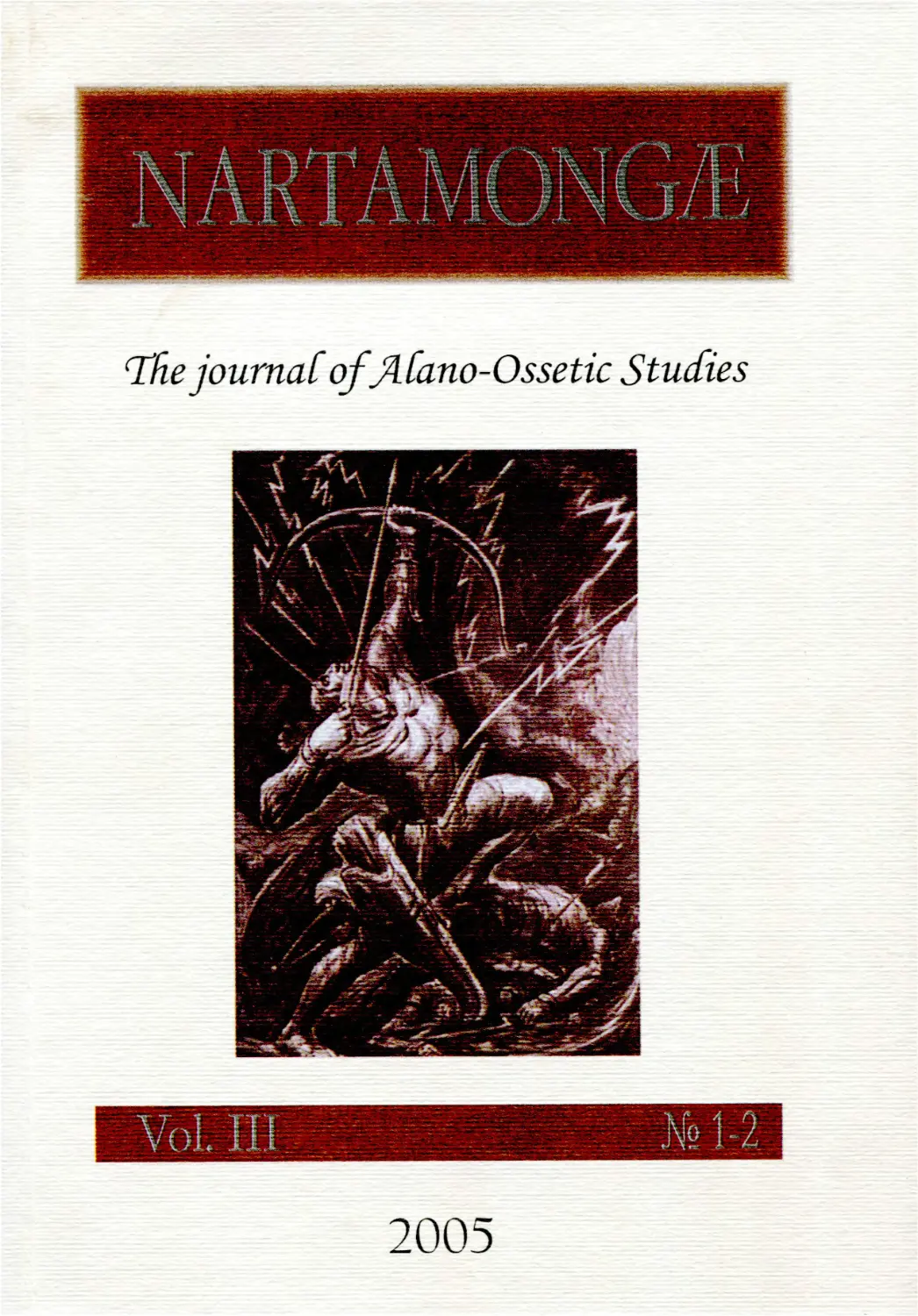
NARTAMONGÆ
Revue
d’Etudes Alano-Ossétiques:
Epopée, Mythologie & Eangage
The Journal
of Alano-Ossetic Studies:
Epic, Mythology & Eanguage
2005
Vol. Ill
№ 1-2
Paris — Vladikavkaz/Dzæwdzyqæw
РОССИЙСКАЯ АКАДЕМИЯ НАУК И ПРАВИТЕЛЬСТВО РЕСПУБЛИКИ
СЕВЕРНАЯ ОСЕТИЯ - АЛАНИЯ
ВЛАДИКАВКАЗСКИЙ НАУЧНЫЙ ЦЕНТР
ЦЕНТР СКИФО-АЛАНСКИХ ИССЛЕДОВАНИЙ им. В. И. АБАЕВА
INSTITUT NATIONAL DES LANGUES ET CIVILISATIONS ORIENTALES
CENTRE D’ÉTUDES RUSSES ET EURASIENNES
NARTAMONGÆ
Журнал
Алано-Осетинских Исследований:
Эпос, Мифология и Язык
Allon-Iron
Irtasænty Zumal:
Epos, Mijologi cemæ Æv^ag
2005
Vol. Ill
№ 1-2
Dzæwdzyqæw/Vladikavkaz — Paris
The Abaev Centre for Scytho-Alanic Studies
is a new academic institution devoted to the scholarly study of Culture, History and Languages of Ancient
Iranian Nomads of Eurasia. It was established in its present form by the Russian Academy of Sciences as a
part of its North Ossetian Branch in Vladikavkaz.
The Abaev Centre’s Periodical,
NARTAMONGÆ
The Journal of Alano-Ossetic Studies:
Epic, Mythology & Language,
is published twice a year in collaboration with the Centre d’Etudes russes et eurasiennes of Institut
National des Langues et Civilisations Orientales, Paris.
Current rates for subscriptions for the volume (calendar year):
Institutions $ 50 p.a.
Private individuals J 40 p.a.
(Please add 5 12.00 postage for non-Russian addresses)
Single issues of the NARTAMONGÆ may be purchased for S 25.00. For further information on how to pay
or for any other questions, please contact:
RUSSIAN FEDERATION, 362040, Republic of North Ossetia-Alania, VLADIKAVKAZ, Prospect
Mira, 10. The Abaev Centre for Scytho-Alanic Studies
© Центр скифо-аланских исследований ВНЦ РАН, 2005
© Издательство “Проект-Пресс”, 2005
NARTAMONGÆ
The Journal of Alano-Ossetic Studies:
Epic, Mythology & Language
'Rédacteurs en chef - General Editors
Главные редакторы
François CORNILLOT
( INALCO, Paris)
Bagrat TEKHOV
(The Abaev Centre for Scytho-Alanic Studies, Vladikavkaz)
Rédacteurs — Editors
Редакторы
Agusti ALEMANY
(Universitat Autônoma de Barcelona)
Yuri DZITTSOITY
(South Ossetian State University)
Conseil Scientifique International - International Scientific Board -
Международный научный совет
Françoise BADER (Е.Р.Н.Е, Paris)
Georges CHARACHIDZÉ (Institut de France)
Gadzi GAMZATOV (Russian Academy of Sciences)
Askold IVANTCHIK (Russian Academy of Sciences)
Nikolas KAZANSKY (Russian Academy of Sciences)
Jean KELLENS (Collège de France)
Alexander LUBOTSKY (Leiden University)
Antonio PANAINO (Universita’ degli studi di Bologna)
Adriano ROSSI (Istituto Universitario Orientale, Napoli)
Felix SLANOV (The Aryâna- Company, Moscow)
Yuri VOROTNIKOV (Russian Academy of Sciences)
CONTENTS
СОДЕРЖАНИЕ
SOMMAIRE
llya GershelitcH. Word and Spirit in Ossetic 7
В. И. АБАЕВ, Avestica 21
Жильбер АЛЗАР. Сослагательное и желательное наклонения в осетин¬
ском языке 37
Fridrik THORDARSON. The Ossetic Gerund 49
Аж. И. ЭаеаьмАН. Фрагмент истории осетинских числительных 59
Ю. А. АЗИЦЦОЙТЫ. Два этюда по исторической фонетике осетинского
языка 69
Fridrik THORDARSON. Ossetic 75
В. С. УАРЗИАТИ. Культурно-исторический анализ осетинского столика
«фынг» 110
3. А. ЦХУРБАТИ. Мотив мирового дерева в осетинском нартовском
эпосе 123
Ю. А. АЗИЦЦОЙТЫ, К К. КОЧИЕВ. Нарты и ваюги в селении Лац: на
границе двух миров 141
В. М. ГУСААОВ. Сраоша в осетинском эпосе 151
Sonja FRITZ, Jost Gippert. Nartica I: The Historical Satana Revisited 159
Dean A. MILLER. The Warrior-hero out of Control: Batradz and His
Compeers 202
Selected Nartæ Tales. Translated by Walter MAY. How Xæmyc’s Son Batraz
Avenged his Father’s Death 213
Рецензии на I том журнала «Nartamongæ» 219
Гусалов Виталий Михайлович 226
NARTAMONGÆ
2005
Vol. Ill, N 1-2
BULLETIN OF THE SCHOOL OF ORIENTAL AND AFRICAN STUDIES
UNIVERSITY OF LONDON
VOLUME XVII; PART 3, 1955
Published by THE SCHOOL OF ORIENTAL AND AFRICAN STUDIES
Ilya GERSHEVITCH
WORD AND SPIRIT IN OSSETIC1
The Ossetic pantheon includes two gods or spirits, Uacilla and Uastyrdzi
(Digor Uaskergi, Uasgergi, Uasgergi1 2), whose names contain Ossetic forms of
the names Ilya and George respectively. The Ossetes no longer know the
meaning of the prefix Uac- (of which Uas- is held to be a secondary
development before t and к), which at first sight appears to fulfil the function
of the appellative ‘Saint’. ‘St. Ilya and St. George’, wrote V. Miller in
Осетинские Этюды I, 119, ‘were introduced into Ossetia from Georgia by
Christian missionaries, but subsequently became popular gods’.
There is nothing very saintly about these spirits: Uacilla is connected with
thunder and lightning; Uaskergi’s function, according to Ossetic popular belief,
is to protect honest people against bandits, but this is not so in the Nart Saga,
where the god plays a somewhat disreputable part in the procreation of the
heroine Satana. It is therefore understandable that subsequently Miller
expressed the opinion (op. cit. II, 240, 257) that the two gods go back to the
period of Ossetic heathendom, and were renamed after Christian saints under
the impact of Christian propaganda.
The appellative Uac is also applied to St. Nicolas (Uac Nikkola), and to
Tutyr (Digor Uas Totur), the patron spirit of wolves (Tutyr corresponding
perhaps to Theodor, v. Hübschmann, ZDMG 41, 537, n. 1). My Digor friend in
translating from Russian a tale of Æfsati, the patron of hunters, referred to this
god as Uac Æfsati.
The current Ossetic word for ‘saint’ is syhdæg, in which, as in MPers.
ywzdhr and Sogd. zprt, the meaning ‘holy’ derives from ‘pure’. The question
1 The gist of this article was presented as a paper to the Twenty-third International
Congress of Orientalists at Cambridge, in August 1954.
2 Cf. the month-name Biy-Askergi among the Mountain Tatars who live to the West of
Digoria, between the River Urux and the Elbrus, Miller, Ос. Эт. Ill, 9.
7
therefore arises whether Uac, rather than rendering the meaning ‘saint’, may
not be a pre-Christian appellative of the spirits whose functions the Christian
Illa and Kergi have inherited.
Beside the appellative Uac the Ossetic language has a substantive uac
meaning ‘news’. Miller and Freiman’s Ossetic Dictionary contains the
tentative suggestion that the two uac are connected. V.I. Abaev has
wholeheartedly adopted this view in his book Осетинский язык и фольклор
vol. 1.1 quote the relevant passages: -
(Pp. 185 f.:) Av. vâk-, vacah-, survive in Oss. uac ‘word; news’. In
Ossetic the word had a religious connotation, as Xôyoç in Hellenistic cults; it
serves as epithet of Christian saints in Uacilla and Uaskergi; cf. also Aciroxs
(<Uaciroxs), name of a Nart heroine, lit. ‘light of Uac', and Aciamongœ
(<Uaciamongœ), name of the magic cup of the Nart, lit. ‘Uac-indicator’3. (Pp.
206 f.:) Intervocalic voicing of c is found in the oblique case uadzæn (uadzæn
aftæ akænînc ‘as the proverb goes’), in uadzimis ‘poet’, and in Uadzœftauœ,
name of a woman in the Nart tales. (...Since the most important Christian saints
bear the epithet uac) this word must have been one of the main religious terms
in pre-Christian Ossetia. Such a term had every chance of entering the
formation of proper names... The examples show that uac was not merely the
‘word’, but some higher ‘divine’ force, comparable to famah- and arta-, whose
role in Iranian names is well-known. In the Nart tale The Song ofAcœmæz it is
said that uacce roxs ‘the light of Uac' radiates from good Nikkola and
Uaskergi. Clearly it is not enough to attribute to Uac the meaning ‘word’.
...Uac.... was no ordinary logos, but ‘the Logos’, with capital L.
Professor Abaev’s remarks appear to me substantially correct, with
two reservations. One is phonological: the Avestan accusative vâcim can
account for uadz-, but not for uac(-), cf. Miller, Ossetisch, 28. The
occasional replacement of initial c- by dz- provides no parallel, since the
forms with dz- are likely to have arisen in compound sandhi. On the other
hand the assumption that in uac dz may have been unvoiced because it
stood in final position, while still not accounting for uacæ, Uacilla, etc.,
goes against normal Ossetic practice: ‘voiced consonants in final position
3 This cup rises of its own account to the lips of the Nart hero who relates his exploits
truthfully, but remains on the table if lies are told, cf. Narty Kaddzytce 229 = V. Dynnik, Нартские
сказания 298, v. also Dumézil, Légendes sur les Nartes, 136 f. Also Miller, Ос. Эт. I, 161, n. 20,
connected the first element of Uacilla with that of Uasiamongæ [as he spells this name, which only
occurs in Digor; the pronunciation is wafia0, secondary development of watfia0].
8
are rarely, if at all, unvoiced’ (Abaev, apud A.M. Kasaev, Осетинско-
русский словарь, p. 447). I can find only nymæc : nymædz, against
consistent ssœdz, afœdz, zceppadz, xülydz. The second difficulty lies in the
vagueness of the definition of ‘Logos’ as applicable to Oss. uac. what is
the meaning of ‘light of Uac' or ‘t/ac-indicator’? how did an abstract
religious conception, such as Logos, come to be used as an appellative of
individual gods in a way neither farnah- nor rta- ever did?
The solution to these difficulties becomes apparent as soon as the Middle
Persian and Parthian descendants of OIr. wâk-, wâc- are taken into
consideration. MPers. w’xs, from the OIr. Nom. Sg. wâxs, is clearly attested in
the meaning of ‘a spirit’, cf. H. W. Bailey, Zoroastrian Problems 66, 118, 228.
A similar meaning (v. below, p. 488 (B) (b)) can now be attributed to Parth.
w’c, from the OIr. Acc. Sg. wâcam, since W. B. Henning has established that
Man. Parth. w’c’fryd corresponds to MPers. mynwg ‘spiritual’ (v. Mary Boyce,
The Manichaean Hymn-Cycles in Parthian, 103, n. 1). If then the Oss.
appellative Uac belongs to OIr. wâk-, we must take the clue to its form and
meaning from MPers. w’xs.
The assumption that Oss. c sporadically represents OIr. xs is favoured by
Digor docun ‘to milk’. Hiibschmann, Pers. Studien 64, derived NPers. dôs-
from *dauxsa-; Morgenstieme proposed *dauxsya- as starting form of Ps.
Iwasdl, Pers, dôsïdan, Sangl. dès-, and Orm. dûs-, cf. IIFL I, 393, II, 225; it is
unlikely that Oss. docun goes back to any other present stem.
H. W. Bailey has brought together docun, ficun ‘to cook’, and xuœcun ‘to
seize, wrestle, fight’, suggesting that all three contain c < xs (TPS 1936, 101).
This suggestion may have to be amplified in the sense that it is early Ossetic
xs, whether from OIr. xs or xs, which under special conditions became c. If
ficun is derived from OIr. *paxsa- the intransitive meaning of this verb is
accounted for, cf. Yayn. puxs- ‘pazïdan', Junker, Yaghnôbï-Studien 12, and
Yâzg. past, Tedesco, BSL 25, 63. But ficun is also transitive: fut ficuy means 4
4 Beside fyd ‘meat’ and fyd ‘father’, Miller-Freiman’s Dictionary has the entry fyd
‘millstone’. This interesting word may be from *piti- ‘crushing, crushing instrument’, and
compare with Ps. and Orm. (Waz.) pal ‘millstone’ (cf. Morgenstieme, NTS v, 25, who assumes
Indian origin) < *paiti- (hochstufe as in Ved. heli, cf. Wackemagel-Debrunner, Ai. Gr. II2, p.
631 c notes; cf. Ps. wala < vaëti-, and, for the ending, NTS XII, 93). This pi- may be the
unextended base of Av. pisant-, Skt. pinâsti, etc., which can also be recognized in Vend. 13,
40: jqdwa vahrka scqOwa vahrka pôifhva vahrka snaêzana ‘the slavering wolves are to be
killed, smashed, crushed’; this explanation of poifhva- is to be preferred to Bartholomae's (Air.
Wb. 1893 on 899) or Geldner’s (Studien 53).
On the other hand, under the entry fork two homonyms have been thrown together in
9
both ‘the meat is cooking’ and ‘he is cooking the meat’, cf. Munkâcsi, Bliiten I,
22, n. 1. In its transitive meaning ficun may represent OIr. *paxs(a)-, cf. Sogd.
pwys’, GMS § 551.
The case of xuœcun is more complicated, as c has to be reconciled with
the 5 of the past stem xuœst-.* 5 If c here represented OIr. -ti- there would be no
difficulty. However, Miller’s connexion (Ossetisch 26) of xuœcun with Skt.
svaj-, svanj- ‘to embrace, clasp’, cf. Av. pairis.xvaxta-, is not lightly to be
abandoned. For a verbal noun derived from OIr. *hwanf-, which with various
preverbs displays meanings that suit the usage of Oss. xuœcun, can be
recognized in Sogd. ’nxwnc, ’xwnc ‘struggle’, and ’wxwnc. These words were
discussed by Heiming in BBB, p. 63; ’wxwnc had been connected by Lentz
with the 3 Sg. Pres, ’wxt, with which it occurs in a difficult sentence: c’nw dw’
xwdbtyq ’wxwnc qwnntq 'n yy xw xwny myn ’bry wnm ’ ’wxtq’m cn nyz ’wry ms
mydc’nw sfsqnt qy 'wxt en sfnyq, 5TII, 5,15 ff. In his treatment of this passage,
J As. 1951, 116 ff., Benveniste has made it likely that ’wxt means ‘becomes
separated’6; a connexion with ’wxwnc is thus excluded. On the other hand,
Benveniste translates the first five words by ‘quand les deux royaumes
prendront part à une guerre’, leaving xwdbtyq unexplained, while Lentz’s
translation ‘wenn die beiden einander erne Schlacht liefern werden’ disagrees
with the situation as elucidated by Benveniste. Comparison with Daniel II, 43,
shows that there is no question of a ‘battle’, but on the contrary of the two
kingdoms ‘cleaving’ (Aram, dbq) to one another. We must therefore translate:
‘as7 the two will clasp each other, that plenipotentiary8 will retreat from the
weak one, as clay retreats from iron’. Thus Sogd. ‘wxwnc (< *awa-hwanj~a-)
‘clasping’ preserves the original meaning of the base, which in Oss. xuœcun
coexists with the secondary meaning of Sogd. ’nxwnc, ’xwno ‘struggle’. For
the Ossetic verb we may postulate an OIr. present stem *hwaxs(a)- or
the Dictionary. Fark meaning ‘piece, splinter, small plank’ (cf. tiïsofœrki-fœrgkai, Памятники
И, 810, ‘in smithereens’) is connected with NPers. para, while fark ‘blade of a mill-wheel,
paddle’ belongs to NPers. pârü.
5 Thus also in the etymologically obscure Digor verb xincun ‘to treat hospitably, entertain’,
whose past stem is xinst-, while its Iron equivalent xyncyn, which in addition means ‘to count’,
has as past stem xyxt-, xyhd-.
6 Considerable doubt, however, attaches to Benveniste’s identification of Chr. ’wxt with
B. ’wyrt. Loss of final r of a present stem before the ending -t of the 3 Sg. occurs in Chr. -d’t
after a long vowel, but is not attested after short vowels. Also the difference in the
construction, which Benveniste has noted, goes against the identification.
7 cf. JRAS 1946, 181, on 115.
8 v. Henning, BSOAS XII, 309 n.
10
*hwaxsa- (note that xucecun is intransitive). The past stem xuæst- will then go
back to early Oss. *xuæxst-, with dissimilatory loss of the second x. The
importation of s or s from the present to the past stem is attested in the Oss.
inchoatives xussun: xust- ‘to sleep’, cœfsun: cæfst- ‘to burn’ (cf. Bailey, BSOS
VI, 67), dunsun: dunst- ‘to swell’, tœfsun ‘to warm up’: tafst ‘warmth’, in
Khot. hust- ‘to sleep’, kast- ‘to fall’, dïst- ‘to ripen’ (v. Bailey, Asica 30, Asia
Major (N.S.) II, 31), in Sogd. ôfixst- ‘to collect, gain’ (GMS § 551), and in Av.
axsnusta- ‘unreconciled’, fradaxsta- ‘taught; branded’.
The conditions in which early Oss. xs from xs, xs, may have become c
are not clear. Normally this consonant group has remained unchanged. Thus xs
< OIr. xs is found in cexsinun ‘to gnaw’ (connected by Miller with Skt. ksi-nS-
ti), cf. Sogd. ‘ysy- ‘to gnaw’ SCE 83, in ixsun ‘to be worn out’ < *xsu-9, cf. Skt.
ksurâ, Gr. in æxsïn ‘lady, housewife’,10 11 perhaps in Iron uœxsk (beside the
unexplained Digor usqæ) ‘shoulder’ (which Miller, Ос. Эт. Ill, 169, and
again Abaev, op. cit. I, 18, equated with Skt. vaksas ‘chest’), etc., cf. also
Miller, Ossetisch 26 (§ 24, 2). For Oss. xs < OIr. xs cf. buxsun ‘to endure, have
patience’,11 and xixsœntæ ‘slops, swill’, plural of *xixscen with suffix -æn, <
*hixsa- ‘to be poured out’, to Av. haëk-,
9 Not from *xsï-, as shown by Digor fexsuyun, fexsud, which preclude Miller’s (IF 21,
328) and Morgenstieme’s (I1FLII, 209, s.y.jsïi) connexion of ixsun with Skt. tsiyate.
10 In common with other Eastern Iranian languages Ossetic has lost OIr. 0 before n.
Miller did not mention this development in his grammar, but neither HUbschmann (Arm. Gr.
20) nor Bartholomae (Mitteliranische Mundarten III, 29) hesitated to derive æxsïn, of which
œfsïn is apparently a side-form, from OIr. *xsai0nï-. In addition, Ossetic provides
representatives of the usual two test words, OIr. *ara0m- ‘cubit’, and hapaOni- ‘co-wife’. The
former has been recognized by H. W. Bailey (personal communication) in Digor cœng-œrïnœ,
Iron ælm-ærin, œrm-ærin ‘cubit’. The latter survives, in my opinion, in bïnontœ ‘family,
members of a household, relatives, wife’, which lends itself to the analysis bin (< hapaOnl-) +
suffix -an (a)- (cf. binoinag, usually ‘member of a household’, but in Iron Adœtnon
Sfældystad, Ordjonikidze, 1941, 827, ‘wife’) + plural suffix -tæ. The original meaning will have
been ‘со-wives and their children’, cf. E. H. Minns, Scythians and Greeks, 84, on the position
of women among the Scyths. In Sogd. pn’nc ‘со-wife’ (v. W. B. Henning, Sogdica 17 f.) the
same suffix -an(a)- has been adapted to the Sogdian personal feminine suffix -âne; this view is
preferable to the one taken in GMS §1046. The Ossetic palatalization of a in -a(0)nï- compares
with the treatment of -anya- in (suh)zærïnœ ‘gold’ from zaranya- (Miller, Ос. Эт. Ill, 138).
11 From my Digor friend I have ristœn nœ buxsun (or buxsagœ dæn) T cannot endure pain’,
nœ ibœl buxsun T miss him, long for him’ (lit. ‘am impatient for him’). Oss. buxs- probably
continues an OIr. inchoative *buxsa-, the past participle of which survives in Sogd. flwyt’rmyk
‘patient’, cf. GMS §§ 469,1105.
11
Apart from docun, ficun, xuœcun, one may suspect that c represents xs in
the name of the Sturdigor feast facbadœn (variant fazbadœn) which Miller, Oc.
Эт. II, 282 ff., described in detail. Gatuyev thought the name meant ‘sitting in the
glade’, but this guess has no relation to the practice of the feast, during which the
inhabitants of Sturdigor allow no one to enter or leave their village. Facbadœn
may therefore mean ‘sitting aside’, if fac is a dialect form of faxs ‘side’ - Skt.
paksa (v. Miller, Ос. Эт. Ш, 142), cf. œvvaxs ‘near’; the variant faz- before b
reminds one of uas- before t and k. Furthermore, a comparison of the two
synonyms lacamarz and lœxamœca ‘sloven(liness)’, in which the verbal elements
belong respectively to mœrzyn ‘to sweep’ and mœcyn ‘to wallow’, invites the
conjecture that lac is related to lœx ‘dung’ through an old form *laxsa-.
If the assumption of an Ossetic dialect variant c of xs is granted, then
Abayev’s derivation of Uac from OIr. wâk- only needs to be revised in the
light of the meaning of MPers. w’xs, to acquire a high degree of probability.
The meaning ‘spirit’ not only meets the fact that Uacilla and Uaskergi are
spirits, but also helps to explain the curious use of both these names in the
plural. The uacillatœ and uastyrdzitœ are nondescript spirits, said to be God’s
‘angels’ (zœdtœ, cf. the text quoted by Miller, Ос. Эт. I, 24 ff.12); they are a
favourite target of the Nart heroes Batradz and Xæmyc, who without any
apparent provocation kill a number of them at each encounter. These spirits,
who always make their appearance collectively, seem to have nothing but the
name in common with the individual spirits Uacilla and Uastyrdzi. To us, who
have reasons to think that Uac means ‘spirit’, Ossetic story-tellers may not
seem to be very accurate when they use the plural of zœd to describe the
uacillatœ and uastyrdzitœ: they should by rights have employed the plural of
мае13. This plural, we may surmise, ceased to be used once the function of uac
was reduced to that of a prefix of proper names. It would then be
understandable if the ancestors of the Ossetes, when they wished to refer to the
uac class of spirits, as distinct from the zœd or the dauœg class, resorted to the
12 There three иасШа-angels are referred to as œrtœ Tbauacillajy, viz. uacillas from the
mountain Tbau; cf. the Song ofAcœmœz, line 166 (in Abaev’s edition. Из осетинского эпоса,
pp. 54 ff.), where White Yelia ( = the individual spirit Uacilla) is said to reside on mount
Tubau.
13 An early form of the plural of uac ‘spirit’ (uac ‘news’ has the plur. uactœ) survives
perhaps in the asseveration uastœn (and uasdœn? v. Diet.), which, as it seems to be used like
Engl, ‘by Jove’, may be a Dat. plur. meaning ‘by the Spirits’. The Dictionary suggests that
uastœn contains the postposition stœn; this is unlikely, for the noun which precedes stœn is
always in the Genitive, as the examples collected by G. Morrison, Ricerche Linguistiche II, 79
n., clearly show. Cf. uasœn and uadzœn below, p. 488, n. 2.
12
plural of Uacilla and Uastîrdzî, the most popular representatives of this class.
Apparently the uacillaîœ are closer to the zœdtœ than to the daudzytæ.
For not only are they described by the Ossetes as zœdtœ, but they even replace
the zœdtœ in the Nart tale printed by Miller, Ос. Эт. I, 149, where Batradz
says: ‘I killed five daudzytæ and six uacillatœ’; elsewhere Batradz’s conflict is
said to be with the zœdtœ and the daudzytæ,14
Generally speaking, the Ossetes are only dimly conscious of a difference
between zœdtœ and daudzytæ)5 16 Both are simply protective genii in Ossetic
folklore. However, according to D. G. Bekoev, who translated and annotated
the Ossetic texts published in Памятники III, the zœd is an ‘angel’, the
dauœgxe a person who becomes a member of the heavenly host surrounding
God, ‘what in Church language is called an intercessor’ (pp. 136, n. 22 ; 138, n.
72). This definition is in agreement with the less ecclesiastical use of daudzytæ
in a Nart tale, where Kurdalægon, the smith whom Ossetic story-tellers sometimes
describe as living in Heaven, sometimes in the realm of the dead, is considered to be
a dauœg.17 In the absence of any other definition, it is as well to take seriously this
one, which makes of the dauœg a ‘blessed dead in Heaven’.
14 v. Dynnik, Нартские Сказания 348 ff. = Narty Kaddzytæ 261 ff.
15 Dauœg is usually translated as ‘seraph, protective genius’. In Iron Adœmon
Sfœldystad 275, n. 75, Digor idaugutœ is explained by 'izœdtœ'. Miller remarked, Ос. Эт. II,
240, that to his knowledge neither the individual Uastyrdzi, nor any of the other gods were ever
called zœd or dauœg', however, in the Song ofAcœmœz Uasgergi is referred to as an izœd (line
128), and a group of gods consisting of Uasgergi, White Yelia, Good Nikkola, Æfsati,
Fælværa, and others, is more than once collectively described as izœdtœ and idaugutœ. -
Beside the collectively appearing daudzytæ there exists an individual genius by the name of
Dauœg, who was believed to avert the plague. To him a sanctuary was dedicated near
Sturdigor (Miller, Ос. Эт. II, 261, 283 f.); cf. Barduag in the next note.
16 Beside dauœg (Dig. idauœg) we find duag in an Iron text, Памятники III, 712, cf.
ryny Barduag ‘god of (= averting?) illness’ (Dictionary). The development is as in Dig. bauœr.
Iron buar ‘body’, etc., cf. Miller, Ossetisch 17.
17 Fervysta Satana Kürdalœgonmœ. Nart œmxœrd, œmnuœzt üdysty daudzytimœ, -
œrcydis Kürdalœgon Satanajy xündmœ ‘Satana sent for Kurdalægon. The Nart were on
convivial terms with the dauœgs, and K. came at Satana’s invitation’, Narty Kaddzytæ 64. The
name of this smith (Oss. kiird) contains lœg ‘man’ according to Miller, Ос. Эт. I, 118; on the
other hand Abayev, Ос. яз. и фолък. I, 71, starts from the Digor variant Kurd-Ala-Ûœrgon
(Dictionary, 703 f.), which he analyses as ‘the Alanic smith Wœrgon , Wœrgon
corresponding in his opinion to Vulcanus. Kurdalægon is described by Miller, loc. cit., as
living in Heaven or in the realm of the dead, where he forges horseshoes, etc., for the
horses of deceased persona.
13
Since it has long been recognized that zœd, Dig. izœd, derives from Old
Iranian yazata-, one naturally looks to the range of Old Iranian ideas to which
yazata- belongs for an explanation of dauœg. The notion of a ‘blessed dead in
Heaven’ is most nearly rendered in Xerxes’ definition of Old Persian artâvan-:
‘The man who behaves according to the law which Ahuramazdâh established,
and worships Ahuramazdâh in proper style in accord with Arta, becomes
happy while living, and artâvan- when dead’, Daiva Inscr. 51 ff., cf. also 48.
H. W. Bailey has pointed out the use of ahrav with the same meaning in
Pahlavi texts (Zoroastrian Problems 87, n. 4). It should be noted that the key to
this doctrine is to be found in an Avestan passage, Yasna 16, 7: ‘We worship
the radiant quarters of Asa in which dwell the souls of the dead, the Fravasis of
the asavans', the best existence (= Paradise) of the asavans we worship, (which
is) light and affording all comforts’.18
I therefore suspect that Iron dauœg, Digor idauœg19 represent popular
mutilations of Middle Ossetic *œrdauœg,2® misinterpreted as containing the
preverb œr- on the analogy of cases like œrgom : gom, œrhudi : hudi, and
many more. A parallel can perhaps be found in the participial adjectives Iron
uœndag, Digor iüœndœg ‘brave, daring, agile, fast’ (cf. Dictionary and
Abaev, Ос. яз. и фолък. I, 483), and the denominative (as shown by the past
stem) üœndyn : üœndyd ‘to brave, dare’, which Miller, Ossetisch 63,21
unconvincingly derived from *uantar- ‘victor’. From the semantic point of
18 The problem of OPers. artâvan- was last discussed by J. Duchesne-Guillemin,
Z.orwtre, 130 f., who did not consider the Avestan evidence.
191 used to consider, but have abandoned as semantically unsatisfactory, a connexion of
idauæg with Sogd. wyt’w- ‘to endure, persevere*. This verbal stem was somewhat misleadingly
quoted in GMS § 216. The passage there referred to, M 133, 83, is the one from which.
Henning, Sogdica, p. 3, had quoted wyfwp’zny'h. It is only in this compound that wyt’w-
occurs in Man. Sogd.; in Buddh. Sogd. we have wyt'wn'k ‘persevering’ in P2, 1130, with
which Benveniste rightly compared pfw- ‘to endure’; cf. Chr. pfwp'zny' ‘Duldersinn’ in STII,
which approximates the meaning of Man. wyfwp'zny'h. - I take this opportunity to point out
that Benveniste was the first to notice, in J As. 1939, 275 f., that B. zn’kh in VJ means ‘body’
(cf. TPS 1945, 138, n.4).
20 OIr. ita- gives Oss. ard ‘oath’ (cf. Bailey apud E. B. Ceadel, Literatures of the East
101), which becomes œrd- when unstressed, cf. œrdxôrd ‘confédéral’. For the -(a)k(a)- suffix
added to an -âuan- stem Sogd. cn’wq ‘thirsty’ can perhaps be compared.
21 The form œüùcendyn there quoted by Miller is not to be found in the Dictionary and
seems to be due to confusion with œüùœndyn ‘to trust’.
14
view Av. aurvant- ‘brave, fast’ (Middle Oss. *ærüœnd-) would provide
the ideal etymon. Admittedly the initial i- of the Digor form, which
Miller’s etymology left unexplained, still remains obscure (cf. Ossetisch
17 f.).22
In the case of (i)dauœg a special consideration can be adduced to account
for the assumed development. In common with other preverbs, œr- when
prefixed to nouns or adjectives that are followed by the copula in the present,
turns them into virtual past participles fiendi. The function of the copula is
thereby reduced to that of a personal ending, the whole complex acting as an
intransitive preterit; cf. e.g. Digor hœla œy ‘he is an idiot’, œs-hœla (fœ-hœla,
ni-hœla) œy ‘he became an idiot’; hœzdug dœn ‘I am rich’, is-hœzdug dœn T
became rich’; darh-œy ‘it is long’, œr-darh-œy ‘it became long.23 Now, while a
man who is-hœzdug-œy ‘became rich’ may subsequently fall into poverty, one
who at death ‘became blessed’ necessarily remains so for all times. There
22 Trace of a replacement of the pseudo preverb œr- by the preverb (w)i- in the
denominative verb *œrüœnd? (Nowadays, according to the Dictionary, üœndyn takes the
preverbs a-, ba-, s-, and fœ-). Such an explanation cannot, of course, account for the i- of
idauœg, since no denominative of this word is attested. At a stretch one may invoke a possible
analogical (alliterative) influence of i-zœdtœ, with whom the i-daugutœ are constantly
associated in the formula izœdtœ œma idaugutœ, which for practical purposes is a dvandva of
the mad-œmœ-fyd type (cf. Miller, Ossetisch 96).
23 The preverb originally may have belonged to the verb kœnun ‘facere’, with which
the corresponding transitive expressions are formed: ni-hœla-kodta ‘he turned (somebody)
into an idiot’, is-hœzdug-kodta ‘he made (someone) rich, he enriched’, œr-darh-kodta ‘he
made (something) long, he lengthened’. The pseudo intransitive past participles abstracted
from such periphrases were treated like real ones: the 1st Sing. Prêt, is-hœzdug-dœn ‘I
became rich’ was formed on inhœzdug ‘become rich’, as ærcud-tœn (< *œrcud-dœn) ‘I
came’, lit. ‘vontussum’ on the past participle œrcud- (OIr. *Qcyuta~), or MPers. ’md hym,
Sogd. ”ytym on the past participles ’md, ”yt- (OIr. âg(m)ata-) respectively. In the 3rd Sing,
of the Preterit the copula is usually implied (Sogd. ’ yt, MPers., NPers. âmad, etc.), but in
Ossetic beside Iron ærcyd ‘he came’, we more commonly find œrcyd-i(s), in Digor always
œrcud-œy 'ventus est’; correspondingly in Iron both s-qœzdyg and s-qœzdyg-i(s) are
possible, in Digor only is-hœzdug-œy. These interesting Ossetic periphrastic
denominatives, as one may call them, have not yet received the systematic treatment they
deserve, which would take into account their complete inflection, and the shades of
meaning or aspect conferred by various preverbs; cf. provisionally v. Stackelberg,
Beitrage zur Syntax des Ossetischen 71 f., Miller, Ossetisch § 87, 2, Abaev apud Kasaev,
Осетинско-русский словарь 492.
15
follows that an Ossete saying some centuries ago of his ancestors that they
*œrdauœg œncœ ‘are blessed’, would do full justice to his meaning even if he
wrongly analysed the etymologically obscure word as *œr-dauœg, and
understood the statement as meaning ‘they became (and therefore are) dauœg
By mistaking ‘blessed’ (*œrdauœg) for ‘become blessed’ (*œr-dauœg) he
would create a new word for ‘blessed’ (dauœg).
To illustrate the possible background against which we might set the
world of spirits of Ossetic folklore, which as interpreted by us is somewhat
reminiscent of late Zoroastrianism, we may pause for a moment to consider the
mythical dreamland Kürys of the Ossetes. As described by B. Gatiev in
Сборник сведений о кавказских горцах, vol. IX (1876), part 3; рр. 26 f.,
Kürys is a meadow belonging to the dead, which contains wonderful seeds of
various cereals, as well as of good luck and misfortune. In every village there
are a number of people who are able to visit Kürys in their sleep. Their souls
leave the sleeping bodies, mount on other people's horses, dogs, or children,
and drive them to Kürys. There the souls alight, pick a handful of the
wonderful seeds, and return home, sometimes pursued by the dead who aim
arrows at them. Inexperienced souls instead of collecting seeds bring back
colds, coughs, and fever. Miller was told by his informant Tukkaev that
among the Digors the region which the souls visited was called Burku;
neighbours of ‘Виг^м-travellers’ found it advisable to tie little chains to
themselves and their horses, to prevent the noctambulant souls from using
them as mounts on their journeys (Ос. Эт. II, 270). According to another
tradition picked up by Shanaev and quoted by Miller, p. 272, the destination
of the souls was the mountain Tatar-Tup. As to Kürys (on which cf. also the
Dictionary p.v.) Miller verified with one of his informants that the
pronunciation was with y, and the word was distinct from the noun Kürïs,
Digor kures ‘sheaf’.
Kürys recalls the name of the mountain or mountain-range kaoirisa in
Yast 19, 6. In the chapter on mountains of the Bundahisn kaoiris (spelt
fcwy(y)Z’s, Gt, Bd., 7911, Ind. Bd., 12, 25) is the only mountain to be located in
Ërân Vez. Here, then, we may hope to find in Ossetic folklore a direct
reference to Aryana Vaëjah. According to Bartholomae the Avestan form of
the name represents *karuisa-. If this were the case, there would be no exact
parallel to show what result should be expected in Ossetic.24 But kaoirisa- is
24 Discounting mœldzyg, Dig. muldzug, ‘ant’ < *marui-ca-ka- (cf. Sogd. zm’wrc, GMS
§ 247, v. also Bailey, BSOAS ХШ, 664), where apparently и was transferred to the suffix by
metathesis. The first и of the Digor form will then be secondary, cf. Miller, Ossetisch § 7, 3, note.
16
just as likely to be a viddhi derivative of the name of, say, a region *kuirisa-,
which may be the one remembered by the Ossetes.
That the ancestors of the Ossetes, the Alani, should have brought to the
Caucasus the memory of a region of Aryana Vaëjah, the homeland of the
speakers of Avestan (cf. Henning, Zoroaster, 42 f.), is a supposition which
squares well with current views on the subject. The Alani = Àryânas25 were
brought from the area of Lake Aral to the Caucasus by a migratory movement
which can be dated between A.D. 25 and 35 (cf. Taubler, Zur Geschichte der
Alanen, Klio 9 (1909). 23 ff.). In their seats around Lake Aral (cf. Junge, Saka-
Studien, Klio, Beiheft XLI, N.F., Heft 28 (1939), p. 77), the Alani were in
contact with Chorasmia, i.e. with at least the northern fringe of the country
which once was Aryana Vaëjah. It would even seem possible that the tribal
name Alani = Aryana reflects a connexion of the tribe with inhabitants, or
former inhabitants, of Aryana Vaëjah26. Against such a background it would
25 Abaev, in an article published in 1927 and reprinted in Ос. яз. и фолък. I, 246,
ingeniously finds the tribal name âryâna- in the allon smell by which the man-eater of an
Ossetic fable recognizes the presence in his house of the hidden ‘Alanic’ hero. On the other
hand, Abaev dismisses the long-cherished view that the Ossetic name of the Ossetes, Ir, Iron,
Digor Irœ, represents OIr. arya-. It is true, as he says, that -ry- should have resulted in -l(l)-, to
judge by nœl < narya-, dœllag < *adaryâka-, etc. But the initial i- in both Iron and Digor is
best explained as a palatalized a-, cf. innœ ‘other’ (< any a-) in both dialects. It is possible that
the ancient ethnicon arya- survived beside the phonologically correctly developed ala-, and
became ira- at a time when r was no longer affected by a following y. Note that among the
Sarmato-Alanic names we find not only AXéÇapûoç < *arya-xsaOra-, but also *HpaKaç (chief
interpreter of the Alans, beginning of 3rd cent. A.D.) < *aryaka-, beside the archaic
Aptapàpvriç, etc.
26 Such was the opinion of Andreas as summarized by E. Meyer, Geschichte des
Altertums, 4th ed., I, 2, p. 898, § 572 n.: ‘Aryanam vaëjo identifiziert Andreas wohl richtig mit
Chvaresm, dem Heimatland der Alanen oder Osseten, an dem der Ariername speziell haftete’.
One cannot, of course, identify the Alani with the Aryana-Vaëjahians if one accepts the view,
as we do, that the latter were the speakers of Avestan. But the gist of Andreas’ theory can be
maintained by assuming, for instance, that the tribes (of the Aorsoi confederacy? cf. Ptolemy’s
Alanorsoi, and v. Junge, op. cit., 78 f.) that were due to become known as Alani, had fallen
under the sway of an Aryana-Vaëjahian class of rulers, whose ethnical name they adopted at
the beginning of our era. If the Alani are actually Aorsoi renamed, then Âs, the medieval name
of the Ossetes, which goes back to older *Ars- (v. Bailey, BSOAS XIII, 135 f.), is most likely a
later form of Aors(oi) (as seen by O. Maenchen. Helfen, JAOS 1945, 78 f., who, however,
proceeded with too broad a sweep), despite the obvious phonological difficulties. We may
2 Заказ № 2040
17
not be surprising if the Alani had absorbed a few Zoroastrian notions, of which
certain popular superstitions of the Ossetes preserve a faint echo.
To revert to our spirits, if the explanation proposed for the daudzytæ
can be trusted, it is likely that the Uacillatæ, replacing an earlier plural of
uac uâxs ‘spirit, genius’, occupied in the divine hierarchy of the early
Ossetes an intermediate position between gods (yazatas) on the one side,
and men raised to heavenly bliss (asavans) on the other. The tendency we
noticed earlier (p. 482 f.), to identify the Uacillatæ with gods rather than
with blessed men (as we take the daudzytæ to be), is counterbalanced by the
Ossetic replacement of the Christian epithet ‘Saint’ by uac in Uacilla and
Uaskergi', such a replacement implies a somewhat closer affinity of the uac
with the dauœg as interpreted by us, than with the zæd. It is only natural
that Ossetic opinion should have hesitated over the precise definition of the
nature of a spirit, or genius.
If our conclusion on the meaning and origin of uac is correct, the
relation of Word and Spirit in Iranian thought will be seen in a new
perspective. It has been assumed that MPers. w’xs came to mean ‘spirit’
under the influence of the Gnostic or Christian Logos (cf. Bailey,
Zoroastrian Problems, 119). We have seen that a similar assumption has
been made for Oss. uac. But firstly the Gnostic or Christian Logos does not
seem to have meant ‘spirit’ in the sense of a genius that goes about and
talks or acts. Secondly there is no evidence that the ancestors of the Ossetes
indulged in Gnostic speculation. Lastly, the Ossetic use of uac cannot very
well be attributed to the Christian use of Logos, since no Christian would
ever use the word logos to denote a saint. If then the meaning of Oss. uac is
independent of the Gnostic or Christian Logos, one may well doubt that
even the Middle Persian and Parthian use of w’xs and w’c- respectively, was
due to Gnostic or Christian influence. Should we not regard as genuinely
Iranian, rather than due to foreign Logos speculation, a development whose
result becomes apparent to us both in Western Middle Iranian and in
Ossetic? It would seem reasonable to conclude that the semantic transition
from Word, or Voice, to Spirit, was a development inherent in the meaning
of the Old Iranian word wdxs, wacam.
To end, we may attempt to sort out as follows the Ossetic words and
names which may be connected with OIr. uâk-, noting that the formal
remember that a replacement of -aor- by -ar-, which is puzzling despite Marquait, Eransahr, 155,
and Schaeder, Iranica 50, also took place in the name of the almost certainly identical Saoromatai :
Sarmatai, the predecessors of the Aorsoi-Alani, and remote ancestors of the Ossetes.
18
difference between the ancient Nom. and Ace. was apparently made to serve
the semantic distinction between the two main connotations of the word
‘spirit’:
(A) Old Iranian wâxs, Norn. Sing.
(a) ‘Word’: uac ‘news’ (the meaning ‘word’ given by Abaev (v. above,
p. 478) is not found in the Dictionary), plur. uactæ; uacqud ‘news’ (lit. ‘news¬
thought’); with s generalized from the position before voiceless stops (cf. (b)),
uas ‘sermon’.
(b) ‘Spirit: supernatural personality’: Uac in Uacilla and Uac Nikkola;
Uac, n. pr. (cf. Dauæg as n.pr. of a genius, p. 483, n. 2) ; with secondary 5
Uaskergi, Uas Totur, possibly also the asseverations uastæn (p. 482, n. 2)
and uasæn (p. 488, n. 2); Uacamongæ, Acamongæ (the form
(U)acZsiamongæ is probably analogical to Uaciroxs below), name of a
magical cup (above, p. 479, n. 1) also called simply Amongæ ‘the Exposer’,
lit. ‘the Spirit Exposer’, cf. Uacilla = ’the Spirit Illa’; Digor uacæ roxs
(which I take to be a compound with the compound vowel -œ-, cf. ændœr-
æ-bon, fyd-œ-bon), quoted in the Dictionary, s.v. uac, from the Song of
Acæmæz, line 126; ‘light of a supernatural being = supernatural light’;
Uacyruxs, Acyruxs, Dig. Uaciroxs, n.pr., ‘having the light of a supernatural
being’; Digor uacaxæssæn (not in Diet.: ce duuœ uacaxæssæn congebœl ‘on
his two powerful arms’, Памятники II, 4938) ‘having the grasp of a
supernatural being = of supernatural grasp’.
(B) Old Iranian wacarn, Ace. Sing.
(a) ‘Word’: uadzæn (Dative) ‘proverb’ in the expression quoted
above, p. 479, from Abaev; uadzymys ‘sharp-witted; poetry’, lit. ‘inventor,
invention, of words’, cf. BSOAS XIV, 485; uadzæftauæ ‘conjuration, curse’
may be interpreted as ‘imposition’ either ‘of the word’ or ‘of the spirit’,
with a pejorative connotation which presumably is absent in the n.pr.
Uadzæftauæ.
(b) Spirit: the animating principle, as opposed to body or matter (no more
than this meaning need be attributed to Parth. w’c(fryd) referred to above, p.
19
479): uadzyg, Digor œuadzug, ‘fainted, in a swoon’, lit. ‘without spirit’27;
uadzavard, uadzœværd ‘stupefied’, lit. ‘whose spirit is laid low’; possibly
uadzæftauæ, see (a), conceivably also the asseveration uadzœn28.
27 The loss of the privative particle is known to my Digor friend also in donug
(Dictionary only œdonug, idonug, beside Iron doini) ‘thirsty’ (lit. ‘without water’), and xormag
(Dictionary only œxxormag) ‘hungry’ (lit. ‘without food’). Initial œ is also lost in cœgœy ‘in
truth’, Памятники, II, 9235 < œcœgœy.
28 On p. 1250 the Dictionary has the following enigmatic entry: uadzœn (=uasœn;
uasxœn, somiœn) adv. ‘not for nothing, if only (< I swear?)’. Unfortunately no examples are
given. Uasxœn and somiœn ought to mean ‘for (= upon?) oath’. Hence uasœn and uadzœn are
conceivably asseverations in the singular, both inaccurately abstracted from the plural uastœn
‘by the Spirits’ (on which v. above, p. 482, n. 2) : uasœn with analogical 5 instead of expected
c (cf. uas, ‘sermon’ (A) (a) above), uadzœn ‘by the (=my) spirit’ with a shift to the other
connotation of the word ‘spirit’.
Two further words have been tentatively connected with uac, no doubt wrongly. In Oc.
Эт. I, 119, 161, Miller compared the name Uasxo, and his Dictionary has a reference to uadz,
uas, under the entry uaz. Uasxo was the name of a sanctuary at Kani. The name of the god to
whom the sanctuary was dedicated appears in the formula Uasxo dœ uazœg ‘U. is (or may U.
be) your guest’. Miller analysed the name as Uas-xo, but who, or what, is xo? In the Kabard
epos oaths are sworn by Uasxo-kan, and in one of the Kabard Nart tales (Нарты,
Кабардинский эпос, Moscow, 1951, p. 334) the god Uasxo is himself the curser. One might
therefore suppose that the name is connected with the Oss. noun uasxœ ‘oath’. However, M. E.
Talpa, Кабардинский фольклор, Moscow-Leningrad, 1936, p. 638, offered a Kabard
etymology of Uasxo : uafa ‘sky’ + sxo ‘blue’. As to uaz, apart from the difficulty of explaining
the z, the meaning ‘prayer, admonition’ which the Dictionary assigns to it, scarcely suits the
one context in which it is quoted. Памятники И, 1 1629 * * * * *; there, a being who first appears as a
bear, later turns out to be a religious man: ye ba lœg uœxœn adtœy œma medavarœy œndœmœ
uaz lœvardta ‘he was such a man that he gave uaz from inside the room towards the outside’.
At a guess one might say that uaz dœdtun here means ‘to radiate light’.
20
NARTAMONGÆ
2005
Vol. Ill, N 1-2
Bacco АБАЕВ
AVESTICA
Авест. aëta- “доля” - осет. xaj
В статье “Die Übersetzung von jungawest. aëta- m., aëtâ- f.” про¬
фессор Кноблох с обычной для него широтой лингвистического круго¬
зора рассматривает авест. субстантив aëta- во всех случаях его употреб¬
ления и приходит к выводу, что он сохраняет в основном значение рекон¬
струируемой и. е. базы *ai-ti-, *ai-to-, *oi-to- “доля, часть” (Рокоту 10-
11), и подстановка в соответствующие тексты иных значений (“вина”,
“наказание”) представляется излишней1. Ср. гр. a'ioa “доля, часть,
участь”, оск. (род. пад.) aeteis “части” и пр. К уже известным соответст¬
виям можно, как нам кажется, присоединить осет. xaj “доля, часть”,
если допустить, что начальный х- является протетическим как в хот
“сырой” (др.-инд. йта-) и др. (см. ниже авест. asta-).
Осет. x-aj предполагает сильную ступень (vrddhi) корневого глас¬
ного, нечто вроде *âiOya-. Форма *aita- (авест. aëta-) относилась бы к
*âi0ya-, как, скажем, др.инд. vesa- к vâisya-. Звуковое развитие закономер¬
но: *âitya—>*âij^>*ây—> x-aj.
Авест. asta-
Переводится “посланник”, “Bote” (AiW 260-261), “друг”, “ami”
(ZA II 271, 555, 628, 639). Пехлевийский перевод - dost “друг”. Речь
идет о добрых духах, которые помогают Ахурамазде в его борьбе против
темных сил. Считается этимологически неясным. Сближаем с авест.
asna- “близкий” из *a-zd-na- (AiW 220). По словообразовательной мо¬
дели asna- относится к asta-, как, скажем, yasna- к yasta- от yaz-
“совершать жертвоприношение”. Ср. еще ав. asnaoiti “приближается”
(AiW 1755). Исходная арийская база - *a-sad-, ср. др. инд. âsaday-
“приближаться”, “подходить”, âsanna- “близкий”. Переводы “друг”,
“посланник” вуалируют основное значение “близкий”, “приближенный”.
21
Ср. русс, приближенный в значении “пользующийся чьим-либо преиму¬
щественным доверием, состоящий в числе близких лиц, окружающих
кого-н.” (Толковый словарь русского языка под ред. Д. Н. Ушакова.
М., 1939, т. III, стр. 764). Именно о таких лицах идет речь в авестийском
тексте. Разумеется, приближенного можно и посылать с каким-либо по¬
ручением, но от этого он не становится профессиональным посланником.
В семантическом плане ср. еще др.инд. upasthâ- “приближаться”,
“находиться вблизи” —> “прислуживать”.
Функции авестийских asta- всего точнее можно передать греческим
depanatv “спутник, помощник, приближенный” (см. словари Liddell-
Scott, И. X. Дворецкого и др.).
С излюбленным формантом -ка- мы могли иметь др. иран. *astaka-.
Отсюда - с наращением начального х- - осет. xæstæg “близкий”. Считая на¬
чальный х- в xæstæg наращением, мы не допускаем никакого произвола.
Протетический х- с уверенностью распознается в ряде этимологически
вполне надежных осетинских слов: хот “сырой” (др. инд. âma-), xaj
“доля” (авест. aëta-, греч. afoa), xærd “крутой подъем” (лат. arduus), xal
“жребий” (лат. aléa), xizin “сума” (авест. izaëna- “кожаный”), xubejæstæ
“пригоршня” (др.Иран. *ubai-zasta- “обе руки”). В этом ряду стоит и
xæstæg “близкий”2.
Авест. assmaoya-
Термином asomaoya- обозначаются в Авесте враждебные правовер¬
ному зороастризму деятели. Bartholomae делит asa-maoya- и переводит:
“запутывающий (таоуа-) святой закон (Asa-, нормализование - Arta)”,
“der das heilige Recht verwirrt"3. При этом таоуа- сближается с древнеин¬
дийским môgha- “напрасный”, “тщетный” и в конечном счете с глаголом
mûhyati “запутывать(ся)”. Такое толкование вызывает справедливое со¬
мнение в чисто этимологическом плане4. Asomaoya обычно сопровождает¬
ся эпитетом anasavan- “не-артовский”, “неверный”. В этом эпитете уже
выражено отношение к Арте: они, эти assmaoya, чужды или враждебны
Арте, и наименование “запутывающий Арту” представляется уже избы¬
точным: “запутывающие Бога безбожники” (?).
Далее, др. инд. muhyati не имеет надежных соответствий в иран¬
ском. Привлекают сакское muysamdai, но оно означает “глупый”5.
Пехлевийский перевод этого термина звучит ahr(a)môk, ahr(a)môy
(’hlmwk, ’hlmwy), вместо ожидаемого *artamôk, *ardamôg. Ahra-môk без
натяжки осмысляется как “злоучитель”, “maledoctor”. Ср.: для первой
части авест. apra- (ahra-) “злой”, “враждебный”6, для второй - базу
22
ток, тайка-, которая отражена в перс, â-muxtan, пехл. ham-moxtan
« „ 7
учить .
Szemerényi (со ссылкой на Hansen, ZDMG 1940, стр. 143 сл.) делит
ahr-amôk, где amok возводится к *пат-ока- (ссылка на Bailey, TPS 1936,
стр. 98-101)8. Но существование базы *таика-, ток в значении “учить”
поддерживается, помимо приведенных персидских и пехлевийских фак¬
тов, согдийским mwkr’nch, где mwkr Henning проницательно возводит к
*môk-kar “учитель” (или “учение”)9.
Если так, то мы приходим к выводу, что пехл. ahr(a)môk отражает
независимую от известного нам текста Авесты и более верную традицию,
тогда как asamaoya- - есть результат фонетических и графических дефор¬
маций, неизбежных, если учесть сложную историю дошедших до нас аве¬
стийских текстов10.
Сочетание asamaoya- anasavan- в нормализованном виде будет зву¬
чать ahramauka-anartavan- “злоучитель неверный” или “злоучитель без¬
божный”. Это представляется более осмысленным, чем “запутывающий
Бога безбожник”.
Авест. âxstî- “мир”
Сближаем с осет. агип “давать приют, лелеять, холить, кормить”11.
Исходная база - *ag(h)-. Отсюда инхоативная основа *ag-s—> axs-. От az-
имеем осет. дигор. ast’onœ “гнездо” из *az-donœ «— *âza-dâna-. От axs-: ав.
âxstî- “мир”, перс, âstï “мир”, перс, âsiyân “гнездо, убежище, крыша” (из
*âxsa-dâna-, как, скажем, Sahriyâr из *Xsadra-dâra-), осет.ирон. axston
“гнездо” из *âxsa-dâna-. Семантика базы *ag-: “приют, убежище, мирное
убежище, мир”. Эту базу можно считать общеиндоевропейской, если до¬
пустить, что параллельно существовала база с начальным к-: *kagh-, как
это имеет место в нескольких хорошо известных случаях:
авест. asti-, др. инд. asthi- “кость” || слав, kosti;
пехл. azak “коза”, др.инд. aja- “козел”, лит. ozÿs “козел” || слав,
koza, ср.н. нем. hôken “козленок”.
Если мы допустим такое же чередование *agh- || *kagh-, то приве¬
денные выше иранские слова можно сблизить с германской группой: нем.
Hag “ограда”, hegen “беречь, ухаживать, холить” и пр. Полная семантиче¬
ская и формальная идентичность немецкого hegen и осет. azun бросается в
глаза.
Мы не касаемся здесь вопроса, является ли начальный к- в приве¬
денных случаях пережитком ларингала или приставочным элементом
12
вроде протетического х- в осетинском, о чем речь шла выше .
23
Авест. danu-
AiW 733—734 дает две отдельных лексемы:
1 dânav- “река”,
2dânav- название враждебного, “турского” племени.
Остановимся сперва на dânu- “река”. Внимательный разбор текстов
не подтверждает, что в авестийском языке существовал апеллатив dânu-
“река”. Река зовется в Авесте âp-, В других иранских языках находим еще
rautah- в этом же значении. На всей нескифской территории иранского
мира именно эти две лексемы выступают как апеллативы и в составе гид¬
ронимов (перс, âb, таджик, об, пехл. rôt, перс. rüd). В древнеиндийском
dânu- означает не “река”, а “капля, роса”. И только на скифской почве мы
находим апеллатив dânu- “река” и этот же элемент в составе гидронимов;
ср. осет. don “река”, а также названия южнорусских рек Дон, Днепр,
Днестр13.
Все это делает a priori мало вероятным, чтобы в авестийском рядом
с âp- бытовало синонимичное dânu- “река”. Обращаясь к текстам, где
встречается dânu- (а их всего три), мы убеждаемся, что в них речь идет не
о реке вообще, а о какой-то определенной реке. В текстах Ясна 60.4 и
Яшт 13.32 повторяется одна и та же формула: благодеяния богини Арти
называются “обширными как земля, длинными как dânu- (dânu-drajah-),
высокими как солнце”. Сравнения предельно гиперболичны: земля уни¬
кальна по обширности, солнце уникально по высоте. Естественно думать,
что и под dânu- разумеется не река вообще (реки бывают разной протя¬
женности), а какая-то определенная река, которая была или казалась уни¬
кальной по длине.
В другом тексте (Аогмадайча 77), читавшемся, по-видимому, над
умершим, в образной форме внушается мысль о неотвратимости смерти:
человек может встретить на своем пути любые опасности и может пре¬
одолеть их; но если на его пути встал бог смерти Уауи, ему уже нет спа¬
сения. В числе тех опасностей, которые хотя и смертельны, но преодоли¬
мы (дракон, медведь, разбойник, враждебное войско), на первом месте
стоит dânus ... frâ bunât tacintis “dânu- текущая из глубин”. Ясно, что и
здесь речь идет не о реке вообще, а о какой-то определенной реке, пере¬
права через которую связана со смертельной опасностью.
Таким образом разбор тех немногих мест, где в тексте Авесты
встречается dânu- приводит к убеждению, что авторы имели в виду не
“реку” вообще, а конкретную реку, Dânu с большой буквы. Остается по¬
пытаться локализовать эту реку. Коль скоро апеллатив dânu- является
лексической спецификой скифского языка, очевидно, что речь идет о ка¬
24
кой-то скифской реке, реке, протекающей по территории Скифии или на
границе с ней. В языке бывает нередко, что слово, функционирующее в
одном языке как нарицательное, заимствуется в другой язык как собст¬
венное. Так лат. colonia стало в немецком названием одного определен¬
ного города: Kôln. Груз, kalaki “город” вошло в осетинский как название
одного конкретного грузинского города: Kalak “Тбилиси”.14 У скифов
dânu-, dânav- означало “река” вообще. Греческие колонисты Северного
Причерноморья, усвоив этот термин в форме Tàvaiç, применяли его к од¬
ной определенной реке, Дону. Нарицательное стало собственным, как
Dânu в авестийском, Дон в русском.
Какая же “скифская” река была в представлении авестийцев, во-пер¬
вых, уникальной по длине, во-вторых, исключительно опасной?
Прежде чем ответить на этот вопрос, следует упомянуть один лю¬
бопытный факт. Историки Александра Македонского — Арриан, Квинт
Курций Руф — описывая его походы в Средней Азии, в частности собы¬
тия в Согдиане и Скифии, называют Сыр-Дарью Танаисом. Может быть
они путали Сыр-Дарью с Доном? Нет, они отлично знали, что это разные
реки. “Александр двинулся в Мараканду, столицу Согдианы, а оттуда
пошел к реке Танаис. Этот Танаис ... впадает в Гирканское море15. От не¬
го отличен ... тот Танаис, о котором историк Геродот говорит, что Танаис
- восьмая из скифских рек и ... впадает в озеро, называемое Меотийским”
(Арриан. Поход Александра III 3.6). Стало быть название Танаис для
Сыр-Дарьи не является результатом какой-то географической ошибки.
Оно объясняется тем простым фактом, что скифы и Дон и Сыр-Дарью на¬
зывали “рекой”, dânu-, dânav-, А этот скифский апеллатив стал у антич¬
ных авторов гидронимом Танаис, применяемым не только к Дону, но и к
Сыр-Дарье. Всего вероятнее поэтому, что и авестийское название Dânu
относилось к Сыр-Дарье как к реке “скифской” par excellence. По свиде¬
тельству античных авторов (Страбон, Плиний, Дионисий Периегет и др.),
по Сыр-Дарье (Яксарту) и на север от нее живут кочевники скифы (саки),
откуда они совершают набеги на оседлые племена, живущие на юг от
Сыр-Дарьи. Точно локализует этих скифов и надпись персидского царя
Дария I: “саки, которые за Согдом”.
Отождествление авестийского Dânu с Сыр-Дарьей хорошо согласу¬
ется с текстами. Почему благодеяния богини Арти по их протяженности
сравниваются гиперболически именно с Сыр-Дарьей? Потому, что она
была самой длинной рекой, какая была в поле зрения авестийских племен
(Хорезм, Согдиана, Бактрия). Длина Сыр-Дарьи - 2.863 км. Длина Аму-
Дарьи - 2.394 км. К тому же Аму-Дарья была знакома восточноиранским
племенам по всему своему течению. Истоки же Сыр-Дарьи терялись для
25
них где-то в неприступных горах за пределами иранского мира. Таинст¬
венность, окружавшая истоки Сыр-Дарьи, объясняет и то место в тексте
“Аогмадайча”, где говорится, что “Dânu вытекает из глубин земли”. И на¬
конец смертельная опасность, с которой, согласно этому тексту, была
связана переправа через Dânu - это опасность скифская.
Напомним, что AiW различает две лексемы: 1 dânav- “река” и
2 dânav- название враждебного авестийцам “турского” (т. е. скифского)
племени. После всего, что выше говорилось, нет препятствий к тому, что¬
бы объединить их в одно словарное гнездо. Если lDânu означало “Сыр-
Дарья”, то 2Dânu только и могло означать “Сыр-Дарьинец”, а сочетание
Dânu- Тига- “Сыр-Дарьинский скиф”. Тига выступает в этом сочетании
как общее, родовое наименование “скиф”, a Dânu — видовое, “Сыр-
Дарьинец”. Ср. в русском общее наименование казаки и видовые: донцы,
кубанцы, терцы. В древнеиндийском Dânu-, как и название другого
скифского племени Dâsa, получило значение “демон”.16
Говоря об авестийском Dânu, нельзя обойти молчанием еще одну
лексему, встречающуюся в Авесте: гидроним Frazdânu- (из *Frazda-dânu-
“Благодатная река”) (AiW 1005). Мы уже знаем: нет оснований допускать,
что в каком-либо иранском языке, кроме скифского, существовал апелла¬
тив dânu- “река”. И если мы где-либо на территории расселения иранских
народов встречаем в составе гидронима элемент dânu-, мы можем утвер¬
ждать с уверенностью: здесь скифский дух, здесь скифом пахнет. Так оно
оказывается и на этот раз. Зороастрийская традиция помещает реку (или
озеро) Frazdân в области Сакастан (новоперс. Sîstan), а это как раз и зна¬
чит “Страна саков”, т.е. скифов. У античных авторов она известна под на¬
званием Дрангианы, в древнеперсидских текстах — Зранка. Она рас¬
положена далеко на юг от прародины скифов, в восточной части нынеш¬
него Афганистана.17 Саки (Сакарауки) переселились сюда из области
Сыр-Дарьи вскоре после смерти парфянского царя Митридата I, т.е. около
130 г. до н.э.18 Зороастризм, после тяжелой депрессии в период владыче¬
ства Александра и его преемников, переживал в Сакастане свой ренес-
19
сане.
Неожиданным может показаться, что гидроним Фраздан возникает в
Армении (в форме Hrazdan, современный Раздан)20 Но и это не должно
удивлять. Страбон XI. 8.4 сообщает: “Саки производят вторжения как в
дальние, так и соседние страны, ибо и Бактриану заняли, и овладели луч¬
шей частью Армении, которая, по имени их, и прозвалась Сакасеною
(Xo.Kaorivri)''. Армянские источники действительно знают область Шака-
шен.21 Название это восходит к др.иран. *Saka-sayana- “место обитания
саков”.
26
Авест. fra-spat-
AiW 1003 дает два разных слова:
[fra-spât- название какого-то (наркотического) растения, употреб¬
ляемого при аборте (упоминается рядом с другим наркотиком bayha-,
др.инд. bangha-);
~fra-spât- “подушка”.
Разумеется, подобные курьезы омонимии в языке бывают. Но в дан¬
ном случае (не только один и тот же корень spa-, но и одна и та же при¬
ставка fra-) случайная омонимия крайне мало вероятна. Поэтому любую
попытку найти для этих двух слов общий семантический знаменатель
можно считать оправданной. Мы решаемся на такую попытку и готовы
видеть здесь синкопированную форму арийского *pra-s(u)pâyant-
“усыпляющий”, каузативного причастия от арийского sup- || svap-, иран.
hup- || hvap- “спать” с ранним выпадением гласного и. Форма sup- отно¬
сится к spa-, как, скажем, др.инд. hu(v) к hva-(ahva-) “звать”, авест. zav- к
zba-. Редукция и исчезновение корневого гласного и в этом глаголе отме¬
чается также на славянской почве: ср. русс, проспать рядом с просы¬
паться.
Что же, стало быть, общего между наркотиком и подушкой? Если
мы не ошиблись в нашем разборе, то общее между ними то, что оба они
“усыпляют”.
Авест. haosafnaena- “стальной”
Это прилагательное следует рассматривать как производное от неза-
свидетельствованного в Авесте субстантива *husafna- “сталь”. Этимоло¬
гизация последнего очень проста, если только допустить здесь метатезу
из *hu-spana- с закономерным чередованием hu- || hau- в деривации. Ср.
такие пары как
авест. husravah- ||
“ humanah- ||
huzantu- 11
haosravah-
haomanarjha-
haozaOwa-
др.инд. susrdvas-11
“ sumdnas- 11
subhâga- 11
sausravasa-
saumanas'a-
saubhâgya- и т.п.22
В иранских языках с уверенностью распознается лексема *spana-
“железо”: афг. ôspana, шугн. sopen, ишкаш. sopan, сангличи "span, Хорезм.
27
'spani, corn.*aspan (’spn). Сюда же осет. œfsæn “лемех”, æfsœjnag “железо”
закономерно из *spana-, как œfsad “войско” из spâda- и т.п.23 Элемент hu-
(др.инд. su) в первой части сложных слов означает “хороший”. Стало
быть *hu-spana- (—> hu-safna-) “сталь” осмысляется как “лучшее железо”,
“лучший вид железа”.
Особую проблему ставят новоперс. dhan, пехл. âsen “железо”. Мы
попытаемся показать, что и они могут быть включены в данное этимоло¬
гическое гнездо.
Иранская группа sp может восходить к арийской sw, стало быть
*spana— к *swana-, как, например, *aspa- “лошадь” - к *aswa (др.инд.
dsva-). Но в древнеперсидском арийская группа sw давала, в отличие от
других иранских языков, не sp, a s: др.перс, asa- “лошадь”. Стало быть,
название железа там звучало бы не *spana-, a *sana-, а с приставкой â
*âsana. Отсюда пехлев. âsin, âsen а также перс, (семнанский диалект) osun
(с сужением второго а перед носовым). Но в отдельных случаях др. перс,
s, вышедшее из sw, могло пройти еще одну ступень звукового развития, а
именно перейти в в; например vida- “весь” рядом с visa- (авест. vispa-,
др.инд. vîsva-). Стало быть, рядом с *âsana- “железо” могли иметь
*йдапа- (как рядом с visa- - vida-). Отсюда закономерно новоперс. âhan:
Арийское *swana-
Иран. *spana-
Авест. *safna-
(haosafnaena-)
др. перс. *(â)sana-
др. перс. *(â) вапа-
пехл. âsin
афг. ôspana, осет. fsæn и пр.
новоперс. âhan
В заключение остается сказать, что восстанавливаемое арийское
*swana- “железо” не стоит изолированно. Оно находит безупречное соот¬
ветствие в гр. Kvavoç “вороненая сталь”, от базы и. е. kew- “блестеть” и пр.
(Pokorny 594).
Авест. hvâfrita- (Яшт У 130)
Следует делить не hvâ-frita- (AiW 1854), a hv-âfrita- (hu-âfrita- от
âfri- “благословлять”), и переводить не “hochbeliebt”, a “gut gesegnet”. Ср.
осет. xærz-arfœgond “хорошо благословенный”. Правильный перевод ZA
II 396: “bien béni”.
28
Авест. kara-
В сочетании kara-masya- “кага-рыба” (Яшт Х1У 29) кага- выступает
как название рыбы. Возможно, кага- - ошибочная передача вместо *kafia-
(знаки для г и /3 в имперско-арамейском письме, на котором, как полага¬
ют, была первоначально записана Авеста, весьма близки: У и J. Ср. в
этом случае восточноиран. *кара- “рыба”: сак. kava, согд. кр-, афг. каЬ,
осет. kæfw пр.24 Развитие p Р аналогично к —> у в таоуа- вместо таока
(см. выше). Заимствование авест. кага- из угрофинского (H. Jacobsohn)
маловероятно.
Авест. mainya- - др. перс, mâniya-
Авест. mainya- переводится “maBgebend”, “authoritative”, “landlord”
(Райхельт, Хеннинг, Гершевич). Этимологически связывается то с та-
“мерить” (отсюда “maBgebend”), то с лат. pro-mineo (отсюда
“authoritative”). Начальную строку в Яшт X 137
usta ahmâi naire mainyai...
Гершевич переводит:
“Hail to the authoritative man... ”
Начальную строку следующей строфы
sâdrom ahmâi naire mainyai...
“Woe to the authoritative man .. .”25
В обоих случаях ничто не указывает на то, что речь идет о какой-то
особой категории “авторитетных” людей. Имеется в виду человек вооб¬
ще, любой человек. В тексте Ясна XII 3 читаем:
fora mainyëibyo rânhe vas о. yaitim,
vas о. soitim, yâis ... gaobis syeinti
Райхельт переводит:
“to (those) landlords I grant wandering at will
and lodging at will, who hold by the Ox”.26
29
Здесь опять-таки нет ни малейшего намека, что речь идет о какой-то
особой категории “лэндлордов”. Имеется в виду любой человек, разводя¬
щий скот. А в обществе, где родился зороастризм, этим занимались все.
Нам представляется, что авест. mainya- нельзя отделять от др. перс.
tnâniya “Hausgesinde, Leute”.27 Оба слова являются производными от
*dmana (*dam-ana-) “дом” и означают буквально “oiKévrig”, “член семей¬
ной общины”. Ср. авест. nmâna-, domâ-na- “дом”, “семья”, птапуа-
“домашний”. Начальный п- в данной позиции легко мог отпасть. Крат¬
кость корневого а в mainya- также не может служить препятствием. Ко¬
лебание долготы и краткости гласных, появление краткого а вместо дол¬
гого - нередкое явление в авестийском тексте (ср. имена Spitama-, Vayu- и
др.). Само авест. d этапа- “дом” в одном случае встречается с кратким а
(Ясна XXXI16).28
Коль скоро mainya- применяется в Авесте не к какому-то особому
разряду “авторитетных” людей, а к человеку вообще, встает вопрос, в ка¬
ких семантических отношениях стоит mainya- к другим наименованиям
человека: masya-, nar-, vira-,
Авест. masya-, др.перс, martiya- означает буквально “смертный”: как
земное существо, человек подвержен смерти, в отличие от богов.
Авест. паг- хотя и употребляется иногда в значении “человек” вообще,
применяется по преимуществу к мужчине и маркирует признак пола.
Авест. vira- охотно используется, когда нужно противоставить че¬
ловека животным (например, в композите типа dvandva pasu-vïra- “скот
(и) люди”.
В отличие от этих трех наименований биологической и антрополо¬
гической окраски, авест. mainya-, др. перс, mâniya - термин подчеркнуто с о-
циальный, ив этом его специфика. Он указывает на принадлежность
человека к основной социальной единице: семье, дому. Его можно срав¬
нить с русск. гражданин, франц, citoyen с той разницей, что в этих по¬
следних содержится признак принадлежности не к дому, а к более круп¬
ной социально-политической единице - городу. Близкую семантическую
параллель к иран. *(d)manya- “человек” имеем в слав, celovékb, которое
этимологически осмысляется как “member of the household” (Buck. A dic¬
tionary of selected synonyms in the principal Indo-European languages. Chi¬
cago, 1949, p. 80). Авест. nar- mainya- переводится буквально “homo do-
mesticus”, “àvpp о1кётт]^\ И подобно тому, как гр. oîkettiç, первоначаль¬
но означавшее “домочадец”, с переходом к рабовладельческому строю ста¬
ло применяться преимущественно к рабам, так Иран. *(d)manya- сохраняет в
Авесте свою доклассовую семантику “домочадец”, а в древнеперсидском
применяется уже к челяди, находившейся во владении персидской знати.
30
Авест. paiti-arano (Яшт Х1У. 15; X 70, 127)
Следует рассматривать не как именительный падеж от paiti-агзпа-
(AiW 828), а как требуемый текстом родительный падеж от *paiti-aran-
“агрессивный”. По образованию ср. tasan- “создатель” от tas-, vindan-
“достающий” от vind-, avindan “не достающий”, zazaran- “свирепый”
от zar-, ni-vazan- “привлекательный” от ni-vaz-, spasan- “смотрящий”
от spas-.
Авест. Skârayat-rada-
Личное имя. Во второй части гада- “колесница”. Первую часть AiW
1587 связывает со skarana- “круглый” и переводит: “кто заставляет кру¬
жить колесницу”. Имеются и другие опыты толкования этого имени.29
Нам думается, что прямое отношение к рассматриваемому авестийскому
имени имеют такие осетинские выражения как sk’ærgæ bæxœj “(усиленно)
гоня коня”, sk’ærgæ wærdonæj “(усиленно) гоня арбу”. Иными словами
skârayat- представляет причастное образование от глагола *skar- “гнать”,
осет. sk’æryn, согд. sk’r-, парф. iskâr пр.30 Правильный перевод авестий¬
ского skârayat-rada- дает Szemerenyi: “he who speeds his chariot”.31
Авест. vâragan-
Один из гимнов Авесты посвящен богу войны и победы Вртрагне
(Яшт 14). Согласно этому тексту грозный бог является Заратуштре в де¬
сяти разных видах:
1. в образе ветра, (vâta-), 6.15-тилетного юноши (nar-pancadasah-),
2. быка (gav- arsan-), 7. птицы (vârayna-),
3. коня (aspa-), 8. дикого барана (maësa- аигипа-),
4. верблюда (ustra-), 9. дикого козла (buza- râna-),
5. кабана (varâza-), 10. мужчины (паг-).
Все перечисленные манифестации Вртрагны совершенно ясны. За¬
гадочна только седьмая: какая именно птица скрывается под названием
varsgan- (varayna-).
По образованию это наименование вполне прозрачно. Оно относит¬
ся к весьма распространенному в индоиранском разряду сложных слов,
где вторая часть - глагол в форме чистой основы или корня, управляю¬
щий первой, именной частью.32 В данном случае во второй части легко
31
распознается глагол gan- “бить, поражать, убивать” и т. п. Этот же глагол
(в форме -упа-) наличен во второй части имени самого бога войны:
Уэгэвга-yna-, буквально “поражающий (демона) Вртру”.33
Но что означает первая часть vara-? Spiegel сближал ее с перс, bâl
“перо, крыло”. В этом случае varagan- должно было означать “бьющий
крыльями”.34 Darmesteter склонен был переводить “ворон” или
“ворона”.35 Hertel отождествлял первую часть (vâra-) с др. индийским
vâra- “защита”. В этом случае название птицы должно означать что-то
вроде “разбивающий защиту”.36
Ни одно из этих толкований не представляется убедительным. Пе¬
реводы “бьющий крыльями” или “разбивающий защиту” с семантической
стороны не внушают доверия. Значение “ворон” или “ворона” (Darmes¬
teter) крайне маловероятно. Манифестацией могучего воинственного бога
могла быть какая-нибудь крупная хищная птица, но никак не ворон или
ворона.
Два хорошо известных факта надо иметь в виду при разъяснении
авестийского vara-gan-:
1. В сложных словах сохраняются нередко такие лексические эле¬
менты, которые в самостоятельном употреблении в данном памятнике
(или даже вообще в языке) не встречаются; компонент vâra- в авест. vâra-
gan- может быть именно таким, сохранившимся только в сложении сло¬
вом.
2. Многие исконно иранские слова, не засвидетельствованные само¬
стоятельно ни в Авесте, ни в древне-персидских надписях, выявляются в
средне- и ново-иранских языках, а также в армянском и грузинском как
старые заимствования из иранского. Следует поэтому поискать, нет ли
где-либо в этих языках слова, созвучного авестийскому vâra- со значени¬
ем, хорошо укладывающимся в композит vâra-gan- “убивающий (кого-
то)”.
Поиски оказываются вполне успешными. В талышском языке нахо¬
дим слово vera “курочка, курица (до года)”.37
В армянском известно слово varik “курочка, молодая курица”.38
В грузинском - varia “курочка (до кладки яиц)”.39
Эти данные дают нам право полагать, что элемент vâra- в авестий¬
ском vâragan- означает “курочка”, а весь композит означает “убивающий
курочек”, “куроубийца”, ^ôpviOofctôvo^’. Такое наименование как нельзя
лучше подходит для крупной хищной птицы. Именно такая птица была
седьмой манифестацией бога войны Вртрагны. Речь может идти о соколе,
ястребе или коршуне. Ср. по образованию и семантике авест. kahrkâsa-
“коршун”, буквально “куроед”, “àpvi6o(pàya£'.
32
Авест. -yh- - осет. дигор. -пх-
Опираясь на древнеперсидский, санскрит, а также на средне- и но¬
воиранские языки, можно воссоздать некую “идеальную” систему древне¬
иранской фонологии.40 Если сравнить звуковой состав языка Авесты,
как он распознается в дошедших до нас рукописных текстах, с этой нор¬
мализованной системой, разница окажется очень значительной. Картина в
Авесте гораздо сложнее, чем в древне-иранском эталоне. Достаточно ска¬
зать, что вместо восьми гласных (даже шести, если учесть, что долгота и
краткость i и и имели минимальное фонологическое значение) мы имеем
в авестийском шестнадцать. Много своеобразного и в консонантизме.
Фонетическая “избыточность” авестийского языка объясняется прежде
всего обилием позиционных вариантов и действием Umlaut’а. Но не сле¬
дует ли в некоторых случаях считаться с возможностью чисто графиче¬
ских недоразумений или орфографических причуд сасанидских ученых,
записавших текст Авесты на созданном ими для этого алфавите? На этот
счет в иранистике издавна ведутся споры.
Один из загадочных феноменов в консонантизме - появление перед
h внутри слова неэтимологического носового согласного, обозначаемого
в принятой транскрипции буквой у. Стало быть вместо ожидаемого h мы
находим yh (в Гатах также ygh). Это бывает чаще, когда за h следует
гласный а, но также е, о, v, г. “The phonetical interpretation of ayha and
similar groups of signs, has since Saleman’s and Andreas time been one of the
most debated problems of Av. orthography”.41 Речь идет о таких написаниях
как ayhat “да будет” (вместо ahat), ayhus “бытие”, manayhô, manayhe, та-
nayha (косвенные падежи от manah- “мысль” и пр.), avayhô, avayhe (кос¬
венные падежи от avah- “помощь”), vayhana- “одежда” (вм. vahana-,
др.инд. vasana-), vayhus “добрый” (вм. vahus) и т. п. Некоторые ученые
склонны были видеть здесь какую-то игру графики или орфографии, а не
доказательство присутствия носового согласного в группе yh. Недоверие
к авестийскому написанию поддерживалось тем, что, как казалось, нигде
больше на иранской почве такой феномен не наблюдался. “The reason why
so many scholars have doubted the reality of Av. у before h ... no doubt is that
a similar sound-change did not seem to occur in any other Ir. language".42
Мы можем однако сказать, что существует по крайней мере еще од¬
но иранское наречие, где наблюдается точно такой же фонетический фе¬
номен: появление неэтимологического п перед х, а также перед g- Мы
имеем в виду дигорский диалект осетинского языка. Вот несколько при¬
меров:
3 Заказ № 2040
33
Пронский
xorz-œx
Дигор.
xwarz-ænxæ “милость”, букв, “добрая сущность”,
ср. авест. hv-ayhu- id.,
fyd-æx
fud-œnxæ “немилость”, букв, “дурная сущность”, ср.
авест. duz-ayhu- “ад”,
fyx
хах
ХОХ
funx “вареный”, из *paxva-,
хапх “черта”, из тюрк, qaq,
хопх “гора”, из *каика-, ср. греч. Каикаоод, нем.
hoch.
Появление п перед g:
Иронский
wasœg
œxsïnœg
qarœg
Дигор.
wasænga “петух”, из *wasaka-,
æxsinœngœ “голубь”, из axsainaka-,
garængœ “причитание”, из *garaka-
и др.
Факты дигорского наречия решительно подтверждают, что носовой
звук в авестийской группе yh - фонетическая реальность, не нуждающая¬
ся в какой-либо иной интерпретации.
В заключение следует отметить, что, подобно тому как в Авесте у в
группе yh бывает иногда этимологическим (например bayha- “конопля”,
др.инд. bhangha-), так и в дигорском п в группе пх может быть этимоло¬
гическим, например sinx (ирон, syx) “квартал” из *sainaKa-, zænxœ “земля”
из *zamka- и др.
ПРИМЕЧАНИЯ:
1 Philologia Orientalis IV. In memoriam George V. Tsereteli. Tbilisi, 1976, стр. 256-258.
2 На существование в осетинском протетического х- обратил впервые внимание
H. W. Bailey, cm. Sad-Dharma-Pundarika-Sutra. The Australian National University, Can¬
berra, 1971, стр. 30 (осет. xubezœstœ). Осет. язык не стоит в этом отношении изолирован¬
но. Morgenstieme указывает на “unetymological initial h’s in many E. Ir. dialects”
(“Orthography and Sound-system of the Avesta”. Norsk Tidsskrift for Sprogvidenskap. Oslo,
1942, Bd. XII, p. 62). Весьма вероятно, что и в осет. речь шла первоначально о легком
протетическом придыхании h. И лишь со времени оно “сгустилось” в х.
34
3 Bartholomae. Altiran. Wôrterbuch, 1904, p. 257 (в дальн. AiW).
4 См., например, Mayrhofer. KurzgefaBtes etymologisches Wôrterbuch des Altin-
dischen. Heidelberg, 1952 sq. II 662, s. v. muhyati.
5 Bailey. Dictionary of Khotan Saka. Cambridge, 1979, p. 335.
6 AiW 104-105.
7 Mackenzie. A concise Pahlavi dictionary. London, 1971, стр. 41.
8 Szemerényi. Iranica. ZDMG 101, 1951, стр. 202.
9 Henning. Sogdica. Acta Iranica 15, 1977, Téhéran - Liège, стр. 8.
10 Форма таоуа- вместо таока— результат того не раз наблюдаемого в авест.
тексте явления, о котором говорит Bailey: “... the submission of the orally transmitted text to
the in fluence of Middle Iranian pronunciation” (Zoroastrian problems... 177).
11 Абаев. Истор.-этимол. ел. осет. языка (в дальнейшем сокращенно ИЭС) I 97.
12 О. Szemerényi. Einfuhrung in die vergleichende Sprachwissenschaft. Darmstadt,
1980, pp. 89, 119.
13 Основы иранского языкознания. M., 1979, стр. 285-286.
14 ИЭС 1569.
15 Гирканским называлось Каспийское (а не Аральское) море. Неточность впол¬
не простительная.
16 Наши соображения по поводу авестийского Danu мы изложили в свое время в
статье “Скифский быт и реформа Зороастра” в пражском журнале “Archiv Orientalni”
1956 XXIV 42-45. Позднее к ним присоединился Бенвенист (É. Benveniste. Études sur
la langue ossète. Paris, 1959, стр. 118-120).
17 О локализации и идентификации реки (озера) Фраздан см. Gh. Gnoli. Ricerche
storiche sul Sîstan antico. Roma, 1967, стр. 34-38.
18 A. von Gutschmid. Geschichte Irans. Tubingen, 1888, стр. 88. Новейшая работа:
P. Daffinà. Immigrazione dei Saka nella Drangiana. Roma, 1967, стр. 45-82.
19 См. об этом Абаев. Скифы и Зороастр. Acta Iranica 6 (Monumentum Nyberg
HI). Téhéran - Liège, 1975, стр. 5-8.
20 HÜBSCHMANN. Armenische Grammatik. Leipzig, 1897, стр. 48.
21 HÜBSCHMANN, цит. соч., стр. 213 прим.
22 Reichelt. Awest. Elementarbuch, § 145.
23 ИЭС 1480-481.
24 ИЭС 1575-576.
25 Ilya Gershevitch. The Avestan Hymn to Mithra. Cambridge, 1959, pp. 142-143,224.
26 Hans Reichelt. Avesta Reader. Strassburg, 1911, p. 177.
27 Brandenstein-Mayrhofer. Handbuch des Altpersischen. Wiesbaden, 1964, pp.
131-132.
28 Приводя авест. fradaOa- c неэтимологическим кратким а в первом слоге,
К. Хофман замечает: “Das kurze a kônnte irgendeiner Zufalligkeit des liturgischen Vortrags
seine Entstehung verdanken, es kônnte jedoch ebensogut Ergebnis einer auch sonst zu beo-
35
bachtenden Kürzungstendenz sein, bei der Akzentstelle, Intonation und Wortumfang eine Rolle
gespielt haben dürften” (Karl Hoffmann. Aufsatze zui Indoiranistik. Wiesbaden, 1975,1
265-266).
29 См. Iranisches Personennamenbuch. Band I, Faszikel 1: M. Mayrhofer. Die av-
estischen Namen.Wien, 1977, p. 76.
30 ИЭС III 122-123.
31 ÛRBIS 1970X1X513.
32 Об этом типе сложных слов в Авесте см. Duchesne-Guillemin. Les composés de
FAvesta. Liège - Paris, 1936, § 74-106, специально § 96d.
33 Benveniste - Renou. Vrtra et Vrtragna. Paris, 1934.
34 Spiegel. Commentar über das Avesta. Wien, 1864, стр. 264.
35 ZAII 566 прим. 29.
36 Hertel. Mithra und Oraxsa. Leipzig, 1931, стр. 176.
37 ПИРЕЙКО. Талышско-русский словарь. Москва, 1976, стр. 42.
38 Гарибян, Тер-Минасян, Геворгян. Армяно-русский словарь. Ереван, 1960,
стр. 387.
39 Толковый словарь грузинского языка под редакцией Чикобава. Тбилиси, том.
IV, 1955, стр. 29.
40 É. Benveniste. Le système phonologique de l’iranien ancien. Bull, de la Société de
linguistique de Paris 63, 1968, pp. 53-64.
41 MORGENSTIERNE, Op. cit., p. 63.
42 MORGENSTIERNE, op. cit., p. 67.
36
NARTAMONGÆ
2005
VOL. Ill, N 1-2
Жильбер ЛАЗАР (Париж)
СОСЛАГАТЕЛЬНОЕ И ЖЕЛАТЕЛЬНОЕ НАКЛОНЕНИЯ
В ОСЕТИНСКОМ ЯЗЫКЕ
1. Глагольная система осетинского языка включает, наряду с
формами изъявительного и повелительного наклонений, три парадигмы,
которые грамматики относят или к одному сослагательному наклонению,
или к двум различным наклонениям. Эти парадигмы, для иллюстрации
которых мы использовали глагол Kalyn (лить, наливать), таковы:
Ед. ч. 1. Kalon
Kalin
Kaldtain
2. Kalaj
Kalis
Kaldtais
3. Kala
Kalid
Kaldtaid
Мн. ч. 1. Kalæm
Kalikkam
Kaldtajkkam
2. Kalat
Kalikkat
Kaldtajkkat
3. Kaloj
Kalikkoj
Kaldtajkkoj
В.И. Абаев (1959; 70-71) называет первую парадигму будущим
временем сослагательного наклонения, вторую - настоящим/будущим
временем сослагательного наклонения, третью - прошедшим временем
сослагательного наклонения. Г.С. Ахвледиани (1963: 217, 225, 259-262)
именует их соответственно условным наклонением, настоящим временем
желательного наклонения и прошедшим временем желательного
наклонения1. Исторически первая парадигма происходит от древнего
сослагательного наклонения, вторая - от настоящего времени
желательного наклонения, а третья сформировалась аналогичным
образом на основе претерита.
В обеих грамматиках описывается употребление этих форм с
привлечением достаточно многочисленных и разнообразных примеров,
выявляющих различия и общие места. Настоящая статья имеет целью
попытаться уточнить основополагающее значение каждой из трех
парадигм: она основана на исследовании примеров, приведенных в
37
грамматиках и известных из «Осетинских текстов» Кристенсена (всего
около 300 примеров). Для большего удобства и в связи с тем, что эти
наименования практически адекватны, мы будем называть эти три
парадигмы так же, как древние формы, дериватами которых они
являются2, соответственно, сюбжонктив (kalon), настоящее время
оптатива (kalin) и прошедшее время оптатива (kaldtain).
2. Все три парадигмы очень четко выделяются в гипотетической
фразе, как это хорошо показал В.И. Абаев, у которого мы позаимствовали
следующие примеры3.
[1] Киу jœfenaj, uœd dis fœkœndzynœ (Аб. 83).
«Если ты его увидишь, ты будешь удивлен (букв, тогда
ты...)».
[2] Fœndag kuy zonin, uœd cœuin (Аб. 83).
«Если бы я знал дорогу, я бы шел (букв, тогда бы я шел)».
[3] Киу туп zagtais, uœd xorz uydaid (Аб. 83).
«Если бы ты мне (это) сказал, было бы хорошо (букв, тогда
бы...)».
Фраза [1] выражает потенциальную возможность. Форма fenaj
(сюбжонктив) в придаточном предложении коррелирует с будущим
временем в главном. Она относится к будущему и выражает реализуемую
гипотезу. Фраза [2], напротив, высказывает предположение,
противоречащее реальности, констатируемой в настоящий момент: это
настоящее ирреальное время. Обе глагольные формы, придаточного и
главного предложений, являются формами настоящего времени оптатива.
Что же касается фразы [3], - это прошедшее ирреальное время; оба
глагола в прошедшем времени оптатива.
Рассмотрим теперь другие употребления типа kalon, типа kalin и
типа kaldtain.
3. Формы сюбжонктива (типа kalon) имеют следующие
употребления в самостоятельном предложении:
а) Делиберативное, в вопросительном предложении, в первом лице:
[4] Су bakœnon? (Аб. 78).
«Что я должен / могу сделать?», «Что делать?»
б) Побудительное, в первом лице:
[5] Bœlvyrd sœ bazonon ci sty uydon (К 26).
«Узнаю (букв. Чтобы я знал) хорошо, кто они есть».
38
в) Предписание:
[6] Cinygmæ та bavnalaj (Аб. 79).
«Не трогая (букв. Чтобы ты не трогал) книгу!»
г) Пожелание:
[7] us tyryn nyjjara, wœfos cot rakænoj (К 54).
«Да родит жена ваша сына, да выведет ваш скот
потомство!»
д) Эвентуальность:
[8] lufiuy mur uœm nœ ua? (K. 42)
«Не будет ли y вас кусочка жира?»
Все эти фразы, как мы видим, относятся к осуществленному
действию или событию. Идет ли речь о предписании, пожелании,
побуждении, возможности, рассматриваемый предмет находится в
будущем; во фразе [8] речь идет не о ситуации в будущем, а о
предположении о ситуации в настоящем, т.е. о логической возможности:
эти две категории близки.
Сюбжонктив встречается также в различных типах придаточных
предложений:
а) Дополнительных, зависящих от глаголов со значением «хотеть,
приказывать, просить, позволять, долженствовать, мочь, бояться» и т.д.,
т.е. относящихся к возможным, эвентуальным действиям или событиям,
расположенным в будущем, к осуществимым действиям и событиям.
Например,
[9] Zagyn, œmœ sixor baxæra (Аб. 85).
«Скажи ему пообедать (букв, чтобы он пообедал»).
[10] Tœrsyn, kuy basija (Аб. 85).
«Я боюсь, как бы он не умер от холода».
[11] Kuy jœ amaroj, uymœj tarstis jœ qœbulœn (Ахв. II 323).
«Она боялась, как бы они не убили ее сына (букв. Как бы
они не убили его, из-за этого она боялась за своего сына)».
б) Цели:
[12] Fœndag amonynœn dær œxxuys kuyd ua, stœj пуп karta dær
radtdzœn (K. 86).
«Чтобы помочь нам найти (букв. Чтобы это была также
помощь, чтобы показать) дорогу, он нам даст также карту
(букв, тогда он...)».
39
[13] Adeem uymœn systadysty, ccemcej seeribardzinad rajsoj (Аб. 84).
«Народ поднялся, чтобы получить (букв, для того, чтобы он
получил)свободу».
в) Времени, относящемуся к будущему:
[14] Хиг kuy skœsa, uced arast uydzystæm (Аб. 85).
«Когда поднимется солнце, мы отправимся».
[15] Calynmee jee ’ssaron, ucedmce ne ’ryncajdzynœn (Аб. 85).
«До тех пор, пока я его не найду, я не отдохну (букв. до тех
пор я...)».
г) Относительные неопределенные:
[16] Kæmdceriddær bambœxsaj, иут dee ssardzynœn (Ахв. II 334).
«Где бы ты ни прятался, я тебя найду (букв, там я...)».
[17] Nikæj aryn kcemcej syn see incest rajson (К. 30).
«Я не нахожу никого, на ком бы я мог отомстить за них
(букв, я бы за них отомстил, сюбжонктив)».
4. Формы настоящего времени оптатива (типа kaliri) встречаются в
самостоятельном предложении в следующих употреблениях:
а) Делиберативное:
[18] Baucendin исет псе bue xistærtœ? (Ахв. II 117).
«Осмелился бы я (обратиться) к вам, наши уважаемые
старшие?»
Эта же фраза дается с формой bauændon (сюбжонктив), что мы
попытались перевести: «Осмелюсь ли я...?»; я вернусь ниже к колебаниям
такого рода.
б) Пожелание или сожаление (с kuy или kcedf.
[19] Saufœnykœj исе kuy fenin fceltau! (Аб. 79).
«Лучше бы я вас увидел (букв, чтобы я вас лучше увидел)
черным пеплом!»
[20] Kœd max dœr aftee cenamondcejnæ uaikkam (Ахв. II118).
«О, если бы мы не были так несчастны!»
в) Действие возможное, но нежелательное:
[21] Zœgin уп, cemœ kuy smeesty иа (Аб. 79).
40
«Я бы ему (это) сказал, но он рассердится (букв, как бы он
не рассердился, сюбжонктив)'.»
Значение здесь очень близко к ирреальному: «Я бы ему это сказал,
если бы я не опасался, что он не рассердится (но, так как я этого боюсь, я
ему это не скажу».
Так же:
[22] Æz иуп bærgœ bacamonin, fælœ uæ mæ fars ci xœcy? (Ахв. II
118)
«Я бы вам это показал, но кто из вас примет мою сторону?»
г) Поощрение на совершение действия:
[23] Læppu, ci zony œmæ dy isty bakænis? (Ахв. II 117)
«Мальчик, может быть (букв, кто знает), ты смог бы что-
нибудь сделать?»
В этой фразе bakænis может быть заменен на bakænaj (сюбжонктив);
в грамматике Ахвледиани, где она приводится, не указывается, может ли
эта замена вносить, как это представляется, некоторый оттенок. Фраза
[24] выражает также поощрение, представленное в форме смягченного
утверждения:
[24] Xuyzdær uaid, kuy nyuuadzis dæfænd (Ахв. II 118).
«Было бы лучше, чтобы ты отказался от своего намерения».
д) Оптатив встречается в самостоятельном предложении в особом
идиоматическом обороте: он употребляется в рассказе, повествовании с
союзом киу вместо прошедшего времени изъявительного наклонения для
указания на быстротечность действия:
[25] Uæjyg appœrsta k’uxdaræn zæxmæ; Uyryzmæg dœr cingængæ
k’uxdarœn zœxxœj kuy felvasid œmæ jœ je ’nguyldzyl kuy
bakœnid (Аб. 79).
«Великан бросил кольцо на землю; и Урызмаг как
подхватил (felvasid) радостно кольцо (букв, с земли) и как
надел (bakœnid) его на палец».
Этот оборот напоминает аналогичное употребление повелительного
наклонения в пушту (Фогель (Vagel) 1989; 217-218).
41
Настоящее время оптатива обнаруживается также в придаточных
предложениях:
а) Дополнительных:
[26] Fœndy mœ, kuy nynfenis nœ card (Аб. 85).
«Я хочу (хотел бы?), чтобы ты посмотрел на нашу жизнь».
В.И. Абаев дает также эту же фразу с fenaj (сюбжонктив) вместо
fenis: оттенок?
[27] Kœd fervœzin, zœggœ, uuyl arxajdton (Аб. 85).
«Я старался освободиться (букв. Говоря: как себя
освободить, над этим я старался)».
б) Косвенный вопрос:
[28] Sekretar dær jœ fyssyn fæuagta œmœ œnqœlmœ kœsti, kœddæra
cy zœgid Dzanaspi (Ахв. I 254).
«Секретарь перестал писать и ожидал, что же скажет
Джанаспи».
5. Формы прошедшего времени оптатива (типа kaldtairi)
встречаются в самостоятельных предложениях в следующих
употреблениях:
а) Делиберативное (в прошедшем):
[29] Су bakodtain (Аб. 78).
«Что я должен бы/мог бы сделать?»
б) Сожаление (с kuyY
[30] Kuy nœ dœfedtain bœrgœ! (Ахв. II 116).
«О, если бы только я тебя не увидел!»
в) Предположение (в прошедшем):
[31] Cyzgyl cydaid avd azy, lœppujyl ta farast je dœs azy (Ахв. I
253).
«Девочке могло быть семь лет, а мальчику лет девять или
десять».
42
г) Привычность (в прошедшем):
[32] Myrzœg razdœr nikœd œmœ nikæmœn radtaid salam (Ахв. II
117).
«Мирзаг никого (букв. никогда и никого) не приветствовал
первым».
[33] Fydœbony iufœci иусу qazœg, kœcyiu zœxxœj exs, kœnœ œvzist
œxca nœ felvœstaid, kœcy bœxyl aiv nœ badtaid, kœnœ bœxœj
ragœppgœngœjœ, fœstœmœ sgœpp kœnyn nal bafœrœztaid (Ахв.
II117).
«Достоин был жалости тот игрок, который (на скаку) не
поднимал с земли плеть или монетку, который не держался
красиво на лошади или, свесившись с лошади, не мог снова
выпрямиться».
д) Ирреальность:
[34] Dur batadaid, k’œdzœx badon uydaid, ... fœlœ uœddœr œldary
zœrdœmœ œrdujy jas fœlmœndzinad ne ’rcydi (Ахв. I 254).
«Камень бы расплавился, скала бы растаяла... (слыша эти
стенания), но сердце господина не прониклось ни малейшей
жалостью (букв, так же мало жалости, как волосок, не
проникло в сердце господина)».
Оба предложения в прошедшем времени оптатива являются
гипотетическими фразами, протазис которых опущен: «если бы
камень/скала был на месте господина, он бы расплавился/растаял».
Прошедшее время оптатива употребляется также в придаточных
предложениях, зависящих от глагола в прошедшем времени:
а) Дополнительное после «приказывать, хотеть, опасаться, просить»
и т.д.:
[35] Bafœdzœxston уп, cœmœj bœxty xizynmœ ask’œrdtaid (Аб. 84).
«Я сказал ему отвести (букв, чтобы он отвел) лошадей на
пастбище».
[36] Fœndyd mœ, kuy nœm bazzadais (Аб. 85).
«Я хотел бы, чтобы ты остался с нами».
[37] Tarstœn, kuy mœ fœnadtais, uymœj (Аб. 84).
«Я боялся, как бы ты меня не побил (uymœj «того» является
дополнением в аблятиве к tarstœn и коррелятом kuy)».
43
б) Цели:
[38] Cœmœj jœ maci bazydtaid, uyj tyxxœj jœ zac’e adasta (Аб. 84).
«Он сбрил бороду, чтобы никто его не узнал (букв. Чтобы
никто его не узнал, для этого он сбрил бороду)».
6. Выборка примеров, представленных в предыдущих параграфах,
не охватывает многие нюансы, но я полагаю, что они достаточно
показательны для всей совокупности употреблений.
Отмечаются некоторые совпадения между сюбжонктивом и
оптативом в настоящем времени (в [18], [23] и [26] обе формы возможны)
и между сюбжонктивом и прошедшим временем оптатива (ср. [11] и [37],
[13] и [38]). Но в целом собственная функция каждой парадигмы четко
выделяется:
1) Сюбжонктив (типа kalori) выражает реализуемую потенциальную
возможность: все рассмотренные употребления, делиберативность,
побуждение самого себя или побуждение другого, пожелание, намерение,
опасение, эвентуальность, исходят из этой категории.
2) Настоящее время оптатива (типа kalin) выражает настоящее
ирреальное время в гипотетической фразе. Оно употребляется также, как
мы видели, для делиберативности, пожелания, побуждения, желания,
эвентуальное™, т.е. в контекстах, идентичных или похожих на контексты
сюбжонктива, но, как представляется, оптатив содержит еще один
оттенок - оттенок сомнения, неуверенности, который не выражается
сюбжонктивом: [18] - это скромная просьба, [21] и [22] выражают
неуверенное намерение, [23], вероятно, лишь побуждение, [24] -
вежливый совет; в [26] fenis, вероятно, менее повелительно, чем fenaj.
Настоящее время оптатива в осетинском языке представляется в
целом сопоставимым с настоящим временем условного наклонения
французского языка, которое часто может меняться местами с будущим
временем, но маркирует меньшую уверенность в будущем (ср. [18]
«осмелился бы я?/осмелюсь ли я?»).
Таким образом, если эта гипотеза верна, настоящее время оптатива
указывает или на гипотетическую неосуществленную ситуацию в
настоящем (настоящее ирреальное), или на ситуацию, которая наступит,
соответственно, реализуемую, но представленную как более или менее
невероятная.
Употребление такой формы для выражения пожелания4 (например,
в [19]) не удивительно, оно объясняется простым отношением: желаемая
вещь представлена как нереализуемая или невероятная для того, чтобы не
испытывать судьбу.
44
3) Прошедшее время оптатива (типа kaldtairi) выражает ирреальное
прошедшее в гипотетической фразе (пример [3], а также [34]) и в
выражении сожаления (пр. [30]), которое является лишь желанием в
настоящем вещи, не реализованной в прошлом. Оно употребляется также
для потенциальной возможности в прошлом, т.е. для указания на
ситуацию, рассматриваемую в некий момент прошлого как ситуация,
которая должна наступить: это пример [29] (делиберативность в
прошлом), и в дополнительных придаточных или придаточных цели,
зависящих от основного глагола в прошедшем времени (примеры [35-
38]). В последнем случае оно чередуется с сюбжонктивом (ср. [11] и [13]):
значит ли это, что существует какое-то различие в значениях между
сюбжонктивом и прошедшим временем оптатива? Указывает ли
последний, например, на то, что эвентуальность в прошлом не была
реализована, что не могло не указываться сюбжонктивом?
Я могу только поставить эти вопросы перед осетинскими
грамматистами.
В раздел эвентуальное™ в прошлом можно также включить случай,
иллюстрируемый примером [31], где речь идет о логической
возможности, и не о ситуации, которая наступит, а рассматриваемой в
некий момент в прошлом. Наконец, фразы [32] и [33] указывают, что
прошедшее время оптатива способно маркировать также привычность в
прошлом5.
Эти три употребления - ирреальность в прошлом, эвентуальность в
прошлом и привычность в прошлом - очень близки. Связь между
эвентуальностью в прошлом и ирреальностью хорошо известна, а я
показал на примере других языков связь между ирреальностью и
привычностью в прошлом (Lazard, 1975). Выражая эти три понятия одной
и той же формой, осетинский язык включается в один ряд с другими,
индо-арийскими и неиндо-арийскими, языками.
7. Интересно сопоставить эту систему с употреблением
сюбжонктива и оптатива в древних ирано-арийских языках. Авестийский
(Kellens 1984: 261-291, 298-314, 387-392, 420-424) и древнеперсидский
(Lazard 1978: 187-192) имеют такую же систему, насколько можно об
этом судить по скудному корпусу древнеперсидского. Сюбжонктив в них
является наклонением реализуемой потенциальной возможности: он
употребляется в самостоятельном предложении и придаточном
предложении приблизительно при таких же условиях, что и осетинский
сюбжонктив. Кроме того, он может иметь значение будущего, особенно в
аподозии потенциальной гипотетической фразы.
Оптатив имеет три ряда употреблений: а) выражение пожелания,
45
предписания, побуждения и т.д., б) ирреальность в гипотетической фразе
и в параболе («это как, если бы...»), в) привычность в прошлом (в этом
случае глагольная форма отличается появлением или удлинением
начального гласного).
Между сюбжонктивом и оптативом существуют некоторые
совпадения.
Эта система сохраняется в основном в согдийском с единственным
нюансом, внесенным наличием частицы проспективности к’т и частицы
длительности skwn (Исхаков 1977: 54-58, 64-69, 74-77). Она также более
или менее сохранилась в среднеперсидском и парфянском (Lazard 1984).
Сюбжонктив в них сохраняет те же употребления, что и в
древнеиранском, включая и употребление будущего простого времени.
Оптатив не служит более для желания, он выражает, как в осетинском,
ирреальность, эвентуальность в прошлом и привычность в прошлом.
В процессе последующего развития большинства ирано-арийских
языков система наклонений потенциальности (виртуальности)
претерпевает глубокие изменения: это касается, например, персидского,
курдского, пушту. Морфология испытывает потрясения и если некоторые
значения и обнаруживаются вновь, они интегрированы в совершенно
другую морфологическую и семантическую систему6. Наоборот,
осетинский язык замечателен своей верностью древней системе как в
формах, так и в значениях7. Существуют, несомненно, некоторые
различия в частностях: выражение будущего, которое взяло на себя
новообразование (типа kaldzynœri), не является более функцией
сюбжонктива; оптатив смог сохранить некоторые употребления и
расширить другие. В целом же система сохранилась. Сюбжонктив,
удвоившись с появлением форм типа kaldtain, сохраняет также, почти
полностью, значения, столь разнообразные, древнего оптатива. И в этом
отношении, как и во многих других, осетинский язык представляется
исключительно консервативным.
ПРИМЕЧАНИЯ:
1. Исаев (1966: 75) представляет эти три парадигмы в дигорском как три времени
- будущее, настоящее и прошедшее - сослагательного наклонения.
2. Как мы увидим, они сохраняют почти те же функции. ТОРДАРСОН (1989)
принимает также традиционные названия.
46
3. Сокращения: Аб = Абаев 1956, Ахв I, II = Ахвледиани 1963-69, соответственно
1, 2 тт., К - Кристенсен 1921; после каждого из этих условных обозначений идет номер
страницы.
4. Который дал свое название наклонению, но действительно ли выражение
пожелания является его самым центральным употреблением, вот в чем вопрос?
5. В дигорском это значение передается настоящим временем оптатива (Исаев
1987: 543; Тордарсон 1989: 457).
6. Так, глагольный суффикс -i (-ё) классического персидского языка служит для
выражения ирреальности и привычности в прошлом (но не желания или эвентуальности
в прошлом) (Lazard 1964: 327 и след.); морфологически он происходит от оптатива
глагола «быть»; формы, которые он составляет, таким образом, не вытекают
непосредственно из древнего оптатива. В пашто частица «Ьа» в соединении с
глагольными формами претерита создает те же значения, но вне связи с древним
оптативом: это творение, появившееся в ходе развития языка. Эти же значения также
обнаруживаются в курдском, но выражаемые формами, которые не имеют ничего
общего с древним оптативом: это тоже инновация.
7. Ср. Thordarson (1989: 476): «The subj., opt., and imp. moods correspond closely
to their Old Iranian namesakes».
БИБЛИОГРАФИЯ
Абаев В.И. 1959: Грамматический очерк осетинского языка, Орджоникидзе,
Северо-Осетинское книжное издательство; перевод Hill S.P., A grammatical sketch of
Ossetic, Bloomington, Indiana University, 1964.
Ахвледиани Г.С., изд., 1963-69: Грамматика осетинского языка, 2 т.,
Орджоникидзе.
Christensen А. 1921: Textes ossëtis. K0benhavn. Andr. Fred. H0st & Son.
Исаев М.И. 1966: Дигорский диалект осетинского языка. Москва, Наука.
Исаев М.И., 1987: «Осетинский», в Расторгуева В. С., отв. ред., Основы
иранского языкознания, [IV] Новоиранские языки: восточная группа, Москва, «Наука»,
537-643.
Исхаков М.М. 1977: Глагол в согдийском языке. Ташкент, Изд. «Фан» Узбекской
ССР.
Lazard G. 1964: La langue des plus anciens monuments de la prose persane, Paris,
Klincksieck.
Lazard G., 1975: «La catégorie de l’eventuel». Melanges linguistiques offerts a Emile
Benveniste, Paris/Jonvain, Peeters, 347-358.
47
Lazard G., 1976: «Notes de vieux - perse», Bulletin de la Société de linguistique,
71/4, 175-192.
Lazard G., 1984: «Les modes de la virtualité en moyen - iranien occidental», Middle
Iranian Studies, Proceedings of the international symposium... Jeuven from the 17th to the 20th
of May 1982, Jeuven, Peeters, 1-13.
Thordarson F. 1989: «Ossetic», in Schmitt, R., hrsgb., Compendium linguarum
iranicum. Wiesbaden, Peichert, 456-479.
VOGEL S. 1989: «Impératif, sémantique modale et personnes en pasto», Studia iranica
18, 209-220.
Перевод c французского T. Камболова
48
NARTAMONGÆ
2005
Vol. Ill, N 1-2
Fridrik THORDARSON
THE OSSETIC GERUND
A paper read at the 7'1' Caucasian
Colloquium, Marburg, July J 994.
Suffix -gce\ in the abl.-instr, sg. -gœ-iœ (Iron), -gœ-i (Digor), probably <
O.Ir. *-aka, an old oxytone instrumental of a verbal noun in *-aka-.
Examples:
I. The gerund is a verbal adverb, marking an action concomitant
with the action expressed by a finite verb:
The implied agent of the gerund is со-referential with the subject of the
finite verb of the superordinate clause:
(1) lœppu kœugœ bacyd jœ xœ jarmœ
boy (nom.sg.) crying (ger.) came-in (past 3 sp.) his to-house (allat.sg.)
“the boy entered his house crying” (Abaev, Grammatical sketch, p. 48; Iron).
(2) kafgœiœ Æxsarbeg fœstœmœ rakast
dancing (ger.abl.) Æxsarbeg back (allat. sg.) looked (3 sg.)
“Æ. looked back while dancing” (Axvlediani (ed.): Gramm, oset. yaz., I, p. 272; Iron).
(3) Murtaz œnæ-xongœ nygguyrsti
Murtaz not-invited (“without” + ger.) burst-in (past 3 sg.)
“M. burst in without being invited” (Abaev, Sketch., p. 48; Iron.)
The agent is со-referential with the object of the superordinate finite
verb:
c'iu,
bird (nom.sg.),
Hjgce
am dœlœmœ
here downward (all.)
nœfedtaj
cyzg
girl (nom.sg.)
œmœ lœppu
and boy (nom sg.)
running (ger.) not you-saw (2 sg.)
“bird, did not you see a girl and a boy running here downward?” (Iron adæmy
sfældystad, 1961, II, 94; Iron.)
4 Заказ № 2040
49
(5) Æxsærtæg rast bonivœni œfsœnk'œbot mærgtœ
Æxsærtæg right at-dawn (loc.sg.) steel-beak birds (nom.pl.)
œrbataxgœ fœiidta
hither-flying (ger.) he-saw (past 2 sg.)
“at dawn Æ. saw birds with steel-beaks come flying” (Narty kadjytæ, ed. 1990, p. 84;
Digor).
The agent is со-referential with a dative (possessive dative):
(6) sœ exsy cœlqytœi œmœ sœ bœxty
their of-whip (gen.sg.) from-cracks (abl.pl.) and their of-horses (gen.pl.)
k'œxty qœrœi Narty zœrond lœgtœn
of feet (gen.pl.) from-beat (abl.sg.) of-Narts (gen.sg.) old for-men (dat.pl.)
nyxasy badgœiœ sœ zœrdœ
on-assembly-place (loc.sg.) sitting (ger.abl.) their heart (nom.sg.)
nyssœxxœtt lasta
flare-up grew (past 3 sg.)
“at the crack of their whips and the hoofbeat of their horses the hearts of the old men
of the Narts, who were sitting in the assembly place, flared up” (Narty kadjytæ, 1990,
p. 82; Iron).
(Possessive dative: zœrond lœgtœn (“old men”, dat.plur.) sœ (“their”, poss.gen.plur.)
zœrdœ (“heart”): “the heart of the old men”.)
The gerund may be unattached and not related to any NP (“pendant”,
“dangling” gerund):
(7) uœd dyn iu bon amaigœ -amaiyn
then to-you (dat.sg.) one day (nom.sg.) building (ger.) to build (infin.)
dur raxaudta œmœ œfsymœrtœi sœ
stone (nom. sg.) fell (past 3 sg.) and of-the-brothers (abl.pl.) their
iuy sœr asasta
of-one (gen. sg.) head (nom. sg.) smashed (past 3 sg.)
“then one day, during construction, a stone fell down and smashed the head of one of
the brothers” (Abaev, Sketch, p. 49; Iron.).
(8) aiquysti duneiyl, zæggæ,
was-heard (past 3 sg.) on-world (superessi. sg.) saying (ger.)
Narty Uœrxœgœn raqomyl is qœbatyr fyrttœ,
of-Narts (gen.sg.) for-Wærxæg (dat.sg.) grew-up (3 sg.) brave sons (nom.pl.),
fazzœttœ Æxsar œmœ Æxsærtæg
twins (nom.pl.) Æxsar and Æxsærtæg (nom. sg.)
50
“the news spread in the world, saying that there grew up with (lit. for) W. the Nart
brave sons, the twins Æ. and Æ.” (Narty kad^ytæ, ed. 1946, p. 4; Iron)
The gerund is correlated with the intransitive verb aiquysti “it was
heard”.
(9)
but wholly lost not I-am, if
œmcekktœ œmœ, mœ
relatives
zœrdœ fœfidar is,
heart (nom. sg.) was strengthened,
kœd туп »
for-me (dat.sg.)
uyndmœ ci
sight (all. sg.) who
uœd,
then,
and my
razyndis,
tumed-up,
kuyd œgdauœi
how rightly (abl. sg.)
uyi
that
zœggœ,
saying (ger.)
œrœftydis
arrived (past 3 sg.)
асу ran
this place (nom. sg.)
badly
wants (pres. 3 sg.)
œmœ syn
and to-them (dat. sg.)
Uyryzmœjy
of-Uryzmæg (gen.sg.)
uœdœ ta bynton sœft nœ dœn
then
dœr
too
axœmtœ
such (nom. pl.)
rajyrdta,
told (past 3 sg.)
Donbettyry bœstœm,
Donbettyr’s to-place (ail. sg.),
“U.’s heart recovered its courage, saying “I am not totally lost, if I have relatives in
this place, and if they turn out to want to see me (the sight of me)”, and he told them
how he arrived at D.’s place” (Narty kadjytæ, ed. 1946, p. 36-37; Iron).
The gerund zœggœ “saying”, used as a citation particle, refers to Uryz-
mæg, notionally the subject of the superordinate (compound) verb fœ-fîdar is.
(10) uœlœbœl k’umœl cœgdgœi,
in-upperworld (superess.sg.) small beer (nom. sg.) filtering (ger. abl.)
k’umœl-gor bacœugœiœ, k’umœl nœ lœvœrdta
small-beer-seekercoming (ger.abl.), small beer not gave (past 3 sg.)
“in the upper world she used to filter (lit. strike) small beer, but when somebody came
asking for small beer, she did not give small beer” (Iron adæmy sfældystad 1961, И,
pp. 400-401; a Horse Consecration (funeral) sermon in Digor).
The implied subject of the first gerund (cœgdgœi) is со-referential with the subject of
the superordinate verb (lœvardta “(she) gave”, whereas the second gerund has
k’umœlgor (“the one asking for small beer”) as its subject; a kind of an absolute con¬
struction.
As appears from the examples (8) and (9), the gerund of the verb zœgyn
(Digor zœguri) “to say”, zœggœ (zœggœiœ/zœggœi) is used as a citation particle
for embedding reported speech or thought.
51
In narrative texts, when a proper name is introduced for the first time,
zœggæ is usually added:
(11)
ra$y zamany card Axsaqtemyr, zœggæ, iu fydlœg “once upon a time there lived a mon¬
ster called A.” (Iron adæmy argæuttæ, 1960, p. 33; Iron).
(12)
cardis œmœ uydis iu læg - Toreyœ, zœggæ, iæ nom “there once lived and was a man
called Torezæ, his name (was)” ibid., p. 196; Iron).
The gerund zœggæ is frequently used to express purpose or cause:
(13)
lœppu, midœmæ baxizon, zœggæ,
boy inside (all.sg.) I-shall-enter (subj. 1 sg.), saying (ger.),
kuyd zægta, aftæ iu zdœxt fækodta
how said (past 3 sg.), thus one turn (nom. sg.) made (past 3 sg.)
Satanamœ
to-Satana (all.)
“when the boy was about to enter (lit. “the boy saying, I shall enter”), he turned
around to S.” (Narty kadjytæ, ed. 1946, p. 46; Iron).
(14)
sagæs kœnyn baidydtoi, су kœnæm, zœggæ
thought to-do (in.) they-began (past 3 pl.), what we-shall-do (subj. 1 pl.), saying
“they started to think what to do” (ibid. p. 80; Iron).
(15)
baidydta quydy kœnyn Uyryzmæg, uædœ су
began (past 3 sg.) thought to-do (inf.) Uryzmæg (nom.), then which
amalœi airvæzon асу fydbylyzœi,
by-means (abl. sg.) I-shall-avoid (subj. 1 sg.) this from-trouble (abl. sg.),
zœggæ, œmœ ta iyn œrquydy kodta xinyinad
saying, and but for-him (dat. sg.) thought made (past 3 sg.) trick (nom. sg.)
“U. began to think by which means he should get out of this trouble (lit. “by which
means shall I get out of this trouble, saying”), and he thought of a trick” (ibid. p. 51).
The gerund may take the place of a finite verb:
(16)
œldar sidgœ nuazgœ, mœguyr læg dœr aftæ
chieftain shouting drinking, poor man too thus
“the chieftain pronounced toasts and drank, and likewise the poor man” Abaev,
Sketch, p. 76; Iron).
52
II. The gerund is a noun, with the syntactic properties of a noun:
head or modifier of a NP, the nominal part of a compound verb, a postpo¬
sition:
The gerund may function as a nominal modifier (participial function):
(17a) cœugœ don “running water” (cœuyn “to move”, don “water”).
(17b) ducgœ qug “milch cow” (ducyn “to milk”, qug “cow”).
(17c) kœlgœ fingœ ‘ma ijag sinon uo
flowing (ger.) table (nom. sg.) and full cup (nom. sg.) you-shall-be (subj. 2 sg.)
“may you be one possessing an exuberant table and a full cup “Iron adæmy
sfældystad, 1961, II, p. 395; a Horse consecration sermon in Digor; kœlgœ fingœ and
ijag sinon are apparently bahuvrihis).
The gerund may be used as the head of a noun phrase (as a substantive):
(18a) xœd-tulgœ “bicycle” (lit. “self-rolling”, tulyn “to roll”).
(18b) dymgœ “wind” (dymyn “to blow”).
The gerund may function as the nominal part of a compound verb:
(19) kœm xœrgœ kœnys “where do you eat?” (i.e. “where do you (usually) take your
meals?”).
The gerund may function as a postposition:
(20) gœsgœ (kœsgœ (with the allative), from kœsyn “to look at”) “according to”:
mœnmœ gœsgœ
to-me (all.) looking-at (ger.)
“according to my view (lit.: to me)”.
REFERENCES
V.I. Abaev: A grammatical sketch of Ossetic. Transi, by Steven P. Hill. Bloomington
1964.
G. Axvlediani (ed.): Grammatika osetinskogo yazyka. I-II. Ordjonikidze 1963-1969.
K.E. Gagkaev: Sintaksis osetinskogo yazyka. Ordjonikidze.
Iron adæmy sfældystad. I-П. Ordjonikidze 1961.
53
Iron adæmy argæuttæ. Ordjonikidze 1960.
Nartæ. Iron adæmy geroikon epos. I cinyg. Moskva 1990.
Narty kadjytæ. 3æujyqæu 1946.
The examples are in Iron where nothing else is said.
THE OSSETIC GERUND
The question of the role played by bilingualism in the history of Ossetic
has been debated from various points of view. There seems to have been a ten¬
dency, particularly among native scholars, to stress the importance of language
contacts for the moulding of the modem language, and there is, of course, no
denying that Ossetic has been exposed to influence from neighbour languages,
and that bilingual contacts have been instrumental in the formation of the lan¬
guage as we know it today and contributed at least to some of its peculiar fea¬
tures. After all, Ossetic has to all appearances been spoken in bilingual (or
multilingual) communities for thousands of years. It is therefore a pity that our
knowledge of all these prehistoric language communities is very limited.
In its basic vocabulary Ossetic has been comparatively resistant to the
intrusion of foreign elements. This has been demonstrated clearly by Roland
Bielmeier in his study of 1977, Historische Untersuchung zum Erb- und
Lehnwortschatz im ossetischen Grundwortschatz. In a few studies, published in
the 1980’ies, I came to the same conclusion. It appears from these investiga¬
tions that the Ossetic loanwords adopted from adjacent, Turkic, Caucasian,
languages are to a large extent confined to designations of things or phenomena
which are peculiar to the living conditions of the Caucasus area, i.e., the form
has been borrowed with the referent.
In its grammatical structure Ossetic shows a number of archaic traits.
This is particularly true of the verb inflection, where e.g. the modal system is
almost Avestan or Old Aryan in its structure.
Ossetic lacks many of the features which have traditionally been re¬
garded as characteristic of the Caucasian languages. Ergativity, which must be
assumed for a part of the noun declension at a previous stage of development
(the genitive of certain pronouns used as the subject of transitive verbs), has
been abandoned. An inherent trend of the language, or Turkic influence?
However, Ossetic possesses some grammatical, morpho-syntactical fea¬
tures, which it seems reasonable, or at least tempting, to regard as areal phe¬
54
nomena and to ascribe to bilingual contacts. But it should be borne in mind that
in the case of typological similarities between Ossetic and an adjacent language
the direction of the borrowing may be difficult to determine. Where contacts
seem likely, Ossetic is not necessarily the recipient language. Ossetic was for¬
merly spoken over a wide area in the Northwest Caucasus, where it has been
superseded by Northwest Caucasian and Turkic languages, and may have been
a sort of a local prestige language. Turkic linguistic influence in the North
Caucasus seems to have been strong, and the possibility should not be excluded
that both lexical items and grammatical features have been transferred from
Turkic to North Caucasian languages through the medium of Ossetic.
Among the grammatical features of Ossetic where areal contacts seem to
be likely, or at least possible, I want to mention the following:
1) Ossetic has developed a case system that is unique among the Iranian
languages.
2) The ancient local preverbs have developed an orientational function
that is reminiscent of the mz-/mo-opposition of Georgian and similar functions
of the preverbs in the Northwest Caucasian languages.
3) Verbal composition is extremely common in Ossetic: A compound
verb is formed from a noun of some kind and an auxiliary verb (mostly the
verb kœnyn “to do” (transitive verbs) and the verb uyn “to be” (intransitive
verbs)). This speech fashion is widespread over a large area in Central and
Western Asia including the Iranian sister languages of Ossetic and seems to be
attested in Avestan.
4) Ossetic possesses a verbal adverb (gerund, converb, absolutive) that is
used for marking complement predicates.
I will use the rest of my time to make some comments on this last-
mentioned feature.
But before I proceed I want to point out that in all the instances I have men¬
tioned the morphological material used is unambiguously of Iranian origin; there is
no case and reason to presume the borrowing of a grammatical morpheme.
In Ossetic a verbal adverb or gerund is used for the marking of comple¬
ment predicates. The formative element is -gee, that is added to the present
stem of the verb.
I have previously explained this suffix as a petrified oxytone instrumental
of an action noun in *-aka-, i.e. *-aka, with a syncope of the pretonic vowel,
i.e. as a suffix of Iranian origin.
If this holds true, it is natural to presume that the adverbial function of
the gerund is, from a diachronic point of view, primary, and that the participial
functions are due to secondary developments.
55
Verbal nouns in *-aka-, with various functions, are extremely common in
the Iranian languages.
The Ossetic gerund has a wide range of functions. A rough classification
is given in the hand-out.
Being a verbal noun the gerund may, like any other noun, function as a
nominal modifier, that is to say as a participle (examples 17a-c). Or it may be
the head of a noun phrase (examples 18 a, b). It can be used as the nominal part
of a compound verb (example 19) and as a postposition (example 20).
The primary function of the gerund is, however, to mark an action con¬
comitant with, and logically subordinate to, the action expressed by a superordi¬
nate finite verb. In this function the gerund may take the ending of the ablative
(-instrumental) case, Ir. -gæ-iæ, Dig. -gæ-i (with dissimilation), a case with a large
range of adverbial functions and frequently used as a predicative complement (re¬
ferring to the subject as well as other NPs of the clause where it stands).
The use of verbal adverbs, instead of adverbial clauses with finite verbs,
is a speech fashion that is widespread over a great part of eastern Europe and
western and southern Asia (and, of course, found elsewhere too). It is charac¬
teristic of both the Turkic and the North Caucasian languages, where mor¬
phemic hypotaxis is the regular device for the embedding of complement
predicates (terminology of Bossong in Typologie der Hypotaxe, Folia linguis-
tica 1979, and G. Hewitt in The typology of subordination in Georgian and
Abkhaz, 1987). It is therefore reasonable to regard this particular type of subor¬
dination as an areal phenomenon, somehow due to interference from one or
more of the neighbour languages of the North Caucasus area.
Ossetic possesses only this one gerundial form. As to voice, it is neutral.
In example (3) it is natural to translate ænæ-xongæ with a passive verb:
“without being invited”. In examples (1) and (2), kæugœ and kafgæiœ, an ac¬
tive translation is natural.
The gerund shows neither tense (as do the subordinating non-fmite verbal
forms of the Turkic and North Caucasian languages) nor agreement with any of
the actants of the clause (as do the non-fmite verbal forms of the Northwest
Caucasian languages).
The action expressed by the gerund is either simultaneous with or prior to
the action expressed by the superordinate verb. There will be found examples
of both meanings in the hand-out.
The implied subject of the gerund is со-referential with the subject of the
finite verb or with an other NP of the superordinate clause. In examples (4) and
(5) the underlying agent of the gerunds is со-referential with the object of the
finite verb. In example (6) it is со-referential with a possessive dative (“for the
old men their hearts” = “the hearts of the old men”).
56
Perhaps more interesting are the instances where the gerund is not at¬
tached to any NP (a “pendant” or “dangling” usage). Examples (7)-(10) in the
hand-out.
The use of zœggœ (zœggœiœ), the gerund of the verb zœgyn “to say”, as a
citation particle for embedding reported speech or thought has its typological
counterparts in both the Turkic and North Caucasian languages, where gerun-
dial (or non-finite) forms of verba dicendi are used in a similar way: Ossetic
examples (8)—(9) in the hand-out.
Kab. zi'ari (zd’an “to speak”), Adyge s’wi Çwen “to speak”), Chechen-
Ingush boxus (present gerund of bâxa “to speak”), alia (past gerund of âla “to
say”), etc.
The use of gerundial forms of the verbal stem te/de- to mark reported
speech is common to most Turkic languages, including those of the North Cau¬
casus.
In Ossetic this citation particle may be used to express the purpose or
cause of an action. Examples (13) - (15) in the hand-out.
In the Turkic languages the gerund of te/de- is common in this function
(tep etc.) and is recorded already in Old Turkic.
The use of the Abkhaz citation particle h°a, originally a past gerund of
the verb a- h°a-ra “to say” has been treated by George Hewitt in his study,
mentioned above (p. 38 ff.).
The function of non-finite forms of verba dicendi as citation particles and
markers of syntactic hypotaxis is probably a phenomenon that languages in
various places of the world have developed independantly of one another. But
its occurrence in the North Caucasus, in geographically contiguous, but geneti¬
cally unrelated languages, makes it natural to regard it as an areal phenomenon.
It may be daring to suggest that it has been introduced into this area through
the influence of Turkic; -unless we should prefer to treat it as common Eura¬
sian phenomenon.
From Old Aryan (and Indo-European) Ossetic has inherited the
phrasemic type of hypotaxis (to use Bossong’s term), and this is still the pre¬
dominant device for complementation in the language: subordination is carried
out by finite verbs in association with conjunctions, that are mostly (or even
exclusively) derived from the interrogative pronominal stem (k-, c- < I.E.
*kwi-, kwe- etc.), and as a rule prefixed to the verb.
The co-existence of the morphemic and the phrasemic complementa¬
tion is, of course, quite common in Iranian languages outside the Caucasus
area. In New Persian, e.g., the past participle in -t/d-e (< *ta-ka-) is used as
a gerund to mark an action subordinate, and as a rule anterior, to the action
expressed by a finite main verb. This usage, which is found in early New
57
Persian documents, has been ascribed, at least in part, to the influence of
Central Asian Turkic languages, and it is perhaps significant that it is par¬
ticularly characteristic of Tajiki.
In early New Persian (less commonly in modem Farsi) the present parti¬
ciple in -an (< *-âna-, the ancient present participle of the middle voice) is
commonly used to mark an action simultaneous with the action expressed by
the superordinate finite verb.
In Sogdian, a language closely related to Ossetic, the participle in -an is
used in a similar way. The implied agent of the participle is not necessarily co-
referential with the subject of the superordinate verb; the participle does not
always show number agreement with the plural of the subject.
Yaghnobi, a daughter language of Sogdian which has been strongly in¬
fluenced by Turkic (Uzbek),in earlier times probably also by Persian, has two
gerundial forms, one in -on (< *ana-), the other in -ki (an oblique case form an
action noun in * -aka-?).
The predicative function of the participles dates back to Indo-Iranian
(and Indo- European) times. Everybody who has read some ancient Greek will
remember the complex participial syntax of that language.
In Vedic the implied agent of the predicative participle may be co-
referential with either the subject of the finite verb or another NP member of
the superordinate clause, or it may be a “dangling” (“pendant”) participle, not
correlated with any expressed NP. In Avestan a participle may be used predi-
catively in a similar way.
A discussion of the gerundial constructions of the Iranian languages and
their use of predicative participles would carry us beyond the limits of this pa¬
per and my time. And as a matter of fact, apart from Persian, detailed investi¬
gations into these matters seem to be lacking.
Suffice it to say that Ossetic since prehistoric times has known both types
of hypotaxis: the phrasemic and the morphemic hypotaxis (to use the terminol¬
ogy of Bossong and Hewitt once more). The former type is still predominant,
but it is possible that the language shows some tendency from this type towards
the morphemic subordination. In the competition between the two types the
possibility of using the morphemic hypotaxis may have been strengthened and
intensified through the influence of adjacent Turkic and (or) North Caucasian
languages.
But as there is no written evidence for the Ossetic language until the be¬
ginning of the 19th century (the mediaeval Alanic documents are silent on this
matter) it is difficult to pronounce a conclusive judgement.
58
NARTAMONGÆ
2005
Vol. Ill, N 1-2
Дж. И. ЭДЕЛЬМАН
ФРАГМЕНТ ИСТОРИИ ОСЕТИНСКИХ
ЧИСЛИТЕЛЬНЫХ
Известно, что основные осетинские числительные, имеющие зако¬
номерные соответствия не только в других иранских языках, но и в дру¬
гих индоевропейских (в том числе и в весьма удаленных в генетическом
отношении, например, в латинском, греческом, германских), продолжают
в своем материальном облике соответствующие числительные праиран-
ского и далее — общеарийского и позднего индоевропейского состояния
(о раннем индоевропейском будет сказано ниже). Этимологии конкрет¬
ных числительных см. [Миллер 1882, 159-160; 1962, 84; Абаев ОЯФ, 21-
22; Абаев ИЭСОЯ в соответствующих статьях].
При этом, как отмечают исследователи, сама система числитель¬
ных свыше "двадцати" отличается от праиранской и позднеиндоевро¬
пейской систем, которые были последовательно децимальными (деся¬
тичными), тем, что в осетинской системе налицо элементы вигезималь-
ного (двадцатичного) счета. Эта особенность осетинской системы убе¬
дительно квалифицируется В.И. Абаевым как результат воздействия
кавказских языков [Абаев ОЯФ, 22], то есть кавказского субстрата
[Абаев 1962-6, 7-8].
Другим отклонением от древней децимальной системы является
этимология осетинского числительного farast "девять". Анализируя это
числительное, Вс.Ф.Миллер и В.И.Абаев справедливо отмечают, что оно
происходит из сложения *parâ + ast или *para + ast [Миллер 1882, 159;
1962, 84], либо - точнее - из *pâra-asta- [Абаев ИЭСОЯ I, 419], с перво¬
начальным значением "за восемью", "сверх восьми". Такое сложение, как
отмечает В.И.Абаев, указывает на то, что в староосетинском число "во¬
семь" имело особое значение, считалось круглым числом, как и "десять".
В качестве типологической параллели приводится происхождение индо¬
европейского названия "девяти" от слова "новый" [Абаев ОЯФ, 21, 158;
ИЭСОЯ I, 419-420].
59
Исследования последних десятилетий, посвященные истории иран¬
ских языков и тех неиранских, с которыми они контактируют, а также
проблемам счета и систем числительных в разных языках мира, позволя¬
ют несколько дополнить приведенные выше положения.
I. О вигезимальной системе. Представляет интерес тот факт, что в
самих кавказских языках (один или группа которых стимулировала раз¬
витие этой системы в осетинском) вигезимальная система не единообраз¬
на: имеются различные варианты, свойственные разным группам кавказ¬
ских языков и даже отдельным языкам.
В большинстве кавказских языков вигезимальный счет развивался
спонтанно, как и во многих других языках мира, не связанных друг с дру¬
гом генетически и/или географически: в ряде языков Севера, в баскском,
эскимосском, в некоторых языках Африки, Америки, островов Тихого
океана и др. Это общая типологическая черта, имеющая вполне опреде¬
ленные причины. Как удалось установить, спонтанное возникновение в
том или ином языке вигезимального или децимального счета (и, следова¬
тельно, соответствующей системы числительных после "двадцати") свя¬
зано определенным образом с существующими в тот период в данном
языке названиями пальцев, поскольку именно счет по пальцам лежит в
основе этих обеих систем, как и некоторых других, см. ниже. Существует
следующая закономерность:
Если пальцы рук и ног имеют этимологически единое общее назва¬
ние и, следовательно, семантема "палец", принятая в качестве эталонной
единицы счета, может относиться к любому из них, то "круглое" число -
основание второго порядка, реальной базой которого является сам чело¬
век, может объединять максимум, то есть двадцать таких счетных единиц.
При этом в части языков учитывается все-таки только десять счетных
единиц - по числу пальцев рук, с помощью которых ведется наглядный
счет по пальцам. Тем самым потенциал создания вигезимального счета
используется не всегда, даже при наличии необходимых предпосылок.
Если же пальцы рук и ног имеют обозначения, не связанные друг с
другом этимологически, то семантема "палец", способная стать эталон¬
ной единицей счета, соотносится только с пальцами рук, с помощью ко¬
торых ведется наглядный счет. В таком случае может возникнуть деся¬
тичная система, но не двадцатичная, подробнее см. [Эдельман 1975].
Характерно при этом, что если децимальная система относительно
единообразна в разных языках, то вигезимальная может изначально до¬
пускать разные варианты: в одних языках устанавливается последова¬
тельно вигезимальная система, где в качестве "круглого" числа выступает
только "двадцать" (а "десять" в больших числах может быть выражено
60
как "половина [от] двадцати"), в других - смешанная вигезимально-
децимальная система, где в качестве "круглого" числа выступают и "два¬
дцать" (все пальцы человека), и "десять" (пальцы рук). Например, число
"пятьдесят" в первой системе предстает как "две с половиной двадцатки",
а во второй как "две двадцатки и десять" (или "десять и две двадцатки").
В последовательно вигезимальной системе обычно (а в вигезимально-
децимальной — реже) следующим после "двадцати" "круглым" числом
является не "сто", свойственное децимальному счету (как "десять деся¬
ток"), а "четыреста", то есть "двадцать двадцаток". Ср., например, в бац-
бийском языке qo-ç-tqauz-tqa-si-ça-tqa qo-itt "1453", построенное по мо¬
дели "3 (20x20) + (12x20) +13" [Шанйдзе 1957, 304].
При наличии в разных кавказских языках разных вариантов вигези-
мального счета, в некоторых из языков наблюдается тенденция к посте¬
пенной "децимализации" - к переходу к вигезимально-децимальным и
децимальным системам с инновационным обозначением "ста" (см., на¬
пример, аварское nus-go "сто" от nus "нож, ножевая зарубка") и "пятиде¬
сяти" (подробнее см. [Гудава 1980, 198-199; Климов, Эдельман 1987]).
В связи с этим трудно выявить в деталях именно ту систему числитель¬
ных в конкретном кавказском языке (или языках), которая послужила
субстратным прототипом для осетинских числительных: это могла быть
смешанная вигезимально-децимальная система, усвоенная осетинским
без особых изменений, но могла быть и последовательная вигезимальная
система. В последнем случае частичная "децимализация" с включением
dœs "десять" в счет большими числами (например, dœs œmœ
cypparyssæjy "девяносто") могла произойти и на собственно осетинской
почве.
Существенно при этом, что элементы древней децимальной сис¬
темы продолжали быть устойчивыми в счете предков осетин. Об этом
свидетельствует ряд явлений. Во-первых, сам факт сохранения в дигор-
ском диалекте "пастушеского" десятичного счета указывает на дли¬
тельное существование счета десятками в обиходной практике. Во-
вторых, в "пастушеском" счете даже инновационные числительные -
названия десятков - продолжают образовываться по децимальному
принципу: см. fænjaj "пятьдесят", являющееся новообразованием от
fonj "пять", построенным по аналогии с (æ)xsaj "шестьдесят", ævdaj
"семьдесят", æstaj "восемьдесят", см. [Абаев ОЯФ, 283; ИЭСОЯ I, 449];
следует отметить, что и числительное (æ)xsaj "шестьдесят" скорее все¬
го является результатом новообразования или фонетической трансфор¬
мации по аналогии с ævdaj "семьдесят", поскольку непосредственное
развитие праиранского *xsuasti- "шестьдесят" не предусматривает по-
61
явления анлаутного аг- и отражения исхода основы в виде -aj (подроб¬
нее о праиранских прототипах конкретных числительных и об их реф¬
лексах в иранских языках см. [Эдельман 1990, 45-52, 181-204;
Emmerick 1992]). В-третьих, при выражении больших чисел (свыше
"ста") в осетинском языке наблюдается определенное взаимное влия¬
ние децимальной и вигезимальной систем, поскольку число "двести"
чаще выражается не dæsyssæjy / dæsinsæji "десять двадцаток", a dywwæ
fonyyssæjy / duwwæ fonjinsæji "два [раза по] пять двадцаток" [Абаев
1962-а, 518], - то есть конструкцией, в которой имплицитно присутст¬
вует понятие "сто" (хотя и выраженное двадцатками, при наличии и ис¬
конного осет. sædæ / sædï), то есть "круглое" число в децимальном сче¬
те, следующее за круглым "десять". Таким образом, унаследованная
децимальная система осетинского языка в течение длительного време¬
ни воздействовала на усвоенную из кавказских языков вигезимальную.
Заслуживает внимания и тот факт, что в построении числительных
третьего и последующих десятков в осетинском вигезимальном счете
прослеживается древний порядок компонентов сложного числительного,
при котором названия единиц предшествуют названиям десятков (хотя
сами названия десятков и соединительный элемент уже другие), в то вре¬
мя как в дигорском "пастушеском" децимальном счете, даже при сохра¬
нении исконных названий десятков, порядок компонентов сложного чис¬
лительного противоположен древнему: названия единиц здесь следуют за
названиями десятков (например, cuppor jew "сорок один"), аналогично
русскому порядку компонентов. Это означает, что влияние децимальной
системы на вигезимальную в осетинском языке либо было достаточно
ранним, когда сохранялся еще древний порядок компонентов сложного
числительного, либо осуществлялось в отношении не словообразователь¬
ной модели числительного, а самих принципов счета.
Вигезимально-децимальный, реже - последовательно вигезималь-
ный — принцип построения числительных распространен во многих
иранских языках. Он отмечен, кроме осетинского, в ряде диалектов языка
пашто (при том, что в литературном пашто числительные продолжают
древние децимальные), в йидга, сангличском, ваханском, язгулямском,
спорадически в ягнобском, в белуджском, в говорах курдского, татского,
таджикского, парачи, хазара, в вымершем согдийском языке. Сходные
системы наблюдаются также в других арийских языках: в нуристанских,
дардских и отдельных индоарийских (подробнее см. [Эдельман 1993;
Edelman 1999]). Везде они являются субстратными. Из иранских языков
только в отдельных диалектах пашто отмечается последовательно виге-
зимальное построение числительных, ср. обозначения в разных диалектах
62
числа "семьдесят": dre sale aw las "три двадцатки и десять", но и dre nim
sale "три [с] половиной двадцатки" [Pstrusiriska 1980, 186].
II. О числительном farast "девять". В иранской семье осетинское
инновационное построение числительного "девять" также не одиноко.
Названия "девяти", не восходящие к праиранскому *паиа- (которое про¬
должает индоевропейское *е-пеиеп- "девять", связанное этимологически с
*neuos "новый" [Рокоту 1959, 318, 769]), встречается и в других языках:
таковы отмечаемые в некоторых диалектах пашто têrai, в диалекте вазири
tar ра wôta (букв, "перешедшее через восемь"), включающие рефлексы
корня *tar- "проходить: переходить" [Morgenstieme 1927, 51-52], а также
хорезмийское sâô, возводимое В.Хеннингом к *frâd- "увеличивать"
[Henning 1958, 118], но допускающее фонетически и семантически также
этимологию *fra-asta- "за восемью" (при развитии *fra-asta- > *sæta- >
*sâta- > sâô). В этих случаях, как и в осетинском, в выражении числа "де¬
вять" прослеживается ориентация на более раннее "круглое" число "во¬
семь".
При этом во всех указанных языках и диалектах, включая осетин¬
ский, данная инновация в обозначении "девяти" возникла относительно
поздно и не успела охватить сложные числительные, включающие поня¬
тие "девять", то есть обозначения "девятнадцати", "девяноста" (а в хорез-
мийском языке - и обозначение "девятисот"), которые продолжают соот¬
ветствующие древние числительные с основой *паиа-. Это означает, что
данные инновационные словообразовательные модели "девяти" возникли
в этих языках тогда, когда сложные числительные уже перестали осозна¬
ваться как имеющие этимологическую связь с числительным "девять".
Если это так, то мы имеем здесь скорее всего весьма позднее проис¬
хождение новой "девятки" под воздействием субстратных языков. Для
диалектов пашто (включая вазири) инновационное построение числи¬
тельного "девять" могло быть обусловлено дравидийским субстратом -
ранние контакты с дравидами и переход части из них на иранские языки в
этом ареале известны, счет же в раннем состоянии протодравидийского
был восьмеричным, точнее - четверично-восьмеричным [Андронов 1978,
246, 248]. Сходный (во всяком случае, в аспекте системы счета) субстрат
мог оказать воздействие на хорезмийский язык (непосредственно или че¬
рез посредников, учитывая путь продвижения предков дравидов к Индо¬
стану). Для осетинского языка предполагается влияние кавказского суб¬
страта. Хотя прямые признаки восьмеричного или четверично¬
восьмеричного счета в современных и исторически зафиксированных ма¬
териалах кавказских языков отсутствуют, тем не менее имеются косвен¬
ные этимологические свидетельства того, что он был в раннем состоянии,
63
во всяком случае, в некоторых из них. Такими свидетельствами, в частно¬
сти являются: а) изменения значения в пракартвельском языке заимство¬
ванного семитского числительного *arwa- (ср. араб, arba") с "четырех" на
"восемь" [Климов 1967, 308-309]; б) обособленное грамматическое поло¬
жение в прошлом числительных "четыре" и "восемь" (сохраняющих реф¬
лексы классных показателей, в отличие от других числительных) в части
нахско-дагестанских языков [Гудава 1980, 186].
Следует отметить попутно, что восьмеричная или четверично¬
восьмеричная система счета (и соответствующее построение числитель¬
ных) либо их этимологические рудименты встречаются в разных языках
мира, например, в ряде языков островов Тихого океана, в некоторых фин¬
но-угорских, в чукотском, в отдельных языках Америки и т.д., причем
спонтанное возникновение этих систем в языке, так же, как децимальной
или вигезимальной, обусловлено способом называния пальцев в тот пе¬
риод. Эта система базируется на счете по пальцам рук, но, в отличие от
децимальной системы, где учитываются все пальцы обеих рук, здесь при¬
нимаются в расчет только по четыре пальца каждой руки, без больших
пальцев. Такая система возникает спонтанно в тех языках, где большой
палец, анатомически и функционально отличный от других, имел в пери¬
од оформления счета особое название, этимологически не связанное с на¬
званиями других пальцев. В результате большой палец не входил в состав
счетных единиц, каковыми являлись обычные "пальцы" (хотя исключе¬
ния имеются и здесь).
Переход с восьмеричного или четверично-восьмеричного счета на
десятичный (будь он спонтанным — при распространении названия "па¬
лец" на большие пальцы рук — или стимулированным иноязычным влия¬
нием) вызывал зависимое положение в системе числа "девять", оказавше¬
гося как бы в "провале" между двумя "круглыми" числами. Оно должно
было получать выражение каким-то производным словом или словосоче¬
танием, ориентированным либо на "восемь" (относительно архаичный
тип, который включает модели "за восемью", "новое" и т.п., в том числе
индоевропейское *е-пеиеп-), либо на "десять" (более новый тип, к кото¬
рому относятся модели "без одного десять", "на один меньше десяти",
"неполная десятка" и т.п., таковы, в частности, протодравидийские соот¬
ветствующие построения [Андронов 1978, 246-248], зависимые от них
образования с екопа- в древнеиндийском и др.). В любом из этих типов
обозначение "девяти" могло быть нестабильным — как всякое описатель¬
ное образование.
Ранний индоевропейский был языком с четверично-восьмеричной
системой счета. Об этом свидетельствует не только этимология *е-пеиеп-
64
"девять", но и внутренняя форма числительного *oktô(u) "восемь", пред¬
ставлявшего собой первоначально форму двойственного числа от более
раннего *okto- "четыре", от которого засвидетельствован рефлекс произ¬
водного слова в виде авест. asti- "мера ширины в четыре пальца" [Henning
1949, 69; Рокоту 1959, 775], а также заимствованное из раннеиндоевро¬
пейского в пракартвельский числительное *otxo- "четыре" [Климов 1977,
162-163; 1983, 157-158]. На это же может указывать косвенным образом
и относительно позднее происхождение индоевропейского *k°etuor- "че¬
тыре", разделяемое не всеми языками (ср. анатолийские обозначения "че¬
тыре" от другого корня: хеттское me(i)u-, лувийское тана-).
Поздний же индоевропейский, как известно, был языком с последо¬
вательной десятичной системой. Естественно, что при переходе с одной
системы на другую обозначение числа "девять" должно было быть неста¬
бильным по разным индоевропейским диалектам. И не исключено, что
помимо общего для всех архаичного *е-пеиеп-, связанного с понятием
"новый", возникали и другие описательные названия обоих типов, упот¬
реблявшиеся в "низком штиле" - в хозяйственном обиходном счете.
В дальнейшем при поддержке субстрата некоторые из них получили ус¬
тойчивое лексическое выражение.
Интересно, что в рассмотренных выше случаях в иранских языках и
диалектах под воздействием субстрата лексикализовались модели, свя¬
занные с более архаичной системой, то есть ведущие отсчет от "восьми".
В то же время во многих иранских же языках, как и в других языках
арийской семьи (в нуристанских, дардских, индоарийских), широкое раз¬
витие получили модели с вычитанием, то есть ведущие отсчет от "деся¬
ти", типа "без одного десять", "на один меньше десяти" и т.п. Эта модель
впоследствии в составе больших чисел распространилась и на обозначе¬
ния "восьми", "семи" и т.д., и чем больше число, тем больше возможно¬
стей вычитания, то есть возможными становятся уже обозначения типа,
например, "тридцати семи" как "без трех сорок" и даже "девяноста" как
"без десяти сто". В иранских языках эти конструкции с вычитанием ши¬
роко используются как диалектные, просторечные, обиходные в хозяйст¬
венной деятельности, причем встречаются они в самых различных регио¬
нах - от татского языка на западе до памирских на востоке. Отмечаются
они и в памятниках, например, в согдийском манихейском: 'yw кпру 50
"сорок девять", букв, "[на] один меньше пятидесяти" [Gershevitch 1954,
199], при этом, в отличие от древнеиндийских, в иранских языках эти об¬
разования не лексикализуются, а регенерируют на каждом этапе развития
языков как описательные конструкции. В ряде нуристанских, дардских и
индоарийских языков при обозначении больших чисел конструкции с вы-
5 Заказ № 2040
65
читанием лексикализовались, став обычными формами числительных,
включающих понятие "девять" (возможно, при поддержке или стимуля¬
ции со стороны дравидийского и других субстратов), и подверглись опре¬
деленным историко-фонетическим изменениям. При этом начало таких
обозначений "девяти", а затем и других числительных, уходит в глубокую
древность, встречаясь уже в ведических текстах (см., например
ekonavimçati- "девятнадцать", включающее éka- "один", йпа- "недостаю¬
щий" и vimçati- "двадцать" [Елизаренкова 1982, 235]), и может быть свя¬
зано с аналогичными вариантами в других древних индоевропейских
языках (ср. латинское цифровое обозначение "IX" "девять" как "без одно¬
го десять", имевшее, правда, поддержку со стороны этрускского языка).
Таким образом, построение осетинских названий больших чисел по
вигезимально-децимальным моделям и "исключение" в обозначении "де¬
вяти" вписываются в общий контекст развития числительных в индоевро¬
пейских языках в условиях субстратной поддержки или стимулирования,
в том числе и относительно поздних. Обращение к другим языкам мира
позволяет дополнить наши знания об истории и функционировании этого
разряда слов.
БИБЛИОГРАФИЯ
Абаев В.И. Осетинский язык и фольклор. I. М.-Л., 1949 [ОЯФ].
Абаев В.И. Историко-этимологический словарь осетинского языка. T. I. М.-Л.,
1958; т. II. Л., 1973; т. III. Л., 1979; т. IV. Л., 1989 [ИЭСОЯ].
Абаев В.И. Грамматический очерк осетинского языка // Осетинско-русский
словарь. Орджоникидзе, 1962а.
Абаев В.И. От редактора // Вс. Миллер. Язык осетин. М.-Л., 19626.
АНДРОНОВ М.С. Сравнительная грамматика дравидийских языков. М., 1978.
Гудава Т.Е. Количественные числительные в аваро-андийско-дидойских язы¬
ках // Ежегодник иберийско-кавказского языкознания. VII. Тбилиси, 1980.
Елизаренкова Т.Я. Грамматика ведийского языка. М., 1982.
Климов Г.А. Заимствованные числительные в общекартвельском? // Этимоло¬
гия 1965. М„ 1967.
КЛИМОВ Г.А. Картвельское *otxo- 'четыре’ ~ индоевропейское *okto- // Эти¬
мология 1975. М., 1977.
Климов Г.А. Дополнение к заметке "Картвельское *otxo- 'четыре’ ~ индоевро¬
пейское *okto-" // Этимология 1981. М., 1983.
66
Климов Г.А., Эдельман Д.И. О вигезимальной системе словообразования чис¬
лительных // Сущность, развитие и функции языка. М., 1987.
Миллер Вс.Ф. Осетинские этюды. Вып. II И Уч. зап. Императорского Москов¬
ского университета. М., 1882 (Репринт: Вс. Миллер Осетинские этюды. Владикавказ,
1992).
Миллер Вс. Ф. Язык осетин. М.-Л., 1962.
Шанидзе А.Г. Вопросы структуры и истории грузинского языка. I. Тбилиси,
1957 (на груз, языке).
Эдельман Д.И. К генезису вигезимальной системы числительных // Вопросы
языкознания 1975, № 5.
Эдельман Д.И. Сравнительная грамматика восточноиранских языков. Морфо¬
логия. Элементы синтаксиса. М., 1990.
Эдельман Д.И. Генетическое и ареальное в системах числительных (на мате¬
риале арийских языков) // Известия Российской Академии наук. Серия литературы и
языка. М., 1993. Т. 52, № 5.
Edelman D.I. On the history of non-decimal systems and their elements in numerals
of Aryan languages // Numeral Types and Changes Worldwide (ed. by J.Gvozdanovic).
Mouton de Gruyter. Berlin. New York. 1999.
Emmerick R. Iranian // Indo-European Numerals (ed. by J.Gvozdanovic). Mouton de
Gruyter. Berlin. New York. 1992.
Gershevitch I. A Grammar of Manichean Sogdian. Oxford, 1954.
Henning W.B. Okto(u) // Transactions of the Philological Society. 1948. London,
1949.
Henning W.B. Mitteliranisch // Handbuch der Orientalistik . I. Abt., Bd 4, Abschn. 1.
Leiden-Kôln, 1958.
MORGENSTIERNE G. An Etymological Vocabulary of Pashto. Oslo, 1927.
Pokorny J. Indogermanisches etymologisches Wôrterbuch. Bern und München,
1959.
Pstrusinska J. Vigenticimal system of counting in Pashto // Folia Orientalia. Vol.
20, 1979. Wroclaw, etc., 1980.
67
D. I. Edelman
FRAGMENT OF HISTORY OF OSSETIAN NUMERALS
SUMMARY
It is known that ossetian numerals having natural accordances not only in the Iranian
languages, but other Indo-European languages, continue in their material appearance corre¬
sponding words of ancient Iranian and after of this tardy Indo-European level.
At the same time the numeral system itself which reflects early ossetian system of cal¬
culation has determining deviations from ancient stimulating of substrat influence. These de¬
viations which are described by V. Miller and V. I. Abayev are following:
a) twentimal-decimal numeral system in contrast to ancient succession of decimal;
b) etymology of ossetian “farasvt” - nine, that is “after the eight”, “above eight”.
Both variants have analogy with some other Iranian languages and in these languages
this peculiarity is connected to substrat influence of Nonindo-europian languages.
As it was found out the spontaneous emergance of this kind of numeration: twentimal,
decimal (mixed), quaternary - eightimal is connected with the hand (finger) numeration and
depends on their nomination, to be exact on their etymological denominations unity:
1) all hands’ fingers and toes (twentimal, twentimal-decimal (mixed), decimal);
2) all hands’ fingers (fivimal-decimal or decimal);
3) hand’s fingers without the thumbs (quaternary-eightimal).
There are evidences that in the early Indo-European language the numeral system was
quaternary-eightimal and in the late Indo-European it was decimal.
Deviations in different Indo-European languages, including iranian and ossetian have
got secondary character and they are connected with the influence of Nonindo-european lan¬
guages which are different in diverse territories.
68
NARTAMONGÆ
2005
Vol. Ill, N 1-2
Ю. А. ДЗИЦЦОЙТЫ
ДВА ЭТЮДА ПО ИСТОРИЧЕСКОЙ ФОНЕТИКЕ
ОСЕТИНСКОГО ЯЗЫКА
1. Инициальная к’ в осетинском
Будучи одним из иранских языков, осетинский язык окончательно
сформировался на Кавказе. Под влиянием различных кавказских языков в
фонологической системе осетинского языка появились смычно¬
гортанные (абруптивные) фонемы к’, p’, t’, с', с’. Вначале эти фонемы
встречались только в составе заимствованной лексики, но со временем
распространились и на оригинальную (иранскую) лексику осетинского
языка. Особенно прочное место абруптивы заняли в экспрессивной лек¬
сике [Абаев 1949: 522-524].
В исконно осетинской лексике, не имеющей экспрессивного значе¬
ния, абруптивная к’ появилась на месте древнеиранской *к в следующих
позициях: 1) древнеиранская *к, перешедшая в аланском языке в *g, спо¬
радически может развиться в к', ср. осет. sigit//sik’it «земля» из др.-иран.
*sikita- [Абаев ИЭС, III: 187] и т.п.; 2) древнеиранская *к в позиции после
5 обычно отражается в виде sk’ [Миллер ОЭ, II: 71; Миллер 1962: 52;
Абаев 1949: 524; Bielmeier 1977: 35-36; Эдельман 1986: 137;
Thordarson 1989: 462]. Такое же развитие находим в группе др.-иран.
*5 + любая другая смычная.
В. И. Абаев был первым, кто указал на возможность утраты сиби¬
лянта, находящегося в инициальной позиции в группе *5 + смычная, на
осетинской почве. Таким образом, древнеиранская *sk- может дать реф¬
лекс в виде к’- (через промежуточный этап *sk’-), др.-иран. *st- может
дать t’- (как, например, в слове t’ifsun [Абаев ИЭС, III: 356]), а др.-иран.
*5с- может дать с’- [Bailey 1979: 57]. Нас в данном случае интересует
развитие др.-иран. *sk- в осет. к’-, описанное у В.И. Абаева всего на од¬
ном примере: осетинские слова c’ilZZk’elœ «обод, край», «задняя часть но¬
ги» и sc’il/Zsk’elœ «складка, пятка», по мнению В.И. Абаева, этимологиче¬
ски связаны между собой и восходят к общему архетипу *skairya- [Абаев
ИЭС, I: 632-633; ИЭС, III: 124-125]. Еще один пример, иллюстрирующий
69
интересующее нас развитие, относится к заимствованной лексике: осет.
k’abaz «конечность; ветвь, ответвление» сопоставлено с греческим skâpos,
латинским scopa «небольшая ветка» [BAILEY 1980: 242]. Таким образом, в
руководстве по исторической фонетике осетинского языка следовало бы
внести оговорку о том, что древнеиранская инициальная группа +
смычная на осетинской почве обычно отражается в виде 5 + абруптив, но
в ряде случаев сибилянт утрачивается. Между тем, ни в одной из работ по
исторической фонетике осетинского языка не отражена возможность раз¬
вития др.-Иран. *5 + смычная в осет. абруптивную. Более того, О.Г. Те-
деева высказала сомнения относительно этимологии В.И. Абаева для сло¬
ва c’il//k’elæ и предложила альтернативную этимологию на картвельской
почве [Тедеева 1983: 194-196], что фактически лишает иллюстративной
базы рассматриваемую фонетическую эволюцию. Однако, как это видно
из приводимых ниже этимологии, в осетинском начальная к’- действи¬
тельно может восходить к древнеиранской группе *sk-.
Осетинское k’wymbil «шерсть очищенная» (противопоставляется
неочищенной, которая называется qwyn), не получило удовлетворитель¬
ной этимологии [Абаев ИЭС, I: 649]. В этом слове элемент -И, на наш
взгляд, представляет собой ныне непродуктивный уменьшительный суф¬
фикс, о котором см. у Абаева В. И. в ИТ, II: 364-365; Bielmeier 1977: 47 .
Оставшуюся часть (kwymb-) следует связать с восточноиранской глаголь¬
ной базой *skumb- [из и.-е. skeub(h)-], отраженной, с наращением при¬
ставки *ava- или *vi-, в шугнанском wixkamb-, рушанском xikamb-, хуф-
ском xikam-, язгулямском х°ат(Ь)-, ишкашимском uskwnb- «разбирать
шерсть руками, теребить», «взбивать шерсть лучком» [Эдельман 1987:
265, 278; ЭДЕЛЬМАН 1990: 96, 100]. И с фонетической, и с семантической
точки зрения осетинское слово полностью примыкает к перечисленной
группе слов. Из относящихся сюда индоевропейских соответствий по
значению ближе всего славянские факты: русск. скубу, скубитъ «драть (за
волосы); ощипывать (птицу)», болг. скубя «деру, рву», «ощипываю» и пр.
(праслав. *skubq, *sku(b)ti) [Фасмер, III: 660; Эдельман 1990: 96, 100].
Осетинский глагол c’epp (kœnyn) «отрезать, отсекать, отрубать; ре¬
зать» (старая форма - *к’ерр) не получил удовлетворительной
этимологии: В. И. Абаев считает его словом звукоподражательного про¬
исхождения [Абаев 1949: 523], а О. Г. Тедеева пытается связать с грузин¬
ским к’ер’-va «отрезать, вырубать» [Тедеева 1983: 189]. Поскольку, од¬
нако, грузинское слово само могло быть усвоено из осетинского, нам
представляется возможным связать староосетинское *к’ерр с древнеиран¬
ским *skaip- (и.-е. skeip-: skep-), к которому восходят ваханское <сыр-
70
«срывать, рвать», ишкашимское kuf- «трескаться» [Пахалина 1983: 67] \
Удвоение конечного р в осетинском слове носит экспрессивный характер.
Наконец, еще одно подтверждение рассматриваемой фонетической
эволюции мы видим в топониме K'wydar «Южная Осетия», в котором
компонент -аг - это хорошо известный на осетинской почве непродук¬
тивный суффикс1 2. Оставшаяся часть (K’wyd-) представляет собой законо¬
мерный рефлекс самоназвания скифов *skuda- (или *skuda-). Таким обра¬
зом, топоним K’wydar в архаизирующем переводе означает * «Скифская
(земля/область)» [Дзиццойты 1990].
Как видим, развитие *sk-> к’- на осетинской почве подтверждается
немногочисленными, но вполне надежными примерами. Несмотря на ка¬
жущуюся поддержку со стороны других восточноиранских языков (ср.
выше ишк. kuf- из *skaip-), рассматриваемая эволюция в осетинском вряд
ли восходит к эпохе восточноиранского единства.
2. Иранская *р в осетинском
Древнеиранская *р в осетинском почти во всех позициях перешла в
f, а внутри слова - также в v [Абаев ИТ, II: 325]. Считается, что этот пе¬
реход практически не знает исключений, поэтому фонема р в составе со¬
временной осетинской лексики (за исключением геминаты рр) является
верным указателем на заимствованный характер данной лексемы. Имеют¬
ся, однако, исключения и из этого правила.
Так, обсуждая этимологию слова puxcæ «лыко», восходящего к др.-
иран. *puxti-, В. И. Абаев говорит об «идеофоническом» сохранении р в
осетинском [Абаев ИЭС, II: 244]. Нам представляется, что древнеиран¬
ская *р в осетинском сохраняется без изменения еще и в словах с экс¬
прессивным и деминутивным значением.
Осет. pillon//pel(l)on «бурный, сильный» (об огне, пламени) не имеет
удовлетворительной этимологии [Абаев ИЭС, И: 241]. Компонент -on в
этом слове - это распространенный суффикс. Корень pill-//pel(l)-, с уче¬
том указанной фонетической возможности, закономерно восстанавлива¬
ется в виде *раг-уа-, подобно тому, как осет. mid//med восстанавливается
в *mad-ya-, a innœ- в *<апуа- и т.п. Группа *гу в осетинском закономерно
отражается в виде 1(1). Восстановленный корень *раг- трудно отде¬
лить от славянского *pol-, наличного в русских словах «полымя (из
1 Русек, скепать «расщеплять, колоть» вместе с другими соответствиями на сла¬
вянской почве возводят к праслав. *skoip- [Фасмер, III: 638].
2 Подробно об этом суффиксе см. в нашей статье [Дзиццойты 1997].
71
*pol-men-), полено, палить, пепел», а также - в заимствованном через
церковнославянское посредство слове «пламя». Сюда же относятся болт.
пламен, чеш. plamen, литов, pelenaï «зола», латыш, pçlni «зола», др.-
прусск. pelanno, литов, pelënè «очаг» и пр. [ФАСМЕР, III: 273, 192-193, 234,
308].
Как известно, индоевропейские *а, *е, *о в индоиранских языках
совпали в одном *а, а индоевропейские *1 и *г - в одном *г. Поэтому со¬
ответствие праславянского *pol- праосетинскому *раг- закономерно.
Осетинское pillon и русское полымя тождественны не только эти¬
мологически, но и по своей специфической семантике - оба слова озна¬
чают интенсивную, бурную разновидность огня. Это хорошо видно из
русской поговорки из огня да в полымя. Такая же семантика и у слова
пламенный -«сильно и ярко пылающий», «очень пылкий, страстный,
сильный» (Ожегов). Употребленные здесь эпитеты «очень» и «сильно»
указывают на экспрессивный оттенок рассматриваемого слова, и этот
факт хорошо объясняет причину сохранения старой *р в родственном
ему осетинском слове3.
Осет. pysul(tœ) «одежда, платье» не имеет надежной этимологии
[Абаев ИЭС, II: 246-247]. Конечный ul - это непродуктивный деминутив-
ный суффикс (см. выше о суффиксе И). Следовательно, в прошлом слово
в целом могло осознаваться как уменьшительно-ласкательное, и первона¬
чально применялось, видимо, только к детской одежде, что хорошо объ¬
ясняет причину сохранения в нем старого *р. Корень pys закономерно
восстанавливается в виде *pus- и сопоставляется нами с н.-перс. pus
«одеяние, одежда», pusâk «одежда, платье», pusidan «надевать (на себя);
носить (одежду)» [Рубинчик, I: 314, 315], таджик, pusidan «покрывать»,
ваханским (из таджик.)pusida «одетый, покрытый», pusok «одежда», аф¬
ган. (из перс.) posak «одежда, платье» и пр. Осетинское слово можно бы¬
ло бы признать заимствованием из персидского, однако против этого го¬
ворит наличие в нем непродуктивного исконно осетинского суффикса ul.
Осет. piso «детка, крошка (о ребенке)», «котенок», pisotœ kænyn «по¬
глаживать (по голове ребенка/по шерсти котенка)» - слово из детской ре¬
чи, используемое обычно при обращении к ребенку или котенку. Этого
слова нет в осетинских словарях. Мы сопоставляем его с ваханским
3 Омонимичное осетинское pillon «силач, богатырь», с которым В. И. Абаев пред¬
положительно связывает происхождение рассмотренного нами слова [Абаев ИЭС, II:
241], несомненно заимствовано из какого-то тюркского языка [там же: 240]. Отсюда же,
на наш взгляд, идет русское пелун «насмешливое прозвище слишком толстых людей»,
этимология которого считается неясной [ФАСМЕР, 111:230].
72
pic( ak)//pis( эк) «малюсенький, крошечный». Ваханское слово возводят к
др.-иран. *putyâ (и.-е. pu-t- «маленький») [Пахалина 1975: 233; Па-
ХАЛИНА 1987: 417]. Из *putyâ осетинском ожидали бы *рус. Ср. осет.
мужское имя Русукк, где элемент - это деминутивный суффикс.
Как явствует из приведенного материала, древнеиранская */? в опре¬
деленных случаях сохранялась в осетинском без перехода в/.
БИБЛИОГРАФИЯ:
Абаев 1949 - Абаев В.И. Осетинский язык и фольклор. М.-Л.
Абаев ИТ - Абаев В.И. Избранные труды. Т. П. Владик., 1995.
Абаев ИЭС - Абаев В.И. Историко-этимологический словарь осетинского языка.
Т. ИМИ. М.-Л., 1958-1973-1979.
Дзиццойты 1990 - Дзиццойты Ю. О происхождении топонима Къуы-
да/?//«Фидиуаг», N 8. С. 87-90 (на осет. яз.).
Дзиццойты 1997 - Дзиццойты Ю. Суффиксы ар и œp в осетинском языке// «Фи-
диуаг», N 6. С. 122-130 (на осет. яз.).
Исаев 1987 - Исаев М. И. Осетинский язык// Основы иранского языкознания.
Новоиранские языки. М. С. 537-643.
Миллер ОЭ - Миллер В.Ф. Осетинские этюды. Ч. П. М., 1882.
Миллер 1962 - Миллер В.[Ф.] Язык осетин. М.-Л.
Пахалина 1975 - Похалина T. Н. Ваханский язык. М.
Пахалина 1983 - Пахалина Т.Н. Исследование по сравнительно-исторической
фонетике памирских языков. М.
Пахалина 1987 - Пахалина Т.Н. Ваханский язык// Основы иранского язы¬
кознания. Новоиранские языки. М.
Рубинчик, I - Персидско-русский словарь. Под редакцией Ю. А. Рубинчика. T. I.
М., 1985.
Тедеева 1983 - Тедеева О.Г. Очерки по грузино-осетинским языковым взаи¬
моотношениям. Тбилиси (на груз. яз.).
Фасмер, III - Фасмер М. Этимологический словарь русского языка. Т. III. М.,
1987.
Эдельман 1986 - Эдельман Д.И. Сравнительная грамматика восточно-иранских
языков. Фонология. М.
Эдельман 1987 - Эдельман Д.И. Шугнано-рушанская языковая группа//
Основы иранского языкознания. Новоиранские языки. М.
73
Эдельман 1990 - Эдельман Д.И. Сравнительная грамматика восточноиранских
языков. Морфология, элементы синтаксиса. М.
Bailey 1919 - Bailey H. W. Dictionary of Khotan Saka. Cambridge.
Bailey 1980 - Bailey H.W. Ossetic (Narta)// Traditions of Heroic and Epic Poetry.
London.
Bielmeier 1977 - Bielmeier R. Historische Untersuchung zum Erb- und Lehn-
wortschatzanteil im ossetischen Grundwortschatz. Frankfurt am Main/ Bern/ Las Vegas.
ThordARSON 1989 - Thordarson F. Ossetic // Compendium Linguarum Iranicarum.
Wiesbaden.
DZITSTSOITI Y.A.
TWO SKETCHES ON HISTORICAL PHONETICS
OF THE OSSETIAN LANGUAGE
SUMMARY
1. The Old Iranian cluster *sk is rendered in ossetian, as a rule, as sk’ where A:’ is an
ejective phoneme, borrowed from Caucasian languages. As was supposed by V.I. Abaev, when
in initial position, cluster *sk- may be reflected in ossetian not only as sk’-, but also as kK This
supposition may be confirmed by additional examples: osset. k’wymbil ‘wool’ goes back to O.-
I. *skumb- (+suffix); osset. c’epp (from *k’epp) ‘cut off’ goes back to O.-I. *skaip~; osset.
K’wydar ‘South Ossetia’ goes back to self name of Scythians *skuda- (+suffix).
2. The O.-I. Phoneme is rendered in ossetian as f(v) nearly in every position. As it
was established by V. I. Abaev, in ossetian ideophones the O.-I. *p remains as p without
changing into/(v). It was established in the present article, that O.-I. remains also in expres¬
sive words (osset. pillon/Zpellon, pysul, piso).
74
NARTAMONGÆ
2005
Vol. Ill, N 1-2
Fridrik THORDARSON, Oslo
OSSETIC1
1. General information
1.1. Ossetic is a Northeast Iranian language spoken by some 480000
people (according to the 1979 census) mainly living in the central parts of the
Caucasus area, i.e. in the Republic of North Ossetia - Alania of the Russian
Federation and the Republic of South Ossetia. Ossetic communities are also
found in the Republic of Kabardino-Balkaria and the Stavropol region of the
North Caucasus, and in Tbilisi and at various other places in East Georgia. In
Central and Eastern Anatolia Ossetic is spoken in a few scattered settlements,
that were originally founded by Moslem fugitives who in the 1860's emigrated
from their native country in the Caucasus, and along with Circassian and other
Caucasian tribes settled in Ottoman Turkey; no information on the number of
the Anatolian Ossetes is available.
Present-day Ossetic falls into two distinct main dialects1 2: Digor (D.
Digoron [I. Diguron] ævzag) or West Ossetic, mainly spoken in the western
parts of North Ossetia, and Iron (Iron ævzag) or East Ossetic (formerly often
named Tagauric, from the tribal name of the Tagaurs), which is the language of
the majority of the nation. The language of South Ossetia is a sub-dialect of
Iron. The local idiom of the Uællagkom region of East Digoria is a kind of
transitional dialect, basically Digor in its structure, but sharing some features
with Iron. There is some local variation within each dialect. The literary
language is based on Iron.
1.2. In vocabulary as well as in particulars of phonology and grammatical
structure the two dialects diverge from each other to a considerable extent, so
that they are mutually barely intelligible. Some of these divergences may date
1 Special abbreviations used in this article for the typically Ossetic cases are: adess. =
adessive; allat. = allative; com. = comitative; equal. = equative; iness. = inessive.
2 Where no dialect is indicated (D., I.), Iron is meant.
75
from ancient times and reflect older dialectal differentiation; the inflection of
the verb “to be” (3.3.8), some personal endings (3.3.1.3) and the system of
demonstrative pronouns (3.2.7.3) can be quoted as possible examples. But in
all essentials both dialects are closely related as regards both their historical
development and their basic grammatical structure, and there is convincing
evidence to show that they are descended from a protodialect that has remained
fairly uniform until comparatively recent times. About older dialectal
differentiation we know practically nothing and must be satisfied to admit the
probability of its existence.
On the whole Digor represents a more archaic stage of development than
Iron; their relationship can be described in the terms of a focal versus a
marginal dialect. Innovations have apparently radiated to the west and the
south from the Iron centers of the Ordjonikidze plateau. This is especially clear
in the field of phonology, as will appear from 2. The Digor case inflection has
developed more slowly than that of Iron, but the general trend has been the
same. The rule of premodification is less fixed in Digor than in Iron. In
creating a symmetric bidimensional system of proverbs (cf. infra 3.3.5) Iron is
evidently one pace ahead of Digor. In contradistinction to Iron, Digor still
retains vestiges of tmesis of the verb and the preverb. An archaic feature of
Digor is also the exclusive use of the present optative to express repeated
action in the past, whereas in Iron the past optative is found with this meaning.
Instead of the Caucasian vigesimal system of counting, which the Ossetes in
general have adopted, the decimal system is still found in certain variants of
Digor. It is also noteworthy that South Ossetic shares some lexical isoglosses
with Digor; such characteristic innovations of Iron as the palatal affricates and
the ‘hardening’ of y to q only spread to South Ossetia in the first half of the last
century.
(See Miller 1903, 3 ff.; Abaev, OJaF, 357 ff.; Abaev, О dialektah,
1964, Isaev 1966.)
1.3. Ossetic is the last remnant of the North East Iranian (‘Scytho-
Sarmatian’) dialects which in antiquity were spoken over vast areas of South
Russia. For historical reasons we assume that the linguistic continuity of Old
Ossetic (Alanic) with the cognate languages was severed very early. In
contradistinction to the other Iranian languages, which constitute a continuous
linguistic area, Ossetic has developed in entirely non-Iranian surroundings for
nearly two millennia. This isolation and the marginal position of the language
can in part explain its archaic character.
In our times Ossetic is flanked on all sides by non-IE (Caucasian, Turkic)
languages. To the north and the west it borders upon Circassian-Kabardian and
76
the Turkic languages of the Nogais and the Karachai-Balkars, in the east upon
the Nakhian languages (Ingush-Chechen). In the south the Ossetes live in close
contact with the Georgians. In the North Caucasus, bilingual contacts between
Ossetic and the adjacent languages are common, in some places the normal
situation. In South Ossetia the bulk of the population is bilingual, speaking
Georgian as well as Ossetic. The omnipresence of Russian is self-evident. The
extent of these language contacts in the past and the social circumstances under
which they have taken place remain mostly hidden from us, but we may
presume that they are of a very long standing.
There has been a tendency, especially among Soviet scholars, to stress
the importance of these contacts for the development of Ossetic, and no doubt
bilingualism has been instrumental in bringing about certain changes in the
structure of the language. Among features which can be attributed to Caucasian
influence we may count the glottalic stops, the development of a system of
local cases, and the bidimensional system of local preverbs. In addition, there
is a number of mutual borrowings at the lexical and phraseological level, as
well as numerous loan translations. In its structure, however, Ossetic has
remained essentially an Iranian language. The morphology of the verb is
entirely Iranian. The Caucasian ergative construction has found no echo. Alien
to Ossetic are also the noun classes of the NE Caucasian languages. The almost
complete preponderance of suffixes over prefixes is an old Iranian trait.
The Ossetic vocabulary contains a considerable number of Turkic
loanwords. To a large extent these belong to Azerbaijani, which formerly
served as a lingua franca in Daghestan and the North Caucasus; through the
medium of Azerbaijani numerous Arabic and Persian words have been
adopted. A long-lasting symbiosis with the neighbour peoples of the Karachai-
Balkars has resulted in extensive mutual borrowing. But at least since Khazar
times contacts must have existed with various Turkic languages. The
chronology of the Turkic loanwords and their immediate source is therefore
often difficult to determine and unsufficiently explored.
(See Miller 1903, 7-11; Abaev, OJaF; Abaev 1965; Tedeeva 1975;
1983; Bielmeier 1977, with bibliographic references to earlier literature;
Thordarson 1986.)
1.4. The first Ossetic book to appear in print was, as far as we know, the
catechism of the archimandrite Gai that was printed in Moscow in 1798
(NacoTnoe ucenie celovëkom" hotjascim" ucitisya knig" Bozestvennago
Pisanija; Church Slavonic text with Ossetic translation); it is printed in the
Cyrillic script, with some adaptations. At the beginning of the 19th cent. Ivane
lalyuzije (1775-1830) translated the Gospels and other religious books and
77
Sota Rustaveli’s Vepxist’q’aosani from Georgian into Ossetic; lalyuzije used
the Georgian (xucuri) script, with some adaptations and additional letters. His
language was South Ossetic (Ahvlediani 1960, 80 ff.). About the middle of the
century a writing system was created by the Russian scholar A.J. Sjogren on
the basis of the Russian alphabet (1844); this was in general use until the
1920’s. In 1923 a Latin script was introduced; it was replaced in North Ossetia
in 1938 by a new variant of the Russian alphabet. In 1939 the Georgian
alphabet (mxedruli), with some modifications, was adopted by the South
Ossetians; it was abandoned in 1954 in favour of the North Ossetic Cyrillic
script.
Table I: Writing systems and transcription.
I. The modem Ossetic alphabet (letters found only in Russian loanwords
are enclosed in parenthesis).
II. The Latin alphabet in use in Ossetia in the 1920’s and 1930’s.
III. The South Ossetic alphabet (Georgian mxedruli) in use until 1954.
IV. The transcription used in this book.
I
II
III
IV
I
II
III
IV
A a
А а
ô
a
Пъ пъ
Ph ph
3
p’
Æ æ
Æ æ
3
æ
Pp
Rr
tn
r
Бб
Bb
2>
b
Ce
S s
ъ
s
Вв
Vv
3
v
Tt
Tt
от
t
Г г
Gg
3
g
Тъ ть
Th th
ô
t’
Гъ гъ
Hh
c?
Y
Уу
Uu
3 > 7)
U
Дд
Dd
£?
d
Фф
Ff
Ф
f
Дж дж
Dz dz
%
5
Хх
Xx
b
X
Дз дз
Dz dz
d
3
Хъ хъ
Qq
8
q
Ее
Ее
a
e
Цц
Ce
ü
c
(Её)
Цъ цъ
Ch Ch
V
c’
(Жж
s
z)
Чч
Ce
c
3 з
Zz
ъ
Z
Чъ чъ
Ch ch
à
c’
Ии
li
O
i
(Шш
s)
Йй
Jj
Q
i
(Щщ)
Кк
Kk
d
k
(ъ)
Къ къ
Khkh
k’
Ыы
Yy
8
i
Лл
L1
K?
1
(ь)
78
M m
M m
a
m
(Ээ)
Hh
Nn
б
n
(Ю ю)
Oo
Oo
n
0
(Я я)
Пп
Pp
*3
P
Until the latter half of the 19th cent, literature was mainly religious. The
national poet Xetægkati K’osta (1859-1906) is usually regarded as the creator
of the literary language; his poetry is in Iron; Mamsirati Temirbolat, some
years his senior, whose language was also Iron, emigrated to Turkey in 1865
and never attained the position of his younger contemporary. Since the turn of
the cent., and especially after the establishment of Soviet power, a vigorous
literature has emerged, almost exclusively in Iron.
2. Phonology
2.1. Vowels.
2.1.1. Iron has the following vowel phonemes: /i i e æ a о u/ (our
transcription), or, more accurately: /Пев rather than æ) a (or а) о и/.
The vowel phonemes of Digor can be presented as follows: /Т (to all
appearances distinct from) i e æ а о и/, or, more accurately: /i i e В а о и/.
Iron /i/ is high front, /1/ high central but somewhat lower than /i/, it shows
considerable variation according to the surroundings, having a more back
variant (approximately u) in the neighbourhood of velars; /е/ is half-close mid
front, /æ/ low mid central, /а/ low central or back (there is some local
variation), /о/ mid back rounded, /и/ high back rounded, /i e а о и/ are strong
(long) vowels; /i æ/ are weak (short) vowels.
Digor /1/ (“the long i”) is high front, /i/ (“the short i”) high front but not
as close as /Т/; /е/ is mid front between half-close and half-open, /æ/ low mid
central, /а/ low central or back, /о/ mid back rounded, /и/ back rounded and
fairly close. /ï e а о/ are strong (long) vowels; /i æ и/ are weak (short) vowels.
In writing /1/ and /i/ are not kept distinct.
(See Sokolova II, 10 ff.; Henderson 1949; Isaev 1966,5 ff).
2.1.2. The historical background of the vowels will be discussed in broad
outlines in the following. Generally speaking, in the development of the Olran.
vowels Ossetic shows a striking conservatism. Among questions that still need
elucidation those regarding ancient stress and its effects upon vowel quantity
are especially worth mentioning.
79
In principle final syllables in *â, î, û have been lost. Final *-a is
apparently retained as -œ in both dialects in the plur. suffix -tæ (nom.), and in
Digor in the nom. sing, of a class of nouns where in Iron it has been elided: D.
fidœ “father”, I. fid <*pitâ; D. madœ “mother”, I. mad < *mâtâ, etc. But I. also
-æ, e.g. in diuuæ “2”, D. duuæ < *duvâ. In part D. -æ is secondary, but no
doubt prior to the modern dialect division, e.g. D. œfsïnæ “mother-in-law (of
the wife), mistress of the house”, I. æfsin < *abi-saidm, cf. Av. aifii-saetan-
“inhabitant (of a house)”; D. arcæ “spear”, I. arc < cf. Av. arsti-. In
monosyllables final vowels are retained: ma, nœ “not” < *ma, *na.
OIran. final *-ya(-) seems to result in I. -i, D. -i: I. xoli, D. xuali
“carcass” < *xvarya- (from *xvar- “to eat”); I. dæsni, D. dœsni “clever, a
wizard” < *das(i)nya- (Av. dasina- “dexter”, OIA. daksina- “dexter, clever”).
The gen. ending I. -i, D. -i is apparently from an old gen. in *-ah (cf. below
3.2.4.2). OIran. final *-aya(-) results in -œ, that is preserved in both dialects:
zœrdœ “heart” < *zydaya-, arfœ “thanks, salutation” < *afraya-. But dya(-)
apparently becomes L, D. -æi, cf. I. mæi, D. rnæiœ (with secondary -œ) “moon”
< *ma(h)ya- (Av. mdhiia-); the abl. ending -æi, if from an old J-stem gen. -abl.
*-dydh (or a conflation of gen. -abl. and instr, in *-aya? Cf. below 3.2.4.5).
2.1.3 OIran. initial and medial *a (*ha-) is retained as œ before a single
consonant: I., D. æz “I” < *azâ(m?)', I., D. dœs “10” < *dasa.
Before two consonants initial and medial *a (*ha-) becomes a: I., D. avd
“7” < *hafta; I., D. arv “heaven” < *abra- (Av. aftra- “cloud”). If there is a
morpheme boundary between the two consonants, ancient *a (*ha-) is
represented by æ: L, D. kæs-tœr “junior, the youngest one” (< *kasu- + tara-.
Av. kasu- “small”); I. æm-bird, D. œm-burd “company” < *ham-tyta-, and
other compounds in *ham-C-.
Initial and medial *a (*ha-) becomes œ before two consonants if there
follows another syllable; this rule also applies to nouns that in Digor appear
with a final -æ = Iron -0:1. cæst, D. cæstœ “eye” < *casti-.
In words which in old (predialectal) Ossetic had become monosyllables
OIran. initial and medial *a (*ha-) is represented by о if it is followed by nC:
I., D. fonj “five” < *panca. But L, D. fœndag “road” < *pantâka-; I. fænjœm
“5th” < *pancama-.
In a number of words OIran. non-final *a becomes D. и, I. i, probably
due to u- umlaut: I. ctppar, D. cuppar “4” < *cadvâra-; I. mid, D. mud “honey”
< *madu-. This phenomenon occurs mostly in the neighborhood of labial
consonants.
OIran. *a becomes D. ï, I. i through z-umlaut: L, D. innæ (beside annœ)
“another” < *anya-, I. sîyzœrin, D. suyzærinæ “gold” < *sukta (“burnt”)
zaranyd.
80
OIran. *a frequently becomes D. i, I. i in the neighbourhood of n, e.g.
before nC: I. finttæs, D. finttœs “15” < *pancadasa; I. tin jin, D. itinjun “to
stretch” < *vi-0anj-.
OIran. *a becomes D. и, I. i before *-fn- which is simplified to n: I. fin,
D.fun “sleep” < *fafna- < *xvafna- (probably with assimilation of xv-f > f-f).
2.1.4. OIran. initial and medial *â (*hâ-) is retained as a, except before a
nasal, where it becomes o: I., D. art “fire” < *авг-; I., D. max “we, us, our” <
*a(h)mâxam; but I., D. nom “name” < *nâman-, I., D. don “water” < *ddnu-.
In the mediaeval documents (see above 2.3.1.3.4) ancient *-an- is still
preserved as -an-: dan “water”; ban “day” = I., D. bon < *banu- etc. (in the
Yas word list); ra^ay/àç... = mod. Oss. (D.) dæ bon xuarz “good day
(greeting)” (in the Tzetzes text).
Before -y- OIran. *a seems to be shortened in I. mœi, D. mœiæ “moon,
month” < *mâ(h)ya-; I. rœiin, D. rœiun “to bark”, cf. OIA. rdyati “idem”, Av.
gâdrô.raiiant- “der die (heiligen) Gesange herschreit...” (Bartholomae), with
shortening of *-ay-; apparently also in the abl. ending -œi if it derives from an
old abl. -gen. *-âyâh (cf. below 3.2.4.5). But note I. zaiin, D. zaiun “to bear, be
bom”, OIA. jâyate, NP. zâyad, but Av. zaiia-; I. naiin, D. naiun “to bathe”,
OIA. snâyate, but Av. snaiia-; etc.
Before *v OIran. *a is retained as a: I. dauœg, D. idauœg, “guardian
spirit” < *vi-davaka (Benveniste 1959, 132); the equat. ending -au < *-dva-
(Henning 1942, 45 ff.).
Before certain suffixes and frequently in compounds *a is weakened
(shortened) to œ: before plural -t(œ), I., D. тагу “bird”, plur. mœrytœ; I., D.
don (*dân-), plur. 1. dœttœ, D. dœnttœ; before the suffix of ordinal numbers I. -
œm < *-ama- (œvdœm “7th” from avd), D. -œimag < *-mayâka- (fænjœimag
“5th” from/o/ij); etc.; in compounds: œvd-sœron “seven-headed” (avd + sœr);
rœst-vændag “having a straight way” (rast “straight” + fændag “road”); etc.
Before case suffixes vowel weakening occasionally takes place: adess. fœrsil
“on the side” (fars); abl. rœstœi “rightfully” (rast); etc.
2.1.5. Where in Digor an a follows a labiovelar (stop, spirant), in Iron it
has become o; the velar is (virtually) delabialized: D. k’uard (/k’ard) = I. k’ord
“group”; D. xuarz (/xarz/) = I. xorz “good”. Where Digor has a labiovelar stop
+æ, Iron usually has a labiovelar stop + i: D. k’uœrun (/k’œrun/) = I. k’uirin
(/k’irin/) “to strike”. D. /х/, written xu, + œ corresponds to I. xœ: D. xuœrun =
I. xœrin “to eat”; but also D. /хре/ = I. /xi/- D. xuœzdœr = I. xuizdœr. Cf. below
2.3.2.
6 Заказ Na 2040
81
2.1.6. At a prehistoric stage OIran. *i and *Г; *u and *w merged into short
i, и respectively. This stage of development has been retained in Digor,
whereas in Iron medial i and и have further merged in i: I. dry, D. dry “sharp”
< *tigra-; I. œxsir, D. œxsir “milk”, cf. OIA. ksira- (the only example of *T that
seems to exist); I. firt, D. furt “son” < *pu9ra-, I. stir, D. (i/œ)stur “big” <
*st(h)üra-, In Iron the initial и of Digor becomes ui‘. I. uird, D. urdœ “otter” <
*udra-; I, uirdig, D. urdug “upright”, cf. OIA. ürdhva-, Av. drdOfa-. D. initial
i is lost in I.: I. ssœj, D. insœi “20” < *vinsati; I. bælas, D. i bælas “the tree”
(the definite article, cf. below 3.2.1.5).
D. i (“the long i”) is retained as such in I., where it has merged with i <
D. e. In most instances it has arisen from *a in the neighbourhood of *y: innce
“another”, L, D. igœr “liver” < *yakar-; - evidently also from *ai before *-0n-:
D. œxsïnœ, I. œxsin “lady” < ^xsaidnî-, D. œfsïnœ, I. œfsin “mother-in-law” <
*abi-sai0nï- (cf. above 2.1.2).
2.1.7. OIran. *ai results in D. e, I. i, OIran. *au in D. о, I. u. In Digor
initial e is preceded by a prosthetic i- ([j]); the initial о is preceded by a
prosthetic и ([w]): I. iu, D. ieu “one” < *aiva-, I. urs, D. uors “white” <
*aursa- (*arusa-, cf. Av. aurusa-).
In Digor e is found as a sandhi vowel representing æ + æ, œ + i, in which
case it corresponds to I. e; in indigenous I. words e is normal only as the result
of vowel contraction: I. me’mbal, D. me’nbal “my friend” < mœ + I. œmbal, D.
œnbal, I. festin, D.festun “arise” <fœ + D. istun (I. stin) < *hi-st(a)-.
There are no unequivocal instances of ancient *âi, *âu.
Vowel epenthesis means that OIran. *a became ai or *au through the
influence of a following *y/i or *w/u respectively: I. midœg, D. medæg
“within” < *maidyaka- < *madyaka-; I. bur, D. bor “yellow” < *baura- <
*barva-.
Secondary diphthongs have arisen in various ways, e.g., through vowel
metathesis: I. aidæn, D. aidœnœ “mirror” < *â-daina-; D. -œimag, suffix of
ordinal numbers < *-mayaka-.
2.1.8. OIran. initial and medial *p becomes œr if there follows another
syllable: L, D. œrzœt “ore” < * jzaOa-, cf. Av. ardzata-; if no other syllable
follows, */■ becomes ar: mard “dead” < *mjta-. In the neighbourhood of *u/v
umlaut takes place: I. uirnin, D. umun “to believe” < *vjn- (cf. Av. vsrsnu-,
etc.), I. uirs, D. urs “stallion”, cf. OIA. vysni- (Av. varsni-) “ram”. Final *r
becomes œr:. D. nauœr “vein, sinew” (I. nuar) < *snavy-.
82
2.1.9. OIran. initial vowels are frequently lost: I., D. max “we” <
*a(h)maxam; L, D. dœl “below” < *adari.
(See Miller 1903, 11 ft.; Abaev, OJaF, passim; Abaev, Slovar',
passim; Bielmeier 1977, 29 ff.)
2.2. Consonants.
2.2.1. The consonant phonemes of Iron can be presented as follows (our
transcription):
p
P’
b
f
V
m
t
t’
d
n
1
r
c
c’
3
s
z
c
c’
3
к
k’
g
ku
k’u
gu
q
X
Y
qu
XU
yu
(h)
or, more accurately:
/p p’ b f v m 11’ d n 1 r ts ts’ dz s z tf tf’ dj к к’ g к k g q % B q X B(h or
Л?)/.
The consonant phonemes of Digor seem to be as follows (our
transcription):
p
p’
b
f
V
m
t
t’
d
n 1
c
c’
3
s
z
к
k’
g
ku
k’u
gu
q
X
Y
qu
XU
yu
or,
more accurately:
/p p’ b f v m 11’d n 1 r ts ts’ dz s z к k’ g kk g q % B q X в /.
2.2.2. The semivowels [j, w] are in both dialects most economically
treated as allophones of /i u/. They can both precede and follow the
(phonetical) vowels: ia, ua, ai, au etc. They have a relatively high tongue
position, but hardly as high as, e.g., English [j], [w]. (See SOKOLOVA II, 34 ff.;
Henderson 1949; Isaev 1966, llff.; Job 1977.)
83
2.2.3. The glottalics (ejectives; p’ etc.) have penetrated into Ossetic from
the adjacent Caucasian languages. They are frequent in loanwords: I. k’uiri, D.
k’uœre “week” < Georg, k’vira “id., Sunday”.
In Russian loanwords the unvoiced stops and affricates seem as a rule to
be rendered by their homorganic glottalic counterparts, although this is not
always shown by the orthography: p’alet (thus written) “épaulette” < Russ.
èpolet; p’arti (written parti) “party” < Russ, partija.
In a few Iranian words glottalics represent ancient voiceless stops; this is
especially the case after 5: I. xuisk’ (D. xuskce) “dry”, cf. Av. huska-; I. st’ali,
D. (ce)st’alu. “star”, cf. Av. star-.
There is some fluctuation between the glottalics and their non-glottalized
(voiced, voiceless) counterparts; to a certain extent the variation is dialectal: I.
jix, D. jux or c’ux “mouth” (loanword); I. færsk, D. fcersk’ce “rib” (cf. fars
“side”).
In contradistinction to the Caucasian languages, the functional load of the
glottalization is insignificant. While, e.g., in Georgian minimal pairs of the
type p’uri “bread”: puri “cow” are easily found, such oppositions are rare in
Ossetic.
2.2.4. p t c c kku q qu are aspirated non-glottalic voiceless stops: ph etc.,
b d J S g gu are non-aspirated non-glottalic voiced stops. Non-aspirated non-
glottalic voiceless stops occur after the spirants fs x and as geminates. There is
some uncertainty as to the phonemic status of the latter series, but it seems
most reasonable to treat them as allophones of the aspirated stops. The group
[sph] may occur if there is a morpheme boundary between the two consonants;
in that case we have the possibility of minimal pairs of the type [st]:[sth], as,
e.g., in [xæsti] (iness. sing, of xcest “war”): [xæsthi] (iness. plur. of xces “duty”),
[stærin] “to lick” (where 5 belongs to the root): [sthærin] “to drive up” (where
s- is a preverb “up”). The absence of aspiration is thus wholly predictable.
Gemination of stops appears to be on a par with that of other consonants
and the semivowels: œmmadœlon “of the same mother”; ævvœnd “of the same
will” (œm + fœnd); œiiafin “to throw”; auuon “shadow”, and the like.
Gemination is found in roots, where it is (synchronically) unanalysable (ærra
“mad”; cippar “4”), and at morpheme boundaries, where it is predictable. In
conjunction with certain derivational and inflectional affixes like, e.g., -ag, -
on; I. ni-, D. ni-, fee- (only D.), gemination of a preceding/following consonant
is normal, frequently (in the case of suffixes) accompanied by vowel
weakening (a>ce, i.e. *a>*a, cf. above 2.1.4) in the preceding syllable: fœrssag
“foreign” < fars “side”; qcettag “forest” < qæd “forest”; D. f'cellejun “to run
away” <fce + lejun (but I.fælijin); etc. For further details see Abaev, Sketch,
84
1964, 9. In the positions where gemination is found, consonant clusters are also
possible. A biphonemic interpretation of the geminates suggests itself as the
most economical solution. Cf. JOB 1977, 78 ff., with bibliography.
The geminate stops are variously written as bb, bp, pp, etc., in the
modern orthography. Here they are uniformly written pp, etc.
In addition to the geminate stops described above, geminate glottalics
occur: I. nic’c’irxin, D. nik’k’irxun “to get drunk” (ni/ni- + c’irxin/k’irxun).
2.3.1. The OIran. affricates are retained as I., D. c, j, (c’). In addition, c
derives from the following sources: I. dry, D. dry “sharp” < *tigra-; I.
cœr-inc, D. -uncæ “they live” (3 plur.) < *-anti; *6i/y: L, D. æcœg “true” <
*hadyaka-, *cy (<IE. *&“/-): I. cœuin, D. cœuun “to go” < *cyav- (<*krj.eur),
Av. s(ii)auu-.
In loanwords c, j, (c’) represent palatal affricates of the donor language;
I., D.pec “oven” < Russ.pec’; I. jug, D. jogæ “herd” < Georg, yogi.
OIran. *5 and *s, *z and *z have merged in s, z resp.: I. æxsæv, D.
œxsævœ “night”, Av. xsapan-; L, D. æz “I” < *azâ (m); I. mizd, D. mizd
“reward”. Av. niizda-.
Initial s- also represents OIran. *sr-, *sy-: I. sin, D. suinæ “thigh”, cf. Av.
sraoni- “buttock”; I., D. sau “black”, Av. siiâuua-.
Digor has only one series of affricates and one series of sibilants, thus
remaining at the same stage of development as common old Ossetic. In the
phonetic realization of the sibilants and affricates there is considerable latitude
(dental-alveolar, alveolo-palatal).
In Iron a second series of affricates has arisen through palatalization and
later affricization of the velar stops before front vowels: c, c’, J. This
development is recent (18th, early 19th cent.). Through paradigmatic pressure
the velar pronunciation is to some extent retained as an optional variant:
lœgimœ, lœgi, com., gen. of Ice g “man”, beside læjimœ, Ice Ji. As in Digor there
is only one sibilant series. The phonetic realization of the sibilants shows great
diversity in the various local idioms, ranging from a dental-alveolar through
palato-alveolar to an alveolo-palatal pronunciation; the latter variant
predominates in the Ordjonikidze area. Accordingly, the affricate and sibilant
series of standard Iron may be tabulated as follows: c c’ j(representing the old
affricates), c c ’ Jf (originally allophones of к k’ g), s z.
In parts of South Ossetic the old affricates were realized as c jf as late as
the first half of the last cent.; in the modem pronunciation they have become
palatal sibilants: cœrin > cærin > særin “to live”, except after n and when
geminated, in which case the palatal affricate is retained: zurinc “they talk”; the
85
glottal affricate is c’ (no *s' or *s’). The secondary affricates are realized as c
c’ j the sibilants as s z.
In the local variants of North Iron an analogous tendency is widespread:
The old sibilants have a more or less palatal pronunciation, whereas the old
affricates become dental sibilants, 5 z (*c’ > c’); the secondary affricates have
retained a palatal pronunciation.
Both the main variants of Iron thus tend towards a system with two
sibilant and one affricate series.
2.3.2. Labiovelars: OIran. *xvai- becomes I. xi-, D. хе-: I. xid, D. xed
“sweat” < *xvaid-. Before on < *an *xv is also delabialized: I. xonin, D. xonun
“to call” < *xvan-.
In Digor ancient *xv is preserved before a, æ, whereas in Iron the labial
element is (partly) lost (cf. above 2.1.5).
In Iron a glide [w] has developed between a velar and a following u; as i,
и merge into i the labialization is transferred to the velar; through labialization
a velar stop is thus protected against affricization: D. kud = I. kuid (/lad/)
“when”; D. k’upp = I. k’uipp /kipp/ “hwxvf'.
As regards the phonemic status of the labiovelars, cf. especially
Sokolova II, 48 ft.; Job 1977, 76 ff. Cf. also above 4.2.5.2.1.5.
2.3.3. OIran. *k, *t are retained as k, t. In intervocalic position and after
voiced consonants sonorization is the rule: I., D. kard “knife, sword” < *karta-,
I. tavin, D. tavun “to heat” < *tâpaya-; I. uad, D. uadœ “storm” < *vâta-, I., D.
zœrond “old” < *zarant-.
Occasionally *k is found as x: I., D. max “we” < *a(h)mâkam; I. simax,
D. sumax “you” < *yusmakam.
OIran. *c has been sonorized between vowels and after voiced
consonants: I. su jin, D. sojun “to burn” < *sauca-; L, D./onj“5” < *panca.
OIran. initial *p loses its closure and becomes a spirant f (attested in
Sarmatian proper names at the beginning of our era); I., D. fad “foot” < *pâda-,
etc. In intervocalic position and after m ancient *p early became *b, which is
still retained after m; otherwise it becomes v: I. æxsæv, D. æxscevœ “night” <
*xsapan-; L æmbid, D. æmbud “rotten” < *ham-püta-, b is also retained in
words where a preceding vowel has been lost: adess. suffix D. -bæl (I. -il) <
*upâri; preverb L, D. ba- < *upâ-, I. badin, D. badun “to sit” < *upa-had-.
A secondary p (pp) has developed through assimilation of a labial
consonant (semivowel) and preceding stop or spirant: I. cippar, D. cuppar “4”
< *ca()vara-. Owing to lexical borrowing, p (p’) has become a common
phoneme in the modem language.
86
OIran. initial *b is represented by b: I., D. bon “day” < *bânu-, etc. In
intervocalic position and after voiced consonants (except m) *b becomes v: I.
davtn, D. davun “to steal” < *dâb-, I. œvzœr “bad”, cf. Av. zbar- “to walk
crookedly”. After m ancient b is retained: I. œmbarin “to understand” < *ham-
bâr-.
OIran. *d is represented by d: I., D. dary “long” < *darga-, I. œdisin, D.
cevdesun “to show” < *apa-(abi- ?)dais~.
OIran. *g has become y, except after n where it remains as g, in Iron
initial y has become q (a recent development): I. qarm, D. yarm “warm” <
*garma-, I., D. тагу “bird” < *mjga-; I-, D. cong “arm” < *canga-.
2.3.4. Ancient */ is retained, as it seems, in medial as well as in initial
position, except before r where it is lost: I., D. ra-, preverb < *frâ~; I. fink, D.
finkce “foam” < *finakâ-, cf. OIA. phena- “id.” < *phoina-.
OIran. *0 has become t: I., D. fætœn “broad” < *pa0ana-; œrtæ “3” <
*0rayah; I. -ut, etc., D. -etœ, etc. 2. plur. ending < *-0a.
OIran. *x is retained: I-, D. xœrœg “donkey” < *xaraka-; I. ix, D. iex
“ice” < *aixa-.
Sonorization of initial f, x takes place in compounds where a preceding
component ends in a vowel or a voiced consonant: L, D. œ-vœd “traceless” < æ
+ fæd “trace”; D. sœ-yœccœ “with them” < sœ “their” + postp. xæccœ “with”.
Sonorization of stops and affricates takes place under the same conditions. This
is a synchronic rule, operating in the modem language.
2.3.5. The ancient nasals *n, *m are retained; in final position D. -m
tends to become -n: non “name” = I. nom; kœn-œn “we do”, 1. plur. ending = I.
kœn-œm.
Liquids: I is found in a number of words where it seems to reflect IE. */;
most of these words apparently belong to a “Sprachbund” within Indo-
European that comprises Baltic, Slavic and Tocharian (to some extent
Germanic) besides Iranian: e.g. lœsœg “salmon”: Russ, losos', Lithuanian
lasisâ, Toch. В laks “fish”, etc.
Ancient *rz and *ry-> result in I: verbal prefix L, D. fœl- “around” <
*pari; L, D. nœl “male” < *narya-; this development is attested in Sarmatian
proper names from the beginning of our era. The neighbourhood of *z seems to
be responsible for I in I. ali, D. ali “every”, if from *har(v)ya- ; I. œnguilj, D.
œnguljœ “finger” < *angurcï; etc.
I has arisen through dissimilation: I. fildœr, D. fuldœr “more”, comp, to
I. fir, D.fur “much”.
87
As a rule, however, ancient *r is represented by r. But note *sr>s in I.
sil, D. silæ “female” (cf. Av. strï-, etc.); see above 2.3.1.
2.3.6. OIran. *y remains as i after vowels; after consonants it is lost: I.
dceiin, D. dæiun “to suck” < *day-, I. uæz, D. uœzœ “burden” < *vazya-.
OIran. *v remains as и: I., D. duar “door” < *dvar- (cf. also above 2.3.2),
except before i where it is lost: D. iyosun (= I. qusin) “to hear” < *vi-gaus-.
2.3.7. OIran. *h is preserved as x before *ai: I. xid, D. xed “bridge” <
*haitu. OIran. *hu- > D. xu-, but I. xui, i.e. [xi]: I. xuisk’ “dry” < *huska-.
Otherwise *h is lost: I., D. avd “7” < *hafta; I. am, D. ami “here” < *ahmya.
Before initial vowels h [/)] is frequently heard: had lœg “this man” = ad
lœg; hiutldær “always” = iuildær.
2.3.8. Ancient groups of consonants have been subject to profound
changes especially through assimilation and metathesis.
2.3.8.1. Consonant clusters as a rule consist of two consonants only;
three-consonant clusters are found where there is a morpheme boundary within
the group: œxs-t, past part, of œxs-in “to shoot”. In general, clusters (except at
morpheme boundaries) follow the pattern ‘spirant (nasal, liquid) + stop/spirant
(nasal, liquid)’. Clusters with a stop as the first member are rare; two-stop
clusters are found in a few words: I. fætk’ui, D. fœtk’u “apple” (lw.); I. fœdg
(fœtk), D. fœdgæ “a rule” (cf. Buddh. Sogd. pôkh “dharma", etc.; ultimately
lw.?; cf. Bailey 1945, 11 f.); note, however, the remarks on the geminates
above 2.2.4.
According to the basic rule f/v, s/z, x/y are in complementary distribution,
the voiced spirant appearing only before a voiced stop (spirant etc.) and vice
versa: avd “7” : aftœ “thus”; œzdaxin “to turn”: ast “8”.
The glottalics have the same distribution as the voiceless non-glottalic
stops: sk’œrin “to drive” (no *zk’, etc.).
I, r, m, n appear before voiced as well as voiceless spirants: ard “oath”:
art “fire”; D. anz (I. az) “year”: D. insœi (I. ssœj) “20”.
The metatheses that have brought about this reorganization of Old
Iranian syllabic structure must, at least in part, date back to antiquity; cf. above
З.2.4.2.З.1.1.3-4.
As a rule, the assimilatory processes have been carried somewhat further
in Iron than in Digor: I. zœxx, D. zœnxœ “earth”; I. fas, D.fons “cattle”. In the
main, however, the dialects agree as regards the basic rules of syllabic
structure.
88
2.3.8.2. A prothetic œ appears in both dialects before initial xs, rv, if, rt,
rd,fs, vs: I., D. œxsæz “6” (Av. xsuuas); I., D. œfsad “army” < *spada-. Before
other consonant groups prothetic æ (in I. also t) is common: I. istir/stir. D.
œstur/stur “great”. This tendency has been pursued further by Digor than Iron.
Initial clusters may be avoided by inserting a svarabhakti vowel: I.
jwar/jœwar, D. jiwarœ “a cross, holy” < Georg, fvari.
2.3.8.3. As in other East Iranian languages ancient *xt, ft have been
sonorized: I., D. avd “7” < *hafta; I. liyd, D. liyd < *rixta-, past part, of
lijin/lejun “to flee” (*raic-). Through paradigmatic pressure xt, ft have been
restored: taxt, past part, of tcexin “to fly”, but tayd “rapid”, the ancient part,
form.
(See Miller 1903, 11 ff.; Abaev, OJaF, passim; Abaev, Slovar',
passim; BlELMElER 1977, 29 ff.)
2.4. Prosodic features.
2.4.1. The accent is (weakly) expiratory (stress). Word accent is
subordinate to phrase accent. The flow of speech is divided into prosodic
groups where a single syllabic bears the main accent; a secondary accent may
fall on other syllables of the group.
Generally speaking, the accent falls on the first or second syllable of a
prosodic group. The first syllable is stressed if the vowel of that syllable is
strong; if there is a weak vowel in the first syllable, the second syllable is
stressed. In Digor the accent may be retracted to a syllable still farther back if
the vowels of the preceding syllables are weak: œr min coéydæ “play for me”.
Where in Iron an initial i has been lost, the first syllabic of the prosodic
group is stressed even if the vowel is weak. This is e.g. the case where in Digor
a noun phrase is headed by the definite article i, which in Iron has been elided.
Accordingly, in Iron there exists the possibility of minimal pairs of the type
sirx tlrisa “a red banner”: strx tirisa “The Red Banner” (= D. surx turusa: i
surx turusa; cf. below 3.2.1.5).
Proper names are as a rule stressed on the second syllable: Soslân,
Tamâræ. Recent Russian loanwords retain their accent: k(’)ommumst.
2.4.2. It is hardly possible to decide precisely every imaginable type of
prosodic group, and a considerable optional (stylistic) variation must be
allowed for. The following seems to be clear:
A noun phrase of any length constitutes a prosodic group: rnœguir
zœrond læg “a poor old man”.
89
A compound verb also constitutes a single prosodic group: âxuir kœnin
(prêt, sàxuir kotta) “to study”.
A prosodic group may consist of a verb and its complements including
the object(s) and the subject: dârdmæ cæuin “go far away”; sut sættgæiœ
“chopping wood”; this is especially the case with inf. and gerund.
A noun phrase + copula constitute a single prosodic group: xœlâr и “he is
a friend”.
Particles and conjunctions are never independent prosodic units, but are
always attached to a preceding or a following phrase: fæloé uii “but he”. Most
conjunctions connecting subordinate clauses with main ones ore placed
immediately before the verb of the subordinate clause, and constitute with it a
single prosodic group; cfzjï kui fétta, uœd zdyta “when he saw the girl, he
said”.
2.4.3. As regards stress features, Ossetic seems to belong to a linguistic
area comprising the adjacent East and South Caucasian languages. It is
reasonable to assume that vestiges of an older prosodic typology, with a
distinct (free?) stress accent at the word level, are found where certain suffixes
(e.g. plur. -t(æ), suffix -on, etc.) entail vowel changes (syncope, weakening) in
the preceding syllable.
(See Abaev, OJaF, 529ff.; Ahvlediani 1963, 49ff.; Abaev, Sketch,
1964, lOff.; Isaev 1966, 26 ff.)
3. Morphemics: Morphology. Syntax
3.1. Parts of Speech.
We distinguish between three basic parts of speech: nouns, verbs, and
indéclinables (particles).
A verb phrase or a whole clause can be inflected for case and number:
racydisti “æz razdœruon”œi “they came out (crying) ‘I will be first’ ”, where a
whole clause is put in the ablative.
3.2.1. Nouns.
3.2.1.1. There is no clear-cut distinction between substantives, adjectives
and adverbs. Pronouns and cardinal numbers can be singled out as separate
subclasses on the basis of certain morphological and syntactic peculiarities.
The same noun (nominal base) may appear as either the head or a modifier in a
noun phrase, or it may be used as an adverb (predicative adverbial, modifier’s
modifier). Certain nouns will tend to appear primarily or exclusively as heads,
while others will tend to appear as modifiers. Thus ting means either
90
“strength”, “strong” or “strongly, very” according to its syntactic function in
the sentence where it appears, bæx “horse” is a modifier in bæx uærdon “horse¬
cart”, but a head in stir bæx “a big horse”. "The lexicon will have to give
information on such matters, as far as definite statements are possible.
3.2.1.2. The noun phrase is treated as a prosodic unit, possessing one
single main stress. In complex noun phrases certain morphophonemic changes
take place, such as vowel weakening (a > æ in œvd-sœron “seven-headed” <
avd “7” + sær “head” + on, derivational suffix) or sonorization of an initial
consonant (bœx jarm “hide of a horse” to carrn “skin”).
The complex noun phrase is almost invariably continuous. It contains no
morphological markers of concord in case or number between the members.
The inflectional affixes which indicate its syntactic function occur once only. It
is thus hardly relevant to distinguish between nominal compounds and
complex noun phrases.
3.2.1.3. In complex noun phrases it is normally the order of the members
that decides their function. As a rule a modifier precedes the noun it modifies;
this applies to nouns proper, cardinal numbers and pronouns, as well as to
relative clauses. The inverted word order is found in stereotype archaic phrases
(Nasran œldar “N. the chieftain”; Aguindæ ræsuyd “A. the beautiful”) or as a
stylistic device. Inverted bahuvrlhis are quite common (word order in part
optional): ud midæg “whose soul is inside, live”; sær istir “whose head is big,
arrogant”.
A special case of postmodification is the type ‘head in gen. + modifier’ :
I. læji mard “dead man”, sæyti mœrttæ “dead goats” (sæy, mard); D. mœ fidi
zœrond “my old father” (as to the semantic function cf. Ahvlediani 1969, 49).
This type of inversion has been plausibly explained (Bailey 1946, 205 f.) as
originating from the ancient ‘relative’ (ezâfe) noun phrase structure (head + ya-
+ modifier) in that *ya- (>i) by syntactic reinterpretation has been identified
with the gen. ending. Cf. below 3.2.4.2.
The modifier as a rule appears in the gen. or nom. The other cases, as
well as postpositional phrases, may be used as modifiers, in which case word
order is not necessarily fixed and accordingly it cannot always be told whether
such elements are to be analyzed as nominal modifiers or as sentence
adverbials: 1860-1865 azti Kavkazî cæræg adœmœi ting biræ aliydi Turkmæ
“in the years 1860-65 very many of the people living in the Caucasus fled to
Turkey”.
The modifier may appear with the plur. ending: œnœ-bazir-tæ mary “a
bird without wings”.
91
The modifier may consist of the dat. of a noun + an encl. pers. pron. in
the gen.; such constructions are synonymous with the poss. gen.: mœnœn mœ
xo = mœ xo “my sister”. The place of the dat. in relation to the head noun is not
necessarily fixed (zœrond usœn tœvd donœi iœ sœr nixsatta “he washed the old
woman’s head with hot water”, literally “old woman-for hot water-with her
head washed”). Analogous constructions are found in the adjacent NW
Caucasian languages.
Cardinal numbers higher than “one” and certain quantifying nouns
appear with the gen. sing, of the head noun when the noun phrase as a whole
functions as a nom. (subj., obj.); if the noun phrase has to be put in another
case, the case ending is added to the last member in the usual way: œrtœ bœxi
min uid “I had three horses”, but œrtœ bœx-mœ “to three horses”, œrtœ bœx-au
“like three horses”; k’ord xatti “a lot of times”. A similar construction is found
in Circassian (ssjs “three horses”, litterally “horses-its-three”), but as Yaghnôbï
shows a pattern quite analogous to that of Ossetic (numeral + the obi. case in
the sing.: tiray yowi “three cows”), Circassian is hardly the donor language in
this case. The construction probably reflects an old nom. plur. in *-ah, which,
due to its homonymity with the gen., has been identified with the latter.
3.2.1.4. The morphological marker for the syntactic position of the noun
phrase is added to the phrase as a whole; unless we regard œd- as a case préfixé
(cf. below 3.2.3.3), the syntactic markers are invariably postpositioned. When
two or more noun phrases are arranged paratactically, the syntactic marker
appears after the last one (group inflection): D. uosœ œmœ xaiuan-bœl
œuuœndgœ nœ ies “a woman and an animal should not be trusted”, literally
“woman and animal-on trusting not is”. As group inflection is found in both
Sogdian and Khotanese and, besides, seems to be a widespread Central Asian
phenomenon, it is doubtful whether its occurrence in Ossetic can be ascribed to
Caucasian influence; rather it appears to be a feature common in a far-flung
Eurasian linguistic area, and we must recognise the possibility that group
inflection was already a feature of common “Scythian”.
3.2.1.5. In Digor the noun phrase may be preceded by a segment i as the
marker of definiteness: i bœx “the horse”, i duuœ mukkagœn “for the two
families”. In Iron, where initial (unstressed) i is lost, there is no overt marker of
definiteness. Instead definiteness is marked by a shift of accent: if the initial
syllable of the noun phrase contains a weak vowel, the accent is shifted from
the second to the first syllable; if the vowel of the first syllable is strong, the
opposition definite vs. indefinite is neutralized.
92
As shown by Bailey (1945, 15 ff.), i derives from the old rel.pron. *ya-
(*ya(h) > i), which in Avestan as well as in Choresmian, and possibly in
Bactrian too, may precede noun phrases in the way of a ‘definite article’. We
thus reconstruct a previous stage of Ossetic where ancient *ya- was found in
two types of syntactic constructions: 1) as a kind of definite article, introducing
noun phrases, 2) as a link connecting a head noun with a postpositioned
modifier. This is an archaic feature that Ossetic shares with Avestan and
Choresmian.
3.2.2.1. There is no grammatical expression of gender. Natural gender
can be expressed lexically: L, D. nœl “male” < *narya-, I. sit, D. silce “female”,
cf. Av. stri- “woman”.
The ancient declensional classes have disappeared. We may presume that
this is the final result of a general transfer of most nominal forms to the
thematic classes in *-ala-. Some vestiges of a division between the two
declensions are preserved in Digor, while in Iron they have been conflated.
3.2.2.2. The noun is inflected for number and case. The inflectional
pattern is of the agglutinative type; the morphemes are added to the nominal
base (stem) in a fixed order, each with its own grammatical function. As a rule
the plur. morpheme precedes a case morpheme. There are few
morphophonemic changes. The agglutinative character of the Ossetic noun has
been ascribed to Caucasian or/and Turkic influence, but as analogous traits
occur in the plur. of nouns in Sogdian (and Yaghnôbï), this seems doubtful.
In Iron the nom. case (unmarked) serves as the nominal base; there are a
few marginal instances in which a final -œ of the nom. is dropped before the
iness. and adess. endings (zœrdœ, but zœrd-i, zœrd-il). In Digor nouns ending
in -œ<*-â in the nom. lose this -œ before the plur. and the case endings except
the allat. and adess. endings, before which -æ is kept (cf. below 3.2.4.4). In the
same way, the -æ of the nom. plur. of both dialects is elided before the case
endings.
3.2.2.3. The plur. of nouns is expressed by an ending -t- (nom.plur. in
both dialects -tœ), originally a derivational suffix *-ta- denoting “collectivity,
complexity”. The same suffix is used as a plur. marker in Sogdian (and
Yaghnôbï). Due to its morphological independence -t has eluded sonorization
after voiced sounds. Relics of a greater variety of plur. suffixes are found in the
inflection of dem. pronouns (I. adon “these”, uidon “those” with -on apparently
from *-ânâm, cf. below 3.2.7.3), and in the construction of cardinal numbers
(*-ah; cf. above 3.2.1.3). -t(a) as a ‘Scyth.’ plur. suffix is attested in the Greek
93
rendering of tribal names in the Ponto-Caspian area as early as the 5th cent.
B.C. (Macraayérai Herodotus, etc.). The original ‘collective’ meaning is still
reflected in the use of tce/ti with adverbs (adverbial cases): kuid-tœ “how”,
ami-ti “in these places”; it is also worthy of note that number agreement
between subj. and verb is not mandatory.
Before the plur. suffix syncope of weak vowels and weakening of a > æ
is normal: I. kusœg “worker”, plur. kusjitœ; I. uæiîg, D. uæiug “giant”, plur. I.
uæiguitæ, D. uæigutæ; I., D. card “life”, plur. cærîtæ. After consonant groups
connecting vowels appear (I. i, D. i, и): I. zing “fire”, plur. zînjitæ, D. kinjæ
“bride”, plur. kin jitæ, D.finsæg “writer”, plur. fînsgutœ. After r, I, m, n and the
semivowels the -t- of the plur. suffix is geminated; this feature is concomitant
with vowel weakening in the preceding syllable: I., D. duar “door”, plur.
duærttæ.
In a group of kinship terms -æl- is intercalated between the stem and the
plur. suffix: mad “mother”, plur. madæltæ (D. madœ, mattæltæ). In Digor the
use of -æl- has been extended to other nouns as well: jurd “word”, plur.
jurttæltæ. -æl- obviously reflects the ancient *-ar- in the plur. of r-stems (cf.
OIran. *pitarah), although the -I- is not clear.
3.2.3.1. In contradistinction to the general trend of the Iranian languages
Ossetic has developed a rich case system. In part the declension represents
OIran. inflectional forms, in part it has originated through secondary internal
developments, as postpositions or adjectival-adverbial derivatives have become
productive as inflectional elements. It is reasonable to assume that influence
from the neighbour languages (Nakhian?) has been instrumental in bringing
about this development.
3.2.3.2. Modem grammars list the following cases in Iron: nom., gen.,
dat., allat., abl., iness., adess., equat., and com. (the nomenclature is that of
Abaev, Sketch, 1964). Of these the com. is lacking in Digor.
No case serves entirely as a syntactic operator; all cases have a
designative content. The nom. and gen. serve primarily as syntactic operators;
the other cases have primarily designative contents (adverbial, local cases).
3.2.3.3. In addition to the case endings proper Ossetic has a number of
postpositions, the majority of which are nouns and behave syntactically as
nouns. They mostly occur with the gen., in some instances with the nom., more
rarely with the dat. or other adverbial cases. These postpositions may take case
suffixes. Structurally, a noun (noun phrase) followed by a postp. is not
94
different from ordinary complex noun phrases; semantically, they function as a
sort of secondary adverbial cases. Examples:
raz “front”, fœstæ “behind”: œvzœrœn (dat.) iœ razæi, xorzœn (dat.) iœ
fœstæ “ahead of the bad one, behind the good one”;
sær “head”: bœlasi (gen.) sœræi “from the treetop”;
astœu “waist, middle”: Attnægœi (abl.) Kæxcgœnœni (gen.) astceu
“between (the two places) A. and K.”;
œrd (as noun functions œrdæg) “side”: lœppu fæinardæm akast “the boy
looked in all directions” (construed with the nom.:/Æmœ “one single”); ardœm
“in this direction”, urdœm “in that direction”, galiu(œ)rdœm “towards the left”,
etc.
Prepositional elements with case-like functions are, e.g., œd “with”
(<*hada), œnœ “without” (< *ana), uœl “on” (< *avari?), dœl “below” (<
*adari), D. œndœ “outside” (I. ættœ < *anta), fœs “behind” (< *pasa);
prepositional noun phrases can be connected with case endings, except œd
which for that matter has the same syntactic properties as the case endings
proper. Examples: fœs-qustœi “behind the ears”; D. œndæ-mœsug fœccœi “he
was (came) outside the tower”; uœl-art “over the fire”; sizdœxt œd-don sœximœ
“she returned home with (the) water”; œnœ sîmax bafœrsgœ “without asking
you”.
3.2.4.1. The nom. (indefinite case) is used to name objects, to mark the
subj. of both trans, and intrans. verbs, and to mark the dir. obj. of trans, verbs.
If it is necessary or desirable to emphasize that a noun functions as the dir. obj.
of a verb, that noun is put in the gen.; this is especially the case if the object
denotes a definite animate being: mœ madi næ fetton “I have not seen my
mother”, but also uœ læg sag amara “your man ought to kill the stag” (where
ambiguity for pragmatic reasons is unlikely). Further, the nom. functions as a
predicative noun, in which case it competes with the abl., and as an adverbial,
in which case its function overlaps with that of the iness. (sœrd, ualjæg, zimœg
“in the summer, spring, winter”).
The nom. is as a rule derived from the OIran. nom.; nouns like bœrzond
“high”, zœrond “old”, D. xuærœ “sister” (but I. xo) presuppose thematization
of an ancient obi. case; art “fire” is probably due to the thematization of an
ancient neuter *dtp
3.2.4.2. The gen. is used as a nominal modifier and as an obj. of trans,
verbs; in both functions it competes with the nom. It serves as the subj. (agent
case) of a handful of impersonal verbs: qœui, fændî, uirni, D. œnyezui mœ “I
must, want, believe, must”. It is homonymous with the iness., except in the
95
declension of pronouns and of the Digor cardinal numbers (gen. ieu-e-i, iness.
ieu-em-i). The gen. suffix I. -i, D. -i to all appearances goes back to an ancient
gen. in *-ah (*-ahya would have resulted in *-æi; cf. Emmerick 1968, 256).
3.2.4.3. The dat. denotes the abstract motion towards somebody or
something (the indir. obj. of a verb, the purpose or result of a process). Its
function as a predicative complement (‘final dat.’) is especially worthy of note:
œvræytœ skottai dæxicœn calxæn “you made the clouds (into) a wheel for
yourself’. There is considerable overlapping between dat. and allat. The dat.
ending -æn is homonymous with the derivational suffix -æn, which is used for
forming nouns with the meaning “destined for, apt to” and the like: badœn “a
seat” to badin “to sit”; xizæn “pasture” to xizin “to graze”.
Historically, both suffixes are probably identical, going back to nouns in
OIran. *-ana . Cf. also below 3.3.2.
3.2.4.4. There are three loc. cases: iness., allat, and adess., indicating
both “where” and “whereto”. Of these the iness. is the unmarked case,
expressing in general a point in time or place (“in, into”): aræx-iu cidis Soslan
cuani Zilaxari bidirmœ “S. often went hunting (literally: in a hunt) to the Z.
plain”. The ending I. -i, D. -i is apparently derivable from an ancient athematic
loc. in *-ya.
The allat. carries the notion of “at, by, near, towards”: dæ bæx maxmæ is
“your horse is with us”; kalakmæ acidis “he went to the town”; æxsævæi
bonmæ “from night to day”.
The adess. denotes “(up)on”: dœs saxatil “at 10 o’clock”; bændænil
kafæg “tightrope walker (dancing on a rope)”.
The ending of the allat. is I. sing, -mæ, plur. -m, D. -mæ. The adess.
ending is I. -il, D. -bæl. Digor nouns ending in nom. sing, -æ retain the -æ
before the allat. and the adess. endings; in the same way the -œ of the nom.
plur. is preserved (in I. the final vowel of -mæ is apocopated): D. kadængæ-mæ
“to a song”; fingæ-bæl “on the table”; etc. In that respect the two case endings
behave in the same way as postpositions construed with the nom. We may
accordingly assume that they have originated in postpositional phrases, being
newcomers to the language. D. -bæl, which in Iron has been reduced to -il is
immediately derivable from ancient *upâri. The origin of -mæ is less certain,
but a derivation from ancient *hama- (instr. *hama?} seems reasonable.
3.2.4.5. The abl. expresses the obj. from which or in combination with
which an action begins or takes place (point of departure, instrument, material,
cause, general circumstances). It is frequently used as a predicative apposition:
96
qœdgœsœi kusin “to work as a forester”; Rostovœi ardœmœ Iron adœmœi
uidisti-“fïom R. and hither there lived Ossetes (they lived (as) Ossetes)”. This
use is undoubtedly an Old Iranian (cf. the predicative instr, in Sogdian) or even
Indo-European heritage, though interference from the adjacent languages,
where adverbial cases with analogous functions are used in much the same
way, may have encouraged its extension in the modem language. In the abl. the
syntactic functions of the ancient instr, and abl. have been conflated. The
ending is -œi (I. -iœ after vowels, with dissimilation). The derivation from the
gen.-abl. of the ancient я-stems (*-âyâh), or a conflation of this and the instr, in
*-aya seems obvious (cf. above 2.1.2).
3.2.4.6. The equat. expresses likeness: fatau ataxti “he flew like an
arrow”, Ironau jurin “I speak Ossetic”. The ending -au goes back to the nom.
sing. masc. of an adj. in *-âvan-, which likewise functions as an adv. in
Sogdian and Khotanese.
3.2.4.7. The comit. expresses a secondary participant of an action: Iron
usimæ cœrin “I live with an Ossetic woman”. The ending -imœ < -iurnœ is the
allat. of iu “one”. It is evidently a newcomer in the case inventory, as appears
from the fact that it is not used in Digor, where, instead, concomitance is
expressed by postpositional phrases (gen. + xœccœ): dœu xœccœ mœn znag nœ
fændui “I don’t want to be your enemy (enemy with you)”; prepositional
phrases with œd can in part express the same meaning.
If the stem ends in a vowel and the case suffix begins with a vowel, an -i-
is inserted as a glide between the stem and the suffix: lœppu-i-au “like a boy”.
In Iron a final velar is affricized before an initial front vowel of the case suffix,
except the adess. -il: kalaci “in the city”, but kalakil “on, about the city” to
kalak.
3.2.5. A derivational suffix -dær (*-tara-) expresses the notion of higher
degree, mœnœn mœ xo lœgdœr и “my sister is more manly”. The basis of
comparison is as a rule expressed by the abl. (“than”): amœi ai rœsuyddœr “the
one prettier than the other”. And by reduplication of -dær the sup. degree may
be expressed: saudærdœr “the blackest”; usually, however, this notion is
expressed lexically (I. œppæti (gen. sing, “of all”) saudœr; D. tækkæ (“the
very”) saudœr; etc.).
3.2.6. Numerals.
The vigesimal system of counting prevails: fonjissœji ‘TOO = 5 20’s”.
The decimal system (œrtin “30”, sœdœ “100”) is still (or was until recently) in
7 Заказ № 2040
97
use in some local idioms in Western Ossetia, and has in recent times been
introduced into the official language. The Caucasian background of the
vigesimal system of counting seems beyond doubt.
In Iron ordinal numbers are formed by means of the suffix -cem (*-ama-);
in Digor the suffix -æimag (*-mayâka-, cf. Sogd. -myk); both suffixes entail
vowel weakening in the preceding syllable: I. œvdæm, D. ævdæimag “7th” <
avd. In both dialects -ag serves as the suffix of the ordinal numbers “first”,
“second”, “third”: I.ficcag, D.ficcag, etc.
3.2.7. Pronouns.
3.2.7.1. The pers. pronouns of the first and second pers.sing. presuppose
an earlier system of two cases, nom. and gen.-obl.: I., D. œz < *azâ(m?), I., D.
man < *mana “I”; I. di, D. du<*tu, L, D. dæu<*tava (sonorization due to a
generalized sandhi form) “you”. The gen. serves as the base of declension: dat.
mœn-œn, dœu-æn; abl. mæn-œi, dæu-œi; etc. The declension of the plur.
pronouns is based on the ancient gen.: L, D. max < *ahmâxam “we”; I.
s(t)max, D. sumax < *yusmâxam (or *smaxam?) “you”; equat. max-au, smax-
au; adess. max-il, smax-il; etc.
The encl. pers. pronouns obviously go back to their Old Iranian
counterparts, which have been refashioned by various levellings as the case
inflection took shape: gen. L, D. mœ, dœ, næ, uæ; 3rd pers. gen. I. æi/iœ; D.
æi/æ-, I., D. sæ “my/me, your/you, our/us, your/you; his/him etc., their/them”.
The encl, pronouns frequently anticipate a following noun phrase; the
same applies to encl, adverbs: Batraj æm ragœi mæsti utd soqqutr uæiîgmæ
“В. was long ago angry at the one-eyed giant” (with anticipatory œmy, birœ ji
fædæ Mæskuiii “did you stay long in Moscow?” (with anticipatory ji “there”).
It is hard to decide whether this feature is due to influences from the ‘objective
conjugation’ of the Northwest and South Caucasian languages.
3.2.7.2. The refl. (emphatic) pers. pronouns are formed by combining the
gen. of the encl. pers. pron. with the refl. elements I. xœdæg, D. xuœdæg (<
*xvataka-) in the nom., I. xi, D. xe (< *xvai-) in the obi. cases: mæ-x(u)ædæg
etc. “I myself’ etc., gen. mæ-xi/xe etc. xi/xe is also used as an independent
noun: mœsig xi duræi kæli “the tower collapses through its own stones” (a
proverb).
3.2.7.3. In the system of dem. pronouns two degrees of proximity are
distinguished. In both dialects a- (< *a-) refers to a ‘near’ object (“this”). In
Iron u- (< *ava-; or a conflation of *ava- and *hau-?) is used to refer to
‘distant’ objects (“that”); in Digor nom. ie, obi. cases uo- (< *ayam, *ava-) is
98
used with this function. u-/ie also serve as pers. pronouns for the 3rd pers. (“he,
etc.”). In all the neighbouring Caucasian languages there is a three-term system
of dem. pronouns. It is possible that the different lexical elements used by the
two dialects to form the pron. of the remote deixis reflect an older three-term
system in Ossetic.
When used as modifiers, the dem. pronouns are as a rule followed by a
particle I. -ci, D. -ci (< *cid): aci læg “this man”; uici bælas “that tree”. I. ai
(D. aice), uii, properly gen. (*ahya, *avahya), may function as nom. but usually
as head nouns only; a alone occurs as a modifier in stereotype phrases: abon
“today”.
In the formation of the plur. the two dialects differ, Iron showing some
archaic traits (I. adon, uidon < *-ânâm), Digor, however, nom. atœ, obi. cases
an-, nom. ietœ, obi. cases uon-. In Iron a-, ui- (sing.), adon, uidon (plur.) serve
as the base of inflection; in Digor the base of inflection is a-, uo- (sing.), an-,
uon- (plur.); in the sing, -m- (<*-hm-) is inserted between the base and the case
endings in dat., abl. and iness., in Digor also before the plur. iness. ending:
iness. I. am, D. ami “here”; abl. I. uimæi, D. uomœi “from him”.
3.2.7.4. The ancient interr, stem *ka-/ca-/ci- etc. forms the basis of the
interr.-rel. pronouns. As regards inflection, the dialects partly differ: I. nom. ci,
gen. kœi, D. nom. ka, gen. ke; “who”; but I. ci, D. ci “what”, both from *cid
(gen. cœi). I. ci (< *ke) is not clear, formally it corresponds to D. gen. ke, the
expected development of *kahya is, however, kœi, the actual Iron gen.; D. ka
may be an ancient fem. *kâ (with a instead of œ in a monosyllable, cf. ma
“not” < *ma). The inflection is based on the stems kæ-, cæ-, with -m- inserted
in the same cases as in the paradigm of the dem. pron.: I. kœm, D. kæmi (<
*kahmyâ) “where”, etc.
In the plur. the order of the inflectional morphemes is normally case
before number: I. nom. ci-tœ, dat. kæmæn-ti; D. nom. ka-tæ, gen. ke-ti; L, D.
abl. cœmœi-ti/ti; but there is even some fluctuation in the order of the
morphemes (order is optional): I. com. kæ-imœ-ti/kæi-t-imœ, cœ-imæ-ti/cæi-t-
imœ.
The interr, stem serves as the basis for numerous nominal and adverbial
formations: L, D. cal “how much” (ci/ci + ual “so much”), kœd “if, when” (<
*kada); I. kuid, D. kud “how” (< *kuda); etc.
Indefinite pronouns are formed from the interr.-rel. pron. (adv.) by the
means of pre- or suffixes: is-ci/ci (isti) “anybody/anything”; ci/ci-dær
somebody/something”; ci/ci-dærittær “whoever/whatever”; is-kæm
“anywhere”, kœm-dœr “somewhere”; with negation: I. ni-ci, D. ne-ke
“nobody” (< *nai-), etc.
99
3.2.7.5. The pers. pronouns form poss. adjectives by adding the suffix -
on: mcen-on “my”, mœ-xi-on “my own”, max-on “our”; uii-on “his, her, its”,
uidon-on “their”; see-xi-on “their own”.
3.3. Verbs.
3.3.1. The structure of the verb is basically the same in both dialects. In
details, however, they differ considerably; in part these divergences
undoubtedly date back to ancient dialectal differentiation. In this regard the
disparity in the personal endings is particularly striking.
3.3.1.1. Whereas the noun has developed some (for an Iranian language)
rather original features, the verb has been highly conservative. It is still
characterized by an unipersonal inflection, showing grammatical accord only
with the subject. The fundamental distinction between the pres, and prêt, stems
and between the prêt, intrans. and trans, inflection is a trait inherited from early
Middle Iranian. The modal system is archaic; the formatives are
transformations of the Old Iranian modal suffixes; the functions of the moods
are basically the same as in Old Iranian. An innovation peculiar to Ossetic is
the formation of the fut. by means of *canah- “wish”, but the use of
periphrases containing lexical elements denoting “wish” to form expressions of
futurity is a common Iranian phenomenon. On the other hand, the
bidimensional system of preverbs is apparently an innovation to be ascribed to
Caucasian influence.
3.3.1.2. The rich conjugational flora of Old Iranian has been eliminated.
In the pres, all verbs are inflected in the same way; the only exception is the
verb “to be”, which shows some peculiarities. As to the two conjugations of the
prêt., see below 3.3.6.
3.3.1.3. The expression of the categories of person and number is of the
fusional type, in much the same way as in Old Iranian. Grammatically
conditioned variation of allomorphs is considerable. In all essentials the
historical background of the pers. endings is clear, although many details still
need elucidation; a matter of special importance is the comparatively great
differences between the dialects. An unetymological -ce that in Digor appears
after certain personal endings is unexplained.
3.3.2. The verb possesses grammatical expressions for the categories of
person and number, mood, tense and transitivity vs. intransitivity; the
expression of aspect (preverbs) is on the border between inflection and
derivation.
There are three participles: the pres.part. in I., D. -ceg (< *-aka-), and the
100
fut.part. in I. -inag, D. -uinag (< ?) are formed from the pres. stem. The past
part, in -d/t is usually identical with the prêt. stem. In principle, the part, does
not express diathesis: zaræg = 1) “singing”, 2) “song”. In addition, there is a
verbal noun in -ag (< *-âka-) which denotes “permanent quality”: nuazæg
“drinking”, nuazag “drunkard” (nuazin “to drink”).
A gerund (со-verb) in -gœ (< an old verbal noun in the instr.; *-akaT) is
formed from the pres, stem: læppu kæugœ bacid iæ xæjarmœ “the boy went
home crying” (kœuin “to cry”). The gerund is frequently used in the abl.:
cæugœiœ “going” (D. -gœi). Like other nouns it can be used as a modifier:
ducgæ qug “milch cow” (ducin “to milk”).
The inf. I. -in, D. -un (< *-una-) is likewise derived from the pres. stem.
As any other noun it is inflected for case and number: nuaz-tn-mœ “in order to
drink”, nuaz-in-tæ baidittoi “they started drinking”.
A verbal noun in -æn is formed from the pres, stem; it denotes “fitness,
destination” and is in form identical with the dat. ending (cf. above 3.2.4.3):
axæm rœsuyd silgoimag zin ssarcen uid “such a pretty woman was hard to find”
(sarin “to find", s-proverb).
The verbal nouns have the formal and syntactic properties of nouns
(inflection for case and number, head or modifiers in noun phrases), but share
also the syntactic properties of the verb from which they are derived (e.g.,
transitivity).
3.3.3. The distinction between a pres, and a prêt, stem is basic to the verb
inflection. The pres, stem is an amalgam of the various Old Iranian pres,
formations. The prêt, stem is characterized by the suffix -t/d < *-ta- (-t after
voiceless consonants, otherwise -d). In principle, the prêt, stem is not
predictable on the basis of the pres, stem, nor vice versa.
From the pres, stem are formed the pres, ind., subj., opt., fut. and imp.
and, besides, the nominal forms listed in 3.3.2. From the prêt, stem are formed
the prêt. ind. and opt. and the prêt, part.; as a rule the prêt. part, is identical
with the prêt, stem, with the exception of a few verbs: e.g., læuuin “to stand”,
prêt, læuuittæn, prêt. part. lœud. In some instances the formation of the prêt,
entails changes in stem: kœnin “to do”, prêt. part, kond, prêt, kotton.
Suppletive verbs are few: dœttin “to give”, pret.part. lœvœrd (<
*dad(a*)-, *fra-bfta-); as to the verb “to be”, cf. below 3.3.8.
(Lists of verb stems are found in Abaev, Sketch, 1964, 35ff.;
Ahvlediani 1963, 218ff.)
3.3.4. Transitivity is both a morphological and a syntactic category. In
the prêt, the category of transitivity is expressed morphologically; in the pres.,
trans, and intrans. verbs are inflected alike. As a rule each verb is either trans.
101
or intrans.; there is, however, a group of verbs where transitivity is not inherent
in the lexical meaning of the verb; such verbs are inflected in the prêt,
according to their syntactic position: xizin “to graze”: trans, prêt, xiston,
intrans. xistœn.
Frequently pairs of verbs, one trans., the other intrans., are formed from
the same root; the trans, verb then has a strong vowel, while the vowel of the
intrans. verb is weak. Such verbs reflect the ancient opposition between
primary verbs and caus. verbs in *-aya-: I. qusin, D. iyosun “hear”, I. quisin, D.
iyusun “be heard” (< *vi-gaus/gus); the prêt, stems are identical: quist/iyust.
There is a group of intrans. verbs formed from trans, verbs by adding the
suffix -5- (< ‘inch.’ suffix IE. *-sk’-); as a rule the stem vowel is weakened:
tavin “to make warm”, tœfsin “become warm”.
Intransitivity (rather than pass.) is expressed by the prêt. part. + cœuin “to
go”: arazin “to make”, arœst cœui “is made”. The agent is either absent or
expressed by lexical means: kusjitœ amaiinc xœjar “the workers build a
house” vs. xœjar amad cœui kusjiti k’uxœi “the house is built by the hands of
the workers”.
3.3.5. The distinction between the perfective (determinate) and the
imperfective (indeterminate) aspects is mostly expressed by means of proverbs.
A preverb has a double function: 1) It determines the action in some way
or focuses the attention on some point in the course of the action; it may be
used metaphorically or effect (in part unpredictable) semantic specializations
of the verb. 2) It gives the verb a perfective aspect; at the same time it may, more
or less, lose its concrete semantic content, becoming a mere marker of aspect. In
the prêt, and the fut. a verb is perfective or imperfective according to the presence
or absence of a preverb: badin “I sit”, battœn “I was sitting”, s-battœn “I sat
down”. Information on which preverb functions as the perfectivizer of a given
verb belongs to the lexicon. There is some fluctuation, choice to some extent being
optional (matter of local, idiolectal, stylistic variation).
In its function as a spatial determiner the preverb has a bidimensional deixis;
it informs at the same time about the direction of the action (movement) and the
position of the observer: ‘actor’s field’ (I) vs. ‘observer’s (speaker’s) field’ (П).
The following preverbs are used in the modem language (their function
is exemplified by cœuin, the verb denoting movement in general, “go, come”):
a-cid “he went out” (observer is inside), ra-cid “he came out” (observer is
outside), ba-cid “he entered” (observer is outside), œrba-cid “he entered”
(observer is inside), œr-cid “he came down (arrived at a certain point)”
(observer is below), ni-ccid “he went down” (observer is above).
As regards 5- “up”, no distinction is made between the two fields: s-cid
“he went/came up”. In the same way, in Digor there is only one preverb for the
102
direction “out (away)”: racud “he went/came out”. This lack of symmetry
indicates that the system of bidimensional deixis is still not fully developed.
The preverb L, D.fœ- may be used for expressing perfectivity (fequiston
“I heard”); as regards spatial relations it is neutral, not informing on the
direction of the action.
The Iranian etymology of the preverbs is in the main obvious: a- < *â-,
ra- < *frâ-; ba- < *upâ-; œr- < *avar-(?f, I. ni-, D. ni- < *ni-, I. (i)s-, D. is- <
*us-; fœ- < *pa- (rather than *pati-).
After the preverb ni/ni- the initial consonant of the verb is geminated; in
Digor gemination also takes place after fœ-: I. nimmarin, D. nimmarun “to
kill”; D.fœllejun “to run away”, but I.fœlijin.
There are numerous remains of ancient preverbs which have been
amalgamated with the verb, i.e. the verb and the preverb have merged into an
unanalyzable lexical unity; to such verbs one of the productive preverbs can be
prefixed: I. n(i)uazin, D. niuazun “to drink” (< ni- + uaz- = “to swallow”), prêt,
perf. ba-noston “I drank” (note niuazun without gemination!).
In Digor an encl.pers.pron. may be intercalated between verb and
preverb: ra mœ marœ (imp.) “Kill me”.
The bidimensional deixis of the preverbs can be ascribed with certainty
to Caucasian influence. The question of their aspectual function is much harder
to decide; the possibility of an areal feature encompassing Slavic and some
Caucasian languages beside Ossetic should perhaps not be denied offhand.
Various modes of action (secondary aspects) are expressed either
lexically or by derivational devices. An infix -cœi-, which is inserted between
verb and preverb, turns a prefixed verb into an imperfective verb: ba-cœi-cidi
“he was going in”. An encl, particle I. iu, D. eu (cf. Av. yauuaë-) expresses
repetition or custom; red. verbs of the type ra-cu ba-си kœnin “go in and out”
denote repetition or durativity.
(For details see Abaev, Sketch, 1964, 45ff, 76ff.; Ahvlediani 1963,
235ff.; Benveniste 1959, 93 ff.; Bielmeier 1981; Thordarson 1982.)
3.3.6. The intrans. prêt, is derived from the prêt, stem (part.) with the
verb “to be”: cœrin “to live”, prêt. part, card, prêt, carttœn (card-dœn) etc.
The trans, prêt, apparently contains the past part., but otherwise its
derivation is enigmatic. The pers. endings coincide with those of the subj.,
except in the I plur. where the subj. has -œm/œn while the prêt, eliding is -
am/an: kotton “I did”, kottai, kotta, kottam (D. -an; subj. kœn-œm/-œn), I.
kottat, D. kottaitœ, I. kottoi, D. kottoncœ (kœnin, kond). But for both semantic
and formal reasons the possibility of deriving the trans, prêt, from the subj.
must be ruled out.
103
In analogy to the pres, a prêt. opt. is formed from both trans, and intrans.
verbs. The prêt. opt. of intrans. verbs is formed directly from the prêt, part.:
card-a-in (D. card-a-inæ; but prêt. ind. card + dœri). The prêt. opt. of trans,
verbs is formed from the inflectional stem of the ind.: L, D. kott-a-in, ind.
kotton. This appears clearly from such verbal pairs as kalin “to pour”, kœlin “to
flow”: prêt, intrans. kalttæn, opt. kaldain; prêt, trans, kaltton, opt. kalttain.
After spirants, gemination is suppressed: safin “lose”, sœfin “be lost”,
prêt, trans, sœfton, prêt, intrans. sœftœn (opt. prêt, trans, and intrans. sæftain).
The possibility of deriving -ain etc. from an old opt. of *ah- “to be”
naturally suggests itself. Cf. pres, opt- ï.fœ-c-ain beside fœ-uain, from uin “to be”.
3.3.7. The pres. ind. is the general, unmarked tense and mood. When two
verbs are paratactically arranged and the first verb appears in the prêt., the last
verb is frequently put in the pres, (historical pres.): bacidi iæm xæstæg Soslan
œmœ iæm juri “S. approached him and talks to him”. Formally the pres. ind.
continues Old Iranian pres, formations, although many details still need
explanation.
The subj., opt. and imp. moods correspond closely to their Old Iranian
namesakes.
The subj. has a prospective meaning, with or without the notion of will.
The opt. denotes desirability and possibility or supposition. In cond. clauses the
opt. has a dissociative function, being used of hypothetical conditions; the subj.
denotes real conditions. To a certain extent subj. and opt. are interchangeable,
especially in their function as expressions of doubt or vacillation. An
interesting archaic trait is the Digor use of the pres. opt. to denote recurrent
action in the past; in Iron the prêt. opt. is used with this meaning. In the prêt.,
where a secondary opt. has been formed, the functional opposition of the two
moods is neutralized; pres, quamœ acœuon “I must go”, but quamœ acîdain “I
had to go”.
In form the subj. clearly corresponds to the Old Iranian thematic subj.:
Sing. I., D. kœn-on, -ai, -a < *-âni, -âhi, *-ât; 3 plur. D. -oncœ < *-ânti, 2 plur.
I. -at < *-a0a; 1 plur. L, D. -æm/œn is identical with the ind.; 2 plur. D. -aitœ,
3 -oi are in need of an explanation.
The formative of the opt. is -i- (note D. “long z”), which undoubtedly
goes back to the Old Iranian opt. in *-ai/yâ/ï-, although the details of the
development are not clear. In Iron an enigmatic -kk- has been inserted in the
plur. between the -i- and the pers. ending: kœn-i-kk-am etc. (D. kœn-i-anœ).
The imp. expresses exhortation and order. Its derivation from the ancient
imp. is obvious: I. kœn, D. kœnœ “do!” etc.
Peculiar to Ossetic is the fut. formation in I. -jin, -jœn, D. -jœn, -jin,
originating from a periphrasis consisting of *canah- “wish” and the verb “to
104
be”: L cær-jin-æn, D. cær-jæn-æn etc. “I will live” < *cara-cana(h)-ah-
“(am) life-desiring”. Note that the copula in these formations shows no trace of
the initial d- of the 1 and 2 sing.
3.3.8. The conjugation of the verb “to be”, I. uin, D. un, incorporates
forms of the ancient roots *ah-, *bav-, and possibly *st(a)-. The initial d- of the
1 and 2 sing. pres, ind.: L, D. d-æn, d-æ, has not been satisfactorily explained.
The divergences of the dialects in the inflection of the pres. ind. are
noteworthy: 3 sing. I. u, i(s), D. ies, œi; plur. I. stœm, stut, sti, D. an, aitæ;
æncæ (*ah-). In Iron the prêt. part, uid (uittœn “I was”) goes back to *büta-. In
Digor the prêt, is based on a stem ad (attæn “I was”) < *hata (from *ah-); ad-
is found in Iron in the prêt, opt.: fæ-c-ad-ain (beside fæ-uid-ain).
In Iron a secondary formation væiiin, expressing iterative aspect, has
been derived from *bav-.
3.3.9. Compound verbs consist of a noun and the verbs uin (intrans.) and
kænin (mostly trans.; other verbs are occasionally used). Such formations
constitute a lexical unit. The preverb is placed before the noun: nœ dœ ferox
kotton “I have not forgotten you” (rox kænin). The same applies to the place of
the negation, though the inverted order is also possible: rox dæ næ fœkotton
(emphasis). Verbs of this type are common.
(See Miller 1903, 40ff.; Abaev, OJaF, 357 ff.; Abaev, Sketch, 1964;
Ahvlediani 1963-1969; Isaev 1966; Weber 1983.)
3.4. Lists of indeclinable words are found in Abaev, Sketch, 1964, 80 ff.;
Ahvlediani 1963, 297f.; Isaev 1966,90ff.
3.5. Notes on Syntax.
In contradistinction to the structure of the noun phrase, where word order
is highly significant, the place of the verb in relation to its various
complements carries no great functional load. The unmarked word order is of
the Subject-Object-Verb type. Adverbials usually precede the verb; sentence
adverbials of time and place tend to have an advanced position. Encl, pronouns
and adverbs appear after the first prosodic unit of the sentence, i.e.
Wackemagel's law (Wackernagel 1892, 333 ff.) is still valid in Ossetic.
Subordinate clauses as a rule precede the superordinate clause.
Subordinating conjunctions and relative noun phrases are placed immediately
before the verb phrase of the subordinate clause: iæ poetikon kuist bast u,
Cægat Kavkazi xœxxon adœmty æxsæn uici zamani ci zingœ xabœrttœ œrcidi,
uidonæi iuœiiutimæ “his poetic activity was connected with some of the
important events which at that time happened among the mountaineers of
North Caucasia”, literally “his poetic activity connected was, North Caucasia’s
105
mountaineers among at that time which important news happened, of-them
with-some”. In general, the superordinate clause contains a correlative adv. or
pron.: ci-uii “who - he”; kœd-uœd “when, if - then” etc.
(In general, see Ahvlediani 1969; Abaev, Sketch, 1964; Gagkaev
1956.)
4. Vocabulary
From Indo-European Ossetic has retained the easy power of combining
native words into compounds and of enlarging its vocabulary by the use of
prefixes and suffixes. The Iranian etymologies of the affixes are mostly clear;
hardly any derivational elements have been borrowed from the neighbour
languages. The number of lexical items which are etymologically isolated
within the language is, apart from loanwords, relatively small. Primary verbs
are few in number, a poverty which is compensated for by the great produc¬
tivity of compound verbs.
Long-standing cultural and bilingual relations with the neighbouring
peoples have resulted in considerable mutual exchange of words. Loanwords of
North Caucasian and Turkic origin constitute a comparatively large part of the
Ossetic vocabulary; in modem times Russian has contributed greatly to the
lexical stock. For the most part, however, the loanwords seem to be linked with
the conditions of life in the Caucasus area, i.e. the word has been borrowed
with the referent. By and large, the Ossetic vocabulary shows a striking
tenacity. Most verbs denoting the basic activities of man are of Iranian
derivation. Nouns designating parts of the body are mostly Iranian; arm
“hand”, fad “foot” and kom “mouth” have been replaced in their primary
meanings by I. k'ux, D. k’ox; I., D. k’ax; I. jix, D. jux, c’ux respectively,
migratory words of uncertain extraction, but have been preserved in compounds
and metaphoric usages (fixed idioms). The majority of kinship terms are easily
recognizable Iranian words; I. œrvad, D. œrvadœ (< *brâtar-) denotes “kinsman”,
probably an ancient semantic inheritance; for the narrower meaning of
“consanguineous brother” a new word has been coined; I. œvsimœr, D. œnsuvœr <
*æm-suvœr “of the same womb, couterinus”. For the study of family relations in
the old tribal society the scarcity of specialized kinship terms is important; notions
tike “grandfather, grandmother, aunt, uncle, cousin, niece, nephew” have to be
expressed by compounds (fidifid “father’s father” etc.).
Patronymics in -on (< *-ana-) were probably in use in older times, but
have been superseded by the family (or tribal) name in the plural; when used
with a proper name it is put in the gen. and precedes the latter: Kojirti
Taimuraz “T. of the K. tribe”. The bulk of proper names belong to the
Caucasian area.
106
Mythological nouns of Iranian derivation are, e.g., Nart(œ) “the Narts
(mythological heroes)” < *narOra- (*nar- “man”); Alœgatœ (a Nart tribe) <
*Àryaka-; Æxsœrtœkkatæ (a Nart tribe) < *xsàdra-; Boratœ, the name of the
third Nart tribe, is obscure. The name of Soslan, the solar hero, who bears
some resemblance to MiQra, is apparently a patronymic in -an, but for the rest
the name is enigmatic. It is of significance to the study of the prehistoric
Iranian religion that Ossetic seems to retain no trace of the vocabulary peculiar
to Zoroastrianism, a fact that indicates that the ‘Mazdean Reformation’ never
reached the ancestors of the Ossetes.
(See Abaev, OJaF, passim; Benveniste 1959, 115ff.; Abaev, Slovar’;
Bielmeier 1977; Thordarson 1986.)
REFERENCES AND SELECTED BIBLIOGRAPHY
V.L Abaev. OJaF.
V.I. Abaev. Stovar’.
V.L Abaev, A. Grammatical Sketch of Ossetic, Bloomington/The Hague 1964 [Russian
original: Grammaticeskij ocerk osetinskogo jazyka, Ordjonikidze 1950; first published in the
first ed. of Abaev 1970].
V.I. Abaev, О dialektah osetinskogo jazyka [On the dialects of Ossetic], in: Indo-
Iranica. Mélanges présentés à Georg Morgenstieme, Wiesbaden 1964, 1-7.
V.I. Abaev, Skifo-evropejskie izoglossy [Scythian-European isoglosses], Moskva 1965.
V. I. Abaev, Russko-osetinskij slovar’ [Russian-Ossetic dictionary], Moskva2 1970
[first ed. 1950; cf. Abaev 1964]. [For a bibliography of the writings of V.L Abaev see Isaev
1980, 134-143.]
G.S. Ahvlediani, Sbomik izbrannyh rabot po osetinskomu jazyku [Collection of
selected articles on Osselic]. I, Tbilisi 1960.
G. S. Ahvlediani (ed.), Grammatika osetinskogo jazyka. I: Fonetika i morfologija; II:
Sintaksis [Grammar of the Ossetic language. I: Phonetics and morphology; II: Syntax],
Ordjonikidze 1963-1969.
M. Andronik’aSvili, Nark’vevebi iranul-kartuli enobrivi urtiertobidan [Studies in
Iranian-Georgian linguistic contacts]. I, Tbilisi 1966.
N. K. Bagaev, Sovremennij osetinskij jazyk [Contemporary Ossetic]. I, Ordjonikidze 1965.
H. W. Bailey, Asica,TPhS 1945, 1-38.
H.W. Bailey. Supplementary note to Asica, TPhS 1946, 202-206.
E. Benveniste, Études sur la langue ossète, Paris 1959.
R. Bielmeier, Historische Untersuchung zum Erb- und Lehnwortschatzanteil im
ossetischen Grundwortschatz, Frankfurt am Main/Bem/Las Vegas 1977.
107
R. BlELMElER, Prâverbien im Ossetischen, Aclr 21, 1981, 27-46.
R. BlELMElER, Zur Entwicklung der ossetischen Deklination, IF 87, 1982, 58-69.
A. Dz. Cagaeva, Toponimija v Sevemoj Osetii [Toponymy in North Ossetia], I,
Ordjonikidze 1971.
H. S. CerdZiev (ed.), Proishozdenie osetinskogo naroda [The origin of the Ossetic
people], Ordjonikidze 1967.
A. Christensen, Textes ossètes, Kdbenhavn 1921.
R. E. Emmerick, Saka Grammatical Studies, London 1968.
S. Fritz, Die ossetischen Personennamen, Dissertation Wien 1983.
N.J. Gabaraev, Morfologiceskaja struktura slova i slovoobrazovanie v sovremennom
osetinskom jazyke [The morphological word-structure and word-formation in contemporary
Ossetic], Tbilisi 1977.
K.E. Gagkaev, Sintaksis osetinskogo jazyka [Ossetic syntax], Ordjonikidze 1956.
J.S. Gagloity, Alany i vopros ètnogeneza Osetin [The Alans and the problem of the
ethnogenesis of the Ossetes], Tbilisi 1966.
Gershevitch, GMS.
EJ.A Henderson, A Phonetic Study of Western Ossetic (Digoron), BSOAS 13, 1949,
36-79.
W.B. Henning, The disintegration of the Avestic studies, TPhS 1942, 40-56.
H. HÜBSCHMANN, Etymologie und Lautlehre der ossetischen Sprache, StraBburg 1887,
reprint Amsterdam 1969.
Iron-uirissag skduat. /Osetinsko-russkij slovar' [Ossetic-Russian dictionary],
Ordjonikidze 31970.
M. I. Isaev, Digorskij dialekt osetinskogo jazyka. Fonetika, morfologija [The Digor
dialect of Ossetic. Phonetics, morphology], Moskva 1966.
M. I. Isaev, Osetinskij jazyk [Ossetic], in: Jazyki narodov SSSR. I: Indoevropejskie
jazyki, Moskva 1966, 237-256.
M. I. Isaev, Vaso Abaev. К 80-letiju so dnja rojdenija [Vaso Abaev. On his 80th
birthday], Ordjonikidze 1980.
M. I. Isaev, Osetinskij [Ossetic], in: Osnovy IV, 1987. 537-643.
Z. G. Isaeva - A. D. Cagaeva, Kratkij russko-osetinskij slovar’ [Short Russian-Ossetic
dictionary], Moskva 1978.
D. M. Job, Problème eines typologischen Vergleichs iberokaukasischer und
indogermanischer Phonemsysteme im Kaukasus, Frankfurt/M./ Bern 1977.
B. A. Kaloev, Osetiny. Istoriko-ètnograficeskoe issledovanie [The Ossetes. Historical-
ethnographic study], Moskva 1967.
M. Lorenz, Zum Versbau im modemen Ossetischen. WZUB 14, 1965, 593-599.
V. F. Miller, Osetinskie ètjudy [Ossetic studies] I-III, Moskva 1881-1887.
V. F. Miller, Die Sprache der Osseten, in: GrundriB, I, Anhang, StraBburg 1903.
V. F. Miller, Ossetica, Moskva 1904.
108
V. F. Miller, Osetinsko-russko-nemeckij slovar'. / Ossetisch-russisch-deutsches
Wôrterbuch. I-III, Leningrad 1927-1934, reprint The Hague/Paris 1972.
B. Munkàcsi, Bületen der ossetischen Volksdichtung, Keleti Szemle 20, 1927. 1-88;
21, 1932, 1-158.
Sokolova II, 5-58.
O. G. Tedeeva, Nark’vevebi kartul-osuri enobrivi urtiertobidan [Studies in Kartvelian-
Ossetic linguistic contacts], Tbilisi 1983.
F. D. Tehov, Vyrazenie modal'nosti v osetinskom jazyke [The expression of modality
in Ossetic], Tbilisi 1970.
F. D. Tehov, Nazvanija rastenij v osetinskom jazyke [The names of plants in Ossetic],
Chinval 1970.
F. Thordarson, Some notes on Anatolian Ossetic, AcOr 33, 1971, 145-167.
F. Thordarson, Pre verbs in Ossetic, Aclr 22, 1982, 251-261.
F. Thordarson, An Ossetic miscellany. Lexical marginalia, in: Kalyânamitrârâganam.
Essays in honour of Nils Simonsson, Oslo 1986, 277-286.
H. Vogt, Le système des cas en ossète, Acta Linguistica 4, 1944 [1948], 17-41.
J. Wackernagel, Über ein Gesetz der indogermanischen Wortstellung, IF 1, 1892,
333-436.
D. Weber, Beitràge zur historischen Grammatik des Ossetischen, IF 85, 1980, 126-137;
88, 1983,84-91.
109
NARTAMONGÆ
2005
Vol. Ill, N 1-2
В. С. УАРЗИАТИ
КУЛЬТУРНО-ИСТОРИЧЕСКИЙ АНАЛИЗ
ОСЕТИНСКОГО СТОЛИКА «ФЫНГ»1
Изучение нартовского эпоса осетин дало возможность провести ряд
этнокультурных сопоставлений с традиционным бытом. Как показали
изыскания В.Ф. Миллера, Ж. Дюмезиля, В.И. Абаева, Б.А. Калоева, этот
аспект нартологии является довольно продуктивным. В настоящей статье
предполагается, расширив круг известных фактов, обратить внимание на
сферу культуры жизнеобеспечения осетин и их ираноязычных предков.
Структуры повседневности позволяют реконструировать способ
жизнедеятельности людей, рассматриваемый в единстве его физических,
социально-нормативных и гуманитарных характеристик. «Прошлое отзо¬
вется и раскроется по-новому лишь на то, что заложено в общественном и
культурном опыте историка, его времени и его народе, пережитом как его
личный опыт. Поэтому изучение исторических процессов через реалии
повседневной жизни, очевидно, должно принести свои реальные плоды
именно сегодня, когда вещи, быт, материально-пространственная среда
играют в общественном и культурном опыте человека такую значитель¬
ную роль» [1, с. 9-10].
В далеком прошлом человека окружало вещей много меньше, чем
сейчас, и находились они в активном употреблении значительно дольше.
Хозяин был связан со своим имуществом тесными узами, чуть ли не лич¬
ностными отношениями. Объекты материального окружения не только
воплощали качества их создателей, но и могли иметь собственное имя,
судьбу и жизнь. Реминисценцией тех далеких эпох и является персони¬
фикация вещи. «При всем своеобразии функционального предмета - со¬
суд как хранитель и податель пищи - это показательный пример «очело-
1 В основу статьи положен доклад, подготовленный на «II съезд по истории и эт¬
нографии ясов и кунов». Сольнок, ВНР, 1-3 декабря 1988 г. - Vilen Uarziati. Hagymânyos
asztalka «fyng» az alan-oszet mitologiaban H A Jaszkunsag Kutatâsa. Szolnok, 1988, 10-13.
110
вечивания» вещи» [2, с. 154]. Подобными качествами в фольклоре и тра¬
диционном быту осетин наделялись практически все объекты, связанные
с процессом приготовления, хранения и потребления пищи. Остановлюсь
на одном предмете наличного комплекса. Речь пойдет о невысоком сто¬
лике на трех ножках с круглой столешницей небольшого диаметра, из¬
вестного у осетин под названием «фынг».
По рассказам информаторов, такой столик подавали отдельно каж¬
дому гостю или же один на двоих, максимально - трех человек. После
трапезы их убирали. Как правило «фынг» висел на стене. В современном
восприятии это кажется маловероятным. Однако напомню, что речь идет
о небольшом столике. Исследование традиционной метрологии у народов
Кавказа определило высоту сидящего мужчины как модуль для ритмики
вертикального членения жилища. По существу, это были не столики, а
блюда на ножках. Наличие бортика по всей окружности столешницы го¬
ворит в пользу данного предположения. Данные осетинского языка под¬
тверждают эти наблюдения. Лексема «фынг» охватывает широкий круг, в
пределах которого отмечается колебание понятий «стол /посуда/ угоще¬
ние».
Названия столиков, производные от «фынг», имеют широкое рас¬
пространение как в кавказских, так и индоевропейских языках. Лингвис¬
тические изыскания проф. В.И. Абаева позволили говорить об истоках
этого слова и, возможно, самого факта культуры. «Начальное ф, а также
отсутствие второго гласного заставляют думать скорее, что перед нами
или старое осетинское (иранское) слово... или заимствование из греческо¬
го (îuvaÇ) еще в скифскую эпоху. К греческому слову примыкают и пер¬
сидские ping, pingan» [3, 1, с. 497-498].
Данные языкознания позволяют говорить о впечатляющем возрасте
рассматриваемых столиков. Тот факт, что после трапезы их вешали на
стену, возможно, свидетельствует о генетических корнях с кочевым бы¬
том. В этой связи вспомним известное свидетельство Аммиана Марцели-
на о том, что еще в IV в. н.э. аланы - прямые предки нынешних осетин -
вели кочевой образ жизни [XXXI, 2, с. 19-20]. С этим фактом согласуется
и сама номинация, восходящая к индоевропейским древностям.
Аналогичные столики, но только на четырех ножках были раскопа¬
ны в Пазырыкских курганах на Алтае. Высота их варьировала от очень
низких (18-23 см) до относительно высоких (40-47 см). Эта культура яв¬
ляется родственной индоиранским племенам, обитавшим на огромных
просторах нашей страны от Алтая до Северного Причерноморья, поэтому
размеры овальных столиков представляются неслучайными. Более того,
было обращено внимание, «что крышки всех столиков съемные и с крае¬
111
вым бортиком, придающим им форму блюд. Столы со съемными крыш¬
ками были очень удобны в перевозке, но, по-видимому, не этим опреде¬
лялась их форма. По существу их можно рассматривать как блюда на
ножках, на которых подавалась пища, ибо никаких других функций эти
столики с их изящно оформленными глубокими крышками выполнить не
могли. Малая высота этих блюд-столиков свидетельствовала о том, что
их хозяева ели сидя на полу на кошмах...» Далее исследователь особо
подчеркнул - «поскольку эти столики... имеют строго выработанную и
вполне установившуюся форму, можно думать, что последняя выработа¬
лась в течение долгого периода их бытования» [4, с. 85-86].
В данном случае против непосредственного сопоставления столиков
в структурно-типологическом и генетическом аспектах выступает несов¬
падение числа ножек. Можно предполагать, что этот разнобой мог быть
обусловлен ограниченностью дерева в степных районах кочевания ски¬
фов и родственных им племен и тем самым ценностью данного материа¬
ла. Вспомним, что скифы, по свидетельству Геродота, из-за недостатка
дерева жгли костры из костей животных.
Именно три точки опоры дают достаточно прочное положение и
физическую стабильность. Три является минимальным числом, обеспе¬
чивающим устойчивость любой вещи. Вспомню некоторые осетинские
паремии:
«Fyng dær ærtæ k’axyl læwy / И фынг стоит на трех ножках».
«Fyng - ærtæk’axyg u / Фынг - трехногий».
«Ærtæ zærdæjæn addzyn u / Три - сладко для сердца» [5, с. 151].
Столы на трех ножках упоминаются в нарративных источниках ан¬
тичности, например, у Гомера в «Илиаде» [IV] и у Ксенофонта в «Анаба-
зисе» [VII, 3, 21]. Они отражены и в античной иконографии. В культовом
контексте такой столик с угощением изображен на стенной росписи в
склепе Анфестерия в Керчи, датируемой началом I в. н.э.
Очень интересные образцы трехногих деревянных столиков обна¬
ружены в аланских катакомбах. Впервые такая находка была сделана в
катакомбе № 11 Архонского катакомбного могильника в Северной Осе¬
тии, датируемого VII-VIII вв. Затем в катакомбе № 48 Рим-горского мо¬
гильника недалеко от г. Кисловодска был найден небольшой треногий
столик высотой 25 см и диаметром столешницы 36 см. Еще один «фынг»
был обнаружен в Хасауте в Карачае. Предварительный анализ находок
позволил сделать вывод о том, что «мы имеем редкостное совпадение не
только формально-типологическое, но и функционально-идеологическое.
112
Несмотря на существующий хронологический разрыв между аланским и
осетинским фынгом, мы вправе видеть здесь единую линию развития, од¬
ну характерную культурную традицию, указывающую на длительное пе¬
реживание элементов аланской культуры в этнографическом быте осе¬
тин» [6, с. 287].
Указанные выше факты и свидетельства позволяют заметно опус¬
тить хронологический рубеж и говорить о традиции параллельного быто¬
вания идентичных столиков-блюд на трех или четырех ножках, восходя¬
щей к эпохе Древнего мира. Здесь будет уместно вспомнить и тот факт,
что на Кавказе вообще и у осетин в частности отмечено несколько разно¬
видностей низкого стола. «Встречаются столы с круглой или четырех¬
угольной столешницей, укрепленной на трех или даже на четырех нож¬
ках. Основная их морфологическая черта - малый размер столешницы и
низкие ножки, и как генеральный тип можно рассматривать круглый
трехногий стол» [7, с. 96]. Сосуществование названных двух форм сохра¬
няется и в современном быту осетин. Это позволяет предполагать анало¬
гичную картину и в далеком прошлом. Один такой столик зафиксирован
Б.А. Калоевым в сел. Галиат в Дигории [8, с. 93, табл. 48]. А второй, с
овальной столешницей на четырех ножках, находится в святилище
Дзвгисы-дзуар в Куртатии. Он служит для ритуальных жертвоприноше¬
ний, приуроченных или посвященных этой святыне.
Жертвоприношение на «фынге» упоминается в некоторых сказани¬
ях нартовского эпоса. Этот сюжет присутствует в сказании о том. «Как
Сафа перехитрил Сатану»: «Æmæ læppu racaxsta buræ nælfysy æmæ cyzg
fyng radavta. Fyngyl æj aværdtoj - argævstoj jæ, æmæ fyng æræværdtoj Safajy
raz, æmæ zahtoj Satanajæn: Henyr yn cy xæryn kænys, uyj jyn baxæryn kæn.
Ærxasta xojrag fyngmæ - dzidza æryværdta æmæ nozt dær ærxasta...» (Па¬
рень схватил жертвенного барана, а девушка вынесла столик. На фынт
его положили - зарезали, разделали и поместили в котел и как только
приготовился (сварился), то взяли его и поставили фынг перед Сафа, об¬
ратились к Сатане: Ну, вот, чем будешь кормить, тем и угощай. Принесла
на фынге еду (мучную) - мясо положила и выпивку поднесла...) [9, с. 31].
Указанные факты жертвоприношений на «фынге», а также нали¬
чие их в курганных захоронениях скифской культуры, символические
культовые сцены с изображением треногого столика с угощением на
стенной росписи в склепе Анфестерия позволяют говорить о столиках
типа «фынг» как о фактах культуры, связанных с ритуалом. Находки
столиков-блюд в аланских катакомбах подтверждают это предположе¬
ние. «На культовое назначение аланских фынгов указывает то, что в
катакомбе 48 Рим-горского могильника на нем стояла деревянная чаша
8 Заказ № 2040
из
в грецкими орехами и яблоками - остатками ритуальных жертвопри¬
ношений» [6, с. 287].
«Фынг» синтезировал древние функции переносного домашнего
жертвенника и непосредственно самой жертвы. Наличие их в захороне¬
ниях, восходящих еще к эпохе скифского времени, и некоторые сюжеты
из традиционно-бытовой обрядности осетин очень точно свидетельству¬
ют об этом [10, с. 74-75]. Все это подводит к мысли о культурно¬
исторической устойчивости и былых его ритуально-культовых функциях.
В нартовском эпосе, традиционном быту и даже в наши дни, в конце XX
столетия, понятие «фынг» в сознании осетин сопровождается почтитель¬
ным отношением, граничащим со святостью. Чтобы не быть голослов¬
ным, обратимся к сведениям осетинских бытописателей.
Чуть больше ста лет назад Савва Кокиев (Саукуй Кбкити) в очерке
«Записки о быте осетин» писал о немногочисленных предметах домашнего
обихода. Отметив высокий семиотический статус надочажной цепи, он да¬
лее писал: «Второе место по своему значению в домашней утвари занимает
фынг (столик). Акт еды у осетина считается чрезвычайно важным, торжест¬
венным, высоким; он не иначе к нему приступает как с своеобразною, про¬
должительною молитвою, где он, начиная от единого Бога, не забывает ни
одного из его служителей - святых и дзуаров... В силу сказанного, конечно,
в его глазах играет важную роль фынг, который его постоянно кормит: на
нем ему подается пища. Это - небольшой, круглый точеный столик на трех
ножках; он его чтит в высшей степени: при еде безусловно воспрещаются
всякие непристойные разговоры и действия, оскорбления фынг'а хозяин ни¬
кому не прощает; его именем проклинает, а также божится. Ничто остальное
в домашнем обиходе осетина не имеет уже того таинственного, религиозно¬
го значения, как цепь и стол» [11, с. 80-81].
Интересные для нас сведения содержат фольклорно¬
этнографические записи М.К. Гарданти, хранящиеся в архиве Северо-
Осетинского НИИ2. Ссылаясь на слова своего деда Али, он сообщал о
существовании в далеком прошлом у осетин специального фынг’а для
дачи клятв. Такой столик имел специальную номинацию «Уацамонга»
(Waciamongæ ba adtæj somigænæn fingæ). Ритуал присяги состоял в сле¬
дующем: «На обыкновенный круглый столик клали соль, хлеб и полную
чашу выпивки (пива, либо кваса, либо браги, либо качественной араки
или ронга). Стоя над всем этим, участники (dawahtæ) и свидетели
(ævdesæntæ) присяги клянутся всем этим. После этого, слушатели разби¬
2 Материал любезно указан В.М. Гусаловым (ОРФ СОНИИ. Фольк., ф. 164/1, пап¬
ка 51, л. 62-63).
114
рают суть дела и именем Божьим выносят решение. Участники клятвы
причащаются с Уацамонги (финта) хлебом-солью, выпивкой и таким об¬
разом закрепляют сказанное».
Обращаю внимание, что включенный в ритуальный контекст круг¬
лый столик получает сакральную номинацию, хорошо известную в эпосе
и мифологии осетин. Обычно это название чудесной чаши нартов, кото¬
рые с ее помощью определяли подвиги достойнейших героев. Об этом
свидетельствует и этимологический анализ Уацамонга. По авторитетному
мнению В.И. Абаева, указанное слово восходит к словообразовательной
модели *vâcya-âmânka «божественная/волшебная указательница», «divina
revelatrix» [3, IV, с. 29-30].
До настоящего времени в разговорной речи осетин встречаются по¬
словицы и поговорки о святости и ритуальной чистоте «фынга». Приведу
несколько из них, которые подтверждают сведения С. Кокиева и М. Гар-
данти:
Iron fyng æhdawæn u / Осетинский фынг существует для адата.
Iron fyng zond amony / Осетинский фынг учит разуму.
Tabu fyndzy fam / Почтение фарну фынга [5, с. 116 и сл.].
Употребление аналогичных паремий связано с тем фактом, что они
сопровождают современные ритуально-престижные и даже повседневные
трапезы. Это обусловлено устойчивостью традиционных стереотипов за¬
стольного этикета. Идеи и нормы, связанные с трапезой, практически не
прекращали своего существования, хотя сам «фынг» как объективный
факт культуры вышел из активного употребления. В последнее время он
начал возрождаться, но как «вторичная» форма, знак определенного этапа
истории культуры. Сувенирные образцы не задерживаются в торговой
сети и быстро раскупаются населением республики, что является косвен¬
ным показателем их былой значимости в системе культурных ценностей
осетин и их далеких предков.
В этой связи обращает внимание устойчивая форма рассматриваемых
столиков, которая прошла испытание временем. Основная их масса, из числа
известных, имеет круглую форму столешницы и три растопыренные для
большего упора ножки. Иногда три ножки, особенно на традиционных об¬
разцах большого размера, соединены т-образной деревянной связкой, такой
же резной или точеной, как и ножки. Круг столешницы и три ножки распо¬
ложены так, что образуют условный равнобедренный треугольник. Две гео¬
метрические фигуры - круг и вписанный в него треугольник - находятся во
взаимосвязи, создавая элемент стихийной геометризации.
115
Этот принцип, соединявший реальное и мифологическое освоение
пространства, был универсалией, характерной для многих народов мира
[12, т. II, с. 161-162]. Автор интереснейших работ по истории и культуре
средневековья А.Я. Гуревич писал: «Числа, геометрические тела и фигу¬
ры (сфера, круг, квадрат и т.д.) не являются достоянием одной лишь ма¬
тематики; в них выражается мировая гармония, они имеют определенные
магические и нравственные значения. Для этого сознания более сущест¬
венной была не математика в нашем понимании, но ‘сакральная матема¬
тика’ . От Августина шло понимание чисел как мыслей бога, поэтому зна¬
ние чисел давало знание самой вселенной» [2, с. 264].
Геометрические символы и числа в мифологическом мышлении
создавали возможность стабильного и точного моделирования. С их по¬
мощью человек древности и средневековья отображал окружающий его
мир. Естественные желания познать себя, свое место в мире реализовы¬
вались в каждой культурной традиции по-своему, однако основные тен¬
денции этого процесса были едины. Мифологический образ модели мира
предполагал разделение всего пространства на две противопоставляемые
и взаимосвязанные части - освоенного и неосвоенного. Такое противо¬
поставление стало основой для определения парных оппозиций, с помо¬
щью которых описывались мироздание, человек и сама возможность ме¬
таописаний. В качестве иллюстраций укажу ряд примеров: «верх/низ»,
«правое/левое», «мужское/женское», «небо/земля», «чистое/нечистое»,
«сакральное/обыденное», «гармония/хаос», «макрокосм/микрокосм» и др.
Специфические знаки числового кода, ориентированные на качест¬
венно-количественную оценку модели мира были тесно связаны с гео¬
метрическим кодом. Более того, представляется, что символы двух сис¬
тем находились в состоянии взаимозаменяемости. В этом отношении
можно сопоставлять число один, не как первый элемент ряда в современ¬
ном смысле слова, а в качестве целостности, единства, с кругом. Вспом¬
ним, что круг был выражением идеи единства, бесконечности и закон¬
ченности, высшего совершенства [12, т. II, с. 18]. Вероятно, в таком вос¬
приятии круга основная роль принадлежит циклическому восприятию
времени в так называемом мифологическом сознании.
Мышление древних людей принципиально отличалось от совре¬
менного и было конкретным, предметно-чувственным, охватывая мир
в синхронной и диахронной целостности. И в этой связи в сознании
средневекового человека образ мира выступал «земным кругом».
«Круг земной под куполом неба - таков мир людей и богов языческой
эпохи» [2, с. 47]. Цикличность времени и ‘круглость’ Земли современ¬
ному человеку понять сложно, но для исследователя традиционных
116
моделей культуры это необходимый уровень знания, своего рода рабо¬
чий инструментарий.
Категории мифологического восприятия служили адаптации и со¬
действовали антистрессовому состоянию человека древности и средневе¬
ковья в окружающем его мире. В этой связи понятие круга отражает «об¬
щую исходную схему, которая задает некий общий ритм пространству и
‘уютность’, настраивает на ожидание того, что уже было, предотвращает
ужас, неизменно связываемой человеком космологической эпохи с ра-
зомкнутостью, открытостью, особенно с линейностью в чистом виде» [13,
с. 14-15].
Число три непосредственно связано с треугольником. Во многих
мифопоэтических системах регулярный треугольник символизирует се¬
мантическую нагрузку своего числа, а также плодоносящую силу земли,
обеспеченность, физическое совершенство, троицу, три космические зо¬
ны. Треугольная форма, как и само числительное три были очень попу¬
лярны в традиционном быту, языке, фольклоре осетин и их предков [3, т.
II, с. 425-428]. Число четыре в геометрической символике определяется
квадратом или вообще четырехугольником. Эта схема «совмещает в себе
классификационную систему двоичных противопоставлений, описываю¬
щих мир, или основных элементов мира с образом идеально устойчивой
структуры, статической целостности, интегрирующей в себе основные
параметры космоса» [12, т. I, с. 630].
Иными словами, отождествление микрокосма и макрокосма были
общепринятой нормой, поэтому представления о себе и своем матери¬
альном окружении возводились к божественным силам. Изготовление
любой вещи воспринималось как дело рук, но за всем этим стояло дея¬
ние десницы. Анализ средневековых воззрений позволил специалистам
заключить: «Вещь развивается во времени, но начала свои - материю и
форму - получает из вечности. Средневековый мастер жил и творил во
времени, омываемом со всех сторон вечностью... Каждая вещь непо¬
вторима, но устремлена к одному и тому же образцу, так и один чело¬
век отличается от другого, но вместе они стремятся уподобиться одно¬
му - Христу» [14, с. 36].
Соединив наши сведения о конструкции столика, можно условно
моделировать его как сочетание двух геометрических символов - круга
и треугольника. В свою очередь они очень стройно вписываются в тре¬
тью фигуру - прямоугольник, образуемый стенами жилища. Они не
только ограничивают жилое пространство, но и довольно четко ориен¬
тированы по сторонам света. Традиционное жилище выступает как
один из важных элементов микрокосма, сакральный центр которого
117
маркировали очажный комплекс и переносной домашний жертвенник
«фынг».
В мифологии хорошо известны парные сочетания геометрических
символов и соответственно сакральных чисел. В данном случае речь
идет о сочетании трех символов и, возможно, вызовет сомнения. Во
избежание этого сошлюсь на мнение К. Леви-Строса, писавшего по
аналогичному случаю: «Троичность и дуальность неразрывно связаны
между собой, поскольку дуальность никогда не предстает как таковая,
а всегда понимается как предел, к которому стремятся системы перво¬
го типа» [15, с. 135].
Если все вышеизложенное правомочно, то устойчивая в веках фор¬
ма круглого столика становится понятной. За всем этим стоит глубочай¬
шая идеологическая подоснова, которая из поколения в поколение гене¬
рировала производство конкретной формы. Высокий семиотический по¬
тенциал всего стола и каждой его составляющей способствовал тому, что
данный элемент традиционного быта осетин и их далеких предков дошел
до наших дней.
Реализация сакральных функций круглого столика осуществлялась
через его утилитарное использование. Прием пищи, поданной на нем, ав¬
томатически включал этот вид утвари в ритуал. Пища, ее состав, приуро¬
ченность и правила приема и поведения не только сопровождают обрядо¬
вую жизнь, но и являются органической частью ритуала. Соответственно
и связанная с приготовлением и потреблением пищи утварь наделяется
аналогичными качествами.
Пища относится к числу известных нам категорий, организующих и
обозначающих более широкие понятия, такие, как «природа/культура».
Изначально принадлежа к сфере неосвоенного, природного, она стано¬
вится продуктом освоенным, культурным. В этом смысле пища является
тем медиатором, который объединяет указанную оппозицию. Приготов¬
ление пищи, тех или иных кушаний и напитков предполагает изменения в
первоначальном продукте путем различных кулинарно-технологических
способов. Потребление их также связано с механическим расчленением и
размельчением готовой еды. В этом смысле пища всегда связывалась со
всеми тремя элементами комплекса «смерть-плодородие-жизнь», пред¬
ставлявших один из вариантов триады «жизнь-смерть-жизнь», которая
была основой мифологического мышления человека в древности. В рас¬
ширенном аспекте речь касается жертвоприношения, «в котором мисте¬
рия смерти, гибель путем расчленения, разъятия частей, размельчения
должна вызвать состояние плодоносящего изобилия и жизненного цвете¬
ния» [12, т. I, с. 427].
118
Идентичные мысли были высказаны О.М. Фрейденберг в лекциях
«Введение в теорию античного фольклора» еще в ЗО-е годы: «Тотем-вещь
разрывалась, разбивалась, разламывалась; происходил дележ частей, и
участники тем самым навеки связывались нерасторжимыми узами, какие
только были до понятия о кровном родстве. Здесь,- писала она,- лежит
генезис таких великих по своим последствиям для всей будущей культу¬
ры явлений, как идеи договора и обмена» [16, с. 66]. С другой стороны,
дарообмен и взаимное угощение находятся в тесной связи. Пища, совме¬
стная еда и пиршество были регламентированы и играли важную социо¬
культурную роль в течение тысячелетий в ритуалах, смысл которых уже
и не связан с питанием [см.: 2, с. 201-212].
Следовательно, употребление поданной на столике пищи мифоло¬
гическое мышление идентифицировало в качестве жертвоприношения
или ритуального действия. Столик в этом смысле является жертвенником,
что подтверждают и археологические раскопки, о которых речь шла вы¬
ше. К этому необходимо добавить, что стол как жертвенник метафоризи-
рует высоту, с чем и связано определение культурного горизонта жили¬
ща. «Он не сделан для удобства еды, но за столом едят, потому что раз¬
рываемый и съедаемый тотем представляется ‘небом’, стол-небо дубли¬
руется возлежащей на нем едой-небом» [16, с. 64]. Через ритуал стол-
жертвенник и угощение на нем в виде обрядовой пищи-жертвы интегри¬
ровали понятие макрокосма и микрокосма в одну систему. В акте жертвы
и дара реализовался принцип “du et des/даю тебе, чтобы ты дал мне”. Для
современного человека восприятие жертвоприношения несет в такой ат¬
тестации прагматический оттенок. Однако в основе отмеченного явления,
вероятно, проступают и другие характеристики. «Для архаического соз¬
нания ритуал и его центральная часть - жертвоприношение связал здесь и
теперь с там и тогда и обеспечивал преемственность бытия человека в
мире, выводимом из космологической схемы и оправдываемом связью с
нею» [13, с. 15].
С помощью ритуала осуществлялась своеобразная проекция мифо¬
логического в повседневную жизнь. Причем прослеживается закономер¬
ность: чем сложнее ритуальные формы и разнообразней их символика,
тем более частной предстает его миссия. И наоборот, чем ритуал проще,
тем более он универсален. В этом отношении обращает внимание син¬
хронный и диахронный аспект функционирования круглых столиков в
среде кочевников иранского культурного мира и широкое их распростра¬
нение в традиционном быту народов Кавказа. Данный факт представляет¬
ся показательным и свидетельствует об универсальности рассматривае¬
мого столика в ритуальном контексте.
119
Изложенное позволяет говорить, что в ритуально-престижных тра¬
пезах моделировалась ситуация первоздания мира, акта творения. Поэто¬
му она оберегалась от лишних потрясений и движений, «прагматичность
ритуала определяет его центральное положение в жизни человека и коре¬
нится в том, что с его помощью решается главная задача - гарантия вы¬
живания коллектива» [13, с. 17]. Не в этой ли связи осетинки продолжают
употреблять в качестве проклятия фразеологизм типа “Dæ byndur
nyzzila/Чтобы твоя основа закружилась”.
Высказывая все это, следует помнить, что реконструкция изначаль¬
ных функций «фынга» не является четким слепком древнейших идеоло¬
гических воззрений индоевропейцев и индоиранцев, сохранившихся в
быту осетин. Вернее будет сказать об архаических элементах, которые на
протяжении длительного функционирования были частично трансформи¬
рованы, редуцированы и в таком виде сохранились до наших дней.
Привлечение семиотических идей и методов позволило по-новому
оценить значимость некоторых видов традиционной утвари, каким явля¬
ется осетинский столик «фынг». Предпринятое описание и интерпретация
его в контексте ритуала дали возможность увидеть вещь с «внутренней»
стороны и определить культурно-генетические корни, восходящие к ин¬
доиранской и шире - индоевропейской традиции. Возможно, эти выводы
покажутся недостаточно аргументированными или даже спорными.
В этой связи вспомню слова о том, что «ни один способ обработки пред¬
мета не превосходит остальные. Математическое познание не строже, чем
филолого-историческое. У него есть только характер «точности», которая
не совпадает со строгостью. Требовать от истории точности значило бы
преступить против идеи специфической строгости гуманитарных наук»
[17, с. 32].
БИБЛИОГРАФИЯ
1. Кнабе Г.С. История. Быт. Античность И Быт и история в Античности. М., 1988.
2. Гуревич А.Я. Категории средневековой культуры. М., 1972.
3. Абаев В.И. Историко-этимологический словарь осетинского языка. М.-Л., т. I-
IV, 1958, 1973, 1979, 1989.
4. Руденко С.И. Культура населения горного Алтая в скифское время. М.-Л., 1953.
5. Осетинские пословицы и поговорки. Сост. Гутиев К.Ц. Орджоникидзе, 1976 (на
осет. яз.).
120
6. Кузнецов В.А. Очерки истории алан. Орджоникидзе, 1984.
7. Дмитриев В.А. О проникновении в быт кавказских народов «высокого стола» И
СЭ, 1979, №6.
8. Калоев Б.А. Материальная культура и прикладное искусство осетин. Альбом.
М., 1973.
9. Творчество осетинского народа. Сост. Салагаева З.М., т. 1. Орджоникидзе, 1961
(на осет. яз.).
10. Уарзиати В.С. Народные игры и развлечения осетин. Орджоникидзе, 1987.
11. Кокиев С.В. Записки о быте осетин И СМЭ, т. 1, М., 1885.
12. Мифы народов мира. Т. I-П. М., 1982.
13. Топоров В.Н. О ритуале. Введение в проблематику // Архаический ритуал в
фольклорных и раннелитературных памятниках. М., 1988.
14. Харитонович Д.Э. Средневековый мастер и его представление о вещи // Ху¬
дожественный язык средневековья. М., 1982.
15. Леви-Ctpoc К. Структурная антропология. М., 1983.
16. Фрейденберг О.М. Миф и литература древности. М., 1978.
17. Хайдеггер М. Что такое метафизика? И Новая технократическая волна на За¬
паде. М., 1986.
V. S. WARZIATI
THE CULTURAL-HISTORICAL ANALYSIS OF THE OSSETIAN
LITTLE TABLE «FING»
SUMMARY
The circle of the well-known facts which have paid attention to sphere of culture of the
biography of Ossetes and their Iranian ancestors is extended in the article. The speech goes
about a little low table on there legs with a round table-top of a small diameter known among
Ossetes under the name “fing”.
The name of little tables derivative from “fing”, have a wide circulation as in Cauca¬
sian, as in Indo-European languages.
The linguistic data allow to speak about an impressing age of a little table “fing”, which
after dinner was hung up on a wall. That testifies about genetic roots with nomads’ life. Little
tables on three and four legs are fixed in archeological finds. The first had round or oval form,
and the second - quadrangle form. The coexistence of these forms of little tables is saved also
in a modem life of Ossetes. In some mountain villages they serve for ritual sacrifice, dated or
devoted to this or another relic.
121
Attention should be maid on the synchronous aspect of functioning of round little tables
amongst the Iranian cultural world and their wide distribution in a traditional life of the peoples
of the Caucasus. The reconstruction of primary functions of “fing” is not a precise copy of the
most ancient ideological beliefs of Indo-Europeans and Indo-Iranian, saved in a life of Ossetes.
Most likely it is possible to speak about the archaic elements, which during the long functio¬
ning period were partially transformed, reduced and in such form saved op to now.
122
NARTAMONGÆ
2005
Vol. Ill, N 1-2
3. Л. ЦХУРБАТИ
МОТИВ МИРОВОГО ДЕРЕВА
В ОСЕТИНСКОМ НАРТОВСКОМ ЭПОСЕ
Три космические зоны нартовского универсума образуют в сово¬
купности Космос, противостоящий беспризнаковому, недифференциро¬
ванному и неорганизованному Хаосу. Существует ли в эпосе в каком-
либо воплощении универсальный знаковый комплекс, организующий
нартовский Космос по определенным пространственным параметрам?
Обратимся для этого к наиболее характерным в этом плане сюжетам эпо¬
са, связанным с деревом.
Однажды чуть не вымер полностью самый сильный род нартов -
Ахсартагкатае. Однако, как повествует предание, выжили они «благодаря
одному дереву («cæ цард уыдис иу бзеласзей»). Это было такое дерево,
которое к полуночи расцветало, а к утру увешивалось плодами. Очень
ценили это дерево нарты и стерегли его как самое драгоценное сокрови¬
ще» [НТХ, 1973, с. 41]. Крадут плоды с вершины дерева две птицы, а
охраняют дерево два брата-близнеца', как птицы, так и один (или двое) из
братьев оказываются затем под водой [Ibid.]. Этот распространеннейший
в эпосе сюжет имеет множество вариаций. Упоминается, например, чу¬
десная яблоня, окруженная оленьими рогами до неба, через которую не
может перелететь даже птица [СН„ 1978, с. 50-51; ХИФ, 1936, с. 3-5].
Дерево это настолько нужно нартам, что глава рода Ахсартагката Багодза
не разрешает Ахсару стеречь яблоню, ибо «Если он не сможет (стеречь
яблоню), то как я съем свое мясо (погублю своего)?» Голова Ахсара мо¬
жет стать сто первой среди тех, которые насажены на «колья высокого
плетня», окружающего яблоню [СОПам., 1927, с. 3]. Дерево иногда рас¬
тет посредине нартовского нихаса, и на вершину его садится ласточка -
посредница между Богом и нартами [ИАС, 1961, с. 346; АСОНИИ, ф. 93,
п. 31, с. 1-3]. Существует вариант, где описывается сад Бурафарныга, во¬
круг которого высокая железная ограда. Каждый вечер кто-то похищает
оттуда не плоды деревьев, а сами деревья. Однажды в полночь, когда сад
123
охраняли Ахсар и Ахсартаг, «двенадцать оленей перепрыгнули через же¬
лезную ограду; каждый из них вырвал по одному дереву и унес с собой
вместе с корнями на рогах» [НТХ, 1973, с. 48]. Интереснейшим представ¬
ляется сюжет, где двое нартов (сын Кулбадаг-уса и Хатаг Бараг) прибы¬
вают в одно место, где соединяются семь дорог. Один из них срубает в
этом месте дерево, делает из него семигранный столб, вкапывает его и
надписывает «на семи его боках на семи языках» требование об уплате
дани, ибо, по словам сына Кулбадаг-уса, «вокруг нас не осталось никого,
кто не был бы нам данником или не стал нашим рабом» [СОПам, 1928, с.
21]. Характерно, что идут они за данью прежде всего к донбетрам (трем
братьям - там же).
Памятуя о том, что миры в эпосе часто инвертированы, следует
ожидать, что дерево будет фигурировать и в Нижнем мире. Так оно и ока¬
зывается. Ахсар и Ахсартаг в одном из сказаний попадают в поисках сво¬
его отца в подземное царство к далимонам (см. выше), с которыми у них
завязывается жаркий бой. Несмотря, однако, на то, что герои истребляют
врагов сотнями, количество их не убывает, так как далимоны время от
времени катят среди трупов своих воинов «яблоко, что мертвых воскре¬
шает». Чтобы обнаружить корень зла, Ахсар и Ахсартаг пускаются на по¬
иски чудесной яблони, которая растет у далимонов, и видят, наконец, ог¬
раду:
У той ограды с черепами,
А там, внутри, меж пышными ветвями,
Ствол дерева виднелся золотого
[Нарты, 1957, с. 69-70].
Братья принесли эту яблоню и посадили у нартов. На ней росло три
яблока: одно воскрешало мертвых, другое исцеляло, а третье насыщало;
цвела яблоня раз в году (там же, с. 72). В более популярной версии, свя¬
занной с путешествием Сослана в страну мертвых, говорится о том, что
под землей, в стране мертвых, растет чудесное дерево Аза, листья от ко¬
торого герой должен вручить братьям-уаигам в качестве выкупа за невес¬
ту. «Построишь ты нам на берегу моря замок весь из черного железа,-
говорят ему уаиги,- и на четырех углах этого замка пусть растет по листу
с дерева Аза» [СН, 1981, с. 137-179]. Жена Сослана Бедуха, которую он
встречает в Стране мертвых, дарит ему чудесное кольцо, которым он
должен по возвращении очертить на равнине круг, в результате чего и по¬
является стальной дворец, по четырем углам которого он рассаживает
листья Аза [Нарты, 1957, с. 269-270; см. также выше]. Трансформирован¬
124
ным вариантом путешествия Сослана в Страну мертвых является сле¬
дующий сюжет. Нарта Амирана проглатывает залийская змея (см. подр.
ниже), из чрева которой он с трудом, обезображенный (без волос!), выби¬
рается через ее распоротый бок. В поисках средства, способного вновь
вернуть ему былую внешность, он забредает в сад рода Ахсартагкатзе, где
видит чудесную яблоню, на вершине которой сидят три голубя и говорят:
«Амиран, Амиран! Поутру к солнечному восходу, какую яблоню солнце
прежде всех осветит, с той (яблони) какое самопадающее яблоко прежде
всего упадет, то съешь, и тогда снова на тебе волос вырастет» [Миллер,
1881, с. 55]. «Осколки» описанной мифологемы встречаются во многих
сказаниях. В одном из них Уастырджи требует, чтобы нарт Таугардаг до¬
казал, что является зятем небожителя: он должен принести ветку яблони,
которая могла бы тут же превратиться в цветущее дерево [НТХ, 1973, с.
143]; в другом месте, пытаясь разрешить спор двух женихов, он же (Уа¬
стырджи) говорит: «...в степи есть единственное яблоневое дерево;
пусть оба молодые поедут туда и привезут из него по одной веточке,
посадят их передо мной на фынге, ... и чья из них веточка зацветет, тот
и останется настоящим женихом» [СОПам, 1925, с. 15]. Примеры мож¬
но было бы продолжить [СП, 1978, с. 251; ХИФ, 1936, с. 163; СОПам.,
1925, с. 56]. Упоминается в эпосе и дерево, растущее на равнине Арпа-
на; яблоню обвила змея, которая держит свой хвост во рту и сосет его
[СН, 1978, с. 255].
Можно выделить элементы, общие для большинства приведенных
сюжетов. Прежде всего, дерево находится в центре круга, забора, ограж¬
дения и т.д., а согласно принципу организации сакрального пространства,
оно (т.е. дерево) должно в таком случае помещаться в центре мира (куль¬
турно освоенного) и являться «доминантой, определяющей формальную
и содержательную организацию вселенского пространства» [Топоров,
1980, с. 399]. Неоднократное подчеркивание в эпосе того факта, что нар-
товский род не может выжить без этого дерева, указывает на его функ¬
цию как древа жизни и бессмертия. Во многих «архаических традициях, -
пишет М. Элиаде, - Мировое Древо, выражающее самую сакральность
мира, его плодородие и вечность, связано с идеей творения, плодородия и
инициации, в конечном счете - с идеей абсолютной реальности и бес¬
смертия. Мировое Древо становится, таким образом, Древом Жизни и
Бессмертия» [Элиаде, 1987, с. 156-157]. Верхушка дерева достигает часто
неба и на ней сидят две или три птицы - девы, вкушающие или похи¬
щающие плоды. Хочется процитировать аналогичный пример из Ригведы
в переводе В. Топорова:
125
«Две птицы, соединенные вместе друзья,
льнут к одному и тому же дереву.
Одна из них ест сладкий плод, другая смотрит,
не прикасаясь к плоду.
На середине этого дерева, говорят, есть сладкий плод, и к нему
не стремится тот, кто не знает прародителя.
[PB, 1, 164, 20, 22. - Топоров, 1974, с. 64].
Охраняют дерево, как правило, братья-близнецы1, одни из родона¬
чальников нартовского рода Ахсар и Ахсартаг. К уже приведенному ана¬
логичному сюжету из Ригведы добавим еще один, где у мирового дерева
фигурируют мифические братья - Ашвины: «Что это за дерево, растущее
посреди океана, которое обхватил сын Тугры, (оказавшийся) в беде, (что¬
бы) удержаться, как за оперенье летящей птицы. Вы, Ашвины, вытащили
(его) (к вашей вящей) славе» [PB, 1, 182, 7. - Иванов, 1974, с. 130]. «Если
ты так хорош, то принеси фынг Хуыцауа» [НТХ, 1973, с. 141-144]. В ли¬
тературе высказывалось мнение, что в мифологическом плане близнецы
символизируют нередко парные космические явления: утреннюю и ве¬
чернюю зарю, солнце и луну, восток (день) и запад (ночь) и т.д. [Абаев,
1982, с. 21; Иванов, 1974, с. 132]. Интересно, что, охраняя дерево, один из
братьев ночью спит, а другой дожидается прилета птиц с восходом солн¬
ца (см. выше); когда братья приходят по следам раненой птицы к морю,
один из них спускается на дно на целый год, а другой остается на земле
(море в эпосе чаще всего локализуется на западе, и оно «Черное». - см.
подр. ниже). Касаясь мотива близнецов, а также двух птиц на вершине
1 Интересно отметить, что двое ученых - В.И. Абаев и В.В. Иванов, анализируя
мотив близнецов, первый в нартовском эпосе (Ахсар и Ахсартаг), второй в Ригведе, об¬
ращаются для истолкования к мифу об основании Рима [см. Абаев, 1938, с. 317-377: он
же, 1982, с. 15-18; Иванов, 1974, с. 128-138]. В.И. Абаев при этом доказывает тотемиче¬
скую подоснову осетинской и италийской легенд, исходя из своей этимологии имени
отца близнецов Уархага - «волк» (древнеиранское varka), а В.В. Иванов обосновывает
тезис, согласно которому фиговое дерево, которое, по словам Тацита, укрывало в тече¬
ние 840 лет Ромула и Рема, «некогда само укрывало близнецов своим молоком», и, сле¬
довательно, растительный классификационный символ мог предшествовать зооморфно¬
му [там же, с. 129]. Точкой соприкосновения обеих гипотез можно считать факт нахож¬
дения нартовских близнецов у мирового дерева, что делает возможным предположение
о существовании в данной мифологеме растительного и зооморфного символов.
126
мирового дерева, В. Топоров высказывает предположение, что в этой ми¬
фологеме «отражено представление о брачных классах и о запретах на
нарушение предписанных правилами отношений с целью предотвраще¬
ния инцеста» [Топоров, 1974, с. 61]. Если сказанное - правило, то наш
материал не является исключением из него, ибо один из братьев на самом
деле убивает другого по подозрению в соблазнении его жены.
Как видно из нашего материала, возле дерева фигурируют олени:
или ограда из оленьих рогов до неба, или двенадцать оленей, которые
уносят на рогах деревья с корнями, или дева-олень, похищающая яблоки.
В Ригведе мы читаем: «Словно гуси, летящие сомкнутыми рядами, жерт¬
венные столбы, пышно убранные, пришли к нам. Установленные певцами
с восточной стороны, идут боги путем богов. Жертвенные столбы с (их
насаженными) верхушками, (установленные) на земле, похожи на рога
рогатых (животных) [PB, 111, 8, 9-10. - Топоров, 1974, с. 65-66].
Этнографические данные говорят об особом отношении осетин к
оленям и их рогам. Для рогов оленей, приносившихся в жертву наряду с
частями тела других животных, в святилище (Дигория, Северная Осетия)
сооружался специально высокий деревянный помост, что соответствовало
традиционным ритуальным предписаниям осетин, запрещавшим хранить
черепа и рога оленей на земле, ибо «олени принадлежали к иной, небес¬
ной (курсив мой - З.Ц.) сфере» [Чибиров, 1984, с. 109-110]. В Эдде в
«Песне о богах» также дается описание рогатых оленей при дереве:
И четыре оленя,
рога запрокинув,
жуют побеги,
Не ведают люди,
какие невзгоды
у ясеня Иггдрасиль:
корни ест Нидхегг,
макушку - олень,
ствол гибнет от гнили.
[см. Иванов, 1984, с. 113].
И еще сюжет о «Второй песне о Хельги, убийце Хундинга», где
Хельги возвышается «как благородный олень в терновнике, или олень,
обрызганный росой, выше всех зверей, и рога блещут у самого неба» [там
же, с. 114]. Мотив рогов, доходящих до неба, является настолько харак¬
терным для нартовского эпоса, что нартовские персонажи иногда путе¬
127
шествуют на рогах с неба на землю и обратно. Когда Бицената Дыченаг
(предводитель далимонов) выдает свою дочь за Хамыца, то на его при¬
зывную игру на свирели:
Афсати сын, дремучий лес забыв,
К небу примчался на рогах оленьих2
Причудливо изогнутых и длинных
[Нарты, 1957, с. 144;
Нарты, 1975, с. 137-138].
Последний сюжет с особой наглядностью свидетельствует о том,
что оленьи рога и сам олень являются в сущности семантическими экви¬
валентами мирового дерева, ибо они также воплощают «представление о
пути, соединяющем небо и землю, людской (земной) мир и мир богов
(или предков, отцов)» [Иванов, 1974, с. 119]. В сказании, где олени уно¬
сят деревья с корнями на рогах, возникает представление о перевернутом
дереве с корнями, обращенными наверх, к небу; что опять-таки имеет
аналогии в индо-иранской мифологии: «Ибо сказано так. Наверху ее ко¬
рень - трехстопный брахман, (ее) ветви - пространство, ветер, огонь, во¬
да, земля и прочее. Это брахман, зовущийся единой смоковницей... И этот
жар - это солнце» [Maitri - Иран. VI, 4. - Топоров, 1974, с. 48]. Не являет¬
ся, возможно, случайным то, что оленей двенадцать, а дерево в большин¬
стве версий цветет раз в году (или в полдень и полночь, т.е. с промежут¬
ком времени в 12 часов!). На годичное странствие обречены братья-
близнецы, охраняющие дерево: Ахсартаг со своей женой шел по дну моря
целый год, пока не достиг шатра своего брата на суше [Абаев, 1939, с. 18-
23; см. также выше]. Вертикальная ось в мировом дереве, как известно,
моделирует отношения предшествования и следования, различая про¬
шедшее, настоящее и будущее. Именно в связи с временным аспектом, а
именно с годичным циклом, усматривает В. Топоров доказательство изо¬
функциональности брахмана и мирового дерева [Топоров, там же, с. 56-
57]. «Поистине год, - читаем в Упанишадах, это образ состоящего из час¬
тей. Поистине от года рождаются эти существа. Поистине с годом возрас¬
тают рожденные; в году они исчезают. Поистине, поэтому год - Праджа-
пати, время, пища, гнезда Брахмана, Атман...» [Maitri - Иран, 4, 15. - То¬
поров, там же, с. 57-58].
2 В переводе Р.А. Ивнева вместо оленя лось, хотя в оригинале - слово «Сион» -
«рогатый», «олень», «тур», «серна», «косуля» [Абаев, 1979, с. 112]
128
Связь дерева с нижним миром передается в эпосе двояко: дерево
или вообще растет в подземном царстве, или же «низ» его прямо или кос¬
венно маркированы такими зооморфными символами, как змея, рыба и
т.д. Сравнение двух сюжетов - путешествие Сослана в загробный мир с
целью добыть листья с дерева Аза, которые он по возвращении рассажи¬
вает по четырем углам замка, и путешествие Амирана-Сослана в брюхе
рыбы, после чего он выбирается к дереву, на котором сидят птицы - по¬
зволяет говорить о разнокодовом воплощении одной идеи: путешествии
героев по стволу мирового дерева «вниз» и «вверх» (сюда же можно от¬
нести сюжет с путешествием на оленьих рогах - см. выше). Мотив
странствия по мировому дереву можно усмотреть в самых различных
сюжетах. В одном из сказаний нартов притесняет Ахса-Будай. Против
него Сатана-Ахсина снаряжает сына Урузмага Айсану: она «сделала для
него деревянного оленя так, чтобы он мог бежать; а вместе с этим Ахсина
сделала у него на одном боку улыбающееся солнце, а на другом боку -
движущийся лунный луч; а между лопатками - черную звезду» [СОПам.,
1927, с. 54]. В таком виде его поднимает на «веретенных кольцах» жена
Ахса-Будая на вершину горы Уарпп [там же; эта гора в других сказаниях
- обиталище богов]. В другом сказании нарты и Борадзаевы стали поли¬
вать «пивом примирения» стог сена, который на глазах пустил корни, за¬
тем золотые побеги и выросло молодое деревцо. И тогда «земные люди
послали за Уастырджи», который взнуздал своего трехногого коня и
спустился к людям, чтобы дать им законы и т.д. [НТХ, 1973, с. 138;
АЮОНИИ, ф. 35, п. 312, с. 36]. Уместно будет привести аналогичные
примеры, связанные с горой, ибо, как мы показали выше, она часто может
выступать в качестве алломорфы мирового дерева. Уырызмаг в одном
сказании заманивает великана в глубокую яму, где тот остается 18 дней
без пищи и воды, а затем его самого орел уносит на вершину горы, где он
вынужден перенести те же лишения в течение 18 дней; однажды Уырыз¬
маг замечает в горе отверстие, входит туда и видит золотые чертоги, где
на золотом кресле восседает Афсати (сын которого летает на оленьих ро¬
гах) [НТХ, 1973, с. 86-88; АЮОНИИ, ф. 753, п. 1019, с. 81]. Есть вариант,
где безымянный сын Уырызмага ведет нартов в поисках пищи и добычи с
горы в лес, где заставляет хозяина леса пригнать стадо оленей, затем он
ведет их в поле, где приказывает хозяину полей отдать им часть принад¬
лежащих ему птиц, и, наконец, приходит к хозяину вод и требует причи¬
тающуюся ему долю рыб [ИАС, 1961, с. 45; АСОНИИ, ф. 70, п. 25, с.
162]. Здесь достаточно прозрачно выступает бинарная позиция «верха»
(птицы) и «низа» (рыбы), выраженная зооморфными классификаторами;
сочетание «по смежности» оленей с лесом (т.е. деревьями) неслучайно и
9 Заказ № 2040
129
говорит еще раз в пользу семантического тождества оленя (или его рогов)
с мировым деревом. Есть эпизод, где Созрыко спрашивает у одного ста¬
рика: «Укажи мне неразграбленную (непотревоженную - зенаехжрд) зем¬
лю и мы проявим свою доблесть», на что ему старик отвечает: «Я не знаю
такой земли и таких людей, которых бы не осилили Нарты и Чинты. Знаю
только троих братьев - любимцев Бога, живущих на горе Ахоха, которых
никто не одолел... со времен Потопа» [МИАС, 1961, с. 78; АСОНИИ, ф.
152, п. 43, с. 11]. Этот же Бог посылает с высокой горы Хивал орла, кото¬
рый уносит Уырызмага на середину моря, на остров, откуда он попадает к
донбетрам; затем тот же орел забирает его из подводного царства наверх,
на землю нартов [НАС, 196, с. 38-39, АСОНИИ, ф. 70, п. 25, с. 186-187].
Мы видим, таким образом, что вершины и подножия гор маркируют
Верхний и Нижний миры и, следовательно, перемещение между этими
точками семантически тождественно странствованию по мировому дере¬
ву «вверх» и «вниз». Гора, как известно, фигурирует в ряде традиций
«среди образов, воплощающих связь между небом и землей; она пред¬
ставляется находящейся в центре земли... Священная гора является Axis
mundi (осью мира. - З.Ц.), которая соединяет землю с небом, она в неко¬
торой степени соприкасается с небом и воплощает самую высокую точку
мира» [Eliadé, 1965, с. 36]. Достаточно ярко выражено это представление
у индоиранцев. «Средняя плоскость, - пишет Э. Грантовский, - в Индии
обычно называется antariksha - пространство между небом и землей, воз¬
дух. В иранской литературе этому соответствует andarvâi - «между небом
и землей находящееся воздушное пространство». В скифской традиции
этой плоскости соответствует гора, соединяющая небо и землю» [Гран¬
товский, 1960, с. 9-10]. Горы, таким образом, как и мировое дерево, вы¬
ступают в качестве образа, отражающего взаиморасположение зон Все¬
ленной: небесный мир - земля - подземный мир; интерпретированные во
временном плане, они связывают цепочку: предки - нынешнее поколение
- потомки.
У мирового дерева в эпосе имеются и другие эквиваленты. Напри¬
мер, лестница, ведущая в подземный мир. Лестница и ее семантические
заменители, однако, служат нартам и для коммуникации с Верхним ми¬
ром. Так, например, нартовский герой Бора, оставшись ночью в лесу, ви¬
дит во сне, как «свод неба распахнулся..., и ласточка, посланница небес,
слетела в заповедный лес»; передавая волю Бога, она обещает ему и его
спутникам, что
...небеса в знак милости своей
Раскроют настежь двери для гостей
130
И лестницу им спустят золотую,
Чтоб в даль они поднялись голубую.
[Нарты, 1957, с. 22; Нарты, 1975, с. 22].
Мотив «разверзания небес» и появления «лестницы в небо» повто¬
ряется и в других местах эпоса. Нарты, идя на свадьбу к Богу, видят, как:
Вдруг небо перед сватами раскрылось,
И лестница оттуда появилась...,
И очарованные сваты
В небе оказались до заката.
[там же, с. 24]
Родоначальница нартов Дзерасса говорит перед смертью своим сы¬
новьям следующие слова:
Я вам кольцо оставлю золотое;
Кольцо Арвырасугъд ведь не простое,
Оно своим сияньем освещает
Ту лестницу, что небо подпирает.
[там же, с. 86].
Та же тема кольца с лестницей, ведущей в небо, проступает в сле¬
дующем сюжете. Сатана говорит Батрадзу:
Возьми кольцо - наследство предков наших,
С ним в небо поднимись без промедленья.
Оно небесной лестницы ступени
Тебе, как солнце, осветит лучами.
[там же, с. 178].
Синонимом «лестницы в небо» как средства общения с богами вы¬
ступают в эпосе и лучи Солнца и Луны. Так, Батрадз:
...взвился... по солнечным лучам,
Протянутым, как нити, к небесам.
И, двигаясь стрелой по небосклону,
Примчался к кузнецу Курдалагону.
[там же, с. 177].
В другом месте младший сын Солнца спускается на землю, восседая
«на спицах длинных солнца» [там же, с. 144]. Интересно, что живущие в
131
подземелье далимоны также хотят подняться в небо. Для этого они вы¬
щипывают волосы из бороды плененного ими родоначальника нартов
Уархтанага, чтобы свить из них лестницу в небо. И вот:
Они уже ликуют,
Что лестница их к небу вознесет,
Чтоб мед собрать им средь небесных сот
[там же, с. 63].
Проблема, однако, заключается не только в том, чтобы подняться на
небо, но и в том, чтобы вновь спуститься на землю. Унесенный птицей в
небо, нарт Амиран перебивает небожителей, кроме клыкастой женщины -
матери великанов, которую он спрашивает, каким образом ее «шесть сы¬
новей спускались на землю, не имея крыльев?» Она указала ему висев¬
ший на стене необделанный ремень, который они бросали, и перед ними
появлялась широкая дорога от земли до неба [курсив мой - З.Ц.; Кайтма-
зов, 1889, с. 22].
Почти идентичный сюжет мы встречаем у В. Миллера, где мать
воздушного змеевидного чудовища Пакудзы дает сходный совет нартов-
скому герою: «Возьми на крыше полосу кожи, и если ее вытянешь, то те¬
бе будет колесный путь на землю вниз» [курсив мой - З.Ц.]. А вот другое:
«Есть в кабице шелковая веревка; если ты ее вынесешь и свяжешь ею все,
что есть вещей в доме, то это не составит даже тяжести веревки...» [Мил¬
лер, 1881, с. 69].
Мотив лестницы в небо, по которой нарты поднимаются периодически
в Верхний мир, не является случайным, ибо нарты рассматривают лестницы,
приставленные к дверям своих домов, как средство коммуникации с Верх¬
ним божеством; именно тот факт, что нарты украли эти лестницы, вызвал
гнев небесного владыки и привел к печальным для нартов последствиям.
В достоверности предложенной реконструкции нас убеждает и библейская
мифология, где в книге Бытия описывается сон Иакова в Харране:
12. И увидел во сне: вот, лестница стоит, верх ее касается неба, и
вот, Ангелы Божии восходят и нисходят по ней.
16. Иаков пробудился ото сна своего и сказал: истинно Господь
присутствует на месте сем, а я не знал!
17. И убоялся, и сказал: как страшно сие место! Это не что иное, как
дом Божий, это врата небесные [курсив мой - З.Ц.].
18. И встал Иаков райо утром, и взял камень, который он положил у
изголовья, и поставил его памятником', и возлил елей на верх его [Бытие
28, 12, 16-18].
132
В эпосе есть интересный сюжет, где лестница фигурирует в сочета¬
нии с конем. Чтобы найти коня своего отца, Ацамаз должен «пройти две¬
надцать дней по норке мышей под землю», чтобы взобраться на этого ко¬
ня, Ацамаз (как в бытность и его отец!) должен привязать к хвосту коня
«двенадцать саженей длины лестницу», после чего он взмывает в небо
[СОПам., 1925, с. 9-11]. Множество различных сюжетов в эпосе, связан¬
ных с конем, наводят на мысль, что он играл не просто подчиненную,
служебную, но самостоятельно значимую, важную роль.
Прежде всего, конь иногда фигурирует с деревом. Батрадз, напри¬
мер, чтобы достать себе коня, должен взять седло и уздечку коня своего
деда, взобраться на самое высокое дерево в черном лесу и потрясти ими,
и тогда появится из-за деревьев арфан - белый богатырский конь [СО¬
Пам., 1927, с. 25]. В другом месте конь Сослана - подарок чертей - гово¬
рит своему хозяину: «Пройди под землей, чтобы я очутился возле него»
(т.е. Арахцау - З.Ц.).Арахцау забрасывает коня Сослана на вершину дере¬
ва, чтобы он не достался своему хозяину [НТХ, 1973, с. 154; АСОНИИ,
ф. 118, п. 53, с. 239].
Дерево в этом плане может заменяться столбом, копьем или мечом.
Батрадз привязывает свою лошадь к столбу во дворе у своего врага Сай-
наг-алдара, да так, что никто не может ее отвязать. [Пфаф, 1871, с. 167].
Нарт Сауай уговаривает мальчика, пустившегося ему вдогонку, вернуться
домой, а когда тот отказывается, то отнимает у него копье, протыкает им
его руку, всаживает копье в землю и, наконец, привязывает к копью коня
мальчика [ИАС, 1961, с. 336]. Известен пассаж, где нартовский герой Ка-
урбек убивает свою лошадь, делает из ее шкуры ремень, привязывает
один конец этого ремня к всаженному на берегу мечу, другой себе на
шею, и спускается на дно моря [Шанаев, 1876, с. 44].
Во всех приведенных сюжетах предметы, которые фигурируют с
конем - дерево, столб, копье и меч - являются, на наш взгляд, алломор¬
фами мирового дерева и напоминают жертвенный столб (asvayiapa), к ко¬
торому привязывалась лошадь в древнеиндийском ритуале приношения в
жертву коня [âsvâmedha. - PB, 1, 162, 6. - Иванов, 1974, с. 100]. Космиче¬
ский «символизм столпа (т.е. его роль посредствующего, связующего
звена) объясняется тем, что к нему привязывалась жертва... В дальней¬
шем символизм столпа и жертвы был переосмыслен таким образом, что
установление столпа стало само по себе ритуалом, воспроизводящим акт
сотворения вселенной» [Иванов, там же, с. 100].
Кони в эпосе, как правило, находятся под землей или под водой,
прежде чем герой выведет их оттуда; и тогда они взмывают к тучам. Бе¬
зымянный сын Уырызмага берет себе коня «из-под семи земель» [ХИФ,
133
1936, с. 117]; Сырдон садится на коня, взращенного далимонами (т.е. под
семью землями. - З.Ц.), а затем поднимается на небо к невесте Созрыко
[ИАС, 1962, с. 1273]. В одном эпизоде Уарп-Алдар предлагает Уырызма-
гу двадцать коней породы кок-цуалов, «кормленных под землей под при¬
смотром далимонов-бесов, стальными опилками» [Шанаев, 1876, с. 30].
Кок-цуал при этом - это «порода лошадей, происшедших от жеребца бога
морей», что не мешает герою летать на нем «как на коршуне» [там же, с.
З6]3. Параллели нартским коням-рыбам можно усмотреть в скифском ис¬
кусстве. На золотой обкладке ножен меча из Литого кургана (VI в. до н.э.)
изображены грифоны и кони с человеческими головами и крыльями из
рыб [Граков, 1971, табл. XXXI, XXV]. Именно на конях перемещаются
нартовские герои как по вертикали, так и по горизонтали. Отвечая на во¬
прос Сослана, где ему достать нужных коней, Сатана говорит: «У сыно¬
вей Телберда лошади крылатые [курсив мой - З.Ц.], и летают они между
небом и землей» [СН, 1978, с. 161-162]. Для того, чтобы подманить их к
себе, Сослан притворяется мертвым [там же]. На коне отправляется в за¬
гробный мир и возвращается оттуда Сослан, причем, как отмечает
А. Шифнер, по поверьям осетин, чтобы перейти грань, отделяющую жи¬
вых от мертвых (т.е. мост), необходимо «иметь доброго коня», ибо «пе¬
шеходы часто спотыкаются и падают в вонючую воду реки» [Шифнер,
1868, с. 40]. У рода Асовых был такой белый конь, что, если всадник са¬
дился на него вечером, то он делал три оборота по краям неба [СОПам.,
1927, с . 68]; а у алдара конь облетал за три минуты четыре стороны неба
[ИАС, 1961, с. 345]; а конь Сослана, по словам самого героя, способен в
один миг проскакать от места восхода солнца до места его заката (т.е. про¬
делать «нормальный» путь солнца от востока до запада [СН, 1978, с. 181].
Конь, которого возвращает из побега нарт Сауай, жалуется своему хозяи¬
ну, и тот дает ему следующий совет: «Ты прежде бежал к востоку, а сего¬
дняшнюю ночь уйди к западу, и тогда Сауай тебя не найдет» [СОПам.,
1925, с. 31]; на лбу у лошади самого Сауая светит утренняя звезда Бон-
варнон [ИАС, 1961, с. 330]. В одной из версий описанного сюжета гово¬
рится, что «конь у Сослана - подарок чертей - был стальнокопытый
Дзындз-аласа, знал он все дороги до самого края света, в подземную
страну и на небеса» (курсив мой - З.Ц.). Сауай ловит и возвращает хо¬
зяину этого коня, когда вначале ноги его переступают края света, затем,
когда он опускается через расщелину (загххы скъуыд) под семь земель, и,
3 Тот факт, что «жеребцы бога морей» выкармливаются в последующем в подзе¬
мелье, еще раз доказывает семантическое тождество подводного и подземного миров в
космологических представлениях носителей эпоса.
134
наконец, когда конь взлетает на седьмое небо [ИАС, 1961, с. 333; СН,
1978, с. 404-405; АСОНИИ, ф. 18-1, п. И, с. 1-8]. Помимо этих и подоб¬
ных им коней с глобальным охватом нартовского универсума, в эпосе
встречается описание нескольких коней одновременно, из которых толь¬
ко один способен помочь герою выполнить трудное задание. Таких ко¬
ней, как правило, три. В одном сказании Сатана дает совет Батрадзу в
выборе коня, на котором тот мог бы опередить коня Уастырджи: «У род¬
ственников твоей матери, донбетров (курсив мой - З.Ц.) есть три коня.
Попроси у них самого маленького, от остальных откажись» [ХИФ, 1936,
с. 131]. Чтобы подняться к Богу, нарт Таугардаг из трех пасущихся на лу¬
гу лошадей выбирает среднюю, так как только она может донести его до
небес [НТХ, 1973, с. 142]; имеет отношение к разбираемой теме уже ци¬
тировавшийся нами фольклорный пассаж к изображению трех всадников
на стеле, описанной В.Ф. Миллером. Вообще, в основе древнеосетинского
ритуала посвящения коня, восходящего к эпохе индоиранского единства,
лежит выбор коня, «который бы не спотыкался при спуске и не уставал
при подъеме», поскольку он должен доставить умершего в «страну мерт¬
вых», в страну Барастыра» [Калоев, 1970, с. 331]4’5 6. При этом посвятитель
коня - «баехфзелдисгег» - детально описывает, обращаясь к покойнику,
как «домашние покойника ищут коня на вершине четырехстенной (кур¬
сив мой - З.Ц.), бурой, гладкой, недоступной не только людям, но и пти¬
цам горы, где пасутся три черных коня, из коих старший кусает зубами,
меньший бьет копытами, а средний весьма тих. ...лишь только вденешь
ногу в стремя, мгновенно трижды будешь поднят на небо и опущен на
землю?. Такое чудное движение нужно для перерождения тебя из земного
4 Барастыр - в осетинской мифологии повелитель загробного мира. Состоит из
«бар» - «власть», «право», - и «астыр», который В.И. Абаев сопоставляет с Иштар -
женским божеством загробного мира в Вавилонии [Абаев, 1958, с. 236].
5 Ср. напутствие посвятителя коня умершему в стихотворении Коста:
Сядь на коня! Не споткнись, опускаясь,
Не торопись, по горам поднимаясь,
Если коню тяжело
[Хетагуров, 1979, с. 69].
6 Ср. отражение тех же представлений в поэтической редакции Коста:
Видишь, на небе, под желтой горою
Три скакуна вознеслись над тобою,
Уастырджи три жеребца?
Ближнего схватишь - ударит копытом,
Дальнего схватишь - он волком несытым
135
существа в небесное, светлое... Прежде всего, на пути небесном, ты
должен побывать у двух великих святых мужей, из коих один перво¬
родный сын солнца Мухаммед, другой - единственный наследник лу¬
ны, Хамед-хан... Чудные мужи скажут: твой конь озарен светом позна¬
ния всякого пути и, без всякого сомнения, повезет тебя прямо в рай»
[Гатиев, 1976, с. 5].
Описанные три коня достаточно прозрачно указывают на свою при¬
надлежность трем различным мирам, ибо отличительной чертой первого
(старшего!) является то, что он «кусает зубами», т.е. выделяется его голо¬
ва, что подчеркивает его соотнесенность с небом, Верхним миром7, вто¬
рой, который бьет копытами, очевидно, указывает на нижний мир, а
средний - «весьма тихий» - соответственно на Средний. Речь здесь идет,
на наш взгляд, о трех пространственных уподоблениях единого космиче¬
ского коня, и слова «трижды будешь поднят на небо и опущен на землю»
надо понимать как переход через три зоны мироздания на небо, где оби¬
тают сыновья Солнца и Луны, и затем обратно «прямо в рай», ибо конь
покойного, таким образом, полностью совпадает с дорогой, которую не¬
обходимо, по поверьям осетин, преодолеть душе умершего, чтобы по¬
пасть в Мир мертвых [см. выше].
В мифологических концепциях всех индоиранских народов коню
отводилась функция осуществления связи между различными зонами
космоса, которая может быть названа «вертикальной конструкцией»
[Раевский, 1985, с. 42]. Совершенно естественно, что этот символизм
образа коня в индоиранской традиции особенно отчетливо проявлялся
в представлениях, связанных с погребальной практикой как наиболее
очевидно отражающей идею коммуникации между миром живых и ми¬
ром мертвых. Это хорошо прослеживается в Ригведе («Погребальный
гимн коню»):
Кинется на молодца.
Средний блуждает по области неба...
[Хетагуров, там же].
7 То, что различные части тела жертвенного животного могут символизировать
различные части мироздания, хорошо видно по пассажу из «Брихадараньяка-
упанишады»: «Утренняя заря - это поистине голова жертвенного коня (ср. выше утрен¬
нюю звезду на голове коня героя), солнце - глаз, ветер - дыхание, рот - огонь Вайшва-
нара, год - туловище жертвенного коня, небо - хребет, воздушное пространство - жи¬
вот, земля - копыта..., восходящее (солнце) - передняя часть, заходящее - задняя часть»
[ДФ, 1972, с. 138].
136
Это твой один, а дальше твой другой -
С третьим светом соединись!
При соединении с телом будь прекрасным,
Приятным богам на высшей родине.
О скакун, тело твое, везущее тело,
Пусть ниспошлет благословение нам, защиту - тебе!
Несгибаемый, готовый нести великих богов,
Да чередуешь ты свой свет, как (солнце) на небе!
Ты - скакун по силе побеждать на скачках, (лети
к жаждущим (тебя кобылицам),
В прекрасном движении мчись к молитве, в прекрасном
движении - к небу,
В прекрасном движении, как предписано первыми
истинными законами,
В прекрасном движении - к богам, в прекрасном
движении в (своем) полете
[PB, X, 56, 1-3. - Елизаренкова,
1972, с. 204].
В древнеиндийском ритуале приношения в жертву коня - ашвамед-
ха - каждая часть коня соотносилась с одним из трех видов благополучия:
tejas («духовная энергия») соотносилась с передней частью коня, т.е. с
головой, indriya («физическая сила») соотносилась с серединой, pasu
(«скот») соотносилась с задней частью, т.е. с хвостом. Во время соверше¬
ния заключительных обрядов по отношению к трем частям коня три ца¬
рицы произносили мистические имена Земли, Атмосферы и Неба, т.е.
именно тех трех частей космоса, которые соотнесены с тремя частями
мирового дерева или мирового столба [Иванов, 1974, с. 96]. Как упоми¬
нание жертвенного столба (или в нашем случае еще и дерева), к которому
привязывается лошадь, так и их трехчастность, являются, по мнению
В.В. Иванова, доказательством идентичности ритуальных образов коня и
мирового дерева [там же] в ведийской мифологии. Привлеченный нами
материал показывает, что конь в нартовском эпосе (как и другие алло¬
морфы мирового дерева - дерево, гора и т.д. - см. выше), охватывает все
остальные координаты абсолютного мирового пространства, образующих
три оси - вертикальную (трехчленную) и две горизонтальные, состав¬
ляющие четырехчленную структуру, и, следовательно, может рассматри¬
ваться как семантический заменитель образа мирового дерева. Таким об¬
разом, конь - дерево в нартовском эпосе соответствует коням-деревьям в
«Ригведе» и «Эдде», а птицы на вершине дерева, близнецы и рогатое жи¬
137
вотное (олень) у дерева и змей (а также воды) под деревом совпадают в
древнеосетинской и древнеиндийской традициях. Это глубоко символич¬
но, ибо «если многое в представлениях о мировом дереве и в его связях с
близнечным мифом является универсальным, то культ коня имеет черты
лишь общие индоевропейским и некоторым другим ностратическим на¬
родам Евразии» [Иванов, 1974, с. 237].
БИБЛИОГРАФИЯ
Абаев, 1939. - Абаев В.И. Из осетинского эпоса. 10 нартовских сказаний. Текст,
перевод, комментарии. Приложение: ритмика осетинской речи. - М.-Л.: АН СССР, 1939.
- 134 с.
Абаев, 1958. - Абаев В.И. Историко-этимологический словарь осетинского язы¬
ка. - T. 1. - М.-Л.: АН СССР, 1958. - 655 с.
Абаев, 1982. - Абаев В.И. Нартовский эпос осетин. - Цхинвали: Иристон, 1982. -
105 с.
Атажукин, 1871. - Атажукин К. Из кабардинских сказаний о Нартах И ССКГ
Вып. V. - Разд. II. - Тифлис, 1871. - С. 47-71.
Ахриев, 1870. - Ахриев Ч. Из чеченских сказаний // ССКГ. - Вып. IV. - Разд. II. -
Тифлис, 1870.-С. 1-33.
АСОНИИ. - Архив Северо-Осетинского научно-исследовательского института. -
Орджоникидзе.
АЮОНИИ. - Архив Юго-Осетинского научно-исследовательского института. -
Цхинвал.
Гатиев, 1876. - Гатиев Б. Суеверия и предрассудки у осетин // ССКГ. - Вып. IX. -
Ч. III.-Тифлис, 1876.-С. 1-83.
Геродот. История: в 9-ти книгах. Перевод и примечания Г.А. Стратановского. -
Л.: Наука, 1972.-600 с.
Терн, 1897. - Герн А. Чеченские тексты. Сказки и легенды чеченцев в русском
пересказе // СМОПК. - Вып. XXXIII. - Разд. III. - Тифлис, 1897. - С. 12-22.
ДЮМЕЗИЛЬ, 1976. - Дюмезиль Ж. Осетинский эпос и мифология. - М.: Наука.
1976.-230 с.
ИАС, 1961. - Ирон адаемы сфаелдыстад (Осетинское народное творчество - на
осет. языке). Составила З.М. Салагаева. - T. I. - Ордж.: Ир, 1961, 624 с.
Кайтмазов, 1889. - Кайтмазов А. Сказания о нартах И СМОПК. - Вып. VII. Разд
II. - Тифлис, 1889. - С. 3-36.
138
КеЙПЕР, 1986. - Кейпер Ф.Б.Я. Труды по ведийской мифологии. - М.: Наука,
1986.- 186 с.
Миллер, 1881. - Миллер В.Ф. Осетинские этюды. - Ч. I. - М.: Моск. У-т, 1881. -
164 с.
Нарты, 1957. - Нарты. Эпос осетинского народа. - М.: АН СССР, 1957. - 366 с.
Нарты, 1975. - Нартае. (Нарты. Осетинский народный эпос. - на осет. яз.). Цхин¬
вал: Ирыстон, 1975. - 395 с.
НТХ, 1973. - Нарты TaypærbTæ æMæ xaôæprræ (Нартские сказания. Неизданные
тексты. - на осет. яз.). Составление, вступительная статья и комментарии А.Х. Бязрова. -
Цхинвал: Ирыстон, 1973. - 253 с.
Путилов, 1976. - Путилов В.Н. Методология сравнительно-исторического изуче¬
ния фольклора. - Л.: Наука, 1976. - 244 с.
PB. - Ригведа. Избранные гимны. Перевод, комментарий и вступительная статья
Т.Я. Елизаренковой. - М.: Наука, 1972. - 418 с.
СН, 1978. - Сказания о Нартах. Осетинский эпос. Перевод с осет. Ю. Либединско-
го. - М.: Советский писатель, 1978. - 401 с.
СН, 1981. - Сказания о нартах. Осетинский эпос. - 4-е изд. - Цхинвали, 1981. -
399 с.
Мелетинский, 1976. - Мелетинский Е.М. Поэтика мифа. - М.: Наука, 1976. 407 с.
Мелетинский, 1977. - Мелетинский Е.М. Миф и историческая поэтика фолькло¬
ра.-М., 1977.
Топоров, 1980. - Топоров В.Н. Дерево мировое // Мифы народов мира. Энцикло¬
педия. - М.: 1980. - T. I. - С. 398-406.
Туганов, 1946. - Туганов М.С. Новое в нартовском эпосе // ЮОНИИ. - I (V). -
Сталинир, 1946.-С. 170-186.
Платон, 1972. - Платон, Сочинения в трех томах. -Т. 3- М.: Мысль, 1972.- 673 с.
ХИФ, 1936. - Хуссар Ирыстоны Фольклор (Юго-Осетинский фольклор. - на осет.
яз.). - 2-е изд. - Цхинвали, 1936. -559 с.
Шанаев, 1871. - Шанаев Дз. Осетинские народные сказания // ССКГ. - Вып. V. -
Разд. II.-Тифлис, 1871.-С. 1-37.
Шанаев, 1876. - Шанаев Г. Из осетинских сказаний о Нартах //ССКГ. - Вып. VII.
- Разд. I. - Тифлис, 1876. - С. 1-64.
Berne, 1967. - Вете Е. Games People Play. The Psychology of Human Relationships.
-N.Y., 1967.- 173 p.
Dumézil, 1983. - Dumézil G. La Courtisane et les Seigneurs Colores et autre Essais.
Vingt-cing esquisses de Mythologie (26-50). Paris, Gallimard, 1983. - 243 p.
Eliade, 1965. - Eliade M. Le Sacre et le Profane. - Paris, 1965. - 187 p.
Freud, 1975. - Freud S. New Introductory Lectures on Psychoanalysis.
Ed. by J. Strachney. - London, 1980. -219 p.
Fromm, 1974. - Fromm E. The Art of Loving. N.Y.: Harper & Row, 1974. - 118 p.
139
Harris, 1975. - Harris A.Th. I’m OK - You’re OK. - London: Sydney: Pan Books,
1975.-320 p.
Havelock, 1963. - Havelock E.A. Preface to Plato. - Cambridge (Mass.) Harvard
University Press, 1963. - 328 p.
Leach, 1974. - Leach E. Lévi-Strauss. - London: Cambridge University Press, 1974. -
128 p.'
MacDonell, 1897. - MacDonell A.A. Vedic Mythology. - Strassburg: Verlag von
Karl I. J. Trubner, 1897. - 189 p.
Penfield, 1952. - Penfield W. Memory Mechanismus A.M.A. // Archives of Neurol¬
ogy & Psychiatry. - 1952. - N 67. - P. 178-198.
Z. L. TSKHURBATI
MOTIVE OF THE WORLD TREE IN OSSETIAN NARTIADA
SUMMARY
The strongest Nart family - Akhsartagata once has not died out nearly completely.
However, as the legend speaks, they survived «due to one tree» (sa tsard udis iu balasai). It
was such a tree, which blossomed by midnight, and was covered with fruits by morning. Narts
appreciated this tree very much and guarded it as the most precious treasure. Numerous
underlinings in the Nartiada of the fact, that the Nart family can not survive without this tree,
specifies its function as the Tree of Life and immortality. In many «archaic traditions, - writes
M. Eliade, - the World Tree, expressing the sacred sense of the world, its fertility and eternity,
is connected with idea of creation, fertility and initiation, at the end - with idea of an absolute
reality and immortality». World Tree becomes, thus, the Tree of Life and Immortality.
The top of a tree often reaches the sky and two of three birds-girls, eating or kidnapping
fruits sit there. Such was gold apple-tree of Narts, which was protected by twin-brothers
Akhsar and Akhsartag. This tree sometimes grows in the middle of Nart’s Nihas, and a
swallow- a mediator between the God and the Narts often has a seat on its top.
140
NARTAMONGÆ
2005
Vol. Ill, N 1-2
Ю.А. ДЗИЦЦОЙТЫ, К.К. КОЧИЕВ
НАРТЫ И ВАЮГИ В СЕЛЕНИИ ЛАЦ:
НА ГРАНИЦЕ ДВУХ МИРОВ
В июле 1988 г. в селениях Хидикус и Лац (Алагирский р-н РСО-
Алания) нами было записано предание, связанное с менгирами у селения
Лац. Менгиры, всего четыре (теперь их осталось три, один недавно был
снесен оползнем), расположены с разных сторон у окраин селения,
образуя почти правильный четырехугольник, ориентированный по
сторонам света, внутри которого и располагается поселение. Камни
представляют собой необработанные глыбы, высотой в рост человека или
несколько больше. Каждый из цыртов имеет свое название.
По объяснению информаторов, эти камни, которые называют цырт,
первопоселенцы Лаца, эпические нарты, заставили принести великанов
ваюгов (усейыг). Камни обозначают границы селения, которые ваюгам
было заказано переступать. Но и жители Лаца, выходившие за цырты,
рисковали быть похищенными ваюгами. От тех времен сохранилось
фразеологическое выражение "Куда он запропастился, словно вышедший
от нартов к цирту" (Нартсей цыртмсейы ямбисонд ыл серцыди, цы
фссци?). У циртов, как сообщили информаторы, стояла стража -
дозорные1.
В современном осетинском языке цырт (из др.-иран. *ci@ra- "знак")
означает "надмогильный камень", "памятник"; в дигорском диалекте
произошел перенос значения: cirt означает "могила", для понятия же
"памятник" употребляется cirtdzævæn [Абаев 1958-1989 I: 325-326].
Термин цырт (cirt-) в значении "памятник" засвидетельствован в
аланском языке с XI-XII вв.: он содержится в знаменитой Зеленчукской
надписи на надмогильной или памятной каменной стеле, обнаруженной в
1888 г. в верховьях р. Большой Зеленчук2. Помимо стелы (цирта) с
аланской надписью, известно еще несколько аналогичных стел, по-
видимому, синхронных первой [МАК VII 1898: рис. 34; табл. XXI. 2-5;
XXII].
141
Обычай воздвигать цырты в память об усопших сохраняется и в
послеаланское время. Цырты различных типов широко распространены
на территории Северной и отчасти Южной Осетии. "Осетинские
памятники, называемые цыртдзсевсен, до сих пор в огромных количествах
попадаются каждому путешественнику на перекрестках горных дорог, на
перевалах, на полянках у берега рек и вообще в таких местах, откуда их
можно видеть на далекое пространство или где больше проезжает людей"
[Миллер 1893:135]. Наиболее распространены памятники в виде
каменной стелы с выбитым и раскрашенным символическим или
выполненным в стиле примитивного реализма изображением
человеческой фигуры; иногда цырт, цыртдзжваен имеет вид почти
необработанного монолита или столба, сложенного на известковой
кладке из отдельных камней. Известны также и другие виды цыртов
[Миллер 1925.- 39-41; Кокиев 1928]. В связи с цыртами следует
рассматривать также встречающиеся в Дигории при полуподземных
склепах парные памятные столбы, которые ставились у углов фасадной
стены. Особый интерес представляют четырехугольные каменные ограды
с каменными столбиками по углам, увенчанными шаровидными
навершиями, в с. Донифарс [Кокиев 1928: 17, 27].
Цырты не всегда являются надмогильными памятниками в строгом
смысле этого слова - как отмечал В.Ф. Миллер, существовал "обычай
воздвигать независимо от могилы памятные столбы для именитых
покойников на проезжих местах" [Миллер 1893: 135]3. Однако, по
утверждению информаторов, описываемые цырты Лаца не являются ни
надмогильными, ни памятными (марды цырт). В литературе такие
пограничные цырты не описаны, и нам, за исключением Лаца, в Осетии
не известны.
Что касается ваюгов, о которых идет речь в связи с цыртами Лаца,
то они представляют очень популярный в осетинском фольклоре образ,
выступая обычно в качестве враждебных человеку великанов; в
некоторых сказках и былинах ваюги фигурируют как разновидность
нечистой силы. В нартовском эпосе образ ваюгов имеет более архаичный
облик. Здесь он связывается с враждебной человеку стихией зимы и
холодного ветра4. Близкие ваюгам персонажи Кар и Караф (Кар, или Тар
- отец ваюга Мукары) [АСОНИИ on. I, д. 350: 149] мстят нартам за
смерть одного из ваюгов, насылая на страну нартов ужасную стужу [Н.
1975: 45-48]. Имя ваюга Ахъуз [ИАС I: 316] нарицательно означает
"холодный ветер". Ваюги - порождение мрака (Тар - отец Мукары -
"мрак"); на равнине Тара быдыр "равнина мрака" обитает слепой ваюг
[НК 1989 I: 264]. Ваюги вообще нередко изображаются слепыми или
142
одноглазыми, что хорошо согласуется с их ролью хтонических
персонажей. Через гору ваюгов Сау хонхсг "Черная гора" проходит путь в
царство мертвых [ИАС I: 163]. В эсхатологическом тексте посвящения
коня покойнику ваюг Мукара упоминается в качестве привратника у
"семи золотых дверей рая" [ХИФ 1936: 272]. Ср. у Коста Хетагурова:
Мсердты фссен dyœpmmæ дын иу усейыг баксендзеен "Железные врата
царства мертвых откроет перед тобой ваюг" [Къоста 1984: 62]. Ср.
представление зороастрийской традиции ("Менок-и-храт"), что злой Ваю
сторожит душу вместе с Астовидату и другими дэвами [Бонгард-Левин,
Грантовский 1983: 79].
Образ ваюга как существа, связанного с царством мертвых,
полностью соответствует древнеиранским представлениям о Ваю -
божестве смерти, с именем которого этимологически связано осетинское
"ваюг" [Абаев 1956: 450-457; Абаев 1958-1959, IV: 68-70; Дюмезиль 1976:
149-152; Бонгард-Левин, Грантовский 1983: 79; Knobloch 1991: 13,
62-63]5.
В "Авесте" ("Видевдат". V. 8) говорится, что Ваю вместе со
смертоносным daêva Астовидату (Astô.vïôâtav-), расчленителем трупов,
ведет к гибели человека: Astô.vïâôtus dim (naml. пагэт) bandayeiti vayô dim
bastjm nayeiti [Bartholomae 1961, 1358] "Астовидату его (т.е. человека)6
связывает, Вайу его, связанного, уводит".
Мотив опасности, исходящей от ваюгов на пути "за цыртами",
наглядно объясняется в свете авестийского текста "Aogmadaeca", 77-81:
Можно пройти путем,
который стережет текущая (река) Danu (Сыр-Дарья?)
один только (путь) непроходим -
безжалостного Vayu
Можно пройти путем,
который стережет дракон толщиной с быка,
нападающий на коней,
мужеубийца безжалостный;
один только путь непроходим -
безжалостного Vayu
Можно пройти путем,
который стережет медведь темнобурый;
один только (путь) непроходим -
безжалостного Vayu
143
Можно пройти путем,
который стережет человек-разбойник;
один только (путь) непроходим -
безжалостного Vayu
Можно пройти путем,
на котором колесное войско,
один только (путь) непроходим -
безжалостного Vayu
(перевод В.И. Абаева).
"Смысл этого текста, - пишет В.И. Абаев, - совершенно ясен:
человек может избегнуть любой опасности - дракона, медведя,
разбойника, целого войска. Но если на его пути встал бог смерти, ему нет
спасенья" [Абаев 1965: 113-115].
Совершенно очевидно, что цырты Лаца, обозначающие недоступное
для ваюгов пространство, не имеют никакого фортификационного
значения, но в то же время именно с ними связано представление о
защищенности от ваюгов обозначаемой ими территории. Логично
поэтому предположить, что с цыртами связывается идея магической
огражденности, и рассматривать представленную в случае с цыртами
схему как пример воплощения мифологической концепции "границы" и
"защищенного пространства". На эту мысль наводит и магический прием
защиты жилища от ваюга в поверии, записанном Г.Ф. Чурсиным в
Южной Осетии: "Дьявол Оиг <wæjyg> похож на человека высокого
роста, в черной бурке. Поселяясь в доме, он не дает покоя обитателям:
трясет стены, стучит, ломает вещи и проч. (...) Чтобы оградить дом от
появления Оига, нужно, как советуют знахари, очертить вокруг дома
шашкой или кинжалом круг, зарезать черного петуха7 и его кровь вылить
тут же в яму. Через такую магическую черту дьявол не переступит"
[Чурсин 1925: 72]. Аналогичную картину находим в осетинском
фольклоре. Так, в сказке "Бедняк и черти" герой отправился в главный
город чертей и, сев посреди площади, мелом, подаренным ему
покровителем мужчин Уастырджи, очертил вокруг себя круг. Через этот
круг, - поясняет сказитель, - "ни пуля не могла пролететь, ни
переступить ее было невозможно: через нее невозможно было совершить
насилие" [ИАС, II: 276-277]. Герои другой сказки, устраиваясь на ночевку
под открытым небом, "привязали своих лошадей к дереву, очертили
вокруг него (круг) и (после этого) легли спать" [Ф. 1993, № 2: 86-87].
Персонаж еще одного фольклорного сюжета, будучи вынужден
заночевать вдали от людского жилья, в пещере, провел черту от одного
144
края входа в пещеру до другого, после чего поручил себя
покровительству Духа места (Бынаты хицау) и затем спокойно лег спать
[Цагараты 1984: 44]. Точно так же и гоголевский Хома Брут рисует
магический круг для защиты от нечистой силы, и в том числе от Вия -
восточнославянского сородича иранского Ваю/ваюга, на связь которых
указал В.И. Абаев [1965: 112-113]. Отметим также роль петуха, чей крик
обращает в бегство нечистую силу в повести Гоголя; жертвоприношение
петуха на границе магического круга призвано усилить крепость
ограждения против ваюга в осетинском ритуале.
Исходя из сегодняшних представлений о менталитете древних,
можно говорить, что для архаического сознания невыносимо
ощущение бесконечности пространства. "Человек чувствует себя
потерянным перед лицом бесконечного космоса без границ и центра"
[Haver 1975: 64]. Сознание ищет опору в системе идеальных
ориентиров, позволяющих структурировать бесконечность; при этом
предполагается конечность самой идеальной системы координат.
Бесконечность воспринимается как хаос; и "процесс космогенеза
предстает ... как разграничение ранее неделимого Хаоса, который
именно в силу своей неразделенности не есть пространство, а есть не-
пространство" [Вейнберг 1986: 60]. Понятие собственно пространства
в мифологическом восприятии неотделимо от представления о грани¬
це и упорядоченности, форме в противопоставлении бесструктурному
хаосу.
Эти идеи воплощаются в геометрическом символизме космоло¬
гических представлений; обитаемый космос предстает как замкнутое
пространство с границами, очерченными в виде прямоугольника
(многоугольника) или круга; в этом направлении трактовались
геометрические фигуры в планах жилых и храмовых сооружений, а также
нередко и городов [Вейнберг 1986: 61]
Территории, лежащие вне освоенного, космологизированного,
"своего" пространства, воспринимаются как "чуждые", "опасные",
"несакральные", "нереальные", принадлежащие Хаосу. Поэтому, согласно
М. Элиаде, "... всякая территория, занятая с целью проживания на ней или
использования ее в качестве "жизненного пространства", предварительно
превращается из "хаоса" в "космос", посредством ритуала ей придается
некая "форма", благодаря которой она становится "реальной" [Элиаде 1987:
38]. Ритуал "космизации" осваиваемой территории представляет
символическое повторение первичного акта Сотворения Мира, посредством
которого воспроизводится "небесный архетип" [Элиаде 1987: 34-38].
Именно таким ритуалом воспроизведения акта Сотворения Мира и
10 Заказ № 2040
145
представляется воздвижение цыртов Лаца в свете древнеосетинских
космологических представлений.
Индоиранская мифологическая космология, в которой следует
искать корни позднейших осетинских представлений, продолжает
общеиндоевропейскую традицию. Космос, противопоставляемый бес¬
форменному враждебному хаосу, трактовался как четырехугольное
пространство, структура которого определяется расположением четырех
мировых деревьев или космических столпов, организующих космос в
вертикальной проекции. Эта мифологическая схема многократно
воспроизведена в различных сооружениях носителей индоиранской
культуры [Лелеков 1976].
Как выявлено новейшими исследованиями [Раевский 1977;
Переводчикова, Раевский 1981, Акишев 1984], в скифском мире эта
картина не претерпела существенных трансформаций и прослеживается
как в мифологии, так и в ритуале и архитектуре. Сама Скифия в
мифогеографичеких представлениях ее насельников имела четырех¬
угольные очертания (Herod., IV, 99, 101) и, несомненно, виделась ими как
образ сакрального мира [Раевский 1977: 83-84]. Задача воспроизведения
картины мира решалась посредством восстановления по углам
предполагаемого четырехугольника вертикальных объектов, которые
трактовались как материальные воплощения мировых деревьев
[Переводчикова, Раевский 1981: 45-50; Раевский 1985: 99].
Легко заметить, что представленная в предании о цыртах Лаца
ситуация полностью соответствует реконструируемой скифской картине
мира. В предании идет речь о выделении четырехугольного пространства,
недоступного для враждебных ваюгов, посредством воздвижения
каменных стел по углам четырехугольника, ориентированного по
сторонам света. Символика стел-цыртов достаточно ясна - они
воплощают идею космических столпов [Акишев 1984: 24]. Отметим
здесь, что и для памятных или надмогильных цыртов восстанавливается
космологический символизм [Цховребов 1988].
Что касается ваюгов, то нет необходимости обосновывать их связь с
представлением о хаосе, деструктивном начале - она очевидна [Левингтон
1991: 228]. Картина дополняется сообщением о стражах, стоявших у цыртов.
Их можно соотнести с представлением о божествах - локапалах, хранителях
стран света в индийской традиции. Отметим, что один из цыртов находится
рядом со святилищем покровителя воинов и путников Уастырджи и носит
название Уастырджийы цырт - "цырт Уастырджи".
Таким образом, с уверенностью устанавливается связь цыртов Лаца
и предания об их происхождении с космологическими представлениями,
146
а также реконструируется древнеосетинский ритуал освоения территории
посредством воссоздания модели мира для защиты от хаоса,
деструктивного начала, царящего вовне и представленного в осетинском
предании наследниками древнеиранского бога смерти Ваю - ваюгами.
В Нартовских сказаниях обнаруживается прямая реплика к
рассматриваемому преданию, которая лишний раз утверждает нас в
правомерности такого вывода. В кадаге о путешествии нарта Созырыко в
страну мертвых ваюги, которые намеревались убить героя (!), в качестве
брачного выкупа (хотя речь идет скорее о брачном испытании) за свою
воспитанницу, дочь Солнца Ацырухс, требуют построить галуан ("замок",
"ограда") из черного железа, по четырем углам которого должны быть
посажены четыре листа от дерева Аза, растущего в стране мертвых8.
В самом же галуане должно быть сто оленей, сто туров и сто прочих
животных. Фактически речь идет о создании мира в миниатюре - квадрат
с листьями мирового дерева по углам и рогатыми копытными внутри
[Цховребов 1989: 10, 16] - по той же схеме, что и в Лаце. Присутствуют и
враждебно настроенные ваюги - с той лишь разницей, что упоминаются
копытные, помещаемые в огражденном пространстве.
Нарисованная в кадаге о Созырыко картина близка к мифическому
образу авестийской Вары, описанной во второй главе Видевдата.
"Квадратная Вара", согласно авестийской традиции - квадратное
сооружение со стороной в "лошадиный бег", была возведена Иимой по
предписанию Ахурамазды в стране Арйана Ваэджа, мифической
прародине иранцев, для спасения от чудовищной зимы и всеобщего
потопа. В центре Вары Йима поместил скот ("Видевдат". II. 20-38). Как и
построенный нартом Созырыко галуан, Вара воплощает "мотив
квадратного ограждения, внутри которого упорядочен мир,
противопоставленный силам хаоса и смерти" [Лелеков 1980: 215], с той
разницей, что композиция, описанная в Нартиаде, дополняется
субститутами Мировых Дерев по углам сооружения.
В заключение особо следует отметить представление о Лаце как о
культовом центре Куртатинского ущелья (здесь находятся семь
святилищ, известных как Лсецы авд дзуары - "семь святынь Лаца") и как
о нартовском селении (Нарты хъсеу) [НТ 1973: 206; Семенов 1948: 114].
В Лаце сохранились и другие памятники древности, связываемые в
народе с нартами (нарты ныхас - "место нартовских собраний",
развалины "дома нартов", чашечный камень и пр.) [Пфаф 1871: 162;
Семенов 1948: 85-86, 114]. В Лаце обнаружены аланские погребения VII-
IX веков [Пчелина 1929]. Все это дает основание датировать цырты Лаца
и предание о них как минимум аланским временем.
147
ПРИМЕЧАНИЯ
1 Записи хранятся в личном архиве авторов.
2 О надписи см. [ZGUSTA 1987].
3 О цыртах см. также: [Кокиев 1928: 26] и [Семенов 1948: 91-93].
4 Не исключено, что русское вьюга, не имеющее удовлетворительной этимологии,
заимствовано из староосетинского *vajug [KNOBLOCH 1991: 14].
5 Иначе [Bailey 1980: 257].
6 Примечание Хр. Бартоломэ [Bartholomae 1961, 1358].
7 ’’Петух (...) везде - от Европы до Китая - с глубокой древности до наших дней
это защитник от всякой нечисти, зла, хаоса (ср. пушкинский ’’золотой петушок” и крик
петуха в "Вие" Н.В. Гоголя) далее петух в Авесте [Акишев 1984: 41-42].
8 Опубликовано три версии текста: записи Шанаевых 1860-х годов [ПНТО I: 46],
запись Ц. Амбалова 1924 года [ИАС 1:146] и поэтическое переложение в русском
переводе с оригинального варианта, опубликованное впервые в 1906 г. А. Кубаловым
[Къубалты 1978: 115, 127]. В версии Шанаевых вместо дерева Азан фигурирует ’’Азаево
дерево”. Некоторые сказители утверждают, что Аза-сыф 'лист Аза' растет и в этом мире,
но только у подножия цыртов [НК 1989: 473]. По объяснению нашего информатора, аза
- 'смолистая ель' (чъиуназ). В записанном нами сказании "дерево аза" заменено словом
заз 'тис'. По этимологии Г. Бейли, аза связано с перс, âzâ 'мастика', 'смола мастикового
дерева' [Bailey 1980: 261]. По фонетическим соображениям неприемлема этимология
Ю.С. Гаглойти, выводящая аза(н) из древнеиранского *aizma- [ГаглоЙТИ 1990:
129-131].
БИБЛИОГРАФИЯ
Абаев В.И. 1956. Этимологические заметки //Труды ИЯ АН СССР. T. VI. -М.
1958-1989. Историко-этимологический словарь осетинского языка. T.I, М.-Л.; тт. II-IV, -
Л. 1965. Скифо-европейские изоглоссы: На стыке Востока и Запада. - М.
Акишев А.К. 1984. Искусство и мифология саков. - Алма-Ата.
БаЙбурин А.К. 1983. Жилище в обрядах и представлениях восточных славян. Л.
Бонгард-Левин Г.М., ГРАНТОВСКИЙ Э.А. 1983. От Скифии до Индии. Древние
арии: мифы и история. Изд. 2-ое испр. и доп. - М.
Вейнберг И.П. Человек в культуре древнего Ближнего Востока. - М.
Гаглойти Ю.С. 1990. Из нартовской ономастики // Известия ЮОНИИ. Вып.
XXXIII. - Тбилиси.
Дюмезиль Ж. 1976. Осетинский эпос и мифология (Пер. с фр.). - М. ИАС 1961.
Ирон адаемы сфаелдыстад. T. I-II. - Орджоникидзе.
148
Кокиев Г. 1928. Склеповые сооружения горной Осетии: Историко¬
этнологический очерк. Владикавказ.
Левингтон Г.А. 1991. Великаны //Мифы народов мира. Энциклопедия. T.L - М.
Лелеков Л.А. 1976. Отражение некоторых мифологических воззрений в
архитектуре восточно-иранских народов в первой половине I тысячелетия до н.э. //
История и культура народов Средней Азии: Древность и средние века. - М. 1980. Вара //
Мифы народов мира. Энциклопедия. Т.Е - М.
Миллер В.Ф. 1888. Археологическая экскурсия в Осетию//МАК. Вып.1. - М. 1893.
Отголоски кавказских верований на могильных памятниках // МАК. Вып. НЕ - М. НК
1989. Нарты кадджытае. T. Е - Орджоникидзе. НТ 1973. Нарты таураегъта аемае
xaôæprræ. - Цхинвал.
Къубалты А.З. 1978. Песни кавказских горцев // Уацмыстае. - Орджоникидзе.
ПНТО 1925. Памятники народного творчества осетин. Е Осетинские нартовские
народные сказания. - Владикавказ.
Переводчикова Е.В., Раевский Д.С. 1981. Еще раз о назначении скифских
наверший // Средняя Азия и ее соседи в древности и средневековье (история и
культура). - М.
Пфаф 1871. Путешествие по ущельям Северной Осетии // ССК. Т.Е -Тифлис.
Пчелина Е.Г. 1929. Два погребения из сел. Лац в Северной Осетии (по раскопкам
1927 г.) // Тр. секции археологии РАНИОН. T.IV. -М.
Раевский Д.С. 1977. Очерки идеологии скифо-сакских племен: Опыт
реконструкции скифской мифологии. -М. 1985. Модель мира скифской культуры:
Проблемы мировоззрения ираноязычных народов евразийских степей I тысячелетия до
н.э. -М.
Семенов Л. 1948. Археологические разыскания в Северной Осетии И ИСОНИИ.
Т.ХП. -Дзауджикау. Ф. - Журнал "Фидиуаг", Цхинвал (на осет. яз.).
Цегд^раты С. 1984. Маесыгамайаег. Орджоникидзе.
Цховребов З.Л. 1988. К анализу надгробных памятников из Осетии //
Информационный бюллетень МАИКЦА. Вып. 13.-М. 1989. Космология осетинского
нартовского эпоса. -Автореф. канд. дисс. -М.
Чурсин Г.Ф. 1925. Осетины: Этнографический очерк // ТЗНА. Сер.1. Вып.1. Юго-
Осетия. - Тифлис.
Элиаде М. 1987. Космос и история: Избранные работы (пер. с фр. и англ.). - М.
Bailey H.W. 1980. Ossetic (Nartà) // Traditions of Heroic and Epic Poetry. - L.
Haver E.Ch.7975. Der geographisce Raum in der Vorstellungswelt des Menschen. -
München.
Knobloch J. 1991. Homerische Helden und christliche Heilige in der Kaukasischen
Nartenepik. Heidelberg.
Zgusta L. 1987. The old Ossetic Inscription from the River Zelencuk // Verlag der
Osterreichischen Akademie der Wissenshaften. - Wien.
149
Yu. DZITTSOITY, K. KOCZIEV
THE NARTS AND THE WOIUGS IN LATS SETTLEMENT:
ON THE BORDER OF TWO WORLDS
SUMMARY
From the different sides of Lats settlement, almost on a square, the big stones (tsirts) are
located, which under the insistence of the first inhabitants of the village were delivered here by
giants (waigs). These tsirts represent raw stones in height of the man or a little bit more. They
were four (one of them recently was demolished by a landslip). Each of every tsirt has its own
name.
Under the statement of the interviewers the Lats tsirts are not monuments. They, most
likely, had cult meaning, as the village of Lats was the cult centre of all the Kurtat gorge. The
other monuments of antiquity linked by the people with Narts (Nart’s Nihas - «a place of
Nart’s assemblies», ruins of «Nart’s home», a stone cup etc.) were saved also in a village.
Alan's burials of the VII-IX centuries are found out in Lats too. All this material allows us to
date the Lats’ tsirts and the legends about them by the Alans’ time as a minimum.
150
NARTAMONGÆ
2005
Vol. Ill, N 1-2
B.M. ГУСАЛОВ
СРАОША В ОСЕТИНСКОМ ЭПОСЕ
В особом, недостаточно исследованном по разным причинам, кор¬
пусе осетинских нартовских текстов (т.н. Андиевская коллекция) мы
встречаемся с далеким родоначальником Нартов по имени Sœwœs(s)œ.
Сотворенный волею Всевышнего (Xwycaw) по настоятельной просьбе
сонма небожителей {zœdtœ œmœ dawdzytœ), Сауас(с)а был призван «ней¬
трализовать» козни повелителя огня Zyndzybardwag, надоедавшего небо¬
жителям дымом и гарью. Всевышний решил угомонить повелителя огня,
но в ответ услышал следующие слова: «Нет, не оставлю я их в покое.
А Ты-ка вместо этого сотвори человека, который бы на моих пылающих
углях жарил себе мясо дичи, а заодно и возносил Тебе молитвы». Всевыш¬
ний рано утром следующего дня сотворил человека. Но Творец не остался
доволен творением своих рук - получилось нечто весьма аморфное и раз¬
валивающееся, - и направил человека к Zyndzybardwag с тем, чтобы тот
закалил его, Сауассу, в своем огне. Поручение Всевышнего было испол¬
нено - человек был закален в огне и - более того - еще и одарен весьма
ценной вещью - неугасимым огнем... Сауасса построил себе кузницу,
стал выковывать наконечники стрел и охотиться. Когда же он состарился
и имел уже трех сыновей, то засел в крепости (fidary badtï), остерегаясь
нападения ваюгов (wœjgwytœ). При этом он вооружился предметом, кото¬
рым, пожалуй, не вооружен ни один герой, ни один персонаж во всех
грандиозных Нартовских сагах. Этот предмет - деревянная дубина (qœdyn
zœkkor).
Sœwassœ jœ dzœkkoryl œfsœn zœgœltœ nyffidar kodta, sœvœrdta jœ
mœsydzy sœr œmœ - iw afœlgœsyd: mijjag iskwycœj kwy fœzynoj wœjg¬
wytœ.
‘Сауасса закрепил на своей дубине металлические шипы, водрузил ее
на крыше башни и временами поглядывал: не появятся ли откуда-
нибудь ваюги
151
Полагаю, что даже поверхностного знакомства с древнеиранским
Сраоша достаточно, чтобы подумать о его какой-то таинственной связи с
алано-осетинским Сауас(с)ой. Именно таинственной, потому что и упо¬
минание неугасимого огня, и деревянной дубины, и затворничества в
крепости в ожидании нападения злейших врагов - ваюгов (от древне¬
иранского vayu-) при сравнении с зороастрийским Сраоша может вызвать
серьезные вопросы.
И все же попробуем провести - пусть даже и схематическое, а по¬
тому в значительной мере предварительное - сравнение этих двух обра¬
зов.
Однако прежде хотелось бы - также в самом общем виде - обра¬
титься к мыслям покойного профессора Гершевича, высказанным им в
его известной статье «Word and Spirit in Ossetic»: “That the ancestors of the
Ossetes, the Alani, should have brought to the Caucasus the memory of a re¬
gion of Aryana Vaëjah, the homeland of the speakers of Avestan, [...] is a sup¬
position which squares well with current views on the subject. The Alani =
Aryanas were brought from the area of Lake Aral to the Caucasus by a migra¬
tory movement which can be dated between A.D. 25 and 35 [...]. In their seats
around Lake Aral [...], the Alani were in contact with Chorasmia, i.e. with at
least the northern fringe of the country which once was Aryana Vaëjah. It
would even seem possible that the tribal name Alani [...] reflects a connexion
of the tribe with inhabitants, or former inhabitants, of Aryana Vaëjah. Against
such a background it would not be surprising if the Alani had absorbed a few
Zoroastrian notions, of which certain popular superstitions of the Ossetes pre¬
serve a faint echo” [BSOAS, Volume XVII; Part 3, 1955, P. 486].
Так уж получилось, что этот взгляд Гершевича, высказанный в свя¬
зи с очень важными культовыми терминами, бытующими в осетинских
архаических ритуальных текстах, никем не был всецело поддержан. Мне
представляется, что в нем содержатся важные предположения, которыми
все-таки нельзя полностью пренебрегать. Пожалуй, наиболее чутким и
проницательным читателем статьи «Word and Spirit in Ossetic» и, в част¬
ности, обсуждаемого пассажа, оказался профессор Герардо Ньоли. В сво¬
ей большой статье «Название алан в сасанидских надписях: лингвистиче¬
ские и исторические размышления по поводу противопоставления Ирана
внешнего и Ирана внутреннего» автор пишет: «К аргументу о переселе¬
нии аорсов-алан из Хорезма в направлении Кавказа ... добавляются неко¬
торые указания, которые, по мнению Гершевича, позволяют предпола-
152
гать, что культура потомков алан, осетин, сохранила влияние именно
иранской или - если хотите - «арийской» и зороастрийской культуры.
Речь идет об указаниях, которые могут трактоваться как плод более древ¬
них исторических связей. Аланы, или древние осетины, не были подчи¬
нены сасанидскими властями: ни монархией, ни духовенством. Следова¬
тельно, надо думать, что данные связи существовали в эпоху, когда их
предки могли быть в контакте с иранскими ариями на территориях вос¬
точнее Каспия и Арала». «Действительно, гипотеза об историческом кон¬
такте между предками алан и иранскими ариями,- продолжает Ньоли,-
может быть поддержана с определенными основаниями только в части
миграции аорсов из Хорезма на Кавказ. Доказательством этого является
следующее: Хорезм был включен, хотя, может быть, и поздно, в Airyô
sayana (земли месторасположения Airya), распространение которого
кратко описано в авестийском Гимне Митре; во всяком случае Хорезм
граничил с областями, в которых жили народы, сами себя называвшие
ârya- или âryâna-, о чем свидетельствуют не только Авеста и история
Персидской империи, но и историческая география». Нельзя не согла¬
ситься с мнением Ньоли о том, что Арьяна-Вайджа, Эран-веж пехлевий¬
ской литературы, является принадлежностью географии мифической, а не
исторической... В сущности она явилась плодом зороастрийской адапта¬
ции традициональной идеи общеиндоиранской космологии: страна в цен¬
тре мира, в которой возвышалась большая космическая Гора, соответст¬
вующая распространенному среди двух ветвей ариев представлению, и
аналогичная концепция, наличествующая в центральноазиатском ареале у
монголов, бурятов, калмыков и тибетцев, а позднее - также и в манихей¬
ской космографии в идее Aryân-waizan. Касаясь сближения Гершевичем
осетинского kwyrys с авестийским названием Kaoirisa, Г. Ньоли говорит,
что оно «может быть ценным, независимо от ошибочной аргументации
тождества Арьяна-Вайджа и Хорезма, именно идеей космической Горы,
способной сопровождать с последующими отождествлениями кочевой
народ в движении к новым местам поселения». Свидетельство, хотя и
очень слабое, в пользу такой предполагаемой реконструкции Ньоли ус¬
матривает в факте, обнаруживающем связь этнонима алан с названием
горной цепи в соответствии с данными Аммиана Марцеллина и Птоле¬
мея: имеются в виду естественные отроги Южного Урала. «Следователь¬
но, если свидетельство Аммиана является достоверным, если сближение
между осетинским Kwyrys и авестийским Kaoirisa, горой Эран-вежа, по
Бундахишну, является реальным и, наконец, если в AXava орг] Птолемея
на самом деле возвышалась космическая Гора аорсов-алан - индоиран¬
ская идея, а, точнее, скифская, - то можно считать, что аланское название
153
было дано этим горам по причине далекого воздействия представления,
присутствующего в Авесте, согласно которому вершина axis mundi была
расположена в Арьяна-Вайджа, мифической стране, скорее горной, чем
северной». Эти свои рассуждения Ньоли заканчивает, увы, довольно
скептическим выводом: «Однако очевидно, что речь идет о гипотезах, по¬
строенных на других гипотезах, которые к тому же все являются трудно-
проверяемыми...»
Но, конечно же, кочевой народ, каковым были, несомненно, аланы,
сопровождала по их пути к новым местам поселения не только идея кос¬
мической Горы. В самом сердце современной горной Осетии встречается
поразительное название высокогорного луга, название которого звучит ни
много ни мало Iron Wœrœx - Абаев не преминул сравнить это название, я
думаю, совершенно справедливо, с airyana-vaejah. [ИЭСОЯ, IV, wœrœx}.
Сравнение великого с малым здесь не должно шокировать. Воспоминания
о своем (может быть, мифологическом) прошлом кочевой народ, обрет¬
ший новое пристанище в местности, напоминающей им далекую родину,
старается увековечить именно таким образом. Но не только концепции
Мировой горы и Арийского простора принесли с собой на Кавказ предки
осетин аланы. Сюжет, с которого я начал свой рассказ, также доставлен
из глубин того простора, который они называли Арийским. Я не помыш¬
ляю вторгаться в ту сферу научных споров, в центре которых находится
обсуждение вопроса, испытали влияние зороастризма скифы и аланы или
нет. Абаев, Бенвенист, Дюмезиль и другие говорят решительное нет.
Ссылаясь на отсутствие фактического материала, который бы пролил свет
на явные зороастрийские мотивы и темы, Абаев, например, писал: «Ски¬
фы в целом остались полностью чужды зороастризму. И вражда между
зороастрийскими племенами, с одной стороны, и скифами, с другой, ос¬
тавалась определяющей чертой восточноиранской жизни. Ни сведения
Геродота (IV, 59-62) о религии скифов, ни мифологические и религиоз¬
ные воззрения осетин-алан не заключают даже намека на зороастризм».
В другом месте он же пишет: «По всем данным, из древнеиранских на¬
родностей одни скифы остались полностью не затронуты маздеизмом.
Отсюда становится понятным и то, почему из всех новоиранских народов
только потомки скифов, осетины, не сохранили в своем языке, фольклоре,
этнографии никаких отзвуков зороастризма».
Эмиль Бенвенист также был решителен в отрицании каких бы то ни
было следов маздеизма в осетинском: «Естественно, что иранисты искали
в предании осетин то, что им у других народов было знакомо - прошлое
маздеизма. В результате изучения данных истории мы пришли к проти¬
воположному убеждению: ничто не дает права думать, что осетины сле¬
154
довали когда-нибудь религии маздеизма. Во всяком случае, нет основа¬
ний доказывать это».
Но ведь речь идет не о том, что осетины когда-нибудь следовали ре¬
лигии маздеизма. Насколько мне известно, так вопрос никогда никем и не
ставился (если не иметь в виду любительские попытки некоторых осетин¬
ских интеллигентов конца 19 - начала 20 века). Речь идет именно об от¬
голосках зороастрийского характера в архаических пластах алано-
осетинской культуры. Проявление таких отголосков вовсе не означало
бы, что предки осетин когда-нибудь были последовательными зороаст-
рийцами и приверженцами строгих обрядов маздеизма.
Но если отвлечься от чистой теории и посмотреть на ситуацию гла¬
зами человека тех времен? Возможно ли было на практике избежать хоть
какого-то влияния зороастрийской доктрины на идеологические концеп¬
ции огромной массы степных иранцев (или народов внешнего Ирана)?
Была ли между Ираном внутренним и Ираном внешним непреодолимая
стена, которая веками оставалась непроницаемой для идей, которые эти
беспокойные народы все-таки не должны были воспринимать как абсо¬
лютно чужеродные. Ну хотя бы потому, что основные концепции, на ко¬
торых зороастрийская доктрина возникла, уходили корнями в ту же куль¬
турную почву, что и идеологическая «картина мира» степных иранцев.
Одного примера с древнеиранским x’ardnah- в свете новейшего исследо¬
вания проф. Александра Лубоцкого было бы достаточно для того, чтобы
усомниться в невозможности обнаружения достоверных проявлений мо¬
тивов зороастрийского характера в наиболее архаических пластах духов¬
ной культуры современных осетин. Дело в том, что проф. Лубоцкий до¬
вольно убедительно доказывает именно скифское происхождение обозна¬
чения той «абстрактной божественной сущности, харизмы, сакральной
силы, связанной с Огнем и олицетворяющей высшее неземное начало».
Есть ли смысл доказывать, насколько важной и удачной оказалась кон¬
цепция фарна для победного распространения зороастрийской доктрины
на огромных пространствах? И это при том, что, выражаясь словами
А. Лубоцкого, “if we look at the meaning of *famah- words in all Middle and
Modem Iranian languages, we see that the broadest range of meanings is at¬
tested in Ossetic, where fam/famœ is not only an attribute of heroes but also
refers to the happiness, peace and prosperity, which can be wished for and
achived in every house. In all other languages, *famah- is in general only a
technical term” [A. Lubotsky. Scythian elements in Old Iranian. In: Indo¬
Iranian Languages and Peoples. Proceedings of the British Academy, 116,
189-202].
155
Но вернемся, наконец, к тому сюжету, с которого я начал. На¬
помню, что речь шла о далеком родоначальнике мифического народа
Нарты Сауассе. Имея в виду как минимум один вполне надежный слу¬
чай развития древнеиранского начального сочетания *sr- > осетинское
*5- (сравни, например, осет. sin/sujnœ “бедро” < древнеиранское
*srauni- (авестийское sraoni-), мы реконструируем форму древнеиран¬
скую *sravasa- (от базы *srav-, *srava-) ‘audire’ [Bartholomae, AiW,
1939]. Итак, мы связываем имя Sœwœssœ с персонифицируемой в Га-
тах Заратуштры нарицательной категорией “религиозного
послушания”, противопоставляемой Ярости - Aesma-. В «Младшей
Авесте» понятие Sraosa- персонифицируется как бог с антропоморф¬
ными чертами, как покровитель молитв, противостоящий дэву Aesma.
Sraosa поражает создания Анхра-Майнью дубиной и вместе с Митрой
и Рашну вершит посмертный суд над умершими у моста Чиневот. Имя
Sœuœs(s)œ не может быть выведено из (заимствованного) среднеиран¬
ского *Sros-: в таком случае невозможно было бы объяснить без про¬
извольных допущений -œuœ- в имени нартовского первопредка. Уже
«стяженное» среднеиранское -о- не могло принять форму -œuœ- в осе¬
тинском - здесь развитие идет в обратном направлении: rœuœg > rog
‘легкий’, nœuœg > nog ‘новый’, rœuœd > rod ‘теленок’. Что же касается
гоминации -55-, то в ряде случаев это явление в осетинском не имеет
рационального объяснения (cyppar, œrrd). В частности, в некоторых
фамильных именах и именах собственных гоминированное -ss- появ¬
ляется наряду с -5- (Gussaltœ) (Vasso).
Имея в виду такое развитие (т.е. -œuœ- > -о-), мы должны были бы
ожидать, что и форма имени Sœwœssœ также должна была бы изме¬
ниться. Но в упомянутом в самом начале нашего сообщения корпусе
нартовских текстов мы находим только эту форму. Но зато в тексте, не
относящемся к данному корпусу, мы обнаруживаем стяженную форму
в виде диг. Sos-œg в загадочном имени загадочного отца одного из
главных героев всего эпоса - Сослана. Это имя во всех изданиях текста
трактуется просто: в связи с осетинским прилагательным (ирон.)
Süsœg, (дигор.) Sosœg ‘секретный’: Sosœg œldar ‘секретный, тайный
князь’. Подобное осмысление имени подкрепляется якобы таинствен¬
ностью этого князя, которого, когда он еще был молодым человеком,
отец запер в помещении с овцами, а через довольно продолжительное
время выпустил на волю. Обратив внимание на продолжительное со¬
держание молодого человека взаперти, не можем ли мы предположить,
что речь на самом деле идет о какой-то разновидности послушания?
156
Если же принять во внимание реально засвидетельствованное средне¬
иранское имя собственное Srosak- и уже известный наш звуковой пе¬
реход др.ир. *sr- > осет. 5-, то имя Sosœg-œldar приобретает опреде¬
ленный смысл.
Разумеется, здесь возникают вопросы - как в связи с трактовкой
имени Sœuœssœ, так и имени Sosœg Ældar.
Существование в эпосе двух имен, в конечном счете восходящих к
одному и тому же древнеиранскому понятию, не должно, как я понимаю,
смущать. Вопрос о том, почему эти имена имеют разную форму, также не
требует особых разъяснений. Когда мы выше говорили о продвижении
алано-сакских племен на Кавказ, мы, разумеется, имели в виду, что это
продвижение длилось долго во времени и пространстве, многочисленны¬
ми волнами, с вовлечением в эти миграционные волны групп носителей
различных диалектных особенностей. Конечным пунктом движения этих
групп оказался Кавказ. Принеся сюда свои эпические сказания, мифы и
ритуальные тексты в разное время, аланы уже здесь продолжали их раз¬
вивать. При таком положении такие явления, как дублирование эпичес¬
ких героев, контаминация их образов, постепенное переосмысление
функций и даже имен этих героев представляются нам не только вероят¬
ными, но и неизбежными.
Полагаю, что в подавляющем количестве эпические реминисценции
современных осетин уходят корнями в общеиранскую или даже индои¬
ранскую древность. Но возвращаясь к мысли профессора И. Гершевича,
приведенной в начале нашего сообщения, хочу подчеркнуть: если мы хо¬
тим оставаться в реалистической ретроспективе наших воззрений на осо¬
бенности долгих и трудных путей обретения предками осетин новой ро¬
дины, мы должны считать также не только возможными, но и неизбеж¬
ными их длительные контакты с разными племенными образованиями, с
разными культурами. И, как говорит И. Гершевич, “had absorbed a few Zo-
roastrian notions, of which certain popular superstitions of the Ossetes preserve
a faint echo”.
Разобранные в нашем сообщении два имени со своими историями и
функциями относятся, на наш взгляд, именно к этим “few Zoroastrian
notions”.
157
V. M. GUSALOV
SRAOSHA IN OSSETIAN EPIC
SUMMARY
Two names - Sraosha (Sawassa) and Sosag-aldar are analyzed in this article. In opinion
of the author they with their histories and functions ascend to the same ancient Iranian concept.
The movement of Alan-Sack’s tribes to the Caucasus lasted long in time and space by numer¬
ous waves with involving into these migration waves the groups - carriers of various dialect
features. The Caucasus has appeared to be the final point of movement of these groups. Having
brought their epic legends, the myths and texts in different times, the Alans continued to de¬
velop them here. In this situation such phenomena, as duplication of the epic heroes, contami¬
nation of their images, gradual rethinking of functions and even the names of these heroes
seem to be not only probable, but also inevitable.
I believe, that in overwhelming quantity the epic legends of modern Ossetes root in Ira¬
nian or even Indo-Iranian times. It is necessary to emphasize, that if we want to remain in real¬
istic perspective of our beliefs on specific features of long and difficult ways of finding by Os¬
setes’ ancestors of their new native land, we should consider not only possible, but also inevi¬
table their long contacts with different tribes’ unions and different cultures. And, as I. Her-
shevich speaks, “had absorbed a few Zoroastrian notions, of which certain popular supersti¬
tions of the Ossetes preserve a faint echo”.
158
NARTAMONGÆ
2005
Vol. Ill, N 1-2
Sonja FRITZ
Jost GIPPERT
NARTICA I: THE HISTORICAL
SATANA REVISITED
Within the huge scholarly oeuvre of Vasili Ivanovic Abaev, investiga¬
tions into the tradition and the interpretation of the Ossetian Nartic tales,
have always played an outstanding role. Continuing the work of Vsevolod
Miller who had laid the foundation of scientific Nartology in the eighties of
the 19th century with his “Ossetic Studies”1, Abaev’s contribution has con¬
sisted not only in the edition of unpublished texts1 2 but also in countless
books and articles concerning folkloristic, ethnological, or linguistic aspects
of the great Caucasian epic3. The Nartic epic4, like many other oral tradi¬
tions of its kind, has for long instigated scholars to search for its historical
background. Given that for the Ossetes as well as the other peoples of the
Northern Caucasus who share the Nartic tradition, there are hardly any
autochthonous written sources available that might reliably witness to their
prehistory5, the task of unveiling the historical reality concealed in the
mythological or folkloristic contexts of the epic is all the more important.
And indeed, it has become widely accepted that many traits of the social life
as represented in the Nartic tales find their counterparts in Herodotus’ re¬
ports about the Scythians (IV, 64 ff.)6, thus suggesting an unbroken tradi¬
tion which links the modern Ossetes (and their neighbours) with antiquity.
1 Miller (1881-7).
2 E.g., Abaev (1939).
3 Cf., among others, Abaev (1949) and (1958-89); for his selected writings, cf. Abaev
(1990).
4 For a concise summary of the Nartic tradition as spread among the Caucasian people
cf. Gippert (1999).
5 For the Ossetes, the medieval inscription from the river Zelencuk may be claimed to
be the oldest extant written document of their language (cf. ZGUSTA 1987).
6 Cf. the detailed study by G. Dumézil (1930: 151 ff.).
159
Today, there is hardly any doubt that the Ossetes represent the last remnant
of the Iranian-speaking tribes who occupied the South Russian steppes in
older times and who were referred to by contemporary writers under the
names of Scythians, Sarmatians, and, in medieval times, Alans.
Beyond that, several attempts have been made to identify Nartic figures
directly with persons that are known from independent historiographical
sources. The first identification of this kind was suggested as early as 1883
when D. Lavrov7 pointed out the similarity of the names of Satana, the central
heroine of the Nartic epic, and of Satcenik8, an Alan princess, wife of a second
century Armenian king named Artasës, who is given a considerable account of
in the Patmowtciwn Hayocc of the Armenian historiographer Movsës Khore-
natsi. The passage in question (book 2, ch. 509) which deals with an invasion of
Armenia by joint Alan and Georgian forces and their defeat by Artasës’s fos¬
ter-father, Smbat son of Biwrat, was soon after this studied in great detail
by Vs. Miller10 11 who regarded it as a proof of the Alans being ancestors of
the Ossetes11; in his argumentation, however, the personal names in question
played no role yet. It was the French scholar G. Dumézil, then, who in 192912
examined Movsës Khorenatsi’s testimony with respect to an identification of
the historical Safenik with the epic Satana. His observations may be summa¬
rized briefly as follows.
Although there is no account within Nartic tradition of an invasion of
the neighbouring country of Armenia in the course of which Satana was mar¬
ried, for the sake of peace, by the enemies’ king (this is what happened to
Satcenik according to Armenian tradition), there are some common traits in¬
deed in the depiction of Satana in the epic and of Safenik in Khorenatsi’s
historical treatise. One of these consists in the fact that both ladies are re¬
nowned for having a special affection for her brother: The reason for Satce-
nik’s meeting Artasës is a plea for her (unnamed) brother who was captured
7 Lavrov (1883: 189).
8 For the variant forms of the name cf. below.
9 Hereafter, Movsës Khorenatsi’s History is quoted (as “MX”) according to the edition
Movsesi Xorenaccwoy matenagrowfiwna, Venetik 1865 where the chapter in question
(“Yarjakowmn Alanacc i mez ew partowmn, ew xnamowfiwn Artasisi and nosa”: “Invasion of
the Alans in our [country] and [their] defeat, and Artasês’s alliance with them” is found p. 177
ff. For a French translation, cf. Mahé (1993: 203 ff.).
10 MILLER (1881-7: III, 25 ff).
11 For the evidence brought about by a comparison of the Georgian chronicle, cf. p. 8
below.
12 Dumézil (1929:41-53); reprinted in Dumézil (1930: 167-178).
160
by the Armenians; Satana, in the Nartic epic, even marries her own brother,
Wyryzmæg, after deceiving his legal wife, Elda13. Another common sujet is
the two ladies being victims of rapts: According to Khorenatsi who quotes
“singing storytellers” (vipasankc yergeln iwreancc) for this “fabulous”
(araspelabanelov) information, SaPenik was caught by Artasës riding on his
horse and hurling a “rope made from leather, with golden rings” around her
waist; the Nartic Satana is also rapted, by Psy-Badinoko (in a Circassian variant)
or by Wyryzmæg, with horse-back riding and a “magical whip” appearing as
accessories. Khorenatsi, in another context (1,30) and again referring to “sung”
tradition (ergkc), connects Safenik with one Argawan, a member of the descen¬
dants of Azdahak, the “brood of dragons” (visapazownkc ), who provides a de¬
ceitful (xardawanak) feast for Artasës; the tradition is resumed in 2,52 where
the adversary of Artasës, named Argam now, is offended by Artasës’s sons
who realize the betrayal (dawel) going on. With this, Dumézil compares Nar¬
tic tales about Satana’s adulterious liaison with Safa, the son of Vulcanus, and
about a feast which the Narts provide for Wyryzmæg to kill him, with the lat¬
ter being saved, on Satana’s command, by his nephew, Batradz14.
Dumézil was certainly right, then, in assuming that the similarities
sketched above can be taken as indications of legends about Satana having
developed among Alans who were associated with Armenians, as early as the
early centuries of our era - rather than a real historical person manifesting
herself in them. This is all the more true since Movsës Khorenatsi himself had
to confess that most of the information about the deeds of Artasës (and, conse¬
quently, of SaPenik) he could use, depended on bardic tradition15 and was
thus hardly reliable, and he regarded it as his task to “turn allegory into truth”
(zaylabanowfiwnn csmartescf owkc ) in this respect (2,49). But it is also true
hat Dumézil’s comparison was mostly based just on those elements that
Chorenatsi declared as “fables”, not on the ones he recognized as being his-
orically “true” (and V.I. Abaev was certainly right in stating that the parallels
13 For the variants of this episode, cf. Dumézil (1930: 25 f.); for its background cf.
Fritz/Gippert (1984: 171-185).
14 Thus according to an Ossete tale published in 1925 (in: Pamjatniki narodnogo
tvorcestva Osetin 1, Vladikavaz, 72-74); a similar story is contained in Narty (1975, 197-201).
According to a Qarachay variant, Uryzmek is saved by Sosruko instead (Sbomik materialov
dlja opisanija mestnostej i piemen, Kavkaza 1/2, 1881, 38-42).
15 This tradition was, according to Khorenatsi, localized in Goltn, a canton of the prov¬
ince Vaspowrakan in the South-Eastern part of Great-Armenia; cf. HÜBSCHMANN (1904: 346,
no. 106).
11 Заказ № 2040
161
thus brought about are not equally convincing16). What is more, it seems to
have escaped Nartologists’ notice so far that Movsës Khorenatsi is not the only
source available to us with respect to the Alan princess, Safenik, so that a re¬
consideration of the identification and its historical background seems worth
while being undertaken.
It must be stated right from the beginning that most Armenian authors
who mention the marriage of Satcenik with Artasës do not contribute very
much to the question because it can be shown that their information depends,
either directly or indirectly, on Movsës Khorenatsi’s account. This is true, first
of all, for the historiographers Uxtanës (Urhayecci, ca. 10th-11 th century)17 and
Movsës Dasxowrancci (/Kalankatowacci, 11th century)18 who give but a brief
summary of the circumstances of Artasës’s marriage with Satcenik in their
works; for easy comparison, the respective passages are reproduced below in a
synoptical arrangement (note that Movsës Dasxowrancci confused the Alans,
alankc, with alowankc, Albanians, which was the obvious reason for his inte¬
grating the episode in his History of the State of the Albanians).
MX 2,50
177,13 Zaysow zamanakaw miabaneal
Alankc lernakanokcn amenayniw, yin-
kceans arkanelov ew zkës Vracc asxar-
hin‘ mecaw amboxiw taraceal and asx-
arhs mer:
177,15 Zolovë ew Artasës ziwrocc zô-
raccn bazmowfiwn, ew lini paterazm i
mëj erkoccowncc azgaccn kcajacc ew
alelnaworacc:
177,17 Sakaw incc teli tay azgn Alanaec,
ew gnacceal anccanë and getn mec Kowr,
ew banaki af ezerb getoyn i Hiwsisoy.
UU 1,42 MD8
58,6 Zaynow zamanaks 20,4 Zaysow zamana-
lini paterazm Artasisi kaw miabanin Alo-
and arkcayin Alanacc. wankc lernakanokcn
amenekcowmbkc ew
masn incc ’i Vracc’ ew
mecaw amboxiw taraca-
nin yerkim Hayocc.
20.7 Zolovë ew Artasës
zzôrs iwr anddëm nocca
20.8 ew banaki ar Kowr
getov, sastkanay pater-
azmn
16 Abaev (1935/ 1990: 247).
17 History of the Armenians, book 1, ch. 42, p. 56 f. of the edition Owxtanës Episkopos,
Patmowtciwn Hayocc, Hatowac afajin, Valarsapat 1871 (“UU”).
18 History of the State of the Albanians, book 1, ch. 8, p. 20 of the edition Movsesi У
lankatowaccwoy Patmowtciwn Alowanicc asxarhi, "Tiflis 1860 (“MD”); cp. the English 1 is-
lation by Dowsett (1961: 7) or the Russian translation by Smbatjan (1984: 26).
162
177.19 ew haseal Artasës banaki i Hara-
woy, ew getn and mëj nocca:
177.20 Baycc kcanzi zordi Alanacc arkca-
yin jerbakal arareal zôraccn Hayocc acen
af Artasës4 zxalalowfiwn xndrër arkcayn
Alanacc, tai Artasisi zinec ew xndresccë.
178,1 ew erdowms ew dasins asër hasta-
tel mStnjenawors, orpës zi mi ews man-
kownkc Alanacc aspatakaw hinicc elccen
yasxarhs Hayocc:
178,3 EW i ccafnowl yanjn Artasisi af i
tai zpatanin4 gay kcoyr patanwoyn yapcn
getoyn i darawand mi mec, ew i jefn
tcargmanacc jaynë i banakn Artasisi....
178,12 ew teseal zkoysn geleccik, ew
loweal i nmanë bans imastowtcean4
ccankaccaw kowsin: Ew koccecceal zda-
yeakn iwr zSmbat4 yaytnë nma zkams
srti iwroy, arnowl zôriordn Alanacc i
knowtciwn iwr, ew dasins ew owxts
hastatel and azgi kcajaccn, ew zpatanin
arjakel i xalalowtciwn:
178,16 Ew hacoy tcoweccal Smbatay, ylë
af arkcayn AlanacC4 tai ztikin ôriordn
Alanacc zSafinik i knowtciwn Artasisi:
20,9 ew ambfni arkcay-
ordin Alowanicc ’i jefs
Artasisi:
179,6 Kcanzi patoweal ë af Alans mortc
karmir4 laykca sat ew oski bazowm
toweal i vaijans4 afnow ztikin ôriordn
Safenik:...
179,15 Sa afajin eleal i kananccn Arta-
§isi4 cnani nma zArtawazd ew zayls ba-
zowms, zors occ karewor hamareccakc
ayzm anowamb tcowel.
58,7 ew hnazandeccow- 20,11 Vasn aysorik
cceal zna, afnow iwr zôriordn Satcineak af-
kin zSatcenik dowstr now ’i kin Artasës ew
arkcayin. dafnay’ xalalowtciwn
hastateal.
A translation may run as follows:
163
MX 2,50
UU 1,42
MD 8
177,13 At that time, the Alans united
58,6 At those times, a 20,4 At that time, the
with all the mountain peoples, integrat¬
ing also half of the Georgian state, (and)
with a huge army, they invaded our
country.
war arose between
Artasës and the king of
the Alans.
177,15 Artasës, too, gathered the mass of
his troops, and a war between two tribes
of heroes and archers arose.
177,17 The tribe of the Alans retreated a
bit and transgressed the large river Kur
and camped on the Northern riverside.
177.19 And Artasës, having arrived
there, too, camped on the Southern
(side), and the river is between them.
177.20 But when they lead out the son of
the king of the Alans, whom the Arme¬
nian forces had taken prisoner, before
Artasës, the king of the Alans asked for
peace, (promising) to give Artasës eve¬
rything he would desire.
Albanians (!) united
with all the mountain
peoples and parts of the
Georgians, and with a
huge army, they in¬
vaded the country of the
Armenians.
20.7 Artasës, too, gath¬
ered his troops against
them
20.8 and camped on the
river Kur. The battle
intensified
20,9 and the son of the
king of the Albanians
was captured by the
hands of Artasës.
178,1 And he proposed to take oaths and
(thus) make a treaty for eternity, accord¬
ing to which the sons of the Alans would
never again enter the state of the Arme¬
nians for the sake of plundering.
178,3 And when Artasës himself did not
agree to render the boy, the boy’s sister
came forward to the river bank, on a high
hillock, and with the help of an interpreter,
she shouted towards the camp of Artasës:...
178,12 And when (Artasës) saw the
beautiful maiden and heard the reason¬
able words she (spoke), he fell in love
with the maiden. And he called upon his
foster-father, Smbat, and he disclosed
164
him the desire of his heart to marry the
maiden of the Alans, to take oaths and
make treaties with (this) heroic tribe, and
to render the boy in peace.
178,16 And Smbat, to whom this ap¬
peared agreeable, sent out (a message) to
the king of the Alans, (stating) that he
should give Artasës the maiden of the
Alans, Satcinik, in marriage. ...
179,6 As the Alans regard red leather as
precious, (Artasës) gave lots of this and
of gold as a recompense and obtained the
maiden Satcenik. ...
179,15 She (Satcenik), having become
the first of the wives of Artasës, gives
birth to Artawazd and many other (chil¬
dren), whose names need not be enumer-
58,7 and after subduing
him, he marries Satce-
nik, the king’s daughter.
20,11 Because of this,
Artasës marries the
maiden Satcineak and
returned (home) after
ated here now.
having made peace.
It may be added that both Uxtanës and Dasxowranci refer to Movsës
Khorenatsi even explicitly in the given context. Uxtanës states that besides the
building of the town of Artasat, “many more deeds of his (Artasës) are reported
by Movsës” (ew darnay ew sine zkcalakcn, ew anowanë yiwr anown’ Artasat.
ew or ayl ews gorckc i nmanê patmi i Movsisë)19, and Dasxowrancci mentions
“Movsës, the father (of) writer(s)” (kcerfolahayrn Movsës), referring to the
war between the Armenian king Artawazd and the Romans which he deals with
immediately before turning to Artasës20.
Another treatment of the marriage of Artasës and Satcenik that is likely to
rely upon Khorenatsi’s, is contained in the poetic account of Armenian history
by Nersës Snorhali21 who compiled the information into six verses:
19 Cf. p. 58 of the edition named above.
20 Book 1, ch. 8, p. 19 of the named edition. As to the epithet kcerfolahayr which
Dowsett (l.e.) translates as “father of literature”, cf. Smbatjan (1984: 181 f. n. 33).
21 “Saradrowtciwn homerakan vipasanowtceamb saks haykazanccn seri ew Arsa-
kowneaccn zarms i skzbancc minccew i vaxcan arasacceal Nersesi elbôr katcolikosi Hayocc”
(“Written account, in Homeric poetic style, about the race of the Armenians and the stock of
the Arsacids, from the beginning to the end, told by Nerses, the brother, Catholicos of the Ar¬
menians”), p. 555 f. of the edition Tn. Nersesi Snorhalwoy Hayocc katcolikosi Bankc ccapaw,
Venetik21928 (“NS”).
165
Ew zAlanacf zôrsan hare al,
Zarkcayordin jerbakaleal.
Zc slZnalagelsn koys areal
3zSafenikzn diccazneal.
3zharazatn iwr arjakeal,
Ew ankapowt owxt hastateal:
And (he, Artasës) defeated the troops of the Alans,
and captured the son of (their) king.
Having acquired the beautiful maiden,
the divine Satcenik,
he set free her own (brother),
and swore an unbreakable oath.
A second episode concerning Satcenik that is treated in detail by Movsës
Khorenatsi is the one dealing with her (unnamed) brother who is supported by
Artasës, again assisted by his foster-father Smbat son of Biwrat, when trying to
occupy the throne left by his dead father (1, 52). This episode, too, is recapitu¬
lated with no further additions by Movsës Dasxowrancci (1, 8); cf. the synopti¬
cal arrangement provided below.
MX 2, 52
182,1 Zi yet ayn-
ccapc arowtceancc ôg-
nakan elbôm Satcin-
kan yasxarhn Alanacc
handeij zôrow ertcay
hramanaw Artasisi:
MD 1,8
182.3 Kcanzi mefaw
hayr Satcinkan, ew
ayl omn bfnacceal
tcagaworeacc asxar-
hin Alanacc, ew hala-
cër zelbaym Satcin-
kan.
182.4 zor vaneal
herkcë Smbat, ew ti-
raccowccanë i veray
azgin zelbaym Satcin-
kan, ew zerkir haka-
fakordaccn awerë.
For (Smbat, endo¬
wed) with so much
bravery, went, by
order of Artasës, to
the country of the
Alans together with
(his) army, to assist
Satcinik’s brother.
For Satcinik’s father
had died, and another
(man) had usurped
the throne of the
country of the Alans
and had banished
Satcinik’s brother.
Smbat threw this one
back and repelled
him, and he appoin¬
ted Satcinik’s brother
as a ruler of the
(Alan) nation and de¬
vastated the land of
(their) enemies.
20,13 Vaxcani haym
Satcinkay ew ayl omn
bfnacceal tcagaworë
ew zelbaym halacë:
20,15 Ew dayeakn
ArtaSisi Smbat’ ekeal
zôrow mecaw vanë
zbmaccealn ew tirel
tay elbôm hayreni
atcofoyn,
Satcinik's father had
died, and another
(man) had usurped
the throne and perse¬
cuted (her) brother.
And Smbat, the fos¬
ter-father of Artasës,
came with a huge
army, repelled the
usurper and let (Sat-
cinik’s) brother as¬
cend his father’s
throne.
166
182.6 zamenayn mia-
hamowr ace geri sas-
tik yArtasat:
182.7 Ew hramayeal
Artasisi bnakeccow-
ccanel znosa i hara-
woy yarewelicc kow-
së Maseacc, or ko-
ccër âawarsakan ga-
war, i veray pahelov
zbnik anownn Artaz.
182,9 kcanzi ew asx-
arhn owsti gere-
ccann‘ Artaz kocci
minccew ccaysor
zamanaki:
He forcibly con¬
ducted them all to¬
gether as prisoner(s)
to Artasat,
and Artasës ordered
to settle them South-
East of the Masis, in
the district named
Sawarsakan, keeping
(for them their) origi¬
nal name, Artaz.
For the country from
which they were
taken prisoners has
been named Artaz
until the present day.
20.17 ew dafnay me-
caw awaraw ew ba-
zowm gereôkc i Hays
20.18 ew bnake-
ccowccanë zgerealsn
’i Sawarsan, orkc ëin
yArtaz gawafë.
And he returned with
much booty and with
many prisoners to
Armenia
and settled the cap¬
tives, who were from
the district of Artaz,
in Sawarsan.
For both episodes treated so far, there is also a non-Armenian witness
available, in the Georgian chronicle Kartlis cxovreba, a compilation of the 11th
century. Astonishingly enough, the text provided by Leonti Mroveli22, albeit
depicting the mission of Sumbat Bivritiani (= Smbat, son of Biurat) against the
Alans (here named ovs-ni, i.e., Ossetes) in much greater detail than even Kho¬
renatsi, and albeit naming two Alan princes explicitly, by the names Bazok and
A(n)bazok, gives no account whatsoever of the later cooperation of Sumbat
with the Alans and, what is more, of the Alan princess we are dealing with. We
can quote but a short excerpt of Leonti’s report here; note that the Armenian
king, Artasës, appears as Artasan in the Georgian text:
КС 1
45,5 masin mokla Sumbat Bivritian-
man larvand, mepe somexta, da dasva
meped зта larvandisi, romelsa eço-
deboda saxelad Artasan.
45,7 masin amat mepeta Kartlisata
Azork da Armazel mouçodes ovsta da
lekta, da gardamoiqvannes ovsta me-
Then Sumbat, the descendant of Bivrit, killed lar-
vand (Erowand), the king of the Armenians, and
installed his brother, who was called by the name
Artasan.
At that time, the kings of Kartli (Georgia), Azork
and Armazel, summoned the Ossetes and the Leks
(Laks / Lezgians), and the kings of the Ossetes, two
22 p. 45 ff. in the edition by QauxCiSvili (1955) (“КС”).
167
peni 3mani orni goliatni, saxelit Bazuk
da Abazuk, spita Ovsetisata. da mat
gardamoitannes tana paçan/ikni da
ÿkni. da gardamovida mepe lekta da
gardamoitanna durçukni da didoni. da
amat mepeta Kartlisata semokribnes
spani twsni da sekrba ese qoveli sim-
ravle uricxw.
giant brothers by the names of Bazuk and Abazuk,
came together with the army of Ossetia. And they
brought with them the Paçaniks (Pechenegs) and the
ÿks (Dagestanians). And the king of the Leks came
and brought with (him) the Durjuks (Avar) and
Dido (people). And the kings of Kartli gathered
their troops, and all this innumerable crowd came
together.
45,12 da simarjwt parulad sekrbes, vidre
sekrbebodes spani somextani. da se vides
eseni Somxits da ugrjneulad çarmostque-
nes / Sirakuani da Vanandi Bagrevanamde
da Basianamde, da seikces da catquenes
Dasti vidre Naxçevanamde, da agiges tque
da natquenavi uricxw, da agivsnes qovlita-
ve xuastagita, da gamovles gza Parisosisa.
And they succeeded in gathering secretly, (still)
before the troops of the Armenians could gather.
And they invaded .Armenia and, unexpectedly, oc¬
cupied Sirak and Vanand up to Bagrewan and Ba-
sian, and they turned around and occupied Dast up
to Naxcewan, and they took prisoners and booty
innumerable, and they filled (their bags) with all
(kinds of) riches, and they marched on in the direc¬
tion of Parisos.
45,17 masin Sumbat Bivritianman At that time, Sumbat Bivritiani summoned the
moucoda spata Somxitisata, da sekrbes
msçrapl somexni da devna uqves. xolo
ese qovelni crdiloni gansrul iqvnes
Mtkuarsa da misrul iqvnes
Kambecovans, da daebanakat lorsa
zeda, da ganiqopdes tquesa da na-
tquenavsa. ...
troops of Armenia, and the Armenians gathered
rapidly and persecuted them. But the Northern (peo¬
ple) had transgressed the (river) Mtkuari (Kur) and
had reached Kambecovani, and they had camped on
the (river) lori, and they were sharing the prisoner(s)
and the booty.
46,9 masin Sumbat Bivritianman gan-
vlo Mtkuari. da Bazok ovsta mepeman
stxova jiukara, miugzavna mocikuli da
itxova tavis-tav brjola. xolo Sumbat
agiçura da agjda varsamatsa twssa da
ganvida gançqobilta soris. da munit
gamoqda Bazok. da agizaxnes orta-ve
da mietevnes. da sea Sumbat horolni
sartqelsa zeda, da ganavlo zurgit çqrta
erti, agigo cxenisagan da dasca kue
qanasa zeda.
46,14 masin mieteva Anbazuk suelad
3masa twssa, xolo mosçuadna Sumbat
horolni igi, miegeba da egret-ve mas-
Then Sumbat Bivritiani transgressed the (river) Kur.
And Bazok, the king of the Ossetes, challenged him
to a duel, sent out a messenger and asked for a per¬
sonal fight. But Sumbat took his armour, mounted
his long-maned (horse) and stepped between the
battle lines. And Bazok came forward from the
other side. And the two (of them) cried out (loud)
and dashed at each other. And Sumbat hurled his
spear(s) into (his enemy's) waist(band), and one ell
(of it) came out at his back, (and) he lifted him off
his horse, and he fell on the ground.
Then Anbazuk dashed out to help his brother. But
Sumbat grasped his spear(s), turned towards him, hit
him as well, pierced him, lifted him off, and he fell
168
ca scna da ganavlo, agigo da dasca the ground ...
kueqanasa zeda. ...
A few pages later, Leonti Mroveli’s account agrees to a higher extent
with that of Movsës Khorenatsi (2,53), in telling about one son of the Arme¬
nian king, named Zaren / Zareh, being captured by the joint Georgian and Os¬
setian forces:
КС 1
48,20 ... rametu spani
somextani qovelni da
omi seni mepisani da
Sumbat iqvnes brço-
lad sparsta. da vitar
ganamravles kart-
velta da ovsta vneba
somexta,
48,22 masin Artasan
mepeman sekribna
spani, romelni sina
darcomodes, da mis-
cna 3esa twssa Za-
rens, da çarmogzavna
kartvelta zeda.
49,1 xolo sekrbes
kartvelni da ovsni, da
miegebnes kueqanasa
^avaxetisasa. da eç-
qunes da S31ies kart¬
velta da ovsta, da
aotes Zaren, 3e so¬
mexta mepisa, da
mosres spa misi qo-
veli da sdevnes saz-
gvaramde Somxitisa;
mieçivnes Zarens,
... because all the
troops of the Armeni¬
ans and two sons of
the king and Sumbat
were fighting against
the Persians. And
when the Georgians
and the Ossetes in¬
creased the pressure
on the Armenians,
Then Artasan the king
gathered the troops
which had remained
in (his country), and
he gave them to his
son Zaren, and he sent
him against the Geor¬
gians.
But the Georgians and
the Ossetes gathered
and moved to the
country of 3avaxeti-
And the Georgians
and Ossetes drew up
and triumphed and put
Zaren, the son of the
king of the Armeni¬
ans, to flight, and they
destroyed all his army
and persecuted him
MX 2,53
183,2 Bazanë Arta¬
sës ew zisxanow-
tciwn zôrown and
ccors. zarewelean
zôm tcolow i veray
Artawazday, ew za-
rewmteann tay Ti-
ranay, zHarawayinn
i Smbat hawatay
183,23 ew zhiwsi-
sayinn i Zareh: Ew
Zareh ër ayr sëg ew
yors erëocc nahatak,
isk af paterazmowns
vat ew taltowk.
183,2 zoroy zpcorj
areal Kcarjamay
owrowmn arkcayi
Vracc‘ apstambe-
ccowccanë zerkim,
ew kaleal zZareh, i
banti dnë i Kawkas:
Artasës divided the
rule over the troops by
four as well. He left
the Eastern army to
Artawazd and gave
the Western one to
Tiran; the Southern
one he entrusted to
Smbat,
and the Northern one
to Zareh. And Zareh
was a man (who was)
proud and passionate
in deer hunting, but a
coward and unfit for
the war.
A certain Kcarjam,
king of the Georgians,
who had experienced
this (before), incited
the country to rebel¬
lion, arrested Zareh
and imprisoned him in
the Caucasus.
169
3esa mepisasa, da
seipqres igi tbisa mis
pirsa, romelsa rkwan
Celi, da ukmoiqva-
nes. xolo ovsta hneb-
vida moklva mis Za-
renisi sisxlisatws me-
peta mattasa, aramed
kartvelta daicves
cocxlebit 3iebisatws
sazgvarta mattasa, da
dasues pqrobilad
cixesa Darialanissa.
ver sebnes somexta,
rametu ucalo iqvnes
sparstagan.
49,9 masin çelsa
mesamesa movida
Sumbat Bivritiani da
omi 3eni mepisani,
Artavaz da Tigran,
qovlita spita Somxiti-
sata. masin mepeta
Kartlisata ubrçanes
kueqanasa matsa
Seltolva cixeta da ka-
lakta, / da mteuletta
ganamagmes cixeni
da kalakni. xolo
movides somexni da
dadges Trial/ets. da
agdges mat §oris mo-
cikulni da daizavnes;
down to the border of
Armenia; they rea¬
ched Zaren, the king’s
son, and they captured
him on the bank of the
lake which is called
Celi, and carried him
back. And the Ossetes
wanted to kill Zaren
(in revenge) of the
bloodshed of their
kings, but the Georgi¬
ans kept him alive,
caring for their bor¬
ders, and they impris¬
oned him in the
stronghold of Dari-
alan. The Armenians
could not search for
him because they
were busy with the
Persians.
Then, in the third year
(after this), Sumbat B.
and the two sons of
the king, Artavaz and
Tigran, arrived with
the whole army of
Armenia. And the
kings of Georgia or¬
dered (the inhabitants
of) their country to
flee into the strong¬
holds and cities, and
the mountain people
fortified the strong¬
holds and cities. And
the Armenians came
and stopped in Tri-
183,2 2nd orowm
paterazmeal Arta-
wazday ew Tiranay
handerj Smbataw4
darjowccanen zel-
baym i mecë karak-
më:
Artawazd and Tiran
together with Smbat
made war upon this
(king) and freed
(their) brother from
(his) big muddy (dun¬
geon).
170
misces kartvelta 3e aleti. And they ex-
mepisa sepqrobili... changed messengers
and made peace; (and)
the Georgians ren¬
dered the captive son
of the king ...
Neglecting the difference of style which in the case of Leonti Mroveli re¬
veals a strong influence of medieval romance, it becomes well conceivable that
the sources this author disposed of were related to, if not identical with,
Movsës Khorenatsi’s treatise23. The disaccount of Artasës’s wife, Satcenik, in
the Georgian chronicle thus remains noteworthy indeed, all the more since the
lady is likely to have been known to medieval Georgian Christian writers from
another context. This is the hagiographical texts concerning the two Christian
saints named Oski and Sukias (and their companions), two legends that were
translated from Armenian models in the 9th or 10th century, as I. Abuladze
pointed out who in his 1944 dissertation edited both the Armenian texts and
their Georgian counterparts synoptically24. For a short summary of the vitae of
the saints which are closely interrelated with each other, we may refer to an¬
other Armenian writer, Yovhannës (Katcolikos =) Drasxanakertcci, who gives a
short account of their fate in his 10th century History of Armenia25. Yovhan¬
nës begins with St. Oski whom he introduces as a pupil of the apostle Thad-
deus; according to the legend, the saint's original name was Xfiwsi26, i.e.,
Xpûoeoç27, of which Arm. Oski, lit. “golden”, is a correct translation28.
23 Note that within Armenian tradition, no other account of this episode seems to exist.
24 ABULA3E (1944: 9-21 and 22-57). The Armenian texts (“Ban ew asowtciwn csmarit
srboccn Oskeancc kcahanayicc” = “LO” and “Vkayabanowtciwn srbocc Sowkciasancc” = LS”)
were edited before in the series Sopcerkc haykakankc, vol. 19, Venetik 1854, p. 59-66 and 33-
56, the Georgian texts (“LOG” / “LSG”), in Xaxanov (1910: 62-65 and 10-24).
25 p. 36 f. in the edition Maksoudian (1980); ch. 7, 4. in the translation by Maksoudian
(1983).
26 ABULADZE (1944: 10) notes the variae lectiones fCriwsi, arowsi, Hrowsi; in the
Georgian version, the saint is called Krivsi.
27 Cf. Akinean / TEr-POlosean (1970b: 135).
28 This is confirmed by the Georgian version of the Sukciasians’ legend which explains:
Oske, romeli itargmanebis kartvelta enita okro “(their leader was St.) Oski, which is translated
in the Georgian language as ‘gold’.”
171
YD 7,4
36,12 Isk yet Para¬
sown ew ericc amacc
katarman sowrb afa-
Peloyn T^adeosi ya-
wowrs Artasisi Ha-
yocc arkcayi asa-
kertkc srboy Afakce-
loyn,
36,14' orowm glxa-
worin Oski cana-
cciwr,
36,15 ew bnakeal ëin
yakowns Epcrat ge-
toy’
36,16 asakerteal
mkrtëin zars omans
yAlanacc ’i haraza-
towtcenë Satcenkay
tiknoj, or ër kin Arta¬
sisi:
36,18 Ew vasn zi or
sst ôrë zmkrtealsn
hastatëin ’i hawats
banin kenacc,
36,20 vasn aysorik
apa xandacceal and
nosa ordwoyn Satcen-
kay’
And 43 years after the
death of the saint
apostle Thaddeus, in
the years of Artasës,
the king of the Arme¬
nians, pupils of the
saint apostle
whose leader was
known as Oski,
and (who) had settled
at the sources of the
river Euphrat,
taught and baptised
some of the Alans
(who were) related to
Satcenik, the queen,
who was the wife of
Artasës:
And as they encour¬
aged the baptised
more and more every
day in their faith in
the Word of Life,
the son of Satcenik
became upset about
this,
LO
59,14 gti ’i cars
nora, etcë arkc om-
ankc orkc yasaker-
tacc eleal ëin mecin
'Fadëosi afa-kceloy,
59,17 orocc anown
glxaworin X fiwsi,
ayr yazgë Gfik,
60,1 orkc yet ma-
howan afakceloyn
ertceal krônawore-
ccan ’i lerins ow-
rëmn cmakayins
yakowns Epcratay ...
60,8 Sokca matow-
cceal ar arkcayn Ar-
tases, canowccanëin
nma vasn Kcristosi
astowacowtceann‘ ...
zor loweal zays ew
merjaworacc meci
tiknojn, orkc zkni
nora eleal ëin yAla-
nacc...
60,23 zor Astowac
isk imastnaccoycc
zmits nocca sndow-
nel zbann kenacc:
61,12 Zays loweal
ordwoccn Satcen-
kay, xandacceal and
irsn mecaw tcsna-
I found in his writings
that some men who
had come from the
pupils of the great
apostle Thaddeus
whose leader was
Xriwsi by name, a
man of Greek prov¬
enance,
(and) who after the
death of the apostle
lived as hermits some¬
where in the dark mo¬
untains at the sources
of the Euphrat...
They approached the
king, Artasës, and
informed him about
Christ being God ...
(Their teachings) were
also heard by the
relatives of the great
queen who had come
with her from the
(country of) the Alans
And God made their
minds intelligent to
accept the Word of
Life:
Having heard this, the
sons of Satcenik be¬
came upset about this,
and he banished the
172
36,21 srov vcareccan
’i kenacc asti
sowrbkcn’ Oski han-
derj aylews эпке-
rovkcn srbovkc:
and the saints, Oski
together with his com¬
panions, ended their
lives by the sword.
manokc zsowrbsn ’i
dranën halacëin. ...
62,22 Isk sowrbn
Xriwsi handerj an-
kerokcn ... mincc zi
zamanel kotoreccin
znosa mot ’i xrcitcs
iwreancc, sowseraw
barjeal zglowxs no-
cca:
saints from the court
in great anger....
And Saint Xpuoeoç
and his companions
appeared ... they mas¬
sacred them near their
cells, cutting off their
heads with the sword.
Yovhannës immediately continues with the story of the saint named
Sukcianos and his companions whom he identifies, in accordance with their
legend, with the Alans baptised by Saint Oski:
YD 7,5
36,23 Isk azga-
kankcn Satcenkay,
orkc ’i Kcristos
mkrteccan’ andos-
towccealkc imn vasn
mahowan srboccn,
hatowacealkc gna-
ccin ’i bacc’ ertceal
zôdeal tcagowcceal ’i
J rabasxn lerin xo-
tabowt carakokc sa-
tacceal:
37,4 Ew vasn zi yet
amacc bazmacc spa-
naw arkcayn Hayocc
Xosrov yAnakay ew
anisxanaccaw erkirs
Hayocc,
And the relatives of
Satcenik who had
been baptised in
Christ, rather embar¬
rassed by the death of
the saints, departed,
went away and se¬
cretly reunited on
mount Jrabasx, being
content with grass as
(their) food.
And as, after many
years, Xosrov, the
king of the Armeni¬
ans, had been killed
by Anak and the
country of the Arme¬
nians had been left
unruled,
LS
33.3 Nahatakkc orkc
gnaccin yAIanacc
dranë zhet Satcenkay
tiknoj ’i Hays ... eleal
bnakeccan ’i Sowkaw
lerinn ... xotacarak
linelov ibrew zvay-
reni occxars ’i
tesccowtcenën As-
towcoy,
34.4 yams Saphoy
tcagaworin: Ew kcan-
zi erkim Hayocc yet
amacc awereal linër,
zi tcagawor occ
ownëin. kcanzi spa-
neal ër zArtawan ordi
Valarsow, ew zXos-
rov tcagawom
Hayocc< tcagaworin
Parsicc, ew ’i naxanj
The nobles who had
come from the gate
of the Alans to Ar¬
menia together with
queen Satcenik ...
settled on mount
Sowkaw ... (and)
became grass-eaters
like wild sheep under
the auspicies of God,
in the years of king
Sapowh: And as the
country of the Arme¬
nians was ruined
because they had no
king after Artawan,
the son of Vaiars,
and Xosrov, the king
of the Armenians,
had been killed by
the king of the Per-
173
37,6 ара Barlah omn
ekeal yAlanacc dranë
ew ’i xndir eleal grov
vkayiccn ew gteal
znosa ’i Jrabasxn
koccecceal lerin, ew
harcc ew pcorj arareal
znosa vasn af ’i
Kcristos hawatoccn’
sowr ’i veray edeal
kotorë:
a certain Barlah came
from the gate of the
Alans, and he started
a written inquiry abo¬
ut the martyrs, and he
found them in the
mountain called
Jrabasx; and after
cross-examining
them about (their)
faith in Christ he
killed them with the
sword.
mteal hayreni vri-
zowccn, kamër ko-
rowsanel zasxarhn
Hayocc.
39,14 Ew ekeal zô-
rown Parsicc yerkirn
Hayocc, ew haseal ’i
learn Sowkawët, owr
ër bnakowtciwn era-
neleaccn ... Sksaw
xôsel zôravam
orowm anown ër
Baflaha
51,4 ew dimeccin ’i
mah brnaworin, orocc
sowr ’ i veray edeal
kotoreccin.
sians, and (the latter)
was eager in revenge
of his home country,
he wanted to destroy
the country of the
Armenians.
And the army of the
Persians came into
the country of the
Armenians, and it
reached mount
Sowkawët where the
blessed men had set¬
tled ... A commander
whose name was
Baflaha began to
address (them)
And (the saints)
came to death by the
(hand of the) com¬
mander, who killed
them with the sword.
It is clear that the data given by Yovhannës and the two legends raise se¬
rious doubts as to the chronology involved. If Saint Xpuoeoç I Oski was a pupil
of Thaddeus, he might well have taught during the presumptive reign of
Artasës and his wife, Satcenik, at the end of the 1st century A.D.; but how,
then, might his own pupils, the Sukciasians, have lived up to the time after Xos-
rov was killed by the Persians, i.e., the late 3rd century? This may be the rea¬
son why Xosrov is not mentioned at all in a later account of the saints’ lives,
viz. Uxtanës’s, albeit this agrees to a large extent with the introductory chapter
of the legend of St. Sukcias:
UU 1,42
LS
58,11 and ayn za-
manaks’ or ekeal ëin
and Satcenkay’
sowrbn Sowkcias ew
iwrkcn.
In those times when
St. Sukcias and his
(companions) came
with Satcenik
33,3 Nahatakkc orkc
gnaccin yAlanacc
dranë zhet Satcenkay
tiknoj ’i Hays
The nobles who had
come from the gate
of the Alans to Ar¬
menia together with
queen Satcenik
174
58,12 ibrew Iowan
zBan kenacc i srbocc
Oskeanccn, orkc ëin
leal asakertkc sowrb
arakceloyn Tadëosi,
58,13 ew i nmanê
mkrteal ew owseal
zBann kenaccn,
58,14 ew znoyn ow-
sowcceal socca afaji
tcagaworin ew Sat-
cenkay ew hawa-
tacceal mkrteccan i
noccane.
58,16 ew ertceal i
learn Sowkawetc,
bnakeccan and ams
kcarasown ew ccors:
(and) listened to the
Word of Life (taught)
by the St. Oskeans
who had been pupils
of the holy apostle,
Thaddeus,
and who had been
baptised by him and
listened to the Word
of Life,
they preached them¬
selves before the king
and Satcenik, who
were converted and
were baptised by
them;
and coming to Mt.
Sowkawetc, they set¬
tled there for 44
years.
33,5 ew vardapet-
ealkc ’i srbocc arancc
asakertacc srboy
arakceloyn Tcadeosi,
menaworealkc ya-
kowns Epcratay, orocc
arajinn sowrbn Oski.
33,9 ’i soccanë low-
saworealkc baniwn
kenacc ’i Kcristos
hawataccin, ew mkr-
tealkc ôr ast ôrë ya-
welowin ’i hawats.
33,16 Ew nokca eleal
bnakeccan ’i Sow¬
kaw lerinn, or ya-
nown glxaworin
iwreancc Sowkcias‘
kocceccaw Sowkaw,
’i Bagrewand gawafi
yandiman В ago wan
gelj, anddêm Npat
lerinn.
and who had been
taught by the holy
men (who were) pu¬
pils of the holy apos¬
tle, Thaddeus, who
were hermits near the
sources of the
Euphrat, (and) whose
leader was St. Oski,
who, enlightened by
the Word of Life,
believed in Christ,
and (who had been)
baptised, increased
more and more every
day in (their) faith.
And they came and
settled on Mt. Sow¬
kaw, which was
named Sowkaw after
their leader, Sow-
kcias, in the district of
Bagrewand, facing
the village of Bago-
wan, opposite Mt.
Npat.
Uxtanes’s closing information finds its counterpart in the Oskeans’ leg¬
end:
UU LO
58,18 Ew ein sowrb And the holy 60,1 ... orkc yet ma- ... who after the death
Oskeankcn bnakeal i Oskeans had settled howan afakceloyn of the apostle lived as
175
sowrb lerinn’ or kocci
Calkëotn:
on the holy mountain
which is called
Calkëotn.
erfeal krônawore-
ccan ’i lerins ow-
rëmn cmakayins ya¬
kowns Epcratay, ’i
xafnowacs joroy ow-
remn or skizbn areal
ijanen or kocci Calkë,
yoroy anown ew
sënkcn koccin min-
ccew ccaysor Otn
Calkoy:
hermits somewhere
in the dark mountains
at the sources of the
Euphrat, near a whirl¬
pool of water(s)
which flow down,
springing from (a
mountain) called Cal¬
kë, by whose name
the villages (there)
are still called Otn
Calkoy today.
While Uxtanës’s summary hardly yields any further insight as to the
problem of chronology, there is yet another account of the saints available in
Armenian tradition which shows an interesting deviation in comparison with
the sources quoted above. This is ch. 8 of the History of the Arcruni House29
the author of which, Thomas Artsruni, is considered to have been contempo¬
rary with Yovhannës Katcohkos (10th century)30. His treatise begins with the
saints that had established themselves on Mt. (Jrabasx =) Sowkawët, thus
matching Yovhannës’s introduction on the Sukciasians:
TA 1,8
54,9 Isk srboccn or i
Sowkawët lerinn,
kcanzi ëin ham-
asxarhikkc ew ha¬
watari mkc Satcinkay
ekeal zkni nora
And the saints who
(resided) on Mt.
Sowkawët, being
compatriots and loy-
als of Satcinik who
had come together
with her,
YD 7,5
36,23 Isk azgakankcn
Satcenkay, orkc ’i
Kcristos mkrteccan’ ...
hatowacealkc gnaccin
’i bacc ertceal zôdeal
tcagowcceal ’ i
Jrabasxn lerin ...
And the relatives of
Satcenik who had
been baptised in
Christ, ... departed,
went away and se¬
cretly reunited on
mount Jrabasx ..
Then, however, he continues with the story of the attempt of converting
the royal family, which according to both Yovhannës’s history and the legends
was the task of the Oskians rather than their pupils. And indeed, Kcriwos =
Xpbo8oç is mentioned by Thomas in this context:
29 'Tovmay Artsrunwoy Patwmowtciwn, Peterburg 1887.
30 Cf. Inglisian (1963: 180).
176
ТА 1,8
54.11 ylen zomn i
cgnaworaccn ar ti-
kinn, zkfoccn yandi-
manelov zsnoti ew
zanôgowt pastônn,
54.12 orpës ew
sowrbn Kcfiwos ar
Artasës:
54,14 Isk Satcinik
ownkndir eleal xra-
tow srboccn’ occ i
bacc merzeccaw i
kfoccn Astlkay anow-
aneal patkerin, kcanzi
kaskacans ownelov i
fagaworen ew yord-
woccn,
54,16 manawand zi
ew tcagaworin nax
akn owner zdarnaln i
kfoccn i yerkra-
pagowtciwn Kcristosi
csmartin Astowcoy.
sent out one of the
hermits to the queen,
to blame the service
of the idols as being
vain and useless,
as well as Kcriwos
(was sent) to Artasës.
But Satcinik, who had
listened to the advise
of the saints, did not
overtly renounce the
idolatry of the statue
named Venus, for she
was in doubt about
the king and (her)
sons,
suspecting first of all
the king to be con¬
verted from idolatry
to the service of
Christ, the true Lord.
LO
60,8 Sokca matow-
cceal ar arkcayn Ar-
tases, canowccanëin
nma vasn Kcristosi
astowacowtceann‘
zkroccn yandimane-
lov ztkarowtciwn ...
60,21 Isk arkcn
sowrbkc znoyn bans
yet nora xôsëin and
meci tcagowhwoyn
merj linelov ew ord-
woccn. zor loweal
zays ew merjaworacc
meci tiknojn, orkc
zkni nora eleal ëin
yAlanacc...
61,26 zor ibrew
zgacceal ordikcn Ar-
tasesi Vnoyn ew
Vroyn sat alacceal
znosa, zi ’i bacc
darjccin yerkrpagow-
tcenën Kcristosi. orocc
occ hawaneal ccaf-
nowin yanjn dafnal ’i
hetcanosowtciwn:
They approached the
king, Artasës, and
informed him about
Christ being God,
blaming the idols of
being powerless ...
And the holy men
resumed their speech
later again before the
great queen, (her)
sons being near who
listened as well, and
the relatives of the
great queen who had
come with her from
the (country of) the
Alans ...
When the sons of
Artasës, Vnoyn and
Vroyn, realized this,
they asked them
many times to re¬
nounce the service of
Christ, but they did
not agree to (re-)
convert to paganism.
Astonishingly enough, Artsruni’s account closes with the statement that
he was not informed about the saints’ death, thus opposing himself to the leg¬
ends of both the Oskians and the Sukciasians:
TA 1,8
54,19 baycc tcë orpës elew katarowmn i baccn But how their death occured, is totally unclear
mez ccë yayt. to me.
12 Заказ № 2040
177
This remarkable divergence may well be explained by comparing the
Georgian version of the Oskians’ legend. Here, it is just the information about
the sword being used to kill the saints which is missing.
LOG
63,34 xolo çmiday
Krivsi moqvasebiturt
twsit arga miçevnul
iqo adgilad.
mirayicvnes igini da
mosmes maxlobelad
senakebsa matsa.
But St. Хргюеод and
his companions had
not yet gone to the
site. Just when they
arrived there, they
killed them near their
cells,
LO
62,22 Isk sowrbn
Xriwsi handerj эпке-
rôkcn ekn, ccew ews
haseal ’i tehn, mincc
zi zamanel kotoreccin
znosa mot ’i xrcitcs
iwreancc, sowseraw
barjeal zglowxs
nocca:
And Saint Xpuoeoç
came with his com¬
panions, and they
had not yet reached
the site, and just when
they arrived, they
massacred them near
their cells, cutting off
their heads with the
sword.
Thus it is well imaginable that the source Artsruni disposed of was simi¬
lar to the one from which the Georgian legend was translated31.
A second remarkable difference between Artsruni's treatise and the other
witnesses consists in the fact that the historiographer does not mention the Alan
origin of Satcenik and her compatriots anywhere. This is also true for the intro¬
duction of the present chapter which concerns the reign of Artasës and the
foundation of the city of Artasat. Here, Artsruni’s account opposes itself to the
31 Another interesting parallel between Thomas Artsruni’s history and the Georgian agi-
ographical texts dealing with matters Armenian will be found in the identification of the Cas¬
pian town of Pcaytakaran with Tbilisi, the Georgian capital (TA 3,9: 173, 26: hraman et
hasanel i veray kcalakcin TpcliJ^ ko(fecceal, orowm yarajagoyn F*aytakaran anowanëin “he
gave order to come to the town named Tbilisi, which was formerly called Pcaytakaran”). The
same identification is found in the Georgian version of the legend of St. Aristakës, the succes¬
sor of St. Gregory the Illuminator: romlisatwsca movides misa sakmisa mpqrobelni
agmosavalisani da crdiloysa kerjoysa zedamdgomni kalakisa Paytakaranisa, romel ars Tpilisi
“because of which came the representatives of the East and the Northern region (and) the su¬
pervisors of the town of Paytakarani, which is Tbilisi” (Abuladze 1944: 65,12; Xaxanov
1910: 58,25). The Armenian legend has only the first name: Vasn oroy ekeal gorcakalkc kol-
manccn arewelicc ew hiwsisoy ew verakacc owkc herawor kcalakcin, or ko&i Pcaytakaran
“because of which came the representatives of the East and North and the supervisors of the
distant town, which is called Pcaytakaran” (Abuladze 1944: 65,9). For the location of the
town (and province), cf. HÜBSCHMANN (1904: 267 ff.) and Hewsen (1992: 253 ff. з. 149A).
178
brief summary of the king’s deeds provided by Movsës Khorenatsi in his his¬
tory although this may well have served as his source32:
TA 1,8
52,16 Ibrew yajo-
leccaw tcagaworow-
tciwnn Artasësi ... or-
pës baccayayten girkc
patmagraccn, ew yar¬
nowl zSatcinik tikin
knowtcean Hayocc’
52.19 yisë znzde-
hanaln iwr i vima-
mëjsn zor veragoyn
greccakc. gay darjeal i
telin zbôsnowl i nma
52.20 ew hacoy
tcoweal yaccs nora’
sine zkcarablowm
aparans...
When the reign of
Artasës was success¬
ful ... as the books of
the historiographers
make evident, and
when he married Sat-
cinik as the queen of
the Armenians,
he remembered (his)
exile in the rocks
about which we have
written above. He
returned to the site to
take delight in it,
and after being pleas¬
ed with the sight, he
built a palast (on) the
rocky hill...
MX 2,49
176,7 Artasisi ver-
jnoy gorckCt bazowm
incc yaytni en kcez i
vipasanaccn, or pat-
min i Goltcan - sinel
zkcalakcn, ew xna-
mowtciwn and Alans,
ew cnowndkc zar-
miccn, ew ibr trpcankc
Satcinkan and Visa-
pazownsn’ araspela-
bar, ays inkcn and
zarms Azdahakay
176,17 Ertceal Arta¬
sisi i telin, owr xafnin
Erasx ew Mecamôr,
176,18 ew haceal and
blown? sine kcalakc
yiwr anown anow-
aneal Artasat:
The deeds of the last
Artasës will be mani¬
fest to you by the
(narratives of the)
storytellers which are
told in Goltcn, (viz.)
the foundation of the
city, the alliance (by
marriage) with the
Alans, the generation
of offspring, Satci-
nik’s affection, as it
were, for the fabulous
progeny of the dra¬
gon, that is, for the
offspring of Azdahak
When Artasës came
to the site where
Araxes and Mecamôr
fuse,
and taking pleasure in
the hill, he founded a
city (there), calling
(it) by his name, Ar¬
tasat.
32 Khorenatsi’s information was obviously also used by Asolik (Stepcanosi Tarôneccwoy
[= “ST”] Asoikan Patmowtciwn tiezerakan, Peterburg 1885, p. 48,16: Ew erfeal Artasisi i teli
mi, owr xarnin Erasx ew Mecamôr, ew haceal ond blowrn’ sinë Ifalalf ew yiwr anown
anowanë Artasat) and Uxtanës who even mentions Movsës’s name (1,42, p. 58,8: ew darnay
ew sinë zltdlaJf n, ew anowanë yiwr anown’ Artasat. ew or ayl ews gorckc i nmanë patmi i
Movsisë).
179
We cannot decide whether Artsruni’s neglect of the Alans was inten¬
tional or whether it was due to some incertainty as to the reliability of his
sources which might well have arisen from the fact that within Armenian tradi¬
tion, the Alans could easily be confused with the Albanians (we have noted the
effect of this in connection with Movsës Dasxowrancci’s work above). And in¬
deed, it is the Georgian version of the Oskians’ legend again which refers to
Hereti, i.e. Albania, not Ovseti, as the home country of Satcenik and her com-
33
patriots :
LOG
63,7 xolo kacni igi
çmidani amis sem-
dgomad etqodes
dedopalsa mas da
Seta mista, romelca
ismines ese maxlo-
belta dedoplisata, ro-
melni mosrul iqvnes
mis tana Heretit...
And the holy men
afterwards talked to
the queen and her
sons, which was also
heard by the relatives
of the queen who had
come together with
her from Albania...
LO
60,21 Isk arkcn
sowrbkc znoyn bans
yet nora xôsëin and
meci tcagowhwoyn
merj linelov ew ord-
woccn. zor loweal
zays ew merjaworacc
meci tiknojn, orkc
zkni nora eleal ëin
yAlanacc...
And the holy men
resumed their speech
later again before the
great queen, (her)
sons being near. This
(was) also heard by
the relatives of the
great queen who had
come with her from
the (country of) the
Alans
In this way, the assumption that Artsruni’s source concerning the saints
was a variant of the Oskians’ legend similar to the one on which the Georgian
was modelled, gains ground. And it is not counterevidenced by the fact that he
starts his account with Mt. Sowkawët, i.e., the site associated with St. Sukcias,
for this is mentioned in the Oskians’ legend, too, which finishes with a brief
account of the Sukciasians33 34:
LO
65,21 Isk learn Jrabasx yanown glxaworin But Mt. Jrabasx was named Sowkaw by the
nocca Sowkciasay’ Sowkaw (v.l. Sowkawët) name of their leader, Sowkcias, in memory of
33 According to Abuladze’s edition (1944: 12), the Armenian manuscripts have both
the forms Alan and Alan in the given passage, the latter being closer to alowankk.
34 There are also manuscripts of the legend available where the memorial is explicitly
associated with the Oskians, viz. ms. Matenadaran 4872 (AD 1491) and 991 (AD 1721) which
add learn o[w]r oskeankcn kotoreccan “the mountain where the Oskians were killed”; cf.
Abuladze’s edition (1944: 21): mss. “Q” and “Z”.
180
kocceccaw vasn yisataki anmofacc srboccn the immortal saints who bore this name ...
ownelov zanownn ...
The relationship between the brief account of the Sukciasians provided by
the legend of the Oskians, and their own martyrology is crucial as well, then,
for the chronological problem we have noted above. Both legends do agree in
stating that the Sukciasians lived on Mt. Jrabasx I Sowkawët for more than
fourty years before they were put to death:
LO
63,10 ew ertceal
krônaworeccan i le-
rinn or kocci Jrabasx
merj yakn alber ow-
remn yordagowni,
yordorealkc i snor-
hacc sowrb Hogw-
oyn, kacceal and ams
kcarasown ew vecc:
And they came and
lived as hermits on
the mountain which
is called Jrabasx, near
an abounding water
well, instructed by
the mercy of the Holy
Spirit, residing there
for 46 years.
LS
Ew kaccin eranelikcn
’i Sowkawët lerinn
kcafasown ew ccorkc
ams kerakrealkc occ
hacciw, ayl zôrow-
tceamb ew snorhokc
team iwreancc:
And the blessed men
stayed on Mt.
Sowkawët for 44
years, nourished not
by bread but by the
power and the mercy
of our Lord.
The main difference, however, consists in the fact that according to the
legend of the Oskians, it was “acquaintances of the sons of Satcenik” who
killed the saints, not a commander named Baflaha or the like who is mentioned
in the other sources. It remains noteworthy, however, that there is further dis¬
agreement between the legend of the Sukciasians and both Yovhannës and
Uxtanës in that only the former text speaks of a “Persian” army here; according
to the latter authors, Baflah I Bafahlayë “came from the Alans” instead, an in¬
formation which may well reflect the attempt of re-aligning the data provided
by the two legends.
LO
63,15 Isk yet mahowann Sa¬
fi nkay, aylkc omankc ekealkc i
canofowfiwn ordwocc nora’
barekamaccan. ew teleka-
ccealkc yalags aranccn srbocc’
harcceal owsan ztelisn yors
bnakeal ëin. af ors ekeal
hrapowrel znosa xorhëin
But after Satcinik’s death,
some men came into the ac¬
quaintance of her sons, who
made friends (with them).
And they inquired about the
holy men and thus discovered
the place where they resided.
And when they arrived there,
uu
58,17 Ew
And they
katareccan i
died on that
noyn lerinn
mountain (by
(i) Bafah¬
the hand of)
layë bfna-
Bafahlaye,
worë ekeal
the tyrant,
y Alanacc:
who had
come from
181
baniwkc. ew teseal zhasta-
towtciwnn ew zanxonarheli
mtacc nocca azbarjrowtciwn
ibrew ztcsnamans incc ha-
mareccan. yorocc sowr ’i veray
edeal kotoreccin ibrew ars
hngetasan ...
they intended to irritate them
with words. And when they
realized their steadfastness
and their inflexible minds,
they regarded their grandeur
as hostility. And putting them
to the sword, they killed them
by the number of fifteen men.
the (country
of the) Alans.
We may conclude, then, that the “non-Alan” elements appearing in the
tradition about the Sukciasians and the chronological problems caused by them
are either confined to their legend or derived from it. If we further consider the
fact that Thomas Artsruni seems not to have been acquainted with this text and
that the Oskians’s legend contains a full account of the Sukciasians, too, we
cannot help thinking that all these elements are secondary and historically un¬
founded.
Nevertheless, it is just the Sukciasians’ legend which provides final sup¬
port for the Alan provenance of the saints, being the only source that reveals
the pre-Christian name of St. Sukcias, i.e. 'Hm5%ioç
LS
41,13 Asê zôravam. Zfncc anown ë kco: Asë
eranelin. 2st afajnowmn, Barakcatcray anowa-
nêi. baycc yorzam eki es ’i gitowtciwn Ast-
owcoy Sowkcias anowaneccay, aysinkcn ’i
xalalakan keans staccay:
The commander said: What is your name?
The blessed man said: Originally, I was called
Barakcatcray. But when I came to know about
God, I called myself Sowkcias, that is, “ha¬
ving a peaceful life”.
Of the various readings available for the saint's original name35, the one
used in the editions, Barakcafray, is certainly well founded because it matches
with the one we find in the Georgian version of the legend, viz. Barakadra,
Together with shorter variants such as Barakcaf or Barowkcaf it immediately
suggests a Semitic basis (cp. the Biblical name of Baruch, appearing as
Barowkc in the Armenian ОТ). Considering variants such as Bahadras, how¬
ever, a different etymology imposes itself: There is good reason to believe that
the saint’s name is identical with that of a certain Baqatar who, according to
the Georgian chronicle, was the opponent of Vaxtang Gorgasali, the founder of
35 The following list is taken from Abuladze’s edition, 56, n. 5: Barakceaf ray DT, Ba¬
rak? af EJK, Barowk? af OP, Barahafa U, Barahatray MX, Bahadras RS.
182
к r~ i
lil П к * !
Tbilisi, in his war against the ovsni, i.e. Alans, in the 5th century A.D.36 If we
further consider the form ПАКА0АР which is met with in the Zelencuk in¬
scription37, there is hardly any room for doubt that we have an Ossete etymon
here, which V.I. Abaev38 identified with the word meaning “brave, rich”, ap¬
pearing as bcegatyr and qœbatyr in Iron and bægatær in the Digor dialect. And
the further identification with the name of Batradz, one of the male heroes of
the Nartic epic, is well-founded as well.
The identity of the names of St. Ba(r)kcafra
and the opponent of Vaxtang Gorgasali, Baqatar, may
even conceal the clue to the chronological problems
the Sukciasian’s legend brings about. The fight be¬
tween Vaxtang and his enemy as depicted in the
Georgian chronicle shows a close resemblance with
the story about the heroic deeds of a certain Vahan
Amatowni which is reported by Movsës Khorenatsi as
ch. 9 of the 3rd book of his Patmowtciwn Hayocc (and
retold in Movsës Dasxowrancci’s History of the Alba¬
nians). Baqatar is an Alan (ovsi), Vahan’s anonymous
opponent, a member of the bnakickc hiwsisoy Kawka-
sow, i.e. the inhabitants of the Northern Caucasus
(and an “Albanian” again in MD 1,12). Both are
styled as giants: Baqatar is a goliati, and Vahan’s op¬
ponent, a man of “inhuman size” (leal anari) whom
Vahan, in a prayer, compares with the Biblical Goli¬
ath (ср. 1. Sam. 17, 4).
К
36 “KC”: QauxCiSvili (1955: 154 ff). For attestations of other ovsi people bearing the
same name, cf. Andronikasvili (1966: 134 ff).
37 Cf. n. 5 above. Another occurrence of the name ПАКА0АР written in Greek letters
can possibly be found on the sinister side of an inscribed funeral stele discovered by J.A.
Güldenstadt near the Cegem river in Kabardia; cf. the draft published in his “Reisen durch
RuBland und im Caucasischen Gebürge » (GÜLDENSTADT 1787: pl. XIII, fig. 4). Güldenstadt
provided no reading of this “graffiti-like” addition but only of the main inscription on the
Western side; cf. o.c, p. XXIII (where “Fig. 4” must be read instead of “Fig. 3”) and p. 502
(where “Platte XIII. Fig. 4” must be read instead of “Platte XII. Fig. 3”). It remains unclear
whether the “graffiti” denote the same person as the bottom lines of the main inscription which
was read as “TOY ANAKAMT AXN A (1654)” by Güldenstadt (p. XXIII; recte “AXHA
(1654)”; read “ПАХАТАРОУ” instead of “TOY ANAKAMT”?). Güldenstadt’s draft is re¬
produced as Fig. 1 here.
38 Abaev (1949: 85) and (1958-89:1, 243 f.).
183
MX 3,9
267,1 ew zôraglowx
nizakaworaccn leal
anari omn hskay va-
real...
267,7 Ognea inj, As-
towac, or zDawi-
tcean parsakcarn dipe-
ccowccer cakatow
xroxtacceloyn Golia-
tcow ...
And the commander
of the lancers was a
giant of inhuman
size, armed ...
“Help me, God, who
directed David’s
sling stone against
the front of angry
Goliath ...”
КС
154.5 da meoresa
dgesa sxua gamovida
bumberazi ovstagan,
romelsa erkua
Baqatar.
154.6 igi iqo goliati
... rametu iqo sigrje
mswildisa misisa tor-
meti mtkaveli da isari
misi ekusi mtkaveli.
And the next day,
another giant of the
Ossetes stepped for¬
ward, whose name
was Baqatar.
He was a Goliath ...
for the size of his
shield was 12 spans
and (the length of)
his arrow, 6 spans.
In both cases, the duel involves horse-riding, and in both cases, the giant
is thrown off his horse when defeated.
MX 3,9
267,9 Ew occ vripe-
ccaw i xndroyn. and
gawak jioyn hareal‘
yerkir korcaneacc
zahagin zviragn:
And he did not go
astray with his
prayer. Hitting the
back of his horse, he
threw the terrible
monster down to the
ground.
КС
155,10 da kualad
hkra sxua isari cxensa
Vaxtangissa, da ga-
agdo siga. da vidre
daecemoda cxeni Va-
xtangisi, miuqda zeda
da uxetkna qrmali
mqarsa Baqatarissa,
da cahkueta vidre
gulamde.
And he shot another
arrow at Vaxtang’s
horse, and it was hit.
And when the horse
fell, Vaxtang jumped
on Baqatar and
pushed his knife into
his shoulder, and he
pierced it right into
his heart.
The only remarkable difference lies in the fact that Baqatar was an
archer while Vahan’s enemy was a spearman (nizakawor), and that the army
the latter belonged to, was acting “by secret order” (galtni hramanë) of the Per¬
sian king, Sapowh.
MO 3,9 КС
266,4 Yawowrs sora In those days, the in- 151,15 masin mepeta Then, the kings of
miabaneal bnakicckc habitants of the Nor- Ovsetisata sekribnes Ossetia collected
hiwsisoy Kawkasow, them Caucasus uni- spani matni da moir- their troops and an-
gitacceal ztcowla- ted, and knowing the tes 3ali Xazaretit, da nexed the army of the
srtowtciwn nora ew tender-heartedness moegebnes mdina- Khazar country, and
184
zyowlowfiwn, ew
afawel i hrapowreloy
maltcanacc Sanatrkoy4
i galtni hramanê Sa¬
phoy Parsicc arkcayi,
arsaweal i mijocc
asxarhis ...
and inadvertedness of
Sanatruk and being
instigated by his re¬
quests, on a secret
order of Sapowh, the
king of the Persians,
they invaded our
resa zeda, romeli
ganvlis Darialansa da
cavlis velsa Ov-
setisasa.
they drew up at the
river which flows
through the Alan gate
into the plain of Os¬
setia.
country ...
St. Sukcias, now, according to his legend, reported not only his original
name when asked by the commander, but also his former profession as a
“lancer of king Sapowh”:
LS
41,14 Asê zôravam. Paterazmol ayr erewis: The commander said: You seem to be a man,
Asê eranelin. Nizakakicc ëi Saphoy arkcayi: experienced in war. The blessed man said: I
was a lancer of king Sapowh.
If the legend is right, then, that Barkcafar ~ Baqatar was the original
name of the saint, his association with Sapowh and the chronological fixation
depending thereon, might well have arisen from an erroneous identification
with another Baqatar who was fighting on the side of the Alan army in the
second half of the 3rd century, during the reigns of one Sapür (II./ III.) in Per¬
sia and Xosrov “the Lesser”, son of Trdat the Great, in Armenia.
Another solution of the chronological problem is possible as well, how¬
ever. First, we have to state that Khorenatsi’s account of the battle between
Vahan Amatowni and the (anonymous) Alan giant is anything but reliable infor¬
mation, opposing itself in many points to the treatise of the same battle by Pcaw-
stos Bowzandacci. According to this author who wrote his “Epic histories” soon
after the events we are dealing with, the enemies of the Armenian king, Xosrov,
who are lead by a certain Sanësan, king of the Massagetes (Mazkcfacc), are de¬
feated by Vaccë Mamikonean, not Vahan Amatowni who is mentioned but mar¬
ginally, as a spearman (nizakakic) of Vaccë’s (book 3, ch. 7)39.
PB 3,7
14,1 Yaynm zamanaki tcagawom Mazkctcacc At that time, Sanësan, the king of the Massa-
39 Garsoïan (1984: 14 ff.). - Cf. Garsoïan (1989: 249) for a comparison of the ac¬
counts by Movsës and Pcawstos.
185
Sanësan anhnarin niwtceacc zôramtowtci(wn)
sxowtce(an) and iwrowm azgakccin Xosro-
vow arkcayin Hayocc, ew gowmareacc
zoloveacc za(menay)n zôrs Honacc ew Pcox-
acc...
15,3 Apa ekn ehas Vaccë ordi Artawazday ’i
Mamikonën ... ertcayr gtanër zSanësan tcaga-
wom Mazkctcaec bown gndawn, antciw an-
hamar zôrôkcn handerj ’i Valarsapat kcalakci:
Afeal zgowndn Vaccë, ew yankarcaki yar-
jakeccaw ’i veray kcalakcin. ew mtaneacc
znosa t(ë)r ’i jefs nora:
15,20 Ew nizakakieckc zôravarin Hayocc, or
ëin Bagrat bagratowni, Mehowndak ew Gare-
gin arastownikc, ew Vahan nahapetn ama-
towneacc tohmin, ew Varaz kaminakan
hasanëin harkanëin satakëin zôrsn Alanaccn
ew Mazkctcaecn ew Honaccn ew zaylocc az-
gaccn...
getes, developed an unappeasable hatered
against his own kinsman, Xosrov, the king of
the Armenians. And he gathered and assem¬
bled all the troops of the Huns and the Pcoxkc
Then Vaccë, the son of Artawazd, from the
Mamikonean (House), came (back) ... when
he arrived, he found Sanësan, the king of the
Massagetes, together with his basic troops, an
innumerable and countless army, in the town
of Valarsapat. Drawing up his (own) troops,
Vaccë unexpectedly fell upon the town. And
the Lord gave them into his hands.
And the lancers of the commander of the Ar¬
menians, i.e. Bagrat Bagratowni, Mehowndak
and Garegin Rstowni, and Vahan the patri¬
arch of the Amatowni family, and Varaz Ka¬
minakan seized, killed and slaughtered the
forces of the Alans and the Massagetes and
the Huns and the other tribes ...
What is most important in this connection, is that Pcawstos does not
mention Sapowh or any other the Persian king in his report, that no Sanatruk
(who is styled a ruler of the Albanians in MD 1,12) appears and that there is no
account whatsoever of a duel fight. All this renders Khorenatsi’s treatise (and
that by Movsës Dasxowrancci which relies upon his) rather suspect, and the
impression imposes itself that we have to deal with a mixture of historical data
and legendary tradition here.
This is hardly astonishing, though, given that the incorporation of leg¬
ends and their secondary alignment with historical chronology, is known to be
a typical trait of the Patmowtciwn Hayocc ascribed to Movsës Khorenatsi40.
The effect of this principle can easily be exemplified with a story concerning
king Trdat which in Movsës’ History is contained in ch. 85 of its 2nd book and
which was incorporated by Movsës Dasxowrancci in the same chapter as the
one we have just dealt with. According to this story, Trdat was, again in a bat¬
tle against the “Northeners”, engaged in a duel fight with the king of the
Basilkc:
40 Cf. Toumanoff (1969: 234) who uses the suitable word “telescoping” for Movses’s
method.
186
MX 2,85
230,4 Isk fagawom
Trdat amenayn Haya-
stanôkc ijeal i dastn
Gargaraccwocc‘ pata-
hë hiwsisakanaccn
cakatow paterazmi...
230,9 Zor teseal tca-
gaworin Baslacc mot
hasanë yarkcayn. ew
haneay yaspazinën
znerdeay kcemxtapat
parann ew koro-
vowtceamb jgeay
yetowst kohnanë cah
dipeecowccanë yows
jaxakolmann ew ya-
nowtc ajakolmann.
230.15 Ew kcanzi occ
karacc sarzil jeramb
zhskayn4 zlanjôkc ar
erivarin.
230.16 ew occ ays-
ccapc incc sowtcapc-
eacc mtrakel zerivam,
kcan tcë aheak je-
rambn i nerdeayn
acapareal skayin, ew
sastkowtceamb ow-
zoyn ziwreaw rcan-
ccel i cah dipeccow-
ccanër zerksayrin, ew
and mëj ktrër zaym
ew zoyg and parano-
ccin zglowx erivarin:
And king Trdat de¬
scended with all Ar¬
menians into the
plain of the Gargar-
ians and confronted
the Northeners with
(his) line of battle. ...
When the king of the
Basilkc saw this, he
moved near the king,
and from his horse
equipment, he drew a
rope made from ten¬
dons and wrapped up
in sheepskin. And
with power, he threw
it around (Trdat),
hitting him just from
the left shoulder to
the right armpit. ...
And as he could not
shatter the giant (Tr¬
dat) with his hands,
he embraced the neck
of (his) horse.
But faster than he
could whip the horse
along, the giant
grasped the rope with
his left hand, and
tearing him near with
all his might, he drew
his two-edged
(sword) and cut the
man in the middle,
and the neck of the
horse as well.
37,12 ew occ zôreal
ankcel zna’
37,13 inkcn lini
mijvaktowr ’i nmanën,
MD 1,12
37,6 Lini zôrazolov
Trdatës mec tcaga-
worn Hayocc, ew
ijeal i dastn Garga-
raccwocc’ patahë hi-
wsisakanacc sastik
paterazmaw.
37,8 Ew ztcagawom
Baslacc martakicc iwr
leal, or jgeal zcopan
arwoyn Trdatay
Trdat, the great king
summoned his troops
together, descended
into the plain of the
Gargarians and con¬
fronted the Northen¬
ers with a fierce war.
And the king of the
Basilkc fought with
him and threw his
rope around brave
Trdat
but could not over¬
whelm him
(and) was himself cut
in two by him.
187
231,7 Isk zôraccn
amenayni teseal .. i
pcaxowst dafnayin.
zorocc zhet mteal
Trdat, varë minccew
yasxarhn Honacc:
And the troops who
had watched that all..
fled. Trdat persecuted
them as far as the
country of the Huns.
37,14 ew varë Trda-
tios znosa kotor-
mamb minccew
ccHons ...
And Trdat persecuted
them with extermina¬
tion as far as the
(country of the) Huns
The source of this episode is not hard to find. It is obviously modelled41
upon the report about an attack by the Alans which is contained in the 7th book
of Flavius Josephus’s History of the Jewish War42:
FJ
244.1 To ôè tg)v ’AAavcov ëôvoç oti pév
eioi Sxvôai Ttepî rôv
Tdvaïv xai rfjv Maiœnv Ai|ivr|v xaroi-
xoûvteç .. xarà toutouç ôè toùç xpôvouç
ôtavor|ûévTeç eiç rf)v Mqôiav xai тгроосо-
répa) ravrriç ën xaff àp7tayf]v éppaXeïv ...
248.1 perà 7roXÀf|ç oûv paara)VT]ç àpaxeï
Ttoioûpevot ràç àpnayàç |iéxpi Trjç ’Appe-
viaç TtpofjÀOov navra ÀEr)ÂawùvTeç.
249.1 TipiÔdrr|ç ô’ aûrf)ç épaoUeuev, 6ç
vîravriàoaç aûroïç xai noirjaàpEvoç pdxnv
napà ptxpôv f]À\>Ev en’ aùrf|ç Cœôç àÂœvai
tî]ç napara^ecûç*
250.1 ppôxov yàp аитф ncpiPaXcov nç
ëpeÂXev èmonàoeiv, ei pf] тф £î<pei darrov
éxeivoç tôv tovov xôtjtaç ëtpftr] ôiacpuyelv.
The Alan people, which is the Scy¬
thians living around the Tanais and
the Maiotis, .. planning at that time
to undertake a raid into Media and
even further...
and committing the raids easily and
without resistance, they came as far
as Armenia, devastating everything.
Tiridates, who was the king of Ar¬
menia, opposed them, and delivering
a battle, he had a very narrow escape
from this contest.
For one (of his enemies) had thrown
a rope around him and would have
tom him away, if he had not been fast
enough to cut the rope with his sword
and escape.
It goes without saying that Flavius Josephus’s Tiridates who must have
reigned in the second half of the first century A.D. cannot be the same Arme¬
nian king as Trdat the Great whom the adventure is ascribed to by Movsës
Khorenatsi. It is not certain, of course, whether we can take Flavius’s testi¬
mony seriously as it is, because he might have perused a motive first appearing
41 Cp. MAHÉ (1993: 380 [II, 85 n. 2] and 364 [II, 50 n.7]).
42 Ch. 7,7 in the edition NIESE (1895).
188
in Herodotus according to whom the usage of lassoes in battles was a custom
of the Sagartians, a nomad tribe of “Persian tongue” (7,85)43. It is well con¬
ceivable, however, that his report could easily be adopted to fit into the vita of
the great Trdat, by Movsës who knew nothing about a first-century king of the
same name.
This leads us back to Satcenik and her marriage with Artasës. For them,
too, Movsës provides a tradition in which a lasso thrown around a human body
plays the central rôle (cf. p. 2 above). In this “fabulous song”, however, it is the
Armenian king who applies the technique:
MX 2,50
179,2 “Hecaw ari arkcayn Artasës i
seawn geleccik, ew haneal zoskëôl sika-
pcok parann, ew ancceal orpës zarcowi
sratcew and getn, ew jgeal zoskëol sika-
pcok parann4 ankecc i mëjkc ôriordin
Alanacc, ew sat ccaweccoycc zmëjkc pca-
pcowk ôriordin, arag hasowccanelov i
banakn iwr”:
The brave king Artasës mounted his beautiful
black horse and grasped (his) rope with golden
rings, made from red leather; and crossing the
river like an eagle with sharp wings, he threw the
rope with golden rings, made from red leather and
winded it around the waist of the Alan maiden;
and causing a bad pain to the tender waist of the
maiden, he rapidly tore her into his camp.”
Nevertheless it must be stated that the episode of Artasës and Satcenik
would match well with Flavius Josephus’s account of the Alan raid into Media
and Armenia, as A. and J.P. Mahé pointed out who regarded this as the source
used by Movsës44. There is one more coincidence that might be mentioned in
support of this assumption here. According to Khorenatsi, Artasës had to pay a
high prize for the daughter of the Alan king he intended to marry:
MX 2,50
178,18 Ew asë arkcayn Alanacc. “Ew
owsti taccë kcajn Artasës hazars i haza-
racc ew biwrs i biwrowcc and kcajazg-
woy koys oriordis Alanacc": ...
179,6 Kcanzi patoweal e ar Alans mortc
karmir4 laykca sat ew oski bazowm
“And the king of the Alans spoke: “And how will
the brave Artasës give thousands of thousands and
ten thousands of ten thousands for the young maiden
of the Alans, bom from a brave family?”...
As the red leather is well estimated with the Alans,
(Artasës) gave much leather and much gold as pay-
43 Note that the account of the Alan raid contained in Dio Cassius’s Historiae Romanae
(ch. 69,15 in the edition Boissevain 1895-1901) does not contain the information about the
usage of ropes.
44 Mahé (1993: 364; II, 50 n. 2).
189
toweal i varjans4 arnow ztikin ôriordn ment and (thus) received the maiden Satcenik as
Satcenik: (his) wife.
This may well reflect the information contained in Flavius Josephus’s re¬
port according to which the ruler of the Medes, Pakoros, had to pay ransom
money to the Alans for his captured wife:
FJ 7,7
247,1 xai yàp ô paoiXeucuv Tqç /(bpaç Па-
xopoç ило ôéooç eiç tôcç ôoo/œpiaç àvacpeu-
yo)v T(bv |ièv aXÂG)v àTiavrov ларахе/сорт)-
xei, pôÂiç ôè лар’ aÛTtbv ерриоато rf|v те
yuvaïxa xai ràç TcaÀXaxàç ai/pa/ÔTonç
yevopévaç èxaTÔv ôoùç rakavra.
For the king of the land, Pakoros,
fled frightened into inaccessible
regions, conceding everything he
had; and he hardly succeeded in
ransoming his wife and his concu¬
bines and his girls who had been
captured, by paying 100 talents.
We may conclude, then, that Khorenatsi’s Artasës was the same person
as Flavius Josephus’s Tiridates45. This assumption, too, finds further support in
a non-Armenian source, viz. in Dio Cassius’s Historiae Romanae. According to
this text, which also contains a brief account of the Alan raid into Media and
Armenia46, it was Tiridates who founded the city named та ’Арта^ата, i.e.,
Artasat (ch. 63,7,2); according to Khorenatsi and the authors depending on
him47, this was Artasës’s work:
CD 63,7,2
6 pcv ôrj Tipiôârriç та
’Арта^ата àvo-
ixoôoprjaaç...
And Tiridates who
had built Artasat...
MX 2,49
176,17 Ertceal Arta-
sisi .. sine kcalakc
yiwr anown anow-
aneal Artasat:
Artasës came .. and
founded a city
(there), calling (it) by
his name, Artasat.
In this way, the matrimony of an Alan princess named Satcenik with a 1st
century Armenian king named Tiridates in Greek and Artasës in Armenian
sources seems well founded. There is yet one more factor, however, that has to
be taken into consideration. We have seen above that the marriage of Satcenik
was brought about by a certain Smbat, son of Biurat. In Movsës Khorenatsi’s
45 Cf. Toumanoff (1969: 242) for the misuse of the name Artasës in MX.
46 ch. 69, 15; cf. n. 43 above.
47 TA 1,8 (52,20); ST (Asolik) 48,16; UU 1,42 (58,8).
190
History, now, we are told about another instance of match-making of an Arme¬
nian king supported by a man called Smbat. This is the marriage of Trdat the
Great with Asxën, the daughter of a certain Asxadar. Khorenatsi’s account is
again reused by Uxtanës who, however, does not mention Smbat:
MX 2,83
225,20 Ekeal Trdatay
yasxarhs' arakcë
zSmbat aspet, zhayr
Bagaratay4 acel
zkoysn Asxën,
zdowstm Asxadaray,
iwr i knowtciwn. or
occ incc nowaz ër
koysn arkcayin hasa-
ki:...
226.3 Yormë elew
ordi Xosrov, occ
hamemat hasaki cno-
lacc iwrocc:
226.4 2nd noyn
awowrs linin harsa-
nikc ew Makcsiminay
dstem Diokletianosi i
Nikomiday pcesaya-
nalov nma Kostan-
dianosi kesari ord-
woy Kostay tcagawo-
rin Hromay...
Trdat, having re¬
turned into (his
home) country, sent
out Smbat the
Knight, the father of
Bagarat, to bring him
the maiden Asxën,
the daughter of
Asxadar, into mar¬
riage. She was by no
means of lesser size
than the king.
She gave birth to
Xosrov, who was not
as tall as his parents.
In the same days oc¬
curred the wedding of
Maximina, the
daughter of Dio-
cletianus, in Nico-
media, her bride¬
groom being the em¬
peror Constantinus,
the son of Constan¬
tins, the king of
UU 1,67
95,22 Isk apa i gain
Trdatay i Haykc
yskzban tcagawo-
rowtcean iwroy, yor-
zam tcagaworeacc
yerord ami Diok-
letianosi kayser Hro-
vmayeccwocc, arnow
iwr kin zAsxën
dowstr Asxindaray.
And after Trdat en¬
tered Armenia, at the
beginning of his
reign, (and) in the
third year of the reign
of Diocletianus, the
Roman emperor, he
married Asxën, the
daughter of As-
xindar.
96.2 yormë cnaw
zXosrov’ occ nman
hasakacc iwrocc cneal:
96.3 Ew and ayn
awowrs linër Ko-
standianosi harsanis4
afnelov nma kin
zdowstm Dio-
kietianosi zMakcsi-
mianë.
She gave birth to
Xosrov, who was not
as tall as they.
And in those days
occurred the wedding
of Constantinus, who
married Maximina,
the daughter of Dioc¬
letianus.
Rome...
It has for long been proposed, now, that this queen’s name might be re¬
lated with the Ossete noun œxsin meaning “lady”48, and it was V.I. Abaev who
48 Cf. HÜBSCHMANN (1897: 20 no. 10) who also considered a derivation of the Iranian
adjective Avest. axsaêna-, MPers. xasên “brown”.
191
assumed that this word might have become known and used as a female name
in Armenia just when the Alan lady, Satcenik, was married by Artasës, taking
into account that it regularly appears as an epithet of Satana in the Nartic
tales49.
If we consider that in the epic, esp. in its Digoron variant, the name of
Satana is often substituted rather than accompanied by the term æxsïn(œ), and
if we further consider the context Asxën is introduced in by Movsës Khore-
natsi, we may even proceed beyond mere etymology and presume that the in¬
formation Movsës digested when writing about the two queens, Satcenik and
Asxën, was virtually the same. First, we have to state that in the one and only
older source available that deals with Asxën, i.e. Agathangelos’s History, there
is no account whatsoever of her descent and the circumstances of her marriage
with Trdat50, so that this cannot be the basis of Movsës’s report. Second, it is
true that Movsës and, accordingly, Uxtanës do not assume Asxën to be an Alan
and that this assumption, if appearing in later sources, may be due to a secon¬
dary confusion with Satcenik, as A. and J.P. Mahé argued51. Movsës and
Uxtanës do, however, name Asxën’s father, a certain Asxadar (the variant form
Asxindar appearing in Uxtanës’s text may be influenced by Asxën and is thus
less trustworthy). If Asxën can be identified with Ossetic æxsïnæ, then, it is
well possible that Asxadar is related to Æxsar(t) and Æxsœrtœg, the names of
the twin brothers who, according to the Ossete tradition, occupy a prominent
rank in the pedigree of Nartic heroes, Æxsærtæg being the father of Wyryz-
mæg and his twin brother Xæmyc, and the forefather of the Æxsærtægkaty
49 Abaev (1958-89: IV, 2346 n. 1; 1990: 216).
50 Asxën is first mentioned as Trdat’s wife by Agafangelos in § 765 of his Patmowfiwn
Hayocc (ed. Thomson 1980: 397). It may be noted here that in the Georgian version of the
metaphrastic vita of St. Gregory (Melikset-Beg 1920: 37,16; cf. also Mowradyan 1982:
202,11 and p. 142), Asxën’s name appears as Asxanavri, a form which is quite distinct from
both the Greek variants ’Aoixqvr], ’Aoxrjva, and ’Aaiylvr]v (cf. Garitte 1946: 205 and 1965:
279 with n. 1) and the Arabic variants assinïn fssnyn), assina (3ssyn5) and assin (’ssyn) ap¬
pearing in the Arabic version of the legend (Marr 1904-5: 110,25; 124,18; 132,16; 128,23).
Georgian Asxanavri bears a suffix which is typical for feminine names; cp. Perozavri
(“Conversion of Kartli”) and Latavri (Georgian chronicle). A. SAN13E (1968: 7 ff.) proposed to
identify this suffix both by its function and by its etymology with -owhi appearing in, e.g., Ti-
granowhi (vs. Tigran, MX 1,25: 73,13) or tagowhi “queen” (< *tagabrf)ria-, cp. tagawor
“king” < *tagaboro-).
51 Mahé (1993: 380; II, 83 n. 1).
192
family52. And it is hardly accidental in this context that Æxsærtæg’s wife,
Dzerassæ, is also the mother of Satana, who is born to her after Æxsærtæg has
died and Dzerassæ has been adopted by her father-in-law, Wærxæg, which
means that Satana, too, is a member of the Æxsærtægkatæ family53.
What, then, is the historical nucleus of the information about Satcenik
Movsës Khorenatsi and later Armenian sources provide? Certainly not much
more than the legendary tradition about a young Alan lady named Satcenik
and/or Asxën who was married, under unusual circumstances, to an Armenian
king named Tiridates / Trdat. Under a second name, possibly used as an honor¬
ary title here, the latter became known as Artasës. Whether this king was iden¬
tical with Trdat the Great, with another Trdat of the 3rd century54 or with the
1st century Tiridates of the Greek sources, must remain open. The fact that
Satcenik is chronologically aligned with the apostle Thaddeus in the Oskians’
legend and the historiographical sources depending thereon, must not be taken
as a decisive argument; for this can be seen in the common framework of the
Thaddeus tradition spreading in Armenia at least from the 6th century on55.
The Sukciasians’ legend seems to support the second solution by telling that
Satcenik and her husband lived “many years” before Xosrov the Great was
killed by Anak (A.D. 287) and that Barakcatra had been a soldier of Sapowh,
which might mean Sâpur I. (ca. 242-275), before he converted; we have seen,
however, that this information must not be overestimated either.
52 Cf., e.g., Abaev (1939: 73). The “family” name of the Æxsærtægkaty is first met
with in the Georgian chronicle, Kartlis Cxovreba, in a text dealing with the time of the Mongol
invasion; the persons in question are a woman called Limacav and her children, Parejm and
Baqatar, who come to Tbilisi as refugees (Zamtaaqmcereli: QauxCiSvili 1959: 251).
53 It is true that there are several variant traditions about Satana’s birth in most of which
Wastyrdzy, i.e. St. Georges, plays a certain role; cf. Dumézil (1930: 24 f.) and Abaev (1939:
76 f). Besides Dzerassæ, Satana’s mother is named Sasana or Qwazœ in Ossete tales; in a
Kabardian text, we find the name Lalyxwa (Narty 1974: 41 / 189 and 350, II, n. 1). The new
edition of Ossete Nartic tales (Narty 1990) contains two stories about Satana’s birth (nos. 8 and
9, p. 96 ff.). According to a Balqar text, Satana’s parents were the Sun and the Moon (Narty
1994:71 /306 and 616, 4.).
54 Cf. TOUMANOFF (1969: 261 ff.) who tries to prove that Armenia had three kings
named Tiridates in the 3rd century, the Great Trdat being the fourth (regn. 298-330).
55 Cf. Akinian / Têr-PoLosEAN (1970a: 1 ff.) and van Esbroeck (1972: 241 ff.) for
detailed studies of this tradition. The question whether it was known in Armenia before the 6th
century depends on the authenticity of the introductory chapter of the Epic histories by Pcaw-
stos; for this question, cf. GARSOÏAN (1989: 16-22 and 244; Ill.i, n. 2).
13 Заказ № 2040
193
There can be no doubt, on the other hand, that the legendary tradition
about Satcenik preserved by Armenian historiography is related to the tradition
about Satana we meet with in the Nartic tales. In the beginning of this article,
we have already resumed the parallels brought about by G. Dumézil which
strongly suggest a link of tradition. It may be sufficient to add just one more
observation in this context. One of the most widespread Nartic episodes con¬
cerning Satana is the story about how her son, Soslan-Sozyryqo, was bom. Ac¬
cording to most variants of this story56, Satana is watched by a young shepherd
when washing clothes on the river bank. The shepherd who stands on the other
side of the river falls in love with her. As he cannot cross the river, he drops his
semen on a rock near by. Satana realises this and returns to the place at the
time of the completion of the term, and having the stone opened, she finds the
child57. There is an astonishing coincidence indeed of this story with Movsës
Khorenatsi’s report about the marriage of Satcenik with Artasës (cf. p. 3
above); for this couple, too, is separated by a river when Artasës sees Satcenik
for the first time and falls in love with her. And in the same context, it may be
interesting to note that Thomas Artsruni, in his brief account of Artasës’s reign,
after mentioning the couple’s marriage immediately continues with the king’s
return into the “rocky area” where he had been grown by his foster-father,
Smbat, hidden from his persecutor, Erowand, and living as a shepherd (i.e., the
place where he was to build Artasat later).
MX 37
162,14 Baycc mi omn
tlay, Artasës anown,
zor areal stntowi
nora4 pcaxeaw i kol-
mans Heray, i ho-
vowavans Malxazani,
lowr afnelov dayeki
nora Smbatay, ord-
woy Biwratay Bag-
ratownwoy, i Sper
gawafi, i sen Smba-
tawani:
But one boy (son of
king Sanatruk), by the
name of Artasës, who
had been taken away by
his wet nurse, fled into
the region of Her, into
the shepherds’ hamlets
of Malxazan. This
(was) reported to (his)
foster-father Smbat, the
son of Biwrat, the
Bagratid, in the district
TA 7
51,9 Noyn zamayn
areal Smbatay zAr-
tasës gay anccanë i
vayr i lernën, ew
tcapcarakan zvëms
apastan arareal
yankarkacagoyn
telis darani i pcokcr
vimamëjs i kar-
kafs hovtajers ...
At that time, Smbat
took Artases and
went (with him) to a
place in the moun¬
tains, and after roving
through the rocks, he
took refuge in unpre¬
dictable hide-aways
in small rocky hills,
in stony caves ...
56 Cf. Dumézil (1930: 75 ff. no. 20). Additional variants have since been published:
Ossetic (Digor): Narty 1990, nos. 30-32, 143-146; (Iron): Narty 1975, 75-78; Circassian
(Adyge and Kabardian): Nartxer 1969, nos. 83-108, 31-48; Narty 1974, nos. 1 (= Nartxer, no.
92) and 2, 41; Balqar: Narty 1994, no. 33, 119.
57 For a detailed study of this topic cf. MÜLLER (1966, 481 ff.).
194
of Sper, in the village of
Smbatawan.
Even though the shepherd who became Satana’s lover bears no name re¬
minding of Artasës in any of the text variants58, and even though the story
about Artasës spending his youth as a shepherd59 is clearly influenced by the
legends about his quasi-namesake, ArtasTr, the founder of the Sasanian dy¬
nasty60, the equivalences between the Armenian and the Nartic tradition can
hardly be regarded as accidental.
The question whether or not the Armenian Satcenik can be identified with
the Nartic Satana, lastly depends on the linguistic analysis of the two names
which are not easy to account for. Within Armenian tradition, there is a con¬
tinuous alternation of the two forms Safenik and Safinik and other variants61,
58 Among others, the following name forms are met with: Ossetic: Telves (Тельвесъ, in
the overview of Nartic legends published in Russian by V. Pfaff (Pfaff 1871: 172); Pfaff re¬
garded the name as Greek, p. 173, but cp. the Circassian name forms Teuvoz [Kab.] and Teu-
coz' [Adyg.] listed in Spravocnik (1979: 295 and 301); Sosœg-œldar (Digor, Narty 1990, no.
31; according to other Digor variants, sos-dor, i.e., “pumice” is the name of the rock: ib., nos.
30 and 32); Ubykh: Sausna (Nartxer 1969, no. 104); Kabardian: Sos (Nartxer 1969, no. 92 /
Narty 1974, no. 1); S’oqaro (Щокъарэ, Narty 1974, no. 2); Balqar: Sozuk (Narty 1994, nos. 31
and 33). It is clear that all the latter names are related to Soslan’s own name. The problems
involved will be dealt with in a separate article.
59 It remains unclear whether or not the word hovtajer “cave” used by Artsruni in the
given context may reflect Khorenatsi’s hovowawan in some way.
60 According to the MPers. “Book of the Deeds of ArdasTr, Son of Pâbag” (Kâmâmag-i
ArdaxsTr-i Pâbagân), it was ArtasTr’s father, Sâsân, who was a shepherd: ud sâsân subân-ï
pâbag büd ud hamwâr abâg gôspandân büd “and Sâsân was the shepherd of Pâbag, and he was
with the sheep all the time” (ch. i, 6); cp. Cunakova (1987: 38). In Movsës’s History, there
are several other passages where Artasës is compared or contrasted with ArtasTr; cp. esp. book
2, ch. 56 where the introduction of a ^ndmarking system is ascribed to Artasës, ArdasTr being
styled a mere imitator (cp. the similar account by ST [Asolik], 49,1-5).
61 For the Oskians’s legend, Abuladze’s edition (1944) notes the following variants of
the gen. Safenkay: 13,1: Safenekay, Safekay, Safeni, Safenikay\ 16,1: Safinkay, zSafenkay,
Safenikay, Safinkann, Safenay, zSafenekay, Safinekay', 16,15: Safinkay, Safinkan, Sat-
cenekay, Safinekay, Safenay, Safenikay, for the Sukciasians’ legend: 23,30: Sanfika, Safe-
nay, Sanfenkay, Safenika; 24,10: Safinekay, Sanfinkay, Sanfenikay, Safenika, Safinkay. In
the editions in Sopcerkc haykakankc, the three forms Safenkay, Safinkay, and Safinkan are
used (33,4 / 61,12; 63,15; 33,16 / 63,4). For the occurrences in UU, MD, NS, YD, and TA no
variant readings are available.
195
the former presupposing an older *satcean-, the latter, *satcen-. Within the
Nartic tales, there is much less variation: the Ossetic name is always Satana,
for Chechen, only (Seli-)Sata is known, the usual Balqar form is Satanay, and
the regular name of the Circassian epic is Sstsney. These forms can easily be
identified with one another, deducing them from an underlying *satana-62
which matches with the Armenian basic forms except for the vowel of the sec¬
ond syllable and the (diminutive) suffix -ik contained in the latter (note that
both in Ossetic and the neighbouring languages, the internal t is an aspirated
one as is the Armenian). V.I. Abaev was certainly right, then, in stating that
within Ossetic, Satana cannot belong to the stock of inherited Iranian words
because of its phonological shape (three “long” a vowels, one of them even in
auslaut position)63. Nevertheless, an Iranian etymology that joins all the exist¬
ing variants remains possible. A clue to this may be the variant form Sarfenik
with a medial -r-, once attested in Movsës Khorenatsi’s work, in a versified
passage again quoted from “songs which are preserved with affection ... by the
inhabitants of the vinous district of Goltn”:
MX 1,29
84,12 Ayl ew tenccay, asen, Sa(r)tcenik tikin And also: “Sa(r)tcenik,” they say, “has a
tenccans‘ zartaxowr xawart ew zticc xawarci i strong desire for the herb artaxowr and for
barjiccn Argawanay: the plant ticc on the dinner table of Argawan.”
It is clear that Sarfenik in the given passage represents a lectio difficilior
as against the variants Safenik and Safinik64 which are the “usual” forms oc¬
curring elsewhere. Together with the Circassian form Sdrtanay (Сэртэнай)
which we find in a Shapsugh tale about the birth of Sausinqo65, it strongly re¬
minds us of the Scythian name EapQavoç appearing in an inscription of
62 The Circassian word-final -ey may well be a suffix; cf. Kokov (1973: 42), who sees
the same suffix in the Nartic (masculine) name Kab. S’awej (Щауей), Adyg. Sawaj (Шъауай)
(= Ossetic Scewwaj, e.g. Narty 1975, 222,24), but also in the female name Kab. Gwas’anej
(Гуащэней), Adyg. gos’awnaj (Гощэунай). The latter name clearly contains the common noun
kab. gwas’s(гуащэ), Adyg. gwas’э/gos'a (гуащэ / гощэ) meaning “lady, landlady, mother-in-
law” which is used as an epithet of Satanej in the Circassian Nartic tales in the same way as
œxsînœ is used in Ossetic. Adyg. gos’awnaj seems to contain una- “house”. For a list of Circas¬
sian names ending in -ey, cf. KOKOV (1973: 168 f.).
63 Abaev (1935/ 1990: 247).
64 Thus according to the data collected by Aôaryan (1948: 342).
65 Nartxer 1969, no. 107: 46 with the forms Сэртэнай, Сэртэнаем (erg.) and Сэртэнаер
(abs.).
196
Tanais66 which has for long been deduced from the Iranian word *xsa6ra-
“reign”67. If EapOavoç represents a derivative *xsa6râna-, it shows the meta¬
thesis of the internal consonant cluster which is typical for Ossetic; within this
language, its cognates are the names Æxsœrt (< *xsadra-) and Æxsœrtœg
(<*xsa0raka-) well known from the Nartic tales.68 It is true, then, that Satana
cannot represent the normal development of a feminine variant *xsaf)rana-
(>“Scythian” *xsarOcmci-) in Ossetic, both because of its vocalism and because
of its consonantism (s- < *xs-). It might, however, be explained as the adapta¬
tion of such a form by non-Iranian speakers, which would mean that the Os¬
setes must have “reimported” the name, a Turkic variant like Balqar Satanay
being the most probable source.69 The Circassian (Sapsugh) variant Ssrtanay
would in this case reflect an older stage in which the internal cluster (-rt-) was
still preserved in its “Alanic” shape70 - and the Megrelian family name Sar-
tania might be another residue of this71.
Returning to the the Armenian tradition, the question remains how to ac¬
count for the peculiar shape the name has here. While the derivative suffix -ik
raises no problems, the vocalism of the second syllable requires an explanation.
If the alternation of -e- and -i- we meet here is not due to a secondary restitu¬
66Laty§ev (1890: 454, 11.).
67 Cf. Miller (1881-7: III, 80); Zgusta (1955: 122, § 157).
68 Cf. Abaev (1958-89: IV, 239).
69 Cf. Dumézil (1930: 191) who quotes M. Tuganov for the suggestion of a mutual ex-
change of the variant forms of Soslan’s name between Ossetes and Kabardians. - The proposal
by Bailey (1980: 239) to see in Satana “the feminine of the masculine title, older sâtar-,
‘ruler’” has no basis whatsoever.
70 Note that within Circassian, the word nart itself has a variant nat as well; examples
can be quoted from the Sapsugh and Xakucha dialects (Nartxer 1969, nos. 84, 86, 88, 103). In
the texts in question, Satana’s name is Sdtoney while text no. 107 has both nart and S art an ay.
For the time being, we cannot exclude the alternative possibility that -r- was introduced secon¬
darily in the Sapsugh name form.
71 Cf. AndronikaSvili (1966: 141). Note that a name Agsartan which might be the
male equivalent of *xsa0râna- is met with several times in the Georgian chronicle (cf.
Andronikasvili 1966: 513 ff.). - The spread of the form Satana may well have been influ¬
enced by the Christian concept of Satanas; cp. the Sogdian text TM 393 where sJttJnh, Satan, is
also grammatically feminine (Henning 1944: 138 and 141 with n. 7; Skjærvo 1994: 242).
Ossetic saytan (сай^ан: Iosif 1884: 475 s.v. [Russ.] сатана) “devil” reflects the Islamic word,
Arab, saytan, instead.
197
tion of a former -a- lost through syncopy in Medieval times72, we would have
to assume a variant suffix; in this case, a preform **xsadrium- leading, via
*sarticin-, to *sa(r)tean- would be the most probable solution. Considering the
affinity of the Nartic Satana to the Æxsærtægkatæ family, this might be inter¬
preted as a quasi-patronymical formation, Safenik being named after her fam¬
ily’s ancestor, Æxsœrt(œg) < *xsadra(ka-), in just the same way as Smbat,
Artasës’s tutor, could be named after his father, Biwrat73 If we further consider
that among the Ossetes, the tradition of deriving maiden names from ancestral
names is still valid and that the suffix used in this derivation, -on74, is the
regular outcome of an older *-ân-, Satana, < *xsartânâ-, and Safenik, <
*xsartiân-, reveal themselves as equivalent formations, denoting the heroine as
a descendent of the Æxsærtægkatæ family.
BIBLIOGRAPHICAL REFERENCES
Abaev 1935: V.L A., O sobstvennyx imenax nartovskogo éposa, in: Jazyk i myslenie 5.
Abaev 1939: V.L A., Iz osetinskogo éposa. 10 nartovskix skazanij, tekst, perevod,
kommentarii; Moskva-Leningrad.
Abaev 1949: V.L A., Osetinskij jazyk i fol’klor, I, Moskva-Leningrad.
Abaev 1958-89: V.L A., Istoriko-etimologiceskij slovar’ osetinskogo jazyka, I-IV, Mo¬
skva-Leningrad.
Abaev 1990: V.L A., Izbrannye trudy, I: religija, fol’klor, literatura, Vladikavkaz.
Abulaje 1944: Kartuli da somxuri literaturuli urtiertoba IX-X ss-si, Tbilisi.
ACarvan 1948: H. A., Hayocc anjnanownneri bafaran, hator D, Erevan.
Akinian / Tër-PÔLOSEAN (1970a): H.N. A. I H.P. Т.-P., Matenagrakan
hetazôtowtciwnner, T^adei ew Sandxtoy Vkayabanowtciwns, in: Handes Amsôreay 84, 1 ff.
Akinian / Tër-PÔLOSEAN (1970b): H.N. A. I H.P. Т.-P., Matenagrakan hetazô-
towfiwnner, Vkayabanowtciwn Oskeancc ew Sowkceaseancc, in: Handes Amsoreay 84, 130 ff.
72 Cf. Gippert (1993: 32, 149 and 347) for a discussion of possible Georgian witnesses
of an early date of this syncopy.
73 The expected formation is provided by the Georgian chronicle, in the form Bivritian-
i, cp. p. 8 above. Movsës Khorenatsi has only the gen. attribute, Smbat Biwratay.
74 Cf., e.g., Morrison (1951: 77) or Gagkaev (1964: 70) with the examples Dzagur-on
/ Dzagwyr-on (Дзагуыр-он, cp. the family name Dzagurtœ / Dzagwyr-tœ Дзагуыр-тае), Tusk-
hauon (vs. Tuskhatœ), and Salam-on (Салам-он, vs. Salam-tœ Салам-тае). For the underlying
personal names (Dzagur/Salam), cf. Fritz (1983: 75 and 185).
198
AndronikaSvili 1966: M. A., Narkvevebi iranul-kartuli enobrivi urtiertobidan I Stud¬
ies in Iranian-Georgian Linguistic Contacts, I, Tbilisi.
Bailey 1980: H.W. B., Narta, in: Traditions of Heroic and Epic Poetry, ed. A.T. Hatto,
vol. 1, London, 239 ff.
BOISSEVAIN 1895-1901: U.P. B. (ed.), Cassii Dionis Cocceiani historiarum Romanorum
quae supersunt, Berlin.
Cunakova 1987: O.M. C., Kniga dejanij Ardasira syna Papaka, Moskva.
Dowsett 1961: C.J.F. D., The History of the Caucasian Albanians by Movsës Dasxur-
ançi, London.
DUMÉZIL 1929: Le dit de la princesse Satinik, in: Revue des Études Arméniennes, 41 ff.
Dumézil 1930: G. D., Légendes sur les Nartes, Paris.
Fritz 1983: S. F., Die ossetischen Personennamen. Diss. Universitat Wien.
Fritz / Gippert 1984: S. F. / J. G., Wyryzmægs Eselsritt. Zum kulturellen Hintergrund
einer ossetischen Nartensage, in: Acta Orientalia (Hungarica) 38, 171 ff.
Gagkaev 1964: K.E. G., Sostav i funkcii osetinskix licnyx imen, in: Izvestija severo-
osetinskogo naucno-issledovatel’ skogo instituta 24/1, 53 ff.
Garitte 1946: G. G., Documents pour l’étude du livre d’Agathange, Città del Vati-
cano.
Garitte 1965: G. G., La vie grecque inédite de Saint Grégoire d'Arménie, in: Analecta
Bollandiana 83, 233 ff.
Garsoïan 1984: N. G. (ed.), Pcawstosi Buwuandaccwoy Patwmowtciwn Hayocc, repr.
of the edition S. Peterburg 1883, Delmar, N.Y.
Garsoïan 1989: N. G., The Epic Histories Attributed to Pcawstos Buzand (Buzandaran
Patmufiwnkc), Cambridge, Mass.
Gippert 1993: J. G., Iranica Armeno-Iberica, Wien: Ôsterreichische Akademie der
Wissenschaften (Veroffentlichungen der Iranischen Kommission, 26).
Gippert 1999: J. G., Narten, in: Enzyklopadie des Marchens, N: 9/3, 1210-8.
Güldenstâdt 1787: J.A. G., Reisen durch RuBland und im Caucasischen Gebürge, Th.
I, St. Petersburg.
HENNING 1944: W.B. H., The Murder of the Magi, in: Journal of the Royal Asiatic So¬
ciety, 133 ff.
Hewsen 1992: R.H. H., The Geography of Ananias of Sirak, Wiesbaden.
HÜBSCHMANN 1897: H. H., Armenische Grammatik, I. Theil: Armenische Etymologie,
Leipzig.
HÜBSCHMANN 1904: H. H., Die altarmenischen Ortsnamen, in: Indogermanische For-
schungen, 16.
INGLISIAN 1963: V. L, Die armenische Literatur, in: Armenisch und kaukasische Spra-
chen, Handbuch der Orientalistik, 1/7, Leiden I Koln.
IOSIF 1884: Iosif Episkop Vladikavkazskij, Russko-osetinskij slovar’ s kratkoju gram-
matikoju, Vladikavkaz.
199
Kokov 1973: Dz. N. К., Voprosy adygskoj (cerkesskoj) antroponimii, Nal’cik.
Latysev 1890: V.V. L., Inscriptiones antiquae orae septentrionalis Ponti Euxini
graecae et latinae, IL
Lavrov 1883: D. L., Zamëtki ob Osetii i Osetinax, in: Sbomik Materialov dlja
opisanija mèstnostej i piemen Kavkaza 3/1.
Mahé 1993: A. and J.-P. M.» Moïse de Khorène, Histoire de Г Arménie, Paris.
Maksoudian 1980: K.H. M. (ed.), Hovhannow Katcolikosi Drasxanakerteccwoy
Patmowtciwn Hayocc, repr. of the edition Tiflis 1912, Delmar, N.Y.
Maksoudian 1983: K.H. M., Yovhannës Drasxanakertcci, History of Armenia, Atlan¬
ta, Ge.
Marr 1904-5: N.Ja. M., Krescenie armjan, gruzin, abxazov i alanov svjatym
Grigoriem, in: Zapiski vostocnago otdelenija russkago arxeologiceskago obscestva, 16, 63 ff.
Melikset-Beg 1920: L. M. (ed.), Cxovrebay çm. Grigol Partelisay, Tbilisi.
Miller 1881-7: Vs.F. M., Osetinskie etjudy. c. 1: Osetinskie teksty; c. 2: Izsledovanija;
c. 3: Izsledovanija. Ucenija zapiski imperatorskago Moskovskago universiteta, otdël istoriko-
filologiceskij, vyp. 1/2/8. Moskva.
MORRISON 1951: G. M., Ossetic Family and Personal Names, in: Ricerche Linguistiche
2, 75 ff.
Mowradyan 1982: P. M., Agatcangelosi hin vracceren xmbagrowtcyownnera, Erevan.
Muller 1966: K.E. M., Zur Problematik der kaukasischen Steingeburt-Mythen, in:
Anthropos 61, 481 ff.
Nartxer 1969: Nartxer / Narty, adygskij epos, ed. A.M. Gadagatl’ e.a., t. 2, Majkop.
Narty 1974: Narty. Adygskij geroiceskij epos, Moskva.
Narty 1975: Narty kaddzytæ. 2. rawagd. Ordjonikidze.
Narty 1990: Narty. Osetinskij geroiceskij èpos, kn. 1, Moskva.
Narty 1994: Narty. Geroiceskij èpos balkarcev i karacaevcev, Moskva.
Niese 1895: B. N. (ed.), De bello Judaico libri vii (Flavii Josephi opera, vol. vi), Berlin.
QauxCisvili 1955-9: S. Q., Kartlis cxovreba, t. 1-2, Tbilisi.
Sanije 1968: A. S., Avri supiksiani kalis saxelebi dzvel kartulsi, in: Saiubileo (Dzveli
kartuli enis katedris sromebi 11), 7 ff.
SKJÆRV0 1994: P.O. S., Venus and the Buddha, in: Iranian and Indo-European Studies.
Memorial Volume of Otakar Klima, Praha, 239 ff.
Smbatjan 1984: S.V. S., Movsës Kalankatuaci, Istorija strany Aluank, Erevan.
Spravocnik 1979: Spravocnik licnyx imen narodov RSFSR, 2. izd., Moskva.
Thomson 1980: R.W. Th. (ed.), Agatcangelos, Patmowtciwn Hayocc, repr. of the edition
G. Ter-Mkrtccean / St. Kanacceancc, Tiflis 1909, Delmar, N.Y.
Toumanoff 1969: C. T., The Third-Century Armenian Arsacids. A Chronological and
Genealogical Commentary, in: Revue des Études Arméniennes, N.S. 6, 233 ff.
Van Esbroeck 1972: M. v.E., Le roi Sanatrouk et l’apôtre Thaddée, in: Revue des
Etudes Arméniennes, N.S. 9, 241 ff.
200
Xaxanov 1910: A. X. (ed.), Materialy po gruzinskoj agiologii po rukopisjam X vëka,
Moskva.
ZGUSTA 1955: L. Z., Die Personennamen griechischer Stadte der nôrdlichen
Schwarzmeerküste, Praha.
ZGUSTA 1987: L. Z., The Old Ossetic Inscription from the River Zelencuk, Wien:
Ôsterreichische Akademie der Wissenschaften (Verôffentlichungen der Iranischen
Kommission, 21).
201
NARTAMONGÆ
2005
Vol. Ill, N 1-2
Dean A. MILLER
THE WARRIOR-HERO OUT OF CONTROL:
BATRADZ AND HIS COMPEERS
Any research path pointed into the inner nature or essence of the Hero¬
type will very quickly detect the considerable variability in the available re¬
fractions of warrior-herohood - this despite the popular view or the received
wisdom which pronounces that there must be such a thing as “a” Hero. Putting
aside the mythic hero, with his divine associations and his cosmic tasks, and
evading such puzzles as are set by the career of a hero such as Herakles, who
dies as a mortal (however superhuman his powers) but ascends to the gods, the
mortal or epic hero at first displays a sort of marmoreal image or reminiscence,
sculptural, isolate - we might think of the Achillean model, which would in
fact be an error, because Achilles is not, as it happens, a ‘normal’ hero (he talks
too much, for one thing). Then we may begin to discern some of the possible
variations in the type. We see the ‘perfect’ warrior, the non-pareil combatant
who seems to be unable to stand alone, and so is necessarily teamed with a
Tricksterish partner who deals with planning and ‘intelligence’ (as Diomedes is
paired with Odysseus or, in the Old Welsh tales, the half-wizard Cei is paired
with Bedwyr the Strong-Arm); we locate the ‘slow’ hero who comes quite late
to his vocation (rather common in the Norse north, but not just there); we find
‘blackened’ exemplars who are strangely perverse or reversed in their charac¬
ters and actions; we encounter the occasional ‘old’ hero (not a very common
discovery, in truth, since the hero as survivor contradicts the normative heroic
scenario, but some do come to our attention). We even come across ‘comic’
heroes who appear to rejoice in their resolute and risible opposition to anything
resembling a true-heroic ethic. We will, perhaps, begin to expect some sur¬
prises. And at some point in our labor of research, if we are persistent and
lucky, we will stumble onto that marvel-filled invention of the Caucasian
mountain peoples, the collection of Ossetian “Nart” heroes, with all of their
Qabard and Abkhaz and Cherkess and other Caucasian epic kinfolk [see Bailey
1980: 236].
202
In a volume dedicated to that extraordinary investigator of the Ossetian
epos and its cognates, Professor V. I. Abaev (that is, Abajty Vaso), a most
remarkable man who has spent much of his very long life immersed in the
various goings and comings, the feats and disasters and other doings of the
“Nart” heroes, it is only right that one of this strange family be examined,
dissected, and perhaps set into a comparative frame, or more than one. I have
picked the most contradictory and cranky figure of the lot, Batradz, whose
name seems to mean “the one showing feats of strength”, or the “strong-arm”
(Bailey 1980: 240), but whom I have first, and deliberately, put into another,
slightly different category, that of the perverse, ‘out-of-control’ hero - a
subtype that itself divides into several distinct and occasionally puzzling
images and refractions.
A heroic ‘Nart’ biography. There are variant versions of the
engendering and the birth of the Nart Batradz, but the best known (and most
dramatic) has him produced from the mating of an older Nart hero, Xæmyc
(or Hæmyts), with an exotic female, either a dwarf or a mer-woman of some
sort [in one variant she has the skin of a frog: see Dumézil 1965: 177-178].
Because of the future father’s violation of a familiar ‘Melusinian’ restriction
laid on him (no one was ever supposed to refer to his mate’s rather odd
appearance) the strange woman leaves the marriage, but before she does she
places the heroic embryo in an ‘absess’ on the man’s back, and it is from
this anomalous and artificial womb that the hero eventually and dramatically
emerges. Thus Batradz takes his place in a good old Nart - and, in fact,
Indo-European and even wider - tradition in which peculiar heroic
engenderings and parturitions are quite normal [see Miller 1990: 38-39 et
seq.l - as his brother Nart, the chivalric Soslan, is said to have had a rock
for the womb from which he is born. From the beginning Batradz is, shall
we say, a little different; born from a male ‘womb’, he is also burning hot,
fiery, and encased in steel; so he is the “homme d’acier” as Dumézil calls
him, or in Ossete, ændon1. When he is 'tempered' by the Ossete smith-god,
and his fosterer, Kurdalægon, he is also proofed against ordinary weapons,
and so joins that category of ‘invulnerable’ heroes (like Achilles and
Siegfried), heroes who, we know, may be superhuman but still are not ever
nor can they ever be rendered totally invulnerable, because true
invulnerability would fracture the epic-heroic drama. His young career is
1 In Abaev’s rhymed Russian version: “I mal’chika, rozdennogo toboi/My zakalim, как
star, v vode morskoi” - “And the little fellow born to thee/We dunk him, like steel, right in the
ч-а” (Abaev 1957: 149). “Aunt” Satana (sometimes called the Mother of the Narts) is
speaking, and for her bizarre engendering, see Abaev 1957: 87-90.
203
almost predictable; he beats all the other little Narts at various children’s
games, he grows very quickly, and his heroic temper is already revealed to
be ungovernable.
When he matures and takes up his heroic tasks, he takes up residence
in a place that is, mostly, not locatable in any civilized or even human
setting: he either rests from his adventures “in the Heavens” or, sometimes,
in the high mountains, and he has to be called down from his remote eyrie;
one legend has him sitting and cooling his still-hot steel carapace on the ice
of a mountain glacier [Dumézil 1978: 24]. His heat almost never is sexual;
very few of the Nart “légendes” (in Ossete: kaddnga or kadag) say that he
has a wife, and he has no gallant adventures at all - and he certainly has no
son or any other child2. He is a great enemy of the Giants and the other
supernatural enemies of his people - as a mere youth he had already slain
and taken the head of the Giant with the Multicolored Beard [Dumézil 1965:
187] - and against these and their fortresses he sometimes hurls himself, all
encased in steel as he is, with the velocity of a sort of superhuman missile -
a wall-breaking bullet or arrow. His final and his greatest, if most
questionable and, eventually, fatal set of feats have to do with the revenge
he takes for the murder of Xæmyc, his father; but in this revenge he shows
himself as committing the “Three Sins of the Warrior” identified by
Dumézil [see Dumézil 1956, 1969/1970, 1971/1983]. As a “sinner” within
this type he shows no particular weakness, incapacity or fault, as is the usual
case, in respect to any of the three Indo-European fonctions: his sin each
time is in his gross hypertrophy of heroic energy, as he mercilessly and
without discrimination pursues his furious revenge (see below). Eventually
this campaign leads to his death; the Powers of the Air (called Angels,
Genii, or Spirits) appeal to God (a Sun-God?) for aid against the pitiless
hero; so the heat of a year is concentrated into one day, and a small fault -
that typical small fault or gap - in Batradz’s steel proofing (“ordinary steel
above, Damascus steel below”) lets in the terrible calor which is finally able
to kill him. A variant but important, and quite different version says that the
Narts manage to haul his great sword to the sea-side and throw it in; the
sword is Batradz’s “twin” [Dumézil calls it his “âme extérieur”: 1978: 30]
and when it sinks so does the hero. Or in another, rather less dramatic,
2 In the tale called “The Dance of the Narts” Batradz, after assigning wives to his father
and to his brother Uon, is said to wed “the fair Akula”, who has been described as “the beauty
of the land”; in a shorter tale, “How Batradz beat up the Protective Spirit of the village of the
Narts” this Spirit insults “la femme de Batradz” whom Batradz then avenges: Dumézil 1965:
209-216,217-218.
204
terminus, he kills himself with his own wonder-sword, the Giant-killing
weapon he had won in single combat from his own mother (ibid.. 45).
Between his birth and his death he is given, or earns, a particular
character among the Nart family of warrior-heroes. Often he is specifically
contrasted to his “brother” Soslan, a warrior who is also a great gallant -
“Soslan of the sparkling eyes” - and a bit of a careless adventurer. In fact,
Soslan is described as a human hero, and being so he has to call on Batradz
for aid and counsel (though in another heroic avatar Batradz is described by
Soslan as “our hoodlum, our crazy one” - [Dumézil 1978: 33]. A consistent
characteristic (seen in the Abkhaz version of his legend as well as the
Ossetian) makes him “wrathful” - in fact in one Abkhaz tale he, as an
infant, is said to be nourished by the Narts not with milk “but with molten
iron” [Dumézil 1978: 42] and the legend goes on to claim that the hero only
had to speak of his “glory” and he could make water boil. Such a fiery
nature even has a related, if rather more undignified morphism; here Batradz
shows a grubby (ash-covered, or cindery - a Male-Cinderella, un cendrillott
aspect, and in this dishevelled guise he rather resembles the type I have
called the ‘Blackened Hero’ [see Miller 1983, 1985, and also Miller 2000:
272-74, 364-66]. In this last role he might be associated with a Tricksterish
persona, though in the end he has nothing I am able to find of this
essentially dubious (but mentally alert and manipulative, sly and
intellectually capable) character about him, nor has he any comic attributes.
His ‘blackened’ persona is sometimes set forth as part of a duality, as he is
reported to show a “common” appearance by day along with a grander, true-
heroic persona at night [Dumézil 1978: 43-44].
Batradz is a character who certainly invites some attempt at the
comparative insight or effort; I note that Christian Vielle has attached the
Ossete hero to the “type” of Achilles of the Iliad and Arjuna of the
Mahabharata [Vielle 1996: 183], a position which had already been lined out
by Abaev himself some years earlier [see Abaev 1963: 1063]. Vielle sees the
Achillean resemblence or parallel revealed in such details as Batradz’s
“maritime” maternal associations and the fact that he was identified as “the
best of the Narts”, as the masterful (and wrathful) Achilles was named aristos
Akhaiôn, but he also sees a typic equivalence displayed in a described matter
or motif such as the “powerful voice” of both heroes, the Greek and the Ossete
[Vielle 1996: 184, 188, 192]3. The “wrathful” nature of both also invites
scrutiny; clearly we have here, in both cases, a kind of mortal (if divinely
descended) hero who resists any constraint, who easily gives way to the most
3 For variations on this theme of the “best of the Achaeans” see Nagy 1979.
205
powerfully destructive instincts - instincts which, as we shall see, often at last
eventuate in his own destruction4.
Georges Dumézil, as I have already observed, sees in the Nart Batradz
that sort of warrior-hero who is easy to fit into his theoretical scheme
describing the “sinning warrior”, that is, a Second Function (in the Dumézilian
reading) warrior who is fated to commit a fault, or “sin”, located in each of the
three canonical Indo-European Functions [Dumézil 1978: 50ff]. Dumézil
examined this “sinning warrior” type in two separate treatments [Dumézil
1969/1970 and 1971/1983], using as his exemplars Indra, Starcatherus and
Herakles in the first published work, and expanding on the cases of
Starcatherus/Starkadr, Sisupala (a mortal hero substituted for the god Indra),
and Herakles in the second. Usually the “fault” (and the sin) springs from that
hyper-aggressive warrior-heroic stance that perpetually marks and
distinguishes him in his essence: heroes always kill, but he kills the wrong
person, or kills someone in the wrong - the inacceptable - way. The
emblematic Norse hero StarkaSr, for example, is fated or predicted to commit
three mdingsverkar or “wrong, forbidden, unfitting deeds” - so, he kills a king
(regicide, an offense against the First Function), he shows cowardice
(obviously the primary sin or fault in the Second, Warrior Function) and he
kills someone for pay or gain (and so he perverts the Third Function’s
particularity, of wealth and “goods”). The “sins of the warrior” make up a
fascinating area of research, and they may even be converted into a formula
fitted to three homicidal enormities that may be - and often are - committed by
this or that hero: parricide (slaying the father, taken as a First Function figure),
fratricide (killing one’s brother, a “forbidden” image of, in fact, oneself as a
Second Function warrior) and filicide (killing one’s children, the “next
generation”, the future warriors or breeders of warriors; generation and the
Third Function is aborted). Filicide is, however, as I have tried to show
elsewhere, a very special mark of the Indo-European warrior-hero; in this
scenario the emblematic hero kills his own son, a theme seen in a number of
pretty well-known cases from the Persian, Irish and Germanic epical contexts,
and found in the Russian heroic byliny as well [see Miller 1994/1996]5.
4 I might suggest that in addition there is a parallel between Achilles and Batradz in the
particular matter of their horses: Xanthos, one of Achilles’ chariot-horses, could speak [II.
XIX.405] and Batradz’s mount also has human speech, addressing his master in a remarkable
fashion (in Dumézil’s translation of the Narty Kajjytœ) as “thou of that brood that is enemy to
God” [Dumézil 1978: 63].
5 Referring to the “classic” cases of Sohrâb and Rostam, Cu Chulainn and Connia,
Hildebrand and Hadubrand, and Ilya of Murom and Sokolnichek (the father listed first, the son
206
Batradz’s “three sins” are marked by his peculiarly ferocious and
uncontrolled energy; in short, he “sins” by excess, a marking characteristic of
one sort of warrior-hero, the hypermachic, a heroic type I have identified, in
theory, elsewhere6. “Il est inflexible, impitoyable et, pour tout dire, cruel” says
Dumézil of Batradz [Dumézil 1978: 50]. He attacks and nearly destroys, first,
that segment of the Nart community, the Boratæ, who appear to command the
F3 area of economic prosperity; then he turns on his own “warrior” or Second
Function family of Narts (all of whom he deems to be responsible for the
murder of his father), and finally he attacks the Genii and Spirits, a sort of
sacrilege that elicits their appeal to a divinity who finally arranges for Batradz
to die in his turn, though in fact Batradz boasts early on of how he had attacked
and killed various of these divine or quasi-divine Spirits7.
Now I would like to try to identify Batradz within another category or
kind of excess, and that is with those examples of warrior-herohood who show
a symbolically “red” persona, that is, they seem to operate within a special,
caloric (hot or “red”) characteristic variation, one built on C. G. Jung’s
suggestion of the psychic “shadow”, which is that primitive, often perversely
destructive - and especially self-destructive part of humanity’s essentiality or
soul [see Miller 2000: 285-288]. Thus I would like to add the Nart Batradz to a
list of exemplars that included Hagen of Troeneck (from the German
Nibelungenlied), Efnisien, who appears in that Branch of the Welsh
Mabinogion called “Branwen, daughter of Llyr”, and Skarp-hedin, one of the
sons of Njall and the violent, uncontrollable stirrer-up of those feud-hatreds
that ended in the brenna, the Burning after which this great Norse saga was
named.
The two dominant characteristics of this heroic sub-type are: 1) the ex¬
traordinarily destructive, almost insane and certainly irrational perversity pur¬
sued by these “red” characters, leading to 2) a fiery ending of the tale and, not
inconsequentially, the death of the perverse one who caused it all. Hagen,
whose intelligence and courage is undoubted, still is the true architect of the
destruction, in blood and fire, of the Nibelung knights at King Etzel’s court,
where he also dies [see Mo watt 1965: 221]. The red-headed, importunate
second); slightly modified versions of the theme are seen very widely, even cropping up in the
Ossete “Nart” tales (see, for the latter case of the unfortunate Nameless Son, Miller 1994: 309,
and Dumézil 1971: 564-5). Even ‘comic’ renditions of the motif are possible.
6 See Miller 1986, with special attention given to Theseus as a hypermachic Greek hero.
7 Dumézil 1965: 207, for the “Spirits of the Day” and “Spirits of the Morning” whom
he slays, as well as “le fils du Seigneur des Céréales” whose name (given in French) is Ali Blé-
Jaune.
207
Skarp-Hedin, by his series of often foul and always outrageous insults, totally
cuts his father Njall’s family and their few supporters away from any others
who might have aided them against their feud-foes; he dies in the Burning. Ef-
nisien shows perhaps the clearest case of all; through his three successive acts
he brings about that final, mutually destructive battle between the Irish and the
men of the Isle of the Mighty (Britain), a battle in which he himself is immo¬
lated8. So we may be able to add Batradz, from the mythic-folkloric Legends of
the Narts, to a group that includes, as a medieval German example, a knight
taken from one of the greatest German epics, along with a figure from a fa-
mous-“historical” Norse saga, and a character from Welsh myth. The resem-
blence may be supported in one other way: Dumézil has parsed the last acts of
Batradz in terms of the “Three Sins of the Warrior”, and I believe that the same
can be done in the case of at least one, and probably more, of the central fig¬
ures of baneful perversity named here.
In the case of Efnisien, the terrible confrontation between the Welsh and
Irish kingdoms is advanced by three of Efnisien’s acts [see Ford 1977: 61, 68-
70]: first, he mutilates the horses of the Irish king, Matholwch, a “disgrace”
both to this monarch and to the Welsh (British) king, Bendigeidfran (though
there is a sort of rationality to the act, since Efnisien was angered at the fact
that he had not been consulted when his half-sister, Branwen, was given to the
Irish king - still, the assault on two royal - First Function - players and their
kingly honor is clear). Second, Efnisien kills the two hundred Irish warriors,
poor devils, concealed in leather bags in the Irish king’s feasting-hall; he kills
them by crushing their heads with his mighty hand’s grip - almost certainly
these hidden warriors were meant to treacherously attack the Welsh at some
point, but confined as they were they had no chance to use their weapons, and
so they died a disgraceful death for a Second Function warrior, and Efnisien,
again, was the author of this disgrace. Third - and as he does the deed he says
“doing what I do now will seem a perverse outrage to the family” - he thrusts
Branwen’s son, his sister’s-son, head first into the hall’s hearth-fire and so kills
him. Efnisien says it himself; the terrible act is set right against the rules of the
family, which made sister’s-son and mother’s-brother closest of kin - and so he
has utterly abused and violated one of the most sacred Third Function ties of
kinship. The “perverse” Efnisien thus acts sequentially against - or defies - the
rules of each of the three Functions, Fl, F2, F3; he is killed, or he kills himself,
when in the fatal melée that follows his unconcsionable act the Irish dead are
81 have also included Dubtach Chafer-Tongue, from the Old Irish mythos and epos, in
this category; Dubtach is perverse and trouble-making in one of his guises, but his final end is
not given: see Miller 2000: 287.
208
being thrown into and revived in the magic Cauldron of Life; Efnisien lays
himself down among the corpses and is put alive into the Cauldron, which
bursts (evidently because of the anomalous deposition of a living being in it)
and his contrary heart bursts as well. According to Dumézil the canonical
terminus to the “Three Sins of the Warrior” comes when the sinner is
“cleansed” of his sins (best seen in the case of Herakles, made immortal,
reconciled to and even made a favorite of his old foe, the goddess Hera); there
is at least a hint of this commutational ending in Efnisien’s case (the “good
end” in the case of Batradz is clearer, for the hero was “taken away” to the
heavens)9 * * * * 14.
The final ligature binding Batradz to these heroes of the perverse and the
destructive appears, of course, in the sign and significance of fire: Efnisien’s
most terrible act is the burning alive of his nephew (and he dies recumbent in a
magical cooking-vessel), Hagen (though his central perversity is, correctly,
called “cold”) is responsible for the fiery immolation of the Nibelungs, Skarp-
Hedin dies in the brenna after which this powerful saga is named. Batradz, the
fiery one, fostered by the Smith-God and barely tempered (and continually
showing himself as hot-tempered) ends his fractious life burnt up by the heat of
the Sun as it penetrates his steel sheathing, after the panicked prayer of the
Genii and Spirits is answered.
Conclusion. Having placed Batradz in a category of perverse, “out-of-
control” and unusually destructive heroes, I now want to shift him over to
another dimension and even to introduce him into another category, one in
which the emphasis is less on what he does than in what he is. Dumézil began
his last analysis of this particular Nart hero by saying that he closely resembles
that Scythian god whom Herodotus, listing the Scythian pantheon, called
‘Ares’, though of course Batradz was a human hero, not a god (though, as the
French scholar, perhaps wistfully, notes, the god Indra would also show a
certain parallel to Batradz’s career and nature: [Dumézil 1978: 19-21]).
9 The case of Skarp-Hedin, and the insults he levies in cap. 119 of the saga, is a
perplexing one, but I can suggest the following: 1) he insults Skapti Thoroddsson, accusing
him of cowardice (the primary F2 fault); 2) he insults Snorri the Goôi (a priest-chieftain and
Fl figure), accusing him of not avenging his father; 3) he insults Haf the Wealthy of not
rescuing (by paying a ransom for?) his kidnapped sister; an implicit F3 delict. The
confrontation with Gudmund has no Functional valence, but against Thorkel the Braggart
Skarp-Hedin seems to issue a trifiinctional set of accusations - first, that Thorkel avoided the
Ping (and thus the proper sphere of the unwritten Law), second, that he fought with his own
father - a prohibited opponent in combat; third, that he committed an obscene act with a mare
- forbidden sexual contact: Fl, F2, F3 sequentially.
14 Заказ № 2040
209
Batradz also demonstrates a divine association in the area of some of the
dramatic powers of nature, with the wind, thunder, lightning. What we seem to
see in this “uncontrolled” Nart hero is, in fact, a type of warrior who belongs in
what is not completely a binary opposition between Mortal and Immortal
(though such a contrastive opposition can be stressed, as it is in the ancient
Greek context) but who belongs in a continuum or spectrum, where aspects of
the divine and the human may be commingled or confused, and where,
therefore, a given hero-figure may be more or less human, more or less
inflected by divinity.
Batradz shows his mixture of divinity - and, more, his siting in a place
closer to the gods than to humankind - in such particulars as his usual location
‘above’ or in ‘the Heavens’; also by his divine fostering, by the smith-god
Kurdalægon. More, he shows these non- or extra-human characteristics in his
violent assault on heavenly or supernatural beings - the Angels, Genii, Spirits.
Heroes of course may occasionally confront deities - we have the prime case
of the warrior Diomedes spearing and wounding both Aphrodite and Ares, the
war-god himself, in the Iliad’s Book V. But Homer’s narrative seems to show
the hero confronting the gods by accident; the Immortals are simply in the way
of a hero filled to overflowing with his battle-rage. A rather closer bridge of
equivalence could be constructed between this violent Nart hero and the
ancient Celtic evidence, where as I and any number of others have remarked,
the boundary between mortal and immortal, divine and human is permeable,
vague, elastic. Such a situation certainly obtains in the strange world of the
Welsh mabinogi, where we find Batradz’s fellow breaker-of-boundaries, the
egregious Efnisien; there we see where gods and godlings take up human tasks,
or are concealed in out-of-the-way places and strange guises, while humans
penetrate in their turn into the dangerous zone of the supernatural and the
divine. We may even detect something of this confusion in a great Irish hero¬
tale like the Tain Bo Cualgne, where we find the hero Сй Chulainn confronting
and defeating the war-goddess, the Babh or Morrigan herself- and earning his
own fated end thereby, as Batradz did when he attacked, once too often, all
those Angels and Spirits.
The similarity between Batradz and Cu, or between the Ossetian and the
Celtic mythoi, is evidently more than a casual one - and in fact the relationship
had already been described or at least sketched both by Dumézil and by his
student Joël Grisward, specifically in regard to two themes, that of the
“tempering” of the over-heated hero, and that of “the sword cast into the
water” [see Dumézil 1978: 84-90, Grisward 1959]. So we can be sure that the
great fund of Ossete and other Caucasian hero-tales provided and exegetically
examined by V. I. Abaev still holds a vast number of puzzles and problems, but
210
perhaps this last one is deepest and most enduring. I repeat, with gratitude, the
summary words of Georges Dumézil himself:
“Cette première rencontre des Ossètes et des Celtes, à propos des
personnages importantes et sur un groupe de thèmes rares, suffit à poser les
grandes questions: héritage commun? emprunt? et, si emprunt il y a, par quels
intermédiares, à quelle époque?” [Dumézil 1978: 90].
BIBLIOGRAPHICAL REFERENCES
Abaev, V. L
1957 Narty, epos osetinskogo naroda. Moskva: Izdatel'stvo Akademii Nauk SSSR.
1963 Le cheval de Troie. Parallèles caucasiens. Annales E. S. C. 18: 1041-1070.
Bailey, H. W.
1989 Ossetic (Narta), in A. T. Hatto, ed., Traditions of Heroic and Epic Poetry. I.
Traditions. Publications of the Modem Humanities Research Association, vol. 13.
London: 236-267.
Dumézil, Georges
1956 Aspects de la fonction guerrière chez les Indo-Européens. Bibliothèque de
l’Ecole des Hautes Etudes, Section Religieuse, vol. 68. Paris: PUF.
1965 Le livre des héros. Légendes sur les Nartes. Collection Unesco d’oeuvres
représentatives. Série des langues non Russes de l’URSS. Caucase. Paris:
Gallimard/Unesco.
1969/1970 Heur et malheur du guerrier: Aspects mythiques de la fonction guerrière
chez les Indo-Européens. Paris: PUF = The Destiny of the Warrior. Transi, by A.
Hiltebeitel. Chicago: University of Chicago Press.
1971/1983 Mythe et épopée, 2. L'enjeu des jeux des dieux - un héros. Paris: Gallimard
= The Stakes of the Warrior. Transi, by D. Weeks, ed. by J. Puhvel. Berkeley/Los
Angeles/London: University of California Press.
1978 Romans de Scythie et d'alentour. Paris: Payot.
Ford, Patrick, ed. and transi.
1977 The Mabinogi and other Medieval Welsh Tales. Berkeley/Los Angeles/London:
University of California Press.
Grisward, Joël
1959 Le motif de l’épée jetée au lac: la mort d’Artur et la mort de Batraz. Romania 9:
289-240.
Magnusson, Magnus and Palsson, Hermann, transi.
1960 Njal's Saga. Penguin Classics. Baltimore: Penguin. From Brennu-Njals saga, ed.
211
Eo. Sveinsson. Islensk fomrit, XII. Reykjavik: Hi3 islensk fomritalfélag, 1954.
Miller, Dean A.
1983 The Blackened Hero: Serbian and Celtic Evidence for the Warrior of Reversal.
The Mankind Quarterly XXIV/2 (Winter): 219-229.
1985 Blackened Hero and Heroic Trickster: An Investigation of Congeners. The
Mankind Quarterly XXVI/1-2 (Fall-Winter): 99-110.
1986 The Three Kings at Colonos: A Provocation. Arethusa 19.1 (Spring): 47-77.
1990 Indo-European Protoforms in Three Heroic Conception-Narratives. Incognita 1/1:
38-49.
1994/1996 Defining and Expanding the Indo-European Vater-Sohnes-Kampf Theme.
Journal of Indo-European Studies 22/3-4 (Fall-Winter): 307-325. Reprinted in JI-ES
Monograph Series 16: 109-130.
2000 The Epic Hero. Baltimore/London: Johns Hopkins University Press.
Mow ATT, D. G., ed. and transi.
1965 The Nibelungenlied. Everyman’s Library. London/New York: Dent/Dutton.
Nagy, Gregory
1979 The Best of the Achaeans: Concept of the Hero in Archaic Greek Poetry.
Baltimore/London: Johns Hopkins University Press.
Vielle, Christian
1996 Le mytho-cycle héroïque dans Taire indo-européenne. Correspondences et
transformations helléno-aryennes. Publications de Г Institut Orientaliste de Louvain, 46.
Louvain-la-Neuve: Institut Orientaliste.
212
SELECTED NARTÆ TALES
Translated by Walter MAY
ЮСй
HOW XÆMYC’S SON BATRAZ AVENGED
HIS FATHER’S DEATH
Burœfœrnyg had seven sons. And every single day they went to play in the
Game Square. One day they were approached from the direction of the Lower
estate by a youth with a high forehead and piercing look, who was wearing a tat¬
tered grey jacket. He approached them barefoot and said: "I would carry and fetch
your arrows for you all day long, if in the evening, each of you gave me a chance
to shoot an arrow’.
‘That’s settled’, they said.
He fetched their arrows the whole day. At dusk, one of the brothers sent his
arrow to the Black mountain. That made the Black mountain slip down and split
into small peaks. Another one sent his arrow to the White mountain. That made
the White mountain collapse and fold. Another one sent his arrow to the ravine,
which turned the ravine into hills. Another one sent his arrow to the wood. The
wood fell into separate groves. Another one sent his arrow to the Black sea, which
caused a turbulent seastorm. Batrat^ went through the places, picked up the arrows
and told the brothers:
‘Now put your brocade hats in front of me!’
The brocade hats were set out as a target for him. He laid two arrows on the
213
bow and shot them together. The hats became riddled like leaves of burdock after
heavy hail.
‘Now put your brocade jackets in front of me!’
They put their brocade jackets in front of him. The jackets were also torn to
pieces like clouds of mist.
‘Now put your brocade shirts in front of me!’
They put their brocade shirts in front of him. Batra^ again made a double¬
arrow shot. And the shirts became rags and the rags were scattered around at the
speed of the arrow. The brothers rushed away and ran, in order of age, one after
another. Batra^ had one more arrow left.
‘Where are you running, bitch’s whelps!’
He shot the arrow at them. The arrow went between their legs and tore the
pants of all the seven. They came crying to their mother and father. The father
asked:
‘What has happened to you? Accursed be the one who did it! Who was he?’
They answered, sobbing:
We don’t know. A youth with a high forehead and piercing look came to us
from the Lower estate. All day long day he fetched our arrows for us on the con¬
dition that, in the evening, each of us gives him a chance to shoot one arrow. So,
in the evening, we gave him a bow and each gave him one arrow, and this is what
he has done to us.’
‘What, and don’t you know who he was?’
‘No, we don’t’, they said.
Burœfœrnyg made inquiries among his neighbors and the villagers, but no¬
body could tell him anything. Nobody knew. Then Burœfœrnyg prepared food
and drinks and invited all the Nartæ to a man for a feast. Wyiy^mœg was invited
to sit at the head of seven rows of tables. They started eating and drinking.
When they had drunk enough the Nartamongœ cup was brought to them, and
they were told:
‘Whoever drinks from it, may take it along.’
The cup was brought to for he was senior there. Wyy^mag
thought:
‘If I drink it up, I’ll die. If I don’t — the ancestors’ treasure will be taken
away by somebody else.’
And in the cup had been put venomous snakes. There was a falcon which
always sat on Wyry^mœgs shoulder, and Wyry^mœg told him in Hatiag language:
‘Fly and tell our old woman:
‘I have Nartamongœ in my hands; if I drink it, I’ll die, and if I don’t - the an¬
cestors’ treasure will be taken away by somebody else.’
The falcon flew off and chirped to Satana'.
214
‘This is what Wyryzmæg says: ‘I have Nartamonga in my hands; if I drink it,
I’ll die, if I don’t - the ancestors’ treasure will be taken away by somebody else.’
Satana started crying and said:
‘Is there anybody to be sent to help him? Has he got many brothers?’
And a little boy, Batra^ who was busying himself with the cinders by the
fire, said:
‘Why are you crying, mum?’
‘Why should I not? Woe is me, to expect anything from anyone like you.
Either the Boratœ will kill your father with a drink, or the ancestors’ treasure will
be taken away by somebody else.’
Then Batra^ spoke like this: ‘I’ll go there.’
‘It would be good, provided that you could do something. Otherwise, you
would just spill your blood!’
She shook the cinder off him, wiped his nose, and Batra^ set out. He arrived
at the feast. At the doorway, he shouted and soot flaked off the ceiling in the
house. Nobody came to meet him and ho shouted a second time - the chain
above the hearth and the ceiling girder with a food shelf started swaying. Then the
seniors said:
‘Look out! Someone of our folk is calling.’
Revelry was in full swing with the young Nartæ, and none of them paid at¬
tention to the shout. Then Batra^ shouted the third time - at once the chain, the
ceiling girder and the food shelf under it crashed down in the house. They looked
out, and it turned to be snotty Batra^ of all people. He was admitted to the house.
On seeing Batra^ Wyryzmæg called:
‘Come here, youth, drink my cup.’
The young one ran up to him, took the cup from Wyry%mœgy brought it to
his lips and drank it up. Whatever snake would show up, Batra^ hit it with his
sword-steel lips and it disappeared. When he drank the cup to the bottom he
shook the snakes out on the table and took Nartamongœ with him. But when he
was leaving Burœfœrnyg said to him:
‘Hey, you, old hag’s kid! Whelp of a bitch! It was you who offended our
young men recently, wasn’t it?’
‘Yes, ginger jackass, I swear on my father, it was me!’
‘You ought to have pounced upon the one who had chopped off your fa¬
ther’s head with his teeth. It’s nothing to offend children!’
‘I’ll first make smart with you, ginger jackass, and then I’ll deal with him.’
Batra^ left the place and went to Satana. He took a large shovel, heated it in
the fire, got Satana under him and said:
‘I’ll burn the breasts that nursed me.’
‘What for? Your mother will be your victim.’
215
‘Why don’t you tell me who killed my father?’
‘May God never forgive him who has urged you on — the time has not yet
come for you to avenge your father’s blood. It was celestial Sainœg the Prince that
killed your father.’
‘Did my father leave no horse. Are there no arms?’ asked Batra^
‘In the cellar his steed is breathing blue flames with his thirst for battle.’
‘And what arms are there left?’
‘They are all safe and intact, emitting blue flames with their thirst for battle.’
At sunrise, Batra^ took the steed out and washed him. He also took out the
arms, cleaned them, put them on, saddled the steed and set off. When they had
left the village, the steed spoke:
‘Where are you riding me to, young man? Your father never started a jour¬
ney without consulting me first.’
‘Ah, good creature of God! It’s so good that you can speak with me. Thank
God! Now I don’t have to search for the road my father had taken.’
‘So, where are you going to? Where?’
Batra^ answered him thus:
‘My father was murdered and wrath has been eating my heart out, since I
haven’t avenged his blood.’
‘You are not grown up enough, young man, not clever enough. I am afraid
that you might be killed yourself.’
‘There’s no point in discussing it. Just find me the one who killed my fa¬
ther.’
Then the steed said:
‘Listen to this piece of advice. I’ll take you to Waiypp spring. Every morning
your feudee brings his three Ævsurg stallions to the water. As he approaches, a
strong wind will start to blow. You take a firm hold on me, lest the wind blow you
away. He will come nearer and start to scold, but don’t be afraid. ‘Good morning
to you, dad!’ you say to him. ‘Don’t scold little children, dad. They are not to be
scolded but taught!’ ‘And whose bitch’s whelp are you? Who are you?’ he will ask
you. ‘I am someone’s son as well’, you tell him. ‘I’ve come to learn from your wis¬
dom, to understand your power.’ ‘And what do you want from me?’ he will start
to ask you. ‘If I could only see some of your good deeds to study. But the main
thing that brought me to you is that I don’t have a sword. Nartian blacksmiths are
forging one for me, but they don’t know what particular kind to make; and your
sword was praised to me, I would like to have a look at it.’ He will reply: ‘Be there
as many people left in their families, as many swords like mine they would make!’
Then he will take his sword and stretch it out to you, blade-wise. I’ll get frightened
and bolt you along the steppe. You turn me back, lashing me and repeating: ‘Your
kin run low, it is high time that you steady up! My horse is still young, it’s fright¬
216
ened by the glitter of your sword. I beg you, hold it out to me with the hilt’, you
say to him. When he turns the sword with the hilt to you, I’ll start doing what I
have to!’
At sunrise they came to Warypp spring. There came such a gust of wind that
Batra^ was nearly carried away but grasped on the steed. And then Sainœg the
Prince appeared shouting and scolding.
‘Who is that? What are you doing on my land?’
"You shouldn’t scold children, dad, you really shouldn’t. Good morning to
you! Children are to be taught and instructed.’
"What do you want? Whose bitch’s whelp are you?’
‘I’ve heard a lot of your good deeds; but the main thing is that I don’t have
a sword. Nartian blacksmiths are forging one for me, but I want them to make it
like yours. So I’ve come to take a look at it, by your leave.’
‘Be there as many people left in their families, as many swords like mine
they would make!’
He took out his sword and handed it to Batra^ blade-wise. The steed got
frightened and bolted along the steppe. Batra^ brought him back, lashing him and
scolding:
‘Your kin run low! Is it not time for you to steady up yet? You aren’t always
going to stay a foal, are you? Dad, my horse is still young, it’s afraid of the glitter
of your sword. I beg you, hand it out to me with the hilt.
Sainœg the Prince gave him the sword with the hilt, and the steed did every¬
thing that it should be easier for Batra^ to take it. The young man took the sword
and said:
‘How well forged this sword is!’
But there was a notch on the blade and Batra^ asked:
‘How did this notch appear on such renowned arm?’
‘May he eat the bowels of a jackass! This notch was left by Xœmyc’s tooth.’
Meanwhile, the steed was doing everything to provide the boy with a more
convenient opportunity. The young man said:
‘Which side does the Sun rise from in your parts?’
‘The Sun? From that one...’
Hardly had Sainœg the Prince turned around, when Batra^ struck him on the
neck, and his head rolled to the ground. He took all the three Ævsurg stallions with
him, cut off Sainœg the Prince’s hand and took it with him too.
He came to Satana^ threw the hand in front of her and said:
‘Mum! My heart is relieved from its anguish. I have avenged my father’s
blood.’
‘How can I believe you? Maybe you have just cut a hand from some shep¬
herd, some horseherd. I’ll find that out now.’
217
Satana ran along low corridors and climbed the tower. It was raining with
drops of blood, tufts of hair were descending like flocks of mist - Sainœg the
Prince’s relatives were torturing themselves in grief. His hounds were running
astray. Satana came back and told Ratra^.
‘May all my toil bring you good, the son not born by me. It’s true, you have
avenged the father’s blood. Now go and, according to the code, take the hand to
whom it belongs.’
So Ratra^ took the limb along. On the edge of the village he stuck his spear
in the ground and tied his steed to it. He himself took the hand, brought it, put it
on the corpse and said:
‘Rejoice, your Share-of-earth. You killed my father and I avenged his death.
May that not lie as sin upon me!’
The young people said:
‘God has brought the murderer to us. Let’s kill him!’
Then one of the old men said:
‘And where is his horse? Where is it?’
‘Yonder, on the edge of the village there is a spear. His horse is tied to it.’
‘Go and take the spear out, and take away the horse.’
They went and tried to take the spear out, but they couldn’t. They came
back and told the old man:
We can’t take out the spear.’
Then the old man said to them:
‘Then how are you going to kill the one whose spear you can’t take out?’
They didn’t dare to touch Ratra^ any more. He left the place, took out his
spear, climbed upon the steed and returned home. This is how, according to cus¬
tom, Ratra^ avenged his father’s death.
218
NARTAMONGÆ
2005
Vol. Ill, N 1-2
РЕЦЕНЗИИ
NARTAMONGÆ. Журнал алано-осетинских ис¬
следований: эпос, мифология, язык. Владикавказ/
Dzæwdzyqæw - Париж. Том 1, 2002. № 1. 168 с.
Мы приветствуем рождение этого
нового журнала, поскольку он отвеча¬
ет сегодняшним исследовательским
потребностям. Нехватка подобного
рода издания уже давно ощущалась
такими учеными, как В. И. Абаев (к
сожалению скончавшийся в 2001 году),
Р. Эммерик, Е. К. Поломе (которых уже
тоже нет с нами). Данный журнал явля¬
ется плодом сотрудничества между
Францией и Россией в лице его соизда¬
телей, Франсуа Корнильо и Виталия
Гусалова, соответственно парижского и
владикавказского профессоров. Подза¬
головок ясно определяет цель этого из¬
дания: доводить до сведения интере¬
сующихся результаты изучения исто¬
рии, культуры, языка древних иранцев
- евразийских кочевников, ставших
впоследствии осетинами, потомками
скифской ветви аланов (от существи¬
тельного, родственного наименова¬
нию арийцев - Агуа-, и еще точнее,
на наш взгляд, - санскритскому
ârana-, имени, которым некоторые
носители индо-европейского языка
обозначали себя как завоевателей,
«пришедших из другой, далекой зем¬
ли» (ср. также галльское Allo-broges).
В. И. Абаеву принадлежит при¬
знанный синтез истории аланов: в I в.
н.э. осетины были скифским племе¬
нем, проживавшим на территории от
Дона до Азовского моря; позже, в IV-
V вв., в результате великого пересе¬
ления народов часть их оказалась во
Франции и в Испании. Те же, кто ос¬
тался в предгорьях Кавказа, основали
мощное феодальное государство, в X
в. обратились в христианство и уста¬
новили активные взаимоотношения с
Византией, Грузией и Киевской Ру¬
сью. Однако в результате татаро-
монгольских набегов и завоеватель¬
ных походов Тамерлана немалая доля
популяции была истреблена, в то
время как другая часть аланов дошла
до Венгрии, где они и обосновались
на многие века, некоторое их число
присоединилось к татаро-монголам и
бесследно рассеялось по миру. Таким
образом, от необъятной империи ски¬
фов осталась только небольшая груп¬
па осетин, выжившая в XVIII в. в гор¬
ных ущельях Кавказа. Об их истории
мы располагаем тремя типами свиде¬
тельств: их народный эпос - эпос о
Нартах; их язык - в его современном
219
состоянии и древние наименования, в
особенности этнические и топоними¬
ческие термины; труды древних исто¬
риков, и в первую очередь Геродота,
приводимый далее текст которого
как бы перекликается с названием
журнала - Нартамонгае - «кубок
нартов» (История 4, 66): «Раз в год
предводители, каждый в своем посе¬
лении, готовят чан вина, разведенного
водой; этим вином потчуют тех Ски¬
фов, кто убил врагов; те же, кто не
отличился храбростью, не прикасают¬
ся к вину и остаются сидеть поодаль,
без почестей; и это для них страшный
позор; напротив, те, кто убил огром¬
ное число врагов, получают два кубка
сразу, которые они опустошают гло¬
ток за глотком» (этот отрывок следует
за одним из тех, где Геродот описыва¬
ет нам жестокость скифов, отсекав¬
ших головы, чтобы изготовить себе
кубки, и сдиравших с людей кожу,
которая служила покрытием дли их
колчанов (Геродот, 4, 64-65)).
Первый материал в журнале - ста¬
тья В. И. Абаева «Осетины: скифы 21-
го века»; она посвящена эпосу о Нартах
с его циклами, сюжетами, героями и
тому, что мы можем извлечь из эпичес¬
кой ткани для познания материальной и
духовной культуры осетин.
Эти размышления нашли про¬
должение в статье Дмитрия Раевского
«Культурные клише скифов: возмож¬
ности толкования», где автор очень
убедительно показывает пути интер¬
претации совершенно реальных этно¬
логических данных (таких, как струк¬
турирующие общество воинов воз¬
растные разряды), фактов, точно за¬
фиксированных, но не понятых древ¬
ними историками, например, Геродо¬
том, Трогом, Помпеем, Полиеном.
Около трети объема журнала за¬
нимает статья Франсуа Корнильо
«Мифические корни наименования
нартов». Автор отталкивается от осе¬
тинского наименования «святого»,
wac, рассматривая его как аферетиче-
скую форму (т.е. форму с начальным
усечением) от того, что по-авестийски
звучало как hvacah - буквально: «об¬
ладающий хорошим словом», и со¬
прягая это с теорией божественного
происхождения священного слова,
общей для Индии и Ирана, согласно
которой индивидуум причастен ко
вселенскому противостоянию Исти¬
ны, Справедливого Порядка (вед.
Rta-, иран. Arta) и Обмана, Лжи (вед.
Druh-, иран. Drug). Добавим, что
сложные существительные с облаго¬
раживающим присоединением *su-
являются архаичными, поскольку су¬
ществуют в других древних языках
точные эквиваленты или слова, пол¬
ностью совпадающие с ними и по
своему морфологическому составу
(санскрит, suvacas-, греч. йеттцд), или
абсолютно идентичные в смысловом
отношении словосочетания (ав. vacah
hüxta-, санскрит, vâcas süktâ-), с од¬
ной стороны, и что, с другой, - анали¬
зируемое наименование принадлежит
к знаменитой триаде «мысль - слово -
(откуда и) дело», одной из наиваж¬
нейших триад, поскольку ее перфор¬
мативная концепция подтолкнула но¬
сителей индоевропейских языков к
220
тому образу действия, который при¬
вел к распространению этих языков в
значительной части мира. Эта триада,
четко прослеживающаяся в авестий¬
ском (напр., Yasna 12, 8: «я воздаю
хвалу праведной мысли, я воздаю
хвалу праведному слову, я воздаю
хвалу праведному делу»), существует
и в других языках: так, для нас она
сходна с membra disjecta в греческом
языке, а именно: в антропонимах, та¬
ких, как Eop,évT|ç, EùéTrqg, Eùépyoç, или
в копулятивных сложных существи¬
тельных, объединяющих указанные
понятия попарно, ’ETU|iévT|ç, «Слова
(и) Мысли)», ’Epya|iévr|ç, «Дела (и)
Мысли», где содержатся лексемы,
родственные humatom... huxtom
...hvarstom (*men- wek- werg-) из
текста, процитированного выше в пе¬
реводе. Следовательно, «святой» мо¬
жет быть определен по своим правед¬
ным речам (мыслям, делам, в силу
лингвистического включения).
Отталкиваясь от Waciamongæ,
Ф. Корнильо подводит свой анализ к
Nartamongæ, видя в наименовании
Нартов также форму с начальным
усечением, совпадающим - в составе
сложных существительных на *su со
вторым членом, родственным наиме¬
нованию «человек» (авест. паг- и т.д.),-
с авест. *hunar-, предполагающимся
абстрактными существительными
hunara- и авест. hunaiotât- («Kônnen,
Kunst; Kunstfertigkeit, Geschickligkeit;
Tüchtigkeit, personlicher Wert», Ваг-
tholomae, с суффиксом, идентичным
суффиксу в греч. avSpôrqT-); и здесь
снова это слово *hunar- является ар¬
хаичным, рядом с санскрит, sünâra-
(«schôn, jugendlich schôn, Jüngling,
junger Sohn», Grassmann), греч. Ebrjvcop.
C учетом сказанного вполне правдопо¬
добно звучит предположение, что в ос¬
нове Nartamongæ лежит hunar0â-âmâ-
naka-, «(кубок), предназначенный
hunarté (-добродетели)», по аналогии с
*huwâcya-âmânaka->Waciamongæ, «(ку¬
бок), предназначенный словесной
правдивости», как об этом говорит
Ф. Корнильо.
Далее следует статья Agusti Ale-
many, «Аланское название Bayâtar»,
где автор, не высказываясь опреде¬
ленно о происхождении, тюркском
или аланском, названного слова, изу¬
чает его филологическое употребле¬
ние в текстах.
Затем Yuri A. Dzittsoity в работе
под названием «Ossetic fydaz *and
Oprs. dusiyâra» рассматривает в при¬
ложении к осетинскому языку то, что
нам известно о «триадах бедствий» по
текстам Ирана и Индии, равно как и
через другие тексты (напр., «Труды»
Гесиода, 225-47, с примечанием Ма¬
зона, который дает другие случаи те¬
мы в греческом языке; к тому же,
можно было бы при помощи этой те¬
мы истолковать историю женихов в
Одиссее (Mannerbund), проедающих
добро Улисса и посягающих на суп¬
ружескую и монархическую закон¬
ность).
Предпоследняя статья первой
части этого журнала - статья Давида
Тестена (David Testen) «The Amyrgian
Scythians and the Achaemenid Empire»,
в которой дается этнониму, переводи-
221
мому на греческий в виде ’Ацирую! и
звучащему по-ирански haumavargâ,
толкование через *hauN- arg V-tâ -
«приносители даров». Не исключены
и другие возможности: можно пред¬
ставить это в виде kenning’a («лин¬
гвистической загадки») со вторым
членом, родственным второй части в
греч. Аокобруод и древнеисладскому
vargr «волк; злодей», varg-ulfr «обо¬
ротень» («который опустошает сому»
/«вор пищи богов», в конце концов/).
И в заключение T. Н. Пахалина
свои «Скифско-осетинские этимоло¬
гии посвящает изучению двух других
этнонимов: Chorsari, скифское на¬
именование персов (Плиний), в кото¬
ром она видит «обожателей огня»,
сложное существительное со второй
частью sari, «поклоняющийся», и
первой - хог, «солнце» > «огонь»;
t/dwal-, наименование осетин, насе¬
ляющих верховья реки Ардон на се¬
верном склоне Кавказа, по сведениям
Абаева, которое для Т.Н. Пахалиной
является древнеиранским существи¬
тельным изначально со значением
«группа людей одной крови, клан».
Пишущая эти строки особенно
признательна издателям Nartamongæ
за то, что вторая часть первого номера
журнала - это дань памяти Эмиля
Бенвениста в связи со столетием со
дня его рождения. Она содержит:
- некролог, посвященный вели¬
кому лингвисту (которому было толь¬
ко 27 лет, когда появилось его сочи¬
нение «Essai de grammaire sogdien-
пе»), опубликованный Жильбером
Лазаром и мною, Франсуазой Бадер, в
«Annuaire de l’Ecole Pratique des Hau¬
tes Etudes (Ежегоднике Практической
Школы Высших Исследований)»
(1975);
- рецензия на бенвенистовские
«Исследования по осетинскому язы¬
ку», написанная Куриловичем, вели¬
ким польским лингвистом, который
всю свою жизнь был другом Бенвени¬
ста, начиная с того момента, как они
одновременно оказались учениками
Мейе;
- и одно неизданное письмо, ад¬
ресованное Бенвенистом 22 апреля
1960 года Абаеву: все те, кто, как и я,
знали его почерк, будут взволнованы,
когда обнаружат его подпись под
этим письмом.
Нелишне заметить, что дань па¬
мяти Бенвениста в журнале Нарта-
монгж - единственно существующий
на сегодняшний день акт чествования
великого лингвиста по случаю его
столетия. Конечно, об этом можно
только сожалеть; но то, о чем ни в ко¬
ем случае сожалеть не стоит, так это о
том, что юбилейное посвящение фи¬
гурирует в журнале отчасти русском,
поскольку, в конце концов, родители
Э. Бенвениста, Матиас Бенвенист из
Смирны и Мари Малкенсон из Виль-
ны, поженились в Одессе.
Журнал, которому сейчас, в янва¬
ре 2003 года, я желаю долгих лет
жизни, завершается подборкой нарт-
ских сказаний, переведенных на анг¬
лийский Уолтером Мэйем.
Франсуаза Бадер, Е.Р.Н.Е. IV
4, Avenue de Villiers, 75017 Paris
222
NARTAMONGÆ. The Journal of Alano-Ossetic
Studies: Epic, Mythology & Language, Vladikavkaz -
Paris, 2002, vol. I, N 1, XXXVI-168 p.
Le 21 november 2002 a vu naître
une nouvelle revue d’iranologie, la Re¬
vue d’Etudes Alano-Ossétiques avec en
sous-titre: Epopée, Mythologie et Lan¬
gage, et comme nom d’identification
première Nartamongæ qui désigne en
ossète la coupe magique de la célèbre
épopée des Nartes. Les fondateurs de
cette nouvelle revue sont, par suite d’une
collaboration franco-russe, F. Comillot,
spécialiste du monde slave et créateur
d’une revue appelée Slovo, et pour la
partie russe, Vitali Gusalov, directeur du
“Centre Abaev pour les études scytho-
alaniques” de Vladikavkaz.
La revue se propose de couvrir tout
le domaine culturel et religieux des
Alains, Sarmates, Ossètes, Scythes ou
Sakas, autrement dit des civilisations
nomades de l’Eurasie. Le comité scienti¬
fique comprend des savants français
(F. Bader. G. Charachidzé, J. Kellens et
G. Lazard) et russes (G. Gamzatov,
A. Lubotsky et Y. Vorotnikov). Deux
fascicules annuels sont prévus.
La publication des Mélanges Abaev
(dans la Serie Orientale Roma vol. 82,
1998) fut un prélude à cette entreprise,
ardemment souhaitée par Abaev
luimême, le maître des études ossètes
auquel on doit le grand dictionnaire de la
langue. D’autres savants, malheureuse¬
ment disparus comme I. Gershevitch et R.
Emmerick, avaient appelé de leurs voeux
l’émergence d’une semblable revue.
Ce premier numéro comprend trois
parties: la première, comprenant sept ar¬
ticles, est consacrée a la linguistique et
commence par la réédition d’un article
synthétique d’Abaev, «The Ossetes:
Scythians of the 21st century» (p. XI-
XXXVI), dans lequel l’auteur a mis en
évidence les différents aspects de
l’épopée de Nartes en ses quatre cycles:
la fonction et l’identité des principaux
héros de cette fameuse saga, les liens
entre le totémisme et le matriarcat, le
caractère à la fois mythique et historique
de l’épopée, les données sociales et cul¬
turelles de ce peuple de guerriers avide
de prouesses, mais aussi de réjouis¬
sances et de banquets, cruels mais
généreux, sans oublier les voyages dans
l’au-delà de type chamanique1.
Le second article, de la plume de
D. Rayevsky, «Scythian Cultural Cli¬
chés: Aspects of Interpretation», dé¬
termine la signification d’un passage
d’Hérodote relatant deux histoires de
princes scythes d’Olbia, en montrant
ingénieusement que les 28 années de la
domination scyth selon l’historien grec
ne sont pas à prendre comme une don¬
née historique mais s’expliquent par
les différentes séquences de la vie des
Ossètes qui, de 17 à 45 ans, d’où le
1 Je ne sais pourquoi l’anglais sword
“épée” a été transformé à maintes reprises
(p. XXIII, XXV, XXXII) en swardl
223
chiffre de 28, sont aptes à faire la
guerre, mais pas au-delà.
Dans une longue étude sur «les ra¬
cines mythiques de l’appellation des
Nartes (p. 11-76), F. Comillot, partant
du théonyme Wastyrdzi qu’il analyse
comme contenant wâc-, et se basant sur
ses études publiées dans Slovo2 qu’il est
difficile de rennet en quelques phrases,
s’appuie sur l’aphérèse scytho-sace, et
fait venir wâc- d’un ancien *hu-wacah-
«qui possède la parole droite», dont le
sens est beaucoup plus fort que celui
qu’il a en avestique lorsqu’il est associé
à la «bonne parole», la «bonne pensée»,
la «bonne action». Le terme découle
donc d’une véritable «théologie de la Pa¬
role et de la Vérité», incluse dans les
mots parallèles de Waciamongœ «la
(coupe) destinée à la bien-disance» et
Nartamongæ «la (coupe) destinée à la
qualité de compétent, de capable». Enfin
un troisième terme, Ærdamongœ «le
(chaudron) destiné à la rectitude»
(<*arta-) complète cette série qui
s’inscrit bien dans le thème de la droi¬
ture vs. le mensonge (drauga-) de l’Iran
ancien.
L’article de A. Alemany sur le «titre
alain de *Bagâtar» tend à montrer
l’origine khazar (langue turque disparue)
de ce titre décerné aux rois alains. Yu.
Dzittsoity, «Ossétie fydaz and OPers.
dus iyara-», utilise les données de
l’épopée des Nartes pour insérer cette
notion de «mauvaise récolte» ap¬
2 «L’aube scythique du monde slave»,
1994; «Le feu des Scythes» en plusieurs arti¬
cles.
partenant à la troisième fonction dans le
cadre général de la tripartition fonction¬
nelle et sociale des Indo-Européens.
D. Testen propose une nouvelle éty¬
mologie pour les Scythes Amourgiens
qu’il interprète comme des «porteurs de
dons», alors que le premier élément de
ce composé était compris jusqu’ici
comme désignant le hauma. Enfin T.N.
Paxalina (en russe) s’intéresse à
l’étymologie de deux mots: scythe chor-
sari «gardien du feu», et ossète t/dwal
d’origine iranienne réfère à un «petit
groupe de gens».
La seconde partie (p. 107-132) con¬
stitue un hommage à Émile Benveniste à
l’occasion du centenaire de sa naissance.
Trois auteurs y contribuent: Fr. Bader
souligne les richesses de sa carrière, tôt
écourtée par un grave accident de santé
en 1969, en mettant l’accent sur ses
travaux de philologue et de comparatiste
dans le domaine de l’indo-européen, ses
recherches sur le hittite et la grande di¬
versité des langues auxquelles il se con¬
sacra, puis son intérêt prédominant pour
la linguistique générale. Elle regrette
aussi que ses cours ne suffisent pas à
nous faire connaître les livres qu’il n’eut
pas le temps d’écrire, et les idées qu’il
sema tant à l’ÉPHÉ qu’au Collège de
France. G. Lazard s’attache à montrer
l’oeuvre de Benveniste comme linguiste
et philologue du domaine iranien (no¬
tamment sogdien et ossète) auquel
Meillet l’avait orienté, et dans lequel il
fut le plus actif, et évoque surtout les
travaux du linguiste généraliste que fut
aussi Benveniste, qui a largement innové
et amorcé la nouvelle science de la
224
sémiotique, devenant le premier prési¬
dent de l’Association Internationale de
Sémiotique, et publiant un article dans le
premier fascicule de l’organe de cette
association, Semiotica. Enfin une recen¬
sion des Etudes sur la langue ossète par
J. Kurylowicz est évidemment bien à sa
place dans une revue d’ossétologie.
La troisième partie (p. 133-168) est
formée d’une traduction anglaise par
Walter May de passages de l’épopée des
Nartes dans lesquels on trouvera des
bases textuelles pour l’analyse d’Abaev
dans le premier article.
S’il m’est permis de faire une petite
remarque, je souhaiterais que les articles
des prochains volumes soient précédés3
d’un résumé, soit français-russe pour un
article en anglais, soit russe-anglais pour
un article en français, comme c’est
l’usage aujourd’hui dans toutes les re¬
vues scientifiques. Quoi qu’il en soit,
souhaitons à cette nouvelle revue, qui
n’est pas de trop pour compléter les re¬
cherches dans le vaste domaine eurasi-
atique, succès et longue vie, la magie de
son titre ne pouvant que lui promettre un
bel avenir!
Ph. Gignoux (E.P.H.E., Paris),
STUDIA IRANICA 2003, N 32
3 Non pas suivis comme le fait Comil-
lot qui de plus fournit un résumé beaucoup
trop long (sept pages!) de sa longue étude.
Aussi bien faudrait-il peut-être une politique
plus cohérente dans les titres, la page de
gauche en français-ossète, et selle de droite
en anglais-russe pouvant être simplifiées en
français et russe uniquement, puisque la re¬
vue résulte d’un consortium franco-russe. Je
pense qu’il n’est pas normal que les indica¬
tions d’abonnement, de l’édition, du comité
et de la table des matières p. IV-VI soient
seulement en anglais, sinon à reconnaître que
le français n’a plus sa place, même à Paris.
15 Заказ № 2040
225
NARTAMONGÆ
2005
Vol. Ill, N 1-2
ГУСАЛОВ
Виталий Михайлович
26 июля 2004 г. скоропостижно скончался
один из лучших представителей научной
интеллигенции Осетии Виталий Михайлович
Гусалов - директор Центра скифо-аланских
исследований ВНЦ РАН и Правительства РСО-
Алания.
Он родился 16 марта 1953 года в селении
Дарг-Кох Северной Осетии.
В 1975 году окончил филологический
факультет Северо-Осетинского государственного
университета имени К. Хетагурова. После службы в Советской Армии
работал ассистентом кафедры осетинской филологии и общего языкозна¬
ния СОГУ. В 1980 г. был направлен на стажировку в сектор иранских
языков Института языкознания АН СССР, где с 1982 по 1985 г. учился в
аспирантуре под руководством д.ф.н. В.И. Абаева. В 1986 г. был принят
на работу в Северо-Осетинский институт гуманитарных исследований в
качестве мл. научного сотрудника. В 1987 г. был избран старшим науч¬
ным сотрудником отдела осетинского языка, а в 1991 г. - руководителем
Центра культурной антропологии СОИГИ. В 1995 г., после создания в
Республике Северная Осетия-Алания Государственного научного центра,
В.М. Гусалову была поручена организация Фонда скифо-аланских иссле¬
дований, директором которого он был утвержден решением Президиума
ГНЦ.
Научные интересы В.М. Гусалова охватывали широкий круг про¬
блем, связанных как со сравнительно-историческим исследованием лек¬
сики и грамматики осетинского языка, так и комплексным (междисцип¬
линарным) изучением языков/диалектов, культуры и истории древних
иранских кочевников Евразии. Им опубликован ряд работ (более двадца-
226
ти названий), наиболее значительными из которых являются: «Вербаль¬
ное табуирование в осетинском» (в сб. «Осетинская филология», 1987);
«Об одном грамматическом архаизме в осетинском» (в сб. «Вопросы ира¬
нистики и алановедения», 1990); «О природе десемантизованного множе¬
ственного числа в осетинском» (в сб. «Материалы научной конференции
СОНИИ», 1989); «К этимологической реинтерпретации алано-осетинской
этнонимии».
В.М. Гусалов являлся как активным участником, так и организато¬
ром ряда всесоюзных и международных научных конференций: «Кавказ и
цивилизация Древнего Востока», Владикавказ, 1987 (совместно с проф.
И.М. Дьяконовым); «Вопросы иранистики и алановедения», Владикавказ,
1990; «1-я международная конференция по осетиноведению», Владикав¬
каз, 1991 и т.д.
Активной и плодотворной являлась также издательская и редактор¬
ская деятельность В.М. Гусалова. В качестве составителя и ответственно¬
го редактора он выступил в таких изданиях, как: В.И. Абаев. «Избранные
труды. T. 1. История, религия, фольклор», «Избранные труды. Т. 2. Об¬
щее и сравнительное языкознание», «Избранные труды. Т. 3. Вопросы
иранистики и алановедения» (Владикавказ, 1990-2001).
В 1998 году в Риме под редакцией В.М. Гусалова (совместно с ино¬
странным членом РАН проф. Герардо Ньоли) был опубликован том «Stu-
dia Iranica et Alanica». На стадии завершения остался процесс редактор¬
ской работы (совместно с проф. С. Литтлтоном) над специальным томом
в монографической серии «The Journal of Indo-European Studies» (Ва¬
шингтон, CHIA).
В.М. Гусалов являлся членом Президиума Владикавказского науч¬
ного центра РАН и Правительства РСО-Алания. В марте 2001 года был
избран иностранным членом Центра русских и евразийских исследований
Национального института восточных языков и цивилизаций Франции
(INALCO).
Будучи директором Центра скифо-аланских исследований, Гусалов
В.М. проделал огромную работу по установлению научных контактов с
иранистами многих стран мира. Наиболее важной акцией Центра с мо¬
мента его создания явилось издание объемистого сборника «Studia Iranica
et Alanica» (Рим, 1998), посвященного известному во всем мире осетин¬
скому ученому-иранисту В.И. Абаеву - фактическому основателю Цен¬
тра. Международное признание получил также издаваемый Центром
журнал «NARTAMONGÆ». Не менее важным и интересным является
ежегодник «EURASIA SCYTHICA», который мыслится как международ¬
ное академическое издание.
227
Виталий Гусалов отдавал все свое время подготовке соответствую¬
щих материалов для журнала и переводам русских текстов на английский
и английских - на русский язык. Вместе с тем он не забывал те научные
проблемы по осетиноведению, в разработке которых считал себя обязан¬
ным принимать активное участие. Гусалов В. М. сделал бы больше, но в
расцвете сил и поисков научных разработок коварная смерть вырвала его
из окружения близких, друзей и сотрудников Центра скифо-аланских ис¬
следований, которые навсегда сохранят в сердцах память о неутомимом
человеке - близком друге и серьезном исследователе проблем осетинове¬
дения.
Рухсаг у Витали. Мзердты дзе хзей фагузед дззензетзей, уаглзеуыл та
зенусон узед дзе ном!
Центр скифо-аланских исследований
им. В.И. Абаева ВНЦ РАН
и Правительства РСО-Алания
A LA GLORIEUSE MEMOIRE
DE VITALI GUSALOV
Il m’est difficile de préciser exactement quand sont nées nos relations,
qui furent d’abord téléphoniques, puis épistolaires. Il avait eu l’occasion de lire
«L’aube scythique du monde slave», un ouvrage que j’avais publié en 1974 et
où, me fondant sur tout un faisceau d’indices lexicaux dégagés par une enquête
étymologique, je parvenais à la conclusion selon laquelle la communauté slave
avait nécessairement dû se trouver originellement sous la dépendance re¬
ligieuse, politique et culturelle des Iraniens des steppes de l’époque préscythi-
que, puis sous celle des Scythes et des différents groupes qui, leur étant éth-
niquement apparentés, leur ont succédé dans l’aire nord-pontique. Il se trouve
que cette thèse recoupait certaines intuitions qu’il avait eues lui-même dans ce
domaine.
C’est ainsi que, confrontant nos points de vue, nous n’eûmes aucun mal à
nous retrouver étroitement unis dans une même conviction qui peut se résumer
comme suit.
Compte tenu de l’importance exceptionnelle qu’a revêtue l’influence
steppo-iranienne sur la communauté slave primitive, il semble incontestable
228
que celle-ci faisait partie intégrante d’un immense continuum d’ethnies fédér¬
ées depuis le début du deuxième millénaire avant notre ère par les ancêtres de
Scytho-Saces, Sarmates et Alains, pour ne citer qu’eux; un vaste empire dont
l’existence est d’ailleurs confirmée tant par l’archéologie (présence de
kourganes dans les vastes espaces compris entre les Carpates et l’Asie
Centrale) que par l’étymologie (présence d’emprunts à l’iranien dans
plusieurs idiomes, distincts les uns des autres, disséminés sur le même
territoire); et, dans la mesure où le dénominateur commun de cet ensemble était
l’élément steppo-iranien, il nous semblait évidemment indispensable de
procéder avant tout à l’exploration de ce dernier. Et il apparut bien vite que
nous partagions, à ce propos, la même certitude.
Il convenait, certes, de continuer à scruter minutieusement les
témoignages écrits et les vestiges archéologiques remontant à ce lointain
passé de l’Iran des steppes, et cela, d’autant plus que c’est précisément ce
dernier qui avait été le berceau de l’Iran originel, le foyer initial dont s’étaient
détachées fort tardivement les célèbres ethnies des Perses et des Mèdes
apparues au début du premier millénaire avant J.-C. dans l’espace où allait être
fondé l’Iran historique.
Mais il fallait aussi, et surtout, exploiter les richesses incomparables qui
se sont trouvées miraculeusement conservées, non pas à l’état de fossiles,
mais en pleine vie et en pleine santé grâce à une seule et unique nation: le
peuple ossète. Et ce trésor extraordinaire, on le sait depuis un certain temps,
mais on ne le saura jamais assez, ce sont, d’une part, la langue conservée par ce
peuple et, de l’autre, ce qu’il est convenu d’appeler l’épopée des Nartes
bien qu’elle n’ait rien d’une classique illustration du genre épique, telle
l’Iliade ou la Chanson de Roland.
En effet, dans la mesure où elle procède d’une tradition orale qui se
perd dans la nuit des temps et qui s’est trouvée perpétuée jusqu’à nos jours
par d’innombrables générations de conteurs, cette oeuvre collective n’a
jamais été figée dans un texte littéraire définitif. Bien au contraire, le fait
qu’elle se présente sous de multiples variantes qui, bien souvent, s’éclairent
ou se complètent mutuellement (ce qui n’exclut pas la possibilité qu’on en
trouve, ou peut-être même en compose, encore d’autres) doit être
considéré comme la garantie absolue de l’authenticité et de la permanence
du puissant courant de créativité collective dont elle émane et qui se révèle
ainsi demeuré en activité depuis des millénaires.
Parvenus ensemble à cette conclusion, nous eûmes l’impression de voir
s’esquisser sous nos yeux, à travers les épaisses brumes du temps, les
contours d’un continent disparu, celui des Iraniens des steppes.
Telle était la base sur laquelle s’est édifiée la coopération scientifique
229
que Vitali Gusalov a tenu à engager, en sa qualité de directeur du Centre
d’études scytho-alaniques (sis à Vladikavkaz) de l’Académie des
Sciences de Russie, avec le Centre d’études russes et eurasiennes que je
dirigeais alors à l’Inalco et qu’il a judicieusement proposé entre-temps de
rebaptiser en Centre d’études russes et steppo-iraniennes: une coopération dont
il a été l’artisan inspiré, enthousiaste, infatigable; une coopération qu’il a
voulue axée sur la publication en commun de deux revues internationales:
- Nartamongæ, dont ont paru déjà deux numéros, qui ont attiré l’attention
des spécialistes tant par la qualité de leur présentation (laquelle lui était
entièrement due) que par l’intérêt de leur contenu et dont le troisième, en
préparation, devrait être bientôt publié;
- Eurasia Scythica, dont Vitali Gusalov s’était vu récemment, bien
à contrecoeur, dans l’obligation de reporter la parution au printemps 2005
et pour laquelle plusieurs contributions nous sont déjà parvenues.
Il me semble indispensable, ne fût-ce que pour honorer dignement la
mémoire de Vitali Gusalov, de tout mettre en oeuvre pour réduire au minimum
le retard inévitable que sa disparition va fatalement provoquer dans
l’observance du calendrier de publication des deux prochains numéros à
paraître.
Je précise que, pour ma part, je ferai tout ce qui est en mon pouvoir pour
qu’il en soit ainsi, car je puis dire sans hésiter, mais avec une immense
émotion, que la belle et passionnante coopération à laquelle j’ai eu l’insigne
honneur et le grand privilège d’être invité par mon inoubliable ami Vitali
Gusalov revêtait a ses yeux la valeur sacrée d’une mission supérieure, une
mission à laquelle il a finalement sacrifié sa vie. Il avait parfaitement
conscience de l’importance de l’oeuvre fondatrice qu’il était en train, ce
faisant, de réaliser. Grâce à son travail aussi acharné que désintéressé, à son
envergure intellectuelle peu commune, son extraordinaire énergie qui, ces temps
derniers, parvenait toujours à vous faire oublier la gravité du mal qui le
rongeait, il a fait en sorte que le foyer universel des études scytho-alaniques
soit définitivement implanté à Vladikavkaz, le centre actuel du «peuple-trésor»
qui a accompli l’exploit unique de nous avoir apporté du fond des millénaires ce
Cycle des Nartes qui, telle une étrange machine à remonter le temps, peut nous
permettre de retrouver les linéaments secrets d’un univers englouti, celui de
l’Iran des steppes, et d’accéder, à travers lui, aux confins les plus lointains de
l’Iran originel.
Il me reste à évoquer, en conclusion, l’étonnante intuition, voire
prémonition, qui a amené Vitali Gusalov à donner le nom de Nartamongæ à
la première revue que nous avons lancée. Il me semble qu’on peut l’interpréter
comme un ultime message.
230
En effet, un examen attentif de cette appellation de la coupe Nartamongæ
montre bien que, s’il est vrai que le nom de Narte peut être attribué à chacun
des membres de la communauté des Nartes, très peu d’entre ceux-ci en sont
réellement dignes puisque le propre de ce calice merveilleux est de ne venir
s’offrir qu’aux lèvres du Narte authentique, celui qui, lors des banquets
rituels, ne s’attribue que des exploits réels et non des prouesses qu’il n’a pas
réalisées. N’apparaît-il pas ainsi que cette coupe a pour fonction essentielle de
distinguer le Narte digne de ce nom de celui qui en est indigne? Et qu’en
conséquence, ce motif mythique présuppose l’existence d’une véritable
anthropologie opposant le vrai Narte au faux Narte. Ne serait-ce pas sous cet
angle qu’il convient d’examiner le choix fait par mon ami Vitali Gusalov
d’attribuer ce nom à notre première revue? Ne devrions-nous pas y voir
l’expression d’une logique mystérieuse?
Lui qui nous a donné la démonstration de ce qu’est un héros, de ce
qu’est la vraie vie, ne serait-il pas l’un de ces rares Nartes invités à se régaler
du breuvage mystique de la coupe surnaturelle?
Une chose est sûre, en tout cas. Il mérite au plus haut point de demeurer
pour nous le vivant modèle de ces êtres d’exception que Victor Hugo appelle
précisément «ceux qui vivent» dans un passage où il nous révèle les
fondements de son anthropologie (Châtiments, IV, 9):
Ceus qui vivent, ce sont ceux qui luttent; ce sont
Ceux dont un dessein ferme emplit Г âme et le front,
Ceux qui d’un haut destin gravissent l’âpre cime,
Ceux qui marchent pensifs, épris d’un but sublime,
Ayant devant les yeux sans cesse, nuit et jour,
Ou quelque saint labeur ou quelque grand amour.
C’est le prophète saint prosterné devant l’arche,
C’est le travailleur, pâtre, ouvrier, patriarche;
Ceux dont le cœur est bon, ceus dont les jours sont pleins.
Ceux-là vivent, Seigneur! les autres, je les plains.
Car de son vague ennui le néant les enivre,
Car le plus lourd fardeau, c’est d’exister sans vivre...
Le 15 août 2004
François CORNILLOT
(INALCO, Paris)
231
Отпечатано в полном соответствии с предоставленными диапозитивами в ОАО «Изда¬
тельско-полиграфическое предприятие им. В. Гассиева». 362011, г. Владикавказ, ул.
Тельмана, 16. Тел.: 76-99-11, 76-81-97, 74-24-23.