/
















































































Author: Nowak M.T. Kaczor W.J.
Tags: mathematics mathematical analysis
ISBN: 0-8218-2050-8
Year: 2001

Text
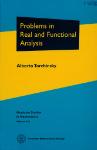
STUDENT MATHEMATICAL LIBRARY
Volume 11
Problems in
Mathematical
Analysis II
Continuity and
Differentiation
w. J. Kaczor
M. T. Nowak
11
( )
)
)
(
)
lL
( J
- -
]n
Ji, I
(
,
Selected Titles in This Series
12 W. J. Kaczor and M. T. Nowak, Problems in mathematical analysis
II: Continuity and differentiation, 2001
11 Michael Mesterton-Gibbons, An introduction to game-theoretic
modelling, 2000
10 John Oprea, The mathematics of soap films: Explorations with Maple@ ,
2000
9 David E. Blair, Inversion theory and conformal mapping, 2000
8 Edward B. Burger, Exploring the number jungle: A journey into
diophantine analysis, 2000
7 Judy L. Walker, Codes and curves, 2000
6 Gerald Tenenbaum. and Michel Mendes France, The prime numbers
and their distribution, 2000
5 Alexander Mehlm.ann, The game's afoot! Game theory in myth and
paradox, 2000
4 W. J. Kaczor and M. T. Nowak, Problems in mathematical analysis
I: Real numbers, sequences and series, 2000
3 Roger Knobel, An introduction to the mathematical theory of waves,
2000
2 Gregory F. Lawler and Lester N. Coyle, Lectures on contemporary
probability, 1999
1 Charles Radin, Miles of tiles, 1999
Problems in
Mathematical
Analysis II
Continuity and
Differentiation
STUDENT MATHEMATICAL LIBRARY
Volume 12
Problems in
Mathematical
Analysis II
Continuity and
Differentiation
w. J. Kaczor
M. T. Nowak
.
S
"I3 ltNiiED '\
AM.BRICAN .MAT1iBM.ATICAL SOCIETY
Editorial Board
David Bressoud
Robert Devaney, Chair
Carl Pomerance
Hung-Hsi Wu
Originally published in Polish, as
Zadania z Analizy Matematycznej. CZfJSC Druga
Funkcje Jednej Zmiennej-Rachunek R6zniczowy
@ 1998, Wydawnictwo Uniwersytetu Marii Curie-Sklodowskiej, Lublin.
Translated, revised and augmented by the authors.
2000 Mathematics Subject Classification. Primary 00A07;
Secondary 26A06, 26A15, 26A24.
Library of Congress Cataloging-in-Publication Data
Kaczor, W. J. (Wieslawa J.), 1949-
[Zadania z analizy matematycznej. English]
Problems in mathematical analysis. I. Real numbers, sequences and series /
W. J. Kaczor, M. T. Nowak.
p. em. - (Student mathematical library, ISSN 1520-9121 j v. 4)
Includes bibliographical references.
ISBN 0-8218-2050-8 (softcover; alk. paper)
1. Mathematical analysis I. Nowak, M. T. (Maria T.), 1951- II. Title.
III. Series.
QA300K32513 2000
515'.076-dc21 99-087039
Copying and reprinting. Individual readers of this publication, and nonprofit
libraries acting for them, are permitted to make fair use of the materiaI, such as to
copy a chapter for use in teaching or research. Permission is granted to quote brief
passages from this publication in reviews, provided the customary acknowledgment of
the source is given.
Republication, systematic copying, or multiple reproduction of any material in this
publication is permitted only under license from the American Matp.ematical Society.
Requests for such permission should be addressed to the Assistant to the Publisher t
American Mathematical Society, P. O. Box 6248, Providence, Rhode Island 02940-6248.
Requests can also be made bye-mail to reprint-permissionQams. org.
@ 2001 by the American Mathematical Society. All rights reserved.
The American Mathematical Society retains all rights
except those granted to the United States Government.
Printed in the United States of America.
@ The paper used in this book is acid-free and falls within the guidelines
established to ensure permanence and durability.
Visit the AMS home page at URL: http://vww . ams. org/
10 9 8 7 6 5 4 3 2 1 06 05 04 03 02 01
Contents
Preface
.
Xl
Notation and Terminology
...
Xlll
Problems
Chapter 1. Limits and Continuity
1.1. The Limit of a Function
1.2. Properties of Continuous Functions
1.3. Intermediate Value Property
1.4. Semicontinuous Functions
1.5. Uniform Continuity
1.6. Functional Equations
1.7. Continuous Functions in l\1Ietric Spaces
3
9
14
18
24
21
32
Chapter 2. Differentiation
2.1. The Derivative of a Real Function
2.2. Mean Value Theorems
2.3. Taylor's Forn1ula and L'Hospital's Rule
2.4. Convex Functions
31
45
52
61
-
vii
...
vw
Contents
2.5. Applications of Derivatives 68
2.6. Strong Differentiability and Schwarz Differentiability 77
Chapter 3. Sequences and Series of Functions
3.1. Sequences of Functions, Uniform Convergence 81
3.2. Series of FUnctions, Uniform Convergence 87
3.3. Power Series 96
3.4. Taylor Series 102
Solutions
Chapter 1. Limits and Continuity
1.1. The Limit of a Function 111
1.2. Properties of Continuous Functions 129
1.3. Intermediate Value Property 146
1.4. Semicontinuous FUnctions 160
1.5. Uniform Continuity 171
1.6. FUnctional Equations 181
1.7. Continuous Functions in Metric Spaces 198
Chapter 2. Differentiation
2.1. The Derivative of a Real FUnction 211
2.2. Mean Value Theorems 233
2.3. Taylor's Formula and L'Hospital's Rule 245
2.4. Convex Functions 267
2.5. Applications of Derivatives 285
2.6. Strong Differentiability and Schwarz Differentiability 310
Chapter 3. Sequences and Series of Functions
3.1. Sequences of Functions, Uniform Convergence 317
3.2. Series of Functions, Uniform Convergence 336
3.3. Power Series 355
Contents
be
3.4. Taylor Series
Bibliography - Books
Index
372
393
397
Chapter 1
Limits and Continuity
1.1. The Limit of a Function
We adopt tbe following definitions.
Definition 1. A real function I is said to be increasing (resp. strictly
increasing, decreasing, strictly decreasing) on a nonempty set A C Ii
if XI < X2, X., X2 E A, implies f(xIJ
f(x2) (resp. f(x1) <
f(x2), f(x!) > f(x2), f(x!) > f(x2». A function which is either in-
creasing or decreasing (resp. strictly increasing or strictly 4 ecre.a. ct jn g)
is called monotone (resp. strictly monotone).
Definition 2. By a deleted neighborhood of a point a e III we mean
the set (a - E,a + E) \ {a}, where E > O.
l.l.t. Find the limits or state that they do not exist.
(c) lim
[ ! ] , a,b> 0,
z-.O a x
(d)
lim [ 1 ]
%-.0 x ; ,
limI=l
,
z-.o x
(a) lim xcos!,
z-.o X
(b)
(e) Jim X ( v'X 2 + 1- {/x 3 + 1 ) ,
%-"+00
(f)
lim cos (
coox)
z-+o sin{sinx) ·
-
3
4
Problems. 1: Limits and Continuity
1.1.2. Assume that f: (-a, a) \ {OJ -+ IR. Show that
(a) lim J{x) = I if and only if lim J{sinx) = I,
% o z o
(b) if lim f(x) = I, then lim f(lxl) = I. Does the other impli-
% O z o
cation hold?
1.1.3. Suppose a function j: (-a, a) \ {OJ (0,+00) satisfies
lim ( f(z) + ) = 2. Show that lim fez) = 1.
z o I\ J z o
1.1.4. Assume f is defined on a deleted neighborhood of a and
lim ( f(z) + ) = o. Determine lirn f(x).
Z Q I/\ /I Z Q
1.1.5. Prove that if f is a bounded function on [0, I} satisfying
J(ax) = 6f(x) for 0 x and a,6 > 1, then z + f(x) = 1(0).
1.1.6. Calculate
(a) (:c2(1+2+3+".+[ ])),
(b) z (x ([ ] + [ ] +...+ [ : ])). k e K
1.1.7. Compute lim ,where P(x) is a polynomial with positive
:r:-+oo J>{[ZJ)
coefficients.
1.1.8. Show by an example that the condition
(.)
lim(/(x) + /(2x» = 0
z o
does not imply that f has a limit at O. Prove that if there exists a
function cp such tbat in a deleted neighborhood of zero the inequal-
ity f(x) > (z) is satisfied and lim tp(x) = 0, then (*) implies
z-+o
lim fez) = o.
%-+0
1.1.9.
(a) Give an example of a function f satisfying the condition
lim (f(x)j(2x» = 0
.z ...0
1.1. The Limit of a Function
5
.and such that lim f(x) does not exist.
-.o
(b) Show that if in a deleted neighborhood of zero the inequalities
f(x) Ixl O t i < a < 1, and f(x)f(2x) Ixl hold, then
lim f(x) = o.
z-.o
1.1.10. Given a real Q, assume that lim I %) = g(a) for each pos-
Z-'oo
itive a. Show that there is c such that g( a) = ca O .
1.1.11. Suppose that f: Ii -+ IR is a monotonic function such that
lim ' , ([z») = 1. Show that also 1im ' , \C: / = 1 for each c > o.
z-.oo z-.oo
1.1.12. Prove that if a > 1 and Q E Ii, then
(a)
a
lim - = +00,
-too Z
(b)
a
Urn - = +00.
z-+oo zQ
1.1.13. Show that if Q > 0, then lim I;: = o.
z-.oo
1.1.14. For a > 0, show that 1im a Z = 1. Use this equality to prove
z-+o
the continuity of the exponential function.
1.1.15. Show that
(a) lim ( 1 + ! ) Z = e,
-+oo X
(c) lim(! + x) = e.
z-t-O
(b)
lim ( 1 + .!. ) Z = e,
z-.-oo x
1.1.16. Show that lim m(t +x) = O. Using this equality, deduce that
z-tO
the logarithmic function is continuous on (0,00).
(c)
1.1.17. Determine the following limits:
lim !n(l + z) a Z - 1
(a) ,(b) 1im , a > 0,
z-tO X z-+O Z
1im (1 + x)O - 1 ICI
, aEa.
z-tO Z
6
Problems. 1: Limits and Continuity
1.1.18. Find
(a)
(c)
(e)
lim (Inx)'!-,
%-+00
Jim (cosx) .i a. ,
%-+0
lim (sin X) rf..
z-+o+
(b) lim z8in Z t
%-.0+
(d)
lim (e Z -l) ,
z-+oo
1.1.19. Find the following limits:
() lim sin 2x + 2 arctan3x + 3x 2
a %-+0 m( 1 + 3x + 5in 2 x) + xe Z '
. v i - e- Z - v i - cosx
(c) lim ,
%-+0+ vs inx
( b ) lim In cos x
z-+o tan x 2 '
(d) lim (1 + x 2 )cot%.
z-+o
1.1.20. Calculate
( 1rx ) !-
(a) lim tan 2 1 '
-+oo X +
(b) z x(In(I+ ; )-ln ; ).
1.1.21. Suppose tbat lim g(x) = 0 and that there are Q E 1R and
%-+0+
positive 1n and M such that m I :) JIll for positive x from
a neighborhood of zero. Show that if 0: lim g(x) In x = 'Y, then
z-+o+
lim f(x)9(z) = e"". In the case where'Y = 00 or "'f = -00 we assume
Z'-+o+
that e oo = 00 and e- OO = O.
1.1.22. Assume that lim f(x) = 1 and lim g(x) = 00. Show that if
%-+0 z-+o
lim g(x)(f(x) -1) = '1, then lim l(x)9(%) = e .
z-+O %-+0
1.1.23. Calculate
(a) lim ( 2 sin Vi + Vi sin .!. ) % t
z-+o+ X
( ) e-:'
lim 1 + xe-;'- sin 14 '
z-+o X
e
Iim ( l+e-*arctan +xe-*Sin ) .
%-+0 X X
(b)
(c)
1.1. The Limit of a Function
7
1.1.24. Let f: [0, +00) R be a function such that each sequence
{f{a+n)}, a > 0, converges to zero. Does the limit lim f(x) exist?
:&-+00
1.1.25. Let f : [0, +(0) -+ IR be a function such that, for any
positive a, the sequence {f (an)} converges to zero. Does the limit
fun f(x) exist?
%400
1.1.26. Let f : [0, +00) -+ IR be a function such that, for each a > 0
and each b > 0, the sequence {f(a+bn)} converges to zero. Does the
limit Urn f(x) exist?
%-i'00
1.1.27. Prove that if lim f(x) = 0 and lirn 1(2%)-/(z) = 0, then
z o %40 Z
lirn fez) = o.
Z-i'O Z
1.1.28. Suppose that f defined on (a, +00) is bounded on each finite
interval (a, b), 0 < b. Prove that if Urn (f(x + 1) - f{x» = I, then
z-++oo
also Iirn I z) = I.
z +oo
1.1.29. Let f defined on (a, +00) be bounded below on each finite
interval (a, b), a < b. Show that if lim {/(x + 1) - f(x» = +00,
%-++00
then also Jim fez) = +00.
%-++00 %
1.1.30. Let f defined on (a, +00) be bounded on each finite interval
(a,b), a < b. H for a nonnegative integer k, lim J(:r;+ -J(z) exists,
z-++oo
then
Ii fex) 1 r f(x + 1) - fez)
:r;-+ oo zk+l = k + 1 :t'-! oo zk ·
1.1.31. Let / defincd on (0, +00) be bounded on each finite interval
(a, b), a < b, and assume that f(x) c > 0 for z E (a, +00). Show
that if Jim Jj( )l) exists, then lim (f(z» also exists and
z-++oo z-++oo
lim (f(x» = lim f{x + 1) .
Z +CO %4+00 f(x)
8
Problems. 1: Limits and Continuity
1.1.32. Assume that lim / ( rt]-l ) = O. Does this imply that the
-..o
limit lim / (x) exists?
z-..o
1.1.33. Let / : R III be such that, for any a e Ii, the sequence
{J ( : )} converges to zero. Does f have a limit at zero?
1.1.34. Prove that if lim / (x ( - r ])) = 0, then lim lex) = o.
z-..o z o
(a)
1.1.35. Show that if J is monotonically increasing (decreasing) on
(a, b), then for any :Co e (a, b),
/(x:) = lim /(x) = inf /(:c) ( f(X:) = sup f(X» ) ,
z-t>zt z>zo Z>ZO
f( xo ) = lim f(x) = sup f(x) ( /(x o ) = inf f(X» ) ,
Z-+-Zo %<zo %<%0
/( xo ) :s /(%0) :s /(xt) (/(xo) /(xo) text» .
(b)
(c)
1.1.36. Show that if / is monotonically increasing on (a, b), then for
any Xo E (a, b),
(a)
(b)
1im I(x-) = I(xt),
z z+
o
lim f(z+) = I(x;).
z zo
1.1.37. Prove the following Cauchy theorem. In order that / have a
finite limit when x tends to a, a necessary and sufficient condition is
that for every E > 0 there exists 0 > 0 such that I/(x) -/(z')1 < E
whenever 0 < Ix - al < 0 and 0 < Ix' -al < o. Formulate and prove aD
analogous necessary and sufficient condition in order that fun J(x)
z-.oo
exist.
1.1.38. Show that if lim f(x) = A and lim g(y) = B, then
Z-'4 u-..A
lim 9(/(X» = B, provided (9 0 f)(x) = g(f(x» is well defined and
;p;-.o
f does not attain A in a deleted neighborhood of a.
1.2. Properties of Continuous Functions
9
1.1.39. Find functions I and 9 such that lirn I(x) = A and lim g(y)
z-+a JI-+A
= B, but lim g(/{x» :F B.
z-+o
1.1.40. Suppose I: Ii. -+ IR is an increasing function and x J-+
I(x) - x has the period 1. Denote by In the nth iterate 011; that is,
II = f and In = 10 I n - 1 for n > 2. Prove that if lim In(O) exists,
n-too n
then for every x E IR, lirn Jnez) = lirn JraeO} .
n-+oo n n-+(X) n
1.1.41. Suppose I: lIt
R is an increasing function and x H-
I(x} - x has the period 1. Moreover, suppose that 1(0) > 0 and p
is a fixed positive integer. Let In denote the nth iterate of I. Prove
that if m" is the least positive integer such that jmp(O) > p, then
L < lim 1"(0) < lim In(o) < L + 1 + 1(0) .
ffl" - n
n - n-too n - m" m"
1.1.42. Suppose I: IR -+ IR is an increasing function and x t-+
/(x) - x has the period 1. Show tbat lirn In(z! exists and its value
n-+oo n
is the same for each z E IR, where In denotes the nth iterate of I.
1.2. Properties of Continuous Functions
1.2.1. Find all points of continuity of f defined by
{ 0 if x irrational,
I{x) = sin Ixl if x is rational.
1.2.2. Determine the set of points of continuity of J given by
f(x) = { z2 -1
z
ir
tional.
o if x IS ratIonal.
1.2.3. Study the continuity of the following functions:
o if x is irrational or x = 0,
(a) I{x) = l/q if x = plq, p E Z, q E N, and
p,q are co-prime,
10
Problems. 1: Limits and Continuity
Ixl if x is irrational or x = 0,
(b) /(x) = qxj(q + 1) if % = p/q, p E Z, q e N, and
p, q are co-prime.
(The function defined in (a) is called the Riemann function.)
1.2.4. Prove that jf I E C([a, b]), then 1/1 e C([a, b». Show by an
example that the converse is Dot true.
1.2.5. Determine all an and b n for which the function defined by
{ an + sin 7rX if z E [2n, 2n + 1], n e Z,
J(z) =
b n + COS7fZ if x e (2n -I, 2n), neZ,
is continuous on III
1.2.6. Let lex) = [x2] sin 'lrX for z E I!L Study the continuity of /.
1.2.7. Let
/(x) = [xl + (x - [x»lz] for x .
Show that / is continuous and that it is strictly increasing on [1,(0).
1.2.8. Study the continuity of the following functions and sketch
their graphs:
(a)
n Z - n- z
I(x) = Urn 1 % E R,
n-too n Z + n- z
lex) = lirn x 2 e n% + x t x e
n-+oo e nz + 1
f(x) = lim m(e n + 3;n) 1 X 0,
n-foOO n
(b)
(c)
(d)
(e)
f(x) = lim ft 4 n + X 2n +..!...., X:F 0,
n--.oo 3;2n
f(z) = lim 2 V'C OS 2n Z + sin 2n x, z e III
n--.oo
1.2.9. Show that if J : IR -+ 111 is continuous and periodic, then it
at tains its supremum and infimum.
1.2. Properties of Continuous Functions
11
1.2.10. For P(x) = x 2n + a2n_lx 2n - 1 + .. . + alX + ao, show that
there is x. E R such that P(x.) = inf{P(x): % E Ii}. Show also
that the absolute value of any polynomial P attains its infimum; that
is, there is x. E IR such that IP(x*)1 = inf{lP(x)l: x E IIi}.
1.2.11.
(a) Give an example of a bounded function on [0, 1] which achieves
neither an infimum nor a supremum.
(b) Give an example of a bounded function on [0, 1] which does Dot
achieve its infimum on any [a, b] C [0,1], a < b.
1.2.12. For J : lR -t Ii, Xo E R and 6 > 0, set
WJ(Xo, 6) = suptlf(x) -f(xo)l: x E IR, Ix - xol < 6}
and wJ(xo) = lim w/(xo,6). Show that / is continuous at Xo if and
&-..0+
only if w/(xo) = O.
1.2.13.
(a) Let /,g E C([a,b)) and for x E [a,b] let hex) = mint/ex), g(x)}
and H(x) = max{f(x), g(x)}. Show that h,H E C([a,b]).
(b) Let 1),/2,J3 E C([a,b» and for x e [a,b] let J(x) denote that
one of the three values fl(X),J2(X) and /3(X) that lies between
the other two. Show that f E C([a,b)).
1.2.14. Prove that if f E C([a, b]), then the functions defined by
setting
m(x) = inf{/C,): ,e [Cl,XJ} and Af(x) = sup{/«(): 'E [a, x]}
are also continuous on [a, b].
1.2.15. Let f be a bounded function on [a, b]. Show that the functions
defined by
m(x) = inf{!«(): (E [a, x)} and kf(x) = sup{f«(): {E [a,x)}
are continuous from the left on (at b).
12
Problems. 1: Limits and Continuity
1.2.16. Verify whether under the assumptions of the foregoing prob-
lem the functions
m*(x)=inf{j(): (E [a, x]} and .t\-l*(x)=sup{j«): (E [a,x]}
are continuous from the left on ( a, b).
1.2.17. Suppose f is continuous on [a,oo) and lim f(x) is finite.
:z:-+oo
Show that I is bounded on [a,oo).
1.2.18. Let I be continuous on Ii and let {xn} be a bounded se-
quence. Do the equalities
!!!!! J(x n ) = f( !!!!! x n ) and iiiii f(x n ) = f( liiii x n )
n-tooo n-too n-+oo n-+oo
hold?
1.2.19. Let / : IR -+ R be increasing and continuous and let {x n }
be a bounded sequence. Show that
(a)
(b)
!!!!! f(xn) = I( !!!!! x n ),
n-tooo n-too
iiiii f(zn) = f( iiiii x n ).
n-+oo n-+oo
1.2.20. Let f : R -+ Ii be decreasing and continuous and let {xn}
be a bounded sequence. Show that
(a)
(b)
!!m f(xn) = f( nm x n ),
n-too n-+oo
liiD f(xn} = I( lim x n ).
n-tooo n-+oo
1.2.21. Suppose that f is continuous on Ii, Urn f(x) = -00 and
%-+-00
1im f(x) = +00. Define 9 by setting
z-+oo
g(x) = sup{t: jet) < x} for x E R
(a) Prove that 9 is continuous from the left.
(b) Is 9 continuous?
1.2. Properties of Continuous Functions
13
1.2.22. Let I: 1R --. III be a continuous periodic function with two
incommensurate periods T 1 and T2; that is, R- is irrational. Prove
that I is a constant function. Give an example of a nonconstant
periodic function with two incommensurate periods.
1.2.23.
(a) Show that if /: Ii --. is nonconstant, periodic and continuous,
then it has a smallest positive period, the so-called fundamental
period.
(b) Give an example of a noncoDstant periodic function without a
fundamental period.
(c) Prove that if /: R -+ Ii is a periodic function without a funda-
mental period, then the set of all periods of f is dense in III
1.2.24.
(a) Prove that the theorem in part (a) of the preceding problem re-
m8-1ns true when the continuity of J on Ii is replaced by the
continuity at one point.
(b) Show that if J : III -+ IR is a periodic function without a funda-
mental period and if it is continuous at least at one point, then
it is constant.
1.2.25. Show that if /, 9 : Ii -+ It are continuous and periodic and
lim (f(x) - g(x» = 0, then f = g.
z-tco
1.2.26. Give an example of two periodic functions f and 9 such that
any period of J is not commensurate with any period of 9 and such
that /+g
(a) is not periodic,
(b) is periodic.
1.2.27. Let /,g: R -+ R be continuous and periodic with positive
fundamental periods Tl and T 2 , respectively. Prove that if R- Q,
then h = f + 9 is not a periodic function.
14
Problems. 1: Limits and Continuity
1.2.28. Let I, 9 : IR R be periodic and suppose that I is continu-
ous and no period of 9 is commensurate with the fundamental period
of I. Prove that f + 9 is not a periodic function.
1.2.29. Prove that the set of points of discontinuity of a monotonic
function I: Ii --. Ii is at most countable.
1.2.30. Suppose I is continuous on [0,1]. Prove that
1 n ( k )
lim - (-l)kl - = 0.
n-+oo n L..J n
k=J
1.2.31. Let I be continuous on [0, 1 J. Prove that
; F (_l)k( )1 ( ) = o.
1.2.32. Suppose I : (0, 00) --. Ii is a continuous function such that
f(x) f(nx) for all positive z and natural n. Show that lim I(z)
z-+oo
exists (finite or ionni te).
1.2.33. A function I defined on an interval I C Ii is said to be
convex on I if
I(Ja. + (1 - A)Z2) < A/(xl) + (1 - A)/(X2)
whenever Z],Z2 E I and E (0,1). Prove that if I is convex on an
open interval, then it is continuous. Iust a convex function on an
arbitrary interval be continuous?
1.2.34. Prove that if a sequence {In} of continuous functions on A
converges uniformly to J on A, then J is continuous on A.
1.3. Intermediate Value Property
Recall the following:
Definition. A real function I has the intermediate value property on
an interval I containing [a, b) if f(a) < v < f(b) or J(b) < v < J(a);
1.3. Intermediate Value Property
15
that is, if v is between f(a) and f(b), there is between a and b a c
such that fee) = v.
1.3.1. Give examples of functions which have the intermediate value
property on an interval I but are not continuous on this interval.
1.3.2. Prove that a strictly increasing function f: [a, b)
Ii which
has the intermediate vcdue property is continuous on [a, b].
1.3.3. Let f: (0,1] -. [OJ 1] be continuous. Show that f has a fixed
point in [O,IJ; that is, there exists Xo E [0, 1] such that f(xo) = xo.
1.3.4. Assume that f, 9 : [a, b]
Ii are continuous and such that
f(a) < g(a) and f(b) > g(b). Prove that there exists Xo e (a, b) for
which f(xo} = g(xo).
1.3.5. Let I: IR -+ IR be continuous and periodic with period T > 0.
Prove tbat there is Xo such that
f (xo +
) = f(xo).
1.3.6. A function I : (a, b) -+ IR is continuous. Prove that, given
x., X2, ... ,X n in (a, b), there exists Xo E (a, b) such that
1
f(xo) = - (f(x.) + f(X2) +... + f(x n ».
n
1.3.7.
(a) Prove that the equation (I - x) cosx = sinx has at least one
solution in (0,1).
(b) For a nonzero polynomial P, show that tbe equation IP(x)1 = ez
has at least one solution.
1.3.8. For no < be < al < b I < ... < an < b n , show that all roots of
the polynomial
n n
P(x) = II (x + all:) + 2 II (x + ble), x e II(,
k =O k=O
are real.
16
Problems. 1: Limits and Continuity
1.3.9. Suppose that f and 9 have the intermediate value property
on [a, b]. lVIust I + 9 possess the intermediate value property on that
. terva} "
m .
1.3.10. Assume that I E C([0, 2]) and f(O) = f(2). Prove that there
exist Xl and X2 in [0,2] such that
X2 - Xl = 1 and l(x2) = I(xl).
Give a geometric interpretation of this fact.
1.3.11. Let I E C([O,2]). Show that there are Xl and X2 in [0,2]
such that
X2 - Xl = 1 and
1
l(x2) - f(x1) = 2 (f{2) -/(0».
1.3.12. For n e N, let I E C([O, n]) be such that 1(0) = fen). Prove
that there are %1 and %2 in [0, n] satisfying
X2 - Xl = 1 and l(x2) = I(xl).
1.3.13. A continuous function f on [0, n), n E N, satisfies f(O) =
fen). Show that for every k E {1,2,...,n -l} there are Xi and!tt
such that I(x,,) = I(x ), where X" - xk = k or X" - xl = n - k. Is
it true that for every k e {l, 2, . . . , n - I} there are Xle and x k such
that f(x,,) = I(xt), where x" - xl = k?
1.3.14. For n e N, let I E C([O, n]) be such that 1(0) = fen). Prove
that the equation f (x) = f(y) has at least n solutions with x - YEN.
1.3.15. Suppose that real continuous functions / and 9 defined on
R commute; that is, I(g(%» = g(/(x» for X E III Prove that if the
equation /2(x) = g2(X) has a solution, then the equation /(x) = g(x)
also has (here f 2 (z) = f{f(x» and g2(x) = g(g(x»).
Show by example that the assumption of continuity of f and 9 in
the foregoing problem nn ot be omitted.
1.3.16. Prove that a continuous injection I: R -+ Ii is either strictly
decreasing or strictly increasing.
1.3. Intermediate Value Property
17
1.3.17. Assume that J : JR -+ R is a continuous injection. Prove that
if there exists n such that the nth iteration of / is an identity, that
is, /n(x) = x for all x E IR, then
(a) I(x) = z, z E Ii, if f is strictly increasing,
(b) /2(x) = x, z E If, if I is strictly decreasing.
1.3.18. Assume J: R -+ IR satisfies the condition I(/{x» = /2(X) =
-x, :r; E 1R. Show that f nn ot be continuous.
1.3.19. Find all functions I : 1R. -+ R which have the intermediate
value property and such that there is n e N for which In(x) =
-x, Z E IR, where In denotes the nth iteration of /.
1.3.20. Prove that if J : R -+ Ii has the intermediate value property
and J-l({q}) is closed for every rational q, then I is continuous.
1.3.21. Assume that f : (a, (0) -+ IR is continuous and bounded.
Prove that, given T, there exists a sequence {x n } such that
lim X n = +00 and Urn (f(xn + T) - I(zn» = o.
n-too n...oo
1.3.22. Give an example of a continuous function /: Ii -+ R which
attains eacb of its values exactly three times. Does there exist a
continuous function J : Ii -+ IR which attains each of its values
exactly two times?
1.3.23. Let f : (0,1) -+ III be continuous and piecewise strictly mono-
tone. (A function J is said to be piecewise strictly monotone on
[0,1], if there exists a partition of [0,1] into finitely many subinter-
vals [ti-lt td, where i = 1,2,... ,n and 0 = to < tl < · .. < t n = 1,
such that f is strictly monotone on each of these subintervals.) Prove
that J attains at least one of its values an odd number of times.
1.3.24. A continuous function J : [0,1] -t Ii at t in each of its values
finitely many times and 1(0) #: 1(1). Sho\v that / attains at least one
of its values an odd number of times.
18
Problems. 1: Limits and Continuity
1.3.25. Assume that / : K 4- K is continuous on a CODlpact set
K C III Moreover t assume that an Xo E K is such that each limit
point of the sequence of iterates {/"(xo)} is a fixed point of I. Prove
tbat {/n(xo)} is convergent.
1.3.26. A function I : III -+ Ii is increasing, continuous, and such
that F defined by F(x) = I(x) - x is periodic with period 1. Prove
that if a(/) = lim Jft
O} , then there is Xo E [0,1] such that F(xo) =
n-too
a(/). Prove also that I has a fixed point in [0,1] if and only if
a(f} = O. (See Problems 1.1.40 - 1.1.42.)
1.3.27. A function / : [0,1] -+ III satisfies 1(0) < 0 and /(1) > 0,
and there exists a function 9 continuous on [0, 1] and such that I + 9
is decreasing. Prove that the equation J(x) = 0 has a solution in the
open interval (Ot 1).
1.3.28. Show that every bijection I : Ii -to (0,00) has in f1n i tely many
points of discontinuity.
1.3.29. Recall that each x E (0, I) can be represented by a binary
fraction .a)a2a3..., where ai E {O,I}, i = 1,2,... . In the case where
x has two distinct binary expansions we choose the one with infinitely
many digits equal to 1. Next let a function I : (0, 1) -+ [0, 1] be
defined by
_ 1 n
I(x) = Urn - " ai.
n-too n L.-i
i=l
Prove tbat f is discontinuous at eacb x E: (0,1) but nevertheless it
has the intermediate value property.
1.4. Semicontinuous Functions
Definition 1. The extended real number system iR consists of the
real number system to which two symbols, +00 and -00, have been
adjoined, with the following properties:
(i) H x is real, then -00 < x < +00, and x + 00 = +00, x - 00 =
-00 and -:L = 2- = o.
+00 -00
(ii) H x> 0, then x. (+00) = +00, x. (-00) = -00.
1.4. Semicontinuous Functions
19
(ill) IT x < 0, then x. (+00) = - , x. (-00) = +00.
Definition 2. HAC R is a nonempty set, then sup A (resp. inf A)
is the smallest (resp. greatest) extended real number which is greater
(resp. slnalJer) than or equal to each element. of A.
Let 1 be a real-valued function defined on a nonempty set A c '"
Definition 3. IT Xo is a limit point of A, then the li1nit inferior (resp.
the limit superior) of f(x) as x Xo is defined as the infimunl (resp.
the supremum) of the set of ally E IR such that there is a sequence
{x n } of points in A which is convergent to xo, whose terms are aU
different from Xo and y = lim f{x n ). The liInit inferior and the limit
n-too
superior of f(x) as x Xo are denoted by Jim f(x) and lim f(x),
z-tozo Z-+ZO
respecti vely.
Definition 4. A real-v-c1llled function is said to be lower (resp. upper)
semicontinuo'US at all Xo E A which is a limit point of A if lim f(x) >
Z-+ZO
f(xo) (resp. lilll I(x) < f{xo». IT Xo is an isolated point of A, then
'%-+Zo
we assume that f is lower and upper semicontinuous at that point.
1.4.1. Show that if Xo is a Iimit point of A and / : A --) IR, then
(a)
(b)
lim f(x) = sup inC{f(x): x E A, 0 < Ix - xol < oj,
z-+Zo 6>0
TIm f(x} = inf sup{f(x): x e A, 0 < Ix - xol < 6}.
;e-tozo 6>0
1.4.2. Show that if Xo is a limit point of A and J : A IR, then
(a)
(b)
!!!!! f(x) = lirn inr{f(x): x E A, 0 < Ix - xol < oJ,
z-toZO 6...0+
lim f(x) = lim snp{f(x): x E A, 0 < Ix - xol < oj.
Z-"Zo 6-+0+
20
Problems. 1: Limits and Continuity
1.4.3. Prove that Yo e IR is the limit inferior of f : A -+ IIi at a
limit point Xo of A if and only if for every E > 0 the following two
conditions are satisfied:
(i) there is 6 > 0 such that f(x) > Yo - E for all x E A with
o < Ix - xol < 6,
(ii) for every 6 > 0 there is z' E A such that 0 < Ix' - xol < 6 and
f(x') < Yo + E.
Establish an analogous statement for the limit superior of f at Xo.
1.4.4. Let f : A -+ .Ii and let Xo be a limit point of A. Prove that
(a) lim f(x) = -00 if and only ilfor any real y and for any 6> 0
% Zo
there exists x' e A such that 0 < Ix' - zol < 6 and f(x') < y.
(b) lim f(x) = +00 if and only if for any real y and for any 6 > 0
z-tozo
there exists x' e A such that 0 < Ix' - xol < 6 and fex') > y.
1.4.5. Suppose f : A -+ B and Zo is a limit point of A. Show that
if I = Jim f(x) (resp. L = Iim f(x», then there is a sequence
Z-+ZO z-tozo
{xn}, X n e A, X n :F Xo, converging to Xo such that I = lim f(xn)
n-tooo
(resp. L = lim f(x n ».
n-.oo
1.4.6. Let /: A -+ R and let Xo be a limit point of A. Prove that
!!!!! (-/(x» = - nm lex) and iIiii (- f(x» = - lim f(x).
%-+zo z-tozo z"'zo Z-'Zo
1.4.7. Let f : A -+ (0,00) and let Xo be a limit point of A. Show
that
lim 1 = _1 and lim 1 = 1
%-:+;o f(x) lim lex) z zo f(x) lim f(z).
z-tozo Z-lo%O
(We assume that + = 0 and r/F = +00.)
1.4.8. Assume that f, 9 : A -+ Ji and that Xo is a limit point of A.
Prove that (excluding the indeterminate forms of the type +00 - 00
1.4. Semicontinuous Functions
21
and -00 + 00) the following inequalities hold:
!ill! I{x)+ !ill! g(x) fun (f(x) + g{x» < !!!!! I(x)+ lirn g(x)
%-+%0 z-tzo z-u:o z-+%O z-tzo
=:; lirn (f(x) + g(x»:5 iiiii f(z) + iiiii g(x).
%-+%0 %-+ZO %-+%0
Give examples of functions for which ":5 " in the above inequalities
is replaced by "< "_
1.4.9. Assume that I, 9 : A -. [0, 00) and that Xo is a limit point of
A_ Prove that (excluding the indeterminate forms of the type 0-(+00)
and (+00). 0) the following inequalities hold:
lim I(x). lim g(x) < Urn (f(x) - g(x» !ill! I(x). lim g(x)
%-+%0 %-+ZO %-+ZO z-+%o z-+zo
=:; lim (/(x) . g(x»:5 iiiii f{x). iWi g(x).
%-+%0 %-tzo z-tzo
Give examples of functions for which "=:; " in the above inequalities
is replaced by "<".
1.4.10. Prove that if 1im I(x) exists, then (excluding tbe indeter-
%-+%0
minate forms of the type +00 - 00 and -co + (0)
fu!! (/(x) + g(x» = lim f(x) + !ill! g(x),
%-+:1:0 z-u:o z-.%o
Jim (f(z) + g(z» = lim I(x) + iiiii g(x).
%-foZO z-tzo z-.zo
Moreover, if f and 9 are nonnegative, then (excluding the indetermi-
nate forms of the type o. (+00) and (+00) .0)
!!!!! (f(x) . g(x» = lim f(x) - lim g{x),
z-.%O z-.%o z-+zo
liiii (/(x) · g(x» = lim I(x). lim g(z).
z-tzo %-+%0 z-+%O
1.4.11. Prove that if I is continuous on (a, b), , = Urn f(x) and
%-+a
L = Jim f(x), then for every E [I, L] tbere is a sequence {x n } of
%-.a
points in (a, b) converging to a and such that Jim I (zn) = .
n-too
22
Problems. 1: Limits and Continuity
1.4.12. Find the points at which f: IR --. Ii defined by
I(x) = { o.
smx
if x is irrational,
if x is rational
is semicontinuous.
1.4.13. Determine points at which the function f defined by
{ 2 1
x -
f(x) = 0
if x is irrational,
if x is rational
is semicontinuous.
1.4.14. Show that the function given by setting
o if x is irrational or x = 0,
f(x) =
if x = :' p e Z, q e N,
and p, q are co-prune
is upper scmicontinuous.
1.4.15. Find the points at which tbe function defined by
Ixl
(a)
f(x) =
.!1=-.
q+l
if x is irrational or x = 0,
if x =
, p e Z, q e N,
and p, q are co-prime,
{-I tip
9+ 1
if x E Qn (0, 1] and x =
t p,q e N,
and p, q are co-prime,
if x E (0, 1) is irrational
(b)
f(x) =
o
is neither upper nor lower semicontinuous.
1.4.16. Let /,g : A --+ JR he lower (resp. upper) semicontinuous at
Xo e A. Show that
(a) if a > 0, then af is lower (resp. upper) semicontinuous at Xo- H
a < 0, then of is upper (resp_ lower) semi continuous at :Co-
(h) f + 9 is lower (resp. upper) semi continuous at Zo-
1.4. Semicontinuous Functions
23
1.4.17. Assume that fn : A -+ R, n E N, are lower (resp. upper)
semi continuous at Xo E A. Show that sup In (resp. inf In) is lower
nEN nEN
(resp. upper) semicontinuous at Xo.
1.4.18. Prove that a pointwise limit of an increasing (resp. decreas-
ing) sequence of lower (resp. upper) semicontinuous functions is lower
(resp. upper) semicontinuous.
1.4.19. For f: A -+ JR and x a limit point of A define the oscillation
of f at x by
o/(x) = lim sup{l/(z) - f(u)l: z, u E A, Iz - xl < 6, In - xl < 6}
6-.0+
Show that o/(x) = II (x) - f2(X), where
fl(x) = max{f(x), iiiii fez)} and f2(X) = min{f(x), lim fez)}.
z z
1.4.20. Let fl, f2t and 01 be as in the foregoing problem. Show that
II and 01 are upper semicontinuous, and f2 is lower semicontinuous.
1.4.21. Prove that in order that I : A -+ Ii be lower (resp. upper)
semicontinuous at Xo E A, a necessary and sufficient condition is
that for every a < I(xo) (resp. a > f(xo» there is 6 > 0 such that
f(x) > a (resp. I(x) < a) whenever Ix - xol < 6, x E A.
1.4.22. Prove that in order that f : A -+ R be lower (resp. upper)
semicontinuous on At a necessary and sufficient condition is that for
every a E IR the set {x E A: f{x) > a} (resp. {x e A: f(x) < a})
be open in A.
1.4.23. Prove that f : Ii -+ Ii is lower semicontinuous if and only if
the set {(x,y) E R 2 : y > f(x)} is closed in Ii:!.
Formulate and prove an analogous necessary and sufficient con-
dition for upper semicontinuity of f on III
1.4.24. Prove the following theorem of Baire. Every lower (resp. up-
per) semicontinuous f: A -+ JR is the pointwise limit of an increasing
(resp. decreasing) sequence of continuous functions on A.
24
Problems. 1: Limits and Continuity
1.4.25. Prove that if I : A -to III is upper semicontinuous, 9 : A -to It
is lower semicontinuous and I(z) < g(z) everywhere on A, then there
is a continuous function h on A such that
I(x) h(x) < g(z), x e A.
1.5. Uniform Continuity
Definition. A real function 1 defined on A c Ii is said to be uni-
formly continuous on A if, given E > 0, there exists 6 > 0 such that
for all x and y in A with Iz - yl < 6 we have I/(x) -/(y)1 < E.
1.5.1. Verify whether the following functions are uniformly continu-
ous on (0,1) :
(a) I(x) = e Z , (b) fez) = sin!,
x
(c) f(x) = x sin !, (d) 1
I(z) = e. ,
x
(e) I(z) = e-!- , (f) 1
fez) = e% cos-,
x
(g) I(:c) = In , (h) 7r
I{x) = C05X. COS- ,
z
(i) f(x) = ootz.
1.5.2. Which of the following functions are uniformly continuous on
[0,00)1
(a) J(z) = -IX,
(c) J(x) = 5in 2 z,
(e) f(x) = e 1
(g) J(z) = sin (sin x),
(i) fez) = sin.vz.
(b)
(d)
(f)
(h)
J(z) = z sin x,
f(x) = sin(x 2 ),
I(x) = e Sin (z2),
I(z) = sin(xsinz),
1.5.3. Show that if J is uniformly continuous on (a, b), a, b E 1R, then
Um I(z) and fun j(z) exist as finite limits.
z-ta+ z-+6-
1.5. Uniform Continuity
25
1.5.4. Suppose I and 9 are uniformly continuous on (a, b) ([a,oo}).
Does this imply the uniform continuity on (a, b) ([a, 00» of the func-
tions
(a) f + 9,
(b)
/g,
(c)
x t-+ fez) sin x?
1.5.5.
(a) Show that if f is uniformly continuous on (a,b] and on [b,e), then
it is also uniformly continuous on (a, c).
(b) Suppose A and B are closed sets in Ii and let I : A U B -+- IR
be uniformly continuous on A and on B. Must I be uniformly
continuous on AU B?
1.5.6. Prove that any function continuous and periodic on 1R. must
be uniformly continuous on III
1.5.7.
(a) Show that if / : 1R -+ 1R is continuous and such that lim f(x)
-t-oo
and lirn f(x) are finite, then I is uniformly continuous on III
-toOO
(b) Show that if / : [a,oo)
R is continuous and Iim fez) is finite,
z-too
then J is uniformly continuous on [a, (0).
1.5.8. E x
min e the uniform continuity of
(a) I(x) = arctanx on (-00,00),
(b) fez) = zsin
on (0,00),
(c) lex) = e-: on (0,00).
1.5.9. Assume that f is uniformly continuous on (0, (0). Must the
limits lim lex) and lim I(x) exist?
z-+o+
-IoOO
1.5.10. Prove that any function which is bounded, monotonic and
continuous on an interval I C Ii is uniformly continuous on I.
1.5.11. Assume f is uniformly continuous and unbounded on [0,00).
Is it true that either lirn I(x) = +00 or li.m f(x) = -oo?
z-too Z-loOO
26
Problems. 1: Limits and Continuity
1.5.12. A function f : [0,00) -). JR is uniformly continuous and for
any x 2= 0 the se<)uence {f(x + n)} converges to zero. Prove that
lim f(x) = O.
-too
1.5.13. Suppose that / : [1,00) -). JR is uniformly continuous. Prove
that there is a positive M such that J/ %>l < kf for x 2: 1.
1.5.14. Let f : (0,00) -). IR be uniformly continuous. Prove that
there is a positive !vI with the following property:
sup{l/(z + u) - f(u)l} < /vf(x + 1) for every x > o.
u>o
1.5.15. Let I : A IR, A c IR, be uniformly continuous. Prove
that if {xn} is any Cauchy sequence of elements in A, then {f(xn}}
is also a Cauchy sequence.
1.5.16. Suppose A C IR is bOWlded_ Prove that if J : A -). R
transforms Cauchy sequences of elelnents of A into Cauchy sequences,
then f is uniformly continuous on A. Is the boundedness of A an
essential assumption?
1.5.17. Prove that f is uniformly continuous on A C IR if and only
if for any sequences {xn} and {Yn} of elements of A,
lim (x n - Yn) = 0 implies lim (/(x n ) - I(Yn» = o.
n-+oo n-+oo
1.5.18. Suppose that I : (0, (0) (0,00) is uniformly continuous.
Does this imply that
I - / (x + ) - I ?
1m - .
;z:-+co I(x)
1.5.19. A function f: IR -7 Ii is continuous at zero and satisfies the
following conditions
f(O) = 0 and f(xl + X2) =:; I(xl) + l(x2) for any XI, X2 e III
Prove that I is uniformly continuous on IR.
1.6. Functional Equations
27
1.5.20. For / : A IR, A C IR, we define
w/(6) = suP{I/(Xl) - l{x2)1: Xt,X2 e A, Ix 1 - x21 < o}
and call wIthe modulus of co71tintlity of f. Show that I is uniformly
continuous on A if and only if lim W J (6) = o.
.5 -+U'"
1.5.21. Let f : R R be wliformly continuous. Prove that the
following statements are equivalent.
(a) For an). uniforntly continuous function 9 : ri Hi, f. 9 is uni-
Formly continuous on IR.
(b) The function x t-+ Ixl/(x) is uniforully continuous on I!l
1.5.22. Prove that the following condition is necessary and sufficient
for / to be uniformly continuous on an interval I. Given E > 0, there
is N > 0 such that for every XI,X2 E I, Xl X2,
f(XI) - l(x2) I > N iml)lies I/(xl) - !(x2)1 < E.
Xl - X2
1.6. Functional Equations
1.6.1. Prove that the only functions continuous on Ii and satisfying
the Cauchy functional equation
f{x + y) = I(x) + fey)
are the linear functions of the foml f(x) = ax.
1.6.2. Prove that if f: IR R satisfies the Cauchy functional equa-
tion
f(x + V) = f(x) + f(y)
and one of the conditions
(a) / is continuous at an Xo E Ii,
(b) f is bounded above on some interval (a,b),
(c) I is monotonic on Ii,
then lex) = ax.
28
Problems. 1: Limits and Continuity
1.6.3. Determine all continuous functions I : R
]i
uch that
/(1) > 0 and
J(x + y) = f(x)f(y).
1.6.4. Show tbat the only solutioDS of the functional equation
J(xy) = I(z) + I(y)
which are not identically zero and are continuous on (0,00) are the
logarithmic functions.
1.6.5. Show that the only solutions of the functional equation
I(zy) = f(x)/(Y)
which are not identically zero and are continuous on (0, 00) are the
power functions of the form I(x) = xo.
1.6.6. Find all continuous functions I: R -4 Ii such that I(z) -/(Y)
is rational for rational z - y.
1.6.7. For Iql < 1, find all functions I : R -4 ni. continuous at zero
and satisfying the functional equation
J(x) + f(qx) = O.
1.6.8. Find all functions I : R
R continuous at zero and satisfying
the equation
I(x) + I (: x) = x.
1.6.9. Determine all solutions f: R
R of the functional equation
2/(2%) = f(x) + z
which are continuous at zero.
1.6.10. Find all continuous functions I : IR -+ Ii satisfying the
Jensen equation
I e ;, ) = f(x); I(y) .
1.6. Functional Equations
29
1.6.11. Find all functions continuous on (at b)t at bEll, satisfying
the Jensen equation
f e;y ) = f{x);f{Y) ,
1.6.12. Determine all solutions I: Ii Ii of the functional equation
/(2x + 1) = /(x)
which are continuous at -1.
1.6.13. For a real a, show that if I: Ii --. Ii is a continuous solution
of the equation
/(x + y) = I(x) + fey) + axy,
then f(x) = i x2 + bx, where b = /(1) - i.
1.6.14. Determine all continuous at zero solutions of the functional
equation
f{x) = f ( 1 x ), x =F 1.
1.6.15. Let I : [0, 1] --. [0, 1] be continuous, monotonically decreas-
ing and such that I(/(x» = z for x E [0,1]. Is lex) = 1- z the only
such function?
1.6.16. Suppose that I and 9 satisfy the equation
f(x + y) + I(x - y) = 2/(x)g(y), z,y E III
Show that if I is not identically zero and I/(x) 1 < 1 for x E Ill, then
also 10(x)1 S 1 for x E III
1.6.17. Find all continuous functions / : Ii --. JR satisfying the func-
tional equation
I(x + y) = l(x)e Y + I(y)e z .
1.6.18. Determine all continuous at zero solutions I : Ii -. .Ii of
I(x + y) -/(x - y) = J(x)f(y).
30
Problems. 1: Limits and Continuity
1.6.19. Solve the functional equation
( X -1 )
lex) + I :c = 1 + x for x # 0, 1.
1.6.20. A sequence {xn} converyes in the Cesaro sense if
C Ii I . Xl + X2 + %3 +... + X n
- m X n = lID
n-..oo n-+oo n
exists and is finite. Find all functions which are Cesaro continuous,
that is,
I(C- lim xn} = C- lim f(xn)
n-..oo n oo
for every Cesaro convergent sequence {x, }.
1.6.21. Let I : [0, 1] [0, 1] be an injection such that f(2x - I(x» =
x for X E [0,1]. Prove that f(x) = x, X E [0,1].
1.6.22. For m different from zero, prove that if a continuous function
I : IR IR satisfies the equation
f ( 2x - f » ) = mx,
then f(x) = m(x - c).
1.6.23. Show that the only solutions of the functional equation
f(x + y) + J(y - x) = 2J(x)J(y)
continuous on II( and not identically zero are J (x) = cos( ax) and
f(x) = cosh(ax) with a real.
1.6.24. Determine all continuous on (-1,1) solutions of
f ( t ::V ) = f(x) + f(y).
1.6.25. Find all polynomials P such that
P(2x - x 2 ) = (p(x»2.
1.6. Functional Equations
31
1.6.26. Let m, n
2 be integers. Find all functions I : [0,00) -+ R
continuous at at least one point in [0, 00) and such that
f ( ! tXi ) =! t(J(Xi»,n for Xi > 0, i = 1,2,...,n.
11 . 1 11 . 1
1= .=
1.6.27. Find all not identically zero functions I : IR
IR satisfying
the equations
I(xy) = I(x)f(y) and f(x + z) = f(x) + fez)
with some z ;:f; o.
1.6.28. Find all functions I : Ii \ {OJ -. Ii such that
J(x) = -I G ), X
O.
1.6.29. Find all solutions I : Ii \ {OJ -+ IR of the functional equation
I(x) + l(x2) = 1 G) + 1 (
). x
O.
1.6.30. Prove that the functions I, g, t/J : IR -. R satisfy the equation
I(x) - g(y) = l/J ( x + y ) , Y =F x,
x-y 2
if and only if there exist a, b and c such that
f(x) = O(x) = ax 2 + bx + c, ,p(x) = 2ax + b.
1.6.31. Prove that there is a function I : Ii -+ Q satisfying the
following three conditions:
(a) I(x + y) = I(x) + I(y) for %,y E lit,
(b) I(x) = x for x E Q,
(c) I is not continuous on III
32
Problems. 1: Limits and Continuity
1.7. Continuous Functions in Metric Spaces
In this section X and Y will stand for metric spaces (X, d 1 ) and
(Y, ), respectively. To shorten notation we say that X is a metric
space instead of saying that (X,d t ) is a metric space. H not stated
otherwise, JR and an are always assumed to be equipped with the
Euclidean metric.
1.7.1. Let (X,d.) and (Y, ) be metric spaces and let I : X 4 Y.
Prove that the following conditions are equivalent.
(a) The function J is continuous.
(b) For each closed set FeY the set 1-1 (F) is closed in X.
(c) For each open set G c Y the set I-I( G) is open in X.
(d) For each subset A of X, I(A.) C I(A).
(e) For each subset B ofY, 1- 1 (B) c l-l( B ).
1.7.2. Let (X,d}) and (Y,d2) be metric spaces and let I : X -. Y
be continuous. Prove that the inverse image 1-1 (B) of a Borel set B
in (Y, th) is a Borel set in (X, d 1 ).
1.7.3. Give an example of a continuous function I : X -. Y such
that the image I(F) (resp. I(G» is not closed (resp. open) in Y for
a closed F (resp. open G) in X.
1.7.4. Let (X,d.) and (Y, ) be metric spaces and let I : X -+ Y
be continuous. Prove that the image of each compact set F in X is
compact in Y.
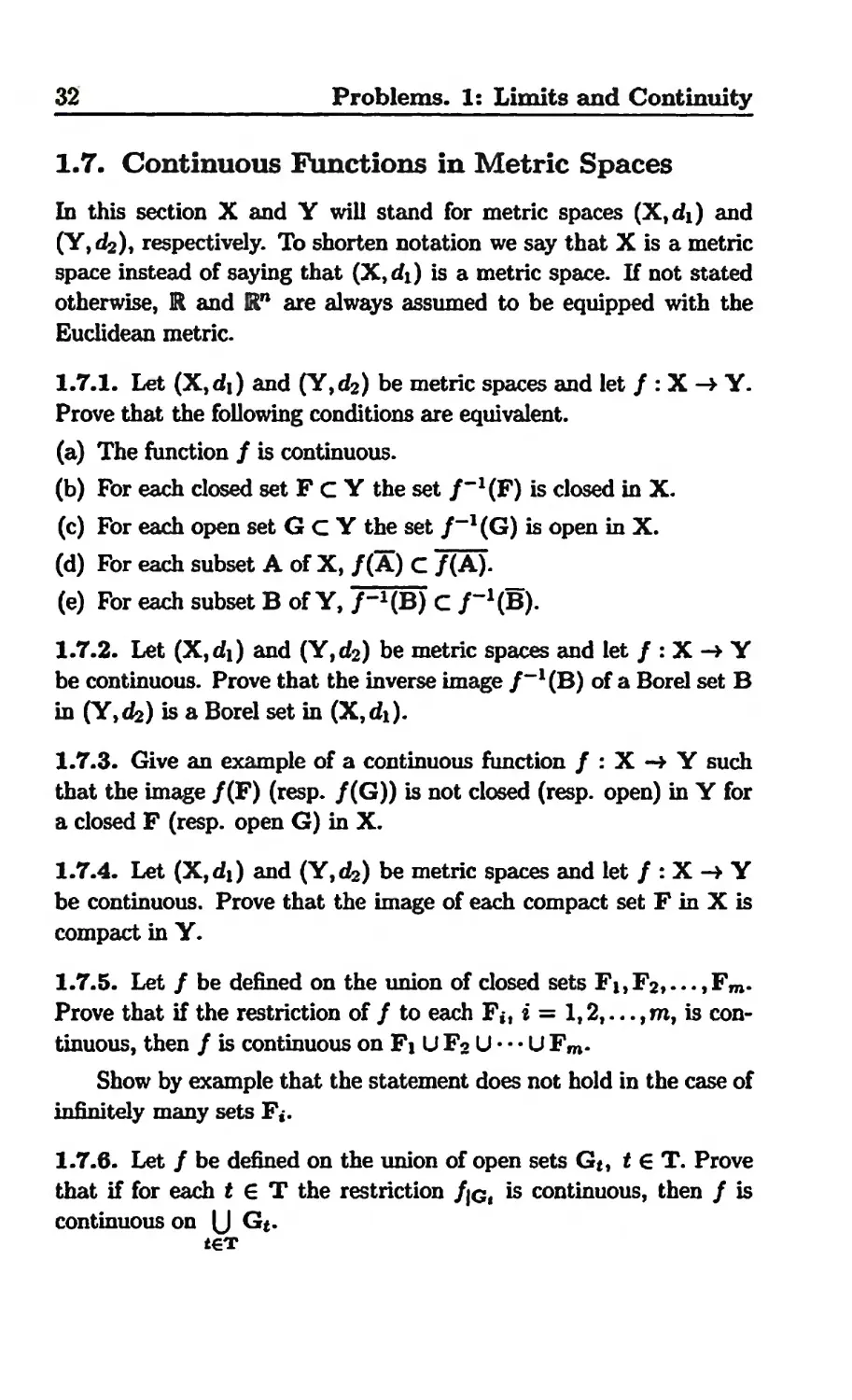
1.7.5. Let I be defined on the union of closed sets Fit F 2, .. . , F m-
Prove that if the restriction of I to each Fit i = 1, 2, . . . ,m, is con-
tinuous, then I is continuous on Fl U F2 U... U F m-
Show by example that the statement does not hold in the case of
infinitely many sets F i.
1.7.6. Let I be defined on the union of open sets G h t E T. Prove
that if for each t e T the restriction I,G. is continuous, then I is
continuous on U G t -
tET
1.7. Continuous Functions in Metric Spaces
33
1.7.7. Let (X,d}) and (Y, ) be metric spaces. Prove that I: X -i>
Y is continuous if and only if for each compact A in X the function
/IA is continuous.
1.7.8. Assume that / is a continuous bijection of a compact metric
space X onto a metric space Y. Prove that the inverse function /-1
is continuous on Y. Prove also that compactness cann ot be omitted
from the hypotheses.
1.7.9. Let / be a continuous mapping of a compact metric space X
into a metric space Y. Show that I is uniformly continuous on X.
1.7.10. Let (X,d) be a metric space and let A be anonempty subset
of X. Prove that the function f : X [0,00) defined by
f(x) = dist(x,A) = inf{d(x,y): tI E A}
is uniformly continuous on X.
1.7.11. Assume that / is a continuous mapping of a connected metric
space X into a metric space Y. Show that I(X) is connected in Y.
1.7.12. Let /: A Y, 0 A C X. For x E A define
0,(x,6) = diam(/(A n B(x,6»).
The oscillation off at x is defined as
o/(x) = Jim o/(x, 6).
6-.0+
Prove that f is continuous at Xo E A if and only if o/(xo) = 0
(compare with 1.4.19 and 1.4.20).
1.7.13. Let f : A -i> Y, 0 A c X and for:z: E A let o/(x) be the
oscillation of f at x defined in the foregoing problem. Prove that for
each E > 0 the set {x E A: o/(x) > E} is closed in X.
1.7.14. Show that the set of points of continuity of I : X -+ Y is
a countable intersection of open sets, that is, a fi& in (X, d 1 ). Show
also that the set of points of discontinuity of I is a countable union
of closed sets, that is, an :F fT in (X, d 1 ).
34
Problems. 1: Limits and Continuity
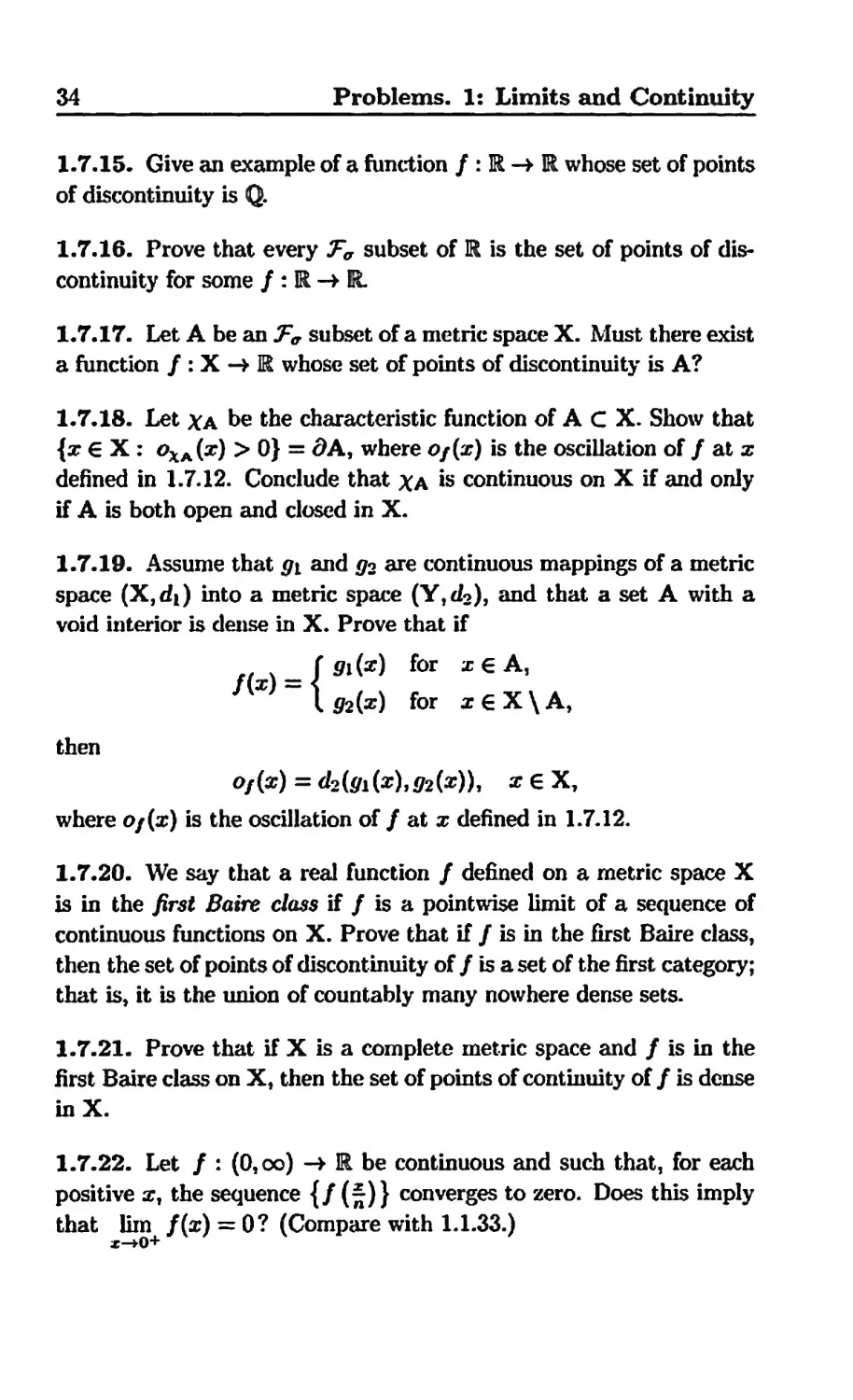
1.7.15. Give an example of a fun<.-tion f : 1R -+ JR. whose set of points
of discontinuity is Q.
1.7.16. Prove that every :Fu subset of IR is the set of points of dis-
continuity for some f : JR. -+ nt
1.7.17. Let A be an:FtT subset of a DlctriC space X. Iust there exist
a function f : X -+ R whose set of points of discontinuity is A?
1.7.18. Let XA be the characteristic function of A C X. Show that
{x EX: 0XA (x) > O} = oA, where o,(x) is the osciUation of I at x
defined in 1.7.12. Conclude that XA is continuous on X if and only
if A is both open and closed in X.
1.7.19. Assume tbat 91 and 92 are continuous mappings of a metric
space (X,d l ) into a metric space (Y,d 2 ), and that a set A with a
void interior is dense in X. Prove that if
{ 91(X) for x E A,
lex) =
92 (x) for x EX \A,
then
o,(x) = d 2 (Ul(X),92(X», x E X,
where o/(x) is the oscillation of / at x defined in 1.7.12.
1.7.20. We say that a real function I defined on a metric space X
is in the first Baire class if I is a pointwise limit of a sequence of
continuous functions on X. Prove that if f is in the first Baire class,
then the set of points of discontinuity of I is a set of the first category;
that is, it is the union of countably many nowhere dense sets.
1.7.21. Prove that if X is a complete met.ric space and f is in the
first Baire class on X, then the set of points of continuity of f is dense
in X.
1.7.22. Let f : (0,00) -+ IR be continuous and such that, for each
positive x, the sequence {I ( : )} converges to zero. Does this imply
tbat fun f(x) = O? (Compare with 1.1.33.)
z o+
1.7. Continuous Functions in Metric Spaces
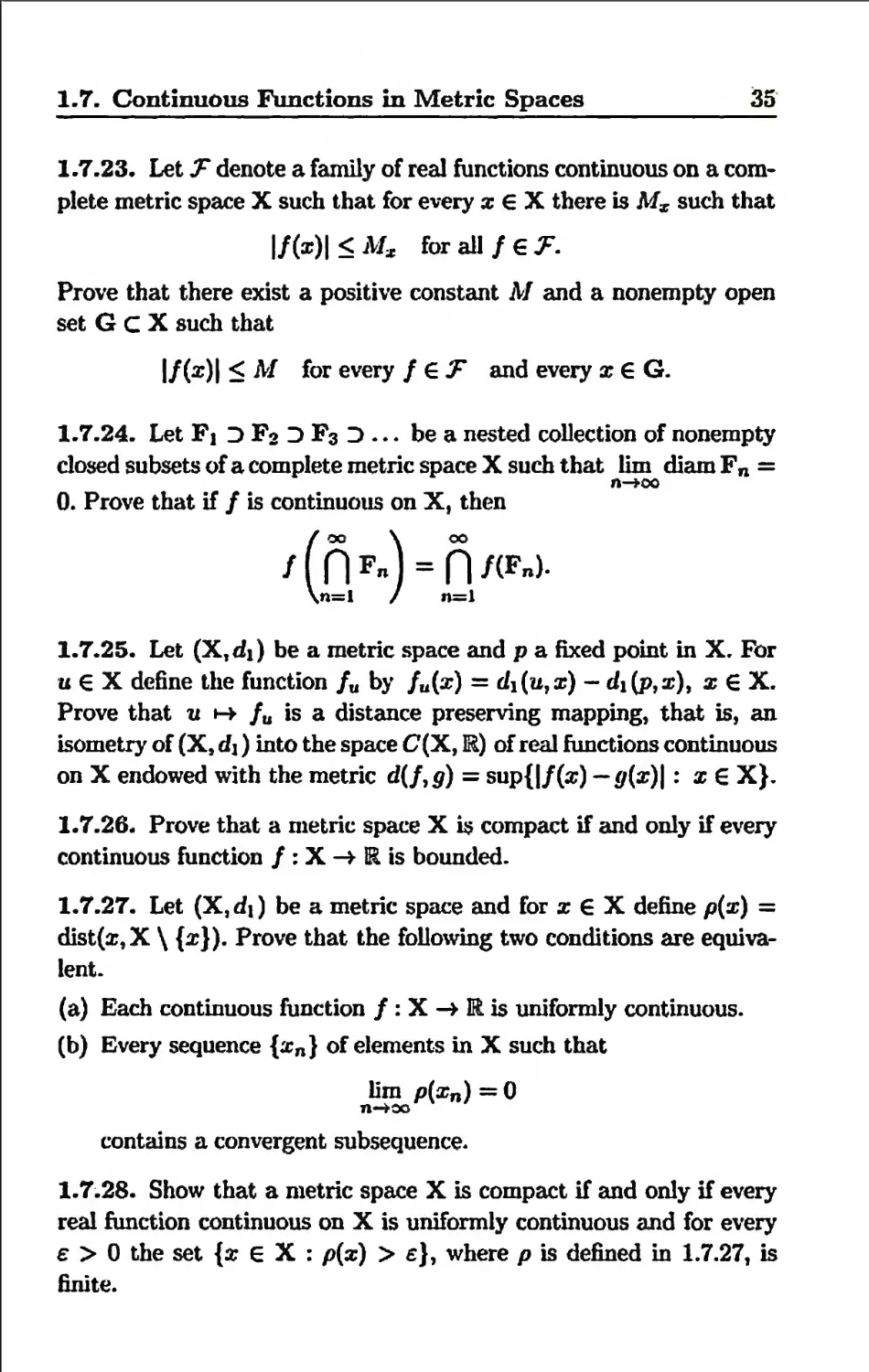
5
1.7.23. Let F denote a family of real functions continuous on a com-
plete metric space X such that for every x E X tbere is M z such that
I/(x)1 < 1\1;z for all I E F.
Prove that there exist a positive constant flrJ and a Donempty open
set G C X such that
I/(x)1 ::;!vl for every I E:F and every x E G.
1.7.24. Let FI ::> F 2 ::> Fa ::> ... be a nested collection of nonempty
closed subsets of a complete metric space X such that lim diam F n =
n-foOO
O. Prove that if f is continuous on X, then
f ( f\ Fn) = D f(Fn).
1.7.25. Let (X, d 1 ) be a metric space and p a fixed point in X.. For
u e X define tbe function fu by lu{x) = d1(u, x) - d1(P,x), x e x..
Prove that 'U t-+ I u is a distance preserving mapping, that is, an
isometry of (X, d 1 ) into the space C(X, IR) of real functions continuous
on X endowed with the metric d(j,g) = sup{lj(x) - g(x)1 : x EX}..
1.7.26. Prove that a nletric space X compact if and only if every
continuous function f : X -+ IR is bounded.
1.7.27. Let (X,d.) be a metric space and for x E X define p(x) =
dist(x, X \ {x}).. Prove that the following two conditions are equiva-
lent.
(a) Each continuous function f : X -+ R is uniformly continuous.
(b) Every sequence {xn} of elements in X such that
Urn p(xn) = 0
n-.oo
contains a convergent subsequence.
1.7 28. Show that a nletric space X is compact if and only if every
real function continuous on X is uniformly continuous and for every
e > 0 the set {x EX: p(x) > E}, where p is defined in 1.7.27, is
finite.
36
Problems. 1: Limits and Continuity
1.7.29. Give an example of a noncompact metric space X such that
every continuous f : X -+ IR is uniformly continuous on X.
Chapter 2
Differentiation
2.1. The Derivative of a Real Function
2.1.1. Find the derivatives (if they exist) of the following functions:
(a)
(b)
(c)
(d)
(e)
(f)
fez) = zlxl, x E IR,
f(x) = , x E Ii,
fez) = [x] sin 2 (1rz), Z E Ii,
fez) = (z - [x]) sin 2 (1rz), X E Ii,
fez) = In lxi, x E R \ to},
1
fez) = arccos , Ixl> 1.
2.1.2. Find the derivatives of the following functions:
(a) I(x) = log 2, z > 0, X:F 1,
(b) f(x) = lo cosx, x E (O, ) \ {I}.
2.1.3. Study differentiability of the following functions:
{ arctan Z if Izl S I,
(a) fez) = : sgnz + %2 1 if Ixl > 1,
-
37
38
Problems. 2: Differentation
(b)
{ x2e-z2 if Ixl I,
J(x) = if Ixl > I,
(c)
{ arctan b if x:F 0,
f(x) = lt 2 IZI 1 . f
X =0.
2.1.4. Show that the function given by
{ x21cos I if
I (x) = 0 if
x ;e 0,
x=o
is not differentiable at Zn = 2n I ' nEZ, but is differentiable at zero,
which is a limit point of {x nt n E Z}.
2.1.5. Determine the constants a, b, c and d so that I is differentiable
on Ii:
4x if z 0,
(a) fez) = ax 2 +bx+c if o < z < 1,
3-2x if x I,
ax+b if x S 0,
(b) I(x) = c:x 2 + dx if o < x < 1,
1- 1 if x> 1,
Z
ax+b if x < 1,
(c) f(x) = ") if 1 < x S 2,
ax-+c
dz2 + 1 if x> 2.
z
2.1.6. Find the following sums:
(a)
n
Lke kz , x E JR,
Ic=O
I:(-1)J: ( 2n ) kn, n 1,
Ic=O k
(b)
n
(c) L kcos(kx), x E r-t
k=l
2.1. The Derivative of a Real Function
39
2.1.7. Prove that if lal sin x + a2 sin 2x + . . . + an sin nxl < I sin xl for
x E IR, then lal + 2a2 + ... + nanl < 1.
2.1.8. Assume that / and 9 are differentiable at Q. Find
(a) lim xlCa) - al(x) ,
z-Ioa X - a
(b)
I " I(x)g(a) - /(a)g(x)
1m .
z
a x-a
2.1.9. Suppose that I(a) > 0 and that I is differentiable at a. De-
termine the limits
I
(a) Urn ( f (a +
) ) ;; ,
n-.oo I(a)
b)
. ( /(X» ) J a..!. l aa
hm /() , a > O.
z-i>a a
2.1.10. Let I be differentiable at a. Find the following limits:
(a) lim an I(x) - x n I(a) , n E N,
z-to X - a
" l(x)e Z - I(a) ,
(b) 11m Ie ) I( ) ' a = 0, I (0)
0,
z-ta X COSX - a
(c) n
co n(i(a+ ;u+/(a+
+...+J(a+
-k/(a)), kEN,
(d) n
(/(a+
) +/(a+
) +".+/(a+
) -n/(a»).
2.1.11. For a > 0 and Tn, keN, calculate
lim ( en + l)m + (n + 2)m +... + en + k)m _ 1m ) J
n-too n m - 1
(a)
(b)
( J ) III 2 ) n ( k ) "
lirn a + n \ a + ii . ." a + n
n-too ank J
(c)
lim (( 1 +
) ( 1 + 2a ) ... ( 1 +
)) .
n-looo n 2 n 2 n 2
40
Problems. 2: DifFerentation
2.1.12. Assume that 1(0) = 0 and that I is differentiable at zero.
For a positive integer k find
; (/(x) + 1 (j) + 1 ( ; ) + . .. + 1 ( : )) ·
2.1.13. Let I be differentiable at a and let {xn} and {zn} be two
sequences converging to a and such that X n f; a, Zn #: a, X n f; Zn for
n e N. Give an example of I for which
lim f{x n ) - I(zn)
n....oo X n - Zn
(a) is equal to I'(a),
(b) does not exist or exists but is different from /' (a).
2.1.14. Let I be differentiable at a and let {xn} and {zn} be two
sequences converging to a and such that X n < a < Zn for n E N.
Prove that
lim fex n } -/{zn) = /'(a).
n....oo X n - Zn
2.1.15.
(a) Show that / defined on (0,2) by setting
{ z2 for rational x e (0,2),
I(z) =
2x -1 for irrational x e (0,2)
is differentiable only at x = 1 and tbat I' (1) f; O. Is the inverse
function differentiable at 1 = y = /(1)?
(b) Let
A = {y e (0,3) : y e Q, Jji Q},
1
B={x:x=2(y+4), yeA}.
Define I by setting
I(z) =
z2
2z-1
2z-4
for rational z E (0,2),
for irrational z E (0,2),
for x E B.
2.1. The Derivative of a Real Function
41
Show that the interval (0, 3) is contained in the range of I, and
that the inverse function is not differentiable at 1.
2.1.16. Consider the function I defined on IR as follows:
{ 0 if x is irrational or x = 0,
lex) = . .
Oq If % =
, p e Z, q E N, and p,q are co-pnme,
where the sequence {Oq} is such that lirn n"an = 0 for some integer
n-too
k > 2. Prove that I is differentiable at each irrational which is alga.
braic of degree at most k (that is, at each algebraic surd of degree at
most k).
2.1.17. Let P be a polynomial of degree n with n different real roots
Xl, %2, . . . ,X n and let Q be a polynomial of degree at most n -1. Show
that
Q(x)
Q(Xk)
P(x ) - L..J P'(x,,){x - XIc )
k=l
n
for % E R \ {XhX2,.. .,x n } and find the sum E P'(
) ' n > 2.
k=l ·
2.1.18. Using the result of the foregoing problem, establish the fol-
lowing equalities:
(a)
n ( n ) (-l)tc n!
f; k x+k = x(x+l)(x+2)...(x+n)
for x e R \ {-n,-(n-l),...,-I,O},
(b)
n ( n ) (_l)k n!2 R
t; k x+2k = x(x+2)(x+4)... (x + 2n)
for x e IR \ {-2n, -2(n - 1),..., -2, OJ.
2.1.19. Let I be differentiable on III Describe the points of differen-
tiability of If I.
42
Problems. 2: Differentation
2.1.20. Assume that II) 12,. .. , In are defined in some neighborhood
of :c, are different from zero at x, and are differentiable at x. Prove
that
(1]1 f.)' (x) = t 1Hz) .
ii II: k=l Ik(z)
k=l
2.1.21. Assume that functions 11,/2,..., In; 9t,!h,.. - ,On are de-
fined in some neighborhood of z, are different from zero at x, and are
differentiable .at z. Prove that
(IT l! ) ' (x) = IT II< (x) t ( lk(Z) _ !4(X» ) .
V=l 01:
l 9k k= 1 Ik(z) Ok(Z)
2.1.22. Study the differentiability of J and 1/1 when
{ X if Z e Q,
(a) I(z) = sin x if 3: E R \ Q.
(b) (z) = { Z -
if :c e Qn [ 21r
1 ' 21r
2 )
k
2,
I sin (x - M if x E (Ii \ Q) n L
.
.. :/-2 }' k > 2.
2.1.23. Show that if the one.sided derivatives I
(xo) and I+.(:co)
exist, then / is continuous at Xo-
2.1.24. Prove that if 1 : (a, b) -to IIi assumes its largest value at
c e (at b), that is, fCe) = max{J(x): x e (a, b)}, and there exist
one-sided derivatives I
(c) and f
(e), then I!..(c) > 0 and I
(c) <
o. Establish the analogous necessary condition that 1 assumes its
smallest value.
2.1.25. Prove that if J e C([a,b», I(a) = I(b), and I
exists 00
(a, b), then
inf{/
(x): :c E (a, b)} < 0 < sup{/
(x): x e (a, b)}.
2.1. The Derivative of a Real Function
43
2.1.26. Prove that if j E C«a, b]) and 1'- exists on (a, b), then
ine {f
(x): x E (a, b)}
f(b
=
(a)
sup{J
(x): x E (a, b)}.
2.1.21. Prove that if I
exists and is continuous on (a, b), then f is
differentiable on (a, b) and I'(x) = 1'- (x) Cor x E (a, b).
2.1.28. Does there exist a function f : (1, 2)
lIt such that f'- (x) =
x and I
(z) = 2x for z E (1,2)?
2.1.29. Let f be differentiable on [a, b) and such that
(i) I(a) = f(b) = 0,
(ii) I'(a) = f
(a) > 0, I'(b) = I
(b) > o.
Prove that there is c e (a, b) such that f(c) = 0 and f'(e)
o.
2.1.30. Show that f(x) = arctan x satisfies the equation
(1 + x 2 )j C n) (x) + 2(n -l)xfCn-l)(x) + (n - 2)(n - 1)j(n-2)(x) = 0
for x E IR and n > 2. Show also that for m
0,
1(2m)(0) = 0, j(2m+l)(o) = (-1)m(2m)!.
2.1.31. Show that
(a) (ezsinx)(n) = 2 i e z sin (x+n
), x e IR, n > 1,
(b) (x n Inx)'nl = n!(lnx+ 1 +
+... +
), x> 0, n > 1,
(c) C:X ) (n l _ (_I}nn!x- n - 1 (InX -1-
-... -;), x > 0, n > 1,
(d) (xn-1e! )'n l = (_I)n x:: 1 , X#: 0, n > 1.
44
Problems. 2: Differentation
2.1.32. Prove the following identities:
(a) i ( ) sin (Z+k ; ) = 2t sin (z+n ), z E B, n 1,
(b) (-1 )I:+l! ( n ) = 1 + 1 + . .. +.!. n > 1
k k 2 n' -.
"..-1
2.1.33. Let I(z) = vz 2 - 1 for x > 1. Show that f(n)(x) > 0 if n is
odd, and f(n)(x) < 0 if n is positive and even.
2.1.34. For 12n(x) = m(! + z2 n ), n E N, show that fJ n)( -1) = O.
2.1.35. For a polynomial P of degree R, prove that
t P(k)(O), zHI = t(-I)k P(k)(z z"+1.
1:=0 (k + 1). 1: =0 (k + 1).
2.1.36. Let,\1, '\2,...,'\n be such that ,\t + ,\ + ... +,\ > 0 for
any kEN. Then J given by
1
I(x) =
(1- '\lx)(I- '\2X)... (1 - '\nX)
is well defined in some neighborhood of zero. Show that for keN,
f(le) (0) > 0
2.1.37. Let f be n times differentiable on (0, (0). Prove that for
positive x,
zn J (n) G) = (_I)n (zn-I f G )) (n) .
2.1.38. Let I, J be open intervals and let I : J IR, 9 : I J
be infinitely differentiable on J and I, respectively. Prove the Faa di
Bruno formula for the nth derivative of h = fog:
(n) _ n! (JI) { g(1)(t» kl ( 9(2)(t) ) k2 ... ( gCR)(t» k a
h (t)-L..J kl!k2!...k n ! / (g(t)} 1! 2! n! '
where k = kl + k2 + · · . + k n and summation is over all kl, k 2 , . · . t k n
BUch that kl + 2 + . · · + nk n = n.
2.2. Mean Value Theorems
45
2.1.39. Show that the functions
(a)
{ I
e-;2'
f(x) = 0
if x
0,
if x = 0,
(b)
9(X) = { e o -
n if X> 0,
x
0,
(c)
{ e-
+
if x e (a,b),
hex) = 0 if d ( b ,\
X 7= a, h
are in Coo(IR).
2.1.40. Let I be differentiable on (a,b) and such that for x e (a,b)
we have f'(x) = g(f(x», where 9 E COO(Ii). Prove that f e COO (a, b).
2.1.41. Assume that f is twice differentiable on (a,b) and that for
some real a,{J,'Y such that a 2 + {32 > 0,
ol"(x) + {3f'(x) + "II (x) = 0, x e (a, b).
Prove that J e COO «a, b».
2.2. Mean Value Theorems
2.2.1. Prove that if J is continuous on a closed interval [a, b], differ-
entiable on the open interval (a,6), and if /(a) = /(6) = 0, then for
a real 0 there is an x e ( a, b) such that
a/(x) + f'(x) = 0.
2.2.2. Let f and 9 be functions continuous on [a, b), differentiable on
the open interval ( at b), and let I( a) = I( b) = O. Show that there is a
point x E (a, b) such that g'(x)/(x) + I'(x} = o.
46
Problems. 2: Differentation
2.2.3. Assume that f is continuous on (a, b], a > 0, and differentiable
on the open interval (a, b). Show that if
I(a) f(b)
a =6'
then there is Xo E (a, b) such that xo/'(xo) = f(xo).
2.2.4. Suppose I is continuous on [a, b] and differentiable on the open
interval (a, b). Prove that if /2 (b) - /2 (a) = 1J2 - a 2 , then the equation
1'(x)/(x) = x has at least one root in (a,b).
2.2.5. Assume that f and 9 are continuous and never vanishing on
[a, b], and differentiable on (a, b). Prove that if I(a)g(b) = I(b)g(a),
then there is Xo E ( a, b) such that
I'(xo) o'(xo)
f(xo) - g(xo).
2.2.6. Assume that ao,a.,... ,an are real numbers such that
ao al an-l
+-+...+ +an=O.
n+l n 2
Prove that the polynomial P(x} = aoxn + 01X n - 1 +... + an has at
least one root in (0, 1).
2.2.7. For real constants ao, aI, . . . ,an such that
ao 201 2 2 a2 2n- 1 an_l 2 n a n
- + - + + .. . + + = 0,
1 2 3 n n+I
show that the function
f(x) = an Inn X + . .. + 02 In 2 X + alln X + ao
has at least one root in (1, e 2 ).
2.2.8. Prove that if all roots of a polynomial P of degree n > 2 are
real, then all roots of pi are also real.
2.2.9. Let I be continuously differentiable on [a, b) and twice differ-
entiable on (a, b), and suppose that f(el,) = f'(a) = f(b) = O. Prove
that there is XI E (a, b) such that /"(XI) = O.
2.2. Mean Value Theorems
47
2.2.10. Let 1 be continuously differentiable on [a, b] and twice differ-
entiable on (a, b), and suppose that I(a) = I(b) and f'(a) = f'(6) = 0.
Show that there are Xl ,%2 E ( a, b), Xl :F X2, such that
I"(xl) = 1"(x2).
2.2.11. Show that each of the equations
(a)
X 13 + 7x 3 - 5 = 0,
(b)
3 Z + 4% = 5 z
has exactly one real root.
2.2.12. For nonzero a., a2,. . . ,an and for aa, a2t. . . , an such that
Qi -:f: Qj for i :F j, prove that the equation
alx Q1 + U2XQ2 + ... + unx Qn = 0, x E (0,00),
has at most n - 1 roots in (0,00).
2.2.13. Prove that under the assumptions of the foregoing problem
the equation
ale0 1Z + a2e02Z +... + ane QnZ = 0
has at most n - 1 real roots.
2.2.14. For functions I, 9 and h continuous on [a,b] and differen-
tiable on ( a, b), define
f(x) g(x) hex)
F(x) = det I(a} g(a) h(a) , x E [a, b].
I(b) 9(b) h(b)
Show that there is Xo E (a, b) such that F'(xo) = 0. Use this to derive
the mean value theorem and the generalized mean value theorem.
2.2.15. Let 1 be continuous on [0,2] and twice differentiable on (0,2).
Show that if 1(0) = 0,/(1) = 1 and 1(2) = 2, then there is Xo E (0,2)
such that I"(xo) = O.
48
Problems. 2: Differentation
2.2.16. Suppose that / is continuous on [a, h] and differentiable on
(a,h). Prove that if / is not a linear function, then there are Xl and
X2 in ( a, b) such tbat
1'(:1:1) < I(b = (a) < /'(:1:2).
2.2.17. Let I be continuous on [0,1] and differentiable on (0,1). Sup-
pose that /(0) = /(1) = 0 and that there is Xo E (0,1) such that
f{xo} = 1. Prove that II'(C)I > 2 for some c e (0,1).
2.2.18. Let / be continuous on [at b], a > 0, and differentiable on
(a, b). Show that there is Xl E (a,b) such that
b/(a) - a/(b) /( ) I ' ( )
b = Xl - Xl Xl.
-a
2.2.19. Show that the functions X 1n{1 + x}, X In{! + r) and
z H arctan z are uniformly continuous on [0,00).
2.2.20. Assume that / is twice differentiable on (a, b), and that there
is M > 0 such that I 1"(x) I M for all x E (a,b). Prove that / is
uniformly continuous on (a, b).
2.2.21. Suppose that / : [a, b] -+ R, b - a 4, is differentiable on
the open interval (a,b). Prove that there is Xo e (a, b) such that
/'(xo) < 1 + /2(xO).
2.2.22. Prove that if / is differentiable on (a, b), and if
(i)
(ll)
lim /(x) = +00, lim I(z) = -00,
Z-foc+ z-+b-
/'(x) + 1 2 (x) + 1 0 for X E (a, b),
then b - a 1r.
2.2.23. Let / be continuous on [a, b] and differentiable on (a, b). Show
that if lim /'(x) = A, then / (b) = A.
z-tb-
2.2. Mean Value Theorems
49
2.2.24. Suppose / is differentiable on (0, (0) and /'(x) = O(x) as
x -+ 00. Prove that I(x) = 0(x 2 ) as x -+ 00.
2.2.25. Let /1, /2, . . . , / R and 91,92,..., 9n be continuous on [a, b]
and differentiable on (a, b). Suppose, further, that gl.;(a) :F gk(b) for
k = 1,2,..., n. Prove that there is C E (a, b) for which
tf
(c) == tgHc /,,(b) - f,,(a) .
i=l k=1 91c(b) - gt(a)
2.2.26. Assume that J is differentiable on an open interval I and
that (a, b) C I. We say that f is uniformly differentiable on (a, b], if for
any e"> 0 there is 6 > 0 such that
f(x + h
- f(x) _ /,(x) I < e
for all x E [a, b] and Ihl < 6, x + h e I. Prove that / is uniformly
differentiable on [at b] if and only if I' is continuous on [a, b).
2.2.21. Let f be continuous on [a, b], 9 differentiable on [a, b], and
g(a) = o. Prove that if there is a
:F 0 such that
Ig(x)f(x) + "\g'(x)1 < Ig(x)1 for x e [a,b]t
then g(x) = 0 on [a,bJ.
2.2.28. Let I be differentiable on (0,00). Show that if 1im fez) =
z...+oo Z
0, then lim 1/'(z)1 = o.
%-++00
2.2.29. Show that the only functions /: R -+ Ii satisfying the equa-
tion
f(x + h h ) -/(x) _ _I ' (x + 2 1 h)
for x, hell, h:; 0,
are polynomials of second degree.
50
Problems. 2: Differentation
2.2.30. For positive p and q such that p + q = 1, find all functions
I : B R satisfying the equation
I(x) - I(y) = I'(PX + qy) for x, y e JR, X:F y.
x-v
2.2.31. Prove that if I is differentiable on an interval I, then I'
enjoys tbe intermediate value property on I.
2.2.32. Let I be differentiable on (0,00). Show that
(a) if Urn {I (x) + I'(x» = 0, then lim I(x) = 0,
Z + Z +
(b) if lim (I (x) + 2vxl'(x» = 0, then lim f(x) = O.
Z + Z +
2.2.33. Prove that if I e (/l([a, b) has at least three distinct zeros
in [a, b), then the equation I(x) + f"(x) = 2/'(x) has at least one root
in [a, b].
2.2.34. Prove that if a polynomial P has n distinct zeros greater
than 1, then the polynomial
Q(x) = (x 2 + l)P(x)P'(x) + x (p(X»2 + (p'(x»2)
bas at least 2n - 1 distinct real zeros.
2.2.35. Let a polynomial P(x) = amx m +am_IX m - 1 +.. .+alx+ao
with am > 0 have m distinct real zeros. Show that the polynomial
Q(x) = (p(x»2 - P'(x) has
(1) exactly m + 1 distinct real zeros if Tn is odd,
(2) exactly m distinct real zeros if m is even.
2.2.36. Assume that all zeros of a polynomial P of degree n > 3 are
real and write
P(x) = (x - al)(x - 62)... (x - an),
where aj S ai+1 t i = 1,..., n - 1, and
P'(x) = n(x - Cl)(X - C2)... (x - Cn-I),
2.2. Mean Value Theorems
51
where ai < Ci < 0i+lt i = 1,...,71 -1. Show that if
Q(x) = (x - al)(z - a2)... (x - an-I),
Q'(x) = (n -1)(x - dd(x - )... (x - dn-2),
then d c; for i = I, . . . , n - 2. Moreover t show that if
R(x) = (x - a2){x - a3) . · · (x - 0'1)'
R'(x) = (n -1)(x - el)(x - e2)... (z - en-2),
then e. :S (:;+1 for i = 1,2,..., n - 2.
2.2.37. Under the assumptions of the foregoing problem, show that
(1) if S(x) = (x-at -e)(z -a2)... (x -an), where e 0 is such that
at + E =5 an-It and if 8'(x) = n(x - 11)(x - /2)... (x - In-I),
then I n-1 > Cn-It
(2) if T(x) = (x - at)(x - a2) · .. (x - an + c:), where E > 0 is such
that an - e > a2, and if T'(z) = n(x - 9.)(X - 92) ... (x - 9n-I),
then 91 S Cl.
2.2.38. Show that under the assumptions of 2.2.36,
ai+l - a; a;+1 - ai .
ai + . 1 < Ci < ai+l - . 1 ' 1. = 1,2, · · · , n - 1.
n-,+ - - &+
2.2.39. Prove that if f is differentiable on [0,1], and if
(i) /(0) = 0,
(il) there is K > 0 such that If'(x)1 Klf(x)1 for x e (0,1],
then I(x) = o.
2.2.40. Let f be in Coo on tbe interval (-1,1), and let J C (-1,1)
be an interval whose length is A. Suppose that J is decomposed into
three consecutive intervals J 1 ,J2 and J 3 whose lengths are At'.\2 and
-"3, respectively. (So we have J 1 UJ 2 U J 3 = J and Al + A2 + A3 = A.)
Prove that if
mj:(J) = inf{lf(k)(x)l: x e J}, k e N J
then
1
mk(J) "\ (mk-l(J 1 ) + mk-l(J 3 ».
.1\2
52
Problems. 2: DifFerentation
2.2.41. Prove that under the assumptions of the foregoing problem,
if I/(x)1 1 for x e (-1,1), then
2 .(.:1) kk
mk(J) ),.k ' keN.
2.2.42. Assume that a polynomial P(x) = tlnX n + lIn_lX n - 1 +... +
alZ + ao has n distinct real zeros. Prove that if there is p, 1 :S p S
n -1, such that a" = 0 and ai f; 0 for all i :F p, then ap-lap+l < o.
2.3. Taylor's Formula and L'Hospital's Rule
2.3.1. Suppose that I : [a, b] R is n - 1 times differentiable on
[a, b]. If I(n) (xo) exists, then for every x e [a, b),
lex) = /(xo) + I' o) (x - xo) + I" o) (x - xO)2
f(n) (xo)
+ . .. + I (x - :ro)n + o«x - xo)n).
n.
(This formula is called Taylor's formula with the Peano lorm lor the
remainder. )
2.3.2. Suppose that I : [a, b) -.. 11 is n times continuously differen-
tiable on [a,b], and I(n+l) exists in the open interval (a, b). Prove that
for any X,ZO e [a,b] and any p > 0 there exists S E (0,1) such that
f'(x ) I"(x )
I(x) = I(xo) + 11 0 (x - xo) + 21 0 (x - xO)2
f(n) (xo)
+ .. · + n! (x - xo)n + rn(x),
where
rn(x) = I(n+l) (xo + S(x - zo» (1 _ 8)n+l-p(x _ xo)n+l
nIp
is the Schlomilch-Roche form for the remainder.
2.3. Taylor's Formula and L'Hospital's Rule
53
2.3.3. Using the above result, derive the following forms for the re-
mainder:
(a) ( ) I(n+l)(xo + 8(x - xo» ( ) n+l
Tn X = (n + I)! X - Xo
(the Lagrange form),
(b) T ( x) = f(n+l)(xo + 8(x - xo» (1- 8 ) n(x _ xO)R+1
n n!
(the Cauchy form).
2.3.4. Let 1 : [a, b]
R be n + 1 times differentiable on [a, b]. For
x, Xo e [a, b] prove the following Taylor Ionn.ula with integral remain-
d
I(x) = I(xo) + I'
) (x - xo) + J"
:o) (x - XO)2
I (n) ( % ) 1 1 %
+ ... + I 0 (x - xo)n + .. j(n+l)(t)(x - t)ndt.
n. n. %0
2.3.5. Let 1 : [a, b)
Ii be n + 1 times differentiable on [a, b]. For
x, Xo e [a, b) prove the following Taylor formula:
lex) = I(xo) + J'
) (x - xo) + J"
:o) (x - XO)2
f(n) (xo)
+... + r (x - xo)n + Rn+l(X),
n.
where
1 z 1 ta+l 1 tft 1 t2
Rn+l(X) = ... f(n+l)(ti)dtl .. .dt n dt n + 1 .
zg zo zo zo
2.3.6. Show that the approximation formula
1 1 2
v l+x
1+ -x--x
2 8
gives "; 1 + x with the error not greater than
Ix1 3 , if Ixl <
.
54
Problems. 2: Differentation
2.3.7. For x > -1, x i: 0, show that
(a) (1 + x)O > 1 + ax if a > 1 or a < 0,
(b) (1 + X)CI < 1 + ax if 0 < a < 1.
2.3.8. Suppose that j,g E C2([0, 1]) and o'(x) ° for x E (0,1), and
J'(O)g"(O) 1"(O)g'(O). For x e (0,1), let 8(x) be one of the numbers
for which the assertion of the generalized mean value theorem holds,
that is,
Compute
lex) - 1(0) I' (8(x»
g(x) - g(O) - g'(8(x».
Urn 8(x) .
01:-.0+ X
2.3.9. Let J : TIt -+- IIi be n + 1 times differentiable on III Prove that
for every x E Ii there is 8 E (0,1) such that
(a)
x 2 x R
I(x) = /(0) + x/'(x) - - J"(x) +... + (_I)"+I_/(n)(x)
2 n!
n+l
+ (_1)"+2 Z /(R+l) ({Jx)
(n + I)! '
(b)
( X ) z2 x2n /(n)(x)
= x - I X +... + -1 n
I 1 + x J() 1 + x / ( ) () (1 + x)" n!
2n+2 /(n+l) ( %+9%2 )
) "+1 X 1+z-J,
+ (-1 (1 +x)n+l (n + I)! ,x.,.. -1.
2.3.10. Let I : Ii R be 2n + 1 times differentiable on R. Prove
that for every x e Ii there is {J E (0,1) such that
lex) = 1(0) + TII' G ) ( ) + :, /(3) (; ) G f
. . . 2 (2n-l) ( ) ( ) 2n-l
+ + (2n - I)! I 2 2
2 (2n+l) ( X ) 2n+l
+ (2n + 1)! 1 (8x) 2' ·
2.3. Taylor's Formula and L'Hospital's Rule
55
2.3.11. Using the result in the foregoing problem, prove that
n 1 ( ) 21:+1
In(l + x) > 2 E 2k 1 2 x
k=O + + x
for n = 0, 1, . .. and x > 0
2.3.12. Show that if J" (x) exists, then
r J(x + h) - 2f(x) + f(x - h) - f " ( )
h h 2 - x ,
r J(x + 2h) - 2/(x + h) + I(x) - f " ( )
h h 2 - X .
(a)
(b)
2.3.13. Show that if J"'(x) exists, then
. - J(x + 3h) - 3J(x + 2h) + 3J(x + h) - f(x) - f lll ( )
h 3 - x.
h-tO
2.3.14. For x > 0, establish the following inequalities:
(a)
n Ie
z x
e > L, k! '
k=O
X 2 X 3 3: 4 X 2 X 3
x- - + - - - < In(l+x) <X- -+-
2 3 4 2 3'
1 1 2 V 1 1? 13
1 + -x - -x < 1 + x < 1 + -z - -x- + -x
2 8 2 8 16.
(b)
(c)
2.3.15. Prove that if f(n+l)(x) exists and is different from zero, and
8(h) is a number defined by the Taylor formula
h n - J h n
f(x+h) = J(x)+hJ'(xj+...+ ( _l), J(n-l)(x)+, f(n) (x+8(h)h),
n. n.
then
Jim 9( h) = 1 l '
h-+O n +
56
Problems. 2: Differentation
2.3.16. Suppose that I is differentiable on [0,1] and that 1(0) =
1(1) = O. Suppose, further, that I" exists on (0,1) and is bounded
(say 1/"(x)1 5 A for z E (0,1». Prove that
A
1/'(x)1 '2 for z e [0,1].
2.3.17. Suppose I : [-c,c] .... It is twice differentiable on [-c, c), and
set Mk = sup{l/{k){z)l: Z E [-c,c]} for k = 0,1,2. Prove that
(a) 1/'(x)1 < Mo + (x 2 + cfl) 2 2 for x E [-c,c],
- c c
(b) Ml 2 ';MoM2 for c JZ: .
2.3.18. Let I be twice differentiable on (a, (0), a e IR, and let
Mle = sup{l/(i) (z)1 : Z E (a,oo)} < 00, k = 0,1,2.
Prove that M 1 2 vMoM2- Give an example of a function for which
the equality M 1 = 2 v kfoM2 holds.
2.3.19. Let I be twice differentiable on IR, and let
Mle = sup{l/(k) (x) 1 : x E R} < 00, k = 0,1,2.
Prove that Ml .../ 2 MoM2 .
2.3.20. Let I be p times differentiable on Ii, and let
Mk = sup{l/(k){x)l: x e Il} < 00, k = 0,1,... ,p, p > 2.
Prove that
.(p-.) 1-.1 S
M" 5 2 :I JlJ o P M; for k = 1,2, . . . ,p - 1.
2.3.21. Assume that I" exists and is bounded on (0,00). Prove that
if lim I(x) = 0, then Jim I'(x) = O.
z-tooo -+oo
2.3. Taylor's Formula and L'Hospital's Rule
57
2.3.22. Assume that I is twice continuously differentiable on (0,00),
Urn xf(x) = 0 and lim xfl/(x) = o.
%....+00 Z
+OO
Prove that lim x I' (x) = o.
%-t+oo
2.3.23. Assume I is twice continuously differentiable on (0, 1) and
such that
(i) Jim f(x) = 0,
z-H-
(ll) there is ]vI > 0 such that (1- x)2If"(X)1 < M for x E (0,1).
Prove that lim (1- x)f'(x) = O.
z....1 -
2.3.24. Let I be differentiable on [atb] and let f'(a) = f'(b) = O.
Prove that if I" exists in (a, b), then there is c e (a, b) such that
II"(c)1
(b
a)2 lf(b) - f(a)l.
2.3.25. Let f : [-1,1] -+ Ii be three times differentiable and let
I( -1) = 1(0) = 0, f(l) = 1 and f'(O) = O. Show that there exists
c E (-1,1) such that I"'(c) > 3.
2.3.26. Let I be n times continuously differentiable on [a, b) and let
I(x) -/(t)
Q(t) = , x, t E [a, b], t
x.
x-t
Prove the following version of Taylor's formula:
I' (xo) f(n) (xo)
f(x) = I(xo) + I! (x - xo) + . . . + n! (x - xo)n + rn(x),
where rn(x) = q("
zo) (x - xo)n+l.
2.3.27. Assume that I : (-1, 1)
Ii is differentiable at zero. For
-1 < X n < Yn < 1, n E N, such that lirn Xn = lim Yn = 0, form
n-+oo n....oo
the quotient
Dn = f(Yn) - f(xn) .
Yn-Xn
Prove that
(a) if X n < 0 < Yn, then Urn Dn = /'(0),
n....oo
58
Problems. 2: Differentation
(b) if 0 < X n < Yn and the sequence { 1/.. Zn } is bounded, then
lim Dn = f'(O),
n-t>oo
(c) if I' exists on (-1, 1) and is continuous at 0, then lim Dn =
n-+oo
f'(O).
(Compare with 2.1.13 and 2.1.14.)
2.3.28. For meN, define the polynomial P by setting
P(x) = 'f ( m; 1) (-1)"(x - k)m. x e IR.
k=0
Show that P(x) == O.
2.3.29. Suppose that f(n+2) is continuous on [0, x]. Prove that there
is 9 e (0, 1) such that
/' ( 0 ) /(n-l) ( 0) J(n) ( 2- )
I(x) = 1(0) + z+ ... + xn-l + rJ+1 x n
I! (n - I)! n!
n+2
n f (n+2) ( 8 ) x
+ 2(n+l) x (n+2)r
2.3.30. Suppose that f(n+l') exists in [a, b] and is continuous at an
Xo E [a, b]. Prove that if j(n+;) (xo) = 0. for j = 1,2,... ,p - 1, and
j(n+p)(xo) :F 0, and
/'(xo) /(n-l)(xo) n-l
I(x) = /(xo) + I! (z - zo) +... + (n -I)! (x - xo)
f(n)(xo + 9(x) (x - :to» ( ) n
+ I X-Xo ,
n.
then
1
lim 9(x) = ( n + P ) -it .
Z-+ZO n
2.3.31. Suppose that I is twice continuously differentiable on (-1,1)
and that 1(0) = o. Find
[*J
lim I(kx).
:1:....0+ L..J
k=l
2.3. Taylor's Formula and L'Hospital's Rule
59
2.3.32. Let f be infinitely differentiable on (a, b). Prove that if /
vanishes at infinitely many points in tbe closed interv-c1l [e, dJ C (a, b),
and sup{lf(n)(x)1 : x E (a,b)} = O(n!) as -n -+ 00, then / vanishes on
an open subinterval of (a, b).
2.3.33. Suppose
(i) f is infinitely differentiable on IR,
(ii) there is L > 0 such that I/(n) (x) I L for all x E Ii and all
-n E 1'1,
(ill) / ( ) = 0 for 1t e N.
Prove that f(x) == 0 on III
2.3.34. Use I'Hospital's rule to evaluate the following limits:
arctan
(a) lim z-+1 ,
z l x-I
(b)
lim x ( ( 1 + ! ) Z - e ) ,
% +oo x
I
Urn ( Sin x ) z ,
% o+ x
(c) lim(6 - x) ,
z-+5
(e) lim ( SinX ) "*.
z-+o+ X
(d)
2.3.35. Prove tbat if / is twice continuously differentiable on R such
that 1(0) = 1, /'(0) = 0, and 1"(0) = -1, then for a E IR,
%]!l!oo(J( ) r = e- U; .
2.3.36. For a > 0, at:: 1, evaluate
( aZ-1 ) !
Urn .
+oo x(a -1)
60
Problems. 2: DifFerentation
2.3.37. Can }'Hospital's rule be applied to evaluate the following
limits?
(a)
(b)
(c)
(d)
I _ x - sin x
1Dl 2 . t
z-+oo X + S1D z
lim 2x + sin2x + 1
%-+00 (2x + sin2x)(sinx + 3)2'
lim ( 2Sin VZ + vzs in ! ) Z ,
z-+o+ X
( ) e-:r
lim 1 + xe-* sin 14 .
z-+o X
2.3.38. Is the function given by
f(2:) = { r 2 - 2' 1
differentiable at zero?
if z 0,
if z=O
2.3.39. Suppose J is n times continuously differentiable on III For
a E 1R, establish the equality
f(n)(a) = h (-l)n-k( )/(a+kh»).
2.3.40. Prove the following version of I'Hospital's rule. Suppose
f, 9 : (a, b) IR, -00 a < b S +00, are differentiable on (a, b).
Suppose, further, that
(i) g'(x):f:. 0 for x E (a, b),
(ll) lim g(z) = +00 (-00),
z-to+
(ill) lim g ( : = L, -00 < L +00.
z-+o+
Then
1im f{x) = L.
z-ta+ g(x)
2.4. Convex Functions
61
2.3.41. Use the above version of I'Hospital's rule to prove the fol-
lowing generalizations of the results given in 2.2.32. Let f be differ-
entiable on (0, (0), and let a > o.
(a) If lim (a/(x) + f'(x» = L, then lim f(x) =
.
Z
+
Z
+
(b) If lim (af(x) + 2v'Xf'(x» = L, then lim f(x) =
.
Z
+
Z
+
Are the above statements true for negative 01
2.3.42. Assume that / is three times differentiable on (0,00) and
such that f(x) > 0, f'(x) > 0, f"(x) > 0 for z > o. Prove that if
. f'(x)f"'(x)
lim )2 = C, c ¥: 1,
Z
(f"(X)
then
fun f(x)f"(x) = 1 .
z
oo (f'(x»2 2 - c
2.3.43. Assume that I is in Coo on (-1,1), and that f(O) = O. Prove
that if 9 is defined on (-1,1) \ to} by g(x) = I
z) , then there exists
an extension of 9 which is in Coo on (-1,1).
2.4. Convex Functions
A function f is said to be convex on an interval I c R if
(1) f(Ax I + (1 - '\)X2) S '\f(xl) + (1 - >')/(x2)
whenever %.,Z2 e I and
e (0,1). A CODVex function I is said to be
strictly convex on I if strict inequality holds in (1) for Xl ¥: X2. f is
COncave on I if -I is COnvex.
2.4.1. Prove that a function I differentiable on an open interval I is
convex if and only if I' is increasing on I.
2.4.2. Prove that a function I twice differentiable on an open interval
I is convex if and only if f" (x)
0 for x E I.
62
Problems. 2: Differentation
2.4.3. Prove that if a function / is convex on an interval I, then the
following Jensen inequality
I(AI X l + A2 X 2 +...... + AnXn) S At/(Xt) + A2/(x2) +..... + An/(xn)
holds for any points Xl,..., xn in I and any nonnegative numbers
h. · · ' n such that At + A2 + .. . + n = 1.
2.4.4. For x, y > 0 and p, q > 0 such that + = I, establish the
inequality
x" yq
X y < - + -.
- P q
2.4.5. Prove that
1 n n
; Xk !! Xk
for Xt,X2,... ,x n > O.
2.4.6. Show that if a:F b, then
e b - eO eO + e b
<
b-a 2
2.4.7. For positive x and y, establish the inequality
x+y
x In x + y In y (x + y) In 2 ·
2.4.8. For Q > 1 and for positive XbX2,.... ,Xn, prove that
( ) 0'
1 n 1 n
n LXk < ;; LX "
k=1 k=l
2.4. Convex Functions
63
2.4.9. Let Xl t . . . , X n E (0, 1) and let PI, . . . , Pn be positive and such
n
that E Pie = 1. Prove that
1:=1
(a)
1 + ( t PkXk ) -' Ii ( 1 + XI: ) ". ,
1:=1 1:=1 Xle
n
1 + E PlcXk n ( 1 ) PI,
Ie: I < II + XI: .
n - 1 - XIc
1 - E PI:XIe 1:=1
1e=1
(b)
n
2.4.10. Let x = E XIc with Xb.",Xn E (0 1 11'). Show that
1:=1
(b)
n
II sin XIc < (sin x)n,
k=1
IT sin X" < ( Sinx ) n.
k=! Xle X
(a)
2.4.11. Prove that if a > 1, and X.,..., X n E (0, 1) are such that
Xl + . . . + X n = 1, then
( XI: + ) O > (11 2 + 1)0 .
L...J x - 1&0-1
#t=1 Ie
2.4.12. For n > 2, verify the following claim:
n 21: _ 1 ( 2 1 ) n
< 2- - +
II 2 k - 1 - n n.2 n - 1 .
k=2
64
Problems. 2: Differentation
2.4.13. Establish the following inequalities:
(a)
n 2 1 1
< - + · · · + -, Xl, . . . ,X n > 0,
Xl + . . · + Xn - XI Zn
(b)
1 01 a
< X l ... X " < a l X l + .. . + a n X n
21.+...+9& - n -
ZI Z.
n
for Qk, Xk > 0, k = 1,2,..., n, such that E ak = I,
k=1
(c)
xr 1 .. . x ,. + yf1 .. .y " S (Xl + VI )0'1 . .. (Xn + Yn)O,.
n
Cor XIc, Vie 0, Qk > 0, k = 1,2, .. . ,n, such that E ale = 1,
i=1
(d)
( ) 0'1
m n n m
n zfj n Zij
for XiJ 0, £ti > 0, i = 1,2,...,n, j = 1,2,...,m, such that
n
Laic = 1.
k=1
2.4.14. Show that if / : III -.. IR is convex and bounded above, then
J is constant on Jll
2.4.15. Must a convex and bounded function on (a, 00) or on (-00, a)
be constant?
2.4.16. Suppose that I : (a, b) -.. IR is convex on (a, b) (the cases
a = -co or b = co are admitted). Prove that either / is monotonic
on (a, b), or there is e e (a, b) such that
fee) = min{f(x): x e (a, b)}
and / is decreasing on (a,e] and increasing on [e,b).
2.4. Convex Functions
65"
2.4.17. Let f : (a, b) R be convex on (a, b) (the cases a = -00 or
b = 00 are admitted). Show that finite or infinite limits
lim f(x) and lim I(x)
%-'4+ z b-
exist..
2.4.18. Suppose that 1 : ( a, b) .... 1t is convex and bounded on ( a, b)
(the cases a = -00 or b = 00 are admitted). Prove that 1 is uniformly
continuous on (a, b). (Compare with 2.4.14).
2.4.19. Let 1 : (a, b) .... Ii be convex on (a, b) (the cases a = -00
or b = 00 are admitted). Prove that one-sided derivatives of I exist
on (at b) and are monotonic. Prove moreover that the right- and left-
hand derivatives are equal to each other except on a countable set.
2.4.20. Assume that I is twice differentiable on R and /, /' and /"
are strictly increasing On IR.. For fixed a,b, a < h, let x -+ (x)t x > 0,
be defined by the mean value theorem, that is,
f(b + x) - f(a - x) = I'( ).
b - a + 2:c
Prove that the function is increasing on (0,00).
2.4.21. Using the result in 2.4.4 prov Holder's inequality: H p, q > 1
and + ; = 1, then
n ( n ) ( n )
?: IXiUil ?: J:cd P ?: IYil q ·
1=1 1=1 a=1
2.4.22. Using Holder's inequality, prove tbe Minkowski inequality: H
p 1, then
.! .!. 1
( t IXI + Yil P ) P ( t IXiI" ) l' + ( t IYiI" ) II .
.=1 a= 1 -.=1
00 00
2.4.23. Prove that, if a series E a converges, then E 4 also
n=1 n= 1 nl
converges.
66
Problems. 2: DifFerentation
2.4.24. For Xi, Yi > 0, i = 1,2,..., n, and p > 1, establish the
inequality
111
«Xl +... + Xn)P + (Yl +... + Yn)P). (xf +yf). +.. .+(x +Y )P.
2.4.25. Prove the following generalized Minkowski inequality: For
Xi,; 0, i = 1,2,..., n, ; = 1,2,..., m, and for p > 1,
( t ( t XiJ ) P ) t ( t xfJ ) * ·
1=1 J=1 J=1 1=1
2.4.26. Assume that /, continuous on an interval I, is midpoint-
convex on that interval, that is,
/ ( X + 2 Y ) f(x) + 2 f(y)
for x,y E I.
Prove that f is convex on I.
2.4.27. Show that the continuity is an essential hypothesis in 2.4.26.
2.4.28. Let J be continuous on an interval I and such that
!( X;v ) < !(X);!(y)
for x,y E I, X:F y. Show that f is strictly convex on I.
2.4.29. Assume that f is a convex function on an open interval I.
Prove that / satisfies the Lipschitz condition locally on I.
2.4.30. Let f : (0,00) -. R be convex and let
lim f(x) = O.
%-.0+
Prove that the function x t-+ ¥ is increasing on (0,00).
2.4. Convex Functions
67
2.4.31. We say that I is 8ubadditive on (0, (0) if for Xl,X2 E (0, (0),
f(xI + X2) < f(x1) + l(x2).
Prove that
(a) if x r+ I z) is decreasing on (0, (0), then J is 5ubadditive,
(b) if f is convex and subadditive on (0,00), then z r+ I ) is a
decreasing function on that interval.
2.4.32. Suppose f is differentiable on (at b) and for x, Y E (a, b),
z y, there is exactly one (' such that
I(y) - I(x) = j'().
y-x
Prove that I is strictly convex or strictly concave on (a, b).
2.4.33. Let I : Ii -. lit be continuous and such that for each d e IR
the function gd(X) = f(x + d) - lex) is in Coo on III Prove that f is
in Coo on III
2.4.34. Assume that an S ... S a2 S a1, and f is convex on the
interval [an, al]. Prove that
n n
I: f(at+l )ak < I: f(at)alc+l'
1:=1 k=l
where l1n+l = a1.
2.4.35. Suppose that / is concave and strictly increasing on an in-
terval (a, b) (the cases a = -00 or b = 00 are admitted). Prove that
if a < I(x) < x for x E (a, b) and
lim I (z) = 1,
z o+
then for x, y E (a, b),
. In+l(x) -/n(z)
lim = 1,
n oo In+l(y) - In(y)
where fn denotes the nth iterate of f (see, e.g., 1.1.40).
68
Problems. 2: Diff'erentation
2.5. Applications of Derivatives
2.5.1. Using the generalized mean value theorem, show that
(a)
.,
x-
l - - < cosx for z 0,
2!
(b)
x 3
Z - - < sinx for z > 0,
3!
(c)
Z2 x 4
cos X < 1 - 2! + 4! for x 0,
x 3 z6
sin x < x - 3! + 5! for x > 0,
(d)
2.5.2. For n E N and x > 0, verify the following claims:
x 3 Z5 x 4n - 3 x 4n - 1
(a) z - 3f + 5f -... + (4n _ 3)! - (4n -I)! < sin x
x 3 x 4n - 3 x 4n - 1 x4n+l
<x- 3! +...+ (4n-3)! - (4n-l)! + (4n+I)!'
(b)
z2 x 4 X 4n - 4 x 4n - 2
1- 2f + 4! -... + (4n - 4)! - (4n _ 2)! < cosx
X2 x 4n - 4 x 4n - 2 x 4n
< 1- 2! +... + (4n - 4)! - (4n - 2)! + (4n)r
2.5.3. Let J be continuous on [a,b] and differentiable on the open
interval ( a, b). Show that if a > 0, then there are Xl, X2, X3 E ( a, b)
such that
f'(Xl> = (b + a) J'(Z2) = (tr + ba + a 2 ) /'(X3) .
2X2 3x
2.5.4. Prove the following generalization of the result in 2.2.32. Let
/ be a complex valued function on (0,00), and let a be a complex
number with a positive rea1 part. Prove that if f is differentiable and
lim (af(x) + f'(x» = 0, then lim f(x) = o.
% + Z +
2.5. Applications of Derivatives
69
2.5.5. Let I be twice differentiable on the interval (0,00). Prove that
if lim (/(x) + /'(x) + /"(x» = L, then lim I(x) = L.
% + % +oo
2.5.6. Let / be three times differentiable on (0,00). Does the exis-
tence of the limit
lim (f(x) + /'(%) + /"(x) + f"'(x»
z-++oo
imply the existence of lim I(x)?
%-1-+00
2.5.7.
(a) Let I be continuously differentiable on (0, (0) and let /(0) = 1.
Show that if If(x)1 e- Z for % 0, then there is Xo > 0 such
that f'(xo) = _e- zo .
(b) Let I be continuously differentiable on (1, (0) and let 1(1) = 1.
Show that if I/(x)1 < for x > 1, then there is Xo > 0 such tbat
f'(xo} = --:z.
o
2.5.8. Assume that f and 9 are differentiable on [0, a] and such that
1(0) = g(O) = 0 and g(x) > 0, g'(x) > 0 for x E (O,a]. Prove that if
;; increases on (0, a], then also f increases on that interval.
2.5.9. Show that each of the equations
sin(cosx) = x and cos(sinx) = x
has exactly one root in [O,1r/2]. Moreover, show that if Xl and X2
are the roots of the former and the latter equation, respectively, then
Xl < X2.
2.5.10. Prove that if I is differentiable on [a, b), lea) = 0, and there
is a constant C 0 such that II' (x)1 Clf(x)1 Cor x E [a, b], then
f(x) = o.
2.5.11. Using the mean value theorem, prove that if 0 < p < q, then
(l+ ; r < (l+ : r
for X > o.
70
Problems. 2: Differentation
2.5.12. Show first that 1 + x for x e JR, and then, using this
result, prove the arithmetic-geometric mean inequality.
2.5.13. Show that
xy e Z + y(ln y - 1)
for x E IR and positive y. Show also that the equality holds if and
only if y = e Z .
2.5.14. Suppose that / : R -.. [-1,1] is in C2 on IR, and that
(f(0»2 + (f'(0»2 = 4. Prove that there exists Xo E R such that
/(xo) + /"(xo) = O.
2.5.15. Establish the following inequalities:
(x+ ) arctanx > 1 for x> 0,
2tanx-sinhx>0 for O<x< ,
x
In x < - for % > 0, x ':/: e,
e
xlnx 1
x 2 _ 1 < 2 for x > 0, x 1.
(a)
(b)
(c)
(d)
2.5.16. DeLide which of the two numbers is greater:
(a) e'll or 1r ,
(b) 2 V2 or e,
( c) In 8 or 2.
2.5.17. Verify the following claims:
(a) In (1 + : ) In (1 + : ) < , a, b, x > 0,
(b) (l+ r(I- ;r <1, xeJR\{O},m,neN,m,n > lxl,
(c) In(1 + V I +X2) < ! + lnx, X> O.
x
2.5. Applications of Derivatives
71
2.5.18. For x > 0, establish the following inequalities:
(a)
(b)
x
1n(1 +:c) < ,
V 1 + x
(x _1)2 > xln 2 x.
2.5.19. Show that
(a)
(b)
I) 3 I)
x. x X.
x + 2 - '6 < (x + 1) m(t + x) < x + 2 Cor x > 0,
x 2
ID(l + cosx) < In2 - '4 for x E (0,11").
2.5.20. For x > 0, verify the following claims:
(a)
(c)
(e)
e Z < l+xe z , (b)
xe f < eX - 1, (d)
( X + 1 ) %+1
< x z
2 -.
e Z - 1 - x < x 2 e% 1
eX < (1 + X)I+%,
2.5.21. Show that (e + x) -Z > (e - x)£+z for x E (0, e).
2.5.22. Show that if x> 1, then e z - 1 + lox - 2x + 1 > o.
2.5.23. Establish the following inequalities:
() 1 2. r 1r
a gtanx+ 3 smx>x lor O<x<'2'
(b)
(c)
z(2 + cosx) > 35inx for z > 0,
5in 2 X 11"
COSX < ? for 0 < x < _ 2 -
x-
2.5.24. Show that if a> 1, then for 0 S x S 1,
1
2 0 - 1 < ZO + (1 - z)Q S 1.
72
Problems. 2: DifferentatioD
2.5.25. Show tbat if 0 < Q < 1, then for x, y > 0,
(.z+y)O < ZO +yQ.
2.5.26. For Q E (0,1) and z E [-1,1), show that
a(a - 1) '2
(1 + .z)0 1 + ax - 8 z.
2.5.27. Prove the following generalizations of the result in the fore-
going problem. For B 0 and z E (-I,B],
a a(1 - Q) 2
(1 +z) 1 +az- 2(1+B)2 x
o a(l - Q) 2
(1+z) > 1+ax- 2{1+B)2 Z
(a)
if 0 < Q < 1,
(b)
if 1 < a < 2.
2.5.28. Prove that
(a)
sinz z for z e [0, ],
sinz> !x + .!.(1f2 -.u2) for x E [0, 2 ).
- 1f' 1f'3
(b)
2.5.29. Prove that for z e (0, 1),
1f'z(1 - z) < sin 1f'X 4x(l- x).
2.5.30. Prove that for a positive z and a positive integer n,
n k
Z '"' X X ( z 1)
e-L.J,<-e- .
Ic=O k. n
2.5.31. For a positive integer n, find allloca1 extrema of the function
( z2 x n )
f(x} = 1 + x + 2f + · · · + nT e -% ·
2.5. Applications of Derivatives
73
2.5.32. For positive integers m and n, find all local extrema of the
function
I(x) = xm(l- x)n.
2.5.33. For positive integers m and n, find the maximum value of
the function
f(x) = sin 2m x. cos 2n x.
2.5.34. Determine all local extremum points of f(x) = x1(1- x)l.
2.5.35. Find the m inimu m and maximwn values of the function
f(x) = xarcsinx + v' l- x 2 on [-1,1].
2.5.36. Find the maximum value of f on R, where f is given by
1 1
f(x) = 1 + JxJ + 1 + Ix -lr
2.5.37. Show that for nonnegative ai, a2, . . . J an the following in-
equalities hold:
(a)
1 n 1
- ake- a . < -,
n L...J - e
k=1
(b)
1 n 4
- a2e-a. <-
n L...J k - e2'
Ie=!
(c)
n ( 3 ) " ( 1 n )
IIak e exp 3 Lak ·
k=l k=l
2.5.38. Determine all local extremum points of the function
f(x>= { e-r.T(J2+sin H :1:#0,
o If x = o.
74
Problems. 2: Differentation
2.5.39. Let
{ X4 (2 + sin ) if x 0,
I(x) = 0 if x = o.
Prove that I is differentiable on Ii and that at zero I attains its proper
absolute minim um, but in no interval (-E, 0) or (0, E) is / monotone.
2.5.40. For z > 0, establish the inequa1ities
sinh x tanh . h I. h2
< x < x < sm x < 2 sin x.
Vs ioh 2 z + cosh 2 x
2.5.41. Using the result in the preceding problem, prove that, if a
and b are positive and a b, then
2 17 b-a a+b Ja 2 +tJ2
l+! <vab< 1nb_lna < 2 < 2.
Q b
The number L( a J b) = In :: n a is called the logarithmic mean of pos-
itive numbers a and b, a b. (It is also convenient to adopt the
convention that L( a, a) = a.)
2.5.42. The power mean of positive numbers x and y is defined by
1
( xI' +VP ) p
M,,(x,y) = 2 if p o.
(a) Show that
lim M,,(x,y) = ..flY.
p-i'O
(So it is natural to adopt the convention that Mo(x,1/) = vxy.)
(b) Show that if x y and p < q, then lvf,,(x, V) < Mq(x, V).
2.5.43. For 1, and for positive x, V, and for an integer n > 2,
prove that
< .. xn+yn+"'«x+y)n_zn_yn) < z+y
.JXY - 2 + "'(2'1 - 2) - 2 .
2.5. Applications of Derivatives
75
2.5.44. Prove that
(a) sin(tanx) > x for x E [O, ] ,
(b) tan (sin x) > x for x E [0, ; ] .
2.5.45. Prove that if x E (0, 1r /2], then
114
< - + 1 - -.
sin 2 x - :z;2 1f'2
2.5.46. For x > 0, show that
3x
arctan x > .
1 + 2 y l + x 2
2.5.47. Let ak,bk, k = 1,2,...,n, be positive. Prove that the in-
equality
(xak + (1- X)bk) S max { n ak. n bk }
holds for x e [0,1) if and only if
( t ak -b k ) ( t ak - b k ) > o.
k=l ale k=1 bk
2.5.48. Using the result in 2.5.1, show that
cosx + cosy S 1 + cos(xy) for z2 + y2 < 1r.
2.5.49. For positive x and y, establish the inequality
xll +y > 1.
2.5.50. For an integer n > 2, prove that if 0 < x < n l ' then
(I - 2x" + xn+l)n < (1 _ xn)n+l.
76
Problems. 2: Differentation
2.5.51. Let J be defined by setting
x 3 x 4 1
J(x) = x - - + - sin - for x > o.
6 24 x
Prove that if y and z are positive and such that y + z < 1, then
fCy + z) < f(y) + f(z).
2.5.52. Prove the inequality
t(k - nz)2 ( ) Xk(l- x)n-Ic < = .
Ic=O
2.5.53. Assume that I is in C2([a,b]), l(a)/(b) < 0 and I' and I"
do not change their signs on [a, b]. Prove that the recursive sequence
defined by
f(xn)
Xn+l = X n - f'(x n } ' n = 0,1,2,. ... J
where we put Xo = b if I' and I" have the same sign, and Xo = a in
the other case, converges to the unique root of the equation f(x) = 0
in (a,b). (This is the so-called Newton's method of approximating a
root of the equation / (x) = 0.)
2.5.54. Under the assumptions of the foregoing problem, prove that
if M = max{lf"(x}1 : x E [a, b)} and m = min{I/I(X)1 : x E [a, b)},
then
M 2
IXn+l - I 2m (x n - ), n = 0,1,2,.... ,
where is the unique root of fex) = o.
2.5.55. Find sup{2- Z + 2-! : x > OJ.
2.5.56. Let / be infini tely differentiable on [0,1], and suppose that
for each x E [0,1] there is an integer n(x) such that I(n(z»(x) = 0..
Prove that I coincides on [0, 1] with some polynomial..
2.5.57. Show by example that in the foregoing problem the assump-
tion that / is infinitely differentiable on [0,1] is essential. Show also
tbat the conclusion of 2..5.56 is not true if lim /Cn)(x) = 0 for each
n-too
X E [0,1].
2.6. Strong and Schwarz Differentiability
77
2.6. Strong Differentiability and Schwarz
Differentiability
Definition 1. A real function defined on an open set A C JR is said
to be strongly differentiable at a e A if
lun I(x!) - I(X2) = I-(a)
(ZI.Z2)"'(O,O) Xl - X2
z 1 Z2
exists and is finite. I-(a) is called the strong derivative of I at Q.
Definition 2. A real function defined on an open set A C Ii is said
to be Schwarz differentiable at a E A if
lim I(a + h) - J(a - h) = /1I(a)
h...O 2h
exists as a finite limit. I-(a) is called the Schwarz derivative or the
symmetric derivative of I at a.
The upper (resp. lower) strong derivative 011 at a is defined by
replacing lim by lim (resp. lirn) in Definition 1 and is denoted by
D-/(a) (resp. D_/(a». The upper and the lower Schwarz derivatives
are defined analogously. We denote them by DII/(a) and DIII(a),
respectively.
2.6.1. Show that if I is strongly differentiable at a, then it is differ-
entiable at a and I-(a) = J/(a). Show by example that the converse
is Dot true.
2.6.2. Let / : A -+ R and let A I , A. denote the sets of points
at which I is differentiable and strongly differentiable, respectively.
Prove that if a E A-is a limit point of A-, then
lim I-(x) = lim I' (x) = J-(a) = I' (a).
Z-J-O Z-J-O
zEA- zEAl
2.6.3. Prove that each function continuously differentiable at a is
strongly differentiable at a.
78
Problems. 2: DifferentatioD
2.6.4. Does the strong differentiability of I at a imply the continuity
of I' at this point?
2.6.5. Suppose G C A is open. Prove that I is strongly differentiable
on G if and only if the derivative I' is continuous on G.
2.6.6. Prove that if I is differentiable on IR, then it is strongly dif-
ferentiable on a residual set, that is, on a set lIt \ B, where B is of the
first category in R
2.6.7. Suppose I is continuous on [a, b] and the Schwarz derivative
/11 exists on the open interval (a, b). Show that if /(b) > /(a), then
there is c E (a, b) such that IB{C) > o.
2.6.8. Let I be continuous on [a, b] and let I(a) = I{b) = O. Show
that if I is Schwarz differentiable on the open interval ( a, b), then
there are Xl, X2 E (a, b) such that IB(Xl) 0 and f.(X2) o.
2.6.9. Let I be continuous on [a, b) and Schwarz differentiable on the
open interval (a, b). Show that there are Xl,X2 E (a, b) such that
r(X2) $ J(b = (a) $ J"(Xl).
2.6.10. Assume that I is continuous and Schwarz differentiable on
(a, b). Show that if the Schwar' derivative /- is bounded on (a,b),
then f satisfies a Lipschitz condition on this interval.
2.6.11. Suppose that / and /11 are continuous on (a, b). Show that
I is differentiable and f'(x) = fll(X) for all X E (a, b).
2.6.12. Assume that / is continuous and Schwarz differentiable on
an open interval I. Prove that if IS (x) > 0 for x E I, then f increases
on I.
2.6.13. Assume that I is continuous and Schwarz differentiable on
an open interval I. Prove that if 1 8 (x) = 0 for x E I, then / is constant
on I.
2.6.14. Let I be Schwarz differentiable on (a, b) and let Xo E (a, b)
be a local extremum of I. Iust the Schwarz derivative vanish at :to?
2.6. Strong and Schwarz Differentiability
79
2.6.15. A function I: IR. -+ IR is said to have Baire ' s property if
there exists a residual set S C IR on which I is continuous. Prove
that if f has Baire's property, then there exists a residual set B such
that for x E B,
D./(x) = D./(x) and DB I(x) = D-f(x).
2.6.16. Prove that if f has Baire's property and is Schwarz differen-
tiable on R, then I is strongly diHerentiable on a residual set.
2.6.17. Let I be Schwarz differentiable on an open interval I and let
[a, b) C I. We say that I is unijorrilly Schwarz differentiable on [at b],
if Cor any E > 0 there is 6 > 0 such that if Ihl < 6,
f(x+h) - f(x-h) 1 8 ( )
2h - x <E
whenever x E [a, b] and x + h, x - ]" e I. A ssume that I is Schwar
differentiable on I and [a, b) C I. Prove that if there is Xo E ( a, b)
such that lim I/(xo + h)1 = +00, and there is XI such that f is locally
h-+O
bounded in [Xl, xo), then f is not uniformly Schwar differentiable on
the interval [a, b].
2.6.18. Assume that f is continuous on an open interval I cont ainin g
[a, b]. Show that / is uniformly Schwarz differentiable .on [a, b] if and
only if I" is continuous on [a, b].
2.6.19. Show by example that in the foregoing problem the assump-
tion of continuity of f is essential.
2.6.20. Prove that a function J locally bounded on an open interval
I is uniformly Schwarz differentiable on every [a, b] C I if and only if
I' is continuous on I.
Chapter 3
Sequences and Series of
FUnctions
3.1. Sequences of Functions, Uniform
Convergence
We adopt the following definition.
Definition. We say that a sequence of functions {In} converges uni-
fonnly on A to a function / if for every E > 0 there is an no E N such
that n no implies I/n(x) - /(x)1 < e for all x E A. We denote this
symbolically by writing I n I.
A
3.1.1. Prove that a sequence of functions {In} defined on A is uni-
formly convergent on B C A to / : B IR if and only if the sequence
of numbers {dn}, where
d n = sup{ljn(X) - l(x)1 : x E B}, n E N,
converges to zero.
3.1.2. Assume that In I and gn g. Show that In + gn =s / + g.
A A A
Is it true that In . gn ::t f · g?
A
-
81
82 Prob lemR.. 3: Sequences and Series or Functions
3.1.3. Assume that fR ::I I, 9n =t 9, and there is M > 0 such that
A A
1/(z)1 < M and 19(:1:)1 < AI for all z E A. Sbow that I.. · 9n =t I. g.
A
3.1.4. Let {an} be a convergent sequence of real numbers, and let
{In} be a sequence of functions satisfying
suP{l/n(z) -lm(z)1 : % e A} Ian - Omit n,m EN.
Prove that {In} converges unifonnly on A.
3.1.5. Show that the limit function of a uniformly convergent on A
sequence of bounded functions is bounded. Does the assertion hold
in the case or pointwise convergence?
3.1.8. Show that the sequence of functions {In}, where
{ ; if n is even,
In(x) = if n is odd,
is pointwise convergent but not uniformly convergent on JIl Find a
unifonnly convergent subsequ ence.
3.1. T. Prove the following Cauchy criterion for uniform convergence.
The sequence of functions {In}, defined on A, con"wge5 uniformly
on A if and only if for every e > 0 there exists an no e N such that
m > no implies I/n+m(z) -/m(z)1 < £ for all n E N and all x E A.
3.1.8. Study the uniform convergenoo on [0,1] of the sequence of
functions {J n} defined by setting
(b)
(c)
1
/n(z) = 1 + (nx -1)2 '
r
In(x) = Xl + (11% - 1)2 '
In(Z) = zA(l - z),
(a)
3.1. Sequences or Functions, Uniform Convergence 8.3
(d)
(e)
In(x) = Ilx n {l - x),
/n(!r) = n 3 2"" (1 - x)'1 r
f)
nx"
In(x) = 1 + t
-nx
1
fn(x) = 1 ·
+xn
(f)
(g)
3.1.9. Study the uniform convergence of {In} on A and B when
(a) /n(x) = cos,. x(1 - cos n x), A = (0. 1r/2] , B = [7t'/4, .,../2),
(b) In(z) = cos" zsin 2n x, A = B = [O,1r/4].
3.1.10. Determine whether the sequence {In} converges uniformly
on A when
(a)
2x
!n{x) = arctan 3 ' A = R,
x-+n
fn(x) =nln (1+ :: ) , A=IR,
l+nx
/n(x) = nln , A = (0,00),
nx
/,,(x} = 2 \11 + $2n, A = Ii,
!..{x) = \12" + IxJ", A = 1R,
/n(:r.) = '; 11 + 1 sinn :r. o.c;:r. A = 1R,
In(x) = '1&( \IX - 1), A = [Ita], a> 1.
(b)
(c)
(d)
(e)
(f)
(g)
3.1.11. For a function I defined on [at b] set In(x) = Jn/ ;EH , z E
[n,h], n E N. Show t.hat In =t J.
[o.b]
3.1.12. \'erify that the sequence { In}, where
In(x) = nsin V4 7t' 2 n 2 + x2,
converges uniformly on [O,a], a > O. Does {In} converge uniformly
On R?
84 Problems. 3: Sequences and Series of FUnctions
3.1.13. Show that the sequence of polynomials {Pn} defined induc-
tively by
1
Po (x) = 0) Pn+l (x) = Pn(x) + 2 (z - P (x»), n = 0,1,2,...,
converges Wliformly on the interval [0,1] to I(x) = Vi.
Deduce that there exists a sequence of polynomials converKing
uniformly on the interval [-1, 1] to the function x Ixl.
3.1.14. Assume that I : It -. 1R is differentiable and I' is uniformly
continuous on III Verify that
n (f (z+ ) - /(Z») -+ /,(z)
uniformly on Il Show by example that the assumption of uniform
continuity of I' is essential.
3.1.15. Let {In} be a sequence of uniformly continuous functions
converging uniformly on R. Prove that the limit function is also
uniformly continuous on III
3.1.16. Prove the following Dini's Theorem: Let {In} be a sequence
of continuous functions on a compact set K which converges pointwise
to a function I that is also continuous on K. If !n+l{Z) $ In(z) for
x E K and n e N, then the sequence {In} converges to I uniformly
onK.
Show by exmnple tbat each of the conditions in Dim's theorem
(compactness of K, continuity of the limit function, continuity of In
and monotonicity of the sequence {In}) is essential.
3.1.17. A sequence of functions {In} defined on a set A is sald to
be equicontinuous on A If for every E :> 0 there exlsts a 8 :> 0 such
that I/n(x) - In (z')I < E whenever Ix - zll < 6, x,r E A, and n E N.
Prove that if {f n} is a uniformly convergent sequence of continuous
functions on a compact set K, then {In} is equicontinuous on K.
3.1.18. We say that a sequence of functions {In}, defined on a set
A) converges continuously on A to the function J if for z e A and for
every sequence {xn} of elements of A converging to x the sequence
3.1. Sequences or Functions, Uniform CODvergence 85
{/n(zn)} converges to I(z). Prove that if a sequence {In} converges
continuously on A to It then for every sequence {Xn} of elements of
A converging to x E A and for every subsequence {In,.},
lim In,. (XI:) = I(x).
k-+oo
3.1.10. Prove that if {In} converges continuously on A to I, then I
is continuous on A (even if the In are not themselves continuous).
3.1.20. Prove that if {In} converges uniformly on A to the contin-
uous function I, then {J n} converges continuously on A. Does the
converse hold?
3.1.21. Let {In} be a sequence of functions defined on a compact
set K. Prove that the following conditions are equivalent.
(i) The sequence {In} converges uniformly on K to I E C(K).
(ll) The sequence {In} converges continuously on K to /.
3.1.22. Assume that {In} is a sequence of increasing or decreasing
functions on [a, b] converging pointwise to a function continuous on
[a,b). Prove that {In} converges uniformly on [a,b].
3.1.23. Let {In} be a sequence of functions increasing or decreas-
ing on IR. and uniformly bounded on III Prove that {In} contains a
subsequence pointwise convergent on nl
3.1.24. Show that under the assumptions of the foregoing problem,
if the limit function I of a pointwise convergent subsequence {In,.}
is continuous, then {In} converges to I uniformly on each compact
subset of III Must {In} converge uniformly on Ii?
3.1.25. Show that the limit function of a sequence of polynomials
uniformly cODvergent on IR is a polynomial.
3.1.26. Assume that {Pn} is a sequence of polynomials of the form
I(Z) = an,p:z:P + Gn'P_l p-l +. - - + G n .1 Z + an.o.
Prove that the following three conditions are equivalent:
(i) {Pn} converges uniformly on each compact subset of 1R,
86 Problems. 3: Sequences and Series of Functions
(ii) there are p + 1 distinct numbers Q), Cl,..., Cp such that {Pn}
converges on {CO, c},.. ., Cp},
(ill) the sequence of coefficients {an.i} converges for i = 0, It 2,.... ,p..
3.1.27. Prove that if {In} is pointwise convergent and equicontinu-
ous on a compact set K, then {in} converges uniformly on K.
3.1.28. Let {In} be a sequence of functions cont.inuous on a closed
interval [a, b) and differentiable on the open interval (a, b). Assume
that the sequence {J } is uniformly bounded on (a,b); that is, there
is an 1\1 > 0 such that IJ (z)1 =5 kl for all n E N and x E (a, b). Prove
that If {In} Is pointwise convergent on [a, b], then {In} is uniformly
convergent all that intervaJ.
3.1.29. Study the convergence and the uniform convergence of {In}
and {/ } on A, where
sin nx
In(x) = ' A = IR,
:r
In(X)= } 1)2 ' A=[-l,l].
+n"x
(a)
(b)
3.1.30. Assume that {In} is uniformly convergent on A to the func-
tion J. Assume moreover that Xo is a limit point of A and, begiWling
with some value of the index n, Jim In(x) exists. Prove that
Z-+ZO
Jim Jim In(x) = litn I(x).
n-+oo -+ZO z-u:o
Prove also that if {In} is uniformly convergent on (a,oo) to I and,
be ginnin g with some value of the index n, lim In (x) exists, then
z-+oo
lim Urn In(z) = llm J(x).
n-+oo z-+oo z-tooo
The above equalities mean that if the limit on one side of tbe equality
exists, then the limit on the other side exists and the two are equal.
3.1.31. Let {In} be a sequence of functions differentiable on [a,b]
and such ihat {!n(XO)} converges for some Xo E [ ,b]. Prove that if
3.2. Series of Functions, Uniform Convergence
87
the sequence {f } converges unifonnly on [a,b), then {In} converges
uniformly on (a. b) to a function J differentiable on [a, b], and
f'ex) = llin f (x) for x E [atb].
n-foOO
3.1.82. Fur / : [0, 1] IR, let Bn{f, x) be the Bernstein polynomial
of order n of the function I, defined by
Bn(f, x) = 'to ( )f ( ) xk(l-x)n-k,
Prove that if J is continuous on [0,1], then {Bn(f)} cOIlverges uni-
fonnly on (0, 1 J to I.
3.1.33. Use the result in the r()rcg iIlg problem to prove the approx-
imation theorem of We-ierslrass. If f : [a, b] -7 Ii is continuous on
[a,b), then for every E > 0 there is a polynomial P such that
If(x) - P(x)1 < e Cor all x E [a, b).
3.2. Series of Functions, Uniform Convergence
3.2.1. Find where the following series converge pointwise:
(a)
00 1
L l+xn ' xt:-l,
n=l
00 n
X =f: -1,
L.J 1 : :r. n '
n=1 .
00 2n + x n 1
L 1 + 3"xn ' X - 3 J
"=1
00 n-l
t1 (1- :l: n )(I- :e n +!)' X -1,1,
(b)
(c)
(d)
88
Problems. 3: Sequences and Series of Functions
(e)
00 z2"'-1
E 1 _ z2n t a: 1= -1, 1,
, 1
(f)
E ( n ) Z ,
n=2
00
Lxl nn , x> 0,
n= 1
00
E sin 2 (21f V n 2 + z2).
n.=O
( )
(b)
3.2.2. Study the uniform convergence of the following series on e
given set A:
00
(a) E G - arctan(n2(1 + x2» ) , A = IR,
n=l
In(t + nz)
(b) L..J flZR ' A = [2,(0),
n=1
00
(c) E n2z2e-n2Izl, A = Ill,
n=l
00
(d) E x 2 (1- z2)n-l, A = [-1,1],
n=l
(e)
00 ,,2
E . q (ZR + :c- n ), A = {z e : 1/2 l:cl 2},
n=1 V n:
00
E2 R sin 3 Z ' A= (0,00),
n=1
EIn ( l+ n:;n ) , A=(-a,c), a>O.
n=2
(f)
(g)
00
3.2.3. Show that tbe!W!r1PJ; I; In(x), whPIe In is defined by
n=1
In(z) = 0 if 0 S x < 2n 1 or 2Rl_l X 1,
In(z) = if z = 2 J n '
3.2. Series of Functions, Uniform Convergence
89
In(x) is defined linearly in the intervals [1/(2n + I), 1/(2n)]
and fl/(2n), 1/(2n - I)),
is uniformly convergent on [0,1] although the I-test of Weierstrass
cannot be applied.
3.2.4. Study the continuity on [0, 00) of the function f defined by
00
J(x) = «n -l)X: l)(nx + 1) .
3.2.5. Study the continuity of the sum of the following series on the
domain of its pointwise convergence:
(c)
00 .
'" x n sin(nx)
.l-J I '
O 7&.
n=
00
L n2 n x n ,
n=1
(b)
00
'" n 2
L..J x ,
n=O
00
:E lnn(x + 1).
n=l
(a)
(d)
00
3.2.6. Determine where the series E Ixl.Jn converges pointwise, and
n=l
study the continuity of the SUID.
00 . ( 2 )
3.2.7. Show that the series E z Sl: :l converges pointwise to a
n=1
continuous function on III
co
3.2.8. Suppose tbat tbe series E In (x), x E A, converges uni-
n=l
formly on A and that I : A -+ Ii is bounded. Prove that the series
00
E I(z) I n(z) converges uniformly on A.
n=l
Show by example that boundedness of f is essential. Under what
assumption concerning I does the uniform convergence of the series
00 00
E f(x)/n(x) imply the uniform convergence of E fn(x) on A?
n=l n=1
3.2.9. Assume that {In} is a sequence of functions defined on A and
such that
(1) /n(x) > 0 for x E A and n E N,
90
Problems. 3: Sequences and Series of Functions
(2) In (X) !n+l(X) for x E A and n E N,
(3) sup In(x) o.
zEA n o;,
00
Prove that L (-I)n+1/n{x) converges uniformly on A.
n=1
3.2.10. Prove that the following series converge uniformly on 1R:
00 (_l)n+l
(a) L n+x2 '
n=1
00 (_l)n+l
(c) L v'ii + COS;li .
n=2
(b)
00 (_l)n+l
L n+z2+x2 '
n=l
00
3.2.11. Show that if E f (x) is pointwise convergent on A, and if
n=1
sup ( f /;(X) ) < 00,
zeA n=1
00 00
and E c; converges. then E Cn/n(X) converges uniformly on A.
n=l n=1
3.2.12. Determine the domain A of pointwise convergence and the
dODlain B of absolute convergence of the series given below. l\1lore-
over t study the uniform convergence on the indicated set C.
(a)
00
L .!.2 R (3x - 1)",
n
n=1
00 .!. ( X + 1 ) 8
Ln x '
n= 1
c = [ , ] ,
(b)
C = [-2, -I].
3.2.13. Assume that the functions Jn, Un : A -+ Ii, n e N, satisfy
the follo\ving conditions:
00
(1) the series E I/n+l (x) - I,. (x) I is uniformly convergent on At
n=J
(2) sup J/n(x)1 0,
zEA n-+oo
3.2. Series of Functions, Uniform Convergence
91
n
(3) the sequence (Gn(x)}, where Gn{x) = L 911(X), is uniformly
k=1
bounded on A.
00
Prove that the series L: /,,(x)gn(x) converges uniformly on A.
n=1
Deduce the following Dirichlet test for -unifornl convergence: As-
sume that f n, 011 : A fit, n e N, satisfy lIe follO'win conditions:
(1') for each fLxcd x E A the sequence {/n(x)} is monotonic,
(2') {/n(X)} converges uniformly to zero on A,
00
(3') the sequence of partial sums of E 9n(X) is uniformly bounded
n=1
onA.
00
Then the series L /n(x)Yn(X) converges uniformly on A.
n=1
3.2.14. Show that the following series converge uniformly on the
indicated set A:
(a)
(b)
(c)
(d)
(e)
(f)
00 n
:E(-l)n+1 : , A=[O,l),
n=1
Sin(l1X)
L n ' A = [6,2ii - 6], 0 < 6 < 1r,
n=1
:E oo sin(n2x) sin (nx) A _TO
I) , - L:"'
n + X"
n=1
f sin(nx} :ctan(nx} , A = [6,2'/1' - 6), 0 < 6 < '/1',
n=1
00
(_l)n+l..!.., A = [a, (0), a> 0,
n Z
n=l
00 -n
(_l}n+J .,/ .. ' A = [0,00).
n + X"
n=1
3.2.15. Assume that the functions f'h On : A -+ n E N, satisfy
the following conditions:
(1) the function /1 is bounded on A,
92 Problems. 3: Sequences and Series of Functions
00
(2) the series E I/n+l{x) - I",(z) 1 converges pointwise on A and
n=l
sup ( E I/n+l (x) -In{x)l ) < 00,
eA n=l
00
(3) the series L On(Z) converges uniformly on A.
n=l
00
Prove that E In(z)gn(z) converges uniformly on A.
n=1
Deduce the following Abel test for uniform contJergence: Assume
that functions In, On : A -+ R, n e N, satisfy the following conditions:
(11) for each fixed % e A, the sequence {/n(z)} is monotonic,
(2') the u ce {In} is u.uiful'wly bowuleU 011 A,
00
(3') E 9n(Z) converges uniformly on A.
n=1
00
Then the series E fn(z)On(x) converges uniformly on A.
n=1
3.2.16. Show that the following series converge uniformly on the
indicated set A:
00 (_1)n+1
(a) :E 2 arctan (nx), A = IR,
n=1 n+z
00 (_l)n+l cos
(b) ,fii n , A = [-R,R], R> 0,
n+cosz
00 (_l}hf n l
(c) L vi ,A = [0,00).
n=1 n(n+%)
3.2.17. Suppose that I"" n E N, are continuous on A and the series
00
E In(z) converges uniformly on A. Show that if 2:0 E A is a limit
n=1
point of A, then
00 00
lim '" In(x) = E fn(xo).
Z-'Zo L...J
n=l n=1
3.2. Series of Functions, Uniform Convergence
93
3.2.18. Verify the following claims:
(a)
(b)
(c)
(d)
(e)
00 ( l ) n+l
lim - zn = In 2,
-+ 1- L....., 1 n
n=
co ( 1 ) "+1
Jim '" - = In2,
z-+1 L-i n Z
n=1
00
lim (zn - z"'+I) = 1,
z-+ 1 - L.....,
n= 1
00
lim" 1 = 1,
z-+o+ L 2 n n z
n=1
00 Z2 11'2
E l+n 2 z 2 = 6.
n=1
00
3.2.19. Suppose that the series E an converges. Find
n= 1
00
lim lInX n .
z-+l- L..J
n=1
3.2.20. Assume that the functions In' n E N, are continuous on
00
[0,1] and L I",(z) converges uniformly on [0,1). Show that the series
n=1
00
E In(l) is convergent.
n=1
3.2.21. Find the domain A of pointwise convergence of the series
00
E e-n.- cos(nz). Does the series converge unIformly on A?
n=1
3.2.22. Assume that In : [a,6} -+ (0,00), n e N, are continuous
00
and /(z) = E In(z) is continuous on [a, b]. Show that the series
n=1
00
E In(z) converges uniformly on that interval.
n=1
94
Problems. 3: Sequences and Series of Functions
co
3.2.23. Suppose that 2: In (x) converges absolutely and uniformly
,a=1
00
on A. lYlust the series E I/n(x)1 converge uniformly on A?
n=1
3.2.24. Assume that In' n E N, are monotonic on [a,b]. Show that
00
if E /n(x) absolutely converges at the endpoints of [a,b], then the
n=1
00
series L fn(x) converges absolutely and uniformly on the whole [a, b].
R- l
00 00
3.2.25. Suppose that L: ltLr converges. Prove that L z a" con-
n=1 n=J
verges absolutely and uniformly on each bounded set A that does not
contain an, n e N.
3.2.26. For a sequence of real numbers {an} 1 show that if the Dirich-
00
let serie., I: ,. converges at z = XO, then the series converges uni-
n=1
Cormlyon [xo,oo).
3.2.27. Study the uniform convergence on ]Ii of the series
E oo sin{n2z)
x ") .
n"
n=1
3.2.28. Assume that Int n E N, are differentiable on [a, b].IVloreover,
00 00
assume that E J n(z) converges at some Xo e [a, b] and E / (x) con-
n=1 n=l
00
verges uniformly on [a, b]. Show that E In(x) converg .s uniformly
n=1
on [a, bJ to a differentiable function, and
( In (x) )' = / (X) for x E la, b).
00
3.2.29. Show that f(x) = E n z:l is differentiable on III
n=l
3.2. Series of Functions, Uniform Convergence
95
3.2.30. Show that the function
f ( x ) = > coo('II )
1 +n2
n=1
is differentiable on [ : , 1 ;f ] .
00
3.2.31. Let. f(z) = E (-1)"+1111 (1 + ; ) Cur;c e [0,(0). Sbuw tlaaL
n=1
/ is differentiable on [0, (0) and calculate /'(0), /'(1), and Urn f'(:c).
z-.oo
3.2.32. Let
00 1
I(x) = E(-l)'l+l-arctan t x E JIl
n=1 Vii Vii
Prove that f is continuously differentiable on lIt
3.2.33. Prove that the function
f(x) = sin(-nx 2 } x E
L.J 1 + -n 3 '
..=,
is continuously differentiable on IR.
3.2.34. Let
00
I(x) = E Jji(tanx)", x E (- , ).
n=l
Prove that I is continuously differentiable on (- ' 7) .
3.2.35. Define
00 -nz
f(x) = E Ie 2 ' x E [0,(0).
,1::0 + 11
Prove that I E C([Otoo» and / E COO (0, 00) and /'(0) does not exist.
3.2.36. Show that the function
00 Ixl
J(x) = E 2 + 2
n=l X n
is continuous on !?:.. Is it differentiable on ti?
96 Problems. 3: Sequences and Series of Functions
3.2.37. Prove that the Riemann (-function defined by
00 1
("(x) = -
L..J n Z
n=1
is in 0 00 (1,00).
3.2.38. Assume that f e Coo ([0, 1]) satisfies the following conditions:
(1) I 0,
(2) f(n)(o) = 0 for n = 0) 1, 2) .. ,
00
(3) for a sequence of real numbers {an}, the series E an/(n)(x)
n=l
converges uniformly on [0,1].
Prove that
1im n!Cln = O.
n-tOQ
3.2.39. For x E Ii let In(x) denote the distance from x to the nearest
rational with the deno minato r n (the numerator and denominator do
00
not need to be co-prime). Find all x E R for which the series E In{z)
n=l
converges.
3.2.40. Let g{z) -izi for:e e [-1,1] and extend the definition of 9
to all real z by setting 9(x + 2) = 9(x). Prove that the Weierstrass
function I defined by
00 ( 3 ) R
fez) :: 4 g(4 n z)
is continuous on R and is nowhere differentiable.
3.3. Power Series
00
3.3.1. Show that, given the power series E an(x - zo)n, there is
n=O
R E [0,00] such that
(I) the power series converges absolutely for Ix - xo I < R and
diverges for Ix - xol > R,
(2) R is the supremum of the set of the r e [0, (0) for which
{Ianlrn} is a bounded sequence,
3.3. Power Series
97.
(3) 1/ R = lim Viani (here t = +00 and c!o = 0).
n-.oo
00
R is called the radius of convergence of E un(z - :to)".
n=O
3.3.2. Determine the domain of convergence of the power series given
below:
00 00 2 n
(a) Ln 3 :t n , (b) L ,:tn,
I n.
n=1 n=
00 2 n 00
(c) L n 2 xn , (d) L(2+(-1)n)n:t n ,
n=1 n=1
co ( 2+(-1)n r . 00
(e) 5+ (_l)n+l zn, (f) L 2nxn:l ,
n=1
00 co ( 1) (-1)-n 2
(g) L 2, 2 :rAt t (h) L 1 + n :era .
n= 1 n=1
3.3.3. Find the domains of convergence of the following series:
(a)
00 (x _ 1)3n
L 2nn3 '
n=1
00 4 n
L n zn(l-x)n,
n=1
(b) f 71 ( 2X+l ) ft
n=1 n + 1 x t
(n!)2 n
(d) (2n), (3: -1) ,
00 n 2
(f) (arctan;) .
(c)
(e)
00
L Jji(tanx)n,
n=1
00 00
3.3.4. Show that if the radii of convergence of E on:c n and E bnz n
n=O n=O
are R 1 and R2, respectively, then
co
(a) the radius of convergence R of 2: (an +bn):c n is min{RI, R 2 },
n=O
if RI #: R 2 . What can he said ahout R if R I = R2?
00
(b) the radius of convergence R of E anbn:t" satisfies R 2: RIR2.
n= O
Show by example that the inequality may be strict.
98
Problems. 3: Sequences and Series of Functions
00
3.3.5. Let R. and R2 be the radii of convergence of L anx'i and
n=O
00
L bnx" t respectively. Show that
n=O
(a) if R 1 , R2 e (0,00), then the radius of convergence R of the
power series
00
,1lJl '1
L.J;;-x ,
1&=0 n
bn O, n=O,1,2,....,
satisfies R < &.
- R2'
(b) the radius of convergence R of the Cauchy product (see, e.g.,
1,3.6.1) of the givcn series satisfies R > min{Rl,R:!}.
Show, by example, that the inequa1ities in (a) and (b) can be strict.
00
3.3.6. Find the radius of COD vergence R of E anx n t if
n;=;O
(a) there are Q and L > 0 such that lbn lann Q I = L,
rI-POO
(b) there exist positive a and L such that IiID lann"1 = L,
n-t>oo
(c) lim lann!1 = L, L E (0,00).
n-too
co
3.3.7. Suppose that the radius of convergence of E anx n is R and
n= O
o < R < 00. Evaluate the radius of convergence of:
(a)
00
L2 n a n z n .
0=0
00
nn
L ,anZ n ,
O n.
n=
(b)
oc
L nnanxn,
n=O
00
L a;x n .
n=O
(c)
(d)
3.3.8. Find all power series uniformly convergent on IR.
3.3.9. Find the radius of convergence R of the power series
co x2n+1
t; (2n + I)!!
and show that its sum J satisfies the equation f'(x) = 1 + xf(z},
x E (-R,R).
3.3. Power Series
99
00 s..
3.3.10. Show that the series E ( n)! converges on I! and the sum f
n=O
satisfies the equation f"(x) + I'(x) + f(x) = e Z , z e III
3.3.11. Let R > 0 be the radius of convergence of the power series
00 n
L an xn and let Sn(x) = E akx k , n = 0,1,2,... . Show that if / is
n=O k=O
tbe Ulll ur the eries and if:co e (- R, R) is such that Sn (xo) <: / (xo),
n = 0,1,2,..., then f'(xo} i= O.
00
3.3.12. Let {Sn} be the sequence of partial swns of E an and let
n=O
Tn = n+S i"+s.. . Prove that if {Tn} is bounded" then the power
00 00 00
series E ('n Xn , E Sn xn and L (n + l)T n x n converge for Ixl < 1,
1&=0 n=O n=O
and
00 00 00
L "n X " = (1 - x) L Sn x " = (1 - X)2 L (n + l)Tn xn .
n=0 n=O n= 0
00
3.3.13. Let f(x) = L :£2" t Ixi < 1. Prove that there is an .. J > 0
n=O
HUcl1 that
1\1
1/'(x)1 < 1 -lxi ' Ixl < 1.
00
3.3.14. Prove the following Abel theorem. If E an converges to L.,
n=U
then
00
(1) E anx n converges uniformly on [0,1),
n=O
00
(2) IiDt E allx n = L.
z...l- ra=O
3.3.15. Prove the following generalization of the Abel theorem. H
00
{Sri} is the sequence of partial sums of E an and the radius of con-
n=O
00
vergence of the power series J( ) = E a"x" is 1, then
n=0
Jin1 Sn linl f(x) lim J(x) < lim Sn.
J1 OO z-+I- z-+l- n oo
100 Problems. 3: Sequences and Series of Functions
3.3.16. Prove the Tauber theorem. Assume that the radius of con-
00
vergence of the power series fez) = E Bnz n is 1. H lirn nan = 0
n=O n-+oo
00
and lim I(x) = L, L E IR, then E an converges to L.
-+1- n=O
3.3.11. Show by example that in the Tauber theorem the assumption
1im nCn = 0 is essential.
n-+oo
3.3.18. Suppose that {an} is a positive sequence and the radius of
00
convergence of I(x) = E anz n is 1. Prove that lim I(x) exists and
.n=1 z-U-
00
is finite if and only if E an converges.
n=l
3.3.19. Prove the following generalization of the Tauber theorem.
00
Assume that the radius of convergence of / (x) = E anx n is 1. If
n=0
lim al + + ... + nan = 0 and Jim I(z) = L, L E R,
n-too n %-1-1-
00
then the series CAn converges to L.
n=O
00
3.3.20. Assume that the radius of convergence of I(x) = E CLnXR is
n=O
00
1. Prove that if E na converges and Jim f(x) = L, L E R, then
n=l z-.l-
no
E an converges and has sum L.
n=O
3.3.21. Assume that an, b n > 0, n = 0,1,2,...., and the power se.
00 00
ries I(x) = L anx n and g(x) = E bnx n both have the same ra-
n-O n-,O
dius of convergence, equal to 1. lvloreover, assume that lim I(z) =
:.:-+1-
lim g(z) = +00. Prove that if lim = A e [0,00), then also
z-+l- n-+oo ft
lirn &l = A.
z-+l- 9('ZT
3.3.22. Prove the following generalization of the result in the fore-
00
going problem. Assume that the power series f(x) = E anx n and
n=O
3.3. Power Series
101
00
g(z) = E bnx R both have the same radius of convergence, equal
n=O
to 1. Moreover, assume that Sn = ao + 41 + · · .. + an and Tn =
00
be + 6 1 + . .. + b n , n e N, are positive and both series E Sn and
n=O
00
E Tn diverge. If Urn ¥- = A E [0,00), then lim 9 / : = A.
n=0 n oo · z l-
3.3.23. Show by example that the converse of the above theorem
fails to hold. Namely, the fact that lim 9 / = » = A does not imply the
z...1 -
existence of Jim .
n...oo ....
3.3.24. Let the radius of convergence of the power series j(x) =
00
E Clnz n with nonnegative coefficients be 1 and let lim j(x)(l-z) =
n=O %-.1-
A E (0, co). Prove that there are positive Al and A2 such that
AI n < 8n = ao + al + . · · + 4n A 2 n, n E N.
3.3.25. Prove the following theorem of Hardy and Littlewood. Let
00
the radius of coDvergence of the power series J(:£) ;.;; E anzn with
n=O
nonnegative coefficients be 1 and let 1im j(x)(1- x) = A E (0,00).
%--t 1-
Then
Ii Sn - A
m -,
n-.nn '11
where Sn = Go + 01 + · . . + an.
00
3.3.26. Let the radius of convergence or f{x) = E 4nxR be equal
n=O
to 1. Prove that if the sequence {nan} is bounded and lim fez) =
z....l -
00
L, L E Ii, then the series E an converges and has sum L.
n=0
00
3.3.27. Let the radius of convergence of J(z) = E anz n be equal
n= U
to 1. Prove that if lim (1 - x)f(x) exists and is different from zero,
z J-
then {an} cannot converge to zero.
102 Problems. 3: Sequences and Series of Functions
3.4. Taylor Series
3.4.1. Assume that / is in COO([a, b». Show that if all derivatives
fen) are uniformly bounded on [a, bI, then for x and Xo in [a, b],
00 / (n) ( )
J(x) = L r Xo (x - xo)".
n=O fl.
3.4.2. Define
f(x) = { e-.;.s x 0,
o If % = o.
Does the equality
00 I (n) ( o )
/(3:) = L r x n
=0 11,.
n-
hold for x :F O?
00 2
3.4.3. Define j(z) = E c()g z) , x e IR. Show that J is in COO(JR)
n=O
and the equality
/(x) = f: /(n) o) x"
O n.
n=
holds only at x = o.
3.4.4. Show that If Q E IR \ N and Ixl < 1, then
a( 0 - I} . . . (0 - n + 1)
(l+x)Q=l+ L I x n .
J n.
n=
.!'his is called Newton's binomial Jonnula.
3.4.5. Show that for Ixl < 1,
I I - 1 - ! (1 _ 2 ) _ (2n - 3)!! (1 _ 2 ) "
x - 2 x L.J ( 2n)!! x.
n -"J
-...
3.4. Taylor Series
103
00
3.4.6. Show that if the power series E unx n has positive radius of
,,=1
00
convergence R and J(x) = E an xn for x E (-R,R), then f is in
n=1
COO(-R,R), and
fen) (0)
an = " n = 0,1,2,... .
n.
3.4.7. Prove that if Zo is in the interval of convergence (-R, R),
00
R > 0, of the power series f(x) = E anz n , then
n=O
00 I(n)(xo)
I(x) = L 1 (x - xo)n Cor Ix - %01 < R -izol.
O n.
n=
00 00
3.4.8. Assume that y: anx n and >: bnx n converge in the same in-
n=O n=0
terval (- R, Rl. Let A be the set of all x e (- R, R) for which
00 00
L anx n = L bnz n .
n=O n=O
Prove that if A has a limit point in (- R, R), then an = 6n for n =
0, 1, 2, . . . .
3.4.9. Find the Taylor series of I about zero when
(n) /(3:) = sin z3, 3: E JR,
(b) f{x) = sin 3 X, X E Ii,
(c) fez) = sin % COS 3x, % e IR,
(d) f(x) = sin 6 x + cas 6 z, x e Ii,
(e) f(x) = In : ' :e e (-1,1),
(f) f(x) = In(1 + z + Z2), x E (-1,1),
1
(g) f(x) = 1- 5x + 6x 2 ' z E (-1/3,1/3),
e:I:
(h) I(z) = 1 ,:te(-l,l).
-x
104. Problems. 3: Sequences and Series of Functions
3.4.10. Find the Taylor series of the following functions I about the
point x = 1:
(a)
(b)
(c)
(d)
I(x) = (x + l)e% t x E 1R.,
e Z
I(x) = -, x :F 0,
x
cosx
I(x) = t X 0,
z
lnx
I(x) = -, % > o.
z
3.4.11. For Ixl < 1, establish the following equalities:
( ) . _ (2n-l)!! 2n+l
a arcsmx-x+ (2n)!!(2n+l)% ,
00 1
arctan x = L(-l)n x2n+l.
n=O 2n+1
Using the above identities, show tbat
7r 1 (2n - 1)!!
"6 = 2 + 2 2n +1(2n)!!(2n+ 1) and
(b)
00
: = (-I}n 2n l .
3.4.12. Find the Taylor series for I about zero when
1
(a) f(x) =xarctanx- 2 ln!! + x2), x E (-1,1),
(b) j(z) = xarcsinz + V l- x:l, :e e (-1,1).
3.4.13. Find the sum of the series
OC> (_l)n+l
n(n+ I)'
00 (_1)8
L n 2 +n-2 '
n=2
f (-I}R(2n -I)!!
J (211)!! t
(a)
(c)
(e)
(b)
(-I)R n
(2n+ I)!'
co (_I)n-l
L n(2n -I) '
n=1
3 n (n + 1)
L-, r ·
O n.
n=
(d)
(f)
3.4. Taylor Series
105
00 2
3.4.14. Find the sum of the series E «(; :!!) (2x)2n for Ixl < 1.
n=l
3.4.15. Using the Taylor formula with integral remainder (see, e.g.,
2.3.4) prove the following theorem of Bernstein. Assume that I is
infinitely differentiable on an open interval I and all its derivatives
fen) are nonnegative in I. Then I is real analytic on I; that is, for
each Xo E I there is a neighborhood (xo - T, Xo + r) C I such that
00 j(n)(xo)
f(x) = E , (x - xo)n for Ix - xol < r.
O n.
n=
3.4.16. Suppose that f is infinitely differentiable on an open interval
I. Prove that if for every :1:0 E I there are an open interval J C I with
Xo E J, and constants C > 0 and p > 0 such that
r
IJ(n)(x)1 < C for x E.I,
then
00 j(n)( )
I(z) == E .x o (z - ZO)R for :z: E (zo - p,Zo + p) n.J.
=0 n.
R-
3.4.17. Assume that f is real analytic on an open interval I. Show
that for every Xo E I there are an open interval J, with Xo E J c I,
and positive constants A, B such that
n'
IJ(n)(x)1 < A for x e J.
3.4.18. Apply the formula of Faa. di Bruno (see, e.g., 2.1.38) to show
that for each positive integer n and for A > 0,
'"' k! k ( n-l
L-i k Ik I. uk f A = A 1 + A) t
1. 2. n.
where k = k 1 +k2+.. .+k n and the sum is taken over all kl' 1... ,kn
such that k 1 + 2k2 + . . . + nk n = n.
106 Problems. 3: Sequences and Series of Functions
3.4.19. Let It J be open intervals and let I : I --Jo J and 9 : J --Jo IIi
be real analytic on I and J, respectively. Show that h = 9 0 I is real
analytic on I..
3.4.20. Let J be in Coo on an open interval I and (-l)njCn)(x) 2= 0
for x E I and n e N. Prove that f is real analytic on I.
3.4.21. Apply the l01'wula oC FaA ill Bl'W10 to pl0ve that, COI' eacb
positive integer Rt
(-l)kk! ( l ) kl ( 1 ) k2 ( 1 ) "" ( ! )
L k 1 !k 2 ! . . . k n ! .. .. .. = 2( n + 1) n + 1 '
where k = kl +k2+." .+kn and the sum is taken over all k}, k2'..'" k n
such that. k 1 + 2k2 + . . .. + nk n = n, and ( ) = Q(Q-1). Q-k+l) .
8.4.22. Assume that I is real analytic on an open interval I. Prove
that if I' (xo) 0 for an Xo E I, then there are an open interval
J cont :tinin g Xo and a real analytic functIon 9 dcfin(.,(} on an open
interval K containing j(xo) and such that (9 0 f)(x) = x for x E J
and (/0 g)(z) = z for x E K.
3.4.23. Prove that if I is differentiable on (0,00) and such that f-1 =
I', then J is real analytic 011 (0,00).
8.4.24. Prove that there is only one function I differentiable on
(0,00) and such that f-l = /'..
.
3.4.25. Prove that the only function satisfying the assumptions of
the foregoing problem is f(x) = axc, where c = 1+ 2 ,/5 and a = cl-c.
3.4.26. Apply the result in 2.3.10 to show that for x E (0,2),
00 1 ( x ) 2n+l
In(l + z) = 2 L 2n + 1 2 + x ..
n=O
3.4.27. Let l'vlp(x,V) and L(x,y) denote the power mean and the
logarithmic mean of positive numbers x and y (see, e.g., 2.5.41 ,and
2.:».42 for the definition!;). Show that jf p l7 then
L(x,y) < kfp(x,y) for x,y> 0, x f; y.
3.4. Taylor Series
107
3.4.28. Show that, in t.he not.at.ion of 3.4.27 t if p < , then there
exist positive numbers x and y for which L(X,1J) > lvlp{x,y).
3.4.29. Show that, in the notation of 3.4.27, if P 0, then
L(x,y»lvlp(x,y) for x,y>O, x- y.
3.4.30. Show that, in the notation of 3.4.27, if p > 0, then there
exist positive numbers x and y for whir.h L(x,y) < J\;/,,(z,y).
.
Solutions
Chapter 1
Limits and Continuity
1.1. The Limit of a Function
1.1.1.
(a) Since Ix cos I 5 lxi, the limit is O.
(b) For x > 0, l- < x [ ] :$1 and for x < 0,1 =s x [ ] < I-x.
Therefore lim x [;] = 1.
Z--i>O
(c) As in (b), one can show that the limit is equal to : .
(d) The limit does not exist because the one-sided limits are dif-
ferent.
(e) The limit is equal to (compare with the solution of I. 3.2.1).
(f) We bave
lim cos (i cosx) = liu sin (i(l + cosx))
z-+o sin(sin x) Z--i> sin(sin x)
. ( 2 :r )
= Iim sIn 1r COS 2'
%.-.0 sin(sin x)
I . sin ( 'iT 8in2 )
= 1m -
z o sin (sin x)
. z 2 . z %
Ii sIn 2 Sll. 2 COO 2
= m7r. ·
z-+O 2cos ; sin (2 sin cos ; )
= O.
sin ('iTsin 2 i)
11' 8in 2 :
2
-
111
112
Solutions. 1: Limits and Continuity
1.1.2.
(a) Huppose that lim J(z) = ,. Then, given e > 0, t.here j!i& 0 < <
z -
such that
(1)
If(y) -II < e if 0 < 11/1 < o.
Note also that if 0 < Ixl < 6, then 0 < Ivl = I sin:cl < Ixl < 6.
Thus, by (1), If(sinx) -11< e, which gives lim f(sinx) = I.
z...o
Now suppose tbat lim f{sinx) = I. Given E > 0, there exists
z...o
O<6<isucbthat
(2) I/(sinz) -- II < c if 0 < Izi < 6.
Now if 0 < Ivl < sin 6, then 0 < Ixl = I arcsin 1/1 < 6 and by (2) we
get 1/(1/) -II = I/(sinx) -II < E. This means that lim fez) = I.
z-.o
(b) The implication follows immediately from the definition of a limit.
To show that the other implication does Dot hold, observe that,
e.g., lim[lzJ] = 0 but lim[z] does not exist.
%....0 Z-.O
1.1.3. Clearly, f(x) + 2. Hence, by assumption, given E > 0,
there is 6 > 0 such that
1
o I(x) + I(z) - 2 < E for 0 < Ix I < 6.
This condition can be rewritten equivalently as
(1)
o (f(z) -1) + ( f ) -1) < E
or
(2) 0 ::: (f( ) -1) (1- f » ) < 10.
Squaring both sides of (1) and using (2). we get
2 ( 1 ) 2 2
(/(x) -1) + f{:c) -1 E + 2e.
Consequently, (f(z) _1)2 S £2 + 2£.
1.1. The Limit or a Function.
113
1.1.4. Suppose that lim J(x) exists and is equal to I. Then .on
:t-tc
account of our condition, we get 1 + = 0. whicb implies I = -1.
Now we show that lim f(x) = -1. To this end observe that there is
z-ta
«5 > Osuch that f(x) < 0 for z E (a-6,a+6)\{a}.Indeed,ifinevery
deleted neighborhood of a there were an Xo such that f(xo) > 0, then
we would get J(xo) + I( o) 2, contrary to our assumption. Since
fez) < 0, the following inequality holds:
I/(x) + 11 < j1(X) + II tX) I ·
1.1.5. There is M > 0 such that If(x)1 < M for z E [0,1]. Since
J(ax) = bf(z) for z E [0, ]J f(a 2 x) = 1J2 f(x) for z E [0, ]. One
can show by induction that
l(a R 3:} = b R 1('1') for 3: (; [0. -In]. n E 1\1.
Therefore
(*) I/(x)I < M for xE [Ol ]' REN.
On the other hand) the equality f(ax) = bJ(x) implies f(O) = 0,
which together with (*) gives the desired result.
1.1.6.
(a) We have
x2 (1+2+3+...+ [ ]) =%2 1+ !rh] [ ].
It follows Crom the definition of the greatest int ger function that
if 0 < Ixl < 1, then
!(I-lxD < z2 ( I + 2 + 3 +... + [ 2- ]) < !(l + Ixl).
2 Ixl - 2
Consequently, the limit is .
(b) As in (a), one can show that the limit is k(I:;-I) .
114
Solutions. 1: Limits and Continuity
1.1.7. Since P is a polynomial with positive coefficients, for z > 1
we get
P(x) - 1 < [P(x)J < P(x)
P(x) - P([x]) - P(x - 1) .
Thus lun = 1.
;e-too P((ZJ)
{ (-l)n
f(x) =
o
Now if f(z) > cp(:c), then
<,o(x) J(x} = (/(x) + 1(2x» - /(2x) < (/(x) + J(2x» - cp(2x),
1.1.8. Consider J : Ilt --). R defined by setting
if x = 2 ) n = 0, 1, 2,3, . . . ,
otherwise.
which gives lim f(x) = o.
z-tO
1.1.9.
(a) Consider, for example, I: a -t Ii defined as follows:
if x= 1 n= 1,2,3,...,
otherwise.
{ (-1)"
J(x) =
o
(b) H I(x) Ixl a and l(x)f(2x) Ixl. then
Q Ixl Ixl
Ixl < f(x) < 1(2x) < 1 2x 1 Q .
Since < Q < 1, we see that Urn I(x) = o.
- z-tO
1.1.10. We have 9 :} = lim z: = Jim ) = g(l).
z-too t-too .
1.1.11. It follows from lim Ill-x » = 1 that for any n EN,
,z-too ;z
. 1(2"x) . ( j(2"x) J(2'.-IX) /("lX» )
lim = lim .. · = 1.
z-too f(x) z oo f(2n- 1 x) f(2n- 2 x} J{x)
Assume that J is increasing and c 1. Clearly, there is n E N U {OJ
such that 2 fJ < C < 2"+1. Hence by the monotonicity of 1 we obtain
j(2 n x) :5/(a;) :5/(2n+l )1 which gives
lim f(cx) _ - 1 1
lor c > .
-too J(x) -
1.1. The Limit of a Function.
115
In view of the above, if 0 < c < 1, then
lim I(a) = lim j(t) = 1.
%-+00 f(x) t-+oo f( t)
1.1.12.
(a) Note first tbat if a > 1, thcn lim a Z ==: +00. Indeed, given M >
%-+00
0 , a Z > k/ if and only if z > Iln . To see that lim : + "1 = +00,
n-+oo
write no;l = (J+ 71I))n and observe that by the binomial fonnula
(1 + (a - 1»" > n(n.,-I) (a - 1)2. Thus, given N, there is no such
that : 1 > N whe';ever n > no. Now for x > no + 1, set n = [z).
Then 0; > nO + "l > N, which gives lim = +00.
z-+oo
(b) Clearly, lim = +00 for a < O. In the case when Q > 0, we
%....00
get
= ( ) a = ( ) Q ,
:cQ x x
where b = a-!- > 1. By (a), fun If = +00. Consequently,
z-+oo
Urn = lirn ( !C ) Q = +00
:r:-too zOo %-+00 X
for positive Q.
1.1.13. It follows from the foregoing problem that Jim c = o.
.,-1'00
Substituting y = In x yields lim I : = o.
%-+00 ·
1.1.14. \Ve know that lim a-k = fun a--k = 1. Suppose first that
n.....oo n-l' 00
a > 1. Let E > 0 be given. There exists an inte er 11{) such that n > no
implies
1 - E < a-!- < a Z < a < 1 + E for Ixl < !..
n
Therefore lim a Z = 1 for a > 1. H 0 < a < 1, it follows from tbe
z-.o
above that
fun a Z = lim 1 = 1.
z-tO z-+o (1/a)Z
116
Solutions. 1: Limits and Continuity
The case a = 1 is obvious. To show the continuity of the exponential
function z .... a Z , choose xo E IR arbitrarily. Then
lim a Z = lim azoaz-zo = a Zo lim a" = a Zo .
z-tzo %-t%0 ,,-to
1.1.15.
(a) Since (see, e.g., 1, 2.1.38) fun (1 + *)ft = e, given e > U, there
n-too
is no such that if z > no + 1, and if n = [x], then
( 1 ) n ( 1 ) Z ( 1 ) n+l
e - E < 1 + n + 1 < 1 + x < 1 + n < e + E.
(b) We have
( I ) Z ( 1 ) -31
lim 1+- = Urn 1--
z -oo x 1f +CO II
( 1 ) 11-1 ( 1 )
= Iim 1+ 1+.
1f +CO II - 1 y - 1
Hence the required equality follows from (a).
(r.) In view of (a) and (b) we get Urn (l+x)t = Um ( 1 + _ ,, 1 ) " = e
%-.0+ 1/-.+00
and lim (1 + z)!- = lim ( 1 + 1/ 1 ) II = e.
%-t'O- 1'-+-00
1.1.16. It is known that (see, e.g., I, 2.1.38) 0 < In (1 + ) < k,
n e N. Moreover, given & > 0, there is no such that no J. < s.
Consequently, if Ixl < , then
-E < - 1 < In ( 1 - 1- ) < In(t + x) < In ( 1 + ) < ..!.. < E.
no-I no no no
Hence lim m(1 + x) = o. To prove the continuity of the logarithmic
z-tO
function take an Zo E (0,00). Then
Urn lnz = lim ( InZO + In =- ) = lnxo + lim Iny
-+zo z-u:o %0 . 11-+ 1
= Inxo + limIne! + t) = Inxo.
t....o
1.1. The Limit of a Function.
117
1.1.17.
(a) By the result in 1.1.15 and by the continuity or the logarithmic
function (see 1.1.16),
lim In(1 + x) = lim In(l + z)!- = IDe = 1.
z-+o x z o
(b) Note first that the continuity of the logarithmic function with
base at a > 0, a 1, follows from the continuity of the natural
logarithm function and from the equality lo z = : : . So, by
(a),
11m lo (l + x) 1
= oga e .
z-.o Z
Set 'Y = a Z - 1. Then
lim a Z -1 = lim y = 1 = ma.
z-.o z u...o lo (y + 1) lo&ae
(c) Put'Y = (1 + z)a - 1. Clearly, x tends to zero if and only if y
tends to zero. Moreover,
(1 +z)O -1 y In{I +1/) y £tln(l +x)
z - In(l + y) · :c = In(l + y) :c
.
This and (a) give lim (I+z)O-1 = Q.
z o z
1.1.18.
(a) Set y = (In x)!. Then In y = In: nz2) . I a . Hence, by 1.1.13 and
by the continuity of the exponential function, lim (In x)!- = 1.
z-.oo
(b) Set 'Y = :r;&inz. Then my = & Z . zInz. By 1.1.13,
lim In Urn -lnt 0
z :c= = .
z-+o+ t-++oo t
Again by the continuity of the exponential function, we obtain
lim zSin z = 1.
z-+o+
(c) Setting 11 = (005 x) .ID\ . , we see that
In In(cosz) cosz-l
y- .
- COS % - 1 sin 2 z ·
118
Solutions. 1: Limits and Continuity
NQw, by 1.1.17 (a), lim(cosx) ei: 2 . = e- .
%-+0
(d) For sufficiently large ,
e 1
2f $ (e - 1). S e.
Since lim 2! = 1 (see 1.1.14), the limit is e.
z-+oo
(e) We have lim (sinz)tf. = eO, where
z-,o+
1 . In fiin % + In
_ 1:_ nSlnz_ lim -Z %_ 1
a- wn - - .
%-100+ In z z-.o+ in %
The lost cquolity follows from the continuity of the logarithmic
function (see 1.1.16).
1.1.19.
(a) We have
sin 2% + 2 arctan 3x + 3x2 . sin 2z+2 arctan 3%+3z 2
lim =hm %2 =
Z-IoO In(t + 3x + 8in 2 X) + xe Z z-.O D(1+3z+sin z! + eZ
z
because, by 1.1.17(a), lim !!!.(I+3;r+sin 2 zt = 3.
z-.o Z
(b) By 1.1.17{a) we get
lim 21ncosx = lim In(l- sin 2 x) = 1.
z-.o -z2 -+o -x 2
Henr.e lim In cos z = _1
. .. --.o Z 2 2-
(C) We have
v l-e -. =.,i l-cos %
lim vI - e- Z - vI - cos x I . Vi 1
= 1m r;;;;; =.
-tO+ vs inx z-+O+ V
(d)
We have Jim (I + z2)CO' Z = eO t where
%-.0
a = lim In(1 +z2) = lim x 2 = 0,
z....o tan 9: Z-JoO X
because, in view of 1.1.17(a), lim InUtz2) = 1.
z-+o z
1.1. The Limit of a Function.
119
1.1.20.
(a) Observe first that
2In tan ...!!... In ( cos;J 1 .. - 1 )
2z+1 _
z z
(1)
.
By 1.1.16 and 1.1.18 (d),
lim In(x -1) = Urn In(x -l)th = Jim !n(e" -l) = 1.
%-+00 In X %-+00 11-+ 00
Hence
(2)
In ( 3 1 fl. - 1 ) In 2 1 ..
fun COS b+T = lim cos
%-+00 X z-+oo X
_ lim -21ncos 2::1 .
%-+00 X
Next, by 1.1.18 (e),
lim -21nCOS2: 1 = Jim -21nsin'2(2:+1) _ lim 2In!(2 +I} .
z-+oo X Z-+OO X %-+00 X
The last limit is 0 (see 1.1.13). This combined with (1) and (2)
implies that the limit is 1.
(b) We have
Jim x ( In ( 1 + ) -In ) = Jim In (1 + )
%-+00 2 2 %-+00 1.
Z
= lim In (1 + y) = 2,
11-+ 0 1I
wber tbe la.5t equality bs. a C() UellCe or 1.1.17 (a).
1.1.21. Put hex) = !1. Then
Urn g(x) In/(x) = lim (o:g(x) Inx + g(x) lnb(x»
z-+o+ z-+o+
= lim ag(x) lnz = 1'.
Z-IoO+
120
Solutions. 1: Limits and Continuity
1.1.22. By 1.1.17(a),
Jim g(x)lnf(x) = Jim g(x) ln(f}? )-It 1) (f(x) -1) = 'Y.
z-tO -t0 Z -
1.1.23.
(a) Apply the result in 1.1.21 with
g(x) = x, a = 1/2 and fez) = 25in vz + vx sin!.
z
and use the equality lim x In,;x = 0 (see, e.g., 1.1.13). The
z-tO+
limit is 1.
(b) Put
f(x) = 1 + xe--:S sin .;. and g(x) = e .
and Dote that Jim g(x)(f(x) - 1) = O. Thus, by 1.1.22, the limi1
z-ioO
is 1.
(c) As in (b) one can show that the limit equals ef.
1.1.24. No. For a. fixed positive and U'l'ational a, coJl8idet, the tUllC-
tiOD defined by
f(x) = {
if z = na, n e N,
otherwise.
This function satisfies our assumption. Indeed, if a 0 and a+k = lIa
for some k, n e N, then there are no other k', n' e N such that
a + W = n'a. If there were, we would get Ie - W = (n - n')a, a
contradiction. Clearly, lim fez) does not exist.
z-+oo
1.1.25. No. Consider the function defined by
f(x) = {
if z = n V'2, n E N,
otherwise.
The limit lim f(x) does not exist, although the function enjoys the
z-+oo
property given in the problem. In fact, if a > 0, and for some k, n e N
1.1. The Limit of a Function.
121
we have ak = n v'2t then there are no other k' J n' E N for which
all = n' DV2. H there were, we would get
k n ..'-n
- = -2-;;1
k' n' ,
a contradiction.
1.1.26. No. Consider the function defined in the solution of the fore-
going problem. To see that the function satisfies the given condition,
suppose that a and b are positive and a + bn = .m V'2t a + bk = li/2
for some n. m, k, I E N such that n :; k, m :; I. Then
(1)
nl.v2 - mk V'2 m v'2 - 1.v2
a= . b= .
n-k n-k
If there were p, q e N such that p-:; n, p ':F k and q :F m, q :F I, and
a + bp = q , then in view of (1) we would get
m(p - k) V'2 + l(n - p) = q(n - k) ,
a contradiction.
1.1.21. Fix e > 0 arbitrarily. By assumption there is 6 > 0 such
that
I/(x) - f( x)1
I I < E, whenever 0 < Ixl < 6.
Hence, for 0 < Ixl < 0,
. fez) 1 = lim f(x) - J ( z)
x n-+oo Z
< iIiii 1/ ( ) - J ( )I
- n...oo L....J 1 I IP I
k- l 2'-1 -"
_ n+l 1
J.!.. L 2 k - 1 F. = -
k=l
122
Solutions. 1: Limits and Continuity
1.1.28. Put lim (f(x + 1) - f{x» = I and set
:t-too
lV n = sup f(x) and m n = inf !(x).
zE(n,n+l) ze(n.n+l)
The sequences {M n } and {mn} are well defined for n > [a] + 1. By
the definition of the supremum t given E > 0 there is {x n } such that
Zn E: [n, n + 1) and f(zn) > M n - E. Then
/(X n + 1) -f{x n ) - E < 1\tf n + 1 -lV n < !(Zn+l) - f(Xn+l -1) + e,
and consequently,
I - E S lirn (Mn+l - M n ) lim (A-l n +l - AtI,.,,) < I + E.
n-+oo n-t>oo
Since E > 0 can be arbitrarily chosen, Urn (Mn+l-k1",) = I. In much
n....oo
the same way one can show that lim (mn+l - m n ) = I. It follows
"'--'00
from the Stolz theorem that (see also, e.g. J I, 2.3.2)
I . Mn lim mn I
1m -- -
n-tOQ n - n-t-oo n + 1 - ·
Hence, given e > 0, there is no such that for n > .no,
(*)
mn
-E < - ,.< e and
n+l
M n
- E < - -I < E.
n
It follows from the above that if I > 0, then f{x) > 0 for sufficiently
large x. Therefore if n z = [x), then
ffl n21 < J(x) < Mna .
+1- x - n,:t
Now, by (*), we see that for x > no + 1,
-e < mna -I < f(x) -I < Mn:tl -I < €.
nz+l - x -n z
For I < 0, one can show that
mn:a < f{x} < },tIn.
n z - X -n z +l
1.1. The Limit of a Function.
123
and proceed analogously. In this way the assertion is proved for l:f:.
o. To show that. our assertion is also true for I = O. put kIn =
sup 1/(x)l. As above, one can find a sequence {xn} such that
ze[n,n+l)
IJ(zn + 1)(-IJ(zn)l- E < 1\l n + 1 - A.l n I/(x n +l )I-I/(zn+l -1)1 +£
and show that Jim Al n = O. Since I /( ) I < 1\-[n for z E [n. n + 1).
n-+oo n n
we get lim fez) = o.
Z-foOO :f
1.1.29. For n > [a] + 1 set m n = inf f(x). By the definition
:r:e[n.n+l)
of the infimum, given e > 0. there ic; a sequence {Zn} such that
!en E [n, n + 1) and m n < f{zn) < m n + E. Then
/(Xn+l) - /(Zn+l - 1) < mn+l - m n + E.
This, in turn, implies Jim (mn+l - ffl n ) = 00. By the Stolz theorem
n.... 00
(see also I, 2.3.4), Jim n. = +00. If z E [n, n+ 1), then ,,:t > : + "1 '
n-foOO
which gives Jim I Z) = +00.
:':"'00
1.1.30. Using notation introduced in the solution of Problem 1.1.28,
one can show that
lim Mn+l - kIn = lim mn+l - m n = l.
n-foOO uk n-foOO nl:
Now by the Stolz theorem (see, e.g., I, 2.3.11),
1 6 l\1n 1 1 - Mn+l };In
1m = 1m
n-.co nk+l k + 1 n....oo n k
and
lim. ffl n _ 1 Ii mn+l - m n
n....oo nk+l k + 1 n.... n k .
To prove Our o.sscrtion it if; enough to apply the rcnsoning analogouG
to that used in the solutions of the two preceding problems.
1.1.31. Set Urn J :) = I and note that the function x H- In(/(x»
%-'+00
satisfies the assumptions of Problem 1.1.28. Therefore we obtain
1lm In(f(-r.)) = In I. Hence
Z-foOO
Urn (f(x»t = e 1nl = I.
z-++oo
124
Solutions. 1: Limits and Continuity
1.1.32. No. Consider the function defined by
I{x) = {
if z = , n = 1,2,...,
otherwise.
1.1.33. No. Let us take the function defined as follows:
I{x) = {
if z = n , n == 1,2,. · · I
otherwise,
and proceed as in the solution of 1.1.25.
1.1.34. Given € :> 0) there is 6) 0 < < 1 J stirn thRt if 0 < 1%1 < J
then
I/(x(; - [ ])) I < E.
Now take n e N so large that < 6. For 0 < 8 < n I ' set z = In ..
Then
1 1--1- 1-8 1
= n+l < = Z < _.
n+ 1 n n n
Thus n < < n + 1 and [ ] = n. Conseque t1YJ
x(;- [ ]) =x( -n) =1_ 1 n 8 n=s.
Finally, if 0 < 8 < n:\:r, then If(s)1 = If (x ( - [ ])) I < E. For
8 < 0, one can proceed analogously.
1.1.35.
(a) Assume that f is monotonically in creasin g on (a, b). H {xn} is a
decreasing sequence convergent to Zo, then {/(zn)} is also mono-
tonically decreasing and bounded below by I(zo). Thus (see, e.g.,
I, 2.1.1), lim I(:£n) = inf j(x n ). Clearly,
n-too nEN
inf f(xn) inf f(x).
neN z>ZO
Moreover, given x > Xo, there is an n such that X n < z, and
consequently, f(zn) I(x). Hence
inf f(xn} inf fez).
nEN z>ZO
1.1. The Limit of a Function.
125
In this way we have proved that if {Zn} is monotonically decreas-
in to Xo, then
lim I(x n ) = inf I(z).
n-too Z>ZO
Now assume that {zn} is a sequence convergent to Xo and such
that %n > Xo. Then (see, e.g., I, 2.4.29) {zn} contains a mono-
tonically decreasing subsequence {X nit}. In view of the above,
lim f(xn/e) = inf fez).
Jc-.oo z>zo
H the sequence {zn} contained -3 subsequence {%nJr} such that
lim f(zn..):1= inf fez), then we could find a monotonic subse-
k oo z>zo
quence of it not convergent to inf I(x), a contradiction. This
:1:>%0
implies that lim fez) = inf I(z).
Z-fozt Z>ZO
It is worth noting here that the above analysis shows that to de-
termine a one-sided limit it is enough to consider only monotonic
sequences.
The same reasoning applies to the other equalities in (a) and (b).
(c) Assume that I is monotonically increasing. Since I(z) f(zo)
for x > xo, f(xt) = inf fez) > f{xo). Likewise, one can show
.z > o
that I(x;) = sup I(z) :S I(xo).
z<zo
1.1.36.
(a) It follows from the solution of the foregoing problem that
J(t) :S /(z-) S I(x) whenever a < Xo < t < x.
If x .... xt, then t -. zt, and therefore
I(xt) = lim I(t) < lim I(z-)
C-+Zo z-+zt
and
iiiii f(z-) f(xt> = lim I(z).
z-tzt -.z:
Consequently, lim J(z-) = j(xt).
Z-fozt
(b) This follows by the same reasoning as in (a).
126
Solutions. 1: Limits and Continuity
1.1.37. Necessity of the condition follows immediately from the def-
inition of a limit. Indeed, if Jim I(x) = I, then given e > 0, there is
G
> 0 such that the relation 0 < Ix - al < 6 implies I/(x) -II < ; .
Consequently,
I/(x) -/(x')1 =:; I/(x) -II + I/(x') -II < e.
Now we show that the ondition is sufficient. Suppose that it is satis-
fied and / does not have a limit at a. Take {xn} such that lim X n =
n-.oo
a, Zn 1= a and {/(zn)} does not converge. Consequently, {/(x n )} is
not a Cauchy sequence. On the other hand, since lim X n = a, there is
n-.oo
no such that if fi, k no, then 0 < IXn -al < 0 and 0 < IXk -al < o.
It follows from the assumption that I/(xn} - /(ZI:) I < e, a contradic-
tion.
In an entirely similar manner one can show that in order that the
finite limit lim /(:&) exist the following condition is necessary and
z-+oo
sufficient: for every e > 0 there exists M > 0 such that x, x' > M
implies I/(x) - 1(x')1 < E.
1.1.38. Let {Xn}, x n i: a, be an arbitrary sequence converging
to a. It follows from the definition of the limit of a function at
Q. tbat lirn /(x n ) = A. Set Yn = /(xn). Since I(x) i: A in a
n-+oo
deleted neighborhood of a, /(x n ) =F A for sufficiently large n. Hence
Urn g(Yn) = B, or equivalently, Urn g(f(xn» = B. This means that
n-+CX) n-+oo
liw y(J(:&» = B.
z-+a
1.1.39. Consider the functions / and 9 defined as follows:
fez) = { Inz
g(y) = { v
II
if x = J n = 1,2, ... ,
otherwise,
if 11 = 0,
otherwise.
Then
g(/(x» = { sin:t)
SlDZ
if x = 1 n E N, or x = k1r J k e Z,
otherwise,
1.1. The Limit of a Function.
127
and lirn /(x) = 0 and lim g(y) = 1, but Urn g(/(x» does not exist.
z o u o z o
1.1.40. By the periodicity of x fez) - x, /(x + 1) = f(x) + 1.
ConsequentlYJ for any integer n, f(x + n) = f(x) + n, x E TIt Since
each real x can be written as the sum of its integral and fractional
parts (that is x = [x] + r, where 0 < r < 1), we get
(*)
l(x) = fer) + [x].
The monotonicity of / gives
/(0) S fer) :5 /(1) = /(0) + 1 for 0 r < 1.
One can prove by induction that
IR(O) fR(T) IR(O) + 1 for 0 1" < 1 and n E N.
Therefore,
1"(0) < In(r) < j"(O) +!.
n - n - n n
These inequalities prove our assertion in the case when 0 x < 1.
Moreover, by (*), J"(x) = In(r) + [x], which implies that the asser-
tion holds for the other x e IR.
1.1.41 [6, page 47]. Observe first that
x + /(0) - 1 < [x] + f(O) = f([x)) /(x)
f(1 + (x]) = f(O) + [x] + 1
x + /(0) + 1.
Now we show by induction that for n E N,
(1) z + n(j(O) - 1) =s In(x) =s x + n(/(O) + 1).
Fix n arbitrarily and assume that (1) is true. Then, 88 in the solution
of 1.1.40, we get
1"+1 (x) = /(/n(x» = f([jR{x)] + r)
= (In(z)] + fer) In(z) + 1(1)
x + n(/(O) + 1) + /(0) + 1
= x + (n + 1)(f(O) + I),
128
Solutions. 1: Limits and Continuity
where r = In(z) - [/n(x)]. This proves the right inequality in (1).
In much the same way one can prove the left inequality. Again by
induction, we will prove that
(2)
jR(m,.-I)(o) :S np jnmp(O), n E N.
For n = 1 tbe inequalities fonow from the definition of m". Suppose
that they hold fOl' an arbit.rarily fixed n. Then
/(n+l)m,,(o) = /m"(/nm,,(O»
jm"(O+np) = jm,,(o) +np
p+np.
Likewise,
j(n+l)(m,-I)(O) = jm,-l(jR(m p -l)(o» jmp-I(O + np)
= np + r.- 1 (0)
np+ p.
Thus the inequalities (2) are proved.
Any positive integer n can be written as fl = km" + q, where
o < q < mJJ. By (1) and (2) we obtain
kp+ q(/(O) -1) /Il(kp) JIl{/lcmp(O»
= In(o) = /9+ k (jlc(m p -l)(0»
:s /9+ k (kp) S kp+ (q + k)(1 + /(0»,
which implies.
( 3 ) + q(/(O) -1) < 1"'(0) < kp + k + q (1 + /(0».
n n - n -n n
Since lim = ,, and lim '* = 0, the required inequality is a
n-+co p »-+00
consequence of (3).
1.1.42 [6, page 47]. Note that by 1.1.40 it is enough to show that
lim IA O) exists. If /(0) = 0, then the limit is o. Assume now that
8-+00
/(0) > O. Then either for any positive integer p there is an integer m
such that Im(o) > p, or there is a positive integer p such that jm (0) <
p for all mEN. In the latter case {/n(o)} is a bounded sequence
1.2. Properties of Continuous Functions
129
and, consequently, lim /ft!O) = O. In the first case lim m" = 00,
n-+oo ""'00
where mp is defined as in 1.1.41. Passage to the limit as p -+ .00
in the inequalities given in 1.1.41 shows that li.m;!!: exists, and
p-+oo mp
consequently lim /n o) also exists.
R-+oo
In the case where f (0) < 0 one can prove an inequality similar to
(2) in the solution of the foregoing problem,-and proceed analogously.
1.2. Properties of Continuous Functions
1.2.1. The function is discontinuous at each Xo :F 'Irk, where k e Z.
Indeed, if {xn} is a sequence of irrationals converging to Xo, then
lim f(xn) = O. On the other hand, if {zn} is a sequence of ratio-
n-roo
naIs. converging to :to, then, by the continuity of the sine function,
lim f(zn) = lirn sin IZnl = sin Izol i: O. Similarly, one can show
n-+oo n-+oo
that f is continuous at k'lf' with k e Z..
1.2.2. As in the solution of the foregoing problem we can show that
J is continuous at -1 and at 1 only.
1.2.3.
(a) Observe first that if {xn} converges to x, with Zn = t where
Pn e Z and qn E N are relatively prime, and Zn ;/; x, n E N,
then lim qn = OO SO, if x is irrational and {xn} ic; as above,
n fX)
then lim f{xn) = lim _ q l = 0 = f(x). If {Zn} is a sequence
n.-.oo n'-'oo ft
of irrationals converging to x, then lim f(zn) = 0 = f(x). This
n oo
means that f is continuous at every irrational. Likewise, one
can show that 0 is a point of continuity of f. Suppose now that
x :F 0 and x = i, where p and q are co-prime. If {x n } is a
sequence of irrationals converging to x, then Jim f(x n ) = 0
n-+oo
f(x). Consequently, f is discontinuous at every rational different
from zero.
(b) Suppose x E 1R \ Q and Jet {zn} be a sequence of irrationals
different from x approaching x. Then Jim f(zn) = lim IZnl =
n-roo n-rOO
Ixl. H {x n } is a sequence ofrationaIs approaching x, then, by the
130
Solutions. 1: Limits and Continuity
remark at the beginning of the solution of (a),
1 . I( ) 1im xnqn
1D1 X n = 1 = x.
n-too n-tCCl qn +
This means that I is continuous at every positive irrational and
discontinuous at every negative irrational. Similarly, one can
show that 1 is continuous at zero. Now let 0 -F 3; = (p, q
co-prime). Then
p (np+ l)q+ 1
X n = - .
q (np + l}q
converges to . Note that the numerator and denominator of X n
are relatively prime. Therefore,
. . /( ) _ Ii (np + l}pq + p _ E,J. P
lUl X n - m f) - r .
n-too n-too (np + l)q'" + 1 q q + 1
Thus the function is discontinuous at every rational different f
zero.
1.2.4. Let I e C([a,b]) and let Zo be a point in la,b]. Given e :
there is 6 > 0 such that if x E [a, b] and 0 < Ix - :to I < 6, 1
II (x) - 1 (xo) I < E. Now the continuity of III at Xo follows from
obvious inequality II/(x)I-I/(xo)1I < Ij(x) - j(xo)l.
The function given by
{ I for x e Qn [a,b],
I(x) = -1 for z e [a,b] \ Q,
is discontinuous at each point in [a, b], although 1/1 is a constant
function and therefore continuous on [a, b].
1.2.5. In order that / be continuous on IR, a necess and sufficient
condition is that
lim f(x) = 1im fez) and lim j(z) = lim f{x)
z-t-2n- z-+2n+ %-+(2n-IJ- z-+(2n-l)+
for each n e Z. This gives
b n + 1 = an and "n-l = b n -1.
Consequently, by induction, an = 2n+ao and b n = 2n-l+ao, ao E III
1.2. Properties of Continuous Functions
131
1.2.6. Since the function is odd, we will study its continuity only for
x > O. Clearly, f is continuous at each x #: ,;;i, n = 1,2,... . Now
suppose that n = k 2 , where k is a positive integer. Then
lim f(x) = n lim sin 1(% = 0
%-tok+ z-.k+
and
lim f(z) = (n - 1) lim sin 1rX = o.
z-.k- z-tot-
Hence the function is also continuous at every n = k 2 . If n E N is not
a square of an integer t then
lim fez) = n lim sin 7rX = nsin(1rvn)
%-to..JRT z-t v-n+
and
lim f(x) = (n - 1) sin(7ry'ii).
z-+,fR-
WP. r.nndnrle that. ! it; (1i r.ontinun1l at x = +yIn, wherp. n 1:2.
1.2.7. We get
{ I if x E [ , 1),
f(x) =
n + (x - n)R if x E [n, n + 1), n E N.
Consequently, the function is continuous at each x 1: n, n E N.
Moreover, lim f(x} = Urn f(x) = n = fen). So, f is continuous
z n+ z-tn-
on [i,oo).
Now we show that f is strictly increasing on (1,00). Clearly, f is
strictly increasing on each interval [n, n + 1). H Xl E [n - 1, n) and
X2 E (n, n + 1), then
/(X2) - f(xl) = (X2 - n)n + 1- (xJ - n+ l)n-l > (X2 - n)n > O.
It thE'n follows that I(X2) - !(Xl) > 0 for 2 E [m, m + 1) and
Xl E [n, n + 1), if m > n + 1.
1.2.8.
(a) We have
1 if z > 0,
I(x) = 0 if x = 0,
-1 if x < O.
132.
Solutions. 1: Limits and Continuity
1
-1
The function is discontinuous only at zero.
(b) By the definition of I,
I(z) = { r z 0,
'% if x < o.
The function is continuous on III
(c) We get
fez) = lim 1n(e n +xn) = lim n + In (1 + (x/e)n) .
n-too n n-+oo n
Consequently,
{ I if 0 < x < e,
J( ) = In if >
x z e.
1
I
I
I
.
o
e.
The function is continuous on [0,00).
1.2. Properties of Continuous Functions
133
(d) J(z) = max{4,z2, }. The function is continuous on IR \ to}.
. ,
.,
, II
, ,
\ ,
, ,
\ I
, ,
, ,
, I
\ ,
\ I
\ ,
\1
/\ 1
"
, ,
, '\J
.-.... "-
. "
-2
.1 .J.
2
-
II
It I'
" ,
"
I I
. '
, I
. '
, '
, '
, I
, I
, I
,I
,\
I ,
I "
v "
,," .....
1. 1
:z
2
(e) f(x) = max{1 coszl, I sin xl}. Clearly, J is continuous on III
I
-I
i
i K
1.2.9. Let T > 0 be a period of f. By the continuity of f on [0, T)
there are z* E [0, T] and zit E [0, TJ such that j(x*) = in! j(z) and
ZE[O,T]
J(z*) = sup j(z). The desired result follows from the periodicity
ze[o,TJ
of f.
1.2.10. Since P is a polynomial of even degree, we obtain fun P(x)
z-+oo
= lim P(z) = +00. Therefore for any At! > 0 there is a > 0 such
z..-oo
that if Ixl > a, then P(z) > M. Let xo e [-a, a] be such that
P(xo) = inf P(x).
zt:(-c,o)
If P{xo) lvI, then we can set z* = xo. If P(xo) > M, take b > 0
such that P(z) > P(xo) whenever Izi > b. By continuity there exists
134
Solutions. 1: Limits and Continuity
:1:* E [-b, b] such that P(x lr ) = inf P{x).
zE{-6.6]
To prove the second assertion, observe that
Iim IP(x)1 = 1im IP(x)1 = +00
z-+-oo z....oo
and proceed analogously.
1.2.11.
(a) Set
( { 2x - 1 if :c E (0, I),
I x) =
o if x = 0 or x = 1.
(b) For n E N, put
{ I 232 ft - 1 }
An = 0, 2 n ' 2 n ' 2 n ' · . . , 2 n .
n-I 00
andBl = AI, Bn = An\ U A" = An\An-l- Clearly, U A" =
k= 1 k=)
00
U Bk o Define / as follows:
k= 1
{ 00
o if x e [0, 1] \ U Ak.
I )= k=l
2 1 " - 1 if Z E Bn t n E N.
For any a and b, 0 5 a < b < 1, inf I(x) = -1; -1 is Dot
zelo.b)
attained by J on [a, b].
1.2.12. Observe first that
(1) w/(xo,Ot) W/(xo, 02) whenever 0 < 6 1 < .
Assume that lim w/(xo,6) = O. Then, given E > 0) t.here if) no .> 0
6...0+
such that w/(xo,6) < e if 6 < 00. Consequently, if Ix - xol < 6 < 6 0 ,
then I/(x) - l(xo}1 < E, wbich proves the continuity of f at Zo.
Assume now tbat / is continuous at Xo- Then, given E: > 0, there
is 60 > 0 such that Ix - xol < 6 0 implies I/(xo) - /(x)1 < . Hence,
in view of (1), if 0 < 6 < 60, then
w,(xo,o) WJ(X, 6 0 ) < E,
1.2. Properties of Continuous Functions
135
and consequently, lim W/(x o , 6) = O.
6-.0+
1.2.13.
(a) Let:co E [a, b] and E > 0 be chosen arbitrarily. It follows from the
continuity of 1 and 9 that there is 6 > 0 such that if z E [a, b]
and l:.c - Xo I < 6, then
I{xo) -E < f(x) < f(xo} +E and g(xo) -e < g(x) < g(xo) +£.
Hence
(1) hex) < min{f(xo) + e, g(xo) + e}
= min{f(xo), g(xo)} + e = h(xo) + e
and
f(x) > f(xo)-e II(xo)-£ and g(x) > g(xo}- > h(xo)-e.
Consequently,
(2)
h(x) > h(xo) - E.
Thp. r.ontinl1it.y of h at o follows from (1) and (2). In much the
same way one can prove that H is continuous on [a, b].
(b) As in (a) one can show that ma:x{/11/2,/3} and min{/hf2,/3}
are continuous on [a, b]. Continuity of I (ollows from
I( ) = /1( ) + 12(:1:) + /3 (x) - max{/S(X)'/2(X),/3(X)}
- min{!1 (x), 12(X), 13 (x) }.
1.2.14. Since! is continuous, the fun(.1.ions m and M are well de-
fined. Let Xo be in [a, 6] and let c; > O. By the couLiuuiLy ur I, t.h e
is 6 > 0 such that
sup I/(xo + h) - l(xo)1 < E.
Ihl<6
It follows Crom the definition of m that
(1)
m(xo + h) - m(xo} = inf fee) - in! ICe) < o.
(E[a.zo+h] (Ela.zoJ
136
Solutions. 1: Limits and Continuity
Observe that if the first infimum is attained at a point in [a, %0], then
the equality holds in (1). So, suppose tbat Xh e (xo, Xo + h) and
m(xo + h) = inf /(e) = /(Xh).
(E(o,zo+h)
Then for Ihl < 6,
m{;z;o + h) - m(xo) = /(Zh) - in! /(t;) !(;Z;h) -/(zo) > -e,
(E[o.%o]
because IZh - zor S )hl < 6. We therefore have shown that m is
continuous at each Zo in [a, b]. The same argument can be applied to
show that M is continuous on [at b].
1.2.15. Since I is bounded, the functions m and M are well defined
and bounded. Moreover m is decreasing on (a, b] and M is increa -
on [a, b). For Xo e (a,6), by 1.1.35,
lim ''''(;1;) = inf rn(') 2: 1n(xo).
%-+%0 <E(o,zo)
If inf m«() > m(xo), then there is a positive d such that
(E(O.zo)
in! m({) = m(xo) + d.
(':(0 , %0)
Thus, for each (e (a, xo),
m«() = inf fez) 2: m(xo) + d,
a < :r«
and consequently, f(x) m(xo) + d for every x e [atzo), a contra-
diction. So, we have proved that 1im m(x) = m(xo). The continuity
%-+zo
from the left of M can be proved in precisely the same manner.
1.2.16. No. Consider the following function:
2 if X e [0, 1),
j(z) = 1 if X e [1,2),
3 if x E [2,3].
Then m* is not continuous from the left at Xo = 1, and M* is not
continuous from the left at Xl = 2.
1.2. Properties of Continuous Functions
137
1.2.17. Set lim I(x) = I. .Then, given E > 0, there is M > a BUch
z-+oo
t.hat I/(x) -II < F: for x > M. Thn!; if x > lv', thEm. 1-£ < J(x) < l+f:.
Obviously, since f is continuous, it is bounded on [a, M].
1.2.18. Suppose that lim X n = Q. By the continuity of I, for every
n oo
E > 0 there exists 6 > 0 such that
(1)
If(x) - l(a)1 < E for Ix - al < 6.
It {ollows from tbe definition of limit inferior that there is a sequence
{xn.} for which IZnlr - al < 6 beginning with some value ko of the
index k. Now by (1) we get IJ(x n .,) - J(a)1 < E for k > ko. We
therefore have shown that
!ill! J(xn) < f( lim x n ).
n-too 8-+00
We now show by example that this inequality may be strict. Take
f(x) = -:x, z E JR, and X n = (-1)", n E N. Then
-1 = .!ill! f(xn) < J( !ill! x n ) = 1.
n-too n-+oo
In an entirely similar manner one can show that
lim f(xn) 2: f( 1im zn).
n....oo n-+oo
The same example can be used to show that this inequality may also
be strict.
1.2.19.
(a) It has been shown in the solution of the preceding problem that
for any bounded sequence {xn} and for any continuous function
/ the following inequalities hold:
fun f(xn) < f( Urn Xn)
n-too n-too
and
nm f(xn) f( lim x n ).
n-+oo n-+oo
Put Urn Xn = a. Then there exists a sequence {x n ,.} such that
n-+oo
(1)
J (x n ,) < I(a) +E
138
Solutions. 1: Limits and Continuity
(see the solution of the foregoing problem). Clearly, for suffi-
ciently large n we have Xn > a - . Hence by monotonicity and
continuity of f we obtain
I(zn} I (a- ) > I(a} - e.
Combined with (1), this gives Urn J(Zn} = I( Urn Zn).
n-.oo n-too
(b) The proof of this equality runs as in (a).
1.2.20. Apply 1.2.19 to -I.
1.2.21. Note that 9 is well defined and increasing on ]It
(a) By Problem 1.1.35,
(1)
g(z;) = sup g(x) O(xo).
%<%0
Suppose that O(xo) < g(xo). Then there is a positive d such that
g(x o ) = g(xo) - d. Consequently, for every x <. xo,
sup{t: J(t) < x} < g(xo) - d,
or equivalently, t < g(xo) - d if I(t) <;&. Thhi iwpli tha.t
t g(xo) -d if f(t) < Xo, which gives g(xo) = sup{t : j(t) < xo}
< g(xo) - d, a contradiction.
(b) The function 9 may be discontinuous, as tbe following example
shows. If
x
for x < 1,
for 1:S x :S 2,
for x > 2,
f{x) =
-x+2
3;-2
then
{ X for x < 0,
g(x) = -
2 + x for z > o.
1.2. Properties of Continuous :Functions
139
2
f
1.2.22. We know that the set {m + n# : m, n E Z } is dense in
1R (see, e.g., I, 1.1.15). Thus, given an x E Ii, there is a sequence
{ mk + nl: R-} convergent to ';'2 . By the periodicity and continuity of
1 we get
1(0) = lirn f(ml:T2 +nkTt) = I(x).
k-looo
Let Tl and T2 be two incommensurate numbers and let
w = {x E 1R: x = rT 1 + ST21 s, t e Q}.
Define f by setting
{ l.
f(x) = 0
for xeW,
for x E 1R \ w.
Then Tl and T 2 are periods of f.
1.2.23.
(a) Assume that Tnt n e N, are positive period') of / such that
lim Tn = O. By the continuity of / t given Zo E R and E > 0,
n-+oo
there exists 6 > 0 such
I/(x) - /(xo}1 < E whenever Ix - xol < o.
Since lirn Tn = 0, there exists no for which 0 < Tno < . Then at
n-+oo
least one of the numbers kTno with k E Z belongs to the interval
(xo - o,xo + 0). Conse<!uently,
I/(xo) -/(0)1 = I/(xo) - f(kTnu)1 < £.
It then foIlows from the arbitrariness of E > 0 and Xo e JR that I
is constant, contrary to our assumption.
140
Solutions. 1: Limits and Continuity
(b) The Dirichlet function defined by setting
{ I if :c e Q,
I(x) = 0 if x e R \ Q,
is periodic. Every rational number is its period. Therefore a
fundamental period does not exist.
(c) Assume that the set of all periods of I i not d n in nt Then
there exists an interval ( a, b) which does not contain any period
of I. As in (a), one can show that there is a period T and an
integer k such that kT E (at b). A contradiction.
1.2.24.
(a) Let Zo E lIt be a point of continuity of I. Since I is not constant,
there is %1 ¥: xo such that /(:1:1) :/= I(xo). Hthere were no minimal
positive period of I, there would exist a sequence {Tn} of positive
periods of 1 converging to zero. Take 0 < E < I/(ZI) - 1(2"0»)'
It follows from the continuity of / at %0 that there is 6 > 0 such
that
(1) I/(x) -/(zo)1 < £ whenever Ix - zol < 6.
Since lim Tn = 0, there exists an index no for which 0 < Tno <
n-+oo
. Thus at least one of the numbers kT no' k E Z, belongs to the
interval (zo - Zl - 6, Zo - Xl + 6). Consequently, XI + kT no e
(zo - 6, Zo + 6) and, by (1),
I/(zl) - /(zo)1 = I/(zl + kT no) - /(%0)1 < E.
A contradiction.
(b) This is an immediate consequence of (a).
1.2.25. Let Tl and T 2 be positive periods of f and g, respectively.
Suppose that I g. Then there is %0 such that I(zo) f; g(zo), or in
other words,
(1)
I/(zo) - g(xo}1 = M > o.
For 0 < £ < !f, there is 6 > 0 such that
(2) I/(xo + h) - /(zo)1 < £ whenever Ihl < 6.
1.2. Properties of Continuous Functions
141
By the assumption lim (f(x) - g(x» = 0, there is a positive integer
z-t>oo
k such that, if x xo + kT2' then
I/(x) - g(x} 1 < E.
Consequently, for any positive integer m,
(3) I/(zo + kmT 2 ) - 9(Zo + kmT 2 ) I < E.
By (2), (3) and the periodicity of f and 9 we get
I/(xo) - g(xo)1
= If(xo) - f{xo + kmT 2 ) + f{xo + kmT 2 ) - g(xo + kmT 2 )1
(4) S If(xo) - I(xo + kmT2)1 + I/(xo + kmT2} - g(xo + kmT 2 )1
= I/(zo) -f(%o + kmT2 - nT1)1
+ If{xo + kmT 2 ) - g(xo + kmT 2 )1 < E + E = 2E,
whenever
(5)
ImkT2 - nTll < 6.
However, since 2e < M, (4) would contradict (1) if there were mEN
and n e Z satisfying (5). On the other hand, if is rational, (5) is
obviously satisfied for some integers m and n. If is irrational, then
(5) is also satisfied (see, e.g., I, 1.1.14).
1.2.26.
(a) Set I(x) = sin x and g(x) :; :Ii - [x] for x e III Then 1 and
9 are periodic with fundamental periods 211" and 1, respectively.
Therefore no period of / is commensurate with any period of g.
Put h = J + g. If h were periodic with period T, then we would
get
sinT + T - [T] = 0, sin(-T) -T - (-T] = O.
Consequently, (T - [Tn + (- T - [-T]) = 0, which would imply
T -[T] = o. This would mean that T is an integ , a contradiction
with sin T = O.
(b) [A. lJ. KudriaSov, A. S. MeSeriakov, Mathematics in SChool, 6
(1969), 19-21 (Russian)] Let Q, /3 and 'Y be such real numbers
that the equality aa + b{J + cry = 0, where a, b, c E Q, holds if and
142
Solutions. 1: Limits and Continuity
only if a = b = c = O. Such numbers do exist. One can take, for
example, Q = 1, {J = ,f2 and "I = ,;3. Define
W = {all: + bp + C')': a, b, c E Q}.
Consider two functions J and 9 defined by setting
( X = { -b - c - fil + if x = aa + bJ3 + Li E W,
I) 0 if z rt w,
( x ) = { a + c + (},2 - t? if :£ = act + bfj + C"'f E W,
9 0 if x rt w.
Note that each number Ter, T e Q\ {OJ, is a period of I and each
number s{3, 8 E Q\ {OJ, is a period of g. We will show that these
funt.1.ions do not have any other periods. H T is a period of I, then
J({3 + T) = J({3), and because /(13) = -2, we get P + T E W.
Consequently, T E W. Therefore T = TQ + 8/3 + t1 with some
r, s. t E Q. Since J(T) = /(0). wP ohblin -H -I. - 8 2 + = OJ or
equivalently, (8+t)(1+s-t) = o. \\7e now show that l+s-t O.
Indeed, if 1 + 8 - t = 0, then T = TO + s{3 + (1 + 8)1. Using
(1)
f(x + T) = f(x),
with a: = -1, we .get -8 - 8 - 8 2 + 8 2 = 1 + 1, or 8 = -1.
.Therefore T = ra -{3. Now substituting x = (J into (I) yields
J(Ter) = J({3), and consequently, 0 = -1 - 1, a contradiction.
Thus we have proved that 1 + 8 - t :f: o. It then follows that
s + t = O. Hence T = Ter + s/3 - 87. The task is now to show tbat
8 = o. To this end we take x = 'Y in (1), and we get
-8 + S -1- 8 2 + (8 _1)2 = -1 + 1,
which implies s = O. In an entirely similar way one can show that
the only periods of 9 are thosc mentioned above. So no period of
f is commensurate with any period of g. Note now that h = f +g
is given by the fonnuIa
{ a - b + a 2 - 6 2 if x = tlQ + bfJ + C"( E W t
h ( a: ) -
o if x W.
As above, one can show that the only periods of h arc the numbers
t1, where t E Q and t 1: o.
1.2. Properties or Continuous Functions
143
1.2.21. Suppose that h = / + 9 is periodic with period T. Since
* fi Q, we see that :. tI. Q or f:; (j. Q. Assume, for example,
tbat /r tJ. Q. By the periodicity of h we get j(x + T) + g(x + T) =
hex + T) = hex) = J(x) + g(x) for x E III Therefore the function
H defined by setting H{x) = f(x + T) - f(x) = g(x) - g(z + T)
is continuous and periodic with two incommensurate periods T. and
T2. By the result in 1.2.22, H is constant. This means that there is
c E JR. such that I(x + T) = I(x) + c for x E R. Suppose that c ¥- o.
Substituting z = 0 and then $ = T in the last equality, \ve get
j(2T) = j(T) + c = /(0) + 2c.
One can show by induction that j(nT) = I(O)+nc, which contradicts
the boundedness of I (see, e.g., 1.2.9). Hence c = 0 and T is a period
of J. Consequently, T = fl.Tl with some n E Z, a contradiction.
1.2.28. The proof of this result is a modification of that presented
in the solution of the preceding problem. Assume that T 1 is the
fundamental period of f. As in the solution of the foregoing problem
one can show that the function H given by the Cormula
H{x) = I(x + T) -f(x) = g(x) - g(x + T)
is identically equal to zero. Therefore T is a common period of J and
g, a contradiction.
1.2.29. Suppose, for example, tbat f is monotonically increasing.
Let Xo he a point. of nj ont.illility of /. Ry thp. rP.8ult in 1.1.35.
j(xt)- j(x;) > O. This means that / has a simple discontinuity at xo.
With each such point :1:0 we can associate an interval (I (x;), j(xt».
It follows from the monotonicity of / and from the result in 1.1.35 that
the intervals associated with different points of discontinuity of / are
dhsjoint. Takiug one rational number from each interval, we obtain a
one-to-one correspondence between the set of points oC discontinuity
of j and a subset of Q.
1.2.30. Since f is uniformly continuous on [0, 1], given e > 0 there
exists no e N 5uch that. COl. 2n > Ito and f(l1" k = 1,2,..., 2.7£ w have
1( )_/( k l ) <e.
144
Solutions. 1: Limits and Continuity
Thus if 2n > 110, then
1 2n ( k )
182nl = - ""(-l}kf -
2n f;: 2n
<
- 2.
Moreover,
1 2n+1 ( k ) n 1
I S 2n+ll= 2n+l EC-l)'f 2n+l ' < 2n+l E + 2n+l ' /(1)1.
k=l .
It then follows that
lim ! (-l)t I ( k ) = o.
n-too n L.J n
k=1
1.2.31. As in the solution of the foregoing problem, Dote first that J
is uniformly continuous on [0,1]. Hence, given E > 0, there is no e N
such that if n > no and k = 0, 1,2, .. . . n, then
k ( ) -I e: 1 )1 <S.
Consequently, for n > no,
5n = t<-I)t ( n ) / ( )
2k=O k n
= <_I)t(n k 1) (I ( ) _I ( k: 1 )).
Therefore
e n-l ( n-l ) e
ISnl < 2" E k = 2 .
k=O
1.2.32. Put M = lim sup fez) and m = lim inf f(x). Suppose
r-too z > r r-too z > r
that M > m. trhen there is a real number k such that M > k > m,
and there exists a satisfying / (a) > k. By the continuity of / there
exists b> a such that j(t) > k for all t E [a, b].
1.2. Properties of Continuous Functions
145
Take p = baba . Then i + 1 whenever x > p. Indeed,
_ = = x ( :. - ! ) = x > 1.
a b a b p-
Therefore there is a positive integer no between and ;; that is,
i > no > i, or equivalently, a:S :0 :5 b. By assumption,
lex) = I ( no';) > I (;f;;) > k
for all.:t p, which contradicts the definition of m. Consequently,
m = M, which means that llm f(x) exists and is finite or infinite.
z oo
1.2.33.. Let f be convex on (a,b) and a < s < u < v < t < b. It
follows from the geometric interpretation of convexity that the point
(u, /(u» lies below the line passing through (8, /(8» and (v,/(v».
This means that
(1) leu) S 1(8) + I(V = (8) (u - 8).
Similarly, the point (v,/(v» is below the line passing through
(u, feu» and (t, J(t»). Thus
(2) f(v) J(v.) + f(t) - /(u) (v - u).
t-u
Inequalities (1) and (2) give
/(8) + J('U) -/(8) (v _ s) < f(v) < feu) + J(t) -/(u) (11 - u).
u-s t-u
It follows from these inequalities and the squeeze law that, if {v n } is
a sequence converging to u from the right, then lim J(v n ) = J(u),
n-t-oo
which means that lim J(x) = feu). Likewise, lim fez) = f(u).
% u+ Z-i'U-
Thus the continuity of / at any point u in (a, b) if) proved.
The follo\ving example shows that the assertion is not true if an
interval is not open:
f{x) = { 0:l:2 z E [0,1),
.2 if x-I.
146
Solutions. 1: Limits and Continuity
1.2.34. It follows from the uniform convergence of {III} that, given
E > 0, there exists no such that
1
I/n(x) - l(x)1 < 3 E for n no, x E A.
Fix a E A. By the continuity of I no at a there is 6 > 0 such that
1
l/no(:C) - /no(a)1 < 3 t: whenever l:c - al < d.
Thus
I/(x)- l(a)1 S I/no(x)- I(x) I + I/no (x)- /no(a)1 +1/'JQ(a)- l(a)1 < e.
1.3. Intermediate Value Property
1.3.1. Let / be defined on [a, b) by setting
{ Sin-L if a<x<b
I(x) = Z-Q. - ,
o if x = o.
]
a
b
-1
Clearly, J enjoys the intermediate value property on [a, b] but it is
discontinuous at o.
We now construct a fun(:tion enjoying the intennediate value
property and having infinitely many points of discontinuity. Let C
denote the Cantor set. Recall that the Cantor set is defined as fol-
lows. We divide the interv-c:1l [0, 1] into three equal parts, remove the
1.3. Intermediate Value Property
147
intenraJ (1, i), and denote by E 1 the union of the intervals [0, i] and
[ . 1]. At the second stage we remove the open nriddle thirds of the
relnaining two intervals and set
E 2 = [o, ] u [ , ] u [ : ' ] U [ : ,1].
Proc:( ling analogously, we rp.lllove .at th{& nr.h st:lgP. t.hp union of thp.
open middle thirds of the remaining 2,.-1 intervals and we denote by
En t.he union of 2° closed intenws, each of length 3- n . Then
X)
C = .n Ell.
,.,:: 1
Note that if (Ui, b i ), i = It 2,... , is the secluencc of removed intervals,
then
00
C = [0,1] \ UCai,b;).
I=J
Define the function 9 b}- setting
{ o if xEC
g(x) = 2(Z-tli) 1 if ( b ) . 1 2
b. -Gi - x E 6i, i , & = , ,....
It follows from the construction of the Cantor set t.hat each interval
[a, b] C [0, 1] contains an open subinterval disjoint with C. Indeed, if
(a, b) is free of points .of C, then (a, b) is one of the removed intervals
(ai, bi) or its subinterval. IT th( re is x E (a, b) n C, then there are
liEN and k E {O, 1,2,..., 3 n - I} such that x E [b. j:3: 1 ] C (a. b).
Then the open middle third of [ 3':. t I ], which in fact is One of the
intervals (ai, b i ), is an open subinterval free of points of C.
The function 9 is discontinuous at each x e C, and it [ollows
CrOID the above that 9 enjoys the intermediate value property.
1.3.2. Let Xo E (a, b) be arbitrarily fixed. It follows from the mono-
tonicity of / that
sup J(x} = I(xo) f(xo) < f(xri> = inf J{x)
BSZ<;.f.O zo< $6
(see, e.g., 1.1.35). Suppose no\v that
f{xo) < J(xt).
148
Solutions. 1: Limits and Continuity
Then there is a strictly decreasing sequence {x n }, xn E (xo,b], con-
verging to Zo and such that lim I(xn) = I(X6). Since 1 is strictly
ra-tQU
increasing, f(x n ) > f(xt) > f(xo). By the intermediate value prop-
erty, there is x' E (XOt x n ) such that I(x') = I(xt). Then
inf I(x) in! I(z) = fez').
ZO<Z<%' zo< b
On the other hand, by the strict monotonicity of I, in! f(x) <
zo<z<z'
J(x'), a contradiction. So we have proved that I(xo) = I(zt). The
equalities I(x(;) = I(xo), I(a) = I(a+), and j(b) = I(b-) can be
proved in an entirely similar mMln er.
1.3.3. The function 9 defined by g(x} = I(x) - x, x E [0,1], is
continuous, and 9(0) = 1(0) 0, and g(l) = 1(1) - 1 < O. Since 9
has the intermediate value property, there exists Xo e [0,1] such that
g(xo) = O.
1.3.4. Consider the function hex) = I(x) - g(x), x E [0, b], and ob-
serve that h(a) < 0 and h(b) > o. By the intermediate value. property
there is Xo E (a, b) such that h(xo) = O.
1.3.5. Define the function 9 by setting
g(2:) = / (z + ) -/(2:).
Then 9 is continuous on IR. g(O) = I( ) - f(O). and g( ; ) = 1(0)-
I( t). Thus there is Xo E [0, f] for which g(zo) = o.
1.3.6. Put
m = min{f{zl),..., f(zn)} and M = max{/{xl)'..., f(xn)}.
Then
m < .!. (I (XI) + 1(%2) +... + f(xn» < M.
-n -
Consequently, there is Xo E (a, b) such that
I(xo) = .!. (f(Xl) + f(X2) + . . . + f{x n » ·
n
1.3. Intermediate Value Property
149
1.3.7.
(a) Set I(x) = (1 - z) cos - sin 3:. Then I{O) = 1 and /(1) =
- sin 1 < o. Therefore there is Xo e (0,1) satisfying /(xo) = O.
(b) It is well known that (see, e.g., 1.1.12)
Urn e-:rIP(x)1 = 0 and lim e-ZIP(x)1 = +00.
% OO % -
Consequently, there is an Xo E IR such that e-ZOIP(xo)1 = 1.
1.3.8. Let us observe tbat
sgnP(-a,) = (-1)' and sgnP(-b,} = (-1)1+1, 1= 0,1,... ,n.
By the intermediate value property, there is a root of the polynomial
.
P in every interval (-b" -ad, I = 0,1,... tn.
1.3.9. No. Consider, for example, I and 9 defined as follows:
I(x) = { sin z 1 a a < x b,
o If z = a,
and
{ -sin %:a if a < S b,
g(z) = .
1 If x = a.
1.3.10. Set
g(x) = I(x + 1) -/(x), x e [0,1].
Then g(l) = 1(2) - /(I) = -g{O). Hence there exists 2:0 E [0,1] such
that 1(%0 + 1) = /(xo). So, we can take X2 = Xo + 1 and XJ = Xo.
I
I
I
.
o %.
lX:z
?
-
150
Solutions. 1: Limits aod Continuity
1.3.11. Consider the fWlction
1
g(x) = I(x + 1) -j(x) - 2 (j(2) -j(O», x E (0,1],
and apply the reasoning analogous to that used in the solution of the
preceding problem.
1.3.12. Define the function 9 by the formula
g(x) = f(x + 1) - lex) Cor x E [0,71 - 1].
H g(O) = 0, then 1(1) = 1(0). So suppose, for exarnple, that g(O) > o.
Then /(1) > 1(0). If al o I(k+ 1) > J(k) for k = 1,2,..., n -1, t.hen
we would get
1(0) < f(l) < /(2) < . .. < fen) = 1(0).
A contradiction. It then follows that there is a ko such that g(ko) > 0
and g(ko + 1) S O. Since 9 is continuous, there is Xo E (ko, ko + 1]
for which g(xo) = O. Consequently., I(xo + 1) = f(xo). Analogous
reasoning can be applied when g(O) < o.
1.3.13. The function / can be extended on rO, 00) so as to have period
n. The extended function is denoted also by I. For an arbitrarily fixed
k E {1,2,...,n -I}, define
g(x) = I(x + k) - f(x), x o.
Now we show that there is Xo e [0, kn] such that g(xo) = o. Indeed,
if g(O) = 0, then Xo = O. So suppose, for example, that g{O) > O. H
also gU) > 0 for all j = 0, 1,2, . . . t 1m - k, then we would get
f(O) < f(k) < f(2k) < ... < I(kn) = f(O).
A contradiction. It then follows that there. is jo such that g(jo) > 0
and g(jo + 1) O. Since 9 is continuous, there is Xo E (jo, jo + 1)
for which g(xo) = O. Consequently, I(xo + k) = I(xo). Suppose first
that Xo e [(1- l)n,ln - k] for some 1 < I < k. It then follows from
the periodicity of f that f(xo) = j(xo - (I - l)n) and f(xo + k) =
J(xo - (1- 1)1£ + k). Therefore we can take XI: = Xo - (l- l)n and
xi = XO - (/- l)n + k. If Xo E [in - k, in], then Xo + k e [In, (I + l)n),
1.3. Intermediate Value Property
151
and \ve have I{xo - (I-l)n) = f(xo) = I(xo + k) = I(xo -In + k).
So we can take Xk = Xo - (I - l)n and x = Xo -In + k.
It is not true that for any k E {I, 2, . . . , n - I} there are x" and
x such that X/c - = k and I(x/c) = f(x ). In £3.(.1;, it is enough to
consider the function
J(X) = sin ( x) for x E [0,4].
4
It is easy to see that J{x + 3) #:- f{x) for all x e [0, 1].
1.3.14. The following solution of this problem is due to our student
Grzegorz Iichalak.
Without loss oC generality we can assume that 1(0) = I(n) = O.
The case on = 1 is obvious. So suppose that n > 1. We will consider
first the case where 1(1) > 0. f(2) > 0,..., J(n - 1) > o. For k =
1,2, . . .,11 - 1, we set 91c(X) = I(x + k) - I(x). The function 91: is
continuous on [0,11-k], and by asfiumptioD 9,,(0) > 0 und 9k(n k) <
O. Consequently, there is Xi E [0, n - k] such that 9t(XIc) = 0, or in
other words I(xk + k) = f(xlt). This shows that the assert.ion is
true in this case. In an entirely similar manner we can see that it is
also true if /(1) < 0, /(2) < 0,..., /(1& - 1) < O. Suppose now that
/(1) > 0 (resp. 1(1) < 0), the numbers 1(1), /(2),... t fen - 1) are
distinct and different Crom zero, and there is m, 2 < m < n -1, with
f(m) < 0 (rcsp. f(m) > 0). Then there are integers kit k 2t .. . , k.
152
Solutions. 1: Limits and Continuity
between 1 and n - 2 such that
1(1) > 0,/(2) > O,...,/(k 1 ) > 0,
l(k 1 + 1) < O,/(k. + 2) < 0,. . . ,/(k2) < 0,
. . .
I(k. + 1) < O,/(k. + 2) < 0,..., I(n - 1) < °
(or /(k. + 1) '> O,/(k. + 2) > 0,.. .,/(1) -1) > 0)
(resp. 1(1) < 0,/(2) < 0,..., I(k.) < 0, ... ). Now reasoning similar
to that in the proof of the first case shows that there are k 1 solutions
in [0, kl + 1], - k 1 solutions in [kl, k2 + 1], and so on. Clearly, in this
case all these solutions must be distinct and therefore the assertion is
proved. Finally, consider the case where there are integers k and m,
o < k < m < n, with I(k) = f(rn). Suppose also that the numh nt
l(k),/(k + 1),..., I(rn - 1) are distinct. It follows from the at
that there are m - k solutions in the interval [k, m]. Next define
{ I(z) if 0 < x < k,
II (x) =
f(z + m - k) if k < x < n - (m - k).
Clearly, II is continuous on [0, n - (m - k)] and 11 (n - (m - k)
11 (0) = 0. If 11 (0),11 (1),.. .,11 (n - (m - k) -1) are distinct, theJ
the first part of the proof we get n - (m - k) solutions which toge'
witb the m - k solutions obtained above give the desired result
some of the numbers 11 (0),11 (1), . .. ,11 (n - (m - k) - 1) coin(
the procedure-can be repeated.
1.3.15. Suppose, contrary to our claim, that the equation I(x) =-
9(X) has no solutions. Then the function h(x) = f(x) - g(x) would
be either positive or negative. Hence
O:F h(f(x}) + h{g(x»
= 1(/(x» - g(/(x» + /(g(x» - g(g(x»
= IZ(x) - 92(X).
A contradiction.
The following example shows that the assumption of continuity
is essential:
{
j(x) = 0
if xER\Q,
if z E Q,
1.3. Intermediate Value Property
153
g(x) = {
if x E Ii \ Q,
if. xeQ.
1.3.16. Assume, contrary to our claim, that there are X1,X2 and
Z3 such that Xl < X2 < Z3 and, for example, /(ZI) > /(X2) and
/(X2) < /(X3). By tbe intermediate value property, for every u such
that !(X2) < u < min{J{X1),J(X= )} there are 8 E (X"X2) and
t E (X2, X3) satisfying /(8) = 1l = Jet). Since 1 is injective, 8 = t,
contrary to the fact that Xl < 8 < X2 < t < Z3.
1.3.17. It follows from the result in the foregoing problem that / is
either strictly decreasing or strictly increasin .
(a) Suppose that I is strictly increasing and there is :to such that
/(xo) Xo. Let, for example, /(xo) > Xo. Then In(zo) > Xo,
contrary to our assumption. Similar arguments apply to the case
/(xo) < xo.
(b) If / is strictly decreasing, then /2 is strictly increasing. Since
jn(x) = x, we get f2n(x) = X, which means that the nth iteration
of /2 is the identity. Therefore, by (a), 12(x) = x..
1.3.18. Note that / is injective. Indeed, if I(xl) = l(z2), then
-XI = /2 (XI ) = j2(X2) = -X2. Hence Xl = %2. It follows from 1.3.16
that if I were continuous, then it would be either strictly increasing
or strictly decreasing. In poth cases 1 2 would be strictly increasing.
A contradiction.
1.3.19. As in the solution of the foregoing problem, one can show
that / is injective on a. Analysis similar to that in the solution of
1.3.16 shows that 1 is either strictly increasing or strictly decreasing.
In both cases f2k, keN, is strictly increasing. Consequently, the
integer 11 in the condition JU(x) = -x has to be odd. 1£ J were
strictly increasing, In also would be strictly increasing, which would
contradict our condition. So, 1 is strictly decreasing. Moreover, since
I(-x) = J(/R(x» = /n(j(x» = -/(x),
we see that lis an odd {unction (and so Is every IteratIon of I).
Now we will show that f(x) = -x, x E lIt Suppose that there
is an Xo such that Xl = I(xo) > -Xo, or in other words, -Xl < xo.
154
Solutions. 1: Limits and Continuity
It then follows that X2 = I(x) < I(-xo) = - J(xo) = -x) < xo.
One can show by induction that if Xi = !(Xk-J), then (-l)"xn < XOt
which contradicts our assumption that X n = In(xo) = -Xo. Similar
reasoning applies to the case where J(xo} < -Xo. Hcnc:p. J(x) = -z
for all x E JR.
1.3.20. Suppose t.hat / has a discontinuity at _ rfhen there exists a
sequence {xn} convergent to x such that {f(x,,)} does not converge
to I (x). This means that there c..xists E > 0 such that for ever)' kEN
there is nk >.k for which
I/(xn,,) - l(x)1 > e.
So l(x nJr ) j(:£) + e > I(x) or l{xmJ $ f{x) - e < I(x). Assume,
for example, that the first inequality holds. There exists a rational
number q 8uch that J(;I:) +e > q > J(:I:}. Thu6 J(:r.n,,) > q > J(z} for
kEN. By the intermediate value property of J there is ZI: between
x and XIIi such that /(Zk) = q, which me.ans Zk E J-l({q}). Clearly,
Jim Zt: = x. Since J-l({q}) is closed, x E ,-I({q}), and therefore
k-+oo
I( x) = q. A contradi(:tion.
1.3.21. To prove our theorem it is enough to consider the case when
T > O. Set g(x) = J(x + T) - lex). Then there are two pos. ;bilities.
(I) There exists Xo > a such that g(x} is positive (or negative) for
all x > 70-
(2) There is no such Xu.
In case (I), if, for example,!J is positive on (xo, (0), then the sequence
{f(xo + nT)} is Inonotonically increasing. Since I is bounded, the.
following limit exiSts and is finite:
lim I(xo + nT) = lirn /(xo + (n + l)T).
n-too R-tCO
Therefore one can take X n == xo+nT. In case (2), by the intermediate
value property of U, for every positive integer n > a there is X n > n
such that g(xn} = O.
1.3. Intermediate Value Property
155
1.3.22. Set
+2 if - 3 < x <-1
- - ,
g(x) = -x if - 1 < x < 1,
x-2 if 1<x < 3.
and define f by the formula
f(x) = g(x - On) + 2n for 6n - 3 < x 6n + 3, 11 E Z.
3
2
.J _ ____ ____________
8 9
The function I has the desired property.
There is no continuous function on 1R that attains each of its val-
ues exactly two times. Suppose, contrary to this claim, that I is suc.h
a function. Let XI, X2 be such that /(Xl) = !(X2) = b. Then I(x) =f:. b
for x '# X., X2. SO either f(x) > b for all x E (Xl' X2) or I(x) < b
for all X E (Xl,X2). In the former case there is one Xo E (Xl,%2) such
that /(xo) = max{f(x): x E [Xl, X2]}. Indeed, if there were more
points at which f at.t.ains its ma..ximllm on [Xl, X2], then there would
be values of I assumed more t.han two tiDies in [Xl, X2]. Consequently,
there is exactl)- one point x (outside the interval [Xh%2]) such that
c = J(xo) = f(x ) > b. Then the intermediate value property of f
implies that every value in (b, c) is attained at least three times. A
.contradiction. Analugous reasuning call be appJi d t.u th case wh 1I
I(x) < b for x E (Xl, X2).
1.3.23. Assume that f is strictly monotone on each interval [ti-J, t;),
where i = 1,2, ... , n and 0 = to < it < · · - < t n = 1.
rl'he set Y = {j(td: 0 < i < n} consists of at most 1& + 1 el-
elnents Yo, YI,.. - ,Ym. We can assume that Yo < Vt < ... < 11m.
Put Z U = Yi, 0 5 i < In, and choose Z}'Z3,...,Z2m-1 so that
156
Solutions. 1: Limits and Continuity
Zo < %1 < %2 < %3 < . ... < Z2m-l < Z2m" Let
Xi = {x e [0,1] ; f(x) = Zit},
X = Xu UX 1 U...... UX 2m = {Xh X 2,...... ,XN},
and let 0 = Xl < X2 < ..... < XN = 1. For 1 =::; j :S N, let kj
denote the only element of the set to, 1,2,. . . , 2m} for which f{:£j) =
Zits" Then kl and kN are even and kj - kj+l = :1:1, 1 < j < N. It
then follows that the number N of elements of the set X is odd.
Consequently, one of the sets Xi = /-l(Zi) has an odd number of
elements.
I ,
I I
. " '"
4 ------ .--1---;-- - -- ---r-1-
I I I I I I I,
I. ..' . ..'
, I 'I' . -.'
_ ___ ___.___J__ -J--- ---L- - -
. I . I I. ..'
1'1'1 I. I."
I. i · L I -:- I.J"
--r---r--- ---'---I- -- ---r-,--r-
. . I ..' . ,.1'
I , I I. I . " I',
I . I . I I . ""1
_ ___. _-. -- - - --- -.-- -L
t I ; I : I : I: I : r I XIS
o I A2 .\] XI AS A6 X7 Xa X9X,OXUXazX.:f1 ·
:0 ------------------------------------------- ----
.1.3..24. We first show that there are at most countably many pr&r--
local extrema of I. Indeed, if Xo E (0,1) and /(xo) is a proper local
maximum (minimum) of /, then there exists an interval (p,q) C [0,1]
with rational endpoints such that I(x) < I(xo) (f{x) > I(xo» for
z Xo and x E (p, q). Consequently, our assertion follows from the
fact that there are countably many intervals with rational endpoints.
Since there are at most countably many proper local extrema of
I, there is a y between 1(0) and 1(1) which is not an extremal value of
I. Assume that 1(0) < 1(1) and put /-1 (Y) = {Xl, X2,... ,x n }, where
Xl < X2 < ... < Xn. 1oreover, set %0 = 0 and Xn+l = 1. Then the
function x t-+ 1(%) - Y is either positive or negative on each interval
(Zi, Zi+t), and signs are different in the adjoint intervals. Note that
1.3. Intermediate Value Property
157
the function is negative in the first interval and positive in the last
one. Therefore the number of these intervals is even. Consequently,
n is odd.
1.3.25-. Define the sequence {xn} by setting X n = In(xo). H t ere
is a term of this sequence which is a fixed point of I, then {xn} is
constant heginning wit.h some value of the index n. Thus it. converges.
H there is a term of this sequence which is its limit point, then by
assumption, the sequence is as above. So it is enough to consider the
case where no term of the sequence {xn} is its limit point. Suppose,
contrary to our claim, that the sequence is not convergent. Then
a = Jim X n < b = Urn Xn.
11-+00 n-tOQ
Let Xio E (a, b). Since xko is not a limit point of {xn}, there is an
interval (c, d) c ( a, b) which docs not contain any other term of the
sequence. lvIoreover, there are infini tely many terms of the sequence
in each of the intervals (-00, c) and (d,oo). H there are no terms of
the sequence in (a, b), then we can take c = a and d = b. Now we
define a subsequence {xn.} of {xn} in such a way that x nlt < c and
Xn.+l > d for kEN. Therefore, if 9 is a limit point of {xn.}, then
9 < c and leg) > d. This contradicts our assumption that each limit
point of the sequence is a fixed point of I.
1.3.26 [6]. By the result in 1.1.42, we know that lim J" O) = o(J)
n-foOO
exists. We will now show that there i$ Xo E [0,1] such that /(xo) =
Xo +o:(f). H fez) 2:: x+o:(f) +e for all x E [0,1] and for some E > 0,
then, in particular, /(0) o(J) +e. We shall show by induction that
for n E N, fn(O) n(o:(f) +e). Indeed, setting r = 1(0) - [!(O»), we
get
/2(0) = /(/(0» = /([/(0)] + r) = [/(0)] + fer)
[f(O)] + r + o(f) + e = /(0) + a(/) + e
> 2(0(/) + e).
Similar arguments can be applied to prove that /"(0) > n(o(/) + e)
implies In+l(o) (n + 1)(0(f) + E). Now observe that if In(o) >
n(o(/) + e), then er(/) > a(/) + E, a contradiction. In an entirely
1 8"
Solutions. 1: Limits and Continuity
similar manner one can show that if J(x} < x + o:(f) - E for all
x E [0,1] and Cor some e > 0, then a(J) $ o.(f) - E. A contradiction
again. Consequently, by the intermediate value property there is Xo E
[0,1] such that F(xo) = f(xo)-xo = o(f). In particular, if a(/) = 0,
then Xo is a fixed point of f. On the other hand, if Xo is a. fixcd point
of I, then o(J) = lim /11(;';0) = o.
n -+ 'Xt ,..
1.3.27. Let A = {x E [0,1] : f(x) > O}, s = inf A, and h = f + g.
Since II is decreasing, we get h(s) 2: h(x) g(x) for x E A. Since 9
is continuous, this implies that h(s) > yes). Consequently, 1(8) o.
It follows from our assumption that g(O} > h(O) > h(s) > g(s). By
the intermediate value property of g, there exists t E (0,8] such that
gCt) = h(s). Then h(t) > h(s} = g{t), whic:h givP.s J(t) > O. By the
definition of s, we have t = s, which implies that g(s) = h(s), or
equivalently, /(8) = O.
1.3.28. Note first that I is not continuous on III If I were continuous
on IR. then by tbe result in 1.3.16 it would be strictly monotone, for
example, strictly increasing. In this case, if f(xo} = 0, we would get
J(x) > 0 for x> ::co, and f(x) < 0 for x < xo, which would contradict
tbe assumption that J maps R onto [0,00). Similar analysis may be
used to show that J cannot be strictly decreasing. Consequently, J
is not continuous on IR.
Suppose now, contrary to our claim, t.hat I has a finite num-
bers of points of discontinuity, say, Xl < X2 < - -. < Zn.. Then I is
strictly monotone on every interval (-00, Xl), (X),Z2),". , (x n , (0).
Consequently, by the intermediate value property of I,
!({ -00, Xl», l«xJ, 2:2), -.. ,/«x n , (0»
are pairwise disjoint open intervals. Hence
[0,00) \ (/((-OO,ZI» U /«XI;,XI;+1» U f((Zn, 00»)
has at least n + 1 elements. Qn the other hand, the onI)- elements of
Ii \ ( -00,:1:1) U U(Zk,:l:k+l) U (Zn, 00» )
k=1
1.3. Intermediate Value Property
159
are XI, X2,..., Zn. Therefore f cannot be bijective, a contradiction.
So, we have proved that J bas infinitcl}. many points of discontinuity.
1.3.29. We show that if I is a subinterval of (0,1) witb nonempty
interior, then /(1) = [0,1). To this end, note that such an I contains a
subinterval ( 2 O ' t ) . So it is enough to sho\v that f ( ( 2 0 , : )) =
[0, I). Now observe tbat if:r E (0,1), then either x - olr:!O with some m
d ( -L .i.:!:! ) . h . .. - 0 1 2 1 If - m
an no, or x E 21&0 , 2"0 WIt some J, 3 - , ,..., -. z - 2110 1
then J(x) = 1 and the value of J at the middle point of ( 2 0 ' :; ) is
also 1 N if ( ...L ill ) f' · th tl . I ( I: k+l )
· · ext x E 2"0 , 2"0 lor some J, en lere 15 x E 2no , 2 n o
such that f(x) = /(z'). Indeed, all numbers ill ( 2 O ' ) have the
sarne first no digits, and we can find x' in this interval for which all
t.hc rClnaining digits are as in the binary expansion of X Since
n
Ea;
11m i= 1
n-.oo n
n
E ai
lln l i=no+1
n-too 11. - no
,
we get fez) = I(x'). Consequently, it is enough to show that 1«0,1»
= [0,1], or in other \vords, that for every y E [0,1] there is x E (0,1)
such tbat J(:e) = y. It follows from the above that 1 is attained, for
example, at x = . To show that 0 is also attained, take x = .al a2 . .. t
where
{ I if i = 2 k , k = 1, 2, . . . ,
Ui = 0
otherwise.
Then
k
f(x) = lim 2 1: = o.
k-t'X;;
To obtain the value y = , \\.b(1.re p and q are co-prime positive
'I
integers, take
x = . 00 . . . 0 11 .. . 1 00 . . . 0 . .. 1
'-v--"'-v-'"''-v-'"'
q-p p q-p
where blocks of q - p zeros alternate with blocks of p ones. Then
1(:1:) = lim == l!. q . Now our took .is to show that every irrational
k-+CXa ...
y E [0,1] is also attaiucd. It is wcll known (see, e.g., I, 1.1.14) that
there is a sequence of rationals , \\ here each pair of positive integers
160
Solutions. 1: Limits and Continuity
Pn and qn is co-prime, converging to y. Let
x = . 00 .. . 0 11 .. . 1 00 .. . 0 ... t
.......
91-PI PI Q2-P2
where ql - PI zeros are followed by PI ones, then q2 - P2 zeros are
followed by P2 ones, and so OD. Then
I( ) I . PI + 1>2 + .. . + Pn 1 . Pn
x = 1.Dl = lD1 - = v.
n-.oo ql + CJ2 + . · · + qn n-.oo qn
Since lim qn = +00, the second equality follows immediately from
n-+oo
the result in I, 2.3.9 or £rom the Stolz theorem (see, e.g., I, 2.3.11).
1.4. Semi continuous Functions
1.4.1.
(a) Set sup inf{f(x) : x e A, 0 < Ix - zol < 6} = o. Assume first
6>0
that a is a real number. We shall show that a = lim f(x). By
Z-+ZO
the definition of supremum, for every 6 > 0
(i) inf{f(x): :e e A, 0 < Ix - :Co 1 < 6} < a,
and for every E > 0 there is 6- such that
(ii) w{f{x): x e A, 0 < Ix - %01 < 6.} > a - E.
By (n),
(iii) fez) > a - e if 0 < Ix - zol < 0- -
Now let {x n } be a sequence of points of A different from zo- If the
sequence converges to %0, then, beginning with some value of the
index n, 0 < IXn - ol < 6-. Therefore f(zn) > a-E. If {J(Xn}}
converges, say to'll, then we get II a - E. and consequent.1y,
lim I(x) a. To show that also lim f(x) a, we will use (i).
Z-+ZO %-+%0
It follows from the definition of infimum that, given el > 0, there
1.4. Semicontinuous Functions
161
exists x. e A such that 0 < Ix. - xol < 6 and J(x.) < a + £t.
Taking 6 = .. we get a sequence {x } such that
o < Ix: --xol <.!. and j(x:> < a + CI.
n
Combined with (ill), this gives a - e < f(x ) < a + et. Without
loss of generality \ve may assume {f (x;)} is convergent. Theo its
limit is less than or equal to a+£t. It follows from the arbitrariness
of £1 > 0 that
lirn f(x) < a.
z-t-zo
H a = +00, then, given /vI > 0, there is 6. such that
iof{f(x) : :z: E A, 0 < Ix - xol < tS-} > M.
Hence if 0 < Ix - 2:01 < 6-, then f(x) > !vI. Consequently, if
{Xn} converges to XO, then, beginning \vith some value of the
index n, f(:en,) > M_ Thus lim /(x,,) = +00, which means that
n-ioOQ
lim /(x) = Urn f(x) = +00. Finally, if a = -00, then for any
z-t-zo z-t:z:o
6> 0,
inf{f(x) : x e A, 0 < Ix - xol < 6} = -00.
Therefore there is a sequence {x } convergent to Zo such that
fun /(x;) = -00, which gives Jim f(x) = -00.
n-i-OQ :t-i-ZO
(b) The proof runs as in (a).
1.4.2. The result is an immediate consequence of 1.1.35 and the pre-
ceding problem.
1.4.3. It follows from the result in the preceding problem that, given
E > 0, there is 6 > 0 such that
o yo - iuC{J(;c) : ;c e A, 0 < Ix - xol <: 6} < .
By the definition of infimum this is equivalent to the conditions (i)
and (ii).
By 1.4.2 (b), ii = lim f(x) if and only if for every e > 0 the
- Z-'zo
following two conditions are satisfied:
(I) There is 6 > 0 such that f(x) < ii + E for all z E A from the
deleted neighborhood 0 < Ix - %0 I < 6
162
Solutions. 1: Limits and Continuity
(2) For every 0 > 0 there is x' E A from the deleted neighborhood
0< Ix' - %01 < 0 for which J(x') > U - e.
1.4.4.
(a) B)I' 1.4.2(a), lim f(x) = -00 if and only if for any 6 > 0
Z-I'ZO
inf{j(x) : x e A, U < Ix - xol < 6} = -00.
This means that for any 6 >.0 the set
{fex) : x e At () < Ix - %01 < 6}
is unbounded below, which gives the desired result.
(b) The proof runs as in (a).
1.4.5. Let {6n} be a monotonically decreasing sequence of positive
numbers converging to zero. It follows fram 1.4.2(8.) that
1= Hln ine{/(x): x E A, 0 < Ix - xoJ < 6n}.
n oo
For a reali, this is equivalent to the following two condit-ions
(1) For n E N there exists k,. E N such that 0 < Ix - %0 I < 6k
implies f{x) > 1- for k > k n .
(2) For n E N there exist k,. > n and Xk" E A such that 0 <
IXI: - %01 < OleA and I(Xk n ) < I + .
Conse(luently, there exists a sequence {Xk q } convergent to Xo such
that lim f{Xk a ) = I.
n-too
If lint J(x) = -00, then, by 1.4.4(a), for any n e Nand 6 > 0
z-tzo
there is X ra e A such that 0 < IXn - xol < 6 and f{x n ) < -no
Therefore lim X n = :'1:0 and lim I(x,.) = -00.
n-.oo n OQ
H liTn /(z) = +00, then the existence of {Xn} follows inlDledi-
z....zo
ately from the definition.
1.4.6. Thp result follows jmmP.CIiau 1y from It 1.1.2 anct from 1.4.1.
1.4.1. It is enough to apply It 1.1.4 and 1.4.1.
1.4. Semicontinuous Functions
163
1.4.8. Note tbat
(1)
(2)
inf (f(x) + g(x» > inf f{x) + inf g(x),
zeA zEA zEA
Stlp(/(x) + g(x» sup f{x) + sup g(x).
zeA ;rEA zEA
Indeed, for x E Ar
f(x) + o(x) 2: il1f f(x) + illf o(x),
zEA :l:EA
which implies (1). Inequality (2) can be proved analogously.
We fU1)t J1ow that
(3) Jim J(:c) + lirn g(x) !!ill (f(x) + g(x».
:l:-+ZO z-+zo z-+zo
By (1), we get
inf{f(x} + g(x) : X e A, 0 < Ix - xol < 6}
> inf{/(x): x E A, 0 < Ix-xol < 6}
+ inf{g(x) : z E A, 0 < Ix - xol < 6}.
Passage to the linlit 6 0+ and the result in 1.4.2(a) give (3).
The inequality
(4)
Iin1 (f(x) + g(x» < iii'i1 f(x) + iIiii g(x)
z-tzo 2:-.Zo z-u:o
can be proved in an cntirely sinwar manner. Furthermore, it follows
from Probleul1.4.6 and (3) that
lim f(x) = !!!!! (/(x) + O(x) - g(x»
Z-+ZD -+ZO
!!ill (/(x) + g(x» + Jim (-g(x»
z-+zo Z-+ZO
= fun (f(x) + g(x» - iIiii 9(x).
z-t-zo z-t-zo
One can prove, in much the same way, that
lirn f(x) + iIiii g(x) < iiiii (f(x) + g(z».
z-t-zo Z-+Zo z-t-zo
164
Solutions. 1: Limits and Continuity
To show that the inequalities can be strict, consider tbe functions
defined as follows:
{ sin! if % > 0,
fez) = 0 z if
x < 0,
{ 0 if x 0,
g(;c) = sin! if x < 0
z .
For %0 = 0 the given inequalities are of the form -2 < -1 < 0 < 1 < 2.
1.4.9. Observ first that if f and 9 are nonnegative on A, then
(1)
(2)
inf (/(z) . g(z» inf f(x). inf g(z),
zEA zEA zeA
sup(f(:t) · g(:c» sup fez) .. sup g(x)..
zEA zEA zEA
Th .n 8L of tbe pl"OOr l'UI15 as in the solution of tbe fOl"egaing problem.
To see that the given inequalities can be strict, consider the functions
given by setting
f(x) = { 2 8in 21;' +1 if if : Z > 0,
x $0,
{ 3 if % 0,
g(x) = I if z < o.
SiD 2 -!- +1
For Xo = 0 the given inequalities are of the form t < 1 < < 3 < 6.
1.4.10. We have 1im fez) = iiiii f(x) = lim fez). So, by 1.4.8,
Z-'zo z-+-zo z-+zo
lim I(x) + lim 9(a;) lim (/(x) + g(x» S J(x) + lim g(x).
z-+zo z-+zo %-+-zo %-+zo :I:-I>ZO
Therefore
!!m (f(x) + g(x» = lim f(z) + fu!! g(x).
Z-+ZO -+ZO %-+zo
The other equalities can be proved analogously.
1.4. Semicontinuous Functions
165
1.4.11. H " = I or " = L, then the assertion follows immediately
from 1.4.5. So assume that" e (I. L). Then by 1.4.5, there exist
sequences {x'n} and {x:} both converging to a and such that
lim f(x') = l and lim f(x") = L.
n-+oo n n-too n
It then follows that f(x'n) <" < f(x ) beginning with some value of
the index n. Since f is continuous, it enjoys the intermediate value
property. Hence there is Xn in the interval with the endpoints z
and x' for which f(xn} = . Since {x } and {z' } converge to a, the
sequence {xn} does also.
1.4.12. The function is continuous at every kn with k e Z (see, e.g.,
1.2.1). Clearly,
- { sinxo
Jim lex) =
%-+ZO 0
if sinxo > 0,
if sinxo < 0,
d
{ 0 if sin Xo > 0,
lim J(x) =. if . < 0
%-4zo sm Xo sm Xo _ .
Consequently, f is upper semicontinuous on the set
(Qn U (2k1r, (2k + 1)11'») u (a \ Q) n U[(2k -1)lI',2k1r J )
keZ kez
and lower semicontinuous on
(Qn U«2k -1)1I',2k1r» ) U (iii \ Q) n U[2k1r,(2k+ 1)11'] ) .
kEZ kez
1.4.13. We have
{ -1
liiii f(x) = 0 ,
Z-+:l:O 0
if Zo < -lor Xo > 1,
if Xo E [-1,1],
and
{ o
lim f(x) = 2
Z-U:o Xo -1 if Xo E [-1,1].
Thus f is upper semi continuous at each irrational in (-00, -1 )U(I, 00)
and at each rational in the interval [-1,1]; f is lower semi continuous
if %0 < -1 or :Co > 1,
166
Solutions. 1: Limits and Continuity
at each rational in (-00, -1] U [1, (0) and at each irrational in the
interval (-1,1).
1.4.14. The function f is continuous at zero and at each irrational
(see, e.g., 1.2.3). Assume tbat 0 %0 = i, where p E Z and q e N
are co-prilue. Then J(xo) = and Jim f{x) = 0 < _ '1 1 . Hence J is
.. z-tzo
upper m1conti.nuous on III
1.4.15.
(a) The function I is continuous at zero and at each positive irra-
tional (see, e.g., 1.2.3). Assume that Xo is a negative irrational.
Then lim J(x) = Ixol = J(xo). Therefore f is upper semicon-
z....zo
tinuous at zero and at each irrational. H:to = > 0, then
lim f(x) = ; > = f(xo). This weans that I is lower semi.
z-tzo
continuous at eu<>.h positive rational. If Xo = < 0, then
- p P
linl J(x) = -- > = J{xo)
%-'zo q q+ 1
and
lim J(x) = p < Ii = J(xo).
Z-foZo q q + 1
So J is neither upper nor lower semicontinuous at negative ratio-
nals.
(b) Note that for x E (0,1]7
!!!!! J(t) = -x < J(x) < % = iiffi J(t).
t-.z t....z
Thus f is neither upper nor lower semicoDtinuous on (0 7 1].
1.4.16.
(a) If Xo E A is isolated ill A, then the a.c;sertion is obviously true. If
:to e A is a limit point of A, then the assertion follows from the
fact that
{ a lim I(x) if a > 0,
-:-- z.....zo
Urn (I./(x) =. .
o£-'zo a hm J(x) if a < o.
%-+%0
1.4. Semicontinuous Functions
167
(b) Assume that Xo is a limit point of A and, for example, J and 9
are lower selnk,ontinuous at Xo. Then, by 1.4.8,
lim (f(x) + g(x» !!!!! fex) + Urn g(x) > I(xu) + 9(Xo).
z-tzo ;l:-ioZO z-+zo
1.4.17. Assume, for example, that the In are lower senucol1tinuous
at xo. Since sup /n /n for n e N, we get
nEN
1im sup fn(x) lim In(x) In(XO) for n E N.
z zo nEN z....zo
Consequently,
lirn sup In (x) > sup /n(ZO).
z zoneN neN
1.4.18. It is enough to observe tbat if {In} is an increasing (resp. de-
creasing) sequence, then lim !n(x) = sup In (x) (resp. lim /n(x) =
n....oo 'JeN n-too
in£ /n(x» (see; e.g., I, 2.1.1) and use the result in the foregoing prob-
nEN
lern.
1.4.19. By 1.4.1 we have
/J(x) =max{/(z), nm f(z}}
:-foZ
= inf 5Up{J(Z) : z E A, Iz - xl < o}
6>0
= lim sup{f(z): z E A, Iz - xl < 6}.
6.-.0+
Similarly,
12(x) = lim inf{J(z): Z E A, Iz - xl < o}.
6-.0+
Hence
11 (x) - 12(x) = lim sup{f(z): Z E A Iz - xl < 6}
6-+0+
- Urn inf{J(u): U E A, lu - %1 < 6}
0-+0+
= lim sup{f{z) -f(u) : z,u e A, Iz - xl < 6, lu -xl < 6}
6-.0+
= lim sup{lJ(z) - f(u)1 : z,.u E A.lz - xl < 6, lu - xl < o}
6-+0+
= o,(x).
168
Solutions. 1: Limits and Continuity
1.4.20. Let x be a limit point of A, and let {xn} be a sequence of
points in A converging to z. Set 6n = Ixu -zl+ . Then, Iz-znl < 6n
implies Iz - xl < 26n. Consequently, see the solution of the preceding
problem,
/2(:£") = lirn inf{/(z): z E A, Iz - x,,1 < 6n}
n-too
inf{j(z) : z E At Iz - xii <: 6k}
inf{j(z) : z E A, Iz - xl < 2 d k}.
Passage to the limit as k -+ 00 gives Urn f2(Xt) > /2(X). It then
k-.oo
follows that lim 12(z) > 12(x), and therefore the lower semicontinuity
z-+z
of /2 is proved. In an entirely similar manner one can show that /1 is
upper Senllcontinuous. Now, by the result in the foregoing problem.
oJ(x) = 11 (x) - 12(x), which together with 1.4.16 proves tbe UJ
semicontinuity of OJ.
1.4.21. We will prove our statement for lower semicontinuous ft
tions. Assume first that the given condition is satisfied. Then
a < f(xo} there is 6 > 0 such that I(z) > a whenever Ix - zol <
{Zr.} is a sequP.Dce of points in A converging to Xo. then IXn -xol
for sufficiently large n. Hence f(xn) > a, which implies Urn j(x
n....oo
a. Because of the arbitrariness of a we get lim f(x) > f(xo). r
z....zo
assume that I is lower semicontinuous at Xo and, contrary to
claim, the given condition is not satisfied. Then there is a < I
such that for any n E N there exists X n E A for which (zn - :rol <
6n = and f(xn) a. Thus the sequence {xn} converges to Xo and
Urn f(xn) S a < f(xo}t a contradiction.
n-too
1.4.22. Suppose that for every a E ]It the set {x E A: f(x) > a} is
open. Let Xo be an element of A and take a < /(xo). Then there is
6> 0 such that (xo -6,xo+6) C {x E A: f{x} > a}. It then follows
by the result in the foregoing problem that I is lower semicontinuous.
:)uppose now that / is lower semicontlnuous on A. We shall show
that the set {x E A : fex) a} is closed in A. Let {xn} be a
sequence of points in this set converging to z. Then I(xn) < a, and
1.4. Semicontinuous Functions
169
consequently, I(x) lim I(xn} < a, which impUes that z is also an
n-too
element of {:c e A ; J{:c) a}. So we have proved that this set is
closed, or equivalently that its complement is open in A.
1.4.23. Assume that 1 is lower semicontinuous on Ill, and set B =
{(x,y) E JR2 : y I(x)}. Our task is to show that B is closed in Ji2.
Let {(Xn,Yn)} be a sequence of points in B converging to (xo,Yo).
Then
Yo = lim Yn lim I(x n ) fu!! f(x) I(xo).
n-tOO n oo Z
Hence (Xo, Yo) E B.
Assume now that B is closed and f is not lower semicontinuous at
an Xo E R. Then the set Be: = {(x,y) E JIt2 : y < f(x)} is open in Ji2
and there exists a sequence {x n }, X n t: Xu, converging to Xo and such
that y = lim I(:e n ) < /(:£0). Take 9 such that'll < 9 < I{zo). Then
n-tooo
(xo,O) is in B C . Hence there is a ball centered at (xo,g) contained
in BC. This means that for sufficiently large R, (xn, g) are in Be:, or
equivalently, 9 < I(xn). Therefore 9 < !It a contradiction.
Recall that 1 is upper semicontinuous on IR if and only if - / is
lower semicontinuous on IR. So J is upper semicontinuous on R if and
only the set {(x,y) E JR2 : !I =:; f(x)} is closed in a 2 .
1.4.24 [21]. We show first tbat f is lower semicontinuous if anc1 only
if the functiun g(x) = arctan/(x) is luwer sewicuntwuuus. To thiH
end we use the characterization given in 1.4.20. Suppose that f is
lower semicontinuous. To prove that 9 is also lower semicontinuous
it is enough to show tbat for every real a the set B = {x E A :
; arctan/(x) > a} is open in A. Clearly, if a -1, then B = At
and if a 1, then B = 0. H lal < 1, then B = {:c E A = I(x) >
tan ( ia)}; so it is open by assumption. Suppose now that 0 is lower
semicontinuous. Then {x E A : O(x) > arctan a} is open for every
real Q. Consequently, the set {x E A : f(x) > a} is open.
For n e N, a E At define &Pa,n by set.tiug
fPo.n(x) = o(a) + nix - ai, :c e 1R,
170
Solutions. 1: Limits and Continuity
and put
On (X) = inf A CJ'/1.n(X).
BE
Obviously,
Yn(X) < 9n+l (x) for x E Ii
and
gn(X) < «Pz,n(X) = g(x) for x E A.
Hence for each x e A the sequence {On (x)} is convergent. Now we
show that the functions Un are continuous on 1ll Indeed, for ,;'C' E 1R,
ICPo,n(x) - V'a,n(x')1 S nix - x'i.
It then follows that
'Po,n(X') - nl:t - %'1 < <Pa.n{X) $; <Pa.n(X') + nix. - x'i.
C01J:)t, ut:uLly,
9n(X') -7&lx - z'l < Yn(x) < 9n(x') + nix - x'l,
and therefore continuity of OR is proved. It follows from the above that
for:c e A, Jim 9n(Z) < 9(:Z:)' Our tnsk is to show that lim g",(:z:) >
)\-700 n-a.oo
g(z). Let x E A and let Q < g(x). Since 0 is lower sernicontinuous at
z, there is D > 0 such that g(a) > Q if Ix - al < 6. Hence
(1)
CPu.n(X) 2= g(a) > Q Cor Iz - al < o.
On the other hand,
(2)
CPa,R(X) > -1 + no for Ix - 01 2= 6,
whir.h r.omhinP.CI with (1) givp.s
gn(X) = l «Pa,n(x) 2: min{Q, -1 + n6}.
Therefore On(z) 2= Q for sufficiently large n, and consequently we get
Jim 9n(Z) > (t. Finally, upon parn-,age to the limit os (t ) g(z), we
,,-too
obtain Jim g",(x) 2= 9(X).
n-+co
1.5. Uniform Continuity
171
1.4.-25. It follows from t.he theorem of Baire (see the foregoing prob-
lem) that there are a decreasinK sequence {f n} and an increasing
sequence {On} of continuous functions converging on A to f and 0,
respectively. Set
CPI (x) = /1 (x),
1jJ. (x) = min{c,ol (X), 9. (x)),
. . .
CPn(X) = max{Wn-I(X),/n(x)}, 1/ln(x) = Inin{CPn(x),gn(x)}.
Then {fPnl is decreasing, because the inequalities 1Pn < tpn and f n <
CPn hnply
CPn+I = max{Wn,fn+l} max{1,9,ufn} max{fPrufn} = CPn.
Similarly, one can show that {1b,.} is increasing. Observe now that the
sequences of continuous functions {fPn} and {Wn} both converge, say
to cp ;)ncl ,/,, rp.. pp.r.t.ivp.ly. One rAn show that. rp(x) = max{ ?b(x) , f(x)}
and 1,9(x) = m1n{rp(x),g(x)} (see, e.g., I, 2.4.28). So if cp(x) :F'ljJ(x)
for some x, then cp(x) = I(x); and since f(x) < g(x), we have also
t/J(x) = /(x), a contradiction. Consequently, tbe sequences {c,on} and
{1Pn} have a common limit, say h, such that f(x) < hex) < g(x). By
1.4.18, h is lower and upper semicontinuous, llt nce continuous.
1.5. Uniform Continuity
1.5.1.
(a) The function can be continuously extended on [0,1]. Therefore f
is uniformly continuous on (0,1).
(b) Note that for n E N,
1( 2 1r ) -/( 2n1r\ ) =1
although 1 2 7r - 2n +.;. 1 can be arbitrarily small. Consequently,
the function is not uniformly continuous on (O,I).
(c) Since there exists a continuous extension of f on 10,1], the func-
tion f is uniformly continuous on (0,1).
172
Solutions. 1: Limits and Continuity
(d) We have
1 (iik) -I ( In(:+ 1» ) I = In - (n+ 1)1 = 1
and I I':" - In( +l) I n o. Hence f is not uniformly continuous
on (0,1).
(e) Since lim e- = 0, the function can be continuously extended
z-tO+
OD [O,IJ. Thus I is uniformly continuous on (0,1).
(f) The function is not uniformly continuous on (0,1) because
f ( .-!..- ) - f ( 1 ) = e + e n +.. > 2 n (;; N.
2n1r 2n1T + 1r J
(g) To see that the function is not uniformly continuous on (0 ..,
note that
I (in) -/( en l )
-1.
(h) Observe that
J ( ) -I ( 2n 1 )
1 1
=OOS- 2 +cos 2 1 --t 2.
n n+ n-+oo
So, the function is not uniformly continuous on (0,1).
(i) As above, one can show that the function is not uniformly I
tinuous on (0,1).
1.5.2.
(a) We will show that 1 is uniformly continuous on [0,00). Indeed,
in view of the inequality
I VXi - JX2I < V IZl - x21 Cor 3:1, X2 E [0,00)
we have
IXI - X21 < 6 = e 2 implies IVXi - VX21 < E.
(b) Note that
j(2n1r) -I ( 2n1r + .!. ) 1 -. 21T.
n n-too
So, f is not uniformly continuous on [0, (0).
1.5. Uniform Continuity
173
(c) Since
I sln 2 Xl -sln 2 x21 = 1 sIn Xl -slnX21.1 SlnXl +slnx21 21 X l -x21,
the function is uniformly continuous on [0,00).
(d) The function is not uniformly con tinuous o n [0, 00) because
J( ,fiii1;) - J ( V2 mr+ ;) = 1
although 1 2n1r - 2 n1r + ; I o.
n....oo
(e) The function is not uniformly continuous on [0,00). Indeed, it
follows from the continuity of tIle logarithm function that
linn -In(n + 1)1 = In ( 1 + ! ) -+ o.
n n-.oo
Moreover,
I/(ln n) - j(ln(n + 1»1 = 1.
(f) One can show , as in (d), that the function is not uniformly con-
tinuous on [0, 00).
(g) Since
1 . ( . ) . ( . ) 1 21 . sin XI - sin %2 1 I
SID SlDXl - SIn smX2 :5 sm 2 :5 Xl - X2 ,
f is uniformly continuous on [0,00).
(h) Note that
j1(2mr + 2 7J - !(2mf>1
. (2 .1 1.1 ) . 1
= sm n1i'Sln-+-sln- sm .
2n1i' 2n1r 2n1i' n....co
Consequently, the function is not uniformly continuous on [0,(0).
(i) Observe that
I sin VXi - sin v%"1
_ 2 . v'Xi - v'X2 v'Xi + v'X2 1 < I r::: J:::t
- sm 2 cos 2. - Y%l - y%21-
Now reasoning as in (a) proves the uniform continuity of I.
174
Solutions. 1: Limits and Continuity
1.5.3. We will show that lirn I(x) exists. By uniform continuity,
%-+Q+
given F. > n therp. exigt.s 8 "> 0 such that. 1/(9:1) - !(x2)1 < F. \vhenevef
IXI - $21 < 6. Clearly, if a < XI < a + 6 and a < X2 < a + 6, then
IXI - x21 < 6. It follows from the Cauchy theorem (see, e.g., 1.1.37)
that the left-hand limit of / at a exists. In an entirely similar manner
one can show also that the right-hand limit of f at b exists.
1.5.4.
(a) It follows directly from the definition of uniform continuity that
the sum of two uniformly continuous functions is also uniformly
continuous.
(b) IT f and 9 are uniformly continuous on a finite interval (a, b),
then by the result in the foregoing problem the functions can
be continuously extended on [a, b]. Thus I and 9 are bounded on
(a, b). Consequently, the uniform continuity of 19 on (a, b) follows
Croln the inequality
1/(x1 )g(XI) - /(x2)0(x2)1
< I/(xl)lIg(xl) - g(x2)1 + ly(x2)11/(xl) - /(x2)1.
On the other hand, the functions I(x) = g(x) = x are uniformly
continuous on [a, 00) but f(x)g(x) = x 2 is not uniformly contin..
uous on this infinite interval.
(c) By (b), X -4 f(x) sin x is uniformly continuous On (a, b). The
func:tion need not be uniformly continuous on [a, (0), as the ex-
ample in 1.5.2(b) shows.
1.5.5.
(a) Given E > O. there are J :> 0 and 6 2 > 0 sl1ch that I/(Xl)- f(h) 1 <
! if 0 < b - Xl < and 1/(x2) - /(b)1 < if 0 X2 - b < .
Setting 6 = min{61' ), we get
(1) I/(Xl) - /(x2)1 < E if I X I - x21 < .
For XI, X2 E (a, b) or Xit X2 E [b, c), (1) is clearly satisficd with
some positive 0 > o.
1.5. Uniform Continuity
175
(b) No. Let A = N and B = {n + : n e N}, and consider the
function I defined by
J(xJ = {
if x e A,
if z E B.
1.5.6. II ! is .constant, then it is uniformly continuous on III H J
is a nonCOlli»1.ant periodic fWlction, then its fundamental period T
exists (see 1.2.23). Clearly, / is Wliformly continuous on each interval
[kT y (k + l)T), k E Z. So, as in the solution of 1.5.S(a), one can show
that I is uniformly continuous on III
1.5.7.
(a) Set lim lex) = L and Jim lex) = I. Then, given E > 0, there
Z +OO Z -
is .4 > 0 such that I/(x) - LI < for z A and I/(z) -II <
for x $ -il. This ullplies that if Xa,X2 e [A, (0) or %1,X2 e
(-00, -.4], then I/(xJ) - !(x2)1 < E. Obviously, f is uniformly
continuous on [-A, A]. Finally: as in the solution of 1.5.5(a) one
can sho\',. that / is uniforrnly continuous on IR.
(b) The proof runs as in (a).
1.5.8. It is enough to apply the result in the foregoing problem.
1.5.9. lim j(z) need not exist. To see this consider the fun(:tion in
z-too
1.S.2(c). rrbe llinit limo f(x) exists (see 1.5.3).
Z-.OT
1.5.10. Assume that I = (a, b) is a bounded interval and, e.g., J
is Inonotonically increasing: Then, as in 1.1.35 J one can show tbat
lim f(x) = inf J(x) and 1im J(x) = sup I(z). Consequently,
z-.o+ zE(a.b) ;r:-t>b- zE(a,6)
I can be continuously extended on [a, b). So it is uniformly continu-
ous on (a, b). H the interval I is unbounded, then the limits lim I(x)
z-t>oo
and/or linl f(x) exist and are finite. By 1.5.7 I is uniformly con-
z-+-oo
tinuous on I.
176
Solutions. 1: Limits and Continuity
1.5.11. No. The following function is uniformly continuous on [0,00)
but the limit lim I(z) does not exist:
oo
x for x e [0, 1],
-x+2 for x e [1, 2],
/(:») =: . . .
z - n(n + 1) for Z E [n(n + 1), (n + 1)2],
-z + (n + l)(n + 2) for z E [en + 1)2, (n + l)(n + 2)],
. . .
3 ---------------------------------.
.
.
.
.
.
.
.
.
.
.
1234 S 6 9
1.5.12. Let e > 0 be nrbitrarily:&xed. Choose 6 > 0 so that for
x, X' 0
Ix - x'i < 6 implies I/(z) - /(x')1 < .
Let Xl,X2,... ,Xi be points in the interval [OJ 1] such that for any
:c e [0, 1] Lh e i:s x, for which l:c -.d < o. Since fun f(Xi + n) = 0
n-+oo
for i = 1,2,..., k, there is no such that I/(xi + n)1 < for n > no
and for i = 1,2,..., k. Suppose x > no + 1 and set n = [x]. Then
there is Xi such that Ix - (n + xi)1 < 6. It then follows that
1/(x)1 I/(x) -/(zi + n)1 + I/(xi + n)1 < E:.
1.5.13. By uniform continuity of Ion [1,00) there exists 6 > 0 such
that I/(x) -/(x')1 < 1 if Ix - %'1 :5 6. Any x 1 can be written in
the form x = 1 +n5 +r, where n e NU {OJ and 0 S r < 6. Hence
1/(x)1 < 1/(1)1 + I/(z) - /(1)1 < 1/(1)1 + (n + 1).
1.5. Uniform Continuity
177
Dividing by x gives
1/(:Ii) I < 1/(1)1 + n + 1 < 1/(1)1 + 2 = At/.
x - l+ncS+r - 0
1.5.14. As in the solution of the foregoing problem, we find 6 > 0
such that if z = n6 + r.. then for any u 0
I/(x + u) -f(u)1 < n + 1.
Therefore
If(x + u) - Je u)1 < n + 1 < 2 = k/.
x+l - l+no+r - 0
1.5.15. Assume {xn} is a Cauchy secluence of elements in A; that
is, given 6 > 0 there is no E N such that IXn - Xml < 6 for R,m 2: 1l().
By uniform continwty of /, given E > 0 there is 6£ > 0 such that
I/(x n ) -/(xm)1 < E if IXn - xml < 6£. Thus {/(x n )} is a Cauchy
sequence.
1.5.16. Assume, contrary to our claim, that I is not uniformly con-
tinuous on A. Thus there is E > 0 such that for any positive in-
teger n there exist X n and x in A such that IXn - :c 1 < and
I/(xn) -/(x'n)1 E. Since A is bounded, there is a convergent sub-
sequence {xn,,} or {x n }. It follows from the above that the sequence
{xl n .} is convergent to the same limit. Thus the sequence {z,,} with
terms X nl ,X I 'X n2 ' Z 2' . . . J X n ., x . ' . -. is convergent, and therefore
it is a Cauchy sequence. But I/(xn..) - /(x .)1 £, and so {/(Zk)}
is not Cauchy. A contradiction.
The boundedness of A is essential. To see this, consider the
function I(z) = Z2 on (O,oo).
1.5.17. The necessity of the condition follows immediately from the
definition of uniform continuity. Now assume that the given condition
is satisfied and f is not uniformly continuous on A. Then there is e > 0
such that for any positive integer n there exist Xn and Yn in A such
that IXn - Vnl < and I/(xn} - /(Yn) e, a contradiction.
178
Solutions. 1: Limits and Continuity
1.5.18. No. Define J by setting
1
2'
1-
n
2
I(x) =
n
1
x-n+-
n
n+2 ( 1 ) + 2
- t 1l+1)(n-l ) x-n- n ii
----------------
')
t
t
1-
] -- ---", ----- -""---'-..-
1 I ,
I
s
for z E (0,2],
for x = n, n > 2,
for x = n + , n 2,
for x E (n, n + ), n 2,
for x E (n + *, n + 1), n > 2.
2 2 3 3+1
44+ 1
4
s
The function f is continuous on (0.00), lim J(x) = 0 and lim J
z-too z.-.O+
= . It then follows from 1.5.7 that J is uniformly continuous
-
(0,00). But
lim J (n + ) = 2.
n-tco I(n)
1.5.19. By the continuity of J at zero, given c > 0 there is 6 > 0
such that I/(x)1 < E. for Ixl < 6. Hence the subadditivity of 1 implies
that, for x e R and It I < 6,
/(x + t) - I(x) < f(t) < f:: and J(x) -/(x + t) ::; !( -t) < c.
Consequently, I/(x + t) -/{x)1 < c., which proves the uniform conti-
nuity of J on III
1.5.20. Observe that wI is mODot.omcally int.Tecu.ing on (O oo). Thus
(see 1.1.35)
Urn CIJ/(o) = inf wJ(o) > 0..
6...0+ 6>0
1.5. Uniform Continuity
179
H Urn wf(6) = 0, then given E > 0 there is 6 > 0 such that w/(6) < E.
6 O+
Consequently, if IZl - .2:21 < 6, then If(z1) -f(zz)1 w/(6) < €. This
means that J is uniformly continuous on A.
Assume now that 1 is uniformly continuous on A. Then given
E > 0 there is 6 0 > 0 such that 1/(3;1) - /(x2)1 < E for )X1 - z21 < 60.
Hence 6 rg+ w/(6) W/(Do) £. The arbitrariness of e > 0 yields
lirn wJ(6) = O.
6-.0+
1.5.21. Clearly, it is enough to prove that (b) implies (a). Let £ > 0
be arbitrarily fixed. Since 1 9 is continuous at zero, there is 6 1 > 0
such that
Ixl < 6 1 implies If(x)g(x) - I(O)g(O)1 < .
Thus if IXII < 1 and I X 21 < 6., then If(x) )g(XI) - l(x2)g(x2)1 < €.
Fur IZII 6. we have
I/(xl )g(X1) - /(x2)0(z2)1
Ig(zl )1
Ix. I I X lll/(Xt) - /(x2)1 + 1/(z2)lIo(zl) - 0(x2)1.
Consequently,
I/(xl)9(Xl) - /(x2)g(x2)1
19(zl )1
< lXI' (li x al/(xl) - I X 21/(x2)1 + 1/(X2)lI z 2 - XJ I)
+ 1/(x2)lIo(xl) - g(x2)1.
This combined with the result in 1.5.13 gives
If(x. )y(x.) - f(x?)y(x?)1 < kIUx.ll(xl) - Ix?I/(x?)1
+ !vI Lixi - x21 + Llo(Xl) - g(x2)1.
where
M = sup { I )I : Ixl 6 1 } .
L = m8X {sup{lj(X)I: Ixl :S 6d,sup { IXIII x)1 : Ixl > 6. }} .
180
Solutions. 1: Limits and Continuity
Thus the desired result follows from the uniform continuity of g(z)
and Ixl/(x) on R.
1.5.22. Suppose that! is uniformly continuous on I. Then, given
E > 0, there is 6 > 0 such that
(i) IXI - X2) < 6 implies I/(xl) - !(x2)1 < E.
We will prove that, given E > 0, there is N > 0 such that for every
Xl, %2 e I, Xl :F %2,
(ii)
I(xl) -/(x2) 1 > N implies I/(xl) -/(x2)1 < e.
%1 - %2
Clearly, this implication is equivalent to
1/(%1) -/(%2)1 e implies I /(Xl) -/(x2) N.
Xl - %2
By (i), if 1/(ZI) - /(%2)1 €, then I X 1 - %21 > D. Without loss of
generality we may assume that Xl < X2 and I(xl) < I(X2). Since
l(x2) -/(xl) e, there are TJ E [e,2e] and a positive integer Ie
such that /(X2) = I(xl) + k'IJ. Now the intermediate value property
of I on the interval [Xl, X2] implies that there are Xl = ZO < %1 <
... < Zk = X2 for which I(z;} = l(zl) + iTJ, i = 1,2,..., k. We have
If(z;} -/(zi-1)1 = " 2= E, so IZi - Zi-ll D. Thus IXI - x21 2= k6.
Setting N = z;., we obtain
1 /(%1) - /(X2) < k'1 = !!. < = N.
Xl - X2 - k6 6 - 6
Assume now that (ii) is satisfied. Then, given € > 0, there is N > 0
such that
I/(x]) -/(x2)12= e implies I /(xl) -/(x2) I N.
XI - %2
Consequently,
I/(xl) -/(x2)1 :> £ implles IXI - %21 2 -N.
This means that (i) is satisfied with 6 = N.
1.6. Functional Equations
181
1.6. Functional Equations
1.6.1. Clearly, the functions 1(3;) = ax are continuous and satisfy
the Cauchy functional equation. We show that there are no other
continuous solutions of this equation. Observe first that if I satisfies
(1) f{x + y) = f(x) + fey) for x, y E Ii.
then f(2x) = 2f(x) for x E IR. One can show by induction that for
n E N,
(2)
l(n3;) = nJ(3;).
If in (2) we replace x by : ' \ve get
(3)
J (;) = ;J(x).
If r = E, where p, q E N, then (2) and (3) imply
q
(4) J(rx) = I ( : x) = pi G x) = : J(x) = r/(x).
It follows from (2) that. 1(0) = o. Comhineo with (1») this giv{as
o = /(0) = f(x) + I( -x), or in other words, I( -x) = - I(x). Thus,
by (4), we get -r/(x) = I(-rx) = - I (rx) for any negative rational
r. Since for any real Q there is a sequence {r n} of rationals converging
to a, and since I is continuous, by (4) we get
/(ox) = I( Urn TnZ) = lim /(TnX) = lim Tn/(x) = a/(x).
R-+OO n-+oo R-too
Setting % = 1, gives 1(0) = 0/(1). Consequently, I(z) = ax, where
a = /(1).
1.6.2.
(a) We will show that if I is continuous at at least one point and
satisfies the Cauchy functional equation, then it is continuous on
:Ill So, the assertion follows from the preceding problem. Clearly,
if f satisfies the Cauchy functional equation, then equalities (2)-
(4) in the solution of 1.6.1 hold. We first show that the continuity
of 1 at an Xo implies the continuity at zero. Indeed, if {Zn} is
182"
Solutions. 1: Limits and Continuity
a sequence converging to zero, then {Zn + %o} converges to 2:0.
Moreover, it follows from the equality
I(zn + xo) = /(;n) + I(xo)
and from the continuity of 1 at Xo tbat Urn I(zn) = 0 = 1(0).
n oo
Now if is any rea] numher anr1 {xn} convp.rges t.n x.. then {x n -x}
converges to zero. The equality f(xn - x) = I(xn) -/(:£) and
continuity of j at zero imply lim I(xn} = j(x}.
n-too
(b) We first show that if J satisfies the Cauchy functional equation
and is bounded above on the interval ( 0, b), then it is bounded on
every interval (-E,E), e > o. To this end, consider the function
g(X) = I(x) - I(l}x, z e 1R.
Clearly. D satisfies the Cauc.hy functional equation. and it follows
.
from the solution of 1.6.1 that g(r) = 0 for r E Q. For x e.
(-e,e), one call find a rational r such that x + r E (a,b). Then:
g(x) = g(x) + g(r} = 9(x + r) = f(x + r) - 1(1)(x + r), which.
implies that 9 is bounded above on (-E, e), and consequently, so.
is f. Since fe-x) = -lex), / is.al50. bounded below on (-e,e)..
Now our task is to show that f is continuous at zero. Let {x n }
be a sequence converging to zero, and choose a sequence {r n} 4
of rationals diverging to +00 so that Urn x"r n = O. Then the
n-+oo
sequence {1/(rnxn)1} is bounded above, say by k/, and
I ( 1 ) 1 /vI
I/(xn)1 = f -rnX n = -IJ(rnxn)1 < -.
r n r n Tn
Hence lim I(x n ) = 0 = 1(0). So our assertion follows from (a).
n--tooo
(c) Asswne, for example, that 1 is monotonically increasing. It fol-
lows from (2)-(4) in the solution of 1.6.1 that for - < x <
_.!. f(l) J{x) < .!. /(1).
n n
Thus 1 is continuous at zero, and our claim follows from (a).
1.6. Functional Equations
183
1.6.3. Observe that f(x) = f2 ( ) > O. H f attained zero at an
Xo, then in view of f(x + y) = f(x)f(y), f would be identically
zero, which would contradict I( 1) > O. Thus f is positive on Ii and
the function g(x) = In/(x) is continuous and satisfies the Cauchy
functional equation. It follows from 1.6.1 that g(x) = ax, where
a = g(l) = In f(l}. Hence fez) = b Z , x E Ii, with b = J(I).
1.6.4. For x, y E (0,00), choose i, s e fit so tbat:c = e t and V = elf.
Define 9 by tbe formula g(t) = feet). Then g(t + s) = get) + .q(s) for
t.,s E lit, and, by 1.6.1, get) = at. Thus f(x) = alnx = lo x, where
I
b = eii .
1.6.5. As in the solution of-the foregoing problem, for x, y E (0,00)
we choose t, s E IR so that x = e t , y = e B . Next we define 9 by
se ting g(t) = J(e l ). Then J satisfies the given equation if and only
if get + s) = g(t)g(s) for tt s E R. It follo\vs £raIn 1.6.3 that g(t) = at.
Hence j(x) = a1u;s: = X b l where b = In a.
1.6.6. IT f is continuous on 1R. and f(x) - fey) is rational for rational
x - V, then g(:c) = f(x + 1) - f{x) is continuous and assumes onJy
rational values. It follows from the intermediate value property that
9 is constant. Let f{x+ 1) - J(x) = q, q E Q. If 1(0) = r, then f(l) =
r+q, and by induction, I{n) = nq+T, n E N. Since J{x) = I(x+ l)-q,
we get 1(-1) = -q + r., and by induction, I( -n) = -nq + r, n E N.
For a rational p = , the function f{x + p) - f(x) is also constant.
Let I( + p) = J( ) + ij. As bove onp r,an show t.hat j(kp) = kij + r
for keN. In particular, I(n) = 1(11&p) = mij +T. On the other hand,
J{n) = nq + r. Hence ij = q and I ( ;:J = :a q + or. Since p can
be arbitrarily chosen, I(x) = qx + T fOT x E Q. The continuit.y of /
implies that / is defined by this formula for all z E III
1.6.7. Observe that J{O) = o. IVlorcover, for x E R we get
f{x) = -f(qx) = f(q 2 x) = -f(f/x).
One can show by induction that f(x) = (-l)R f(qn x ). Letting n -+ 00
and using the continuity of I at zero, we see that f(x) = o. Thus only
the identically 7 ro function satisfies the given equation.
184.
Solutions. 1: Limits and Continuity
1.6.8. We have 1(0) = 0 and
/(z) = - f GZ ) + z = f ( G) 2 z) - Z + x.
One can prove by induction that for n E N,
(( 2 ) R ) ( 2 ) n-1 2
l(z)=(-IY f 3 x + (_I)n-1 3 x+...- 3 x+:t.
We now pass to the limit as n -+ 00 and use the continuity of I at
zero, and get f(x) = : x.
1.6.9. H in the equation we put y = 2x, we get
1 ( 1 ) 1 1 ( 1 ) 1 1
fey) = 2 1 2 Y + 2 2 Y = 2 2 / 2i Y + 2i Y + 2iY.
One can prove by induction tbat
1 ( 1 ) 1 1 1
fey) = 2R f 2R"Y + 22n Y + 2 2 (n-l) Y +... + 2jY.
Letting n -+ 00 and using the fact that 1(0) = 0 and / is continuom
at zero, we conclude that I{y) = iy.
1.6.10. Set 1(0) = c. Putting y = 0 in the Jensen equation, we get
f ( ! ) = I(x) + 1(0) = I(x) + c
2 2 2.
Hence
fez) + fey) = J ( :c + Y ) = f(x + y} + c
2 2 2'
which ves, f(x) + /(y) = f(x+y)+c. Now set g(x) = f(x)-c. Then
9 satisfies the Cauchy equation (see 1.6.1). Therefore g(x) = ax, or
in other words, I (x) = ax + c.
1.6.11. We will first show that I is linear on every closed subinterval
[0 t.8] of ( (lJ b). Ry the .Tp.n p.n p.qn tion t
f(a + (P - a») = f(a) + (f(P) - j(a».
1.6. Functional Equations
185
Furthermore,
( 1 ) ( Q+ Q+,, )
I 0+ 4 (P-O) =1 2 2
= ! /(0) + 1 f ( Q + P )
2 2 2
1
= I(a) + '4(/(P) -/(0»
and
I( a + (.8 - a») = IGp + (a + (P - a»))
1 1 ( 1 )
= -f«(3)+-f a+-(p-Q)
222
3
= 1(0) + '4(/(13) -/(a».
Now we prove by induction that
I (a + 2: (.8 - a») = I(a) + (/(.8) - I(a»
for k = 0,1,2,3,... t 2 n and n e N. Ass umin g the equality to hold
for m S n, we will prove it for n+ 1. Indeed, if k = 21,1 = 0,1,. -., 2 n J
then, by the induction hypothesis,
I (a+ 2:+ 1 (P -0») = / (0+ (P -0»)
I
= /(0:) + (f{{3) - j(a»
k
= /(0.) + 2n+l (/(p) - j(Q».
Similarly, if k = 21 + Itl = 0,1,... ,2 n -1, then
1(0+ 2':1 (8-0» = I(Ho+ 2Ll(8 -0»+ (0+ #-0»)
1 1 - 1 1
:= - / a + (8 - 0.) + - / a + -=..Ja - 0.)
2 2 n - 1 2 2D""
k
= 1(0) + 2n+l (!({3) - I(Q».
186
Solutions. 1: Limits and Continuity
Since the numbers 2 form a dense set in [0,1], the continuity of /
implies that
J (0: + t(j3 - a» = f(o:) + t(J({3) - /(0» for t E [0,1].
Setting z = Q + t({J - 0) gives
I(x) = J(a) + /(13) /(0:) (x _ Q).
{3-0
Now observe that under our hypothesis one-sided limits of I at a and
b exist. Indeed, for example, we have
lim fey) = / ( z + b ) _ J(x) with x E (a,b).
u-+6- 2 2 2
Clearly,
ex)
(a, b) = U [an, .on],
n=1
where {an} is a decreasing sequence of points in (a, b) converging to a,
and {Pn} is an increasing sequence of points in this interval converging
to b. Thus for x E (a, b) there is no E N such that x E [O:,u.8n] for all
n no. It then {ollows that
I(x) = f(on) + J(l3n) - J(Ct n ) (x - an).
/3n - O:n
If we let fl 4 00, WE' get
I(x) = I(a+) + J(b-) - J(a+) (x - a).
b-a
1.6.12. For:c e R, set
X n -1
%1 = X and Xn+l = 2 1 n = 1,2,3,... .
Then lim X n = -1 and J(xn) = J(2Xn+l + 1) = J(X o +1), n E N.
n m
Hence f(x) = I(zo). Letting n -+ 00, we see that I(x) = 1(-1).
Thus only constant functions fulfill our assumptiogs.
1.6. Functional Equations
187
1.6.13. Note that g(x) = J{x) - ix2 is continuous on IIi and satisfies
the Cauchy functional equation (see 1.6.1). Thus g(x) = g(l)x, which
gives
f(x) - ; x 2 = (f(l) - i) x for x E nt
1.6.14. By assumption,
1(-1)=/(- ) =f(-D =...=1(0).
lvloreover, for t =F 0, -1, - , - , ... we have
l(t)=/( t:l ) =1( 2t:l ) =1( 3t 1 ) =....
Since lim t ' + " 1 = 0, the continuity of f at zero implies that I(t) =
n...oo n
1(0). So the only solutions of the equation are constant (unctions.
1.6.15. No. In fact, there are infinitely many such functions. For
a E (0,1) let 9 be a strictly decreasing and continuous transformation
of [0, a] onto [a, I). rrhen J, defined as
( ) { ,g(x) for x e [0, aJ,
f x =
9- 1 (x) Cor x e (a, 1],
where g-1 is the inverse of g, enjoys the desired property.
1 --- -- -.- ---;'
,
,
,
"
,
,
,
,
,
,
,.
a
a -----
,'.
, .
" I
, I
" .
, .
1.6.16. Suppose, contrary to our claim, that there is Yo E III such
that Ig(yo}J = a> 1. Set ]vI = sup{lf(x)1 : x E IR}. By the definition
188
Solutions. 1: Limits and Continuity
of the supremum, there exists Xo e R for which I/(xo)1 > If. By
assumption,
I/(xo + yo) I + I/(xo - yo)1 I/(xo + Yo) + I(xo - Yo)1
= 21/(xo}lIg(yo}J > 2 a = 2M.
. a
Hence I/(xo + Yo)1 > }.II or I/{xo - Yo)1 > M, a contradiction.
1.6.17. Note that g(z) = I(z)e- Z satisfies the Cauchy functional
equation. It follows from 1.6.1 that f(x) = axe Z .
1.6.18. By assumption, /(0) = 0 and 1(2z) = (/(X»2. By induction,
/(z) = (/ ( )r = (/ ( )( =... = (/ ( )f..
Hence
1( ; ) = 2 \1/ (3:).
If lex) > 0, then upon passage to the limit as n -+ 00 we get 0:
a contradiction. Thus only the identically zero function satisfies
given equation.
1.6.19. Replacing z by %1. 1 in
( z - 1 )
lex) + 1 z = 1 + x
(i)
gives
( X-I ) ( -1 ) _2X-1
1 +/ 1 - ..
x :;c- x
Next replacing x by Z--:l in (i), we get
( -1 ) -2
(ill) f z _ 1 + fez) = ; - 1 .
Adding (i) to (ill) and subtracting (il) from tbe sum yield
x-2 2z-1
2/ ( z) = 1 + x + 1 - ·
.x- z
(ll)
Hence
Z3_Z2_1
f(x) = 2x(z - 1) .
1.6. Functional Equations
189
One can easily check that this function satisfies the given functional
equation.
1.6.20. For real x and y, define {xn} as follows: X2k-l =:c and X21: =
y, k = 1,2,... . Then the equality j(C- Jim x n ) = C- lim j(xn)
n-+oo n-+oo
implies
I ( lim nx + n y ) = lim nf(:r) + nf(y) ,
n-+oo 2n n."oo 2n
which means that f satisfies the Jensen equation I ( Z;U ) = .
As in the solution of 1.6.11, one can show that
(i) J (z + (y -z») = fez) + (f(y) - J(x»
for k = 0,1,2,3,... ,2 n and n e N. For t E [0, I], one can find a
sequence { } convergent to t. Since every convergent sequence is
also Cesaro convergent (to the same limit), the sequence with the
terms X n = x + (y - x) converges in the Cesaro sense. By (i) the
sequence {f(xn)} converges to lex) + t(f(y) - f(x». Consequently,
f(x + t(y - x» = lex) + t(f(y) -f(x».
It follows from 1.2.33 that f is continuous on lIt Combined with 1.6.10,
this shows that f(x) = ax + c.
1.6.21. Since/(2x-/(x» = x and jisaninjection, we get /- 1 (x) =
2z -f(:£). Thus
(i)
fez) - x = x - I-I(x).
For Xo e [0,1], define the sequence {xn} recursively by X n = f(xn-J).
It follows from (i) that X n - X n -l = X n -1 - X n -2. Therefore X n =
2:0 +n(xl -xo). Since IX n -zol 1, we have IXI -zol < for n E N.
Consequently, J (xo) = XI = Xo.
1.6.22. We will show that the only continuous solutions of the given
equation are the functions f(x) = 7n(x - c). If g(x} = 2x - I!:) , then
9 is continuous and
(i)
9(9(x» = 2g(x) - x for x e fit
190
Solutions. 1: Limits and Continuity
Thus 9 is a one-one function. Indeed, if g(Xt) = g(X2), then we get
g{g(Xl» = g(g(x:z», which gives Xl = X2. By the result ill 1.3.16, 9
is either strictly increasing or strictly decreasing on B. We will show
that the former case holds. By (i),
(ii) 9(9(X» - 9(X) = g(x) - x for x E III
If 9 were strictly decreasing, then for ZI < %2 we would get 9(::CJ) >
g(X2), and consequently g(g(Xl» < g(g(X2». On the other hand, (ii)
gives
g(g(X1» - g(X1) = g(Xl) - Xb g(g(X2» - g(X2) = g(X2) - X2,
a contradiction.
It follows from (i), by induction, that
gR(X) = ng(x) - (n - l)x for n 1,
where gn denotes the nth iteration of g. lIenee liD) O" %) g( ) - z.
n-t
Ioreover ,
(iii) gR(X) - gR(O) = 71(g(X) - X - 0(0) + x.
Thus, letting n 00 and using the monotonicity of g, we get
g{x) x + y(O) for x < 0,
g(x) > z + g{O) for z > 0,
(1)
which in turn gives g(R) = III So the inverse function 9- 1 is defined
on nt Replacing in (i) :e by g-1(g-1(y» we see that g-l(g-I(y» =
2g- 1 (y) -y. Sin e g-1 satisfies (i), one ccw show by the sam methpd
that
g-n(y) _ 9- n (O) = n(g-l(y) _ y _ g-I(O») + y.
Next, upon passage to the limit as n -t 00, we get (as above)
g-l(y) < Y + g-I(O) for y < 0,
g-l(y) > 11 + 9- 1 (0) for y > o.
We now show that g-1 (0) = -9(0). Replacing x by g-1 (y) in (ll), we
obtaiu
(2)
g(y) -1/ = Y - g-1 (y),
which gives g-I(O) = -g(O).
1.6. Functional Equations
191
Assume, for example, that 0(0) 2: o. Then g(x) > 0 for x > O. By
(2) with 11 = g(x) > 0, we see that x > g(x) + g-1 (0) = g(x} - 9(0).
'fhus by (1), for x > 0 we get f}(X) = x + g(O}. Since g-1 (0) < 0,
we have 0-l(y) < 0 for y < 0, and as above one can show that
g-I(y) = Y + 0- 1 (0), which means that O(x) = x + g(O) for x < O.
Thus g(x) = 3: + 9(0), or equivalently, f(x) = m(x - 9(0» for z E III
1.6.23. It is easy to verify that the given IWlctions satisfy the desired
conditions. Now we will show that there are no other solutions. H in
the equation
(i)
I(x + y) + I(y - 2') = 2f(x)f(y)
we put x = 0 and a y such that f(y) "# 0, we get /(0) = 1. Taking
y = 0 in (i), we see that f(x) = f( -x), which means that f is even.
Since f is continuous and j(O) = 1, there exists an interval (0, c] on
which the function is positive. We con5ider two Ca5e5: J(c) 1,
and fee) > 1. In the first case there exists 9, 0 :S () < , such that
fee) = cos9. Now rewrite (i) in the form
f{y + x) = 2f(x)f(y) - fey - x).
.Application of this e<!uation with x = c, y = C, and x = c, y = 2c gives
j(2c) = 2cos 2 9-1 = cos29 auu f(3c) = 2cos8cos28-cos8 = cos38,
respectively. One can show by induction tbat f(nc) = cosnD. Now
applying (i) with x = y = gives
. ..
(f ( )) 2 = f(O) ; fee) = 1 + ;058 = 0052 e ) .
Since f ( ) and cos ( ) are positive, the last equation implies that
J ( ) = CDS (£) t and recursively I ( c.. ) - cos ( .f" ) for n E N. H we
start with the equation I (nc) = cos n9 and repeat the above proce.
dure, we obtain
f ( tllC ) ( 1nO )
- =cos -
2" 2"
for m,n EN.
Thus f (ex) = cos Ox for x = . Since the set of nUDlbers or the form
, 1n. n E Nt is a dense subset of R+ , the continuity of f implies tbat
..
19
Solutions. 1: Limits and Continuity
J(cx) = cos9x for x > o. Since J is even, the equality holds also for
negative z. Finally, J(z) = cosaz with a = .
In the case where f(e) > 1, there is 9 such that f(c) = cosh9.
To show that j(z) = cosh(ax), reasoning similar to tbe above can be
us d.
1.6.24. H we put z = tanh 'U, Y = tanh v, then
X + y tanh'll + tanh v anh( )
= =t u+v.
1 +X1/ 1 + tanhutanhv
Therefore the function g( u) = I (tanh 'U) satisfies the Cauchy func-
tional equation (see 1.6.1) and is continuous on IR. Consequently,
g(1£) = au. Hence I(z) = laIn ! for Ixl < 1.
1.6.25. Assume that P is not identically zero and satisfies the equa-
tion. Set Q(z) = P(l - :e). Then Q(l - x) = P{x), and the given
equation can be rewritten as Q{(l - X)2) = (Q(l - X»2 or
(i)
Q(x 2 ) = (Q(x»2 for x e ill
If Q is not a monomial, then it is of the form Q{:c) = axle + x m R(x),
where a 1= 0, m > k > 0, and R is a polynomial such that R(O) 1= o.
For such a Q, by (i),
ax 21t + x 2m R(:c 2 ) = a 2 x 2k + 2az k + m R(x) + z2m R2(x).
Equating coefficients of like powers. we conclude that Q(x) = axle, a -:/:
0, and that a = 1. Consequently, P(x) = (1 - x)k with kEN U {OJ.
Clearly, the identically zero function also satisfies the given equation.
1.6.26 [Sa Kotz, Amer. Math. Monthly 72 (1965), 1072-1075]. For
simplicit.y of notation, we win write fm{x.) instp .rI of (J(Xi»m. If in
the equation
(i)
( 1 n ) 1 n
f - Lxi = - Ljm(Xi)
n . I n. 1
J= .=
we put Xi = C, i = 1,2, . . . , n, we get
(li)
I(c m ) = jtn(c).
1.6. Functional Equations
193
In particular, 1(1) = Im(l}, which implies J(I} = 0 or J(I} = 1; or
f(l) = -1 in the case where m is odd. Likewise, f(O) = 0 or 1(0) = It
1(0) = -1 if m odd. Putting c = x ':' , x > 0, in (ii), we get
/ (x ) = , :,. (x).
.1.
Replacing Zi by z;n in (i) and using the last equality, we obtain
(ui)
( 1 n ) 1 n .1. 1 n
I - LXi = - Llm(x;"') = - L!(xd.
n, } n, } no .
a= a= a=
In particular, for Z3 :; Z4 = ... = X n = 0,
( Xl +X2 ) 1 1 n-2
I = - /(Xl) + - /(X2) + 1(0).
n n n n
H in (ill) we put X2 = X3 = ... = X n = 0, and replace Xl by Xl + X2,
we get
1 ( Xl + X 2 ) = ! J(XI + X2} + n - 1 / (0).
n n n
Consequently,
I(xl + X2) = f{xl) + J{X2) - /(0).
So, the function 9(X) = f(x) - 1(0) satisfies the Cauchy functional
equation and is continuous at at least one point. By the result in
1.6.2, 0(7) = ax for :r. O. Thus
I(x) = ax + b, where a = 1(1) -/(0), b = 1(0).
It follows from the above that b = 0 or b = 1; or additionally, if m is
odd, b = -1. So, the only possible values of a are -2, -1,0,1 or 2.
One can easily verify that
I(x) = 0, J(x) = 1, J(x) = X,
and, for odd m,
j(z) = -1, J(x) = -x
are the .only solutions.
194
Solutions. 1: Limits and Continuity
1.6.27. If /satisfies the given condition, then for any real a, b, b ':F 0,
1(0 + b) = !«ab- 1 % + %)(%-1b» = !(ab- 1 % + %)J(%-16)
= (!(ab- 1 z) + l(z»/(z- l b) = j(a) + j(b).
Hence 1(0) = 0 and f(-x) = -f(x). Moreover, fen) = nf(l) for any
integer n. If I is not identically zero, then there is c such that I(e) :f:.
O. But /«(;) = /(1)/«(;), so /(1) = 1. H z :F 0, then 1 = /(:c)J(z-I),
and consequently, 0 "# f(x) = (/(x- 1 »-1. It follows from the above
that for integers p and q #- 0,
l(pq-l) = /(P)f(q-l) = /(P)(/(q»)-l = pq-l.
Note that for x > U we have j(x) = (f{ VX»2 > U. 'l'hus if y - x > 0,
then I{y - x) = I(y) - J(x) > O. This means that f is strictly
increasing, and f(x) = x if x E Q. It then follows that I(x) = x for
xE1ll
1.6.28. A function f of the form
(i)
J(x) =g(x) -g G ),
where 9 is any real function on IR \ {OJ, sat,isfies the given functional
equation. On the other hand, if f satisfies the given equation, then
f(x) = fex) -I ( ) ,
2
which means that I is of the form (i).
1.6.29. Observe that if f satisfies the given functional equation and
if we set
g(x) = (/(x) + f G ) ). hex) = (J(x) - J C ) ) ·
then the functions 9 and h have the following properties:
(i) g(x) =g G )
and
(ii) hex) = -h G), hex) + hex:!) = 0, h( -x) = hex).
1.8. Functional Equations
195
Now note that if 9 and h satisfy (i) and (ii), then ! = 9 + h satisfies
the given functional equation. So our aim is to find functions 9 and
h. As in the solution of tbe foregoing problem, one can show that all
functions satisfying (i) are of the form
g(z) = 1:(:1:) + I: (;) t
where Ie is any function defined on lit \ {O}. To find functions h.
observe 6rst that (ii) implies that h(l) = O. Now for z > 1 set
h(z) = a(1n1n%). Then 8 satisfies the functional equation
s(lnlnz) + a(ln(2lnz» = 0,
which can be rewritten in the form
a(t) + a(ln2 + t) = 0 for t E Iil
This means that a can be any function 8uch that set) = -,(In 2 + f)
(note that a is periodic with period 21n 2). Tbere are infinitely many
such functions, e.g., one can take set) = cas :at . Next we extend
the function h onto (0,1) by setting h(z) = -h ( ) , and then onto
(-00,0) by setting h(-:z:) = h(z).
1.8.30 [8. Haruki, Amer. Math. Monthly 86 (1979), 577-578). If in
the given equation we replace z by % + II and JJ by % - JJ. we get
(1) /(z + II) - 9(:1: -1I) = ,p(z).
211
Now replacing'll by -y in (1) gives
/(z: - 'II) - gex + y) = 4>(:r:).
-2y
Consequently, for u, II E . we get
1
tJ>(u + 'U) + ,p(u - v) = 2Y(!(u + t1 + l/) - 9(u + v -II)
+ I(u - II + y) - 9(1.1 - V - 7/»
= (/(u+V+1/)-g(U-V-II»
1
+ 2Y(/(u - (v - JI» - 9(1£ + (11 - II»).
196
Solutions. 1: Limits and Continuity
Thus
1
q,(u + v) + tJ>(u - v) = 2ij(2(v + y)t/>(u) - 2(v -II) (U» = 2t/>(u).
If we set B = U + v and t = u - tI, then this can be rewritten in the
form
,p(s) + ,pet) = A ( 8+ t ) t e R.
2 'I' 2 ,8,
Let A : Jlt -+ R be given by A(s) = "'(8) - t/>CO). Then A(O) = 0 and
A(t) + A(s) = t/>(s) + I/>(t) - 2"'(0)
= 21/> e ; t ) - 21/>(0)
= 2A e;t ).
Putting t = 0 gives A(s) = 2A (t). Next, replacing 8 by 8+t, we get
( s + t )
A(s + t) = 2A 2 ·
.
(2)
Tills and (2) imply
(3)
A(s + t) = A(s) + A(t).
Thus equation (1) can be written in the form
(4) lex + 1/) - 9(X - y) = B + A(z),
211
where B = q,(0) and z t-+ A(z) is a function satisfying (3). If in (4)
we pu 'IJ = % and IJ = -XI respectively, then we obtain
/(2x) = g(O) + 2Bz + 2zA(%) and g(2x) = 1(0) + 2Bx + 2zA(z).
Replacing 2z by x and using that fact tbat A(s) = 2A (i) , \\'E! get
1 1
I(z) = 9(0) + Bz + 2 xA (z)t g(z) = 1(0) + Bz + 2 xA (z).
Substituting these equations into (1) and applying (3), we arrive at
9(0) - f(O) + 2By + :tA(y) + yA(z) = 4>(z).
2y
1.6. Functional Equations
197
Setting % = 1, we find that
A(y) = dy + /(0) - g(O). where d = 2tf>(1) - A(I) - 2B.
Since A(O) = 0, we have 1(0) = g(O). Hence A(z) = cU and I(z) =
g(z) = /(0) + Bz + Idz2.
It is easy to check that f(z) = g(z) = or + bz + c and q,(z) =
/'(x) = 24% + b satisfy the given functional equation.
1.8.31. The set R can bE" regarded as a vector space over Q. A Hamel
6a6i3 for It over Q is a maximal linearly independent set. There exists
a Hamel basis H that contains 1. Thus each z e lit can be represented
in a unique way 88
z = E wh(z)/.,
heR
where only finitely man y coefficients Wh(Z) e Q are different from
zerO. Consequently, for %,lI e It,
Z + II = E W,.(z + y)h = E (W,.(:t) + wh(y»h,
hEH heH
which implies Wh (x + y) = Wh (x) + w" ell). So. in particular, I = WI
satisfies (a). We will show that it has the other properties also.
Note that wI(l) = I, because 1 = 1.1 and 1 e H. Now we show
that WI (x) = % for % e Q. By the additivity of WI t
1 = wI(l) = WI G + i +... + i) = QWI G) ·
Hence
WI (D =i.
It then follows, by additivity again, that
WI (i) = i for p,q e N.
Moreover, WI (0) = 0, because 0 = 0 · 1 and 1 e H. Thus
0= WI (0) = WI (i + (- )) = WI ( ) +WI ( - ) .
198
Solutions. 1: Limits and Continuity
or, in other words,
WI ( -n = - .
So we have proved that WI (x) = x Cor % e Q. Finally, we show that
WI is not continuous. H it were, we would get WI (z) = z for aU z e R.
This would contradict the fact that WI assumes only rational values.
1.7. Continuous Functions in Metric Spaces
1. '1.1. We will show first that (a) => (b). Let F be a closed set in
Y. Then, if a sequence {Xn} of elements in 1- 1 (F) is convergent to
z, then I(zn) e F, and by continuity of I, I(zn) -+ I(x). Since F is
closed, I(x) E F, or in other words, % e l-l(F). So we have prove
that I-I (F) is closed.
To prove that (b) => (c) it is enough to note that every ope
subset G of Y is the complement of a closed subset F, that is, G :
Y \ F. Then, we have 1-I(G) = X \ 1-1 (F).
We will now prove that (c) => (a). Let Xo e X and £ >
be arbitrarily fixed. By assumption, the set 1-1 (By(J(ZO),E» j
open in X. Since %0 is an element of 1-1 (By(/(Xo),E», there j
6 > 0 such that Bx(zOt6) C 1-1 (By (/(zo), e» . Therefore we hav
/ (Bx(xo, 6» c By(/(xo),E), wbich means that I is continuous 8
%0.
So we have proved that the first three conditions are equivalent.
Next, we sbow that (a) => (d). 'Ib this end, take Yo e I(A).
By the definition of tbe image of a set under I, there is Zo e A such
that /(xo) = 110- By continuity of I at xo, given E > 0 there is a baU
Bx(xo, 6) such that
I(Bx(zo,6» c Byb/o,E).
Since Xo e At we see that Bx(xo, 6) n A 0. Thus
o i= I (Bx( xo I 6) n A) c By (r/o, E) n I(A),
which means 1/0 e I(A).
1.7. Continuous Functions in Metric Spaces
199
To show that (d) => (e), s et A = /-1 ( B). Then
I{I l(B» C 1(1 l(B» C B.
Hence f-l(B» C l-l(B).
To end our proof we show that (e) ==* (b). H F is closed, then
F = F . By (e),
/- 1 (F) C J- 1 {F),
which means that I-I (F) is closed.
1.7.2. Let B(X) denote the family of all Borel subsets of X, that is,
the smallest a-algebra of subsets of X containing aU open sets. Denote
by B the family -of sets BeY such t.hat f- 1 -(B) E B(X). Then B
is a u-a1gebra of subsets of Y. Since f is continuous, it follows from
the foregoing problem that the inverse iUlage of any open set is open.
Consequently, B contains all open subsets of Y . Hcnce B(Y) C B,
which uuplies Lhat if B E 8(Y), I,h u /-1 (B) E B(X).
1.7.3. Let X = Y = JR. be endowed with the usual Euclidean metric
d(x,y) = Ix - yl. Define f(x) = sin1ix and F = {n + : 71. 2}.
Then F is closed in the metric space X, bec:nuse it contains only
isolated points. On the other hand,
f(F) { . 1r . 1i . 1(' }
= SID 2 ' - sm 3 ' sm 4 ' ...
is not. closed in Y because it does not contain zero, \vhich is its accu-
mulation point.
Let X and Y be as above and define J(x) = x(x - 2)2 and G =
(1,3). Then J(G) = [0,3).
1.7.4. If Yn E I(F), then '!In = /(x n ), where X n E F, n = 1,2,3,... -
H F is compact in X, then there exists a subsequence {x n ,,} of {x n }
converging to an x E F. By the continuity of J, {Vn..} defined by
Yn" = /(x n ,,) is a 5ubse{IUenCe of {Yn} converging to f(x) E I(F). SO
the compactness of I(F) is proved.
1.7.5. Let {x n } be a sequence of elements in Fl U F2 U ... U Fm
converging to x. Then there is at 1ea:s1 one set Fi containing a subse-
quence {x n ,\:}. Consequently, the sequence {Xn} can be decoDlposed
200
Solutions. 1: Limits and Continuity
into finitely many subsequences in such a way that every subsequence
is contained in one set F.. Since F i is closed and f is continuous on F.,
J(x n .) = J'F (Zn,) I'F, (x) = 1(%). It then follows that {J(zn)}
is decomposed into finitely many subsequences converging to I(z),
which means that {J(Zn)} converges to J(x).
To see that the statement does not hold in the case of infinitely
many sets, consider F, defined as follows: Fa = {O}. F i = {t},
i = 1,2,3,.. . . The function given by
I(x) = { I for x e Fi. i = 1.2,3 p ..,
o for z e Fo,
is continuous on each F., i = Otl,2,3,.. , but is not continuous on
00
tbe set U F..
i=O
1.7.6. Let %0 e U G, be arbitrarily chosen. Then there is to E
teT
such tbat zo e G to . Since G ,o is open and the restriction of f to G, i
continuous, given E > 0 there is 6 > 0 such that if z e B(xo,6) C GIG
then J(z) = J'Gro (x) e B (/lGro (x o ),£) = B(J(zo)tE), which mean
tbat J is continuous at Xo.
1.7.T. Assume that for every compact A C X, JtA is continuow
If a sequence {Xn} of elements in X converges to z, then the se
A = {Z,ZIt2"2,Z3,".} is compact in X. So, J(xn) = J,A(Zra) -
J'A (x) = J(z). Tbus I is continuous on X. The other implication i
obvious.
1.7.8. The continuity of J-I is equivalent to the condition that J(G)
is open in Y for each open G in X. fiG is open in X, then Ge = X\G,
as a closed subset of the compact space X, is compact. By the result
in 1.7.4, J(GC) = Y \ J(G) is also compact, and therefore closed.
This means that f(G) is open.
To show that compactness is an essential assumption, consider
J : (0,1) U {2} -+ (0,1] given by J(x) = z for x e (0,1) and 1(2) = 1.
Obviously, I is a continuous bijection of (0,1) U {2} onto (0, 1]. Since
/-I(z) = Z for z e (0,1) and J-I(I) = 2, tbe inverse function is not
continuous on (0,1].
1.7. Continuous Functions in Metric Spaces
201
1.7.9. Let d) and d 2 be metrics for X and Y, rf2\.spective1y. By con-
tinuity of I, given E > 0 and x E X there exists 6(x) > 0 5uch that
(1) d1(y,x) < 6(x) implies d2(f(y),f(x» < i.
Since the family of the balls {B (x, c5(x») : x E X} is an open cover
of a compact space X. there is ;.I. f1nitp. 11hcovp.r
(2) {B (Zi, O(Zi») : i= 1,2,...,1I}.
Set 6 = l mint 6(Xl), 6(X2), . . . , 6(x n )} and take x and y in X such
that dl (x, y) < iJ. Since family (2) is a cover of X, there exists an
i E {I, 2, ..., n} such that d 1 (x, Xi) < l6(x;). Then
1
d1(y,Xi) < dl(Y,X) + d1(x, Xi) < 6 + 2 c5 (Xi) 6(Xi).
Consequently, by (1),
(f(x), f(y» < d 2 (f(x), f(xi» + d 2 (f(xi), f(y» < E.
1.7.10. F01" o,X E X and yEA,
dist(x, A) d(x, y) :5 d(x, xo) + d(xo,.y).
Thus dist (x, A) < d(Xt :to) + dist (xo, A). Hence
<list ( , A) - dist (xo, A) d(xtxo).
Likewise, dist (xo, A) - dist (x, A) d(x, xo). Consequently,
Idist (x, A) - dist (xo, A)I S d(x, xo),
and therefore J is uniforInly continuous on X.
1.7.11. H the set f(X) were not connected, then there would exist
nonemptYt open and disjoint sets G 1 and G 2 such that G 1 U G2 =
I(X). Continuity of I implies that /-l(G j ), i -:- 1,2t are open.
Clearly, they are nonempty and disjoint and their union is X, a con-
tradiction.
202
Solutions. 1: Limits and Continuity
1.7.12. Let d) and be metrics for X and Y , respectively. Assume
that f is continuous at Xo e A. Then, given e > 0, one can fin4
6 > 0 such tbat f(x) E B(f(xo),e/2) whenever z e B(xo,6) n A.
Consequently, d 2 (!(x),!(y» < e for x,y E B(zo, D) n A. It then
follows that o/(xo) = o. Conversely, if o/(xo) = 0, then given E > 0
there is o£ > 0 such that
0<6 < OE implies diam(j(A n B(zo,6») < e.
Hence d1{x,xo) < 6 implies
(f(x)., f(xo» diam (/(A n B(zo,6))) < E.
1.7.13. Set B = {x E A : o/(x) > E} and let {xn} be a sequence of
points orB converging to Xo. Since B C A, Xo E A . Therefore o/(xo)
is well defined. l\tloreover., for any {} > 0 there is n e N such that
B(xn,6/2) C B(xo,6). Hence
diam(f(A n B(xo, 6») diam(f(A n B(xn, 6/2») o/(x n ) > e.
It then follows that 0/{xo) c., or in other words, Xo E B.
1.7.14. By the result in 1.7.12 the set C of points of continuity of /
is equal to the set on which the oscillation vanishes. Put
Bn = {z EX: o/(z) < } .
It follows from the foregoing problem that the Bn are open in X. On
the other hand,
00
C = n Bn'
n=1
that is, the set of points of continuity of I is of type f}6. It then follows
that the set X \ C of points of discontinuity of J is of type F(1 in X.
1.7.15. Consider the function defined by (compare with 1.2.3(a»
o if x is irrational,
/(:&) - 1 if:e - (J,
i if x = :., p E Z, q E N, and p, q co-prinle.
---...r'I......... .............
1.'1. Continuous Functions in Metric Spaces
203
1.'1.18 [8. S. Kim, Amer. Matb. Monthly 106 (1999), 258--259]. Let
A be of type '11 in II, that is,
00
U F n = A.
n=1
where the F n are closed. Without loss of generality we can assume
that F n C F n+l for n e N. Indeed, it is enough to replace F n by
FI U F2 U ... U F n. U A = R, then, for example, I(z) = XQ(z) is
discontinuous at each z e R. If A '# - then we define a function 9
by setting
{ E t- if 2: e At
g( ) = nEK
o if z e nt \ A,
where K = {n: z e Fn}, and we put
J(:z:) = g(:z:) (XQ(:Z:) - i) ·
First we show that each point of A is a point of discontinuity oJ" /.
Indeed, if z E A 0 , then every neighborhood of z contains a point at
which the sign of f is different from the sign of I(z). If z e BAn A,
then fez) ¥: 0 and every neighborhood of % contains a point at which
I vanishes. Since A = A O U(8AnA), the function 1 is discontinuous
on A. Our task is nOW to show that 1 is continuous on R\A. We have
fez) = 0 if z A. If a sequence {Zl:} converges to % and %Ic e A,
then tor each n there is a k n such that Zic j F n for Ie kn. (If there
were infinitely many %i in some Fn. then z would be also in Fn.)
Consequently, for k 2: kn.
1 1 1
g(Zi) S 2n+1 + 2n+2 +... = F'
which means that lim g(Xt) = 0 = g(z).
Ic-+oo
1.'1.1'1. No. Every function defined on a discrete metric space is
.
contmuous.
1.'1.18. Assume first that z e 8A = A n X \A. Since each ball
B(z, 6) contains points of A and points of X \A, we get O A(Z) = 1.
... -
204
Solutions. 1: Limits and Continuity
Assume now that O A (x) > o. This means that for every 6 > 0.
SUp{t A(X) - XA(II)I : JJ e B(x,6)} = 0XA (%,6) > o.
Consequently, each ball B(x,6) must c ontain points of A and points
of X \ A. Hence x e 8A = A n X \ A.
Clearly, if A is both open and closed, then 8A = 8. Therefore,
by 1.7.12, XA is continuous on X. Conversely, if XA is continuous
on X, then 8A = 0. Now we show that A c A. If not, there is
% E A \ A C X \ A C X \ At a contradiction. One can show in an
entirely similar manner that X \ A is also closed.
1.1.19. For % e A and 6 > 0 we have
0/(%,6) = sup{d 2 (!(x),!(II» : 11 e B(x,6)}
sup{d 2 (!(z),/(II»: 11 E AnB(z,6)}
+sup{d2(f(x),f(1I»: 11 e (X \ A) nB(z,6)}.
Thus
o/(x, 6)
SUp{d2(gl (=-=),91 (II» : 11 E AnB(z,6)}
+ sup{d 2 (g1 (Z)t !I2(II» : 11 E (X \ A) n B(z,cS)}
S 0'1 (z,6) + sup{d 2 (gl(X),!/2(Y» : JJ e (X \ A) n B(z,6)}
0'1 (x, 6)
+sUp{tt.J(91( )t92(Z» + (!12(x),92(Y»: 11 e (X \A) nB(z,6)}
0'1 (x, 6) + d 2 (91 (z),!/2(z» + 062 (x, 6).
Since 91 and 92 are continuous, we get, by 1.7.12,
(1)
o/(x) S (gl(x),92(Z».
Now our task is to show tbat for % e A,
(2)
01(x) d2(91 (Z),92(Z».
Let {cS n } be a sequence of positive numbers converging to zero. Since
A 0 = 0, the set X \ A is dense in X. Thus each ball B(z,6 n ) contains
1.7. Continuous Functions In Metric Spaces
205
a point fin of X \ A. Consequently,
sup{d2(/(%),/(1I» : 11 e B(%,6 n )}
sup{d 2 (gl (Z), 92 (y» : II e B(%,6 n ) n (X \ A)}
(g1 (z), 92(1/..».
This combined with the continuity of!/2 implies
lim 8Up{ (/(z),/(lI» : 11 e B(z,6 n )} (91(%),92(Z»,
n"'oo
which in turn gives (2). It fonows from (I) and (2) that the desired
equality bolds for z e A. In an entirely similar manner (using the
density of A) one can show that this equality holds also for % e X \A.
1.7.20. Assume that {In} is a sequence of functions continuous on
X and such that I(z) = lim I,,(z). For £ > 0, put
ft-l'OO
P m (£) = {z eX: I/(z) -/m(%)1 e}
00 00
and G(E) = U (Pm(£»o. We will prove that C = n G(1/n) is
m=1 n=1
the set of aU points of continuity or I. We show first that if I is
continuous at %0, then %0 e C. Since I(z) = lim In(z), there is an
""'00
m such that
E
1/(2:0) -/m(zo)1 S 3.
It follows from the continuity of I and 1m at Zo that there exists a
ball B(%Ot 6) such that for % e B(Zo,6),
£ £
I/(z) -f(:to)1 3 and I/m(z) -fm(zo)1 3.
Consequently, I/(z) - Im(%)1 £ if z e B(Zo,6). This means tbat
Zo e (P",(E»O c G(e). Since £ > 0 can be arbitrarily choseD, we see
that Zo e C.
Now if
00
%0 e C = n G(I/n),
ft=1
then, for any £ > 0, %0 e G(e/3). Thus there is a positive integer m
such that:l:o e (Pm(E/3»o. Consequently, there exists a ball 8(%0,6)
206
Solutions. 1: Limits and Continuity
8uch that if z e B(zo, 6), then
E
I/(z) -/m(z)1 S 3.
Since 1m is continuous, this shows that I is continuous at %0. Now
our task is to prove that X \ C is of the first category. To this end,
define
F m(£) = {z eX: I/m(z) -/m+lc(z)1 S e for all keN}.
The continuity of In, n e N, implies that Fm(e) is closed. Since
00
/(z) = Urn In(z), z e X, we see tbat X = U F met) and F m(E) C
n....oo m=J
Pm(e). Consequently,
00
U (F m(£»O C G(E).
m=1
Now note that for any F C X the interior of F \ F O is empty, because
(F \ FO)O C FO \ (
)O = 0. Moreover, if F is closed, then F \ po is
closed and therefore F \ FO is nowhere dense. Since
00 00
X \ U {Fm(£»O C U (Fm(E) \ (Fm(E»O),
m=1 m=1
00
the set X \ U (Fm(e»O is of the first category. Moreover, since
m=J
00
X \ G(e) C X \ U (F m(E»O, the set X \ G(E) is a1so of the first
m=1
category. Finally, observe that
00 00
X \ c = X \ n G(l/n) = U (X \ G(l/n».
n=1 n=1
Therefore the set X \ C of points of discontinuity of I is of the first
category.
1.7.21. We win use the notation from the solution of the preceding
problem. We have
00 00
X \ G(l/k) eX \ U (Fm(l/k»O C U (Fm(l/k) \ (Fm(l/k»O).
m=1 m=1
,.._
-1-.....- -' .._&_-1_1
1.'1. Continuous Functions in Metric Spaces
207
Hence
00 co 00
U (X \ G(I/k» C U U (Fm(l/k) \ (Fm(l/k»O).
k=l 1c= 1 m=l
Sot X \ C is a subset of the union of countably many closed and
nowhere dense sets (their complements are open and dense in X). It
then follows tbat C contains the intersection of count ably many open
and dense- sets. By the theorem of Baire, C is dense in X.
1. '1.22. For £ > 0 put
Fi = {O} U n {% > 0 : IJ (!) 1 5: E } . k = 1,2.3,... .
n
' n
Since I is continuous, the sets are closed (see. e.g.. 1.7.1). By hy-
pothesis, U F. = [0,00). According to the theorem of Baire, at least
l
one or tbe sets F. has a nODcmpty interior. Consequently, there exist
a> 0,6> 0, and Ie E N 8uch that (a - 6,a + 6) c F.. Without loss
of generality we can assume that 6 S i. If 0 < z S 6 and n = [i] ,
then a-6 S a-z < nz Sa < a+6. and n
k. Thus nz e Fit and,
by the definition of Fie,
J(z:) = II (
) I $ E.
which implies lim fez) = o.
z-tO+
1.'1.23. Define F n as follows:
Fn = {z eX: 1/(%)1 S n for aUl e F}.
It follows from the continuity of 1 that the F n are closed. By hy-
potheses, for every z e X there is a positive integer Rz 8uch that
00
I/(z)1 S n.z for aUl e :F. Thus z e F n.. Consequently, X = U F n.
n=l
Since (X. d.) is of the second category, there is an F no with noncmpty
interior. Let G = F:o. Therefore I/(z)1
no for every I e F and
each z e G.
208
Solutions. 1: Limits and Continuity
1.7.24. We know that
J ( Dl Fn) C DJ J(Fn).
Now we show that if f is continuous, then
D /(Fn) C / ( f\ Fn).
(XI
Let yEn I(F n). Then, for any positive integer n, y E f(F n), or
n=1
in other words, y = f(xn} with an X n E F n. By Cantor's nested set
00 .
theorem, n Fn = {xo} for some Xo e X. By the continuity of I,
n=l
y = lim f{x n ) = I(xo}. Thus y e J ( n Fn ) .
. n-+oo n=1
1.7.25. }tor ,",vex we have
d(/culu) = sup{ld 1 (u,x) - d 1 (v, x)1 : x E X} 5 d 1 (u,v).
Moreover,
d(fUtfv) = SUp{ldl(U, X) - dl (v, x)1 : x E X}
Id 1 (u,u) -dt(u,v)1 = dl(U,V).
1.7.26. Assume first that X is a compact metric space and that
I : X -t R 15 continuous. Then, given E > Q and x E X, there
is 6% > 0 such that I/(Y) - f(x)1 < e for Iy - xl < 6%. Since the
family {B(x,o;r;}, x E X} is an open cover of X, there is a finite
sub cover B{X),OZI),B(X2,OZ2)'''. ,B(xn,ozn). Therefore for x E X
there exists i e {1,2,...,n} such that x e B(Xi,ozJ. It then follows
that
I/(x)1 < I/(x) -f(x;}1 + 1/(xi)1 < E + max{f(xl), /(xz),... t f(xn)},
which proves the boundedness of I on X.
Assume now that every real function continuous on X is bounded,
and suppose, contrary to our claim, that X is not compact. Then one
can find a sequence {xn} of elements in X that does not contain any
1.7. Continuous Functions in Metric Spaces
209
convergent subsequence. Then F = {Zn : n e N} is closed in X.
The function I given by I(x,,) = n is continuous on F. According
to the Tietze extension theorem, there exists a continuous extension
of / defined on all of X. So, we have constructed a continuous and
unbounded function, a contradiction..
1.7'.27. First we prove that (a) implies (b). So assume that (a) holds,
let Jim p(zn) = 0, and suppose, contrary to our claim, that {Zn}
n-+oo
does not contain a convergent subsequence. Then there is a sequence
{Yn} of .elements in X such that lirn d 1 (zn1f1n) = 0 and 1In F %n
n-+oo
for n E N. If {,In} contains a convergent subsequence {1IR.}, then by
lim d 1 (%n't1ln.) = 0 the sequence {zn.} is also convergent. Thus
i-+oo .
{fin} does not contain any r.onvergent subsequence.. It then follows
that no term of the sequences {zn} and {1In} is repeated infinitely
many timeS. Therefore there is a strictly increasing sequence {Ri}
of positive integers such that the infinite sets FI = {Xn. : keN}
and F2 = {lIn, : kEN} are closed and disjoint. According to the
Urysohn lemma, there is a continuous function J : X -.. lIt such that
I is one on FI and zero on F2.. Thus
I/(zn.,) -/(,In.,)1 = 1 and lim d 1 (zn.,lIn.) = 0..
'-'00
Hence I is continuous but not uniformly continuous on Xt which
contradictS (a).
To show that (b) implies (a), denote by A the set of limit points
of x. By (b) every sequence of elements in A has a subsequence
converging to an element in A. Therefore A is compact. If X A..
then for 61 > 0 put 6 2 = inf{p(z) : Z E X, dist(z,A) > 6)}.. We will
show that > o. If 62 = 0, then there is a sequence {z,,} of elements
in X such that Urn p(zn) = 0 and dist(ZRt A) > 6 1 . By (b), {zn}
n co
has a subsequence converging to an element in A, a contradiction..
Let J : X -. R be r.ontinuous and let E > 0 be arbitrarily fixed.
Then for z E A there is 6% > 0 such that if d 1 (z,y) < 6 z , then
I/(x) - l(y)1 < !E. Since A is compact, there are %1,... ,Xn e A
such that
A CUB ( Zit 6",. ) ·
k= 1
210
Solutions. 1: Limits and 'Continuity
Let 6 1 = k min{ ZI'''. ,6 z1l J and 8 2 > 0 be as above. Put 0 =
min{6a,02} and let :£,y E X be such that dl(X,y) < o. H dist(x,A) >
6 1 , then p(x} > 6 2 , SO d 1 (x, y) < 0 62 only if x = y. Then, obviously,
If(x) -f(y)1 < E. H dist(x, A) < 6., then there is an a E A such that
d 1 (x, a) < 6.e It follows from the above that there is k e {I, 2,. . . , n}
for which dl (a,xk) < i6z.,. (:onsequently,
1
d 1 (y, Xk) < d. (y, x) + d 1 (x, a) + d 1 (a, Xk) < 6 + 6 1 + 3 6,r. < 6z,..
Hence
1 1
I/(x) -f(y)1 I/(x) -f(Xk)1 + I/(Xk) -f(y)1 < 2 E: + 2 e = £.
This proves the uniform continuity of f on X.
1.7.28. It is well known, see, e.g , 1.7.9, that evp.ry function contin-
uous on a compact metric space is uniformly continuous. \Ve claim
that if X is compact, then each set {z € X : p(z) > }, E: > 0, is
finite. On the contr y, suppose that there is an e > 0 for which
the set {x EX: p(x) > e} is infinite. Since the family of balls
{B(X,E) : x E X} is an open cover of X, it has a finite subcover,
which contradicts the fact that p(x) > E for infinitely many x.
Assume now that every real continuous function on X is uni-
formly continuous and that every set {x EX: p( x) > E J is finite. We
will sho\v that X is cOlnpact. Let {xn} be a sequence of points in X.
If a term in the sequence is repeated infinitely many timcs, then obvi-
ously there is a convergent subsequence. If not, then lim p(xn} = 0,
n-roo
because the sets {x EX: p(x) > e} arc finite. By the result in the
foregoing problem, {xn} contains a convergent subsequence.
1.7.29. It is enough to c9Dsider X = [0,1] U {2} U {3} U {4} U ...
equipped with the usual Euclidean nletric dl (x, y) = Ix - ul.
Chapter 2
Differentiation
2.1. The Derivative of a Real Function
2.1.1.
(a) We have
{ X? if x 0,
f{x) = if
.., x < o.
Hence
{ 2 ,.. if x > O J
f'(x) = :2x if x < 0,
because
f (O) = Jim h 2 -; 0 = 0 = f (O).
h O+
(b) We get
I { 2 if z > 0,
I ( ) = _ I if 0
.f=i x < .
_ -z
Since
J ' ( ) 1 . Vii - 0
+O=un h =+00
h-.O+
and
I ' (0) - 1 . V -It - 0 -
- 1m - -00,
- h O- h
the derivative of f at zero does not exist.
-
211
212
Solutions. 2: Differentiation
(c) /'(z) = R1I'sin(21rz) for :z e (n, n + I), n e Z. Moreover, for
neZ,
J' (n) = Iim nsin 2 (1I'z) - 0 = Iim nsin 2 (1I'z - m) = 0,
+ z-+n+ Z - n z-+n+ Z - n
I (n) = Iim (n - 1) sin 2 (1I'z) - 0 = O.
z....n- Z - n
It then follows that /'(z) = 71'[zJ sin(271'z).
(d) It follows from (c) that
/'(z) = (zsin 2 (wz»' - ([z] sin 2 (1I'%»'
= sin 2 (7I'z) + 71'(z - [z» sin(211'z).
(e) I'(z) = for z F o.
(f) J'(z) = zv':iJ-l if Izi > 1.
2.1.2.
(a) Since logz 2 = m-!, we get
J'(z) = _ In2 = _ Iogz 2 .logze .
z ln 2 Z Z
(b) As in (a) we show that
J ' ( ) -tanzlnz- lnCOS%
Z = 2
lnz
1
= - tan:elog e - -IOg.OO8Z .logz e.
z
2.1.3.
(a) Clearly,
, % _ { 1 -J if Izi < 1,
I ( ) - 1 if Izi > 1.
We will now check whether tbe derivative exists at :a: = 1 and at
z = -1. We have
/.'(1)= Iim j+ -f =!,
+ z-+l+ %-1 2
I (I) = lim arctanz - = arctan'(l) = !.
2....1- z -I 2
2.1. The.Derivative of a Real Function
213
So /'(1) = . We have also
/ ' ( 1) - Jim arctan x + _ ' ( 1) _ 1
+ - - -arctan - --
z-+-l+ X + 1 2'
_l!: + + !:.
1 (-I) = 1im 4 2 4 = +00.
z....-I- X + 1
Therefore /' (-1) does not exist.
(b) We have
f'(x) = { 0 2xe-z2 (1- x 2 ) if if Ixl < 1,
Ixl > 1.
Moreover.
1_!
/' (1) = lim e e = 0,
+ %-+1+ z-1
x 2 e- z2 _! 2
1 (I) = lim e = (x 2 e- z )' _ = o.
z-+l- x-I Ix - 1
Since I is even, 1'(-1) = O.
(c) Observe that f is continuous at zero. Moreover,
t 1.. t tr
I' (0) = lim arc an z - 2' = Jim - '2
+ -+o+ X t-t · - ....!....-
l' tan t
= Jim ( t - ) tant = -1
t-+ f - 2
and
I (O) = lim arctan (- ) - = lim t - f
Z-I>O- X t.... :. - _-L
it tant
= - lim ( t - 1r ) tan t = 1.
t-+ i - 2
Thus the function is not differentiable only at zero.
2.1.4. Note first that
/'(0) = Jim x2lcos I = o.
z....o Z
214
Solutions. 2: Differentiation
Clearly, for x i:- 2n 11 neZ, f'(x) exists. For X n = 2n 1 t n =
0,2,4,..., we get
x'J cos !: ( 11' ) '
f (xn)= lim Z = x 2 cos- I =1f',
z-+zt x - X n X X = X n
J ' ( ) Jim _%2 COS ( ') 'Ir ) '
_ X n = = -x" COS- = -'lr.
Z-JoZ;' x - %n X Ix = X n
Similarly, if X n = 2';+1 1 n = 1,3,5,... ,then I.+(x n ) = 1f' and
f!...(zn) = -'lr. Since J is even, I is not differentiable at X n , n e Z.
0.5
0.4
0.3
0.2
0.1
0.2
0.6
0.8
I
0.4
2.1.5.
(a) Since f must be continuous, we get c = 0 and a + b = 1. Since
I (O) = 4, 1'+(0) = h, we get b = 4 and a = -3. It is easy to
verify that for such a, b and c the function f is differentiable on
R
(b) a = d = -l,b = O,e = 1.
(e) b=c=l,a=O,d=i.
2.1.6.
(a) For x #; 0,
n 1 _ e(n+I)z
el:%= .
L...., 1 - e Z
1: =0
Differentiating both sides of this equality, we get
E n ne{n+2)Z - (n + l)e(n+l)z + e%
ke kz -
- (1 - e z )2 .
k=O
2.1. The Derivative of a Real Function
215
(b) Differentiating both sides of the equality
E<_1)k ( 2n ) e iZ = (e Z _1)2n
k=O Ie
n times, we obtain
E<-l)kkne"" e:) = «eO' _1)2n)(n l ·
k=O
To calculate (e Z - 1)2") (n) at zero we set g(x) = ,.: - 1 and
note that the nth derivative of (g(z»2n is a sum whose every
term contains a power of g(x) at least of order n (compare with
2.1.38). So, the nth derivative of z ..... (e Z - I):ln at zero is o.
Consequently,
E<_1)kkn ( 2n ) =0.
k=O k
(c) Differentiating the equality
n sin sin (n+J>.!.
Esin(kz)= 2. % :I , z 217rtleZ,
t=1 sm 2"
we get
n nsin Z sin $2n+I>,! - sin 2
Ekcos(kx) = 2' 2. 2 2 ;r 2 t Z 2111', I e Z.
i=1 sm 2
For 2: = 2111',
n 1
Ekcos(h) = 2n(n+ 1).
i::::l
2.1.7. Put f(x) = al sinz +B2sin2x +... + Qn sinnz . Then
lal + 2a2 + .. · + nOnl = If'(O)1 = lim 1 /(%) -/(0) I
z-tO %
= Um (z) . sin % I = lim I fez) I 1.
z-+o sm x z .1:-+0 sin %
216
Solutions. 2: Differentiation
2.1.8.
(a) We have
lim xl(a) - al(x) = lim (x - a)J(a) - a(f(x) -/(a»
Z-+G X - a Z-+G X - a
= I(a) - a/' (a).
(b) As in (a) we have
Jim J(x)g(a) - J(a)g(x)
z-+a Z - a
= lim (f(x) - I(a»g(a) - J(a)(g(x) - 9(a»
z-+a x - a
= J/(a)g(a) - I(a)g'(a).
2.1.9.
(a) Since I is continuous at a and I(a) > 0, we see that / (a + *) > 0
for sufficiently large fl. Moreover, ince J is differentiable at a,
the function x In(/(z» is also. Consequently,
1
lim In ( I (a + ) ) it = lim In I (a + ) -ln/(a)
0-+00 I(a) n-+co n 2 *
= o. (In l(x»'lx = a = o.
Hence
lim ( f (a+ ) ) !- = 1.
0-+00 I(a)
(b) As in (a) we get
I
. ( /(X» ) l a.- I ao . In I(x) -In I(a) x - a f'ea)
lim in = lim . = a.
-+a I(a) z-+a z - a lnx -In a I(a)
2.1.10.
(a) By 2.1.8(b) with g(x) = x n J
an /e x ) - xn /( a )
Jim = _na D - 1 J(a) + aD/'ea).
Z-+G z - a
2.1. The Derivative of a Real Function
217
(b)
lim I(x)ez - 1(0) = lim l(x)e Z - 1(0) z
z-+o I(x) cosx - 1(0) z-+o x I(x) cosx -/(0)
1
= (J(z)e"')' tz = 0 (f(x) casz)llz = 0
_ I' (0) + 1(0)
- /'(0)
(c)
n n (I (a+;) + I (a+ ) +...+ 1 (a+;) -k/(a»)
= lim ( /(a+*) -/(a) +2 /(a+ ) -/(a)
n-+oo.!. .1
n n
k f (a + : > - I(a» )
+...+
I.:
n
= (1 + 2 + ... + k)l'(a) = k(k; 1) I'(a).
I'
(d) For kEN,
Iim I (a+ ) - f(a) = f(a).
n-+oo
This implies that given E > 0 there is no such that ifn > no, then
/'(a) - e < I ( a+ ) -/(a) < /'(a) + E
n 2 n 2 n 2 n 2 n 2
for k E {I, 2 1 . . . , n}. Summing over k, we obtain
n( 1) f'ea) _ n(;; 1) £ < (I (a+ ) - lea»)
n(n + 1) / , ( ) n(n + 1)
< 2n 2 a + 2n 2 E.
It then follows that the limit is !/'(a).
218
Solutions. 2: Differentiation
2.1.11.
(a) We have
Jim ( n+l)m+(n+2)m+...+(n+k)m -kll )
n-too n m - 1
= lim (n + l)m - n m + en + 2)m - n m + ... + (n + k)m - n m
n-too nm-l
( (1 + ! ) m _ 1 (1 + .1 ) m_ 1 (1 + i ) m - 1 )
= lim n + 2 n + . . . + k n
n-too.!. 1. 1£
n n n
k(k + 1)
= m.
2
Compare with 2.1.10(c).
(b) By 2.1.10(c),
lirn In ( (a+*)n{a+*)n.''(a+ )n ) = k(k+l) .!..
R-too a nk 2 a
Thus
...
lim (a + ) n (a + ) n . . . (a + ) n
n-..oo ant
.("+1 )
=e 2 0.
(c) Note that
lim In (( 1 + ) ( 1+ ) ... ( 1+ na ))
n-too n 2 n 2 n 2
= lim ( In ( l+ ) +1n ( 1+ 2a ) +".+ln ( 1+ ))
w
= lim ( In ( ! + ) + .. .. + In ( ! + .!!. ) - n In ! ) .
n-+co a n 2 a n 2 a
It then follows by 2..1.10( d) that
lim (( 1 + ) ( 1 + 2a ) ... ( 1 + )) = e i .
n....oo n 2 n 2 n 2
2.1. The Derivative of a Real Function
219
2.1.12. We bave
; (/(z) + / (i) + / (i) + ... + / (i))
= llm ( /(Z) - /(0) + / (i) -/(0) +... + f (I) -/(0» )
Z Z Z
= (l+ +i+...+i)f(O).
2.1.13.
(a) If fez) = zm, m e Nt then
Jim /(zn) -f(zn) _ Jim z:' - z::' _ m-I _ / ' ( )
- -ma - a_
n-+oo Zn - Zn n-+oo Z" - Zn
(b) Consider the function given by
{ %2 sin !
fez) = 0 :e
if Z 0,
if Z = o.
For
2
% -
n - 71'( 4n + 1)
1
and Zn = -
2n7r
we bave
Jim fez") - /(zn) = _! 1: 0 = "(0)_
n-+oo Zn - Zn 'II"
On tbe other hand, if
{ zi sin 1 if z ¥ 0,
g(x) = 0 z . - f
z=O,
and {Zn}, {zn} are as above, tben
lim g(xn) - g(Zn) = -00.
n-+oo Zn - Zn
2.1.14. By hypothescs,
f(zn) - f(zn) /(:l: n ) -lea) Zn - a f(zn) -lea) 0 - Zn
- . + .
- ,
Zn - Zn Zn - a %n - %n Zn - Q Zn - Zn
wbere
O a-Zn 1
< <,
:l: n - Zn
o < Zn - a < 1
Zn - Zn
220
Solutions. 2: Differentiation
and
a - Zn Zn - a
+ =1.
X n - Zn X n - Zn
It then follows that
I(xn) - I(zn)
X n - Zn
is between
/(Xn) - f(a) and f(zn) - lea)
Xn - a Zn - a
By the squeeze law for sequences,
lim /(x n ) -f(zn) = f'(a).
8-+00 Zn - Zn
2.1.15 [W. R. Jones, M. D. Landau, Amer. Math. Monthly 76
(1969), 816-817].
(a) Note first that / is continuous only at 1. If {xnJ is a sequence of
rationals different from 1 converging to 1, then
lim f(xn) -1 = 1im (xn + 1) = 2.
n-+oo Xn - 1 oo
If {Zn} is a sequence of irrationals converging to 1, then
lim I(xn) - 1 = Jim 2 = 2.
n-+oo Zn - 1 n-+oo
Thus /'(1) = 2. Clearly, / is one-to-one on (0,2). The inverse
function /-1 is defined on (0,3) except for the rationals with
irrational square roots. This means that there are no interior
points in the d om8- in of 1-1. So, (/-1 )'(1) CAnn ot be defined.
(b) Note first that 1 is defined on (0, 2)UB, where B C (2, 7/2). Note
also that the restriction of / to (0,2) is a function defined in (a).
Thus 1'{I) = 2. Since J(B) = AJ the range of 1 contains (0,3).
However, (/- 1 )'{1) does not exist, because each neighborhood of
1 = /(1) contains images under f of points in (0,2) and images
of points in B. Consequently, even the limit of 1-1 at 1 does not
exist.
2.1. The Derivative of a Real Function
221
2.1.16. By a theorem of Liouville (see, e.g., J.C. Oxtoby, Measure
and Category, Springer-Verlag, 1980, p. 7), any algebraic surd %
of degree k is badly approximable by rationals, in the sense that
there exists M > 0 such that Ix - i I > M . for all rationals i.
Consequently,
I ( ) - f(x)
l. _ X M laql.
q
It then follows by assumption that /'(x) = o.
It is worth noting here that if, e.g., at} = 2- Q , then f is differen-
tiable at each algebraic surd.
2.1.17. Let P(x) = a(z - X1)(X - X2)... (x - x n ). Then
11
P'(xJ:) = a II (Xi - Xj), k = 1,2,... ,n.
j=l
j;l=k
The identity to be proved,
Q(x) Q(Xk)
P(z) = f=: P'(Xt)(x - XI:) ,
is equivalent to
Q(z) = t Q(x,,)P(z) I
i=1 P'{Xi)(X - XIc)
which, in turn, can be written as
n
n (x - Xj)
n ;=1
°.J.k
Q(x) = L Q(XIc) '; ·
Ie;::! n (Xi - Xj)
;=1
j#:k
Since Q is a polynomial of degree at most n -1, it is enough to prove
that this equality holds at n different points. Clearly, the equality
holds at x = XI:, k = 1,2,. ..,n.
222
Solutions. 2: Differentiation
In particular, if Q(x) == I, then
n 1 n
1 = L P'(x ) JI(X-Xj).
11:=1 11: )=1
j t
Equating the coefficients of x"-I, we get
n 1
L P'( ) = 0 for n 2.
1:=1 Xt
2.1.18. Apply the result in the foregoing problem with
(a) P(x) = x(x + 1)(x + 2} ... (x + n) and Q(x) = n!.
(b) P(x) = x(x + 2)(x + 4} · ... (x + 2n) and Q(x) == n!2 R .
2.1.19. Clearly, the derivative of 1/1 exists at each x such that /(:1;)
O. Moreover, if f(x) = 0 and f'(x) = 0, then 1/1'{x) = O.
2.1.20. There is a neighborhood of x where each of the functions lie
does not change its sign. Consequently, Ilkl is differentiable at x and
we have
C l 1!t.1)' (x) = ( In Ii Ifj:I ) ' (x) = t 1!t.1'(x) .
n I lie I k=l. 1.=1 lit (x)1
k=l
Our proof ends with the observation I/kl'(x) = sgn(/k(x»f {x).
2.1.21. Apply the result in the preceding problem with II: replaced
by £;.
2.1.22.
(a) Clearly, I and III are continuous only at z = O. Moreover, f'(O) =
1 and 1/1'(0) does not exist (compare with 2.1.19).
(b) f and III are continuous only at Xle = *, k = 2, 3, . . . . It is easily
-
verifiable that j'(Xk) = 1, and that Ifl'(Xt) does not exist.
2.1. The Derivative of a Real Function
223
2.1.23. Let e > 0 be chosen arbitrarily. By tbe definition of J {xo),
(1) (/ (xo) - c:)(x - xo) < f(x) - f(xo} (/ (xo) + e)(x - xo)
for x > Xo sufficiently close to Xo. Likewise,
(2) (/:(xo) - e)(x - xo) > I(x) -f(xo) > (f (xo) + e) (x - xo)
for x < Xo sufficiently close to Xo. Continuity of I at Xo is an imm e-
diate consequence of (1) and (2).
2.1.24. Since f(c) = max{/(x) : x e (a, b)}, we have I(x) - I(c) < 0
for x E (a, b). Therefore
f'- (c) = fun f(x) - f(c) > o.
z-t>c- X - C
Similarly, I (c) :S o.
H !(eo) = min{f(x) : x E (a, b)}, then we get f.+(eo) > 0 and
I (Co) o.
2.1.25. Clearly, the assertion is true if 1 is constant. Suppose, then,
that f is not constant. Without loss of generality we can assume that
I(a) = I(b) = o. Then, for example there exists Xl E (a, b) Cor which
l(x1) > o. Let k be a real number such that 0 = I(b) < k < j(X1).
Set c = sup{x E (Xhb) : I(x) > k}. Then f(x) < k for x E [c,b].
lvloreover, there exists a negative-valued sequence {h n } onvergent to
zero and such that I (c + h n ) > k. Since I!... exists,
/ ' ( ) = 1 - f(e + h n ) - I{c) < 0
- C 1m h - .
n-+oo .n
So, we have proved that inf{J (x) : x E (at b)} < O. In an entirely
sinlilar Inanner one can show that sup{j:.(x) : x E (a,b)} > o.
It is worth noting here that an analogous result can be obtained
for f . Namely,
jnf{f (x) : X E (a,b)} < 0 < sup{! (x) : x E (a, b)}.
224
Solutions. 2: Differentiation
2.1.26. To prove the assertion we apply the above result to the aux-
iliary function
Z t-+ fez) - 1(6) -f(a) (z - a).
b-a
A similar assertion can be proved for f , that is.
int {/ (z) : z e (a, b)} I(b = :(a) sup{/ (z) : z e (a, b)}.
2.1.21. By the result in the foregoing problem,
int{/ (z) : z e (z,z + h)} I(z + hl-/(z)
sup{/ (z) : z e (x,.1: + h)}
for z e (a,b) and 0 < h so small that z + h is in (a,b). Since J'-
is continuous on (a,b), upon passage to the limit as h --+ 0+ we get
J (%) = J!.. (x).
2.1.28. It follows from the result in the preceding problem that such
a function does not exist.
2.1.29. By assumption, I vanishes at at least one point of an open
interval ( a, b). Set
e = inf{x e (a, b) : f(x) = O}.
Then f(c) = O. Since /'(a) > 0, we have I(z) > 0 for z e (a,c).
Moreover, since f'(e) exists,
f'(c) = lim I{e + h) -f{e) = lim fCe + h) S o.
h-+O- h h-+O- h
2.1.30. Clearly, (1 + x2)f'(x) = 1, which implies (1 + z2)/"(x) +
2xf' (x) = o. Using induction one can show that
(1 + z2)/(n){z) + 2(n -1)xf(n-l)(x) + (n - 2){n _1)/(n-2)(x) = 0..
H we take z = 0, then by induction again, we get 1(2m)(o) = 0 and
/(2m+l)(O) = (-1)m(2m)!.
2.1.31. The identities can be established easily by induction.
2.1. The Derivative of a Real Function
225
2.1.32.
(a) Apply the Leibniz formula
(J(x)g(x»(n) = ( )/(n-t)(x)g(")(X)
and the identity (a) in the foregoing problem.
(b) Apply the Leibniz formula and the identity (b) in the foregoing
problem.
2.1.33. It is easy to see that if :z: > 1, then fez) > 0, f'(z) > 0 and
I"(z) < O. Now differentiating
(f(%»2 = z2-1
n times, n 3, and using the Leibniz formula, we get
2/(x)/(n)(x) + E ( )j<t)(x)/(n-t)(x) = O.
The desired result can be obtained by induction.
2.1.34. We have
2n
J2n{X) = In(l + z2n) = Lln(z - WI:),
k=1
where Wi = COS (2";;.1)" + i sin (2i;':).!. . Hence
")n
IJ:n)(x) = -(2n -I)! ( 1 )? .
L.J Z - Wi ..n
1c=1
Putting x = -1, we get
2n
1 n)(_I) = -(2n-I)! L (I 1 )2n '
t=l + Wi
An easy calculation shows that
( ) 1 2n ( ) k
j!2n) ( -1 ) = i 2n - 1 . -1 .
..n 22n L.J 2n ( 21e-l ) 11'
1e=1 COS 4n
226
Solutions. 2: Differentiation
Since IJ:n) (-1) is real, we see that fJ:n) (-1) = O.
2.1.35. Denote by L(z) and R(x) the left and right side of the iden-
tity to be proved. Clearly, Land R are polynomials of degree n+ 1 and
L(O) = R(O) = o. So, it is enough to show that L'(z) = R'(z), 2: e III
We have
n pet) (0)
L'(z) = L , zit = P(z),
i=O k.
n p(Ir) ( ) n p(k+I) ( )
R'(2:) = L(-l)t I x. zt + L(-l)t z x t + 1
k=O k. k=O (k + 1)1
p<n+I) ( )
= P(z) + (_1)" z z"+1 = P(z).
(n + I)!
2.1.36. There is a neighborhood of zero where f is positive. Thus
( , /'(x) 1 n ( )
In /(z») = /(z) = 1 _ lX +... + 1 _ n:Z: = 9 X ·
Hence /'(z) = /(%)9(X) and /'(0) = 1 + 2+.. .+ n > O. Moreove
( , 1 \ 1 )
(1) (i) ( ) _ ., " I . . . A n
9 X - I. (1 _ lZ)'+l + + (1 _ n%)i+l ·
By the Leibniz fonnula,
i-I ( )
/(k)(x) = L k -: 1 g(i) (X)/(k-I-.) (:1:).
i= 0 'I
In view of (1), it then follows by induction that /(")(0) > 0, Ie e N.
2.1.31. We will proceed by induction. For n = 1 the equality is
obvious. Ass umin g the equality to hold for Ie n, we will show it for
2.1. The Derivative of a Real Function
227
n+ 1. We have
(_I)n+1 (Xn/ G) yn+1) = (_I)n+1 ((xn/ G))') (n)
= (-I)n+1 n (xn-ll G)) (nl - (_I)n+1 (xn-2/, G )) (n)
= _ n fen) ( ! ) _ (_l)n-l ( X n - 2f1 ( ! )) (n>.
zn+l X :&
Moreover,
(-W- I (xn-2 l' G )) (n) = (_I)n-1 ( ( n-2 I' G )) (.HI)'.
The induction hypotheses applied to J' with k = n - 1 gives
.;nj!n) G) = (_I)n-1 (xn-2 l' G)) (n-l).
Consequently,
(_I)n+1 (xn/G)ynH) =- x:+1 /(R) G ) - (.;n/(R) G))'
= ] f(n+l) ( ! ) .
xn+2 X
2.1.38. The proof of this well known formula presented here is based
on S. Roman's paper [Amer. A1ath. lvIonthly 87 (1980), 805-809].
Although methods of functional analysis are applied, the proof is
elementary. Linear functionals L : 'P -+ IR defined on the set 'P of all
polynomials v..ith real coefficients will be considered. Let (L, P{x»
denote the value of L at the polynomial P{x). Let Ak be a linear
functional such that
(A le II ) _ r.r
, x - n.U'I,k,
where
{ I if n = k,
6n.k = 0 if n k.
228
Solutions. 2: Differentiation
It is worth noting here that the value of Ai at x" is (xn)f : . Let
00
E akA k , ale e IIi, denote the linear functional defined by
k;::O
( akAk,p(Z») = ak(Ak,p(z».
Since (A", P{z» = 0 for almost all k, there are only finitely many
nonzero terms in the sum on the right side of this equality. The task
is now to show that if L is a linear functional on 'P, then
(1)
L = f: (L,zk) A k .
1e =O k!
Indeed, for n > 0,
(f (L k7 ) Ak,z,, ) = f (L k 7 k ) (A k , x") = (L,x").
k=O k=O
Since L and At are linear, we get
(L,P{z» = ( (L ic 7 k ) A k , P(z) )
for any polynomial P, which proves (1). According to the fact men-
tioned above that A" at zn is (ZB)(k)lx = 0' it seems natural to define
the operation on Ai by setting
A' Ai = AA:+j.
In view of (1) this operation can be extended to the operation defined
for any L, M : 'P J;t as follows
LM = f: (L, ) Ak f: (M : ) Aj = f: c,.A",
A:=O k. ;=0'. n=O
where
= (L,zlc) (M,zn-k) = .!. ( n ) (L k )(M n-A: )
en L.J k l ( _ k) 1 I L., k ' z , x ·
k=O · n . n. 1e =O
2.1. The Derivative of a Real Function
229
Hence by (1),
(2)
(LM,3: n ) = t ( ) (L,Zk)(M,ZR-k).
k=O
Using induction, one can show that
(L 1 ... Lj,ZR)
(3) - t k 1 ! !. kj! (L Io 3:'" )(L2,3:"2)... (L j , 3:"1).
k1....,kj=O
kl+...+I:;=R
Now define the formal derivative L' of L by
(AO)' = 0, (A k )' = kA k - 1 for Ie eN
and
L' = t (L k 7") kA"-l.
k=l
Now we show that for any PEP,
(4)
(L', P(x» = (L, zP(x».
Clearly, it is enough to show that «(Ak)' ,XR) = (Ak,xR+I). We have
«(A k )' ,zn) = (kAk-l,xR) = kn!6n. -1 = (n+l)!On+l,k = (Ak,:c n + 1 ).
To prove the Faa. di Bruno formula, set
h n = hCn)(t), gn = g(n) (t), In = I(R) (u)lu = g(t).
Clearly,
hl = /19h h 2 = 1192 + /2gr, hs = /193 + /239192 + /3gf.
It can be shown by induction that
(5)
n
h n = E Ik 1 n,k(g.,g2'." ,gn),
1:=1
230
Solutions. 2: Differentiation
where I n ,"(9h92," .,9n) is independent of Ij,; = 0,1,2,..., n. To
determine In.t(91t92,...,9n), choose J(t) = eot, a e JIl Then lie =
a'eo g (') and h n = (eOg(t»(n) . It follows from (5) that
(n) n
e-a,(t) (eOg(t») = E a t ' n .Ic(9h92,... ,9n).
1e=1
(6)
Put BnCt) = e-ag(t) (eal(t») (n) , n o. It then Collows by the Leibniz
formula that
Bn(t) = e-og(t) (ag l (t)eO,(t)) (n-I)
n-I ( n -1 ) ( ) (n-Ic-I)
(7) = a · e-o,(t) E Ie g"+1 (t) eo,(t)
n-l ( 1 )
= a En; g"+1(t)B n -f:-I(t).
t=o
For an arbitrarily fixed tel, set Bft = Bn(t) and define functional!
L and M on P by (L, zn) = Bra, (M, x") = 9n. Then (L, 1) = Bo = 1
and (AI. I) = 90 = get). Moreover, by (1),
L = f: B: A" and M = f: Af:.
'=0 k. 1:= 0 k.
Now (7) combined with (2) and (4) yields
(L,xn) = a E ( n 1 ) (kl,z'+l)(L,zn-l-k)
Ic=O k
=a E (n; 1) (M ' ,x'HL. xn-l-f:)
k=O
= a(M'L, :z:"-I).
So, (L', Z"-I) = a(AI'L, :z:n-l). or in other words,
L' = altt'L.
rfhis Cormal differential equation has solutions of the form L =
ceG(Af-,o), where c is a real constant. By tbe initial value condi-
tion, 1 = Bo = (L,I) = (ceo(Af-IO), 1) = c. Hence L = eo(Af-,o). It
2.1. The Derivative of a Real Function
231
then follows tbat
co .
B.. = (L,z") = (eO(AI-IO),x") = E i!(CM - !1o)t,zn)
'=0
00' n ,
=E; E _ n.. , <M-90,zll)(M-!JO,zb)...(M-90,:z:1')
1..-'" h_ J l =O 'I!" - 'i.
-=u 1......,.-
JI +-"+i.=n
00" n I
= !.. k! '" "I" ", 9i,9h'" 9j"
£J 31 32 - - · Ji-
k=O J.......=1
Ja+".+i.=n
Equating the coefficients of 0' in (6) gives
, n
I ( ) n. 9JI 9j2 9J.
n.t 9t, 92,. .. ,9n = L ! L.J "71 - "71 · - · -=t
j j . _ 1 31, 32- Jit.
I...', .-
JI "+J.=n
n! n k! ( 9. ) '1 ( 92 ) '2 ( 9n ) '.
= ki E k l f - - · SRI II 2f' .. fif ·
t.....,i.. -0
It, +...+I:..=i
i, +2i2+...+ni. -n
Finally,
n n! ( 91 ) " ( 9n ) '.
L.J Jt 1 n,t(9h .. ',9n) = L.J Jt E k l !.., k"! If .. 'Ri ·
'=1 '=1 "1....,i.=O
lei +...+". It
Ie, +2":t+...+nk. =n
which ends the proof..
2.1.39.
(a) We have
{ 2 -:'J-
J'(z) = -:e.
because (see, e.g., 1.1.12)
if z 0,
if z = 0,
-*
Urn e · = O.
z-+o Z
232.
Solutions. 2: Differentiation
It then follows that I' is continuous on III Moreover, for z =F 0,
J"(x) = e--:Z ( .! _ 2.3 ) .
x 6 x 4
Again by the result in 1.1.12. it can be shown that 1"(0) = O.
Consequently, I" is also continuous on 1i. Finally, observe that
I(n)(x) = { e-* P ( ) z 10,
o if z = 0,
where P is a polynomial. Therefore for every n E N, j(n) is
continuous on _..
(b) As in (a) one can show that g(n)(o) = 0 for n e Nt and that 9 is
in Coo (JR).
(c) The function is a product of two functions Ih/2 E COO(R). 1J
deed, 11 (x) = g( - a) and 12(Z) = g(b - x), where 9 is definE
in (b).
2.1.40. We have
I"(x) = g'(j(x»/'(x) = g'(/(x»9(j(3:»,
j'Il(Z) = 9"(/(X»(9(/(x»2 + (g'(/(z»)2 g (/(z».
Therefore I" and /'" are continuous on (a, b). One can show by iJ
duction that I(n), n > 3, are sums of products of derivatives gCI:) (I
k = 0, 1,2, . . . . n - 1. Consequently, they are continuous on ( a, b).
2.1.41. H Q O. then
I"(x) = -fJI'(x) - 'Y/(z) .
a
Consequently,
/,,'(x) = -Pf"(z) -'Y/'(x) = (p2 - -YCk)/'(:) +-y{Jf(z) .
Q a
One can show by induction that the nth derivative of j is a linear
combination of 1 and J'.
H Q = 0, then {J i: 0 and I'(x) = =; j(x). By induction once
.
agam.
n
I(n)(z) = (-l)n /(z).
2.2. Mean Value Theorems
233
2.2. Mean Value Theorems
2.2.1. The auxiliary function h(z) = eO% f(x), z E [a, b), satisfies the
conditions of Rolle's theorem. Hence there is Xo e ( at b) such that
0= h'(xo) = (af(zo) + j'(xo»e QZo .
Consequently, a/(xo) + /'(xo) = O.
2.2.2. The function h(z) = e 9 (z) f(x), x e [a,b], satisfies the condi-
tions of Rolle's theorem. Therefore there is Xo E (a, b) such that
0= h'(xo) = (g'(xo)f(%o) + f'(xo»e9(zo).
Hence g'(xo)f(xo) + I'(xo) = O.
2.2.3. Apply Rolle's theorem to the function hex) = I ) , x E [a,b].
2.2.4. Take hex) = J2{x) - x 2 t X E [a, b], in Rolle's theorem.
2.2.5. Apply Rolle's theorem to the function hex) = : , x E [a, b].
2.2.6. Note that the polynomial
Q(x) = ao x R + 1 + al x R + · · · + an:c
n+l n
satisfies the conditions of Rolle's theorem on the interval (0,1].
2.2.7. The function
hex) = an lnn+l x+-. -+ a 2 ln 3 x+ ln2 x+ lnx
n+ 1 3 2 l'
satisfies the hypotheses of Rolle's theorem.
x E [I, e 2 ],
2.2.8. By Rolle's theorem, between two real zeros of the polynomial
P there is at least one real zero of P'. Moreover, each zero of P of
order k (k > 2) is a zero of P of order (k - 1). Thus there are n - 1
zeros of pi, counted according to multiplicity.
2.2.9. By Rolle's theorem applied to f on [a, b] there is c e (at b)
such that J'(c) = O. Next, by Rolle's theorem gain applied to I' on
[a,c], we see that there is Zl e (ate) C (a,b) such that f"(zl) = o.
234
Solutions. 2: Differentiation
2.2.10. . pply the reasoning similar to that used in the solution of
the foregoing problem.
2.2.11.
(a) Set P(z) = x 13 + 7Z3 - 5. Then P(O) = -5 and lim P(x) = +00.
Z-P
By the intermediate value property there is at least one positive
root of P( z) = O. IT there were two distinct positive roots, then
Rolle's theorem would imply P'(zo) = 0 for some positive Zoo
This would contradict the fact that P' (x) = 0 if and only if
z = o. Finally, observe that P(x) < 0 Cor x < o.
(b) Consider the function
/(z) = G f + G f -1.
Then /(2) = O. If J vanished at another point, then by Rolle's
theorem its derivative would vanish at at least one point, which
would contradict the fact that /' (x) < 0 for all x e R.
2.2.12. We will proceed by induction. For n = 1 the equation
OIXO'I = 0 does not possess zeros in (O,oo). Assuming that for an
arbitrarily chosen n E N the equation
01XQ1 + a2xQ2 + . . . + a,.x Qn = 0
has at most n - 1 roots in (0, 00), we consider the equation
QIZO'I + a2x Q2 +... + anxO n + a n + 1X On+1 = 0,
which can be rewritten as
41 + l12X02-01 +... + Bn+lXQa+1-01 = o.
H the last equation had more than n positive roots, then by Rolle's
theorem the derivative of the function on the left side of this equal-
ity would have at least n positive zeros. This would contradict the
induction hypotheses.
2.2.13. Apply the last result, replacing :z; by e Z .
2.2. Mean Value Theorems
235
2.2.14. Clearly, F(a) = F(b) = 0, and F is continuous on (a,b].
Moreover, F is differentiable on (a, b) and
f'ex) g/(X) II' (x)
F'(x) = det J(a) yea) h(a) .
f(b) g{b) h(b)
By Rolle's theorem there is Xo E (a, b) such that F'(xo) = O.
Taking g(z) = x and hex) = 1 for x E [a, b], we get
I'(xo) 1 0
F'{xo) = det J(a) a 1 = 0,
J(b) b 1
which gives J(b) - I(a) = J'(xo)(b - a). So, we have derived the
mean value theorem. To get the generalized mean value theorem it is
enough to take hex) = 1.
2.2.15. It follows from the mean value theorem that there exist Xl
in (0,1) and X2 in (1,2) such that
/'(Xl) = f(l) - f(O) = 1 and f'(X2) = f(2) -/(1) = 1.
Now the assertion follows from Rolle's theorem applied to J' on
[Xl, X2].
2.2.16. Since I is Dot a linear fun(:tioD, there is c E (a, b) such that
f(c) < f(a) + I(b) - I{a) (c-a) or f(e) > J{a)+ /(b) -fea) (c-a).
b-a b-a
Suppose, for example, that
fee) < f(a) + f(b} - I(a) (c - a).
b-a
Then
I(e) - I(a) f(b) - J(a) d f(e) - /(b) /(b) -f(a)
< an > .
c-a b-a c-b b-a
Consequently, the assertion follows from the mean value theorem.
Analogous reasoning can be applied to the case where
f(e) > f(a) + f(b = (a) (e - a).
236
Solutions. 2: DifI'erentiation
2.2.17. Suppose first that Xo . Then either [O,xo] or [xo,I] has
length less than l. Suppose, for example, that this is [Xo, 1]. By the
mean value theorem,
-1 = /(1) - /(:co) = f'ee),
l-xo l-xo
and consequently, If'(c)1 > 2. Suppose now that Xo = and that I
is linear on [O, ]. Then /(x) = 2x for x E [0, ] . Shtce I' ( ) =
2, there is Xl > t such that /(Xl) > 1. In this case the assertion
follows from the mean value theorem applied to I on [Xl, 1]. Finally,
suppose that I is not linear on [0, ] . If there is X2 E (O, t) such that
I (X2) > 2X2, then to get the desired result it is enough to apply the
mean value theorem on (0, X2]. H /(X2) < 2X2, then one can apply the
mean value theorem on [X2' tJ.
2.2.18. Applying the generalized mean value theorem to the fun
tiODS X H- lc; and X to? ; on [a,b], we see that
6J(a) _ aJ(b) I b) _ I a) ;r1/'(z -/(Zlt ,
b _ a = ! _ 1. - _ = J{Xl) - xII (Xl).
b G Zl
2.2.19. By the mean value theorem, for Xl, Z2 e [0,(0),
1
lln(l + Xl) -!n(1 + x2)1 = 1 IXI - x21 < I X I - x21.
+xo
Likewise,
IIn(l + ) -In(l + )I = 12 Xo 2 1 x l - x21 < I X l - x21
+xo
and
1
1 arctan Xl - arctanx21 = 1 0) I X I - %21 < I X 1 - x21-
+xo -
2.2.20. Fix Xo e (a, b). Then for every x E (a, b) (by the mean value
theorem) there is c between Xo and x such that I' (x) - I' (xo) =
/"(C)(X - xo). Hence
1/'(x)1 < Mix - xol + 1/'(xo)1 lYf(b - a) + 1/'(xo)l,
2.2. Mean Value Theorems
237
which means that /' is bounded. It then follows (as in the solution
of the foregoing problem) that f is uniformly continuous on {at b).
2.2.21. Consider the function x t-+ arctan/(x). By the mean value
theorem, for a < Xl < X2 < b, X2 - Xl > 1r, we have
1/'(xo)1
I arctan/(x2) - arctan/(xt)1 = 1 + f2(xo) (Z2 - Xl).
Hence,
If'(xo)1
1r 1 + 1 2 (XO) (X2 - %1),
and consequently,
If'(xo>J < 11" < 1.
I + /2 (xo) - 3;2 - Xl
2.2.22. We have
I' (xo)
arctan f{x'J) - arctanl(xl) = 1 + J2(xo) (X2 - XI)
for a < XI < X2 < b. By (ll),
arctanf{x2) - arctanf(xt) > -(Z2 - Xl).
Letting X2 -? b- and Xl -. a+ and using (i), we see that -1f'
-(b - a).
2.2.23. By the mean value theorem,
I!...(b) = lim 1(6 + h) - f(b) = lim I'(b + Oh) = A.
h - h h O-
2.2.24. Since f'(x) = O(x), there are M > 0 and Xo E (0 , 00) such
that If'(z») < Mx for X > %0. By the mean value theorem,
I/(x) - f(xo}1 = If'(xo + 8(x - xo»I(z - %0)
1\.-[(xo + 6(x - zo»(x - xo) S l\tfx(x - zo) < Mz 2
for x > Xo.
2.38.
Solutions. 2: Differentiation
2.2.25. The result follows CrOID Rolle's theorem applied to the aux-
iliary function
( hW-hW )
h(x) = Li /k(X) - /1c(a) - (gJ:(x) - Ok (a» (b) _ () '.
1 a
2.2.26. Assume first that J is uniformly differentiable on [a, b]. Then
for any sequence {h n } converging to zero such that h n =F 0 and
z + h n e I for :z; e [a, b), the sequence of functions { /(Z+hh -/(%) }
is uniformly convergent on [a, b) to /'. By the result in 1.2.34, I' is
continuous on [a, b).
Assume now that I' is continuous on la, bJ. By the mean value
theorem, for x E [a, b), x + h e I,
fex + h) - f(x) _ /'(x) = f'(x + fJh) - f'(x)
h
with some 0 < (J < 1. It then follows by uniform continuity of I' on
la, b] that I is uniformly differentiable.
2.2.21. Since f is continuous on [a, b], it is bounded; that is, there is
A 0 such that If(x)1 S A for x e [a,b]. By assumption,
Ig'(2:)1 :::; 1 IA lg(z)l.
Now let [c, d] be a subinterval of [a, b] whose length is not greater than
= and such that gee) = O. For an Xo E [c,d], we get
Ig(xo) - g(e) I = Ig(xo)1 = (2:0 - e)lg'(xl)1 Ig dl .
By repeating the process t one can find a decreasing sequence {Xn} of
points in [c l dJ such that
1 1
Ig(xo)1 ::; 2 10(%1)1 :S ... :S lg(Xn)1 :S ....
Consequently, g(xo) = O. To end the proof it is enough to decompose
[a, b] into a finite number of subintervals with lengths less than or
equal to i-.
It is worth noting here that the assumption of continuity of I on
[a, b) can be replaced by its boundedness on [a, b].
2.2. Mean Value Theorems
239
2.2.28. By the generalized mean value theorem,
/(2z) _ ful
2%1 1 z = I«() - <f'«(),
2z - Z
where z < , < 2x. Hence
1(2z) _ I(x) = 5- ( J'{() _ !«(» ) .
2x x 2x (
This implies that
o < II'({)I < 21 f ) _ f ) I + f >j.
Upon passage to the limit as x --. 00 we obtain the desired result.
2.2.29. The result is a direct consequence of 1.6.30.
2.2.30. By assumption,
(1) I'(px + qy) = I'(qx + py) for x =F y.
IT p :/: qt then I' is a constant function. Indeed, if I'(xl) 1: 1'(X2),
then, taking
p p-l and p-l p
x = 2p _ 1 XI + 2p _ 1 X2 Y = 2p _ 1 Xl + 2p _ 1 X2,
we have XI = p.£ + {l- p)y and X2 = py + (1- p)x, \vhich contradicts
(1). So we have proved that if p :F q, then I is a linear function.
If p = q = %, then by the result in the foregoing problem, I is a
...
polynomial of the second degree.
2.2.31. For [a, b) C I, assume, for example, that I'(a) < 1'(6). Let
A be a number such that f'(a) < .,\ < f'(b). Consider the function
given by setting g(:c) = f(x) - Ax. Then g'(a) < 0 and g'{b) > O.
Consequently, 9 attains its minllnum on [at b] at an Xo in the open
interval (a, b). Therefore g'(%o) = 0: or in other words, f'(xo} = "\.
240
Solutions. 2: Differentiation
2.2.32.
(a) Given e > 0, let a > 0 be such that I/(z) + /'(x)1 < E for z a.
Then by the generalized mean value theorem there is { E (a, z)
such that
ez fez) - eO I(a) = f( ) + I'( ).
e;%-e,G
Thus
I/(z) -/(a)eO-zJ < £11 - eO-Zit
which gives
I/(z)1 < If(a)le a - z + Ell - eo-zi.
Consequently, I/(z)1 < 2E for sufficiently large z.
(b) Apply the generalized mean value theorem to z t-+ e,fi fez) and
z t-+ e,f%, and proceed as in (a).
2.2.33. It follows from the hypotheses tbat tbe function z t-+ e-:Z: /(z)
has at least three distinct zeros in [a, b). Hence by Rolle's theorem its
derivative z t-+ e-Z(f'(z) - fez» has at least two distinct zeros in this
interval. This in turn implies that the second derivative has at least
one zero, which means that the equation e-Z(/(z)+ f"(z)-2/'(z» =
o has at least one root in [a, b).
2.2.34. Observe first that Q(z) = F(x)G(x)t where
F(z) = P'(z) +zP(z) = e-';' (e P(z) r.
G(z) = zP'(z) + P(z) = (xP(z»' .
Let 1 < lJt < 42 < ... < an be zeros of the polynomial P. By Rolle's
theorem F has n -1 zeros, say bhi = 1,2,...,n -1, and G has n
zeros, say CiJ i = 1,2,. . . J n. We can assume that
1 < al < b 1 < 112 < < · .. < b n -l < an,
o < Cl < al < C2 < Cl2 < ... < en < an.
If bi :F Ci+l for i = 1,2,. . . J n - 1, then the polynomial Q has at least
2n - 1 zeros. Now suppose that there is i such that = Ci+l = r.
Then P'(r) + rP(r) = 0 = rP'(r) + Per). Hence (r 2 -1)P(r) = O.
Since r > 1, this gives Per) = 0, a contradiction.
2.2. Mean Value Theorems
241
2.2.85. Let Xl < %2 < ... < X m be zeros of P. It follows from the
hypotheses that P'(%m) > 0 and P'(Xm-l} < 0, and P'(Zm-2) >
0,... . Moreover, we see that Q(xm) < 0, Q(Xm-l) > 0,... . If m is
odds then Q(Xt) < o. If m is even, then Q(%l) > o. Consequently,
by Rolle's theorem, Q has at least m + 1 real zeros when m is odd,
and at least m real zeros when m is even. Now we show that all real
zeros of Q are distinct. Since all zeros of P are real and distinct,
(p'{Z»2 > P(X)PIl(Z) for z E Il Indeed, since
P(x) = am(x - Xl)(Z - X2)... (z - zm),
we see that for % #: %j, j = 1,2, . . . , m,
P'(x) m 1
P(x) = L x-x. "
j=l J
Hence
m 1
P(x)P"(z) - (P'(Z»2 = _P 2 (z) H (z- Zj)2 < O.
Moreover, for Z = Zj,
(P'(Zj»2 > 0 = P(Zj)P"(zJ).
Thus the inequality (p'(z»2 > P(X)PIl(X) is proved. Consequently,
P(x)Q'(x) = P(x)(2P(X)P'(X) - P"(x»
= 2P'(%)(p2(Z) - P/(%» + 2(p'(%»2 - P(z)P"(z)
> 2P'(x)p2(x) - (p'(z»2.
This means that
(1)
P(x)Q'(Z) > 2P'(x)Q(x),
which shows that all zeros of Q are of the first order. If 'lit and 'lI2
are two consecutive zeros of Q, then Q' ('lI1) and Q' (Y2) have distinct
signs. Then by (1) P(Yl) and P(Y2) also have distinct signs. Therefore
between two consecutive zeros of Q there is at least one zero of P.
Thus, when m is odd, if Q had more than m + I real zeros, then
P would have more than m real zeros, which would contradict the
hypotheses. Similarly, when m is even, if Q had more than m real
242
Solutions. 2: Differentiation
zeros, it would have at least m + 2 real zeros, and consequently P
would have more than m real zeros. A contradiction.
2.2.36 [G. Peyser, Amer. lvIath. Monthly 74 (1967), 1102-1104]. Let
us observe that if all zeros of a polynomial P of degree n are real, then
by Rolle's theorem all zeros of P' are real and lie between the zeros of
P. Thus P' is of the form given in the problem. We will prove only
the first assertion, because the proof of the second one is analogous.
Clearly, P(x) = Q(x)(x - an). Hence
(*) P'(z) = Q'(z)(x - an) + Q(x).
It is enough to consider the case ai < 0;+1. Suppose, for example,
that P(x) > 0 for x e (ai,oi+l). Then Q(z) < 0 for x E (oi,ai+l).
Moreover, it follows from (*) that Q'(x) < 0 for x E (ai,Ci), and
Q'(e;) < O. Consequently, d i > Ci, which ends the proof of the first
assertion.
2.2.37 [G. Peyser, Amer. Math. Monthly 74 (1967), 1102-1104]. A
surne that Bn-l < an and e > O. Clearly,
S(x) = P(x) - ER(x),
where R(x) = (x - a2) · . . (x - an). Suppose that, e.g., P(z) < 0 for
z E (an-ban). Then also Sex) < 0 and R(x) < 0 for x E (an-I, an).
Since
(1)
S'(x) = P'(x} -eR'(x),
we see that S'(Cn-I) = -ER'(Cn-I). It follows from the foregoing
problem that R'(Cn-l) > O. By (1) we have S'(en-I) < o. Since 8'
changes its sign from negative to positive at a point in tbe interval
(an-I, an), we see that In-l > Cn-i. The other assertion can be
proved in an entirely similar manner.
2.2.38 [G. Peyser, Amer. Iath. Monthly 74 (1967), 1102-1104]. Set
"(x) = (x - ai)i(x - 0.+1). Hi = 2,3,..., n - 1, then W'(x) = 0 for
x = aj and for
iai+l + a; ai+1 - aj
x = C = i + 1 = ai+l - i + 1 ·
2.2. Mean Value Theorems
243
If i = 1, then W' vanishes only at c. Applying the first result in 2.2.36
(n - i-I) times, and Dext tbe first result in the foregoing problem
(i-I) times with E equal to a,-altOi -lJ2t... ,Oi-ai-l, successively,
we arrive at
lJ.+I - a.
Cj < c = °i + l - · 1 ·
- t+
To get the left inequality one tan apply the second parts of the last
two problems.
2.2.39. Observe that, by the IDcan value theo ln, for every z in
(0, 1/ K) n [0, 1] we bave
1/(z)1 K zl/(zl)1 K 2 ;cz,I/(x2)1 ... KRXXI .. · %n-II/(xn)I,
where 0 < x.. < Zn-1 < ... < %. < %. Thus I/(z)1 S (Kz)nl/(zn)l.
Since I is bounded, it then follows that I(z) == 0 on [0,1/ K]n[O, 1]. If
K 1, one can show in an entirely similar manner tbat fez) = 0 on
[1/ K, 2/ K]. Repeating the process finitely many times gives I(z) = 0
on [0,1].
2.2.40. For %. e Jl and :1:3 e J 31
/ (Ic-I) ( Z3 ) - / (k-I) ( Zl )
= 1(1c) ()
Za - XI
with some C E (ZII%3). Hence
mt(J) 1 (1/(lr-I)(za)1 + I/(k-I)(Zl)1)
%3 - XI
S (IP-I)(Zdl + I/(A;-I)(XI )1).
Taking the infimum over all ZI e Jl and .1:3 e Js gives the desired
inequality.
2.2.41. We win proceed by induction on k. For k = 1, the inequality
can be concluded from the mean value theorem and CrODI the fact
that 1/(z)1 1. Assume that the iuequality to be proved bolds for
an arbitrarily chosen positive integer k. Then by the result in the
244
Solutions. 2: Differentiation
foregoing problem we get
1
mk+l (J) 2 (ml;(J 1 ) + mk(JS»
1 ( 1 '('+1) I: 1 '('+1) Ie )
< :\;' :\f2 2 k +):f2 2 k
'(i+1) t ( 1 1 )
= 2 2 2 + 2 ·
Putting 1 = 3 = 2(:;1) and 2 = k l J we obtain
2 Ci+1Y.+2) (k + 1)1;+1
fflk+t(J) k+1 ·
2.2.42. We have
p(p -l )( ) (p )' (p + I)! 2 n! n-..u..l
Z = -1 .llp-l + IIp+lZ +...+ anx I'T.
2! (n - p + 1)!
It follows from Rollets theorem that between two consecutive real
zeros of P there is exactly one real zero of pl. Consequently, the
polynomial p(p-l) bas n - p + 1 distinct real zeros and pep) has
n - p distinct real zeros. As we have already mentioned, between two
consecutive real7 ros of pCP-I) there is exactly one real zero of pep).
Suppose, contrary to our claim, that Clp-l and apor1 have the
same sign. Without loss of generality, we can assume that both are
positive. Then there is E > 0 such that p(p-I) is decreasing in (-e,O)
and is increasing in (O,e). Clearly, p(p)(O) = O. If there were no other
zeros of p(p), then we would get p(p-l) (x) > p(p-l) (0) > 0 for x :F 0,
a contradiction. If p(p) has nonzero zeros, then denote by Zo #: 0 tbe
nearest to zero. So between 0 and 2:0 there is a zero of p(p-l). On
the other hand, p(P-l)(X) > ° on an open interval with ends 0 and
:Co, a contradiction.
2.3. Taylor's Formula and L'Hospital's Rule
245
2.3. Taylor's Formula and L'Hospital's Rule
2.3.1. Note that for n = 1 the formula follows immediately from the
definition of f'(%o). Now for n > 1 put
( /'(xo) I(n) (xo) )
rn(x) = I(x)- /(zo) + l! (x - xo) + .. · + n! (x - zo)n .
Then rn(xo) = r (xo) = ... = r n)(xo) = O. By the definition of the
nth derivative,
r n-l)(z) = rt n - 1 ) (x) - r n-l)(xo) = T n){XO)(x - xo) + o(x - xo).
Consequently, rh n - 1 )(x) = o(z - xo). Using the mean value theorem,
we get
r n-2){z) = r n-2)(x) - r "-2)(xo) = r n-l)(e){x - xo),
wbere r. is a. point in an npE'n interval with the endpoints :r. and Xo.
Since Ie - xol < Ix - xol, we see tbat r n-2) (x) = o«x - xO)2). By
repeating the process n times we obtain Tn(X) = o«x - xo)").
2.3.2. For Xt Xo E [a, b), set
( r ) » )
rn(z) = f(x)- f(xo) + l! (x - xo) +... + n! (x - %o)ft ·
Without loss of generality we may assume that x > xo. On [x0 1 x]
define the auxiliary function cp by
cp(z) = 1(:1:) - (/(Z) + f'i ) (z - z) + ... + I(: Z) (z - Z)R) .
We have
(1)
cp(Xo) = rn(x) and tp(z) = O.
Moreover, 'P' exists in (xo,x) and
/ (n+l) ( z )
(2) </,'(z) = - I (x - z)n.
n.
By the generalized mean vdlue theorem,
cp(x) - rp(xo) _ (,O'(c)
- 1
t/J(x) -1/1(%0) tJI(c)
246
Solutions. 2: Differentiation
where !/J is continuous on (xo, x] \\oith non vanishing derivative on
(x, xo). This combined with (1) and (2) gives
. .,p(x) -.,p(xo) j(n+l) (c) n
rn(x) = 1/J'(c) . n! (x - c) ·
Taking 1/J{z) = (x - z)P and writing c = Xo + 9(x - xo), we arrive at
( ) _ /("+I)(XO + 6(:& - xo» (1 9) R+I-P ( ) n+l
r fI x - , - x - Xo .
n.p
2.3.3. Note that these results are contained as special cases in the
foregoing problem. Indeed, it is enough to take
(a) p = n + 1,
(b) p= 1.
2.3.4. Integration by parts gives
I(x) - I(xo) = 1 z f'(t)dt = [-(x - t)f'(t>J: o + 1 :1: (x - t)f"(t)dt.
ZO %0
Hence
J(x) = J(xo) + J'to) (x - xo) + 1 :1: (x - t)f" (t)dt.
. ZO
To get the desired version of Taylor's formula it suffices to repeat the
above reasoning n tiDIes.
2.3.5. For n = 1,
1 % 1 '2 1 z
R2(X) = j(2)(tl)dt 1 dt 2 = (f'(t2) - jl(XO» dt 2
%0 zo zo
=jlx) - J(xo) - (x - XO)J/(XO).
To derive the forolu1a 1 induetion can be used.
2.3.6. By Taylor's fonnu)a, with the Lagrange form for the remainder
(see, e.g.., 2.3.3 (a»,
";1 + x = 1 + !z - !z1. + (1 + 8x)-l x 3
2 8 3!8
2.3. Taylor's Formula and L'Hospital's Rule
247
with some 0 < (J < 1. Consequently,
31x l 3 v'2lxl3 1
' v I + x - ( 1 + 1% - 1%2) 1 < = < _ 1 % 1 3 .
2 8 - 4$( i) I 4 2
2.3. '1. Applying Taylor's formula with the Lagrange form for the
remainder to I(x) = (1 + z)Q t we get
(1 ) 0 I Q(er - 1)(1 + 8Z)0-2 --
+% = +0%+ 2 z-
with some 0 < (J < 1. Now it is enough to observe that
Q(Q -1)(1 + 6%)0-2
2 >0 for 0>1 or 0<0,
and
a(a - 1)( + 8x)0-2 < 0 for 0 < Q < 1.
2.3.8. By Taylor's formula,
f(x) -f(O) _ /'(0)% + ll"(8 1 (z»x 2
g(x) - g(O) - 9'(0)% + 19"(8 2 (x»X 2 ·
On the other band, the mean value theorem yields
/'(8(%» _ /'(0) + 8(:1;)/"(9 3 (x»
o'(8(x» - g'(O) + 6(%)9"(6.. (x» ·
Using the above equalities and continuity of J" and g" at zero, one
easily checks that
1im Sex) = !.
z....o+ z 2
.
2.3.9.
(a) By Taylor's Connu1a t
1(0) = J(z: + (-x» = J(x) + I': ) (-z) + J' x) (_x)2
j(n) (x) n /(n+I)(% - 8 1 z) n 1
+...+ n! (-3;) + (n+ 1)1 (-z) +.
Taking 6 = 1 - 8. gives the desired equality.
(b) Observe that J ( l Z ) = J ( z - l Z ) . and proceed 88 in (a).
248
Solutions. 2: Differentiation
2.3.10. We have
( z :& ) ( :& ) I' ( ) ( Z ) 1(2n} ( ) ( z ) 2n
I(z) =J 2' + 2 = J 2" + If '2 +... + (2n)! 2
/(2n+l) ( + 8 1 i) ( X ) 2R+l
+ (2n + I)! 2 ·
Similarly,
/(0) =/ ( Z _ Z ) = I ( ! ) _ JI ( ) ( ! ) +... + /(2n) (I) ( 2: ) 28
2 2 2 I! 2 (2n)! 2
_ 1(2n+l) ( - 92 ) ( ! ) 2n+l
(2n + I)! 2 ·
Subtracting the above equalities yields
I(z) =/(0) + I' ( ) ( ) + J<3) ( ) ( )3
... 2 (2n-l) ( X ) ( = ) 2n-1
+ + (2n _1)! J 2 2
j(2n+l) (j + 9 1 ) + f(2n+l) (i - 8 2 f) ( ! ) 2R+1
+ (2n + 1) r 2.
Since the derivative enjoys the intermediate value property (see, e.g.,
2.2.31), the desired result follows.
2.3.11. Apply the foregoing problem with f(x) = In(! + z), z > 0,
and observe that the odd derivatives of I are positive for positive z.
2.3.12. By Taylor's formula with the Peano form for the remainder
(see, e.g., 2.3.1),
(a)
fun I(z + h) - 2/(z) + f(x - h)
h-tO h 2
= lim { lex) + hf'(x) + J"(x) + o(h 2 )
,,-.0 h 2
_ 2/(z) -/(z) + hl' l- Jt.1"(z) + o(h 2 ) } = I"(z).
2.3. Taylor's Formula and L'Hospital's Rule
249
(b)
Jim I(z + 2h) - 2/(x + h) + f(x)
h-..O h 2
_ Ii h2 J"(Z) + o(4h 2 ) - 2o(h 2 ) - f " ( )
- m 2 - z.
h-.O h
2.3.13. As in the solution of the foregoing problem one can apply
Taylor's formula with the Peano form for the remainder.
2.3.14.
(a) It follows from Taylor's formula that for z > 0,
n zk zn+l n zk
= L kf+ ( l)! e'l z > L kf"
k=O n + k=O
(b) For z > 0 we have
Z2 3: 3 Z4 Z6 1 3;2 z3 x 4
In(l+z) = 2:- 2 + 3 - 4 + 5 (1 + 8 1 z)5 > %-2+3-4.
Similarly, for x > -1, x =F 0,
x 2 Z3 x 4 1 :£2 x 3
In(l+z) =z- 2+ 3 - 4" (1 + 8 2 z)4 < z- 2 +3 6
(c) Applying Taylor's formula to the function x ..... VI + x, we get
11117
v I +x = 1 + -x - _x 2 + -x 3 - -(1 + 81 Z )-2Z.
2 8 16 128
1 I 2 1 3
< 1 + -z - -2: +-x
2 8 16
and
..j 1 1 2 1 ( 8 ) _!1 3 1 1 2
1 + z = 1 + -x - -z + - 1 + 2:1: 2 Z > 1 + -z - -z
2 8 W 28.
250
Solutions. 2: Differentiation
2.3.15. By 2.3.1,
"," ",n+ 1
l(x+h)=/(x)+hl'{x)+.. -+- j(n) (Z)+ fC n + 1 )(X)+O(Ji n + 1 ).
n! (n + I)!
On the other hand,
h n - 1 h n
j(z+h) = f{z)+hf'(x)+...+ (n _l)! /(n-l)(x)+ n! j C n)(x+8(h)h).
Subtracting the first equality from the latter, we get
f(n) (x + 9(h)h) - f(n)(x) I{n+l) (x) o(h)
h = n+ 1 + h-
Consequently,
/(,,+I)(Z) o(hl
D ( h ) - n+ 1 + h
- f(Dt(z+9(h)h)- jCD)CZ) ·
1) ( /.. ) /.
The desired result follows from the fact that j(n+l)(x) exists and is
different from zero.
2.3.16. For 0 < z < 1,
(1)
Z2
1(0) = f(x - x) = f(x) - I'(x)x + f"(x - D1x)2"'
and for 0 < z < 1,
1(1) = I(x + (1 - z»
(2) (1 Z}2
= fez) + 1'(x)(I- z) + 1"(:£ + 6 2 (1- x» .
Note that (1) implies 1/'(1)1 < -i, and (2) implies If'(O)1 . lVlore-
over, subtracting (2) from (1) gives
I'(x) = (f"(X-91X)r-I"(X+l12(l-x»(1-X)2) for 0 < x < 1.
Hence
A A
II' (x) I < "2 (2x 2 - 2z + 1) < 2' 0 < x < 1.
2.3. Taylor's Formula and L'Hospital's Rule
251
2.3.17.
(a) For z E [-c, c],
(1) f(e) - f(x) = l'(x)(e - x) + l"(x + O (e - x» (e - x)2
and
f( ) I( } f ' ( )( ) J"(X - 9 2 (c + x» ( ) 2
-c - X = - X c + X + 2 c + X .
Hence
f'(x) = /(c) - f(-c)
2c
(c - x)2 J"(x + Dt(e - x»-(c + :1:)2 J"(x - 8 2 (c + x»
4c
Consequently,
If'(x)1 < k: o + (e + z2) .
(b) By (1) in the solution of (a), for x e [-c, c), we get
f ' ( ) = f(c) - f(x) _ f"(x + 9t h ) l
x h 2 &,
where h = c - x > O. Thus 1 /'(x)1 $ 2 + !M 2 h. Now taking
h = 2 / gives If'(x}1 < 2 yA1 o lvf2 , which in turn implies tbat
M 1 2 ,jl v[oAf 2 -
2.3.18. The inequality Ml < 2 y [\,10]\1[2 is proved in the solution of
2.3.17 (b). The equality is attained, for example, for J defined by
{ 2x2 - 1 if - 1 < x < 0,
f(x) = z2-1 - f 0 <
+J I _ X < 00.
Indeed, we have },I/o = 1 and .kJ 1 = M 2 = 4.
2.3.19. For h > 0 and x E Ii,
h 2
f(x + 1&) = J(x) + f'(x)h + I"(x + 9h)?:
and
h 2
f(x - h) = I(x) - f'(x)h + I"(x - 9 t h)2-
252
Solutions. 2: Differentiation
Consequently,
1 h
/'(:c) = 2j;(/{:C + h) - f(x - It» - '4(/"(:c + 8h) - f"(x - 8 1 11.»,
which implies
Mo h
If'(x)1 T + 2 M2 for h > o.
To get the desired inequality it suffices to take h = V2 .
2.3.20. For p = 2 the result is contained in the foregoing problem.
Now we proceed by induction. Assuming the assertion to hold for
2,3,.. _ ,p, we will prove it for p + 1. We have
/(p-l) (x + h) = j(P-l)(X) + f(P}(x)h + j(P+l){a; + 8h)£
2
and
/(P-l)(:c _ h) = jCP-1){X) - j(p) (x)h + jh*l)(x -.8 1 h) h 2 .
2
Hence
f(P){z) = .!..(f(P-l)(z + h) - f(P-I}(x - h»
2h
h
- 4 (f(P+l) (x + 8h) _/(1I+ 1 )(x - 8 1 h».
Consequently,
I f (p) ( )1 < kf"-l h M
a; - h + 2 1'+1,
Te:OOng h = 2 : gives M" ..j2 M p - 1 Mp+l- By the induction
hypothesis for k = p - 1, upon simple calculation, we get
( 1 ) M < 2f.kl.;:}:r M;;tr
p - 0 p+l-
h> O.
So the inequality is proved for k = p. Now we will prove it for 1
k p - 1. By the induction hypothesis,
. ,.
.(p-.) 1-- -
M" .2 2 Mo P M; ,
2.3. Taylor's Formula and L'Hospital's Rule
253
which combined with (1) gives
M 2 11(p.a-lI) .I'l-ptr M " 1
Ie :5 2 ..cVlo ,*1 ·
2.3.21. Suppose If" (x) 1 S M (M > 0) for x E (0,00). By Taylor's
formula for z, h e (0,00),
h 2
f(z + h) = f(x) + f'(x)h + f"(x + Bh)2.
It then follows that
1/'(x)1 I/(:r: + ' -f(:r:)1 + " .
Since lim f(x) = 0, given e > 0 there is an %0 such that
-+oo
1/'(x)1 + h for x > :Co,k > O.
Taking h = v2f:1 we get 1/'(x)1 :5 v2E M, x> 3:0, which means that
lim f'{x) = O.
z-too
2.3.22. For z > 0,
1
f(x + 1) = f(x) + f'{x) + 2 f"( ) with some e (x,% + 1).
Hence
z 1 X
x/'(x) = z.+ 1 (x + I)/(x + 1) - x/ex) - 2. . /"( ).
Consequently, lim 3:/'(3:) = o.
%-.+00
2.3 23. For u, z e (0,1), u > x, by Taylor's formula we get
1
feu) = f(x) + J'(z)(u - x) + 2/'/( )(U - x)2
with some ( e (x, u). Taking u = x + e(l - x), 0 < E < i, we obtain
1
feu) -/(z) = eel - x)/'(x) + 2 e2/"(x + 8e(1- x»(1 - :.:)2
254
Solutions. 2: Differentiation
with some 8 e (0,1). Upon letting %.-. 1- we see that
(1)
o = Urn ( 1 - z)/'(3:) + _ 2 1 £/"(z + 8£(1 - %»(1 - %)2 ) .
-+ 1-
By the definition of the Ibnit, if EI > 0, then
1
(1- z)I/'(z)1 S £) + 2el/"(z + 8£(1 - %»1(1 - %)2
1 kle
EJ + 2 (ge -1)2
for % sufficiently close to 1. Since E > 0 can be chosen arbitrarily,
(1 - :r)ll'(x)1 £), \vhich means that lint (1 - :r)/'(x) = 0.
-+1-
2.3.24. We have
1 (";6 ) =/(0)+ 1" 1) e;o r
and
I( O;b ) =/(6)+ J" 2) e;" r.
witb some ZI e (0, a 6 ) and %2 e ( tI ' b) . Hence
1/(6) - l(a)1 = e; a r 1J"(X2) -/"(xl)1 s e ; o r 1J"(e)l.
where 1/"(c)1 = max{l/"(zi )1, 1/"(z2)1}.
2.3.25. It follows from Taylor's Connula that
1 = 1(1) = ! /"(0) + 1"'(zl) and 0 = I( -1) = ! 1"(0) _ 1'''(%2)
2 3! 2 3!
with some %1 e (0,1) and %2 e (-1,0). Thus
/"'(ZI) + 1"'(Z2) = 6,
which implies 1"'(zl) 3 or 1'''(:£2) 3.
It is worth noting here that the equality is attained! for example,
for I(z) = (r + r).
2.3. Taylor's Formula and L'Hospital's Rule
255
2.3.26. Write
(1)
I(t) = J(z) + (t - z)Q(t).
Dif£ertJotiating both sides of this equality wit.h respect to t gives
(2)
J'(t) = Q(t) + (t - :r:)Q'(t).
Substituting %0 for " we get
(3) f(z) = /(xo) + (% - xo)/'(xo) + (z - ZO)2Q'(ZO).
Differentiating (2) witb respect to t, next taking t = ZOt and aided
by (3), we obtain
1 1
J(z) = /(zO) + (%-zo)/'(zo) + iJ"(:tO)(z-zO)2+2(z-%o)3Q"(zO).
To get the desired equality it is enough to repeat the above procedure
n times.
2.3.21. By Taylor's forlDula given in 2.3.1,
I(Yn) = /(0) + 1'(O)Yn + o(Yn),
I(x,,) = 1(0) + /'(O)%n + O(xn).
Hence
(I)
/'(0) = f(Yn) -f(zn) _ O(lI,.") - o(xn} .
'IIn - %n 1/n - Zn
(a) Since X n < 0 < IIn, we see tbat
OClIn) - o{zn) < 10(Yn) 1 + 10(%n)1 < 10(Y'I)1 + 10(%n)l .
'Un - Zn - lIn - Zn Un - X n - 1/n -Zn
Consequently,
I - o(Yn} - o(xn) 0
1m = I
n oo 1/n - Zn
which -along witb (1) shO\vs that linl Dn = /'(0).
,, oo
(b) By (1) it is enough to sho\\ that lim 1f;)-:(z.) = o. \Ve have
n-+oo " - '"
1 - o{Yn) - o(%n)
1m
n-too y,. - Xn
= lim ( O(lIn) . Yn _ o(%n} . X n ) = 0,
n-+oo 'IIn 'IIn - Zn Zn IIn - z,.
256
Solutions. 2: Differentiation
where the last equality follows from the oundedness of { lie }
1/.. -z.
and { ".. %.. }.
(c) By the mean value theorem, Dn = /'(6 n ), where Zn < 8n < IIn.
Tbe desired result follows from the continuity of I' at zero.
2.3.28. Observe first that P is a polynomial of degree at most m.
Differentiating the equality
m+l ( )
(l-lI)m+l = E m+l (-l)'=yt,
k=O Ie
we get
(I) -em + 1)(I-lI)m = E (m; I) (_I)kkyk-l.
k= 1
TakiDg 11 = 1 gives
0= E ( m+l ) C_I)kk.
1=1 Ie
It follows from this equality that p(m- 1)(0) = O. Next, differentiat-
ing (1) and then putting II = I, we see by (2) that p(m-2)(0) = o.
Continuing this process, one can show that pU)(O) = 0 for j =
0, 1, 2, .., m - 1. Moreover, p(m) (0) = 0, because
(2)
,,+1 ( 1 )
O=(l-l)m+l=E m+ (-l)k.
k=O k
Now it follows from Taylor's formula that P(z) == o.
2.3.29 [E. I. Poft'ald, Amer. Math. Monthly 97 (1990), 205-213]. We
will need the following mean value theorem for integrals.
Theorem. Let / and 9 be continuous on [a, b], and let 9 have con-
stant sign on [a b]. Then there is E (a, b) such that
[!(Z)g(Z)d:1: = !({) [ g(z)d:1:.
2.3. Taylor's Formula and L'Hospital's Rule
257
Proof. Set
m = min{f(z) : z e [a, b)} and M = max{J(z) : % e [a, b]}.
Assume. e.g.. that g(z) > o. Then mg(z) S /(z)g( ) M g(z).
Integrating both sides of this inequality yields
m 1& g(z)dz 1& /(z)g(z)dz M 1& g(z)dz.
Hence
m < J: I(z)g(z)dz < M.
- J: g(z)d% -
Since J enjoys tbe intermediate value property on [at b). tbe assertion
follows.
Now following E. I. Poffald, we start tbe proof of the given for-
mula. By Taylor's formula with integral remainder (see, e.g., 2.3.4).
len) ( :& ) = I(n) (0) + /(n+l)(o) :c
n+l n+l
+ (m 1(,*2)(t) ( z _ t ) dt.
J o n + 1
Hence
/ ' ( 0 ) J (n-l) ( 0 ) I(n) ( -L )
/(0) + z + . . . + zn-l + n+l z"
11 (n - I)! nl
= 1(0) + /'(0) z +... + /(n-l) (0) Z_1
11 (n - 1)1
+ ( /(n)(o)+.t<n+l)(O) z + (rn/(n+2)(t) ( z -t ) d' )
n + 1 J o n + 1 n!
= 1(0) + 1'(0) z + . . . + I(n+l) (0) zn+l
11 (n + I)!
+ (m Jln+2)(t) ( Z _ t ) dt .
J o n + 1 n!
258
Solutions. 2: Differentiation
On the other hand, by Taylor's formula with integral remainder,
f(x) = 1(0) + 1'(0) x + ... + I(n. 1)(0) x R + 1
I.! (n + I)!
+ 1 ("Z j(n+2) (t)(x _ t}n+ldt.
(n + I)! 10
Consequently,
f(x) - ( /(0) + /'(0) % +... + jln-l)(o) %n-l + ftn) (ntr) zra )
I! (n - I)! n!
1 1 %
= /(n+2) (t)(x - t)n+J dt
(n + I)! 0
_ r iitr f(n+2)(t) ( X _ t ) dt
10 n + 1 n!
.
= .!.. 1 --+i f(n+2)(t) ( Z - t)n+l _ ZR ( :c _ t )) dt
n! 0 n + 1 n + 1
+ 1 1 % j(n+2)(t)(x - t)n+ldt.
(n+ I)!
-+1
Consider 9 defined by
(t) = (x - t)R+J _:en ( Z _ t )
9 n+l n+l
for t E [0, x).
It easy to check that g'(t) > 0 for t E (O,x) and g(O) = o. Thus 9 Is
positive on the open interval (O,z). By tbe mean value theorem for
integrals (proved at the beginning of the solution), we get
1 m jCn+2)(t> ( {x-t)n+l _:r.n ( x -t )) d1
o n+l n+l
r . 1
= j(n+2) ({I ) 10 g(t)dt
and
f: f(n+2) (t)(% - t)n+1dt = /(n+2)(&) /" (z - t)n+1dt.
_+1 ;tr
2.3. Taylor's Formula and L'Hospital's Rule
259
It fonows &om the above tbat
1(%) - ( /(0) + /'(0) z +... + /(n-l l (o) zn-I + /(n l (nil) zn )
11 (n - I)! n!
= 1.. /(n+2)({I) r atr g(t)dt + 1 /(n+21({2) f z (x - t)n+ldt.
nt 10 (n+ I)! m
Setting
1 m l z (z - t)n+1
A. = 0 g(t)dt and >'2 = tit
m n+l
we see that
zn+2n
At + A 2 = 2(n + 1)2(" + 2) ·
By the intermediate value property,
l(n+2)( 1) j;;tJ g(t)dt + l(n+2)( 2) fZ J;e-t)-+1 dt
o n+l = / (n+2) ( )
z-+2n ,
2( n+l) 2( n+2 )
where is between (I and . Consequently,
fez) _ ( /(0) + /'(0) z + ... + /(n-l) (0) Zn-l + /(n l (nTI) zn )
It (n - I)! nl
_ ! / (n+2) ( ) Zn+2n _ n / (n+2) ( ) Zn+2
- n! ( 2(n + 1)2(" + 2) - 2(" + 1) ( (n + 2)r
To end the proof it is enougb to set 9 = .
2.3.30. It follows from tbe assumption and Taylor's formula applied
to I(n) that
I(n)(zo + B(z)(z - zo»
= /(n)(zo) + j<n+p)(ZO +81 (Z)(Z - zo» (8(z)(z - zo))".
p.
2f30
Solutions. 2: Differentiation
Hence
/'(xo) I(n) (xo)
j(x) = I(xo} + I! (x - %0) + . u + n! (x - xo)n
l(n+I')(xo + lJ 1 6(x)(x - XO» ( _ ) n+ p (8( » 1'
+ I , :z; xo x.
n.p.
On the other hand,
!'(xo) I(n) (:co) n
f(x) = /(xo) + I! (x - xo) + . .. + n! (x - xo)
I(n+p)(xo + 6 2 (x - xo» n+p
+ ()' (x - xo) .
n+p.
Upon putting the last two equalities together, we get
j(n+p)(xo + 8 1 8(x)(x - xo» I(n+p)(xo + 82 (x - xo})
n!p! (8(x»" = (n + p)! .
Since j(n+ p ) is continuous at 3:0 and j{n+p)(xo) 0, upon passage to
the limit as 3: -+ Xo, we obtain (n;p)! = n:p! :r:1.!. o (9(3:»1'.
Note that if p = 1, then we get the result in 2.3.15.
2.3.31. By Taylor's formula,
(1)
I*J [*] ( )
b I(kz) = t; I'(O)kz + 1"(9kz)k2x2
= 1'(0» )*] ([*] + 1) +1](:1;),
2
where
1 [*]
fJ(x) = 2" L j"(8kx)k 2 x 2 .
k=:1
Since I" is bounded in a neighborhood of zero and
(2)
[ k2= [*]([*]+1)(2[*]+1) ,
k=l 6
2.3. Taylor's Formula and L'Hospital's Rule
261
(2) implies that 1im 1}(x) = O. Now (1) shows that
%-.0+
[*J f ' ( O )
lim L j(kx) = .
o+ '=1 2
2.3.32. It follows from the Bolzano- Weierstrass theorem (see, e.g.,
I, 2.4.30) that the set of zeros of J bas at least one limit point, say
p, in [c, dJ. Clearly, 1(P} = O. Let {Xn} be a sequence of zeros of I
converging to p. By Rolle's theorem, between two zeros of f there is at
least one zero of I'. Therefore p is also a limit point of the set of zeros
of f'. Since I' is continuous, I' (P) = 0, and inductively, j(k) (P) = 0
for kEN. Consequently, by Taylor's formula,
f(x) = f(n)(p + 8(x - p» (x _ p)"
n!
with some 9 E (0,1). Since sup{l/(n)(x») : z E (a,b)} = O(n!), there
is M > 0 such that I/(x)1 sAt/Ix - pin for sufficiently large n. So, if
:& E (a, b) and Ix - pi < 1, then f(x) = o.
2.3.33. As in the solution of the fore oin1( problem, one can show
that 1(1c)(O) = 0 for keN. By Taylor's formula,
I(n) ( Ox )
I(x) = x n , n E N.
n!
Since given x, lim = 0, we see that J( ) = 0 for z e III
n-too
2.3.34.
(a) 1.
(b) -e/2.
(c) lIe.
(d) 1.
(e) e-I.
2.3.35. To show that
lim ( I ( )) % = lim e ZID /( *) = e-';',
Z-Io+OO -IX %-++00
262
Solutions. 2: Differentiation
one can use Taylor's formula with the Peano form for the remainder
(see, e.g., 2.3.1), which gives
:£2
f(x) = 1- 2' + 0(2=2),
and next apply 1.1.17(a). One can also use I'Hospita1's rule in the
following way:
lim zlnf ( -!!:. ) = lim In/(aVt) = lim af'(aVi}
%-++00 .;x f-tO+ t t-+O+ 2Vtf(a-/i}
. a21"(a ) a 2
- lint - --
- f O+ 2J(aVt) + 2aVtJ'(a../i) - 2 ·
2.3.36. Assume first that a > 1. Then by I'Hospital's rule,
z ] '"' Cr : = » )! = o.
H 0 < a < 1, then
( z 1 ) .1
lim a- --I
%-++00 x(a -1) -.
2.3.37.
(a) Since z :;: :; does not .exist, one cannot apply I'Hospital's
rule. Clearly, the limit is 1/2.
(b) We are not allowed to apply l"Hospital's, because the derivative
of the function in the denominator vanishes at + 2n7r J n e N-
On the other hand, it is easy to show that the limit does not
exist.
(c) To find the limit of l(x)9(Z) when x -4 0+ it ic; enough to deter-
mine lim In (:) . However, this limit C Tln ot be calculated using
z....o+ II.
l'Hospital's rule because the assumption that the limit of the quo-
tient of derivatives exists is not satisfied. It is shown in 1.1.23(a)
that tbe limit is 1.
(d) The limit is 1 (see, e.g., 1.1.23(b». However, to find it one CAnn ot
apply I'Hospital's rule.
2.3. Taylor's Formula and L'Hospital's Rule
263
2.3.38. We have
-----L- _ 1 _ 1 L-I- _ 1 _ 1
n :zTIi2 2 2 -1 2 li mU+t) , 2
m = m
z-+O :& t-.o In(J+tl
. 2
= lim In 2(2t - 2ln(1?+ t) - t ID(! + t»
t-.o 2t In- (1 + t)
ln2
= - 12 '
where the last equality can be obtained applying l'HospitaI's rule
several times in succession. Hence I' (0) = - i ·
2.3.39. As in the solution of 2.3.28, one can show that
( Ie ( n ) { 0 if T = 0,1, .. . , n - 1,
L....i -1) k r =
L.- k n! if r = n.
--O
Now to get the desired equality it Us enough to apply l'lIO:ipital's rule
n times successively.
2.3.40. Assume first that lim g(x) = +00 and L e III By (ili),
z-.o+
given E > 0, there is aI, such that for z E (a,al)'
f'(x)
(1) L - E < g'(z) < L + £.
Since g' enjoys the intermediate value property, (i) implies that !/ has
the same sign on (at b). Consequently. 9 is strictly monotonic on (a, b).
For z,y e (a,al)' x < V, by the generalized mean value theorem,
fex) - fCy) J'(xo)
9(.1:) - g(y) - 9'(%0)
with somc :l:o C (:c,y) C (a,a!). Fix'll for n moment. Then by (1),
lMful
L-e < 9(Z) - 9W" < L+£.
1 - !lUll
9{Z)
Thus if, Cor examplc, 9 is strictly dccrcooing in (a,b), then
(L - E) ( 1- g(y» ) + J{y) < f(x) < (L + E) ( 1- g(y» ) + f{y) .
g(x) g(x) g(x) 9(z) g(x)
264
Solutions. 2: Differentiation
Letting % a+ gives
L - e < Urn fez) < L + E:
- z-to+ g(x) - ,
which ends the proof in this case. The other cases can be proved
analogously.
Note that a similar result holds for the left-hand limit at b.
2.3.41.
(a) By PHospital's rule (see 2.3.40), we have
lim J( ) = lim e GZ f(x) = lim eG%(af(x) + f'(x» = !.
Z-++OO %-++00 ea z z-++co ae 4Z a
(b) Likewise,
Jim (z = Jim e°V% fez) = Jim e<>./i (f'(z) + 27; f (z) )
""T"'" f ) ""T"" ,r.; ......T.... e..".
2 z
= lim !(a/(x) + 2v'Xf'(z» = .
%-++00 a a
To see tbat statements (a) and (b) are not true for negative a,
consider the functions f(%) = e- OZ and f(x) = e-o,ji t respec-
tively.
2.3.42. Using ItHospita1's rule proved in 2.3.40, we get
( LJrl ) '
. ( f'(x) ) . % - J"(%} . J'(x)f'''(x)
1im 1- =lim =llm =c.
z-+oo xf"(%) z-+oo z' z-+oo (I" (X»2
Hence
Jim f'(x) = 1- c.
%-+00 3:/"(3:)
By assumption, we therefore see that c 1. Clearly, if c I, then
. %/"(x) 1
Iim = .
z-+oo f'(x) 1- c
(1)
Now we prove that. lim I(x) = +00. By Taylor',; formula we have
z-+oo
h 2
J(% + h) = J(z) + f'(x)h + J"«() 2:' h> O.
2.3. Taylor's Formula and L'Hospital's Rule
265
Hence I(z + h) > f(x) + I'(z)h. Letting h -) +00 shows that
lim I(z) = +00. Now, by l'Hospital's rule again,
%-+00
Iim xl' (x) _ lim I'(x) + xl" (x) _ 1 1
- - + ,
-+oo f(x) 1:-+00 /'(x) 1 - c
which combined with (1) yields
lim f(x}/"(x) = lim xj"(z) . f(x) = 1 .
2:-t00 (/'(x»2 -too I'(x) x/'(x) 2 - c
2.3.43. For X:F 0, by the Leibniz formulas we get
(1)
n ( ) ( ) (n-i)
g(n>(z) = E j(£o)(z)
nil
= "(_l)"-k j(k) (x) .
L., k! zn+l-i
1c=O
Set g(O) = 1'(0). Then an application of l'Hospital's rule gives
g'(O) = llm g(x) -1'(0) = lim f(x) - :1'(0)
z-tO X z-tO z-
_ f'(x) - /'(0) /"(0)
=bm =.
z-tO 2x 2
Thus g'(O) exists. Now we show that g' is continuous at zero. By (1)
and l'Hospital's rule t
lim g'(x) = lim j'(x) - g(x) = lim xl'(x) - f(x)
z-tO z-+O X z-tO x'Z
= lim zJ"(x) = '(0).
z-.o 2z 9
So, 9 is in Cl(-I, 1). Now we proceed by induction. Suppose that
g(n)(o) = I(:: (O) and 9 E e"(-I, 1). Then by (1) and }'Hospital's
266
Solutions. 2: Differentiation
rule we obtain
(n) ( ) (n) ( 0 )
g(n+1) (0) = lim 9 x - 9
z-+O Z
n
E (-l)n-kifjCk) (z)xk - xn+lg(n> (0)
= lim k =O
z-tO X"+2
E (-l)n-1: :: j(l:) (X)Xk _ xn+l /C:+ (O)
Ii k= 0
= m
z-+O x"+2
n
= lim { nl(-l)n J I(X) + :;1 (_l)n-k iffCI:+l) (x)zk
z-+o (n + 2}Xn+l
n
E (_l)n-k (t ! 1)f J(k)(x)xk-l - znf(n+l) (0) }
+ «=1
(n + 2}Xn+l
n
{ n!( -1)n f'(x) + L: (_l)n-k : f(k+l) (X)X k
Ii k=1
= m
z-+O (n + 2)xn+l
n-l
E (_l)n-l-kif/(k+l)(x)x i - x n j(n+l) (0) }
+ 1:=0
(n + 2)Xn+l
_. x n (j(n+l)(z) _ j(n+l)(O» _ /(n+2)(0)
-lim -.
z-+O (n + 2)Xn+l n + 2
Our task is now to show that g(n+l) is continuous at zero. By (1) and
l'Hospital's rule again,
n+l
L: (_I)n+l-1: (n l)! j(l:} (x) xl:
k.
lim g(n+l)(x) = Iim 1:=0
z-tO z-+O xn+2
-
-
2.4. Convex Functions
267
nt 1 (-1 ).+1 . ("+1 )! f(kH) (x )x" + "t l ( -1 r l::;} ..+1 )1 f(k) (x )xk- I
full ,,=0 k= 1
z.-.o (n + 2)xn+1
/ (n+2) ( )
= lim x = 9(n+l) (0).
z-+O n + 2
Summing up the above, we see that the extended 9 defined above is
- 00 (n) /(,,+1'(0)
m C on (-1,1), and 9 (0) = n+1 ,n = 0,1,2,... .
2.4. Convex Functions
2.4.1. Assume that I is convex on I. Then for Xl < X < X2 we have
(1)
f(x) - f(Xl) < f(X2) - l(x1)
Z - Xl Z2 - Xl
(see (1) in the solution of 1.2.33). On the other hand, since
X2 - x X - Xl
X = Xl + X2,
X2 - Xl X2 - Xl
we see that
X2 - X X - Xl
f(:r) !(Xt) + !(X2),
X2 - Xl X2 - Xl
and consequently,
/(Z2) - /(Xl) < l(x2) -f(x) .
3:2 - Xl - 3:2 - X
This combined with (1) gives
(2) f(x) - I(xl) < !(X2) - f(x) .
Z - Xl - X2 - X
Upon passa e to the limit as x -+ xt we see that
/'(Xl> < f(Z2) - /(x 1 ) .
X2 - XI
Similarly, letting X -. x; in (2) yields
f'(X2) /(X2) - /(:&1) .
X2 - Xl
Consequently, f'(X1) 1'{x2), which shows that I' is increasing.
268
Solutions. 2: Differentiation
Assume now that /' is increasing on I. Let Xl <:e < %2. By the
mean value theorem,
I(x) - I(xl) = 1'( 1)'
X-XI
1(%2) - I(x) = I'({,.),
%2- Z
where %1 < l < X < {2 < %2. Therefore by the monotonicity of I'
we get inequality (2). Now we show that (2) implies the convexity of
I. To this end set % = 1 + (1- '\)%2, where XJ < Z2 and E (0,1).
Then X e (XhX2),
z - %1 = (1- '\)(X2 - %1) and X2 - x = A(x2 - Xl).
So (2) gives I(z) A/(xt) + (1 - ).)/(X2). It is worth noting here"
that (2) is in £act equivalent to the cODvexity of J.
Note also that if I' is strictly incr easin g on I, then I is strictly
convex on I.
2.4.2. It suffices to observe that the condition /"(x) 0 for % e I
is equivalent to the fact that /' increases, and to apply the. result in
the foregoing problem.
2.4.3. We proceed by induction. The condition with n = 2 is the
definition of convexity of / on I. We therefore assume the inequality
to be proved is true for some n 2 and show that it is also true for
n + 1. Let AI t A2 t . .. . An, An+l be nonnegative and such that Al +
'\2 + ... + An + An+l = 1. Since '\nzn + An+1Xn+l can be written in
the form ('\n +An+l) ( A,,;AfI+l X n + ).."':;:;+1 %"+1) I by the induction
hypothesis we get
I(>'I X I + >'2:1;2 + ... + >'n+l Z n+l)
Al/(Xl) + '\2/(Z2)
( An An+l )
+... + {).n + '\n+l)1 '\0 + "0+1 Zn + An + AO+l 3: n +l ·
Now we only have to apply the definition of the convexity of f to the
last s urnm and.
2.4. Convex FUnctions
269
2.4.4. Since In"(z) = - , the function % .... IDz is concave on
(0, (0). Thus
( zP Ill ) 1 1
In - + - > -lnzP + -In II' = In(zy).
p q -1' q
2.4.&. Since z t-+ Inz is concave on (0,00), we get
( Xl %2 %n ) 1
In - + - + ... + - > - (lnzl + lnz2 +... + lnzn)
n n n-n
1
= -In(ZI · Z2.. .z,,).
n
2.4.8. The function z H is strictly convex on II.
J
(b,e b )
(a,ea)
Q
b
If, for example, a < b. tben the area under tbe graph of II = e;Z from
z = a to z = b is less than the area of tbe trapezoid with vertices
(0,0), (6,0), (a, eO) and (6, e b ). Therefore
1 " eO + e"
e. - e a = a blt < (b - a) 2 ·
2.4.'1. Consider the function given by /(z) = zlnz, z > o. Then
I"(x) = > o. Thus / is convex. Consequently,
z+lI ln z +II <!. 1n !l ln
2 2 - 2 z + 2 'II.
2.4.8. Use the fact that % .... ZOl, Q > 1, is convex on (0, (0).
270
Solutions. 2: Differentiation
2.4.9.
(a) The function lex) = In (k + 1) is convex on (0,00), because
f"(x) > ° on that interval. So the result follows from the Jensen
inequality (see, e.g., 2.4.3).
n
Observe that if PI: = * for k = 1,2,.. . , n, and if E ZIc = 1, then
Ie=}
we get the inequality given in I, 1.2.43(a).
(b) It is enough to apply the Jensen inequality to the function
( 1 + X )
f(z) = In 1 _ x ' 0 < x < 1.
n
Observe that if PI: = for k = 1,2,. . . ,n, and if E X/c = I, then
k=l
we get the inequality given 1,1.2.45.
2.4.10.
(a) Define f(x) = In(sinx) for x E (0,11'). Since f"(x) = - 81:2 z < 0,
we see that f is concave on (0,11"). Now it suffices to apply the
Jensen inequality (see, e.g., 2.4.3) to -f.
(b) Consider the function defined by
f{x) = In(sinx) -lnx, x E (O,1r),
and observe that I" (x) = - 81n z +:z < 0, and apply the Jensen
inequality (see, e.g., 2.4.3) to - /.
2.4.11. Note that the function f(x) = (x + r is convex on (0,00),
because
I"(z) = a (z+ ;)0-2 (a-I) (1- x )2 + (z+ )) > o.
By Jensen's inequality (see, e.g., 2.4.3),
Q
( n 2 :1 f =
1 n 1
- L Xic + n
n 1
.\- 1 ii L" X/C
k=1
1 PI ( 1 ) 0
- L Xi: + - ·
n k=1 x"
2.4. Convex Functions
271
Hence
( 1 ) a. (n 2 + 1) a
L." XI: + -"> 1.
k=l Xk - n a -
2.4.12. Applying Jensen's inequality- to x H> -In X, X> 0, we get
1 ( 22 - 1 2 3 - 1 2 n - 1 )
; In 1 + In 2 + In 2 2 + . .. + In 2 n - 1
( 1 ( 22 - 1 2 n - 1 ) ) ( 2 1 )
<In - 1+ +...+ =In 2--+ .
- n 2 2 n - 1 n n2 n - 1
2.4.13.
(a) Applying Jensen's inequality to f(x) = ,x > 0, we obtain
1111111
1 I 1 < -. - + -. - +... + _.-.
-Xl + -X2 + · · · + -Xn - n Xl n X2 n X n
n n n
Hence
n 2 1 1 1
< -+ -+...+-.
3:1 -I- 3:2 -I ... I 3: n - 3:1 3:2 3:n
(b) By Jensen's inequality applied to f(x) = -lnx, X> 0, we have
In (Xfl X;2 ... x .) = OllnXl + 02lnX2 +... + On lnx n
< m(alXI + 0'2 X 2 +... + QRZn).
Consequently,
(1) xf1 X2 2 · · · x:" $ 0IXl + 02X2 + · · · + 0nXn.
H in (1) we replace Xk by -:;, we get the left inequality.
(c) H one of ZJe or Yle is zero, then the inequality is obvious. So we can
assume that XI:, Yk > 0 for k = 1,2,. . . ,n. Then the inequality in
question can be rewritten as
;)e01 ;)eQ2 ;)eQ" + Y at Y Q2 "110ft
"' 1 "' 2 ... "' n 1 2 .0.. .:I n
) ( < 1.
(Xl + YI 01 X2 + 112)0 2 · · · (Xn + Yn)Qft
272
Solutions. 2: Differentiation
Now by (b) we get
,..01 ,..Q ,..0. + Y Q1 Y Cl:a Y OIi
1 2 ... .&. " 1 2 ... n
(Xl + 1/1 )01 (X2 + Y2) Cl 2 · · · (Xn + lIn)o..
Xl X n VI
< at + . · . + an + Qt
- + + +
Yn
+ .. . + Qn = 1.
Z'n + Yn
(d) The inequality follows from (c) by induction on m.
2.4.14. Suppose, contrary to our claim, that I is not constant on III
Then there exist Xl < 3:2 such that /(Xl) < /(Z2) or f(xl) > /(X2).
Let x be such that $1 < X2 < x. Then we have
1(:1:2) = / ( X - %2 xl + 3;2 - Xl X ) $ X - X2 /(Xl) + Z2 - Xl f(x).
x - XI X - Xl X - Xl X - Xl
Thus
(1) /(x) x - Xl /(X2) _ x - X2 I(Xl).
X2 - Xl %2 - Xl
If /(Z2) = /(Xl) + A with some positive A, then (1) implies that
I(x) > A :2 11 + l(x1)t contrary to the assumption that I is bounded
above. Similarly, if /(ZI) > l(x2), then l(x1) = A + l(x2) with some
A > o. Now taking X < Xl < 2:2 we get
x? -X
f(x) A - + l(x2),
X2 - Xl
again contrary to the assumption that I is bounded above.
2.4.15. No. It is enough to consider I(x) = e-%, X E (a,oo); and
lex) = e Z , X e (-oo,a).
2.4.16. lIppOSP. that J iJ:t not monotonir.. Then there arp. t1 < Xl <
:1:2 < X3 < b such that
l(x1) > /(X2) and /(Z2) < /(Z3),
or
/(ZI) < /(:&2) aud /(:£2):> /(:&3).
Since I is convex, l(x2) :s max{/(X1), /(Z3)}. So the latter case
cannot hold. The continuity of f (see, e.g., 1.2.33) implies that there
2.4. Convex Functions
273
is c e [XhZ3] such that fee) = min{f(x) : x e [XhX3]}. By the
convexity of I we see that I{xt) <; max{f(x),f(c)} for x e (a,xl).
Consequently, since f(e) f(x.), we have f(Xl) f(x). It then
follows tbat if x, y E (a, c], then
. x < Y < Xl implies f{y) < max{f(x),f(Xl}} = f(x),
. x < Xl < Y implies fey) < max{f{xl), J(e)} = J(Xl) =5 f(x),
. Zl < x < y implies I(y) max{/(z), I(e)} fez).
So we have shown that J is decreasing on (a, c). In an entirely similar
manner one can show that f increases on [c,b).
2.4.17. This is an immediate consequence of the result in the pre-
ceding problem.
2.4.18. Since f is bounded, by the foregoing result, one-sided limits
of f at a and b exist and are finite. Consequently, the assertion follows
from 1.2.33 and 1.5.7.
2.4.19. Let Xl < X2 be two points in (a,b). Then for a < Y < Xl <
3; < %2 we have (see (1) and (2) in the solution of 2.4.1)
(*) fey) -f(xl) < f(x) - /(Xl) < 1(%2) -/(x1) .
Y - Xl - X - Xl - X2 - Xl
This means that the function z H- /(Z)-/(ZI) is increasin g and
%-%.
bounded below in (%1, b). Consequently, the right-hand derivative
f (Xl) exists and
(**)
I' (Xl) /(X2) - /(X 1 ) .
+ X2 - x.
Now note that for Xl < X2 < t < b,
J(X2) - J{Xt) < J{t) - J(X2)
- t '
%2 -ZI -X2
which gives
1(:£2) - /(Xl) < I' (X2).
X2 - XI +
This combined with (**) shows that f+(Xl) S f...(X2). To show
that the left-hand derivative exists and is increasing on (at b), sim-
ilar reasoning can be applied. Ioreover, it follows from (.) that for
274
Solutions. 2: Differentiation
%1 e (a,b) we have 1'-(%1) 1 (zl). Recall that, by (2) in the solu-
tion of 2.4.1, if 2:1 < % < %2, then
fe%) - /(Xl) < /(X2) -f(%) .
X-Xl - X2-%
This implies that
I (zl) 1!..(z2).
Su mmin g up, we get
1 (ZI) S I (:Z:I) S / (:Z:2) S 1 (:C2) Cor :1:) < :1:2.
rrms shows that if one oC the one-sided derivatives is continuous at I
point in (a, b), then both derivatives are equal at this point. Since j
monotone function can bave only a countable number of discontinu
lties (see, e.g., 1.2.29), the one sided derivative.s are equal except OJ
a countable set.
An analogous statement is also true for concave functions.
2.4.20. Since I' is strictly increasing, the inverse function (/')-
exists and
{(x) = (/')-1 ( /(b + x) -/(a - z» ) .
b-a+2z
It then follows that e is differentiable on (0,00). Upon differentiating
the equality given in the problem, we obtain
(1)
1'(6 + %) + I'Ca - z) - 2/'( ) = 1"(E) '(z).
6-0+23:
Now note that I" 0, and since /" is strictly increasing, I' is strictly
convex (see, e.g., 2.4.1). Hence (see the figure below)
(6-0+2% /'(6 + %) ; /'(a - %) > 1: 2 J'(t)dt = /(6+%)-/(0-%).
2.4. Convex Functions
275
f' (b+x)
------------ /
/)
,
,.
'-'.
'4
..
b+x
Thus
J'(b + x) J'(a - x) > J'({).
Consequently, by (1), we see that '(x) > 0 for x > o.
n
2.4.21. Without loss of generality we may assume that E Ix;1 > 0
i=J
n
and E IYil > o. By 2.4.4 we get
i=1
p
q
IXil
J.
( IXiI P )'
bJil < .!.
.l-p
( IYil') ·
IXil
( t IXil
&=1 )
1
+-
q
IYil
1
C IYd, ·
.
Upon su mmin g both sides of this inequality from i = 1 to i = n, we
obtain
n
E IXiYil
i=l
( t IXiIP ) t ( t IYilq ) t
-=1 1=1
P
q
n
<l L
p i=1
Ix. I
( n ) *
i Ixil p
1 n
+-L
q i=l
IYII
( t IYil'l )
&=1
276
Solutions. 2: Differentiation
n n
1 Izd' 1 III, I' 1 1
= - n + - n = - + - = 1.
p E Izd P q E Ifld' p q
i=1 t=1
2.4.22. For p = 1 the inequality is obvious. For p > 1, let q be such
that; + t = 1. So, q = #i. Hence
n n
E 1%( + "tiP = E 1%. + "tll z , + 11,1,-1
i=1 i=1
n n
E Iz.lIz, + y.I,-1 + E Ifldlzi + fldp-l
1=1 '=1
S ( t IZd' ) ( t Iz, + ",IC'-1)9 ) t
1= 1 1=1
1 1
+ ( t 1"'1' ) . ( t Iz, + "d C Jl-I)9 ) ·
t=1 1=1
= ( ( Izd') + ( I"'I') ) ( IZ, + "d' f
Consequently,
( t Iz, + ",I' ) s ( t IZd' ) t + ( t I",IP ) t .
'=1 i=1 a=J
2.4.23. By Holder's inequality we have
N ( N ) i ( N ) '
;;W ·
2.4.24. Set 81 = %1 + %2 + ... + Zn, 82 = 111 + 112 + · .. + IIn and
S = (sf + )t. Then
sP = sf + = (Zlar 1 + 1IISr- 1 ) + (%2sf- 1 + 112 -1)
+... + (Znar 1 + Yn -l).
2.4. Convex PUnctlons
277
It then follows by Holder's inequality that
S" (xf + yf)j(sf + )t + ( + JI:) (sf + )t
+ ... + ( + ) (sf + )t
=sf (zf +yf) + ( '+ ) +...+( +v.:) ).
which implies the desired inequality.
2.4.25. Set
3f = ZfJ and S = ( sf) ·
Then by Holder's inequality,
ft n m m n
sP = E 8.ar- 1 = E E :J:'Jsf- t = E E Z'Jsf"1
.=1 1=1 :J=1 J=l i=1
f: ( t zfJ ) ( t sf ) I!jl = 51>-1 f: ( t zfJ ) ·
J=1 .=1 t=l j=1 i=1
which implies the desired inequality.
2.4.26. Let z, fI E I and assume that % < JI. For n = 0, 1,2, . .. , set
Tn = { : i = 0,1,... ,2 ft }. We show by induction tbat for n =
0,1,... and for 8 e Tn,
1«1- 8)% + 8Y) (1- 8)/(z) + 8/(y).
Clearly, if n = 0, then 8 = 0 or 8 = 1, and therefore the above in-
equality is obvious. Assuming the inequality to hold for an arbitrarily
chosen n e {O,l,...} and for II e Tn, we will prove it for n + 1. Sup-
pose that B e Tn+l. Clearly, it suffices to consider the case 8 fJ Tn-
Since tbere exist (, fJ e Tn such that 8 = I we see that
(1- 3)Z + 811 = (1- (; '1 ) z + {;'1 1/
(1 - () + (1 - '1) ( + '1
= 2 z+ 2 11
(1- ()z + J/) + «1 - '1)% + '11J)
-
- 2
.
278
Solutions. 2: Differentiation
By the midpoint-convexity of J,
1«1- s)x + sy) < 1«1- {)x + {y); 1«1- 1t):I; + ' m ) .
By the induction hypothesis,
1«1 8):1; I BY) (! =-Q I(x) + {fey) (1- 'l)/(:I;) + 'If(y)
= (1- . 'l )f(x)+ { f} f(Y)
= (1- s)f(x) + sl(y).
Let t be an arbitrarily chosen point in [0,1]. Since the set
00
T = U Tn
n=O
is dense in [0,1], there is a sequence {sn} of points in T such that
t = Urn 8n. Hence, by the continuity of /,
n-+oo
/«1- t}x + ty) = Jim J(1 - sn)x + snY)
n-+oo
< Jim «1- 8n)J(X) + BnJ(y»
n-.oo
= (1- t)/(z) + tl(y).
2.4.21. There are functions J : R Ii which are additive and not
continuous (see, e.g., 1.6.31). If 1 is such a function, then Cor any
zeIR,
/(x) = 1 ( ;. + ; ) = / ( ; ) + / ( ) = 2J ( ) ·
Thus J ( ; ) = J(x). Consequently, Cor x,y E R,
f ( $ + Y ) = / ( X + Y ) = ! /(x) + ! I(Y) = lex) + J(y)
2 22 2 2 2.
If / were convex on JR, then it would be continuous (see, e.g., 1.2.33),
a contradiction.
2.4. Convex Functions
279
2.4.28. Suppose, for example, that x < y. For t E (0,1) set z =
(1- t)x + tJJ. Then z < z < y and there are a e (x,z) and be (z,y)
such that z = tJ b . Analogously, there are t a E (0, t) and tb E (t,l)
such that
a = (1 - ta)x + tay and b = (1 - t6)X + thY.
Since z = G b , we have t = ill ;t& . We know, by the result in 2.4.26,
that 1 is convex on I. Now we show that 1 is strictly convex. We
have
f«l - t)x + ty) = I(z) < I(a) + f(b)
2
_ 1((1 - ta)x + tay) + /«1 - t6)X + thY)
2
< (1 - ta)f(x) + ta/(y) + (1 - tb)f(x)x + thf(y)
- 2
= (1 _ to ; t6 ) I(z) + to ; t 6 / (y)
= (1- t)/(x) + tf(y).
2.4.29. Since 1 is continuous on I (see, e.g., 1.2.33), it is locally
bounded. Let Xo be in I and let > 0 be so small that the interval
[xo - 2e, Zo + 2e] is contained in I. By the local boundedness of 1
there is M > 0 such that
(1) I/(x}1 < !vI for x E [xo - 2e, %0 + 2e).
Take two distinct points Xl and %2 in [xo - e, Zo + e]. Then %3 =
%2 + } if (X2 -Xt) is in [Xn - 2E.%n + 2E) and
E IX2 - zll
X2 = Xl + X3.
I X 2 -XII +E IX2 -xII +e
Since J is convex, we see that
e Ix"J - zil
f(X2) < I I I(Xl) + I - I I(X3).
X2 - XI + E X2 - Xl + E
280
Solutions. 2: Differentiation
Consequently,
/(X2) - /(Xl) $; I 1:1:2 - i E (/(:1:3) -/(Xl»
X2 - XI
:S 1:1:2 - zil i/(xa) - /(x1)1,
e
which combined with (1) show5 that l(z2) -/(zl) S 2 lz2 - xII.
Finally, since the roles of XJ and %2 can be interchanged, we get
1/(x2) - /(xl)1 < lx2 - xII.
2.4.30. Let Xl < X2 be chosen arbitrarily in (0,00). H 0 < z < %1,
then
%2 - Xl Xl - X
Xl = X + X2.
Z2 - Z %2 - X
It follows from the convexity of f that
I(Xl) S %2 - XI 1(%) + %1 - Z I(X2).
%2 - X Z2 - Z
Upon passage to the limit as x 0+, we see that
XI
/(Xl) $2 !(Z2).
2.4.31.
(a) It follows from the monotonicity of x t-+ / that for Zl,X2 0,
/(Xl +:1:2) = XI /(Xl: X 2) +X /(XI +:1:2) $; /(Xl) + /(:1:2).
Xl X2 Xl + X2
(b) Suppose that 0 < a < b, and set p = i and q = 1- p. By the
convexity and subadditivity of J we see that
/(6) = /(pa + q(a + b» plea) + q/(a + b)
p/(a) + q(/(a) + /(b» = lea) + (1 - ) /(b).
Thus
I(b) < /(a) .
b - a
2.4. Convex Functions
281
2.4.32. Assume, contrary to OUf claim, that I is neither strictly COD-
vex nor concave. Then there are points Q < 13 in (a, b) such that
the line through (0,/(0») and ({3t 1«(3» meets the graph of f at a
point (")',1("1», where 0 < "1 < 13. By assumption, there are unique
(1 E (0,,,) and (2 E (",{3) such that
I('Y) -/(0) /'({1) and 1(/3) -/("() -- /'«(1,).
7- 0 P-1
Since (Q,/(o», (P, f(P» and ("(,/('Y» are collinear, we see that
I' «(I) = f' «(2), which contradicts the hypothesis.
Jf(P} ---------------------
I(a)
a 1 Y 2 f3
2.4.33. Note first that the so-called Din; derivatives
D+ f(x) = liiii f(x + t) - f(x)
t-tO+ t '
D-/(x) = liiii f(x + t) - f(x) ,
t-tO- t
D+f(x) = 1im I(x + t) - f(x) ,
t-+O+ t
D_/(x) = 1im I(x + t) - f(x)
'-+0- t
always exist (finite or infini te). Moreover, since 911 is differentiable,
we get (see, e.g., 1.4.10)
D+ f(x + d) = D+ f(x) + g (z), D+/(x + d) = D+f(x) + g (z),
D-/(x + cl) = D-/(x) + g (x), D_/(x + cl) = D_/(x) + g (x)
for x e III So each of the Dini derivatives of I at x + d is a translate
of the corresponding derivative at x. Next, if a < b are arbitrarily
chosen, we set m = (/(b) -/(a»/(b - a) and define F(x) = I{x) -
m(x - a). Then F(a) = F(b) = I(a), and therefore F attains its
282
Solutions. 2: Differentiation
maximum or minimum value on [a,b] at some point c E (0,6). We
may assume without loss of generality that F(c) is the maximum of
F. So if c + t e (a,b), then F(c + t) F(c), Or in other words!
f(c+ t) - f(c) S mt. This implies that D+ f(c) m < D_/(c). Since
each of the Dini derivatives of I at z is a translate of the corresponding
derivative at c, we see that D+ I (x) S D_/(x) for all x. H j is concave
on [ti, b), then f is diHerantiable except on an at most countable set
(see, e.g., 2.4.19). It then follows that I is differentiable on (a, b). If
I is not concave on [a, b]! then j attains also its minimum value on
[a,b] at some point in the open interval (a,b). Then, as above, one
can show tbat D- I(x} $ D+f(z) for all z. Consequently, D+ f(x) S
D-f{x) D- /(x) D+/(x) for all x. So the differentiability of j
on Ii is proved.
Our task is now to show that I' is continuous. Assume! contrary
to our claim, that there is Xo at which I' is not continuous. Then
thero is a sequeDCQ {Z,.} converging to Zo such that {I' (zn)} converges
to /'(xo) +r with some r -:F 0, or {/'(zn)} is unbounded. In the latter
case, we can find a sequence {Yn} such that {/'(Yn}} diverges, say, to
+00. Then
f(x;) - (Yn) = f'(1In) + 0(1),
0- n
and upon passage to the limit as n 00, we get I' (xo) = +00, a
contradiction. In the former case, since I' enjoys the intermediate
value property (see, e.g., 2.2.31), there is a sequence {Yn} such tbat
f'(Yn) = I'(xo) + r/2. Clearly, we can assume that the sequence
approaches Xo from one side, say, from above. By the hypothesis, for
every x we can find such sequence with the same r. Indeed, since
z = Xo + (z - xo) = XO + d and
j'(zn + d) - g (zn) = j'(Zn) = /'(xo) + r = 1'(xo + d) - g (xo) + r,
upon passage the limit,
lim f'(zn + cl) = j'(X) + T.
n-.oo
By the intermediate value property of I' again, there is {in} such
that f'(zn) = /'(:&) + r/2.. No\v we construct a sequence {Xn} as
follows. Let x be arbitrarily chosen and let XI be such that x <
2.4. Convex Functions
283
:1:1 < :r + 2- 1 and /'(Xl) = f'(x) + r/2. Next let %2 be such that
J < %2 < %1 + 2- and J'( 2) = J'( I) + r/2. Continuing this
procedure J we gel a set}uenc(! {x,.} \\1th
Xn <:: Xn+1 < X n + 2- n and 1'(x n +1) = f'(xn) + ; .
Hence the sequence converges, say, to o. Moreover, it follows Crom
the last equaUty that I'(x n ) = /'(%1) + (1& - 1)r{2. Consequently,
(J'(x n )} diverges to +oc Or -00, contradicting differentiability of /
at o. This ends the proof or the continuit). of J'. Thus I' satisfies the
same hypothesis as J t so it tQO is r.ontinuously differentiable, alld by
Induction so are all derivatives.
2.4.34. For 11 = 2 we get tbe obvious eCluaJity. So, assume that n > 2
and that {an} is a decreasing sequcnce. Set
n-I
Sn = (/(an)il! -/(fll )a,..) + E(/(n )lJk+J -/(Olr+l )Ok).
k=1
Our task is to show that Sn > O. Since J is convex! we see that
( On -.U'*l 01 - 0" )
I(a n ) = I tJa + On't-t
a. -Un+1 'Ill - "rHo.! .
Uft - "a+1 !(tll) + a, - Q., J(Unot-J).
('1 - 11;"+1 (11 - U"...1
HCllce.
(a,*1 - o,)J(o.,) + (0" - Da.i.t)!(O,.) + (al - Q")!(a-s+J) o.
which :1I11!aI1S thut 5"+1" - Sn O. CODSeqwmtl)., Sn 53 = o.
2..4.35 L Kl1amta, A. Smojdor. Amer. Mach. 1onthJy 7.1 (l.g67).
401.J. Since J 1s:strittly blcreasing nod II < /(7) < %, we gel
o < Jn ! (z) < In(z) < oJ: Cor n E N and z E (a, b).
Con&eqUcntl).w the :;eqUeDCC (/"(z)} converges to an I (the case , =
-co is possilJle). Now we show that 1 = a. To Uii5 end, recaU Coot,
by Ltl¥. result In l.2 33r eucl1 Iii b continuuus. SQ. if I e (0 1 .6). then
W would g L
/(/) /- ( 11m In( ) ) = U,.. J"-t-1 ( l = I,
,,-. 11-'
284
Solutions. 2: Differentiation
which would contradict the assumption J (x) < x for x E (at b). There-
fore l = a for each :& E (a, b). By 2.4.19 the right-hand derivative of 1
exists and is decreasing on (a, b). So, if a < tl < to < 6 , then (see the
solution of 2.4.19)
(l) f+{to) 5 I{t ) - {(to) 51+(h).
1 - 0
Taking to = In(x) and tl = r+l(x), we get
I' (/n(x» < In+2(x) _/n+l(z) < I' (/n+l(x».
+ - In+l(z) - /n(x) - +
It then follows from lim I (x) = 1 that
if:-tG +
. r+ 2 (x) -In+l(x)
Jim = 1,
R-tOO In+1(x) - In(x)
and consequently, for keN,
lim I"+k+l(x) _/n+k(x)
n-too IR+l (x) - In(x)
. Ie-I IR+i+2(x) _ In+i+1 (x)
= n !! In+i+1(x) -/n+i(x) = 1-
Since 1+ decreases, the equality lim J (z) = 1 implies I (z) S 1.
Z-Ioo+
Thus by (1) the function x t-+ I(x) - x decreases on (a,b). Since
I(v) -v < 0,
(2)
I(u) - u
1 (v) _ v 1 for v < u, U, v E ( a, b).
Assume that a < y < x < b, and put u = I"(x) and v = I"(g). Then
/n+l(X) - In(z)
1"+1(y) -I"(y) 1.
On the other hand, there is keN such that I'(z) < y < x. This
implies that fR+Ic(x) < 11I(y). Since the function x t-+ j(z) - x de-
creases, we see that
r+ 1 (y) - IR(y) /n+k+1(z) - fn+"(x).
2.5. Applications of Derivatives
285
Consequently,
/"+1 (x) -/n(x) /h+l (x) - In(z)
1< <
- In+l(y) - /n(y) - JR+k+l(X) _ In+lc(z) '
which combined with (2) gives the desired equality.
2.5. Applications of Derivatives
2.5.1.
(a) Applying the generalized mean value theorem to the functions
2
lex) = 1 - cosx and g(x) = T' we get
1- cosz sinD 1
= <
(J
2
Cor z =F O.
(b) For z > 0, consider f{x) = z - sin x and g(x) = . The general-
ized mean value theorem combined with (a) shows that
x - sin x 1 - cos (J 1
;,t!l - 0 2 <,
3!" 2f
which implies that the inequality holds true. Note that for nega-
tive x we have sinx < z - .
(c) Apply the generalized mean value theorem to the functions
x2 z4
1(3:) = cosx -1 + 2' g(x) = 4f
on the interval with the endpoints 0 and %) and use (b).
(d) Apply the generalized mean value theorem to the functions
x 3
f(x) = sinz - x + 3ft
and use (c).
x 5
g(x) = sr'
x 2= 0,
2.5.2. Use induction and reasoning similar to that in the solution of
tbe foregoing problem.
286
Solutions. 2: Differentiation
2.5.3. Applying the generalized mean value theorem to the functions
I and g(x) = X, g(x) = z2 and g(x) = z3 in succession, we see that
1(6) - I(a) /'(Xl)
-
b-a 1 t
I(b) - lea) _ /'(%3)
IJ3 - 4 3 - 3z ·
I(b) -/(a) _ 1'(X2)
- t
b2 - a 2 2%2
2.5.4. Set I(x) = II (x) + i/2(X) and Q = a + ib, a > o. It foUows
from lim (o/(x) + /'(x» = 0 that
z....+oo
(1) Urn (all (z) + I; (x) - b/ 2 (x» = 0
....+oo
and
(2)
lim (aI2(z) + f (z) + b/ l (x» = o.
....+oo
Observe now that
oz+-i!Z' /( )
lim eib% /(z) = lim e x
z...+oo -++oo e O %
= lim eGZ(/1 (z) cosbz - /2(X) sin bz)
z-++oo e OZ
. li e dZ (/2 (x) cos bz + 11 ex) sin bx)
+. m .
z-++oo ea z
Using I'Hospital's rule (given in 2.3.40), by (1) and (2) we get
lim eQZ(/I(x)cosbz -/2(x)sinbz)
z-++oo e GZ
= lim cosbz(a/l(z)+ /:(z)-bI2(x»-sin bz(a/2(x) + / (x)+b/l(x»
z.... a
=0.
Similarly, one can show that
lim eOZ(/2(z)cosbx+ /t(x)sinbx) = o.
...+oo e QZ
So, we see that Iim e i6z I(z) = 0, which immediately implies that
z-++oo
lim I(x) = o.
z-++oo
2.5. Applications of Derivatives
287
Finally, let us remark that the proved result can be generalized as
follows. If 1im (ol(x)+ f'(x» = L, then lim lex) = L/o. Indeed,
Z + % +
in this case we have Urn (o.(f(x) - Llo.) + (f(x) - L/o)') = 0 and,
z-++
by what we have proved, Jim (f(x) - L/a) = O.
z-+-+
2.5.5. Take 01 = ! - i and a2 = ! + i. Then
f(x) + f'(x) + f"(X) = 02 a l/(X) + (02 + ol)f'(x) + f"(x)
= o2(alf(x) + J'(x» + (alf(x) + f'(x»'.
So, by tbe result in the foregoing problem (see the final remark in the
solution), we get Urn (al/(x) + !'(x» = Lfa2 and Urn /(x) =
z-+-+oo Z +
L/(020.1) = L.
2.5.6. No. Consider, for example, the function f(x) = cosx, a: > O.
2.5.7.
(a) Set g(x) = f(x) - e- z , x > O. Then g(O) = 0, g(:c) 0 and
lint g(x) = 0. If g(x) = 0, then f'(x) = -e- Z for x E (0,00).
-+oo .
So, suppose that there is a > 0 such that yea) < o. Then for
ufficieutly large x, a.y x :> /, W have g(;c) > g("). Co
quently, 9 attains its minim um vdlue at some ZQ in (0, A-f). Thus
g'(xo) = O.
(b) Apply reasoning analogous to that in (a).
2.5.8. We have
( f(:£» ) ' = g'(:c) ( f'(X) _ f(x) -f(O» ) .
g(x) g(x) g'(x} g(x) - g(O)
By tbe generalized mean value theorem,
( f(X» ) ' = o'(x) ( fl(x) _ 1 1 (8» ) ,
g(x) g(x) g'(x) g'(9)
where 0 < (J < x a. Since f'lg' monotonically increases, we see
that
( /(X» ) ' > 0 for x > o.
g{x)
288
Solutions. 2: Differentiation
2.5.9. Setting f(x) = sin(cosx) - z, we see that /(0) = sin 1 and
f(1r/2) = -1r/2. The intermediate value property implies that there
is an ZI E (0,1f/2) such that /(ZI) = O. Since f/(x) < 0 in (0, 1f/2) ,
there are no other zeros of f in this interval. In an entirely similar
manner one can show that there is a unique root in (0, 1f /2), say X2,
of the equation cos(sinz) = z.
1
0.8
X.X 2 1
Moreover, we have
ZI = sin(COSZl) < COSXlt X2 = cos(sinz2) > COSZ2.
Ther lore %) < %2-
2.5.10. Suppose, contrary to our claim, that there is Xl E (a, b] such
that /(XI) O. Then the continuity of f implies that f(x) i: 0 for
Z E (a, (J). We may assume, for example, that fez) > ° for Z E (a,p),
/( a) = 0, ex a, and f({J) > O. Then by the mean value theorem,
for 0 < E < P - 0:,
Ilnf(P) -In/(o +£)1 = I n (.8 - a - £) < 0(.8 - a - e).
Letting E -+ 0+, we obtain +00 < C({J - a), a contradiction.
2.5.11. Let 0 < p < q and let Z be positive. It follows from the mean
value theorem that
In(l+i) 1 1 In(l+;)-ln(l+i)
- > -
: - 1 + (0 1 + (1 - _ ;!. 1
q 11 q
2.5. Applications of Derivatives
289
where (0 e (0, i) ,(1 e (i, : ) · Hence
( - ) In (1 + ) > (In ( 1 + ) - In ( 1 + ) ) .
Consequently,
x In ( 1 + x ) > In ( 1 + x )
p q q p ,
or in other words,
qln (1 + : ) > pin (1 + ) .
2.5.12. The inequality e Z 1 + z, z e IR, follows, e.g., from the
mean value theorem. Indeed, we have
e Z -1
= e.( 1 for :r. > 0)
X
and
e Z -1
= e( < 1 for z < o.
x
H x = 0 we get the equality.
Let
In
An = n E ak and G n = n II at
k=1 k=l
denote the arithmetic and gcometric mean of nonncgative numbers
alt a2.-.. tan. H An 0, then
e*"-I> 61: > 0 for k = 1 , 2 , ....n.
-A n - .
Thus
E ( -1) II n II " ale Gn
1 = eO = e'.I" = eA;;-1 > - = --!!.
- A An'
k=1 k=1 n .n.n
which gives An > G n . H An. = O. then An = Gn = O. Since in
e Z > 1 + x the equality is attained only for x = 0, we see that
An = G n if and only if a1 = a2 = . · · = CIn.
290
Solutions. 2: Differentiation
2.5.13. Hin the inequality e' 1 +t we replace t by X-Z t we obtain
xel; S e + e=(z - 1) for x, z E 1ll
So the desired result follows if we replace z by In y.
2.5.14. By the mean value theorem, there is a E (-2,0) such that
1f'(a)1 = 1/(0) -/( -2)1 1/(0)/ +2 1 /(-2)1 < 1.
Similarly, there is bE (0,2) such that 1/'(b)1 1. Set F(x) = (f(x»2+
(/'(x»2. The function F attains its maximum on [a, b], say, at an
zo. Since F(O) = 4, F(a) 2, and F(b) 2, Xo is in the open
interval (a, b). Then F'(xo) = 2/'(%0) (f(%o) + f"(xo» = O. Note that
/'(xo) #: 0, because /'(xo) = 0 would give F(xo) = l(xo)2 1, a
contradiction. Therefore 1(%0) + /"(xo) = O.
2.5.15.
(a) The inequality to be proved is e<luivalent to
/(x) = (x 2 + 1) arctan x - z > 0, x > o.
Since f'(x) = 2xarctanz + 1-1 > 0, we see that I(x) > /(0) = 0
for z > o.
(b) By Taylor's formula with the Lagrange form for the remainder,
2 3 ( sing {I 2 sin I ) 4 2 3
(1) 2tanz=2x+ 3 x +2 COS6 1 +3 COS 3 {1 x >2x+ 3 x
and
_ x 3 1 2-e-(:I.. x 3 lei-eT.
(2)Slnhx=x+ 6 + 41 2 x<x+ 6 +4i 2 z.
We now show that e'lr/2 < 8. To this end note that (see, e.g., I,
2.5.3) In(! +x) > Z;2 Cor x> o. This implies that inS = 3ln2 =
3ln(1 + 1) > 2. Consequently, 8 > e 2 > e7r/2. It then follows that
e ; - eT etr/2
2 < "2 < 4,
2.5 AppUcations of Derivatives
291
which combined with (1) and (2) gives
. z3 z4 2 3
sinhZ<.Z+1f+1f<.2:t+ 3 % ,
because :t + !z3 -lz4 > 0 Cor 0 < z < 2.
(c) Set /(z) = In:l: - ; for z > 0, :r i: e. We have /'(z) = e;l!z . Thus
f'(x) > 0 if 0 < z < e, and /'(;z;) < 0 if z > e. Consequently,
f(x) < fCe) = 0 if x #: e.
(d) For z > 1 tbe inequality ro be proved is equivalent to
f(z) = 2zhlX-Z 2 + 1 < O.
Since /'(z) = 2ln:r + 2 - and /"(x) = - 2 < 0, we get
/'(z) < /'(1) = 0, and consequently, lex) < 1(1) = O.
For 0 < % < 1 the inequality to be proved is equivalent to /(x) =
2z1nz - %2 + 1 > O. Since /"(z) = : - 2 > 0, we get f'(x) <
/'(1) = 0, and therefore f(z) > 1(1) = O.
2.5.16.
(a) By (c) in the foregoing problem we get In 1r < t which nleaDS
that eft > T.
(b) By (d) in the foregoing problem we see tbat .J2ln..;2 < i. This
gives 2v'i < e.
(c) The inequality In 8 > 2 is proved in the solution of (b) in the
foregoing problem.
2.5.17.
(a) The inequality toO be proved is equivalent to
( b ) In(I+=) .1
1 + - < e-.
z
Since In(1 + t) < t for t > 0,
292
Solutions. 2: Differentiation
(b) For positive integers m and n, define the function 1 by setting
1(:1:) = (1 +;:;f (1-;t, 1:1:1 < min{m,n}.
Then I'(x) < 0 if x > 0 and f'(x) > 0 if z < o. Therefore
f(x) < f(O) = 1 for x i: 0, Ixl < rnin{m, n}, which implies the
desired result.
(c) Set f( ) = m( v I + Z 2 + 1) - -lnz, z > O. Then
1'(:1:) = (1- :1:)("'1 +:1: 2 + 1) +z2 .
z2( " 1 + z2 + 1 + x 2 )
Clearly, I'(x) > 0 if 0 < x S 1. If x> 1, then
(1 - z)( vi I + x 2 + 1) + x 2 > 0
if and only if
Z2 > (x - 1)( V I + Z2 + 1).
The last inequality is equivalent to
:£2
. -1> V l+:£2
z 1 '
which can be proved by squaring both sides. So, /'(x) > 0 for all
positive x. Moreover, since
lim"In ( 1 + VI +x 2 ) _ 0,
2:-'00 X
we see that lim /(z) = o. Consequently, I(z) < 0 for x > o.
-+co
2.5.18.
(a) Set
x
I(z) = In(l + ) - V '
l+z
x> o.
Then
f'ex) = 2';1 + - 2- < 0
2(1 +z) v 1 +x '
because v I +z < 1 + ,x > o. Thus I(x) < 1(0) = o.
2.6. Applications of Derivatives
293
(b) For z > 1 the inequality follows from (a). Indeed, it suffices
to replace z by z - 1. If z e (0,1), then we apply the proved
inequality to > 1.
2.5.19.
(a) It suffices to apply Taylor's formula to f(z) = (1 + z) In(1 + z).
(b) By Taylor's fonnula,
z2 sin' Z3 :£2
In(1 +cosz) = In2 - -:4 - (1 +COS{)2 · 3f < 102- 7-
2.&.20.
(a) Set fez) = ez - 1 - ze Z . We have f'(x) = -ze Z < O. Hence
/(z) < /(0) = o.
(b) Setting /(z) = e Z -1- z - z2e z , we get
/'(z) = e Z - 1 - 2z - z 2 e z
< 1 +ze z -1-2ze z _ 2ez = -xeZ(l +z) < 0,
where the first inequality follows from (a).
(c) If /(z) = zel- eZ + 1, then
f'(x) = e t (1 + -e t ) < 0,
because ez > 1 + z for z > o.
(d) The inequality to be proved is equivalent to the easily verifiable
inequality
z < (1 +z)In(1 + z).
(e) We will prove the equivalent inequality (z + 1)(10(1 + x) -10 2)
z1oz. To this end consider I(z) = (z+1)(1n(1+z)-102)-zloz.
ThiS function attains its global maximum at z = 1. Therefore
I(z) 1(1) = O.
2.6.21. Taking logarithms of both sides, we rewrite the inequality to
be proved in the form (e-z) m(e+z) > (e+z) lo(e-z). Now consider
the function / defined by fez) = (e - z) 1o(e + %) - (e + z) 1o(e - z).
We have I"(z) > 0 for z e (0, e). Consequently, /'(z) > /'(0) = 0,
which implies I(z) > 1(0) = o.
294
Solutions. 2: Differentiation
2.5.22. Setting f(x) = e z - 1 + In x - 2x + 1, we get
f'(x) = e z - I + .!. - 2.
x
So for x > 1 we have f " ( x ) = e z - J - 1 > 0 because e z - 1 > 1 and
'
-!rr < 1..
2.5.23.
(a) Set I(x) = tan x + i sin x - x. Then
f ' (x) = 2(1- COSX)2 (cosx +!) > 0 ( '11" )
3 cos 2 x for :c E 0, 2' ·
This means that f is strictly inct e<)sin g. So I(x) > 1(0) for
O<x< : .
w
(b) We define f(x) = x - 2 :8ZZ . Then
f'(x) = (cosx - 1)2 > O.
(2 + cosx)2 -
(c) Putting f(x) = ::z - x for 0 < x < ; , we see that
I ' ( ) _ 1 + cos 2 x - 2 Vc osxcosx (1- cosx)2 0
x- > >.
2 vco sx cosx 2 v'c osx cosz
2.5.24. Let I(x) = zQ + (1 - x)Q. Then /' vanishes only at x = .
lvloreover, the function attains its global minimum value 20 1 -1 at this
point and its global maximum value 1 at the endpoints of [0,1].
2.5.25. Dividing both sides by :r;l , we see that it suffices to prove
(1 + t)Q < 1 + t a for t > O.
H I(t) = (1 + t)Q - 1 - ttJ, then J'(t) < o. Thus J(t) < /(0) for t > o.
2.6.26. Col1sideJ.. the function
a(a - 1) .
l(x)=(I+x)Q-l-ox- 8 x 2 , xe[-l,l].
2.5. Applications of Derivatives
295
We have 1(0) = 0, /'(0) = O-and, for x E (-1,1),
0 ( 1 - a )
/"(z) = --0:(1- 0)(1 + X)Q-2 +
4
0 ( 1 - 0 )
< -2 n - 2 a(1 - a) +
4
1
= 4 Q (1 - 0)(1- 2 Q ) <: O.
Consequently, f' decreases on tbe interval (-1,1). Thus f'ex) > 0
for x E (-1,0), and f'(x) < 0 Cor x e (0,1). It then follows tbat I
attains its maximum at zero. Since /(0) = 0, we see that 1 (x) 0
for z e [-1,1].
2.5.27 [D.S. Mitrinovic, J.E. Peearic, Rendiconti del Circolo lvlat. di
Palermo 42 (1993), 317-337J. Consider the function
a(a - 1)
I(x) = (1 + x) 01 -I-ox - 2 (1 + By -2x2, x E [-I,B].
We have
f'ex) = a(1 + x)Q-l - a - 0(0 - 1)(1 + B)Q-2 X
and
/"(x) = O(Q - 1) (1 + x)O-2 - (1 + B)a-2) .
(a) IT 0 < a < 1 and x E (-I,B), then f"(x) < 0, which means
that /' decreases. Thus 0 = /'(0) < /'(x) if z E (-1,0), and
0= /'(0) > /'(x) if x E (0, B). Therefore / attains its maximum
at zero. Hence f(x) :S f(O) = 0 for x e [-I,D]. Finally, since
(1 + B)tl > 1, we see that
Q Q(a - 1) 2
(1 + z) - 1 - oz - 2{I + B)2 :Z: <. J(:e) <: 1(0) = o.
(b) As in (a), if 1 < Q < 2 and x E [-1, B], then fez) > f(O) = 0,
and consequently,
(1 + :c)" - 1 - a:c - (t+ ;;2 :il lex) /(0) = o.
296
Solutions. 2: Differentiation
2.5.28.
(a) Define
{ if x e ( '0 !: ]
I(x) = z. '2 '
1 if z = o.
We will show that I decreases on [0, i). By the mean value the-
orem
. sin%
/'(x) = zcosz - smz = cosz - %"' =
x 2 Z
cosx - cosO
z
,
where 0 < 0 < z. This implies that I'(x) < 0 on (0, ; ]. Since
I ( f) = , the desired inequality follows.
(b) The inequality to be proved can be written in the form
3 x 3
sin x > -z -4-.
-1[' w3
Set
I(x) = sinx - x + 4;;, 1= [0. i] and J = [ . ; ] .
We have /(0) = / ( ; ) = 0 nd / ( ) > O. Moreover, /"(0) = 0,
I" ( : ) < 0 and 1(4)(x) > 0 for x E I. This implies that I" 0
OD I, which means that I is concave on I. Since /(0) = 0 and
/ ( ) > 0, we see that I(x) 2: 0 for x e I. Now we show that
I' is convex on J. Indeed, since 1(3) ( : ) > 0 and 1(4)(Z) > 0
for x E (i, t) I we see that the third derivative is positive on J.
Moreover, we have II ( : ) < 0 and I' (i) = O. It then follows
that f'(x) < 0 for z e J, which together with f ( ; ) = 0 gives
I 0 aD J.
2.5.29. Assume first that x E (0, j). Then 1f;!8 < 1rX 2 . Hence the
inequality sin 1rZ > 1rZ- ";f3 (see, e.g., 2.5.1(b» shows that sin 1rZ >
1I"Z- .;f3 > 1I"x(l-z). To prove the other inequality we consider the
function defined by f(x) = 4x - 4x 2 - sin 1I"Z, x E [0, ]4O We have
I' (x) 4 - &; - 11' C051rZ and I" (x) = -8 + .«2 sin 1(:£. Thus
/"(xo) = 0 if and only if
1 . 8
Zo = -arcsm-
11' 11'2 '
2.5. Applications of Derivatives
297
and I" (0) = -8, and f" ( ) = 11'2 - 8 > O. Hence I" (x) < 0 for
z e (0. Xn) and j"(x) > 0 for x E (xo. i), or in other words, J' strictly
decreases on (O,xo) and strictly increases on (zo, ). Moreover, since
1'(0) = 4-11" > 0 and /'(!) = 0, we see that /'(x).< 0 for x E (XOt ),
so also /'(xo) < o. This implies that there is Xl E (O,xo) such that
I' (XI) = O. It follows from the monotonicity of f' that 1 increases
ou (O,;CI) and decre es on (Xl, l). Since /(0) -- I( ) -= 0, we get
/(x) 0 if z E (0, ). So we have proved that the inequalities hold for
z E (Ot ). It is easy to check that they also hold for X = . Finally,
note that the inequalities are not changed if we replace z by 1- x.
Therefore they are satisfied for all x E (0,1).
n .
2.5.30. Define J(z) = e% - E ir - : (e% - I), z > O. Then
1e=0
n Ie-Ill
J'(x) = e Z - L z - !e:r: - _e z +-
i=l (k -l)! n n n'
and
n Ie-i 1
/ (f) (x) - e % - x - = e z - _ e z , - 2 3 . n
- (k _ ,) , ,- t ,..., ·
Ie=, · n n
Moreover, 1(1)(0) = - < 0, I = 2,3,...,n, and 1'(0) = 0, and
/(0) = o. Since j(n)(x) < 0 for z > 0, the derivative /(n-l) strictly
decreases, which implies that /(n-l)(x) < /(n-l)(O) < o. This in turn
implies the monotonicity of /(n-2) and /(n-2)(x) < 0 for x > O. Ry
repeating the reasoning we obtain lex) < /(0) = O,:c > 0
"
2.5.31. Since /'(x) = _ e-z, we see that the derivative vanishes
only at zero. Moreover, if n is even, then /' (z) < 0 for x O. So in
this caso I does not havo any local oxtrema. On tho other hand, if n
is odd, then f'(x) > 0 for z < 0 and I'(x) < 0 for z > O. So in the
case where n is odd, 1(0) = 1 is a (global) maximum value of J.
2.5.32. The derivative f'ex) = (m + n)zm-l (1 - %)n-l ( m';.n - z)
vanishes only at Xo = 0 (if m > 1), Xl = 1 (if n > 1), and at
X2 = m':.n . It is easy to verify that l(z2) = (m':.:;::+11 is the local
maximum value of /. Moreover, if m is even, then f(xo) = 0 is the
298
Solutions. 2: Differentiation
local minimum value of 1- On the other hand, if m is odd, any local
extremum of / does not occur at zero. Analogous analysis shows that
if n is even, then I($J) = 0 is a local minimum value, and if n is odd
DO local extremum of J occurs at Xt.
2.5.33. It follows from the result in the foregoing problem that the
maximum value (,:::;a:+D of / is attained at x satisfying the equation
5in 2 x = m
m+n
2.5.34. For x 0, 1,
1
I ' ( $ ) _ 1 3 - $
- 9. if Z 2 (1 - x)
So /' vanishes at x = . Moreover /'($) > 0 if x E (0, l) and
I' (x) < 0 if x E ( , 1). Thus I( ) = -¥ is a local maximum value of
I. The function is not diHerentiable at 0 and at 1. Since I(x) > 0
for x E (0,1) and fez) < 0 for x < 0, no local extremum of /
occurs at zero. But /(1) = 0 is a local rninim um value of I, because
1(:1:) > 0 = 1(1) for z > 1 and for z e (0,1).
2.5.35. We have I' (z) = arcsin x. Thus zero is the only critical point
of /. Since 1(0) = 1, and /(-1) = 1(1) = i, is the global maximum
value and 1 is the global minimum value of / in [-1,1].
2.5. Applications of Derivatives
299
2.5.36. For x > 1 the derivative /' is negative, and consequently,
f(x} < 1(1) = . For x e (0,1) we have f'( ) = 0, f'(x) < 0 if
x e (0, ), and f'(x) > 0 if x e ( , 1). Thus f( ) = t is the local
minimum value of the function. For x < 0 the derivative /' is positive
and therefore = f(O) > f(x).
-
So tbe global maximum value of / is /(0) = /(1) = . On the
-
other hand, since lim f(x) = fun f(x) = 0 and f(x) > 0 for all
z-too %-+-00
Z e IR, the greatest lower bound of / (IR) is zero, but the function is
not rninimized over III
2.5.37.
(a) The global maximum value of the function x ze- , z 2= 0, is
J(I) = . Therefore
n
1 L -a, 1 1 1
- ake < -. n. - = -.
n 11:=1 - nee
(b) As in (a), it is enough to find the global maximum value of
rye ...2 e -:e ,.. > 0
oN r-r ... ,... _ .
(c) If one of the numbers ai is zero, the inequality is obvious. So
suppose that all ak are positive. Then, taking logarithms of both
sides, we obtain the equivalent form of the inequality:
fa
E{lnalc- ) 1n3-1.
k=1
Now it suffices to find the global maximum value of
x
:& .-+ In x - 3 ' :c > o.
2.5.38. We have
f'(x) = { :e-tlr «J2+sinHsgnx-cos )
Since
if Z:F 0 1
if x = o.
sin! :I: cos .!. I < V2,
z x
300
Solutions. 2: Differentiation
we see that /'(x) > 0 if x > 0, and f'(x) 0 if z < o. Therefore no
local extremum of J occurs at Z:F O. Moreover, 0 = /(0) is a global
minim um value of f, because f(x) > f(O) = 0 for z #: o.
2.5.39. Note first that f(z) > 1(0) = 0 for x 1: O. Moreover,
f'(x) = { % 0 2 (8x + 4xsin - COS ) i£ if x ;: 0,
x=o.
Consequently, if n e z \ {O, I}, then
1 , ( 1 ) 1 ( 4 )
- = --1 <0
2n1f' 4n 2 7("2 n7(" 1
and if n E Z \ {-I}, then
I' ( 1 ) 1 ( 8 1 ) 0
(2n + 1)# = (2n + 1)211"2 (2n + 1)7(" + >.
2.5.40. Observe tbat sinh x > 0 and tanh z > 0 Cor x > o. Thus the
inequality
sinh x tanh
< X
vs inh 2 z + cosh 2 x
can be rewritten in the following equivalent form:
1 1
vsinh 2 x + cosh 2 x < cosh x ·
This inequality is obvious. The other inequalities can be proved by
standard arguments.
2.5.41. For 0 < a < b, set x = In.[f. Then
b-a b-a fa b-a 1 lr-a 2
< <In -< <-. .
2 { a 2 !b 2 b + a a 2..;ab 2 2ab
Dividing by ";a gives the desired inequalities.
2.&. AppllcatioDS of Derivatives
301
2.&.42.
(a) We have
1
( %P + tiP ) P 1 1 ."t"" .1
lim = lim e. n = e"t Inz, = .;zy,
p-tO 2 p-tO
because by I'Hospital's rnIet
( .'.J...ttP ) '
.p P In
nm!tn % +fI =lim 2 =!In.
p-+O P 2 p-+O pi 2 Z1J
(b) For p.:p 0, set 1(P) = ( :OPt"" ) 1/.. It suffices to show that
F(P) = In /(p) = ! In zP + JJP
P 2
is a strictly increasing function. We have
F'(p) = C:. :1/P ( ln% + V'1n,) -In :r: P ; "" ).
Now let
G(p) = :r: P : 1/P ( In:r: + V' In fI) -In :r: P ; flP ·
Then
, _ p[ ( ln2:r: + flP 1n 2 1/ )<:r: P + flP) - (:/:P In:r: + ""In" Y]
GM- + ·
Our aim is to show that
( 1n2:r: + V'1n2 fI )( + V') - ( In:r: + 1I"lnfl r O.
Applying the Cauchy inequality
(%IJJl + %2112)2 (z + xl)(lIf + ,I:>
with
XI = z', %2 = 11', tli = %llnz, 1/2 = "I InJl,
302
Solutions. 2: Differentiation
we obtain
(zi · zi Inz + Vi 'V i Jny r ::; (zP + 11")( zP Jn2 Z + y"ln 2 v).
Hence
(xPlnz +1flny)2 < (x P + yP)(x P ln 2 z + y P ln 2 y).
This means that G'(p) 0 for p > o. Consequently, in this case
we get G(p) = y F'(P) > a(O) = o. If p < 0, then G'(p) < 0,
and so G(p) = yF'(p) > G(O). S limmin g up, we see that the
function p ...... 1(P) is strictly increasing on each of the intervals
( -00,0) and (0,00). It then follows by the definition of 1\;/0 (x, y)
(see 2.5.42) that I is strictly increasing on III
2.5.43. For A 1, define
zn +yfl + «x + y)R -:en _ y")
I()..) = 2 + (2n - 2) .
Using the inequality
(x + y)n S 2 n - 1 (x" + V"),
one can show that I'( ) ::5 o. So / is decreasing on [1,00). Since
1(1) = (z + y)n /2", the right inequality follows. To prove the left
inequality it is enough to show that lim I( ) ( V-xy )n. By the
-.oo
arithmetic-geometric mean inequality,
lim 1(>') = (x + y)n - zn - yR
A-foOO 2 n - 2
( )xy"-l + (;)z2 y n-2 + . . . + (n l)xn-ly
2 n -2
2"-2 (:cyn-l )( )(x2yn-2)(2) ... (xn-ly)(" l) = (JXY)n,
where tbe last equality follows from the identity
( ) + 2(;) +... + (n -I)(n 1) = n(2 n - 1 -I),
which in turn can be proved using the fact that
k(;)=n(;=D, k > l.
2.5. AppllcatioDS of Derivatives
303
2.&.44.
(a) Set f(z) = sin(tan:z:) - % for z e [0, i] . Then
1
/(0) = 0 and /'(%) = cos(tau z) 2 - 1,
cos z
and therefore,
/'(z) 2= 0 if and only if COS(tUIIZ) cos 2 x.
Note now that cos(tan x) 1 - tru;2 Z (Sl-'e t e.g., .2.5.1(a». So it
suffices to show that 1 - tA 2 c:os 2 :z: Cor % e [0, i] . The last
inequality can be rewritten in the form
2005" z - 3005 2 z + 1 0,
which is clearly satisfied Cor all % e [0, f] .
(b) For:z: e [0, f] , define f(%) = tan(sinz) - z. Then
I cosz
/(0) = 0 and / (:I:) = cos 2 (si.llz) -1.
Consequently, f'(x) 0 if WId only if'
> 2 ( . ) 1 + cos(2sinz)
cos% _ cas 81D% = 2 ·
So it suffir.es to prove the lWit inequality. To thlli end note that,
by 2.5.1(c),
1 +cos(2sinz) 2 - 2sin 2 z+ sin" z 2OO8z.
To see that the last inequalit.y holds for z e [0, f] t standard
arguments can be used.
2.&.45. Define fez) = "n z - . Then for :e e (0,1r/2) we bave
/'(x) > 0 if and only if
1 cosz
-;- > . 3 t
% SIn %
or in other words, if .and only if
sinz
-z>o.
c osz
304
Solutions. 2: Differentiation
Now, if we put
.
SlDZ
9( Z ) - -z
- -Vc osz '
then
g'(z) = (cosz)1 + !(COSZ)-t 8in 2 z - 1
3
and
g"(3:) = (cosz)-I sins z.
9
Since 9"(2:) > 0 for z e (0, w/2) , we see that g'(z) > 9'(0) = o.
Consequently, g(z) > g(O) = 0 for % e (0, '1'/2). TIiJj in turn implies
that I increases on that interval, and so fez) S I (I) = 1- .
2.15.46. It is enough to observe that
( 3Z ) ' ( "' 1 + z 2 - 1) 2 0
arctanz - = > .
1 +2 1 + z2 (1 +Z2) (1 +2 1 +Z 2) 2
2.6.47. If a" = hk for all Ie, then the assertion is clear. So assumE
that ale b. for at least one Ie, and put
n
I(z) = II (ZOIe + (1 - z)6,,) and g(z) = In I(z) .
"=1
Then
I 0,,, - hie
9 (z)= L.J za + (l-z)6
1=1 i Ie
n ( 6 ) 2
" Ok - Ie
and 9 (z)=- E (1- )b ·
1=1 zalc + Z t
Since g"(z) < 0, the function 9 (so also f) attains its maximum over
[0,1] at one of the endpoints if and only if 9'(0) and 9'(1) have the
same sign, that is, if g'(O)9'(I) o. The last inequality means tbat
( t Ot - bt ) ( t Ot-b. ) O.
'=1 ak i=1 6i
2.5. Applications of Derivatives
30S
.
2.5.48. By 2.S.1(a) and (c),
z2 x 2 x 4
1- - < cosz < 1- - + - z e III
2 - - 2 24'
Consequently, to prove our inequality it is enough to show that
x 2 x4 y2 y4 x2y2
1-2+24+1-2+ 24 1+1- 2 '
or equivalently,
Z4 + y. + 12z2y2 - 12(z2 + y2) 0 for z2 + y2 < 71'.
The last inequality can be written in polar coordinates r, 8 as follows:
(1) r 2 (2 + 58in 2 29) 24 for r 2 11" and 8 E [0,211"].
Since
r 2 (2 + 5 sin 2 28) 711" < 24,
we see that (1) is true.
2.5.49. The inequality is obvious if x > 1 or y 1. So assume that
x, y e (0, 1) and write y = tx. In view of the symmetry, it is enough
to consider the case where 0 < t 1. We have
zJJ + yZ = x tz + (tx)Z = (XZ)t + xz.
Since the function x zZ attains its mjnim um value e-l/ = a
at : and since F 2= t, we see that x JJ + yZ at + ta. Moreover,
F(t) = at + ta, t e Ilt, has only one local minimum to = 1- e < 0,
and F is strictly increasing on (ko, (0), and F(O) = 1. It then follows
that x Y + yZ > 1.
2.5.50. For 0 < z < 1, the inequality to be proved can be rewritten
in the form
I - 2xn + xn+l < (1 - x n ) VI I - xn,
or
l-x n l-(I-x n )
< .
I-x 1- l -zn
Since the function t H- is strictly increasing on (0, 1), it is enough
to show that x < \1 1 - zn, or equivalently, 0 < x < . Finally, note
that (1 + )n > 2 for n 2, which means that > n:l .
306
Solutions. 2: Differentiation
2.5.51. For 0 < x < 1, consider the function
J (z) Xl z3. 1
g(x) = = 1 - - + - SIn -.
x 624z
Since o'(x) < 0 for 0 < x < 1, we see that 9 is strictly incr easin g on
(0,1). Therefore g(y+z) < g(y) and g(y+z) < g(z), and consequently,
yg(y + z) + zg(y + z} < yg(y) + zg(z),
which means that fey + z) < fey) + I(z).
2.5.52. We start with the well-known binomial formula
(I) (x + y)O = t ( n ) zkyn-k.
"=0 k
Differentiating (1) with respect to x and multiplying the resulting
equality by x, we get
(2) nx(x + y)O-1 = tk( )xkYo-Ic.
1e=O
Now differentiating (1) twice and multiplying the result by x 2 , we get
(3) n(n -1)x 2 (x + y)0-2 = tu k(k-I) ( )xkyO-Ic.
If in (1), (2) and (3) we replace y by 1- x, we obtain
1 = t (:}l'(I- x)o-Ic.
k=O
nx= tk(:)Xlc(I-X)O-Ic.
1: =0
and
n(n - 1)z2 = t k(k - I) ( )xlc(1- x) 0-1: .
k= O
It then follows that
t(k - nx)2 ( )xk(l- x)o-Ic = nx(l- x) : .
k=O
2.5. Applications of Derivatives
307
2.5.53. By assumption the equation f(x) = 0 has a unique zero, say
, in [a, bJ.
a
f,r> 0
I'> 0
f" > 0
f'< 0
f" < 0
/'>0
Suppose, for example, that f'(x) > 0 and f"(X) < 0 for x E [a, b]. So
we set Xo = a. By Taylor's fonnula with the Lagrange form for the
remainder,
1
o = J( ) = J(xn} + J'(Xn)( - xn) + 2J"(Cn)( - xn)2,
where en is an clement of the open interval with the endpoints xn, .
By the definition of {x n },
_ f"(c n ) 2
- Xn+l - - 2f'(xn) ( - X n ) > O.
So {xn} is bounded above by . Consequently, f(xn} < o. Hence
f(xn)
- Xra+l = - X n + f'(xn) < - Xn,
which means that {Xn} is a strictly increasing sequence. Thus it con-
verges, and Jim X n = . The other cases can be proved analogously.
n oo
308
Solutions. 2: Differentiation
2.5.54. Clearly, m and M are positive. It follows from the solution
mthefuregomgprobl th
1
o = f( ) = f(xn) + f'(xn)( - x n ) + 2 f "(Cn)({ - xn)2,
where is a unique root of the equation f(x) = 0 m [a, b), and en is
an el ent of the open mterval with the endpoints xn, . Hence
I I I f(xn) If" (en) I { ) 2 M ( } 2
Xn+l - = X n - - f'(x,,) = 2If'(x n )1 {- X n 2m {-xn ·
2.5.55. We will show that sup{2- Z + 2-l : x > O} = 1. Define
f(x) = 2-% + 2- , x > O. Clearly, f(l} = 1 and f(x) = J ( ) .
Therefore it suffices to show that if x> 1, then f(x) < 1, or in other
words,
(1)
1 1
- < 1 - - for x > 1.
2 2%
By 2.3.7(a) we get
( 1 ) z x
1 - - > 1 - -.
2 z 2 z
Now we show that
x 1
( 2 ) 1 - - > - for x > 2.
2%-2 -
To this end we write (2) in the form g(x) = 2 z - 1 - x 2= 0 and note
that 9 is strictly mcreasmg on [2,00), and g(2) = o. So, inequality
(1) is proved for z > 2. Thus f(x) < 1 for z 2. Our task is now to
prove that f(x) < 1 for x e (1,2). To this end we define the function
h by
h(x) = Inf(x) = In (2'" + 2!) - (x + ) 1n2.
Since
h'(x) = In2 -2! + 2'"
2% + 2 '
it follows that h'(x} < 0 if and only if (x 2 -1) In 2 < 2x lnx. To prove
the last inequality, consider
k(x) = (x 2 -1)1n2 - 2xlnx, x E (1,2).
2.5. Applications of Derivatives
309
Then k'(x) = 2xln2 - 2lnz - 2 and k"(x) = 2(In2 - l/x). Thus
k"(x) < 0 if x E (1,1/ln2), and k"(x) > 0 if x E (I/In2,2). Since
k'(I) = k'(2) < 0, we get k'(x) < 0 for all x E (1,2). This means that
k decreases on this interval; that is, k(z) < k(l) = o. So h'(x) < 0 if
z E (1,2), and therefore hex) < he!) = 0, or f(x) < 1 for x e (1,2).
Thus we conclude that the inequality (1) holds for all x in (1,00).
2.5.56 [5]. The proof is based on Baile's category theorem. For
n E N, define An = {x E [0,1] : /(n)(x) = OJ. By assumption, [0,1]
is a union of An. So, by Baire's theorem not every An. is nowhere
dense. . Therefore there are a closed interval I and an n such that
I C An. Since /(n) is continuous, we have f(n)(x) = 0 for % E I,
and consequently, f coincides on I with a polynomial. H I = [0, I],
the proof is complete. If not, we can repeat the reasoning on the
remaining intervals of [0, 1]. Continuing this procedure, we get a
collection of intervals whose union is dense in [0, 1]. Moreover, I
coincides on each of these intervals with a polynomial. Our task is
now to show that J coincides with the same polynomial in all the
intervals. To this end, consider the set B which is left when we
remove the interiors of the intervals in the collection. Clearly, B is
closed. Moreover, if B is not empty, then each element of B is also
a limit point of B. Indeed, if an Xo E B were not a limit point
of B, then Xo would be a common endpoint of two intervals, say
11 and 12, such that /(nl)(x) = 0 for x E II and /(n 2 )(x) = 0 for
x E 1 2 . Thus I(n)(z) = 0 for x e 11 u 12 and n max{n.,n2}.
Since /(n) is continuous, 1 would coincide with one polynomial on
the union of 11 and 12, and consequently, Xo would not belong to B.
A contradiction. Since B is closed, if it is not empty we can apply
Baire's theorem again. So there is An such that An n B is dense
in B n J, where J is an interval. This implies that fen) vanishes
on B n J. On the other hand, there is a subinterval K of J which
is complementary to B. Therefore there is an integer m such that
/(m)(z) = 0 for % e K. H m < n, then I(o)(z) = 0 for x E K. H
m > n, then /(n+I)(z) = /(n+2)(x) = ... = j(m)(z) = ... = 0 (or
x E BnJ, because each point of B is also its limit point. In particular,
/(n+l,(x) = l(n+2)(x) = ... = f(m)(x) = ... = 0 at the endpoints of
310
Solutions. 2: Differentiation
K, say a and b. So, for each $ E K we have
o = l j<m)(t)dt = j(m-J) (x) -f(m-l)(a) = j<m-J)(x).
Repeating the process, we get f(n)(x) = 0 for x E K also in the case
where m > n. Of course, this reasoning applies to every subinterval K
of J which is complementary to B. It then follows that I(n) (x) = 0 for
x E J, and consequently, there are no points of B in J, a contradiction.
Thus B is empty, which means that I = [0, 1] was the only interval
to begin with.
2.5.57. Let
{ 0 if x E [0,1/2],
f(x) = (x _ !)2 if x E (1/2,1).
Then /'(z) = 0 for x E [0,1/2] and /(3)(X) = 0 for z E (1/2,1].
The following example shows that the conclusion of 2.5.56 is not
true if lim fCn){x) = 0 for each z E [0,1]:
n-to 00
f(x) = sin i, x E (0,1].
2.6. Strong Differentiability and Schwarz
Differentiability
2.6.1. It suffices to set $2 = a in Definition 1. The converse does not
hold (see, e.g., 2.1.13).
2.6.2 [M. Esser, O. Shisha, Amer. Math. Monthly 71 (1964), 904-
906J. Let E > 0 be arbitrarily chosen and let 6 > 0 be such that
B = {x: Ix - al < 6} c A
and if Xl,X2 E B, Xl :F %2, then
f(2:2) - I(XI) _ /-(a> 1 < £.
X2 - Xl
2.6. Strong and Schwarz Differentiability
311
Now if x e A l (that is, if f'(x) exists) and if Ix - al < , then for all
X2 such that I X 2 - xl < t, -
f(x2) - f(x) _ la(a) 1 < E.
X2- X
Letting X2 x gives II' (x) - I4I(a)1 E. SO, J f'(x) = f-(a) =
zeAl
I' (a). Since A. C A l, it then follows that
1im f-Cx) = /-(a) = f'Ca).
%-'0
zEA-
2.6.3 [rvl. Esser, O. Shisba, Amer. Math. Monthly 71 (1964), 904-
906}. Since I' is continuous at a, the mean value theorem yields
lim f(xl) - f(x2) = lim f'(x) +9(X2 -Xl» = f'(a).
(%1.%2)-.(0.0) Xl - X2 (ZI. Z 2)-'(0.0)
:z: 17b:2 z 1 Z2
2.6.4 [1\11. Esser, O. Shisha, Amer. Math. lvIonthly 71 (1964), 904-
906]. No. Consider the function I defined on tbe interval (-1,1)
by
f(x) = f: g(t)dt,
where
o if t E (-1,0] U (j [ 2k 1 ' ) ,
get) = k=l
tift e U [ 2 ' 2k:'1 ) .
k=l
Then f is continuous on (-1, 1), and
lim /(Xl) -/(:£2) = lim 1 1 z1 g(t)dt = o.
(%1.%2)-.(0.0) Xl - x2 (%1.%2)-.(0,0) Xl - X2 %2
:r:l %2 ZI Z2
The last equality follows from the fact that
1 %1 x2 x 2
o g(t)dt < 1; 2 for X2 < Xt.
%2
So, f is strongly differentiable at zero. On the other hand, f' does
not exist at , n = 3, 4, 5, . .. .
312
Solutions. 2: Differentiation
2.6.5. The result follows immediately from 2.6.2 and 2.6.3.
2.6.6 [C.L. Belna, M.J. Evans, P.D. Humke, Amer. lvlath. Monthly
86 (1979), 121-123]. Note first that f' is in the first class of Baire,
because
f ' ( ) - Ii f (z + ) -lex)
z-m 1 .
n....oo -
n
Therefore the set of points of discontinuity of /' is of the first category
(see, e.g., 1.7.20). So, the assertion follows from the result in 2.6.3.
2.6.7. Let Q be a real number such that f(a) < 0: < I(b), and
denote c = inf{x E (a, b) : f(x) > Q}. Clearly, e :F a and e :F b. By
the definition of the greatest lower bound, f(x) < Q for x E [a,e],
and there exists a positive sequence {h n } converging to zero such that
f(c + hn) > Q. Since' is Schwarz differentiable at e,
'8(C) = lim J(e + h n ) -fCe - hn) > o.
n....oo 2h n -
It is worth noting here that in much the same way one can show that
if f(a) > f(b), then there is c E (a, b) such that f.(c) < O.
2.6.8 [C.E. AuIl, Amer. Math. Monthly 74 (1967), 708-711J. If / is
identically zero on [a,b], then the statement is obvious. So assume
that there is C E (a, b) such that, for example, I(e) > o. Then it
follows from the foregoing result that there are XI and X2 such that
a < Xl < C < Z2 < b, /.(Xl) 0, and '.(X2) o.
2.6.9 (C.E. Aull, Amer. lvlath. Monthly 74 (1967), 708-711]. It is
easy to see that the auxiliary function
F(x) = f(x) - f(a) - f(b) -f(a) (x - a)
b-a
satisfies the assumptions of the foregoing problem.
2.6.10 [C.E. Aull, Amer. Math. Monthly 74 (1967), 708-711]. Since
f. is bounded on (a, b), there is M 0 such that If.(x)1 M for all
X E ( a, b). It follows from the result in the foregoing problem that
_11.' < f(x) - J(t) < M if ( b) '#
J....l . x, tea, ,x t.
- x-t -
2.6. Strong and Schwarz Differentiability
313
Consequently, If(x) - f(t)1 kllx - tl.
2.6.11 [C.E. Aull, Amer. Math. Monthly 74 (1967), 708-711]. By
2.6.9, there are Xl and X2 between X and x+h (x,z+h E (a, b» such
that
f.{x2) S f{x + - f(x) S f.{x1).
On the other hand, by the continuity of 1 8 there is X3 between x and
x + h such that f8(X3) = !(z+hl-/(z) . Upon letting h -+ 0, we get
f8(x) = f'ex).
2.6.12. If x, z are in I and x < z, then by 2.6.9 there is X2 E (x, z)
such that
fez) - f(x) f8(X2) 2: o.
z-z
2.6.13. As above, it suffices to apply the result given in 2.6.9.
2.6.14. No. Consider, for example, the function f given by I(x) =
x - 2Jxl, x E (-1,1). It is easy to check that f.(O) = 1 and 1(0) is
the maximum value of Ion (-1,1).
2.6.15 [C. Belna, M. Evans, P. Humke, Amer. Math. Monthly
86 (1979), 121-123]. It suffices to show that there is a residual set
on which the first equality holds, because the second equality can
be obtained by replacing I by -I in the first one. By definition,
D.f(x) D.f(x). Our task is to show that the set
A(/) = {x: D./(x) > D.f(x)}
314
Solutions. 2: Differentiation
is of the first category. Observe that A(f) is a countable union of the
sets
A(f,a) = {x: DlJf(x) > a > D.f(x)}, Q E Q.
SO, it is sufficient to show that each of these sets is of the first category.
Since A(f, a) = A{g, 0), where g(x) = f(x) -QX, it is enough to show
that A{f, 0) is of the first category. To this end, note that
00
A(f, 0) = U Anef,O)
n=1
= Q ({ x : f(x - h) < f(x + h) for 0 < h < } n A(f, 0»)-
Thus it suffices to show that all the sets An(f,O) are of the first
category. Suppose, contrary to our claim, that there is n E N such
that An(f, O) is of the second category. Then there is an open interval
I such that An(f,O) is also of the second category on every open
subinterval of I. Assume additionally that the length of I is less than
and that a, bel with a < b. Let S c 1R be a residual set such
that fls is continuous, and choose e E S n ( a, b). Let E > 0 be chosen
arbitrarily. Then there is an open subinterval J of the interval (a, b)
such that e e J and
(1)
lex) > fee) -e for x E SnJ.
Now let K be an open subinterval of (a, b) such that K = 2K - b =
{y : 11 = 2x - b, x E K} c J. Since the set
8n = { x : f(x - h) $ f(x + h) for 0 < h < }
is of the second category on K and S is residual on K, we see that
the set (2S n - b) n (S n K) is of the second category, hence non empty.
We can pick an xES n K such that zt b E Sn. Consequently, taking
h = biz (clearly, ° < h < I/n), we see tbat f(x) S I(b). Moreover,
(1) implies that f(e) -g < f(x). In view of the arbitrariness of E > 0,
we get fee) f(b). In an entirely similar m nn er one can show that
f(a) < fee). So we have proved that f increases on I. Consequently,
D.f(x) 0 for x E I. Thus A(ftO) n 1 = 0, a contradiction.
2.6. Strong and Schwarz Differentiability
315
2.6.16. The result follows immediately from the foregoing problem.
Note that this is a generalization of 2.6.6.
2.6.11 [J. Swetits, Amer. l\1ath. fvlonthly 75 (1968), 1093-1095]. We
may assume that I is locally bounded on [Xl, xo) and %0 - XI < 6 < 1.
Let X2 be the midpoint of [XI,XO). Then there is M > 0 such that
I/(x)1 M for x e [Xl,X2]. Choose h, 0 < h < t, such that
I/(X2 + h)1 > 1 + /vI + I/ S (X2)1.
Then
I{X2 + h) - I(X2 - h) _ J B ( )
2h X2
> I fe x 2 + h) fe x 2 - h) _ If'e x 2)1
> 1/(X2 + h)I-I/(X2 - h)1 -1/"(X2)1
2= 1/(X2 + h»)- kJ -1/-(X2)1 > 1.
So, I is not uniformly Schwarz differentiable on [a, b].
2.6.18. One can use the result in 2.6.9 and proceed as in the solution
of 2.2.26.
2.6.19. Consider the function defined as follows:
( { 0 if x E Ii \ {O},
f z) = .
1 If x = o.
Then f" is identically zero on I:t, so continuous, but J is not uniformly
Schwarz differentiable on any interval cont ainin g zero.
2.6.20 [J. Swetits, Amer. Iath. Ionthly 75 (1968), 1093-1095]. As-
sume first that / is uniformly Schwarz differentiable on every [a, b] c
I. Let Xo e (a, b) and let 6 1 > 0 be such that [xo-61,xo+61] C (a, b).
Put 11 = (xo - 6 1 ,xo + 6 1 ). Since f is locally bounded on I, there is
M > 0 such that
I/(x)1 M for x Ell.
Let 6 > 0 be such that
I fe x + h); f(x - h) -f'(x) < 1
316
Solutions. 2: DifFerentiation
for Ihl < 6 and z e [a,b]. Then, for z e 1 2 = (%0 - t,Zo + ) and
Ihll < min{6,6 1 /2},
1/.(z)1 < 1 + /(:1: + hl)2 /(:I: - hi) I < 1 + r
Thus ,- is locally bounded on I. We now show that , is continuous
on I. Suppose, contrary to our claim, that 1 is discontinuous at an
Zo e [a, b) C I. Then there is E > 0 such that for every 6 > 0 there is
z' e [a, b) n (zo - 6, Zo + 6) for which I/(z') -/(zo)1 > E. Since I- is
local1y bounded, there is Ml > 0 such that 1/-(%)1 M I for:e in the
interval with endpoints Z' and xo. Consequently,
I f(z') -f(zo) _f. ( z' +%0 ) > e - M 1
z' - xo 2 - Ix' - zol '
which contradicts uniform Schwarz differentiability of 1 on [a, b). S
we have shown that f is continuous on I, and, by the result in 2.6.1
80 is f'. This \X>mbined with 2.6.11 shows that f' exists and is contiD
DOUB on I. Sufficiency follows imm ediately from the result in 2.6.18.
Chapter 3
Sequences and Series of
Functions
3.1. Sequences of Functions, Uniform
Convergence
3.1.1. Suppose first that In I. Then, given e > 0, there is no such
B
that
Ifn(x) - f(x)1 < E
for all n no and all x e B. Hence, for n > no,
dn = sup{l/n(z) -/(x)1 : x e B} ::; e,
and consequently, lim dn = O.
n...oo
Suppose now that lim dn = O. Then
n-too
I/n(x) -/(x)1 ::; suP{l/n(x) -/(x)1 : x e B} < E
for sufficiently large n and for all z E B, which means that {In} is
uniformly convergent on B to I.
3.1.2. Given E > 0, we get
E E
I/n(x) -f(x)1 < 2 and Inn(x) - g(x)1 < 2
-
317
318 Solutions. 3: Sequences and Series of Functions
for n large enough and for all % e A. Thus
I/n(%) + On (x) - (/(%) + g(%»1 S l/n(Z) -/(z)1 + 19n(%) - 9(3:)1 < E
for n large enough and for all % e A.
To see that the analogous assertion does not hold for the product
of two uniformly convergent sequences, consider the following func-
tions:
In{:t) = :t (1 - ;) and 9n(:t) = . :t e (0.1).
We have /n =* / and 9n 0, where 1(%) = z and 0(3:) = is. On
(0,1) (0,1)
the other hand,
In(:t)9n(:t) = ; (1-;) .
So {/ngn} is pointwise convergent on (0,1) to the function z H> .
Since
d,. = sup {/In(:t)9n(:t) - ;1 : % e (0. I)} = +00. n e N.
the convergence is not uniforn1.
3.1.3. Note first that if {On} converges unifonnly on A to a bounded
function 9, then there is C > 0 8uch that for sufficiently large RJ
10n(z)1 S C for an z e A.
Given E > 0, by the uniform convergence of {In} and {gn}, we get
e £
I/n(z) -/(x)1 < 2C and 19n(z) - g(2:)1 < 2M
for sufficiently large n and for all z e A. Hence, for sufficiently large
n and for aU % e At
I/n(z) · 9n(z) -fez) · g(%)1
S I/n(z) -/(z)1I9n(z)1 + 19n(%) - g(%)I1/(%)1 < £.
3.1. Sequences of Functions, Uniform Convergence 319
3.1.4. It follows from the Cauchy criterion for convergence of se-
quences of real numbers that {In} is pointwise convergent on A, say,
to I. Our task is now to show that the convergence is uniform. Let
E > 0 be arbitrarily chosen. By assumption, there is no such that if
n, m > no, then
1
I/n(x) - Im(x)1 < 2 g
for every z E A. By the continuity of the absolute value function we
get
Jim I/n(x) - Im(x)1 = I/n(z) - f(x)1 < 2 1 E < e
m-too
for every x e A and for all n > no.
3.1.5. Let {In} be a sequence of bounded functions uniformly con-
vergent on A to I. Then, given E > 0, there is no e N such that
If(x)1 < Ifno(x) - f(x)1 + Ifno(x)1 < e + If no (x) I
for all x E A. Since lno is bounded on A, 50 is f.
.
.
.
.
.
.
.
.
I .....---
. "
. '"
. '.
. "
. '"
. "
. ..
. ... ,
. '..
. '-.
n
-
n
1
The limit function of a pointwise convergent sequence of bounded
functions need not be bounded. To see this take, for example,
In{x) = win G , n} , x e (0,1), n e N.
The sequence {In} converges to the unbounded function x t-+ l/z,
3: E (0,1)..
.
320 Solutions. 3: Sequences and Series of Functions
3.1.6. For z e Ii, lim In(z) = O. The convergence is not uniform on
n-+oo
because n = +00. Clearly, the subsequence {/2n-l} is uniformly
convergent on Ii.
3.1.7. The proof runs as in 3.1.4.
3.1.8.
(a) We have
1
1 + (nx - 1)2 n I(x),
where
) { 0 for x E (0, 1],
I{x =
I for x = o.
Since the limit function is not continuous, the convergence is not
uniform (see, e.g., 1.2.34).
(b) We have
z2 -+0
x2 + (nz - 1)2 n-+oo
and dn = sup{l/n(x) - 01 : x e [0, I]} = In ( ) = 1. By 3.1.1 the
convergence is not uniform.
(c) Since
x R (I-x) -+ 0
n-+oo
and dn = sup{l/n(x) - 01 : z e [0, I]} = In ( n l ) = (n+ ;n+1 t
we see that {In} converges uniformly on [0,1].
(d) The convergence is not uniform because
nn+l 1
dn = -» -.
(n + l)n+l n-+co e
(e) Since dn = I ( n:4 ) -+ 0, the convergence is uniform..
n-+oo
(f) The sequence is uniformly convergent because
1
dn = sup{l/n(z) - zl : x e [0, I]} = 1- In(l) = 1 -+ o.
n + n-+oo
3.1. Sequences of Functions, Uniform Convergence 321
(g) The sequence is pointwise convergent to
( { I for z e [0,1),
f x) = 1
? for Z = 1.
-
So the limit function is not continuous and therefore tbe conver-
gence is not uniform (see, e.g., 1.2.34).
3.1.9.
(a) One can easily see that In(z) --+ 0 and dn = l. Thus the
n..,.oo
convergence is not uniform on A. On the other hand,
sup{l/n(z)l: z E B} = ( ) n (1- ( ) n). n 2,
and therefore the sequence converges uniformly on B.
(b) The sequence converges uniformly on JR to the zero function, and
so it also converges uniformly on each subset of It
3.1.10.
(a) Since dn = arctan '*', {In} converges uniformly on Ii to zero.
(b) In(z) -+ z2 t and since In( Jii}-n = n(ln 2-1). the convergence
n-.co
unn ot be uniform on 1R.
(c) We have.ln(z) --+ . The sequence CAI1n ot converge uniformly
n-+oo
on (0, (0), because In ( ) - n = n(ln 2 -1).
(d) In(z) --+ I(z), where
n-+oo
I (x) = { 1 if Ixl =s 1,
Izl if Izi > 1.
Set Un = 2v l + z2n. Then, for x > I,
u 2n _ z2n
2\1 1 + x 2n - Z = Un - X = n
'u n-l + U;n-2z + .. . + z2n-1
1 < 2...
n-l + n-2z + . . . + z2n-l - 2n
It then follows that
d n sup I/n(z)-j(z)l+ sup Ifn(z)-j(z)1 S 2yt2-1+- 2 1 t
Ze(O,I) zE(l,oo) n
322 Solutions. 3: Sequences and Series of Functions
which shows that {In} converges uniformly on 1ll
(e) As in (d), one can show that the sequence is uniformly convergent
onRto
{ 2 if Ixl < 2,
f(x) = -
Ixl if Ixl > 2.
(f) We bave
d,. = supl vn+ I sinnzcoszl = ( fI\ 1 n .
zeit V n+1 ) n-roo v e
Thus the convergence cannot be uniform on B.
(g) The sequence is pointwise convergent to In x (see, e.g., I, 2.5.4).
By Taylor's formula,
d,. = sup In( -1) -luxl = sup In (e lnz -1) -luxl
e[l,oJ ze[t.a]
= sup I n ( 1 + !.lux - Jn2: e(" -1 ) -lnx < ln 2 a a ,
ze(t,o] n 2n 211
because 0 < (n < l a . Consequently, Urn d n = 0, which shows
n-.oo
that In I, where I(x) = Inx.
(l.a)
3.1.11. We have [nl(x») = nl(x) - Pn(x), where 0 Pn{x) < 1.
Hence
sup I/n(x) -/(x)1 = sup I pn(x) I !,
ze(a.b) zera.b] n n
and therefore In =r I.
[0.6)
3.1.12. Since
sin .j 47r 2 n 2 + :1;2 = sin (27m
= sin 2n7r (
x 2 )
1 + 41l' 2 n 2 + 2n1r - 21nr
x 2 )
1+ 4 " .,-1
1r-n"
x 2
.
=sm ,
V4 11. 2 1f2 + x 2 + 2n1l"
3.1. Sequences of Functions, Uniform Convergence 323
we see that Urn nsin v'4 7r 2 n 2 + % 2 = . Moreover, if ;r. E [0,0],
n-too
then, using the fact that sinz % - " we get
I n sin ../4'1r2112 + :1: 2 _ < ( 1- 2 ) + riG .
471' - 41r _ , ] + n:l + 1 3! 81&3,..3
V 4 Jr 2 n 2
This: establishes the unifonn convergence of tile sequence on [0,0].
For :z: e nt. b). the inl'quality I sin xl lxi, we obtain
I nSin ../471'2112 + :r 2 - =: 1 =: ( 1- 2 ) ,
4Jr 471' _ ' I + z2 + 1
V 41r 2 n 2
which shows that tbe CODvergence cannot be waifonn on III
3.1.13. First we show, by induct.ion, that ror any positive integer fi,
o < . 'Z - Pn(x) < 2 2V <!, zerO, 1 ] .
- Viii - + 1& Z n (
For n = 1 the inequalities are ob\"ious. Now, assunting the inecluaJities
hold for 8, we will prove theln for n + 1. It foUows CraIn the induction
assumption that
o Vi - Pn(z) ..fi.
Hence, by the de6nition of Pn+l'
,;% - Pn+l(z) = (,;% - Pn(z» (1- (Ji + PR(Z»).
Thus Vi - I+J (z) o. 1oreovert
_ 1:= P. ( ) 2JX ( JX )
V% - n+l Z $ 2 + nv'i 1 - T
< 2..fi ( 1 Vi )
- 2 + r,.v'Z - 2 + (n + 1) v'Z
2..[i
- 2 + (n + l)Ji"
Since Ixl = , it follows frOOl the proved inequalities that the
sequence or POlYOOOlials {Pn(Z2)} converges wtiformly on [-1,1] to
the absolute value function Ixl.
324 Solutions. 3: Sequences and Series of Functions
3.1.14. By the mean value theorem,
f (x + 2 - f{x) - f'{x) = If'({n) - J'(x)l,
n
where (n e (x, x + ; ). Since the derivative I' is uniformly continuous
on R, given E > 0 there is an 71i) such that if n no, then
1/'«(n) - 1'(x}1 < for all x E III
Thus the uniform convergence on JR is proved.
Consider f(x) = z3, x e nt Then
do = sup I (x + ) - I{x) - J'{x) = sup 3x.!. + ...;. 1 = +00,
zER n zeR n n"
which shows that the convergence is not uniform. So we see that the
assumption of the uniform continuity of I' is essential.
3.1.15. Let e > 0 be arbitrarily chosen. It follows from the uniform
convergence of the sequence on JR that there is an no e N such that
c
I/no(x) - f(x») < 3 for all x E III
Now the uniform continuity of !fIf) implies that there exists 6 > 0
such that I/no(x) - lno(z')1 < whenever Ix - x'i < o. Consequently,
I/(x)- l(x')1 1/110 (x)- f(x)I+l/no(x)- lno(x')I+l/no(x')-/(x/)1 < e
whenever Ix - x'I < o.
3.1.16. Set gn(x) = Inex) - I(x) for x e K. \Ve will show that {On}
converges to zero uniformly on K. Let e > 0 be arbitrarily chosen.
Since {gn} is pointwise convergent to zero on K, for x E K there is
Dz such that
£
o < 9n.(x) < 2 .
It follows from the continuity of Dn. and from the monotonicity of the
sequence {On} that there is a neighborhood O(x) of z such that
(1) 0 < gn(t} < E for .n > n z and t e O(x)..
3.1. Sequences or Functions, Uniform Convergence 325
Since K is compact, there are finitely mAny points ZI,..., Zn E K
such that K C O(ZI) U 0(%2) U · .. U O(Zn). Now if
no = max {nZI' n Z2 '... J n Z .} ,
then (1) holds for aU n > no and all % E K.
To see that the compactness of K is essential, consider
1
In(z) = 1 ,z e (0,1), n = 1,2, ... ·
+nz
Then dn = sup I/n(z) -/(z)1 = I, and therefore the convergence
ze(o.1 )
is not uniform.
The continuity of the Umit function is also essential. Indeed, the
sequence
In(z) = zn, z E (0,1], n E N,
fails to converge uniformly on [0, 1].
The assumption of continuity of / n caJln ot be omitted, 88 the
following example shows. The functioDs
{ 0 if z = 0 or Z It
In(z) = 1 if 0 < Z < 1.
n
I
1
ii
I
are not continuous. They form a monotonic sequence pointwise con-
vergent to zero on [0, 1], but the convergence is not uniform.
326 Solutions. 3: Sequences and Series of Functions
Finally, the functions defined by
2-n 2 z
In(x) =
11 - 2n 2 (x - 2 )
o
for 0 $ x < 2 '
for in < x ,
for !<x<l
n -
n --
.
.
1 1
2D D
1
are continuous and form a sequence which is pointwise convergent
to the zero function on [0,1]. Note that the sequence {In} is not
monotonic and the convergence is 110t uniform.
3.1.17. Let {In} be a sequence of continuous functions uniformly
convergent on a cOlnpact set K to the limit function f. Let E > 0 be
given. Choose "nO such that (see 3.1.7)
g
1/,,(x) -lno(x)1 < 3 for n> 110 and all x E K.
Next, since each function In is unifonnly continuous on K, one can
choose 6 > 0 such that if x,x' e K and Ix - x'I < 6, then
(1)
Ilk (x) - Ik(x')1 < i for 1 < k < no.
Therefore we get
I/n(z) - In(x')1 < Ifn{x) -/no(x)1 + I/..o{x) -/no(x')1
+ Ifno(x') -1,a(x')1 < E
for Ix - x'i < 6 and n > no. This together with (1) proves the
equicontinuity of the sequence {In} on K.
3.1. Sequences of FunctioDS, Uniform Convergence 327
3.1.18. Let {In.} be a subsequence of {In}, and {xn} a sequence of
elements of A converging to x E A. We define the sequence {11m} by
setting
XI for 1 m nit
X2 for nl < m "2,
Ym = ,
XI; for nk-l < nJ nt,
. . . .
Then the sequence {Ym} converges to x, so lim Im(Ym) = I(x).
m"'oo
Thus Jim In. (Yn.) = Iim In. (Xk) = l(x).
k-+oo k...oo
3.1.19. Note first that if {In} converges continuously on A to /, then
{In} converges pointwise to the same limit function. To see this. it
is enough to consider constant sequences all of whose terms are equal
to an element of A. Let x e A be arbitrarily chosen and let {xn}
be a sequence of elements in A converging to ,x. Given E > 0, the
pointwise COil vergence of the sequence implies that there is n 1 (which
can depend on Xl) such that
£
I/nJ (XI) - l(xl)1 < 2-
Similarly, there is n2 ('which can depend on X2), n2 > n I, such that
E
I/n2(x2) - /(x2)1 < 2 -
Continuing tbe process, we get the sequence {nk} such that
I/n.,(xk) - l(xk)1 < 2' keN.
Moreover 1 by the result in the foregoing problem,
E
I/n. (XI:) -/(x)1 < 2' k > ko-
Consequently, I/(xk)- l(x)1 S I/n.(xk)-/(xj:)I+I/njr(x,;}- l(x)1 <
for k ko.
328 Solutions. 3: Sequences and Series of Functions
8.1.20. Let {xn} be a sequence of elements in A converging to % eA.
Let £ > 0 be given. It follows from the uniform convergence of {In}
that
I/(xn) -In(%n)1 S sup I/(u) -In(I/)1 < ! 2 for n no.
ileA.
Since / is continuous,
E
I/(zn) -/(z)1 < 2 for n "1-
Hence if n max{nChn.}, we have
I/n(xn) -/(z)1 S I/n(zn) -/(zn)1 + I/(zn) -/(z)1 < E.
The converse of the statement just proved is not true, as the following
example shows. Let A = (0, 1) and /n(z) = %1&. It is easy to see
that {In} fails to converge uniformly to zero on (0,1). But {In} does
converge continuously on (0,1). Indeed, if {zn} is a sequence of points
in (0,1) converging to z e (0,1), then there is 0 < a < 1 such that
Zn < G. Therefore lim /n(Zn) = o.
n oo
3.1.21. The implication (i) ==> (ll) has been proved in the foregoing
problem. Our task is to prove (ll) ==> (i). We know (see 3.1.19)
that the limit function / is continuous on K. Suppose, contrary to
our claim, tbat {In} fails to converge uniformly OD K. Then there are
Eo > 0, a sequence {ni} of positive integers, and a sequence {XIc} of
elements in K 8uch that
I/n.(zAJ -/(xi)1 > £0.
Since K is compact, we can assume witbout loss of generality that
{Zi} converges, say, to z e K. On tbe other hand, by 3.1.18,
Eo
I/n. (Xi) -/(x)1 < 3 for k > ko.
Moreover, the continuity of / implies that
£0
I/(z.) -/(z)1 < 3 for Ie> k 1 .
Thus, for sufficiently large k,
2
Eo < I/n.. (Xi) -/(Xi)1 S I/n,. (z,) -/(x)1 + 1/(%) -/(x,)1 < 3EO,
3.1. Sequences of Functions, Uniform Convergence 329
a contradiction.
3.1.22. Assume, for example, that the functions In are increasing
on [a, b]. Evidently, 1 is uniformly continuous on [a, b]. Let e > 0 be
given. By the uniform continuity of I there is 6 > 0 such that
E
I/(z) -/(x')1 < 2
whenever Ix - x'i < 6, x, x' E [a, b]. Now choose a = XO < Xl < X2 <
... < XI. = b so that IXi - Xi-II < 6, i = 1,2,... ,k. Since
lim In(xi) = I(xi), i = 1,2,. .., k,
n oo
there exists no such that, if n > no, then
(1)
Ifn(xi) -/(xi)1 < , i = 1,2,..., k.
Clearly, for an z E [a,b] there is an i such that Zi-l X < Xi. Now
the mono tonicity of In and (1) imply
E E
l(x;-I) - 2 < fn(X;-I) fn(x) < fn(Xi) < f(x;) + 2
for n > 1J{). Since J must be increasing, we have f(Xi-l) =:; I(x)
f(xj), which combined with the uniform continuity of f yields
E E
-E < /(Xi-l) - f(xd - 2 < In(x) - f(x) < I(zi) - /(Xi-l) + 2 < e.
Thus the uniform convergence of {/ n} on [a, b] is proved.
3.1.23. We wiU first show that there is a subsequence {In.} conver-
gent on the set of all rationals Q. Since Q is countable, we can write
Q= {rl,T2,...}. The sequence {/n(rt)} is bounded, so it contains a
convergent subsequence {fn.t(rl)}. Next, since {fn.l(T2)} is bounded,
there exists a convergent subsequence {In.2(T2)}. Clearly, {fn.2(Tl)}
is also convergent. Repeating the process, we obtain the sequence of
sequences {fn.l}, {/n.2},... with the following properties:
. {In.k+l} is a subsequence of {fn,k} for k = 1,2,...,
. the sequence {/n,k(ri)} is convergent for keN and i =
1,2, . .. J k.
330 Solutions. 3: Sequences and Series of Functions
So the diagonal sequence {/n.n} is convergent on Q. In this way we
bave constructed the subsequence {Ira,,} pointwise convergent on Q,
say, to f. Clearly, f is increasing on Q. Now we extend J to Ii by
setting
I(x) = sup{f(r) : r E Q, r < x}.
The extended function I is also increasing on nt Now we show that if
f is continuous at x, then Iim In,,(z) = j(x). To this end, consider
k-+oo
two sequences of rationals {Pn} and {qn} converging to x and such
that Pn < X < qn. The mODotonicity of In. implies that In" (Pn)
In,,(x) InlJ(qn). No\v, letting k 00, we get
!(Pn) < Jim in! fnla (x) lim sup In" (x) < f(q,.).
k-+(X) k-+oo
Next, upon passage to the limit as n co (see, e. g., 1.1.35), we
obtain
I(x-) liminC /n,,{x) IimsuP/n.(z} f(:&+).
k-+oo k-+oo
It then follows that /(z) = lim In. (x) at each point % of conti-
"....00
nuity of I. We know that the set D of points of discontinuity of a
monotonic function is countable (see, e. g., 1.2.29). Thus we have
f(x) = lim fn,,(z) on the set 1R \ D, and since {In,,} is bounded
k-..oo
on the countable set D, we can use the diagonal method again to
choose a subsequence of {In.} pointwise convergent on D. Clearly,
this subsequence is convergent on all of 1ll
3.1.24. If K is a compact subset of R, then there is a closed interval
[0, b] such tbat K C [0, b]. Clearly, I is uniformly continuous on [a, b].
By the result in 3.1.22 {In.} converges uniformly on [a, b], and so it
also converges uniformly on K.
The following example shows that {f n.,} may fail to converge
uniformly on III Put
( 1 ) '&
/n(X) = ; (arctanz + ) , x e R.
Each In is strictly increasing on 1R, and 0 < In(x) < 1. The sequence
{fn} is pointwise convergent to I(x) = o. However, the convergence
is not uniform.
3.1. Sequences of Functions, Uniform Convergence 331
3.1.25. We first show tbat if {P n} is a sequence of polynomials con-
vergent uniformly on Ii, then, beginning with sorne value of tbe index
n, all Pn are of the same degree. Indeed, if this were not true, then
for every kEN there would exist nk > k such that the degree of PI:
would differ from the degree of Pn... Consequently,
sup IP nlf (x) - Pk(x)1 = +00,
zER
contrary to the Cauchy criterion for uniform convergence (see, e.g.,
3.1.7). Hence there is no E N such that if n > no, then
Pn(X) = an,px P + an.p-lz P - 1 +... + an.IX + an.O.
By the Cauchy criterion for uniforrn convergence again, we see that
if n no, then the coefficients an.i, i = 1,2,... ,p, are constant (in-
dependent of n), that is,
Pn(X) = apx P + ap_lx P - 1 + ... + aJx + an.o.
Clearly, such a sequence of pol)"nomials converges uniformly on IR to
the polynomial
P(x) = apx P + ap_IxP-J + ... + al X + Clo,
where ll{) = lim an,O.
n -t ex;
3.1.26. Clearl)", (i) => (ii). \Ve now show that (ii) => (ill).
Indeed,
(1)
On.O + an,lC{) +... + an.p = Pn(eo),
UntO + Il,..ICI + ... + an.pc,f = Pn(Cl),
Qn.O + an.IC p + ... + an.p = Pn(c p ).
Since the so-called Vanderrnondc determinant
1 4) t!
Co .. . 0
1 I) cf
CI Cj...
det " . . .
. . . .
. . . .. . .
1 ? c:
c p c:p . ..
332 Solutions. S: Sequences and Series of Functions
is different from zero, the system of linear equations (1) has a unique
solution and an.h i = 0,1,2,. . . ,p, can be determined using Cramer's
rule. Consequently, (ii) implies the cODvergence of each sequence
{anti}' i = 0,1,2,... ,p. The implication (ill) => (i) is easy to prove.
3.1.27. Since {In} is equicontinuous, given E > 0 one can choose
6 > 0 such that for all n E N
(1)
e
I/n(z} -jn{y)1 < 3
whenever Ix - yl < 6, x, y e K. Letting n -? 00, we get
(2)
e
I/(x) -j(y») 3 .
(Note that this shows that I is uniformly continuous on K.) As K
is compact, there are finitely many open intervals (Xi - 6, Xi + 6),
i = 1,2,..., k, where Xi e K, which cover the set K. By pointwise
coDvergence of {In}, there is no such that if n > no, then
(3) I/n(x,) -/(xi)1 < , i = 1,2,... ,k.
Clearly, for X e K there is an i such that Ix - xii < c. Thus by (l)t
(2) and (3), if n > no, then
I/n(z) - f(z)1 S I/n(z) -In(x;)1 + I/n(xi) -/(Xi)l+ I/(x,) -/(z)1 < E.
3.1.28. Observe that {In} is equicontinuous on [a,b]. Indeed, by the
mean value theorem,
I/n(x) -In(y)1 = 1/ (')lIx - yl kllx - yl
for all x, y e [a, b) and n E N. Now the desired result follows from the
foregoing problem.
3.1.29.
(a) Since I/n{x)1 *, tbe sequence is uniformly convergent on III
Wehave/ (z) = vncosnx. Hence lim I (O) = lirn ,jii = +00.
n--J.oo n-4OO
Moreover, if x t= 0, then the limit lim f (z) does not exist.
n--J.oo
Indeed, if lim / (x) = l, then for sufficiently largen we would get
n-t-oo
3.1. Sequences of Functions, Uniform Convergence 333
I cos nxl < i. Thus I cas 2nzi = 1- 2 cos 2 nz > !, a contradiction.
So we see that {/ } does not converge at any point.
(b) Since I/n(x)1 /nt the sequence converges uniformly on [-1,1].
On the other hand,
1 - n 2 x 2 { I for z = 0,
Jim 'z-lim -
n...oo In( ) - n...oo (1 + n 2 z 2 )2 - 0 for x #: o.
The pointwise limit of {/ } is discontinuous at zero, and therefore
the convergence cannot be uniform.
3.1.30. Assume first that lim I{z) = I. Let E > 0 be given. Then
%"'%0
there is 6 > 0 such that if 0 < 1% - %01 < 6, then I/(z) -II < . The
uniform convergence of {In} on A implies
e
I/n(x) - l(x)1 < 2 for n no, x E A.
Hence
I/n(x) -II < e
whenever 0 < Ix - %01 < 6 and n no. Since lim In(z) exists,
Z"'.%o
this implies that lim lim In (X) = I.
n-+oo Z"'ZO
Assume now that lim Jim In{z) = I. Set lim In(z) = On(XO).
n-+oo z-+%O Z"'ZO
So we have lim On(XO) = I. Let E > 0 be given. By the uniform
n...oo
convergence of {In} there is nl such that n > nl implies
E
(1) I/n(z) - l(z)1 < 3 ' % E A.
By the above there is n2 such that if n > n2, then
E
(2) Ign(xo} -II < 3.
Fix 7IG > max{nl,n2}. Since lim Ino(x) = 9no(Zo), we have
-+%O
E
(3) I/no(x) - 9110 (XO) I < 3
if Ix - xol < 6no. By (1), (2) and (3), we see that lim I(x) = I.
-+ZO
The equality lim lim In(x) = lim 1(%) can be established in
n-+oo z...oo %-+00
much the same way.
334 Solutions. 3: Sequences and Series of Functions
3.1.31. Let E > 0 be given. Choose n such that if n,"" 110, then
(1)
E
I/n(xo) - Im(xo)1 < 2
and
(2)
I/ (t) -/:"(t)1 < 2(b a) ' tela, b).
This combined with the nle&1 value theorem applied to the function
In - 1m gives
Elx - tl E
(3) I/n(x) - Im{x) - In(t) + Im(t)1 < 2(6 _ a) < 2
for n,m > no and xtt E [a,bl. Now, by (3) and (1),
I/n(z) - /m(x)1 < I/n(z) -/m(x) -/n{xo) + fm(xo)1
+ I/n(xo) - I". (xo)1 < E.
Thus the Cauchy criterion for unifornl convergence is satisfied (see,
e.g.,3.1.7). Let x E [at b) be arbitrarily chosen. Define the functions
h and h n by
h(t) = let) - f(x) 2 hn(t) = Inet) -In(Z) , t e [a 1 b], t x.
t-;c t-x
Then Urn hn{t) = I (x), n = 1,2,... . By (3),
t-J.Z
E
Jhn(t) -ltm(t)1 < 2(b _ a) 1 n,1n 2: "'0,
which means that {hn} is uniformly convergent (evidently to h) on
[a, b] \ {x}. Applying the result in the foregoing problem to the se-
quence {h n } and the set [a, 6) \ {x}, we get lim I (x) = lim h(t) =
n-+oo t-+z
I'(x).
3.1.32. The equality
1 = (x + (1- X»A = t ( ) Xk(l- x)n-I:
k=O
gives
I(x) = t/(X) ( ) Xk(l- z)n-k.
k =O
3.1. Sequences of Functions, Uniform Convergence 335
Consequently,
(1) IB,,(f,x) -f(z)1 < f ( : ) -f(Z)1 ( )Xk(l- z)"-k.
By the uniform continuity of I on [0, 1], given e > 0 there is 6 > 0
such that
I/(x) - l(x')1 < e
whenever Ix - x'i < 6, x, x' e [0, 1]. Clearly, there is Al > 0 such that
I/(x)1 < J"l for x E [0,1]. Let x be arbitrarily chosen in [0,1]. Then
the set {Oi 1.. 2. . . . . n} can be deconlposed into the two sets
A = { k: - xl < 6 } and B = { k: - x 6 } ·
HkeA,then
k (;) -f(x) < e,
and so
(2) E / ( : ) -/(x)1 < E L ( )xk(l - x),,-k < €.
keA keA
HkeB,then
.,.
(k - nx).. .
n 2 6 2 1,
and by the inequality given in 2.5.52 we get
j1 ( ) -f(x)1 ( )Xk(l- z),,-k
2AJ 2 ( n ) k n-I: kI
:S n'26 2 L." (k - nx) k x (1- x) 2n6 2 .
keD
This combined with (1) and (2) yields
Al
IBn(/, x) - f(z)1 e + 2n62 ' x E [0,1].
I .
336 Solutions. 3: Sequences and Series or Functions
3.1.33. If [a, b] = [Ot I), then we take P(z) = Bn(/t z). If (a, b)
[0, I), then we can apply the result in the foregoing problem to the
function g(,,) = J(a + lI(b - 0», II e [0, IJ. So, given E > 0, there is a
Bernstein's polynomial Bn (g, ,,) such that
19(,1) - Bn(g, ,,)1 < E, II e [0, 1].
Putting z = a + ,,(b - a), we obtain
!(Z)-Bn(g, :=: ) <E.
3.2. Series of Functions, Uniform Convergence
3.2.1.
(a) If z e (-1, 1], then lim .;z" O. So the series diverges b:
n-+oo
the nth term test for divergence. If Izi > 1, then Ixln 2 fa
sufficiently large n. Hence
1 < 1 <2-
1 + x" - Ixl" - 1 - Ixl" ,
and by the comparison test the series converges.
(b) Clearly, the series converges if z = o. If z :F 0, then
x n 1
-
l+z" -1 + -L-
z"
Therefore by (a) the seriel converges for -1 < x < 1.
(e) If z = 0, the series diverges. If x 0, then
2 ft +2:" ( )n + t-
-
1 + 3nzn - 1 + 1 ·
3"2-
So the nth term of the series converges to zero if and only if
Iii I < 1, that is, if Ixl > . The comparison test shows that the
series converges if z e (-00, -2/3) U (2/3, (0).
(d) We have
Z"-1 1 ( 1 1 )
(1- zn)(I- zn+l) = z(l- x) 1 - ZR - 1- %"+1 ·
3.2. Series of FUnctions, Uniform Convergence 337
Hence
N n-l
SN(Z) = ]; (1 _ Zn (l - zn+l)
1 ( 1 1 )
= %(1 - z) 1 -:t - 1 - zN+l ·
Consequently,
{ if 1%1 < 1,
llm SN(Z) = ,I.! r ·
N-+oo 1 if 1 % 1 > 1.
So the series converges on . \ {-I, I}.
(e) We have
%2"-1 1 1
1 - z2*' = 1 - Z2"-1 - 1 - z'J" ·
Hence
{ ...L if I x l < 1
llm SN(Z) = l-z t
N-too . i!; if Izl > 1.
So the series converges on R \ {-I, I}.
(f) If z Ot then the series diverges by the nth term test for diver-
gence. For z > 0, by the Cauchy condensation test (see, e.g., It
00
3.2.28) tbe given series converges if and only if I: 2" .-1) does.
n=2
The root test shows that the latter converges if z > 1 and di-
verges if z < 1. If z = 1, then the series diverges. S nmm ing up,
we see that the domain of convergence is (1,00).
(g) Since z1n n = n 1n %, the series converges if In z < -1 and diverges
if In:r -1. Thus the do mAin of convergence is (0, t).
(h) We bave
sin 2 ( 271' ''' n2 + z2) = sin 2 2n7l' ) < 71'2 " .
Vi + + 1 - n
The comparison test shows that the series converges for all z.
338 Solutions. 3: Sequences and Series or Functions
3.2.2.
(a) Since arctanz + arctan = i for z > 0, we see that
1r 2 ( 2 1 1 1
2 - arctan(n 1 + x » = arctan "'(I 9) < 4)(1 0» _ 2 .
n- + x- n- + x- n
By the lvI-test of \Veierstrass (dominated convergence test) the
series is uniformly convergent on R.
(b) For x E (2,00),
In( 1 + nx) < 1 < 1
nx n - zn-l - 2 n - 1 '
and consequently, the uniform convergence of the series follows
from the ?vI-test of \Veierstrass.
(c) Since sup{n2:re-n:llzl : x E IR} = n:e'J ' the h-I-tcst of Weierstrass
shows that the series converges unifonnly on lIt
(d) The series converges pointwise to
( { I if x E [-1, 1] \ {O},
S x) = .
o If x = O.
Since S fails to be continuous! tbe convergence cannot be Wluorm
on [-1, 1].
(e) Note that
n 2 I n2 n 2
sup -(x n + x-n) < _(2" + 211) = _2 n + J .
1/2$1%1 < 2 Jni - In! In!
00
Since E 2n+1 converges, for example by the ratio test, the
n=1
'I-test of Weierstrass shows that the series converges uniformly
on A.
(f) The series does not converge uniConnly on A because the Cauchy
criterion for uniforn1 convergence fails to hold. Indeed, if 0 <
3.2. Series of Functions, Uniform Convergence 339
3 Z ; , then
ISn+m(x) - Sn(:I:)1 = 2 n +1 sin 3n lx +... + 2 n + m sin 3 n : m x
2 n+l 2 1 2 n + m 2 1
> - +...+ -
- 1r 3"+1 Z 1r 3 n + m x
> 2n+l 2 .
- 1r3 n + 1 x
Putting x = in, we obtain
( 1 ) ( 1 ) I 2n+2- 2 3
Sn+m - 8n > 31i" 311' .
(g) The uniform convergence of the series follows Crom the M-test of
Weierstrass. We have
( X 2 ) z2 0'2
In 1+ 2 < 2 < 9 t
n In Jl, - 11m .,.. 1 In'" n
00 2
and the Cauchy condensation test shows that E n I n con-
n==2
verges.
00 n
3.2.3. Let 5(3:) = E In(x) and 5n(x) = E /t(x). Then
n::;l k=l
sup{S(x) - Sn(x) : x e [0, I]} = I/(n + 1),
which shows that the series converges unifonnly on [0,1]. Since
sup{/n(x) : :c e [0, I)} = lln, the M-test of Weierstrass fails.
3.2.4. \Ve have
ra
S,,(:c) = «k - 1):1: : l)(kx + 1)
n ( 1 1 ) 1
= (k - l)x + 1 - kx + 1 = 1 - nx + 1 ·
Hence
f{x) = lim Sn(x) = { 0
n-+oo I
Clearly, J is not. continuous at. zero.
if x = 0,
if x > o.
340 Solutions. S: Sequences and Series of IUnctloDS
3.2.&.
(a) The series converges absolutely on R, since
f: I ztl sin(nz) $ f: Izl; = e 1zl .
n=O n! n=O n.
Clearly, the convergence is uniform on each bounded interval. So
the continuity of the sum follows from the result in 1.2.34.
(b) Since
00 00
L Izl tl ' $ L Izl tl = I! Izl '
n=O n=O
the series converges absolutely on (-1,1). Moreover, the convergen(
is uniform on each compact subset of (-1,1). Thus tbe sum is COI
tinuous on (-It 1).
(c) The series converges absolutely for -1/2 < % < 1/2, and, as i
(a), one can show that its sum is continuous on (-1/2,1/2).
(d) The series converges absolutely for 1/ e - 1 < % < e - I, and Ii
sum is continuous on (lIe -I,e -1).
3.2.8. Clearly, the series converges for z = o. Using, for exampl.
the resuIt in I, 3.2.16, we see that the series converges if 0 < Ixl < J
H 1%1 1, the series diverges. Reasoning similar to that used in tb
solution of the preceding problem shows that the sum is continuous
on the domain of convergence.
3.2. 'I. Note first that the series
sin(n 2 z)
n 2
n=1
is uniformly coDvergent on R, so its sum 5 is continuous on R. More-
o z .i n ,2z ! . ..
over, if Sn(Z) = :I , then lim S,,(z) = z5(%). Consequently,
n-+oo
the sum of the given series is also continuous on R.
3.2. Series of Functions, Uniform Convergence 341
co
3.2.8. Suppose that E In(x) converges uniformly on A to S. This
n=1
means tbat
dn = sup 15n(x) - 5(x)1 --+ 0 ,
zEA n-too
n
where Sn(x) = E Ik(x}. Since I is bounded, we also have
k:::l
d'n = sup I/(z)Sn(x) - l(x)5(z)1 -+ o.
zEA n-+oo
To see that boundedness of f is essential, take A = (0,1], I(z) = ,
00
and In(z) = 2" 1 . Then the series E In(z) converges uniformly on
n=1
00
AJ but E I R(Z) fails to converge uniformly on A, because
n=1
00 1 2
sup - II: (x) = sup _ 2 = +00.
z ) z n
:tEeO,I) k=n+l zE(O.1
It is easy to see that if } is bounded on At then tbe converse
holds.
00
3.2.9. For z e A the series E (_l)R In (x) converges by the Leibniz
n=l
theorem. roreoverJ by the result in I, 3.4.14,
00
sup Irn(x)1 = sup E (-1)I:+l/k(Z) :S sup In+l(x).
zEA zEA k:::n+l :tEA
This combined with condition (3) proves the uniform convergence of
the given series on A.
3.2.10. The three series (a), (b) and (c) satisfy the assumptions of
the assertion in the foregoing problem.
n+m
sup E cJ:llt(x)
zEA k::::n
So it suffices to apply the Cauchy criterion for uniform convergence.
3.2.11. By the Cauchy inequality,
( n+m ) 1/2 ( n+m ) 1/2
ci : /Z(z) ·
342 Solutions. 3: Sequences and Series of Functions
3.2.12.
(a) A = [i, ) and B = (t, 4).. The series COli verges uniformly on
[k, i] , because
00 1 16x - 21"+1 1
sup L -2£:(3x _1)" < sup =.
ze[l.!] k=n+l k - ze[l.1] n + 1 n + 1
(b) A = (-co,-i] and B = (-00, -l) . The series converges urn-
fonnlyon [-2, -1], because
00 1 ( X + 1 ) " 00 1
sup L k L k2k "
ze(-2.-1J k=n+l Z k=n+l
3.2.13. S umma tion by parts gives
n n-l
Sn{x) = L Ik (x)gj; (x) = L Gk (x)(IJ: (x) - Ik+l (x» + Gn(x)/n(x).
k=1 k=1
This together with assumption (3) implies
ISn+m(x) - Sn(x)1
n+m-I
L Gk(X)(/k(X) - 11:+1 (x»+Gn+m(x)/n+na(x) - Gn{x)/n(X)
k=n
S M C l lMx ) -lk+1(x)1 + I/n+m(x)1 + I/n(x)l) ·
Now let E > 0 be given. Then it follows from (1) and (2) that, for
nl. E N and for sufficiently large n,
sup ISn+m(x) - Sn (x) I
zEA
=s f sup ( n"I: 1 !/k(X) -Ik+l (X) I + I/n+m(x)1 + I/n(X)I ) < €.
zEA k=n
Thus the Cauchy criterion for unifonn convergence can be applied to
00
L /n(x)gn{x)
n=1
3.2. Series of Functions, Uniform Convergence 343
To prove the Dirichlet test for uniform convergence, Dote that the
monotonicityand the uniform convergence to zero of {/n(x)} imply
00
(1) and (2). f\lloreover, since the sequence.of partial sums of E 9n(Z)
n=1
is uniformly bounded on At \ve see that condition (3) is also satisfied.
00
Consequently, the series L: /n(X)gn(x) converges uniformly on A.
n=l
3.2.14. The Dirichlet test for uniform convergence win be applied.
(a) Take
1
In(x) = - and 9n(x) = (_l)R+lxn.
n
(b) Here we take
1
In(x) = - and Un{x) = sin(nx}
n
and note that
n
LSin(kx) < 1 < 1 .
k=1 - sin - sin
(c) Since
n
2 Lsin (k 2 x) sin (kx)
1:=1
n
- L(cos(k(k -1)x) - cos(k(k + l)z»
1:=1
= 11 - cos (n(n + l)x)J 2
and { n z2 } is decreasing and uniformly convergent to zero, the
Dirichlet test shows that the series converges uniformly on III
(d) We bave
f Sin(nx):ctarJ(nx)
n=1
= f ( Sin(nX) (arctan(nx) - ) + SiD(nX} ) .
n=1 n n
Since f .; 8i: C nz) converges unifonnly on [6,21r - (see (b»,
n=1 .
the sequence of its partial sums is uniformly bounded. Moreover,
(*)
344 Solutions. 3: Sequences and Series of Functions
the sequence {arctan( nz) - 1T /2} is increasing and satisfies the
Cauchy criterion for uniform convergence on [6,211" - 6), because
mx
arctan«m + n)x) - arctan(nz) = arctan 1 ( ) z2
+ m+n n
mz
< arctan
- (m+n)nx 2
1
arctan 116 .
So {arctan(nz) -11"/2} converges uniformly to zero. It then fol-
lows, by (*), that the given series converges uniformly on A.
(e) We have
(_l)n+l.!. = (_l)n+l 1 2-.
L., n Z L., n%-! nl
n= 1 n= 1
00
Since E (-l)R+l;!r converges, the sequence of its partial sums
n=1 n
is bounded. Moreover, the sequence { n. f } decreases and con-
verges unifonnly to zero on [a, 00).
(f) Note that for x E [0. co),
n
"'(_l)i+l =
L., ekz
k=1
1 - ( J r:
eft. < 1.
e +l -
Moreover, the sequence { "n % } decreases and converges uni-
formly to zero on [0,00).
3.2.15. S umm ation by parts yields
n n-l
Sn(x) = E Ik(x)g" (x) = E Gk(z}(/i(z) - 11:+1 (x» + Gn(z)fn(z),
i=l k=l
R
where Gn(x) = E 9J;(x). Since 11 is bounded on A, condition (2)
k=1
implies that there is }II> 0 such that I/n(z)1 M for all x E A and
3.2. Series of Functions, Uniform Convergence 345
all n E N. Since {G n } converges uniformly on A, say, to G, we obtain
Sn+m(x) - Sn{x)
n+m-l
= L GIc(X)(/k(X) -/k+l(X» + Gn+m(x)/n+m(x) - Gn(x)fn(x)
Ie=n
n+m-l
= L (/Ic(X) - Itc+l(x»(GIc(x) - G(x»
Ie=n
+ (Gn+m(x) - G(x»/n+m(x) - (Gn(z) - G(:c»/n(x).
This combined with (2) and the uniform boundedness of {/n(z)}
shows that {Sn} satisfies the Cauchy criterion for uniform CODver-
gence.
To prove the Abel test for uniform convergence, it suffices to note
that the monotonicity and the uniform boundedness of {In} imply the
pointwise convergence to a bounded function, and so conditions (I)
and (2) are satisfied.
3.2.16.
(a) The sequence {arctan(nz)} satisfies conditions (1') and (2') in
00 ( 1 ) ,,+1
the Abel test for uniform convergence. Moreover t E :+%2
n- I
converges uniformly on IR (see 3.2.10(a».
(b) The Abel test for uniform convergence can be applied, because
the series
00 (_I)n+l
JR + cou:
is uniformly convergent on A (see 3.2.IO(c» and the sequence
{CO& } is bounded and monotonic for n > .
(c) The series
f: (-l)Iv'iiI
n
n= 1
converges (see, e.g., I, 3.4.8) and the sequence { A% } is mono-
tonic and bounded on [0,(0). Thus the Abel test for uniform
convergence can be applied.
346 Solutions. S: Sequences and Series of Functions
3.2.17. The result follows immediately from 3.1.30.
3.2.18. To prove (a) and (b), one can use the results in 3.2.14, 3.2.17,
and in I, 3.1.32(a).
(c) Since
f(zn _ xn+1) = { X for x E [0,1),
n=1 0 for z = 1,
we get
co
lim (zn_xn+l)=I.
z....l- L..J
n=l
co
(d) Note first that E 2nln_ is uniformly convergent on [0,00), by the
n=1
M-test of Weierstrass. Thus, by the foregoing problem,
00 00
lim 1 = .!..=l
Z10+ 2 R n% 2 n .
n=1 n=1
(e) Since
x 2 1
sup = -
zeR 1 + n 2 z 2 n 2 '
00
the series E l+ Z:l converges uniformly on III Now using the
n=1
result in 3.1.30 we obtain
. 00 z2 00 1 11'2
z L l+n 2 z 2 = L n 2 = 6'.
n=l , 1
00
3.2.19. Observe first that E ClnXR converges uniformly on [0,1].
n=1
This follows immediately from the Abel test for unifonn convergence
stated in 3.2.15, with In(x) = x n and 9n(X) = an. Now by 3.2.17 we
00
see that the limit is E an.
n=1
3.2.20. Since the In are continuous on [O,IJ, we see that
n+m n+m
sup L Ik(:C) = sup L Ik(X).
ze(O,l) lc=n ze(O,I] k=n
3.2. Series of Functions, Uniform Convergence 347
00
Thus by the Cauchy criterion, tbe uniform convergence of E In(z)
n=1
00
on [0,1) implies tbe uniform convergence of E In(x) on [0,1].
n=1
3.2.21. A = (0,00). The convergence is not uniform. Indeed t if
tbe series were uniformly convergent on A, then by the result in the
foregoing problem it would converge for z = 0, a contradiction.
3.2.22. Note that
00
rn(:z:) = E I.(z) = I(z) - Sn(z),
k=n+l
00
where Sn(Z) denotes tbe nth partial sum of E In(%). By assumption.
n=l
the sequence {r,,(%)} is monotonic and convergent to zero at each
fixed z in [a, b]. Hence the Dini theorem (see, e.g., 3.1.16) implies
the uniform convergence of {rn(z)}, and consequently, the uniform
convergence of the series on (a, b).
3.2.23. No. Consider
00
L<-l)n(l- z)zn, A = [0,1].
n=0
By the result stated in 3.2.9 thiS series converges uniformly on A. On
co
the other hand, the sum of the series E (1 - z)%'. is
n=O
Sex) = { I for z e (0, I),
o for z = 1.
Since S is Dot continuous, the convergence cannot be uniform.
3.2.24. Since the In are monotonic on (a,b],
00 00 00
Irn(z)1 = E Ik(z) S E 1/,(z)1 E max{I/.(a)I,I/.(b)l}.
i=n+l '=n+l '=n+l
This shows that if the series converges absolutely at tbe endpoints of
the interval [a, b), then it converges absolutely and uniformly on the
whole [0, b].
348 Solutions. 3: Sequences and Series of Functions
3.2.25. Let A be a bounded set disjoint with the elements of {an}.
00
Since E Jtr converges, we have lim Ian I = +00. Consequently, one
n=1 n n"'oo
can choose no such that if n no, then Ix - an 1 1 for z e A. Hence,
for sufficiently large nJ
1 = . 1 < . 1
Jz - ani lanl 10:. -11 - lanl 1 - fa!T'
00
where M = sup Ixl. Finally, observe tbat if E y::L, converges, then
10nl
zEA 1
E ( lol..r . I_ ) also converges.
1 en
3.2.26. Write
00 co
an an 1
n = ;;0 · 11%-%0
n=1 n=1
and apply the Abel test for uniform convergence (see, e.g., 3.2.15).
3.2.27. It has been shown in the solution of 3.2.1 that the given
series converges to a continuous function on fit We now show that
the convergence is not uniform on Jlt
Observe first that if no is odd, then the sum
sin(n 2 x)
L.-, n 2
n=no
is different from 7"ero at each Xi = i + 2k1r, kEN. Moreover,
(1)
Sin(n2xk) = sin(n ) .
L.J n 2 L.-, ( no + 2l ) 2
n- no 1=0
00 '(2)
If the series E Z S1n n Z were convergent to I uniformly on Ii, then,
n=l
given E > 0, there would exist an odd no such that
no-I sin(n 2 x)
f(x) - L Z n 2 < £ for all % e III
n=l
3.2. Series of Functions, Uniform Convergence 349
In particular, we would get
J(Xk) no-l sin( n2 i')
:&k - L n 2
n=l
and consequently,
e
< + 2k1r '
I( ) no-I. ( ") Jr )
Jim Xk = L 8m n- '2 .
k-+oo XIc n=1 n 2
On the other hand, by (1),
I(x,,) _ sin(n2xk} _ 1 sin(n2i) . ( 2 ) 1
- L.J ., - L..., 2 + sm no L..., ( 1) 2 '
Xic n=1 n" n=1 n 2 1=0 no + 2
contrary to
00
sin ( ; ) (no 21)2 o.
3.2.28. The assertion follows immediately from the result in 3.1.31.
00
3.2.29. By the M-test of Weierstrass the series E n2 z2 converges
n:=1
uniformly on III Moreover, since
( 1 ) ' _ I -2x < 1-
n 2 +x2 - (n 2 +X2)2 - n 3t
E ( n2 z;2 ) ' also converges uniformly on Il Hence by the result in
n=1
the foregoing problem I is differentiable on each compact interval and
consequently on III
00
3.2.30. Note first that E c :;) converges uniformly on . The
n=1
series
( cos(nx» ) ' = -nsin(nx)
L..., 1 + n 2 L....., 1 + n 2
n=l n=1
converges uniformly on the indicated interval by the Dirichlet test for
uniform convergence stated in 3.2.13. Therefore the differentiability
of I follows from 3.2.28.
350 Solutions. 3: Sequences and Series of Functions
00
3.2.31. The series E (_1)n+l1n (1 + ) converges, e.g., for x = o.
n=l
The senes
f (C-1)n+11n (1 + =))' = fC-1)n+l 1
n=1 n n=l n+x
converges uniformly on [0,00) by the result stated in 3.2.9. So the
result in 3.2.28 shows that f is differentiable on [0, 00) and
00 00
/'(0) = L(-l)n+l.!. = In2, /'(1) = L(-l}R+l 1 = 1-ln2.
n=l n n=1 n + 1
Finally, applying 3.1.30 we find that lim I' (z) = o.
z oo
3.2.32. By the Abel test for uniform convergence (see, e.g., 3..2.15)J
00
E (_l)R+l-jn arctan * converges uniformly on III The derived se-
n=1
00 ) ,,+1
ries E z':l is also uniformly convergent on IR (see 3.2.10(a». So
n=l
one can apply 3.2.28.
00 . ( 2) .
3.2.33. Clearly, the series E 81 +n converges uniformly on IR. The
n=l
00 ':I
derived series E 2 n : :z ) converges uniformly on each boundE'.d in-
n=l
terval. Therefore by 3.2.28 I' is continuous on each bounded interval,
and thus I' is continuous on Ul
3.2.34. The 1-test of Weierstrass shows tbat the series and the de-
rived series
00 1
'" nv'ii(tanx)n-l ?
L.J l cos- x
n=
are uniformly convergent on each compact subinterval of ( -11'/4, 1r /4).
Therefore by 3.2.28 I' is continuous on (-1r/4,1t/4).
.
3.2.35. The M-test of Weierstrass shows that the given series con-
verges uniformly on [0, 00). By the t-test again, we see that the
derived series
00 -n%
'" -ne
L-, 1 + n 2
n=O
3.2. Series of Functions, Uniform Convergence 351
is uniformly convergent on each interval [a, 00), a > o. Thus / is
in C 1 (0, 00). Repeating the above process k times, we conclude that
00 !.=!l . " -n.
E - l:n: converges uniformly on each [a, (0), a > o. This shows
n =O
that f E 0 00 (0,00).
If I' (0) existed, then since
I(x) - 1(0) 00 e- nz -1 N e- nz -l
x = xU + n 2 ) < x(1 + n 2 )
for x > 0 and lV > 1, we would get
N
lim I(x) - 1(0) <" -n .
z-+o+ :z; - L.i 1 + n 2
. &= 0
Upon passage to the limit as N -)0 00, we would obtain f'(O) -00,
a contradiction.
3.2.36. Clearly, the series cODverges uniformly on each bounded in-
terval. Thus I is continuous on III lvIoreover, for x :F 0,
( Ixl ) ' = n 2 sgn(x} - xlxl .
3;2 + n 2 L...J ( x 2 + n 2 ) 2
n=1 n=1
Thus the derived series is uniformly convergent on each bounded in-
terval that does not contain zero. Consequently, I' is continuous at
each X:F o. Now we show that f'(O) does not exist. Since
I(h) - 1(0) = ( Ihl 1 )
h II L..J 11. 2 + n 2
n=1
and (see, e.g., 3.2.17)
. 00 1 00 1 11'2
lim - ---
h-+OL-, 11. 2 +n2 - n 2 - 6'
n=1 n==l
the limit lim f(h)-fCO) does not exist.
h-+O h
352 Solutions. 3: Sequences and Series of Functions
00
3.2.37. Observe first that the series E -b coDverges uniformly on
n=1
each interval [zo,oo), Xo > 1 (see, e.g., 3.2.26). Thus the Riemann
(-function is continuous on (1,00). For a kEN, the series
00 In #:
"(-I)i n
LJ n Z
n=1
(1)
is also uniformly convergent on each [zo, 00), Zo > 1, because
ln t n n -° 2 - 1 1
< =
n - nZo n -° 2 + 1
for sufficiently large n. Consequently, each kth derivative of the Rie-
mann (-function is continuous on (1,00).
3.2.38. By (1) there is an Zo e (0,1] such that f(xo) ¥: O. Now, by
(2) and by Taylor's formula with the Lagrange form for the r emain der,
we get
1(:£0) = f(n)( n)xg .
n.
where 9 0 e (0,1). Hence
(*)
I(n) (8n) = n!f(xo) .
zn
o
Now (3) implies that sup lan/(n) (x) I O. This means that, given
ze[O,i] n-+oo
e > 0, there is no such that if n > no, then lanj(n)(8 n )1 < E. It then
follows by (.) that
n
I I I EZo
n.an < If(xo)l.
00
3.2.39. Clearly, for Z E Z we have fn(z) = O. So E In(z) = O. Now
n=1
let x = i, where r and B and co-prime integers and 8 > 1. If pis
a prime number different from 8, then j,,(z) 'is. Indeed, for any
aE Z,
I !: - I = Irp - asl > 1:...
8 P 8P -sp
3.2. Series of Functions, Uniform Convergence 353
Consequently,
00 1
L In(x) L 8'
n=1 pEP P
where P denotes the set of all prime numbers different from 8. So
00
(see, e.g., I, 3.2.72) the series E In(z) is divergent for all z E Q\ Z.
n=1
For an irrational x, set
A={neN: i<nx-1nxJ<H,
A(m) = {n E A : n < m},
where dB denotes the number of elements of the set B. It follows
from the fact that for an irrational x the numbers nx - [nx] are uni-
formly distributed modulo 1 (see, e.g., Theorem 25.1 in P. Billingsley,
Probability and Measure, Wiley, New York, 1979, pp. 282-283) that
lim A ) = . Consequently, E 4 = +00. Note that for n E A,
m A
[nx] 1
In (x) = x - n > 4;-
00
It then follows that E In (x) diverges for x E R \ Q.
n=1
3.2.40. Since 9 is bounded, the series converges uniformly on III to
f. Hence I is continuous on III Our task is now to show that f is
nowhere differentiable. Let a real number z and a positive integer
m be arbitrarily chosen. If there is an integer in (4 m x, 4 m x + ) ,
then there is no integer in (4 m x - ,4mx) . So we can always find
6m = :f: 4-m 5uch that there is no integer in the open interval with
the endpoints 4 m x and 4 m (x + 6m). By the definition of g,
I g(4"(X + 6m» - g(4 n x) I = { 0 if n > m,
6m 4" if 0 n S m.
Note here that, for a fixed m,
9(4"(x + 6m» - g(4"z)
b m
354 Solutions. 3: Sequences and Senes oC Functions
have the same sign for n = 0, 1, . . . ,m. Hence
I f(x + 6rn) - f(x) I = f: ( ) n g(4 n (z + 6m» - g(4 n x)
6m n=O 4 6m
= f: ( ! ) R g(4 R (x + 6m» - g(4 n x)
n=O 4 6m
= f ( ) n4n
neO
3 m + 1 - 1
2 ·
Since Urn 6m = 0, it Collows from the above t11at 1im
m-+oo 11-+0
does not exist. This shows that f is nowhere differentiable. ThE
graphs of three first partial sums So(z), 51 (x) and 52(X) of the serle!!
defining / are sketched below.
-I 1
y-8 0 (%)
-0.5
0.5
y-8.(.r)
I
-I
-0.5
0.5
I
y- S 2(%)
3.3. Power Series
355
3.3. Power Series
3.3.1. Define R to be tbe supremum of the .set of the r e [0,00)
for which {Ianlr"} is a bounded sequence. If R is positive, then for
o p < R there is a positive constant, say C p , such that lanlpn
C p . Hence lim tfiOJ _ p l. Since the last inequality holds Cor each
n oo
p e (O,R), we get
(i) iiiii \II an I - R 1 ·
n-+oo
Note that inequality (i) holds also for R = O. To show that the in-
verse inequality also holds, suppose that R < 00; then for p > R the
sequence {Ianlpn} is unbounded. Consequently, it contains a subse-
quence such that Inn.lpn. 1. So
iiiii Viani Urn " t/lan.1 !.
n-toao Ic-+oo p
Since p > R can be arbitrarily chosen, we get
(6) iiiii \II an I - R 1 ·
n-too
Note that (ii) obviously holds for R = 00. Combining (i) and (ii), we
see that i = Urn tllanl. Now the root test shows tbat the series
n-toea
00
E on(% - %0)" converges absolutely for Ix - %01 < R and diverges
n=O
ror 1% - :tol > R.
3.3.2.
(a) The radius of convergent."e of the series is 1, and it therefore con-
verges for Ixl < 1 and diverges ror Ixl > 1. For :E = I, -1 the
series diverges. Thus the open interval (-1, 1) is the interval of
convergence.
(b) The radius of cODvergence is +00, aud therefore the series con-
verges for all x e III
(c) The domain of convergence is the closed interval (-1/2,1/2].
(d) We have
! = iiiii V'(2 + (_1)")" = 3.
R n-+oo
356 Solutions. 3: Sequences and Series of Functions
Thus the series converges on (-1/3, 1/3). Clearly, the series di-
verges at the endpoints of the interval of convergence.
(e) Since
1.. = liiii 2 + (-1)" =!,
R n-+oo 5 + (_I)n+l 4
the series converges on (-4/3,4/3). At the endpoints the series
diverges.
(r) Since
.!. = Um Viani = Iim " = I,
R n-+oo n-+oo
one can easily find that the interval of convergence is (-1,1).
(g) Since
! = liiii Viani = fun '\Y2 n2 = I,
R n-+oo n-+oo
one can easily find that the interval of convergence is (-1., 1).
(h) We have
1 _ ( 1 ) (-I)a"
- R = liiii \llanl = lim 1 + - = e.
n-+oo n-+oo n
Therefore the series converges on (-l/e.,l/e). At the endpoint:
the series diverges by tbe nth term test for divergence. Indeed, i
z = lie, then
( I + -!- ) 4n 2
Um 02n = lim 2n = e- I / 2
n-+oo n-+oo e 2n
and if % = -lIe, then Jim 102nl = e- 1 / 2 .
n-+oo
3.3.3.
(a) The radius of convergence is ..j2 and the interval of convergence
is [1 - ..[2, 1 + ..j2).
co
(b) The radius of convergence of E n:l "" is 1. Thus tbe series
n=1
co
E n:'1 ( 2 :t )n converges on (-1.,-1/3). Clearly it diverges at
n=1
Z = -1 and z = -1/3.
3.3. Power Series
357
00 n
(c) The radius of convergence of E 4,. yn is 3/4. Consequently, the
n=l
00 .
series E '; zn(l-x)n converges on (-1/2,3/2). One can easily
n=1
see that it diverges at the endpoints.
(d) Since the radius of convergence is 4, the series converges on
( -3,5). For x = 5 the series diverges because the sequence of
its terms { t; ) 4n} monotonically increases. For x = -3 we get
00
the series E (_1)n 4n, which diverges by the nth term test
n=1
for divergence.
00
(e) The radius of convergence of E ..myn is 1. Therefore the series
n=1
00
E In(tanz)n converges on the set
n=l
u (- +nlf, +n1T).
nez
If z = -7 + n1T or z = : + n1l', the series diverges.
(f) The domain of convergence is
(-00, - tan 1) U (tan 1, co).
3.3.4.
(a) Suppose that, for example, RI < R2. Then for Ixl < RI the series
00
E (an + bn)x n converges as the sum of two convergent series. For
n=O
Rl < Ixl < R2' the series diverges as the sum of a divergent and
a convergent series. Thus R = RI = min{Rl,R2}. If RI = R2,
then clearly R Rle To show that the inequality can be strict,
set an = -1, b n = 1 for n = 0,1,2,.... Then RI = R2 = 1 and
R = 00.
(b) Since (see, e.g., I, 2.4.16)
! = lim \llanbnl S IiiD \llanl . lim \llbnl = J:.. · -.!...,
R n-too n-too n-too Rt R2
358 Solutions. 3: Sequences and Series of Functions
we obtain H > RIR2. The following example shows that tbe
inequality can be strict. Set
62n = 0, a2n+1 = 1, n = 1, b:!n+1 = 0, n = 0, 1,2, . .. .
Then R 1 = R2 = 1 and R = 00.
3.3.5.
(a) It follows from
an
an = - . b n
b n
and from (b) in the foregoing problem that R 1 RR2. To see
that the inequality may be strict, consider, for example, the series
00 00
E 6n Xn and E bnx n , where
'1=0 n= O
{ I for even n,
an = 21) for odd n
and
{ 2n for even n,
b n = 1
for odd n.
Then R 1 = R 2 = R = 1/2.
(b) It suffices to observe that if Ixl < min {HI, R 2 }, then by the
hJlerteDS theorem (see, e.g., I, 3.6.1) the Cauchy product of the
00 00
series E a,.xn and E bnx n converges. The following example
n= O n=O
shows that the inequality R min {Rlt R 2 } can be strict. The
00 00
Cauchy product of E anx n and E bnx n , where
n= O n=0
( 3 ) n ( 3 ) n-l ( 1 )
ao = 1, an = - 2 ' ho = 1, b n = 2 2 n + 2n+l
00
is E ( )n x n (see, e.g., I, 3.6.11). Here R 1 = 2/3, R 2 = 1/3 and
n - O
R = 4/3. The next example shows that R can be infinite even
while both Rl and R2 are finite. H
{ 2 for n = 0,
an =
2 n for n = 1,2,.. .
3.3. Power Series
359
and
{ -I for n = O.
b n =
1 for n = 1. 2 p . . ,
then R 1 = 1/2, R2 = 1 and R = +00.
3.3.6. We will use 3.3.1(2).
(a) For 0 < E < L there is no such that if n 2= no. then
Ln:e < tllanl < ifLn: e .
Hence lim \llanl = 1 and R = 1.
n---+oo
(b) One can show, as in (a), that R = Q.
(c) R = 00.
3.3.7.
(a) Since lim \! 12 n a n l = i, the radius of convergence is equal to
n-+oo
!R.
(b) If E > 0 is so small that -h - E > 0, then for infinitely many n,
n tll",,1 > n (A - e) .
Consequently, Jim n Viani = +00 and R = o.
n-too
(c) Since lim = e, we see that the radius of convergence is RI e
n oo n.
(see, e.g., I, 2.4.20).
(d) Since there is a sequence of positive integers {nil such that
R 1 = lim " V lan.l,
k-+oo
we conclude that the radius of convergence is R2.
3.3.8. It follows immediately from the result in 3.1.25 that the only
such power series are polynomials.
360 Solutions. S: Sequences and Series of I\mctioDS
3.3.9. The radius of convergence of the series is +00. Termwise dif-
ferentiation gives
( ) '
00 2n+l 00 2n
f'(x) = (:. + 1)11 = 1 + (2n x _l)1I = 1 +xf(x).
3.3.10. As in the solution of the foregoing problem. for % e R we get
OQ n
1"(%) + /'(z) + /(:1:) = L =-- = e Z .
n=0 n!
3.3.11. For z e (-1, I), set
g(x) = /(zzo) -/(zo) .
z-1
Then lim g(z) = zo/'(%o). Moreover (see, e.g., I, 3.6.4),
z-+l-
1 1
g(x) = 1 /(zo) - 1 /(zoz) = (/(zo) - Sn(ZO»Z".
-z -x L"
n=0
So if 0 < x < 1 and m = 0,1,2. . . ., we get
00
g(%) = L(/(ZO) - 8 n (zo»:I:" > (/(zo) - 8m (Zo»zm .
n=O
Consequently. zo/'(zo) = 1im g(z) I(zo) - Sm(ZO) > O.
....I-
00 00 00
3.3.12. We first show that E B,ax", E Snz" and E (n + I)T n x"
n=O n=O n=O
converge for Izi < 1. Since {Tn} is bounded, there is C > 0 such that
ITnl C for aU n. Then, for Izi < I,
00 00 C
)n + 1)I T n xn l S L(n + I)Clxl n = (1 -lxl)2 '
n=O n =O
00
Convergence of E Snzn for Izi < 1 fonows from the equality
n =O
N N
LSn Z " = So + L«n + I)T n -nTn_l)Zn.
n=O n=1
3.3. Power Series
361
N N
Similarly, since L anx n = Cli) + L (Sn - Sn_l)X n , the convergence
n=O n=1
00 00
of E Sn xn implies the convergence of E llnX n for Ixl < 1.
n=O n=O
The stated equalities follow from the Mertens theorem (see, e.g.,
I, 3.6.1).
3.3.13. We have
1 Ix 1/,(x)1 $ :f: Ixl" :f: 2kX2. = :f: ( E 2" ) Ixln
I I n=O k=O n=1 2. n
00 ( [IOg2n J )
= 2 k Ixl"
$ 2 nlxl" = 2 (1 1)2 ·
Thus the desired inequality is satisfied with M = 2.
00
3.3.14. The uniform convergence of E anx n on [0,1] follows from
n=O
the Abel test for uniform convergence (see the solution of 3.2.19). To
prove (2) it suffices to apply 3.1.30 (see also the solution of 3.2.19).
3.3.15. We first show that
(1)
lim f(x) fun Sn.
z-t 1- n-+oo
We have (see 3.3.12)
(2)
00
f(x) = (1 - x) E Sn xR for Ixl < 1.
n=O
H Urn Sn = +00, then (1) is obvious. If lim Sn = S E Ill, then by
n-too n-+oo
(2) we get
(3)
00
S -f(x) = (1- x) E(S - Sn)x n .
n=O
362 Solutions. 3: Sequences and Series of Functions
Let e > ° be given. Then there is no such that Sn < S + E whenever
n> no. So, by (3), for x E (0,1),
no 00
s- f(x) (I-x) E(s -Sn)x n -g(I-x) E x n
n=O n= no+1
no
= (1 - x) E(S - Sn)x n - ex no + 1
n=0
no
(1 - z) E(S - Sn)x n - e.
n=0
Consequently,
no
f{x) S +E - (1- x) E(S - Sn)x".
n=0
Since there is 6 > 0 such that if x E (1 - 6, 1), then
"0
(1- x) E(S - Sn)x n < E,
n=O
we see that f(x) S S + 2e. So (1) is proved in the case of finite
lirn Sn- Now if Jim Sn = -00, then clearly, lim Sn = -00. Thus
" n oo " OO
for an M E Ii one can choose nl such that if n > nl, then Sn < M.
Consequently, for x E (0, 1) we get
nl 00
M -f(x) = (I - x) E(M - Sn)x" + (1 - x) E (kI - Sn)x n
n=O n= nl +1
"I
(I- x) E(M - Sn)x n .
n= O
nl
So f(x) < M - (I-x) L (M -Sn)x". Since there is 6 > 0 such tbat
n=O
if x e (1- 6,1), then,
no
(1- x) E(M - Sn)x n < e,
n=O
3.3. Power Series
363
we obtain I(z)
Al + E. Hence
!!!!! I(z)
iiiU J(x)
AI.
%-+J - z-+I-
Since M can be arbitrarily chosen, this shows that 1im J(x} = -00.
z-tl -
This" ends the proof or (1). Tile inequality
lim 8n
Urn I(x)
n-+oo z-+I-
can be established analogously.
3.3.16. Set
n
E klaA: I
A _k=O
n- ·
n
Then tim An = 0 (see e,g., I, 2.3.2). By assumption, if Zn = 1 - .I n '
n-too
then Urn I(zn) = L. Thus, given E > 0, there is no 8uch that if
n-too
n
no, then
E E £
I/(zn) - LI < 3' An < 3 and nlanl < 3.
n
Putting Sn = E at, we get
"=0
n 00
Sn - L = /(z) - L + Ea.(l-zk) - E al:z i , Ixl < 1.
A:=O
n+1
Now note that if:z: e (0,1), then
(1- :e') = (l- :r.)(1 + z +... + %'-1)
k(l - z).
Consequently,
n e
ISft - LI S I/(x) - LI + (1 - x) E klakl + 3n(1 _ x) ·
, =0
Finally, taking z = z" giVC8
£ E £
ISn - LI
3 + 3 + 3 = £.
364 Solutions. 3: Sequences and Series of Functions
00
3.3.17. Consider, for example, the series E (-I)"x n .
n=O
3.3.18. It follows from the Abel theorem (see 3.3.14) that if the series
00
E an converges, then the limit lim f(x) exists. To show that the
n=1 :1:-+1-
other implication holds, assume that lim f(x) = 0 e III Then, by
%-+1-
assumption, for 0 < x < 1 we get
Ie
E llnx n =:; I(x) =:; g, keN.
n=1
Ie Ie
Hence E On = Um E an xn < 0, which implies the convergence of
n:::::1 z-+I- n _ l
00
E an.
n= 1
3.3.19. Define
bo = 0, 6n = al + 2C12 + . . . + nan, n e N.
Then
I( ) E oo 6n - 6n-l n
x =00+ x
n
n=1
00 ( xn xn+l )
=00+ "'6n --
n n+l
00 ( zn _ xn+l xn )
=ao+ b" n+1 + n(n+1)
00 00 6
( ) 6n n n n
= ao + 1- x L...J 1 x + L...J ( 1) x ·
n=1 n + n=l n n +
Since lim 6 + 11 1 = 0, one can show that
n-+oo n
Iim (1-:1:) f: bft I X" = O.
%-+1- I n +
n=
3.3. Power Series
365
Now applying the Tauber theorem, we get
00 b n
n(n + 1) = L - 00.
Moreover I
N N )
llm b n - lim bn!. _ 1
N-+oo n(n+l) - N-+OO (n n+l
= llm ( f. bn - b n - 1 _ bN )
N-+oo n=1 n N + 1
N
= Urn Ean.
N-too n=1
00
Thus E an = L.
n=O
00
3.3.20. It fonows from the convergence of the series E na and the
n=1
result in I, 3.5.9(b) that
0 2 + 22 + . . . + n 2 a 2
Urn I --" n = o.
..-+00 n
By the Cauchy inequality,
( tka. ) 2 n ( tk2a: ) .
k=1 '= 1
Consequently,
Urn
n-+oo
n
E kale
i=1
n
2
n
E k 2 al
< Jim i=1 = o.
- n-+oo n
The desired result follows from the foregoing problem.
366 Solutions. 3: Sequences and Series of Functions
3.3.21. Let e > 0 be given. By assumption there is no E N such that
if n > no, then Ian - Abnl < ebn. Thus, for x E (0,1),
00
I/(x} - Ag(x)1 = L(a n - Abn}x n
n=O
no
< L(a n - Abn}x n +
n=0
00
L (an - Abn)x n
n=no+l
no 00
L Ian - Abnl +E L bnx B
n=O n= no+l
no
< L Ian - Abnl + eg{x).
n=O
Since lirn g(x) = +00, for x sufficiently close to 1 we get
:r-+ 1-
no
L Ian - Abnl < eg(x).
n=O
Hence If(x) - Ag(x)1 < 2eo(x) for x sufficiently close to 1.
3.3.22. Note that by the Mertens theorem (see, e.g., I, 3.6.1),
00 00
f(x) = (1 - x) :E Sn xn and O(x) = (1 - x) :E Tn xn
n=O O
for Ixl < 1. Thus the result stated in the foregoing problem gives
lim f(x) = 1im { 2 = A.
%-+1- g(x) z-H- 9(Z)
l-z
3.3.23. Consider
00
f(x) = (1 + X) (1 _ x) = (1- x) (n + l)x 2n
00
= L(n + 1)(x 2n - z2n+l)
n.= 0
3.3. Power Series
367
and
1 00
y(z) = = ;J; .
I-x L.-,
n=O
Then lim g / ; » ) = f. On the other hand, since S2n+l = Ot S2n = 'n+ 1
z-+l-
and Tn = n, the limit lim :iD.. 'l : does not exist.
n-too n
3.3.24. For x E (0,1),
(1)
n
f(x) > Lakxk > x n 5 nt
k=O
because all the coefficients an are nonnegative. Putting x = e--k, we
get
e- 1 S n < J (e- ).
Thus, by assumption, given £ > 0, there is "0 such that if n :> no,
then
I A+E
e- Sn I < 2(A + E)n.
1- e-n
The last inequality follows from the fact that lim In ( 1- ) n =
n-+oo ...
- > -1. So \ve have
(2)
5n < A 2 n with some .4 2 > 2(A + c)e.
Now by (2) we get
00
f(x) = (1 - x) L Sn xn
n=0
n-l 00
< (1- x)Sn L xk + A 2 (1- x) L k:c k
k=O k=n
A2Xn+l
< 58 + A 2 nx n + .
I-x
H in (1) we put:c = e- a/n , a> 0, as above we obtain
( Q ) A-E n
f e- fi > _2. > (A - E)-.
l-e n Q
368 Solutions. 3: Sequences and Series of Functions
The last inequality follows from e- f > 1 -
. Consequently,
(A ) n S A -0 2A2ne- o
- £ - < n + 2ne + t
Q Q
or in other words,
A - e - 2A 2 e- o - A 2 oe- 0
8n >n .
Q
If we take Q sufficiently large, we get 8n > Al n with some positive
constant AI.
3.3.25. We start with some considerations which we will need in the
proof of the theorem. Assume that tp is continuous on [0, 1) except for
one point e e (0,1) at which one-sided limits tp(c+) and tp(c-) exiat
and tp(c) = tp(c+) or tp(c) = ep(c-). Our aim is now to show tha
given £ > 0, there are polynomials PI and P2 such that
i 1 (
(x) - rp(x»d:z: < E and i l (rp(x) - PI (x»d:z: < E.
'To this end suppose, for example, that cp(e-) < cp(c+) and tp(e) :
ep(c+). Clearly, one can choose 61 > 0 80 small that tbe inequa1i1
1'P(c - 6 1 ) - cp(z)r < £/4 holds for x e (c - 6 1 , c). Set
M = sup{lcp(x) - tp(c)1 : x e (c - 6., c)}
and take 6 < min {6 1 ,£/(4M),c,l- c}. Now define
( ) { tp(x) if x e [O,c - cS] U [c,l],
g% =
max{l(x),tp(x)} if %E(c-6,c),
where l(x) is the Unear function such that I( c - 6) = tp( c - 6) and
lee) = ep(c). Then 9 is continuous and tp S 9 on [0, 1]. By the
approximation theorem of Weierstrass (see, e.g., 3.1.33) there is a
polynomial P 2 such that
£
19(z) - P2(%)1 < 2 for x e [0.1].
Likewise, we define
hex) = { tp(x) if % e [0, c) U [c + 6,1J,
min{l. (2:), cp(x)} if % e [c, c + 6),
3.3. Power Series
369
where II (x) is the linear function such that 11 (c) = \O(c-) and
I. (c + 6) = ep(c + 6). Clearly, h is continuous and h < VJ on [0, IJ. By
tbe approximation theorem of Weierstrass there is a polynomial PI
such that
E
Ih(x) - PI (x) I < 2 for x E rOt 1].
Moreover, we have
1 1 (g(x) - <p(x»dx = ( (g(%) - <p(:c»clx.
o J(c-6,c)
H we put
A = {x E (c- 6,c) : g(x) = lex)} and B = (c - 0, c) \ A,
then we get
r (g(x) - cp(x»d.x = ( (g(x) - fP(x»dx
J C c-6,c) J A
< ( I'(x) - rp(x)ldx
J(c-6.c)
1. (II/'(z) - 'P(e - 6)1 + 1'P(e - 6) -I(x)lclz
(c-6.c)
E 6 E
<i+ M 2 < 2 .
It follows from the above that
f (Pa(z) - tp(z»tb:
= l (P2(X) - g(x»dx + l (g(x) - tp(x»dx < E.
In an entirely similar manner one can show that
l (tp(x) - PI (x»dx < E.
We now turn to the proof of the theorem of Hardy and Littlewood.
Without loss of generality we can assume that A = 1. We first show
that
00 I
lim (I-x) L4n Xn p(x n ) = 1 P(t)dt
z-+l- n =O 0
370 Solutions. 3: Sequences and Series of Functions
for any polynomial P. Clearly, it is enough to prove the equality for
P(x) = xi. We have
1 00
lim (1 - x) anx n + kn = lim - x (1 - xk+l) " anx(k+l)n
% J - L.J z J- 1 - Zk+l L.-,
n=0 n =O
= 1 = (1 tltdt.
k I 1 10
Now we define <p by
{ 0 for 0 x < e- I ,
cp(z) = 1 -I < < 1
z lor e _ x _ ·
Our task is to show that
00 1 1
(1) lim (1- x) " anxncp(x n ) = f,O(t)dt = 1.
z l- L....J o 0
fa=
It fol1ows from t.hp. rnnsiclp.rittions prp nt.Prl at. thp hpginning of the
solution that, given c > 0, there exist polynomials PI and P2 such
that
E E
PI (x) - 2 < h(x) < cp(x) < 9(x) < P2(X) + 2
and
l (P2(Z) - \p(z»dz < e, l (\p(z) - PI (x»dz < e.
Sinc an 0, we get
00 00
lin i (1 - x) '" anxn (xn) 1im (1 - x) '" anz n P2(X") + 2
z-+I- L.J z l- L.J
n=O n=O
.
{I £ {I 3E
= Jo P2(t)dt + 2 < 10 tp(t)dt + 2
COI1::; qu ut1y,
00 1
iiiii (1- x) E anxnVJ(xn) < f (t)dt.
% 1- n=O 10
In much the same way one can show that
00 1 1
lim (1 - z) E anxn (xra) fP(t)dt.
z-+l- n=O 0
3.3. Power Series
371
So (1) is proved. Therefore
00 N
1 = lim (1_e- 1IN ) One-n/Ntp(e-n/N) = Um (l-e- I / N ) On.
N N oo
n=O n=O
Since lirn (1 - e- 1 / N )N = 1, we obtain
N-+oo
N
:E an
lim n=O = 1.
N oo N
3.3.26. H IRani S C, then Cor x E (0,1),
00 00 1
II"(x)1 ::; n(n -1)IOnlx n - 2 < C (n _1)x n - 2 = C (1- :1:)2 "
It then foUows by 2.3.23 that
00
lim (1 - x)j'(x) = 0 = lim (1- z) "" t'UlnZn-1.
z-+l- .r I- L..J
n=1
Now since
F(z) = ( 1- '&an ) xn-l = 1 _ J'(x)
C I-x C'
we obtain lim (I - z)F(x) = 1, which combined \\ith the above
z-+l-
theorem of Hardy and Littlewood yields
n
:E(I- )
lim k=l = 1.
n-+oo n
Hence
n
E kak
lim =1 = o.
n-+oo n
To end the proof it suffices to apply the result given in 3.3.19.
372 Solutions. 3: Sequences and Series of Functions
3.3.27. Suppose, contrary to our claim, that lim an = O. Then,
n-+oo
given E > O. there is no such that if n > n{). then Ian I < E /2. So.
no
1(1- x)f(x)1 < (1- z) L akz k + t
k=O
which implies
lim 1(1 - x)/(z)1 = 0,
z-+ 1-
contrary to the assumption.
3.4. Taylor Series
3.4.1. Suppose that If(n)(x)1 5 }.If for n E N and x E [a, b]. By
Taylor's formula with the Lagrange form for the remainder (see, e.g.,
2.3.3 (a» we have
n j(k) (xo) k
f(x) = L k! (x - xo) + r n (2'),
1:=0
where
I ( )1 _ I jCn+l)(xo + 8(x - xo» { _ ) n+l M (b - a)n+l
r n x - en + I)! x Xo S en + I)! ·
Hence lim Tn (x) = O. Consequently,
n-+oo
n j(k){X) 00 j(k)(xO)
f(x) = lim "'" 0 (x - xo)" = " (x - xo)".
n-t-oo L..., k! k!
1:=0 k=O
3.4.2. No, because /(n)(o) = 0 for n = 0,1,2,..., and lex) :F 0 for
x O.
00 . 2
3.4.3. By the M-test of Weierstrass the series E Cb5 : z) and the
n=0
00 2.(2)
derived series L -n 8; n:r: converge absolutely and uniformly on
n=0
1ll So /' is continuous on nl Repeating the reasoning, we see that / is
3.4. Taylor Series
373
in CCO( .). Moreover, one can find that /(2i-I){O) = 0 and 1<21&)(0) =
00 ....
(-1)' E 7. Thus
n=O
1/(D)(O)Iz2i ( n2z ) 2At_n
(2k )! > 2k e, z 1: 0, n = 0, 1,2, · .. ·
If we take n = 21;, we get
1/(2t) (O)Iz21; ( 2kz ) 2i I e I
(2k)! > e > 1 for x;' 0 and k> 2; ·
Therefore the Taylor series of I about zero diverges Cor z 0 and the
equality carm ot hold if z ;' o.
3.4.4. Suppose first that % > O. Tbe Lagrange form for the remainder
in Thylor's formula of I(z) = (1 + z)Q is
( ) _ o(a -1)... (Q - n) n+l (l + /} ) o-n-l
r n % - (n + I)! % u% .
For Ixl < 1 we have
. ()(o - 1)... (0 - n) n+l_
lim (1 )' Z - o.
n oo n+.
To see this one can apply, for example, I, 2.2.31. Consequently, to
prove that lim rn(z) = 0 it suffices to show that {(I + 6z)O-n-l} is
n oo
a bounded sequence. This follows from the follo\\ing obvious inequal-
ities:
1 S (1 + 8x)Q S (1 + z)Q for a 0
and
(1+z)Q (1+8%yr 1 for 0<0,
and (1 + 9Z)-R 1. Thus we have proved the given equality for
o < % < 1. Now we turn to the case z < O. The Cauchy form for the
remainder in Taylor's formula of I(x) = (1 + z)Q (see, e.g., 2.3.3(b)
.
18
r (z) = 0(0 - 1) ... (0 - n) Zn+l (1- 9)n(1 + &)O-ra-l
n (n + 1)1 ·
374 Solutions. 3: Sequences and Series of Functions
As above, it suffices to show that {(1-lJ)n(1+0x)o-n-l} is a bounded
sequence. Since x E (-1,0), we see that
(1- 9)" < ( 11;
r < 1.
Ioreover ,
1 < (1 + 6x)O-1 < (1 + X)O-l if Q
1
and
(1 + 3:)0-1 < (1 + Ox)n--I < 1 if a > 1.
This ends the proof of the equality for x E (-1,0).
3.4.5. Suppose first that :c
o. Then the e quality
1%1 = .../ 1- (1- Z2)
and Newton's binornial formula with a =: 1/2 (see the foregoing prob
lern) give
00
1:r. 1 = 1- 1 (1 _ :c 2 ) _ " 1.3... (2n - 3) (1- x2)n
2 L-i 2 71 n!
n=2
= 1 _ 1 (1 _ 2 ) _
(2n - 3)!! (1 _ 2 ) R
2 x
(2n)!! :c.
00
l\11oreover, note that the series L C2
n
!!! converges because, by the
n=2
Wallis formula (see, e.g., 1, 3.8.38),
(2n-3)!!
1 . (2n)!!
1m I - Vi "
n-+oo 7r
(2n-l) vn
1
Therefore the Abel theorem (see, e.g., 3.3.14) shows that the e
luality
holds also for x = o.
3.4.6. Termwise differentiation shows that f is in Coo ( - R, R). Ailore-
over,
00
J(k}(x) = E n(n -l)(n - 2)... (n - k + l)a n x"-k.
I:
3.4. Taylor Series
375
Hence 1(1;)(0) = k!ak for k = 0,1,2,... .
3.4.7. Observe that
00
I(x) = L an «X - XO) + xo)n
n=O
= f: an t ( ) (:c - :cu)k:cg- k
n=O k=O
= ( ( )anx8-") (x_XO)k,
To see that the last equality holds, note that
F ?' a,,( ) (x - xo)"x8- k = f lanl(lx - :tol + Ixo!)",
Consequently, the double series on the left side of this equality con-
verges absolutely for Ix - Xo I + Ixo I < R, and therefore the result in
I, 3.7.23 can be applied. No\\. differentiating term by term we get
Jlkl(xo) = f: ( )anx -kk! for k = 0,1,2,...,
n=k
Thus
J(" xo) = f: ( )anx8-k for k = 0,1,2,....
n=k
3.4.8. Set Cia = an - b n and
00
f(x) = E c"xn, x E (-R,R).
n=O
(1)
'l'hen f(x) = 0 for x e A. Now let B be the set of all limit points of
A that are in (-R,R), and put C = (-R,R) \ B. Then.O is open.
By assumption B is nonempty. Clearly, (- R R) = B U C. Our task
is no\v to prove that B is also open. To this end take Xo E B. By (1)
and the result in the foregoing problem,
00
(2) J(x) = :E dn(x - zo)n, Ix - xol < R -Ixol.
n=O
376 Solutions. 3: Sequences and Series of Functions
Now we show that d n = 0 for n = 0, 1,2, . . . . If this were not the
case, then we would find the least nonnegative integer k for which
dk :/: 0 and we would get
f(x) = (x - xo)kg(x),
where
00
g(x) = L dk+n(X - xo)n, Ix - xol < R -ixol.
n=O
Since 9 is continuous at Xo and g(xo) = dk # 0, there would exist
6 > .0 Sllc.h that O(x) 0 for Ix - zol < 6, contrary to. the fact that Zo
is in B. Thus dn = 0 for n = 0,1,2,... , and consequently, f(x) = 0
for Ix - xol < R -Ixol. So we bave proved that B is open. Since
( - R, R) is a connected set, we see that C = 0 and B = (- R, R).
3.4.0. We will apply the result stated in 3.4.6.
(a) Since
00 :c 2n + 1
sin x = L(-I)R (2n + I)! ' x e JR,
n=O
we get
00 x 6n + 3
sinx 3 = (_I)R (2n + I)! ' x e III
(b) In view of the identity 5iIi 3 x = sin x - l sin 3x, z E Ii, we get
3 00 x2n 1
sm 3 X = - "(_1)n 1(32n -1) x E 1ll
4 (2n+ I)!'
(c) We have sinxcos3z = l(sin4z - sin2x), z E nl Thus
1 00 x2n+l
sinxcos3x = - L(-1)n(4 2n + 1 - 22n+l) Z e IR.
2 n=O (2n + I)!'
(d) We have sin 6 x + cos 6 x = i + i cos4x, x E Ii, and
00 ., n
Z"
COSX = L(-I)R (2n)! ' x e III
n=0
3.4. Taylor Series 377
Consequently,
I,) 00 . 2n
. 6 e i).:J ( ) n 4 2n :t: 1m
SID :r + cos :r = 8 + 8 t:o -1 (2n)!,:r En.
(e) Since
00 n
In(1 + z) - E<-1)'I+l=-, z E (-It 1),
n
n=1
we get
1 1 + x 1 00 ::c 2n + 1
2 10 I-x = 2(10(1+x)-ln(1-z» = E 2n+ l ' x E (-1,1).
n-O
(f) Clearly, m{! + x + x 2 ) = In 11: s , x E (-1t 1). Therefore, as in
(e) we have
00
In(1 + % + x 2 ) = E Qllx n ., :c E (-1.,1),
n=1
where
{ - for n = 3k, k = 1, 2, 3, .. . ,
an=
for n =F 3k, k = 1,2, 3 p .. .
1_5z1+6Z2 = 1!3% - 1':2% ' we obtain
(g) Since
00
1 = (3"+1 _ 2"+1 )x n z e (-1/3, 1/3).
1 - 5x + 6x 2 ,L" ,
n=O
(h) We know that
OOzn
e'Z = E., x E IR,
O n.
n=
and
1 co
l_x =EX'\ xe(-l,l).
n=O
By the Mertens theorem (see, e.g., I, 3.6.1) the Cauchy product
of these two series converges for Ixl < 1, and
ez = ( 1 + .!. + .!. + .. . + .!.. ) xn.
I-x l! 2! n!
378 Solutions. 3: Sequences and Series of Functions
3.4.10.
(a) \Ve have
/(%+1)= (%+2) +1 = f: e(n-:-2) z'" zE..
n=O n.
Hence
fez) = f: e(n -:- 2) (z -I)", z E R.
R=O n.
(b) As in S.4.9(b), one can show that
/(z + 1) = e t (-I)" (_ )i ) z", z E (-1,1,).
Thus
J(%) =e (-I)" (_ )i ) (z -I)", z e (0,2).
(c) Apply the identity
005% _ oos 1 005(% -1) - sin 1 sin(z - 1)
z 1 + (z - 1)
.
(d) Reas oning similar to that presented in the solution of 3.4.9(h)
yields
¥ = f: « _1)"+1 t ) (x _l)ft, z e (0,2).
n=1 J:; I
3.4.11.
(a) By 3.4.4,
1 (-1)tI(2n -I)!!
= 1 + L...i x n
vI +% n=1 (2n)!!
for 1:z:1 < 1. Hence
1 = 1 f: (2n-l)!! rn
11' 1 - z2 + 0- 1 (2n)!! ·
3.4. Taylor Series
379
Set
5 ) -
(2n -1)!! 2nt-1
(x - x + L-, (2' )"(2 1) x
J n... n+
n=
and note that (arcsin:c)' = Vl
Z2 = 5'(x). So arcsinx = 5(x) +
C. lvloreovcr,sinceS(O) = 0 = arcsin 0, weobtainS(x) = arcsinx.
(b) Set
x.
S(:c)=L:(-l)n 1 :t2n+l.
n::O 2n + 1
In view of the well known identity
1 oc
1 + 2 = L<-1)n x 2n, Ixl < 1,
o x 0
n=
we get (arctarax)' = 11.:r 2 = S'{x). Thus Sex) = arctan x + C.
Since arctan 0 = 5(0) = 0, we see that C = O.
To obtain the first equality it is enough to put z =
in (a).
co
To obtain the second one, observe tbat L (-1)" 2ra
J converges and
n=O
apply the Abel theorem (see, c.g, 3.3.14) to the power series (b).
3.4.12.
(a) Applying the Taylor series expansion for arctanx (given in the
foregoing problem) and for 111(1 + x2.), we obtain
1 2 00 (-I)n- 1 x2 n
xarctan:c - 2 ln (1 + x ) =
2n(2n -1) ' x E (-1.1).
(b) Applying the Taylor serle:) expansion for arcsin a: (gi veu in the
foregoing problem) and Newton's binomial formula (see 3.4.4),
we get
2 oc ( ?o _ 3) 11
. V I 2 x '"" _n .. 2n ( )
xarcsrnx+ - -x =1+2+
(2n)!!(2n-l) X ,xE -1,1.
'1--
380 Solutions. 8: Sequences and Series of FUnctions
8.4.18.
(a) Let
00 1
f(x) = 2: xn+1, Ixl < 1.
'11,=1 n(n + 1)
Then
00 1
f'(x) = 2: -x n = -In(l- x), Ixl < 1.
n
'11,=1
So
f (x) = (1 - x) In(1 - x) + x for Ixl < 1.
Now the Abel theorem gives
00 (_1)'11,+1
2: ( 1) = 2In2-l.
'11,=1 n n+
(b) For x E IR, we have
2: 00 (-I)nn 2'11,+1 _ 1 2: 00 (-1)'11, 2'11, 1 2: 00 (-1)'11, 2'11,+1
x - -x x - - X
'11,=0 (2n + I)! 2 '11,=0 (2n)! 2 '11,=0 (2n + I)!
=
(xcosx - sin x).
Putting x = 1, we get
(-I)nn 1 .
(2n + I)! = 2 (cOS 1- sml).
(c) It follows from the equality
1 1 ( 1 1 )
n 2 + n - 2 = 3 n - 1 - n + 2
that if 0 < Ix I < 1, then
f: (-I)n xn-l = 1 f: (-I)n xn-l _ 1 f: (_I)n xn-l
'11,=2 n 2 + n - 2 3 '11,=2 n - 1 3 '11,=2 n + 2
1 00 '11, 1 00 '11,
= - 2:(_l)n-l
+ - 2:(_I)n-l
3 '11,=1 n 3x 3 '11,=4 n
=
In (1 + x) + -.2.... ( In (1 + x) _ x + x 2 _ X 3 )
3 3x 3 2 3 .
3.4. Taylor Series
381
This combined with the Abel theorem gives
00 (-l)n :2 5
--ln2--
L-, n 2 + n - 2 - 3 18.
n=2
(d) The sum is 11'/2 -ln2. To see this, apply 3.4.12(a) and the Abel
theorem.
(e) By Newton's binomial formula (see 3.4.4),
1 L oo (-1)n(2n -I)!! 2
= 1 + x n for Ixl < 1,
v I + x 2 n=1 (2n)!!
and hence, by the .L\bel theorem,
f (-1)R(2n -I)!! - ...!...
n=l (2n)!! - V2,.
(£) Clearly,
00 (3x ) n+l
L =3xe 3z , zenL
O n!
n=
So
3 f: (3x)n(
+ 1) = (3a;<;:3%)' = e3
(3 + 93:).
O n.
n=
Putting x = 1 gives
f 3 n (n + 1) = 4e 3 .
n=o n!
3.4.14. The interval of convergence of the series is (-1.,1). Let S(z)
denote its sum in that interval. Then
5'(:z=) = 2
an -1)!)2 (2x)2r.-l
L.J (2n -1)!
n=1
and
S"(z) = 4
«n -1)!)2 (2x)2n-2.
L-, ( 2n - 2 ) 1
n=1
It then follows that
(1 - x 2 )S"(x) - xS'(x) = 4, Ixl < 1.
382 Solutions. 3: Sequences and Series of Functions
Multiplying both sides of this equality by (1 - X2)-
produces
( V 1 - x2S '(x»)' = V1
X2 '
Consequently,
S ' ( ) 4 . C
x = V arcsin x + V 2 '
1-x 2 I-x
and therefore Sex) = 2(arcsinx)2 + C arcsin x + D. Since S'(O) =
S(O) = 0, we obtain Sex) = 2(arcsinx)2.
If x =:1:1 we get the series
«n - I)!)2 4 n
Li ( 2n ) ! '
n=l
which converges by the Gauss criterion (see, e.g., I, 3.2.25). Indeed,
we have
a n +l = 1 -
+ 0 (
) .
an 4n n 2
So the Abel theorem gives
f «n _1)!)2 4 n = 11"2 .
n=l (2n)! 2
3.4.15. For a E I,
f(x) = f(a) + f'i
) (x - a) + · . . + f(:
a) (x - a)n + 14. (x),
where
I I X
Rn(x) = .. f(n+l) (s)(x - s)nds.
n. a
Applying the change of variable formula twice, we obtain
1 (x-a
Rn(x) = n! 10 f(n+l)(u -+ a) (x - u - a)ndu
(x a)n+l 1 1
= - f(n+l) «x - a)t + a)(1- t)ndt.
n! 0
3.4. Taylor Series
383
The monotonicity of f(n+1) implies that if a < x < b, bEl, then,
(x a)n+1 1 1
o < Rn(x) < - , f(n+l)«b - a)t + a) (1- t)ndt
n. 0
= G=: f+1
(b).
Clearly, Rn(b) < f(b). Thus
O <
(x) < G=: f f(b) for a<x<b, a,bEI,
and therefore, lim Rn(x) = O. This shows that Taylor's series con-
n-+oo
verges to f uniformly on each compact subinterval of I. Since a < b
can be arbitrarily chosen in I, the analyticity of f follows from 3.4.7.
3.4.16. The proof is similar to that of 3.4.1.
3.4.17 [18]. Let Xo be arbitrarily chosen in I. By assumption, there
is an r > 0 such that
00 fen) ( )
f(x) = L ,x o (x - xo)n for Ix - xol < r.
n.
n=O
Differentiating m times yields
( ) L oo f(n) (xo) n-m
f m (x) = n(n - 1) ... (n - m + l)(x - xo) .
n!
n=m
Hence
If(m) (x) 1 < f: If(n
xo)l n(n -1)... (n - m + l)lx - xol n - m .
n=m
It follows from the definition of the radius of convergence of the power
series (see, e.g., 3.3.1) that for 0 < p < r there is a positive C such
that
If(n) (xo)1 < !2.
, - P n
n.
Consequently,
If(m)(x)1 < f:
n(n -1)... (n - m + l)lx - xoln-m.
n=mP
384 Solutions. 3: Sequences and Series of Functions
Therefore, in view of the identity
I
'" n(n -1)... (n - m + l ) xn-m = '1"'. I xl < 1,
L-i ( 1 - X ) m+l '
n=m
we arrive at
IJ(m)(z)1 S; p-m ! p" m n(n -1) · .. (n - m + 1) Ix - xoln-m
_ Cm! < Cpm!
pm (1- J 7GL )m+l - (p-pl)m
for I - ol < PI < p. So we can take J = (zu - pIJZO + Pl.), A = Cp
and B = p - Pl.
3.4.18 [18]. Set
1 1
lex) = 1- A(x -1) for Ix -11 < A
and
1
get) = 1 _ t for It I < 1.
1-t
h(t) = (1 0 g)(t) = 1 _ (A + l)t .
Then
Clearly,
co co
f(x) = LAR(x -l)n, g(t) = L tn.
n-O "-0
Moreover,
1
h(t) = 1- (A + l)t
t
}.- (A + l)t
00 co
- 2: (1 + A)nt n - 2: (1 + A)Rt n . 1
n=O n=O
00
= 1 + 2: A(1 + A)n-1t n .
n=1
Since g(n)(o) = n!, 1(1)(g(O» = 1(1)(1) = n!AR and h(n)(o) =
n!A(l + A)n-l, application of the Faa di Bruno formula gives the
desired equality.
3.4. Taylor Series
385
3.4.19 [18]. Let Xo be arbitrarily chosen in I and let Yo = /(xo).
It follows from 3.4.17 that there are intervals 11 C I and J 1 C J
(cont ainin g Xo and 1)0, respective)-) and po itive constants A, B, C
and D such that
.
If(n)(x)1 A ; for x E 11
and
I
Ig(n)(y)1 < C for y e J 1 .
By the formula of Faa di Bruno,
In) _ E n! (Ie) ( /(1)(%» ) lcl ( /(2)(z» ) 2 ( /cn)(:z;» ) Ie..
h (;,;) - 9 (J{%» ---... . . .. .
kl !k2! . . . k n ! I! 2! n!
where k = k 1 + k 2 +. . . + k n and the sum is taken over all k., I . . . , k n
such that k l + 2k 2 + . · · + nk n = n. This combined with the result in
the preceding problem gives
n n! C k! ( A ) lei ( A ) 1e2 ( A ) i"
I/t( >(x)1 E k 1 !k2! ... k n ! Dk 8 1 lfi . . . Bn
n! Ck! Ak n!C k! Ai
= E kl! !'. . k n ! Dk Bn = Bn L k l !k2! .. · k n ! Dk
_ n!C A ( A ) n-l
- Bn D 1 + D .
It now follows from tbe result in 3.4.16 that h is real analytic on I.
3-4..20. It foUows from 3.4.15 tbat g(x) = f( -x) is real analyt.ic on
the interval -I = {x : -x e I}. Since x -x is real analytic, the
result follows from the foregoing problem.
3.4.21 [18]. Consider g(t) = 1 - V l- 2t, It I < 1/2, and f(x) =
11 z' 13:1 < 1. Tben
1
h(t) = j(g(t» = = g'(t).
V I - 2t
So 9(n+I){t) = h(n)(t). Moreover, by the Newton binomial formula
( 3.4.4),
get} = - f: ( ) (-2t)n.
n=1
386 Solutions. .3: Sequences and Series of Functions
00
Clearly, f(x) = E x n _ Consequently, g(n)(o) = -f1!(!)( _2)" and
,.=0
J(nJ(g(O» = n!. Finally, by the formula of Fail di Bnlno,
-<n+l)! ( ) <_2)IJ+I=g(n+1 J (O)=h(n)(o)
n+l
= n! k! ( _ ( ) (_2» ) lcl ... ( _ ( k ) (-2)ra ) k ll
L.J k 1 !k 2 ! .. . k n ! 1 n
{-l)kk' ( l ) kl ( ! ) kn
= (-2)"n' · 2 . ... 2
. L., kl!k2!... k n ! 1 11'
where k = kl +k2+.. .+k n and the sum is taken over all kl,k2,.. .,k n
such that kl + 2k:2 + . . . + nk n = n.
3.4.22 [18]. Observe first that if J satisfies the assumptions stated in
the problem, then its inverse 9 exists in an open interval cont inin g
J(xo). l\iIoreover,
1
g'(y} = h(g(y», where h(x) = f'(x) .
It is nlso clcar that since / is in Coo, so i g. Our task is now to prove
that 9 satisfies the assumptions of 3.4.16. 'Ve know, by 3.4.19, that
h is analytic in SOnle open interval containing Xo (as a CODlposition
of two analytic functions). Therefore, by 3.4.17, there are positive
constants .4. and B such that
Ihln)(x)1 < A*
(1)
in some open interval 10 C I cont ainin g Xo. No",. induction will be
used to sbow that there is an open interval K containin f(xo) such
that
(2)
( 1 ) (2A}n
I g(n) ( y) 1 < n!(-l ) n-I 2 for y E K.
- n 8 n - 1
We choose K so that g(K) is contained In 10. Then, by (1), we have
Ig'(y)1 = Ih(g(y»)1 < At which proves (2) for n = 1. Assuming (2) to
hold for k = 1,2,..., fi, we will proy - it for n + 1. By the foregoing
3.4. Taylor Series
387
problem we get
Ig(r1+I)(y)1 = I(h 09)(n)(Y)1
n!
k!
((
) (2A) ) k 1 ... ( ( _l)n-l ( i ) (2A
n ) kts
k 1 !k2! . . . k n ! BI: 1 n Bn I
= (_1)nn! (2A)R A'" (-l)kk! ( ! ) " k. ... ( l ) 1-"
Bn L., k 1 !k 2 !... kr&! 1 n
(2A)r& ( 1 )
= (-I)nn! A2(n+l) 2
B'I n + 1
= (-l)U(n + 1)! (2A)JI+l (
) .
Bn n + 1
This completes the proof of (2). Thus the analyticity of 9 on K follows
from 3..:1.16.
3.4.23. It follows from /-1 (x) = f'(x) that I maps the interval
(0,00) onto itself and tbat f is ill Coo on that interval. Hence f'(x) >
0, and J is strictly increasing 011 (0,00). Differentiating the equality
f(/'(x» = x, .we see that I"(x} > 0 for z E (0,00). We claim that
(-l)"f(n){x) > 0 for x E (0,00) and n > 2. We will prove this by
induction, using the forrnula of Faa di BnJno (see 2.1.38). Suppose
that (-I),n j(nt) (x) > 0 for m = 2,3,..., n. Then
0='" n! f(k)(f'(x» ( fll
X» ) kl ( J(3)(X» ) k2
L-, k 1 !k:!! . . . k n - 1 ! I! 2!
... ( f(n) (x) ) k.._. + f'(f'(x»f 1 n+1J(x),
(n - 1)!
where k = k 1 + . . · + k n - 1 and the sum is taken over nll k J , . . . , k n - 1
such that k 1 + 2k 2 " + . . . + (n - 1 )kn-t = n. Since the sign of each
term under E is
sgn ( -l)k( _1)2k 1 (_1)3k 2 ... (_l)nku_l) = (-1)",
we get.
.
sgn (/'(/'(x»)/(8+1) (x) ) = sgnft n + 1 )(x) = _(_l)n.
388 Solutions. 3: Sequences and Series of Functions
Now the result in 3.4.20 shows that / is analytic on (0,00).
3.4.24. We know 1 by the foregoing problem, that each I satisfying
the assumption is analytic on CO, 00). We first show that there is
exactly one number a > 0 such that f(x) < x if x e (0, a), and f(x) >
z if x > a. To this end, observe that by the monotonicity of / we have
lim f(x) = 0, which to
ether with the equality J'(J{x»f'{x) =
z-+o+
xf'(x) gives
(1) j(f(z» = foz tf(t)dt.
Now if I(x) were greater than z for 0 <:c < Ii then (1) would imply
foz j'(t)(t -1) > 0,
contrary to the fact that f'ex) > 0 for :r > O. On the other hand, if
/(:#;) <: z tor all z e (0,00), then (1) would imply
j(z) > j(f(z» = foZ t!,(t)dt > foZ f(t)f'(t)dt =
(f(Z»2 ,
which in turn would give f{x) < 2" for x> 0, contrary to the fact that
I{(O, 00» = (0,00). CU1l5equel1tly, by t,h
iJlt
rl1J
diaLe value properLy
there is a fixed point a of /. Since fez) < x for x E (0, a), we see that
I'(Y) = J-I(y) > y for y E (O,a). Likewise, J/(y) < y for y > a.
Now we turn to the proof of the uniqueness. Suppose, contrary to
our claim, that there are two such functions /1 and 12- Let al and Cl2-
be the fixed points of fl and 12, respectively. Clearly, we can assume
that al > Cl2. Set 9 = 11 - 12. H al = B2 = a, then g{a) = 0 and
/-1 = /' implies that g(n)(a) = 0 for n E N. So since 9 is analytic,
9 is a constant function (equal to zero) on (0, (0). If a1 > tl2, then
/l(X) < z < 12(:C) and f;(x) :;> x > /2(x) for [a2,ul). Th
r
rur
g(x) < 0 and g'(x) > 0 for x E [a2,al). Since lirn g(x) = 0, there
z-+o+
is b E (O,
2) such that g'(b) = 0 and g'(x) > 0 for x e (b,a}), and
g(x) < 0 for x E [b,al). Set f
(b) = /
(b) = 61. Then b ' e (b'
)J
because b <: J
(b) = b' < 14(0.3) = Ila- Henc-.e g(h') < o. On the
other hand, /1(11) = Il(Ji(b» = b and J2(b') = J2(f
(b» = b, a
contradiction.
3.4. Taylor Series
389
3.4.25. If f(x) = axc, then f'ex) = acx c - l and f-l(x) = a- x .
This gives c = l+2v'5 and a = cl-c.
3.4.26. By Taylor's formula proved in 2.3.10,
N 1 ( ) 2n+l
In(1+X)=2 2n+1 2:X + RN (x) ,
where
. 2 ( X ) 2N+3
RN(X) = (2N + 1)(1 + 8X)2N+3 2 .
Clearly, lim RN(X) = 0 for x E (0,2). Consequently,
N oo
00 1 ( x ) 2n+l
In(1+X)=2 2n+1 2+x ·
3.4.27 ['lUng-Po Lin, Amer. Math. Monthly 81 (1974), 879-883]. By
definition,
z- y 1/
L(x, y) Inz-lny 2 P(x - y)
Mp(x,y) - CI PIYP )l/P - (xp +yP)l/Pln :
for distinct positive x and y and for p ¥- O. Dividing the numerator
and denominator by y and putting z = ( : ) P , we obtain
L(x,y) _ 2 1 / P (Zl/P -1)
Mp(x,y) - (z + 1)lf p lnz 1 / p .
Now writing
l+w
z=
1-'w
( z-l )
w = z + l ' 0 < Iwl < 1
390 Solutions. 3: Sequences and Series of Functions
.and multiplying the numerator and denorninator by (1-2w
I/P , we ar-
rive. at
L(x,y) _ P21/P((
r/P -1)
Alp (x, y) - ( !:I:!!! + 1 ) 1/ P In .!.:f:.!!!.
J-rv J-w
pC (1+w}llP _(1-W)I /J1 )
2w _ f(w,p)
- In(1+w)-ln(l-w) - g(w ) ·
2w
Clearly,
00 1
g(w) = "'" w 2n t
;0 2n + 1
and by 3.4.4,
f(w, p) = 1 +
1 ( ( 1 - 1 ) ( 1. - 2 ) . . . ( ! - 2-n ) . ] ) w 2n .
211 + 1 p p p (2n)!
n= 1
Consequently, to prove that f(w,p) < g(w) it suffices to show tbat
for any positive integer n,
( ! - 1 ) ( ! - 2 ) . . . ( .!. - 2n ) 1 :S 1
p p p (2n)!
and tbe strict inequality holds for at lest one n. For n = 1, we have
(
-1)(
-2).
.< 1 for p >
,
because
1 3 1 ( 1 )
- - - + 1 = 1 - - 3 - - < 1,
2p2 2p 2p p
if 0 < ! < 3
p
Hence
(
- 1) (
- 2) (
- 3 ) · .. (
- 211)
Qn = (2n)!
= (1 - ;) (1 - 2
) (1 -
) .. · (1 -
)
.... ...'-..
"..
Q,
I
for p 2: !. SO Q1 < 1 for p > i, and the last formula shows that
Q n < 1 for 11 = 2, 3, . .. .
3.4. Taylor Series
391
3.4.28 ['lUng-Po Lin, Amer. Math. Monthly 81 (1974),879-883]. We
adopt notation from the solution of the foregoing problem. We have
Ql > 1 for p < i. Thus there is 0 < h < 1 such that if 0 < w < h,
then f(w,p) > yew). Now observe that the inequality 0 < w < h can
be rewritten in the form
l<z<r1', where r= G
r/p and z=( : r.
This means that there is an r > 1 such that L(x,y) > Mp(x,y) if
1 < ; < T.
3.4.29 ['lUng-Po Lin, Amer. Math. Monthly 81 (1974),879-883]. Putting
(l+W
: I I
= (l-w ' 0 < w < 1, we get
(1+w)2 1
x- y i"- 1 (1-w)2
L(x, y) Inx-lny In =- 4(w+ 1:. w 3 + 1:. w 5 +...)
_ _ 11 _ 3 5
Mo(x,y) - (Xy)1/2 - (
t2 -
+ :
1 1
- .11
1 - w 2 1 + -w 2 + -w 4 + . . .
3 5
1 + w 2 + w 4 + w 6 + . ..
= 1 1 1 > 1,
1 + '3W2 + sw 4 + 7 W6 + . . .
which combined with 2.5.42 and 2.5.43 implies the desired result.
3.4.30 ['lUng-Po Lin, Amer. Math. Monthly 81 (1974),879-883]. Under
the notation introduced in the solution of 3.4.27, we have
L(x,y) p ((1 + W)l/P - (1- W)l/P)
= !:I:!£ ----t O.
M ( X y) In w w-tl
p , l-w
Since z = (
r =
+:: , we get L(x,y) < Mp(x,y) for sufficiently
large z.
. ebliogra by - Books
References
(I] J. Band, S. W
Zlridr
" . onGlizy mQ
mtJtycznej., \V".
dawDictwa Naukowo-TechniczDe, \ V
a, 1994.
[2) VeL Bernik, O. V.
fe1nikov t L K. Zuk,. Sbomik olimpiodnyda zad
po m
, Narodnaja
Minsk, 1980.
(3) P. BUer, A. \Vitkowski. Pro&kms in A athematicol Anal. $", 11 c 1
Dekker, In
New York and Ba:;el, 1990.
[4J T. J. Brom, "ic:h, An Introduction to the 77&eorr oJ Infinite Smu,
Macmillan and Co.. Limited, London. 1949.
(5) R. P. Boas. A Prime1" oj Real Analytic Funcliou, Birkhiuser V rl
Basel Boston Bern
1992.
(6) L. Carleson. T. \V. Gamelin, Comp," DynomiCl, Springer- Ver1a&
New York Berlin Heidelberg, 1993.
(7) B. P. Demidovi
Sbomik zedot i 'Uprt.tZnmij po matem "lukomu Gnd.
i.ru, Naub, Moskva, 1969.
(8) J. DieudoDD6, Foundafionl of Afothm Anol
Academic Press, New
York San Francisco London J 1969.
[91 A. J. Dorogovcev, Mate matiWkij onalU. SpnIt1Olnoe po&Obe, VyR.aja
aJroJa, Kiev, 1985.
(10) A. J. Dorogovcey. Motem4tiwiQ ancli& SbomiI: :Qda
VyRaj amI
Kiev, 1987.
(11) G. "I. Fichtenholz. Di/fumtial-urul.lnkgrohchmmg, 1, D, lI1, V.B.B.
Deutscher Verlag Wiss., Berlin, 1966-1968.
393
394
BibUography - Books
(12) B. R. Ge1baumt J. M. B. Olmst,ed, Theomn.t 4fld Coun
in
MtJt1aem,o,tiu, Springer-Verlag, New York Berlin Heidelberg, 1990.
[13) E. Hille, AaGlpU Vol.
Blaisdell Pub rr.-;hing CompaD1, New York
Toronto London, 1964.
[14) W. J. Kac:'lor , "I. T. Nowak, Problems in Itfothemolicol Anal
1.
Reel Numbers, S
tmd Seriu. American Mathematical Society,
Pro\idenc
Rl, 2000.
(15) G.lOambauer, 1\fathem4tia11 Analys
"farccl Dekker, IDe., Nmv York,
1975.
(16) G. Fbmb auer J Problmu aM
in AnaltIsis. Marcel DH1Mr .
Inc., New York and Ba..
, 1979.
(17] K. Knopp, Theorie und Anwendung tier Unmdliden
Springer-
Verlag, Berlin aDd Heidelberg, 1947.
(18) S. G. Kran1z, B.
Parks, A Primer 01 Real AIUIlytic Punclions.
Birkhau&et V
lag, 1992.
(19) L. D. Kudriavtsev t A. D. Kut
, v. L Ch
, M. I. Shabnnin,
Problenuu ds An4li.ri.t M0Um4tU». Llmiu, Conlita uidGd, Dftrivolnli-
dad (Spanish), Mir,
losl"'Va, 1989.
{2O) K. Kuratowski, Introdtcelion to Colculu&, Pergamon Press, Oxford-
Edmb urgh-New York; Polish Scientific Publishers. \Varsaw. 1969.
[21J S. Lojasiewica. Aa Introduditm to the Theoru oj Real Fundimu. A
\\'lIey-lDterscience PublicatioD, Job '\\1i1ey & SoDS, Ltd.. Chichester.
1988.
[22] D. S. Mitrinovit,
1
P. Noordhoff Ltd., Gron.iD-
gen, 1964-
(23) G. P61ya, G. Szego, Probkml and theomn8 ita 4n41ym I, Spriger-
Verlag, Berlin Heidelberg New York, 1978.
[24] R. Remmert, Tbeorr of Comples
Springer-Verlag, New
York Berlin Heidelberg, 1991.
(25) JJ. Rivkind t Zod46 po matem4tit'momu onc&lUu, V
jSaja SkoJ8t
Afuisk, 1973.
(28) W. L Bo.zboy, G. D. KlIldevanidze, N. G. Panfilov, Sbomii Z444t
mf1tem Gti
ft1VA olimpi44, Izdat. Univ. Drozhby Narodav, Moskva.
1987.
[27] W. Rudin,
D/ Matlamu1liaJl AnGlgria,
lcGraw..Hill Book
Company, New York, 1964.
(28) W. Dzymowski. Coma
prcprint.
Biblio grap hy - Books
395
[29J W. A. SadorniCij, A. S. Podkolzin, Zad4a muknluiit;h olimpiod po
N
lJoskva, 1978.
[30) R. SikorsJd, Ftm1cje
P\VN, \ V&
.a., 1958-
[31) H. SiJvennao, Complez ooriah1e3, HoughtoD MifBin Company, Bostons
1976.
[32) E.C. 'l'itdmuush, The Theof1l DI Amc
Oxford UDiverr-ity p
London, 1944.
(33) G. A. Tonojan t W. N. Scrgoov, StudenWkije m4ttmotitul;ije olimpio-
tly, IzdateIstwo Erevanskogo Universitcta, Erewn, 1985.
Index
Cantor Nt. 148
Caudl)' criterion for uniform conve...
lence,82
Cauchy funetional equation. 27
Cauchy theorem. 8
c:ontinuoUi conversence. 84
conversence In the Cftlr o "11M, 30
Increaalnl. 3
midpolnt-eoDvex, 88
monotone. 3
piecewise Itrietly monotone, 17
real analytic. 105
Rmicontlnuoua. 18
atrictly convex. 81
strictly decreutnl. 3
Itrictly Inereains, 3
Itrlctl)' monotone. 3
aubadditive. 81
uniformly continuoul. 24
uniformly differentiable. 48
fundamental period, 13
Abel teat for uniform conWI'pDce, 82
Abel theorem, "
approximation theorem of Welent......
87
Balre property, 78
Balre &laeorem. 23
Bemateln polynomial. 87
Bernstein theorem, 10&
Hamel bull. 187
Hardy and Littlewood theorem. 101
Holder Inequality. 85
deleted nelshborhood. 3
Dlnl derivdiw, 281
Dinl theorem. 84
Dirichlet Rries. N
DIrichlet test for unlfonn co nverpn ce,
81
Incommensurate. 13
Intermediate value ProPenyl 14
Iterate. D
equlcontlnult)'. 84
extended real Dumber lyatem. 18
Jenaen equation. 28
JeDHD inequality. 82
loprithmle mean, 74
Pal di Bruno fonnula, 44
fixed point. 1&
function
concave,el
continuOUl In &he CeUro MnM. 30
convex, 14.81
decreaalnl. 3
81"1t Balre e..... 34
Minkowakl Inequality. 85
pnerallud. 66
modulUl of continult)', 27
Newton binomial formula. 102
Newton method, 78
397
398
Index
-
..
.. . -
-
oscillation. 23, 83
power mean. 74
radius or onverpnce, 87
remainder tenn of Ta,ylor _rin
Cauchy form, 53
Integral fonn, &3
Lqranae rorm, 63
Peano fonn, 62
SchIBmilch-Roche torm, 62
residual let, 78
Riemann zeta-runctlon, 88
,
Schwan deliYatlve, 77
lower. 77
uniform, 79
upper, 77
strons derivative, 77
lower, 77
upper, 77
.ymmetrlc: derifttlve, 77
Tauber theorem, 100
uniform converaence. 81
Weienrtraulunctlon, H
ProblelDs in MatheDlatical Analysis II
Continuity and Differentiation
W. J. Kac or and M. T. No' ."ak
'We learn by doing. We Icc.l111 nlathcnlatic by doing prob-
leln . Anu we learn Inore rnathenl.ltjc by doing mure
problcnls. Thi i the equcl to P,.(}bll 111.\ ill J1111/U 11I1Il;ClIl
llZllysis J (Volume 4 in the Student Mathclnatical Library
eries). If you w'ull to hone your understanding of contin-
110U and differentiable function thi book cOl1t'lin
hundrl-d of problcnl to help you do o. The elnphasis here
is on real functions of a inglc variable.
The book i Inainly geared to\\'drd students studying the
basic principles of analysis. fowever, given it clection of
problelll . organi/ation and level it would be an idea]
choice for tutand} or problcnl-sol\ ing sClninar particularly
those oeared tov:"lfd the Putnan1 exam. It is al o uitablc for
sclf-stud). The presentation of the Inaterial i, designed to
help student conlpl chcnsion. to encourage theln to ask their
o\\'n question . and to tart re cdrch. The collection of prob-
lelns \\'ill llso help tcachers who wish to incorporate
problcln intn their lecture . The prohlenls are grouped into
ection dccording to the nlcthod of solution. Solution for
the problenl are provided.
ISBN 0-8218-2051-6
11111111111 """ 11111111111