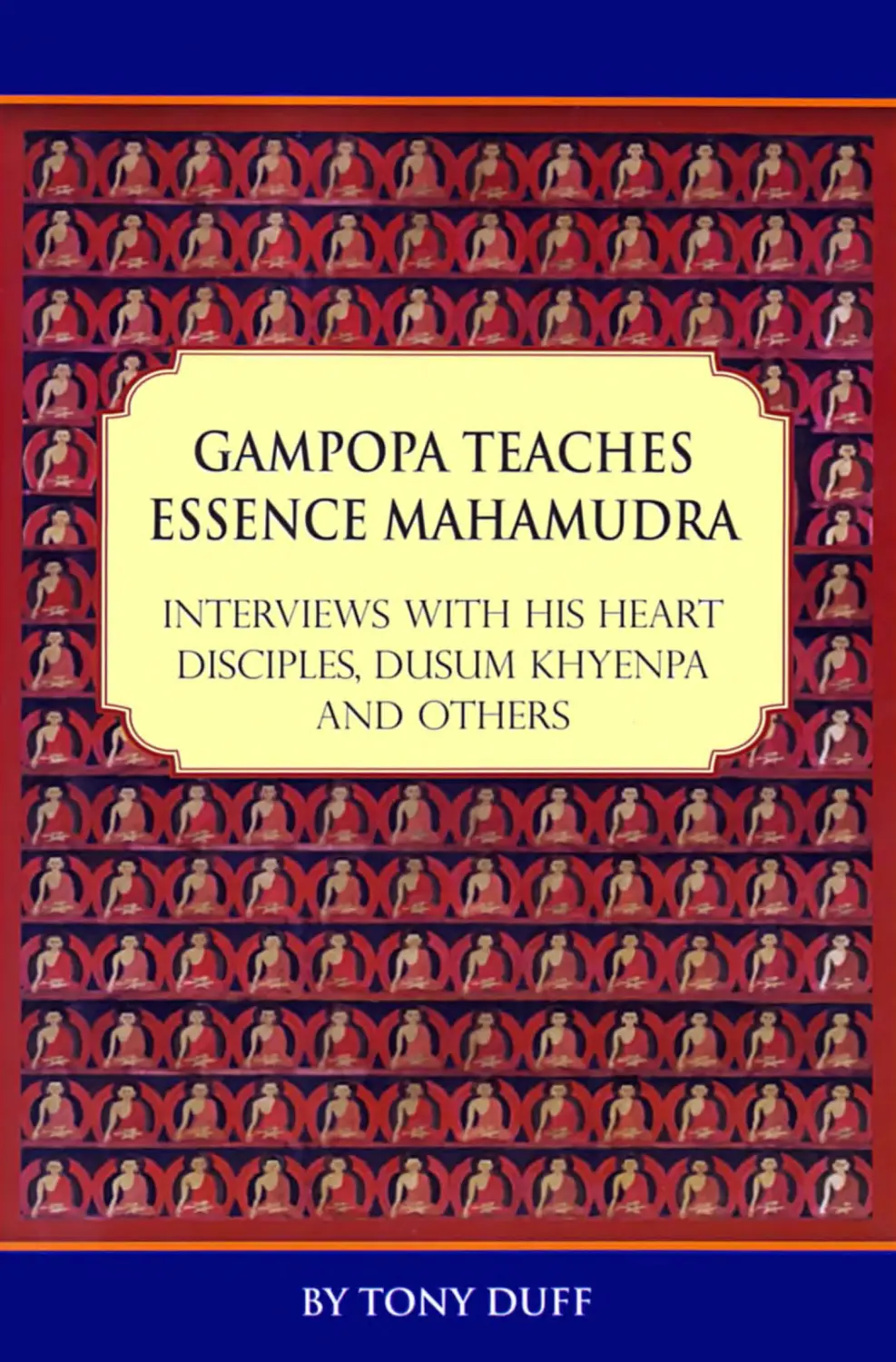


Author: Duff T.
Tags: philosophy mindfulness enlightenment meditation gampopa mahamudra tibetan buddhism dusum khyenpa heart disciples spiritual teachings compassion wisdom
ISBN: 978-9937-8244-8-4
Year: 2011



l
l:_ !_~._L_
t .t t l ! l l
llt!lll~.- ~ll!!l
ltl!l!lll!l l
<"'
-
~
(! -i
(~
~
l
GAMPOPA TEACHES
ESSENCE MAHAMUDRA
l
~
l ~J
I T RVI W W ITH HI H RT
DI CIPL , DU UM KI YE P
DOTH R
.
~
~ ~
l
t
/! l
l !_l_t~ __t_ l t t l ! l l
!J _l t! l t . l lrAl t l J!_ ~
ll!~ l!ltlll!l J!
l l_l t~ _L_ l t ~- ! t l l
j _
l !! .l t l At! t l l
l _j_ l ! l 4 l t! l ;. J!_ ,l
t
BY TONY DUFF
(jantyoya Teaches
Tssence Mahantutfra
INTERVIEWS WITH HIS HEART
DISCIPLES, DUSUM KHYENPA
AND OTHERS
BY TONY DUFF
PADMA KARPO TRANSLATIONS
Copyright@ 2011 Tony Duff. All rights reserved. No portion
of this book may be reproduced in any
form or by
any means,
electronic or mechanical, including photography, recording, or
by any inforination storage or retrieval system
or technologies
now known or later developed, without permission
in
writing
from the publisher.
First edition, November, 2011
ISBN: paper book 978-9937-572-08-8
ISBN: e-book 978-9937-572-09-5
Janson typeface with diacritical marks
Designed "and created by Tony
TIbetan Computer Company
Duff
"
http://www.pktc.orgltcc
Thangka images of Gampopa,busum Khyenpa,and
Lord Phagmo Drupa@ Shelly and Donald Rubin Museum,
.
Himalayan Art Project, with permission.
Produced, Printed, and Published by
Padma Karpo Translation Committee
P.O. Box 4957
Kathmandu
NEPAL
Committee members for this book: translation and composition,
Lama Tony Duff; editorial, Tom Anderson.
Web-site and e-mail contact through:
http://www.pktc.org/pktc
or search Padma Karpo Translation Committee on the web.
CONTENTS
INT�O DUCTION
•
•
•
•
•
•
•
•
•
•
•
•
•
•
•
•
•
•
•
•
•
•
•
•
•
•
•
•
•
•
Points of Interest
2. About the Teacher, Gampopa
3. About the Teaching, Mahamudra
4. About the Texts
5. Interview Text: Lord Dvagpo's Personal Advice
and Lord Gomtshul's Interviews
.
. .
6. Interview Text: DuSum Khyenpa's Interviews
7. Interview Text; Phagmo Drupe's Interviews
8. Interview Text: Yogin Choyung's Interview
9. Other Points ..... '
1.
.
.
.
•
.
.
.
.
.
.
.
.
.
.
.
.
.
.
•
.
.
.
.
.
.
.
BY
THE FOUR DHARMAS IN BRIEF
.
.
.
.
.
•
.
.
•
•
.
•
•
•
•
.
•
.
iii
•
•
.
.
.
.
.
.
.
.
.
.
.
.
.
•
.
.
.
.
.
.
.
.
.
.
•
.
.
.
.
•
.
•
.
•
.
.
.
•
.
.
.
•
.
•
.
.
•
•
•
•
.
•
.
.
.
•
.
.
•
•
.
.
.
.
.
.
.
.
.
.
.
•
.
.
.
.
.
.
.
.
.
.
.
.
.
.
•
.
.
.
.
•
.
•
.
•
.
.
.
.
.
.
.
•
•
•
•
•
•
•
•
•
•
•
BY
xii
xxii
.
�
xxv
.
xxxiv
xxxiv
•
•
GAMPOPA
•
•
•
•
•
•
•
•
•
•. •
•
•
•
•
•
•
•
•
•
•
•
•
•
•
•
•
•
•
•
•
•
•
•
•
•
•
•
•
•
•
•
•
•
•
•
•
•
•
•
•
•
•
•
•
•
•
•
•
•
•
•
•
•
•
•
•
•
•
•
•
•
•
•
•
•
•
v
xviii
•
•
v
vii
•
LORD PHAGMO DRUPA'S INTERVIEwS
•
•
.
DUSUM KHYENP A'S INTERVIEWS
•
•
.
LORD DVAGPO'S PERSONAL ADVICE AND LORD
GOM TSHUL'S INTERVIEWS
YOGIN CHOYUNG'S INTERVIEW
•
.
GAMPOPA
•
•
.
PRECIOUS G ARLAND OF THE SUPREME PATH
•
•
1
7
19
53
195
239
iv
CONTENTS
GLOSSARY
.
.
.
.
.
.
.
.
.
.
.
SUPPORTS FOR S T D UY
INDEX
•
•
•
•
•
•
•
•
•
•
•
•
•
.
.
.
.
.
.
.
.
.
.
.
.
.
.
.
.
.
.
.
.
.
.
.
.
.
.
.
.
.
•
•
•
•
•
•
•
•
•
•
•
•
•
•
•
•
•
•
•
•
•
•
•
•
•
•
•
•
•
•
•
•
•
•
•
•
•
•
•
•
•
•
•
•
•
•
•
•
•
•
•
•
•
•
•
•
•
•
.
249
281
•
287
INTRODUCTION
This book focusses on the way that the most essential teaching of
Mahamudra1, called Essence Mahamudra, was transmitted in the
very early days of the Kagyu lineage in TIbet. It introduces the
subject by presenting two small texts which contain hallmark
teachings of Gampopa in relation to the Kagyu teaching of Maha
mudra. It then presents �ecords ofpersonal' interviews and teaching
sessions given by the early Kagyu lineage holder �popa to �our
of his outstanding disciples.
I. Points of Interest
There are many styles of teaching used in Buddhism. In traditions
that emphasize practice, the int�rview iIi which the disciple comes
to the teacher and presents his doubts or the state ofhis practice is
important-the teacher uses the opport:unity to take the disciple
further in an atmosphere of personal contact with the ,teacher,
something which is of prime importance within Buddhism. ReI Skt. mahamudra, TIb. phyag rgya chen po: Mahamudra is the name
of a set of ultimate teachings on reality an d also of the reality itself.
T he name and the teaching are explained at length in the book
Gampopa's Mahamudra: The Five-Part Mahamudrtz of th� Kagyus by
Tony Duff, published by Padma Karpo Translation Committee, 2008,
,
ISBN: 978-9937-2-0607-5.
v
vi
GAMPOPA TEACHES ESSJ<:NCE MAHAMUDRA
cords of these sessions can be very important for later practitioners'
because of the very practical nature of the instruction contained in
them. That is very true here-the interview
texts
presented are full
of the blessirigs of the early Kagyu masters and their particular way
of presenting Essence Mahamudra. The result is a book with a
unique quality, one that
fits with a practitioner's mind.
In terms of time, these interviews are records of the very early
Tibetan practitioners of the Kagyu lineage. T hey are very impor
tant to present-day practitioners because they clearly reveal the
mode of teaching Mahamudra that was present in the early Kagyu,
very shortly after it had come from India. They also contain a
wealth of firsthand information about noted people of the time told
by the people themselves.
In terms of the place, the
Kagyu teachmgs came from India into
SOl,lthem Central Tibet via Marpa the Translator who lived in that
region. His main disciples,
including Milarepa, were
from that region and spent
their lives there. Milarepa's
main disciple, Gampopa, who
is the source ofthe teachings
in this book, also was from
Central Tibet and estab
lished his teaching and re
treat centre at Dvag Lha
Gampo, some distance south
of Lhasa.
Figure 1. Marpa the Translator
Thus, this book
contains historical information about the early spread of
Kagyu dharma as it' 9ccurred in the Central Tibetan region.
Kagyu lineage from the time it arose in ancient
India to Gampopa can be read in the books Gampopa'� Mah/11Im/lm
Histories of the
vii
INTRODUCTION
mentioned above and
Drukchen Padma KtJrpo's Collected Works on
Mahamudrtf-.
In terms of the dharma presented, .these interviews are mainly con
cerned with the teaching of whitt has come to be known as Essence
Mahamudra. There are many important points in connection with
this. For example, the style of the teaching at that time is clearly
evident in the interviews. And, the content of the interviews shows
that Essence Mahamudra was very much the heart of the
Kagyu
teaching before the many Kagyu sUb-sects developed. This latter
point is particularly important because it shows
sub-schools, such as the Drukpa
Kagyu,
that, although some
do not explicitly teach
Essence Mahamudra, it was a core teaching of the Kagyu lineage
when it came from India.
In terms of the disciples whose interviews are presented here, this
book is about four of the eighteen disciples who were foremost
among Gampopa's disciples. Two of them, LOrd Gomtshul and
Yogin Choyung, might not be known to Westerners, but the other
two, Dusum Khyenpa, the first Karmapa, and Phagmo Drupa, the
source of many of the Kagyu sub-schools, will be known to �any.
The interviews of all four disciples are packed with both historical
information and dharma teaching.
2. About the Teacher, Gampopa
Gampopa lived from
1079-1153
Tibet in the district called Nyal3•
C.E. He was born in Central
At the age of seven,
his parents
sent him .to study medicine, which he did for twenty and a half
years. He studied
with doctors from Indian, Nepalese,
Chinese,
and Tibetan traditions and by all accounts· became a very expert
2
A
book by Tony Duff, published by Padma Karpo Translation
Committee,
3 Tib. gnyal.
2011, ISBN: 978-9973-57.2-01-9.
viii
GAMPOPA TEACHES ESSENCE MAHAMUDRA
doctor. After that, he gave his whole attention to Buddhism for the
rest of his life but, because of his skills as a· doctor, was always
known as "Lhaje" which is a highly honorific tide for a doctor.
Later in his life, he moved to
the area called Dvagpo4, so
was called Dvagpopa, the
tI.I..t--- Man from Ovagpo, and then
was also called Dvagpo Lha
je, the Doctor of Dvagpo.
Dvagpo is near the Gampo
Hills because of which he was
also known as Gampopa, the
Man of Gampo. Nowadays,
this name Gampopa is the
name by which he is most
well known amongst non-'
Figure 2. Lord Gainpopa
Tibetans. However, Tibet
ans mosdy refer to him as Ovagpopa or Dvagpo Rinpoche and
usually very affectionat�ly.
In his early teens, Gampopa heard a great deal ofNyingma dharma
fi:om the Nyingma teacher "Barey". After that, he heard the
Kadampa teachings called "Stages of the Path", which are the
essential teachings of the Kadampa, initially from Geshe Yontan
Drag.
Gampopa married when he was sixteen. At the age of twenty-five,
his wife and son both died from a contagious disease. T his affected
him profoundly and he resolved to give up worldly pursuits in
favour of Buddhist practice.
At twenty-six, he took full monk's ordination from the Kadalllpa
Geshe Lodan Sherab and was given the name Sonam Rinchcn.
This name too is found commonly in Tibetan literature. ()n his
4 Tib. dvags po.
INTRODUCTION
ix
first meeting with Milarepa, when Mnarepa aSked his name, he gave
this name and Mila replied, "Merit [sonam], merit, you come from
great merit and are very precious [rinchen]." Milarepa predicted
that Gampopa would be greater than himself in the sense that he
would go out and reach many more people. Tl¢e has shown that
Milarepa became very famous for his practice and realization but
that Gampopa became the means by which Milarepa's lineage of
teaching spread widely, something that did not happen direccly on
Milarepa's account.
Although Gampopa became very well known amongst Tibetans, he
has not been well known to Westerners, except through his Jewel
Ornament of Liberation text which was translated many years ago
when Tibetan Buddhism was first coming to' the West and his Life
Story which was translated in the 1990's. Given his importance to
the Kagyu, I took a personal interest in him and read his Colleaed
Works in Tibetan. Having done so, I saw it important to bring his
works to the attention ofKagyu practitioners by publishing as .many
of his works as possible.
Gampopa spent the years after his wife and child's death staying
with Kadampa teachers. He heard their teaching, studied. it,. and
practised it to the point of being very adept in it. . When he was
twenty-eight, he went off with his friend Gongton to UruJang to
be with the very famous Kadampa Geshe Nyug-rurilpa. He and his
friend stayed with the many geshes there and heard large amounts
of the Kadampa teaching from those various geshes, but especially
from Nyug-rumpa. Gampopa had good meditation experiences
or so he thought at the time-but something was nagging him and
when he heard Milarepa's name, decided that he must go to meet
him.
Gampopa travelled south in his thirty-first year and met Milarepa.
Milarepa himself said that they had an excellent connection and
accepted him as his student. Gampopa absorbed all of the teachings
Milarepa had to offer. He not only learned them but practised
x
GAMPOPA TEACHES ESSENCE MAHAMUDRA
them to the point of final realization and in doing so became the
foremost of Milarep;l's disciples and his main lineage holder. Not
that this came easily. He underwent great hardships in his pursuit
of meditation and realization. A good account of his time with Mi
larepa is found in the Kagyu Ocean ofDohas which has been trans
lated into English and published under the .tide Rain of WisdomS . I
recommend reading the section in it on Gampopa, and even the
whole book if possible--doing so will give you more feeling for
Gampopa and the Kagyu dharma to which Gampopa is so impor
tant.
When it was time for Gampopa to leave Milarepa, Milarepa told
him to establish a hermitage in Central Tibet in the Dvagpo region.
Gampopa followed the command, went there, and es�blished a
monastery and hermitage called Dvags Lha Gampo. He had be
come very famous and many people came to study with him, both
monastics and tanttikas, and his lineage of teachings spread far and
wide.
Gampopa had many monk disciples who were great tantric practi
tioners but, and in accordance with the style ofhis forefather gurus,
the Indians TIlopa and Naropa and the Tibetans Marpa and Mila
repa, many of his greatest disciples were laymen who followed the
yogin's way of life. A few of these are well-known nowadays as
great beings of the Kagyu lineage, most notably Dusum Khyenpa
who later was recognized as the first Karmapa and founder of the
Karma Kagyu lineage and Phagmo Drupa whose students founded
nearly all of the other Kagyu lineages. However, there were many
more-at the time, it was considered that there were eighteen high
ly accomplished disciples, not to mention the many other worthy
ones. A list of the eighteen disciples and their ranking according to
people of Gampopa's time is contained on page 247, at the end of
Yogin Choyung's interview.
S Translated and compiled by the Nalanda Translation Committee :Inti
published by Shambhala Publications, 1981.
xi
INTRODUCTION
Gampopa, met with his disciples and spent time personally with the
advanced ones, enSuring that they had answers to their questions.
Fortunately, some of these interview sessions with their question
and answers were recorded in writing and later included in the
Colkcted Works of Gampopa. There are four interview texts in the
CoUected Works, one each for Lord Gomtshul, Dusum Khyenpa, and
Phagmo Drupa who were three of the four disciples regarded as
main lineage holders, and one for the Yogin Choyung who was
regarded as one of two very special practitioners with high accomplishment.
.
Gampopa's Collected Works comes in two large volumes. It was
originally published in Dvag Lha Gampo though that edition has
been lost. Today·there are three main editions: one made in Remis
Monastery, Ladhak, in the nineteenth cen:tury; a copy made from
that published in February 1982, in India; and the Derge wood
block edition. It is very hard to get the Ladakh edition, though it
is said to be a good reproduction of the origfual. The copy made of
it and published in India was a xylographic copy typical of the
copies of TIbetan texts made in. the desperate times after the
desecration of TIbet by the COmlnunist Chinese in 1959; I can say
from personal experience that it has many mistakes in it. The
Derge edition is regarded as the best one available but it is excep
tionally hard to get. The translations for this book were made from
the Derge editi'on which I was able to borrow6•
One of the reasons for translating these particular parts of Gampo
pa's Colkcted Works is that they are very personal in nature. You get
a real feeling of Gampopa and his disciples and how he worked with
them. More than that though, there is much story-telling included
which gives new information about Gampopa and his chief disciples
who were such important figures in· the transmission of Kagyu
6 Padma Karpo Translation Committee has made a fully searchable
digital edition of the entire Derge Edition of the CoDected Works. See
the chapter Supports for Study for more information
.
.
xii
GAMPOPA TEACHES ESSENCE MAHAMUDRA
dharma, especially the first Karmapa and Phagmo Drupa. As you
read the interviews, you will hear Gampopa telling the story of how
own dharma journey in his own words, emphasising the things that
are were important to him on his journey. We also hear about the
first Karmapa in stories that are not found elsewhere. And we get
a sense of the massiveness of Phagmo Drupa, a rock-like man of
massive body, learning, and meditative realization.
3. About the Teaching, Mahamudra
The Combined Kadampa and Mahamudra System
As mentioned above, Gampopa spent his early life up to the time of
his late twenties studying and practising with the Kadampa school.
This school had only recendy developed' from the teachings of
Jowo Je Atisha [982-1 054] and its followers were flourishing in
Central Tibet. Gampopa joined them, and became both expert and
accomplished in the Kadampa system of teaching and practice.
After that, he went to study with Milarepa and eventually beCame
the lineage holder of the Kagyu lineage. Later, when Gampopa
started to teach, he did not discard the Kadampa syst�m but com
bined those teachings with those of the Kagyu system. From
Gunpopa's time onwards, the Kagyu teaching included the influ
ence of the Kadampa teaching. This combination became known
as The Combined Kadampa and Mahamudra system of teaching.
The interviews in this book were opportunities for Gampopa to
teach Mahamudra to his disciples. However, you will see how he
frequendy mixed the Kadampa and Kagyu Mahamudra teachings
together to make his points about the dharma path in general and
about Mahamudra in particUlar. For example, he frequendy uses
the Kadampa teachings to compare the sutra approach to that of
Secret Mantra; this is particular evident for instance throughout
part six of Dusum Khyenpa's interviews. Gampopa also gives
Secret Mantra instruction which has.been obtained from his Ka
dampa geshes, though this is less frequent, with most advice at this
INTRODUCTION
xiii
level coming through Milarepa and the Kagyu lineage gurus before
that. Gampopa also gives general and really excellent advice on the
dharma path that comes from the Kadampas, for example, this little
gem found in Dusum Khyenpa's interviews:·
Potowa said, 'If you want to know dharma, meditate!'
Drepa said, 'If, compared to listening for three years, all
of you were to meditate for one year, you would have a
very great samadhi; it is so true that it can't be discussed
even! Individually-discriminating prajna even greater
again would happen.' Having heard that, the geshes
went to places like the mountains and got on with
meaningful accomplishment.'
Essence Mahamudra
The Kagyu tradition has two main teachings on the practice of
Mahamudra. One is a gradual approach called the Four Yogas of.
Mahamudra, the other is a sudden approach called Essence Maha
mudra. The interview texts are notes of the instructions given in
interviews or private teaching sessions where the instructions are
mainly concerned with Essence Mahamudra, though there are a few
explanations of the Four Yogas approach, the most extensive being
on page 208.
The Tibetan name for Essence Mahamudra is "ngo bo phyag
chen". The last part "phyag chen" is the TIbetan for Mahamudra.
The first part "ngo bo" imeans "entity"-what something actually
is. Thus the. term "Essence Mahamudra", although it has become
popular in the West, is incorrect. The name in fact is "Entity
Mahamudra" meaning "Mahamudra itself, what it actually is".
The name Essence Mahamudra is given in contrast to the Four
Yogas of Mahamudra. The Four Yogas of Mahamudra, because
they are a graduated path, do not simply and directly point at
Mahamudra itself. Instead, they successively teach one-pointed..:
xiv
GAMPOPA TU.CHI£S
It:SSI!:NCE MAHAMUDRA
ness, freedom from elaboration, one-taste, then non-meditation; at
the very end of non":�editation one finally arrives at the very entity
ofMahamudra. Essence, or we should say Entity Mahamudra, by
passes all complexity and indirectness contained in any graded
approach and teaches the entity of Mahamudra, that is, what Maha
mudra actually is. Thus, this is not E$sence Mahamudra but Entity
Mahamudra-Mahamudra exactly as it is, what it is, without any
frills sidetracks or provisional approaches to it.
You will see in the interviews that "the entity" is referred to time
and again. This is the language ofEDtity Mahamudra; it is short
hand for saying "Mahamudra itself, what it actually is".
The key point about Entity Mahamudra is that it aims only at the
ultimate, all the time, twenty-four hours a day. Thus, that is the
great theme that runs throughout all of *e interviews and teaching
sessions. You will see this key point made over and over again by
G.U:nPQpa in the interviews-again and again his discipleS veer into
duality in their approach to dharma and again and again Gampopa
leads them out of that, back into non-dualitrDespite the fact that Entity Mahamudra is correct, I feel that it
�ould be too radical to change the reference at this point, so the
book continues from here to use "Essence Mahamudra", though
note that "entity" alone is used frequently in the interviews with the
meaning given above and this has not been changed.
Essence Mahamudra and Great Completion
The Kagyu lineage holds the teachings ofMahamudra. It does not
hold the teachings of Mahasandhi, known in TIbetan as Dzogpa
Chenpo and in English as Great CO:J;llpletion7• The teaching of
7 The original name " mahas �dhi " is an Indian word meaning- (;rC;I\
Completion, not Great Perfection as is comm only trans!;ltl"1. A filII
(conI i nUl" 1...)
INTRODUCTION
xv
Mahamudra held by the Kagyu lineage is a complete teaching with
enormous blessings attached-Gampopa give one explanation of
the blessings of the lineage on page 157. According to the e�ly
masters of the lineage, this teaching ofMahamudra has everything
it needs to stand on its own feet and does not need to be augmented
by another system of teaching.
Gampopa not only had a Mahamudra lineage full of blessings but,
as he points out to his disciples a number of times in the interviews,
the lineage was very short which meant that the blessings were very
strong-he says to Lord Gomtshul "There are only four in line
between us and buddha!" Moreover, all four holders of the lineage
were great siddhas (ones who had attainment) who had provided a
complete set of instructions of the lineage which, when applied,
worked. Gampopa had all of those instructions and took them to
the limit in years of hard practice.
In
short, in the Mahamudra teaching of his lineage, Gan?popa had
a complete, functional, and potent means for.-the final attainment
of enlightenment. Thus, he focusses on that and barely mentions
to his disciples the other profound system for gaining the final
attainment, Great Completion. As he said to Lord Gomtshul,
As
for a blessing, this is so obvious there's no need to
talk about it. All the. �gyu gurus and dakinis. are right
behind you in your practice of meditation. You are
blessed! You will not have obstacles, you will have
meaningful accomplishment!
In
accordance with that, given that � book is meant to convey the
Kagyu transmission, there is no real need to 'discuss Great Comple
tion. Still, since at the time of writing the teaching of Gr,eat
7 (... continued)
treatment of this issue can be found in most of PKTC's books on
Great Completion.
xvi
GAMPOPA TEACHES ESSENCEMAHAMUDRA
Completion has come to the fore in the Tibetan Buddhist world,
some readers will be wondering whether there is any relationship
between Mahamudra and Great Completion, S9
little about it.
"
I will
say just a
As mentioned above, there are two types of Mahamudra teaching
in the Kagyu lineage. Of them, the Four Yogas of Mahamudra
teaching is slighdy lower than the Great Completion teaching be
cause it is a graded approach which includes much non-ultimate
teaching, whereas the Great Completion teaching consists only of
ultimate teaching. On the other hand, the Essence Mahamudra
teaching is ultimate from b�ginning to end so is on the same level
as Great Completion.
The Great Completion teaching has several levels. The most pro
found, called "innermost unsurpassed Great Completion", has two
main practices: Thorough Cut and Direct Crossing. Essence
Mahamudra purely taught is basically the same as Thorough Cut.'
(I
say "purely taught" because, as" y ou will see in the interviews,
�popa sometimes teaches Essence M8.hamudra in conjunction
with the Four Yogas approach. When taught that way, Essence
Mahamudra" is basically the same as, though not equivalent to,
Thorough Cut because the mixture makes it slighdy less than
ultimate.)
Thorough Cut Great Completion arid Essence Mahamudra are not
only basically the same but are very closely related. qne way to
know this is through the style and terminology used to give the
teaching-both are taught in a very similar way and use much of the
same, unique terminology. Someone familiar with Thorough Cut
will immediately recognize many of the special words used in
Gampopa's explanations of Essence Mahamudra and will find it
easy to understand the teaching, and vice versa.
Historically, those who have purely followed the Kagyu with its
Mahamudra lineage of teaching have not denigrated the (;r�:lt
INTRODUCTION
Com,pletion system, but they have tended to pass it off as some
thing of no value to themselves. For them, their Mahamudra
teaching was, as you will see Gampopa continually refer to it, "the"
single solution" and "the universal panacea" to the whole samsaric
problem. The teaching and practice of Great Completion was
simply un-necessary in their eyes. This attiOlde is clearly seen in a
reply giveJl by Gampopa to Dusum Khyenpa:
On one occasion many of the best type came before
guru Mila, at which time 1 asked, "What is this Great
Completion about?" He replied, "I heard guru Marpa
say, 'There is talk that it is not dharma but that is not
so. It is a dharma that goeS from the sixth and sevent:lt
bodhisatva levels on up'. It would be'something like
pointing to a child of about five years :md saying that
Great Completion practitioners are like this, then this
child saying, 'I have the abilities of a twenty-five year
old.' Great Completion practitioners are said to speak
of becoming buddha now, but that talk of theirs has no
meaning."
In the centuries following Gampopa, the Great Completion teach
ing started to enter the Kagyu lineages and people who previously
would have been pure Kagyu followers practising only their own
Mahamudra teaching became what are now called Kagyu-NYingma
followers practising both systems. These people then made the
positive statement thatis commonly"found amongst Kagyu follow
ers these days about how the two practices complement each other
which says that Mahamudra and Great Completion are like the two
eyes of a person. It is further explained thatMahamudra and Great
Completion work together as a pair, fully complementing each
other, with Mahamudra placing more emphasis on the vividness of
appearance and Great Completion placing more emphasis on the
luminosity causing the appearance. Nowadays, this positive accep
tance of how the two practices can be done by one person in a
complementary way is widespread, with many Kagyu practitioners
being Kagyu-Nyingma.
xviii
GAMPOPA TEACHES ESSENCE MAHAMUDRA
The beauty of the teachings in the interviews with GampOpa is that
they show clearly the original approach of the Kagyu lineage, which
is that Mahamudra is a single sufficient solu�on and that Great
Completion,while not to be denigrated, is something that is simply
un-necessary.
4. About the Texts
Two Prefatory Texts
Gampopa's
interviC:lws with four of his disciples form the body of
the book. However, I have added two more texts fromGampopa's
Collected Works.
The Four DhllrmllS in Briefis the root of Gampopa's most famous
teaching called the Four Dharmas ofGampopa. This teaching, as
Gampopa's seminal teaching, makes an ideal prologue to his
teachings in the interview texts. Moreover, The Four DhllrmllS in
Brief should be of particular int erest because it shows Gampopa's
own understanding of the Four Dharmas teaching, which is some
times different from what is taught these days.
Note that the eighth section of Dusum Khyenpa's interviews
contains a further explanation of the Four Dharmas which should
be read because it gives a slighdy different explanation of the Four
Dharmas than The Four DhllrmllS in Brief.
This text brings us to a very interesting point with the Four Dhar
mas of Gampopa. The usual translation of the third Dharma of
Gampopa in Western publications until now has been "the path
dispels confusion". However, all of the many Kagyu teachers
whom I have attended have pointedly told me that this is incorrect.
All of them have explained that it should be "the path's confusion
is dispelled". The first meaning, that the path dispels confusiull,
seems straigh tforward to most Westerners-th ey assume th:a it
means that the path of dharma, w he n util i z e d, remuves I hl'
INTRODUCTION
confusion of samsara. The meaning of "the path's confusion is
dispelled" is less obvious but a key part of the teaChing of the higher
tantras. It is said in these tantras in the context ofteaching the
ground condition of beings that a being : who loses connection to
the ground condition of full knowledge and thereby enters the
deluded condition of samsara is a being "who has' fallen onto the
path". This phrase means that the being has fallen into a position
where there is no choice but to make a journey back to his original
condition of full knowledge. The path's confusion is then the
confusion condition of the being who has to make a journey to get
back of the path. These ideas of path and path 's confusion in
relation to the pristine groun d of bein g is a major point of under,.
standing in the tantras .
·
had hoped that looking at The Four Dhtirmas in Brief and the
interviews would reveal proof of this point. Unfortunately, the
wording in The Four Dharmas in Briefshows both the possibilities
of "path dispels confusion" and "path's confusion is dispelled".
Nevertheless, Gampopa's explanation of the Four Dharmas in the
interviews cl early shows it as "the path's confusion is dispelled".
Rather than impose one view or another on these records of
Gampopa's explanati ons, I h ave simply translated them as they
stand in the Tibetan.
I
It is a major· point both of translation and also of understanding the
ground as it is taugh t in the tantras, so I m:ust say that I have
investigated this very carefully with many very well educated �gyu
masters. In fact, while translating for some of them, they have
made a point of explaining the matter to the audience and we have
had extensive discussions about it in private. Thus, there is no
doubt in my mind that the accepted lineage explanation is that "the
path's confusion is d isp elled" .
Well then, wh at is the confusi on .dispe lled by? By the correct
practice of the path of Buddha's dharma of course, which is a point
so obvious that it does not need to be said. The point here is not
xx
GAMPOPA TEACHES
ESSENCE MAHAMUDRA
that the practice of Buddha's dharma does what it by definition
does, but that a being has fallen from enlightenment and now that
condition forces him to take a journey-which the tantras have
called 'being on the path'-in order to dispel the confusion in
volved and return to his original, enlightened condition. That is
the accepted meaning of the third Dharma of Gampopa.
Precious Garltmd ofthe Supreme Path records a talk in which Gampo
pa clearly explains his own, very special teaching of Essence
Mahamudra, which he sums up in the phrase "the. entity of discur
sive thought is the dharmakaya". Together with this, he taught that
his followers should take the particular approach to discursive
thought of not rejecting it but treasuring it as a great friend and
something of great value. This "the entity of discursive thought is
the dharmakaya" together with the need "to treasure and to wel
come all discursive thought" is a very famous teaching. For exam
ple, it appears in the Short Great Vajradhara Prayer which many
Kagyu followers recite every day, in the last verse which starts:
"The entity of discursive thought is dharmakaya, � is taught".
This teaching brought criticism from others·who misunderstood it,
tPinking that Gampopa was saying that dualistic discursive thought
is the dharmakaya. His teaching is much more subde than that and,
when you read the criticisms made against him, you get the impres
sion that his detractors were simply not thinking or that they did
not know the profound aspect of the Mahamudra teachings, which
is. very possible in some cases. T he most famous criticisms were
made by Sakya Pandita and the arguments that resulted from his
many mis-informed criticisms of the Kagyu lineage and its teach
ings are a well-known part ()fTIbetan history. Later, Padma Karpo
.
of the Drukpa Kagyu wrote a number of texts in which he very
cleverly showed how mistaken Sakya Pandita was and very strongly
put him back in place8•
8 You can read two different criticisms and their refutations in 'fh,'
(conti n lied ... )
INTRODUCTION
xxi
Precious Garland o/the Supreme Path is a very important part of this
book because it focusses only on this, Gampopa's hallmark ap
'proach to Essence Mahamudra, and lays it out in detail: Appropri':
ately, it has been placed after the sutra teaching of the Four Dhar
mas and ahead of all the interviews with their teachings on Essence
Mahamudra.
The Interuiew Texts
The interview texts are, generally speaking, records of interviews
made either by the disciple who was having the interview or some
one else who was present at the time.
lit many cases the records are
·notes written as reminders of the important points of teaching
received .
I would like to �mphasize the point that, for Kagyu practitioners,
these teachings contain a wealth of information on the actual
practice of Essence Mahamudra as it was transmitted in the very
early days of the Kagyu. Although interviews are a class of text that
is commonly found in the collected works of great teachers, I have
not seen anythin� like these particular interviews anywhere else in
Kagyu literature, so I will yet again emphasize their extraordinary
value for practitioners.
Repetition Within the Interuiew Texts
After reading the interview texts, I realized that there were sections
of one of Lord Gomtshul's interviews that were repeated in one of
Phagmo Drupa's interviews and likewise sections of one ofDusum
Khyenpa's interviews that were repeated in Yogin Choyung's
interview.
I uncovered all ofthese repetitions then identified them
8( continued)
BodyJess Dakini Dharma: The Dakini Hearing Lineage of the Kilgus by
•••
Tony Duff, published by Padma Karpo Translation Committee,
2010, ISBN 978-9937-8244-8-4, and in Drukchen
Puma Kilrpo)- CoJJeaed Works on Mahamudra cited earlier.
second edition,
xxii
GAMPOPA TEACHES ESSENCE MAHAMPDRA
in the: translation by enclosing them within. unobtrusive marb like
this:
»
text « then cross-referenced them for convenience.
Phagino Drupa writes at the beginning of his seventh interview that
the interview is actually an interview of Yogin Choyung. However,
much of the interview is also included in o�e of Lord Gomtshul's
interviews. My conclusion after becoming very familiar with all of
the interview texts is that all three disciples-and possibly others
too-were there o� that occasion, asking questions.
Yogin Choyung's interview is, except for the colophon and one
short phrase,
made up of pieces which are either the same as or very
similar to pieces of one of Dusum Khyenpa's interviews. In this
'
case I believe that both disciples were present in the same interview
and that Dusum Khyenpa inCluded the questions and answers of
Yogin Choyung in his own notes but without marking them off as
such.
5. Interview Text: lord Ovagpo ' s Personal Advice
and lord Gomtshul ' s Interviews
This text is in five parts.
The first
down by Lord Gomtshul following
part consists of notes written
a
number of interviews with
Gampopa; it is not a record of one interview but notes
from several
.
inteiviews written together.
The second, third, and fourth parts are very short.
The second is
Gampopa's reply to a question, not recorded, of Lord Gomtshul.
The colophon tells us: "This question and
answer between Lord
Gampopa and Lord Gomtshul was written down by Langben
Dharma Kumara at the mountain hermitage". The mountain
hermitage referred to is Gampppa's retreat place at Dva g Lha
Gampo. The third is a reply given by Lord Gomtshul to a question
posed by his eldest son, Dampa Baggom. The fourth is advil'l'
heard from Tsultrim Nyingpo by, we assume, Lord GOllltshul.
(fsultrim Nyingpo was a contemporary of Gampopa. II is cldest
INTRODUCTION
xxiii
son was Lama Zhang, who went on to found one of the eight Lesser
Schools of the Kagyu.)
The fifth part is of medium length. It appears not to be an inter
view but personal advice given by Gampopa to a group of his
disciples, including Lord Gomtshul who then wrote it down. The
presence of this section explains the first part of the title of the text
"the personal advice of Lord Dvagpo".
One of the interesting things about these interviews as a whole is
that there are several places where the yogin disciples ask for advice
f
about how to proceed with their lives. Should they stay in the
mountains? Should they work a little? What should they do about
having an income, if anything? These interactions are reminiscent
of the questions I have often heard Westerners asking in dharma
assemblies. The answers are very interesting, with Gampopa tel
ling us of Marpa and Milarepa's advice on these matters.
6. Interview Text: Dusum Khyenpa's Interviews
is a very long text in fifteen parts, with niany of the parts
containing several interviews or teaching sessions. It is a treasure
trove of instructions, histories, personal stories of realization, and
more.
This
The first four parts of the text are arranged in chronological order
and hold together as a section in their own right. This section
contains significant portions of teaching on Essence Mahamudra
but is equally interesting for all the historical information provided
in the form of stories personally told. We hear both Gampopa and
Dusum Khyenpa tell, about their dharma journeys in their own
words. This biographical material is unique material not found
elsewhere; there are official biographies of Dusum Khyenpa and
Gampopa, but they do not have 'the quality of these first hand
accounts given in personal interaction.
xxiv
GAMPOPA TEACHES ESSENCEMAHAMUDRA
The first of these four parts details the time when DusUIil Khyenpa
came to Gampopa and gives insights into Dusum Khyenpa's
�••� ""U!oli"'L:;"_ .
personal journey; It sets the
ground for the rest of ,the
teaching
in the text by deal
ing with the more important
aspects of Gampopa's teach
ing of Mahamudra.
The
s econd part chronicles a
p e r i o d a f t e r tha t whe n
Dusum Khyenpa has done
some practice after receiving
the instructions to begin
'�IP�f!:,,)"
Figure 3. Dusum Khyenpa
with; it is a long interview
.packed with instruction on
the p r a c t i c e o f Es s e n c e
Mahamudra. The third part
records an interview in which Gampopa tells the story of his own
journey.
Gampopa tells the story at length in his own words,
including his time with the Kadampa geshes and then his times with
Milarepa. The culmination of it is a long statement given
by
Gampopa of his final realization-what it was and how he experi
enced it. It fills me with devotion, every time I read it.
The
blessings in this third part are particularly strong. The fourth part
was written by Dusum Khyenpa after the death of Gampopa; it
gives another'account of Gampopa's life-storY in Gampopa's own
words as a way of remembering and honouring the guru. This
biography is a little shorter than the one in the third part but is not
repetitive' and gives another account of his attainment of ultimate
realization. This account is more technical in nature than the one
.in the third part but very interesting
revealed.
in
terms of the instruction
The remaining eleven parts hold together as a second se(.'tion uf the
text. This section is teaching only, without personal sturies ami
histories.· This section begins with the:fifth part, a very shurt pil"'C
INTRODUCTION
xxv
by Dusum Khyenpa in which he shows the essential teachings of
the Kagyu lineage in verse by quoting the teaching of the lineage
gurus starting with Vajradhara and going down to his personal
guru, Gampopa. It acts as a preface to the remaining ten parts all
of which are notes of interviews or private teaching sessions. Most
of these remaining parts contain not one but several interviews or
teaching sessions. Altogether, this section of the text is very long
and filied with teachings on Essence Mahamudra. Kagyu practitio
ners will find it to be a cornucopia of profound teaching! Note that
the seventh part has several sections, some of which are difficult to
understand because they are written as very terse notes on technical
points.
7. Interview Text: Phagmo Drupa ' s Interviews
This also is a long text, though not nearly as long as Dusum Khyen
pa's interviews. Arranged in chronological order, it tells the story
ofPhagmo Drupa and his development under the care ofGampopa
in nine records of interviews. The text is short enough that I was
able to write a little about each of the nine interviews here in the
introduction in order to help the reader get a better feel for them.
Interuiew I: the b�ginning
Phagmo Drupa, affectionately known as Phagdru in the Tibetan
tradition, arrives before Gampopa, probably for the first time.
Phagdru has come far from Kham (East Tibet) where he is already
renownec;l as an accomplished master. He is already called guru by
his disciples and given several other titles of a great practitioner,
too.
He asks a variety of straightforward questions for the purpose of
finding out what Gampopa knows and how he teaches his students.
At the end of these questions, Gampopa chides him, first by calling
him "The Swami from East Tibet", a very high title, and then by
telling him that his questions are not very good, which implies that
xxvi
GAMPOPA TEACHES ESSENCE MAHAMUDRA
he is not really such a great practitioner after all . Gampopa follows
that up immediately with a comment to the effect that perhaps he
does have a bit more realiza
tion than that and probably
has quite a bit of merit al
ready accumulated, too. In
other words, he is saying,
"Well, you probably are a
smart person who is not just
wasting time here; you are at
least being humble in the way
you ask your questions " .
Implied i n this also i s that
Phagdru is, in fact, asking
Figure 4� Phagmo Drupa
intelligent questions.
All in all, this clearly shows how a prospective student approaches
a prospective teacher in ' the Tibetan system. You politely ask
questions to find out what the teacher knows, how he relates to you,
and how he teaches.
At the same time, he will be examining you as
a prospective student.
In this interview, Gampopa provides some very clear and useful
definitions of the path-for example, he makes a clear distinction
between what is Mahamudra and what is co-emergence. He also
very clearly sets out how he chooses to lead his disciples: he would
prefer to teach them Fierce Heat9 first if possible, so that they are
well prepared for Mahamudra practice, but, if that is not possible,
they could immediately go to Mahamudra practice, though there is
some danger to doing so. His lineage coming from Milarepa, with
the great emphasis on Fierce Heat, is very obvious.
9 For Fierce Heat, see the glossary.
INTRODUCTION
Interuiew 2: Phagmo Drupa asks. (or tHe introduction to reality
Phagdru has obviously gone away and thought about what Gampo
pa has said, and probably has had more meetings with him in the
meantime. At some point he has decid�d to accept Gampopa as a
vajra master and has now come back, asking for the key thing need
ed to enter the vajra path, the introduction to the dharmata10, more
commonly called the introduction to the nature of one's own mind.
In reply, Gampopa instructs him , with a very nice teaching of the
path of Mahamudra. First, he gives him a very pithy introduction
to the nature of mind.
Of course, you cannot get this from reading
the words on the page. Those who have been with their own guru
and had ,this introduction will remember ,the kind of atmosphere
that must have been present. It must have been very strong; too, I
think-Gampopa was a very highly accomplished master.
'Following the introd�ction, Gampopa gives Phagdru a very pithy
instruction on what to do next-basically to dump
all cares of life
and go off into the mountains into retreat. Phagmo Drupa later
followed
this
adyice and went to the nearby mountains where he
practised Mahamudra according to the five-part approach taught to
him in this interview with the words:
You go to congenial places-mountainous areas, and so
oil-where disenchantment can be produced and
experience can develop. There, you arouse the mindl l
thinking, 'For the sake of sentient beings,
I will attain
buddhahood. ' You meditate on your body as the deity,
You meditate on the guru over your crown. Not letting
any thought spoil your mind, not altering mind in any
way because it is nothing whatsoever, put yourself in a
10
11
For dharmata, see the glossary.
for arousing the mind, see the glossary.
xxviii
GAMPOPA TEACHES ESSENCE MAHAMUDRA
cleared-out purity, vividly present, cleaned-out, wide
awake state!
Phagmo Drupa gained great realization through
this
approach.
After that, his fame spread and he attracted many disciples. This
particular five-part approach was the source of his realization so
that is how ' he taught his disciples in general. The approach then
spread through the Kagyu schools where it became known as "The
Five-Part Mahamudra"12.
Next, Gampopa gives Phagdru a particularly clear exposition of the
Four Yogas ofMahamudra, as Gampopa understands them through
personal practice of them. You will find it interesting to read this
and Gampopa's other presentations found here-for example in the
very next interview-of the Four Yogas of Mahamudra
and com
by
pare them with, the extensive explanations of the same given
Padma Karpo13, one of the greatest authors of the Kagyu School in
g�eral.
Interuiew
3: Phagmo Drupa asks for follow-up dharma
The next interview sees Ph:lgdru asking for some follow-up instruc
tion. It seems that he has already been given quite a bit of instruc
tion on the path of method, including Fierce Heat, and probably
also on the
first yoga of Mahamudra.
Gampopa begins by saying, "Well look, it seems as though you do
have some experience now at least of threefold bliss, luminosity,
and emptiness that is such an important feature of the first yoga.
On top of that, you are in an excellent position, having had intro
duction from myself and having all the things on your side that you
12
For'a complete exposition of the Five-Part Mahamudra, see Gampo
pa's Mahamudra, The Five-Part Mahamudra ofthe Kagyus cited earlicr.
13 . in Drukchen Padma Karpo's CoJleaed Works on Mahamudra m c n
. .
tioned earlier . ...
·
INTRODUCTION
have going for you. But look out! Your mind is probably not
strong enough yet that you can go wanderinginto town, as a lot of
yogi':types would, drinking liquor and womanizing, and trying to
incorporate that into your practice. Instead, .and until you have
advanced far enough that you can actuaily take these things onto
the path, you should be practising!
It seems that Phagdru has been doing these things because Gampo
pa then pointedly asks him just what are the certainties-meaning
the things that you come to. a final certainty abou� through.�ttain
ment of the practice-of each of the four yogas . of Mahamudra?
The implication is. that Phagdru has gone beyond himself and could
not actually answer these. You can almost hear Gampopa saying,
"Just what have you actually realized of this path that allows you to
run around playing at yogi practices? Hmm?!"
There's no answer from Phagdru, and Gampopa goes on by smlling
at him and pointing out that there is someone here-Gauipopa
himself-who actually does know the answers through direct expe
rience. Gampopa is talking about himself, which could be odd but
he couches his· claims in interesting language. He refers to himself
as "the spiritual friend" which is a very low .way of talking about
someone who has very high Vajra Vehicle realization. And he
continues on immediately to say how what .he does know. is just
n�thing compared to the realizations of the certainties involved in
the Four Yogas that his guru, Milarepa, had. He then points out
that lots of people are commg to see him but that no-one seems to
get the main point, which is the direct practice ofMahamudra that
follows on from the introduction to the nature of mind. He points
out that nearly everyone who comes to see him in his hennitag�
comes with extensive knowledge of dharma that they then discuss
with him or comes asking only for the method path-the instruc
tions of all the things like Fierce Heat, Bardo, and so on-which is
not the. main point. He says that even wh�n he openly gives them
an explanation of the meaning of Mahamudra and gives them the
introduction to it, most of them still don't get it.
xxx
GAMPOPA TEACHES ESSENCE MAHAMUDRA
So he says to Phagdru, "Look here, this spiritual friend who actu
ally knows these things through direct experience makes it really
simple for everyone: he tells each person it's like this, then tells
them to go and practise it, and then has nothing more to say."
Gampopa follows those words with a very unusual description of
the path to follow after receiving the introduction to the nature of
mind. It is a description of th� F�ur Yogas ofMahamudra but one
that comes directly out of his own experience and does not follow
the usual wording of the,tradition. One senses that the successive
realizations that he lays out as the certainties of this path were being
manifested in the atmosphere of the room for Phagdru's sake and,
that way, he was yet again giving Phagdru the introduction. Having
given it, it would be Phagdru's job not to have any further discus
sion but to get'on with pra�ing it. As Gampopa has just said, "I
tell them it is like this, and then I say, now go and make it one with
yo� mind-that's how I bestow the introduction and instruction."
Again, the reader would find it interesting �o,compare this explana
tion of the Four Yogas ,of Mahamudra with the explanations given
by Padma Kai'po in his works on Mahamudra mentioned above.
Interuiew 4: Gampopa teaches how the innate is brought into
manifestation
Now that Gampopa has provided the necessary introduction to the
nature of mind-which is what is required before embarking on the
practice of Mahamudra-this next interview sees Gampopa giving
the instructions of the path to be followed when practising Maha
mudra. Note how his teaching, which is Essence Mahamudra,
corresponds to the Four Yogas of Mahamudra, which is the other
main teaching on Mahamudra found in the Kagyu lineage. l i e
starts with shamatha, then moves to rigpa, then moves to unifyinl{
appearance and emptiness, and ends with Mahamudra as SUt' h .
These four steps correspond to the yo gas of One-Pointcdnt'ss,
Freedom from Elaboration, One Taste, and Non-Mcd i t :l I i O I l
respectively.
INTRODUCTION
Note also how Gampopa's explanation of shamatha is different
from that given in the sutras. In the SU1;raS, shamatha is explained
through the nine steps of developing equipoiSe and the practice
always has an outwardly-directed consciousness. In one-pointed
ness as taught in Mahamudra, the emphasis is on an intemally
directed consciousness, with the practitioner using mind as the basis
for the development of one-pointedness. You niight say, "But
using the mind as the basis for the dtWelopment of one-pointe<Iness
is also in the sutras" and this would be correct. There is a differ
ence though in how the shamatha is developed usitig the mind as
the basis for the one-pointedness and 'this can be seen in the
particular way that Gampopa speaks of it. In this practice, the
shamatha is developed in such a way that it naturally becomes the
vipashyana of the second yoga (which, in this teaching of Gampopa,
arrives in the form of a discussion ofrigpa}.
Interuiew 5 : Gampopa teaches mindness
Next, Gampopa focusses on the core issue of the practice of Es
sence Mahamudra, called mindness. Mindness is a path term for
the innate nature of mind, wisdom; it is the key point of the prac
tice. In this interview, he explains clearly the difference between
mindness and consciousness, the first of which corresponds to the
enlightened type of knowing of nirvana and the second of which
corresponds to the deluded type of knoWing of samsara. Much
could be said about mindness and mind but these inStructions are
only given in private so no more will be said here.
Note the pithiness of this instruction; Gampopa is giving instruc
tions for practice, not for theoretical understanding.
Interuiew 6: Questions whose answers reueal that meditation on
the entity is the one antidote for all
We can tell from the content of this interview that Phagmo Dmpa
has gone off and practised the instructions given to him, and is now
asking questions that come out ofhis practice. The answers come
xxxii
GAMPOPA TEACHES ESSENCE MAHAMUDRA
in the form of foremost instructionsl4 which highlight some of the
key points I S of the practice of Essence Mahan'ludra. You will see
that Phagdru raises· one important issue after another and that
Gampopa answers with the appropriate foremost instruction for
each issue.
Many ofPhagdru's questions come from a dualistic understaIiding
of dharma. Gampopa's foremost instructions always lead Phagdru
back to the ultimate, non-dual understanding.
This interview is much longer than the previous ones; It contains
a wealth of instruction that makes the fine distinctions needed for
proper progress on this path. It also contains a relendess insistence
on drawing Phagdru back to the ultimate, non-dual understanding.
Interuiew 7 : Yogin Choyung has an interuiew includ.ed here that
makes important points about liuelihood and what is needed .
for practice
This interview provides proof that some of the interviews presented.
in this book have more than one of Gampopa's foremost disciples
present. This interview had Yogin Choyung present as well and his
questions to Gampopa and answers received are included. This
section is repeated in the records ofLord Gomtshul's interviews, so
he was probably present as well. This is not a repeat of the material
found in the text of Yogin Choyung's interview, so this interview
gives us a second interview of Yogin Choyung with Gampopa.
this interview, initially we get a personal sense of Yogin Cho
and his concerns about which direction to take in his life.
After that, as with the previous interview with Phagdru, Yogin
Choyung presents a dualistic form of understanding in a series of
In
yung
14 For foremost instructions, see the glossary.
I S For key points,
see the glossary.
INTRODUCTION
questions which Gampopa answers by relentlessly drawing him
back to the ultimate, non-dual view.
Interview
8:" Phagmo Drupa tries to find out why he is not
understanding and gets further instruction on Mahamudra
In this 41terview, Phagdru gets down to business. He clearly states
Gampopa uses
very polite language; that might not be so obvious in the translation
though I have done my best to bring it out. Nonetheless, he is very
cutting in his replies to Phagdru, telling him that he is stuck in a
dualistic framework of mind that has come from listening to the
dualistic instructions of other teachers rather than listening to the
foremost instructions ofhis own guru, who is seated right in front
of him. Gampopa's comments are tantam9unt to this: "Phagdru!
Forget all of this other, concept-based dharma that you have heard
from so many other sources! Listen instead and practice according
to the foremost instructions of a non-dual yogin, the one who
happens to be sitting right in front of you!"
his problem and Gampopa nails down his mistakes.
In this last paragraph, Gampopa very cleverly turns Phagdru's own
words that he seems to have said " to someone else and which
Gampopa has heard of, back on Phagdru. Gampopa is saying to
him, "Look, you yourself have said that you have tasted mindness
and have a guru who can lead you to the ultimate realizati:on of it.
You yourself have said that you do not need to return to East Tibet
and stay with your former teachers there! So take heed of your
words!"
Interview 9: An oueruiew of the entire path
In this interview,
Gampopa gives Phagdru another summary of the
entire path of Essence Mahamudra. The overview in the third
interview had the quality of basic instructions on the path given to
someone who was about to start the practice, whereas this interview
has the quality of a reminder of the whole path given to someone
who knows the theory and who has been practising for a long time.
xxxiv
GAMPOPA TEACHES ESSENCE MAHAMUDRA
It presents
all
of the most important key points, going from the
beginning to the end of practice.
This is the end of the text containing Phagmo Drupa's interviews
with Gampopa. Although there must have been many more inter
views, this text functions as a complete teaching that shows, from
beginning to end, how a disciple will come to a master of Essence
Mahamudra and be trained in it. As explained earlier, Phagmo
Drupa later went to practise in the mountains and gained great
realization. He was particularly effective after that, with his disci
ples going on to attain their own realization and then establish most
of the Kagyu sub-schools that appeared after Gampopa.
8 . Int�rview Text: Yogin Choyung ' s Interview
Yogin Choyung was one of the highly accomplished yogin disciples
of Gampopa. The text contains a single interview and the wording
of the colophon clearly indicates that it is a record of one and not
several interviews. A second intUview for Yogin Choyung is found
in interview .seven of the interviews with Phagmo Drupa;
Again,
the teaching concerns Essence Mahamudra.
9. Other Points
Terminology
The interview texts contain the special terminology of the Vajra
Vehicle in general and the unique terminology of Essence Maha
mudra in particular. In order to clarify this unique t�rminology, I
have provided ample notes and a glossary.
Consistency of Terminology
An important point to understand when reading these texts is lh:l l
their style o f composition i s not like that o fEnglish.
In Engl ish , i t
i s good form notto us e the same word repeatedly but to ch:lI1gc to
INTRODUCTION
similar words in order to give a greater feeling for the meaning and
more elegant style of composition. " However, iIi Buddhist litera
ture, it is the opposite. Each concept has a technical term for its ex
pression and each term is used consistently when that meaning has
to be expr�ed. One of the fea�es of our �lations is tha� this
very nnportant aspect of the language is "kept intact: As a matter of
interest, the English " equivalents of the vocabulary and use of
language are maintained across all of our translations of these texts,
making them very fruitful to read.
"
"
Technical points
There are t:nany technical points raised � these texts that will leave
some readers unsure of the " meaning. "Many" footnotes have been
provided to assist with understaJiding' th� terminology, but no
attempt has been made to explain all of the" technical details.
There are two issues here. Firstly, many of "the technical pointl!
raised in the texts require extensive
explanation of subjects that are
"
secret-for example, the details "of wind, channels, and drops
practice-and it would not be appropriate to try to explain them;
Secondly, texts like these are intended to be a basis for oral instruc
tion, not complete, do-it-yourself manuals.
Traditionally, when it comeS time to teach these subjects to a dis
cipl�, the guru will use texts like theSe as""a baSiS for providing the
profound oral instructions needed to understand and do the prac
tice. Therefore, while I have provided copious notes and an ample
glossary, I hav e not attempted to explain every last detail of these
teachings.
Notes in the Texts
Some of the texts have notes within them, similar to the way that
footnotes are provided in English texts. These notes are rendered
simply with parentheses, right in the text. Square bra�ets are used
to indicate the few additions I have made to the texts for clarifica
tion.
Sanskrit and diacriticals
Sansmt terms are properly rendered into English using diacritical
marks. However, we felt them to be a distraction in a book like this
which is primarily concerned with practice so have not used them
except when they are used in one of the original texts.
Further Study
Generally speaking, Padma Karpo Translation Committee has
amassed a range of materials to help those who are studying this
and related topics. Please see the Supports for Study chapter at the
end of the book for the details.
What is required to read these texts
The teachings ofMahamudra say that the subjects discussed in this
book are secret and should not be shown to those who have not
been properly prepared for it. It is popular in the West at this time
to teach anything without observing these restrictions, the teach
�ngs themselves make the restrictions clear and, in the past, these
restrictions were always observed. Therefore, for the sake of your
own spiritual health, please obtain instruction in Mahamudra from
a qualified teacher before reading this book.
Tony Duff,
Swayambunath,
Nepal,
September,
201 1
Plate 1 . A thangka of the Dharma Lord Gampopa with the early
heads of the Drukpa Kagyu lineage. The Drukpa Kagyu
appeared through the teachings of Phagmo Drupa.
The Four Dharmas in Brief
He said the following.
"It is necessary for: dharma to turn to dharma; dharma to turn into
the path; the path to dispel confusion; and �onfusion to turn into
wisdom.
"Now to say more ab()ut that. For dharma to turn to dharma:
through meditating a great deal on impermanence, both outer and
inner, you come to understand that you will have to leave all pers
onal items, utensils, relatives, and everything else you are connected
with behind and go alone to your death. And you understand that,
when that has happened, anything that is not dharma is of no use.
If you do not give rise to the mind that there is nothing else to do
except for dharma, then dharma turning to dharma will not happen.
Your death, furthermore, has no specified timing. You have not the
16
Tibetans kept some Sanskrit in their writings as a way of keeping the
blessings of the original language of dharma in their writings. In
conjunction with this, it was very common in earlier writings to have
the requisite homage at the beginning o f a text. written in Sanskrit.
You will see this throughout the texts in this book. . "Nama guru"
means "I prostration to you, 0 Guru!"
4
GAMPOPA TEACHES ESSENCE MAHAMUDRA
Slightest control over whether it will happen tomorrow and so have
no control over whether .it will happen next month.
Having
thought about that, the next point is that, when you have died, your
self-knowing wisdom is accompanied only by karma, virtuous and
evil17• It is inipos$ible to connect with karma that you have not
made and it is not possible that what you have made
will be of no
account. If, due to non-virtuous karma, you are born in the three
types of bad migration, the degree of unsatisfactoriness which you
will experience there will be worse than that of gods and men. For
men, there is the unsatisfactoriness of birth, old-age, sickness,
death, not gewng what you seek, protecting what you do have,
meeting with hostile enemies, and separating from friends and close
ones. And for gods, there is the unsatisfactoripess of death and
transference, which is greater than that of Avichi and the other
sixteen hellsl8, No matter where you are born within the six classes,
there is only unsatisfactoriness. For as long as renunciation has not
been taken to its full measure, dharma turns to dharma does not
happen.
"For dharma turns into the path: if there is the rational mind of
loving kindness and compassion that cherishes other more than
oneself-the fictional enlightenment mind-and then on top of
· that the understanding that all phenomena, outer and inner,
appearing as the coming together of interdependency are illusory,
then the primal dharma turns into the path.19
1 7 When you die, your person sinks back into its most fundamental
aspect, self-knowing wisdom. The only part of your former self that
continues on, with that self-knowing wisdom is your karmic baggage.
Everything else has dissolved and is gone forever
.
18
In fact, there are eighteen hells and one would expect this to SllY
seventeen but the text clearly says sixteen. It is of no significance.
19 For rational mind, fictional enlightenment mind, and enligh t cll l l w l l t
mind, see the glossary. He mentions rational min d fi rs t hCl'IlUSl' t I w
(COllI i ll lll'tI . . . )
THE FOUR DHARMAS IN BRIEF
5
"Havjng understood that, the path is to be used to dispel confusion.
First, meditation on impermanence dispels the confusion of cling
ing to this life, then meditation on karma and effect dispels the
confusion of bad views, then meditation on the disadvantages of
cyclic existence dispels the confusion of attachment to cyclic exist
ence, then meditation on loving kindness and compassion dispels
the confusion of the Lesser Vehicle, then meditation on appear
ances being dream-like, illusory, dispels the confusion of grasping
at conceived-of things20�erall, confusion has to be dispelled
from top to bottom.21
"Then, confusion is to be made to dawn as wisdom. If, the force ·of
meditation done on all phenomena being free from birth and
cessation in supertact causes whatever appears, whatever is known,
to be resolved as its own enti.y2, then eonfusion has dawned as
wisdom."
1 9( continued)
•••
first step is to develop the dualistic, fictional level of enlightenment
mind . After that, one develops the superfactual understanding of
emptiness and interdependency which is the sup erfactual enlighten
ment mind (for which see the glossary). Primal dharma means dharma
of the superfactual level.
20
For conceived-of things, see the glossary
.
21
See the comments about this third one in the introduction on page
xviii .
22
The own entity or actual entity of any given phenomenon is wisdom,
so if phenomena are
dawn as wisdom.
seen that way, even confusi
on will, on the spot,
.
()ne � !!/tM � �
� &� .cw� eaIkd
(§J5'
� ��!!/tM
�� (§J5'ath "
g
One Talk of the Dharma Lord,
The · Ovagpo Doctor, called
"Precious Garland of the Supreme Path"
Homage to the gurus
Who are realized in the state of dharmata and
.Who, by their actions of elimiriating every point of deviation,
Do the deed of showing the authentic meaning.23
There are four conditions-causal, governing, referential, and im
mediate-and because of them an unqualified sp�ritual friend has
confusion and attachment to hope and fear whereas a genuine
spiritual friend has non-confusion, absence of hope and fear,
capability in making supplications, capability' to change adverse
circumstances, and capability in relation to �pening the door of
understanding.24
"Do the deed" is the formal phrase used in the Great Vehicle to
indicate the works done by enlightened beings for the sake of others,
the sentient beings. ·The gurus, with their realization, teach dharma
that removes every point of possible deviation on the path and thuS
perform the enlightened work of showing the true meaning of reality
to others.
23
24 This first paragraph deals with the guru needed for the spiritual
journey of Essence Mahamudra. The four conditions were taught by
the Buddha in the Abhidharma; they are the conditions needed to
produce consciousness of an external object. A spiritual friend who is
(continued ...)
9
10
GAMPOPA TEACHES ESSENCE MAHAMUDRA
There are the characteristics of knowledge, difference, function,
and essential nature2S. The cParacteristic of kn<?wledge is as fol
lows. Through prajna you are to recogriize the characteristic of
mind26. The characteristic of mind is to be known as the four
kayas27 like this: ration�
comes to see them as
mind that . nivestigates the three kayas
birthless 'dharm�ya, stoppage-less sam
bhogakaya, and abiding-less nirmanakaya28. That mind would like
to express them in words, but their very essence is the svabhavika
kaya which, divorced from identification29, is beyond the objects of
rational mind. The characteristic of difference is as follows. Any
discursive thought that arises is mindness30 so, through ·not reject-
24(.. . continued)
!lot fully qualified to be a spiritual friend at this lev.el will be subject to
that dualistic process-he will live in· dualistic consciousness rather
than wisdom. A true spiritual friend for this path will not be subject to
that process-he will not have samsaric confusion but will live in three
characteristics and hence will be able to do. whatever is required. � take
the student along this particular journey.
,25 This paragraph deals with four key aspects of the person who
undertakes the journey of Essence Mahamudra.
26 "Characteristic of mind" does not mean tb,e characterisrlc of samsar
ic mind but the characteristics of the inner disposition
. of samsaric
mind also called mindness and wisdom .
27 For kaya and four kayas, see the glossary under kaya.
2 8 These "three characteristics", as they are called, of the innate
disposition of mind is one of the core teachings of Essence Mahamu
dra. Being stoppageless is the prime f�ture of the sambhogakaYll
aspect of mind-see stoppageless in the glossary.
29 Identification is the specific way in which rational mind knuws i t s
concepts o f objects. See under conceived-of thing in thc glossary.
30 For mindness, see the glossary.
PRECIOUS GARLAND OF THE SUPREME PATH
'
11
ing it, it will be taken into the. four kayas . The characteristic of
function is as follows. Thought is the four kayas but, there being
no agent causing its function, it turns to being part of the dharma�
ta's31 illusions. The characteristic of essential nature is that thought
is primally spontaneously existent as the four kayas.
.
When YQU have understood in that way that all phenomena never
depart from those four characteristics, you have the armour of the
view, which is that, every one of them being blown as an object of
prajna, every one of them is constrained, like a bird that has had a
rope tied to it.
The armour of prajna is that, with the legs crossed up in vajra
posture, the hands in equipoise, the body straightened, and the eyeS
settle d onto the tip' of the nose, prajna looh at the characteristic of
mind and, having done so, expresses it three times in words32, which
is the prajna of hearing. Based on those words, there is intellectual
understanding of the meaning which 'is the prajna of contemplation.
Knowing the fad3 of thoughts is the prajna of meditation. When
in that way you have, through prajna, gained full and direct per�
sonal experience of mind, you will be called "a realization-mani
fested buddha".
In terms of taking refuge, ifyou realize such meaning and fully take
it in, then you have taken refuge in buddha. All phenomena are just
31 For dharmata, see the glossary.
32 It is expressed in words, as was done just above, . as having a threefold
cltaracter.
33 "Fact" throughout this book can sometimes refer to a conceptual fact
known to mind but, as is the case here, is mostly used to refer to a fact
beyond concepts known to wisdom. Thus, . "the fact
means thoughts when they are facts known by wisdom.
of thoughts"
GAMPOPA TEACHES ESSENCE MAHAMUDRA
12
tha�4, SO if you make realization of it into the path, then you have
taken refuge in dharma. A preceptor who has taken that kind of
r�alization as the path courses in baseless knowing, therefore,
having un-hindered prajna3S is to have taken refuge in the sangha.
For this path with that sort of special feature36, any thought that
arises becomes part of the path ofParamita.
It becomes the method
aspect because thought, as something not deliberately produced37,
turns into an
assistant as follows: knowledge of the characteristic of
any given thought is prajna; through all thoughts having arisen as
the path there is absorption38; through as much thought as is
produced being produced as the path there is the perseverance of
thorough preparation39; through not being afraid of the fact of the
profound dharmata there is patience; through there being no seeds
of the afflictions in that kind of absorption there is un-outflowed
discipline; and, through the practice of that interdependent connec
tion of method and prajna, compassion automatically arises for
sentient beings who themselves have not realized such, so whatever
34
•••
meaning realized and taken in . . .
JS Baseless knowing is knowing without the solidified ideas that go with
dualistic kn owing. Unhindered prajna is prajna that is not held back
by dualistic ignorance; when a p ractitioner has that kind of prajna, he
will have baseless knowing and will have bec ome part of and taken
refuge in the noble sangha.
36
37
• • •
that takes refuge in the ultimate way as just describ e d . . .
Where deliberately produced means that they are n ot part of
sp ontane ous existence, the realm of wisd om, but are part of cause and
effect, the realm of dualistic mind.
38 Skt. dhyana , TIb. bsam gtan.
39 "Th or ough preparati on" is the term for pr oducti on of buddha neil Is
by a buddha in training. It is one of a set of three activities o f :.
bodhisatva as taught in the Prajnaparamita teachings.
PRECIOUS
GARLAND OF THE SUPREME PATH
13
i s done turns into something done for th e aims o f sentient beings,
which is generosity.40
This · path, which has that feature, has eight sections, and these,
when taken along as the tools of a practitioner of it, " lead to the
attainment of non-reversibility as follows'JI . 1) Mind and thought
being taken as not-different and carried into the four kayas makes
for knowledge of all aspects42 • 2) Everytbing known as the path
makes for knowledge of the path. 3) It is not that the practitioner
has done it by becoming expert at method. Rather, knowing that
thought's own characteristic is that way primally makes for knowl
edge of the basis.
4) Training in cause; path, and fruition as the
40 The point of this paragraph is that he has established that this path
of Essence Mahamudra about which he makes the contentious state
ment that discursive thoughts are said to be wisdom, does conform to
the path of Paramita and is a valid path to enlightenment.
41 Now, if it is a valid path conforming to the paramitas, it will neces
sarily have the eight sections of meaning explained for the Paramita
Vehicle in Maitreya's explanation of the Prajnaparamita to Asanga,
written down as the Ornament of Manifest Realization (Skt.
AbhisamayaIaq1lcara). It does have them and he shows how they are
utilized by a practitioner of the path of Essence Mahamudra. When
he mentions "non-reversibility" this shows that Essence Mahamudra
does not merely accord with the second turning teachings of
Prajnaparamita, but that it also accords with the final turning teachings
of luminosity. This in turn touches on issues of self and other empti
ness which has always been a major point of the view in the Kagyu
school. See the Supports for Study chapter for texts on the Kagyu
view of self and other emptinesses.
42 Knowledge of all aspects is the omniscient knowledge of a
full
buddha and the first of the eight section of the Ornament qfManifest
Realization.
GAMPOPA TEACHES ESSENCE MAHAMUDRA
14
same entity makes the complete43 all aspects manifest .
5) In that
way, knowing brings sharp prajna and the training up of the capa
bility of the prajna44 is4s without hardship, relatively speaking,
making for Peak.
6)
Gradual accomplishment without abandon
ment of thoughts in that way makes for the gradual one.
7) In any
given moment of prajna, the equality of all phenomena is known,
8) Everything being
making for enlightenment in the instant.
partaken of as part of the enlightened activity of the dharmakaya
makes·for the total completion of that kaya
.
This special path, when seen from the perspective of having the five
types of path in it, is as follows46. Thought turning into an assistant
of the spiritual path makes for the Path of Accumulation. Reliance
on thought itself produces a path of special features, making for the
Path of Connection. Thought itself experienced as the four kayas
makes for the Path of Seeing. Any thought produced being not
separate from the four kayas makes for the Path of Meditation. H
certainty in just that is produced, then there is no other, more
excellent path to be trained in, which makes for the Path of Gradu
a tion47 •
That path turns into the thlrty-seven dharmas of the side of en
li�htenment as follows48• As much mentation as comes up turns
43 . . understanding of . . .
.
44
• • •
4S .
...
in this case of 1:Iili; �cial path
therefore
...
.•.
46 N ow he shows h ow this special path of Essence Mahamudra does
contain the five paths as taught in Prajnaparatiuta . .
47 Path of Graduation is another name for the Path o f N o More
Learning.
48 The
thirty
seven
-
dharmas of the side of enlightenment is llllother
(continued ... )
PRECIOUS GARLAND OF TIm SUPREME PATII
15
into the path m'aking for the close application of mindfulness . Not
rejecting thought, there is knowledge of the characteristic realized
through prajna and in its path of authentic abandonment49 every
miracle arises making for·the four legs of miracles. Faith makes the
cause. Mindfulness makes the path. Perseverance produces as
sistance. Those three are method, yet those three known like that
makes for. prajna. An interdependent connection of method and
prajna is created whereby everything arises as samadhi which makes
for the fruit. The five facultiessO taken into practice like that results
in the training up of prajna's capability and of enlightenment
mindSl being without hardship, relatively speaking, which makes
the five forces. By bringing on ·an interdependent connection of
method and prajna in that way, the capability of the prajna is
trained up and, within that, the enlightenment mind is aroused,
whereby all thoughts and knowersS2 turn into assistants of enlight
enment , making for the limbs of enlightenment. With everything
being known as a limb of enlightenment, you use discursive thought
but, because it does not shroud you, it turns into the path, making
for the Eight-fold Path of the Noble Ones.
Thus the armour of the view causes the dharma to be honed in on
and through that all points of deviation �e constrained. ·Then the
armour of prajna carries thought onto the path, but, at that time,
will prajna do the enumerated dedications shown for that path
i8(
•••
continued)
majo
49
so
r formulation taught in the Great Vehicle sutras.
One of the sixteen moments of the Path of Seeing.
The five faculties are a subdivision of the thirty-seven dharmas aJid
have just been mentioned one by on�faith, and so on.
SI
For enlightenment mind, see the glossary.
52 For knowers, see the glossary.
GAMPOPA TEACHES ESSENCE MAHAMUDRA
16
shown above53? There is no fault here for the path is followed only
prajna of meditation and the prajna of meditation is
beyond words and rational mind.
within the
Well, then, how is thought taken onto the path54? For the basis
used to take it onto the path, it is taken onto the path on the basis
of realization-prajna takes charge of thought and turns the
thought into prajna. For the attitude to take towards the thoughts,
a thought should not be rejected by rational thinking but viewed
from the heart as being nice, necessary, and a great kindness. You
might. ask, "And what happens if I do view it that way?" The
answer is that every good quality is inherendy present in a thought
because the thoughr5 belongs to the essential nature!
By viewing thoughts that way, thought's own characteristic is
recognized and then the four kayas arise because they are the
thought�s essential nature. Taking thoughts onto the path in this
way does not involve pacifying them-if thoughts of desire or
aggression come up, do not try to quickly rid yourself of them but
use the armour of the view described above to pinpoint what they
really are. By doing so, thought goes on to self-pacification, self
purification-like ice that melts off a· lake goes or clouds that
n
Dedications are another essential pan of the practice of the Paramita
path, therefore he mentions dedications here. However, the usual type
of dedication is an enumerated dedication meaning one done with
rational
mind.
like that could be seen to be a
Essence Mahamudra. However, he says
here because, for Essence Mahamudra,
Doing dedications
contradiction to the path of
that there is no problem
everything is done withiri the sphere of prajna,
and hence that problem
.
is solved before it even statts.
S4 Now that the theory of the path has been clarified, how ducs C lnc
actually take thought onto the path by seeing it as the dharma k:lya ?
5S This is a nice way of saying that the thought belongs tu r ill'
svabhavikakaya, emptiness.
PRECIOUS GARLAND OF THE SUPREME PATII
disappear from the
17
sky g<r--then every one o f th e good qualities,
asserting themselves as phenomena, arise of themselves without
stoppage. If you attach yourself to those qualities, that will cause
them to be stopped. If that happens, do not remain in that state but
know the temporary fruitionS6 and that will
train the capability of
the prajna steadily higher. 57
That capability of the prajna causes discursive thought to be tamed
into the four kayas, therefore, this is also known as "Taming".
Prajna causes the thought to be seen as dharmadhatu, therefore this
is also known as "Valid Cognition". The root of prajna's thoughts
is recognized bringing separation fr.om every extreme, so this is also
known as "Middle Way".58
This authentic foremost instruction of the identification of the
innate is to be kept s�cret.
56 The temporary fruition is one that comes in any given moment from
prajna seeing the four kaya. This is Essence Mahamudra talk.
51 The comments in these last two paragraphs are very famous within
the Kagyu lineage. They show Gampopa's own approach to Essence
Mahamudra. It is noteworthy that some others, such as Sakya Pandita,
strongly objected to this approach of Gampopa which is summed up
in the axiom "the entity of discursive thought is dharmakaya" , but their
complaints were made through a lack of understanding. Within the
Kagyu school, this approach to Mahamudra practice is treasured.
58 He shows again how his teaching of Essence Mahamudra conforms
to the sutra paths: Taming is Vmaya, Valid Cognition is Pramana; and
The Middle Way is Madhayamaka, all of which are essential features
of the sutra path to enlightenment.
�[j]j'� & �
��
Cl/Tld
�fPfYJTtIA!ud& J�
Advice
Lord Ovagpo's Personal
and
Lord Gomtshul's Interviews
I take refuge in the precious guru.
Please grant your blessings.
I have recorded here, as a set of notes to jog my memory, answers
�tY9.
that the Lord gave when asked about the en
I asked, "Furthermore, what are these tWo, s�-knowing �gpa and
other-knowing rigpa?" ' The reply came, "They are not two.
Naturally, in the state of rigpa, there is an indeterminacy, and that's
what they are."
I asked; "Which is it-emptiness having an experiencer of � very
pure empty
qualitf, emptiness having a thinker with the thought
"this is emptiness", or emptiness which is freedom from elabora
tion?" The reply came, "The
first two
are not it, freedom from
eiaboration's emptiness is it." He said, "The two-rigpa itself and
that freedom-from-elaboration emptiness-co-emergent is co-
59 "The entity" is used frequently throughout all of the interviews in
this book. It refers to Entity Mahamudra� both the practice and the
reality reached through the practice. See the explanation in The
Dharma Taught, Essence Mahamudra section of the introduction.
21
22
GAMPOPA TEAClmS ESSENCE MAHAMUDRA
emergence. That is primordially present and the recognition of it
is wisdom60."
'
1 said, "I would like to ask about the measure of merging equipoise
and post-attainment. Is all conduct possible within an equipoise
that remains un-separated from. one-pointedness? In post-attain
ment, is discursive thought present as an assistant? Is post-attain
ment dreamlike, illusion-like? In post-attainment, should discur
sive thoughts that have appeared as ordinarfl ones be cut following
their appearance?" The reply came, "If the first possibility occurs,
it is good but is just becoming62• What you, describe in the middle
ones will suffice63• In the last case, if discurSive thought that comes
on as ordinary discursive thought is not cut after it has arisen,
equipoise and post-attainment will not be merged.64"
60 l:p other words, co-emergence is the primal condition of mind' in
which rigpa comes at the same time as its knowledge of emptiness.
When mat primal condition is recognized in direct perceptio.n that
direct knowledge is called wisdom. Thus, wisdom as a term is not used
to refer to the innate condition before it has been recognized but after
i� has been recognized. This is an important distinction to understand.
61
Meailing tha� they have not been turned into wisdom but are
ordinary samsaric thoughts.
62
For becoming, see the glossary. It means here that the meditation
is good meditation but still is within samsaric existence.
63 The mid dl e two are how appearances should turn out when the path
instructions are applied. What Gomtshul describes is not final but is
sufficient in the sense of being a sign that the path is being fulfilled.
The last means that the continuity of ordinary discursive thought has
to be cut. One thought leads �o another and, if that is not cut, then
one will be remaining far away from equipoise, let alone merged
equipoise and post-attainment.
64 The last means that the continuity of ordinary discursive thought h"s
(con t i n ued ... )
DVAGPO'S ADVICE AND GOMTSHUL'S INTERVIEWS
23
I asked, "Does wisdom wind have movement in it or not?" The
reply came, "All movement is karmic wind. When every subtle
movement o� such wind has been purified, wind goes on to being
wisdoin wind solely and, when it has, that is buddhahood. "65
I asked, "Is the wisd om wind in terrup te d or uninterrupted? Does
and end or not?" The reply came,
"Dharmakaya is beyond both interruption and non-interruption.
Co-emergence's wisdom, which is experience beyond rational mind
and is on all the time66, is the dharmakaya. The two form kayas are
in own appearance interrupted and in others' appearance un
interrupted67• As for samsara's beginning'and end, there is nothing
which can be pointed to and said, 'It is this'."
samsara have a beginning
I asked, "What, is the measure of vieW and meditation that will
purify birth in the bardo?" The reply came, "Those of best faculty
purify birth in the bardo. Those ones of best faculty do it with their
64(... continued)
to be cut. One thought leads to another and, if that is not cut, then the
practitioner will be remaining far away from equipoise, let alone
merged equipoise and post attainment.
-
65 WISdom wind is said to move but that ,is not the same
movement occurring in it. Movement
as having
in the wisdQm wind would
mean movement of discursive thought which is contradictory to its
being wisdom.
66 WISdom being on at all the time or behtg something which covers
all times is a theme in these teachings and is described further in
various places in the interviews.
67 Own appearance and others' appearance are an impo!taDt pair of
terms with deep understimding involved. VerY briefly, there are
appearances that only occur to oneself and not to others, and there are
appearances that are shared by others. This theme is also described
further in various places in the interviews.
24
GAMPOPA TEACHES ESSENCE MAHAMUDRA
true realization of the entity; for those who realize it like that then
meditate on it as well, it is so true that there is nothing to discuss68• "
I asked, "IT entity meditation does not happen
in dreams, could it
come at all in the bardo?" The reply came, "Ev.en if meditation on
the entity does not happen in dreams, it certainly will come in the
bardo."
I asked,
"Will entity meditation purify the karmic winds or not?"
The reply came, "It will."
I asked, "Does wind meditation train the entity?"
The reply came,
"It does." He said, "My guru Mila meditated solely on Fierce
Hea�."
I asked,
"Which more easily purifies wind: entity meditation or
wind meditation? " The reply · came, "Entity meditation does it
more easily."
68
"Realization" in "realization of the entity" is a special use of the
word realization found in Essence Mahamudra. It means that the
entity is seen nakedly and clearly. It does not mean that the initial
realization of the entity in direct perception has been developed with
practice. Thus, there is realization and there is realization which has
been developed through meditation on it. This kind of realization
alone is potent but when developed through meditation is very potcn I
indeed .
69 Skt. �4ali, TIb. gtum mo.
ings ofNaropa.
Fierce Heat is one of the Six ' I C:ldl
DVAGPO'S ADVICE AND GOMTSHUL'S INTERVIEWS
2S
I asked, "When the entity has become the yoga of continuous
flow70, is there enhancemene1 to be done or not?" The reply Came,
"There is not."
I asked, "Is there a difference between the entity when realized and
not realized and the entity when being habituated72 to?" The reply
came, "Except for shortness of duration, there is no diffe.-ence73."
He said, "Having realized the entity, other than the amount of
meditation needed to bring it to continuous flow, there is no
amount of meditation can be done to improve it." He said, "There
is nothing better or worse about the entity whether it is of a person
who has realize d it in meditation on the present moment, of a
.
bodhisatva74 of the ten bodhisatva levels, or of a buddha."
I asked, "IT I die with the
entity realized but ·not having reached
continuous flow, will tile karma of former lives up to this one,
which is karma to be experienced in another of many's coupled with
70 Yoga of Continuous Flow is the name for the final leve1 of attain
ment in Mahamudra. It is explained in various places in the interviews.
71 For enhancement, see the glossary.
72
.
For habituation, see the glossary. Here he is asking about the entity
at the time when it simply has
not been realized-as in the case of a
normal, samSarlc person, at the time when it has been realized-which
here means that it has been directly seen, even if for the first time, and
at the time when it has not only been seen but is now being habituated
to
by a Yogin.
73 He is saying that the entity itself is not different in any of the three
caseS but that the length of the period for which it is seen is different
in each case. He uses "shortnesS" rather than "length" because for the
three cases mentioned, sh ortn ess of duration is the salient feature.
74 For the spelling of bodhisatva, see bodhisatva in the glossary.
75 This is
a
particular classification of karma; it is karma which
is
(continued.;.)
26 ·
GAMPOPA TEACHES
evil deeds done
in this one,
ESSENCE MAHAMUDRA
harm the future one and so does this
have to pursued or not?" The reply came, "It will not, so it doeS
not have to be pursued. A disciple of mine from Tsang developed
an approach earlier in life of tripling the value of things he was
selling that stayed with him till we met again later. Here is the
story of how he worked at meditation and produ:c�d it. I told him
that he had to clear his evil deeds. I told him that there was a
method for it, which was that he had to write out and offer many
copies of
The Heart Prajnaparamita.
He asked� 'Are you sure that
will purify it?' I told him it would, s o he said, 'All right, I'll have to
do it!' Later on he appeared before me with his unhappiness gone.
He told me,
'1 have no evil deeds to clear offper se.' That was his
way of realizing the entity."
»76 1 asked, "For purifying evil deeds of the past which" of the two,
laying aside77 via the four powers and meditation on the entity for
a short while, is stronger? " The reply came, "Meditation on the
entity for a short while is stronger." «78 He said, "Consider the
person who realizes then meditates on the entity. From the aspect
of the nature of the samadhi, he has arrived on and is l:!-"eading the
Path of Meditation. From the aspect of appearances' signs, he is
treading on the greater Path of Connection yet, because he is
;omeone who has the entity, if you comply with the paths and
bodhisatva levels, you have to say that he treads the Path of
75( ... co ntinu ed)
created in one life but which will n ot be experienced either in that or
the foll owing life but in an·unknown number oflives-tw o or m orc
later. In this case, it means karma fr om past
liv� that, n ot being
experienced in this life c ould affect the next life.
76 The text from here d own to the next endi ng brace is als o foun(l
Pliagm o Drupa's interviews, starting on page 2 3 0.
77 F or laying aside, see the gl ossary.
78 E nd
of first section of repeated text.
in
DVAGPO'S
ADVICE AND GOMTSHuL'S INTERVIEWS
27
Meditation. The nature79 has more influence in this." He said, "All
of appearances' path signs are provisional meaningSO explanations.
They do not arise for everyone. They are merely appearances in
others' appearance. · So, if you meditate to produce the path signs
of winds and channels, signs that are in direct agreement with the
path will occur, though all of them will be ordinary siddhi and will
not help towards becoming a buddha. In the Maitreya Dharmas81 ,
and so on, there are many explanations of the occurrence of signs.
Signs appearing to their full extent without the presence of realiza
tion is explained. Realization without the preSence of signs is also
explained.
Presence of both realization and path -signs is also
explained. The: uncertainty of how it will happen for some people
is also explained."
I asked, "Is the cause, accumulation of merit, the cause of the
fruition, wisdom? Is it the cause of its production? Is it the cause
of its abiding and increasing? From the start and up to buddha
hood, is joining to unification82 needed or not?83" The reply came,
"What invokes the · fruition�wisdom-is the entity. It does not
have sometimes abiding and sometimes not.
It does not have
79 For "the nature", see the glossary.
so
Provisional meaning is for the purpose of leading students along,
where definitive meaning directly shows the actual thing itself.
8 1 These are also known as
82
The Five DhllrmllS ofMllitreyll.
Joining to �fication is a path term. It is similar to "unification" but
not quite the same. It is when you are still making an effort to get to
the unification. T�e unification itself is something that comes sponta
neously as part of the entity.
83 Here production means "production of the entity" which is the
wisdom as first seen on the path, also. called "realization of the entity"
and "birth or production of the entitY". He is asking whe�er accumu
lation of merit contributes to the initial sight of the entity, and follow
ing that, to being able to abide in and develop it.
28
GAMPOPA TEACHES ESSENCE MAHAMUDRA
increase and decrease. The entity not being known is the cause that
makes it be known . . It is said that when entity haS been known to
start with, if merit is accumulated and then it is meditated on, it will
become clearer. For myself, I have found that I have accumulated
merit but did not-sense it becoming clearer."
I asked, "Entity meditation causes the dharmas of the eighty-four
all of samsara and nirvana, to be
Thus, if it ends all the discards", they
thousand afflictions and evil deeds,
purified in their own place.
must end in the ending place, and have gone to the gone-to place.
If you were to pull something out from that as a separate item then
do laying aside on it, you would be not seeing the central whole,
would you?" The reply came, "Precisely! Entity meditation alone
is sufficient."
»85 I asked,
'Having mentally cast aside the world, one wanders
'
mountain tracts, but to do so requires food so should one take care
of oneself by maintaining a simple level of possessions, or should
orie do Essence Extraction86, or should one earn a little-money? Or
perhaps these are wrong and one sh�uld meditate without concern
"Guru Milarepa
all of your possessions and leave
for whether one dies or not?" The reply came,
s�d about this, 'If you abandon
yourself empty.-handed, it
will not work.
You need to
maintain
eriough so that you have what you need at least for your own
livelihood'. To do that, then to leave everything else aside and just
meditate is what is important. The dakinis
will help with liveli
hood. Don't do Essence Extraction-you don't have any accom
plishment in it! Chongzhi is for the purpose of curing sickness;
don't rely on it even a litde. I also would not advise you to practi s e
_
" Each step of the path to enlightenment has specific afflictions and
obscurations to be discarded. Discard is the technical name for them.
85 The text from here down to the next ending brace is also fuund in
Phagmo Drupa's interviews, starting on page 2 3 0.
86 For Essence Extraction, see the glossary.
DVAGPO'S ADVICE AND GOMTSHUL'S INTERVIEWS
29
austerities; doing some simple work as needed to earn what you
need will not be contrary to your aimS."
I said, "May I ask, should I meditate in a place where someone has
attained siddhi, or in deserted rocky mountains, in an isolated place,
or in a valley?" The reply came, "Meditate where you' find it
comfortable. If it suits you, then meditate for longer periods. If
you become unhappy, �editate for short periods."
I asked, "If one really does not want to engage in virtue-producing
activities of body and speech, can one put them aside and do entity
meditation alone?" The reply came, "Guru Milarepa said, 'If you
think, '1 do not need that', then that is the very marrow of need
itself! When you ate free of both thoughts of needing and not
.
needing that is not to be needing!'"
I asked, "What about if I stop the mind that concerns itself with
others' aims then meditate?" The reply came, "By your thinking
about it, sentient beings are not abandoned
and through that the
two types of form leaya for others' sakes do get accomplished.
all right to prepare it with thought like that then abandon it. II.
It is
I asked, "If you take refuge while in the entity, the refuge gains
dharmata. If it is vows, then they become the un-outflowed ones.
If it is compassion, it becomes the non-referential one. If it is
arousing the mind87, it
samaya,
it becomes
becomes the
superfactual one. If it is
the primordial ke eping88 of it. By doing it
within the entity, anything becomes a part of the entity and is com
plete
in every way, so nothing else is needed, isn't that correct?"
87 For arousing the mind, see the glossary.
88 Samayas are vows that one keeps. The ultimate keeping of vows is
not protecting them with dualistic mind but staying in the entitY which
contains the vows within it and which itself is the great or ultimate
keeping of vows.
30
GAMPOPA TEACHES ESSENCE MAHAMUDRA
The reply came, "Everything else is false. Meditate solely on
truth."
I asked, "What is the difference between the two, alaya conscious
ness and the entity? " The reply came, "The inner nature of the
alaya consciousness is the entity.
The pair ignorance and co
emergent wisdom, are like turning the hand- over. For as long as
the entity is not realized, it is the root of samsara; when realized, it
is the root of wisdom."
I asked, "Which one of these two is it: the entity sticking out clearly
while one-pointedly on it or rigpa
with deception 89 ? "
The reply
came, "It is both. There is no saying 'It is this' that can be done for
the entity. All appearance is mind. All mind is rigpa. All rigpa is
the entity. "
I asked, "What kind of behaviour goes with the entity? Should the
eyes be open or closed?" The J;eply came, "Any of the four types of
90
conduct are fine with this meditation. For some things it is more
comfortable to have the eyes not closed. After you have completed
training, having them closed is more comfortable. «91 Overall, it is
(:asiest to keep them closed.
For Luminosity and Fierce Heat
meditation each of the channels first has to be cleaned out and a
certain posture has to be
taken for that."
I asked, "How did confusion- first happen? How does appearance
appear? How does realization work? How does libention work? "
_
The reply came, "It is not possible to point out something prior to
confusion and say, 'This is it' . It is the primordial great confusion.
89
Rigpa with d ecepti on is rigpa running
in
the samsaric mode of
ignorance.
90
The four types of conduct is an ancient-Indian formulation intended
to mean all types of conduct.
91
End of second section of repeated text.
DVAGPO'S ADVICE AND GOMTSHUL'S INTERVIEWS
31
Appearances' illusions are latencies92 appeaiing in various ways.
Realization
is
realization in which you recognize
the dha.rmakaya
that exists in you93• Liberation is, moreover, self-liberation.
At the
time of realization being i1;S own cause, the fruition abides there
because of which that itself is buddhahood." He said, "You can also
understand this from looking at the main texts. It is not necessary
to ask the guru about it."
I asked, "When entity meditation has been done and mind is turned
inward, which mind should there be: compassion meditation, or
having turned outward, the two meditations, or fictional level
'where does mind abide?' meditation, or what?94" The reply came,
"Channels and winds meditation, outward-turned, and close-and
far kinds of things9S are all covered by entity �editation-the entity
92 For latency, see the glossary.
93 This neady defines the use of realization in nearly every case in this
book. Realization of the entity has this sense of actually recognizing
it. Beyond that, there is nothing further to. realize, only the work to do
of habituation oneself to it.
He is asking which kind of meditation should be done with the
mind, as opposed to the mind's entity, once the entity has been
engaged and mind has been turned away from dualistic externally
directed looking to non-dual, internally-directed looking. He offers
several alternatives: internal compassion meditation, or . the two
meditations of loving kindness and compassion which look at an
external object again, or at the fictional level of truth with investiga
tions of mind such as where does mind come from, where does it abide
in the interim, and where does it go tO,when it ceases type of medita
tion. The answer is that none of it is necessary-one should continue
to habituate oneself to the entity.
94
95 Close-and-far refers to the fourth of the Four Limidess Ones
meditation and hence to all types of loving kindness and compassion
meditations connected with the development of fictional enlighten(continued ...)
32
GAMPOPA TEACHES ESSENCE MAHAMUDRA
pervades everything throughout all directions, it is on all of the
time." He said, "Mind, which is a stream of wind-mind,
is
the
wind-mind that abides as one entity that can be liberated internally.
Externally it abides up to thirty-two fingerwidths in distance.
Thinking of something far away, mind has already gone there.
When it is thinking internally, it is appearances96• For mindness,
there is no 'It is present within this, it is not present within that'
that can be done."
I asked, "Does" entity-only meditation have points of deviation
distinguished for it or not? H b4"th
in the bardo is not purified,
where will the next birth be?" The reply came, "Entity meditation
has no points of deviation. Are there any in your experience of it? !
It depends on nothing and hasn't a single point of deviation.
Through meditation on the entity, instead of seeing the bardo, you
obtain buddhahood, and if not, you are born as a noble one in pure
abodes of the noble ones where, by prodding the mindstreams97 of
the buddhas and gurus there, you go to buddhahoo�. Except for
that, there is no other destination."
»98 I said, "I have mentally rejected grasping at a self.
In the current
l!fe, wandering mountain tracts arid meditating on the entity is for
me. Please give me the oral instructions needed for this. HI go to
5
9 (. . c" ontlnued)
ment mind .
.
•
96 Here Gampopa is drawing quotes about mind from all over the place
to make the point that mind is something that has location. Mindness
can't be said to have such. Each sentence about mind has no bearing
on the others (and hence they do seem disconnected) except for the
fact that they are all statements that imply a location for mind.
Prodding the mindstreams means that you rouse their compassiun
ate activity so that they aid you on your journey.
97
98
The
text from here down to the next ending brace is a l so Icnllul
Phagmo Drupa's interviews, starting on page 2 3 2 .
in
DVAGPO'S ADVICE AND GOMTSHUL'S INTERVIEWS
33
terrifying places and meet wild demonic ghosts in empty val1eys and
empty mountains or if spirits make obstacles there, what should I
do?" The reply came, "For mountain tracts, you must hav� the
three assurances of view, meditation, and the deity's essence mantra
and nothing else. " He said, "fi, in a �rrifying place, wild demonic
ghosts start to create obstacles, offer torma to those living there and
they will not make obstacles or do any harm. Offer torma to the
dharma protectors.
Supplicate the dakinis, dharma protectors,
guru, the Jewels. fiyou recite a great many of the yidaIDJ� esSence
mantra, obstacles will not come. There are only four in line
between us and buddha99•
That means that the dakinis and dharina
protectors are right behind whoever is meditatfug, following along
00
like dogs, so no obstacles occur for the disciples who meditate." « 1
» 101
"On the basis of entity meditation, gods Will not trouble you.
Demonic ghosts will not affect you. Gods and - demonic ghosts
know the meditation of things being empty in that they know how
�o send off various emanations but they have never realized the
entity and do not know how to meditate on it,. so the entity has
never become an object of theirs. Entity meditation is preferable . �
« 102
I asked, "What is the difference between gentle wind and rough
wind in Fierce Heat?" The reply came, "None except for the winds
being pressed down strongly versus weakly. Such things as the
visualized object and the letters and fire light can -be done
in any
way and it does not affect which type of wind it is. For both, not
99 The four in line are Tillipa, Naropa, Marpa, and Milarepa. His
point is that the lineage is very short so-the blessings are very strong.
100
End of third section ofrepeated text.
101
The text from here down to the next ending brace is also found in
Phagmo Drupa's interviews, starting on page 23 3.
102 End of fourth section of repeated text.
34
GAMPOPA TEACH ES ESSENCE MAHAMUDRA
restraining the lower wind is guru Mila's way. If your training is
done as a pressing of the winds, the lower wind becomes a little
bound. Note that what is really important for. Fierce Heat is
0
Luminosityl 3 . "
I asked, "Will the ordinary siddhis come because of entity medita
tion?" The reply came, "They come and that is explained. Usually
they come from doing Fierce Heat meditation. Leaving the entity
aside, they will C011l.e even for a person who has an abidinglO4,
though buddhahood will notIOS."
I asked, "What do you have to do to eat that food of samadhi?"
The reply came, "The woman Chana Dakima brought food and
drink for a party for Guru Mila. He said, "I don't need to eat food,
it will make my stomach roil and I'll vomit." The non-distraction
that comes with one-pointedness that is essentially an abiding
brings with it a lack of need for food but does not bring the fruition
of buddhahopd."
»106
I asked, "For entity meditation is there e?qJerience or not? "
The reply came, "There is experiencing of it, and that could turn .
1 03 Here Luminosity specifically means the Luminosity which is
another of the Six Teachings ofNaropa.
1 04
Abiding here means simply the ability to stay concentrated. Any
serious meditator, Buddhist or not, can do this.
lOS
In other words, the ordinary siddhis will come just through the
levels of one-pointedness practice that are part of the Fierce Heat.
Fierce Heat at the higher levels is mixed with Luminosity practice; it
is these levels that lead to enlightenment WIthout freedom from
elaboration there is no transcendence, but many att ain m e n ts th:lt
would be remarkable to worldly people, such as flying, a n d s o O il , (';\ l l
be obtained.
.
106
The text from here down to the next ending brace is also li lllllli
Phagmo Drupa's interviews, starting on page 2 3 3 .
in
35
DVAGPO'S ADVICE AND GOMTSHUL'S INTERVIEWS
to pride and attachment. What could also come i s totally casting
off clinging to the world. It could also tum into dropping all other
p
dharmas as just the outer husk. It could also turn into a· hap y mind
of trust in yours.elf. For the entity, experience and realization can
come."
«107
I asked, " B irth in the bardo having been purified, at the
time when
rigpa has separated from the body, does the .entity as itself go on to
dharmakaya or, as a different p�ssibility, does that rigpa go to
Akanishtha108 ? " The reply came, "When rigpa has departed from
the body, there is no Akanishtha . at any level that transcends the
peak ofbecoming109• This rigpa as itself is the dharmakaya beyond
rational mind which is called "Akanishtha". For rigpa, there is no
going and staying. For the entity, there is no going and staying.
For the entity, ther� is no equipoise and post-attainment."
I asked, "Is discursive thought that comes up mind or mental event
arising from mind? If it is mind, it has gone into being various
discursive thoughts but also the entity: If i� is mental event, and
one meditates based on the various discursive thoughts, since it is
movement over the basis, if one were working at the development
of one-pointed meditation, how would that be?"
The reply caIl!e,
"At the time of its determination, there is no equipoise and post
attainment so you do have the sort of thing where it has gone iI?-to
being discursive thought but is also the entity. At the time of its
practise to gain exp erience of it, it is not meditated on as discursive
thought. It is movement over the basis so this is meditation only on
one-pointedness. "
107
lOS
End of fifth section of repeated text.
Akanishtha is the name of several different fields, . at least one of
which is in samsara and many of which are differing levels of buddha
field. Here he uses it to me an the highest level of buddha field .
109
The peak of becoming is the highest level of existence in samsara.
36
GAMPOPA TEACHES ESSENCE MAHAMUDRA
I asked, "At
the time of realization of the entity, not-rigpallO is
purified. That causes purification of wind but the movement that
comes frOm the wind's making the realization is a supemce on the
entity, a supemce which is thought. Does that produce-no virtuous
or non-virtuous fruition at all?" The reply came, "That's how it
works. Dream-like, illusion-like wind is dream-like, illusion-like
realization, so its fruition _does not have the capacity to produce
full-ripening1l1 at all."
asked, "Will the meditations of Dlusory Body, Luminosity, and
Fierce Heatll2 cause the wind to go inside the Dhuti11 3 or not? Will
progress of the mindstream occur or notll4? If the lower wind is
drawn up, will it still be possible or not?" The reply -came, "In the
meditation of combined Luminosity and Fierce Heat, there is no
difference in the visualization of the heating fire. The wind is put
into the Dhiiti without change to the visualization. All of gentle
wind, rough wind, and drawing up the lower wind are done in
Luminosity and in Fierce Heat."
I
I asked, "If the holding of the wind falters, is it a little bit let out
and the pressing done again? Or is it that, having sent it in, the
breath is pressed?" The reply came, "IT you do the latter, it will
liarm you."
1 10
• • •
111
to
that is, ignorance ...
Full-ripening i s one o f the categories of karmi c ripening. I t refers
the production, through the ripening of a karmic latency into an
,
actual samsaric existence.
1\2
These are three of the Six Teachings ofNaropa.
1 \ 3 Dhiiti is an abbreviation of Avadhiiti, the central channel.
11 4
Will there be progress towards the realization of Mahallludl'a,
rather than just the various path signs associated with the Vll riulIS
practices mentioned?
DVAGPO'S ADVICE AND GOMTSHUL'S INTERVIEWS
37
I asked, "Please discuss the view in terms of points of concurrence
and superiority." The reply came, "The entity View concurs with
Mind Only in everything being included in mind. It is superior to
Mind Only in that Mind Only asserts mind as superfact whereas
Entity asserts that mind is birthless. It concurs with Middle Way
in freedom from elaboration. It is superior to it because of the
wisdom it �erts. Mantra vehicles do not assert true superficies 1 I S
They concur over the path of complete liberation but mother tantra
meditates making bliss the object, Great. Completion meditates
making emptiness in the object, and Mahamudra meditates making
equality the object. Now the Secret Mantra vehicles are done with
rational mind; meditation on the entity cannot be done with
rational mind because it involves meditation on actuality, and that
makes the entity superior to all of them. You can understand the
factors of concurrence by looking for yourself. Overall, if you
understand the points of concurrence .with entity meditation
practice, that has great blessings with it.»
•
I asked, "What is the difference between the tWQ, mind's entity and
fact's entiryI16?" The reply came, "Mind's entity is un-stopped
luminosiryI 17 , its characteristic is ino�ement into various discursive
thoughts. Fact's entity is the natUre of mind's entity, the ground
awareness, its characteristic is birthlessness."
1lS
116
True superficies is a feature ofthe Mind Orily sch�l's presentation.
Mind's entity here means samsaric mind's entity.
is wisdom's entity
.
The fact's entity
.
11 7 Samsaric mind is simply, stated, a knower that is always on. There
is nothing sp ecial about that; it is just how it is. WISdom is the nature
of that samsaric mind, which is the ground awareness . Samsaric mind
has thoughts moving out from it; wisdom mind is unborn.
38
GAMPOPA TEACHES ESSENCE MAHAMUDRA
» 1 1 8 I asked, "How are those . two knowledges and fiye wisdoms
possessed at the time of buddha?" The reply came, "All such ex
planations belong with rational mind. �we too look into the terms
using rational mind; we can connect them with dharmakaya and
two form byas. Yet in fact1l9, the operation of buddha is beyond
rational mind; the dharmakaya is co-emergence wisdom and the
two form byas appear primarily in others' space as things made up
by their rational minds." « 120
I asked, "Do the five signs, eight qualities, and so on connected
with purification of windl2 1 come from entity meditation or not?"
The reply came, "They do. If the abiding in the entity is continu
ous, they come continuously Hyou are sometimes putting yourself
in the entity, that sporadic placement will not bring them on."
. .
I asked, "In th e case of entity meditation, is it that the wind is in
serted into the Avadhiiti then there is purification or is it that there
is purification without the insertion?" The reply came, "Having
gone inside, there is purification. They are inserted, so-to-speak;
but what happens is that the insertion simply occurs "
.
.
I asked, "All rigpa is pervaded by emptiness. Is all emptiness
. pervaded by rigpa?" The reply came, "All rigpa is pervaded by
emptiness. All emptiness appears and so it is pervaded by appear
ance."
lI8
The text from here down to the next ending brace is also found in
Phagmo Drupa's interviews, starting on page 2 3 4.
l I 9 "In
fact" meaning "in the fact which is the reality of non-dunl istic
mind".
1 20 End of sixth section of repeated text:
1 2 1 The five signs and eight qualities are signs of progress
practice of Fierce Heat.
i n t he
DVAGPO'S ADVICE AND GOMTSHUL'S
» 122
INTERVIJi:WS
39
He asked, "Hyou do wind meditation with a consort, and make
a point of sitting up and not lying down, willit work or not? " The
reply came, "It will work, yes. It is explained123 that always sitting
up and with the legs simply evenly arranged, your intestines can go
bad . It is explained that there are many good qualities associated
with having the legs crossed-up so that is preferred I24. " «125
I asked, "Equipoise is luminosity now but if the rigpa comes to
appearance as something moved by wind and wind in general is not
purified, won't the same sort of thing happen in the bardo?" Th�
reply came, "It will not. Marpa maintained the following: 'When
death has started, the elements gradually a bsorb then, at the time
of consciousness dissolving into appearances, thirty three instances
that have come from anger cease. At the time when appearance
dissolves into flaring,
forty instances that have come from desire
cease. At the time when flaring dissolves into attainment, seven
instances that have come from delusion cease126. Then attainment
dissolves into luminosity and if, at this point, the luminosity is
recognized and so met, then, it remains permanently present
without need of deliberate rousing. If at this point it is not recog
nized, well, ,cold passes can't happen in the summerI27.'
122
Guru Mila
The text from here down to the next ending brace is also found in
Phagmo Drupa 's interviews, starting on page 234.
123
!••
1 24
in the medical texts that Gampopa was expert in . . .
In other words, if you are going to stay sitti1ig up, don't do it with
the legs 'just arranged loosely, do it with proper vajra posture of the
legs both crossed up; the former can make you sick, the latter will
bring many good qualiti es with it.
125
End of seventh section of repeated text.
126 These instances are the eighty instances 'in, total of thought. The
dissolution process is discussed at length on page 77.
127
The axiom means that it is, too late , it has already happened, and
(continued
)
..•
GAMPOPA TEACHES ESSENCE MAHAMUDRA
40
said to me, ·'When luminosity abides continuously, because of that
city of the bardo128 is not seen.' All my Kadampa gurus also
meditated on mantra and they all said to me, 'Best is to become
buddha in this life, middling is to do so in the b ard o , and least is to
the
do so in the next life after this. If buddhahood does not happen
then and the being of that time does not stay on the mantra path
that is one thing, but if the being does, corruption of samaya
can
send the person immediately to Avichi. Interdependency is very
powerful!'" He said,
"In
that latter case, · even if the wind was
purified now, the body that will rise then will have the five ele
ments.129" He said, "One does not arise in the bardo without a
body. You do not need to ask the guru about this; cut the exaggera
tions of rigpa internally and that will do it. Bo"
I asked, "Is this how to see
it:
karmic winds are indeterminate,
discursive thought is illusion-like, and all sights and sounds of the
five objects, and so on, do not exist separately from mind, so all
1 27(...continued)
there is no further chance for it to come this time around .
•
128
The bardo is often referred to as a city. It is a place with many
different inhabitants in differing phases of activity.
1 29 You become buddha in this life, the bardo, or the next. If not, you
return to Samsara where it is easy to go to Avichi hell if you have
entered the Secret Mantra vehicle and corrup t your samaya at that
later time. On top of that, despite having purified your body in this
life, you will h ave a bodywith the five impure elements again; you are
right back where you started. It is best to practise the entity and get to
enlightenment in this life or in th e bardo or in the next one after that.
130 Either you recognize the luminosity and become liberated or have
to take a bardo body which leads on to the problems just mentiuncd.
Stop asking about working on the problem with external cutt ing uf
exaggeration
and get on with solving the whole problem by intcrnally
cutting exaggeration through the most direct practice of all, the ent it y,
.
rigpa!
DVAGPO'S ADVICE AND GOMTSHUL'S INTERVIEWS
41
equipoise and post-attainment is mindness alone?" The reply
came, "Precisely! Everything is mind. Everything is mindness,
something that goes on at all times. The emission of discursive
thought itself is rigpa and emptiness in non-duality, thus, when the
rigpa emits as discursive thoughtl3 l , that thought is being emitted
as mind's stains or ffiind's latencies. The thought is self-starting,
self-appearing, and self-purifying132. There is nothing to do other
than being undistracted from mind's state all the time. At the time
of any given habituation, there is no need to be un-distracted using
mindfulness. If you can manage that� the karmic winds will be
purified into indeterminacy so themselves become wisdom winds
.and, because of that, discursive thoughts do not come as bearers of
the stains oflatencies, in other words, mind would not be emitted.
There is no need to rely on mindfulness and no need to practise the
kind of non-distraction that goes with it."
.
"At sleep time, there is the presence of no-thought and
rigpa is there latently-is that .equipoise or not? If at the time of
I asked,
dreaming time the presence of rigpa is ther� as no-thought, it
would mean that rigpa has no-thought inherent iIi it, so could that
be the yoga of continuous flow or not?
If not,
are Luminosity
meditation at sleep time and Dlusory body meditation at dream
time needed? " The reply came, "At sleep time, rigpa is not latent.
Rigpa is there very purely and with that there is no-thought which
is the cause of it not being sensed . .Luminosity and Illusory Body
meditations are not necessary. At the time of sleep and dreams,
luminosity existing there inherently is suffl,cient. That which has
not been apprehended by mindfulness is looked at after waking and,
by doing so, trust comes that it is not other than lOOunosity, which
in turn leads to continuous flow."
\3 1
. .
. apprehended in a dualistic mind rather than in the entity . . .
1 32
The abiding rigp a begins to move, gets up as an appearance, then
ends again all in a self-performed process which is not the dualistic,
cause-driven process of samsara.
42
GAMPOPA TEACH ES Jt:SSENCE MAHAMUDRA
I asked, "Should one seek bardo advice or not?"
The reply came,
"What will bardo instruction do for you? Both at present and at
death, bardo meditation is not necessary. Meditate on luminosity
alone., Luminosity is something that is on at all times so, by it, the
bardo will not be seen. For example, if you are
in a
place where
there are no enemies, fear of an enemy and an escort are not
required. "
I asked, "Which is preferable: meditating clearly on whateVer you
shift to from a referenced object or meditating by coming back
from it then continuing?" The reply came, "Both. You meditate
undistraetedly with the understanding that this is both mind and
mind's light, which is how to hold close to being mind and mind's
light undistractedly at all times." He said, "Now you do not need
to ask the gUru questions! All your doubts about rigpa could be cut!
Questions are not necessary; cut the ties to
I am with you definitely, at all times."
I asked,
this life and meditate!
"Now if there is any meaning that could be improved or
any instruction that is incomplete please provide it for me." The
reply came, "Now there is nothing to improve in the meaning and
there is also no instruction that is incomplete. There is no cause for
buddha133 so you must rely on your own experience! Whether I die
or not is beside the point; get it with your own mind! As for a
blessing, this is so obvious there's no need to talk about it. All the
Kagyu gurus and dakinis are right behind you in your practice of
meditation. You are blessed! You will not have obstacles, you will
have meaningful accomplishment! Get on with it and meditate on
your own precious mindness ! "
1 33 Meaning that there i s no cause 1:hat can be created b y you rself 01'
another; buddhahood comes only through revealing one's UWlI l'1 l I il y
by cine's own effort.
DVAGPO'S ADVICE AND GOMTSHUL'S INTERVIEWS
43
That is the end ofhoning in on the entity with the precious guru, done in
question and answer sessions, that dispelled all the tough spots in experi
ence and meditation.
0
0
0
This oral instruction is for ·those few �cally fortunate ones who
will find it pleasant to listen to and who, having heard it, will have
devotion and realization shine forth. It 'is to be kept secret from
those without the necessary kannic fortune and who have wrong
views.
There is not an iota of permanence anY'Yhere in all the
. containers and contents134, great and small.
Practise view and meditation undistractedly with the
king, mindfulness!
Not letting your aim be changed by this or that,
persevere at the practice!
Seek nothing other than continuity of un-distracted
· mindfulness!
Having become the garbha of the conquerors of the
three times13S ,
Doing what is meaningful for myself, effortlessly brings
what is meaningful for others.
E MA how amazing this is so look at your own mind!
Seeing mind there is complete liberation, the palace of
the conquerors of the three times.
·
.
·
134
For containers and contents, see the glossary. Here it is plural
because the Buddha �ught multiple universes, not one.
135 That is , having brought the sugatagarbha from its state as potential
for enlightenment into its fruitional state of the enlightenment of the
conquerors of the three times . . .
44
GAMPOPA TEACI IES ESSENCE MAHAMUDRA
This question lind IInswer between Lord Gampopil and Lord Gomtshul
'Written t/Qwn by Langben Dhllrma K:umarll ilt the mountain hermi
tage.
7JJ1IS
0
0
0
The elder son of Dvagpo Gomtshul, Dampa Baggom said, "Gen
erally, the sacrifices in regard to food and clothing that have to be
made to do the practice mean that you have to be prepared for
some suffering. . You have to give in to being a beggar. You have to
give up on what you want for yourself. That means that your ideas
will no longer fit with the rest of the people who are concerned
with looking after this life. Then how could having the intention
that there is nothing to do except benefit sentient beings be of any
help? ! What we have to give our mind over to does not get them
what they see as best, namely, constant happiness! "
Acharya Dvagpo Gomtshul said,
Try to remain unsep�ted from the mind knowing all
as illusion
In the deity's body where there is no clinging to the
appearing mind.
Seek to be unseparated from a faithful, respectful mind
Towards the J etsun who gives introduction to the three
kayas.
Seek to be unseparated from the mind that sees nakedly
The nature, unborn luminosity.
Seek to be unseparated from the experience of dharmata
experience
In conduct that is self-arising and without stoppage.
That 'lOllS spoken by Achllrya Dvagpo Gomtshul.
0
0
0
DVAGPO'S ADVICE AND GOMTSHUL'S INTERVIEWS
I
45
prostrate to the realized gurus.
A yogin wanting to realize Mahamudra
Sets himself unmoved by anything, like a ocean,
S�ts himself in luminosity without na�re136, like space,
Sets himself in experience without impediment, similar, to wind
in the sky,
Sets himself through samsara and nirvana being non-dual in the
state of dharmata.
The nature of the three times is the dharmakaya;
Know it through mindness, co-emergence!
The nature of dharmata is not tainted by discursive thought;
Know it through it being unaltered, liberated in its own place.
E MA HO
All phenomena's
co-emergence state,
The nature not referenced, no meditation to b� done sta,te,
The nature of samsara, free of root, the innate state,
Complete purity, birthless nature, the dharmakaya state.
Not thought of, spontaneously existing, the dharmakaya,
Appearing equally. throughout the three times, the mnate's path,
Its nature freed of elaborations, the yogin's mind,
Three kayas shining forth as itself, the enlightened mind.
All samsara and nirvana dissolved into the space 'of the innate,
grasped-grasping137 vanished into the birthless expanse,
All conceptual activity of accomplishment used as the path
'through no alteration,
All
136 Nature here means a solid nature as seen by dualistic mind.
137 For grasped-grasping, see the glossary.
46
GAMPOPA TEACHES ESSENCE MAHAMUDRA
All fruition shining forth in absence of attainment-
It is the Mahamudra called "inexpressible".
1 heard Jetsun Rinpoche
Tsultrim Nyingpo speak this.
•
•
•
I heard the precious Jetsun say this.
"You meditators gathered here, if you do real practice, you cut the
ties to this life then put your body and life in a deserted place. You
make the sacrifice of not eating better food, then get on with
practising to gain accomplishment.
"1'0 do that sort of thing, you have to stay in mountain places. The
best person will be like a lion gone into the snow mountains;
middling like the Indian tiger who has gone to the forests; least like
a vulture who has gone to the rocky crags. Do not be' like the
charnel ground foxes who live around the cities.
"Overall, we have to have food and clothing, but we are ones who
have little in the way of livelihood so for us the yogin's ability to
wear a cotton robe only is important. If you are going to eat just
lower quality food and make a practice, of not concerning yourself
over whether there is more or less of it, you need the thought,
'Better and worse, it's all the same'.
"Overall, if you do dharma, don't place great hopes in anyone else,
don't be easy to please, don't be quick to revenge, and don't look
for kindness-and then things will go well. I have never looked fur
kindness, though I think you are very kind.
DVAGPO'S ADVICE AND GOMTSHUL'S INTERVIEWS
47
"Overall, the students disgracing the guru and the guru disgracing
the students works both ways, equally. In that regard, all those who
have become my disciples will, in this best case of those ofyou who
are here, reach unsurpassable enlightenment. So do not beat
yourselves about the head but accept yourselves and be certain that
that is exactly �ow it is.
"Generally, when doing cIha.rma, do not fall into dharma �t is just
talk, do not fall into dharma that takes the easy way out, do not fall
into dharma that is for just a specified time138. You think,. 'Humans
do dharma so I do .dharma too' then, because death is an ever
present danger for a person engaged in negativity, the Stages of the
Path of the Three Being's139 meditation on death and imperma
nence meditation, and the meditation ofkannic Qluse and result are
important. These are the goads of perseverance.
"Overall, in terms of people who have �ntered the door of dharma,
the best ones should be joyful, smiling, and truly delighted at the
time of death; they should only go from bliss to bliss. The middling
ones should not be adversely affected when death comes. The least
should have no regrets of 'Oh, I did this, I did that' over anything
done. with body, speech, or mind.
"Meditators must rely on mountain areas. They want to practise
one-pointedly in isolation away from all distracting activities, so
.
1 38 Thinking that you will practise for say one year and it will be
enough is not all right; you have to practise it for as lo. ng as it takes,
with no time
limit put on it.
1 39 The core teaching of the Kadampa is called "Stages of the Path".
It sets out three levels of dharma practice that correspond to the
practice done by beings of three, increasingly greater levels of capabil
ity. This system of dharma lays sPecial emphasis on the meditation on
death,
on.
and teaches the meditations of karmic cause and effect, and so
48
GAMPOPA TEACHES ESSENCE MAHAMUDRA
they rely on -mountain areas. If you want distraction, spend your
time in villages and populated places and that will work. If you do
stay in the mountlrlns, do not involve yourself in more distraction
than a villager, persevere at your spiritual practice! Then, if you are
successful, that's it! Spiritual practice is an unending great treasure.
It is a precious, wish-fulfilling jewel extremely important because
it creates the merit for all future lives. Even if your spiritual
practice is initially successful, the work ofhabituation to what you
have produced still needs to be finalized; it has to be taken to the
finish with view and meditation. That sort of thing is what can help
others. If you have not achieved that, doing soQlething to help
others is going to harm you. It is diffiCult to help others, sO first
finalize the work being done for your own sake, then care for
students.
"To finalize your own purposes, it is important to roam mountain
areas. Regarding that, I have heard from a Kadampa teacher, 'For
the person who roams the mountains, there are five dharmas.' He
said, 'This is what is needed: for discipline, nothing hidden; for the
antidote, one that actu
ally works as such; for oral instructions, ones
that have been fully absorbed and as such are effective; faith that
� restore you as needed; and the ability to
dispel the subtlest
harm by others who are capable of harming you.'
"Dewar Shegpa Rinpoche said to me 'There are four dharmas for
a person who lives in mountain areas.' He said, 'He needs to have
assurance about the oral instructions. He needs to have assurance
of capability. He needs to have assurance of experience. He needs
to have assurance of vi ew As he uses those, he also needs to keep
.
close
a perception of his guru as buddha. He needs to supplicate
the guru without interruption and should stay in the guru's pres
ence for a long time.
It is not good enough to fly in and fly out .
Moreover, it is important not to become overly familiar w i th the
spiritual friend and be on his level, not to becom e resistant to t he
oral instructions, and not to let faith grow old.' He said, 'You h'lVe
attained a precious human body, now enter and stay w i t h i n t ill"
DVAGPO'S ADVICE AND' GOMTSHUL'S INTERVIEWS
49
precious teaching, hear the precious dharma, meet a precious,
authentic spiritual friend, and ask for the precious oral instructions.
These are the connections that
will
give you the independence
They must be brought
then, on that basis, you must meditate. If, at that
needed to practise to gain accomplishment.
together and
time, you meditate, it is not possible for meditation not to occur.
If it does not, it means that you have not meditated!' He said,
'Pleasing the guru is done best of all with the service of your own
practice, middling with the service of body and speech, and least
with the service of offering this and that.
If, based on that, you have
done real dharma, it will be a source of all , benefit for yourself and
others. You will be happy in this life and all future lives. HappinesS
is something you do for yourself. A person who makes a prayer, has
a prayer fulfilled. IT you don't do what I have just said, then, as is
said, a person who moves along on his belly like an animal
will
become an animal who moves along on its belly. You will make
your own suffering. The result will' be birth in the three bad migra
tions.
"IT you think from the depths of your
hearts� 'I
am going to do
dharma', then you must develop your strength of perseverance, of
an�dotes, and of faith and respect" and n()� be ,a disgrace to your
guru and friends, not be a cause of evil sentient beings' evil deeds,
and in short, must not, please, under any circumstances, fall into
doing any of the extreme karmasl40."
140 The Illuminator Tibetan-English Diaionary explains that this phrase
is coined in the Buddha's teachings on precious human rebirth.
Specifically, it is coined in the section on the five personal conne<;tions
where it means a person who has no t done or caused someone else to
do one of the five immediate types of karma.
Plate 2 . An ancient modern thangka showing Gampopa (left)
and Dusum Khyenpa (right) surrounded by the 1 002 buddhas of
the fortunate aeon
Dusum Khyenpa's Interviews
[part one: the beginning.]
I prostrate to
the holy gurus.
Dusum Khyenpa said, "I asked -the preci�us guru for an oral
instruction. 1 went away and meditated on it and then an experi
ence of an all-encompassing, cleared-out luminosity arose that
lasted for some days." Rinpoche said, "That is the universal
solutionl41! It will come tomorrow, the day after, and ilwa�tha�
is how it is! So take heat as your back restI42! · Wear thin clothes
and meditate! Live making consciousness into'your servant!"
Then, not having a woman partner, Drisum Khyenpa went off to
look for one and did not meet again with <;;aInpopa for three
months. After that, Dusum Khyenpa went to live at Olka Srub.
After arriving ther�, he meditated fOr a few days and a genuine
141 A
s
ynonym for Mahamudra.
142
Heat throughout refers to the heat that comes from Fierce Heat
practice. As Gampopa says in one interview with Phagmo Drupa, he
preferS to teach his disciples by giving them Fierce Heat practice to
start with followed by Essence Mahamudra.
GAMPOPA TEACHES ESS ENCE MAHAMUDRA
54
experience of bliss, luminosity, and no-thoughtl43 arose. He asked
Gampopa about it and he replied, "You looked directly at it so now
your meditation is good. Now, where does its root come from?"
Dusum Khyenpa didn't know, so Gampopa said, "Well, you need
to continue to meditate just like that. "
He meditated for a few days, fullowing which he got the idea that
the bliss-Iuminosi� 44, no matter what he was doing, was mind. He
reported this with, "I now have discursive thoughts coming to be
known, at least a little bit, as mind. " Rinpoche said to him, "No
matter what it is that arises-bliss-luminosity, heat, or whatever
you meditate for not long at a time and
again and again .
"
He meditated again for a few days and reported that an unbearable
heat had arisen below the navel. Rinpoche said,. "The winds are
now slightly �erted; because the wind has come inside the channel
you have developed discursive thought about it, so do not meditate
on Fierce Heat for a few days."
After that he reported, "I did not meditate but just remembering
Fierce Heat caused the same thing to happen." Rinpoche said,
"That's all discursive thought! Hold the gentle wind down below
the navel, meditate on Mahamudra, and let the winds go their own
way! "
Then he reported that, on one occasion, there was a very pure rigpa
with none of the appearances in view of meditation in which there
is both something to be cultivated and a cultivator of it.· Rinpoche
rebuked him strongly saying, "This Mahamudra is stated to be 'like
the dream of a mute' and 'like the bliss of a young wom�'-your
1 43
For bliss, lUminosity, and no-thought, see the glossary.
144 Bliss-luminosity is a feature of the combined practice of Fierce I leal
an d Luminosity. As Gampopa said to Lord Gomtshul , these l wo
practices have to go together.
DUSUM KHYEN,PA'S
INTERVIEWS
55
giving an explanation ofit shows that you have nO'understanding of
it! On top of that, you make out this on the basis of what you know
through one meditation! Please! No matJ:er what bothers you and
makes you want to ask a question, stay firmly in your retread "
Then, one night Dusum Khyenpa dreamt that a monk explained a
dharma to him that he had not heard before. I:Ie reported to the
guru that it 'had been very' clear. Rinpoche asked, "Did you like
that? " He did, so the guru rebuked him strongly again then said,
"You have all sorts of marvels actually happening! If you under
stand all of them as illusory, they will turn into the path; if you hold
them to be true; they will b� obstacles! Whatever comes up in
mind, do not hold any of it as good and worthy, do not reject any
of it as bad. All of it should be understood as non-dual. If you do
not understand it that way, then, whenever something happens to
you that you do not want, it will turn into an obstacle."
Then, Dusum Khyenpa meditated again on Fierce Heat but, when
he produced the warmth, found himself caught by affliction. He
told this to the guru and Rinpoche said, "It is supposed to be
expansion of enlightenment mind, so you have to carry it into bliss!
You spread it upwards from the vajra's jewel and then, starting from
the crown, meditate that you have brimmed over with bliss. If the
semen is about to be lost down below, think that there is an orange
coloured drop at the crown. Think that your two eyes are at your
navel looking up at it and, keeping your awareness unwavering on
it, stay in bliss-luminosity. Then, for each discursive thought that
arises, know it as mind and that will prevent the discursive thought
from continuing on."
Dusum Khyenpa asked, "If sights and sounds are ,known as mind
would that prevent them from continuing on? " Rinpoche said,
"YoginI Gagadhara said to Yogin Vajra Shri, "Son of the family, do
not look at objects, look at mind! Do not engage in many activities
and separate yourself from anger and desire! Do not be anxious, do
56
G AMPOPA TEACHES ESSENCE MAHAMUDRA
not bind yourself with doubts! Let go by letting mind do what it
likes!" When Vajra Shri attained accomplishment, he said,
A non-dual awareness like water and milk merged has
Experiences which, like clouds, are all right no matter
what shape they take.
A yogic awareness which realizes like an elephant
comprehendsl4s,
Like space, pervades all .
Not losing rigpa by following discursive thought,
No matter what discursive thought arises, know
it as
.
mind!
It does function so the cleared-out rigpa
Similar to space has to be known as mind!
Everything arises known as mind;
It functions as the cow out on the plains but with nose
rope in handl46•
Discursive thoughts are like clouds
Each one has its own way and
How each will come is uncertain.
All of them are experience147 functioning.
•
.
Whatever arises, know all of it as mind and me.ditate that way! "
Later on, this thought occurred to Dusum Khyenpa: "My rigpa is
cleared-out luminosity; there is nothing at all, from the peak of
145 An elephant in India was regarded as a seer of all; its height allows
it to survey all at once.
1 46 It is completely free to do as it wants
restrained into its own sphere.
but at the
same time is scl f
147 • • • meaning the experiences of the enlightened mind
...
DUSUM KHYENPA'S INTERVIEWS
57
cyclic existence down to the wind zonel48, tha,t is not present as my
own mind."· He reported it to the guru who replied, "It is stated in
HevajrlJ that the entity:
Has not a viewer of absence of visual form,
Nor a hearer of absence of sound,
Nor a smeller of absence of smells,
Nor a taster of the abs.ence of tastes.
It operates just like water put into water and just like butter put into
butter so relax your body-mind as a whole with menw relaxation!
From the three existences down to the wind zonel49 eve�g
known by you is mind. There is nothing existing by way of a
naturelSO• "
Then again, Dusum Khyenpa asked, "Sir, is the functioning of the
luminosity what is referred to as, "All dharmas are known as mind?"
The reply was, "Everything is that way. �en that has been
understood, then for USlSl, that self-�owing rigpa is a luminosity
which is un-stopped and without birth or cessation,
. and that is the
functioning of luminosity."
Later Dusum Khyenpa offered this, "�en staying alone, I just
want to laugh from deep down. At midnight IJaugh so much that
others cannot sleep." The reply was, "That is bliss. growing, s� it
is good . "
148 In Buddhist cosmology, there is a zone of wind that underlies the
existence from top to
entirety of existence. The meaning here is "in
bottom".
The three existence are the desire, form, and formless realms.. This
again means "in all of existence".
149
150
Existing by way of a nature means existing by way of a solid, real
nature as seen by dualistic mind.
lSI
Meaning for our Kagyu system of practice, the way that we under
stand it to work.
S8
GAMPOPA TEACHES ESSENCE MAHAMUDRA
Then, one day, Dusum Khyenpa requested the path of method.
The guru said, "It would be all right to explain all of it to you.
However, if you do not meditate, learning the oral instructions of
the bardo will not help. H you could meditate still more, the
further nurturing of it would be good. Even at the time of the
bardo, meditation will be following the luminosity-it is invited by
the nature's luminosity." Dusum Khyenpa offered, "If I could
meditate further, would that suffice?" and Rinpoche said, "That
would be applying the universal solution1S2 to it. Even for myself,
there is nothing other than that."
Dusum Khyenpa said, "Well then, the cleared-out bliss that I have
developed sometimes comes up with distraction. It is clear during
the day and not clear at night." Rinpoche said, "You still have one
fault. You have the f'ault that when it is clear, you like it and when
it is not clear, you don't! Don't take that approa�. Put your own
rigpa in cleaned-out clearness then do not follow after discursive
thoughts, rather, whatever discursive thought arises, know it as
mind. This is done on the basis of knowing mind as birthless.
Whatever comes up in mind, you must know it as non-dual.
During the day, the luminosity will be the mixing of rigpa with
appearances. In the night-time too, there is a pure bliss of nothing
whatsoever. When you are among crowds, keep your mouth to
yourself and meditate! Whatever you are doing, check to see, 'Is
the meditation happening?'" After practising the last instruction,
Dusum Khyenpa reported, "No difference between the two is
coming, now." "Oh, that's itl", came the reply. .
Dusum Khyenpa said, "Previously, I did some small bad actions.
When I meditate on karma and effect, just by remembering them,
great anxiety arises." Rinpoche said, "All of it, every bit of it, will
be purified by one dose of emptiness. For example, a single spark
striking a haystack will reduce all of it to nothing and in the same
way, these small bad acts that you have done previously a rc d isc l l r1 52
A name for Mahamudra.
DUSUM KHYENPA'S INTERVIEWS
59
sive thoughts, they are mind, �o if you make .that mind birthless,
they will be purified."
Later, Dusum Khyenpa offered, "I now find myself thinking, 'For
me, all sights and sounds are mind. They do not come as some
thing else separate.' 'When I look at the entity of that mind, I do
not meet anything. It has become like flourishing a lance in
spacelS3." Rinpoche replied, "Not letting this mind follow along
after discursive thought and not engaging in any alteration of it, put
yourself into self-purifying, self-illumiriation. No matter how
disagreeable you find discursive thought, do n(,t get into not liking
it but look right at it! It has no colour, it has no shape, it has no
identification1S4, it is rigpa, your own entity-un-stopped luminos
ity is exactly that. »
"Well then", he asked, "At the time of pursuing bliss� luminosity,
and no-thought, you have said, 'not for long times', is that right?"
Rinpoche replied, "Unless you do it that way� there could some
times be experiences not of luminosity alone b1,lt of great bliss of
body with luniinosity to it and no thought to that luminosity. At
such times, if you practise for a long time, your awareness can be
distracted to the bliss of body, then the winds can be . lost . out
lS3 You can hold up a spear or lance and whirl it aroun� in the sp ace
above your head but
nothing happens because the l�ce is being
a metaphor for excellent practice in
whiCh the actual state of emptiness has been met. Thex:e is a further
explanation of these two in a later interview.
flourished within space. It is
154 For identification, see conceived-of thing in the glossary. In these
texts it nearly always is the technical term meaning that there is
nothing in the entity that requires the dualistic process of identifying
it as this or that or the other.
GAMPOPA TEACHES ESSENCE MAHAMUDRA
60
through the hair-pores, and eventually you will tum COldlSS." Rin
poche also told Geshe Cheng-ngawa's story.
Later, Dusum Khyenpa said, "For me, of the three bliss, luminosity,
and' no-thought, the luminosity is proportionately greater. At
times, if my awareness wanders, things outer and inner become
merged then at midnightlS6 there is a period where I do not think
of anything." Rinpoche replied, "Your staying in cleared-out
luminosity like that is at root mind1S7 so do not lose that! No mat
ter how much thought arises, make the root mind! Do not engage
in manufacturing and alteration, do not engage in examination and
analysislSS, but set body and mind as a whole at rest and do the
meditation of an idiot! To say more: if water is not dirtied, its pure
part which is its nature, remains. If min� is not tainted1S9, the
luminosity which is its nature remains operative, whereas if you'
engage in examination and analysis, manufacturing and altering,
desire and anger, it turns into non-luminosity.';
Later, Dusum Khyenpa said, "One time my bliss went down and
the luminosity and no-thought remained equal." The reply was,
"There is no worsening of it at all; earlier when the bliss was
greater, you meditated for a long period which made it fade."
Later, he said, "One time during a sleep session, everything was
crushing me. At the time, an unthinkable Suffering like that of the
pretas arose." Rinpoche said, "It is a wind fault that brought it on.
us
.
. . which would be to completely lose the heat of the Fierce Heat
that he has been practising as a way of developing the luminos ity.
1 56
IS7
For about two hours, the equivalent of one watch.
Here
mind
does not mean samsaric
mind in partiCl:llar but l11C:l IlS
mind in the most general way, mind which is the root of everything.
I SS
Examination
and analysis are events of samsaric mind.
159 By the functioning of dualistic mind as just described.
DUSUM KHYENPA'S INTERVIEWS
61
All faults are dispelled by this . . . " and he showed him one, pro
found yoga posture which then dispelled it. One person who was
inside and saw it cried out and left, and Rinpoche said, "We two are
being carried by wind. You listen to dharma, then when you
explain it to others, no-one understands it! You have, at long last,
reached the point of obtaining true dharma! " Then he said, "The
preta-type appearance that happened to you earlier was desire; it
did not come from some other place at all, it came from your own
mind. Your own mind is the birthless dharmakaya, . so meditate
accordingly. "
Later, following on from recognition of the luminosity, there was
ali experience of everything sort of dissolving. At that time, he had
a sort of experience where not one thought was emitted at all . He
offered this to the guru who replied, "Some winds have been
inserted into the Avadhuti. That will not go on indefinitely."
Then, one time he dreamt that he had gone deep into the ground.
He reported that he had that kind of experience and Rinpoche said,
"We take discursive thoughts onto the pathl60• Even very small
discursive thoughts operating as mind will prevent this · (rom hap
pening, so, whatever experiellce is dreamt"":-'whether the suffering
of the three bad migrati!lns, or leaping into a fire, or leaping into
water, or some other experience of great suffering--or whatever
experience arises, it is made into the path by approaching it as
something you want to have1 6 1 • Then at last you do get to real
dharma. Put greater emphasis on it! 'When you look at the
1 60 "W
e the Kagyus, in our particular way of doing things, take discur
sive thoughts onto the path because the entity of discursive thoughts
is dharmakaya."
161
Together with teaching that the entity of all thoughts is dharma
kaya, Gampopa was famous for teaching that thoughts should be
welcomed and cherished rather than seen as undesirable. This was one
of Gampopa's biggest contributions to the Kagyu dharma.
62
GAMPOPA TEACHES ESSENCE MAHAMUDRA
suffering of the present, it has no colour, no shape. None ofit goes
beyond being your own mind. All of it is mind, is birthless mind,
so you have to meditate accordingly."
He meditated again for a few days! This caused the appearances of
the hells to come into his experience but he was aware of them as
6
mind .. He offered this and Rinpoche said, "This 1 2 Secret Mantra
of the Great Vehicle is the profound truth. In it, the hells are not
true the way they are for the shravakas. They are not an object like
that1 63 but are confused appearances of mind, so there is nothing
more profound than this carrying of discursive thoughts onto the
path. Still, experiences of the hells that do arise must be known as
mind, must be known as birthless mind! By familiarizing yourself
with that, tomorrow, the day after, and beyond, should the appear
ances of the hells arise in the bardo, they will be known as mind, so
will come to no more than being hit with a ball of silk.
Kotali saidl64,
Acharya
In dependence on this awareness,
The appearances of bad karmic latencies
Could Cause. births in the hells but
lieU itself is also Sukhavatil6S•
That is also part of the meaning of its function."
162
163
This meaning this secret mantra that we are practising here . . .
shravaka-style sense object in which the objects of the senses are
external and real dharmas . . .
• • •
164 Acharya Kotali was one of the eighty-four great Indian siddhas. l ie
spoke very eloquendy because of which his instructions are freq uen t l y
quoted in the Kagyu Mahamudra teaching.
165 Sukhavati is the
name of the buddha realm of Amitabh:I,
·which means "blissful place".
:1 n:\ l I I ('
DUSUM KHYENPA'S INTERVIEWS
63
Then on one occasion, a disease went around the place where the
three roots fonnerly were gatheredl66 • His gums swelled and his
Brahma aperture swelled too, and he did not want to eat. Rinpoche
said, "It is a little sickness of the elements. A meditator's sickness
is usually a discursive-thought disease that happens when he thinks
about dhanna and does not practise it. It is a fun�o'n of meditating
on non-duality and straying into duality."
He said, "All sicknesses are hope and fear itself. Because of hope,
there is fear of failure and with that something to prevented. For
�e sickness of hope and fear look at oneself and, since it is colour
less , shapeless, everything is mind. Don't get into fear which is the
concern that something will go on interminably and don't - get into
hope which is - the desire for something to get bener. You should
think to yourself that you have gained understimding through this."
Later, Dusum Khyenpa had a cleared-out experience in equipoise.
At the time, he leapt up onto a rocky crag and stayed there for a
whole day but, on thinking that it was a dream; fell down from it
like a stone rolling over the edge. He asked about it and Rinpoche
said, "Your first appearance was a hazy one. The second one was
pervaded by luminosity. This third one was abiding within mind.
No adjustments are necessary for any of them."
Larer, a self-luminous rigpa that could not be hindered by anything
arose. In it, there was nothing else whatsoever to see yet each thing
just arose. He stayed with that and the elements gradually ab
sorbed. "When the sense objectsl67 have been cast off, is that rigpa
entity, the dhannakaya?", he asked. The reply waS, "Whatever
duality of body and mind might be made, they never become- a
.
166
167
Dusum Khyenpa's body became ill .
Which
are
the result of the elements.
64
GAMPOPA TEACHES ESSENCE MAHAMUDRA
duality. Everything having gone to luminosity, the absence of con
ceived-of things 1 68 and concept tokens169 is called 'buddha'."
Then again, on one occasion, each time a thought was just starting
to twitter, an absence of thought process would occur. He asked
about it and Rinpoche said, "Oh, that is just being on the opposite
side now of not hankering after something. Previously, your mind
was frequently twisted around by the same sort of events." He said,
"The best shamatha is just the cause of gods and men and that sort
of excellent meditation done on the present moment will disappeat
tomorrow or the day after. Rather than sending this rigpa chasing
along after thoughts, one after another, whichever discursive
thought arises, know them as mind! If two arise, know them as
mind! No matter how many discursive thoughts there might be, at
the time when'each of these unwanted discursive thoughts comes,
let rigpa deal with it and know it as mind! Or, if you cannot do
that, at least stay relaxed!"
He meditated further and that brought on a sickness of head and
upper torso. He reported this and asked, "Will knowing this as
mind itself be able to solve the problem?" The reply came, "For
\hat there is a key point. Ifyou have the thought, 'The sickness will
be cured by knowing that sickness as my own mind', that itself is
straying into emptiness being the antidote for affliction at work. If
you look right at the sickness itself, its not existing by way of colour,
shape, or any other entity whatsoever is known as mind's nature
and the alleviation of the sickness that goes with that is the dharma
ta."
Again, one time something unlike anything before occurred. His
abiding lessened. When he entrusted everything to a pure rigpa,
any discursive thought that arose also went into the state of the
168
For conceived-of things, see the glossary.
169 For concept tokens, see the glossary.
65
DUSUM KHYENPA'S INTERVIEWS
pure rigpa. As each discursive thought arose, the experience was
bettered by it. Then, when he let the rigpa free, internally as well,
an experience ofluminosity-emptiness without a single bit of 'what
is it?' arose. In post-attitinmentI 70, the result was that everything
was present as mind. There was nothing at all existing external to
mind.
He reported this and Rinpoche said, "Well, that's it! In Entering
the Bodhisatva's Conduct, it explains that one should 'look one· ox
yoke ahead' for awareness that has become agitated; you put an
abiding rigpa on a small thing about one arm's length away and
then, no matter which unwanted discursive thought arises, you
entrust it to rigpa. For awareness that is sinkingl7l, again, deal with
it by entrusting it to rigpa. Later, when the awareness has become
workable, it is all right to entrust it rigpa for long periods of time.
Stated in terms of shamatha and mindness's fact, there are two
abidings, not one. Shamatha is concerned with whatever the
thought process comes up with and that is all. For abiding in
mindness's fact, which is the context of en�ting to rigpa, any
discursive thought that arises proceeds to be part of the experiences
of h�minosity-emptiness, and that is something that does not
require very long periods of looking. That is the how the door is
opened to rigpa. It is the starting point from which rigpa is made
all-pervasive. "
Later, when he was pressing down the gende wind, there really was
nothing to hold down and the heat was great. He reported this and
Rinpoche said, "This is a function of the training of the winds to
purity. Continuing to meditate in just that excellent way will do
nicely. It also will cause the rigpa to remain un-distracted from
itself. There is one group who say at this point that, 'Since its
1 70 For post-attainment, see the glossary.
1 7 1 Sinking and agitation
pointed concentration.
are the two
great faults
that
prevent one
66
GAMPOPA TEACm:S
I!:SS ENCE MAHAMUDRA
abiding doesn't harm me at all , movement can be allowed to start
up as much as it pleases . ' However, when that is done, harm starts
up, too."
"Well
then", Rinpoche said, "We two are still amusing ourselves
with these stories, so you still have to habituate yourself further. "
Later, he asked, "Well, when entrusting to rigpa, will there be a
problem if the
luminosity-emptiness without conceived-of things
in view is looked at for a long time?" Rinpoche replied, "If you
force it over a long time it will develop surface faults of being pond
liketn and stupid. Thus you should find its rhythm-allow it jiggle
about and allow it to be relaxed�and then the experience of lumi
nosity-emptiness without outer and inner will arise and-you medi
tate on that again and again."
At that time, a luminosity-emptiness experience without a
bit of
'Which one is it?' arose. He reported that, and the -reply was,
"That is the functioning of wisdom which is not other than the
mind of the buddha. Our way is to know through just that."
Later, it happened that there was a luminosity but without entrust
ing to rigpa it �ed into groundlessness. He reported it and the
172
This is an important term in these interviews. The style ofKadam
pa practice is that you listen to some dharma teaching, then contem
plate the meaning of it until you get a correct understanding of it, and
then meditate on it by rest:hlg yourself in pond-like utter stillness on
the meaning you have understood. This is how the teach the classic
analytic contemplation (TIb. dpyad sgom) followed by resting medita
tion (TIb. 'jogs sgom) of the sutra tradition. Milarepa and Gampopa
will fa�t this approach over and over again, because in the end it is
really Just a type of shamatha practice that does not arouse the aCI.II:, 1
vipaShyana needed to see reality. In the Mahamudra teach ings, there
is no mention of this pond-like approach to meditati on except t o
indicate that i t is a faulty practice.
DUSUM KHYENPA'S INTERVIEWS
67
reply came, "That is the functioning of superfad73, the innate, your
own entity. In a similar way, no matter which conceived-of thing
of sickriess arises, by dealing with it by entrusting to rigpa, it turns
into groundlessness and is the dharmata. ' Likewise, no matter what
negative forcel74, supernatural event, etcetera arises, just that itself
is to be entrusted to rigpa to deal with it."
Later again, he asked, "For this entrusting of conceived!"'of things
to rigpa to be dealt with and the like, what are the distances in
volved?" The reply came, "For an agitated awareness, the aware
,ness is given a closer, smaller thing. For sinking, the awareness
should be 'given a small thing, the height of a hand."
Again, it happened when he was �editating that what he was using
as a reminder would sometimes become' just empty with no
conceived-of thing there at all. He reported tl;Us and the reply was,
"It is all a facet of the experience of everything. Each teacher has
his own way of assertion using the various, tenets of the Middle
Way, Paramita, Mantra Mind Only, and so, on, but the basic
thought is the same in every case. There is not one of all the
dharmas that there are that is not included within mind."
He thought about that and it occurre d to him, "Just by preserving
the abiding purely in bliss-luminosity, will that be the certainty of
arising as the deity?" He asked about it and RinpOche replied, ''We
have this Co-emergent Unification of ours as our most profoUnd
oral instruction. Whatever occurrence there is of discursive
thougIit, no matter how much you do not want it, you do the work
of knowing it as mind. Whatever arises and whatever it does, all of
it is training the mind iIi mere dreams, illusions."
173 See fictional and superfactual in the glossary.
174 See don in the glossary.
68
GAMPOPA TEACHES ESSENCE MAHAMUDRA
Later, it happened that he entrusted each conceived-of thing to
pure, wide-awake rigpa then set himself into relaxation and was able
to dance within the state of no conceived-of thing whatsoever
luminosity-emptiness. At that point in time, he had arrived at what
he had originally aimed for. He said to Rinpoche that fences and
mountains still hindered him in various ways. The reply was, "Oh
yes, your experience there is an exceptionally good one. That is the
view that things are pur� rigpa.
That is the great wisdom not apart
from the enlightened mind of all buddhas.
If you meditate on that
basis, you still have a sequence of steps to go through-there are
still one hundred, one thousand like that to go."
That 'W IIS the interchanges between Precious Gampopa and Precious
TsburpbU'Wa17S.
0
0
0
[pan two: an interview after praaice hIlS begun.}
I prostrate to the holy gurus.
In the hermitage moistened with those with blessings,
Resides the person with winds inserted into the central
channel
Who has seen the fact which has no-thought,
luminosity, and bliss inseparable.
I come before you Lord Guru who has realized that
meaning
With the request to write something small to calm my
fears of forgetting our interchanges.
175 Tshurphuwa is a name for Dusum Khyenpa.
DUSUM KHYENPA'S INTERVIEWS
69
He said, "My meditation brought to me a place free from all dis
cursive thoughts, whose nature was luminosity, whose entity was
blissful, that was all three inseparable, and which could not be
expressed. At. �e time when this arose, the forms of many bodhi
satvas appeared in 'space and with music resounding were saying
'Biritiri'. Sir, what was that?" The Jetsun replied, "It is insertion
of winds into the central channel. You were a little forceful in your
adjustmei1t of the winds and they have turned into rough winds."
"Sir, what is the difference between gentle and rough winds?", he
. asked. The reply came, "Rough winds is that the two winds, upper
and lower, are held for the maximum possible time, including past
the point of discomfort. As with a pipe that fills up with water, then
swells and bursts, because of the great overflow, there is the danger
of leprosy and other such problems appearing." Then he sai�,
"Take both the three parts of the upper winds and three parts of the
lower windows as gentle wind and hold that below the navel.
When that becomes uncomfortable, it is gently released. There
will be no overflow from doing that, so it is a good way to do it."
Dusum Khyenpa asked what the two visualization systems involved
with that were, and the reply was that they were the same. "Well
then", Dusum Khyenpa asked, "Are there specific times at which
the winds will become inserted into the central channel?" The
reply came, "The circumstances of naturally-occurring insertion are
listed as four and eight. The listing of four is: insertion at .the time
Qf buddhahood; at intoxication, at loss of consciousness, and at
male-female intercourse. The listing of eight is those four With
their subsidiaries added: at the transiti<?n of the winds right and left;
the arousal of intense anger; deep sleep; and at the seeing of forms
with the eye resulting in lack of grasping. In all these cases, when
. the fact of how it actually is has not been realized, the wisdom
functions as something drab, old, and run do�. In relation to.this,
the guru's oral instructions are used as a condition to make the co
emergence appear, then the disciples are engaged with the three
phases-the phase of vase emp�werment and the phases of
GAMPOPA TEACHES ESSENCE MAHAMUDRA
70
insertion through the force of recognizing dreams as luminosity,
meditation on· the winds, and so on-then realize the fact of how it
76
actually is, uncontrived 1 . "
"Well then", he asked, "Which is greater, the force that comes
77
from the referenced visualization1 in ChaJ}.c;lall1 78 followed by ad
justing the winds or that from meditating on no-thought followed
by adjusting the winds?"
The reply came, "Ifit is greater Cha\tQili,
that is, Cha\tc;lalr done undistractedly and with a sharp visualization,
first heat is produced with a buzzing sound, then bliss is produced,
then no-thought automatically comes.
Thus, ChaJ}.c;lall is the more
effective. "
He asked, "When youJmow that the first step of producing heat has
happened, do :you just leave it at however. much bliss and no
thought is known?" The reply came, "When you have not gained
the full extent of it-the example of which is ice melting to water
in spring because of heat, then sprouts appearing, and ripening into
leaves, trunk, flowers, and fruit-the winds and ChaJ}.Qa1I produce
heat, then bliss with discomfort happens at the navel. At that time,
that bliss is used, within the four chakras, to hold mind.
Then the
bliss seated there is sent out to pervade the whole body. Then all
thoughts automatically stop of themselves. Then there is what is
176
The three phases
are
the phases
of the first three of the four
empowerments-which are mentioned in the list he gives. The final
realization of the fact ofhow it actually is, uncontrived, is the meaning
of the fourth empowerment.
1 77 See referencing in the glossary. A referenced visualization
is one
d one in dualistic mind.
1 78 ChaI;lQaJI, the Sanskrit name of Fierce Heat, was used throughout
this section .
DUSUM KHYENPA'S INTERVIEWS
71
called 'the great bliss without outflow'179-from down below the
discursive thoughts automatically rise up. Other than with this kind
of talk, it is not possible to show you how it actuilly is. Teaching
it is exactly to the pomt that it causes the winds to be inserted into
the central channel."
"Well then", he asked, "Are the no-thought of adjusting the winds
and the no-thought of not" adjusting the winds, the same?" The
reply came, "They are not. The no-thought of unadjusted winds is
a neutral feeling, the functioning of a pond-like no-�ought. The
clearing of faultS of sinking, agitation, and so on, by wind leads to
true no-thought produced in direct perception."
"Well then", he asked, "Which of these two is it: to stop �e six
fold group180 so that there is no engagement with those conscious
nesses internally or, while not attempting to stop the six-fold group,
to settle oneself in loose no_graspin�81?" The reply came, "The
internally settled one is to put yourself into a no-thought that
includes alaya seeds of thought process. It is nqt the authentic182•
The shravakas, tirthikas18), " and others have it too. The one we
want is the one in which you are settled in the" sixfold group left
loose and without being grasped at."
179 For great bliss and un-outflowed, see the glossary.
ISO
The sixfold group is the set of six consciousnesses possesSed by
humans.
181 Loose here and in other instructions like this means that the sense
consciousnesses are left unmodified, untouched, left to hang out,
literally, as they are.
182
The authentic is one of many names for reality.
18)
Ttrthikas is a name for the non-Buddhist religious practitioners.
For a complete explanation of the name," see the lJluminator Tibettm-
English DictUJ1IIZry.
GAMPOPA TEACHES ESSENCE MAHAMUDRA
72
"Well then", he asked, "The fruition of all dhannas is needed at the
time of death. At the time of a meditator's death, should transfer
encel84 be done through the process of sequential steps with suffer
ing or through an un':'sullied awareness? " The reply came,
"Whichever will be more clean-cut. Use either the transference
involving twenty-eight HIK or the one where thinking is not
appropriate."
He asked, "How are the two done?" The reply came, "The basis
for it is , as explained in the SfJ1!ZPUta18S, thinking that, within the
spine there are twenty-seven four-petalled lotuses between top and
navel, with all the lotuses having one's own awareness bound to
them in the form of a letter A. The lower doors of rakshasha, and
so on are blocked with the hero armour deities. The upper doors
of the mouth, and so on are blocked with the heroine armour
deities. The wind is drawn up with a forceful HIK done by saying
out loud 'Hikkl86' while thinking that the A at the navel with a
thread tied to it is drawn upwards through each of the lotuses.
When you train in transference, the wind adjustment together with
the expression of HIK both draws the upper winds inside and
prevents the A from being sent downwards. ' Once you are old, you
are not able to train the transference. You draw it upwards with
twenty-one HIK's with the KA HIK preventing it from going down,
and you do that again and again. At the time of transference, you
.
'
.
184 TIb. 'pho ba. Transference is the practice of deliberately ejecting
the consciousness prior to death. It allows liberation in varying
degrees according to the person's capability or at least the ability to
avoid the death process.
18S
The Stn,.puta is the root explanatory tantra of Chakrasamvara used
by the Kagyus. It is frequendy quoted in lineage explanations.
The presence o.f the extra "k" is not a mistake. The reason fur i t s
presence is explained in the oral instructions on transference, :lIltl
hinted at just below.
186
73
DUSUM KHYENPA'S INTERVIEWS
draw it with twenty-eight of them then the' awareness is sent to the
place where it wants to go."
"Will transference happen through
that?"
he asked. The reply
came, "Not quite! The heart pumping causes a pulse to happen.
After that, the transference in which thinking is not appropriate
should be done. Then it will happen, no doubt."
"Well then", he asked, "Will a meditator who meditates on no
thought do it that way? " The reply came, "My greatest guru said
this to me, "li, at the time of death, you eject using the sequential
steps with suffering, it is to go up in stages, though there are some
who do nqt like that."
,
"Well then how is i.t done?", he asked ind the reply came, "At the
time of dying, you take up the lion's pose of lying down, lying on
the
right side.
Then you mentally lie down so that body and mind
meet, letting the
mind place itself where it wan� joyful mind,
will be natUrally
and so on; if you can put it into no-thought ,it
joyful."
"Will there be transference through that?" he asked. The reply
came, "A winter flower has to close! When you meet a flower
which has bloomed
in autumn, it fades with the others all at once.
It is like that. At the time of dying, through the
key points of the
absorption of the elements, the relationship between ' body and
mind can lead to It
quick transference without going through the
sequence that has suffering with ir81."
"Well then", he asked, "There are both rapidly induced and trained
transference; how should these be understood?" The reply came,
"The rapidly induced one is a person of great evil deeds or a person
187
The sequence which has suffering with it is the normal process of
death with its many steps of dissolution that culminate in transference.
GAMPOPA TEACHES ESSENCE MAHAMUDRA
74
of ordinary body and mind who is struck and falls188, and so on.
The trained transference is a meditator who, with seventeen HIKK
or six postures or previous training in mixing189, does indeed do it."
"Well then", he asked, "Using transference, in what way does the
bardo occur? " The reply came, "There are three types of bardo.
Your present situation in between being born and dying is bardo!
Dreaming is indeed the · same.
By
meditating now on the oral
instructions of the dream bardo, luminosity can be apprehended
when dreaming, which is path. Then in the becoming bardol90, you
mix with the fruition luminosity."
He .asked, "Having apprehended it while dreaming, how do you
meditate afterwards when awake? " The reply came, "Afterwards,
when you are awake, you meditate with the thought, 'What differ
ence is there between this present appearance and the dream
offputI91 ? ' There is no difference, it is one and the same. "
·
IV8 "S truck and falls" means that th e person i s stricken with d
falls either into the bardo rapidly or falls immediately
�/th and
into � lower
birth without an intervening bardo birth.
1 89 Mixin
g here is the mixing of "mixing and transference". Mixing
sums up all the practices done in this life for enli ghtenment because
Transference is the practice
in order to avoid the usual transference with
one is mixing ·oneself with enlightenment.
done at the end of life
suffering.
190 The term " becomin
g bardon is used in two ways. Here it is a gen
eral name for the bardo existence in between lives, not the n a m e of the
specific phase at the end of between-lives bardo existence in which o l l e
takes on a new, samsaric existence.
1 9 1 For offput, see the glossary.
Appearance is the offput o f t lw 1I:1 1 1 l 1"1'
of mind ·as is what is dreamt in a dream.
DUSUM KHYENPA'S INTERVIEWS
75
"Well then", he asked, "Ngog, the lineage son ofJOWOI92 , said to
meditate on sleep as the dharmakaya and to meditate on dreams as
the sambhogakaya. Is it so?" The reply came, "Sleep is ignorance,
not-rigpa, so how coUld you possibly meditate on sleep as dharma
kaya? That would be to do dharma based on an explanation that is
not founded in meditation, not founded in experience! It is true
though that, when dreaming is recognized as dreaming and the
dharmakaya luminosity is additionally recognized within that, it is
meditation. At that time, you are mixing yourself with Dream,
illusory Body, and fruition LumiIiosity, so it is indeed mixing."
"Well then", he asked, "At the time of death there is the progres
sive absorption of the elements, followed by appearance, flaring,
attainment, and luminosio/93• How dci their signs come?" The
reply came, "During the death process, earth dissolves into water
with the effect that the body cannot be lifted. Water dissolves into
fire with the effect that the mouth and nose become dry. Then
there are signs that come as appearances to the dying person: ex
ternally there is an appearance like that of the, moon rising; and
internally like that of fireflies. Of the eighty discursive thoughts,
the thirty-three that come from anger cease. 'Fire dissolves into
wind at which time the warmth of the body withdraws. Appearance
dissolves into flaring; the external sign is like that of the sun rising
and the internal signs is like a butter himp. The forty that come
from desire cease. For the meditator, heavenly beings come to
greet and for evil-doers, the messengers of the Lord of Death come.
When it is time for the cycle of breath to cease, the expiration of
breath gets longer and the inspiration shorter until finally, the
breath stops. Attainment of appearance has an external sign like
darkness and an internal sign of a butter lamp. The seven that
192 Ngog the translator, one of the principal disciples ofJowo Je Atisha
.
1 93 These are the principal steps of the death process from beginning
to end. There is also a description of the process in Lord Gomtshul's
page 3 9.
intervi ews on
76
GAMPOPA TEACHES ESSENCE MAHAMUDRA
come as delusion cease. At this time of being present just as inter
nal breath, there is the inverted HA¥ obtained from the father at
the crown of the head and the A stroke with the nature of Fierce
Heat obtained from the mother at the navel. These two letters of
method and prajna �eet at the heart centre then the radiance of the
corpse could stay for one or two or three or four or five or six days.
After that, the fruition luminosity comes having an external sign of
the light of the early hours of the dawn and an internal sign of a sky
with all clouds ' dissolved. At that point, · the path luminosity and
fruition luminosity merge as a result of which the luminosity is
naturally illuminating, is divorced of all discursive thoughts, and is
filled with un-outflowed bliss. Appearance also shines forth with a
blissful nature. The appearance ·ofbeing in hell might arise but no
harm will be sustained; it is appearances seen as suffering that binds.
The appearance of being a buddha might arise but no benefit will
occur; appearance shining forth as bliss liberates."
"Well then", he said, "For how long should these be done: the
present luminosity of the path, and these-the wind being inserted
into the central channel or the phases of the three empowerments
or dreams being luminosity--:and the fruition luminosity which is
�e entity sort or fruition luminosity?" The reply came, "Ijke for
the entity. The present and path and fruition too, like at t(te time
of inserting the wind into the central channel; for short tim�. For
example, it comes like the moon on the first lunar day of the month.
After haVing merged it with fruition luminosity, for long periods;
finally for half a day and four days. For example, like the full
moon."
He said, "At that time, for those with the instructions, bliss is
sambhogakaya, luminosity is nirmanakaya, no-thought is dharma
kaya. The three inseparable is the svabhavikakaya, making the four
complete. Thus you have the operation of the bardo in which :1 1 1
DUSUM KHYENPA'S INTERVIEWS
77
good qualities are complete. It says this in Expressing the Names'-94
with:
In one moment, complete buddha
In one moment, all the details come out.
And, in th� Dohas with:
In one moment of knowmg195
Like the mandala of all knowables being pervaded
With no discursive thought, all is perfectly known."
"Well then", he asked, "How do the two form kayas for the sake of
migrators arise within that?" The reply came, "Without any
thought of something to do and the doing of it, Vairochana adorn
ed with the signs and marks appears to the tenth level bodhisatvas
purified of karma. Appearing as the six Capable Onesl96 in tens of
hundreds of millions ofJambudvipas, and so on, it acts for their
benefit."
He asked, "Which acharyas make those assertions?" The reply
came, "Naro's lineage, guru TIphupa, guru Adul Vajra, and myself,
too, assert the present path l�minosity and the bardo path ap.d the
fruition mixing. Guru Balpo speaks ofthe present, self-fruition:"
Gampopa said, "Thus we have a history now for many days of the
two of us debating arguing again and again."
"Well then", he said, "If that fruition lu.mlnosity is not appre
hended, what should be done?" The reply came, "Using the guru's
oral instruction to make co-emergence, in the preSent when the
'wind is inserted into the central channel, one should recoinize the
path luminosity and by that it will be impossible not to apprehend
194 Skt. manjushrinamasamgiti.
195
• • •
of a buddha's
mind . . .
1 96 For Capable One, see the glossary.
78
GAMPOPA TEACHES ESSENCE MAHAMUDRA
the fruition luminosity. Those who do not have the oral instruction
will fear luminosity and so, seeking the wholeness of a body will
wander in cyclic existence. If luminosity is not apprehended, then
fruition luminosity, operating as the illusory body purified of
karma, which is the yidam deity ornamented with the marks and
signs, should be made to rise. Tshurton Wang-nge said, 'How I
feel compassion for the sufferers! All these others do not want to
rely on mind. My deity, Lord Marpa, wants to rely on mind. In the
bardo, this mindness is the entity as the deity. It is blissful. The
fact operating yet birthless is the ultimate fruition! ' Acharya Ngag
gi Wangchug Drag talked of having the seven famed ones. He
maintained the ultimate fruition to be buddha's form. I have no
argument with that-it is the functioning of their illusory body. It
gives one 'hundred thousand bodhisatvas of the ten directions
empowerment ' and, when they request dharma, it
. gives it to the
ultimate, tenth-level bodhisatvas."
"Well then", he said, "What results of transference are there? "
The reply came, "One i s that those with great evil deeds who have
done the five immediatesl97 have a rapidly induced transference
then are born in the formless states. Two is Gods and men who
have selected a Wheel-wielder's womb then transfer. Three' is that
those who have tramed in transference identify the fruition lumi
nosity then become buddha. Four i� those who apprehend lumi
nosity then rouse the pure illusory body and so gain tenth-level
bodhisatvahood. "
"Well then", he said, "How do beings go on from the luminosity to
wander in the six classes? " The reply came, "Those who have no
oral instruction fear the luminosity then seek a body. First they
197 TIb. mtshams med lnga.
The five immediates are a set of five bad
actions whose karmic force is so strong-for example k i l l i n g
II
parent-that the person who has done one 0'£ them dies and goes
immediately to the next birth, usually one in hell , without any i n t l'r
vening bardo existence.
DUSUM KHYENPA'S INTERVIEWS
79
take a mental body in the bardo. That is known as 'the impure
illusory body'. Its character has been stated as, 'Having the fleshy
form of the previous occurrence' meaning that, from the fruition
luminosity the being rises up in a mental body like the former body.
It is also asserted by others that it rises up as what will be appropri
ated l98 in tlte next life. It has been stated that 'its faculties are com
pletel99 and it has the quality of being unhindered'. That means
that it gets the sensations it )tad previously and that it is unhindered
in respect of the dharmadhatu and a mother's womb other than its
impending mother's womb; saying that it is 'not prevented from
entering other' does not mean that it is not prevented from enter
ing anything at all .
It is stated that 'it is seen by others of the same
class and by the pure god's eye' meaning that it is seen by those
inside the bardo and seen by the gods. It is stated that 'it automati
cally has karmic miracles' which means cliat it does not have
wisdom's miracles. How long it can stay there before it has to enter
the becoming bardo is seven days or fo�een days or twenty-one·
days or twenty-eight or thirty-five or forty-two or, ultimately,
forty-nine days. Then, at the time of that transference, th�re is the
condition of desiring the father and mother but aversion to enter
ing the womb."
"Well then", he said, "What do Secret Mantra's narrow path oral
instructions2°O say to do for the bardo? " The reply· came, "One is,
'In the becoming bardo, practise non-distraction from your own
mind'.
A second is, 'Have the thought, 'I will not go into a parent's
198 For appropriation, see the glossary.
199
200
Meaning fully present and fully functional.
The Kagyu distinguishes the narrow path of hearing lineage oral
instructions and the highway of the textual instructions of the tantras.
The former is more rapid but they both lead to the same place.
80
GAMPOPA TEACHES ESSENCE MAHAMUDRA
womb' so as not to gO' into the womb.' A third is, 'Recognize the
fruition luminosity through which you abide in bliss.'"
The interview. rnn
"
201
•
•
•
[part three: an interview, 'With Gampopa teOing his 0'Wn story.}
I prostrate to the holy gurus.
He said, "Precious acharya rinpoche, sir, how should one listen to
dharma to start with, how should one practise it in the middle, and
ho� should the mindstream turn out in the end? Please express the
answer using words that do not belong to the hidden secrer 02."
The unequalle d lord replied as follows, "Generally speaking, I do
explain the secret; advocating the experiences of abiding is harmful.
Qnce the entity has been produced, it comes with the two of what
works and what does not. What I just mentioned could be harmful
but will not be harmful; I have the hope that it will be beneficial so
I do not keep it secret beforehand. For accumulation there were
two things so will I mention that, too: first I trained in medicine,
2 3
then I heard a lot of mantra from Ngarip� 0 .
"At that time my friend ' Gongton
said, 'Acharya bodhisatva, you
have the oral instructions of guru Mila. You have told us that Mila
201
202
A sign of secrecy.
That is, please express �t in more general tenus rather than through
the words of Secret Mantra whose meaning is hidden.
203
One ofhis early dharma teachers who was from Ngari, Wc.'it Til Jl�t .
DUSUM KHYENPA'S INTERVIEWS
81
is a siddha. We request those instructions from the acharya.' He
gave us all those instrUctions and we asked, 'Is there anything else
that will help further with whatyou have told us?' He replied, 'I am
familiar With this, given that I have had a good abi�g come that
lasted for seven days', so we should meditate together. The acharya
and the two of us practised meditation together. Gongton said to
me, 'If you have something that comes on in a steady way you must
tell me!' when I told him that a meditation had happened, he said,
'Either a meditation happens or .l die right oli this bed204, there's
nothing else!' Then he also had an abiding happen, so he wrote a
reminder of it right there on his bed, then said, 'Gongton's samsara
has ended here', and sat there. After that, I asked Ngaripa to be my
preceptor and in my twenty-sixth year took all levels of ordination
at once.
"In my twenty-eighth year, Gongton and I went to Uro. We asked
Geshe Nyug-rumpa for the Kadampa oral instrUctions. We also
asked for arousing the mind20s• From' that time on till now l have
not been separated from the fictional enlightenment mind206•
Staying there in that confined place roth many people, my previous
Qleditation failed. I was unhappy about it, so the geshe told me to
go off to Gyayon Dag, which I did. There were few people there
so I was able to generate the abiding again. I meditated ,there on
the Stages of the Path topics, death, karma and results, and the
disadvantages of samsara and that brought back the type of experi
ence I'd had previously. This previous one, which had bliss�mpti
ness with it, now turned into a mind that was easily upset. The
mind of disenchantment had become prominent. Gongton �ked,
'What has happened?', so I told him what had occurred. He said,
204 In TIbet, practitioners usually do not have it fancy place to practise;
they sit right on their beds and do it.
20S For arousing the mind, see the glossary.
'
206 For fictional and superfactual enlightenment mind,
see the glossary.
82
GAMPOPA TEACHES ESSENCE MAHAMUDRA
'For me, too, something has happened. I find that this Kadampa,
seems to come as one t:hll1g after another.'
"While staying there for three years, I had been hearing that guru
Hyou
don't go to see him even briefly, you'll regret it later.' So Gongton
and I went to ask for leave and were told207, 'IT you stay here, you
will be escorted by the method path. H you go, may you end up at
,
the one' that has the foremost itself with i�08 .
Mila was a siddha, so 1 thought to myself, 'He is still with us.
"We went. ,When we had arrived at Gurmo, Gongton's help was
complete, so I roused myself and went on alone. The morning that
1 was to meet the, guru, the guru said to his disciples, 'Today, a
teacher from Central TIbet is coming to see me here. It will be
beneficial to migrators', and dispatched one of them to escort me.
It was overcast, ready to rain, so we had made our way up to an
overhang. I had come a long way and was exhausted, body and
miIid. He said, 'Hey, are you all right?' I told him how happy I
was. He told me what the guru had said that morning and all the
exhaustion from before cleared. After waiting there, the guru's
disciple Seban the junior teacher came down. He said, 'I am here
to help you to request the foremost dharma.' That is how I came
to meet the guru when I was thirty-one years old.
"I made many genuine prostrations then said that I had been
travelling for four months to see him, so asked him to give me his
full attention. He replied, 'Compared to your four months, my
teacher had to go all the way to India!' Then he said, 'The two of
us have come together as if we were a pair; just considering our
207
by Geshe Nyug-rumpa, the owner of the dharma assembly that
they have been staying at . . .
• • •
208 In other
words, "May you find a dhanna that has the teaching o f the
dhannas with i t". Th:"
is, may you find the liberation path.
primordial state, which is the foremost of all
DUSUM KHYENPA'S INTERVIEWS
83
bodies, 1 am here with someone With whom 1 have no karma
connection. However, it's always the case that Kadampa geshes
who are beset by doubts go to· straight to the guru like firixig an
arrow, so in fa� there is a very great kaqnic co�ection here'. · 1
asked him for oral instructions then said, 'I haven't obtained good
oral instruction on enlightenment mind.' 1 explained my earlier
practice of meditation to him and he said, 'That's good, that is
exactly what it is.' We had one round of <ijscussion and guru Mila
said, 'Don't meditate by having a good session of asking about
dharma then going and sitting pond-like in what you have under
stood209; meditate on pranayama2lO.' After our round of discusSion,
Seban the junior teacher and the guru told dharma stories back and
forth. Then, with the assistance of Seban the junior teacIier, 1 got
this from guru Mila: 'Your system of practising meditation is like
this talk! When 1 have meditated like you; I will �en give it to
YOU!21h 1 wondered, 'Does the guru not do meditation like that?'
"I was good at asking dharma questions which led to the guru
saying, 'Nobody has come along with more qu�tions than you!'
He said, 'When the early part of winter has arrived, you must stay
�d work hard on your meditation. At that time, it will be good to
209
To do so is to practise according to the Kadampa approa.ch; it
develops conceptual realization of the dharma but does not go beyond
that.
210 Skt.
riq.i�.
p
This is the practice of working the life energi�
through various yogic exercises in order to get the miitd to meet with
reality. It is more often referred to now as "channels, Winds, and drops
practice" .
211
Milarepa js criticizing him and joking at the same time. Gampopa 's
Kadampa style of meditation never gets beyond the chit chat of
concepts. Milarepa doesn't have any experience of that sort of medita
tion though he will teach it to Gampopa after he has trained
something which is not going to happen.
in it
84
GAMPOPA TEACHKS ESSENCE MAHAMUDRA
wear a cotton cloth, if you can.' He said, 'Wearing a single cotton
robe then meditating is the very best.'
"After waking from sleep, my
body was like a heavy lump, so medi
tation wasn't coming. I meditated that summer, which brought on
the heat one time. We shifted through three valleys and one
village. I was staying there wearing an tattered old cotton cloth
when the guru came and asked, 'Has that made heat?' 'There is
· heat now.' 'Will it work for the whole
winter?'
'Yes.' 'Now you
are better than me', he said.
' "1 finished my stay after thirteen months and came down in my
thirty-second year. He told me, 'After you have gone down, watch
out for obstacles.' At this time pretas2 12 were a menace, so 1 did a
lot of recitations of 'guru know me'. Then I went to the place
where Gyayon Dag was and hem asked, 'Where have you been all
this time?' I said, 'I decided to stay with. my guru for the time;
attempting to train when the end of life has arrived is useless! ' He
said, 'A sick person who I cur.ed gave me one and a half khal214• It
will last for both of us.' Then Olkar arrived as well and the food
was not enough for all of us, so 1 went to Dvagpo where a new fear
hit me. The heat was there, but only as sometimes good and
212
Skt.
preta. Pretas are a class of beings in the desire realm below
animals and above hell-beings. There are three types of preta. Two
types have trouble finding food and water; they do not have the
strength to bother humans. The third · type does not have those
pro�lems and does have the power to bother humans, for instance,
malicious ghosts and spirits.
213 . . .
meaning his friend Gongton who was staying there .
. .
214 A khal is a dry weight. He probably means a large bag full
o f the
roasted b arley flour called tampa. TIbetans can live on tsa11lpa lmd
butter for months. As an interesting aside, I have done th is myse l f i n
TIbet during months of practice. It doesn't satisfy Western tllstc needs
but it does keep the body going quite well.
DUSUM KHYENPA'S INTERVIEWS
85
sometimes bad. I'd had a good meditation previously, but it failed
in the face of so many people staying in the confined Kadampa
monk's residence. I had been told ·that it was n�ces� to stay in
isolation and it was so. After the austerities, my .body had wasted.
Samadhi failed.
"The guru had said to me, 'Butter doesn't come from sand. There's
no butter in white mustard. When the body has. no vitality, sam
adhi does not come.' The guru had said, 'You won't find this with
my Fierce Heat! ' Remembering what he , said, I practised and in
Sewa district one very good consort appeared; now I had both a
meditation with samadhi and the good consort needed. Away from
the guru's presence, for three years-J developed the heat down on
the plains. I didn't meditate for the summer but it still came on. In
the meadowlands, no matter how much sm;nadhi I practised, it came
on (which is to say that it came on just from the wind-mind being
held inside). It came on continuously during a period without sleep
and when I looked to see how long it had come for, I found that it
had come uninterruptedly for thirteen days. Th� that mind failed
like grass withering; Then I stomped on all afflictions and that
made it come on without identificationZlS involved.
"With my mind seduced by the bliss of the samadhi, I found that it
did not gravitate at all towards the desirables of the five senses.
The teacher Trang said, 'What has happened for you? ' and I said,
'This desire by itself is just a cocoon.' I wasn't even noticing
desirables of the serises. He asked me how my other half was.. I
said, 'For me, I do think that there is bliss in a woman and be�use
of that, I do have lust appearing.' I said, 'Even though that kind of
thought is happening, I don't recognize it as movement within
mentation21 6 .' Geshe Drewa said to me, 'What is this saniadhi: of
2lS
For identification, see conceived-of thing in the gloss ary.
2 1 6 Mentation is the operation of mental or dualistic mind. Movement
·(continued ...)
GAMPOPA TEACHES ESSENCE MAHAMUDRA
86
yours like that you say is good?' I told him, 'There is no difference
between walking on pleasant grasslands and the samadhi that I have
brought forth in my mind! S taying on the plains, I stay cross
legged, use a consort for equipoise, and do wind-mind practice.
Through that, I have reduced wind to a corpse internally with the
result that no-thought bliss comes. This is no easy thing to do.'
"'When I next came before the guru again, I had spent seven years
in Sewa district looking and had seen mind's entity just a little. For
me, that was something difficult to produce. For you, that can be
produced without much difficulty.
"I dreamed a good dream and the primordial spiritual practice was
born. Carving gold gets you which basin? I also dreamt that I had
the idea that I had to write theEigbt Tboustmd217 out once. Then,
when that did not tum out well, a certainty was born. First, a
decision on the level of mind occurred: 'If it is not co-emergence,
do Fierce Heat meditation alone; everything is thought; thought is
adventitious; all that is part of mind.' It all came on aut�matically
within that one thought. Then, the entity of that awareness was
known like meeting someone known from before. The entity was
seen standing out. Unlike with the previous meditation, it Came as
something that stood up, was very clean and clear, as something
which had always been there. Then, all previous dharma heard and
all the guru's dohas appeared vividly, as though the whole lot had
been just dumped into my mind. And appearance flashed and
flashed illusion-like; sometimes it came like it was just sitting there
2 1 6(
. . .continued)
within that kind of mind is what discursive' thought is. He is sa y in g
that he could have these apparent thoughts but they were not bindin g
because they were not occurring within dualistic mind. It is ;1 very
high level of realization already and probably quite shocking t o the
geshe who is hearing it.
2 17
The Prajnaparamita in eight thomand verses.
DUSUM KHYENPA'S INTERVIEWS
87
and sometimes it just came as the awareness's own entity. That
itself having become II1.editation, there was no meditation to do.
With no meditator, all previous dharmas became just an outer. husk,
then the rigpa's entity having gOne to being without suppo� there
was no longer a need to focus on rational mind. Sometimes it was
empty, sometimes like an illusion. There was no need to apply
conceptual analysis and examination to the appearances. Some
times, I would think that I should extend and extend the experience
but that was the experience itself, too. 1 went to relying on realiza
tion. There could be no enhancement practice to make it greater.
Well, the elder of Rongphu flew in the sky and this did provoke one
enhancement of the realization-the way it was previously where
all thoughts came as mist now was gone and I found myself think
ing how joyful this was. Then thought went on to' being l�osity
alone. In that, thought was harmless. Then it occurred to me that
none of it could be harmful. Then it went into being luminosity
alone and from then on, till now, this has 'occurred without inter
ruption. Then it was uninterrupted with no .difference between
night and day. For the yogin there is no dying. and not dying. It
o�curred to me that there was no bardo.
"Later, a happy sensation arose. Prior to this, even if ! did a great
deal of recitation, harm from dangerous ghosts could s� come.
Now, even ifI didn't do a single. bead's recitation, not even a single
bit of harm from demonic-ghosts could come. Before, whenever I
met any of the geshes who were expert in dharma, I would become
anxious. Now, even if buddha arrived before me, that would not
happen. Now, no matter how expert and intelligent someone is
said to be, my prajna has been opened so I have no anxiety in the
face of such a person.
"In a dream, I found a rhinocerous hom amulet and the meditator
Tray Yung said 'Show me!' but I wouldn't. I told him that Jowo
Lord's body relics and the Kadampa foremost instructions were in
it. He pressed me hard and I dreamt that I opened it once for him.
Now, this small benefit for humans that � will give is benefit that
GAMPOPA TEACHES ESSENCE MAHAMUDRA
88
comes in dependence on the Kadampa. There are many explana
tions ofNaropa's oral instructions but ones not connected with the
Kadampa are only of small benefit.
"In one night's dream,
I gave copper long trumpets to two men
then had them blow them. Even in these times, copper long trum
pets of that girth do not appear in the whole of U and Tsan� 18.
Sinc� then, it has happened just as I dreamt. I went to OIka' Srub
where I took up residence then dreamed that I slayed a black man.
Afterwards
I thought, 'Now I cannot be affected by obstacles of
and so on', and that is just what has happened. In one
night's dream, I dreamt that ' I cut the head off a child ' who was
there. Afterwards I thought, ,'There is nothing more loved in the
world than a child, shouldn't I love them equally, with detach
ment?' and that is just what has happened. Since then, I have not
had dreams of striking and killing. All the Kadampas have said, 'IT
emptiness is realized, it leads to avoidance ofkannic results.' I have
that absence of karmic reSult. Now, I have in my own experience,
maras,
one of the dharmas that came for the Kadampas.»
0
[partfour: memories ofthe guru,
0
0
Gampopa, after his ptZSSing.j
Namo Guru.2 19
On the water year's summer's middle month's
Fourteenth night, he was a little sick.
218 Even now, he is saying, in times where there is more wealth and
better craftsmen, long trumpets of this size are unheard of in the
central TIbetan kingdom.
219 DuSum Khyenpa tells of Gampopa's death in a short piece of verse.
He then recounts what Gampopa has told of his own l i fe story.
DUSUM KHYENPA'S INTERVIEWS
89
"I will not take medicine now", he said.
Due to this condition he
Laughed again and again.
On the fifteenth day he passed away.
. We cremated hUn in a large stupa.
On the eighteenth, when the cremation was done,
A mass of light above Gungthang was seen.
One person from Nyalwa saw spears of rainbow light.
Various rainbows appeared many times.
A wondrous state of mind uninterruptedly appeared.
I pros�te to the Lord whose mind is luminosity.220
1 heard the following from the precious guru.
"When I (born in the sheep year2 1) was a teenager of sixteen years,
1 went (in the dog year) before the geshe of Zangka:rm. 1 studied
2
the tantra sections of Yoga, Chakrasamvara, an� �thers 23. · hi my
twenty-sixth year (the year of the monkey), 1 took or�ation �t
Dro;nglcar, taking it all at once. I took many en;tpowermen� of
secret mantra from guru Mar Yulwa and the 'bodhisatva, b�th, then
meditated. A good experience of shamatha arose; appearances
shone forth like misty rainbows and no-thought224, without
I
220
"Whose mind is luminosity" here means that his guru has passed
away and entered the full fruition luminosity of buddhahood.
221
A number of notes have been added by a iater scribe. in order to
make the original notes of Dusum Khyenpa more und�iSt8ndable.
These not� are shoWn in parentheses in the text itself.
.
222
Zangkar is the name of one of the three distri� that made up. the
Western-most province ofTIbet, Ngari. That geshe is referred � in
the previous part as Ngaripa.
22J
224
Yoga here means yogatantra..
This
is the no-thought of shamatha, which simply means that
(continued...)
90
GAMPOPA TEAC HES ESSENCE MAHAMUDRA
identification, arose day and night. 'When I looked to see how long
it had lasted, I saw that it had occurred uninterruptedly for thirteen
days. Now I had achieved excellent meditation. ·
"I thought to go to observe the conference on bodhisatva conduct
happening with the geshes at Uru plains which led to hearing the
paramita Stages of the Path in the presence of Geshe Nyug-rumpa
and Geshe Gyayon Dag. These two had gone to buddha knowl
edge and experienced the kayas. I felt that the enlightenment mind
which I now had roused in my mind was a kindness of those two.
"Then, hearing guru Mila's name, extreme faith arose, and I re
quested leave of the geshes. In Tsang, I was on the Toad for forty
days. In my thirty-first year (the ox year) I met guru Mila. I offered
my earlier experience in meditation to him and he said, 'That's your
meditation! It is not the path to buddhahood!' He also said, 'At
some point you should stop this kind of pond-like meditation and
do pranayama meditation!' Then I meditated for one year on
pranayama and by that all the good qualities of wind meditation
were completed. He said, 'It seems to me that you have been able
to produce bliss-warmth and samadhi in your mindstream without
difficulty.'
"I had stayed in the presence of the guru for thirteen months.
Now, I decided to go back down (in the tiger year). He put a large
white torma on my crown and gave the empowerment of the
dakinis and dharma protectors. 'Through you, there will be much
benefit for sentient beings', he said. I asked how that would be and
he said, 'When you came here, a sign that you would benefit beings
arose. After you stayed here, I had a dream-in which we had a race
and you came first; it says that your benefit for sentient beings will
224( . continued)
thoughts have. been stopped within dualistic mind; it is not I he n c )
thought ofthe entity in which discursive thoughts do not exist w i I h i n
wisdom mind.
.
.
DUSUM KHYENPA'S INTERVIEWS
91
be greater than mine.
Again, one time I dreamed that you hurled
a boulder bigger than a Bra22s tent to another land and by striking
the boulder with both hands it was reduced to dust. Your body also
was better than mine; I did not have your capacity It m eans that
.
you will not be afraid of external objects.'
"I went do�. Then I heard 'extremely detailed explanations of
glorious Dipankara's226 oral instructions from geshes Drewa, 'ehag
Riwa, Ja Yulwa, and so on.
"The monks there begged me to tell them about the practice I had
been doing and what had been produced in mind because of it. I
told them the experience of abiding came on when I meditated on
the three experiences of bliss, luminosity, and emptiness but not
unless I meditated.
I told them that this experience of one-pointed
ness is different from that of the four types of conduct; it comes on
through
a
cleared-out purity and with
a
continued presence of
thought process227. It c.an be brought forth with th�
knowledge
that thinks,
clear type of
'This is it.' Sometimes the meditation
woqld come on separated from awareness
and I would think, 'Is this
totally without meditation?' Sometimes pot meditating would
come and sometimes meditating would come. I did not. gain
realization but that practice produced a little ofthe awareness. The
.
225
A Bra tent is the standard tent of TIbetan nomads made from the
very coarse hair of a yak woven into canvas called Bra. It is a very large
tent that can accommodate a whole· family with kitchen, beds, and all
other possessions included.
.
22jS
Dipankara is Atisha Dipankara. His oral instrUctions are the
instructions of the Kadampa.
227
This means that his one-pointedness, developed in meditation
according to Mahamudra instruction is differen� from, the ordinary
one pointedness developed in the ordinary kinds of meditation that
most people do. It has the special characteristics mentioned.
-
92
GAMPOPA TEACHES ESSENCE MAHAMUDRA
root is mind so this was somewhat like the moon of the first lunar
day of the month appearing.
"It is when wisdom gets started that the path is actually reached and
begun. A genuine occurer nce of wisdom shone forth; I had an
excellent dream then I saw, as though it was standing there, a rigpa
which could not be greater, my own entity. It was like meeting a
person. with whom I was acquainted froin before. Now that aware
ness itself had become meditation, there was no meditation to be
done. There was no meditator. Mind shone forth as supportless
luminosity-emptiness. I understood that it was being recognized
clearly. All dharmas became an outer shell. Nonetheless, I was
thinking that, if discursive thought arose, I did not like it and that
if there was no-thought it would be proper. If there is no discursive
thought, there is no un-interrupted luminosity-emptiness; 'Oh!', I
thought, 'that has happened!' That was my view staying in Nyal of
Sewa district.
"I shifted to Drongphur where there was a production of realiza
tion. Previously, when discursive thought arose I did not like it and
when realization arose preferred that. Now at Drongphur, discur
sive thought shone forth as luminosity, and now, when thought did
arise, it was as though it was light coming off the luminosity. The
thought arose, 'For the secret mantra yogin, it doesn't matter
whether he lives or dies.' For such a person, the appearances of the
bardo will not shine forth. The Jetsun guru had said to me, 'Stay
constantly in the luminosity. Through that, you will not see the
city of the bardo.' I think that has happened to me. I am not
harmed by discursive thought so the luminosity is never interrupted
by anything. Now I have embraced a continuity ofluminosity and
luminosity-emptiness arises like the flow of a river. It travels with
me as a part of me which is not obvious, and because of it, even the
use of my intellect-which also is free from grasping at the l u m i
nosity---d oes not contaminate me in the .slightest. For m e , JlI i n d
ness has gone onto being dharmakaya.»
DUSUM KHYENPA'S INTERVIEWS
.93
Folhwing that, he shifted to Zani�8 district where, in hisyear ofpassage
'
(seventy-five), he recognized the way in which the three kayas shineforth.
0
0
0
[partfive: oral instructions ofthe lineage .gurus written in verse.]
Vajradhara,
Like water poured into water,
Like butter poured into butter,
Himself saw his own wisdom ·well.
I prostrate here to that good seeing of w.isdom.
Tailopa said,
Kye Ho, this self-knowing wisdom
:(s beyond the avenue of speech, not the domain of
mentation.
Thus, this wisdom of suchness is something. that
I Tailo, cannot show you at all .
Naropa said,
Appearance's charaCteristic is that it is birthless.
Samsara's chara�eristic is being free from ground and
root.
Mind's characteristic is unification.
Guru's characteristic is to have e�ght229.
228
229
Gampo Zang Valley in Central Tibet.
One description
specific qualities .
of a qualified vajra master is that he has eight
94
GAMPOPA TEACHES ESSENCE MAHAMUDRA
Marpa said,
The view is wind-mind non-dual.
Mila said,
Make efforts not to fall into any side at all and
Work the key points of pranayama; by it, the allinclusive result will shine forth for you. .
Divorced from colour and shape, it is beyond being an
object of the faculties;
Having no words or conventions, it is beyond being a
sound of verbal expression.
.
If you realize the fact which is without awareness and
also �tliout empowerment,
The supreme empowerme�t will have been made.
If you realize the fact which is without meeting and
parting,
The supreme friend will have been made.
If you realize the fact which is without birth and death�
The supreme life will have been made.
If you realize the fact which is non-duality,
The supreme view will have been made.
Gampopa said,
To look at your own mind is the view.
To realize dharmas as mind is realization.
To meditate by habituating yourself to that is
meditation.
To experience the entity is experience.
To stay un-interruptedly in that state is conduct.
To manifest it is the fruition.
To show it to others is enlightened activity.
0
0
0
DUSUM KHYENPA'S INTERVIEWS
95
: [part six, a collection of/we interviews with Gampopa.]
I heard the precious guru say this.
"Generally, there are two ways of approaching dharma: through
understand4tg characteristics and through gaining realization.
Hearing and contemplating
are method only. What you need is
something that does not become an assistant of affliction. That
comes with the explanation of awareness's fruition, though that by'.
itself won't help at all. It does come, even if you do not learn the
path through the prajnas of hearing and contemplating, by meeting
a ltoly gurU then practising his oral instructions. That is what has
the capacity to produce realization in the mindstream.
"At the time of putting the guru's oral instructions into practice,
abandonment of worldly thoughts is required; that is so true that it
doesn't need to be discussed. And the words of treatises have to be
forgotten; hav.ing heard a lot you will be very sharP on words but
very dull over the meaning and your qualitieS will become faults.
H you are going to do practice that becomes real, it is necessary. to
abide in five dharmas: having the guru's blessings; having decided
to sever the ties to the world; knowing that no matter where you are
bom iIi the six classes of migrators, it is suffering; knowing tJtat all
sentient beings are mothers and fathers, not separating from the
mind of enlightenment mind, loving kindness and compasSion.
"The paths of shamatha and vipashyana need to be produced in the
mindstream. That involves the two distinct phases of putting a
lance into a mouse-hole and of flourishing a lance in space2 3 0
.
230
You put
the lance
into the mouse-hole
and you
canno t
around because there is no spa�e to do so. It's hard work.
.
move it
That is the
practice of shamatha in which you use your weapon to kill thoughts
without the space ofvipashyana.
Then you put the lance up into space
(continued ...)
GAMPOPA TEACHES ESSENCE MAHAMUDRA
96
"You must please the guru from whom you receive the authoritative
statements on how. to practise and merge your mind With his. This
Kagyu lineage is profound because of having the command seals.
It is not to be given to those who ·are not capable of accomplish
ment. If the samaya is corrupted, it is a cause of being cut off from
the dakinis. Therefore, having pleased the guru and with samaya
un-corrupted, do not talk about" the oral instructions but, through
his blessings, let re�zation shine forth from within. The guru is
the vajra-holder; never see him as separate from you and in doing
so, siddhi will arise."
---
.
.
.
---
"It is very important to make the mind trainings of the three beings
of the Kadampa Stages of the Path relevant to your life. If you do
not, not only will the innate become blurred, as with floaters231 in
the eye, but because of attac�ent to relatives, lands, wealth,
possessions, it will go down; not up. Therefore, mentally cast aside
this life and develop certainty that all dharmas seen and heard are
dream-like, illusion-like. If you train the enlightenment mind of
loving kindness and compassion, even ifyou do not have the innate,
it will go up, and not go down.
"If the iIinate really has been produced once in the mindstream,
that is enough to start. There are five things related to it. The
innate's entity is as follows: it is the fact which is not non-existent
but is free from birth and cessation. Its characteristic is as follows:
it is not produced by cause and conditi�n; .becoming a buddha does
2 30( continued)
and flourish it there. This is connected
•••
with reaching emptiness
through t1.le practice of vipashyana. There is a further explan;ninn nf
these two approaches in the teachings of part ten of Dusum K hycn pa's
interviews.
231 For floaters, see the glossary.
DUSUM KHYENPA'S INTERVIEWS
97
not make it and becoming a sentient being does not alter it. The
fruition is as follows: that, free from hirth and cessation, is the
dharmakaya; due to its blessings and"to merit accumulated, the two
form kayas shine forth. The experience is as follows: bliss, luminos
ity� and no-thought which cannot be shown by any example arises;
the experience with those that arises from Fierce Heat is a cause; "
the cause of the arising of the innate is Fierce Heat. The innate
having been produced also is the cause of prajna alone without
Fierce Heat. There is a small enhancement could be made because
when there is no Fierce Heat, method and prajna are not paired.
"For the Four Yogas, the Yoga of One-Pointedness is that moment
of awareness where there is no stoppage of the lu�osity. The
Yoga of Freedom from elaboration is that rigpa's entity is seen as
birthless." With this, there is no hope upwards to buddhahood, no
concern downwards to samsara,"and in between with no grasping to
appearances, no being deceived by other. The Yoga of One Taste
.is that you realize the inseparability of appearance and emptiness:
The Yoga of Non-Meditation is that, whatever comes forth,
whatever is produced, it shines forth in one entity thus, everything
at the time of the thought process "comes as meditation.
"Bardo is as follows. Beings with best faculties have no bardo.
Those With middling ones make bardo. into the path. Those with
least ones take a rebirth. Those with the best have real realization
shine forth; the body is that of a sentient being but the mind is that
of a buddha. You might ask, 'Then, do the qualities ofbuddhahood
not appear?' and the answer is that they do not but are "there; it is
like the moon on the first day of the lunar month. You inight ask,
'When will all the qualities be manifested?' and the answer is when
there is separation from the trap of the body. You might ask, 'For
the middling one, how is bardo made into path?' and the answer is
that the awarenesses of the three times of �e present, dream, and
death are mixed with bardo.
98
GAMPOPA TEACHES ESSENCE MAHAMUDRA
"H mind's entity is seen, that is what it is to know self-knowing
wisdom. It is called 'seeing truth'. It has been said, 'The body is a
sentient being and the mind is buddha'; if everything has been
realized as non-dual, even though there are differing grounds and
paths, there is no gradual process of opening them up. Without
separation from the three poisons, one abides on the level of
nirvana. Without engaging in complete purification of the
obscurations, the wisdom of knowing everything is attained."
"Well then", I asked, "What is the difference between that person
and buddha?" The guru replied as follows.
"New moon and empty moon are the one moon but its qualities are
not the. same in each case. Similarly, because both have realized the
dharmata, they are buddha types but their qualities are not the
'same. The yogin still has not abandoned discursive thought. He
has discursive thought, affIictions, suffering, and so on and because
of that the buddha's qualities are not manifest at all.
"You could ask,. 'Well then, why did buddhahood take three
uncountable aeons2J2?' The answer is that getting to realization is
�asy but getting to its real form is extremely difficult. .
''You could ask, 'Are discursive thought and obscuration gradually
cleansed or suddenly cleansed?' The answer is that the sutras and
treatises on them usually say 'they are cleansed through three
uncountable aeons'. However, there is also sudden purification A
person who has a vast accumulation, who is fortunate, who has
greater prajna, and who is interested in the profound and vast can,
.
Shakyamuni Buddha explained clearly that it took h i m I llrl'{�
coundess great aeons (the length of time approximately of th ..ee of 011 ..
universes) to become a full buddha.
232
DUSUM KHYENPA'S INTERVIEWS
99
through meditation on the samadhi of absence of concept toke�33,
have the sudden cleansing; it is said,
With lack of self of dhannas and the person
Your afflicted knowables ar� permanendy purified
Through the absence of concept tokens.
And,
Just as a small lamp dispels grea� darkness 'all at once, so
the karma and afflictions accumulated throughout many
aeons are dispelled by one mome�t of realization,.
And,
I,
a layman practitioner have a low class body but a mind
that is buddha.
The obscuration that comes from having tak�n birth can be cleans
ed in one coundess aeon or one life or one year or a month, a day,
during the dawn, in one session, one moment or a fra�on of a
' moment.
"A guru with realization who instructs a fortunate disciple to
mentally cast aside this life first ripens him with empowerment then
has the ripened trains · fu the method that does the liberating,
twofold development and completion. Development stage consists
of meditation on being an illusory deity. Completion sta�e with
elaboration consists of practising with the channels and winds, and
without elaboration consists of practising the mind of luminosity
being empty. Undistracted meditation on those produces certain
ties234• H min�'s entity is not lost, not even the subdest discur¥ve
teachings ,
233 This is one of the three samadhis of the Prajnaparamita
.
also called signlessness.
234 For any given level of practice, the theory which goes with it says
that such and such attainment can be gained through doing such and
such. When one has actually practised and gained definitive e.xperi(continued...)
100
GAMPOPA TEACHES ESSENCE MAHAMUDRA
thought will become visible; like a cloud in the sky i� will proceed
to seif-pacify itself. If one attempts to practis e this state for long
periods, the qualiti� of the entity do not become visible and, on top
of that, there is the danger of being born in the formless realm.
"When the two, development and completion, are meditated on
like that in isolation2lS; eight qualities arise. If the sign which is like
smoke arises, then wind and appe�ces have been stopped and the
wind has been inserted into the Dhiiti. The whole body will be
blissful and mind will be pleased. Body bliss which roils, is only
partially there, or is not balanced shows that the winds have become
trapp ed in places which are not their own. If the second sign shines
forth, it means that appearances are coming as experience and
would no longer be referred to as 'external appearance', rather, they
are mindness b�ing·experienced. If the third sign appears, it means
that no-thought has come into the luminosity, that wind has been
put into mind. If the fourth sign appears, it means this view's fact
and all dharmas are known-and-ilbnnined and that the four enlight
ened activities are accomplished. The view's fact is the certainty
that in mindness there is rational mind. . Known-and-illuminated
means all of samsara and nirvana shines forth as luminosity. The
four enlightened activities are accomplished is that, without having
to do approach practice236,
all are acc�mplished without difficulty.
2 34(. . .continued)
ence of those attainments, one has gained the certainties mentioned in
�e theory of the practice.
2 3S There are three ' isolations within isolation: isolation of body,
speech, and mind. These are fully explained in A Juggernaut of the
Non-DuaJ View, Teachings ofthe Second Drultchen, Gyalwang]e by Tony
Duff, published by Padma Karpo Translation Committee,
ISBN: 978-993 7-572 -07- 1 .
201 1,
2 3 6 TIb. bsnyen grub. Approach practice is the general name for
development stage practice given becauSe one gets closer to the deity
(continued ... )
DUSUM KIlYENPA'S INTERVIEWS
101
The fourth is that shamatha has been taken to the end; wind has
been put into luminosity. If the fifth arises, it is ·that the p�jna of
vipashyana has been produced; the wisdom sign of �e body seen as
a rainbow or ll)ass oflight or empty with nothing to be seen and no
seer, comes.
"Generally, the Great Vehicle consists of both Paramita an:d Secret
Mantra. For the fir&t, the path ofParami� one starts by taking the
common refuge then trains in the eight �gs. Then, the special
taking of refuge is done as a preliminary, after whi� one does the
arousing .of the aspirational mind directed at supreme enlighten�
ment. After that,·one studies the five trainings to provide a method
by which aspiration could be accomplished. Then one trains in the
seven branches. Then one does the arousing of the engaging mind
direCted at supreme enlightenment.
"One trains in the �gs of the three types ofdiscipline. Via the
six !llinds, one trains in the three types of training. Having trained
� those three types of training, one is carried along both by direct
full-ripening and indirect correspondence with the cause237. On the
Path of Accumulation and the Path of Connection, the full,.ri
. pened
fruit brings a body with freedom and connection23 8. The full
ripened fruition for the Path of Seeing is that one becomes a master
ofJambuvipa; for the Path ofMe4itation it is that one continues in
a deity's body; on the tenth level, it is that one arises as' a great lord.
That is all other's appearance. The fruition of separation on the
Path ofAccumulation is separation from the eight worldly dharmas.
On the Path of Co�ection, it is separation from the pair, grasped236( continued)
•••
'by doing visualization and recitation, which is what is being refen:ed
to here. Approach practice is part of Devel0l>m�t Stage practice.
237 These are two types ofkaimiC,ripening.
238 That is, a precious human rebirth that is characteriZed by freedom
and connection.
102
GAMPOPA TEACHES ESSENCE MAHAMUDRA
grasping. On the Path of Seeing, it is separation from the discards
belonging to Seeing. On the Path of Meditation, it is separation
from the discards belonging to Meditation. On the tenth level, the
vajra-like samadhi is obtained which leads to the seeds ofkarma for
becominglJ9 on the alaya consciousness being stopped and then, in
a sequence of two moments, there is arri�al on the eleventh level
Total Light, the occurrence without interruption of the great bliss
dharmakaya on at all times which has been manifested, like space,
pervading everything. Due to prayers of aspiration, the form
bodies' appearances shine forth for those of pure karma
who are to
.
be tamed.
.
"Second, the Secret Mantra Path. How is it? First, to ripen what
is not ripened, there is empowerment. The vase empowerment
generates body, speech, and mind as the deity's enlightened body,
speech, and mind. The five afflictions are generated as the five
wisdoms. The body is isolated. The secret empowerment does the
work of generation of bliss in one's own mind. Speech is isolated.
The prajna-wisdom empowerment does the work of generation of
un-outtlowed ·bliss. Mind is isolated. The fourth, precious word
empowerment introduces mind's emptiness as the dharmakaya
entirely freed of the net of elaborations and the great bliss kaya as
Oharmadhatu wisdom. Then the disciples hear about the root
downfalls and hear the Fifty Venes of Guru Devotion240•
"Then, for the path that does the liberating, first, development
stage is shown. Then, completion stage with elaboration-the
channels and winds, and so on-is shown. Then completion stage
without elaborations-the ultimate-is shown. Meditation on
those brings samadhL Then four inner si gns come forth .
2 39 For becoming, see the glossary.
240 A text by the Indian acharya Ashvagosha used in all schools of'
TIbetan Buddhism as the basic text on how to behave in rcl:ltioll 1 0
one's guru.
DUSUM KHYENPA'S INTERVIEWS
Shamatha is taken to the end and
103
by that worldly absorptionZ41 is
achieved. When the fifth sign shines forth, shamatha and vipashya
na have been joined in union. The three signs of progress arise: the
external one
is
that one does not sense that one has a body; the
inner one is that one does not sense the movement of outer and
inner breaths; the secret one is that no-thought bliss arises. That
is meditation's luminosity. At the point of death, one relies on the
oral instructions for apprehending the bardo; the absorptionZ4Z
luminositY and nature luminosity are mixed and that does
the work
.
of manifesting the great bliss kaya.
"You could ask, 'What are
mind?'z"
dharm�z43 . and dharmata and rational
What dharma is in actual fact is one's own rigpa, the
enlightenment mind. What dharmata is in actual fact is being right
on that, without"moving from it and without creating anything; in
the end it does not fall apart due to a condition, it is primordially
pure, it is uncontrived, self-arising wisdom. What is rational mind
. in · actual fact? It is, similar to how the view would be realized,
staying in no minding whatsoever, no-thought, the state of the
great equality, without any contrivance. There is no al�ring and
no meditation to be done. With it, wisdom is abiding in itself. The
241 Skt.
dhyina, TIb. bsam gtan
242 Skt. dhyina, TIb. bsam gtan
.
.
243 In this paragraph, dharma means phenomena.
Dharma here means phenomena. They are in fact the luminos.ity
own mind. Dharmata is the reality of the situation which
includes those dharmas or phenomena. Rational mind usually means
dualistic mind and is pejorative. Here he is. explaining how wisdom
includes the rational mind as a non-dualistic occurrence. There has to
be that sort of enlightened rational mind or wisdom would not have
the ability to make distinctions between this and that, which is what
rational mind does.
z"
of one's
104
GAMPOPA TEACHES
RSS I�NCE M AHAMUDRA
trickerf4S of conc�pt tokens might arise from it, but, since in the
fact itself there is no movement and no change, there is no suppres
sion or furtherance246 of it to be done and one meditates staying
undistractedly in the self-arising awareness. Even though sinking
or agitation occurs, it is a sensation in the state of the equality.
Should it happen sometime that there is rigpa's knowing the fact,
it is no more than self-knowing. Should that self-.knowing come as
a thought 'This', there is nothing through that that could be shown
to or expressed to others.247
"The five introductions are: introduction using the examples of
sleep and dream to appearances being mind; introduction using the
examples of water and ice to appearances being inseparable with
emptiness; introduction using the example of empty space to
mindness being empty; introduction using the example of a sugar
lolly to many being in one taste; and introduction using the exam
ple of a flowing river to the dharmakaya being a flow.
"'There are also five minds of buddha'. The mind of realization
come up as wisdom is like a forest fire spreading; the mind which
is concept tokens self-liberating is like ice melting into a lake; the
mind of inseparable appearance-emptiness is like meeting a person
ilready known; the mind of wisdom as a mass is like the core of the
sun; the mind of samadhi that has no arising and entering is like
having arrived on an island of jewels and gold.
245 Trickery here means the stuff that comes from the wisdom
in
a
miraculous way. It is trickery because it is illusory, even though i t
appears, like th e trickery o f a magician.
246 For suppression and furtherance, see the glossary.
247 This section on rational mind is saying that there can be a m i nd I hal
makes the distinction between this and that which is not the dualist ic
version that all samsaric beings use but the version thll l is p art of
enlightened being.
DUSUM KHYENPA'S INTERVIEWS
lOS
"The holders of the lineage ofJowo Lord's comm.ands give the four
things of luminosity, no-thought, subtlety, and pacification most
significance and bliss the least, given their concern that it could lead
to attachment. A Secret Mantra person on the other hand uses bliss
as a method that will lead to accomplishment given ,that no-thought
can be produced from it. H you train in channels and winds, you
gain control �eJ' the awar�ess and so it is possible ,to augment the
inner layer in that way.
' ]Jliss, luminosity, and no-thought arises
because of it. »248
---
...
---
"1 asked J etsun Milarepa about this and he replied,
'That is how-it
works.' Doing the channels and winds meditation 1 have taught
you also reduces the afflictions as a side-effect-but that as such
does not fulfil the requirements of the path and should not have any
'great significance attached to it. The thll)g of great sigDificance is
to gain certainty in relation to mindness's entity. .fi mind's249 entity
of bliss, luminosity, and no thought is understood tQ be empty,
-
248 In this paragraph, he is making the point that those who follow the
path of Paramita, such as Atisha and liis followers, pick �ut four
features that are important for the development ot abiding Il!1d de
emphasize bliss for the 'reason stated. ' However, the Vajra Vehicle
practitioner has the option, of emphasizing bliss as the vehicle to an
abiding, which has the advantage that it can be also be used ,to gain
control over the innate mind, so that the inner' layer, wisdom, is
brought forth by working o� the outer layer, bliss, and so,on.
249 There is not a mistake here; the previous sentence says and means
mindness and this sentence says and means mind. "Mind's entity of
bliss, luminosity, and no-thought" means the meditative experiences
achieved within dualistic mind which can be penetrated by knowing
their emptiness. By doing so, one gets to the entity, mindness. By not
doing so, one remains a worldly person, even with the bliss, luminos
ity, and no-thought which has been developed through meditation.
106
GAMPOPA TEACHES ESSENCE MAHAMUDRA
unchanging, and un-interrupted, then there will be certainty in
relation to appearance. When appearance has not been understood
as mind, the absence of certainty in relation to it is merely the view
of the world It has been said,
.
If mind thinks, 'Now I am happy',
The cherishing of sadness of heart involved,
Which is the mere husk of the seed, is painful, yet
Migrators do this, producing only suffering for
themselves.
"Seeing the bliss to be the best then trying to prolong it will bring
. birth as a god of the desire realm; attachment to the luminosity will
bring b� in the form realm; and keeping a pond of no-thought
will bring birth in the formless realm. A shravaka will make a
ground out of it them and, by doing so, will create dharmas which
are the experience of concept tokens. One should not engage in a
view of grasping as supreme2 SO but view them as empty. The
bodhisatva will make a ground out of them then train in samadhi,
but the experience that comes from doing so is discursive thought.
Discursive thought, one's own mind, is to be taken onto the path as
wisdom. The bodhisatva's abiding alone will not fulfil the path-it
is also found in fainting and being drunk on beer. No matter which
of the various red and white thoughts2S 1 appear, they are rigpa
2 50 The view of grasping as supreme :s the name of one of the five bad
views. It is the view in which a practice of austerity is viewed as
supreme in itself without the practice being mixed with other correct
understandings such as the understanding that phenomena, includ i n g
of the austerity are empty, the understanding of karma,
and so on. Usually it is used in reference to non-Buddhist practitio
ners who take a particular exercise in austerity as an ultimate practice
but here Gampopa is applying it to the lower levels of Buddhist
practice in which there i s still grasping a t the practices thCI11Sc l Vl�S.
2 S 1 Red and white thoughts are the thoughts produced in rel ation to t ilt·
the practice
(cOl1 t i nlll't l . . . )
DUSUM KHYENPA'S INTERVIEWS
1 07
which can be experienced as luminosity. One's oWn rigpa, given
that it does not exist by way of a nature, is, if ascertained, realiza
tion. If abiding occurs for someone, meditation but with absence
of thought is what has to have its duration lengthened2 52 • Ifyou see
the entity, and attempt to prolong it, that is a �ign that you have not
understood the key points involved with its being interrupted and
not. Primordially speaking, it never has or will have an interruption
of its flow. Someone who has had the realization of ascertaining
the entity then takes the approach of knowing appearances as mind
then making mind into his reliance through freeing it from identifi
cation, which brings an experience of evenness like the centre of
space. At that point, meditation associated with concept tokens is
no longer necessary because the elephant of mindm has been
found.2s4
"You might ask, 'How is the investigation for pin p ointing samsara
and nirvana done?' A guru with realization introduces a fortunate
-
2 Sl (
continued)
.
mam channels of the subde body, roughly speaking. The point is that
•••
they include all types of mental thought and physical appearance that
.
occur to a being.
252 Here, "absence of thought" does not mean that there should be no
thought but that there should be no dualistic-type dis�ive thought.
In other words, an abiding leaning towards wisdom is what is needed.
253 In the ancient Indian way of talking, an elephant is used as the
example of something which is to be found by searching for it. Thus,
elephant of mind means "mind as the thing to be sought and found".
2 54 If you look carefully, this has been taught in it progression of the
meditation of a worldly person, a shravaka, a bodhisatva working on
one-pointedness without wisdom, and a yogin practising Mahamudra.
The comments about the yogin's approach are also given in a sequen
tial order.
108
GAMPOPA TEACHES ESSENCE MAHAMUDRA
student to both rigpa and not_rigpa255• The student meditates
accordingly which leads to the birth of realization in relation to the
facr2S6 that was experienced at that time. His experience of it is
rigpa shining forth in freedom from elaboration, which arises as
having un-outflowed bliss. Being unsure of it is what leads to the
the certainty that sentient beings do have not-rigpa. The spectacle
of mind's illusions seen by sentient beings is not existent because
the buddhas of the three times do not see it and equally is not non
existent because sentient beings' experience of it is something
which the buddhas cannot stop.
"There is threefold characteristic, nature, and entity. Characteristic
refers to rigpa's shining forth in various ways. Nature is the rigpa's
stopp ageless luminosity. �ntity is wisdom which is experiencing
those, its facts·. One whole explanation of this mind is given pri
marily from the perspective of method and another whole explana
tion is given primarily from the perspective of prajna. For those of
low mental ability, the foremost instruction of method is mainly
used and then, when the mind has improved, foremost instruction
of prajna is mainly used. Moreover, it works that, by using method,
prajna naturally comes to the fore and becomes primary, and that,
without severing appearance and discursive .thought,
they naturally
.
stop of themselves.
"When the Kadampa approach to the view is put to the fore, it does
not mean that talk of 'it is' like this tenet view' is given great signifi
cance, rather, it means that, by looking at the view, the seeing of
emptiness is given the greatest significance. Guru Mila did not give
great significance to talk that said 'it is like this tenet view' either;
he gave the ·greatest significance to self-shining forth, saying that a
view that did not arise from meditation was problematic." He sa id,
255
2 56
• • •
. .
that is, to both enlightened knowing and ignorant know i ng'
. of the entity . . .
. . .
DUSUM KHYENPA'S INTERVIEWS
109
"The method for determining the view is to give significance to the
channels, w.inds, and chakras."
He said, "Advocacy of a view needs to be done on the basis 'of
internal experience of all dharmas. Ifviews are mown on the basis
of inner experience, you will never be adversely affected· by any
tenet system; you will not be adversely affected by what the Mind
Only school asserts-self-knowing, self-illumination-nor by the
Middle Way's birthlessness, nor even by Mantra's emptiness. If on
the other hand, you look at this externally, and express it verbally,
it would have to not contradict the seven sections taught by ·the
siddhas or the tantras taught by Vajradhara."
He said, "The three steps ofkannic cause and result are generation,
propulsion, and completion. They correspond to rigpa enlighten
ment mind2S7, development-completion, and the three kayas, and
also to not-rigpa ignorance, the karma of evil deeds, and the three
bad migrations.m"
He said, "Discursive thought is both subde and coarse: the coarse
one is its grasping in deep solidification at containers and con
terits2S9; .and the subde one is its production in various ways by the
257 Rigpa enlightenme�t mind is a term used in Essence Mahamudra
to refer to rigpa. It means that rigpa is the ultimate· enlightenment of
a buddha, not that it is the path enlightenment mind of a bodhisatva.
258 In other words, karmic cause and effect with its th,reefold process is
something that belongs to both enlightened and un-enlightened
processes. In the former case, it corresponds to the development,
through three levels of enlightenment, and in the latter case, it corre
sponds to the development of samsara, which in its worst case results
in migrations into the three bad realms.
259 One aspect of the mind that grasps at a self is that it solidifies enipty
reality into a very concrete reality. This solidification is what
(continued ...)
GAMPOPA TEACHES ESSENCE MAHAMUDRA
1 10
Ploment. Its one entity has four characteristics: mentating mind,
rigpa, mind, and wind. When it is grasping an object, it is mentat
ion. When it is doing the work of knowing and cOQ1prehending
that, it is rigpa. When it is un.,.stopped illumination of that fact, it
is mind. When it is based on the channels and winds and includes
them, it is wind."
He said, "Generally, for this profound Secret Mantra, . the three
things: practise of its oral instructions, the experiences involved,
and information about the yogin's body are best kept hidden.
Secret Mantra is explained to be 'secret'. If it is not kept secret, the
attainment associated with it in general will be lost. Also, one's
personal experiences are to be discussed with the guru.and not even
with friends with whom you share your experiences in general and
with whom you have pure samaya." Then Rinpoche said to me,
"I
have not kept it secret in the past nor do 1- keep it secret now;
having this little certainty in it that I do will prevent my showing it
to others from turning into loss. My experience of it could not be
lost this way, but where has yours gone ? ! "
H e said, "Relying o n gurus who talk to you out o f their meditation
al experience and whose blessings have caused a little certainty in
you, and compared to whom your qualities are no more than a
hundredth part of a hair, you are introduced to the awareness. We
talk only about samsara and nirvana and buddhas and sentient
beings; we do not talk about recognizing rigpa and not."
He said, "What are the five buddhas, boiled down? They are the
front and back of your hand. Therefore, by looking inwards, first
a very pure form of rigpa arises and that is the Yoga of One-Point
edness. By intense supplications to the guru and meditation on i t,
evil deeds are exhausted then rigpa freed from elaborations dawns.
2 s9(. continued)
..
manufactures the container worlds and contained sentient hcinhl'S t ha t
make up samsaric reality. See deep solidification i n
the gluSSll l·Y.
DUSUM KHYENPA'S INTERVIEWS
111
That is the joy in which there is no joy to be made. What was not
discovered before has been discovered. It is like a poor man dls
covering treasure. Appearances, without having been rejected
mentally, are decided on as mind. Appearances, free of all suppres
sion and furtherance go onto being indeterminate. Thus appear
ances, having nothing that stays afterwards, become uninterrupt
edly part of the experience. That happens whether you meditate or
do not meditate. There is no equipoise on the fact and post
attainment following that. When just a 1ittl� finalization has been
obtained, appearances shine forth sometimes as empty, sometimes
as illusions, and sometimes they stop. After that, thoughts become
ornaments to wear. The .thought process is allowed to go wherever
it wants, in any way it wants.'"
...
---
Dusum Khyenpa asked, "For The Man from Mar60, what was the
difference between the Paramita path and the Secret M,antra path?"
The reply came, "For Paramita, complete emancipation is Path of
Accumulation, exhaustion is the Path of Connection, overwhelming
is Path of Seeing. That corresponds in the Secret Mantra .path to
the three of best, middling, and least.
"A king avoids the full-ripening that belongs to the conduct of the
immature. He is tamed into peace. His conduct is made attractive.
That and the other parts, what they are and what they do corre
spond to the Path of Accumulation261• Then, having attained a little
260
261
Marpa the translator.
From "A king . . . " to here is an indirect reference to the process of
ripening the disciple through empowerment and all other activiti es
that precede the main practice of the Vajra Vehicle, which is develop
ment and completion stage practice. Empowerment treats a disciple .
as though he were a king and that
. approach sets him apart in every(continued.�.)
1 12
GAMPOPA TEACHES ESSENCE MAHAMUDRA
finality through development stage, he performs the Secret Mantra
conduct and gains some progress. At that time, the conduct of the
secret is to be done. The things needed for it, isolation, enhance
ments, appropriate views, and so on are used to do the conduct. At
the time of things needed, name, and so on are given secredy. This
conduct of the secret corresponds to the Path of Connection. "With
non-dual self-knowing and other-knowing, rigpa has its worldly
type discursive thoughts tamed, then, for the purpose of others, the
yogic activities of rigpa-killing and reviving, hooking what has
gone to space, and so on-are done as the conduct, and this corre
sponds to the first bodhisatva level. The conduct of the great
equipoise corresponds to the Path of Seeing."
He asked, "'What would the bodhisatva path be seen to correspond
with?" The reply came, "One offering of the meaning of medita
tion." He said, "At the start where there is nothing, if there is no
difficulty in regard to one-pointedness of mind, it corresponds to
die !lath of Accumulation. "Within accumulation, if there is no
difficulty in regard to one-pointedness of mind, it corresponds to
the Path of Connection. H there is no difference between equipoise
and post-attainment, it is close to corresponding with the first
bodhisatva level."
"H you ask what the difference is between Paramita and Secret
Mantra, Paramita is to make the generic image's superfice into the
objed62; using logic, all dharmas are dissected in order to arrive at
261
(
•••
con tinued)
thing he dCjles from the approach of a person in the Paramita and lower
vehicles.
262
Tib. don spyi'i rnam pa.
The conceptual structure by which ()bjects
are known in rational mind is called a generic image. It is nut t he
object known in direct perception by the faculty consciousness. ' l 'lll�
generic image is not
the emptiness which would be
the ent i t y uf
t he
(l'Ullt i 1lI1l'1 1 . . . )
DUSUM KHYENPA'S INTERVIEWS
1 13
their non-existence and then, having emptied them so that they are
like a completely purified space, the rational mind is placed .on that.
A Secret Mantra person takes the
actual fact and makes that into
the path. By intensively adjusting the winds with the method path,
they are inserted into the Dhiiti. At that time, using the key point
of non-dual wind-mind, no-thought �d bliss arise in the luminos
ity., When that has been done, the guru introduces you with, 'This
awareness of yours-your own mind, your own rigpa, emptiness
this is it! ' That having been done, it is the disciple's
itself-well
ti1rn
to do something, which is that he has to do the meditation for
that. By doing so, his initial experience in the introduction is freed
from the view of grasping as supreme which brings certainty ofhis
own mind being the innate. Rigpa is luminosity that is bliss and
emptiness. Not being distracted from that is samadhi. When the
vajra-like samadhi has been finalized, that rigpa is the dharinakaya.
"Furthermore, Paramita is the severing of exaggeration. Separating
oneself from the external, grasped objects via a clearness of view,
causes them to fall apart which in tum makes them empty. The
grasped aspect is removed bringing what is referred to as 'being
without grasper' and the object of the grasped factor having been
thereby annihilated, there is this, which is referred to as 'the shaclde
of grasping'released of itself. In that way, there is no examination
analysis done in relation to the internal, grasping mind.
"Secret Man�a cuts exaggeration internally. , No examination
analysis is done on the object, instead, it is dealt with by sealing it.
,
'
The internal grasping mind is looked at and, by looking at it, the
certainty occurs that it is has not been born to begin with, does not
disintegrate at the end, and is not abiding anywhere in the present,
262 (... con tin ued)
item but is the superfiCial aspect of it, which is called the superfice.
This conceptual superfice is the mistake that rational mind trumps up.
Finding its absence leads to the emptiness of the object in this system.
For more on generic image,' see the glossary.
1 14
GAMPOPA TEACHES
ESSENCE MAHAMUDRA
and therefore is not existing by way of any sort of nature. More
over, if it is also not wisdom's object, then how could the discursive
thought-based rational mind see it? The fact of it shines forth very
pure from deep in rational mind, which is experience. Not being
distracted from it is abiding. Knowing its entity as not having been
born from the beginning is realizatio�. If it has not introduced to
you by the guru, lengthening the duration of that experience will
lead you to a flat emptiness and that kind of blanked-out state being
taken as emptiness is a trumped-up wisdom which canno t be used
as path, though, given that it frees you from clinging, it has a small
amount of overall benefit. So you can see that, to be guided along
the path of emancipation, you need a guru whc;> has experience and
realization. "
"Paramita m3.kes intention into the path and Secret Mantra makes
blessings into the path263. Secret mantra does not look at the
grasped object, rather, it investigates precisely the internal side, the
grasping mind. Moreover, the guru introduces you to it. He intro
duces you, in a way that is like being separated from the four objects
of illusions, reflections, and so on, to the mindness that exists
primordially within you so that you are left free of all doubts about
whether it exists or not. After that introduction, you meditate and,
through"that, confidence is produced. By prolonging the duration
of the fact known in meditation, you see mind's emptiness. For
this, there is both certainty and uncertainty. If realization is
finalized, it is the vajra wisdom of a lord of yogins. That person will
be a vajra master and will be non-deceptive. Having found the fact
263
Paramita works by using the dualistic mind of intending to go
beyond dualism. S ecret mantra on the other hand uses the direct
blessings of someone who has already progressed to the state be yond
rational mind to show the practitioner that state of mind. I n other
is about directing yourself towards a future res u l t ,
on th e side o f rational mind, whereas Secrct M :l Il t nl i s
about trying to b e the future result by relying on direct co n n Cl" i c I I I t c ,
words, P aramita
while being
it, now.
1 15
DUSUM KHYENPA'S INTERVIEWS
in the most excellent way, he will' have no desire for the dharma of
tenet systems. Having discovered a wish-fultilling jewel, ,he will not
desire to be a monk. His root of samsara will have been 'cut. For
him, not-rigpa ignorance having been liberated in its own place, all
formatives264, and so on have been stopped.
"In general, there are three paths. Making �rence into the path
goes like this: all dharmas are dissected using the method of being
free from one and many, making them into being without nature.
That brings the practitioner to the point of 'no further destination
beyond this' as it is called. That is how the meditation is done.
Making blessings into the path involves reliance on the develop
ment stage in which the development of a deity's body cleanses the
channels and winds, and so on. Making direct perception into the
path is innate Mahamudra.265
"Moreover, for three paths, the path of discarding the ground is
Paramita: there is that to be
discarded aiu;) the antidote used to
discard it, seen 'as separate items. The path of transforming the
ground is Secret Mantra: the basis is trans formed and developed
into a deity's body; what is based on it is transformed, the faculties
being made into vajra and padma; and all dharmas are transformed,
afflictions being made into the path and thoughts being made into
wisdom, with stains washed by stains and thought severed by
thought. The path of lmowing the ground is Mahamudra: there is
nothing to be discarded and no antidote, no transformation to be
done and no transformer to do it-all of that is mind's trickery;
instead, mindness, the fact which primally is without
264
has
Formatives are the contents of the fourth skandha, named for the
fact that they are what cause the formation of future lives
26S
birth,
.
Inference is the use oflogic. It is the approach of the sutra system.
Blessings are the approach of Secret Mantra�s development stage.
Direct perception of reality is the approach of Secret Mantra's comple
tion stage.
GAMPOPA TEACHES ESSENCE MAHAMUDRA
1 16
dharmakaya inherent in it so, by recognizing, seeing, and habiwat- .
�
ing onesel to it, one goes to buddhahood.
"Moreover,. for the three paths, the person of dull faculty with faith
enters the Path of Accumulation, which is Paramita. The one of
middling faculty with thoughts and afflictions enters the path of
method, which is Secret Mantra. The one of sharp faculty with
prajna enters suchness, which is Mahamudra.
"It has been said,
Shamatha and vipashyana is
The door to all dharmas.
This pair has five topics associated with it: cause, action, obstruc
tors, obscuration, and total purification of the path. Shamatha's
cause is completely pure discipline; vipashyana's cause is the prajna
of hearing and contemplating. Shamatha's path is the action of
liberating oneself from the fetters of concept tokens; vipashyana's
path is the action of liberating oneself from the fetters that take a
bad birthplace. Shamatha's obstructors are to hanker after body
and possessions. Vipashyana's obstructors are to be not satisfied
with stories about the noble ones. Sticking with entertainment and
taking it to be all right in even the slightest degree is an obstructor
for both. The obscurations: agitation, r:egret,. and doubt obscure
shamatha; sleep and dullness obscure vipashyana; and desire, other
aims, and harmful mind obscure both. Overcoming dullness and
sleep fully is the right approach that goes with shamatha's path.
Overcoming agitation and regret fully is the total purification that
goes with vipashyana's path.
When the two of those fully overcome
the two obscurations, the completely pure dharmakaya is obtained.
"The five faults of using emptiness as a pillow are that: the pro
found dharma activities are discarded; relying on a view of words,
karmic cause and effect is reduced to no importance; a n · cm pty
blankness causes pride and reduction of other's importol lll'c; :l Ilc l,
DUSUM KHYENPA'S INTERVIEWS
1 17
divorced from method, the path turns into the shravaka's path. As
it says in a doh�,
Engagement in emptiness divorced from compassion .
Causes the supreme path not to be discovered.
"The fault of meditation with emptiness erased from it is that.the
root of samsara is not cut with the result that the place C?f escape
from it is not found. A doha says,
Well ·then, if you meditate only on compassion,
Remaining in samsara, emancipation will not be
obtained
• . .
and,
You might have made ten thousand offerings to the
deity
But that will only become a fetter for you.
That sort of thing does not sever this samsara. ·
"The fault of not knowing the times for meditation is this. Having
developed the fictional enlightenment mind, ifyou do not meditate
on superfactual enlightenment mind, dharmakaya wisdom, not
having had its seed planted, will not shine forth. Your emptiness
meditation will be lost with faUlts of being sealed with not mowing,
and so C?n. The fault of not mowing the pomts of deviation from
emptiness, are the point of deviation of view, the point of deviation
of meditation, and so on.
"JetsW?- Mila said, 'Due to becoming acquainted with the view, I
have no view.' He said, 'Because of your view, you pursue a prac
tice that leads nowhere. This is to have the point of being mistaken
regarding emptiness.'
"There are five points of being mistaken. Going astray in sealing
with emptiness is that, having apprehended emptiness as existent to
start with, you practise dharma activities then seal them with an
118
GAMPOPA TEACHES ESSENCE MAHAMUDRA
emptiness which is extreme. Going astray in relation to the anti
dote is that, at ):he time when. afflictio� has arisen, you have the
antidote of knowing that it is birthless but, instead of applying that,
you make the affliction into something to be discarded and then,
with that as an antidote, meditate on it being empty. Going astray
in relation to the path is that, having decided upon rigpa-the
empty, birthless dharmakaya-as existing inherently within, you
assert that you attain dharmakaya by meditating on all dharmas
being empty. Going astray in relation �o the inner disposition of
knowables is as follows. All dharmas are one's own mind. By
having looked at mind but not having looked at what has to be done
to make that sufficient,. you allow that all the dharmas of samsara
and nirvana are empty of nature, primordially pure, primordially
liberated, primordial buddhahood and then, having said 'There is
no meditation to be done at all', you rest yourself in an emptiness
trumped up by rational mind. Going astray in a rationally con
structed emptiness is as follows. It is sufficient to set yourself
without alteration in the state of birthless mind but, not knowing
that, you dissect all dharmas with rigpa then, having created a state
like the centre of space, you place your rational mind on that,
taking that to be empty. In doing so, you are settling rational mind
on an awareness that is a flattened emptiness266."
He said, "Well then, what is true, un-mistaken emptiness? It is
mindness, the innate unalter�d, without any support at all, its door
way67 never stopped at all, never falling into extremes, never given
to long-term possibility, having no aim so being without hope and
fear, divorced from anger and desire, not demonstrable by any
example, not arrived at through any verbal expression at all, appear
ing clearly to buddha. It naturally arises for the yogins due to their
266 A flattened emptiness is one that is merely empty, devoid of a l l
content. The term conveys the sense of an unlimited stretch devoid o f
all features.
267 to appearances shining forth from it . . .
• • •
DUSUM KHYENPA'S INTERVIEWS
1 19
reliance on an unthinkable number of methods at which time it is
thought severing itself of itself, affliction ceasing of itself, wisdom
naturally shining forth, the view realized by its own strength, never
impeded by conventions. Being the direct experience of mind, it is
impossible to express it in speech-it is like the bliss of a young
woman and like the dream of a mute.
"Mindness is co-emergence. Wisdom is had by all sentient beings.
When it is like the poor �an's treasure268, it has no benefit. It is
easy to realize, it is right in front of you. It is divorced from all the
difficulties that come with the process of identification. It is
beyond being an object of thought.
''You might ask what are the methods for its realization? They are
the accumulation of the accumulations and supplication."
0
0
0
[part seven: a collection ofsix interviews with Gam-popa.]
»269 Namo Guru.
He asked, "There is both mind and light of mind, isn't there?" The
reply came, "That is so. If appearances ar� then included within
mind, there is nothing else than mind alone."
268
This refers to a famous example that illustrates how sentient beings
have this but do not realize
it. It is like a p oor man who has a treasure
buried directly under his house but does not know ofit so makes no
impoverished in the process.
9
26 The text from here down to the next closing brace
starting on page 241 of Yogin Choyt!ilg's interview.
use of it and remains
is repeated
GAMPOPA TEACHES ESSENCE MAHAMUDRA
120
He asked; "There is both dhannakaya and light of dhannakaya,
isn't there? The..two do not exist apart from dharmakaya alone,
isn't that so?" The reply came, "That is so. 'When dharmakaya has
become the single sufficient solution, there is nothing apart from
dharmakaya alone."
He asked, "For a nirmanakaya buddha like Shakyamuni who had
the remainder of a full-ripened body, would that count as being the
single sufficient solution?" The reply came, "It would. The body
having gone to nirvana, its birth was purified, so it was not there in
own appearance though there were form kayas that occurred in
others' appearance."
He asked, "In regard to the two form kayas not being there in own
appearance,'would you say that this is an absence in own appear
ance of discursive thought that operates as the doing of others'
purposes or would you say that it is an absolute absence of in own
appearances of thought?" The reply came, "There are two differ
ent systems regarding that. The Kadampa geshes assert the former.
Our guru asserts the latter. They are wholly in agreement on the
point of asserting appearances within others' appearance."
He asked, "I am there with the fact, then lose touch with it because
of distraction. Later, having regained mindfulness, I return to the
fact. After being distracted fur that interval, if looking again brings
me back to dhannakaya, will that be alright or not? In that interval
is there the capacity to become obscured or not? Is it necessary to
meditate perpetually undistracted or not?"
The reply came, "lflooking again after that makes dharmakaya go
to dhannakaya, it is alright. The discursive thought of the interval
does not have the capacity to cause obscura�on. It is not necessa ry
to be absolutely un-distracted-there is no function of distraction
given that in actuality there is no distraction and non-distract i( m . "
.
.
DUSUM KHYENPA'S INTERVIEWS
121
He said, "This is the mind of the Jetsun guru and the Buddha. It
can't be taken higher or enhanced. «270 Rinpoche said, "Still ; when
it is done, it is prajna's eye that sees it. That is how it is done. Co
emergence inexpressible by another initially is identified as rigpa.
Having done so, the method for gaining experience in it is to put
oneself in freshness, looseness, and no-contrivance and the experi
ence of it is that discursive thought is experienced as one taste in
the dharmata. Then the realization is, as has been said, that,
The pervasive owner, the vajra kaya,
Is unchanging and is all the time.
The meaning is as follows. 'Pervasive' is like space; being unborn
it wholly pervades outer and inner, containers and contents2 71_
'Vajra kaya' means indestructible. 'Unchanging' means that, be
cause it is primally, naturally spontaneously existing, it is without
birth and cessation. 'All the time' is -not like past, present, and
future; it means without interruption. (It has been-said,)
Realization, like space, pervades everything.
Experience, monkey-like, going all over the place�
changes.
Non-dual awareness is compared to water and milk.
The real nature is cultivated, elephant like.
(The essential nature) is without change.
First realization, next familiarization (non-distraction), and last
(wisdom itself) that becomes one's own space, then buddhahood."
Rinpoche said, "At the time of relentlessly cuttirig to the non
duality, you are at One-Pointedness, and the like."
270 End of the first section of repeate� text.
271 For containers and contents, see the glossary.
122
GAMPOPA TEACHES ESSENCE MAHAMUDRA
He said, "It is the side of not-rigpa ignorance and what goes with
ir72. It involves meditation but there is no contradiction273 •
(Everything in one is thar7� the entity is without interruption. It
involves no meditation but there is no contradiction. It has no
existence as an entity. Overall, this concerns the need for internal
interdependency to cause the external appearances to disintegrate.
The six: migrator sentient beings' entity and the three types of
noble ones' wisdom, and the buddha's enlightened mind are, all
three, the same. If sentient beings realize ir7s they shift places to
being one of the three types of noble ones. Except for experience
of the entity, co-emergence, all experience is transitoxy. 'When the
three of this life, the next, and the bardo, are known in equality, the
oral instructions of Bardo are. not necessaxy; it has been said that,
Luminosity dwelt in continuouSly
Results in the city of the bardo not being seen.
In other words, if you realize that buddha and sentient being are
non-dual, that itself has included you in the noble ones. Then,
although you generate great compassion, there is no concept of
sentient beings.
"If this uninterrupted experience of the entity were the fictional,
there would be the fault of its being transitoxy. If it were the
superfactual, there would be the fault of seeing truth. The Jetsun
asserted that: it is the superfactual; it is be inseparable with great
272 There;: are two SI'des: not-ngpa
'
'
.
samsara and mrvana.
and ngpa,
One-Pointedness is on the side of samsara, and the other three yogas
are on the side of nirvana.
273 It involve:; dualistic meditation but there is no contradiction with its
being part of the non-dual path
274 Whereas One-Pointedness is one of many things, the e n t i ty when
.
realized is a single thing that includes all.
275 Here realize does not mean understand but is the spcd:l l l l ll':l I I i n J{
of realize used in this system, which is to see it in direct p<.�r(.'l·pt i l l n .
123
DUSUM KHYENPA'S INTERVIEWS
bliss; and because of the place where it acts it is the fiCtional. How
ever, he claimed no superfact separate from ' such and therefore
stayed in accord with fact. · Because of the key point of cause' and
effect being together as one, to aSsert when there is a cause that
there is no effect would be the view of nihilism. It would be no
different from the TIrthika's permanence and nihilism.
"Secret Mantra is to go to buddhahood in one life, one body.
There is no consideration of whether the support is good or bad, no
taking into account evil deeds' magnitude. If the entity does not
p
come forth, evil 4eeds need to be cleansed. Evil deeds hap en in
the mind. The entity's coming forth happens in relation to an
absence of evil deeds.
"The Mind ·Only school asserts a rigpa which is beyond the object
of philosophers276 for which there can be grasping in the luminos
ity. Mantra asserts rigpa that is birthless and luminosity which has
no grasping in it. The entity is not ob�erved by the buddhas even
and it will not be observed by them either; there is nothing to see.
from the aspect of conceiv�d-of things and concept tokens, the
entity is free of birth and cessation; it is uninterrupted; it has no
thought in the luminosity; and the great bliss, if it had form, would
not fit in the entire extent of space. At that point, when the breath
ends and the body is cast off, although humans call it· "death" we,
because of not being separated from the entity, are deathless."
'
Rinpoche said, "If because of wanting experiences277 one strays
from the entity, liking it if bliss and luminosity arise, and not liking
it if they don't, this is 'straying froni the entity because of the
Being beyond the object of philosophers means that it is beyond
rational mind, that it is not something that can be kno� by concept.
276
"Wanting experi ences" means being attached to the three experi
ences of meditation, bliss, and so on, and pursuing them when one
should not
Z77
.
.
124
GAMPOPA TEACHES ESSENCE MAHAMUDRA
experiences'. If, even when there are bad experiences, the entity
remains unstopped, the experiences together with realization are
gained. Even when you have fallen asleep, the entity continues
without interruption; it is the emission of thought. Experience
might be interrupted but the entity has no interruption. All sights
and sounds shine forth in one2 78 then, meditating undistractedly
from that state also is the entity.
When distraction and non
distraction have become irrelevant, that is the greatest level of it.
,
It is equality."
Rinpoche said, "From the aspect of the co-emergence's entity being
a single ground, it sits as something which is all-pervasive. From
the aspect of the entity being beyond both existent and non-exis
tent, it sits as something without pervaded and pervader. It is both
of those." And, "Because of being birthless, it sits as something that
pervades everything." And, "Because the entity is something which
is not seen, it is without pervasion."
Rinpoche, said, "When the full-ripened body has been discarded,
this self-illumination without, interruption goes on to a vast pure
luminosity. Now the yogin's trap of the body has not disintegrated
but when it has, that self-illumination without interruption goes on
to a vastness of luminosity over one hundred times greater than it
is now.
"Now what is the difference between Paramita (which does not
assert experience) and Secret Mantra (which does assert experi
ence)? There is a difference of path (a difference is made for all
paths). There is Naropa's system with meditation an d Maitripa's
system without meditation279• At the time of the p ath there is
meditation to be done. At the time of fruition meditation to he
278 Meaning, "in the one entity"�
279 For the �gyu lineage, Naropa is the great source uf I he pral'l il'l'S
of the path and Maitripa is the great source of the view.
DUSUM KHYENPA'S INTERVIEWS
125
done or not is irrelevant.· All dharmas are one. Experience ·and
realization are asserted as one. it is not an existent sort of thiilg and
not mere non-existence, either. One has confidence in oneself,
personally, but because of acquaintance with what has realization�
an emptiness comparable to space happens. If the fact of mind's
entity is realized, the supreme siddhi is attained regardless of
whether the body is cast off or nOL There is no going to· excellence
by casting off the body. A Secret Mantra person does not gi\Te
relevance to the path. For as long as the thoughr80 of the two form
byas is un-interrupted, he creates himself as the yidam deity in
each instant. Realization comes indeed from oneself."
Rinpoche said, "There's neither virtue to be deliberately done nor,
as a matter of course, is there engagement in evil deeds. The
present body is a body of non-realization to scirt with, so one needs
to set about the accumulation of merit. For as long as OIie needs to
press the · development of loving kindness and compassion by
rational mind, the meditation is done as a path of non-distraction
from the state of equality. In the fruition, there is none of the
examination and analysis of whether there is distraction or not. For
a
beginner appearances come as enemies. The middlirig . level
meditator has appearances come as assistants. The best meditator
gives no relevance to appearing and not appearing. The Middle
Way to be established by rigpa281 asserts appearances and mind as
one; in this, mere appearance which is the fictional divor�d fr<;)m
the duality of existence and non-existence, a merely nominal
appearance, is what is practised. Then, if its continuity is cut, that
Thought here does not mean samsaric thought but thought occur
ring within the entity as part of the entity. From the foregoing it will
b e understood that, in this system, thought which partakes of the
entity is what produces the form �odies
280
.
This is the Middle Way of Secret Mantra, not the Middle Way of
sutra-the latter establishes by reasoning and does not �ert the Union
.
of appearance and mind.
281
126
GAMPOPA TEACHES
fo:SSENCE MAHAMUDRA
is asserted to be going towards buddhahood. The guru sits even
higher than that.�'
Rinpoche was asked, "In the context of shared appearances2 82 , the
appearances are counted as mere illusions, merely nominal appear
ances, so wouldn't both the bliss present in the upper possibility,
sambhogakaya, and the suffering of the lower possibility, the hells,
be equal? " He answered,
"Yes, it would."
The question came,
"Well, then, does the upper one require the accumulation of the
two accumulations or not, does the lower one require that the two
obscurations be purified or not?" Rinpoche did not reply to that
but said, "If the two obscurations are to be purified, then there will
be a difference. Now, this equality just mentioned is an un-evalu
ated one283• The sambhogakaya and the hells equally are merely
nominal. The upper one needing the two ac
�ulations to be
accumulated and also the lower one with its two obscurations are
merely nominal. They are merely one's own mind's appearances.
To that extent, they are equal."
He said , "From the standpoint of Mantra, the one thing is realiza
tion of Mahamudra. · From the standpoint of Paramita, once the
Path of Seeing has been produced, there is no higher meaning to be
produced. If there were something higher to be gone to, what
would one use to go there? If there is no method for the purpose
of going higher, there is no key point concerning it and so
it could
not be there. For those of the best of the best faculties, Secret
Mantra is relied on and there is no reliance at all on Paramita. A
yogin who is the best of the best has realization no different than
that of buddha but there is a difference in their qualities. For this
Shared appearances are the appearances had in common by groups
whose karmas are similar. For example, h u m a n
beings as a whole have a certain level of shared appeara nce, ami SI I 1 11 1 .
282
of sentient beings
283 " An un-evaluated one" means that i t is known in d i rect pelTl'pl ic I I I
not known through dualistic rational mind.
DUSUM KHYENPA'S INTERVIEWS
127
single sufficient solution, everything starting from the Middle Way
and Mahamudra and going through to the TIrthika systems at the
other end is without suppression and furtherance. For something
which has the entity, nothing at all can get in the way of it. Even
though the signs of the path ofParamita are explained, because they
are no more than Paramita's own style of grasping, they do not
actually happen, therefore that path is provisional meaning.»
Rinpoche said, "Development stage is a basis for both supreme and
common ones284."
Rinpoche said, "Sleep and dreams are method, luminosity is prajna.
Appearances are method. Meditation on the entity leads to incon
ceivable28s compassion. Because appearances are rigpa enlighten
ment mind shining forth, recognizing them as own appearances is
sufficient. Nothing at all needs to be done to them. If samaya is
. distilled right down, it condenses to realisation alone. There is no
change in the primally present dharmata. The entity is �arma
kaya. Becoming buddha does not: entail any improvement of it;
going to the hells does not entail any worsening of it. The entity
having really been produced brings with it luminosity which has
nothing standing in its way and so stopping it. There is nothing
hindering it. The produced entity has experience with it. The
experiencer has been stopped. At the level of a truly complete
buddha, it is beyond mental or verbal expression. All vows and
samayas are included in mind, Of the paths of abandonment,
conduct, transfonnation, and knowing the ground, it is the latter.»
---
...
---
2 84 That is, siddhis.
28S Inconceivable here does not mean "unfathomable amounts of" but
means "a type which cannot be conceived of".
128
GAMPOPA TEACHES
ESSENCE MAHAMUDRA
Rinpoche said, "Drepa said, 'There is no loss of vows when karma
has been sealed but evil deeds need to be purified.' My guru said,
'It is like topping up a Dre measure; in guru Marpa's system, it is
one VOW. '
286 "
He said, ."Having seen the truth of the first bodhisatva level, un
outflowed vows are functioning. You yourself are the one �ho
creates virtue and non-virtue. The entity without thought is self
illuminating, is unstopped; It primally is peaceful and unborn, and
struck with the e i ght aspects of profundity of the
Heart
Prajnaparamiur 87• That entity which has no thought pervades all.
At the times even of sleeping, intoxication, fainting, and death it is
uninterrupted. Mantra explains sleep as the dharmakaya. It ex
plains dream as nirmanakaya. It explains waking as sambhogakaya.
However, in fact, dreams are thought. From the perspective of
realization, Fierce Heat, and so on, meditations cause them to be
the entity itself. Until the entity has been realized, any meditation
done is thought.
Losing the entity to experiences is the least
fault.
When that sort of thing has been purified, the certainty produced
brings liberation. Losing realization to experiences is the greatest
fault.. Committing even the four root downfalls of the vows of
personal emancipation, entails no loss of Secret Mantra's samaya;
Drepa is one of Gampopa's Kadampa geshes. His guru is Milar-epa.
Karma is sealed off when the Path of Seeing has been achieved. Vows
cannot be broken at the point in the way that vows are broken by
286
ordinary sentient beings because the afflictions have been abandoned.
The un-out flowed vows mentioned in the next paragraph are the vows
that operate after that point.
Those have been sutra explanations. In
Marpa's system of tantra, there is still the one vow of completing the
entity and becoming a buddha, which is similar to the idea of complet
ing the task of bringing something to full measure.
This is the first three of the several qualities of enlightenmclll t hat
were put into words by Shakyamuni Buddha whe n he spokc a ft cr
becoming enlightened. "Peaceful, profoun d , ·lum inous, I I I 1 l'O I l l
pounded (the meaning expressed in th e Heart Sutra) . . . "
287
DUSUM KHYENPA'S INTERVIEWS
129
if you were to die because of the karma involved, you would still
have self-arising wisdom. You do not need to do the meditations
of water dissolving into earth; and so on , followed by the smokey
appearance ofa moon rising, and so on-the appearances will arise
clearly, then ' there will be flaring and attainment, and then the
entity itself will shine forth288• All thought is wholly inc�uded in it.
The mower involved in thought process proceeds in an interrupted
way."
...
---
Namo Ratna Guru.
He said, "For the bardo, best is to go to buddh�ood via luminosity.
Middling is to go to buddhahood via illusory body. Least is to go
'
to buddhahood via having stopped the door of the womb. For
dealing with obstructors, there are many metliods but, if they are.
completely summed up, it is the pair, development and completion.
Alternatively, bardo is identified via illusory body of purity and
illusory body of impurity; by meditating on womb-birth, miracu
lous bir th , egg-birth , and moisture..:and-warmth birth as the
development stage deity, another body will not be ·taken289.
288 Appea rance, flaring, and attainment are the steps leading up to
death after the four elements have dissolved . . Death happens then the
primordial luminosity occurs. The sutra teachings of the Kadampa say
that you need to p ractise the sequence but he is saying that you don't
need to practise it because it is going to happen.
289 This process of liberation in the bardo through purification of the
four types of birth based on deity practice is explained in depth in A
Presentation ofInstructions for the Development Stage Deity CIA Stairway
Leading to Akaniththa " by Jigmey Lingpa, book by Tony Duff, published
by Padma Karpo Translation Committee, 201 1 , ISBN: 978-993783 86-3-4.
130
GAMPOPA TEACHES ESSENCE MAHAMUDRA
"Luminosity dharmakaya is something that all sentient beings have
also at the time of death. If they do not recognize it, they continue
from there according to the samsaric way of origination: in the
luminosity there is appearance, which leads to flaring, which leads
to the occurrence of a multitude of discursive thoughts and that is
called 'samsara'29O. The method for not continuing on into the six
classes of samsaric being is as follows. Death rules you, so meditate
for one hundred or one thousand years on luminosity and, when
you have recognized luminosity as dharmakaya, you will stop en
tering samsara. By remaining undistracted from the state of non
duality, you will, through purification of the three bodies in sam
sara, go on to luminosity alone. By not having craving for samsara,
you will not have appropriation291.
The samsanc way of bardo is as follows. In the bardo of birth and
death, desire is samsara, therefore one mixes with bliss. In the
becoming bardo, father and mother are in the samsara of conjuga
tion, therefore the guru transforms into male and female in cons9rt.
In the all-qualities-complete bardo, mother and son mix so space
and mind are mixed; mixing mindness with dharmata here is path.
9 "
The fruition is beyond � mixture and a mixer of it. 2 2
290 If you look, you will notice that this is the reverse of the death
process explained just above.
29 1 C
raving is the link of the twelve links of interdependency which
leads to the link of appropriation. For appropriation, see the glossary.
292
The bardo of birth and death is the period of a being's life, from
birth to death. The bardo of becoming is the last phase of the general
bardo in between one life and another in which the bardo being takes
another birth in becoming, that is, another birth in samsara. The l\l I
qualities-complete bardo is the first phase o f the genera l hlmlo when
the luminosity dharmata has dawned. In that phase, the plH h 1 0 be
followed is that of mixing mindness with the dharmnlll whkh has
dawned. The fruition is that one has become inseparahle w i l h i l so
«('1 1111 i n l ll'c l . . . )
DUSUM KHYENPA'S INTERVIEWS
131
•••
The holy guru said to me, "Having established a good beginning
with difficult to obtain freedom and connection293, it is very impor
tant to find a spiritual friend who really can show you emptiness.
After that, you engage in dharma and for that there is nothing other
than the two things of accumulation and purification; evil deeds are
to be purified and merit is to be accumulated. The accuniulatio� of
merit purifies evil deeds. This mindness of co-emergence and
luminosity does not arise from causes, though it c� be seen and
arrived at by using the Stages of the Path to accumulate merit in
conjunction with meditatfug on enlightenment'mind, so at the same
time there is a way in which it arises from causes. This does not
arise from conditions though it can be seen and arrived at by ac
cumulating the two accumulations, so at the same time there is a
way in which it arises from conditions. This does not arise' from
method though this can be seen and arrived at through the two
things of accumulation and purification in conjunction with medi
tating on fictional enlightenment mind, so at the same time there
is a way in which this arises from method. It is said that,
If with the support of method meditation a person
Meditates on the pra;na aspect,
That will quickly bring enlightenment.
Meditating on lack of self alone will not do it.2 94
292 (
•••
continued)
there is no mixing to be done .
293
This means that you have made a good start in life because of
having obtained a precious human rebirth.
294 This is very much the str1e of Kadampa teaching. The Essence
Mahamudra teaching says that accumulation of merit is not required,
though it can be helpful.
This issue is dealt with at length here and in
(continued . . .)
132
GAMPOPA TEACHES ESSENCE MAHAMUDRA
Therefore, the accumulation of merit is very important. Is any
thing of greater value than accumulating merit? Honouring the
guru is of greater value.
"All three of Potowa, Chen�ngawa, and the Jetsun29S have each said
so. The Jetsun has said that the offering .of practice is of greater
value than merit production. At the beginning, there are the four
causes for the production of a shamatha, which is that is is hom
from: the guru's blessing; interdependency; accumulation of merit;
and cleansing of evil deeds.»
He said, "Mindness's entity in its real form unaltered and untainted
is purity in the luminosity which is there at all times without in
terruption, and that has the two further points of certainty and
uncertainty in the appearance. Certainty towards the appearance
is to realize the appearance like an autumn sky and non-dual with
mindness; certainty towards the appearance involves no hope of
going upwards to buddha, no fear of going downwards to samsara,
and no change even if something else changes it. In uncertainty,
experience comes along as well: shamatha causes the experiences of
bliss and no-thought but thoughts about the experiences-"Is this
it? ' and 'Is this not it? '-mean that the experiences create causes
and then there is danger of going back down. There is the danger
also of its turning into a cause of the form realm or formless realm
or a shravaka's cessation.»
He said, "At first, at the time of training, you train in a rigpa where
the pure aspect of the luminosity is emphasized296• You also train
294(... continued)
other places in the interviews.
295 Potowa and Ch en-ngawa are two of the early lineage holders of thc
Kadampa. The JetsUn is his guru Milarepa.
296 This is dualistic training
in wh ich discursive thoughts
:l rc
I Il' i nA'
(C( ) n t i l l l l l·' I . . . )
DUSUM KHYENPA'S INTERVIEWS
133
i n not being distracted from the rigpa's entity. When you have
habinLated yourself to that, a confidence in oneself is produced."
He said, "Having done the work of ensuring that riUndness's entity
is not being lost, discursive thought is then allowed to be emitted
as much as it wants. Discursive thought also is the dharmakaya.
The situation is comparable to the sky which is completely pure by
nature but which has clouds, mist, haze, and so on coming into it
however much they do then dissipating into the sky itself and
leaving. Discursive thought additionally tUrns into an assistant.
He said, "If discursive thought is not allowed to be emitted, it
regains capability and there is the danger of birth in the formless
realm. Sometimes meditate on the completion of the development
stage of the deity." Arid he said, "Develop yourself as the yidam
deity using completion the moment it is thought of then that will
be meditation only on luminosity."
He said, "Moreover, .that lumjnosity with purity emphasized is
experience. The not being distracted from it is abiding. By looking
with prajna, its not existing via any entity at all is realization."
He said,
"Samsara's characteristic, nirvana,
Is mindness wholly known297_
296(. .continued)
removed from the luminosity. Once this has been accomplished, the
nature of the luminosity will be readily visible with vipashyana and
Freedom From Elaboration is attained. After that, thoughts are re
introduced into the luminosity but this time there is no grasping.
.
297 TIb. yong su shes pa. Wholly known is a technical term for one of
two ways of mowing. The other way, knowing individual attributes,
is a concept-bas!!d way of knowing something which never sees the
(continued...)
134
GAMPOPA TEACHES ESSENCE MAHAMUD RA
If it becomes wholly known as samsara,
That is nirvana.
The root of samsara is ignorance, that is, not-rigpa, so if that is
recognized for what it is, one transcends it, going to nirvana.
"The truly complete buddha Vajradhara said, 'There is neither
meditation nor meditator.' One yogin said, 'I do not listen to
buddha-there is a meditator! How is there a meditator? 1 am
rigpa! My entity with no stoppage of the luminosity's status and no
interruption ont-this is the meditator. This, my entity, cannot be
removed by the buddha! 1 also am meditation! There also is
meditation to be done! 1 have a little bit of experiencing! Now
then, buddha is true! 1 am a follower of buddha. There is no
meditator. ,How is there no meditator? Being divorced of identifi
cation in its entirety, there is no example or wording at all that
could demonstrate a meditator. From the aspect of concept tokens,
even the buddhas of the three times will never observe one. Thus,
in that entity there is no object that would be meditated on. There
being in this way no experience to be had, there is also no medita
tion in the slightest to be done. I do not wish for the three of bliss,
luminosity, and no-thought. Wanting that sort of thing is pain.
There is no demonstrating it by any example nor is there getting at
it with any words. 1 do not engage in manufacture and alteration,
I put myself in what I am. '"
297( continued)
whole picture because it is knowing things through concepts. Wholly
knowing is a wisdom-based way of knowing something which sees the
whole picture and sees it as it is because it is seeing in direct perception
without concepts.
•••
The inner character of samsara is that it is actual ly ni rvan:l . Th is is
known when one's own mindness is wholly known. When m i nclncss
is wholly known, even the samsara aspect of it is nirv:lIla. Tha I is 1 I1l�
great equality.
DUSUM KHYENPA'S INTERVIEWS
135
He said, "Secret Mantra's path is the pair, development and com
pletion. Moreover, the best practitioner of development stage will
accomplish the realization of unification. Middling and least both
will turn away clinging to the ordinary form. Alternatively, the best
actually sees himself as the yidam deity; middling has the certainty
of illusoriness, and least has intention. The best practitioner of
completion stage sees his own mind as buddha and sees appearances
sometimes as illusory and sometimes as empty, but at no time as
appearance separate from his own mind-this is referred to as the
'Yoga of One Taste'. Middling realizes the entity as birthless and
has appearance glittering brilliantly-this is referred to as 'the Yoga
of Freedom from Elaboration'. The least, using elaboration, trains
in one-pointedness--the moment of awareness in which there is rio
stoppage in the luminosity is referred to as 'One-Pointedness'.
"If there is no certainty in regard to rational mind, whatever dhar
ma is explained will not be profound. If there is certainty in regard
to rational mind, whatever dharma is explained will be profound.
The Kadampas know much Secret Mantra. but, because they
develop certainty in rational mind over the three beings298, that is
where they hold Buddha's teaching to be. Due to developing
certainty in rational mind over the three beings, they understand
loving kindness and compassion enlightenment mind � foremost
instruction, then it arises for. them' through their practice of it.
Following on from that, for them the fictional enlightenment mind
in which they cherish others over themselves is most important.
For them, this is requisite initially because, without it, the path of
the Great Vehicle has not been entered; this is requisite in the
middle because, without it, one falls into the shravaka path; this is
requisite at the end because, without it; the two kayas for others'
sake do not arise. Similarly, for their impermanence meditation:
this is requisite initially because, without it, rational mind is not
turned away from being concerned with this life; this is requisite in
the middle because, without it, one grasps at permanence and
298
• • •
of their Stages
of the Path 'dharma . . .
U6
GAMPOPA TEACHES
ESSENCE MAHAMUDRA
because of that deviates into the shravab path, and the like; this is
requisite at the end because, without it, impermanence and
emptiness have the same meaning. Similarly,
for their karma and
result meditation: this also is requisite initially because completely
pure discipline is what stpps bad migrations; it is requisite
in the
middle because the illusoriness and dreamlike-ness of it is what
completes the two accumulations; and it is requisite at the end
because the fictional taken to the end is the two types of form bya.
"That being so, the Stages of the Path are very relevant. If they are
not produced in the mindstream, the innate might be produced in
a blurred way, like floaters in the eyes, but attachment to country
and close ones and possessions will mean that what has been
produced will not help the innate. You will go down, not up. That
being the case� do not be attached to this life! You should plant
firmly in mind the certainty that these phenomena seen and heard
are like illusions, like dreams. Train in the loving kindness and
compassion enlightenmep.t mind!
If you develop that sort of
certainty, even if the innate does not happen for you, you will go up
and will not go down.
�For someone who has produced the real innate in his mindstream,
then the three things-the innate's entity, the innate's fruition, and
the innate's cause--will be as follows. The innate's entity is the fact
which is not non-existent, free from all birth and cessation. The
innate's fruition is that that very absence of birth and cessation is
the dharmakaya. The two form byas arise from it. Moreover, the
three byas that arise from the threefold bliss, luri:llnosity, and no
thought experiences of the innate are the innate's fruition. Such
bliss, lUminosity, and no-thought when it arises from Fierce Heat
becomes the cause of the innate. Even if the innate has been
produced, without Fierce Heat, it is prajna alone. When there is
Fierce Heat, method and prajna are not separate items of a pll i r. I
heard Guru Mila say, 'The view which has not come from me<ii tll
tion is difficult', which was to the point that it is very imporhl l l l 1 0
exert yourselfa t Fierce Heat."
DUSUM KHYENPA'S INTERVIEWS
---
...
137
---
He said, "The three types of wisdom are as follows. By meditating
according to this system, a shamatha will come. At that time, an
internal sign like of smoke or of fireflies will come indicating that
there is now a little control over wisdom. Then, a pairing of sha
matha and vipashyana299 will come-when shamatha has been taken
to the end, the inner sign of a butter lamp will come indicating that
there is control over wisdom. Then, a sign like a cloudless sky will
come and that, called 'vipashyana's prajna', indicates control over
the wisdom of the authentic.
"In
the wish-fulfilling tree of the body the Avadhiiti channel sits
and in it are the four ,types of chakra. In the one at the navel, the
manifestation chakra, are sixty_two3OO wisdom channels. Within its
city, the mind's, king called 'TIlaka' is seated. To see its face, a
being who has faith and an accumUlation of merit will use the key
of prajna to release the lock of discursive thought and then, having
opened the door, will see and its face and arrive at it. WIlen he sees
it, 'both ordinary and supreme siddhis will be there. At the heart is
the eight-branched dharma chakra. In it, the mind's king Vasanta
is seated. The others above it are the same sort of thing: in the
throat sambhoga chakra there are siXteen branch channels and in it,
the mental drop is seated; in the crown great bliss chakra there are
thirty-two branch channels and in it the wisdom drop is seated. For
the four chakras there are four key points: the navel is the key point
of Fierce Heat; the heart centre is the key point of sleep; the throat
is the key point of dreams; the crown is the key point of conjuga
tion. The vajra jewel and the point between the brows makes six.
300
this is a pairing as
occurs in
the shamatha of Yoga of
One-Pointedness, not the unification needed for the Yoga of Freedom
from Elaboration.
299 Note that
Usually it is sixty-four. Sixty-two is probably a scribe's mistake.
138
GAMPOPA TEACHES ESSENCE MAHAMUDRA
What is it that makes them into key points? They are key points
because they contain a support for knowledge.
"The visualization method is as follows. The awareness is focussed
on the navel fire which, through the key point of non-duality of
wind-mind, stirs the wind which opens the channels which in turn
causes the wind to be inserted into the Avadhuti. The wind having
been inserted into the Dhuti, no-thought wisdom blazes. More
over, visualizing the obj ect involves prajna; wind opening the
channel door is prajna opening the discursive thought lock; and no
thought wisdom shining forth is that mind's face is seen.
"The three types of compassion are as follows: referencing sentient
beings; referencing dharmas; and without reference. Compassion
referencing sentient beings is that, unable to bear individualized
beings' sufferings, one has the wish to attain buddhahood for their
sake. Compassion referencing dharma is with the bodhisatvas of
the first bodhisatva level and up, the ones who have realized the
absence of the duality of grasped-grasping. Compassion without
reference is with the truly complete buddhas, the ones who have
attained dharmakaya.
"
That was in relation to its external appearance. In terms of its
coming forth in oneself, tor the beginner, being unable to with
stand the suffering of sentient beings is the compassion referencing
sentient beings.
Then, when the correct fictional301 has been
determined as dream-like, the thought, 'Oh how I have compassion
for them: phenomena are like this yet sentient beings do not realize
them to be so and they grasp at conceived-of things and concept
tokens' is compassion referencing dharma. Then, having seen t he
suchness of one's own mind, the power of prayers already made
30 1
F"ICtlona1
·
truth IS
0
f two types: mcorrect an d correct. ' 1 '1 lC l 'u n l l l' "
.
is what is known by a person whose sense. faculties are n o t fU I l l't i( 'll i l l �
correctly. The latter is th e opposite.
DUSUM KHYENPA'S INTERVIEWS
139
automatically arising a s activity for sentient beings' sake i s compas
sion without reference.
"'Emptiness with a core of compassion' is as follows. Emptiness
meditation done first leads on to compassion meditation which
might bring the thought, 'Is the emptiness left behind? ' No. The
meditator of emptiness and the meditator of compassion ·both are
rigpa so the two meditations are not sep�te. Meditating fitst on
emptiness followed by meditation on compassion results in what is
called 'emptiness with a core of compassion' . Compassion medita
tion done first leads to emptiness meditation, which is compassion
with a core of emptiness. As above, the two are not separate.
"The three of thing, entity, characteristic are as ,follows. Things are
everything that comes into existence with form. Entity is that their
nature is empty. Characteristic is their shape, colour, and so on.
"Moreover, there is certainty and uncertainty in regard to appear.;.
ance. Appearance is the bliss, luminosity, and no-thought of mind's
entity and when that, called 'appearance', is uninterruptedly known:
as mind's entity, it is certainty in the appearance. Bliss, luminosity,
and emptiness appear but if that is not known as mind, it is uncer
tainty. That uncertainty is the world's ultimate view; engaging in
grasping at supremes in relation to bliss; luminosity, and no
thought causes deviation into the three realms. Shravakas make a
basis out of it then concept tokens are involved; with that they are
experienced so they are asserted to be empty without the view of
grasping at supremes.
Bodhisatvas make a basis o�t of it then
training in samadhi is involved; not clinging to it, desire realm
realization is roused, then that discursive thought·is carried on to
rigpa and that rigpa is carried to mind which is training in samadhi.
"'What are the three of common awareness302, non-alteration, and
the innate? '
Common awareness is the initial awareness not
3�2 For common awareness, see the glossary.
140
GAMPOPA TEACHES ESSENCE MAHAMUDRA
changed by other tenets by rational mind. Non-alteration is, while
not manufacturing and altering, giving oneself over to exactly what
is there. The innate: because what was just mentioned is, in being
unborn and unceasing, uninterruptedly there, it is the innate303•
"The receiving consciousness304 is profound and subde.
All seeds descend like a flowing river. If it turns into a '
thought of self it is called 'unsuitable'. This is
something which I do not show to the childish.
Profound meaning difficult to plumb to its depth; this is
profound.30s
In other words, the karma and result of 'from this cause this result
arises' is exceedingly subde. 'That being so, it is not known by
anyone other than the all-knowing one306, so is 'profound'. Subtle
means 'not visible'. 'Seeds descend like a flowing river' is as fol
lows. Where do latency'S seeds first come from? They come from
consciousness. Where are they planted?
They are planted in
consciousness. Where do they ripen into a result? They ripen in
consciousness. How do they sit there? For example, if letters are
written on birch bark in white goat's milk, the birch, bark and letters
are not two separate things and, wheI) the right conditions are met,
the letters appear307 and, similarly, for a latency'S seed which has
been planted in consciousness, the consciousness and latency are
303 In other words, it is always there; realized or not, so it is always
innate to every being, hence its name�
304 The receiving consciousness is the consciousness which receives
karmic seeds. It is the alaya consciousness according to the Mind Only
school and Secret Mantra.
S
30 This is the Buddha speaking in a sutta.
306 The Buddha.
307 By gently scorching the bark, the milk turns brow n anti . hl' 1'·I I ,'ring
appears. This was a way of making secret writing i n ' I 'i hct ,
141
DUSUM KHYENPA'S INTERVIEWS ·
not different and, at the time when the appropriate. conditiQn of
virtue or evil is met, the latency from before -is aroused · and · the
result, pleasant or suffering, comeS. That moreoVer, is coilfusion�
"'What are the two,. expanse and wisdom?' · Expanse as something
to be known has the character of all samsara and nirvana". Wisdom
as someth4tg to be known is mindness completely purified, lumi
nosity:
"The three of dharma; dharmin, and dharma�308 are as follows:
dharma is that which has become
mind;
dharmin
an
object of samsanc rational
is the awareness that grasps it; dhanilata is the
complete purity which primally does not come into existence.109"
...
---
I heard Rinpoche say, "Faith is �portant".
He said, "Seeking a spiritual friend involves faith. ·There are .three
types of faith: the best is to cultivate trusting faith, ·middling is to
cultivate aspiring faith, and least is to cultivate. admiring
And, '"Trusting faith is trust in cause and effeCt.
born in relation to the four truths.
Admiring
faith."
faith is
born in
Aspiring
faith
is
relation to a special object. Something else that depends on faith
is the spiritual friend."
He said, "!f you have no spiritual friend, · faith could cause you to
join up with bad frien�, so we have
the approach ·of the spiritual
friend being important because of that. The mindstream of a
308.
tru�y
For dharmin and dham1ata, see the glossary. ·
309 The first two belong to samsara and thus are seen :41. � cont�xt
where things are believed to exist. The last one is the inner nature of
dharmas so is the complete purity that comes With · the' removal of
samsara and all that it entails.
142
GAMPOPA TEACHES ESSENCE MAHAMl]DRA
complete buddha is stirred: authentic statemenrlO is given; fore
most instruction hidden in his mind is exposed; within tantra, the
lower things to be expressed first are shown; then development
stage is explained; then completion stage is explained; then, the
seven branches are explained. That is what it means for the mind
stream to be stirre d. Expert acharyas teach the treatises containing
authoritative statement and the treatises which unravel the authori
tative statement; the treatises which unravel authoritative statement
commentaries are given as commentaries, such as Ttka3 1 1 , and so
on, and the treatises which contain authoritative statement are
given as sadhanas-sadhanas also are foremost instruction of the
hidden312 ."
He said, "You might practise according to what the Buddha said but
if you have �o guru, there are no blessings to be had."
He said,
"I prostrate also to the guru
Whose body is the nature of all buddhas.
Even before prostrating, one has to seek a guru.
Even before making offerings, one has to offer to the
guru .
3 10 "Authentic statement" refers to the words of anyone whose state
ments come from correct lmowledge. In this case, it is the words of
the Buddha.
3 Il T"tka is the Sanskrit word for a treatise that comments on something
else in order to clarify its meaning. In this case, it will be a cOl1uncn
tary on the Buddha Word .
3 1 2 'Where "hidden" refers to the fact that the things of Scl'n�1 M a n l ra
are hidden by nature.
DUSUM KHYENPA'S INTERVIEWS
The guru
143
and buddha are not ·different:
The. guru is the Vajra holder.
No difference at all is considered.
Moreover, if all dharmas are summe d up, loving kindness, compas
sion,
and enlightenment mind are very important."
He said, "Moreover, it is produced in three ways: from habituation,
from meditation,
and from realization." And he went on, "Produc
tion from habituation refers to being produced as a result of train
ing done in fonner lives up till this one. Production from medita
tion
and production from realization are similar things."
He said, "Production from realization refers to a person who has
training already; it is sahaja313 luminosity, un-butflowed emptiness
seen in direct perception. It is the dharmin. which is mutually
reliant on the two types of enlightenment mind. · Geshe Gyayon
Dag said to me, 'In Tibet, there are many dharmas which have been
sweetened for easy digestion like food chewed before giving it to a
child. For example, the one called 'Dzogpa Chenpo' says, '!fyou
realize it in the morning, you are
a buddha in the morning, and if
you realize it in the evening, you are a buddha in the evenmg.' · And
the group called 'Characteristics' says, 'By dissection done using
free from one and many, I will be buddha. ' And the group called
'Paramita' says, 'By relying on method and. prajna; I will be bud
dha . ' And the group called 'Mantra' says, 'By relying on the chan
nels, winds, and drops and on development and completion stages,
I will b e a buddha.' And the group called 'Kadampa' says, 'By the
oral instructions of the three beings greater and smalle�14 I will be
a buddha.' I don't like them as a whole; I dare them to tell me what
they are doing! I don't like them as a whole, they are not doing
anything except for changing the ten non-virtues into the ten
313
Sahaja is the Sanskrit for co-emergent.
314
The texts omit "and lesser" which should be here.
144
GAMPOPA TEACHES ESSENCE MAHAMUDRA
virtues!' And he said, 'Those with greater intelligence ,will switch
from outflowed virtue to un-outflowed virtue!' And he said, 'There
is one group which says, 'The ten non-virtues will not contaminate
me!'; they have befriended evil deeds!'"
He said, "The Buddha taught eighty-four thousand dharma doors,
but when all of them are summe d up, they come down to body,
speech, and mind. And even then, body and speech are just the
retinue; the principal one is mind."
He said, "Not even one moment of non-virtue should be done.
And you also should not lose yourself to one moment of indetermi
nacy from the perspective of the antidote."
I heard Rinpoche say,
"It is necessary to travel the three types of
path: fuference has to be made into path; blessings have to be made
into the path; and direct perception has to be made into the path.
"Characteristic or Paramita is the one that makes inference into the
path. Great Vehicle Secret Mantra is the one that makes, based on
the pair development and completion, blessings into the path. The
one that makes direct perception into the' path is co-emergence,
luminositjr.
"There persons who enter the three paths are two: the gradual and
sudden types. The sudden type is said to have trained himself to
the point where his latencies of the afflictions are light and his
latencies of dharma are massive'; this one's approach is extremely
difficultl lS•
3 IS
I heard my guru say, 'I prefer the 'gradual one.'"
"This is extremely difficult" means both that it is very rare to mcct
this kind of person and also that for the average person whu has lIut
developed these
difficult.
qualities to 'try to follow such a path is exccpt iuliOI l l y
DUSUM KHYENPA'S·INTERVIEWS
145
On one occasion many of the best type came before :guru Mila, at
which time I asked, "What is this · Great Completion about?" , He
replied, "I heard guru Marpa say, 'Ther� is talk that it is' not dhanna
but that is not so. It is a dharma that goes' from the sixth arid se
venth bodhisatva levels on up'. It would 1;Ie something like pointing
to a child of about five years and saying that Great Completion
practitioners are like this, then this child saying, 'I have the abilities
of a twenty-five year old.' Great Completion practitioners are said
to speak of becoming buddha now, but that talk of theirs has no
meaning."
He said, "Ifyou want emancipation from samsara, unless you have
the superfactual enlightenment mind, there will be no way to be
emancipated." He said, "The superfactual enlightenment mind is
extremely difficult. It will be easier for us if· there are no ties.
Geshe Yondag said to me, 'Where is the buddha you are previously
acquainted with? Buddha is something like the front and back of
your hand'. Well, for people like us who are tied to this and tied to
that, where did this superfactual enlightenment mind go? The key
point here is that the ties themselves are samsara."
He said, "Generally, when doing real dharma, where is there room
to be continually assessing everything in terms of is and isn't, good
and bad? Not giving any consideration to those at all, please.Iook
at your own awareness in the instant! , A worldly person should be
seen as a blunderer! Worldly people need be ridiculed!' That is the
right way to see it. I ask that all of us here do that. We involve
ourselves with the eight items in four pairs meant to promote this
life31 6 but how will doing this, that, and the other cut otir ties to
samsara?
3 1 6 He is referring to the eight worldly dharmas.
146
GAMPOPA TEACHES ESSENCE MAHAMUDRA
"We sayl?,
'I
will enact the mind of the buddhas and will. take
across those who have not been taken across', meaning that we will
act for individualized beings 3 1 8 . We say, 'I will liberate those who
have not been liberated' meaning that we will act for 'shravakas and
pratyekabuddhas'. We say, 'I will take ,those who have not gone to
total nirvana to total nirvana' meaning that we will act for 'first
bodhisatva level up to tenth level beings'. We proclaim that we will
,,
but its merely words! 3 19
Spoken by Lord Gampopa. The end.
0
0
0
[part eight: two interviews with Gampopa.}
1 prostrate to the precious guru.
He said, "The system ofParamita enlightenment mind causes real
ization to he born on the mindstream through reliance on threefold
enlightenment mind, being illusion-like, and being empty. The
system of Mantra causes realization to be born on the mindstream
through reliance on threefold body as deity, speech as repetition,
and mind as dharmata.
If there is no realization, there is no
buddhahood. In our Buddhist system, these approaches to dharma
317 He is now going to lay out the four lines of commitment to a
bodhis atva's activity which are commonly recited after taking the
bodhisatva vows.
3 1 8 Individualized b eings are ordinary samsaric beings.
319 In other words, we should give up on all worldly approach es and g-ct
on with what we repeatedly proclaim that we have dedicated 0 1 1 1' l i ves
to, which is to act to bring every sentient being, low and h ig-h . 10 I lw
state of enlightenment.
DUSUM KH¥ENPA'S INTERVIEWS
1.47
only lead llPwards, never downwards: the person of best faculties
will be a buddha; the one of middling faculties will be born in one
of the five places of noble ones; and even the one ofleast faculties
.
will be born as a god.
"From the standpoint of the two truths, the rigpa of the thought
process in all its variety is fictional truth and the mind's entity is
superfactual ·truth. This experience of the entity, the entity which
exists in the present, comes from buddha itself. It might shine forth
as �arious awarenesses but these can be turned to use; it is similar
to ice being able to give rise to water320•
"Emptiness and compassion not done in a separated way is asserted
to be light which has come off from light. All thought is asserted
to be like light which has come off from light.· In sleep it is neither
greater nor lesser. The entity having been realized as free from
birth and disintegration, is viable3 2 ' because it is not transitory. If
all phenomena are distilled down, they can be condensed down to
being with thought and absence of thought. Thought itself also is
dharmakaya. By realization of it all as one thing, everything is
brought here on this side then comes as' such322 •
"There is nothing at all to explain. to you here-not even the guru's
words will not take you to that superfact. It is beYond being .an
object of a philosopher. If it were seen by philosophers, then the
320 The buddha mind which is present as the entity shines forth for
samsaric beings as · various awarenesses, for example, as the various
thoughts and ' consciousnesses possessed by them. These might be
frozen, fixated awarenesses but they are not useless. As with ice being
a frozen form of water so ice
with thoughts.
321 as a solution . . .
can be used to get back its essence,
so
• • •
322 All phenomena are now included within .the one mind of the entity
which is an internalized realization, not an
externalized projection.
1�8
GAMPOPA TEACHES ESSENCE MAHAMUDRA
fictional would be seeing superfact and then superfact would also be
transitory. If it ,were seen by, superfact, then to make it out solely
as this together with thought would mean that, »32,3 even if you
meditated that that, your own mindness, luminosity, was equal to
the limits of space, it would still be born and present in that way324.
Even if you meditated on it as another place of the noble ones, it
would still come and be present. And for as long as you sat there,
even if you medi�ted on it, it would still come and be present.
Whose luminosity is it? It is yours. Realized and not realized, it
pervades everything. It is present as knowing which itself knows
itself, self-illumination in which the luminosity is un-stopped,
luminosity without up and down, luminosity without edge and
centre, luminosity without the presence and absence of discursive
thought. To abide in its s,tate is to function beyond the world.
There is no enhancement to be done to it. If you did try to en
hance the realization, whatever you produced would be faulty. If an
enhancement or sign32S or higher state th!l11 it were to come from
doing so, that would be faulty."
I asked, "For all the old dogs who have produced the entity then
meditated on it for a long time, will there be a poirit at which there
, is a need for enhancement or some special acquaintance to be
made? " The reply came, "There will be neither acquaintance nor
enhancement to be made.
People have these ideas .because of
thoughts like, 'There is something higher that can 'come to me.'"
I asked, "In regard to the entity which has become a single suffi
cient solution, I am not apprehending it in dreams; will it be
apprehended in the bardo or not?" The reply came, "All gurus
have said that it must be apprehended in dreams. Having looked
.
323 The text from here down to the next closing brace is rcpca led
starting on page 242 of Yogin Choyung's interview.
324 That it has thoughts is the key point her� .
� S
2 Meaning sign. of practice, sign of progress.
DUSUM KHYENPA'S INTERVIEWS
into this myself,
149
I see that even if it is not apprehended in dreams,
it will be apprehended in the bardo. In the present context it turns
out unclearly in dreams so you do not apprehend it, but in the
bardo it turns out more clearly than now, so you will be able to
appreh�nd it then."
I asked,
"If the
entity is something that has to be deliberately
roused now, then after death, in the bardo, will it also be that way
or will it tum to a single sufficient solution? � The reply came, "If
the entity is there without discontinuity now, it will turn into a
single sol�tion in the bardo, too. That deliberate rousing will also
happen as deliberate rousing in the bardo; by meditating in that way
it will be enhanced over
sufficient solution. "
« 3 26
its present status and will turn to a single,
»3 2 7 I asked, " If superfactual enlightenment mind is c<?ntinuously
realized and dwelt in, will fictional..enl.ightenment-mind meditation
be necessary or not? " The reply came, "There are three aspects to
it: coming from habituation, coming from medit.ation, and coming
from realization. Coming from habituation is that erilightenment
mind has been'meditated on in formerJives; so it comes in this one
without needing to meditate on it.
Coming from meditation is
what has happened already due to meditation in this life . COp1ing
from realization is that, because of realiZing
its fact, the .Ioving
kindness-and-compassion enlightenment mind automatically comes
for those who have not realized it, sentient beings. It is not neces
sary to do two separate meditations on fictional and superfactual
enlightenment minds. If superfact is realized, the arising ofloving
kindness and compassion for the sake of others is cause and effect.
This automatically turns away affliction. If you say that you have
realized the entity but engage in non-virtue, you have small loving-
326
End of the second section of rep eated text.
327 The
text from here down to the next
closing b�cket is, repeated
'
starting on page 244 of Yogin Choyung's interview.
1 50
GAMPOPA TEACHES ESSENCE MAHAMUDRA
kindness-compassion enlightenment mind and this effectively is the
same as not having produced the entity. The JetSun guru328 said
this, and. it is so."
I asked, "When the JetsunJ29 is sick, does his mind become upset or
not?� The reply came, "Even when I am sick, I suffer no upset in
mind and no harm comes to me at all. By meditating on luminosity
at the location of the sickness, it comes totally into luminosity and
there is no harm to me. Compared to doing mantra for a person
who is sick because of a malevolent spirit, directing your attention
to the location of sickness then meditating on luminosity is more
beneficial. "
I asked, ""What would you say about merging entity and equipoise?"
The reply cattle, . "For 'meditation', no matter which of the four
types of behaviour you are doing, if, without separating from
luminosity, it is always coming as the entity, that is merging.330"
asked, "Sometimes I lose mindfulness and go 'into discursive
thought. Regaining mindfulness then coming into the entity is
merging, isn't it?" The reply came, "That is not merging."
I
"Well then", I asked, "Is it not realizing one portion of the entity?
Isn't it meditation for a short time then habituating?" The reply
328 Milarepa.
J29 Gampopa.
no His
answer is to the point that the entity is realized
by merging
equipoise with post-attainment. (Having the four types of behaviuur
everything possibl e within post-attainment.) His :l Ilswcr
implies that Dusum Khyenpa has misundersto o d the mea n i ng uf
"merging". He says so explicidy in the next paragraph.
means
DUSUM KHYENPA'S INTERVIEWS
151.
came, "That is not realizing the whole entity. It is not habituating.
It is meditation for .a short time on the facr 3 1 ."
"Well then", I asked, "For as long as I have this body of fqll
ripeningl 3 2 , is it that at all costs I should not go into an absence of
equipoise and post-attainment?" The reply came, "No, that is not
it. You have this body of full-ripening and by meditating for a long
time you can go on to meet with the absence of equipoise and post
attainment in this very life."
"Well then", I asked, "This losing mindfulness immediately fol
lowed by going into latencies as such333 is. a come;"back from what?"
The reply came, "It is what you get in return for not having puri
fied grasped-grasping. Meditating for a long time purifies grasped
grasping then, because there is no holding on With mindfulness tq
be done, it goes on to absence of equipoise and post.,.attainment."
"Well .then", I asked, '�If l have produced the entity but die without
having merged equipoise and post-attainment, wi� this purify birth
in the bardo' or not?" · The reply came,
"It will purify it, there is no
doubt about it!"
"Well then", I asked, "Won't the discursive thought which has not
been apprehended by present mindfulness cause obscuration?" The
reply came, "It will not cause obscuration.. Those discursive
thoughts do not have the capacity to accumulate karma. It is like
planting a seed in space-there is no place for the fruition to be
m
This is a subde distinctlon of the process of Essence Mahamudra
meditation.
33 2 "Body
ripening
of full-ripening" means this body produce d by karmic
.
m
"As such" means that the afflictions, and so forth arising from the
latencies are coming on in their samsaric
have been liberated.
min� form, not as ones that
1 52
GAMPOPA TEACHES ESSENCE MAHAMUDRA
produced. This is through the key point of realizing everything as
birthless. "
"Well then", I asked, "If at the time of a deep sleep or dream I have
not apprehended,the entity, will the entity be apprehended in the
bardo or not?" The reply came, "That is not having apprehended
the entity at the times of sleeping and dreaming but you will
appr�end it in the bardo. It turns unclear now during sleeping and
dreaming compared to that. In the bardo, it turns clearer than now.
Compared to now, it is easy to apprehend."
"Well then", I asked, "If, un-apprehended 'by mindfulness, the
entity is not coming and the discursive thought as such is appre
hended by mindfulness, will it purify the previous discursive
thoughts or not? It is necessary or not to apprehend an absence of
their dying and not dying through mindfulness?" The reply came,
"Discursive thoughts as such that have not been apprehended by
mindfulness immediately they are apprehended by mindfulness are
cleared off and so purified. It is not necessary to have apprehended
an absence of their dying and not dying through mindfulness.
Nonetheless, if you have made yourself uridistracted through
mindfulnesS, that will help . to speed up the process of merging
equipoise and post-attainment. And then, discursive thought, even
if it haS not been apprehended by mindfulness, absolutely will not
harm, cause obscuration, or be a hindrance."
"Well then"', I asked, "Is there no practice to do other than to be
apprehending with mindfulness and remaining undistracted?" The
reply came, "Except for being prodded by mindfulness, there is no
other practice to do at all . " «334
3 34 End of the third section of repeated text.
DUSUM KHYENPA'S INTERVIEWS
153
»335 I asked, "Compared to doing only entitY meditation, is it nec':'
essary or not to development stage and recitation?" The reply
came, "If you do a little mantra recitation, it will cause speech to be
blessed; other than that, reciting mantra and meditation on the
deity is not necessary. Within the state of luminosity there is
recitation." «336
...
---
Again, ·the precious guru said, "Dharma goes to dharn;ta, dharma
goes to the path, the path's confusion is dispelled, and confusion
dawns as wisdom. 'Dharma' means that, having trust in karma and
result, the slightes� bad action is av?�d,ed. 'Go,es to dJ:larma' means
that at the time of doing some virtue, one iS,not contaminated by it.
'Dharma goes to the path' means that, propelled by the loving-:
kindness-and-compassion enlightenment, mind, all virtue and doing
of it is dedicated to others' sake. 'The path's confusion is dispelled'
means that, by meditating on the two enlightenment minds, all
"
phenomena are realized to be dream:...like, illusion-�. Confusion
dawns as wisdom' means that even though that was done for others'
sake, it is still confusion so, if the entity free from thought grasping
�t I is realized, the confusion will dawn as wisdom. There is no
dispeller of the confusion apart from the confpsion. It is the. entity
itself, so it does dispel th� path's confusio�."337
The end.
0
0
0
335 The text from here down to the next closing bracke� i� repeated
starting on page 244 of Yogin Choyung's interview.
336 End of the fourth section of repeated text.
337 See the comments about this third one in the introduction on page
xviii.
1 54
GAMPOPA TEACHES ESSENCE MAHAMUDRA
[part nine: a talk givm by Gamp opa.]
The precious guru said, "There's practice based on going here and
there for food and here and there for clothes (he was saying that
doing so separates you from the guru in which case dharma does
not happen). Then there is practice done with the force of blazing
perseverance (it will not happen for the lazy); for this, first (the
inner acharya) mindness shines forth as the acharya. Then (when
you are �ot captured by the guru) whatever volumes you look at
'shine forth as the acharya. Then, all the phenomena of sights and
sounds shine forth as the acharya (the outer guru). "All phenomena
shine forth as non-dual. If that much happens, the person is
functioning at the level of a meditator who has no rejecting and
accepting or a non-meditation meditator. What is said; 'Being
without absorption338 yet with realization, they become buddha' (via
Mahamudra)' will happen. All phenomena will shine forth in one.
Freed of all artifice (in being freed of elaborations of the three
times), unaltered (which appears naturally and without interrup
tion) in be�g freed of elaboration in its entirety, freed from identi
fication in its entirety (rigpa itself), freed from grasping in its
entirety (lacking dualistic grasped-grasping), not existent via any
entity at all, freed from the rational. mind of meditating (without
conceived efforts and activities), and not not meditating either
(freed from the elaborations of the three times) so (in not being
freed of everything at all times) pure from the primordial outset
(thinking that it is difficult to realize the original situation), origi
nally one is buddha without meeting and parting (thinking that it
is easy to capture). That wisdom realized which is changeless,
(from the first it has never experienced interruption, therefore it is)
all the time, without identification in the luminosity (unified
luminosity-emptiness), without outflows in the bliss (un-outflowed
mind's emptiness), free from all anxiety, the great birthlessness free
of ground shines forth from within.
338 Skt.
dhyana, Tib. bsam gtan.
DUSUM KHYENPA'S INTERVIEWS
155
"A guru with realization (because if you ask a guru with blessings,
no house of confusion will occur) gives to a qualified disciple a true
blessing, then all good qualities arising all at once in one mass is the
dharmata. The blessings of all the gurus of the three times enter.
The blessings of all the baskets of the Buddha word enter. The
blessings of all the buddhas and bodhisatvas enter. All the dakinis
and dharma protectors also gather there.
"In general, the dharma of the Great Vehicle comes from blessings
(he was saying that all the authentic dharma of the Great Vehicle
comes from a spiritual friend). So, within that, all the �arma of
the Secret Vehicle also comes from blessings. In particular, the
Naropa's Dharnias come from the blessings of the Kagyu lineage
holders. This, my lineage, is a transmission of blessings that comes
from an uninterrupted attainment of siddhi. The banner of the
Kagyu has arrived and by it the forefathers perform the acts of
ripening and liberating their heirs. The heirs treasure their forefa
thers, cherishing them as the jewel at their crowns or l1ke their own
eyes. These profound oral instructions · of the Kagyu lineage are
like the heart extracted from the Secret Mantra or the juice of the
four sections of tantra. These dharmas are held in the hands of the
dakinis so are exceedingly profound and strong."
The Jetsun guru said to me, "Do not give these even to your
acharyas and associates!" He said, "Otherwise, they will pursue you
and you will provide them with a deceptive offering of something
which you do not really have to give." He said, "The alternative
approach of keeping hidden the three things of the yogin's body,
the Secret Mantra's profound oral instructions, and advice given
from your own experience is the right way." He said, "When
something has been concealed, there is no source from which it can
come." Rinpoche said, "I have broken guru Mila's. command". I
asked, "How is that? " He said, "Because I explained all of the
dharma to other people." Then, after a moment, he said again, "I
156 ·
GAMPOPA TEACHES ESSENCE MAHAMUDRA
have· done as the guru commanded". · I asked, "How is that?", He
said, "Because I made this life worthwhile."
That WIIS a talk given by �d Gampopa.
0
0
0
[part ten: a collection of nine interviews given by Gampopa, which
collectively impressed on the audience the need not only to practise but to
do the authentic type ofpractice ofa yogin rather thtm a scholar.}
I heard Rinpoche say, "The treatises on the truly complete bud
dha's word, the compositions by expert acharyas of treatises which
unravel that authoritative statement and treatises which contain the
authoritative statement, the treatises not depending on the buddha
word in that they have come from within for the yogfus who ha�e
accomplished siddhi, the actual word of the Buddha, talks of gurus,
and experiences that have been produced in your own mindstream
are consistent with each other. If you do not find them to be
consistent, you have not understood dharma."
He said, "Generally, if you practise dharma genuinely, it has great
meaning. Ifyou cannot do it genuinely, you can at least take some
part of it and make a basis from that. If you do it genuinely, you
will make a life like that of a rabbit. Do not stay in one place only.
Do not stick with a single sponsor. Do not stay with a single friend.
A very dear friend is a root of affliction. Do not be very close with
a guru and do not be far away." He said, "It is like fire. If you stay
close you get ·burned, if you stay far away you do not get warmed .
Alternatively, either there are experts who create dissen tio n or
those who nicely leave. Those who are expert create dissentiun,
which happens based on desire for something which is not req u i red;
it creates difficulty. Those who are not experts leave, which t hey de I
in order not to be contaminated by affliction and the l i ke . I f YOII
DUSUM KHYENPA'S INTER�EWS .
157
want emancipation from samsara, yo u also need to avoid worldly
people·."
He said, "We involve ourselves with the eight items in four pairs
meant to promote this life339-but how will doing this, that, and·the
other cut our ties to samsara?
Doing what we want and being
hungry for everything should cause us to doubt ourselves:
.
.
hunger, then I am deceiving myself."
"IT I
Rinpoche said, "Mah�udra can be connected with the five paths
as follows.
IT you meditate on one seat, doing the preparations by
rousing enlightenment mind and doing the main part by meditating
on phenomena being dream-like, illusory-like, that is the Path of
Accumulation. Meditation on emptiness in the style ofintending340
is the Path of Connection. Having produced 'Mahamudra on the
mindstream is the Path of Seeing. En�ging in habituating onself
to it is the Path of Meditation, which has also been explained in
these words:
Because of seeing the not seen, the Path of Seeing.
Because of habituation to seeing, the Path of
Meditation.
339
He is referring to
the eigh� worldly dharmas which come as foUl'
pairs.
340 Tib. mos pa. "Intending' is a function of dualistic mind. The
Pra;naparamita teachings in which the five paths were originally. taught
teaches emptiness meditation done with intention; the emptiness is not
directly perceived but the causes for later directly perceiving it are set.
Intentional meditation on emptiness alwayS implies Path of Connec
tion
158
GAMPOPA TEACHES ESSENCE MAHAMUDRA
When that has been manifested, the freedom in its entirety from
hope and fear, vacillatory foci, and grasped-grasping is the Path of
Graduation]41.
''You might think, "Even at the level of having achieved the Path of
Seeing, it is explained that there are one hundled emanations
listening to the dharma, and so on. Here, are limidess qualities also
explained for each of them?' The answer is that there are two
explanations, one concerning superfice in the superfactual and one
concerning superfice in the fictional. For the first, even though
there are none of those kinds of signs, it is not con�dictory; those
signs would be exPlained in the fictional. Buddha is talked of as
being ornamented with the marks and signs. There is nothing
produced autonom,ouslyl42. This niindness which does not exist via
any entio/ at all itself is buddha."
He said, "Moreover, the sutra Petitioned by Kosbyapa says,
Mind is something which even the buddhas of the past
did not observe, do not observe, and . . . ( the sutra,
Gathering the Intent says that that mind is something
that even buddhas have not seen, do not see, and will
not see).
This is explaining its being 'changeless'.
341 For vacillatory foc, see the glossary. "Path of Graduation"
is
another name for Path of No More Learning.
342 This means that these qualities are only produced in interdepe n
dency with sentient beings needs; they are not there in and uf I hCI I I
selves.
DUSUM KHYENPA'S INTERVIEWS
1 59
"If mind's actuality like that is realized, then of all protections that
there are, it is the supreme one . As for emptiriess meditation, it has
been said,
The Lord. of Death does not see it but
He does wholly see the pure nature343•
"Within all of the offerings given in worship that there are,' it is the
supreme one; it has been said,
Offerings made with something to be offered and an
offerer
At that time the yogin does not see.
That is the supreme of offerings thus
The wise will meditate on enlightenment mind344•
"It is the supreme laying aside34s for corruptions, obscurations, and
so on; it has been said,
Laying aside done with something to be laid aside and
layer aside
Is something that the yogin does not ever see.
The pure nature is wholly seen;
That is the supreme laying aside.
"That fact of Mahamudra is freed of the four maras. In this mind :
there is no birth and death, therefore it is free from the mara of the
Lord of Death; there is no affliction, therefore it is free from the
mara of the afflictions; there is no existence of form, therefore it is
343 Emptiness meditation is not ultimate because; as is the case during
the death process, emptiness as such is not seen. but the pur� nature,
luminosity is seen.
344 Enlightenment mind is sometimes used, as it is here, to mean the
entity.
345 For laying aside, see the glossary.
160
GAMPOPA TEACHES ESSENCE MAHAMUDRA
free from the mara of the aggregates; there is no clinging, therefore
it is free from the mara of the son of gods.346
"H Mahamudra's actuality is realized, then o f all methods that there
are, it is the supreme one. It has been said,
There is no interruption in the luminosity.
The city of the bardo
by that is not seen.
And the same is so for transference, toO.347"
•••
Also, Rinpoche said,
"A meditator needs the four assurances.
To
have assurance of the view is to have all dharmas shine forth as facts
of their actuality, therefore one needs the sort of awareness where
�
that appears as an object of rational mind shines forth within
that state. To have assurance of Secret Mantra's ability is that one
needs to have the thought that, having done the approach practice
of one's yidam deity, any obstacles of pretas, and so on that arise
can
be dealt with by exclaiming PHAT. To have assurance of the
guru's foremost instructions one needs to have the knowledge of
.what the pacifying, enriching, magnetizing, destroying, and so on
activities are and how they should be performed."
...
---
346 The four maras are explained in the glossary under mara.
347 The quotation is saying that the Mahamudra fulfils all practkcs
designed to lead a being to enlightenment and so ends the bardo. For
example, it fulfills the Bardo dharma of the Six Teachings of N :l rupa
according to the verse and likewise it fulfils the Transference ""a ... " a ,
too.
DUSUM KHYENPA'S INTERVIEWS
161
Namo Guru.
He said, "A person who has turned his mind away from this life
goes to an isolated place then does the three tunings according to
the guru's oral instructions. By tuning the channels, the elements
are brought into balance. By tuning the winds, the ability to medi
tate on tree-tops arises. By tuning the mind, affliction does not
create a sheath and it shines forth within experience.
"The recognition of rigpa and experiencing of the resulting realiza
tion are important", he said. "Recognition'involves no identifica
tion of rigpa. It is realization of it free of every extreme of elabora
tion and without interruption. It is also the ignorance of not-rigpa
being recognized as rigpa and being realized without any doubt",
he said.
He said, "The assistants of not-rigpa, ignorance, are the five
poisons and their shining forth as the five wisdoms is something
that cannot be prevented by anyone at all ; for the mind to shine
forth like that is what is meaningful. Such shining forth in the
mindstream does not result in everything being heaped into one.348»
.
...
---
He said, "The great guru Naropa said the following:
The king of Secret Mantra of seven letters
Was recited one hundred thousand times.
The e� quaked and the prophecy was gained.
In the east, from Tailopa in person,
The instructions were received.
The actuality of conceived-of things has the stages
348 The afflictions and wisdoms will not all become jumbled in to
gether. If the afflictions are allowed to shine foI1h as wisdom, which
is good, you do not need to worry that samsara will be retained'with it.
162
GAMPOPA TEACHES ESSENCE MAHAMUDRA
Of being produced of path and fruition.
Conceived-of things' actuality is twofold:
It is to be known as that of body and mind.
There, the actuality of conceived-of body things is present in the
personage of the channels and chakras and the actuality of conc
eived-of mind things is present as inseparable rigpa and emptiness.
is
The path twofold: the path of empowerment for ripening the un
ripened and the pair development and completion 'as the method
for liberating the ripened. Empowerment is fourfold: vase empow
erment, secret empowerment, prajna-wisdom empowerme�t, and
precious word empowerment.
"The development stage also has the kusulu's system in whiCh re
collection of i� is complete in one moment. Furthermore, there is
the superfice of the deity, its nature emptiness, and its entity
inseparable luminosity-emptiness.
"Completion stage has paths of meditating with concept tokens and
without them. There are the four key points of body, channels,
object, and time from which wisdom is asserted to shine forth. The
key points of body are two: the actual key points of body and the
'ones connected with that through the winds based in the body.
The actual key points of body are seven: the legs crossed lattice
like; the spine straightened similar to a plantain; the squeeze of the
equipoise mudra; hooked like an iron hook; expanded as though to
full-grown size; tightened like copper;
eyes directed down the nose
tip. There are seven purposes belonging to those: being crossed
lattice-:-like produces heat; being straightened like a plantain inserts
the winds into their own places; equipoise mudra creates ease;
bein g
hooked like an iron hook stops thought; being expanded to full
grown size adjusts the key point of wind; tightened like copper
quickly develops heat; eyes directed down the tip of
clarity of mind."
---
.
.
.
the nose brings
163
DUSUM KHYENPA'S INTERVIEWS
Namo guru.
Rinpoche said this: "Wandering in samsara is payback for what? It
is the payback for having not-rigpa, ignorance. What is not-rigpa
or ignorance like? It is present as emptiness. It is present as inde
terminacy; if it meets a virtuous condition, it becomes associated
with virtue, · and if it meets non-virtue, it changes to being non
virtuous.
A formative349 has arisen so the not-rigpa, ignorance, has
come forth as a formative which shifts to being either virtuous or
non-virtuous.
A perception3SO arises in relation to that and, because
of apprehending it as either virtuous or non-virtuous, the not-rigpa,
the ignorance, enters affliction.
A consciousness3S1 arises in relation
to that, causing a latency seed to be planted in the consciousness,
which in turn causes cycling in samsara. Well then, what is the
method for emancipation from samsara? Using the oral insttuc..,
tions of a holy guru, the ignorance of not-rigpa is introduced as
rigpa, through which consciousness shines forth as luminosity,
through which the latency's seed has no place to ·be planted.
y
Formatives also shine forth as luminosity whereb there is libera-:
tion from cause and effect. There is realization at the time of the
ca�e of the fruition, whereby �use and effect are simultaneous."
---
...
---
Namo guru.
Rinpoche said this. "Generally, everyone has to have a yoga of
eating. That being so, the Secret Mantra yogin must know both
the eating yoga and conduct yoga. Blessing all food and edibles
349 Fourth skandha.
350 Third skandha.
35 1 Fifth skandha.
1 64
with o¥
GAMPOPA TEACIIES ESSENCE MAHAMUDRA
A1j Hit¥ then thinking of one's yidam deity and making
an offering of them is the eating yoga. Doing all activities in the
state of dhannata is the" conduct yoga. By that Mantra yoga, there
is no 'this type of food is not to be eaten, this type of activity is not
to be done, this kind of clothing is not to be worn'. All are to be
used without intimidation as though one were a brave lion.
"Once the mantra path has been entered, it is necessary to remain
within samaya and in relation to that there are both the samaya to
be protected and the samaya of utilization. Of the two, the samaya
of utilization is like this: body not being separated from the pride
of the deity is the enlightened body samaya; speech not being
separated from the recitation is the enlightened speech samaya; and
mind not being separated from birthlessness is the enlightened
mind samaya. . That is the utilization samaya. The samaya to be
protected consists of abandoning the fourteen root downfalls and
ten non-virtues." And he continued, "The three of body are body
samayas. The four of speech are speech samayas. " The three of
mind are mind samayas.352"
Also, on one occasion of apprehending rigpa, he said this: "Oneself
is the deity and others also are the deity so how could there be
lOlling of one deity by another, or hitting or being angry, or lying
to another? Please develop that kind of mind, too! "
H e said, "Generally, mantra i s explained as secret; i fnot kept secret,
the door of siddhi becomes lost."
•••
352 He has equated the ten non-virtues with
samayas.
body, speech,
:l nd l I I i n d
DUSUM
KHYENPA'S INTERVIEWS
165
Namo guru.
The pre�ious guru said, "If a qualified guru and a worthy disciple
meet, then, when the student's mind is led along, th� path will be
accomplished without difficulty (because ofrelying on the spiritual
friend). Otherwise, there is no opportunity for development !ilong
the path."
He said, "The guru has both the prajna eye and the dharma eye.
Having the prajna ,eye (the one that determines knowables), he is
expert in phenomena both in terms of both their general and
specific chara�teristics, thus he shows the meaning of phenomena
without mistake and without mixup (not confusing one generic
image3S3 for another). Having the dharma eye, he has plainly
realized the fact of dharma without error. He has eXperience of the
fact's own entity. It shines forth for him within an awareness which
is true (so he has not lost the inner disposition354) and, having shone
forth, his own personal connection to it (gives him the ability to
liberate disciples) means that he can make it appear in others.
"Alternatively, there are four qualification for a guru. He must:
have faith in the Three Jewels (the uncommon ones that exist); have
compassion for sentient beings (he should have, through compas
sion, brought every sentient being into his thoughts); have certainty
in regard to the profound dharma (have realization of the actuaJity
of all dharmas and given birth to confidence in it); have the ability,
without going all over the place (without personal ties and for
others benefit), to teach dharma (whi<:h is saying that ifhe has that
353 A generic image is the concept by which a particular thing is known
to intellect. Not confusing generic images means to have an intellect
which prop erly discriminates between ' one item. of knowledge and
another, in other words, a finely tuned intellect.
354 The inner disposition is one's innate situation, which is the entity.
GAMPOPA TEACHES
1 66
ESSENCE MAHAMUDRA
dharma already himself, he will have the ability to lead . others
through it).
"Mainstream teachers assert severing exaggerations externally in
order to realize the dharma. They assert hearing much dharma.
They would not consider not'hearing much dharma. Not meditat
ing is the system of teachers (my guru said to me, 'IT you determine
the graspe r35 it will lead to the shackles of the grasped aspect
S
opening of themselves and that is how it happens' and I have had
this happen to me, too. On the other hand, acharya Sherab Zangpo
said to me, 'IT you set about determining the grasped aspect, then
the shackles of the grasper will release of. themselves. ') but if
discursive thought does not end, there will be no end to the words
of conventions and the person will b e tied to words that never get
to their intended point. 356
3SS
To do so is the inwardly-directed possibility used in the tantras.
The first possibility mentioned would have determined and eliminated
the grasped aspect first, which is the outwardly-directed approach of
the sutras.
3S6
This paragraph lays out the way that most teachers teach dharma,
which is that they say that all excesses of understanding mus't be
eliminated through hearing dharma then meditating on it, something
which only goes as far as realizing the conceptual meaning. This is to
look outwards. It has the problem that it promotes concept rather
than defeating it at the root. The note in the paragraph could be
confusing.
It is pointing out that not meditating conceptually is
another approach and one that did work for Gampopa when his guru
Milarepa taught it to him, though his Kadampa teachers taught h i m
th e opposite approach, the approach o f cutting exaggeration cxter
nally. The next paragraph lays out the approach of the Mahlll11udra
yogin, someone who cuts exaggerations internally usi ng the approach
of not meditating, and who in doing so realizes the non-concept u a l
meaning direcdy.
DUSUM KHYENPA'S INTERVIEWS
1 67
"Practitioners assert severing exaggerations"internally in order to
to realize dharmataj they proceed by 'knowing one and becoming
expert in all'. My guru Mila said to me (basing himself on the oral
instructions of tht: practice lineage), 'Forget all dharmas belonging
to the training where everything is sized up and decided on! All
dharmas without having been trained-in do shine forth and become
present.
I have given some hundred thousand explanations of
dharma but it still hasn't ended! '
Gurus Marpa and Ngog both, if
they were here today," would still be giving dharma explanations! In
regard to dharmas not trained "in, they still can be understood!
There can be .understanding which is meaningful."
He said, "Gonpawa said to me, 'Sing a fresh little song. Wha� value
there in just hooting like an owl? Give oral instruction that is based
on your experience. What value is there in something said without
experience?' It's like that, I do have some experience in meditation.
Kadampa (meaning only what is made by rational mind) geshes, and
teachers of characteristics, and mantra practitioners, and so on-,-I
have what you meditate on but you don't have what I meditate on
(experience freed of rational mind). Potowa said, 'H you want to
know dharma, meditate!' Drepa said, 'If, compared to listening for
three years, all of you were to meditate for one year, you would
have a very great samadhi; it is so true that it can't be discussed
even! Individually-discriminating prajna even greater again would
happen.' Having heard that, �e geshes went to places like the
mountains and got on with meanihgful accomplishment. ",)S7
3S7 With this
paragraph, he is saying that, of the two approach es
mentioned above, the only one worthwhile is the one in which one
gains direct and personal experience. Even amongst his Kadampa
gurus, the one's who really knew dharma, understood. They criticized
their mainstream followers who were fainous for embracing the first
approach and never even getting to meditation because of it. On one
case, the followers listened and, having gone off to meditate, gained
some actual experience because of it.
168
GAMPOPA TEACHES ESSENCE MAHAMUDRA
"We also till now have made no effort not to do this3S8• Because we
apprehend using conceived-of things and concept tokens, it is not ·
possible for us to get above samsara. The expert scholars, precep
tors for others, acharyas, first order thousand-fold wheel-wielding
kings, and so on also have made no effort not to do this. From the
peak ofbecommg on down, sentient beings just do not gravitate to
the cause of emancipation. There are those experts who can recite
the entire Tripitaka (those who have not given themselves over to
realization in the mindstream-'experiences of abiding are experi
enced from the peak of becoming on down), and the ordained ones
who do not stray into breaking their vows, and those who have not
recognized meditation that is continuous day and night, and so on,
but if you (who, if you would realize mindness, co-emergence, as
the dharmakaya would have the fruit) do not realize your own
mind, you will not reach buddhahood. I-and even though I have
an excellent meditation3s9-do attach great significance to realiza
tion of mind."
He said, '�A seasoned meditator who leaves aside meditation and is
satisfied with just basic abiding, who explains dharma to others to
increase the mind of benefiting others, who defends and protects,
�d so on, has left aside the main part of dharma and is acting out
a mere reflection of it. A seasoned meditator should never accept
positions as an elder, a principal, an advisor, a minister, and so on.
Why? Because he has committed himself to meditation. Now fQr
us, we must, like a deer being hunted down, flee from all of this.
We must rouse a mind that is determined never to get involved
358 We, up to this point in our long history of samsaric lives, have made
no effort to give up on the outer approach of externally cutting exag
geration and turn to the inner approach which produces real experi
ence.
359 Because of his training with the Kadampa, he developed exce l l e n t
abiding meditation. Even though he has tasted this, he sti ll says
realization o f th e mind is paramount.
I ha t
DUSUM KHYENPA'S INTERVIEWS
169
with it. It is so true for harming others that it doesn't need to be
discussed but we need to flee even from situations where we could
be providing benefit. H we don't flee from these things, then it
means that we will have to fend for ourselves. H we do that, (this
means needing to get the basics) then our spiritual practice will not
happen.
"For · the person who does practise, there are two
things: under
standing tenets and being able to stand on his own. To understand
tenets is to be expert in the general meaning of dharma, the main
presentations, and the meaning of the view, and to understand the
way that all dharmas are and where they le ad. The ability to stand
on his own is that, without looking about at anything else and
having put everything aside, he puts these profound oral instruc
tions of the practice lineage into his heart and, for the benefit of all '
sentient beings, practises them. Not looking outside but looking
within, he cuts off every tie that he has. He needs no harmony with
worldly beings (because it would mix his
mind with hopes for this
and that). Worldly ones have awareness that runs the wrong way.
We want to
tum
away from that. The Indian word for worldly
people, 'p�ha', has the force of that60• Similarly, when we have
the strength of youth we must practise. H we do not, we will not go
to buddhahood.
Guru Mila said, 'Hyou have not practised yet still
call yourself a yogin, (this is referring to a yogin who does not see
the dharmata) then where did that name come from?'
"Also, the guru said, '1 stayed in an isolated rock cave for a long
time. Looking meant that I looked at my own mind. You discipies
too, must look at mind! '
360 "�ha" o f both Sanskrit and Hindi languages means "individual
ized being" which points exacdy to the problem that the being's mind
has cut itself off from the all-pervading reality ofits own enlighten
ment and reduced it to a crystalized, separated, insular form of being.
1 70
GAMPOPA TEACHES ESSENCE MAHAMUDRA
"Gonpawa said to me, 'If you ask me about meditation, then 1
would tell you that those dharmas you previously trained in to be
beneficial are like a wiped conch; drop them. Then, set about the
work of going to emancipation. You need to part from the mis
taken mode of awareness. Relying on the guru's foremost instruc
tion, you need to not mix yourself in with tenets and rational mind.'
After he had given that advice on meditation, he said to acharya
Yondag, 'Setting yourself in holding the mind in place by focussing
it on a bindu361 does not capture primordial mind! Various geshes
have been helped by hearing this, so please do'pay some attention
to it. If you would listen to an old man like me, then meditate! '
"Then, nin e months later on, a meditation having occurred for me,
I asked the guru about it and he said, 'Your meditation is one of
putting a lance into a mouse-hole. Now the one of flourishing a
lance in space has to come362 • Now, for each session, whatever you
hear is beneficial. For each session, whatever you see is beneficial.
Meditate without mixing my dharma with that of others! ' I contin
ued to meditate and found' that I had no strong desire to listen, no
strong desire to look; my mind had turned to meditation alone.
Because of it, later, my meditation became a personally experienced
expanse. I asked the guru about it. He said that it was flourishing
a iance in space.
"Then acharya Yondag asked Gonpawa, 'Acharya, I practise your
dharma.
Do you have other trainings that you explain to the
geshes? ' Gonpawa said, 'If one valley has two streams, one pure
river and one impure one, they will mix and go on. Listen or not,
explain or not, do meditation alone! ' After that, he did nothing
361
This is a meditation
of mind.
but
commonly done for developing conccnt .... t iull
362 See also the explanation of these two approaches with a lance i l l pa rI
five of DUSUII't Khyenpa's interviews.
DUSUM KHYENPA'S INTERVIEWS
171
meditate and 'later became a person who, like Gonpawa, possessed
many good qualities.
"What is needed is an expen guru who will lead the disciple accord
ing to the disciple's mental capacity. When the disciple as� about
whatever comes to mind and the guru answers with whatever comes
to mind, it is a �eless approach and by it dharma will not go to the
path."
...
---
Namo guru.
The precious guru said this. "Generally, persons are divided into
three-best of faculty, middling, and least. The _person of best
faculty presents a difficulty; mostly this kind doesn't appear."
Dusum Khyenpa asked, "What is difficult about that type of
person?" He replied, "For a person of best faculty, at the time of
distinctly realizing birthless dharmata's fact, the outer container
world with its earth, rocks, and mountains, its steep ravines and
impassable �yons, rocky ledges, walls, wickerwOl:k fencing, and
so on, all of it, is taken into dharmakaya. And the inner contents,
sentient beings with-their men, women, horses, oxen, and so on, all
are known to be impermanent, known to be mere dreams, illusions.
All of this appearance becomes mist-like. When that has happened,
at the time of an awareness that thipks, 'There is no worthwhile
way to take all dharmas except for their being birthless in Superfact',
there is no good or bad for any of them, no big and small, no is and
isn't-gold and a clod of earth, enemies and suF, are the same,
clinging to this samsara is left behind, all dharmas have been freed
from elaboration's extremes. Someone like that is referred to as 'a
person of best faculty' and is difficult in that such a person-does not
happen. "
He said, "In comparison, a person of middling faculty also is
difficult to find." Dusum Khyenpa asked, "Why is that?" The
172
GAMPOPA TEACHES ESSENCE MAHAMUDRA
reply came, "For a person of middling faculty, the bardo awareness
�appens so he must train in apprehending dreams and bardo."
Dusum Khyenpa asked, "What exacdy is needed for identifying
dreams and bardo? " The reply �ame, "Something like sleep and
death, something like-dreams and bardo! " Dusum Khyenpa asked,
"How does it worIa·" The reply came, "At the time of sleep, this
material body with its flesh and blood is like a corpse on a bed and
then where does mind's discursive thought go? What does it do?
That example is also applied to the bardo awareness. Thus it is
necessary to train in an identification of dream and bardo."
He said, "Overall, the person of middling faculty will not meditate
solely on the fact of birthless dharmata, so for him, moreover, it will
not come. That person accumulates the causes, the accumulation
of merit, and then having done so, must bring the fruition, the
accumulation of wisdom, to the path." Dusum Khyenpa asked,
"How is the accumulation of �e cause, merit, done? " The reply
came, "It does not happen in relation to either a greater or smaller
amount of virtue. It must be accumulated without any of these
biassed extremes of degree of accumulation getting in the way."
Dusum Khyenpa asked, "How is the fruition, the accumulation of
wisdom, brought to the path? " The reply came, "Both develop
ment state and completion stage have to be brought to the path."
He said, "One is indeed sufficient so what need for both? The
reply came, "For a person of middling faculty, the two will be done
alternately then he will meditate on the unification of development
and completion stages so, when he dies, he will not attain the first
bardo enlightenment mind yet, because of development stage mind
could be apprehended and .beca�e of completion stage mind not
apprehended.
Or, even if both of them do not apprehend i t,
because of his causes, his accumulation of merit, he will not fall into
the bad migrations. He will gain a precious human rebirth, then
the previous meditation's karmic propensities will awaken, lllld t hen
he will attain the fruition, the dharmakaya, that is, he will hecol l l e
a buddha. "
DUSUM KHYENPA'S INTERVIEWS
173
Dusum Khyenpa asked, "Of those two which is difficult, 'which is
easy?" The reply came, "The approach of a person of least faculty
is easiest. His approach is to practise�" Dusum Khyenpa asked,
"How would he do' that? " The reply came, "Hold the vows of
personal emancipation nicely and without corruption. . Discard the
ten non-virtues. Take up the ten virtues. Accumulate the cause,
the accumulation of merit, in its entirety. Dedicate all roots of
virtue to unsurpassable enlightenment. Make prayers of aspiration
for the Great Vehicle dharma. Rouse the loving kindness and
compassion enlightenment mind. Finally, for the sake of sentient
beings he will attain unsurpassable enlightenment."
•••
Guru namo!
The precious acharya said, "If one is genuinely going to do dharma
itself and practise it from the heart, then first, in this life, one has to
turn one's thinking around. If one intends to go .that way but
strives for gain, respect, fame, reputation, and so on-the eight
worldly dhamlas-one's thinking has not been turned around.
Being an expert does not help with this and monks and the like have
good qualities but that also does not help with this. However, if
you meditate on death and impermanence, there is no way that
your ideas will not be turned away from this life. You·will not
escape the depths of death and will take another birt:4 due to karma,
therefore you must by whatever means gain trust in karma and
result. Great non-virtues do not need to be discussed, theirsitua
tion is so obvious, given that it has been taught that even subtle
non-virtues can result in birth in the bad migrations, therefore,
even the subtlest of subtle evil deeds must be abandoned Via the
appropriated antidote-and that, by the way, is exactly the function
of the vows of personal emancipation. Also, you might not want to.
get a god's birth, but by conducting yourself virtuously, you will get
a birth in the higher levels; if you do not gain unsurpassable ep
lightenment, there will be nothing to assist you to be born human,
174
GAMPOPA TEAC HES ESS ENCE MAHAMUDRA
either. It is the same right now. You are not emancipated from
samsara's suffering and everything is impermanent, so you are not
comfortable; a characteristic of the truth of suffering is imperma
nence. That being so, it is important to be revolted by samsara.
"When that kind of mind that renounces the suffering of samsara lias
arisen, if you then realize selflessness of the person because of
considering peace and happiness for yourself alone, that is taught
to· be the nirvana of a noble shravaka. In that partial, one-sided
emptiness, there is none of the enlightened activity of a buddha
done for the sake of sentient beings, therefore, the Great Vehicle
itself is supreme. From the standpoint of worldly persons, the
TIbetan race might be bad but, mind training done only for the
sake of others makes them the TIbetans of the Great Vehicle line.
One says 'Great Vehicle', but if you have meditated on the loving
kindness, compassion, and enlightenment mind as a connected
whole, whatever you do will be done for the sake of sentient beings,
and that is Great Vehicle."
He said, "Secret Mantra teaches that fictional enlightenment mind
via the four immeasurables, and so on. Jowo Je himselfhas said that
�f those three. things mentioned just above are meditated on such
tpat they are a connected whole, the four limitless ones will be
included. Moreover, of all sentient beings there are none whom
have not been our father and mother. They have been so an
unfathomable number of times." He said, "This is so because of the
point that samsara is without beginning or end."
He said, "At the times of being our parent, every one of them has
been kind, so we have to think, 'I should help them'. Thinking, 'I
:will give them happiness' is loving kindness. We are equal in that
just �s 1 do not want suffering so all sentient beings do not want to
suffer, and we are equal in that just as 1 want happiness for myse l f
so all sentient beings want happiness. Therefore, we think, " I w i l l
free sentient beings from suffering', which is compassion. This ide;,
of oneself and others is mind, so it is an equalization merely of idea .
In fact, the idea of self is mind. Mind looks at itself. That frees i t
DUSUM KHYENPA'S INTERVIEWS
175
from the identification of conceived-of things because of which the
selfish approach of doing something for oneself does- not occur.
Because of that, one has the thought, "Well then, for the sake of all
sentient beings, lwill attain complete enlightenment', which is the
enlightenment mind. That rational mind is then
trained in the two
stages of aspiring and entering."
That 'WIIS thefinal understanding.
0
0
0
[part eleven, a single interview or teaching given by Gampopa.} He said, "This superfactual enlightenment mind perVades all of
samsara and nirvana; this is called 'dharmata'. It is a theoretical
understanding of the dharmata but, with it, Paramita proceeds,
based on the dharmata's total natural pervasion of external objects,
by tearing them apart with reasoning then meditating on the
objects known through intention to be emp�63 and so manifests
the dharmata.
_
"That is one path. It helps to free a person from his manifest
clinging to conceived-ofthings. Our path involves both view and
meditation. The view moreover is not a dharmata which is sought
externally. One's own mind, this rigpa luminosity without identifi
cation in it, itself is dharmata. It is called 'un-compounded'. A
rigpa knower is not something we have as a nature so it is called;
363 Obj ects known through intention to be empty has the meaning
explained some pages back for intention and emptiness. This para
p
gra h is slightly pejorative, saying that those who insist on the Parami
ta approach are taking a very conceptual approach. The next para
graph lays out the other possibility.
176
GAMPOPA TEACHES ESSENCE MAHAMUDRA
'dharmadhatu'364. Suchness, the limit of the au�entic36S, which is
called 'superfaCtuaI ,t:ru,th'-that is our view. Our meditation is a
gS that view into experience as Mahamudra and
practice which brin
this is the way we do it. It is taught that to begin, we free ourselves
of concept-based striving then relax the body-mind complex, and
so on. Then, in an isolated place on a comfortable seat, the tatha
gata's way of sitting (eyes not moving, looking straight ahead) and
looking are taken up. Enlightenment mind is meditated on. Your
own body evident as the deity, then the guru on top of your crown
as the deity, are meditated on. Then, you put yourself directly into
exactly what you are, however that is, without alteration and left to
be itself. If you alter it, it is thought, so not altering is important.
If, within that state, thoughts arise, do not reject them; they come
forth of themselves, so put yourself directly in that with the
thoughts un-altered, left wholly to be themselves. Do not make a
duality of them. Mahamudra is non-duality. All dualistic appear
ance comes from the ignorance of not-rigpa as its cause so it is
confusion arising in various ways.
' In short, it has been taught that
Mahamudra is to meditate free of the stains of rational mind.
"A beginner will do short sessions many times. Through meditat
ing undistractedly, continuously according to that, the experience
'
o f the Four Yogas gradually comes forth. By appearance and mind
being made non-dual, no condition can harm you and all the good
qualities of samsara and nirvana will be complete within you."
364 Here nature indicates a nature known as dualistic mind would know
it, with a fixated, solidified entity. Because the luminosity aspect is a
ri gpa knower but without a fixated entity, it can be and is the all
pervasive source of every phenomenon. Therefore, it is the
dharmadhatu, meaning the range which is the birthplace of all phe
nomena.
365 Suchness is a final thing that one comes to both intellectua lly when
determining tenets and when practising for enlightenm e nt ' I 'hcrt'
fore, it called a 'limit' of accomplishment.
.
DUSUM KHYENPA'S INTERVIEWS
1 77
He said, "For those who have entered the door of Secret Mantra
working the winds' key points also is important; the' tantras teach
that if the wind is held, mind will also be held, for mind's mount is
wind. Wmd and' mind are not two."
Due t(} writing down this talk ofthe guru
May those 'Who practise it accordingly
Accomplish the aims ofselfand others.
May they complete the guru's mind.
0
0
0
[pan twelve: seven interviews or teaching sessions" 'With the last being
given t(} Gomchung.]
The precious guru said, "You might ask, "What is the difference
between the innate and Co-emergent Unification?,' Co:-emergent
Unification means to take thought onto the path. There are two
types of thought, good and bad. Whichever one arises, by regard
ing it as kind, thought is made into the path; compared to that,
wandering in samsar,a is to wander because of not ' recognizing
discursive thinking for what it is; when that is dealt with'by making
thought into the path, intimidation by sams3fcl is removed.
"You mentioned the innate. Your way of taking thought onto the
path has the duality of that to. be severed and that which severs.
Now there is no end to thought and in regard to that you might be
recognizing the occurrence of one thought then also recognizing
the next occurrence, 'but unless you are seeing the entity at the same
time, doing that is not up to what is needed. IT something to be
seen arises, just that is it! There is nothing else to see. IT you do
not see '!', because there actually is no end to discursive thought,
you have the fault of no connection with to it. '1' initially is without
birth, in the interim without dwelling, and at the end . without
178
GAMPOPA TEACHES ESSENCE MAHAMUDRA
cessation. The entity is free of identification; the nature is without
interruption; the characteristic is beyond rational mind.
-"In regard to '!', from the standpoint of Secret Mantra, when this
is looked at from the aspect of concept tokens, it is something that
even the buddhas of the three times never observe. When it is
looked at from the aspect of absence of concept tokens, it is there
at all times without interruption. From the standpoint ofParamita,
For I there is neither anything to be cleared
Nor the slightest thing to be added.
Look authentically at the authentic.
If the authentic is seen, that is complete liberation.
The authentic in that is what I am!
"Then, for Mantra there are the three of entity, etymology, and
divisions. Its entity is birthless, so it is buddha's enlightened mind.
To understand what that is, the Sa1pputa says,
The birthless nature is mantra.
The certainty of mantra is nothing whatsoever.
Its etymological definition is "to protect the mind"; as
GuhytlSamaja
says,
Ma na is yid, traya is protection.
Its divisions are: thought mantra; self�knowing rigpa mantra; and
communication signs' mantra. First, thought mantra is 'the imag
ined' which is the wind complex and 'the dependentll66 which oc
curs when it is said verbally. Second, the self-knowing rigpa mantra
is ayatanas' luminosity. Third, communication signs' mantra is the
entirety of dharani and the entirety of development stage. In it
there are letters having a beginning, having an ending, like snakes,
and abbreviated letters; the
366
GuhytlSamaja says,
The imagined and the dependent are the first two of t he t h ree
characteristics of the Mind Only system.
DUSUM KHYENPA'S
INTERVIEWS
1 79
An o¥ shown at the start and no svAHl at the end is
explained to be 'letters having a beginning '. No OM at
;
the beginning and having SVAHA at the end is expl med
.
to be 'letters having an ending'. No o¥ at the
beginning and no SVAHA at the end is explained to be
'abbreviated letters'. An o¥ at the beginning and a
SVAHA at the end is explained to be 'snake, the peaceful
worker'.
---
And Rinpoche said,
...
---
"A practiti oner by practising causes good
qualities to appear in his mindstream. Due to that, when he meets
a disciple with faith, he explains the dharma to him. The practitio
ner tells him that he is to become a buddha in this life and to do so
has to proceed by making that part stronger. He tells him that this
is the doorway to siddhi. Now, the Kadampas, or you could s ay one
group, says about this, 'If you merely say, 'It's done by making the
hidden part come out' and the person though not sensing it has
meaningful accomplishment or if, having the ·capacity within
himself, is a fortunate disciple, that sort of person should be told
that it is necessary to preserve it even at the cost of his life.' Other
wise, to say such things is just to waste one's breath on the practi
tioner; the practitioner, having produced a single good quality in
himself will turn to external entertainments that become an obsta
cle to accomplishment. Generally, this entertainment which some
,,
want to call 'merit' is also explained as the work of mara. 367
367 The meaning here is that a qualified Mahamudra guru will tell a
worthy student to practise the highest dharma. The Kadampas-and
here Gampopa catches himself and says well, a group who follow the
Kadampa at least-were well known for .their attitude that this kind of
dharma was too dangerous for nearly anyone to practise.
A disciple
with a qualified guru might perhaps get one good quality because of
having been given the introduction to the nature of mind but having
(continued ...)
1 80
GAMPOPA TEACHES ESSENCE MAHAMUDRA
And Rinpoche said, "Generally speaking, there are many points at
which one could deviate in meditation. However, there are the six
realms, four absorptions, and four sets of ayatan�s368 explained for
the points of deviation-where there is even a little grasping, these
become deviations. The deviation into being a shravaka is that, by
abiding in the cut-off emptiness that goes with it, it is deviation. H
there is certainty' of abiding in the entity without grasping, there
will be no point of deviation at all . "
H e said, "Also, there are two places of,becoming lost:
in relation to
experiences and in relation to realization. For experience it will be
. to become lost through having gone into grasping the supreme in
relation to bliss and luminosity and for realization it will be to
become mistaken due to grasping at the experiences which are
discontinuous; those are the two places of becoming lost. "
•••
3 67 (* continued)
••
done so, he could easily fall into drinking and having sex, and so on
when he did not have the capacity to use those types of behavioUr
properly on the path. Although the Mahamudra system would explain
such behaviour to its followers as meritorious, the Kadampas reject
that outright, saying it is the opposite. Of course, Gampopa does not
quite agree with that.
In the next paragraph he lays out the places at which a' Mahamudra
practitioner could deviate, which is to cling to the experiences of bliss,
luminosity, and no-thought, with the result of being born in the desire,
form and formless realms respectively. The third one can also lead to
taking up a shravaka's cessation.
3 68 The six realms here is equivalent to the desire realm; absorption
refers to th e four levels o fthe form realm; and four sets of aylltll ll:lS a rc
'
the levels of the formless realm.
DUSUM KHYENPA'S INTERVIEWS
181
H e said, "There are th e three o f no-thought, wisdom, and being
empty. No-thought is to be freed from thought. Wisdom is mind
ness co-emergence luminosity recognized as primordially present
within. Being empty is that free from identification.
"Then there are the three of awareness, knowables" and prajna.
Awareness is self-mowing's entio/69•
Knowable refers to all
dharmas which have become an object of rational mind and prajna
is what comprehends that.
"There are the three of not referencing, being empty, and concept
tokens. Emptiness being experienced or concept tokens not being
referenced at all, is not referencing. The external grasped object,
does not come into existence via a ground or root, and the internal
grasping mind also does not come into existence via a ground and
root; this is being empty. To be together With grasped iUld grasp
ing means to have concept tokens.
"There are the three of profound dharma and not pJ:ofound dharma
in cause and
effect because of knowing that, having involved oneself in causes
and in-between. Not profound is this:. having trust
that exist-virtue and non.,virtue-results that exist-good and
bad-will be experienced. Middling is this: all the dharmaS of sam
sara and nirvana never having known existence, each one is known
to be ,like a dream, 'like an illusion. The profound one is that the
innate, being like an ocean whose depth cannot be, found, is deep.
"There are the three of mind, sentient being, and mindness . Mind
is the rigpa that grasps onto
I. Sentient being, that which has a
mind, is all beings who have a mind. Mindness is the uninterrupted
dharmakaya.
369 As I have said before, awareness does not correspond to rigpa. Here
it means that minds knows, is aware, no more and no less.
182
GAMPOPA TEACHES ESSENCE MAHAMUDRA
"There are the three of cause, path, and result. There is what
creates so there is the cause. There is what develops it so there is
the path. There is what completes it so there is the result. More
over, if that is taken from a standpoint of going down, the cause, the
ignorance of not-rigpa, gives rise to evil deeds; small evil deeds
develop· into great evil deeds whereby there is the result, a bad
migration. That makes three. Then, fi:om the standpoint of going
up, Paramita has causal rigpa which is enlightenment mind, the
path of the six paramitas or else the three paths of training, and the
result of the three kayas. Secret Mantra has .causal rigpa which is
enlightenment mind, the path of the pair development and comple
tion, and the result of the three kayas."
.
..
---
He said, "By meditation on death, one does not involve oneself in
the purposes of this life. By meditation on the disadvantages of
cyclic existence, one is not born in samsara. By meditation on cause
and result, one is not born in bad migrations. By meditation on
loving kindness, compassion, and enlightenment mind, one is not
born as a shravaka or pratyekabuddha. By meditation on the
p:rofound dharma, emptiness, one is not born in the fonnless realm.
"There are three benefits and five good qualities associated with
death meditation. Disenchantment is born. Faith is restored. It
becomes a goad of perseverance. It stops attachment to being a
worldly person. It puts one. on the side of nirvana. There are three
levels of death meditation: best, middling and least. The best does
not grasp at conceived-of things for more than a day. Middling
does not grasp at them for more than a month. Least does not
grasped at them for more than a year."
•••
DUSUM KHYENPA'S INTERVIEWS
1 83
I prostrate to the holy gurus.
�e said, "Th�re is mindness's co-emergence, dharmakaya.
There
IS appearance s co-emergence, the dharmakaya's light. Mindness's
co-emergence is mind's nature or its entity. Appearances' co
emergence is the discursive thinking that arises from that. More
over, this is like the sun and the sun's light or sandalwood and
sandalwood's scent.
"There are three dhannas in connection with the realizati
on of that
an three dharmas in connecti�n with practising to gain experie
nce
�
of it. For the first, there is the realization that appearance co
emergence is nothing whatsoever shining forth in various appear
ances; there is the realization that although various appearances
shine forth, they are in fact nothing whatsoever;. and there is the
knowledge that it is not possible to explain the: non-duality. The
three dharmas of practising to experience that are: first, in the
mindness co-emergence, body and mind are relaxed by freeing
oneself frc;lm conceived-of striving; next, doubt-free, one puts
oneself into mind unaltered, fresh; and finally,
all sensed
occurences370 are known to be birthless."
...
---
He said, "The three of view, meditation, and conduct are as follows.
View is the unaltered innate's awareness. Meditation is no-thought
common awareness371 • Conduct is, with no clinging, the sixfold
group left loose and unrestrained. The technique is to be undis
tracted with the. thinking process allowed to continue.
"Moreover, the one cause of buddhas and sentient beings is appear
ance and mindness not different. The innate's nature, suchness, is
370 Sensed occurrences are thoughts that pop up
371 For common awareness, see the glossary.
and are known.
184
GAMPOPA TEACHES
ESSENCE MAHAMUDRA
not known by the childish, they are confused about the garbha's
facr72."
That was a talk ofthe precious guru. It was advice to acharya Gomchung.
0
0
0
[pan thirteen: a single interview or teac�ing session given by Gampopa.]
He said, "Among the methods for alleviating sickness there two
methods for curing it with rational mind: going along with it and
eliminating it. There are two methods for going along with it:
taking the sickness itself as a method and knowing it by prajna so
leading it elsewhere.
"Taking the sickness as a m�thod is that the sickness which is a
ary373 is to have become
sickness of being involved with the imagin
sick due to dharma or meditation not going well-you have taken
a place where there is no sickness and apprehended it as sickness
so, based on that, it becomes a method for meeting with an un
mistaken dharma. It is also a method for producing un-mistaken
dharma on the mindstream. It is also a method for quickly attain
ing the fruition." Having been taught that way, he stopped viewing
sickness as a fault then, thinking of it as a source of good qualities,
his faith in the sickness caused it to alleviate itself.
"The root of not curing sickness is hop� and fear; hope prevents the
cure and fear brings on the sickness. He, by knowing the sickness
itself as a method, let go of the clinging involved in his fears about
the sickness and his hopes that it would end, whieh caused the
•
372 Garbha means tathagatagarba or sugatagarbha.
m
The imaginary is the first of the three characteristics of Mind ( >n ly.
DUSUM KHYENPA'S INTERVIEWS
�ickness to end o f itself.
185
Harm created by demonic ghosts should
also be dealt with like that.
"Next, there is the method of curing it by going along with it. In
going along with it, one way is to invoke the deity's blessings. The
mind training of using prajna as a way of leading it to another type
of mind is as follows. Without mind dwelling on the sickness, if
you look into what the sickness's awareness is doing, that will lead
it elsewhere. When it wanders to, something else, the awareness
itself that grasps at being sick is identified as 'prajna then this mind
being allowed to change and change as it wants. becomes the
dharmata.
"Alternatively, via elimination of the rational mind, the sickness will
be alleviated; right on top of the sickness itself; by contemplating
where the mind which is being counted as the sickness is going, the
earlier sickness will .be alleviated, it being the dharmata. Alterna
tively, by coming to a definite decision about where this sickness
arose from, and an examination of its colour and shape, the sickness
will be. understood to be not there and will be alleviated; it is the
dharmata.
"First, one does n�t engage with referenciD.g and conceived effort.
In the interim, one does not abide. Finally, one does not grasp.
"There are four types of person connected with this path in the
family of bodhisatva mahasatvas374: in the bodhisatva at the time of
a shravaka, in the family of needing to ask the guru when he does
not realize it. at the time of a pratyekabuddha, in the family of
needing to realize himself as others have also done at the time of a
bodhisatva; and, if the sakes of both self and other arise (if he can
mix his mind with self and others) the times of the great bodhisatva
. and of the bodhisatva.
374 These are the bodhisatvas on the seventh bodhisatva level and up,
the ones on the pure levels.
1 86
GAMPOPA TEACHES ESSENCE MAHAMUDRA
Pleasant feeling (if attachment to, fonn realm), unpleasant feeling
(if attachment to, desire realm), neutral feeling (if attachment to,
formless realm.
A small connection to each type of birth).
0
0
0
[partfourteen.]
A talk given by the precious guru when Lord Gomtshul was staying in
Lhasa. Yola Chitam also listened. Acharya Tsultrim Yeshe was given the
advice. He gave it to me.
"Guru namo.
guru buddha is the best of methods, so I
make intense devotion from the depths of my heart, blood, and
"This supplication of the
bones then, I need to supplicate for the desired meaning just as it is.
Doing so requires me to do a clearing of samaya and an amend
ment.
"All of the desired meaning (which is the root of all siddhi) is to be
accomplished.
For compouilded virtue, there is no dharma of
greater value than supplication done while seeing the
guru
(he
explained that, especially, practising according to the advice given
is the best way to honour the
guru) as buddha-the precious guru
has said so. By cherishing only oneself, even the smallest circum
stance (had and so on) will not be tolerable (like touching an open
wound) and with great fanfare all the afflictions will arrive with
great intensity.
This is a' great obstruction to qualities being
produced in the mindstream (for maras, . there has never been
anything greater than this, this actually is a bull-headed rakasha i n
person! This is just my thought about it, he said). Within onescl f,
a violent wind is a great hammer that defeats all happiness. I I i s
necessary t o consider whether you will be ema n c i p a t ed fn l l l l
DUSUM KHYENPA'S INTERVIEWS
1 87
samsara by thinking only of yourselfwhen putting the guru on 'high
(having carried myself up till now with only that conduct,
I have
held myself down and not let myselfhave the chance for liberation)
and yourself down low as a tiny ant. The needs for cleansing the
mind and training in meditation is that the aims of myself and
others will be perfected. Outer and inner wishes afflicting you like
a thirsty man 'Yanting water is the work of mara. Not turning to
having respect for the guru is the work of mara. Having no trUst in
the advice given and taking no account of it is the work of mara.
Not working � staying in samadhi and alwayS ha�g a · distracted
mind is the work of mara. Thinking '!' and holding to cherishing
yourself is the work
of mara.
Cling to
this life and being parted
from the guru is the work of mara (this is you seeing some negativi
ty in yourself and then not liking it, he said). There is a great need
to understand that until now due to this alone I have been bound in
samsara."
"To exert yourself at the means for turning that away, the very
essence of what you desire internally is that you �eed to meditate
like you need to climb the iron Shalmali trees37S (a fruition little
desired) or like you need the aconite poison mentioned in the
sutras. For what you desire externally, you need to meditate like
by the Buddha and Ananda. As an antidote to not
respecting the guru (as appears in the Fifty Verses of the Guru), do
not look at the faults of his ways, look at his good qualities, consider
has been said
his enlightened being and at all times, supplicate him from your
very marrow. As an antidote to not trusting the oral instructions,
think of the oral instructions as nectar and yourself as a sick man
and then you will understand the good qualities of the oral instruc
tions. As an antidote to boasting over how you are better (you need
to understand dispelling the sickness of samsara)� look to see for
yourself what good qualities you have. Ask yourself whether
everyone says how wonderful they think you are or the other way
375 One hell is made of these kind of trees. They. are made of razors.
The hell-beings there have no choice but to climb them.
GAMPOPA TEACHES ESSENCE MAHAMUDRA
1 88
around? As an antidote to not abiding in concentration and being
distracted, samadhi is the guru. Concentration is the wish-fulfilling
jewel so (not being distracted, the path of all buddhas) there is no
way to be distracted night and day, so meditate in a continuous
stream. As the antidote to mind turning away (he made this mind
turning away and not into a major point) look into what happiness
sentient beings of samSara have (saying the three bad migrations are
a definite place and just not seeking at all for going to the higher
realms is how he was talking). Think about what happiness and
sorrow you have had up till now. Please contemplate what Rinpo
che has said.
"Generally, if there is not a
�it of compassion,
at the time of
dharma (everyone . has self-cherishing) you will think that all
dharma is produced like stones or sal�76. Thus one puts effort into
having enlightenment mind wlth emptiness.»
0
0
0
[part fifteen: Acharya Gomchung instructs Acharya Tolungpa in the
foremost instructions of Mahamudra according to the lineage gurus
Marpa, Milarepa, and Gampopa. Dusum Kbyenpa gets itfrom him.]
He said, "I prostrate to the holy gurus.
A person who wants
to
realize Mahamudra will meditate like this:
Mindness co-emergence is the
dharmakaya;
Appearance co-emergence is the dharmakaya's light;
The phenomena of samsara and nirvana have the same
nature--meditate on that.
If this dharma which is like space is realized, it's that.
the right way
thinking that it is purely mechanical and heartless.
376 In
other
words,
you
won't- know
to
prod un' i t ,
DUSUM KHYENPA'S INTERVIEWS
189
Put y�>urself in that, mindness's entity, not chasing after the past,
not going out to greet the future, and staying in the present without
referencing anything. By putting yourself like that, mind's entity,
without thought in the. luminosity, like being in the centre of a
completely pure space, will happen.
"Moreover, d <? not look at its quality for long periods. With
shorter periods, you will not see in a faulty way. At all times put
yourself undistractedly in its state.
"If you are able to meditate that way on the birthless fact, all phe
nomena will shine forth within the state of the innate. Phenomena
will be continuously realized as same taste in the three times. Put
yourself continuously into not being distracted from that sort of
fact.
"The foremost instruction that truly demonstrates Mahamudra's
fact, suchness, this understanding of the buddhas of all three times,
has been realized by the guru siddhas; may the migrator sentient
beings· be liberated from the mire of samsara! May I too have
enlightened activity equal to that of the guru ."
A lamp ofpreciousforemost instruction on Mahamudra, 'Which is the talk
of the three unclesn7, 'Was given as advice by Acharya Gomchung to
acharya Tolungpa. He gave it to me. May there be auspiciousness.
m
The
three uncles are Marpa, Milarepa, and Gampopa.
Plate 3. Lord Phagmo Drupa from an ancient thangka
Lord Phagmo Drupa ' s Interviews
[Interview. one: the begimi1ig.j
I bow to the realized Precious One,
The buddhas of the three
times in person)78.
.
.
precious guru from IQtam rounded up all of his issues and
asked precious Lord Ganipopa aJJout them. "Precious guru, sir,
what is most important in regard ' to the cause� accumulating the
accumulation of merit? " The guru replied, "I.n glorious
GuhyllSllmajll it says,
The
Compared to making offerings throughaut the three
times to all of the tathagatas of the ten directions, .
making an offering to one hair pore of the guru' is
superior.
378 Phagmo Drupa. has come from far away in East TIbet. He is
already re�owned as a master who is both learned and. accomplished
in meditation. He already has many disciples so is known as "guru
.
Phagmo Drupa". This early interview records the time ofhis getting
to know Gampopa, which includes the necessary phase of testing him,
to see whether he has the qualities needed so that he could be accepted
as a guru.
193
194
GAMPOPA TEACHES
ESSENCE MAHAMUDRA
and in Manjushri379, it says,
It is appropriate to make continual ritual
At those places worthy of offering and worthy of praise.
Better is to. mak.e. offerin�. to those w�rthy:of �steem.
Best is make them to the guru who is worthy of
prostration.
and also, in guru Mila's words,
Carrying out the command of the guru, just as he has
spoken it, then supplicating the gUru with devotion and
doing the practice as it should be done, this alone is the
most meritorious."
Well then, he -asked, "In terms of practising to � experience,
which is the most profound oral lnstruction.?" 'Fhe reply came,
"The tradition of]owoJe's lineage380 says; .
For th.e thinking mind to become certain of
Death and impermanence then karmic cause and effect
and
Loving kiridness and compassion is profound.
r have heard One group say, 'If the view, emptiness, is not realized,
there is no benefit.' I have heard some say, 'Meditation on the
yidam deity is the profound practice.' I heard guru Mila say, 'The
meditation on the pranayama of Fierce Heat is the profound
meditation.'
"The dharma for which any given person develops certainty is the
profound one for that person. Sti1l381 , to take this further, if you
379
380
...
the Manjushri tantras
• . .
Atisha and his Kadampa lineage.
381 Now he is giving what he personally regards to be profo u n d , that is,
(continued ... )
·
LORD PHAGMO DRUPA'S INTERVIEWS
devote yourself to the guru, meditate
195
by pairing Fierce Heat With
Mahamudra, and train your mind in en1ightenm.�nt.mind, because
both your own and others' aims will be fulfUled at the same titUe'
this is the profound one."
"Well then", Phagmo Dropa asked, "Do you prefer to lead people
through Fierce Heat to start with or thro�gh Mahamudra?" The
reply came, ''Which one will depend on the person's type. Younger
people with good physical elements and channels who are in
structed in and meditate on Fierce Heat itself will quickly prodduce
the signs of progress. IfI then give them Mahamudra, exPerience
and 'realization will quickly dawn. For 9lder people who are in th�
.
of not being able to adjust the winds, I prefer to give
Mahamudra or Co emergent Unification, · though there is the
possibility that, if Mahamudra is given to them firSt but then not
aroused within their mindstreams, they might &ll into bad activities
category
-
and develop a very jaded and problematic character."
"Well then", Phagmo Drupa asked, 'fWhat difference is there
between the sudden and gradual types of person?" The reply came,
"The difference lies in the degree
of training that each one has.
The sudden type, through the force of greater previoll;S training,
just on being given the oral instruction has a stable realization dawn
at the same time. This type will stay in the entity uninterruptedly,
have greater devotion to the guru, have greater compassion for
sentient beings, and have an absence of fixation on grasping at a self
come on because of which this type does not need the mere tech�
niques of enhancement. For this type, there is nothing elSe to do
except to preserve that which has already been produced in the
mindstream. The gradual type, due to Ii smaller amoUnt of train
ing, sometimes does not even give birth to experience, not even
when he goes step by step, so supplicating the guru �d practi$ing
a meditation of remaining undistracted from devotion is very
181( coritinued)
•••
the way that he prefers to teach hi$ disciples
.
GAMPOPA TEACHES ESSENCE MAHAMUDRA
196
Important for this type. The best of this type will have wisdom that
realizes the entity shine forth in this life and the middling one will
have it happen at the point of death or sometime afterwards in the
bardo." Then the guru said, "To go further with this, it comes
from having a full-fledged shamatha abiding; within that, it will
shine forth in a moment of vipashyana in which it becomes evi
dent."
"Well then", Phagmo Drupa asked, "H realization has been pro
duced, does meditation have · to be pursued or not?" The reply
came, "If the realization that has been produced is non-meditation,
then meditation done with the feature of restraining the mind with
mindfulness is not needed. After all, it is not possible to revert from
being a buddha to a sentient being! So there is no meditation to be
done in that case but there does have to be habituation to the
realization's dharmata itself and there also has to be training of the
rational aspect because it is necessary to manifest a fruition of the
realization that includes, as part of it, the six extra perceptions, five
eyes, five wisdoms, the arrangement of the physical body, mira
cles-that is, the qualities of the knowledge of things in their
extenr82• Furthermore, by training up the dharmata's liveliness383,
the awareness will gain independence384• That shining forth of all
laiowables in crystal clearness and immediacy is called 'the qualities
of the all-knowing aspecr8S'. H you say that this means 'there is
382 This is one of the two knowledges of a buddha, the other is knowl
edge of things in their depth
.
383 For liveliness, see the glossary.
384
Independence means
that it will
be
in
control of itself, unlike
samsaric sense consciousnesses which, not being control of themsclve.c;,
always follow the
objects of consciousness.
3 85 The all-knowing aspect is the all-knowing of a buddha's mind. I t
is summed up as having the two knowledges of knowing things in their
(continued ... )
LORD PHAGMO DRUPA'S INTERVIEWS
1 97
nothing to be done', then just let thought do as it will....th
...: e result
will be that you will not be able to produce a fruition which will
actually function and the ail-knowing aspect will not come about. tJ
"Well then", Phagmo Drupa asked, "Through what is the entity
discovered?" Th e reply came, "It is discovered through the forces
of the guru's blessings, one's .own devotion, and perseverance in
meditation and not through anything else. As.Hevlljr� says,
Co- emergence inexpressible by other
Is not obtained anywhere;
It will be known in dependence on the guru's method of
.
.
.
time
And through one's own merit.386
This is not known by master scholars. It is nor known by prajna. .
It is not the domain of philosophers. When there is the lineage of
ultiniate realization, a guru who has realization becauSe of it, and a
disciple who has devoted himself to that guru, ·then, because of the
force of the blessings, that which is divorced fr�m words, that
38S(...continued)
depth and in their extent.
386 In the Kagyu instructions o� Mahamudra, this verse, which conies
from the "Two Parts"-the portions of the Hevajra Ta.ntra remaiJ:rlng
with us-is very often quoted . The first two lineS state that �o
emergent wisdom is not something that another person can tell you
about and also not something you can go and get from somewhere,
leaving the question how do you get it? The next two lines are the
answer: you can only get it by the specific method of utilizing the
guru's method of time and for that to happen that depends on your
own merit. The "guru's method of time" has largely been mis-trans
lated up till now. It often appears as "timely method" or any of several
other mistaken wordings. It refers specifically to the method of
introducing a disciple to his own mind using a method that IS con
nected with time.
198
GAMPOPA TEACHES ESSENCE MAHAMUDRA
which is beyond the domain of rational mind387, shines forth from
the disciple'S own mindstream. The entity cannot be stated in
words-even experts like the noble one Nagarjuna could not do
it-so Hevajra says,
Absence of meditator, absence of that to be meditated
on,
Absence of deity, and absence of mantra, too,
Absence of even the slightest thing to be meditated on.
In the nature which is absent of elalJorations,
The true deity and mantra are present.
And in Mtmjushri388 also, it says,
The realizer of absence of time of the three times
Knows all about all sentient beings.
At the time when that is produced, the single universal solution389
has gone to being "knowing one, liberating all " and because of that,
buddha has been discovered in oneself. By that, the shackles that
were holding the person in cyclic existence release themselves and
through that the person's
bliss."
�d now operates on the level of great
"Well then", Phagmo Drupa asked, "What difference is there, if
any, between Mahamudra and Co-emergence Unification?" The
reply came, "Mahamudra is as follows:
e
all
of the phenomena of
samsara and nirvana ar , primordially, spontaneously existent; the
dharmata, like space, .is the wisdom on at all times; and the two are
a non-duality that goes on without discontinuity. Co-emergence
Unification is as follows: any thought produced is to be unified with
387 For rational mind, see the glossary.
388 the Manjushri tantras
• • •
• . .
389 "The single, universal solution" is a name for Mahamudm.
LORD PHAGMO DRUPA'S INTERVIEWS
the four kayas, so it is not asserted as 'on at. all times' and
discontinuity'.,,390
1 99
'has
"Well then", Phagmo Drupa asked, "How different are experience
and realization?" The reply came, "Experience is something that
does not go beyond being part of rational mind. 'As with the sun
shining through gaps in clouds , the three experiences of bliss lu
,
minosity, and no-thought.will come to be present sometimes more
prominendy and sometimes less so. If you preserve this presence
without clinging to it, the dirt of conceptual mind will be cleared,
then realization of the primal state will shine forth.
"Realization is as follows. First one develops the rational-minded
understanding that appearance and mind are not two different
things. On that basis, by staying un-interruptedly in the state of
luminosity, realization is gained when there is separation from
something to meditate on and a meditation to be done; it is said 'to
shine forth at that same time,. ,,391
''Well then", Phagmo Drupa asked, "How is this seen as different
from the Path of Seeing?" The reply came, "No attempt is made
to make this fit with the Path of Seein�9Z. Still, this could be said.
390 Note that the words behind the English "co-emergent unification"
are actually "co-emergence yoga". When seen in that light, it is easy
to understand that Mahamudra is a name for the fundamental reality
as it is, where co-emergent yoga is a name for the practice of joining
with that reality. Mahamudra is not a path term per se, Co-emergence
Unification is.
391 See also realization in the glossary.
392 The development of realization taught in the sutra vehicle is the
system of progression through five paths . In it, the point at which one
gains direct insight into reality is the third path, the Path of Seeing.
The teachings on the development of realization here are Vajra
(continued. ..)
GAMPOPA TEACHES Jt:SSJ<:NCE MAHAMUDRA
200
The seeing, a little, of mind's entity could be said to be the shrava
ka's Path of Seeing. Therefore, seeing Mahamudra a little would
be the noble arhat's393 Path of Seeing.
Seeing the dharmata like the
centre of a complete pure space would be the bodhisatva's Path of
S�eing. Seeing the non-dual nature of all samsara and nirvana as
great equality would be the Path of Seeing of a truly complete
buddha. Further to that, it says in The Heart PrajnaplWamita, 'Form
is empty, emptiness also is form'. Then; from the standpoint of a
yogin, 'Seeing mind's entity a little is the Path of Seeing of the
lowest-level yogin. Seeing the entity just free from elaboration is
the Path of Seeing of the medium-level yogin. Seeing mind's entity
divorced from birt:h, cessation, and dwelling then staying uninter
ruptedly in that is the Path of Seeing of the highest level of yogin. '"
"Well then", Phagmo Drupa asked, "In terms of this appearance we
have, what is the difference between· sentient
beings,
noble ones,
yogins, and buddhas?" The reply came, "At the time of being a
sentient being, appearances operate as something that is coming
from grasping at things. For noble ones, they operate as illusory
appearances.
For yogins, they operate as the appearances of
experiences. For buddhas, they operate as appearances ofluminos
ity or you can say appearances of unification."
392 (
•
continued)
Vehicle and do not belong to or even fit with the five-path system of
the sutras. Phagmo Drupa asks his question because the realization
that Gampopa 15 talking about is one in which a person gains direct
insight of reality. Phagmo Dnipa is asking whether that realization is
the same as the realization that occurs on the Path of Seeing. GamJlo
pa says to him· that the comparison cannot really be made because the
••
two systems are different and do not fit together, but continues to give
advice on it, nonetheless .
393 See noble one in the glossary for tho meaning of noble.
LORD PHAGMO DRUPA'S INTERVIEWS
"Well then", he asked, "What is the
201
difference between illusory
body, luminosity, unification, and Mahamudra?" The reply came,
"In terms of illusory body, the impure illusory body is grasping at
the ordinary and the pure illusory body is the appearances of a
buddha's · body. In luminosity, there is the training luminosity
which is a feature of samadhi and belongs to the time of the yogin
and there is also the non-training luminosity which is referred to as
belonging to the time of a buddha.
Unification also. has two
aspects, development and completion. The training unification is
present on the yogin's path of unification. The no-more training
unification is the
indivisibility of both dharma- and form-byas
which is refe rred to as belonging
to
the time
of a
buddha.
Mahamudra also has the phase of being on the path which is called
"path Mahamudra" and the phase of being divorced
from accep
tance and rejection due to realizing the great wisdom of the non
dualitY of samsara and nirvana which is ultimate Mahamudra
in
operation. That is the un-mistaken mind of the buddhas ·of the
three times so you will not find it ifyou look somewhere apart from
buddha. To stay in the earlier one of each of those two cases is to
'
stay in the yogas of the path. To stay in the later ones are to have
seized buddhahood, to have seized enlightenment.
If we want to go
further or higher than that, given that there is not just buddhahood,
we also speak of 'sugata', meaning the one gone to bliss394."
"Well then sir, is there a timing for the performance of other's
benefit?", Phagmo Drupa politely asked.
394 Of course,
one
cannot go high er
The reply came, "When
than being
a
buddha; that is a
central truth to Buddhism. He is saying, "Look, if you don't like this
dry buddhah ood of unification, we can go further and say sugata
instead; the term sugata is very practical, not theoretical at all . De
tailed explanations of unification in relation to Mahamudra are in
Drukchen Padma Karpo's CoJleaed Works on Mah,!",udra, 2 0 1 1 , ISBN:
978-997 3 -572-0 1 -9.
202
GAMPOPA TEACHES ESSENCE MAHAMUORA
the realization of great Qne-Taste39S has been produced iri the
mindstream, it is possible to guide disciples. Nevertheless, the extra
perceptions do not come until a genuine realization of non-medita
tion has been produced and without the ability to know in these
extra-sensOry ways it is not possible to know die capacity of another
person's mind, high or low, and whether it is time to guide them or
not. When the realization of Non-Meditation has been produced,
becaUse of great compassion the mind does turn towards the
aims
of others and does tUm away from one's concerns of this life.
Then, when one has totally severed concerns for this life and
uninterrupted great compassion has shone forth, the aims of others
arises in a perfect way. "
"Well sir, has all of this which has beep. born m the precious guru's
mind happened because of Fierce 'Heat meditation?
Or has it
happened beCause of Mahamudra meditation?" The reply came,
"These qualities of mind that have been produced in my mind
stream are also there because of meditation informed by· oral
instructions. To g() further with that, they are there because of
practising just as guru Mila commanded and because of the bless
ings that came through devotion to him. Guru Naropa also did just
as his 8uru commanded and so obtained the supreme and ordinary
siddhis all at once."
"Well then", Phagmo Drupa asked, "What is the cause of this
entity being easier to produce in the mindstream now compared to
before?" The reply came, "Compared to the Nawa396 which is born
earlier, the goat which is born later is talleq the guru's blessings and
realization have gone to the end. For the disciple, the force of
39S The Mahamudra system divides the levels of the Four Y<>gas of
Mahamudra into sub-levels. The great One Taste is the top of three
levels of One Taste. Drukchen Padma Karpo distinguishes li l l or t he
levels and their features in the book cited just above.
396 A Nawa is type ofmountain goat. It is smaller than a dUlllesl i,' �l Ial .
LORD PHAGMO DRUPA'S INTERVIEWS
203
increased devotion is what makes it easily born in the mindstream."
Gampopa said, ''Jowo Khampa397, the teacher-fo� someone like
you these are not very expert dharma questions!" He went on
further, saying, "It does mean though that there is higher realiza
tion and a much greater amount of excellent virtue here."
Phagmo Drupa finished with the prayer,
In this very remote hermitage of Gampo Zang Valley,
In front of the very soft Lord- Rinpoche,
I asked this string of jewels of essential issues.
By it may non-dual wisdom blossom
For every single one of the migrators.
Gampopa, finished with the advice, "In order to attain the rainbow
body dharmakaya in this life, you should totally discard the tethers
of looking at the material things of this life and, in an isolated place,
by relying on the guru and yidam, join the wind-mind to non-dual
Mahamudra. Many examples and lots of conv�ntions are not
required for thisl9l! . "
0
0
0
397 Gampopa is being very respectful towards Phagmo Drupa by calling
him "Lord from East TIbet" but teases him following that. Gampopa
does this several times in the interviews following�
398 This means that Phagmo Drupa is very learned and can easily
engage in discussion using all the conventions, meaning agreed upon
terminology, of dharma language, doing so is not necessary now.
204
GAMPOPA TEACHES ESSENCE MAHAMUDRA
[Interview two: PhagmtJ Drupa fISh for the introduction to reality.
GtJmpopa gives him the introduction fllluwed by the prllCtical instructions
for progressing on the path. The instructions explain Mahllmuarll
through the path of the Four YogflS ofMahtJmuara. All of this is givm
bflSed on GtJmpopa's own persontd experience.]
Phagmo Drupa started by saying, "Guru Rinpoche Namo! Guru
Jewel, I have fully settled the two things, samsara and nirvana, and
now request an introduction to dharmata399." The guru answered
his request as follows.
"We speak of 'the . two, samsara and nirvana', and of 'the two,
buddhas and sentient beings', so what does this mean? In mind,
there are both rigpa and not-rigpa which are present as the two,
recognizing rigpa and not recognizing it. H rigpa is recognized,
that is what is called 'buddha' so, rigpa is what has to be introduced
for you to have an introduction to the dhannata.
"You go to congenial places--mountainous areas, and
so on
where disenchanttnent can be produced and experience can de
velop. There, you arouse the mind, thinking, ' For the sake of
sentient beings, I will attain buddhahood.' You meditate on your
bOdy as the deity. You meditate on the guru over your crown. Not
letting any thought spoil your mind, not altering mind in any way
because it is nothing whatsoever, put yourself in a cleared-out
purity, vividly present, cleaned-out, wide-awake state!
"After setting themselves in that state, some people have the
thought, 'When meditating, there is a cleared-out kind of purity; is
that the meditatio� or not?' Just that much is the function of the
means th�t he has, in accordance with the teachi ngs of Hmt
dhism, conceptually nailed down what samsara and nirvana arc. Nuw
he is asking for the introduction to the nature of mind so thllt he (':1 1 1
know them in direct perception through practice of the nOn -('C IIl('l' P
tual path of Mahamudra�
399 This
LORD
PHAGMO DRUPA'S INTERVIEWS
20S
Yoga of One-Pointedness. You deci�e to persevere. You continue
with the meditation and because of that find that mind starts out
with a style of emission of thought but that the latencies behind the
thoughts decrease. Thoughts having decreased, mindness becomes
increasingly clear and, correspondingly, all its obscurations become
spent.
"At that time, you drop all other activities, supplicate the guru, the
personal deity, and so on, and intensify devotion. Having dropped
all other activities, you persevere a� the meditation and for this, you
need to take the kind of approach that you will only take time to
drink water when thirsty.
"At the time, despite any thoughts you might have that, 'The
meditation is not coming', by doing it assiduously it will come
along. Thoughts like those will prevent a cleared-out purity kind
of evenness of meditation coming right at the beginnirig. However,
by continuing to meditate on that kind of cleared-out purity of the
knowing, bad actions will be exhausted and a genuine Yoga of One
Pointedness will be bom within your mindstream .
"Following that, if you set your awareness without support, not
�ontacting anything at all, then, rigpa's ·entity freed from all
elaborations--as though with its husk removed or as though you
have entered into the core of"the entity-will come. When that
much has happened, it is called discovering -the un-discovered,
recognizing the un-recognized. Like a PQOr man finding a treasure
in his hand, an undefiled, vast joy will blossom in you. There will
be pure delight, pure joy.
"You increase your assiduousness then continue to meditate, which
causes confused thoughts to be cleared out. Separated from prac
tice done with conceived effoits, rigpa has gone onto being without
elaborations, therefore, this is called 'the yoga of freedom from
.
elaboration' .
GAMPOPA TEACHES ESSENCE MAHAMUDRA
206
"Now, for appearances, you .do not cast them off mentally nor
decide not to be involved with them, with the result that they are
separated from the process of suppression and furtherance; all
appearances now turn to being indeterminate.
"By continuing to meditate on that, you can abide in it for long
periods and, because of that, what is called "the Yoga of many in
One Taste" shines forth from within. Without needing to cut off
the exaggerations in discursive thought's appearances using rigpa,
a definite decision comes that everything is mind.
"When that much has happened, the ability for the knower to stand
on its own� arrives. Then, in addition to that, having rati.onal
mind as part of it comes; an awareness that this appearance401 is
mind manifesting is produced and, without needing to meditate,
this appearance each time will be seen as illusion, each time will be
see:n as empty, and each time will be the cause of thought emitted.
Through the point of having been introduced to rigpa and empti
ness, rational mind is put in together with the entity and, following
that, all thoughts turn to being indivisibly part of the dance. By
staying purely in that for a long period, what is called 'the yoga in
'Yhich there is no meditation402' is produced; all appearances now
shlne forth as dharmata luminosity. Afflictions of desire, and so
forth, and discursive thought arise and shine forth distincdy as
dharmata luminosity. And both shine forth in plain view at the
same time. Why does that happen? It is because appearances and
mentioned in an earlier footnote, the knower is not a dualistic
face of
appearances-which includes thoughts-without being seduced by
them.
400
As
consciousness any longer so can stand on its own even in the
401
. .
. of a thought
practice . . .
402 This
which has been allowed to come as part of t h e
longer phrase clearly explains the meaning of Y<>ga I I f N I I I I ·
Meditation.
LORD PHAGMO DRUPA'S INTERVIEWS
207
thoughts are the dharmata itself. By this point of rigpa and
dharmakaya, the meeting of rock and bone�3, the dharmakaya
shines forth in plain view without needing to meditate. When that
much has happened, there is no such thing as equipoise and post
attainment; when you are meditating there also will not be any
meditation. No matter what you do-whether you are going,
moving about, lying down, or staying put-you remain uninter
ruptedly within dharmata luminosity.
"Then, since. you have certainty in the rigpa-empty entity, when
you look internally, nothing affects that fact of the entity. The
'inexpressibility by word or thought' of the Paramita system will,
not affect it. Engaging in the 'never been born by way of entity' of
the Middle Way followers also will not affect it. Engaging in 'due
to Mahamudra it is beyond rational mind' also will not affect it.
Engagement in the view of the Mind-Only system, 'it is self
knowing, self-illumination', also will not affect it. . The words that
I have used to express it also will not, right from the
' beginning,
affect it.404
"When that awareness with certainty looks outwardly, even if that
fact is shown with mere words, it will not be contradicted by them
in any way. Why is that? Any attempt to stop rigpa and appear
ances will not stop them. Any attempt to produce their very fact,
emptiness, will not produce it. When that much has happened, it
is not in the domain of the words and conventions of thought.
Even if you tried to show it from all possible conceptual angles,
whatever you came up with would not correspond to it. At that
time, it is also calle d 'the yoga of great equipoise'."
403 Meeting of rock and bone is a,TIbetan phrase meaning the same as
the English one "down to the crunch".
In other words, beca�se you are now fully immersed in what
actually is, no matter what other approaches to reality you might think
about, they will not affect your actually being in reality.
404
208
GAMPOPA TEACHES ESSENCE MAHAMUDRA
Phagmo Drupa said, "This is dharma bom from the experience of
the precious guru. It gives the introduction to those who have
produced experience, then it sets the facts straight for those who
have developed doubts and dispels obstructors. It elicits the
experience of those who have genuinely given birth to the entity so
that it can be combined with our own."
0
0
0
[Interuiew three: Phagmo Drupa IJSltsforfllll1w-up dharma. It 'WIJS given
by Gampopa in the form " of a detailed and extensive view of the Four
YoglJS from the 1mO'Wledge thai had been born in his 0'W1Z mindJ
Homage to the holy gurus.
I requested the precious guru for "follow-up dharma. He replied as
follows.
"Through the approach of coming to know rigpa, the general and
specific characteristics of dharmas have been deterplined4Os; this
might have produced a good type of thought but the chain of
thoughts is still present. You meditate on the profound method
path but discursive thought is still imposing itself as such so, even
though good eXperiences of bliss, emptiness, and no-thought might
have been produced and even though you have the guru's blessing
and the special, profound method path of secret mantra, and your
own devotion, and an auspicious time for undertaking hardships, as
a yogin who does not have the means yet to deal with the forces of
powerful passion, aggression, an4 so on when they arise together
with experiences divorced from thought and expression at the time
of intoxication with liquor or inexpressible by word or thought at
40S The fictional and superfactual aspeCts of dharma have been under·
stood conceptually.
LORD PHAGMO DRUPA'S INTERVIEWS
209
the time your young lady experiences b� or you come to orgasm,
freq'Q.enting towns will , when the sensory attractions muddle you,
cause all of those good experiences to turn into something like
coming out of a drunken haze. If that is all such activity comes to,
then it will not further your penetration of the meaning of dharma
and so will not help at all.406
"So, let me ask you: at the time when, of the four yogas, a genuine
yoga of , one-pointedness has been produced, which particular
certainty rises with it? Then, when an un mistaken yoga of free
dom from elaboration has been produced, which particular ce'
tainty rises with that? Then; when an un-mistaken yoga of o.
taste in many has been produced, which particular certainty rises
with that? Then, when an un-mistaken yoga of no meditation has
been produced, which particular certainty rises with that?" He,
smiled and said, "Oh, a virtuous friend does understand the dharma
'
here.n407
-
Then he said, "For myself, I could do ,with a h�dredth part of a
hair of my guru's qualities. Compared to my holy kind guru, I have'
only a minute amount of certainty. However, thinking that it might
help migrators, I have openly discuSsed the entity then introduced
rigpa and emptiness. Many people are coming here, talking all
sorts of fancy words and asking for instruction in the method path,
yet all the teaChers and many of the meditators who do come here
In other words, having had the introduction and necessary instruc
tions, you must have developed some significant accomplishment
before you can attempt the special yogic practices of utilising liquor,
sex, and so on as part of the path
406
.
'
<407 Gampopa is saying, "Do you have that level of accomplishment yet?
If you do, please explain to me through direct experience what it
to have accomplished each of the Four Yogas! You can't do
that, can you? ! There is someone sitting right in front of you who
means
can!"
GAMPOPA TEACHES ESSENCE MAHAMUDRA
210
have not produced certainty in it408• The virtuous friend, under
standing it, bestows it by saying, 'It is like this, now unify your mind
with it!' Regarding that, first, when an un-mistaken yoga of one
pointedness has been produced,
this self-lmowing rigpa stays put,
not being pushed around by discursive thought, with no alteration
ything at all; this is the king .of
to it at all, not thinking about an
samadhis,' so certainty of it must be produced. One person says
that, even though such is produced, not knowing that it is so, the
meditation turns to being with referential £ocus or with experience,
or a l terna tive ly, th at
d i s cu rsive th oughts having
stopped and
appearances subsided, turns to being a corpse-like state. That is not
it."
He said,
"Then, when an un-mistaken yoga of freedom from elabo
ration has been produced, training rational mind in luminosity
appearance has caused all dharmas of samsara and nirvana to be
manifestations of one's own mind, so it requires the distinct pro
duction of the certainty that, mindness having been definitely
known to be birthless, all of the dharmas of samsara and nirvana are
pure in their own place. This sort of thing is mentioned in one of
the Dakini dohas:
Mind meditation results in buddha;
From the precious mind what comes
Is absence of buddha, absence of sentient beings.
"Then, when an un-mistaken yoga of many in one taste has been
produced, mind's appearance, the liveliness of the rigpa, moves out
as various
discursive thoughts but, without
needing to rely
on
antidote which is other than them to deal with them, those very
discursive thoughts of mind, given that they do not
exist truly and
permanendy, do not come into being via an essential entity. Thus
They ask for it, get it, but then do not practise it or
sufficiently to have some accomplishment i n it.
408
pr:tl�t isc i t
LORD PHAGMO DRUPA'S INTERVlEWS
it requires the distinct production of certaintY of them
dharmata.
211
as
being
"Then, fina�y, when an un-mistaken yoga of nothing to meditate.
on has been produ�ed, discursive thoughts of mind, experiences of
meditation, and prajna of realization are, by the power of seeing
their entity, dissolved into the expanse. Thus k requires the dis
tinCt production of the certainty that identifies unaltered common
awareness409 as the dharmata.
.
"Further to that, first, at the time of meditating on the yoga of one
pointedness, all activities having been mentally left aside, the body
mind complex is relaxed and mind is elevated high as the sky,
broadened vast as the earth, settled like a mountain, made brilliant
as a lamp, and has its stains removed to be like a crystal ball; it is put
into luminosity-emp�ess in vividness and purity free of thoughts.
At that time, various experiences will arise as effects of the constitu
ents and physical elements410: sometimes a pure type ofluminosity
will arise; sometimes a pure type of emptiness will arise; sOmetimes
thoughts will be emitted; sometimes there will be iittellectualization
and sometimes darkness of thinking 'I have no meditation.' No
matter how it changes, you assiduously cultivate just the purity of
experience of mindness as uncontrived luminosity-emptiness. IT
that occuts in full, then a genuine yoga of one-pointedness has been
produced in a full-blown way. ·When you experience it, your
awareness will have a pure delight, pure joy. Even if you deliber�
ately try to elaborate over appearances, it will not work and there
will be a resting in pure luminosity. At that time a certainty is
produced; a crystal clearness o ccurs which is like water left uno.
muddied or like a flower. Not altering the rigp�, recognizing it as
dharmata, you are separated from hope and fear. That is the yoga
of freedom from elaboration.
409
410
For common awareness, see the glossary.
The makeup of the p erson practising.
212
GAMPOPA TEACHES ESSENCE MAHAMUDRA
".Cultivating that further, there will be the experience that .all of
elaboration's extremes are rigpa's own magic show and because of
that, the rigpa which has now been purified into luminosity-empti
ness, will be up, right there, naked, and being stared at directly. At
that time, a certaintY is produced; like a fresh Myrobalan put into
your hand41 1 or a wiped-clean crystal ball put into a large bowl, all
the extremes of elaboration are the manifestations of rigpa, and, the
rigpa having been recognized, the luminosity is purified into its
pure portion and at that point, the pure portion of rigpa-emptiness
arises in plain view.
Cultivating that for a long time, the yoga of one taste in many
dawru.
nd when an experience of it does dawn, without needing to
use rational mind for the meditation, the entity is present in wide':'
awake self-illumination Witliout needing to rely on an antidote,
•.
thoughts do not arise. Without needing to cut exaggeration,
because mind has been purified into luminosity-emptiness, the
examining and analysing of rational mind no longer shines forth.
At that time, a certainty is produced: like the dawning of the
sun
causes the darkness to be purified in its own place, rigpa having
been purified into luminosity-emptiness means that discursive
thought has gone on to purity and has been purified such that even
if you look for it, you will not find it. At that time, the awareness
looking inward sees the entity, a purified luminosity, the pure
luminosity of the bliss of dharmata, and that is equipoise. When
the awareness looks outward, it sees indeterminate appearances, and
that is post-attainment. Some say there is no equipoise, no post
attainment. That time, which is the meditation of no meditation,
the absorption of no absorption, is caned 'the yoga of a flowing
river'.
This fruit is rare, brighdy coloured, very useful medicinally, :l m l of
unusual shape. H you know what a Myrobalan is then h:1VC nile ill
41 1
come to hand you will be very sure of what it is in your hand.
LORD PHAGMO DRUPA'S INTERVlEWS
213
"If that too is cultivated for a long time, w:hat is called 'the yoga of
non-meditation' is produced. The experience of that is, like the
autumn sun in the middle of the sky at noon, one of being purely
present with nothing whatsoever produced, not going on to cessa
tion anywhere, not dwelling as anything at all that is in harmony
with all , absent of gathering-separation. At that time, a certainty is
produced: this uncontrived common awareness412 is not degraded
by compartmentalization or pigeon-holing413, is un-delimited, is
just peace, stays only in bliss, is not spoiled by alteration, is not
improved or degraded, but distinctly arises as the dharmata:
"At that time, �ppearances and rigpa cannofb e stopped even if you
attempt to stop them; this is due to the key point of self-appearance
self-shining-forth as the liveliness of mindness. Even if you try to
:find thought or confusion you will not; that is due to the key point
of its entity being self-emptying, self-purifying. The dharmata,
should you try to produce it, will· not be produced; that is the key
point of non-meditation and the nature414 not haVing exPerienced
birth. There is no way to set yourself in an abiding due to the key
point that meditation, all of it, is confusion. Alteinatively� it is the
key point that emptiness, the entity, cannot be met with through
meditation. That absence of equipoise and post-attainment is that
412
For Common awareness, see the glossary.
413 Compartmentalizing and pigeon-holing are conceptual minds way
of dealing with what is known. Those approaches come with dualistic
grasping so they corrupt the realization. Delimi�tion is the same sort
of thing.
414 For the nature, see the glossary.
2 14
GAMPOPA TEACHES ESSENCE MAHAMUDRA
dharmata because it is freed from discarding and gaining415. This
sort of thing is also mentioned in Hevajra,
There is neithet a viewer of absence of form
Nor a hearer of absence of sound,
Nor a smeller of absence of smell,
Nor a taster of the absence of taste,
Nor a toucher of the absence of touch,
There is no mind, there are no events of mind.
Also , Hevajra says,
Sentient beings are indeed buddhas but
Nonetheless are obscured by adventitious stains.
Those stains dispelled is buddha itself.
And,
What it is which' is not meditated on with mentation
Is what all migrators have to meditate on.
"Some say this: 'At first, at the time of the Yoga of One-Pointed
ness, it is important to give up entertainments and develop perse
verance. Then, at the time of the Yoga of Freedom from Elabora
tj.on, it is important to have an awaren,ess that includes everything
within equality and that has intensity. At the time of the Yoga of
One Taste in many, it is important that the objects being compre
hended, the general superficies, should be experienced internally
and without mix-up. At the time of the Yoga of Non-Meditation,
it is important not to become stuck with the glue of experience. It
is necessary not to cling to experient;e.'"
At my request, this interchange came in the form of the precious
guru offering a detailed S:Ild extensive view of the dharmas of the
415 Discarding what is seen as an un-needed fault in it and g'elining what
is seen as a short-:-coming in it that needs to be fulfilled.
LORD PHAGMO DRUPA'S INTERVIEWS
215
four yogas from th e knowledge that had been bom iri hi s own
mind.
0
0
0
[IntervieW four: Gampopa teaches hflW the innate core is brought into
manifestation.}
Namo Ratna Guru. I,bow to the Precious Incomp'arable One.
Gampopa taught the following.
"First, for shamatha, the four causes that produce it
Are production though the guru's blessing,
Production from interdependent relationship,
Production from accumulating the accumulations, and
Production from the purification of bad actions.
"Shamatha is the entity of mind unaltered, unspoiled, purified into
clearness of what is real416, at alI times uninterruptedly present.
There are two aspects to it: certainty of its appe�rance and uncer
tainty of its appearance. Certainty of its appearance is when th�re
is realization of it being like the autumn sky and non-dual with
mind. Uncertainty of its appearance involves change a1}d no change
in relation to something else; do not entertain hopes of a buddha
'
hood up above and do not entertain fears or a samsara down below.
There are four aspects to uncertainty of its appearance: 1)
416 What is real here means fictional reality without any added over
lays. In a more ordinary way of talking, what i s real refers to what is
seen by a person who is very grounded. It does not mean superfactual
,
reality; that is not seen until the second yoga of freedom from elabora
tion.
216
GAMPOPA TEACHES ESSENCE MAHAMUDRA
shamatha's bliss, luminosity, and no-thought;
ences, sometimes thinking,
don't have it?';
'I have it',
2)
for the experi
and sometimes thinking, 'I
3) through no-thought and making a cause for it,
there is the danger of falling back; and 4) there is also the danger of
it becoming the cause of going into three-realmed samsara.
"At the time of training, first you are to train in the rigpa coming
to mind purely, and in non-distraction of the awareness, and in
non-distraction from the entity of rigpa. 'When you have com
pleted the familiarization with that, a certainty is produced in
yourself.
"Due to having worked at not straying from the entity of mindness,
discursive thoughts do simply rise Within it, for example, like the
sky is naturally completely pure but clouds, fog, mistiness, and so
on do just come into it yet the sky continues. assured of being what
it is; it is similar to that. Moreover, discursive thoughts are to be
taken as assistants. If you can't go with discursive thought being
allowed to be emitted, you just end up in a cocoon again and there
is the danger of birth in the formless places.
"It is necessary to meditate on the yidam using completion in an
inStant. In the instant of it being complete just by recalling it, it is
meditation on luminosity alone. Moreover, because of that pure
part of luminosity coming to mind, it is experience; because of
being undistracted from it, it is abiding; and because, having looked
at it with prajna there is no entity by which it exists, it is realization.
"If a reallzed guru meets a fortunate disciple who can mentally cast
off this life, then that guru will besto� the four empowerments
which do the ripening of the unripened one, and then the ripened
one will train himself in the two paths-development and comple
tion-that do the liberation. Development stage is meditation on
the illusion-like body of the deity and completion stage w i t h
elaboration of the channels and winds and is that, too. Complet ion
LORD PHAGMO DRUPA'S INTERVIEWS
217
stage without elaboration i s th e seeing of luminosity-emptiness in
direct perception.
"Meditating on those two stages of development and completion
brings forth the good qualities, and meditating in isolation does,
too. ,Ease of body and mind will come; five signs will shine forth
internally and eight good qualities will occur externally. IntemalIy,
.
the signs and qualities such as smoke' occur following which the '
wind appearances stop because of the winds having been inserted
into the Dhiiti4l7.
"Starting from the shining forth of the second sign, all appearances
occur as
the following kinds of experience. The dharmas seen and
heard, which are to be overcome, occur as very close friends who
cheat you. For skilful oneS who are no longer tliinking of worldly
happiness, they occur like rainbows seen. All that appears, what
ever it is, appears as the dharmata and, because of this, experience
like an island of gold where you cannot find brass even ifyou search
for it occurs. All that is seen and heard has dissolved into experi
ence and because of that, experience like salt dissolved
occurs .
in
water
Deep longing for profound dharma, like a son who has not
met his father for a long time, occurs. You become in awe of
awareness, so experience like a poor man finding a treasure occurs .
Knowing every single profound dharma just as it is, experience like
a Kalika child.. 18, occurs. A special, great compassion for sentient
beings who have not realized this is born and experience like a I�ty
man seeing a
beautiful woman occurs. The person who has gained
the experience of those good qualities and has meditated is Called
'a supreme yogin', one who has manifested the dharmakaya of great
417 Avadhftti, the central channel.
418 The child ofKalika, who is a goddess in the Indian religioUs system.
The child knows all of the dharma, the same as her mother. The child
is not yet full-grown, as the yogin has not become a buddha yet, but
still knows all of the dharma teaching. '
218
GAMPOPA TEACHES ESSENCE MAHAMUDRA
bliss. Then, the two form kayas which are for the purpose of
sentient beings will occur."
That completes the "process ofthe occurrence ofthe innate entity".
0
0
0
[Interview five: Gampopa teaches mindness.]
"Namo guru.
"We refer to mindness as 'changeless, uninterrupted, all the time'.
Changeless means that, not existing as colour or shape, it is change
less. Uninterrupted means it is rigpa uninterrupted. All the time
means that it does not function as something that exists from this
time and does not exist from this time so, because it does not get
produced and does not end up ceasing, it is all the time.
"For sentient beings who have not changed themselves using the
limits of accomplishment419 there is thought. For sentient beings
who have transformed their rational minds using the limits of
accomplishment there is, at· the time of realization by rigpa,· wis
dom.
"There is both self-knowing and other-knowing rigpa and they are
as follows. . Self-knowing is that itself recognizes itself. Other
knowing is that various appearances-all the appearances of the red
Limits of accomplishment has two mean in gs : the tenets of a
philosophical system and the actual experience of the states poi n l ed I e I
by those tenets. Here, it means the latter.
419
LORD PHAGMO DRUPA'S INTERVIEWS
219
and white42°-do not arise from other, th ey are known in one's own
mind.
4
"If there is realization, there is wisdom; if not, delusion 2 1. If
understood, it is one's own mind; if not, the surface appearance is
obtained. If something is done, conceived effort is involved; if not,
there is arising of its own accord. If you want it, you have to
practise; if not, it is the supreme fruit, divorced ' from hope and
fear."
•
•
•
[Interview six: Questions whose answers reveal that meditation on the
entity is the one antidotefor all which Phagtno Drupa himselfcalled, "the
interview ofthe foremost instrUction of the key points".]
Guru Namo.
Phagmo Drupa politely enquired of the precious guru, "How do.
the main texts ofMahamudra determine dharmata and mindness?"
The guru replied, "The central texts that show Mahamudra-the
4
dohas, the New Translation's trilogy 22 , and so on-and the persons
who give the explanations of the dharma explained in them, too,
420
Red and white thoughts are the thoughts produCed in relation to the
main channels of the subde body, roughly speaking. The point is that
they include all types of thought and appearance that occur to a being.
42 1
Skt.
moha, Tib.
gti
mug.
D elusion
is one of the five primary
afflictions. Here it is a synonym the basic ignorance, not-rigpa, that
creates and perpetuates samsara.
422
The trilogy here is a set of text of the Kagyu hearing lineage coming
from 'Iilopa which are a key' part of the textual transmission of the
Kagyu system.
220
GAMPOPA TEACHES ESSENCE MAHAMUDRA
explain right on the entity through realization of the entity, explain
right on the ground through realizatio!l of the ground, understand
right on the entity through realization of the entity; and understand
right on the ground through realization of the ground. In actual
fact, the entity of mindness is empty, though from the perspective
of the rational mind of a person, it is understood in a process of
item by item understanding."
Phagmo Drupa asked, "Are the two, appearances and mind, one or
separate?" The reply came, "The two, appearances and mind, are
one. Appearances as anything other than mind do not exist.
Appearances are the light of mind or the dharmata of mind, there
fore when mind is realized, the shackles of appearances release
themselves. "
Phagmo Drupa asked, "Are mindness and dharmata one or sepa
rate?" The reply came, ''The two, mindness and dharmata, are one;
the light of mind is dharmata, so by realizing mindness the shackles
of dharmata release themselves. For example, once the sun has
come up, going back on daylight is not possible and the reverse
process is certain too, that when the sun goes down, the light will
l�ave. Similarly, realization of mindness as one423 causes realization
of dharmata automatically, so it will come; and purification of mind
causes purification of appearances automatically. Therefore,
appearances and mindness, and so on are positioned in their ability
to stand on their own, and meditation done only on mind's entity
is sufficient."
He asked, "Is it that appearances and dharmata as object and subject
are discarded and that one meditates right on the entity of mind
ness?" The reply came, "At the time of meditation, dharmas and
dharmata are predicated with rational mind, then one me d ita tes
right on the entity of mind like holding it up and havin g the old
woman pointing her finger at it. Alternatively, outer and inner,
423 Mindness is one thing that includes all .
LORD PHAGMO DRUPA'S INTERVIEWS
221
containers and contents in their entirety are determined in vivid
ness as mindness, then from that you meditate on the entity. It's
like those two. Through meditating on the ground, dharmata, you
might meditate but unless you discover the entity there can be no
going to buddhahood."
He asked, "Are wind and mind one or separate?" · The reply came,
"'Wind and mind are one. Moved by the wind, mind's discursive
thoughts shine forth in various ways. There is no other way to talk'
about it; at the time of realization of mind, the winds are purified in
their own places and continue on. Non-dual rigpa-emptiness is co
emergence."
He asked, "Does samsara have beginning and end, or not?� The
reply came, "It has no beginning and end and 'has no depth and
breadth. For both the general ruling condition of the three realms
and the meaning that rules persons in it, there is nothing within
samsara that can be pointed to and claimed as something that
operates as non-confusion. Nonetheless, the meaning ruling a
person can be identified as co-emergent wisdom which can be
realized and then, when it is, the person is a buddha and there is an
end. While co-emergent wisdom has not been identified, samsara
has no beginning and end. To stay in that co-emergence is to stay
in both samsara and nirvana without difference, therefore there is
nothing except the difference between identifying it and not.
There is no difference at all between buddhas and sentient beings."
"Well", he asked, "At the time of meditation, how should the
conduct of the-body be?" The reply came, "There is no way to say
this is the way the conduct should be done; whatever works is the
meditation. Whichever of the four types of conduct are done,
m�ditate in the yoga of continuous flow that is without equipoise
and meditation."
"Well", he asked, "Do we follow the yo ga of continuity during
sleep? " The reply came, "Sleep does not become an obstacle to the
222
GAMPOPA TEACHES ESSENCE MAHAMUDRA
COl\tinuous flow. It is indeed as
Hevajra
says, 'Sleep is not to be
excluded'. Sleep is luminosity dharmakaya without thought. At the
time of deep sleep, due to just an absence of the luminosity factor,
you have the other possibility, sleep with absence of discursive
thought dharmakaya. It is not an absence of co-emergence; that
very no-thought state is dharmakaya. When there is a light sleep,
the various dreams that are dreamt are the two types of illusion-like
form kayas. No difference between the luminosity when meditat
ing when you have not fallen asleep and when you are sleeping can
happen. If that does happen, what difference is there with having
and not having fallen asleep?
obstacle."
Thus, sleep does not become an
He asked, "Should one work at meditation on the four limitless
ones beforehand?" The reply came, "Staying uninterruptedly in
the experience already produced, there is no need to meditate on
the four-limitless ones; emptiness is the great equanimity function
ing so it has the good qualities as part of it. "
He asked, "When the entity has been realized, is it necessary to be
inyolved with the outflowed vows or not? " The reply came, "It is
not necessary to go off into the three trainings or three vows as
something separate. They are complete within the un-outflowed
innate charact�r, being a part of it."
He asked, "Is it necessary to work at meditation on emptiness
having compassion or not? " The reply came, "Non-referential
compassion is present as part of it so it is not necessary to meditate
separately on the two compassions, one referencing dharma and
one referencing sentient beings. Their meanings are complete
within it and their objects of meditation are non-referenced, so
there is no meditation to be done. "
H e asked, "Is i t necessary t o work a t meditation o n the two types I,f
enlightenment mind? " The reply came, "It is not necessa ry \0
meditate separately on the two types of enli ghte n m e nt l I I i n d .
LORD PHAGMO DRUPA'S INTERVIEWS
223
Superfactual enlightenment mind automatically is co-emergence,
hence fictional enlightenment mind is not necessary. In regard to
this, JOW0424, spokesman for all of the Kadampas, stated, 'H medita
tion on emptiness is done first, then, because of not training in
fictional enlightenment mind, meditation on emptiness will stray
into that of the shravakas and will not be the path to omniscience.'
However, the �hravakas do not have the unassessed emptines s42 S of
the superfactual, so it could not stray into the shravaka path. He
also spoke of the vast emptiness of the Buddha's shravakas, but that
belongs to the bodhisatvas who dwell abOve the shravakas so he
would have to have been talking about manifested shravakas and
not shravakas in fact, for
whom
there is no discussion of vast
emptiness. Assessed emptiness is not realized frOI11 superfact.
Therefore, when staying over superfaCt, loVing kindness, .compas
sion, enlightenment mind, and so on are merely fictionally made
dharmas so it is not all right to make them out as thought-of,
referenced objects426• Hyou have done so, you have bound yourself
up again, therefore, you should not get involved in mentation427."
He asked, "Is it necessary to get involved with perpetual accumula
tion of the two types of accumulation?" The reply came, "At the
time of staying in the yoga of continuity of the discovered entity, it
424 Atisha
.
425 Assessed emptiness is emptiness known with concept still involved.
Unassessed emptiness is emptiness known without concept still
involved.
'
426
This refers specifically to objects known within the conteXt of
dualistic mind. He is saying that this would be what you would expect
with assessed emptiness but with unassessed emptiness, which is the
emptiness known in di rect perception of superfactual truth; fictional
truths are mere fictions on the surface of the superfactual mind so
should not be solidified into the dualistic entities known by a rational
type mind.
427 Mentation
is dualistic mind at work.
GAMPOPA TEACHES
224
ESSENCE MAHAMUDRA .
is not necessary to produce roots of merit through accumulating
virtues of body and speech and doing merit accumulation. Jowo
said, 'Generally, if equipoise depends on mind, virtue of body and
speech should not be made primary', which is it, exactly! Once the
elephant has been found, there is no need to search after it; though
when you have not sought it out, the fields are not protected."
"But sir", he asked, "Isn't the accumulation of merit the cause of the
two form kayas? It is defined that way-so what exactly should be
done?" The reply came, "For gaining the two form bodies, your
accumulations made up till now will suffice. If there had been no
accumulation made previously, then it would not have been possible
to arouse enlightenment mind. It is very obvious that, prior to your
production of superfact, you had merit, so that indicates that it
'certainly has to 'be done."
He, asked, "Is it necessary to work at improving the two, develop
ment and completion? " The reply came, "Meditation which is a
samadhi of interrupted flow of the entity done with the graded
practice of development and completion stages is, indeed, not
necessary.
Still, for as long as the full-ripened flesh and blood
�dy428 has not ended, you should indeed meditate on development
stage using the deity yoga of instantaneous, illusion-like mere
vividness. "
",Well then", he ·asked, "Should one work separately at the medita
tions of the bardo dharma? " The reply came� "Meditation done
right on the entity makes it un-necessary to do meditation on the
bardo separately. There is ,no difference between the luminosities
of the (, �tity and the bardo therefore it is not necessary to meditate
separately on the bardos both of the present and death."
428
d
"Full-ripene " here means that the
ripening.
body
is a resul t of k:trl l l k
LORD PHAGMO DRUPA'S INTERVIEWS
225
"Well then", he asked, "Whether there is buddhahood in the ·pres..;.
ent or it is still primordial buddhahood for a person, the.situation
that we have created for ourselves is that hunger, thirst, and sick�
ness will come. Mind might be buddha, but sickness, heat and cold,
hunger and thirst, and so on will cause us to suffer. It happens
because one's own mind has put itself into this gaol of a full-ripened
body so buddhahood becomes a case· of being put into the gaol of
this body, for example, like a garuda being put into an egg or a lion
in the trap of a womb. If 011e attains buddhahood in this one .life;
shouldn't it be that one will not have the signs of the path at that
time?" Th� reply came, "Becoming buddha in the bardo is a
rapidly-induced buddhahood! If you do not travel the path, there
will be no signs of the path!"
He asked, "Is wisdom interrupted or not?" . The reply came;
"Wisdom is un-interrupted. The two types of form kaya have the
two knowledges, the five wisdoms, and so on and, with that, origi
nate for others' sake. The meaning of form kayas shining forth
from the dharmakaya is indeed explained a great deal in the main
texts of dharma, still , if I explain it from the perspective of mind,
the mind of the present's luminosity without thought, the dharma
kaya, shines forth as various minds and that is the form kayas."
Phagmo Drupa asked, "Well then, does it come solely through
meditation on the entity?" The reply canie; "If you condense the
meaning right down, it is this: the person who has produced the
entity and has realized it stays within the state of uncontrived mind,
meditating in the yoga of a continuously flowing river, and will not
engage in anything else at all . "
This, which neither subtracts from nor adds to what Rinpoch� said, is
called "The Interview ofForemost Instructions ofthe Key Points".
0
0
0
226
GAMPOPA TEACHES ESSENCE MAHAMUDRA
[Interview seven: Yogin Choyung, another of Gampopa's main yogin
disciples, hIlS. an interview included here that makes important points
about livelihood and what is neededfor prllCtice J
.
I prostrate to the holy gurus .
This is taken from an interview in which Yogin Choyung asked the
Dharma Lord Gampopa for help with honing in on the entity. »429
'
He asked, - "For purifying evil deeds done in the past which of the
two, laying aside via the four powers or meditation on the entity for
a short while, is more effective?" . The reply came, "Meditation on
the entity for a short while is more effective." «430
»431 He asked, "Having mentally cast aside the world, one wanders
mountain tracts, but to do so requir� food and clothes, so should
one take care of oneself by maintaining a simple level of posses
sions, or should one do Essence Extraction432, or should one do
some simple work to earn a little money? Perhaps all of these are
wrong and one should meditate with the approach, 'HI die, I die'?"
The reply came, "Guru Milarepa said about this, 'If you have no
possessions and be a beggar or put your hopes in others, meditation
will not happen'.
It has been said, 'You should keep a small liveli
hood for yourself'. If you do that, leaving everything else aside and
meditating will be something you can manage. The dakinis as a
whole will help to provide a livelihood. Do not even start on .the
practice of Essence Extraction-you don't have any accomplish
ment in it! Chongzhi is for the purpose of curing sickness; except
429 The text from here doWn to the next closing brace is also
Lord Gomtshul's Interviews, starting on page 26.
found in
430 End of the first section of repeated text.
431 The text from here
down to the next closing brace is als() found i n
Lord Gomtshul's Interviews, starting on page 28.
432 For Essence Extraction, see the glossary.
LORD PHAGMO DRUPA'S INTERVIEWS
227
for using it a little for that, don't use it for anything else. Doing
some simple work as needed to earn what you need will not
. be
contrary to your aims."
He said, "May I ask, should I meditate in a place where someone
has attained siddhi, or in deserted rocky mountains, or in a valley?"
The reply came, "Meditate where you find it comfortable. Hit suits
you, then there's no difference between mountain and valley. If
you become unhappy there, meditate for shorter periods."
\
He asked, "H one really does not want to engage in �e-produc
ing activities of body and speech, how would it be to do entity
meditation alone?" The reply came, "Guru Milarepa said, 'If you
think, 'I do not need to involve myself in virtue-producing activities
of body and speech', then that gets a need started! When you are
free of the thoughts 'I need to' and 'I do not need to' that is not to
be needing!'"
He asked, "What about ifl cut the mindstream that concerns itself
with others' purposes then medita�e?" The reply came, "By think
ing about it, sentient beings are not abandoned and, through that,
the two types of form· kaya in others' appearance are accomplished.
It is alright to prepare it with thought then abandon it. "
Rinpoche said, "If you take refuge while in the entity, it is a refuge
that gains the dharmata. If it is vows, then they become un
outflowed ones. If it is compassion, it becomes the non-referetltial
one. If it is arousing the mind, it becomes the superfactual one. If
it is samaya, it becomes part of the entity, the great primordial
keeping of it. This sums up all oral inStructions into one, and this
is the way to meditate."
He asked, "What is the difference between the alaya consciousness
and the entity? Are the others un-necessary?" The reply came,
"To involve yourself with the others is to be producing falsity. The
nature of the alaya consciousness is the entity. The pair, ignorance
228
GAMPOPA TEACHES ESSENCE MAHAMUDRA
and co-emergent wisdom, are like the front and back of the hand.
For as long as the entity is not realized, it is not-rigpa ignorance,
the root of samsara. It is the root of realization and wisdom and
buddhahood."
He asked,
"Whieh one of these
two is it: the entity sticking out
clearly in one-pointedness or rigpa moving and moving?" The
reply came, "It is both. There is no saying 'It is this, it is not this'
that could be done for the entity for any of all.the sentient beings.
All appearance is mind. All mind is rigpa. All rigpa is the entity."
He asked, "What kind of behaviour goes with entity meditation?
Should the eyes be closed or riot?" The reply came, "Any of the
four types of conduct are fine with this meditation. There is no
certified conduct for it. As for the eyes open and closed, at first not
closing them is easier. After you have completed training, closing
them is more comfortable." «433
»434 He said, "I have mentally rejected grasping at a self. In this
current life, " wandering mountain tracts and meditating on the
entity is for me. If there is some oral instruction needed for this,
please give it. If I meditate in terrifying places or meet wild de
monic ghosts in empty valleys and empty mountains, or if maras
and spirits make obstacles, what should I do? " The reply came,
"For mountain tracts, you must have the three assurances of view,
meditation, and the yidam deity's essence mantra. Nothing else is
needed. If, in a terrifying place, wild, demonic ghosts start to create
obstacles, offer torma to the harmful qnes living there and
not do any harm. Offer torma to the dharma protectors .
they will
Suppli
cate the guru, the Jewels, and the dakinis. Recite many of the
yidam's essence ml1;lltra then obstacles will not come. The re arc
433 End of the second section of repeated text.
434 The text from " here down to the next closing brace
Lord Gomtshul's Interviews, starting on page 32.
is also I< lIl1ul i l l
LORD PHAGMO DRUPA'S INTERVIEWS
229
only four siddhas between us and buddha. That means that all of
their dakinis are right behind the meditator, following along like
dogs, so no obstacles occur for the disciples who do meditate." «435
He asked, "If there is harm from gods and demonic ghosts, which
is preferable"""':to meditate on the entity or to meditate on a real
experience of their being empty?" The reply came, »436 "On the
basis of entity meditation alone, go ds will not be able to harm you
nor will demonic ghosts and negative influences437 be able to affect
you. Emptiness meditation is something that gods and demonic
ghosts do know in that they know how to send offvarious emana
tions, but they have never realized the entity; they do not know the
entity ·so do not know its meditation and .the entity has never
become an object of theirs. It is preferable for you to meditate only
on the entity." «438
»439 He asked, "For entity meditation, does experience come or
not?" · The reply came, "It comes and experience could make you
proud and attached! What could come is totally �ting offworldly
clinging. It could turn into dropping all other dharmas as just the
outer husk. It could
turn into a happy mind of trust in yourself.
Those experiences and realizations connected with the entity that
has been produced will come." «440
435 End of the third � ection o f repeated text.
436 The text from here down to the next closing brace is also found in
Lord Gomtshul's Interviews, starting on page 3 3 .
437 'I!b. gdon. For don, see th e glossary.
438 End of the fourth section of repeated
text.
439 The text from here down to the next closing brace is also found in
Lord Gomtshul's Interviews, starting on page 34.
440
End of the fifth section of repeated text.
230
GAMPOPA TEACHES ESSENCE MAHAMUDRA
»441 He asked, "How are the two knowledges ' and five wisdoms
possessed at the time of buddhahood?" The reply came, "All such
explanations are the property of rational mind! Ifwe too look into
the terms using rational mind, we can connect them with dharma
kaya and the two form. kayas. In fact, the operation of buddhahood
is beyond rational mind; the two form kayas appear as qualities in
others' spaces on the surface of their rational minds as what is made
up by their rational
�ds." «442
»443 He asked, "If you do wind meditation with consort, and do it
primarily sitting up, will it work or not?" The reply came, "It will
work, yes. All medical texts explain that, if you always stay sitting
up, it can lead to your intestines going bad. It is explained that
there are many good qualities associated with sitting cross-legged
so that is preferred." «444
Gampopa continued, "Now if you talk about 'realizing the entity'
but engage in non-virtue and have only a small degree of loving
kindness, compassion, and enlightenment mind, it is, because guru
Mila said so, the same as not having produced the entity."
0
0
0
441 The text from here down to the next closing brace is also found in
Lord Gomtshul's Interviews, starting on page 3 8.
442 End of the sixth section of repeated text.
443 The text from here down to the next closing brace is aJso found i n
Lord Gomtshul's Interviews, starting on page 3 9.
444
End of the seventh section of repeated text.
LORD PHAGMO DRUPA'S INTERVIEWS
231
[Interview eight: Phagmo Drupa tries to find out why he is not under
standing and getsfurther instruction on actual Mahllmudra.}
Guru Namo.
Phagmo Drupa said, "After meeting with many gurus, I practised
all the dharmas involved then, later on, conferred with you, Lord
Gampopa. In these conversations, you replied many times with
words like, ''What y$ said is just more concept',
conceptual!' Well, exactly what is Mahamudra?"
and, 'That too is
'
The reply came, "Teacher from Kham! . You said, 'In accordance
with the authentic, the dharma ofMahamudra is like so'. Then you
said, 'No proliferation to
external objects of discursive thought, the
awareness not sinking or becoming dull internally, r�gpa's status
not-stopped, this, the rigpa-emptiness of the very entity, realized to
be free of root, in a crystal clearness .'. . ' But guru Phagmo Drupa,
you cannot rouse it that way through your comprehension of it as
sometlling divorced from all symbols of communication that would
make it out as being 'this dharma, not this dharma'. Rather, · it
comes from the guru's oral instruction given in person. 'Whatever
it was that those earlier
gurus ofyours said, it was in replies to you
that you prefer so much-it is also exactly Mahamudra beyond
rational mind that comes from the Lord's oral instruction given in
person. 'Prajnaparamita inexpressible by speech or thonght'445; that
way of making it out is it! 'Common awareness446 wakened in the
heart'447; that way of making
it out is
it! 'The ultimate meaning
445 Th i s is a lin«=, from Rahula ' s famous four line praise of
Prajnaparamita which he is lising :to indicate that, if you understand
the actual meaning of Prajnaparamita, well, that's it!
446
For common awareness, see the glossary.
447 Thi s is a famous quotation from a verse ,by the Indian Mahasiddha
Kotali, commonly used in the Kagyu tradition. This time it uses the
(continued . . .).
232
GAMPOPA TEACHES ESSENCE MAHAMUDRA
without referenced foci448'; that way of making it out also is it!
When you have ·meditated on rigpa's entity, you have no need of
rational-minded foci of mindfulness. You have no need to meditate
using foci made by rational mind which are something to be
meditated on, over there. Meditation itself directs you towards this
side here. That is how it should be talked about."
"Guru
Phagmo Drupa! I heard you say, 'Space has no centre or
fringe. A staff has no top and bottom ends. A shoe-string having
been fastened, the nomad encampment is set up. I am that sort of
yogin beyond rational mind. I have, in mind, that root of virtue
which has nothing superior to it, called 'the realization ofMahamu
dra'. I am someone for whom mindness has been taken and turned
it into something that can be used so other's purpose comes. Now,
I have no reason for going to Kham.'"
0
0
0
[Interview nine: an overview ofthe entire path.}
p
I rostrate to the boly Jetsun
gurus .
The Jetsun gave this reply to Phagmo Drupa.
"Life has no defined ,length so you will soon die and, because of it,
you need to have no attachment to the dharmas of the world.
Wherever you are born amongst the six classes of migrators, there
will be no happiness and it will only be experienced as a mass of
447(...continued)
words of the Vajra Vehicle to make the same point as the inullctli:u cly
preceding quotation .
448 For foci, see the glossary.
LORD PHAGMO DRUPA'S INTERVIEWS
233
suffering, therefore you need to have n o attachment to the entirety
of samsara. The root of all dh� is compassion, therefore you
need a mind that never dismisses any sentient bemg. All dharmas
are known to be unborn and birthless, therefore you need no
grasping at conceived-of things and concept tokens at a11.449
"To produce those ideas in mind, it has been said that you need to
make continuous offerings and supplications with faith and devo
tion to the guru and the noble Three Jewels. Then, yau need to
experience yourself what you have yourself and need to realize
yourself what you have yourself and n,eed to attain yourself what
you have yourself. What that is is
meaning. You obtain certainty in
mirld uncontrived, the innate
that self-arising uncontrived
ness. Then, you put yourself into freshness, put yourself into not
being based on a support, put yourself into self-delight, put yourself
into looseness, put yourselfinto lack of acceptance and rejection,
put yourself into not basing yourself on referenced foci, put your
self into cleared-out-ness, put yourself in vividness yet stillness, and
allow yourself to automatically be in no modifying of it.
"For the method: �e up the cross-legged posture nicely; let the
eyes run down the tip of the nose nicely; join the tongue to the
palate; and hook the chin into the throat just a little. Then, the
previous conscious awareness has passed arid the next has not been
created. Stay, without identification4so, in the present one. Fur
thermore, the two, mind and mental events, have both coarse and
subtle forms. The subtle one is virtuous, non-virtuous, and unde
termined in type. Mind which is rigpa-well it is the uncontrived
rigpa. For that, please look to see where it comes from to start
with, what exactly it abides as, and finally where it goes to when it
ceases? First, there is nowhere that it comes from. Next, there is
449
This much sets out the main steps taught in the Kadampa Stages of
the Path.
450 For identification, see under conceived-of thing in the glossary.
234
GAMPOPA TEACHES ESSENCE. MAHAMUDRA
nothing existing with shape and colour. Finally, there is nowhere
that it goes to when it ceases. You meditate again and again like
that. By meditating like that, appearances shine forth as mind and
mindness will shine forth as buddha.
"By knowing appearances as mind, you do not go into dualistic
appearance. By knowing mindness as rigpa, you do not go into
matter. By knowing rigpa as empty, you do not go into concept
tokens. By knowing emptiness as bliss, you do not go into suffer
ing. Bliss is your own mind so you do not go into others' appear
ances. There is none of the process of identification that goes with
mind
therefore there is neither referencing nor non-referencing,
and that is Mahamudra. "
That completes the interviews with Phagmo Drupa.
Yogin Choyung's Interview
»4S1
Namo Guru.
He asked, "There is both mind and light of mind, isn't there?" The
reply came, "That is so. H appearances are then included within
mind, ther� is nothing else than mind alone." .
He asked, "There is both dharmakaya and light of dharmakaya,
isn't there? The two do not exist apart from dharmakaya alone,
isn't that so?" The reply came, "That is so. When dharmakaya has
become the single sufficient solution, there is nothing apart from
.
dharmakaya alone."
He asked, "For a nirmanakaya buddha like Shakyamuni who had
the remainder of a full-ripened body, would that count as being the
single sufficient solution?" The �eply came, "It would. The body
having gone to nirvana, its birth was purified, so it was not there in
oWn appearance though there were form
kayas that occUrred h1
.
others' appearance."
He asked, "In regard to the two form kayas not being there in own
appearance, would you say that this is an absence in own appear45 1 The text from here down to the next ending brace is also found in
.
Dusum Khyenpa's interviews, starting on page 1 2 1 .
238
GAMPOPA TEACHES ESSENCE MAHAMUDRA
ance of discursive thought that operates as the doing of others'
purposes or would you say that it is an absolute absence of in own
p
ap earances of thought?" The reply came, "There are two differ
ent systems regarding that. The Kadampa geshes assert the fonner.
ll,
Our guru asserts the latter. They are who y in agreement on the
point of asserting appearances within others' appearance."
He asked, "I am there with the fact, then lose touch with it because
of distraction. Later, having regained mindfulness, I return to the
fact. After being distracted for that interval, if looking again brings
me back to dharmakaya, will that be alright or not? In that interval
is there the capacity to become obscured or not? Is it necessary to
meditate perpetually undistracted or not?"
The reply came; "Iflooking again after that makes dharmakaya go
to dharmakaya, it is alright. The discursive thought of the interval
do� not have the capacity to Cause obscuration. It is not necessary
to be abs�lutely un-distracted-ther� is no function of distraction
given tliat in actuality there is no distraction and non-distraction."
He said, "This is the mind of the Jetsun guru and the Buddha. It
'
� t be taken higher or enhanced. «452 Please say something about
ho
� this
level functions." Th� reply came, »453 "Even if you
meditated that that, your own mindness, luminosity, was equal to
the Umits of space, it would still be born and present in that way454.
Even if you meditated on it as another place of the noble ones, it
would still come and be present. And for as long as you sat there,
even if you meditated on it, it would still come and be present.
Whose luminosity is it? It is yours. Realized and not realized, it
pervades everything. It is present as knowing which itself knows
452
End of the first section of repeated text.
453 The text from here down to the next ending brace is also t<llInd i n
Dusum Khyenpa's interviews, startin� on page 1 49.
454 That it has thoughts is the key point here
.
INTERVIEW WITH YOGIN CHOYUNG
239
itself, self-illumination i n which th e luminosity i s un-stopped, lu
minosity without up and down, luminosity Without edge and centre,
luminosity without the presence and absence of discursive thought.
To abide in its state is to function beyond· the world. There is no
enhancement to be done to it. Hyou did try to enhance the realiza
tion, whatever you produced would be faulty. H an enhancement
• 455 . or higher state than It
or SIgn
· were to come from doing so, that
would be faulty."
I asked, "For all the
old dogs who have produced the entity then
meditated on it for a long time, will there be a point at which there
is a need for enhancement or some special acquaintance to be
made? " The reply came, "There will be neither acquaintance nor
enhancement to be made.
People have these ideas because of
thoughts like, 'There is something higher that Can come to me.'"
I asked, "In regard to the entity which has become
a
single suffi
cient solution, I am not apprehending it in dreams; will it be
apprehended in the bardo or not? " The reply came, "All gurus
have said that it must be apprehended in dreams. Having looked
into this myself, I see that even if it is not apprehended in dreams,
it will be apprehended in the bardo. In the present context it turns
out unclearly in dreams so you do not apprehend it, but in the
bardo it turns out more clearly than now, so .you
apprehend it then."
will
be able to
I asked, "If the enti ty is something that has to be deliberately
'
roused now, then after death, in the bardo, will it also be that way
or will it turn to a single sufficient solution?" The reply came, "If
the entity is there without discontinuity now, it
� tum into a
single solution in the bardo, too. That deliberate roqsing will also
happen as deliberate rousing in the bardo; by meditating in that way
455 Meaning sign of practice, sign of progress.
240
GAMPOPA TEACHES ESSENCE MAHAMUDRA
it will be enhanced over its, present status and will tUrn to a single,
sufficient solution." «i56
»457 I asked, "Compared to doing only entity meditation, is it
necessary or not to developmc:nt stage and recitation?" The reply
came, "Ifyou do a little mantra recitation, it will cause speech to be
blessed; other than that, reciting mantra and meditation on the
deity is not necessary. Within die state of luminosity there is
recitation." «458
»459 I asked, "H superfactual enlightenment mind is continuously
realized and dwelt in, will fictional-enlightenment-mind meditation
be necessary or not?� The reply came, "There are three aspects to
it: coming from habituation, coming from meditation, and coming
from realization. Coming from habituation is that enljghtenment
mind has been meditated on in former lives, so it comes in this one
without needing to meditate on it. Coming from meditation is
what has happened already due to meditation in this life. Coming
from realization is that, because of realizing its fact, the 10Ving
kindness-and-compassion enlightenment mind automatically comes
for those, who have not realized it, sentient beings. It is not neces
s�ry to do two separate meditations on fictional and superfactual
enlightenment minds. H superfact is realized, the arising ofloving
kindness and compassion for the sake of others is cause and effect.
This automatically turns away affliction. H you say that you have
realized the entity but engage in non-virtue, you have small loving
kindness-compassion enlightenment mind and this effectively is the
456
End of the second section of repeated text.
457 The text froin here down to the next ending brace is
Dusum Khyenpa's interviews, starting on page 1 5 5 .
458 End of the third
also found i n
section of repeated text.
459 ,The text from here down to the next ending brace
D usum Khyenpa's interviews, starting on page 1 5 1 .
is also IC IIlIlIl
in
INTERVIEW wrm YOGIN CHOYUNG
241
same as not having produced the entity. The Jetsun guru460 said
this, and it is so."
I asked, "When the Jetsun461 is sick, does his mind become upset or
not?" The reply came, "Even when I am sick, I suffer no upset in
mind and no harm comes to me at all . By meditating on luminosity
at the location of the sickness, it comes totally into luminos ity and
there is no harm to me. Compared to doing mantra for a person
who is sick because of a malevol�nt spirit, directing your attention
to the location of sickness then meditating on luminosity is more
beneficial."
I asked, "What would you say about merging entity and equipoise?"
The reply came, "For 'meditation', no matter which of the four
types of behaviour you are doing, if, without separating from
luminosity, it is always coming as the entity, that is merging."
I asked, "Sometimes I lose mindfulness and go into discursive
thought. Regaining mindfulness then coming i�to the entity is
merging, isn't it? " The reply came, "That is not merging."
"Well then", I asked, "Is it not realizing one portion of the entity?
Isn't it meditation for a short time then habituating? " The reply
came, "That is not realizing the whole entity. It is not habituating.
It is meditation for a short time on the fact�."
460 Milarepa.
461 Gampopa.
462
This is a subtle distinction of the process of Essence Mahamudra
meditation.
GAMPOPA TEACHES ESSENCE MAHAMUDRA
242
"Well then", I asked, "For as long as I have this body of full
ripening463, is it that at all costs I should not go into an absence of
equipoise and post-attainment?" The reply came, "No, that is not
it. You have this body of full-ripening and by meditating for a long
time you can go on to meet with the absence of equipoise and post
attainment in this very life."
"Well then", I asked, "This losing mindfuln:ess immediately fol
lowed by going into latencies as such464 is a come-back :from what?"
The reply came, "It is what you get in return for not having puri
fied grasped-grasping. Meditating for a long time purifies grasped
grasping then, because there is no holcUng on with mindfulness to
be done, it goes on to absenc� of equipoise and post-attainment."
"Well then", I asked, "If I have produced the entity but die without
having merged equipoise and post-attainment, will this purify birth
in the bardo or'not?" The reply came,
"It will purify it, there is no
,
doubt about it!"
"Well then", I asked, ''Won't the discursive thought which has not
been apprehended by present mindfulness cause obscuration?" The
reply came, "It will not cause obscuration. Those discursive
thoughts do not have the capacity to accumulate karma. It is like
planting a seed in space-there is no place for the fruition to be
produced. This is through the key point of realizing everything as
birthless. "
"Well then", I asked, "If at the time ofa deep sleep or dream I have
not apprehended the entity, will the entity be apprehended in the
463 " B o dy of full-ripening" means this b o dy produced
by kll rm i c
ripening.
464
"As such" means that the afflictions, and so forth aris i n g frUI 1 l t he
latencies are coming on in their samsaric mind form, not as ()11l�S t ha t
have been liberated.
INTERVIEW WITH YOGIN CHOYUNG
243
bardo or not?" The reply came, "That is not hal'ing apprehended
the entity at the times of sleeping and dreaming but you will
apprehend it in the bardo. It turns unclear now during sleeping and
dreaming compared to that. In the bardo, it turns clearer than now.
Compared to now, it is easy to apprehend."
"Well then", I asked, "If, un:-apprehended by �dfulness, the
entity is not coming and the discursive thought as such is appre
hended by mindfulness, will it purify the pr�vious discursive
thoughts or not? It is necessary or �ot to 'apprehend an absence of
their dying and not dying through mindfulness?" The reply came,
"Discursive thoughts as such that have not been apprehended by
mindfulness immediately they are apprehended by mindfuln� are
cleared off and so purified. It is not necessary to have apprehended
an absence of their dying and not dying through mindfulness.
Nonetheless, if you have made yourself undistracted through
mindfulness, that will help to speed up the process of merging
equipoise and post-attainment. And then, discursive thought, even
if it has not been apprehend�d by mindfulness, absolutely will. not
harm, cause obscuration, or be a hindrance."
''Well then", I asked, "Is there no practice to do other than to be
apprehending with mindfulness and remaining undistracted? " The
reply .came, "Except for being prodded by mindfulness, there is no
other practice to do at all . " «46S
At that point his questions were answered and he had no more to
ask. The precious guru doctor had an inconceivable number of son
disciples who had gained siddhi but of them there were: "four heart
sons" or "four siddhas" who were Shorma Phagpa, Zimshi Yeshe
Nyingpo, Sergom Yeshe Nyingpo, and Ramnyi Chokyi Yung
drung; "four sons who held ·the lineage" who were Dvagpo Gom
tshul, Je Phagmo Drupa, Barompa Chenpo, Dusum Khyenpa; "four
close sons" who were Khanpo Dulwa Dzinpa, Gargom Zhigpo,
465 End of the fourth section of repeated text.
244
GAMPOPA TEACHES ESSENCE MAHAMUDRA
LayagJosay, Kyebu Yeshe Dorje; "four who stayed close" who were
Jodan Legdzay, Gompa Sherzhon, Nyenay Saljang, and Salyay.
There were two special siddhas: S altong Shogom and Yogin
,Choyung. Those are the "eighteen siddhas".
By the roots of virtue of writing this
May I and other migrators without exception
Be totally separated from the faults of bad action
Then through Protector Chandrakumara466
And becoming one of his principal sons
Quickly. .attain unsurpassable. complete enlightenment.
The one friend of all migrators in the good kalpa,
The one taste of all nectar of foremost instruction,
The one eye of all holy dharma , sutra and tantra,
Please hold myself and others with your compassionate
activity.
466
Gampopa's name when he was a bodhisatva in the Buddha's lillie.
GLOSSARY
Actucllity, TIb. gnas lugs: A key term in both siitta and tantra and one
of a pair of tenus, the other being "app8l"ent reality" (lib. snang
lugs). The two tenus are used whe:t:l determining the reality of a
situation. The actuality of any given situation is how (lugs) the
situation actuality sits or is present (gnas); the apparent reality is
how (lugs) any given situation appears (snang) to an
observer.
Something could appear in many different ways, depending on the
circumstances at the time and on the being .perceiving it but,
regardless of those circumstances, it will �ways have its own
actuality of how it really is. The term actuality is frequently used
in Mahamudra ·teaching to mean the fundamental reality of any
given phenomenon or situation befo�� any deluded mind alters it
and makes it appear differently.
Adventitious, TIb. glo bur: This term has the connotations of popping
up on the· surface of something and of not.being part of that thing.
Therefore, even though it is often translated as "sudden", that
only conveys half of the
meaning. In Buddhist literature, some
thing adventitious pops up as a surface ev�t and vanishes again
precisely because it is not actually part of the thing on whose
surface it appeared. It is frequently used in relation to the afBic
tions because they pop up on the surface of the mind of buddha
nature but are not part of the buddha-nature itself.
Affliction, Skt. kle§ha, TIb. nyon mongs: This term is usually translated
as emoti on or disturbing emotion, etcetera, but the Buddha was
very specific about the meaning of this word When the Buddha
.
245
246
GAMPOPA TEACHES F..5SENCE MAHAMUDRA
referred to the emotions, meaning a · movement of mind, he did
not refer to them as such but called them "ldeSha" in Sanskrit,
meaning exactly "affliction". It is a basic part of the Buddhist
teaching that emotions afflict beings, giving them problems at the
time and causing more problems in the future.
Alalia, Skt.
Maya, TIb. kun gzhi: This term, if translated, is usually
translated as all-base or something similar. It is a Sanskrit term
that means a range that underlies and forms a basis for something
else. In Buddhist teaching, it means a particular level of mind that
sits beneath all other levels of mind. However, it is used in several
different ways in the Buddhist teaching and changes to a different
meaning in each case. An important distinction is made between
alaya alone and alaya consciousness.
Alteration, altered:
Same as contrivance q. v.
Appropriation, Skt.
upadana, TIb. nye bar len pa: This is the name of
the ninth of the twelve links of interdependent origination.
Tsongkhapa gives a good treatnient of all twelve links in his
interdependent origination section of the Great Stages ofthe Path
to Enlightenment, a translation of which is available for free down
load from the PKTC web-site. It is the crucial point in the
process at which a karma that has been previously planted is
selected and activated as the karma that will propel the being into
its next existence. In other words, it is the key point in a being's
existence when the next type of existence is selected. There is the
further point that, at the time of death, the particular place that
the wind-mind settles in the subde body, a place related to the
seed syllables mentioned in the tantras, also determines the next
birth. The two points are not different. The selection of the
karma that will propel the next life then affects how the wind
mind will operate at the time of death.
Arousing the mind,
TIb. sems bslcyed: This is a technical term nearly
always used to mean "arousing the enlightenment mind", though
it is occasionally used to refer to the deliberate production of other
types of mind, for example renunciation. There are two types of
arousing the mind-fictional and superfactual; see under Ikt inn:1 1
enlightenment mind and superfactual enlightenment m i nd .
GLOSSARY
247
gdeng: Although often translated as confidence, this
term means assurance with all of the extra meaning conveyed by
that term. A bird might be confident of its ability to fly but, more
than that, it has the assurance that it will not fall to the ground
because it mows that it has wings and .it has the training to use
them.
Assurance, TIb.
S�. jiia, TIb. shes pa: "Awareness" is always used in our
translations to mean the basic mower of mind or, as Buddhist
teaching itself defines it, "a general term for any registering
mind", whether dualistic or non-dualistic. Hence, it is used for
both samsaric and nirvanic situations; for example, conSciousness
(lib. mam par shes pa) is a dualistic form of awareness, whereas·
rigpa, wisdom (lib. ye shes), and so on ate non-dualistic forms of
awareness. See under rigpa.
Awareness,
It is noteworthy that the key term "rigpa" is often mistakenly
translated as "awareness", even though it is not merely an aware
ness; this creates considerable confusion amongst practitioners of
the higher tantras who are misled by it.
TIb. bar do: Literally, "interval" or "in-btltween place" . . The
general teachings of Buddhism explain this as the interval between
one life and the next. However, Mahamudra has its own specific
teachings on the bardo in which all phases of existence are one
bardo or another.
Bardo,
Becoming, Skt. bhavana, TIb. srid pa: This
is ·another name for samsaric
existence. Beings in satpSira have a samsaric existence but, more
than that, they are constantly in a state of becomhig-becoming
this type of being or that type of being in this abode or that, as
they are driven along without choice by the karmic process that
drives 5amsaric existence.
Skt. sukha, TIb. bde: The Sanskrit term and its TIbetan transla
tion are usually translated as "bliss" but refer to the whole range
of possibilities of everything on the side of good as opposed to bad.
Thus, the term will mean pleasant, happy, good, nice, easy,
comfortable, blissful, and 50 on, depending on context.
Bliss:
bde gsal mi rtog pa: A person who
practises meditation will have signs of that practice appear as
Bliss, luminosity, and no-thought, TIb.
248
GAMPOPA TEACHES ESSENCE MAHAMUDRA
various typeS of temporary experience. Most commonly, three
types of experience are met with: bliss, luminosity, and no
thought. Bliss is an ease of body or mind or both, luminosity is
heightened knowing of mind, and no-thought is an absence of
thought that happens in the mind. The three are usually men
tioned when discussing the passing experiences that arise because
of practising meditation but there is alsQ a way of describing them
as final experiences of realization.
Note that this has often been called "bliss, clarity, and no
thought" but that makes the mistake that the word for luminosity
has been abbreviated·.in this phrase and mistaken by translators to
mean clarity; which it does not.
Bodhidtt4: See' under enlightenment mind.
Bodhisatua: A bodhisatva is a person who has engendered the bodhicit
ta, enlighteninent mind, and, with that as a basis, has undertaken
the path to the enlightenment of a truly complete buddha specifi
cally for the welfare of other beings. Note that, despite the
common appearance of "bodhisattva" in Western books on
Buddhism,. the TIbetan tradition has steadfastly maintained since
the time of the earliest translations that the correct spelling is
bodhisatva; see under satya and sattva.
Capable One, Skt. muni, TIb. thub pa: The term "muni" as for example
in "Shikyamuni" has long been thought to mean "sage" because
of an entry in Monier-Williams excellent Sanskrit-English dictio
nary. In fact, it has been used by many Indian religions since the
times of ancient India to mean in general, a religious practitioner
"one who could do it", one who has made progress on a spiritual
path and thereby become able to restrain his three doors away
from non-virtue and affliction.
Clinging, TIb. men pa: In Buddhism, this term refers specifically to the
. twofold process of dualistic mind mis-taking things that are not
true, not pure, as true, pure, .etcetera and then, because of seeing
them as highly desirable even though they are not, attaching itself
to or clinging to those things. This type of clinging acts as a kind
of glue that keeps a person joined to the unsatisfactory t h i ngs uf
cyclic existence because of mistakenly seeing them as desimhk·.
GLOSSARY
249
One of several path terms
used to indicate mind's essence. It is equivalent to "mindness" and
"rigpa". These terms are used by practitioners as a code word for
their own, personal experience of the essence of mind. These
words are secret because of the power they are connected with and
should be kept 'that way.
Common ClWQrerteSs, lib. tha mal gyi shes pa:
This term is often referred to as "ordinary mind", a term that was
established by Chogyam Trungpa Rinpoche for his students.
However, there are two problems with that word. Firsdy, "tha
mal"
does not mean "ordinary". -It means the awareness which is
common to all parts of samsaric mind and also which is common
to all beings. It is glossed in writings on Mahamudra to mean
"nature". In other words, it refers to that part of mind whicli,
b eing common to all events of mind, is its nature. This is well
attested to in the writings of the Kagyu forefathers. Secondly, this
is not "mind", given that mind is used to mean the dualistic mind
of beings in cyclic existence. Rather this is "shes pa",
. the most
general term for all kinds of awareness.
Complete purity, rnam dag: This term refers to the quality of a buddha's
mind, which is completely pure compared to a senti ent being's
mind. The mind of a being in saIpS3ra has its primordially pure
nature covered over by the muck of dualistic mind. If the being
practises correcdy, the impurity can be removed and mind Can be
returned to its original state of complete purity.
rtsol ba: In Buddhism, this term usually does not
has the specific connotation of effort of
dualistic mind. In that case, it is effort that is produced by and
functions specifically within the context of dualistic concept. For
example, the term "mindfulness with effort" specifically means "a
type 'of mindfulness that is occurring within the context of dualis
tic mind and its various operations". The term "effortless" is often
used in Mahamudri to mean a way of being in which dualistic
mind has been abandoned and, therefore , in which there is none
of the striving of ordinary people.
Conceived effort, TIb.
merely mean effort but
Conceiued-of thing, Tib. dngos po: In Buddhist texts, "thing" refers
specifically to a conceived-of thing. Dualistic mind creates things
GAMPOPA TEACHES ESSENCE MAHAMUDRA
250
as concepts and then relates to the concepts whereas non-dualistic
wisdom does not create them to begin with because it does not
�ve dualistic mind's conceptual process. What does wisdom
kitow then, if it does not know things? WISdom knows all phe
nomena
in
direct perception; these phenomena are not called
things because if they were, that would immediately imply the
presence of dualistic mind in wisdom, something which by defini
tion is impossible. Wisdom knows phenomena in direct percep
tion whereas dualistic mind knows
"things" in a specific concep
tual process called "identification". Identification is a 4ualistic
process and therefore that process does not exist in wisdom.
Concept tObns,
TIb. mtshan ma: .This is the technical name for the
structures or concepts which function as the words of conceptual
mind's language.
They are the very basis of operation of the third
skandha and hence of the way that dualistic mind communicates
with its world. For example, a table seen in direct visual percep
tion will have no concept tokens involved with knowing it.
However, when thought becomes involved and there is the
thought "table" in an inferential or conceptual perception of the
table, the name-tag "table" will be used to reference the table· and
that name-tag is the concept token.
Although we usually reference phenomena via these concepts, the
phenomena are not the dualistically referenced things we think of
. them as being. The actual fact of the phenomena is quite different
from the concept tokens used to discursively think. about them and
is known by wisdom rather than concept-based mind. Therefore,
this term is often used in Buddhist literature to signify that dualis
tic samsaric mind is involved rather than non-dualistic wisdom.
Confusion, TIb. 'khrul pa: In Buddhism, this term mosdy refers to the
fundamental confusion of taking things the wrong way that
happens because of fundamental ignorance, although it can also
have the more general meaning of having lots of thoughts and
being confused about it. In the first case, it is defined like this
"Confusion is the appearance to rational mind of something being
present when it is not" and refers, for example, to seeing : Ul UhjCl·t,
such as � table, as being truly present, when in fact it is prl'Sl'1\I
only as mere, interdependent appearance.
GLOSSARY
251
Containers and contents, nb. snod bcud: Contai
ners are th e outer
or1ds and environment and their contents are
the beings living
m them. This phrase is sometimes exten
ded to "outer and inner.
ntain
and contents" with the same meaning. I� usual
ly me
the entirety of SaIpsira", though sometimes
means "the entirety
of saIpSara and nirvAQa".
�
�
c:rs
�
Contrivance, contrfued, nb. bcos pa: A term meanin
g that something
has been altered from its native state.
Cyclic existence: See under samsara.
Dharmadhatu,
Skt. dharmadhatu, nb. chos kyi �byings: This is the
name for the range or basic space in which all dharmas, meaning
aU phenomena, come into being. If a flower bed is the place where
flowers grow and are found, the dharmadhatu is the dhai'ma or
phenomena bed in which all phenomena cOD\e into being and are
found. The term is used in all lev'els of Buddhist teaching wi.th
that base meaning but the explanation of it becomes more pro
found as the teaching becomes more profound. In Mahamudri,
it
is the all-pervading sphere of luminosity-wisdom, given that
luminosity
is where phenomena arise and that'the lUminosity is
none other than wisdom.
DharmaMya, Skt. dharmakiya, TIb. chos sku: In the general teachings
of Buddhism, this refers to the mind of a buddha, with "dharma"
meaning reality and "kiya" meaning body.
Dharmata, Skt. dharmati, TIb. chos nyid: This is a general , term
meaning the way that something is, and can be applied to anything
at all; it is similar in meaning to "actuality" tj.v. For example, the
dharmati of water is wemess and the dharmati of the becoming
bardo is a place where beings are in a samsaric, or becoming mode,
prior to entering a nature bardo. It is used frequendy in nbetan
Buddhism to mean "the dharmati of reality" but that is a specific
case of the much larger meaning of the term. To read texts which
use this term successfully, one has to understand that the term has
a general meaning and then see how that applies in context..
Dharmin, TIb. chos
can:
A dharmin is a dharma, meaning phenome
non, belonging to the world of saIpSira. It is not only a dharma,
GAMPOPA TEACHES ESSENCE MAHAMtJpRA
252
a phenomenon in general, but has become a solidified dhanna, a
conceptualized thing, because of the
DhtJcIIId, Skt.
samsaric context.
dhyana, TIb. bsam gtan: A Sanskrit
term
technically
meaning all types of mental absorption. Mental absorptions cul
tivated in the human realm generally result in births in the
form
realms which are deep forms of concentration in themselves.
The
practices of mental absorption done in the human realm �d the
godly existences of the form realm that result from them both are
named "dhyana". The Buddha repeatedly pointed out that the
dhyanas were a side-track to emancipation from cyclic existence.
In a more general way, the term also means meditation in general
where one is concentrating on something as a way of developing
oneself spiritually. Texts on Mahamudra sometimes use the word
in this sense when making the point that attempts to meditate on
anything are the very opposite of Mahimudra practice and will
inevitably keep the practitioner within saIpsara.
OIscprsiue thought, Skt. vikalpa, TIb. rnam nag: This means more than
just the superficial thought that is heard as a voice in the head. It
includes the entirety of conceptual process that arises due to mind
contacting any object of any of the senses. The Sanskrit and
TIbetan literally mean "(dualistic) thought (that arises from the
mind wandering among the) various (superficies g. v. perceived in
the doors of the senses)".
DoIuJ, Skt. doha, TIb. mgur: A doha is a song sung spontaneously from
spiritual realization. Dohis are popular in the tantric traditions
because they are enjoyable to listen to and go right to the heart of
the matter.
Don(s), Tib. gdon: A general term for any kind of negative force that
a person and brings trouble. It could be any external or
internal thing that causes trouble. A good way to think of it is
"negative influence" or "negative force".
hits
Effort. conceiued effort, Tib. rtsol ba: In Buddhism, this term
do�s not
usu a l l y
merely mean effort but has the specific connotlltion
of
effort of dualistic mind. In that case, it is effort that is prod uced
.
by and functions specifically within the context of dU:ll ist i('
cept.
('( In
For example, the term "mindfulness with effort" sped li('lI l 1y
GLOSSARY
253
means "a type ofmindfuIness that is occurring within the context
of dualistic mind and its various op erations". The term "effort
less" is often used in Mahamudri to mean a way of being in which
dualistic mind has been abandoned and, therefore,
has with it none
.
of the effort of dualistic mind.
Elaboration, TIb. spro b a : This is a general name for what .is given off
by dualis�c mind as it goes about its conceptual proces�. In
general, elaborations prevent a person from seeing emptiness
directly.
Freedom from elaborations implies direct
emptiness.
sight of
Enhancement, enhancer, TIb. bog 'don: Enhancement is the technical
name for a type of practice done to enhance a main praCtice by
bringing out the realization of the main practiCe. Enhancers are
the specific practices used to do enhancement. Enhancers are also
used to make the meaning of the main praCtice come into plain
view in cases where the practitioner is not "getting" the main
meaning even though he has been doing the main practice .
In most practices the main practice will bring a partial re8lization
and erihancers are used to improve that realization. For example,
viewing a dead body could cause the level of realization of imper
manence and death meditation to increase.
However, Malwnudri
practice is different from other practices in that once the entity,
Mahamudri, has been recognized, that realization of it, as
it is
called, cannot be enhanced because, in the moment of realization,
the fullness of Mahamudri is s een. In the texts in this book, the
issue of whether enhancement practice is applicable to Mahamu
dri practice or not is another issue that comes up repeatedly.
enlightenment mind, Skt. bodhicitta, Tib. byang chub sems : This is a
key term of the
Great
Vehicle. It is the type
of mind that is
connected not with the less er enlightenment of an arhat but the
enlightenment of a
truly complete buddha. As such, it is a mind
which is connected with the aim of bringing all sentient beings to
that same level of buddhahood. A person who has this mind has
entered the Great Vehicle and is either a bodhisatva or a buddha.
It is important to understand that "enlightenment mind� is used
to refer equally to the minds of all levels ofbodhisatva on the path
GAMPOPA TEACHES ESSENCE MAHAMUDRA
2 54
to buddhahood and to the mind of a b:uddha who has completed
the path. Therefore, it is not, "mind striving for enlightenment"
IJS is
so often translated but "enlightenment mind", meaning that
kind of mind which is connected with the full enlightenment of a
'
truly complete buddha and which is present in all those who
belong to the Great Vehicle. The term is 'used in the conventional
Great Vehicle and also in the Vajra Vehicle.
In the Vajra Vehicle,
there are some special uses of the term where substances of the
pure aspect of the subtle physical 'body are understood to be
manifestations of enlightenment mind.
Entity, Tib. ngo bo: The entity of something is just exactly what that .
thing is. In English we wo�d often simply say "thing" rather than
entity. However, in Buddhism, "thing" has a very specific mean
ing rather than the general meaning that it has in English. It has
become common to translate this term as "essence" q.v. However,
in most cise� "entity", meaning what a thing is rather than an
essence of. that thing, is the correct translation for this term.
Equipoise and post-attainment, Tib. mnyam bzhag and rjes thob: Al
though often called "meditation and post-meditation", the actual
term is "equipoise arid post-attainment". There is great meaning
in the actual wording which is lost by the looser translation.
Essence, Tib. ngo bo: This is a key term used throughout Buddhist
. theory. The original in Sanskrit and the
term in Tibetan, too, has
both meanings of "essence" and "entity".
In some situations the
term has more the first meaning and in others, the second. For
example, when speaking of mind and mind's essence, it is referring
to the core or essential part within mind. On the other hand,
when speaking of something such as fire, one can speak of the
entity, fire, and its characteristics, such as heat, and so on;
in this
case, the term does not mean essence but means that thing, what
it actually is. , See also under entity.
Essence Extraction, Tib. bcud len; Essence Extraction is a practice in
which one uses certain substances to relieve the body of its need
for food. Chongzhi is a mineral substance used as a basis for
certain types of medicine and is also one of the prime ingred ients
for the substances of Essence Extraction; when G a m p o p a
GLOSSARY
255
mentions it, he is telling Gomtshul not' to get involved with
Essence Extraction.
Exaggeration, TIb. sm 'debs pa: In Buddhism, this term is used in two
ways. Firstly, it is used in general to mean misunderstanding from
the perspective that one has added more to one's understanding of
something than needs to be there. Secondly, it is used specifically
to indicate that dualistic mind always overs�tes or exaggerates
whatever object it is examining. Dualistic mind always adds the
ideas of solidity, permanence, singularity, and so on to everything
it references via the concepts that it uses. Severing,of �ggeration
either means removal of these un-n
understandmgs when
eceSsary
trying to properly comprehend something or removal of the
dualistic process altogether when trying to get to the non-dualistic
reality of a phenomenon.
Expressions, TIb. brjod pa: According to Sanskrit �d TIbetan grammar
following it, expressions refers to mental and verbal expressions.
Thus, for example, the phrase seen in translation of "word,
thought, and expression" is mistaken. The phrase is actually
"expressions mental and verbal".
Exponse, Skt. dhitu, TIb. dbyings: The Sanskrit term has over twenty
meanings. Many of those meanings are also present in the TI
betan equivalent.
In
the Vajra Vehicle teachings it is used as a
replacemen� for the term emptiness that conveys a non-theoretical
, sense of the experience of emptiness. When used this way, it has
the sense "expanse" because
emptiness is experienced as an ex..
panse in which all phenom�a appear.
fGct, Skt. artha, TIb. don: "Fact" is that knowledge of an object that
occurs to the surface of mind. It is not the object but what the
mind understands as the object.
Fictional,
Skt. salllvrtti, Tib. ,kun rdzob: This term is paired with the
term "superfactual" tj.v.
In the past, the terms have been trans
lated as "relative" and "absolute" respectively, but those transla
tions are nothing like the original terms. , These terms are ex
tremely important in the Buddhist teaching so it is very important
that they be corrected, but more than that, if the actual meaning
256
GAMPOPA TEACHES ESSENCE MAHAMUDRA
of these terms is not presented, then the teaching connected with
them cannot be understood.
The Sanskrit term satp.vrtti means a deliberate invention, a fiction,
a hoax. It refers to the mind of ignorance which, because of being
obscured and so not seeing suchness, is not true but a fiction. The
things that appear to that ignorance are therefore fictional.
Nonetheless, the beings who live in this ignorance believe that the
things that appear to them through the filter of ignorance are true,
are real. Therefore, these beings live in fictional truth.
.
Fictional truth,
.
.
Skt. sarpvrttsatya, TIb.
fictional.
lrun
rdzob bden pa: See under
TIb. lrun rdzob bden pa'i byang chub
sems: One of a pair of terms explained in the Great Vehicle; the
other is S�perfactual Truth Enlightenment Mind. See under
fictional truth and superfactual truth for information about those
terms. Enlightenment mind is defined as two types. The fictional
type is the conventional type: it is explained as consisting of love
and great compassion within the framework of an intention to
obtain truly complete enlightenment for the sake of all sentient
beings. The superfactual truth type is the ultimate type: it is
explained as the enlightenment mind that is direcdy perceiving
emptiness.
Fictional enlightenment mind,
Field,' Field realm,
TIb. zhing, zhing khams: This term is often trans
lated "buddha field" though there is no "buddha" in the term.
There are many different types of "fields" in both sarpsara and
nirviI}a. Thus there are fields that belong to enlightenment and
ones that belong to ignorance. Moreover, just as there are
"realms" of sarpsara-<iesire, form, and formless-so there are
. realms of nirvaQa-the fields dharmakaya, satp.bhogakaya, and
iUrmiI}akaya and these are therefore called "field realms".
Fiue paths, TIb. lam lnga: In the Prajiiaparamiti teachings of th e Great
Vehicle, the Buddha explained the entire Buddhist journey as II set
offive paths called the paths of accumulation, connection, seein g.
cultivation, and no more training. The first four paths lIre p:t rt o f
journeying to enlightenment; the fifth path is that o n e hilS IIl"t ll;t lly
arrived and has no more training to undergo. There lI re ;1 Sl·t of
GLOSSARY
257
five paths that describe the journey ofthe Lesser Vehicle and a set
of five paths that describe the journey of the Greater Vehicle. The
names are the same in each case but the details of what is accom
plished at each stage are different. Gampopa also inentions the
five paths of Mahamudri, which is the same five paths but de
scribed according to the Mahiimudri journey.
Floaters, TIb. rab rib: This tenn has usually been mistakenly translated
as "cataracts". It is the medical tenn for eyes with a disease known
as
Muscaria voltinte
in Western ophthalmology. The disease is
common to a large portion of the world's population and has the
common term "floaters" given to it by the medical profession.
Almost anyone who looks out at a clear sourc� of light will see
grey threads, sometimes twisted, sometimes straight, floating in
the field of vision. 'When an eye is moved, bec;:ause the gel of the
eye shifts, the floaters can seem to be like hairs falling through the
field of vision and so are sometimes called "falling hairs". They
seem to be "out there" when in fact they are shadows being cast on
the retina by fissures in the gel inside the eye. The point is that
they seem real when in fact they are an aberration produced by an
illness of the eye.
focus. foci, TIb. gtad so: A focus is a particular issue that rational mind
is focussing on. Sometimes this tenn is used to infer the presence
of dualistic mind.
foremost instruction, Skt. upadeSha, TIb. man ngag: There are several
types of instruction mentioned in Buddhist literature: there is the
general level of instruction which is the meaning contained in the
words of the texts of the tradition; on a more personal and direct
level there is oral instruction which has been passed down from
teacher to student from the time of the buddha; and on the most
profound level there are foremost instructions which are not only
oral instructions provided
by
one's guru but are special, core
instructions that come out of personal experience and which
convey the teaching concisely and with the full weight of personal
experience. Foremost instructions or upadesha are crucial to the
Vajra Vehicle because these are the special way of passing on the
profound instructions needed for the student's realization.
GAMPOPA TEACHES ESSENCE MAHAMUD RA
258
Fortune.
fortunate person,
TIb. skal ldan: To meet wi th any given
dharma teaching, a person must have accumulated the . karmic
fortUne needed for such a rare opportunity, and this kind of person
is then called "a fortunate one" or "fortunate person". This term
is especially used in the Vajra Vehicle, whose teachings imd
practices are generally very lw:d to meet with.
Generic imcage, TIb. spyi don: Generic image is the technical name for
one type of conceptual structure used in the operation of concep
tual mind.
A �ric image
is a concept that conceptual mind
takes and uses instead of having a direct perception of the actual
thing. For example, a person can have a concept of a table, a
complicated operation one aspect of which is a generic image, or
can have direct sight of a table,
which has no operation of concept
with it. Thus, for example, the process of rational, dualistic mind
with its generic images can never get at something like rigpa
which lies outside the reach of dualistic mind.
Grasped-gnisping, TIh. gzung 'dzin: When mind is turned outwardly as
.
it is in the normal operation of dualistic mind, it has developed
two faces that appear simultaneously. Special nameS are given to
these two faces: mind appearing in the form of the external object
being referenced is called "that which is grasped" and mind
appearing in the form of the consciousness that is registering it is
caUed the "grasper" or "grasping" of it. Thus, there is the pair of
terms "grasped-grasper" or !'grasped-grasping". When these two
terms are used, it alerts one to the fact that a Mind Only style of
presentation is being discussed. This pair of terms pervades Mind
Only, Middle Way, and tantric writings and is exceptionally
important in all of them.
Note that one could substitute the word "apprehended" for
"grasped" and "apprehender" for "grasper" or "grasping" and that
would reflect one connotation of the
original Sanskrit terminol
ogy. The solidified duality of grasped and grasper is nothing but
an invention of dualistic thought; it has that kind of character or
characteristic.
Great BIl•• , Skt. mahasukha, TIb. bde ba chen po: "Great bl iss" is ..
standard but not good translation of this key term . Tlu�
phr:lsl'
GLOSSARY
259
actually means "the great state of satisfactoriness" that comes with
entering.an enlightened kind of existence. It is blissful in that it is
totally satis&ctory, a condition bf perf�ct ease, in comparison to
samsaric existence which is totally unsatis&ctory and always with
some kind of dis-ease. As Thrangu Rinpoche once observed, if
saIpsara is thought of as "great suffering" then this is better
. thought ·of as the "great ease". Similarly, if saIpsara is "total
unsatis&Ctoriness" then this' is the "great satis&ctoriness".
Great Bliss ChG"'a, lib. bde chen 'khor 10: The name of the chakra
situated at the crown' of the head.
Great Completion, lib. rdzogs pa chen po: Two main practices of
reality developed in the Buddhist traditions of ancient India and
then came to TIbet: Gr�t Completion (M�isamidhi) and Great
Seal (Mahamudra). Great Completion and Great Seal are names
for reality and names for a practice that C:lirectly leads to that
reality. Their ways of describing reality and their practices are
very similar. The Great Completion teachings are the pinnacle
teachings of the tantric teachings of Buddhism that first came into
TIbet with Padmasambhava and his peers and were later kept alive
in the Nyingma (Earlier Ones) tradition. The "Great Seal practice
came into libet later and was held in the Sakya and Kagyu lin
eages. Later again, the Great Seal was held by the Gelugpa
lineage, which obtained its transmissions of the instructions from
the Sakya and Kagyu lineages.
It is popular nowadays to call Great Completion by the name
Great Perfection, though that is a mistake. The original name
Mahasaildhi refers to that one space of reality in which all things
come together. Thus it means "completeness" or "completion" as
the TIbetans chose to translate it arid does not imply or contain
the sense of "perfection".
Great Vehicle, Skt. mahayana, TIb. theg pa chen po: The Buddha's
teachings as a whole can be summed up into three vehicles where
a vehicle is defined as that which can carry a person to· a certain
destination. The first vehicle, called the Lesser Vehicle, contains
the teachings designed to get an individual moving on the spiritual
path through showing the unsatiS&ctory .state of cyclic existence
GAMPOPA TEACHES ESSENCE MAHAMUDRA
260
and an emancipation from that. However, that path is oitIy .con
cerned with personal emancipation and fails to take account of all
of the beings that there are in existence. There used to be eigh:
teen schools of Lesser Vehicle in India but the only one surviving
is the Theravada of south-east Asia. The Greater Vehicle is a step
up from that. The Buddha explained that it was great in compari
son to the Lesser Vehicle for seven reasons. The first of those is
that it is concerned with attaining the' truly complete enlighten
ment of a truly complete buddha for the sake of every sentient
being where the Lesser Vehicle is concerned only with a personal
liberation that is not truly complete enlightenment and which is
achieved only for the sake of that practitioner. The Great Vehicle
has two divisions: a conventiQnal form in which the path is taught
in a logical, conventional way, and an unconventional form in
which the path is taught in a very direct way. This latter vehicle
is called the Vajra Vehicle because it takes the innermost, inde
structible (vajra) fact of reality of one's own mind as the vehicle to
enlightenment.
Ground,
TIb.
gzhi: This
is the first member of the formulation of
ground, path, and fruition. Ground, path, and fruition is the way
that the teachings of the path of oral instruction belonging to the
Vajra Vehicle are presented
to
students. Ground refers to the
basic situation as it is.
Habituation, TIb. gom pa: Habituation is similar to but not the same as
meditation (fib. sgom pa). Where meditation is the process of
creating then cultivating a certain quality 'which was not there
before, habituation is the process of re-familiarizing yourself with
a quality that is already present, even ifiihas become temporarily
unavailable due to being covered over.
Ignorance:
See under not-rigpa.
Innate, Tib. gnyug ma: This is a standard term of the higher tantras
used to mean the inner situation of samsaric mind, which is its in
dwelling or innate wisdom.
Introduction and To Introduce, TIb. ngos sprad and ngos sprod pa
respectively: This pair of terms is usually mistakenly translated :1S
"pointing out" and "to poin� out". The terms are the stand:ml
GLOSSARY
261
terms used in day to day life for the situatiOn in which one person
introduces another person
to someone or something.
They are
the exact same words as our English "introduction" and "to
introduce".
In the Vajra Vehicle, these terms are specifically used for the
situation in which one person introduces another person
to
the
nature of his own mind. There.is a term in TIbetan for "pointing .
ou�", but that term is never used for this purpose because in this
case no one points out anything. Rather,. a person is introduced by
another person to a part of himself that he has forgotten about.
ICGgyu, TIb. bka' brgyud: There are four main schools of Buddhism in
Tibet-Nyingma, Kagyu, Sakya, and' Gelug. Nyingma is the
oldest school dating from about 800 C.E. Kagyu and Sakya both
appeared in the
12th
century C.E. Each of these three schools
came directly from India. The Gelug school came later and did
not come directly from India but came from the other three. The
Nyingma school holds the tantric teachiIigs called Great Comple
tion (Dzogchen); the other three schools hold the tantric teachings
called Mahamudra. Kagyu practitioners oft� join Nyingma
practice with their Kagyu practice and Kagyu teachers often teach
both, so it is conimon to hear about Kagyu and Nyingma together.
lCGyG,
Skt.
kaya, TIb.
sku: The Sanskrit term means a functional or
coherent collection of parts, similar
to
the French "corps", and
hence also comes to mean "a body". It is used in TIbetan Buddhist
texts specifically to distihguish bodies belonging
to the enlight
ened side from ones belonging to the �amsaric side.
Enlightened being in Buddhism is said to be comprised of one or
more kayas. It is most commonly explained to consist of one, two,
three, four, or five kayas, though it is pointed out that there are
infinite aspects to enlightened being and therefore it can also be
said to consist of an infinite number of kiyas. · In
fact,
these
descriptions of enlightened being consisting of one or more kiyas
are given for the sake of understanding what is beyond conceptual
understanding so should not be taken as absolute statements.
The most common description of enlightened being is that it is
comprised of three kayas:
dharma, supbhoga, and nirmiI].akiyas.
262
GAMPOPA TEACHES ESSENCE MAHAMUDRA
Briefly stated, the dharmakiya is the body of truth, the satpbhoga
kaya is the body replete with the good qualities of enlightenment,
and the nirmiJ}.akaya is the body manifested into the worlds of
saIpsara and nirvaJ;ia to benefit beings.
Dharmakaya refers to that aspect of enlightened being in which
the being sees the truth for himself and, in doing so, fulfils his own
needs for enlightenment. The dharmakaya is purely mind, with
out form. The remaining two bodies are summe d up under the
'heading of riipakayas or form bodies manifested specifically to
fulfil the needs of all un-enlightened beings. "Sarpbhogakaya" has
been mostly translated as "body of enjop.nent" or "body of rap
ture" but it is clearly stated in Buddhist texts on the subject that
the �e refers to a situation replete with what is useful, that is, to
the fact that the sarpbhogakaya contains all of the good qualities
of enlightenment as needed to benefit sentient beings. The
sarpbhogaltiiya is extremely subde and not accessible by most
sentient'beings; the �akaya is a coarser manifestation which
, can reach sentient beings in many ways. NirmaQa.kaya should not
be thoughf of as a physical body but as the capability to express
enlightened being in whatever way is needed throughout all the
different worlds of sentient beings. Thus, as much as it appears as
a supreme buddha who shows the dharma to beings, it also appears
as anything needed within sentient beings worlds to give them
assistance.
The three kayas of enlightened being is taught in all levels of
Buddhist teaching. It is especially important in Mabamudri and
is taught there in a unique and very profound way.
The four kayas usually refers to the three kayas defined above with
the addition of the svabhivikakiya, the most essential body. This
kaya is defined as the common emptineSs of all three kayas, that is,
the fact that the three kayas collectively are empty. The four kayas
occasionally refers to the three kayas defined above with the
addition of the mabasukhakaya, the body of great bliss; the three
kayas collectively are enlightened being and therefore collect i vely
are a body of the great bliss of enlightenment.
GLOSSARY
263
Key points, Tib. gnad: Key points are the key issues in practice which,
if attended to, cause one to move ahead.
Knower, Tib. ha go ba: "Knower" is a generic term for that which .
knoWs. There are many types of knower, with each having itS oWn
qualities and name, too. For �ample, wisdom is a pon-dualistic
knower, mind is the dualistic samsaric version of it, ctmscioumess
refers to the individual "registers" of samsanc mind, and $0 on.
Sometimes a term is needed which simply says "that which knows"
without further implication of what kind of knowing it might be.
Knower is one of a few terms of that sort.
visani, Tib. bag chags: The original Sanskrit has the
meaning exactly of "latency". The Tibetan ·term translates 'that
latency, Skt.
inexactly with "something sitting there (lib. cha gs) within the
environment of mind (lib. bag)". Although. it has become popu
lar to translate this term into English with "habitual pattern", that
is not its meaning. The term refers to a karmic seed that has been
imprinted on the mindstream and is present there as a latency,
ready and waiting to come into manifestation.
lay aside, Tib. bshags pa: This term is usually translated as "confes
sion" but that is not the meaning. The term literally means to cut
something away and remove it from oneself.
In Buddhism, it is
used in the context of ridding oneself of the karmic seeds sown by
bad karmic actions.
Buddhism is a totally non-theistic religion, so it is very important
to understand that one is not confessing wrongdoings to anyone,
including oneself. There is no granting of absolution in this
system. As the Buddha himself said, he has no ability to purify the
karmic stains of sentient beings, he can only teach them how to do
so. The practice that he taught for ridding oneself of karmic
wrongdoings is the practice of realizing for oneself that they hold
the seed of future suffering, rousing regret, and distancing· oneself
from them. In doing so, one lays them aside.
There is a longer phrase that indicates the
full practice of laying
aside. The Tibetan phrase "mthol zhing shags pa" literally means
"admitting and laying aside". Note that "a4mitting" also does not
entail confession; it refers to that fact that one first has to admit or
2 64
GAMPOPA TEACHES ESSENCE MAHAMUDRA
acknowledge to oneself that one has done something wrong, kar
mically speaking, and that it will have undesirable consequences.
Without this, one cannot effectively take the second step of
distancing oneself from the actions. Therefore, it is explained that
the process of "laying aside" has to be understood to include the
practice of "admission" because, without that acknowl€:dgement,
the laying aside cannot be done.
Lesser Vehicle, Skt. hinayana, Tib. theg pa dman pa:
See under Great
Vehicle.
UueJiness, Tib. rtsal: This is a a key term in Mahamudrii.
The term is
sometimes translated as "display" or "expression" but neither is
correct. The primary meaning is the ability of something to
express itself but in use, the actual expression of that ability is also
included. Thus, in English it would not be "expression" but
"expressivi� but that is too dry. This term is not at all dry; it is
talking about the life of something and how that life comes into
expression; "liveliness" fits the meaning of the original term very
well.
I..uminosity or illumination, Skt. prabhisvara, Tib. 'od gsal ba: The core
of mind has two aspects: an emptiness factor and a knowing factor.
The Buddha and many Indian religious teachers used "luminosity"
as a metaphor for the knowing quality of the core of mind. If in
. English we would say "Mind has a knowing quality", the teachers
of ancient India would say, "Mind has an illuminative quality; it is
like a source of light which illuminates what it knows".
This term been translated as "clear light" but that is a mistake that
comes from not understanding the etymology of the word. It does
not refer to a light that has the quality of clearness (something that
.makes ·no sense, actually!) but to ·the illuminative property which
is the natute of the empty mind.
Note also that in both Sanskrit and Tibetan Buddhist literature,
this term is frequently abbreviated just to Skt. "vara" and Tib.
"gsal ba" with no change of meaning. . Unfortunately, this has
been thought to be another word and it has then been translated
with "clarity", when in fact it is just this term in abbreviation.
GLOSSARY
265
Mcrra, Skt. mara, TIb. bdud: The Sanskrit term is clos�ly related to the
word "death". Buddha spoke of four classes of extremely negatiVe
influences that have the capacity to drag a sentient being deep into
satpSira. They are the "maras" or "kiss of death": of having a
samsaric set of five skandhas; of having aftlictions; of death itself;
and of the son of gods, which means being seduced and taken in
totally by sensuality.
Migrator, Tib. 'gro ba: Migrator is one of several terms that were
commonly used by the Buddha to mean "sentient being". It shows
sentient beings from the perspective of their constandy being
forced to' go here" and there from one rebirth to another by the
power of karma. They are like flies caught in a jar, constantly
buzzing back and forth. The term is often translated using
"beings" which is another general term for sentient beings but
doing SO loses the meaning entirely: BuddJ:Ust authors who know
the tradition do not use the word loosely but use it specifically to
give the sense of beings who are constandy and' helplessly going
from one birth to another, and that is how the term should be
read.
Mind, Skt. chitta, nb. sems: There are several terms for mind in the
Buddhist tradition, each with its own, specific meaning. This term
is the most general term for the samsaric type of mind. It refers to
the type of mind that is produced because of fundameIital igno
rance of enlightened mind. Whereas the wisdom of enlightened
mind lacks all complexity and knows in a non-dualistic way, this
mind of un-enlightenment is a very complicated apparatus
' that
only ever knows in a dualistic way.
The Mahiimudra teachings use the terms "entity of mind" and
"mind's entity" to refer to what this complicated,' samsaric mind
is at core-the enlightened form of mind.
Mindfulness, Slct. snqiti, TIb. dran pa: A particular mental event, one
that has the ability to keep mind on its object. Together with
alertness, it is one of the two causes of developing shamatha. See
under alertness for an explanation.
Mindness, Skt. chittati, TIb. sems nyid: Mindness is a specific term of
the tantras. It is one of many terms meaning the essence of mind
266
GAMPOPA TEACHES ESSENCE MAHAMUDRA
or the nature of mind. It conveys the sense of "what mind is at its
very core". It has sometimes been translated as "mind itself" but
that is a misund erstanding of the Tibetan word "nyid". The term
does not mean "that thing mind" where mind refers to dualistic
mind. Rather, it means the very core of dualistic mind, what mind
is at root, without all of the dualistic baggage.
Mindness is a path term. It refers to exactly the same thing as
"actuality" or "actuality of mind" which is a gro�d term but does
So from the practitioner's perspective.
It conveys the sense to a
practitioner that he has baggage of dualistic mind that has not yet
been purified but that there is a core to that mind that he can work
with.
Muni: See under capable one.
Noble one,
Skt. arya, TIb. 'phags pa: In Buddhism , a noble one is a
being who has become spiritually advanced to the point that he has
passed beyond cyclic existence. According to the Buddha, the
beings in cyclic existence were ordinary beings, spiritual common
ers, and the beings who had passed beyond it were special, the
'
nobility.
Not-rigpa, Skt. avidya, TIb. ma rig pa: Rigpa '1' v. is a key term in these
discussions. It refers to the enlightened kind of knowing. Its
opposite, not-rigpa, which refers to the unenlightened way of
knowing, is equally important. As it says in the Abhidharmakolha,
"not-rigpa is not merely. a discordance with rigpa but is its very
opposite", Not-rigpa is usually translated as ignoran�e but this
masks the all-important opposing relationship between rigpa and
not-rigpa. Therefore, in this book, this term is usually translated
as "not-rigpa" rather than "ignorance".
Not stopped, TIb. ma 'gagS pa: An important path term in the teaching
of both Mahamudra. There are two ways to explain this term :
according to view and: to practice. The following explanation is of
the latter type. The core of mind has
two parts-emptiness and
luminosity-which are in fact unified so must come that Wlly in
practice. However, a practitioner who is still on th e path will lit II
into one extreme or the other and that results in "stoppa ge" of I he
expression of the luminosity. When emptiness and luminusil y lI re
GLOSSARY
267
unified in practice, there is no stoppage of the expression of the
luminosity that comes from having fallen into one extreme or the
other. Thus "non-stopped luminosity" is a term that indicates that
there is the luminosity with all of its appearance yet that luminos
ity, for the practitioner, is not mistaken, is not stopped off.
.
"Stopped luminosity"
is an experience like luminosity but in which
the appearances have, at least to some extent, not been mixed with
emptiness.'
Offput, lib. gdangs: Offput is a general term for that which is given oft
by something, for example, the sound that comes from a l�ud
speaker. In Mahamudri, it refers to what is given offby the emp�
tiness factor of the essence of mind. Emptiness is the empty
condition of the essence of mind, like space . However, that
emptineSs has liveliness which comes off the emptiness as compas
sion and all the other qualities of enlightened mind, and, equally,
all the apparatus of dualistic mind. All of this is called its offput.
OUtfiOID, Skt. lsrava, lib. zag pa: The Sanskrit term means a bad
discharge, like pus coming out of a wound. Outflows occur when
wisdom loses its footing and falls into the elaborations of dualistic
mind. Therefore, anything with duality also has outflows. This
is sometimes translated as "defiled" or "conditioned" but these fail
to capture the meaning. The idea is that Wisdom can remain self
contained in its own unique sphere but, when it loses its ability to
stay within itself, it starts to have leakages into dualism that are
defilements on the wisdom. See also under'un-outflowed.
Own Appearance, lib. rang snang: This is regarded as one of the more
difficult terms to explain within Buddhist philosophy. It does not
mean "self-appearance" in the sense of something coming into
appearance of itself. Suffice it to say that it refers to a situation
that is making its own appearances in accord with its own situa
tion.
Ibisons, lib. dug: In Buddhism, poison is a , general term for the
afflictions. For samsaric beings, the afflictions are poisonous
things which harm them. The Buddha most commonly spoke of
the three poisons, which are the principal afflictions of desire,
aggression, and ignorance. He also spoke of "die five poisons"
.
268
GAMPOPA TEACHES ESS ENCE MAHAMUDRA
which is a slightly longer enumeration of the principal afflictions:
desire, aggression, delusion, pride, and jealousy.
Post-attainment, Tib. rjes thob: See under equipoise and post-attain
ment.
Proino, Skt. prajiia, Tib. shes rab: The Sanskrit term, literally meaning
"best type of mind" is defined as that which makes correct distinc
tions between this and that and hence
which
arrives at correct
understanding. It has been translated as "wisdom" but that is not
correct because it is, generally speaking, a mental event belonging
to dualistic mind where "wisdom" is used to refer to the non
dualistic knower of a buddha. Moreover, the main feature of
prajfia is its abili
tY to distinguish correctly between one thing and
another and hence to arrive at a correct understanding.
Preserue, Tib. skyong
ba: This is
an importa n t term in Mahamudra .
In general, it means to defend, protect, nurture, maintain. In the
higher tantras it means to keep something just as it is, to nurture
that something so that it stays and is not lost. Also, in the higher
tantras, it is often used in reference. to preserving the state where
the state is some particular state of being. Because of this, the
phrase "preserve the state" is an important instruction in the
higher tantras.
Rptiona' mind, Tib. blo: Rational mind is one of several terms for mind
in Buddhist terminology. It specifically refers to a mind that
judges this against that. WIth rare exception it is used to refer to
samsaric mind, given that samsaric mind only works in the dualis
tic mode of comparing this versus that. Because of this, the term
is mostly used in a pejorative sense to point out samsaric mind as
opposed to an enlightened type of mind;
The Gelugpa tradition does have a positive use for this mind and
their documents will sometimes use this term in a positive sense;
they claim that a buddha has an enl i ghtene d type of this m i n d .
That i s not wrong; one could refer to th e ability o f a budd h a 's
wi sdo m to make a distinction between this and that with t h l: tl� 1'I 1 1
"rational mind". However, the Kagyu and Nyingma trad i t i ol l s i l l
their Mahamudra and Great Completion teachings,
term for th e dualistic mind.
reSl: r V l'
t his
In their teachings, i t is t h e v i l l a i l l . SI I
GLOSSARY
269
to sp eak, which needs to be removed from the practitioner's being
in order to obtain enlightenment.
This term has
been
commonly translated simply as "mind" but
that fails to i denti fy this term properly and leaves it confused with
the many other words
that are also translated simply as "mind".
It is not just another mind but is specifically the sort of mind that
creates the situation of this and that (ratio in Latin) and hence, at
least in the teachings of Kagyu and Nyingma, upholds the duality
of sallls ara. In that case, it is the very opp osite of the essence of
mind. Thus, this is a key term which should be noted and not just
glossed over as " mind" .
Realimtion, TIb.
nogs pa: Realization
has a very specific meaning: it
refers to correct knowledge that has been gained in such a way that
the knowledge does not abate. There are ,two important points
here. Firstly, realization is not absolute. It refers to the removal
of obscurations, one at a time.
Each
time that a practitioner
removes an obscuration, he gains a realization because of it.
Therefore, there are as many levels of realization as there are
obscurations. Maitreya, in the
Ornament o/Manifest Realizations,
shows how the removal of the various obscurations that go with
each of the three realms of samsaric existence produces realization.
Secondly, realization is stable or,
"unchanging" .
As Guru
knowledge is like a
as
the Tibetan wording says,
Rinpoche pointed out, "Intellectual
patch, it drops away; experiences on the path
are temporary, they evaporate like mist; realization is unchang
ing".
A special usage of "realization" is found in the Essence Mahamu
dra teachings. There, realization is the term used to describe what
happens at the moment when mindness is actually met during
either introduction to or sel f r ecogniti on of mindness.
-
It is called
realization because, in that glimpse, one actually directly sees the
innate wisdom mind. The realization has not been stabilized but
it is realization.
Referencing, TIb. dmigs pa: This is the name for the process in which
dualisti c mind references an
token instead of the
actual object by using a conceptual
actual obj ect. The term referencing implies
270
GAMPOPA TEACHES ESSENCE MAHAMUDRA
the presence of dualistic mind and the term non-referencing or
without reference implies the presence of non-dualistic wisdom.
Refuge, Skt. sharaI}.aqt, TIb. bskyab pa: The Sanskrit term means
"shelter", "protection from harm". Everyone seeks a refuge from
the unsatisfactoriness of life, even if it is a simple act like brushing
the teeth to prevent the body from decaying un-necessarily.
Buddhists, after having thought carefully about their situation and
who could provide a refuge from it which would be thoroughly
reliable, find that three things-buddha, dharma, and sangha-are
the only things that could provide that kind of refuge. Therefore,
Bpddhists take refuge in those Three Jewels of Refuge as they are
c:illed. Taking refuge in the Three Jewels is clearly laid out as the
one doorway to all Buddhist practice and realization.
Rigpo,
TIb. rig pa: This is a most important term in Mahamudri.
Rigpa literally means to know in the sense of "I see!" it is used at
all levels of meaning from the coarsest everyday sense of knowing
something to the deepest sense of knowing something as. pre
sented in the system of Essence Mahamudra. The system of
Essence Mahamudri uses this term in a very special sense, though
it still retains its basic meaning of "to know". To translate it as
"awareness", which is common practice today, is a poor practice;
there are many kinds of awareness but there is only one rigpa and
. besides, rigpa is substantially more than just awareness. Since this
is
such an important term and since it lacks an equivalent in
English, I choose not to translate it.
This is the term used to indicate enlightened miD.d as experienced
'by the practitioner on the path of these practices. The term itself
specifically refers to the dynamic knowing quality of mind
.
It
absolutely does not mean a simple registering, as implied by the
word "awareness" which unfortunately is often used to translate
this term. There is no word in English that exacdy matches it,
though the idea of "seeing" or "insight on the spot" is very close.
Proof of this is found in the fact that the original
Sanskrit term
"vidya" is actually the root of all words in Englis h that start with
"vid" and mean "to see", for example, ''video'', "vision", and so o n .
Chogyam Trungpa Rinpoche, who was particular skilled at get . ing
.
TIbetan words into Eilglish, also stated that this term ri gp lt rClt l l y
GLOSSARY
27 1
did not have a good equivalent in English, though he thought that
"insight" was the closest. My own conclusion after hearing
extensive teaching on it is that rigpa is best left untranslated. Note
that rigpa has both noun and verb forms.
Samsara, Skt. saqtSUa, TIb. 'Ichor ba: This is the most general name for
the type of existence in which sentient beings live. It refers to the
fact that they continue on from one existence to another, always
within the enclosure ofb� that are produced by ignorance and
experienced as unsatisfactory. The original Sanskrit means to be
constandy going abaut, here and there. The Tibetan term liter
ally means "cycling", because of which it is frequendy translated
into English with "cyclic existence" though that is not quite the
meaning of the tenn.
Satua and sattua: According to the TIbetan tradition established at the
time of the great translation work done at Sainye un4er the watch
of Padmasambhav:a not to mention · the one hundred and sixty
three of the greatest Buddhist scholars of SaIl$krit-spelking India,
there is a difference of meaning between the Sanskrit tenns "satva"
and "sattva", with satya meaning "an heroic kind of being" and
"sattva" meaning simply "a being". According to the TIbetan
tradition established under the advice of the Indian scholars
mentioned above, satya is correct for the words Vajrasatva and·
bodhisatva, whereas sattva is correct for the words samayasattva,
samadhisattva, and jiian.asattva, and is also used alone to refer to
any or all of these three satvas.
All TIbetan texts produced since the time of the great translations
confonn to this system and all TIbetan experts agree that �s is
correct, but Western translators of TIbetan texts have for last few
hundreds of years claimed that they know better and have "satya"
to "sattva" in every case, causing confusion amongst Westerners
confronted by the correct spellings. Recendy, publications by
Western Sanskrit scholars have been appearing in which these
great" experts finally admit that they were wrong and that the
TIbetan system is and �ways has been correct!
Secret, Skt. guhya, TIb. sang ba: This tenn is used in Buddhist texts in
a specific way. It does not mean that someone has made
272
GAMPOPA TEACHES ESSENCE MAHAMUDRA
something secret but that something has a nature which is hidden
from the view of ordinary sentient beings, that it is not obvious to
them.
With that meaning, it is uSed in this text in two ways:. Firsdy, it
. is used to refer to the tantric or Vajra Vehicle level of teaching;
this teaching is about profound subjects that are not immediately
understood by ordinary beings. Secondly, it is· used to refer to
enlightenment; for example, "the supreme secret" mentioned in
the very first line of the text is the most excellent of all hidden
phenomena, which is enlightenment itself.
Secret Mantra, TIb. gsang sngags: Another name for the Vajra Vehicle
or the tantric teachings.
Shamatha, Skt. §hamatha, TIb. gzhi gnas : The name of one of the two
main practices of meditation used in the Buddhist system to galn
insight into �eality. This practice creates a foundation of one
pointedness of mind which can then be used to focus the insight
of the other practice, vipaShyana . If the development of shamatha
is taken through to completion, the result is a mind that sits stably
on its object without any effort and a body which is filled with
ease. Altogether, this result of the practice is called "the creation
of workability of body and mind".
Shine forth, shining forth, Tib. shar ba: This term means "to dawn" or
"to come forth into visibility" either in the outer physical world or
in the inner world of mind.
It is heavily used in texts on meditation to indicate the process of
something coming forth into mind. There are other terms with
this specific meaning but most of them also imply the process of
dawning within a samsaric mind. "Shine forth" is special because
it does not have that restricted meaning; it refers to the process of
something dawning in any type of mind, un-enlightened and
enlightened. It is an important term for Mahamudra where there
is a great need to refer to the simple fact of something dawning i n
mind especially in enlightened mind but also in un-enlightened
mind.
In the Tibetan language, this term stands out and immcdi:ucly
conveys the meaning �lained above. There are words in J·:nf(lish
GLOSSARY
273
like "to appear" that might seem easier to read than "�e forth",
but they do not stand out and catch the attention sufficiendy.
Moreover, terms such as "appear" accurately translate other
Tibetan terms which specifically indicate an un-enlightened
context or a certain type of sensory appearance, so theY. do not
convey the meaning of this term. There will be many times where
this term's specific meaning of something ocCUl'liitg in any type of
mind is crucial to a full understanding of the expression under
co�deration. For example, "shining-forth liberation'" means that
some content of mind, such as a thought, comes forth in either un
enlightened or enlightened mind, and that, on coming forth, is
liberated there in that mind.
State, TIb. ngang: This is a key term in Mahamudra. Unfortunately it
is often not translated and in so doing much meaning is lost.
Alternatively, it is often trarislated as "within" which is incorrect.
The term means a "state". A state is a certain, ongoing situation.
In Buddhist meditation in general, there are various states that a
practitioner has to enter and remain in as part of developing the
meditation.
Stoppageless, TIb. 'gag pa med pa: This is a key term in Mahamudri.
It is usually translated as "unceasing" but this is a different verb.
It refers to the situation in which one thing is not being stopped
by another thing. It means "not stopped", "without stoppage",
"not blocked and prevented by something else" that is, stoppage
less. The verb form associated with it is "not stopped" q.'u. It-is
used in relation to the practice of luminosity. A stoppageless
luminosity is the actual state of reality and what the practitioner
has to aim for. At the beginning of the practice, a practitioner's
experience ofluminosity will usually not be stoppageless but with
stoppages.
Stopped, TIb. 'gags pa: See under not-stopped anel stoppageless.
Superfactual, Skt. paramartha,TIb. don dam: This term is paired with
the term "fictional" q.v. In the past, the terms have been trans,:,
lated as "relative" and "absolute" respectively, but those transla
tions are nothing like the original terms. These terms are ex
tremely important in the Buddhist teaching so it is very important
274
GAMPOPA TEACHES ESSENCE MAHAMUDRA
that their translations be .corrected but, more than that, if the
actual meaning of these terms is not presented, the teaching
connected with them cannot be understood.
The Sanskrit term literally means "the fact for that which is above
all others, special, superior" and refers to the wisdom mind
possessed by those who have developed themselves spiritually to
the point of having transcended s8l11sara. That wisdom is superior
to an ordinary, un-developed person's consciousness and the facts
that appear on its surface are superior compared to the facts that
appear on the ordinary person's consciousness. T herefore, it is
superfact or the holy fact, more literally. What this wisdom !mows
is true for the beings who have it, therefore what the wisdom sees
is superfactual truth.
Superfactua. truth, Skt. paramarthasatya, Tib. don dam bden pa: See
under superfactual.
Superfactua' enlightenment mind, Tib. don dani bden pa'i byang chub
sems: This is one of a pair of terms; the other is Fictional Truth
Enlightenment Mind q.v. for explanation.
Superfice. superficies, TIb. mam pa: In discussions of min�, a distinc
tion is made between the entity of mind which is a mere !mower
and the superficial things that appear on its surface and which are
knoWn by it. In other words, the superficies are the various things
which pass over the sunace of mind but which are not mind;
Superficies are all the specifics that constitute appearance-for
example, the colour white within a moment of visual conscious
ness, the sound heard within an ear consciousness, and so on.
Suppression and furtherance, TIb. dgag sgrub: Suppression and further
ance is the term used to express the way that dualistic mind
approaches the path to enlightenment. In that case, some states of
mind are regarded as ones to be discarded, so the practitioner
takes the approach of attempting to suppress or stop them, and
some are regarded as ones to be developed, so the practitioncr
takes the approach of trying to go further with and develop thcm.
Essence Mahamudra practice goes beyond that duality.
. Tha
mal gyi shaypa, TIb. tha �al gyi shes pa: See under common
awareness.
GLOSSARY
2 75
The nature, TIb. rang bzhin: The nature is one of the three chara�
tics-entity, nature, and un-stopped compassionate activity-of
the core of mind. Using this term emphasizes that the e�pty
entity does have a nature. In other words, its use explicidy shows
that the core of mind is not merely empty. IT you ask "Well, what
is that nature like?" The answer is that it is luminosity, it is wis
dom.
Three lrayas; see under kaya.
Unaltered or uncontriued, TIb. ma boos pa: This term is the opposite of
altered and contrived. It refers to something which has not been
altered from its native state; something which has beetl left just as
it is.
Un-outfIowed, Skt. aShriva, TIb. zag pa med pa: Un-outflowed dharmas
are ones that are connected with wisdom that has not lost its
footing and leaked out into a defiled state; it is self-contained
wisdom without any taint of dualistic mind and its apparatus. See
also outflowed.
Upadesha, Skt. upadeSha, TIb. man ngag: See under foremost instruc
tion.
Vacillato'1l focus, Tib. gza' gtad: This te� is twice pejorative. The
word "vacillatory" refers to a process ofhoveIing around a subject,
seeing it from this angle and that angle because of vacillating over
how it really is. "Focus" means that rational mind takes one of the
possible angles and settles on that. For example, in the process of
resting in the essence of mind, there can be the fault of not leaving
rational mind but staying within in it and thinking, "Yes, this is the
essence of mind" or "No, this is not it. · It is that". Each of those
is a vacillatory focus. Any vaci11atory focus implies that the
practitioner has not left rational mind and so is not in rigpa.
Va/ra Vehfefe, Skt. vajrayana, TIb. rdo rje'i theg pa: See under Great
Vehicle.
.
Valid cognizer. "alld cognition, Skt. pra�, TIb. tshad ma: The
Sanskrit term literally means "best type of mentality" and comes
to mean "a valid cognizer". Its value is that is can be used to
validate anything that can be mown. The TIbetans translated this
276
GAMPOPA TEACHES ESSENCE MAHAMUDRA
term with "tshad ma" meaning an "evaluator"-something which
can lie used to evaluate the truth or not of whatever it is given to
'know. It is the te� used in logic to indicate a mind which is
knowing validly and which therefore can be used to validate the
object it is knowing.
Valid cognizers are named according to the kind of test they are
employed to do. A valid cognizer of the conventional or a valid
cognizer of the fictional tests within conventions, within the realm
of rational, dualistic mind. A valid cognizer of the ultimate or
valid cornier of superfact tests for the superfactual level, beyond
dualistic mind.
View. meditation. and conduct, TIb. lta sgom spyod: This set of three is
� formulation of the teachings that contains all of the meaning of
the path.
VtpashfICIlICI, Skt. vipdhyana, TIb: lhag mthong: This is the Sanskrit
name for one of the two main practices of meditation needed in
the Buddhist system for gaining insight mto reality. The other
one, shamatha, keeps the niind focussed while this one looks
piercingly into the nature of things.
WISdom, Skt. jiiAna, TIb. ye shes: This is a fruition term that refers to
the kind of mind, the kind of knower possessed by a buddha.
Sentient beings do have this kind of knower but it is covered over
by a very complex apparatus for knowing, dualistic mind. H they
practise the path to buddhahood, �ey will leave behind their
obscuration and return to having this kind of knower.
The Sanskrit term has the sense of knowing in the most simple
and immediate way. This sort of knowing is present at the core of
every being's mind. Therefore, the TIbetu1S called it "the particu
lar type of awareness which is there primordially" . Because of the
TIbetan wording it has often been called "primordial wisdom" in
English translations, but that goes too far; it is just "wisdom" in
the sense of the most fundamental knowing possible.
SUPPORTS FOR STUDY
I have been encouraged over the years by all of my teachers to pass
on the knowledge
I have accumulated in a lifetime dedicated to
study and practice, primarily in the Tibetan tradition of Buddhism.
On the one hand, they have, encouraged me to teach. On the other,
they are ,concerned that, while many general hooks on Buddhism
have been and are being published, there are few books that present
the actual texts of the tradition. Therefore ,they, together with a
number of major figures in the Buddhist book publishing world,
have also encouraged me to translate and publish high quality
'
translations of individual texts of the tradition.
'My teachers always remark with great appreciation on the extraor
dinary amount of teaching that I have heard in this life. It allows
for highly informed, accurate translations of a sort not usually seen.
Briefly, I spent the 1970's studying, practising, then teaching the
Gelugpa system at Chenrezig Institute, Australia, where I was a
founding member and also the first Australian to be ordained as a
monk in the Tibetan Buddhist tradition.
In
1980, I moved to the
United States to study at the feet of the Vidyadhara Chogyam
Trungpa Rinpoche. I stayed in his Vajiadhatu community, now
called Shambhala, where I studied and practised all the Karma
Kagyu, Nyingma, and Shambhala teachings being presented there
and was a senior member of the Nalanda Translation Committee.
After the vidyadhara's nirvana, I moved in 1992 to Nepal, where I
277
278
GAMPOPA TEACHES ESSENCE MAHAMUDRA
have been continuously involved with the study, practise, transla
tion, and teaching of the Kagyu system and especially of the Nying
ma system of Great Completion. In recent years,
I
have spent
extended times in Tibet with the greatest living Tibetan masters of
Great Completion, receiving very pure transmissions of the ulti
mate levels of this teaching directly in Tibetan and practising them
there in retreat. In that way,
I have studied and practised exten
sively not in one Tibetan tradition as is usually done , but in three
of the four Tibetan traditions-Gelug, Kagyu, and Nyingma-and
also in the Theravada tradition, too.
With that as a basis, I have taken a comprehensive and long term
approach to the work of translation. For any language, one first
must have the lettering needed to write the language. Therefore,
as a member of the Nalanda Translation Committee, I spent some
years in the 1 980's inaking Tibetan word-processing software and
high-quality Tibetan fonts. After that, reliable lexical works are
needed. Therefore, during the 1 990's I spent some years writing
the Illuminator
Tibetan-English Dictionary and a set of treatises on
�betan grammar, preparing a variety of key Tibetan reference
works needed for the study and translation of Tibetan Buddhist
texts,
and giving our Tibetan software the tools needed to tranSlate
and research Tibe� texts. During this time, I also translated full
time for various Tibetan gurus and ran the Drukpa Kagyu Heritage
Projeci-at the time the largest project in Asia for the preservation
of Tibetan Buddhist texts. With the dictionaries, grammar texts,
and specialized software in place, and a wealth of knowledge, I
turned my attention in the year 2000 to the translation and publica
tion of important texts of Tibetan Buddhist literature.
Padma Karpo Translation Committee (PKTC) was set up to pro
vide a home for the translation and publication work. The COIllo
mittee focusses on producing books containing the best ofTihct':l Il
literature, and, especially, books that meet the needs of practitio
ners. At the time of writing, PKTC has published a widc range ( I f
SUPPORTS FOR STUDY
279
books that, collectively, make a complete program of study for
those practising Tibetan Buddhism, and especially fot those in
terested in the higher tantras. All in all, you will find many books
both free and for sale on the PKTC web-site. Most are available
both as paper editions and e-books.
It would take. up too much space here to present an extensive guide
to our books and how they can be used as the basis for a study
program. However, a guide of that sort is available on the PKTC
web-site, whose address is on the copyright page of this book and
we recommend that you read it to see how this book fits into the
overall scheme of PKTC publications. In short, given that this
book is about Kagyu Mahamudra and the Kagyu view, other books
of interest from PKTC would be:
•
•
•
•
•
•
Gampopa's MIlhiimudrii, The Five-Pan MIlhiimudrii ofthe
Kagyus, a set of several texts showing the view of
Mahamudra and how to practise it;
Drukchen Padma Karpo's Collected Works on Mahamudra,
the entire writings on Mahamudra of one of the most
important Kagyu authors, with many details of the
non-dual view;
The Bodyless Dakini Dharma: The Dakini Hearing Lineage
of the Kagyus, with several very early teachings on th�
view;
A Juggernaut of the Non-Dual View, Ultimate Teaching,r of
the Second Drukchen Gyalwang Je, a set ofsixty-six
te�chings on the ultimate view by one of the early
masters of the Drukpa Kagyu;
Maitripa's Writings on the View, several teachings on the
view from the "father of other emptiness";
Theory and Practice of0ther Emptiness Taught Through
MiJarepa's Songs, a complete explanation of the view
of other emptiness given through two songs of
Milarepa which are famous for their expositions of
the non-dual view;
GAMPOPA TEACHES ESSENCE MAHAMUDRA
280
•
Dwum Khyenpa's Songs tmtl Tellthings.
We make a point of including, where possible, the relevant Tibetan
texts in Tibetan script in our books. We also make them available
in electronic editions that can be downloaded free from our web
site,
as
discussed below. The Tibetan texts for this book have not
been included because of size constraints. However, PKTC has
prepared a digital edition of the Derge Edition ofGampopa's Col
leaed Works which contains all of the texts presented in this book
and which is available from PKTC.
Electronic Resources
PKTC has developed a complete range of electronic tools to faci
litate the study and translation of Ti�etan texts. For many years
now, this software has been a prime resource for Tibetan Buddhist
centres throughout the world, including in Tibet itself. It is
available through the PKTC web-site .
.
The wordprocessor TIbetDoc has the only complete set of tools for
creating, correcting, and formatting Tibetan text according to the
norms of the Tibetan language. It can also be used to make texts
with mixed nb�tan and English or other languages. Extremely
high quality Tibetan fonts, based on the forms of Tibetan calligra
phy learned from old masters from pre-Communist Chinese Tibet,
are also available. Because of their excellence, these typefaces have
achieved a legendary status amongst Tibetans.
TibetDoc �s used'to prepare electronic editions of Tibetan texts in
the PKTC text input office in Asia. After that, they are made
available through the PKTC web-site. The electronic texts can be
read, searched, and eVen made into an electronic library using
'
either TibetDoc or our other software, TibetD Reader. Like
TibetDoc, TIbetD Reader is advanced software with many ("'3p:lhili
ties made specifically to meet the needs of reading and rese:lrchillg
SUPPORTS FOR STUDY
281
TIbetan texts. PKTC software is for purchase but we make a free
version ofTIbetD Reader available for free download on the PKTC
web-site.
A key feature ofTIbetDoc and TIbet Reader is that TIbetan terms
in
texts can
be looked up on the spot using PKTC's electronic
dictionaries. PKTC also has several electronic dictionaries--some
TIbetan-TIbetan and some TIbetan-English-and a number of
other reference works. The Yluminatw Tibetan-English Dictionary
is renowned for its completeness and accuracy.
This combination of softwUe, texts, reference works, and dictionar
ies that work together seamlessly has, become famous over the
years. It has been the basis of many, large. publishing projects
within the TIbetan Buddhist community around the world for over
thirty years and is popular amongst all those needing to work with
TIbetan language or deepen their understanding of Buddhism
through TIbetan texts .
INDEX
A Juggernaut ofthe Non-Dual
admiring faith
View .
. . . . . 1 00, 279 adventitious
.
.
.
.
.
.
.
.
a lance
flourished in space . . . . . . . . 95
. put into the mousehole .
95
abiding-less nirmanakaya . . . 1 0
about th e teacher, Gampopa
.
.
•
. . . . . . . . . . . . . . . . . . . . . iii , vii
about the �aching, Mahamudra
.
. . . . 141
86, 2 14, 245
advice on curing sick,ness ; .
in Dusum Khyenpa � :'ii\ . 1 84
affliction ceasing of itself' ; . . 1 1 9
Akanishtha : . . .
;
3S
�aya . 3 0, 7 1 , 1 02 , 140, 227, 246
�aya consciousness . . . . 3 0, 1 02 ,
.
.
.
.
.
.
.
.
.
.
.
.
.
.
.
.
.
.
•
•
.
.
.
140,. 227, 246
. . . . . . . . . . . . . . . . . . . . . iii, xii all the time . , . . xiv, 2 3 , 4 1 , 1 2 1 ,
iii, xviii
1 54, 2 1 8
about the texts
absence. of equipoise and post
all-pervasive
' .. 65, 124, 1 76
attainment . . . . . · 1 5 1 , 2 1 3 , 242 antidote to mind oturning away
•
•
•
•
•
•
•
•
absence of hope and fear
9
absorption . . . . . 1 2 , 7 3 , 75, 103,
1 54, 1 80, 2 1 2 , 252
accumulation and purification 1 3 1
accumulation of merit . . 27, 125,
1 3 1 , 1 3 2 , 13 7, 172, 1 7 3 , 1 93 ,
224
acharya Gomchung 1 84, 1 88, 1 89
acharya KotaJi . . . . . . . . . . . . 62
acharya Sherab Zangpo . . . . 1 66
acharya Tolungpa . . . . . 1 88, 1 89
a charya Yondag . .
.
. . 170
aconite poison . . . . . . . . . . . 1 87
adjusting the winds
70, 7 1 , 1 1 3
•
.
.
•
.
.
.
.
.
.
.
.
.
. ..
.
.
.
.
.
.
.
.
•
.
.
.
.
.
.
.
.
.
.
•
.
.
.
antidote to not abiding in
· 1 88
concentration
0 1 88
antidote to not respecting the
guru
1 87
antidote to not trusting the oral
�ctions
•
187
appearance as experienced by
different beingS
in Phagmo Drupa . . . . . . . 2 00
appearances and ciharmata . 220
appearances of the red and white
. . . . . . . . . . . ... . . . . . . . . . 2 19
appearance's co-emergence . 1 8 3
283
.
•
•
•
•
•
•
•
.
.
•
.
.
.
.
.
.
•
•
•
•
•
.
•
•
•
•
•
.
.
•
.
.
•
•
•
.
.
.
.
0
.
GAMPOPA TEACHES ESSENCE MAHAMUDRA
284
bardo process
in Dusrim Khyenpa . . . . . . 78
bardo teaching
appropriation
in D usum Khyenpa
. . . . 97
armour deities
becoming bardo 74, 79, 1 3 0, 2 5 1
armour of prajna
best faculty
. .
23, 171
armour of the view
biographical material
xxiii
arouse the mind
biography
. . . . . . . . . . . . xxiv
arousing the mind
birth and cessation
. 5 , 96, 97,
121, 123, 136
Ashvagosha
102
aspiring faith
141 birth in the bardo 2 3 , 3 2 , 1 5 1 , 242
birth, old-age, sickness, death . 4
assert severing exaggerations
1 0, 6 1
internally . . . .
1 67 birthless dharmakaya
assessed emptiness . . . . . . . . 2 2 3 birthless dharmata . . . . . . . 1 72
62 , 1 1 8
assistants o f enlightenment . 1 5 birthless mind
assistants o f not-rigpa
1 6 1 blessings . . . vi, xv, xxiv, 3 , 2 1 , 3 3 ,
approach practice
.
.
1 00, 1 0 1 ,
1 00, 1 60
79, 1 3 0, 2%
72
1 1, 15
1 1, 15, 16
xxvii , 204
xxvii, 29, 8 1 ,
227, 246
. ..
.
.
.
.
.
.
.
.
.
.
.
.
.
.
.
.
.
.
.
.
.
.
.
.
.
.
.
.
.
.
.
.
.
.
•
.
.
.
•
.
.
.
.
.
•
•
•
.
.
.
.
.
.
.
.
.
.
.
.
.
.
.
.
.
.
.
.
.
.
.
.
•
.
.
.
.
•
.
.
•
.
.
.
.
.
•
•
.
.
.
.
.
.
.
.
.
•
.
.
•
.
.
.
.
.
.
.
.
.
.
.
.
3 7 , 68, 95-97, 1 1 0, 1 14, 1 1 5,
attainment o f non-reversibility 1 3
142 , 1 44, 1 5 5 , 1 85� 1 97, 202
authentic statement . . . . . . 142
authoritative statement 142 , 1 56 blessings of the Kagyu lineage 1 5 5
.
Avadhiiti 3 6, 3 8, 6 1 , 1 3 7, 1 3 8, 2 1 7
awareness
. 3 7 , 55, 56, 59, 60,
62, 65, 67, 72, 7 3 , 86, 9 1 , 92, 94,
97, 1 04� 105, 1 1 0, 1 1 3 , 1 1 8, 1 2 1 ,
1 3 5, 1 3 8 , 1 3 9, 141, 145, 1 60, 165,
1 69- 1 7 2 , 1 8 1 , 1 8 3 , 1 8 5 , 1 96,
205-207, 2 1 1 -2 14, 2 16, 2 1 7, 2 3 1 ,
2 3 3 , 247, 249, 2 70, 274, 276
awareness, knowables, and prajna
. . . . . . . . . . . . . . . . . . . . . . 181
xxix, 2 3 , 24, 3 2 , 3 5, 3 9,
bardo
.
•
.
.
.
.
40, 42 , 58, 62, 74, 76-79, 87, 92 ,
97, 1 03 , 1 2 2 , 1 2 9, 1 30, 1 48, 1 49,
1 5 1 , 1 52, 1 60, 1 72 , 1 96, 224, 225,
2 3 9, 242 , 243 , 247, 2 5 1
bardo body explained
in Dusum Khyenpa . . . . . . 78
bardo instruction
42
bardo meditation
42
.
.
•
.
.
.
.
.
•
•
.
.
.
.
.
.
.
.
•
.
.
bardo of becoming
.
.
.
.
.
.
•
.
130
.
.
.
130
bardo of birth and death
blessings of the lineage . .
. xv
bliss, luminosity, and emptiness
xxviii, 9 1 , 1 3 9
.
.
.
.
.
•
.
.
.
•
.
.
.
•
.
.
•
bliss, luminosity, and no-thought
. . 54, 59, 60, 97, 105, 1 3 4, 1 3 6,
1 3 9, 1 80, 1 99, 2 1 6, 247, 248
bliss-luminosity . . . . 54, 55, 67
bodhisatva
xvii, 1 2 , 25, 26, 80,
89, 90, 1 06, 1 07, 1 09, 1 12, 1 2 8,
1 3 8, 145, 1 46, 1 85, 244, 248,
253, 271
bodhisatva levels xvii, 2 5 , 26, 145
body of full-ripening .
1 5 1 , 242
branch channels
. . . . . . . 1 37
xv, xvii , 9, 1 2 , 1 3 , 2 5 ,
buddha .
2 7 , 3 3 , 3 5 , 3 8, 40, 42 , 43 , 48, 62 ,
66, 76-78, 87, 90, 96-99, 1 09,
1 1 8, 1 2 0-122, 1 2 6- 1 2 8 , 1 3 2, 1 34,
1 3 5, 140, 142 - 1 45, 1 47, 1 54- 1 5fI,
.
.
.
.
.
.
•
.
.
1 5 8, 1 72, 1 74, 1 79, 1 86, I H7, 1 %,
198, 200, 2 0 1 , 2 1 0, 2 1 4, 2 1 7 , 2 2 1 ,
INDEX
225; 229, 2 3 4, 2 3 7 , 2 3 8, 245, 248,
2 5 1 -2 54, 2 56, 257, 260, 262-268,
276
buddha word
142 , 1 55, 1 56
buddhahood
xxvii, 2 3 , 27, 3 1 ,
32, 34, 40, 42, 69, 89, 90, 97, 98,
1 1 6, 1 1 8, 1 2 1 , 1 2 3 , 1 2 6, 129,
1 3 8, 146, 1 68,. 1 69, 2 0 1 , 204, 2 1 5,
2 2 1 , 225, 228, 2 30, 2 5 3 , 2 54, 276
butter lamp
75, 1 3 7
Capable One
77, 248, 266
cause of the two fonn kayas 224
cause, path, and result
1 82
central channel
3 6, 68, 69, 7 1 ,
76, 77, 2 1 7
Central TIbet vi , vii , X, xii , 82, 93
certainties . . . . xxix, xxx, 1 00, 99
.
.
.
.
•
•
•
.
•
.
•
.
.
.
.
.
•
.
.
.
•
•
.
•
.
•
•
•
.
.
.
•
•
certainties of the Four Yogas
explained
in Phagmo Drupa
2 09
certainty and uncertainty in
regard to appearance . . . . 139
certainty and uncertainty in the
appearance
� . 132
certainty in regard to rational
mind
135
chakra
. 1 3 7 , 259
Chakrasamvara
72, 89
channels and chakras
. 162
channels, winds, and drops
143
characteristic of mind
10, 1 1
Chen-ngawa �
. . . 132
circumstances o f naturaUyoccurring insertion
. 69
city of the bardo 40, 92 ; 122, 160
close application of mindfulness
.
•
.
.
.
.
.
.
.
.
•
•
•
.
.
.
•
.
.
.
.
.
•
.
.
•
.
.
.
•
•
•
.
.
•
.
.
.
.
.
.
.
.
.
.
.
.
.
.
.
.
.
.
•
•
•
•
.
.
.
.
.
.
.
.
•
.
.
.
.
.
•
.
.
•
•
.
.
.
.
.
.
.
285
. . . . . 142
1 3 9, 1 83 ,
2 1 1 , 2 1 3 , 2 3 1 , 249, 274
commentaries
common awareness
.
.
.
.
•
.
.
•
.
•
common awareness, non
alteration, and the innate
139
compartmentalization
213
compassion 4, 5, 12, 2 9, 3 1 , 78,
•
.
.
.
•
.
.
.
95, 96, 11 7 , 122, 125, 1 2 7, 1 3 5,
1 3 6, 1 3 8, 1 3 9, 143 , 147, 149,
1 50, 1 53 , 1 65, 1 7 3 , 1 74, 1 82 , 1 88,
1 94, 1 95, 202 , 2 1 7, 222, 2 2 3 , .2 27,
2 3 0, 2 3 3 , 240, 256, 267
compassion for sentient beings
.
.
.
.
.
.
.
.
.
•
.
.
.
165, 195, 2 1 7
.
compassion meditation
31, 139
compassion referencing·dharma
.
.
.
.
.
•
.
.
.
.
.
.
.
.
.
.
.
•
.
.
.
•
.
138
compassion referencing sentient
beings
138
compassion with a core of
emptiness .
139
compassion without reference
•
•
.
•
•
•
•
.
•
.
.
.
.
.
•
.
.
.
•
•
•
.
.
.
.
•
.
• .•
.
•
•
•
.
•
•
•
•
•
•
.
•
.
•
.
•
.
•
1 3 8, 1 3 9
complete practical instruction of
the path of Mahamudra
in Phagmo Drupa
204
completion stage
99, 102, 1 1 1 ,
.
.
•
•
.
.
•
•
.
1 1 5, 1 3 5 , 142, 1 72, 2 16, 2 1 7
completion stage with elaboration
.
.
.
.
.
•
.
.
.
•
.
.
.
.
•
•
•
•
99, 2 1 6
.
completion stage without
elaboration
.
2 1i
conceived-of body things . . . 1 62
conceived-of Dlind things
1 62
conceived-of striving . . . . . . 1 83
conceived-of thing . 10, 59, 67,
.
.
.
.
.
.
.
.
.
.
.
.
•
•.
.
. . . . ; . . . . . . . . . . . . . . . . . . 15
68, 85, 2 3 3 , 249
5, 64, 66,
Collected Works
vii, be, xi, conceived-of things
67, 1 2 3 , 1 3 8, 1 6 1 , 1 68, 1 75, 1 82,
xviii, xxi, xxviii, 2 0 1 , 279, 280
233
command seals
. . . 96
•
•
•
•
•
•
•
.
•
.
.
.
.
•
•
•
.
•
.
286
GAMPOPA TEACHES ESSENCE MAHAMUDRA
concept tokens
64, 99, 1M, curing sickness . . . 28, 1 84, 226
106, 107, 1 16, 123, 1 3 4, 1 3 9, dakinis and dharma protectors
162, 1 68, 1 78, 1 8 1 , 2 3 3 , 234,
3 3 , 90, 1 5 5
2 5 0 Dampa Baggom
xxii, 44
conceptual structure
1 12 , 258 death
; ix, xxiv, 3 , 4, 3 9, 42, 47,
conference on bodhisatva conduct
72-75, 8 1 , 88, 94, 97, 103,
90 1 2 8- 1 3 0, 149, 1 59, 172, 1 7 3 ,) 82 ,
confusion
xviii-xx, 3 , 5, 9, 10, 1 94, 1 96, 2 24, 2 3 9, 246, 2 5 3 , 2 65
3 0, 141, 1 5 3 , 1 5 5, 1 76, 2 1 3 , 2 2 1 , death and impermanence 1 7 3 , 194
247, 250, 2 7 1 . death process
confusion dawns as wisdom . 1 5 3
in Dusum Khyenpa
. . 7S
in Lord Gomtshul
. . . 39
confusion o f attachment to cyclic
exlstence
5 deep solidification . . . . 109, 1 10
.
•
.
.
•
.
.
.
.
.
.
.
.
.
.
.
•
.
.
•
.
.
.
.
.
•
•
•
.
.
.
.
.
.
.
•
.
.
.
.
.
.
.
.
•
.
.
.
.
.
.
.
.
.
•
•
.
.
.
•
•
•
•
.
.
.
.
.
•
•
•
•
.
.
.
•
.
.
.
.
.
.
•
•
.
.
.
•
.
•
.
•
•
•
.
.
craving for samsara
•
.
•
.
.
•
.
.
•
•
.
.
•
.
.
.
.
.
.
•
.
•
.
•
.
•
confusion of bad views
5
confusion of grasping at
conceived-of things
5
confusion of the Lesser Vehicle 5
confusion to turn into wisdom 3
consciousness
xxxi, 9, 1 0, 3 0,
3 9, 5 3 , 69, 72, 1 02 , 1 12 , 140,
163, 1 96, 206, 227, 246, 247,
2 58, 263, 274
consciousness and latency . . 140
consistency o f terminology xxxiv
consort .
3 9, 85, 86, 1 30, 2 3 0
containers and contents
43 ,
1 09, 1 2 1 , 22 1 , 2 5 1
control over wisdom . . . . . . l 3 7
correct fictional . . . . . . . . . . 1 3 8
co-emergence
xxvi, 22, 38, 45,
69, 77, 86, 1 1 9, 1 2 1 , 122, 1 3 1 ,
144, 1 68, 1 8 1 , 1 8 3 , 1 88, 1 97-199,
22 1 -223
Co-emergence Unification
. . . . . . . . . . . . . . . : . . 198, 199
co-emergence's entity being a
single ground
;
. 124
co-emergent wisdom . . . 3 0, 1 97,
2 2 1 , 228
.
.
.
•
•
.
.
delusion
3 9, 76, 2 19, 268
demonic ghosts . . . . 3 3 , 87, 1 85,
228, 229
.
.
.
•
.
.
Derge edition .
xi, 280
desirables of the senses
85
desire by itself is just a cocoon 8�
destroying
1 60
determine the grasper .
1 66
development stage . . . . . 99- 1 02,
1 12 , 1 15 , 1 29; l 3 3 , 1 3 5, 142 ,
1 5 3 , 1 62, 1 72 , 1 78, 2 1 6, 224,
240
deviation 9, 1 5, 3 2 , 1 1 7, 1 39, 1 80
deviation into being a shravaka
. . . . . . . . . . . . . . . . . . . . . . 1 80
devotion . . . . . xxiv, 43 , 102 , 1 86,
194, 195, 197, 202, 203, 205,
208, 2 3 3
devotion to the guru
195, 2 3 3
dharma and dharmata
in Dusum Khyenpa . . . . . . 103
dharma chakra . . . . . . . . . . . 1 3 7
dharma eye . . . . . . . . . . . . . . 1 65
" dharma goes to the path . . . 1 5 3
dharma protectors . 3 3 , 90, 1 5 5,
.
.
.
.
.
.
.
.
.
.
.
.
•
.
.
•
.
.
•
.
•
.
.
.
•
.
.
.
•
.
•
•
.
•
.
22B
1 30 dharma teaching vii, 66, 2 1 7, 2 5 B
INDEX
287
3
dhanna to turn into the path
.. . . . 1 3 1
connection
dh� to turn to' dharma . . . 3 Dipankara . . . :
91
dharma, dharmin, and dharmata
' . .. xvi
Direct Crossing
141 direct perception
22, 24, 7 1 ,
xx, 10, 14, 1 6, 2 3 ,
dharmakaya
1 12 , 1 1 5, 1 2 2 , 1 26, 1 3 4, 143 "
.
•
.
.
.
.
.
•
.
. •
.
•
.
•
.
.
.
.
.
.. •
.
•
•
•
•
.
.
•
.
•
•
.
.
.
•
.
.
.
.
.
.
.
•
.
.
.
.
.
.
.
.
.
•
•
•
.
.
.
.
.
.
•
3 1 , 3 5, 3 8, 45, 6 1 , 63, 75, 76, 92.,
97, 1 02, 104, 1 1 3 , 1 16-1 1 8, 120,
1 2 7, 1 2 8, 1 3 0-, 1 3 3 , 1 3 6, 1 3 8, 147,
1 68, 1 7 1 , 1 72 , 1 8 1 , 1 83 , 1 88, 203,
207, 2 1 7, 222,. 225, 2 3 0, 2 3 7, 2 3 8,
251
144, 204, 217, 223, 2 50, 258
disadvantages of cyclic existence
.
.
.
.
.
.
.
.
•
.
.
.
.
.
.
.
.
5, 1 82
.
.
.
'. . 2 14
discarding and gaining
28, 102
discards
xx, 1 1 , 1 5,
discursive thought
.
.
.
•
.
.
.
•
.
•
•
.
•
•
•
.
.
.
.
.
dharmakaya and light of
1 7, 22, 2 3 , 3 5, 40, 41, 45, 54-56,
120, 2 3 7
dharnaakaya
58, 59, 64, 65, 67, 77, 86, 92 , 98,
dharnaakaya wisdom . . . . . . 1 1 7
1 00, 1 06-1 08, 120, 1 2 1, 1 3 3 ,
dharnaakaya's light . . . 1 8 3 , 1 88 1 3 7- 1 39, 148, 1 50-1 52, 1 66, 1 72 ,
: � 220 1 77, 206, 208, 2 10, 2 12, 2 1 6, 222,
dharnaas and dharmata
dhannas which have been
2 3 1 � 2 3 8, 239, 241-243 , 2 5 2
sweetened for easy digestion
discurSive thought is the
143
:xx
dharmakaya
xxvii, 9, 1 1 , 1 2 , 29, dispelling the sickness of samsara
dhannata
.
.
.
.
.
.
.
.
.
.
•
.
•
.
.
.
.
•
•
.
.
.
•
.
.
.
•
.
.
.
•
.
•
.
.
.
.
.
.
.
.
.
.
.
.
•
•
•
•
•
.
.
.. . . . .. .. . . . .. .. .. .. . . . . .. .. . . . 187
44, 45, 64, 67, 98, 1 03 , 1 2 1 , 127,
xxxvi, 34, 41, 48,
1 3 0, 14i, 146, 1 55; 1 64, 1 67, distraction
58, 7'9 , 1 20, 1 2 1 , 124, 125, 2 1 6,
1 69, 1 72, 175, 185, 1 96, 198, 200,
238
204, 206, 207, 2 1 1 -2 14, 2 1 7,
2 1 9-2 2 1 , 227, 2 5 � distraction and non-distraction
. . . . . . . . . . .. . . . 120, 124� 2 3 8
dhannata which is sought
Yiii, 7, 9, 243
..i
175 doctor
externally .
�
1 96 Doctor of Dvagpo
dharmata's liveliness
. . . x, 77, 86, 2 10, 2 19.
xxxvi Dohas
diacriticals
129
door ofthe womb
difference between experience
; . . . . . . . ; . 74
dream bardo
and realization
74
199 dream offput
in Phagmo Drupa
' 41
dream time
difference between gende and
•
.
.
.
•
.
•
•
•
•
•
.
•
•
•
.
•
•
•
.
•
•
.
•
.
.
•
.
•
•
•
•
.
.
.
.
.
.
.
•
.
•
.
•
•
'
•
.
.
.
.
.
.
•
•
.
•
.
.
.
•
•
•
.
•
.
•
•
.
.
.
.
•
.
'
.
.
.
.
.
•
•
•
.
•
•
.
.
.
.
.
.
•
.
.
.
.
.
.
.
•
.
.
.
.
.
.
.
69 drinking liquor and womanizing
rough winds
. ; , XXIX
' .. .. .. .. .. .
difference between Mahamudra
. . . . . 92
Drongphur
and Co-emergence
202
198 .Drukchen Padma Karpo
in Phagmo Drupa
difference between mindness and Drukcben,PalJma Ktwpo 's Collected
' . . . xxxi Works on MabamuJra vii, xxi,
consciousness
xxviii, 201, :279
difficult to obtain freedom and
.
.
.
.
.
.
.
.
.
.
.
.
•
.
.
.
.
.
.
•
.
.
.
.
.
.
•
.
•
.
.
.
.
.
.
.
•
.
.
.
.
•
•
•
•
•
•
.
.
.
.
•
.
.
288
GAMPOPA TEACHES ESSENCE MAHAMUDRA
Drukpa Kagyu vii, xx, 278, 279
dualistic appearance . . 176, 234
dualistic discursive thought is the
dhannakaya
xx
dualistic understanding
xxxii
duality
xiv, 41, 63, 64, 94, 12 1 ,
125, 1 30, 1 3 8, 176, 177, 183,
198, 201, 258, 267, 269, 274
Dusum Khyenpa , 1, i, ii, vii, x,
xi, xvii, xxii-xxv, 53-60, 63, 68,
69, 88, 89, 1 1 1 , 1 50, 1 7 1-173,
1 88, 243
Dusum KhyenplI's Intervie'llJs
. . iii, xii, xiii, xviii , xxi-xxiii, xxv,
5 1 , 53, 96, 170, 237, 238, 240
Dvag Lha Gampo
vi, xi, xxii
Dvagpo viii, i, 7 , 9, 44, 84, 243
Dvagpo Lhaje
viii
Dvagpo Rinpoche
viii
Dvagpapa
viii
Dzogchen
261
Dzogpa Chenpo
xiv
early Kagyu masters
vi
early masters of the lineage
xv
East Tibet
xxv, xxxiii, 193
eight items in four pairs 145, 157
eight Lesser Schools of the Kagyu
Dl11
eight worldly dharmas . . . . . 101,
145, 1 57
eighteen disciples
vii , x
eighteen hells . . . . . . . . . . . . . 4
eighteen highly accomplished
disciples
x
eighty discursive thoughts .
75
eighty-four thousand afflictions
.
.
.
.
28
eighty-four thousand dharma
doors
144
Eight-fold Path of the Noble
•
.
.
.
•
.
•
.
.
.
•
•
.
.
.
.
•
.
.
•
.
.
•
.
•
.
•
•
•
•
•
•
•
.
•
.
.
.
.
.
.
.
.
.
.
.
.
.
.
.
.
.
.
.
.
•
•
•
•
•
•
•
•
.
•
.
•
.
.
.
.
.
.
•
•
•
•
.
.
•
•
•
•
•
.
•
.
.
.
.
.
•
.
.
.
.
.
.
•
•
•
.
.
•
•
•
•
•
.
•
•
•
•
•
.
•
.
•
•
•
•
•
.
•
•
•
•
•
•
•
•
•
.
.
.
.
.
•
.
.
.
.
.
.
•
•
•
.
.
.
•
.
•
.
.
.
.
•
.
.
.
.
.
•
.
•
.
.
.
.
.
.
.
.
.
.
•
•
.
•
•
.
•
.
•
.
.
.
.
•
.
•
.
•
.
•
.
•
•
•
Ones
15
elder of Rongphu
87
electronic editions .
.
280
electronic texts
280
elephant of mind . . . .
107
eleventh level . . . . . . . . . . . . 102
emancipation from samsara
. . . . . . . . . . . . . . 145, 1 57, 163
empowerment . . 69, 70, 78, 90,
94, 99, 102 , 1 1 1 , 1 62
emptiness
xxviii, xxx, 5, 1 3 , 16,
2 1 , 22, 37, 3 8, 41, 58, 59, 64-66,
68, 8 1 , 88, 91, 92, 9 6, 97, 1 02,
104, 105, 108, 109, 1 12-1 14,
1 1 6-1 1 8, 125, 1 3 1 , 1 3 6, 1 3 9, 143 ,
1 54, 1 57, 1 59, 1 62, 163 , 1 74, 1 75,
1 80-1 82, 1 88, 1 94, 200, 206-209,
2 1 1-2 1 3 , 2 1 7, 22 1 -223, 229, 2 3 1 ,
234, 253, 255, 2 56, 262, 264, 266,
267, 279
emptiness divorced from
compassion
.
. .
1 17
emptiness having compassion 222
empttness meditation . 1 1 7, 1 3 9,
157, 1 59, 229
enhancement
25, 87, 97, 148,
195, 239, 253
enlightenment mind
4, 5, 15,
32, 55, 81, 83, 90, 95, 96, 103,
109, 1 1 7, 127, 1 3 1 , 1 3 5, 1 3 6,
143 , 145, 146, 149, 1 50, 1 53, 1 57,
159, 1 72-1 76, 1 82, 1 88, 195,
222-224, 2 3 0, 240, 246, 248, 25 3,
254, 256, 274
enriching
.. . . .
1 60
Entering the Bodhisatva 's Conduct
.
.
.
.
.
.
.
.
.
.
.
.
.
.
.
.
•
.
.
.
•
.
•
.
.
.
•
•
.
.
.
.
.
•
•
•
•
.
.
.
.
.
.
•
•
.
.
•
•
.
.
.
.
.
.
.
•
.
.
.
.
.
.
.
.
.
.
•
.
.
.
.
.
.
.
.
.
.
. . . . . . . . . . . . . . . . . . . . . . . . . 65
entity . . xiv, xx, xxxi , 5, 1 4, 1 7,
2 1 , 24-3 8, 40-4-3, 57, 59 , 6 1 , (d ,
64, 67, 69, 76, 78, 80, 86, H7 , '}O,
.
.
INDEX
92, 94, 96-100, 105, 107, 108,
1 10, 1 12, 1 14, 122-125, 127-1 29,
1 3 2-1 3 6, 1 39, 147-1 54, 1 58, 1 59,
1 62 , 1 65, 176-1 78, 1 80, 1 8 1 , 183,
1 89, 195-198, 200, 202 , 205-2 1 3 ,
2 1 5, 2 16, 2 19-232, 2 3 9-243 , 253,
2 54, 274, 275
Entity Mahamudra
xiv, 2 1
entity meditation . . . . 24, 28, 29,
3 1 , 3 3 ; 34, 37, 38, 1 5 3 , 227-229,
2 40
.
.
•
.
.
.
289
32, 38, 65, 68-70, 78, 83, 94, 96,
100, 103, 1 04, 108, 1 10, 1 1 1 ,
1 1 3-1 1 5, 120, 123, 125, 128, 136,
142, 149, 1 5 1, 1 59, 165, 1 7 1 , 1 72,
174, 183, 1 84, 1 89, 207, 220, 223,
230, 238, 240, .241, 248, 2 50, 255,
257, 2 58, 260-264, 266, 270-272,
274
faith
15, 48, 49, 90, 1 16, 1 3 7,
141 , 165, 179, 1 82, 1 84, 2 3 3
familiarization .
. .12 1, 2,16
.
•
.
.
.
.
.
.
xiv fictional enlightenment mind
entity, etymology, and divisions
. . 4, 32, 8 1 , 1 1 7, 1 3 1 , 1 3 5,
entity o f Mahamudra
.
.
.
.
.
.
.
•
.
.
•
.
.
.
.
. . . . . . . . . . . . . 178
.
entity, nature, and characteristic
in Dusum Khyenpa
entrust it to rigpa . .
entrusting to rigpa
1 74,
223, 246, 256
fictional taken to the end . . . 136
fictional trutJt 1 3 8, 147, 256, 274
Fierce Heat
xxvi, xxviii, xxix,
24, 3 0, 3 3 , 34, 36, 3 8, 53-55, 59,
70, 76, 85, 86, 97, 1 28, 136, 1 3 7,
194, 195, 202
Fifty Verses of Guru Devotion ' 102
x, 70
� rea1ization
is, 1 3 7
" fireflies
108
. . . . . . . 65
. 65-67
enumerated dedications
15
equipoise
xxxi , l 1 , 22, 23, 35,
41, 63, 86, 1 1 1, 1 12, 1 50-1 52,
1 62, 207, 2 12, 2 1 3 , 22 1 , 224,
241-243, 254, 268
xxiii
. 2 8 , 226, first hand accoUnts
Essence Extraction
vii , x, xii
254, 255 first Karmapa
196
1 , i, v-vii, five eyes '
Essence Mahamudra
xiii, xiv, xvi, xx, xxi, xxiii-xxv, five immediate types' of karma 49
xxx-xxxiv, 9, 10, 1 3 , 14, 16, 17, five introductions . . . . . . . . '. 104
2 1 , 24, 53, 109, 1 3 1 , 1 5 1, 241 five points' of being mistaken l 17
161
five poisons .
Essence Mahamudra and Great
. . . . . . . . xiv five primary afflictions . . . 2 19
Completion .
26, 2 8, 49, 73, 78, five signs . . . . . . . . . . . . 38, 2 1 7
evil deeds
109, 1 1 0, 1 2 3 , 125, 128, 13 1 , five wisdoms 3 8 , 102, 1 61, 196;
225, 230
132, 144, 173, 182, 226
v, xxviii
examination and analysis 60, 125 Five-Part Mahamudra
118
57 flattened emptiness
existing by way of a nature .
59,
space
in
ce
an
l
a
flourishing
141
.
.
.
expanse and wisdom . . . .
95,
1
70
Expressing the Names .
77
208
,
xxviii
49 follow-up dharma
extreme karmas
xxviii
fact . xiii, xiv, xix, xxvi, 4, 1 1 , 12, follow-up instruction
.
.
.
.
.
•
.
.
.
.
.
.
•
.
.
.
.
.
.
.
•
.
.
.
•
.
.
.
.
.
.
.
.
.
.
.
.
.
.
.
•
.
.
.
.
.
.
.
.
•
.
.
.
.
.
•
.
.
•
•
•
•
•
•
•
•
•
•
•
•
•
•
•
•
.
.
.
.
.
.
.
.
.
.
•
.
•
.
.
.
.
.
•
.
•
•
•
•
•
.
.
.
•
•
•
.
.
.
.
.
.
•
.
.
.
.
.
•
.
.
.
.
.
.
.
.
.
•
.
.
.
.
•
•
.
.
•
.
.
.
.
•
•
•
.
.
.
.
.
.
GAMPOPA TEACHES ESSENCE MAHAMUDRA
290
food of samadhi . . . . . .
34
foremost instruction
xxxii, 17,
108, 1 3 5 , 142, 170, 1 89, 2 1 9,
244, 2 57, 275
foremost instruction of the key
points
in Phagmo Drupa
.
219
foremost instructions
xxxii,
xcan, 87, 1 60 , 1 88, 225, 257
form byas
23, 38, 77, 97, 120,
1 2 5, 1 3 6, 2 1 8, 222, 224, 225,
230, 2 3 7
formative . . . . . . . . . . . . . . . 163
formatives . . . . . . . . . 1 1 5, 163
formless realm . . . 1 00, 106, 132,
1 3 3 , 180, 1 �2, 186
four absorptions ' . . , . . . 180
four assurances . . . . . . . . . . . 160
Four Dharmas iii, Xviii, xix, xxi,
1 , 3 , 48
Four Dharmas explained
in Dusum !qJ.yenpa . . . . . . 1 5 3
Four D harmas o f Gampopa xviii
four empowerments . . . 2 1 6
four enlightened activities . . 100
four immeasurables
1 74
four kayas . . 10, 1 1 , 1 3 , 14, 16,
17, 1 99
four limidess'ones 3 1 , 174, 222
four maras . .
. . 1 59, 160
four maras explained for
Mahamudra
in Dusum Khyenpa . . . . . . 1 59
four powers .
. . 26, 226
four qualification for a guru 165
four root downfalls . .
128
four sets of ayatanas . . . . . . . 180
four types of chalcra . . . . . . 1 3 7
Four Yogas explained
in Dusum Khyenpa . . . . . . 97
.
.
.
.
.
.
.
.
.
.
.
.
.
.
.
.
.
.
.
.
.
.
.
.
•
.
.
.
•
.
•
.
.
•
.
•
.
.
.
.
.
.
.
.
.
.
.
.
.
.
.
.
.
.
.
.
.
.
in Phagmo Drupa . .
209
Four Yogas ofMahamudra . X111 ,.
xvi, xxviii-xxx, 202, 204
fourth skandha . . . . . 1 1 5, 163
freedom from elaboration
xiv,
xxx, 2 1 , 34, 37, 97, 108, 1 3 3 ,
1 3 7, 209-2 1 1, 2 14, 2 1 5
freshness . . . . . . . . . . . 1 2 1 , 2 3 3
freshness, looseness, and nocontcivance . . . . .
. 121
fruition . . 1 3 , 1 7, 27, 3 1, 34, 36,
46, 72, 74-80, 89, 94, 95, 97,
101, 124, 125, 1 30, 1 3 6, 1 5 1 ,
162, 163, 172, 1 84, 1 87, 196,
197, 242, 260, 276
fruition luminosity
74-8.0, 89
full-ripened body . . . . 120, 124,
225, 2 3 7
full-ripened flesh and blood body
. .:
224
further study . . . . . .
xxxvi
Gampo Hills
.
vin
Gampopa
1 , i-iii, v-xviii, xx,
xxii-xcav, 17, 32, 39, 44, 53, 54,
6 1 , 66, 68, 77, 80, 83, 88, 94, 95,
106, 1 19, 146, 150, 1 54, 1 56, 166,
175, 179, 180, 1 84, 1 88, 1 89, 193,
200, 203, 204, 208, 209, 215, 2 1 8,
226, 230, 2 3 1 , 241 , 254, 257
GampoplI TellCbes ESsence
Mllhamuarll
1, i
Gampopa teaches mindness
. . .. . . . . . . . . . . . . . . . xca, 2 1 8
Gampopa telling his own story 80
Gampopa's Collected Works
.
.
.
.
•
.
.
•
.
•
.
.
.
.
.
.
.
.
.
.
.
.
.
.
.
.
.
.
.
.
.
•
.
.
.
.
.
.
.
.
.
.
.
.
.
.
.
.
.
.
.
.
.
.
.
.
.
.
.
.
.
.
.
.
.
•
.
•
.
.
.
.
•
.
.
.
.
. . . . . . . . . . . . . . . . xi, xviii, 2 HO
GampoplI's Mllhllmuarll v, vi, xxviii
general bardo . . . . . . . . . . . . I .l 0
generic image 1 12, 1 1 3 , 1 65 , 2 5H
gende wind . . 3 3 , 36, 54, 6 5 , 69
INDEX
291
169, 194, 202, 230
gende wind and rough wind 3 3
genuine spiritual friend
9 guru Milarepa
132, 166
Geshe Drewa
85 guru with realization 99, 107, 1 5 5
Geshe Gyayon Dag
90, 143 guru's blessings
" 95, 197, 202
Geshe Lodan Sherab
viii guru's method .of time
1 97
Geshe Nyug-rumpa ix, 81, 82, 90 GyalwangJe
.
1 00, 279
geshe ofZangkar
89 Gyayon Dag
8 1 , 84, 90, 143
Geshe Yondag
.
.
, 145 habituation 25, 3 1, 41, 48, 143 ,
Geshe Yontan Drag
viii
149, 1 57, 196, 240, 260
Gongton . . . . . . . . ix, 80-82, 84 hallmark teachings of Gampopa v
Gonpawa ,
.
170, 1 7 1 hermitage x, xxii, xxix, 44, 68, 203
good qualities . . . 17, 3 9, 77, ,90, historical information vi, vii, xxiii
1 55, 1 7 1 , 1 73 , 1 76, 1 79, 182, honing in on the entity . 43 , 226
1 �4, 1 87, 2 1 7, 222, 2�0, 262 hope and fear
9, 63, 1 1 8, 1 58,
1 84, 2 1 1, 2 1 9
gradual and sudden types
144
gradual approach
xiii idea of oneself and others
1 74
grammar texts
-278 identification
10, 17, 59, 85,
grasped aspect
.
1 1 3 , 1 66 ' 90, 107, 1 19, 1 34, 1 54, 1 6 1 , 172,
grasped-grasping � 45, 102, 138,
1 7 5 , 178, 1 8 1 , 233, 234, 250
1 5 1 , 1 54, 1 58, 242, 258 identification of conceived-of
grasping at supremes
1 3 9 things
175
grasping the supreme . . . . . . 1 80 identifying dreams and bardo 172
great bliss chakra
1 3 1, 259 ignorance
12, 30, 36, 75, 1 09,
great compassion
.
122, 202,
1 1 5, 122, 1 34, 161, 163, 176,
2 1 7, 256
1 82, 2 19, 227, 228, 250, 256,
260, 265-267; 271
Great Completion ' xiv, xv, xiv�
xviii, 37, 145, 259, 261, 268, 278 lJlumintztor Tibetan:..Englisb
great One-Taste . . . . . . . . . . 202 Diaiunary
49, 7 1 , 278, 281
great siddhas . . . . . . . . . . . . . . xv impermanence . , . 3 , 5, 47, 1 3 5 ;
1 36, 173, 1 74, 194, 25�
Great Vajradhara Prayer
xx:
9, 1 5, 62, 101, impermanence 'and emptiness 1 36
Great Vehicle
1 3 5 , 144, 1 55, 173, 1.14, 253, impure illusory' body
' 201
vi, vii, xi, 56, 82, 248,
254, 2 56, 2 59, 260, 264, 275 India .
greater Path of Connection
26
2�9-261, 264, 2 7 1
Guhyasamaja
.
1 78, 193 innate natUre of mind, Wisdom
guru and buddha are not different
. .
'. . . . . . xxxi
. . . 143 innate's entity
96, 1 3 6
guru Marpa . . . .
xvii, 145 innate's fruition
136
guru Mila . . xvii, 24, 34, 39, 80, inner contents
171
82, 83, 90, 108, 1 3 6, 145,167, inseparable appearance-emptiness
•
.
.
.
. ..
.
.
.
.
.
.
.
.
.
.
•
.
.
.
.
.
.
.
•
.
•
.' •
.
•
.
.
.
.
.
.
.
.
.
.
•
.
.
.
•
.
.
.
.
.
.
.
.
.
.
.
•
.
.
.
.
.
.
.
.
.
.
.
.
.
.
.
.
.
.
.
.
.
.
.
.
•
.
.
.
.
.
.
•
.
.
.
.
.
•
.
.
.
.
.
.
.
.
.
.
.
.
.
•
.
•
•
.
.
.
.
.
.
•
•
•
•
•
•
•
.
•
.
.
.
.
.
.
.
.
.
.
•
•
•
.
.
.
.
.
•
.
•
•
•
•
.
•
•
.
.
•
•
.
•
•
'. '
.
.
•
•
.
•
•
•
•
•
•
•
•
.
.
.
•
.
.
.
.
.
.
.
.
•
•
•
.
.
.
.
.
•
•
.
.
.
.
.
.
.
.
.
.
.
.
.
.
.
.
.
.
.
• '.
.
.
.
•
.
•
.
.
.
• •
.
•
.
.
.
•
.
.
.
.
.
.
.
.
•
•
•
.
.
.
.
•
•
.
.
.
.
.
.
.
•
.
.
.
.
.
.
.
.
•
.
.
.
.
.
.
-
.
292
GAMPOPA TEACHES ESSENCE MAHAMUDRA
. . . . . • . . . . . • . . . . . . . . 1 04 Kadampa teachings
. . . viii, xii
Kagyu gurus and dakinis . xv, 42
• . . . . . . . . . • • . . . . . . . . . 1 62 Kagyu Ocean of Dohas . . . . . x
interdependency . . 4, 5, 40, 1 2 2 , Kagyu sub-schools . . . . vii , xxxiv
1 3 0, 1 3 2 , 1 5 8 Kagyu teaching of Mahamudra v
internal experience . . . , . . 1 09 Kagyu transmission .
. . xv
internal signs
. ..... .
75 karma
x, 4, 5 , 2 5 , 26, 49, 58,
·
.
.
.
inseparable rigpa and emptiness
.
·
.
.
.
.
.
.
.
•
.
internally-directed consciousness
.......
. . xxxi
interview texts • • vi, xi , xiii, xviii ,
xxi, xxii , xxxiv
interviews • . 1 , i , iii , v-vii , xii-xvi,
xviii , xix, xxi-xxiii , xxv, xxxii ,
xxxiv, 1 9, 2 1 , 2 3 , 2 5 , 2 6, 28, 32·
.
.
. . .
.
.. .
.
.
.
.
.
34, 38, 39, 5 1 , 5 3 , 66, 75, 95, 96,
.
.
.
.
1 7 3 , 242 , 246, 265, 277
karma and result meditation
karma of former lives .
Karmapa
.
.
.
.
•
.
�c baggage
.
.
.
.
.
.
.
.
.
204
.
.
.
•
.
.
.
•
.
.
.
.
.
•
.
.
.
.
.
.
25
vii, x, xii
.
4
47,
1 09, 1 16, 1 94
2 3 7, 2 3 8, 240 �c wind
.
136
Karma Kagyu lineage • . • . • • . . x
1 9 1 , 1 9 3 , 203 , 2 2 6, 228-2 30, 2 34,
.
.
.
77, 78, 81, 8 3 , 99, 102, 1 06, 1 09,
1 2 8, 1 2 9, 1 3 6, 1 40, 1 5 1 , 1 5 3 ,
1 1 9, 1 3 2 , 146, 1 56, 1 70, 1 77, �c cause and effect
introduction to dharmata
.
.
.
.
.
.
.
.
.
.
.
.
.
�cally fortunate ones
23
.
.
•
.
:
. 43
,
introduction to the dharmata
key points . . . xxxii, xxxiv, 7 3 , 94,
introduction to the nature of
key points of body
. • . . . . . . . . . . • . . . . . . xxvii , 204
mind
.
107, 1 3 7, 1 3 8, 1 62 , 1 7 7 , 263
xxvii , xxix, xxx, 1 79, 204 Kham • • . . . . •
introduction to th e nature o f
one's own mind
introductions .
.
. . .
...
.
.
inwardly-directed .
.
.
.
iron Shalmali trees
.
.
.
.
.
.
.
.
.
.
.
..
.
xxvii
.
xxv,
.
.
.
.
.
.
1 62
.
1 93 , 2 3 1 , 2 3 2
knowables . . . • 77, 99, 1 1 8, 165,
1 8 1 , 196
.
1 04 knowers . .
.
1 66 knowing appearances as mind
. . .. . . . . 1 87
.
...
.
.
.
..
.
.
. .
.
.
15
. . . . . . . . . . . . . . . . . . 1 07, 2 3 4
island o f jewels and gold . . . 1 04 knowing emptiness as bliss . 2 3 4
Jewel Ornament ofLiberation
• • ix knowing individual attributes 1 3 3
. . . 1 2 9 knowing mindness as rigpa . 2 34
Jowo . . xii, 7 5 , 87, 105, 1 74, 1 94, knowing rigpa as empty . . . . 2 3 4
"2 2 3 , 224 Lama Zhang
...
.
. xxiii
Kadampa . . viii , ix, xii , xxiv, 40, latencies . . 3 1 , 41 , 62, 144, l S I ,
Jigmey Lingpa
.
. . .
.
.
.
.
.
.
.
.
.
.
.
.
47, 48, 66, 8 1 -83, 85, 87, 88, 9 1 ,
205, 242
96, 1 08, 1 2 0, 1 2 8 , 1 29, 1 3 1 , 1 3 2 , latency's seed . . . . . . . .
1 66- 168, 1 79, 1 94, 2 3 3 , 2 3 8 latency's seeds
Kadampa geshes
.
•
.
Kadampa teaching
.
xii , xxiv, 83, laying aside
1 20, 128, 2 3 8
.
.
.
ix, xii,
1 3 1 Lhaje
.
.
.
.
. .
.
. .
.
.
1 40, 1 63
. 1 40
. 26, 2 8 , 1 5 9, 2 2 6,
.
.
.
.
. .
. . .
.
. . .
.
2 6 3 , 2 64
.
. .
.
.
. viii
293
Lhasa
vi, 1 86
liberation . ix, 3 0, 3 1 , 3 7 , 43 , 72,
.
.
.
.
.
.
.
.
.
.
.
.
.
.
.
.
143 , 144, 148, 1 50, 1 5 3 , 1 54, 1 59,
1 60, 162, 1 6 3 , 1 75, 1 76, 1 78, 1 80,
82, 128, 129, 163, 1 78, 1 87, 2 1 6,
1 8 1 , 1 89, 1 99-201 , 206, 207,
260
. 1 1 9, 2 2 0, 2 3 7
2 1 0-2 1 2, 2 1 6, 2 1 7 , 222, 2 2 5 ,
2 3 8-241 , 247, 248, 2 5 1 , 264, 2 66,
light of mind
.
.
.
light o f mind is dharmata . . . 220
like the dream of a mute . . . 1 1 9
like ,the two eyes of a person Xvii
limbs of enlightenment . . . . . 1 5
lineage full of blessings
xv
livelihood
xxxii , 2 8 , 46, 226
liveliness of mindness
213
loose no-grasping .
. . . . . 71
looseness
121, 233
Lord Dvagpo's Personal Advice
. . . . . . . . . . . . . . iii, xxii , 1 9, 2 1
Lord Gomtshul
w, xi, xv, xxii,
xxiii, 44, 54, 1 86
Lord Gomtshul's Interviews
. . iii, xxi, xxii, xxxii , 1 9, 2 1 , 75,
2 2 6, 2 2 8-2 3 0
Lord of D eath . . . . . . . � 75, 1 59
losing mindfulness
1 5 1 , 242
loving kindness 4, 5, 3 1 , 95, 96,
1 2 5 , 1 3 5, 1 3 6, 143, 1 49, 1 7 3 ,
1 74, 1 82, 1 94, 2 2 3 , 2 3 0, 240
loving kindness and compassion
4, 5, 3 1 , 95, 96, 1 2 5 , 1 3 5,
.
.
.
.
.
.
•
•
•
•
•
•
•
•
.
.
•
•
•
.
.
.
.
.
.
•
•
.
•
.
•
.
.
.
•
•
•
•
.
.
•
.
•
267, 2 7 3 , 2 7 5
luminosity meditation
.
41
luminosity without identification
in it
.
1 75
luminosity-emptiness . . . 65, 66,
68, 92, 1 54, 162, 2 1 1 , 2 1 2 , 2 1 7
magnetizing .
1 60
Mahamudra
1 , i, iii , v-vii, xiixviii, xx, xxi , xxiii-xxxiv, xxxvi , 9,
10, 1 3 , 14, 1 6, 1 7, 2 1 , 24, 2 5, 3 6,
3 7 , 45 , 46, 5 3 , 54, 58, 62, 66, 9 1 ,
107, 1 09, 1 1 5 , 1 1 6, 126, 1 2 7, 1 3.1,
1 5 1 , 1 54, 1 5 7, 1 59, 1 60, 1 66, 1 76,
1 79, 1 80, 1 88, 189, 1 95 , 1 97-2 04,
207, 2 1 9, 2 3 1 , 2 3 4, 241, 279
Mahamudra and Great
Completion'
Xiv, xvi, xvii
Mahasandhi
xiv
main texts of Mahamudra
2 19
Maitreya Dharmas .
. 27
Maitripa's system
124
making blessings into the path
1 15
.
.
.
.
.
.
.
.
.
.
.
.
.
.
.
.
.
.
.
.
.
.
.
.
.
.
.
.
.
.
.
.
.
.
.
.
.
.
.
.
.
.
.
•
•
.
.
.
.
.
.
.
.
•
.
.
•
.
.
.
.
•
•
•
.
.
.
.
.
.
.
.
.
•
.
.
.
•
•
•
•
•
•
•
.
•
•
•
.
.
•
.
.
.
.
.
.
.
.
1 3 6, 1 49, 1 7 3 , 1 94, 240 making direct perception into the
path
1 15
loving kindness and compassion
•
enlightenment mind
.
.
•
.
.
•
•
•
.
•
.
.
.
.
•
•
•
.
.
.
•
.
•
loving kindness, compassion, and
enlightenment mind
.
1 3 5, making inference into the path
. . . . . . . . . . �
1 15
1 3 6, 1 7 3
•
..
.
1 74,
.
.
Man from Dvagpo
Man of Gampo
.
.
.
.
.
.
.
.
.
•
.
.
.
.
.
.
•
.
.
•
.
.
.
.
.
.
.
.
.
viii
viii
1 82, 2 3 0 manifest clinging to conceived-of '
Lumin osity . . . xvii, xxviii, 1 3 , 3 0,
things . . . . . . . . . . . . . . . . . 1 75
1 5 3 , 240
34, 36, 37, 3 9-42 , 44, 45, 5 3 -6 1 , mantra recitation
63 -70, 74-80, 87, 89, 9 1 , 92 , 97, manufacturing and alteration 60
.
99- 1 0 1 , 1 0 3 , 105-108, 1I 3 , Marpa
1 2 2 - 1 24, 127, 129- 1 3 6, 1 3 9, 1 4 1,
.
•
.
.
. . . vi, x, xvii, � 3 3 , 39,
78, 94, 1 1 1 , 145, 1 67, 1 88, 1 89
GAMPOPA TEACHES ESSENCE MAHAMUDRA
294
Marpa the Translator . . . vi, 1 1 1
mass of suffering
233
meditation informed by oral
instructions . .
. . . . 202
meditation of an idiot
. 60
meditation on emptiness
1 57,
222, 223
meditation on imPermanence' . 5
meditation on karma and effect 5
meditation on the entity
xxxi,
24, 26, 32, 3 7, 127, 2 1 9, 225, 226
memories of th e guru , Gampopa
. . . . . . . ; . . . . . . . . ; . . . . . . 88
mentating mind . . . .
. 1 10
mentation 14, 85, 93, 1 10, 2 14,
223
merged equipoise- and postattainment . . . 22, 2 3 , 1 5 1 , 242
merging equipoise and postattainment . . . 22, 1 52, 243
method and prajna . 12, 15, 76,
97, 136, 143
method path . . 82, 1 13 , 208, 209
Middle Way . . 1 7, 37, 67, 1 2 5,
127, 207, 258
.
Middle Way to be established by
rigpa
125
Mila
ix, xvii, 24, 34, 39, 80, 82,
83, 90, 94, 108, 1 1 7, 1 36, 145,
1 67, 169, 1 94, 202, 230
Milarepa
vi, ix, x, xii , xiii , xxiv,
xxvi, xxix, 28, 29, 33, 66, 83, 105,
1 2 8, 132, 1 50, 1 66, · 1 88, 1 89,
226, 227, 241, 279
mind and light of mind 1 19, 2 3 7
mind and mental events . . . . 2 3 3
mind and mind's light
42
mind of disenchantment . . . . 8 1
mind of the buddha . . . . . 66
Mind Only . . 37, 67, 1 09, 123,
.
.
.
.
.
.
.
.
•
.
.
.
.
.
.
.
.
.
.
.
.
.
.
.
.
.
.
.
.
.
.
.
.
.
.
.
.
.
.
•
.
.
.
.
.
.
.
.
.
.
.
.
.
.
•
.
.
.
.
.
.
.
.
•
.
.
.
.
.
.
.
.
.
140, 178, 1 84, 258, 268
rirlnd, sentient being, and
mindness
181
mindfulness . . . . 1 5, 41 , 43 , 120,
1 50-1 52, 1 96, 232, 2 3 8, 241243 , 249, 253, 265
mindness
. xxxi, xxxiii, 10, 1 1 ,
32, 41 , 42, 45, 78, 92, 100, 104,
1 05, 1 14, 1 1 5, 118, 1 30-1 34, 141,
148, 1 54, 1 5 8, 168, 1 8 1 , 183, 1 88,
205, 2 1 0, 2 1 1 , 2 1 3 , 2 1 6, 2 1 8-22 1 ,
232, 234, 238, 265, 266, 269
mindness and dharmata . . . . 220
mindness and mind
.
xxxi
mindness explained
in Phagmo Drupa . . . . 2 1 8
mindness's co-emergence . 183
mindness's entity . 105, 133, 1 89
mind's entity . 3 1 , 3 7, 86, 98, 99,
1 05, 125, 1 39, 147, 1 89, 200, 220
mind's king called 'Ttlaka'
137
mind's king Vasanta
137
mind's mount is wind . . . 1 7 7
mind's nature
64, 1 83
mistaken regarding emptiness 1 1 7
mode of teaching Mahamudra vi
mos pa . . .
.
..
157
movement . . 2 3 , 3 5-37, 66, 85,
1 03, 104, 246
movement within mentation . 85
Naropa . . x, 24, 3 3 , 34, 3 6, 93,
1 24, 1 60, 1 6 1 , 202
Naropa's system . . .
1 24
narrow path oral instructions 79
need for merit accumulation
in Dusum Khyenpa . " 1 3 1
New Translation's trilogy . 2 1 9
Ngaripa . . . .
. 80, H I , 89
ngo bo
. .
. . . . 2 54
Ngog . . . . . . . . . . . . 7 5 , 1 (,7
.
.
.
.
.
.
•
.
.
.
.
.
.
.
.
.
.
.
.
.
.
.
.
.
.
.
.
.
.
.
.
.
.
.
.
.
.
.
.
.
.
.
.
.
.
•
•
.
.
.
.
.
.
.
.
.
.
.
.
.
.
.
.
.
.
.
.
.
.
.
.
.
.
.
.
.
.
.
.
.
.
.
.
.
.
.
.
.
.
.
.
.
295
INDEX
nine steps of developing
equipoise
xxxi
ninnanalcaya buddha
1 20, 2 3 7
no identification . . . . . . . 59, 1 6 1
no identification of rigpa
161
noble one
3 2 , 1 98, 200, 266
noble ones
1 5, 3 2 , q 6, 1 2 2 , .
obstructors
1 1 6, 1 29, 208
offput
74, 267
old dogs
1 48, 2 3 9
Olka Srub .
53, 88
on at all times
41, 42 , 102, 198
one-pointedness
xiv, xxx, xxxi,
. 22 , 34, 3 5 , 9 1 , 97, 1 07, 1 1 0, 1 12 �
147, 148, 200, 2 3 8.
126
non-distraction
34, 41, 79, 120,
1 2 1 , 1 24, 1 2 5 , 2 1 6, 2 3 8
non-dual understanding
xxxii
non-duality . , . " . xiv, 41, 63 , 94,
12 1 , 1 3 0, 1 3 8, 1 76, 1 83 , 1 98, 201
non-luminosity , , , . . . . ' " 60
non-vhtue . . 1 2 8, 1 44, 149, 163,
2 3 0, 240, 248
non-vhtuous karma
,. 4
not referencing, being empty, and
concept tokens . . . . . . . . . 1 8 1
not-rigpa
3 6, 75, 1 08, 1 09,
1 1 5, 122, 1 34, 1 6 1 , 163, 1 76,
1 82� 204, 2 1 9, 228, 2 60, 266
not-rigpa is introduced as rigpa
163
no-thought . . . 4 1 , 54, 59, 60, 68,
70, 7 1 , 7 3 , 76, 86, 89, 90, 89, 92,
97, 1 00, 1 03 , 1 05, 1 06, 1 1 3 , 1 3 2 ,
1 3 4, 1 3 6, 1 3 8, 1-39, 1 80, 1 8 1 , 1 8 3 ,
1 99, 208, 2 1 6, 222, 247, 248
no-thought bliss . . . . . . 86, 103
no-thought, wisdom, and being
empty . , , . . . . .. . . , . . . , . . 1 8 1
Nyal
. , . , , , . . , , " Vii, 92
Nyingma dharma
. . viii
Nyingma teacher "Barey"
viii
Nyug-rumpa , . . . . ix, 8 1 , 82, 90
object of a philosopher , . . , 147
objects known through intention
to be empty
,
175
1 2 1 , 122, 1 3 7, 2 05, 209-2 1 1 , 2 14,
228, 272
oral instruction
; mv, 43 , 5 3 ,
67, 77, 78, 83, 1 67, 1 94, 1 95,
228, 2 3 1 , 2 57, 260
oral instrUctions " , XXXV" 3 2 , 48,
49, 58, 69, 72, 74, 79-8 1 , 83 , 88,
9 1 , 93 , 95, 96, 103, 1 1 0, 1 2 2 ,
143 , 1 5 5 , 1 6 1 , 163, 167, 1 69, 1 87,
'
202 , 227, 257
.
oral instructions ·of Bardo
122
ordinary discursive thought . , 22
ordinary siddhi .
. . 27
ordinary siddhis
34, 202
.
.
.
.
.
.
.
.
.
.
.
.
.
.
.
.
•
.
.
.
.
•
•
.
.
•
.
nominal appearances
.
.
.
.
.
•
.
.
•
•
•
•
•
•
.
•
• .•
.
.
.
.
.
.
.
.
•
.
.
.
.
.
.
.
.
•
.
.
.
.
.
.
.
.
•
.
.
.
.
.
.
.
.
.
.
.
.
.
.
.
.
"
,
.
.
.
.
.
•
"
.
.
.
•
•
.
•
•
'. '
.
•
.
.
.
•
.
.
.
.
•
.
.
.
•
.
•
•
.
.
.
.
.
•
.
•
.
.
.
.
.
.
.
.
.
•
.
.
.
.
•
•
• . .
.
.
.
;
•
.
•
.
.
•
•
.
.
•
•
•
.
•
•
•
•
•
.
��t o.f�an� �aI�on
. . . . . . . . . . . . . . . . . . . . . . . . 13
others' appearance
2 3 , 27, 1 2 0,
227, 2 3 7, 2 3 8
other-kQ.owing rigpa .
21, 218
outer and inner
3, 4, 60, 66,
103, 1 2 1 , 1 87, 220
outer and inner, containers and
contents
1 2 1 , 22 1
outer container. world
. � . 171
outflowed vhtue
1 44outwardly-directed .
· xxxi , 1 66
outwardly-directed consciousness
...
. . . , XXXI
overview of the entire path
in Phagmo Drupa
, 232
own appearance
2 3 , 120, 2 3 7,
2 3 8, 267
own appearance and others'
•
•
.
.
.
.
.
.
.
.
.
.
•
.
.
.
.
.
•
•
•
•
.
.
•
.
.
•
.
.
..
.
•
.
.
.
.
.
.
.
.
.
.
.
.
.
.
•
.
.
•
•
.
,
•
.
•
GAMPOPA TEACHES
296
ESSENCE MAHAMUD.RA
2 3 person of best faculty presents a
. . . 1 6, 160
difficulty .
171
1 , i, ii, v, vii, xi, person of least faculty
173
xx, XJi, xxviii , xXx, xxxvi , 100, person of middling faculty
171,
1 72
129, 202, 278
Padma Karpo Thnslation
personal emancipation
128�
Committee � . ii, v, vii, xi, xxi,
t73 , 260
xxxvi, 1 00, 1 29, 278 PetitiJmetJ by Lsby"PII
158
Phagdru
xxv-xxx, xxxii, xxxiii
paiJing of shamatha and
vipashyana
1 3 7 Phagmo Drupa
ii, vii, x-xii,
1 2 , 1 3 , 16, 67, 90,
xxii, xxv-xxviii , xxxi, xxxiii, xxiv,
Paramita
1 0 1 , lOS, 1 1 1 - 1 1 6, 1 24, 126,
5 3 , 193, 1 95-204, 208, 2 1 9, 220,
127, 144, 1 46, 175, 178, 1 82,
225, 2 3 1 , 2 3 2 , 234, 243
207 Ph"flIMJ Drupa's Intervie'l1JS
iii,
path luminosity
76, 77
xxi, xxv, xxxiv, 26, 28, 32-34, 38,
Path of Accumulation
14, 1 0 1 ,
3 9, 1 9 1 , 193
1 1 1, 1 12 , 1 16, 1 5 7 phyag rgya chen po
. . v
Path of Connection
14, 26, pigeon-holing
213
1 0 1 , 1 1 1 , 1 12, 1 57 point of deviation 9, 3 2 , 1 1 7� 1 80
path of discarding.the ground 1 1 5 points of deviation
1 5, 32, 1 1 7
Path of Graduati�n
14, 1 5 8 points of interest
iii, v
path of knowing the ground 1 1 5 pond-like no-thought
71
xxvii, 204 post-a.ttainment
22, 2 3 , 3 5, 41,
path ofMahamudra
65, 1 1 1 , 1 1 2, 150- 1 52 , 207, 2 1 2,
Path of Meditation
1 4, 26, 27,
2 1 3 , 242, 243 , 2 54, 268
1 0 1 , 102 , 1 5 7
path of method
xxviii, 58, 1 16 Potowa
xiii, 1 32 , 1 67
Path of No More Learning . . 1 4, practical teachings on the need
.
for a qualified guru
1 58
ath of Paramita . . . 1 2 , 1 3 , 1 0 1 ,
in Dusuni. Khyenpa . . . . 1 65
105, 127 practitioner's mind
vi
76,
. Path of Seeing
14� 15, 1 0 1 , prajna
xiii, 1 0- 1 2 , 14- 1 7,
1 02, 1 1 1 , 1 12, 1 2 6, 128, 1 57,
87, 97, 98, 1 0 1 , 1 02 , 1 08, 1 1 6,
1 58, 1 99, 200, 199, 200 1 2 7, 1 3 1, 1 3 3 , 1 3 6- 1 3 8, 143 , 1 62,
path of transforming the ground
1 65, 1 67, 1 8 1 , 1 84, 1 85, 1 97, 2 1 1 ,
2 1 6, 268
115
path signs . . . . . . . . . . . . . 27, 3 6 prajna eye . .
. . . . .
1 65
appearance
pacifying .
Padma Karpo
.
.
.
•
•
•
.
.
.
•
•
•
.
.
.
•
•
•
•
•
.
•
•
•
•
•
•
•
.
•
.
•
.
.
.
•
•
•
.
•
•
•
•
•
•
•
.
.
•
•
•
•
•
•
•
•
.
.
.
.
.
•
.
•
•
•
•
•
.
.
.
.
.
•
.
.
•
•
•
•
.
.
•
•
.
•
•
•
.
•
•
.
.
•
•
•
•
.
.
•
.
.
.
•
.
.
.
.
.
•
•
.
•
.
.
.
.
•
.
.
.
.
.
.
.
.
•
.
.
.
.
.
•
•
•
•
•
.
.
.
•
.
.
.
•
.
.
.
.
.
.
.
.
.
.
.
.
.
.
.
.
.
•
•
•
•
•
•
•
•
•
•
•
•
.
.
.
•
•
•
•
•
•
•
•
•
•
•
•
.
.
.
.
•
p
.
•
•
.
•
.
•
.
.
.
.
.
.
path to enlightenment .
1 3 , 1 7, prajna eye and the dharma eye
28, 246, 274
. . . . . . . . . . . . . . . . . . . . . . 1 65
peneverance in meditation . 1 97 prajna of contemplation . . . . I I
•
person of best faculty
•
�
•
•
.
.
.
1 7 1 prajna of hearing
.
. .
.
. .
I I , 1 J (,
INDEX
297
prajna of meditation .
1 1 , 16 rational mind
4, 10, 1 6, 2 3 , 35,
Prajnaparamita
. 12- 14, 26, 86,
3 7, 3 8, 87, 1 00, 103, 1 04, 1 12 1 14, 1 1 8, 1 23 , 1 2 5 , 1 2 6, 1 3 5,
99, 128, 1 57, 200, 2 3 1
•
•
.
.
.
.
.
.
.
. . .
.
121
1 40, . 1 4 1 ; 1 54, 1 60, 1 67, 1 70,
1 75, 176, 1 78, 1 8 1 , 1 84, 1 85,
prajna-wisdom empowerment
. . . . . . . . . . . . . . . . . . 102, 1 62
198, 1 99, 206, 2 10, 2 i 2, 220,
2 3 0-232, 2 50, 257, 268, 2 7 5
pranayama
8 3 , 90, 94, 1 94
pranayama of Fierce Heat
1 94
in Dusum Khyenpa
103
prayers of aspiration
1 02, 1 7 3 rational-minded foci
232
Precious Garltmd ofthe Supreme
realization of the entity
24, 3 1 ,
3 6, 220
Path
. .
.
iii, xx, xxi
precious human rebirth
49, . realization ofthe entityand Path
1 0 1 , 1 3 1 , 1 72
of Seeing
flourished in space . . . . . . . 1 99
precious word empowerment
' . . . . . . . . 102, 1 62 receivin g consciousness
140
primal condition of mind
22 recognition of rigpa
161
p rimal dharma turns into the path records o f htterviews
xxi, xxv
. . . . . . . . . . . . . . . . . . . . . . . . 4 referenced foci
232, 233
primordial great confusion
. . . . 42
30 referenced object .
private teaching sessions xiii, xxv renunciation . . . . . . . . . . . 4, 24�
rigpa
xxx, xxxi, 2 1 , 22, 3 0, 35,
process of the occurrence of the
3 6, 3'8-42, 5 4, 56-59, 63 -68, 75,
innate entity
prajna's eye
.
.
•
.
.
.
•
.
•
.
.
.
.
.
•
.
.
.
.
.
.
.
.
.
.
.
.
•
.
.
.
.
.
.
.
•
.
•
.
.
.
•
•
.
.
•
•
.
.
.
•
.
.
.
•
•
•
.
.
•
"
•
.
.
.
.
•
•
•
•
•
.
•
•
•
,
.
•
•
in Phagmo Orupa . . . . . . . 2 1 5
prodded.by mindfulness 1 52, 243
profound dharma and not
profound dharma and inbetween
181
prospective student
xxvi
prospective teacher
xxvi
provisional meaning ,
27, 1 2 7
pure aspect of the luminosity is
emphasized . . .
. ..
132
pure illusory
. . . . . . . . 78, 201
.
.
.
.
.
.
.
.
.
•
.
.
.
.
.
•
•
.
.
.
.
.
.
.
.
.
.
.
.
.
.
•
•
.
.
•
•
.
.
•
.
•
..
92, 103, 106-1 10, 1 12, 1 1 3 , 1 1 5,
1 1 8, 1 2 1 - 1 2 3 , 1 2 5 , 1 2 7, 1 3 2 , 1 34,
1 3 9, 147, 154, 161-164, 175, 1 76,
1 78, 1 8 1 , 1 82 , 204-2 1 3 , 2 16, 2 1 8,
2 19, 22 1 , 2 2 8, 2 3 1 , 2 3 3 , 234, 247,
.
•
.
•
•
2 58; 260, 2�6, 270, 2 7 1 , 275
.
.
.
root of samsara . . . ; 3 0, . 1 1 5, 1 1 7,
.
.
purify birth in the bardo
•
.
134, 228
root of wisdom
roots of virtue'
rough wind
.
.
.
.
•
.
.
.
.
•
•
•
•
•
•
•
•
.
.
.
.
.
.
..
.
.
.
30
1 7 3 , 244
•
.
•
.
.
3 3 , 36
23, SaIpputa . . . . . . . . . . . . . 72 , 178
. . . . . . . . xx, 17
1 5 1 , 242 Sakya Pandita
.
•
.
.
.
.
purifying evil deeds
26, 226 samadhi . xiii, lS, 26, 34, 85, 86,
90, 99, 102, 104, 106, '1 1 3 , 1 39,
putting a lance into a mouse-hole
1 67, 1 87, 1 88, 2 0 1 , 224
. . . . . . . . . . . . . . . . . . . 95; 1 70
29, 40, 96, 1 10, 127,
qualified disciple .
. . l S 5 samaya
1 28, 1 64, 1 86, 227
Rain ofW'lSdom . .
.
x
.
.
.
•
•
.
.
.
.
.
.
.
.
.
.
.
.
•
•
•
.
•
•
•
GAMPOPA TEACHES ESSENCE MAHAMUDRA
298
sambhoga
chakra
1 3 7 severing exaggerations qtemally
sambhogakaya1 0, 75, 76, 1 26, 128
; . . . . . 1 66
samsara has no beginning and
severing exaggerations intemally
end
221
. . . . . . . . . . . ". . . . . . . . . . . 1 67
samsara is without beginning or
Sewa district . . . ;
85, 86, 92
•
•
•
•
•
•
•
•
•
.
.
.
.
•
.
.
.
.
.
.
.
.
.
.
.
•
.
.
. . . . . . . . . . . . . . . . . . �
.
.
.
.
.
.
.
.
•
.
.
.
.
.
.
.
•
.
.
.
.
•
•
.
.
.
•
.
.
.
•
•
.
.
.
.
.
.
.
.
.
.
.
•
.
.
•
.
.
.
•
-
.
.
.
.
.
•
.
.
.
.
•
.
.
.
•
.
.
•
•
.
•
•
.
.
.
•
•
•
.
.
•
.
.
•
•
.
.
.
.
.
.
.
.
.
•
.
.
.
.
.
.
•
.
1 74
samsaric confusion . . . . . . . . . 1 0
samsaric existence
22, 3 6, 74,
247, 259, 269
samsaric way of bardo . . . . . 130
samsaric way of origination . 130
sandalwood and sandalwood's
scent
.
. . . 183
Seban the junior teacher
82, 83
second Drukchen . . � 100, 279
second interview of Yogin
Choyung
,'
xxxii
secret empowerment . . 102, 1 62
Secret Mantra
xii, 31, 40, 62,
SO, 89; 92, 1 0 1 , 102, 105, 1 101 16, 124- 126, 1 3 5 , 140, 142,
144, 1 55, 1 6 1 , 1 63, 177, 1 78,
1 82, 208, 272
Secret Vehicle " . . . . . . . . . . I S S
seeds descend like a flowing river
140
self arismg wisdom
1 03 , 129
self-cherishing
.
188
self-emptying, self-purifying 2 1 3
self-illumination without
interruption .
124
self-knowing rigpa
2 1 , 57, 1 78,
2 10
self-knowing wisdom . . 4, 93 , 98
self-liberation
31
self-luminous rigpa
63
self-purifying, self-illumination 59
sentient being . 97, 98, 122, 146,
1 65 , .1 8 1 , 196, 200, 2 3 3, 260,
265
end
.
.
.
.
.
•
.
.
.
.
.
.
.
•
.
.
.
.
.
•
Shakyamuni . . 98, 120, 1 28, 2 3 7
shamatha
xxx, xxxi, 64, 6 5 , 89,
95, 1 0 1 , 103, 1 1 6, 132, 1 3 7, 196,
2 1 5, 265, 272
shamatha and vipashyana . . . 95,
1 03, 1 1 6, 1 3 7
in Dusum Khyenpa . . . . . . 1 1 6
shared appearances . . . . . . . 1 2 6
Sherab Zangpo
166
shravabs
.
62 , 7 1 , 1 3 9, 223
sickness . . 4, 28, 63 , 64, 67, 1 50,
1 84, 185, 187, 225, 226, 241
sickness of samsara . . . . . . . 1 8 7
single solution . . . . . . 149, 239
single sufficient solution . . . xviii,
120, 127, 148, 149, 2 3 7, 2 3 9
six Capable Ones . . . . . . . . . 77
six classes of migrators
95, 232
six extra perceptions . . . . . . 1 96
Six Teachings ofNaropa . . . . 24,
.
.
.
.
.
.
.
.
.
.
.
•
.
.
.
•
.
.
.
.
34, 36, 160
six-fold group . . . . . . . . . . . . 7 1
sleep time
41
smoke
.
100, 1 3 7, 2 1 7
Sonam Rinchen
viii
special terminology of the Vajra
.
.
.
.
.
.
.
.
.
.
.
.
.
.
.
.
.
.
.
.
.
.
.
•
.
•
.
.
.
.
.
.
.
.
.
•
Vehicle . . . . . . . . . . . . . . . xxxiv
spiritual friend . . . xxx, 9, 10, 48,
49, 1 3 1 , 141, I S S , 1 65
spontaneously existing . . 45, 12 1
Stages of the Path . . . 47 , 8 1 , 90,
96, 1 3 1 , 1 3 5, 1 3 6, 2 3 3 , 246
standpoint of the two truths 1 47
stoppageless .
. . 1 0, 1 08, 273
stoppageless luminosity 1 08, 2 7 3
.
.
.
299
stoppage-less sambhogakaya
10
stopped the door of the wombl 29
•
The Bodyless DlZIUni Dbtmllll
.
.
.
.
.
.
.
.
; . . . . . . . . . xxi, 279
.
study and translation of TIbetan
The Dakin; Hearing Linellge ofthe
texts
; . . . . . . . 280
Kilgyus
xxi, 279
study program
279 the entity . . . xiv, xxxi, 2 1 , 24-3 8,
styles of teaching
v 40, 41, 43 , 57, 59, 6 1 ,. 76, 78, 80,
86, 90, 94, 100, 1 05, 107, 108,
sudden approach
xiii
sudden type
144, 195
1 1 2 , 122-125, 1 2 7-129, 1 3 5,
sun and the sun's light
1 8 3 147- 1 5 3 , 1 59, 165, 1 77, 1 78, 1 80,
sun shining through gaps in
195-198, 200, 206-209, 2 1 2 , 2 1 3 ,
clouds
199
2 1 5, 2 1 6, 2 19-222, 224-2 30,
superfact
5, 37, 67� 1 2 3 , 147. 2 3 9-243, 2 5 3 , 2 54, 274
149, 223, 224, 240, 2 74, 276 the five buddhas
1 10
.
superfactual enlightenment mind The Five-PtWt Mabll1llUllllr ofthe
.
•
•
•
•
•
.
•
•
.
.
•
.
.
•
•
.
•
•
.
•
•
•
.
.
.
.
.
.
•
.
.
•
•
•
•
•
•
•
•
.
•
•
•
.
•
•
.
.
.
.
•
.
.
•
.
.
.
•
•
•
•
.
.
.
•
•
.
.
.
.
.
.
.
.
•
•
.
•
.
.
.
.
.
•
.
.
.
.
.
.
.
.
.
.
•
•
.
.
.
.
•
suppression and furtherance
. . . . . . 104, 1 1 1 , 127, 206, 2 74
supreme siddhi
. . 125
.
'.
•
•
•
•
•
•
•
•
.
•
•
•
•
•
•
•
sutta and tantta
svabhavikakaya
system of Paramita
enlightenment mind
•
•
.
244
1 0, 1 6, 76
•
.
.
.
.
•
•
.
.
.
.
.
•
.
.
.
.
.
.
.
.
.
•
.
.
.
.
.
.
.
.
.
.
.
.
.
•
•
•
•
.
.
.
•
•
•
•
.
•
•
•
•
.
.
.
•
.
.
.
'
•
•
.
•
•
•
•
.
Kilgyus . . : . .
.
.
.
.
.
.
.
.
.
.
.
.
.
•
.
.
.
.
•
•
.
.
•
v,
Tbe Four DbtmnllS in Brief
.
xxviii
iii,
xviii, xix, 3
the functioning of superfact
67
The HetWt Prllj1ujptzram;t/I
26,
128, 200
the hells
�
62, 1 2 6, 1 2 7
the innate . . · xxx, .xm, 1 0, 1 7, 22,
45, 67,. 96, 97,. 105, Il3 , 1 1 8, .
1 3 6 , 1 39, 140,. 1 77, 1 8 1 ; 1 89,
2 1 S, 2 1 8, 233, 269
the interview
v, xiii; xviii, xxi,
xxii, Dxiv, 80
the interview texts
xiii, �,
xxi, xxii; xxxiv
the mo:untain hermitage � 44
the nature .
xxvii, xxix, m, 26,
27, 3 7, 44, 45, 74, 76, 1 33; '142;
178, 179, 1 98, 204, 2 1 3 , 227,
261, 2 64, 266, 275, 276
the path to dispel confusion
3
the samsaric way of origination
:
130
the six classes 4, 78, 95, B O, 2 3 2
thing, entity, charact�c
1 39
thirty-first year
ix, .90
.
•
•
•
•
•
•
•
•
.
.
.
.
.
.
.
•
.
•
•
•
.
.
•
•
•
146
93
,
161
Tailopa
taking refuge
1 2 , 270
tathagatas of the ten directions
. . . . . . . . . . . . . . . . . . .. . . . 193
tearing them apart with reasoning
. . . . . . . . . . . . . . . . . . . . . . ' 175
technical points
xxv, xxx:v
temp orary fruition .
17
ten non-virtueS 143 , 144, 1 64, 1 7 3
ten virtues
144, 1 7 3
tenth level bodhisatvas
77
.
.
•
'
.
•
.
. . . . . 5, 8 1 , 1 1 7, 145, 149, 175,
2 2 3 , 240, 246, 274
superfactual truth
147, 2 2 3 ,
2 56, 274
supplication of the guru buddha
'
1 86
supports for study
xi, xxxvi, 1 3 ,
277
•
.
.
.
.
.
.
.
.
.
.
.
•
•
.
.
.
.
.
.
.
.
.
.
.
.
'
.
.
.
.
.
. .•
.
.
.. .
•
•
.
.
.
.
.
GAMPOPA TEACHES
300
ESSENCE MAHAMUDRA
thirty-one years old . . . . . . . . 82
thirty-second year . . . . . 84
thirty-seven dharmas' of the side
of enlightenment . . . . . . . 14
Thorough Cut . . . . . . . . . . . . xvi
thought severing itself . . . . 1 1 9
three assurances . . . . . . . 3 3 , 228
three bad migrations
49, 6 1 ,
.
.
.
.
.
.
. •
.
.
109, 1 88
three beings . . . . . 96, 1 3 5, 143
three coundess great aeons . 98
Three Jewels . . . . 165, 2 3 3 , 270
three kayas . 1 0, 44, 45, 93, 1 09,
1 3 6, 1 82 , 2 6 1 , 262, 2 7 5
three paths . . 1 1 5, 1 1 6, 144, 1 82
.
.
.
three sets of three paths
in D usum Khyenpa . . . . . . 1 1 5
three tuningS . . . . . . . . . . . 1 6 1
three types of bad migration . . 4
three types of compassion . . 1 3 8
three types of faith . . . . . . . . 141
three types of path . . . . . . . . 144
TIbetan for Mahamudra . . . . xiii
TIbetan grammar . . . . . 255, 278
Tibetan texts . xi, 2 7 1 , 278, 280,
two compassions . . .
222
two form kayas
23, 3 8, 77, 97,
.
.
.
.
.
.
.
.
.
120, 125, 1 3 6, 2 1 8, 224, 2 3 0, 2 3 7
two places of becoming lost 1 80
two truths . . . . . . . . . . . . . . . 147
' two types of accumulation . . 2 2 3
two types of enlightenment mind
. . . . . . . . . . . . . . . . . . 143 , 222
two ways of approaching dh�a
. . . . . . . . . . . . . . . . . . . . . . . 95
two ways of knowing . . . . . 1 3 3
TIka . . . . . . . . . . . . . . . . 1 42
unassessed emptiness . . . . . . 2 2 3
unchangnng . . . . . . . 1 06, 1 2 1
unification . . . . . 27, 67, 93, 1 3 5,
,
.
.
.
.
.
1 3 7, 172, 1 77, 1 95 , 1 98-201
unified luminosity-emptiness 1 54
unique terminology . . xvi, xxxiv
unique terminology of Essence .
Mahamudra . . . . . . . . . . . xxxiv
universal solution . . . 5 3 , 58, 1 98
unqualified spiritual friend . . . 9
unsatisfactoriness . . . . . . . 4, 2 70
unsatisfactoriness of death and
transference
4
2 8 1 unsurpassable enlightenment
.
ties to samsara . . . . . . 145, 1 57
TIphupa . . . . . . . . . .
77
Tirthikas . . . . . . . . . . . . . . . 7 1
training up the dharmata's
liveliness . . . . . . . . . . . . . . 1 96
transference . . . 4, 72-74, 78, 79,
.
.
.
.
•
.
.
.
.
.
.
.
.
.
.
.
. . . . . . . . . . . . . . . . . . . 47, 1 7 3
un-outflowed bliss . 76, 1 02, 108
un-outflowed emptiness seen in
direct perception . . . . . . . 1 43
un-outflowed virtue . . . . . . . 144
vacillatory foci . . . . . . . . . 1 58
160 Vairochana . . . . . . . . . . . . . . . 77
treatises . . 95, 98, 142, 1 56, 278 vajra kaya . . . . . . . . . . . . . . 1 2 1
true spiritual friend . . . . . 1 0 vajra master . . . . . . xxvii, 93 , 1 1 4
trusting faith . . . . . . . . . 141 vajra path . . . . . . . . . . . . xxvii
Tsultrim Nyingpo . . . . . . xxii, 46 · vajra-like samadhi . . . . 1 02 , I I .i
tuning the winds . . . . . . . 1 6 1 vase empowerment 69, 1 02 , 1 (,2
twenty-eighth year . . . . . 81 vast pure luminosity . . . I H
twenty-sixth year . . . S f, 89 view and meditation . 2 .i , 4.i , 4H.
.
.
.
.
.
.
.
.
.
.
.
.
.
.
.
.
.
.
.
.
.
.
.
.
.
.
.
.
.
.
.
.
.
301
INDEX
175
view of grasping as supreme
. . . . . . . . . . . . . . . . . . 1 06, 1 1 3
view, meditation, and conduct
1 8 3 , 276
vipashyana
xxxi, 95, 96, 1 0 1 ,
1 0 3 , 1 1 6, 1 3 3 , 1 3 7, 1 96, 276
.
.
.
.
.
.
.
.
.
.
.
.
.
.
.
•
.
.
1 8 1 , 1 96- 1 98, 2 0 1 , 203, 21 8, 2 19,
2 2 1 , 225, 228, 247, 2 50, 2 5 1 , 260,
263, 265, 267-270, 274-276
wisdom naturally shining forth
.
.
.
.
•
.
.
.
.
.
.
.
.
.
.
.
.
.
.
.
.
"
1 19
.
wisdom wind
23
without birth and cessation 1 2 1
' . 1 79, 1 8 7
vows of personal emancipation
work of �a
. ; . . . . . . . . . . . . . . . . 1 2 8, 1 7 3 working the winds' key points
wanting experiences
123
. . . . . . . . . . . . . . . . .. . . . . . 1 7 7
way of presenting Essence
yidam deity
78, 1 2 5, 1 3 3 , 1 3 5,
Mahamudra
vi
1 60, 1 64, 1 94
where to meditate
yidam's essence mantra . 3 3 , 2 2 8
in Phagmo Drupa
227 yoga of continuity during sleep
wholly knoWing
134 '
221
wind
xxxv, 2 3 , 24, 32-34, 3 6, yoga of continuous flow
25, 41,
.
.
.
.
.
.
.
.
.
.
.
.
.
.
•
•
.
.
.
.
.
.
.
.
.
.
.
.
.
.
.
.
.
.
.
.
.
.
.
.
.
.
.
•
.
.
.
.
.
.
.
.
.
.
.
.
.
.
.
.
.
.
.
.
.
.
.
.
.
.
.
.
.
.
•
.
•
.
.
.
.
.
•
.
.
•
.
.
•
•
.
.
.
.
.
'
221
Yogin Choyung
.
.
.
.
.
•
.
.
.
1 3 8, 203, 246
� xxxi, 3 -5 , 1 0- 1 3 , 2 2 ,
2 3 , 27, 3 0, 37, 38, 41 , 66, 68, 69,
90, 92, 93 , 98, 1 0 1 - 1 08, 1 14, 1 1 5 ,
1 1 7, 1 1 9, 1 2 1 , 122, 1 2 9, 1 3 4, 1 3 7,
1 3 8, 141 , 1 5 3 , 1 54, 1 6 1 , 1 62 , 1 72,
wisdom
.
; vii, xi , xxii,
xxxii, xxxiv, 226, 244
Yogin Choyung's interview
xxxv
in Phagmo J;>rupa
226
27 Yogin Cboyung's Interview
iii ,
wind, channels, and drops
winds and channels
wind-mind . . 3 2 , 85, 86, 94, 1 1 3 ,
.
.
.
3 8w40, 45, 54, 57, 60, 6 1 , 65, 69,
7 1 , 72, 75-77, 85, 86, 90, 94, 1 00,
1 0 1 , 1 1 0, 1 1 3 , 1 3 8, 1 62, 1 77, 1 78,
1 86, 203, 2 1 7, 2 2 1 , 2 30, 246
.
.
.
.
.
.
.
.
.
.
•
•
•
� xxi, xxii, xxxii, xxxiv, 1 1 9, 1 48,
149, 1 5 3 , 237
yogin's way of life
Yondag
Zangkar
.
.
.
.
.
.
.
•
•
•
. '•
.
.
.
•
•
•
.
.
.
•
.
.
.
.
•
.
.
.
.
•
.
.
; . . x
145, 1 70
89
.
.
.
.
This book began as a translation of the " Interview ection ofGampopa' Co/l~cttd
\Vorks. Interview or Question and Answer ession as they ar literally called
in Tibetan are record of the per onal interviews of a great teacher with tho e
who come to ee him. These are amongst the mo t interesting writing to be
found in Tibetan literature because o the very per onal quality found in them.
The interview section of Gampopa' ollected Works con i t of interview with
four of his grea test yogin di ciples-the fir t Karmapa Du urn Khyenpa, sourc of
most of all the lesser Kagyu lineage Phagmo Drup~ Lord Gomt hul, and Yogin
hoyung.
ence
The outstanding feature of these interviews i the private teaching on
Mahamudra, th e ultimate tran mi ion of Mahamudra within the Kagyu lineage.
ence
In one es ion after another, Gampopa reveal all the teachings of
Mahamudra to hi foremost discipl in a thoroughly per onal, pointed, and
practical manner. Another Fearure i thar these interview give a very clear picture
of how ulrimare Mahamudra was raughr in the ea rly day of the Kagyu lineage.
Yer another fearureof the interview i that the majority of them are nores thar
were raken on th por or wrinen our ju t after rhe inrerview . As uch, they are
hi rorical record which give u a very per onal en e of Gampopa and these great
di ciples and what they went cluough on their per onal journey ro enlightenment.
More than thar though, the reader get a di tinct impr ion of the per onaliries
involved through their own, hand-\ rinen record .
Becau e the interviews are o focu ed on ampopa's pr enration of Mahamudra,
rwo more rcxts from hi Colluud WOrks were added to give a furrher en e of hi
\vay of teachi ng ir: firsr, a short rext which is th - roorofhi famou "Four Dharma
of ampopa" teaching, and econd, a medium-length text which record an oral
teaching he gave on the entire path of Mahamudra. These rwo texts form a perfect
inrrodu tion ro the teaching contained in the inrerview . A point of intere r
i rhar the fir t addition makes rhe original teaching of "The Four Dharma of
ampopa" avai lable in English for the fir r time. Gampopa' explanation of the
Four Dharmas differ a linle from ome modern-day presentation of it, a poinr
which is clarified for rh reader in the introduction ro the book.
Padma Karpo
Tran lation Committee
P.O. Box 4957, Kathmandu, Nepal
http://www.pktc.org/pktc
I I II I
9 789937 572088