

Tags: history technology archaeology education culture arts science research innovation american history nature travel smithsonian magazine museums wildlife cultural heritage
ISBN: 0037-7333
Year: 2024




THE STRANGE AFTERLIFE OF PABLO ESCOBAR’S HIPPOS
HOW AMERICA CLAIMED THE MIGHTY MISSISSIPPI
MAINE’S WILD BLUEBERRY HARVEST
JULY + AUGUST 2024 • SMITHSONIANMAG.COM
PLUS
CAN A
$34 BILLION
STORM
BARRIER
PROTECT
TEXAS?
THE
ANCIENT
WONDERS
OF BERENIKE
Stunning new finds in Egypt
reveal a critical crossroads
between East and West
NEW
ITINERARY
NEW SHIP
HOLIDAYS
IN THE
SOUTHEAST
8-DAY CRUISE
Bask in the warmth of the season on our
Holidays in the Southeast cruise. Be
welcomed by charming seaport towns,
aglow in Christmas lights. Aboard our
small ship adorned in festive décor, let
our all-American crew pamper you as you
indulge in delectable holiday-inspired
cuisine and cocktails. Delight in special
shows, caroling sessions, a gift exchange
party with fellow travelers, and an
unforgettable New Year’s Eve gala.
SEASONALLY INSPIR ED MENU
FESTIV E ONBOAR D A ND
ONSHOR E ACTIV ITIES
Take the stress out of the holidays as
you explore the Southeast with the
leader in U.S. Cruising.
CELEBRATE THE SEASON
WITH A MER ICA N CRUISE LINES
SOUTH
CAROLINA
Charleston
Beaufort
Intracoastal
GEORGIA
Hilton Head
Island
Wat
er w
ay
Savannah
St. Simons Island
Jekyll Island
Amelia Island/
Fernandina Beach
Jacksonville
FLORIDA
Call for a FREE Cruise Guide
800-460-6187
OUR FREE BOND GUIDE IS SO SENSIBLE,
IT WOULD BE SILLY NOT TO READ IT.
HERE’S WHAT YOU’LL LEARN:
AND HERE’S WHAT IT COSTS: $0
CALL (800) 901-0736
to get your copy of the
Hennion & Walsh Bond Guide.
There’s no obligation and it’s
COMPLETELY FREE
Vol. 55 | No. 03
July + August 2024
features
34
76
A city buried in the
Egyptian desert reveals
fascinating connections
among civilizations all
across the ancient world
by Jo Marchant
How surveyors trekked
through swampland to
chart a growing America
by Boyce Upholt
Trading Places
Mapping the
Mississippi
88
50
The Wild Harvest
The Next Big Wave
Every August, Maine’s
blueberry fields beckon
photographs by
Greta Rybus
text by Kate Olson
To protect the busy port
and coastal resort of
Galveston from future
hurricanes, a fleet of
engineers have come
up with an ingenious
Texas-size plan
by Xander Peters
100
The Strange
Afterlife of Pablo
Escobar’s Hippos
64
G E N A ST E F F E N S ; D E TA I L : H E R I TAG E AU CT I O N S
Handing Over
the Reins
A pathbreaking South
African show jumper
shares his love for the
sport with young riders
photographs by
Karabo Mooki
text by Ryan Lenora
Brown
74
Plight of the
Bumblebee
Scientists are racing to
prevent these perfect
pollinators from buzzing off for good
by Alex Fox
While dangerous, the hippopotamuses descended from a
drug lord’s abandoned zoo have charmed many, prompting
tributes like this sculpture in the Colombian town of Doradal.
prologue
04 Discussion
09 American Icon
Dungeons & Dragons
• The serpents in myth
114 Crossword
Our monthly puzzle
12
Art: Tying the knot
14
Flight: Global goodwill tour
20 Civil War: Fueling the battle
• The discovery of java
28 Origins: The bowling shirt
30 National Treasure
Libba Cotten’s guitar
32 Competition: Tango in Paris
06 Institutional Knowledge
by Lonnie G. Bunch III
A proliferation of exotic
African animals creates
chaos in South America
by Joshua Hammer
20
120 Ask Smithsonian
You’ve got questions.
We’ve got experts
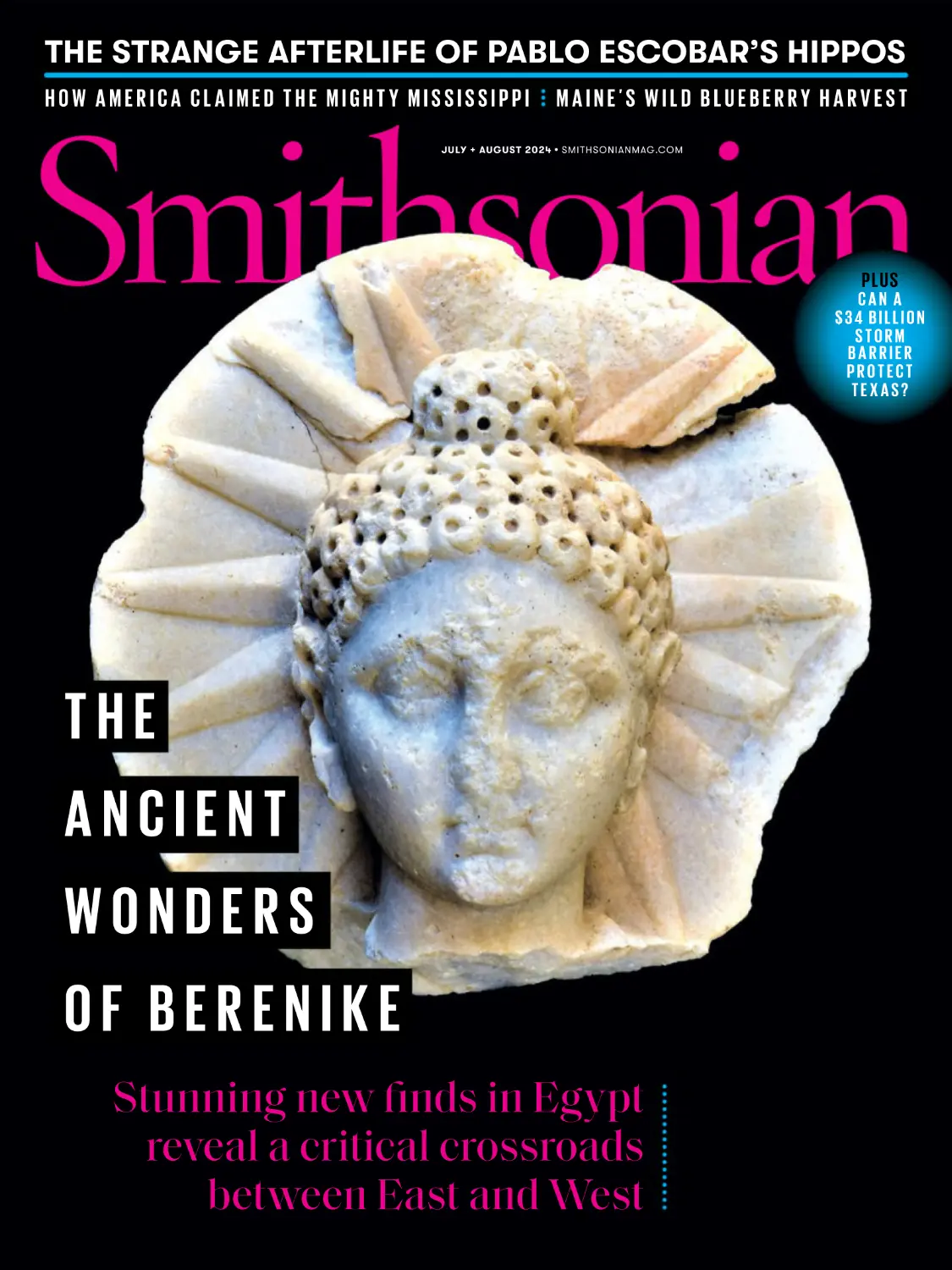
Cover: The head of a marble Buddha
statue found at Berenike exhibits
both Eastern and Western styles,
from a typical beatific expression
and topknot to a Roman coif.
Photograph by Steven Sidebotham
July • August 2024 | SMITHSONIAN
3
discussion
MAGAZINE
X (TWITTER): @SmithsonianMag
INSTAGRAM: @smithsonianmagazine
FACEBOOK: smithsonianmagazine
California. Use of that term anywhere along the
northern two-thirds of the route instantly marks
the traveler as a Los Angeleno and may produce
an eye roll and even a polite correction. From
Monterey Bay to Puget Sound, the road is known
to locals simply as 101.
Mike Gaynes | Bremerton, Washington
More to Explore
“I was intrigued by the
idea of going into one that
was still warm.”
Having hiked in an old lava tube in Iceland about
ten years ago, I was intrigued by the idea of going
into one that was still warm (“Earth Quest,” June
2024). I appreciated the views expressed by the
scientists in the article about the geology, mineralogy and microbiology—and how this was not
only a rare opportunity to study earth, but might
pertain to other planets, too.
Brenda Bell Brown | Santa Clara, California
The Weight of It All
A Stellar Statesman
As an admirer of Benjamin Franklin, the first
polymath and autodidact of note in the American
colonies, I thought this was an excellent article
(“Start the Presses,” June 2024). He is the one historical individual who I believe would fit in the
21st century because of his well-rounded intellect
and understanding of people. Printer, scientist,
diplomat, celebrity, signer of the Declaration of
Independence, author and the one individual in
U.S. history who embodies American freedom
and American exceptionalism. Not perfect, but
an exemplar for curiosity and personal dynamism. Thank you for this wonderful work.
Eric S. Hall | Cary, North Carolina
Meet Smithsonian’s
journalists on our
new podcast,
“There’s More
to That.”
SCAN TO SUBSCRIBE
Congratulations on a well-written and informative piece on Dr. Lulu Hunt Peters (“The Calorie
Countess,” June 2024). Michelle Stacey told her
story well, suggested smart lines of further inquiry and related it to the current day. Peters is
a great subject for the Ozempic and Mounjaro
moment. (I wrote about Peters in my 1988 book
Fasting Girls: The History of Anorexia Nervosa.)
It’s wonderful to see women’s history writing that
extends beyond the feminist canon.
Joan Jacobs Brumberg | Ithaca, New York
I admire Lulu Hunt Peters’ achievement of acquiring her doctorate and the research she did,
but at the same time want to curse her for the
unintended consequences of that same research!
C. Chalker Whitworth | Greenville, South Carolina
A Route by Any Other Name
Writer Teddy Brokaw (“Taking the Scenic Route,”
June 2024) describing Highway 101 as a California
postcard means he missed out on the spectacular
Oregon beaches and Washington’s magnificent
Olympic Peninsula. Also, the highway is “affectionately” known as “the 101” only in Southern
C O N TA C T
US
4
SMITHSONIAN
Ancient Architects
The fact that so many remnants of the past are
still around 2,000 years after being built is a testament to what our ancestors could do with minimal tools (“Lost Treasures of Pisidia,” June 2024).
John Weghorst | Newtown, Pennsylvania
Send letters to LettersEd@si.edu or to Letters, Smithsonian, MRC 513, P.O. Box 37012, Washington, D.C. 20013.
Include a telephone number and address. Letters may be edited for clarity or space. Because of the high volume of
mail we receive, we cannot respond to all letters. Send queries about the Smithsonian Institution to info@si.edu or to
OVS, Public Inquiry Mail Service, P.O. Box 37012, Washington, D.C. 20013.
| July • August 2024
.KMGQVJGTUOCNNVQYPUKP0GDTCUMC6C[NQTKUƂNNGFYKVJHTKGPFN[YGNEQOKPIRGQRNG9JCVUGVU6C[NQT
CRCTVCTGVJGQTUQTGUKFGPVUOCFGQHRN[YQQF6JG[oTGVJGDTCKPEJKNFTGPQHCNQECNCTVKUVYJQ
YCPVUVQFQWDNGVJGEQOOWPKV[oURQRWNCVKQPCPFVJG[oTGRTCEVKECNN[KORQUUKDNGVQTGUKUV;GUYG
MPQYUQOGRGQRNGYKNNUVKNNTGUKUV$WVPQV[QW5QIQVQVisitNebraska.comHQTCHTGG6TCXGN)WKFG
#PFOCMGUQOGPGYHTKGPFU1TYGECPOCMGVJGOHQT[QW
institutional knowledge
Whole of Our History
THIRTY YEARS AGO, WE DISTILLED THE
NATION’S STORY INTO A SINGLE TRAVELING
EXHIBITION. WHY THE CHOICES WE
MADE STILL RESONATE TODAY
D
A replica of the
Star-Spangled
Banner welcomed visitors to
“The Smithsonian’s America”
exhibition in
Chiba, Japan,
in 1994.
6
SMITHSONIAN
URING MY FIRST YEAR at the Nation-
al Museum of American History, I
accepted the enormously daunting
task of curating “The Smithsonian’s
America: An Exhibition on American
History and Culture” for the American Festival in Japan. Imagine not only having to
encapsulate the nation’s spirit in one installation,
but also doing it for a Japanese audience. At that
point, the only knowledge I had about Japanese
culture came from my tenth-grade
Japanese language class.
But the opportunity to think
broadly about the scope of American history and culture and to help
bring the Smithsonian to another part of the world was one that
I could not pass up. It also turned
out to be a proving ground for our
ability to reach far beyond our
physical museums in Washington—the exhibition later traveled
across the United States for the
Smithsonian’s 150th anniversary.
It took three years of work and 15
trips to Japan and back to bring it
| July • August 2024
MAGAZINE
to fruition. Overcoming language and cultural barriers was challenging. The Japanese team wanted
the exhibition to reintroduce the ideals of the United
States to a new generation of Japanese citizens for
whom the facade of the “American dream” had fallen away. They urged us to focus on technological advancements, the presidents and the Wild West.
We insisted on telling a more comprehensive and
complicated story, and in the end, the sprawling
60,000-square-foot exhibition was unified by the
throughline of the contested promise of American
life. For instance, the exhibition included the original
model for the Statue of Liberty, with broken chains at
Lady Liberty’s feet to symbolize the end of slavery; it
discussed the incremental expansion of civil liberties
to women and African Americans; and it told the story of how migration diversified the American West far
beyond the “cowboys and Indians” stereotype.
Our Japanese counterparts were nervous that we
would further tarnish America’s reputation by telling fuller and less flattering stories. But on opening
day, former President Jimmy Carter walked through
the exhibition with former Japanese Prime Minister
Toshiki Kaifu. Carter told him that this was the true
strength of America: to tell the whole of our history.
It has been 30 years since that meaningful representation of the whole of America first opened. More
than half a million people attended in just the first
month. The exhibition was a marked success, bringing to bear the full complexity of our history on an
international stage. Today, I am proud to oversee an
institution that remains committed to the full telling
of history around the globe.
Portrait illustration by Jurell Cayetano
S M I T H S O N I A N A R C H I V ES ; I L LU ST R AT I O N R E F E R E N C E P H OTO : M I C H A E L BA R N ES / S I A R C H I V ES
LONNIE G. BUNCH III, SECRETARY
SECRETARY
Lonnie G. Bunch III
BOARD OF REGENTS
CHANCELLOR
Chief Justice John G. Roberts, Jr.
CHAIR
Dr. Risa J. Lavizzo-Mourey
VICE CHAIR
Hon. Barbara M. Barrett
MEMBERS
Vice President Kamala D. Harris
(Ex Officio)
Hon. John Boozman
Hon. Catherine Cortez Masto
Hon. Gary Peters
Hon. Garret Graves
Hon. Doris Matsui
Hon. Adrian Smith
Ms. Toni Bush
Mr. John Fahey
Mr. Roger W. Ferguson, Jr.
Mr. Michael Govan
Mr. Michael M. Lynton
Ms. Denise M. O’Leary
Hon. Franklin D. Raines
What’s Your Legacy?
SMITHSONIAN NATIONAL BOARD
Dr. Jorge G. Puente, Chair
Ms. Donna F. Zarcone, Vice Chair
Mr. Todd Krasnow, Vice Chair
Creating a greener planet?
■
Providing greater access to the arts?
■
Inspiring the next generation?
Leaving a gift to the Smithsonian Institution through your
NATIONAL BOARD
will is a wonderful way to secure your legacy and advance
Mr. Kenneth J. Bacon, Dr. Trudi
Bellardo Hahn*, Ms. Patricia S.
Bellinger, Mrs. Lisa Bennett,
Mr. Harold M. Brierley, Mr. John
F. Brock, III, Mrs. Ellen Bruss,
Mr. Steven A. Cahillane, Ms. Donelle
Dadigan, Mr. Trevor Fetter,
Mr. Matthew Finick, Ms. Michele J.
Hooper, LL COOL J, Mr. David G.
Johnson, Mrs. Ashley Duchossois
Joyce, Mr. Dale LeFebvre, Mrs. María
Amalia León, Ms. Stephanie Mellin,
Mrs. Jo Michalski, Mrs. Cheryl Neal,
Ms. Emilie M. Ogden, Ms. Anne
MacMillan Pedrero, Mrs. Sarah Perot,
Ms. Joyce A. Phillips, Mr. G. Jeffrey
Records, Jr., Mr. Kenneth C. Ricci,
Mr. John C. Ryan, Mr. Morgan M.
Schuessler, Jr., Mr. Roger Jerome Sit,
Ms. Diana Strandberg, Ms. Naoma Tate
your values for decades to come.
Giving Docs Makes It Easy
Free, Simple Estate Planning Online
With the help of Giving Docs,* a free online estate
planning service, supporters of the Smithsonian
can designate a gift in three simple steps.
That’s all it takes to ensure that future generations
can enjoy the museums and research centers that
mean the most to you.
To get started, scan the QR code to visit:
givingdocs.com/smithsonian-institution
HONORARY MEMBERS
Hon. Max N. Berry, Mr. L. Hardwick
Caldwell III, Dr. G. Wayne Clough,
Ms. Sakurako D. Fisher, Mrs. Patricia
Frost, Mrs. Jean B. Mahoney,
Mr. Paul Neely, Mr. Wilbur L. Ross, Jr.,
Mr. Lloyd G. Schermer, Dr. David J.
Skorton, Mrs. Gay F. Wray
*Giving Docs is an independent third party platform, completely separate
from the Smithsonian Institution. Its services are provided without review
from the Smithsonian Institution, and the Smithsonian Institution is not liable
for its use. Giving Docs is not a law firm and does not provide legal advice.
*Ex Officio
July • August 2024 | SMITHSONIAN
■
7
I’m thinking more today
about how to protect
the money I’ve earned.
I’ve learned a lot of things over the years, talking to
all sorts of experts in all sorts of fields. But one of
the most important lessons I learned was from two
former Directors of the U.S. Mint, who taught me
everything I needed to know about the importance
of protecting my savings with physical gold and silver.
In 25 years of working dirty jobs, the thought of a
diversified portfolio really didn’t cross my mind—but
the more I learn, the better I feel about buying gold
and silver from U.S. Money Reserve.
Is gold right for you? That’s not for me to say. You’ve got
to do your own due diligence. All I know is that today, it’s
not enough to simply work hard—you also have to save
smart. So, call the number below. The folks at U.S. Money
Reserve are standing by to help.
ALL-NEW VIDEO SERIES
Follow Mike Rowe on his gold ownership journey: Call now for access
to the all-new video series and your FREE Gold Information Kit.
Learn everything you need to know about gold!
Answers to commonly asked questions about gold ownership
Information on how gold can protect and grow your savings
Access to special introductory offers
Two additional exclusive reports: “2024 Global Gold Forecast”
and “Protection in the Risk Zone”
USMR.COM/MR2
1-855-429-9485
VAULT CODE: SMT71
©2024 U.S. Money Reserve. The markets for coins are unregulated. Prices can rise or fall and carry some risks. The company is not aff iliated with the U.S. Government and the U.S. Mint.
Past performance of the coin or the market cannot predict future performance. Coins enlarged to show detail. Client reviews are edited and condensed for clarity.
U.S. Money Reserve licensed Mike Rowe’s likeness and image to document his gold education and IRA journey. All calls recorded for quality assurance. Offer void where prohibited.
T H E PAST I S
By
David M. Perry
Illustration by
Zlatina Zareva
A M E R I CA N I C O N
Changing
the Game
The wizardry of Dungeons & Dragons
sparked a revolution in how we
play just about everything
July • August 2024 | SMITHSONIAN
9
prologue
A M E R I CA N I C O N
O K M C CAU S L A N D
N FEBRUARY 1973, Dave Arneson, a history major at
the University of Minnesota and part-time security
guard, drove with a friend from the Twin Cities to the
resort town of Lake Geneva, Wisconsin. They were on
a quest to meet Gary Gygax, an insurance underwriter. What brought the three together was a deep devotion to playing strategic tabletop war games. Gygax
had co-written a medieval fantasy game inspired by
The Lord of the Rings, full of elves and orcs. Together, the trio embarked on a novel approach: Instead of
pitting player against player, Arneson suggested having all characters fight their way together through a
mystical realm—sometimes as friends, sometimes as
foes—under the watchful eye of what Arneson envisioned as a “sadistic referee.” Gone was author J.R.R.
Tolkien’s Shire. In its place? The Dungeon.
That cold visit in Wisconsin convinced Arneson
and Gygax that this nascent game was worth pursuing, so the two quickly established the basic rules for
what they decided to call Dungeons & Dragons. The
following year, Gygax’s new gaming company, Tactical Studies Rules (later TSR), published the first publicly available rules for D&D, explained in three slim
booklets: one on how to make a character, another
on monsters and treasure, and a final one of scenarios for adventures. The illustrations were amateurish;
the print quality low; the concepts mere sketches of
ideas about how to create characters and goals. But
over the past 50 years, those first booklets revolutionized tabletop games—
and established the imaginative basis for
the video games that were about
to consume a huge chunk of the
entertainment industry. As
Dan Rawson, senior vice
president of Wizards of the
10
SMITHSONIAN
| July • August 2024
Caleb Cummings, Maxim
Allen, Victor
Ocasio and Amy
Williams play
Dungeons &
Dragons in 2022
at The Brooklyn
Strategist, a
board game
store and play
center in New
York City.
Coast, the company that makes the game today, says:
“The nerds emerged from the basement.”
The early game was a mess, requiring players to
improvise constantly. What really helped develop it
was a national network of gamers who collaborated at conventions and communicated via self-published magazines. This network was primed to analyze any new tabletop game, figure out what did and
didn’t work—and then spread the word.
Compared with war games of the era—which
tended to model real-world military conflicts with
lots of tokens or pieces, so you could play out a Civil
War battle with Gettysburg, for example—D&D of-
Here Be Dragons
THE MYTHICAL BEASTS HAVE FIRED UP
CULTURES AROUND THE GLOBE. HERE ARE THEIR
(ALLEGED) ORIGINS FROM EAST TO WEST
By Sonja Anderson
A MONSTROUS MARRIAGE
In legends of Persia—the region now known as Iran—dragon-like
serpents are known as azi. A particularly ruthless, three-headed azi
called Azi Dahaka once stole a shepherd’s two lovely daughters and
made them his wives. A hero, Thraetaona, rose to the now-familiar
challenge: He slayed Dahaka and brought the girls home.
SCALING BACK
According to the Rig Veda, an Indian text more
than 3,000 years old, a dragon once presented
a challenge for a Hindu god. The draconic demon was withholding water, to the dismay of a
people suffering through drought. When Indra,
the deity of war and storms, battled and killed
the serpent, he freed the rain, enabled sunlight
and created a new order.
fered something immersive and even serene,
enchanting gamers in college dorms around
the country by allowing groups of players to
tour an imaginary space in collective wonder. When a character did come upon a battle, they could level up indefinitely, growing
in power session after session, even year after year, attaining higher ranks with more experience points as they moved
through the game. D&D thus
offers a sort of comforting feedback loop, where improving in
the game feels good, so you want
to keep gaming, so you can keep
improving—and the story never has to end. Both experience
points and collective exploration were new. People loved it.
Within its first decade, D&D sales
soared to more than $16 million a year.
But its success also provoked a bitter
legal fight between Gygax and Arneson
over royalties and credit. During the 1980s, some
Parent Teacher Associations and school administrators began to denounce the game, full of occult
lore, as un-Christian and even devilish, and many
schools banned D&D amid periodic paranoias now
known as the “Satanic Panic.” When I was a Boy
Scout in Nashville in that era, my Baptist scoutmaster told me I had to choose between playing D&D,
which he equated to demon worship, and “leveling
up” as a Boy Scout. I never became an Eagle Scout.
Today, leveling up is everywhere. It has become
the norm among the games for which consumers
spend hundreds of billions of dollars every year—not
to mention a key strategy by game-makers to keep
players glued to the screen in hopes of everlasting
advancement. But D&D’s legacy goes far beyond tabletop or video games to include the “gamification”
that you encounter every time you
gain a new badge or rank with a credit
card or hotel loyalty program. As D&D
marks its 50th anniversary this year,
and amid massive ongoing enthusiasm
for fantasy realms, the newest versions
of the game have become wildly popular: Between the recent Dungeons &
Dragons movie, video games and the
tabletop original, the franchise, now
owned by Hasbro, claims 54 million
fans worldwide. And the game itself is
more accessible than ever—not least
because of YouTube, where you can
watch people playing D&D and learn new gambits.
It turns out that what Gygax and Arneson and all
their first-generation wizards and clerics created
was a vehicle for human imagination—the power to create and inhabit fantasy worlds where the
delights and marvels have not dimmed after half a
century. In other words,
we’re all nerds now, no
basement required.
D&D OFFERED
SOMETHING
IMMERSIVE AND EVEN
SERENE, ALLOWING
PLAYERS TO TOUR AN
IMAGINARY SPACE
IN COLLECTIVE
WONDER.
WATERY KING
Dragons have enjoyed 4,000 years of reverence in East Asian cultures. In Buddhism,
Confucianism and Taoism, these legged,
fanged serpents are guardians of water who
bring nourishing rain and breathe clouds from
their nostrils. Said to reside at the bottoms of
pools and lakes, dragons symbolized majesty
and power in ancient China. As one scholar
wrote in the 11th century, “None of the animals is so wise as the dragon.”
B R I D G E M A N I M AG ES ; P U B L I C D O M A I N ; A L A M Y (2 ); S M I T H S O N I A N A R C H I V ES
ELEPHANT HUNTER
Roman scholar Pliny the Elder
wrote a good deal about
dragons, once reporting that
the beast was capable of
strangling an elephant with its
tail. Alas, Pliny was not exactly an unimpeachable authority on animal facts: He also
recorded the veritable traits
and habits of the unicorn.
FOUNDING MOTHER
In a Mesopotamian creation
myth, the god Marduk battled
the goddess Tiamat, the mother
of the gods and embodiment of
the sea, sometimes portrayed
as a serpent or dragon. Marduk
drove an arrow through Tiamat’s
heart, then severed her body
in two, creating the heavens
from one piece and the earth
from the other. In Dungeons
& Dragons, the character of a
five-headed, draconic deity
bears the goddess’s name.
July • August 2024 | SMITHSONIAN
11
prologue
A RT
By
Amy Crawford
K N OTA B L E WO R KS
P
RINTMAKING, which dates to ancient
times, was long considered a craft, useful
mainly for reproducing religious illustrations. But with his intricate woodcuts and
engravings, Albrecht Dürer (1471-1528) elevated it to a fine art. “One cannot overstate
the influence of Dürer on the history of the print,”
says Naoko Takahatake, curator of a new show at
the University of California, Los Angeles’ Hammer
Museum, “Sum of the Parts,” which covers 500 years
of printmaking. “From a purely technical point of
12
SMITHSONIAN
| July • August 2024
The First Knot
(with heartshaped shield),
Albrecht Dürer,
woodcut,
1506-1507.
VIEW ALL SIX
prints in the series
at Smithsonian
mag.com/knots
view, engraving and woodcut for centuries have
been measured against his example.” A series of the
German master’s “knot” prints, which are based on
designs by Leonardo da Vinci, is a highlight of the
exhibit, which aims to demonstrate how artists use
sequential prints to explore ideas, develop a theme
or tell a story. “Often, in exhibitions, a single print
is shown alone, extracted from a series—it’s like a
quote from a book,” Takahatake says. “But when you
have the whole series, you can see how one image
interacts and connects with the next.”
U C L A G R U N WA L D C E N T E R F O R T H E G R A P H I C A RTS, H A M M E R M U S E U M
The ornate series of woodcuts that
transformed printmaking
Siesta Beach
Th e uplif ting and the
illuminating , per form ed daily.
E xp e r ie n ce s tir r ing p e r fo r m a n ces o n Fl o r id a’s
Cu ltu r a l Co a s t ® . A n d fe e l m o re at ea se a n d
yet m o re in s p ire d in th e s a m e m o m e nt .
Pl a n yo u r getaw ay to d ay.
Florida Studio Theatre
Fins at Sharky’s
FloridasCulturalCoast.com
prologue
FLIGHT
Illustration by
Scott Bakal
Around the
World in
113 Days
Congressman Peter F. Mack’s
soaring diplomatic ambitions
made aviation history
14
SMITHSONIAN
| July • August 2024
by
Paul Glenshaw
N MAY 1951, REPRESENTATIVE Peter F. Mack
was in his southern Illinois district on what
promised to be an unremarkable listening
tour among his constituents. Amid the usual
glad-handing and baby-kissing, Mack received
a surprising challenge from his friend John W.
Hobbs, an automobile parts manufacturer.
Hobbs noted how scary things looked worldwide: Europe was still a mess after World War
II, the Soviet Union had recently gotten the bomb, conflicts
were raging in Korea and French Indochina, and anti-Western protests had begun in Iran. Conventional diplomacy had
failed at the mighty task of bringing peace, Hobbs argued, in
large part because U.S. diplomats rarely tried to communi-
We’ve Found the Most
Beautiful Endangered Species
Theirs sold at auction for $226,000. Ours is JUST $29! Curious? Read on!
o art nouveau jewelers at the turn of the last century,
nothing was more beautiful than the dragonfly. In
the dragonfly’s long body and outstretched wings, jewelers
found the perfect setting for valuable stones. These jewelers’
dragonfly designs have become timeless statements of style;
a dragonfly pendant designed by French jeweler René
Lalique recently sold at auction for $226,000. Inspired by
his stunning artistry, we’ve crafted our Dragonfly Nouvelle
Collection, an elegant jewelry set for JUST $29!
T
True artisanship in Austrian crystal and yellow gold.
This necklace and earring set features gorgeous multicolored
enamel paired with Austrian crystals and a yellow gold finish.
Ask any jeweler and they’ll tell you it takes true artisanship to
properly blend the blues and purples found in this enamel.
While art nouveau dragonflies are hard to come by, we’re
helping to repopulate their numbers with this artfully stylized
depiction of some of nature’s smallest wonders!
Buy the pendant, get the earrings FREE. If Stauer were
a normal company, we’d sell the necklace and earrings for
$199 each, but because we engage the world’s best artisans
and cut out the middlemen to sell directly to you, we’re
offering the necklace for JUST $29! Even better: If you buy
within the next few days, we’ll throw in the earrings for
FREE! That’s a nearly $400 value for JUST $29!
Act fast! The first time we ran this jewelry in our catalog, it
sold out in a matter of days. Get this collection now before
this offer goes extinct!
Jewelry Specifications:
• Enamel with Austrian crystal. Yellow gold finish
• Pendant: 1 ½" W x 1 ¼" H.
Chain: 18" + 2", lobster clasp.
Earrings: 1 ¼" L, french wire
Dragonfly Nouvelle Collection
A. Necklace
$29* + S&P Save $170
B. Earrings
FREE with purchase of
Dragonfly Nouvelle Necklace
*Special price only for customers using the offer code.
1-800-333-2045
FREE!
A $199 value!
Your Insider Offer Code: DFC257-01
Stauer, 14101 Southcross Drive W., Ste 155, Dept. DFC257-01, Burnsville, MN 55337 www.stauer.com
prologue
FLIGHT
Congressman
and pilot Peter
F. Mack arrives
in Hawaii in the
Friendship Flame
in January
1952, on the
final leg of his
global goodwill
journey.
I CLIMBED INTO THE SMALLEST
AIRPLANE EVER TO ATTEMPT A SOLO
FLIGHT AROUND THE WORLD.
constituents. Once Congress went into recess, on October 7, 1951, Mack set off on
his adventure. On the way, he became
one of the very first humans to complete
a solo flight around the world, and the first to cross
the Pacific Ocean alone in a light airplane. Today, his
unique and perhaps quixotic quest stands for a simple but powerful notion: the potential each person
has to make the world a better place. As Mack said
16
SMITHSONIAN
| July • August 2024
at the time, “Goodwill is everyone’s job, and I am
thoroughly convinced that it is the responsibility of
every American citizen.”
MACK WAS BORN in rural Carlinville, Illinois, in 1916,
and from a young age he worked in coal mines and in
the family business—the local Ford dealership. A devout Catholic, Mack “was always interested in others
and what he could do for them,” recalls Mona Mack
Melampy, one of his two daughters. His passion for
aviation started early, and after a first ride at age 13
in an old World War I trainer, Mack was hooked. He
served in the Navy in World War II as a flight instructor, though he never flew overseas in combat.
Once peace was declared, Mack found another
way to serve. He was elected to Congress in 1948,
gaining acclaim for his promise to provide underprivileged children a free trip to Washington, D.C. to
see Congress in action—at his own expense. (It was
a promise he kept throughout his congressional career, ultimately bringing more than 1,200 kids.) He
also gained fame for campaigning by air throughout
his district, with “Mack for Congress” splashed on
the side of the plane he owned at the time.
Ahead of the 1951 flight, Mack rechristened the Bonanza the Friendship Flame and painted “The Abraham Lincoln Goodwill Tour” on the side. (Lincoln’s
C O U RT ESY O F T H E M AC K FA M I LY
cate with ordinary citizens in other countries.
“Our top brass just talks to the top brass of other
countries,” Hobbs told Mack. “They never get down
to the level of the people themselves.” Hobbs had
a novel suggestion for solving the problem. “Why
don’t you fly to some of these countries and talk to
the people?” he asked his friend. Hobbs knew the
34-year-old Mack had a deep passion for helping
others—as well as a passion for flying.
So Mack and Hobbs worked out an idea for an
unusual global goodwill tour, starting and ending
in Springfield, Illinois. Mack would fly around the
world alone, serving as both daring pilot and unofficial ambassador as he represented the people of his
district and extended their wishes for peace.
When Mack returned to Washington, D.C. for that
spring’s congressional session, he discussed the idea
of the globe-trotting tour with his friend Paul Garber,
curator of the Smithsonian’s National Air Museum
(now the National Air and Space Museum). Garber
had recently acquired an airplane that was perfect
for the journey: a single-engine Beechcraft Bonanza,
which racing pilot Bill Odom had used in 1949 to set
a world record for nonstop long distance in a light
plane, flying 4,957 miles from Honolulu to Teterboro,
New Jersey. The Bonanza’s extra gas tanks on the
wingtips and in the cabin would serve Mack’s mission well. But now the Bonanza was in storage. Not
in the habit of loaning out artifacts, the Smithsonian
temporarily gave custody of the airplane back to the
Beech company. Mack paid Beech $3,200 to have the
airplane reconditioned, and the company agreed to
let him use it for the flight.
Mack and Hobbs budgeted $10,000 for the trip,
largely raised through $5 and $10 donations from
N AS M
name then, as now, was known around the world,
and Mack’s district was home to Lincoln’s longtime residence.) At Springfield airport on October
7, Governor Adlai Stevenson, Hobbs, Mack’s parents
and some 2,000 well-wishers bade him goodbye. As
Mack later recalled in a speech following his flight,
“I climbed into the smallest airplane ever to attempt
to make a solo flight around the world.” At the controls, he felt galvanized: “filled with enthusiasm, and
with the determination to carry out the idea of the
citizens of this area—to express their friendship to
people throughout the world.”
What faced him, though, was an entirely new challenge. Mack had never flown across oceans or deserts
and, for the next 113 days, would face extreme tests of
his endurance and concentration as pilot, navigator
and goodwill ambassador. The airplane cabin was
cramped with the extra gas tank. There was no room
to stretch, and little for any luggage. He’d packed only
a couple of suits, several small knives, a flashlight,
some cash, a parachute and a small movie camera.
Mack made brief stops in Pittsburgh and Washington, D.C., before heading to a U.S. naval base in
Newfoundland. Well-fed on lobster, he headed out
over the Atlantic, first to the Azores islands to refuel.
“Hurricane-inspired tail winds carried me along at
speeds up to 210 miles per hour” before he reached
the Azores, he later wrote in Collier’s Weekly. At his
next stop, Lisbon, he found a large crowd waiting, as
he also did in Madrid, Amsterdam, Oslo and Helsinki.
Unable to gain entry to the Soviet Union, Mack then
zipped off to the epicenter of the Cold War: West Berlin. He noted wryly that the ordinary Germans with
whom he spoke displayed a newfound appreciation
for the United States, thanks to the Marshall Plan and
the Berlin airlift of 1948-49: When Mack met a retired
Berlin schoolteacher, he later wrote, the teacher “ostentatiously announced, ‘I take off my hat to you!’”—
and promptly did.
Mack’s tour of Europe also included London,
Glasgow, Belfast, Dublin, Paris, Luxembourg, Bonn,
Geneva, Nice, Rome and Athens. At each stop, his
routine was the same: check into a local hotel, deliver
a “friendship scroll” to the mayor from the people of
his district, and then head into the streets and shops,
speaking to anyone who would talk to him.
In Belgium, he visited a coal mine similar to those
he’d worked in back in Carlinville. He descended
4,500 feet into the earth, talking with miners as they
toiled in sweltering heat. When he resurfaced, a huge
crowd had gathered to marvel: Local officials had never bothered to make the descent. “They welcomed me
to their village and had a reception in the city hall.”
Mack had his first close calls in the air during the
BYLINES
Writer Paul
Glenshaw is the
co-writer and
co-director of
the documentary
The Lafayette
Escadrille.
The work of
illustrator Scott
Bakal has
been featured
in museums
and galleries
worldwide.
European leg. While flying from Madrid to Amsterdam, he was terrified to find he’d fallen asleep at the
controls. “The towering Pyrenees were below me,
and every time I nodded, the plane’s nose headed
toward them. I dozed, fought my way back to consciousness, dozed . . . drank black coffee, dozed and
caught myself again,” he recalled. More troubling,
Mack narrowly avoided death when the engine quit
over the unforgiving Alps—because he had forgotten to reroute the fuel from depleted tanks to full
ones; he adjusted just in time. He had to contend
with dangerous icing while flying from Dublin to
Paris, not to mention a bouncy landing in Switzerland “in a cow-pasture airport so rough that I’ll bet
even the cows couldn’t keep their feet.”
Throughout the journey, Mack shot footage with
his movie camera—the canals of Amsterdam, palm
trees in Lisbon, and bustling streets in Madrid and
Helsinki. Moving on to the Middle Eastern leg of the
trip, he filmed the Tigris and Euphrates Rivers as he
flew down into Baghdad.
FLYING SOUTH, Mack filmed the oil fields of Saudi
Before Mack’s
trip, the same
airplane was
flown by Bill
Odom to set a
light-plane, nonstop distance
record, from
Hawaii to New
Jersey, in 1949.
Arabia, where he made a brief refueling stop at the
Dhahran Air Force Base. He then skipped due east
across the Persian Gulf and, hugging the coastline
of southern Iran, made his way to India and Pakistan in early December. The countries were still
reeling from partition in 1947, which had led to war
and millions of displaced Muslims and Hindus on
either side of the border. Yet Mack saw each country’s vibrant, bustling streets and schoolchildren
playing and “was impressed with the enthusiasm
and vitality of these new nations,” he later recalled.
Still, he recorded: “The poverty was awe-inspiring. . . . I got the impression that if Russia wanted to
move into any part of South Asia east of Turkey, it
July • August 2024 | SMITHSONIAN
17
prologue
would be like walking through a paper bag.”
Mack made brief stops in Rangoon and Bangkok
before arriving in Saigon. The First Indochina War
had been raging since 1946 between France and the
Communist army of Ho Chi Minh. Given China’s intensifying involvement in Korea on the side of the
North, there was growing fear China might offer
similar aid to Vietnamese Communists. But Mack
also found hostility against the U.S. One man he met
on the street in Hanoi was a nationalist who told
the congressman: “We don’t like the United States
because you forget your own struggle for independence and do not support ours.”
Although Mack found a warm welcome in the
Philippines, “The physical strain of the trip had
caught up with me, and as I stepped from my plane,
my knees buckled,” he recalled. “A doctor in Manila
had warned me that I was near collapse, so I spent
the rest of that day in bed.” But the following day was
Christmas Eve, so despite his fatigue, Mack pressed
on. He attended midnight Mass in a little church in
Taipei, then flew 900 miles into the Korean battle
zone on Christmas Day. He landed at a U.S. Navy
base in terrible weather and had Christmas dinner
on the base with two constituents who happened to
be stationed there. “I didn’t expect you to come halfway around the world to hear a constituent’s complaints,” one of them joked.
Mack spent around a week in Japan, and although
he filmed the busy streets of Tokyo and the devastation of Hiroshima, the goodwill portion of the journey was over. Mack transitioned to preparing himself and the Friendship Flame for the most challenging part of the trip—the trans-Pacific leg. He would
have to navigate with absolute precision in order to
18
SMITHSONIAN
| July • August 2024
Mack’s Friendship Flame on
display at the
National Air and
Space Museum.
Introduced in
1947, the Beechcraft boasted
retractable
landing gear.
LEARN MORE
about Mack’s plane
at the National Air
and Space Museum
at Smithsonian
mag.com/bonanza
find tiny islands—mere specks in the vast ocean—
where he would rest and refuel.
On January 8, 1952, Mack started for his first
trans-Pacific stop, Iwo Jima, and encountered turbulence and rain squalls “all of the 660 miles.” He
landed on the little island in the dark, grateful for his
high-functioning instruments.
That luck didn’t hold. The next day, Mack set out
for Wake Island. Soon, his artificial horizon—an instrument that tracks the airplane’s orientation to the
earth’s horizon—failed, and even after he spent ten
and a half hours using other instruments to keep the
plane level, the tiny atoll was nowhere in sight. “It
was then that I thought for the first time of Amelia
Earhart’s disappearance near this same area of the
Pacific,” he recalled. “I could hear other airplanes
calling to me by radio, but I could not get through
to them—and I couldn’t find the tiny island. I never felt so lonely in my life.” After another torturous
30 minutes, Wake came into view. Mack pointed the
movie camera out the window as he circled before
landing—grateful to be alive.
The rest of the trans-Pacific leg was exacting but
uneventful: Midway, then Hawaii, where he stayed
for a week for repairs and well-deserved rest. On January 21, after flying 2,400 miles from Hawaii, Mack
landed in San Francisco—completing the world’s
first solo crossing of the Pacific in a light plane. After
stops in Tucson and Dallas, he returned to Springfield on January 27, 1952. He had flown 33,000 miles,
and visited 45 cities and 35 countries. This time, Stevenson, Hobbs and Mack’s parents awaited him—
along with 10,000 joyful citizens. Mack returned
the airplane to the Smithsonian and himself to Congress, where he served until early 1963.
Mack himself could be surprisingly diffident,
especially by the standards of a politician, and he
never really exploited the trip for personal gain. He
wrote two articles about the adventure and gave a
few talks, but he sought no further publicity or notice. As his daughter Melampy told me, “Once he
had done something, he moved on.” Put a different
way, “He was a workhorse, not a show horse,” says
Congresswoman Nikki Budzinski, who represents
Mack’s Springfield area today.
Reflecting later on what he’d accomplished in
his article for Collier’s, Mack recorded how the long
hours in the air had given him a new perspective—
and hopes for peace. “From where I sat, I could
see no international boundaries and no squabbles
among nations,” he wrote. “During those lonely
hours, I thought more and more of peace and of the
folly of man fighting man, and wherever I went I
found people echoing my sentiments.”
N AS M
FLIGHT
Pearl
Seas
Cruises®
Discover The Trea sures Along
THE GREAT LAKES
In the comfort of our well-appointed fleet, enjoy the most personalized exploration of the Great Lakes
region on a 7 to 15-night journey. Led by our engaging local guides, immerse yourself in the rich history
and vibrant culture of charming harbor towns and admire the wonders of nature up close.
Explore Well™
Lake
Superior
Georgian Bay
Lake
Michigan
Lake
Huron
Lake Ontario
Lake
Erie
Call for a
FREE Cruise Guide
888-669-5812
PearlSeasCruises.com
prologue
C I V I L WA R
by
Bronwen Everill
For Union soldiers,
a cup of coffee
made hardtack
biscuits more
palatable.
How the North’s fruitful
partnership with Liberian
farmers fueled a steady supply
of an essential beverage
20
SMITHSONIAN
| July • August 2024
EN MONTHS INTO the Civil War, the Union
was short on a crucial supply, the absence of
which threatened to sap the fighting strength
of the Northern army: coffee. This critical
source of energy and morale was considered
almost as vital as gunpowder; Union General
Benjamin Butler ordered his soldiers to carry coffee with them always, saying it guaranteed success: “If your men get their coffee
early in the morning, you can hold” your position.
But by 1862, imports of coffee were down by 40 percent since
the start of the war. Though coffee was cultivated around the
world from Java to Ethiopia to Haiti, Brazil had been the main
supplier to the United States. The Union blockade of Southern
ports, including New Orleans, had slowed coffee imports
H E R I TAG E AU CT I O N S
A Jolt
to the
Union
How Do You Spell
Pearl Necklace?
F-R-E-E.
Experience the Luxury of
Genuine Cultured Pearls ... FREE!*
CLIENTS LOVE STAUER JEWELRY
“I couldn’t believe it, but decided to call and
I’ve not been disappointed since. I received the
necklace and keep coming back for more.”
— Amy, Fairmont, WV
Y
ou read that right. If you’d like the
Stauer genuine 26" cultured pearl
necklace for FREE*, all you need to do is call us
today. There is no catch. This stunning, romantic
necklace never goes out of style. In a world where
some cultured pearl necklaces can cost thousands,
we’re offering ours for FREE*.
Stauer has had a very good year and it’s
time for us to give back. That’s why
we’re offering this stunning, 26" strand of genuine cultured
white pearls for FREE! You pay only $24.95 for shipping
& processing, our normal fee for a $295 necklace ... and
we’ll even pay you back with a $30 Discount Certificate
–– that’s our BETTER THAN FREE Shipping!
Why would we do this? Because we are so sure that
you will become a loyal Stauer client in the years to
come. Recently, we encountered a magnificent cache
of cultured freshwater pearls at the best price that I have
ever seen. Our pearl dealer was stuck. A large foreign luxury
department store cancelled a massive order at the last minute.
In their stead we grabbed all of those gorgeous pearls. He sold us
an enormous cache of his roundest, whitest, most iridescent cultured
6 ½-7 ½ mm pearls for pennies on the dollar. His loss is your gain.
Too good to pass up. Too good to last long. Genuine cultured
freshwater pearls are a luxurious statement. Stauer finds a deal this
outrageous once every few years. We have sold over 200,000 strands
of pearls in the last several years and this is our finest value ever. There
is only a limited quantity left in stock, so when they’re gone, they’re
GONE! Call to reserve your FREE Cultured Pearl Necklace today and
experience a brilliant new definition of price-less luxury!
Mitsuko® Cultured Pearl Necklace:
Mitsuko® Cultured Pearl Necklace (26” strand)
** FREE*
*Pay only shipping & processing of $24.95. Special price only for customers using the offer code.
*
“Each Mitsuko® cultured pearl is
harvested, polished and strung by hand.”
— James T. Fent,
Stauer GIA Graduate Gemologist
1-800-333-2045
Your Insider Offer Code: MFP538-05
* This offer is valid in the United States (and Puerto Rico) except in TX, FL, CO, OK, RI, NH, WV, OR, SC,
VA, ID and CA. These state residents will be charged one cent ($.01) + shipping & processing for the item.
Void where prohibited or restricted by law. Offer subject to state and local regulations. Not valid with any
other offers and only while supplies last. This offer is limited to one item per shipping address. ** Free is only
for customers using the offer code versus the price on Stauer.com without your offer code.
Stauer, 14101 Southcross Drive W., Ste 155, Dept. MFP538-05, Burnsville, MN 55337 www.stauer.com
prologue
from Brazil to a trickle—and Union merchants and
military contractors were able to reroute only a portion of that Brazilian coffee northward; even with
Union port cities trying to pick up the slack, the U.S.
imported 50 percent less by value from Brazil in 1863
than it did in 1860. Demand, meanwhile, had quadrupled since the fighting began, fueled by a commitment to provide each Union soldier with a generous
36 pounds of coffee per year. Finding a new source of
coffee had become a matter of survival.
Luckily for the Union, Stephen Allen Benson, president of the relatively young Republic of Liberia, had
a plan. In February 1862, he sent a message to Americans in the North: “In Liberia there are about 500,000
coffee trees planted . . . [and] there is now more coffee
exported from Liberia than in any previous period.”
Born in Maryland to free Black American parents,
Benson had emigrated with his family to the West African colony at the age of 6. By the outbreak of the
Civil War, in April 1861, he was one of the largest
coffee farmers in Liberia—and he hoped that
this new country, to which several thousand
Black Americans had fled to escape American racial animus, could provide an essential fuel in the Union’s own fight against
slavery. A ship that left the port at Monrovia
in August 1862 carried 6,000 pounds of premium African coffee. It was the first major
shipment to the Union—and would prove
vital in the North’s victory.
COFFEE REPLACED TEA as the U.S. drink of choice
around the time of the American Revolution.
From the moment patriots tossed chests of tea
into Boston Harbor in December 1773, drinking coffee—and boycotting tea—became a
sure sign of loyalty to the cause of independence. Pretty soon, the country was obsessed: By the 1830s, coffee consumption
was outstripping tea by five to one. In 1832,
Andrew Jackson replaced army alcohol rations with coffee, in hopes of energizing the
troops and reducing instances of drunken insubordination. By 1860, the U.S. was importing six pounds of the stuff each year for every
man, woman and child in the country—and at the
outbreak of the Civil War, Americans were drinking
twice as much coffee as they were 30 years before.
But the war introduced a problem for the Union’s
coffee drinkers. The sudden demand for more coffee as
a crucial army provision combined with the blockade
of the Southern ports created a crisis. What the Union
could import was hardly enough to keep its army sup-
22
SMITHSONIAN
| July • August 2024
BYLINES
Writer Bronwen
Everill is the
director of the
Center of African
Studies at the
University of
Cambridge.
Born in Maryland, Stephen
Allen Benson
emigrated to
Liberia, where
he later became
the nation’s
president—and
a major coffee
grower.
Philadelphia
merchant
Edward Morris
traveled to
Liberia in 1862,
urging farmers
there to grow
coffee for the
U.S. market.
plied, let alone to caffeinate Northern civilians in the
manner to which they’d become accustomed.
Yet there was a promising workaround: An early
alliance between Northern abolitionists and the Liberian people had begun to bring small quantities of
Liberian coffee to the North before the war. In 1848,
before his presidency, Benson had formed a partnership with the Quaker merchant and activist George
W. Taylor, whose “Free Labor Warehouse” in Philadelphia exclusively sold goods, food and clothes
made without enslaved labor. Benson shipped roughly 1,500 pounds of coffee to Taylor that first year, and
their partnership continued fruitfully throughout
the next decade as they supplied coffee drinkers who
were looking for slavery-free alternatives.
Just as some consumers today boycott brands that
trouble them, buy fair trade products and otherwise
vote with their wallets, some abolitionists used commerce to fight slavery. Liberian coffee was especially attractive to the American Free Produce
movement, with its explicit mandate of using
ethical commerce to undermine the global
slave trade. Coffee had long been championed by Quakers and other Free Produce
advocates like Taylor. It was a product that
free laborers could grow and that consumers could support with their purchases,
even if it cost a little more to pay the farmers.
At the time, the United States had not yet
officially recognized the Republic of Liberia,
and no formal trade treaties existed between
the two countries. Southern states had stood in
the way of recognizing Liberia since its independence in 1847, arguing that it would be inappropriate for the U.S. to host a Black diplomatic
representative in Washington. But secession
created an opening, and right away, Benson
began lobbying the U.S. government to extend “treaties of friendship and commerce”
that would allow Liberian farmers to bring
in coffee on equal terms with other coffee-producing countries.
By the start of 1862, Benson was not alone
in his conviction that the farmers of Liberia
could bolster the Union war effort. Mercifully
for Union generals, President Abraham Lincoln
officially recognized the republic that year and
raised the tariff on coffee imports to 4 cents a pound
as a war-funding effort. That created an opening for
imports of Liberia’s more expensive, but also more
ethical, coffee—now not so different in price from
more established coffees like those from Java. Taylor’s Philadelphia Free Produce store expanded its
LO C (2 )
C I V I L WA R
If you have an investment portfolio of $500,000 or more, get...
Fisher Investments has combined our investing skill with our clients’ practical
knowledge of retirement life and collected 99 ideas to help you be successful.
Get them by calling 866-607-5158 or visiting FisherRetireWell.com/Simple
INVESTORS WITH A $500,000+ PORTFOLIO, CALL TO GET 99 RETIREMENT TIPS NOW.
They’re geared to help you get better outcomes from your retirement. Claim your copy today.
About Fisher Investments
Since 1979, Fisher Investments has
helped thousands of investors like you
reach their retirement goals. As our
client, you’ll get a portfolio built to help
achieve your long-term goals for one
simple, transparent fee. We’re a fiduciary,
obligated to put our clients’ interests
ahead of our own—which means we do
better when our clients do better.
*No cost and no obligation beyond completing a short request form and brief survey.
Investing in securities involves the risk of loss..
©2024 Fisher Investments. 6500 International Pkwy., Ste. 2050, Plano, Texas 75093.
prologue
C I V I L WA R
24
SMITHSONIAN
| Monthtk 0000
An 1863 coffee
package
featured a nonchalant Uncle
Sam seated on
a cannon, whittling, with a torn
Confederate flag
under his foot.
that he charged just 40 cents per pound for
his prime Liberian beans, described by one
arbiter to be of “superior” quality compared
with non-Liberian coffee; one longtime Philadelphia customer extolled Liberian coffee’s
“strength, flavor and aroma.”
Confederate soldiers, huddled over their
campfires in the predawn light, had to
make do with unpalatable coffee substitutes
brewed from acorn grounds, sweet potatoes and
other dubious ingredients. Military discipline was
reportedly difficult to maintain in the Confederate
Army, where, one Union soldier noted, “they get no
tea or coffee but plenty of whiskey.” One desperate
Confederate soldier wrote a hastily scrawled, undated note to Union troops across the line in Fredericks-
DRINKING COFFEE
THREE TIMES A DAY HAD HOOKED
AMERICA’S SOLDIERS.
Union General
Benjamin Butler
is said to have
waited until his
men were most
wired by coffee
to go into battle,
hoping to give
his soldiers
an edge.
burg, Virginia: “I send you some tobacco and expect
some coffee in return . . . yours, Rebel.” The lack of
coffee was fast eroding Confederate morale.
The Union Army acted decisively to press its caffeine advantage. At the end of August 1864, the Alexandria Gazette in Virginia lamented that the Union
troops in Sherman’s siege of Atlanta had “destroyed
500 sacks of genuine Rio coffee” intended for Confederate consumption—about 55,000
pounds in all. At this point in the war,
Union supplies of coffee, including
those from Liberia, were so assured
that Northern soldiers could even afford to destroy the Confederate stock
rather than confiscate or consume it
themselves. An article on the same
front page of the Gazette noted that a
ship had recently arrived in New York
with “40,000 pounds of ‘Liberia-Mocha’ coffee.” Benson’s small individual contribution in 1864, around 220
pounds of coffee sold through Taylor’s Free Produce Warehouse that
same year, would have been enough
to supply six soldiers for the full final
year of the war.
At the Confederate surrender at Appomattox in April 1865, Michigan
LO C (2)
network in Liberia, bringing new coffee to
market from Liberian farmers like Othello
Richards and Thomas Moore.
The Union also sent advisers to Liberia,
including Edward Morris, a Philadelphia
merchant, who visited in 1862 to give free
lectures to farmers about best practices for
planting coffee—and to ask farmers what
support they needed to increase the scale of
this new coffee economy. His success was conspicuous. One Liberian settler, William C. Burke, who had
been manumitted to emigrate to Liberia by Confederate General Robert E. Lee, wrote to his American
contacts that after Morris’ visit, “the attention of almost every [Liberian] farmer has been lately turned
towards raising coffee” for the U.S. market.
Newspapers from Maine to Ohio to California reported encouragingly on the supplies of Liberian coffee. On the ground, meanwhile, the Union’s ability to
purchase and distribute coffee from Liberia, alongside other sources, was helping the army’s morale. In
December 1862, one soldier wrote that “what keeps
me alive must be the coffee.” The North was gaining
a powerful caffeinated edge over the Confederacy,
where importers, stymied by the Union’s ongoing
blockade, were having far less success. Indeed, by
1863, coffee had become ludicrously scarce throughout the Confederacy. A Vermont soldier, marching
through Louisiana, noted: “The richest planters
have had no tea or coffe [sic] for over a year—when
any poor coffe has been brought here it sold for $8
a pound.” In contrast, a receipt issued by Taylor’s
Free Produce shop in Philadelphia in 1863 shows
MICHAEL PHELPS
23-TIME GOLD MEDALIST
Create
you ca
in eve
A Master S
exercise, re
®
®
• Walk, jog, s
• Relax in ma
• Water buoy
on aching jo
• Reinvent fa
MasterSpas.com
prologue
C I V I L WA R
26
SMITHSONIAN
| July • August 2024
Coffee Talk
MANIC BIRDS, EXCITABLE GOATS AND OTHER
INVIGORATING TALES BEHIND THE BIRTH
OF OUR JAVA ADDICTION
By Sonja Anderson
GET YOUR GOAT
According to legend, a
ninth-century Ethiopian
shepherd named Kaldi
noticed his goats acting
hyper after eating berries
from a strange tree.
He harvested some for
himself and, upon
consuming them,
enjoyed a similarly energizing effect. Kaldi shared
his zippy discovery
with some nearby
monks, who disapprovingly threw the berries
into a fire—accidentally
roasting their seeds, which
we call beans. The fragrant
beans were scooped from
the coals, crushed, and
soaked in water—creating
the first cup of joe.
Originating in
Ethiopia, the
shrub Coffea arabica is believed
to be the first
coffee plant cultivated. It is now
grown in high-elevation tropical
climates around
the world.
SEA FARE
Ethiopians took nourishment from the
coffee shrub in various ways: brewing
its leaves and berries into tea, grinding
and mixing the seeds with animal fat, or
simply chewing on them. Some say that
enslaved Northeast Africans—captured
and forced across the Red Sea during
a 1,300-year period of slave trade that
began in the seventh century—may have
carried such sustaining snacks onto
ships, accidentally transporting the crop
to another region that calls itself the
birthplace of coffee: Yemen.
EARLY BIRDS
In a different account, a 13th-century Moroccan mystic named
Sheikh al-Shadhili saw a flock of amped-up birds soaring
overhead, chewing unfamiliar-looking berries as they flew.
After munching on some of the morsels the birds had dropped,
Shadhili felt strangely alert—and he formed a habit.
ENERGY FOR DAYS
Yemen’s coffee origin story credits one of Shadhili’s disciples:
Omar, a healing priest once exiled from the town of Mocha for
moral transgressions. Stranded in the hills, nearly starving,
Omar plucked some red berries from a shrub. Finding the raw
fruits’ seeds inedibly bitter, he opted to cook them over a fire,
which hardened them beyond edibility. To correct this mistake,
Omar boiled the roasted seeds, watching while the water
turned brown and sweetly fragrant. Omar drank the dark liquid
and, it is said, enjoyed days of sustained energy.
ALAMY
soldier William Smith noted that the Confederate soldiers present were licking their
lips hopefully, with “a keen relish for a cup
of Yankee coffee.” The end of the war and
Benson’s much-mourned death in 1865—
an Ohio newspaper noted his passing as
a “great loss”—did not put a damper on
Liberian coffee exports to the U.S., where,
after the war, coffee from the republic was
increasingly available far beyond Free Produce shops.
For their part, Liberian farmers counted
their trading partnership with the Union
a success. The war had created a new and
durable market for their coffee, thanks in
part to cooperation with the Free Produce
Movement. As more people tried Liberian
coffee, they tended to become devoted to
it. As one Yale University chemistry professor recorded at the time, “Its quality was so
much superior to most coffee in common
use in this country that I at once ordered a
sample.” Coffea liberica, as it was officially dubbed in 1876, was not only delicious,
but also resistant to diseases that affected
other varieties, and it won Liberia plenty of
new trading partners: By 1885, its annual
exports to countries including Britain and
Germany reached an impressive 800,000
pounds—and then, only seven years later,
a whopping 1.8 million.
The U.S. coffee market, in turn, was forever changed by the war. Indeed, Smithsonian curator of political history Jon
Grinspan says that drinking coffee three
times a day had hooked America’s soldiers,
with the enlisted men “developing lifelong
peacetime habits while camped at Shiloh
or Petersburg.” By 1885, the U.S. was importing 11 pounds of coffee per person, per
year—nearly double prewar levels. Some
news reports from this period—written,
perhaps, after a third or fourth cup of Liberian brew—sometimes described coffee as
a universal remedy, even touting its alleged
benefits as a disinfectant.
And in 1880, after the end of Reconstruction, with many reformers turning their
attention from racial justice to temperance, the Philadelphia Times expressed the
hope that “coffee houses would yet win the
victory over gin palaces.” With the help of
the prolific Liberian coffee plant, nothing
seemed out of reach.
PROTECT AGAINST
DE-DOLLARIZATION
& INFLATION!
MS62 QUALITY
$5.00 LIBERTY GOLD
The Half Eagle was the first gold coin actually struck for the United States. The $5 piece was authorized to be coined by the
Act of April 2, 1792 and the design was created by Christian Gobrecht. It features a portrait of Lady Liberty encircled by 13 stars
representing the first 13 colonies while the reverse depicts the famed Heraldic Eagle.
The $5 gold piece is the only coin series in our nation’s history to have been minted at all eight of the U.S. Mint
branches — Philadelphia, San Francisco, Charlotte, Dahlonega, New Orleans, Carson City, Denver, and West Point.
1 OZ GOLD
EAGLES
The American
Gold Eagle is
an official
gold bullion
coin of the
United States.
Authorized under
the Gold Bullion Coin
Act of 1985, it was first released
by the United States Mint in 1986.
1 OZ GOLD MAPLE LEAFS
The Maple Leaf is the highest
purity 1oz gold coin on
the market with a 9999
fineness - meaning
that an investment
in a Maple Leaf is an
investment in pure
gold. These coins
offer exposure to the
gold price, but, more
importantly, they provide
the diversification and
financial insurance benefits
of physical gold bullion.
Limited Quantities CALL NOW.
Coins not shown at actual sizes.
!
!
E
L
A
S
E
L
O
H
W
W
B E LO
Call to test our prices!
1 (833) 771-5536
PremierCoinGalleries.com
prologue
ORIGINS
by
Gabe Bullard
UNCOMMON THREADS
The gaudy shirt went from practical
necessity to vintage treasure
fered a sports-friendly fit and boasted that
it was “pre-tested by actual bowlers.” Readers today would be surprised by ads for the
Skipper, in which a model wears the shirt
with a necktie and appears to be buttoning
the cuffs of his long sleeves. At the time, this decorous attire was standard at bowling alleys, where
women often wore dresses or skirts.
But over the next decade, sprawling suburban developments and innovative automatic pin-setting
machines inspired a boom in family-friendly bowling centers: Between 1945 and 1957, at least 20,000
new lanes cropped up across the country, some in
new establishments sporting flashy chrome, bright
upholstery, swanky lounges and other hallmarks of
midcentury design. By 1958, the American Planning
Association declared that the bowling alley was fast
becoming an important hub for recreation; in some
suburbs, it was called “the poor man’s country club.”
The massive uptick in popularity—membership
in the American Bowling Congress tripled between
1940 and 1958—and the dominance of league tour-
28
SMITHSONIAN
| July • August 2024
naments (some lanes even offered child care so
women could compete during the day) led to a demand for shirts that were both comfortable as athletic wear and distinctive as uniforms.
During this boom, clothing makers offered roomier
shirts with shorter sleeves, longer tails to stay tucked
in and softer collars meant to be worn without a tie.
They were often made of soft rayon or gabardine, with
bright colors for easy team
identification. All of these
features coalesced into the
now-classic bowling shirt, a
casual, sporty garment that
could move from the competitive lanes to the relaxing
atmosphere of the lounge.
Not every shirt with a camp
collar, short sleeves and button front was meant for bowling, but the name stuck as
the shirt entered the regular rotation of casualwear.
Of course, serious bowlers likely replaced their uniforms regularly to accommodate new team names and
sponsors. “Would it be an exaggeration
to claim that half the men and a healthy
percentage of the women of the Buffalo
area have closets stuffed with old bowling shirts?” a writer in the Buffalo News
asked in 1982. That same decade, league
bowling fell out of style for younger and
more casual players—but retro fashions
caught on. With teens chasing vintage
looks, these classic shirts became a symbol of alternative, sometimes kitschy,
cool. Soon, the bowling shirt was like
tennis shoes or baseball caps—fashion
with a cultural cachet independent of
its sporty origins.
Today, vintage bowling shirts can be
haute couture—or simple, nostalgic
treasures. But they aren’t uniforms anymore. The pros long ago switched to
zip-up jerseys, or sometimes shirts with
a different sporty name: polos.
THESE CLASSIC
SHIRTS BECAME
A SYMBOL OF
ALTERNATIVE,
SOMETIMES
KITSCHY, COOL.
Some credit
menswear company Nat Nast
with creating
the classic
bowling shirt,
distinguished by
its boxy shape,
bright colors and
short sleeves.
G E T T Y I M AG ES
T
HE NEW SKIPPER bowling shirt of 1940 of-
prologue
N AT I O N A L T R E AS U R E
Photo illustration by
Kelly Marshall
A Style
All Her
Own
What made Libba
Cotten one of the
most distinctive
guitar players in
American music
30
SMITHSONIAN
| July • August 2024
HEN ELIZABETH “LIBBA” COTTEN was
around 8 years old, she would slip into her older brother’s room when he was at work, take his
banjo off the wall and toy around with it. Immediately, though, little Libba ran into a problem:
She was left-handed, while the instrument was
right-handed. No matter. The determined young
girl simply turned the banjo upside down and taught
herself to play that way. For the treble, or higher notes,
she used her thumb; for the bass, her fingers. In time, this
distinct finger-plucking approach—characterized by its
rhythmic, percolating sound and its lively, emotive melodies—would become known as “Cotten Style,” and these
early years of musical exploration served as a prelude to
a life and career in which Cotten did everything on her
own, wholly original terms.
Born Elizabeth Nevills in Chapel Hill, North Carolina, around 1893, Cotten saved money from her
jobs as a babysitter and domestic worker and
bought her first guitar for $3.75 (around $130
today) when she was around 11 years old; she
By
Brandon Tensley
named the instrument Stella. By 12, she had written
“Freight Train,” a lilting song that movingly captures the sense of liberation that trains symbolized
for Black Americans in the South. “Freight train,
freight train, run so fast,” Cotten sings on the chorus.
“Please don’t tell what train I’m on / And they won’t
know what route I’m going.”
Though Cotten is now something of a legend
among folk-music enthusiasts, she didn’t achieve
commercial success until quite late in life. Intensely
religious, she gave up playing the “worldly” music of
folk and blues when she was 15, choosing to marry
a man named Frank Cotten and to devote herself to
family and God. She and Frank had a daughter, Lillie, when she was 16, after which the family moved to
New York City, where Cotten remained until divorcing Frank in the mid-1940s.
Relocating to Washington, D.C., where she helped
Lillie, by then in her 30s, raise her new baby, Cotten
found work cooking and cleaning at the home of the
Seegers, a musical family that included singer Pete;
his musician half-brother, Mike; their ethnomusicologist father, Charles; and Charles’ composer
wife, Ruth. One day, Cotten picked up one of the
FROM THE
SMITHSONIAN
N AT I O N A L
MUSEUM OF
AMERICAN
H I S TO R Y
HEAR A CLIP
from “Freight
Train” and other
Cotten recordings at
Smithsonian
mag.com/libba
prologue
COMPETITION
32
SMITHSONIAN
| July • August 2024
First Tango in Paris
BREAKING IS MAKING ITS DEBUT AT THIS
SUMMER’S OLYMPICS—A CENTURY AFTER ANOTHER
DANCE ROCKED THE CITY
By Jaimie Seaton
W
HEN THE INTERNATIONAL Olympic Committee announced the
2024 Paris Games would include breaking for the first time, not
all athletes danced with joy. Indeed, some considered these street
stylings to be an expression of anarchy: Michelle Martin, an Australian who dominated international squash in the 1990s, said the
move would make “a mockery” of these noble competitions.
The flap brings to mind another curious Parisian panic around a new,
upstart dance competition—one that, more than a century ago, agitated
everyone from nobility to church elders. The rebellious dance was called the
tango, and it originated in the brothels and streets of Buenos Aires in the late
1800s. Though the Argentine upper classes associated the tango with violence
and illicit sex, their more rakish sons encountered it in downtown cafés and
dance halls and carried it abroad during their obligatory European travels.
When the tango arrived in Paris, in the early 1900s, it created a sensation.
“The chests are touching, and the legs are going in between each other’s
legs,” says Mark Knowles, author of The Wicked Waltz and Other Scandalous
Dances. “And that’s very suggestive and naughty.” According to GabrielLouis Pringué, a chronicler of Parisian society, the evocative moves led one
French countess to remark, “Don’t you have to be lying down to dance that?”
Despite or perhaps because of its bawdiness, the tango soon caught on
in working-class clubs in the Montmartre section of Paris, where handsome
men offered lessons to swooning young women, helping launch the craze
(above, painter Hugo Scheiber’s Dancers; The Tango).
Dance impresario Camille de Rhynal wanted to take the tango to London,
but knew it was too risqué for the Brits. So in 1907, he and the Grand Duchess
Anastasia Mikhailovna of Russia “experimented with the tango to take away
its naughtier, more objectionable features, so it could be presented in a
ballroom,” Knowles says. That same year, de Rhynal created the first tango
championship at the Imperial Country Club in Nice; the events quickly spread
to Paris, leading to Tangomania in cities across Europe and in New York.
But powerful skeptics remained. In 1913, Pope Pius X declared the tango
immoral and off-limits to Catholics, and the archbishop of Paris, Cardinal
Amette, banned tango teachers from the city. Today, the critics have come
around: For instance, Pope Francis fondly recalls dancing the tango as a
young man in Argentina. As breakers make their Olympic debut amid some
controversy, perhaps they can take solace in the enduring truth that today’s
scandal is often tomorrow’s respectable pursuit.
C H R I ST I E ’S I M AG ES / B R I D G E M A N I M AG ES
Seegers’ guitars and started plucking—and
her employers were floored. Realizing her
immense talents, the family encouraged
her to pursue a career as a musician.
Mike Seeger produced Cotten’s debut
album, Folk Songs and Instrumentals With
Guitar, in 1958. Two years later, she held
her first public performance, alongside
Mike Seeger at Swarthmore College. In the
ensuing decades, Cotten became a highlight on the folk music circuit, playing at
the Newport Folk Festival and many others.
Soon, she was a breakout star, finding fans
nationwide, as well as advocates among
music icons including Joni Mitchell, who
struggled to imitate Cotten’s style in her
own playing. At the age of 85, Cotten finally
performed at Carnegie Hall in 1978.
Her lively stage presence is in joyful evidence on her fourth release, Elizabeth Cotten Live!, which won a Grammy Award in
1985 for Best Ethnic or Traditional Folk Recording. She died two years later, at 94, leaving behind a legacy that influenced players
from Jerry Garcia to Rhiannon Giddens.
Cotten never shied away from talking
about the steep challenges she was forced
to confront while learning to play the guitar. “No one helped me. Everything I play
for y’all tonight, I give myself credit, ’cause
nobody helped me,” she half-jokingly told
an enthusiastic crowd in 1983.
One of the most striking artifacts from
Cotten’s life is her 1950 Martin guitar, which
curators at the Smithsonian National Museum of American History believe she played
for many years—possibly including at that
Carnegie Hall show. The instrument has a
mahogany body and neck and a rosewood
fingerboard and bridge, and it sits on display at the museum’s Sounding American
Music exhibition. What’s especially remarkable about the guitar, says John Troutman,
a curator at the museum, is how it reveals,
through its wear, the upside-down style of
playing that made Cotten unique: “You can
see the grooves worn from her index finger
where she was plucking the bass notes.”
In this way, Cotten’s instrument exemplifies, in powerful fashion, the ways
in which she made the instrument adapt
to her, and to the notes that she heard in
her head, transmuted through her unique
picking into something immortal.
SM4LRN
July Special Offer is available to the
‘SMTH20’
first 1,776 customers only
SM4LRN
1-800 733 8463
SM4LRN
www.timepiecesusa.com/SM4LRN
JULY SPECIAL OFFER!
GRAB AN EXTRA 20% OFF ACROSS OUR SITE: www.timepiecesusa.com
USING OFFER CODE: ‘SMTH20’
Workers inside one of
nine trenches excavated
during the recent dig
season this January.
34
SMITHSONIAN
| July • August 2024
I N E G Y P T ’ S E A S T E R N D E S E R T,W O N D R O U S N E W F I N D S
from the ancient port of Berenike
ARE CHALLENGING OLD IDEAS ABOUT THE
MAKINGS OF THE MODERN WORLD
by
JO MARCHANT
photographs by
ROGER ANIS
On a sunny morning this past January,
Ingo Strauch, an expert in ancient Indian history, crouches in the
courtyard of what was once an Egyptian temple. The floor is littered
with fallen stones and columns. Nearby, carved hieroglyphs are
visible on the salt-corroded walls, which in some places still stand
nearly eight feet high. Located just a few hundred steps from the
glittering water of the Red Sea, in Egypt’s eastern desert, this remote
shrine was dedicated to the mother goddess Isis some 2,000 years
ago. Today, the ruins form the most prominent feature of a barren,
windswept landscape, inside a restricted military zone a few hours
from the modern border with Sudan. But Strauch, scrutinizing a
recently unearthed slab, is immersed in a different world. Just beneath
the sand lies a once-bustling, cosmopolitan port city from which
mighty ships laden with gold and wine sailed across the ocean and
brought back spices, jewels, perfume and other exotic cargo in return.
36
SMITHSONIAN
| July • August 2024
OTHER WORLDS,
OTHER WONDERS
Ingo Strauch, a historian
of ancient India, examines
a third-century A.D. slab
inscribed with Sanskrit. The
dedication (opposite, in
close-up) was arranged by
a wealthy Indian merchant
and conveys a Buddhist
message—a surprise
for an object found
in an Isis temple.
W H AT K IN D OF PL ACE B OAS T S
Buddhists W H O W O R S H I P A T T H E
T E M P L E O F A N Eptian goddess?
In antiquity, this site, known as Berenike,
was described by chroniclers such as Strabo
and Pliny the Elder as the Roman Empire’s
maritime gateway to the East: a crucial entry
point for mind-boggling riches brought across
the sea from eastern Africa, southern Arabia,
India and beyond. It is hard to imagine how
such vast and complex trade could have been
supported here, miles from any natural source of
drinking water and many days’ arduous trek across
mountainous desert from the Nile. Yet excavations
are revealing that the stories are true.
Archaeologists led by Steven Sidebotham, of the
University of Delaware, have revealed two harbors
and scores of houses, shops and shrines. They have
uncovered mounds of administrative detritus, including letters, receipts and customs passes, and imported treasures such as ivory, incense, textiles, gems
and foodstuffs such as pots of Indian peppercorns,
coconuts and rice. The finds are not only painting a
uniquely detailed picture of life at a lesser-known but
critical crossroads between East and West. They are
also focusing scholarly attention on a vast ancient
ocean trade that may have dwarfed the terrestrial Silk
Road in economic importance and helped sustain the
Roman Empire for centuries.
The ruined Isis temple alone has yielded inscriptions and ritual offerings made by Egyptian, Greek
and Roman worshipers over hundreds of years, from
painted pharaohs on the walls to bronze statues and
gilded figurines. But these treasures aren’t what
Strauch, from the University of Lausanne, in Switzer-
land, has traveled thousands of miles to see. Laid out
before him on a blue blanket is a two-and-a-half-footlong block of curiously inscribed white gypsum.
Near the top of the stone’s rough, corroded surface
are three lines of elegantly curved Sanskrit script.
Strauch, wearing sunglasses and a Panama hat, traces
the curling letters with his finger. “In the sixth year of
King Philip,” he reads, “the kshatriya Vasula gave this
image for the welfare and happiness of all beings.”
Then he points to a single line, in Greek, written by
the same person but in a cruder style, that says simply:
“Vasula set this up.” If not for the Greek translation and
the reference to a Roman emperor—Philip the Arab,
who ruled in the third century A.D.—this dedication
could be mistaken as coming from India, Strauch says.
The words are Sanskrit, expertly written in Brahmi
script. The message itself, with its reference to universal happiness, is undeniably Buddhist. And the author,
Vasula, who arranged for the dedication, proudly describes himself as kshatriya, from the warrior caste.
The stele is just one of a series of remarkable finds
that have specialists scrambling to reassess their understanding of Rome’s connections to the Eastern
world. Others include a magnificent Buddha statue,
July • August 2024 | SMITHSONIAN
37
carved from Mediterranean marble and mixing Indian and Roman-Egyptian features, the first ever found
anywhere in the ancient Western world. A second stele features a carved Greco-Roman arch that frames a
triad of early Indian gods. Nothing like these objects,
with their unmistakable blend of Eastern and Western styles, has ever been seen in the Roman world.
Peter Stewart, a historian of classical art at the University of Oxford, described himself as “flabbergasted”
by them. Shailendra Bhandare, an expert in ancient
India at Oxford’s Ashmolean Museum, said that when
he heard about the Indic triad, “I fell off my chair.”
Now Sidebotham and his team have returned to
dig for more. What kind of place boasts Buddhists
38
SMITHSONIAN
| July • August 2024
Steven Sidebotham, the excavation co-director,
photographing
the site toward
the end of the
2024 season.
The University
of Delaware archaeologist has
been excavating
at Berenike
since 1994.
who worship at the temple of an Egyptian goddess?
Who was creating such original religious artworks,
and why, and what can these treasures tell us about
trends of ancient cultural exchange that have remained mysterious until now? To visit Berenike is to
discover war elephants and pet monkeys, emperors
and sailors, camel caravans and tax collectors. It’s
a paradoxical place where luxurious baths sprang
from the desert, where houses were built from ships
and coral, where nothing grew yet unimaginable
fortunes could be made. In some ways it was a wild
frontier at the edge of an empire, but it was also the
center of something much bigger: a beating heart
that drove the makings of the modern world.
THE MORNING AFTER STRAUCH’S VISIT, archaeologists are
THE BUDDHA
The 28-inch
marble statue is
the first Buddha
from antiquity
found west of
Afghanistan. Exhibiting Eastern and
Western styles, it
includes a characteristic beatific expression,
elongated ears
and topknot,
plus a Roman
hairstyle and
Mediterranean-style
sun rays.
ST E V E N S I D E BOT H A M
buzzing around a prominent spot to the north of the site, overlooking the sea. Excavations here have uncovered a series
of small shrines that the team has dubbed the “northern
complex.” It is almost the end of the dig season, but as the
archaeologists are cleaning up their trenches, they notice
an unusual stone, paler than the rest, embedded at the
base of a roughly built wall. It looks head-shaped; just visible is an upside-down ear.
Sidebotham, cheery but businesslike, with gray stubble and
a blue, floppy sunhat, arrives within minutes. “Oh, geez,” he
says. “You’re going to have to do an emergency.” The archaeologists were supposed to have finished digging at this part of the site
already, he explains. “But we gotta get this
out.” Four workers with trowels are soon
dismantling the blocks. A local Bedouin
boy brings empty baskets to hold the sand.
A small crowd gathers; Sidebotham points
a camcorder. “The magic moment is almost
with us,” he says, hamming it up for the
film. “This better be good.”
Soon a handsome statue head, a little larger than life-size, is extracted from
what’s left of the wall. As it’s turned upright, there’s a gasp at the sight of a round
mass on the back, reminiscent of a Buddha’s characteristic topknot hairstyle. But
as it’s brushed clean, the mass falls away,
revealed as a clump of dirt. The head is
instead identified as a first-century ruler,
possibly Nero, with a creased forehead,
cropped curls and a slight double chin, although there’s something distinctly Egyptian-style about his round, bulging eyes.
(Later analysis will suggest it may actually
be a portrait of an important local official
involved in the Eastern trade.)
A few feet away, the team had earlier uncovered the bottom half of a carved stone
relief showing the sandaled legs of an unidentified warrior god accompanied by a
mysterious creature—perhaps a lion. “It’s
so strange!” says Marianne Bergmann, an
expert in Greco-Roman sculpture visiting
from the University of Göttingen in Germany, as she and her colleagues gleefully Google on their phones for comparison. But it’s
just another day at Berenike, which has been
keeping Sidebotham on his toes for 30 years.
Now 72, Sidebotham knew he wanted
to be an archaeologist from the age of 14.
When his father, who was in the U.S. Army,
was posted in Turkey, the family moved
to Ankara, and the teenager spent his free
time photographing ruins and collecting
Roman coins. After training in Cairo, Ath-
July • August 2024 | SMITHSONIAN
39
ens and the United States, he excavated sites in
Italy, Greece, Libya, Tunisia and elsewhere before working on the Red Sea coast for the first
time in 1980. “I just fell in love with this place,”
he says. “I love the desert, the Bedouin, the sites,
everything about it.” He became friendly with
the local tribespeople, who showed him ruins
that archaeologists didn’t know existed. “They’ll
take you to places—the last Westerner was some
Roman guy,” he jokes.
His aim, though, was always to get to the famed
port of Berenike. “All the ancient sources talk
about this place,” he says. One Greco-Roman text,
known as the Periplus Maris Erythraei, or “Voyage around the Erythraean Sea”—which Bhandare, of Oxford, described as “a kind of Lonely
Planet guide for the first century A.D.”—lists the
port as a hub for maritime trade routes stretching
south as far as modern-day Tanzania, and east,
past Arabia, to India and beyond. But Berenike’s
location was lost for centuries, until the Italian
explorer Giovanni Belzoni, after nearly perishing
from thirst in the search, rediscovered it in 1818
and hired a Bedouin youth to dig in the Isis temple with a giant seashell. A handful of European
and American travelers followed, but the entire
area fell back out of reach for decades, designated
off-limits by an Egyptian army keen to control the
coastline close to Sudan.
“I never thought I’d be able to visit the site, let
alone dig here,” Sidebotham says. He excavated
farther up the coast for years, patiently building
contacts in Egypt’s antiquities service before finally
winning a permit in 1994. Now he brings an international team of specialists for a few weeks each winter, watched over by a sand-colored military base
just up the coast.
The archaeologists sleep in small, white tents.
Water is brought in by truck. Phones and laptops
run off a solar panel, food is cooked by locals,
and toilets are dug into the sand. The only permanent fixture, a simple brick building, provides
a few small offices and storerooms set around a
central courtyard. Daily finds are meticulously
sorted under canvas shelters: one for pottery,
one for bones. Gradually, the team has uncovered the colorful history of a port that endured
for more than 800 years, both predating and outlasting its masters in Rome.
ACCORDING TO ANCIENT SOURCES, the city was
founded by Pharaoh Ptolemy II, the son of the Macedonian Greek general who ruled Egypt after the death of
Alexander the Great, and who named Berenike for his
mother around 275 B.C. Alexander, during his military
campaign in India, had pioneered the use of the coun40
SMITHSONIAN
| July • August 2024
R O M A N T R A D E R S L E A R N E D T O ride
monsoon currents F R O M T H E H O R N
OF AFRICA ACROSS THE INDIAN OCEAN.
try’s elephants in his battles against Persia, and afterward the animals became a military must-have,
like tanks today. But when Alexander’s empire split
into rival kingdoms, the Seleucids, who ruled western Asia, cornered the overland supply. So Ptolemy
II turned to African elephants, shipping them up the
coast from present-day Eritrea, Djibouti and Somalia
to the sheltered, south-facing bay of Berenike.
Berenike today
is barren desert
along the Red
Sea. In its
Roman-era
heyday, it was
a bustling port
city with homes,
shops, shrines
and baths.
Excavations have turned up elephant skull fragments and teeth, as well as a V-shaped dry moat that
contained the beasts as they recovered from their
sea voyage. When the use of war elephants declined
in the second century B.C., Berenike’s importance
waned, too. But after the Romans conquered Egypt
in 30 B.C., the port found a new purpose.
Now Roman traders learned to ride monsoon
July • August 2024 | SMITHSONIAN
41
currents from the Horn of Africa directly across the Indian
Ocean. The waters flow northeast in summer before reversing each winter, so if they timed it right, they could make
the journey in a couple of months, then wait until conditions
were right to return. Suddenly, fleets of huge merchant ships,
capable of carrying extravagant cargoes, set out from Roman
Egypt to India. And Berenike was the first convenient place
in the empire for these vast, oceangoing vessels to unload on
the return trip, rather than battling further against the Red
Sea’s relentless north winds.
From Berenike, cargoes were carried by camel caravan to
Coptos, on the Nile, shipped down the river to Alexandria, and
from there to Rome and the rest of the Mediterranean world.
Excavations are now confirming the wealth and breadth of the
goods passing through Berenike in both directions, yielding
pottery from Spain and Morocco; frankincense and resin from
South Arabia; beads from Thailand or Vietnam and even Java.
And “just tons” of Indian material, says Sidebotham, including gems and pearls, woven mats and baskets, as well as rice
and a jar containing more than 16 pounds of peppercorns, the
largest such cache from antiquity ever found.
At the same time, the archaeologists are discovering what
the literary sources don’t describe: the mechanics of life in an
ancient intercontinental port. Around the main harbor they
have found the remains of planking from ships built on both
sides of the ocean (cedar from Lebanon, teak from Kerala);
workshops and storehouses; and huge ropes and torn sails.
From the sea, a main street led up through the town over a
central crossroads—probably the location of the city’s Roman
baths—to the Isis temple. On either side of this thoroughfare
were streets lined with houses and shops, some two or three stories high. In early Roman times, the main construction material
was a white, local stone called anhydritic gypsum; later builders
used coral and Indian teak, recycled from the ships. Only a tiny
proportion of the city has been excavated so far, but the coral fragments that litter the ground are heaped in slightly raised linear
mounds, unremarkable to the untrained eye until Sidebotham
runs along their tops, pointing out hidden streets, rooms, courtyards and doorways, effortlessly conjuring a city from the sand.
THE TOWN THEY ARE UNCOVERING
W A S a vibrant tangle O F G O D S A N D
RITUALS, LIFESTYLES AND LANGUAGES.
On the edge of town was a trash dump. This is the source
of most of the 100 or so texts unearthed so far this season,
which are analyzed back at the storehouse by papyrologists
Rodney Ast, a co-director of this season’s excavation, and
Julia Lougovaya, both of Heidelberg University in Germany.
Most of these are pottery fragments, inscribed, for example,
with customs passes or receipts for precious water. While I
was there, the pair were particularly excited about an exqui42
SMITHSONIAN
| July • August 2024
sitely preserved papyrus, as thin as silk, that took them
hours to painstakingly unroll. Written in Greek, probably in the late first or early second century A.D., it is
one of the most extensive texts they’ve discovered so
far. It turns out to be a letter, although details about
the sender and recipient are lost; the writer, apparently located somewhere between Berenike and the Nile,
was asking his correspondent in the port to send him
money and supplies, including olive oil, veal and two
wooden tent poles. “It shows that this was a place of
supply,” Ast says, that despite the remote, barren location,
“people here had access to resources.”
Intriguingly, the site of the trash dump has also yielded
separate archaeological layers with buried animals. The team
has found hundreds so far from the first and second centuries A.D., mostly cats but also dogs and young monkeys, laid
to rest wrapped in matting or covered with broken pottery.
Many are wearing leashes or collars and were nurtured into
old age. “People were caring for these animals,”
says Marta Osypińska, an archaeologist from the
University of Wroclaw in Poland, as she shows me
the bones. “This is the first site in the ancient world
with a pet cemetery.”
Finds this season include a miniature dog from the
Mediterranean area; a white, long-haired cat possibly
imported from Asia; and, Osypińska says, “a monkey
hugging a kitten,” found just a few days earlier. At
first, she assumed the monkeys buried here were from
Africa, but when she analyzed their skulls she found
they were rhesus and bonnet macaques from India. It
would have been a huge investment to care for them
for months at sea, she says. “We can imagine these
were very special pets.” Her colleague Iwona Zych, of
the University of Warsaw, says the monkeys in particular conjure Berenike’s colorful, adventurous spirit.
“Imagine a sailor with a monkey on his shoulder, or,
In the Isis temple, the pedestal
that may have
held the statue
of the Egyptian
goddess, with
carvings of the
Roman emperor
Tiberius holding
up the sky.
in a tavern, there’s a guy with a monkey doing tricks.”
Perhaps the most prominent feature of the town,
though, is a profusion of shrines. “You stumble from
one religious institution to another,” Sidebotham
jokes. There’s the northern complex, which featured
chapels of various cults built over the centuries, including one that contained the remains of 15 falcons.
Elsewhere, there’s a third-century A.D. shrine dedicated to deities from Palmyra, Syria, and a Christian
church, dating to the fifth century, in which archaeologists found a lamp inscribed with the message
“Jesus, forgive me.”
On the highest ground, facing the sea, was the Isis
temple—a walled rectangle roughly 100 by 40 feet. In
2020, the team discovered a Greek inscription above
the entrance gate, announcing that the temple was
built by a merchant named Marcus Laelius Cosmus
around A.D. 20, during the reign of Emperor Tiberius.
July • August 2024 | SMITHSONIAN
43
Gateway Between East and West
Berenike was the Roman Empire’s southernmost port, from which fleets of merchant ships rode monsoon winds across the
Indian Ocean—and fueled an ocean trade that rivaled, and likely surpassed, the terrestrial Silk Road in economic importance.
Now findings on both sides of the ocean are driving a broad reassessment of the interconnectedness of the ancient world.
.
ris R
Tig
GREECE
G
GR
RE
EE
EC
E
CE
Nile R.
Mediterranean
Sea
Allexan
A
exxandria
xan
andr
and
dria
ia
EG
E
G YP
YPT
YPT
TE
TEH
T
TEHRAN
EH
EHR
RAN
AN
AN
Tyre
BAG
AG
AGHDA
GHD
HDA
H
DAD
DA
Qift
Qif
Ba
B
a
arb
rbar
rb
arikkon
arik
on
RIY
RIY
YADH
DH
H
d
Re
a
Se
MODERN CITY
ITY
TY
Y
G
an
ge
sR
.
KAR
K
KA
A
AR
RAC
ACH
ACH
HI
Qus
Qu
Q
us
usei
eir
e
iirr al
al-Qa
-Q
Qa
Q
adim
dim
d
im
m
A R AB
ARA
AR
ABIA
Ancien
e t trrad
de
ro
out
u es to and
from
om Ber
erenikke
R.
us
d
In
G rr
Ge
rrrha
ha
h
a
My
M
yos
yos
os Horrm
mo
os
Beren
Be
ren
re
niik
ke
e
Modern name
me
PE
P
E RS
R S IIA
A
CAI
CA
C
AIIRO
A
O
Co
C
op
pttoss
Anci
c ent siite
BAG
B
AG
A
GRA
RAM
AM
A
M
Pa
P
almyr
alm
lm
myr
yra
M sc
Mo
sch
ha
a
Liime
L
men
Kho
Kh
K
ho
or Ro
ori
rii
Qa
Q
ana’
na
a’
PAT
PA
P
ATNA
A
A
Bary
Ba
ry g
ga
aza
za
Bha
B
Bh
h
harruc
uc
ch
h
Indian
Ocean
IND
DII A
Bi’
Bi
ii’’r Ali
Allii
Ad
A
du
ullis
is
AD
ADE
A
D
DEN
Oc
O
ce
ellis
lis
is
Arikamedu
Dioskourides
Socotra Island
Muziris*
200 MI.
Pattanam
* Muziris is thought to be modern Pattanam.
Melting Pot
The gate led to a paved courtyard where the people
of Berenike made offerings and dedications. The arThe city boasted two harbors. The
multi-lingual, multi-ethnic desert
chaeologists have uncovered the remains of multiple
outpost welcomed merchants,
sailors and traders of many
statues here, as well as accompanying inscriptions
religions and backgrounds. “It’s
on stone blocks: a gilded, wooden figure of the Grea great example of ancient
cosmopolitanism,” Sidebotham
co-Egyptian god Serapis, probably carved from a brosays. He estimates that only 2
percent or so of the city has
ken ship’s mast; a stone head with tight curls, thought
been excavated so far.
to represent a king from Meroe, in what is now Sudan;
and two bronze fingers, suggesting that bronze statTRASH DUMP/
ues, life-size or bigger, once adorned this space. These
PET CEMETERY
would have been hugely expensive. Or, as Sidebotham
puts it, “There’s some beaucoup bucks being made.”
The dedications offer prayers and
thanks for safe ocean travels, but
the intent wasn’t purely religious;
PTOLEMAIC BATHS
some figures honor administrative officials such as the local tax
collector. “I think everybody who
came through went to that temple,” says Bergmann, of the UniPTOLEMAIC ERA
versity of Göttingen. “If you have
C. 275 B.C. – 30 B.C.
some economic interests, you’d
want to be represented here.”
Beyond the courtyard was Berenike’s most sacred space: a series
of small, richly decorated rooms
at the temple’s rear. Olaf Kaper,
ISIS TEMPLE
an Egyptologist from Leiden UniPET CEMETERY
versity, in the Netherlands, and
The city has the world’s
earliest known pet burial
one of the excavation’s co-direcground, including this
tors this year, offers a tour. The
monkey from India.
SOURCES: STEVEN E. SIDEBOTHAM; PTOLEMAIC BERENIKE: MAREK A. WOŹNIAK, STEVEN E. SIDEBOTHAM,
MARTA OSYPIŃSK A, ALFREDO CARANNANTE, JOANNA K. RĄDKOWSK A, OPEN ACCESS ON AJA ONLINE; P OLISH
CENTRE OF MEDITERRANEAN ARCHAEOLOGY: STEVEN E. SIDEBOTHAM, IWONA Z YCH, MARIUSZ GWIA ZDA
NORTHERN
COMPLEX
ECCLESIASTICAL
COMPLEX
ROMAN ERA
30 B.C. – C. A.D. 550
Maps and graphics by Guilbert Gates
design recalls better-known sites along the Nile—Luxor, Aswan,
Edfu—but is extremely rare for such a remote location. “We all
know famous temples from Egypt, but not out in the Egyptian
desert,” he says. “It’s remarkable.” The once-painted stone is
badly corroded from exposure to the salty air, but the carvings
are still visible: hymns to Isis on every doorway, and papyrus
and lily garlanding the walls. On the floor are fallen ceiling
blocks carved with stars and vultures, and the sacred pedestal
that may have once carried the statue of Isis herself, decorated
with the Roman emperor Tiberius holding up the sky.
Taken together, the finds conjure an atmosphere of creativity and opportunity that clearly appeals to many of the archaeologists working here. The town they are uncovering was
a vibrant tangle of gods and rituals, lifestyles and languages,
with the whole fragile enterprise dependent on winds and
currents and the seasonal ebb and flow of the ships. One of
the archaeologists describes Berenike as “a beautiful window
to the outside world.” Another says it evokes “a bar in a Wild
West film,” an eclectic mix of outsiders drawn together
by the promise of fortunes and the call of the unknown.
For a Roman citizen or subject, when you reached
this harbor, you were already on the edge of the world,
far from safety, comfort and civilization, at the most
remote and southerly corner of the entire empire. Yet
from this precarious spot, people reached even farther,
sailing to India, thousands of miles away. What scholars are now realizing is that the rewards for such audacity, both for individuals and for the entire Roman sphere
of influence, were huge.
chored in deeper water, and thousands of pottery sherds from
the Mediterranean: amphoras used to transport wine, olive oil
and garum (a beloved Roman fish sauce).
They’ve also unearthed spindle whorls and gaming counters; fragments of marble, iron, copper and gold; nearly 100,000
glass beads and thousands more of semiprecious stone; and,
in 2020, a rare seal ring made of banded agate, an Indian gemstone, yet carved with an elegant Egyptian sphinx. (Augustus
Caesar wore one just like it early in his political career.) The
ring hints at the presence of Greco-Roman craftsmen working with local gems. As on the Egyptian side, Cherian says, the
trade route didn’t end at Muziris but would have continued
across land and sea to India’s east coast and on to China. From
his perspective, it was Muziris, not Berenike, that formed the
“junction between East and West,” the central hub that connected the known world.
And as archaeologists are busy analyzing the growing material finds, other scholars are reassessing literary sources to
“ I T T A K E S cultural exchange to
a different level T H A N W E H A V E
O B S E R V E D A N Y W H E R E E L S E .”
NO PORT CAN OPERATE ALONE. To understand the signifi-
cance of this outpost, says Matthew Cobb, an ancient historian at the University of Wales Trinity Saint David, it’s critical to
look across the sea to uncover what he calls “an intricate web
of overlapping connections.”
Off the coast of what is now Yemen, for example, is a rocky
island called Socotra, mentioned in the Periplus as a stopping
point for ships passing between the Indian Ocean and the Red
Sea. Socotra’s cliffs boast a deep cave with hundreds of inscribed messages, graffiti left by sailors written in South Arabian, Ethiopian, Palmyrene, Bactrian and Greek scripts and
languages. In 2019, Strauch analyzed inscriptions from more
than 100 Indian visitors written between the second and fifth
centuries A.D., concluding that a number of sailors and ship
captains hailed from Gujarat, on India’s northwestern coast.
And then there’s Pattanam, on India’s southern Kerala coast,
today a quiet, palm-shaded village that Sidebotham describes
as Berenike’s “sister site.” Archaeologists believe this was likely once the great port of Muziris, described in literary sources
such as a Tamil epic poem from around the second century
A.D., which told how Greek traders exchanged their gold for
Indian pepper. In 2006, Indian researchers, led by P.J. Cherian, of the PAMA Institute for the Advancement of Transdisciplinary Archaeological Sciences in Kerala, began excavations
at Pattanam and have since found a wharf area, a 20-foot-long
wooden canoe apparently used to ferry goods to ships an-
better evaluate the economic impacts of these intercontinental
networks. They already knew that trade was robust. In the early first century A.D., before trade reached its peak, the Greek
geographer Strabo described eastbound fleets of more than
100 merchant ships. Another key source, a contract known as
the Muziris papyrus dating from the second century, is more
specific, describing a loan between an Alexandria-based businessman and a merchant for a return voyage to Muziris. On the
reverse side, the text details the cargo of a ship called the Hermapollon, which included 140 tons of pepper, 80 boxes of nard
(an aromatic oil used for perfumes, medicines and rituals), and
around four tons of ivory. Its value, after payment of the Roman
Empire’s 25 percent import tax, was nearly seven million sesterces, which scholars have calculated was easily enough to buy
a luxury estate in central Italy, or, if you prefer, to pay 40,000
stonecutters for a year. That translates into some vast fortunes.
Meanwhile, Rome’s emperors were filling their own coffers.
In 2014, the independent historian and author Raoul McLaughlin used sources including the Muziris papyrus to estimate that by the first century A.D., the Roman tax revenues
from Indian Ocean trade may have generated as much as onethird of the empire’s total income. Cobb puts the figure lower,
perhaps at 10 or 15 percent, but he agrees that the volume of
such goods would have likely dwarfed those transported along
the Silk Road—the network of overland routes that connected
China with Rome—which have received much more scholarly and public attention. Just think of the number of camel or
donkey loads you would need, he says, to transport the several
hundred tons of cargo that could fit onto just one ship.
The huge incomes from these maritime connections would
July • August 2024 | SMITHSONIAN
45
have been vital for supporting Rome’s territories and conquests
across an empire that stretched from Hadrian’s Wall, at the border with Scotland, to the waters of the Persian Gulf. And just as
global trade today impacts more than economics, the cultural
influences were profound, too. For instance, historians have
long thought about Roman trade with the East in terms of luxury items enjoyed by small numbers of Roman elites: Pliny mentions a rock-crystal ladle worth 150,000 sesterces, for example,
and an opal ring that cost two million sesterces. But what Berenike emphatically drives home, Sidebotham says, is that trade
among the Mediterranean world, Asia, Arabia and Africa “just
exploded,” with land and maritime routes complementing
each other. “There was a global economy, such as they knew
the globe back then. It’s not just being used by the tiny elite.”
By the end of the first century, Eastern herbs, spices, clothing and even animals would have changed ordinary people’s
lives, from the tigers, rhinoceroses and wild boars brought
for gladiatorial shows to frankincense and myrrh widely used
as perfumes, as medicines and in religious rituals. And black
pepper shipped across the Indian Ocean would have radically
shifted the “tastescape,” as Cobb puts it, of the Western world.
In a Roman cookbook known as Apicius, for example, possibly
compiled in the first century A.D., pepper is called for in 349
out of 468 recipes, from mulled wine to roast pork.
Elites did consume huge quantities of Eastern goods: At the
funeral of Nero’s wife Poppaea, the emperor reportedly burned
more incense than Arabia could produce in a year. But more
modest amounts were within reach of even relatively lowstatus individuals in remote regions. A tablet dating from the
second century A.D., found at the relatively remote Roman
fort of Vindolanda, in northern England, records an ordinary
soldier’s order for two denarii (eight sesterces) worth of pepper. The cumulative effect, Cobb suggests, would have been to give people
across the empire a sense of living in
“a much larger world” that stretched
far beyond Roman realms.
What is now coming out of Berenike, however, suggests cultural exchange of a wholly unexpected kind.
“I’LL NEVER FORGET the day,” Side-
botham says. It was January 18, 2022,
and he was in the excavation house,
examining some small finds, when a
worker ran in with a note saying that
something had been found in the
temple courtyard. He hurried over to
find the trench supervisor, Mariana
Castro, grinning widely and hiding
something behind her back: several
pieces of carved marble, which fit together into an exquisite, haloed head.
With its youthful, beatific expression,
elongated ears and topknot of tight
curls, it could only be a Buddha—
46
SMITHSONIAN
| July • August 2024
Workers recover
the head of a
statue, possibly
a first-century
A.D. ruler, from
the “northern
complex,” a series of Egyptian
and GrecoRoman shrines.
Kamila Braulinska, an archaeologist, later
prepares the
head to be photographed. First
thought to show
a Roman emperor, the head
may portray an
important local
official.
A first- or second-century A.D.
papyrus letter,
written in Greek,
requesting provisions, including
olive oil, veal
and tent poles.
the only such find from antiquity anywhere west of
Afghanistan.
Two years later, the archaeologists are still trying
to make sense of it. In the team’s shared office, Bergmann flips through photographs of the carved head
on her laptop screen. (The sculpture itself was quick-
ly removed for safekeeping by Egyptian
authorities, who have said they plan to
display it in a museum in the northern
Egyptian city of Ismailia.) From examining photographs, the team is confident
the head belongs to a robed, marble
body found in 2018, making a statue a
little under 28 inches tall.
The figure is carved from white marble
quarried from the island of Prokonnesos,
near present-day Istanbul. And it doesn’t
look like any Buddha found before or
since. “It’s clearly a Buddha, because of
the gestures and the way the garments
are worn,” Bergmann says, referring to
the right hand raised in reassurance and
the left hand holding the robe. “But it
does not look Indian at all.”
The drilled, spiral hair, which Bergmann has dubbed “tortellini curls,” appears to be influenced by a hairstyle fashionable with elite Roman women up to
around A.D. 140. Likewise the triangular
sun rays added to the halo appear more in
keeping with Mediterranean sun god traditions than with conventional Buddhas.
Remarkably, the team has also found
pieces of other, smaller Buddhas, made
from local stone. Bergmann suggests
they were all carved here by Greco-Roman sculptors, some of whom may have
traveled from Alexandria. Perhaps they
were given models to copy, possibly little
bronze or wooden figurines brought over
on ships, and they filled in the details using their own knowledge and expertise.
At the time, in the early centuries
A.D., the Indian subcontinent was dominated by three powerful dynasties. The
Kushan Empire ruled the north, including Gandhara, a region covering areas of
present-day Pakistan and Afghanistan.
The Western Kshatrapas controlled
western India, including what’s now Gujarat, while the Satavahanas prevailed
in the south. Scholars aren’t sure precisely where the model for the Berenike
Buddha originates from, but Bergmann
sees the closest parallels in artistic style
with second-century A.D. Buddhas from
Gandhara. The Sanskrit inscription,
which was found near the Buddha’s head barely
half an hour later, seems to have a different origin.
It dates to A.D. 249, more than a century later, and
has its closest parallels in texts from Gujarat. It, too,
appears to have been carved at Berenike, however,
uniquely combining Eastern and Western features.
July • August 2024 | SMITHSONIAN
47
“It’s the first Buddhist inscription that we find
in Egypt,” Strauch says. “The first inscription
in Sanskrit. It’s the only one with a Roman emperor mentioned.”
The carved triad is also unprecedented.
Bhandare, of the Ashmolean Museum, identifies the figures as early Indic deities: Balarama,
holding a plough; Vasudeva, who later became
Krishna, with a wheel and a club; and the goddess Ekanamsa. The closest comparisons he
can find are on coins from Mathura in northern India (a region associated with the Kushan
dynasty). But the Berenike figures are carved
from local stone and are surrounded by a typically Greco-Roman decorative arch. Bhandare
tentatively dates the stele to between A.D. 50
and 150. “It is absolutely stunning that intimate
knowledge of Indian iconography seems to be
available in Berenike at this time,” he says.
Lougovaya, the papyrologist from Germany, points out just how unexpected it was to
discover such items in the Isis temple. “It’s
like having an Indian sanctuary in the Vatican,” she says. “It takes cultural exchange to
a different level than we have observed anywhere else.” Kaper, the Egyptologist, wonders
how worshipers of local cults would have responded to the statues, noting that followers
of polytheistic religions were generally welcoming of new faiths. We know that Greeks
and Romans tried to recognize their own gods
in the Egyptian gods, he says. “They must
have done that with the Buddha. It’s completely fascinating.”
“ T H E C O L O N I A L T R A D I T I O N S AY S T H AT
P E O P L E O N LY C A M E H E R E — W E N E V E R G O
T H E R E . But it was two-way.”
A handful of objects related to ancient Indian religions have
previously been found in the Roman world, most notably an ivory statuette of a yakshi fertility spirit, dated to the first century
A.D., unearthed at Pompeii. But the Berenike finds are not just
traded objects that have been “picked up from one place and
dropped at the other,” Bhandare says. “That’s what sets these
things apart.” These locally made items show that people must
have been traveling from India and bringing their traditions,
religious beliefs and languages with them. “We knew they were
bringing in Indian goods,” Ast says. “We didn’t know they were
living their lives here, pursuing their cults and rituals.”
As recently as 2019, Strauch published an article arguing
that there was no material evidence for Buddhist communi48
SMITHSONIAN
| July • August 2024
ties in the ancient West. Now he has torn up that conclusion. There must have been a community of Indians
not just passing through but living and worshiping in
Berenike, he says. “This is a social act. They want to
have a presence here.” That presence, he goes on, may
help to explain how Latin and Greek authors who mentioned Buddhism in their texts, such as the secondcentury A.D. Christian theologian Clement of Alexandria, learned about the Eastern faith. Scholars have
occasionally suggested that Buddhism influenced aspects of
early Christianity, from the practices of early Christian monasteries in Egypt to similarities between the life stories of Buddha and Jesus Christ, although most researchers emphasize
that there is little evidence for direct links. Even accounting
for the new finds, Bhandare says, it would be “a bit of a jump”
to assume significant direct influence. Nevertheless, the finds
show that “these people were there, they were exchanging
ideas,” he says. “It’s definitely plausible.”
What has researchers most excited, though, is how the
finds are helping to change ideas about the people driving
the trans-ocean trade. Take the Buddha statue. Shipping the
marble and the specialist stonecutters required to work on it
from Alexandria to this remote desert port would
have been a major undertaking. “It’s definitely a
high-status dedication,” Bhandare says. Whoever
commissioned the statue must have been wealthy,
presumably a shipowner or merchant, and was
keen to display that wealth. Similarly, the Sanskrit
inscription was carved by an accomplished Indian
scribe, and the donor took pains to point out his
high class.
In other words, the Indian visitors to Berenike
weren’t simply hired hands on Roman ships but
wealthy, influential players in their own right—
agents, merchants and shipowners—who contributed to the community and stayed for significant periods of time, if not for good. Strauch’s work on the
Socotra inscriptions showed that hundreds of Indian
travelers stopped over on the island, and they came
from multiple levels of Indian society, including
Kshatriyas (warriors and rulers) and Vaishyas (farmers and merchants). By contrast, there are no Latin
inscriptions and only two in Greek.
Such finds make clear that it’s no longer possible
A Greco-Roman
arch framing
Indic gods, from
left: Balarama,
with a plough;
Ekanamsa;
Vasudeva, who
later became
Krishna, with a
wheel and club.
BYLINES
Jo Marchant
last wrote for
Smithsonian about
scientists who
extract proteins
from artifacts to
investigate the
past.
Roger Anis’
photographs from
Saqqara’s tombs
were published in
the magazine in
July 2021.
to think of the trans-ocean trade as a “Roman” endeavor. By the first century A.D.,
Strauch says, India was “one of the main
powers in these transcontinental trade
routes.” Profits from this trade were “extremely important” for the success of all
three ruling dynasties, Strauch says, and
for the growth of Buddhism, which they
supported. In fact, he suggests, it may have
been the Indians, not the Romans, who instigated and drove Indian Ocean trade: “I
think the Indians were the main agents.”
Cobb says that the traditional view that Romans primarily built and sailed the ships,
reaping the riches they found in exotic
lands, “has fallen to the wayside,” a shift
in historical understanding that has been
“hammered home” by the accumulating
finds at Berenike and Socotra.
This shift is also reframing our view of
Western impacts on India, where Greeks
began to settle after Alexander’s conquests.
Indo-Greek kings of the second century
B.C. famously blended Greek and Indian
languages, symbols and beliefs. But these
influences are often seen as examples of
Western colonizers imposing their culture
and dominating other lands. For Strauch,
Bhandare and others, the importance of
the Berenike finds is to refocus the lens,
drawing attention to the Indian merchants,
ship captains and sailors who carried their
own culture across the ocean, and the role
they played in shaping the Western world.
“The colonial tradition says that people
only came here—we never go there,” says Cherian,
the archaeologist in Kerala. “But it was two-way.”
LATE ONE AFTERNOON, as the sun dips toward the
mountains, Sidebotham takes a walk to the beach,
where the sand is strewn with traces of modern
ocean trade: water bottles and Pepsi cans and shredded plastic bags. On the way, he passes a small Egyptian temple by the old harbor. It was used during Berenike’s final phase, in the fourth and fifth centuries,
after the Roman Empire had begun to weaken.
At the time, the temple may have stood on a little
island, surrounded by the sea. All that’s visible now is
a rectangular mound of coral fragments, but when the
team excavated, it must have felt as if the worshipers
had only just left. Inside were stone benches and mats
made from tamarisk twigs, an altar and a heap of cowrie shells apparently once strung up in a curtain across
the door. Ritual items included a bronze bull’s head,
carefully placed lotus seeds, a terra-cotta jar containing 50 crescents of silver,
C O N T I N U E D O N PAG E 116
July • August 2024 | SMITHSONIAN
49
by Xander Peters
photographs by Trevor Paulhus
I N T H E WA K E O F H U R R I C A N E I K E , E N G I N E E R S H AV E B E E N
50
SMITHSONIAN
| July • August 2024
C R A F T I N G A $ 3 4 B I L L I O N P L A N T O P R O T E C T G A LV E S T O N .
WILL IT BE BIG ENOUGH FOR TEX AS?
Water breaks against Galveston Island’s century-old seawall.
The barrier was an engineering marvel in the early 1900s,
but the island needs more protection today.
Southeast Texas’ coast is flat
A VULNERABLE SITE
Texas City, across
the bay from
Galveston Island,
is home to major
oil refineries (above
and right). The Army
Corps of Engineers
started fortifying
the city as early as
1914, but sinking
ground and larger
storms have left
the petrochemical
corridor open to
damage and
environmental
disasters.
52
SMITHSONIAN
and twiggy, bordered mostly by the sea and
emblems of the region’s biggest economies—
high-rise hotels and oil and smoke-puffing
gas refineries. The coastal resort city of
Galveston, about an hour’s drive southeast of
downtown Houston, transports more tons of
cargo than any other port in the United States.
It’s a peaceful, watery place. Two long, thin
bodies of land stretch toward each other along
the Gulf Coast—Galveston Island and Bolivar
Peninsula, separated by less than three miles
of water at the entrance to Galveston Bay. Each
is about 27 miles long and 3 miles wide at its
widest point. In between the two is the mouth
of the Houston Ship Channel, which provides
an estimated $906 billion in economic value
to the U.S. each year. Much of that comes from
oil and gas entering and leaving the refineries
that cluster around Houston.
| July • August 2024
From the eastern edge of Galveston Island, looking across
the bay on an April afternoon, Bolivar Peninsula is barely visible above the sand dunes that line the shore. Cargo tankers
stretch far enough to resemble mountains on the watery horizon of the Gulf of Mexico. As tranquil as Galveston may seem,
it has been the site of monstrous storms. In September 1900,
the Great Galveston Storm flooded the city with a nearly 16foot storm surge, killing an estimated 8,000 people, to this day
the deadliest natural disaster in American history. In September 2008, Hurricane Ike smacked down onto Bolivar Peninsula, destroying 3,600 homes and leaving at least 15 people there
dead. More than a million people in the Texas Gulf had to flee,
and nearly 2,000 had to be rescued from the storm surge—violent waters thrust up to 20 feet above standard sea levels.
Since then, Texas engineers and lawmakers have been
scrambling to find a way to protect the Galveston coastline
and the larger Houston region. They’re hardly alone. As climate change brings rising sea levels and as more intense
storms batter coastlines, cities along the East Coast, including
Miami, Charleston, and the metropolitan centers in New York
and New Jersey, are working on plans for expensive coastalprotection projects.
But perhaps no plan is as ambitious—or as ready to go—as the
$34 billion project that has emerged in the wake of Hurricane
Ike. The coastal Texas project, as it is officially known, draws on
techniques pioneered by flood-prone countries like the Netherlands. But it’s been custom-designed for all the different needs of
the Galveston coast. Homeowners will be able to look out at sand
dunes and restored wetlands, while the city’s business district
will be surrounded by reinforced concrete floodwalls. The project’s most ingenious element is a series of 36 sea gates, including
two massive gates at the mouth of the Houston Ship Channel,
that will seal off Galveston Bay from a devastating surge in the
event of an incoming storm. And Texas is due for one. “We have
a cycle here of about one every seven years,” says Kelly BurksCopes, who oversees the coastal Texas project for the U.S. Army
July • August 2024 | SMITHSONIAN
53
The Army Corps of Engineers
has been protecting the nation since the Revolutionary War, when it erected barriers to fortify an area
near Bunker Hill. Since then, the corps has helped
plan some of the world’s largest bridges and roadways, along with the Washington Monument and the
Pentagon. Its projects have included dams that are
widely hailed as marvels. But fortifying coastlines
against climate change presents a new set of challenges. Congress gave her a mandate, Burks-Copes
says: “Look at what everybody else has done and incorporate the good parts into your efforts.”
Galveston has had a seawall since the early 1900s,
but the massive waves of Hurricane Ike poured right
over it. The first person to put forward the idea of
an offshore storm barrier for Galveston was William
Merrell, a longtime marine scientist at Texas A&M at
Galveston. He likes to tell the story of an epiphany
that came to him on September 13, 2008, as he and
his wife, daughter, grandson and two chihuahuas
witnessed Hurricane Ike’s Galveston landfall from
one of two 19th-century buildings he and his family
had restored downtown. Merrell has spent his career
studying storms—in particular, the physics of the
ocean and the impacts of hurricanes. He has earned
54
SMITHSONIAN
| July • August 2024
1900
2008
OPEN TO THE
ELEMENTS
The Galveston
storm of 1900,
which claimed
8,000 lives, is
the deadliest in
U.S. history. In
2008, Hurricane
Ike brought
surges that
topped the city’s
seawall, but just
74 Texans died—
mainly because
officials warned
that residents
would “face
certain death” if
they didn’t evacuate. Despite the
risk, developers
continue to build
luxury homes
in precarious
beachfront
locations.
awards from the National Science Foundation,
where he also served as an assistant director. A novel
he wrote features the Great Galveston Storm of 1900.
During the storm in 2008, roughly eight feet of
water filled the city’s streets; 110-mile-per-hour gales
whipped the building’s brick walls. Through the
wind’s howl, Merrell’s mind drifted back to a trip he’d
taken in the 1970s to the Netherlands, to recruit Dutch
researchers for the U.S. Deep Sea Drilling Project, a
massive scientific effort that, among other things,
helped support the theory of plate tectonics. In his
off time, he’d toured Delta Works, an expanding series
of flood-protection barriers that the Netherlands had
been building since the 1950s. More than a quarter of
the country’s terrain lies below sea level, and the earliest examples of flood barriers recorded in that area
date back more than 2,000 years. Those barriers—
known as dikes—evolved from careful stacks of earth
to complex feats of modern engineering.
At the time of Merrell’s visit, engineers were working on the country’s largest and most ambitious barrier project. After a 1953 storm caused devastating
SCIENCE HISTORY IMAGES / AL AMY STOCK PHOTO, DAVID J. PHILLIP-P OOL / GET T Y IMAGES
Corps of Engineers. “And it’s been about seven years.”
Burks-Copes, who has a PhD in interdisciplinary
ecology and urban-rural planning, and more than
a decade of experience on storm-related megaprojects, arrived in Galveston eight years ago. I met
her this past spring, when she gave me a tour of the
coastline and talked me through the long, complicated journey of the project’s conception and design.
With short blond hair and a bright expression, she
reminded me of a favorite college professor. “What
happened was the storm hit, and a bunch of universities and other entities came up with designs, but
nobody could settle on one,” she said. At that point,
local Texas governments petitioned Congress to step
in, and in 2015 Congress tapped the Army Corps of
Engineers to come up with a solution. “We went
through all of these plans, and basically drew from
them pieces and parts.”
With its patchwork of influences and ideas, the
coastal Texas project is unlike anything that has ever
been put into practice. Burks-Copes and her colleagues have had to get feedback from a huge cast of
characters—petroleum executives and neighborhood
environmentalists, ship pilots and academics, federal and state lawmakers. The federal government has
promised to pick up 65 percent of the construction
costs. Texas will pay for the rest. After a lengthy review process, the final conceptual designs are now set.
If the plan succeeds, it could forever change the way
Americans mitigate storm damage.
Shelter From the Storm
H ousto n
ty
Bay
The proposed barrier system has three
main components. Large dunes will shield
residential areas, while a ring barrier will
protect the business district, and gates will
seal off the bay during extreme weather.
Tr
in
i
e
a
v
o
st
n
Ba
Ba
y
y
Bolivar
Peninsula
M
ex
ic
o
G
GA LV E S TO N C O U N T Y
l
East
o
f
G al ve ston
M A P : E R I T R E A D O R C E LY; S O U R C ES : H O U STO N C H R O N I C L E , T E X AS A& M U N I V E R S I T Y AT GA LV ESTO N , C OASTA L T E X AS ST U DY, A R C G I S STO RY M A P, G O O G L E M A P S
G
u
lf
KEY
Galveston
Island
Gate system
Ring barrier
Dunes
Roadways
2024
July • August 2024 | SMITHSONIAN
55
floods in the Netherlands, the country launched the Delta
Works project, which closed off vulnerable inlets with an array of dams, floodgates, locks and embankments. “Evidently, it imprinted on my mind,” Merrell told me. When he sat
down to sketch out a plan for protecting Galveston, he came
up with a coastal spine, with barriers and gates inspired by
protects land that would otherwise be underwater.)
At first, other scientists argued that Merrell’s plan would be
too expensive and complex for the Texas coast. Critics told him
he was crazy—to his face, in the offices of elected leaders, and
through headlines, which pitted Merrell’s idea against other
proposals. “The idea was violently opposed,” he said.
One of Merrell’s most prominent opponents was
Jim Blackburn, an environmental lawyer and co-director of Rice University’s Severe Storm Prevention,
Education and Evacuation from Disaster Center.
“I started off saying it was nuts to put up a coastal
barrier,” Blackburn tells me, sitting at a boardroom
table in the Houston office of the environmental
nonprofit BCarbon, where he’s the CEO. “He reminds me of the heroine in Gone With the Wind,”
Blackburn adds, comparing Merrell to Scarlett O’Hara, who
famously declared, “As God is my witness, I’ll never be hungry again!” That’s how Blackburn imagines Merrell having his
dramatic epiphany: “As God is my witness, it’s never going to
flood like this again!” He laughs at the thought.
Not surprisingly for an environmentalist, Blackburn reject-
“THE IDEA WAS TO KEEP
THE SURGE FROM EVEN
ENTERING THE BAY. AND
THAT WAS NOVEL.”
the multifaceted Dutch approach. The plan became known
as the “Ike Dike,” a nod to both Hurricane Ike and Dutch engineering. The name was so catchy that people in the Houston area often refer to the current proposal as the Ike Dike,
even though it’s significantly different from what Merrell
originally proposed, and it isn’t a dike. (Technically, a dike
56
SMITHSONIAN
| July • August 2024
A container ship
glides through
the Houston Ship
Channel, which
brings in more
than $900 billion
each year. Parts
of the channel
are so shallow—
and susceptible
to overflow—that
a fisherman is
only waist-deep.
rell for being the first to come up with the idea of putting a barrier out
in the inlet. “What people tend to do is fortify the shoreline near the
big cities,” she says. In fact, this is what Galveston had already tried to
do with the ten-mile-long seawall that was built after the 1900 storm.
Merrell’s idea, by contrast, was more about “putting a larger defense
out front,” she says, not just walling off the land but putting gates at the
entrance of the bay. “The idea was to keep the surge from even entering
the bay. And that was novel.” Throughout the process, the local experts
continued to give solicited (and sometimes unsolicited) advice, but it
was up to the corps to come up with a plan.
That also meant making sure the residents of Bolivar Peninsula were
on board. Many of the homes have waterfront views. These homeowners didn’t want their properties to flood, but they weren’t happy with
the idea of huge structures blocking their views or diminishing the future value of their property. (Despite rising sea levels and increasingly
damaging storms, development on the Bolivar Peninsula is growing,
including new beachfront communities, hotels and a planned private
airport.) “Most of the people that live on these barrier islands and peninsulas came for the sea,” Burks-Copes says. “They came so that they
could engage with that kind of environment, day to day and hour to
hour. And so you have to be sensitive to that. They’ve invested their
lives in this, and so you have to think about how you protect them but
still give them the benefits that they moved there for.”
Under her direction, the corps held meetings with neighborhood
groups and invited local people to comment on drafts of the plan. When
the corps presented its initial vision—with giant sea gates and walls on
The GalvestonPort Bolivar
Ferry Terminal,
where people
and vehicles can
board a free
boat to cross
the 2.7-mile gap
between the two
long stretches
of land.
ed the idea of building walls and gates that would
disrupt the natural habitat. He favored a plan that
would spend $6 billion on green infrastructure, such
as wetlands and human-made barrier islands with
gates to help prevent a storm surge. He also emphasized the need for better forecasting technologies—
not only to protect homeowners but also to ward off
environmental disasters. A Category 4 or 5 hurricane, with at least 25 feet of storm surge, could rip
refineries from their foundations. The result would
be more than 100 million gallons of spilled oil and
other hazardous substances requiring long-term remediation—tenfold worse than the 1989 Exxon Valdez spill, which occurred in a remote part of Alaska.
“You could be talking about the worst environmental disaster in U.S. history,” Blackburn says.
The experts were still debating among themselves
when local Texas governments finally petitioned
Congress to step in. When the Army Corps of Engineers began working on the project, the first step was
to meet with the experts. Burks-Copes credits MerMonthtk 0000 | SMITHSONIAN
57
the peninsula—it got strong pushback in the form of some 13,000 negative comments. A revised plan later received only about 400 substantive complaints. “I call that a win,” Burks-Copes says.
When we toured the coast in April, Burks-Copes talked me through
the details of the plan. The easternmost part, she explained, will begin
along Bolivar Peninsula. Instead of built structures like sea gates and
walls, the corps came up with a different approach: 25 miles of parallel dunes—12 and 14 feet high—separating beachfront homes from
the water. “So—big. Really big,” Burks-Copes says. The dunes will be
built from sand and sediment that will be dredged from the gulf or local ship channels. This will dramatically change the landscape of this
part of the peninsula; homes, which are elevated, will still have a view
Ships at sunrise,
as seen from
East Beach.
Residential areas
to the west are
slated to have
the protection
of sand dunes,
instead of walls,
to preserve the
natural beauty.
THE BRAIN
STORMERS
of the beach, but the beach will no longer be visible from the road, and pedestrians will have to use
wooden platforms and staircases over the dunes to
get to the shoreline.
Between the dunes, the plan calls for “swales,”
shallow channels whose slope will help manage water runoff and create micro-habitats for birds and
other wildlife. In front of the dune system, the corps
intends to extend the beachfront by 250 feet—actually adding areas for fishing and recreation, BurksCopes points out. A similar dune system and beachfront extension, running for 18 miles, will protect the
homes on the western end of Galveston Island. Because the dunes will erode over time, they will need
to be rebuilt every six or seven years.
At the entrance to the bay itself—in the gap between Galveston Island and Bolivar Peninsula—will
stand the project’s most impressive engineering
feat: a system of 36 gates. The two main gates, nearest the mouth of Galveston Bay, will each be 650 feet
wide—two consecutive football fields apiece—and
58
SMITHSONIAN
| July • August 2024
TO P L E F T: AS S O C I AT E D P R ES S / A L A M Y STO C K P H OTO
William Merrell
(far left), Jim
Blackburn (left)
and Kelly BurksCopes (bottom)
have spent years
puzzling out how
to protect Galveston. Merrell,
at Texas A&M,
developed a
proposal known
as the Ike Dike,
while Blackburn,
an environmentalist, promotes
a nature-based
solution. BurksCopes, with the
Army Corps of
Engineers, has
integrated many
visions into one
ambitious plan.
82 feet tall. Three small islands will be built between Galveston and Bolivar Peninsula to house the gates, which will remain open to ships unless a storm approaches. At that point,
the gates will swing shut, fill with water and sink to reach the
channel bottom. The gates will be so large that it will take an
entire year just to paint each one.
Those two main gates will be supplemented by
a three-mile earthen levee, a steel-reinforced concrete floodwall, and two other types of gates, including 15 vertical lift gates that will rise from the
bay’s muddy bottom like small skyscrapers pulling
themselves up for air. Spanning a total of 4,500 feet
across, those 15 gates will be suspended above the
water’s surface year-round until they drop into the
water to block a surge.
On Galveston Island itself, the city’s entire commercial district will be surrounded by what’s called a ring barrier system.
A series of floodwalls and gates, both on land and in water,
will seal the city off and protect it from bayside flooding of up
to 14 feet. The north and west parts of the area will see construction of a new floodwall of reinforced concrete. In normal
times, dozens of gates along the wall will allow car traffic to
pass through. During a storm, these gates will slide or swing
shut. (Cars will be able to evacuate using a causeway elevated
above the floodwall.) On the gulf side, additions to the existing
seawall will create a uniform barrier 21 feet tall. (The city is also
building new pumping stations in areas that frequently flood,
HABITATS WILL BE
DESTROYED WHEN THE
OCEAN FLOOR IS DREDGED
TO BUILD THE GATES.
though the pumps are outside the scope of the corps’ work.)
There are still questions about how the whole system will
click into action when a storm hits. But Burks-Copes offers a
rough idea. She points toward a shrubby spot on one of east
Galveston’s banks. There, she says, the corps plans to build
one of several centers where operators will constantly gather
July • August 2024 | SMITHSONIAN
59
data on incoming severe weather patterns. As soon as a storm
hits the gulf’s warm waters—several days before a potential
landfall in the area—the operations centers will send out
alerts and trigger a series of responses.
First, ships in Galveston Bay will begin to evacuate as many
as 48 hours before a storm makes landfall. That’s partly be-
Burks-Copes estimates that it will take seven years for engineers to finish designing the gate system. Then it will take at
least 12 years to construct the gates, according to the project’s
feasibility report. “That sounds enormously long,” she admits.
“I get it, because I’m not an engineer, and the first time I heard
it, I thought it was pretty long.” For perspective, though, storm
prevention systems in Italy, the Netherlands and Russia
required about 30 to 50 years to plan and build. “So, this
is a very aggressive schedule.” Burks-Copes adds that
while the gates are being designed, the corps can get
started on other features of the plan. “We won’t be waiting seven years to put something in the ground. We’ll be
working on things like beaches and dunes and ecosystem restoration all the way down the coast.”
Of course, construction of any part of the plan
can’t begin until funding comes through. Many restless Texans were encouraged in July 2022 after the U.S. Senate authorized the plan. In May 2024, the federal government allocated
the first funds for the project—though that amount was only
$500,000 out of the $22.1 billion it’s ultimately expected to
cover. But locals are encouraged by that small first step.
“IT’S GOING TO CAUSE AN
ESCALATION OF PRICES
EVERYWHERE OUT
THERE IN THE WORLD.”
cause of the complex process of timing the shuttering of 36
gates, Burks-Copes explains. Then the closing will begin. “We
have to sequence the closing, because every time you close
a gate, water gets constrained into smaller places,” she says,
which could create its own damaging sloshing effect. The
largest gates will require about an hour apiece to close.
60
SMITHSONIAN
| July • August 2024
The East End
Lagoon Nature
Preserve covers
685 acres on
Galveston
Island. The new
plan would extend beachfront
to the west by
200 feet, adding
more natural
habitat and recreation areas.
do nothing,” Burks-Copes says. The damages from Hurricane Ike, for
example, came out to an estimated $30 billion. The combined cost in
Texas and Louisiana for Hurricane Harvey, in 2017, is estimated at $125
billion. Hurricane Ian, which hit southwest Florida and the Carolinas in
2022, cost an estimated $112.9 billion. “If you get this in place,” she says
of the Galveston barrier project, “it’s paid for in one storm.”
Some environmentalists remain worried about the impact of the
project, especially the gates, which are projected to reduce the flow of
seawater in and out of the estuary by up to 10 percent. This could make
the water less salty, which would affect animal and plant life. Habitats
along the bottom of the ocean will also be destroyed when construction
workers dredge the ocean floor to build the gates. Even the color of sand
chosen for the dunes is in question due to the habitat of endangered sea
turtles, whose hatchlings’ sex is determined by the sand’s temperature.
If the sand’s temperature gets above 88 degrees Fahrenheit, the hatchlings all tend to come out female. The darker the sand, the hotter it gets.
If the conditions aren’t right, the turtles may choose not to nest there.
Blackburn points to the Netherlands’ Delta Works system as a cautionary tale for how ambitious engineering projects can cause unforeseen environmental issues. The project succeeded in its flood-prevention mission, but in the more than two decades since its completion,
A fishing boat at
Galveston Bay,
among the most
productive
commercial
seafood areas
in Texas. Water
flow is crucial
for keeping fish
safe to eat.
Nicole Sunstrum, executive director for the Gulf
Coast Protection District—a body created by the
Texas Legislature in 2021—said her group is “very excited that an initial allotment has been made.” The
funding will help the project move from the planning
phase into the construction phase, where, she said,
it will be eligible for much bigger allocations. “It can
take time for authorized projects to be funded, particularly when they are this large,” she noted. “Overall,
the response to the project and its merits is very positive—largely because of the human life and supplychain protections it affords.”
Burks-Copes points out that even the substantial
cost of the project is dwarfed by the inevitable costs
of being unprepared for the next storm, and the one
after that. At the end of May, the National Oceanic
and Atmospheric Administration predicted that the
coming hurricane season might be the worst in two
decades, producing 17 to 25 tropical storms in the Atlantic. About half of those are expected to become
hurricanes. “It’s getting more and more expensive to
July • August 2024 | SMITHSONIAN
61
62
SMITHSONIAN
| July • August 2024
marine scientists have found that the ecosystems in at least three areas were damaged.
Sedimentation patterns shifted in some places. Coastal erosion increased in others. “There
were heavy environmental consequences, at a
time when environment didn’t count. It just
wasn’t in the equation back when those structures were built,” Blackburn tells me. “It is today.” Of course, the continued health, if not
the very existence, of almost all of the Texas
coast’s species would be even worse off if a major oil spill occurred in the area as a result of a
major storm, like Ike, which narrowly missed
the Houston Ship Channel when it made landfall on Galveston Island.
In 2008, when Ike rolled in,
Refineries seen
from the Galveston-Port Bolivar
Ferry. During
Hurricane Ike,
at least half a
million gallons of
oil spilled
into the water.
I was in my rural Texas hometown in Jasper
County, about 100 miles northeast of Galveston Bay, watching the winds bend and break
a towering expanse of pine trees surrounding
my family’s property. I still remember being
unable to distinguish between the thunderclaps and the violent snaps of tree trunks.
Days later, my father and godfather talked
our county’s radio station into giving them
press passes that allowed them to venture
onto Bolivar Peninsula before it reopened to
the public. We wanted proof that our modest
vacation home and my godfather’s permanent
home were gone. They wore vintage fedoras,
and my dad carried his 1970s Nikon camera.
Law enforcement rolled their eyes and let
them pass, telling them they were on their own
after dark.
Despite damage to both, our homes still
stood—unlike those on much of the rest of the
peninsula. I spent time there in the coming
weeks and months to help clean up the mess
Ike had left. The smell of those days has never
left me. The rot within refrigerators that were
thrown about the landscape, the constant waft
of soggy belongings. The putrid stench of cattle carcasses. The locals who’d permanently
left, or who’d stayed but gone missing after
the water licked at their homes until they collapsed beneath them. I remember an excess of
rodents and snakes scuttling about the area.
Over the years, I’ve traded stories with friends
who lived through similar experiences, especially those based in New Orleans who made
it out ahead of Hurricane Katrina’s landfall in
2005, when horrified Americans watched the
levee failures that killed nearly 1,400 people,
displaced a million and caused roughly $125
billion in damages.
C O N T I N U E D O N PAG E 118
July • August 2024 | SMITHSONIAN
63
photog raphs by
KARABO MOOKI
text by
R YA N L E N O R A B R O W N
64
SMITHSONIAN
| July • August 2024
I N S O U T H A F R I CA , A N U N LI K E LY
CHAMPION OFFERS LES SON S
IN RIDING AND IN LIFE
Enos Mafokate, one
of South Africa’s first
Black show jumpers, sits in the tack
room (a repurposed
shipping container) at
the equestrian center
he founded in the
township of Soweto.
July • August 2024 | SMITHSONIAN
65
Enos Mafokate
was 16 when a
punch in the face
changed the
course of his life.
Wearing his national title show
jumping jacket,
Mafokate checks
the reins before
mounting his
horse at a local
competition in
the township.
It was 1960, and he was delivering milk for a dairy
farm north of Johannesburg. It was the height of apartheid, and he knew the rules: He was to call his white employer baas—or boss—and the man’s teenage daughter
kleinmiesies—the small madam.
But sometimes, when the boss wasn’t around, he called
the girl by her first name. One day, he accidentally did it
within earshot of her father. Before Mafokate even saw it
coming, his boss’s meaty fist collided with his face. “His
one hand was as big as two of mine,” Mafokate remembers.
One of Mafokate’s bright blue eyes swelled shut. While
the girl sobbed, her father guiltily loaded him into his
pickup truck and took him to a nearby clinic. Mafokate
snuck out the back door and never went back to the job.
“If that punch never happened, I wouldn’t be here today,” says Mafokate, 80. He found his next gig caring for
horses at a local stable, and from there he became one
of South Africa’s first Black professional show jumpers.
His decorated career, which included major show jumping victories in South Africa and the United Kingdom,
spanned the final two decades of apartheid, a time when
seeing a Black man dominate an old money colonial sport
had a symbolism that extended far beyond sports.
“He tells us his stories when we need courage,” says
Naledy Dlamini, 19, a student at Soweto Equestrian Center,
the riding school Mafokate founded in 2007. She has been
riding here since she was 8 years old, and like other students of Mafokate’s, she calls him ntate, the term for father
in his native Sesotho. “He opened the way for us,” she says.
July • August 2024 | SMITHSONIAN
67
M A F O K AT E WA N T S H I S S T U D E N T S T O
D E V E L O P L A S T I N G R E L AT I O N S H I P S
WITH THE HORS ES IN THEIR CARE.
Hemmed in by a tidy suburb of orange brick houses peeking over concrete fences, Mafokate’s riding
school was the first in Soweto, a township of two million people south of Johannesburg. The township
was originally built in the 1930s to house the Black laborers needed by the “white” city to the north, and it
still bears the scars of its brutal neglect, with far fewer
parks and other public spaces for leisure than historically white neighborhoods. In that context, the Soweto Equestrian Center is an unusual escape.
On a recent autumn morning, bass vibrated from
an old BMW parked near the riding school, where
a group of men were passing around sweating bottles of beer. Inside the school’s fence, meanwhile,
about a dozen horses and two squat Shetland ponies
grazed in a field as Mafokate gathered a group of students for a riding lesson.
His teaching style is often gruff and direct. “If you
make a mistake, it’s over, you’ll see flames,” said Skylar Sultan, 10. But “when he’s proud of you, you feel
like you can do anything you want.”
Many of Mafokate’s students cannot afford to pay for
68
SMITHSONIAN
| July • August 2024
their lessons, but he rarely turns anyone away. “There
is a saying in Sesotho,” Mafokate told me as a Shetland
pony named Strawberry gobbled a carrot from his hand.
“‘Whether or not you are leading at the beginning of the
race, it doesn’t define how the race will end.’”
Mafokate was born in 1944, in Alexandra, a township
about 20 miles north of where his school now sits. For
much of his childhood, he lived on a nearby farm, where
he rode his family’s donkey, Dapper, to herd cattle.
Sometimes, he was secretly joined by a white boy
from the other side of the farm, who shared sandwiches stuffed with pink lunch meat, and who let
Mafokate ride his pony. Eventually, he says, they got
caught, and Mafokate’s parents warned him to stay
away. “If that boy ever falls and gets hurt, you’ll go to
jail,” he remembers them saying.
Later, when Mafokate went to work as a stable
hand, or groom, it was more of the same. Black
grooms were the lifeblood of South African stables,
caring for the horses and keeping them fit. But no
matter how skilled the grooms were as riders, they
were never allowed to compete themselves.
Skylar Sultan
gives a horse a
final going-over.
From the very
beginning,
students are
taught the
fundamentals of
horse care, from
proper handling
to grooming and
tacking up.
Mafokate chats
with a local
BMX rider, who
playfully circles
him and shows
off his stunts,
on an afternoon
ride through
the streets of
Soweto.
Tshepo Masemola, a trainer
at the center,
demonstrates a
vaulting exercise
atop an old oil
drum that’s been
converted into a
makeshift practice horse.
Sultan works on
her riding position in a lesson.
Like many young
riders, she loves
to jump. It’s exciting, she says.
“A feeling you
can’t explain.”
“ WE C O U LD N’T S EE HOW BAD THING S
WERE [IN SO UTH AFRICA ] B ECAU S E WE
G R E W U P W I T H A P A R T H E I D .”
70
SMITHSONIAN
| July • August 2024
For trainers
Masemola, far
left, and Clifford
Lekgau, presentation and the
health of the
horse are paramount. Here,
they put the
finishing touches
on Mafokate’s
horse before he
enters the ring.
By the mid-1970s, however, the reins were loosening. Some equestrian clubs and competitions began
to allow Black riders, and Mafokate charged in. His
early successes drew the attention of a Welsh show
jumping champion named David Broome, who saw
Mafokate compete at a show in Cape Town in the late
1970s. In 1980, he invited Mafokate to compete in Britain, the first South African to do so in two decades.
“We couldn’t see how bad things were [in South Africa] because we grew up with apartheid,” Mafokate
remembers of that first trip. But England felt like a
parallel universe. Riding was a lily-white sport there,
too, but there wasn’t the same kind of ceiling on what
was possible for a Black man. When his name was
called in competition, tens of thousands of mostly
white fans roared in applause. A British rider he knew
in South Africa arranged for him to have dinner with
members of the royal family, “I’m in another life,” he
remembers thinking. “The world is another thing.”
No matter how great his professional success,
however, most of apartheid’s rules didn’t bend.
Sitting in his office today, he traces a rubbery scar
across his left forearm. In 1983, by which time he was
already a decorated show jumper, a horse at a farm
in Johannesburg kicked Mafokate, slicing his arm
deep to the bone. But when a colleague drove him to
a clinic, they turned him away because he was Black.
Mafokate says he never wanted his professional struggle, or his accomplishments, turned into a
political symbol. He competed at a time when most
South African athletes—by choice or by force—were
barred from international competitions because of
apartheid. “I’m not here for politics, I’m here for the
horses,” Mafokate used to say to anyone who asked.
He largely retired from competition in the late
1980s and worked a series of jobs caring for rescue
horses in Soweto as he and his wife raised their
seven children. In his free time, he taught riding
in whatever patches of open space he could find in
the township. One was beside a garbage dump. He
Masemola’s dedication to the
school and the
horses, rising at
5 each morning
to feed them
and turn them
out, has earned
him the position
of head trainer.
BYLINES
South African
photographer
Karabo Mooki
focuses on
bringing underrepresented faces
to the fore.
Ryan Lenora
Brown is a
journalist based
in Johannesburg.
This is her
first article for
Smithsonian.
July • August 2024 | SMITHSONIAN
71
72
SMITHSONIAN
| July • August 2024
Years of riding
under Mafokate
have paid off
for Naledy
Dlamini, who
now competes
at the national
level. She says
she hopes her
success will inspire other Black
women to take
up the sport.
One of Mafokate’s aims
when he founded the equestrian center was
to open up the
elite world of
riding to people
who otherwise
would never
have a chance
to participate in
the sport.
nursed a dream of opening a stable of his own. In the
mid-2000s, the city of Johannesburg gave him a parcel of soggy grassland. He drained it and brought his
herd of misfit rescue horses to stay.
Today, the school has dozens of students from
Soweto and across Johannesburg, who learn not only
how to ride but also to groom, feed, wash and tack
the horses as well. He says he wants his students to
develop lasting relationships with the horses in their
care and to see them as their teammates and friends.
“Mukhulu says if you fall off the horse, it’s not your
fault”—or the horse’s, explained Amogelang Kunene,
10, using another term of respect by which Mafokate
is often called. “It’s just a miscommunication.” On
Curious neighborhood children
at Mafokate’s riding center.
“He’s put his heart, blood, and
sweat into this sport,” says
grandson and show jumper
Kabelo Mafokate.
a recent Sunday morning, she was among a group of
his students who traveled to a suburban stable for an
informal show jumping competition. As in Mafokate’s
day, nearly all of the other riders were white. But unlike
then, no one batted an eye at his students’ presence.
“Jumping is exciting—when you’re in the air you
feel like you’re somewhere else,” said Skylar after she
finished her event. “It’s a feeling you can’t explain.
People who don’t ride horses don’t understand.”
Mafokate says this is what he always wanted—for
riding to fling the world open wide for his students.
“I’ve had this thing in my blood since I was a
child,” he says. “My purpose is to help a Black child
in the township, and to leave something for them.”
July • August 2024 | SMITHSONIAN
73
Plight of the
Bumblebee
As numbers of these key pollinators decline, conservationists are
eyeing new federal protections for one vulnerable species
are magnets for pollen. Inside flowers, they
often “slip, almost fall and somersault,” says conservation biologist Leif Richardson
of the Xerces Society for Invertebrate Conservation, an international nonprofit.
“They make a huge mess and get pollen all
over themselves, which makes them effective
pollinators for plants,” Richardson says.
Being relatively big and covered in black-andyellow fuzz allows the world’s roughly 250 bumblebee species to withstand more
frigid temperatures than honeybees, which are generally daintier and less hairy, and
are not native to North America. This makes bumblebees key pollinators in colder,
higher-elevation regions such as the Sierra Nevada, the Cascades and the Rocky
Mountains of North America.
Bumblebees also best honeybees as pollinators for the 6 percent of flowering plants,
including blueberries, bell peppers, eggplants and tomatoes, that hide their pollen in
tube-shaped structures called anthers. Such flowers require buzz pollination, when
bumblebees use their flight muscles to vibrate their bodies, shaking loose a shower
of pollen. Despite their ecological importance, however, more than a quarter of North
America’s nearly 50 bumblebee species face some risk of extinction. The Morrison
bumblebee, for example, has declined in relative abundance by 74 percent in the last
decade. This large, egg-yolk-yellow denizen of the sagebrush steppe inhabits 14 states
in the American Intermountain West, but recent surveys have
recorded the bee in just a third of the areas it has historically
photograph by
occupied. Threats to this species echo those faced by
other bumblebees: pesticide use; increased drought
Clay Bolt
due to climate change; habitat loss and degradation
from cattle grazing and agriculture; and, not least,
competition from the billions of managed European honeybees trucked around the
United States to pollinate crops like almonds. Managed bees hurt native pollinators
not only by eating up the landscape’s limited supply of nectar and pollen, but also by
spreading parasites and disease. “When you pile those factors on top of each other,
you put this species at a real disadvantage for survival,” says Jamie Strange, an
entomologist at Ohio State University.
Last year, Richardson and his colleagues filed a petition with the U.S. Fish and
Wildlife Service to list Morrison bumblebees under the U.S. Endangered Species Act.
Granting the bee federal protection would mobilize government funding, create a
flood of research attention and require the creation of a recovery plan to guide its
conservation. This summer, the Xerces Society is also expanding its Bumble Bee
Atlas project—which organizes citizen scientists to gather data on local bumblebees
through surveys—from 15 to 20 states. Rich Hatfield, the Xerces Society’s lead
bumblebee conservation biologist, says the expansion will deliver key information on
how the bees are faring over the next three years. Residents in those states looking
to help native pollinators can join their local Bumble Bee Atlas chapter or fill their
gardens with native flowers such as thistles, milkweed, sunflowers and rabbitbrush to
provide more food to these busy bees. – A L E X F O X
B U M B L E B E E S’ R O U N D, H A I RY B O D I E S
74
SMITHSONIAN
| July • August 2024
HEROES
OF THE
WILD
The male Morrison
bumblebee relies
on its enlarged
compound eyes
to spot—and then
pursue—desirable
queens to mate
with.
July • August 2024 | SMITHSONIAN
75
THOMAS JEFFERSON IMAGINED IT AS THE HEART
OF HIS “empire of liberty.” HOW
AMERICA LAID CLAIM TO THE MIGHTY RIVER
Louisiana Purchase
State Park in Holly
Grove, Arkansas, lies
on the spot where
the land surveys of
the new territories
originated.
76
SMITHSONIAN
| July • August 2024
MAPPI NG
the
MIS S ISS I P P I
by
BOYCE
U P H O LT
photographs
by AS H L E I G H
COLEMAN
July • August 2024 | SMITHSONIAN
77
n October 27, 1815, Prospect Robbins
arrived by boat at the point in the
alluvial swamps where the Arkansas
and Mississippi rivers meet. He
planted a post in the ground to mark his
arrival, and then, along with his team,
he began to trek into the muck.
78
SMITHSONIAN
| July • August 2024
A boot on one
of the muddy
backroads along
the river, outside
Natchez, Mississippi. The city is
named for the
Indigenous group
that’s native to
the area.
An 1863 map
shows the
junction of the
Mississippi and
Arkansas rivers,
where the land
survey began.
The names of
the early towns
reflect the land's
natural features
and its earlier
inhabitants.
LO C
On the same day, a second man,
Joseph Brown, embarked with a
separate team at another confluence: the mouth of the St. Francis
River. Both surveyors were veterans—Brown a captain, Robbins a
lieutenant—of an army that a few
months earlier had been fending
off a British invasion. Now, they
were official emissaries of the United States government: here not just
to scout the landscape but also to
lay upon it a perfect rectilinear grid.
Decades earlier, Thomas Jefferson had formed a vision for new territory west
of the Appalachian Mountains: It would fuel the creation of an “empire for liberty.” He first used a version of this phrase during the Revolutionary War, in a 1780
letter that urged George Rogers Clark, a surveyor turned soldier, to head north
to wrest more land from the British. The frontiersman proved unable to muster
sufficient recruits for an expedition, but Jefferson never dropped the idea.
After the Treaty of Paris, which ended the Revolutionary War in 1783, Britain ceded more territory that doubled the size of the U.S. Along with the original 13 colonies, the new country now included territory that stretched all
the way to the Mississippi River, to the western edges of what would become
Wisconsin, Illinois, Kentucky, Tennessee and the northern part of Mississippi. These new lands offered the space that Jefferson needed to establish an
empire of landed farmers—“cultivators,” as he called them, or “husbandmen.”
Jefferson did not want the soot-stained, over-mobbed cities that were growing
like “sores” on the body of Europe. Nor was untamed nature a suitable fit for
the new nation. He hoped the Mississippi watershed would be converted to a
garden—or a collection of gardens, spreading across the landscape like a quilt.
Private property would be everywhere. The only shared resource he spoke of
was the river itself, the highway into his promised land.
In the Land Ordinance of 1785, Jefferson came up with a plan for parceling
out the new territory: Lay out a perfect grid of townships, each covering 36
square miles, which could be broken into 640-acre sections, then split again
into 160-acre quarter sections. Rather than allow an unorganized tumble of
men to pick lots on their whim, the whole empire would be cataloged, then
sold at auctions in land offices established across the territories. With the Louisiana Purchase of 1803, this massive effort spread into the western watershed,
A waterfall by
the Natchez
Trace, a Native
pathway that
colonial traders
used to walk
home after selling their goods
down the river in
New Orleans.
through the 530 million new acres of land on the western side of the Mississippi
River. And Robbins and Brown were instructed to establish the “initial point”
for the era to come. They would cross the landscape at a right angle, with Robbins headed north, Brown headed west. The coordinates of every parcel within the new territories would be measured in reference to the spot where their
lines intersected—the beginning, then, from which the river’s great wilderness
would be tamed into a map.
Mike Fink, an
early 19thcentury riverboatman immortalized in ballads
and legends. His
drinking, brawling, bullying persona represented
a common stereotype of life on
the Mississippi.
BROWN AND ROBBINS assembled teams of men to
Should anyone object and “take up the
hatchet,” as Jefferson put it, the president
was clear: The attackers should be crushed.
80
SMITHSONIAN
| July • August 2024
When the French
set up a fort in
1716 in Natchez,
marked on
this map, they
brought enslaved Bambara
people—West
Africans who
had previously
lived around the
Niger River.
P U B L I C D O M A I N ; LO C
serve as chainmen and axmen and markers. They
were instructed by their superiors to leave late in
the year, so as to avoid the “inundations, the undergrowth, weeds and flies of various descriptions.” (“No
mortal man could take the woods before October,” one
official added.) They slept in tents and lugged drinking water in pails. These frontiersmen knew how to
hunt in these forests, what gear to carry, how to create
quick shelter. But don’t picture grizzled mountaineers in stinking buffalo robes. These men were well
educated—the polite, churchgoing neighbors down
the block. Robbins was a former schoolteacher. It’s
just that in this era, in this place, you needed to be
hardy to make something of yourself.
As they trudged through the Arkansas swamps,
they lugged chains to measure their progress, marking
their passage at half-mile intervals, typically by driving stakes into the muddy ground. At the end of each
mile, they selected some stout trunk and carved a mark to make a “witness tree,”
the corner of a new future parcel. On November 10, after two weeks in the wet forests—plodding forward just four miles on average each day—Robbins must have
spied some sign of Brown’s passage. He slashed two trees, indicating the point
where the two lines crossed. The initial point was set.
Robbins wrapped up his assignment two months later, hundreds of miles
north, on the banks of the Missouri River in the Ozark hills. Brown traveled
on across the flood plain to reach the Arkansas River. But in all of the states
that would emerge from the Louisiana Purchase, as far away as Montana and
Minnesota, parcels would be oriented around these trees.
Not that the initial point had much to recommend itself. Brown described
the terrain around the site as “low,” featuring “cypress and briers and thickets in abundance.” He seemed unimpressed, repeatedly describing this
flood plain territory as second-rate land. Robbins, too, had his doubts: When
his former general offered him a patch of the Arkansas flood plain as “war
bounty,” the surveyor declined, figuring it would be too much work to wring
out a profit. No one else was much impressed, either: More than 100 years
later, no village had been built along his route.
In the 1920s, a new group of surveyors arrived, in an attempt to clarify the
local county boundaries. As they hacked through the overgrowth, they noticed
Robbins’ slashed trees—and realized what they’d found. The locals decided
to preserve this place, so today it remains a tiny island of swamp amid a sur-
rounding sea of soybeans, a little-visited state park. A
boardwalk allows visitors to navigate across the wet
soils to the place where, according to an official placard, “the settlement of the American West began.”
Massachusetts,
might have balked at the idea that he was only just
reaching the west. Even Pittsburgh was considered
part of the “western waters,” the jumping-off point
for many journeyers headed downstream. There in
Pittsburgh, in 1801, the savvy printer and bookbinder Zadok Cramer had published the first edition of
his great success, The Navigator—a mile-by-mile
guide to the Ohio and Mississippi rivers. Updated
roughly every other year with data gleaned from
letters sent east by settlers, Cramer’s book provides
a portrait of the watershed in these first, not quite
PROSPECT ROBBINS, BORN IN
The Mark Twain
Guesthouse at
the 200-yearold Under-theHill Saloon in
Natchez. An 1816
traveler wrote
that the saloon
was “the most
licentious spot
that I ever saw.”
Adapted from
The Great River:
The Making and
Unmaking of the
Mississippi by
Boyce Upholt.
Copyright © 2024
by Boyce Upholt.
With permission
of the publisher,
W. W. Norton &
Company, Inc. All
rights reserved.
fully American years. “This noble and celebrated stream,” Cramer wrote of the Mississippi, “this Nile of North America, commands the wonder of the old world, while it
attracts the admiration of the new.”
A contemporary river traveler, accustomed
to a deep and wide ribbon of water, may find it
hard to envision the cluttered waterways that
Cramer describes. The debris began at the
Mississippi’s mouth, where shoals blocked
the three forking passes that lead out into the
Gulf of Mexico. Colonial pilots would unload
their cargo onto smaller longboats so it could
be carried 100 miles upstream to New Orleans, to avoid getting stuck in the mud. The
debris continued up every tributary. Sandbars
and rock bars and gravel bars could be broken
down into a full taxonomy describing their
size and shape and orientation: chains and
traps, riffles and reefs. The largest hazards
earned names all their own, which combine
to make a rough American poetry. Big Bone.
Pig’s Eye. Glass House. Scuffletown.
Where the rivers wound through softer soils,
the banks crumbled easily. Whole trees—ancient, massive sentinels that might weigh as
much as 60 tons—shed into the water, sometimes hundreds at a time. The sound, according
to a later federal report, resembled “the distant
roar of artillery.” Once in the channel, the roots
grew matted with dirt and cobblestones and
implanted in the river-bottom mud. The resulting hazards were known as snags, and they, too,
inspired a full lexicon. “Planters” sat immobile.
“Sawyers” bobbed in the current. “Sleepers” lay
entirely beneath the water. “Wooden islands”
were thick masses of driftwood that had gathered into a nearly solid whole.
All of these obstacles could be deadly. As
many as a quarter of all flatboats wrecked en route to
New Orleans. Among Cramer’s “instructions and precautions,” he emphasized the importance of selecting
a quality vessel, especially if you hoped to make it
down the whole of the Mississippi. He recommended a certain vessel in particular: a large wooden raft,
typically somewhere around 60 feet by 15 feet, with
a wooden box on top that served as makeshift quarters. The raft was known by many names—ark, broadhorn—but the term that stuck was Kentucky flatboat,
in honor of the place where so many trips began.
Some dangers could not be solved by picking the
right boat: “counterfeiters, horse thieves, robbers,
murderers, etc.,” as Cramer put it. So many stories were
spun that it’s hard to distinguish truth from fiction.
Cave-in-Rock, a riverside cavern near the mouth of
the Ohio River, became a focus of blood-soaked tales.
Here crews of hardened criminals were supposed
July • August 2024 | SMITHSONIAN
81
to have enticed travelers with decoys—attractive
female compatriots who asked for a ride south, or
a sign that advertised “Wilson’s Liquor Vault and
House for Entertainment.” The victims were said to
be murdered, their cargo hauled downstream for sale
by the pirates. For all these tales, Cave-in-Rock was
actually a regular stopping point for river travelers,
something like a curiosity or tourist attraction, rather
than a dangerous cavern to be avoided.
Indigenous warriors viewed the flatboats as part of
an imperial invasion, enemies they needed to stop if
they wanted to hold their homelands. It’s often overlooked that what Jefferson purchased in Louisiana
was not the land itself, which the French had not yet
fully acquired, but rather the right to negotiate for
the land. With the exception of a few tracts recently acquired from the Choctaw and the Kaskaskia,
the United States could not claim even the territory
along the Mississippi’s east bank.
In a letter to William Henry Harrison (then the
governor of the Indiana Territory) on the eve of the
purchase, Jefferson had laid out his preferred strategy for getting the rest. White Americans should encircle tribal villages with settlement, he said, choking
off hunting lands and thereby forcing the Indigenous
people to depend on agriculture. Then the government could establish trade with Indigenous leaders
and “be glad to see the good and influential individuals among them run in debt.” These measures would
drive the Indigenous people to sell some land, Jefferson figured. And should anyone object and “take
up the hatchet,” as Jefferson put it, the president was
clear: The attackers should be crushed.
In 1804, just months after Louisiana changed
hands, a group of Sauk hunters took up the hatchet: They killed three settlers along the Cuivre River,
in the Ozark foothills, northwest of St. Louis. A few
chiefs attended a conference with Harrison. There
are no records of what transpired at the meeting, but
the United States emerged with a new claim to 51 million acres of land in Illinois, Missouri and Wisconsin.
Some was not the Sauks’ to sell. One hypothesis
is that the Sauk thought the treaty was a symbolic
gesture, an acknowledgment that now the United
States, and not Britain, would be the imperial presence looming over their lives. The text indicated that
the tribe would be permitted to hunt on the land for
as long as it belonged to the United States. Perhaps
the Sauk did not yet realize that the U.S. government
itself did not plan to keep the land. Instead, it would
sell it to private citizens to build Jefferson’s empire.
JEFFERSON SAW IT as a “law of nature” that any-
one who lived along the banks of a river ought to be
allowed to travel its length. This was, after all, a far
easier voyage than lugging crops over the mountains
82
SMITHSONIAN
| July • August 2024
to Philadelphia or New York, and the flatboat rush
had commenced decades before Louisiana changed
hands. In the early 19th century, hundreds of flatboats traveled down the Mississippi annually, carrying the goods of a young nation: pine planks, pork,
flour, whiskey and tobacco; hemp and rope and
sacks; cattle and horses; cotton, animal pelts and
lead; cutlery, ears of corn, and barrels of apples and
potatoes and cider and dried fruit.
Theirs was a long voyage, five or six weeks of drifting atop an ever-changing river. Near Pittsburgh, the
upper Ohio was transparent, revealing boulders below in its channel. Then after a few hundred miles,
the terrain flattened; mud thickened the water, until
it was a torrent of half-milk coffee. Even the fish in
these waters seemed ungodly: Catfish could weigh
100 pounds. On some nights, they slammed against
the boats so loudly that it was hard to sleep.
When travelers reached the Mississippi River,
they faced a choice. Those interested in acquiring
furs might head north, past old French villages,
to reach St. Louis. Established as a trading post
in 1764, the town had grown into a frontier crossroads, 200 homes perched atop the bluff where the
Missouri and the Mississippi meet. The bulk of the
traffic headed south, into a valley that was flat and
wet—and mostly empty for the next few hundred
miles. Finally, the delta plantations would appear.
A 19th-century
illustration of
a longboat on
the Mississippi.
Farmers used
the waterway to
transport livestock between
north and south.
RISING WATERS
Drowned trees
and erosion at
Loess Bluff on
the Old Natchez
Trace. The
river has been
especially prone
to flooding over
the last century,
partly because
engineering has
straightened its
path and quickened its flow.
July • August 2024 | SMITHSONIAN
83
ALAMY
Those who made it safely to New Orleans sold their
wares, then sold the warped wood from their flatboats
as scrap. (Often the planks were laid atop the city mud
to make a sidewalk.)
The crews walked home overland, often following
a set of Indigenous trails known as the Natchez Trace,
traveling in packs of 20 or more to avoid being robbed.
If a farmer bought anything bulky with his profits, it
would have to be sent north by keelboat—a long and
narrow vessel with a pointed bow and stern, which at
the time was the only way to carry substantial cargo
against the current. Typically 60 feet long and 8 feet
wide, capable of bearing 40 tons, the keelboat was specially designed for the western rivers. Still, an upstream
trip would require the muscle of at least ten men.
If a keelboat crew were lucky, they could unfurl the
sails to exploit a favorable wind. Otherwise, the work
was wearying. Sometimes the boat’s best swimmer
would head to shore with a rope clamped in his
teeth. The rope was attached to the mast, and the
swimmer tied the loose end to a tree; then the crew
dragged the boat forward, one thousand-foot rope
length at a time. During floods and high water, keelboat crews grabbed at brush and branches along the
shore so they could drag the boat forward. Typically, though, the men jammed spears into the mud at
the riverbottom, and then, bracing their
shoulders against a crutch at the top of
the pole, walked forward on the narrow
planks that lined each side of the boat.
When a boatman reached the front of
the line, he pulled his spear free, then
hopped atop the cargo box at the boat’s
center to sprint to the back of the line and
start again.
The keelboats hugged the inner bends
of the river’s curves, where the water was
slower, though this meant an arduous
crossing after each bend ended and the
next began. Often, a keelboat could manage just two crossings a day, for a total
of 15 or 20 miles; afterward, their shirts
bloodied, their shoulders callused, the
men were rewarded with a fillee—a cup
of whiskey chased by a cup of river water.
These men lived a life that was, according to one traveling preacher, “in
turn extremely indolent, and extremely
laborious.” The indolent moments sound pleasant
enough. When the boats were moored, a fiddle was
always playing. The music led to dancing and drinking—which led to cussing and fighting, in legendarily elaborate fashion. On a voyage in 1808, a traveler
named Christian Schultz descended to the squalid neighborhood at the foot of the Natchez bluffs,
known for its flophouses and gambling dens, and
found himself captivated by a handful of boatmen
caught in a dispute.
“I am a man; I am a horse,” one of the drunken
men hollered. “I am a team. I can whip any man in
all Kentucky, by God.”
The other upped the ante: “I am an alligator,” he
said. “Half man, half horse; can whip any on the Mississippi by God.”
The men went at it “like two bulls,” Schultz wrote,
“and continued for half an hour, when the alligator
was fairly vanquished by the horse.”
The image of the boasting boatman became a
literary trope, and one boatman emerged as a particular source of fascination. Mike Fink was a real
man, but the stories about him are exaggerated.
He’s made to sound like a hunk in a romance novel—heavily muscled, symmetrically proportioned,
so frequently shirtless that his skin had darkened.
He was sometimes mistaken for an Indigenous war84
SMITHSONIAN
| July • August 2024
Emerald Mound,
the second-largest ceremonial
mound in the
United States.
The Natchez
built this
ceremonial site
between 1300
and 1600.
A church in the
Mississippi Delta. The riverside
region was once
home to large
cotton plantations. Many
descendants of
enslaved workers
live there today.
A display at
the Arkansas
Post Museum
features items
unearthed from
nearby Native
sites, including
a bowl from the
Toltec Mounds.
BYLINES
Boyce Upholt
is the author of
The Great River:
The Making and
Unmaking of the
Mississippi, from
which this piece is
adapted.
Ashleigh
Coleman is a
Mississippi-based
photographer
who documents
Southern culture.
rior. He was a crack shot and a “helliferocious fellow,” as one story put it, “and there ain’t a boatman
on the river, to this day, but what strives to imitate
him.” An influential account of Fink was published
in 1828 by Morgan Neville, who was later deemed by
one scholar to be “the first notable writer of fiction
to be born west of the Alleghenies.” Neville, a Pittsburgher himself, was likely honest in his claims that
he crossed paths with the legendary frontiersman.
Neville suggests that Fink got his start as a scout
in the upper Ohio River watershed, living “as did the
Indian,” spending weeks alone in the woods, eating
parched corn instead of bread. He slept under the
stars, rolled in a blanket. Such scouts served as the
advance forces for white conquest, monitoring Indigenous warriors, ready to warn nearby settlements
of any hostile approach. But the scouts themselves
were often the aggressors. In a telling anecdote, Neville suggests Fink shot an Indigenous hunter for the
simple offense of stalking a buck that Fink hoped
to kill. In 1795, after 99 chiefs signed a treaty that
opened Ohio to white settlers, the scouts were out of
business. By then, apparently, Fink’s lifestyle had left
him unsuited to a settled home, so he committed to
a life on the river. Fink served as a fitting emblem for
an era—an aspirational idea for thousands of young
men, some just farm boys chafing under the glare of
their fathers, feeling drawn to the motion of the river.
THE AMERICAN CLAIM to the watershed had a haunt-
ing backstory. Napoleon had planned to grow food
along the Mississippi, which would feed the workers
on his Haitian sugar plantations. The Haitian slaves
revolted, successfully, from 1791 to 1804, but Napoleon
July • August 2024 | SMITHSONIAN
85
one eulogy as the embodiment of “the
had hopes of recovering the island. Once
true spirit of his nation.” Technically,
it became clear that he wouldn’t, his Louthat spirit had been forged east of the
isiana farms became moot. Now, with the
mountains, where Jackson’s father, an
land in American hands, more and more
immigrant from Ireland, had worked
enslaved laborers were arriving on the
himself to death trying to eke a living
riverside farms—raising worries that they
out of a Carolina farm. After his family’s
would revolt as well.
home was captured during the RevoluSo when in early 1811 an army of Black
tion, 14-year-old Jackson refused to poland Creole men arose along the Missisish a British officer’s shoes. This act of
sippi River, 30 miles upstream of New
resistance earned him a sword-slashed
Orleans, white Americans saw this as
scar on his head and hand. Thereafa nightmare coming true. Armed with
ter, it seems, any slight toward Jackson
machetes and pitchforks, these fighters
sparked furious indignation.
seized a cache of muskets, then burned
Jackson went on to join the river trade,
down a mansion. They had likely gathwhere he carted swan skins, feathers,
ered in the swamps behind the plantation
pork and beef—and notably, enslaved
to plan this attack. The rebels waved banhumans—as far south as Natchez. Evenners and marched to a drumbeat, sacking
tually he established a business empire
plantations as they descended on the city,
in Nashville, along the Cumberland Rivrecruiting more soldiers at every stop. In
Watery ground at the Arkansas site
where
French
offi
cer
Henri
de
Tonti
er, that included a tavern, a racetrack
their wake, they created a zone, 30 miles
created the first permanent European
and, since some of his customers paid in
long, where emancipation became, if not
settlement in the Lower Mississippi Valley.
bartered goods, a trading depot to carry
the law, then the fact on the ground.
the
wares
downstream
to market. He entered politics, too, and
The response was swift and strong: Within a few days, the
U.S. Army, working in concert with a local militia, routed the in 1812 was prominent enough to be put in charge of the louprising. One participant called it “une grande carnage.” The cal militia. He declared to his troops that their greatest duty
severed heads of rebels were placed atop pikes along River as westerners would be to defend their mother river against
Road, a reminder, to anyone else contemplating freedom, invasion. Three years later, with that invasion imminent, he
marched his volunteers into New Orleans.
about who was in charge.
Jackson’s men were mostly the hardscrabble sort who’d esEven before the War of 1812 began, conflict was well underway in the increasingly dense settlements along the Ohio tablished farms along the western rivers—the flatboaters, in
River. Many Indigenous people, subscribing to the theory that other words. In New Orleans, they were joined by French-dethe enemy of my enemy is my friend, had allied with the Brit- scended pirates, Choctaw warriors and free men of color. This
ish crown. Two Shawnee brothers set up the headquarters for motley assembly—“perhaps the most racially varied ‘Amera burgeoning anti-American movement in the unconquered ican’ military force ever,” according to scholar Thomas Ruys
territory along the Wabash River. Late in 1811 a frontier militia Smith—routed the royal army. The Brits were perhaps too well
trained: As they streamed across a fallow field of sugarcane just
led by William Henry Harrison burned the village.
The next year, when Congress made this a proper war, the downstream of the city, they refused to abandon their orderly
legendary Sauk warrior Black Hawk knew which side to join. lines—even as they were met by a constant barrage of musket
Along with a battalion of Sauk and Winnebago soldiers, he fire. A quarter of the 8,000 British soldiers suffered casualties,
took part in a British attack on a small American fort. Two compared with fewer than 100 on the American side.
For the Americans, the Battle of New Orleans was a triumph
years later, when the U.S. Army sent a fleet upstream with
plans to demolish the great Sauk village, a group of 1,000 war- after years of chaos and loss—enough of a triumph, apparently, to finally settle the issue of who owned the river at the conriors drove back the boats. To the west, traders were reporting that the rivers throughout the Missouri Valley were “shut tinent’s heart. The massive British death toll was extolled in
against” the Americans, too. Despite the Louisiana Purchase, newspaper poetry, and within a few years the date of the battle, January 8, was named an American holiday. When Andrew
then, the watershed could hardly be called American land.
In January 1815, the British decided to seize New Orleans. Jackson ran for president, 13 years after his victory, he chose as
a campaign song an old ballad that celebrated the battle.
The U.S. forces were led by a lean and angry soldier named
By then, the British had abandoned their Indigenous allies,
Andrew Jackson, who upon his death in 1845 was heralded in
which helped ensure that the length of the river
was in secure American control. The U.S. Army
sent a force north, to build a fort at Rock Island,
Illinois, and it sent Prospect Robbins and Joseph
Brown west, on their trek through the Arkansas
swamps. The imagined grid of the empire for
liberty was, chain by chain, laid atop the land.
This motley assembly, “perhaps the most
racially varied ‘American’ military force
ever,” routed the royal army.
86
SMITHSONIAN
| July • August 2024
The NatchezVidalia Bridge
connects
Louisiana with
Mississippi.
The westbound
side was built
in 1940. A parallel eastbound
bridge was finished in 1988.
Giselle Stevens, a
Mi’kmaq language
educator from
Nova Scotia, Canada. She’s been
harvesting wild
blueberries since
she was a child.
88
SMITHSONIAN
| July • August 2024
IN MAINE,
AN UNUSUAL
CONVERGENCE OF
FA R M WO R K E R S
RENEWS AN ANCIENT
A N D I N C R E A S I N G LY
T H R E AT E N E D
A G R I C U LT U R A L
PRACTICE
photographs
by
G R E TA
RYBUS
text by
K AT E
OLSON
R YA N J O H N S O N A R R I V E D AT T H E W I L D B L U E B E R R Y
C A M P S O N A WA R M A U G U S T N I G H T I N 2 0 2 3 . I T WA S
AROUND 1 A.M. EXHAUSTED FROM THE NINE-HOUR JOURNEY IN HIS FRIEND’S
T R U C K , H E F E L L A S L E E P O N T H E F L O O R O F T H E M E S S H A L L . S O M E O N E S H O O K H I M AWA K E
A R O U N D 5 A S K I N G , “A R E Y O U H E R E T O W O R K ? ” H E N O D D E D Y E S .
Johnson, a 42-year-old Mi’kmaq fisherman of the Eskasoni First Nation, in Nova Scotia, Canada, had grown
up hearing about harvesting blueberries in Maine. His
parents and grandmother came down every summer to
work for several weeks, saving their earnings for school
clothes and other expenses. Everyone he knows in Eskasoni had, at one point, made the trip for the harvest—
simultaneously a working vacation, a source of extra
income and a cultural ritual. But with a wife and seven
kids at home, it was hard to get away. When he finally
found the time, he hit the road with nothing but a sleeping bag and a few sets of clothes. “I was scared,” he told
me. “I was scared that I would have no place to sleep. I
was scared that I wouldn’t have a rake. I was scared that
I went there for nothing. But I had faith in good people.”
Johnson is one of thousands of people who show up
90
SMITHSONIAN
| July • August 2024
in rural northeastern Maine every August to harvest wild
blueberries. Many stay in one of several company-owned
camps right in the middle of the blueberry barrens, as
these 46,000-odd acres of fields are called. The harvest is
a remarkable convergence of people from across the continent, including those native to the region on both sides
of the Canadian-American border and migrant farmworkers from Central America and the Caribbean. The blueberries they harvest are distinct from those you might see
year-round in the supermarket. The most common commercially grown blueberry is the highbush, a tall native
shrub that can be planted and cultivated in different climates. By contrast, wild blueberries are not planted but
grow naturally as a ground cover from North Carolina to
Canada. They thrive especially well in the coarse, acidic
soils of northeastern, or “Down East,” Maine.
OLD FRIENDS
Andrew Syliboy,
in a hat, and
Newell Joseph
Tomah demarcate harvesting
sections with
twine. Opposite:
Tomah reveals
a tattoo that
says “Skicin,” or
“land dweller,”
the name for the
Passamaquoddy
in their native
language. “We
hunt moose, we
trap muskrat.
We go and pick
berries.”
A truck belonging to the
Passamaquoddy
Wild Blueberry Company,
owned and
operated by the
tribe—one of the
industry’s biggest companies.
Smaller and sweeter than highbush blueberries, wild blueberries are
high in antioxidants and are considered one of the most nutritious foods
on earth. For thousands of years, the
five tribal nations of the Wabanaki
peoples—the Mi’kmaq, Maliseet, Passamaquoddy, Penobscot and Abenaki—have harvested these wild blueberries in late summer. Traditionally,
they used their hands or hand-held
rakes, which look something like a
dustpan with fine metal teeth. The
berries are a part of their seasonal
foodways, eaten fresh, preserved for
winter, stewed into tea and cough
syrup, and used as a dye.
The Wabanaki, whose ancestral
homelands stretch across eastern
Canada and New Hampshire, Maine
and Vermont, have long encouraged
wild blueberry growth through prescribed burning, a practice later adopted by Europeans who settled on
their lands. During the American Civil
War, the blueberries were used to feed
the Union Army, soon driving a robust
canning industry. Since then, the wild
blueberry industry has been central
to both the economy and culture of
Maine, contributing tens of millions
of dollars to the state’s economy each year. But commercial growers around the world are increasingly
planting highbush blueberries year-round, crowding
the market. And in Maine, wild blueberry farmers are
switching to large harvesting machines to keep up
with industry competition at the same time as climate
change is leading to earlier harvests, high heat, periodic drought and a decline in native bee populations that
are essential for pollination. These shifting economic,
ecological and social conditions have led to a precarious future for this traditional harvest.
As a sociologist studying the effects of climate
change on rural livelihoods, I wanted to understand
how shifting weather patterns might be changing
this industry. But I also wanted to experience firsthand the unusual mingling of cultures the harvest relies upon. The demographics have shifted
significantly in the last several decades. Several
thousand migrant and seasonal workers, including
Wabanaki harvesters, now participate in the wild
blueberry harvest, either hand-raking blueberries,
processing and freezing berries, or driving harvesting machines. Although reliable demographic data
is sparse, the most recent survey, conducted by the
Maine Department of Labor in 2015, suggests that
seasonal and migrant workers make up around 17
92
SMITHSONIAN
| July • August 2024
Harvesters and
their families
share cabins
in camps set
amid the fields.
Stevens says she
returns for “family and friends,
traditions and
stories, laughter
and company.”
“ M Y H U S B A N D S TA R T E D
G O I N G W H E N H E WAS A
T E E N A G E R . I S TA R T E D G O I N G
W H E N I WAS YO U N G E N O U G H
T O AT T E N D T H E S C H O O L . ”
Giselle Stevens
HARVEST
SCHOOL DAYS
In Milbridge,
a school for
children of farmworkers offers
instruction in
English, Spanish
and Mi’kmaq/
Passamaquoddy. Below, a
student’s comicstyle chronicle
of a day in the
life of a blueberry raker.
percent of all hired farm labor in Maine. Most were
born in Mexico; others come from Haiti, Honduras
and El Salvador. In addition to perhaps hundreds
of Wabanaki harvesters, many workers follow the
growing seasons up the East Coast, harvesting fruit
and vegetables. Some stay in Maine through the
winter, collecting balsam fir branches for wreaths, or
working in the seafood processing industry.
While their labor is essential, their work often
goes unacknowledged in this predominantly white
state. “I don’t think a lot of people know who are the
folks picking the food for them in the field,” says Juana Rodriguez Vazquez, executive director of Mano
en Mano, an organization that connects immigrants
and farmworkers in Maine to essential services such
as housing and health care. “I don’t think it’s often
valued as it should be.” April Norton, of Wyman’s,
among the largest producers of wild blueberries in
the state, told me, “Our migrant and seasonal workforce is critical to the viability of our
organization. Without them we would
not get this harvest.”
I visited the blueberry barrens during
the first week of the harvest, arriving
at the Passamaquoddy Wild Blueberry
Company headquarters, in Columbia
Falls, at 7 a.m. The company, owned and
operated by the Passamaquoddy Tribe,
cultivates 2,000 acres of blueberry fields.
The land is just a portion of ancestral territory seized first by Massachusetts and then Maine beginning in the
17th century. It was repurchased by
the tribe in the 1980s, using funds earmarked by Congress after lawmakers
approved a settlement between Maine
and Wabanaki tribes. (The two sides
remain at odds over aspects of the settlement’s implementation, including
a provision that hinders Wabanaki citizens of Maine from accessing federal
benefits established for Indian tribes.)
At the camp, I met Darren Paul, the
company’s general manager, who led
me to a shed full of hand rakes. We
July • August 2024 | SMITHSONIAN
93
found one that seemed to fit my hand and wasn’t too
heavy, then hopped in his truck. Soon, a company
camp came into view, a collection of 20 simple wood
cabins that house rakers and their families during
the harvest. Picnic tables and lawn chairs were set up
outside. In a cabin decorated with strings of lights, I
met Stephanie Bailey, 50, a Passamaquoddy harvest
supervisor from Indian Township (known as Motahkomikuk in Passamaquoddy), an hour north of here.
In Bailey’s kitchen, I sat at a picnic table with Connor,
a Passamaquoddy teenager also from Indian Township who, like me, was preparing for his first harvest,
and a family from the Eskasoni First Nation, who have
come for the past 40 years. When the family shared
that they have stayed in the same cabin for the last 20
years, Bailey beamed. “I love that so much,” she said.
Before we could begin raking, Bailey taught us about
how to spray pesticides and how to avoid spreading
them from berries to our skin. I asked Connor what
he knew about the history of blueberry harvesting
and his people. “Nothing,” he said.
This wasn’t surprising. Bailey recalled that her
grandfather was punished by church authorities for
hunting and foraging for his meals, part of a legacy
of government-sponsored attempts dating to 1879 to
replace Indigenous cultures with Christian culture.
As recently as the 1970s, Wabanaki children were
forced to attend boarding schools where they were
forbidden from speaking their native languages or
otherwise expressing their culture, and were frequently subjected to physical, emotional and sexual
abuse. Even in schools on the reservation, Wabanaki
people were prohibited from speaking their native
languages or eating traditional foods. “We were literally taught you’re going to go to jail if you provide for
yourself in the way that we’ve done it for thousands
of years,” Bailey told me. This was hardly an unusual practice, as the Potawatomi Nation scholar Kyle
Powys Whyte wrote in 2017. “One of the common
strategies of erasure is to erase Indigenous people’s
food systems.”
In 2013, in an attempt to redress ongoing wrongs,
Maine Governor Paul LePage and chiefs from five
Wabanaki tribes established a first-of-its-kind Truth
and Reconciliation Commission in the United
States, which jointly investigated the state’s continued removal of Wabanaki children from their communities. For example, between 2000 and 2013, the
commission found, Maine’s child welfare agency
separated Wabanaki children from their families via
the foster care system at a rate up to five times higher
than non-Native children.
On his first day at the harvest, Johnson, the fisherman from Nova Scotia, was handed a rake. Then a
few other harvesters showed him how to bend over,
scooping using first his back, then his legs—“like a
94
SMITHSONIAN
| July • August 2024
Deborah Thiebaux, a Mi’kmaq
harvester from
Nova Scotia. The
tribe’s ancestral
lands stretch
across the Canadian border.
Hand-held rakes
once predominated, but
they’re mainly
used today on
hilly and rocky
terrain unsuitable for harvesting machines.
crab or something,” he told me. Blueberry workers
make a set amount of money per box, which each
weighs about 20 pounds when filled. The rate for a
box varies slightly from company to company, but
overall rates across the industry have remained virtually unchanged for three decades. At the Passamaquoddy Wild Blueberry Company, it’s currently
set at $2.75. Johnson could not believe how hard the
work was, but he filled 55 boxes of blueberries on
his first day. Back at camp, there was a bonfire and
a potluck dinner. Families played outside. Johnson
told me that apart from a joke some of the guys made
about how a bear was going to get him on his way to
the outhouse—a threat that never materialized—he
didn’t worry about much. “I went there with noth-
“THE CAMPS USED TO BE
PA C K E D . T H E R E ’ S O N LY T W O
CAMPS NOW, AND ALL THE
GOOD F I EL D S A R E TA K EN
O V E R BY T H E M A C H I N E S .”
Deborah Thiebaux
ing, and people were feeding me,” he said. “I couldn’t
believe how nice they were. It felt good to be there. I
felt like I reconnected with my ancestors.”
On my first day out in the fields, I met John Googoo,
a crew supervisor. Googoo gave me a lesson in the two
raking styles: scooping and sweeping. Sweeping is for
advanced rakers, who crouch and “sweep” the rake at
an angle across their body, a long glide across the top
of the berries, almost a dance. Scooping is a shorter
movement, reaching the rake’s teeth underneath the
berries, then pulling back up toward your body. Googoo said that most rakers fill between 40 and 50 boxes
each day. I said I was going for five. He got four boxOne of about 40 cabins maintained by the
Passamaquoddy in two separate camps.
“We gather up and take care of each other
like a little community,” Syliboy says.
“WE ARE THERE BECAUSE
IT’S A FORCE OF HABIT FOR
US. BUT IF THE HAND-RAKING
G O E S O U T, T H E T R A D I T I O N S
G O W I T H I T. ”
Andrew Syliboy
es for me and set them on the ground. As he walked
away, I picked up the rake and gave it a try, but I
mainly pulled up rocks and soil. Next I positioned
the fingers of the rake slightly higher, but I still ended
up raking the ground. Googoo’s wife, Brenda, rushed
over. “Try not to dig up the whole plant,” she said.
It finally clicked that it’s called scooping because
you have to move the rake downward at an angle,
then pull it back up and toward you, like scooping ice
cream. I moved up and across the field, scooping and
lifting, dropping the berries in the boxes and pulling
out errant grasses. On either side of me, harvesters
chatted in Mi’kmaq and Spanish. Although the Passamaquoddy Wild Blueberry Company mostly cultivates conventional wild blueberries now, to keep up
with the industry, I was put on an organic blueberry field. Without pesticides, these sections are full
96
SMITHSONIAN
| July • August 2024
Harvesters tend
to fill 40 or more
20-pound boxes
per day. “It’s a
tradition that
has been around
for many years,”
Stevens says.
“It was a way of
living for many.”
Bryan Johnson, a Mi’kmaq
fisherman from
Nova Scotia.
Last year was
his first harvest.
“I felt my ancestors’ presence
when I was up
there, so I felt
like I belonged.”
BYLINES
Maine-based
photographer
Greta Rybus
focuses on the
relationship
between
people and the
environment.
Kate Olson is a
writer and sociologist. A USDA
tribal climate
equity fellow, she
has a PhD from
Boston College.
of weeds and are considered much harder work. By
the end of the day, I had filled 15 boxes of berries and
could barely walk.
The next morning, I visited the Blueberry Harvest
School, run by Mano en Mano, in Milbridge. The
school operates as a hub for working families during
the three-week harvest, transporting dozens of students from blueberry company camps and several
nearby towns. While their parents are in the fields,
the children read, visit the playground, have class
in the woods, and take field trips to local beaches
and water parks. Remarkably, the school offers instruction in three languages: Spanish, English and
Mi’kmaq/Passamaquoddy (although distinct, the
languages are very similar).
In Maggie Burgos’ combined second- and thirdgrade class, students colored, played Legos and read
books as they settled into their day. “There’s a lot of
movement in what their families do for work,” she
said. “I’ve heard from a lot of students that coming
to Blueberry Harvest School feels like a constant
in their year.” Once each student arrived, the class
gathered in a circle on soft floor mats. We each took a
turn saying our name and the language we felt most
comfortable speaking. For most students this was
Mi’kmaq or Spanish. Burgos then read a book about
weaving traditions around the world. Wabanaki peoples are renowned for their baskets, often woven
from strips of brown ash trees and gathered sweet-
grass. In the afternoon, the students practiced making their
own weavings with paper before moving on to cloth. Finally,
Burgos asked each student to name one thing that they love.
One student, a Mi’kmaq boy who had been fidgeting on his
mat, said, “I love everyone in this classroom.”
In recent years, as spring and fall have become warmer, the
blueberry season has shifted, too. Harvests used to be exclusively in August. Some rakers recall once waking up to trace
ice on the berries in the morning. But these days the harvest
routinely starts earlier. Last year, it began in mid-July, and
that was after a late frost had damaged many flowering blueberry plants, drastically reducing the year’s yields. The three
years before that had seen drought and heat at levels rarely
98
SMITHSONIAN
| July • August 2024
recorded, requiring growers to invest more in irrigation technology, a major financial expenditure that also depletes precious groundwater. Whereas summers in Down East Maine
used to be relatively cool, 80- to 85-degree days are now common, which impacts the quality of the berries and the ability of the harvesters to work. This stresses plants and people
alike. And the ideal growing conditions for wild blueberries
are moving north from Maine into Canada. Although scientists at the University of Maine are analyzing how berries
respond to heat stress and excessive precipitation, in order
to help growers predict how probable climate scenarios will
impact their blueberries, there are no easy solutions. “If the
industry is going to stay here in Maine, there are more steps
we need to take to create field tools that help farmers con-
The blueberry
barrens cover
some 46,000
acres. Unlike
planted blueberry bushes, the
wild berries grow
as groundcover,
which the Wabanaki encouraged through
prescribed
burns.
The harvest
faces numerous threats,
from late frosts
and high heat
to drought. In
2000, Maine
produced
around 110
million pounds.
Last year yielded closer to 85
million.
tinue farming,” for example automated alerts that
warn of a damaging frost, says Lily Calderwood, a
wild blueberry specialist at the university.
When the harvest is over, the blueberry fields
turn bright red as autumn settles in. In the winter,
a wind-whipped snow settles on them. It was in this
season of dormancy that I spoke with Bailey again
over FaceTime. She sat beside her woodstove in
her home in Indian Township. She spoke about the
sense of community at the barrens she remembered
from when she would go as a girl to pick berries every summer with her grandmother. “I go there to
make the community that I remember, and to connect with the people the way that I used to,” she said.
“IT USED TO BE ABOUT
M O N E Y, B U T I T B E C A M E A
T R A D I T I O N . T H E F A M I LY Y O U
M E E T AT T H E F I E L D S A R E
FOREVER FRIENDS.”
Giselle Stevens
She runs a store at the blueberry camp, for example,
where rakers can buy affordable food on credit, and
she organizes meals to ensure that everyone is fed.
“People don’t always show up with much money.
So I always make sure, when I’m bringing a meal,
I’m bringing enough to feed everybody.” She is also
keenly aware of the time, not so long ago, when her
people were not allowed to celebrate their culture.
She now brings her grandchildren to the harvest,
where they attend the Blueberry Harvest School
during the day and play at the camps at night. “I’m
able to create community there,” she said. “Culture
isn’t stagnant.”
THE
STRANGE
AFTERLIFE
OF
PABLO
ESCOBAR’S
HIPPOS
100
SMITHSONIAN
| July • August 2024
by Joshua Hammer
photographs by
Gena Steffens
DECADES AG O, THE DRUG BARON SM UG GLED THE BEASTS
I N T O C O L O M B I A F O R H I S P R I V AT E M E N A G E R I E . T H E Y ’ V E
B E E N M U LT I P L Y I N G E V E R S I N C E . N O W O F F I C I A L S A R E
TA K I N G E X T R E M E M E A S U R E S T O C O U N T E R T H E P R O B L E M
A hippo crosses a rural road near
Doradal, Colombia. Experts say that left
unchecked the hippo population could
grow to 1,400 by 2040.
July • August 2024 | SMITHSONIAN
101
N T H E S T E A M Y H E AT O F A F T E R N O O N , YA M I T D I A Z R O M E R O
s t e e r e d o u r motorized longboat around overhanging bamboo branches and islets in the Claro Cocorná Sur River, in western Colombia. Red
howler monkeys swung from the cables of a footbridge and screeched in the
jungle. Herons, snowy egrets, brown pelicans and parakeets darted across the
coffee-colored water and soared over our heads. The river is known as a destination for white-water rafting. But these days it’s also become the scene of
a more unsettling natural phenomenon.
PA B LO ES C O BA R P O RT R A I T: A R C H I V I O G B B / A L A M Y
Joining me on the vessel was Alejandro Mira, a veterinarian from Medellín, and Joshua Wilson, an American
jujitsu champion and world traveler who had hitched a
ride with Mira and me and was sharing the experience
with his followers on social media. Fishermen motoring
from the opposite direction gave warnings to Romero
about what lay ahead. After an hour, the Claro Cocorná
spilled into the Magdalena River, the longest in Colombia, which originates in the Andes and flows north for
950 miles before emptying into the Caribbean Sea.
Romero, a solid man with black-framed spectacles
and a pink camouflage shirt, scanned the river and
pointed straight ahead. Near the opposite bank, 300
yards away, three pairs of gray ears flicked, and beady
eyes darted above the water line. The boatman circled
cautiously, then winced when Wilson, the jujitsu champion, suddenly launched an aerial drone and banged on
the boat’s gunwale to get the animals’ attention. One an-
Alejandro Mira,
a veterinarian
with Cornare, an
environmental
agency, collects
mangoes from
a local farm to
lure hippos into
corrals where
they can be
sterilized.
Corralled hippos
near Escobar’s
hacienda. Officials sometimes
leave food inside
with the gates
open to accustom the animals
to wandering
freely in and out
without fear.
imal raised a gigantic, bulbous head and opened its mouth, exposing a sharp set of canines.
“Tourists think that this is cute,” Romero told me in Spanish. “But it’s a sign of aggression.”
You might not expect to encounter wild hippopotamuses, the huge, semiaquatic mammal native to sub-Saharan Africa, in the rivers—and ponds, swamps, lakes, forests and
roads—of rural Colombia. Their increasingly ubiquitous presence here is an unlikely legacy of Pablo Escobar, the infamous drug baron from Medellín. Decades ago, Escobar spent
part of his vast fortune assembling a menagerie of exotic animals, including elephants, giraffes, zebras, ostriches and kangaroos, at his hacienda outside Doradal, a town about ten
miles west of the Magdalena. After he was shot dead in Medellín by Colombian police, in
1993, local people poured onto the property and tore
apart Escobar’s villa in search of rumored caches of
money and weapons. Afterward, the hacienda sank
into ruin. In 1998, the government seized possession
of the property and eventually transferred most of
the animals to domestic zoos. But several hippos—
most sources say three females and one male—were
considered too dangerous to move. And that’s how
Colombia’s current trouble began.
The hippos multiplied. (Once they reach maturity,
female hippos can produce a calf every 18 months,
and they can give birth 25 times during a life span
of 40 to 50 years.) Males cast out of the herd by the
dominant male migrated elsewhere, started their
own herds and took over new territory. Today nobody knows how many hippos inhabit the rivers and
lakes of the Magdalena Basin, which covers roughDavid Echeverri López, who
oversees the hippo sterilizaly 100,000 square miles and is home to two-thirds
tion program for Cornare, the
of Colombia’s human population. As of late 2023,
agency leading the effort.
the official government count was 169. David EchJuly • August 2024 | SMITHSONIAN
103
104
SMITHSONIAN
| July • August 2024
A HISTORY OF FLAMBOYANT WEALTH—AND VIOLENCE
Clockwise from top left: Escobar, left, and a bodyguard, at
a soccer game in Medellín in 1983; an exhibition at Hacienda
Nápoles, Escobar’s former estate, now a memorial museum to
his victims, shows the aftermath of a car bombing in Bogotá
in the 1980s; visitors wander the exhibition, set in his former
private villa; Escobar jet-skiing on a lake on the property.
hippos in three months—a considerable achievement, but
short of the estimated 40 castrations a year they believe will
be necessary to control the population. “There have been
sterilizations in zoos, but no information was available about
doing this in the wild,” Mira told me. “We basically had to
learn it as we went along.”
As we circled the hippos, Romero, the boatman, kept a judicious distance. Mira and I had come, during a hiatus in the castrations, to see for ourselves the growth of the population, but
viewing hippos in the wild can be risky. Half an hour into our
excursion, the boat engine abruptly died. Romero yanked on
the pull cord. The motor responded with a sputter. He yanked
A B OV E L E F T: A P I M AG ES
everri López, chief of the Biodiversity Management Office of
Cornare, a regional environmental agency, says the number
could be 200. Colombian biologists recently predicted that by
2040, if nothing is done to control their breeding, the population will grow to as many as 1,400. The hippos will use the
Magdalena River as their primary expansion route, says Francisco Sánchez, an environmental official in the riverside municipality of Puerto Triunfo, which includes Doradal. “They’ll
get all the way to the sea, because they will just follow the river.” He calls the situation “completely out of control.”
The presence of these beasts in the heart of South America,
waddling at night down rural paths and staring into the headlights of jeeps and motorcycles, might be comical if it weren’t
so deadly serious. In Africa, hippos are thought to kill some 500
people a year, making them among the most dangerous animals
to humans, according to the BBC and other sources. And while
for now violent encounters in Colombia have been limited,
unsettling incidents are increasing. The beasts have attacked
farmers and destroyed crops. Last year, a car struck and killed
a hippo crossing a highway. (Hippos tend to spend
daytime hours in the water and move around land at
night, adding to a menacing sense of danger striking
in the dark.) This wasn’t long after a hippo lumbered
into the yard of a school, sending frightened teachers and kids running for cover. The animal munched
on fruit that had fallen from trees before shuffling off
to nearby fields. Although nobody was hurt, the incident was widely covered in the Colombian media,
increasing pressure on authorities to do something
before the problem spins out of control.
And the danger is hardly limited to people. Colombian scientists are sounding alarms about the
impact on the region’s ecosystem. For example, a
single hippo produces up to 20 pounds of feces a
day. In Africa, the dung long provided nutrients
for fish populations in rivers and lakes, but in recent years, perhaps as a consequence of warming
temperatures, water-intensive agriculture and increasing drought, the dung has accumulated to toxic levels
in stagnating pools, killing off the same aquatic life that once
benefited from it. Experts fear the same thing could happen
in Colombia. And competition for food and space could displace otters, West Indian manatees, capybaras and turtles. “If
I lived in Colombia, I would be worried,” Rebecca Lewison, an
ecologist at San Diego State University’s Coastal and Marine
Institute, told me. “Colombia has great biodiversity, and this
is not a system that has evolved to support a mega-herbivore.”
This bizarre problem is compelling Colombian conservationists to search for unusual solutions, which is one reason I found myself with Mira on the Magdalena, staking out
unsuspecting hippos. Mira is a member of a newly formed,
first-of-its-kind animal control program, which seeks not to
capture or “cull” the hippos but to sterilize them in the wild.
But the procedure, an invasive surgical castration, is medically complicated, expensive and sometimes dangerous for
hippos as well as for the people performing it. After successfully piloting the program last year, the team sterilized seven
again—nothing. With mounting frustration, and sweat pouring
down his face, the boatman tugged and pulled the rope. Meanwhile, we drifted toward the hippo pod. The creatures turned
toward us, watching. Wilson, the jujitsu champion, returned
the stare. Then he muttered, “Uh oh.” Finally, with a powerful
jerk, Romero brought the engine back to life, and we slowly motored back in the other direction toward the Claro Cocorná.
WHEN PABLO
ESCOBAR APPEARED
in Puerto Triunfo in 1978, the government had just constructed a two-lane asphalt highway between Medellín and
the Magdalena River, making the jungled region far more
accessible. The 28-year-old Escobar identified himself as a
“businessman” and announced that he was looking to buy
property. “There was very good tree cover and good water
resources,” Sánchez, the local environmental official, said,
as we sat in Puerto Triunfo’s riverfront town hall, where he
has worked for more than three decades. “It was the perfect
place to build a retreat.” After a search, Escobar bought a
5,000-acre property near Doradal.
The drug baron installed an airplane runway, a villa, heliports, aircraft hangars, horse stables, 27 artificial lakes, a
dinosaur theme park and a bull ring. He also hired a staff
of more than 1,000 people to run the hacienda. In the early 1980s, inspired by other Latin American drug traffickers
and drawn to the symbolic power of wild beasts, he reportedly paid exotic animal breeders in Dallas $2 million in cash
for the first animals in his menagerie. Many more, including the hippos, were procured from other dealers and possibly zoos. Sánchez told me that he examined the records of
Escobar’s transactions in the archives at town hall, but the
documentation was destroyed when the Magdalena River
flooded the town in the 1990s.
Escobar was picky about his animals. “He would not buy lions, tigers
or other big cats,” Sánchez said. “Taking care of carnivores is very complicated. Just keeping them fed is a tremendous amount of work.” Escobar
had also decided to open his menagerie to the public, and he didn’t want
predators roaming freely around the
grounds. Giving ordinary Colombians
access “was a way of making himself
popular,” Sánchez said. In the early
1980s, crowds stood in line for hours in
the heat at the hacienda gates, waiting
to board electric vehicles and bounce
over the property past elephants, ostriches and other wild beasts. Sánchez
did the tour himself in 1982. “There
was a female elephant that would put
her trunk inside the cars, and people
loved her,” he recalled.
Escobar’s days at Hacienda Nápoles
didn’t last long. After he was publicly identified as a leader of
the Medellín Cartel, he fled into hiding. In 1984, he dispatched
a hit team to assassinate Colombia’s minister of justice. Five
years after that, an unwitting courier carried a bomb onto a
Colombian airliner, which blew up midflight, killing all 107
people on board. Escobar’s intended victim, presidential candidate César Gaviria Trujillo, had missed the flight; he was later elected president and made the capture or killing of drug
traffickers a priority. As Colombia’s security forces hunted
the narcotraficante, violence spread across the region. Rightwing death squads known as autodefensas formed an alliance
with drug cartels—offering the cartel members protection
in return for a cut of their profits—and declared war on the
Revolutionary Armed Forces of Colombia (FARC), a Marxist
guerrilla group, and its sympathizers. Puerto Triunfo became
July • August 2024 | SMITHSONIAN
105
“ T H E Y F O U N D A Q U I E T H A B I TAT
HERE, WITH PLENTY OF FOOD, AND
T H E Y S E T T L E D I N .”
David Echeverri López
A hippo in the
Magdalena River, Colombia’s
longest waterway, where the
descendants
of Escobar’s
menagerie are
increasingly taking up residence,
threatening
plant and
animal life.
SMITHSONIAN
107
a center of the violence, with many people kidnapped and
murdered during the late 1980s and 1990s.
After Escobar was shot dead and his property abandoned,
the hippos survived on their own, eating the grass, fruits and
other plants that proliferated on the land. Over the years, the
population established new pods beyond the hacienda. Reports trickled in that the animals were trampling farmland,
attacking cattle and menacing fishing boats.
By 2008, the population had reached about two dozen,
and Colombia’s Ministry of the Environment decided it was
time to act. Echeverri López, who had recently graduated
from the University of Antioquia in Medellín with a botany
degree, was hired to help search for solutions. One of his first
day.’” This was a time when the ongoing civil
war was still claiming the lives of more than a
thousand civilians per year. “And then there’s
this outpouring of sentiment to protect the
hippo. I couldn’t explain it.” In the face of public outrage, the minister of the environment
resigned, and hippo killings were put on hold.
Echeverri López was obliged to search for
other methods. “I had nothing in my background to suggest I could handle this,” he admitted to me. Conservation teams prowled the
region near Escobar’s hacienda at night, looking for hippos to shoot with tranquilizer darts
initiatives was to seek advice from wildlife experts in South
Africa, who visited Doradal to investigate. “They told me,
‘You have a problem,’” Echeverri López, a bearded, 40-yearold biologist said as we sat in a restaurant in Doradal, a lively
tourist town four hours east of Medellín. “They said, ‘The
only solution is to kill them.’”
The next year, the government hired a hunter to begin
culling the hippos, but when a photograph circulated in the
media showing the corpse of a male called Pepe, who had
wandered 60 miles from Escobar’s hacienda, pro-hippo protests erupted across Colombia. Echeverri López found himself puzzled by the response. “I was saying to myself, ‘Think
about how many people are murdered in Colombia every
while they grazed. But it took an hour for the tranquilizer to
have an effect, by which time the animal had returned to the
water. In 2011, veterinarians managed to anesthetize and castrate one hippo named Napolitano 50 miles from Escobar’s
former ranch. A military helicopter then transported the unconscious beast in a cage back to the hacienda, to regather the
wandering hippos at their point of origin. But the helicopter’s
engine overheated, and the pilot barely made it down safely.
To contain the hippos, Cornare tried cordoning off the hacienda with bushes, barbed wire and electric fences, but the
animals kept finding escape routes. The agency approached
zoos in India, the Philippines, Ecuador and other countries
about adopting the animals, but the plan was criticized by the
108
SMITHSONIAN
| July • August 2024
OUT IN THE FIELD
Clockwise from top:
Yamit Diaz Romero,
a fisherman turned
hippo-tour guide, on
the Claro Cocorná Sur
River, a tributary of the
Magdalena, near Doradal; Katerín Corrales,
left, and Sofía Fernández Africano, both
biologists, examine
photographs from camera traps set along the
Magdalena to track the
growth and distribution
of the hippo population
and analyze targets for
sterilization; hippos lurk
in a lake near a herd of
wild capybara, one of
several native species,
including manatees,
otters and turtles, that
ecologists worry may
be displaced by the
rapidly growing hippo
population.
Hippo Specialist Group of the International Union for Conservation of Nature (IUCN), a Switzerland-based committee
of biologists and animal conservationists. A zoo relocation
program, IUCN declared in 2023, “would be extremely costly, have no conservation benefit, and represents a poor use of
conservation resources that are critically needed to protect
common hippos” in Africa. Cornare’s initiative has yet to result in a single transfer.
“Most captive facilities can’t accommodate them,” says Lewison, the San Diego
State University ecologist, who also serves
as the co-chair of the IUCN Hippo Specialist Group. “Hippos are difficult to keep,
they’re huge, and water filtration”—necessary to account for all the poop—“is expensive. Most zoos that want a hippo have
one already, and if they don’t, they don’t
have the capacity for it.”
Staffers also tried chemically castrating
the animals with darts, a procedure used
successfully in zoos around the world. But
hippos require multiple shots, months
apart from each other over two years, and
it proved impossible to tag and track the
free-ranging animals that had received
the first dose. Inside the park near Doradal, they surgically castrated a dozen
juvenile hippos, which are more docile
and easier to maneuver than adults. But
that still left an adult population scattered
across the Magdalena Basin.
After lunch, I followed Echeverri López
in my vehicle through the gated entrance of Escobar’s former
hacienda. In 2007, the Puerto Triunfo municipal government
partnered with a private company to turn it into a zoo and safari park—with an all-new animal population—and it’s now
Doradal’s main tourist attraction. Garishly painted statues of
dinosaurs, hippos and other beasts, some left over from Escobar’s time, loomed along the shoulder of an asphalt road that
wound through the rolling pastureland. We walked down a
July • August 2024 | SMITHSONIAN
109
steep slope toward what was once one of Escobar’s artificial
lakes, now located outside the grounds, where a dozen hippos lolled in a cluster. “They found a quiet habitat here, with
plenty of food, and they settled in,” Echeverri López said. The
hippos, on seeing us, moved closer to the shore. “Don’t
worry,” he reassured me. “We are halfway up the slope,
so we have a certain advantage if one attacks.”
The population in this lake, where the animals spend
the daylight hours, had reached about 50—the densest
concentration outside the park, and the initial target
of the new surgical castration campaign. Echeverri
López pointed to a corral a few dozen yards from the
lake, one of three strategically placed enclosures built
using a metal alloy that is all but unbreakable even by
huge, angry mammals. The team uses a trail of carrots,
cabbages and fruit to lure hippos into the enclosure; a
spring-trap door then slams shut. Once lured, the animals are darted with tranquilizers, allowing the scientists to castrate them where they rest. Cornare observers conduct spot checks every evening, and if they
encounter a trapped hippo, they quickly summon the
surgical team to the scene.
nal canal. Because they are retractable and can reside as deep
as 15 inches inside the body, they can be difficult to find. Buitrago made a two-and-half-inch incision, cutting with difficulty
through thick skin and layers of fat. Mira knelt beside her, hand-
ALEJANDRO MIRA
GOT THE CALL
to assist in his first surgical castration of a hippo last October. “I was nervous,” he told me one evening, as we were driving along a rural road, keeping
a wary lookout for hippos on the highway. In the predawn darkness last year, Mira arrived at the lakeshore
to confront an 800-pound male—relatively junior
sized—pacing inside the enclosure. A team member
fired three tranquilizer darts into the hippo’s buttocks.
Then the group waited outside. After 45 minutes, the
animal sank into a seated position—“like a dog,” Mira
said—then rolled onto its side in a pool of mud.
Mira had castrated many horses, dogs and cats, but
this was different from the usual neutering. “The surgery is taking place in a wild environment, with a dangerous animal, with the testicles hidden deep inside
the body,” he told me. To verify that the hippo was in
a deep state of unconsciousness, a team member tickled his ears. When they didn’t twitch, he signaled the others.
The veterinarians tied a rope around the animal’s feet, then
dragged him a few yards to a sterile canvas sheet on which the
surgery would take place. The team donned surgical scrubs
and raised a canvas tent to shield themselves and the animal
from the rising sun. Then they swabbed the hippo with sterile
wipes and inserted intravenous drips—antibiotics, anti-inflammatories and anesthetics—into the veins on his ears and
tongue. Administering the anesthetic is a dangerous part of
the procedure. For unclear reasons, hippos, like other marine
mammals, are highly sensitive to sedation and, in zoos, have
sometimes had fatal reactions.
The lead veterinarian, Cristina Buitrago, knelt and palpated
the hippo’s abdomen to feel for his testicles, located in the ingui110
SMITHSONIAN
| July • August 2024
A COLORFUL LEGACY
After Escobar was killed, in 1993, his hacienda sat
abandoned until 2007, when the regional government
partnered with a private company to reopen the estate as
a zoo and safari park with new animals. Some hippos descended from Escobar’s menagerie remained, becoming
a major attraction. Clockwise from top left: one of many
hippo statues; visitors feed hippos with greens bought at
the park; a lemonade stand outside the entrance.
ing her surgical instruments. Then, slicing delicately around the
blood vessels, she pulled out the mango-sized testicles, “about
the size of a horse’s balls,” Mira told me. The vet snipped them
off, sutured the wound and sewed the incision shut.
As the animal slept, the team hurriedly removed the equipment and exited the corral, monitoring the hippo until it re-
turned to consciousness and shambled through the
gate and into the lake. From darting to awakening,
the procedure had lasted seven hours. The team had
tagged the animal’s ears during the surgery, though
it is difficult to monitor hippos in the wild. Still, they
were confident it would recover well. “They have a
strong immune system, and there’s no reason to believe that they can’t survive,” Mira told me. In fact, biologists have discovered a pigment in hippo skin that
absorbs ultraviolet light and may prevent bacteria
from growing; it’s a natural antibiotic, they theorize,
that can help stave off infections from the animals’
frequent tussling—as well as from castration.
Throughout the fall of 2023, the Cornare team refined the procedure to as close to a science as possible. Then, in December, Mira and his colleagues
faced a male hippo weighing 1,500 pounds, among
the largest they had encountered. Tying ropes
around the feet to pull the animal onto a sheet
wouldn’t work with an animal of this size. Instead,
Mira and his six colleagues stationed themselves
around the hippo’s hind legs, forelegs, backside and
head. After a count of “uno, dos, tres,” they pushed,
tugged, yanked, dragged and inched the sleeping behemoth a few yards toward the makeshift operating
theater. With a final heave, they raised the animal
just enough to slide the canvas sheet beneath his
bulk. (Two of the animals they operated on in 2023
were female, a fact that became known only after
the hippos’ sedation. “It’s 200 percent more complicated with females,” Mira told me. “You have to access the ovaries through the flanks, cutting through
thicker skin and several layers of muscle. You have to
go much deeper and really use your hands.”)
The operation on the 1,500-pounder was a success.
But, at the end of 2023, Cornare’s contract with the
government expired, and there was
some question about when the program would continue. By April, however, the veterinary team was back
in the field, and had castrated three
more hippos. Meanwhile, Colombia’s
Ministry of the Environment has apparently decided that the catch-andcastrate program isn’t sufficient to
handle the hippo problem. Susana
Muhamad, the minister of the environment, says that of 169 hippos
so far confirmed to be roaming the
Colombian countryside, “some” will
have to be euthanized, although she
also said that both castrations and
attempts to move the beasts to overseas zoos will continue.
But the sentiment for a hard-line
solution is growing. After years of
searching for a viable alternative,
July • August 2024 | SMITHSONIAN
111
Echeverri López now acknowledged to me that a
cull will probably have to happen. Indeed, more
and more hippo experts around the world say that a
controlled killing program is inevitable. “Castration
can slow population growth down a bit, but it’s not a
solution,” Jan Pluháček, a Czech biologist and hippo specialist, told me. Culling, he said, is “the only
thing that makes sense.”
The hippos are a
menace—and a
source of tourist
income. One
hotel advertises photos
of nighttime
wanderings,
writing: “This is
the view from
your window!”
ON ONE OF MY
LAST DAYS
in rural Colombia, I drove with Mira to a guest
house called Villa Sara, a couple of miles from Hacienda Nápoles. The caretaker had notified Cornare
that a hippo had moved into a pond behind the property, and Mira had been called to assess the situation. Reports like these have become more common
in the last couple of years, Mira told me.
We drove up the long driveway to a Spanishcolonial-style villa where Escobar is reported to have
lived in the 1970s while hunting for a ranch. The caretaker, a young woman named Flor Daza, led us to the
back garden. “There he is,” she exclaimed, pointing
to a pair of eyes and a snout protruding beyond the
shoreline. Mira said the animal was probably a young
male who had been cast out of a herd by the dominant
112
SMITHSONIAN
| July • August 2024
BYLINES
Joshua Hammer
last wrote for
Smithsonian about
the Pisidia Trail,
a new network of
archaeological
hiking trails in
southern Turkey.
Gena Steffens
previously photographed invasive
Burmese pythons
in Florida’s Everglades.
male and forced to live on his own. “When he first
looked at me in the eye, I was terrified,” Daza told me.
But, she went on, “We see him every single day, and
we are no longer afraid of him.” The owners of the villa, however, who live in Bogotá, remained concerned,
and Daza could not rule out the possibility of violent
run-ins between the hippo and unwitting guests.
Daza’s ambivalence about the hippo reflected the
perspective of many people I encountered in Colombia, who couldn’t help but feel a mixture of affection
and even protectiveness, along with a twinge of fear.
In this beleaguered part of the country, which has
suffered decades of violence, turmoil and civil war,
many people see the hippos as a potential economic
lifeline. At a grocery store just outside Escobar’s former hacienda, the owner has turned the top floor of
his establishment into a “tourist hotel,” and he posts
videos to social media showing groups of four or five
hippos—“our pets,” he calls them—wandering past
the shop to graze in the bush at night. Isabel Romero,
who runs a nonprofit that breeds endangered river tortoises on the Claro Cocorná Sur River, recently opened
a hippo-viewing concession, offering lunch and a boat
ride to the Magdalena for about $100. It’s doing a brisk
business among both Colombian and foreign tourists.
This pragmatic embrace of Escobar’s hippos was
not so unlike the response to his legacy itself, as I
Don’t Be Puzzled
YOU CAN FIND TEN ANSWERS IN THESE PAGES
By Sam Ezersky
1
2
8
12
1
2
3
4
5
8
10
9
10
13
11
12
4
5
6
7
18
19
20
13
14
18
16
15
17
26
21
29
28
23
26
24
27
36
30
31
32
See the solution on Page 118.
114
SMITHSONIAN
25
28
29
Across
1 Cause damage to
4 ___ pollination, technique
used by bumblebees
8 How Peter F. Mack flew
around the world for his
goodwill tour
9 Maker of the G-Shock watch
10 Website with tutorials
11 Large animal on Pablo
Escobar’s estate
12 Historic travelers on the
Mississippi
14 Boxer with a star on the
Hollywood Walk of Fame
15 Lead-in to mantle
16 Early games co. behind D&D
17 “It’s Raining ___”
18 Internet connection inits.
21 Spanish for “sun”
22 Hurricane prompting the
construction of flood barriers
around Galveston
23 Pharaoh who supposedly
founded Berenike
26 Some natural hairstyles
28 Zap in the microwave
29 Destination to harvest wild
blueberries
30 Big name in elevators
22
31
32
Group impacted during Civil
War-era coffee shortages
Collection
Down
1 Sweater material from a goat
2 “Thanks ___!”
3 Seating spot just behind the
front, on a ticket
4 Provokes on the internet
5 Org. selling envelopes
6 Kind of code on an envelope
7 Where to see lions and tigers
and bears
8 Vends
9 Bit of neck jewelry
12 Butcher shop’s trimmings
13 NFL wide receiver ___
Beckham Jr.
17 Animal with antlers
18 Handy purchase to make one’s
own home repairs, in brief
19 “O beautiful for spacious
___ . . . ”
20 Welcome gift in Hawaii
21 Expressionless in one’s face
23 Partner of proper
24 Mafokate with a riding school
in Soweto
25 Zoom button
26 Grp. for doctors
27 A ways away
| July • August 2024
realized when I visited his hacienda. The drug lord’s
restored villa on the property grounds is now a memorial museum to his victims, just down a path from
the pond where his original hippos once resided.
(Today, the pond is home to a female hippo named
Vanessa, the park’s mascot.) A high arch stands at
the entrance, topped by a replica of the single-engine Piper Super Cub airplane that Escobar first used
to fly cocaine to landing strips in the United States.
Colombian tourists moved somberly through galleries displaying portraits of politicians, policemen
and ordinary citizens killed in car bombings and
crossfire, and yellowing newspaper clippings and
magazine covers documenting Escobar’s atrocities.
Billboards near the museum saluted the “triumph of
the state” against “the worst criminal in our history.”
On Doradal’s main drag a mile away, however, I
encountered a different kind of commemoration.
At Pablo’s Shop, which opened on the former site
of one of his favorite cafés, some of those same
tourists were posing for photographs alongside
a life-size Escobar mannequin and browsing for
coffee mugs, T-shirts and refrigerator magnets emblazoned with his portrait. Those looking for more
menacing mementos could take their pick from
display cases filled with replica pistols and AK-47s.
The owner conceded that he had been nervous
about opening the boutique—friends had warned
him that he might face a backlash—but he’d had
no trouble at all. In fact, business was booming.
Escobar’s charisma, his extraordinary wealth and
his flamboyant notoriety had conferred on him the
status of permanent celebrity.
Despite a recognition among Colombian officials that the hippos will have to be managed,
whether by a culling program, wide-scale sterilization, targeted translocation or some combination, even in the best of circumstances Colombians will likely have to live with a vestige hippo
population. Of some 3,500 invasive animal species introduced by humans into new, unsuitable
biomes around the world, few have been eradicated. Whether the intruders are Burmese pythons
imported by exotic pet collectors and abandoned
in the Florida Everglades, or lionfish from the Indo-Pacific, eating up crustaceans, snappers, groupers and other aquatic animals along the East
Coast and Gulf of Mexico, or giant African land
snails, devouring native plants across Asia and
Latin America, there is no realistic way to turn
back the clock. Colombians may have no choice
but to make their peace with this reality.
At dusk, as we watched the hippo behind Villa Sara leave the lake and begin a search for food
in the adjacent woods, Daza said, “I’ve accepted
him, and I’ve come to view having him here as a
privilege.”
R
OVE LION
IL
1.5 MOLD
S
MDHearing is
Now Available Through Top
Medicare Advantage Plans
RICE
P
W
O
L
NEW
AS
AS LOW
F
F
O
$ 297
%
70
“I switched to
MDHearing aids
and so should you.
These are better than my
$8,000 hearing aids.”
For a Pair
PING
P
I
H
S
E
E
R
F
PLUS
Only!
e
Limited Tim
Joe Namath, Superbowl III MVP
MDHearing Aid User
The answer:
™
Choose From Our Smallest NEO XS or the Best-Selling NEO
Both are medical-grade, rechargeable hearing aids offering sophistication and high performance.
™
NEO XS
NEW!
™
NEO
Actual size
NEO XS
NEO
$
$
Sits discreetly inside your ear canal without anyone knowing
For the Lowest Price Call
45-DAY RISK-FREE TRIAL!
™
e
RF48
5-STAR
Berenike
C O N T I N U E D F R O M PAG E 49
Grand Canyon
Go West! On a Fully Guided 8-Day Tour.
8-Day Tour $1895
See the Greatest National Parks
of America’s Southwest! Enjoy two
nights in national park lodges near
the South Rim of the Grand Canyon,
two nights at Lake Powell Resort, and
two nights near Zion National Park.
Explore Grand Canyon, Bryce, Zion,
Antelope Slot Canyon, Lake Powell,
Sedona, Monument Valley, and more.
Welcome to a Great Vacation at
an Affordable Price. These quality
tours feature complete sightseeing,
professional Tour Directors, and great
itineraries. Discover for yourself why
smart shoppers and experienced
travelers have chosen Caravan Tours
since 1952. Happy Travels!—Caravan
“Brilliant, Affordable Pricing”
Arthur Frommer, Travel Editor
Latin America Tours
Days
Costa Rica Natural Paradise
8
Costa Rica & Manuel Antonio 8
Panama Tropical Adventure
8
Guatemala, Atitlán & Antigua 8
Guatemala, Tikal & Rio Dulce 8
Mexico Colonial Cities
8
Mexico Ancient Civilizations
9
Mexico Copper Canyon Train 8
Price
$995
1095
995
995
995
995
995
1295
USA & Canada Tours
Grand Canyon, Bryce & Zion 8 1895
Mt. Rushmore & Yellowstone 8 2095
New England Summer & Fall 8 1895
Nova Scotia & Maritimes
9 1795
Canadian Rockies & Glacier
9 1995
Tax & fees extra
Scan for Grand Canyon
8-Day $1895 Tour
THE #1 IN VALUE
FULLY GUIDED TOURS SINCE 1952
Available Only at Caravan.com
T HE O RIGINAL W INDJAMMER C RUISES
S
Experience
Maine
from the
Water
W I F T
3-day, 6-day
Cruises and
Charters
Traditional
Maine
Schooner
Authentic windjamming at its best since 1936
MAINE
800-736-7981
CRUISES
MaineWindjammerCruises.com
WINDJAMMER ® For all the details, check out
Autobiography of a Yogi
A universal
message
of truth
& love
The life story of
Paramahansa
Yogananda
SRFbooks.org
and broken bowls still holding the bones
from portions of mutton stew. From this
later period, Sidebotham’s team still finds
ceramics and other goods from across
the ocean, including from India. And a
few years ago, in the northern complex,
they found two inscriptions from the
fourth or fifth centuries dedicated not to
Roman emperors but Blemmyean kings.
The Blemmyes were semi-nomadic tribes
indigenous to the eastern desert. The Romans described them as wild, headless
barbarians, with faces on their chests.
But it appears that after the third century,
Roman officials no longer controlled this
gateway to the east. Trade continued, but
the locals were effectively in charge.
As Christianity spread through Egypt,
becoming the official religion of the Roman Empire in the fourth century, this
watery temple was one of the last outposts of the old faith. The Blemmyes resisted conversion and continued to worship Isis here into the sixth century. As
Kaper puts it: “This is where the Egyptian
religion dies out.” The last literary reference to Berenike describes an event from
around A.D. 525. Then it disappears from
history, as traders found safer, more profitable routes. A few years later, bubonic
plague swept up the Red Sea coast. Maybe that is what caused the fading port finally to be abandoned, says Sidebotham.
The Blemmyes returned to the desert,
and Berenike returned to the sand.
Three decades after Sidebotham first
set foot in this remote bay, the secrets unearthed here have proved “beyond expectations,” he says. “The flies drive you crazy. The toilets are awful. But this is my life,
right here. This is what I live for.” And he
has no plans to stop. With only 2 percent
or so of the site excavated so far, he wonders: Could the sand be hiding treasures—
silks, ceramics, even statues—from China, 5,000 miles away? It would mean the
ships swept by the monsoons into this
once-vibrant harbor rivaled the caravans
of the Silk Road not only in cash terms
but in distance, too, propelling trade networks stretching to the great Han dynasty
and the very edge of the known world. “I
think it’s probably here,” he says. “We just
haven’t found it yet.”
116
SMITHSONIAN
| July • August 2024
OXYGEN THERAPY THAT
MOVES WITH YOU
Inogen® Portable Oxygen Concentrators
Take time to roam outdoors with over 12 hours
of battery life with the Inogen® Rove 6™.1
Call us toll-free at
800-558-1772
or visit Inogen.com.
2
2
1
Inogen Rove 6 battery life up to 12 hours, 45 minutes
between charges when used on flow setting 1 with
extended battery.
2
30-day risk-free trial- Return within 30 days of
purchase for a full refund of purchase price.
PM230517 EN_EX_USA | Rx Only. © 2024 | Inogen, Inc.
859 Ward Drive, Suite 200, Goleta, CA 93111
Inogen® is a trademark of Inogen, Inc. The usage of any
Inogen, Inc. trademark is strictly forbidden without the
prior consent of Inogen, Inc. All other trademarks are
trademarks of their respective owners or holders.
USES: The Inogen Portable Oxygen Concentrator provides a high concentration of supplemental oxygen to patients requiring respiratory therapy on a prescriptive basis. It may be used in home, institution, vehicle, and
various mobile environments. DO NOT USE IF: This device is not intended to be used in any way other than described in the indications for use. Do not use in parallel or series with other oxygen concentrators or oxygen
therapy devices. This device is to be used as an oxygen supplement and is not intended to be life sustaining or life supporting. ONLY use this product if the patient is capable of spontaneous breath, able to inhale and
exhale without the use of a machine. The conserving, or pulse dose, oxygen delivery technique used by this device is contraindicated in persons whose breathing during normal resting would be unable to trigger the
device. Proper device triggering, setup and operation must be confirmed by an experienced clinician or other respiratory professional. Not for pediatric use. Not for use by tracheotomized patients. WARNINGS: The
device produces enriched oxygen gas, which accelerates combustion. Do not allow smoking or open flames within 2m (6.56ft) of this device while in use. If you feel ill or uncowmfortable, or if the concentrator does
not signal an oxygen pulse and you are unable to hear and/or feel the oxygen pulse, consult your equipment provider and/or your physician immediately. If you are unable to communicate discomfort, youw may
require additional monitoring and or a distributed alarm system to convey the information about the discomfort and or the medical urgency to your responsible caregiver to avoid harm. Use only spare parts
recommended by the manufacturer to ensure proper function and to avoid the risk of fire and burns. To avoid danger of choking or strangulation hazard, keep cords away from children and pets. TALK TO YOUR HEALTH
CARE PROVIDER: The oxygen flow setting must be determined and recorded for each patient individually by the prescriber, including the configuration of the device, its parts, and the accessories. It is the responsibility
of the patient to periodically reassess the setting(s) of the therapy for effectiveness. The proper placement and positioning of the prongs of the nasal cannula in the nose is critical for oxygen to be delivered.
NEW Sea Eagle® EZLite™ 10
High Performance Ultralight Inflatable Kayak
Featuring woven drop-stitch construction and high pressure V-bottom floor.
Get ready for excitement! This new 10 foot inflatable kayak paddles up to 5 mph, weighs just 26 lbs.
and comes in its own backpack so you can take it anywhere.
Easy to Inflate, Easy to Paddle,
Easy to Take & Easy to Store
Sea Eagle® EZLite™10
inflatable kayak
Starting at just $899 complete
with paddle, seat, piston pump,
and backpack.
1-800-944-7496 for a FREE catalog Dept. SM074B
IFES!
L
A
NG1 MINUTE
I
V
A
S
1
E V ER
Y
I live
alone
ne
with
N E W!
GPS!
o
Life Alert.
®
HELP AT HOME
HELP ON THE GO
FREE!GIFT
®
To Order or for a FREE brochure call:
1-800-814-6610
Galveston
C O N T I N U E D F R O M PAG E 63
Katrina remains the costliest natural
disaster in U.S. history (adjusting for
inflation), but the second through fifth
costliest have all occurred in the past
dozen years.
When it comes to the Texas coast, a
massive storm would affect every single
state in the country. Oil and gas prices
would soar. And even a temporary closure of the Port of Houston would send
shock waves through not only the domestic but also the global economy. “If
it’s damaged so significantly that it can’t
recover quickly, every state is going to
feel this, and they’re going to feel it for a
very long time,” Burks-Copes says. “It’s
going to cause an escalation of prices
everywhere, and not only in the U.S. but
out there in the world. That is not even
considering how many lives have been
lost, or how many livelihoods.”
Before we said goodbye, Burks-Copes
admitted that even she, at first, had difficulty grasping the scope and ambition
of the Texas project’s goal. “It did take a
little while for me to get an understanding of what we’re trying to undertake,
and what we were trying to study,” she
said. Her gaze across the bay suggested
she now grasped the gravity of what her
team is hoping to accomplish. She was
eligible to retire in May, after 30 years
of service, but she isn’t going anywhere.
“I’d like to get the system set up, get
the staff set up, and get things rolling,”
she told me. “This is the last project I’ll
do in my whole career. This will be my
legacy. I think. I hope.”
Answers from Page 114.
SMITHSONIAN JULY/AUGUST 2024:
Volume 55, Number 3
Smithsonian (ISSN 0037-7333) publishes monthly except Jan/Feb, Apr/May, Jul/Aug and Sept/Oct and when future
combined issues are published that count as two issues as indicated on the issue’s cover. Frequency subject to change
without notice. Published by Smithsonian Enterprises, 600 Maryland Ave. S.W., Suite 6001, Washington, D.C. 20024.
Periodical postage paid at Washington, D.C. and additional mailing offices.
Postmaster: Send address changes to Smithsonian Customer Service, P.O. Box 8504, Big Sandy, TX 75755-8504.
Printed in the USA. Canadian Publication Agreement No. 40043911. Canadian return address: Asendia USA, P.O.
Box 1051, Fort Erie, ON L2A 6C7.
©Smithsonian Institution 2023. All rights reserved. Reproduction in whole or in part without permission is prohibited.
Editorial offices are at MRC 513, P.O. Box 37012, Washington, D.C. 20013. Advertising and circulation offices are at 420
Lexington Ave., New York, NY 10170 (212-916-1300).
Memberships: All subscribers to Smithsonian are members of the Smithsonian Institution. Ninety-nine percent of
the dues are designated for magazine subscriptions.
Back Issues: To purchase a back issue, please call or email James Babcock at 212-916-1323 or babcockj@si.edu.
Back issue price is $10 (U.S. funds).
Mailing Lists: From time to time we make our subscriber list available to companies that sell goods and services we
believe would interest our readers. If you would rather not receive this information, please send your current mailing
label, or an exact copy, to Smithsonian Customer Service, P.O. Box 8504, Big Sandy, TX 75755-8504.
Subscription Service: Should you wish to change your address or order new subscriptions, you can do so by
writing Smithsonian Customer Service, P.O. Box 8504, Big Sandy, TX 75755-8504, by calling 1-800-766-2149
(outside of the U.S., call 1-903-636-1113,) or emailing Smithsonian@SmithsonianService.com
1
2
8
8
S
12
10
E
12
F L
14
A L
16
T S
1
M
O
H
A
I
R
26
29
A
L
O
T
18
21
23
P
26
27
A F R
29
M A I
31
A R M
118
2
S
T
O
N
Y
3
4
R
10
O
13
W
13
B O
15
D
17
M E
O L
O L
36
S
E
SMITHSONIAN
5
9
4
C
H
A
I
N
11
B
A
I
T
S
E
28
N
30
O
32
S
25
M
U
T
E
6
7
U Z Z
S I O
P P O
S
18
28
24
5
D
22
I
Y
K
I
T
19
20
S L
K E
I I
E
S
| July • August 2024
S (6¾-6⅞) M (7-7⅛) L (7¼-7⅜)
XL (7½-7⅝) XXL (7¾)
#1649 Darwin Panama $150
..................
Only $1.00
1-800-451-4463
www.iccoin.com/N6095
Panama Fedora
All-inclusive
sailing vacations
Giant
Grab Bag
200 U.S.
Stamps
G
i
b
f
Classic sun protection handwoven in
Ecuador from toquilla fiber. Water
resistant coating, grosgrain ribbon band.
Reinforced 4½" crown, 2½" brim.
Finished in USA.
ADVERTISING
A warm weather hat with Australian
styling, handwoven in Ecuador from
toquilla fiber. Water resistant coating,
braided kangaroo leather band.
Reinforced 4½" crown, 3" brim.
Finished in USA.
SPECIAL
Original 1964 Kennedy Silver Half Dollar,
Brilliant Uncirculated. In the wake of
President Kennedy’s shocking assassination,
the U.S. Mint went to work preparing a new
coin — and in just a few short months the
1964 Kennedy silver half dollar was released.
Struck 60 years ago, this first year Kennedy
specimen — the only 90% silver date
minted for circulation — remains the most
collected single issue of the series, especially
in the lustrous, Brilliant Uncirculated
condition we’re offering today! Reg. $39.
$19.95. (#49881). Limit 5 per household.
NO CLUBS TO JOIN; NO ON-APPROVAL
COINS SENT. 30-Day No-Risk Guarantee.
International Coins & Currency
62 Ridge St., Dept. N6095, Montpelier, VT 05602
Darwin Panama
S
H
O
d W
C
A
S
E
t
S (6¾-6⅞) M (7-7⅛) L (7¼-7⅜)
XL (7½-7⅝) XXL (7¾)
#1648 Panama Fedora $125
...............
Add $9 handling per order.
The adventure you’ve been looking for!
www.SailMaineCoast.com
1-800-807-9463
Call, visit davidmorgan
com
or request our print catalog
#3504
te est g o e s o app ova .
Giant Grab Bag of Stamps
RYes!
Send me the Giant Grab Bag of 200 used
US Stamps. Enclosed is $1. Strict limit of one. My
satisfaction is guaranteed.
#1746
#1622
Panama Hats from Ecuador
Northwest Jewelry Designs
Akubra® Hats from Australia
^
800-324-4934 davidmorgan.com
11812 N Creek Pkwy N, Ste 103•Bothell, WA 98011
Quick order at
Name _______________________________________
Address _____________________________________
City ________________________________________
State/Zip ____________________________________
*Add state sales tax to order total.
R Check or money order
R Visa R MasterCard
Exp. Date ___/___
Please send payment to: Mystic Stamp Company
Dept. 5H166, 9700 Mill St., Camden, NY 13316-9111
TO A DV E R T I S E A LYC I A @M I -M S .CO M
Just
$19.95
SECTION
M o st P o p u l a r S i n g l e
Co i n T u r n s 6 0
ask smithsonian
YOU’VE GOT QUESTIONS. WE’VE GOT EXPERTS
Q: Based on the 1968 film 2001: A Space
Odyssey, the public seemed to think we’d
soon travel to other planets. Why didn’t we?
Johnson Alabama Kanell | Portland, Maine
WHEN NASA STARTED ITS Apollo program in the
1960s, the United States was in a space race with the
Soviet Union. The government gave the program
high priority—and a high budget to match. But the
Apollo program was expensive, and political urgency
disappeared after the moon landing. NASA’s human
ambitions shifted toward collaborating on the International Space Station and building reusable space
shuttles. At the same time, new advances allowed
exploration of the moon and planets to continue
without humans on board. Since 1970, seven rovers
have landed on the moon, and six others (and a small
helicopter) have explored Mars, while spacecraft like
Cassini and Juno have probed the outer planets and
their moons. Artemis 3, scheduled for 2026, plans
to send humans to the moon for the first time since
1972. The goal, according to the mission’s website, is
to “build a community on the moon, driving a new
lunar economy and inspiring a new generation.”
NASA hopes that a successful Artemis program will
lead to human Mars missions in the 2030s.
Matthew Shindell, curator of planetary science and
exploration, National Air and Space Museum
Q: Could different backyard birds,
such as a robin and a bluebird,
produce viable offspring?
Joseph Niemoeller | Glen Carbon, Illinois
A
LTHOUGH CLOSELY related species
can have offspring, they typically
don’t. Robins and bluebirds may be
able to hybridize (there are no documented cases), but they have different
plumages, songs, foraging habits and
nest types, so it would be unlikely for them to choose
each other. Such differences, along with geographic
range and habitat preferences, prevent species from
interbreeding even when it’s possible. Some species,
like mallard ducks, do hybridize frequently. But the hybrid young may be a “dead end,” since they may be less
likely to survive to adulthood or find their own mates.
Hybrid cases help scientists learn what traits are important in the evolution and maintenance of species.
Sarah Luttrell, researcher of birds and vertebrate
zoology, National Museum of Natural History
120
SMITHSONIAN
| July • August 2024
Submit
your queries at
Smithsonianmag
.com/ask
Q: Did Native Americans have cats and dogs
before the arrival of European colonizers?
Joseph A. Leist | Hamilton, New Jersey
DOMESTIC CATS DID NOT EXIST in the Americas
before Europeans arrived. However, there was a diverse range of dogs. We think humans brought dogs
from Eurasia at least 15,000 years ago. The dogs traveled with humans, who selectively bred them for
many different purposes. For example, the Coast Salish Indigenous peoples of the Pacific Northwest bred
a unique long-haired dog for their wool. They sheared
or combed out hair from these “woolly” dogs, then
spun it into yarn and wove it into intricate textiles for
regalia, blankets and rugs. From the DNA sequenced
from the only known woolly dog pelt (from 1859), currently in Smithsonian collections, we found that this
woolly dog lineage is up to 5,000 years old. This dog
has gene variants not seen in any other canid species. Many other dog species were kept by Indigenous
groups for different reasons, including hunting and
pulling sleds. The ancestors of today’s Arctic sled dogs
came over from Siberia with Inuit people just 2,000
years ago. Most of the dog breeds Americans have today came much later, with European colonizers.
Audrey T. Lin, research associate in anthropology,
National Museum of Natural History
Illustration by Marilyn Foehrenbach Wirtz
READERS L I M I T E D T I M E OFFER
Brick
SAVE $10
Green
Royal
Blue
“Exceeded my expectations and am very pleased
with the service of Peter Christian”
FREE
SHIPPING
Tan
*
from the UK to the
United States & Canada
+ Free Exchanges**
use promo code
35X27
Sky
(
)
peterchristianoutfitters.com
(
)
Go Online or Call for a Free Catalog
Navy