/



Text
                    I
IASSROOM RESOURCE MATERIALS
Trif МАТНЕМАПСА1 ASSOCIATION 0' AMERICA

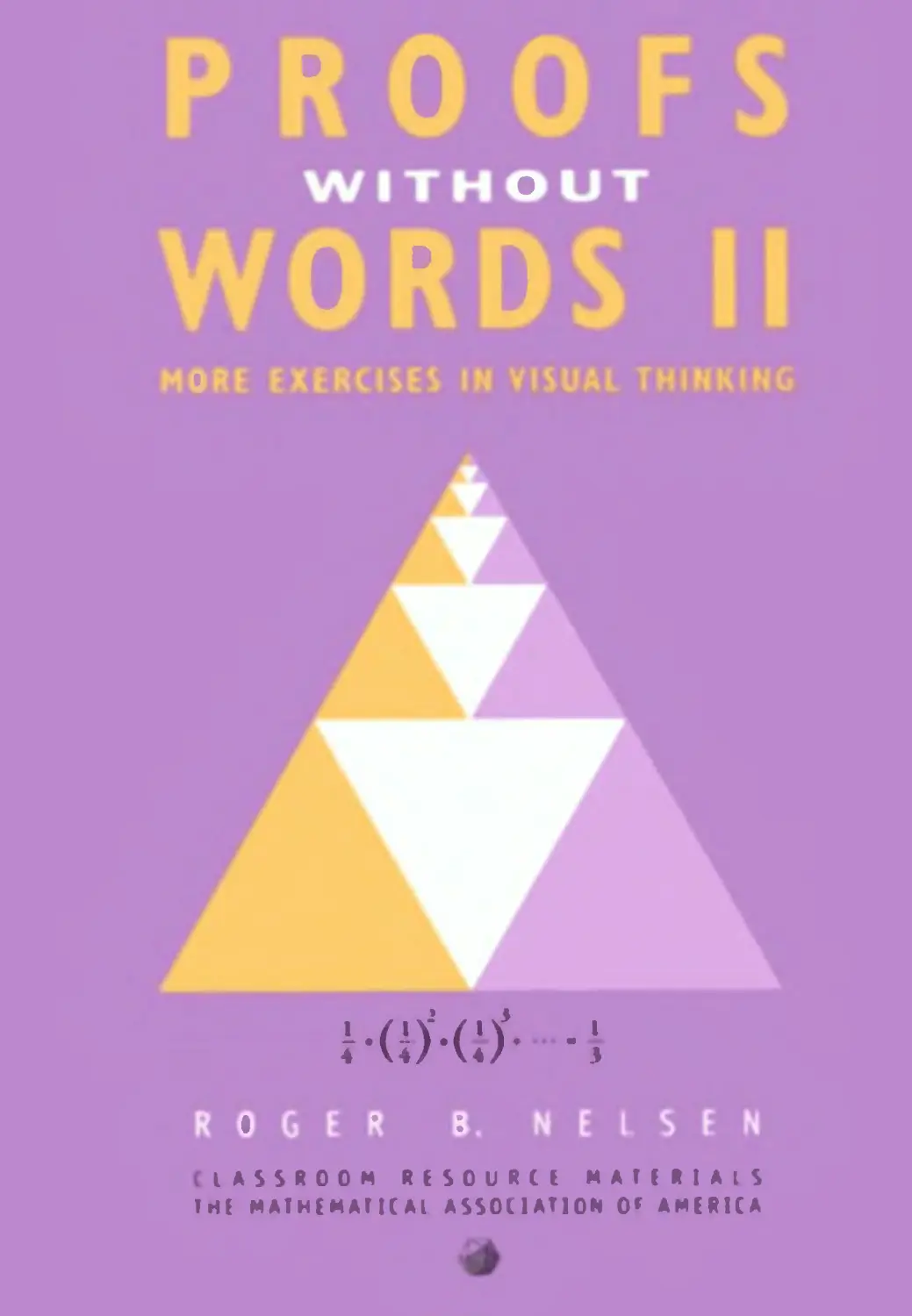
Proofs Without Words II
More Exercises in Visual Thinking

©2000 by
The Mathematical Association of America (Incorporated)
Library of Congress Catalog Card Number 00-108051
ISBN 0-88385-721-9
Printed in the United States of America
Current printing (last digit):
10 98765432

Classroom Resource Materials
Proofs Without Words II
More Exercises in Visual Thinking
Roger B. Nelsen
Lewis & Clark College
Published and Distributed by
The Mathematical Association of America

CLASSROOM RESOURCE MATERIALS
This series provides supplementary material for students and their teachers—laboratory
exercises, projects, historical information, textbooks with unusual approaches for
presenting mathematical ideas, career information, and much more.
Committee on Publications
William Watkins, Chairman
Classroom Resource Materials Editorial Board
Andrew Sterrett, Jr., Editor
Frank A. Farris Stephen В Maurer
Julian Fleron William A. Marion
Sheldon P. Gordon Edward P. Merkes
Yvette С Hester Daniel E. Otero
Paul Knopp Bruce P. Palka
Millianne Lehmann Barbara J. Pence
101 Careers in Mathematics, edited by Andrew Sterrett
Archimedes: What Did He Do Besides Cry Eureka?, Sherman Stein
Calculus Mysteries and Thrillers, R. Grant Woods
Combinatorics: A Problem Oriented Approach, Daniel A. Marcus
A Course in Mathematical Modeling, Douglas Mooney and Randall Swift
Cryptological Mathematics, Robert Edward Lewand
Elementary Mathematical Models, Dan Kalman
Geometry From Africa: Mathematical and Educational Explorations, Paulus Gerdes
interdisciplinary Lively Application Projects, edited by Chris Arney
Laboratory Experiences in Group Theory, Ellen Maycock Parker
Learn from the Masters, Frank Swetz, John Fauvel, Otto Bekken, Bengt Johansson, and
Victor Katz
Mathematical Modeling in the Environment, Charles Hadlock
A Primer of Abstract Mathematics, Robert B. Ash
Proofs Without Words, Roger B. Nelsen
Proofs Without Words II, Roger B. Nelsen
A Radical Approach to Real Analysis, David M. Bressoud
She Does Math!, edited by Maria Parker
MAA Service Center
P.O. Box 91112
Washington, DC 20090-1112
1-800-331-1MAA FAX: 1-301-206-9789

This book is dedicated to the memory of my parents,
Ann Bain Nelsen and Howard Ernest Nelsen.

page intentionally left blank

Contents
Introduction ix
Geometry & Algebra 1
Trigonometry, Calculus & Analytic Geometry 37
Inequalities 69
Integer Sums 81
Infinite Series, Linear Algebra, & Other Topics 109
Sources 125
Index of Names
129

page intentionally left blank

Introduction
Proofs really aren't there to convince you that
something is true—they're there to show you why
it is true.
—Andrew Gleason
A good proof is one that makes us wiser.
—Yu. I. Manin
Much research for new proofs of theorems already
correctly established is undertaken simply because
the existing proofs have no aesthetic appeal. There
are mathematical demonstrations that are merely
convincing; to use a phrase of the famous
mathematical physicist, Lord Rayleigh, they "command
assent/7 There are other proofs "which woo and
charm the intellect. They evoke delight and an
overpowering desire to say, Amen, Amen." An
elegantly executed proof is a poem in all but the form
in which it is written.
—Morris Kline
What are "proofs without words?" As you will see from this
second collection, the question does not have a simple, concise answer
(the first collection, Proofs Without Words: Exercises in Visual
Thinking, was published by the Mathematical Association of America in
1993). Generally, proofs without words (PWWs) are pictures or
diagrams that help the reader see why a particular mathematical
statement may be true, and also to see how one might begin to go about
proving it true. In some, an equation or two may appear in order to
guide the observer in this process. The emphasis is, however, clearly
on providing visual clues to the observer to stimulate mathematical
thought.
Proofs without words are regular features in the journals published
by the Mathematical Association of America. PWWs began to appear in
Mathematics Magazine about 1975, and in The College Mathematics
Journal about ten year later. But proofs without words are not recent
innovations—they have been around for a very long time. In this vol-

χ
Proofs without Words II
ume you find modern renditions of PWWs from ancient China, tenth
century Arabia, and Renaissance Italy. Proofs without words also now
appear in journals published by other organizations in the U.S. and
abroad, and on the World Wide Web.
Of course, some argue that PWWs are not really "proofs" (nor, for
that matter, are they "without words/' on account of equations which
often accompany a PWW). In his recent book Philosophy of
Mathematics: An Introduction to the World of Proofs and Pictures (Routledge,
London, 1999), James Robert Brown notes:
"Mathematicians, like the rest of us, cherish clever
ideas; in particular they delight in an ingenious
picture. But this appreciation does not overwhelm a
prevailing skepticism. After all, a diagram is—at
best—just a special case and so can't establish a
general theorem. Even worse, it can be downright
misleading. Though not universal, the prevailing
attitude is that pictures are really no more than
heuristic devices; they are psychologically suggestive and
pedagogically important—but they prove nothing. I
want to oppose this view and to make a case for
pictures having a legitimate role to play as evidence
and justification—a role well beyond the heuristic.
In short, pictures can prove theorems."
In my introduction to the first collection of PWWs, I suggested that
teachers might want to share the PWWs with their students. Several
readers of the first collection responded to my request for information
about ways in which PWWs are being used in the classroom.
Respondents commented on using PWWs with classes at all levels—
precalculus courses in high school, college courses in calculus, number
theory, and combinatorics, and pre-service and in-service classes for
teachers. PWWs appear to be used frequently to supplement or even
replace "textbook" proofs, for example, for the Pythagorean theorem or
the formulas for sums of integers, squares, and cubes. Other uses range
from regular assignments, extra-credit problems, in-class presentations
by students, and even term papers and projects.
I should note that this collection, like the first, is necessarily
incomplete. It does not include all PWWs which have appeared in print
since the first collection was published in 1993, nor all of those which I
overlooked in compiling the first book. As readers of the Association's

Introduction
xi
journals are well aware, new PWWs appear in print rather frequently,
and they also appear now on the World Wide Web in formats superior
to print, involving motion and viewer interaction.
I hope that the readers of this collection will find enjoyment in
discovering or rediscovering some elegant visual demonstrations of
certain mathematical ideas; that teachers will share them with their
students; and that all will find stimulation and encouragement to create
new proofs without words.
Acknowledgment. I would like to express my appreciation and
gratitude to all those individuals who have contributed proofs without
words to the mathematical literature; see the Index of Names on pp.
127-128. Without them this collection simply would not exist. Thanks
to Andy Sterrett and the members of the editorial board of Classroom
Resource Materials for their careful reading of an earlier draft of the
book, and for their many helpful suggestions. I would also like to
thank Elaine Pedreira, Beverly Ruedi, and Don Albers of the MAA's
publication staff for their encouragement, expertise, and hard work in
preparing this book for publication.
Roger B. Nelsen
Lewis & Clark College
Portland, Oregon
Notes
1. The illustrations in this collection were redrawn to create a
uniform appearance. In a few instances titles were changed, and shading
or symbols were added or deleted for clarity. Any errors resulting from
that process are entirely my responsibility.
2. Roman numerals are used in the titles of some PWWs to
distinguish multiple PWWs of the same theorem—and the numbering is
carried over from Proofs Without Words. So, for example, since there
are six PWWs of the Pythagorean Theorem in Proofs Without Words,
the first in this collection carries the title "The Pythagorean Theorem
VII."

xii
Proofs without Words II
3. Several PWWs in this collection are presented in the form of
"solutions" to problems from mathematics contests such as the
William Lowell Putnam Mathematical Competition and the Canadian
Mathematical Olympiad. It is quite doubtful that such "solutions"
would have garnered many points in those contests, as contestants are
advised in, for example, the Putnam Competition that "all the
necessary steps of a proof must be shown clearly to obtain full credit/'
4. The three quotations at the beginning of the Introduction are
from Out of the Mouths of Mathematicians by Rosemary Schmalz,
(Mathematical Association of America, Washington, 1993), pp. 75, 62,
and 135-136.

Geometry & Algebra
The Pythagorean Theorem VII 3
The Pythagorean Theorem VIII 4
The Pythagorean Theorem IX 5
The Pythagorean Theorem X 6
The Pythagorean Theorem XI 7
The Pythagorean Theorem XII 8
A Generalization from Pythagoras 9
A Theorem of Hippocrates of Chios 10
The Area of a Right Triangle with Acute Angle π/12 11
A Right Triangle Inequality 12
The Inradius of a Right Triangle 13
The Product of the Perimeter of a Triangle and
Its Inradius is Twice the Area of the Triangle 14
Four Triangles with Equal Area 15
The Triangle of Medians Has Three-Fourths the Area
of the Original Triangle 16
Heptasection of a Triangle 17
A Golden Section Problem from the Monthly 18
Tiling with Squares and Parallelograms 19
The Area of a Quadrilateral I 20
The Area of a Quadrilateral II 21
A Square Within a Square 22

2
Proofs without Words II
Areas and Perimeters of Regular Polygons 23
The Area of a Putnam Octagon 24
A Putnam Dodecagon 25
The Area of a Regular Dodecagon 26
Fair Allocation of a Pizza 27
A Three-Circle Theorem 28
A Constant Chord 29
A Putnam Area Problem 30
The Area Under a Polygonal Arch 31
The Length of a Polygonal Arch 32
The Volume of a Frustum of a Square Pyramid 33
The Product of Four (Positive) Numbers in Arithmetic
Progression is Always the Difference of Two Squares 34
Algebraic Areas III 35

Geometry & Algebra
The Pythagorean Theorem VII
—Annairizi of Arabia (circa a.d. 900)

4 Proofs without Words II
The Pythagorean Theorem VIII
—Liu Hui (3 century a.d.)

Geometry & Algebra
The Pythagorean Theorem IX
—Leonardo da Vinci (1452-1519)

6 Proofs without Words II
The Pythagorean Theorem X
—J. E. Bottcher

Geometry & Algebra
The Pythagorean Theorem XI
be
—Frank Burk

8
Proofs without Words II
The Pythagorean Theorem XII
n2 ,u2 Л
a + и —с
—Poo-sung Park

Geometry & Algebra
A Generalization from Pythagoras
The sum of the area of two squares, whose sides are the
lengths of the two diagonals of a parallelogram, is equal to the
sum of the areas of four squares, whose sides are its four sides.
A, /\ AL· M,
COROLLARY: The Pythagorean Theorem (when the parallelogram is a
rectangle).
—David S. Wise

10
Proofs without Words II
A Theorem of Hippocrates of Chios (circa в.с. 440)
The combined area of the limes constructed on the legs of a
given right triangle is equal to the area of the triangle.
Ai+A2= A3
(L1+S1) + (L2+S2) = T + S1+S2
1г+12=Т
—Eugene A. Margerum
and Michael M. McDonnell

Geometry & Algebra
11
The Area of a Right Triangle
with Acute Angle π/12
1 2
The area of a right triangle is -(hypotenuse) if and only if one
8
acute angle is π/12.
c/4
—Klara Pinter

12
Proofs without Words II
A Right Triangle Inequality
(Problem 3, The Canadian Mathematical Olympiad, 1969)
Let с be the length of the hypotenuse of a right triangle whose
other two sides have lengths a and b. Prove that
a + b<c^f2.
When does equality hold?
SOLUTION:
b \
:V2
a /
Ό Ό
a + b<cV2 a + b = cV2 <=>a = b

Geometry & Algebra
13
The Inradius of a Right Triangle
I. r =
II. r =
ab
a + b + c
a + b-c
I. ab = r(a + b + c)
-+ a »~* b
II. c = a + b-2r
—Liu Hui (3rd century a.d.)
a-r
r b-r

14
Proofs without Words II
The Product of the Perimeter of a Triangle and
Its Inradius is Twice the Area of the Triangle
NOTE: Regions bearing the same number are equal in area.
—Grace Lin
Π.
As
IK

Geometry & Algebra 15
Four Triangles with Equal Area
%fr>^
—Steven L. Snover

16
Proofs without Words II
The Triangle of Medians Has Three-Fourths the
Area of the Original Triangle
a
area(Awzawz^wzc) = -агеа(АяЬс)
—Norbert Hungerbiihler

Geometry & Algebra 17
Heptasection of a Triangle
If the one-third points on each side of a triangle are joined to
opposite vertices, the resulting central triangle is equal in area
to one-seventh that of the initial triangle.
—William Johnston
and Joe Kennedy

18
Proofs without Words II
A Golden Section Problem from the Monthly
(Problem E3007, American Mathematical Monthly, 1983, p. 482)
Let A and В be the midpoints of the sides EF and ED of an
equilateral triangle DEF. Extend AB to meet the circumcircle
(of DEF) at C. Show that В divides AC according to the golden
section.
—Jan van de Craats

Geometry & Algebra
19
Tiling with Squares and Parallelograms
If squares are constructed externally on the sides of a
parallelogram, their centers form a square.
—Alfinio Flores

20
Proofs without Words II
The Area of a Quadrilateral I
The area of a quadrilateral is less than or equal to half the
product of the lengths of its diagonals, with equality if and only
if the diagonals are perpendicular.
I. Convex quadrilaterals
В
D
II. Concave quadrilaterals
В
Area =-AC (h + k)
<-ACBD
2
Aiea = -AC(h-k)
<-AC-BD
2
—David B. Sher, Ronald Skurnick,
and Dean C. Nataro

Geometry & Algebra 21
The Area of a Quadrilateral II
The area of a quadrilateral Q is equal to one-half the area of a
parallelogram Ρ whose sides are parallel to and equal in length
to the diagonals of Q.
I. C
Q:
Π.ι
Q:
P:
area(Q) = — area(P)

22 Proofs without Words II
A Square Within a Square
If lines from the vertices of a square are drawn to the
midpoints of adjacent sides (as shown in the figure), then the area
of the smaller square so produced is one-fifth that of the given
square.

Geometry & Algebra 23
Areas and Perimeters of Regular Polygons
The area of a regular 2n-gon inscribed in a circle is equal to
one-half the radius of the circle times the perimeter of a
regular я-gon similarly inscribed (n > 3).
1 11
—агеа(Рои) = — · r · —s„
2n 2и 2 2 й
.•.area(P2n)=^"sM
7*
= — perimeter (Pn)
COROLLARY [Bhaskara, Litavati (India, 12th century A.D.)]: The area of a
circle is equal to one-half the product of its radius and circumference.

24
Proofs without Words II
The Area of a Putnam Octagon
(Problem Bl, 39th Annual William Lowell Putnam Mathematical
Competition, 1978)
Find the area of a convex octagon that is inscribed in a circle
and has four consecutive sides of length 3 units and the
remaining four sides of length 2 units. Give the answer in the form
r + s-sft with r, s, and t positive integers.
SOLUTION:
л/2 3 л/2
Λ = (3 + 2λ/2)2-4·1(λ/2)2
= 13 + 12л/2

Geometry & Algebra 25
A Putnam Dodecagon
(Problem 1-1, 24th Annual William Lowell Putnam Mathematical
Competition, 1963)
(i) Show that a regular hexagon, six squares, and six
equilateral triangles can be assembled without overlapping to form a
regular dodecagon.
(ii) Let P\, ?2, ..·, P\2 be the successive vertices of a regular
dodecagon. Discuss the intersection(s) of the three diagonals
P1P9,P2Pn, and P±P12.
SOLUTION:
ΔΡλΡλ2Ρ± = ZPl2PxP9 = ;r/4, P8
Ζ.ΡλΡ2Ρη = ZP12PUP2 = я/6,
л ΡχΡ9 η Р2Рц η Р±Р12 * 0.
EXERCISE: Discuss the intersection(s) of the four diagonals Р\Р(>, #2^9'
РъРп, and P4Pn (Problem F-4(b), The AMATYC Review, 1985, p. 61).

26
Proofs without Words II
The Area of a Regular Dodecagon
A regular dodecagon with circumradius one has area three.
—J. Kurschak

Geometry & Algebra 27
Fair Allocation of a Pizza
THE PIZZA THEOREM: If a pizza is divided into eight slices by
making cuts at 45° angles from an arbitrary point in the pizza,
then the sums of the areas of alternate slices are equal.
PROOF:
NOTES: This result, discovered by L. J. Upton, is true when n, the number of pieces, is 8,
12,16,..., but false for η = 2,4,6,10,14,18,.... The positive results are in the references.
For the negative, the case η = 4 is easily handled, while if n = 2 (mod 4) we have the
following argument of Don Coppersmith (IBM). It suffices, by continuity, to take the
special point on the boundary of the unit circle and one of the chords to be a tangent a t
the point. Then the gray area can be expressed in terms of π and algebraic numbers in
such a way that its equality with π/2 would yield an algebraic relationship for π, in
contradiction to lis transcendence (details omitted).
REFERENCES
1. L. J. Upton, Problem 660, Mathematics Magazine 41 (1968) 46.
2. S. Rabinowitz, Problem 1325, Crux Mathematicorum 15 (1989) 120-
122.
—Larry Carter and Stan Wagon

28
Proofs without Words II
A Three-Circle Theorem
Given three nonintersecting mutually external circles, connect
the intersection of internal common tangents of each pair of
circles with the center of the other circle. Then the resulting
three line segments are concurrent.
DB EC FA
(via Ceva's theorem)
—R. S. Hu

Geometry & Algebra
29
A Constant Chord
Suppose two circles Q and R intersect in A and B. A point Ρ on
the arc of Q which lies outside R is projected through A and В
to determine chord CD of R. Prove that no matter where Ρ is
chosen on its arc, the length of the chord CD is always the
same.
D
ZCAC = ZP'AP = ZP'BP = ZD'BD
CC = DT>, CD' = CD
CD' = CD

30
Proofs without Words II
A Putnam Area Problem
(Problem A2, 59th Annual William Lowell Putnam Mathematical
Competition, 1998)
Let s be any arc of the unit circle lying entirely in the first
quadrant. Let A be the area of the region lying below s and
above the x-axis, and let В be the area of the region lying to the
right of the y-axis and to the left of s. Prove that A + В depends
only on the arc length, and not the position, of s.
SOLUTION:

Geometry & Algebra
31
The Area Under a Polygonal Arch
The area under the polygonal arch generated by one vertex of
a regular я-gon rolling along a straight line is three times the
area of the polygon.
COROLLARY: The area under one arch of a cycloid is three times the area
of the generating circle.
—Philip R. Mallinson

32
Proofs without Words II
The Length of a Polygonal Arch
The length of the polygonal arch generated by one vertex of a
regular и-gon rolling along a straight line is four times the
length of the inradius plus four times the length of the circum-
radius of the и-gon.
COROLLARY: The arc length of one arch of a cycloid is eight times the
radius of the generating circle.
— Philip R. Mallinson

Geometry & Algebra
33
The Volume of a Frustum of a Square Pyramid
P4=3P5
Pi +P3 = 2P2 + 4P4 => Рг + Р2 + P3 = 3P2 +12P5
= 3(P2+4P5) = 3P
h
V = ?-(a2+ab + b2)
—Sidney J. Kung

34
Proofs without Words II
The Product of Four (Positive) Numbers in
Arithmetic Progression is Always the
Difference of Two Squares
d2 d2
+
<3
+
"a
3
cs
(a + d)(a + 2d) = a(a + 3d) + 2d2
a2 + 3ad + d2
a(a + d)(a + 2d)(a + 3d) = (a2 + 3ad + d2 )2 - (d2 )2
—RBN

Geometry & Algebra
35
Algebraic Areas III:
Factoring the Sum of Two Squares
χ + у = (* + <sj2xy + y)(x - sjlxy + y)
x+y
x+y
~*--j2x~y-

page intentionally left blank

Trigonometry, Calculus, & Analytic Geometry
Sine of the Sum II 39
Sine of the Sum III 40
Cosine of the Sum 41
Geometry of Addition Formulas 42
Geometry of Subtraction Formulas 43
The Difference Identity for Tangents I 44
The Difference Identity for Tangents II 45
One Figure, Six Identities 46
The Double Angle Formulas II 48
The Double Angle Formulas III 49
The Sum-to-Product Identities I 50
The Sum-to-Product Identities II 51
The Difference-to Product Identities I 52
The Difference-to Product Identities II 53
Adding Like Sines 54
A Complex Approach to the Laws of Sines and Cosines 55
Eisenstein's Duplication Formula 56
A Familiar Limit for e 57
A Common Limit 58
Geometric Evaluation of a Limit 59
The Derivative of the Inverse Sine 60
The Logarithm of a Product 61

38
Proofs without Words II
An Integral of a Sum of Reciprocal Powers 62
The Arctangent Integral 63
The Method of Last Resort 64
The Trapezoidal Rule 65
Construction of a Hyperbola 66
The Focus and Directrix of an Ellipse 67

Trigonometry, Calculus, & Analytic Geometry
39
Sine of the Sum II
α,β ε (Ο,π/2) => у = acosa = bcosfi
1 11
—absin(a + /?)= — aysina + — by sinfi
1 1
= — abcosj3sina + — feacosasinjS
л sin(a + β) = sin α cos β + cos α sin β
—Christopher Brueningsen

40
Proofs without Words II
Sine of the Sum III
sin(a + β) = siimcos/i + sin jScosa
II.
cos/ϊ cosa
.S
5Q.
.s
—Volker Priebe
and Edgar A. Ramos

Trigonometry, Calculus, & Analytic Geometry
41
Cosine of the Sum
π/2-(α+β)
bcosa = asinfi
—ab sinl
2
^-(cc + β)
1 1
= — bcosaacosB—asin/ibsina
2 2
.·. cos(a + β) = cos a cos β - sin a sin β
—Sidney H. Kung

42
Proofs without Words II
Geometry of Addition Formulas
sina =
sin β cos a
sin α
sin(a + β) = sin a cos β + cos a sin β
sin(a + β)
sin α
cos α
cosjS
cos(a + β) = cos α cos β - sin α sin β
cos(a+/3)
sin α
sin/i
cos(a+/j)
sin α
—Leonard M. Smiley

Trigonometry, Calculus, & Analytic Geometry
43
Geometry of Subtraction Formulas
hsinβ
h =
cos a
cos β
χ = hsin(a - β)
χ = (since - hsmβ)cosa
sin(a - β) = sin a cos β - cos a sin β
since-hsi^
h =
cos a
sinjS
x = hcos(a- β)
χ = (sin α - /icos j3)cosa
cos(a - β) = cos a cos β + sin a sin β
—Leonard M. Smiley

44
Proofs without Words II
The Difference Identity for Tangents I
α-β
a
J
a
jd
tana-tanjS
D
a
tan0
В
tana tan/J
BF = AD
BE~ DE'
L , 0. DE AD tana-tanj8
tania - β) = — = = £-.
v ' BE BF 1 + tanatanjS
—Guanshen Ren

Trigonometry, Calculus, & Analytic Geometry
45
The Difference Identity for Tangents II
tan(a- $)tanj8tana
tan(a-/j)
10(0,0)
A(1,0)
AC-AB=BD+DC
tan a - tan β = tan(a - β) + tan a tan β tan(a - β)
tana- tan β
tan(a-0) =
1+tanatanp
—Fukuzo Suzuki

46
Proofs without Words II
One Figure, Six Identities
The figure
sin(a + β) = sin α cos β + cos a sin β
cos(a + β) - cos a cos β - sin a sin β
sinasinff
cosacosjS
cosasin/?
sin(a - β) = sin a cos /3 - cos α sin β
cos(a - β) = cosacos/3 + sinasin/3
sinacos/J

Trigonometry, Calculus, & Analytic Geometry
47
tanatanff
t / o4 tana + tan β
tania + β) = t--
v ' l-tanatan/3
tan0
, / oN tana-tan θ
tania - β) = £-
v ' l + tanatan0
tana
—RBN

48
Proofs without Words II
The Double-Angle Formulas II
2sin0
zcostr
2sin0cos0 = sin20
О
и
2cost/
l+cos20
2cosz0 = l + cos20
—Yihnan David Gau

Trigonometry, Calculus/ & Analytic Geometry
49
The Double-Angle Formulas III
(via the Laws of Sines and Cosines)
sin θ
sin0
sin20^sin(7r/2-fl)^
2sin0 1
sin20 = 2sin0cos0
= COS0
\2_·,2 , ,2
(2sin0)z = Γ + Γ - 2 · 1 · 1 ·cos20
cos20 = l-2sin20
—Sidney H. Kung

50
Proofs without Words II
The Sum-to-Product Identities I
(cos casino)
Π
(i,s)
a
β
α
.(cos^sinjS)
II
-ι
_α~β .._α + β
2 ' Y 2
sina + sinj8 α-β . α + β
— = s = cos —sin —
cosa + cosjS , α-β α + β
— = ί = cos —cos —
—Sidney H. Kung

Trigonometry, Calculus, & Analytic Geometry
51
The Sum-to-Product Identities II
cosjS
cos a
n „ α-β α+β
cosa + cosp = 2cos —cos —
2 2
. Ω η α-β . α + β
sina + sinp = 2cos —sin
η 2 2
—Yukio Kobayashi

52
Proofs without Words II
The Difference-to-Product Identities I
-1
(cosa,sma)
/ V
Π
h\
i
xL
o'
ι
2sta^\
2
и / ^^**
_/a /
1 Y/\\P
mmma^\icosfi,smp}
Г
1
α-Ι α+l
2 r 2
• о г, . α-β cc + β
sina - sin ρ = ν = 2sin —cos —
2 2
α . α-β . α+β
cos ρ - coscc = u = 2sin —sin —
2 2
— Sidney H. Kung

Trigonometry/ Calculus, & Analytic Geometry
53
The Difference-to-Product Identities II
α + β
/ ' ^
/ *
ί><Ί>
/α-β у
гу
s
χ ^^
α■^^^
\ cos α
*
•
•
1
sin
^ --~Λ
cosjS
„ „ . α-β . α + β
cosp-cosa = 2sin sin
2 2
•1-Η
. „ ^ . α-β α + β
sina-sinp = 2sin —cos
2 2
— Yukio Kobayashi

54
Proofs without Words II
Adding Like Sines
Яф = ^A2 +B2 + 2ABcos0, tan0 =
Bsin0
A + Bcos0
Asinx + Bsin(x + ф) = Яф sin(x + θ)
φ = — => tan0 = —
ψ 2 Α
.·. A sin χ + Β cos χ = VA2 + Β2 sin(x + θ)
—Rick Mabry
and Paul Deiermann

Trigonometry, Calculus, & Analytic Geometry 55
A Complex Approach to the Laws of Sines
and Cosines
с - Ъеш +ае г* = (bcosa + acosfi) + i(bsina -asinfi)
с real => bsina - asinfi = 0 => = -
sin α sin ρ
с И = (bcosa + acos/f) H-(bsina-asin^)
= a2 + b2 + 2abcos(a + β)
= a2+b2-2abcosY
—William V. Grounds

56
Proofs without Words II
Eisenstein's Duplication Formula
(G. Eisenstein, Mathematische Werke, Chelsea, New York, 1975, p. 411)
2csc20 = tan0 + cot0
—Lin Tan

Trigonometry, Calculus, & Analytic Geometry
57
A Familiar Limit for e
lY
lim 1 + -
= e
l η
η и + 1
<Ы
Ί+Ι]
η
— <n.lnfl + -l<l
η +1 V л у
lim ln|
Ί+- =i
ν n)

58
Proofs without Words II
A Common Limit
lim—= 0
it
y=l/x
x+1
lnx < — χ
2
χ 1
lim — = lim ,— = 0
X X—a\X
—Alan Η. Stein
and Dennis McGavran

Trigonometry, Calculus, & Analytic Geometry
59
Geometric Evaluation of a Limit
2 + л/2 + л/2+7г =2
V2+V2 + V2
л/2 + л/2
2 + V2 Μ
2 + V2 + V2
—Guanshen Ren

60
Proofs without Words II
The Derivative of the Inverse Sine
=4ϊ~-χ2
L = sin
Jo Vi^
d . _i 1
-—sin x= ι
dx ^_χ2
dt
—Craig Johnson

Trigonometry, Calculus, & Analytic Geometry 61
The Logarithm of a Product
hiab = ]na + ]nb
* .xy=l x=by k ,xy=l x=by
I
lb ab ' 1 b ab
AreaO = AreaO
—Jeffrey Ely

62
Proofs without Words II
An Integral of a Sum of Reciprocal Powers
Ψ
1
—Peter R. Newbury

Trigonometry, Calculus, & Analytic Geometry 63
The Arctangent Integral
cx ι
L JC = I
J0l + i
У
t
0
χ χ
arctamc = I jdt
1
y~2(l + i2)
t2+(y + l)2=l
Ό) = Area(AOPQ) = Ц-Δί
-1 ГП л.„/^-.л»^_ л_„/л^ооч_1._1
2 1 + ί/
•χ ι
-Λ
2(1+ ίζ)
ΓΟ Area( OABEF) = Area(AORS) = Γ Δ/
—arctanx = =-
2 Jo2(l + i2>
—Aage Bondesen

64
Proofs without Words II
The Method of Last Resort
(Weierstrass Substitution)
\^ei2
л/l + u^^
В
и
/θ
l/
COS0
φ
Γ
£
θ/\\
Ι-cosfl \]
Ο
D
θ — „ . θ 2μ
u = tan—, D£ = 2sin— = ,
2 2 ,/ί^?
=· = ■=■ => sin0 =
СЕ
Ш~
CD
DE
OA
~BA
OB
BA
2u
1 + u2
= ■== => COS0 =
1-й2
1 + u2
—Paul Deiermann

Trigonometry, Calculus, & Analytic Geometry
65
The Trapezoidal Rule
(for Increasing Functions)
у
A
/<*»)
f(*o)
У=/(*)
a = x0 xx
Xn-l xn=b
ff(x)dx = Ϋ/(*/£ρ + \\f{xn) -ЯЧ)]^Г
i=0
—Jesus Urias

66 Proofs without Words II
Construction of a Hyperbola
I.
—Ernest J. Eckert

Trigonometry, Calculus, & Analytic Geometry
67
The Focus and Directrix of an Ellipse
у
k
—Michel Bataille

Inequalities
The Arithmetic Mean-Geometric Mean Inequality IV 71
The Arithmetic Mean-Geometric Mean Inequality V 72
The Arithmetic Mean-Geometric Mean Inequality VI 73
The Arithmetic Mean-Geometric Mean Inequality for
Three Positive Numbers 74
The Arithmetic-Geometric-Harmonic Mean Inequality 75
The Arithmetic-Logarithmic-Geometric Mean Inequality 76
The Mean of the Squares Exceeds the Square of the Mean 77
The Chebyshev Inequality for Positive Monotone Sequences 78
Jordan's Inequality 79
Young's Inequality 80

Inequalities 71
The Arithmetic Mean-Geometric Mean
Inequality IV
(й + Ь)2>4яЬ => —>jab
—Ayoub B. Ayoub

72
Proofs without Words II
The Arithmetic Mean-Geometric Mean
Inequality V
z2=xy
d<c=*x + y> 2фсу d = c = 0=* x + y = l^xy
—Sidney H. Kung

Inequalities
73
The Arithmetic Mean-Geometric Mean
Inequality VI
(1 - t)a + tb \
1пд
(1 - t)\na + flnb lnb
0 < a < b, 0 < t < 1=> (l-t)a + tb > а1чЬ*
. 1 a + b r-r
t = — =* > «Jab
2 2
—Michael K. Brozinsky

74
Proofs without Words II
The Arithmetic Mean-Geometric Mean
Inequality for Three Positive Numbers
LEMMA: ab + be + ac < a2 + b2 + c2
«2
Ш
a 1
THEOREM: ЪаЬс <а3 +b3 +c3
a b с a b с
be
ac
ab
—Claudi Alsina

Inequalities
75
The Arithmetic-Geometric-Harmonic Mean
Inequality
и л a + b^ r-r. lab
д,Ь>0=> >^ab>
a + b
т=Ш, ш=лл, ш=^-,
2 a + b
AM>GM>HM.
—Pappus of Alexandria (circa a.d. 320)

76
Proofs without Words II
The Arithmetic-Logarithmic-Geometric Mean
Inequality
, n a + b b-a Γ-Γ
b > a > 0 => > —-—-— > V ab
2 1пЬ-1пя
ι
\
a+b
\nb - \na > -(b - a)
a + b
a+b b-a
>
2 lnb-lna
У
A
^
,, . ab-a a-ab b-a
mo- ma < j= + j= = —т=
2аЫаЪ 2ЪыаЪ ЫаЪ
b-a
4ab
lnb-ΐηα
-Jab
—RBN

Inequalities
77
The Mean of the Squares Exceeds
the Square of the Mean
1Д 2^
-Σχΐ ^
пыг1
f η Λ2
~Σχΐ
ι η -л ι
V 1=1 )
Ы hi
Ν
hi
η(χϊ+Χ2+- + χϊ)>(\Χΐ\ + \χ2\ + - + \Χη\) >(Χΐ+Χ2+- + Χη)7
. Xi+X2+- + xlJxi + X2+- + xn^2
η
η
—RBN

78
Proofs without Words II
The Chebyshev Inequality for Positive
Monotone Sequences
η η η
ι=1 1=1 ,·=1
Уп
У)
Уг
У\
Г 1 Г 1
1 II
1 II
1 II
г π
\
f
"
■
π η
у/////////
J
1
^ !
III
III
III
III I
I I 1 1
χι
Xi
Xj
Xn
Xi < Xj & Уг < У) => Щ + Х)Ух ^ ХхУг + Х)У)
(х1+Х2+- + Хп)(У1+У2+-- + Уп)^п{х1У1 + Х2У2+- + ХпУп)
—RBN

Inequalities
79
Jordan's Inequality
0 < χ < — => — < sin* < #
2 π
OB = OM + MP>OA.
PBQ>PAQ>PQ
7rsinx>2jt>2sin;c
2x
— <sinx<x
π
—Feng Yuefeng

80
Proofs without Words II
Young's Inequality
(W. H. Young, "On classes of summable functions and their Fourier
series/' Proc. Royal Soc. (A), 87 (1912) 225-229)
THEOREM: Let φ and ψ be two functions, continuous, vanishing
at the origin, strictly increasing, and inverse to each other.
Then for a,b > 0 we have
ab<jQ<p(x)dx + lQy/(y)dy
with equality if and only ifb = φ{α).
PROOF:
t
у = <ρ(χ) у y = φ(χ)
χ = w(y) A x = w{y)
i
/
b > <p(a) b < φ(α)

Integer Sums
Sums of Integers III 83
Sums of Consecutive Positive Integers 84
Consecutive Sums of Consecutive Integers II 85
Sums of Squares VI 86
Sums of Squares VII 87
Sums of Squares VIII 88
Sums of Squares IX 89
Sums of Odd Squares 90
Sums of Sums of Squares 91
Pythagorean Runs 92
Sums of Cubes VII 93
Sums of Integers as Sums of Cubes 94
The Square of Any Odd Number is the Difference
Between Two Triangular Numbers 95
Triangular Numbers Mod 3 96
Sums of Triangular Numbers IV: Counting Cannonballs 97
Alternating Sums of Triangular Numbers 98
The Sum of the Squares of Consecutive Triangular
Numbers is Triangular 99
Recursion for Triangular Numbers 100
Identities for Triangular Numbers II 101
Identities for Triangular Numbers III 102

82
Proofs without Words II
Identities for Pentagonal Numbers 103
Sums of Octagonal Numbers 104
Sums of Products of Consecutive Integers I 105
Sums of Products of Consecutive Integers II 106
Fibonacci Identities 107
Sums of Powers of Three 108

Integer Sums 83
Sums of Integers III
1 + 2 + --- + л = -(и2 + я]
—S. J. Farlow

84
Proofs without Words II
Sums of Consecutive Positive Integers
Every integer N > 1, not a power of two, can be expressed as
the sum of two or more consecutive positive integers.
N = 2"(2fc + 1) (n>0,k>l),
m = min{2"+1,2A: + l},
M = max{2n+1,2fc + l},
2N = mM.
M+m-1
►
2
m
— Μ ►
N JM-m + iy ГМ-т + 1Л _fM + m-l\
References
1. P. Ross, Problem 1358, Mathematics Magazine 63 (1990), 350.
2. J. V. Wales, Jr., Solution to Problem 1358, Mathematics Magazine 64
(1991), 351.
M-m+1
. L. Frenzen

Integer Sums 85
Consecutive Sums of Consecutive Integers II
Tk =l + 2 + --- + k
16 + 17 + 18 + 19 + 20 = 21 + 22 + 23 + 24
= 9T4
n2 + (n2 +1) + · · · + (η2 + η) = (η2 + η +1) + · · · + (η2 + 2ή)
= (2n + l)Tn

86
Proofs without Words II
Sums of Squares VI
A
A
/ / /
l2+22+- + n2
1 2
-n -n +
3
-n(n + l)(2n + l).
6
n(n + l) 1
4,i
12
—I. A. Sakmar

Integer Sums 87
Sums of Squares VII
η
Σ*2 =
2 n(n + l)(2n +1)
*=i 6
6Xfc2=n(n + l)(2n + l)
—Nanny Wermuth
and Hans-Jurgen Schuh

88
Proofs without Words II
Sums of Squares VIII
k=\
3(ΐ2 + 22+··· + η2) = (2η + 1)(1 + 2 + ··· + π)
3 2

Integer Sums
89
Sums of Squares IX (via Centroids)
η -+
и-1
У
2
1
• Φ Φ
У
Φ φ φ
φ φ φ φ
φ φ
φ φ
φ φ φ
ί.
(φ =1)
_ Λ 2. ,. 1·1 + 2·2 + ··· + η·η
V = 1 + -(π -1) =
у 3 1 + 2 + -+ η
12 + 22+··· + η2 = η(η + 1)·-(2η + 1) = -η(η + 1)(2η + 1)
2 3 6
—Sidney Η. Kung

90
Proofs without Words II
Sums of Odd Squares
-.2 „2 /^ ^2 n(2n - l)(2n +1)
lz +3Z +··· + (2η-1)ζ =— - -
l2
32
(2и-1)2
3χ[ΐ2+32+··· + (2η-1)2] = [1 + 2 + ··· + (2η-1)]χ(2η + 1)
_(2и-1)(2и)(2и + 1)
ι
к
= π(2η-1)(2π + 1)
—RBN

Integer Sums
91
Sums of Sums of Squares
n k 2 \{η + ΐΥη + 2\
ΣΣ''2 =
k=l i=l
V 2 j
V 2 j
1 + 2 + -+ η
+
+
+
3(l2) + 3(l2+22) + 3(l2+22+32) + - + 3(l2+22+- +
>)+...+з(з
»)-Ub
. G. Wastun

92
Proofs without Words II
Pythagorean Runs
32+42=52
102+112+122=132+142
212 + 222 + 232 + 242 = 252 + 262 + 272
Τη = 1 + 2 + .·. + η=>(4Τ„-η)2 + ··. + (4Τ„)2=(4Τη+1)2+... + (4Τ„+η)2
e.g., и = 3:
4T3 = 4(1 + 2 + 3)
tl
24
23
25
22
26
f
21
27
—Michael Boardman

Integer Sums
93
Sums of Cubes VII
3 + 5
7 + 9 + 11
13+23+...+n3 = 1+3+5+...+2n(n±i)_1 =
n(n + l)
-a
—Alfinio Flores

94
Proofs without Words II
Sums of Integers as Sums of Cubes
2+3+4=1+8
5+6+7+8+9=8+27
10 + 11 + 12 + 13 + 14 + 15 + 16 = 27 + 64
(n2+l) + (n2+2) + - + (n + l)2
и3+(и + 1)3

Integer Sums 95
The Square of Any Odd Number is the
Difference Between Two Triangular Numbers
l + 2 + - + k = Tk=*(2n + l)2 =T3n+1-Tn
CM
2и + 1
О
oo
ooo
oooo
CO
—RBN

96
Proofs without Words II
Triangular Numbers Mod 3
tn =1 + 2 + ··· + η
[tn = lmod3, η = lmod3
in=0mod3, n#lmod3
О
w KJ
о о с
о о о
О
LJ ^
K-J K.J
О О ι
о о о
*3*+1 =! +
")
о
о о о о о
о о о о
о о
• · · · о о о
Ьк = 3(*2* '
о о о
1 О О О
г "]
' ') с Ч'
о
I) О
18! ·
;)
О
э о
о о
: о о
о о о
3(^+1-^+1)
о с
■ о
• · · ·
о о
о о о
о о о о
••••оооо
'••••ОООО
•••••оооо
*3к+2=3(*2к+1~*к)

Integer Sums 97
Sums of Triangular Numbers IV:
Counting Cannonballs
η η
k=\ k=\
'2
l(n) + 2(n-l) + 3(n-2) + - + n(l)
—^Deanna B. Hannsperger
and Stephen F. Kennedy

98
Proofs without Words II
Alternating Sums of Triangular Numbers
2n-l
k=l
—RBN

Integer Sums
99
The Sum of the Squares of Consecutive
Triangular Numbers is Triangular
Гп=1 + 2 + ..- + л=»г2_1+Тя2=Ги2
NOTE:
This is a companion result to the more familiar Tn-\ + Tn = n2:
—RBN

100
Proofs without Words II
Recursion for Triangular Numbers
Tk=l + 2 + ... + k^Tn+1=?-^Tn
η
2·Τη + η·Τη (η + 2)·Τη
η·Τη+ι =(η + 2)·Τη=> Τη+1 = -—Τ„
η

Integer Sums 101
Identities for Triangular Numbers II
Τη=1 + 2 + ··· + η=>
—RBN

102 Proofs without Words II
Identities for Triangular Numbers III
Γ„=1 + 2 + ··· + η=>
—James O. Chilaka

Integer Sums
103
Identities for Pentagonal Numbers
Ρη=1 + 4 + 7 + ··· + (3η-2)
Tn =1 + 2 + 3 + ··· + η
18 8 18
8 IS
18
f/i = ?2n-l " Tn-\
» · О О О О
• о о о о
I О О О О
о о о о
о о о
о о
о
Рп = 2ТЗп-1

104
Proofs without Words II
Sums of Octagonal Numbers
n(n +1)
О О О
о о о
I
(N
2Ofc=l + 8 + 21 + 40 + ... + (n2 + 4T„_0 = ^^^
fc=l
—James О. Chilaka

Integer Sums
105
Sums of Products of Consecutive Integers I
η
k=l
n{n + l)(w + 2)
<N
+
n(n +1)
Тк = 1 + 2 + - + к
1·2 + 2·3 + ··· + π(π + 1) + (Τ1 + Τ2+··· + Τη) =
и(и + 1)(и + 2)
Τ1+Τ2+··· + Τη=-(ΐ·2 + 2·3 + ··· + π(η + 1))/
|(1·2 + 2.3 + - + η(η + 1))=η(η + 1)(η + 2).
—James Ο. Chilaka

106
Proofs without Words II
Sums of Products of Consecutive Integers II
η
k=l
n{n + l)(n + 2)(n + 3)
1 2
fc+1
fc+2
+
+
.(к + 1)(к + 2) .. _.fc(fc + l) ... .... ..
к- - - + (к + 2)— - = к(к + l)(fc + 2)
12 3 4
1.
2
3
сч
(n+2)(n+3)
2
и+2
1-2-3+ 2·3·4 + ·- + η(η + 1)(η + 2)
_η(η + 1) (η + 2)(η + 3) _ η(η + 1)(η + 2)(η + 3)
—James Ο. Chilaka

Integer Sums 107
Fibonacci Identities
Fi = F2=l, Fn = Fn-l + Fn-2^>
Fn Fn-\ Fn Fn-\
ги+1 rn+l
Fn+1 = 4FnFn-l + Fn-2 Fn+l ~ 2Fn + 2Fn-l ~ Fn-2
Fn-l Fn-2 Fn-l Fn-l Fn-2 Fn-\
"* Fn+l "* ** Fn+l *-
FL· = *Fll + 4Fn_1FB_2 + F„2_2 F„2+1 = 4F2 - 4Fn_1Fn_2 - 3F„12
—Alfred Brousseau

108
Proofs without Words II
Sums of Powers of Three
и-1 ,и л
k=0
—David В. Sher

Infinite Series, Linear Algebra, & Other Topics
A Geometric Series 111
An Alternating Series 112
A Generalized Geometric Series 113
Divergence of a Series 114
Galileo's Ratios 115
Sums of Harmonic Sums 116
(AB)T = BTAT, Where A and В are Matrices 117
The Distributive Property of the Triple Scalar Product 118
Cramer's Rule 119
Parametric Representation of Primitive Pythagorean Triples 120
On Perfect Numbers 121
Self-Complementary Graphs 122
Tiling with Trominoes 123

page intentionally left blank

Infinite Series, Linear Algebra, & Other Topics
111
A Geometric Series
l
—+
4
ΠΛ2 fV^
- +
V
- +..· = -
—Rick Mabry

112
Proofs without Words II
An Alternating Series
λ-λ !_J_ J__J_ =I
2 4 + 8 16 + 32 64+"'~3
Ax
A2
i
1
*3
4
_1
2
1_1
2 4
1-1
2 4
ι ι ■ ι Ί
8 16 ΓΤΤ±
| 16 32
1-1
4 8
1_1
4 8
1 — —
1 1 1 16 ~ 32 _ J
8~i6! L-^l
■ ■ . 1
2-
2
2-
4
1
8
1_2 4 + 8 16 + 32 64+'
Aj = A2 = А$,
Αχ + A2 + A3 = 1,
Λ =4.
—James О. Chilaka

Infinite Series, Linear Algebra, & Other Topics 113
A Generalized Geometric Series
Let \k\, &2 / ^з / · · } be a sequence of integers, each of which is at
least 2. Then
A4-I fc2-l k3-l
k\ A^fci £3^2^!
• + ••• = 1.
fco-l 1
fc3 k2ki
k2-l .1
fc2 *i
Ы
2*1
—John Mason

114
Proofs without Words II
Divergence of a Series
П j
η>1=» }^—>4η
k=l
Jk
λ/α^ϊ
Jk^l
Vit-VitM
ж>Гк-^
>л/п
л 11 1
л/2 V3 Vn
—Sidney Η. Kung

Infinite Series, Linear Algebra, & Other Topics
115
Galileo's Ratios
In
1
3
5
2n-l
l_l + 3_ 1 + 3 + 5
3~5 + 7~7 + 9 + ll
l + 3 + 5 + - + (2n-l)
(2n + l) + (2n + 3) + - + (2n + 2n-l)
—Alfinio Flores

116
Proofs without Words II
Sums of Harmonic Sums
11 Iй-1
#ь = 1 + - + - + -- + -=>УЯь =ηΗη-η
k 2 3 * Γί
1
1
1
•
•
1
1
2
1
2
1
, 2 ,
1
3
1
, 3 ,
n-1

Infinite Series, Linear Algebra, & Other Topics 117
(AB)T = BTAT, Where A and В are Matrices
4
4
4
4
4
4
4
4
4
4
4 ,
4
4
4
ч
4
4
4
4
4
4
BT
AT
(AB)T
A
в
AB
ч
4
4
4
4
4
4
4
4
4
4
4
4
4
4
4
4
4
4
4
4
4
—James G. Simmonds

118
Proofs without Words II
The Distributive Property of the
Triple Scalar Product
A(CxD) + B-(CxD) = (a + b)-(CxD)
—Constance C. Edwards
and Prashant S. Sansgiry

Infinite Series, Linear Algebra, & Other Topics 119
Cramer's Rule
ara + yb + zc = d => det(d,b,c) = det(xa,b,c) = xdet(a,b,c)
:χ det(d,b,c)
det(a,b,c)
—The Mathematics Initiative,
Education Development Center

120
Proofs without Words II
Parametric Representation of Primitive
Pythagorean Triples
|,b,ceZ+, (a,b) = l
c+b η , ч , c-b m
= —, (n,m) = l=> = —,
am an
с n2 + m2 b η -m
a 2mn a 2mn
=* η Φ m (mod2).
(a,b,c) = (2mn,n2 -m2,n2 + m2).
—Raymond A. Beauregard
and E. R. Suryanarayan

Infinite Series, Linear Algebra, & Other Topics
121
On Perfect Numbers
ρ = 2n+l -1 prime
112
N = 2n ρ perfect
,n-l
1
2
2n
p = 2n+1-l
2n
n-l„ ля<
l + 2 + - + 2n +ρ + 2ρ + ··· + 2η-1ρ = 2ηρ = Ν
—Don Goldberg

122
Proofs without Words II
Self-Complementary Graphs
A graph is simple if it contains no loops or multiple edges. A
simple graph G = (V,E) is self-complementary if G is
isomorphic to its complement G = (V,E), where Ε = {{v,w}: v,we V, ν Φ
w, and {v,w}e E]. It is a standard exercise to show that if G is a
self-complementary simple graph with η vertices, then η = 0
(mod 4) or и ξ 1 (mod 4). A converse also holds, as we now
show.
THEOREM: If η is a positive integer and either n = 0 (mod 4) or η
= 1 (mod 4), then there exists a self-complementary simple
graph Gn with η vertices.
PROOF:
—Stephan C. Carlson

Infinite Series, Linear Algebra, & Other Topics 123
Tiling with Trominoes
A tromino is a plane figure composed of three squares:
THEOREM: If η is a power of two, then an η χ η checkerboard
with any one square removed can he tiled using trominoes.
PROOF (by induction):
I.
II.
In
—Solomon W. Golomb
NOTE: Except when η = 5, an η χ η checkerboard with any one square
removed can be tiled with trominoes if and only if η Φ 0 (mod 3). See
I-Ping Chu and Richard Johnsonbaugh, "Tiling deficient boards with
trominoes," Mathematics Magazine 59 (1986) 34-40.

page intentionally left blank

Sources
page source
Geometry & Algebra
3 http://tug.org/applications/PSTricks/Tilings
4 Mathematics Magazine, vol. 71, no. 3 (June 1998), p. 170.
5 Howard Eves, Great Moments in Mathematics (Before 1650),
The Mathematical Association of America, Washington, 1980,
pp. 29-31.
6 Reprinted with permission from Elisha Scott Loomis, The
Pythagorean Proposition, p. 112, copyright 1968 by the National
Council of Teachers of Mathematics. All rights reserved.
7 College Mathematics Journal, vol. 27, no. 5 (Nov. 1996), p. 409.
8 Mathematics Magazine, vol. 72, no. 5 (Dec. 1999), p. 407.
9 Mathematics Magazine, vol. 71, no. 1 (Feb. 1998), p. 64.
10 Mathematics Magazine, vol. 70, no. 5 (Dec. 1997), p. 380; vol. 71,
no. 3 (June 1998), p. 224.
11 Mathematics Magazine, vol. 71, no. 4 (Oct. 1998), p. 314.
12 http://www.cms.math.ca/CMS/Competitions/OMC/examt/
english69.html
13 I. Mathematics Magazine, vol. 71, no. 3 (June 1998), p. 196.
II. Ross Honsberger, Mathematical Morsels, The Mathematical
Association of America, Washington, 1978, pp. 27-28.
14 Mathematics Magazine, vol. 72, no. 4 (Oct. 1999), p. 317.
15 Written communication.
16 Mathematics Magazine, vol. 72, no. 2 (April 1999), p. 142.
17 Reprinted with permission from The Mathematics Teacher [vol.
85, no. 2 (Feb. 1992), front cover; vol. 86, no 3 (March 1993), p.
192], copyright 1992,1993 by the National Council of Teachers of
Mathematics. All rights reserved.
18 American Mathematical Monthly, vol. 93, no. 7 (Aug.-Sept.
1986), p. 572.
19 College Mathematics Journal, vol. 28, no. 3 (May 1997), p. 171.
20 Mathematics and Computer Education, vol. 33, no. 3 (Fall 1999),
p. 282.
22 Ross Honsberger, Mathematical Morsels, The Mathematical
Association of America, Washington, 1978, pp. 204-205.
24 American Mathematical Monthly, vol. 86, no. 9 (Nov. 1979), pp.
752,755.

126
Proofs without Words II
page source
Geometry & Algebra (continued)
25 American Mathematical Monthly, vol. 71, no. 6 (June-July 1964),
pp. 636-637.
26 Ross Honsberger, Mathematical Gems III, The Mathematical
Association of America, Washington, 1985, p. 31.
27 Mathematics Magazine, vol. 67, no. 4 (Oct. 1994), p. 267.
28 College Mathematics Journal, vol. 25, no. 3 (May 1994), p. 211.
29 Ross Honsberger, Mathematical Morsels, The Mathematical
Association of America, Washington, 1978, pp. 126-127.
30 American Mathematical Monthly, vol. 106, no. 9 (Nov. 1999), pp.
844-846.
31 Mathematics Magazine, vol. 71, no. 2 (April 1998), p. 141.
32 Mathematics Magazine, vol. 71, no. 5 (Dec. 1998), p. 377.
33 College Mathematics Journal, vol. 27, no. 1 (Jan. 1996), p. 32.
34 College Mathematics Journal, vol. 26, no. 2 (March 1995), p. 131.
Trigonometry, Calculus & Analytic Geometry
39 Mathematics Magazine, vol. 66, no. 2 (April 1993), p. 135.
40 Written communication.
41 College Mathematics Journal, vol. 26, no. 2 (March 1995), p. 145.
42 http://www.maa.org/pubs/mm_supplements/smiley/
trigproofs.html
43 Mathematics Magazine, vol. 72, no. 5 (Dec. 1999), p. 366.
44 College Mathematics Journal, vol. 30, no. 3 (May 1999), p. 212.
45 Mathematics Magazine, vol. 72, no. 4 (Oct. 1999), p. 276.
46 College Mathematics Journal, vol. 30, no. 5 (Nov. 1999), p. 433;
vol. 31, no. 2 (March 2000). pp. 145-146.
48 Mathematics Magazine, vol. 71, no. 5 (Dec. 1998), p. 385.
49 College Mathematics Journal, vol. 27, no. 2 (March 1996), p. 155.
50 Mathematics Magazine, vol. 69, no. 4 (Oct. 1996), p. 269.
51 College Mathematics Journal, vol. 29, no. 2 (March 1998), p. 157.
52 Mathematics Magazine, vol. 69, no. 4 (Oct. 1996), p. 278.
53 College Mathematics Journal, vol. 29, no. 2 (March 1998), p. 133.
54 Mathematics Magazine, vol. 71, no. 2 (April 1998), p. 130.
55 College Mathematics Journal, vol. 27, no. 2 (March 1996), p. 108.
56 Mathematics Magazine, vol. 71, no. 3 (June 1998), p. 207.
58 College Mathematics Journal, vol. 29, no. 2 (March 1998), p. 147.

Sources
127
page source
Trigonometry, Calculus & Analytic Geometry (continued)
59 College Mathematics Journal, vol. 28, no. 3 (May 1997), p. 186.
60 College Mathematics Journal, vol. 29, no. 4 (Sept. 1998), p. 313.
61 College Mathematics Journal, vol. 27, no. 4 (Sept. 1996), p. 304.
62 http: / /www.iam.ubc.ca/ ~newbury/proofwo words/
proorwowords.html
63 Written communication.
64 College Mathematics Journal, vol. 29, no. 1 (Jan. 1998), p. 17.
65 Mathematics Magazine, vol. 68, no. 3 (June 1995), p. 192.
66 Mathematics Magazine, vol.66, no. 2 (April 1993), p. 113.
67 College Mathematics Journal, vol. 30, no. 3 (May 1999), p. 212.
Inequalities
71 Mathematics and Computer Education, vol. 31, no. 2 (Spring
1997), p. 191.
72 College Mathematics Journal, vol. 26, no. 1 (Jan. 1995), p. 38.
73 College Mathematics Journal, vol. 25, no. 2 (March 1994), p. 98.
74 Mathematics Magazine, vol. 73, no. 2 (April 2000), p. 97.
75 American Mathematical Monthly, vol. 88, no. 3 (March 1981), p.
192.
76 Mathematics Magazine, vol. 68, no. 4 (Oct. 1995), p. 305.
77 College Mathematics Journal, vol. 26, no. 5 (Nov. 1995), p. 367,
vol. 27, no. 2 (March 1996), p. 148.
78 College Mathematics Journal, vol. 25, no. 3 (May 1994), p. 192.
79 Mathematics Magazine, vol. 69, no. 2 (April 1996), p. 126.
80 Mathematics Magazine, vol. 37, no. 1 (Jan.-Feb. 1964), pp. 2-12.
Integer Sums
83 College Mathematics Journal, vol. 26, no. 3 (May 1995), p. 190.
84 Mathematics Magazine, vol. 70, no. 4 (Oct. 1997), p. 294.
86 Mathematics Magazine, vol. 70, no. 3 Qune 1997), p. 212.
87 Student, vol. 3, no. 1 (March 1999), p. 43.
89 College Mathematics Journal, vol. 25, no. 2 (March 1994), p. 111.
90 College Mathematics Journal, vol. 25, no. 3 (May 1994), p. 246.
91 Written communication.
92 Mathematics Magazine, vol. 73, no. 1 (Feb. 2000), p. 59.

128
Proofs without Words II
source
Integer Sums (continued)
93 College Mathematics Journal, vol. 29, no. 1 (Jan. 1998), p. 61.
94 Mathematics Magazine, vol. 71, no. 1 (Feb. 1998), p. 65.
95 College Mathematics Journal, vol. 27, no. 2 (March 1996), p. 118.
97 Mathematics Magazine, vol. 70, no. 1 (Feb. 1997), p. 46.
98 Mathematics Magazine, vol. 68, no. 4 (Oct. 1995), p. 284.
99 Mathematics Magazine, vol. 70, no. 2 (April 1997), p. 130.
101 College Mathematics Journal, vol. 28, no. 3 (May 1997), p. 197.
102 Mathematics Magazine, vol. 69, no. 2 (April 1996), p. 127.
104 Mathematics and Computer Education, vol. 33, no. 1 (Winter
1999), p. 62.
105 Mathematics Magazine, vol. 67, no. 5 (Dec. 1994), p. 365.
106 Mathematics Magazine, vol. 69, no. 1 (Feb. 1996), p. 63.
107 M. Bicknell & V. E. Hoggatt, Jr. (eds.), A Primer for the Fibonacci
Numbers, The Fibonacci Association, San Jose, 1972, pp. 152-156.
108 Mathematics and Computer Education, vol. 31, no. 2 (Spring
1997), p. 190.
Infinite Series, Linear Algebra, and Other Topics
111 Mathematics Magazine, vol. 72, no. 1 (Feb. 1999), p. 63.
112 Mathematics Magazine, vol. 69, no. 5 (Dec. 1996), pp. 355-356.
113 College Mathematics Journal, vol. 26, no. 5 (Nov. 1995), p. 381.
114 College Mathematics Journal, vol. 26, no. 4 (Sept. 1995), p. 301.
115 College Mathematics Journal, vol. 29, no. 4 (Sept. 1998), p. 300.
117 College Mathematics Journal, vol. 26, no. 3 (May 1995), p. 250.
118 Mathematics Magazine, vol. 70, no. 2 (April 1997), p. 136.
119 College Mathematics Journal, vol. 28, no. 2 (March 1997), p. 118.
120 Mathematics Magazine, vol. 69, no. 3 (June 1996), p. 189.
121 Written communication.
122 Mathematics Magazine, vol. 73, no. 1 (Feb. 2000), p. 12.
123 American Mathematical Monthly, vol. 61, no. 10 (Dec. 1954), pp.
675-682.

Index of Names
Alsina, Claudi 74
Annairizi of Arabia 3
Ayoub, Ayoub B. 71
Bataille, Michel 67
Beauregard, Raymond A. 120
Bhaskara 23
Boardman, Michael 92
Bondesen, Aage 63
BottcherJ.E. 6
Brozinsky, Michael K. 73
Brousseau, Alfred 107
Brueningsen, Christopher 39
Burk, Frank 7
Carlson, Stephan C. 122
Carter, Larry 27
Chebyshev, P. L. 78
Chilaka, James O. 102,104-106,
112
Cramer, G. 119
Deiermann, Paul 54,64
Eckert, Ernest J. 66
Edwards, Constance С 118
Eisenstein, G. 56
Ely, Jeffrey 61
Farlow, S. J. 83
Flores, Alfinio 19,93,115
Frenzen, С L. 84
Galileo Galilei 115
Gau, Yihnan David 48
Goldberg, Don 121
Golomb, Solomon W. 123
Grounds, William V. 55
Haunsperger, Deanna B. 97
Hippocrates of Chios 10
Hu, R. S. 28
Hungerbuhler, Norbert 16
Johnson, Craig 60
Johnston, William 17
Jordan, C. 79
Kennedy, Joe 17
Kennedy, Stephen F. 97
Kobayashi, Yukio 51, 53
Kung, Sidney J. 33,41,49,50,52,
72,89,114
Kurschak, J. 26
Leonardo da Vinci 5
Lin, Grace 14
Liu Hui 4,13
Mabry,Rick 54,111
Mallinson, Philip R. 31,32
Margerum, Eugene A. 10
Mason, John 113
McDonnell, Michael M. 10
McGavran, Dennis 58
Nataro, Dean C. 20
Newbury, Peter R. 62
Pappus of Alexandria 75
Park, Poo-sung 8
Pinter, Klara 11
Priebe, Volker 40
Putnam, William Lowell 24,25,
30
Pythagoras 3-9,120
Ramos, Edgar A. 40
Ren, Guanshen 44,59
Sakmar, I. A. 86
Sansgiry, Prashant S. 118
Schuh, Hans-Jurgen 87

130
Proofs without Words II
Ramos, Edgar A. 40
Ren, Guanshen 44, 59
Sakmar, I. A. 86
Sansgiry, Prashant S. 118
Schuh, Hans-Jurgen 87
Sher, David B. 20,108
Simmonds, James G. 117
Tan, Lin 56
Urias, Jesus 65
van de Craats, Jan 18
Young, W. H. 80
Yuefeng, Feng 79
20
15
Skurnick, Ronald
Smiley, Leonard M. 42, 43
Snover, Steven L.
Stein, Alan H. 58
Suryanarayan, E. R.
Suzuki, Fukuzo 45
120
Wagon, Stan 27
Wastun, C. G. 91
Weierstrass, K. 64
Wermuth, Nanny 87
Wise, David S. 9
Technical Note
The manuscript for this book was edited and printed
using Microsoft® Word 6.0.1 on an Apple®
Macintosh™ Power PC computer. The graphics were
produced in ClarisDraw™ 1.0v4. The text is set in the
Palatino font, with special characters in the Symbol
font. Displayed equations were produced with
Microsoft® Equation Editor v2.01. The manuscript
was printed on a Hewlett Packard® LaserJet 4MV.