/


Text
                    .1- t
IV.
abFaii' Oeonio
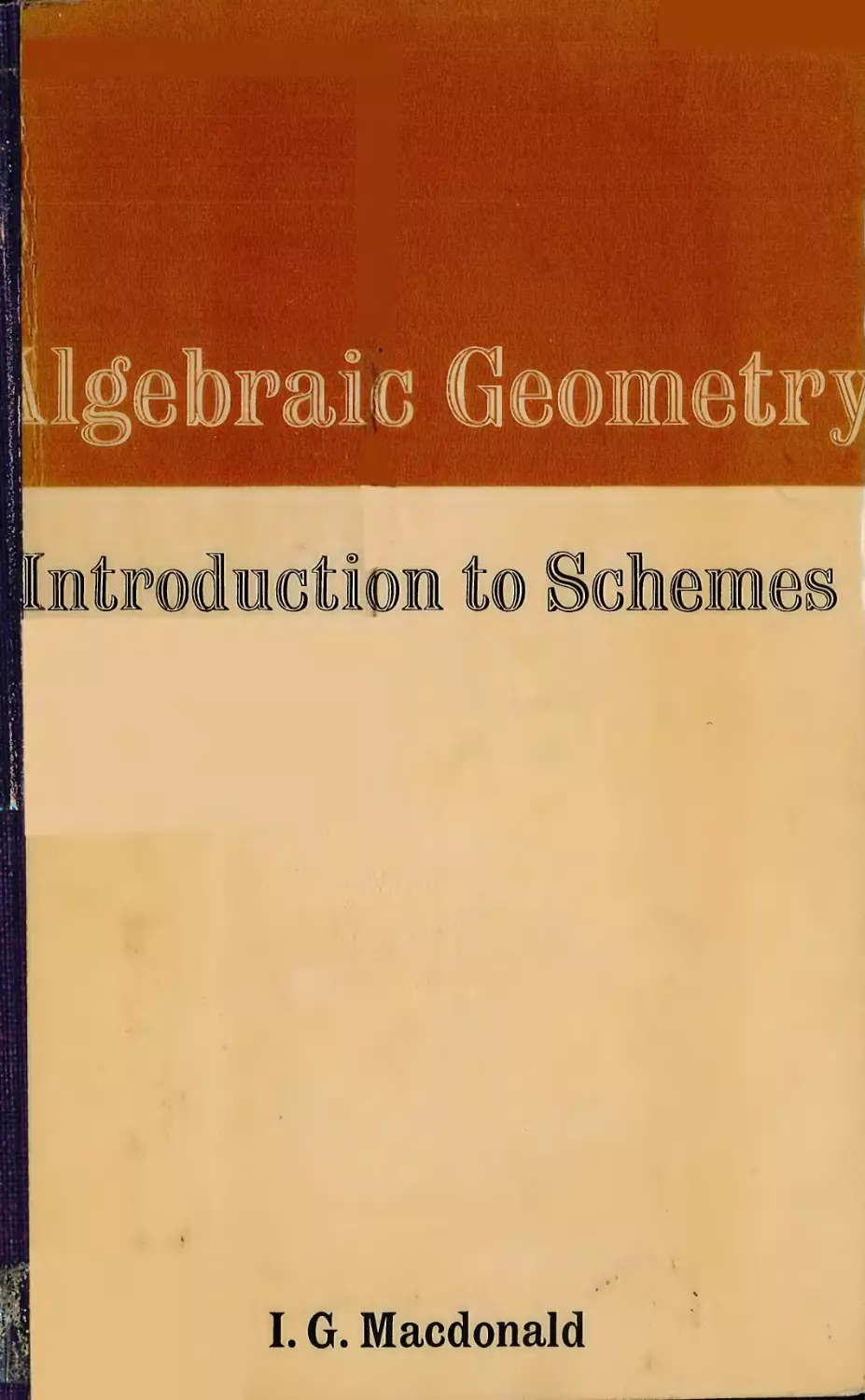
'Introduction to Schemes
«•
»>■
I. G. Macdonald

ALGEBRAIC GEOMETRY
Introduction to Schemes

MATHEMATICS LECTURE NOTE SERIES
E. Artin and J. Tate
Harvard University
Michael Atiyah
Oxford University
Hyman Bass
Columbia University
Raoul Bott
Harvard University
Paul J. Cohen
Stanford University
Walter Feit
Yale University
Marvin J. Greenberg
Northeastern University
Robin Hartshorne
Harvard University
Serge Lang
Columbia University
Serge Lang
Columbia University
I. G. Macdonald
Oxford University
George Mackey
Harvard University
Richard Palais
Brandeis University
Jean-Pierre Serre
College de France
Jean-Pierre Serre
College de France
Jean-Pierre Serre
College de France
CLASS FIELD THEORY
K-THEORY
ALGEBRAIC K-THEORY
LECTURES ON K(X)
SET THEORY AND THE CONTINUUM
HYPOTHESIS
CHARACTERS OF FINITE GROUPS
LECTURES ON ALGEBRAIC TOPOLOGY
FOUNDATIONS OF PROJECTIVE
GEOMETRY
ALGEBRAIC FUNCTIONS
RAPPORT SUR LA COHOMOLOGIE
DES GROUPES
ALGEBRAIC GEOMETRY:
INTRODUCTION TO SCHEMES
INDUCED REPRESENTATIONS
OF GROUPS AND QUANTUM
MECHANICS
FOUNDATIONS OF GLOBAL
NON-LINEAR ANALYSIS
ABELIAN Z-ADIC REPRESENTATIONS
AND ELLIPTIC CURVES
ALGEBRES DE LIE SEMI-SIMPLES
COMPLEXES
LIE ALGEBRAS AND LIE GROUPS

ALGEBRAIC GEOMETRY
Introduction to Schemes
I.G.MACDONALD
Oxford University
W. A. BENJAMIN, INC
New York 1968 Amsterdam

ALGEBRAIC GEOMETRY: Introduction to Schemes
Copyright © 1968 by W. A. Benjamin, Inc.
All rights reserved
Library of Congress Catalog Card Number 68-28140
Manufactured in the United States of America
The manuscript was put into production on March 29,1968;
this volume was published on June 7,1968
W. A. BENJAMIN, INC.
New York, New York 10016

FOREWORD
These notes are based on lectures given at the
University of Sussex in 1964-65 . Their aim was to provide an
introduction to the language of schemes, for an audience
consisting largely of classical geometers, but in fact they
cover little more than the basic local theory. In principle,
nothing is assumed of the reader beyond elementary notions
of algebra and topology.
I am indebted to Dr. J. A. Tyrrell of King's College,
London, for assistance in preparing these notes for
publication.

CONTENTS
Chapter Page
1. INTRODUCTION 1
2. NOETHERIAN SPACES 13
3. THE SPECTRUM OF A COMMUTATIVE RING 17
4. PRESHEAVES AND SHEAVES 2 8
5. AFFINE SCHEMES 36
6. PRESCHEMES 43
7. OPERATIONS ON SHEAVES. QUASI-COHERENT
AND COHERENT SHEAVES 54
8. SHEAF COHOMOLOGY 69
9. COHOMOLOGY OF AFFINE. SCHEMES 80
10. THE RIEMANN-ROCH THEOREM 93
BIBLIOGRAPHY 112
VII

Chapter 1
INTRODUCTION
The subject-matter of algebraic geometry, from the time
of Descartes onwards, has been the study of the solutions of
systems of polynomial equations in several variables:
fa(Xl/ ..., xn) =0. (1)
Originally the f were taken to have real coefficients , and
a
one looked for real solutions. However, fairly soon it was
realised that it made better sense to include complex
solutions, since there was then a better chance of their existence
(e.g. , x2 + y2 + 1 = 0 has no real solutions, but plenty of
complex ones).
Equally, one of the main preoccupations of number
theory has been Diophantine problems, i.e. , the solutions
(if any) of a system of equations (1) in rational integers, the
f now being supposed to have integer coefficients: for
a
example, 'Fermat's last theorem' , the equationx + y = z .
As this example indicates, the problem thus set was often
1

2 INTRODUCTION
too hard, so it was natural to modify it by asking either for
rational solutions or for solutions mod. p (pa prime number),
i.e. , to regard the equations (1) as having their coefficients
in the rational field Q or the finite field F and to ask for
solutions in that field. More generally, we may reduce the
equations (1) mod. p , thereby replacing the coefficient
domain by the Artin local ring Z/(p ), and we may then pass
to the ring of p-adic integers Z = lim Z/(p ), or its field of
fractions O .
Thus it is natural to consider systems of equations (1)
with coefficient domains other than the fields of real or
complex numbers, and these coefficient domains may not always
be fields. However, if we stick to a coefficient field, we
had better let it be quite arbitrary if we want a theory which
is of sufficient generality for its applications. In particular,
our field should be allowed to have positive characteristic
(e.g. , the finite fields). So we are led to study the
solutions of (1), where the f are now polynomials over an
a
arbitrary field k. As already observed, it is not enough to
consider only the solutions in k, because there may not be
any, or at any rate not enough: we should therefore take an

INTRODUCTION TO SCHEMES 3
algebraically closed field K^k, and consider the solutions
of (1) in K. This is roughly the point of view of Weil
(Foundations of Algebraic Geometry). If we agree to ignore
questions of rationality, we can jettison k and use only K. But
this is inadequate for many purposes, e.g. , Weil's
conjectures on the number of points of an algebraic variety
over a finite field.
AFFINE ALGEBRAIC GEOMETRY
Let k be a field, K an algebraically closed field
containing k, and let S be a subset of the polynomial ring
k[ti, . . . , t ] (which we shall abbreviate to k[t]). The
variety V(%) defined by S is the set of allx= (x1, ..., x ) € K
such that f(x) = 0 for all f € S. If a_ is the ideal generated by
S in k[t], then clearly V(S) = V(a). Now let a* be the ideal
consisting of all f € k[t] which vanish at every point of V.
Clearly a_* 2§./ anc* tne inclusion may be strict (for example,
§.= (ti2), a.* = (ti)). The relationship between a_and a_* is
given by a theorem of Hilbert (the Nullstellensatz) which
asserts that a_* is the radical of a_, that is to say it is the set
of all polynomials f some power of which lies in a_. V = V(S)

4
INTRODUCTION
is an affine (k, K)-variety.
Each polynomial f in k[t] determines a function x *^f(x)
on K with values in K, and the restriction of this function to
V is called a regular function on V. The regular functions
form a ring A, clearly isomorphic to k[t]/a_*; this ring is
called the coordinate ring (or affine algebra) of V. Obviously
A is finitely generated as a k-algebra, and from Hilbert* s
theorem it follows immediately that A has no non-zero nil-
potent elements. Conversely, every finitely generated
k-algebra A with no nilpotent elements ^ 0 arises as the
coordinate ring of some (k, K)-variety V in K (for some n):
we have only to take a set of generators Ui, . . . , u of A,
which defines a k-algebra homomorphism of k[ti , . . . , t ]
onto A; the kernel a_ of this homomorphism is an ideal which
is equal to its own radical, and V(a) is the variety sought.
But there is a more intrinsic way of getting V from A: namely,
the points of V are in one-to-one correspondence with the k-
homomorphisms of A into K. For if x € V, then f *-» f (x) is a
k-homomorphism A -> K; and conversely, if tp : A -* K is a
k-homomorphism, let x. = cp(u.), then x = (xx , . . . , x ) is a
point of V. Thus an affine algebraic variety is determined by

INTRODUCTION TO SCHEMES
5
its coordinate ring.
If U, V are affine (k, K)-varieties, say U ck"1, V c= Kn,
a mapping f : U ~*V is (k, K)-regular if it is induced by a k-
polynomial mapping of K into K . We how have a category
o.f affine varieties and regular maps (we shall drop the prefix
(k, K) from now on). If A, B are the coordinate rings of U, V
respectively, then the regular maps f : U -> V correspond
one-to-one to the k-algebra homomorphisms cp : B -*A: if u €B
(i.e. , u : V -* K is regular) then u o f : U -> K is regular and
thus we have a mapping u •-* u o f of B into A, which of course
is a homomorphism. Moreover, this correspondence is
functorial: if g : V -* W corresponds to ij) : C -> B (where C is
the coordinate ring of W) then g ° f corresponds to <p o $. In
this way it appears that the category of affine k-varieties is
equivalent to the dual of the category of finitely-generated
k-algebras with no nilpotent elements . In other words , the
theory of affine algebraic varieties over k is equivalent to
the theory of a rather special class of commutative rings, and
one can compile a dictionary for translating statements about
affine varieties into statements of commutative algebra.
Thus, in the hands of the German school of the 1920's and

6
INTRODUCTION
1930's, algebraic geometry became the study of ideals in
polynomial rings.
THE ZARISKI TOPOLOGY
Let V be an affine k-variety, A its coordinate ring. The
elements of A are functions from V to K. If S is any subset
of A, let V(S) denote the set of common zeros of the functions
in S; then it is easily verified that by taking the V(S) as
closed sets we have a topology on V, called the Zariski
topology (strictly, the k-topology). From the topologist*s
point of view, this is a very bad topology: in general it is
not even T0 (unless k = K, when it is Tx (but not T2)). If
x € V, the closure of the set {x} in the Zariski topology is
the intersection of all the closed sets V(S) which contain x:
it is what Weil calls the locus of x, and its points are the
specializations of x. Thus y is a specialization of x if and
only if y € {x } .
PRODUCTS
If UcK , V c: K are two affine varieties then
UxVcK is an affine variety, the product of U and V (it
is the product of U and V in the category of all affine

INTRODUCTION TO SCHEMES
7
k-varieties, that is to say it satisfies the usual universal
mapping property in this category). If A, B are the coordinate
rings of U, V respectively then one might hope that the
coordinate ring of U x V would be the tensor product A ® B.
Unfortunately it isn't, in general, because A ® B may well
k
have nilpotent elements (unless k is perfect), and to get the
coordinate ring of U x V one has to factor out the ideal of
nilpotent elements in the tensor product. This is one
example where the exclusion of nilpotent elements leads to an
unsatisfactory situation.
It should also be remarked that the Zariski topology on
U x V is not (in general) the product topology: generally it is
strictly finer than the product topology, i.e. it has more open
sets. The standard example is the affine plane K x K.
PROJECTIVE AND ABSTRACT VARIETIES
It was realised early on that affine geometry is in many
respects unsatisfactory. For example, two subvarieties of an
affine variety may have empty intersection even if their
dimensions are right, and Bezout* s theorem does not hold
without qualification; or a point or subvariety may escape 'to

8 INTRODUCTION
infinity1. This was rectified by 'completing1 affine space by
sticking on suitable 'points at infinity1 , as everyone knows,
and the result is projective space P (K). From a geometrical
point of view, projective space and projective varieties are
much more satisfactory to deal with. The process outlined
above of constructing coordinate rings etc. can be imitated in
the projective case, but it doesn't work nearly as well. A
projective variety V in P (K) is given by a set of homogeneous
polynomial equations f (x0/ xx , . .. , x ) = 0 (with coefficients
a n
in k); these generate a homogeneous ideal a_ in the graded
polynomial ring k[t0/ . . . , t ]. The radical a_* of a_ is again a
homogeneous ideal, so we can form A = k[t]/a_* which is a
graded k-algebra. But: (i) the elements of A do not
correspond to regular functions on V, because the only everywhere-
defined regular functions on V are in fact constants; and (ii)
there is no longer a one-to-one correspondence (as in the
affine case) between graded coordinate rings and projective
varieties: non-isomorphic rings can give rise to isomorphic
varieties. For example, the coordinate ring of Pi(K) and of a
conic in P2(K) are not isomorphic.
A different approach is the following. P (K) can be

INTRODUCTION TO SCHEMES
9
regarded as the union of a finite number of overlapping affine
spaces —for example, the complements of n + 1 hyperplanes
with no common point —which are open sets in the Zariski
topology, and hence any projective variety V is the union of
a finite number of overlapping affine varieties U., which are
open sets in V: thus V is 'locally affine' . The situation is
analogous to that for a manifold, which is 'locally Euclidean1,
i.e. , is obtained by sticking together overlapping Euclidian
spaces in a suitable way. Thus it is natural to go further, as
Weil did, and define an 'abstract variety' as one which is
obtained by pasting together overlapping affine varieties.
The resulting object may or may not be projective (i.e. ,
embeddable in a projective space). The characteristic 'good'
property of projective varieties, that they are in some sense
'compact' or that they don't have bits missing at infinity, is
then replaced by the property of completeness, which can be
formulated in various ways. Probably the simplest of these
is the following: an (abstract) variety V is complete if, for
every variety W, the projection V xW^Wisa closed map
(with respect to the Zariski topology).
To give meaning to the definition of an abstract variety,

10
INTRODUCTION
it is necessary to specify how the affine varieties which
make it up are to be stuck together. There are various ways
of doing this: one is the following. If V is an affine variety,
say V f= K , we associate with V a structure sheaf & , which
may be defined as follows. A rational function
u € k(tx , . . . , t ) is said to be regular at x € K .or defined
n —
at x, if u can be put in the form f/g, where f, g are
polynomials and g(x) / 0 (so that u(x) = f (x)/g(x) is well-defined).
The domain of definition of a rational function is an open set
in K . A rational function u' ori V is by definition the
restriction to V of a rational function u on K (so the domain of u' is
an open set in V). If U is any open set in V, the rational
functions on V which are defined at every point of U form a
ring A(U), and the assignment U ,_> A(U) is a presheaf of rings
on V which is immediately verified to be a sheaf. This is the
structure sheaf & , and it is intrinsically related to V, i.e. ,
it does not depend on the embedding of V in an affine space.
One then defines a prealgebraic variety to be a topological
space X together with a sheaf of rings &v, this sheaf being a
sheaf of germs of functions on X with values in K, with the
following property: there exists a finite open covering

INTRODUCTION TO SCHEMES
11
(V.), ^. ^ of X such that each V., together with the restriction
of & to V., is isomorphic, sheaf and all, to an affine algeb-
x i
raic variety. X is an (abstract) algebraic variety if in addition
it satisfies a 'separation axiom' which is the formal analogue
of Hausdorff s axiom for topological spaces , namely that the
diagonal should be a closed subset of the product X xX (only
here, as we have already seen, the topology on X x X is not
the product topology).
This definition is due to Serre (Faisceaux algebriques
coherents). Thus the philosophy is this: an affine variety is
equivalent to a commutative ring (of a rather restricted type)
and an abstract variety is obtained by sticking a number of
these together by means of their structure sheaves.
We have now more or less set the stage. Going back for
a moment to the affine case, we have remarked that any
situation or theorem relating to affine varieties can be transcribed
into one relating to their coordinate rings , and it has been
recognised for a long time that in this way one gets more
general statements, for generally the theorems of commutative
algebra that arise are valid under much less restrictive
hypotheses on the rings in question: often it is enough that

12 INTRODUCTION
they should be Noetherian. So, to obtain a satisfactorily
general theory, one should start with a quite arbitrary
commutative ring and construct something like an 'affine variety1
from it, and then stick these objects together by means of
structure sheaves to obtain generalised abstract varieties or
preschemes.

Chapter 2
NOETHERIAN SPACES
A non-empty topological space X is sai'd to be irreducible
if every pair of non-empty open sets in X intersect (thus X is
as far as possible from being Hausdorff). Equivalent
conditions :
i
X is not the union of two proper closed subsets;
If F. (1 ^ i ^n) are closed subsets which cover X, then
X = F. for some i;
Every non-empty open set is dense in X;
Every open set in X is connected.
Examples. (1) Let X be an infinite set, and topolo-
gize X by taking the closed subsets to be X itself and all
finite subsets of X. Then X is irreducible.
(2) Any irreducible algebraic variety, with the Zariski
topology.
A subset Y of a space X is irreducible if Y is irreducible
13

14
NOETHERIAN SPACES
in the induced topology. The following facts are not hard to
prove:
Proposition (2.1). (i) If (F.)1<<< is a finite
closed covering of a space X, and if Y is an irreducible
subset of X, then YcF. for some i.
— 1
(ii) If X is irreducible, every non-empty open subset of X is
irreducible.
(iii) Let (U.)n ^. ^ be a finite open covering of a space X.
the U. being non-empty. Then X is irreducible <=> each U. is
irreducible and meets each U..
J
(iv) If Y is a subset of X, then Y is irreducible if and only if
Y is irreducible.
(v) The image of an irreducible set under a continuous map is
irreducible.
(vi) X has maximal irreducible subsets; they are all closed
and they cover X. (Use Zorn* s lemma for (vi).)
The maximal irreducible subsets of X are called the
irreducible components of X. Irreducibility is in some ways
analogous to, but stronger than, connectedness.
If x €X, then {x} is irreducible and therefore (by (iv)

INTRODUCTION TO SCHEMES 15
above) so is {x}. If V is an irreducible subset of X and
V = {x}for some x € X, then x is a generic point of V. If
y € {x}, y is a specialization of x. The closed set {x} is the
locus of x.
A subset Y of a space X is locally closed if Y is the
intersection of an open set and a closed set in X, or
equivalently if Y is open in its closure Y, or equivalently again if
every y € y has an open neighbourhood U in X such that
Y fl U is closed in U .
y y
A topological space X is Noetherian if the closed subsets
of X satisfy the descending chain condition. Equivalent
conditions:
The ppen sets in X satisfy the ascending chain condition;
Every open subset of X is qua si-compact (i.e. , compact
but not necessarily Hausdorff);
Every subset of X is quasi-compact.
Proposition (2.2). (i) A Noetherian space is
quasi-compact.
(ii) Every subset of a Noetherian space (with the induced
topology) is Noetherian.

16
NOETHERIAN SPACES
(iii) Let X be a topological space and let (X.)_ _^ be a
1 l^i-^-n
finite covering of X. If the X. are Noetherian, then so is X.
(iv) If X is Noetherian, the number of irreducible components
of X is finite .
The proofs are straightforward.

Chapter 3
THE SPECTRUM OF A COMMUTATIVE RING
Let A be a commutative ring with 1. Let X = Spec (A)
denote the set of all prime ideals of A. (g_ is a prime ideal
<s=>A/]D.is an integral domain; thus A itself is not a prime
ideal.) If x € X it is sometimes convenient to write i for the
ideal x. For each subset E of A, let V(E) = {x e X : i ^ E}.
If E consists of a single element f, we write V(f) in place of
V({f}).
Lemma (3.1). (i) V(0) = X; V(1)=J2T.
(ii) If E c E' , then V(E) => V(E').
(iii) V(UEJ = HV(EJ.
(iv) V(EE') = V(E) UV(E'),
Proof. Only (iv) is not entirely trivial. Clearly
V(EE') => V(E) U V(E'). Conversely, if x / V(E) U V(E') then
there exist f € E and f € Ef such that f ff \ and f ft \:
since i is prime, we have ff / i , hence x /V(EEf).
17

18 SPECTRUM OF COMMUTATIVE RING
It follows from (3.1) that the sets V(E) satisfy the axioms
for closed sets in a topology on X. This topology is called
the Zariski topology or spectral topology on X, and it is the
only one we shall use.
If a_ is an ideal in A, the radical r(a) of a_ is the set of all
f € A such that some power of f lies in a; it is also the
intersection of all the prime ideals of A which contain a_. In
particular, the radical r(0) of the zero ideal is the set Nof all
nilpotent elements of A; this ideal is called the nilradical of
A.
If E is a subset of A and if a_ is the ideal generated by E,
then V(E) = V(a) = V(r(a)).
We need some more notation:
A = A. = local*ring of A with respect to the prime ideal
^x
m = i A = maximal ideal of A ;
—x ^ x x
k(x) = A /m = residue field of A = field of fractions of
x —x x
If f € A, f (x) denotes the class of f mod. i in
A/i £ k(x). Thus f (x) = 0 if and only if f € i .
D(f) = X - V(f) = {x € X : f (x) ^ 0} = ,support, of f € A; it

INTRODUCTION TO SCHEMES 19
is an open set.
Finally, if Y f= X, j_(Y) denotes n . i . Thus i({x}) =j^.
Then we have the following formulas:
Lemma (3.2). (i) ±(0) = A, j_(X) = N (the nilradical
of A).
(ii) IfYcy, then j_(Y) ^ J_(Y').
(iii) i(UY ) = HL(Y ).
A A A A
(iv) j_(V(E)) = radical of the ideal generated by E.
(v) ' V(i(Y)) = Y.
It follows from (iv) and (v) that a^V^a), Y M j_(Y) gives
an order-reversing one-one correspondence between closed
subsets of X and ideals a_ in A such that a_ = r(a) . Hence, if
the ring A is Noetherian, X = Spec (A) is a Noetherian space.
(The converse of this is false: X can be Noetherian and A not
Noetherian. For example, let B be a polynomial ring
k[xx , x2, . . . ] over a field in a countable infinity of indeter-
2 n
mintfates, let b^ be the ideal generated by xlt x2, ... , x ,'...,
and let A = B/b. Then A is not Noetherian but has exactly one
prime ideal.)
If x, y € X then y € {x} (i.e. , y is a specialization of x)

2 0 SPECTRUM OF COMMUTATIVE RING
if and only if j c j . Hence [x] is a closed set (by abuse
of language, x is a closed point of X) if and only if i is a
maximal ideal of A. Thus X is a Ti space (every point is
closed) if and only if everyudeal of A is maximal, i.e.,
dim A = 0. However, X is always a T0-space (this means
that, given any two distinct points x, y in X, then either
there is a neighbourhood of y which does not contain x, or
else a neighbourhood of x which does not contain y).
Next, let us look at the open sets D(f), f e A. First,
from (3.1) (iv) we have
D(fg) = D(f) HD(g) (f, g e A).
Proposition (3.3). (i) The open sets D(f) form a
base of open sets for the topology of X.
(ii) Each D(f) is quasi-compact. In particular X = D(l) is
quasi-compact.
Proof, (i) If U is an open set in X, then U = X - V(E) for
some E £ A; we have V(E) = 0 Vffjy (3.1) (iii), hence
U= U D(f).
f€E
(ii) By virtue of (i) it is enough to show that every covering
of a set D(f) by open sets D(fJ has a finite subcovering.

INTRODUCTION TO SCHEMES
21
Suppose then that D(f) c U D(f J; let a be the ideal of A
generated by the f. , then V(f) => n V(f J = V(a), hence
V(r(f)) => V(r(a)) and therefore r(f) c r(a), so that f € r(a) and
therefore f € a for some n >0. Say f = £ aNfw where J
is some finite subset of L. Then f € b_, where b_ is the ideal
generated by the f , X € J; hence V(f) = v(fn) 2 vfe)
= n V(fJ. Taking complements, we have D(f) c U D(fJ,
XcJ A. X€j A
as required.
The open sets D(f) (f € A) will be called basic open sets.
Let a_ be an ideal of A. Then the ideals of A/a_
correspond one-to-one to the ideals of A which contain a_, and
therefore Spec(A/a) is canonically homeomorphic to the closed
subspace V(a) of Spec(A). In particular, Spec(A) and
Spec(A/N) are canonically homeomorphic (N= nilradical of A).
Prop os it ion (3.4).. X = Spec(A) is irreducible
<=^A/N is an integral domain.
Proof. From what has just been said, we may as well
take N= 0. Suppose X is reducible; then there exist proper*
closed subsets Yi, Y2 in X such that Yi U Y2 = X, and
therefore j_(Yi) H j_(Y2) = ±(X) = N= 0 (by (3.2)). But ±(Y1) and

22 SPECTRUM OF COMMUTATIVE RING
±(Y2) are ^ 0 , hence there exist f. € j_(Y.) such that f. / 0,
and fxf2 € ±(Yj fi j_(Y2) = 0. Hence A is not an integral
domain.
Conversely, if A is not an integral domain we have f, g
in A such that f / 0 , g ^ 0 and fg = 0. Hence V(f) / X,
V(g) ^ X (since N= 0); but X = V(fg) = V(f) U V(g).
Consequently X is reducible.
In the correspondence between closed subsets of X and
ideals of A which are equal to their radicals, the irreducible
closed subsets correspond to the prime ideals. In particular
the irreducible components of X correspond to the minimal
prime ideals of A. Furthermore, x ^ {x] gives a one-to-one
correspondence between the points of X and the irreducible
closed subsets of X, i.e. , every irreducible-closed subset
of X has exactly one generic point. For if x € X, then {x} is
irreducible by (2 .1) (iv). If {x} = {y}, then each of x and y
is a specialization of the other, so that J = j, i.e. x = y.
Conversely, if Y is an irreducible subset of X, Y corresponds
to a prime ideal i of X, i.e. Y = V(j ) = {x}/#

INTRODUCTION TO SCHEMES 2 3
COMPARISON WITH AFFINE ALGEBRAIC VARIETIES
Let k be a field, K an algebraically closed extension of k,
and let V be a (k, K)-affine variety as in Chapter I; let A be
the coordinate ring of V (a k-algebra, finitely generated with
no nilpotent elements), and let X = Spec (A). What is the
relationship between V and X? Let us assume that K is a
universal domain in the sense of Weil, i.e. that K has
infinite transcendence degree over k; this is just to give us
plenty of elbow room. Let x e V, then x determines a homo-
morphism A -* K, whose kernel is a prime ideal of A, i.e. an
element x1 of X. Conversely, if £ is any prime ideal of A,
we can embed A/g_ in K (for the field of fractions of A/g_ is a
finitely generated field extension of k, hence is an algebraic
extension of a pure transcendental extension of k) and thus
we have a homomorphism A -* K with kernel £. Hence x ^ x'
is a map of V onto X, and X is obtained from V by identifying
'equivalent' points in V, i.e. points which are generic
specializations of each other.
At the other extreme, if k = K, then V may be identified
with the set of maximal ideals of A, i.e. with the set of
closed points of X: so in this case the map V _>X described

24
SPECTRUM OF COMMUTATIVE RING
above is injective (and not in general surjective).
FUNCTORIAL PROPERTIES
Let A, A' be two rings and let <p : A* -*A be a ring homo-
morphism (which is always assumed to map identity element
to identity element). If x € X = Spec (A), then cp"1 (i ) is a
prime ideal in A' , hence a point of X' = Spec(A'). Thus we
have a mapping
Spec(cp) = a(p : X -X' ,
said to be associated with (p. Let cp denote the embedding
of A'/V"1 (i ) in A/j induced by cp; then cp extends to a field
monomorphism
(pX : k(acp(x)) -*k(x).
Lemma (3.5). (i) a(p'1(V(Et)) = V(cp(E'))/ for any
subset E' of A' . In particular:
(ii) V1(D(f')) =D(cp(f')) (V €A').
(iii) a(p (V(a)) = Vto"1 (a)) (a_ any ideal of A).
Proof, (i) is straightforward and (ii) follows from (i). To
prove (iii) we may assume that a_ = r(a), since V(r(a)) = V(a)
and r(cp_1 (a)) = cp"1 (r(a)). Put Y = V(a), and let a_' =l(acp(Y));
then V(a_') = 8cp(Y) by (3.2) (v). Also:

INTRODUCTION TO SCHEMES 25
f € a; <=> f (x1) = 0 for all x' € acp(Y)
<^> f' * ^U-x) for a11 x € Y
<=><ptf') € j(Y) = j(V(a)) =a
<=>f ecp^a).
Hence 8cp(V(a)) = acp(Y) = V(a.') = V(<p"x (a)).
From (i) or (ii) above it follows that <p is continuous.
Clearly, if A" is another ring, cp1 : A" ->A' another ring homo-
morphism, then (cp o tpl) = cp% o cp; so that Spec is a
contra variant functor from the category of rings and ring
homomorphisms to the category of topological spaces and
continuous maps.
Examples. (1) If a_ is an ideal in A and cp : A ->A/a_
the projection, then cp : Spec(A/a) ~*Spec(A) is a homeo-
morphism of Spec (A/a) onto V(a).
(2) Let S be a multiplicatively closed subset of A (i.e. S is
closed under finite products, so that in particular 1 € S (take
the empty product!)). Then we can form the ring of fractions
S^A, and we have a canonical mapping cp : A ^S^A, hence
cp : Spec(S"1 A) ->Spec(A). It is a well-known and not
difficult fact of commutative algebra that the prime ideals of S^A

26 SPECTRUM OF COMMUTATIVE RING
are in one-one correspondence (under cp) with the prime
ideals of A which don't meet S, and consequently (pis a
homeomorphism of Spec(S"1 A) onto the sret of all x € X such
that i HS = J2f. (In general this subset of X is neither open
nor closed, nor even locally closed.)
(3) In particular, Spec (A ) may be canonically identified with
the subspace of X consisting of all generizations of x, i.e.
all y such that x € {y}.
(4) As another example, let f € A and let S be the set of all
f (n ^0). In this case S_1A is usually denoted by A Then
Spec (A J is identified with the set of all x € X such that j
f x.
contains no power of f, i.e. such that f / j . Hence
Proposition (3.6). If cp : A ->A is the canonical
homomorphism (f € A), then <p is a homeomorphism of
Spec(Af) onto the open set D(f).
(5) The 'characteristic morphism1 . Since A has an identity
element, there is a canonical mapping cp : Z ->A, where Z, is
the ring of integers; hence cp : X -> Spec(Z). Now the points
of Spec(Z) are (0) and the prime ideals (p) (pa positive prime
number), and cp(x) is just the ideal generated by the

INTRODUCTION TO SCHEMES 27
characteristic of the residue field k(x) of x.
Proposition (3.7). Let cp : A1 -A be a ring homo-
morphism, <p : X -*Xf the associated map.
(i) If cp is surjective, *~<p is a closed embedding (i.e. a
homeomorphism of X onto a closed subset of X1).
a *■ ' 3
(ii) If cp is injective, cp is dominant (i.e. cp(X) is dense in
X').
Proof, (i) is just Example 1 above.
(ii) follows from (3.5) (iii): 8(p(X) = acp(V(0)) = VfeT^O)) = V(0)
(since cp is injective) = X1 .

Chapter 4
PRESHEAVES AND SHEAVES
PRESHEAVES AND SHEAVES
At this stage we need little more than the definitions.
Let X be a topological space. A presheaf of abelian groups 3
on X is the assignment of an abelian group 3(U) to each open
set U in X, together with homomorphisms (often called
restriction homomorphisms) 3(U) ~* 3(V) defined whenever U => V,
such that 3(U) -> 3(U) is the identity map, and that the com- .
position 3(U) - 3(V) - 3(W) (where U^V^W) is the same as
the homomorphism 3(U) -> 3(W). (Think of the elements of
3(U) as functions on U.)
Another way of saying the same thing is as follows. Let
C_(X) be the category whose objects are the open sets in X and
whose only morphisms are inclusions of open sets. Then a
presheaf 3 is just a contravariant functor from the category
C_(X) into the category (Ab) of abelian groups. Put this way,
it is clear how to define a presheaf on X with values in any
28

INTRODUCTION TO SCHEMES
29
given category: for example, presheaves of rings, modules
etc.
A presheaf 3 is a sheaf if it satisfies the following
condition:
For each open set U in X and each open covering (U ) of
a
U, and each family (s ) such that s € 3(U ) and s , s^ have
a a a a (3
the same restriction to 3(U fl U ) for all a, (3, there is a
a (3
unique s € 3(U) whose restriction to U is s , for all a.
a a
Another way of putting this is as follows . A diagram of
sets and mappings
Vi
A-^B=TC
v2
is said to be exact if u maps A one-one onto the set of all
x € B such that v1 (x) = v2(x). Then 3 is a sheaf if and only
if, for each open set U in X and each open covering (U ) of
a
U, the diagram
3(u) — ri3(u)=t n 3(u nu )
a a a/p a (3
(in which the maps are products of restriction homomorphisms)
is exact.

30 PRESHEAVES AND SHEAVES I
STALKS
Let 3 be a presheaf (say of abelian groups) on X and let x;
be a point of X. Then the direct limit lim 3(U), where U runs
through all open neighbourhoods of x in X, is called the stalk
of 3 at x and is denoted by 3 . Thus an element s € 3 is
x . xx
represented by some s € 3(U), where U is some open
neighbourhood of x in X, and two elements s € 3(U) and s1 € 3(Uf)
represent the same element of 3 if and only if there is an
open neighbourhood U" of x contained in U H U1 such that the
restrictions of s and s1 to U" are the same.
If U is any open set in X and if x is any point of U, we
have a homomorphism 3(U) -* 3 . If s € 3(U) we denote the
image of s under this homomorphism by s .
THE SHEAF ASSOCIATED WITH A PRESHEAF
Let 3 be a presheaf on X and let E denote the disjoint
union, or sum, of the stalks 3 ; then E has a natural
projection p onto X, namely the fibre p"1 (x) is the stalk 3 of 3 at x.
For each open set U in X and each-s € 3(U), let s(x) denote
s ; then s": U -* E is a section of E over U, i.e., p © s~ is the
identity map of U. We can make E into a topological space

INTRODUCTION TO SCHEMES *
31
by giving E the coarsest topology for which all the mappings
s*are continuous: this means that a set W is open in E if and
only if, for each open U c: X and each s € 3(U), the set of
points x € U such that s"(x) € W form an open set in X.
Let 3(U) denote the set of continuous sections of E over
U. Then an element of 3(U) is a family (s1 ) TT, where
s f € 3 for all x € U, such that for each x € U there is an
X X
open neighbourhood V of x, contained in U, and an element
y4> € 3(V) such that s f = s for all y € V. It is easily checked
that
Lemma (4.1). 3 is a sheaf.
If 3, Q are presheaves on X, a homomorphism tp : 3 -» Q is
a family of homomorphisms cp(U) : 3(U) ~* Q(U) for each open
set U in X, which are compatible with the restriction
homomorphisms in 3 and Q: that is, whenever U, V are open in X
and U ^ V, the diagram
s(u)-£G2L(hu)
*Cv)-^p<j<v)
(in which the vertical arrows are restrictions) is commutative.

32 PRESHEAVES AND SHEAVES
If we regard 3, Q as contravariant functors on the category
C_(X), then cp is just a morphism (or natural transformation) of
functors.
In particular, let 3 be a presheaf on X, 3 the associated
sheaf (4.1). For each open set U in X and each s € 3(U), the
family (s ) TT is an element of 3(U), so that we have a
homomorphism 3 ->"3.
Lemma (4.2). 3 -* 3 is an isomorphism if and only
if 3 is a sheaf.
If 3 is a sheaf, we shall often use the notation r(U/ 3)
instead of 3 (U).
RESTRICTION OF A PRESHEAF TO AN OPEN SET
Let 3 be a presheaf on X, and let U be an open set in X.
Then the 3(V) for which V cz U form a presheaf on U, called
the restriction of 3 to U and denoted by 3 | U. If 3 is a
sheaf, so is 3^ | U (obvious from the definitions).
PRESHEAF ON A BASE OF OPEN SETS
We shall need a slight variant of the above notion of a
presheaf. Let X be a topological space and let IB be a basis

INTRODUCTION TO SCHEMES 33
of open sets in X. A presheaf on B (say a presheaf of abelian
groups) is the assignment of an abelian group 3(U) to each
U € B, together with restriction homomorphisms 3(U) -> 3(V)
whenever U, V € Band U ^V, satisfying the same conditions
as before.
From a presheaf 3 on B we can construct a presheaf 31
on X in the previous sense: if U is any open set in X, then
^•(U) is defined to be the inverse limit lim 3(V), taken over
all V € B such that VcU, Explicitly, an element s' € 3 (U)
is a family (sv)v ^ Vc= TT/ such that if V, W € B and
U^V^W, then the restriction of sw to W is s,A_. If U € B,
— — V W
then 3'(U) is canonically isomorphic to 3(U).
Lemma (4.3). With the above notation, 31 is a
sheaf on X if and only if 3 satisfies the following condition:
for each U € B and each covering (U ) of U by sets belonging
a
to B, the diagram
3(u) -n 3(u ) =j n n 3(v)
a a a o v €B
vcu nu
— a (3
is exact: that is, if s € 3(U ) are such that the restrictions
a a
of s and s_ to V are the same, for all pairs a, (3 and all
a p

34 PRESHEAVES AND SHEAVES
V c U n U (V € B) then there is a unique s € 3(U) whose
""a (3
restriction to U is s for all a.
a a
The stalk 3' of 3' at x is equal to lim 3(U), where U
x -+yg
runs through all sets of B which contain x, because these
sets are cofinal in the set of all open neighbourhoods of x.
RINGED SPACES
A ringed space (espace annele) is a pair (X, & ) where X
A
is a topological space and & is a sheaf of rings on X, called
X
the structure sheaf of the ringed space.
Example . Let X be a complex manifold, and for each
open set U in X let &(U) denote the ring of all holomorphic
functions defined on U. Then & is a sheaf of rings on X, so
that a complex manifold may be regarded as a ringed space
(X, &). Similarly for differentiable manifolds , algebraic
varieties over a field, etc.
A morphism of ringed spaces (X, & ) -> (Y, & ) is a pair
A Y
(0/ @) / where 0 is a continuous map from X to Y, and 6 maps
& to & • precisely, 0 assigns to each open set V in Y a ring
i A
homomorphism 8(V) : T(V, &__) ^TO/r^V), &v), compatible with
Y A

INTRODUCTION TO SCHEMES
35
the restriction homomorphisms: that is to say, whenever
V => V are open sets in Y, the diagram
r(v, &Y)_l^r^v), <&x)
r(v; eg ►r«r1(v'), &Y)
Y 9(V') X
is commutative. For each x € X, 9 then induces a homo-
morphism of the stalks
x • ®Y. 0(x) \,x
by taking direct limits .

Chapter 5
AFFINE SCHEMES
THE STRUCTURE SHEAF OF SPEC (A)
We shall put a sheaf of rings on X = Spec(A) (where A is
any commutative ring) in such a way that the stalk of the
sheaf at x € X is the local ring A (i.e. the local ring of A
with respect to the prime ideal i ). For this we use the open
sets D(f) (f € A) and the rings of fractions A (Chapter 3, Ex.
4 and Prop. (3. 6)).
Suppose f, g in A are such that D(f) =; D(g). Then
r(f) =; r(g), so that g = sf for some s € A and some n > 0.
Define a ring homomorphism
p . : A. - A
g,f f g
as follows: p f(a/f ) = as /g cA . Verify that p is
a well-defined ring homomorphism depending only on f and g
(and not on the particular equation g = sf chosen), and that
if D(f) => D(g) ^ D(h) then p o p = p Then the
h,g rg,f h,f
assignment D(f) ^ Af (and the homomorphisms p f) forms a
i g /1
36

INTRODUCTION TO SCHEMES
37
presheaf on the basis B = (D(f)) This presheaf on B
determines a presheaf on X, denoted by & or by A.
Proposition (5.1). (i) The stalk of &v at x € X is
x
isomorphic to A .
(ii) &v is a sheaf on X, and hence T(D(f), &__) = A for all
X X I ....■
f € A. In particular r(X, &v) = A.
X
Proof, (i) is a straightforward verification: x € D(f) if
and only if f / i , and a/f € A maps to a/f € A. = A .
^x
Check that this gives an isomorphism of lim A onto A .
(ii) does require proof. We have to show that the condition of
(4.3) is satisfied. First, by (3.6) D(f) is canonically homeo-
morphic to Spec(A ); also it is easily checked that the
presheaf A on Spec (A ) constructed as above is canonically
isomorphic to A | D(f). Hence it is enough to show that
T(X, &v) = A, i.e. that if (D(f.)). T is any covering of X by
X 1 1 € 1
basic open sets, and if s. € A are such that the images of
i
s., s. in A are the same for all g € A such that
i J g
D(g) c D(f.) HD(f.), then there exists a unique s €A whose
image in A is s., for all i € I.
i
Uniqueness: if s, s1 €A are solutions of this problem,

38 AFFINE SCHEMES
then t = s - s1 has zero image in each A , hence for each
ni i
i € I we have tf. = 0 for some n. > 0. Since the D(f.) cover
i i i
ni ni
X and since D(f.) = D(f. ), the ideal generated by the f. is
the whole of A. Consequently we have an equation of the
ni ni
form 1 = La.f. (a. € A), and hence t = La.tf. = 0. Therefore
ill li
Existence: X is quasi-compact by (3.3), hence there is
mi
a finite subset J of I such that X = U D(f.). Say s. =z./f.
i€j i ill
(i € J), where z. € A. Since J is finite we may suppose that
all the m. are equal: say s. = z./f. (i € J). For each pair i,
j in J the images of s. and s. in A. . are the same, so that
i j f.f.
i J
z.fm/(f.f.)m = z.fm/(f.f.)m in A,, ,
i l i 1 jiii f.f.
i.e.
, _m _mx /r r \ ij ^ .TV
(z.f. - z.f. ) (f.f.) J = 0 in A,
i j j i i j
for some integer m... Again, we may assume that all the m..
ij ij
are equal, say m.. = n for all i, j € J; then, multiplying each
z. by f. , we reduce to the case n = 0, i.e.
rm rm
z.f. = z.f. .
i J J i
Now the D(f.) = D(f. ) (i € J) cover X, hence the ideal
generated by the f. is the whole of A, so that we have an equation

INTRODUCTION TO SCHEMES 39
of the form
1 = E g.fm (g. eA),
iej 11 i
Put s = L g.z.; then
J i ej i i
rm ^ rm ^ rm
s,f. = Sg.z.f. = Sg.z.f. = z. in A.
JJ i i i J i i J i J
so that the image of s in A is^aT./f. = s. (for all j € J). On
the face of it, s depends on the finite subset J; but if J1^ J
is another finite subset of I, we construct s , satisfying the
same conditions as sy/ and by the uniqueness of the solution
s , must therefore be equal to s
Thus , starting from an arbitrary commutative ring A, we
have constructed a topological space X = Spec (A) and a sheaf
of local rings & (or A) on X. This is the basic construction
A.
on which all else is founded. The ringed space (X, & ) is
X
called the affine scheme of the ring A.
MORPHISMS OF AFFINE SCHEMES
Let A, B be rings , X = Spec (A), Y = Spec(B), and let
tp : B ~*A be a ring homomorphism. We have seen in Chapter
3 that cp defines an associated continuous mapping <p : X -> Y.
In fact cp defines a morphism of ringed spaces

40 AFFINE SCHEMES
C<p, <p) : (X, & ) -> (Y, & ), as follows. Let g € B, then D(g)
is a basic open set in Y, and we have (p"1 (D(g)) = D(cp(g)) by
(3.5). Now <p induces a homomorphism B ->A , * , namely
b/g is mapped to <p (b)/cp (g) ; hence by (5 .1) (ii) cp induces
a homomorphism
£D(g) : T(D(g)/ Cy -r(acp-1(D(g))/ (^.
Clearly the cp ( . are compatible with the restriction homo-
morphisms, hence we have <p : & -» & as required, tp induces
Y A
a homomorphism of the stalks: if y = cp{x), we have
~ #
<p : fc__ - <Sl_ . Now <S._ = B , &, - A , and the map
^x Y,y X,x Y,y y X,x x
B -*A is the obvious one: b/s € B is mapped to
y x y
<p{b)/<p(s) €Ax.
If P, Q are local rings, m and ii their respective maximal
ideals, a homomorphism f : P -* Q is said to be local if the
following equivalent conditions are satisfied:
(i) f(m) ci ii (i.e. the image of a non-unit is a non-unit);
(ii) f_:L(n) = rn (i.e. the inverse image of a unit is a unit).
If so, then f induces a field monomorphism P/m. -> Q/n..
Now in the case in point, the homomorphism B ~*A is
local, for the maximal ideal of A is i A and that of B is
x "^x x y
i B = V^xLJfA \ Hence the morphism

INTRODUCTION TO SCHEMES 41
(acp, cp) : (X, & ) - (Y, &v) has the property that the homo-
morphisms induced on the stalks are local homomorphisms.
Conversely, let (0, 0) : (X, & ) - (Y, <SJ be a morphism
of ringed spaces (where X = Spec(A), Y = Spec(B) and fc ©
~~ — #
are the structure sheaves A, B) such that 0 : B ~*A is a
x y x
local homomorphism for each x € X (y = 0(x)). We have then,
in particular, a ring homomorphism 0 (Y) : T(Y, <s ) -* T(X, ©■ );
but T(Y, <^) =Band T(X, &x) =Aby (5.1), hence (0, 9)
determines a ring homomorphism cp : B ->A. Since 0 is local,
it gives rise to an embedding
0* : k(y) -k(x)
of the residue fields, such that for each g € B we have
x x
6 fe(y)) = <P fe) (x). Since 0 is injective we have g(y) = 0 if
and only if cp(g) (x) = 0, i.e. g € i if and only if cp (g) € i ,
so that i = cp-1 (i ), i. e. y = cp (x); hence 0 = (p. Moreover,
the diagram
ft
is commutative, hence 0 is the homomorphism of B into A
x y x
induced by cp; but 0 is uniquely determined by the

42 AFFINE SCHEMES
homomorphisms 0 , and therefore (0, 0) = ^ cp, cp). We have
therefore proved
Proposition (5.2). There is a one-to-one
correspondence between the ring homomorphisms B ->A and the
morphisms (0, Q) : (X, & ) - (Y, & ) such that 0 is a local
homomorphism for each x € X.
So far, this is the basic local theory. The next step is
to define the global objects. By analogy with Serre* s
definition of an algebraic variety (Chapter 1), it is clear what the
general definition should be.

Chapter 6
PRESCHEMES
If (X, & ) is a ringed space, an open subset V of X is said
X
to be an affine open set if the ringed space (V, &v|v) is iso-
x
morphic to some affine scheme.
Definition. A prescheme is a ringed space (X, &)
x
such that every x € X has an affine open neighbourhood, i.e. ,
it is a locally affine ringed space.
Let (X, & ) be a prescheme.
x
Lemma (6.1). (i) The affine open sets form a basis
of the topology of X.
(ii) If U is any open set in X, the ringed space (U/ ^lu) is
a prescheme, called the restriction of (X, & ) to U.
x
(iii) X is a T0-space.
(iv) Every irreducible closed subset F of X has a unique
generic point x, and x ^ {x} is a one-one correspondence between
the points of X and the irreducible closed subsets of X.
43

44
PRESCHEMES
Proofs, (i) Let U be an open set in X, and for each
x € U let V be an affine open neighbourhood of x; then U is
the union of the sets U = U H V ; each U is open in V and
x x xx
is therefore a union of basic open sets contained in V , by
(3.3); and these basic open sets are affine by (5.1). Hence
U is a union of affine open sets. $ J
(ii) follows from (i).
(iii) Let x; y cX, x^y, If x and y are not in the same affine
open set, it is clear that the T0 condition is satisfied. If
they are in the same affine open set, use the fact (Chapter 3)
?■"
that an affine scheme is a T0-space.
(iv) Let y € F and let U be an affine open neighbourhood of y
in X. Then U H F is dense in F (since F is irreducible) and is
itself irreducible, hence is the closure in U of some x € U.
Hence if F' = {x} is the closure of {x} in X, we have F' £ F
(since x € F); but U PI F' = U (IF, hence U H (F* - F) = 0,
hence F*" - F' = 0 since F' is irreducible. Hence F = {x}. The
uniqueness of the generic point follows from (iii), for the T0-
axiom is equivalent to the statement: [x}= {y} =>x = y.

INTRODUCTION TO SCHEMES 45
MORPHISMS OF PRESCHEMES
Let (X, &) and (Y, <3 ) be preschemes. A morphism of
A Y
ringed spaces (0, 9) : (X, & ) -> (Y, & ) is a morphism of pre-
A I
ft
schemes if, for each x € X, 0 is a local homomorphism
ft
®v // \ "^v • Hence 9 defines a field monomorphism
L t Ip \X) A, X X
0 : k(0(x)) -> k(x), so that k(x) is an extension of the field
k(0(x)).
RELATIVE THEORY: S-PRESCHEMES
Let S be a fixed prescheme. (Strictly speaking, we
should write (S, &c), but from now on we shall drop the struc-
o
ture sheaf from the notation.) An S-prescheme is a pair (X, f),
where X is a prescheme and f : X -> S is a morphism of
preschemes. If S is the affine scheme of a ring A, we speak of
an A-prescheme.
If (X, f) and (Y, g) are S-preschemes, an S-morphism
<p : X ->Y is a morphism of preschemes such that the diagram
X-2-Y"
s
is commutative.
The 'base prescheme' S may be considered as a

46
PRESCHEMES
generalization of the ground field of algebraic geometry: if A
is the coordinate ring of an affine k-variety, then A is a k-
algebra with identity element, so we have a homomorphism
k -A, hence Spec(A) ->Spec(k). Thus Spec(A) is a k-
prescheme. (Of course, Spec(k) consists of only one point,
so the map Spec(A) -*Spec(k) is trivial as a map of topological
spaces; but a morphism of preschemes comprises also a map
of the structure sheaves.)
Every prescheme may be considered canonically as a
Z-prescheme. Namely the 'characteristic morphism' (Ex. 5,
Chapter 3) is a morphism Spec(A) ->Spec(Z), and hence one
defines a morphism of preschemes X -> Spec(Z) for any
prescheme X (do it on the affine open sets).
PRODUCTS
Let C_be any category and for any two objects X, T in C_,
let X(T) denote the set of all morphisms T ^XinC. For fixed
X and variable T, T ^X(T) is a contravariant functor C_ - (Sets)
(= category of all sets).
Let F be any contravariant functor on C_with values in
(Sets). F is said to be representable if there exists an object

INTRODUCTION TO SCHEMES
47
X in C and a functorial isomorphism F(T) = X(T) (for all T € C).
If X exists, it must be unique up to isomorphism.
A product of two objects X, YinC is an object X x Y
which (if it exists) represents the functor T ^X(T) x Y(T): in
other words, there is a functorial isomorphism (X xY)(T)
= X(T) x Y(T) for all objects T in C..
Products exist in many categories: in the category of
groups ('direct products'), topological spaces, algebraic
varieties, modules over a fixed ring (here the product is
•direct sum' M®N), etc. The dual concept is that of sum: in
the category of groups, for example, sum is 'free product'; in
the category of commutative A-algebras, where A is a fixed
commutative ring, sum is tensor product over A. Since the
category of affine schemes over A is dual to the category of
A-algebras, Spec(B ® C) is a product of Spec(B) and Spec(C)
A
in the category of affine schemes over A (here B, C are any
two A-algebras).
Theorem (6.2). Let S be a fixed prescheme, X and Y
two S-preschemes. Then the product X x Y exists in the cate-
S
gory of S-preschemes.

48 PRESCHEMES
The proof is tedious but not essentially difficult (EGA, I,
3.2.6), and we shall not reproduce it here. Locally, as we
have just observed, it corresponds to the tensor product of
rings, and it is a question of sticking things together so that
it all fits.
This product of course has the usual associativity and
commutativity properties, as in any category in which
products exist.
The existence of products is fundamental, and arises in
many contexts:
(1) Change of base. If X is an S-prescheme and if
S' -* S is a morphism of preschemes, then the product X x S'
S
is denoted by X, * and is said to be obtained by extension of
Ik /
the base-prescheme from S to S' . We have a commutative
diagram
i i
S - S'
and X, * is to be regarded as an S'-prescheme.
Base extension is a transitive operation, i.e. if
S" -* S' -*S are morphisms of preschemes and X is an

INTRODUCTION TO SCHEMES
49
S-prescheme, then (X xS') x S" is canonically isomorphic
S S'
to X x S" .
S
This operation generalizes the notion of extension of the
ground-field in algebraic geometry: if X is a k-variety, say
affine with coordinate ring A, and if k' is an extension field
of k, then the embedding k -> k' gives Spec(k') ->Spec(k), and
A 0 k' gives rise to an affine variety X , defined over k1 .
k k
(2) Geometrical points . If X is an affine (k, K)-variety
(Chapter I) with coordinate ring A, then the points of X are in
one-one correspondence with the k-homomorphisms A ->K,
i.e. with the k-morphisms Spec(K) ->Spec(A). This motivates
the following definition: if X, T are S-preschemes, the S-
morphisms T ->X are called points of the S-prescheme X with
values in the S-prescheme T. Let X(T) denote the set of
points of X with values in T, then the product of two S-
preschemes X and Y is characterized by the formula
(X XY)(T)0 =X(T)0 xY(T)0/ for any S-prescheme T.
g.O b O
In particular, a gepmetrical point of X is a point of X
with values in an algebraically closed field K, that is to say
it is a morphism <p : Spec(K) -"X. Spec(K) consists of a single
point, whose image under <p is the locality of the geometrical

50 PRESCHEMES
point. Given the locality x, the geometrical point <p is
determined by an embedding of the residue field k(x) in K.
Remark. The product X x Y is not the set-theoretic
s
product of X and Y, nor even the fibre product of X and Y over
S: that is to say, if (X) temporarily denotes the set
underlying X, then in general we have (X xY)/(X) x (Y). However,
S (S)
there is a surjective mapping f : (X x Y) -* (X) x (Y). For if
S (S)
x € X and y € Y lie over the same point s € S, then k(x) and
k(y) are extensions of k(s), and can therefore both be
embedded in an extension K of k(s); hence we have S-morphisms
Spec(K) ->X and Spec(K) -* Y, localized at x and y respectively,
and therefore an S-morphism Spec(K) ->X x Y, localized at say
z. Clearly the projections of z are x and y, i.e. f(z) = (x, y).
To show that f is not in general injective, it is enough to
take X, Y, S to be the spectra of fields K, L, k respectively
(K, L being extensions' of k); then K ® L in general has more
k
than one prime ideal.
In fact it is not difficult to show that if x € X and y € Y
lie over the same point s € S, then the points z of Z x Y such
S
that f(z) = (x, y) are in one-one correspondence with the
isomorphism types of composite extensions of k(x) and k(y) over

INTRODUCTION TO SCHEMES
51
k(s) (E.G.A. I, 3.4.9).
(3) Fibres . Let f : X -> Y be a morphism of preschemes
and let y be a point of Y. Then the projection
p : X x Spec(k(y)) ->X is a homeomorphism of the space
underlying X x Spec(k(y)) onto the fibre f"1^) (E.G.A. , I,
3.6.1). Hence the fibre f"1 (y) can be regarded as a pre-
scheme over the field k(y): as such we denote it by X . If
x € f_1(y) and p(xf) = x, where x1 € X x Spec(k(y)), it turns out
that the residue fields k(x) and k(x') are the same, i.e. the
residue field k(x) is the same whether x is regarded as a point
of the prescheme X or as a point of the prescheme X .
(4) Separated morphisms. Schemes. Whenever the
product X x X is defined in a category C_ (X being an object of
C), there is a well defined diagonal morphism /LjX^XxX.
A is the element of (X x X) (X) corresponding to (idy/ idy) in
X(X) x X(X) (id = identity morphism of X). Hence if f : X - X is
a morphism of preschemes, we have a diagonal morphism
Aj.1. :X-»X XX. IfX = Spec(A), S = Spec(B) then A
corresponds to the homomorphism A ® A -♦ A which maps x ® y to xy;
6
this homomorphism is suriective and therefore A is in this case
a homeomorphism of X onto a closed subset of the product.

52 PRESCHEMES
If X, S are arbitrary preschemes, let Px : X x X -* X be the
S
projection on the first factor; then p1 © A is the identity map
of X and therefore A is a homeomorphism of X onto A(X). If
(U ) is a covering of X by affine open sets, then
a
A(X) fl (U x U ) is the diagonal of U xU , hence closed in
a a a a
U x U ; and A(X) is contained in U (U xU), hence A(X) is
a a , > <■ a a a
locally closed (Chapter 2) (but not necessarily closed) in
X XX.
The morphism f : X -* S is said to be separated, or X is
separated over S, if A(X) is closed in X x X.
o
A prescheme X is a scheme if it is separated over Z,, i.e.
if the 'characteristic morphism' X -* Spec(Z) is separated. This
is thesformal analogue of Hausdorff's axiom, or of Serre's
second axiom for algebraic varieties (see Chapter 1).
Remark. If X = Spec (A), then A ® A -> A is surjective, as
we have remarked above, and therefore the characteristic
morphism X -*Spec(Z) is separated. This justifies the
terminology 'affine scheme' rather than 'affine prescheme' .
If U, V are two affine open sets in a prescheme X, then
U HV need not be affine. But if X is a scheme, U fl V will be

INTRODUCTION TO SCHEMES 53
affine, for U H V is isomorphic to A(X) H (U x V), hence is
1
closed in U x V and therefore affine.
z
(5) Proper morphisms. A morphism of preschemes
f : X -»S is of finite type if S is a union of affine open sets V
— a
such that each f-1(V ) is a finite union of affine open sets
a
U. with the property that each ring A(U. ) is finitely genera-
la la
ted as an algebra over A(V ) (here, if U is an affine scheme,
a
A(U) denotes the associated ring). If X and S are both affine,
say X = Spec (A), S = Spec(B), then f : X - S is of finite type
if and only if A is finitely generated as a B-algebra (E.G.A. ,
I, 6.3.3).
A morphism f : X -»S is proper if
(i) f is separated and of finite type;
(ii) f is universally closed, i.e. for every morphism
S' -S the projection X/olX = X x S' - S* is a closed
io J 5
mapping.
This is the generalization of the notion of completeness for an
algebraic variety over a field (cf. Chapter I).

Chapter 7
OPERATIONS ON SHEAVES.
QUASI-COHERENT AND COHERENT SHEAVES
Let (X, (9) be a ringed space. An ^-Module (note the
capital M) is a sheaf 3 of abelian groups such that, for each
open set U in X, the group 3(U) carries a structure of an
&(U)-module, these structures being compatible with the
restriction homomorphisms: explicitly, if U ^V are open sets
in X, then the restriction <p : 3(U) -» 3(V) is compatible with the
restriction p : &(U) - &(V), that is to say, if f € 3(U) and
a € &(U) then <p(af) = p(a) . <p(f). Then each stalk 3 has a
natural & -module structure, defined as follows: if a € & ,
x xx
f c 3 , say a is the image of a € &(U), f the image of
XXX X
f € 3(U) for some sufficiently small open neighbourhood U of x;
then a . ij is the image of af in 3 .
xx x
In particular, & itself is an &-Module.
Most of the concepts of module theory have their
counterparts for Modules:—
54

INTRODUCTION TO SCHEMES
55
(i) An ^-Module homomorphism <p : 3 -» Q is a sheaf
homomorphism (i.e. a family of homomorphisms
<p(U) : 3(U) -» Q(U), commuting with the restrictions) such that
each (p(U) is an &(U)-module homomorphism. Then each
(D : 3 -» Q is an & -module homomorphism.
xxx x
(ii) Sub-Modules. A subsheaf 31 of an &-Module 3 is a
sub-Module of 3 if, for each open set U in X, 3' (U) is a sub-
&(U)-module of 3(U). Then each 31 is a sub-& -module of
3 , and the embedding 3' -» 3 is an &-Module homomorphism.
In particular, a sub-Module of & is called an Ideal (with a
capital I).
(iii) Quotient Modules. Let 3 be an k-Module, 3' a
sub-Module of 3. For each open set U in X, form 3(U)/3' (U).
U ^ 3(U)/3' (U), with the induced restriction homomorphisms,
is a presheaf, but not necessarily a sheaf. So we form the
sheaf associated with this presheaf: this is the quotient
Module 3" = 3/3' . Since lim is exact, we have 3 " = 3 /31 .
- xxx
(iv) Kernel. Let <p : 3 -» Q be an ^-Module homomorphism.
For each open set U in X let 3' (U) be the kernel of
cp(U) : 3(U) - Q(U). Then U ^ 3' (U) is a sheaf 3' , called the
kernel of (p. Clearly 3' is an ^-Module. We have

56 OPERATIONS ON SHEAVES
3' = Ker(cp ) for all x € X.
x x
(v) Image. For each open set U in X we can form
Im((p(U)), which is a submodule of Q(U). U *-* im((p(U)) is a
presheaf (not necessarily a sheaf). Let U be the sheaf
associated with this presheaf. Then U is a subsheaf of Q,
called the image of &. Again by the exactness of lim we have
U = Im((p ). Also tt is isomorphic to the quotient 3/3' /
where 3' is the kernel of (p.
(vi) Cokernel. The cokernel of <p is Q/tt. We have the
formulas
(Ker(<p))x = Ker(cpx); (Im(<p))x = Imfe)^;
(Coker(cp)) = Coker((p ).
x x
The class of &-Modules is an abelian category. Exact
sequences are defined in the usual way.
Lemma (7.1). A sequence 3—►Q—► U is exact if
^x *x
and only if 3 —►Q ► & is exact for all x € X.
1 X X X
Proof. 3 - Q - U is exact <=> Im((p) = Ker(0) <=> (Im((p))
= (Ker(0)) for all x € X <=> Im(<p ) = Kerty) ) for all x € X
X XX
3 -Q - U is exact for all x € X.
XXX

INTRODUCTION TO SCHEMES 57
Lemma (7.2). The "section functor"
r(3}(= T(X, 35 = 3(X)) is left exact: if 0 -> 3 -> Q -> # is exact,
then 0 - 37(3) -> T(Q) - T{#) is exact.
This follows from (iii) above.
(vii) Direct sum. Let (3.). be any family of
^-Modules. Their direct sum 3 = 0 3. is the sheaf
iel 1
U h 0 3.(U). If each 3. is equal to &, we write b( ' for the
id1 *
direct sum. In particular, if I is finite and has n elements,
we write & for the direct sum of n copies of &.
(viii) Tensor product. If 3, Q are ^-Modules, their
tensor product 3 ® Q is defined to be the sheaf associated with
the presheaf U *-» 3(U) ® Q (U). Since ® commutes with lim,
6(U) —
we have (3 <g> Q) = 3 0 G , This tensor product has all the
& ^'x x &x ^x
usual properties: it is commutative, associative, distributive
over0, and is right exact in each variable (look at the stalks
and use (7.1)). Also 3 ® & = 3.
(ix) Global Horn. Horn (3, Q) is the group of all
^-Module homomorphisms <p : 3 -» Q. It has a natural &(X)-
module structure: if <p : 3 -» Q and s € &(X), define scp : 3 -» Q
by (s<p)(U) =s|u . <p(U).
(x) Sheaf from. The presheaf U h Horn. . T is easily

58
OPERATIONS ON SHEAVES
checked to be a sheaf, denoted by 1kmA3, Q). Thus
r(X, ttot*^3' Q)) = Hom^, Q). JW^S, Q) has a natural
&-Module structure. Both Horn and &<m are left exact in each
variable (contravariant in the 1st variable, covariant in the
2nd). We have tfo^fc, Q) = Q.
Let f € (&<m (3, Q)) . Then f is represented by say
f : 3 | U -» Q | U, which gives rise to a homomorphism
3 -» Q , i.e. an element of Horn, (3 , Q ). Hence we have
•xx ^x
& -module homomorphism
(^(3, Q))x -Hom& (3^, <y
X
which in general is neither injective nor surjective (but see
(7.9)).
(xi) Direct image. Let ^ = (0, 0) : (X, & ) - (Y, <§J be a
morphism of ringed spaces. If 3 is an & -Module (thus a
sheaf on X), we define its direct image %.3, which is an & -
Module (thus a sheaf on Y) as follows: **3(V) = S^r^V))
for each open set V in Y; 3 G/rMV)) is an &0/)_1(V))-module,
hence an ^(V)-module via the homomorphism
e(v) : &Y(v) -&x(rMv)).
\£r^ is a left-exact functor from & -Modules to & -
Modules. For the section functor r is left exact by (7.2).

INTRODUCTION TO SCHEMES
59
Hence if 0 -» 3' -» 3? - 3" is an exact sequence of & -
Modules, then & -rW^Ofl, 3') - r(0_1(V), 3) - r(0J(V), 3")
is exact for each open V c Y; hence 0 -» ^3' -» **3 - **3;"
is exact.
In particular, if Y is the ringed space consisting of a
single point and the ring & (X), then **(£ ) = 3 (X) = r (X, 3).
Thus **(3) = 3 (X) = T(X, 3). Thus >£* is a 'relativization'
of the section functor I\
QUASI-COHERENT AND COHERENT SHEAVES
If 3 is an &-Module, a homomorphism u : & -» 3 gives
rise to s = u(X)(l) c 3 (X), i.e. to a global section of 3.
Conversely, given s € 3 (X) we may reconstruct u: if U is
open in X and t c &(U), then u(t) = t . (s | U). Hence we
have a one-one correspondence between &-Module homo-
morphisms & -* 3 and global sections of 3, hence between
^-Module homomorphisms u : & -» 3 and families (s.). T ©f
global sections of 3, where I is any index set. u is an epi-
morphism if and only if each 3 is generated (as an & -module)
by the (s.) (for u is an epimorphism if and only if each
u :(&)-» 3 is an epimorphism, by (7.1)).

60
OPERATIONS ON SHEAVES
3 is said to be quasi-coherent if each x € X has an open
neighbourhood U such that 3 | U is the cokernel of a homo-
morphism & | U -* & | U, where the index sets I, J are of
arbitrary cardinal (and depend on U). Clearly & itself is
quasi-coherent as an^-Module.
Thus 3 is quasi-coherent if and only if 3 is locally
generated by its sections and if the 'sheaf of relations' is
locally generated by its sections.
An &-module 3 is of finite type if each x c X has an open
neighbourhood U such that 3 | U is generated by a finite set
of sections of 3 over U, i.e. if there exists an epimorphism
<s | U -» 3 | U for some integer p > 0. If 3, Q are of finite
type, then so are 3d?Q and 3 ®Q (the latter because ® is
right exact). If 3 is of finite type and Q is a homomorphic
image of 3, then Q is of finite type.
3 is said to be coherent if
(i) 3 is of finite type;
(ii) for each open set U in X and each homomorphism
<p : & | U -» 3 | U (n a positive integer), Ker((p) is
of finite type.
Clearly a coherent sheaf is quasi-coherent. All these

INTRODUCTION TO SCHEMES 61
properties (quasi-coherence, finite type, coherence) are
local with respect to the base-space X.
We shall use the following notation. If U is an open set
in X, the phrase *f : 3 - Q (over U)' shall mean f : 3 | U - Q | U.
Similarly for diagrams of sheaves and homomorphisms.
Lemma (7.3). If 3 is a subsheaf of Q, and 3 is of
finite type and Q is coherent, then 3 is coherent.
Proof. Let i : 3 -» Q be the embedding. If we have
f : &n - 3 (over U), then i o f : &n - Q (over U); but Q is
coherent, hence ker f = ker i o f is of finite type.
Lemma (7.4). Let Q , Jt be & -Modules . If we have a
diagram
Q —► & —► 0 (over a neighbourhood of
/f X € X)
with the row exact, then there exists an &-Module homo-
morphism g : & -» Q (over a (smaller) neighbourhood of x),
such that h o g = f.
Proof. The map f defines p sections s.(l < i ^ p)
belonging to U (U) (U some open neighbourhood of x). Explicitly,

62 OPERATIONS ON SHEAVES
f(U) maps &(U) into U (U), and s. is the image of the ith
generator e. of &(U) . Since h is an epimorphism, there
exist g. € Q such that h (g. ) = (s.) (1 ^ i ^ p). Each
i,x ^x x i,x rx
g. is represented by say g.' € tt(U.); h(g.') agrees with s.
at x, hence in some open neighbourhood of x, say V.
fcU.nu), Let V = Vx fl . .. n V , then the g. = g.' I V define
v— 1 p ii1
g : & -» Q (over V), and we have (over V) h o g(e.) = h(g.)
= s. | V = f(e.), hence h o g = f.
f 9
Theorem (7.5). If 0—+» 3 —►Q —► U -► 0 is an exact
sequence of ^-Modules on X, and if any two of 3, Q, U are
coherent, then so is the third.
Proof. (1) Q , M coherent. By (7.3) it is enough to show
that 3 is of finite type. Let x € X. Since Q is of finite type
we have an epimorphism u : & -» Q (over some neighbourhood
of x). Since U is coherent, the kernel of g o u is of finite
type, hence we have an exact sequence
v D gu
&Q —► (9P ► U —► o (over some neighbourhood U of x).
Hence a commutative diagram with exact rows:
&q JL eP _£^ M _ 0
'1 lu I1
id (over U).

INTRODUCTION TO SCHEMES 63
We wish to define w : & -* 3 such that fw =uv; and show
that w is an epimorphism (over U). Since guv = 0,
Im(uv) <= Ker(g) = Im(f), so we can define w to be f^uv. To
show that w is an epimorphism, let y € U, consider the
corresponding diagram of stalks over y, and verify that w is
an epimorphism by diagram-chasing. Hence by (7.1) w is an
epimorphism and therefore 3 is of finite type.
(2) 3, Q coherent. Q is of finite type, hence so is M.
Let x c X and let u : & -» 3i be a homomorphism (over an open
neighbourhood of x). By (7.4) we can lift u to v : & -* Q
(over a smaller open neighbourhood of x), so that gv = u. 3
is of finite type, hence we have say e : & -* 3 (over some
open neighbourhood of x). Hence we have the following
diagram:
0 - 3 —L+ Q _3_^ u —^ 0 , . , u
(over a neighbour-
t
t
h ' k
u
hood of x)
r s
in which the rows are exact and the bottom row is split:
rh = 1, ks = 1, hr + sk = 1. Define t = fer + vk : &P+q -> Q ,
thenthe diagram is commutative. Since Qis coherent the kernel
of t is of finite type and we can therefore enlarge the diagram:

64 OPERATIONS ON SHEAVES
f Q
0 -3 Q » U—^0
ef ,| fu
(over a neighbourhood
0 _*. ©1 —- &P+Q —^ ©P-^ o
h f k f ofx)
w kw
&n ► &n
id
Verify that the right-hand column is exact, e.g. by
considering the corresponding diagram of stalks over a point y c U.
Hence U is coherent.
(3) 3, U coherent. Since 3 and U are of finite type we
have
f 9
0 -3-^Q ► »—►O
(over some open
u T v, Tv\
|w
neighbourhood of x)
0 —^ &*-. &P+CI_^ ©P —^ o
with u, w epimorphisms; hence as in (2) we can define
v : & -> Q . Since u, w are epi, so is v (by the 5 lemma).
Hence Q is of finite type.
Now let u : & -» Q be a homomorphism (over some open
neighbourhood of x); we have to show that Ker(u) is of finite
type. Since # is coherent we have an exact sequence of the
s v gu
form & —► &r —► tt (over some open neighbourhood u of x),
hence a diagram

INTRODUCTION TO SCHEMES 65
f ^ g^
w i T u T id (over U) ;
k's ► &r ^ #
v gu
here we have guv = 0, hence Im(uv) c Ker(g) = Im(f), so we
5
can define w : & -» 3 (over U) so that uv = fw. Now 3 is
coherent, hence the kernel of w is of finite type, hence we
can enlarge the diagram:
0 —► 3? —£-* Q g » M —►O
A A A , (over some
w I I u I id
open
Q v r gu ^
J ► & —-—► H
neighbourhood
i i
P vp
>t ^&t
id
of x).
Here the first column (as well as the top row) is exact, and
we verify (e.g. by diagram-chasing in the stalks) that the
second column is exact. Hence Ker(u) is of finite type and
therefore Q is coherent.
Corollary (7.6). 3 and Q are coherent if and only
if 30Q is coherent.
Proof. -If 3, Q are coherent, the exact sequence
0 - 3 - 30Q - Q - 0 shows that 30Q is coherent. If 30 Q is

66 OPERATIONS ON SHEAVES
coherent then 3 is of finite type because it is a homomorphic
image of 3©Q; it is also a subsheaf of 30Q, hence coherent
by (7.3).
Corollary (7.7). If <p : 3 -» Q is a homomorphism of
coherent & -Modules, then the kernel, image and cokernel of
tp are all coherent.
Proof. Im(cp) is a homomorphic image of 3, hence is of
finite type; it is also a sub^-Module of Q, hence coherent by
(7.3). Now apply (7.5) to the exact sequences
0 - Ker(cp) - 3 - Im((p) - 0
0 - Im(cp) -> Q - Coker(cp) - 0.
Corollary (7.8). If 3j. — 32 - 33 - 34 — 3fe is an
exact sequence in which all but 33 are coherent, then 33 is
coherent.
Proof. From (7.7) and the exact sequence 0 -* Coker(cp)
- 3fe - Ker(0) -» 0.
Proposition (7.9). If 3, Q are coherent &-
Modules, then 3 ® Q and tt<m (3, Q) are coherent.
Proof. Consider 3 £) Q. Let x c X; since 3 is coherent

INTRODUCTION TO SCHEMES 67
there is an exact sequence.
(*) &q -* & -* 3 -» 0 (over some open neighbourhood Uof x);
hence, as tensoring with Q is right exact and & 6) Q = Q, an
exact sequence
Qq-*QP->3£>Q->0 (over U);
since Q is coherent, so are Q , Qq by (7.6), hence 3 ® Q is
coherent by (7.7) and the fact that coherence is a local
property.
For ftonv (3, Q), operate on (*) with ttom, ( , Q). The
argument is similar.
Proposition (7.10). If 3, Q are &-Modules and 3
is coherent, the mapping.
(^^(3, Q))x-Hoiik (3X,QX)
is an isomorphism.
Proof. From (*) we have & q -* & p -* 3 -» 0 exact, hence
xxx
by the left exactness of ^<ym( and Horn we have exact
sequences
0 -> (X«m^(Xt Q))x- (H*«^(GP, Q»x " (&^(6q, Q))x
' ^P Jq
0 - Hom^, Qx) - Hom^(^ (^ - Hom^^f dj .
Since JPoth^ (& , Q) =Q , the second and third vertical arrows

68
OPERATIONS ON SHEAVES
are isomorphisms, hence so is the first.
If & itself is coherent as an&-Module, we shall say that
& is a coherent sheaf of rings.
Proposition (7.11). Let & be a coherent sheaf of
rings and let 3 be an &-Module. Then 3 is coherent if and
only if it is locally finitely presented, i.e. for each x e X
there is an exact sequence & -» & -* 3 -* 0 over some
neighbourhood of x.
Proof. If 3 is coherent it is locally finitely presented
(whether & is coherent or not). Conversely, if & is coherent,
so are & and &q by (7.6), hence so is 3 by (7.7) (since
coherence is a local property).

Chapter 8
SHEAF COHOMOLOGY
We need some basic homological algebra. Let C_ be an
abelian category (for our purposes, C_ will be the category of
^-Modules, where & is a sheaf of rings on a topological space
X). An object I in C_ is injective if the functor AH 1(A)
= Horn (A, I) is exact and not merely left exact: that is to say,
whenever A -» B is a monomorphism in C_, the map 1(B) -» (IA) is
surjective.
The category C has enough injectives if every object in C_
can be embedded in an injective object. Suppose that C has
enough injectives, and let A be an object in C_. Then there
exists an injective 1° in C and a monomoiphism \i : A -* 1° . Let
A1 = Coker(ji), then there exists an injective I1 in C_ and a
monomorphism [i1 : A1 -» I1 . Let A2 = Cokerflu1), and so on.
The short exact sequences 0 -> A -> 1° -> A1 -0, 0 -* A1 -> I1 -> A2
-» 0, etc. , then stick together to form a long exact sequence:
(*) 0->A->I° -£ I1 -Si f Sl* ...
69

70
SHEAF COHOMOLOGY
called an injective resolution of A.
Now let F be a covariant additive left exact functor on C_
with values in an abelian category C_' . If we operate on (*)
with F, we get a complex, so we can form its cohomology:
HP = Ker F(aP)/Im F^"1) (p ^ 0; a"1 = 0).
The central fact is that H depends (up to isomorphism) only
on F and A and not on the injective resolution: it is denoted
by R F(A), and R F is an additive functor, called the pth right
derived functor of F. Since F is left exact, we have R°F = F.
If A is injective then RPF(A) = 0 for all p > 0; for 0 - A
-» A -» 0 is an injective resolution of A.
(3
Theorem (8.1). If0->A^B—C->0isan exact
sequence in C_, and if F is a covariant additive left exact
functor on C_with values in an abelian category C.' , then
there is an exact sequence in C_':
0—*F(A) 1H F(B) IH F(C)
-^RlF(A) R^ RXF(B) ^L^) R^iO-L^F^)-*...
For the definition of the 'coboundary morphisms'
S : RP " 1F(C) ^ RPF(A) and the proof of (8.1) we refer to
Godement's book (or any book on homological algebra).

INTRODUCTION TO SCHEMES
71
GROTHENDIECK COHOMOLOGY
We shall apply this machinery to the following situation:
(X, &) is a ringed space and C_ is the category of ^-Modules.
Then C_ is abelian (as remarked in Chapter 7) and in fact C_has
enough injectives (proof e.g. in Godement's book). By (7.2),
the section functor r is a left exact functor on C_with values
in the category of &(X) -modules . The cohomology groups
(which are in fact &(X)-modules) of X with coefficients in the
&-Module 3 are then defined to be
HP(X, 3) =RPr(3) (p >0).
In particular, H° (X,3) = r(X,3). From (8.1) we have an exact
cohomology sequence: ifO^^-^Q^K^Oisan exact
sequence of ^-Modules, then the sequence
o ->r(x,3) ->r(x, q) ->r(x, m) - h^x, 3) - h^x, q)
- H^X, M) -> H2(X, 3) -> ...
is exact.
This definition of the cohomology groups H (X, 3). is due
to Grothendieck.
CECH COHOMOLOGY
There is an earlier definition of sheaf cohomology,

72 SHEAF COHOMOLOGY
modelled on Cech theory, which goes as follows. Let
U = (U.). T be any open covering of X. If a = (i0 / . . . / i ) is
any p-simplex, i.e. sequence of p + 1 elements of the index
set I, let U denote the intersection U. fl . . . fl U. . An
(alternating) p-cochain of the covering U with coefficients in
the sheaf ff is a function c which associates with each p-
simplex a an element c c 3 (U ) in such a way that c is
a a a
alternating in the indices io , . . . , i , and c =0 whenever
P a
any two of the indices are equal. The p-cochains form a
group C ( ^,3), which has a natural &(X)-module structure: if
a e &(X), then (ac) is defined to be (a I U ) . c . If we
order the index set I linearly then we may write
0(11, 3) =II3(U ), where in the product a runs over all
p-simplexes (io , . . . , i ) such that i0 < ix < . . . < in.
Define a coboundary homomorphism
d : CP(U, 3) ->CP+1(U, 3)
as follows: if c e CP(U, 3), then
P+l
E.
V-'Vn k = 0 1o---1k---1P+i lo---1p+i
(dc), , = £ (-l)V t 1 U
One verifies that d2 = 0. Thus C#(U, 3) = ® CP(U, 3) is a
P^O
complex of &(X) -modules , and we define the pth cohomology

INTRODUCTION TO SCHEMES
73
group of the covering U with coefficients in 3 to be
HP(U, 30 = HP(C#(U, 30) (p> 0).
Next one shows that a refinement U' of U gives rise to
well-defined homomorphisms HP(U, 30 - HP(U' , 30 with the
usual transitivity properties; these enable us to define the
(Seen cohomology groups of X with coefficients in 3:
HP(X, 30 = lim HP(U, 30,
"u
the direct limit being taken over arbitrarily fine open
coverings U of X.
The advantage of Cech cohomology is that one stands
some chance of being able to compute it in given situations.
The disadvantage, which is a serious one, is that the
V
cohomology sequence in Cech cohomology is not necessarily
exact. It is always the case that H° = H° and H1 = H1 (so
that the Cech cohomology sequence is always exact as far as
H1) but HP(X, 30 and HP(X, 30 are not necessarily the same
for p > 1. There is a spectral sequence relating the two
cohomologies (details in Godement's book), from which one
v p p
can assert that H = H for all p under suitable hypotheses on
X or 3 or both. Here are two such 'comparison theorems':

74 SHEAF COHOMOLOGY
Theorem (8.2). Let U be an open covering of X, let
3 be a sheaf on X, and suppose that, for all simplexes
<r = (io / . . . / i ) / we have HP(Ua, 3 | U ) = 0 for all q > 0.
Then Hq(X/ 3) = Hq(U/ 3) for all q ^ 0.
Theorem (8.3). (Cartan). Let U be an open
covering of X and 3 a sheaf on X such that
(i) U is closed under finite intersections;
(ii) the sets of U form a basis of X;
(iii) Hq(U, 3 \ U) = 0 for all U e U and all q > 0.
Then Hq(X, 3) = Hq(X, 3) for all q ^ 0.
Theorems (8.2) and (8.3) are proved in Godement's book.
We shall sketch a proof of (8.2) avoiding the use of spectral
sequences, but not (8.3).
There are other comparison theorems: thus the
conclusion of (8.3) is valid if X is paracompact (and Hausdorff) and
3 is any sheaf of abelian groups. This one is of use if X is a
differentiable manifold or a complex manifold, but not in
algebraic geometry.

INTRODUCTION TO SCHEMES 75
THE CECH RESOLUTION OP A SHEAF
Let (X, &) be a ringed space and 3 an&-Module, and let
U = (U.). T be any open covering of X. For each open set V in
X let V fl U denote the open covering (V R U.). of V. Then
we have &(V)-modules C (V R U, 3 | V) for each open set V in
X and each integer p ^ 0 , hence presheaves V hc (V RU , 3 | V)
for each p ^ 0. These presheaves are easily verified to be
sheaves; denote them by C (U, 3). The coboundary operator
d : C -» C gives rise to sheaf homomorphisms
d :CP(U, 3) ->CP+1(U, 3);
also we have a sheaf homomorphism j : 3 -» C°(U/ 3) defined
as follows: if s is a section of 3 over V, then
j(s) = (s | v nu,).d c c°(v nu, 3 | v)=c°(u,3)(v).
Proposition (8.4). The sequence
0-3-!*Co(U, ^-^(^(U, 3) — ...
is exact.
Proof, (i) j is a monomorphism. For if j(s) =0 then
s I V R V. = 0 for all ie I, hence s = 0 (since the V R U. cover
1 i i
V).
(ii) Im(j) = Ker(d°). Let s = (s.) c C°(V). If ds = 0 then

76 SHEAF COHOMOLOGY
(ds).. = 0 for all pairs (i, j) in I, i.e. s. = s. in V fl U. R U.;
ij i J i j
hence the s. fit together to give a section s of 3 over V such
that s | V H U. = s. for each i; i.e. s = j(s). Conversely, if
s = j(s) for some s c 3(V) t then s. = s | V H U., hence
(ds).. = s. Ivnu.nu. -s. Ivnu. nu. = 0.
ij j ! i j i ' i j
(iii) Im(dP " l) = Ker(dP). We have dPodP"1 = 0, hence
Im^"1) c=Ker(dP). Conversely, let u € (CP(U, 3)) be such
that du = 0: say x e U.. Then there exists an open
neighbourhood V of x contained in U. and an element s c C (U, 3)(V)
such that s =u. Ifa=(i0,...,i ,) is a (p - 1)-simplex,
x p — j.
let ia denote the p-simplex (i, i0 , .. ., i _ _). We have
CP(U, 3^)(V) = CP(V flu, 3|V), hence s is a family (s ) where
T
T runs through the p-simplexes and s c 3(V R U ). Define
T T
t c CP " l (U, 3) (V) by the rule t = s. e 3(V R U. fl U )
a 10" ia
= 3(V R U ); then
a
p k
(dt) = S (-1) t | V R U (r. = kth 'face1 of t)
t k = 0 Tk t k
= E(-l)ks. IVRU
k irk
= s - (ds).
T IT
= s since ds = 0.
T
Hence dt = s and therefore Ker(d ) c= Im(d ).

INTRODUCTION TO SCHEMES
77
Proof of (8.2). (i) Any product of injectives is
injective (this is true in any abelian category),
(ii) If c9 is an injective &-Module and U is open in X, then
c9 | U is an injective & | U-Module. For we have
Horn, U(Q/ c9 | U) = Hom^(QX/ c9) for any 6 | U-Module Q,
where Q denotes the sheaf on X obtained by extending by
zero outside U.
(iii) If $ is an injective & | U-Module and i : U -» X is the
embedding of the open set U in X, then i^ is an injective
&-Module. For we have Hom^P, i^) = Horn . (3 | U, £)
for any &-Module 3.
(iv) With the notation of (8.4), we have Cq(U/ 3)(V)
= g 3(V n U ) = Iii ^(3 | U )(V) where a runs through all q-
simplexes (i0 , . . . , i ) such that i0 < . . . < i (with respect
q q
to some linear ordering of the index set I) and i is the
embedding of U in X. Hence if 3 is injective, then Cq(U, 3^
is injective by (i), (ii) and (iii).
(v) Let 0 -* 3 -» J0 -» J1 -» .. . be an injective resolution of 3.
Then for each simplex a the sequence 0 -* 3 | U -» J° I U
a a
^c^1 | U -* ... is an injective resolution of 3 | U , by (iii)
and the fact that restriction to an open set preserves exactness.

78 SHEAF COHOMOLOGY
Hence this sequence can be used to calculate the cohomology
of 3 | U . But by hypothesis Hq(U , 3 | U ) = 0 for all q > 0.
Hence the sequence
0 ->3(U ) ->c9°(U ) - ^(U ) - ...
a a o
is exact. Hence, taking the product of these exact
sequences for all q-simplexes a, the sequence
0 -Cq(U/ 3) -Cq(U/ J°) -Cq(U/ J1) -> ...
is exact,
(vi) Consider next the 6ech resolution of
0 - JP ->C°(U, c9P) -> CMU, c9P) ->
By (8.4) this is an exact sequence. By (iv) above, each
Cq(U/ c9p) is injective, hence this is an injective resolution
of J ; but <3 has zero cohomology in dimensions > 0, hence
the sequence
0 ->JP(X) - C°(U, JP)(X) -(^(U, JP)(X)
that is to say the sequence
0 -c9P(X) ->C°(U, JP) -> C^U, c9P) -> ...,
is exact.
(vii) We now have a double complex, in which all rows except
for the top one, and all columns except for the left-hand one,
are exact sequences (by (v) and (vi)):

INTRODUCTION TO SCHEMES
79
0 0 0
i j i
0—-3(X) -C°(U, 3} -CMU, 30-
J I I
0—*<3°(X) -C°(U, J0)—Cl(U, S°).
0—-^(X) -G°(U, J1) ►C1(U,«9l>_
I I
In such a situation the cohomology of the top row is
isomorphic to the cohomology of the left-hand column. But in the
present case the cohomology of the top row is the Cech
cohomology H (U, 3), and the cohomology of the left-hand
column is Grothendieck cohomology H (X, 3).

Chapter 9
COHOMOLOGY OF APPINE SCHEMES
Let A be any commutative ring with identity element, and
let X = Spec (A). We recall that, for any f € A, the 'basic
open set' D(f) is the set of all x e X such that f(x) / 0, i.e.
such that f / J . Let M be any A-module; then we can form
the module of fractions Mf, whose elements are all fractions
of the form m/f (m c M, n an integer ^ 0). Mf is a module
over the ring A We may then consider the presheaf
D(f) - M , defined on the basis B = D(f)) of X. We denote
by M the presheaf on X which it determines. Since each Mf
is an Af-module, M is anA-Module.
Proposition (9.1). M is a sheaf, and hence
r(D(f), M) = Mf for all f e A. In particular T(X, M) = M.
Proof. Copy the proof of (5 .1) (ii).
Since formation of modules of fractions preserves
exactness, it follows that the functor M h M (from A-modules to
80

INTRODUCTION TO SCHEMES
81
A-Modules) is exact. Moreover,
Corollary (9.2). If M, N are A-modules , then
Hom^M, N) = Homg.(M, N).
Proof. <p : M -» N gives rise to <p : Mf -» Nf for each
f € A, hence to <p : M -* N. Hence we have a homomorphism
HonufM, N) - Hom^M, N). Conversely, given u : M - N
we have u(X) : M(X) -» N(X), i.e. by (9.1) a homomorphism
M - N. Hence a map Hom~(M, N) - Horn (M, N). Verify
that the two maps so defined are inverses of each other.
Theorem (9.3). Let 3 be an A-Module. Then the
following are equivalent:
(a) 3 = M for some A-module M;
(b) there exists a finite open covering of X by basic open
sets D(f.) such that 3 I D(f.) = M. for some A^ -module M. and
i 'ii f i i
each index i;
(c) 3 is quasi-coherent;
(d) 3 satisfies the following two conditions:
(dx) for each g € A and each s € 3(D(g)) there exists an
integer n $. 0 such that g s can be extended to a global
section of 3 (i.e. an element of 3(X));

82 COHOMOLOGY OF AFFINE SCHEMES
(d2) for each g e A and each t € 3(X) such that
t | D(g) = 0, there exists n ^ 0 such that g t = 0.
Proof according to the scheme
(a) => (b) ^ (C).
\/
(d)
(a) => (b). Take the covering of X consisting of the single
set D(l) =X.
(b) =5> (c). Since quasi-coherence is a local property, it is
enough to prove (a) =£> (c). We have an exact sequence
A* ' - A^" - M -> 0, where A^ ', A^' are direct sums of copies
of A; hence, since M H M is an exact functor, an exact
functor, an exact sequence A -» A -» M -» 0. Hence M is
quasi-coherent.
(c) => (b). Each x c X has a neighbourhood D(f) over which
3 | D(f) is the cokernel of a homomorphism
A(I) | D(f) ->A(I) | D(f), i.e. a homomorphism Af(I) ->A^J).
Hence by (9.2) 3 | D(f) = N where N = coker(A ® -> A ®).
Since X is qua si-compact, (b) is proved.
(a) => (d). If g c A and s c 3(D(g)) = M , then s = m/g11 for
y
some m € M and some integer n > 0, hence sg = m/1 = image
of m in M , i.e. sg is the image of an element of M = 3(X).

INTRODUCTION TO SCHEMES 83
If g € A, t e M and t/1 = 0 in M , then tg = 0 for some inte-
y
ger n ^. 0, from the basic properties of modules of fractions.
(b) => (d). We have to show that if each 3 | D(f.) satisfies
(d), then so does 3. Take (d2) first. We have then g € A,
t € 3(X) and t | D(g) = 0. Then t | D(gf.) = 0 (since D(gf.)
= D(g) fl D(f.)); hence by (d2) applied to 3 | D(f.) there exists
ni . ni
an integer n. :> 0 such that (f.g) t | D(f.) =0, i.e. (f.g) t =0
ni
in M.; now f. is a unit in A, , hence g t = 0 in M.. Let n be
11 fA i
the largest of the n., then we have g t = 0 in each 3 | D(f.),
hence g t is the zero section of 3.
To prove (dx): take g € A and s € 3(D(g)). By applying
(dj to 3 | D(f.), there exists an integer n. $. 0 and an element
ni .
s.' € 3(D(f.)) which extends (f.g) s D(f .g). Since f. is a
li i ' i i
unit in Ax . there exists s. € 3(D(f.)) such that s.' = f. 1s./ and
f. 11 ill
i
s. extends g 1s | D(f.g); and we may take all the n. to be
equal, say n. = n. By construction, s. - s. restricted to
D(f.f.g) is zero; now since 3 I D(f.) = M., it follows that each
i j ' r i
3 | D(f.) fl D(f.) satisfies (a) and therefore (d), hence by (d2)
applied to 3 | D(f.) fl D(f.) there exist integers m.. $-0 such that
m..
(f.f.g) 1J(s. - s.) restricted to D(f.) fl D(f.) = D(f.f.) is zero; but
i j i j i j i j
f.f. is a unit in 3(D(f .f.)), hence g (s. - s.) restricted to
ij ij i j

84 COHOMOLOGY OF AFFINE SCHEMES
D(f.) HD(f.) is zero, where m = max(m..). Hence the
g s. € r(D(f.), 30 are all of them restrictions of a global
section s' of 3\ This section s' is an extension of g s, hence
(dj is proved.
(d) => (a). Let M = 3(X) = r(X, 3). We shall define a homo-
morphism u : M -» 3 and show that it is an isomorphism. For
this we must define uf : M -» 3(D(f)) for each f eA; satisfying
the usual compatibility condition/. Start with the restriction
homomorphism 3(X) - 3(D(f)), i.e. M - 3(D(f)). Since f is a
unit in Af/ this homomorphism factorizes through M :
uf
M —► M—=► 3(D(f)). This defines u We shall show that
(dx) implies uf surjective, and (d2) implies uf injective.
Let s be any element of 3(D(f)). Then by (dj fns lifts to a
global section of 3, for some integer n^O, i.e. f s is in the
image of M, hence is in uf(M ). Hence, as f is a unit in A
we have s e uf(Mf) and thus uf is surjective.
If z/fn c M is such that u (z/fn) = 0, then u (z/1) = 0 and
therefore the restriction of z(c 3(X)) to D(f) is zero; hence by
(d2) there exists an integer m ^0 such that zf = 0; hence
z/f = 0 in M,, hence uf is injective.

INTRODUCTION TO SCHEMES 85
Corollary (9.4). T is exact on quasi-coherent
Modules over anaffine scheme.
Proof. Let 3 -» Q -» U be an exact sequence of quasi-
coherent A-Modules . By (9.2) and (9.3) this sequence is of
the form M -* N -* P (M = 3(X), etc.). If Q = Im(u), R = Ker(v)
then Q = R (since the functor M »-» M is exact), hence
Q = Q(X) = R(X) = R. Hence the sequence M - N - P is exact,
i.e. the sequence r(X, 30 - r(X, Q) - r(X/ #) is exact.
Theorem (9.5). Let A be a Noetherian ring, 3 an
A-Module. Then the following are equivalent:
(i) 3 is coherent;
(ii) 3 is of finite type and qua si-coherent;
(iii) 3 = M for some finitely-generated A-module M.
Proof, (i) => (ii) is always true (from the definitions).
(ii) => (iii): By (9.3) we have 3 = M for some A-module M.
Since 3 is of finite type and X is quasi-compact, there exists
a finite covering of X by basic open sets D(f.), and exact
-P.
sequences A 1 -» 3 -» 0 (over D(f.)), i.e. exact sequences
—Pi — P •
Af -*Mf - 0; hence, by (9.4), exact sequences A 1->Mf -» 0.
i i i i
Thus each Mf is a finitely-generated A -module, generated
i i

86 COHOMOLOGY OF AFFINE SCHEMES
say by t. ./I (1 ^ j ^ p., t.. € M). Let N be the submodule of
ij 1 ij
M generated by all the t... If z c M, then z/1 e M is of the
m- m
form E(t../1) . (a../f. J). hence zf. c N for all indices i and
j i/ ij i i
some integer m > 0. Since the D(f.) cover X, the f. generate
the unit ideal, i.e. we have an equation of the formLg.f. =1,
iii
where g. c A. Hence z = Ezf. g. € N, consequently M = N and
i iii
therefore M is finitely generated.
(iii) => (i). Suppose 3 = M where M is a finitely generated
A-module. Then we have an exact sequence of the form
A -» M -» 0 for some integer p ^ 0, hence K -» M -» 0; thus M
—p
is of finite type. It remains to show that if A -» M over some
open set (which we may take to be D(f) for some f c A), then
the kernel is of finite type. We have a homomorphism
A -» M , hence a homomorphism A -» M by (9.2); now Af is
Noetherian (since A is), hence the kernel is finitely generated.
This completes the proof.
Remark. The Noetherian assumption intervenes only in the
proof of (iii) => (i).
Corollary (9.6). If A is Noetherian, A is a
coherent sheaf of rings.

INTRODUCTION TO SCHEMES 87
Propos it ion (9.7). Let 3 be a quasi-coherent
A-Module, and let U be a covering of X = Spec (A) by basic
open sets D(f.). Then HP(U, 3) = 0 for all p > 0 (and of course
H°(U, 3) = 3(X)).
Proof. By (9.3) we have 3 = M, where M = 3(X) is an A-
module. Consider the Cech resolution of M (Chapter 8):
0 - M - C°(U, M) - C^U, M)
whose sections over X form the (5ech complex
0 -> M -C°(U, M) -*C1(U/ M) - Recall that Cq(U, M) is
the sheaf associated with the presheaf
D(g) ^ riM(U nD(g));
a 0"
now if a = (iQ, . . . , i ) we have U PI D(g) = D(f. ) PI ... PI
u q a i0
D(f. ) RD(g) = D(f. . . . f. g) = D(f g) say; hence Cq(U, M)
is the sheaf associated with the presheaf D(g) ^ II Mr ^
a fa9
= (IlM- ) , so that Cq(U, M) = (IlM- f. Hence, by (9.3),
cr ta g a ta
the sheaf C (u, M) is qua si-coherent; now r is exact on
quasi-coherent sheaves (9.4), hence the 6ech complex is
exact, i.e. HP(U, 30 = 0 for all p > 0.
Theorem (9.8). If X is an affine scheme and 3 a
quasi-coherent sheaf on X, then H (X, 3) = 0 for all p > 0.

88 COHOMOLOGY OF AFFINE SCHEMES
Proof. Since finite basic open coverings are cofinal in
the class of all open coverings of X, it follows from (9.7)
that H (X, 3) = 0 for all p > 0. Hence for any basic open set
U = D(f) we have Hq(U, 3 | U) = 0 for all q > 0 (since U is an
affine open set and 3 | U is quasi-coherent). Hence by
Cartan's criterion (8.3) we have HP(X, 3) = HP(X, 3) for all
p >0. Hence HP(X, 3) = 0 for all p > 0.
Remark . There is another proof, due to Chevalley, of
(9.8) avoiding the use of (8. 3) (which we didn't prove). Let
0 -» 3 -»c9° -»C91 -* . .. be an injective resolution of a quasi-
coherent sheaf 3 on X. Then we have short exact sequences
(EP): 0->QP->c9P->QP + 1->0
where Q° = 3 and QP = Im(c9p " l -> c9P) for p > 0.
Lemma (9.9). Let f c A and let U be any finite
covering of D(f) by basic open sets. Then Hq(U, QP | D(f)) = 0 for
all p ^ 0 and all q > 0.
Proof by induction on p. True for p = 0 by (9.7). Let
p > 0 and assume (9.9) true for this value of p (and all q > 0).
Then H1(U/ QP | D(f)) = 0 for any finite covering of D(f) by
basic open sets. Since such open coverings of D(f) are cofinal

INTRODUCTION TO SCHEMES 89
in the class of all open coverings of D(f) it follows that
HMDdO , QP | D(f)) = 0 and therefore that H1 (D(f), QP | D(f)) =0
(since H1 = H1 always). Hence, from the exact cohomology
sequence of (E ), we have an exact sequence
0 -QP(D(f)) -<9P(D(f)) -QP+1(D(f)) -0.
Since this sequence is exact for every f € A, it follows that
the sequence of Cech complexes
(*) 0 - C#(U, QP | D(f)) -> C#(U, c9P | D(f))
-C (U, QP+1 | D(f)) -0
is exact. Now c9 is injective, hence its restriction to the
open set D(f) is injective and therefore the complex
C#(U/ c9 | D(f)) is acyclic; consequently, from the
cohomology exact sequence of (*), we get
Hq(U,QP+1 | D(f))=Hq+1(U/QP |D(f)) (q>0)
and the term on the right is zero by the inductive hypothesis.
Taking f = 1, q = 1 in (9. 9), we have HX(U, QP) = 0 for all
p ^ 0, hence H1 (X, QP) = 0, hence H1 (X, QP) = 0. But from
the exact sequences (E ) we get (since each c9 is injective)
HP(X, 3) = HP(X, Q^H^V QX) = ...
= H1(X,(iP~l)=0 (p >0).

90 COH.OMOLOGY OF AFFINE SCHEMES
Theorem (9.10). If (X, & ) is a scheme and 3 is a
x
quasi-coherent & -Module, then Hq(X/ 3) = Hq(U, 3$ for any
covering U of X by affine open sets.
Proof. Let U = (U.). T be an affine open covering of X.
Since X is a scheme, each U = U. H . . . f] U. is affine and
ct i0 iq
hence by (9.8) HP(U , 3 | U ) = 0 for all a and all p > 0.
a a
Hence by the comparison theorem (8.2) we have
HP(X, 3) = HP(U, 3^ for all p ^0.
Corollary (9.11). HP(X, 3) = HP(X, 3) under the
hypotheses of (9.10).
There is a converse of (9.8):
Theorem (9.12). (Serre's criterion.) Let X be
either a quasi-compact scheme or a prescheme whose
underlying space is Noetherian. If H1 (X/ 3) = 0 for every quasi-
coherent & -Module 3 (or even only for every quasi-coherent
X
Ideal 3 of & ), then X is an affine scheme.
X
For the proof we refer to (E.G.A., II, 5 .2 .1). (9.8) and
(9.12) show that the vanishing of the HP(X, 3) for p > 0 and 3
quasi-coherent characterizes affine schemes.

INTRODUCTION TO SCHEMES
91
Let X be a projective algebraic variety over an
algebraically closed field k, and let 3 be a coherent & -Module,
X
where &v is the sheaf of local rings on X. Serre proved that
x
(i) Hq(X/ 3) = 0 for q > dim X;
(ii) H (X, 3) is a finite-dimensional k-vector space for
0 ^ q ^ dim X.
The proof of (i) is easy: by (9.10) (or rather its counterpart
for algebraic varieties) it is enough to find a covering of X by
d + 1 affine open sets, where d = dim X, and this can be
achieved by intersecting X by suitably chosen hyperplanes in
the projective space P in which X is embedded. (ii) is proved
by reducing to the case where X = P and calculating the
Hq(P/ 30 quite explicitly.
Grothendieck subsequently generalized this theorem,
firstly to the case where X is complete (but not necessarily
projective) and then to a statement about proper morphisms.
If f : X -» Y is a morphism of algebraic varieties , then f *
(Chapter 7) is a left-exact functor from & -Modules to & -
Modules, hence has right derived functors R f^(p ^ 0).
Explicitly, if 3 is an & -Module, R f*(3) is the sheaf on Y

92 COHOMOLOGY OF AFFINE SCHEMES
associated to the presheaf U •- HP(f_1 (U), 30 (U open in Y).
Then:
If X, Y are algebraic varieties over k, f : X -» Y a proper
morphism, 3 a coherent & -Module, then the 'higher direct
images' R\(3) are coherent & -Modules. (The statement for
a complete variety X is obtained by taking Y to consist of a
single point.)
Finally, this theorem generalizes to the case of a proper
morphism of preschemes:
Let X, Y be preschemes, Y locally Noetherian (this means
that Y can be covered by affine open sets each of which is the
scheme of a Noetherian ring). If f : X -» Y is a proper morphism
. LUC P *
-Modules (E.G.A., Ill, 3.2.1),
and 3 a coherent & -Module, then the Ir f^(3) are coherent

Chapter 10
THE RIEMANN-ROCH THEOREM
Throughout this chapter, X denotes a nonsingular,
irreducible, projective algebraic variety defined over an
algebraically closed field k (of any characteristic). A divisor
D on X is an element of the free abelian group generated by
the irreducible closed subvarieties of codimension 1 in X:
D = Ln.D., where the n. are integers and the D. are irreduci-
11 i i
ble subvarieties of codimension 1. D is positive (notation
D $.0) if each n. ^0.
Since X is irreducible it has a field of rational functions,
k(X). Any non-zero f c k(X) defines a divisor (f) = (zeros of f)
- (poles of f). Two divisors D1 , D2 are linearly equivalent
(notation Dx = D2) if Dx - D2 is the divisor of some rational
function. Clearly this is an equivalence relation. The set of
all positive divisors linearly equivalent to a divisor D is
denoted by |D| . A closely related object is the k-vector
space L(D), which consists of 0 and all f € k(X) such that
93

94 THE RIEMANN-ROCH THEOREM
D + (f) >^0. Thus the f e L(D) give rise to the divisors in | D|,
and |d| may be regarded as the projective space associated
to the vector space L(D).
We shall see in a moment that L(D) is finite-dimensional.
Its dimension is denoted by^(D), and dim|D| = ^(D) - 1. It
is largely a matter of taste whether we work with | D | or L(D).
The Riemann-Roch theorem, in its original conception, is
concerned with evaluating £(D) (or dim|D|) in terms of other
characters of D and X. One such character of X is the
arithmetic genus p (X), defined by
a
1 + (-lfpa(X) =X(X) = .^(-l^dim^CX, &x)/
where d = dim X.
There is a distinguished equivalence class of divisors on
X, called the canonical divisor class (definition later). A
canonical divisor is denoted by K.
THE RIEMANN-ROCH THEOREM FOR A CURVE
If X is a curve, a divisor D on X is of the form £n.P.,
i i
where P. are points of X. Hence we may define the degree of
D: deg D = Ln.. If D is the divisor of a rational function,
then deg D = 0 (number of zeros = number of poles); hence

INTRODUCTION TO SCHEMES 95
deg D depends only on the equivalence class of D. Riemann
proved (for the case where k is the field of complex numbers)
that
dim |D| ^deg D - g
where g = p (X) = dim H1 (X, &Y) is the genus of X; and Roch
a k a
a few years later made this inequality more precise:
dim|D| = deg D - g + i(D) (1)
where i(D), the index of speciality of D, is defined to be
i(K - D), that is to say the number of linearly independent
divisors D <J K, where K is a fixed canonical divisor. Thus
(1) may be rewritten in the form
i(D) -i(K - D) = deg D + X(X) U")
where x(X) = 1 - g. In particular (D = 0) >#(K) = g, hence
(D = K) deg K = 2g - 2 .
THE RIEMANN-ROCH THEOREM FOR A SURFACE
If X is a surface and C, D are divisors on X their
intersection number C.D is defined; C.D is a symmetric bilinear
function of C and D, and is zero if either C or D is linearly
equivalent to 0. The degree of a divisor D is deg D = D.D;
again this depends only on the equivalence class of D. A

96 THE RIEMANN-ROCH THEOREM
divisor D has another numerical invariant, its virtual genus
77(D), which is defined as follows. Suppose first that C is
an irreducible non-singular curve on X, and K any canonical
divisor. Then K + C cuts out a canonical divisor on the curve
C, hence the genus g of C is given by 2g - 2 = C. (K + C).
We use this formula to define the virtual genus of a divisor
D, namely
2tt(D) - 2 = D.(K + D).
Then the Riemann-Roch theorem for a surface (Castelnuovo,
1896) is
dim|D| £deg D + 1 - 77(D) + p (X) - i(D) (2)
a
where as before i(D) is the 'index of speciality' of D, i.e.
i(D) =i(K - D). Thus (2) may be rewritten in the form
/(D) +£(K -D) >D.D - jD. (K+ D) + X(X)
= jD. (D-K) +X(X). (21)
In contrast to (1'), this is still an inequality. The difference
between the two sides is called the superabundance s(D):
thus
1(D) -s(D) +£(K-D) =jD. (D-K) +X(X) (2")
where s(D) is some non-negative integer.

INTRODUCTION TO SCHEMES
97
The next stage is to reinterpret (l1) and (2") in cohomo-
logical terms.
THE LINE-BUNDLE ASSOCIATED WITH A DIVISOR
Let X be of arbitrary dimension, D = Ln.D. a divisor on
X, and let (U ) be a covering of X by affine open sets. In the
a
affine variety U each hypersurface D. is given by a single
a i
equation f. =0, where f. belongs to the coordinate ring
la la
A(U ) of U , hence we may associate with D the rational
a a
n.
function g = Ilf. ; g belongs to the field of fractions of
a i la a
A(U ) [since X is irreducible, so is U , hence A(U ) is an
a a a
integral domain] , and this field of fractions is just k(X). The
divisor cut out by D on the open set U is the divisor of the
a
rational function g . Thus for each a we have g € k(X),
a a
such that h ,= g g"1 is finite and non-zero at every point of
ap a p
U fl U • hence h ^ defines a regular map U fl U -» k* (the
a p ap a p
multiplicative group of k), such that h = 1, h hi = h
' qq ap py ay
in U flU (1U . Hence the functions h define a line-
a p y ap
bundle {DJ , and it is not difficult to see that (i) {D} depends
(up to isomorphism) only on D, and not on the covering (U );
a
(ii) equivalent divisors give rise to isomorphic line-bundles.

98 THE RIEMANN-ROCH THEOREM
Conversely, a line bundle on X gives rise to a class of
divisors, and L(D) is isomorphic to the vector space of global
cross-sections of the bundle {D}.
Equivalently, we may consider the sheaf <£(D) of germs of
cross-sections of the bundle {d}. £(D) is an & -Module,
locally isomorphic to & and therefore coherent. If U is an
open set in X, then r(U, X(D)) is the set of all f € k(X) such
that (f) + D $.0 onJJ, so that in particular (U = X) L(D) is the
space of global sections of <£(D):
L(D) =H°(X, X(D)).
Since <£(D) is coherent, L(D) is finite-dimensional by Serre's
theorem quoted at the end of Chapter 9.
Next, let T be the (covariant) tangent bundle of X, whose
fibre T at a point x € X is the space of all tangent vectors to
X at x (this may be defined algebraically as the dual of the
k-vector space m /m 2, where m is the maximal ideal of the
—x —x —x
local ring of X at x) . The fibre T is of dimension n, hence
the nth exterior power A T is a line-bundle. The corresponding
divisor class is the canonical class on X.

INTRODUCTION TO SCHEMES
99
SERRE'S DUALITY THEOREM
Let D be a divisor on X, K a canonical divisor. Let
hX(D) = dim1H1(X, X(D))
(finite since <£(D) is coherent). The duality theorem states
(or rather implies) that
hX(D) = hd " 1{K - D), 0 < i ^ d (d = dim X).
Sincei(D) = dim L(D) = dim H°(X/ X(D)) = h°(D)/ the Riemann-
Roch theorem (l1) for a curve now takes the form
h°(D) - hx(D) = deg D + xOO
or
X(D) =degD + X00 (1")
where in general
X(D)= L (-l)V(D);
1 ^U
and for a surface it turns out that the superabundance s(D) is
just h1(D), so that the Riemann-Roch theorem (2n) for a surface
takes the form
X(D) =JD. (D -K) + X(X). (2,n)
THE CHOW RING
Let X be as before (nonsingular, irreducible, projective).
A cycle on X is a formal linear combination of irreducible

100 THE RIEMANN-ROCH THEOREM
subvarieties of X. Thus a divisor is a cycle of codimension
1. Two cycles D0, Di on X are rationally equivalent if there
exists a cycle C on the product variety X x k such that C
intersects X x {o} and X x {l} properly (i.e. so. that all
components of the intersection have the right dimensions) in
the cycles D0 x {0} and D1 x [l] respectively. For divisors,
rational equivalence is the same as linear equivalence.
If C, D are cycles, their intersection C .D is defined
only if C, D intersect properly. If C, D do not intersect
properly, it can be shown that D can be replaced by an
equivalent cycle D* such that C , D1 is defined, and the rational
equivalence class of C . D' is independent of the choice of
the cycle D*. Hence we have a product defined on the group
A(X) of classes of cycles with respect to rational equivalence.
d A
A(X) is a graded group: A(X) = © A (X), where d = dim X and
i = 0
A (X) consists of the classes of cycles of codimension i in X.
The multiplication just defined on A(X) respects this grading,
so that A(X) is a graded ring, called the Chow ring of X. It is
commutative and associative and has an identity element.
A(X) serves for some purposes as a replacement for the
cohomology ring H*(X, Z) which is defined when k is the field

INTRODUCTION TO SCHEMES 101
of complex numbers; but in general it is much bigger
(consider e.g. a curve of genus > 0).
A(X) has good functorial properties, corresponding to
those of the cohomology ring of a manifold. First, if f : X -»Y
is a regular map (or morphism of algebraic varieties) then
f-1 (cycle) is a cycle on X, and this operation is compatible with
intersections and rational equivalence, hence defines a graded
ring homomorphism
f* : A(Y) ->A(X).
Next, if f : X -* Y is proper, then the image of a Zariski-closed
set in X is closed in Y, which enables us to define
f* :A(X) ->A(Y).
f^ is an additive homomorphism, but not multiplicative, and
does not respect the grading. However, there is the so-called
projection formula
f*(x.f*(y)) =f*(x).y (x cA(X), y eA(Y)).
CHERN CLASSES OF A VECTOR BUNDLE
Let E be a vector bundle on X, say of rank q (this means
dim E = q for each x € X). We shall associate with E
x
elements c.(E) € A (X) (0 < i ^ q), where in particular c0(E) = 1,

102 THE RIEMANN-ROCH THEOREM
called the Chern classes of X. There are various ways of
defining these classes constructively, and they can also be
characterized uniquely by the following axioms:
(i) Functoriality. Given f : Y -X, then c. (f*(E)) =f*c.(E)
(i ^ 0), where f*(E) is the inverse image bundle on
Y;
(ii) Normalization. If E is a line bundle, say E = {d} ,
then c1 (E) is the class of D in A1 (X).
(iii) Additivity. If 0 - E' - E - E" - 0 is an exact
sequence of vector bundles on X, then
c.(D) = m 2-j c.(E')c, (E").
1 j + k=i J k
If we define the total Chern class of E to be the sum
c(E) = £ c.(E), then (iii) takes the form
i^O i
c(E) = c(E')c(E").
The following formalism, due to Hirzebruch, is very
convenient. Let t be an indeterminate, and factorize
1 + C!(E)t + c2(E)t2 + . .. + c (E)tq formally: say
1 + Cit + . . . + c t4 = II (1 + 7X),
Q i = 1 1
and call the y. the 'Chern roots' of E. Then it can be shown
that, if E' is another vector bundle on X with Chern roots y.',
J
then the Chern roots of E ® E' are y. + y'; the Chern roots of
i J

INTRODUCTION TO SCHEMES 103
the dual E* of E are -y.; and the Chern roots of the exterior
power APE are y. + y. + . . . + y. (ix < . . . < i ). The
ii 12 ip P
Chern character of E is defined to be
ch(E) = e71 + e72 + . .. + e q(q = rank E) € A(X) ® Q
y l
where e/ means the exponential series 1 + y + jy2 + . . . ,
which here is effectively a finite sum since A(X) is zero in
dimensions >d = dim X. From axiom (iii) it follows that if
0 -* E* -» E -» E" " 0 is an exact sequence of vector bundles on
X, then
ch(E') - ch(E) + ch(En) = 0
i.e. the function ch is additive. It is also multiplicative:
ch(E 0 F) = ch(E) .ch(F).
We have another additive function at hand: if E is a
vector bundle, let £ denote its sheaf of germs of local
sections; then ^ is a coherent sheaf and therefore the expression
X(X, E) = .E (-l)1dim,Hi(X, 9
1 ^0 K
is a well-defined integer. If 0 -» E' -» E -» E" -» 0 is an exact
sequence of bundles, then the sequence of sheaves
0 -* £■ -»£-»£" -» 0 is exact, and from the cohomology
sequence of this we deduce that
X(X, E') -X(X, E) +x(Xf E") =0

104 THE RIEMANN-ROCH THEOREM
by counting up the dimensions.
HIRZEBRUCH'S RIEMANN-ROCH THEOREM
Let T* be the contra variant tangent bundle of X, i.e. the
dual of T. Its Chern classes c.(T*) are called the Chern
classes of X: notation c.(X). If y. are the Chern roots of T*
then -y. are the Chern roots of T, hence c^A T) = -Ly.
= -Ci (X). By the second axiom for Chern classes -c1 (X) is
the class of a canonical divisor K.
The Todd class of X, r(X), is defined to be
d -y-
t(X) = EI y./(l - e ri) (d = dim X)
i= 1 i
with the usual understanding that the product on the right is
to be expanded out as a power series in the y.; since it is a
symmetric function of the y. it can be written as a power
series in the Chern classes c.(X), hence is an element of
i
A(X) ® Q. (Q = field of rational numbers). Then Hirzebruch's
theorem is the formula
X(D) =xd[ch({D})r(X)] (3)
where D is any divisor on X, {D} the associated line bundle,
X(D) the alternating sum L (-l)V(D)
i^O
= £ (-l^dim, H1(X/ £(D)); and the symbol x,[] means that
i>0 k d

INTRODUCTION TO SCHEMES
105
we take the homogeneous component of degree d of the
expression inside the brackets, which is an element of
A (X) $ (2 = £® Q= Q. (Thus the right hand side of (3) is a_
priori only a rational number.)
Let us show for example how to recover from (3) the
Riemann-Roch theorem for an algebraic surface, in the form
(2m). First take D = 0 in (3), then x(D) = X(X)(= 1 + p (X)),
a
hence
X(X) = xJ-J* . _*L_]
Ll - e-71 1 - e 72\
= i3[(i-jyi+?n)'• (i-K + K)1]
= ii(>'i+ y\)+ \y^y* = -n(Ci2 + Cs) (ci= ci(x))-
Hence, if d = C:l({d}) is the class of D in A1(X), we have
X(D) ="2CedT(X)]
= x2[(l + d + |-d2)(l+|-c1+^(c?+c2))]
= 3j(ci + c2) + jd2 + -dci
= jd . (d + ci) + X(X) = jD . (D - K) + X(X)
since ci is the class of -K.

106
THE RIEMANN-ROCH THEOREM
Remark . The theorem actually proved by Hirzebruch was
the formula (3) for a divisor D on a complex projective variety,
the Chern classes being elements of the cohomology ring
H*(X, Z).
The formula (3) generalizes to any vector bundle E on X
(not necessarily a line bundle):
X(X, E) = xd[ch(E) . r(X)]. (3')
This is the most general form of Hirzebruch's Riemann-Roch
theorem.
THE GROTHENDIECK GROUP K(X)
Let X be as before and let F(X) be the free abelian group
generated by the (isomorphism classes of) coherent & -
x
Modules: so that an element of F(X) is a formal linear
combination x = En. 5. of coherent & -Modules. Corresponding to
each short exact sequence (E) : 0 - 3' - 3 - 3"' - 0, let Q(E)
denote the element 3- - 3+ 3" c F(X), and let K^(X) denote
the quotient of F(X) by the subgroup generated by all elements
Q(E), as E runs through all exact sequences.
The group K^(X) has an obvious universal property. A
function <p, defined on the class of coherent & -Modules,

INTRODUCTION TO SCHEMES
107
with values in an abelian group G is said to be additive if
(p(3«) -<p(3) + cp(3") = 0 whenever 0^3^' -3-3" - 0 is
exact. Then every additive function <p factors through K^(X),
i.e. induces a homomorphism K^(X) -*G.
We may perform the same construction with vector
bundles on X in place of coherent sheaves. This gives us
another group K*(X). Each vector bundle E has a sheaf of
local sections, which is locally free (i.e. , locally isomor-
n
phic to & for some n) and therefore coherent. Equivalently,
we can define K*(X) in terms of locally free sheaves.
If E is a vector bundle on X, tensoring with E is an exact
operation and therefore gives rise to a product in K*(X). This
product is clearly associative and commutative, and the class
of the trivial line bundle is the identity element. Hence we
have a commutative ring structure on K*(X).
If £ is a locally free sheaf on X, tensoring with £ is an
exact operation and therefore gives rise to a product
K*(X) XK*(X) -K*(X), which makes K*(X) into a K*(X)-module.
Let f : X - Y be a regular map. If E is a vector bundle on
Y, then its inverse image f*(E) is a bundle on X. The functor
i
f* is exact and therefore defines f * : K*(Y) - K*(X), which is

108 THE RIEMANN-ROCH THEOREM
a ring homomorphism since f* is compatible with tensor
product of bundles.
Next, let f : X -»Y be a proper map. We cannot define
the direct image of a bundle but we can define the direct
image of a sheaf. If 3 is a coherent & -Module, then by the
finiteness theorem quoted at the end of Chapter 9 the higher
direct images R f*(3) (q 5-0) are coherent & -Modules which
vanish for q > dim X. Define
f,(3) = E (-l)qR\(3).
q^O
The right-hand side of this formula is additive in 3 (from the
exact sequence of derived functors, (8. 1)) and hence induces
a homomorphism of abelian groups
f, : K*(X) ->K*(Y).
As in the case of the Chow ring, there is a "projection
formula"
f, (f! (y)x) = yf j (x) (y € K*(Y), x € K*(X))
l
which says that, if we regard K^(X) as a K*(Y)-module via f * ,
then f, is a K*(Y)-module homomorphism.
Since K*(X) can be defined in terms of locally free
coherent sheaves, it follows that we have an (additive)
homomorphism £ : K*(X) -» K^(X). It can be shown that, if X is

INTRODUCTION TO SCHEMES 109
irreducible, nonsingular and quasi-projective (which means
isomorphic to an open subset of a projective variety) then £ is
an isomorphism.
Remark . K*(X) has most of the formal properties of a
cohomology ring, except for the dimension axiom (it is not a
graded ring). Similarly K^(X) has the formal properties of
homology, apart from dimension. The theorem K^ = K* when X
is nonsingular and quasi-projective should be regarded as a
statement of Poincare duality. From now on we shall identify
K^ and K* by means of £, and denote them both by K.
We remarked earlier than the Chern character ch is
additive: if 0 -» E' -»E -» E" -» 0 is an exact sequence of vector
bundles on X, then ch(E') - ch(E) + ch(E") = 0: hence we have
ch : K(X) -AQ0 ® Q
which is a ring homomorphism. How does this behave with
I t
respect to the homomorphisms f * and f f ? Take f * first: let
f : X -»Y be a regular map. From the functoriality of Chern
classes we have ch(f*(E)) = f*(ch(E)) and therefore the diagram

110 THE RIEMANN-ROCH THEOREM
vt
ch
A I
K(Y) ►AfY) ® <Q
ch
GROTHENDIECK'S RIEMANN-ROCH THEOREM
The answer to the same question for f f (where the map
f : X -»Y is now proper) is the Riemann-Roch theorem of
Grothendieck: the diagram
T(X)ch
K(X) -A(X) ® Q
f.
I
K(Y) -A(Y) ® Q
T(Y)ch
is commutative, i.e.
f*(T(X)ch(x)) = T(Y)ch(f, (x)) for any x e A(X). (4)
This includes Hirzebruch's Riemann-Roch theorem (3') as
the special case in which Y is taken to be a single point. A
coherent sheaf on Y is then a finite-dimensional vector space,
hence the dimension function gives an isomorphism K(Y) = Z^.
If 3 is a coherent sheaf on X, then f, (3) = £(-l)qRqf^(3)
= L(-l)qHq(X, 3) (since f^ is now the section functor T). We
have A°(Y) = Z, AX(Y) = 0 for i > 0, hence fj7{X)ch(3))
= xd[ch(3)T(X)]; finally t(Y) = 1 and hence (4) reduces to

INTRODUCTION TO SCHEMES 111
X(X, 3) = xd[ch(3)r(X)J (3")
which is Hirzebruch's Riemann-Roch theorem stated for a
coherent sheaf rather than a vector bundle E. However this
generality over (3') is illusory, since both sides of (3") are
additive in the argument 3.
Grothendieck's proof consists in factorizing the morphism
f into an injection g : X -» P x Y (where P is a projective space
containing X and g(x) = (x, f(x))) followed by a projection
h : P x Y -» Y. It is enough to prove (4) for each of g and h
separately; the proof for h can be reduced to the case where
Y is a point, i.e. to the Hirzebruch theorem (3') for a
projective space P; the proof for g is more difficult and is achieved
by first taking the case where the subvariety g(X) of P X Y is
of codimension 1, and then reducing the general case to this
by blowing up the subvariety g(X).

BIBLIOGRAPHY
Since there are hardly any references to the literature in
the text, the following indications (which are of course
incomplete) may be of use.
For sheaf theory and homological algebra:
R. Godement, Theorie des Faisceaux, Hermann, Paris, 195 8;
A. Grothendieck, Sur quelques points d'algebre Homologique,
Tokoku Math. J. , 9, 119-221 (1957).
For cohomological methods in algebraic geometry:
F. Hirzebruch, Topological Methods in Algebraic Geometry,
3rd edition, Springer, Berlin, 1966;
J.-P. Serre, Faisceaux algebriques coherents, Ann. Math. ,
61, 197-278 (1955).
The theory of schemes is expounded in
A. Grothendieck and J. Dieudonne, Elements de Geometrie
Algebrique, 0, I, II, III, IV, ..., Publ. Math, de
rinstitut des Hautes Etudes Scientifiques, nos. 4,
7, 11, 17, 20, 24, 28, 32,
For the Hirzebruch-Riemann-Roch theorem, see
112

INTRODUCTION TO SCHEMES
113
Hirzebruch's book cited above; for Grothendieck's version,
see
A. Borel and J.-P. Serre: Le theoreme de Riemann-Roch
(d'apres Grothendieck), Bull. Soc. Math. France,
86, 97-136 (1958),
and the references given there.

MATHEMATICS LECTURE NOT$ SERIES ~
CLASS FIELD THEORY
E. Artin and J. Tate /Harvard University
A large portion of the lecture notes from the Artin-Tate seminar on class
field theory given at Princeton University in 1951-52 is presented in this
volume. Included are the sections dealing with global class field theory
and the abstract theory of class formations and Weil groups. These notes
require a basic knowledge of the cohomology of groups and algebraic
theory. Useful as a reference for workers in the field, and as a supplement
for advanced graduate courses in class field theory, this book is an
excellent sequel to Lang's Rapport sur la cohomologie des groupes.
K-THEORY
Michael Atiyah/Oxford University
This monograph is based on the course of lectures given by the author
at Harvard University in the fall of 1964. It constitutes a self-contained
account of vector bundles and K-theory, assuming only the rudiments of
pointset topology and linear algebra. One of the features of the treatment
is that no use is made of ordinary homology or cohomology theory. In
fact, rational cohomology is defined in terms of K-theory. The theory is
taken as far as the solution of the Hopf invariant problem and a start is
made on the J-homomorphism. In addition to the lecture notes proper,
two of the author's papers published since 1964 have also been included.
FOUNDATIONS OF PROJECTIVE GEOMETRY
Robin Hartshome/Harvard University
This text-supplement is designed for a one-semester course in projective
geometry on the senior or early graduate level. The book incorporates a
synthetic approach starting with axioms from which the abstract theory
is induced, and an approach that takes the real projective plane as a model
and uses Euclidean and analytic geometry to make deductions. The first
method becomes more specialized while the second is gradually
generalized until the two coincide. While no previous knowledge of algebra
is assumed, a familiarity with abstract group theory is recommended.
CHARACTERS OF FINITE GROUPS
Walter Feit/Yale University
These lecture notes are intended for a second-year graduate course in the
theory of finite groups. They familiarize the advanced student with some
of the methods of group theory which use the theory of characters, and
provide him with discussion on topics not covered in other textsr" ~~~ ^
W. A. BENJAMIN, INC. few YORK
..* MATH 669,i;t3