/





Text
                    The Collected Papers of
WwW. D. HAMILTON
NARROW ROADS OF
GENE LAND |
} 7 Volume 1
Evolution of Social Behaviour

NARROW ROADS OF GENE LAND
HY is ‘blood thicker than water’? Are we—are our
genes—violent or pacific? What is the best sex ratio?
Why are plants and animals sexual? Why do we grow old
and die? Over what do our chromosomes quarrel?
Such questioning, born from a love of nature, has motivated
the life work of W. D. Hamilton, widely acknowledged as
the most important theoretical biologist of the 20th century.
His papers continue to exert an enormous influence and
they are now being republished for the first time. Each one
is introduced by an autobiographical essay written for
this collection.
This first volume contains all of Hamilton’s
publications prior to 1981, a set especially relevant to social
_ behaviour, kinship theory, sociobiology and the notion of
‘selfish genes’. It includes several of the most read and
famous papers of modern biology. A forthcoming volume
will be devoted to the second half of Hamilton’s life’s work,
on sex and sexual selection.
Narrow Roads of Gene Land will be welcomed by
professionals, graduate students and undergraduates from
a wide range of disciplines, from evolution, population
genetics, animal behaviour and evolutionary ecology, to
genetics, social anthropology, sociology, psychiatry,
psychology, philosophy, economics and the history of
science. But the readership will by no means be restricted to
an academic one. The introductions are wholly accessible to
non-specialists and they will fascinate and entertain any
general reader with an interest in science, providing them
with a unique insight into what the life and the enthusiasms
of a modern scientist/philosopher are like.
W. D. HAMILTON isa Royal Society Research Professor
in the Department of Zoology at the University of Oxford.
He is known throughout the world for his seminal work on
social evolution (kin selection), sex ratio evolution and ,
more recently, for work on the involvement of parasites in
sexual selection and on the evolutionary maintenance of
sexuality. He is a Fellow of the Royal Society and a Foreign
Honorary Member of the American Academy of Arts and
Sciences. His recent awards include the Albert Wander
Foundation Prize (Switzerland, 1992), the Crafoord Prize
(Sweden, 1993) and the Kyoto Prize (Japan, 1993).
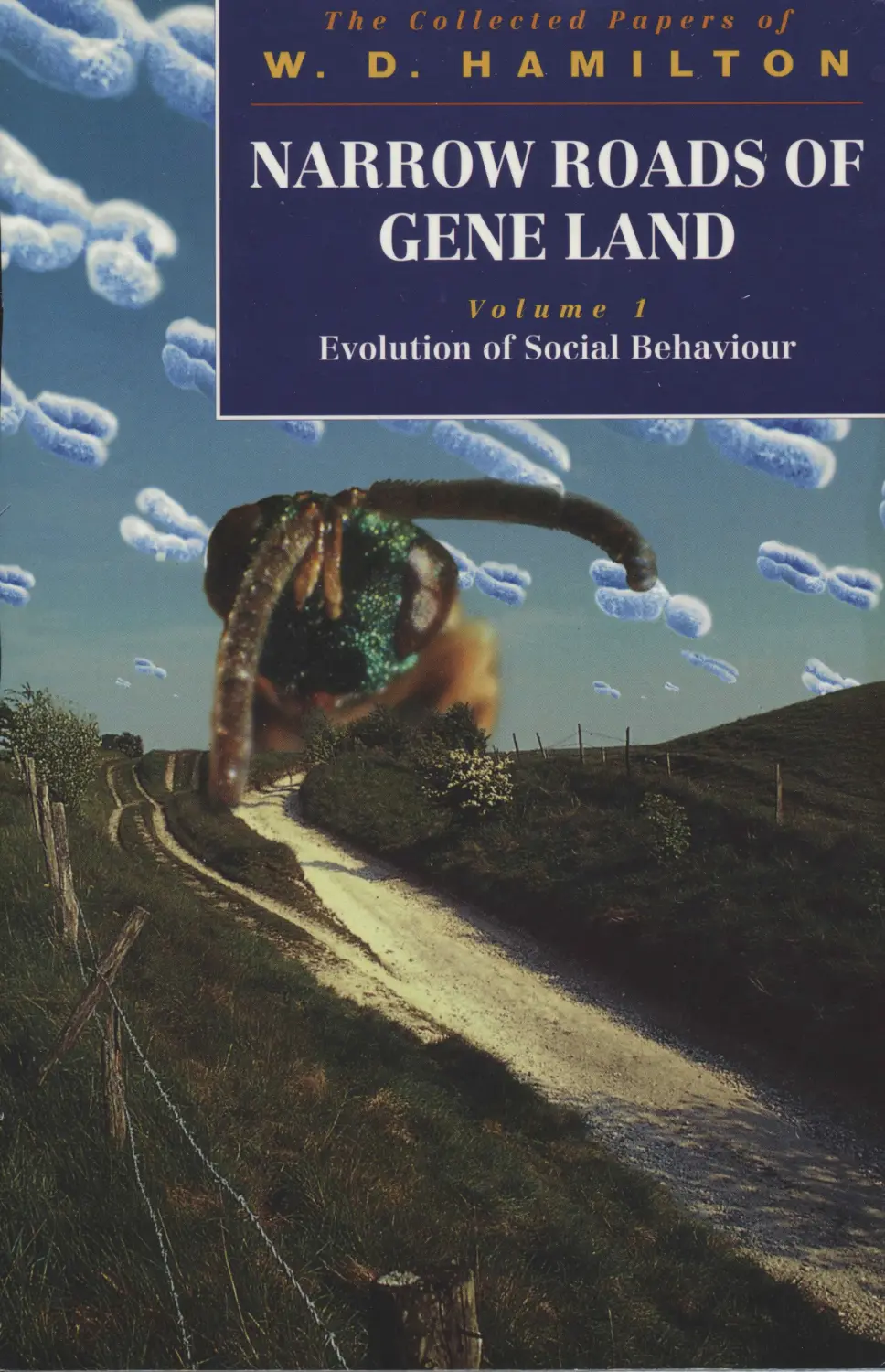
Cover illustration:
Country lane: the author.
Wasp’s head (Nasonia vitripennis), ISBN 0-7167-4530-5
supplied by H. C. J. Godfray: | | 90000 >
9 "780 03
the author.
(16°7453
Cloud-like images of chromosomes:
Biophoto Associates.
F BWMEM OSHA RY
GS SPEKTRUM

NARROW ROADS OF GENE LAND
The Collected Papers of
W.D. HAMILTON

NARROW ROADS
OF
GENE LAND
The Collected Papers of
W.D. HAMILTON
VOLUME 1
Evolution of Social Behaviour
@i W.H. FREEMAN
Gi 3 SPEKTRUM
OXFORD - NEW YORK - HEIDELBERG

W.H. Freeman at Macmillan Press Limited
Houndmills, Basingstoke, RG21 6XS
W. H. Freeman and Company
41 Madison Avenue, New York, NY10010
British Library Cataloguing in Publication Data
A catalogue record for this book is available from the British Library.
Library of Congress Cataloging-in-Publication Data
Hamilton, W. D. (William Donald), 1936-
Narrow roads of gene land : the collected papers of W. D. Hamilton
p.cm. Includes bibliographical references and index.
Contents: Vol. 1, Evolution of social behaviour
ISBN 0-7167-4530-5 (pbk.)
ISBN 0-7167-4551-8 (hbk.)
1. Social behavior in animals. 2. Behavior evolution.
3. Sexual selection in animals.
I. Title
QL775.H33 1995 95-16280 575.01'62—dc20 CIP
Copyright (chapter titles and introductions) © W. D. Hamilton 1996
No part of this publication may be reproduced by any
mechanical, photographic, or electronic process, or
in the form of phonographic recording, nor may
it be stored in a retrieval system, transmitted, or
otherwise copied for public or private use without
written permission of the publisher
Set by KEYWORD Publishing Services
Printed by The Maple-Vail Manufacturing Group

Contents
Preface vii
1
Shoulders of Giants
The evolution of altruistic behaviour 1
2
Hamilton’s Rule
The genetical evolution of social behaviour, I and II 11
3
Live Now, Pay Later
The moulding of senescence by natural selection 85
4
Gender and Genome
Extraordinary sex ratios 131
5
Spite and Price
Selfish and spiteful behaviour in an evolutionary model 171
6
America
Selection of selfish and altruistic behaviour in some extreme models 185
@
Panic Stations
Geometry for the selfish herd 229

CONTENTS
8
Sorority Avenue
Altruism and related phenomena, mainly in social insects 255
9
Friends, Romans, Groups. . .
Innate social aptitudes of man:
an approach from evolutionary genetics 315
10
Venus Too Kind
Gamblers since life began: barnacles, aphids, elms 353
11
Elm and Australian
Dispersal in stable habitats 369
12
Funeral Feasts
Evolution and diversity under bark 387
13
Discordant Insects
Wingless and fighting males in fig wasps and other insects 423
14
Astringent Leaves
Low nutritive quality as defence against herbivores 485
15
Advanced Arts of Exit
Evolutionarily stable dispersal strategies 499
Epilogue 529
Acknowledgements 530
Name Index 533
Subject Index 537

Preface
HIS book is the first of two volumes aiming to re-publish all my
substantial scientific papers together. The introductions accom-
panying the papers explain why I studied a topic and where I was at
the time. They note what has happened since the paper was written
and provide a few recent references. Furthermore, they include a vary-
ing amount of anecdote and opinion. They are untechnical and are, I
believe, easily readable by anyone interested in science.
In the first half of my life’s work I studied mainly social aspects of
the working of evolution; in the second I moved to a problem that is
raised by and underlies this first interest: why is there sex? Roughly
these halves of my working life define the two volumes. Volume 1 is
about selection for social behaviour but a glimpse forward to the sub-
stance of Volume 2 comes near the end in Chapter 10. This is a review
showing my growing interest in sexuality and some sign of how I think
the debate will go. Obviously, a scientist’s long-term interests seldom
change abruptly so that similarly in Volume 2 there will be, besides
much on ‘sex itself’, at least one paper that looks back to ‘pure’ social
behaviour and also much thought on sexual social behaviour. If these
distinctions sound a bit vaticanical, their oddness may perhaps prime
the reader to await Volume 2.
Michael Rodgers, my editor at Spektrum, pursued me relentlessly for
some 15 years to persuade me to write some book. For a long time—
enough perhaps to have written several—I have told him I would love
to write one soon but still there was a question I didn’t sufficiently
understand, that other research I was urgently engaged in... At
length via a seemingly telepathic collaboration with Sarah Hrdy in
California he has undermined my irresolute, procrastinating nature.
First, Sarah sapped and breached my wall by making it sound easy (the
‘briefest introductions’ would do, the rest virtually was already done).
Second, Michael Rodgers charged through the breach she had made.

viii PREFACE
Thus were started the far from short, indeed rambling, introductions
that you will find.
What title could I give to a mixture of anecdotes, opinions, and ser-
ious science such as are included here? ‘Rambling’ seemed indeed a key
word and at length there crossed my mind a book describing a tour
that was made on foot in northern Japan in the seventeenth century.
The tourist and writer Matsuo Basho was a poet and he interspersed
lively descriptive and anecdotal prose concerning his journey with brief
poems—haiku—that were also inspired by the people, events, and scen-
ery he encountered. Even in their translation into English, in which
most of their assonance must be lost, the poems had long appealed to
me as including some of the deepest and most poignant thoughts and
images ever recorded. It was therefore with obeisance to Basho and his
‘Narrow Roads of Okw’ that I chose my title ‘Narrow Roads of Gene
Land’.
My presumptuous and vague idea is that my introductions may simu-
late his diary and my papers, his poems. I realize that my title may
seem as ridiculous to Japanese ears as it would be to English if I had
called the book ‘The Tragedies of William D. H. Shakespeare’. If I had,
most literate Englishmen, of course, would mutter: ‘Tragedies indeed’;
correspondingly, I expect Japanese readers will mutter: ‘Indeed, roads
vanishingly narrow.’ Never mind; the poet whose dreams will wander
Japan’s countryside for as long as it exists (as mere hours before his
death at 50, his last marvellous indomitable haiku predicted) has not
yet warned me to forebear. Great artists are omni-humans; we all think
we are like them. Even so I will dare to lay my book direct at this mas-
ter’s feet, sensing in him a maverick fatalist who was indeed somewhat
akin, believing that he may enjoy the slant of my papers and perhaps
even see point and beauty in some images that I express.
But ‘tragedies indeed’, and ‘roads vanishingly narrow-—both are fair
and expectable comments! Believing in the explanatory power of evolu-
tion by natural selection is like migraine, or perhaps still more like
being, as it was in the old days, a ‘wise woman’. The majority of
humanity seem to have difficulty in accepting that the ‘oddness’ of
such a believer can be real—that is, simply an oddness and nothing
else. As the migraine sufferer is suspected of malingering, and the
woman who is merely literally wise, of witchcraft, so the evolutionist is

Preface ix
always suspected of covert agendas unconnected with reality or the
search for truth. In despair over the unending bemusement in friends
and relatives and over the stream of articles and books that still pours
forth stating Darwinism to be wrong, dead, right except for natural
selection, superseded by this stale or ridiculous notion or that (all of
which, evidently, the public eagerly buy and read, no matter what the
competence of the writer or his knowledge of the evidence); puzzled, in
short, by resistance to ideas that seem vastly more obvious and intuitive
than, say, relativity or quantum mechanics, which every one accepts
blithely with or without understanding, the evolution sufferer some-
times comes to believe it must be he who is mistaken. I describe this
happening to me in this book. At other times the evolutionist may feel
like one of the stranger ‘genetic morphs’ of his own theories—mutant
carrier, say, of a fourth intellectual pigment of the retina capable of
raising into clear sight patterns of nature and of the human future that
are denied to the majority of his fellows, or perhaps just a person
bewitched in babyhood to have revealed to him through blind sight,
through such X-ray eyes, all the ravishing and foreboding beauty of the
world that he now endures.
Whatever the nature of the ailment is, I certainly caught or inherited
it early compared to most, and it burned me badly. The book can be
read at two levels. One is for the contributions to evolutionary thinking
that it contains—contributions that, I will proudly claim, have resisted
all efforts for their derailment either by fact or further theory (apart
from a few small and self-admitted errors) for periods that now vary
from 15 to 30 years. The other is that it may be read, mainly via the
Introductions that I have added, as a description of what it is like to
live burdened and inspired by the evolution migraine—to be both sub-
ject to its piercing attacks and to the lucidity and enthusiasm that
often follows them.
Under Stalin and Lysenko, brave men in Russia suffered and some-
times died for refusing to renounce genetics, evolution, or natural selec-
tion. Nikolai Vavilov, a pioneer of domestic plant origins, is one
outstanding example. At quite an opposite pole from such martyrs, I
have led a charmed life secure in the two countries that have been his-
torically, perhaps, most favourable to evolutionary thought, and perhaps
even more outstandingly favourable concerning its ‘worst’ aspect— the

x PREFACE
elucidation of natural selection. Mentioning here the seemingly unabat-
ing popular hostility to current (and especially Darwinian) evolution
theory that continues worldwide, I am made the more deeply aware
how there exist people who have made their way in the real markets of
the world (and all over the world), who see the interest and value of
tight ideas for themselves, irrespective of their immediate profit-making
or humanitarian applications. These in the end bow not to crowd opi-
nions and have enough influence to give support to all such studies as
lead to real understanding. Examples springing to mind are Caryl
Haskins, Gordon Getty, Kasuo Inamori (not to forget, of course, such
great rationalists of the farther past as Captain Cook, Benjamin
Franklin, or even, say, the Medicis). My start may have been shaky and
my position odd at times, but thanks to such more worldly people, no
one, hardly even Darwin himself, can have enjoyed better opportunities
for study than I have had. I very much hope that the papers that follow
in the two volumes of this work, few as they-are, will be considered to
justify the help I have received.
It is in exactly this line that I am grateful for my salaried support
and opportunities in Britain, in the United States, and in Brazil, to
carry out the work represented in this book. My special thanks go to
the Imperial College of London University, to the University of
Michigan, and to Warwick Kerr for his invitations to Brazil; and most
recently and overwhelmingly my thanks are due to the Fellows of the
Royal Society of London who in 1984 appointed me a Royal Society
Research Professor and have continued to support me generously up to
the present (even before 1984, I should mention, I was in their debt for
small grants while at IC).
Even though a full catalogue would speak strongly for the interna-
tionalism of interest I have already mentioned, to list all university
departments, institutes, societies, academies, and congresses that have
given me encouragement through their invitations to lecture would be
tedious for the reader. Instead it must suffice to name the countries (in
addition to the three above) from which such invitations have come:
Australia, Brunei, Canada, Crimea, Denmark, Finland, France,
Germany, Italy, India, Israel, Japan, Netherlands, New Zealand,
Norway, Poland, Sweden, and Switzerland. To all these countries I
express my thanks.

Preface xi
Numerous people played a more personal part in making these
papers possible and especially helping to initiate them. My parents
started me early into science, perhaps were surprised and dismayed (at
times) by my maniacal response, but even in worst years, when it was
unclear that their efforts on my education would lead to any career,
never faltered in their support. My sister Mary and my other siblings
have been crucial to that family base of strength that made me willing
to step back to meditate. Other good friends in the years of Cambridge,
London, and Ascot—Colin Hudson, Vahine Gibbings, Marion Luke,
David Harris, Yura Ulehla—made the condition of my meditation, by
then complexed by being a far-gone gene and altruism freak, more tol-
erable. Close after those came Christine Friess, soon to be my wife. She
has given me her longstanding patience in respect of wasps in Brazil,
whitefly on her tomatoes, sexless weevils felling her houseplants, inte-
grals and Voronoi polygons far into the night, and eventually, in spite
of all this, the joy, support, and distraction of a family.
Debts to my co-authors I hope appear sufficiently in the chapters
concerned; others, of course, are to come in Volume 2. Robert Trivers,
Richard Alexander, Edward Wilson, George Williams, Michael Orlove,
and Richard Dawkins were never co-authors but have become known
almost as if they had been through their endeavours parallel and sup-
porting. Thanks, too, for early serious attention in their own papers to
my work, must yet again fly the Atlantic to Gordon Orians, Jerram
Brown, and Jon Seger. Regarding the production of this volume I am
much indebted to five in particular. Starting from what now seems a
long time ago there have been three who, standing largely apart from
its chapters and themes, have helped the whole enterprise both directly
and by good counsel: Sarah Hrdy, Naomi Pierce, and Katrina Mangin.
More recently two have kept me afloat. First, for such even grain of
sense and appearance as the book has, as well as for many sharp
thoughts for improvement, I thank Sarah Bunney, my copy editor.
Second, for an index that can at least help me, if no one else, to distin-
guish what I wrote from what I thought or wished that I wrote, I thank
Jeremy John.
Having listed friends—with all too many still unmentioned since the
net eventually spreads too wide—I am tempted to begin listing my ene-
mies, those who have spurred my work on by being so outstandingly

xii PREFACE
wrong, so critical, and so irritatingly indifferent. But this multitude of
patrons, beyond those broad classes already hinted at, had better be left
to be implied in the papers themselves.

C H A P T E R
1

Willing sentinel
On a termite mound in the semi-desert of the southern Kalahari a meerkat risks predation while watching
for hawks, jackals, and snakes. Around it in relative safety its companions forage over sand and leaf litter
for their small prey. Groups are greatly benefited by the sentinel and, when too small to post one, rapidly
die out.

C H A P T E R 1
SHOULDERS OF GIANTS
The Evolution of Altruistic Behaviour
There be many shapes of mystery.
And many things God makes to be,
Past hope and fear.
And the end men looked for cometh not,
And a path is there where no man sought,
So hath it fallen here.
EURIPIDES’
Up to 1963 my only ‘published’ writings were a story written
when a child and filling a half page in Sevenoaks Preparatory School
Magazine and a review of a popular book on dolphins for a New
Zealand literary journal.” The review was done when I was already a
graduate student in London. The reasons why the editor of Landfall
requested a review from a biology student so far away are, probably,
first, that he did not know other biologists, second, I was his godson,
and, third, that he knew from my rare letters that I was working on
something to do with social behaviour. Even then the lives of dolphins
had a reputation for being unusual and complex. My ideas about them,
as about the book, were very lightweight and my review does not merit
inclusion in this book. However, the topic of dolphins and my
godfather’s ‘nepotism’ in sending me the task are relevant in an odd
way to the paper that follows. They hint at matters beyond biology,
even a line of escape from the theory my paper describes. Dolphins
indeed come near to defying Darwin himself by an act of a kind of
which he said that, if a single instance could be convincingly
documented, it would annihilate his theory completely.? It seems that
sometimes a dolphin may push a drowning human—a mammal from a

2 1- SHOULDERS OF GIANTS
world almost as alien to theirs as a world of Martians would be to
ours—to the sea surface where the human can breathe or, perhaps still
more inexplicably appropriate, may push or carry him or her towards
the shore, as first recorded in numerous Greek legends, such as the one
concerning Arion.*
Just as Homo, the taxon of humans, is unrelated to Tursiops
truncatus—that of the seemingly most foolishly anthropophilic of the
dolphins—so I, within Homo, was unrelated to my New Zealand
godfather Charles Brasch, who gave me my first chance of a
publication. Yet my parents named him my godfather and he
acknowledged me as his godson: I thus received a kind of pseudo-
nepotism from him—and in fact I received this on many occasions
besides the one mentioned. Was this just a stupid mistake on his part,
as biologists are inclined to interpret the dolphin’s act to be? If not,
what aberration or extension of the normal run of nepotism is here?
That 30 years before Charles Brasch had hoped to marry my mother
but since that time had stayed single and, living as he did in New
Zealand, had hardly a hope even to see her, certainly cannot, via
biology, help to resolve the issue.
Doubtless I was seeing these problems from a somewhat different
perspective when I was twenty-seven, but one thing has not changed—
this is my dislike for the idea that my own behaviour or behaviour of
my friends illustrates my own theory of sociality or any other. I like
always to imagine that I and we are above all that, subject to far more
mysterious laws. In this prejudice, however, I seem, rather sadly, to
have been losing more ground than I gain. The theory that I outline in
the paper has turned out very successful. It certainly illuminates not
only animal behaviour but, to some extent as yet unknown but now
being actively researched, human behaviour as well. Clearly, the fact
that I devoted several papers to expanding its implications and had
proceeded initially unaware of most of the tentative approaches of
various Neodarwinian forerunners means I was more hopeful of the
idea’s explanatory power than had been the forerunners—the three
great pioneers of modern evolution theory, J. B. S. Haldane, R. A.
Fisher, and Sewall Wright, who, as shown in the references in the
paper, gave to altruism at most a few lines. Thus even if it is not quite

The evolution of altruistic behaviour 3
true that mine was a path ‘where no man sought’, it does seem true
that the pioneers had not tried very hard to apply their Mendelized
Darwinism to social behaviour nor followed the signs of paths that they
did find in this area. But, equally, I was surprised at the scope of my
eventual success, and in particular did not anticipate the degree of
relevance to humans that the findings eventually proved to have. Nor
did I wish for this relevance: I am a child of the receding wave of the
Romantic Movement and as such I still hanker for miracles.
Although first to be published, ‘The evolution of altruistic
behaviour’ was written after the next two papers in this volume had
reached almost their final form. A reviewer’s criticism was forcing me
to revise and split the first, longer manuscript concerning the same
ideas and, with my hope of receiving my PhD at the time seeming to
founder (see Chapter 2), I urgently needed something to represent the
fruits of the 3 years I had spent doing research. I therefore quickly
wrote this brief abstract of the ideas of the longer paper and submitted
it to Nature. I received the editor’s decision almost by return of post. In
about three lines he regretted that he had no space for my manuscript
and suggested that, given its specialized topic, it might be more
appropriate to a ‘psychological or socialogical journal’. I was already
well aware that there existed a prejudice against my topic and I now
dimly perceived that there might have been a tactical mistake in giving
my address as the Department of Sociology, London School of
Economics. Later, after the paper had been accepted by The American
Naturalist, John Hajnal, my supervisor at the LSE, agreed that the
address might have been unhelpful, and he suggested that next time |
use the equally justified address of Department of Statistics. Why not,
for that matter, the Galton Laboratory of University College London in
which I was also enrolled—or perhaps both?
The reason I had not given the Galton Laboratory as my address
was that I was feeling a much greater debt to the LSE than to UCL. In
1960, at a dark time, LSE had arranged the studentship that still
supported me and had encouraged my intention to study of altruism—
or at least to pursue it as a sideline, along with the human demography
for which for safety’s sake they enrolled me (obviously it is not good for
a college to have a student flop too completely in research). Earlier I

4 1 - SHOULDERS OF GIANTS
had failed to interest any genetics department, including the Galton
Laboratory, in my wish to take up the genetics and the evolution of
altruism.
Norman Carrier, trained in mathematics and an experienced
practical human demographer, was the first person I met at the LSE.
A genial, very informal man he came as a breath of fresh air after my
previous interviews. He listened to my confused ideas with an
unfamiliar sympathy, speaking as though quite unaware of even a
possibility that I might be a sinister new sucker budding from the roots
of the recently felled tree of Fascism, a shoot that was once again so
daring and absurd as to juxtapose words such as ‘gene’ and ‘behaviour’
into single sentences. It was on Carrier’s encouragement that I applied
for and won a Leverhulme Studentship I had not even known existed.
Carrier was an enthusiast for any new idea or puzzle. Although little
inclined to pure theory himself he told me he probably would not
understand the genetics in what I did nor even, probably, my verbal
arguments, but he expected that we could jump around together
among my equations well enough, if there were to be any.
Meanwhile I could take his MSc course in human demography.
I see Mr Carrier perched in my memory on a front desk before our
class of about six (a scale I was accustomed to—the one I had been in
just before in Fisher’s Genetics Department at Cambridge had had
four). His arms clasp his knees and his feet (on one occasion I
remember them shod but sockless) rest on the desk seat. I recall a
lively mixture of theory, demographic practicality, and anecdote.
Consider an animal living 5 years at most, a sort of insect if you like,
having one offspring the second, third, and fourth years of its life, then
it dies... When talking of humans, he tells us, the life table you
present to your public should have a radix of, say, 10 000: otherwise, as
the numbers go down in the age classes you soon have fractional
people, and the public and press complain (more than usual) that we
statisticians have no respect for the individual. He explains how the
quick putrescence and size of a human corpse is a boon to the actuary
and demographer and is the reason why human death statistics are
more accurate than those of births, for which it may not matter for
years whether you report one or not. The essence is that people like
keeping babies but not corpses.

The evolution of altruistic behaviour 5
After some months, perhaps a year, Carrier said my written
sketches were getting too genetical for him and he passed me to John
Hajnal (then a Reader in Demography, later Professor) to supervise.
After about a year Hajnal decided exactly the same about my work and
arranged for me to be part-supervised at the Galton Laboratory. By this
time I was already of the status of a PhD student instead of MSc.
Hajnal himself was not particularly sanguine that my ideas would find
application to anything in nature (could genes really affect altruism, he
wondered, was there evidence?), let alone could apply to humans, but
he liked the sheer puzzle of how a self-destructive trait might, in a pure
world of genetics, evolve—perhaps on Mars or somewhere like that—
under the influence of natural selection. He was a stern but friendly
critic of my logic. I owe a great deal to John Hajnal and Norman
Carrier. I think of this paper as emerging as a somewhat unwanted love
child sired by a certain dread ‘other discipline’ out of the crowded ant
hill of nine o’clock students and leftward-inclined staff that the LSE
was from 1960 to 1963, and doubtless still is. An awkward and
unpredictable genie was steaming out from its overcrowded lifts and
library, its stats rooms clattering with electric-powered but not yet
electronic calculating machines (but many hand ones still); a half-
forgotten chapter of a half-forgotten book was being dusted off and
then—this presence. Was it dangerous? I think that even the head of
my department, Professor D. V. Glass, did not like my production
much, and perhaps the LSE as a whole is still slightly embarrassed, in
so far as the address attached to this little-read first paper is ever
noticed, by what I intended should express my allegiance and my
thanks.
References and notes
1. Euripides (epilogue to several tragedies).
2. W. D. Hamilton, review of A Book of Dolphins, by Anthony Alpers, Landfall 15, 94-6
(1961).
3. C. Darwin, On the Origin of Species (Harvard University Press, Cambridge, MA, 1859).
Facsimile of the first edition with an introduction by E. Mayr, 1967; see p. 189 for
Darwin’s prediction.
4. A. Montagu, The History of the Dolphin (William Andrews Clark Memorial Library,
University of California, Los Angeles, 1963).

THE EVOLUTION OF
ALTRUISTIC BEHAVIOUR!
W.D. HAMILTON
It is generally accepted that the behaviour characteristic of a species is just as
much the product of evolution as the morphology. Yet the kinds of behaviour
which can be adequately explained by the classical mathematical theory of
natural selection are limited. In particular this theory cannot account for any
case where an animal behaves in such a way as to promote the advantages of
other members of the species not its direct descendants at the expense of its
own. The explanation usually given for such cases and for all others where
selfish behaviour seems moderated by concern for the interests of a group is
that they are evolved by natural selection favouring the most stable and co-
operative groups. But in view of the inevitable slowness of any evolution based
on group selection compared to the simultaneous trends that can occur by
selection of the classical kind, based on individual advantage, this explanation
must be treated with reserve so long as it remains unsupported by mathema-
tical models. Fisher in the second edition of The Genetical T. heory of Natural
Selection (1958) rejects almost all explanations based on ‘the benefit of the
species’.* Wright (1948) in a summary of population genetics shows explicitly
that a general advantage conferred on a group cannot alter the course of
intragroup selection.* This point is very adverse to the following model of
Haldane,* which seemed to offer a possibility for the evolution of altruism.
Haldane supposed an increment to group fitness (and therefore to group rate of
increase) proportional to its content of altruistic members and showed that
there could be an initial numerical increase of a gene for altruism provided the
starting gene frequency was high enough and the individual disadvantage low
enough compared to the group advantage conferred. He concluded that genet-
ical altruism could show some advance in populations split into ‘tribes’ small
enough for a single mutant to approximate the critical frequency. He did not,
however, sufficiently emphasize that ultimately the gene number must begin to
do what the gene frequency tends to do, ex hypothesi, from the very first:
'The American Naturalist 97, 354-6 (1963).

The evolution of altruistic behaviour 7
namely, to decrease to zero. The only escape from this conclusion (as
Haldane hints) would be some kind of periodic reassortment of the tribes
such that by chance or otherwise the altruists became re-concentrated in some
of them.
There is, however, an extension of the classical theory, generalizing that
which serves to cover parental care and still having the generation as the
time-unit of progress, which does allow to a limited degree the evolution of
kinds of altruism which are not connected with parental care.
As a simple but admittedly crude model we may imagine a pair of genes g
and G such that G tends to cause some kind of altruistic behaviour while g is
null. Despite the principle of ‘survival of the fittest’ the ultimate criterion which
determines whether G will spread is not whether the behaviour is to the benefit
of the behaver but whether it is to the benefit of the gene G; and this will be the
case if the average net result of the behaviour is to add to the gene pool a
handful of genes containing G in higher concentration than does the gene pool
itself. With altruism this will happen only if the affected individual is a relative
of the altruist, therefore having an increased chance of carrying the gene, and if
the advantage conferred is large enough compared to the personal disadvant-
age to offset the regression, or ‘dilution’, of the altruist’s genotype in the
relative in question. The appropriate regression coefficient must be very near
to Sewall Wright’s coefficient of relationship r provided selection is slow. If the
gain to a relative of degree r is k-times the loss to the altruist, the criterion for
positive selection of the causative gene is
k> t
r
Thus a gene causing altruistic behaviour towards brothers and sisters will be
selected only if the behaviour and the circumstances are generally such that the
gain is more than twice the loss; for half-brothers it must be more than four
times the loss; and so on. To put the matter more vividly, an animal acting on
this principle would sacrifice its life if it could thereby save more than two
brothers, but not for less. Some similar illustrations were given by Haldane
(1955).4
It follows that altruistic behaviour which benefits neighbours irrespective of
relationship (such as the warning cries of birds) will only arise when (1) the risk
or disadvantage involved is very slight, and (2) the average neighbour is not too
distantly related.
An altruistic action which adds to a genotype’s reproduction (inclusive of
the reproduction of identical genes procured in the relative) by 1 per cent is not
so strongly selected as a 1 per cent advantage in personal reproduction would
be; for it involves also an addition of unrelated genes which are in the ratio of
the existing gene pool—an addition which must be larger the more distant the
relationship.

8 1. SHOULDERS OF GIANTS
A multifactorial model of inheritance, which is doubtless more realistic,
does not invalidate the above criterion, and provided fitness is reckoned in
terms of ‘inclusive’ genotype-reproduction, and the dilution due to unrelated
genes 1s allowed for, the classical treatment of dominance and epistasis can be
followed closely.
Fisher in 1930 (1958) offered an explanation of the evolution of aposematic
colouring based on the advantage to siblings of the self-sacrifice, by its con-
spicuousness, of a distasteful larva, and his discussion contains what is prob-
ably the earliest precise statement concerning a particular case of the principle
presented above: ‘The selective potency of the avoidance of brothers will of
course be only half as great as if the individual itself were protected; against
this is to be set the fact that it applies to the whole of a possibly numerous
brood.” It would appear that he did not credit the possibility that selection
could operate through the advantage conferred on more distant relatives, even
though these must in fact tend to be still more numerous in rough inverse
proportion to the coefficient of relationship.
This discussion by Fisher is one of the few exceptions to his general insist-
ence on individual advantage as the basis of natural selection; the other notable
exception from the present point of view is his discussion of putative forces of
selection in primitive human societies.®
References
I. R. A. Fisher, The Genetical Theory of Natural Selection, 2nd edn (Dover, New
York, 1958); e.g. p. 49.
2. S. Wright, Genetics of populations, in Encyclopaedia Britannica (1948; 1961 print-
ing), 10: 111D—112.
3. J. B. S. Haldane, The Causes of Evolution, p. 208 (Longmans, London, 1932).
4. J. B. S. Haldane, Population genetics, New Biology 18, 34-51 (1955).
5. Fisher 1958 (ref. 1), p. 177 et seq.
6. Fisher 1958 (ref. 1), p. 261 et seg.

C H A P T E R

A cuckoo queen...
Under a rock in the Alps a wasp (right), Polistes (Sulcopolistes) atrimandibularis, guards white-capped
coccoons containing her offspring, none of which will be workers. Her aggressive wing posture on the
nest challenges (left) the workers of Polistes binotatus whom she has enslaved after evicting their mother.
One worker replies to her but will become submissive if the Sulcopolistes approaches. The larger, more
squared head of the parasite reflects powerful muscles: head blows and biting rather than the deadly sting
are used in day-to-day domination. But the parasite’s sting is also larger and is grimly curved in adaptation
for lethal fighting when necessary.
... and a loser
At another site, a Polistes binotatus female (far left) crouches immobile and distant on the stone bearing the
nest that she initiated (right) where her daughters are now enslaved. On the nest, the usurper (Sulcopolistes;
far right, pale antennae) approaches a binotatus worker. Above the worker, a male (pale narrow face; first
son of the Sulcopolistes) backs nervously from the camera. What ‘emotion’ has an evicted mother?
Depression, it seems here; but perhaps there can also be a faint hope that the evictor will die, opening a
chance for the loser to resume reproduction.

C H A P T E R 2
HAMILTON’S RULE
The Genetical Evolution of Social Behaviour, I and I
It is not necessary that you leave the house. Remain at your table and listen.
Do not even listen, only wait. Do not even wait, be wholly still and alone.
The world will present itself to you for its unmasking, it can do no other, in
ecstasy it will writhe at your feet.
FRANZ KAFKA?
Ir Professor David Glass was cool towards my work at the
London School of Economics, Professor Lionel S. Penrose, FRS, at
University College was equally so. I believe he definitely saw in me the
eugenical spectre I mentioned in the first introduction. Although
supervised at the Galton Laboratory for 2 years I never had a desk
there nor was ever invited to give any presentation to explain my work
or my occasional presence to others. I think virtually no one I passed
in the corridors or sat with in the library knew my name or what I was
doing. Probably this was largely my own fault. I was a student who, if
not offered or invited, wouldn’t request, and I think I didn’t ask for
desk space either there or at LSE. In fact I had no idea at the time
what was normal for graduate students and it is only after seeing
arrangements made in other departments both in Britain and the US
that my own situation as a graduate has come to seem odd. At the
time I hardly knew what a PhD was. I just wanted access to libraries
plus some pittance of support; these together would give me freedom to
follow my puzzles. Apparently I needed affiliation to colleges to receive
my grant and to be a part of London University; two colleges were
kindly offering this and that was enough. The consequence of not
having desk space was that most of my thinking, analyses, and writing,
were done in my bedsitting room. For most of my graduate period this

12 2- HAMILTON’S RULE
was in Chiswick, some 6 miles west from the West End locations
(Kingsway and the Euston Road) where were the two colleges. This,
too, may have been partly by my own choice. Certainly I well knew the
aphorism of Kafka I have cited above and had begun to believe even as
a schoolboy that the quickest way to understand what puzzled me was
to spend more time thinking about what I already knew, not necessarily
collecting more data. In practice, as is already evident, I made a big
exception for going out to libraries for more information. I did start one
experiment to look at the altruism or otherwise of seedling ‘conkers’
(Aesculus hippocastanum) while I was at London. But even before all
this, still at Cambridge, I had made the decision that I would not even
try to come abreast of the important work that was being done around
me on the molecular side of genetics. This might well be marvellous
in itself: I admitted the DNA story to concern life’s most fundamental
executive code. But, to me, this wasn’t the same as reading life’s real
plan. I was convinced that none of the DNA stuff was going to help
me understand the puzzles raised by my reading of Fisher and Haldane
or to fill in the gaps they had left. Their Mendelian approach had
certainly not been outdated by any of the new findings.
Thus my sorties to my colleges became mainly for computation
and for reading and, rarely, to see my supervisors. Most other trips
were to libraries all over London or to the London University’s Senate
House canteen to get a cheap meal. In so far as I needed a desk |
carried mine with me in the form of a large canvas holdall whose
depths held papers and books. The upper half had such things as a
crumpled jersey, a raincoat, or a fresh loaf of bread to take home.
I walked everywhere, rarely taking a bus or the Underground for
distances less than 2 miles. My idea was, I think, first, to save money
and get exercise and, second, to make London seem as far as possible
an extension of the countryside of my boyhood Kent, the presence of
which I could still feel a mere tantalizing 20 miles distant from where |
walked. Always keen on physical experiences of topography I wanted to
conjure and recreate somehow, below the bricks and mortar around
me, the marshy fields that had once been there, the streams dividing
them, and the heaths behind—to seek, in short, elemental forces
underlying the city. Even a lonely child crying on the street did not tug
my heart as hard as a bracken fern when I saw it, for example, in the

The genetical evolution of social behaviour, I and II 13
valley of the stream once called the Fleet—a plant etiolated and pale,
standing up from deep wells of basement windows, its fronds reaching
to the level of the street.
From those same wells I recall also the soul-piercing yellow from
the flat, star-like flowers of a ragwort. What plant was this, daring to
flower under such hostile cliffs, where was it from? Was it a growth
form of the more crinkled and robust plant I knew so well on the
Kentish fields, there crawled upon and stripped by the stripy caterpillars
of the cinnabar moth? But if the leaves in London might be laxer and
greener because of a lack of light or to an excess of lead in these wells,
why would the flowers be larger? Today, based on a theory of sex to be
explained in the second volume of this work, I might give another
conjecture in answer to this but in 1961 I think I simply imagined that,
like me, the plants were longing to be away from these dark concrete
canyons, back in their own countryside. Fixed in their cracks, as I
thought, what else was there for them but to signal desperately with
their bright petals to the rare and equally lost London bees crossing
(again like me) the chasm of the Farringdon Road? Was it through
such petals and then such an insect’s aid that they hoped to create the
seeds which an autumn storm could carry away? Such conjectures as |
made about them, excepting perhaps this last one, turned out to be
wrong. The ragworts may, after all, have been quite happy: it was in
fact a rather triumphant species, a new conqueror of Britain, a railway-
and-town ragwort from the start, not my ragwort of rural Badgers
Mount in Kent. Only later did I come to know the full romance of the
‘Oxford’ ragwort, the inhabitant of those window wells and walls, and
how it was by origin more an expatriate even than I and had come by
a strange zig-zagging convergence to mix its faint scent with stronger
urban ones, which, as it happened, were from just the same homeland
as itself. That is to say, the flowers I saw were mixing scents with those
of pizza, pasta, and oregano wafting from the Italian restaurants that
served my fellow lonely pedestrians of the area (not me, I was too
poor) around King’s Cross and Euston stations. In short, with the help
of Oxford botanists the species had immigrated from southern Italy
some 150 years ago.”
In spite of his appointment as head of the institution Galton had
created, Professor Penrose was strongly anti-eugenical and during his

14 2. HAMILTON’S RULE
tenure realigned the institution’s research to become more standard
human genetics. Likewise, as editor of Galton’s journal Annals of
Eugenics, he changed the name to Annals of Human Genetics.
An imaginative, speculative thinker in other very diverse fields—for
example, artificial life, voting theory, and the pictorial representation of
impossible structures—his principal work in genetics was elegant but a
rather mainstream elucidation of human genes, chromosomes, and
biometry. When, before going to LSE, I had come to him to ask if the
Galton Lab could sponsor my work on the altruism problem, Penrose
emphatically told me no and that he doubted that there was such a
problem to be studied. At the same time, however, he acknowledged
the worth of my Cambridge genetics degree; if I would like to join him
to work out the nature of a new polysomy he had recently discovered,
he could probably support me.
A joke of the Darwinian period, perhaps from Punch magazine,
has two ladies conversing. One says: ‘Have you heard that Mr Darwin
says that we are all descended from an ape?’ The other replies: ‘Oh, my
dear—that surely cannot be true! .. . But, if it should be true, let us
pray that at least it will not become generally known!’ All evolutionists
are acquainted with this class of reaction if not with the exact situation
or the words. It equally affects the extensions of Neodarwinism that are
set out in the two papers of this chapter. In many people, perhaps even
a majority, reading them leads to an instant automatic wish for both
the evidence and the idea to go away. In the case of my ideas on social
evolution I think the Victorian woman’s reply may appropriately
caricature reactions even of Penrose and some other good geneticists.
What constitutes evolutionary biology’s difficulty as a subject, and even
more makes the difficulty of sociobiology, and more than that still,
makes the special difficulty in accepting human sociobiology, is
something quite different from what makes difficulty in, say, a physics
topic. The difficulty over these social and evolutionary questions is not
the rigour of chains of logic or maths, nor complexities of geometry,
nor counterintuitive ideas. Most of the ideas of evolution are very
intuitive if we could just set our minds free. The problem is rather that
of thinking the socially unthinkable. Darwin put it well on the side of
public expression when he said in a letter that writing about non-fixity
of species was like ‘confessing to a murder’. It is the challenge that

The genetical evolution of social behaviour, I and II 15
such ideas cannot fail to direct at deeply entrenched and perhaps
almost essential human myths. In other words, some genetical and
evolutionary hypotheses, including those underlying the papers that
follow (ideas that in any other field would seem quite unexceptional
and often appear as just plain common sense), turn out to have, or are
perceived to have, the unfortunate property of being solvents of a vital
societal glue. It came as no surprise to me that E. O. Wilson (see
Chapter 9), much more bold in controversy than I am, faced a furore
over his writings about human sociobiology.
At this point, however, it will even the account a bit to admit
that, as an avowed adversary of eugenics, Penrose may really have had
good reasons to distrust me. When I first met him I was quite a strong
believer in eugenics. More than most people I still am, as will be seen
in some of the later chapters of this book. Francis Galton, Darwin’s
cousin and within the evolutionary era the initiator of the notion of
eugenics, was much admired by me for his amazingly diverse
contributions to biology, psychology, statistics, and genetics. Among his
more practical contributions had been starting the department of which
Penrose was now head. I had come to Galton’s idea by my own parallel
reasoning spurred by the common youthful wish to improve the world,
and by reading Fisher. I much liked the notion that human-directed
selection, whether to maintain standards or to speed the intellectual
and physical progress of humanity, could be made both more effective
and more merciful than the obviously inefficient and cruel natural
process. ‘What a book’, wrote Darwin in a letter, ‘a Devil’s Chaplain
might write on the clumsy, wasteful, blundering, low and horribly cruel
works of nature!’ Darwin probably meant that natural selection itself
was one of those works. I think that at first it hardly crossed my mind
that Galton and Darwin were considered by many to have laid the
intellectual foundation for Nazi racial crimes. It is true that both
writers from time to time revealed that they accepted the opinions
about race differences that were nearly universal in their time, but the
selection, natural or otherwise, that they were discussing in their works
was normally at a level very far from that of human races. It was
generally far even from the broad categories of behaviour such as
criminality and feeblemindedness that shortly became so controversial.
Thus, although I could see some faint connection between their

16 2-HAMILTON’S RULE
thoughts (and, in Galton’s case, advocated policies), and such
attributes as criminality, 1 saw none with respect to a struggle between
classes or races.
As I realized later there is good evidence that the notion of
coercive racial policies came to Hitler’s Germany, in practice as well as
in theory, via Russian Communism and ultimately from Marx himself.®
Marx had never really understood Darwin’s natural selection theory
and what he did understand he recast into terms of his own
preoccupation with group struggles. The idea that in a fixed physical
environment, leave alone in a (hypothetical) fixed social one, there
could ever be a single ideal type of human being always seemed to me
unnatural—such a uniform ideal just never looked like being Nature’s
way. On the contrary, Nature, for reasons which it was to become my
life’s work to try to understand, greatly values variation of all kinds
within her units, does so at all levels, and seemingly goes to great
lengths to protect it. The thought of a genetically or even merely
racially uniform population of humans was both unnatural and
appalling and I suspect, had they understood genes, would have been
so equally to Darwin and Galton. However, the idea that wise
governments ought to try to think more of the extreme long-term
consequences of their policies, on the scale of many generations, and
should adapt the laws they pass accordingly, or that education also
should include discussion of such distant future issues, appealed to me
strongly and still does. It also seems to me that scientific giants such as
Louis Pasteur, who have applied themselves with spectacular success to
improving the immediate human condition, may eventually sink a little
in our estimation—not, for sure, as scientists but under their parallel
esteem for the immediate pan-human benefactions—whereas others
who worked more on the plane of population effects such as Adam
Smith, Malthus, and Galton (perhaps here one should also include
thinkers such as Macchiavelli who likewise dared touch more difficult
‘realist’ issues) may rise.
I never had a conversation about any of this with Professor
Penrose but it is quite likely that in my interview with him when | first
tried the Galton Lab I may have mentioned something about my
interest, or at least may have let him know of my general admiration
for Galton. Later, when I had successfully entered his lab by, as it were,

The genetical evolution of social behaviour, I and II 17
a back door from the LSE, and sensed in him a kind of gloomy
avoidance, I always thought that if we could discuss matters he might
discover less difference in our ideas about humans than he believed.
Then, as I thought wistfully, he might not look so dourly on me in
corridors and courtyards, and his secretary, with whom I actually had
more to do and whom I guessed reflected his attitude, might have been
more friendly. All this, of course, was happening a mere 15 years after
the war. If he did think he had a rabid eugenicist, and one seemingly
not particularly bright at genetics as well (as suggested by my lack of
interest in all the mainstream work his lab was doing), the situation
that arose is not surprising.
Since that time I have changed my views considerably. Although
I am now even more certain than then that if an omnipotent dictator
chose to breed humans with exceptional abilities in any direction the
job could be done, I am also certain that the products would not be
very desirable—even leaving out any intervening ghastliness of the
policies. Contrary to what is often fiercely argued, heritable variation in
almost every human talent does seem to be abundant. New evidence
on this is being added all the time. In short, the dictator’s selection
would work. My change in view results rather from my search for
ultimate reasons for sex, a topic that will become prominent in Volume
2. I now believe that just about when the dictator was beginning to
relax on her throne and to congratulate herself on her progress, she
would find her various ‘alpha’ human stocks had become so poorly in
general health that no one would like them, and no one would want to
mate with them. Finally, she would be forced into sterilizing them
along with all her other black sheep and starting over again. In doing
so, she would find herself apologizing to many of her formerly rejected
phenotypes. I believe that parallel problems and reactions to this have
often occurred in the course of breeding domestic animals. The causes
of dwindling profitability in breeds is not properly understood but is
likely to be at least partly of this nature (as will be explained Volume 2).
More important even than my realization of the universality and
subtlety of parasite and disease coevolution accompanying any large-
bodied species, however, I have come to see that the above
experiments could only ever be done under the supposed ruthless
dictatorship. A majority in a democracy will never be persuaded

18 2. HAMILTON’S RULE
to accept a positive eugenics policy and when the malthusian crunch
comes, democracy (or the militocracy that is likely to have succeeded it
in the last stages) will simply drift back, willy-nilly, to natural selection,
as can be seen happening in many disaster-torn countries today.
Perhaps that is indeed the best we can expect and is no more cruel
than a controlled intervention aimed at joint population control and
improvement (or simply maintenance). Moreover, perhaps trying to
guess the human ideals of the future always has to be stultifying. The
very concept of the good and the superhuman may be better left to be
determined by the natural process unaided. What has to be realized,
though, is that a utopia of ‘right-to-life’ large families and of unlimited
medical fixing of all health issues from the womb onwards—for ever, so
far as possible—is not really going to happen. Such utopia punctuated
from time to time by social cataclysm, with the latter providing severe
natural selection, is possible and perhaps is already being illustrated, as
I have suggested. Possibly the general unexpectedness of cataclysms
makes them in the long run more kindly than the constant worry about
self and kin that would accompany continuous control of population
and of genetic quality. But for any species even just maintaining its
standards, there is no escaping control and selection of some kind: to
this extent Malthus and Galton were both right.
I include this digression about my early interest in eugenics
partly because no mention is made of it in the other primarily
autobiographical sketches that will appear later in this volume. Having
mentioned it, however, it is important to emphasize that my interest is
not in fact particularly relevant to the interest in the evolution of
altruism and selfishness expressed in the paper in this chapter. In one
of the most common misinterpretations of the theory, it is supposed
that because genes and altruism (or selfishness) are constantly being
mentioned, the theme involves some individuals having more altruism
and more altruistic genes than others. It is true that differences must
sometimes exist in a small way as, one by one, new alleles are selected
into the population in the manner the model describes. But the typical
end result of such new alleles becoming universal is that all members of
the population are exactly the same: individuals end behaving in a
discriminating, nepotistic manner to one another as if differences in
genes were still there and mattered, when in fact, at a particular time,

The genetical evolution of social behaviour, I and II 19
there may be no differences at all, these being matters of the past.
That 97 per cent or whatever of alleles are in common even between
randomly selected members of a population or species, and unknown
genes affecting social behaviour are likely to show similar overlap, does
not bear on the validity of the argument in the least. The existence of
such probable uniformity leads on, of course, to the thought that the
final social situation that evolution creates is rather absurd. Although
animals may have to suffer such absurdity, surely it is open to humans
and other intelligent animals to realize that, if the genes are so alike, it
really only makes sense to treat relatives and non-relatives as alike to
the self to the degree of the measured similarity—in other words, to be
extremely generous and loving towards everyone. This, however, is not
what the theory predicts will happen and our intelligent animal ought
to think it out more carefully. Even when it is near to complete
monomorphism the evolved nepotistic programme of behaviour is still
at work in maintaining its base. Simply by being there it is beating back
all mutant ‘cheat’ genes that fail to perform altruism but still reap its
fruits from the acts of others. Random aid to just anyone gives scope
for unthriftiness to flourish and for simple non-altruism to arise. Since
there is hardly an easier mutation to imagine than one that causes a
constructive behaviour like altruism not to be performed, so creating a
passive and successful receiver for the altruism of others, the point is
serious. Thus the critics who cite the 97 per cent or whatever as
meaning that nepotism is pointless are wrong even as regards any
possible monomorphic end state.
All this is implied in the two-part paper in this chapter (in Part ]
as implied in the unrestricted set of allele frequencies allowed on page
35) but it is evident from the lack of emphasis I gave to this point in
the later sections of the paper that I did not anticipate how the
situation would be perceived. I do believe in the existence of
considerable genetical differences in altruism, in selfishness, and in
many other social attributes in most social animals, and this includes in
humans, but this belief is certainly not predicated directly from kin-
selection theory. Rather, it is underpinned more by a belief in a
complexity of life sufficient to generate genetical variability in almost
everything—the variability we actually see—and also, as will appear in
Volume 2 of this compilation, by modern theoretical expectations

20 2-HAMILTON’S RULE
connected with reciprocation and with disease selection. It certainly
does not come from kin selection per se.
Once a paper has achieved a certain status of citability it
sometimes takes off on a life of its own that may have little relation to
what is in it. Citability can mean citation in a bad way, as in‘... . as
believed by Idiot (1973)’, and I have just indicated one bad way, via a
misinterpretation, my two-part 1964 paper is sometimes cited. But
citability and the independent lives of citations just as often mean
intentions by citers to be positive while they actually give misconstrued
support. For example, many people have written as if it was mainly
about social insects and in particular as if its overwhelmingly important
point was how a peculiar genetical asymmetry of haplodiploid
Hymenoptera (sawflies, ants, bees, wasps, and wasp-like parasites) may
have predisposed the group of insects to social life. The justification for
this seems to be that because eusocial insects (those with sterile
workers and a queen) provide many of the most indisputable examples
of altruism, discussion of situations in the social insects does take up
quite a large section of Part II. However, anyone who really read Part
II, leave alone read both parts together, could hardly fail to see that my
aim was much broader: it was to present a theory applicable to social
behaviour under relatedness for any group in the living world. Besides
the special coverage of diploids, that of haploids was implied and even
asexuals touched on; the lives in question could be multicellular or
otherwise; and so on. Anyone reading Part II will see that I discuss
some explicit cases for plants: why shouldn’t plants be altruistic too?
In the early days I was continually being told that there was no
such thing as altruism, or else that, why, of course!—everything is
altruistic. I badly needed examples, therefore, where both self-sacrifice
and the limits to it were indisputable. Social insects became one of my
main examples, and warning cries exchanged by social animals
apprising one another of danger became another. Perhaps because of
the space I devoted to social insects, for a long time the combined
paper was cited largely by people concerned with my arguments about
them, whereas actually these arguments had mostly been afterthoughts
hardly even started until the whole of what became Part | of the paper
had been written. What came to make up Part II was done rather
hurriedly. Having seemingly flunked my chance of a PhD I was feeling

The genetical evolution of social behaviour, I and II 21
in need of something to represent the years I had used up. Through my
haste, two rather bad errors concerning the relatedness coefficients and
the selection of sex ratio under haplodiploidy, slipped into Part II.
I took the opportunity of correcting these errors when the two parts
were republished in the book that George C. Williams edited on group
selection, published in 1971,* especially using an Addendum that I put
in after the paper (and include again in this volume). In spite of these
defects and many others that the paper has, the rise in citation of the
combination, after a slow start, eventually became dramatic and when
I wrote my Current Contents commentary the article had been for some
years Journal of Theoretical Biology’s most cited paper ever: whether it
retains that status today I don’t know. In any case, well illustrating the
theme of citations developing a life of their own, a brief note on
memetic evolution (i.e. in this case an evolution of errors in the
wording of the listed reference) by Seger and Harvey” proves that a
very high proportion of the citing was being done (and probably still is)
by people who had not read the work.
How did the ideas that led to this paper begin? In the
autobiographical sketches that appear in later chapters, including the
one just mentioned, I explain how as an undergraduate at Cambridge
University I had come to see altruism in particular and social behaviour
in general as a poorly understood part of evolution theory (see Volume
2). The most immediate stimulus was my lecturers largely endorsing a
‘benefit of the species’ interpretation that stood in sharp contrast to the
writings of my then hero of twentieth-century evolution theory,
R. A. Fisher. Fisher championed an almost complete predominance of
selection at the level of individuals. His writings on evolution I had
had to discover at Cambridge for myself because they appeared to be
either unknown to or disapproved of by my lecturers. One told me that
Fisher’s work on statistics was admittedly very important but Fisher had
no credentials even to be writing on biology. Many Cambridge
biologists seemed hardly to believe in evolution or at least seemed to be
sceptical of the efficacy of natural selection. The Cambridge view of
evolutionary mechanism at the time is well illustrated in the following
passage from Professor Sir Vincent Wigelesworth’s introduction to a
chapter on population aspects of entomology in his book The Life of
Insects, published in 1964:

22 2. HAMILTON’S RULE
Insects do not live for themselves alone. Their lives are devoted to the survival of
the species whose representatives they are... . We must now stand back and look
at the insect as a member of the ‘population’ or ‘species’ to which it belongs.
Indeed we have now reached the heart of the matter—the aim and purpose
(so far as we can understand them) of the life of insects.°
I quote this as a criticism of no more than a tiny portion of
Wigglesworth’s own work, which was almost entirely concerned with
mechanistic aspects of insect physiology. Within that ambit his work
was diverse and excellent: it was on how the animal survived,
metamorphosed, reproduced, and so forth, and he never interested
himself beyond what evolutionists now refer to as the ‘proximate’”~”
aspects of adaptation—how things are engineered in the insect’s body.
He can have had little cause to reflect on ‘aim and purpose’ in wider
contexts where the conflictual and strategic questions enter. In other
words, in those contexts containing what we have come to call
‘ultimate’ aspects of adaptation—who adaptations are for, which
genetic units benefit, and so on. The point of the citation is the
Cambridge atmosphere of the time, an atmosphere that Wigglesworth
breathed and influenced. His automatic endorsement of adaptation at
the population or ‘species’ level (even so, slightly hesitant, as suggested
by the parentheses) corresponds exactly to the ‘alternative
pseudoexplanations’ I had in mind when discussing Fisher’s idea about
the evolution of distastefulness in insects (see page 49).
While I was still an undergraduate at Cambridge, and just
beginning to try to devise models that would support altruism under
natural selection, I did not have Fisher’s remark on distastefulness
consciously in my mind even though I had probably read it, nor did I
have J. B. S. Haldane’s equally brief discussion that he put into a
popular paper in New Biology even though I know for certain I had
read that. One reads and forgets. Hints not understood probably leave
their traces, but one has to return to the topic in a better state of
preparation and to re-read before such throwaway items become
meaningful. Hence, my first algebraic attack on altruism as an
undergraduate concerned Haldane’s other more lengthy and obvious
model, which I suspected to be, and proved to be, a failure within its
stated conditions (the argument for this comes in the paper of Chapter

The genetical evolution of social behaviour, I and II 23
9). Perhaps the hints of a factor of two somehow lurking in the mist
around full sibs existed by now within me, waiting for better times. But
instead of any effort to clarify the idea I started looking for estimates of
the importance of relatedness in quite other places—in the population
genetics literature, within my own intuition based on my family and
ordinary literature, and even through trying to read what social
anthropology had had to say about what cultures around the world
thought about blood relatedness. I was vaguely hoping to ‘average’ out
of all that something that would be revealing for my purpose.
The naive last idea had occurred to me as an undergraduate
long before my move to London. With it in mind, as well as through a
general interest in human social behaviour, I had made an unsuccessful
attempt at Cambridge to enrol for a course in social anthropology. The
idea of social anthropology as a subsidiary subject to genetics was
frowned on both by my ‘home’ Department of Genetics and by the
Department of Social Anthropology. The then Reader in Social
Anthropology, with whom I tried to discuss my intention, was Edmund
Leach, destined by 1976 to be Professor Sir Edmund Leach and by that
year one of the most bitter and outspoken critics of E. O. Wilson’s
Sociobiology. Whether it was he in person, on the anthropology side,
who denied the relevance of genetics to his discipline (and presumably
the reverse relevance also), or whether the attitude he later revealed
concerning Wilson was simply universal and unquestioned in his
department, in retrospect the refusal of Social Anthropology to
consider the combination with genetics is not surprising. It was part of
the requirement for the genetics degree that some subsidiary subject
should be chosen and that the department in question should be
willing to set an examination paper. My ideas about the connections of
the two subjects at that time were undoubtedly naive and probably
poorly expressed but I still think that my request to combine the two
was reasonable and that at the very least someone should have tried to
explain to me why the two disciplines could have nothing in common.
Some one in Genetics could have told me, for example, and
realistically enough: ‘You have to realize that those people over there
won't teach you science . . . social anthropology is done more like
poetry.’ At the time I would have found such a statement astonishing

24 2-HAMILTON’S RULE
but at least it would have been a reason, and being told of such a view
might have countered my naive supposition that reading in the two
disciplines would be like seeing the same mountain range first from one
side and then another and out of the two viewpoints somehow figuring
a route to a pass. In any case, the blank refusal of both sides even to
discuss the issue caused an immediate decision to leave Cambridge
once I had finished my first degree and to seek opportunities for further
development of my ideas elsewhere.
When my upper-second-class degree in genetics was attained and
I began to look for a path to continue, I had two strategies in mind.
One was to try heads of genetics departments to see if any would
sponsor me and the other was to enrol in a course for a Diploma of
Education so that I could become a schoolteacher. I believed that the
pace of an education course would be slower than that of the
Cambridge courses I had just completed and that during the new one
I should have time to straighten out my thinking about altruism, and
with further luck might even continue such straightening after I had
become a schoolteacher, if that career proved really necessary. I had in
mind certain precedents of excellent science done after a start in
schoolteaching. One was Ronald Fisher himself, and the other David
Lack, an important bird and population biologist. But the ‘Dip.Ed.’
scheme that I pursued simultaneously with my search for a sponsor for
altruism only led to more frustration when I found that the education
course I favoured, at Moray House in Edinburgh, would not accept my
genetics degree as a basis for teaching biology at secondary-school level;
they wrote that I would be qualified to teach in elementary schools
only but I could be accepted for that. I had no particular objection to
teaching young children, indeed imagined this might be very rewarding.
All the same the odd restriction applied by Moray House was
disheartening if it indicated the intellectual atmosphere of such a place:
genetics as a subject seemed unknown to them. Or were they perhaps
just sharper at reading between the lines of my application than |
realized—or, yet another possibility, were they so ‘nurture’-inclined that
the word ‘genetics’ simply terrorized? After two further letters trying to
explain that I had done a lot of both botany and zoology at Cambridge
as well as the genetics, and that in any case it was the nature of
genetics to cover all sides of biology, and finding these letters equally

The genetical evolution of social behaviour, I and II 25
stonewalled, I tore up the correspondence. I began some not much
more successful enquiries about the Dip.Ed. at the more local Institute
of Education alongside Senate House in London. About the same time
I had my negative interview with Professor Penrose and my self-esteem
and optimism reached about their lowest points ever. Then two people,
John Hudson, Professor of Horticulture at Leicester and father of a
Cambridge friend, and C. O. Carter, a senior member of the Eugenics
Society which I had also approached for advice, converged in directing
me to Professor Glass and to the human demography course at LSE.
I was not interviewed by Glass but by his colleague Mr Carrier, as
described in the first introduction. The Leverhulme scholarship
followed and I had found my niche.
That finally successful search, however, had been just one long,
wild swing of an emotional pendulum and there were many to follow.
Through most of the 3 years that followed my feeling of alienation in
my work continued. At times I was sure I saw something that others
had not seen—or, as I thought, if it had been noticed then they had
certainly written about it very badly. At others I felt equally certain
that I must be a crank. How could it be that respected academics
around me, and many manifestly clever contemporary graduate students
that I talked to, would not see the interest of studying altruism along
my lines unless it were true that my enterprise were bogus in some way
that was obvious to all of them but not to me? I could think of many
bogus ideas that I had followed enthusiastically for quite long periods
and then later had ‘seen through.’ I realized I had little talent in
mathematics and even less training for it, so that my efforts to teach
myself what was necessary to understand even the merely standard
theoretical population genetics of the day were tedious in the extreme.
The mistakes I was continually finding in my attempts to parallel
published analyses in my field often drove me to despair. Most of the
time I was extremely lonely. Sometimes I came to dislike my bedsitting
room so much that, when even late libraries such as Senate House ot
Holborn Public closed and I was still in a mood to continue work,
rather than return to my room I would go to Waterloo Station, where |
continued reading or trying to write out a model sitting on the benches
among waiting passengers in the main hall. From late-night returns to
my army unit in Hampshire during my National Service, before

26 2-HAMILTON’S RULE
university, I knew there would always be activity in the huge station
until well past midnight.
Although I virtually never spoke to anyone in such places or in
the libraries I frequented, or in my departments, having people around
me who were yet not so crowding or bustling as to make work
impossible seemed to soften loneliness a little. But often also, if the
weather was at all tolerable, I would leave my room in Chiswick during
the day and go and work on a park bench in the gardens of Chiswick
House or at Kew. The former was only a few hundred yards from my
room. But the beauty and the wild life of these gardens were at least as
distracting as was the human pageant at Waterloo (the alcoholics there
sheltering or craving company like me, the lovers parting, the fractious
children herded by tired mothers). Out at Kew I remember the birds
hopping up hoping to be fed; also, only too often, the sun shining too
brightly on my pages, the air being too cold, or the wind scattering the
reams of my wretched and erroneous algebra across the grass. No
drunkards were at Kew but occasional unexpected conversations
suggested, in retrospect, that I had been sized up by a homosexual. On
the whole my room or else a London library were better for real work.
As a result of my disillusion with Moray House I had now changed my
reserve life plan from teacher to carpenter, in case my theory, as I was
now calling it in more hopeful moments, proved in the end to be
unpublishable. I was not particularly worried by the prospect of
carpentry itself, much more by that of having to acknowledge defeat.
I knew I was fairly good at woodwork as at other handicrafts, and in
general had little doubt about my ability to find a job and keep myself
alive when my student grant came to an end. I even thought how
peaceful such work would be compared with my present continual
struggle with the near impossible, or as it might be (if I was a crank)
the actually impossible.
The analytical presentation of kin selection that I finally wrote
up in the 1963 paper is not at all graceful; I was to discover a vastly
better approach using the ideas of another solitary, George Price, some
6 years later (see Chapter 5). However, when at last the one I used
came to me I recognized it at once as both more general and more
appropriate than anything I had done before and it also had gained
enough of a veneer of mathematically sophistry to begin to interest my

The genetical evolution of social behaviour, I and II 27
University College genetics supervisor, Cedric Smith. Previous to this it
had been one plodding case after another for me—sibs, half-sibs,
uncles, cousins (and these were fearsomely complicated), varying the
competition assumptions, and so on. Now with enthusiasm and relief |
plunged ahead with the new, more general ways of handling relatedness
and multiple alleles while hurling to the bin stacks of my less general
derivations. In essence what I had come to see was the simplification to
be effected by attacking the problem from two new points of view. One
was simple the ‘gene’s eye’, as expressed in the 1963 paper and in the
closing remarks of Part I of the 1964 paper. This view, of course, was
later brilliantly developed by Richard Dawkins at Oxford. But, at least
as we humans perceive the matter, it is not genes but we—whole
diploid organisms—that make the decisions, so I had been delighted to
find something approaching an individualistic view that I could justify
for whole genotypes and which could serve as a guide to social
adaptation. This was the idea of inclusive fitness. There were still many
defects in the account. My long endeavour to generalize a maximizing
property of the classical selection model was vitiated by my relatedness
coefficients being only properly defined if there was no selection, which
was obviously not true in my model. Indeed, selection was the whole
point. So the ‘proof I came up with (imitating the approach of a
recent real proof in a parallel case in the classical model) was really
only suggestive of what would happen, not a watertight demonstration.
Nevertheless, it was easy to see that the argument must apply with
increasing accuracy as selection in the model was made weak. Another
limitation was that my model, complicated as it seemed already, had
only one locus variable at a time. This, however, was the same
restriction as was required to get a maximization property in the
classical model; in this respect the limitations of my results appeared to
be no worse.
Later I came to feel that my struggles to include multiple alleles
had been rather pointless. On the other hand my confidence that I had
proved maximization of inclusive fitness, with or without multiple
alleles under weak selection for the one-locus case, was important to
me. I was and still am a Darwinian gradualist for most of the issues of
evolutionary change. Most change comes, I believe, through selected
alleles that make small modifications to existing structure and

28 2-HAMILTON’S RULE
behaviour. If one could understand just this case in social situations,
who cared much what might happen in the rare cases where the gene
changes were great and happened not to be disastrous? Whether under
social or classical selection, defeat and disappearance would, as always,
be the usual outcome for genes that cause large changes. I think that a
lot of the objection to so-called ‘reductionism’ and ‘bean-bag reasoning’
directed at Neodarwinist theory comes from people, who, whether
through inscrutable private agendas or ignorance, are not gradualists,
being instead inhabitants of some imagined world of super-fast progress.
Big changes, strong interlocus interactions, hopeful monsters, mutations
so abundant and so hopeful that several may be under selection at one
time—these have to be the stuff of their dreams if their criticisms are
to make sense. And, for sure, all of us, from a mathematical point of
view, would like to know what will go on in such an exciting and
turbulent world, and we would be interested also from a biological
point of view if it can be proven to be at all realistic. I tried myself to
put down some thoughts about genes with strong effects in Part I
(pages 42-3), concluding that the outcomes seemed unlikely to be very
different from the version of inclusive fitness theory that I described.
However, in general it is certainly unfair to project the unrealistic
difficulties of such a fast moving and major-gene world into that of
normal Neodarwinism as if the difficulties of the former were the usual
truth. What is in question here is the idea of a mutation ‘causing’ a
whole complex behaviour pattern—the whole of the stinging behaviour
of a honeybee, say—all at once. Such large changes became the
common straw man set up by anti-sociobiologists but, to repeat myself,
the strictures applying in the big-gene world are not valid against
standard and gradualistic Neodarwinian change. What I most wanted
my theory to cover is such a case as an allele making a small difference
to how performing an action is conditional on the perception of, say, a
familiar smell rather than a strange one, to how seizing a food item
may go with a preliminary locomotor reflex in an animal instead of it
being eaten where found, and so on (I am thinking here of the chicken
running off with the worm, and the question of whether she runs more
when foraging in company with her own chicks or with unrelated birds,
and the like). Doubtless some misunderstandings could have been

The genetical evolution of social behaviour, I and II 29
avoided if my generally gradualist position in the early papers had been
made more plain.
By the end of 1962 my short paper (Chapter 1) had been
accepted by The American Naturalist. This together with increasing
confidence in the basic correctness of the analysis of the longer version
decided me that I probably wasn’t a crank. However, because the
essence of the paper was still just the common sense about relatedness
that I had seemed to be seeing all along, and because that common
sense needed no algebra to support it, I was still wondering whether
I had been making a mountain out of a molehill and whether the
reaction to my definitely inelegant maths would be: ‘True; but, of
course, all fairly obvious.’ As to the making of the mountain, if such it
was, I was utterly tired of it and about the time my next manuscript
was first submitted to Journal of Theoretical Biology I wrote to Professor
Warwick Kerr in Brazil asking if I could come to his lab to test out on
bees and wasps some ideas I had had about social insects and their
evolution. I quickly received a warm invitation. I forget whether in
1963 I was in preparation to go to Brazil or had already left when the
editor’s reply arrived saying my long paper was generally acceptable to
the journal but needed major revision and in particular must be split
into two. As a result of learning Portuguese, settling into Kerr’s lab in
Rio Claro, and starting practical research, the combined revision and
division of the paper went rather slowly. I sent the new version, which
came to include a few new points of evidence derived from
observations I had been making in Brazil and from my conversations
with Kerr and his colleagues, early in 1964. It was accepted and a little
later I corrected the proofs. The two-part paper came out in July while
I was travelling up mainly overland from Sao Paulo towards Canada on
my way home to Britain. Very probably the sun of the day that
witnessed my paper going into the post from the offices of JTB (or
Academic Press, or wherever the journal is finally posted from) would
have seen me weaving my old American jeep between the corrugations,
stones, and potholes of the Belém—Brasilia road (first of Brazil’s
transcontinentals, just 2 years old). At midday it would have blazed
near vertically on the top of my head as I stopped at the roadside and
collected wasps from some nest; later at sunset, if still able to

30 2-HAMILTON’S RULE
pierce the haze, it would have seen me and my Brazilian companion,
Sebastiado Laroca (now at the University of Parana, Curitiba), slinging
our hammocks between low cerrado trees not far back from the stony
or sandy piste where occasional lorries still groaned on into the night.
For sure, both that day and that night I was blissfully untroubled about
the finer points of measuring relatedness.
The paper is reprinted here as it first appeared in JTB except for
corrections of a few typos and notes marking two errors. It includes as
an appendix the Addendum discussing the errors taken from the
republication in the book by G. C. Williams:* the text also is almost
identical to that of the slightly altered 1971 version.
References
1. F. Kafka, The Great Wall of China and Other Short Works (Penguin, London, 1991; first
published 1920).
. M. Walters, Wild and Garden Plants (Collins, London, 1993).
. G. Watson, The Idea of Liberalism: Studies for a New Map of Politics (Macmillan, London,
1985).
. G.C. Williams, Group Selection (Aldine-Atherton, Chicago, 1971).
. J. Seger and P. Harvey, The evolution of the genetical theory of social behaviour, New
Scientist 87, 50-1 (1980).
. V. B. Wigglesworth, The Life of Insects (Wiedenfeld and Nicolson, London, 1964).
7. J. R. Baker, The evolution of breeding seasons; in G. R. de Beer (ed.) Evolution: Essays
presented to E. S. Goodrich (Oxford University Press, Oxford, 1938).
8. G. C. Williams, Adaptation and Natural Selection: A Critique of Some Current Evolutionary
Thought (Princeton University Press, Princeton, NJ, 1966).
9. R. D. Alexander, The Biology of Moral Systems (Aldine de Gruyter, New York, 1987).
a bo
Wr
ON

THE GENETICAL EVOLUTION
OF SOCIAL BEHAVIOUR, I'
W.D. HAMILTON
A genetical mathematical model is described which allows for interactions between
relatives on one another’s fitness. Making use of Wright's coefficient of relation-
ship as the measure of the proportion of replica genes in a relative, a quantity is
found the means of which incorporate the maximizing property of Darwinian
fitness. This quantity is named ‘inclusive fitness’. Species following the model
should tend to evolve behaviour such that each organism appears to be attempting
to maximize its inclusive fitness. This implies a limited restraint on selfish compe-
titive behaviour and possibility of limited self-sacrifices.
Special cases of the model are used to show (1) that selection in the social
situations newly covered tends to be slower than classical selection, (2) how in
populations of rather non-dispersive organisms the model may apply to genes
affecting dispersion, and (3) how it may apply approximately to competition
between relatives, for example, within sibships. Some artificialities of the model
are discussed.
l. INTRODUCTION
With very few exceptions, the only parts of the theory of natural selection
which have been supported by mathematical models admit no possibility of
the evolution of any characters which are on average to the disadvantage of the
individuals possessing them. If natural selection followed the classical models
exclusively, species would not show any behaviour more positively social than
the coming together of the sexes and parental care.
Sacrifices involved in parental care are a possibility implicit in any model in
which the definition of fitness is based, as it should be, on the number of adult
offspring. In certain circumstances an individual may leave more adult off-
spring by expending care and materials on its offspring already born than by
reserving them for its own survival and further fecundity. A gene causing its
possessor to give parental care will then leave more replica genes in the next
‘Journal of Theoretical Biology 7, 1-16 (1964).

32 2-HAMILTON’S RULE
generation than an allele having the opposite tendency. The selective advantage
may be seen to lie through benefits conferred indifferently on a set of relatives
each of which has a half chance of carrying the gene in question.
From this point of view it is also seen, however, that there is nothing special
about the parent—offspring relationship except its close degree and a certain
fundamental asymmetry. The full-sib relationship is just as close. If an indivi-
dual carries a certain gene the expectation that a random sib will carry a replica
of it is again one-half. Similarly, the half-sib relationship is equivalent to that
of grandparent and grandchild with the expectation of replica genes, or genes
‘identical by descent’ as they are usually called, standing at one quarter; and so
on.
Although it does not seem to have received very detailed attention the
possibility of the evolution of characters benefiting descendants more remote
than immediate offspring has often been noticed. Opportunities for benefiting
relatives, remote or not, in the same or an adjacent generation (i.e. relatives like
cousins and nephews) must be much more common than opportunities for
benefiting grandchildren and further descendants. As a first step towards a
general theory that would take into account all kinds of relatives this paper
will describe a model which is particularly adapted to deal with interactions
between relatives of the same generation. The model includes the classical
model for ‘non-overlapping generations’ as a special case. An excellent sum-
mary of the general properties of this classical model has been given by
Kingman." It is quite beyond the author’s power to give an equally extensive
survey of the properties of the present model but certain approximate determi-
nistic implications of biological interest will be pointed out.
As is already evident the essential idea which the model is going to use is
quite simple. Thus although the following account is necessarily somewhat
mathematical it is not surprising that eventually, allowing certain lapses
from mathematical rigour, we are able to arrive at approximate principles
which can also be expressed quite simply and in non-mathematical form.
The most important principle, as it arises directly from the model, is outlined
in the last section of this paper, but a fuller discussion together with some
attempt to evaluate the theory as a whole in the light of biological evidence
will be given in the sequel.
2. THE MODEL
The model is restricted to the case of an organism which reproduces once and
for all at the end of a fixed period. Survivorship and fertility can both vary but
it is only the consequent variations in their product, net reproduction, that are
of concern here. All genotypic effects are conceived as increments and decre-
ments to a basic unit of reproduction which, if possessed by all the individuals
alike, would render the population both stationary and non-evolutionary. Thus

The genetical evolution of social behaviour, I 33
the fitness of a® of an individual is treated as the sum of his basic unit, the effect
da of his personal genotype and the total e° of effects on him due to his
neighbours which will depend on their genotypes:
a=1+6éa+e. (1)
The index symbol ° in contrast to ° will be used consistently to denote the
inclusion of the personal effect 6a in the aggregate in question. Thus equation
(1) could be rewritten
a’ =1+e’*.
In equation (1), however, the symbol ° also serves to distinguish this neigh-
bour-modulated kind of fitness from the part of it
a=1+6a,
which is equivalent to fitness in the classical sense of individual fitness.
The symbol 6 preceding a letter will be used to indicate an effect or total of
effects due to an individual treated as an addition to the basic unit, as typified
in
a=1+6éa.
The neighbours of an individual are considered to be affected differently
according to their relationship with him.
Genetically two related persons differ from two unrelated members of the
population in their tendency to carry replica genes which they have both
inherited from the one or more ancestors they have in common. If we consider
an autosomal locus, not subject to selection, in relative B with respect to the
same locus in the other relative A, it is apparent that there are just three
possible conditions of this locus in B; namely that both, one only, or neither
of his genes are identical by descent with genes in A. We denote the respective
probabilities of these conditions by c>, c;, and cg. They are independent of the
locus considered; and since
(+c) +c) = 1,
the relationship is completely specified by giving any two of them. Li and
Sacks” have described methods of calculating these probabilities adequate for
most relationships that do not involve inbreeding. The mean number of genes
per locus i.b.d. (as from now on I abbreviate the phrase ‘identical by des-
cent’) with genes at the same locus in A for a hypothetical population of
relatives like B is clearly 2c) + c,. One half of this number, c, + 4c, may
therefore be called the expected fraction of genes i.b.d. in a relative. It can be
shown that it is equal to Sewall Wright’s coefficient of relationship r (in a
non-inbred population). The standard methods of calculating r without
obtaining the complete distribution can be found in Kempthorne.® Tables of

34 2-HAMILTON’S RULE
f=tr=4(q+4ce;) and F=c,
for a large class of relationships can be found in Haldane and J ayakar.*
Strictly, a more complicated metric of relationship taking into account the
parameters of selection is necessary for a locus undergoing selection, but the
following account based on use of the above coefficients must give a good
approximation to the truth when selection is slow and may be hoped to give
some guidance even when it is not.
Consider now how the effects which an arbitrary individual distributes to
the population can be summarized. For convenience and generality we will
include at this stage certain effects (such as effects on parents’ fitness) which
must be zero under the restrictions of this particular model, and also others
(such as effects on offspring) which although not necessarily zero we will not
attempt to treat accurately in the subsequent analysis.
The effect of A on specified B can be a variate. In the present deterministic
treatment, however, we are concerned only with the means of such variates.
Thus the effect which we may write (6dfather) 4 18 really the expectation of the
effect of A upon his father but for brevity we will refer to it as the effect on the
father.
The full array of effects like (6dpather) 4» (Odsister) a» etc., we will denote
{ bare, ba:
From this array we can construct the simpler array
{64y 6, ba
by adding together all effects to relatives who have the same values for the pair
of coefficients (r,c). For example, the combined effect bai 9 might contain
effects actually occurring to grandparents, grandchildren, uncles, nephews,
and half-brothers. From what has been said above it is clear that as regards
changes in autosomal gene frequency by natural selection all the consequences
of the full array are implied by this reduced array—at least, provided we ignore
(1) the effect of previous generations of selection on the expected constitution
of relatives, and (2) the one or more generations that must really occur before
effects to children, nephews, grandchildren, etc., are manifested.
From this array we can construct a yet simpler array, or vector,
{6a,}a,
by adding together all effects with common r. Thus ay would bring together
effects to the above-mentioned set of relatives and effects to double-first
cousins, for whom the pair of coefficients is (4, 4).
Corresponding to the effect which A causes to B there will be an effect of
similar type on A. This will either come from B himself or from a person who
stands to A in the same relationship as A stands to B. Thus corresponding to
an effect by A on his nephew there will be an effect on A by his uncle. The

The genetical evolution of social behaviour, I 35
similarity between the effect which A dispenses and that which he receives is
clearly an aspect of the problem of the correlation between relatives. Thus the
term e° in equation (1) is not a constant for any given genotype of A since it
will depend on the genotypes of neighbours and therefore on the gene frequen-
cies and the mating system.
Consider a single locus. Let the series of allelomorphs be G,, Go, G3, ...,
G,, and their gene frequencies p;, Pr, P3, --. » Pn. With the genotype G; G;
associate the array {6a,.)};;; within the limits of the above-mentioned approx-
imations natural selection in the model is then defined.
If we were to follow the usual approach to the formulation of the progress
due to natural selection in a generation, we should attempt to give formulas for
the neighbour-modulated fitnesses aj. In order to formulate the expectation of
that element of e;; which was due to the return effect of a relative B we would
need to know the distribution of possible genotypes of B, and to obtain this we
must use the double measure of B’s relationship and the gene frequencies just
as in the problem of the correlation between relatives. Thus the formula for e;
will involve all the arrays {6a,,,},, and will be rather unwieldy (see section 4).
An alternative approach, however, shows that the arrays {6a,},, are suffi-
cient to define the selective effects. Every effect on reproduction which is due to
A can be thought of as made up of two parts: an effect on the reproduction of
genes i.b.d. with genes in A, and an effect on the reproduction of unrelated
genes. Since the coefficient r measures the expected fraction of genes 1.b.d. in a
relative, for any particular degree of relationship this breakdown may be writ-
ten quantitatively:
(6are1.) = r(6aret.) 4 + (1 ~~ r) (Oaret.) 4:
The total of effects on reproduction which are due to A may be treated
similarly:
S-(Saret.) — S- r(6Qre1.) a + SoC 7 r)(6ze1,) a3
rel. rel. rel.
Or
S(5ar)a = >_ r(6a,), + S01 - 1) (6a,) 4,
which we rewrite briefly as
6T, =6R4 +684,
where 6R% is accordingly the total effect on genes i.b.d. in relatives of A, and
6S is the total effect on their other genes. The reason for the omission of an
index symbol from the last term is that here there is, in effect, no question of
whether or not the self-effect is to be in the summation, for if it is included it
has to be multiplied by zero. If index symbols were used we should have

36 2- HAMILTON’S RULE
6S‘, = 6S4, whatever the subscript; it therefore seems more explicit to omit
them throughout.
If, therefore, all effects are accounted to the individuals that cause them, of
the total effect 67; due to an individual of genotype G, G; a part 6R;, will
involve a specific contribution to the gene pool by this genotype, while the
remaining part 6S, will involve an unspecific contribution consisting of genes
in the ratio in which the gene pool already possesses them. It is clear that it is
the matrix of effects 6R; which determines the direction of selection progress
in gene frequencies; 6S, only influences its magnitude. In view of this impor-
tance of the Rj it is convenient to give some name to the concept with which
they are associated.
In accordance with our convention let
RY =1+6R%;
then Rj; will be called the inclusive fitness, 6R;; the inclusive fitness effect, and
OS; the diluting effect, of the genotype G; G;.
Let
So far our discussion is valid for non-random mating but from now on for
simplicity we assume that it is random. Using a prime to distinguish the new
gene frequencies after one generation of selection we have
do Pi PR i + Di 2 Pj PROS DRI + 2 Pj PROS
/ J J J J;
Di = , . = Pj; .
Do P/PKT j Do PIPKT j
J; J;
The terms of this expression are clearly of the nature of averages over a part
(genotypes containing G,;, homozygotes G; G; counted twice) and the whole of
the existing set of genotypes in the population. Thus using a well-known sub-
script notation we may rewrite the equation term by term as
» _ RF + 6S.
/ _ Pi ° e
DP; — Pi = Ap; = pe (Ri + 6S. — T*)
or Pi e e
Ap; = =~ (RR; — R°). 2
This form clearly differentiates the roles of the Rj and 6S; in selective
progress and shows the appropriateness of calling the latter diluting effects.
For comparison with the account of the classical case given by Moran,”

The genetical evolution of social behaviour, I 37
equation (2) may be put in the form
=F 1 OR® e
where 0/Op; denotes the usual partial derivative, written d/dp; by Moran.
Whether the selective effect is reckoned by means of the a;; or according to
the method above, the denominator expression must take in all effects occur-
ring during the generation. Hence a* = T®.
As might be expected from the greater generality of the present model the
extension of the theorem of the increase of mean fitness’ presents certain
difficulties. However, from the above equations it is clear that the quantity
that will tend to maximize, if any, is R®, the mean inclusive fitness. The follow-
ing brief discussion uses Kingman’s approach.®
The mean inclusive fitness in the succeeding generation is given by
R° = — pip;R =7a 2 PIP Ril ij R; + dS. )(R§ + 6S).
tJ
l
R* — R° = AR° oA ene R* + 26S D> PiPiRi RS
i,j
mest eer
Substituting R®° +6S for T° in the numerator expression, expanding and
rearranging:
Ly]
=f} (Sones -R® R* )-R°) + 26S (Sones -R® a)
We have ( ) > 0 in both cases. The first is the proven inequality of the
classical model. The second follows from
2
DPiPiRi Ri =) piRP > (>> nat = RY.
i I
Thus a sufficient condition for AR® > 0is 6S. > 0. That AR® > 0 for posi-
tive dilution is almost obvious if we compare the actual selective changes with
those which would occur if {Rj} were the fitness matrix in the classical model.
It follows that R® certainly maximizes (in the sense of approaching a local
maximum of R*) if it never occurs in the course of selective changes that
6S. <0. Thus R® certainly maximizes if all 6S, > 0 and therefore also if all
(Od; ); i 2 0. It still does so even if some or all Say are negative, for, as we have
seen, 6S;; is independent of 6a,,.

38 2- HAMILTON’S RULE
Here then we have discovered a quantity, inclusive fitness, which under the
conditions of the model tends to maximize in much the same way that fitness
tends to maximize in the simpler classical model. For an important class of
genetic effects where the individual is supposed to dispense benefits to his
neighbours, we have formally proved that the average inclusive fitness in the
population will always increase. For cases where individuals may dispense
harm to their neighbours we merely know, roughly speaking, that the change
in gene frequency in each generation is aimed somewhere in the direction of a
local maximum of average inclusive fitness,? but may, for all the present
analysis has told us, overshoot it in such a way as to produce a lower value.
As to the nature of inclusive fitness it may perhaps help to clarify the notion
if we now give a slightly different verbal presentation. Inclusive fitness may be
imagined as the personal fitness which an individual actually expresses in its
production of adult offspring as it becomes after it has been first stripped and
then augmented in a certain way. It is stripped of all components which can be
considered as due to the individual’s social environment, leaving the fitness
which he would express if not exposed to any of the harms or benefits of that
environment. This quantity is then augmented by certain fractions of the
quantities of harm and benefit which the individual himself causes to the
fitnesses of his neighbours. The fractions in question are simply the coefficients
of relationship appropriate to the neighbours whom he affects; unity for clonal
individuals, one-half for sibs, one-quarter for half-sibs, one-eighth for cousins,
..., and finally zero for all neighbours whose relationship can be considered
negligibly small.
Actually, in the preceding mathematical account we were not concerned
with the inclusive fitness of individuals as described here but rather with certain
averages of them which we call the inclusive fitnesses of types. But the idea of
the inclusive fitness of an individual is nevertheless a useful one. Just as in the
sense of classical selection we may consider whether a given character
expressed in an individual is adaptive in the sense of being in the interest of
his personal fitness or not, so in the present sense of selection we may consider
whether the character or trait of behaviour is or is not adaptive in the sense of
being in the interest of his inclusive fitness.
3. THREE SPECIAL CASES
Equation (2) may be written
dR; — 6R°
; ql. 3
PUT + 6T* (3)
Now 67; = S_(5a,) is the sum and 6R® = S (bay) i is the first moment
Ap; =
about r = 0 of the array of effects {6a;<1};; caused by the genotype G;G;; it

The genetical evolution of social behaviour, I 39
appears that these two parameters are sufficient to fix the progress of the
system under natural selection within our general approximation.
Let
OR; .
Hage (Th AO) (4)
and let SR
= Spe (6T ;, #0). (5)
These quantities can be regarded as average relationships or as the first
moments of reduced arrays, similar to the first moments of probability distri-
butions.
We now consider three special cases which serve to bring out certain impor-
tant features of selection in the model.
(a) The sums 67; differ between genotypes, the reduced first moment r°
being common to all. If all higher moments are equal between genotypes, that
is, if all arrays are of the same ‘shape’, this corresponds to the case where a
stereotyped social action is performed with differing intensity or frequency
according to genotype.
Whether or not this is so, we may, from equation (4), substitute r°é6T ;, for
6R; in equation (3) and have
ol; — 6T°*
Ap; = pit i+é6T°
Comparing this with the corresponding equation of the classical model,
6a; — 6a,
(6)
we see that placing genotypic effects on a relative of degree r° instead of
reserving them for personal fitness results in a slowing of selection progress
according to the fractional factor r’°.
If, for example, the advantages conferred by a ‘classical’ gene to its carriers
are such that the gene spreads at a certain rate the present result tells us that in
exactly similar circumstances another gene which conferred similar advantages
to the sibs of the carriers would progress at exactly half this rate.
In trying to imagine a realistic situation to fit this sort of case some
concern may be felt about the occasions where through the probabilistic
nature of things the gene carrier happens not to have a sib, or not to have
one suitably placed to receive the benefit. Such possibilities and their frequen-
cies of realization must, however, all be taken into account as the effects
(ddsins) 4, etc., are being evaluated for the model, very much as if in a classical
case allowance were being made for some degree of failure of penetrance of
a gene.

40 2- HAMILTON’S RULE
(b) The reduced first moments rj differ between genotypes, the sum 67°
being common to all. From equation (4), substituting rOT * for 6Rj in equa-
tion (3) we have
But it is more interesting to assume 6a is also common to all genotypes. If so
it follows that we can replace ° by ° in the numerator expression of equation
(3). Then, from equation (5), substituting r67° for 6R5, we have
Ap, = pia, (ri - 7).
Hence, if a giving-trait is in question (6T° positive), genes which restrict
giving to the nearest relative (r; greatest) tend to be favoured; if a taking-trait
(6T° negative), genes which cause taking from the most distant relatives tend to
be favoured.
If all higher reduced moments about r = rj; are equal between genotypes it is
implied that the genotype merely determines whereabouts in the field of rela-
tionship that centres on an individual a stereotyped array of effects is placed.
With many natural populations it must happen that an individual forms the
centre of an actual local concentration of his relatives which is due to a general
inability or disinclination of the organisms to move far from their places of
birth. In such a population, which we may provisionally term ‘viscous’, the
present form of selection may apply fairly well to genes which affect vagrancy.
It follows from the statements of the last paragraph but one that over a range
of different species we would expect to find giving-traits commonest and most
highly developed in the species with the most viscous populations whereas
uninhibited competition should characterize species with the most freely mix-
ing populations.
In the viscous population, however, the assumption of random mating is
very unlikely to hold perfectly, so that these indications are of a rough quali-
tative nature only.
(c) 67 ;, = 0 for all genotypes.
OT 5 = ba;
for all genotypes, and from equation (5)
6R j= bajr;.
Then, from equation (3), we have
Ap; = pi(6Rj. — 6R*) = p;{(da;, + 6R;.) — (6a, + 6R°)}
= p;{6a;(1 — 7.) — 6a (1 — 7°) }.
Such cases may be described as involving transfers of reproductive potential.
They are especially relevant to competition, in which the individual can be

The genetical evolution of social behaviour, I 41
considered as endeavouring to transfer prerequisites of survival and reproduc-
tion from his competitors to himself. In particular, if rj, = r° for all genotypes
we have
Ap; = p;(1 —r°)(6a;, — 6a_).
Comparing this to the corresponding equation of the classical model
(equation (6)) we see that there is a reduction in the rate of progress when
transfers are from a relative.
It is relevant to note that Haldane’® in his first paper on the mathematical
theory of selection pointed out the special circumstances of competition in the
cases of mammalian embryos in a single uterus and of seeds both while still
being nourished by a single parent plant and after their germination if they
were not very thoroughly dispersed. He gave a numerical example of competi-
tion between sibs showing that the progress of gene frequency would be slower
than normal.
In such situations as this, however, where the population may be considered
as subdivided into more or less standard-sized batches each of which is allotted
a local standard-sized pool of reproductive potential (which in Haldane’s case
would consist almost entirely of prerequisites for pre-adult survival), there is, in
addition to a small correcting term which we mention in the short general
discussion of competition in the next section, an extra overall slowing in selec-
tion progress. This may be thought of as due to the wasting of the powers of
the more fit and the protection of the less fit when these types chance to occur
positively assorted (beyond any mere effect of relationship) in a locality; its
importance may be judged from the fact that it ranges from zero when the
batches are indefinitely large to a halving of the rate of progress for competi-
tion in pairs.
4. ARTIFICIALITIES OF THE MODEL
When any of the effects is negative the restrictions laid upon the model hitherto
do not preclude certain situations which are clearly impossible from the bio-
logical point of view. It is clearly absurd if for any possible set of gene fre-
quencies any a; turns out negative; and even if the magnitude of day 1s
sufficient to make a;; positive while 1 + e; is negative the situation is still highly
artificial, since it implies the possibility of a sort of overdraft on the basic unit
of an individual which has to be made good from his own takings. If we call
this situation ‘improbable’ we may specify two restrictions: a weaker, e; > —l,
which precludes ‘improbable’ situations; and a stronger, e;; > —1, which pre-
cludes even the impossible situations, both being required over the whole range
of possible gene frequencies as well as the whole range of genotypes.
As has been pointed out, a formula for ej can only be given if we have the
arrays of effects according to a double coefficient of relationship. Choosing the

42 2-HAMILTON’S RULE
double coefficient (c,,c,) such a formula is
= Ss” *[c2Dev(dd¢, 6, ) i + +c, {Dev(6a,, .,); + Dev(da¢, ¢,) ;}] + 6T ®,
C2,C}
where
Dev(6d¢, 6, ) ij = (6Aes.0, )iz — (Odey,c, ),,» ete.
Similarly
=So["]+or",
the self-effect (6a) 9), being in this case omitted from the summations.
The following discussion is in terms of the stronger restriction but the
argument holds also for the weaker; we need only replace ° by ° throughout.
If there are no dominance deviations, 1.e. if
e
(6are1.) i — 5 {(6ape1,) i + (Saze1.) it for all ij and rel.,
it follows that each ij deviation is the sum of the i and the j deviations. In this
case we have
ej; = S_ *rDev(6a,) ; +6T°.
Since we must have e® = 67 °, it is obvious that some of the deviations must
be negative.
Therefore 6T° > —1 is a necessary condition for e; > —1. This is, in fact,
obvious when we consider that 67° = —1 would mean that the aggregate of
individual takings was just sufficient to eat up all basic units exactly.
Considering that the present use of the coefficients of relationship is only
valid when selection is slow, there seems little point in attempting to derive
mathematically sufficient conditions for the restriction to hold; intuitively,
however, it would seem that if we exclude over- and underdominance it should
be sufficient to have no homozygote with a net taking greater than unity.
Even if we could ignore the breakdown of our use of the coefficient of
relationship it is clear enough that if 67° approaches anywhere near —1 the
model is highly artificial and implies a population in a state of catastrophic
decline. This does not mean, of course, that mutations causing large selfish
effects cannot receive positive selection; it means that their expression must
moderate with increasing gene frequency in a way that is inconsistent with our
model. The ‘killer’ trait of Paramecium might be regarded as an example of a
selfish trait with potentially large effects, but with its only partially genetic
mode of inheritance and inevitable density dependance it obviously requires
a selection model tailored to the case, and the same is doubtless true of most
‘social’ traits which are as extreme as this.
Really the class of model situations with negative neighbour effects which
are artificial according to a strict interpretation of the assumptions must be

The genetical evolution of social behaviour, I 43
much wider than the class which we have chosen to call ‘improbable’. The
model assumes that the magnitude of an effect does not depend either on the
genotype of the effectee or on his state with respect to the prerequisites of
fitness at the time when the effect is caused. Where taking-traits are concerned
it is just possible to imagine that this is true of some kinds of surreptitious theft
but in general it is more reasonable to suppose that following some sort of an
encounter the limited prerequisite is divided in the ratio of the competitive
abilities. Provided competitive differentials are small, however, the model
will not be far from the truth; the correcting term that should be added to
the expression for Ap; can be shown to be small to the third order. With giving-
traits it is more reasonable to suppose that if it is the nature of the prerequisite
to be transferable the individual can give away whatever fraction of his own
property his instincts incline him to. The model was designed to illuminate
altruistic behaviour; the classes of selfish and competitive behaviour which it
can also usefully illuminate are more restricted, especially where selective dif-
ferentials are potentially large.
For loci under selection the only relatives to which our metric of relation-
ship is strictly applicable are ancestors. Thus the chance that an arbitrary
parent carries a gene picked 1 in an offspring is ‘. the chance that an arbitrary
grandparent carries it is i, and so on. As regards descendants, it seems intui-
tively plausible that for a gene which is making steady progress in gene fre-
quency the true expectation of genes i.b.d. in a n-th generation descendant will
exceed ” and similarly that for a gene that is steadily declining in frequency
the reverse will hold. Since the path of genetic connection with a simple same-
generation relative like a half-sib includes an ‘ascending part’ and a ‘descending
part’ it is tempting to imagine that the ascending part can be treated with
multipliers of exactly ; 5 and the descending part by multipliers consistently
more or less than } 5 according to which type of selection is in progress.
However, a more rigorous attack on the problem shows that it is more difficult
than the corresponding one for simple descendants, where the formulation of
the factor which actually replaces 5 is quite easy, at least in the case of classical
selection, and the author has so far failed to reach any definite general conclu-
sions as to the nature and extent of the error in the foregoing account which his
use of the ordinary coefficients of relationship has involved.
Finally, it must be pointed out that the model is not applicable to the
selection of new mutations. Sibs might or might not carry the mutation
depending on the point in the germ-line of the parent at which it had occurred,
but for relatives in general a definite number of generations must pass
before the coefficients give the true—or, under selection, the approximate—
expectations of replicas. This point is favourable to the establishment of tak-
ing-traits and slightly against giving-traits. A mutation can, however, be
expected to overcome any such slight initial barrier before it has recurred
many times.

44 2-HAMILTON’S RULE
5. THE MODEL LIMITS TO THE EVOLUTION OF
ALTRUISTIC AND SELFISH BEHAVIOUR
With classical selection a genotype may be regarded as positively selected if its
fitness is above the average and as counterselected if it 1s below. The environ-
ment usually forces the average fitness a. towards unity; thus for an arbitrary
genotype the sign of 6a; is an indication of the kind of selection. In the present
case although it is T° and not R® that is forced towards unity, the analogous
indication is given by the inclusive fitness effect 6R;,, for the remaining part, the
diluting effect 6S;, of the total genotypic effect 67, has no influence on the
kind of selection. In other words the kind of selection may be considered
determined by whether the inclusive fitness of a genotype 1s above or below
average.
We proceed, therefore, to consider certain elementary criteria which deter-
mine the sign of the inclusive fitness effect. The argument applies to any geno-
type and subscripts can be left out.
Let
6T° =kéa, (6a 0). (7)
According to the signs of 6a and 6T ° we have four types of behaviour as set
out in the following diagram:
Neighbours
gain; lose;
OT? +ve OT? —ve
k+ve k -ve
wo. Selfish
gains; da + ve behaviour
Selected ?
Individual
k-ve k+ve
loses: Sa — ve Altruistic
° behaviour Counter-
? selected
The classes for which k is negative are of the greatest interest, since for these
it is less obvious what will happen under selection. Also, if we regard fitness as
like a substance and tending to be conserved, which must be the case in so far
as it depends on the possession of material prerequisites of survival and
reproduction, k —ve is the more likely situation. Perfect conservation occurs
if k=—1. Then 67° =0 and T° =1: the gene pool maintains constant
‘volume’ from generation to generation. This case has been discussed in Case

The genetical evolution of social behaviour, I 45
(c) of section 3. In general the value of & indicates the nature of the departure
from conservation. For instance, in the case of an altruistic action |k| might be
called the ratio of gain involved in the action: if its value is two, two units of
fitness are received by neighbours for every one lost by an altruist. In the case
of a selfish action, |k| might be called the ratio of diminution: if its value is
again two, two units of fitness are lost by neighbours for one unit gained by the
taker.
The alarm call of a bird probably involves a small extra risk to the indivi-
dual making it by rendering it more noticeable to the approaching predator but
the consequent reduction of risk to a nearby bird previously unaware of danger
must be much greater. (The alarm call often warns more than one nearby bird
of course—hundreds in the case of a flock—but since the predator would
hardly succeed in surprising more than one in any case the total number
warned must be comparatively unimportant.) We need not discuss here just
how risks are to be reckoned in terms of fitness: for the present illustration it 1s
reasonable to guess that for the generality of alarm calls k is negative but
|k| > 1. How large must |k| be for the benefit to others to outweigh the risk
to self in terms of inclusive fitness?
6R® = 6R° + 6a
=r6éT° +6a from (5)
= da(kr° + 1) from (7)
Thus of actions which are detrimental to individual fitness (6a — ve) only
those for which —k > t will be beneficial to inclusive fitness (6R° + ve).
This means that for’a hereditary tendency to perform an action of this kind
to evolve the benefit to a sib must average at least twice the loss to the indi-
vidual, the benefit to a half-sib must be at least four times the loss, to a cousin
eight times, and so on. To express the matter more vividly, in the world of our
model organisms, whose behaviour is determined strictly by genotype, we
expect to find that no one is prepared to sacrifice his life for any single person
but that everyone will sacrifice it when he can thereby save more than two
brothers, or four half-brothers, or eight first cousins ... Although according to
the model a tendency to simple altruistic transfers (k = —1) will never be
evolved by natural selection, such a tendency would receive zero counterselec-
tion when it concerned transfers between clonal individuals. Conversely selfish
transfers are always selected except when from clonal individuals.
As regards selfish traits in general (6a + ve, k — ve) the condition for a ben-
; , ; l . ; ,
efit to inclusive fitness is —k < —. Behaviour that involves taking too much
r
from close relatives will not evolve. In the model world of genetically con-
trolled behaviour we expect to find that sibs deprive one another of reproduc-

46 2- HAMILTON’S RULE
tive prerequisites provided they can themselves make use of at least one half of
what they take; individuals deprive half-sibs of four units of reproductive
potential if they can get personal use of at least one of them; and so on.
Clearly from a gene’s point of view it is worthwhile to deprive a large number
of distant relatives in order to extract a small reproductive advantage.
References and notes
1. J. F. C. Kingman, Proceedings of the Cambridge Philosophical Society 57, 574
(1961).
. C.C. Li and L. Sacks, Biometrics 10, 347 (1954).
. O. Kempthorne, An Introduction to Genetical Statistics (Wiley, New York, 1957).
. J. B. S. Haldane and S. D. Jayakar, Journal of Genetics 58, 81 (1962).
P. A. P. Moran, The Statistical Processes of Evolutionary Theory, p. 54 (Clarendon
Press, Oxford, 1962).
6. P. A. G. Scheuer and S. P. H. Mandel, Heredity 31, 519 (1959).
7. H. P. Mulholland and C. A. B. Smith, American Mathematical Monthly 66, 673
(1959).
8. J. F. C. Kingman, Quarterly Journal of Mathematics 12, 78 (1961).
9. That is, it is ‘aimed uphill’; that it need not be at all directly towards the local
maximum is well shown in the classical example illustrated in Mulhoiland and
Smith 1959 (ref. 7).
10. J. B.S. Haldane, Transactions of the Cambridge Philosophical Society 23, 19 (1923).
Mn ee WwW

THE GENETICAL EVOLUTION
OF SOCIAL BEHAVIOUR, II'
W.D. HAMILTON
Grounds for thinking that the model described in the previous paper can be used to
support general biological principles of social evolution are briefly discussed.
Two principles are presented, the first concerning the evolution of social beha-
viour in general and the second the evolution of social discrimination. Some ten-
tative evidence is given.
More detailed application of the theory in biology is then discussed, particular
attention being given to cases where the indicated interpretation differs from pre-
vious views and to cases which appear anomalous. A hypothesis is outlined con-
cerning social evolution in the Hymenoptera; but the evidence that at present
exists is found somewhat contrary on certain points. Other subjects considered
include warning behaviour, the evolution of distasteful properties in insects, clones
of cells, and clones of zooids as contrasted with other types of colonies, the con-
finement of parental care to true offspring in birds and insects, fights, the beha-
viour of parasitoid insect larvae within a host, parental care in connection with
monogyny and monandry, and multi-ovulate ovaries in plants in connection with
wind and insect pollination.
1. INTRODUCTION
In Part I of this paper,’ a genetical mathematical model was used to deduce a
principle concerning the evolution of social behaviour which, if true generally,
may be of considerable importance in biology. It has now to be considered
whether there is any logical justification for the extension of this principle
beyond the model case of non-overlapping generations, and, if so, whether
there is evidence that it does work effectively in nature.
In brief outline, the theory points out that for a gene to receive positive
selection it is not necessarily enough that it should increase the fitness of its
bearer above the average if this tends to be done at the heavy expense of related
individuals, because relatives, on account of their common ancestry, tend to
carry replicas of the same gene; and conversely that a gene may receive positive
selection even though disadvantageous to its bearers if it causes them to confer
‘Journal of Theoretical Biology 7, 17-52 (1964).

48 2-HAMILTON’S RULE
sufficiently large advantages on relatives. Relationship alone never gives
grounds for certainty that a person carries a gene which a relative is known
to carry except when the relationship is ‘clonal’ or ‘mitotic’ (e.g. the two are
monozygotic twins)—and even then, strictly, the possibility of an intervening
mutation should be admitted. In general, it has been shown that Wright’s
coefficient of relationship r approximates closely to the chance that a replica
will be carried. Thus if an altruistic trait is in question more than |/r units of
reproductive potential or ‘fitness’ must be endowed on a relative of degree r for
every one unit lost by the altruist if the population is to gain on average more
replicas than it loses. Similarly, if a selfish trait is in question, the individual
must receive and use at least a fraction r of the quantity of ‘fitness’ deprived
from his relative if the causative gene is to be selected.
For a more critical explanation of these ideas and of the important concept
of ‘inclusive fitness’, which will be freely referred to in what follows, the reader
is referred to Part I of this paper.
2. THE GROUNDS FOR GENERALIZATION
It is clear that in outline this type of argument is not restricted to the case of
non-overlapping generations nor to the state of panmixia on which we have
been able to base a fairly precise analysis. The idea of the regression, or
‘probabilistic dilution’, of ‘identical’ genes in relatives further and further
removed applies to all organisms performing sexual reproduction, whether
or not their generations overlap and whether or not the relatives considered
belong to the same generation. .
However, perhaps we should not feel entirely confident about generalizing
our principle until a more comprehensive mathematical argument, with inclu-
sive fitness more widely defined, has been worked out. But even from this point
of view there does seem to be good reason for thinking that it can be general-
ized—reason about as good, at least, as that which is supposed to give founda-
tion to certain principles of the classical theory.
Roughly speaking the classical mathematical theory has developed two
parallel branches which lie to either side of the great range of reproductive
schedules which organisms actually do manifest. One is applicable to once-
and-for-all reproduction (e.g. Kingman’); and this form is actually exhibited
by many organisms, notably those with annual life cycles. The other is
applicable to ‘continuous’ reproduction (e.g. Kimura®). This involves a type
of reproductive process which is strictly impossible for any organism to
practise, but which for analytical purposes should be approximated quite
closely by certain species, for example, some perennial plants. Our model is
a generalization in the former branch and there seems little reason to doubt
that it can be matched by a similar model in the latter.

The genetical evolution of social behaviour, II 49
Even in the classical theory itself difficulties still face generalization between
the two branches, and yet their continuance does not seem to cause much
worry. For instance there does not seem to be any comprehensive definition
of fitness. And, perhaps in consequence of this lack, it rather appears that
Fisher’s Fundamental Theorem of Natural Selection has yet to be put in a
form which is really as general as Fisher’s original statement purports to be.4
On the other hand, the clarity of Fisher’s statement must surely, for general
usefulness, have far outweighed its defects in rigour.
3. VALUATION OF THE WELFARE OF RELATIVES
Altogether then it would seem that generalization would not be too foolhardy.
In the hope that it may provide a useful summary we therefore hazard the
following generalized unrigorous statement of the main principle that has
emerged from the model.
The social behaviour of a species evolves in such a way that in each
distinct behaviour-evoking situation the individual will seem to value
his neighbours’ fitness against his own according to the coefficients of
relationship appropriate to that situation.
The aspect of this principle which concerns altruism seems to have been
realized by Haldane? as is shown in some comments on whether a genetical
trait causing a person to risk his life to save a drowning child could evolve or
not. His argument, though not entirely explicit and apparently restricted to
rare genes, is essentially the same as that which we have outlined for altruism in
the Introduction.
Haldane does not discuss the question which his remarks raise of whether a
gene lost in an adult is worth more or less than a gene lost in a child. However,
this touches an aspect of the biological accounting of risks which together with
the whole problem of the altruism involved in parental care is best reserved for
separate discussion.
The principle was also foreshadowed much earlier in Fisher’s (1930) discus-
sion of the evolution of distastefulness in insects.° That this phenomenon pre-
sents a difficulty, namely an apparent absence of positive selection, is obvious
as soon as we reject the pseudo-explanations based on the ‘benefit to the
species’, and the problem is of considerable importance as distastefulness,
construed in a wide sense, is the basis not only of warning coloration but of
both Batesian and Mullerian mimicry. The difficulty of explaining the evolu-
tion of warning coloration itself is perhaps even more acute; here a priori we
would expect that at every stage it would be the new ultra-conspicuous mutants
that suffered the first attacks of inexperienced predators. Fisher suggested a
benefit to the nearby siblings of the distasteful, or distasteful and conspicuous

50 2-HAMILTON’S RULE
insect, and gave some suggestive evidence that these characters are correlated
with gregariousness of the larvae. He remarked that ‘the selective potency of
the avoidance of brothers will of course be only half as great as if the individual
itself were protected; against this is to be set the fact that it applies to the whole
of a possibly numerous brood’. He doubtless realized that further selective
benefit would occur through more distant relatives but probably considered
it negligible. He realized the logical affinity of this problem with that of the
evolution of altruistic behaviour, and he invokes the same kind of selection in
his attempt to explain the evolution of the heroic ideal in barbaric human
societies.
Another attempt to elucidate the genetical natural selection of altruistic
behaviour occurring within a sibship was published by Williams and
Williams in 1957.” Although their conclusions are doubtless correct the parti-
cular form of analysis they adopted seems to have failed to bring out the crucial
role of the two-fold factor in this case.
A predator would have to taste the distasteful insect before it could learn to
avoid the nearby relatives. Thus despite the toughness and resilience which is
supposed to characterize such insects (qualities which the classical selectionists
may have been tempted to exaggerate), the common detriment to the ‘altruist’
must be high and the ratio of gain to loss (k) correspondingly low. The risks
involved in giving a warning signal, as between birds, must be much less so that
in this case, as indicated in Part I, it is more credible that the condition
k>
~) | —
is fulfilled even when cases of the parents warning their young and the young
each other up to the time of their dispersal are left out of account. The average
relationship within a rabbit-warren is probably quite sufficient to account for
their ‘thumping’ habit.? Ringing experiments on birds indicate that even adult
territorial neighbours must often be much closer relatives than their powers of
flight would lead us to expect;? a fact that may be of significance for the
interpretation of the wider comity of bird behaviour.
The phenomena of mutual preening and grooming may be explained simi-
larly. The mild effort required must stand for a diminution of fitness quite
minute compared to the advantage of being cleansed and cleared of ectopar-
asites on parts of the body which the individual cannot deal with himself. Thus
the degree of relationship within the flocks of birds, troupes of monkeys, and
so on where such mutual help occurs need not be very high before the condi-
tion for an advantage to inclusive fitness is fulfilled; and for grooming within
actual families, of monkeys for instance, it is quite obviously fulfilled.
An animal whose reproduction is definitely finished cannot cause any
further self-effects. Except for the continuing or pleiotropic effects of genes
which are established through an advantage conferred earlier in the life history,

The genetical evolution of social behaviour, II 51
the behaviour of a post-reproductive animal may be expected to be entirely
altruistic, the smallest degree of relationship with the average neighbour being
sufficient to favour the selection of a giving trait. Blest’® has shown that the
post-reproductive behaviour of certain saturnid moths is indeed adaptive in
this way. His argument may be summarized in the present terminology as
follows. With a species using cryptic resemblance for its protection the very
existence of neighbours involves a danger to the individual since the discovery
of one by a predator will be a step in teaching it to recognize the crypsis. With
an aposematic species on the other hand, the existence of neighbours is an asset
since they may well serve to teach an inexperienced predator the warning
pattern. Thus with the cryptic moth it is altruistic to die immediately after
reproduction, whereas with the warningly coloured moth it is altruistic to
continue to live at least through the period during which other moths may
not have finished mating and egg-laying. Blest finds that the post-reproductive
lifespans of the moths he studied are modified in the expected manner, and that
the cryptic species even show behaviour which might be interpreted as an
attempt to destroy their cryptic pattern and to use up in random flight activity
the remainder of their vital reserves. The selective forces operating on the post-
reproductive lifespan are doubtless generally weak; they will be strongest when
the average relationship of neighbours is highest, which will be in the most
viscous populations. It would be interesting to know how behaviour affecting
gene dispersion correlates with the degree of the effects which Blest has
observed.
4. DISCRIMINATION IN SOCIAL SITUATIONS
Special case (b) of Part I of this paper has shown explicitly that a certain social
action cannot in itself be described as harmful or beneficial to inclusive fitness:
this depends on the relationship of the affected individuals. The selective
advantage of genes which make behaviour conditional in the right sense on
the discrimination of factors which correlate with the relationship of the indi-
vidual concerned is therefore obvious. It may be, for instance, that in respect of
a certain social action performed towards neighbours indiscriminately, an indi-
vidual is only just breaking even in terms of inclusive fitness. If he could learn
to recognize those of his neighbours who really were close relatives and could
devote his beneficial actions to them alone an advantage to inclusive fitness
would at once appear. Thus a mutation causing such discriminatory behaviour
itself benefits inclusive fitness and would be selected. In fact, the individual may
not need to perform any discrimination so sophisticated as we suggest here; a
difference in the generosity of his behaviour according to whether the
situations evoking it were encountered near to, or far from, his own home
might occasion an advantage of a similar kind.

52 2- HAMILTON’S RULE
Although this type of advantage is itself restricted to social situations, it can
be compared to the general advantage associated with making responses con-
ditional on the factors which are the most reliable indicators of future events,
an advantage which must, for instance, have been the basis for the evolution of
the seed’s ability to germinate only when conditions (warmth, moisture, pre-
vious freezing, etc.) give real promise for the future survival and growth of the
seedling.
Whether the trend implied could ever spread very far may be doubted. All
kinds of evolutionary changes in behaviour, especially those subject to the
powerful forces of individual advantage, are liable to disrupt any ad hoc system
of discrimination. This is most true, however, for discrimination in the range of
distant relationships where the potential gains are least. The selective advan-
tage when a benefit comes to be given to sibs only instead of to sibs and half-
sibs indifferently is more than four times the advantage when a benefit of the
same magnitude is given to cousins only instead of to cousins and half-cousins
indifferently.
Nevertheless, if any correlate of relationship is very persistent, long-contin-
ued weak selection could lead to the evolution of a discrimination based on it
even in the range of distant relationships. One possible factor of this kind in
species with viscous populations, and one whose persistence depends only on
the viscosity and therefore may well be considerably older than the species in
question, is familiarity of appearance. For in a viscous population the organ-
isms of a particular neighbourhood, being relatives, must tend to look alike
and an individual which used the restrained symbolic forms of aggressive
behaviour only towards familiar-looking rivals would be effecting a discrimi-
nation advantageous to inclusive fitness.
In accordance with the hypothesis that such discriminations exist it should
turn out that in a species of resident bird, strongly territorial and minimally
vagrant, the conflicts which proved least readily resolved by ritual behaviour
and in which consequent fighting was fiercest were between the rivals that had
the most noticeable differences in plumage and song. Whether much evidence
of this nature exists I do not know. The rather uncommon cases of interspecific
territory systems in birds, as recently reviewed by Wynne-Edwards,** seem to
be contrary. If differences between interspecific and conspecific encounters
were noticed by the original observers they are not mentioned by Wynne-
Edwards; and in any case, the very existence of these situations, taken at
face value and assumed to be stable and of long standing, is as contrary to
the present theory as it is to Gause’s principle. Likewise, the positive indica-
tions I can bring forward are rather few and feeble. Tinbergen’? has observed a
hostile reaction by herring gulls towards members of their colony forced to
behave abnormally (caught in a net) and states that a similar phenomenon is
sometimes observed with other social species. Personal observations on colo-
nies of the wasps Polistes canadensis and P. versicolor have shown a very strong

The genetical evolution of social behaviour, II 53
hostility when a wasp taken off a nest is returned to it in a wet and bedraggled
condition. This type of reaction after a member of the colony has been much
handled seems to be quite common in the social insects. It is perhaps specifi-
cally aroused by certain acquired odours, or these combined with the odour of
venom. That bird-ringers, who would surely have noticed any social stigma
that fell upon birds carrying their often very conspicuous rings, usually report
that the rings were no apparent inconvenience to the birds is a counterindica-
tion whose force is slightly reduced by the fact that in passerines and most
other common birds the legs are unimportant in social communication. It is
similarly fortunate for the insect ethologist that spots of fresh oil-paint by
themselves on bees and wasps seem to provoke very little reaction. Butter-
flies of the family Lycaenidae, especially males, are often to be seen jostling
one another in the air, sometimes in groups of more than two. The function of
this behaviour is obscure; the species do not seem to be at all strongly territor-
ial. According to Ford? lepidopterists find that a bunch of jostling butterflies
is rather apt to contain an unusual variety.
With the higher animals we may perhaps appeal to evidence of discrimina-
tion based on familiarity of a more intimate kind. Animals capable of forming
a social hierarchy presumably have some ability to recognize one another as
individuals, and with this present it is not necessary for the discrimination to be
on the basis of ‘racialistic’ differences of appearance, voice, or smell. An indi-
vidual might look extremely like certain members of a group and lie within the
group's range of variation in every one of his perceptible characters and yet still
be known for a stranger. Speaking from a wide knowledge of just such social
animals Wynne-Edwards refers to ‘the widespread practice of attacking and
persecuting strangers and relegating newcomers to the lowest social rank’ and
gives several references.'* The antagonistic nature of this discrimination is of
course just what we expect.
As might be expected the evidence in the cases of closest relationship is
much more impressive. Tinbergen?® investigated the ability of herring gulls
to recognize their own chicks by observing the reaction to strange chicks placed
amongst them. He found that during the first 2 or 3 days after hatching strange
chicks are accepted, but by the end of the first week they are driven away.
Herring gulls will sometimes form the habit of feeding on the live chicks as well
as on the eggs in their own breeding colony when they can catch them unat-
tended, but Tinbergen records no case where an intruded chick was killed
although this probably sometimes happens; the hostile behaviour he observed
was half-hearted at first but became more definite as the age of the gull’s own
brood advanced. During the days which follow hatching, the chicks become
progressively more mobile and the chance that they will wander into
neighbouring nest-territories must increase. Therefore it seems a reasonable
hypothesis that the ability to discriminate ‘own young’ advances in step with
the chance that without such discrimination strange chicks would be fostered

54 2. HAMILTON’S RULE
and the benefits of parental care wasted on unrelated genes. Supporting this
hypothesis are the findings quoted by Tinbergen of Watson and Lashley on two
tropical species of tern: ‘The Noddies nesting in trees do not recognize their
young at any age, whereas the ground-nesting Sooties are very similar to
Herring Gulls in that they learn to recognize their own young in the course
of four days.’*® House sparrows will accept strange young of the right age
placed in the nest but after the nestlings have flown ‘they will not, in normal
circumstances, feed any but their own young’.’’ Not all observations are as
satisfactory for the theory as these however; we may mention the positive
passion for fostering said to be shown by emperor penguins that have lost
their own chick.18 This and some other similar anomalies will be briefly dis-
cussed in the last section.
Tinbergen showed that herring gulls discriminate eggs even less than chicks,
the crudest egg-substitutes being sufficient to release brooding behaviour pro-
viding certain attributes of shape and colour are present. This is what we would
expect in view of the fact that eggs do not stray at all. It is in striking contrast
with the degree of egg-discrimination which is shown by species of birds subject
to cuckoo parasitism.
The theoretical principle which these observations seem largely to support is
supplementary to the previous principle and we may summarize it in a similar
statement.
The situations which a species discriminates in its social behaviour tend to
evolve and multiply in such a way that the coefficients of relationship
involved in each situation become more nearly determinate.
In situations where relationship is not variable, as, for example, between the
nestlings in an arboreal nest, there still remains a discrimination which, if it
could be made could greatly benefit inclusive fitness. This is the discrimination
of those individuals which do carry one or both of the behaviour-causing genes
from those which do not. Such an ability lies outside the conditions postulated
in Part I but the extended meaning of inclusive fitness is obvious enough. That
genes could cause the perception of the presence of like genes in other indivi-
duals may sound improbable; at simplest we need to postulate something like a
supergene affecting (1) some perceptible feature of the organism, (2) the per-
ception of that feature, and (3) the social response consequent upon what was
perceived. However, exactly the same a priori objections might be made to the
evolution of assortative mating which manifestly has evolved, probably many
times independently and despite its obscure advantages.
If some sort of attraction between likes for purposes of co-operation can
occur the limits to the evolution of altruism expressed by our first principle
would be very greatly extended, although it should still never happen that one
individual would value another more highly than itself, fitness for fitness. And
fF on individual can be attracted towards likes when it has positive effects—

The genetical evolution of social behaviour, II 55
benefits—to dispense, it can presumably be attracted the other way, towards
unlikes, when it has negative effects to dispense (i.e. when circumstances arise
which demand combat, suggest robbery, and so on).
5. GENETICAL RELATIONSHIP IN COLONIES
In this section we discuss a small selection of the biological problems relating to
life in colonies, choosing particularly those which the theory we have developed
is able to illuminate in a simple and novel manner and those concerning which
discussions in the existing literature are often unsatisfactory.
Clones
According to considerations advanced so far the coefficient of relationship
between all members of a clone should be unity. If this is so our theory predicts
for clones a complete absence of any form of competition which is not to the
overall advantage and also the highest degree of mutual altruism. This is borne
out well enough by the behaviour of the clones which make up the bodies of
multicellular organisms. However, when we consider populations of free-living
asexual organisms there appears to be a discrepancy in that competitive adap-
tation is hardly less conspicuous than it is for most wholly sexual populations
and altruism if it exists, is not easily detected. To account for this discrepancy
three points may be made.
In the first place it may be doubted how many apparently asexual popula-
tions are really as they seem. Repeated discoveries of sexual or recombinative
processes in species formerly thought to possess none may cause a suspicion
that pure clonal populations of any considerable size are uncommon; and
taking into account the well-known generalization that asexual reproduction
tends to give place to sexual with the onset of adverse conditions, it may be
argued that fully competitive (i.e. stationary or declining) pure clonal popula-
tions must be less common still. In a mixed sexual—asexual population the
levels of competition and altruism should, neglecting mutation, be appropriate
to the average relationship.
Second, as regards the appearance of competitive adaptations, we may
repeat what was noted in Part I, namely that to the new mutant all individuals
have zero relationship (for the locus in question); any selfish mutation must
therefore have an immediate advantage and its progress will be merely slowed
down, not completely arrested, by the replica-destruction it comes to work in
the later stages of its spread.
Third, as regards the absence of co-operation and altruism, we may note an
adjustment to the metric of relationship which we have so far found it
convenient to neglect but which will have a slight effect in reducine the rele.

56 2. HAMILTON’S RULE
tionship between individuals in a clonal population. This again involves muta-
tion. Each step in the path of mitotic connection between two asexual organ-
isms corresponds to a constant chance of mutation (m). The chance that a
mutation does not occur (1 — m) can be multiplied along these paths just as
is the factor 5 along paths of meiotic connection in the ordinary calculation of
r, and the grand product is likewise the expectation of replica genes in the
relative. The number of generations for a given value of r to be reached is
approximated by the formula
1 l
om Oe =.
This would apply to the minimum relationship but it is that borne to an
individual by half the population and the average relationship is very close
to it. With normal mutation rates the decrease in relationship will be slow.
Thus if m= 10-° the number of generations for asexual descendants of a
common ancestor to become as widely related as full-sibs or the gametes of
a single sexual individual is about 39 660. A bacterium with continuously
favourable growth conditions so that it divided once every 20 minutes would
take 1; years to run through this many generations whilst a unicellular green
alga such as Chlorella, dividing once every 15 hours, would take 68 years.
However, taking all three points together and especially considering the fact
that a population will normally be started by many sexually produced spores,
our apparent discrepancy is largely removed. Such obvious differences in co-
operation and altruism as are apparent between a ‘colony’ of Volvox and a
population of Chlamydomonas, or, to present the contrast another way, within
and between colonies of Volvox, are at least plausibly accounted for. The co-
operation of the cells in the Volvox colony, or coenobium as it is perhaps better
called, can be regarded as due to the closeness of their relationship, a mere 14
cell generations being necessary to produce the 10000 or so cells concerned (V.
globulina).
Thus the classical ‘evolutionary’ series in the Chlorophyceae, starting with
temporary cohesion of mitotic daughter-cells of a free-living unicellular form
like Chlamydomonas and ending with forms with a large and highly differen-
tiated soma, is well in accord with our theory.
Fusion of individuals or clones
If on the contrary such integrated colonies were found to be formed by the
coming together of random members of the population or even by the cohesion
of meiotic daughter-cells, there would be some cause for surprise, especially if a
soma were formed without any sign of discord among the cells.
Something like this has in fact been noted by Jones in the Rhodophyceae.*®
The sporelings developed from either carpospores or tetraspores of Gracillaria

The genetical evolution of social behaviour, II 57
verrucosa were found to fuse readily when they grew into contact. Jones sug-
gested that the compound sporelings so formed might have an advantage over
solitary ones in nature in being less likely to be smothered by sand in the
littoral situations in which they grow since he had observed that they sent
up fronds sooner and more strongly; but about four out of five of the com-
ponent sporelings must nevertheless have been total losers by the arrangement
to judge by the numbers of fronds sent up. Jones does not say whether the
spores in question were from a single parent thallus, but he states that he has
seen young plants resembling his compound sporelings in the wild.
Fusion of plasmodia is known in the Myxomycetes and Acrasiales.2° But
again, if the cultures in which this has been observed were made up from spores
taken from a single sporulating plasmodium, as seems quite likely, the con-
gregating cells or fusing plasmodia cannot be regarded as unrelated, and they
could be segregants which happened to have received like combinations of the
incompatibility genes normally effective in preventing fusion.
Knight-Jones and Moyse”? give an interesting summary of the known facts
concerning fusion in marine colonial animals (including reference to the above-
mentioned case of Gracillaria). It seems that fusion of adjacent colonies does
sometimes occur naturally in sponges and corals when contact is made in the
early stages of growth; but old colonies tend to develop a line of demarcation
where they meet and the same is true of the Bryozoa and the colonial ascidians,
fusion even in the early stages being unknown in these groups.
The theoretical considerations which the present theory would apply to the
cases of the three preceding paragraphs may be gathered from the discussions
that will be given in the next section concerning fighting and co-operation. In
general, it is fair to state as a matter of fact that the sexually produced indi-
viduals of a species do not, and usually will not, fuse with one another. Of
course from such a statement, a large exception must be made for the fusion of
haploids in the normal sexual cycle; but here it will be noted that except in
respect of certain unusual types of chromosomes the discipline of the meiotic
process must generally assure equal reproductive expectations for the two co-
operating genomes.
Knight-Jones and Moyse emphasize the contrast between the mutual beha-
viour of zooids of a single colony and that occurring between the members of
the dense clusters that arise from the gregarious settling of larvae: ‘Such sys-
tems are strikingly more economical than is a barnacle population, in that the
crowded and smothered barnacles die wastefully, but unsuccessful zooids are
resorbed and their materials presumably transferred to help growth elsewhere.’
According to the present view, clonal colonies of zooids are things of a very
distinct kind from colonies of sexually produced organisms such as oysters or
barnacles, and the co-operation of zooid individuals, which comes to reach
such remarkable complexity in some of the pelagic Siphonophora, should in
itself cause no surprise.

58 2. HAMILTON’S RULE
Colonies of social insects
The colonies of the social insects are remarkable in having true genetic diversity
in the co-operating individuals.
Caution is necessary in applying the present theory to Hymenoptera
because, of course, their system of sex determination gives their population
genetics a peculiar pattern. But there seems to be no reason to doubt that the
concept of inclusive fitness is still valid.
(a) A hypothesis concerning the social tendencies of the Hymenoptera
Using this concept it soon becomes evident that family relationships in
Hymenoptera are potentially very favourable to the evolution of reproductive
altruism.
If a female is fertilized by only one male all the sperm she receives is geneti-
cally identical. Thus, although the relationship of a mother to her daughters
has the normal value of }, the relationship between daughters is 3. Consider a
species where the female consecutively provisions and oviposits in cell after cell
so that she is still at work when the first of her female offspring ecloses, leaves
the nest and mates. Our principle tells us that even if this new adult had a nest
ready constructed and vacant for her use she would prefer, other things being
equal, returning to her mother’s and provisioning a cell for the rearing of an
extra sister to provisioning a cell for a daughter of her own. From this point of
view therefore it seems not surprising that social life appears to have had
several independent origins in this group of insects or that certain divisions
of it, represented mainly by solitary species which do more or less approximate
the model situation (e.g. most halictine bees), do show sporadic tendencies
towards the matrifilial colony.
It may seem that if worker instincts were so favoured colony reproduction
could never be achieved at all. However, this problem is more apparent than
real. As soon as either the architectural difficulties of further adding to the nest,
or a local shortage of food, or some other cumulative hindrance, makes the
adding of a further bio-unit to the colony 15 times more difficult than the
creating of the first bio-unit of a new colony the females should tend to go
off to found new colonies. Of course, in a more advanced state with differen-
tiated workers, the existing workers would be expected to connive at the
change-over to the production queens, which is, so to speak, the final object
of their altruism. That in actual species the change-over anticipates the onset of
adverse conditions is not surprising since they must be to a large extent pre-
dictable. In Britain where winter sets the natural termination the vespine wasps
round off their colony growth at about the time one would expect but some
bumblebees begin rather surprisingly early. If climatic termination were not in
question and queen-production tended to come a little late so that the worker
population had already risen above the number that could work efficiently on
the nest workers might best serve their inclusive fitness by going off with the

The genetical evolution of social behaviour, II 59
dispersing queens, despite the fact that in this case the special high relationship
of workers to the progeny of the queen no longer holds. Descriptively this is
roughly what happens in the meliponine bees?” and, apart from the serious
complication of the swarms having many queens each, it seems to be what
happens in the polybiine wasps. In Apis, as is well known, it is the old queen
who goes off with some of her daughters, leaving a young queen together with
sister workers. This oddity cannot be so easily derived in the imagination from
semi-social antecedents in colony reproduction (it could come more readily
from the habit of the whole colony absconding under adverse conditions)
and like other peculiar features in honeybees it hints at a long and complicated
background of social evolution. As attempts to represent the actual course of
evolution and its forms of selection the above outlines are in any case thor-
oughly naive; they are merely intended to illustrate certain possible courses
which would accord with our principles.
The idea that the male-haploid system of sex determination contributes to
the peculiar tendency of the Hymenoptera towards social evolution is some-
what strengthened by considering other relationships which may be relevant.
Figure 2.1 shows a hymenopteran pedigree and Fig. 2.2 shows the coeffi-
cients of relationship between the individuals lettered on the pedigree.
The relationships concerning males are worked out by assuming each male
to carry a ‘cipher’ gene to make up his diploid pair, one ‘cipher’ never being
considered identical by descent with another.?® For all male relationships we
then have ;
r= 5 Ci;
where c, is the chance that the two have a replica each. The convenience of this
procedure, which is arbitrary in the sense that some other value for the funda-
mental mother-son and father-daughter link would have given an equally
coherent system, is that it results in male and female offspring having equal
relationships to their mother which matches with the fact that when the sex
ratio is in its equilibrium condition individuals of opposite sex have equal
reproductive values.4
ay Gay ©) 1 O © Figure 2.1 A hymenopteran pedigree.

60 2- HAMILTON’S RULE
Figure 2.2 Coefficients of relationship for the pedigree
of Fig. 2.1. Asterisks indicate the coefficients that
would diminish in cases of polyandrous insemination
assuming the fathership of particular offspring to be
unknown.
The relationships whose values are affected by polyandrous insemination of
the female are indicated in Fig. 2.2 by asterisks. It will be seen that among
those unaffected, because fertilization is not involved, are the relationships of a
female to her son, r = +. and to her brother, r= is According to our theory
these values indicate that workers should be much less inclined to give up their
male-producing in favour of the queen’s than they are to give up their female-
producing in favour of a singly-mated queen. Laying by workers is known to
occur in each of the main social groups, bees, wasps, and ants. The extent to
which the practice occurs in normal colonies remains largely obscure; but in
some species it is so prevalent that observers have been led to suggest that all
the male members of the population are produced in this way.””*° In fairness,
however, rather than emphasize this apparently detailed fit of our hypothesis, it
should be pointed out that male-egg production by workers is in any case the
simplest possible manifestation of an incipient selfish tendency since it does not
require the complicated preliminary of mating.
Males are related to their brothers as well as to their sisters with r = i their
relationship to their daughters is 5. Hence the favourable situation for the
evolution of worker-like instincts cannot ever apply to males, and in confor-
mity with this, working by males seems to be unknown in the group. Again,
however, it must be admitted that another explanation of the fact could be
advanced: except for the faintest ambiguous suggestion in one genus
(Trypoxylon)*" there is not even any parental care by males even in the solitary
nesting species, so that the evolution of worker behaviour would have difficul-
ties of initiation in this sex.
While this point must be fairly taken, nevertheless it may be that the male-
haploid system is still the prime cause of the very different behaviour of males.

The genetical evolution of social behaviour, II 61
It can be shown that it causes a selection pressure towards a sex ratio which is
markedly female-biased.2® This may be seen as due to the fact that in the
replacement of the gene pool in each generation the females have a bigger
contribution to make than the males, so that, so long as the numerical defi-
ciency of males has not gone too far, it is more profitable to produce females
than males. And if a chronic deficiency of males does occur it is clear that the
male sex will tend to evolve adaptations for polygamous mating which must be
almost completely incompatible with the evolution of male parental care. The
argument concerning the sex ratio must properly take into account the relative
expensiveness of producing the two sexes. Thus if individuals all incur the same
expenditure irrespective of sex, which must be the case, for instance, with a bee
which provisions a series of cells with equal amounts of food, the ratio is the
well-known 1:1.618; only when a male is merely half as expensive as a female
does the ratio sink to the usual 1:1. The argument does not apply, however, if
there is thelytoky, polyembryony, etc. and it does not apply once a worker
caste has come into existence. If worker laying takes place a more male-biased
ratio should prevail.
(b) Multiple-mating and multiple-insemination in H ymenoptera
Following these considerations of sex ratio, however, it is not surprising to find
in most solitary and even moderately social Hymenoptera that the male carries
more sperm than is necessary to fill the spermatheca of a single female.
Generally it seems that he carries far more than enough. Possibly only in
some very highly social species is multiple-insemination necessary to fill the
spermatheca. This is an important point in favour of our hypothesis since it
predisposes to the production of the very highly intrarelated families which the
male-haploid system makes possible. But to what extent, over the range of
groups and species, the females actually produce such families remains a
large question. The literature contains many references to multiple matings
by female Hymenoptera, spread over many of the major groups of the order.
How frequently such multiple mating is accompanied by a significant degree of
multiple insemination, and how the phenomena are distributed with respect to
incipient, advanced, or retrogressing social life are matters too wide and com-
plex to be reviewed here. For the present it must suffice to quote the very small
amount of work known to the author which bears directly on multiple inse-
mination.
Concerning female wild bees in general, Michener ef al. state that
‘Spermathecas with only a few sperms have not been found, in spite of some
search, although specimens with the spermatheca only half-full are known’.?°
But in a survey of some Australian halictines, Michener®° found that on the
whole the number of sperms in spermathecas was small in comparison with his
experience of American halictines. Without knowledge of the quantity of
sperms which the male can provide or of mating behaviour, one cannot be

62 2- HAMILTON’S RULE
sure what this argues about multiple-insemination, but it suggests that 1t may
be uncommon. Taken together with Michener’s notable failure to find any
small-ovaried worker-type bees, which according to him are a feature of
most common halictines of other continents, this observation seems, therefore,
against our hypothesis. But Michener notes as another general feature the
short adult lifespan of the Australian bees and concludes that, ‘There is no
evidence that any female lives long enough to encounter her adult progeny’,
which at least offers another possible reason why worker behaviour has failed
to appear. Plateaux-Quénu** thought queens of the quite highly social Halictus
marginatus were probably multiply inseminated because she found some
queens towards the beginning of the period of fertilization with only partially
filled spermathecae. Michener and Lange*” present evidence that a female of
the solitary (though gregarious-nesting) anthophorine bee, Paratetrapedia oli-
gotricha, in Brazil, taken in copula, was engaged in receiving her second inse-
mination, this apparently being the only direct evidence of such a thing in a
primitive bee known to them at the time.
Multiple insemination of a high order effectively producing a progeny of
multiple paternity seems to be firmly established for the honeybee.?*:?* On the
other hand, it would seem not to occur in the Meliponinae.** It occurs in the
socially very advanced fungus-growing ants (e.g. Atta sexdens).°° But in
another myrmicine of a different tribe I found no evidence but of single in-
seminations, using Kerr’s sperm-counting methods.
Suppose a female is mated by n males and they are respectively responsible
for proportions
fisfay + Sos 0+ Ins (sv = )
of her female progeny. The average relationship between daughters is then
(+07)
In particular, if all males contribute equally we have
_ l
r=H(h+7),
which is the lowest average relationship for a given value of n. If two males
contribute equally we have r =5 as for normal full-sibs. Clearly multiple-
insemination will greatly weaken the tendency to evolve worker-like altruism
and n > 2 in the model situation described above should prevent its incipience
altogether. Using Taber and Wendel’s estimate of vi = 8,°° which Kerr’s dif-
ferent method roughly confirmed, we get r= >, which doubtless should be
raised a little to allow for inequality in the contributions of the drones. It

The genetical evolution of social behaviour, II 63
does seem at first rather surprising that altruism towards sisters so much less
related than full sisters can be maintained at its observed pitch of perfection.
But even the limiting value of 7 is no lower than i and we may well imagine that
once established the biological advantage of the social mode of reproduction,
which is evidenced by the success of the social insects in general, proves suffi-
cient to outweigh even a twofold higher value in personal offspring. It may also
be argued that the firm establishment of highly differentiated trophogenic
worker castes creates a gulf which a sexualized mutant is unlikely to cross
successfully, especially when as in honeybees so much depends on the beha-
viour of the other workers. For example, a mutant sexualized worker of the
honeybee will eclose from a worker cell and will therefore be small. Even if it
secretes queen-substance it is unlikely to be as attractive as a proper queen and
is likely to be killed. If it escapes it cannot found a colony on its own. Thus, if
the trend to multiple insemination occurs after the firm establishment of the
worker caste, its threat to colonial discipline is a rather remote one.
In species of social Hymenoptera which found their colonies through single
fertilized females the difficulties and dangers of seeming to be royal are less
important; but the mutant will still suffer handicaps from its probable small
size and lack of food reserves. In ants it will be further handicapped by its lack
of wings. Nevertheless with ants there are strong indications that trends of
worker sexualization have occurred in the evolution of the group.°° It may
be remarked that the sexualized worker is likely to have a smaller spermatheca
and so to restore single insemination, which will, according to our theory,
restore the basis for re-evolving strong worker altruism.
An ability of females to lay unfertilized eggs which develop into females
would open another possible avenue for selfish selection. Again, the menace
will be greatest when multiple insemination of queens occurs, for then when a
worker had inherited the causative gene from its father there would be a better
chance, especially when the gene frequency was low, that it would have some
normal worker sisters to help rear its offspring. In general, whether we are
concerned with parthenogenetic production of males or females we need only
follow Sturtevant’s argument®” and visualize the drastic or fatal overproduc-
tion of sexual or egg-laying forms which would occur in the ‘son’ or ‘daughter’
colonies due to an egg-laying worker to see the potent counterselection to
which a fully penetrant causative gene will become exposed. Clearly the situa-
tion is worse for the gene when it is common than when it is rare so that an
equilibrium is possible.
Female-to-female parthenogenesis by workers does occur sporadically in
honeybees and shows geographical variation in its incidence. In the South
African race, Apis mellifera capensis Esch., it seems that worker eggs always
develop into females.**#° But whether this is explicable as a selfish trait js
rather doubtful. To be such the laying-workers would have to try to get
their eggs cared for in queen cells. Despite what Flanders*® seems to quote

64 2- HAMILTON’S RULE
Onions as having stated—that in queenless hives ‘Uniparental workers do not
construct either queen cells or drone cells’, and that ‘a queenless colony gra-
dually disintegrates-—Dr Kerr informs me that these bees do eventually con-
struct queen cells in an emergency and can thereby secure the perpetuation of
their colony; but he found that they did so somewhat tardily compared to
queenless colonies of the familiar honeybees. Of course for them, possessing
this unusual ability, the need to initiate queen-rearing at once is not so urgent.
Also in some other races diploid eggs laid in queen cells by workers in hope-
lessly queenless hives may sometimes be reared and so save their colonies from
extinction.**
Female-to-female parthenogenesis is also present in various species of ants.
For example, in the ant Oecophylla longinoda, parthenogenesis of a clonal type
seems to have become a normal mode in the reproduction of the colony.*” Here
the workers and not the mother queen produce the new generation of queens,
which is suggestive at least that the situation had its origin through the selec-
tion of a selfish trait.
(c) Termites
The special considerations which apply to the Hymenoptera do not seem to
have been noticed by Williams and Williams.’ The discussion which they base
on their analysis of the full-sib relationship would, however, be applicable to
the termites where this relationship is ensured in the colony by having the
queen attended by a single ‘king’. Termites of both sexes have an equal rela-
tionship (r = 5) to their siblings and their potential offspring. Thus the fact that
both sexes ‘work’ is just what we expect; we need only a bio-economic argu-
ment to explain why restriction of fertility to a few members has proved
advantageous to the sibship as a whole. On this point the present theory can
add little to previous discussions.
When either king or queen dies the worker castes rear a substitute or
‘neotene’ from the eggs or young nymphs already present. The neotene
mates with the surviving parent. The progeny which come from such a mating
will still be related to the old workers with r = 5. They will be related among
themselves by r = 2. They will also tend to be highly homozygous and such
matings are in fact said to be somewhat infertile.
It is surprising, however, if increasing the tendencies to social cohesion by
such close inbreeding can ever pay off as a long-term policy against the dis-
advantages of decreasing adaptive flexibility. That it may be a successful short-
term policy for a species is perhaps indicated by the frequency of mention of
brother—sister mating in the literature on social insects; but these statements are
not always based on very firm evidence.
(d) Pleometrosis and association; population viscosity in the social insects
However, it does seem necessary to invoke at least a mild inbreeding if we are
to explain some of the phenomena of the social insects—and indeed of animal

The genetical evolution of social behaviour, II 65
sociability in general—by means of this theory. The type of inbreeding which
we have in mind is that which results from a high viscosity of population or
from its actual subdivision into small quasi-endogamous groups.
In some ants (e.g. Iridomyrmex humilis), at least one species of stingless bee
(Melipona schencki)* and apparently most species of wasps of the subfamily
Polybiinae it is normal to have at least several ‘queens’ engaged in egg-laying in
each nest. This phenomenon is known as pleometrosis. Colony reproduction is
by swarming with several or many fertilized females—potential queens—in
each swarm. Clearly this social mode presents a problem to our theory.
Continuing cycle after cycle colonies can come into existence in which some
individuals are almost unrelated to one another. Such situations should be
commoner the higher the number of founding queens, but less common in
so far as there is any positive assortment of true sisters in the swarms. They
would be very favourable to the selection of genes causing selfish behaviour
and this in turn would be expected to lower the efficiency of social life and to
reduce the species. Yet though selfish behaviour is certainly not absent—wit-
ness the large proportion of unfertilized wasps in egg-laying condition,** and
the common occurrence of dominance behaviour—it does not seem to do the
colonies much harm and the species concerned are highly successful in many
cases. For example, the genus Po/ybia includes several very abundant species in
the Neotropics and has obviously undergone considerable speciation with the
whole system in working order.
Wasps of the widespread genus Polistes, doubtfully placed in a separate
subfamily from the Polybiinae, present a rather similar problem. In this case
it seems that there is usually or always only a single principal egg-layer on the
nest; she dominates the others and they succeed in laying only a few eggs if
any.*° But with many of the species and races that inhabit warmer lands it is
common for the initial building of the nest to be the work of two or more
fertilized queen-sized wasps. This phenomenon has been called ‘association’ .44
Even at this stage the dominant wasp does least work and probably all the egg-
laying, and, probably due to their more arduous and dangerous lives, the
auxiliaries (as the subordinate queen-like wasps are called) tend to disappear
in the course of time so that a queen assisted by her daughter workers becomes
the normal situation later on. Here it is the ready acceptance of non-reproduc-
tive roles by the auxiliaries that we have difficulty in explaining. There is good
reason to believe that the initial nest-founding company is usually composed of
sisters,***" which brings the phenomenon closely into line with the pleome-
trosis of the polybiines. But it is doubtful if the wasps have any personal
recognition of their sisters and if a wasp did arrive from far away it is probable
that it would be accepted by the company provided it showed submission to
the one or two highest ranking wasps. Dominance order does sometimes
change and an accepted stranger has before it the prospect of rising in rank
and ultimately subduing or driving off the queen. Thus an innocent rendering
of assistance is not always easy to distinguish from an attempt at usurpation as

66 2- HAMILTON’S RULE
Rau has pointed out, and the readiness to accept ‘help’ is really just as puzzling
as the disinterested assistance which some of the auxiliaries undoubtedly do
render.
The geographic distribution of the association phenomenon in Polistes 1s
striking.*’ We may state it as a general, though by no means unbroken, rule
that northern species approximate to the vespine mode of colony foundation
and tropical species to the polybiine to the extent above described. The single
species Polistes gallicus illustrates the tendency well. At the northern edge of its
range in Europe its females usually found nests alone. In Italy and southern
France the females found nests in companies; while in North Africa the species
is said to found colonies by swarming with workers.4* We here suggest two
hypotheses which could bring these facts into conformity with our general
theory.
The first posits a general higher viscosity of the tropical populations. This
will cause, through inbreeding, all coefficients of relationship to have higher
actual values than we would get taking into account only connections through
the past one or two generations. And it will also increase the tendency for
casual neighbours to be related, which is clearly of potential importance for
the association phenomenon.
Populations of Polistes certainly are very viscous. Generally the wasps have
a strong attachment to their place of birth,*® and like to found nests near the
parental nest. They are weak flyers. And they do show a very pronounced
tendency to local variation. But whether these remarks apply any more
strongly to tropical than to temperate populations | do not know. Polybtine
wasps seem to be weaker flyers than vespines and also have indications of a
tendency for swarms to build not far from the parent nest. Polybiines also show
much geographical variation.
By its very nature the so-called temperate climate may tend to force a
greater degree of vagrancy on the insects inhabiting it, both through its pro-
nounced seasons and its seasonal irregularities. A discussion of this idea from a
similar biological point of view can be found in Wynne-Edwards.** As one
further factor relevant at least to Polistes we suggest that if, as seems probable,
the genus is of tropical origin the northern species will be derived from former
races, which themselves tended to be made up of vagrant colonist wasps that
had flown north. Thus there would have been selection for wasps willing and
able to found nests alone; and in general, in the course of such a spreading
colonization, a species would be expected to shed some of its co-operative
adaptations. But if the spread was very slow, as it may well have been, these
factors would hardly apply.
The second hypothesis appeals to the lack of marked seasons in the tropics
causing a lack of synchronism in the breeding activity of insects. This will tend
to cause inbreeding because it rarifies the mating population. Thus a polybiine
nest may be in active production of sexual wasps when its nearest neighbours

The genetical evolution of social behaviour, II 67
are not and its progeny may therefore be more inclined to mate among them-
selves. The same doubtless applies to Polistes in a really equable tropic envir-
onment and with Polistes we again have an important correlative effect that
when a nest-founding wasp accepts an adventive helper the chance that she is a
sister 1s also increased. However, with Polistes, multiple-queen nest founding
does occur even where the wasps are constrained by the climate to follow a
definite seasonal cycle. Queens may come together in the spring after hiberna-
tion to found their colonies. Rau*® records some interesting observations on P.
annularis in the United States showing the variability of its nesting behaviour
and he mentions his general experience that the hibernated queens return to the
old nest for a short time before going off to found nests. Such behaviour should
help to ensure that in cases of associative founding the co-foundresses are
sisters. The cases of hibernating yet associating Polistes would seem to dismiss
any hypothesis that the differences we have noted between northern and tro-
pical wasps is due solely to factors following from the necessity for hibernation.
In Vespula, queens do often hibernate in the parental nest and yet do not show
association in nest-founding.
To the extent that they are valid, the above hypotheses would also help to
extenuate previously discussed difficulties concerning the maintenance of
reproductive altruism despite multiple insemination of queens. It may be
remarked that although modern work rather indicates that its breeding system
is far from viscous the honeybee does seem to maintain local races quite read-
ily. With Atta sexdens I have noticed that males and females come to earth
from their nuptial flight in local concentrations, but whether these are asso-
ciated each with an established colony or represent some wider nuptial gather-
ing is not clear.
(e) Aggressiveness
The aggressiveness of the workers of social insects towards disturbers of their
nests is one of the most conspicuous features of their altruism. The barbed
sting and the function of sting autotomy are physical parallels of the traits of
temperament. The correlation of these characters with sterilization does seem
to hold very well throughout the social Hymenoptera. Queens are always timid
and reluctant to use their stings compared to workers. In Polistes, workers,
unless very young, are more aggressive than auxiliaries, and auxiliaries more
than the reigning queen. Races of honeybees in which laying workers occur
more frequently or appear more readily when the hive becomes queenless are
generally milder than the races where they are less prevalent.3**° Polybiine
wasps, pleometrotic and lacking pronounced caste differences, are generally
somewhat less fierce than vespines.
However, aggressiveness is also clearly a function of the size of the colony,
or perhaps even more of the worker:queen ratio. This applies not only to
particular colonies as they grow larger but also in a general way to variation

68 2-HAMILTON’S RULE
in mature colony size between species. This effect, too, is not very surprising,
for, to take the extreme case, we can see that it is only when its nest is over-
populated and its services in other directions superfluous that the worker
can afford to throw its life away. Typically the vespines have the higher
worker:queen ratio, so that from this point of view as well, it is not surprising
that the polybiines are generally speaking milder wasps. It is interesting to learn
that even in the limited north-south range covered by the islands of Japan,
Polistes shows in this respect also its previously noted tendency to bridge the
two types. Yoshikawa®® gives an interesting comparison of northern and
southern Japanese species and it is seen that northern species are both fiercer
and have the larger colonies. Iwata (quoted by Yoshikawa) believes that the
fierceness is a function of the colony size. Although no properly associative
Polistes occur in Japan, Yoshikawa*’ has found a case of temporary associa-
tion in a southern species, suggesting a slight or vestigial tendency. Perhaps this
factor may play a part in the difference in fierceness. Existence of auxiliaries
would seem incompatible with a high degree of worker differentiation and will
therefore tend to counter the development of high worker altruism. But just
why it appears to be also incompatible with higher worker:queen ratios is not
entirely clear.
(f) Usurpation
Its made or half-made nest is obviously a valuable property to a queen bee,
wasp, or ant. If it is ready provisioned or staffed by workers and set for the
rearing of sexual brood it is even more valuable. It is therefore not surprising
that usurpation has become a major evolutionary and behavioural issue with
the nesting Hymenoptera.
On the one hand we have the great array of parasites. Often, especially in
bees and wasps, the host and parasite species seem to be closely related, sug-
gesting that the habit arose out of petty intraspecific usurpation. But the pre-
sent theory indicates considerable difficulties for the sympatric emergence of a
parasitic race. Unless the evolving complex of characters could include a strong
tendency to vagrancy the usurper would in too many cases destroy the genes on
which its own behaviour was founded. One allopatric race invading the terr1-
tory of another with at least partial reproductive barriers already present
should create a more promising situation for progress in usurper-instincts. A
situation like this, involving occasional parasitism, is suggested for two species
of Bombus in Britain.®! Plateaux-Quéenu”” has observed a half-provisioned nest
of Halictus marginatus being used by a female of H. malachurus. Both these
species are social on about the same level as Bombus.
On the other hand, we have the sensitivity about adventive females which is
so widespread in the nesting Hymenoptera, including the parasites themselves.
According to Plateaux-Quénu, conspecific usurpation is frequently attempted,
albeit before the appearance of the workers, in the nest aggregations of

The genetical evolution of social behaviour, II 69
Halictus malachurus and sometimes succeeds. A successful conspecific usurpa-
tion, strongly resisted, has actually been observed in Polistes fadwigae by
Yoshikawa”® and I have observed what was probably an attempt, persistent
but unsuccessful, in P. versicolor. Something similar seems to have been seen by
Kirkpatrick* with P. canadensis. (In the light of observations of Sakagami and
Fukushima”? an alternative interpretation that this was an attempt to thieve
larvae for food in these cases should be borne in mind. But I have not seen
thieving in either P. versicolor or P. canadensis even in artificial situations that
should encourage it. It would in any case be normally very difficult to perform
in associative species.) And with the same species I have found that if a domi-
nant wasp is transferred from one nest to another a mortal fight, usually with
the reigning dominant, begins immediately; whereas a young worker similarly
transferred may sometimes be accepted and, perhaps because of its submissive-
ness, seldom receives so severe an attack. Extreme suspicion concerning wasps
which approach the nest in a wavering uncertain manner sometimes prevents a
genuine member of the colony from rejoining it, at least for some time, in P.
canadensis. This is especially apt to happen with young wasps, perhaps return-
ing from their first flight; and it may be a rather paradoxical result of such a
reception that they sometimes end up working on a nearby nest not their own.
Possibly it is the danger of usurpation, joint with that of parasitoids, that keeps
so large a proportion of a Polistes colony idle on the nest when one would have
thought they could be much more usefully employed out foraging.
As the very existence of association necessitates, antagonistic behaviour is
not so marked in the very early stages of nest-founding: then, with Polistes
versicolor, a considerable amount of swapping of wasps may take place from
week to week within a local group of initiated nests—for example, all those
located around the buildings of a household and usually not far from a last
year’s abandoned nest from which very likely all or most of the wasps are
derived. The same sort of thing has been noted by Ferton®® for P. gallicus
and by Rau*® for P. annularis. But even at this stage fights are sometimes seen
severe enough for the combatants to fall off the nest.
In these associative Polistes the great variation in the degree of association—
from lone nest-founding to companies of 12 or more crowded on and about a
tiny nest-initial—the frequent abandonment of young nests, the quarrels, the
manifest concern about adventive wasps, combine to create an impression
which is very reminiscent of the breeding affairs of the South American cuck-
oos Crotophaga ani and Guira guira as described by Davis.®’ In their broad
features the situations are indeed so similar as to suggest similar trends of
selection must be at work in populations similarly patterned with respect to
relationship. In these birds, much as in Polistes, we have a basic ability to rear
young independently complicated by a tendency of some birds to assist altruis-
tically (perhaps most marked in Crotophaga) and of others to play the cuckoo
(most marked in Guira, which also sometimes parasitizes other birds). A

70 2-HAMILTON’S RULE
striking difference from Polistes of course is the presence of males, playing
parts in close parity with those of females. And the systems also differ in
that usually several birds succeed in laying in the communal nest, which iS
more like what is found with certain primitively social xylocopine bees (see,
for example, Michener®®) than like Polistes. When the clutch becomes very
large through this cause a large proportion of eggs may fail to hatch. Eggs
are sometimes taken out and dropped. Such action by a particular bird might
serve to increase the proportion of its own eggs in the clutch. For all the
seeming confusion and inefficiency these birds are, like Polistes versicolor
and P. canadensis in the same area, widespread and apparently successful.
(g) Pleometrosis in Halictinae
The social halictine bees closely parallel the systems found in Polistes. Worker
populations are of comparable size. The state of affairs found in
Augochloropsis sparsilis°? and in Lasioglossum inconspicuum®? shows that
these species have a class closely corresponding to the auxiliaries of warm-
climate Polistes. But since at least some of the halictine nests are pleometrotic
it seems more probable that some of their auxiliaries become layers later on
rather than dying young as workers as they tend to do in Polistes. Probably
only a minority of the species of Halictinae have any trace of a worker caste
and the group also differs in the wide range of types of sociability which their
tunnel-nesting encourages. For instance, quite a common situation with bur-
rowing bees, both Halictinae and others, is for several females to be using a
common entrance tunnel while each owns a separate branch tunnel further
back.
Michener?® has recently suggested that the road to sociability and the devel-
opment of a worker caste has lain in this group through a stage like this
followed by a stage like that found in Augochloropsis sparsilis. This we are
inclined to doubt since even if the nest system users are for some reason always
sisters the genetic relation of sister eggs will always be twice that of niece eggs
irrespective of multiple insemination, so that on the present theory social evo-
lution via the matrifilial colony always offers the easier route to worker altru-
ism. Hymenopteran societies in which the queen (or queens) have auxiliaries
but not, later, filial workers, seem in fact to be unknown. The classical theory
concerning the evolution of the social insects has always posited a wide overlap
of generations allowing mother and daughters to co-exist in the imaginal state
as one of the preconditions for the evolution of this kind of sociability, and it is
surely significant that it is never observed where this condition is lacking, as it
might well be if genetic interest in nieces were sufficient to encourage repro-
ductive altruism.°! That such altruism could arise through genetic interest
in the offspring of unrelated bees sharing the same excavation, as Michener
actually suggests, seems to me incredible.

The genetical evolution of social behaviour, II 71
(h) Tunnel-guarding by bees
There is, however, another important type of social behaviour to which
Michener has re-drawn attention which might well arise on the basis of
much lower relationships. One of the potential advantages when two or
more females share a common entrance tunnel is that the entrance can be
defended against parasites by a single bee, leaving the others free to forage.
Instincts for guarding a narrow entrance seem to be widespread in the nest-
excavating bees and also occur in Meliponinae.®® Michener has seen females of
Pseudogapostemon divaricatus, a workerless but entrance-sharing halictine,
apparently taking turns at the duty and he and other observers have seen
guard bees of this and other species repulse mutillids®*®° and parasite
bees.°° The menace of intruding parasites may give such co-operation a very
high advantage. But it would seem that once established the system should give
an even higher advantage to the sporadic ‘shirker’, so that it is a little difficult
to see how guarding could become perfect. Perhaps it is not. One may, how-
ever, construct a simple imaginary system that would render it so: the bees
could evolve an instinct which allowed them to leave duty at the nest entrance
only on the stimulus of another recognized tenant coming in, or better, of
another bee coming up from behind; this would ensure that there was always
a bee on duty or at least somewhere in the nest system. By going out when
supposed to be on duty, a bee would jeopardize her own brood as much as, if
not more than, the broods of the others, so that selection would tend to
stabilize the instinct. Interestingly Claude-Joseph and Rayment both have
claimed to have observed guarding on this system, but Michener®® is inclined
to doubt these claims because his careful observations on P. divaricatus in
Brazil had revealed that the behaviour was more irregular than might appear
at first sight, bees remaining on guard for some time and allowing others to go
out past them. In a highly pleometrotic nest system, shirking might be rela-
tively easier and safer for the isolated social deviant but the spells of guard-
duty demanded would also be much shorter and therefore the selective incen-
tive to shirking much less. Nevertheless, even if it is possible to account for the
evolution of guard-instincts without a basis of relationship between the bees, it
is hard to see how other socially disruptive practices, such as robbing within
the nest-system, could fail to evolve unless a bee’s co-tenants are also usually
the carriers of some part of its inclusive fitness.
6. EQUAL-STATUS SITUATIONS
By an equal-status situation we simply mean a social situation where there is no
obvious and regular difference in age, caste, or sex between the individuals
concerned. Several apparently of this nature have already been mentioned,
including the nest system of independently working solitary bees discussed

72 2-HAMILTON’S RULE
just previously. Now, using other examples, we indicate some other kinds of
argument which it may be useful to apply to these situations.
Co-operation
In certain ants, notably Lasius flavus and L. niger,®* it is known that companies
of several queens will co-operate in excavating the initial nest. Since these have
just come to earth from a vast mating-flight they are unlikely to be close
relatives. According to Waloff, the queens of L. flavus usually cohabit peace-
fully in the nest chamber and even keep their eggs in a common pile, but about
the time cocoons are first formed they tend to separate, some taking a portion
of the brood (not necessarily a very fair one it seems) to a particular corner of
the nest. There is evidence that the queens so separated tend to control distinct
sectors in the developing nest, each having its own worker population; and
whether by death of queens—by fighting or otherwise—or by migration of a
‘sector’, most nests of L. flavus end up haplometrotic. In L. niger fighting
between the queens is regular and generally only one survives in the initial
nest chamber.
If we imagine a situation where, of the queens which succeed in co-opera-
tively establishing an initial nest, only one is allowed to survive and use it,
rather as happens with L. niger except that the survivor is chosen at random
and not according to fighting prowess, we see that unrelated queens will evolve
instincts to co-operate as a group of v if the chance that they succeed in
establishing the chamber is more than n-times the chance that one would
succeed if alone. When engaged in digging the queens are very helpless and
it is not difficult to imagine that a team gets itself underground so much more
quickly than an individual that this criterion is met. As to the continued amity
once the chamber is made Waloff’s observations®” on experimental multi-
queened initial nests showed that for some reason the queens survive better
and rear their first workers sooner when in a group than when alone; if suffi-
ciently marked in a state of nature such an effect could explain the continued
amity. With the appearance of the first workers the queen and her brood tend
to become more independent and we expect behaviour to change accordingly.
It will be seen that in essentials this situation has much in common with that
previously described concerning the fusion of sporelings of Gracillaria verru-
Cosa.
In both cases we have a strong presumption that a stage in which selection
very strongly favours the united group over the lone individual gives place to
conditions where the individual would be better off in the absence of its close
companions. According to our theory whether these new conditions will bring
on an overt struggle or fighting will depend very large on the degree of relation-
ship in the group in question, or rather on the degree of relationship that has

The genetical evolution of social behaviour, II 73
held on average in the multitude of similar situations which have occurred
during the evolutionary development of the behaviour.
Fights
The argument to be applied to fights is merely another form of the argument
applied above to co-operation. If two evenly matched unrelated animals hold-
ing one unit of reproductive potential each are in a typical situation which
holds out the prospect of a fight, and if their instincts have been nicely adjusted
by natural selection to suit the average outcome, then they will fight only if the
expectation of reproductive potential for the winner is more than one unit. If
they are sibs they will fight only if the expectation of ‘winner’s r.p. +45 loser’s
I.p.’ is greater than 15. Thus if one inevitably dies in the fight the winner must
normally gain by more than 50 per cent or the two will prefer to co-exist. In the
case of a ‘hymenopteran full-sistership’ they will not fight to the death unless
the expected gain to the winner is more than 75 per cent. But with the honey-
bee, with the amount of multiple-insemination discussed previously, about a 40
per cent increase will be enough. In this case we may put it that unless the
presence of an extra young queen can increase the growth of the colony by
more than 40 per cent the reigning young queen will prefer to do without her.
Thus the mutual animosity of young queens is not very surprising. The ‘piping’
by a still imprisoned queen incidentally would seem to have the characteristics
of altruism. The females of various species of Hymenoptera (in Vespula,
Halictus, etc.) are said to fight in spring for the possession of the maternal
nest in which they hibernated together. But in these cases we do not know
about multiple-mating and anyway there is probably no question of a fight to
the death, beaten females are usually expelled and presumably go off to dis-
cover or excavate other nest sites.
It may be noted that the larvae of ‘gregarious’ parasitoid Hymenoptera in
whose case there is normally no question of ‘going off do not fight even if
overcrowded.®°* ‘Gregarious’ refers to species where the adult normally lays
several eggs per host. In ‘solitary’ species, which lay only one egg per host,
the first instar larva is adapted for fighting and always attempts to kill any
other larvae in the same host; normally there is only one survivor. The gregar-
ious larvae in a host are not necessarily ‘hymenopteran full-sisters’, however,
even apart from the question of polyandrous insemination. In cases of poly-
embrony they will be clonal. The same would be true if the mother reproduces
by thelytoky, and, as Dr G. Salt has reminded me, this certainly occurs in some
ichneumon-flies; and female-to-female parthenogenesis of one kind or another
is widespread throughout the parasitoidal Hymenoptera. In such cases the
comparison to the batch of females competing for the nest is still less valid,
although in itself the difference in social behaviour between these two types of
parasitoid according to relationship remains very striking. In the parasitoidal

74 2- HAMILTON’S RULE
Diptera with normal sexual reproduction our theory predicts that the competi-
tion between gregarious larvae should be fiercer; whether this 1s observed I
have been unable to ascertain, but gregarious cases are certainly much less
common in Diptera and this at least is what we expect.
Parental behaviour to minimize sibling competition
Of course, the above argument is of potentially much wider application. It may
be applied to broods of insect larvae feeding under circumstances where the
exigencies of competition are not so inflexible as with parasitoids—for exam-
ple, to broods feeding on plants. Competition within such broods should
according to our theory be fiercest in species where the female is inseminated
by many males. Fierce competition will waste the energies of the brood and the
ovipositing behaviour of adult females should tend to evolve so as to minimize
this wastage which spells a lowering of total surviving progeny. Hence over a
range of species the habit of laying eggs in batches should correlate with
monandrous insemination of females. The correlation should be stronger for
cases where the larvae are also gregarious.
This reminds us of Fisher’s suggestions concerning the evolution of distaste-
fulness and warning coloration and we note that he appears to have tacitly
assumed that the broods he discusses would be of full sibs. Probably this is fair
for his cases of Lepidoptera. But as regards the sawfly larvae which he also
cites, we have all the diverse hymenopteran possibilities already mentioned,
both those dependent on multiple mating and, for some species, those due to
female-to-female parthenogenesis. Since we know polyandrous insemination to
be a distinct possibility for the Hymenoptera it is of interest to note that
D’Rozario®™ found evidence for the gooseberry sawfly, Nematus ribesii, that
though the males are readily polygynous the female ceases to be attractive after
one mating. N. ribesii is a good Dzierzon-rule species and concerning the sex
ratio it is said that ‘females predominate’.®° If we assume equilibrium sex ratio
and equally costly males and females the average relationship is actually a little
under one-half.®® In accordance with Fisher’s suggested correlation the eggs
are laid close together and the larvae are aposematic and fairly gregarious.
However, to the counter-instance admitted by Fisher—the butterfly Anosia
plexippus which ‘scatters her eggs although she has solitary, inedible, conspic-
uous, larvae’—it will be fair to add another; the case of the moth Panaxia
dominula which also scatters her eggs although her larvae are conspicuous
and presumably distasteful. In the vegetation they tend to be found concen-
trated on the preferred food plants but are probably not truly gregarious. |
have noticed in the wild that the female moth ceases to be attractive as soon as
she enters copulation; thus females are probably only once mated, and the case
is contrary to my suggested correlation as well as to Fisher’s. But of course,

The genetical evolution of social behaviour, II 75
though these few instances help to outline the situation, they carry little weight
for or against the hypothesis.
When a brood is still under parental care the parent or parents involved will
be concerned to minimize the wasteful effects of sibling competition. Their
disciplinary task will be easiest if the brood is of full-sibs. In the vast majority
of cases it is so, either due to monogamy or to polygamy combined with
parental care by the female alone. In the unusual cases of birds where poly-
andry is combined with male parental care it seems that the male is always
monogynous and broods a clutch given him by a single female.®” But in some
Ratites male parental care for polymaternal broods does seem to occur,®® and
in lekking birds there would seem to be a distinct possibility of polypaternal
clutches. Doubtless many more exceptions could be found. The notable case of
the polyandrous social insects has already been discussed; we merely note here
that the method of rearing larvae in cells is ideal for preventing direct competi-
tion and where this method is not adopted, as in Bombus and the social xylo-
copine bees, we have added reason for expecting that the queens are effectively
monandrous. Nevertheless larval competition seems to be severe in some spe-
cies of Bombus.®? Although the cases where full-sibships are not the rule cannot
amount to much numerically compared to the vast array of cases where they
are, we do not intend to suggest that diminishment of sibling competition is the
sole evolutionary raison d’étre of permanent mating ties and bi-parental
broods. The cases where the tie continues, as in many birds, from brood to
brood and even sometimes until one of the mates dies are sufficient to show
that other factors must be operating as well.
There are some rather puzzling cases where the parent seems deliberately to
provoke competition in the brood—for example, by associating more eggs with
a food supply than it could ever fully support. As just one example we have the
case of Bombus just mentioned: in B. agrorum it has been found that only 30 to
40 per cent of the eggs laid become eventual adults. Mortality is greatest in the
late egg and early larval stages and cannibalism among the larvae is sug-
gested.”” However, the habit of many hawks of having one more nestling
than it is normally possible to rear is fairly obviously a special strategy allowing
for the chance that the breeding season will turn out a good one: and explana-
tions of a like nature may appear for the other cases eventually.
The strong tendency of plants to produce seeds of standard sizes irrespective
of the size of the plant shows that how available food reserves are apportioned
between seeds is not a matter of indifference to the fitness of a plant. This is
indeed just what we would expect provided the situations into which the seeds
disperse are not too varied. Thus for one seed to expand selfishly at the expense
of its neighbours may or may not be advantageous to the inclusive fitness of its
genotype but it is almost certainly not in the interest of that of the parent plant.
Wind pollination will tend more to produce half-sibships among the seeds in an
ovary than will insect pollination. Hence according to our theory if seeds in

76 2- HAMILTON’S RULE
general have genotypic control of their own growth, as they surely must to
some extent, wind-pollinated plants will tend to have the more pressing diff-
culties in respect of uniform seed production. Hence it is rather to be expected
that the situation which most lays itself open to this type of competition, the
ovary with numerous closely placed ovules, will be uncommon in wind-polli-
nated plants. By comparison with entomophilous plants this is certainly the
case, although there do seem to be a few anomalous genera (e.g. Populus and
Juncus). In a great many anemophilus genera carpels or gynoecia originally
with two, three, or four ovules end up, through more or less regular abortions,
as one-seeded ‘fruits’. But sometimes the seeds may nevertheless be quite
closely placed, as in the pine cone, the birch ‘catkin’, the maize cob, etc.
The remarks at the end of section 3 of Part I of this paper apply to this case
as well as to the above problems of animal parental care. We note again that
the selfish genes for seed growth tend to waste their powers a little not only
because of the assortation due to relationship but also because of the purely
chance occurrence of extreme situations where gene replicas are largely in
competition with one another. But this extra effect can only be of importance
when the number of seeds in the ovary is very small. A much more important
contrary factor must be the tendency of wind-borne pollen grains to arrive one
by one rather than all at once as with insect pollination, so exacerbating the
disciplinary problem of the wind-users. But on this point, even more than on
others in the above discussion, our ideas are as yet rather unclear.
7. ANOMALIES
Here and there in the literature are found records of behaviour where relation-
ship is conspicuously disregarded, or harms or benefits are dispensed appar-
ently in contravention of our principles.
However, in every case known to me it seems possible to claim either that
the situation has been misinterpreted or that the observation concerns a bio-
logical error; that is, a rare occurrence in an unusual situation or something of
the kind. The latter would seem to be the case for instance with the unusual
cases of adult birds feeding the young of other species.”*
Where apparently gratuitous interspecies assistance is recorded more
regularly, misinterpretation must be suspected. A non-apparent return benefit
signifying a symbiosis, or some degree of positive deception signifying some
sort of cuckoo-parasitism, are possibilities that should be borne in mind. For
instance, it has been reported that different species of xylocopine bees of the
genus Exoneura in Australia will sometimes pool their broods in a common
nest (Rayment, quoted by Sakagami”). The finding by Michener” of a see-
mingly very similar situation in the related genus Allodapula, together with
signs of adaptation to parasitism by one of the species, strongly suggests

The genetical evolution of social behaviour, II 77
that the situations Rayment has observed contain at least some mild element of
parasitism. And Michener’s’ further finding of two ‘species parasitic on
Exoneura, Clearly derived from the genus itself and hardly separable from it
taxonomically, point the same way. These two species are not adapted for
pollen-collecting and hence must be fully dependent, but at least one of the
supposed parasites in Allodapula does collect pollen and so presumably does
contribute something to the nest.
Among birds the Cuculidae are a thoroughly anomalous family as regards
parental care. We have already mentioned Guira and Crotophaga. Kendiegh®®
gives a summary of knowledge of reproductive behaviour in other genera.
Geococcyx californicus also seems to have many females laying in each nest.
The two North American species of Coccyzus show a situation rather like that
which Rayment has found in Exoneura.’2 The species are reported sometimes
to lay in each other’s nests. But both have brooding instincts and a case has
been recorded where both species incubated on the same nest.
At the level of single species we may instance the occasional exceptions to
the rule that nesting Hymenoptera know their own nests and do not, even if
they safely could, transfer to others. As regards the transference of workers,
which seems to be not uncommon in some wasps, some cases are perhaps
errors due to the powers of visual recognition not being equal to the situation.
A strong basis of relationship between neighbour nests, which I believe is usual
with the species of Polistes in which I have observed worker transference
(canadensis and versicolor), would greatly reduce the selection against such
errors. Then there may be situations in which transferral is really in the inter-
ests of inclusive fitness—for example if a colony is dying out,” or happens to
find itself with more workers than can usefully be employed on it, or if a wasp
brings in food when all the larvae on its own nest are completely sated. This
last explanation may perhaps apply to the cases of cross-provisioning by
sphecids in a dense nest aggregation observed by Tsuneki (quoted by
Sakagami”), and to the cases which Deleurance’® has observed in Polistes in
the wild where a worker pays visits to two nests. In birds there is a parallel of a
sort in a practice of nesting guillemots and razorbills.”” It seems that parent
birds will sometimes feed the hungriest chicks in the dense nest aggregation
rather than their own.
As regards the already mentioned fostering passion shown by emperor pen-
guins that have lost their chicks, some doubt as to whether the observations
have been correctly interpreted would seem to remain.®* But taking the state-
ments at their face value we might suggest, for instance, that it has something
to do with heat conservation. Perhaps the parent penguin is so closely adapted
to living with its offspring that it is, at the stage in question, at a positive
disadvantage without a chick nestling in the brood-pouch. But such a situation
would hardly come into being unless there were strong general relationship
within the flock. We seem to need to postulate this in any case to explain some

78 2- HAMILTON’S RULE
other social behaviour of penguins, for example, the way adelie penguins par-
ents are said to leave their young in the care of only a few adults while they go
off on long fishing expeditions. On the other hand, some apparently social
behaviour such as the formation of the créche in severe weather is easily
interpretable as being almost entirely selfish.
Acknowledgements
The work presented in both parts of this paper was carried out during tenure of a
Leverhulme Research Studentship at the London School of Economics and a Medical
Research Council Scholarship.
The author has to thank Mr J. Hajnal and Dr C. A. B. Smith for much helpful
discussion and advice concerning the analytical parts, and also Professor O. W.
Richards for reading the first draft of Part II. It is also a pleasure to thank Professor
W. E. Kerr for his helpful comments on the present version of Part I and for the kind
hospitality of his laboratory in Brazil.
References and notes
1. See page 31.
2. J. F. C. Kingman, Proceedings of the Cambridge Philosophical Society 57, 574
(1961).
3. M. Kimura, Heredity 12, 145 (1958).
4. R.A. Fisher, The Genetical Theory of Natural Selection, p. 37 (Dover, New York,
1958: first published 1930). See points raised by P. A. P. Moran, The Statistical
Processes of Evolutionary Theory (Clarendon Press, Oxford, 1962), pp. 60 and 66.
J. B. S. Haldane, New Biology 18, 34 (1955).
Fisher 1930 (ref. 4), p. 177 et seq.
_ G. C. Williams and D. C. Williams, Evolution 11, 32 (1957).
. For relevant observations see H. V. Thompson and A. N. Worden, The Rabbit, pp.
104 and 217 (Collins, London, 1956).
9. For example, D. Lack, The Life of the Robin, pp. 114-16 (London, Pelican, 1953).
10. A. D. Blest, Nature 197, 1183 (1963).
11. V. C. Wynne-Edwards, Animal Dispersion in Relation to Social Behaviour, p. 391
(Oliver & Boyd, Edinburgh, 1962).
12. N. Tinbergen, The Herring Gull’s World, p. 49 (Collins, London, 1953).
13. E. B. Ford, Butterflies, p. 256 (Collins, London, 1945).
14. Wynne-Edwards 1962 (ref. 11), p. 136.
15. Tinbergen 1953 (ref. 12), p. 224 et seq.
16. Ibid., p. 228.
17. D. Summers-Smith, The House Sparrow, p. 50 (Collins, London, 1963).
18. J. Prevost, New Scientist 16, 444 (1962).
19. W. E. Jones, Nature 178, 426 (1956).
COND

The genetical evolution of social behaviour, II 79
20.
21.
22.
23.
24.
25.
26.
27.
28.
29,
30.
31.
32.
33.
34.
35.
36.
37,
38.
39.
40
4]
42
43
For example, G. W. Martin, Botanical Review 6, 356 (1940). A detailed description
for Dictostelium discoideum is given in J. T. Bonner, Scientific American 180 (6), 44
(1949).
E. W. Knight-Jones and J. Moyse, Symposia of the Society for Experimental Biology
15, 72 (1961).
J. S. Moure, P. Noguiera-Neto, and W. E. Kerr, Proceedings of the Tenth
International Congress of Entomology, Montreal 2, 481 (1962).
(1995) The rule given here for coefficients involving males is vacuous and must be
discarded—see Addendum of the 1971 republication that follows this paper; for a
more satisfactory and complete account, see Chapter 8 of this volume. The values
here given in Fig. 2.2 are correct as gamete-for-gamete coefficients in the sense of
Chapter 8. Points made from here to the end of subsection (a) need to be treated
with caution; points of the general discussion of the paper, however, are hardly
affected by these errors and changes.
W. F. Bodmer and A. W. F. Edwards, Annals of Human Genetics 24, 239 (1960).
W. M. Wheeler, The Social Insects, p. 220 (Harcourt, Brace, New York, 1928).
O. W. Richards, The Social Insects, p. 81 (Macdonald, London, 1953).
T. W. Kirkpatrick, Insect Life in the Tropics, p. 254 (Longmans, London, 1957).
(1995) My error of Note 23 is involved again here; again, see the Addendum
following, and also Chapters 4 and 8.
C. D. Michener, E. A. Cross, H. V. Daly, C. W. Rettenmeyer, and A. Wille, Jnsectes
Sociaux 2, 237 (1955).
C. D. Michener, Journal of the Kansas Entomological Society 33, 85 (1960).
C. Plateaux-Quénu, Annales de Biologie 35, 327 (1959).
C. D. Michener and R. B. Lange, Kansas University Science Bulletin 35, 69 (1958).
S. Taber and J. Wendel, Journal of Economic Entomology 51, 786 (1958).
W.E. Kerr, R. Zucchi, J. T. Nakadaira, and J. E. Butolo, Journal of the New York
Entomological Society 70, 265 (1962).
W. E. Kerr, Revista Brasileira de Biologia 21, 45 (1961)
C. P. Haskins and E. F. Haskins, Insectes Sociaux 2, 115 (1955); C. D. Michener
and M. H. Michener, American Social Insects, p. 126 (Van Nostrand, New York,
1951); W. M. Wheeler and J. W. Chapman, Psyche 29, 203 (1922); Wheeler 1928
(ref. 25), pp. 173-4.
A. H. Sturtevant, Quarterly Review of Biology 13, 74 (1938).
W. E. Kerr and V. de P. Araujo, Garcia de Orta 6, 53 (1958).
Other interesting peculiarities reported for this race are its mild temperament and
the presence in workers of large queen-like spermathecae. However, Dr Kerr tells
me that he has checked that laying-workers do not have sperm in their spermathe-
cae.
S. E. Flanders, Insectes Sociaux 9, 375 (1962).
G. C. Butler, The World of the Honeybee, p. 58 (Collins, London, 1954).
A. Ledoux, see E. O. Wilson, Annual Review of Entomology 8, 345 (1963).
W. E. Kerr, O Solo 41, 39 (1949); and personal communication.

80
2-HAMILTON’S RULE
44
45.
46.
47.
48.
49.
50.
St.
52.
53.
54.
55.
56.
57.
58.
59.
60.
61.
62.
63.
64.
65.
66.
67.
68.
69.
70.
71.
72
73
O. W. Richards and M. J. Richards, Transactions of the Royal Entomological
Society of London 102, 1 (1951).
For example, J. Gervet, Insectes Sociaux 9, 231 (1962).
P. Rau, Annals of the Entomological Society of America 33, 617 (1940); and personal
observations of Polistes versicolor.
K. Yoshikawa, Mushi 30, 37 (1957).
Wynne-Edwards 1962 (ref. 11), p. 463.
S. F. Sakagami and Y. Akahira, Kontyu 26, 103 (1958) and Evolution 14, 29 (1959).
K. Yoshikawa, Journal of Biology, Osaka City University 13, 19 (1962).
J. B. Free and C. G. Butler, Bumblebees, p. 77 (London, Collins, 1959).
C. Plateaux-Quénu, Insectes Sociaux 7, 349 (1960).
K. Yoshikawa, Insectes Sociaux 2, 255 (1955).
Kirkpatrick 1957 (ref. 27), p. 277.
S. F. Sakagami and K. Fukushima, Journal of the Kansas Entomological Society 30
(1957).
C. Ferton, Annales de la Société Entomologique de France 70 (1), 83 (1901).
D. E. Davis, Auk 57, 179 and 472 (1940).
C. D. Michener, Proceedings of the Tenth International Congress of Entomology,
Montreal 2, 441 (1958).
C. D. Michener and R. B. Lange, Science 127, 1046 (1958).
C. D. Michener and A. Wille, Kansas University Science Bulletin 42, 1123 (1961).
As regards the traces of similar sociability that exist in birds, with Crotophaga and
Guira, recent evidence suggests the possibility of both aunt-like and sister-like altru-
ism, although just how widely genetical relationship may range within groups is not
known. Other recorded cases in birds suggest immature progeny helping the mother
to rear subsequent broods (A. Skutch, Auk 52, 257 (1935)). These immatures would
doubtless reproduce normally later on.
N. Waloff, Jnsectes Sociaux 4, 391 (1957).
G. Salt, Symposia of the Society for Experimental Biology 15, 96 (1961).
A. M. D’Rozario, Proceedings of the Royal Entomological Society of London A. 15,
69 (1940).
A. D. Imms, O. W. Richards, and R. G. Davies, A General Textbook of Entomology
(Methuen, London, 1957).
(1995) The original footnote on sex ratio was clearly wrong. The facts given now
suggest that relatedness in gregarious sawfly larvae might well be above one-half.
Wynne-Edwards 1962 (ref. 11), pp. 237-8.
S. C. Kendiegh, Illinois Biological Monographs 22, | (1952).
Free and Butler 1959 (ref. 51), pp. 16, 19-21.
Ibid., p. 16.
Summers-Smith 1963 (ref. 17), p. 50.
S. F. Sakagami, Insectes Sociaux 7, 231 (1960).
C. D. Michener, Annals of the Entomological Society of America 54, 532 (1961).

The genetical evolution of social behaviour, II 81
74. C. D. Michener, Journal of the Kansas Entomological Society 34, 178 (1961).
75. Ed.-Ph. Deleurance, Insectes Sociaux 2, 285 (1955).
76. Ed.-Ph. Deleurance, Colloque Internationale de lg Centre National de Recherche
Scientifique 34, 142 (1955).
77. J. Fisher and R. M. Lockley, Sea Birds (Collins, London, 1954).
ADDENDUM!
Sex ratio and social coefficients of relationship under
male haploidy
Under the male-haploid system a male expects to contribute only half as much
as a female to the gene pool of distant future generations. I previously thought
this would cause females to value daughters more than sons until a fairly
female-biased sex ratio had been produced. But gametes from sons carry the
mother’s genotype in full concentration whereas gametes from daughters carry
it diluted by half. This exactly offsets the difference in numbers of progeny.
Thus a 1:1 population sex ratio is as basic to male haploidy as to normal
reproduction. Indeed, as shown in a later publication (Chapter 4; for example,
Fig. 4.3), it is actually more strongly stabilized in the male-haploid case. In the
amended discussion of the later paper the ‘golden ratio’, 5 (3 — V5) :4(/W5 — 1)
or 1:1.618, appears only as the unstable equilibrium sex ratio of a rather
unrealistic special case, and other reasons are adduced to explain why male-
haploid sex ratios do so very often show excess of females.
In the context of social interactions between males and females it is now
clear, first, that a distinction must be made between measurement of fitness
effects in terms of expected numbers of successful gametes and measurement in
terms of the total fitnesses of individuals, and, second, that coefficients will not
be reflexive. Neither distinction is necessary when the interacting individuals
are of the same sex.
The coefficients given in Fig. 2.2 are in general probabilities that random
gametes from the individuals in question are identical by descent. They corre-
spond to Haldane and Jayakar’s coefficient 642.1 My own rules for the calcu-
lation of this coefficient are certainly wrong. The rules of Haldane and Jayakar
also fail in certain cases, so I give below a new set based on their rules:
1. List all paths by which A and B are connected through latest common
ancestors.
‘Reprinted from G. C. Williams (ed.), Group Selection, pp. 87-9 (Aldine-Atherton,
Chicago, 1971).

82 2- HAMILTON’S RULE
2. Reject any path having two males in succession.
3. Count the steps in each remaining path, treating any double steps ‘female—
male-female’ (whether apical or not) as single steps, and missing out steps
to terminal males if any.
4. Ifn, is the number of steps counted in the i-th path from A to B, and ¢; 1s the
coefficient of inbreeding of the latest common ancestor (zero if male) on this
path, then the coefficient of relationship is given by
PAB = Soar + i).
The coefficients apply directly on a basis of gamete-for-gamete measurement
for actions of males towards females, and on a fitness-for-fitness basis they
apply for actions of females towards males. In the remaining contexts, gamete-
for-gamete female toward male and fitness-for-fitness male towards female, the
values of the coefficients must be doubled.
The kinds of sacrifices which have to be considered as possible among social
insects, such as costs of rearing larvae and the sacrifice of one life in the defence
of others, are most reasonably viewed in terms of fitness-for-fitness measure-
ment of effects. Thus the possibility of alteration of the argument brought in by
the present correction mainly concerns actions of males towards females. The
unit coefficients appearing for the son-to-mother and the son-to-daughter rela-
tionships are the most striking changes. At first sight they may even seem
paradoxical. In the realm of theory, however, it is clearly true that if a son
were to sacrifice his life to rejuvenate completely a dying mother he could
expect the genes that he loses to be replaced. In practice he has no possibility
of doing this. On the other hand there are plenty of ways in which the male can
attempt to increase his production of daughters. The theoretical implication of
the unit coefficient with daughters is also plain, and if the male does not exactly
sacrifice his life for a daughter he does normally use it up in efforts which, in a
stable population, gain him the expectation of one daughter. This unit coeffi-
cient, it must be noted, does not imply any special likelihood for the evolution
of parental care. On the contrary, that the males’ efforts are always towards
polygamy rather than parental care is as expected. In parental care haploid
males would be liable to waste some effort completely unless they were able to
discriminate diploid from haploid larvae among the progeny of their mates.
With normal males, at least in respect of autosomal genotype, discrimination is
unnecessary.
Reference
1. J. B. S. Haldane and S. D. Jayakar, Journal of Genetics 58, 81-107 (1962).

C H A P T E R
3

Granny chimpanzee
Thinking about the Baldwin Effect — or the advantage of evolving a menopause?

C H A P T E R 3
LIVE NOW, PAY LATER
The Moulding of Senescence by Natural Selection
—Are you drunk or what are you trying to say? asked Cranly
facing round on him with an expression of wonder.
—The most profound sentence ever written, Temple said with
enthusiasm, is the sentence at the end of the zoology. Reproduction
is the beginning of death.
He touched Stephen timidly at the elbow and said eagerly:
—Do you feel how profound that is because you are a poet?
JAMES JOYCE!
It seems that Stephen Daedalus was either a poet too much or
too little: he did not reply and presently watched as his friend Cranly
chased ‘gipsy’ Temple away. For my part I sympathized with Temple
most among all Joyce’s students in A Portrait of the Artist as a Young
Man; he seemed more scientific than the rest. From the time I first
read it I suspected his idea could well be profound. Later, combining
some thoughts from R. A. Fisher, P. B. Medawar, and G. C. Williams
along with new ones of my own, I became convinced of it as the paper
in this chapter shows.
I began writing it from the notes and tables I had already
accumulated soon after I returned from Brazil in 1964. I was then
working at the Imperial College Field Station. I had applied for a
lectureship advertised in genetics at Imperial College, University of
London, and, by standards of academic jobs today, obtained the post
with ridiculous ease. All my appointment had needed was an
application letter and an interview by Professor O. W. Richards, the
then head of the Department of Zoology and Applied Entomology.
Richards introduced me to two or three of his colleagues, who |
suppose were asked their opinions about me, but there was no

86 3. LIVE NOW, PAY LATER
committee and nothing remotely resembling a job seminar. | had no
PhD and no thesis; I did have two published papers and Richards had
read the long one. Universities were expanding and jobs for academics
almost fell from the trees. I learned much later that for my job there
had been only one other applicant, that he was offered it and he
declined.
Besides various unfinished theoretical projects I wanted to
continue the work on bees, wasps, and their allies that | had begun at
Ketr’s lab in Brazil. Although by now fond of London I greatly
preferred living in the country. Thus instead of accepting space in the
main department in South Kensington, London, I chose to have an
office-cum-lab at the Field Station at Sunninghill in Berkshire about 30
miles west from where I had been living in Chiswick. I rented from a
very old lady a bedsitting room in her house about a mile away at the
edge of Windsor Great Park. The room was not much different from
that which I had occupied in Chiswick although one plus was a
surprise species sharing the room with me: a small shiny black insect
chat I later discovered was the bacon beetle. I should explain that | am
generally fond of indoor insects, think of them like pets, and generally
see an advantage over pets in that they don’t need to be fed. These
particular beetles probably bred out from the mummified mice that
reposed in dark corners of the house due to the activities of my
landlady’s cat: that they weren’t out of any bacon of mine is quite
certain because I hadn’t any, the room’s cooking facilities being even
more reduced than those I had had in Chiswick.
From the house I walked every day to work, usually across the
small but beautiful and wild Silwood Park owned by the Field Station.
From my lab window I looked back on the same park. Silwood House,
the building housing the whole of the entomological and plant-
pathological side of the Field Station including my lab, was a Victorian
mansion and the park its estate. In crossing it was difficult, as I will
describe later, to avoid distraction by the insects and other wildlife.
Besides this I had by now other demands on my research time in the
form of studies on insect sex ratios that I had started. But unfinished
projects from my previous period in London had to have priority and
this paper was the first result.

The moulding of senescence by natural selection 87
Themes of both this paper and the next, on sex ratios, had been
closely interwoven with my thinking on kin selection. They represented
the most difficult and most interesting side issues of my main theme,
those issues that needed special care and that had philosophical
interest in their own right. By this time the theme of senescence no
longer excited me much because I had decided that most of my
findings on it were not new and that in any case, regarded as
adaptation, it was rather a rag-bag phenomenon to boot; however,
there were a few ideas that might be novel in my work and I felt I
ought to try to publish them before moving on. Perhaps when I came
to write up the paper my general lack of enthusiasm showed because,
after submission, one of the referees to whom the editor of JTB sent
the manuscript described it in his report as ‘verbal diarrhoea’. Probably
from this referee’s point of view it still is, because all I can recall
altering in the required rewriting is the Introduction and the way |
show what the puzzle is.
The argument about how natural selection works on organisms
that reproduce over a period I had worked out in fair detail, almost as
far as I have taken the matter in this paper, by the time I left the
London School of Economics. My thinking had been helped on by my
course with Norman Carrier and by discussions with my subsequent
supervisor at LSE, John Hajnal. Suggestions of where to find the vital
statistics for humans who had no modern birth control or medicine to
aid their infant survival came from the demographers at LSE, and the
computing of the curves for Figs 3.1 to 3.3 was done on the electrical
hand calculators in the LSE stats rooms. As I write I almost hear the
thythmic clatter of that room with, as its background, the dancing,
clunking rhythm of Scandinavian Facits executing their favourite
step—the calculations of sums of squares.
This paper almost of necessity is about organisms that bear
offspring sequentially or are iteroparous as biologists say, but organisms
that reproduce just once (semelparous) are covered as a special case of
the model. Humans, birds, earthworms, and perennial plants are good
examples of iteroparity. Most of us know by personal experience of our
ages with respect to those of our cousins how human generations can
overlap and merge. Agaves, salmon and annual insects and plants, on

88 3. LIVE NOW, PAY LATER
the other hand, show semelparity, and, given the additional assumption
that their lifespans are the same, their generations do not overlap.
I had avoided confronting the extra mathematical difficulties of
overlapping generations and iteroparity in Part I of the 1964 paper by
making the organisms of my model semelparous with constant lifespans.
With the sequential reproducers, quite apart from any special problems
that social selection might raise, there were more basic ones about how
effectively selection would work creating adaptations at one age versus
another, and this is the crux of the 1966 paper. These difficulties had
puzzled me since I first read Fisher's book The Genetical Theory of
Natural Selection (1930) as an undergraduate. Fisher had explained an
important quantity, reproductive value, which could be associated with
iteroparous reproducers as a function of age. The idea seemed at first
to be Fisher’s own for he gave no citation. I later realized, however,
that his idea had been implicit if put to less use, in works of the
continental pioneer mathematical biologists Volterra and Lotka,?
while the fundamental equation of population growth, out of which
reproductive value ultimately springs, dates as far back as the great
eighteenth-century Swiss mathematician Leonhard Euler. At the time,
with difficulty and wasting time with various false starts, | erasped
Fisher’s concept. He gave a diagram for humans that is basically similar
to the one in the paper that follows and he described but didn’t
illustrate the curve of human mortality rate that is an ingredient.
He followed his description of the course of this mortality with the
comment that: ‘It is probably not without significance in this
connexion that the death rate in man takes a form generally inverse
to the curve of reproductive value’. Just one more sentence followed
expanding his thought and revealing that he was thinking of the
“ncidence of natural death’ being ‘to a large extent moulded by the
effects of differential survival’.
The paper summarizes my attempt to find out what those brief
comments by Fisher could mean. I had struggled similarly with many
other passages in his work and had always concluded that he had not
been writing vaguely, understood his topic well, and was making a
suggestion that was deep and valid. Hence my work for this paper
became a psychological milestone for me eventually, in the odd sense
that in the end I concluded that Fisher for once was not making a

The moulding of senescence by natural selection 89
deep point: the inverse relation of the two curves is largely ‘without
significance’ because no U-shaped curve of mortality can fail to be
associated with a humped curve of reproductive value. Moreover,
although evolutionary ‘moulding’ by differential survival does work to
preduce the steeply rising late tail of intrinsic mortality, it certainly
does not directly produce high infant mortality: for that, other selective
factors—possibly the social ones I mention in Chapter 2 (page 75)—
had to be operating. Thus the only correspondence in the curves that
may be non-trivial is the point that mortality starts to rise at the age
where reproduction approximately begins, and even this may be
considered the less original in being roughly the notion, I believe, that
Temple was trying to express to Stephen and Cranly in Joyce’s book.
In spite of its representing a unique case where | thought I had
seen farther, or at least more clearly, on one issue than the giant on
whose shoulders I had for so long been trying to balance, I ended less
proud of this paper than I was of my other two London themes. This
was because I had found that I had forerunners in the theory of
senescence in P. B. Medawar and G. C. Williams, and that what I had
been doing was little more than to put a mathematical gloss to their
ideas. Fortunately for the paper’s survival after I realized this I also saw
that Medawar and Williams had not done a very complete job.
Medawar had started out towards the correct theory but then had
inexplicably bowed to Fisher’s cryptic comment cited above, and had
tried to write something in keeping in spite of the comment being quite
out of accord with his own logic. G. C. Williams, on the other hand,
seemed to have understood the matter right through and had merely
sacrificed a little of the generality that I attained by his assuming the
populations under selection to be static. But, when all work for my
paper had been done, I had to admit that even this defect was trivial
because most populations had to be almost static in the long term. In
short, it needs a very peculiar species and a very unstable ecology to
make the elegant Eulerian weightings in the general version of the
theory really necessary.
My main reservation about Williams’s paper was that I couldn’t
see why he should bring in senescence of leaves and other discardable
organs: these had to be selected, it seemed to me, in quite different
ways, towards whatever adaptation is most efficient for the life of the

90 3. LIVE NOW, PAY LATER
plant as a whole. The outcome of my more general analyses that I did
feel to be original, and which also linked nicely with my kin-selection
interest, is the suggestion to explain the rise of infant mortality as we
move back towards the moment of birth. Right-to-lifers, it seems to me,
ought seriously to consider this backward ascent of mortality and the
explanation for it I offer in the paper. They would also do well to look
carefully at what is known about how mortality of foetuses is scheduled
within the gestation period: all certainly seems arranged as if Mother
Nature never remotely intended all of her embryos conceived to be
born, nor even intended (at least during the palaeolithic, when
humankind was in the main flurry of construction) that all human
babies born should be raised. It seems almost certain that direct human
suffering is minimized the earlier a foetus or neonate dies and it is
surely totally certain that this is the case regarding the suffering that
parents experience as a result of such a death. Furthermore, an
important increase in suffering for all concerned comes when a child is
old enough to think about life and to begin to see a possible death
ahead of it as a dread and a threat: the child feels the dread and the
parents likewise, the latter both through sympathy with the child and
through the loss and waste of their life that will be entailed to
themselves. In yet another way of looking at this, if happiness and
suffering are linked to the impending increases and decreases of
inclusive fitness (as we should expect them to be; Chapter 2), a foetus
or baby that has detected in itself some fatal physiological flaw is
expected to decide for itself to die at the earliest opportunity, and, in
executing this decision, it should die relatively calmly and happily,
aware perhaps in a subconscious way that it is doing the ‘right thing’.
This is because for itself it has nothing to lose. By bringing the event
forwards, it is helping its sibs and parents who are likely carriers of the
same thanatic gene it has found occasion to express.
The part of my paper that I enjoyed working out most is the
submodel of a non-senescing organism that I used to show that no life
schedule, even under the most benign ecology imaginable, could escape
my spectrum of forces of senescence: I felt myself to be proving Temple
to be right not only in Dublin’s Trinity College Square but in the
farthest reaches of almost any bizarre universe.

The moulding of senescence by natural selection 91
Returning from such phantasies to more ordinary possibilities and
to reproductive schedules similar to our own, I suspect that it is the
starkness of Temple’s theme that makes it a lead balloon not only with
Stephen and Cranly but also, more seriously, with the ageing voters
and rich university alumni today. Indeed, considering the idea’s almost
obvious validity, it has to be its inherent pessimism that accounts for its
extremely slow penetration into the funded mainstream of research on
ageing. Slowness has been apparent ever since the decade 30 years ago
when the evolutionary approach to the topic started. Most donors are
middle-aged at the least and the whole of the voting population is
getting older too. All such people concur, I suspect, in wanting
‘something to be done about ageing’; moreover, they want that it
should be done if not yesterday at least before they themselves are
many years older. They are not at all content to be told that there
already exists a theory admirably outlining the whole subject and
showing that after a few hundred years of draconian eugenic measures,
which no one could ever endure, the human lifespan might be
stretched out just a littl—stretched, to say, a three-score years and
fifteen instead of the biblical three score and ten. In return for their
cash, universities therefore probably humour their old alumni by
promising to waft money towards departments of gerontology that they
have staffed with congenital optimists. These staff have, in effect, a
brief to study non-evolutionary aspects of sensescence, and to ensure
that there are breakthroughs simmering and around the corner all the
time. Much of the work done in this way, at least as regards finding a
practicable programme for extension of active life, seems to me
comparable with the alchemists’ search in past ages for that elixir that
was aimed to solve exactly the same problem. The pity is that although
the investigation may be by no means worthless in itself, furious study
of particular aspects (as if they had a chance to be the whole) distracts
both from unavoidable truth and from realistic social programmes.
Meanwhile, fear of the truth sees to it that the only effective theory is
hardly ever cited. Recently, however, there seems to have been
something of an outbreak of realism and an excellent book of
Neodarwinist slant (not from a department of gerontology) may be
helping this along.?

92 3. LIVE NOW, PAY LATER
A story about research and development undertaken to ‘improve’
car parts by a Detroit manufacturer illustrates an aspect of the
senescence theory remarkably well. The company is said to have
employed a man to visit car breakers’ yards near Detroit and to record
all the parts that were still found to be in working order when the car
was scrapped. If a part was found to be usually working, research and
development to improve that part was discontinued at the factory.
Obviously, such policy slowly creates cars that tend to have several
systems failing within a short time (applying this thought to cars I have
owned leads me to guess that a cousin of the Detroit car pathologist
was working for British car companies at much the same time). This
story bears more on the senescence of semelparous organisms than on
that of the sequential reproducers treated in my paper, but the
tendency to have multiple systems becoming senescent at once, leading
to multiple failures, must apply to some extent to all. It is the variety of
failing systems that is fatal to any notion of an elixir. Elixir treatment
will need to be magical indeed if it can fix or prevent all of such
various conditions as worn and carious teeth, hardened and misting eye
lenses, cartilage proteins ever more cross-linked with sulphur bonds
(like vulcanized rubber), while it is also working its still more radical
wonders in keeping DNA repair mechanisms in perfect order—all this
within dozens of types of cell.
There is not much more to say. My new environment of
entomologists at Silwood Park proved very congenial and even in the
unlikely topic of this paper it began to provide me with examples
I otherwise would never have thought of. Where else but in the
entomological Mecca of Britain that Silwood was in those days would
L have heard, for example, about greenfly great-grandmothers having a
menopause? Finally, let me transcribe a pencilled note I made in the
margin of the oldest original reprint of the paper that I still keep. It is
written near where, on page 119, I say that an ‘irregular downward
movement is occurring fastest at the left-hand end [of the mortality
schedule]’. My pencilled note says: “Thus ageing animal should climb
down his evolutionary tree: young man’s youthful features in trends
which made old gorilla—therefore Dad’s comment, how we “revert to
type.”’ This remark of my engineer father, which was uttered probably
about the time I wrote the paper (he died in 1972), took me by

The moulding of senescence by natural selection 93
surprise and is the only evolutionary thing I ever recall him saying.
I also recall that the phrase emerged suddenly rather than reflectively
as if he had heard or read it, but if he did ] don’t know where.
However, our expression ‘going ape’ is, I suppose, just another
caricature of the same idea.
Therefore one last confession. I, too, am probably coward enough
to give funds for ‘elixir’ gerontology if anyone could persuade me that
there is hope: at the same time I want there to be none so that I will
not be tempted. Elixirs seem to me an anti-eugenical aspiration of the
worst kind and to be no way to create a world our descendants can
enjoy.* Thus thinking, I grimace, rub two unrequestedly bushy eyebrows
with the ball of a happily still-opposable thumb, snort through nostrils
that each day more resemble the horse-hair bursts of an old Edwardian
sofa, and, with my knuckles not yet touching the ground, though
nearly, galumph onwards to my next paper.
References and notes
1. J. Joyce, A Portrait of the Artist as a Young Man; in H. Levin (ed.) The Essential James Joyce
(Triad/Panther, St Albans, 1977; first published 1916).
2. F. Scudo and J. Ziegler, The Golden Age of Theoretical Ecology (Springer, Berlin, 1978).
3. M. R. Rose, Evolutionary Biology of Aging (Oxford University Press, Oxford, 1991).
4. The idea is, of course, extremely old. Epictetus, the Stoic philosopher, wrote: ‘If we were
useful alive, should we not be still more useful to mankind by dying when we ought, and as
we ought? And now the remembrance of Socrates is not less, but even more useful to the
world than were the things he did and said when alive.’ Book IV, Chapter 1 (translated by
Elizabeth Carter).

THE MOULDING OF
SENESCENCE BY NATURAL
SELECTION!
W.D. HAMILTON
|
The consequences to fitness of several types of small age-specific effects on mor-
tality are formulated mathematically. An effect of given form always has a larger
consequence, or at least one as large, when it occurs earlier. By reference to a
model in which mortality is constant it is shown that this implication cannot be
avoided by any conceivable organism. A basis for the theory that senescence is an
inevitable outcome of evolution is thus established.
The simple theory cannot explain specially high infant mortalities. Fisher's
‘+eproductive value’, the form of which gave rise to an erroneous opinion on this
point, is shown to be not directly relevant to the situation. Infant mortality may
evolve when the early death of one infant makes more likely the creation or
survival of a close relative. Similarly, post-reproductive lifespans may evolve
when the old animal still benefits its younger relatives.
The model shows that higher fertility will be a primary factor leading to the
evolution of higher rates of senescence unless the resulting extra mortality is
confined to the immature period. Some more general analytical notes on the con-
sequences of modifications to the reproductive schedule are given.
Applications to species with populations in continual fluctuation are briefly
discussed. Such species apart, it is argued that general stationarity of population
can be assumed, in which case the measurement of consequences to fitness in terms
of consequences to numerical expectation of offspring is justified.
All the age functions discussed are illustrated by graphs derived from the life
table of the Taiwanese about 1906, and the method of computation is shown.
1. INTRODUCTION
Consider four hypothetical human genes. Suppose all are limited in their
expression to the female sex and also age-limited in the following way: each
gives complete immunity against some lethal disease but only for one particular
year of life. Suppose the first gives immunity for the first year, the second for
tJournal of Theoretical Biology 12, 12-45 (1966).

The moulding of senescence by natural selection 95
the fifteenth, the third for the thirtieth, and the fourth for the forty-fifth. What
are the relative selective advantages of these genes?
If for further simplicity parental care is ignored and it is assumed that the
menopause always comes before age 45, it is at once obvious that the fourth
gene is null, whereas all the others do confer some advantage. It is also fairly
obvious that the third gives less than the second. But how much less? Does the
second give a maximum because it occurs at the age of puberty? Does the first
give less than the second?
The importance of questions of this kind for an evolutionary theory of
senescence has been realized for some time. Most of the answers that will be
given in this paper agree with the theory of Williams.* Although perhaps not
obvious, they are so simple that it is surprising to find almost no indication that
they had been realized earlier. Several writers have in effect answered the last
two questions in the affirmative, which is for the one inexact and for the other
wrong.
Even Williams’s discussion failed to clear up completely the previous con-
fusion of thought on the subject. Thus he regarded his theory as consistent
with the views of Medawar.”? But Medawar in his 1952 lecture combined the
development of a model which did lead him to the outlines of what we
believe to be the correct theory with tentative adherence to a logically incon-
sistent opinion about the forces operating in the immature period. This latter
seems to have been taken over uncritically from Fisher who had written that
he thought it ‘probably not without significance ... that the death rate in
man takes a course generally inverse to the curve of reproductive value’.t As
may be seen from the diagrams given in this paper a human curve of repro-
ductive value (see Fig. 3.3) rises to a maximum shortly after the attainment of
reproductive maturity, while the curve of force of mortality (see Fig. 3.2a)
has a minimum at or slightly before it. Fisher argued that with an earlier age
at marriage, such as is very probable for our remote human and semi-human
ancestry, the peak of reproductive value would have been earlier. Indeed it
does seem quite likely that under primitive ancestral conditions the two turn-
ing points would have closely approximated the age of puberty. Hence appar-
ently came Medawar’s idea that with the onset of reproduction there is
reversal of selection for age-to-onset modifiers such that for deleterious
effects before this age selection tends to make them occur earlier instead of
postponing them.
I hope to make it clear that the correspondence to which Fisher draws
attention in the above statement is really largely trivial and that in the context
to which they were restricting themselves the idea which he tacitly and
Medawar explicitly assumed is without foundation. It must be admitted, how-
ever, considering the peculiar form of pre-adult mortality in humans, the
hypothesis was attractive, and I shall show reason to think that with a bio-
economic basis something like it could be revived (section 9(b)).

96 3. LIVE NOW, PAY LATER
This paper outlines a fairly general approach to the problem of assessing
how the age at which a gene acts affects its influence on fitness. Every effect on
fitness must be capable of analysis into components manifesting in the sche-
dules of mortality and fertility separately. Thus as regards the individual’s own
fitness the problem has two sides. The argument will be developed in terms of
hypothetical effects on mortality and most of the discussion will also be con-
fned to this side. The other has fundamental interest but it will merely be
shown at the end (section 9(c)) that effects on fertility are tractable, mathema-
tically at least, by the same approach: it will be seen at the same time that the
simplest implications are here rather obvious while more detailed ones are
biologically doubtful.
2. MEASURES OF FITNESS AND MORTALITY
For an organism with ‘non-overlapping’ generations the obvious measure of
Darwinian fitness is the expectation of offspring as measured at birth. If the
organism practises parental care ‘birth’ should be considered to occur, for the
purposes of this definition, at the age at which the offspring becomes indepen-
dent. Although difficulties may arise, due to the participation of mates of
different types in the parental care, the continuance of care right up to the
period when the offspring themselves reproduce, and so on, the concept is
essentially straightforward. The logarithm of the expectation is a parallel mea-
sure of fitness which may have advantages for some purposes.
For an organism which reproduces repeatedly the concept of fitness is not so
easily defined. The expectation of offspring suffers from the objection that
early births are worth more than late in an increasing population, and vice
versa in a decreasing one, and that there is no single measure of generation time
which will serve as the unit for progress under natural selection. If the fitness
differentials are all small and the population almost stationary these objections
are of little importance, but in general the measure of fitness known as the
Malthusian parameter* has the advantage that it does take into account the
relative values of early and late offspring by giving them appropriate weight-
ings in the expectation.
If /, is the fraction of a birth cohort of the type which survives to age x and
f. the age specific fertility rate at age x, the Malthusian parameter m is defined
to be the one real positive root for m of the equation
CO
Jem vhdx = 1. (1)
0
Clearly m is a logarithmic measure of fitness, the corresponding multiplicative
measure being \ =e”.

The moulding of senescence by natural selection 97
To make these measures correspond to the ‘per generation’ measures of the
‘non-overlapping’ organisms we have to pick a generation time T and use mT
and X/ as the logarithmic and multiplicative measures, respectively. But a
single unchanging T applicable to all types in an evolving population cannot
be found; the present case is in this respect more complex than the non-over-
lapping one. It is best to be content with \ or m based on some convenient unit
of time. This would still have difficulties for exact Mendelian-demographic
models but is good enough for the limited aims of the present study.
The remaining preliminary is to decide on the measure in which the changes
in mortality are to be specified.
Given statistics of deaths by age and census population by age the life table
may be constructed in the actuarial manner. At an early stage q,. is tabulated,
estimating the proportion of people who have reached their xth birthday who
will die before their (x + 1)th birthday. This leads to the corresponding pro-
portion of survivors p, = 1 — gq, and then to
Ll = Po* Py Pr--+Px-1- (2)
There are, of course, other possible procedures in life-table construction but
this is the one preferred when the data are as stated and it is also the one most
convenient for reference in the present discussion.
qx 18 an average death rate for a period during which ability to resist death is
not necessarily constant. We now define an instantaneous death rate, represent-
ing in negative the concept of ability to resist death, by a limiting process.
Attention is transferred from q,, which applies to the unit age interval follow-
ing age x, to s,q,, which is defined to apply to the part of this interval extending
from x to x + 6x. We then have
x4x 1 —5, x lL. — L, x l —ol, | di,.
6x4x 6x P _ +6 _ (3)
dbx bxt—“‘i‘iWizCKSO!”*C«*dSC(C:é‘ KSC ~T dx
The instantaneous death rate py, is usually known as the ‘force of mortality’.
The cologarithm of 5,p,, the natural logarithm taken with changed sign, is
also relevant to this limit, for
colog;,p, log], — log ly.4.5, _ —élogl, 8 d log /,.
6x Ox men 6x0 dx (4)
i, “ax Hy.
And for estimating p, 41 from the ordinary life table
colog p, = log l, — log bey] (5)
is preferable to g, in being free from the particular slight bias apparent in
__ l. 7 Lay (6)
x l.

98 3. LIVE NOW, PAY LATER
3. THE EFFECT OF A BRIEF MORTALITY CHANGE
In practice, to obtain an estimate of the parameter m defined in equation (1) an
analogous equation is used:
S MOLE, = 1, (7)
1
in which F, is the mean number of same-sex births in the age interval x — s to
x +4 to a parent living through it.
Exactly, supposing the /,, and F\, are exact, equation (7) gives the Malthusian
parameter as it would be for a parthenogenetic organism if the births in each
age interval (x +4 to x +4) were actually concentrated on the birthday. This
might very nearly happen if breeding was strictly regulated by the seasons, but
in other cases the inaccuracy will not be great so long as the age intervals are
not too long. In the case of the human life schedules, for example, so far from it
mattering that reproduction is hardly seasonal at all we may take a quinquen-
nial age interval as giving a result quite as accurate as the data, the restriction
to one-sex reproduction and the other artificialities, will justify.
We require to differentiate \ in the above equation with respect to colog p,,
where a is the age at which the effect is supposed to occur. From equations (4)
and (5) it is evident that this is analogous to differentiating equation (1) w.r.t.
6, and in value the derivative will correspond to the effect of a constant
change of force of mortality between ages x and x + 1. Clearly a finite instan-
taneous effect on pu, can have no effect on m and in the continuous treatment
we can only arrive at the fitness differential due to a very localized effect by
finding the effect of du,6x = A, and then letting 6x — 0 while A, is held
constant. Discussion in terms of the discrete treatment is here simpler on the
whole: it not only steps off from the potentially available forms of schedule,
but should be easier to follow. We shall therefore concentrate on this treatment
and merely write the analogous expressions for the more ideal continuous one
as we go along.
We now proceed by differentiating A in each term of the sum represented in
equation (7) w.r.t. pz. From the whole, noting that p, is only a factor in the
terms for which x < a, we arrive at
di — 1<—
_ OTD] RF x] Fo).
ip, * td Bx = 0
Therefore
1 CO
— \ “1 .F,
ay Poet
= 7
X Ss” xr\ "LF. |
1
dpa

The moulding of senescence by natural selection 99
Since
dm 1 dp,
dy’ dlog p, °”
it follows that
dm _ ati
dlogp, &
5 P So XAT LE,
(8)
This is the derivative we require. The corresponding formula for the con-
tinuous treatment is
| NL fax
dm "1
dA, °&% 9)
| xX 1, f,.dx
0
The standard iterative calculation for solving equation (7) (e.g. Coale*) to
obtain the Malthusian parameter can be made to yield both the numerator and
denominator expressions in the above formula. The value of the former for
each successive value of a is given by cumulating the column which sets out
"LF, from the bottom; the total will equal unity provided \ has been accu-
rately found. The actual procedure is illustrated in Table 3.1, columns 7 and 8.
The denominator expression is also familiar in demographic mathematics and
may be denoted by W, with W used for the ideal quantity as it appears in
equation (9). This is one of the parameters which can be considered as measur-
ing the length of a generation, being the mean age of mothers at childbirth for
all births occurring in the stable population.
4. THE EFFECT OF A PROLONGED MORTALITY CHANGE
Rather as /,. can be regarded as compounded of the chances of surviving each
successive year of life up to age x (equation (2)), so p, itself can be regarded as
compounded of the chances of evading the various independent factors which
threaten life during the xth year. Among those of such factors which persist
from year to year a few remain constant or nearly so, but most must tend to
change with the intrinsic changes of habits and physiology that accompany
ageing. Despite such actual inconstancies, the illumination of which is the
object of our study, we will proceed to discover the effect on m of multiplying
every p, for which x > a by a constant factor slightly greater than unity. This is
equivalent to adding a constant to log p, (which is necessarily negative), and to
subtracting a constant from p,, throughout the same age range. In other

Table 3.1 Age functions of mortality and fertility for Chinese women in Taiwan about 1906
1 2 3 4 5 6 7 8 9 10
Age Survivorship Fertility Weights for Weighted Stable Basic
exponential net age reproductive
Gross Net growth reproduction distribution value
L l, F, LF, * 90 (2) a (x) 92(2) "1, Uz / Vo
(Barclay) (Interpolation) (4 x 5) (S577)
(Interpolation) (Tuan) (2 x 3) (356 T) (2 x 5) (7 + 9)
0 1.0000 1.00000 1.00000 5.60479 1.00000 1.00000
0.7300 0.95852 1.00000 0.69972 1.42914
1 0.6498 0.91876 4.60479
0.6100 0.88065 1.00000 0.54790 1.82515
2 0.5945 0.84412 3.60479
0.5810 0.80910 1.00000 0.47029 2.12635
3 0.5680 0.03246 0.77554 0.02518 2.60479
0.5520 0.25600 0.14122 0.74337 0.97482 0.41008 2.37715
4 0.5353 0.29987 0.71253 0.21366 1.62997
0.5151 0.80235 0.41325 0.68298 0.76116 0.35177 2.16380
5 0.4948 0.42876 0.65465 0.28068 0.86881
0.4731 0.82955 0.39246 0.62749 0.48048 0.29687 1.61849
6 0.4514 0.35621 0.60146 0.21426 0.38833
0.4287 0.75690 0.32452 0.57651 0.26623 0.24718 1.07707
7 0.4061 0.29088 0.55260 0.16074 0.12210
0.3838
0.64001
0.24564
0.52968
0.10549
0.20329
0.51891

10
11
12
13
16
17
18
Totals {
0.3615
0.3404
0.3193
0.2973
0.2753
0.2519
0.2285
0.2052
0.1819
0.1581
0.1344
0.1118
0.0892
0.0697
0.0502
0.0367
0.0232
0.0167
0.0103
0.0067
0.0031
0.27713
0.02500
3.58694
0.17568
0.09433
0.03428
0.00743
0.00073
1.61887
1.61885
0.50770
0.48664
0.46646
0.44711
0.42856
0.41078
0.39374
0.37741
0.36176
0.34675
0.33237
0.31858
0.30536
0.29270
0.28056
0.26892
0.25776
0.24707
0.23682
0.22700
0.21758
0.08919
0.01599
0.00031 -
1.00000
0.01630
0.00031
5.60479
Except in column 4 all figures italicized are basic data or values known a priori. Ages are in units of 5 years.
0.01661
0.00031
0.16565
0.13293
0.10347
0.07744
0.05484
0.03562
0.02040
0.00987
0.00414
0.00152
0.09840
0.00232

102 3. LIVE NOW, PAY LATER
words, the effect we are considering can be thought of as the total or partial
elimination, from a certain age onwards, of a certain constant risk of death.
Every /, for which x <a is unchanged by this effect.
For x > a, every /,, now contains a factor k*~*. Hence with k as defined
s(Seur)
1
] x
=—S > )\e-9] Fy.
dk pQ% a
a+]
Writing the differential d log k as d log pia...) $0 as to be more explicit we
obtain corresponding to equation (8) by similar reasoning
OO
So(x -— a) ALF
5 dm _ a+l1 — (10)
O a...&% —-xX
EP ) Ss xX LF,
In the continuous treatment the corresponding formula is
|x 7 a) xJxdx
dm 7
ee , 1]
dia... .00) ° U1)
| xr" 1. f.dx
0
The denominator expressions are W and W as before. The value of the
numerator in equation (10) is very easily obtained from the standard calcula-
tion: we simply cumulate the previous column which gave
3 NOL,
x+1
again from the bottom, as illustrated in column 8 of Table 3.1. Like the
denominator the numerator now has the form of a moment but differs in
referring to only a part of the total unit of area under the function \*/,F,
and in being the moment about the abscissa a of the partial area instead of
about the origin. When a = 0 the derivative is numerically unity. We then have
om ~ —6L(0...00)1
which means that a mutant giving a life-long mortality reduction of 0.01 would
confer a selective advantage of about 0.01. This fact has no particular novelty:
it emerges equally well in the treatment of stable population theory in which

The moulding of senescence by natural selection 103
the rate of increase or Malthusian parameter is conceived in terms of the
imbalance of births and deaths. If b is the birth rate per head and d the
death rate per head, for a population in its stable age distribution, the rate
of natural increase® is given by
r=b—d,
whence the stated result. Of course, it must be remembered that the change in
mortality by affecting the rate of increase alters the stable age distribution with
consequent effects on b and d: hence such statements are only approximate.
If the mortality effect terminates at age b we would have
Jo — a)X* 1, f.dx + (b — a) | NL, fdx
a b
— 12
dia...) W 12)
This gives equation (9) as b — oo and tends to zero as b > a. By defining
A(a...p) analogous to A,, we can find the substitution
l
dia...) = 5 7b A\a...b):
Hence, if equation (12) is correct, we have
b OO
Ic — a) “1, f.dx | NL, fi-dx
a b
dm
— 13
dAwa...5) (b-aw W 3)
in which the left-hand term vanishes as b > a, leaving equation (11).
5. THE EFFECTS OF AGE-OF-ONSET MODIFIERS
By integrating by parts we find that
| (| 1s dx = fo — a)" 1, f,.dx. (14)
a x a

104 3. LIVE NOW, PAY LATER
Thus adopting the notation
8o(a@) =A “la fas (15)
o(a) = | Ah fed, (16)
ena) = | (x— aA fed, (17)
we have
g(a) = —D(gi(a)) = D*(g2(a)).
This fact, that the age functions appearing in equations (9) and (11) are
successive indefinite integrals of a function, is implicit in the cumulation
method by which, as we have indicated, the corresponding discrete age func-
tions can be obtained. With a corresponding notation for these functions
(a) —= “Ta fas (18)
g(a) = S- NF ys (19)
g(a) = So (x—a)A*L Fy, (20)
a+]
we see that each g;(a) will give an estimate of the corresponding g;(a) value.
The cumulation indicated in (19) will give a column of values which are, read-
ing from the top, 2; (5), gi(15),--- whereas the cumulation in (20) gives
g>(0),g>(1),.... This is conveniently shown in the tabulation by setting the
numbers a half-row up as has been done in Table 3.1.
It is easily seen that g,(0) = W, the estimate of W.
As derivatives with respect to age, gy(a) and g,(a) can evidently be regarded
as measuring the effect of fitness of changes in age of action and age of onset,
respectively, of mortality changes of the two kinds we have discussed.
The occurrence of age-of-onset modifying genes is a plausible genetical
hypothesis. For animals which grow continuously and reproduce repeatedly
they would seem at least as plausible as the genes whose effects they are
supposed to modify. In effect, of course, a gene which brings forward the
age of onset of, say, a specific immunity is the same as a gene which directly
confers an equal immunity for the limited period in question.
The occurrence of age-of-action modifiers seems somewhat less plausible.
This is partly because it is less easy to envisage the effects which they are
supposed to modify. From the relation of go(a) to the reproductive schedule,
it is evident that even if suitable subject effects did occur, only those

The moulding of senescence by natural selection 105
manifesting within the fertile period would be subject to this kind of evolu-
tionary improvement.
6. THE INDIRECT RELEVANCE OF REPRODUCTIVE
VALUE
The quantities
| feats and 7 | beads
are the expectations of births occurring after age a to persons chosen at age 0
and at age a, respectively.
The quantities
Wa = 81 (a) — | NL, fdx (21)
and
NL, f-dx (22)
a
Vo l,
~
2 ee, 8
are clearly similar except that in them the births have been weighted in a
particular way. As mentioned before, the weights are those necessary to correct
for the different values of early and late births in a non-stationary population
from the point of view of contribution to the population of the distant future.
Roughly, each is inversely proportional to the size of the population into which
the birth occurs relative to the size at the respective reference ages 0 and a,
although exactly this statement is only true if the population is in its stable age
distribution and therefore growing exponentially.
All our other results are likewise reducible to simpler statements about the
effects of mortality changes on expectations of offspring, as can be seen when
the weights are removed from expressions as they stand. However, although it
may be justifiable actually to ignore the weights in a wide range of cases, we
retain generality for the present discussion.
Thus w, can be considered to measure more exactly what Williams! meant
by ‘reproductive probability’. Unfortunately, it seems impossible to have a
phrase which combines this brevity with greater precision, but ‘expected repro-
duction beyond age a’ is at least more explicit.
It should be clear from the analysis in preceding sections that Uq, Which is
Fisher’s reproductive value, is not directly relevant to the rate of selection of a
genotype whose special effect manifests at age a. Through various causes a

106 3. LIVE NOW, PAY LATER
proportion of people, (1 — /,), fail to survive to age a and in them the genotype
is never expressed. Thus although v, indicates the magnitude of the effect of a
set age-localized genotypic effect on mortality when this is allowed to express
itself, in rating the consequent natural selection of the genotype this effect on
fitness must be considered diluted owing to a kind of ‘poor penetrance’ of the
genotype: w, takes account of this dilution, whereas v, is so constructed as to
ignore it.
It may be argued that reproductive value does have at least an indirect
relevance to senescence through its relevance to parental care. Acts of parental
care necessarily involve living individuals, and it should now be evident that the
ratio of the reproductive values is just as important as the coefficient of rela-
tionship in determining ideally adaptive social behaviour: the coefficient gives
the chance that the offspring carries a replica of a behaviour-causing gene of
the parent (see Parts I and II of the paper in Chapter 2), while the ratio gives
the relative conditional expectation of its reproduction. The inclusive fitness of
an individual is maximized by its continually acting in ways that cause
increases in its inclusive reproductive value. It is implied that the self-sacrificing
tendencies of parental care should follow a course inverse to that of reproduc-
tive value.
But against this, it must be remembered that our main thesis concerns the
necessary failure of ideal adaptation, and the reason why this should tend to
increase with age. As Williams emphasized, ideally with non-social species
natural selection improves viability for all ages for which there is prospect of
any future reproduction. And if it is plausible to postulate for the working of
his theory of senescence the existence and promotion of genes which reduce
viability in late life and raise it in early life, then surely the natural selection of
genes which are not physically pleiotropic, and cause unchanging patterns of
parental care, is even more plausible. If so, the fact that the intensity of par-
ental devotion does not increase very noticeably with age is not surprising.
7. THE MODEL OF A NON-SENESCING ORGANISM
The absurdity of the idea that reproductive value outlines the forces of selec-
tion tending to prevent senescence may be shown by reference to the concept of
a non-senescing organism.
Such an organism is supposed to have a mortality which does not change
with age. As regards reproduction it can be assumed that so far from showing
any senescent decline, fertility actually increases exponentially as the organism
gets older. No real organism could increase its fertility indefinitely, of course
(although some probably do keep up a gradual increase for a long time, for
example some fish), but this assumption prejudices the case against the evolu-
tion of senescence as strongly as possible.

The moulding of senescence by natural selection 107
To give an idea of how such reproductive expansion could be supposed to
occur, a Volvox-like organism may be imagined with all its cells undergoing
synchronous division. After two divisions each cell has given rise to a tetrad;
suppose one cell of each tetrad is expelled as a spore which starts a new colony,
while the other three separate to take up as far as possible equipotential posi-
tions on the sphere ready for the next round of growth. Such an organism both
grows and expands its fertility according to a geometric progression (in this
case the growth ratio is three per two cell generations). Its population dynamics
ought strictly to be treated by means of series.” But approximating fertility by a
continuous exponential function would be generally very nearly correct and
leads to simpler-looking mathematics.
Suppose, therefore, the following schedules of survivorship and fertility:
Age range Survivorship Fertility
x<a Not defined 0
x>a Le He-9) fy
where c is the logarithmic growth rate of fertility, f, the fertility at the begin-
ning of reproduction, /, the survivorship up to age a, and yp the constant force
of mortality that supervenes at least from age a onwards. For the present
discussion the course of mortality from age 0 to the age a need not be defined.
From equation (1) the fundamental equation for this case is
| emp Lele Mo) dy = 1
Or
ea] f, | elu m= dz — 1,
0
It is clear that it is possible to choose m sufficiently large to make the
integral converge, and therefore that a value exists which is the solution of
the equation. Thus integrating and evaluating at the limits:
er") fy=m+tpu—ce. (23)
By some numerical method this may be made to yield the real root for m to
any desired approximation.
Using equations (21) and (22) we may now write down for this case for-
mulae for the ‘expected reproduction beyond age a’ and for reproductive value
at age a, valid in each case for the age range a > a.

108 3. LIVE NOW, PAY LATER
o
Ww, = ei] fo | emirate dx
a
_ ely fa en (m+p—c)(a—a)
m+ u—c
— go (mtp-c)(a-a)
= ene la fa(a-2) from (23)
| ew (mtn) dy, (24)
a
vg oO], fa
Vo l,
Substituting for /,, evaluating the integral as before and performing cancel-
lations:
Va f a ec (4-@)
Vy mtp—c
— ef(a-o) +m from (23).
It is at once seen that w, has the form of a descending exponential while v,
has the form of an ascending one provided c is positive. The expansion of v, in
this case simply reflects the fact that as we examine organisms from later and
later age groups we find them not only still ‘as good as new’ in viability but at
the same time displaying more and more enlarged reproductive capacity, so
that the expectation of offspring to a still living organism is continually increas-
ing. On the other hand, w, must always have a descending form if it exists at all
for otherwise the integral of the fundamental equation (1) would not converge,
and the stable population theory would be inapplicable. From the point of
view of biology the range of cases where it is possible to find a root m to satisfy
the equation is quite wide enough. (Very hypothetical organisms are easily
defined whose characteristics take them outside the range of the mathematics
of the present discussion. An example would be one whose fertility increased
indefinitely like e* .) One of the most extreme may be illustrated from the
above model: mortality is zero at all ages and c is positive. (It will be observed
that while increases of c always reduce senescence, the same is not always true
for increases in m. If the increase in m is caused by increases in /, or f, or by
decrease in a, senescence is actually enhanced.) We have
ev") fy, =m-—e.
It is easily seen that there is still a real positive roof for m, and that w,
retains its descending form.
The circumstances of this organism have to be imaged to be such that
although individuals increase their fecundity exponentially, and continue to
do so indefinitely, the population has still met with no checks to increase

The moulding of senescence by natural selection 109
whatsoever, so that all its members are immortal. It is Striking to find that even
under these utopian conditions selection is still so orientated that, given genet-
ical variation, phenomena of senescence will tend to creep in. The form of w,,
which is the same as the g, (a) discussed earlier, shows unequivocally that any
mutation causing an improvement in early fecundity at the expense of an equal
detriment later will give a raised Malthusian parameter, so that the mutant
form will gradually come to numerical preponderance in the population: and if
we allow any incipient incidence of mortality we likewise see that selection will
favour resistance to it at early ages to a certain extent at the expense of greater
vulnerability at later ages.
Thus it may be stated that for organisms that reproduce repeatedly, senes-
cence is to be expected as an inevitable consequence of the working of natural
selection.
There is no need to emphasize that senescence, or rather a tendency to
complete exhaustion by the reproductive effort, and consequent death, is
implied a fortiori for all organisms with reproductive schedules more limited
than the one we have been discussing.
In the last example we were concerned with an extreme and impossible case.
Returning to a condition of the model which is biologically possible, indeed the
only one which is permanently possible, consider the case m = 0. Equation (24)
becomes
Wa — ela To (a—a) .
Hence tendency to senesce should be weakest if matters are arranged such
that /, fy is as small as possible: immature survival should be low and starting
fertility low. In other words, immature mortality should be high and reproduc-
tion should not begin suddenly. From (23)
la ta =PU—C,;
therefore the growth rate of fertility would be unimportant if it were balanced
wholly by a general increase in adult mortality, but if the rise in c causes any
rise in immature mortality as well, as is very likely, it will tend to reduce the
rapidity of senescence.
The preceding equations support some of the points made by Williams!
about apparent connections between the phenomena of survival and reproduc-
tion and the rapidity of senescence. In saying this we are applying the present
model outside its strict field, to organisms that already do show senescence. But
arguments such as were used by Williams seem to show that conclusions of
similar general nature would be obtained if the present model could be
reworked with u replaced by some increasing function of age. Thus it seems
justified to use the model to emphasize certain necessary connections which
Williams says little about.

110 3. LIVE NOW, PAY LATER
If c = 0 we have Williams’s point that high rates of adult mortality should
lead to high rates of senescence. The illustration which he gives in this connec-
tion, some evidence that birds and bats have low rates of senescence compared
to flightless birds and mammals, is certainly striking. It is likely, however, that
high levels of adult mortality are usually more a consequence of high fertilities
than of degree of adaptation in adult life. Bats are very much less fecund than
rodents. Among species that do not have a special infant mortality (e.g. as
implied in section 9(b), dispersive animals which lay their eggs separately) it
should be found that the highest rates of senescence accompany the highest
fertilities.
Regarding Williams’s third point we have already shown that an increasing
schedule of fertility does not necessarily retard senescence since it can be wholly
balanced by increase of jz (in the model at least); but if it is even partly balanced
by increase of immature mortality his point holds, and this is very likely to be
the case. It does seem likely at least with the molluscs, crustaceans, and poi-
kilothermic vertebrates which he cites; we shall shortly refer to indications of
high ‘infant mortalities’ in the first and last. It may seem rather contrary to the
previous paragraph that these long-lived animals are so fecund. But it may be
that the state of gradually increasing fertility could only be established if the
progeny are relatively small at birth and therefore numerous.
8. NOTES ON THE COMPUTED EXAMPLES
As a further preliminary to discussing the fit of our a priori concepts to the
reality, graphs illustrating the various functions for certain real cases are given.
The notes of this section are necessary to explain the choice of data for these
graphs and the computational procedures, and also to give some cautions as to
generality. They may be skipped by the reader only interested to follow the
main theme of the paper.
Much the best data are available for the human species. The physiological
phenomena of the human lifespan must have become established very nearly in
their present-day form long before the advent of any civilization, and during a
period when cultural advance was on the whole slow. The statistical manifesta-
tions of these phenomena, however, both as regards senescence and expressed
fertility, are being changed very rapidly by modern cultural advances, as is well
known. Therefore in attempting to reconstruct the forces of selection that were
operative in the stem of hominid evolution it is appropriate to start from a
present-day population whose economy is as backward as possible.
Unfortunately there are no very good data for contemporary peoples in a
pre-agricultural phase, nor even for those with the most primitive forms of
agriculture.

The moulding of senescence by natural selection 111
The data which were collected by the Japanese for the Chinese farming
population of Taiwan about the end of the last century seem to be about the
best available for the present purpose. The general level of mortality was
extremely high, one-half of those born being dead before the age of 26. The
fertility was also high with an average of about seven children per woman
living right through the reproductive period. This fertility was sufficient to
give a positive rate of increase over 1 per cent per annum. At the time the
influence of modern contraceptive methods must have been quite negligible.
Specifically, the basic data used in our ‘male’ and ‘female’ computations
were obtained as follows:
(a) Male and female survivorship schedules (/,.)
Life tables for 1906 are given in Barclay.®
(b) Female fertility rates (F, for x =}, 13,...)
The data collected by Tuan® have been used. They refer to a local sample of
women from a farming population whose fertile period centred about the same
time as the life table was made. When combined with Barclay’s /,. these ferti-
lities lead to a per annum rate of increase of 1.7 per cent, whereas Barclay gives
1.1 per cent for the general population. The interpolation to obtain the quin-
quennial F, for x = 1,2,... was performed by applying Lotka’s’® algorithm to
the net-reproduction schedule. Though somewhat tedious to compute and
perhaps unnecessarily elaborate in view of the accuracy of the basic data in
this case, this method does ensure a net reproduction rate (NRR) and rate of
increase (m) unchanged from those computed from the more conventional
formulae based on the half-birthday pivots.
(c) Male fertility rates (F,)
These do not seem to be available for the population in question and so a
hypothetical schedule was made up as follows. Its basis is the set of male
fertilities given for 1950-53 in Taiwan in the United Nations Demographic
Yearbook, 1954. This lumps all births occurring to men over 45. Therefore
from the age 45 onwards we have grafted the curve obtained from some
data for men in Poona City, India.? By comparing the female fertilities for
1950-53 with those indicated by Tuan’s data for women about 1890 (the data
used) we see that an important change is that the early rise in fertility has been
postponed by about 1.5 years, presumably due to an overall latening of mar-
riage. We have therefore carried the early rise for the males forwards through
an approximately equal age interval. Fertilities for quinquennial age-points 3,
4,5, ... were measured from the curve so obtained. When combined with the
appropriate /, schedule the net reproduction rate was found to be fairly close to

112 3. LIVE NOW, PAY LATER
that of the females. The final adjustment was to multiply through the F,, by a
factor, found by trial and error, which makes the Malthusian parameter equal
to that of the females (mm = 0.017). There is in fact no good reason to suppose
that the ‘male’ and ‘female’ rates were exactly equal;’” but this assumption is
convenient for the present elementary discussion.
Some of the most important parameters summarizing the data obtained in
this way are given in the following table (where GRR is gross reproductive
rate).
GRR NRR WwW w
(years) (years)
Females 3.59 1.62 28.0 28.8
Males 4.09 1.69 30.8 31.9
Besides the gross and net reproduction rates, two measures relevant to the
length of a generation are recorded: W has already been defined and w is the
average age at childbirth,
Ss xl Fy
- 1
SOL Fy
1
Graphs of the basic data are given in Fig. 3.la (survivorship) and 3.1b
(fertility, or ‘gross reproduction’).
Figure 3.2a shows forces of mortality as calculated from Barclay’s life
tables. The values plotted were log/,—loglyi) = Myit for the quinquennial
survivorships, but a smooth curve has been drawn and the scale shows rates
per annum.
The way in which the basic /,, and F, are used to obtain the g,;(x)(i = 0, 1, 2)
‘s shown for the Taiwanese females in Table 3.1. Figure 3.2b shows the
schedules of the g/(x), which are the g;(x) of the table divided by W, in this
case 5.6048 (quinquennial age units).
The average age at marriage for the Taiwanese women in question was
about 19.2 No doubt this is rather too late to be typical of a pre-agricultural
people. Probably throughout most of our ancestry in the palaeolithic marriage
has been, at least in the scarcer sex, a fairly close sequel to puberty just as it
continues to be for girls in most present-day food-gathering peoples. In order
to produce a hardly-growing population with a fertility beginning even earlier
than that shown in Fig. 3.1b we should have to postulate a yet higher level of
infant mortality, although the possibility that with more savage conditions
Ww

The moulding of senescence by natural selection 113
1.0,
0.9
0.8
0.7
©
On
Oo
S
Survivorship (1,)
o
N
o
Uo
o
No
0.1
Litt ti
PETITE]
Fertility (f,)
a)
~—_
~~ =! |
40 50 60 70 80
Age (x)
So
_
©
NO
©
Go
©
\O
©
Figure 3.1 Survivorship (a) and fertility (b) of the Taiwanese about 1906.
fertility might actually be lower overall, either intrinsically or due to malnutri-
tion or some such factor, is one that should be borne in mind. Such adjust-
ments will in any case produce only minor changes in the picture of the
selective forces which is given in Fig. 3.2b.
Table 3.1 also shows the computation of Fisher’s reproductive value, v,, and
apart from their multiplication by a standardizing scale factor it is the values
from this table, and the corresponding one for males, which are graphed in Fig.
3.3a. It would be digressing too far from the present theme to describe the
standardizing procedure in detail, but the basic principle may be stated. It is to
select vp (male) and vy (female) so that reproductive value has unit mean when
the average is taken over all individuals, by age and sex, as they are distributed
in the stable population. Thus for a stable population a scoring of value will
give the same total as a count of heads; any particular value taken from our
graph is, therefore, in effect, a comparison of a person of that age and sex with
the ‘average person’, or population average, which is valued at unity. Included
in the comparison, of course, are all persons who are past reproduction and

114 3- LIVE NOW, PAY LATER
3
>
=
5
&
Chet
©
oO
Y
5
fl,
' 0.8F 7
2 0.7 i
es | \
a. \
c 0.6r \ ~7
— ‘
= 0.5 - \ 7
a ‘
2 04P Oo 4
o \
- \
3 03PF \ 7
= \
02k eg’ @ \\ ;
=—— oo \
0.1- ‘. -
go (x) *
0 oo | | |
0 10 20 30 40 #50 60 #70 80
Age (x)
Figure 3.2 The age pattern of mortality (a) and of certain forces of selection acting on
mortality (b) for the Taiwanese about 1906.
therefore have zero values; improving post-reproductive survival will therefore
inflate the standardized curves without altering their shape. This may seem
undesirable for a standardization, but considering how little even present-
day medicine has been able to improve survival in old age the prospect of
much inflation from this cause is rather remote.
The standardization dictates that the ratio vg (male): vo (female) shall be the
inverse of the sex ratio at birth.12 Wanting better information a sex ratio at
birth of 105 males: 100 females has been used. There are some hints that a
higher ratio would have been justified for the population in question.***°

The moulding of senescence by natural selection 115
1.6 ~
(a)
1.4
1.2
1.0
©
SS
oO
No
©
Standard reproductive value
RO
a
No
oS
0.8
0.6
0.4
0.2
O 10 20 30 40 50 60 70 80
Age (x)
Figure 3.3 Reproductive values for the Taiwanese about 1906 with the rate of increase as
observed (a) and hypothetically zero (b).
Figure 3.3b shows the curves as they would be if the fertilities were all
reduced in the same proportion and just enough to give a stationary popula-
tion. Figure 3.3a shows them as they are for the calculated rate of increase of
1.7 per cent per annum.
The age at which the male and female curves cross depends very largely on
the differential mortalities of the sexes. It may be mentioned that the age of

116 3. LIVE NOW, PAY LATER
crossing shown is considerably later than it would be for most other demo-
graphically known populations. Before the beginning of reproduction by either
sex the curves must proportionally follow reciprocals of the relative frequencies
of the sexes and therefore if they crossed in this age range they would do so at
the age when numerical equality was attained. If this age is after reproduction
has begun, as it usually is, the crossing tends to occur earlier, owing to the
tendency of females to run through their reproduction more quickly. This is the
case with the data under study: reproductive values equalize round about 25,
but males remain commoner than females until almost 40. This is unusually
late. On comparisons available to him Barclay thought it anomalous that males
were surviving much better in childhood (ages 1 to 10) than females, but more
recent studies have shown Taiwan was not so unusual in this respect among
countries of high mortality.'® In our data the age of life-table equality seems to
be extra late due to a famine mortality in 1906 in which females again fared
worse; thus for 1910 the age is about 5 years earlier.
It is fair to say that as a whole the data given by Barclay, relevant as it is to a
long-established social economy, cannot be reconciled with Fisher's theory of
the sex ratio. It seems possible that we have here a case where a human cultural
factor, the emphasis on maintaining a male line of descent, with its resultant
preferential treatment for male children, has balanced the sex-ratio selection at
some distance from its natural equilibrium. A Taiwanese couple could reason-
ably expect a greater total number of grandchildren if they concentrated on
supplying the existing deficiency of females; but they show no inclination to do
SO.
Because curves of reproductive value have very seldom been illustrated a set
applying to an animal very different from man, the crustacean ‘water flea’,
Daphnia pulex, are given in Fig. 3.4. The data used for these was published
by Frank, Boll, and Kelly.*’ It has the unusual advantage of comprising a
series of tables for more and more unfavourable conditions of crowding, so
that it can be used to show the effect of changing rate of population increase on
the schedules under discussion without having to resort to the sort of a priori
assumption about changing quantity with unchanging pattern that was used to
produce Fig. 3.3b. Some idea of how justified such procedures are likely to be
can perhaps be gained by comparing the shapes of the basic schedules as
illustrated by the above authors; but at the same time even these life tables
are not to be considered very natural; the authors disclaim that they should be
and one likely source of artificiality will be mentioned later (section 9(b)).
These data refer to asexual reproduction of Daphnia. The selection on the
form of the life schedules supposed to be taking place will operate mainly
between different clones and to some extent between different branches of a
clone when these differ by a mutation. Thus, while progress per generation may
be slower, it should still be of the same kind, and in fact the overall similarity of
such life curves to those of humans is an indication that it is so.

The moulding of senescence by natural selection 117
Sa ln | 1 11 TTT
jo
i] CO ©
noo
~ MH —-H
qn
So ™m™ oO
—
st =
4E _
Figure 3.4 Reproductive values of
Daphnia pulex in similar cultures
with various degrees of crowding: x,
2 Daphnia/cm?; A, 16/cm?; @, ‘23’/
cm*: 0, 32/cm?.
Standard reproductive value
0 5 10 15 20 25 30 35 40 45
Age (x)
The data cover a wide range of conditions, from one which gave a very high
rate of increase (GRR = 64.3 and doubling time 2.4 days) to one which gave a
high rate of decline (GRR = 0.23 and halving time 6.1 days). We illustrate the
following cases:
1. 2 Daphnia/cm’. This was the second lowest density and gave the second
highest rate of numerical increase but actually the highest rate of increase
in biomass. The irregularity in the tail of the curve is probably not a bio-
logical phenomenon.?8
2. 16/cm*. This density gave the most moderate positive increase.
3. *23’/cm*. In order to obtain a curve for a strictly stationary condition of
population an artificial device was used. It is evident from the remarkably
straight regression of m on numerical density that the density that would
have given zero increase lies between 16 and 24/cm?, but closer to the latter.

118 3. LIVE NOW, PAY LATER
Weights were therefore calculated by which the NRR’s for these densities
must be multiplied so as to give an arithmetic mean of unity. The survivor-
ships and net fertilities (/,. f,) were then ‘mixed’ in proportions correspond-
ing to these weights so as to give a joint table. Naturally it turns out to differ
only slightly from that for 24/cm’.
4. 32/cm>. This was the highest density used and gave the most rapid decline.
Because of the preponderance of old organisms in the stable age distribution
in this case and of the fact that their reproductive value is low both by
reason of the small amount of reproduction left to them to run, and of its
immediacy which in the declining population disvalues it, the standardiza-
tion factor greatly inflates the curves as a whole, so that only a part can be
shown. The part not shown is described by writing the values at their correct
ages along the top of the figure.
9. THE MOULDING OF SENESCENCE
To what extent and in exactly what way life schedules will be moulded by
natural selection depends on what sort of genetical variation is available.
This was strongly emphasized by Williams, who was careful to outline char-
acteristics of the genes which he felt necessary for the working of his ensenes-
cing process, to show that some genes of the right type certainly do exist, and to
argue that their general abundance was reasonably certain. The genes imagined
were supposed to be pleiotropic in their effects on fitness with the partial effects
occurring at different ages. In particular, Williams postulated a type of gene
which has its good effects in early life offset by bad effects later on. The present
author agrees as to the importance of the part which such genes must have
played in the evolution of senescence, and has already found it convenient to
refer to such possible pairs of effects in section 7. He feels, nevertheless, that
Williams may have been unnecessarily restricting the scope of his theory by
making it depend upon genes which are pleiotropic in the ordinary sense of the
word. In a certain sense all genes which are age-specific in their action are
pleiotropic, simply by the fact that they cause positive effects at some ages
and null ones at others. If the net positive is a benefit, the following events may
be expected: the mutant will spread, the spread will be accompanied by a rise in
population, and this rise will in time be checked by density-dependant adverse
factors of the environment which bear on the life schedules, raising mortalities
or reducing fertilities in a pattern that has nothing to do with the particular
pattern of the positive effect which initiated the sequence. When population
has been made stationary again, the overall result will tend to be that fertility
has been down-graded and mortality up-graded all along their length, so that
the beneficial effect is itself slightly down-graded and all the null effects now
appear as slight disadvantages.

The moulding of senescence by natural selection 119
This suggests the following picture of the evolution of the curve of force of
mortality. It is continually being ‘nibbled’ from above, the nibbles representing
the spreading of more or less age-specific advantageous mutations through the
population. They may be closely age-specific or they may involve a lowering of
the curve along a strip of considerable length. Following each nibble the whole
curve, after more or less delay, makes a small ascent. The delay corresponds to
the period of increasing population: the ascent to the coming into operation of
the Malthusian checks to increase. The nibbling takes place fastest at the left-
hand end of the curve and towards the right-hand end finally with infinite
slowness at the age where reproduction ends. The greater the speed with
which nibbles occur the sooner they can be succeeded by others. Thus the
irregular downward movement is occurring fastest at the left-hand end, and
the compensatory general upward movement results in a kind of dynamic
equilibrium in which the curve trails upward indefinitely at the right. In the
absence of complications due to parental care or other altruistic contributions
due to post-reproductives, the curve should be roughly asymptotic to the age of
the ending of reproduction.
The implication of this view that rising late mortality is due to severity of the
environment in conditions of overpopulation rather than to intrinsic senescent
changes does not square well with the fact that when the environment is made
as favourable as possible deterioration is still observed. Therefore it seems
evident that Williams’s pleiotropic effects certainly do exist, even if the late
effects—the intrinsic changes of senescence—are, as many writers have sug-
gested, of negligible importance to the wild organism because hardly ever
expressed.
Whichever view deserves most emphasis the general hypothesis accounts
well for some features of the 4, curve; for example, the fact that its minimum
does come near the age where reproduction begins and the fact that it does rise
indefinitely with increasing age, but still fails conspicuously over certain impor-
tant features. We consider the most striking discrepancies under the next two
subheadings. Under the third a few points will be made on the implications of
the theory for the moulding of fertility. Under the fourth, finally, it will be
considered whether the covering of non-zero Malthusian parameters in our
analysis has any practical value for interpretations of patterns of senescence.
(a) Post-reproductive life
It is evident that the rise in mortality in the later reproductive ages of humans is
by no means asymptotic to the age at which reproduction ends; the indefinite
rise comes too gradually and too late. This is particularly evident from the
curves given for the Taiwanese women, where the rather definite age of the
menopause seems to be conspicuously ignored by the as yet gently rising curve
of force of mortality. It is, moreover, a matter of common knowledge that the

120 3. LIVE NOW, PAY LATER
post-menopausal woman normally remains a useful and healthy member of the
community for some time. A woman does sometimes live to twice the age of
her menopause. The theoretical predictions come much closer to being realized
with the men. But again it seems that the curve is not rising fast enough in ages
where the chances of fatherhood have become quite negligible.
As remarked by Williams, an obvious excuse for this discrepancy is to be
found in the factor of parental care. The vigour of the post-reproductive adult
can be attributed to beneficial effects of continued survival on the survival and
reproduction of descendants. In fact, the 15 or so years of comparatively
healthy life of the post-reproductive woman is so long in itself and so con-
spicuously better than the performance of the male that it inevitably suggests a
special value of the old woman as mother or grandmother during a long
ancestral period, a value which was for some reason comparatively little shared
by the old male. In view of the weakness of selection on post-reproductives,
however, no great weight is attached to this indication; it seems quite possible
that the effect is non-adaptive and a mere side effect of differences in sexual
physiology established by the more powerful selection on younger age groups.
It would be interesting to be able to make similar comparisons for other
mammals in which parental care is realtively shorter. Krohn’? mentions slight
evidence that post-menopausal life may be relatively shorter in female monkeys
than in women. The data of Leslie and Ransom?® for the vole, Microtus agres-
tis, indicate less post-reproductive life. Figures of unstated source in a table by
Bodenheimer?! show the rat, Rattus norvegicus, as having a longer post-repro-
ductive life than humans, but a contrary statement that it is shorter by Weisner
and Sheard2? who were actually working on the life table of the rat is doubtless
more reliable.
Aphis fabae equals the human female in the potential length of its post-
reproductive lifespan (G. Murdie, personal communication; Banks and
Macaulay??). Although aphids do not have any obvious post-natal care for
their offspring it could well be that the presence of the old parent in the group
does have some beneficial effect. It remains in contact with the food supply and
does develop in a characteristic way. The data of Barlow”‘, consistent although
not very naturally obtained, seems to show that Myzus persicae has a post-
reproductive period while Macrosiphum euphorbiae does not. Mr W. O. Steel
has pointed out to me the fact that M. persicae is one of a group of species,
which also includes A. fabae, which adhere tightly to their food plants and are
slow to leave them when disturbed, whereas M. euphorbiae belongs to a group
in which there is a rapid escape reaction. If aphids fall off a plant in a shower
and then climb back on it, clones will tend to be mixed in the aggregations that
reform, and the suggested basis for the evolution of post-reproductive life will
have vanished. At the same time there certainly are exceptions to the rule, if it
is one at all, that readily falling aphids do not have a post-reproductive life. Dr
G. Murdie has drawn my attention to the very interesting situation with

The moulding of senescence by natural selection 121
Acyrthosiphum pisum. In general behaviour this aphid tends to the ‘escaping’
more than to the ‘adhering’ group, so that the fact that it does have a post-
reproductive period seems rather against the hypothesis that the existence of
such a period has to do with parental benefits. But information given by Lowe
and Taylor*? shows that within this single species there exist two strains,
probably differing only by a single dominant gene, which themselves differ
in tending to the ‘adhering’ and ‘escaping’ conditions respectively, and that
between these strains the predicted correlation holds very well. Both strains
finish reproducing at about the age of 17 days whereas total lengths of life
average 27 and 20 days, respectively.
With Daphnia pulex comparison of the life-schedule figures given in Frank et
al.*" with those given in this paper for humans shows that though there seems
to be some post-reproductive life it is relatively shorter.
(b) Infant mortality
None of the schedules of forces of selection shown in Fig. 3.3 can account for
the rise in mortality in younger and younger pre-reproductive ages. There is no
justification for the idea that the simple forces of age-dependant selection
would drive early deleterious effects to occur earlier. Only our ‘prolonged
mortality changes’ are driven at all in the immature period and these, if dele-
terious, are driven to occur later.
It is again suggested that in the human case parental care brings the neces-
sary trend. The whole set of circumstances in which it is envisaged such a trend
could work is, however, by no means exactly coextensive with parental care; it
is better described as involving in all cases some possibility of sibling replace-
ment. It is clear that human parents do possess some ability to replace offspring
which die while still dependant. To mention the least subtle of the means which
can contribute to this we have the inhibition of ovulation during lactation. For
later deaths, even if there is no conscious or custom-based birth control by the
parents (which cannot be taken for granted even in the most primitive socie-
ties), there is the possibility of replacement of a more probabilistic kind,
through the other siblings being better cared for and surviving better in con-
sequence. (It must be admitted that there is no evidence on the effectiveness of
this or the preceding factor. Evidence that immediate replacement occurs in a
modern society seems to be slight.?°) It is obvious that there is better chance of
nearly full replacement if an offspring dies of a congenital disorder in infancy
than at age 10, and better again if it dies in the earliest stages of pregnancy.
Thus modifiers of recurrent lethal mutations of any kind which cause them to
express themselves earlier will be selected.
This is an easily understood case, but evidently the field of sibling replace-
ment must be shown to be much wider if it is to account for anything like the
whole of the phenomena of infant mortality.

122 3. LIVE NOW, PAY LATER
Suppose that the catching of a disease in the immature period is inevitable
and that the first infection has only two possible outcomes: death or survival
with perfect immunity against second infection; and suppose that the prob-
abilities do not change according to age of first infection. Then if there is any
degree of sibling replacement at all, a gene bringing forward the expected age
of first infection will be selected, for it can easily be seen that the more com-
monly the gene is appearing in a progeny the larger its expected completed size
will be, while at the same time the expected frequency of the gene within the
progeny is unchanged.
If the bringing forward of the susceptibility involves a disadvantage, for
instance by a slight increase in the chance that death is the outcome of infec-
tion, the situation is more complex and will require mathematical analysis to
delimit the possibilities. This is because it is then no longer true that the
proportion of the gene is unchanged by the amount of replacement that goes
on; positive selection could fail even if it was guaranteed that the amount of
replacement could more than compensate for the extra mortality. This is in
effect a problem of a more ‘altruistic’ versus a more ‘selfish’ trait (see the paper
in Chapter 2, part I).
Analytical treatment also seems necessary before much can be said about
the age at which the minimum of mortality is expected. The actual age of this
minimum in humans was a point which raised difficulties for the erroneous
theory that it was connected in some way with the reproductive schedule (see
section 1, and Comfort?”). Comfort quotes 10 to 12 in the male and Barclay’s
curves show about 12 to 13 for both sexes of the Taiwanese. Even with the
Taiwanese the great majority have not begun to reproduce by 13, and probably
most of them could not do so. On the present view this point creates no
absolute difficulty, although the lateness of the minimum does seem surprising.
The hypothesis that infant mortality in humans has been evolved through
sibling replacement would be strengthened if traces of a deep-rooted motiva-
tion to assist the process could be demonstrated in human parents. If the
process works biologically, or has worked, to find this would be no more
surprising than to find parents motivated, as they are, to care for their more
promising offspring. In modern societies the effect can be expected to be
masked to a very large extent by learned ideas, but even so there is evidence
that it exists. The birth of a malformed baby produces distress and sometimes
actual repugnance in its mother. From what is known of the near universality
of infanticide in more primitive societies, it seems likely that in former times
repugnance was the natural prelude to infanticide or abandonment.
The sort of replacement discussed so far, by the parent, would not be
possible in all cases of parental care. For example, it could not occur in an
insect which lays only one batch of eggs in its lifetime even though it has a post-
reproductive life during which it guards the eggs. Even if such an insect could
proceed to a second batch of eggs it is not likely that the second could be any

The moulding of senescence by natural selection 123
larger or occur any sooner if the first had a high mortality. However, the
possibility of another kind of replacement would be present in most of such
cases and also in many others where parental care is absent: it only requires
some sort of batching of the eggs which results in the early competition being
mainly between siblings. A few references to cases where severe sibling compe-
tition occurs were given in a previous paper (see Chapter 2, Part II); to these
may be added the striking embryonic cannibalism that occurs in the egg-
cocoons of certain prosobranch molluscs, for example the whelk, Buccinum
undatum.”° Parsons”? has suggested that competition causes the elimination
of some congenitally defective foetuses in the mouse. Cases of milder competi-
tion must be extremely widespread.
It is often assumed that a high fecundity in an animal or plant implies a high
infant mortality. It is reasonable to expect that infant mortality will be high in
an absolute sense. But whether it is high relative to what comes later, which is
the phenomenon we are concerned with, is very seldom known. Searching
among published life tables it is difficult to find any that extend back reliably
to age zero, and when they do they usually apply to animals reared carefully
with a view to the study of the lifespan. However, whereas most of the inverte-
brate survivorship curves illustrated by Comfort?’ show no or little infant
mortality, the curve he reproduces for voles, equally reared in captivity,
shows the same sort of high infant mortality as is found in humans.*° The
only invertebrate curves given that are at all similar to this are those for a
spider and a snail and these have just the sort of egg-laying habits that might
bring the factor of sibling competition into force. Most aphid life tables show
negligible infant mortality, but rearing conditions have usually been highly
protected and hygienic; it would be interesting to know more about mortalities
in the field, since apart from the fact that early deaths of recessive segregants
can play no part in this case, conditions would seem generally right for the
development of infant mortality. The only life tables known which have any
consistent trace of it are Barlow’s of 19627* for Macrosiphum euphorbiae. The
infant mortality expected for intracompetitive groups of siblings might not
appear as such in the life table and yet might be present in the sense that
some members of each group have become stunted and are slowly dying, or
at least have lost all prospect of reproduction apart from the remote contin-
gency that they escape from the crowding. Situations of this kind seem to be
quite widespread among aquatic organisms, ranging from coelenterates to
fish.24 The Daphnia data’’ we have been using may present a case in the
‘late childhood’ mortality which increasingly appears at the three highest den-
sities. But the fact that the data refer to artificial isolated cohorts may also
partly account for this: under the constant food regime the young Daphnia may
have ‘grown into’ competition as their needs and capacities for feeding
increased in a way that would not happen in a natural population of the
same numerical density and culture condition. In any case it is unlikely that

124 3. LIVE NOW, PAY LATER
self-sacrifice by the smaller individuals is involved in all the situations cited by
Rose, for unless the early competition is wholly between sibs the phenomenon
could be simply an adaptation for the inter-sibship struggle, whereby the ear-
liest batches of young successfully inhibit those hatching later.
Of the guppy, Lebistes, a fish which lacks parental care, Comfort“ says the
survival curves are not very different from those for a small mammal under
laboratory conditions; but since the curves do not extend back to age zero and
as far as they go show no special infant mortality it may be doubted whether
his remark is intended to apply to this part of the curve. If there is any infant
mortality it is probably restricted to high densities and is largely due to canni-
balism by the adults.* However, fish in general seem to be rather against the
hypothesis, since it is hard to believe that the very prolific fish mortality can be
anything like as high in adults as it is in the vast crowds of the very young; and
there are statements that infant mortality is relatively very high.®® Clearly in
this respect it will be of great interest to be able to compare infant mortalities in
related species of fish that either cluster or disperse their eggs, or mix them in a
common spawning ground.
{32
(c) The moulding of the fertility schedule
Although changes of fertility with age are an aspect of senescence, and as has
been shown a most important one, it is not intended to discuss this side of the
process in any detail. From its dependence on the organism’s ability to accu-
mulate the reserves necessary for reproduction, which cannot be done at unlim-
ited speed even in the best circumstances, the problem seems to be biologically
more complex than that concerning the mortalities: in other words the question
of what genetic effects selection can be working on is more stringent. For
example, it is not so plausible that a gene could simply add an element of
fertility at a given age without affecting the rest of the schedule as it is that
a gene might cause the elimination of a single element of mortality. Materials
that went into the extra fertility would have to represent either materials
‘saved’ from potential earlier fertility or a subtraction from growth capital
which would tend to cause all subsequent fertilities to be lowered.
Nevertheless, it is felt that obtaining the schedule of forces moulding the
age-specific fertilities by arguments analogous to those of section 3 may give a
useful preliminary view of the problem. They are found to have the form of the
stable age distribution, being
dm A “I,
dF, W-
For a stationary population this reduces to
L/w.
(25)

The moulding of senescence by natural selection 125
Accepting that reproduction cannot be indefinitely brought forward without
affecting its quality, this schedule suggests why the highest fertility occurs
shortly after the onset of reproductive ability. But with a population that is
decreasing sufficiently rapidly the stable age distribution becomes negatively
skewed, or ‘undercut’. Under such circumstances it is not advantageous to have
offspring as early as possible; they are best scheduled for the age which is
modal for the stable age distribution. With the Daphnia data only ‘32/cm”
culture implies an undercut stable age distribution; but it is the ‘8/cem”’ culture
which gave both the highest mean age, and the highest standard deviation, of
fertility for the whole series, despite the fact that increase was still very fast at
this density (GRR = 33.2 and doubling time 3.6 days); with the higher den-
sities the mean scheduled age of reproduction declines steadily. Thus there is
virtually no fit to our expectations.
The estimates of skewness and leptocurtosis for the same data show even
less consistency than the estimates for the standard deviations; the data are
clearly inadequate for indicating any trend in these parameters. Regarding the
theoretical tendencies of the higher-order characteristics of the fertility distri-
butions, however, it is worth noting an easily obtained mathematical result
which shows that we should beware of supposing that positive skewness of
fertility is advantageous under conditions of increase and negative skewness
under decrease. With the net reproduction schedule /,F, the opposite is true,
for if we differentiate m in the cumulant expansion of the fundamental equa-
tion®* with respect to the nth cumulant «,, of this schedule while all other
cumulants are held constant we obtain |
Om (—m)" 1
OK, nl OW
For all odd cumulants the sign of this expression is the opposite of that of m.
Thus if there existed genes capable of changing the shape of the net reproduc-
tion schedule without altering its quantity or mean position, it would be only
during periods of population decrease that positive skewness would be selected.
This is easily understandable when we remember that positive skewness
involves the relative lengthening of the late tail of the distribution and that
in the decreasing population late actual reproduction is advantageous. Such
effects are, of course, extremely hypothetical. Equivalent distortions of the
fertility schedule itself would be just slightly less so, but their effects are less
easy to analyse. If we care to assume constant mortality so that],=e ",a
similar approach via the expansion of the fundamental equation in terms of the
cumulants «, of the f, gives
om _{-(m+n)}" 1
On} n! WwW

126 3- LIVE NOW, PAY LATER
Thus tendencies to negative skewness of the f, are favoured even when
m=0. Presumably genetic effects on skewness of the kind supposed are
impossible. The bringing-forward tendency on the distribution as a whole
(i.e. on the mean, «;) even when m = 0 is, of course, consistent with the effect
indicated by equation (25). The fact that positively skewed fertility schedules
are so commonly observed must mean that for developmental reasons extend-
ing the tail of the schedule in this direction is generally impracticable.
(d) Permanently fluctuating populations
Aphids and Cladocera are examples of a type of organism for which the gen-
erality of the mathematical treatment using the Malthusian parameters might
be of direct value. Their numbers in any population range very widely. Mr M.
J. Way tells me that with certain species of aphids the seasonal range is often of
the order of 1000-fold; but that neither the build-up of population to the peak
nor the subsequent decline is at all simple or even monotonic. The same sort of
situation has been inferred from studies on laboratory populations of Daphnia.
Slobodkin®® concludes that an intrinsic tendency to population fluctuation
means that ‘It is extremely unlikely that Daphnia ever exist in an equilibrium
in nature’, although given time in an unchanging environment equilibrium
could occur. Such species presumably have a long evolutionary experience of
fluctuations, seasonal or otherwise, and however irregular they may be, clones
whose individuals were capable of reacting by appropriate modifications of
their life schedules to clues of the environment which showed that a lush period
had begun, or that competition for food was about to become severe, should be
favoured over clones which maintained the intrinsic forms of their schedules
invariant.
It is obvious in fact that this type of species is specially adapted for the rapid
colonization of transitory habitats. With aphids not only are the optimum
growth rates very high compared with those of most other insects, but there
has been apparent sacrifice of all other kinds of protective adaptation which
might impede immediate fecundity. The phenoplastic changes found at the
extreme of overcrowding are also clearly adaptive; typically special emigrant
or dormant forms are produced. The present quantitative analysis with its
basic assumption of like producing like cannot cover the abrupt changeover
to production of a different form. Nor has it been found to give any special
points about the periods of expansion which existing data could be expected to
confirm. Speeding up of the life cycle to secure early reproduction is one thing
certainly anticipated, and it does occur: some evidence has already been seen in
the Daphnia data and Comfort*® mentions several other cases. But this follows
also from general growth conditions on the purely mechanistic theory that
senescence 1s some cumulative effect of somatic metabolism; we cannot say
more than that it also fits in with the evolutionary view.

The moulding of senescence by natural selection 127
In general and until more comprehensive life tables are available, it seems
that for most species it will be quite adequate to discuss the forces of selection
moulding senescence in terms of simple expectations of offspring, as was done
by Williams.
Acknowledgements
The work presented in this paper was mainly carried out during tenure of a Medical
Research Council Scholarship at the London School of Economics and at University
College London. The author thanks Mr J. Hajnal for much helpful discussion and
advice.
References and notes
1. G. C. Williams, Evolution 11, 398 (1957).
2. P. B. Medawar, An Unsolved Problem in Biology (H. K. Lewis, London, 1952).
3. P. B. Medawar, Ciba Foundation Colloquia on Ageing 1, 4 (1955).
4
. R.A. Fisher, The Genetical Theory of Natural Selection (Dover, New York, 1958;
first published 1930); here p. 29.
. A. J. Coale, Population Studies 2, 92 (1957).
6. A. J. Lotka, Elements of Mathematical Biology, p. 111 (Dover, New York, 1956;
first published 1924).
7. L. C. Cole, Quarterly Review of Biology 29, 103 (1954).
8. G. W. Barclay, Colonial Development and Population in Taiwan (Princeton,
Princeton University Press, 1954); here p. 172.
9. C. Tuan, Population Studies 12, 40 (1958).
10. A. J. Lotka, Annals of Mathematical Statistics 19, 190 (1948).
11. V. M. Dandekar and K. Dandekar, Survey of Fertility and Mortality in Poona
District (Gokhale Institute of Politics and Economics Publication No. 27, 1953).
12. P. H. Karmel, Population Studies 1, 249; 2, 240 (1948).
13. Fisher 1930 (ref. 4), p. 159.
14. Barclay 1954 (ref. 8), p. 159.
15. Y. S. Kang and W. K. Cho, Human Biology 34, 38 (1962).
16. J. Hajnal quoted in D. V. Glass and D. E. C. Eversley, Population in History
(Edward Arnold, London, 1965).
17. P. W. Frank, C. D. Boll, and R. W. Kelly, Physiological Zoology 30, 287 (1957).
18. Ibid., p. 296.
19. P. L. Krohn, Ciba Foundation Colloquia on Ageing 1, 141 (1955).
20. P. H. Leslie and R. M. Ranson, Journal of Animal Ecology 9, 27 (1940).
21. F. S. Bodenheimer, Problems of Animal Ecology, p. 27 (Oxford University Press,
Oxford, 1938).
22. B. P. Wiesner and N. M. Sheard, Proceedings of the Royal Society of Edinburgh 55,
1 (1936).
23. C. J. Banks and E. D. M. Macaulay, Annals of Applied Biology 53, 229 (1963).
24. C. A. Barlow, Canadian Journal of Zoology 40, 145 (1962).
A

128
3 - LIVE NOW, PAY LATER
25.
hr NK
aD
29.
30.
31.
32.
33.
34.
35.
36.
H. J. B. Lowe and L. R. Taylor, Entomologia experimentalis et applicata 7, 287
(1964).
. H. B. Newcombe, Eugenics Review 57, 109 (1965).
. A. Comfort, Ageing: The Biology of Senescence (Routledge & Kegan Paul, 1964);
here p. 52.
. V. Fretter and A. Graham, British Prosobranch Molluscs, Ch. 16 (Ray Society,
London, 1962).
P. A. Parsons, Nature 198, 316 (1963).
The data of Weisner and Sheard 1936 (ref. 22) on the rat show an infant mortality
but its nature is surprising. An estimated 40 per cent of the litters suffered total
mortality, apparently through kronism. These averaged four young per litter; the
remainder averaged eight and among these mortality was only 6 per cent. Thus
under the favourable breeding conditions of this study sibling replacement, within
litters at least, seems not to occur.
S. M. Rose, Ecology 41, 188 (1960).
Comfort 1964 (ref. 27), p. 108.
Ibid., p. 154.
For example, Lotka 1948 (ref. 10).
L. B. Slobodkin, Ecological Monographs 24, 69 (1954).
Comfort 1964 (ref. 27), p. 19 et seq.

C H A P T E R

Sex in the womb
Eggs within this inflated mother mite are hatching to give fully formed adults. By far the most will be female
but one male is always among the first. In the lowest part of the photograph this first male (the smaller,
more oval body) is seen copulating with a sister while another waits nearby. The forelimbs and ‘head’ of the
mother are at the top: prior to transferral into water on a microscope slide for photography, this female
imbibed sap from stereum fungus threads in a rotting oak branch. The mother is alive but shortly, in
natural course, will burst, liberating her mated female offspring who wander off. Males remain with any
eggs that, at this stage, are still unhatched. The form of the first pair of legs of the mother differs from that
of her hatched daughters: the latter are a special dispersal morph, their lobster-like fore claws enabling
them to cling to the hairs on the legs of insects emigrating from the branch. Varied ratios of disperser and
normal females are found in broods, but males are never dispersers.

C H A P T E R 4
GENDER AND GENOME
Extraordinary Sex Ratios
None will part us, none undo
The knot that makes one flesh of two,
A. E. HOUSMAN'*
In his The Genetical Theory of Natural Selection R. A. Fisher
included a certain passage about sex-ratio selection that after his death
became famous among evolutionary biologists. It is a good example of
what may be called his slit-trench style—short and deep. Many have
fallen into this trench and been slow either to escape or to feel
sheltered there, and I was one. Nowadays the trench catches fewer
because there are many other good accounts of how selection works on
the sex ratio; indeed, I believe that, in a purely qualitative way, the
opening passage of my 1967 paper presents Fisher’s idea more clearly
than he did. However, by the time I was able to write such a stepwise
account, my struggles had revealed to me that there was a lot that
Fisher’s argument had not covered. I saw that there were at least two
kinds of influence that might affect selection of tendency to produce
one sex or the other. First, there is the question of what genetic
element is imagined to be controlling the sex ratio, and in which sex
and at what stage the element acts. Second, there is the question of
whether the population might be grouped such that the all-with-all
(panmictic) competition assumed in Fisher’s argument would not apply.
If it does not apply then we particularly need to know about the
dispersal movements typically performed by each sex. It turns out that
all such issues, either alone or in combination, can change the evolved
sex ratio dramatically away from the expectation of equal investment
that Fisher had argued for the most straightforward situation.

132 4. GENDER AND GENOME
The following paper was a start in considering such cases from the
selectionist (and hence still basically Fisherian) point of view. As usual,
forerunners had considered particular cases and had pointed out some
of their curious expectations, but again I like to think that my article
brought all these and more into a single system—or, re-using my first
image, expanded Fisher’s central trench to become part of a wide
system of others.
I am more proud of this paper than of almost any other I have
written. Perhaps this is most of all because I believe it helped sex-ratio
theory well on its way to being the section of evolutionary theory that
best proves the power and accuracy of the Neodarwinian paradigm as a
whole. Brilliant work by others has gone on to show for sex-ratio
theory a predictive power almost comparable to what is standard in the
‘hard’ sciences of physiology, chemistry, and physics. But as to the
supposed ‘hardness’ of the mentioned disciplines, however, I must pause
to note here that there is an important sense in which they are actually
less hard than ecology and evolution. In population or evolutionary
biology it is extremely difficult both to quantify and to understand all
of the numerous factors in play to an accuracy that allows quantitative
prediction. In addition, the theory making the predictions really has to
be more subtle. It may even in some cases, following recent ideas of
mathematical ‘chaos’, indicate accurate prediction to be impossible
even in principle. I think a supreme theorist such as Von Neumann,
who worked in the hard sciences and at least delved around the fringes
of biology and economics (founding, for example, game theory whose
concepts appear abundantly in their reshaped biological versions in this
and later papers), would readily acknowledge the greater difficulty of
these softer sciences and would admit to ending his forays in them with
less-defined and testable ideas than he reached, say, with physics.
However, with sex ratios we can be more hopeful. Sex ratio based on
enough data quantifies through its very nature and often comes ready-
averaged over many of its irrelevant stochastic influences as well as
over the ordinary incidence of chance variation. We can thus expect
that, if the theory is right, it can lead to convincing tests. Such tests
have been done.?°
Other recent topics in evolutionary theory to which I believe this
paper contributed are:

Extraordinary sex ratios 133
1. The levels-of-selection debate.
2. The idea of conflict within the genome.
3. The ‘evolutionarily stable strategy’ or ESS (referred to in this paper as
the ‘unbeatable strategy’).
4. The initiation of game theoretic ideas in evolutionary biology.
5. Finally and more indirectly, by emphasizing the costliness of male
production for females and for population growth, as well as the
ever-ready ‘option’ (among small insects, for example) of parthenogen-
esis, it helped to initiate debate over the adaptive function of sex.
As usual, these contributions were mostly not wholly new.
The least definite is probably (1). As I see it now this was because I
was still myself somewhat confused on how to handle multiple
simultaneous levels of selection. I see nothing I have to retract from my
remarks about group and species selection in the section on ‘sex ratios
and polygyny’, but others I give in Note 42 of the paper seem rather
simplistic to me now: within a few years, thanks to a singular American
about now arriving and becoming known to me in London (and in
these accounts to appear in more detail in the next chapter), I was
restating what I say in that section much more quantitatively and
precisely.
By the time I had written the paper the idea that the group-
selection issue might be open to some form of algebraic treatment was
developing fast. However, dimly lit by the same light that was now
breaking over my nearby foothills, there began to loom a new cloudy
massif behind—a problem about sex itself. To the scaling of such a
mountain, all problems of mere sex ratio, even most of those of
sociality which in the organisms we know are so obviously interwoven
with sex and genetics, had to be subordinate. But glimpses of the massif
came intermittently at first and when I was writing this paper what was
giving me the most persistent musings and headaches was simpler and
closer to home—just a pair of loosely connected thoughts. First, there
had come the realization that the genome wasn’t the monolithic data
bank plus executive team devoted to one project—keeping oneself
alive, having babies—that I had hitherto imagined it to be. Instead, it
was beginning to seem more a company boardroom, a theatre for a

134 4. GENDER AND GENOME
power struggle of egotists and factions. Emergent from the potential
strife I was having to imagine, in parallel with others,° a kind of
parliament of the genes, and the signs suggested a rowdy parliament at
that. Second, there was the realization that a certain teasing problem of
game theory that I had first encountered in idle reading at Cambridge,
and had continued to think about in London almost as leisure
distraction, was with me again and beginning to loom with a stony
insistence right in the centre of my chosen field. The idea of fitness
being treated as equivalent to a ‘payoff’ in a biological version of Von
Neumann’s game theory had crossed my mind as soon as I read his
earliest account but it was a complete surprise to find an exact
evolutionary analogue to one of that theory’s most famous puzzles
coming to light right in the midst of my own work on population
genetical dynamics. I discuss the famous so-called Prisoner’s Dilemma
of game theory, now realized to have multifarious applications in
biology just as in human life, in more detail in Chapter 6, and then in
various places and one major paper in Volume 2. Here, I merely note
the issue to be not unconnected with my first topic—my realization of
the existence of intragenome conflict.
Seemingly inescapable conflict within diploid organisms came to
me both as a new agonizing challenge and at the same time a release
from a personal problem I had had all my life. In life, what was it I
really wanted? My own conscious and seemingly indivisible self was
turning out far from what I had imagined and I need not be so
ashamed of my self-pity! I was an ambassador ordered abroad by some
fragile coalition, a bearer of conflicting orders from the uneasy
masters of a divided empire. Still baffled about the very nature of the
policies I was supposed to support, I was being asked to act, and to
act at once—to analyse, report on, influence the world about me.
Given my realization of an eternal disquiet within, couldn’t I feel
better about my own inability to be consistent in what I was doing,
about my indecision in matters ranging from daily trivialities up to
the very nature of right and wrong? In another metaphor, I was
coming to see that I simply am the two or the many quarrelling kids ”
who are pretending to false unity for a few minutes just so that their
father will withdraw his threats and take them to the beach. As |
write these words, even so as to be able to write them, I am

Extraordinary sex ratios 135
pretending to a unity that, deep inside myself, I now know does not
exist. | am fundamentally mixed, male with female, parent with
offspring, warring segments of chromosomes that interlocked in strife
millions of years before the River Severn ever saw the Celts and
Saxons of Housman’s poem—before Europe as a whole existed or saw
any of the human violence that became later, for sure, embedded in
my ancestry.
As to the putting together of materials for the paper, anyone
reading it will realize that it contains a miscellany of themes, subtopics,
and data whose sole uniting thread is their connection to sex ratio.
The argument of the main model for ‘local mate competition’, as it
later came to be called, was well under way when I left for Brazil in
1963, although at that stage my notes were less general and constituted
a mere collection of cases. | had taught myself computer programming
through a course offered by the University of London and conducted at
its computer centre in Gordon Square, which was a mere block away
from University College. Never having much confidence in maths or
logic, or at least not in the lines of these that I generated for myself,
I was beginning to use simulation repeatedly to check some of the
more unexpected predictions from my thoughts or my algebra.
Motivated at first by some demographic mathematical problems, I had
learned a now long-forgotten ‘high-level’ language invented by the
London University unit that ran the course I attended. It was called
CHLFE or, later, EXCHLF. When even the latter minor dinosaur of a
language headed for extinction I traded it reluctantly for another larger
dinosaur, FORTRAN, much disliking at first the fact that the new one
wouldn’t (then) allow me zero indices in my arrays, besides having
various other obviously awkward features. At the same time, in the
things it did well, FORTRAN had a undeniable power and in general
had an aptness for quantitative scientific tasks that still keeps its
particular ancient frame ever renascent, paying even for preservation of
its nineteenth-century Hollerith punched-card six-space markings, those
once-useful claws that are now diminished to useless toe nails. But in
the real world, of course, the dinosaurs did survive—they became
birds—and, similarly, the language I was forced to choose and have
come rather to love also survives phoenix-like: even today FORTRAN
has no need to be listed in any Red Data Book.

136 4. GENDER AND GENOME
The university computer itself, first a ‘Mercury’ and later an
‘Atlas’, was in the basement of the building in Gordon Square. To run
my sex-ratio programme at a certain morning hour I would queue with
others along the old kitchen staffs route to the basement, my roll of
five-hole punched tape at the ready. In just such a patrician building
only a few blocks away Darwin had lived. Waiting on the stairs I could
muse on this rather solemn region of London with the British Museum,
centres of medicine, University College, H. K. Lewis’s venerable
bookshop (now no longer there), and so on. What had been his—
Darwin’s—telationship, if any, with his servants and with his basement,
across there in Gower Street? Would his basement have been where he
stored his collections, fresh from the Beagle? Would he have run down
to check things—or had a butler to bring them to him? Or would his
basement be for the coal and for the servants only? ...
A silence in the chemical, crystallographic, and other more
ordinary chatter around me makes me look down and over the heads
of the queuers and I see a technician passing a long reel of tape
through a reader: that is the compiler going in and my thoughts jump
back to my program and what today it may reveal or mangle. Soon,
presto—what dazzling automation. So fast my tape flies that the paper
ribbon stands level in the air a yard beyond the reader’s head. What
lightening digestion of my holes and all by a machine—how different
this is from the piecemeal calculations and clatter of the LSE stats
rooms. Toggles are set by the technician to guide the magic monster
right before our eyes; but for the most part there It is, attempting, by
Itself, to the accompaniment of various musical notes and flashing
lights, to digest what I have given it. Compilation failure, the usual
fate, brings on whistles or even a little derisive tune. If my program
survives, more tape spews like spaghetti from a chattering punch on
the far side.
This tape was then rolled and rushed by me to another room to
see the results on paper via a teletype. In my case this generally
signalled the second level of failure; it would be a glimpse of some
terse, uncomplimentary remarks, upon which I would race to yet
another basement room where I could punch alterations to my code on
to yet more tape and then, with black Sellotape, splice the new piece
in. Haste was necessary because of the chance that, once ready, I might

Extraordinary sex ratios 137
be back in the queue again on the stairs for a second run before the
‘development’ session ended, thus debugging my program one step
further. It would be more garbage in and more out in one day but
always a little advance. If you knew the hole code for tapes and had
not much wrong, then using a hand punch to add holes and sticking
on tiny scissored circles of the black tape to obscure others, you could
correct small mistakes by altering a few letters. Such short cuts could
sometimes get you back in the queue even faster. The latter practice—
changing things by sticking on flecks of tape—was forbidden because
sometimes the bits came off and adhered to the electronic eyes of the
reader, messing them for everyone; however, as I mentioned, the tape
went so fast that the technician usually wouldn’t spot flecks and nine
times out of ten the alteration passed through unnoticed. The tedium
of having to wait 24 hours to get one more run was, of course, the
incentive in all this; the need to read my way rapidly through hole
codes to the points needing changing passed on to me a desire to keep
programs short and this in turn had a permanent effect in inducing
(I am told) the terrible programming style I still have.
In short, it was calvinist, ascetic computing in those days, no
lounging in front of a monitor, one’s keyboard on one’s knees: now, in
contrast, how sybaritic, how degenerate, is the life of a programmer! As
for capacity, even the university’s sole whole mainframe—the mighty
Atlas that I attended so humbly, reading and digesting and spitting back
my programs so astonishingly fast—must have been less capacious and
vastly less speedy than the machine I rest on my knees as I write this.
My first programs, as I said, came out of my LSE demography
phase, the very first being written to calculate all the eigenvalues of a
population growth (‘Leslie’) matrix (to solve equation (7) of the paper
of Chapter 3). But before long, realizing that sex ratio was itself a
crucial determinant of population growth rate and also having noticed
that there were gaps in Fisher’s theory that needed filling, I was
running population simulation programs that traced the course of sex
ratio under varied genetical and ecological assumptions. Those
programs, laid aside while I was in Brazil, were revived and rewritten
in FORTRAN and on to punched cards in my new job at Silwood;
there their results continued to provide checks on the formula solutions
that I increasingly found myself able to obtain analytically.

138 4. GENDER AND GENOME
‘Increasingly’, however, was not to be for long and the results set
forth in this paper are near to the high point of my small success in
analytical theoretical biology. Since then there have been occasional
brief inspirational re-ascents, but on the whole my course has been
downhill with respect to proper mathematics. I have come to rely more
and more on computer simulation for guiding me through difficult
issues. Less and less do I attempt the corresponding analyses. This is
regrettable, of course, because analytical results—solved equations—are
so much more powerful for understanding. However, putting to one
side for the moment my father’s principle of ‘reversion to type’ as well
as the dreary issue of my own dwindling stock of neurones as causes,
I can argue that my difficult problems now are actually much more
difficult than those I had when I wrote this paper. It is a fact that not
even youthful brains, packed to their barely sealed fontanelles with the
most logical and maths-loving of neurones, have been able to reach the
point of study where I now stand in respect of, say, the modelling of
the selection of sex. Perhaps no one analyses my problems simply
because no one sees where I stand as a place worth being; but, for sure,
no mathematical analyst is here.
For these much simpler problems of sex ratio, at the time of this
paper, there was a little more in the way of successful analysis still to
come. As some of the later papers show, small discrepancies between
the exact simulations and the approximate derivations | mention in
this paper have come to be understood. For example, the value I
mention as ‘between 0.070 and 0.072’ on page 151 turns out to be
simply 1/14 and that ‘between 0.215 and 0.205’ on page 159 is likewise
simply 3/14. As will be seen later (Chapter 13) the cause of my missing
the exact target in this first attempt is ironic: I was neglecting to use
proper measures of gene propagation via relatedness in my derivation of
the ‘unbeatable’ (or ESS) formulas—in short, was neglecting inclusive
fitness! As for the 3/14 when it was found, I am charmed by this even
more than by my approximation of 1/4 as given in this paper (page
152), exciting as that was, and I see these two values as being perhaps
the neatest results relevant to nature that I have ever obtained. The
approximate unbeatable sex ratio of 1/4 for paired wasps had been nice
but perhaps someone will sometime point out to me how this is in
someway obvious. Yet who would claim that an integer factor involving

Extraordinary sex ratios 139
? was obvious, and that some inkling of this hovered in the tiny mind
(or at least behaviour) of wasps that are paired to share a fly pupa and
have evolved to do the best thing?
Already at LSE I had searched enough in the entomological
literature for facts about social insects and their origins to have noticed
that there was a real puzzle about departures from Fisher’s equalizing
principle of the sexes when it came to small and usually habitually
inbreeding insects. I well remember reading with delight as well as with
near incredulity F. Balfour Browne’s account of the strange life and sex
ratio of Melittobia acasta, a tiny hymenopterous parasitoid of the cells
of solitary bees and wasps. I think it may have been reading
W. M. Wheeler, the ant authority, that led me on to another equally
strange species of this genus, M. chalybii. Wheeler was interested in the
alternative morphs of the female of this species, one of these having
characters slightly suggestive of a worker caste. ‘Slightly’ was the word,
however, and I am now certain that the morph difference has more to
do with fast breeding than dispersal (see Chapter 11). However,
co-operation of a kind is probably occurring in the colonies of this
beewaspandflyophagous wasplet and a further more explicit example of
this within the genus was to be noticed later,”
For a long time, therefore, I thought of sex ratio under
population subdivision plus incest as my ‘Melittobia problem’. Both in
Brazil and after my return my file bearing this title expanded rapidly.
In parallel with my steps towards a solution, I began to find an ever-
increasing set of similar examples in the field and in the entomological
literature. My situation at Imperial College was ideal for such work.
Not only was there the knowledge of the staff and graduate students,
but, at South Kensington, where I had to give my lectures, all the best
entomological libraries in the country were clustered nearby, to say
nothing of the good general entomological library back in Silwood
House itself run by the widow of a Dutch insect systematist. Mrs. Van
Emden was the most dedicated librarian I have known and fortunately
she was kindly disposed to me. With excellent knowledge of the
entomological journals she would sometimes point out to me papers
relevant to my interests. Above all, where necessary, she would freely
translate parts of them out of German. | might digress here to note
that the ways librarians in this period helped me were actually varied

140 4. GENDER AND GENOME
‘ndeed. Some like Mrs. Van E. were kindly ferrets for me among dusty
stacks (old information was quite as useful to me as new on my
particular track). But some helped me simply by being muses, flowers
for me to watch in tired moments in the dark caves where we worked.
Young and beautiful, absorbed in the rites of their profession, often
they would illuminate for me by the half hour a distant desk or corner
among the shelves, would pass close by, or even bring the books they
had found for me or else those of my yellow index cards that had
defeated them. Even a few words might be exchanged. Many of the
librarians I admired, of course, I never spoke to, and the more
beautiful they were the more likely this outcome was. I had an odd
pride on my ability to use any library of any institution without help
and without gaining any permission to work there, even though I
knew that if ] asked for it such permission would virtually always be
given. The key of my strategy was the card catalogue: this had to be
spotted quickly upon first entry and headed for as if I had used it not
merely an hour ago or even only yesterday but for years—which, of
course, often came to be the case. The only library I recall failing to
penetrate successfully in this way was the library of the very private
and patrician Zoological Society of London, which is near to and
connected with the London Zoo. Why did I eventually raise my siege
on the Zoological’s library, | wonder—was its librarian more sharp-eyed
than the rest, was she more dragonly unbeautiful, more coldly
aristocratic? | am not sure.
Not only in the libraries but everywhere around me in the fields
and the woods—out of the leaf sheaths of Silwood grasses, under bark
of its trees, in my trap nests among parasitoids (Melittobia-like, though
not of that genus) that were killing my bees, in the basement insect-
rearing rooms of the Field Station—poured examples of my strange sex
ratios. There and out in the park (and if I needed, also in those larger
and more ancient and royal woods around Windsor) | found one by
one the small insects whose gametocytes and tiny nervous systems set
stage for the genomic intrigues | came to dramatize and simplify in this
paper. In the varying and truly extraordinary sex ratios I recorded (see,
for example, Chapter 13), the struggles of my various factions could
often be seen; and through them I built my confidence that my
reasoning about the selective forces was correct.

Extraordinary sex ratios 141
Silwood was peaceful, perhaps too peaceful for the farthest flights
of thought. We were an institution eminent in the study of insect
ecology and population change but no one in my time shared my
interest in evolution. Hence I was not involved in any collaboration.
Few questioned me or passed me their manuscripts to check and I
remained on the whole blessedly unknown to journal editors. I worked
in my lab, in the computer room of the experimental nuclear reactor
that came to be built at the field station, in libraries there or in
London, or in the field. All was just as I chose. Whether I was
swinging my canvas bag and still footing it between the libraries in the
great groves of stone and brick to the East, or in the West or North
busy in the real woods and fields around Silwood, how well I could
now think with A. E. Housman of one faithful, undemanding
companion how ‘Bound for the same bourne as I/On every road |
wandered by/Trod beside me, close and dear/The beautiful and death
struck year’. This paper marks barely my third year of life and death
with this mistress; 10 more were to come.
Other companions were no less constant. Whether in the
guarded pages of the libraries (not so well guarded to judge by my
forays, but then J never harmed any book) or out wild in woods and
fields where I wandered, the strange crew of tiny arthropods that I was
discovering were my companions too and a never-ending delight. I like
to think that this paper, in such parts especially as my listings in Table
4.1, begins the repaying of a debt to those animals that other papers
(Chapters 12 and 13) will later continue.
References and notes
1. A. E. Housman, The Collected Poems of A. E. Housman (Jonathan Cape, London, 1960).
2. E. A. Herre, Sex ratio adjustment in fig wasps, Science 288, 896-8 (1985).
3. E. A. Herre, Optimality, plasticity, and selective regime in fig wasp sex ratios, Nature 329,
627-9 (1987).
4. J. J. Boomsma and A. Grafen, Intra-specific variation in any sex ratios and the Trivers—
Hare hypothesis, Evolution 44, 1026-34 (1990).
5. J. J. Boomsma and A. Grafen, Colony-level sex-ratio selection in the eusocial
Hymenoptera, Journal of Evolutionary Biology 3, 383-407 ( 1991).
. E. Leigh, Adaptation and Diversity (Freeman Cooper, San Francisco, 1971).
“I O
. B. J. Donovan, Co-operative material penetration by M. hawaiiensis (Hymenoptera,
Eulophidae) and its adaptive significance, New Zealand Entomologist 6, 192-3 (1976). This

142 4. GENDER AND GENOME
paper came to my notice about 1977 and documents another striking achievement of
melittobian sociality, which, however, remains well short of eusociality. Females were
observed to take turns as excavators as they bite escape tunnels through the walls of the
polystyrene containers used for their rearing. In nature, of course, these co-operative exits
would be cut through other media such as clay, wax, or tough coccoon material, the
typical building materials of various prey species.

EXTRAORDINARY SEX RATIOS}
W.D. HAMILTON
|
A sex-ratio theory for sex linkage and inbreeding
has new implications in cytogenetics and entomology.
The two sexes are usually produced in approximately equal numbers. Fisher?
was the first to explain why, under natural selection, this should be so, irre-
spective of the particular mechanism of sex determination. His rather tersely
expressed argument has been clarified by subsequent writers” and seems to be
widely accepted. In bare outline, the factor of parental care being ignored, it
may be given as follows:
1. Suppose male births are less common than female.
2. A newborn male then has better mating prospects than a newborn female,
and therefore can expect to have more offspring.
3. Therefore parents genetically disposed to produce males tend to have more
than average numbers of grandchildren born to them.
4. Therefore the genes for male-producing tendencies spread, and male births
become commoner.
5. As the 1:1 sex ratio is approached, the advantage associated with producing
males dies away.
6. The same reasoning holds if females are substituted for males throughout.
Therefore 1:1 is the equilibrium ratio.
The argument is not affected by the occurrence or non-occurrence of poly-
gamy, or by any differential mortality of the sexes, provided this is uncorre-
lated with the sex-ratio genotypes.
More precisely, what has been called ‘Fisher’s principle’ of the sex ratio
States that the sex ratio is in equilibrium when, in the population as a whole,
the totals of effort spent producing the two sexes are equal. If the totals are not
equal, producers of the sex corresponding to the lesser total have an advantage.
"Science 156, 477-88 (1967).

144 4. GENDER AND GENOME
This article is concerned with situations where certain underlying assump-
tions of Fisher’s argument do not hold. It will be seen that such situations must
be quite widespread in nature. As regards ecological assumptions, for example,
Fisher’s argument is restricted to the actually unusual case of population-wide
competition for mates. A contrary case wherein the competition is local is
discussed in some detail. In some features it has an unexpectedly close similar-
ity to certain types of situations considered in the ‘theory of games’. Already
the above outline seems to show that an individual supposedly able to choose
the sexes of offspring would do best under natural selection by selecting the
extreme opposite to the current sex ratio of the population—that is, by produ-
cing a unisexual progeny of whichever sex was currently in the minority. This
game-like feature, which has already led one writer? to refer to genetically
determined sex ratios as ‘strategies’, in the sense of a play by the individual
against the population, becomes accentuated as we proceed into circumstances
of local competition.
Before considering local competition, however, it is convenient to discuss
the consequences of failure of some of the genetic assumptions latent in
Fisher’s argument.
SEX-LINKED DRIVE UNDER RANDOM MATING
Fisher’s argument does apply to all cases where sex-ratio control is by genes
acting in the homogametic sex, or in the female under the male-haploid system
(contrary to some earlier statements of mine—see Part II of the paper in
Chapter 2 of this volume), or by genes on the autosomes acting in the hetero-
gametic sex. In all these cases the total number of the gene-bearer’s grand-
children is a true measure of the propagation of the gene. This is not so in the
case of sex-linked genes acting in the heterogametic sex.
For simplicity of argument, suppose the male is heterogametic. Then grand-
children through daughters are obviously irrelevant to the fitness of a gene on
the Y chromosome. This fitness is measurable entirely by the number of sons.
Sex-ratio control in the male is effectively the same as genetic control over the
relative success of the X-bearing and Y-bearing sperm in fertilization. Suppose
the Y chromosome has mutated in a way which causes it always to win in the
race to fertilize. A male with the Y mutant then produces nothing but sons.
Provided these sons, who also carry the mutant, cannot be in any way discri-
minated against in the unrestricted competition for mates (a situation which is
implied if mating is random for the whole population), the Y mutant will have
a constant selective advantage. As the mutant spreads, the population sex ratio
will become more and more male-biased and the population itself will become
smaller and smaller; finally the population will be extinguished, after the last
female has chanced to mate with a male carrying the mutant.

Extraordinary sex ratios 145
Figure 4.1a represents such an episode, in which the starting condition is one
mutant-bearing male in 1000 males. On the basis of the admittedly severe
assumption that females produce only two offspring each, it was found that
in the fifteenth generation the expected number of females is less than one.
— 15 000
— 14000
(a) Spread of Y’
2000 — 13 000
10005 — 12000
0 — 11000
— 10 000
xXx’
9000 ~~ XY’, XY, X'Xx’ —_ 9000
8000 —
7000 —
6000 —
cS
-= 5000 —
3
2
g, 4000 (b) Spread of X’
3000 —
2000
0 5 10 15 20 25 30 35 40
Generations
Figure 4.1 Population and its distribution by sex and genotype in the course of natural
selection of (a) a Y chromosome and (b) an X chromosome, having complete drive in
spermatogenesis. Mating is random, and normal males give a sex ratio of 5. It is assumed
(1) that mated females have two offspring each, so that, before mutation produces the driving
chromosome, the population is stationary, and (2) that males can fertilize only two females
each, so that, in (b), from the first generation in which the sex ratio is less than ; (generation
27), some females have no offspring because they are unmated. Both populations start with
one chromosome of the driving type in 1000 chromosomes. Extinction is considered to occur
after the first generation in which the expected number of females is less than one.

146 4. GENDER AND GENOME
A similar extreme mutation on the differential X chromosome occasions a
similar theoretical disaster but brings it about much more slowly. This is partly
because in this case selection is intrinsically slower. Unlike the Y, the mutated
X chromosome is not exposed to selection in every generation, and, overall, as
might be expected from the proportion of its generations that an ordinary X
chromosome spends in males, its spread is about one-third as fast. In Fig. 4.2
the two types of transience are compared, and the transience of an autosomal
gene causing fully effective meiotic or gametic drive is also shown. As might be
expected, the speed of the autosomal gene is intermediate. The progress
towards extinction due to a driving X mutant is delayed by the occurrence
of polygamy. Indeed, so long as the males remain sufficiently numerous to
fertilize all the females, the population should show accelerating expansion
(Fig. 4.1b).
0.999 -— @
0.99
0.98
0.97
0.95 e ° @
0.90
0.80 LE e e
0.70 - e ° Ay
= e
020 le @| | Lo
ozo- 10 *20 © 30 40 50 60
0.30 |- ° é Generation
020+ © . °
TT 1
>
®
0.10 e
0.05 °°
0.03 °@
0.02 ee 2
0.01 .,
Chromosome frequency (logistic scale)
L TU
e
e
®
0.001 4°
Figure 4.2 Logistic plots showing the progress in frequency of occurrence of sex
chromosomes (X’, Y’) and an autosome (A’) having complete drive in spermatogenesis.
Each course starts with one chromosome of the mutated type in 1000 chromosomes.

Extraordinary sex ratios 147
Cases of X-linked ‘drive’ are not uncommon in wild populations of some
species of Drosophila, and their potential threat to the species has been recog-
nized.* Cases of autosomal drive have been under study and discussion for
some time.” With perhaps one exception, mentioned below, no equally striking
cases of Y-linked drive have been reported. Perhaps, in view of the general
inertness of the Y chromosome, this is not surprising. It is surprising, however,
that the exceptional latent danger to the species presented by this form of drive
has received so little comment: I suggest (and to the best of my knowledge this
is the first time the suggestion has been made) that it may help to explain why
the Y chromosome is so often inert. A population in which a driving Y mutant
was spreading could be saved by another mutation, on an autosome or on the
X chromosome, which was capable of inactivating the relevant region of the Y
mutant. That such a mutation would spread follows from Fisher’s principle. In
doing so it would slow down (although it would never arrest) the spread of the
Y mutant and, at the same time, would cover up its effect.
It seems probable that something like this has happened in the mosquito
Aedes aegypti, if the genetic situation inferred by Hickey and Craig® is correct.
In this case the ‘Y’ is apparently a male-determining gene, certainly not a whole
chromosome, and it seems that, in the strains where the driving Y mutant
exists, there may be several different ‘X’ alleles which restrain the action of
the Y mutant in differing degrees. It is hybrid males from outcrosses of such
strains that often give extreme male-biased sex ratios. All-male progenies were
sometimes recorded.
Hickey and Craig have pointed out the potentiality of their effect for bio-
logical control. They did not attempt to demonstrate the capability for spread
of their driving Y gene but did show in some experiments that it could maintain
itself at high frequency, with consequent detriment to the experimental popu-
lation. Some other experiments showed, however, a rapid masking of the sex-
ratio effect. This may have been due to reconstitution of the restraining
mechanism which operated in the paternal population. Clearly, if the view
presented here is valid, a principle of application in biological control will
involve repeated backcrossing of the hybrid male-producing males to females
of the susceptible population. Unless this is done prior to liberation of male-
producing males, some part of the genetic mechanism on other chromosomes
which previously masked the sex-ratio effect (e.g. a recessive gene) is likely to
be introduced at the same time. It should be worthwhile to look for male-
producing effects in racially hybrid males in other outbreeding species with
male heterogamety, and also perhaps for genetical devices by which the Y
chromosome could be freed from the inhibitory action of the rest of the gen-
ome. The implied method of biological control is in theory very powerful, since
the mere seeding of a population with a few prepared males could cause its
extermination or at least its reduction to a density where mating was no longer
effectively random.

148 4 . GENDER AND GENOME
The fact that no other case like that of Aedes aegypti has yet been reported,
in contrast to several cases of X-linked drive, accords with the drastic rapidity
of spread of the driving Y mutant and its immediately adverse effect on repro-
ductive potential. Presumably an outbreeding species cannot long continue to
exist if it has a Y chromosome likely to mutate in this way. The same does not
apply if the female is heterogametic. An extreme sex-ratio swing which is very
suggestive of the spread of a driving Y chromosome has recently been reported
in a butterfly population.” As with the driving X chromosome under male
heterogamety, such an event would be advantageous to the population at
first. The frequent discovery of driving X chromosomes in wild populations
of Drosophila is not very surprising, although, in order properly to understand
their existence in a permanent polymorphism, there has to be postulated either
a severe disadvantage to females homozygous for the driving chromosome® or
some basis of interpopulation competition, as Novitski* suggested and as is
shown in the model given below.
Altogether, the evidence for the workability of the suggested differential
evolution of the Y chromosome is good. There is evidence that genes and
other chromosomes can suppress the ‘sex ratio’ trait in Drosophila,’ that hetero-
pycnosis may be a cytological manifestation of such inactivation,’° and that
heteropycnotic regions sometimes do cause disturbed segregations.** In general,
it is gametogenesis rather than fertilization that is the likely arena of the dys-
genic effects that have been considered. Hickey and Craig show that their effect
is probably due to events that either suppress production of X-bearing sperm or
cause such sperm to degenerate, and McCloskey?” has recently emphasized the
extreme scarcity of evidence of gene activity in animal gametes in general.
However, McCloskey admitted that his experiments with Drosophila could
not exclude the possibility, significant for the present hypothesis, that genes in
the main heterochromatic regions might be active in the sperm, and he also
noted some hints that mammalian sperm may not be so inert genetically as the
sperm of Drosophila. Therefore, just possibly the indications of high primary sex
ratios in some mammals,’? and of higher activity of Y-bearing sperm in rabbits
and cattle,!4 are relevant evidence of a stronger tendency of the Y chromosome
to evolve spermatic drive. Somewhat against this possibility, however, is the
evidence, for plants (in which gene activity in the penetrating pollen tubes is well
known), that it is the X-bearing pollen that tends to win under competitive
conditions.!® This is understandable on the basis of Fisherian theory only if it
is the genotype of the style that controls the race, for, as Lewis has pointed
out,!5 abundant pollination will usually imply that males are common in the
neighbourhood, so that to favour the production of females is the correct policy.
With occasional pollination the sex ratio produced tends to be 1:1. This is
probably the sex ratio of the pollen grains, but that a male-biased ratio is not
in some way brought about from sparse pollination may be partly due to the
factor of local competition, now to be considered.

Extraordinary sex ratios 149
SEX-LINKED DRIVE WITH LOCAL COMPETITION
FOR MATES
In a ‘viscous’ population—that is to say, one where the individual can mate
only with a rather permanent set of neighbours who tend also to be his rela-
tives—it is clear that the initial spread of a driving Y mutant from the point
where the mutation occurred will bring about a local collapse of population
due to the lack of females, and vacant space will tend to be filled by normal
immigrants from surrounding areas. Thus some sort of equilibrium could
occur.
Another biological situation in which the spread of the aggressive Y mutant
is eventually checked is as follows. Free-moving females search for isolated
food objects, or ‘hosts’. Each host is colonized by a certain number and is
eventually exhausted through feeding of the progenies. The subpopulation of
adults reared on a host mates randomly within itself, no males successfully mate
outside their own group. Inseminated females emigrate to take part in popula-
tion-wide competition to discover new hosts. In this system, matings will be a
mixture of sibmatings and outcrosses, the former becoming common when the
number of females settling on a host is small. It is at once obvious that the
driving Y mutant cannot supervene completely in such a population, provided
the population is large and the females are fecund, for the grouping sets a limit
to the extent to which a female’s brothers can be outnumbered by the mutants
among her suitors, znd there always remains a finite chance that she will mate
with a brother.
To facilitate further analysis of such a situation, let us suppose that always
exactly females settle on a host and that the progenies reared are equal.
Suppose that there exist two types of Y chromosome, Y? and Y°.
Females accept only one insemination, so the host-seeking females will be of
two types, according to the contents of their spermathecae: XY*~-bearing and
XY°-bearing, or, more briefly, type a and type b. Suppose these two types are
constrained to give progenies in which males form fractions x, and x, of the
totals. Such fractions are convenient measures of the sex ratio, and hereafter in
this article all sex ratios are given in this form.
Consider the set of hosts which happen to be shared by r type a females and
by n—r type b females. The sex ratio, X, in the progeny of this set will be
X, = |rX_ + (n — 1) xp] /n.
Through fair competition for mates, a particular type-a female may be
expected to be responsible for the spermathecal contents of a number of emi-
grant females proportional to
Xa
—(l1—Y,).
xX (1 )
r

150 4. GENDER AND GENOME
This may be called the Y-chromosome fitness in such a female in such a
group. It is required to know whether the average for type a, taken over all
such sets, is above or below the whole-population average for Y-chromosome
ftnesses. This will indicate whether the Y* chromosome is gaining or losing in
frequency.
Consider therefore the n — 1 associates of a type-a female selected at random
from the whole set of those that have succeeded in finding hosts. Let F,, repre-
sent the probability distribution of the number (r — 1) of type-a females among
these associates. The average Y*-chromosome fitness, W,, 1s then seen to be
“x
Wi = Ly ll — X;).
The general average for Y-chromosome fitness must be
W=1-X,
where X is the sex ratio of the whole population. Explicitly,
X = px, + (1 —p)%,
where p is the frequency of Y°.
The selective advantage, E,, of the Y* chromosome with respect to the
population average is
n
a Xx x
E, = W,-W= SOF xa (1-X) = DB + (1p) ~ Xa) = 1.
1 r 1
Differentiating, we obtain
dE, 1 n Xb
=-\°F(n—r) 2 -(1-p).
When x, = Xp = ¢, this reduces to
1
—NOF(n—ry—-(1-
Fel) — (1 ~P)
which is zero only when
n— SFr
oe 2
Now consider the simple and plausible case where the settling on hosts iS
random. The distribution of r will be binomial and so will be the distribution of
the number of a-type associates of the randomly selected a-type female:

Extraordinary sex ratios 151
|
F.= _ n—r r—1
, ("a P) Pp
So Fr = (1n—1)p+1
Then
and equation (2) becomes
c=(n—1)/n. (3)
I am satisfied, although I have not strictly proved, that this is indeed
the only ‘unbeatable’ sex ratio for the situation: the Y chromosome that pro-
duces it has a selective advantage over any other, whatever the current gene
frequency.
The above model equilibria do not seem very realistic. Species in which the
sex ratio comes to be controlled by Y-linked drive probably become quickly
extinct even if they are protected to some extent by grouping of the sort
described. Unfortunately no general analysis of the less drastic situation in
which there is gametic drive by the X chromosome has been achieved.
However, deterministic computer simulation of the population genetics for
n = 2 shows that the ‘unbeatable’ ratio is between 0.070 and 0.072. This result
must also hold if control of the sex ratio depends on the genotype of the male
in male haploid species. Such control is certainly unusual, but it seems to occur
in the eulophid Dahlbominus fuscipennis.'® This is an inbreeding species, and its
sex ratio, about 0.09, is of the order expected. But the case is peculiar, and the
underlying theory still has a major gap in that it is not known whether the
‘unbeatable’ sex ratio for n = 3 is above or below 0.07. In view of the possible
relevance to the X-linked sex-ratio effects in Drosophila, this point deserves
further study.
Although male-haploid inheritance is identical to the sex-linked type, from
the point of view of sex ratios a difference enters if the males fail to fertilize all
the females. This difference is due to the ability of the females, in cases of male
haploidy, to produce all-male broods parthenogenetically. With sex ratios as
extreme as those just mentioned, such failure of polygamy would not be sur-
prising. In the case of random mating it is known to introduce a tendency
toward unstable alternation of sex ratios which is quickly disastrous if the
mated females are being forced to produce only female offspring.” From
this aspect, also, the breeding structure of the model should give a measure
of security.
NON-SEX-LINKED CONTROL WITH LOCAL
COMPETITION FOR MATES
Apart from the supposition of sex-linked control, the above model contravenes
Fisher’s tacit assumption of unrestricted competition for mates. It is interest-

152 4. GENDER AND GENOME
ing, therefore, to consider what this same model situation implies when this is
the only assumption broken—that is, when control of sex ratio is of one of the
kinds which has been noted to give the relationships of Fisher’s principle under
the condition of panmixia. The model breeding structure forces sons into
competition with one another, so that although there may be, in general, a
shortage of males, production of males does not necessarily pay off in terms of
grandchildren: whether it does so depends on the sex ratios of offspring pro-
duced by other females of the group.
An approximate analysis can follow the lines of the foregoing analysis very
closely, provided it is supposed that there are only two types of female, A and
B, and that
fitness x N of inseminations by sons + N of daughters. (4)
Obviously such a simple scheme cannot give a proper genetical representa-
tion of a situation, but, as mentioned below, it has been found to give a fair
correspondence to the genetical model for n = 2, while, for the panmictic case,
it has already been accepted in the literature.*®
Using these assumptions and obvious developments of our notation, we
have
7. Xx
Wx => LF zy (1 X,) + (1 xa).
1 r
Since we are now concerned with the production of daughters as well as of
sons, the mean fitness in the population must be taken as 2(1 — X ).
Therefore
nx
Ea = DoF ae +201 — p)(xz —_ XA) —_— 1.
1 r
The foregoing equation is the same as equation (1) except for the factor 2
in the second term. Hence, by just the same argument we can arrive at the
unbeatable sex ratio 4
(n—1)/2n (5)
for the case of random association.
As n increases, the situation undergoes a particular kind of approach to the
Fisherian case and, correspondingly, the formula shows the unbeatable ratio
tending to approach 5.
At the other extreme, the case n = 1 obviously corresponds to a system of
completely sibmated lines. That the theoretical equilibrium ratio is then zero
merely implies that a female’s advantage depends wholly on the number of
fertile emigrant females she can produce from her host. It is not in her interest
to produce more males than are necessary to ensure the fertilization of all her
daughters.

Extraordinary sex ratios 153
A BIOFACIES OF EXTREME INBREEDING AND
ARRHENOTOKY
Among small arthropods, wherever reproduction is quite regularly by brother—
sister mating there seems to be extreme economy in the production of males, as
predicted. Most of the cases which have been noted are listed in Table 4.1.
It is probable that all of them reproduce by arrhenotoky—that is, by the
process in which males are derived always, and only, from unfertilized eggs.
This process has been found to be associated with haploidy of the males in all
cases that have been investigated cytologically; therefore, male haploidy is a
strong supposition for most of the cases in Table 4.1. However, with a few
species not only is there no direct evidence that males are usually impaternate
but also there is none that female-to-female parthenogenesis (thelytoky) does
not occur. But in view of the general conformity of such cases (for example, the
fig insect and the moth ear mite) with the others, and of what is known of
related species, it will be surprising if they turn out to be not normally arrhe-
notokous.
Taken together, the data suggest the outline of an ideal extreme biofacies
which may be described as follows:
1. The primary sex ratio is spanandrous—that is, females greatly preponde-
rate.
. Reproduction is arrhenotokous.
There is at least one male in every batch of offspring.
. There is gregarious development, as a group of siblings, from egg to adult.
. Adult males eclose first and can mate many times.
Nn fk ww
. Mating takes place immediately after (or even before) eclosure of adult
females.
~
. Males are disinclined, or unable, to emigrate from the batch.
8. Females can store sperm; one insemination serves to fertilize the whole egg
production.
Arrhenotoky is a mode of reproduction that readily permits the production
of biased sex ratios, with control of the sex ratio normally dependent on the
phenotype of the mother. Therefore it seems either that male-haploid organ-
isms have found themselves pre-adapted for life in niches of the sort character-
ized by the model or that the evolution of male haploidy has actually
accompanied, in several independent lines, an evolutionary trend to occupy
such niches. The latter alternative seems not unlikely for the ancestors of the
male-haploid groups included in Table 4.1, although undoubtedly many of the

Table 4.1 Insects and mites having usual sibmating combined with arrhenotoky and spanandry
(blanks are left where clear data are not available; in some cases equivocal evidence 1s mentioned in the notes)
Family, genus, and
species
Agaontidae
Blastophaga psenes
Torymidae
Monodontomerus spp.
Pteromalidae
Nasonia vitripennis
Encyrtidae
Dusmetia sangwani
Thysanidae
Thysanus elongatus
Eulophidae
Melittobia acasta
Melittobia chalybii
Pleurotropis parvulus
Trichogrammatidae
Trichogramma semblidis
Prestwichia aquatica
Elasmidae
Elasmus hispidarum
Host
Wild fig
Bee larva
Fly pupa
Scale insect
Parasitoid
larvae
Pupa or fly
or aculeate
Aculeate pupa
Leaf-mining
beetle larva
Alder fly egg
mass
Aquatic insect
Cee
Leaf-mining
beetle larva
Number in
typical batch
of progeny
3 °
22 235
1 12
2 19
1 5
] 5
l 46
2 50
4 13
10 60
1 8
4 8
Tendency
towards
inclusion of one
male per batch
Usual site
of mating
In fig
In host cell
Just outside
host
In host
In host cocoon
In host cocoon
Just outside
leaf-mine
On host
In host
Just outside
leaf-mine
Functional Males
wings pugnacious
present
3 °
— +
+ +
- +
+ —
+ +
— + +
— + +
+
+
Thelytoky
known in
species (Ss),
genus (g),
family (f)
s?
References
and notes
44
45
35,46
47
48
35,49
50
51
52
53
51,54

Mymaridae
Caraphractus cinctus
Anaphoidea calendrae
Anaphoidea nitens
Scelionidae
Telenomus fariai
Asolcus spp.
Bethylidae
Cephalonomia quadridentata
Sclerodermus immigrans
Perisierola emigrata
Scolytidae
Xyleborus compactus
Thripidae
Limothrips denticornis
Laelaptidae
Myrmonyssus phalaenodectes
Pyemotidae
Pyemotes ventricosus
Siteroptes graminum
Acarophenax tribolii
Tarsonemidae
Tarsonemoides spp.
*In Dytiscus egg; lin Agabus egg.
Water beetle
egg
Weevil egg
Weevil ootheca
Bug egg
Bug egg mass
Beetle larva
or pupa
Beetle larva
Moth larva
Twig tissues
Grass plant
Moth
Mother
Mother
Mother
Mother
LL —_
— ~~]
20
86
140
14
65
ae
me
Underwater
near host
Just outside
host
In host
On host
In group of
cocoons
On mass of
cocoons
In group of
cocoons
In parent
gallery
Grass, leaf
sheath
Moth ear
On mother
In mother
In mother
In scolytid’s
egg niche
artic!
s?
4]
55
56
57
36,58
59
60
61
28
62
63
51
64
34
65

156 4. GENDER AND GENOME
cases in the Hymenoptera must be derived secondarily from relatively out-
breeding species.
No clear example of the biofacies has been found in the literature on arrhe-
notokous aleyrodids and coccids. For the coccids, an independent and detailed
theory of the evolution of male haploidy has already been proposed, by S. W.
Brown.22 This is based on an ‘island’ breeding structure, with random mating
within the almost-isolated subpopulations, and the fact that all female coccids
are wingless while males are often winged certainly suggests random mating.
The very complex chromosome cycles known in various fungus gnats of the
genus Sciara all have a common resemblance to the typical situation of male
haploidy in that (1) virtually no chromosomes of paternal origin are passed on
by a male, and (2) the sex of an embryo depends on some influence transmitted
by its mother.?°
Although all four combinations of the winged and wingless condition
according to sex are known in the Sciaridae, cases in which the female alone
is wingless are more numerous than the converse cases;** in this respect the
group tends slightly towards the condition of the coccids. Furthermore, almost
entirely unisexual broods are characteristic of some species, and it is clear that,
in these, outbreeding must result. It fits well with Fisher’s principle that the two
types of female, arrhenogenous and thelygenous, which exist in these cases, are
thought to be themselves produced according to a simple backcross mechanism
which ensures their numerical equality and, consequently fixes the sex ratio
at 5.7?
Thus, the Sciaridae, like the Coccidae, tend to support the view that the
evolution of male haploidy can take place under relatively panmictic condi-
tions. Nevertheless, with the Sciaridae, the decaying plant bodies and fungi on
which the larvae feed are hosts of the kind specified in our model, and there is
one report,?? concerning Sciara semialata, of a combination of characters very
suggestive of the biofacies, although not in its extreme form. These characters
were a sex ratio of about is winglessness of males only, and the Sciara habit of
migrating in a compact column prior to pupation. Furthermore, facts which
similarly suggest the biofacies, although somewhat less strongly, are available
for gall midges of the related family Cecidomyiidae,”* and this family has
unusual chromosome cycles resembling those of the Sciaridae.
Although it is clear from Table 4.1 that winglessness in the male sex alone is
rather characteristic of the biofacies, the opposite combination is not so rare as
might have been expected. Three species are listed in Table 4.1 which fit quite
well in most respects but have winged males and wingless females. I see no
simple ‘explanation’ of this anomaly, but in any case it hardly affects the
general correspondence, since, from the accounts on which these listings are
based, it is clear that sibmating usually does occur.

Extraordinary sex ratios 157
SEX RATIOS WITH POLYGYNY
It is frequently suggested that biased sex ratios are adaptations of the popu-
lations that manifest them. In particular, the evolutionary ability to econo-
mize in the production of males to the point that gives maximum capacity for
increase (an ability which, according to the model, is restricted to sibmating
lines) is sometimes inputed to any population, whatever its breeding struc-
ture. In one sense the idea of adaptation for the benefit of the population is
even less secure than that of adaptation for the benefit of the species. It is
true that a population consisting of numerous subgroups has many potential
sites for ‘mutation’, and that ‘mutation’ by genetic drift (for example, the
complete transience of an altruistic gene) is distinctly possible if the sub-
groups are small.*° Species, on the other hand, can at least reproduce in
isolation from their competitors. The extent to which populations can do
so without losing identity through hybridization is not at all clear. As regards
sex ratio, even occasional outbreeding should cause the breakdown of any
population adaptation. Vagrant males arriving in the predominantly female
groups can so effectively propagate the genes which caused their own pro-
duction that male-producing tendencies must spread. This is the essence of
Fisher’s principle. Accordingly it is not surprising to find that highly poly-
gynous species with outbreeding habits do not have female-biased primary
sex ratios. In polygynous mammals and birds a nonbreeding surplus of males
is commonly observed during the breeding season, and, in mammals at least,
the sex ratio at birth may be actually male-biased.
With insects, evidence on this point might be expected to come from the
scolytid bark beetles. Chararas”® gives a classification that is useful by biolo-
gical criteria. First, he divides the group according to whether mating takes
place prior to dispersion from the larval host or after arrival at the new host;
second, he subdivides the latter group according to whether the males are
usually polygynous or monogynous in the new borings.
All three systems occur in the scolytid subfamily Ipinae. The widest survey
of representatives of the first system is given by Browne,?’ who calls it the
system of ‘extreme polygamy’. Polygamy is extreme, but, since this follows
from the fact that males are produced in much smaller numbers than females,
spanandry seems a better term, and is used here. In all species of the tribes
Xyleborini, Eccopterini, and Webbini for which Browne gives data, the males
are not only relatively few from birth but are also flightless, short-lived, and
often blind. Obviously this system closely corresponds to the ‘extreme biofa-
cies’ discussed above; some of the facts for Xyleborus compactus, the only
species of these tribes for which arrhenotoky has been established,?® are
given in Table 4.1.

158 4. GENDER AND GENOME
With the other two groups considerable outbreeding is expected. Therefore,
according to Fisher’s principle, a sex ratio of 5 should occur, irrespective of
polygamy. This seems to be generally the case. According to Browne, in the
Crypturgini, while Poecilips gedeanus clearly has the spanandrous system (only
21 males were observed among 196 beetles reared in 18 broods), Carposinus
perakensis has typical ‘monogamy’:2” ‘The young adult bores directly out from
its pupal cell’; the male is not degenerate and probably mates with the female in
her incipient new gallery, where he subsequently takes part in caring for the
nest: and ‘among 58 young adults examined, 26 were male’. It is implied*’ that
the sex ratio of 5 holds generally with monogamous species, and other authors
confirm this.”°
With the Ipinae of the third group the male flies first to the new host, where
he cuts a nuptial chamber. In response to the male’s attractant scent, several
females (but not more than eight) colonize the nuptial chamber of a successful
male, are mated by him, and construct radiating egg galleries. Sex counts show
a primary sex ratio of 176° I know of only one possible exception.*” What
happens to the surplus males is in no case entirely settled. Probably their
numbers are somewhat reduced by the greater hazards involved in their pioneer
role, but, at the same time, there is evidence that many males fail to attract any
mate and die as bachelors.?°?°
With bark beetles of the hylesine genus Dendroctonus the situation is rather
less clear. Dendroctonus frontalis, which is monogamous, has a primary sex
ratio of 4.31 So does D. pseudotsugae, which is slightly polygamous.*” For D.
monticolae a sex ratio of about i, both before eclosure and after attack, has
been given, on the basis of numerous counts.** The system of D. monticolae
suggested that some mating might take place before dispersal, since the
‘polygamy’ amounted to the observation of some monogamous pairs and
some lone but inseminated females. But Reid found that, in fact, less than 1
per cent of the females had mated before dispersal. Such a proportion of
inbreeding certainly could not explain the bias in the sex ratio, but perhaps
it was not typical. Another species, D. micans, is quite clearly on the road to
inbreeding and spanandry. In this case the social biology seems closely similar
to that of Xyleborus, except that the sex ratio is less extreme and males are not
degenerate. At least very occasionally the males of D. micans fly to join the
female in the new gallery.2® Evidently, as a whole the Scolytidae support the
view that polygamy is not associated with primary sex-ratio bias unless there is
also inbreeding.
THELYTOKY
Browne remarked?’ that ‘the evolutionary trend in the extremely polygamous
Scolytidae appears to be towards the elimination of the male’. He considered,
however, that the occurrence of thelytoky in the group was by no means

Extraordinary sex ratios 159
proved. There is no doubt that in the Hymenoptera similar trends have ended
in thelytoky in many different evolutionary lines. From an evolutionary point
of view, when sibmating is invariable, the sexual breeding system, arrhenoto-
kous or otherwise, gives none of the usually cited advantages over asexual
reproduction; it is in effect already a tree whose branches all are, or tend
quickly to become after each mutation, completely homozygous. Therefore,
in a case of the extreme biofacies, nothing of immediate importance is lost bya
changeover to thelytoky, while convenience and perfect economy can be
gained. Table 4.1 shows roughly the extent to which thelytoky occurs in taxa
related to the species listed.
MULTIPLE SETTLING
As noted above, the argument leading to (n — 1)/2n as the ‘unbeatable’ sex
ratio when genetic control is by females cannot be expected to apply exactly
even to the simplest genetical system of inheritance. Therefore, to gain some
idea of how reliable the formula may be expected to be, the case n = 2 has been
investigated by simulation on a computer. The model is deterministic, the
sexual system is male-haploid, and only two alleles are present. The behaviour
of the model was found to be complex, and here only the results with obvious
bearing on the unbeatable ratio are mentioned. When sex ratios 0.23, 0.22, and
0.21 were ascribed to the three female genotypes GG, Gg, and gg, respectively,
from any starting frequency the population went slowly homozygous for g.
When the ascribed ratios were 0.22, 0.21, and 0.20, it went slowly homozygous
for G. When the ratios were 0.225, 0.215, and 0.205, it was apparent that the
sex ratio would equilibrate between the two latter values. Thus, the unbeatable
sex ratio seems to lie between 0.215 and 0.205. Numerous other runs of the
model, with a wide variety of trios of sex ratios, gave no results contradictory
to this view.
It is not understood why the unbeatable ratio differs from i in this direction.
There seems no reason, however, to think that the discrepancies in cases n > 2
are any worse than those in the case n = 2, for it is known that when n is
infinite, corresponding to panmixia, the formula correctly gives the ratio as 5.
It would be interesting to see how some other characteristics of the model,
besides the unbeatable ratio, alter as 7 is increased. In the case of panmixia, if a
population sex ratio of 5 cannot be attained homozygously, it is yet established
as an equilibrium, provided of course that the range of genotypic sex ratios
covers this value. This is shown in the runs of the appropriate deterministic
model which are graphed in Fig. 4.3. The outcome is different with the model
for random settling in pairs. Thus, in a run in which the female genotypes were
assigned sex ratios 0.4, 0.25, and 0.1, the equilibrium sex ratio was 0.175
[p(G) = 0.25]. With ratios 0.3, 0.2, and 0.1, there was a stable equilibrium
sex ratio at 0.267 | p(G) = 0.835].

160 4. GENDER AND GENOME
Although the theoretical position is even less clear for n > 2, the ratio now
lies at least in some respects, within known bounds. since the great majority of
recorded sex ratios of Hymenoptera are in the range 7 Lito i >» it is thought likely
that the model does at least exemplify the forces that are operating.
0.65
0.60
0.55
0.50
Sex ratio
0.45
0.40 -—
— ae
—
ey
—
|
Om
—
+
|
0.35
Figure 4.3 Equilibration of population sex ratio at 4, under conditions of random mating. In
all cases, control of the sex ratio is by the female, and it is assumed that the three genotypes
GG, Gg, and gg give sex ratios 1, } 5, and 0, respectively. Dashed lines represent male haploids.
Equilibrium frequencies of the genotypes GG, Gg, and gg are known, by analysis, to be as
follows: in females, 11(2)2 —1],2- (23, and 4[(2)? — 1]; in diploid males, 5, (2)3 —1, and
14 — (2)?, For females, the equilibrium under male haploidy is the same; for males, it is
G. 1/(2)?, and g, 1 —1/(2)?. Runs were started by disturbing equilibrium populations as
follows: males were left undisturbed; for (a), all female heterozygotes were removed; for (b),
all GG and most Gg females were removed, leaving 1 Gg for every 999 gg. Under male haploidy
the approaches to equilibrium are faster and less even; but in case (a) the final approach to the
equilibrium sex ratio is from above—tt is not oscillatory. 66

Extraordinary sex ratios 161
OCCASIONAL OUTBREEDING: SEX-RATIO GAMES
Among the species listed in Table 4.1, Acarophenax tribolii®* is the one most
likely to conform, in respect of sibmating, to the ideal biofacies. The males of
this species usually complete their life cycle, and die, before they are born. In
general the lives outlined in Table 4.1 are not so secluded that outbreeding
could not occur. For instance, not all mating of Siteroptes graminum takes
place before the rupture of the maternal hysterosoma; galleries of ¥ yleborus
sometimes coalesce; and so on. Pugnacity of males is a clear independent
indication that outbreeding occurs, either through migration of males or
through multiple settling as in the model situation. The males could hardly
have evolved fighting instincts if their rivals were always of identical genotype,
as brothers would be in a long sibmated line. The extreme pugnacity of
Melittobia acasta males*° must indicate that it is quite common for two females
to attack the same host. With Asolcus both sexes are pugnacious. The posses-
sive fighting of the females when parasitizing new hosts®® would tend to pre-
vent multiple settling—although not very effectively, to judge from the
behaviour described. But the pugnacity of the males must, on the contrary,
tend to cause outbreeding, since all but one of the males released from a batch
of host eggs are driven away and must attempt to acquire sexual ownership of
other batches. It is doubtless quite possible for them to do so if they find
batches where emergence has not yet begun. Thus the pugnacious behaviour
must both reflect and aggravate the biological need for it.
The somewhat anomalous cases, already mentioned, wherein the male is
winged and the female is wingless may be interpreted rather similarly. With
Dusmetia sangwani and Cephalonomia quadridentata, occasional outbreeding is
encouraged not only by the males’ ability to fly but also by the not uncommon
occurrence of all-female groups. In C. guadridentata, Van Emden?’ recorded,
among 108 groups of progeny from females known to have mated, 30 which
were wholly female and, as if to balance this, nine which were wholly male. In
the same record there were 59 groups which had just one male in an otherwise
female group; statistically, this pattern, the ideal extreme spanandry, is still
very distinctive. But from this and other cases in Table 4.1 it is evident that the
typical occurrence of such extreme ratios does not necessarily imply perfect
conformity with the biofacies in other respects.
The model analysis is not applicable to the sex-ratio problems arising from
the intrusion of occasional migrant males. In essential features it is applicable
to the problem of occasional double parasitism by females, and some recently
described actual cases perhaps provide the best evidence yet obtained that, in
an evolutionary sense, parasitoid species do really play the sort of sex-ratio
game that is suggested by the model.
In a number of parasitoids it has been noted that more males are produced
in laboratory culture than in the wild.2® The theory shows that, if crowded

162 4. GENDER AND GENOME
conditions of mass culture lead to an increase in outbreeding and if the parent
sample contained sufficient genetical variation in sex-ratio tendencies, there
could be rapid selection of the more-male-producing genes and shift of the
general sex ratio towards s However this may be, several comparative studies
have shown a more distinct phenomenon—that the sex ratio rises immediately
when females are kept in crowded cultures. In some such cases (see, for exam-
ple, ref. 39) experiments indicate that this rise is due, at least in part, to the
greater survival of male larvae under conditions of superparasitism. But
recently cases have been reported in which a female, on being crowded or on
detecting previous parasitism, seems to alter her oviposition behaviour so as to
produce a higher proportion of unfertilized eggs. Wylie*® has shown that this
happens in the case of Nasonia vitripennis. The normal sex ratio is variously
given as 0.10 to 0.30, and this is one of the cases where, under conditions of
superparasitism, more male larvae survive. In spite of this usually obscurative
factor, by manipulating eggs so as to prevent overparasitization, Wylie showed
that females laid more male eggs in response both to the detection of previous
parasitism and to the simultaneous presence of other individuals walking over
the host, especially if these others were females. When both factors operated
together, a sex ratio of 0.59 was obtained, as against 0.20 in the controls. More
tentatively, Jackson*’ reached similar conclusions with Caraphractus cinctus.
The factor of differential mortality could not be controlled in this case, and it
must be admitted that, on the basis of the results published, the effect in this
case does not seem to have been established absolutely. The response appeared
to be connected with crowding of the adults and not with perception of pre-
vious attack, even though an experienced female certainly could detect such
attack, as Jackson showed.
In these species, double parasitism, at least, must certainly occur occasion-
ally in the wild. From the analysis given above it should be evident that double
parasitism confronts the female parasitoid with a difficult sex-ratio problem. In
the way in which the success of a chosen sex ratio depends on choices made by
the co-parasitizing females, this problem resembles certain problems discussed
in the ‘theory of games’. In the foregoing analysis a game-like element, of a
kind, was present and made necessary the use of the word unbeatable to
describe the ratio finally established. This word was applied in just the same
sense in which it could be applied to the ‘minimax’ strategy of a zero-sum two-
person game. Such a strategy should not, without qualification, be called opti-
mum because it is not optimum against—although unbeaten by—any strategy
differing from itself. This exactly is the case with the ‘unbeatable’ sex ratios
referred to. But whereas in the foregoing cases the ‘game’ could be construed
only rather artificially, as occurring between successive mutations acting rigidly
in the statistical structure of the population as a whole, we are now concerned
with a refined version which is very realistically game-like. Ability to adjust the
sex ratio according to clues given by the immediate situation is undoubtedly

Extraordinary sex ratios 163
potentially advantageous, and it leads to individual females behaving as
players in a literal sense. As an illustration, let us consider a hypothetical
situation which is simpler than the situations which parasitoids like Nasonia
and Caraphractus actually face.
Suppose parasitism can be double but no higher than double; that double
parasitism brings no extra mortality; and that the parasitoid must lay all its
eggs in the one host. All egg batches should then be of the same size, and the
actual size, if it is not too small, can be left out of the argument. Suppose the
parasitoid is ideally gifted and can detect not only previous parasitism but also
the sex ratio (x9) of the eggs previously laid. If it lays its own eggs to give a sex
ratio x, we find, from relation (4), that its fitness is proportional to
Fey (9 +0 m0)] +=)
2x
P20 + (6)
By differentiating, the value of x which gives the highest possible value for
expression 6 is found to be given by
x* = (xo)? — x9. (7)
Thus, the highest value x” itself can take is 3, corresponding to x) = 1. For
x9 > x" < 4} for xo < 4, x9 < x* <1. Hence it is evident that, through trial
and error, two naive players would quickly learn that constant playing of i was
the optimum-yielding strategy.
In the ‘game’ under discussion, however, the play of 1, although ultimately
optimum-yielding, should be described as ‘unexploitable’ rather than
‘unbeatable’. This distinction arises because the game is not ‘zero-sum’.
Biologically each parasitoid succeeds in so far as it contributes to the gene
pool at large. Evolved instincts will cause it to seek the highest payoff in the
sense of expression (4); except, perhaps, when the population is very small, it
could have no interest simply in outscoring its co-parasitoid. But if, on the
contrary, the players of such a game are opponents motivated to outscore, they
would find that i is beaten by a higher ratio; x', the value of x which gives its
player the greatest possible advantage over the player playing xo, is found to be
given by the relationship
x! = (2x9)? — xo, (8)
and this shows 4 to be the unbeatable play.
Relations (7) and (8) are shown graphically on Fig. 4.4. This figure also
shows fitnesses (derived from expression (6)) as a superimposed table, and it
can be seen that the curve of x” traces the maxima with respect to x on the
implied fitness surface. If the diagram is rotated clockwise through one right-

164 4. GENDER AND GENOME
angle the tabulation takes the conventional form of a payoff matrix, say W,
showing ‘payoffs’ to the ‘player’ who has choice of row. The transpose, say
W,, of such a matrix would show payoffs to the player having choice of
column, and in Fig. 4.4 the curve of x’ traces maxima with respect to x on
the surface corresponding to the matrix of differences W — Wo.
Apart from the considerations just given, our earlier analysis (for n = 2)
showed that, unless extra refinements of behaviour are added, inclinations to
use sex ratios aggressively as directed by equation (8) have no prospects under
natural selection. Nevertheless, an arithmetical illustration of the earlier result
seems useful and leads on to an interesting point. Suppose sex ratios are fixed
by genotype and suppose that only types giving 5 and 7 are present in the
population. Then the average fitness of type i will be some weighted average
between 14 and 14. Similarly the average fitness of type 1 will be some weighted
average between 1; and 1. The weights in the two cases depend on the frequen-
cies of the different types of pair. Thus, if pairing is random, the weights are the
same for both averages, being simply the frequencies of the types, and it is clear
that, for all frequencies, type i will have the higher average.*”
1 1 0.9 10.6667 0.3571 0
A
x 1x’
\
\
3/4 1 1 0.8 0.5 0.1429
1
i
1
1/2 1 1.1667 1 0.7 0.3333
I
i
I
1/4 1 1.5 1.3333 1 0.6
4
¢
of
-*
-
0 72.5 2 1.5 1
x— 0 1/4 1/2 3/4 1
Figure 4.4 Sex-ratio-dependent fitness in a pair. Numbers in the box are values of expression
(6), showing the fitness of a female using sex ratio x when her partner uses Xp. The fitness
value at 0,0 is indeterminate; if sex ratio zero means strictly ‘no males produced’, the value
actually must be between 0 and 1; but if it means merely “extremely few males produced’, the
value depends on the ratio x: x9 and on the male’s ability to fertilize a large number of
females—the theoretical upper limit of the fitness value is 3. The solid and dashed lines
correspond to equations (7) and (8), respectively; their significance is explained in the text.

Extraordinary sex ratios 165
If pairing is non-random, however, unequal weightings result. Among non-
random cases an interesting one is that in which 5 contrives to pair off as often
as possible with 3: 5 then spreads when } and ; are equally common, although it
is still unable to do so when it is very rare or very common. But if a genetic type
could dissort in this way it should easily evolve the further ability to adjust its
sex ratio according to whether it was paired with its own type or with the other
type, and then if it played 0 in the former case and 5 (or, even better,
(2x)? — Xo) in the latter, it would spread easily at all frequencies of occurrence
against any non-discriminating type.
No such refined discrimination can be expected in parasitoids. Ability to
detect whether a host is already parasitized is well known, but no clear case
where a female is able to assess even the quantity of previous parasitism has yet
been reported;** therefore, ability to assess sex ratio is extremely improbable.
However, although this limits the precision with which a parasitoid can take
advantage of a predecessor (in theory, by use of equation (7)), it does not lessen
the game-like character of the situation, or even change the unbeatable ratio
for the case of groups always of a fixed size.
With the case of occasional double parasitism likewise it may be seen that
game-theory considerations apply and prescribe definite policies. Evolved
tendencies will be such that first-comers to the host will use a sex ratio less
female-biased than the workable extreme in order to allow for the chance that
double parasitism will occur. The first-comers’ best sex ratio will depend both
on this chance (p, say), and on the sex ratio that second-comers can be expected
to use. The second-comers’ best sex ratio, assuming they can detect previous
parasitism, will be based only on the expected sex ratio of the first-comers.
Hence it can be shown either by game-theory reasoning (each individual sup-
posedly considering the intelligent policy of the other) or, more realistically, by
supposed behaviour gradually ‘learned’ by the species through natural selec-
tion, that, in the idealized conditions we are considering, the following
responses will finally become established: first-comers will use sex ratio
p’/(1+p)> and second-comers will use p/(1+p)*. Thus, a first-comer,
because of the handicap of its uncertainty, has lower fitness than a second-
comer.
It might be hoped that these two formulas would give a basis for checking
the theory against experimental results. But, in its failure to take into account
extra mortality due to superparasitism, the fact that females lay varying num-
bers of eggs and may move on from one host to another, and so on, the basis is
certainly much too simple. Obviously the formulas do not check with Wylie’s
results,*° since they cannot account for sex ratios above i In fact the ratio of
0.59 Wylie obtained in one experiment is too high even to be the best ratio for
the out-scoring game. But the variability of Wylie’s ratios from ratios for
controls and the fact that his experimental stock was not fresh from the wild
(where triple parasitism should be very uncommon) also discourage hope of

166 4. GENDER AND GENOME
any detailed check. It can only be said that, in its direction, the effect that
Wylie*° and Jackson** have independently reported accords with the theory.
Acknowledgements
I thank Dr D. Bevan for information about bark beetles and Dr T. Lewis for informa-
tion about thrips.
References and notes
1. R. A. Fisher, The Genetical Theory of Natural Selection, 2nd edn, p. 158 (Dover,
New York, 1958; first published 1930).
2. W.F. Bodmer and A. W. F. Edwards, Annals of Human Genetics 24, 239 (1960); W.
A. Kolman, American Naturalist 94, 373 (1960).
3. J. Verner, American Naturalist 99, 419 (1965). Verner claims to show that, given
factors causing fluctuations of the population’s primary sex ratio, a 1:1 sex-ratio
production proves the best overall genotypic strategy.
4. E. Novitski, Genetics 32, 526 (1947).
5. L. C. Dunn, Science 144, 260 (1964); L. Sandler and Y. Hiraizumi, Canadian
Journal of Genetics and Cytology 3, 34 (1961).
6. W. A. Hickey and G. B. Craig, Jr, Genetics 53, 1177 (1966); Canadian Journal of
Genetics and Cytology 8, 260 (1966).
7. D. F. Owen, Heredity 21, 443 (1966).
8. B. Wallace (in Evolution 2, 189 (1948)) documents an actual case of X-linked sex-
ratio drive. J. B. S. Haldane and S. D. Jayakar (in Journal of Genetics 59, 29 (1964))
give conditions for equilibrium: a driving sex chromosome X’ is not arrested unless
XX’ is more fit than X'X’ by at least 4.
9. H. D. Stalker, Genetics 46, 177 (1961).
10. S. W. Brown, Science 151, 417 (1966).
11. G. D. Hanks, Genetics 50, 123 (1964).
12. J. D. McCloskey, American Naturalist 100, 211 (1966).
13. A. S. Parkes, in J. B. Cragg and N. W. Pirie (eds), The Numbers of Man and of
Animals (Oliver and Boyd, Edinburgh, 1955); G. Sundell, Journal of Embryology
and Experimental Morphology 10, 58 (1962). The work of J. A. Weir (Genetics 45,
1539 (1960) emphasizes the importance of the father in determining sex ratios in the
mouse.
14. E. Schilling, Journal of Reproduction and Fertility 11, 469 (1966).
15. D. Lewis, Biological Reviews 17, 46 (1942).
16. A. Wilkes, Science 144, 305 (1964); Canadian Entomologist 97, 647 (1965).
17. If each haploid male can mate with k females and if mated females produce sex ratio
e, some females fail to be mated if k < (1 — e)/e. Such cases finally have a regular
alternation of sex ratios between e and | — ke. Between these values there is an
unstable sex-ratio equilibrium at 4{2+kf — [kf (4+4f)?]}, where f =1-—e. In
1917, C. B. Williams gave arithmetical models showing alternation (Journal of
Genetics 6, 189 (1917) and A. F. Shull published observations suggesting that alter-
nations may occur in thrips in the wild (Genetics 2, 480 (1917)).

Extraordinary sex ratios 167
18.
19,
20.
21.
22.
23.
24.
25.
26.
27.
28.
29,
30.
31.
32.
33.
34.
35.
36.
37.
38.
Bodmer and Edwards 1960 (ref. 2). They imply (I think incorrectly) that there is a
possible situation for which their analysis is exact.
S. W. Brown, Genetics 49, 797 (1964).
M. J. D. White, Animal Cytology and Evolution, pp. 239-46 (Cambridge University
Press, Cambridge, 1954).
F. W. Edwards, Entomologist’s Monthly Magazine 70, 140 (1934).
C. W. Metz, American Naturalist 72, 485 (1938).
F. W. Edwards, Entomologist’s Monthly Magazine 49, 209 (1913).
H. F. Barnes, Gall Midges of Economic Importance, Vols 1-6 (Crosby Lockwood,
London, 1946-56).
S. Wright, Ecology 26, 415 (1945).
C. Chararas, Etude Biologique des Scolytides des Coniféres, Encyclopédie
Entomologique (Lechevalier, Paris, 1962).
F. G. Browne, Malayan Forest Record 22, | (1961).
P. F. Entwistle, Proceedings of the Royal Entomological Society of London, A 39, 83
(1964); 14 per cent of broods had no male.
M. W. Blackman, N. Y. State Colony Forestry Technical Publication 16 (1), 11
(1915); D. L. Wood, Pan-Pacific Entomologist 38, 141 (1962). Comparable evidence
for polygynous birds is cited by J. Verner and M. F. Willson (Ecology 47, 143
(1966)).
G. R. Hopping (in Canadian Entomologist 94, 506 (1962)), reports the existence of a
thelygenous strain in Jps tridens. Such strains are unlikely to be widespread in the
genus (compare the ‘sex-ratio’ traits of Drosophila pseudoobscura and its allies).
E. A. Osgood, Jr and E. W. Clark, Canadian Entomologist 95, 1106 (1963).
J. P. Vité and J. A. Rudinsky, Forest Science 3, 156 (1957).
R. W. Reid, Canadian Entomologist 90, 505 (1958).
R. Newstead and H. M. Duvall, Royal Society Report No. 2 of Grain Pests (War)
Committee (London, 1918). A report by E. A. Elbadry and M. F. S. Tawfik (in
Annals of the Entomological Society of America 59, 458 (1966)) shows that
Adactylidium has biology very similar to Acarophenax.
G. S. Graham-Smith, Parasitology 11, 347 (1919).
F. Wilson, Australian Journal of Zoology 9, 737 (1961).
F. Van Emden, Zeitschrift fiir Morphologie und Okologie der Tiere 23, 425 (1931).
Even in the absence of occasional outbreeding, all female batches are not necessarily
doomed. Unmated females of Cephalonomia quadridentata produce daughters after
mating with their sons. This ability is widespread among arrhenotokous organisms,
and is developed into a remarkable adaptation in Melittobia acasta (see F. B.
Browne Parasitology 14, 349 (1922)). Xyleborus compactus has the ability, and
data suggest that it must be frequently used in nature (see note 28). In
Podapolipus diander the female is regularly mated by a precocious son arising
from her first egg (M. Volkonsky, Archives de I’Institut Pasteur, Algerie 18, 321
(1940)).
C. P. Clausen, Journal of the N.Y. Entomological Society 47, 1 (1939).

168
4. GENDER AND GENOME
39.
40.
41.
42.
43.
44.
45.
46.
47.
48.
49.
50.
51.
52.
53.
54.
55.
56.
57.
G. Salt, Journal of Experimental Biology 13, 363 (1936). This effect accords with
Fisher’s principle. Superparasitism brings unlike genotypes together and causes at
least partial outbreeding: therefore, since males are scarcer, they are under more
intense selection for competition ability.
H. G. Wylie, Canadian Entomologist 98, 645 (1966).
D. J. Jackson, Transactions of the Royal Entomological Society of London 118, 23
(1966).
A similar argument shows that the play 0 also loses to the play i The combination
0.0 gives the highest possible payoff to the group (namely, 4), so this ‘solution’
should be favoured by a ‘group-selectionist’. From what has been said, the
‘solution’ 7 5. with group payoff 2, should be favoured by the extreme believer in
biological bellum omnium contra omnes. It is pleasing, therefore, to find that what
turns out to be the true solution in this case, 4, 3, lies exactly midway between the
others, both in position and in payoff.
G. Salt, Symposia of the Society for General Microbiology 15, 96 (1961).
G. Grandi, Bollettino del Laboratorio di Entomologia Instituto Superiore Agraria,
Bologna 2, 1 (1929).
P. Rau, Annals of the Entomological Society of America 40, 221 (1947); J. H. Fabre,
Souvenirs Entomologiques 3, 179 (1886).
A. A. Moursi (in Bulletin de la Société Fouad de l'Institut Entomologique 30, 21
(1946); ibid., p. 39) reported very rare thelytoky.
M. F. Schuster, Annals of the Entomological Society of America 58, 272 (1965).
C. P. Clausen, University of California (Berkeley) Publications in Entomology 3, 253
(1924).
F. B. Browne, Parasitology 14, 349 (1922). These are feeble, reluctant fliers.
E. R. Buckell, Pan-Pacific Entomologist 5, 14 (1938); R. G. Scmieder, Biological
Bulletin 74, 256 (1938). The sex ratio is of Scmieder’s second form.
T. H.C. Taylor, The Biological Control of an Insect in Fiji: An Account of the
Coconut Leaf-mining Beetle and its Parasite Complex (Imperial Institute of
Entomology, London, 1937).
G. Salt, Parasitology 29, 539 (1937) and 30, 511 (1938). The males are winged when
bred on hosts other than Sialis.
F. Enoch, Entomologist’s Monthly Magazine 34, 152 (1898). M. Rimsky-Korsakov
(Russkoe Entomologicheskoe Obozrenie 16, 211 (1917)) reports that females are
dimorphic; some are apterous. K. L. Henriksen (Annales de Biologie Lacustre 11,
19 (1922) suggests the existence of a thelytokous race; like R. Heymons (Deutsche
Entomologische Zeitschrift 1908, 137 (1908)) he observed fewer males, and no mat-
ing in the host egg.
The sex ratio (from columns 3 and 4) is typical for third-instar hosts.
A. F. Satterthwait, Journal of the N.Y. Entomological Society 39, 171 (1931).
M. C. Mossop, Union of South Africa Department of Agriculture Science Bulletin
No. 81 (1929).
A. de Costa Lima, Instituto Oswaldo Cruz Memorias 21, 201 (1928); A. Dreyfus and
M. E. Breuer, Genetics 29, 75 (1944). Sex ratio for Triatoma megista hosts.

Extraordinary sex ratios 169
58.
59.
60.
61.
62.
63.
64.
65.
66.
Sex ratio for Asolcus basalis. A definite tendency towards the inclusion of at least
one male among eggs laid in a host by A. semistriatus has been observed by M.
Javahery (personal communication).
Van Emden 1931 (ref. 37). The males are dimorphic; some are apterous.
J. C. Bridwell, Proceedings of the Hawaii Entomological Society 4, 291 (1920).
Aptery occurs, but rarely. C. E. Keeler (Psyche 36, 41 (1928) and ibid. p. 121)
found a thelytokous race.
H. F. Willard, U.S. Department of Agriculture Technical Bulletin 19, 1 (1927); A.
Busck, Insecutor Inscitiae menstruus 5, 3 (1917).
E. Pussard-Radulesco, Annals de | ‘Ephiphyties 16, 103 (1930).
A. E. Treat, Proceedings of the 10th International Congres of Entomology 2, 475
(1956).
K. W. Cooper, Proceedings of the National Academy of Sciences, U.S.A. 23, 41
(1937).
E. E. Lindquist and W. D. Bedard, Canadian Entomologist 93, 982 (1961).
The results of Bodmer and Edwards 1960 (ref. 18) on the rate of approach to
equilibrium do not apply in detail to such extreme genetical cases as those of Fig.
4.1. In general it is true, as these workers concluded, that the rate of approach
depends positively on the variance (in the cases shown, AX/ (5 — X) is ultimately
2.086V for normal reproduction and 2.88V for male haploidy). But if, for example,
Gg gives all females, as in Sciara coprophila and Chrysomyia rufifacies (Metz 1938
(ref. 22); F. H. Ullerich, Chromosoma 14, 45 (1963)), equilibrium is reached im-
mediately.

The Thirteenth Fairy
Permanent narcoleptic seizure caused by the neglected fairy to Sleeping Beauty and all inmates of her
palace was an extreme act normally thought of as spite. But by the stricter definitions of an evolutionist it
probably wasn’t. If the fairy lived on among others to whom her vengeful act became known, she probably
was not passed over for the next party. Such benefit to herself dubs her act ‘selfish’, not ‘spiteful’. The story
may thus parallel the argument and examples of the coming paper which claims that in the real world
adaptive true spite can hardly exist.

C H A P T E R 5
SPITE AND PRICE
Selfish and Spiteful Behaviour in an Evolutionary Model
Go, go, go said the bird; human kind
Cannot bear very much reality.
T. S. ELIOT?
By the time the paper of Chapter 4 came out in 1967 I had
been living for a year in a flat in a converted mansion close to Silwood
House itself. Silwood is in a belt outside London that is better
described as countrified than as country, more as paddocky than
ploughed, and is a belt where rambling Victorian and Edwardian
houses are plentiful. Many are still homes, sometimes to well-known
names. For example, John Lennon, the Beatle musician, owned the
house just across the road from our Field Station, while Diana Dors,
the film star, owned another just down the road. Ordinary mortals on
salaries may be able to work in the area but have difficulty living there
and most of the staff at Silwood either had houses many miles away or,
like me, rented. My landlord at this time was Blue Star Garages Ltd,
and the windows of my high-ceilinged flat looked out on their emblem
reared over a filling station, one specimen of their chain. Other renting
groups of graduate students were scattered through the same building
and my flat was shared with Dr Yura Ulehla, a Czech plant physiologist
who was then visiting the Field Station. Yura became and still is a
close friend. By the time I began writing this paper I had also acquired
another close friend, Christine Friess, with whom I was in love. When
released at weekends from her studies in London, she usually joined us.
Most important for this chapter, however, is yet another
character that I must introduce and for this must look back a little
from the Sunninghill Blue Star Garage. First, my present senescent

172 5 - SPITE AND PRICE
phase in Oxford needs to be distinguished carefully from what I will
call my senescence phase (pre-Blue Star, see Chapter 3) at Silwood in
the mid-1960s. It was actually during that senescence phase that an
unusual man in his fifties came to London from New York. Oppositely
to my efforts to enter marriage he had just been divorced. Also
oppositely he was even a grandfather. Gradually by letters we became
acquainted and by the time I wrote this paper a new thread that he
brought into my scientific life, colourful and dreamlike but quite brief,
had been half spun.
As with a dream I have difficulty with all the details. For a start
I cannot quite remember when and how George Price first contacted
me. I am almost certain he was one among the many writing to me for
a copy of my 1964 paper and also am almost sure he accompanied his
request with some information that he was busy with a related idea
about which he would soon send me more information. A manuscript
did eventually come from him but what I found set out was not any
sort of a new derivation or correction of my ‘kin selection’ but rather a
strange new formalism that was applicable to every kind of natural
selection. Central to Price’s approach was a covariance formula the like
of which I had never seen. It presented a covariance between the
expressed reproduction of an individual and the gene content of that
individual with respect to a particular allele that affected fitness:
divided by the mean fitness this covariance produced, for me at the
time rather like a rabbit from a conjurer’s hat, the change in frequency
of the allele in the population. The formula was easily checked to be
correct; yet the approach by which it came obviously owed nothing
whatever to any previous account of selection theory I knew of. Price
had not like the rest of us looked up the work of the pioneers when he
first became interested in selection; instead he had worked out
everything for himself. In doing so he had found himself on a new road
and amid startling landscapes.”
Later I learned that he had been a physicist and chemist but had
long ago turned from that to science journalism. His voice was squeaky
and condescending, rather guarded, on the phone. I gathered he was
living in central London and was already in contact with my former
supervisor, Cedric Smith at the Galton Laboratory, about his new
formula. Cedric was being very kind and had given him space to work

Selfish and spiteful behaviour in an evolutionary model 173
there. He spoke of his formula as ‘surprising for me too—quite a
miracle’. I thought this reference to a ‘miracle’ was a mixture of
metaphor and modesty at the time but I later realized he was more
serious. When he started thinking about natural selection, he told me,
he had known neither about population genetics nor statistics nor even
what a covariance was. He had read my paper, and, shocked by it, as
he admitted with strange emphasis, had determined at once that he
would try to re-derive my conclusions and decide if they were right. He
informed me solemnly that the check had been positive apart from
small discrepancies that he would like sometime to take up with me—
especially, he said, as there was something about spite. ‘About what?’,
I said. ‘Spitefulness—spiteful behaviour.’ ‘Oh—but you don’t even
cover selfishness in the paper you sent me,’ I said, ‘in fact you don’t
actually discuss kin selection at all.’ ‘That’s true. That will all come
later. Cedric has gotten me space to work... Have you seen how my
formula works for group selection?’ I told him, of course, no, and may
have added something like: ‘So you actually believe in that do you?’
Up to this contact with Price, and indeed for some time after, I had
regarded group selection as so ill defined, so woolly in the uses made by
its proponents, and so generally powerless against selection at the
individual and genic levels, that the idea might as well be omitted from
the toolkit of a working evolutionist. If I did ask the question as to
whether he believed in it I easily imagine George saying ‘Oh, yes!’, at
once enthusiastic and imperious, followed probably by a long silence
that would have been broken at last by some different topic.
He never did write down his views on group selection at all
clearly but after I had finished following up the challenge of those
similarly cryptic statements about the evolution of spite, with the
outcome that makes up the paper in this chapter, I took up his claim
about group selection with the result that is now Chapter 9. I am
pleased to say that, amidst all else that I ought to have done and did
not do, some months before he died I was on the phone telling him
enthusiastically that through a ‘group-level’ extension of his formula I
now had a far better understanding of group selection and was
possessed of a far better tool for all forms of selection acting at one
level or at many than I had ever had before. ‘I thought you would see
that’, the squeaky laconic voice said, almost purring with approval for

174 5 - SPITE AND PRICE
once. ‘Then why aren’t you working on it yourself, George? Why don’t
you publish it?’, I asked. ‘Oh, yes. Cedric wants me to also... But I
have so many other things to do. . . population genetics is not my
main work, as you know. But perhaps I should pray, see if J am
mistaken.’ In the end, as I say, the main explanation of the covariance
approach as it applies to group selection was left to me.
Not long after the above conversation and just after Christmas
1974, in an abandoned building in Tolmers Square near Euston Road
where he had been living as a squatter for several months, George
jabbed nail scissors into his neck and snipped his carotid artery. He
told me long ago of another failed attempt at suicide and the scar of
that still showed. This second time he made sure. As a local and recent
addressee on certain carbon copies of letters in the room, I found
myself invited by the police to collect his effects. The room where he
had been living was large and empty, up one flight of stairs and
overlooking the street, a street which, however, could hardly be seen
because of many strips of brown paper covering starred stone-holes in
the windows and holding together the remaining slabs of glass. One
bare bulb lit the room from mid-ceiling. Although the house was
awaiting demolition the electricity was still on: it mightn’t have been
too freezing for George when he was there all alone over Christmas.
I was told there had been an electric heater but after he died someone
had taken it. A mattress on the floor, one chair, a table, and several
ammunition boxes made the only furniture. Of all the books and
furnishings that I remembered from our first meeting in his fairly
luxurious flat near Oxford Circus there remained some clothes, a two-
volume copy of Proust, and his typewriter. A cheap suitcase and some
cardboard boxes contained most of his papers, others were scattered
about on the ammunition chests. As I tidied what was worth taking
into the suitcase, his dried blood crackled on the linoleum under my
shoes: a basically tidy man, he had chosen to die on the open floor, not
on his bed.
That is how his life became dreamlike for me and also how his
colourful thread in my science and my life ran out. I tell the end of his
story inappropriately here just to give substance to the earlier
metaphors: I will say more about George Price, a man as deeply
shocked by kin selection as the Victorian lady and her friends had

Selfish and spiteful behaviour in an evolutionary model 175
been by evolution itself and yet so different in his reaction, in the
introduction to Chapter 9, which will be more concerned with group
selection. Meanwhile I return to the paper on spiteful behaviour that |
wrote both for my own sake and to repay George for his hints. We
were both in good spirits then, planning a Trojan horse to break into a
dark castle. The castle was none other than the journal Nature, that
whose portcullis clangs shut against so many hopes—even against
hopes nurtured in some of the cleverest, hardest, and most insinuating
minds of science, leave alone shutting against such spongy biological
theorists and evolutionists as we were.
After what seemed a very long gestation (which puzzled me less
after I had learned more detail of what the ‘other work’ he had referred
to in his telephone conversations actually was) George had submitted a
paper on his covariance selection formula to Nature. It was rejected but
the referees seemed more confused about it than adamant and the
editor was allowing a possibility of re-submission. George told me he
didn’t want to waste more time: he was for giving up Nature and trying
somewhere easier—the Journal of Theoretical Biology, for example, would
do. Not long before, however, his much earlier, rather patronizing
remarks about kin selection and spite had induced me to work out the
account that is in this paper. I had been delighted with the results not
so much because of spite, which even now I regard as practically a
non-starter for important evolutionary effects (but see Notes 3 and 4)
but because I could reformulate all the results that I had had before in
my 1964 paper in a vastly more economical and appropriate way.
I, too, of course, thought it would be nice to have my
derivations published in Nature and I knew that the editor had
changed from the one who had told me in 1962 to take my ‘k > 1/r
away to a ‘socialogical journal’; I felt generously disposed to give the
new editor a chance to publish both of our results together. | suggested
a plan to George; he agreed, and very shortly we swung into action.
His revised paper went to Nature; mine followed quickly; his came
back not even reviewed; weeks later back came mine: mine was
accepted! I now wrote to Nature regretting that I must withdraw it
because the powerful new method I had used and cited had been
recently refused by Nature and I could not proceed until that method
was published somewhere. There followed a telephone call from the

176 5 - SPITE AND PRICE
editor saying he was ringing me because he did not know how to
contact Dr Price. In view of the support Price had had from my
accepted paper he had decided it would be worthwhile to send out
Price’s manuscript for review after all; could I suggest how to find him
or would I like to suggest to Price directly that he should submit yet
again?
Nature has an editor who phones you, a human being! And an
editor who can be swayed by a collusion! The happy ending is that
Nature took both papers. George’s came out in August, mine in
December. A distinctive feature of George’s is that, as correctly reflects
his completely independent approach and the generality he had
attained, there was not a single citation. I doubt Nature has ever
regretted the two papers. Yet if in 1970 George and I had combined
instead of splitting, if we had sent a single paper deriving the
covariance formula, re-establishing kin selection with it, and finally
exemplifying spite, all in one glorious synthesis, I am fairly sure that the
joint effort would have been rejected.
In any case we certainly began no revolution in Nature’s policy:
to this day it accepts extremely few evolutionary papers and those it
does still mostly flow via favoured cliques and topics. For sure, we were
neither Nature’s first nor last of colluding evolutionists.
References and notes
1. T.S. Eliot, Collected Poems 1909-1962 (Faber and Faber, London, 1974); ‘Burnt Norton’,
1935.
2. S. A. Frank, George Price’s contributions to evolutionary genetics, Journal of Theoretical
Biology 175, 373-88 (1995). Steven Frank has reminded me that the covariance part of
Price’s formula was published twice at about the same time that Price was deriving it.
Once was by Alan Robertson (Animal Production 8, 95-108 (1966)). After Price’s own
first publication someone drew his attention to this: in a letter to me he mentions the
matter and notes his intention to acknowledge Robertson’s priority in his next
publication. He did not live to do this. C. C. Li in 1967 had also published the covariance
part of Price’s equation; again, Price discovered this after his own work was done. These
prior formulations, however, deal only with the first covariance term of Price’s equation
and therefore completely fail to suggest the nested analysis of levels of selection that is a
major beauty of the approach (see Chapter 9).
3. R. Gadagkar, Can animals be spiteful?, Trends in Ecology and Evolution 8, 232-4 (1994).
4. L. Keller, et al., Spiteful animals still to be discovered, Trends in Ecology and Evolution 9,
103 (1994).

SELFISH AND SPITEFUL
BEHAVIOUR IN AN
EVOLUTIONARY MODEL'
W.D. HAMILTON
|
Incidents in which an animal attacks another of the same species, drives it from
a territory, or even kills and devours it are commonplace. They may be
described as examples of biological selfishness. The effect consists of two
obvious parts: the gains (in fitness) of the victor and the losses of the victim,
Attempts to secure the gains are easily understood to be adaptive: this is the
fundamental response to what Darwin called the ‘struggle for existence’. But,
considering the more controversial catch-phrase of evolutionary theory—‘the
survival of the fittest’—it seems to be a neglected question whether the harm
delivered to an adversary is always merely an unfortunate consequence of
adaptations for survival. Could such harm ever be adaptive in itself? Or nearer,
to the possibility of a test, would we ever expect an animal to be ready to harm
itself in order to harm another more? Such behaviour could be called spite. Is it
ever observed?
Previously (see Chapters 1 and 2) I showed that the average genetical relat-
edness of interacting individuals is an important factor in the evolution of
social adaptations. In the model, selfishness within certain limits was readily
accounted for; spite did not seem possible. But another line of reasoning (see
Chapter 6) shows that spite can be selected. Independently, using his new
formulation of natural selection! in a more general analysis, Dr G. R. Price
reached the same conclusion. The original argument was based on a suppo-
sedly infinite population in which the total average relatedness of an individual
to other members of the population was zero. With realistic finite populations
this is not quite the case; the criteria for ideally adaptive behaviour are then
more complex and involve consideration of the general average of relatedness.
I report here a synthesis of unpublished work by Price and my results—includ-
ing an extension to cover inbreeding—and demonstrate that although it can
‘Nature 228, 1218-20 (1970).

178 5 - SPITE AND PRICE
have a selective advantage, spite is unlikely to become permanent and elabo-
rated into a complex adaptation. It should be looked for in dwindling pan-
mictic species.
Let the n individuals of a population be numbered and let s; be an additive
effect caused by individual i to the fitness of individual j. Considering the total
of such effects, including the effect s;, which is equivalent to the ‘selective
advantage’ of the classical theory, let individual j actually express the fitness
wp =1t So sy.
i
The mean fitness in the population is
1
Ws W;.
nN — J
j
Similarly, if g; represents the gene frequency of an allele A in j(q; = 0,4 or 1),
the population gene frequency (in the continuous range 0 — 1) is
l
a= 7 Lat
J
Using Price’s basic covariance formula, one generation of natural selection
creates an expected new gene frequency q’ by a step of magnitude
1
q —-4q q=~— ov(q;, , Sij)s
which can be put in the form
M02 DLN a ap (1)
This form associates the social effects with the individuals affected.
Considerations of genetical kinship can give a statistical re-association of the
effects with the individuals that cause them.
The genotype of an individual j can be considered as consisting of two parts
(in the sense of statistical expectations) with respect to the genotype of a
relative i: one part consists of genes which are copies by direct replication of
genes in i; the other part consists of non-replica genes. The replica part has
gene frequency q;. The non-replica part has a gene frequency which will gen-
erally be close to the population gene frequency q. Exactly, 5;, representing the
replica fraction, is to satisfy
E(qj) =~ { (by — bai + (1 = by a}. (2)

Selfish and spiteful behaviour in an evolutionary model 179
where
|
=) dy.
b; nd ij
With the further abbreviation bj; = (bj — b;)/(1 — 5;) (2) corresponds to
E(qj) — 4 = bis(Gi — 9);
which, because Aq 1s itself an expected change, gives a legitimate substitution
for (g; — q) in (1). The result is
]
Aq — w Cov(qi, Xi), (3)
where
Xi = S dis Sij- (4)
J
As b; — 0, this definition of x; becomes the same as that given for the
quantity called ‘the inclusive fitness effect’ previously (Chapter 2), but even
in the limit it is incorrect to identify bjs with Wright’s coefficient of relation-
ship. Wright’s coefficient is a correlation coefficient? whereas the coefficient
required here is the corresponding regression coefficient. The following for-
mula can be used to approximate it from a pedigree diagram (the approxima-
tion being exact only in a population not undergoing selection):
_ 2K jj
14 F,’
bj
where F; and r; are probabilities of alikeness by direct replication for pairs of
allelic genes which are, respectively, the pair which constitutes the genotype of
i, and two randomly selected genes drawn one from i and one from j. If,
following Wright, r and F are defined as correlations instead of probabilities,
the same formula gives b,5 directly. The subscript S is chosen to accord with
Wright’s later notation.* His analysis suggests extensions of (3) when there is
more than just one population, but here I continue to consider just one.
Now suppose behaviour is determined by genotype. Consider first a case
with two alleles 4 and + and let AA and ++ denote inbred homozygotes
which, having a different set of relationships with other members of the
population, may have different average inclusive effects from the non-inbred
homozygotes denoted AA and ++. Grouping the contributions to the co-
variance in (3) according to the five ‘genotypes’ so specified, we find aver-
age product contributions of (1 — q)xz, (1 - q)x44, (4-9) X44; (0 — q) x44
and (0—q)xzz made with expected frequencies Fy,(1—F)q’,
(1 — F)2pq, (1 - F)p’, and Fp, respectively,* where p = 1 — q. Forming the
covariance, substituting in (3) and rearranging:
Ag =~ F){a(x44 X44.) + Pan XE F OG) 5)

180 5 - SPITE AND PRICE
In the sense of expected change this would be exact if the b, were really known,
and if x,, and the others are averages calculated for the current generation.
The x cannot represent a perfectly constant inclusive fitnesses associated with a
genotype as is easily seen in the case of a population in which the level of
inbreeding tends to no limit short of complete fixation. Passing over this
unsolved difficulty—which is probably not very serious in practice—if ‘+’
refers to a set of alleles having differing connections with inclusive fitness,
and therefore to a set having changing frequencies among themselves, (5)
remains valid provided the averages involved in x4,, x,, and xz> are broa-
dened accordingly. The following compact form also holds for multiple
alleles:
_ pq d(x + Fxg)
4 Ow dg
where x and x, are the mean inclusive fitness effects in the whole population
and in the inbred part of it, respectively. The case of this applying in the
classical theory has long been known.°® An equivalent form, less the involve-
ment of inbreeding, has been given in a previous article and elsewhere, and it
was suggested that some kind of a mean inclusive fitness tends to maximize
under natural selection.
Equations (3) and (4) show more directly that genes whose concentration in
individuals tends to be correlated with high inclusive fitness are favoured in
natural selection. An omniscient animal 7 choosing behavioural strategies to
maximize his inclusive fitness would seem to value the fitness of all other
individuals against his own according to the value of b,;. Considering actions
which cost him nothing, for example, he would treat all individuals more
related to him than the average (b, > 5;) as ‘relatives and friends’ and would
benefit them when he could; he would be indifferent to any individuals having
the average relationship itself; and he would treat as ‘enemies’, harming them
when he could, all individuals having less than average relationship. If social
effects are difficult to achieve, and do cost something, the animal should be less
indiscriminate: his most striking responses would be to the closest and least
related individuals with risks being taken to benefit the former and to harm the
latter.
Behaviour which harms others without benefit to the self may well be called
‘spiteful’. The word has already been used in this sense in connection with
behaviour in more elementary evolutionary models (Chapter 6). Seemingly
spiteful actions are sometimes observed’. Most of these concern pairs of dif-
ferent species or subspecies. Relationship is zero but the spite is probably best
considered from the point of view of interspecies competition (for example,
egg-chipping by wrens®). Of intraspecific cases it is doubtful if any can be
considered confirmation of the present model. ‘Merely selfish’ interpretations
are too readily available, as the following three cases show.

Selfish and spiteful behaviour in an evolutionary model 181
1. The apparently spiteful wrecking practised by male bowerbirds in bowers of
their neighbours’ probably increases the number of matings that a male
achieves; it is known that bowerbirds are polygamous and promiscuous,
and the male who wrecks neighbouring bowers increases the relative attrac-
tiveness of his own.
2. Larvae of two species of mosquitoes (Toxorhynchites) are predatory and
cannibalistic in all stages. Just before pupating a larva tries to kill, but does
not eat, all other larvae in its tree hole or bamboo hollow. This apparently
wanton killing is probably self-protective; the pupa is relatively helpless and
would be likely to fall a prey to any larva that had been spared.®
3. The first caterpillar of the corn ear worm (Heliothis zea) to establish itself
inside an ear of maize ‘usually eats all subsequent arrivals. It is very uncom-
mon for more than one ear worm to survive in each cob although the food
would be sufficient for 2 or more’.? Such behaviour seems truly spiteful;
nevertheless it may well have evolved in smaller flower heads or ancestral
maize cobs that were not ample food for two larvae.
Irrespective of spite, the present theory predicts that in cases (2) and (3) the
female normally lays only one egg per cob or waterhole; if this were not the
case even extreme selfishness could not be favoured by selection. Heliothis
seems to have this habit in nature*® in spite of a contrary impression given
by Kirkpatrick.’ But why, if the model is correct, are more convincing exam-
ples of spite hard to find? First, I suggest, because all actions do cost some-
thing. Second, because an animal will not normally have any way of
recognizing which other members of its species have less than average relation-
ships. Memory, local odour, and nearness to place of birth may permit recog-
nition of close relatives, but this leaves a remainder whose average relationship
will be only very slightly less (in large populations) than the total average.
Moreover, with common patterns of dispersal the unrecognized individuals
most likely to be encountered are the ones likely to be most related. Third,
because single populations that are so small in ‘effective size’ as to have b,
generally much different from zero must be in a precarious position already,
and the selection of a gene causing spite can only hasten their extinction. If, on
the other hand, there is a composite population made up of many such small
precarious elements, either we must recognize a process of group selection in
which those elements that have not yet been overwhelmed by selfish and spite-
ful mutations replace those that have, or we must consider relationship against
the background of the total population, as seems the natural point of view if
the subpopulations are emitting and receiving migrants.
Taken together these points suggest that my previous account is not ser-
iously inaccurate for social behaviour in realistic circumstances. The point that
has now been brought into focus, the adaptiveness of selfishness and spite in

182 5 - SPITE AND PRICE
panmictic populations, suggests one reason why panmixia hardly occurs. When
it does occur, the selection of selfish traits reduces mean fitness and the popula-
tion is forced to retreat from its less favourable habitats. If it remains panmictic
the trend may continue and lead to extinction. If, on the other hand, the
population breaks into isolates as population declines, a breeding structure
may be achieved in which further spread of selfishness, and hence further
decline, can be resisted.
References
. G.R. Price, Nature 227, 520 (1970).
. S. Wright, American Naturalist 56, 330 (1922).
. S. Wright, Genetics 19, 395 (1965).
. S. Wright, Annals of Eugenics 15, 323 (1951).
. 8. Wright, Bulletin of the American Mathematical Society 48, 223 (1942).
. G.H. Orians, and M. F. Willson, Ecology 45, 736 (1964).
. A. J. Marshall, Bowerbirds (Oxford University Press, 1954).
. P. S. Corbet, and A. Griffiths, Proceedings of the Royal Entomological Society A,
38, 125 (1963).
9. T. W. Kirkpatrick, Insect Life in the Tropics (Longmans, London, 1957).
10. M. G. Walker, Canadian Journal of Research 20, 235 (1942).
on WN MN BW NN

C H A P T E R

aoe Ne
AMM mM almara
Fe eS
A new shield for Achilles
As described by Homer in the Iliad, the blank surface that the smith god Hephaestus here polishes is to
receive an intricate design which will include, amidst images of both cities and countryside, vivid
depictions of Hellenes at War and Hellenes at Peace. No graphic artist ancient or modern has
attempted representation of all Homer’s detail but the draughtsman of this red-figure amphora hints at
what he can. A simply dressed mother (Thetis) commissions the work that will protect her son in
battle; on the wall behind a weakling smith (Hephaestus) hang tokens for the scenes he is about to
engrave: the armour of a soldier, and the tools of the artisan that the soldier fights to protect or enslave.

C H A P T E R 6
AMERICA
Selection of Selfish and Altruistic Behaviour in Some
Extreme Models
Then fly and do not weaken. They will hound you yet
Through seas and island cities, over the vast continent,
Wherever the earth’s face is hard with wanderers’ feet.
AESCHYLUS'?
It was the curse of mankind that these incongruous fagots were
thus bound together—that in the agonised womb of consciousness,
these polar twins should continually be struggling.
ROBERT LOUIS STEVENSON?
‘Tue paper of this chapter was my first intellectual wild oat,
the first for publication in a symposium volume. Others were to follow
and my promiscuity of the kind has increased steadily. The oats are
incited by such temptations as reputation, money (honoraria), and
travel to exciting places. Defects of the present example will prepare
the reader for the regular shortcomings which are haste, lack of focus,
and lack of anything new to say.
The symposium itself, also the first I ever attended, was a rather
grand and international affair held in 1969 in Washington DC, and
titled ‘Man and Beast: Comparative Social Behavior’. It was organized
by the Smithsonian Institution seemingly with the object of impressing
politicians and the public with current wonders of behavioural,
evolutionary, and human biology, supposedly convincing them that
even these sometimes derided and ragged fringes of science were
making progress and deserved continuing support. I was, of course,
delighted with the honour of being one of the few principal speakers.

186 6 - AMERICA
With the arrival of the unexpected letter and invitation, the crank or
trivialist I had once feared myself to be shrank back farther still into
the shadows and from this meeting on almost ceased to trouble me.
Clearly, my papers on kinship theory were gaining recognition, at least
in the US.
When the symposium took place I was only recently back from
my second, almost year-long visit to Brazil. Most of my time there I
had been travelling with my wife in the remote interior collecting social
wasps. Even in the civilized south of Brazil, in imperial Rio and
industrial Sao Paulo, such words as ‘interior’ and ‘sert4o’ still evoked
distance and danger, a life that was dusty and basic, ruled by heat and
bugs. Freed only a few weeks from that life 1 found myself not just in a
hotel of SAo Paulo but of Washington, DC. Still vivid in my mind were
the hotels of the BR14 (the Belém—Brasilia), along which my wife and
I had travelled again. I thought of their earth floors, the bedrooms
empty but for the hooks on the walls whence you might hang your
hammock. I thought of how out in the cerrado, in our more usual
campsites, wiry grass wasn’t deep or bare sand soft like the carpet in
this Washington room, and how when tussocks tripped you, they didn’t
cannon you to a humming refrigerator tinkling with glass and (as would
appear at check-out time) unbelievably expensive fluids. 1 thought how
in this hotel it wasn’t mosquitoes whining through paneless windows,
nor dreaded barbeiro bugs, bearers of Chagas’ trypanosomes and
sneaking from cracks in clay walls, that came to bite your fingers;
instead it was simple and physical static hitting you from door handles
and elevator buttons . . . Never had I imagined newness, tidiness, and
luxury such as I found around me; even a swearing and sharing
Australian was hardly able to spoil the novelty. Yet musing on all this
as I sat on my bed with the Australian blessedly absent for a half hour,
I was remembering a hardness, the chill of plateau dawns, dew on
cerrado flowers, first sunlit and ‘backward-flying’ toucans crossing from
copse to copse through an infinite arch and the small hills hiding also,
a little out of sight, a seriema pealing its dawn call like cracked bells.
My socks scattered on the carpet set me thinking of others I had left
carelessly under my hammock in Brazil and of the swarms of termites
dimly perceived in the dawn half light consuming their last remains—
and then of the same termites starting on my bare feet (actually

Selection of selfish and altruistic behaviour in some extreme models —_ 187
probably biting more in self-defence) when I stepped out to investigate.
Here I could be lazy, untidy, unbitten, at ease—and yet, comparing the
luxury of the A Hotel to a dawn in a cerrado camp site, which
did I prefer?
Of the meeting itself my memory brings talks in huge dark halls,
speaking myself into the darkness to dim ranks of faces, food, and
flowers banked high in zoos, museums, and even in some other massive
building where I was told President Lincoln once held a ball (I believe
that was where I spoke). I recall talking to senators who seemed
proportioned in size to the halls where they held court. More vividly
still I recall a more European-sized wife of one senator pinning me at
once with her chin and her fierce eyes as she asked me how my theory
could help to reduce violence and crime in America. I recall names
dropping round me like warm snow flakes (a special Washington style I
was to decide after a second visit), and just a few of those names being
known to me and the rest potentially officers of Xerxes’ Persian army
as far as they mattered to or impressed me. I recall scientists of every
type but most of them larger both physically and, seemingly, in spirit
than those I knew in England. Here were the laureates, the pompous,
the hirsute, the fantastical, the unbelievably industrious, the funny,
pugilistic, queer . . . ; Tolstoyans like Alexander, Rabelaisians like
Chagnon. Perhaps I would have been less amazed and less entertained
if I had been to a scientific meeting in England, but this was my first.
Now that I think of it, my sensation of my hotel being dull certainly
did not apply to the meetings even if their liveliness was caused only by
personalities and the style of talk.
I think that some of my naivety and confusion at the meeting,
reflecting a deep-rooted uncertainty as to why so much money was
being spent and what I was there for, appears in the paper that follows.
It was drafted quickly before the symposium and revised after it, and it
turned into a rambling miscellany of what I recently had been thinking
about combined with an artificial effort to draw out anything that
appeared relevant to an understanding of Man. There is little wrong
that I know of but nothing particularly exciting or right either. The
most definite mistake I have noticed—two typos in the first equation—
is corrected in the version reprinted here. An emphasis that I now
think may be quite mistaken affects my treatment of animal fights in

188 6 - AMERICA
the opening paragraphs. Matching his presentation with the idea he
aimed to impart, including some vivid sketches of the actions of two
boxers, Richard Alexander explained to me that there was less that
needs to be interpreted as restraint in a typical fight than I had
assumed; more, what I was seeing was just prudence regarding the
damage a losing and desperate adversary may still inflict. Most of this
I accepted (one almost had to accept with Alexander) but I stayed
convinced that some combatants, especially among the social hunters
such as wolves, hyenas, and mongooses, sometimes pull their punches
in their interactions of dominance in the interest not of themselves
directly but of the strength of their group. This was how the behaviour
had looked to me in, say, fighting Brazilian street dogs and it was also
how I had seen it in Polistes wasps. Restraint was also sound
theoretically by my arguments of inclusive fitness. It would be foolish
for the group, and hence ultimately for every individual and gene
contained in that group, if the behaviour should be otherwise.
From the positive side of my miscellany, what seems worth
noting? Perhaps the most novel and useful formula is that in the first
appendix, which sketches the handling of relatedness in cases where
there is inbreeding (a topic soon to be expanded in the paper of
Chapter 8). Care is needed with the formula, however: the inbreeding
coefficients must be based at an appropriate population scale.? One of
the most surprising conceptual points in the paper is also concerned
with altruism under inbreeding and may seem even contradictory to
altruism being correlated with relatedness. This is in my verbal caution
that low dispersal by itself (population ‘viscosity’) as a way of reaching
high relatedness has snags. The point is that, to be effective, altruism
must put offspring into competition with non-altruists, not bunch them
in a wasteful competition with their own kind. Recently this point has
been treated explicitly and quantitatively with some quite surprising
conclusions.?~°
If relatives cannot avoid the bunching then the group itself must
expand at the expense of others. For this to work most effectively
expansive groups need to replace other groups; in essence, members
need and are expected to evolve a degree of xenophobia.® This line
leads on to thoughts that for the re-slanted spiritual descendants of the
prim Victorians of my second introduction remain quite paralysing and

Selection of selfish and altruistic behaviour in some extreme models 189
I have to admit that at the time the thoughts were painful enough to
me. It is hard even to feel and harder still to write in a way that runs
counter to a current world view, especially a moral one, and it is all
the harder when the way is re-shaping a plane of perfection to which
all civilized cultures are thought to be striving. A scientist or
philosopher with a programme of such heresy has to be tough if he or
she is to communicate it and, while doing so and for long after, must
endure the tortures of Orestes.” For me it was the discussion of the
darker of the ‘innate aptitudes’ that I believed must exist in all human
populations and most individual humans, and of the selection our
forbears must have undergone through competition between
populations, creating their warlike inclinations (including as a sideline,
their relish in cruelty) that caused me most pain to write. The feelings
remained acute when I had to write similarly for my next symposium
contribution (Chapter 9): yet I am glad I gave the discussions | did.
Theory concerning the nature of the ‘beast within’ was why I had been
invited and I continue to believe that only from a basis of honest
description can there be hope of taming what we have and may not
like.
At the time I had only shreds of evidence for proto-warlike
activities in vertebrate animals, one of them being from writings of my
co-speaker at the conference, Hans Kummer, who had occasionally
observed mass hostilities between two baboon troops. Since then group
antagonisms discovered in our much nearer relative, the chimpanzee,
fit in surprising detail the prototype for hominid hunter-gatherer
warfare that I sketched in this paper.”® Like propensities have also
been discovered in other group-hunting carnivores and a murderous
hostility to outsiders is known in some social omnivores as well. Since
the symposium it has surprised me to see the growing strength of this
evidence, especially the dawn of a possibility that an unbroken thread
of such violence may trace back to our common ancestor with
chimpanzees. It now seems generally accepted that humans probably
had warlike propensities as hunter-gatherers throughout the long
reaches of the palaeolithic—that is, during all that time when most of
our psychic biases were in formation or being strengthened.’ Previous
to all the recent evidence I had been content with the argument that
chimpanzees, which surely on a basis of brain size alone are bound to

190 6 - AMERICA
be less able ‘machiavellians’ than Homo (whether the latter is at the
erectus or the sapiens level), would not find themselves gaining much by
group violence. Therefore I believed that the violent and sadistic ideas,
which seemed to arise so easily in my own psyche in certain moods,
must be vestiges from a period that occurred subsequent to the
separation of the chimpanzee line. I have rather expected evidence to
come from fossil finds of Australopithecus or early Homo. Although it is
hard to imagine what this evidence could be, I still suspect that
indications of particularly dark periods may appear. Again novelists,
tapping biases of human psychology in their search for themes to
engage their readers, may be in the van in presenting some of the
grimmest truths about our ancestors: thus it would not surprise me to
learn of palaeoarchaeological evidence of torture or of cruel
performances by man-apes similar to that which Arthur Conan Doyle
put long ago into his novel, The Lost World.
The very isolation of Homo sapiens from closely allied forms hints
at such competitive intolerance. It has also occurred to me that
important parts of the human record may lie concealed not just by
special local ill-chances of palaeontology but more systematically.
For example, bones and artefacts of an almost unknown rich seashore
phase of human evolution could have been submerged wholesale by the
deepening of the oceans during our present interglacial. With the
recent evidence from chimpanzees, however, such speculation is hardly
needed. The way the gangs of our childhood connect with forays away
from home, with tree houses and with dens in woods, ought to have
prepared me to think of chimpanzees and of much more ancient origins
than I did. Now it seems to me that, kinship theory notwithstanding,
metaphorically we climb down out of our forests of xenophobia and
thence come out much more directly than I had imagined into open
plains of commerce and relative toleration. Unfortunately all is still not
bright out in the wild grasslands, and moving beyond them to the even
more fertile plains of the neolithic and to agriculture, we arrive, as is
increasingly endorsed by discovery and translation of early written
records, at the use of a new style of warfare, one that is both wider in
scale and more mercenary.
It can be seen that the ideas I put into the paper are not just
from population and natural selection theory. For better or worse some

Selection of selfish and altruistic behaviour in some extreme models 191
originate out of what I hope to have been an honest analysis of my
own psyche. Possibly I am just unlucky in my variant of this organ and
introspection for others can be sunnier; however, I seem to see very
numerous signs that I am not alone. If so (and here I summarize), we
may have good reason to consider some aspects of human character
inappropriate in the modern world and to wish certain traits would
disappear. If we decide we need policy for assisting the disappearance,
it will be well to understand how human nature was constructed. To
gain this insight we must use the best factual and theoretical evidence
available. I first read the passage of Aeschylus that I have set at the
head of this chapter in a secondhand book shop in central S40 Paulo
in 1964. In the dark alcove shut under the 20 teeming downtown
storeys, applying the passage to myself, I even cried: this was my relief,
realizing how others had known my troubles so long before. But later,
following the advice given, I became hardened again and since then
have realized slowly how Orestes is actually all of humankind and
Athens, city of reason, the goal we are all seeking where our past can
be forgiven.
A point also near the end of the paper about how a Prisoner’s
Dilemma (PD) can be resolved via relatedness seems trivial once the
idea of inclusive fitness has been grasped but appeared worth making in
a context where few before the meeting would have heard either of the
dilemma or of kin selection. Possibly it isn’t so obvious either’® and,
extending this point, I am glad that I emphasized that such resolution
would be partial: given relatedness within a group the dilemma simply
reappears at the intergroup level where, alas, as I already emphasized, it
has only increased its potential to be destructive. The sequence runs
roughly thus: the first individual cheating and the response it draws,
then the feud, then the tribal fight and the small war, . . . lastly, in the
final stages, the imperial or the superpower war. This protean, multilevel
aspect of the dilemma was, | think, familiar to games theorists well
before I came to it."
To summarize, I am as certain now as I was in 1969 that
reliance on human nature as currently evolved, the instincts of a
supposed ‘noble savage’, is no answer to the Prisoner’s Dilemma or to
Malthus. Group selection’” (an idea needing much caution in the first
place because it is apt to be a weak force) doesn’t exorcise harsher

192 6 - AMERICA
facets of natural selection. ‘Liberal’ thinkers should realize that fervent
‘belief in evolution at the group level, and especially any idea that
group selection obviates supposedly unnecessary or non-existent harsh
aspects of natural selection, actually starts them at once on a course
that heads straight towards Fascist ideology. This is not difficult to see
from Fascist propaganda and, reading a little more between the lines, a
route that is similar and was perhaps initially even identical, has always
also been signposted from Marxist propaganda’?’—and that signpost
often followed. But, if not in human nature, where else can we place
trust, our hopes for a peaceful and creative future? Is a steadily
evolving economic motivation (reciprocation) already in the long haul
of rescuing us from essentially tribal ‘final solutions’ of the past? Or is
this new feature really going to do no more than offer us new kinds of
cruelty and wastefulness to take the place of the old? For grim realism
on this question from far back and for other generalities which are
hard to dismiss even today, the reader may be referred to a little
known poem by Robert Louis Stevenson called ‘The Woodman’."*
This is no place to go into such questions in any detail, but the
sort of new dilemma that is being created through the ‘economizing’ of
humanity may be illustrated in the exchange I had with an editor or
subeditor over my use in the paper of the adjectival combination in
‘the chafing litigious fairness of would-be thieves’ (page 203) in this
paper. The request for change of this was, I think, the only one of his
suggestions I declined to follow and I am glad I did decline. The phrase
isn’t ideal but none better has ever came to mind. In retrospect, the
word ‘litigious’ seems to me actually fairly appropriate to a public
meeting in a great country that is proceeding as if determined to
submerge its greatness beneath a crippling combination of parasitical
law suits and insurance claims. The pressures that cause this trend are,
of course, democratic and understandable and yet it is obviously a path
via greed to poverty, not as might have been initially hoped to justice
and wealth. Again, of course, it is just a case of the bad choice in a
PD. It is only necessary to contrast the frequency of professional
lawyers in the US and in Japan to see a hint of the international aspect
of the dilemma. I don’t know about relative sizes of insurance
industries in these two countries but suspect that this comparison
points the same way.

Selection of selfish and altruistic behaviour in some extreme models 193
Further thoughts on puzzles of these kinds will appear in later
chapters but I confess I still doubt that I have even now much of a
guiding theory, leave alone a policy, that answers the practical request
from the senator’s wife in Washington. The only sure recipe I myself
believe in requires as a major ingredient my old ‘number first thought
of: eugenics!® (see also the introduction to Chapter 2). For me, either
it is that or else, not many generations hence, tranquillizers and other
mood drugs and unlimited medical patches for every one of us all of
the time, combined with general submission to the idea that being no
longer capable of free life we are destined, as individuals, to submerge
indefinitely, to take status as mere executive cells within
superorganisms that are forming around us and which we serve. Our
controllers if this happens will be simply the civilized systems already
established, although I foresee hospitals becoming much larger and
more prominent components. In effect these will become major centres
of the immune system of the superorganisms and they will also make
up for the growing medical incompetence of individual ‘cells’—that is,
us.'® Mass media will simulate the endocrines, networked computers
and telephones merge to become our controlling nervous system, and
computers will double again through their attachment to huge data
bases of knowledge that increasingly only they ‘understand’, to link
together the ‘superbrains’ controlling all that we do.*” In this general
direction there certainly can be and has begun a viable programme.
However, it must not be imagined that the harshness of natural
selection can ultimately be evaded by this route. In addition to what a
superbrain might decide to be proper economy within its own ‘body’,
there will eventually begin to be nasty die offs of whole systems as
superorganisms themselves have to compete. Still, in that coming world
individual deaths will not necessarily be so much to be feared as they
are now: illusions of blissful heroism (or simply illusions—not fearsome,
illusions of anything but death) created in us by the cocktails of drugs
that all ‘cells’ are receiving, should take care of that. Thus under this
parallel, I do not believe my individual skin cells ‘fear’ their inevitable
coming deaths as they exfoliate my skin or settle to form a scab even
though there is a sense in which I do believe my whole body may fear,
and my skin with it, when an increasingly uncontrolled dying of cells is
happening—as may be the case (say) if I begin to show the symptoms

194 6 - AMERICA
of AIDS. Even then I doubt if the individual skin cells are unhappy.
This is not because I think they are being kept high on drugs but
rather because they are evolved to be wholly altruistic towards my body
anyway. This will not be case with us as cells, so we will need more
‘persuasion’. But still no great hardship; all will be under control. The
appropriate comparison here would be slave ants working for alien
colonies; by now it should be clear, however, that my background
model images an event much older than slave ants. The event
happened in the Precambrian as ‘super’ metazoan organisms began to
take the lead in a world previously ruled by independent unicells.
I see the ‘superorganism’ alternative to eugenics as really the
more feasible and the more likely course for humanity to take (see later
chapters, especially in Volume 2). It is a relatively easy and seemingly
uncontroversial road at the start and indeed the move on to this road
is already in full swing. Yet I still rebel, still dream foolishly of my harsh
cerrado dawns even when I am plainly not choosing to live in them. I
forbear, therefore, in my imagination, to tell the senator’s wife to think
in terms of tranquillizers and happiness drugs that are first to be tested
in the water supplies to the psychiatric hospital (the precedent here, of
course, is the proverbial bromide of British soldiers’ tea!) and later
provided to the public more generally. Instead I still give her only my
muddled thoughts concerning the other course, the one that keeps us
all still potentially free-living. In this line (again in my imagination
only) I tell her that she should assume that human heredity in general
is as strong as in her worst nightmare, as weird as in the strangest
‘coincidences’ of Bouchard’s twin pairs,’? and, because of a good
possibility that the nightmare suggested in those results will prove itself
reality, she should try to see that her husband the senator attends not
just to immediate issues but to foundations and distant problems of
national well-being as well. She should make sure the laws he helps to
enact are always such as to encourage not merely the direct influence
but also the breeding of citizens democratically considered above
average in ability, kindliness, and health, while discouraging influence
and breeding from opposites. I think it is hard, perhaps impossible, to
define what is best, but not so hard to say what is simply moderately
good and that is all we need; on the other side it is less difficult than
most seem to think to define what are bad and worst, although even

Selection of selfish and altruistic behaviour in some extreme models 195
here we need caution.!® Nor is it so serious as most people think if
there are occasional mistakes; financial as well as public apologies to
the injured person and his or her relatives, guided by inclusive fitness,
could be considered, for example, where mistakes are proven. Finally, I
would tell her to be very patient and wait until long after she is dead.”°
Possibly what I did tell her in the hall where we met in 1969 was
not so different, but I doubt that I had the courage.
References and notes
1
2
Qo
nn ee
11.
12.
13.
14.
15.
16.
17.
P. Vellacott (ed.), Aeschylus: The Orestian Trilogy (Penguin, London, 1956).
R. L. Stevenson, The Strange Case of Dr Jekyll and Mr Hyde (Longmans, London, 1886).
D. C. Queller, Genetic relatedness in viscous populations, Evolutionary Ecology 8, 70-3
(1994).
D. S. Wilson, G. B. Pollock, and L. A. Dugatkin, Can altruism evolve in purely viscous
populations? Evolutionary Ecology 6, 331-41 (1992).
P. D. Taylor, Altruism in viscous populations—an inclusive fitness model, Evolutionary
Ecology 6, 352-6 (1992).
D. R. Vining Jr, Group selection via genocide, Mankind Quarterly 21, 27-41 (1982).
W. Boyd, Brazzaville Beach (Hamish Hamilton, London, 1990).
J. Goodall, Through a Window (Houghton Mifflin, Boston, 1990).
L. Dayton, Humans like warfare from the start, New Scientist 144, 7 (only) (1994).
M. J. Wade and F. Breden, The evolution of cheating and selfish behavior, Behavioral
Ecology and Sociobiology 7, 167-72 (1980).
W. Poundstone, Prisoner’s Dilemma (Oxford University Press, Oxford, 1993).
D. S. Wilson and E. Sober, Re-introducing group selection to the human and behavioral
sciences, Behavioral and Brain Sciences 17, 585-654 (1994).
G. Watson, The Idea of Liberalism: Studies for a New Map of Politics (Macmillan, London,
1985).
R. L. Stevenson, Poems (Chatto and Windus, London, 1910).
W. D. Hamilton, review of Human Diversity by K. Mather, Population Studies 19, 203-5
(1965).
R. G. Evans, Health care as a threat to health: defense, opulence, and the social
environment, Daedalus 123, 21-42 (1994).
Use of the word ‘superbrain’ conjures the idea of computers or networks designed for a
controlling function, but this is not what is imagined. The idea is rather that control will
arise spontaneously out of, at first, organizations of people. People will still feel themselves
to be independent but actually will be entering increasing dependence on each other, on
interactions with their machines (especially those for communication, computation, and
information retrieval), and on support from ‘outside’ (e.g. from still relatively healthy
manual workers and traditional hardware). Ever more decisions will be being taken, in
effect, by computers, and supposedly controlling human elites will serve more and more

196 6 - AMERICA
like glial cells to the computers’ neurones, although this will probably not be a typical
perception by the humans. At all times decision and control functions will be dispersed,
more nearly analogous to the nervous system of a multigangliate sedentary invertebrate
than to a highly cephalized vertebrate. (Traditional evolutionary cephalization and its
placement is connected with movement; yet even in large moving spaceships it is hard to
imagine any advantage to having control at a ‘front end’.)
18. T. J. Bouchard Jr, D. T. Lykken, M. McGue, N. L. Segal, and A. Tellegen, Sources of
human psychological differences: the Minnesota study of twins reared apart, Science 250,
223-8 (1990).
19. W. D. Hamilton, Population control, New Scientist 44 (20 October), 260-1 (1969). The
text of this letter was as follows:
Sir,—Mr Benham’s argument (‘Letters’, 16 October, p. 156) is that human
population control through birth control cannot be both biologically feasible and
ethically acceptable at once. His points are serious but not impassable. It is true, as he
says, that an animal producing exactly two offspring from every mated pair is
biologically impossible: it would cease to evolve and would be slowly destroyed by
mutation. This is a valid criticism of John Tinker’s implication (‘man as Epidemic’, 2
October, p. 18) that, for a stable population ai// parents having more than two
children should be censured. The idea that some are to be censured and not others
evidently provokes Mr Benham’s fear that in attempting to maintain our health and
adaptive versatility by variation around an average family size of two we will have to
submit to oppressive legislation, compulsory sterilization, decisions by eugenic
‘experts’, and the like.
Regarding the first of these phantoms, our ancestors might well have dreaded the
authoritarian system under which we already live. The net of petty necessary laws
draws ever tighter as population increases. Except through population control we can
withdraw from this situation only through a return to complete social laissez faire—
abandonment of the welfare state and perhaps even of the very idea that we ought to
care about the well being of our fellows. This seems to be the line Mr Benham hopes
for. It leads to the various kinds of oppression that are historically familiar.
In the other direction at worst there is no reason why population control should be
less democratic than any other activity of government. If this seems not enough
politics can be kept almost out of the vital field through selection of a more
constitutional system. The following, for example, would also deal with Mr Benham’s
other fears. Every individual is given rights to participate in the parenthood of two
children. A person acquires his rights at the minimum legal age for marriage, and
anyone can give away, at any time, to anyone he chooses, a right which he has not yet
invested in a child. Under such rules probably most gifts would go between relatives
and would simply accentuate the already existing pattern of family aid that flows
through bachelor uncles and maiden aunts. No one need be forcibly sterilized and no
social disapprobation would cause anyone to lose his rights. The aim would be simply
to keep mankind as he most desires himself to be. A criminal in jail, for example,
might give his rights to an ex fellow prisoner. Good: following Mr Benham’s point, we
do not know for certain that a criminal’s genes or traditions may not some time help
us to break out of enslavement by the Martians.

Selection of selfish and altruistic behaviour in some extreme models 197
Obviously there are many grave problems for such a system and no one would wish
to see it started overnight. Some of the issues it raises are perhaps unpleasant to
contemplate, but, from a humane point of view, so is natural selection. The advocates
of natural selection must recognize that until we evolve the mental outlook of
barnacles life is going to be less pleasant the more we become crowded. This must
apply even to the survivors; simultaneously large numbers of people will be dying, and
not dying of old age.
W. D. Hamilton
20. I believe it will be a long time before democratic governments are able to take other than
minor steps in eugenics, because popular forces of tradition and emotion towards saving
all neonates and even all foetuses will be too strong to allow it. It seems likely, however,
that, as the general decline of health concurrent with the ‘superorganism route’ becomes
more perceptible (see A. S. Kondrashov, Deleterious mutations and the evolution of
sexual reproduction, Nature 336, 435-40 (1990)), new kinds of eugenics societies may
arise practising within themselves the disciplines of breeding, non-intervention, etc., that
can preserve the physical integrity of individuals, while also, perhaps, diminishing or
advancing some other more ‘normal’ traits. After several generations the health and
physical independence among descendants in such societies may encourage the general
public to desire similar rules to be more widely applied; or alternatively more and more
people may seek to join the societies. Some religious sects already refuse medical
intervention, but this seems to be not at all with a eugenic motivation; indeed such sects
typically reject evolution by natural selection completely. Nevertheless, I take their
existence to show that, for a committed group, making a difficult decision is not
impossible, and I record here my admiration for their courage in resisting a current
emotional vogue.

SELECTION OF SELFISH AND
ALTRUISTIC BEHAVIOUR IN
SOME EXTREME MODELS!
W.D. HAMILTON
Anti-Darwin. As for the famous ‘struggle for existence’, so far it
seems to me to be asserted rather than proved. It occurs, but as an
exception; the total appearance of life is not the extremity, not
starvation, but rather riches, profusion, even absurd squandering—
and where there is struggle, it is a struggle for power. One should not
mistake Malthus for nature.
NIETZSCHE (1889)*
It seems certain that both selfish and altruistic adaptations exist. That is, there
are situations in which animals increase personal fitness by harming their
fellows, and there are others in which they regularly take risks in order to
benefit their fellows. It is always very difficult to know what particular traits,
especially behavioural traits, do for biological fitness, and it may be, therefore,
difficult to convince a sceptic of this by means of one or two examples.
Nevertheless I think that careful consideration of a typical animal fight will
reveal evidence of both selfish and altruistic adaptation.
Apart from loss of status or territory by the loser, fights do sometimes cause
injury or death. The armour on the shoulders of boars would not have evolved
unless injury were fairly frequent in this species.2~* Usually, however, as soon
as it becomes obvious which combatant is likely to win, and thus just when
serious wounding might be expected to occur, the fight stops and after a brief
pause in which the loser shows submission in some way, he is allowed to retire.
Although it is not quite what we mean by altruism in a human sense, the
restraint of the victor in this context is altruism: because the loser has not
been killed he may have to be fought again in the distant future. Although
the loser may have been ousted from the immediate neighbourhood, the winner
tIn J. F. Eisenberg and W. S. Dillon (eds), Man and Beast: Comparative Social Behavior,
pp. 57-91 (Smithsonian Press, Washington DC, 1971).

Selection of selfish and altruistic behaviour in some extreme models 199
may shortly suffer a slightly increased territorial pressure because the loser
reinserts himself elsewhere in the colony, and so on. Yet, according to
Konrad Lorenz, the inhibition of the winner when the loser submits is instinc-
tive and therefore of genetic rather than cultural origin. In particular, the
inhibition against inflicting a fatal wound when this has become easily possible,
seems to be so strong and reliable that the loser’s submissive posture can
actually exploit it so as to make any further hurt less likely.2-’ Such
‘ritualized’ ending of fights plus the existence of armour evolved for intraspe-
cific fighting is a combination of facts which will be very hard to explain in any
single version of a ‘group selection’ theory, and also equally hard to explain
with the assumption that all adaptation is concerned with individual fitness.
Selfishness creates less difficulty than altruism for the classical models of
natural selection; therefore, I propose to consider first the possible extremes of
selfishness. It must be remembered, however, that if one trait is treated as
‘selfish’, the alternative traits must be relatively altruistic, so that circumstances
that are found to be unfavourable to selfishness must be at least relatively
favourable to altruism. The classical models were based on the concept of
individual reproduction and so it is not surprising to find that selfishness has
an easy field. The simplest model, that of random mating in a single very large
population, allows free play to a rather unrealistic ferocity of selfishness. The
individual will do all the injuries of which he is capable if he gains thereby even
the slightest increase to his personal fitness. The only limit to selection of this
kind is set by the extinction of the population. This could occur quickly if the
selfishness is severe. For example, consider a recessive type which has a slight
advantage over other types in the number () of offspring which it rears, but
gets this advantage through the killing of more than n other adults. Clearly at
some point during the spread of such a genotype the number killed will reach
the total of the current generation. Yet such a type certainly has a selective
advantage, as can be seen directly when we consider that the killings are sub-
tractions made from the gene pool at random. They involve a set of genes
having the characteristic ratio of the gene pool, and their removal, therefore,
does not alter the frequencies in that pool, whereas the selfish gains are addi-
tions to the gene pool coming from the particular selfish genotype: the addi-
tions change gene frequency and this is natural selection.
Even more destructive behaviour can be selected if the random mating
population is not ‘very large’. Let us call an action which harms others without
benefiting the self ‘spiteful’, and if a spiteful action involves harm also to the
self, let us call it ‘strongly spiteful’. The condition for the selection of a strongly
spiteful trait is that the total of harm (in units of fitness) done to others shall
exceed the harm done to the self by a factor almost as large as the size of the
population (exactly, by a factor greater than N — 1). A population which is
small enough, and sufficiently bunched together, to make possible the distribu-
tion of such extensive harm must be in danger already, and the spreading of

200 6 - AMERICA
any strongly spiteful mutation is very likely to cause its extinction. Such trends
of selection in small populations, if they occur at all, must act like a final
infection that kills failing twigs of the evolutionary tree. The word
‘adaptation’ seems to imply at least a little complexity in the achievement of
some end, and complexity is unlikely to be based upon a single mutation.
Accepting this, it seems unlikely that a multigenic spiteful adaptation could
evolve.
No selective trend of any of the kinds yet discussed has ever been observed.
Probably this is not only because of the practical difficulty of expressing
murderous selfishness and pervasive spite; it is probably partly owing to the
unrealistic ‘panmixia’ of the classical model. Panmixia is usually used to imply
random mating; I intend it here to imply that the distribution of social effects
to other members of the population is also random. If mating is not random,
then presumably it is also likely that harms and benefits will not be distributed
randomly. If they are not, or if harms are somehow moderated when directed
at like genotypes, then the evolution of spitefulness is a more realistic possibi-
lity, in that selection will be less likely to bring demographic disaster.
I propose to leave aside for the present the question of whether mating is
random. Indeed I propose to start by avoiding it altogether, by letting a model
of competing asexual strains do duty for a model of Mendelian population.
This may seem to confine me to the evolution of protozoa and bacteria for
which the social possibilities seem rather limited; but the analysis is much
simpler, and, so far as I can see, using reasonable assumptions, the main
features of the sexual model can be predicted from it. Moreover, the two
models do really approximate very closely for the sexual case where the traits
of heterozygotes are arithmetic means between the traits of their homozygotes.
INTERACTIONS IN PAIRS
As a further simplification it will be supposed that the social trait affects only
one other individual. Again, in many contexts this may seem unrealistic, but
once more, we may hope that the simplest model will illustrate the sorts of
things that can happen in more complex models.
Inherited traits are supposed to be expressed when organisms meet in pairs.
The pairing can either be of a type lasting a considerable time or a mere passing
encounter. Suppose there are two types in the population, a ‘normal’ N, and a
‘mutant’ M, and their frequencies are p and g. The outcome of the three
possible types of encounter can be set out in a matrix:
N M
N la b
M ic d

Selection of selfish and altruistic behaviour in some extreme models 201
By convention the values in the matrix are those received by the type at the
left. Thus in an encounter of M with N, M gets c and N gets b.
If pairing is at random we have the average value obtained from a pair,
which is (pa + qb) for N and (pc + qd) for M. If the values in the matrix are
taken to be actual fitness and not merely parts of fitness, then selection pro-
ceeds in favour of the type having the greater average. The equation for change
in strain frequency expresses this fact:
Ag = pq{(pe + qd ) — (pa + qb)}/W,
where W is the mean fitness.
If the mutant is of the strongly spiteful type, and if when paired together two
mutants harm each other as much as a mutant harms a normal, then c < a and
d < b (and by equal amounts), so that the mutant can never progress.
If such a mutant could discriminate and moderate the harm which it causes
to its own type to such an extent that b < d, then its prospects are slightly
better in that it would come under positive selection if its frequency exceeds the
value
(a—c)
(d—b)+(a-—c)
This could happen through a chance concurrence of mutants in a small group
founding a new population. Even so the case can be dismissed as very unrea-
listic; it is mentioned as showing the most extreme case for dysgenic natural
selection in the case of pairs.
Returning to merely selfish traits, it is fair to assume that in all cases
c > a> b; that is, when paired with a normal the selfish individual increases
its own fitness at its partner’s expense. These relations are in themselves suffi-
cient to ensure that the mutant starts to progress in frequency. As selection
proceeds mutant-mutant pairs become commoner (as q’), and the finish
depends on what is achieved in these pairs.
If d > 5 the spread of the selfish strain continues to completion. In the
reasonable case where the paired selfish mutants do not do so well as the paired
normals we have the overall arrangement:
a b
NN A
C d
During selection of the selfish mutant the mean fitness of the population falls
from a to d. In game theory a ‘payoff matrix having this form is associated
with a controversial problem known as ‘Prisoner’s Dilemma’.®? On the basis of
this parallel I propose to refer to a biological situation having the above
pattern of fitnesses as a ‘PD’. The question of whether the outcome in natural
selection has any bearing on the controversy about the game will be briefly

202 6 - AMERICA
touched on later. Situations of the PD type are probably quite common in
nature. I will cite two possible cases.
One is involved in the conditions of sex-ratio selection that sometimes occur
in sperm-storing and readily incestuous arthropods. I have discussed these
conditions at some length in another paper (see Chapter 4). Although there
is not much evidence directly relevant to the special case which involves the
PD, the overall correspondence between fact and theory seems good. Since the
competing strain model is not directly applicable to sexual organisms, a par-
allel study of a diploid model was carried out by computer simulation, and this
gave an optimum sex ratio which differed only slightly from that predicted by
the strain model. Both models confirm that the more selfish type wins in
natural selection in a PD situation, so that mean fitness may fall; and, as stated,
the data broadly confirm the models.
More tentatively, I suggest that a PD situation is involved during evolu-
tionary trends to polygamy. Such trends seem to have been quite numerous, for
example, in birds.*° Successful polygamous males must have higher reproduc-
tive expectations than they would have if monogamous, and the increase in
their fitness must come at the expense of males that are barred from breeding.
The number of offspring reared per female is probably reduced relative to
monogamy. Consider a generally monogamous species in which males become
bigamous if they can capture the territory of a neighbouring male. A mutant
type whose increased pugnacity and skill in territorial encounters often enables
it to oust one of its male neighbours would spread through the population in
much the way predicted in our model for pairs. When mutants tried to oust
each other it is easy to imagine that through real fighting and the probably
reduced per-female fitness of the winner, they would end up with lower average
fitness than a contentedly monogamous male. Yet their average fitness would
certainly be greater than that of the ousted non-mutant males (d > 5) and this
gives the condition for monogamists to be supplanted completely.
In other situations moderately relevant to the model for pairs it is clear that
a genotypically controlled selfish tendency must reach an equilibrium because
6b > d. Consider, for example, tendencies to usurp nest burrows that are very
widespread among solitary bees and wasps (see Chapter 2), and tendencies to
dump eggs in other nests of the same species in birds.’?’* These tendencies
are selfish in a way that can be called parasitical, and it is obvious that the
population cannot come to consist entirely of usurpers or dumpers who are
unable to make nests for themselves. This kind of situation will be referred to
as an EP (equilibrium of parasitism).
In considering the equilibrium frequencies in intraspecific situations of this
kind caution is again necessary in generalizing to sexual organisms from the
case of competing asexual strains. Nevertheless, if the heterozygous class
behaves exactly like one of the homozygous classes (i.e. there is complete
dominance) the equilibria at least remain unchanged.

Selection of selfish and altruistic behaviour in some extreme models 203
Actually it is not known whether the not uncommon parasitical variants of
nesting behaviour are based on genetical polymorphism or whether these are
merely built-in potentialities of which the realization depends on environmen-
tal factors. Females of the sand wasp Mellinus arvensis may be observed repeat-
edly trying to force entry into burrows occupied by other females, and going
from one burrow to another in their attempts to do this. Fierce fights some-
times occur and these may lead to fatalities.‘? Simultaneously other females in
the same populations can be observed actively digging their burrows. There are
various possibilities as to the nature of the parasitical variants. They may be
genetically different from the others. If so, their parasitic inclination may be
obligate, or it may be facultative in the sense that they would dig their own
burrows after some initial trials have shown that opposition to parasitism is
stiff, or that fellow parasites are numerous. On the other hand the females may
be constitutionally no different from the others and may be merely behaving
the way they are because some accident has destroyed their own burrows and
thus caught them in the wrong physiological state or too late in the season to
begin burrowing again. Some observations of Fabre!* show that this can hap-
pen in a mason bee, Chalicodoma muraria. In general, however, the truth is
unknown, but there is a strong likelihood that something like the described EP
either is now involved or has been involved in the evolutionary past.
When any such equilibrium occurs it is likely that selection of modifiers that
cause a changed reaction when like meets like will eventually resolve it; that is,
will allow the selfish gene to complete its spread. The various possibilities could
not be discussed in detail for the case of Mellinus without reference to a far
more complex model. But probably the evolutionary avenues that we see open
in the elementary pair model correspond fairly well to avenues that are open in
the more complex real cases.
DISCRIMINATION AND SELECTIVE PAIRING
If while held in equilibrium the selfish type evolves the ability in some way to
moderate its selfishness or aggressiveness when paired with its own type, then d
rises and we tend to return to the PD situation. As soon as d exceeds b, the
selfish type is able to supplant the other completely. Fairness returns, but each
time this happens we expect slightly more the chafing litigious fairness of
would-be thieves. Resolution of equilibria in this way is likely to be common
with intelligent teachable species. With humans, for example, I think it is clear
that most selfishness and much criminality arises from evolved selfish potenti-
alities which are latent in all of us and which come to be expressed either owing
to lack of opposition, as through a ‘spoiled’ upbringing, or under stress, as in
poverty.

204 6 - AMERICA
It is similarly adaptive for the more altruistic type to react selfishly where
selfishness is expected in the partner. In theory such adaptation by both types
tends to bring on a situation with an unstable equilibrium, but in practice the
type which is slower in evolving discrimination is simply eliminated from the
population.
Another course open to both types when held up in an EP involves non-
random pairing. Rather than continue in a jangling partnership, the disillu-
sioned co-operator can part quietly from a selfish companion at the first clear
sign of unfairness and try his luck in another union. The result would be some
degree of assortative pairing.
In accordance with the common aims of the ‘altruists’, their assortative
pairing would leave selfish individuals with no alternative but to injure each
other. The selfish strain, however, would be evolving the opposite way, with its
members tending to seek unlike pairings. For example, in the EP situation,
instead of moderating their selfish action when they find themselves paired
together—the road we have already seen to lead to a kind of universal
‘equity of thieves’-—the members of an early formed selfish pair could part
and seek contact with other unpaired individuals who might prove to be unsel-
fish. Insofar as they are successful, dissortative pairing would result. Of course,
attempts by ‘parasitical’ individuals to attach themselves always to suitable
hosts have to fail when, through initial success, they have become too numer-
ous. So in a sense this is a weaker course than that which leads to the ‘equity of
thieves’. Nevertheless if a dissorting selfish mutant is introduced into a ran-
dom-pairing EP situation it is clear that it would replace the non-dissorting
selfish type and end up equilibrated at a higher frequency (see Appendix A, p.
219).
The biological literature has many examples of pairs of fairly closely related
species of which one has become parasitical on the constructive labours of the
other. Any species which makes or stores things for future use seems open to
the possibility of such parasitism. Presumably in these cases sporadic traits
like those evident in Osmia,’® Halictus,® Mellinus,!® Psammochares,”'
Polistes‘8—to mention insect examples only—have evolved via dissortation
into a much more permanent condition.’®° In such sexual species, however,
assortative mating must at some stage have accompanied the dissortative pair-
ing, and on this account it is difficult to imagine the sympatric speciation of a
host—parasite sibling pair from a single species. Rejoining of allopatric sub-
species or sibling species could provide suitable conditions in both respects. It
was on this basis that Richards?! outlined a plausible course for the divergence
of the non-social cuckoo bees, Psithyrus, from a social industrious group
ancestral to their present bumblebee hosts, Bombus, using as illustration the
sporadic parasitism practised by the more southerly Bombus terrestis on its
more northerly sibling B. /ucorum in Britain. A striking parallel to this illustra-
tion has since been documented in a different subgenus of Bombus.”” The fact
that the less-specialized nest parasites are usually found parasitizing closely

Selection of selfish and altruistic behaviour in some extreme models 205
related species suggests that this was the usual beginning even for the highly
specialized examples which are now found imposing on distant genera.
As is shown in detail in Appendix A, whereas dissortation is favourable in
only a limited way to selfish traits, assortation is very definitely unfavourable to
them, which means, of course, that it is favourable to altruistic traits. Full
assortation eliminates all equilibria; it eliminates unlike pairs completely and
selection proceeds in favour of the type with the fitter ‘homopair’. Thus in the
case of a PD situation, in going from no assortation to full assortation the
direction of selection must completely reverse.
Assortation makes altruists enjoy the benefits of their altruism, and this
obviously applies to assortation of any kind, not just to that which can
occur among pairs. From here on I will be concerned mainly with the various
ways in which assortation can occur and the degrees of altruism that can be
supported. With my emphasis now shifting from the negative to the positive
aspects of sociability, however, it seems an appropriate point for a brief digres-
sion on a conspicuous kind of animal sociability which I think ought to be left
behind here as mildly selfish, although many writers seem to regard it as
positively social.
GREGARIOUS BEHAVIOUR
G. C. Williams**** has suggested that the schooling of fish is to be regarded as
the outcome of cover-seeking instincts of the individual fish: each fish behaves
as if trying to put other fish between itself and the potential predator. If a fish
succeeds in this it is behaving selfishly: the school is more conspicuous and less
manoeuverable than a lone fish so presumably the predator gets his meal more
easily. In other words mean fitness in the school is probably lower than it
would be if the fishes did not school. The school may be the ‘many body’
analogue of the harm-exchanging pairs that we have seen to be selected
under PD conditions.
I think that Williams’s experiments demonstrate that seeking cover is cer-
tainly an important element in schooling behaviour and I am less cautious than
he about generalizing the idea to cover most occurrences of massive animal
aggregations, including relatively static ones like nest aggregations of birds,
and even, by further extrapolation, aggregations in timing such as those shown
in the sudden mass emergence of bats from caves.?°?® There is evidence in most
of such cases that predators do tend to take peripheral individuals and that in
the actual presence of these predators, the individuals of an aggregation react
in the way the hypothesis leads us to expect.?7-*5
A hint of this idea with regard to gregarious behaviour is recorded in an
essay by Francis Galton*® on the behaviour of half-wild cattle in South Africa.
Reading this passage stimulated me to consider some geometrical models
which should help to show how readily gregarious behaviour could originate

206 6 - AMERICA
through predation if it was initially completely absent. I considered an edgeless
distribution of cattle feeding in long grass which could conceal at any point a
sleeping lion. If the cattle became aware of the presence of the lion, although
completely unable to guess its position, and if each cow then moved in a way
tending to reduce its chance of being the cow closest to the lion, it appeared
that any initially random or spaced-out arrangement of the cattle would
undergo progressive condensation into close-packed groups of ever-increasing
size (Fig. 6.1). Of course the perfect concealment of the lion combined with a

Selection of selfish and altruistic behaviour in some extreme models 207
sudden universal awareness of his existence is very unrealistic in this case. A
slightly better example in which the enemy would be concealed almost any-
where up to the moment when it begins to move towards its prey would be that
of oestrid flies attacking reindeer.®”
The suggestion that selfish cover-seeking has been an important factor in the
evolution of gregarious instincts does not oppose the possibility that other
forms of selection may also favour gregarious behaviour either working
alone or in conjunction with selection for seeking cover nor does it deny that
social structure and co-operative relations may also exist in the aggregations. It
does predict, however, that social structure should be less evident during
phases of panic than at other times. Galton®® claimed that the cattle herds
had leaders and attributed some altruism to them—this is implied, indeed,
by their very willingness to move outside the herd. (Galton thought that leaders
both of cattle and of men were hereditarily endowed, and he outlined, very
vaguely, factors of selection that might stabilize a leader-like disposition at low
frequency. To judge from sheep,*® he was probably wrong about leaders of
ungulate herds. Regarding the usually male leaders of macaques, baboons, and
humans he may have been more nearly right. Various data are reviewed by
Russell and Russell*’ and by Crook.*°) Fairly elaborate intrapopulation struc-
ture based on components of hierarchy, territory, and family groups is also
often detectable in mammalian aggregations, especially when unmolested.
Altruism, however, only becomes conspicuous in certain types of small groups.
We have now to ask, what is it that makes musk oxen, for example, form
outwardly facing mutually defensive stands against a predator when their
near-relatives sheep, under similar threat, not only tend to face inwards but
Figure 6.1 The main diagram shows part of a random dispersion of cattle, represented by
black dots. A lion is imagined to be concealed somewhere among the cattle. It will suddenly
attack the nearest cow. This situation specifies a danger domain for each cow as a complex
polygon bounded by right bisectors between a cow and certain neighbours. It contains all
points nearer to that cow than to any other.
If a cow becomes aware of the presence of the lion without being able to guess its position,
it usually decreases its danger domain by approaching its nearest neighbour. For example,
movement from a to b changes the domain from A to B. Having reached the nearest neigh-
bour in general a further decrease of domain can be achieved by moving to a particular side of
the neighbour (position c and curved arrowed line). Thinner arrowed lines indicate near-
est-neighbour relations for all the cattle and link primary groups that should form if all cattle
are alerted simultaneously and move towards nearest neighbours.
In the rare case of a domain completely determined by three neighbours in an acute-angled
triangle (frequency 0.009), as at y, movement to the nearest neighbour, or to any side of it,
may not decrease the domain; the minimum domain is equal to the triangle of neighbours and
is obtained from its orthocentre, as at z.
The inset illustrates the two geometrical principles of minimum domains.

208 6 - AMERICA
may attempt to butt or jump themselves into the flock—inwards from the
perilous outside ranks? Here we return to the problem of conditions for
altruism.
RECOGNITION OF RELATIVES
Galton®® stated that cows that have dropped out of a moving herd in order to
calve will attempt to fight off predators, although a solitary condition is one
which usually causes great terror. This phenomenon, of course, is well known
with many normally timid species and as an aspect of parental care it is easily
understood even in the classical models of natural selection. But the case can
also be viewed as conditional altruism encouraged by a particular kind of
assortation of like genotypes; the mother and offspring have half their genes
in common by direct replication.
Other cases of relationship may be viewed in the same way. The relatives of
an individual can be considered to carry his genes in a statistically diluted state
with the dilution depending in a definite way on the structure of the relation-
ship (see Part I of the paper in Chapter 2). Distant relationships are obviously
more dilute. Indeed, the required precise measure of relationship corresponds
more or less to the vague popular notion of ‘blood’ similarity.
These ideas are illustrated in Fig. 6.2. In general, if we know all the paths
that connect two relatives through their common ancestors, we can say what
fraction of the genes carried by one can be expected to occur as replicas in the
other. When we are concerned with selection at a particular locus it may be
useful to think of this fraction, which is probabilistic for any particular pair of
relatives, as being the expectation applying to a large set of relatives having like
pedigree connections. The fraction can be called the coefficient of relatedness.
For relationships which do not involve inbreeding it is the same as Wright’s
coefficient of relationship, which is the correlation between relatives on the
basis of wholly additive gene effects.
Consider a relationship with coefficient b between two individuals A and B.
If A knew the relationship and could intelligently consider the consequences of
a selfish or altruistic act toward B, he would see that a fraction b of the effect he
caused to B’s fitness consisted, in a statistical sense, of pure loss or gain to
genes which he himself carries. The remaining fraction of the effect he would
see as a loss or gain to the undifferentiated fragment of the gene pool that
makes up the rest of B’s ‘expected genotype’. If A was interested in the natural
selection of the genes which he carries he would regard the effect which might
be caused to this second part with indifference: it is merely an increment or
decrement to the gene pool as it already stands. The effect which he might
cause to the ‘related’ (effectively identical) part of B’s genotype he has to weigh
against the magnitude of the effect his action has on his own fitness. In the case

Selection of selfish and altruistic behaviour in some extreme models 209
Cousin
B [cousin]
Figure 6.2 Related individuals have genes in common due to common ancestry. The pedigree
diagram shows certain near relations of individual A and the blackened fraction shows their
probable content of genes, which are replicas of those carried by A. Non-replica genes can be
supposed to derive from individuals unrelated to A and therefore to have a probable genetic
constitution the same as that of the gene pool, as indicated by the level of horizontal shading
in the unblackened fractions.
The diagram below represents an altruistic action by A that has null selection. The cousin
B receives eight times as much reproductive potential as is sacrificed by A through his
altruistic action. The expected additional replicas of A’s genes through the additional poten-
tial of B exactly make up for A’s loss. There is also a non-selective addition to the gene pool.

210 6». AMERICA
of a selfish act, for example, he has to consider whether the gain to personal
fitness is going to be greater than a fraction 5 of the amount of fitness which he
destroys in his relative. If it is greater, then the concentration of his own genes
in the gene pool will be increased. The result will be either a contribution to
selective advance or perhaps, if A is a heterozygote, a contribution to the
maintenance of equilibrium.
Of course there is no need to suppose that individuals think intelligently
about natural selection or about the genetic constitution of their relatives: this
notion is brought in merely to aid explanation. The model we are concerned
with here supposes that A’s genotype causes him to act in a particular way
toward B; if 6, and 6, are additive effects to fitness of A and B due to A’s
action, then A’s genotype is positively selected if (6, + b6g) > 0. On this basis I
have suggested that it may be useful in contexts of social evolution to replace
the classical concept of individual fitness with a concept of ‘inclusive’ fitness,
consisting of A’s own fitness plus the sum of all the effects he causes to the
related parts of the fitnesses of his relatives. (Note that A’s own fitness in this
aggregate has to be taken not as the fitness A expects to express but as what he
would expect to express were he not subject to the social effects that come from
his relatives.)
The evolutionary outcome of such selection might well be that A appeared
in his social behaviour to value his relatives’ fitness against his own according
to weightings given by b,p. He would always value a unit of fitness in a relative
less than a unit of his own fitness except in the special case in which the relative
is clonal (as in the case of an identical twin): then ba, = 1. In humans, twinning
is too rare for any special social adaptations to have arisen upon this relation-
ship, but the idea that clonal groups should show almost perfect co-operation
helps to explain other contrasts in nature—for example, the contrasting beha-
viour in budded clones of sessile marine organisms and in sessile colonies
derived from settling larvae; and the similar but weaker contrast between the
perfect co-operation of cells within a multicellular organism and the imperfect
co-operation among the sexually produced individuals of the colonies of social
insects.
People have a great interest in their blood kin. Popular terminology reflects
that interest. Human knowledge of human pedigrees is sometimes amazingly
extensive, and it is so especially, considering the dependence on oral tradition,
in primitive societies. There is no doubt that an appeal to kinship in general
does tend to moderate selfishness and encourage generosity in human social
interactions; but, at the same time, human sociability is certainly far from being
regulated wholly in accordance with the above principle. Human generosity
seems also to depend partly on idealism and partly on correspondences of
personality that encourage friendship. Moreover, it is well known that enmities
between relatives can be exceptionally bitter and destructive. Progressive
human cultures seem to have been rather inclined to reject nepotism. The

Selection of selfish and altruistic behaviour in some extreme models 211
growing importance in human social life of what might be described as a
symbiosis of aptitudes, based in part on training but also in part on genetical
endowment; in other words, the growing importance of the civilized socioeco-
nomic system, may play some part in this reaction. On the whole, if not in all
details, the trend seems to be as one should wish.
It is certain that no other animal has any abstract conception of relation-
ship. But many higher animals can recognize individuals by personal attributes,
and this permits some discrimination towards very close relatives, possibly to
the distance of nephews and grandchildren. In the Japanese macaque a male’s
position in the rather elaborate social hierarchy seems to depend partly on
nepotism and partly on ability as a leader, much as with humans. This and
other cases are considered in Crook.*® Less-intelligent animals, which would be
unable to remember their siblings or offspring individually, may still be able to
differentiate between relatives on the basis of physical similarity and nearness
to the place of birth.
There is some evidence, but no proof, that some social insects are hostile to
aliens on the basis of physically inherited traits.4 Such a system would have
the advantage of making enslavement and usurpation by parasite queens very
difficult, but presumably would have disadvantages through the occasional
occurrence of segregating colonies which would fight within themselves. An
acquired colony odour homogenized by food exchanges seems to be a more
common method by which social insects distinguish the closely related mem-
bers of their own colony from aliens. Odour is evidently important as a means
of group identification in many species of mammals, especially in rodents.**?"43
The odours discriminated appear to be acquired rather than inherited.
The phenomenon of visual imprinting suggests how an individual could
discriminate on a basis which would be largely genetic. Auditory imprinting
could work the same way, but aptitude for vocal mimicry, such as exists in
birds, would lessen the reliability of this method.
The simplest case where nearness to place of birth implies relationship is
that of nestlings and litter mates. I think the evidence in general shows that
agonistic behaviour in groups of siblings is mild compared to what takes place
after they leave the nest. There are various seemingly contrary cases where
extensive cannibalism takes place among sibling groups—for example, in the
embryonic stages of some molluscs. I have suggested reasons for such excep-
tions elsewhere (see Chapter 2). A point worth noting here is that structural
adaptation for attack and defence in these situations has not evolved, whereas
it has done so, for attack at least, in cases where competing young are un-
related.**

212 6 - AMERICA
POPULATION MODELS
If at maturity panmictic dispersal takes place, there is no further distinction to
be made; the individuals can be reckoned never to encounter their more distant
relatives. If, however, dispersal distances tend to be limited, then neighbouring
individuals will tend also to be relatives of varying degree. So also will mating
pairs; some degree of inbreeding follows almost inevitably from limited disper-
sion. (Panmictic dispersal by only one sex (or type of gamete) is sufficient to
ensure random mating. Thus in theory it is possible to have a population
structure in which neighbouring individuals have non-inbred relationships
through single common ancestors—half sibs, half cousins, and so on. Wright
refers to models of this type as involving ‘isolation by distance’; more briefly,
they can be referred to as ‘viscous’. The population is a continuum but in terms
of the gene flow of a few generations, distant parts are isolated from one
another. Most generally realistic are the cases in which dispersal has something
like a normal form with the mode at the place of birth.
Another type of model which allows only limited dispersal is the ‘stepping-
stone’ model of Kimura and Weiss.*° Here internally random-mating popula-
tions of finite size are arranged on a line or in a lattice and certain fractions of
individuals migrate reciprocally between populations in each generation. This
model suggests a very general and realistic one which would include both
Wright’s ‘isolation by distance’ and his ‘island’ models as special cases (see
Fig. 6.3). The effect of having a distribution of migration (instead of migration
to the nearest population only) has not been analysed in detail, although it is
not beyond the scope of the methods used. The generalization required in
abandoning the lattice arrangement has not been considered.
In all models which lack panmictic dispersal it appears that genetic drift
reaches no equilibrium except for that holding in local patches of gene fixation,
with the mean size of patches ever increasing. This is so, at least, so long as the
factor of mutation is not considered. In the absence of mutation, ultimately
each individual should become related with almost unit coefficient to all its
neighbours. But during progress to the final state, after a population has been
sown from a random mixture, and also subject to the occurrence of mutation
(which, of course, an evolutionary model must allow), relationship can be
expected to fall off with increasing distance, gradually in the case of the viscous
models and stepwise in the case of the stepping-stone models.
No detailed study of social selection in such models has yet been made.
There are various difficulties: the analytical complexity of the models, the
complexity of the coefficient of inclusive relationship under inbreeding, and
even doubt as to the validity of coefficients based purely on pedigrees when
there is selection in the system. It seems worthwhile, however, to make some
tentative remarks on the basis of a coefficient which is easily obtained from

Selection of selfish and altruistic behaviour in some extreme models 213
Panmictic Island
CF
ti
i
t
t
4
J
t
t
t
—-—
if
A
A,
Y
i
A
f
L
Lv A
ie
[
lL.
~<
L
|
<
Le
>
<
<
a
Figure 6.3 Examples of simple breeding structures. In the ‘panmictic’ and ‘viscous’ structures
and the example of a ‘mating system’, smaller dots indicate newly formed, or younger,
zygotes; in the ‘island’ and ‘stepping-stone’ structures newly formed zygotes are not
shown. Arrows indicate particular parenthoods, particular migrations between subpopula-
tions (‘island’), or regular paths of migration (‘stepping stone’). In the island and stepping-
stone structures most reproduction is supposed to occur through random unions within
subpopulations. The mating system diagram illustrates a cycle of four generations. Most
analyses of mating systems have concerned linear systems: to my knowledge the one
shown has not been analysed
coefficients discussed in the pioneer accounts of the models, and which should
certainly serve to point out the main social implications. This coefficient is
_ 2r ap
OB = TR (1)
where rap 1s the probability of ‘identity by descent’, or correlation, of random
gametes drawn from the two individuals A and B, and F, is the correlation of

214 6 - AMERICA
the homologous genes of A, whose social trait is being considered. To see a
rough justification for this formula, it may help to imagine oneself standing in
the place of one of the genes of A in the role of matchmaker and considering
arranging a successful mating for either A or B; the chances that genes passed
on through such matings replicas of the ‘matchmaker’ gene are 5(1 + Fa) and
rap, respectively. Alternatively, b,p can be considered as the regression coeffi-
cient of the additive genotypic value of B on that of A.
Unless A is specially inbred, F’', will be the mean coefficient of inbreeding
(F). Wright’s work has given much attention to coefficients like F and r. His
papers of 1951 and 1965*°*" review a form of analysis of population structure
in terms of ‘F-statistics’ which is particularly useful from the present point of
view. This touches, however, a rather technical field and for further informa-
tion the reader is referred to Appendix B. The most useful predictions to which
the analyses give rise can be briefly summarized as follows (F symbols used in
this section are explained in Appendix B):
1. Highly dispersive species (Fj; low) will show little positive sociability,
although they may be gregarious. They are more likely than indispersive
species to be polygamous.
2. Within species, fights will be most damaging when combatants: (a) differ
most in heritable characteristics perceptible to the opponent, and (b) derive
from distant regions or from different subpopulations.
3. Among species, fighting will be least damaging in species with the most
viscous or the most subdivided populations.
4. Co-operative relations and weak social hierarchy within groups will corre-
late with the following interrelated factors: (a) small group size, (b) hostility
to strangers, (c) endogamy, and (d) high Fgy.
5. Conservation of local resources by populations will correlate with the fac-
tors cited in prediction 4, subject to the requirement that a population
remains in and defends a group territory for many generations.
6. The general level of aggressiveness in a population will rise during periods
of increased dispersal and will remain raised until a higher average relation-
ship between neighbours has been re-established. The persistence of aggres-
siveness after a population crash may be relevant here, but study of Fis and
Fsr over the whole period of a population cycle would be necessary to
confirm this.
INTERGROUP HOSTILITY, WARS, AND CRUELTY
In a recent study of biochemical polymorphism in farm populations of the
house mouse, Petras*® found no evidence of other than random mating within
local groups, but on the basis of gene-frequency differences between groups he

Selection of selfish and altruistic behaviour in some extreme models 215
estimated Fsy = 0.18. Substituting in the formula explained in Appendix B
(page 221) this gives b = 0.305, which shows that within groups mice should
treat the average individual encountered as a realtive closer than a grandchild
(or half sib) but more distant than an offspring (or full sib), referring to an
outbred population.
It is well known that mice and rats in the wild have unusually united social
groups in which dominance behaviour is very restrained and polygamy mod-
erate. This mutualism is in strong contrast to the treatment of strangers which
is rather vicious; in rats at least, aliens are often killed if they cannot escape.”
The variability of aggressiveness in captive colonies of mice*? perhaps depends
partly on the extent to which the founding animals came from different wild
groups.
Some birds seem to have gone further than rodents in evolving small co-
operative groups.*”’°° In some cases several females may contribute eggs to a
common nest and take turns in brooding them, or offspring may help their
parents to rear subsequent broods, so approaching the situation of some pri-
mitively social bees and wasps.°*°? But as with these bees and wasps the stage
has not been reached without the appearance of signs of parasitic tendencies
(see Part II of the paper in Chapter 2).
In all these cases group territories are defended. From what has been said it
would not be surprising to find the demographically stronger groups pushing
into the territories of their weaker neighbours. Fission could either precede or
follow the taking over of territory. No doubt strong groups would also have
higher rates of emission of long-range migrants looking for fresh land to colo-
nize or seeking assimilation into other groups, but for the reasons already given
I suspect that production of new colonies by budding is relatively more impor-
tant in the most mutualistic species.
Similar rather closed and highly co-operative societies appear in primates.
As would be expected, with increased intelligence, they are much more com-
plex, but intergroup hostility in varying degrees still occurs.*?
With still further increase in intelligence, with increase in ability to commu-
nicate (and hence also to organize), with invention of new weapons (primarily
for hunting) and ability to transmit culturally the techniques acquired, and
with increase in possessions that could be carried off or usurped and used in
situ, I find no difficulty in imagining that it could become advantageous for
groups to make organized forcible incursions into the territory of their weaker
neighbours. In other words, I suggest that warfare was a natural development
from the evolutionary trends taking place in the hominid stock. (The origin of
the sting in Hymenoptera provides an evolutionary precedent for Ardrey’s
suggestion”* that in hominids the use of tools for hunting was quickly followed
by their use as weapons of combat. The sting was originally the ovipositor of a
vegetarian sawfly.° It then became a paralyser of insect prey. F inally, in many
species it has become a lethal weapon against conspecifics, used both in aggres-

216 6 - AMERICA
sion and defence. The structure and use of the sting depends almost wholly on
genotype. The human use of tools depends largely on intelligence; thus the
parallel conversions of hand-plus-tool in hominids could be expected to
occur much more rapidly. There are other examples of appendages converted
as murderous weapons in arthropods.°® Among arthropods, however, mortal
combats are more usual than among vertebrates.)
As mentioned by Wilson,” something very like warfare occurs within many
ant species. The human phenomenon of slavery also has a parallel in ants; and
robbery, in various forms, occurs in bees, wasps, and ants, with examples both
within and between species. Social, insect colonies with multiple queens also
parallel humans in having a ‘tribalistic’ breeding structure, and whether or not
they have multiple queens they are certainly highly intrarelated and show the
expected marked contrast between inward co-operation and outward hostility.
The social insects also parallel humans in two out of four of the extrinsic
trends mentioned above as occurring in hominids (Communication and posses-
sions). If we accept that the elaborate instinctive patterns involved in the ‘war’,
‘slavery’, and ‘robbery’ of the social insects are evolved by natural selection,
can we consider it unlikely that in humans also the corresponding phenomena
have a natural basis? In humans certainly we are concerned with amorphous
and variable inclinations rather than instincts; but, of course, considering what
a newcomer our species is to our present ecological situation, compared with
any of the highly social ants, bees, or wasps, and how differently the ontogeny
of human behaviour is planned, this is what we expect.
I hope that by now the relevance to my theme of the quotation from
Nietzsche will have become apparent. Populations are usually viscous and
subdivided. On considerations of inclusive fitness we do not expect to find
everywhere a Hobbesian war of all against all for the necessities of life—the
‘Malthus’ of Nietzsche’s phrase. There should be restraint in the struggle
within groups and within local areas in the interest of maintaining strength
for the intergroup struggle or for the united repression of outsiders. We now
see at least one reason why the ‘struggle for existence’ should often become
restrained and conventional. I suspect that what Nietzsche meant by a ‘struggle
for power’ is what we would now refer to as striving for social dominance, for
territory, or for a place in an ‘establishment’. From his all-doubting eminence,
relying on common observation, Nietzsche seems to have noticed an important
discrepancy in Darwin’s theory. At the same time, as appears from the rather
muddled paragraph following the one quoted, he was probably far from being
able himself to explain what he saw, and he offered no amendment to Darwin’s
argument. Neither for a biological nor for a human context did he indicate how
Malthus is to be answered.
The evolutionary process certainly has no regard for humanitarian princi-
ples. Pain is itself evolved to teach the animal to avoid harmful stimuli. In the
immediate situation pain warns of a threat to fitness; when a mortally threa-

Selection of selfish and altruistic behaviour in some extreme models 217
tened animal cannot extricate itself, it may be expected to experience pain until,
approximately, its situation is such that further efforts could not possible avail.
Thus whatever the major agencies of natural selection happen to be—whatever
kind of ‘struggle’ occurs—pain must be a usual prelude to elimination, and, as
determined by the birthrate, elimination has to go on. Darwin, of course, was
aware of this and recently the point has been re-emphasized by Williams”* and
Lack.°®
Unfortunately with human beings there may be additions to the basic toll of
suffering which the nature of life exacts. We are certainly able to learn to
exploit the pain of others selfishly and seem even to have instincts acting in
this direction. In the light of the evidence for a cruel streak in human nature,
‘natural’ systems of ethics, including Nietzsche’s own, look less attractive. If as
I believe, and as others have thought likely,°?-®' vicious and warlike tendencies
are natural in humans and were formerly (at least) adaptive, Nietzsche’s exhor-
tation to follow one’s instincts makes it not surprising that some of his
admirers developed a cruel warlike ethos. Along with a seeming gloss over
the Malthusian issue, Nietzsche’s attraction to early Hellenic culture perhaps
also helped him to overlook the worst aspects of human ‘nature’. The Hellenes
in Homer were readily warlike but not wantonly cruel. In the //iad, for exam-
ple, the pictures of two cities which Hephaestus the smith god wrought on
Achilles’s shield well represent the two aspects of tribalistic society that I
have described: the inward harmony and the outward snarl. Yet as described
by Homer, the warfare around the besieged city is clean: no captives are being
tortured for information, no peace emissaries are being sent back blinded and
mutilated into the town. In the siege of Troy likewise, revenge is ruthless but
the killing of captives is mentioned with censure and there is no torture. There
are none of the atrocities of conquest which a little later the Assyrians proudly
perpetuated in their bas-reliefs. Hopefully, these traces of relatively humane
conduct in the bloody dark-age tribes who fought against Troy may be con-
nected with the marvellous contributions shortly to be made by their descen-
dants to human culture; but less hopefully, the restraint may have been due to
the fact that they were fighting against their not-very-distant kinsmen. In gen-
eral, as Freeman has emphasized,”® the atrocities recorded in human history
appear to bear witness to the existence of a spontaneous drive to imagine and
carry out cruelty which, at least in some people, in some circumstances, has
been given free play and public approval.
Bringing together evidence from social anthropology, from early historical
literature, from the fossil record of hominid violence and cannibalism,** from
studies of primate behaviour, and from theoretical considerations of social
evolution, I find it only too easy to imagine that the genes that reared cruelty
out of the primate’s aggressive drive have been favoured by natural selection in
the hominid line. For the selection of cruelty, indeed, it is unnecessary even to
consider inclusive fitness, except insofar as this may have been involved in the

218 6 - AMERICA
speeding-up of progress in mental and linguistic ability. With animals able to
communicate and intelligent enough to see distant objectives, there would be
nothing surprising in one refusing to communicate some information useful to
another; nor would it be unnatural for the other to try to obtain the information
by force. With pleasure in cruelty as the motivation to punishment,°” and with
cruelty to create terror, an individualistic argument sounds less plausible; but
considering inclusive fitness, or group selection (which may be a really appro-
priate term for many human situations), there is no theoretical difficulty. For
example, a priori, terror seems as good a weapon as false promises in bringing
about the early submission or removal of a threatened tribe.
Against the last-mentioned mode of selection, terror tends to unite other-
wise dissident enemies. Also, against all modes of selection, the intrinsic resis-
tance to cruelty must continually increase. As was pointed out in connection
with simpler cases at the beginning of this presentation, evolution produces
shields to its own weapons. Perhaps in a slow natural course of events we may
become as unconcerned about cruelty and terror as we are now about lies,
given and experienced—but this will be a long time to wait and in any case
‘natural’ Homo sapiens will have invented fresh horrors by that time.
PRISONER’S DILEMMA
The increasing subtlety of the process of natural selection in the hominid line,
which has been far from wholly eugenic if the above suggestions are right, and
the corresponding subtlety of its product, bring me back to a topic touched on
earlier, the theory of games. This theory lights up fascinating and disturbing
problems in human biology. But in non-human biology, at least as regards
preconsidered strategies, its relevance must be very limited. The theory pre-
supposes beings able to think, and, potentially, to communicate. Regarding the
first attribute, already the theory has provided problems insoluble to Homo
sapiens. Regarding the second, I suspect that animals fall short not so much in
ability to communicate as in ability to deceive; by our lofty standards animals
are poor liars.
The implications of game-like situations in ecology are not so difficult to see
as the implications of the corresponding ‘game’ in game theory. For example, if
Prisoner’s Dilemma is played between individuals meeting at random and if the
payoffs are fitnesses, we have seen that it ‘pays’ in natural selection to take the
selfish course consistently. This is because the type which does so gets greater-
than-average fitness when associated with any other type, in no matter what
ratio. If assortation occurs, however, this outcome is not certain; increasing
correlation of partners must eventually reach a point where fitness in the
‘homopairs’ dominates the mean fitnesses of the types. The concept of inclusive
fitness provides a simple test for the resolution of games in this way. The test

Selection of selfish and altruistic behaviour in some extreme models 219
consists in adding to the expressed fitnesses a fraction b of the fitness of the
partner where b is the coefficient of relatedness of the partner. The differences
between the totals so formed are differences in inclusive fitness. For example, if
the partners are sibs
2 4 givesriseto 3 45
1 3 3 41
showing that with this degree of relationship the incentive to ‘let the partner
down’ has become zero. If the partners were full sisters in a male-haploid
species (b = 3), the matrix would become
31 43
4 51
and the altruistic course is then definitely favoured.
The possibility that the real payoffs might be other than as they are repre-
sented in the matrix of a game is carefully precluded in the formal development
of game theory: the payoffs must show what the players really prefer.
Nevertheless, the point from natural selection serves to emphasize that it is
unrealistic to suppose that there exist real situations which present the same
game to all pairs or groups of people. It is quite unrealistic, for example, to
represent the payoffs of Prisoner’s Dilemma in terms of years in prison, or as
sums of money expected from a partnership, without making allowance for the
degree of fellow feeling that exists between the ‘players’.
I am doubtful whether the findings from natural selection throw any light on
the problem of how it is rational to act when the desirabilities of outcomes are
really in the pattern of Prisoner’s Dilemma. But natural selection, the process
which has made us almost all that we are, seems to give one clear warning
about situations of this general kind. When payoffs are connected with fitness,
the animal part of our nature is expected to be more concerned with getting
‘more than the average’ than with getting ‘the maximum possible’. Little
encouragement, I think, can be drawn from the fact that this may, in some
cases, imply less than maximum population densities; it implies concurrently a
complete disregard for any values, either of individuals or of groups, which do
not serve competitive breeding. This being so, the animal in our nature cannot
be regarded as a fit custodian for the values of humanity.
APPENDIX A
Interactions in pairs when pairing is non-random
There is a close analogy between the model for paired asexual organisms and a
model for selection in diploids: the asymmetry of the fitness matrix (see page

220 6 - AMERICA
200) can correspond to meiotic drive. Random pairing corresponds to random
assortment of gametes. For non-random pairing the frequencies of normal-
normal, normal—mutant, and mutant—mutant pairs may be represented
P*+pqA, — 2pq(1— A), and q?+pqA,
where p and gq are, as before, the frequencies of the normal and mutant strains,
and A is a parameter exactly analogous to the inbreeding coefficient, F, used to
measure departure from Hardy—Weinberg genotype distribution.
Association of like with like (assortation) is indicated by positive 4. When
A=1, unlike pairs do not occur; this can happen at any frequency.
Association of unlikes (dissortation) is indicated by negative A, but in this
case the minimum value of A depends on the frequencies of the strains and
can reach —1 only when they are equally frequent. In general the minimum is
q/p or p/q, whichever is the greater. Thus selection under ‘maximum dissorta-
tion’ will imply selection under progressively changing negative values of A.
With fitness matrix as before, the change in strain frequency in one genera-
tion is
Aq = pql(pe + qd) — (pat qb) + A{p(d — c) + q(b-a)}]|/W.
Table 6A.1 shows the effect of maximum dissortation, and of half and of full
assortation, on examples of model situations. The four examples that have
been chosen are ones discussed in the text; out of 12 possible significantly
different situations these four seem to have the most biological meaning.
Table 6A.1
Matrix Type of behaviour Maximum A=0 A=} A=1
dissortation
4 2 ~ 1 a2
3 1 Spiteful, undiscriminating F= 319 =3 \ \ \
4 1 Altruistic, discriminating nl 1
3 2 Spiteful, discriminating 1=4 q=) \ \
3 2 . 4 4
4 1 Selfish, undiscriminating 14 1 =} \ \
4 ] Altruistic, undiscriminating _
4 2 Selfish discriminating \ \ Aq=9 \
Arrows show the direction of selection; “and ~ symbolize stable and unstable equilibria, respectively.

Selection of selfish and altruistic behaviour in some extreme models 221
APPENDIX B
Viscous and subdivided population models
An outline of this analysis can be introduced by quoting an identity, which
Wright proves:
(1 — Fiz) = (1 — Fsr)(1 — Fis).
In this identity, F,y is the correlation of uniting gametes relative to the array of
gametes of the whole population, Fig is the correlation of uniting gametes
relative to the array of gametes of their own subdivision, and Fry is the corre-
lation of gametes drawn randomly from a subdivision relative to the array of
gametes from the whole population.
For evaluation of 6 from equation (1) (page 213), Fj; must be used in the
calculation of both rag and F,. If instead Fig is used, an inclusive coefficient 1s
obtained relevant only to selection within the subdivision. It could easily hap-
pen that an altruistic trait that was ‘too generous’ to increase in frequency
within its subdivision (except by drift), increases, nevertheless, in the popula-
tion as a whole due to the more rapid expansion of those subdivisions which
contain altruists in higher frequencies.
Consider, for example, the straightforward and often realistic case where the
altruistic trait is expressed not towards particular relatives but in all social
encounters. If there is free mixing within subdivisions an encounter concerns
a randomly selected pair from the subdivision. The correlation of gametes from
such a pair is zero with respect to their subdivision. Thus an altruistic trait
expressed in random encounters is certainly counterselected within the subdivi-
sion. The correlation of gametes with respect to the whole population is Fr,
which is always greater than zero, depending on the degree to which the gene
frequencies of the isolates have differentiated. Thus if there is a gain to inclu-
sive fitness on the basis of the coefficient
2F sy
1+ Fir
the genes for the trait are positively selected in the population as a whole. If
mating is random within subdivisions Fj, = 0, so that Fs; = Fiy = F (say), and
the coefficient is simply 2F'/(1+ F).
The formulas, graphs, and tables of Wright’s papers*®*”°? will permit the
estimation of b on the above lines for a wide range of cases in his ‘island’ and
his ‘isolation by distance’ models and in various ‘mating systems’. How far the
inclusive coefficients so estimated will give useful criteria for social selection is
unfortunately not very clear. Wright’s analysis is worked out for the case where
there is no selection. He has used it as a basis for qualitative discussion of the

222 6 - AMERICA
implications of breeding structure for ordinary selection but we cannot follow
with quite equal confidence using concepts of social selection and inclusive
fitness. There are added doubts: first, about the validity and sufficiency of
the single coefficient under selection and inbreeding, and, second, because
social selection will tend much more than classical selection to change the
breeding structure as it progresses. Nevertheless, I feel confident that by linking
the concept of inclusive fitness to Wright’s type of analysis we can come nearer
to understanding genetical social evolution than we could do with no quanti-
tative ideas at all.
The favouring of altruism in subdivided populations can be seen as due to
the fact that drift tends to bring about assortation. Chance concentrations of
altruists, due to drift, will tend to grow rapidly. Within subdivisions, apart
from the influence of immigration, the frequency of altruists may be every-
where tending to decrease, but if the vigour of the altruistic groups can some-
how counteract the backward drift and selection in other groups, positive
selection may hold overall. How can such general enrichment take place?
And how can it avoid altering too much the general structural situation?
In models with discrete subdivisions (‘island’ and ‘stepping-stone’), there are
two reasonable ways in which the vigour of altruistic groups could manifest
without causing too much structural alteration.
1. The size of groups could be kept constant by different rates of emission of
migrants; with the condition for an advantage in inclusive fitness satisfied,
the population of migrants would be richer in altruists than the population
of non-migrants, and the random acceptance of migrants into groups would
lead to general enrichment. Wright®*® drew attention to the possibility that
altruism could be established by a process of this kind.
2. Vigorous groups could grow in numbers and then divide when some critical
size was reached. To keep the total population and the number of groups
roughly constant, the smallest groups could be removed, or, in the ‘stepping-
stone’ model, the smallest neighbouring group could be ‘overrun’ and
replaced by an emigrant portion of the vigorous neighbour. Groups which
increase rapidly, due to fortunes of initial constitution, immigration, and
drift also divide often and so spread the gene in spite of its average tendency
to decrease within groups. This is the one type of selection process that can
reasonably be called ‘group selection’. Haldane®* discussed the selection of
altruism with this sort of process in mind, but accompanied his verbal dis-
cussion by a strangely irrelevant mathematical analysis in which he consid-
ered numbers of genes rather than gene frequencies (see Chapter 1).
For the ‘isolation-by-distance’ model, parallel alternatives can be seen.
Corresponding to (1), local regulation of density by more long-range migration
out of areas of increasing density will have a powerful effect in limiting the

Selection of selfish and altruistic behaviour in some extreme models 223
relationship of neighbours and is correspondingly against altruism, especially
its initial establishment. Corresponding to (2), regulation by local adjustments
of the spatial distribution (for example, some sort of elastic slumping from
high-density areas), together with random elimination to keep overall density
constant, will be more favourable to altruism.
As in all cases the altruistic mutation still faces the initial difficulty that at its
first occurrence it tends to waste its altruism on individuals unrelated at the
locus in question. This difficulty is particularly severe, of course, for a domi-
nant mutation. But even for a dominant, provided the altruism is not suicidal,
the recurrence of a mutation plus the possibility of local increase by drift can
overcome this barrier. Eventually there will occur a clump of altruists of such
size and purity as to reverse the local counterselection, and with further growth
increasingly determinate progress can take hold.
Social selection cannot occur in completely regular ‘mating systems’. It may
be noted here, however, that the most ‘system-like’ version of an ‘isolation-by-
distance’ model, which is supposed to preclude long-range migration and elas-
tic expansion from vigorous areas, is rather hostile to altruism. Inside the
patches which form, the average reproductive performance is the same whether
the patch is of altruists or of egotists; on the margins altruism tends to benefit
both types equally; and when, more rarely, altruists occur in isolation, they
benefit mainly egotists.
The occurrence of negative Fis in some mating systems, demonstrated by
Wright,*” raises the interesting point that with avoidance of consanguine mat-
ing within subdivisions, negative b for mates relative to their subdivision could
arise in more natural systems. This implies that spite between mates could be
positively selected within subdivisions. It could take the form of preventing a
mate from having offspring by unions with other individuals. (The only pos-
sible case of such spite known to me is the insemination reaction caused by
some male Drosophila in their mates. This is but one of many examples of
males attempting to prevent re-insemination,® but generally such action does
not lower fertility of the mate and, considering the possibility that the last-
given sperm will have precedence in fertilization, it has obvious adaptive value
in terms of individual fitness.) For the population as a whole, however, such
episodes would be transitory; as we found earlier when considering supposedly
pervasive spite not connected with dissortation, the selection of spite will tend
to cause the collapse and extinction of the groups in which it occurs.
References and notes
1. F. Nietzsche, Twilight of the Idols: The Portable Nietzsche, translated by W.
Kaufmann (Viking Press, New York, 1954; first published 1889).
2. E. Darwin, Zoonomia, or the Laws of Organic Life (Johnson, London, 1796).
3. C. Darwin, The Descent of Man (Murray, London, 1871).

224
6 - AMERICA
4.
5.
6.
V. Geist, The evolution of horn-like organs, Behaviour 27, 175-214 (1966).
K. Lorenz, On Aggression (Methuen, London, 1966).
I. Eibl-Fibesfeldt, The fighting behaviour of animals, Scientific American 205 (6),
112-22 (1961).
. H. Kummer, Social Organization of Hamadryas Baboons (University of Chicago
Press, 1968).
8. R. D. Luce and H. Raiffa, Games and Decisions (Wiley, New York, 1957).
9. A. Rapoport, Two-person Game Theory (University of Michigan Press, Ann Arbor,
10.
Ll.
13.
14.
15.
16.
17,
18.
19,
20.
22.
23.
1966).
J. Verner and M. F. Willson, The influence of habitats on mating systems of North
American passerine birds, Ecology 47, 143-7 (1966).
H. Friedman, The parasitic habit in the ducks: theoretical considerations,
Proceedings of the US National Museum 80 (18), 1-7 (1932).
W. J. Hamilton, II] and G. H. Orians, Evolution of brood parasitism in altricial
birds, Condor 67, 361-82 (1965).
B. M. Hobby, Evidence of conflict between females of the fossorial wasp Mellinus
arvensis L. at the burrow, Proceedings of the Royal Entomological Society of London
5, 110 (1930).
J. H. Fabre, The Mason Bees, translated by A. T. de Mattos (Hodder & Stoughton,
London, 1914; first published 1879).
A. Desey, Recherches sur la sexualite et l’instinct chez les hymenoptéres, Bulletin
Biologique de la France et de la Belgique 58, 1-37 (1924).
C. Plateaux-Quenu, Utilisation d’un nid de Halictus marginatus par une fondatrice
de Halictus malachurus, Insectes Sociaux 7, 349-52 (1960).
A. Crevecoeur, Le maraudage occasionel: tendence au cleptoparasitisme chez divers
Psammocharidae, Mémoires de la Société Royal Entomologique de Belgique 23, 183—
7 (1931).
K. Yoshikawa, A polistine colony usurped by a foreign queen, Insectes Sociaux 2,
255-60 (1955).
W. M. Wheeler, The parasitic Aculeata: a study in evolution. Proceedings of the
American Philosophical Society 58, 1-40 (1919).
J. Scheven, Beitrag zur Biologie der Schmarotzerfeldwespen Sulcopolistes atriman-
dibularis Zimm., S. semenowi F. Morawitz und S. sulcifer Zimm., Insectes Sociaux 4,
409-37 (1957).
. O. W. Richards, The specific characters of the British bumble-bees, Transactions of
the Entomological Society of London 75, 233-68 (1927).
H. E. Milhiron and D. R. Oliver, Bumblebees from North Ellesmere Island with
observations on usurpation by Megabombus hyperboreus (Schonh.) (Hymenoptera:
Apidae), Canadian Entomologist 98, 207-13 (1966).
G. C. Williams, Measurement of consociation among fishes and comments on the
evolution of schooling. Michigan State University Museum Publications, Biological
Series 2, 351-83 (1964).

Selection of selfish and altruistic behaviour in some extreme models 225
24
25.
206.
27.
28.
29.
30.
31.
32.
33.
34.
35.
36.
37.
38.
39,
40.
Al.
42.
43.
44.
G. C. Williams, Adaptation and Natural Selection: A Critique of Some Current
Evolutionary Thought (Princeton University Press, Princeton, NJ, 1966).
W. G. Moore, Bat caves and bat bombs, Turtox News, Chicago 26, 262-5 (1948).
H. Pryer, An account of a visit to the bird’s-nest caves of British North Borneo,
Proceedings of the Zoological Society of London, 532-8 (1884).
F. F. Darling, A Herd of Red Deer (Oxford University Press, Oxford, 1937).
G. P. Baerends and J. M. Baerends-van Roon, An introduction to the ethology of
cichlid fishes, Behaviour, Suppl. 1, 1-242 (1950).
E. Horstmann, Form und Struktur von Starenschwarmen, Verhandlungen der
Deutschen Zoologischen Gesellschaft, Freiburg, 153-59 (1952).
N. Tinbergen, Social Behaviour in Animals (Methuen, London, 1953).
J. A. Hudleston, Some notes on the effects of bird predators on hopper bands of the
desert locust (Schistocerca gregaria Forskal), Entomologist’s Monthly Magazine 94,
210-14 (1958).
J. H. Crook, The adaptive significance of avian social organisation. Symposia of the
Zoological Society of London 14, 181-218 (1965).
H. Kruuk, Predators and antipredator behaviour in the black-headed gull (Larus
ridibundus L.), Behaviour, Suppl. 11, 1-129 (1964).
J. C. Coulson, Differences in the quality of birds nesting in the centre and on the
edges of a colony, Nature 217, 478-9 (1968).
D. Lack, Ecological Adaptations for Breeding in Birds (London, Methuen, 1968).
F. Galton, Gregariousness in cattle and men, Macmillan’s Magazine 23, 353-7
(1871).
Y. Espmark, Defence reactions to oestrid flies by forest reindeer, Zoologische
Beitrage 14, 155—67 (1968).
J. P. Scott, Social behaviour, organisation and leadership in a small flock of domes-
tic sheep, Comparative Psychology Monographs 18 (96), 1-29 (1945).
C. Russell and W. M. S. Russell, Violence, Monkeys and Man (Macmillan, London,
1968).
J. H. Crook, Sources of cooperation in animals and man, in J. F. Eisenberg and W.
S. Dillon (eds), Man and Beast: Comparative Social Behavior, pp. 237-72
(Smithsonian Press, Washington DC, 1971).
C. R. Ribbands, The role of recognition of comrades in the defence of social insect
communities, Symposia of the Zoological Society of London 14, 159-68 (1965).
S. A. Barnett, Rats, Scientific American 216 (1), 79-85 (1967).
J. M. Bowers and B. K. Alexander, Mice: individual recognition by olfactory cues,
Science 158, 1208-10 (1967).
See E. O. Wilson, Competitive and aggressive behavior, in J. F. Eisenberg and
W. S. Wilson (eds), Man and Beast: Comparative Social Behavior, pp. 183-217
(Smithsonian Press, Washington DC, 1971) for cases in parasitoid Hymenoptera;
and Lack 1968 (ref. 35) for cuckoo parasitism in birds.

226
6 - AMERICA
45.
46.
47.
48.
49.
50.
51.
52.
53.
54.
55.
56.
57.
58.
59.
60.
61.
62.
63.
64.
M. Kimura and G. H. Weiss, The stepping stone model of population structure and
the decrease of the genetic correlation with distance, Genetics 49, 561-76 (1964).
S. Wright, The genetical structure of population, Annals of Eugenics 15, 323-54
(1951).
S. Wright, The interpretation of population structure by F-statistics with special
regard to systems of mating, Evolution 19, 395-420 (1965).
N. L. Petras, Studies of natural populations of Mus, I: biochemical polymorphisms
and their bearing on breeding structure, Evolution 21, 259-74 (1967).
C. H. Southwick, The population dynamics of confined house mice supplied with
unlimited food, Ecology 36, 212-25 (1955).
J. H. Crook, The adapative significance of avian social organisation, Symposia of
the Zoological Society of London 14, 181-218 (1965).
C. D. Michener, The evolution of social behaviour in bees, Proceedings of the 10th
International Congress of Entomology 2, 441-7 (1958).
S. R. Sakagami, Ethological peculiarities of the primitive social bees Allodape lepe-
letier, and allied genera, Insectes Sociaux 7, 231-49 (1960).
See, for example, Kummer 1968 (ref. 7); C. H. Southwick, M. A. Beg, and M. R.
Siddiqi, Rhesus monkeys in North India, in I. DeVore (ed.), Primate Behavior, pp.
111-59 (Holt, Rinehart & Winston, New York, 1965).
R. Ardrey, African Genesis (Collins, London, 1961).
S. I. Malyshev, Genesis of the Hymenoptera and the Phases of their Evolution
(Methuen, London, 1969; transl. from the Russian).
See, for example, P. S. Corbet and A. Griffiths, Observations on aquatic stages of
two species of Toxorhynchites (Diptera: Culicidae) in Uganda, Proceedings of the
Royal Entomological Society of London A, 38, 125-35 (1963); J. P. Woodring,
Observation on the biology of six species of acarid mites, Annals of the
Entomological Society of America 62, 102-8 (1969).
Wilson 1971 (see ref. 44).
D. Lack, Of birds and men, New Scientist 41, 121-2 (1969).
D. Freeman, Human aggression in anthropological perspective, in J. D. Carthy and
F. J. Ebling (eds), The Natural History of Aggression, pp. 109-10 (Academic Press,
New York, 1964).
J. M. Emlen, Natural selection and human behaviour, Journal of Theoretical
Biology 12, 410-18 (1966).
R. D. Alexander and D. W. Tinkle, A comparative review, Bioscience 18, 245-8
(1968).
W. H. Cazaly, A theory of cruelty, in I. J. Good (ed.), The Scientist Speculates: An
Anthology of Partly Baked Ideas (Heinemann, London, 1962).
S. Wright, Tempo and mode in evolution: a critical review, Ecology 26, 415-19
(1945).
J. B. S. Haldane, The Causes of Evolution (Cornell University Press, New York,
1932).

Selection of selfish and altruistic behaviour in some extreme models — 227
65. See, for example, P. A. Labine, Population biology of the butterfly Euphydryas
editha, 1; barriers to multiple insemination, Evolution 18, 335-6 (1964); H. K.
Buechner, J. A. Morrison, and W. Leuthold, Reproduction in Uganda kob with
special reference to behavior, in I. W. Rowlands (ed.), Comparative Biology of
Reproduction in Mammals, Symposia of the Zoological Society of London 15, 69-88
(1966); W. A. Foster, Cooperation by male protection of ovipositing female in the
Diptera, Nature 214, 1035-6 (1967).

Merino sheep in New Zealand bunch to avoid a dog
This sheep farmer sometimes deploys (not shown) a second dog as a ‘barker’, whose specific effect is to
group the sheep tighter still. An instinctive reaction? Or have they been conditioned by the barking of
tourists’ dogs who may really harm them?

C H A P T E R @
PANIC STATIONS
Geometry for the Selfish Herd
It is particularly striking how often animals congregate in herds on
grasslands, much more so than in the forest.
R. HESSE, W. C. ALLEE, and K. P. SCHMIDT?
‘Tis was a theme that I had worked out in note form long
before I tried to publish it. Once again the idea began in an irritation
while I was still an undergraduate reading and hearing about schooling,
flocking, and herding habits of animals. My doubts that these
phenomena were being correctly interpreted became more focused
when V. C. Wynne-Edwards of the University of Aberdeen published
in 1962 his book Animal Dispersion in Relation to Social Behaviour, which
suggested that a population display and self-census function was
involved in many instances of aggregation. He unhesitatingly appealed
to selection at the population level to explain how such phenomena
had arrived. I could not see that this view was either necessary or
likely.
Ever since I was a boy I have loved secondhand bookshops. A
lot of my early reading in fiction and science came out of such shops
because almost there alone the books were within my means. On the
emotional side I believe this made a last dinosaur of me, a ponderous
romantic doomed to live through decades when romanticism was in
steep decline. On the scientific side it simply made me out of date in
my interests. Nevertheless, because topics in science often fade for no
good reasons—certainly not because of error—it may sometimes help
inspiration to be reminded of forgotten facts or to see new ones from
an old point of view. During a pre-Chiswick period of my stay in
London there was in Marchmont Street, near also to King’s Cross and

230 7+ PANIC STATIONS
the restaurants mentioned in the introduction to Chapter 2, a
secondhand bookshop that was not far from my zig-zagging course
down to LSE from my digs (these were then in Cruikshank Street, just
off Claremont Square in Clerkenwell). In the recesses of this shop I
obtained a copy of a battered Everyman’s Library edition of Galton’s
Inquiry into Human Faculty. Re-reading it after my interest (or
irritation) over aggregation had been re-stimulated by other more
holistic interpretations, I noticed some remarks about cattle in South
Africa. These led me to an obscure paper by Galton, which I think few
can have read. His argument was on the line I was already inclined to.
Galton, I was surprised to be reminded in the book, had personally
explored Damaraland in southern Africa and had observed for himself
half-wild cattle in a terrain where lions and other large predators were
still common. To see is to sympathize, especially when the observed
animal is a mammal; moreover, Galton probably personally experienced
the sensation of safety from surprise attack when walking in the
savannah among cows as compared to when walking alone. The idea
itself was little more than common sense but I had realized from
experience that university people sometimes don’t react well to
common sense and in any case most of them listen to it harder if you
first intimidate them with equations. Their extra attention still holds
when the equations are quite unimportant for the conclusion. I started
to devise geometrical models and quite soon these took on a life of
their own. I wanted to get some generalities about aggregation that
arises through cowardly cover-seeking. Some of the geometrical puzzles
I encountered were not only engrossing but funny; hence eventually
the title that I chose.
Shortly after starting to think about all this and reading Galton,
I found that George Williams as usual had anticipated me in studying
this egoistic interpretation of aggregation. By experimental work as well
as by argument he had shown quite convincingly that much of the
schooling of fish could be parsimoniously explained by a selfish and
cover-seeking motivation.” So far, so good; the battle for a proper
assessment of aggregation ought, then, to be already in progress even if
it seemed not to be. Given these forerunners, there seemed to be little
left for me to do except perhaps to draw attention to the ideas and stir
lovers of geometrical puzzles to join the fray. I saw such work as part of

Geometry for the selfish herd 231
a general crusade to make biologists attend to the important book
Williams had already written,? and also, of course, to induce them to
read my own earlier writings. People must see that animals are neither
mindless bouncing molecules on the one hand nor benevolent angels
all determined on mutual aid on the other. Rather they are creatures of
mixed motives much like ourselves. When a crowd rushes for the exit
of a cinema in a fire, trampling each other underfoot, are they acting
efficiently, with group survival in mind? Did we need to postulate any
‘emergent organization’? I was sure that generally we didn’t: why was it
any different, then, with sheep or starlings? Thus far the matter was
really just common sense, but other aspects of the problem continued
to tease me, and some still do. Fish in the presence of a predator don’t
always ‘school’; sometimes instead they explode—flee centripetally in
every direction. Likewise the starlings don’t have to have a hawk
anywhere near when they begin their massive manoeuvres. On the
more purely geometrical side, in the rush for spatial safety as the theory
specifies it, when, if ever, is it best to stay where you are? I found
two cases and showed them in the paper. Could I find others? So it
went on.
It seemed to me that some of the maths that I got into might
have applications in other spheres of biology. This proved to be the
case but here I found myself long forestalled. The Voronoi polygons
and the groups that are linked and separated from others by nearest-
neighbour relations I found for myself and only later discovered the
same problems to have generated page after daunting page of deep
analytical development in the mathematical journals. The backgrounds
there had been crystal structure, the interpretations to be put upon
noisy signals, and others. Clearly mathematicians had already been
interested in my problem but for quite different reasons. This line of
study still continues.* In the sphere of biology most of what I was doing
I thought of as being at best a parable for the problem of gregarious
instincts of real animals; otherwise I thought of it as more of a
mathematical game. Some of the ideas that arose were certainly
picturesque and by about 1966 I had a miscellany of conclusions all
favourable to my original suspicion that moving closer to a nearby
other potential prey would, in general, reduce risk in the presence of
a predator.

232 7+ PANIC STATIONS
My circular lily pond with its cowardly frogs became a popular if
simplistic demonstration of such selfish risk reduction in one
dimension.® My own favourite among my models, however, was that at
the opposite extreme, of the potential herding behaviour of cattle in
what I might call N-Damaraland (i.e. behaviour in an N-dimensional,
open, grassy plain). I show that the primary clumps of prey that form
when the N-lion roars have, even when N is approaching infinity, an
average size of no greater than four. Deep in such infinitely
hyperspatial grass just the tip of the lion’s tail twitches, not one sees it,
he is ready, then... But what if today he is hunting groups, not
individuals? Four prey at a spring I suppose would be an easy feat for
such a lion; but to what quartile of the new distribution of the clumps
that are already gathered, can he be expected to go? Somehow such
childish images made alternative universes, the hyperspaces, of the
mathematician and the physicist seem less awesome to me. Eventually
I thought I would try some of my more amusing conclusions on Martin
Gardner, editor of the ‘Mathematical Games’ section of Scientific
American.
I sent Gardner a lighter version than the paper here, containing
no maths. I received in return a pleasant personal letter saying that he
found my theme fascinating but regretted Scientific American couldn’t
publish it for two reasons. One was that I had said that none of it had
been published elsewhere and it was a rule that Scientific American
didn’t publish original work. Second, the attention span of his readers
was too short for them to take in the ideas—some rather scathing
number of seconds was mentioned for this span if I remember. He
remarked that requiring readers to reach for pencil and paper was the
limit he could expect. I decided later that all this simply meant I
hadn’t written my piece well enough. Gardner didn’t say so but it was
probably also the case that my account did not fall well into any
established category of the journal, being rather too short and too
frivolous for a main article but too long, serious, and new for him
to abstract a commentary that could be put in his column. I was
disappointed by the outcome but not much, and I shelved my
manuscript. When I started thinking of possible themes for the
Smithsonian symposium (Chapter 6) I foresaw an opportunity to
mention some of the ideas there, but, given the nature of the paper

Geometry for the selfish herd 233
requested of me, this mention had to be very brief and popular even
compared to what I had intended for the Scientific American article.
About the same time a colleague at Silwood to whom I had
talked about my theme mentioned my findings to Ian Vine whom he
knew to have become interested in the evolution of aggregation and
likewise to have had critical thoughts concerning existing views. I sent
Vine my rejected Scientific American article. His comment was quite
enthusiastic; he suggested that I should seek to publish in a more
normal journal and stated that he would like in any case to cite it in a
paper he was writing. I decided to try whether my old outlet, Journal of
Theoretical Biology, might serve me yet again.
As can be seen from the style and title of the paper I did not
completely eliminate the mathematical-game levity I had drafted for
Scientific American, and I like to think that this makes the present
version more readable than most of my papers and also more than
others that are at the same level of content. Certainly it seems to have
been read a lot because some time ago I learned that it reached the
status of a ‘Citation Classic’ for the journal Current Contents. I regret
that I have not, previous to now, had time to write up and submit any
sketch to that journal concerning its history. A modern review of its
ideas and evidence can be found in a paper by Mooring and Hart.® |
think it can be said that since it was written the emphasis that I gave
in the paper to attack by parasites has held up very strongly,° although
there are now good examples for predators also.”* In other papers
worth seeing the motive of pure selfish herding? may come to be mixed
a little with kin-based altruism—for example, this is implied in the
theme of teaching predators to avoid distasteful relatives’? (see
Chapter 2).
I have forgotten where I was living when writing this paper. My
notes on the problem were begun in my Blue-Star-Garage days but I
had moved on from there before writing even the first version. The two
subsequent possibilities are a top-floor flat of an old terrace in Elsham
Road, West Kensington, or the house that my wife and I bought in the
early 1970s in Shurlock Row, near Twyford in Berkshire. The Elsham
Road flat became our base after return from our first joint trip to Brazil
in 1968-69 and we lived there while looking for a house near to
Silwood. We ended being 12 miles away, I with a daily commute by

234 7+ PANIC STATIONS
car. However, I had a very pleasant road entirely through countryside
and it passed, as I came into the Windsor—Ascot area, royal estates
including, right at my roadside, stretches of the very old woodland of
Windsor Forest—quite a treasure of wildlife. More of Windsor Forest
will come in a later introduction and it is not much connected with
themes of this paper. The long, straight, back-country road I drove was
called locally ‘The Drift Road’. ‘Drift’ implies that 100 years ago it
would have been a ‘green’ road for droving—that is, for driving
farmers’ stock to distant markets. Had I been riding or walking the
road then I doubtless would have seen almost daily flocks of sheep
bunching as each tried to ensure that it was not in the back rank and
having its ankles nipped by the dog. I did occasionally still encounter
flocks of sheep or cows on the Drift Road but these animals were being
moved only from one field to another; it was much longer ago that I
had first seen sheep being formed by shepherd and dog into those tight
and seething masses that told me, from the often frenzied attempts to
avoid outside positions, that the underlying motivation had to be
selfish. Our house in Shurlock Row also overlooked pastures but those
were most often tenanted by rather placid and ungregarious cows from
the farm that was the next-but-one-house to ours on one side.
Was the paper, or at least its ‘Sci. Amer.’ predecessor, written
while we were still in Elsham Road? There, if I had seen actual selfish
herds at all they would certainly have to have been mainly starlings but
perhaps with smaller groups of town pigeons contributing. This would
be partly because we were in London, where, reversing the usual
human commuters trek, starlings like to come in vast numbers from the
distant fields to roost (while pigeons are always present) and partly
because our attic windows were so high in the old Victorian building
that they normally revealed little of wildlife outside except starlings and
pigeons, and more occasionally gulls, and swifts—and all these mostly
seen against the sky. It was the swifts there that I liked the best. One
day standing at the window that opened over a chasm of railways
directly beneath me and towards Olympia they became especially
interesting. I noticed how, from the background of the railway sidings,
these dull sickle-winged crosses came up hurtling and screaming
towards my window and then at the last moment, just as they appeared
about to hit the pane by my face, they mysteriously vanished.

Geometry for the selfish herd 235
Watching more carefully I realized their magic to be somehow
connected to the lead of the outside window sill and soon further that
they must be attending nests in cavities under that sill and only a few
inches from my chest and just below the high window.
This discovery accounted not only for some of the ‘ghost’ noises
the home had been giving us by both day and night, which we had
hitherto guessed to be mice, but also, via nest occupants and debris, it
explained some of the very interesting and unexpected small fauna I
had been finding in the flat. There were the pseudoscorpions on a high
shelf, Dermestes haemorrhoidalis (which I suppose translates as the ‘as-if-
pile-afflicted larder beetle’-—it has a red back end) as well as other
rarer beetles on the floor and under the carpet, many mites and spiders,
and all round a general air of minute shuffling activity, which
fortunately for us (although I state this almost sadly) mostly didn’t
quite reach the scale of herding and flocking."? Such living overspill
put me in mind how birds nests, especially those of hollows, make an
important road by which arthropods evolve to be ‘anthropophilic’ (i.e.
to be inhabitants of our buildings and homes), with a few cases going
further to a more sinister alimentary interest in our bodies.!? Via this
parallel of the sub-sill nests with tree holes, my life in the Elsham Road
flat was leading away from herding and towards my later interest in
rotting wood (see Chapter 12). However, on the theoretical side I was
certainly working on the ideas of herding, on the Voronoi polygons,
etc., at the time I was living there.
The Elsham Road terrace has been demolished. Trains now
rumble past the new posh flats that I could never rent; but the
screaming swifts, those atoms of the sky that I felt so proud would
choose my window for their fleeting summer contact with the land, like
me, those have gone—they flash to no sills of the new building I’m
sure. Marvellous birds, permanent to skies over land as albatrosses and
frigate birds are to the skies of ocean, and as light and as truly swift as
those mariners are ponderous, I hope that mine have found other
hospitable lead-work somewhere in that dear older London where I
used to live; and I hope also that the satellite life that they once passed
on to me through the walls has found some way to fly or shuffle along
there to rejoin them, although I don’t suppose that the swifts
themselves care too much about that.

236
7+ PANIC STATIONS
References and notes
1.
10.
11.
12.
R. Hesse, W. C. Allee, and K. P. Schmidt, Ecological Animal Geography (Wiley/Chapman
and Hall, New York/London, 1937); see pp. 450-1.
. Overlooked by both Williams and me, the following paper may have been the first to deal
with cover-seeking in fish schooling: V. E. Brock and R. H. Riffenburgh, Fish schooling: a
possible factor in reducing predation, Journal Conseil Permanent Internationale pour
l’Exploration de la Mer 25, 307-17 (1960).
G. C. Williams, Adaptation and Natural Selection: A Critique of Some Current Evolutionary
Thought (Princeton University Press, Princeton, NJ, 1966).
A. Okabe, B. Boots, and K. Sugihara, Spatial Tesselations: Concepts and Applications of
Voronoi Diagrams (Wiley, New York, 1992).
. The frog model may have been less pure parable than I thought, as suggested in the
following paper where a real snake does prey on frogs and toads and they do sometimes, in
their terror, pile up in heaps: S. J. Arnold and R. J. Wassersug, Differential predation on
metamorphic anurans by garter snakes (Thamnophis): social behavior as a possible
defence, Ecology 59, 1014-22 (1978).
M. S. Mooring and B. L. Hart, Animal grouping for protection from parasites: selfish herd
and encounter dilution effects, Behaviour 123, 173-93 (1992).
R. D. Estes, Social organisation of the African birds; in V. Geist and F. Walther (eds), The
Behaviour of Ungulates in its Relation to Management, Vol. 1 (International Union for the
Conservation of Nature and Natural Resources, 1974).
. J. E. Treherne and W. A. Foster, Group size and anti-predator strategies in a marine
insect, Animal Behaviour 32, 536-42 (1982).
. W. H. Calvert, L. E. Hedrick, and L. P. Brower, Mortality of the Monarch Butterfly
(Danaus plexippus L.): avian predation at the overwintering sites in Mexico, Science 204,
847-51 (1979).
B. Heinrich and F. D. Vogt, Aggregation and foraging behavior of whirligig beetles
(Gyrinidae), Behavioral Ecology and Sociobiology 7, 179-86 (1980).
H. Mourier, O. Winding, and E. Sunesen, Collins Guide to Life in House and Home
(Collins, London, 1977).
M. Andrews, The Life that Lives on Man (Taplinger, New York, 1977).

GEOMETRY FOR THE
SELFISH HERD’
W.D. HAMILTON
This paper presents an antithesis to the view that gregarious behaviour is evolved
through benefits to the population or species. Following Galton! and Williams?
gregarious behaviour is considered as a form of cover-seeking in which each animal
tries to reduce its chance of being caught by a predator.
It is easy to see how pruning of marginal individuals can maintain centripetal
instincts in already gregarious species; some evidence that marginal pruning actu-
ally occurs is summarized. Besides this, simply defined models are used to show
that even in non-gregarious species selection is likely to favour individuals who
stay close to others. |
Although not universal or unipotent, cover-seeking is a widespread and impor-
tant element in animal aggregation, as the literature shows. Neglect of the idea has
probably followed from a general disbelief that evolution can be dysgenic for a
species. Nevertheless, selection theory provides no support for such disbelief in the
case of species with outbreeding or unsubdivided populations.
The model for two dimensions involves a complex problem in geometrical prob-
ability which has relevance also in metallurgy and communication science. Some
empirical data on this, gathered from random number plots, is presented as of
possible heuristic value.
1. AMODEL OF PREDATION IN ONE DIMENSION
Imagine a circular lily pond. Imagine that the pond shelters a colony of frogs
and a water-snake. The snake preys on the frogs but only does so at a certain
time of day—up to this time it sleeps on the bottom of the pond. Shortly before
the snake is due to wake up all the frogs climb out onto the rim of the pond.
This is because the snake prefers to catch frogs in the water. If it can’t find any,
however, it rears its head out of the water and surveys the disconsolate line
sitting on the r1m—it is supposed that fear of terrestial predators prevents the
frogs from going back from the rim; the snake surveys this line and snatches the
nearest one.
‘Journal of Theoretical Biology 31, 295-311 (1971).

238 7: PANIC STATIONS
Now suppose that the frogs are given opportunity to move about on the rim
before the snake appears, and suppose that initially they are dispersed in some
rather random way. Knowing that the snake is about to appear, will all the
frogs be content with their initial positions? No; each will have a better chance
of not being nearest to the snake if he is situated in a narrow gap between two
others. One can imagine that a frog that happens to have climbed out into a
wide open space will want to improve his position. The part of the pond’s
perimeter on which the snake could appear and find a certain frog to be nearest
to him may be termed that frog’s ‘domain of danger’: its length is half that of
the gap between the neighbours on either side. Figure 7.1a shows the best move
for one particular frog and how his domain of danger is diminished by it.
But usually neighbours will be moving as well and one can imagine a con-
fused toing-and-froing in which the desirable narrow gaps are as elusive as the
croquet hoops in Alice’s game in Wonderland. From the positions in Fig. 7.1a,
assuming the outside frogs to be in gaps larger than any others shown, the
moves in Fig. 7.1b may be expected.
What will be the result of this communal exercise? Devious and unfair as
usual, natural justice does not, in general, equalize the risks of these selfish
frogs by spacing them out. On the contrary, with any reasonable assumptions
about the exact jumping behaviour, they quickly collect in heaps. Except in the
(a)
(b)
Figure 7.1 Selfish prey movements through jumping given nearest-prey predation in a one-
dimensional habitat. (a) A particular prey’s domain of danger is shown by the solid bar; this
includes all points nearer to the given prey than to any other. Independent of position within
a gap between neighbour prey, the domain is equal to half of the gap. The arrowed movement
illustrates a jump into a narrower gap beyond a neighbour, thereby diminshing a domain. (b)
All prey are assumed moving on the principle of (a), with each jumper passing its neighbour’s
position by one-third of the gap length beyond. Increase of aggregation can be seen.

Geometry for the selfish herd 239
case of three frogs who start spaced out in an acute-angled triangle I know of
no rule of jumping that can prevent them aggregating. Some occupy protected
central positions from the start; some are protected only initially in groups
destined to dissolve; some, on the margins of groups, commute wildly from one
heap to another and yet continue to bear most of the risk. Figure 7.2 shows the
result of a computer simulation experiment in which 100 frogs are initially
spaced randomly round the pool. In each ‘round’ of jumping a frog stays
put only if the ‘gap’ it occupies is smaller than both neighbouring gaps; other-
wise it jumps into the smaller of these gaps, passing the neighbour’s position by
one-third of the gap-length. Note that at the termination of the experiment
only the largest group is growing rapidly.
The idea of this round pond and its circular rim is to study cover-seeking
behaviour in an edgeless universe. No apology, therefore, need be made even
for the rather ridiculous behaviour that tends to arise in the later stages of the
model process, in which frogs supposedly fly right round the circular rim to
‘jump into’ a gap on the other side of the aggregation. The model gives the hint
which I wish to develop: that even when one starts with an edgeless group of
animals, randomly or evenly spaced, the se/fish avoidance of a predator can lead
to aggregation.
10° segments of pool margin (degrees)
0 90 180 270 360
Pit td ot tT tT Pr bt td cr | tT — tT ty 7 7] rete? £ i ot tt td
112333 6133 4135 1345294 56354 122 43
27522 8 32 6117 247 112 75255 32 44
31 612 8 31 8 9 49 11 94175 22 44
4| 61 9 3 9 8 411 10 103 86 12 45
5| 7 9 2 9 8 512 8 121 96 3 #45
6| 7 9 9 8 514 7 13 95 5 36
B 7 8 7 9 8 516 5 15 9 3 6 36
= 8| 9 5 9 9 418 3 17 91 6 55
= 9 10 4 8 10 320 1 19 8 6 74
£10] 12 3 7 11 222 20 6 6 92
= 11) 13 2 6 12 122 22 4 7 92
£12) 14 6 13 22 24 3 7 92
13} 14 5 13 22 26 2 8 82
14] 15 3 13 22 28 1 9 72
15| 16 1 13 22 30 10 62
16| 17 12 22 32 9 62
17} 17 11 22 33 8 72
18} 18 9 22 35 6 82
19} 19 7 22 37 5 91
Figure 7.2 Gregarious behaviour of 100 frogs is shown in terms of the numbers found
successively within 10° segments on the margin of the pool. The initial scatter (position 1)
is random. Frogs jump simultaneously giving the series of positions shown. They pass
neighbours’ positions by one-third of the width of the gap. For further explanation, see text.

240 7- PANIC STATIONS
2. AGGREGATIONS AND PREDATORS
It may seem a far cry from such a phantasy to the realities of natural selection.
Nevertheless, I think there can be little doubt that behaviour which is similar in
biological intention to that of the hypothetical frogs is an important factor in
the gregarious tendencies of a very wide variety of animals. Most of the herds
and flocks with which one is familiar show a visible closing-in of the aggregation
in the presence of their common predators. Starlings do this in the presence of a
sparrowhawk;* © sheep in the presence of a dog, or, indeed, any frightening
stimulus.’ Parallel observations are available for the vast flocks of the quelea®
and for deer.” No doubt a thorough search of the literature would reveal many
other examples. The phenomenon in fish must be familiar to anyone who has
tried to catch minnows or sand eels with a net in British waters. Almost any
sudden stimulus causes schooling fish to cluster more tightly,’° and fish have
been described as packing, in the presence of predators, into balls so tight that
they cannot swim and such that some on top are thrust above the surface of the
water.'’ A shark has been described as biting mouthfuls from a school of fish
‘much in the manner of a person eating an apple’.’”
G. C. Williams, originator of the theory of fish schooling that I am here
supporting,”? points out that schooling is particularly evident in the fish that
inhabit open waters. This fits with the view that schooling is similar to cover-
seeking in its motivation. His experiments showed that fish species whose
normal environment afforded cover in the form of weeds and rocks had gen-
erally less-marked schooling tendencies. Among mammals, similarly, the most
gregarious species are inhabitants of open grassy plains rather than of forest.’*
With fish schools observers have noted the apparent uneasiness of the outside
fish and their eagerness for an opportunity to bury themselves in the throng’?
and a parallel to this is commonly seen in the behaviour of the hindmost sheep
that a sheepdog has driven into an enclosure: such sheep try to butt or to jump
their way into the close packed ranks in front. Behaviour of this kind certainly
cannot be regarded as showing an unselfish concern for the welfare of the
whole group.
With ungulate herds,’’*° with bird flocks,®*® and with the dense and sudden-
emerging columns of bats that have been described issuing at dusk from great
bat caves!”!® observations that predators do often take isolated and marginal
individuals have frequently been recorded. Nor are such observations confined
to vertebrate or to mobile aggregations. Similar observations have been
recorded for locusts,!? for gregarious caterpillars,?° and, as various entomol-
ogists have told me, for aphids.
For the aphids some of the agents concerned are not predators in a strict
sense but fatal parasites. Insect parasites of vertebrates are seldom directly fatal
but, through transmitted diseases or the weakening caused by the activities of
endoparasitic larvae, must often cause death indirectly nevertheless. Thus

Geometry for the selfish herd 241
escape from insect attack is another possible reward for gregarious instincts.
From observations in Russia, Sdobnikov’® has stated that when reindeer are
standing in dense herds only the outermost animals are much attacked by
insects. Among the species which he observed attacking the reindeer, those
which produced the most serious affliction were nose flies and warble flies,
larvae of which are endoparasites of the nasal passages and the skin, respec-
tively. Espmark”? has verified and extended most of Sdobnikov’s information.
His work reinforces the view that such oestrid flies are important and ancient
enemies of their various ungulate hosts, as is suggested by the fact that their
presence induces a seemingly instinctive terror. Reindeer seem to be almost as
terrified of them as they are of wolves, and cattle react as though they feared
the certainly painless egg-laying of warble flies far more than they fear the
painful bites of large blood-suckers.””
The occurrence of marginal predation has also been recorded for some of
the aggregations formed by otherwise not very gregarious animals for the
purpose of breeding. The best data known to me concern nesting black-headed
gulls. The work of Kruuk”® has been reinforced by further studies, summarized
by Lack.?* The latter seem to have shown that all marginal nests failed to rear
young, mainly due to predation. Perhaps, nevertheless, the gulls that could not
get places in the centre of the colony were right in nesting on the edge rather
than in isolation where, for a conspicuous bird like a gull, the chances would
have been even worse.
It is perhaps worth digressing here to mention the temporal aspect of mar-
ginal predation. The ‘aggregation’ in timing already alluded to for bats issuing
from bat caves parallels the marked synchrony in breeding activities which is
seen in most aggregations and which has been called the ‘Fraser Darling effect’.
In explanation of this, Lack** points out that late and early breeders in terns
and the black-headed gull do worse in terms of young raised than those best-
synchronized with the mass, and he implies that this is mainly due to predation.
Individuals coming into breeding condition late or early may also have a
problem in sexual selection—that of finding a mate. This point will be touched
on later. There are similar influences of temporal selection for flowering plants.
The securing of a nest site in the middle of a colony area is certainly likely to
be an achievement of protected position in a sense related to that explained in
the story of the frogs, but in the relative immobility of such positions the case
diverges somewhat from the initial theme. In all the foregoing examples, except
perhaps that of the insect parasites of vertebrates, close analogy to that theme
has also been lost through the assumption that the predator is likely to
approach from outside the group. This is difficult to avoid.”°
When a predator habitually approaches from outside it is comparatively
obvious how marginal pruning will at least maintain the centripetal instincts
of the prey species. Whether predation could also initiate gregariousness in an
originally non-gregarious species is another matter. As mentioned before, this

242 7- PANIC STATIONS
will begin to seem likely if it can be shown that when predators tend to appear
within a non-aggregated field of prey geometrical principles of self-protection
still orientate towards gregarious behaviour. So far I have shown this only for
one highly artificial case: that of jumping organisms in a one-dimensional
universe. For the case in two dimensions a more realistic story can be given.
The most realistic would, perhaps, take reindeer and warble flies as its subject
animals, but in order to follow an interesting historical precedent, which has
now to be mentioned, the animals chosen will be cattle and lions.
In 1871, Francis Galton published in Macmillan’s Magazine an article
entitled ‘Gregariousness in cattle and in men’.* In it he outlined a theory of
the evolution of gregarious behaviour based on his own observations of the
behaviour of the half-wild herds of cattle owned by the Damaras in South
Africa. In spite of the characteristically forceful and persuasive style of his
writing, Galton’s argument is not entirely clear and consistent. Some specific
criticisms will be mentioned shortly. Nevertheless, it does contain in embryo
the idea of marginal predation as a force of natural selection leading to the
evolution of gregarious behaviour. The main predators of the Damaraland
cattle, according to Galton, were lions, and he states clearly that these did
prefer to take the isolated and marginal beasts. The following passage shows
sufficiently well his line of thought. After stating that the cattle are unamiable
to one another and do not seem to have come together due to any ‘ordinary
social desires’, he writes:
Yet although the ox has so little affection for, or individual interest in, his fellows, he
cannot endure even a momentary severance from his herd. If he be separated from it by
strategem or force, he exhibits every sign of mental agony; he strives with all his might to
get back again and when he succeeds, he plunges into its middle, to bathe his whole
body with the comfort of closest companionship.
3. A MODEL OF PREDATION IN TWO DIMENSIONS
Although as Galton implies, lions, like most other predators, usually attack
from outside the herd, it is possible to imagine that in some circumstances a
lion may remain hidden until the cattle are feeding on all sides of it. Consider
therefore a herd grazing on a plain and suppose that its deep grass may con-
ceal—anywhere—a lion. The cattle are unaware of danger until suddenly the
lion is heard to roar. By reason of some peculiar imaginary quality the sound
gives no hint of the whereabouts of the lion but it informs the cattle of danger.
At any moment, at any point in the terrain the cattle are traversing, the lion
may suddenly appear and attack the nearest cow.
As in the case of the ‘frog’ model, the rule that the predator attacks the
nearest prey specifies a ‘domain of danger’ for each individual. Each domain
contains all points nearer to the owner of the domain than to any other indi-

Geometry for the selfish herd 243
vidual. In the present case such domains are polygonal (Fig. 7.3). Each polygon
is bounded by lines which bisect at right angles the lines which join the owner
to certain neighbours; boundaries meet three at a point and an irregular tesse-
lation of polygons covers the whole plane. On hearing the lion roar each beast
will want to move in a way that will cause its polygonal domain to decrease.
Not all domains can decrease at once of course: as in the case of the frogs, if
some decrease others must grow larger. Nevertheless, if one cow moves while
others remain stationary the one moving can very definitely improve its posi-
tion. Hence it can be assumed that inclinations to attempt some adaptive
change of position will be established by natural selection. The optimal strategy
of movement for any situation is far from obvious, and before discussing even
certain better-than-nothing principles that are easily seen it will be a cautionary
digression to consider what is already known about a particular and important
case of such a tesselation of polygons, that in which the ‘centres’ of polygons
are scattered at random.
Patterns of a more concrete nature which are closely analogous to the
tesselation defined certainly exist in nature. In two dimensions they may be
seen in the patterns formed by encrusting lichens on rocks, and in the cross-
sectional patterns of cracks in columnar basalt. The corresponding pattern in
three dimensions, consisting of polyhedra, is closely imitated in the crystal
grains of some metals and other materials formed by solidification of liquids.
The problem of the statistical description of the pattern in the case where
centres are distributed at random was first attacked with reference to the
grain structure of metals.7° More recently the N-dimensional analogue has
been studied by Gilbert?” on the incentive of a problem arising in communica-
tion science. Yet in spite of great expertise many simple facts about even the
two-dimensional case remain unknown. The distribution of the angles of the
polygons is known;?* something is known of the lengths of their sides, and
Gilbert has found the variance of their areas.2? Nothing, apart from the fairly
obvious value of six for the mean, is known of the numbers of sides. Since a
biologist might be interested to know whether, in the ideal territory system of
these polygons, six neighbours is the most likely number, or whether five iS
more likely than seven, some data gathered from plots of random numbers are
given in Table 7.1.
After glancing at Gilbert’s paper a non-mathematical biologist may well
despair of finding a theory of ideal self-protective movement for the random
cattle. Nevertheless, experimentation with ruler and compasses and one small
evasion quickly reveal a plausible working principle. As a preliminary it may be
pointed out that the problem differs radically from the linear problem in that
domains of danger change continuously in size with movements of their owner.
(In the linear case no change takes place until an individual actually passes his
neighbour; this was the reason for choosing organisms that jump.) Now sup-
pose that one cow alone has sensed the presence of the lion and is hastily

Figure 7.3 Domains of danger for a randomly dispersed prey population when a hidden
predator will attack the nearest animal. Thinner arrowed lines indicate the nearest neighbour
of each prey. Thicker arrowed lines show supposed movements of particular prey. The
position of prey is given a lowercase letter and the domain obtained from each position is
given the corresponding uppercase letter. Dashed lines are used for the boundaries of
domains that come into existence after the first movement.
Approach to a nearest neighbour usually diminishes the domain of danger (as a — b), but
not always (as y — z). On reaching a neighbour the domain may, in theory, be minimized by
moving round to a particular side (as b — c). The inset shows geometrical algorithms for
minimum domains attainable by a (on reaching c), and by y. In the case of y the minimum
domain is equal to the triangle of neighbours and is obtained from the orthocentre of that
triangle.

Geometry for the selfish herd 245
Table 7.1 Distribution of the number of sides of 376 polygons constructed from random
number plots |
No. of sides 3 4 5 6 7 8 9 10 11
No. observed 3 38 97 123 70 29 11 4 1
Total no. observed 376
Data for 100 of these polygons were received from E. N. Gilbert. The rarity of triangles indicates that the sample
area chosen for Fig. 7.3 is not quite typical.
moving through an otherwise motionless herd. In most circumstances such a cow
will diminish its domain of danger by approaching its nearest neighbour. A direct
approach can seldom be the path it would choose if it requires that every step
should bring the maximum decrease of danger, and when the nearest neighbour is
a rather isolated individual it may even happen that a domain increases during
approach to a nearest neighbour (Fig. 7.3, y — z). Such increases will tend to be
associated with polygons with very low side number. When an individual is
enclosed in a ring of others and consequently owns a many-sided domain,
decrease in area is almost inevitable (Fig. 7.3, a — b). Since the average number
of sides is six and triangles are rare (Table 7.1), it must be a generally useful rule
for a cow to approach its nearest neighbour. This is a rule for which natural
selection could easily build the necessary instincts. Behaviour in accord with it
has been reported in sheep.” The evasion, then, is to imagine that these imaginary
cattle are too slow-witted to do anything better. Most readers will agree, I hope,
that there is no need to call them stupid on this account.
If the rest of the herd remains stationary and the alarmed cow reaches its
nearest neighbour it will usually further decrease its domain of danger by
moving round to a side that gives it a minimal ‘corner’ of the neighbour’s
now enlarged domain (Fig. 7.3, b — c; left inset diagram shows the principle
for finding such a minimal ‘corner’ domain). In this position the cow of the
story may be supposed to reach equilibrium; it is some sort of equivalent, albeit
not aclose one, of the stable non-jump positions that sometimes occur with the
frogs. Even more than with the stable positions of the frogs, however, the
stable positions of this model must be almost impossible to attain. As in the
case of the frogs this is seen as soon as we imagine that all the other cows are
moving and have similar aims in view.
Nearest-neighbour relationships connect up points into groups (Fig. 7.3).
Every group has somewhere in it a ‘reflexive pair’; that is, a pair for which each
is the nearest neighbour of the other. A formula for the frequency of member-
ship of reflexive pairs when the points are randomly dispersed has been derived
by Clark and Evans.*° It is 67/(82 + 27). Halving and inverting this expres-
sion gives us the average size of groups as 3.218. No further facts are known
mathematically about the relative frequencies of different sizes of groups, but a

246 ?- PANIC STATIONS
summary of the forms and sizes found in the random number plots is given in
Table 7.2.
Clearly, if randomly dispersed cattle condense according to the statistical
pattern indicated in Table 7.2, the groups so formed can hardly be described as
herds. Nevertheless, there is undoubtedly a gregarious tendency of a kind, and
once such primary groups have formed the cattle in each group will see a
common advantage in moving through the field of groups using the same
principles as before. Thus an indefinite series of such condensations will take
place and eventually large herds will appear. Condensation is not prevented by
having the points initially more evenly spaced than in the random dispersion.
For example, when the points are initially in some lattice formation the inher-
ent instability of the system is actually easier to see than it is for the random
dispersion: every point, if moving alone, can definitely diminish its domain of
danger by approaching any one of its equidistant neighbours. Thus even for the
Table 7.2
No. in group 2 4 7
No. of cases found 46 37 24 ]
Configurations found °
O0—-0—0=0 \0O-O=0—0
noduo
oo bo wo deo-0 O-O0-0--0=0 O-O—-0=0-0 00
observed : 3.107
Mean N in group { expected: 3.218
~ob bn Hoobs coche -obcoo -cobcou a
The nearest-neighbour relation allocates points of a random dispersion to groups (see arrowed lines on Fig. 7.3).
Here the configurations found in 121 groups formed by 376 points are recorded together with their frequencies of
occurrence. Double connecting lines indicate the reflexive nearest-neighbour relationship.

Geometry for the selfish herd 247
most unpromising initial conditions it remains evident that predation should
lead to the evolution of gregarious behaviour.
No story even as poorly realistic as the foregoing can be given for the case of
predation in three dimensions. In the air and in water there is still less cover in
which the predator can hide. If there were a hiding place, however, for what it
is worth the argument can be repeated almost exactly and we arrive at 33 for
the mean size of primary groups. For celestial cattle in a space of infinitely
many dimensions the mean group size attains only to 4. The general formula,
where n is the number of dimensions, is
An 2 (3V" P{n/2}
n+l (nlm \2) Ma—D/2}
Whether or not marginal predation is, as I believe it to be, a common
primary cause of the evolution of gregariousness, it is surprising that the ©
idea of such a cause has received so little attention from biologists. The reason
for the neglect of Galton’s views cannot lie in the non-scientific nature of the
journal in which it was originally published. Galton repeated them in his book
Inquiries into Human Faculty (1883),°* and this is one of his best-known works.
Yet both the hints of the present hypothesis in writings on the schooling of
fishes and the admirable study and discussion of this hypothesis by G. C.
Williams? were completely independent of Galton’s publications. Galton him-
self is certainly largely to blame for this. With one exception he did not relate
his idea to species other than cattle and sheep, and the one exception was Homo
sapiens. Something of the tenor of his views on the manifestations of human
gregariousness may be gathered from the fact that the relevant passage in the
book mentioned above is headed: ‘On gregarious and slavish instincts’.
Needless to say his analogy between human and bovine behaviour now
seems somewhat naive. His views remain, as always, interesting and evocative,
but their dogmatic and moralizing tone and their obvious connection with their
author’s widely distrusted line on eugenics can be imagined to have scared off
many potentially interested zoologists. Another probable reason for the neglect
of Galton’s idea is that he himself presented it mixed up with another really
quite separate idea which he treated as if it were simply another aspect of the
same thing. This was that every cow, whether marginal or interior, benefited by
being part of a herd, and that therefore herding was beneficial to the species.
His supporting points are undoubtedly forcible; he mentions mutual warning
and the idea that by forming at bay in outward-facing bands the cattle can
present a really formidable defence against the lions. However, whether or not
the cattle actually do, in the last resort, overcome their centripetal inclination
and turn to face the predator (as smaller bands of ‘musk ox’ certainly do), these
points raise a different issue, as do the mass attacks on predators by gregarious
nesting birds. My models certainly give no indication that such mutualistic

248 7- PANIC STATIONS
defence is a necessary part of gregarious behaviour. Moreover, mutual defence
and warning can hardly be described as ‘slavish’ behaviour and so seem not to
be covered by Galton’s heading. There is no doubt, of course, that mutual
warning and occasional unselfish defence of others are sometimes shown by
gregarious mammals and birds, but where such actions occur they are probably
connected on the one hand with the smallness of the risk taken and, on the
other, with the closeness of the genetical relationship of the animals benefited
(Chapter 1). With the musk ox, for example, the bands are small and clearly
based on close family relationships. Sheep and cattle also take risks in defend-
ing their young (as Galton pointed out), but this is based on recognition of
their own offspring. Apart from the forced circumstances, and the unnatural
dispositions engendered by domestication, females usually do not associate
with, still less defend, young which are not their own.'? The ability to recognize
particular individuals of the same species is highly developed in mammals and
birds and there is no difficulty either practical or theoretical in supposing that
the mutualistic behaviour of adult musk oxen, for instance, is an evolutionary
development from the altruism involved in parental care. Positive social rela-
tions between members of family groups probably exist submerged in most
manifestations of mass gregariousness in animals higher than fish. For exam-
ple, the flock of sheep driven by a shepherd owes its compactness and apparent
homogeneity to the presence of the sheep dogs: when it is left undisturbed on
the mountain it arranges itself into a loosely clustered and loosely territorial
system. The clusters are usually based on kinship and the sheep of a cluster are
antagonistic to any strange sheep that attempts to feed on their ground.®? It
accords well with the present theory that the breeds of sheep that are most
readily driven into large flocks are those which derive from the Merino breed of
Spain,” which is an area where, until very recently, predation by wolves was
common. Galton likewise gave the relaxation of predation as the reason for
European cattle being very much less strongly gregarious than the cattle he
observed in Africa. He noted that the centripetal inclinations evolved through
predation would be opposed continually by the need to find ungrazed pasture,
so that when predation is relaxed gregarious instincts would be selected
against. This point has also been made by Williams.
Most writers on the subject of animal aggregation seem to have believed that
the evolution of gregarious behaviour must be based on some advantage to the
aggregation as a whole. Many well-known biologists have subscribed, out-
spokenly or by implication, to this view. At the same time some—for example,
Hesse et al.,'* Fisher,®? and Lorenz®°—have admitted that the nature of the
group advantage remains obscure in many cases. On the hypothesis of gregar-
ious behaviour presented here the apparent absence of a group benefit is no
cause for surprise. On the contrary, the hypothesis suggests that the evolution
of the gregarious tendency may go on even though the result is a considerable
lowering of the overall mean fitness. At the end of our one-dimensional fairy

Geometry for the selfish herd 249
tale, it will be remembered, only the snake lives happily, taking his meal at
leisure from the scrambling heaps of frogs which the mere thought of his
existence has brought into being. The cases of predators feeding on apparently
helpless balls of fish seem parallel to this phantasy: here gregariousness seems
much more to the advantage of the species of the predator than to that of the
prey. Certain predators of fish appear to have evolved adaptations for exploit-
ing the schooling tendencies of their prey. These cases are not only unfavour-
able to the hypothesis of a group advantage in schooling but also somewhat
unfavourable to the present hypothesis, since it begins to seem that there must
be an advantage to fish which do not join the school. The thresher shark is said
to use its much elongated tail to round up fish into easily eaten schools.” Even
worse, the swordfish is recorded as feeding on schools by first immobilizing
large numbers with blows from its sharp-edged sword. This may be its usual
method of feeding, and the sawfish may use its weapon similarly. Such pre-
dators presumbly do best by striking through the middle of a school; lone fish
might fail to attract them. It is obvious, however, that such cases should not be
assessed on the assumption that a particular predator is the only one.’” At the
time of attack by a swordfish there may be other important predators round
about that are still concentrating on the isolated and peripheral fish. In the case
of locusts the occurrence of such contrary influences from predation is
recorded:'* large bird predators (ravens and hornbills) attacking bands of
hoppers of the desert locust did tend to disperse the bands, and to decimate
their central members, by settling in their midst, but at the same time smaller
birds (chats and warblers) captured only marginal hoppers and stragglers.
Adaptations of the predator to exploit the gregariousness of its prey cer-
tainly suggests the possibility of a changeover to a disaggregating phase of
selection. In terms of the earlier story, if the snake evolves such a lazy pre-
ference for taking its prey from a heap that it comes to overlook a nearer lone
frog, then it may come to be the mutant gregariphobe which survives best to
propagate its kind. There are in fact many examples of species which are
gregarious in only part of their range or their life cycle and possibly this
may reflect the differing influences of different predators.
A surprising number of discussions of animal aggregation have mentioned
the occurrence of marginal predation and yet shown apparently no apprecia-
tion of its possible evolutionary significance. Whether marginal predation or
similarly orientated pressure of selection on individuals is sufficiently powerful
to account for the gregariousness observed in any particular case cannot be
decided by any already existing body of data. Nevertheless, it can be claimed
that for none of the cases so far discussed do the data exclude the possibility. It
can also be claimed that all the rival theories based on the idea of ‘group
selection’ are theoretically insecure. Consider, for example, the theory of
Wynne-Edwards*® which, from this basis, attempts to bring many facts of
animal aggregation under a common explanation. This theory suggests that

250 7- PANIC STATIONS
aggregations serve to make individuals aware of the current level of population
density and that this awareness reacts on reproductive performance in a way
that holds off the possibility of a disastrous crash due to overexploitation of the
food supply or other limited resources. Except in cases where groups are
exclusive and mutually competitive for territory it is very difficult to see how
there can be positive selection of any tendency by an individual to reproduce
less effectively than it is able (see Chapter 6). Wynne-Edwards’s cases of mas-
sive aggregations, even those having a kin-based substructure as in the gregar-
ious ungulates, are unlikely candidates for the class of exceptions. The
alternative theory supported here has no parallel difficulty as to the underlying
processes of selection since it can rest firmly on the theory of genetical natural
selection.
Certain other versions of the idea of a group benefit, unlike the Wynne-
Edwards theory, do not require the concept of self-disciplined restraint by
individuals. With such versions, statements that aggregation has evolved
because it aids the survival of the species may be treated as merely errors of
expression, in which a possibly genuine effect is given the status of a cause. The
factor of communal alertness, for instance, may really make life more difficult
for a predator and safer for a gregarious prey, especially if the predator is one
which relies on stealth rather than speed. In Galton’s perhaps over-persuasive
words,
To live gregariously is to become a fibre in a vast sentient web overspreading many
acres; it is to become the possessor of faculties always awake, of eyes that see in all
directions, of ears and nostrils that explore a broad belt of air; it is to become the
occupier of every bit of vantage ground whence the approach of a lurking enemy
might be overlooked.?
But there is, of course, nothing in the least altruistic in keeping alert for signs
of nervousness in companions as well as for signs of the predator itself, and
there is, correspondingly, no difficulty in explaining how gregariousness on this
basis could be evolved.
Returning to the more interesting and controversial postulate of a popula-
tion regulatory function for mass aggregation, consider, as a point of detailed
criticism, the problem presented by aggregations in which several species are
mixed. All the main classes of aggregation that have so far been mentioned—
fish schools, bird flocks (both mobile and nesting), and grazing herds—provide
numerous examples of species mixture. The species involved may be as widely
related as ostriches and antelopes.* If it is difficult to see how the supposed
group selection can work within a species it is certainly even more difficult
when the groups are mixed. On the other hand, the theory that gregariousness
is essentially due to the need for cover finds no difficulty over this point
provided that the species which mix have at least one important predator in
common. None of the vertebrate predators that have been mentioned as

Geometry for the selfish herd 251
possible agents for the moulding of gregarious inclinations in their prey seems
so specialized in their hunting as to make it improbable that individuals of one
prey species could expect to gain some protection by immersing themselves in
an aggregation of another species.
Perhaps most of the examples of mixed aggregation lie outside the class for
which Wynne-Edwards and his supporters would claim a population regula-
tory function. The examples which have been cited in support of the theory are,
in general, more directly concerned with reproduction. Apart from the case of
nest aggregations, which has been discussed, there remain Wynne-Edwards’s
numerous citations of nuptial gatherings. With these the case for the effective-
ness of marginal predation is admittedly weaker. Marginal predation seems
somewhat less likely on general grounds and there is little evidence. However,
there are other ways in which selection is likely to favour individuals which are
in the nuptial gathering (or at least on its margin) over those that are isolated.
Such selection may be sexual; it may work through differences in the chances of
obtaining a mate. As one example, consider the swarms of midges that are so
common in damp, still, vegetated places in summer. Many species of nemato-
cerous flies have the habit of forming such swarms. Each swarm usually con-
sists of males of a single species and tends to hover in a fixed spot, often near to
some conspicuous object. Females come to the swarm and on arrival each is
seized by a male. Passing over possible stages in the initiation of such habits, it
is at least clear that as soon as proximity to the swarm itself becomes a key to
the female’s further co-operation in copulation there is likely to be little chance
of mating for the male which does not join the swarm. In such a case the
optimal position for a male is probably not, as it is under predation, at the
centre of the throng, and considering how males might endeavour to spend the
maximum time in relatively favoured positions, downwind or upwind, above or
below, possible explanations for the dancelike motion of such swarms become
apparent.
Acknowledgements
I wish to thank Dr I. Vine for the stimulus to publish this paper: his paper,°* treating
the influence of predation from a different point of view and showing one way in which
gregariousness may be beneficial to the group as a whole, was sent to me in manuscript.
References and notes
1. F. Galton, Macmillan’s Magazine 23, 353 (1871).
2. G.C. Williams, Michigan State University Museum Publications, Biological Series 2,
351 (1964).
3. G. P. Baerends and J. M. Baerends-van Roon, Behaviour, Suppl. 1, 1 (1950).
4. E. Horstsmann, Zoologischer Anzeiger, Suppl. 17, 153 (1952).
5. K. Lorenz, On Aggression (Methuen, London, 1966).

7+ PANIC STATIONS
6.
7.
8.
9.
10.
11.
12.
13.
14.
15.
16.
17.
18.
19.
20.
21.
22.
23.
24.
25.
26.
27.
28.
29.
30.
31.
32.
33.
34.
N. Tinbergen, The Study of Instinct (Oxford University Press, Oxford, 1951).
J. P. Scott, Comparative Psychology Monographs 18 (96), 1-29 (1945).
J. H. Crook, Behaviour 16, 1 (1960).
F. F. Darling, A Herd of Red Deer (Oxford University Press, Oxford, 1937).
G. M. Breder, Bulletin of the American Museum of Natural History 117, 395 (1959).
S. Springer, Ecology 38, 166 (1957).
H. R. Bullis, Jr, Ecology 42, 194 (1960).
G. C. Williams, Adaptation and Natural Selection (Princeton University Press,
Princeton, NJ, 1966).
R. Hesse, W. C. Allee, and K. P. Schmidt, Ecological Animal Geography (Chapman
and Hall, London/Wiley, New York, 1937).
V. M. Sdobnikov, Trudy Arkticheskogo Nauchno-Issledovatel’skogo Instituta,
Leningrad 24, 353 (1935).
V. C. Wynne-Edwards, Animal Dispersion in Relation to Social Behaviour (Oliver &
Boyd, Edinburgh, 1962).
W. G. Moore, Turtox News 26, 262 (1948).
H. Pryer, Proceedings of the Zoological Society of London, 532 (1884).
J. A. Hudleston, Entomologist’s Monthly Magazine 94, 210 (1958).
N. Tinbergen, Social Behaviour in Animals (Methuen, London, 1953).
Y. Espmark, Zoologische Beitrdge 14, 155 (1968).
E. E. Austin, in F. W. Edwards, H. Olroyd, and J. Smart (eds), British Bloodsucking
Flies, pp. 149-52 (British Museum, London, 1939).
H. Kruuk, Behaviour, Suppl. 11, 1 (1964).
D. Lack, Ecological Adaptations for Breeding in Birds (Methuen, London, 1968).
Cannibalism in gregarious species raises different problems and may help to explain
why the nests of gulls do not become very closely aggregated (see ‘the gull problem’
in N. Tinbergen, The Herring Gull’s World (Collins, London, 1953)). Insects have
another kind of ‘wolf in sheep’s clothing’: the predator mimicking its prey (W.
Wickler, Mimicry in Plants and Animals (Weidenfeld & Nicolson, London, 1968)).
U. R. Evans. Transactions of the Faraday Society 41, 365 (1945).
E. N. Gilbert, Annals of Mathematical Statistics 33, 958 (1962).
J. L. Metering, personal communication.
R. E. Miles (Mathematics of Biosciences 6, 85 (1970)) has greatly expanded analysis
of this case (footnote added to proof of original publication).
P. J. Clark and F. C. Evans, Science, N.Y. 121, 397 (1955).
F. Galton, Inquiries into Human Faculty and its Development (Dutton, New York,
1928; first published 1883).
R. F. Hunter, Advancement of Science 21 (90), 29 (1964).
J. Fisher, in J. Huxley et al. (eds), Evolution as a Process, pp. 71-82 (Allen and
Unwin, London, 1953).
I. Vine, Journal of Theoretical Biology 30, 405 (1970).

C H A P T E R

Nest of a thousand queens
This nest of the wasp Agelaia angulata was in the central chamber of a large disused terrestrial termite
mound in Mato Grosso, Brazil. The mound had been previously excavated and its colony destroyed by an
armadillo, whose burrow the wasps later adopted for their entry. To reach the nest I had to dig a 4-m
trench (covered with tarpaulin for protection), followed by a 2-m tunnel that enabled me to break into the
chamber from below and behind. The worker wasps are extremely fierce and leave their stings in human
flesh like honey bees: even after losing them they continue to cling, buzz, and mimic the motions of
stinging, so contributing to a general terror: where unable to sting due to a bee veil, they jet venom and this
often reaches the eyes. Inspite of bee clothing (veil and gloves) I was incapacitated for two days after my
first observation of this nest.
Hung by the edges of combs and almost perfectly circular, the nest is 42cm in diameter. The large
number of queens in such polybiine nests is an adaptation predominantly at the group level to the chance
that the nest will be invaded by army ants (Eciton): small queens remain highly mobile and thus many
escape with the workers to re-start the colony. But how can the much lowered average relatedness
produced by multiple-queening be consistent with the high altruism, as evident in suicidal stinging?
This is still under study (see ref. 42, page 269).

C H A P T E R 8
SORORITY AVENUE
Altruism and Related Phenomena, Mainly in Social Insects
Que penser de la Nature, quand elle semble donner aux insectes la
faculté de détruire leur propre espéce, lorsqu’elle permet aux
Abeilles de tuer males, et qu’elle laisse aux Bourdons le droit
et’envie de dévorer les oeufs nouvellement pondus?
Ne sembleroit-il pas naturel d’en conclure, qu'elle veut opérer
une déstruction totale? Cependant les espéces se conservent, les
familles se multiplient, les loix ne sont point changées; et il paroit
au contraire, que c’est par le sacrifice de quelques individus que la
conservation de l’espéce est assurée.
P. HUBER*
Perhaps, also, it may not be amiss to further suspect that at a
future time some of the ‘best minds’ among annularis queens will
learn that it is possible to deposit eggs in nests made by others, and
leave the care and feeding of their young, in cuckoo-bird fashion,
to the labour of others.
P.RAU?
In the late 1960s I was invited by Gerhard H. Schmidt of the
University of Wiirzburg to write a chapter for a proposed multi-author
volume on social insects to be published in German. He wanted me to
explain my ideas about how relatedness affects the evolution of social
insects. I was to write an English version that would be translated. The
request was attractive because what I had written on social insects in
1964 (see Chapter 2) was overdue for revision and extension, besides
which I was delighted at the idea of a translation specially reaching
German readers. I had learned immensely from German entomological
and social insect papers in framing and checking ideas about altruism
and this would be a kind of repayment. I had been following social

256 8 - SORORITY AVENUE
insect work ever since I thought seriously about altruism in the early
1960s. I had, of course, a particular interest in any that brought me
information on relatedness. In addition, there had been the two long
trips to Brazil in 1963-64 and 1968-69, during which I studied social
wasps and along the way learned much about bees from Warwick Kerr
and his colleagues at Rio Claro and then, on my second trip, from the
set who had followed him in his move to Ribeirio Preto. I was aware
of various mistakes and inadequacies in my 1964 paper and here was a
chance to rectify them. For example, I had not in the earlier paper
attempted to cover inbreeding whereas now, thanks in part to my
re-derivation of my main results under the stimulus from George Price,
I saw fairly clearly how to do this. German, of course, wasn’t the ideal
language in which to publish a revised treatment but I had in mind
that once it was all done and ready for translation I might seek a
journal that could publish a similar version in English. This is roughly
how it happened except that for some reason the German book was
extremely slow and did not come out until 1974, 2 years after the
paper in this chapter appeared in Annual Review of Ecology and
Systematics.
The chapter in Schmidt’s book? is covered in this paper in the
sense that all its material is here plus a little more. One anecdotal
comment about the German version seems worth directing to people
who read it. The translation was done by my father-in-law. German by
birth, be became a Lutheran minister, who, rather than tolerate Nazi
interference in his pastoral work, emigrated to Britain shortly before
the Second World War. In the late 1960s he was working for the
Church of Ireland in County Mayo, Republic of Ireland. As his work
on my paper progressed many letters and telephone calls had to be
exchanged between him in Co. Mayo and my wife and me in
Berkshire, these largely concerned with the ideas and the words to be
used in the translation. In spite of these discussions it seems that not
everything had been fixed quite satisfactorily by the time the resulting
manuscript was dispatched to Germany because yet more exchanges
then occurred between us and the editor, clarifying some ‘unexpected
phrases’. The Bible has, of course, quite a lot to say about such matters
as relatedness, mating, incest, altruism, and the like, and it was
inevitable that Canon Friess, proceeding literally and very carefully and

Altruism and related phenomena, mainly in social insects 257
using familiar idioms, should choose some expressions that were hardly
the standard ones of German population genetical, ethological, or
evolutionary writing. If any such oddities remain in the German
version, this note explains why: I imagine their effect is just surprising,
not seriously misleading.
Speaking of what may be the suitable words in this branch of
science, whether they are German or English, possibly this is an
appropriate place to digress for a few paragraphs on the subject of word
use in science, and particularly concerning those words I hijacked out
of common speech and applied in kin-selection theory. Was it
appropriate, for example, to use ‘altruism’, ‘selfishness’, and ‘spite’ for
the major behavioural categories discussed in my papers? A mother
who runs into a burning building to save her own child and gets badly
burned will receive sympathy, of course, but probably not the medal
that might be given to a woman who had saved an unrelated child in
‘similar circumstances. It is the act of the latter we think of as altruism
in a high human sense, although we may need to be careful here about
any implied restriction to humans when there are hints that dolphins,
for example, may be capable of similar acts as I mentioned in the
introduction to Chapter 1. Going to another kind of donor trait we
certainly wouldn’t say that an uncle who spends money dining
influential friends in order to get his nephew off to a good start in
industry is being ‘altruistic’ on behalf of the nephew: nepotism is the
chosen word here. Nepotism would be also a moderately appropriate
general word, if hardly the common usage, for the mother saving her
own child from the burning building. Aiming explicitly to avoid
common usage together with the emotions associated with it, some
have suggested that very inert terms such as ‘donorism’ would be even
better than nepotism. I take it that the risk foreseen here is of the
biological usage debasing the higher human meaning—that is, through
the theory’s constant emphasis on a kind of cost-benefit analysis,
encouraging us to overlook the truly unbiological cases where neither
relatedness nor any expectable return is involved in the beneficent act.
In general it seems to me, however, that the danger of unleashing a
vogue either for cynical perception of altruism or laudatory perception
of nepotism is slight, and that we risk frustrating the mnemonic and
associative strengths of our language if we are too fussy.

258 8 - SORORITY AVENUE
There are, of course, dozens of words in other scientific
disciplines borrowed from common usage and given precise new
definitions: energy, work, power, stress, buffer, and current are just a
few. Has an employer ever tried not paying an employee for the hour
he spent ‘holding something steady’ on a building site on the grounds
that, by the physics definition, he was not doing any ‘work’—that is,
making no movement against a force? I would not want to be the
person explaining this physicist’s point of view to the workman. Has
any one suggested that the nepotistic uncle already mentioned should
have a knighthood for his ‘altruistic’ enrichment of the echelons of
industry with his relatives? The uncle may, of course, improve his
chance of a knighthood by promoting grateful nephews along with
others in sufficient numbers: all can be expected later to promote him.
Obviously, however, such an egoistical strategy has nothing to do with
human altruism and even not very much with kin selection. I suspect
that the ‘others’ might actually be more important than the relatives
for a man manoevering on these lines within a European culture
although real relative support might prove more important in
traditional societies.*
Regarding other common words bidding for usage in behavioural
biology, the danger that use of a mundane word could do harm seems
sometimes higher and the confusing notions or emotions engendered
by the words may then outweigh the cost of the longer phrases or
unmemorable inventions that could be used in their place. Thus use of
the word ‘rape’ for the male-enforced copulation observed in beetles or
in birds, for example, and the discussion of this activity as natural and
adaptive—as it undoubtedly must be when it is found commonly
enough in a species—could combine, conceivably, to give the
impression that human rape is at worst sometimes justified and at
second worst ineradicable because in some sense it is ‘natural’. If so,
this is a case where the more purely descriptive expression ‘forced
copulation’ probably pays for its extra 13 letters. Nevertheless, use of
the word ‘rape’ in animal contexts usefully provokes thought about
whether human rape is ever or ever has been adaptive.*® If it
sometimes is now adaptive then quite clearly it is necessary to change
laws, environment, and treatment of rapists so that it is no longer so.
Even if it is not currently adaptive but instead atavistic (i.e. a legacy

Altruism and related phenomena, mainly in social insects 259
from what was once adaptive in our evolutionary past), then in order
to have any hope of preventing rape today we need to understand how
the past selection that created the behaviour worked—what, for
example, is or was its trigger, whether now or in Pliocene Africa? All
this may help us to treat and deter rapists or, at the very least, better
advise potential victims on dangerous situations. Although the
palaeolithic and primate background is by far the most relevant here, it
needs to be remarked that a theme of forced copulations goes much
further back, examples being scattered almost throughout the animal
kingdom (see Chapter 13). If those other puzzles of sexuality have
some faint bearing on rape, we need to understand them too.
Seeing deep correspondences in seemingly unrelated things is the
essence of scierice and is vital in mathematics and philosophy as well.
Newton saw that the fall of an apple is the motion of a planet;
Lamarck, that the spiky scales of dogfish are the cousins to the teeth in
his jaws. Darwin, adding to Lamarck, came closer to the emotional
crux we are currently engaged with, realizing that the back-drawing of
the lips that expose teeth in the baboon’s snarl is, likewise, the country
cousin of a hurnan sneer. Let us forget dogfish scales for the present
and try to grasp this slightly harder one: behaviours and emotions can
also be homologous—that is, they can have a common evolutionary
origin from which continuous threads of their modification lead to the
examples we see. Practically none of our basic behaviour, perhaps only
our linguistic behaviour and even that uncertainly,?*° is wholly unique
to humans. Any scientist who saw a barnyard cock copulating with an
unwilling hen and then tried to explain the act in terms of reflexes and
the hormonal states of the animals would not be talking nonsense but
would certainly be boring and missing the main point: he would be
failing to see an adaptation. Boring likewise would be he who, while
accepting to think in terms of an adaptive life programme for Gallus
gallus, still refuses to anthropomorphize or to speculate on any possible
connection between, say, the usual subordinate social status of the cock
in question (a matter of fact) and the typical low social status of
human rapists (likewise well attested®~’). Such a person who goes
always straight to the level of ‘how’, missing the ‘why’ on the way, or
who avoids the commonsense comparisons, may cripple his or her
understanding of both the phenomena; he becomes like an economist

260 8 - SORORITY AVENUE
trying to understand the economy of a country by concentrating on the
manufacture of paper because he has noticed that most of the financial
operations of the country are conducted using writing on paper," or,
equally absurd, like one who studiously avoids mentioning money just
because money is printed on paper—paper, a material never (except in
Japan where it is used to build houses) shown to have more than the
most shadowy utilitarian value. It is those who bar obvious comparisons
in these matters and descend pedantically to mechanism who should be
called reductionist.
Speaking for myself, even though I am persuaded in the case of
the word ‘rape’ that respect for other people’s sensitivities may make it
better to use such an expression ‘forced copulation’, it is certain that
no thought police can stop me using an obvious word and idea in my
own thinking. This applies wherever I see even a possible analogy,
leave alone a homology, between animal and human phenomena;
consistently I prefer the simplest, most vivid words available. I suppose
the opponents of the use of the word ‘rape’ in biology should applaud
Bowdler for eliminating ‘cuckold’ from Shakespeare: doubtless they,
too, wish to see this word removed from the English language as a
whole because, in parallel to their thinking on ‘rape’ in biology, its
existence can only be giving men and women the idea that, because
cuckoo birds do naturally something that vaguely resembles what the
word means for humans, its acceptance implies human cuckoldry to be
natural and right. To replace ‘cuckold’ a politically correct modern
Shakespeare needs to contemplate. I suppose, some new and specific
abbreviation such as MADEPC (‘male-animal dupe of an extra-pair
copulation’), while, in parallel, MHDEPC might be used for the human
counterpart. Possibly even that resemblance between the ‘animal’ and a
‘human’ term is inadmissable, as is also any implication that animals
might be ‘dupes’ in a human sense.
When two phenomena give me even a hint of similarity I try as
a matter of course swapping modes of thought applied to them, forcing
myself to contemplate each one in the light of the other. This playful
effort continues until distinctions and special pleadings stick so much
clay to my feet that the back and forth with ideas is no longer fun.
Or else if new and unsuspected correspondences accumulate while
distinctions prove rare or trivial (a situation that I am undoubtedly

Altruism and related phenomena, mainly in social insects 261
helped to notice through word usage bringing various other meanings
and situations swiftly and repeatedly to mind) then I grow serious and
skip ever faster, sensing a find that may be of beauty and use, a new
tool with which to understand the world. Biological extensions of such
common words as ‘rape’ and ‘altruism’ are not on equal footing with
the ‘power’ and ‘work’ of mechanics yet, but that they aren't seems to
me more connected with shibboleths and the ‘let us hope’ of the
cartoon Victorian ladies than with any real distinction in our usage.
The ladies’ view of evolution, which was a joke even in their time,
seems to have been laid gently to rest along with Bowdler’s
Shakespeare in the rubbish bin of history. It is my hope that they can
soon be joined there by some of our present objections to supposedly
‘emotive’ usages in biology and a whole heap of ‘political correctness’
as well.
Returning to evolution and the paper to follow, it is partly
because of Phil Rau’s daring and his unscientific terminology (even his
irony, as in ‘best minds’) that I have set the quotation from his paper
at the head of this chapter. Combining cuckoos, selfish wasps, and
humans into one sentence, it is a good illustration of the kind of
laterality of thinking that I have been referring to. Rau was a
shopkeeper, not a trained biologist, but in spite of that saw in most
ways farther than his contemporary academic advisor and museum
specialist, Joseph Bequaert, in rather the same way as Jane Goodall saw
farther into chimpanzees than her academic contemporaries because of
her emotional involvement and lack of training. Good in the museum
and at times a field man too, Bequaert probably missed much through
his academic soundness. For some time he denied, for example, Rau’s
tentative new species because he was unable to believe that nest traits
and behaviour could be a guide. In the quotation, Rau in effect
predicts the existence of cuckoo-like Polistes. Sure enough wasps of this
kind were soon found and there were even species of such cuckoos
as my paper mentions, although curiously the group seems to have
only one origin and is confined solely to the Alps of Europe.’*""*
Short of such ‘professionals’, however, cuckoo-like behaviour and
strife concerning who lays eggs for larvae that are to be reared is rife
throughout the genus. Documentation of this kind of labour or
property parasitism, which I first addressed in my papers of 1964

262 8 - SORORITY AVENUE
(Chapter 2) and later, as in Chapter 6 and in this one, endorsed as
omnipresent among living things, continues strongly. Whether a
cell, a built home, a working offspring, or a tool, if it took time and
energy to make it, then guard it and fight for it. Otherwise you'll lose
it. Thieves, part time or professional (which in the biologese go as con-
or allo-specific kleptoparasites), are evolving to grab it from you.
Returning to the more formal parts of my 1972 paper, besides
correcting some of my previous errors (see also the Addendum to
Chapter 2), the main novelty compared with Part II of my 1964 paper
is the effort to cover inbreeding. The formulas for relatedness and to
some extent the text are now sprinkled with Sewall Wright ‘F
statistics’. All the new and more general formulas that I give are
correct for what they claim so far as I know, but they do not by any
means complete the theoretical unravelling of inbreeding and inclusive
fitness in diploids. A series of further refinements and generalizations
or relatedness were to follow this paper, mostly at the hands of others.
One that I contributed jointly with Richard Michod forms a chapter in
the sequel volume; but that, too, was soon superseded. How far the
extension of relatedness and inclusive fitness has gone may be
suggested by mentioning versions that now invade the study of
reciprocation and of interactions between members of different
species. 1/70
The present paper, of course, is far short of all such
developments but as a start in their direction, in addition to the
quantitative treatment of inbreeding, the paper does mention how
reciprocation might play a part in the lives of social insects. By the
time of its publication many sociobiologists (as we were about to be
named) had recognized reciprocation to be the second main factor
capable of building high co-operation in the living world. For me,
serious thought on this issue had begun in 1969 on a seminar visit to
Harvard just previous to the ‘Man and Beast’ symposium. There I met
Robert Trivers, then a graduate student. He explained to me his ideas
of ‘reciprocal altruism’. I was, of course, already aware that the great
mass of human co-operative behaviour cannot be ascribed to
relatedness but I had generally excluded this kind of co-operation from
the concepts I initially set out to discuss. Adam Smith, whose great
work Wealth of Nations I had first read while at Cambridge, was my

Altruism and related phenomena, mainly in social insects 263
exemplar for ‘all that other kind of co-ooperation’ as I then saw it.
His theory seemed to me enlightening but basically common sense and
I was at the time little interested in what needed to be added to it.
Robert Trivers changed this dismissive attitude. It had not occurred to
me that if one focused carefully on specified trading relationships one
might try to reason reciprocatory behaviour in detail, rather on the
same lines as I had reasoned out kin-based altruism. My quest for
biological altruism had carefully excluded anything I saw as possibly
reciprocatory because it seemed that although behaviours of this
category could mount a semblance of altruism, a donor always expected
a benefit itself, at least in the long term: it was semblance only. I still
believe the reciprocal altruism that Trivers explained to me and which
he so named in his pioneer paper?’ was misnamed—even though from
the start I was enthusiastic about his idea of the conditions for the
phenomena he described. This was obviously the beginning of a useful
line. The test for a truly altruistic element of behaviour, however, is
whether one can imagine it being exaggerated by degrees until it
becomes suicide and then, even in this extreme condition, having a
possibility of being advantageous (as, for example, it obviously can be
on the basis of any benefit per cost ratio greater than one when the
donor and the recipient are identical twins). The activity I prefer to
call reciprocation can never include suicidal acts. The issue is
complicated by the fact that in the course of reciprocation some
individuals may die while in seemingly altruistic grace if death chances
to catch them before the expected return benefit; nevertheless, for the
average of the acts of their type, reciprocatory donors expect a return.
If human they generally know this quite well even if the tension of
expectation is concealed most of the time. Even when concealment has
been carried into the subconscious it usually abruptly re-emerges if the
opportunity for the return arrives and is ignored by the other party:
hurt and even vengeful feelings usually supervene immediately. Again,
this is just etymology and psychology rather than useful theory. Name
the ideas as he might, Trivers’s emphasis on the predominance of
reciprocation over kin co-operation in large areas of social behaviour,
and on its special universality among humans, was obviously timely and
important, as were his further points of how reciprocation is facilitated
by long-term interaction and recognition; his points hold whether the

264 8 - SORORITY AVENUE
interacting individuals form a single population or are from different
species.
Reciprocation occupies only a small section at the end of my
1971 paper, so I'll leave further discussion of it until Volume 2, where
it becomes central. Note, however, that this paper has on pages 301
and 302 the first remarks made by me (possibly the first ever made) on
a theme of symbiosis that is receiving increasing attention today. First,
mutualistic symbiosis virtually always involves consideration of kinship
besides reciprocation—this quite contrary to unexplained theories that
see symbiosis somehow as an alternative to the ‘selfish genes’.!2-?2-*4
Second, the idea that may be original is that high mobility of either
partner in a symbiosis is favourable to the evolution of antagonistic and
damaging relations whereas viscosity, if present in both the populations,
favours an approach to mutualism.?°-*? This second point, however, is
less straightforward than the first. A recent counter®**4 (but see also
Queller,* and the introduction to Chapter 2) rightly says that we
should not think of viscosity of a population as opening a completely
free road to social benefits: the territorial battle of good with evil is
more subtle. In effect, Good needs not merely a defence strategy—such
as it may achieve through viscosity—but also an ability to penetrate, at
least from time to time, along the open files and diagonals of its spatial
world, to project distantly the fruits of its co-operation to places where
they can wrest territory at least at the margins, better still deep in the
heartlands, of Evil.°° This is a fascinating theme that for me still has
many unsolved puzzles both in theory and in interpretation. In the light
of the ills of overexpansiveness of human populations, which are now
all too clear, might we, for example, even want to reverse the terms
Good and Evil for some issues? Leopards re-inhabiting the wastes that
currently separate Israel and Syria might, for a start, see advantage at
least to leopards in such a change.
On another issue, as in 1964 and 1971, I remain undecided
whether in Hymenoptera (say) powerful flight in a species helps or
hampers progress towards high sociality. The usually small sweat bees,
the Halictidae, are not slow as insect fliers go but they are still far from
being darting, hovering streaks in the air as are the brilliant orchid
bees, the Euglossinae. It is the latter, undoubtedly among the most
powerful of all insect fliers, that seem barely able to reach a level of

Altruism and related phenomena, mainly in social insects 265
eusociality?” that Halictidae reach easily and perhaps this is because
their species populations too easily mix all genes together. At the other
extreme, however, it is also true that no wholly flightless insect is
eusocial. Slow wingless Cryptocercus cockroaches of the decaying oak
logs of the Appalachians should, if viscosity and the opportunities
intrinsic to a lifestyle are the key, be eusocial already. Yet they are
actually less social than some of the ultra-mobile euglossine orchid
bees. If both extremes—powerful dispersal and none at all—are bad,
where is the optimum? For kin selection to work best, whether mixed
or not with reciprocation, what is optimal dispersal? Some progress on
this question for cases of simple competition is discussed in Chapters 11
and 15 but there is obviously still a great deal to be worked out both in
fact and in theory.*©
As illustrated in the last paragraph, the writing of these
introductions gives me a good opportunity to point out where I may
have had the luck to squirrel ideas that happen to have re-emerged
and are becoming trees: at the same time, of course, I can airily pass
over all those nuts that I stored but which neither grew of themselves
nor were reused by me. One more nut, however, that has grown at
least to be a bush is worth pointing out. This is the brief expression in
my 1971 paper of my awareness of the necessity for female
hymenopterans to be working mainly on rearing of sisters, not brothers,
and never to be equally devoted to both if the haplodiploid relatedness
pattern is to play its special part in shaping eusocial trends. Although
aware of the point I missed mentioning it in the 1964 paper and even
in the 1971 paper do not give the matter anything like the attention it
deserved.?® On whether haplodiploidy helps shape in some degree the
pattern of sociality the case seems clear: the Neodarwinian arguments
of Chapters 2 and 5 show that it has to shape that pattern; for this to
be wrong the whole argument must be flawed and no one has shown
that it is nor provided any alternative rationale for how automatic
altruism can arise. Elements of the actual pattern, such as the almost
complete non-working of hymenopteran males in contrast to the 50 per
cent of workers being male in termites, do in fact accord well with the
theory. Whether other factors that must also apply to the evolution of
sterility may be more potent forces, however, so that the special pattern
imposed by haplodiploidy is swamped by them and therefore hardly

266 8 - SORORITY AVENUE
detectable, is much less clear. On the side of haplodiploidy having
relatively high power I take some tentative encouragement from the
very recent discovery of a probably sterile soldier caste in thrips,®°
which is another haplodiploid group. However, in some thrips species
males also develop into fighters and in at least one species have been
observed attacking adventive enemies. Although males are apparently
less active in this respect than females, the observation means, again,
that biases of relatedness are clearly not the whole story. Unconnected
with haplodiploidy, another long-desired ally on the relatedness front
has also turned up, in this case in the 1970s, and now forms a well-
researched topic. This is the discovery by Shigeyuki Aoki in Japan that
sterile castes are well developed in some aphids and that many
additional aphid species have sacrificial and workerlike tendencies even
when they are not fully committed to sterility.4°41 On the puzzle of the
supposed ‘absent’ worker aphids, the recent discoveries show me the
weakness of such post hoc explanations as I gave for absence in the
1964 paper. There into the soil went one glossy but maggot-doomed
seed; however, out of the hole emerged, somehow, a stately palm—
aphid soldiers!
Since the 1971 paper was written there has been striking
advance in methods of measuring relatedness both theoretically and in
terms of lab genetics, and this leads on to another major topic of the
paper on which it seems worth giving one or two modern references:
that of multiple-queen states in social insect colonies (see especially
pages 288-299). My overall impression is that relatedness in colonies
often turns out surprisingly low, lower than I would have guessed to be
permissible in 1972.**-** Against this, however, first, selfish behaviour
contingent on that low relatedness seems never to be absent. Second,
there often seem to exist behaviours and breeding patterns that raise
relatedness from time to time and thus check unlimited decline.4°+7*8
References and notes
1. P. Huber, Observations on several species of the genus Apis, known by the name humble
bees, and called Bombinatrices by Linnaeus, Transactions of the Linnean Society of London
6, 214-98 (1802). Translation:
What should one think of Nature when she seems to give to insects the ability to destroy
their own species, permits honeybees to kill their males, and gives to bumblebees the right to
devour newly laid eggs?

Altruism and related phenomena, mainly in social insects 267
Does it not seem natural to conclude that she must want total destruction. Yet the species
continue, families multiply, and these rules stay totally unchanged; it seems on the contrary
that it is by the sacrifice of some individuals that the preservation of the species is assured.
. P. Rau, Comparative nest-founding by Polistes annularis L., Annals of the Entomological
Society of America 33, 617-20 (1940).
. G. H. Schmidt (ed.), Sozialpolymorphismus bei Insekten (Wissenschaftliche, Stuttgart,
1974).
4. A. L. Hughes, Evolution and Human Kinship (Oxford University Press, Oxford, 1988).
mm
10.
11.
12.
13.
14.
15.
16.
. J. D. Wienrich, Human sociobiology: pair-bonding and resource predictability (effects of
social class and race), Behavioural Ecology and Sociobiology 2, 91-118 (1977).
. R. Thornhill and N. W. Thornhill, The evolution of men’s sexual coercion. (Target
article), Behavioural and Brain Sciences 15, 363-75 (1992).
. R. Thornhill and N. W. Thornhill, The study of men’s coercive sexuality: what form
should it take? (Responses to 28 commentators), Behavioural and Brain Sciences 15, 404-
21 (1992).
. B. B. Smuts and R. W. Smuts, Male aggression and sexual coercion of females in
nonhuman primates and other mammals: evidence and theoretical implications, Advances
in the Study of Behaviour 22, 1-63 (1993).
. S. Savage-Rumbaugh and R. Lewin, Kanzi: The Ape at the Brink of the Human Mind
(Wiley/Doubleday, New York, 1994).
S. Pinker, Beyond folk psychology, Nature 373, 205 (only) (1995).
L. Margulis and R. Fester (eds), Symbiosis as a Source of Evolutionary Innovation, Speciation
and Morphogenesis (MIT Press, Cambridge, Mass, 1991). Margulis, for example, writes:
‘The incorporation of “cost-benefit” analysis methods borrowed from insurance practices
has led to the biologically puerile numerology that systematically ignores chemistry,
biochemistry, molecular biology, and geology (sedimentology, palaeontology, and
oceanography). Nevertheless such aseptic language dominates current evolutionary
theory.’ My reply is: of course, it depends on what interests you. Why not miss out those
worthy disciplines when they are not germane? Who wants to hear about wood pulp when
discussing economics, or chemistry when discussing altruism or sex-ratio strategy?
W.T. Wcislo, The roles of seasonality, host synchrony, and behaviour in the evolutions
and distributions of nest parasites in the Hymenoptera (Insecta), with special references to
bees (Apoidea), Biological Reviews 62, 515-43 (1987).
J. Field, Intraspecific parasitism as an alternative reproductive tactic in nest-building
wasps and bees, Biological Reviews 67, 79-126 (1992).
M. Choudhary, J. E. Strasmann, D. C. Queller, S. Turilazzi, and R. Cervo, Social parasites
in polistine wasps are monophyletic: implications for sympatric speciation, Proceedings of
the Royal Society of London B 257, 31—5 (1994).
C. J. Barnard (ed.), Producers and Scroungers: Strategies of Exploitation and Parasitism
(Chapman and Hall, New York, 1984).
F. Vollrath, Kleptobiosis in spiders; in W. Nentwig (ed.) Ecophysiology of Spiders, pp. 274-
86 (Springer, Berlin, 1987).

268
8 - SORORITY AVENUE
17.
18.
19.
20.
21.
22.
23.
24.
25.
26.
27.
28.
29.
30.
31.
S. A. Frank, Genetics of mutualism: the evolution of altruism between species, Journal of
Theoretical Biology 170, 393-400 (1994).
D. C. Queller, Kinship, reciprocity and synergism in the evolution of social behaviour,
Nature 318, 366-7 (1985).
D. C. Queller, A general model for kin selection, Evolution 46, 376-80 (1992).
D. C. Queller, Quantitative genetics, inclusive fitness and group selection, American
Naturalist 139, 540-58 (1992).
R. L. Trivers, The evolution of reciprocal altruism, Quarterly Review of Biology 46, 35-57
(1971).
L. Margulis and D. Sagan, Origins of Sex (Yale University Press, New Haven, CT, 1986).
Margulis and Fester 1991 (see ref. 11).
T. Wakeford, Biology’s grand unifying theory, New Scientist 144, 61 (1994). Note: There
are possible classes of social adaptation that are inexplicable as kin-selected altruism and
also classes that are inexplicable by reciprocation. However, kinship and reciprocation
overlap freely and whenever they do so relatedness cannot be ignored. Thus relatedness
often resolves a ‘Prisoner’s Dilemma’ game to a situation where co-operation is dominant,
as explained in the paper of Chapter 6 (see also M. J. Wade and F. Breden, Behaviour
Ecology and Sociobiology 7, 167-72 (1980)). Relatedness always changes payoffs from
apparent individualistic values. Even when relatedness is zero between potential
reciprocators, as with partners in allospecific symbioses, relatedness commonly still enters
when ever the return for a beneficent (or other) act from the other species comes to
individuals different from the actor. Because of the usual disparity of size and/or longevity
in allospecific partnerships such returns are frequent and it is then crucial whether the
recipients of the return effects are relatives of the actor. If receivers are highly related to
originators then mutualism is likely. This point appears not to be understood by Margulis
(ref. 22). Oppositely, independent successful dispersal of partners leads to the return
effects being to non-relatives. It seems to be still not generally realized how hostile this is
to mutualism and how favourable to parasitism and pathogenicity (see, inter alia, Queller
in ref. 18 above and Ewald and Frank in refs 25, 26, 31, and 32 below).
P. W. Ewald, Host-parasite relations, vectors and the evolution of disease severity, Annual
Reviews of Ecology and Systematics 14, 465-85 (1983).
P. W. Ewald, The evolution of virulence, Scientific American 268 (4), 56-62 (1993).
L. A. Dugatkin and D. S. Wilson, Rover: a strategy for exploiting cooperators in a patchy
environment, American Naturalist 138, 687-701 (1991).
M. Enquist and O. Leimar, The evolution of cooperation in mobile organisms, Animal
Behaviour 45, 747-57 (1993).
N. Yamamura, Vertical transmission and evolution of mutualism from parasitism,
Theoretical Populational Biology 44, 95-109 (1993).
C. C. Maley, A model of the effects of dispersal distances on the evolution of virulence in
parasites; in R. Brooks and R. Maes (eds) Artificial Life IV, 152-9 (MIT Press, Cambridge,
1994),
S. A. Frank, A kin selection model for the evolution of virulence, Proceedings of the Royal
Society of London B 250, 195-7 (1993).

Altruism and related phenomena, mainly in social insects 269
32
33.
34.
35.
36.
37.
38.
39.
40.
41.
42.
43.
44.
45.
46.
47.
48.
S. A. Frank, Kin selection and virulence in the evolution of protocells and parasites,
Proceedings of the Royal Society of London B 258, 153-61 (1994).
D. S. Wilson, G. B. Pollock, and L. A. Dugatkin, Can altruism evolve in purely viscous
populations?, Evolutionary Ecology 6, 331-41 (1992).
P. D. Taylor, Altruism in viscous populations—an inclusive fitness model, Evolutionary
Ecology 6, 352-6 (1992).
D. C. Queller, Genetic relatedness in viscous populations, Evolutionary Ecology 8, 70-3
(1994).
M. A. Nowak and R. M. May, The spatial dilemmas of evolution, International Journal of
Bifurcation and Chaos 3, 35-79 (1993).
M. L. Santos and C. Gardfalo, Nesting biology and nest re-use of Eulaema nigrita
(Hymenoptera: Apidae, Euglossini), Insectes Sociaux 41, 99-110 (1994).
R. L. Trivers and H. Hare, Haplodiploidy and the evolution of social insects, Science 191,
249-63 (1976).
B. J. Crespi and L. A. Mound, Ecology and evolution of social behavior among Australian
gall thrips and their allies; in J. Choe and B. Crespi (eds) Ecology and Evolution of Social
Behavior in Insects and Arachnids (Princeton University Press, Princeton, 1996).
S. Aoki, A new species of Colophina (Homoptera, Aphidoidea) with soldiers, Kontyu 45,
333-7 (1977).
D. L. Stern and W. A. Foster, The evolution of soldiers in aphids, Biological Reviews 71,
27-79 (1996).
D. C. Queller, J. E. Strassmann, and C. R. Hughes, Genetic relatedness in colonies of
tropical wasps with multiple queens, Science 242, 1155-7 (1988).
J. E. Strassmann, Altruism and relatedness at colony foundation in social insects, Trends in
Ecology and Evolution 4, 371-4 (1989).
R. Gadagkar, On testing the role of genetic asymmetries created by haplodiploidy in the
evolution of eusociality in the Hymenoptera, Journal of Genetics 70, 1-31 (1991).
M. J. West-Eberhard, Temporary queens in Metapolybia wasps: non-reproductive helpers
without altruism?, Science 200, 441-3 (1978).
J. E. Strassmann, D. C. Queller, C. R. Solis, and C. R. Hughes, Relatedness and queen
number in the Neotropical wasp, Parachartergus colobopterus, Animal Behaviour 42, 461-70
(1991).
J. E. Strassmann, K. R. Gastreich, D. C. Queller, and C. R. Hughes, Demographic and
genetic evidence for cyclical changes in queen number in a neotropical wasp Polybia
emaciata, American Naturalist 140, 363-72 (1992).
Three small textual corrections made to this chapter are as follows. On page 273 in the
penultimate paragraph (page 196 in the original paper) ‘the average of inclusive fitness of’
is changed to ‘of such effects in’. On page 275 the last fraction of the second series is
change from 44/51 to the correct value 11/13. Finally, on page 289 between the two
formulas, ‘at least 1/3 times’ is now replaced by ‘at least 4/3 times’.

ALTRUISM AND RELATED
PHENOMENA, MAINLY IN
SOCIAL INSECTS!
W.D. HAMILTON
In what sense can the self-sacrificing sterile ant be considered to ‘struggle for
existence’ or to endeavour to maximize the numbers of its descendants? Since
the founding of the theory of evolution by natural selection, most biologists
have evaded this question by focusing attention exclusively on the colony as the
reproducing unit. There is a powerful precedent for this. Darwin himself took
this course. He saw only a ‘minor’ difficulty in the evolution of sterility, and he
passed over it in a few lines as he proceeded to discuss the ‘great’ difficulty of
how the special aptitudes of the workers could be passed on in latent form by
their fertile sisters.1 A difficulty over sterility exists, nevertheless, and it is the
more surprising that Darwin should have passed over it in that he discussed—
but left unsolved—a parallel one raised by the social virtues (courage and self-
sacrifice) in humans.” He saw that such qualities would be promoted in inter-
group selection but counterselected within each group. Perhaps the possible
avenues of indiscipline in social insects had been so little reported in Darwin's
time that the problems they raised were easily overlooked.
Darwin’s inadequate understanding of heredity may, likewise, have helped
to keep the problem out of focus. With better knowledge of heredity and with
more facts regarding the social insects to draw upon, Weismann?® recognized
the possible conflict between intergroup and intragroup selection in the evolu-
tion of worker attributes. He made the perceptive comment that, ‘Obviously
the workers must be more rapidly improved when all in a hive are progeny of
one queen—i.e. they are all alike or almost alike.’ But this comment was made
in the course of discussion of another topic, and he did not pursue the matter.
Soon Mendelian genetics resolved Darwin’s difficulty of latency, apart from
details of mechanism. But the disappearance of this problem does not seem to
have given greater prominence to the other, and the question of how worker
sterility comes to be selected continued to receive only occasional comment for
tAnnual Review of Ecology and Systematics 3, 193-232 (1972).

Altruism and related phenomena, mainly in social insects 271
a long time. Sturtevant* in 1938 again outlined it with admirable clarity and
with special reference to multiqueened (polygynic) organization, which was by
then well known. Rau? in 1940 also briefly touched on this crux when he noted
how small might be the step separating worker-like behaviour in auxiliary
Polistes queens from behaviour tending towards social parasitism. In 1951
G. C. and D. C. Williams® formulated the problem mathematically and were
able to show the strong necessity of a genetical relationship between queen and
prospective worker. More recent work on this theme has been that of Hamilton
(see Chapters 1 and 2) and, less directly relevant, Levins’? and Hamilton
(Chapters 5 and 6).
From another point of view the existence of sterile workers expressing char-
acteristic adaptations provides a strong argument in favour of Darwin’s
theory. Darwin himself pointed out that if worker-like adaptations were a
difficulty for his theory, they were certainly a worse one for Lamarck’s.
Weismann® used this point against the Lamarckian concessions of Spencer
(and indeed against those of Darwin himself) and in support of his own mono-
lithic hypothesis of evolution by natural selection. The barbs on the sting of a
worker bee, for example, which lead to their owner’s death when she stings a
vertebrate,° are not developed by use and are not passed on to offspring. Thus,
the inheritance of acquired characters could not provide a universal explana-
tion of adaptation. No similar bar to universality has been produced against
natural selection. In a somewhat rhetorical reply to this argument Spencer?
tried to drive a wedge into the crack created by the occurrence of laying work-
ers. Weismann had already admitted the incomplete sterility of some workers
to be a flaw in his argument, but he considered the occurrence too rare to be of
importance. In any case he had been able to point to species in which the
workers were completely sterile. On the Lamarckian issue the counterattack
was ineffective.
Nevertheless, laying workers are more common than Weismann supposed, ?°
and they remain an important issue. In the Hymenoptera, due to male hap-
loidy, unfertilized worker-laid eggs generally produce males. Some biologists
have been so impressed by the evidence for male production by unfertilized
‘workers’ that they have suggested that all males may arise in this way. This is
certainly not true of some species (e.g. Apis), but it may be true of some
others.***? If it is true of any, we have a difficulty for the common view
(supported, as we have seen, by Darwin) that selection in social insects is
entirely an intercolony matter. If it is to the advantage of the colony to have
one or a few individuals highly specialized as producers of eggs, how can we
explain cases where the specialization is only in the production of female eggs,
while males are produced by unspecialized females?
This problem may serve as a paradigm for the many other details of social
behaviour and adaptation which seem to demand a more careful explanation
than the usual passing reference to the benefit of the species or (less vacuous) to

272 8 - SORORITY AVENUE
the benefit of a colony. This review tries to show how consideration of exact
paths of gene propagation—using concepts of relatedness and inclusive fit-
ness—can make intelligible many details that are otherwise obscure.
Although the argument is potentially quantitative, social biology is still very
far from providing the multiple measurements of fitness and the coefficients of
relatedness that would permit exact tests of the theory. So, instead, relevant
evidence is sought in the mass of mainly qualitative observations that are
already stored in the literature. Even on the topics selected for discussion,
however, this review aims to supplement and collate existing reviews rather
than to provide a complete guide in itself. Certain recent reviews are particu-
larly relevant and will enable the reader to judge the fairness of the present
account: for bees; for wasps;'* for all social insects;'? and briefly extending
the field to vertebrates, especially primates.*®
INCLUSIVE FITNESS
Replicas of a gene occur not only in descendants: a replica may be present in
any relative. Of course, only one ancestor at a given level can actually have had
the original copy; but, not knowing which ancester this is, one can associate a
probability of possession with each ancestor. In a normal bisexual outbreeding
system this probability is simply the reciprocal of the number of ancestors at
the given level. Analogous probabilities can be associated with all other rela-
tives by well-known methods of calculation based upon numbers of steps in
pedigree diagrams.*” To avoid complications when the relative might have two
copies of the gene due to inbreeding, it is convenient to refer to a probability, r,
that a gamete of the relative has the gene. As will appear, such a probability is
well suited to the present needs.
A gene is being favoured in natural selection if the aggregate of its replicas
forms an increasing fraction of the total gene pool. We are going to be con-
cerned with genes supposed to affect the social behaviour of their bearers, so let
us try to make the argument more vivid by attributing to the genes, tempora-
rily, intelligence, and a certain freedom of choice. Imagine that a gene is con-
sidering the problem of increasing the number of its replicas and imagine that it
can choose between causing purely self-interested behaviour by its bearer A
(leading to more reproduction by A) and causing ‘disinterested’ behaviour that
benefits in some way a relative, B. Specifically, let SA and 6B represent the
alternative increments to fitness that the gene in A is able to cause. Let the
probability that our gene in A occurs as a replica in a random gamete of B be
rap. Let Fa be the inbreeding coefficient of A (that is, the probability that the
two homologous genes in A are replicas). Elementary considerations of prob-
ability show that the chance that our gene is passed on in a successful gamete of
Ais $(1 + F,). Our supposedly intelligent gene knows this as well as we do: it

Altruism and related phenomena, mainly in social insects 273
sees both this chance and (through supposed knowledge of the pedigree con-
nections) the chance rag that a replica will be passed on through a successful
gamete of B. Obviously it will decide what to do by weighing }(1 + F,)6A
against rapoB.
The other gene in A will give exactly the same weightings. Thus, in this naive
model, behaviour of A may be expected to reflect a ‘unanimous decision’ of its
two genes: if bag denotes the fractional weighting which A gives to one unit of
B’s fitness compared to one unit of his own
2rap
ban =e (1)
Such a weight can appropriately be called the regression coefficient of relat-
edness, or simply the relatedness: it measures the regression of B’s additive
genotype on that of A. (Strictly, the argument in terms of probabilities applies
to selection in an infinite population. But the formula can be generalized to
cover finite populations by treating rap and Fy, as correlation coefficients—the
usage of Wright.*® It is then possible for bag to be negative with interesting
implications, as was pointed out to me by G. R. Price (see Chapter 5). Note
that usage of r in this article differs from usage in Chapters 1 and 2 of this
volume.)
We can now abandon the fanciful viewpoint of individual genes. Likewise
we can abandon our ‘either ... or ...’ and suppose that the genotype of A
simply gives rise to a fixed pattern of social behaviour and that this has fixed
average effects on A and on relative B, and possibly on many other individuals
as well. All the effects which A causes may be weighted by their appropriate bs
and collected together in a quantity which may be named (see Chapter 2) the
inclusive fitness effect of A. An approximate criterion for natural selection can
then be given as follows: if the inclusive fitness effect of a genotype is above the
average of such effects in the population, that genotype is currently favoured in
natural selection. Allowing for slower rates of selection due to the ‘dilution’
(probabilistic) of the replica genes in relatives, the basic concepts of genetical
selection theory, based on individual advantages, continue to hold. In stating
this, however, a caution must be given that the social theory based on inclusive
fitness is not yet so rigorous as the classical theory. For example, we do not yet
know how to calculate rag and F, precisely in a population that is undergoing
selection, and difficulties in the interpretation of genotypic inclusive fitnesses
also remain in cases of inbreeding. In short, the usefulness of the present
tentative theory will have to be judged from the success of its predictions.
If an altruistic act by A greatly increases the fitness of B, A’s inclusive fitness
may be increased in spite of decrease in A’s individual fitness. The criterion for
a benefit to inclusive fitness depends on the ratio of gain to loss and on the
relatedness. Suppose & units of fitness are gained by B for every unit sacrificed

274 8 -. SORORITY AVENUE
by A. Then A’s act increases his inclusive fitness if kbag — 1 > 0; that is, if
k> (14+ Fa)/2rap.
With inbreeding, F', rises, but if B is a member of the same inbred deme, rag
also rises above the value which is implied by connections through the most
recent common ancestors. In a completely isolated colony not subject to muta-
tion, genetic drift would eventually lead to F, = 1, rag = 1, and hence bag = |
for all individuals and pairs within the deme. This is genetic fixation: all the
available loci carry replicas of a single allele. Mutation, multiplicity of demes,
and some panmictic outcrossing normally prevent fixation and at least insure
that the same allele is not fixed in all demes at once.
In outbred populations we can ignore F, and calculate rag from immediate
connections shown in the pedigree. The values of b for some important rela-
tionships are then as summarized below:
Self; member of same mitotic clone
Parent; offspring; full sib
Grandparent; grandchild; uncle; nephew; half sib; double first cousin
Col— Ble Nie
Greatgrandparents, etc.; first cousins, etc.
Even for outbred relationships the coefficients are not necessarily always of
the form (5 )", For example, two children of a levirate marriage (same mother
but different fathers who are brothers) have the relatedness 3 3. Finally, a verbal
illustration of criteria based on these coefficients may be useful. A sacrifice on
behalf of half sibs is adaptive if the half sib receives more than four times as
much reproductive potential as the altruist loses, but an altruistic act which is
adaptive when directed to full sibs because k > 2 might be disadvantageous
when directed to half sibs (if k < 4) or to a levirate sib (if k < 2.6).
TERMITE WORKERS AND OTHERS
The sacrifice of reproductive function by a worker social insect is a case of
altruism to which such criteria can be applied. Some further elaboration of the
coefficients will be necessary in the case of the male-haploid Hymenoptera, so
let us first consider the termites, whose reproduction is normal.
As with all other social insects,!® the co-operation and altruism within a
colony of termites is in strong contrast to their hostility to members of other
colonies.2°?! Termites seem even more consistently hostile to strange queens in
transference experiments than are ants, bees, and wasps. Evidently, relatedness
is not a matter of indifference.
The basic system of monogamy ensures that relatedness within colonies will
be high. Relationships with 5 < x probably only occur when one colony has

Altruism and related phenomena, mainly in social insects 275
destroyed the reproductives of another and taken over its worker force.** On
the other hand, inbreeding is evidently common and this, over successive gen-
erations, will rapidly increase the general level of relatedness within colonies. It
is, indeed, tempting to suppose that the wood-eating habits of the cockroach-
like ancestors of the Isoptera led to a claustral life with much inbreeding. But
other groups in a similar niche and with even more reason to inbreed (e.g.
Passalidae, if flightless) have attained only subsocial habits and have failed so
far to plunge into social life like the termites. Thus, termite offspring must have
found themselves able to increase the reproduction of their parents in some
specially effective way, making the benefit to their inclusive fitness outweigh
their sacrifice. Considering the extreme slowness with which primitive termites
get their colony started and the evidently very high mortality of founding pairs,
one can see roughly the nature of this opportunity. It has also been pointed
out?” that when the termites stood at the threshold of their wood-eating and
scavenging niche they had taken on not only the help of protozoan symbionts,
but also, because nymphs have to be re-infected after each ecdysis, a commit-
ment to social contact. In such circumstances it is easy to see advantages of
division of labour once the termites began to extend their burrows, to build,
and to achieve homeostasis of their dark environment. These particular factors
have no connection with genetical relatedness, but, of course, insisting on the
necessity of relatedness in no way precludes other factors as necessary or con-
tributory.
The mean inbreeding coefficient”® of alates and the genetical correlation of
mated alates are at present unknown, but they are becoming more easily mea-
surable through techniques of biochemical genetics. At present, we only know
that reproductives are commonly replaced. The substitute reproductive is prob-
ably an offspring of the individual replaced. Thus, it may be mating with its
parent, or, if two reproductives have been replaced in quick succession, with a
sib. If alates are inbred and yet themselves pair with non-relatives, their off-
spring will be highly heterozygous. But the offspring will be uniformly so and
this will be reflected in a high 5b,,,, for this first generation (b,,, = 1 in the
extreme case where Pgigres = 0 and Fyigies = 1). However, if the following gen-
eration 1s produced by replacing both the primaries by two first-generation
sibs, much segregation occurs and in the second generation the average re-
latedness falls. For example in the extreme case the coefficients run 1, 2/3,
5/6, ... After the third generation the coefficient rises steadily. If both repro-
ductives are not replaced simultaneously and the surviving parent is always
mated to an offspring, the hiatus in relatedness is to some extent smoothed
over. In the extreme case the coefficients now run, 1, 5/6, 3/4, 11/13 ... The
lowest value is not so low and occurs in the third generation instead of in the
second. Relatedness of the mating alates also tends to smooth over the hiatus.
It is improbable that termites in any sense ‘know’ what generation they
belong to; it is slightly less improbable that they might react to observed

276 8 - SORORITY AVENUE
genetical heterogeneity in their fellows. Even so, it seems unlikely that
termites of the second or third generation of multigeneration colonies will
prove any less co-operative than those of the first, even if a minimum really
occurs.
The overall effect of inbreeding, taking averages of all generations, is to
increase relatedness within colonies. This reduces the selective scope for selfish
behaviour within the colony. It does so, however, at the price of lowering the
species ability to adapt quickly in a fluctuating environment. Viewing the
colonies as superorganisms, we see this as implying a longer ‘generation
time’ for colonies with many generations of internal inbreeding. In changing
environments, this is a disadvantage. On the other hand, inbreeding makes the
superorganism more nearly a reality. It should facilitate the peaceful coexis-
tence of multiple reproductives (where advantageous) and facilitate the co-
operation of their broods.
The most obvious manifestation of a genetical ‘selfish’ trait would be a
raised threshold for response to a ‘queen-substance’ type of pheromone; selfish
juveniles would be those quickest to start on the path to sexualization when
any deficiency arose. However, since in termites the worker repertoire of beha-
viour includes the destruction of excess reproductives, a probable outcome of
the spread of ‘selfishness’ of this kind is an increasing incidence of cannibalism.
This is wasteful; any advantage in evolutionary flexibility possessed by the
outbreeding species has to be weighed against present inefficiency from intra-
colonial strife. Obviously, at present we cannot even speculate on what kind of
a balance is struck.
That both sexes ‘work’ in the termites is consistent with the symmetry of the
coefficients of relatedness with respect to sex. The situation with the Hymen-
optera is in strong contrast. However, before passing to the Hymenoptera and
their unusual system of reproduction, it is worth pausing to consider whether
any other groups of animals with normal reproduction (like the termites) show
even incipient tendencies to trophic or reproductive altruism apart from that
involved in parental care.
Among groups related to the termites, Embioptera and Zoraptera perhaps
deserve further study from this point of view, although it is already obvious
that they have no mutual aid systems remotely comparable to those of termites.
Earwigs (Dermaptera) have parental care and sometimes progressive provi-
sioning; so do some crickets (Orthoptera: Gryllidae and Gryllotalpidae), and
one even produces special trophic eggs. The mother in this species
(Anurogryllus muticus) finally allows her own body to be eaten by the claustral
brood, and there are hints that males may sometimes submit to the same
fate.2*-2° The omnivorous diets, the manipulative ability (burrowing, entrance
closing, food storing), and even the stridulation of crickets suggest pre-adapta-
tions to social life. The wing polymorphism that is frequently present, involving
a low proportion of macropters in both sexes, may also be pre-adaptive: local

Altruism and related phenomena, mainly in social insects 277
population viscosity permits the evolution of friendly relations between
neighbours while some distant dispersion prevents gene fixation and preserves
adaptive plasticity. Nevertheless, the concurrence of these various factors in
crickets seems to have been less than enough, so far, to produce worker-like
altruism. In many ways the social pattern achieved resembles the pattern of
certain small rodents?® more than that of the social insects. Of particular
interest here is that, according to Alexander,?” colonist males are much more
aggressive and territorial than males in the crowded populations from which
they came. Considering average relatedness of neighbouring males in the two
situations, this is what we expect.
Among endopterygote insects apart from Hymenoptera, Coleoptera show
the highest form of parental care. One case illustrates very clearly that parental
care is not necessarily connected with altruism towards individuals other than
the offspring. In Necrophorus several individuals of both sexes will combine in
burying the corpse of a small mammal, but once it is buried they fight, some-
times fatally, until only one pair is left in possession. Later the ‘nestling’ larvae
can be observed to compete and to importune the mother for food much in the
manner of young birds.?® Occasionally, in some species, the father also feeds
them. |
Among other normally reproducing arthropods, spiders seem a likely group
for social life, with parallels to most of the supposed pre-adaptations men-
tioned for crickets. But beyond parental care and gregariousness, mutual aid
in overcoming large prey and the grouping together of young of several
mothers (either as eggs or as spiderlings) seem to be their highest social achieve-
ments.?%?° By its concerted attacks Agelena consociata is said to be able to
capture larger prey than individuals could overcome alone. This implies some
danger to the first spiders that bite, and this in turn suggests an opening for
parasitic behaviour, a habit of joining at the communal feast after hanging
back at the kill. Thus, it is surprising to learn that the colonies show no
hostility either to members of other colonies or to spiders of a different but
congeneric species.®’ If the reason for this is that the experimental events are
outside the range of normal adaptation, then it must be rare in nature for a
spider to wander from one communal web to another. It would be interesting
to know more about dispersal and how new colonies are formed. In many
spiders the young disperse by ballooning on silk threads. Since this mixes
young spiders with non-relatives, it is slightly more adverse to social co-opera-
tion than the macroptery of crickets and it seems very unlikely that Agelena
consociata could maintain indifference to strangers if dispersal were by this
means. In fact, up to a stage when they would be too heavy to balloon, the
spiderlings do not leave their natal retreats or attack live prey: they feed on
prey brought in by the adults.°* Small swarms bud off as new colonies just
outside the limits of an established one; but, as Krafft remarks, this does not
readily explain the wide range of the species in the African forest.

278 8 - SORORITY AVENUE
Examples of trophic altruism are probably commoner in higher animals
than is known: to mention recent reports we have the pooling of litters in
mice*® and regurgitation of food to non-filial young in carnivores such as
hyenas, wolves, and dogs (e.g. Lycaon**) that hunt in groups. It is noteworthy
that at least in the canids both sexes serve the young and that in mice males will
perform such acts as retrieving young that have got out of the nest.®° All these
animals also show the strong contrast between co-operation within the clan
and hostility to outsiders that is so characteristic of social insects. °°? But,
again, there is no hint of non-reproductive ‘workers’, unless we take as a faint
suggestion of this the rather obscure and disputable phenomenon in which
social supernumeraries and outcasts put up less fight to better their lot and
die of ‘stress’ more readily than seems reasonable from the point of individual
selection. (The best evidence so far that social supernumeraries are physically
capable of bettering their lot concerns not rodents but birds. Watson*®
implanted androgen into two non-territorial red grouse cocks (Lagopus lagopus
scoticus) and found that they promptly resumed aggressive behaviour and won
small territories. Neither bird bred in the first summer and one was ousted and
died in the following fall. However, the other enlarged its territory and did
breed the following year. Had these birds not been injected they would almost
certainly have died within a few months along with other non-territorial
males.)
In birds there are a few cases of females pooling their broods in a common
nest and also a rapidly growing list of cases of young helping their parents to
rear subsequent broods.***” The rate of natural mortality in birds must ensure
that some of these ‘helpers’ live and die as ‘workers’, but, so far as I know,
there is no hint of a distinct caste. In some species both sexes are equally
represented among the helpers, but in several cases the helpers are mainly or
wholly males, and in one or two this seems to depend on a bias in the sex ratio
which is either primary or appears very early through differential mortality. In
the apparently unique hierarchical system of Welder brush turkeys, sibling
males remain in life-long association and display and fight as a team.
Normally only the dominant male of the locally dominant team can mate.
The brothers’ acquiescence in this has the appearance of altruism. Female
turkeys dissociate from their siblings and show no such co-operation.*® At
first sight, these cases seem a radical departure from the pattern of both the
termites and the Hymenoptera, but there is an intriguing possibility. The hap-
lodiploid system of inheritance is strictly analogous to sex-linked inheritance.
In the Hymenoptera the female is ‘XX’; in birds the male is. Are genes for the
behaviour of ‘helper’ males carried on their X chromosomes? The significance
of this question will appear shortly. It seems rather unlikely that they are. Are
genes on the sex chromosomes influencing the sex ratio (Chapter 4)? This seems
more reasonable. In spite of the fairly high chromosome numbers characteristic
of birds, the X chromosome is stated to form 10 per cent of the total genome in

Altruism and related phenomena, mainly in social insects 279
birds, compared to only 5 per cent in mammals.** Thus, the X is potentially
more powerful.*° Is there a connection between the statement*® that the social-
nesting cuckoos Crotophaga may have ‘a bias in the primary sex ratio’ and the
suggestion*’ that the genes for the gentes of Cuculus canonis may be carried on
the Y? Does the X chromosome of Crotophaga make the male into a helper
while the Y makes the female into a cuckoo? Fortunately or unfortunately, the
behavioural genetics of cuckoos provides a safe niche for such speculation at
present.
HYMENOPTERA: THE MATRIFILIAL COLONY
In the Hymenoptera males normally arise from unfertilized eggs and are hap-
loid. Excepting mutations, every sperm has exactly the genetic constitution of
the male producing it. Regarded as a form of parthenogenesis, this system is
called arrhenotoky; on the basis of its known cytology it is called male-haploidy.
Strictly, arrhenotoky is a less-specific term implying that unfertilized eggs give
males only, but since every case of arrhenotoky that has been investigated
cytologically has been found to involve haploidy of the males, the terms are
practically synonymous. Although it may be less stable than normal reproduc-
tion, arrhenotoky is not a degeneration of sexuality: males must occur in each
generation if females are to be produced in the next. In this, arrhenotoky is
very different from thelytoky (unfertilized eggs giving females), which allows
male production to be abandoned. Thelytoky is common in some groups of
Hymenoptera, but its scattered distribution suggests that it is everywhere deri-
vative; and this is what we expect from consideration of the adaptive inflex-
ibility of asexual reproduction in a fluctuating environment. Arrhenotoky
alternated or interspersed with thelytoky seems, a priori, much safer than
pure thelytoky. There are some evidently ancient systems of alternation—in
the gall wasps for example.
Referring to pure arrhenotoky, let us consider the construction of coeffi-
cients of relatedness.*° My previous account of this subject contained an error
(Hamilton in ref. 49). Male-haploid sex determination corresponds formally to
an XO system in which the X chromosome has become multiple and autosomes
have disappeared. The calculation of correlations of genes in relatives under
sex-linked inheritance is well explained by Li.1” With caution as to the base
population, which provides the variance for the correlation coefficient and the
supposed population of non-replicas for the probability concept,®° correlation
coefficients for genes can be identified with probabilities that genes are replicas.
Considering the probability that a particular gene in an adult has a replica ina
particular gamete, we at once see an asymmetry in the situation of males and
females: a gene in a male is certain to be passed on; for a gene in a female the
chance is $(1+ F), as before. However, if for every male we take F = 1, the

280 8 - SORORITY AVENUE
same formula serves for both sexes and so does formula (1) for the coefficient
of relatedness. For social interactions between individuals of like sex, these
coefficients are what we need, but for interactants of opposite sex there remains
another important asymmetry to be considered. It can be shown that in terms
of contributions to the gene pool of a distant future generation ; of the current
gene pool is vested in the aggregate of males and ; in the aggregate of females,
irrespective of the sex ratio. Thus the reproductive values of individuals of each
sex are proportional to 1/N, and 2/N), respectively, where N; and N, are the
numbers of males and females. Figure 8.1 is an elementary illustration of this; it
shows that when males and females are equally numerous and the population 1s
constant a male expects one successful gamete and a female expects two.
Hence, we arrive at what may be called complete or life-for-life coefficients
of relatedness, B, which, at least for heterosexual pairs, are distinct from the
gamete-for-gamete coefficients (b) discussed so far. Using c = N,/N>, Table 8.1
summarizes the formulas according to the sex of donor and the recipient of the
action.
The most important specific relationships are those between parent and
offspring and those between sibs. Making appropriate substitutions for the r
in Table 8.1, we obtain the formulas in Table 8.2.
The only new symbol requiring definition is r,. This is the correlation of
sperms drawn randomly from the spermatheca of a female. The lower right-
hand formula in each case is the one that holds generally under normal repro-
duction (autosomal as opposed to sex-linked inheritance). Strictly, this formula
needs to be adjusted for sex ratio by the factors c and 1/c for heterosexual
relations as Tables 8.1 and 8.2, but, as will be seen, there is less tendency for
sex-ratio bias to occur with normal reproduction. Although the same formula,
B=(1+5F + 2r,)/4(14+ F), will serve for any sibs under normal reproduc-
tion (ignoring sex ratio) and for sisters under male haploidy, there is an impor-
tant difference in the range of values open to r, in each case. If r,, denotes the
x
Figure 8.1 Male haploidy: the simplest
population.
1 4+@ +O 4@

Altruism and related phenomena, mainly in social insects 281
Table 8.1
Recipient
(m) (f)
Donor (M) Bum = 9um = 1mm Bug = 2cb uy = 2cr ur
(F) _— I — lEm _ _ 2r ry
Brn I bem e(1 4 F) Bry br 1 + F
Table 8.2
Parent-offspring; Sibs
offspring parent
dg 2 g g
1 1
db F c(1+ F) 5 (1+ F) , 5 c(1 + 3F)
l 1+3F 1+ 3F 1+5F + 2r,
9 2c 2(1 + F) 4c(1 + F) 4(1 + F)
correlation of random sperm from the whole population of males, the ranges
are as follows:
High multiple insemination Single insemination
Male haploidy lm < ry < ]
Normal reproduction Vin < I < 4$(1+F)
The value of r,, in a population in a steady state must be near to F. Mating
would have to be extremely promiscuous for r, to approach r,, closely, how-
ever, so F must be considered a hardly attainable lower limit for r,. On the
other hand, 1 and 4(1 + F) are readily attained upper limits—they are attained
whenever mating is single.
The heterosexual coefficients can only be compared to the others when the
sex ratio is specified. Unfortunately, the factors affecting the sex ratio in
social Hymenoptera are very complex. To anticipate a little, the queen may
be inclined to produce more males than the sterile workers regard as ideal.
On the other hand a laying worker may want more males than the queen
does—provided the extra males are her own (the worker’s) offspring. The
factor of multiple insemination also affects these issues and so do differing

282 8 - SORORITY AVENUE
roles of the two sexes in gene dispersion. In advanced swarming species, such
as Apis and Eciton, the complete dependence of the queen upon workers
becomes important. Outbreeding, multiple insemination, and helplessness of
queens should all correlate with high male production. Regarding the first
two factors there are indications that such correlation exists—for example, in
the list of sex ratios of primitively social bees given by Michener,'®
Lasioglossum marginatum produces the highest percentage of males and
also is the one bee in the list for which there is evidence of multiple insemi-
nation.>! For present simplicity, let us assume that the sex ratio is wholly
dependent on the behaviour of the queen. This, at least, is plausible for
incipiently social species. In more highly social outbreeding species it may
be hoped that some of the other factors cancel each other out. Under
inbreeding, as is easily seen, the various preferences converge. Assuming
determination of sex ratio by the queen, the sex ratio will be at equilibrium
when Byyother-son = Bmother-daughters that is, when c = (1+ F)/(1 + 3F ). Thus, in
going from panmixia to complete inbreeding the ratio goes from 1:1 to 1
male:2 females. This tendency to sex-ratio bias is peculiar to male haploidy
and sex-linked factors. (This source of sex-ratio bias due to inclusive fitness
was overlooked in a previous paper (see Chapter 4) and supplies the explana-
tion for the discrepancy mentioned on page 159. It is a much less striking
effect than that due to differential dispersal, which was the main theme.
Colony inbreeding plus lone-founding by females may be an important factor
promoting female excess in some social insects: it certainly is so in the for-
micid social parasites which practice adelphogamy.””)
Figure 8.2 shows B plotted against F on the assumption that
c=(1+F)/(1+3F). Figure 8.2b shows that sister—sister relatedness may
be either higher or lower than mother-daughter relatedness, depending upon
the extent of multiple mating. Although the range above is equal to the range
below, the range above is more readily attainable, as already pointed out. Data
on the mating habits of social insects are still scanty and data on the effective
multiplicity of insemination exists for only one or two species”? (see also Part II
of the paper in Chapter 2). But various facts suggest that the social groups of
Hymenoptera originated from ancestors which were effectively monogamous
in the female sex. Male Hymenoptera are readily polygamous (and expected to
be so—see below) and are generally less common than sexual females (at least
in solitary and incipiently social species), and a mature male usually has ready
for use many more sperm than a female can store in her spermatheca (with
exceptions only in some highly social species'?°*). Assuming single mating in
the socially inclined ancestor, an attractive explanation for the basic feature of
hymenopteran sociality, worker-like attributes in females, is at once apparent.
In the sense of inclusive fitness a female prefers sisters (B =) to sons or
daughters (B = 4) and therefore easily evolves an inclination to work in the
maternal nest rather than start her own.

Altruism and related phenomena, mainly in social insects 283
(a) (b)
1.0 1.0
09- Daughter 0.9 Full sister_
0.8 Brother, sister 0.8
0.7 0.7
| Son, daughter
B 0.6 B 0.6
0.5 0.5 Half sister
0.4K- Son 0.4 Brother
0.3 0.35
0.2F 0.2
0.1 F 0.1
0 | | ] | | L | 0 | | l | | | | | |
0 0.2 0.4 0.6 0.8 1.0 0 0.2 0.4 0.6 0.8 1.0
Inbreeding (F) Inbreeding (F)
Figure 8.2 Complete coefficients of relatedness for males (a) and females (b) respectively,
assuming the sex ratio to be (1+) males: (1+ 3F) females, as expected if sex ratio is
controlled by mothers. The average relatedness between sisters is affected by the degree of
multiple insemination of the mother and may vary between the limits shown.
Such a bias latent in the male haploid system helps to explain the multiple
origins of social life in the Hymenoptera, contrasted with one origin only for
the Isoptera.”” Nevertheless, the occurrence of this special relatedness to sisters
must not be overemphasized. Male haploidy is certainly not the only prerequi-
site for evolving a sterile caste. Perhaps the preadaptations of solitary nesting
Hymenoptera as porters and builders are equally important. We have to
explain why other male-haploid groups have not evolved social life, and also
why clonal aggregations like those of aphids have not done so. Equally
troublesome, why is thelytoky not more common in social insects considering
that it occurs at all?!°*> Why is thelytokous Ceratina dallatoreana not social?°®
Why has Apis mellifera capensis, with its ready system of thelytoky, become a
degenerate rather than a superefficient social insect?°’ Presumably, the catch
lies in the danger of abandoning sexual reproduction, and this danger is still
imperfectly understood. The aphids of a clone are related like the cells of any
metazoan body, and in theory there is no reason why they should not develop
an equal diversity of function. But what co-operation there is in aphids is slight
and of a very passive kind, and with such sedentary sap-feeders it is difficult to
see how this could be otherwise. Perhaps it is no more surprising that workers
have failed to appear in aphids than that they have disappeared in many lines
of parasitic ants, the reason being, in both cases, that there is very little that
they can do. Also, the simpler neural and sensory equipment of aphids is less
adequate for communication and may not permit them to recognize the clonal
siblings to whom alone they should direct altruism. (Brain size increases in

284 8 - SORORITY AVENUE
higher social Hymenoptera, but diminishes in higher termites.11>® The expla-
nation of this odd contrast is unknown.) Similar inadequacies apply to most
other male-haploid groups (in Rotifera, Coccoidea, Aleyrodidae, Acarina), but
there are two groups which seem more promising. Arrhenotoky®® and male
haploidy®° have been demonstrated recently in ambrosia beetles of the genus
Xyleborus, and evidence from sex ratios®’ or arrhenotoky®? suggests that
several tribes may be male haphoid. Elaborate gallery systems have been
described in Xyleborus.®? In the Thysanoptera, colonial fungus-feeding and
gall-forming®® species in the Phlaeothripinae deserve further study. It is too
soon to be sure that these groups have no examples of worker-like adaptation.
However, Xyleborus has close inbreeding. For the present, we defer discussing
the very varied implications of this extra factor and pass to other contrasts
shown in Fig. 8.2.
BEHAVIOUR OF HAPLOID MALES
From Fig. 8.2a we see that a male is always more related to a daughter than to
brothers and sisters. Thus, a male is not expected to evolve worker instincts,
and correspondingly, in the Hymenoptera he has hardly done so. That this is
not due to any deep-seated inability on the part of the male to perform con-
structive tasks is shown by the sphecid genus Tachysphex. The males dig short
tunnels in the sand. They rest in these and defend territories around them.®’
The greater relatedness of males to daughters than to sibs declines with
inbreeding, and so it may be suspected that those ants in which long-lived
males do some nursing and food-distributing prior to reaching sexual matur-
ity,°° are inclined to inbreed.®° The species of Cardiocondyla in which
Santschi’° saw ergatoid males carrying larvae almost certainly do inbreed.
At first sight the male’s high relatedness to daughters suggests that parental
care by males is especially likely. But if the male cannot distinguish his mate’s
female eggs from her male eggs, any parental care would be spent on indivi-
duals of average relationship $(1+0) = 5; so the male would do better to
devote himself to polygamy. Moreover, with inbreeding, leading to female
excess, polygamy may be easy to achieve. All the same, there are many nest-
making hymenopteras in which an unbroken series of female cells is followed.
by an unbroken series of male cells—or, more rarely, vice versa. Such a system
encourages outbreeding and it also creates a situation in which a male could
‘know’, roughly, which sex a cell was intended for, and so contrive to help only
the daughters. But in one group in which the male does associate with the new
nest, the subgenus Trypargillum of Trypoxylon, we begin to have evidence
(Medler”* and personal observations) that the female randomizes the sequence
of sexes. Perhaps this is not a coincidence. The male’s main interest seems to be
in mating the female when she comes in;’’’”” but if his presence does protect the

Altruism and related phenomena, mainly in social insects 285
nest, it seems that he has been tricked into guarding his unrelated sons as well
as his daughters! This interpretation is, of course, somewhat speculative.
Houston”? described a single nest of a bee in the genus Chilalictus in which,
besides unremarkable females, he found one ordinary male and 10 others of
very bizarre form. They had short wings and greatly enlarged heads and mand-
ibles. One ordinary and three of the strange males were also identified among
the pupae. Referring to an even briefer previous report on this phenomenon by
Rayment and to a mention of entrance guarding by Halictine males, also by
Rayment, Houston suggests that the strange males may function like soldier
ants and defend the colony. The outward resemblance to dinergates is certainly
striking. But the one strange male that was dissected had normal gonads and
sperm, and this suggests an alternative comparison to the armed and
ornamented males that appear so widely in the animal kingdom due to sexual
selection. From Michener’s failure to find any workers in closely related
Australian halictines’* and from the estimate of 40 cells in use, it may be
suspected that Houston’s nest is the work of several independent females shar-
ing an entrance. Such suspicion is fortified by an earlier report from Japan of
monstrous-headed males, winged this time, in Evylaeus ohei, which is closely
related to Chilalictus.” E. ohei is nonsocial and at least sometimes an entrance
sharer. One large-headed male was seen to fly to a nest and enter, and adult
male bees found in nests were always of the large-headed type. The Japanese
authors also reviewed thoroughly other cases of large-headed males then
known. Apart from Rayment’s case most are andrenine bees. Andrenines
are also non-social but in some instances are known to share entrances.
Altogether, there seems ground for the conjecture that these males are
parallel developments initiated when subterranean mating occurs in an
outbreeding species; selection derives from fierce competition for such mating
among usually unrelated males. In Chilalictus the strange males are unable to
fly, so unrelatedness within the colony must depend on unrelatedness among
the mothers sharing the nest system. In Evylaeus ohei the males can
presumably fight for possession of any nest, but entrance-sharing (as
found) is still theoretically probable in that, whether most mating is before
or after nest founding, it sets up the females in ready-made harems, thus
providing the strongest basis for Darwinian sexual selection. Conspicuous
male weapons are rare in Hymenoptera, but male combat is by no means
unknown.
A common characteristic of the enlarged heads of these various bees is
extension of the genae. This is certainly not entirely for muscle attachments,”
and the forward placement of the large falcate mandibles suggests head-on
combat in burrows with the genal processes shielding the neck. Thus, I suspect
that even if, as in Trypargillum, these males do sometimes defend burrows
against parasites, their adaptations are intended primarily for aggression and
defence against other males.

286 8 - SORORITY AVENUE
A parallel male head polymorphism is known in a sphecid, the crabronine
wasp Ectemnius martjanowii, which makes ‘linear or branched linear’ burrows
in dead wood.”® Unfortunately, nothing is known of the habits of the males.
Going further afield, the same can be said of the even stranger males of the
scolytid beetle, Ozopemon brownei.®’ The wingless, blind larviform male with
falcate mandibles is reminiscent of the fighting larval forms in ‘solitary’ hyme-
nopterous parasitoids.’”’’® Comparisons to Platygasteridae are suggestive con-
cerning the role of relatedness which is certainly important’? (for a similar
behaviour contrast in adult Scelionidae see ref. 80). Colonizing females are
said to make their burrows in close proximity, so one may guess that galleries
meet under the bark and so bring unrelated males together. To judge from the
sex ratio, these males may be haploid.
In the mite genus Caloglyphus, also probably male haploid, an armed and
aggressive male morph arises when population density is low.®’ It is phero-
monally inhibited at high density. Here, it is known that the armed male easily
kills many that are not so armed (but never females) and that fighting increases
if mites from a different culture are introduced. Again these various details
suggest that the fighting morph is adapted to succeed in the mating competition
that arises when weakly related socks meet in new habitats.
In another mite that should have some competing unrelated males
(Dicrocheles phalaenodectes, see below), there is no report of antagonism.
The case of the hymenopterous parasite Melittobia acasta is similarly unex-
pected but in the opposite sense. Here, the extremely biased sex ratio indicates
close inbreeding: it seems likely that a host is usually colonized by one female
only and that the few males on a host are normally brothers. Thus, the fierce
and mortal fighting between them is a surprise. But really the ecology of these
cases is not well enough known for us to say that they present a serious
anomaly. For example, the emphasis on mortal combat in Melittobia varies
from one account to another,®?-®° while from illustrations®?°* there is an
interesting hint that there may be in this case also some polymorphism, or
race variation, in male head size.
LAYING WORKERS AND RIVAL QUEENS
Referring again to Figure 8.2b, a female is more related to her offspring than to
her brothers. Thus, workers are expected to be comparatively reluctant to
‘work’ on the rearing of brothers and, if circumstances allow, inclined to
replace the queen’s male eggs with their own. Not all social Hymenoptera
have laying workers but, as mentioned earlier, the phenomenon is very wide-
spread.
Montagner®” found evidence for species of Vespula that queens which
changed from laying female eggs to laying only male eggs were unable to

Altruism and related phenomena, mainly in social insects 287
maintain their dominance: laying workers attacked such queens and killed
them or drove them off. The laying workers also fought among themselves,
sometimes fatally. On the other hand, queens which laid only female eggs or
which laid some male eggs interspersed with their female eggs were maintained,
although laying workers added male eggs simultaneously. Pooling results
from his 14 captive colonies, Montagner found that the workers produced
far more males than the queens did. These results have to be applied cautiously
for two reasons. First, in view of the variability in the queens’ performances,
the number of cases is small. Second, the colonies had all been upset by sep-
aration of their queens for 4 days while they received radioactive food to mark
their eggs.
Spradbery,®® after analysing 89 wild Vespula colonies, considered that laying
workers contributed insignificantly to the production of males. His evidence
was (1) that the highest proportion of male eggs occurred in the lowest combs
where the queen spends most of her time, (2) that queenless colonies were rare,
mostly young, and almost without males, and (3) that less than 4 per cent of
workers had developed ovaries. Although Spradbery’s colonies have more
claim to be considered natural, Montagner’s results suggest tensions in the
normal discipline which became manifest under stress and which follow the
lines that the theory suggests. In Vespa orientalis egg-laying by dominant work-
ers on the upper combs may be more normal.®”?°
Laying by unfertilized females occurs in most social halictines. In Evylaeus
malachurus workers are consistently smaller than queens, never fertilized, and
produce most of the males.??
In Brazil (as reported by W. E. Kerr*"), Zucchi has found that most males of
Bombus atratus come from dominant egg-laying workers, and Beig has found
the same for Trigona postica and two other meliponines. As always, the pre-
dicted preference for sons over brothers decreases with inbreeding, and it is
probably significant that the cases just mentioned come from generally out-
breeding groups. Regarding Meliponini, Kerr has genetical evidence of out-
breeding in Melipona marginata, although the existence of worker-laying in this
particular species has not been ascertained. In another species with genetically
proven outbreeding, Apis mellifera, worker-laying certainly contributes little to
male production (10 per cent in A. mellifera adansoni, hardly any in A. m.
mellifera.’* Although it is far from clear why only some outbreeding species
should have male production from laying workers, detailed considerations of
inclusive fitness such as those outlined here seem to offer the best prospect of
explanation.
Social Hymenoptera which do not normally have laying workers may pro-
duce them abundantly when the queen is removed. The laying workers are
mutually hostile and may develop territories on the combs.®”%? Hostility is
expected because a female is always more related to her own sons than to
the sons of sisters. Equally, of course, a fertilized female prefers her own

288 8 - SORORITY AVENUE
daughters to those of any other fertilized female; hence, the animosity of
queens. As already remarked, it is difficult to believe that it is efficient for
the colony to have a specialized reproductive to lay female eggs and unspecia-
lized reproductives to lay male eggs. It is likewise difficult to believe that all the
fighting, the reciprocal egg-eating (in Lasioglossum,°? Bombus,%* and
Polistes*°), and all the time wasted in milder dominance interactions really
serve colony efficiency. The phenomenon in Bombus has been a continuing
source of wonder and speculation ever since Pierre Huber remarked on it in
1802.°° For me, another feature of female rivalry in bees is more puzzling. This
is that the queen of Apis, beyond mere hostility to sisters, appears to possess a
structural adaptation for killing them. This is her curved sting,®’ a feature
shared with such sinister relatives as Psithyrus, Sulcopolistes, and the parasitic
Vespinae,”® all of which use their weapons against other social Hymenoptera
rather than against vertebrate enemies. But, if the function of the curved sting
has been correctly interpreted, the existence of an adaptation for killing sisters
is SO unusual as to suggest that the fighting queens are sometimes not sisters; do
Apis queens sometimes return from their nuptial flight to strange colonies?
ASSOCIATION, POLYGYNY, AND PARASITISM
Michener*® has suggested that in the Halictinae the sociality may have arrived
without direct family relationship between the bee behaving as a worker and
the brood she helps to rear. The suggested sequence is roughly as follows: first,
nest burrows are aggregated; then an entrance burrow is shared while bees
provision and oviposit in independent branch burrows; then cells are provi-
sioned co-operatively while dominance behaviour or nutritional advantage
determines which bee lays the eggs. This stage may be said to involve
‘association’,’°° and the helpers who do not lay eggs (or do not lay eggs that
survive”? are called ‘auxiliaries’. In theory, there is no reason why such a
colony should go on to develop filial workers (Michener’s final stage), but in
fact almost all halictine colonies that start with mated auxiliaries have been
found to employ filial workers later and some have filial workers without
having had auxiliaries. This is a point against Michener’s hypothesis since it
suggests that the matrifilial colony comes first. There are other adverse points.
One of Michener’s reasons for proposing the idea has weakened since it was
put forward. He drew attention to the rarity of confirmed examples of the stage
which seems the plausible antecedent to the matrifilial colony: daughters
returning and independently extending the maternal nest. Likewise, however,
there is a lack of evidence that the conglomerated nests classed by Michener as
‘communal groups’’® are not generally built up by groups of sisters. A careful
study by Zucchi et al.'°! showed just this situation for a nest of a euglossine
bee, Eulaema nigrita, and this finding makes it seem more likely that other

Altruism and related phenomena, mainly in social insects 289
conglomerate nests (Euglossa,'°” Xylocopa, etc.) are the work of sisters. In the
Vespoidea such a stage has long been known, for example—Ducke’s Zethus
lobatus (now Zethusculus). (On the basis of his case in Zethusculus lobatus,
Ducke seems to have guessed correctly about the large nests of Eulaema
nigrita.'°*) Of course, cases of daughters nesting near the maternal nest are
extremely common.
It is impossible for worker-like characters to evolve on the basis of benefits
given to unrelated bees. The case is very different if the bee benefited is a sister,
but the minimum ratio benefit—sacrifice that has to be achieved is still forbid-
ding. This ratio must exceed
Beaaughter|! Bniece — 4( + 3F)/( + 13F + 2r,).
For example, under outbreeding and with high multiple mating the benefit
must be about 4 times the sacrifice, and under outbreeding and monogamy it
still must be at least 4/3 times the sacrifice. Inbreeding brings these limiting
factors down towards 1 and so makes altruism more easily adaptive. If the
mother is still egg-laying when a young bee makes her ‘decision’ whether or not
to become a worker, she should always prefer working on behalf of sister
larvae rather than daughter larvae. For sisters we have
Baaughter | Beister — 2(1 + 3F)/(1 + SF + 2r;),
which under outbreeding goes from 2 for multiple mating to 2/3 for mono-
gamy. The last limiting ratio is the remarkable one. To state its implication
again, a bee may be content if she manages to rear a number of sexual sisters
smaller than the number of daughters she could have produced on her own.
Socialization can proceed in spite of slight reproductive inefficiency of the
colonial mode of life.
We arrive here at the seeming paradox that a species might be injured by the
selection of ‘altruism’ among its members: in a monogamous outbreeding
species the preference for sisters over daughters could assume the role of a
vice. Thus, while the high relatedness of sisters may help to get socialization
started, it may be that new social species succeed best if they subsequently take
up mating habits that slightly increase the relatedness of daughters relative to
sisters. According to whether such adjustment comes from inbreeding or from
multiple insemination, colony structure would be channelled towards polygyny
(and association) or towards monogyny (and lone-founding).
Figure 8.3 shows how sisters and nieces should be valued relative to daugh-
ters. It plots the straight line contours implied by the two formulas above.
Contour height shows how many sisters or nieces must be produced for the
sacrifice of one daughter to be worthwhile in terms of inclusive fitness. In a
species represented near the lower-left corner, if selection is favouring the
production of about two sisters in the place of three daughters (dotted con-
tours) it is clear that the population must suffer numerically. On the other

290 8 - SORORITY AVENUE
4.0
1.0
0.9
0.8
0.7
0.6
2
S32
x A
Z a 0.5
a.
0.4
0.3
0.2
0.1
Single
insemination ———>—
01 O02 03 O04 O05 06 O07 O8 O09 1.0
Inbreeding (F)
Figure 8.3 The relatedness of nieces (solid contours) and of sisters (dashed contours) relative
to relatedness of daughters, showing dependence on parameters of inbreeding and multiple
insemination. All contours are at intervals of 0.2.
hand, in a species at K the conditions that would make it advantageous for a
reproductive female to transform into a worker must imply a net gain to the
reproduction of a supposed two-female colony. For any social species repre-
sented near the upper-left corner of the diagram, the efficiency of colonial
compared to solitary reproduction should be considerable. Such species are
less stable in the sense that conditions favour incipient parasitism. Strife
between the sisters, or between mother and daughters, is likely to break out
if efficiency falls. Of course, once caste differentiation has begun, the worker no
longer has the real alternative of nesting alone; efficiency of a kind is then
guaranteed and the species can change its breeding habits with less danger.
Rather than complete breakdown of the eusocial system, we expect then merely
more or less production of males by the workers.
What do these theoretical considerations imply for Michener’s hypothesis?
It is certainly not impossible for worker-like behaviour to evolve in a group of
sisters if the advantage to the colony is high enough. On the other hand, high

Altruism and related phenomena, mainly in social insects 291
advantage is unnecessary to arrive at the matrifilial colony: male haploid
animals gravitate naturally towards this condition provided that the sex ratio
or some ability to discriminate enables the worker to work mainly in rearing
sisters. Therefore it seems likely that the worker-like attributes involved in
association—submission, ovary inhibition, etc.—arise during a matrifilial
phase and that these attributes subsequently permit association between foun-
dresses when certain additional conditions are satisfied. The following condi-
tions are suggested: (1) all adult females have latent potentiality to behave as
workers, (2) homing instincts tend to keep groups of sisters together, (3)
inbreeding further increases the relatedness of sisters and also relates the occa-
sional pairs of non-sister associates, and (4) an associated group of n females
has, at the very least, more than n times the reproductive potential of a nest-
foundress working alone.
The halictine group which comes nearest to having association without
subsequent filial workers is, not surprisingly, that which originally stimu-
lated Michener’s hypothesis, namely the Augochlorini (as now defined
by Eickwort*®*). Association, with filial workers later, is known in many
species,*° and in most of these there are indications that the cofounding
females are usually sisters. For bivoltine species of Pseudaugochloropsis, how-
ever, Michener and Kerfoot*®® found that the first-generation bees were lone
founders whilst the second-generation bees became associates after the death of
the short-lived mother. While admitting that the evidence was less than con-
clusive, the authors thought that these bees illustrated the ‘semisocial’ link in
Michener’s system. But whether or not the mother now lives long enough to
receive help from her daughters, from sequences in the other known
Augochlorini it seems quite as likely that her ancestors once did so, as that
the described pattern is itself ancestral to the others.
Similar reservations apply in the Xylocopinae to the ‘allodapine’ bees.1°
Some have not quite crossed the threshold to eusocial life, some linger just
the other side with cycles rather similar to Pseudoaugochloropsis, apart from a
short overlap between mother and daughters, and some may even have crossed
the threshold and then withdrawn.'°® Meanwhile, an unusual number of inde-
pendent lines seem to have taken advantage of the confusion by becoming
parasitic.*°"
The social patterns common in other halictine groups contrast interestingly
with those in the Augochlorini.‘°® In the Agapostemon group,'°*!° entrance-
sharing is known, but not association, and on the evidence it is unlikely that the
sharing bees are closely related. Workers have never been found. In the
Halictus—Lasioglossum group, on the other hand, there are some cases of asso-
ciation.*’® A report on one case suggests Michener’s semisocial stage. Batra!!!
found that the females of H. rubicundus associated in nest-founding and that
the daughters did not remain in the nests where their mothers were still alive.
However, the data concern only three nests in artificial rearing rooms. As a

292 8 - SORORITY AVENUE
whole, the Halictus-Lasioglossum group has less association than the
Augochlorini. Instead, the social species show greater emphasis on the matri-
filial colony. In some species such colonies reach the highest social levels known
in the Halictinae, being of elaborate architecture, populous, with marked caste
differentiation, and practising brood care. Social advances achieved in this
group suggest that association may be a diversion on the road to populous,
complex colonies. Moreover, theory suggests that if vagile usurpers follow on
the heels of the auxiliaries’? (see Chapter 2, Part II, page 68), association may
be a permanent check or even a step on the return road towards the solitary
condition.
Regarding condition (4) above, Michener has pointed out that it seems
never to be achieved on the basis of colony growth rates alone, so that the
presence of workers must be particularly important for the survival of colo-
nies.14 His observation suggested the importance of tunnel-guarding in
ground-nesting bees. In theory, co-operative tunnel-guarding does not seem
especially likely to lead to worker-like reproductive differentiation and could
exist (fulfilling condition 4) even if the nest-sharers were not related; never-
theless, guarding is evidently a very important function of workers in all social
insects, incipient or otherwise.
Data showing the effect of foundress association on colony growth rate in
Mischocyttarus and Polistes show, like the data examined by Michener, pro-
ductivity increasing too slowly to justify reproductive altruism on this basis
alone, although the latest (and best) data were the least adverse.?***"**°
Censuses exclude the failures, and when we take into account the high mor-
tality of young nests, which certainly falls most heavily on the lone-founded
ones,!!® the association is more understandable. A further point, relevant at
least to Polistes, is that the associating queens differ in reserves and other
endowments so that one cannot assume that all would have been equally
successful in founding nests alone. The less endowed females should thus
readily become the auxiliaries.**’
If males as well as females usually remain near and mate near their nest of
origin, we have an ‘island’ or ‘stepping-stone’ population structure,‘** which
ensures at least some relatedness between all members of an aggregation. This
could help the association. Apart from homing, feeble flight by itself will tend
to bring about local genetic homogeneity. It is worth suggesting that the very
powerful flight characteristic of Sphecoidea, Euglossini, Anthophorini, etc.,119
may partly explain why these groups have failed to cross the bridge into social
life—with few exceptions (Microstigmus comes,'?° Exomalopsis,****? and,
most dubiously, Eulaema.1°110?-123:124 (Tsuneki'*? has observed what seems
a puzzling mixture of communistic and aggressive behaviour in a gregarious
sphecoid. He found the flight range to be very short, although Fabre for the
same genus (Cerceris) had recorded homing from 2 and 3km; for another
subsocial sphecoid see Eberhard.’*”°)

Altruism and related phenomena, mainly in social insects 293
Suppose there is no tendency within an aggregation for associating females
to be sisters. How much inbreeding is necessary, how restricted must migration
between aggregations be, for a given level of general relatedness to be achieved?
As a step towards understanding the possibilities for an ‘island’ population
structure, I have considered a model in which males only are allowed to
migrate between islands. Figure 8.4 shows for each population size N the
fractions s of males that must mate within their natal island in order to main-
tain the average relatedness of females at the rather high level of 0.75. N is the
total number of sexual forms, and it is assumed, rather artificially, that the two
sexes are produced in equal numbers. It can be seen that the permitted fraction
of outbreeding which allows such a high level of relatedness to be maintained
falls rapidly at first and then more slowly. With island populations of five (2.5
females), only 24 per cent of matings can be with outside males; with islands
twice this size (five females), only 9 per cent of matings can be outbred; with 50
females per island, the limit is just less than 1 per cent. Corresponding restric-
tions in a stepping-stone model would certainly be less severe, but no analysis
has been worked out.
It should be noted that, although all the states represented in Fig. 8.3 have
associating females of the same generation as closely related as full sisters
under outbreeding, mother-daughter relatedness is rising along with F as N
increases (Brother-daughter Approaches the limit 7/8 as F approaches the limit 3/5).
bod EE
j PiPrir ay
Fraction of matings inbred (s)
Inbreeding coefficient (F)
Literal | | |
{et
2 3 4 56789 20 50 100 200 500
Population (VV)
Figure 8.4 The fraction of inbred matings necessary to maintain the average relatedness of
females at 0.75 in an ‘island’ population structure. There are N/2 males and N /2 females per
island deme. Only males migrate; in each deme (1 — s)N/2 males are replaced by random
immigrants in each generation. Within demes mating is random. The mean coefficient of
inbreeding F (open circles) is also shown. Population is shown on a logarithmic scale

294 8 - SORORITY AVENUE
It only happens that females are more related to their female contemporaries
than they are to daughters in groups having fewer than three females. Thus,
inbreeding may help harmony and altruism in the colony, especially as regards
the behaviour of (and the treatment accorded to) the males, but it does not
especially encourage worker sterility. Unfortunately, the question of whether
colonies of parasocial bees do ever approximate the degrees of endogamy
indicated in Fig. 8.4 cannot be answered with present data.
Association and the briefly outlined model lead to the problem of perma-
nent polygyny. Polygyny (multiple queens) occurs very widely in wasps and
ants. In ants®° (and even more in bees??**) its occurrence is sporadic, but in the
major group of social wasps, Polistinae, it is almost universal. The populations
of small open nests in the genera Polistes, Mischocyttarus, Ropalidia, and
Belonogaster are usually monogynic. (In Belonogaster’* and in Steno-
gastrinae’?’ it is still unsettled whether there are females which are unattractive
and cannot mate; but some certainly function as workers.) Apart from these,
all nest populations analysed have shown multiple egg-layers and most egg-
layers carry sperm. In my opinion the polygyny in Polybiini (for example), and
its contrast with organization of Polistes and Vespinae, provides the most
testing difficulty for the interpretation of the social insect pattern which is
offered in this review.
Unless there is a very high degree of inbreeding, why does not intracolony
selection for queen-like behaviour break down the system? Why do workers
work so willingly and by what device are the fierce struggles for dominance that
occur, for example, in queenless Apis®® and Vespa®® colonies prevented? If
inbreeding is the answer, would we not expect more genetic diversity between
colonies, relative to uniformity within colonies, than we actually observe?
These questions cannot be answered yet. Richards and Richards*®® suggested
that the frequency of attacks by ants gave special advantage to polygyny in
tropical wasps. When rebuilding after an ant attack, it will add greatly to the
productivity of a colony if it can be quickly restocked with young larvae so as
to give full employment to the worker force. Both queens and workers easily
escape from the ants by flying, but, of course, a single physogastric queen could
not do so and would be destroyed. It is easy to see the advantage of polygyny
to the colony in this situation, but difficult to see how it is regulated so as to
prevent strife and parasitic tendencies. Richards and Richards did not discuss
this problem. To add to it, in nests that I have been able to watch, dominance
behaviour is less in evidence than it is in nests of Polistes. As yet, moreover, no
parasite species has been found in the Polybiini, whereas parasites have evolved
in European Polistes and several times in northern Vespinae (the evidence
supporting the claim that many parasite species exist in tropical
Mischocyttarus'?® seems too tenuous to be accepted at present).
There seems to be some connection between social parasitism and latitude.
This applies to ants!”:12%-1°° as well as to bees and wasps, but one has to repeat

Altruism and related phenomena, mainly in social insects 295
the caution that the social insects of the tropics have been much less studied.
Richards'*’ outlined a plausible course for the divergence of the non-social
cuckoo bees, Psithyrus, from a social industrious group ancestral to their
present bumblebee hosts. He used as illustration the sporadic parasitism prac-
tised by the more southerly Bombus terrestis on its more northerly sibling B.
lucorum in Britain. A parallel illustration, with apparently greater dependence
on the host, has since been found in a different subgenus of Bombus in the high
arctic.'°? It seems that the most northerly of all social insects has a social
parasite! The migratory habits which tend to be favoured in severe climates
must help to bring together different subspecies. Also, in a single continuous
population which is mixed by migration, the gene causing parasitic behaviour
will have a better chance of establishment since it will not, as in a more viscous
population, tend to destroy its own replicas in relatives. There are, of course,
also the usual difficulties regarding the full emergence of a parasitic species in a
single interbreeding population. (The existence of many quasi-isolated popula-
tions together with the factor of altitude providing discordance in the seasonal
timing of reproductive activities (as required in Richards’s hypothesis) may
help to explain why the Alps are so prolific in social parasites. There seems
to be yet another example in Bombus;'** parasitic Sulcopolistes is centered
here;*** and there are many independent examples in ants.12°) Definite migra-
tions have been recorded in Polistes fuscatus'*® and in Vespula rufa,'®" and
there are occasional records of migrating queens of other wasps and of
Bombus.'°° These facts hint at a connection between migration and both (1)
the mutual intolerance of queens which precludes polygyny!®® and (2) the
emergence of social parasites. However, the evidence from Polistes is not so
clearly favourable on this score as when I attempted to review it in 1963: the
evidence still favours a correlation between associative nest founding and low
latitude in Polistes, but there are certainly exceptions. P. subsericeus and P.
niger in Brazil appear to found nests alone, whereas P. fuscatus has some
association even in the northern part of its range in the USA. Moreover, P.
fuscatus sometimes migrates and has no known social parasite. However, prob-
ably most species of Polistes are variable in the occurrence of foundress asso-
ciations.**°'4* Nevertheless, the evidence that when Polistes queens associate
they are usually sisters is now strong.115-142
The known facts of association in ants’*2-145 do not contradict the view that
relatedness, or lack of it, is an important factor (see also Chapter 2, pp 65 and
72). For example, Poldi, as reported by Brian,'4+ found for Tetramorium cae-
spitum that only sister queens would associate without fighting. These queens
remained amicable even after workers had been produced. Whether association
ever passes on into permanent polygyny when the queens are derived from a
massive mating flight seems debatable. A Polistes-like phenomenon in which
one queen dominates her associates and causes regression of their ovaries is
known in Leptothorax gredleri. It would be interesting to know how the queens

296 8 - SORORITY AVENUE
normally come together (and if possible their relatedness in specific instances)
in this and other species of Leptothorax, and also in Myrmecina graminicola,
where the phenomenon is more variable and may overlap with permanent
polygyny.143:145
Colony reproduction by swarming or fission is known for many polygynous
species. This mode tends to result in loosely connected supercolonies,**°**’
and the existence of these can, perhaps, account for the odd cases in which
colonies are observed to ‘adopt’ strange queens after a mating flight.'*®
Perhaps these queens are usually returning to their own tribe. Combining
fact and plausible speculation, Table 8.3 shows features of life history and
behaviour which seem to show intelligible correlation with polygyny in ants.
Some examples of incipient divergence in Myrmica, with at least some char-
acters as shown in Table 8.3, are given by Brian,’*? who also suggests a con-
nection with type of habitat (open, fugitive; closed, climax). Monomorium
pharaonis, another polygynic myrmicine, also fits in well.’°° The female-biased
sex ratio’®? confirms that inbreeding is usual in this species. However, many
other well-known ants fit less well than these. Probably the least-supported
correlation concerns the source of males. Myrmica fails here,'°? as does the
rufa group of Formica, and there are probably many monogynic and oligogynic
genera like Atta and Solenopsis that have completely sterile workers. For the
extensive, polydomous, polygynic colonies of Iridomyrmex humilis, one
report!®* records such puzzling features as: (1) a mating flight for which
males are produced in great excess; (2) in spite of this flight, queens added to
the colony are mainly ones mated and dealated within the nest; and (3) queen
massacres at certain periods. The first feature suggests vigorous outbreeding
with males serving as the main vehicle for gene dispersion. The third suggests
that the polygyny is not fully stable, which is understandable if the species does
not inbreed—if, for example, some of the flown queens are readopted and some
retained queens outcrossed to adventive males entering the nests. An equally
puzzling situation holds for Rhytidoponera. Here Haskins and Whelden*”°
found that queens are readopted. At the same time, they give evidence not
only of habits that would normally lead to outbreeding, but also of genetical
intolerance to close inbreeding. The queens showed no reluctance to mate twice
Table 8.3
Monogyny Polygyny
Mating flight | Massive, synchronous Local, or mating on or in the nest
Founding Lone queens or temporary association Swarming or temporary parasitism
Hostility All colonies hostile; strange queens Hostility only between supercolonies;
killed??? strange queens sometimes accepted
Males Ex-worker eggs, abundant Ex-queen eggs, less numerous

Altruism and related phenomena, mainly in social insects 297
and their spermathecas were usually less than completely filled. These facts (as
the authors say) make it unlikely that the average relatedness of females within
a colony is as high as that of normal sibs. Yet the colonies are cohesive and the
species abundant. The swarming of polygynic species is, of course, against gene
dispersion, but the dispersion of the winged male is presumably more impor-
tant in fixing the level of inbreeding.
Haskins (personal communication) has observed two budded colonies of R.
metallica derived from a flourishing captive colony. Each consisted of just
seven females, of which only one was able to produce workers. If typical,
such initial monogyny will help greatly to keep up the level of relatedness
within colonies. If there are several queens in a swarm, it helps in the same
direction (1) if they are sisters, (2) if they or their descendant queens differ-
entiate their roles in such a way that most of them produce only worker brood.
Of course, if (2) holds, (1) tends to follow. There is little evidence, but a hint of
(2) appeared unexpectedly in the course of Brian’s intensive studies on repro-
duction in Myrmica.'°® Cases where some apparent queens are actually non-
functional have already been mentioned.
As in many other evolutionary lines in ants, the road to polygyny in
Rhytidoponera lies through the sexualization of ergatoid forms accompanied
by gradual failure to produce the perfect alate female. Early stages on this road
are suggested by the occasional examples of wingless microgynes in normal
colonies. Buschinger!*® saw a fight between the queen and a large ‘worker’ in a
captive colony of Myrmecina graminicola. The following day this ‘worker’ was
dragged out of the nest, apparently injured, by two workers. When dissected
she proved to have developed ovaries and had been inseminated. Kutter’°’
found a crop of microgynes in one nest of Leptothorax acervorum. Apart
from their lack of wings, their morphology was very similar to that of a winged,
workerless parasite species which he had discovered in L. acervorum nests in
the same area. These facts suggest that winged microgynes, with their ability to
infect unrelated colonies, may evolve into obligate parasites; whereas wingless
microgynes, whilst originally ‘selfish’ and detrimental to colonies, may come to
form the basis of a new and efficient polygynic system. Nevertheless, the stem
of formicid evolution seems to lie through forms with winged reproductives in
both sexes, and from this point of view the trend in genera like Rhytidoponera is
degenerate and is probably headed for ultimate extinction.
The idea of stabilization of an originally ‘selfish’, sexualized worker suggests
a possible modification of Kerr’s explanation of the evolution of genetic caste
determination in Melipona. Kerr’®® suggested a succession of heterotic muta-
tions which made the heterozygote more sexual than either homozygote. But if
originally the mutation sexualized its homozygotes as well, if the workers so
sexualized could pass on their genes by producing sons (as is now known to
occur in Meliponini), and if the population was outbreeding (known by genetic
evidence for Melipona marginata’'), the mutant gene would spread and reach

298 8 - SORORITY AVENUE
an equilibrium even though its spread reduced the mean fitness of colonies. The
check to its spread would come from the inefficiency or outright failure of
colonies producing too many sexualized workers. As a queen, a mutant homo-
zygote would be liable to the disaster of producing no proper workers, so
presumably there would be selection of modifiers diminishing the sexual attrac-
tiveness and ‘ambition’ of the homozygous mutant. All this involves little
change from Kerr’s original hypothesis. The main difference is the implication
that each episode of selection might reduce mean colony fitness and hence
reduce, at least temporarily, the density of the species. A genetic implication,
not easily testable, is that the males and the genetic workers will have only one
of Kerr’s postulated alleles at each locus, the old allele being retained only in
queens.
Apart from the recent discovery of the importance of laying workers in male
production, the extraordinary ritual that surrounds oviposition by the queen in
the Meliponini*®? seemingly records an ancient struggle over egg-laying and
oophagy. One is tempted to suggest that it stands in the same relation to the
genuine struggle in Bombus’***®° as does a civilized wedding ceremony to
‘marriage by capture’, although, of course, the human ritual has a quite dif-
ferent kind of hereditary basis. Another curious feature in this tribe is the
parasite-like modification of the queen.*® It is extremely unlikely that all
Meliponini are descended from a robber-parasite social group like
Lestrimelitta, so probably these characters are also connected with the afore-
mentioned struggle and have the same sort of explanation as the curved sting of
the Apis queen.
Bumblebees in South America are evidently newcomers to the tropical envir-
onment, compared to most of the Polybiini. Correspondingly, they have
retained lone founding of nests, but their colonies are potentially perennial
by supersedure of queens, and in the process of supersedure there is a phase
during which sister queens cohabit after the death of their mother.’ Perhaps
this is the beginning of polygyny. The genus Vespa, thought by Van der
Vecht*®* to have originated in subtropical Asia, seems similarly to have
retained lone-founding in tropical Malaysia and Indonesia.1®* Complexities
of the geographic situation in Polistes have already been touched on. The
history of these genus may be like that of Bombus, but with an earlier and
more tropical origin. A disproportionate amount of speciation has occurred in
South America, even though the most primitive species are in Southeast
Asia.’®? Again, true polygyny hardly occurs, if at all.
Returning to ants, there is one good morphological indicator of inbreeding.
This is brachyptery or aptery of males. The phenomenon is rare in ants, rarer
still in bees, and absent, so far as we know, in wasps. If after mating with such
flightless males in or on the nest some females remain at home and become egg
layers, the colony develops or maintains a polygyny with high intrarelatedness
of its gynes, and such polygyny should be very harmonious. I am not able to

Altruism and related phenomena, mainly in social insects 299
review the known facts on wingless-male species in the Formicidae. However, a
review of rare ant species by Wilson?™ indicates that there may be a correlation
between polygyny and inbreeding, with wingless males often involved. Great
interest attaches to genera such as Cardiocondyla,'® Plagiolepis,’®® and
Hypoponera,'®"'®* in which species with winged males can be compared with
closely related species with wingless males. Ant ancestors are thought to have
become social while living as predators in rotting wood.'®? Inbreeding is com-
mon in this habitat and thus it is easier to believe for ants than it is for bees that
the polygyny of primitive species in Myrmeciinae and Ponerinae is itself pri-
mitive. There is no evidence that ancestral males were wingless. Bethylidae and
other primitive vespoids seem to suggest the opposite—that if one sex alone
was wingless it was the female. But the point is equivocal, for these are the
groups that failed to become social.
Parasitic ants with wingless males such as Formicoxenus nitidulus,
Plagiolepis xene, and P. grassei, which are polygynic, point toward more
extreme workerless forms such as Wheeleriella, Anergates, etc. Although
some other extreme parasites have winged males, aptery is certainly far more
common among these parasites than in ants as a whole, and also much more
common than in less extreme parasites. In wing condition, mating habits, sex
ratio, and dependant mode of life, such ants have come to resemble
Hymenoptera Parasitica more than other ants. Apart from dangers of the
dispersion flight (which would be much greater for a rare species if the flight
was also a mating flight as in other ants), such species lead a sheltered life in a
very stable environment, so the sacrifice of outbreeding is not immediately
detrimental. Nevertheless, the rareness of such species may illustrate the
long-term peril of such sacrifice.
TOLERATION AND CO-OPERATION IN THE ABSENCE
OF KINSHIP
Intraspecific cases
Anergates and Wheeleriella eliminate the host queen; thus it is surprising if
their colonies have time to proceed into polygyny. There is no evidence that
Wheeleriella does so, but Anergates has been found with up to four physogas-
tric queens in a single nest’’® and, although it seems to be more usual for there
to be only one,*”* this raises a problem. One would expect this ‘polygyny’ to be
tolerated neither by the workers nor by the parasites themselves. Although
their situation is probably less exigent than that of larvae of ‘solitary’
Hymenopterous parasitoids which always fight to the death when deposited
together in a host,’”’° associating queens of Anergates are unlikely to be
related and each certainly expects a lower fertility in the presence of the
other. Presumably, the advantage of hybrid vigour and recombination in

300 8 - SORORITY AVENUE
descendants outweighs this disadvantage. The same excuse serves for the same
difficulty with Melittobia and Sclerodermus, parasitoids with rather ant-like
habits which also associate peaceably on their hosts. (Sclerodermus females
are said to help their sisters to eclose, but perhaps they just want to eat the
coccoons.*’” Melittobia chalybii has a dimorphism in the female sex, although
neither form is worker-like.2* As already mentioned, Melittobia males are
strikingly unsocial.) The obscure benefits of outbreeding may also account
for the almost peaceable association of females of the mite Dicrocheles phalae-
nodectes in the ears of noctuid moths.’’? Young fertilized female mites are
dispersed from moth to moth by way of the flowers visited. Thus, females
colonizing any particular moth are very likely to be unrelated. The sex
ratio’’* suggests that association may be uncommon in nature.
In Dicrocheles a much more striking and positive social habit also deserves
mention. This is the refusal of colonizing females to parasitize both ears of a
moth. After the first mite has selected and entered an ear, subsequent colonists
always go to the same one. It appears that if that ear is already overcrowded
the latecomers will abandon the host they have laboriously boarded and
explored rather than set up home in the vacant ear. The reason is obviously
connected with the fact that an ear cannot function for the moth and house
mites at the same time. A moth’s ears are tuned to the sonar pulses by which
bats find their prey; a deaf moth cannot take evasive action. The restrained
parasitism of the mites suggests that piercing one ear puts the moth at only a
mild disadvantage, whereas piercing the second ear brings almost immediate
nemesis to moth, piercer, and all other inhabitants.
That predation by bats can impose this remarkable discipline on the beha-
viour of unrelated mites strengthens the suggestion that predation by ants on
polybiine wasps can, as the Richards believed, enforce a mix of queens and
workers which enables an ant-shattered colony to start again with near optimal
efficiency. It likewise strengthens Michener’s case that parasite pressure on
ground-nesting bees can induce at least some co-operative guarding by un-
related females and perhaps also co-operative provisioning if this reduces the
time that cells are left unattended.
The situation in the last case might be roughly expressed: ‘If you guard my
nest while I forage, P’ll guard yours while you forage.’ Taken at all literally this
certainly supposes too much of the intelligence of bees. Indeed, if the situation
really required a threat of change in behaviour if the partner is observed not to
reciprocate, guard behaviour probably could not have arisen in any insect.
Actually, in blocking the shared entrance of a system the bees guard their
own cells as well as those of the others, which must greatly aid the evolution
of the habit. Moreover, the guard behaviour observed does not suggest strict
alternation of duties.’* However, the above anthropomorphism (while still
fanciful of course) would not suppose too much of the intelligence of some
higher animals and it serves to introduce the subject of reciprocal altruism.

Altruism and related phenomena, mainly in social insects 301
Reciprocal altruism, as defined by Trivers,’” has no need of relatedness. It
requires instead that interactants should remain together long enough for their
roles as donor and recipient to reverse several times, and also that they should
be endowed with flexible behaviour that curtails further benefits to individuals
which are observed not to reciprocate. Evidence for reciprocal altruism is
covered in Trivers’s review. Regarding the intraspecific cases it here suffices
to make two points. First, since ‘remaining together’ often implies population
viscosity, it may be difficult to find cases that do not involve elements due to
inclusive fitness as well. Second, there is most scope for this kind of selection
(and for the ramifying complications which Trivers has outlined) in perceptive
and intelligent animals. This points to primates and especially to humans.
Interspecific cases: symbiosis
For interactions between different species the factor of kinship is excluded.
Trivers has discussed some examples, notably cleaning symbioses, in which
an exploitative act analogous to non-reciprocation could give immediate ben-
efit. He argues that, as with the intraspecific cases, only when the same pair of
individuals normally associate for some time does selection establish an inhibi-
tion against the exploitative act (e.g. an inhibition on the part of a predatory
fish against eating its cleaner at the end of servicing). This argument leads to an
interesting point concerning those more intimate symbioses where benefit (or
possibly harm) is traded almost continuously.
Drawing an analogy between a clone of parasitic bacteria and a long-lived
organism, the argument suggests that bacteria should most readily evolve
benign relations with their hosts where it is members of the same clone that
suffer most if the host (or local host population) is killed by the infection (or
epidemic). Obviously the mixing of clones will depend, among other things, on
the mobility and mixing of the hosts. Mobile hosts help a virulent pathogen to
keep on the move, away from areas it has already depleted, and also help to
emphasize competition between (rather than within) strains of the pathogen.
Thus, in a fluid host population we expect pathogens to remain virulent and
symbiosis to be unstable. In a viscous one, on the contrary, pathogens may
evolve into symbionts. It would be inappropriate to try to survey evidence in
general for this proposed correlation; instead, let us briefly consider the arthro-
pod ‘symphiles’ of social insects as possible pathogens or symbionts of their
host colonies.
We need to consider the dispersive ability of both the symphile and its host.
We expect to find that Apis, with highly mobile colonies, has a smaller propor-
tion of its symphiles harmless or beneficial than have most termites and ants,
especially those in which colony reproduction is mainly by budding. And we
expect to find that harmless and beneficial symphiles are more often flightless

302 8 - SORORITY AVENUE
than those which are harmful. The subject is very complicated, but broadly
these expectations may hold. The brief list of symphiles of Apis, for example,
includes very few that could even be suspected of benefiting the host colony.
With ants and termites on the other hand there are some definitely benign
relations and many that are undecided. In some it has become clear that the
hosts are dupes of chemical and behavioural trickery by very injurious para-
sites.‘ Often, however, there is no evidence that substances proffered by the
symphiles to their hosts are injurious—they could as well be vitamins as addic-
tive drugs. A brenthid beetle living with ants has been shown both to solicit and
to return liquid food.*’® It is tempting to link this with another discovery, that
adult wasps are dependant on their larvae for the digestion of proteins into
sugars.’“’ If adult wasps shut down parts of their enzymatic machinery on such
basis as this, and if the secretions of certain symphiles are available almost as
constantly as those of larvae, it seems possible that a social insect species may
sometimes have entered an arrangement with a symphile similar to that existing
between the wasp and its larva.
With the homopteran associates of ants, it was probably the ants that
moved from a hunting and exploitative to a dairying and conservative empha-
sis,“* rather as with humans and their cattle. There is no doubt as to mutual
benefits here. A change of emphasis of the same sort must have occurred as
ants moved into the ant-plants. Now some ants are entirely dependent on
them, and in one case at least it has been proved that the plants are almost
equally dependant on protection by the ants.?”®
A puzzling problem of myrmecophily is raised by the wasp—ant associations
involving the dolichoderine genus Azteca. A tree bearing a large colony of the
ants usually has several nests of polybiine wasps as well, and as many as eight
species of wasp have been found in a single tree. Some of these species (e.g.
Synoeca virginea, Polybia sulcata, and a species of Clypearia) I have never
found nesting away from the ants. Some of the wasps (e.g. Polybia rejecta)
are very fierce and the combination with the ants has obvious advantages for
defence. However, on the whole, the wasps associating with Azteca are not
notably fierce and some are timid. Some (e.g. Mischocytarrus ater) may use an
ant repellent for protection,’’? but with others the ants are often seen running
on the associated nests. Polybia rejecta workers seem to regard ants on the nest
with apprehension; they try to knock them off with sharp pecks, but fall back if
the ants appear in numbers. Several scraps of evidence suggests that the ants
allow these various wasps to use their protection, but occasionally turn on
them and treat them as a reserve food supply. For example, whereas a species
of Stelopolybia (close to S. fulvofasciata) is often found peacefully nesting in a
cavity in the hanging carton nest of an Azteca, I have seen fierce fighting
between the two species around such a cavity, with dismembered wasps
being carried by the ants into their nest. Perhaps similar relations may hold
for some inter-ant associations.

Altruism and related phenomena, mainly in social insects 303
Predictions based on inclusive fitness alone have also proved inadequate in
cases of mixed colonies and of trophallactic exchanges between related species,
especially in Formica.'®°-*®* These cases must represent either very subtle
forms of parasitism or forms of symbiosis. Two remote analogies suggest
themselves here. One connects this problem with another, equally unsolved,
concerning mixed colonies of cellular slime molds (Acrasiales),*®* and this in
turn links with that of the evolutionary step which is fundamental to all eukar-
yotes: the disciplined co-operation of the two genomes of the diploid cell. The
other analogy suggests that we might expect to find elements resembling those
which have liberated humans from a purely tribal outlook and state of society.
Of these, some form of barter seems the most possible for social insects. But
this analogy also suggests that the above ‘either ... or ... ’ may be too simple.
References and notes
1. C. Darwin, The Origin of Species by Natural Selection, 6th edn (Murray, London,
1882).
2. C. Darwin, The Descent of Man and Selection in Relation to Sex, 2nd edn (Murray,
London, 1874).
3. A. Weismann, The all-sufficiency of natural selection, Contemporary Reviews 64,
309-38 (1893).
4. A. H. Sturtevant, Essays on evolution II. On the effects of selection on social
insects, Quarterly Review of Biology 13, 74-6 (1938).
5. P. Rau, Cooperative nest-founding by the wasp, Polistes annularis, Annals of the
Entomological Society of America 33, 617-20 (1940).
6. G. C. Williams and D. C. Williams, Natural selection of individually social adap-
tations among sibs with special reference to social insects, Evolution 11, 32-9
(1957).
7. R. Levins, Extinction, in Some Mathematical Questions in Biology, pp. 77-107
(American Mathematical Society, Providence, Rhode Island, 1970).
8. H. R. Hermann, Sting autonomy, a defensive mechanism in certain social
Hymenoptera, /nsectes Sociaux 18, 111-20 (1971).
9. H. Spencer, A rejoinder to Professor Weismann, Contemporary Reviews 64, 893-
912 (1893).
10. C. Plateaux-Quenu, Un nouveau type de société d’insectes: Halictus marginatus
Brullé (Hymenoptera, Apoidea), Année de Biologie 35, 327-444 (1959).
11. W. E. Kerr, Some aspects of the evolution of social bees, Evolutionary Biology 3,
119-75 (1969).
12. M. W. Wheeler, The Social Insects (Harcourt Brace, New York, 1928).
13. C. D. Michener, Comparative social behaviour of bees, Annual Review of
Entomology 14, 299-342 (1969).
14. O. W. Richards, The biology of the social wasps (Hymenoptera, Vespidae),
Biological Reviews 46, 483-528 (1971).

304
8 - SORORITY AVENUE
15
16
17.
18.
19.
20.
21.
22.
23.
24.
25.
26.
27.
28.
29.
30.
31.
32.
E. O. Wilson, The Insect Societies (Belknap Press/Harvard University Press,
Cambridge, MA, 1971).
H. Markl, Vom Eigennutz des Uneigenniitzigen: die Evolution hochentwickelter
Sozialsysteme in Tierreich, Naturwissenschaften 24, 281-9 (1971).
C. C. Li, Population Genetics (University of Chicago Press, Chicago, 1955).
S. Wright, The interpretation of population structure by F-statistics with special
regard to systems of mating, Evolution 19, 395-420 (1965).
C. R. Ribbands, The role of the recognition of comrades in the defence of social
insect communities, Symposia of the Zoological Society of London 14, 159-68
(1965).
J.J. C. Nel, Aggressive behaviour of the harvester termites Hodotermes mossam-
bicus (Hagen) and Trinervitermes trinervoides (Sjostedt), Insectes Sociaux 15, 145—
56 (1968).
A. L. Pickens, in C. A. Kofoid (ed.), Termites and Termite Control, Ch. 14, 15
(University of California Press, Berkeley, 1946).
E. O. Wilson, Behaviour of social insects, in P. T. Haskell (ed.), Insect Behaviour,
pp. 81-96 (Royal Entomological Society, London, 1966).
To measure F, the mean coefficient of inbreeding or fixation index, a sample of the
population classified for neutral genotypes is required. If A, H, and B are the
numbers of genotypes aa, ab, and bb, then an estimate is
4AB—H*
(24 + H)(H +2B)
Li (ref. 17) and Wright (ref. 18) may be consulted for the theory of this and more
refined measures of inbreeding.
F=
R. Alexander and D. Otte, The evolution of genitalia and mating behaviour in
crickets (Gryllidae) and other Orthoptera, Miscellaneous Publications of the
Museum of Zoology, University of Michigan 133, 1-62 (1967).
M. J. West and R. D. Alexander, Sub-social behaviour in a burrowing cricket
Anurogyllus muticus (De Geer). Orthoptera: Gryllidae, Ohio Journal of Science 63,
10-24 (1963).
P. K. Anderson, Ecological structure and gene flow in small mammals, Symposia
of the Zoological Society of London 26, 299-325 (1970).
R. D. Anderson, Aggressiveness, territoriality and sexual behaviour in field crick-
ets (Orthoptera: Gryllidae), Behaviour 17, 130-223 (1961).
H. v. Lengerken, Die Brutsfursorge- und Brutspflegeinstinkte der Kafer, 2nd edn
(Akademische Verlagsgesellschaft, Leipzig, 1954).
V. E. Kullmann, Social Phaenoméne bei Spinnen, Jnsectes Sociaux 15, 289-97
(1968).
W. A. Shear, The evolution of social phenomena in spiders, Bulletin of the British
Arachnological Society 1, 65—76 (1970).
B. Krafft, Contribution a la biologie et a l’ethologie d’Agelena consociata Denis
(araignée sociale du Gabon), Part 3, Biologica Gabonica 7, 3-56 (1971).
Ibid., Parts 1 and 2, 6, 179-369 (1970).

Altruism and related phenomena, mainly in social insects 305
33
34.
35.
36.
37.
38.
39.
40.
41.
42.
43.
44.
45.
46.
47.
48.
49.
50.
51.
52.
A. Sayler and S. Salmon, An ethological analysis of communal nursing by the
house mouse (Mus musculus), Behaviour 40, 62—85 (1971).
W. Kiihme, Freilandstudien zur Sociologie des Hyanenhundes (Lycaon pictus
lupinus Thomas 1902), Zeitschrift fiir Tierpsychologie 22, 495-541 (1964).
F. A. Beach, Maternal behaviour in males of various species, Science 157, 1591
(1967).
H. Kruuk, The Spotted Hyena (Chicago University Press, Chicago 1972).
H. v. Lawick-Goodall and J. v. Lawick-Goodall, Innocent Killers (Collins,
London, 1971).
K. Lorenz, On Aggression (Methuen, London, 1966).
L. D. Mech, The Wolf: The Ecology and Behavior of an Endangered Species (The
Natural History Press, New York, 1972).
A. Watson, Territorial and reproductive behaviour of red grouse, Journal of
Reproduction and Fertility, Suppl. 11, 3-14 (1970).
J. H. Crook, The adaptive significance of avian social organisations, Symposia of
the Zoological Society of London 14, 181-218 (1965).
C. H. Fry, The social organisation of bee-eaters (Meropidae) and co-operative
breeding in hot-climate birds, Jbis 114, 1-14 (1972).
C. R. Watts and A. W. Stokes, The social order of turkeys, Scientific American 224
(6), 112-18 (1971).
S. Ohno, Sex Chromosomes and Sex-linked Genes (Springer-Verlag, Berlin,
Heidelberg, New York, 1967).
Other evidence of the power of sex chromosomes to cause special social and sex-
ratio effects might be searched for in spiders. Most spiders have an X,X,O sex
mechanism and a fairly low haploid number of autosomes (about 12). But as in
Hymenoptera the habits of the sexes tend to be very different even in solitary
species.
D. Lack, Ecological Adaptations for Breeding in Birds (Methuen, London, 1968).
R. C. Punnett, Inheritance of egg colour in the ‘parasitic’ cuckoo. Nature 132,
892-3 (1933).
R. H. Crozier, Coefficients of relationship and the identity of genes by descent in
the Hymenoptera, American Naturalist, 104, 216-17 (1970).
G. C. Williams, Group Selection (Aldine-Atherton, Chicago, 1971).
See page 273 and Wright 1965 (ref. 18).
C. Plateaux-Quénu, Un nouveau type de société d’insectes: Halictus marginatus
Brullé (Hymenoptera, Apoidea), Année de Biologie 35, 327-444 (1959).
F. Bernard, Les Fourmis (Hymenoptera, Formicidae) d’Europe occidentale et sep-
tentrionale (Masson, Paris, 1968); H. St J. K. Donisthorpe, British Ants, their Life-
history and Classification (Routledge, London, 1927); L. Passera, Interactions et
fecondite des reines de Plagiolepis pygmaea Latr. et de ses parasites sociaux P.
grassei Le Masne et Passera, et P. xene St. (Hymenoptera, Formicidae), Insectes
Sociaux 16, 179-93 (1969).

306
8 - SORORITY AVENUE
53
54.
55.
56.
57.
58.
59.
60.
61.
62.
63.
64.
65.
66.
67.
68.
69.
W. E. Kerr, R. Zucchi, J. T. Nakadaira, and J. E. Butola, Reproduction in the
social bees (Hymenoptera: Apidae), Journal of the NY Entomological Society 70,
265-76 (1962).
For Apis and insects in general see G. Parker, Sperm competition and its evolu-
tionary consequences in the insects, Biological Reviews 45, 525-68 (1970).
E. O. Wilson, The social biology of ants, Annual Review of Entomology 8, 345-68
(1963).
H. V. Daly, Biological studies on Ceratina dallatorreana, an alien bee in California
which reproduces by parthenogenesis (Hymenoptera: Apoidea), Annals of the
Entomological Society of America 59, 1138-54 (1966).
R. H. Anderson, The laying worker in the Cape honeybee, Apis mellifera capensis,
Journal of Agricultural Research 2, 85-92 (1963).
P. E. Howse, Termites: A Study in Social Behaviour (Hutchinson, London, 1970).
P. F. Entwistle, Inbreeding and arrhenotoky in the ambrosia beetle XYyleborus
compactus (Eichh.) (Coleoptera: Scolytidae), Proceedings of the Royal
Entomological Society of London A, 39, 83-8 (1964).
K. Takagi and T. Kaneko, Biology of some scolytid ambrosia beetles attacking tea
plants. V. Chromosome numbers and sex determination of tea root borer
Xyleborus germanus Blandford, Applied Entomological Zoology 1, 29-31 (1966).
F. G. Browne, The biology of the Malayan Scolytidae and Platypodidae, Malayan
Forestry Record 22, 1-255 (1961).
P. Buchner, Endosymbiosestudien an Ipiden. I. Die Gattung Coccotrypes,
Zeitschrift fiir Morphologie und Okologie der Tiere 50, 1-80 (1961).
E. F. Iton and G. R. Conway, Studies on a wilt disease of cacao at River Estate.
III. Some aspects of the biology and habits of Xyleborus spp. and their relation to
disease transmission, Cacao Research 1959-1960 (Imperial College of Tropical
Agriculture, Trinidad, 1961).
R. C. Graves and A. C. F. Graves, The insects and other inhabitants of shelf fungi
of the Southern Blue Ridge region of Western North Carolina. IV. The
Thysanoptera, Annals of the Entomological Society of America 63, 96-8 (1970).
G. D. Morison, Thysanoptera of the London area, Nature, Reprint No. 59, 1-131
(1949).
L. A. Mound, Gall-forming thrips and allied species (Thysanoptera:
Phlaeothripinae) from Acacia trees in Australia. Bulletin of the British Museum
(Natural History), Entomology 25, 387-466 (1971).
F. E. Kurzewski, Comparative behaviour of male digger wasps of the genus
Tachysphex (Hymenoptera: Sphecidae, Larrinae), Journal of the Kansas
Entomological Society 39, 436-53 (1966).
B. Holidobler, Futterverteilung durch Ménnchen im Ameisenstaat, Zeitschrift fiir
vergleichende Physiologie 52, 430-55 (1966).
B. Holldobler, Zur Frage der Oligogynie bei Camponotus ligniperda Latr. und
Camponotus herculeanus L. (Hymenoptera, Formicidae), Zeitschrift fiir ange-
wandte Entomologie 49, 337-52 (1962).

Altruism and related phenomena, mainly in social insects 307
70
71.
72.
73,
74,
75.
76.
77.
78.
79,
80.
81.
82.
83.
84.
85.
86.
F. Santschi, Fourmis de Tunisie capturées en 1906, Revue suisse de Zoologie 15,
305-34 (1907).
J. T. Medler, Biology of Trypoxylon in trap nests in Wisconsin (Hymenoptera,
Sphecidae), American Midland Naturalist 78, 344-58 (1967).
G. W. Peckham and E. G. Peckham, On the instincts and habits of solitary wasps,
Wisconsin Geology and Natural History Survey Bulletin 2, 1-245 (1898).
T. F. Houston, Discovery of an apparent male soldier caste in a nest of a halictine
bee (Hymenoptera: Halictidae) with notes on the nest, Australian Journal of
Zoology 18, 345-51 (1970).
C. D. Michener, Notes on the biology and supposed parthenogenesis of halictine
bees from the Australian region, Journal of the Kansas Entomological Society 33,
185-96 (1960).
S. F. Sakagami, Y. Hirashima, and Y. Ohe, Bionomics of two new Japanese
halictine bees, Journal of the Faculty of Agriculture, Kyushu University 13, 673—
703 (1966).
K. Tsuneki, The biology of East-Asiatic Cerceris with special reference to the
peculiar social relationship and return to the nest in Cerceris hortivaga Kohl.,
Etizenia, Fukui 9, 1-46 (1965).
G. Salt, Competition among insect parasitoids, Symposia of the Society for
Experimental Biology 15, 96-119 (1961). |
‘Solitary’ means that a female deposits only one egg per host. When several larvae
of a ‘solitary’ species occur in a host they are normally progeny of unrelated
mothers and we expect them to fight, but when a batch arises by polyembryony
from a single egg we expect even less agonistic adaptation than in species where
such groups are normal siblings.
C. P. Clausen, Entomophagous Insects (McGraw-Hill, New York, 1940).
N. Hokyo, K. Kiritani, F. Nakasugi, and M. Shiga, Comparative biology of two
scelionid egg parasites of Nezara viridula L. (Hemiptera: Pentatomidae), Applied
Entomological Zoology 1, 94-102 (1966).
J. P. Woodring, Environmental regulation of andropolymorphism in tyroglyphids
(Acari), Proceedings of the 2nd International Congress of Acarology, 433-40 (1969).
G. S. Graham-Smith, Further observations on the habits and parasites of common
flies, Parasitology 11, 347-84 (1919).
G. A. Hobbs and M. D. Krunic, Comparative behaviour of three chalcidoid
(Hymenoptera) parasites of the alfalfa leaf-cutter bee, Megachile rotundata,
Canadian Entomologist 103, 674-85 (1971).
R. G. Schmeider, The polymorphic forms of Melittobia chalybii Ashm. and the
determining factors involved in their production, Biological Bulletin, Marine
Biological Laboratory, Woods Hole 65, 338-54 (1933).
R. G. Schmeider, The sex ratio in Melittobia chalybii Ashmead, gametogenesis and
cleavage in females and in haploid males (Hymenoptera; Chalcidoidea), Biological
Bulletin, Marine Biological Laboratory, Woods Hole 74, 256-66 (1939).
L. Berland, Atlas des Hyménopteres de France, Belgique, Suisse, Vol. 1 (N. Boubee,
Paris, 1958).

308
8 - SORORITY AVENUE
87
88
89.
90.
91.
92.
93.
94.
95.
96.
97.
98.
99.
100.
101.
102.
103.
H. Montagner, Sur l’origine des mAles dans les sociétés de guépes du genre Vespa,
Comptes Rendus de |’Académie des Sciences 263D, 785-87 (1966).
J. P. Spradbery, Seasonal changes in the population structure of wasp colonies
(Hymenoptera: Vespidae), Journal of Animal Ecology 40, 501-23 (1971).
J. Ishay, Observations sur la biologie de la guépe orientale Vespa orientalis F
Insectes Sociaux 11, 194-206 (1964).
In Vespa crabro groups of workers in summer leave the maternal nest and build
small nests nearby (often in dense grass) where they rear males. My own observa-
tions on this are reinforced by those of G. E. J. Nixon and J. Ishay (personal
communications).
°9
C. Plateaux-Quénu, Tendences évolutives et degré de socialisation chez les
Halictinae, Annales de la Société Entomologique de France NS 3, 859-66 (1967).
S. F. Sakagami, Occurrence of an aggressive behaviour in queenless hives, with
considerations on the social organisation of honeybees, Insectes Sociaux 1, 33145
(1954).
S. W. T. Batra, Behaviour of the social bee Lasioglossum zephyrum within the nest
(Hymenoptera; Halictidae), Insectes Sociaux 11, 159-85 (1964).
S. F. Sakagami and R. Zucchi, Winterverhalten einer neotropischen Hummel,
Bombus atratus, innerhalb des Beobachtungskastens, Journal of the Faculty of
Science, Hokkaido University, Series 6, Zoology 15, 712-62 (1965).
G. Gervet, Le comportement d’oophagie différentielle chez Polistes gallicus L.
(Hymenoptera, Vespidae), Insectes Sociaux 11, 343-82 (1964).
P. Huber, Observations on several species of the genus Apis, known by the name of
humble-bees, and called Bombinatrices by Linnaeus, Transactions of the Linnean
Society of London 6, 214-98 (1802).
F.W. L. Sladen, The Humble Bee (Macmillan, London, 1912).
J. de Beaumont, Le parasitisme social chez le guépes et les bourdons, Mitteilungen
der Schweizerischen Entomologischen Gesellschaft 31, 168-76 (1958).
C. D. Michener, The evolution of social behaviour in bees, Proceedings of the 10th
International Congress on Entomology, Montreal, 1956 2, 441-7 (1958).
O. W. Richards and M. J. Richards, Observations on the social wasps of South
America, Transactions of the Royal Entomological Society of London 102, 1-170
(1951).
R. Zucchi, S. F. Sakagami, J. M. F. de Camargo, Biological observations on a
neotropical parasocial bee, Eulaema nigrita, with a review of the biology of
Euglossinae (Hymenoptera, Apidae): a comparative study, Journal of the
Faculty of Science, Hokkaido University, Series 6, Zoology 17, 271-380 (1969).
R. B. Richards and C. H. Dodson, Nesting biology of two communal bees,
Euglossa imperialis and Euglossa ignita (Hymenoptera: Apidae), including descrip-
tion of larvae, Annals of the Entomological Society of America 60, 1007-14 (1967).
A. Ducke, Uber Phylogenie und Klassifikation der sozialen Vespiden.
Zoologisches Jahrbiicher, Abteilungen fiir Systematik, Okologie und Geographie
der Tiere 36, 303-30 (1914).

Altruism and related phenomena, mainly in social insects 309
104
105.
106.
107.
108.
109.
110.
111.
112.
113.
114.
115.
116.
117.
118.
119.
120.
121.
G. C. Eickwort, Tribal positions of Western Hemisphere green sweat bees, with
comments on their nest architecture (Hymenoptera: Halictidae), Annals of the
Entomological Society of America 62, 652-60 (1969).
C. D. Michener and W. B. Kerfoot, Nests and social behaviour of three species
Pseudoaugochloropsis (Hymenoptera: Halictidae), Journal of the Kansas
Entomological Society 40, 214-32 (1967).
C. D. Michener, The bionomics of Exoneurella, a solitary relative of Exoneura
(Hymenoptera, Apoidea, Ceratinini), Pacific Insects 6, 411-26 (1964).
C. D. Michener, Social parasites among African allodapine bees (Hymenoptera,
Anthophoridae, Ceratinini), Zoological Journal of the Linnean Society 49, 199-215
(1970).
I thank Dr. G. C. Eickwort for pointing out to me the different behavioural
tendencies of the suprageneric group.
G. C. Eickwort and K. R. Eickwort, Aspects of the biology of Costa Rican
halictine bees. I. Agapostemon nasutus (Hymenoptera: Halictidae), Journal of the
Kansas Entomological Society 42, 421-52 (1969).
See for example, G. Knerer and C. Plateaux-Quénu, Usurpation de nids etrangers
et parasitisme facultatif chez Halictus scabiosae (Rossi), Insectes Sociaux 14, 47-50
(1967).
S. W. T. Batra, Behaviour of some social and solitary bees within their nests: a
comparative study (Hymenoptera: Halictidae), Journal of the Kansas
Entomological Society 41, 120-33 (1968).
C. D. Michener, Reproductive efficiency in relation to colony size in hymenopter-
ous societies. Insectes Sociaux 11, 317-42 (1964).
P. Rau, The nesting habits of Polistes rubiginosus with special reference to pleo-
metrosis in this and other species of Polistes wasps, Psyche 38, 129-44 (1931).
P. Rau, The nesting habits of several species of Mexican social wasps, Annals of the
Entomological Society of America 35, 81-95 (1940).
M. J. West Eberhard, The social biology of polistine wasps, Miscellaneous
Publications of the Museum of Zoology, University of Michigan 140, 1-101 (1969).
P. Rau, Ecological and behaviour notes on the wasp Polistes pallipes, Canadian
Entomologist 62, 43-7 (1930); and personal observation.
M. J. West, Foundress associations in polistine wasps: dominance hierarchies and
the evolution of social behaviour, Science 157, 1584-5 (1967).
M. Kimura and G. H. Weiss, The stepping stone model of population structure
and the decrease of genetic correlation with distance, Genetics 49, 561-76 (1964).
D. H. Janzen, Coevolution of mutalism between ants and acacias in central
America, Evolution 20, 249-75 (1966).
R. W. Matthews, Microstigmus comes: sociality in a sphecid wasp, Science 160,
787-8 (1968).
C. D. Michener, Evidence of cooperative provisioning of cells in Exomalopsis
(Hymenoptera: Anthophoridae), Journal of the Kansas Entomological Society 39,
315-17 (1966).

310
8 - SORORITY AVENUE
122.
123.
124.
125.
126.
127.
128.
129.
130.
131.
132.
133.
134.
135.
136.
137.
138.
S. F. Sakagami and R. Zucchi, Estudo comparativo do comportamento de varias
especies de abelhas sem ferrao, com especial referéncia ao processo de aprovisio-
namento e postura das cellulas, Ciéncia e Cultura, Sado Paulo 18, 283-96 (1966).
C. H. Dodson, Ethology of some bees of the tribe Euglossini, Journal of the Kansas
Entomological Society 39, 607-29 (1966).
R. Zucchi, B. L. Oliveira and J. M. F. de Camargo, Notas bionomicas sdébre
Euglossa (Glossura) intersecta Latreille 1838 e descrigéo de suas larvas e pupa
(Euglossini, Apidae), Boletim da Universidade Federal do Parana, Zoologia 3,
203-24 (1969).
K. Tsuneki, The biology of East-Asiatic Cerceris with special reference to the
peculiar social relationship and return to the nest in Cerceris hortivaga Kohl.,
Etizenia, Fukui 9, 1-46 (1965).
W. G. Eberhard, Altruistic behavior in a sphecid wasp: support for kin selection
theory, Science 172, 1390-1 (1972).
K. Yoshikawa, R. Ohgushi, and S. F. Sakagami, Preliminary report on entomol-
ogy of the Osaka City University 5th Scientific Expedition to Southeast Asia,
1966, Nature and Life in Southeast Asia 6, 153-82 (1969).
J. F. Zikan, O genero Mischocyttarus Saussure (Hymenoptera, Vespidae) com a
descrigao de 82 especies novas, Boletim.da Parque Nacional de Itatiaia, Brazil 1,
1-251 (1949).
W. L. Brown, The first social parasite in the ant tribe Dacetini, Insectes Sociaux 2,
181-6 (1955).
R. Stumper, Les associations complexes des fourmis. Commensalisme, symbiose et
parasitisme, Bulletin Biologique de la France et de la Belgique 24, 376-99 (1950).
O. W. Richards. The specific characters of the British bumble-bees, Transactions of
the Royal Entomological Society of London 75, 233-68 (1927).
H. E. Milliron and D. R. Oliver, Bumblebees from North Ellesmere Island, with
observations on usurpation by Megabombus  hyperboreus  (Schonh.)
(Hymenoptera: Apidae), Canadian Entomologist 98, 207-13 (1966).
I. H. H. Yarrow, Is Bombus inexpectatus (Tkalcu) a workerless obligate parasite,
Insectes Sociaux 17, 95-112 (1970).
J. Scheven, Beitrag zur Biologie der Schmarotzerfeldwespen Sulcopolistes atriman-
dibularis Zimm., S. semenowi F. Morawitz und S. sulcifer Zimm., Insectes Sociaux
5, 409-37 (1958).
H. Kutter, Die sozialparasitischen Ameisen der Schweiz, Neujahrsblatt der
Naturforschende Gesellschaft in Ziirich 171, 1-62 (1969).
G. Beall, Mass movement of the wasp, Polistes fuscatus var. pallipes Le P.,
Canadian Field Naturalist 56, 64-7 (1942).
G. Rudebeck, On a migratory movement of wasps, mainly Vespula rufa (L.) at
Falsterbo, Sweden, Proceedings of the Royal Entomological Society of London A
40, 1-8 (1965).
C. G. Johnson, Migration and Dispersal of Insects by Flight (Methuen, London,
1969).

Altruism and related phenomena, mainly in social insects 311
139
140.
141.
142.
143.
144.
145.
146.
147.
148.
149.
150.
151.
152.
153.
154.
155.
156.
157.
158.
K. R. Eickwort, Separation of the castes of Polistes exclamans and notes on its
biology (Hym.: Vespidae), Insectes Sociaux 16, 67-72 (1969).
M. J. West, Range extension and solitary nest founding in Polistes exclamans
(Hymenoptera: Vespidae), Psyche 75, 118-23 (1968).
K. Yoshikawa, Predatory hunting wasps as the natural enemies of insect pests in
Thailand, Nature and Life in Southeast Asia 3, 391-7 (1964).
V. M. Rodrigues, Estudo sdbre vespas sociais do Brasil (Hymenoptera-Vespidae),
DS thesis, Universidade de Campinas (1968).
C. Baroni-Urbani, Ueber die funktionelle monogynie der ameise Myrmecina gra-
minicola (Latr.), Insectes Sociaux 17, 219-22 (1970).
M. V. Brian, Social Insect Populations (Academic, London and New York, 1965).
A. Buschinger, Zur Frage der Monogynie oder Polygynie bei Myrmecina grami-
nicola (Latr.) (Hym., Form.), Insectes Sociaux 17, 177-82 (1970).
P. B. Kannowski, The flight activities and colony founding behavior of bog ants in
southeastern Michigan, Insectes Sociaux 6, 115-62 (1959).
P. I. Marikovsky, Colonies of yellow ants (Lasius flavus de Geer) as theatre of
struggle between nest colonies of other ant species, Insectes Sociaux 12, 63-70
(1965).
See, for example, P. I. Marikovsky, Material on sexual biology of the ant Formica
rufa L., Insectes Sociaux 8, 23-30 (1961).
Brian 1965 (ref. 144), pp. 88-90.
A. D. Peacock, I. C. Smith, D. W. Hall, and A. T. Baxter, Studies in Pharoah’s
Ant, Monomorium pharaonis (L.), (8) Male production by parthenogenesis,
Entomologist’s Monthly Magazine 90, 154-8 (1954).
A.J. Pontin, Field experiments on colony foundation by Lasius niger and L. flavus,
Insectes Sociaux 7, 227-30 (1960).
M. Petersen and A. Buschinger, Das Begattungs-verhalten der Pharaoameise,
Monomorium pharaonis (L.), Zeitschrift fiir angewandte Entomologie 68, 168—75
(1971).
M. V. Brian, Male production in the ant Myrmica rubra L. (Hymenoptera,
Formicidae), Insectes Sociaux 16, 249-68 (1969).
G. P. Markin, The seasonal life cycle of the Argentine ant, Iridomyrmex humilis
(Hymenoptera: Formicidae), in Southern California, Annals of the Entomological
Society of America 63, 1238-42 (1970).
C. P. Haskins and R. M. Whelden, ‘Queenlessness’, worker sibship, and colony
versus population structure in the formicid genus Rhytidoponera, Psyche 72,
87-112 (1965).
M. V. Brian and J. Hibble, Studies of caste differentiation in Myrmica rubra L. 7—
Caste bias, queen age and influence, Insectes Sociaux 11, 223-38 (1964).
H. Kutter, Ueber Doronomyrmex und verwandte Ameisen, Mitteilungen der
Schweizerischen Entomologischen Gesellschaft 23, 347—S3 (1950).
W. E. Kerr, Evolution of the mechanism of caste-determination in the genus
Melipona, Evolution 4, 7-13 (1950).

312
8 - SORORITY AVENUE
159.
160.
161.
162.
163.
164.
165.
166.
167.
168.
169.
170.
171.
172.
173.
174.
175.
176.
177.
178.
179.
First described by Sakagami and Zucchi (ref. 122); for other reviews see refs 11]
and 13. | |
J. B. Free, I. Weinberg, and A. Whiten, The egg-eating behaviour of Bombus
lapidarius L., Behaviour 35, 313-17 (1969).
J. S. Moure, Sobre a origem do Meliponinae parasitas (Hymenoptera, Apoidea),
Ciéncia e Cultura, Sdo Paulo 15, 183-4 (1963).
J. van der Vecht, The geographical distribution of the social wasps (Hymenoptera,
Vespidae), Proceedings of the 12th International Congress of Entomology, London
1964, 440-1 (1965).
J. van der Vecht, The Vespinae of the Indo-Malayan and Papuan areas
(Hymenoptera, Vespidae), Zoologische Verhandelingen, Leiden 34, 1-83 (1957).
E. O. Wilson, Social modifications related to rareness in ant species, Evolution,
Lancaster, Pa 17, 249-53 (1963).
A. Forel, Le male des Cardiocondyla et le reproduction consanguine perpétuée,
Annales de la Société Entomologique de Belgique 36, 485-62 (1892).
Passera 1969 (see ref. 52).
G. Le Masne, La signification des reproducteurs aptéres chez la fourmi Ponera
eduardi (Forel), Insectes Sociaux 3, 39-259 (1959).
R. W. Taylor, A monographic revision of the ant genus Ponera Latreille
(Hymenoptera: Formicidae), Pacific Insects Monographs 13, 1-112 (1967).
S. I. Malyshev, Genesis of the Hymenoptera and the Phases of their Evolution
(Methuen, London, 1969; transl. from the Russian).
K. Gésswald, Okologische Studien uber die Ameisenfauna des mittleren
Maingebietes, Zeitschrift fiir Wissenschaftliche Zoologie A, 142, 1-156 (1932).
Donisthorpe 1927 (see ref. 52).
J. C. Bridwell, Some notes on Hawaiian and other Bethylidae, with description of
a new genus, Proceedings of the Hawaiian Entomological Society 4, 291-314 (1920).
A. E. Treat, Social organization in the moth ear mite (Myrmonyssus
phalaeonodectes), Proceedings of the 10th International Congress of Entomology,
Montreal, 1956 2, 475-80 (1958).
A. E. Treat, Behavioural aspects of the association of mites with noctuid moths,
Proceedings of the 2nd International Congress of Acarology, Budapest, 275-86
(1969).
R. L. Trivers, The evolution of reciprocal altruism, Quarterly Review of Biology
46, 35—57 (1971).
G. Le Masne and C. Torossian, Observations sur le comportement du Coléoptére
myrmecophile Amorphocephalus coronatus Germar (Brenthidae) hdte des
Camponotus, Insectes Sociaux 12, 185—94 (1965).
J. Ishay and R. Ikan, Gluconeogenesis in the oriental Vespa orientalis F., Ecology
49, 169-71 (1968).
D. H. Janzen, Coevolution of mutualism between ants and acacias in Central
America, Evolution 20, 249-75 (1966).
R. L. Jeanne, Chemical defense of brood by a social wasp, Science 168, 1465-6
(1970).

Altruism and related phenomena, mainly in social insects 313
180.
181.
182.
183.
R. Chauvin, G. Courtois, and J. Lecompt, Sur la transmission d’isotopes radio-
actifs entre deux fourmiliéres d’espéces differentes (Formica rufa et Formica
polyctena), Insectes Sociaux 8, 99-107 (1961).
R. L. King and R. M. Sallee, Formica fossaceps Buren and Formica obscuriventris
clivia Creighton as slaves of Formica rubicunda Emery, Proceedings of the Iowa
Academy of Science 66, 472-3 (1959).
G. Scherba, Analysis of inter-nest movement by workers of the ant Formica opa-
civentris Emery (Hymenoptera: Formicidae), Animal Behaviour 12, 508-12 (1964).
M. F. Filosa, Heterocytosis in cellular slime molds, American Naturalist 96, 79-91
(1962).

Altruism and a group ambush
A Paratemnus pseudoscorpion of Brazil seizes the antenna of a large ant (Odontomachus) and pulls
backwards into a narrowing crevice, hoping to avoid the ant’s gin-trap mandibles. Other adults, sensing
action, orient to the ant and will join in holding and subduing it when any appendages come within their
reach. The reality of altruism and danger for first strikers is shown by the adult male towards upper left who
has lost a chela during some previous encounter. After the ant is paralysed (by neurotoxic poison injected
from the chelae) juveniles (not shown) will move up and be the first to feed. All individuals in the group
reproduce. In the upper right, a non-feeding gravid female has built a silken tent in which to hatch her
eggs. During the event of a capture she is undisturbed. (In the observation chamber a sheet of glass replaces
the tree trunk to which the bark flakes concealing the colony are normally attached — thus the view is as if
from within a transparent tree trunk.)

cH AP TER 9
FRIENDS, ROMANS,
GROUPS...
Innate Social Aptitudes of Man: an Approach from
Evolutionary Genetics
Then to the rolling Heav’n itself I cried,
Asking, ‘What Lamp had Destiny to guide
Her little Children stumbling in the Dark?’
And—‘A blind Understanding!’ Heav’n replied.
| OMAR KHAYYAM?’
In 1972 for a second time I found myself asked to discuss at an
international symposium the implications of kinship theory for human
evolution. In this case the invitation came from Robin Fox, a social
anthropologist (now at Rutgers University), and from Irven De Vore, a
Harvard primatologist. The symposium was to be in Oxford in July
1973. Compared to the Smithsonian symposium it was to be as small as
the other was large and slanted much more to the side of Man, less to
Beast. Fox, whom I first met at the Washington conference, was at a
quite different intellectual pole of his profession from such as Sir
Edmund Leach, who, as mentioned in Chapter 1, had turned down my
intended subsidiary study at Cambridge. Fox and I at different times
had both worked at the London School of Economics. Perhaps
repressed deep in the soul of that institution lies a streak of heterodoxy
that has played a part in our convergence. Or there could be another
factor. Fox had long been interested in evolution and in animal
parallels to human phenomena, as uncovered, for example, by Konrad
Lorenz and his followers in the field of ethology. He had a close
collaborator Lionel Tiger, whom I had also first met at the Smithsonian

316 9- FRIENDS, ROMANS, GROUPS...
‘Man and Beast’ symposium. If, as one sometimes sees signs, names are
formative in personality development, this zygotic (and perhaps here
tetraploid) combination of the two men could be argued to have
shaped their work. If so, it could be cited as an example of a beneficial
cultural mutation, recombination, or whatever. As illustrated in the
papers and books they wrote together, both were busy importing much
good ‘animal’ common sense into a discipline that has often appeared
to me progressively losing itself in bye-ways of purely human tradition
and verbiage.
A year later the topic of the meeting might have been named
‘human sociobiology’. Even the title it had, ‘Biosocial Anthropology’
(also given to the symposium volume), could doubtless have gained its
organizers a share of the hot coals that, by the year of publication, had
begun to shower on E. O. Wilson’s brave head over his book
Sociobiology. But such few coals as did shower, as mentioned below, fell
on me and on the whole all was quiet. Probably this is because the
meeting’s and the book’s intention was not of asserting any sweeping
change in the world view of behavioural science, nor of predicting
imminent extinctions and mergers of disciplines. More it was to record
the steady but rapid extension of an existing paradigm, Neodarwinism,
which was now in course of application to behaviour and to humans.
The new ideas underlying the papers of the meeting were, however,
largely the same as underlay the offending human chapters of
E. O. Wilson’s massive work. Like Wilson, Robin Fox had noticed the
rapid accumulation of changes both in the facts and the theories in his
area; he wanted a meeting to pull various new lines together and to
help establish a new perspective. Thus Fox and Wilson went at their
tasks in complete independence but drew on much of the same
material. Simultaneously, and even more independently, Richard
Dawkins was working on his book The Selfish Gene, destined to come
out in 1976. Our book was a very small brother to the other two yet,
nevertheless, it was another mark of rapidly changing times and the
emergence of a new view of evolution and of ourselves.
Robert Trivers was later to refer to the article that I contributed
to Fox’s volume as my ‘Fascist paper’. I believe he was referring not
mainly to his own impression but rather to what others were saying
about it and particularly to one strong response by a noted

Innate social aptitudes of man: an approach from evolutionary genetics 317
anthropologist, S. L. Washburn, in which, singling my paper out of the
whole volume, he called it ‘reductionist, racist, and ridiculous’.?
Washburn obviously didn’t like the whole thing but focused his
objection on some of my more speculative paragraphs concerning the
warlike propensities of pastoral peoples and the possible involvement of
these in recurrent trends in the histories of Old World civilizations.
Very possibly on account of my having used an introductory quotation
from a paper of his own he felt a need to distance himself from what
he saw as wrong views. Having admired Washburn as an anthropologist
of a seemingly brave and biological orientation (indeed in a way similar
to Fox) I had naively expected him to be pleased by the quotation |
intended to be a dedication and also to be pleased by my paper as a
whole. Fox may have been surprised, too, and disappointed at the
reaction.? It had been he who suggested to the meeting that we
contributors as a group might dedicate the whole of the volume to
Sherwood Washburn and Niko Tinbergen jointly, as was done. I
wonder if people who struggle to extend the frontiers of a discipline
against a current of peer disapproval sometimes need to convince
themselves and others that they are not quite the heretics and outlaws
everyone thinks and this need is expressed through an extra militancy
against further extension in the direction they themselves have been
taking.
Be that as it may, whether my paper really is racist or absurd I
will leave to the reader’s judgement and just comment that I have
hardly changed my opinions and certainly haven’t with regard to what
Washburn indicated as the most offending passage. All I allow is that
the matter is still, of course, speculative, and I add the thought that I
could, and perhaps should, have left out one word, ‘genetic’, from the
sentence preceding that which has reference to Eshel on page 346. |
had indicated earlier that the effects I had been talking about could be
partly cultural and there was no good reason only to mention the
genetic possibility when referring to the same idea below. However, |
have never seen any evidence that a genetic interpretation or a genetic
component is out of court and the idea in general continues to be
justified to my mind. I do not believe that it poses any threat or insult
to any races; multiracial mixture almost throughout our species
population is involved in the pattern I suggested. Thus in the most

318 9 - FRIENDS, ROMANS, GROUPS...
obvious case I am talking about a racial interaction involving the two
ends of Asia. In general, I think it would be sad to have to accept a
culturist’s conclusion that current minority and traditional cultures
have nothing that they can usefully contribute genetically to the
systems that dominate them. Few I think would deny a contribution of
minority genes to America’s basketball excellence for example. If such
a contribution is accepted for a physical trait, why not look for others?
The writer Douglas Adams is very unlikely to have read or been
influenced by the ideas in this paper yet he expressed an idea singularly
close to mine in his successful and popular book The Hitch Hiker’s
Guide to the Galaxy. So far as I know his passages on the thoughts of
the bulldozer driver who had a touch of the Golden Horde in his
ancestry aroused no protest. In all it is a pity to see scientists struggling
to tie each other’s hands in respect of some kinds of understanding and
in effect crippling themselves in this way relative to poets and novelists.
I think that people who do not agree with speculations should simply
say why hints that suggested them are worthless, what contrary facts
support their own view, and so on. Washburn did none of this.
Independent of these and the paper’s other human ideas, I am
proud to have included the first presentation of Price’s natural selection
formalism as applied to group-level processes. I wish George Price had
been alive to see it published. He did see a draft and expressed
approval of the formal part (i.e. the part he had helped to inspire).
As to the rest he spoke guardedly, so perhaps his feelings were akin to
Washburn’s. I remember something like: ‘There’s a lot I wasn’t
expecting— interesting but I need to read it again. We must talk about
it later.’ Well, again, be that as it may. As to the formal part I am
fairly sure it does lay out what he had meant when he asked me so
pointedly whether I had seen how his formula applied to group
selection. He himself published one application of the formula to
groups but I think it less explicit and general than mine, indeed almost
as if he was trying still to conceal his formula’s full significance.* For
myself, I consider the format of analysis I was able to achieve through
his idea brilliantly illuminating. But why hadn’t he explained it more
explicitly, why didn’t he publish it all himself? To answer this I have to
say a little more about his life.

Innate social aptitudes of man: an approach from evolutionary genetics 319
Up to the time when he came to London and read my paper he
had been, he told me, an almost militant atheist. In contrast, his wife
was a practising Roman Catholic. It is easy to imagine how, when. his
two daughters reached independence, such difference might begin
to exacerbate and push his marriage into difficulties. There had been
other factors upsetting his life at about the same time, notably a
tumour of his thyroid, the surgery of which had damaged a nerve and
left one arm and shoulder slightly paralysed. As regards the tumour, the
operation was a complete success but in addition to the damaged nerve
it had, of course, left him with a need to take thyroxine for the rest of
his life. There had been a positive side to the operation also, however.
Somehow out of it all he received a big insurance benefit and after his
divorce he used this money, as he told me, to finance his transfer to
London. He had betted on ill health and won.
Always an extremely clear thinker he was also very explicit,
never a man to compromise or to pretend to opinions he didn’t hold.
This certainly applied in both his anti-religious and his religious
periods. The only paper that I know of his atheist and ‘science
journalism’ period was a long article in Science, stating that no claims
of paranormal phenomena could yet be considered acceptable.*° He
highlighted especially the possibility of fraud, which he said had never
yet been taken seriously enough: all supposedly positive tests needed to
be done again with a care that would exclude every conceivable way of
cheating. Scientists by their nature were inclined to accept evidence at
face value and to assume others to be as honest and objective as they
tried to be themselves. This made them very vulnerable to fraud. He
believed the general public to be even more gullible, being less trained
in logic and in the pitfalls of probability. He laid out in detail the sort
of experiment that could provide convincing evidence of, for example,
clairvoyance: no one, not even the experimenter, was to know what
object was placed in the welded metal container that the clairvoyant
was to penetrate by his powers; even the welds of the box were to bear
seals; and so on. This long article, as can be imagined, brought him a
huge correspondence, and no matter how naive or bizarre the letters
George appears to have tried to answer them all, as I came to see as |
attempted to put his papers into some sort of order before taking them

320 9- FRIENDS, ROMANS, GROUPS...
to his brother in New York in 1976. The main point for the present
is simply that, following his operation and his divorce, he arrived in
London as an ardent and outspoken atheist plus a general sceptic.
He read my main papers on kin selection, I think he told me, in the
Senate House Library. By suggesting to him that life evolved purely by
natural selection would not be nearly as benign as he had previously
supposed, the papers seem to have had a profound effect on him.
Could this limited nepotistic altruism be the best, the most ‘humane’,
that evolution could achieve? If so the prospect for humanity seemed
stark. He set to work to try to understand genetics and to verify what |
had done. Once he had convinced himself that something at least close
to what I claimed was true, he became very depressed. Was it the limit
or was there something else?
It was fairly soon after, I think only a week or so, that he had a
religious experience. He never described it to me in detail, remarking
that he could tell that I was practically as he had been in a former life,
and not open to anything that would seem intrinsically supernatural.
He described himself running through the streets of London in the
neighbourhood of his flat in Marylebone (north-east of Oxford
Circus—land of rich doctors, offices, and the BBC). He was looking for
a church, he said, and entered the first he came to and prayed for
guidance. The immediate result was his complete dedication to
Christianity. He told me which church but I have forgotten other than
it was Anglican; but even that is a hint that could, I suppose, facilitate
finding the clergyman who became George’s mentor in the first weeks
of his conversion. However, it seems likely that the clergyman soon
realized that he had an unusual and a potentially difficult convert on
his hands (I understood from George that before long the two were not
on very close terms). George believed that everyone who claimed to be
Christian should follow the teaching in the New Testament literally
and absolutely. There being no shortage of the unloved poor in the
streets near Oxford Circus, George started to try to be a Samaritan to
them all. This rapidly drained the remainder of the funds and
possessions he had brought from America. He brought derelicts to his
flat, where, as he admitted, they stole, smashed things up, and made a
mess to the point where his landlord eventually told him he must
leave. By then he had virtually no money and, therefore, with the

Innate social aptitudes of man: an approach from evolutionary genetics 321
permission of Professor Cedric Smith (my old University College
supervisor), he started sleeping on the floor of the small office he had
been given the use of in the Galton Laboratory (by now the Galton
had moved from where I had first known it in the main building of
University College to the present site in Stephenson’s Way, a hundred
yards or so to the north). From this base George divided his time
between three main projects. First was trying to help the alcoholics and
destitutes he found in the streets, initially near to Oxford Circus but
later more around London’s three great north-facing railway stations,
Euston, St Pancras, and King’s Cross. Where I had sympathized with
flowers and bracken fern perhaps partly because there wasn’t much I
could be expected to do for them, making my sympathy cheap, he gave
himself wholeheartedly to the crying children and homeless humans
wandering the same streets. He helped the people he found with
money, tried to find them jobs, spoke up for their characters in court.
Second, he worked on his new formalism of natural selection, this
being the line that brought him into contact with Cedric Smith and
me. Third, he conducted an exact and scrupulous exegetical reading of
the Bible, especially the New Testament.
Charitable activity was his highest priority but all three
endeavours were evidently treated as interwoven. This led to some odd
results. One of his early discoveries from his reading of the Bible and
scholarly texts that he consulted, was that Christianity as founded by
Jesus had to be considered, similar to many other sectarian beliefs of its
time, a mystery religion. This implied that not all the intentions and
ideas of its creator or of the testament writers were intended to be
easily understood through casual reading. Their divine origin ensured
there would be no ultimate contradiction or mendacity, but that was
about all. Short of outright untruths, meanings could be concealed so
as to confuse any superficial reader: but if instead one dedicated one’s
whole intelligence, better still one’s life, to the task of reading, clarity
would slowly dawn. George’s view would have Omar Khayyam wrong
in the passage I quote at the start of this chapter. Had Omar listened
more carefully he would have heard Heaven’s reply: ‘Study more
carefully.’
George claimed to discover from his reading that the terse style
of the gospel writers where it concerned the events of Holy Week—

322 9- FRIENDS, ROMANS, GROUPS...
that is, the traditional 7-day period preceding the crucifixion of Jesus—
had given rise to a confusion. He maintained that if one followed al]
clues to chronology, Holy Week as a week simply could not work;
instead, he concluded the period covered by this ‘week’ had to be 12
days. He wrote up all his reasoning for this conclusion in a long article
entitled “The twelve days of Easter’ and had hopes of publishing it in a
major Sunday paper around the time of some Easter festival. He tried
this in 1972 but his hopes were dashed after his article was sent to
theologians for review and he had further tried it personally on, I
think, one other theologian. From his account biblical scholars are
much like the rest. New ideas from an unknown source (even if much
more carefully supported than are my speculations in anthropology and
history as in this paper) are received the reverse of enthusiastically and
often not even read. To get serious attention in any field ideas do well
to have not just factual support but political and human support as
well. For my part I found George’s reconstruction of the 12 days both
believable and a gripping tale, even in spite of the intrusion of one or
two minor miracles that he believed in but I couldn’t (actually they
hardly affected the general idea). It all reminded me of George’s best
work in evolutionary theory. There was the same Sherlock Holmes
mind, the same acute attention to detail. I thought it would indeed be
good reading in an intellectual Sunday paper at Easter and offered to
try to combine with him for some Mark II of our Trojan Horse in order
to get it into The Sunday Times or The Observer for Easter of 1975.
Sadly, it was impossible. Living now completely a life that was almost
identical to that of the derelicts he had tried to help, apart from their
addictions, and accommodated as I described in the introduction to
Chapter 5, Christmas 1974 was his last great Christian festival and
beyond it he lived only a few days.
What has all this to do, if anything, with the paper of this
chapter? Apart from his contributing his bi-level (and therefore
potentially multilevel) covariance formula there is, I believe, still quite
a significant connection. George believed that the discovery he had
made in evolutionary theory was truly a miracle. God had given him
this insight where he had no reason to expect it. It was ludicrous, he
told me, to suppose that he, a person who had never understood or
used statistics and had hardly known previously a covariance from a

Innate social aptitudes of man: an approach from evolutionary genetics 323
coconut, could have discovered the simple formula that should prove
to be the most transparent yet found to partition and interpret the
working of natural selection. Because it was a formula missed by the
world’s best population geneticists throughout the past 60 years, it was
clear to him that he had, somehow, been chosen to pass on a truth
about evolution to a world that was, somehow, just now deemed ready
to receive it. How was he supposed to do it? How much was he
expected to tell and how? He did not say exactly this to me but he
dropped various hints that have led me rather strongly to believe he
decided it was right to treat the matter in just the way he saw divine
Truth being handled in the Testaments—that is, as partly a mystery,
wrapped in parable, perceived only slowly by disciples and those who
very much wanted to know. Through such first interpreters, through
such glass, so darkly, along with religious truth, evolutionary truth was
supposed to filter outwards. In this process I believe I was chosen to be
his first initiate. I am flattered, of course, if this is right but do not
agree much with his philosophy of gradualism or with being obscure in
any matter of science (for that matter, I might add, neither did he in
the little he wrote for publication); nor do I agree with him about an
inevitable underlying truth or unique inspiration in the Bible. The Bible
is a very great book and with much great teaching but inevitably as a
compilation of both fact and myth it has its contradictions and
absurdities. Still, in my own way I do subscribe to a ‘mystery’ belief that
most is perhaps not too different from George’s. It does seem to me
that amazing clues are made gifts to us in the book of nature around
us. Clues to almost everything we can want to know seem to be there.
Hence I believe that enough effort will give the answer to almost any
question. Thanks to a path that seems to have been paved (for us in
particular?) with fragments of a giant Rosetta Stone that when
reconstructed may eventually unlock for us the text of our nature and
of the whole universe, there seems to be nothing that is at all
interesting that we cannot hope to find out. This optimism may
eventually prove to apply to morals as well;’ if all this is true, Omar
Khayydm’s haunting, pessimistic quatrain is wrong in my review also,
my comment being: ‘Not so; listen again.’
I was not thinking of any of this, however, when I started to
write the paper of this chapter, just fulfilling Fox’s request and fitting

324 9- FRIENDS, ROMANS, GROUPS...
out a text that I hoped would stir people’s imagination—a frigate as I
vaguely thought of it, armed partly with Price’s guns and partly with
my own, and to be sent to stir up trouble in some Spanish Main. I
think I even liked the idea of people being torn between citing my
paper for its first-ever just formalism for group selection and not citing
it because of the various ‘politically incorrect’ notions I had packed in
on the other side (perhaps, one might say, the frigate’s more
buccaneering side). Although I was surprised by Washburn’s reaction
because of the dedication, I was not surprised that the paper drew fire
elsewhere.* As to Pricean hierarchical selection analysis as part of some
great unfolding, I don’t know quite why the public was supposed ready
to receive this genuinely illuminating tautology® so precisely in the mid-
1970s. I retain an impression that at least the scientific section of the
public may not be ready even yet because the paper is little or
unappreciatively cited even in works that discuss exactly the multilevel-
selection problem that it was so well adapted to deal with.2° I hope
that the present reprinting of the paper will give Price’s idea renewed
attention and just here make readers tolerant of a few final details of
the paper’s invisible second author and his contribution.
George’s move to live in his office at the Galton Lab certainly
did not reduce the chaos of his life that had been begun by his divorce
and increased through his conversion. I believe that some at the
Galton from the start regarded his sleeping there as dubiously justified.
Gradually other difficulties accumulated. At first he tried to keep his
new address secret from his alcoholic friends but some found him and
tried to visit him. There came a big man of violent temper, a woman
beater whose wife (or partner) George had assisted to hide in a secret
place. On detecting George’s part the man not surprisingly became
abusive and resentful. He visited the lab several times, first to request
and later to try to compel George to divulge the location. George
refused steadfastly and the man became increasingly violent. He was
prevented from entering the building and so took to standing outside in
the street below and shouting up threats and demands towards the
window of George’s office. This, of course, disrupted work in the whole
lab and Cedric Smith, like George’s previous landlord, had to ask
George to leave. It was after this that George started living in third-
rate bedsitters and squatter communes in various disused buildings of

Innate social aptitudes of man: an approach from evolutionary genetics 325
the area. After several such moves he came to the building in Tolmers
Square.
A factor almost certainly contributing to George’s erratic
behaviour during this period was his need for continuous thyroxine
medication. He told me that sometimes when depressed about the
deepening troubles of his life, including the seeming
counterproductiveness of his efforts to help people in Christian fashion,
he stopped taking the tablets. He did so because he believed that if
God wanted him to continue with his work then He would somehow
show his approval of what George was doing by supplying the regulator
chemical through some miracle: otherwise, if He chose not to help, it
would be right for George to simply accept whatever followed. Twice, |
think he told me, he took this step and the intervention he hoped for
occurred. Once his account (completely honest I’m sure) included a fall
downstairs and the breaking of a wrist. The accident brought him to
hospital where, on discovery of his hypoglycaemia, the doctor or
anaesthetist provided thyroxine without George even being told what
he was receiving. He concluded he was supposed to live on and,
following the doctor’s instructions, started taking the tablets again.
Another time was a month or so before he died, but I forget what
happened then. At his inquest evidence was presented that yet again,
just before his death, he had been neglecting his tablets. His very brief
suicide note said that he had been getting depressed because of
increasing difficulty he was encountering in the aims of his life,
especially in the social work he had chosen, while at the same time he
felt himself to be becoming a burden on his friends; he had therefore
decided the time had come for him to go to his Maker. This time,
clearly, the miracle hadn’t come. There was an inquest and later I was
notified of a funeral service to be held in Camden Town just north of
the rail stations. Suicide isn’t yet a way of dying approved by orthodox
Christianity or Camden Town and this is probably why the service was
not held in a church but instead in a bare room with desks like a
school room, my memory failing me again as to exactly what and
where the room was. Besides myself and John Maynard Smith only
some half-dozen people, mainly those who had known him in his social
work, were present. I vividly remember two or three red faces framed
in shaggy hair, the hair in turn touching the shoulders of old dark

326 9- FRIENDS, ROMANS, GROUPS...
coats: these I guessed to belong to some of the people George had tried
to help. While their appearance suggested his lack of tangible success,
their presence and their obvious sorrow about his death were moving
to see.
So it was that when the paper was finally published George Price
never saw it and what had begun simply as the commission from the
two kindly, ethology- and evolution-oriented anthropologists became in
part a valediction for a man I have always felt it a great privilege to
have known. I am very glad that he at least did see the draft before he
died. If what he thought to be his key idea of his London period was
right then I suppose from where he is now he sees clearly the whole
matter that I am trying to delineate. He knows exactly what I made
out of his second idea using the papers and hints he had given me; but
then I personally don’t believe this is where he is and consider his
second idea actually to have been more important than the first.
To complete the present introduction I now need to say that
George Price is not the only person for whom I feel the paper to be
valedictory. From much earlier in its development I had planned that it
should include a kind of farewell to my father and in fact it is unique
among my papers in having found an occasion to refer to my father’s
sole important publication, his account of the 4 years he spent building
a road through a land of mountains and brigands, his Road through
Kurdistan. Not long after the invitation to the Oxford symposium came,
my father’s own slow and uncomplaining ‘reversion to type’, the minor
aspects of which he had seemed surprised that I, an evolutionist, would
be unaware (Chapter 3), took the plunge that eventually carries all of
us far below the level of even the lowest of mere primate forbears, to
that state that underlies the lowest roots of the whole evolutionary
tree. My father died, merged into those organic and inorganic
molecules out of which life once came, the ‘clays of our cold star’.!2
By his own wish his cremation ashes were to be scattered on his native
Cashmere Hills near Christchurch, New Zealand.”
I have never seen my father’s road. He hoped it would bring
peace and order and prosperity to the mountain people he came to
love; but even by the time he died there was enough disaster looming
and in progress in the Middle East to show that these hopes were vain.

Innate social aptitudes of man: an approach from evolutionary genetics 327
Beginning in his lifetime the road he built has since been fought over
many times (Iran versus Kurds; Iraq versus Kurds; perhaps also Iran
versus Irag—certainly that fight occurred not far off; and now Kurds
versus Kurds). Early on my father wrote letters to various ministers and
administrators trying to smooth a path of peace; and yet I doubt
whether now a single bridge that he built on the road can have
survived bombing at one time or another. First Xenophon the
Athenian mercenary with his book, then my father, and last of all
palaeoanthropologist Ralph Solecki, who wrote to him asking about
caves and finally presented him with a copy of his own book on the
Neanderthals of the famous Shanidar rockshelter in Iraq—it was these
that combined to suggest to me the image of the recording angel of
Shanidar cave. Fortunately on the time scale of that angel, neither my
father’s nor George Price’s lost causes really matter. The effort that
they made (which, it will be noted, was not in the least on behalf of
kin or expecting any tangible return) nevertheless made changes. Faith
in me says that, while it is always right that we look to see how effort
might have been better spent towards goals intended or towards others
related but less illusory, the effect of true altruism like this is never lost
completely.
References and notes
1. O. Khayydm, Rubdiyat (Macmillan, London, 1905); quatrain XXXIII of Ist edition.
2. S. L. Washburn, Sociobiology, Anthropology Newsletter 18 (3), 3 (1976).
3. N. Yamamura, Vertical transmission and evolution of mutualism from parasitism,
Theoretical Populational Biology 44, 95-109 (1993).
4. G.R. Price, Extension of covariance selection mathematics, Annals of Human Genetics 35,
485-90 (1972).
G. R. Price, Science and the supernatural, Science 122, 359-67 (1955).
G. R. Price, Where is the definitive experiment?, Science 123, 17-18 (1956).
. R.D. Alexander, The Biology of Moral Systems (Aldine de Gruyter, New York, 1987).
S. M. Boorstein and P. W. Ewald, Costs and benefits of behavioural fever in Melanoplus
sanguinipes infected by Nosema acridophagus, Physiological Zoology 60, 586-95 (1977).
9. S. A. Frank, George Price’s contributions to evolutionary genetics, Journal of Theoretical
Biology 175, 373-88 (1995).
10. D. S. Wilson and E. Sober, Re-introducing group selection to the human and behavioral
sciences, Behavioral and Brain Sciences 17, 585-654 (1994).
wen anm

328 9- FRIENDS, ROMANS, GROUPS...
11. W. Owen, The Collected Poems of Wilfred Owen (Chatto & Windus, London, 1963);
Futility, first published 1920.
12. Actually, they weren’t: as I discovered during a recent visit to New Zealand; his brother
arranged their burial beside my Hamilton grandparents’ grave in Waimate.

INNATE SOCIAL APTITUDES OF
MAN: AN APPROACH FROM
EVOLUTIONARY GENETICS'
W.D. HAMILTON
It has become clear that, although learning has great importance in
the normal development of nearly all phases of primate behaviour, it
is not a generalized ability; animals are able to learn some things
with great ease and other things only with the greatest difficulty.
Learning is part of the adaptive pattern of a species and can be
understood only when it is seen as a process of acquiring skills and
attitudes that are of evolutionary significance to a species when living
in the environment to which it is adapted.
WASHBURN, JAY, and LANCASTER?
SURVIVAL OF THE FITTEST
The phrase directs attention to differential survival. Darwin accepted it from
Herbert Spencer as adequately expressing the idea of natural selection. While
accusations of tautology seem hardly fair on this small phrase itself, it must be
admitted that some descendent ideas in the theory of natural selection are open
to attack. For example, the idea of measuring ability to survive and repro-
duce—biological ‘fitness’-—has undoubtedly been useful, but a slight haziness
still lingers, a lack of precise and general definition: we do not know exactly
what qualities natural selection is after. I think it is doubt like this rather than
doubt about the reality and effectiveness of natural selection that inspires a
present spirit of caution in evolutionary biology, including caution and distrust
towards Spencer’s ideogram whenever it renews aspirations to become a
slogan.
A part of the difficulty, and the part I am mainly concerned with now, is that
of saying exactly what are the things that natural selection is supposed to select.
tIn Robin Fox (ed.), ASA Studies 4: Biosocial Anthropology, pp. 133-53 (Malaby Press, London, 1975).

330 9. FRIENDS, ROMANS, GROUPS...
The fittest what? Is it a trait, an individual, a set of individuals bearing a trait,
or bearing its determinants expressed or latent? Can it be a population, a whole
species, perhaps even an ecosystem? In such a confusion of possibilities (and of
fervent opinions either way) the individual organism stands out as one clear
and obvious choice, with the number of its offspring as the measure of its
fitness. But, beyond the problem of when to count and how to weight offspring
for their ages, there is the problem that in sexual species the individual is really
a physical composite of contributions from two parents and it may be compo-
site in slightly different ways for different parts. Moreover, Mendel’s principles
concerning the fair distribution of genes to gametes and fair competition of
these in fertilization do not always hold, so that the set of offspring of a given
individual may carry a biased sample from the composite. Does this matter?
For safe conclusions, do we have to descend to the level of the individual gene,
perhaps ultimately to that of changed or added parts of the replicating mole-
cule? Or can we, on the contrary, confidently follow the consensus of biologists
to a higher level, in believing that the generally significant selection is at the
level of competing groups and species? I shall argue that lower levels of selec-
tion are inherently more powerful than higher levels, and that careful thought
and factual checks are always needed before lower levels are neglected. In this I
follow a recent critical trend in evolutionary thought”? (see also Chapter 8 and
references therein). Incidentally, to a biologist, a rather similar critique seems
to be invited by the supposition that cultural evolution is independent of
evolution in its biological substratum: to come to our notice cultures, too,
have to survive and will hardly do so when by their nature they undermine
the viability of their bearers.* Thus we would expect the genetic system to have
various inbuilt safeguards and to provide not a blank sheet for individual
cultural development but a sheet at least lightly scrawled with certain tentative
outlines. The problem facing a humane civilization may be how to complete a
sketch suggesting some massive and brutal edifice—say the outlines of an Aztec
pyramid—so that it reappears as a Parthenon or a Taj Mahal. These ideas
concerning cultural evolution will not be expanded in what follows, but I hope
to produce evidence that some things which are often treated as purely cultural
in humans—say racial discrimination—have deep roots in our animal past and
thus are quite likely to rest on direct genetic foundations. To be more specific, it
is suggested that the ease and accuracy with which an idea like xenophobia
strikes the next replica of itself on the template of human memory may depend
on the preparation made for it there by selection—selection acting, ultimately,
at the level of replicating molecules.
Returning to the problem of units of selection, Darwin himself, vague about
the process of heredity, based most of his arguments on considerations of the
fitness of individuals. He made occasional exceptions, as for the social insects
where he treated the ‘family group’ as the unit of selection. I believe even these
limited concessions were incautious (Chapter 8), and value his judgement more

Innate social aptitudes of man: an approach from evolutionary genetics 331
where, discussing the evolution of courage and self-sacrifice in man, he left a
difficulty apparent and unresolved. He saw that such traits would naturally be
counterselected within a social group whereas in competition between groups
the groups with the most of such qualities would be the ones best fitted to
survive and increase. This open problem which Darwin left is really the start-
ing-point of my own argument, but it is historically interesting to note that
after some initial wavering between the calls of Spencer, Kropotkin, and
others, almost the whole field of biology stampeded in the direction where
Darwin had gone circumspectly or not at all.
Until the advent of Mendelism uncritical acceptance of group selection
could be understood partly on grounds of vagueness about the hereditary
process. For example, courage and self-sacrifice could spread by cultural con-
tagion and, in so spreading, modify heredity as well. But in the event neither
the rediscovery of Mendel’s work nor the fairly brisk incorporation of
Mendelism into evolutionary theory had much effect. From about 1920 to
about 1960 a curious situation developed where the models of ‘Neodarwinism’
were all concerned with selection at levels no higher than that of competing
individuals, whereas the biological literature as a whole increasingly pro-
claimed faith in Neodarwinism, and at the same time stated almost all its
interpretations of adaptation in terms of ‘benefit to the species’. The leading
theorists did occasionally point out the weakness of this position but on the
whole concerned themselves with it surprisingly little (references in Chapters 2,
6, and 8).
With facts mostly neutral and theory silent it seems that we must look to the
events and the ‘isms’ of recent human history to understand how such a situa-
tion arose. Marxism, trade unionism, fears of ‘social darwinism’, and vicissi-
tudes of thought during two world wars seem likely influences. Confronted
with common social exhortations, natural selection is easily accused of divisive
and reactionary implications unless ‘fittest’ means the fittest species (man) and
‘struggle’ means struggle against nature (anything but man). “Benefit-of-the-
species’ arguments, so freely used during the period in question, are seen in this
light as euphemisms for natural selection. They provide for the reader (and
evidently often for the writer as well) an escape from inner conflict, exacting
nothing emotionally beyond what most of us learn to accept in childhood, that
most forms of life exploit and prey on one another.
LEVELS OF SELECTION
Often the problem is not acute. There are many traits like resistance to disease,
good eyesight, dexterity which are clearly beneficial to individual, group, and
species. But with most traits that can be called social in a general sense there is
some question. For example, as language becomes more sophisticated there is

332 9- FRIENDS, ROMANS, GROUPS...
also more opportunity to pervert its use for selfish ends: fluency is an aid to
persuasive lying as well as to conveying complex truths that are socially useful.
Consider also the selective value of having a conscience. The more consciences
are lacking in a group as a whole, the more energy the group will need to divert
to enforcing otherwise tacit rules or else face dissolution. Thus considering one
step (individual vs. group) in a hierarchical population structure, having a
conscience is an ‘altruistic’ character. But for the next step—group vs. super-
group—it might be selfish, in the sense that the groups with high levels of
conscience and orderly behaviour may grow too fast and threaten to over-
exploit the resources on which the whole supergroup depends. As a more
biological instance similar considerations apply to sex ratio, and here a con-
siderable amount of data has accumulated for arthropods (Chapter 4).
A recent reformulation of natural selection can be adapted to show how two
successive levels of the subdivision of a population contribute separately to the
overall natural selection.° The approach is not limited to Mendelian inheri-
tance but its usefulness in other directions (e.g. cultural evolution) has not yet
been explored.
Consider a population consisting of a mixture of particles, and suppose we
are interested in the frequency of a certain kind of particle G. Suppose the
particles are grouped: let the subscript s denote the sth subpopulation. For
subpopulation and for the whole we define parameters relevant to natural
selection as follows:
Subpopulation Whole population
Number of particles n, N=Y°n,
Frequency of G q; g = >0n,q;/N
Mean fitness W, w= Son,w,/N
Fitness measures the amount of successful replication of particles in one
‘generation’. Thus the total population of the next generation will be
N* = Son,w,. The symbol ‘ (denoting ‘next generation’) is used again in the
same sense in the following further addition to notation:
Subpopulation Whole population
Change in frequency
of G in one generation Ag; = 9; — 4s Ag =q'—4q
With such notation it is easy to derive:
W Aq — dL NWs (Gs — q)/N + DI NsWs Aq;/N
= Covariance (w,, q;) + Expectation (w, Aq,),
(1)

Innate social aptitudes of man: an approach from evolutionary genetics 333
where Covariance and Expectation are understood to involve weighting by the
n, as indicated. This is Price’s form.®’ The covariance term represents the
contribution of intergroup selection, so quantifying the intuitive notion that
high g, must cause high w, for selective change to occur. The expectation term
represents the contribution of intragroup selection. It is possible to apply the
formula within itself, to expand w, Aq,. For example, if the next level is that of
diploid individuals and si indexes the ith individual of the sth group we have
n, = >°2, gs = >> 2qu;/n, and w, = >> 2w,;/n; where these summations are
understood to cover all i instead of all s as previously. Then w, Ag, decom-
poses into two terms, one of which represents ordinary diploid selection with
strictly Mendelian inheritance, while the second represents the effects of genetic
‘drift’ (random sampling effects), and ‘drive’ (non-Mendelian ratios). Even this
latter term can be reformulated using equation (1), but then our ‘groups’ are
the fundamental particles themselves, which, neglecting mutation, must give
AGparticle = 9, So that here finally the second term goes out.
An often useful rearrangement of (1), which shows the dependence of selec-
tion on the variability in its units, introduces the regression coefficient of w, on
q,. If G, is this coefficient:
wAgq = 2, Variance (q,) + Expectation (w, Aq,). (2)
Conceptual simplicity, recursiveness, and formal separation of levels of
selection are attractive features of these equations. But, of course, being able
to point to a relevant and generally non-zero part of selective change is far
from showing that group selection can override individual selection when the
two are in conflict. Moreover, even the possibility of devising model circum-
stances in which a positive group-selection term (first term) outweighs a nega-
tive individual selection one (second term, assuming no further levels), gives no
guarantee that ‘altruism’ can evolve by group selection: we have to consider
whether the population can get into the specified state, and, if it can, whether
its present trend will continue. For example, if we suppose persistent groups
with no extinction and no intergroup migration it is easy to arrange that the
group-beneficial effect (3,), of frequent altruism in a certain group is so large
that the rapid expansion of the group with the highest frequency of G (q,, say)
draws the population g rapidly upwards. But g will never reach or pass q,,, and
must eventually fall, remaining below the ever-falling value of g,,. Admittedly,
all this is reasonably obvious without the equation; but the equation does
emphasize that natural selection depends on a certain variance which in this
model must at last die away as the best group increasingly predominates. This
is the essential objection to an algebraic model of Haldane® for selection of
altruism, which other writers have wrongly treated as the first successful ana-
lytical model for altruism. In verbal discussion Haldane himself admitted the
necessity of a device to maintain diversity. He suggested that if groups split on
reaching a certain size, random assortment of altruists and egotists would raise

334 9- FRIENDS, ROMANS, GROUPS...
the frequency of altruists in some daughter moieties, and if the critical size was
low enough and the group advantage of altruism high enough, a process having
endless overall enrichment in altruism might be devised. Increasing the inter-
group variance by random (or, better, associative) division of existing tribes
leaves less variance within groups, which, as a development of the equation will
shortly make plain, weakens the power of individual selection, and this further
improves the case. But Price’s equation does not seem to lend itself to a detailed
analysis of Haldane’s suggestion—indeed the lack of analysis by Haldane
himself suggests that it is not easy. The value of the covariance approach lies
not so much in analytical penetration as in clarifying the approach to a pro-
blem.
Therefore, noting hopeful auguries in Haldane’s tribe-splitting no-migration
idea, let us now turn to a model at the opposite extreme in which groups break
up completely and re-form in each generation. Suppose that on reaching
maturity the young animals take off to form a migrant pool, from which
groups of n are randomly selected to be the group of the next generation.
Assume completely asexual reproduction (or perfect matriclinal or patriclinal
inheritance of a cultural trait in an ordinary population), and assume that an
altruist gives up & units of his own fitness in order to add K units to the joint
fitness of his (n — 1) companions. These companions are a random selection
from the gene pool and therefore, in a supposed infinite population, have the
expected gene frequency of the gene pool. Thus compared to a non-altruist, the
altruist is putting into the next gene pool fewer of his own genes plus a random
handful from the pool of the last generation. Obviously his trait is not enrich-
ing the population with genes that cause the trait. The specification of grouping
has been a mere gesture. Nevertheless it is instructive to see how equation (2)
handles the matter.
With asexuality individuals are basic particles, so, as already explained, the
recursive use of (2) to expand its second term gives simply:
w Aq = 2; Var(qs) + E{ Go Vars(qsi)}-
All units are now of the same size, so Var(iance) and E(xpectation) can
have their conventional meanings. Since @ does not vary with group constitu-
tion,
Ww Ag — By Var(qs) + Bo Et Var.( si) } (3)
and the expectation is what is commonly called the within-group variance.
With random grouping, the distribution of the different compositions of
. . i
groups will be binomial with parameters (g,n). The variance of q, is Pa:
n—\
Likewise it is easily shown that E{Var,(q,;)} = —— PG, 80 that
w Ag =— pati + (n—1)6}. (4

Innate social aptitudes of man: an approach from evolutionary genetics 335
This already shows the characteristically greater power of the lower level of
selection as dictated by a ratio of variances that is bound to hold when group-
ing is random or nearly so.
In a group with v of its m members altruistic fitnesses are as follows:
Group mean Selfish member Altruistic member
v K K
Thus by inspection and by subtraction, respectively
K
B, = K—k and fy = —k-~—_ . (5)
Substituting in (4) we find:
w Aq = —kpq. (6)
This confirms the earlier argument that altruism cannot progress in such a
model. It seems at a first glance that the benefits dispensed by altruists have
been entirely null in the working of the model, but they affect it through their
involvement in mean fitness:
w=p+q(K —k).
This being the only involvement of K, we see that the most that altruism can
achieve in the model is a slowing of the rate at which natural selection reduces
its frequency—an effect which I explained earlier as altruism diluting each new
gene mixture by adding, as it were, handfuls taken randomly from the previous
one. Apart from this minor effect the model, like Haldane’s algebraic one, is a
failure, in spite of having shifted to the opposite extreme in respect of migra-
tion. It reveals a group-selection component which is not zero but which is
bound in an unchanging subordination to the individual selection component.
However, the relation between the two variances in this case suggests how we
must change the model to make altruism succeed: Var(qg,) must be increased
relative to E{Var,(q,;)}. As already mentioned, this can be done by making G
assort positively with its own type in settling from the migrant cloud. Suppose
it assorts to such a degree that the correlation of two separate randomly
selected members of a group is F. If this correlation is achieved by having a
fraction F of groups made pure for each type and then the remainder again
formed randomly, then it is easily shown that the between-and within-group
variances are respectively:
1
“Pall —F+nF) and “pa( —1)(1 -— F)

336 9- FRIENDS, ROMANS, GROUPS...
Putting these results and those of (5) into equation (3) we find as the general-
ization of (6):
w Aq = pq(FK — k) (7)
so that the criterion for positive selection of altruism is
K 5 l
kk” FO
Now the model can be made to work. Moreover, the simple form and the
independence of group size suggest that the criterion may hold beyond the
limits of the rather artificial model discussed here. Careful thought confirms
that this is indeed the case: the criterion is completely general for asexual
models with non-overlapping generations, and also holds for sexual diploid
models when the coefficient F is suitably redefined (Chapters 2 and 5). The
easiest way to see the basis of generality is to notice that the benefits of altruism
do not now fall on a random section of the population and therefore do not
simply enlarge the existing gene pool; instead they fall on individuals more
likely to be altruists than are random members of the population. Indeed, the
existence of the positive correlation F could be interpreted as implying in this
case that there is a chance F that the K units of fitness are definitely given to a
fellow altruist, while with chance (1 — F') they are given (as they always were in
the previous version) to a random member of the population.
The redefinition necessary for diploid organisms involves specifying a
regression coefficient, bag, representing the regression of the genotype of
recipient B on genotype of donor A. Often this is the same as the correlation
coefficient of such genotypes (it always is so in the haploid case), but where
they differ it is the regression coefficient that gives the prediction of gene
content that we need. To get the form like (7) which applies to diploid
selection other changes are obviously necessary, notably dividing pq by two
to get the variance of gene frequency between pairs instead of that between
individuals and other more complex changes connected with dominance and
details of the assortative process. However, it is striking that a criterion like
(FK —k) > 0 can be shown to determine positive selection of each genotype,
and can be generalized to cover cases where A distributes various effects,
positive or negative, to numerous individuals B, C, D, ... all having different
regressions on A. Including A himself in the list of recipients we arrive at the
idea of A’s ‘inclusive fitness’ his basic non-social fitness, plus all the
effects caused by his action when each has been devalued by a regression
coefficient.
The usefulness of the ‘inclusive fitness’ approach to social behaviour (i.e. an
approach using criteria like (bap K — k) > 0) is that it is more general than the
‘group selection’, ‘kin selection’, or ‘reciprocal altruism’ approaches and so

Innate social aptitudes of man: an approach from evolutionary genetics 337
provides an overview even where regression coefficients and fitness effects are
not easy to estimate or specify. As against ‘group selection’ it provides a useful
conceptual tool where no grouping is apparent—for example, it can deal with
an ungrouped viscous population where, owing to restricted migration, an
individual’s normal neighbours and interactants tend to be his genetical
kindred.
Because of the way it was first explained, the approach using inclusive fitness
has often been identified with ‘kin selection’ and presented strictly as an alter-
native to ‘group selection’ as a way of establishing altruistic social behaviour
by natural selection.’ But the foregoing discussion shows that kinship should
be considered just one way of getting positive regression of genotype in the
recipient, and that it is this positive regression that is vitally necessary for
altruism. Thus the inclusive-fitness concept is more general than ‘kin selection’.
Haldane’s suggestion about tribe-splitting can be seen in one light as a way of
increasing intergroup variance and in another as a way of getting positive
regression in the population as a whole by having the groups which happen
to have most altruists divide most frequently. In this case the altruists are
helping true relatives. But in the assortative-settling model it obviously
makes no difference if altruists settle with altruists because they are related
(perhaps never having parted from them) or because they recognize fellow
altruists as such, or settle together because of some pleiotropic effect of the
gene on habitat preference. If we insist that group selection is different from
kin selection the term should be restricted to situations of assortation definitely
not involving kin. But it seems on the whole preferable to retain a more flexible
use of terms; to use group selection where groups are clearly in evidence and to
qualify with mention of ‘kin’ (as in the ‘kin-group’ selection referred to by
Brown’*”), ‘relatedness’ or ‘low migration’ (which is often the cause of related-
ness in groups), or else ‘assortation’, as appropriate. The term ‘kin selection’
appeals most where pedigrees tend to be unbounded and interwoven, as is so
often the case with humans.
Although correlation between interactants is necessary if altruism is to
receive positive selection, it may well be that trying to find regression coeffi-
cients is not the best analytical approach to a particular model. Indeed, the
problem of formulating them exactly for sexual models proves difficult
(Chapter 2). One recent model that makes more frequent group extinction
the penalty for selfishness (or lack of altruism) has achieved rigorous and
striking conclusions without reference to regression or relatedness.!! But reas-
suringly the conclusions of both this and another similar model (more general
but less thorough and much less well explained?) are of the general kind that
consideration of regression leads us to expect. The regression is due to related-
ness in these cases, but classified by approach these were the first working
models of group selection.

338 9. FRIENDS, ROMANS, GROUPS...
TRIBAL FACIES OF SOCIAL BEHAVIOUR
One of the conclusions of the models just mentioned is that with a grouped
population the migration between groups is crucially important in determining
the general level which altruism can reach within a group. This is something
which should now seem fairly obvious but which has been surprisingly over-
looked in most discussions of group selection previous to Eshel’s. The less
migration there is the more relatedness will build up within groups. This will
permit selection of acts with low gain ratio (i.e. ratios like K /k) but the gain
ratios must always exceed one, and this means that the act must actually aid
eroup fitness in some way—reduce its chance of sudden extinction,’'"” or
increase its rate of emission of migrants.’® With the last eventuality it is better
for altruism if the migrants get together in small groups to found new colonies
than if they all enter existing groups, since entering undermines the assumption
of low migration—in other words reduces intergroup variance. If groups of
founder migrants are assortative so much the better, although if they are so by
coming all from the same parent group this could be treated as fission.
Likewise if migrant acceptance is the established mode, so much the better if
groups selectively accept altruists. The ability of animals to exercise such dis-
crimination may seem dubious when behaviour even in humans is rather inde-
finite in this respect, but it is noticeable that with many of the tight-knit groups
of social carnivores and primates the would-be immigrant does go through a
probationary period of hostile treatment and low status, which sometimes
terminates his attempt to join.‘ Similar phenomena of possibly similar sig-
nificance are certainly not lacking in people, witness the harsh requirements of
achievement and service for an aspiring Amerindian brave (or neophyte British
doctor for that matter) and the general suspicion, hostility, and low position
accorded to wealthless immigrants. I should add here that the idea that such
human behaviour is natural does not mean that it is right or even sensible
under modern conditions. For example, the immigrants may bring new skills
and aptitudes, a point to which I return later. And as regards ‘altruism’, recent
tribal immigrants are likely to be net importers of this precious stuff—them-
selves the losers when they expose their natural communistic generosity to
civilized exploitation. On the other hand, when experience of ambient guile
and cupidity has taught them better, such immigrants may learn to confine this
generosity again among themselves and to turn outwards a contemptuous and
unsympathetic attitude which is also typically tribal; but such expected ambiva-
lence in tribal feeling is another matter to which I must return.
I have carefully spoken of ‘migration’ rather than ‘migration rate’ so far,
and in doing so intend to emphasize that it is the number of acts of successful
migration that is important for mean intragroup relatedness. The size of
demes may matter surprisingly little. An indigenous villager may know
some of his many connections with other villagers and be aware of a plexus

Innate social aptitudes of man: an approach from evolutionary genetics 339
of relationship through the misty past. What might surprise him (as it sur-
prised me) is that relatedness as measured here (and as manifested in physical
similarity) builds up just as much eventually in a large unit, say a remote
town, as it does in a village, if the same actual numbers enter and leave each
generation. In other words, connections which the remote townsman does not
so easily know of make up in multiplicity what they lack in close degree. Of
course, a large unit usually does have more migration, and consequently less
intrarelatedness, but the important thing is that it is the number of migrants
rather than the size of colonies that determines this. For Wright’s simple
island model where migrants go anywhere among infinitely many colonies
the approximate formula for mean intragroup relatedness (after migration
has occurred) is very simple, b= 1/(2M +1) where M is the number of
migrants (assumed small) per subpopulation per generation. So with one
migrant exchanged every other generation we find b = , the same as for
siblings in a panmictic population, and we therefore expect the degree of
amicability that is normally expressed between siblings. If three migrants go
(and three come) every generation we get b = 5, This is slightly more than the
relatedness of outbred cousins (b = $4), so such colonies should be slightly
more intra-amicable than groups of cousins would be. If, as normally hap-
pens, migrants tend to go mainly to neighbouring populations, then emigrant
and immigrant genotypes will tend to correlate and so a given level of relat-
edness can be maintained with more migration. However, recent achievements
with the analysis of the harder stepping-stone model,!>1® which covers the
island model as a special case, show that the difference is not very great as
regards own-deme relatedness. Consider the case where the colonies are sup-
posed spread on the plane in a square lattice. Suppose that an act of migra-
tion is either ‘distant’, with the migrant going to any deme among the
infinitely many, as in the island model, or ‘close’, with the migrant going to
one of the four neighbouring demes, and suppose that the odds on events of
the two kinds are specified. With odds 100:1 for ‘distant’ to ‘close’ M = 0.5
leads to b = 0.5 within colonies to a good approximation: in other words, the
change produced by such a small amount of local migration is negligible. If
the odds are reversed to 1:100, implying local migration much more probable
than distant migration, the Kimura—Weiss solutions show that the relatedness
only rises to 0.68. With 10 times as much migration (i.e. about five exchanged
per deme per generation) the corresponding relatednesses are 0.09 and 0.17,
so relatedness still only doubles when migration is local rather than distant. A
much greater contrast is apparent in the relatedness of individuals of neigh-
bouring demes: when distant migration preponderates this relatedness tends
to be extremely small, but when close migration preponderates members of a
neighbour deme can easily have more than half the relatedness that applies to
an own-deme member. And up to a point increasing migration reduces the
contrast between own and neighbour deme, so that there are genetical as well

340 9- FRIENDS, ROMANS, GROUPS...
as cultural reasons why, in humans, intergroup migration and marriage
should decrease intergroup hostility.
Two other points seem worth making about the stepping-stone model. One
is that, in the one-dimensional version of this model which could apply to
demes in a linear habitat such as a coastline or river, relatedness holds up
much more strongly as local migration is increased, and relatedness to neigh-
bour—deme member more strongly still (relative to the two-dimensional case).
This means that hardly any extra hostility is expected to members of neigh-
bouring demes. From this point of view, a seashore phase of hominid evolu-
tion, if it occurred, should have been particularly harmonious. The other point
concerns the distribution of gene frequencies. The apparent variability of colo-
nies is expected to change rather sharply at certain critical levels of migration.
These are M = 0.5 for the island model and M = 1 for the two-dimensional
stepping-stone model with close migration predominant. This means that at
about the point where the colony members are related to each other like
outbred sibs it should become relatively easy for individuals to detect a fairly
clear difference in appearance when comparing fellow colony members with
outsiders. Actually, in the stepping-stone model the possibilities with regard to
patchiness and cline-like effects are complex, but, considering simultaneously
several traits which are independently inherited and at most weakly selected,
the complex overlap of patterns should make possible fairly accurate separa-
tion of ‘us’ and ‘them’ at the level of colonies. We shall shortly see why natural
selection might favour motivation and ability so to discriminate.
What is happening to the ordinary families embedded in these supposedly
endogamous colonies? Siblings, parents, and offspring will still be the indivi-
dual’s closest relatives. Owing to the inbreeding, their relatednesses will be
above the value of 5 that applies under outbreeding. Thus an individual should
be more altruistic than usual to his immediate kin. But other neighbours who
are not immediate kin are now also closely related, and it is this reduced
contrast between neighbours and close kin that will give what is probably
the most striking effect: we expect less nepotistic discrimination and more
genuine communism of behaviour. At the boundary of the local group, how-
ever, there is usually a sharp drop in relatedness. If migrants (or whole groups)
are very mobile, leading to an ‘island’ rather than a ‘stepping-stone’ situation,
this drop may be such as to promote active hostility between neighbouring
groups.” Even though these groups have some relatedness, as practical limita-
tions to distant migration naturally ensure, the contrast is still such that a
minor benefit from taking the life of an outsider would make the act adaptive.
Recent studies on hunting dogs!®!° and hyenas,”° show strangers sometimes
being killed, while within-the-group relations are usually amicable and even
communistic. The most serious wounding which Lawick-Goodall** recorded in
her study of chimpanzees occurred when two males combined to attack a male
of another group. Bygott?” witnessed a fierce attack by a group of male chim-

Innate social aptitudes of man: an approach from evolutionary genetics 341
panzees on a stranger female. The female escaped but the males caught and ate
her infant. Trespassers may sometimes be killed in wolves,” and in rats.?* In
lions,” langurs,”° and probably in rats and mice there is also killing of strange
young, but this is probably in a rather different category because it is done only
by males whose aim seems to be to sire new offspring on the mothers they
bereave.
These phenomena are reminiscent of the intercolony hostility so often
observed in social insects, where again actual killing may be frequent along
the frontiers. With regard to relatedness, the situation is the same except that
intrarelatedness in groups is usually due to all colony members being descen-
dants of a single queen. But polygynic ants (e.g. the common red ants of the
genus Myrmica) may approximate the breeding structure of group hunting
carnivores rather well, and this tempts one to apply the superorganism concept
often used for social insects to the co-operative social mammals. Such a view
would compare the killing of occasional trespassers to the occasional minor
wound with death of cells which occurs in the restrained fighting between, say,
two individual dogs.
The basis for thinking that group-hunting carnivores are highly related
_ within groups is the known low rate of migration and the reluctance with
which migrants are accepted. Why such reluctance? The probable reason has
already been touched on: the group has a co-operative job to do, necessary for
its survival. This job is the hunting and killing of prey which are too large for
one individual to tackle alone. The more work is invested in a task prior to its
fruition the more worthwhile a parasitic option of behaviour becomes—at
least, until parasites are too numerous (Chapter 6). And the more co-operation
is involved in any endeavour the more scope there is for the inconspicuous
idler. What is to stop a hunting dog from watching the hunt from afar and
trotting up, by all possible short cuts, just after the prey has been killed?
Probably this has happened and probably groups over full of the offspring
of such idlers have found themselves unable to kill prey and have died out. This
would give a slow selection for features of pack behaviour (either cultural or
genetic) that make infiltration progressively more difficult. Simply cutting
down on immigration would have the desired effect through raising relatedness
but, as mentioned earlier, a selective entrance requirement, with the applicant’s
behaviour watched through a probationary period, would be even better. It
should be mentioned here that a development which closed a group’s frontiers
completely would probably also fail in the long run for reasons of general
adaptation: complete inbreeding abandons the obviously important advan-
tages of sexual reproduction, whatever these are.
Roughly, as we currently see it, a cunning ape-like creature once pushed
boldly out from near niches now held by baboons and chimpanzees. Whether
or not (as one quite plausible view holds) it first left its less enterprising cousins
to take a holiday on the seashore, eventually it reappears on the African

342 9- FRIENDS, ROMANS, GROUPS...
savannah participating in the Pleistocene wildlife bonanza as a group-hunting
carnivore. In spite of the now-not-so-prehensile foot which it kept all the while
in the door of an omnivorous diet, it seems likely that this creature would have
needed the same population structure as the other group-hunting carnivores
and for the same but more urgent reasons. It is difficult to see what was the first
factor in the escalation in cunning of this particular primate line, but the choice
seems mainly between tools and language. The great benefits that these could
confer to a co-operative hunter through improved technique and organization
would ensure rapid selection for their development. But they would also affect
the social situation in significant ways and indirectly this might escalate their
selection: (1) both would provide extra cultural clues to group identification;
(2) tools (and later other valued artefacts) would give further scope for para-
sitical behaviour, first intragroup but later between groups as well. Tools and
possessions could be appropriated instead of made. With language in rapid
evolution, learning, experience, and even intelligence would become increas-
ingly open to parasitism. Meanwhile, increasing intelligence would make pos-
sible a very plastic approach to parasitical and altruistic behaviour, which in
turn would increase the complexity of the semi-serious deception and coalition
games which are so characteristic of behaviour within primate groups. Real
rewards in food and mating are the incentive to this activity and thus escalate
the selection for skill in play. The main point is that intelligence, plus (1) and
(2), plus what has been explained about the real differentiation of genetical
relatedness suggest the development of an explosive situation. Close frontiers
to migrants a little more, or slightly increase group mobility, and it is possible
to imagine the sudden success of a policy which makes any frontier incident an
occasion for an attempt at violent incursion by the more populous group with
losers killed, enslaved, or driven off. Successful occupation of the captured
territory would soon bring the victors into contact with still less related
‘stones’ of the ‘stepping-stone’ lattice, which they could attack adaptively
with even less reason for restraint. Increasing foresight would mean that a
group would not necessarily wait until large enough to need neighbouring
territory, if attacking a weak group while it is weak helped to ensure that
space could be occupied as needed. Increasing ability to abstract and generalize
would enable groups to reanimate their intragroup coalition games in the more
serious intergroup context. The usual and firmest coalitions would be between
related groups, as is the case with coalitions of individuals (usually males) in
wild turkeys,?” lions,?° and chimpanzees.” Are group fights necessarily more
serious for the species if, on the analogy of the superorganism, we are allowed
to equate a few deaths to a minor wound? Perhaps not, and of course it is
possible that making groups more aggressive would not ‘melt’ the lattice struc-
ture to the extent suggested. Moreover, groups might be units in supergroups
that are themselves in a ‘stepping-stone’ lattice. In such cases warfare—for that

Innate social aptitudes of man: an approach from evolutionary genetics 343
is the behaviour we now survey—might carry over from intragroup behaviour
(or itself spontaneously develop) quite orderly restrained procedures involving
little loss of life.
In developing this admittedly speculative outline of certain cultural and
genetic processes in tribal evolution, I confess a bias towards discovering the
patterns of coalitions, warfare, language, contempt, and so on that are docu-
mented in certain remote peoples of the present day—for example, the
Yanomamo*’ and various New Guinea highlanders.?29°° Admittedly in
these cases there is agriculture; it is possible to claim that most hunter—gath-
erers are more peaceable. For example, why not aim to derive the customs of
the Kalahari Bushmen (San)? But most hunter—gatherers are certainly less
peaceable than Bushmen. The record of human violence goes back far indeed,
even if the earliest attributions (Dart’s cases in Australopithecus*') are doubt-
ful. A trace of homology with the sporadic violence of chimpanzees seems not
impossible. Probably with hominids, as with chimpanzees, actual violence
towards outsiders would contrast with restrained violence, or mere threats,
used within the group, while within the group too there would be much
sharing and co-operation. One Neanderthal skeleton of Shanidar Cave had
bone damage suggesting a stab wound.*” Another skeleton also had bone
defects but of quite different implication: one forearm was lacking, perhaps
from birth, certainly for a long time, and a healed injury to the skull showed
that one eye was blind. Goodall’s chimpanzees were part hostile, part
sympathetic, and part indifferent to comrades suddenly crippled with polio:
they did nothing positive to support them. In contrast, the Neanderthals of
Shanidar evidently supported a cripple, and on his death they buried him in
the cave where, in other graves, they also sometimes buried their dead with
flowers. These hints of violence and loyalty and (perhaps most purely human)
of incipient love of things for themselves evoke a startlingly familiar and
sympathetic portrait. Considering only the same affectional attributes in the
present-day tribal and pastoral Kurds (as opposed to attributes connected to
the ever-accelerating change in material culture), a recording angel perhaps
notes today much the same events in Shanidar Cave as he noted an ice age
ago, 32:33
Probable instances of cannibalism in Homo erectus and Neanderthals have
been plausibly compared to similar recent cannibalism in New Guinea. In New
Guinea, it is interesting to note, this practice acted as a kind of population
control, since by eating the brain of his victim, it was believed, the headhunter
won a name for a child of his own—in effect, won a birthright. Other usually
less drastic beliefs and practices affecting fertility that are widespread in human
cultures may help to explain how they manage to be as peaceful as they are. In
so far as the practices amount to effective birth control, they cut warfare at its
demographic root. Unfortunately, it is possible that in doing so they also cut

344 9. FRIENDS, ROMANS, GROUPS...
an important link that has escalated the selection for intelligence.°*°’ No hunt
needs quite so much forethought or ability to communicate complex in-
structions as does a war, nor do such drastic demographic consequences
hinge on the outcome.
The rewards of the victors in warfare obviously increase for peoples past the
neolithic revolution. There are tools, livestock, stores of food, luxury goods to
be seized, and even a possibility for the victors to impose themselves for a long
period as a parasitical upper class. Hunter—gatherers, on the other hand, at
most win only mates and land. It might seem that these things would not repay
the expected cost of the fighting, but it has to be remembered that to raise mean
fitness in a group either new territory or outside mates have to be obtained
somehow. The occurrence of quasi-warlike group interactions in various higher
primates?®-?8 (and references in Bigelow*’) strongly suggests that something
like warfare may have become adaptive far down in the hominid stock. These
primate examples suggest the prototype war party as an all-male group, broth-
ers and kin, practised as a team in successful hunting and at last redirecting its
skill towards usurping the females or territory of another group. Out of such
cells can be built the somewhat less stable organism of the post-neolithic army.
The Homeric Iliad gives a vivid inside view of the process of coalition, while the
siege it describes emphasizes the existence of economic surpluses supporting the
warriors on both sides (something hunter-gatherer warriors would never have).
If the male war party has been adaptive for as long as is surmised here, it is
hardly surprising that a similar grouping often reappears spontaneously even
in circumstances where its present adaptive value is low or negative, as in
modern teenage gangs.”
Whether or not the neolithic revolution brought an increase in the per capita
incidence of violence it does seem that from then on warfare looms larger in the
affairs of men. The situation seems reflected in the fact that only one of various
series of pre-neolithic cave paintings depicts warfare,*° whereas for most early
civilizations the earliest known written records of warfare, booty, captives, and
the like.
It has been argued that warfare must be a pathological development in
humans, continually countered by natural selection, and this claim is some-
times based on a sweeping a priori view that habits of mortal intraspecific
fighting must always endanger the survival of a species.** While endorsing
such a view as regards wars between the few frightfully armed superpowers
of today, I see no likelihood for it as regards fighting of individuals or of
groups up to the level of small nations. Of course, for the species as a whole,
and in the short term, war is detrimental from the biological demographic
point of view, but, as shown above and elsewhere, detriment to the species
does not mean that a genetical proclivity will not spread. Anyway, what is bad
at one level may be good at another and the cost to the species may be paid in

Innate social aptitudes of man: an approach from evolutionary genetics 345
the long run. The gross inefficiency of warfare may be just what is necessary, or
at least an alternative to birth control and infanticide, in order to Spare a
population’s less resilient resources from dangerous exploitation. Maybe if
the mammoth-hunters had attacked each other more and the mammoths less
they could be mammoth-hunters still. And the rich ice-age fauna of the
Americas might have had time to adapt to the human predator as it adapted
in Africa if fighting had induced man to draw his curtain of overkill across the
continent less rapidly. Many examples in the living world show that a popula-
tion can be very successful in spite of a surprising diversion of time and energy
into aggressive displays, squabbling, and outright fights. The examples range
from bumble bees to European nations. In case all this reads like a paean for
fascism let me add one caution from the geological record. Arms and armour
seem to weigh one down in the end: it is hard in the modern human world to
see warfare as a stabilizing influence.
The relatively peaceable Bushmen may tell us something valuable about the
aetiology of wars, but I am doubtful if they tell us much about the role of this
factor in the main stream of human evolution. However, it is noteworthy that
the Bantu who replaced the khoisaniform races in much of the rest of Africa
were warlike in ways that evoke comparisons from the dark ages of Europe.
The Bantu were, of course, mainly pastoralists and agriculturalists, for whom,
as stated above, booty would be an important additional incentive to warfare.
Pastoralists tend to be particularly warlike and the histories of civilization are
punctuated by their inroads. Pastoral tribes have to be mobile in following or
driving their herds and this mixes tribes and reduces relatedness of neighbours.
Viewed as booty, the mobility of stock is a great convenience. Both factors
must contribute to the warlike propensity.
The incursions of barbaric pastoralists seem to do civilizations less harm in
the long run than one might expect. Indeed, two dark ages and renaissances in
Europe suggest a recurring pattern in which a renaissance follows an incursion
by about 800 years. It may even be suggested that certain genes or traditions of
the pastoralists revitalize the conquered people with an ingredient of progress
which tends to die out in a large panmictic population for the reasons already
discussed. I have in mind altruism itself, or the part of the altruism which
is perhaps better described as self-sacrificial daring. By the time of the
Renaissance it may be that the mixing of genes and cultures (or of cultures
alone if these are the only vehicles, which I doubt) has continued long enough
to bring the old mercantile thoughtfulness and the infused daring into conjunc-
tion in a few individuals who then find courage for all kinds of inventive
Innovation against the resistance of established thought and practice. Often,
however, the cost in fitness of such altruism and sublimated pugnacity to the
individuals concerned is by no means metaphorical, and the benefits to fitness,
such as they are, go to a mass of individuals whose genetic correlation with the

346 9. FRIENDS, ROMANS, GROUPS...
innovator must be slight indeed. Thus civilization probably slowly reduces its
altruism of all kinds, including the kinds needed for cultural creativity (see also
Eshel?’).
RECIPROCATION AND SOCIAL ENFORCEMENT
The last suggestion is rather different from saying, as has sometimes been said,
that civilization selects against all kinds of creative intelligence. It seems to me
that there are some aspects of innate intelligence that civilization steadily pro-
motes Mercantile operations, for example, are an inseparable part of Old
World civilizations and need complex models in the minds of their operators,
just as military ventures do. The main difference is in more emphasis on pru-
dence and less on daring. It is probable that civilization has given steady
selection for the intelligence needed for this mercantile kind of preparatory
modelling. The intelligence that gives a good appreciation of the real principles
involved in a new technology, as opposed to seeing it as a kind of magic, is
probably also constantly favoured, since improvers of a technology avoid the
arrows of contempt and penury that face pioneers and can do very well.
However, my main reason for turning to the subject of trade is to introduce
the idea of another kind of positive social arrangement which thrives in a
mercantile and technological atmosphere, for which intelligence is more neces-
sary and relatedness much less so. This refers, of course, to reciprocation.
Starting perhaps with something like the meat-sharing of chimpanzees (‘feed
me while you have plenty and I’ll feed you when I have plenty’), proceeding
through barter (where differing aptitudes may begin to be important), recipro-
cative activity branches out into all the various business-like arrangements of
modern humans. The key words are ‘client’ and ‘partner’ as opposed to
‘kinsman’ and ‘friend’.
Establishing a basis for reciprocating has problems of natural selection
closely similar to those of altruism as discussed so far. It is very frequently
necessary for one party to execute his half of a bargain without any way of
being certain that the other party will later stick to his. The best response if the
other does not reciprocate is to cut off any further benefits to him.*?
Unfortunately, this leaves the selfish non-reciprocator better off than the
‘altruistic’ initiator and unless the two are related this is against the habit of
reciprocation, at least when the trait is rare (see discussion of Prisoner’s
Dilemma in Chapter 6; also Boorman and Levitt*”). However, this initial
barrier to selection is a slight one if the rewards of the interaction are high,
as they would be when an advantageous exchange can be repeated many
times.41:42 Once the barrier is passed by genetic drift or the like, non-reciproca-
tion finds itself in the category of maladaptive spite—harming the self to harm
others more. Nepotistic altruism, of course, also has an initial barrier to pass

Innate social aptitudes of man: an approach from evolutionary genetics 347
when it first occurs by mutation. But once positive selection supervenes the
resemblance between the two situations fades: reciprocal altruism of the kind
described is less purely altruistic. Indeed, the term altruism may be a misnomer:
there is an expectation of benefit of the initiating individual, not just an expec-
tation of benefit to the genotype. To put the matter another way, reciprocal
altruism can never be suicidal, whereas suicidal nepotistic altruism can and has
evolved—it is apparent, for example, in worker sacrifices in the social insects.
Whether reciprocation involves altruism or not, we see that in so far as it
involves repeated acts between the same two individuals this useful and immen-
sely variegating type of interaction can spread genetically, given only an ability
to remember individual faces of those who have helped and those who have
cheated in the past. Unfortunately, by the very aid it gives to the growth and
diversification of social systems, reciprocation tends to undermine the basis of
its success. Situations demanding reciprocation just once between individuals
destined never to meet again naturally become more common and it becomes
easier for cheaters to specialize in these and to hide from retribution. Cheating
can also become more subtle, especially along lines which make it hard for
victims to be sure just who has cheated them.
In considering this problem I think there may be reason to be glad that
human life is a ‘many-person game’ and not just a disjoined collection of “two-
person games’. Admittedly, it may not seem so at first. At first reading the
theory of many-person games may seem to stand to that of two-person games
in the relation of sea-sickness to a headache. But given also a little real
intragroup altruism endowed from the tribal past, it may turn out that the
one is at least a partial cure for the other (see Fig. 9.1). The idea here is that for
pairs in isolation the problem of cheating in a single exchange may be insolu-
ble, and that therefore we have all evolved, more or less in proportion to our
exposure to civilized (i.e. relatively panmictic) conditions, into potential chea-
ters. But at the same time we also have every reason to agree as to the para-
sitical nature of cheating as it affects the welfare of the community as a whole
and to deplore its successful practice by others. So detection of cheating
arouses indignation in everyone except the accused, and everyone sees a benefit
to both group and self in trying to punish the cheater and in forcing restitution
(some part of which, as an added incentive, may be diverted as a fee for those
who administer the collective justice). The reason I believe that a little real
intragroup altruism is also necessary for the evolution of efficient justice on
these lines is that individuals must feel the difference between the usefulness of
this behaviour and the futility of using collective power arbitrarily in ways
profitless to the group. A healthy society should feel sea-sick when confronted
with the endless internal instabilities of the ‘solutions’, ‘coalition sets’, etc.,
which the theory of many-person games has had to describe. One hears that
game theorists, trying to persuade people to play even two-person games like
‘Prisoner’s Dilemma’, often encounter exasperated remarks like: ‘There ought

348 9- FRIENDS, ROMANS, GROUPS...
2—~ > 3
v2 70
“ | oo I
PF PF l
4 I 2
4 ~ > 5 I
|
4 ; 2
3 I 1
A!
3 0 ~ |
| l 1
| a | a
| a | a“
Y a“ Y a“
5 3 #
2 0
2—~< > 3
(Vis ~< > 3
45 a 39
“ “ |
PF F I
4 4.5
4 ~ yl - 0!
4 4.5
I
A | 4 |
l Y l Y
| 3 I |
Bt 0 ~ ) - 1
l 3 1
| 4 | 4
| wo | -
1 4 1
0 - 3
4.5 0
4.5 ~= > 3
Figure 9.1 Justice and the ‘Prisoner’s Dilemma’.*® Case A shows a ‘three-person Prisoner’s
Dilemma’; case B shows the expected modification of this when justice can be enforced by a
numerical majority. In every case a player has two strategies, ‘co-operative’ and ‘selfish’, and
decisions between them are indicated by double-ended arrows, which are solid, dashed, or
dotted to correspond to the identities of the three players. Arrow ends tending towards the
near upper left corner of the cube represent a decision to be co-operative; arrow ends tending
to the far lower right corner of the cube represent a decision to be selfish. Numbers at the
ends of arrows show the players’ payoffs. Thus, naming the players in the obvious way, if
‘solid’ plays co-operatively but ‘dash’ and ‘dot’ both play selfishly the outcome is represented
at the far lower left corner of the cube: ‘solid’ gets zero, while ‘dash’ and ‘dot’ get three each.
In case A, payoffs are arranged so that every face of the cube presents a ‘Prisoner’s
Dilemma’ to each of the three possible pairs of players. Thus whatever the other pair is

Innate social aptitudes of man: an approach from evolutionary genetics 349
Figure 9.1 (continued)
doing a player does best by playing selfishly; as in Prisoner’s Dilemma the rational yet
‘paradoxical’ result of this is that the players all play selfishly and get one unit each, whereas
had they all played co-operatively they could have four units each.
In case B, it is assumed that if two players play co-operatively while a third is selfish, the
two use their united strength to ‘punish’ the third. His selfishly-gained five units are taken
from him and divided between the two co-operators. This creates a situation where no player
sees an advantage in departing from triple co-operation. Likewise no player has an advantage
in departing unilaterally from the triply selfish corner; but now any two players can decide to
depart from this corner by a coalition which is not only advantageous (as it was also in case
A) but also secure in that neither member can benefit by defaulting.
to be a law against such games!’ Some of the main points of this paper can be
summarized as an answer to this comment: that often, in real life, there is a law,
and we can see why, and that sadly we also see the protean nature of this
Dilemma, which, when suppressed at one level, gathers its strength at another.
References and notes
1. S. L. Washburn, P. C. Jay, and B. Lancaster, Field studies of Old World monkeys
and apes, Science 150, 1541-7 (1965).
2. G. C. Williams, Adaptation and Natural Selection: a Critique of Some Current
Evolutionary Thought (Princeton University Press, Princeton, NJ, 1966).
3. R. C. Lewontin, The units of selection, Annual Review of Ecology and Systematics 1,
1-18 (1970).
4. R. Fox, in Kinship and Marriage (Penguin, London, 1967), also emphasized this in
discussing human kinship systems and why some which are easily conceivable never
actually occur. His discussion of the incest taboo is also very pertinent to the idea
that follows.
5. G. R. Price, Extension of covariance selection mathematics, Annals of Human
Genetics 35, 485-90 (1972).
6. G. R. Price, Selection and covariance, Nature 227, 520-1 (1970).
7. Although Price first pointed out the generality and usefulness of this relation, earlier
partial recognition of it seems to be due to Alan Robertson. See A. Robertson, A
mathematical model of the culling process in dairy cattle, Animal Production 8,
95-108 (1966).
8. J. B. S. Haldane, The Causes of Evolution (Cornell University Press, New York,
1966; first published 1932),
9. For example, J. Maynard Smith, Group selection and kin selection, Nature 201,
1145-7 (1964) and Lewontin 1970 (ref. 3).
10. J. L. Brown, Alternative routes to sociality in jays, American Zoologist 12, 642
(1973).
11. I. Eshel, On the neighbour effect and the evolution of altruistic traits, Theoretical
Population Biology 3, 258-77 (1972).

350
9- FRIENDS, ROMANS, GROUPS...
12.
13.
14.
15.
16.
17.
18.
19.
20.
21.
22.
23.
24.
25.
26.
27.
28.
29.
30.
31.
32.
R. Levins, Extinction, in M. Gerstenhaber (ed.), Some Mathematical Questions in
Biology 2, pp. 77-107 (American Mathematical Society, Providence, Rhode Island, |
1970).
S. Wright, Tempo and mode in evolution: a critical review, Ecology 26, 415-19
(1945); Factor interaction and linkage in evolution, Proceedings of the Royal
Society of London B, 162, 88-104 (1965); and other papers 1945-65.
S. A. Altmann and J. Altmann, Baboon Ecology, African Field Research (S. Karger,
New York, 1972).
M. Kimura and G. H. Weiss, The stepping stone model of population structure and
the decrease of genetic correlation with distance, Genetics 49, 561—76 (1964).
T. Maruyama, Analysis of population structure, II. Two-dimensional stepping
stone models of finite length and other geographically structured populations.
Annals of Human Genetics 35, 182-96 (1972).
As pointed out elsewhere (see Chapters 5 and 6), even spiteful behaviour, harming
oneself in order to harm another more, is a theoretical possibility. The mean relat-
edness to the entire species population other than self is -1/N — 1) where N is the
population. If by inbreeding or otherwise a colony has grouped n identical geno-
types together, then relatedness to the average outsider is —1/(N — x). Thus with
only a few large long-isolated groups spite is more possible.
W. Kuhme, Freilandstudien zur Soziologie des Hyanenhundes (Lycaon pictus lupi-
nus Thomas 1902), Zeitschrift fiir Tierpsychologie 22, 495-541 (1965).
H. van Lawick and J. van Lawick-Goodall, Innocent Killers (Collins, London,
1971). |
H. Kruuk, The Spotted Hyena (University of Chicago Press, Chicago, 1972).
J. van Lawick-Goodall, In the Shadow of Man (Collins, London, 1971).
J. D. Bygott, Cannibalism among wild chimpanzees, Nature 238, 410-11 (1972).
L. D. Mech, The Wolf: the Ecology and Behaviour of an Endangered Species (The
Natural History Press, New York, 1972).
K. Lorenz, On Aggression (Methuen, London, 1966).
G. Schaller, The Serengeti Lion: a Study of Predator—Prey Relations (Chicago,
Chicago University Press, 1972).
Y. Sugiyama and M. D. Parthasanathy, A brief account of the social life of
Hanuman langurs, Proceedings of the National Institute of Sciences, India 35B,
306-19 (1969).
C. R. Watts and A. W. Stokes, The social order of turkeys, Scientific American 224
(6), 112-18 (1971).
N. A. Chagnon, Yanomamo: the Fierce People (Holt, Rinehart & Winston, New
York, 1968).
P. Matthiessen, Under the Mountain Wall (Heinemann, London, 1962).
R. A. Rappaport, The flow of energy in an agricultural society, Scientific American
224 (3), 116-32 (1971).
R. Ardrey, African Genesis (Collins, London, 1961).
R. S. Solecki, Shanidar: the Humanity of Neanderthal Man (Allen Lane, London,
1971).

Innate social aptitudes of man: an approach from evolutionary genetics 351
33
34
35
36.
37.
38.
39.
40.
41.
42.
43.
A. M. Hamilton, Road through Kurdistan (Faber, London, 1937).
A. Keith, Essays on Human Evolution (Watts, London, 1946).
R. Bigelow, The Dawn Warriors (Hutchinson, London, 1969).
R. D. Alexander, The search for an evolutionary philosophy of man, Proceedings of
the Royal Society of Victoria 84, 99-120 ( 1971).
S. Andrewski, The case for war, Science Journal 7 (1), 89-92 (1971).
H. Kummer, Social Organization of Hamadryas Baboons (Chicago University Press,
Chicago, 1972).
J. Patrick, A Glasgow Gang Observed (Eyre Methuen, London, 1973).
L. Pericot, The social life of Spanish palaeolithic hunters as shown by levantine art,
in S. L. Washburn (ed.), The Social Life of Early Man (Methuen, London, 1961).
R. L. Trivers, The evolution of reciprocal altruism, Quarterly Review of Biology 46,
35-57 (1971).
S. A. Boorman and P. R. Levitt, A frequency dependent natural selection model for
the evolution of social cooperation networks, Proceedings of the National Academy
of Sciences, USA 70, 187-9 (1973).
The game-theoretic situation known as Prisoner’s Dilemma has as paradigm the
dilemma of a criminal in custody who is offered the inducement of a light sentence if
he will give state evidence to clear up an important crime, while knowing that a
confederate, also in custody, has the same offer and that the pay-off situation which
both face is as follows, arranged from lightest to heaviest sentence:
(c) I confess, he doesn’t > (a) We neither confess > (d) We both confess >
(b) He confesses, I don’t.
So that (c) can be better than (a) it is assumed that they can certainly be convicted of
some minor offence whereas at least one confession is needed in order to settle the
major crime. For further information on this ‘game’ see A. Rapoport and A. M.
Chammah, Prisoner’s Dilemma (University of Michigan Press, Michigan, 1965).

Beauty and her Beast
A spectacular pelagic female zooplankter of the Mediterranean, Calocalanus pavo, is shown facing her less-
ornamental male. Little seems known of this copepod but conduct in others suggests the male may provide
a substantial present of nutriment surrounding his sperm, attaching his package externally to the female’s
body from which she later harvests it. Thus, in a reversal of the usual situation (although not necessarily
the human one), it is expected that the female’s high ornamentation is a necessity to dazzle and court the
male before his gift will be transferred.

C H A P T E R 10
VENUS TOO KIND
Gamblers Since Life Began: Barnacles, Aphids, Elms
Sexual reproduction is the chef d’oeuvre, the masterpiece of nature.
ERASMUS DARWIN?
Tus book does not intend to republish book reviews but I
include this one partly because it is long and I gave it unusual care,
and partly also because it marks a turning point in my interests away
from social behaviour and towards the problem of sexuality. Just as
altruism and its related topics were the first major interest of my life,
the study of sexuality has been, roughly, the second. My present
research concerns states of parasitism and disease, and
counteradaptations of hosts, as all of these relate to sexuality. Papers
mainly about how sex can be supported by parasitism will make up
Volume 2 of these collected works. At the stage when I wrote the
review, although I had not seen the particular relevance that parasitism
might have, I had for many years seen sex looming ahead and had
reached the stage of being excited by the possible primary role of biotic
interaction.” I had decided that it was in aspects of the interspecies
struggle, and not survival in the inanimate environment, that I had to
search for the main factor. Adaptation to new physical habitats might
be helped by novelties made possible through sexuality but these
adaptations could not be the main reason for its existence.
In the light of those new interests, I was mining the libraries
again but with a new lure drawing me on. It was not in any sense sex
on my own behalf, not prurient interest, nor yet focus on single species.
It was now variation in the widest sense, sex en masse—of entire
flowering meadows, sex of tropical forest, of crowded deep-sea floors, a

354 10 - VENUS TOO KIND
multitroilism and multibestiality, if you like, where always many species
besides that of my focus of the moment were participating. If my own
body came into it, it was to wonder about what sex meant for the
worms (of two phyla at least) that could lie entwined in love within my
own veins or capillaries. I almost wanted to be infected by those worms
so that I might ‘feel’ their strategies; indeed, | did for a while imagine,
wrongly, that I might have acquired one of them (Onchocerca) during
my time in Brazil. After such admissions | hope it will not offend the
two authors of the excellent books I review in the chapter to say that
in general my thoughts on all of this massive theme seem to have run
on fairly parallel lines to theirs, especially to those of George Williams,
whose evolutionary ideas have always seemed convergent like those of
a twin or older brother from whom I was parted at birth.
In my own case two developments had been helping to bring sex
into focus. One was the publication by J. F. Crow and M. Kimura in
the mid-1960s of two papers challenging a certain long-accepted
orthodoxy, which I will call the Weissmann—Muller—Fisher theory.
Essentially, Crow and Kimura had pointed out the uncharacteristically
‘sroupish’ natural selection that had been invoked for the case of sex
by these three normally very ‘individualist’ originators. Although
allergic virtually since my school days to ideas of ‘group benefit’ and
equally to ‘species benefit’ reasoning about evolution, I had somehow
let my awe of R. A. Fisher slip this one argument, or lack of argument,
past me without serious question. Never had I given it the careful
thought that Crow and Kimura now applied. The second development
arose from my own reasoning on sex ratios, which had shown how,
under conditions of extreme inbreeding, where any advantages of
sexuality via its consequences for gene recombination (or
heterozygosity) are nearly eliminated, reproduction could and did
evolve to be much more demographically efficient. Such efficiency
came through a drastic reduction of male production, raising very
acutely the problem of why males were ever there in the first place.
Both my first strongly upward-arching graph of my simulation in my
‘Extraordinary sex ratios’ (Chapter 4, Fig. 4.1) and of all that paper’s
small inbreeders with their male-deficient sex ratios, seemed now to be
joining in chorus to force me to attend to the issue. In human life it
has always been mainly females shouting at me that I don’t understand

Gamblers since life began: barnacles, aphids, elms 355
something; now from inside my own breeding vials the shout was the
same. If from outside, from the human world, the shout was mainly ‘Do
something that matters!’, from inside the vials it was deeper and worse:
‘Why are males bothering us, why are you there?’ In so far as such
hubbub had come via my sex-ratio paper, of course, it had to be from
females: the males were hardly to be seen, which was one of the
paper's main points. But more directly serious was that many of the
most vociferous species were extremely successful and some indeed so
successful as to be pests.
These facts, and the not infrequent phenomenon of
parthenogenesis found close to or among these species, turned my
attention to the question of why evolution, which was generally such a
thrift-loving process and so attentive to detail and to purpose, had ever
brought males into existence at all. How did they persist? Or, as a
question slightly less acute because much more distant (it concerns
events of the Precambrian era), how did they first arise? All British
gardeners know the military efficiency with which purely female aphids
invade their rose bushes or broad beans and with what perceptible daily
increase squadrons of bulbous bodies sweep onwards along a stem. |
knew from my reading that parthenogenesis such as these aphids have
is present sporadically throughout both animal and plant kingdoms. If
suitable mutations to parthenogenesis can happen, as these cases prove,
and if parthenogenesis is so efficient, why weren’t waves of such self-
sufficient females overwhelming more than just the stems of roses—in
short, replacing sexual organisms on all sides? How in the long run has
this crazy whim maleness proved itself the opposite of what it should
have been—a fleeting disaster and a long-abandoned experiment?
When the second volume of this work comes out, you will know
more, if you read it, about these questions, and about sex as seen from
my petverse, unsexy, yet fundamental angle than you probably ever
wanted to. For now, however, the double book review that follows
hopefully introduces some of the questions that will inspire the chapters
of Volume 2.3 In so doing it can speak for itself: I tried hard to make it
as readable as possible. How much and how little of what I now see as
the true solution I was understanding in the early 1970s is I think
revealed in the second half of that paragraph towards the end, where |
speak of the possible sources of periodic selection including the biotic.

356 10 - VENUS TOO KIND
Reading it makes me wish I could have been more far-sighted; on the
other hand, the naivety that I frown at now is, | suppose, the sign that
I have made progress.
References and notes
1. E. Darwin, Phytologia, or the Philosophy of Agriculture and Gardening (1799); see p. 103.
2. C. M. Lively, Rapid evolution by biological enemies, Trends in Ecology and Evolution 8,
345-6 (1993).
3. If eager for this theme, a good start can be made through Matt Ridley’s The Red Queen
(Viking, London, 1993).

GAMBLERS SINCE LIFE BEGAN:
BARNACLES, APHIDS, ELMS!
W. D. HAMILTON
|
A REVIEW OF
The Economy of Nature and the Evolution of Sex
BY MICHAEL T. GHISELIN
University of California Press, Berkeley, Los Angeles, and London
xt + 346 pp.; index. 1974
Sex and Evolution
BY GEORGE C. WILLIAMS
Princeton University Press, Princeton, NJ
x + 200 pp.; index. 1975
When Kostoglotov read in Pravda (in Solzhenitsyn’s Cancer Ward) of a com-
plete change of the personnel of the Supreme Court of the Soviet Union,
‘Beethoven’s four muffled chords of fate’ thundered above his head. When
he read two days later that prime minister G. M. Malenkov had resigned, he
heard those chords again. I think Kostoglotov’s sensations were mine exactly
when I opened first one and then the other of these two books sent for review.
Like those issues of Pravda, these books also push to one side some old idols,
once almost as grim enemies of mine as were stalinists for Kostoglotov. Yet
this is not really the cause for excitement: those idols, ‘Evolution for the benefit
of the species’ and related notions, have been dealt with in earlier books by
G. C. Williams. The chords of fate sound for me because these books intend,
each in its own way, to bring under the full searching gaze of science what
seems to me biology’s most outstanding problem. Even to see clearly that such
a problem exists is partly to solve it, and one book (Ghiselin’s) appears almost
to claim that it is solved already.
eee
"The Quarterly Review of Biology 50, 175-80 (1975).

358 10 - VENUS TOO KIND
As may be guessed from the two titles, this problem is simply that of—well,
how state it most vividly? why all this silly rigmarole of sex? Why this gavotte
of chromosomes? Why all these useless males, this striving and wasteful
bloodshed, these grotesque horns, colours, ... and why, in the end, novels,
like Cancer Ward, about love?
Both books evoke an urgent sense of change. The reader feels near to
evolutionary ideas of a generality hardly envisioned since the idea of natural
selection. Even chapter headings suggest fearsome generality: “The elm—oyster
model’, ‘The strawberry—coral model’ (Williams); ‘The loves of the plants’, ‘A
new theory of moral sentiments’ (Ghiselin). And beyond biology, what a dis-
tant influence a ‘solution’ of sex may have—for example, on how we under-
stand love. Perhaps Ghiselin chose chapter headings mainly with sales of his
book in mind, but I think few will deny that there is really a deep and serious
theme here, or at least a threat of a theme, as doubters of the omnipotence of
natural selection may prefer to see it.
Besides attention to the same central theme, the books have much else in
common both in matter and approach. Most striking, an emphasis on the
overwhelming predominance of selection at the individual level leads both
authors to insist that sex must be shown to be advantageous to the individual
sexist, not just to population or species as a whole. Further, both see the
advantage of sex as connected with environmental uncertainty and concen-
trate, in effect, on the problem of why sex does not give place to apomixis
rather than on the derivation of fertilization and meiosis in the first place. Both
(let W stand for Williams and G for Ghiselin) start at much the same level and
invite a very general readership by using little (W) or no (G) mathematical
formalisms. They are effectively open to anyone who has grasped Darwin,
fundamental genetics, and a little about the diversity of the plant and animal
kingdoms. Nevertheless, the reader who is determined to be more than super-
ficial may, if he has read no other recent work in evolutionary theory, find the
books hard going, hard in the one case (W), perhaps, because rather deeper in
theory, and hard in the other (G) because so encyclopaedic in its references to
species and taxa—and also, perhaps, because hard to give needful resistance to
the writer’s literary skill.
In spite of such differences, I think the books will be liked and disliked by
the same broad groups. Both writers are hopeful of finding sweeping evolu-
tionary convergences in phylogenetically distant groups. There are biologists
who reject such hopes. The books will also not appeal to those who dislike
speculation. Still less will they appeal (as I hope is hardly relevant for biolo-
gists) to those who feel that even valid evolutionary interpretation must debase
a more pristine and joyful vision of the living world. I hear this said, follow
syntax, try to believe it sincere: for my own part the case could hardly be more
different. As when first told about evolution it was an intense delight to see the
star-like flowers of cabbage and turnip shine on the twigs of some much vaster

Gamblers since life began: barnacles, aphids, elms 359
tree, so now when I am shown a realistic vision of spiders as barnacles of the
air, their effete males dwarfed by similar causes (G), or, still more abstract, just
some tentative new linkage between old puzzles—say, between the physiques,
the mortalities, and even the fidelities of man and woman (W).
Now more as to differences. The Economy of Nature and the Evolution of
Sex is a much longer book and ranges over a wider field, including sexual
selection (which Williams also treats but more briefly), social behaviour, and
even something of the philosophy of biology and of scientific investigation in
general. Ghiselin aims to give a rather full survey of the phenomena relevant to
each of his biological topics and marshalls a very impressive list of references.
This organized coverage should make the book valuable to all who are inter-
ested in the problems it surveys, whether or not its interpretations are accepted.
The author (G) is particularly good on early literature, including that of the
last century. This reflects, however, an odd and contentious streak. He seems to
see less a recent acceleration in evolutionary biology leading up to the present
interest than a 100-year hiatus of thought. All that has gone on since Darwin,
he seems to say, is mere rediscovery of, or ornament to, the ideas of the master.
It is stimulating to be forced to consider such a point of view, but it seems to
me that, brave and perspicacious as Darwin’s reviews undoubtedly were and
timid and feeble as has been much of the writing on similar issues since then,
Ghiselin sometimes draws too much out of rather vague and tentative state-
ments by Darwin, and also overlooks far too much in later work. The neglect
of recent work is especially marked in the realm of more formal theory. It is
striking that J. B. S. Haldane, R. A. Fisher and S. Wright get just one reference
each in the list of 1500. (But since they hardly do better in Williams’s book
perhaps this just reflects our new focus: anyway, I quickly found out that it is
not necessarily a compliment to be in that 1500!) I do not recall reading praise
for any recent contribution to theory whereas all manner of theoretical utter-
ances are actively criticized. A conspicuous talent for epigram and swingeing
metaphor is very entertaining, providing one is not oneself in the line of fire.
Fortunately I agreed with most of his attacks on anti-selection and species-
benefit thinking in the early chapters. One sentence will show the style: “The
idea that natural economies evolve in the direction of efficiency is just as much
of a metaphysical delusion as the notion that good will inevitably result if only
government will let capitalists do as they will.’
Such broadsides enliven an already well-written story. Metaphors shine and
no tables, algebra, or graphs bar the reader’s path—characteristically, the only
diagrams in the whole book are put there for our amusement rather than for
information. But what of the book’s own theme? Are the writer’s opinions to
be taken any more seriously than all those he so ably attacks, or than the ideas
of other almost too readable books of recent years in the field of ethology and
evolution? It seems to me that there are indeed germinal insights in this book
but also a need for much caution and further refinement.

360 10 - VENUS TOO KIND
Ghiselin’s main theme is that many adaptations of obscure function, includ-
ing sex itself, would be more readily interpretable if we were to apply, both in
an intraspecies and an interspecies context, a model of a laissez faire human
economy. In other words, organisms adapt on much the same principles as men
are supposed to act in the pages of Adam Smith, towards the maximization of
individual advantage in every case. ‘The economy of nature 1s altogether indi-
vidualistic, and altruism is a metaphysical delusion’ (p. 25). Such a model is
indeed much better than one of a wholly co-operative economy would be, and I
agree that what amounts to tacit acceptance of the latter has confused the
study of evolution for a long time. But just as the laissez faire model has
shown inadequacies in economics, so even more obviously the idea of total
individualism is inadequate for the rest of the living world. To support his
statement about altruism Ghiselin has to say, in effect, that a ‘family’ or
‘breeding stock’ is the equivalent of an individual. Maybe in some sense it
can be almost equivalent; nevertheless, it seems to me both more exact and
less ‘metaphysical’ to stick to common usage and say that worker bees are the
individuals and that they behave altruistically when, like the historic Burghers
of Calais, they are seen to offer their lives to save their colony. The economic
model is certainly a useful guide to insight and has been recognized as such by
various biologists since Darwin—by Fisher for example—but no analogy can
fully substitute for careful thought about the particulars of a problem.
Throughout the book the lack of more specific models led to a sense of enlight-
enment deferred: from remarks about firms, markets, advertisements, and the
like, which seemed a mere preliminary to the main revelation, one would find
oneself hastening on into new snow drifts of fascinating facts, new battles
against erring opinions, as though this was another load that had to be appre-
ciated before the whole could be made clear—but it never was.
Possibly it is on issues of energetic adaptation that Ghiselin’s approach is
most revealing: I liked, for example, his discussion of why large-colony social
bees are polylectic while unsocial bees tend to be specialists. But it is to be
noted that this issue about social bees is much less intrinsically social than
many of the others treated, like sexual dimorphism or sex ratio. On these,
Ghiselin’s failure to consider relatedness and the implications of breeding
structure give him a most serious handicap. To use his own kind of analogy,
it is as if he discounted entirely the possibility that the different directors of a
firm could ever fall out with one another, or as if he supposed that firms would
lose nothing in efficiency if laws forced them to assemble a multinational staff
without regard for common language.
It is odd, yet in a way characteristic, that the extreme proponents of both
group selection and individual selection should equally neglect the problems of
breeding structure and grades of relatedness. I even find it encouraging as to
the significance of my own interest in this field; at least, I feel it easier and safer
to try to hold a territory between Ghiselin and V.C. Wynne-Edwards than to

Gamblers since life began: barnacles, aphids, elms 361
camp, as I once saw it, in the neutral strip between Fisher and Sewall Wright.
Most of Ghiselin’s criticisms of my own views on social insects are in effect
answered in a paper [see Chapter 8] which is only briefly mentioned in this
book (perhaps having been seen too late). Where he tries to sustain his view
that the social insect colony is in some way entitled to treatment as an indivi-
dual, he seems to be saying, in rough paraphrase, that he agrees that 1 is
different from 0 but he cannot see any appreciable difference between ; and
i, The common male-biased sex ratio among reproductives, which he regards
as ‘perhaps the most serious difficulty’ to my thesis, does indeed suggestively
fulfil expectations on the superorganism view in some cases, yet still I see the
matter rather differently. In a species whose colonies reproduce by swarms the
‘female’ unit of reproduction is the swarm itself—queen plus the workers
necessary to make a viable unit—so if by Fisher’s Principle we make the
mass of males equal to the mass of emitted swarms we see that males are
expected to be much more abundant than queens in genera like Apis and
Eciton. However, I believe that Fisher’s Principle is only exactly applicable
under a most unlikely set of conditions: workers completely sterile, mother
queen in full control of sex ratio and of larval nutrition, population panmictic,
males with no greater dispersive power than the swarms, and doubtless others.
The matter is obviously complex and a careful review is needed before we can
say whether predictions based on relatedness are upheld. Meanwhile, it can
only be said that the situation in Apis and Eciton gives striking support to
Fisher’s general idea on the equilibrium when the sexes are differently expen-
sive to produce. At another point it seems worth recording a counterobjection
both to Ghiselin and to those he joins in emphasizing the role of parental
manipulation of progeny in the development of the worker caste. In the
Hymenoptera why don’t the ruthless mothers manipulate sons to form the
worker caste? Being wholly derived from the mothers they should be much
easier to produce—a female need not even wait to get mated. Proponents of
parental manipulation seem to be at pains to point out that males can do some
useful acts of work, which tends to forestall any claims that they are simply not
supplied with suitable instincts. Manipulation by parents undoubtedly is a
factor in the case and I have to admit that enthusiasm for the ‘altruistic’ factor
has led me to underemphasize the mother’s position of power. Yet I am certain
that an ‘altruistic’ willingness to be manipulated is also a factor and I still see
hymenopteran daughters as natural masochists in this respect.
With characteristic omniscience Ghiselin cites papers unknown to me on
male acts of work in Polistes and meliponines. But one of these and two out of
three others that I did look up on his theme of dwarf males suggest his citations
may sometimes lack much relevance to his themes. If we accept as ‘dwarf’ the
male referred to in a mite, then so must the female of Homo sapiens be called
dwarf; and the “dwarf male’ of the gastropod Capulus ungaricus turned out to
be a hermaphrodite.

362 10 - VENUS TOO KIND
Much more strikingly dwarfed males could easily have been selected in
mites, but whether they would have been any more relevant seems question-
able, since the whole discussion of the ‘dwarf male’ theme in terrestial arthro-
pods seemed confused, in contrast to the discussion of aquatic dwarf males,
which I found fascinating. For the aquatic ones I know less of the facts, but
since the author is a marine biologist and started the idea of the book out of
this theme it is probable as good as it seems. On land Ghiselin’s dwarf-male
biofacies does link up well with similar conditions in spiders, but it also links
fairly well with a ‘wingless female’ biofacies in insects, which surprisingly
Ghiselin fails to notice. This covers coccids, psychid moths, gypsy moth and
winter moth (and relatives), some embioptera, psocoptera, thrips, and various
others. It can hardly be coincidence that all these insects are either known to
have some ‘planktonic’ larval dispersal or have some possibility of it through
small size, silk production, or general windiness of habitat. The adult male is
typically much less bulky than the female. Besides these cases, there is another
insect assemblage which tends to have small males: these could hardly be more
different in general adaptation from the ‘wingless female’ lot, being for a start
usually winged in the female and wingless in the male. Ghiselin notes a few
examples and does see that they don’t fit with a male dispersal hypothesis, but
he fails to note the impressive range of their other convergences. They disperse
as adult females, never as larvae, and have to my knowledge no parallel in the
sea. Additional differences from all male-dispersing cases are in their habitual
inbreeding, female-biased sex ratios and specialized diets (wingless female
species tend to polyphagy: blown larvae must find food where they land, or
else perish).
Similar superficiality seems probable elsewhere. The discussion of sexual
selection showed little if any understanding of Fisher’s suggestion about posi-
tive feedback from female preference, and virtually no recognition of Peter
O’Donald’s important work on this subject. Yet this is still the best hypothesis
on hand to explain the exaggerated nature of so much sexual ornament.
I have said little on Ghiselin’s views on the great problem of sex itself that I
emphasized at the outset. This is because most of what he does say 1s said again
and more clearly by Williams. This is not to imply, of course, that his thoughts
on the subject are derived or that what he writes is redundant if one has read
Williams. I found his review of the circumstances and phenomena of sex very
exciting. But it is like reading Inspector Lestrade’s report on a crime rather
than Sherlock Holmes’s, or, a closer analogy, like reading Erasmus Darwin’s
Zoonomia rather than The Origin. The crucial snag for more facile theories of
sex is that which John Maynard Smith first brought fully to our attention: what
Williams refers to as the twofold cost of meiosis. Although in one place he
emphasizes the wastefulness of sex (p. 52), Ghiselin shows no clear recognition
of this problem. I suspect that this is connected with failure to appreciate the

Gamblers since life began: barnacles, aphids, elms 363
issue of relatedness: he does not keep constantly in mind that a sexual offspring
is only a half offspring to its parent.
Sex and Evolution is a much shorter book, and, in keeping with the tradition
of its series, more tightly reasoned around a limited theme. It has the almost
ruthless objectivity one has come to associate with its author and also much of
his characteristic knack of seeing a problem from a totally fresh point of view.
This has a bracing effect even if one doesn’t agree (as happens, in my case,
when he argues that there is no evidence that parthenogenetic taxa are evolu-
tionary dead ends). He is much more willing than Ghiselin to suggest specific
models but sometimes seems to have difficulty in suiting them to his intuitions,
or at least in writing it all down. I remain very hazy about the details of some of
his models, although for most I have come to see the outlines of some valid
idea. On the other hand many passages are admirably clear throughout, and, to
return to the main theme, the first chapter is one of these. After finishing it the
reader will have no doubt about the seriousness of the cost of meiosis and will
have lost, if he had not done so already, most of what he thought he knew
about the reasons for sex—Miiller, F isher, good mutations being quickly com-
bined into a single stock, and so on. The flaming sword which Williams dares
to set at the close of the first chapter seems worth quoting in full: ‘Maynard
Smith’s ... analysis convinces me of the unlikelihood of anyone ever finding a
sufficiently powerful advantage in sexual reproduction with broadly applicable
models that use only such general properties as mutation rates, population
sizes, selection coefficients, etc.’
Yet a few chapters later it may appear that Eden is regained. So interesting
and successful have been the models presented that the reader may feel that
Williams has evaded his claimed ‘unlikehood’, and his final assessment of his
own achievement in the very last chapter may seem like false modesty.
Nevertheless, I think he is objective in this too. He has indeed achieved
much in reviewing the problem and in providing special-case solutions. Yet
something more general has yet to be shown if we are to understand the near
universality and homogeneous properties of sex. Why the enthusiasm for pairs,
for example, or for forming chiasmata?
As in the other book the idea I liked best was one which I suspect was
germinal in this chain of models. This is the idea of genotypes as lottery tickets
whose prizes are sites that are won totally if won at all. The idea is that in
competition for such local prizes, asexual reproduction simply duplicates a
ticket number, and so gives no extra chance of winning.
Another important concept that appears early on is that of sexual and
asexual reproduction achieving equilibrium within a single species. This has
no particular novelty as regards the vegetative reproduction of plants but when
carried towards cases where identical propagules are involved I found it
increasingly counterintuitive and felt correspondingly enlightened when I saw

364 10 - VENUS TOO KIND
how, on the assumptions made at least, it does work. Morning mists of defini-
tion and explanation in the aphid-rotifer model left me confused on this point .
(p. 18), but in subsequent models these cleared and now instead I am unsure
why Williams places as many restrictions as he does. For example, equilibrium
easily occurs without the restriction to local dispersal.
Consider a site reached by s sexual and ¢ asexual propagules. All those ¢ are
supposed to have identical ‘tickets’, so each sexual propagule has a chance
l
stl
of winning the site while each asexual one has a chance of only
1 1
stl] ¢t
However, if an asexual does win it can express the greater productivity that
results from being asexual—a constant factor (1 + d) say. Att=lanyd>0
gives a definite advantage to the asexual, but at f = 2 even d = | (which implies
fairly perfect efficiency of the asexual process) does no more than just cancel
the disadvantage of genotype redundancy. So counterselection of the asexual
strain is certain (assuming d < 1) in all groups that receive three or more of its
propagules (¢ > 3). Thus very generally we expect asexual strains to persist at
densities which give them on average only one or two propagules landing in
each site opened to competitive colonization. To be more specific, if a and 5 are
the mean numbers of sexual and asexual propagules per site in a random
settling model (Poisson distributions) we find
- d/b —f (a) —f (b)
AG=47R L(+ a)/ats (a) +h (6)
where g = b/(a+) and f (r) =4 (coth r/2 — 2/r). If a and b are considered
constrained ecologically by an equation like
a+b=kl—e ) +(1-e “(1 -e”)d/dl,
where k is a constant relating propagule density on the sites to the level of
production from the previous site-holding adults, then it is easy to show that
only for very low densities of colonization (low k) can the asexual strain win
outright. Weedy apomictic or cleistogamic plants (often with wind-blown or
bird-dispersed seeds like Taraxacum, Heiracium, and Rubus) would seem to fit
here, while, as emphasized by reference to elm and oyster, large individuals
with huge production of unmobile propagules are at an opposite extreme and
should be very secure against inroads of parthenogenesis.
In so far as aphid and rotifer clones do competitively oust one another in the
course of one or a few seasons, almost the same arguments can apply to the
maintenance of their periodic sexual generation. Sexuals of some tree aphids

Gamblers since life began: barnacles, aphids, elms 365
(perhaps especially elm aphids, oddly enough) seem almost to be trying to
pretend that they are like elm gynoecia on the twigs of their clone: the female
sexuale lays just one egg, a brood that would be an absurdity for any species
that did not have asexual generations behind it and to follow.
Doubtless some will see in the Specification of sites, colonist groups and
abundant clone extinctions within these a basis for a claim that Williams has
made sexual reproduction stable only by admitting his old enemy, group selec-
tion, through a back door. Maybe so, but this is merely a semantic issue. It is a
very far cry from the specifications and limited fields of success of these models
to the panglossian all-pervading Scope of ‘group selection’ as it held sway
recently. I see this book as the culmination of a lonely crusade against the
paradigm of species-benefiting adaptation which Williams began almost 20
years ago. Some rearguard actions of the crusade are still fought in this
book (as against R. Levins on p. 157 and even against Ghiselin—accused of
being insufficiently Darwinian!—on p. 122) but on the whole his cause has been
so successful that he can afford to be less critical now and—which is a pleasure
of this book—consequently has leisure to be more creative. Even so, perhaps he
still over-restricts the circumstances where the term group selection can be
useful. In one place he says: ‘A high frequency of ... extinctions is necessary
to a theory of group selection.’ In my opinion a situation with strong differ-
entials in group productions of colonists can give effects which justify the term
equally well; indeed it may be best, using something like the Price formulation
of selection, to think of most selection process as having components at group,
individual, and haploid levels and to talk about the relative magnitudes of
these components rather than try to force all effects to submit to any one term.
Other important ideas of this book can be no more than touched on here.
Williams’s concept of a ‘Sisyphean’ genotype is perhaps sufficiently illustrated
if I say that in Britain, and probably in the USA too, the present crop of elm
seedlings is going to need some of these if the elm population is to recover from
present ravages of Dutch elm disease. The common elm of Britain, incidentally,
could as well fit into the strawberry—coral model of this book as into the elm—
oyster model. The view from my window here will, in a year or two, show
whether a horde of young elms can clonally perpetuate the genotype of the
stricken mother whose tattered outline shows in the sky above them. And if
none of these root offshoots survives and yet a few seedlings grow up resistant
to the disease (while being more susceptible to, say, plagues of elm aphids), this
elm can help to exemplify Williams’s ‘cod-starfish model’ too.
So by the end of Sex and Evolution it begins to seem easy to see how
sexuality can be stable if environments are sufficiently heterogeneous in
space and time. It helps if the species has a very high fecundity. Williams
himself seems to have despaired of showing advantage for sexuality for low
fecundity organisms and concludes, in effect, that most practise sex because
they haven’t found suitable tricks for eliminating it yet (can he really believe

366 10 - VENUS TOO KIND
this for so many vertebrates?). This conclusion changes the focus to what we
mean by heterogeneity and randomness in the environment. Nature’s lottery is
a continuum whose rule must be to pay prizes to certain phenotypes which are
nearest, or simply near, to a more or less random target point. Only if the target
point is bound to occur within a circumscribed range is a sexual phenotype
likely to be so much nearer to it that nearness outweighs the doubled fecundity
of the asexual. In other words, it seems to me that we need environmental
fluctuations around a trend line of change. For the source of these we may look
to fluctuations and periodicities inherent in our solar system, and also to the
possibility of others generated by life itself. The latter line of thought tends to
carry us back from the egg of sex to the hen of a multi-species system. To get
the best possibilities of limit cycles and pseudo-random fluctuations offered by
present ecological theory it seems that we might need to give preeminence to
the annual life cycle—and so back again to the solar system.
Apart from all this there also remains the problem of pairs. What do these
do that simple mixtures of haploids would not? Here perhaps something gen-
eralized from that slight hysteresis between the curves of forward and back-
ward selection when selection coefficients reverse (e.g. figure 2.2 in D. S.
Falconer, Introduction to Quantitative Genetics) may be effective to preserve
variability that would disappear too quickly from the haploid mixture. And
triploid sex may fail to develop because it gives too much power of disruption
to selection at the haploid level.
Haldane once said something—I forget where and exactly what—to the
effect that evolution could roll on fairly efficiently without sex but that such
a world would be a dull one to live in. I agree with this and at several levels.
Without sex there might be no multicellular organisms for a start, as seems to
follow from an expected tendency for diploids to procrastinate the ‘costly’
event of meiosis. Given multicellularity we would still have to be content
with autumnal tints on flowerless trees and the harsh patterns of warning
coloration. Moreover, sexual selection probably plays a part in making us all
so over-intellectualized as to love our bright and capricious world as we do, so
far beyond any utility to us. Ghiselin considers the problem of our intellectual
addictions—humour, music, science, and the like—in his last chapter, but I
confess that I hardly expected to feel persuaded by what he said because earlier
he had failed to attach importance to Fisher’s idea on the escalation of sexual
selection, and this excludes my own pet theory. Williams, too, seems to admit
having grown averse to Fisher’s idea because ‘this would require an unrealis-
tically high heritability of fitness’ (p. 130). This of course fits with his present
theme. But a preference guided by genes is guaranteed some persistance: there
may be something like fashions here, ephemeral in the long run yet none-the-
less urgently heeded by couturiers for the present. And for us the timescale is
long, what I see as a genetic fashion for intellectual antlers having lasted since
the Aurignacian cave paintings at least.

Gamblers since life began: barnacles, aphids, elms 367
So magical are these antlers (if I am right) that before they pull us down in
the bog they may even offer to disappear—that is, offer us an escape into a
nirvana of parthenogenesis. Williams seems to have proved in his book that
man’s extremely low fecundity gives him no evolutionary strength to object to
or withstand this offer when it comes. Personally, like Haldane, I seem to lack
spirit for the thing ... and this is not just male chauvinism (as I see it we are like
reindeer anyway—I think Fisher’s idea might work for both sexes at once,
although no one has proved this yet). It is more like the feeling of J. E.
Flecker when he wrote: ‘All that calm Sunday that goes on and on: When
even lovers find their peace at last, and Earth is but a star that once had
shone.’ Well, there is still time for all restless lovers of mental challenge, all
nature’s ardent analysts, to read these two books.

Cinderella seeds
A flower head of bristly ox-tongue, Picris echioides, loses its seeds to the wind—but not all. A few outer
fruits of a distinct type stay firmly clasped against the maternal bracts. Paler and slightly larger in the photo,
and with defective ‘parachutes’, these fruits will fall to the ground with the decaying mother in autumn.
There along with siblings, similar seeds from neighbours, and yet others arrived by wind, they will compete
to replace the mother in the following year. Ox-tongue is believed largely parthenogenetic: if this is true, no
conflict occurs between seeds (or with the mother) over assumption of disperser or stay-at-home roles; if it
is not true, then conflict can exist.

C H A P T E R 11
ELM AND AUSTRALIAN
Dispersal in Stable Habitats
It works in me like madness, dear, to bid me say goodbye...
GERALD GOULD?
It would be a gross understatement to say that sexuality was
the only evolutionary problem worrying me in the mid-1970s. Generally
at any one time I have a half dozen problems, some in the foreground
of my mind, some like quiescent volcanoes at the back, some
completely laid aside but not forgotten. But in those years one in
particular besides sex had become major and was proving to be the
special successor to one from the past. More than sex itself, it was
proposing very clear-cut and even quantitative questions, similar to
those I had had concerning optimal sex ratios under the various
groupings and types of control that I had treated in the early 1960s.
The new problem was that of dispersal.
I had become very interested in variations in wing development
of insects. In the countryside around Silwood Park I had been finding
many species with mixtures of winged and wingless adults. My
examples came at first especially in the grass of old meadows but
eventually I found as many or more in what was my new favourite
habitat, rotting trees. I already knew of some such cases as an aspect of
sex differences; as is seen in Chapter 4 (e.g. Table 4.1) they had been
not uncommon in the set of my ‘spanandrous’ (scarce male) sex-ratio
examples. Among these cases commonly the males are wingless but the
females winged and this correlates strongly with the brother-—sister
mating occurring before dispersal. But even while busy with the sex-
ratio paper I had also noted cases where the female sex alone might be

370 11- ELM AND AUSTRALIAN
polymorphic for wings, or else the males might be so, alone or in
addition to their females. Evidently wingedness wasn’t simply a trait
linked with sex. It wasn’t that males were sometimes built to disperse
more and sometimes less than females, rather it seemed that the state
of being winged and more able to disperse is subject to its own special
pressures and that these sometimes correlate with sex and sometimes
not. I had seen this much long ago but now here the problem was
again right before my eyes. Far from libraries, a stream of new examples
were coming in—or more accurately were crawling or flying according
to wing endowment out of the depths of the sweep net I was using in
the meadow. Or, if instead in the woods, they were there running on
my dead trees and under the bark either as fully winged adults or as
the wingless mock juveniles, the latter easily fooling you to be actual
juveniles until you discovered them mating. Obviously all these were
species that as adults sometimes needed and had wings and sometimes
equally advantageously saved themselves the encumbrance and the
expense. That the environments of grass tussocks and fallen trees
would sometimes call for ability to emigrate and sometimes not seemed
fairly obvious but the dynamics over generations of pressures to fly and
how these pressures would lead to polymorphism was obscure.”
When I went to Brazil for my third long visit in 1975 and found
myself working on the pollinator and other wasps of the wild figs (see
Chapter 13) I discovered in the males of parasitic wasp species such an
array of strange and deeply differing degrees of wing development
within single species, as well as other modifications, as I had never
imagined. It became apparent that the issue of being preformed as a
disperser or as a stay-at-home was pervasive and that it applied
probably to all organisms, not just to insects. Other groups were
showing dichotomy over the same issue and the forms of dispersal
involved were proving various and often totally unrelated to wings.
Dispersal polymorphism indeed seemed second only to sex in its ability
to create simultaneous different body forms within species, forms often
so different they must have been slowly modified and perfected through
very long periods. Sometimes the morphs differed so much that they
had been originally described as different species or even as different
genera. More of the biology connected with this matter will be treated
in later papers. The point here is that I had realized that whether to

Dispersal in stable habitats 371
disperse from the locality of your birth or not do so, and the parallel
but not identical problem of whether as a parent you should to preform
offspring to disperse or to stay at home, must be omnipresent dilemmas.
The dilemmas must be there even when the evolutionary results do not
display in such a neat away as in the possession or lack of wings.
Invisible musculature or traits of behaviour may take the place of wings
as the varying character. The dilemma applies even to humans. Let us
think of son Howard in a Victorian family, how he would wander out
of the garden even as a toddler, how he went seafaring at seventeen,
founded a line of our family in Australia (or, perhaps, as another
worthwhile human outcome, returned later bringing great wealth).
Everyone knows of examples. Think also of Howard’s brother Frank
who hardly, even in adult life, showed inclination to stray beyond the
county where he was born. Why such pereat differences? Was it just
that Frank was the elder and custom dictated that he would inherit the
family farm? I am sure there are cases where he wasn’t the elder.
Whether the differences are a pre-endowment as with the insect wings
or derive from parental harshness or expectations, they are often
dramatic and they manifest in very diverse ways and spread over very
diverse groups. There are plants of the daisy family, for example, where
some species have all their seeds ‘winged’, as dandelions (Taraxacum)
do, whereas others have no winged seeds, as is the case with the
common daisy (Bellis perennis) whose flowers star the green of our
English lawns. Between these extremes are some daisy species with a
mixture of ‘winged’ and ‘wingless’ within a single flowerhead. It was
easy to imagine the ‘wingless’ seeds (or to use the proper botanical
term, those lacking a pappus) falling directly below their mother and
there waiting, like Frank, to take over the family home when mother
dies. Meanwhile many winged sisters, ‘Howard’ daisy seeds, blow far
away and with luck establish on distant sites. Ideally, how many should
a mother programme to be like Frank, how many like Howard? How
many should want of their own choice to be like the one or the other?
The answering of these questions can be left to the paper itself.
The pappus example is perhaps closest to my original image.
The dilemma I had of how many winged seeds it would be best to
make is represented at its simplest in the text figure on page 378. A
little thought makes clear that, as with the prototype of the sex-ratio

372 11 -ELM AND AUSTRALIAN
problem in which I imagined females colonizing breeding sites in pairs
and mated female offspring dispersing from the sites to colonize others,
there must exist a safest and unbeatable course to follow, a
disperse:stay ratio, which, when used, will minimize or eliminate the
chance of a takeover by any other ratio producer. What is the ideal
ratio? Does it differ according to what agent (e.g. parent or offspring)
as was the case with sex ratios, or with what genetic element (e.g. on
Y or X or autosome) determines it? And so on.
The problem looks simple and in the form presented in the first
diagram does indeed have a simple solution. I am a little ashamed not
to have seen this solution for myself. But one day after watching for
about the third or fourth time tentative outlines of my algebraic attack
plan perplex and fade behind the ragged skyline of my view from the
Silwood office where I sat, I thought of an analytical wizard newly
present in the Field Station, a man already busy cutting a broad
swathe through the longstanding theoretical problems of my ecological
colleagues. I decided to take my problem to him: dumping it in his
hands, I thought, I would break loose, go to that skyline my window
looked on, and participate in the rites of a grand funeral I knew to
be there in the making. That seemed more fun...
At this point I should explain that it was a year when a
particularly enormous scythe of death was sweeping the English
countryside. It was affecting a conspicuous species in a way that had
hardly happened since the great plagues attacked humans or, in the
recent 1950s, myxomatosis the rabbit. Fortunately this new plague
wasn’t killing humans, just elm trees; nevertheless these were the trees
that largely made our lowland landscape and they were going. In short,
the fungus Ceratocystus ulmi—‘Dutch elm disease’—was in full
epidemic. The mighty elms of my skyline had first ‘shown the flag’
some years back in the form of those first yellowed and then wilted
twigs that became so dreary to see, the equivalent of the first sneeze of
a plague-struck victim. They were now withered in whole huge
branches and were completely doomed. I had ceased to think of them
as still living in their own right, as habitats and homes for those insects
that required leaves (the white-letter hairstreak butterflies, for
example); I now thought more of the grand funeral feast that was well
on its way and of the insects that would take part in that. Who would

Dispersal in stable habitats 373
be there? Scolytus for certain. This is both the part-murderer and part-
undertaker of the trees; it was still hard for me to know what to think
of the beautiful, chunky, slanted beetle, professional engraver of the
straight vertical groove on the trunk but also the deadly nibbler of the
twigs where the fungus is first introduced. Ptinella, Heteropeza, of
course, they’d be there—coming and already, at least in the worst
patches, moving out. Would Xylocoris with its pitchy and homosexual
rapist male, who is said to reach some ova of females by homosexual
proxy, injecting his sperm into the body cavities of other males?
Would Xyleborus, bringer of another fungus, borer and stainer of the
wood?
I forget what I actually found among the elms that day but
remember well this as the general background of my activities when
Robert May, present on one of his summer visits to the Field Station
from Princeton University, became the originator of first solutions for
the optimal dispersal problem. As we stared at my diagram and Bob
muttered slowly ‘It would seem so, I'll give it some thought’, two things
were already plain. First, there had to be some intermediate optimum
between all stay-at-homes and all wanderers. Second, that the solution
had to be another instance of the more general concept, the
evolutionarily stable strategy (ESS), that was currently so popular.
Newly named by John Maynard Smith,?* the idea of the ESS was
epidemic in the evolutionary world as much as Ceratocystis was among
the elm trees, although fortunately the ESS disease was more benign.
The search for these ‘final’ strategies that are to be expected in defined
microevolutionary contexts via successions of mutations had become
like a popular game for puzzle-minded ecologists and evolutionists.
People were picking out new solutions everywhere or else busy
challenging the ‘defined contexts’ of others as unrealistic, showing
instead more subtle ESSs applying in the alternatives that they thought
were better.
I like to think that I had contributed to the vogue myself when,
in the 1960s, I had written about ‘unbeatable’ sex ratios in my paper of
1967 (Chapter 4). It was essentially the same idea as the ESS except
that I had used a stronger but more restrictive criterion. This required
that, relative to a type I designated ‘unbeatable’, no other type,
no matter in what starting frequency in a mixture, would be able to

374 11 - ELM AND AUSTRALIAN
increase. Maynard Smith’s ESS only required that it be shown that if
almost all individuals in the population are using the ESS, no other
strategy starting from a low frequency can invade that population. Thus
the ESS does not address the problem of what might happen if half the
population, say, suddenly became practitioners of some differing
strategy, as could conceivably happen through a mass immigration.
Once present commonly, a mutant strategy that had failed to progress
at low frequency might forge ahead, move to an equilibrium with the
existing strategy, or the like. In cases where I could find it my
‘unbeatable’ strategy showed no equilibria to be possible. In short, an
unbeatable strategy, if found, always implied an ESS but the reverse is
not true. However, for most simple cases so far studied the ideas were
effectively equivalent and the way of approaching the evaluation of an
ESS that Maynard Smith had outlined had the advantage of being
elegantly simple. He also drew attention to the generality of the idea of
such endpoints for microevolutionary trends. Undoubtedly it was the
combination simplicity and generality that brought about the vogue;
new problems needing answers of the kind were ever coming to light,
my sex-ratio case having been just one, and Maynard Smith’s approach
made results quite easy to get. In the case of the dispersal problem it
may have been because it was still my instinct to attempt the more
generally ‘unbeatable’ ratios, which involves looking at all frequencies
at once, at every stage of the game, that I bogged down and in the end
turned to Bob May for help.
With the flair he had brought to so many ecological problems
May solved my particular simple case over the weekend. Besides some
generality he had already added unasked, early next week he was
suggesting to me more variables that we might include in further work
with an aim of greater realism at every stage. All the analysis that
followed in this line, whether realistic or simply fun to do, was due to
Bob: I contributed merely notational suggestions, issued some of the
new challenges, but in general merely enthused and marvelled at the
results. In recognition of his single-handed role in the analysis I still
believe Bob should have been the first author; he, however, would not
allow this, insisting that I had originated the problem and had
understood from the start the major points that an ESS must exist, and
that selection for dispersal needed neither any continuous instability

Dispersal in stable habitats 375
of habitat nor any flickering existence of extant and annihilated sites.
As to our desired ‘greater realism at every stage’, the reader will shortly
see that realism to an ESS modeller is still far from the realism of dying
elms on the Silwood slopes. If it is the real reality that you are after,
you had better be happy as I tend to be with these graphs that, like
shoulders of Cairngorm mountains, jut towards you the first hints of
some things you should be looking for; having appreciated those hints
you may then spend the rest of your time contemplating not any more
of the model Braeriachs (graphed, actually, after Bob had returned to
Princeton) but instead being out among the teeming, dying trees,
watching the insect families come and go, or bent over your dissecting
microscope observing your cultures. I am glad to say that facts and
theory concerning dispersal seem to have flourished since we published
this paper,””” in addition to our own relatively minor further effort,
which was simply to enthuse a second superanalyst, Hugh Comins, with
the problem (see Chapter 15).
The correctness in spirit of the answers we gave has never been
challenged but typos and other slips in the formulas caused
considerable justified complaint: between us Bob and I did a very bad
job of the proofreading. These various small errors have been corrected
in the version that follows.
References and notes
1. G. Gould, ‘Wander-thirst’, in L. Chisholm (ed.), The Golden Staircase, p. 267 (T. C. and
E. C. Jack, London, 1928).
2. One advantage of the economy of not having wings to a female, which occurs in many
wing-polymorphic species, is that she is able to lay more eggs. It is also worth pointing out
that once the developmental decision in an insect to have wings or not has been made
there is no going back because the moult into the adult form (which alone is ever winged)
is quite irreversible; however, often a half step back is made after the dispersal flight in the
sense of a resorption of the wing muscles and transferral of material so remobilized into the
eggs (or possibly into the gonads in the case of a male). These details, however, are fairly
unimportant for the present theme.
3. J. Maynard Smith and G. R. Price, The logic of animal conflict, Nature 246, 15-18
(1973).
4. J. Maynard Smith, Evolution and the Theory of Games (Cambridge University Press,
Cambridge, 1982).
5. D. A. Roff, The evolution of wing dimorphism in insects, Evolution 40, 1009-20 (1986).

376 11 -ELM AND AUSTRALIAN
6. D. A. Roff, Habitat persistence and the evolution of wing dimorphism in insects, American
Naturalist 144, 733-98 (1994).
7. D. L. Wagner and J. K. Liebherr, Flightlessness in insects, Trends in Ecology and Evolution
7, 216-20 (1992).

DISPERSAL IN STABLE
HABITATS'
W.D. HAMILTON and ROBERT M. MAY
|
Simple mathematical models show that adaptations for achieving dispersal retain
great importance even in uniform and predictable environments. A parent organ-
ism is expected to try to enter a high fraction of its propagules into competition for
sites away from its own immediate locality even when mortality to such dispersing
propagules is extremely high. The models incidentally provide a case where the
evolutionarily stable dispersal strategy for individuals is suboptimal for the popu-
lation as a whole.
In nature, adaptations for dispersal are ubiquitous and are often applied in
almost suicidal ventures or in ventures which seem too feeble to be worthwhile
(such as dehiscent seeds that fall only a few feet from the parent plant). This
behaviour is clearly advantageous if the habitat is unstable or offers many
empty, if transient, patches. We discuss here some simple models that help
to explain why such dispersal is also advantageous even in stable and saturated
habitats.
To begin, we consider a wholly parthenogenetic species in an environment
that provides a fixed number of sites, at each of which just one adult can live.
In a fixed season at the end of its life each adult produces a certain constant
number of offspring, m. A fraction v of these are programmed to be migrants
(e.g. insects provided with wings and appropriate instincts, seeds with a pappus
for wind dispersal). The remaining fraction (1 — v) are destined to be sedentary
competitors for the home site. The mother’s genotype, by means of some
maternal influence on each ovum (or testa or fruit), determines the fraction
v. When ready, at about the time of the mother’s death, the migrant offspring
take off and after mixing with all other migrants, and suffering a mortality such
that only a fraction p survive, they are distributed equally to all the sites. There
they compete on equal terms with the resident young which, it is supposed, up
to this stage suffer no mortality (alternatively, if they do, p 1s the relative
survival of the migrants). In effect, one offspring is chosen at random from
‘Nature 269, 578-81 (1977).

378 11 -ELM AND AUSTRALIAN
among the young present on a site to become the adult at that site in the new
generation. |
We acknowledge that this simple model probably has few close parallels in
the real world. Nevertheless it may usefully force a re-examination of some
widely held ideas about migration.
For example, it has been claimed as ‘intuitively obvious’ that in a saturated
and time-invariant environment ‘organisms can never gain any advantage
by changing their locations’. The schematic illustration below presents a coun-
terexample based on the above model.
Offspring
(after dispersion)
Adults
Site labels
2o0o000 0
ToOo000 0 0
7000000 -*
SM x
7Oo000 0
~O000000
me Oos000 0
~™O0000 0
The environment (represented by the eight sites labelled a to h) here is satu-
rated and time-invariant. In the absence of any migrating mutant like X, and
with full survival of stay-at-home propagules, the majority genotype O which
keeps all propagules at its own site can perfectly maintain the population. But
the ‘O’ strategy is not evolutionarily stable. The genotype O will be replaced by
the mutant X, which keeps only one propagule at home, even though it loses
two of its remaining four propagules due to mortality in migration (assumed to
be 50 per cent; p = 0.5): obviously X has a chance of 1/6 of winning each of
sites c and f; meanwhile, at least against so ill-advised a genotype as O, it
certainly retains its base at d. Hence X is certain to become the established
type. Of course the particular migration probability of X (v = 4.5) illustrated
here will not itself prove to be the evolutionarily stable strategy, or ESS,’
except for some special value of the survival factor p. Normally other muta-
tions would supervene, after the spread of X, until finally a migration prob-
ability that was evolutionarily stable was approximated.
In general, the one or more ESS migration probabilities which the model
might have can be determined as follows. The population is imagined to con-
tain two types, using migration fractions v and y’. An expression is written for
the fitness, w’, of one adult of type v’. This fitness, or expected number of sites
to be gained by offspring, will consist of the chance of retaining the home site
plus the expectation of sites to be gained elsewhere by migrant offspring. From
this we find the value of v which has the property that w’ < 1 for all v’ 4 v
(mean fitness in the model is unity, so that w = 1). The value of v so found,

Dispersal in stable habitats 379
symbolized v", is unbeatable (Chapter 4) in the sense that any genotype with
strategy v' # v* will have a diminishing frequency in any mixture.
For the simple limiting case where the number of sites and the number of
propagules per parent are large, we find by this method that the ESS or unbea-
table migration probability is
v= 1/(2—p). (1)
Because this formula shows no dependence on the composition of the mixture,
stable mixtures are not possible, and the ESS can be considered safe against
both rare mutations and any massive invasion by a different genotype.
A striking conclusion to be drawn from equation (1) is that even when
migrant mortality is extremely high (small p), and the environment offers no
vacant sites for colonization, it is still advantageous to commit slightly more
than half of the offspring to migration.
Pre-eminent among the artificialities of this model are: (1) insistence on
death and replacement of every parent in each generation; (2) absence of
vacant sites (stemming from the deterministic description of the propagation
processes); (3) pure parthenogenesis. We now indicate how the model may be
extended to encompass such effects, paying particular attention to (2).
DEATH AND REPLACEMENT OF PARENTS
There is one simple and often realistic assumption that allows for perennation
of the parents, while preserving the result (1). The assumption is that all par-
ents, irrespective of age, have some constant probability g to survive and retain
their sites into the next season. This corresponds to the so-called ‘Type II
survivorship curve’, which is known to be not far from true for many organ-
isms. For such organisms, both stay-at-home and migrant offspring have their
expectations of inheriting a vacant site devalued by exactly the same factor,
namely 1 — q, which consequently cancels itself out of the analysis. (On the
other hand, for organisms whose chance of surviving from one year to the next
diminishes with age, the ESS will be age-dependent, if this is biologically fea-
sible. A likely outcome is a ‘bang-bang’ strategy, with all propagules dispersed
until their parent reaches a certain age, whereupon all propagules stay at
home.)
VACANT SITES
In our simple model, the evolutionary pressure that commits at least half the
offspring to migration, no matter how risky migration is, results from an
advantage in arranging competitive interactions as far as possible with unlike
genotypes. It can be imagined that in nature such a pressure to take risks could
cause a wastage that was damaging to the population’s chance of survival. This

380 11 - ELM AND AUSTRALIAN
cannot happen in the simple model because its deterministic assumptions keep
all sites occupied; to investigate wastage we need some version that relaxes this
assumption (2). Such a version may have some bearing on our confidence in
models of theoretical ecology in general, because these often take it for granted
that the species discussed already have, or will evolve towards, maximal effi-
ciency of resource utilization.
To this end, we stochasticize the earlier model by assuming the number of
propagules produced at any given site is given by a Poisson distribution, with
the mean equal to the previously constant value m. It follows that the numbers
for emigrant and for stay-at-home offspring, and for immigrants, are all gen-
erated by Poisson distributions for which the same symbols and expressions as
occurred in the simple model are now to be taken as the means. Note that m is
the mean brood size and also the variance in brood size, so that the relative
magnitude of statistical fluctuations goes as m™?. The parameter m thus comes
to have an important influence, especially when relatively small; when m is
large, the present stochastic model tends to revert to the earlier deterministic
one.
Now sites can become vacant. Vacancies begin or continue whenever a site
happens to have no surviving stay-at-home offspring and receives no immi-
grants. Obviously, some migration is essential if extinction is to be avoided,
and from the population point of view there will be some level of migration
that keeps extinction at furthest reach.*
For any specified combination of m, v, and p, the system settles to some
stable level of site occupancy f (that is f = fraction of sites occupied), with a
zero level signifying that extinction is inevitable. This stable level f is given (for
f > 0) by the implicit relation
f/A-f)y =e em”! — 1. (2)
For given m, the site occupancy function f defined by equation (2) may be
mapped over the unit square of admissable values of v and p; f (v, p) is found to
have the form of a smooth promontory (Fig. 11.1 for m = 3), or, for larger m, a
squarish headland (Fig. 11.2 for m= 10). In any such figure, for fixed v the
occupancy f (p) falls convexly with decreasing p, and clearly must always hit
extinction somewhere short of p = 0. The smallest p that still allows the popu-
lation to exist may be shown to occur when v= 1/m, that is when just one
migrant is dispatched from each site. The concomitant least value of p is given
by Pmin = exp(1 — m), which is very small for moderate values of m; slightly
larger values of p carry f up to a ‘plateau’ at a level of nearly complete
occupancy. Conversely, for fixed p, the occupancy f as a function of v at
first rises (albeit very slightly for large m) to a maximum as y decreases;
then, as v decreases further, this is followed by a steepening fall in f, which
goes to zero short of v = 0.

Dispersal in stable habitats 381
Figure 11.1 The surface depicted here gives f (the equilibrium fraction of sites occupied) as a
function of v (the fraction of offspring that migrate) and p (the relative survival probability
for migrants), under the assumptions delineated in the text, for a mean ‘brood size’ m = 3.
The contour lines are for constant values of f, spaced at intervals 0.1 apart (that is Af = 0.1).
On this surface, the trajectory labelled ESS shows the dispersal strategy that is evolutionarily
stable, v"(p), as a function of p. The ESS trajectory is to be contrasted with that labelled M,
which shows the strategy which maximizes site occupancy for given
DP, ¥(p).
Thus we may trace out the locus of the strategy, », that maximizes the site
occupancy f for given p; this locus moves up a ‘cliff’, and across a ‘plateau’ to
p=v=1 (Figs 11.1 and 11.2). This strategy » is that which is ‘best for the
population’.
This locus of the strategy for maximal occupancy, #, is to be contrasted with
the locus of the ESS v*, which is determined by the method described above.
The ESS migration probability, v = v", is given by
vf — vpf (u— vpf )
vpf — u(u — vpf )(1 — mv)
Here u = 1 — v, and f has the value implicitly fixed by equation (2). The deri-
vation of the results (2) and (3) will be set out elsewhere (our work with H. N.
Comins); unlike the earlier simple result (1), these equations are made more
complicated if age-independent or ‘Type II’ perennation of the parents is intro-
duced.
The locus of the ESS migration fraction v*, so determined, is shown in Figs
11.1 and 11.2. We note that ESS migration is always higher than maximum-
occupancy migration, although they converge at the two extremes (at perfect
exp|—m(u — vpf )] = (3)

382 11 - ELM AND AUSTRALIAN
Figure 11.2 As for Fig. 11.1, except that now the mean brood size is m = 10. Again the solid
contour lines depict constant values of f, from f = 0 to 0.9 at intervals of 0.1; the increasingly
broken contour lines on the ‘plateau’ are for f = 0.99, 0.999, and 0.9999, respectively. For a
more full discussion of Figs 11.1 and 11.2, see text.
and at least-possible survival, p = 1 and p = ppin). This is true for all brood
sizes m. As m is increased towards more usual biological values (from m = 3 in
Fig. 11.1 to m= 10 in Fig. 11.2), the separation between the ESS and max-
imum-occupancy loci with respect to v also increases strikingly. This separation
results mainly from the way the changing shape of the site-occupancy surface
f (v,p) controls the course of +; that is #(p) is much more affected by changing
m than is v*(p). The separation between the two loci with respect to f, however,
remains very small, even for populations that are on the ‘cliff face’ of the f
surface and hence in some danger of extinction.
In other words, the ESS v* can demand far more migration than is ‘best for
the population’ (%), but such excess does not, in this model at least, substan-
tially affect population safety nor create many extra vacant sites that would
give other species opportunity to evolve as competitors for the niche.
Notwithstanding the small difference in occupancy levels, there is usually
strong selection to establish v" rather than +. One incidental consequence of
the relatively abundant supply of migrants is that some must overflow from the
system and occasionally have the luck to found new populations elsewhere. It
therefore seems that our models show, after all, a case where a trait is positively
adaptive at more than one level: the ESS is best for the genotype, suboptimal at
the level of an isolated population, and advantageous in carrying the popula-
tion to new areas.

Dispersal in stable habitats 383
SEXUAL ORGANISMS
If the organisms are taken to be sexual rather than purely parthenogenetic,
with migration probability depending on the genotype of the offspring, lower
values of v" are definitely expected.
This follows from the observation that our models directly treat the genetic
success of a mother. A parthenogenetic offspring has an identical genotype, so
that whatever maximizes inclusive fitness (Chapter 2, Part I) for the mother
maximizes it for the offspring. In contrast, the inclusive fitness of a sexual
offspring normally differs from that of its mother, and, in some direct relation
to the hazards of migration, will find its optimum at a lower migration rate.
Hence there is a conflict of interest between parent and offspring (ref. 5 and
Chapter 2, Part II). Its outcome will depend on the biological circumstances: as
regards applying a pappus to a seed to make it blow away it is clear that the
parent has a strong position; as regards making wing buds become wings in an
insect it is much more likely that the offspring can have its preference.
In nature, less migration generally means more inbreeding; such inbreeding
reduces the genetic contrast between parent and offspring, and thus tends to
diminish the difference between parthenogenetic models and sexual models
with offspring-determined migration. Various situations can arise. If males
mate before migration in a one-per-site situation, inbreeding is total and the
model is again effectively as under parthenogenesis. Unfortunately, the small
arthropods which almost meet this extreme of inbreeding and which have a
dispersal polymorphism (e.g. some mites of the genus Pygmephorus; ref. 6 and
unpublished results of W.D.H.) are far from meeting the assumption of fixed
unitary sites, being rather exploiters of patchy, ephemeral resources. If inbreed-
ing occurs because males sometimes survive along with a sister, then our one-
per-site assumption does not hold.
But if male offspring are assumed always to migrate, then outbred sex can
be brought in and the one-per-site feature retained; moreover, this version may
approach realism for some of the many insect species that have free-flying
males while females are either wholly flightless or polymorphic for flight.
For the simple, non-stochastic version of this model with allele semi-domi-
nance, the ESS migration probability for the female offspring is indeed lower
than for the parthenogenetic model: in place of equation (1), we now have
vi =0 for} >p>0
(2p — 1)/(4p — 1 — 2p’) forl >p>4. (4)
*
Vv
The fact that v* = 0 for p < , suggests that when this model is made stochastic
(along the lines followed previously) the ESS may imply situations where the
population and the species is dangerously liable to extinction. We are pursuing
this open question.

384 11 - ELM AND AUSTRALIAN
(Roff’ has used computer simulations to study migration in models which
not only have sexual reproduction and multiple adults per site with a density-
dependent migration structure, but also have temporal variability in site suit-
ability. It is obvious from the facts of nature,® and is confirmed in both Roff’s
model and several others,?""’ that erratic habitat suitability (including local
extinction) is an extremely important factor in favouring adaptions for disper-
sal and migration. More relevant to the present discussion, however, is Roff’s
demonstration that his ESS migration probabilities are considerably lower
than those which would keep populations highest and most secure from extinc-
tion. Although partly attributable to the workings of sexuality and Mendelian
inheritance in Roff’s models, this effect arises primarily because there are many
adults per site, which changes the calculation of inclusive fitness in such a way
as to favour the short-term, selfish option of not dispersing.)
It would be satisfying to conclude by listing a few biological illustrations of
principles suggested by the models. Unfortunately most of the examples which
have come to mind are more in the region of jokes than of reality: they range
from Caulobacter crescentus,’® whose asexual fission always produces one
stalked sessile cell and one motile one that swims away, through the inevitable
lemmings and on to the non-first sons in Victorian families who joined the
army or went to Australia. Both our simplest model, and the refined versions
(1) and (2), support what these examples might illustrate, namely a minimum
rule that ‘at least one must migrate whatever the odds’. All three examples,
however, fail to have fixed sites and, except for Caulobacter, fail also in regard
to asexuality. There are flight dimorphisms in non-sexual insects (e.g. aphids in
summer: the tiny subcortical beetle Ptinella errabunda**) and probably parallels
in some weeds (e.g. Compositae)’*?° but in being colonist species these fit
badly with the assumptions of fixed sites and of no extinction or recreation
of habitats on a large scale. But the fact that colonist plants in arid environ-
ments, where perennation of the whole plant (as opposed to survival of its seed)
may be hardest to achieve, seem especially inclined to produce actually
dimorphic or differently shed propagules with one class buried or otherwise
retained beside or under the parent?® (Sieglingia decumbens is the best example
in Britain) does at least suggest that a plant’s perennating body (or its tubers,
corms or the like) should be considered its bid to retain the home site. We
expect the investment in such aids to perennation, as opposed to investment in
flowers and dispersing seed, to show positive correlation with the chance that
seed if produced would end up destroyed or in sites that never could support an
adult. For example, the more successful a specialized epiphyte or parasite is at
getting its propagules to suitable sites, even when these are objects of intense
competition, the more it should produce them. A mistletoe should flower more
than an epiphytic orchid; and we should not be surprised to find that weedy
perennial species put more net assimilation into seed production than do cli-
max perennial species.'’ This may be so but is not particularly exciting; other

Dispersal in stable habitats 385
explanations are available. It is not easy to test the quantitative conclusion
that, because v* > 5 for most values of p, we expect to find at least one-half of
net assimilation going into some form of growth or propagule production that
extends competition beyond the space that the organism already occupies.
The value of our models lies primarily in their approach and method, in
their well-determined conclusions, and in the novelty of having made plain a
new reason for the ubiquity of dispersal. We have shown that the habitat does
not have to be patchy and of erratic suitability; substantial dispersal is to be
expected even when the habitat is uniform, constant, and occupied completely.
Acknowledgements
We thank H. N. Comins, H. S. Horn, T. R. E. Southwood, and D. M. Waller for helpful
comments. This work was supported in part by the NSF.
References
1. D. Cohen, American Naturalist 101, 5 (1967).
2. J. Maynard Smith and G. R. Price, Nature 246, 15 (1973).
3. S. Macevicz and G. Oster, Behaviourial Ecology and Sociobiology 1, 265 (1976).
4. R. M. May, Stability and Complexity in Model Ecosystems, 2nd edn (Princeton
University Press, Princeton, NJ, 1974).
5. R. L. Trivers, American Zoologist 14, 249 (1974).
6. J. C. Moser and E. A. Cross, Annals of the Entomological Society of America 68, 820
(1975).
7. D. A. Roff, Oecologica, Berlin 19, 217 (1975).
8. T. R. E. Southwood, Biological Reviews 37, 171 (1962).
9. M. Gadgil, Ecology 52, 253 (1971).
10. L. Van Valen, Evolution 25, 5 (1971).
11. R. Levins, in M. Gerstenhaber (ed.), Some Mathematical Questions in Biology 2, pp.
77-107 (American Mathematical Society, Providence, Rhode Island, 1970).
12. N. Kurn and L. Shapiro, Proceedings of the National Academy of Sciences, USA 73,
3303 (1976).
13. V. A. Taylor, thesis, University of London (1975).
14. J. L. Harper, P. H. Lovell, and K. G. Moore, Annual Review of Ecology and
Systematics 1, 327 (1970).
15. G. L. Stebbins, Annual Review of Ecology and Systematics 2, 237 (1971).
16. M. Zohary, Plant Life of Palestine, Israel and Jordan (Ronald, New York, 1962).
17. J. L. Harper and J. A. White, Annual Review of Ecology and Systematics 5, 419
(1974).

Whales and mice of rotting wood
The beetle Titanus giganteus (above) breeding in rotting palm trunks in Amazonia, is possibly the world’s
most massive insect. Below it, greatly enlarged (a millionth smaller in mass), four specimens of Ptinella
errabunda from beech logs in Britain, are shown contrasted to a human hair (mine). As can be seen these
almost smallest of all beetles exist in two forms. One is blind, unpigmented, flightless, and adapted for rapid
expansion of a local underbark colony; the other is winged, tanned, with compound eyes, and possessing
instincts for dispersal. The Ptinella shown are all female and their species parthenogenetic, but this is
unusual: in most species of the genus, males exist, deliver gigantic sperm (longer than the beetles), and are
bimorphic like the females. When present the flying wings are feather-like if expanded but mostly, as here,
are seen only as dark bars under the horny outer wings where they lie folded in three sections. The vast
order of beetles, the most speciose group of the living world, almost certainly originated in the habitat of
rotting trees: its first representatives are found in the Permian period and closely resemble particular
ptimitive rotten-wood species of today.

C H A P T E R 12
FUNERAL FEASTS
Evolution and Diversity Under Bark
The angels keep their ancient places,
Turn but a stone and start a wing!
‘Tis ye, ‘tis your estranged faces,
That miss the many-splendoured thing.
FRANCIS THOMPSON’
My interest in the odd sex ratios of arthropods had tangled to
some degree with my older interest in the potential role of
haplodiploidy in shaping the ‘eusocial’ pattern of insect social life. Most
of the animals with inbreeding and male-deficient sex ratios were small.
Many were male-haploid. Many were also social but in a minor not
eusocial way. Taken all together, these associations sent me out looking
for colonial thrips and finding these re-opened a door to old childhood
excitements that I could now see with new eyes.
If you happen to read this book outdoors on a summer’s day and
you see a hyphen crawl across the page it is hopefully not the
beginning of delirium tremens, more likely just a thrips. In the grassy
and cultivated North Temperate zone the hyphen is most probably the
minute insect Limothrips denticornis, a species that breeds and mates in
grass leaf sheaths, including those of our cereal crops—the very thrips
that is mentioned in the table of my paper on extreme female-biased
sex ratios (Chapter 4, Table 4.1). Needless to say, it can be very
abundant. Outside of its leaf-sheath natal home L. denticornis is a fairly
normal plant thrips in appearance and habits and dispersers are seen
singly. Even when still with its family inside the sheath it cannot really
be described as social; the main oddity of its life there is the smallish,
yellowish, wingless, haploid brother who matures first and mates with

388 12 - FUNERAL FEASTS
all his sisters before they fly out—your moving hyphen, as you probably
were never interested to know, is unlikely to be virgin. But as I learned
from the literature, there were other thrips equally haplodiploid that
formed much larger colonies and some of these were reputed to have
strange polymorphisms in both sexes: these species were mostly in
rotting wood. Hence I was led at length to my first colonial thrips
strolling by herself on the dried-apricot-like surface of a Stereum fungus
fruiting on a rotten tree stump near Sevenoaks in Kent. This animal
quickly introduced me to a throng of sisters, cousins, and colourful
younger relatives clustered in dozens beneath the same fruiting crust.
All of them together then tumbled me headlong back into the already
half-familiar world that was to become the subject of the paper that
follows. As a child I had always loved to turn stones to look at the life
beneath (see my paper for the Insectarium in Volume 2) and it was the
same with the slabs of loose bark on standing or downed trees. Having
found my first Hoplothrips colony and beginning to know of various
other targets of interest in the same habitat, I started pulling and
chiselling bark in Silwood Park and at my old wood-surrounded home
in Kent much more with a purpose and also with an eye for much
smaller forms of life. As a child I had not had a binocular microscope.
A British tabloid newspaper used to have an advertisement that
said simply: ‘All human life is there.’ In a similar spirit of exaggeration
and of advertisement I will state of the under-bark habitat that: ‘All
arthropod life is there.’ I am semi-serious—all of it is there except for
representatives of the ancient aquatic branches. I am claiming that
amongst all the bizarre life that is tensely and densely clustered in this
habitat, most of terrestrial arthropod future is in the making and keys
to much of its past can also be found. Here the world’s smallest beetles
fold within their half-millimetre bodies sperms longer than themselves
(likewise fold the delicate feather wings that experts say they should
not be able to fly with, but they do); here Xylocoris, the prototype bed
bug, lives with its psychopath male crimes all long forgiven and
forgotten, its astonishing act accepted throughout an entire descendant
superfamily; here lives Pygmephorus, the Stereum-sucking mite that
balloons its body to be a gigantic and watery play pen for sex-wise
incestuous infants; here Cephalonomia the proto-ant, fitted with more
castes-in-prospect than most of the real ants, moves weasel-like through

Evolution and diversity under bark 389
tiny tunnels after doomed beetle-larva hosts; here Heteropeza nearly
forgets the midge identity and open air of its ancestors and teems by
bursting its stiff, fibre-like maggot offspring out of the larger mothers
(when grown, these are due to explode themselves in birth and so
onward in an endless progression); here beetle larvae lie in soft cradles
quilted with living food, no more than turning their heads to feed all
their lives through ‘kindness’ of an organism from another kingdom;?
here fight syncytial amoebae; here luminous wood chambers still
brighter-glowing lampyrid firefly larvae within it; here are
polymorphisms for wings, harems sequestered by armoured blue-beards,
horned beetles fighting, guarding, or in copula... A family style of
life was so common that I came to expect ever new groups to reveal it.
Always I would find many ages mixed together, all within small cavities
or self-formed patches of other kinds. Worms, mites, woodlice, and
insects of varied types, were among my examples.
Knowing of the existence under the bark and in old wood of
these families and extended families reinforced my belief that
something more than merely the overlap of generations is needed
before such situations can evolve towards an outbreak of that extreme
sociality and sterility such as is found in the ants and termites, both of
which groups, incidentally—and illustrating the present thesis—are very
likely to have originated in this environment. What the extra factors
might be remains a subject of very active discussion. Haplodiploidy is
probably just one of them. This itself, as I indicate in the paper, may
through microbe interference be especially apt to become originated in
the seething under-bark world. Other courses towards social life arise,
somewhat paradoxically, from the fact that life in families is not
necessarily peaceful;** others arise from the temporal limitation of the
dead tree’s supply of food and shelter, leading to the split incentives of
the preceding chapter to be a stay-at-home breeder or a disperser; yet
others again arise from patterns of relatedness (see Chapter 8).
Extremely rarely, as it appears, enough of these factors may concur and
synergize so as to launch, without the help of haplodiploid asymmetry
or superrelatedness, a new and thoroughly eusocial group.”
In general, the novelties present in arthropods under the bark
appeared endless to me and the paper that follows touches only the
edges. Many of the examples were brought directly to my attention as I

390 12 . FUNERAL FEASTS
worked with chisel, hammer, glass vials, pooter,? and inevitably black-
rimmed fingernails in Silwood Park and Windsor Forest. My paper
became for me like a funeral oration for trees I had seen die and in
particular a reminder of the joyous feasts of the funerals I had
attended. Imperial College—Imperial estates where I trespassed and
worked! Feasts for and of those lordly beeches that had been such
favourites of returned nabobs and of the Widow Queen. In fields
beyond the ha-has, as at Silwood, on the estates of such builders, my
now fallen trees had been fostered. Here, step by step, their growth,
grandeur, and fall had mimed that of the short-lived Empire that
planted them.
More seriously my attendance at the feasts had highlighted for
me various curious correlations in insect phylogeny and habitat that
still seem to me to deserve more attention than they get. As it has
turned out I think my paper, perhaps just because of its ‘oration’ style,
is little read and most evolutionists don’t seem to see the interest of
‘the dead-tree habitat for insect phylogeny as I do. However, it is also
possible that I overdo, as usual, my advocacy. Thoroughbred
entomologists are the only biologists likely to appreciate the rather
dense associations of genera and groups that I instance in the paper;
but these also may be just the biologists least likely to be sympathetic
to synthetic overviews brought forward in a whimsical style that is
almost as faded as Fabre and as obsolete as the Empire. Anyway, every
entomologist must have his or her favourite group and habitat and
even I admit I can imagine claims closely parallel to mine being made
instead for the habitat of litter and dead leaves, or, to a lesser extent,
for grass tussocks and other dense detrital habitats of various kinds.
The claim that I regard as relatively certain, however, is that the open
realms of leaves, living twigs, and waving grass, all that is up there in
the wind and sun, is quite different in its style of evolution from any of
these murky underworlds. Up there are most of our pest species as well
as of many (and sometimes extremely many) of our fancy spectaculars
such as butterflies, gay leaf beetles, grasshoppers, shield and leaf-legged
bugs, and all the rest. These generally more widely outbred and mostly
herbivorous insects tend to belong to species-rich lineages; and yet in
spite of numbers they are lineages that are rather trivially differentiated

Evolution and diversity under bark 391
in terms of body construction. This fact is a part of the puzzle |
address. :
The paper was ‘read’ (meaning, of course, spoken in a shorter
version) at a meeting in South Kensington that my Silwood colleague,
Nadia Waloff, organized jointly with Laurence Mound from the British
Museum (Natural History). Mound is one of the world’s few experts in
thrips. This fact, however, is largely coincidental to my own interests in
the group and also to the invitation for me to contribute this paper to
a Royal Entomological Society Symposium. (Mound had, however,
been kindly identifying the thrips species I was finding under bark.)
Besides again thanking Mound and Nadia Waloff who sponsored
the paper, I would like to re-state here my gratitude to the Royal
Entomological Society, which throughout my time at Imperial College
gave me almost unfettered use of its library even though I never quite
brought myself to become a member of the society. Use of the library
was a marvellous freedom. Right to hand on the shelves (if sometimes
dauntingly high up in the old book-lined Victorian rooms and only
reached from the top of a creaky stepladder) was all the most ancient
wisdom of entomology stretching back even before Bates and Darwin.
It is characteristic in a field taxonomically as vast as entomology that
the latest paper on a given group that you urgently want to learn
about, need, in fact, today, turns out to be a paper written a century
ago. A glance at the reference list here shows me papers of 1880 and
1901 but perhaps a better example is the reference in the next paper to
Fritz Miller, Darwin’s correspondent from Brazil, publishing on fig
wasps in the 1880s (see the Addendum after the acknowledgements,
page 474).When I worked in the Beit Building of Imperial College
beside the Albert Hall (as I didn’t normally, being at the Field Station,
but I often gave lectures there) it was only necessary to walk a hundred
yards to 41 Queen’s Gate to try in the ‘Royal Ent Soc’ library for a
paper I wanted. Failing to find it there (for example, if the work had
found publication in some upstart journal that the RES didn’t yet take)
then a few steps down the same road brought me to the
Commonwealth (now International) Institute of Entomology where I
could try again. Finally my last resort could be opposite to the CIE,
where loomed that great building always referred to by entomologists

392 12 - FUNERAL FEASTS
simply as ‘The BM’ (British Museum). In giving this title entomologists
choose to ignore a puffed-up and supposedly more mighty branch
known for its marbles, mummies, and Magna Carta 2 miles away in
Russell Square. Most Londoners, of course, know the entomologists’
‘BM’ as the Natural History Museum. This is in fact now its proper
title and a great improvement on the formerly official British Museum
(Natural History), or BM(NH).
If ever I needed sheer professional insect taxonomy, as I rather
seldom did, this museum would be my first destination rather than my
last: it is, of course, for most groups, Britain’s ultimate authority.
Although most people know this museum better for its dinosaurs and
birds and other large animals, it should be realized that it houses at
least a thousand times more species of insect than it ever has had of
birds, and maybe 10000 times more than it has of dinosaurs. Several
floors of a large wing are devoted to insects alone and I imagine only
vague estimates can be made of the number of individual specimens
stored here. It includes (or did then, before government grew mean to
it) its own excellent entomological library. For the bibliographies of my
paper on extraordinary sex ratios (Chapter 4), the paper of this
chapter, and of the one that follows on fig wasps, I extend both my
thanks and my nostalgia towards all three of these South Kensington
libraries: they were the temples where, for many years, in respect of so
much of my theorizing, I worshipped amidst a shadowy but uplifting
congregation of ancestors and angels.
References and notes
1. F. Thompson, ‘In no strange land’, in Selected Poems of Francis Thompson (Methuen,
London, 1909).
2. Darwin’s prediction that no adaptation can be such as to benefit exclusively another
species is not falsified, however, because the ‘ambrosia’ fungi associated with this beetle
depend on it entirely for transmission from tree to tree. In feeding the beetle larvae the
fungus creates vehicles for the dispersal of its own offspring, the case being similar to that
of our own cultivated plants that rely on us for propagation and dispersal and that
sometimes also devolve to having defective propagules (e.g. banana, sugar cane). Also,
like domestic plants, ambrosia fungi have reduced sexuality even where not completely
dependent for reproduction, as was well explained by V. Hutson and R. Law in Proceedings
of the Royal Society of London B 213, 345-451 (1982). As to other means of dispersal, most
ambrosia fungi encounter no situations in the dead trees that could allow wind dispersal
and accordingly create no wind-borne spores. Probably much other fungus transmission

Evolution and diversity under bark 393
between dead trees occurs by insect agency in a less regular manner. In any case, no
example of mutualism yet shows either partner giving benefit for zero or negative return.
. N. Yamamura and M. Higashi, An evolutionary theory of conflict resolution between
relatives: altruism, manipulation, compromise, Evolution 46, 1236-9 (1992).
. N. Yamamura and N. Tsuji, Parental care as a game, Journal of Evolutionary Biology 6,
103-27 (1993).
. V. A. Taylor, A winged élite in a subcortical beetle as a model for a prototermite, Nature
276, 72—5 (1978).
. V. A. Taylor, The adaptive and evolutionary significance of wing polymorphism and
parthenogenesis in Ptinella Motschulsky (Coleoptera: Ptiliidae), Ecological Entomology 6,
89-8 (1981).
. Y. Roisin, Intragroup conflicts and the evolution of sterile caste in termites, American
Naturalist 143, 751-65 (1994).
. A pooter is a device for collecting small insects. Sharp inhalation on a rubber tube draws
them off the surface where they are running and into a vial. In the USA, the device is
called an aspirator: the etymology of the more evocative ‘pooter’ (plus its verb ‘to poot’) is
obscure but I have heard the origin ascribed to Nadia Waloff and thus located in Silwood
Park itself.

EVOLUTION AND DIVERSITY
UNDER BARK'
W.D. HAMILTON
A dying tree opens a wide variety of habitats for colonization by insects. The
basic anatomy of the tree remains: there are heartwood, sapwood, phloem,
cambiums, and bark. The various layers differentiate further by size, regimes
of dryness and temperature, height above ground, and in other ways.
Underground the tree supplies rotting roots and rootlets and in the soil surface
a litter of fallen branches and twigs; below ground, on its surface, and in the
tree’s standing or fallen hulk come patchy invasions and the fruit bodies of the
major fungi.
Such a complex of habitats would be expected to have a rich fauna of insects
and this is the case. The richness most peculiar to it, however, and that on
which I will concentrate this account, is not the most obvious kind. Compared
to certain other broadly defined habitats the dead-tree complex is not out-
standing in its total species. A more remarkable diversity lies in the host of
genera, families, and higher taxa, which, themselves tending to be few in species
or even monotypic, are to found only in this complex,’ or which, if found
elsewhere, extend only into other kinds of decaying plant litter.
In trying to understand this ‘phytonecrophily’ and perhaps specific
‘arbornecrophily’ of so many of the odd and ‘primitive’ taxa of entomology,
it is necessary to bring into view another peculiar and under-commented rich-
ness of the dead-tree arthropod fauna. Besides the many cases of deep phyletic
divergence, illuminating common ancestry with outside groups, dead trees are
rich in examples of functional convergence. Examples of such convergence will
also provide ongoing threads in the theme of this essay and interweave with the
problem of phylogeny. Four groups are outlined in the following paragraphs.
Jointly they refer to certain similarities in breeding structure. Effects of breeding
structure will form the essay’s tentative thread of explanation.
tIn L. A. Mound and N. Waloff (eds), Diversity of Insect Faunas, Symposia of the Royal Entomological
Society of London No. 9, pp. 154-75 (Blackwell Scientific, Oxford, 1978).

Evolution and diversity under bark 395
1. Dead trees, and especially their habitats that lie immediately beneath the
bark, are very productive of examples of wing polymorphism (list in
Appendix A, Tables 12.2 and 12.3). Such polymorphisms seem to be almost
never of the type that is simply switched by alternative genotypes; they are
switched instead by environmental cues to habitat change (personal obser-
vations and refs 2-4). Ptinella errabunda is at once polymorphic for wings
and wholly thelytokous.* Similar exceptions from sexuality are known in
Psocoptera’ and, of course, within summer clones, are ubiquitous in aphids.
Convergences to paedogenesis, combined or not with thelytoky (Plasto-
sciara, Micromalthus, Heteropeza etc.), have rather similar significance
and are an extension of the adaptive pattern. All such cases index the
occurrence of colonies that inbreed to multiply and then disperse. More
trivially, convergences to phoresy and to caduescence of wings in adults,
both characteristic in the habitat, are linked to the same pattern.
2. The occurrence and probable origin in this habitat of about four of the six
or so inventions of male haploidy by insects (Hymenoptera, Thysanoptera,
Micromalthus, certain Scolytidae; excluded are iceryine coccids and
Aleyrodidae) is likely also to reflect a structure of local breeding. The situa-
tion for male-haploid Acarina may well turn out to be similar, while certain
parahaplo-diploid groups (in Sciaridae and Cecidomyiidae) may be arrested
steps in a similar direction.®
3. At least two of the origins of advanced insect social life (termites and ants)
have their place in this type of habitat.” (Patterns of both solitary and social
aculeate wasps are also conceivably derivable from a biofacies of roughly
bethylid type in rotten wood.’ In social bees wing polymorphism in a
hypothetical ancestor of this type could have left an impress which is now
renascent in the juvenoid-controlled caste differences between queen and
worker.®) Here again special breeding structure and/or male haploidy are
implicated (Chapter 8 and ref. 9). Cases of subsocial life in the dead tree
complex are legion and without doubt many still await discovery. One
example which seems novel enough to deserve mention here, even though
somewhat marginal to our habitat and concerning a non-insect, is a certain
social group-hunting pseudoscorpion which Dr L. A. O. Campos pointed
out to me in Brazil. By co-operatively securing legs or antennae, bands of
these pseudoscorpions are able to capture ants (their principal prey) many
times their own size and far larger than would otherwise be possible.
Although these atemnids are found most commonly under bark flakes of
living Eucalyptus (where they waylay mainly Atta), I had also noticed simi-
lar bands in the habitat more typical for the group, that is, under the main
slabs of bark of dead trees. Here ants of a similar size (e.g. Camponotus)
were common. A seemingly very similar gregarious and myrmecophilous
species was described by Turk?!° from Argentina.

396 12 . FUNERAL FEASTS
4. Finally, as a less basic convergence, although one which is no less striking,
we may note the very numerous developments of certain types of sex
dimorphism. Frequently the cases are connected with subsociality and reflect
particular roles of the male (including as usual, with regard to offspring care
itself, a frequent lightness or lack of role). In and around dead trees and
recently evolved out of them are found a great number of the wingless, or
dwarf, or outsize, or bizarrely armed insect males that are known (Chapter
13).
Following the hint from these four groups of examples, that habitats of the
dead-tree complex tend to force certain kinds of breeding structure, it will be
argued that, besides calling forth specifically the convergences mentioned, such
breeding structure is favourable to rapid evolution in a most general way:
several interconnected reasons for this will be given. As to what may have
actually been achieved by such postulated rapid evolution in dead trees, the
strongest claim—and, as I judge from preliminary reactions from entomolo-
gists, the most difficult of acceptance—will be that many of the major insect
groups have diverged there. More precisely this claim is that the phyletic
divergences which now give systematists their separations at generic, family,
and ordinal levels were initiated with disproportionate frequency among
insects living in dead trunks and branches. Such a claim seems to be almost
new: so far as I know only one author in a very brief note has argued for a
special importance of dead trees in insect evolution.’ A weaker and doubtless
more acceptable version of the claim will be simply the same with the proposed
crucial habitat complex widened to refer to vegetation detritus generally, not
just to the hulks of woody plants. This version is much less novel (see, for
example, refs 12-14) but even if the phenomenon is not more special than this it
is still perhaps useful to look over a theory of Ghilarov’s (or Mamaev’s) type
with the focus on breeding structure instead of on the more physical factors
that have usually been emphasized.
BREEDING STRUCTURE
The argument will refer primarily to the cavernous quality of the insect living
spaces which dead trees offer. Besides this an important auxiliary factor will be
the uneven and scattered distribution of dead trees. This second factor, how-
ever, is less peculiar to dead trees since living trees tend to show it as well.
Moreover, its consequences for evolution are already appreciated.
Sewall Wright has long claimed that species are best able to make rapid
evolutionary advance if their populations are divided into many small quasi-
isolated demes. Obviously rotting trees tend to impose subdivision. Tree bodies
are large enough and often die in a sufficiently piecemeal way to provide food
for several generations: yet in the end each is eaten up and dispersal enforced.

Evolution and diversity under bark 397
Returning to the cavernous quality already mentioned, dead-tree insects tend
to live in dead trees and at least for those whose colonies can run several
generations, without being forced to emerge, this affects the rigour of their
isolation. Of course, in theory, colonies on the outside of live trees could
perennate much longer still but in practice their isolation is much less certain;
predators can make such insects fly or jump off and winds can mix them.
Support for Wright’s thesis has come in recent years from demonstrations
that evolutionary rates, as measured by morphology and chromosome re-
arrangements, can differ very markedly from group to group, and from recent
surveys of such differences*®*® that strongly implicate an effect from breeding
structures. This is seen to work partly on the lines of Wright’s prediction and
partly on the basis of a founder effect through local isolation which aids the
spread of chromosome rearrangements in a process that amounts to a kind of
sympatric speciation.***” In so far as such speciation goes on in dead trees it
may multiply species numbers less than it would elsewhere since the new kar-
yotype may be more apt to take over the whole habitat from the old (see
below); but if karyotype and morphology change are correlated in insects as
they are in mammals the process is still important from the present point of
view and one of the remarkable convergences of dead-tree fauna—that to male
haploidy (also see below)—seems to attest this.
Wright’s plasticity through drift and Bush’s ‘instant speciation’ by no means
exhaust the evolutionary facilitations that can arise from local isolation. Some
others are briefly indicated in the following summary:
1. Evolutionary change facilitated through drift plus recombination.?®
2. Social evolution promoted through kinship. Local kinship groups are an
inseparable concomitant of genetic drift.1®
3. Karyotype plasticity.°”° Via male haploidy®® this synergizes (2).
4. Subdivision resists wide-scale disaster from drive (Chapter 4 and ref. 21).
This point connects closely with (1), (2), and (3) but emphasizes deme
extinction.
5. Interspecies reciprocation and symbiosis. The Trivers argument for indivi-
duals can be extended to relations of multigeneration local stocks (Chapter
8 and refs 22 and 23).
6. Polymorphism promoted by disruptive or alternating selection for sedentary
breeders and dispersers.2* Such polymorphism has synergized (2) in ants
and termites.

398 12 - FUNERAL FEASTS
DIVERSITY IN DEAD TREES
Compared to living oak trees”? dead oaks do not have an impressively long
species list of insects.?°?" Inclusion of Acarina would reduce but not eliminate
this contrast. Extension of the survey to other tree species on the other hand
would accentuate the difference: considering the fauna of a whole British
wood, and still more for that of a tropical forest, the part associated with
dead trees will prove far less species-diverse than that associated with live
vegetation.
This relative poverty in species extends, of course, to other detritus habitats
and the reason for it certainly has to do with the chemical and other special
defenses of living green plants.?* °° It is well known that the stage of scolytid
attack through the bark to the phloem is normally about the last where host
specificity is at all marked. Subsequently arriving insects (perhaps no worse
than most humans faced with debris of a tree) are poor botanists: in Britain, for
example, they very roughly separate into degraders of conifers of hard woods,
but in general they tend to ignore species and go for convergently similar
conditions of bark and wood and state of invasion by fungi. Thus faunal
lists for dead trees overlap very widely.**
If important evolutionary advance has an equal chance of occurring in all
species (as is suggested by Mayr*”) the diversity of species on living plants
would be expected to give these groups a great advantage with respect to
initiating major new groups. Since direct phytophages and also parasitoids
contribute disproportionately to the immense total species list of the Insecta,
this should apply particularly to them. Yet it can be said with near certainty
that the main forks of the tree of insect evolution have not occurred in phy-
tophages or parasitoids. Even for the predominantly phytophagous groups
Lepidoptera and Hemiptera there is plenty of room for doubt that the common
ancestor was phytophagous.** For the Coleoptera such an ancestor is hardly
considered.24 The scattered distribution of predation in generally phytopha-
gous groups suggests that a transition from phytophagy to predation is fairly
easy. It probably occurs most often via cannibalism in circumstances of severe
competition.®® However, possible cases of transition to detritophagy or myce-
tophagy seem much less common. This topic will be reconsidered below. As
one immediate example, the recently preferred phylogeny of the Thysanoptera
which I used to view as providing the most probable case of a fairly important
reversion from green plants to fungi®® has been thrown into doubt by Mound
and O’Neill:3”7 the group which they highlight (Merothripidae) raises a new
possible image of the ancestral thysanopteran.
As might be expected the evidence for important reversions from parasitot-
dal existence is also weak. The most that can be claimed is that the ancestry of
the aculeate Hymenoptera probably includes forms with at least ectoparasitoid
habits.” Even this reversion can be partly turned to advantage for the present

Evolution and diversity under bark 399
thesis in that the distribution of primitivity in Hymenoptera suggests that the
group’s origin lies occurred among parasitoids, very possibly polymorphic for
wings, living in dead trees, rather than in parasitoids whose hosts were in more
aerial habitats.738
If reversions from phytophagy and parasitism are few and special, the
weight of species numbers associated with living vegetation and the smallness
of the numbers associated with detritus can largely be dismissed from our
argument.
PRIMITIVITY IN DEAD TREES
Paradox
Much more than in species numbers and superficial diversity, a serious, almost
paradoxical, difficulty concerning the role claimed for dead trees arises when
we consider how it is proper to interpret the present-day taxonomic distribu-
tion of ‘primitivity’. Dead-tree insects are especially apt to be categorized as
primitive by taxonomists (see Table 12.1). It has to be admitted that the most
obvious interpretation of this is not at all that dead trees are the sites of radical
innovations but rather that they are quiet backwaters serving as a kind of
refuge for insect forms that have failed and vanished in the course of faster
evolution going on elsewhere. The primitivity of dead-tree insects has indeed
been referred to in such terms?? and no doubt there are examples, particularly
in those insects which have adapted to the difficult and nutritionally poor diets
in the tree, to which the concept of a refuge and genetic stagnation really
applies. But often the claims of systematists are confusing: they present the
idea of a refuge and at the same time suggest that the habit of mycetophagy, for
example, is more primitive in a group than that of feeding on the living parts of
plants. This applies to Mamaev’s discussion of Cecidomyiidae. The first
impression on pulling slabs of bark from a dead tree trunk and seeing the
dense and varied community, very rich in carnivores, that is present at a certain
stage of decay of phloem is certainly not that of a quiet refuge.*° Yet, at the
same time, to mention one group in particular, the beetle species in this sub-
cortical community often present to the viewer a kind of synopsis of the whole
classification of Coleoptera. Further, combining both the fossil and modern
evidence on this group, Crowson** has concluded that this is indeed the most
probable habitat for the ancestral beetle.
Such a paradox may be partly resolved in the following way. Suppose a
detritophagous stock evolves a phytophagous branch. Suppose that the lines
diverge and attain, say, subfamily distinction, but all the time the phytopha-
gous line speciates far more rapidly. A taxonomist trying to classify the whole
group will have to heed and use far more characters in the phytophagous
branch. The characters are needed to define numerous species and genera.

Table 12.1 Primitivity in insects connected with dead trees
Insect group
Order
Suborder
Subclass APTERYGOTA
In dead or dying trees
Dead tree association
exists in:
Primitive with
respect to:
Collembola
Arthropleona Neanura, etc. Arthropleona
Symphypleona Allacma, etc. —
Protura Some
Diplura Some Insecta
Archaeognatha Some
Thysanura Some
Subclass PTERYGOTA
Division Palaeoptera: two orders and five suborders, all aquatic unconnected with terrestrial plants.
Division Neoptera
Section Polyneoptera
Dictyoptera
Blattaria Many Dictyo-Isoptera
Mantodea A few Neoptera
Isoptera Most Neoptera
Zoraptera All Neoptera
Plecoptera Some Archiperlaria? Plecoptera
Grylloblattoidea None? Neoptera
Phasmida Eurycantha, etc. Phasmida
Orthoptera
Ensifera Deinacridia, etc. Ensifera
Coelifera None? —
Embioptera Some Neoptera
Dermaptera Many Neoptera
Section Paraneoptera
Psocoptera
Trogiomorpha Lepinotus, etc. Psocoptera
Troctomorpha Embidopsocus, etc. Psocoptera
Eupsocida
None?
On or in live land plants Comments
(examples not mentioned)
None c.f. Rhyniella
Some
None
Some Note Cryptocercus
Most
None Primitive termites in wood
None
None Aquatic
None Montane
Almost all
Most
Most
Some (bark) Soil and litter typical
A few Note flattened subcortical
Apachyoidea
? Principally under or on bark
None?
Most

Thysanoptera
Terebrantia Merothripidae
Tubulifera Many
Hemiptera
Coleorrhyncha None?
Homoptera Some Fulgoroidea
Heteroptera Dipsocorimorpha
Section Oligoneopotera
Neuroptera
Megaloptera Raphidioidea, Chauliodes
Planipennia t
Mecoptera
Protomecoptera Unknown
Eumecoptera None
Trichoptera Xiphocentron
Lepidoptera*
Zeugloptera None?
Monotrysia Some Hepialidae, etc.
Ditrysia Various
Diptera
Nematocera Some, in about 5 of families
Brachycera Some, in majority of families
Cyclorrhapha Some
Hymenoptera
Symphyta Siricoidea, Orussoidea
Apocrita Various
Terebrantia Most
Many
Hemiptera All? Note also Newsteadia,
Homoptera Most Orthezia (see text)
Heteroptera Most
Neuroptera None Mainly aquatic
— Most
Mecoptera ?
Oligoneoptera Many
(not primitive) None Almost all aquatic
Lepidoptera All? On bryophytes
Monotrysia Most
— Most
Diptera Some Aquatic species also
— Some common
— Some Leaf miners occur
Hymenoptera Most t
Apocrita Many
This table shows a conservative classification of insects to the level of suborders (or
orders, if suborders are not defined), but with all wholly epizootic groups excluded.
Column two indicates the degree of association of species with dead trees, and column
three the extent to which these species are regarded as ‘primitive’ with respect their
own suborder or to some more inclusive taxon (a dash indicates that primitivity is
indecisive). Column four indicates the extent of attachment of each group to living
plants: no attempt is made to mention specific groups and status within these, since
this would greatly lengthen and complicate the table to reveal only a minor extent of
primitivity.
* The earliest known lepidopteran fossil is a larval head capsule in Cretaceous amber
embedded with webbing, frass, and crumpled plant remains; this suggests a feeding
site on or under bark or else in litter at ground level.??
| Larvae of Psychopsidae and Berothidae under bark flakes—only on live trees?
Megalithone (Ithonidae)?
t Species from living plants are mostly parasitoids of plant feeders; some are seed
chalcids, gall wasps, etc.

402 12. FUNERAL FEASTS
Only a few characters will be needed in the detritophagous branch. Further,
possibly it is just the characters that are most radical and pregnant with pos-
sibility of major evolutionary change which, in the few species of this detrito-
phagous group, the taxonomist will neglect to emphasize because these
characters are at once superfluous for definition and out of line with what
are considered ‘useful’ kinds of character in the rest of his task. In other
words, the primitivity of dead-tree insects could be partly an illusion arising
out of the need to define species and create keys. For example, a horny quality
of the adult forewings (e.g. Issus, Merope), or paedogenesis (e.g. Heteropezini),
might be relatively overlooked as an apomorphous character of a dead-tree
group because other characters had already sufficed to define it. Systematists
have actually produced a name for such characters, autapomorphous, yet still
seem to neglect them.*?
Consider Plastosciara perniciosa. This is a parallel to Heteropeza in that,
besides being a dead-tree insect in the wild,*” it is also a pest of protected
cultivation*? and shows a kind of neoteny. Specifically, this species has a
wingless and rather worm-like morph (genuinely adult and represented in
both sexes) as an alternative to the normal alate morph.*? The place of the
species in sciarine taxonomy is established, however, mainly on characters of
the normal adult and Steffan’s discovery and the strange form of the claustral
adults are unlikely to affect this. If the alate form were abandoned due to
success with another method of dispersal (e.g. endoparasitic like a Deladenus
nematode**) the worm-like form could conceivably become the ancestor of a
future ‘order’ of vermiform soil-dwelling insects, even with potentiality to
become a new class.
Direction of transition: into or out of dead trees?
The example of P. perniciosa was chosen because the special evolutionary
potential of neoteny is widely recognized, but, apart from this, the argument
of the preceding section would apply equally well if the hypothesized original
stock had been non-detritophage. In general, whether a stock has emerged
from dead trees (or simply from detritus) or has gone into it has to be settled
from the particular evidence of the case, including the hints as to adaptation
that appear in the systematist’s reconstruction of the original type of a group.
Thus the fact that, so far as I know, the only place where Heteropeza
pygmaea can be reliably found in the wild is under dead bark, where, in
Britain, it is an abundant and characteristic pioneer in the decay of phloem,
strongly suggests that the occurrence of this species in mushroom houses*® is
secondary. The case of P. perniciosa is actually less certain because although
known from rotting logs*? I do not know that this habitat is most typical in its
native land, wherever this may be. Similarly, another sciarine, Bradysia pau-
pera, may give a good illustration of a tentative switch of oviposition and larval

Evolution and diversity under bark 403
feeding out of the usual habitat and on to green leaves;** but this is more likely
to be a switch out of soil than out of dead trees. Nevertheless, dead trees are
indeed rich in sciarine genera.*” A more direct transfer to phytophagy from a
subcortical habitat is likely in the mite Rhizoglyphus echinopus,?"** and such
transfer is virtually certain in the case of the bug Aradus cinnamomeus.*"** At
generic or higher levels Crowson** instances other cases in Coleoptera.
Brief mention in this text of three other examples of probable emergence
from dead trees must suffice.
First, consider the beetle family Rhipiphoridae; this may be treated as a
possible model for the unknown history of the parasitic order Strepsiptera.
Females of the parasitic genus Metoecus rather unexpectedly lay their eggs
on dead wood, although the larvae are parasitic on Vespula. Other rhipiphorids
have larvae which are free-living in dead trees.*? So this one family spans the
lifestyles of a normal beetle and a stylops, and the oviposition site mentioned
suggests dead trees as the likely ancestral habitat. Second, consider the path to
another type of parasitism, that of Cimicidae. Cimex is flattened and also
wingless and we would expect some sign of these characters in a bug proposed
as its closest non-parasitic relative. Flattening suggests a subcortical insect and
sure enough both characters are to be found under bark in representatives of
the predatory and wing polymorphic genus Xylocoris. Usinger®® finds Xylocoris
to be the anthocorid genus with certain characters most suggestive of a primi-
tive cimicid. Here flattening and winglessness suggest the direction of evolu-
tion. The genus Anthocoris itself suggests a bridge from subcortical life to
phytophagy: in summer Anthocoris species are important predators of aphids,
and feeding on the body fluids of aphids cannot be very different from imbib-
ing phloem sap directly.
I do not know of any actually phytophagous Anthocoridae, but perhaps a
parallel transition can be identified—my third example—in the Coccinellidae,
where, along with the aphid-feeders, plant-feeding species also occur. Here, the
divergence is more advanced and the family Endomychidae is the proposed
parallel to genus Xylocoris (although whether larval endomychids are preda-
tory or mycetophagous I have not ascertained). Coccinellids have evolved
preference for drier and quieter hibernacula than the sites under bark where
one finds Endomychus; on the other hand Anthocoris nemorum can be found in
winter under bark mixed with Xylocoris colonies and at such times is concei-
vably predatory there—in what is here suggested to be its ancestral home.
Examples of insects that have most probably entered dead trees from else-
where appear to me much harder to find. This may be partly due to my current
bias and I will be glad to be informed of counter-cases overlooked. Perhaps the
best case noted so far is that of Forcipomyia. Larvae of this genus are common
under dead bark in Britain. They possess a closed tracheal system normally
characteristic of aquatic larvae and in fact many related genera of the same
family of flies (Ceratopogonidae) are aquatic as larvae.*! It could be that the

404 12. FUNERAL FEASTS
closed tracheal system was evolved for survival in species dwelling in bark
habitats subject to frequent flooding and then later proved pre-adaptive for
permanent life in water; but the opposite course of evolution seems at least
equally likely. Outside the Insecta a rather similar example is provided by
woodlice. These are isopod crustaceans (Oniscoidea) and the majority of iso-
pods are aquatic. On land some woodlice are, as the British common name
implies, abundant under loose bark, but all are found widely in litter, compost,
and similar habitats as well. In Britain Oniscus asellus is, perhaps, the most
constant bark species and its slightly flattened form, so similar to that of some
subcortical roaches, suggests bark as its ecological ‘headquarters’ (sensu Elton).
It seems most likely that the ancestor of terrestrial Oniscoidea came ashore
(probably in at least two invasions”) via litter and soil, as some isopods and
amphipods and other primarily aquatic crustacean groups seem to be doing at
the present day. However, isopods in Limnoria and Chelura suggest that a
course from water directly into dead trees is at least possible.
Rather as woodlice seem recently to have gate-crashed the land fauna and,
in consequence of a lack of groups adapted to exploit them, may obtain a kind
of freedom of diverse habitats into which they can begin to radiate, so some
Drosophila colonists which had the fortune to enter the Hawaiian Islands may
have found a similar freedom, in this case probably mainly freedom from
competitors. Superabundant speciation in the Drosophila in question gives
their case a different complexion from the isopods, but the parallel to be
pointed out here is that the colonist Drosophila stocks seem to have been
particularly successful in invading the subcortical habitat.°* But again, an
alternative possibility, that the invasion took place through species arriving
in driftwood, should be borne in mind.
There are various enigmatic cases in Hemiptera which might be transferrals
from phytophagy to mycetophagy. Most of them concern soil,°* but some
refer to rotting logs (e.g. most of the Achilidae) or to rotting tree ferns (e.g.
Oliarus in Cixiidae®’). I do not know about the primitivity status of these
log- and soil-associated groups within Fulgoroidea but this group itself is
treated by Goodchild®® and others as the basal branch of Heteroptera.
With Sternorrhyncha also the most primitive groups tend to be those most
associated with soil and claustral habitats. Such a distribution of primitivity
makes the mycetophagy, which is, for example, at least sometimes indulged by
Orthezia,®’ lose weight as a counterexample. (A like argument also applies to
what may be reversions to mycetophagy in scarabaeids*®’.)
A more serious implication in Hemiptera comes from the Peloridiidae,
usually considered the basal branch for the whole order. If the common ances-
tor which this family has with the rest did indeed suck mesophyll, as peloridiids
are thought to do, then, in Goodchild’s phylogeny, there is an important
reversion in passing from this ancestor to the supposed litter-dwelling non-
phytophagous ancestor of the Heteroptera. The change in the articulation of

Evolution and diversity under bark 405
the rostrum to the front of the head is certainly suggestive of a move under
bark. Predatory enicocephalids and anthocorids make good use of forwardly
directable mouthparts in this situation; yet achilids and mycetophagous thrips
manage without them. The uncertain reversion indicated by peloridiids and
also the general implication of their moss habitat will be touched on again
below.
Rotten wood is favoured by very diverse groups as a site for hibernation®*
but transition into rotting wood in this sense is usually a trivial event from the
point of view of breeding structure. Whether it carries an implication of
‘ancestral familiarity’ with dead wood is an intriguing question in view of
the use of this site by Anthocoris, coccinellids, ichneumonids, etc.2° Perhaps
an equal list of cases with no such likely ancestral connection could be cited.
Vespa crabro, a ‘primitive’ social vespine, uses dead wood for its hibernation
site, nest site, and nest material; on the other hand Vespula queens seem to use
equally readily any other hibernation site that offers suitable cover and micro-
climate. The same applies to Bombus. As regards wood-nesting in Xylocopa,
Hurd®® claims that soil is the likely ancestral nest site, and Barrows®! equally
claims this for log-nesting Halictinae. Wood or soil should make little differ-
ences to breeding structure in these very free-flying flower-visiting insects.
Some other cases of transition which might repay study are indicated in
Table 12.1 and in the following additional list: Sminthuridae (Collembola);
Liposcelidae (Psocoptera); Derbidae (Hemiptera); Chrysomeloidea, Scara-
baeoidea (e.g. Oryctes rhinocerus), Curculionoidea, Scolytidae (e.g. Hypo-
thenemus), Elateridae, Nitidulidae (Coleoptera); Hepialidae (Lepidoptera);
Tipulidae, Lonchopteridae, Syrphidae, Phoridae (e.g. Megaselia), Dolicho-
podidae (Diptera). Possible trends in Scolytidae have already been outlined
by Schedi.®
The fossil record and comparative evidence
The record of arborescent land plants extends back as far as the record of
insects but evidence directly connecting the two in the Palaeozoic is extremely
scanty.°* This applies almost as much to evidence of attack on living plants,
arborescent or not, where damage that could be attributable to insects should
be relatively easy to recognize, as it does to evidence of inroads on dying and
dead remains. As regards indirect evidence, the point can at once be made that
the earliest of all known insects (using a broad view of the class), the collem-
bolan Rhyniella, is remarkably like Neanura muscorum,®* a species which
occurs today under dead bark and in rotting wood. It is also to be noted
that some forms of attack on tree detritus, especially the habit of feeding on
the associated fungi, would leave little trace of any kind that could be fossi-
lized, and that wet conditions such as prevailed where Palaeozoic plant fossils
were formed are hostile even to the preservation of arthropod coprolites.

406 12 - FUNERAL FEASTS
Standing dead lepidodendroid trunks of Carboniferous age on Arran,
described by Williamson®°—hollow, and containing lodged within them
twigs and ‘leaves’ and other fragments of various plants (and all finally buried
in volcanic ash)—represent not only the type of habitat where one would
confidently search for Neanura today, but also just that kind of food object,
discrete, bulky yet cavernous, which our hypothesis has required. These trunks
hint that we need not take too seriously the lack of evidence of bored insect
galleries in pre-Permian plant remains. In truth such evidence of boring in the
Palaeozoic seems to be scanty and unconvincing: sinous engravings on the
cortex of Sigillaria in Germany®® look to me as attributable to, say, impres-
sions left by fungal rhizophores as to galleries of insects; and, in some other
fragments, holes indubitably bored by some animal are of a size too minute to
be the probable work of insects.®
Borings, however, appear in fossil wood of the Permian and so does bark.**
As Hinton®’ has noted, there is a basic conflict between burrowing and the
possession of wings and the most striking solution of this has been holometa-
bolous development. Perhaps a move by arborescent plants to protect phloem
beneath bark®® was the principal stimulus to holometaboly. In this essay we are
mainly concerned with the bonanza of dead phloem but no doubt in all ages
there have been saprophagous insects that pressed their attacks earlier or
brought in parasitic fungi to prepare ground ahead, much as cerambycids,
scolytids, and siricids do today; bark needs to protect against these too. In
this connection it is interesting to note the somewhat unexpected appearance of
Ovipositors in certain Palaeozoic groups.°? Among their many other uses ovi-
positors serve to put eggs in deep crevices and under bark: ovipositors occur,
for example, in various stages of evolution, in many present-day insects whose
larvae live under bark or in wood (Helops and Lonchaea show cases of inci-
pience). Species that lay eggs from the outside of bark are usually outbreeders,
and this, according to our thesis, counterindicates the ancient groups with such
appendages as being quite perfect images of the ancestors of major groups of
the present day; correspondingly, of course, a connection of ovipositors with
apparent evolutionary stagnation (as in raphidians, cupesids, siricids, orussids)
is not surprising. Adults going in under bark, going in further through flatten-
ing or by development of horny forewings (as in roaches, beetles, and some
psocoptera—and perhaps also in Jssus, Merope and others) or by dealation (as
in some Embioptera, Isoptera, Zoraptera, Psocoptera, Thysanoptera, and
Hymenoptera), going perhaps further still through an apterous adult morph
or total wing-loss (Appendix A, Cryptocercus, etc.), sending on unencumbered
larvae ahead as specialized burrowers, and, finally, as the ultimate development
in a few lines, allowing those larvae to breed for themselves without any need
for more space (Heteropeza, Micromalthus)—this whole sketched evolutionary
sequence for the increasingly rapid penetration and utilization of dead phloem
hidden beneath bark seems to me eminently possible. One step is perhaps

Evolution and diversity under bark 407
currently reillustrated by the sluggish ‘pupal’ stage of subcortical tubuliferan
thrips. In the main stock formation of the pupa produced the great insectan
advance to holometaboly.
Bast and wood
Bast—that is, phloem plus cambiums—offers a rich and well-balanced diet. On
the death of a tree these layers are the most speedily consumed. Sapwood is
consumed more slowly and by fewer species. Lignified heartwood and suber-
ized bark, where these are present, go more slowly still.
The wide variety of taxa that can be found directly under the bark has
already been emphasized, and the same habitat has had repeated mention in
connection with other phenomena. Besides consumers of dead plant tissues
there are many species that feed primarily on the bacteria, yeasts, and fungi
that are soon abundantly present, including on parts of those fungi that are
primarily concerned with the decay of wood. There is also a surprisingly high
diversity of predators. All these insects tend to be small, with a size range
overlapping (e.g. Ptinella, 0.6mm) that of typical Acarina, which group is itself
abundantly and diversely represented. They also tend to have short generation
times which, more than offsetting rather low total fecundities, gives them
potential for high rates of increase. As our hypothesis requires, many species
do indeed readily mate within the habitat and the inbreeding which this implies
is reflected in biased sex ratios which further improve the potential for coloni-
zation and increase. Polymorphism in colonial species of this habitat is sum-
marized in Appendix A. It might be thought that winglessness in a morph
would always be a further device for greater effective fecundity and increase,
as it is in all other winged/wingless morph comparisons that have ever been
made in non-social insects. No doubt this is often the case with the subcortical
polymorphisms but one notable exception has recently appeared.
Studying the very marked polymorphism found in both bisexual Ptinella
aptera and thelytokous P. errabunda, Taylor? found that winged females were
longer lived, were more fecund, and had larger spermathecas than their wing-
less counterparts. This is suggestive of the beginning of a termite-like social
development. In fact, on the basis of this example plus the general absence of
wing polymorphisms in xylophagous insects, it can be suggested”* that social
termites arose from their roach-like ancestors in the habitat of dead phloem,
and that Cryptocercus is consequently connected to them as a parallel invasion
of the wood, rather than as a ‘wax-work’ image of their ancient way of life as is
often implied.’°
In contrast to the subcortical insects, those of dead wood are usually larger
(and include the largest of all, such as Titanus giganteus, up to 200mm), and
tend to develop much more slowly; generation time of 2 or 3 years is common
in temperate latitudes. Consequently wood feeders are rather slow to increase

408 12 - FUNERAL FEASTS
in a habitat and for reasons perhaps connected with this but not fully under-
stood they are also much less inclined to endogamy and to claustral continu-
ance of the colony even if the wood provides bulk for it (primitive termites,
Micromalthus, and perhaps passalids are exceptions here). As expected if mat-
ing is outside the log, sex ratios are on the whole normal; both parthenogenesis
and wing polymorphism are almost unknown (termites and Micromalthus
again excepted).
Bearing in mind reduced faunal competition and slower generation turnover
and bearing in mind also the more outbred breeding structure, it is particularly
here that we would expect to find true relict insects. And possibly the concept
can apply, for example, to Cryptocercus, Cupesidae, and Siricidae.
At the same time the wood has many obviously advanced invaders, for
example Cerambycidae. These are suspected to have moved inward from the
phloem relatively recently. Some lines in Scolytidae appear to be so evolving at
the present time.®* Where beetles move in as ‘ambrosia’ feeders the diet
remains rich and rapid endogamous breeding is sometimes retained. Here
might be mentioned the large genus Xyleborus which also illustrates various
cases of transition towards attack on the green parts of living plants.
Micromalthus, combining arrhenotoky, thelytoky, and paedogenesis, is much
less successful but confined within rotten wood its trend is similar but more
extreme. Certain cecidomyiids, moving in through shrinkage cracks without
ambrosia but again feeding on fungi and not on wood, offer rough parallels
to the ambrosia beetles—Pezomyia (or, probably better, the little-
known Micropteromyia) parallel to Xyleborus, and Heteropeza parallel to
Micromalthus.
PRIMITIVITY IN OTHER HABITATS
Apart from habitats of the dead-tree complex, others especially frequently
mentioned in connection with ‘primitivity’ are litter and soil, moss (and to
some extent other primitive green plants), and finally fresh water. The living
parts of higher plants tend to carry insects that taxonomists rate as relatively
advanced, the main exception to this being, perhaps, an undue frequency of
‘primitive’ insects feeding on pollen and the pollen-producing organs of plants
(see below). Seed insects, on the contrary, and also those of ‘stored-product’
type environments, tend to be classed as advanced and so do parasites
(probable routes to these various lifestyles can be drawn out of dead trees
via the hollows in which birds, lizards, and mammals nest and keep their
stores’*).
Dung and carrion tend to carry types of rather intermediate primitivity.
Carrion of large animals might at first thought seem very like the rich phloem
masses of dead trees in size and nutritive value. Perhaps it is partly the quality

Evolution and diversity under bark 409
of thinness that tends to reserve dead phloem for insects. Besides this carrion is
even more scattered, even more nutritive, and less resistant to entry and
destruction. Thus larger animals take a far larger share and tend to leave
only dispersed fragments and bones—the latter a worse resource for insects
even than the heartwood of trees. Altogether the attributes of carrion left
available to insects almost necessitate that those that breed in it be good fliers
and fly in every generation. This encourages panmixia. Excepting perhaps dried
carcasses, carrion is too ephemeral to support colonies.
Moss
Plant litter and soil are habitats with no sharp separation from rotting tree
trunks and branches. Moss, too, is intimately associated with all these, and like
them provides sheltered and hidden spaces. The spaces in dense moss cushions
may, like cavities in soil and wood (and like the similar spaces in dense grass
tussocks), tend to encourage local inbred colonies. Yet, I believe—admittedly
on no easily presented evidence—that feeding in living moss is more often
derived from mycetophagy and detritophagy than vice versa. One example,
that of Peloridiidae again, must serve to illustrate both moss primitivity and
this bias of the writer. The family was largely lost as an illustration of my dead-
tree theme when I read that some members had been shown to exist in
Sphagnum and other mosses distant from trees;’? however, this has not been
shown for all species and I preserve a small hope that at least Peloridium
hammoniorum may prove mycetophagous in rotting wood: this species was
first found under a rotten log, and it is perhaps significant that this is also
the one species known to show wing polymorphism.”
Litter and soil
Almost every group mentioned in connection with dead trees in Table 12.1 also
has representatives in other kinds of plant litter and in soil. Soil and litter
insects likewise tend to be more ‘primitive’ than collateral groups that feed
(not necessarily as herbivores) on aerial parts of living plants. The special case
made for dead trees is based partly on the a priori considerations already
mentioned and partly on an impression that evolutionary novelty is really
more common in dead-tree insects than in those of soil. What has soil to
offer quite so odd as, for example, the intra-haemocoelic insemination of
Cimicoidea and related bugs? There are, of course, abundant examples of
ingenious adaptation for life in the soil and doubtless many routes to subaerial
phytophagy do actually lie through soil-dwelling forms. But where such a path
seems apparent the evidence is often somewhat equivocal. In the case of
Sminthurus viridis, for example, derivation from the commoner litter habitat
of other Sminthurus species is likely, but we note also the existence of the
‘primitive’ relative Allacma fusca which is associated with rotting wood and

410 12 - FUNERAL FEASTS
fungi. Similarly two rather unexpected pests of vines, Lethrus and Vesperus,’*
seem to have more connection with soil than rotting wood, but on surveying
slightly more distant relatives this case too becomes more doubtful.
In a less-dismissive approach to the competing claims of soil and litter a
stand can be taken on the already mentioned weaker version of our thesis; that
is, on the claim that, like dead trees, soil and litter force subdivision and
inbreeding on their inhabitants. Certainly a great deal of what has been said
about necessities and adaptive responses of insects in dead trees applies to soil
insects as well, and the evolutionary potential of these can be equally con-
trasted to that of the insects in more panmixial habitats on plants. It has to
be insisted that neither in tree trunks nor in patchily distributed resources in the
soil do we expect specially high rates of evolution unless some local inbreeding
really occurs; if the resource, whatever its location, is used up in one generation
and all offspring have to disperse and mix, then the species is certainly worse
off than is, say, a coccid or a spider mite which is capable of local differentia-
tion by drift through the perennation of its colonies and its restricted mobility.
(Coccids have, in fact, very high rates of evolution at least for some traits;’° for
tetranychid breeding structure see McEnroe.’°) Apart from soil insects this
caution applies with force, as already mentioned, to a lot of dead-wood flies
and beetles which have annual or longer life cycles. In being a more continuous
habitat one might well expect soil and litter to enforce even less long-range
dispersal than dead trees do; and the total loss of flying wings in many soil and
litter insects of permanent habitats tends to confirm that this is so.’’ But
unfortunately, apart from the vague portent of such flightlessness, we have
little factual information about dispersal in environments presumed to be
stable and uniform, either soil or any other. In the realm of theory too the
problem remains little explored but models already developed make it clear
that we cannot assume that existence of a stable ongoing resource will imply
minimal dispersal (Chapter 11). (Comins has found it possible to extend the
models cited in such a way that ESS dispersal probabilities can be given for
some of the classical breeding structures of population genetics;’* so far, how-
ever, this development is more relevant to expected inbreeding and other prop-
erties for the ‘stepping-stone’-type distributions of dead tree insects than it is
for the more purely ‘viscous’-type distributions here supposed typical of soil
insects.)
Rather as in the field of sociobiology the factor of relatedness has been
added to others previously adduced in order to improve our understanding
of, for example, evolution of social insects (e.g. Chapter 8 and refs 79 and 80),
so the present considerations of breeding structure must be considered addi-
tions to a continuously improving, general picture of insect evolution. I see no
conflict between the present emphasis on dead trees and Ghilarov’s?” emphasis
on soil as mediating transition to drier habitats, or with Hinton’s'* deduction
that conditions of alternate dryness and flooding were important in the stem of

Evolution and diversity under bark 411
endopterygote evolution. Dead trees in a showery climate, indeed, almost
idealize the concepts of these writers—a wick through which insects can eva-
porate to the air.
Water
Equally, trees fallen into water could encourage transition to fully aquatic life.
The idea that insects as a whole originate in aquatic habitats is now almost
abandoned; consequently even the modern palaeopteran orders have to be
regarded as secondarily aquatic. I am not aware that these orders show any
hint of a significant connection with dead trees or even with litter. (The terres-
trial litter-dwelling larve of Megalagrion oahuensis in forest litter is obviously a
re-transference to land.) Inability to flex the wings flat over the abdomen in
these orders also strongly contraindicates any connection with bark (contrast
the habitat and presence of this ability in Liposcelidae and Phylloxeridae with
lack of it in related families); but then, of course, the arborescent plants had no
substantial kind of bark at the time these groups originated.
For most of the rest of the numerous invasions of water by insects, a route
through dead trees seems more possible but is not strongly indicated against
routes through other kinds of wet litter. This particularly is true for the
Diptera, and, as already indicated for Ceratopogonidae, there may be some
good cases for transition from water into rotting trees on land rather than the
reverse. However, a phyletic closeness of ‘wood’ and ‘water’ is also indicated by
a surprising number of families and these are mostly at the ‘primitive’ end of
the dipteran range; examples are Tipulidae, Chironomidae, Ceratopogonidae,
Syrphidae, Stratiomyiidae, Tabanidae, and Dolichopodidae.
In Trichoptera the species with exceptional terrestrial larvae are not con-
sidered primitive. The larva of Xiphocentron, for example, lives on the outside
of damp rotting trunks and that of Enoicycla lives in moss and litter. But both
occur in woodland and so faintly suggest that tree trunks partly in water could
have provided a bridge—to land in these cases, but also, perhaps, in an ances-
tor, to water. According to Ross®* the most primitive genera of Trichoptera are
strongly convergent to a habitat of ‘cool moderately rapid small streams run-
ning through shaded woodland’. Trunks partly in water are particularly com-
mon in such places. With regard to the Megaloptera, such trunks at about the
water level do in fact provide the headquarters of Chauliodes,®* a genus which
well connects terrestrial subcortical raphidians with the more fully aquatic
genera such as Corydalus and Sialis. Notwithstanding some claims (e.g. for
Coleoptera, instancing Corydalus®*) there seems no need to suppose that any
major group of insects, excepting possibly Diptera, has arisen via an ancestral
aquatic larva. However, the distribution of fresh water itself often imposes a
pattern of small demes so that the evolutionary characteristics of this habitat
may not be so very different from those of dead trees. In fact, ponds and

412 12 - FUNERAL FEASTS
streams**-°° are indeed, like dead trees and grass tussocks,®” sites where wing
polymorphism is common. And, corresponding to taxa of dead trees, aquatic
taxa evidently also survive long, are often dubbed ‘primitive’ and at the same
time manifest many very original adaptations: mention may be made here of
labial masks of Odonata, subimagos of Ephemeroptera, and the cases and
feeding devices of Trichoptera. Paedogenesis has been achieved by Chiron-
omidae. Male haploidy has not evolved in aquatic insects but Plecoptera
seem to approach it, and outside the Arthropoda its only other full attainment
is in an aquatic phylum, Rotifera.
Pollen
Examples of primitivity in this habitat are few but quite striking. Here exam-
ples from three groups must suffice. Adult Micropterygidae feed on pollen
but their larvae apparently on bryophytes—perhaps also on rotting materials.
This family is regarded as the basal branch of the Lepidoptera, and by some
as perhaps sister group to the Trichoptera. Three primitive genera of the
Curculionoidea—Cimberis (Nemonychidae), Allocorynus (Oxycorynidae),
and Bruchela (Anthribidae)—breed, respectively, in male cones of Pinus, of
Zamia and in the seed-capsules of Reseda. The last beetle and site merit
mention here because the carpels of Reseda show an unusual primitive gym-
nospermous character—they are not closed. Such ‘primitive’ genera con-
nected with sporangia of ‘primitive’ plants convey an obvious suggestion.
However, they are but three genera in an immense group; and even with
attention confined to these families plus the others that are primitive for
the superfamily (e.g. Aglyceridae and Brenthidae), habitats in the dead-tree
complex are far more abundantly represented than are attachments to micro-
spores. A transference of diet from mycelium to fungal spores and thence to
pollen is not difficult to imagine; Crowson** suggests such a transference in
Micrambe (Cryptophagidae). A close parallel to the situation of these curcu-
lionoids exists in the symphytan Hymenoptera; Yyela can be compared to
Cimberis, Siricidae to Brenthidae, and the sawflies to the weevils. Malyshev’
thought that Xyela might betray the diet of the mecopteran-hymenopteran
ancestor (i.e. microspores scattered on forest litter). In view of what has been
said above a stem through mycetophagy with early branches to spore and
pollen feeding seems at least equally likely. Wood, litter, moss, pollen, and
even water all cluster near to the faint phantom of the earliest hymenopteran.
It is possible that, in the near future, uncovering the lives of the Meropeidae
may slightly brighten this dim scene.
Pollen feeding is sometimes far from primitive. In connection with the
unexpected pollen-feeding and other evolutionary novelties of heliconiine but-
terflies*®-®® it is relevant to note that these insects seem unusually capable of
creating a structure of small demes through their own social behaviour.®® In

Evolution and diversity under bark 413
this they show a parallel tendency to polygynous eusocial insects (Chapter 8)
and to mammals.!® Such animals can speed their evolution without need for
the kind of forced deme structure which, as this essay supposes, dead-tree
cavities have provided to so many juvenescent groups of insects.
APPENDIX A
Insect wing polymorphisms from live and dead trees
Table 12.2 lists genera containing species which are both colonial inhabitants
of cavities in dead trees and polymorphic for wings in the adults. For this table
wing polymorphism is interpreted broadly as any natural co-occurrence among
adults of some individuals capable of flight and others incapable: hence sexual
flight dimorphisms are potentially included (e.g. Xyleborus, with flying wings
always vestigial in the male and always functional in the female). The kind of
correlation between flight and sex is indicated in the last column; a key to
symbols used in this column is given below the table. In some cases a category
has been assigned on the basis of pooled information regarding several species.
The last column of Table 12.2 shows that slightly more frequently than not
the wing-sex correlation leans towards males being more commonly flightless
than females. Flightlessness of males when females can fly is strongly indicative
of inbreeding (Chapter 4); likewise an opposite condition, flightless females
combined with flying males tends to indicate outbreeding, although this second
implication is less definite than the first. Very small winged males of such
flightless-female species, as of coccids, Dusmetia, some sciarids, etc., probably
normally mate in their natal colony even though they might and sometimes do
fly to enter other colonies. In insects as a whole such condition, with the female
sex the more flightless, is far more common than the reverse. This fact under-
lines the hint of inbred colonies given by the correlations indicated in Table
12.2. In flightless-female species the sex ratio is usually about normal (1:1)
whereas in flightless-male species (including all those known from dead trees)
the sex ratio is female-biased. This also has an understandable connection with
inbreeding (Chapter 4). If flightless-female species are relative outbreeders and
flightless-male species relative inbreeders, the suggestion from Table 12.2 that
subcortical habitats of dead trees force on some types of inhabitants a more
than usual amount of inbreeding is further reinforced by noting that on the
exterior of bark (and on the exterior of the living tree as a whole) we find a
majority of all the flightless-female conditions that are known. Flightless-male
conditions, on the contrary, are here far more rare and, when they occur, do so
along with some kind of special cover that could confine the colony (e.g.
Archipsocus, with colonies living under self-made webs—it must be admitted,

414 12 - FUNERAL FEASTS
Table 12.2 Flight-polymorphic insects living inside dead trees
Order Habitat
Subgroup Under dead _sIn sound In rotted Food Wing-sex
bark wood wood association
ZORAPTERA
'Zorotypus X X Fungi? Mites? —
PSOCOPTERA
' Embidopsocus X Yeasts, etc. —
Psoquilla X Yeasts, etc.
THYSANOPTERA
Megathrips X Spores —
Cryptothrips X Spores —
' Hoplothrips, etc. x Fungi —
HEMIPTERA
Aradidae X Fungi —?
Henicocephalidae x Arthropods +
'Xylocoris, ete. X Arthropods ~
COLEOPTERA
Micromalthus X Wood, fungi? X
'Ptinella x Fungi —
Pteryx x ? —
Astatopteryx X ? ?
'Xyleborus X Fungi —-
DIPTERA
' Heteropeza X X Fungi X
'Pezomyia X X Fungi +
Micropteromyia °? ? Probably fungi —
Plastosciara ? ? Probably fungi +
Coenosiara ? ? Probably fungi +
' Pnyxia X Probably fungi +
Sciara semialata ? ? Probably fungi ——
HYMENOPTERA
Sycosoter X Beetle larvae +
Theocolax Xx Beetle larvae +
'Cephalonomia X X Beetle larvae +
ACARINA
' Pygmephorus* X X Fungi —
*Species where either (1) female lays eggs by ovipositor from outside of bark, or (2) male is both large and
winged, are considered incapable of continuous colonial life inside dead trees and are excluded from the list.
Notable exclusions by this rule are in Hymenoptera, for example Eupelmella by (1), and Thynnidae by (2). In
Diptera Chonocephalus has relatively large males and phoretic copulation like Thynnidae and sometimes breeds
under bark; absolute smallness of males and their agility argues for inclusion of this genus, suggesting that
continuous colonies would be possible, but the fact that rotting fruit is more typical habitat than bark argues for
exclusion.
Groups personally observed by the author.
This genus of mites shows phoretomorphs analogous to the winged morphs of subcortical insects (see Chapter
13 and ref. 90).
—— All males flightless, all females capable of flight; —, one or both sexes polymorphic such that males are more
often flightless than females; ?, data on wing-sex correlation is lacking or inconclusive, or, in other columns that
the main site of breeding is uncertain; +, one or both sexes polymorphic such that females are more often
flightless than males; x, species with thelytokous paedogenesis, outbreeding status unclear.

Evolution and diversity under bark 415
Table 12.3 \nsect groups living externally on trees and showing some species with male
winged and female flightless
Order Habitat Food
Subgroup"
Bark Leaves
Sometimes Outside
inside
DICTYOPTERA
Blattaria Xx X Omnivorous
Perlamantinae ? X Arthropods
EMBIOPTERA X Lichens, etc.
PSOCOPTERA X
HEMIPTERA
Coccoidea Xx X Sap
Microphysidae ? X Arthropods
COLEOPTERA
Ptinidae ? x Lichens, etc.
LEPIDOPTERA
Psychidae X X Leaves
Lymantridae | X Leaves
Geometridae " X Leaves
See Table 12.2 for explanation of symbols.
however, that the contrast between polymorphism in Archipsocus and in
Reuterella or bark-dwelling Embioptera, which also live in webs, remains
puzzling). Table 12.3 summarizes the well-known flightless-female groups
that are known on trees. Trees are so favoured by flightless-female species
because trees are particularly exposed to wind and this allows for passive
dispersal, usually by young larvae.’
To avoid over-encumbering the reference list of this paper, supporting refer-
ences for the statements of Tables 12.2 and 12.3 are not given. Groups for
which the author has personal experience and data are marked with a dagger
sign.
Acknowledgements
Dead-tree insects, especially those manifesting wing polymorphism, were studied in
Britain with assistance from a grant (GB3/1383) from the Natural Environment
Research Council. For help with various facts, ideas, and bibliographic items, thanks

416 12. FUNERAL FEASTS
are also due to G. Borgia, M. Deyrup, L. A. Mound, U. Nur, V. A. Taylor, and J.
Waage.
References and notes
1. A. E. Stubbs, Wildlife Conservation and Dead Wood (S. Devon Trust for Nature
Conservation, Exeter, Devon, 1972).
2. V. A. T. Taylor, The biology of feather-winged beetles of the genus Ptinella with
particular reference to coexistence and parthenogenesis (PhD thesis, University of
London, 1975).
3. J. D. Hood, The cause and significance of macropterism and brachypterism in
certain Thysanoptera, with description of a new Mexican species, Anuario de
Biologia Cientificas, Mexico 1, 497-505 (1940).
4. A. Bournier, Remarques au sujet du brachypterisme chez certaines espéces de thy-
sanopteres, Bulletin de la Société Entomologique de France 66, 188-91 (1961).
5. T. R. New, An introduction to the natural history of the British Psocoptera,
Entomologist 104, 59-97 (1971); A new species of Belaphopsocus Badonnel from
Brazil with notes on its early stages and bionomics (Psocoptera), ibid., 124-33.
6. G. Borgia, Evolution of haplodiploidy: models for inbred and outbred systems.
Theoretical Population Biology 17, 103-28 (1980).
7. D. I. Malyshev, The Genesis of the Hymenoptera and the Phases of Their Evolution
(Methuen, London, 1969; transl. from the Russian).
8. L. A. O. Campos, F. M. Velthuis-Kluppell, and H. H. W. Velthuis, Juvenile hor-
mone and caste determination in a stingless bee, Naturwissenschaften 62, 98-9
(1975).
9. W. D. Hamilton, Evolution sozialer Verhaltensweisen bei sozialen Insekten, in G.
H. Schmidt (ed.), Sozialpolymorphismus bei Insekten, pp. 60-93 (Wissenschaftliche
Verlagsgesellschaft, Stuttgart, 1974).
10. F. A. Turk, A new genus and species of pseudo-scorpion with some notes on its
biology, Proceedings of the Zoological Society of London 122, 951-4 (1953).
11. B. M. Mamaev, The significance of dead wood as an environment in insect evolu-
tion, Proceedings of the 13th International Congress of Entomology, Moscow, 1968 1,
269 (1971).
12. M.S. Ghilarov, The significance of the soil in the origin and evolution of insects [in
Russian], Entomologicheskoe Obozrenie 35, 487-94 (1956).
13. T. R. E. Southwood, The insect/plant relationship—an evolutionary perspective, in
Insect/Plant Relationships, Symposia of the Royal Entomological Society of London
No. 6, 3-20 (1973).
14. H. E. Hinton, Enabling mechanisms, Proceedings of the 15th International Congress
of Entomology, Washington, 71-83 (1977).
15. A. C. Wilson, G. L. Bush, S. M. Case, and M. C. King, Social structuring of
mammalian populations and rate of chromosomal evolution, Proceedings of the
National Academy of Sciences, USA 72, 5061-5 (1975).

Evolution and diversity under bark 417
16
17.
18.
19.
20.
21.
22.
23.
24.
25.
26.
27.
28.
29.
30.
31.
32.
33,
34.
35.
G. L. Bush, S. M. Case, A. C. Wilson, and J. L. Patton, Rapid speciation and
chromosomal evolution in mammals, Proceedings of the National Academy of
Sciences, USA 74, 3942-6 (1977).
G. L. Bush, Modes of animal speciation, Annual Review of Ecology and Systematics
6, 339-64 (1975).
S. Wright, The roles of mutation, inbreeding, cross-breeding and selection in evolu-
tion, Proceedings of the 6th International Congress of Genetics 1, 356-66 (1932); and
later papers.
Chapter 2; and references in E. O. Wilson, Sociobiology (Harvard University Press,
Cambridge, MA, 1975).
S. Wright, Breeding structure of populations in relation to speciation, American
Naturalist 74, 232-48 (1940).
S. Wright, Evolution and the Genetics of Populations, Vol. 2 (University of Chicago
Press, Chicago, 1969).
R. L. Trivers, The evolution of reciprocal altruism, Quarterly Review of Biology 46,
35-57 (1971).
D. S. Wilson, Evolution at the level of communities, Science 192, 1358-60 (1976);
The Natural Selection of Populations and Communities (Benjamin/Cummings,
Menlo Park, CA, 1980).
W. D. Hamilton and V. A. T. Taylor, unpublished work.
T. R. E. Southwood, The insect/plant relationship—an evolutionary perspective, in
Inspect/Plant Relationships, Symposia of the Royal Entomological Society of London
No. 6, 3—20 (1973).
P. A. Larkin and C. A. Elbourn, Some observations on the fauna of dead wood in
live oak trees, Oikos 15, 1-92 (1964).
E. W. Fager, The community of invertebrates in decaying oak wood, Journal of
Animal Ecology 37, 121-42 (1968).
D. A. Levin, The chemical defenses of plants to pathogens and herbivores, Annual
Review of Ecology and Systematics 7, 121-59 (1976).
T. Swain, The effect of plant secondary products in insect co-evolution, Proceedings
of the 15th International Congress of Entomology, Washington, 249-56 (1977).
L. E. Gilbert and J. T. Smiley, Determinants of local diversity in phytophagous
insects: host specialists in tropical environments, in Diversity of Insect Faunas,
Symposia of the Royal Entomological Society of London No. 9, 89-104 (1978).
C. S. Elton, The Pattern of Animal Communities (Methuen, London, 1966).
E. Mayr, Animal Species and Evolution (Harvard University Press, Cambridge, MA,
1963).
M. R. McKay, Lepidoptera in Cretaceous amber, Science 167, 379-80 (1970).
R. A. Crowson, The evolutionary history of coleoptera as documented by fossil and
comparative evidence, Atti 10° Congresso Nazionale Italiano di Entomologia,
Sassari, 47-90 (1974).
L. R. Fox, Cannibalism in natural populations, Annual Review of Ecology and
Systematics 6, 87-102 (1975).

418
12 - FUNERAL FEASTS
36.
37.
38.
39.
40.
41.
42.
43.
44.
45.
46.
47.
48.
49.
50.
51.
52.
53.
54.
55.
L. J. Stannard, The thrips or Thysanoptera of Illinois, Bulletin of Illinois State —
Natural History Survey 29, 1-552 (1968).
L. A. Mound and K. O’Neill, Taxonomy of the Merothripidae, with ecological and
phylogenetic considerations (Thysanoptera), Journal of Natural History 8, 481-509
(1974).
D. J. Brothers, Phylogeny and classification of the aculeate Hymenoptera with
special reference to Multillidae, Kansas University Science Bulletin 50, 483-648
(1975).
For example, B. M. Mamaev, The significance of dead wood as an environment in
insect evolution, Proceedings of the 13th International Congress of Entomology,
Moscow, 1968 1, 269 (1971).
See also W. Beebe, Jungle Days, Ch. 7 (Garden City, New York, 1973).
P. D. Ashlock, The uses of cladistics, Annual Review of Ecology and Systematics 5,
81-99 (1974).
A. W. Steffan, Morphological and behavioral polymorphism in Plastosciara perni-
ciosa (Diptera: Sciaridae), Proceedings of the Entomological Society of Washington
77, 1-14 (1975).
N. W. Hussey, W. H. Read, and J. J. Hesling, The Pests of P Protected Cultivation
(Edward Arnold, London, 1969).
R. A. Bedding, Parasitic and free-living cycles in entomogenous nematodes of the
genus Deladenus, Nature 214, 174-5 (1967).
R. Tuomikoski, Beobachtungen uber einige Sciariden (Diptera), derem Larven in
faulen Holz oder unter der Rinde abgestorbener, Suomen hyénteistieteellinen aika-
kauskirja 23, 3-35 (1957).
H. C. Obreen, Contributions to the biology and taxonomy of Rhizoglyphus echino-
pus, Mededelingen Rijksfaculteit Landbouwwetenschappen, Ghent 32, 602-6 (1967).
R. L. Usinger and R. Matsuda, Classification of the Aradidae (Hemiptera-
Heteroptera) (British Museum (Natural History), London, 1959).
F. J. Turcek, Beitrage zur Okologie der Kiefernrindernwanze Aradus cinnamoneus,
Panz. Biologia, Bratislava 19, 762—77 (1964).
A. D. Imms, O. W. Richards, and R. G. Davies, A General Textbook of Entomology
(Methuen, London, 1957).
R. L. Usinger, Monograph of Cimicidae (Hemiptera-Heteroptera), Thomas Say
Foundation Monograph 7, 1-585 (1986).
L. G. Saunders, On the life history and the anatomy of the early stages of
Forcipomyia (Diptera, Nematocera, Ceratopogonidae), Parasitology 16, 164-213
(1924).
A. Vandel, Essai sur l’origine, l’évolution et la classification des Oniscoidea
(Isopodes terrestres), Bulletin Biologique de la France et de la Belgique, Suppl. 30,
1-136 (1943).
H. L. Carson and K. Y. Kaneshiro, Drosophila of Hawaii: systematics and ecolo-
gical genetics, Annual Review of Ecology and Systematics 7, 311-65 (1976).
W. Kuhnelt, Soil Biology, transl. by N. Walker (Faber, London, 1961).
E. C. Zimmerman, Homoptera: Auchenorryncha, Insects of Hawaii 4, 1-268 (1948).

Evolution and diversity under bark 419
56
57.
58.
59.
60.
61.
62.
63.
64.
65.
66.
67.
68.
69.
70.
71.
72.
73.
A. J. P. Goodchild, Evolution of the alimentary canal in the Hemiptera, Biological
Reviews 41, 97-140 (1966).
W. H. Thorpe, Orthezia cataphracta (Shaw) (Hemiptera, Coccidae) feeding on a
basidiomycete fungus, Collybia sp., Entomologists’s Monthly Magazine 103, 155
(1968).
G. F. Bornemissza, Mycetophagous breeding in the Australian dung beetle
Onthophagus dunningi, Pedobiologia 11, 133-42 (1971).
H. F. Howden, Biology and taxonomy of North American beetles of the subfamily
Geotrupinae with revisions of the genera Bolbocerosoma, Eucanthus, Geotrupes and
Peltotrupes (Scarabaeidae), Proceedings of the US National Museum 104, 151-319
(1955).
P. Hurd, Observations on the nesting habits of some New World carpenter bees
with remarks on their importance in the problem of species formation, Annals of the
Entomological Society of America 51, 365—75 (1958).
E. M. Barrows, Soil nesting by wood-inhabiting halictine bees, Augochlora pura and
Lasioglossum coeruleum (Hymenoptera: Halictidae), Journal of the Kansas
Entomological Society 46, 496—99 (1973).
K. E. Schedl, Breeding habits of arbicole insects in Central Africa, Proceedings of
the 10th International Congress of Entomology, Montreal 1, 183-97 (1958).:
A. C. Scott, Coprolites containing plant material from the Carboniferous of Britain,
Palaeontology 20, 59-68 (1977).
Z. Massoud, Essai de synthése sur la phylogenie des Collemboles, Revue de Ecologie
et de Science Biologiques 13, 241-52 (1976).
W. C. Williamson, On the organisation of the fossil plants of the coal measures. X.
Including an examination of the supposed radiolarians of Carboniferous rocks,
Philosophical Transactions of the Royal Society of London 171, 493-539 (1880).
H. B. Geinitz, Die Versteinerungen der Steinkohlen-formation sachsen (Lepizig,
1885).
H. E. Hinton, Enabling mechanisms, Proceedings of the I5th Congress of
Entomology, Washington, 71-83 (1977).
J. Smart and N. F. Hughes, The insect and the plant: progressive palaeoecological
integration, in Insect/Plant Relationships, Proceedings of the Royal Entomological
Society of London No. 6, 163-65 (1973).
F. M. Carpenter, Geological history and the evolution of the insects, Proceedings of
the 15th International Congress of Entomology, Washington, 63—70 (1977).
For example, E. O. Wilson, The Insect Societies (Harvard University Press,
Cambridge, 1971).
For species suggestive of this see lists in E. A. Hicks, Check-List and Bibliography on
the Occurrence of Insects in Birds Nests (lowa State College Press, Ames, Iowa,
1959).
J. W. Evans, Concerning the Peloridiidae, Australian Journal of Science 4, 95-7
(1941).
W. E. China, South American Peloridiidae, Transactions of the Royal Entomological
Society of London 114, 131-61 (1962).

420
12. FUNERAL FEASTS
74,
75.
76.
77.
78.
79.
80.
81.
82.
83.
84.
85.
86.
87.
88.
89.
90.
91.
A. Balachowsky and L. Mesnil, Les Insectes Nuisables aux Plantes Cultivées, 2 vols
(Paris, 1935-36).
U. Nur, Electrophoretic comparisons of enzymes of sexual and parthenogenetic
mealy-bugs (Homoptera: Coccoidea: Pseudococcidae), Virginia Polytechnic
Institute and State University Research Division Bulletin 127, 69-84 (1977).
W. D. McEnroe, Spreading and inbreeding in the spider mite, Journal of Heredity
60, 343—5 (1969).
See, for example, P. J. den Boer, On the significance of dispersal power from
populations of carabid beetles (Coleoptera, Carabidae), Oecologia, Berlin 4, 1-28
(1970).
See Chapter 15 and H. N. Comins, Evolutionarily stable strategies for localized
dispersal in two dimensions, Journal of Theoretical Biology 94, 599-606 (1982).
M. J. West-Eberhard, The evolution of social behaviour by kin selection, Quarterly
Review of Biology 50, 1-33 (1975).
R. L. Trivers and H. Hare, Haplodiploidy and the evolution of the social insects,
Science 191, 249-63 (1976).
H. H. Ross, The evolution and past dispersal of the Trichoptera, Annual Review of
Entomology 12, 169-206 (1967).
J. G. Needham and D. Betten, Aquatic insects of the Adirondacks, Bulletin of the
NY State Museum, 47, 1-612 (1901).
J. C. Bradley, Classification of Coleoptera, Coleopterists’ Bulletin 1, 75-85 (1947).
C. F. C. Riley, Migratory responses of water-striders during severe droughts,
Bulletin of the Brooklyn Entomological Society 15, 1-10 (1920).
H. M. Parshley, A note on the migration of certain water-striders, Bulletin of the
Brooklyn Entomological Society 17, 136-7 (1922).
T. R. E. Southwood, Migration of terrestrial arthropods in relation to habitat,
Biological Reviews 37, 171-214 (1962).
M. L. Luff, The occurrence of some Coleoptera in grass tussocks, with special
reference to microclimatic conditons (PhD thesis, University of London, 1964).
L. E. Gilbert, Pollen feeding and reproductive biology of Heliconius butterflies,
Proceedings of the National Academy of Sciences, US'A 69, 1403-7 (1972).
J. R. G. Turner, Experiments on the demography of tropical butterflies. II.
Longevity and home-range behavior in Heliconius erato, Biotropica 3, 21-31 (1971).
J. C. Moser and E. A. Cross, Phoretomorph: a new phoretic phase unique to the
Pyemotidae (Acarina: Tarsonemoidea), Annals of the Entomological Society of
America 68, 820—2 (1975).
M. S. Ghilarov, The evolution of insects during transition to passive dissemination
and the principle of reverse links in phylogenetic development [in Russian],
Zoologicheskii Zhurnal 45, 3—23 (1966).

C H A P T E R~ 13

Fighting among unrelated parasites
In the cavity of a Brazilian fig (above right) a victor large male Idarnes moves on searching for virgin
females, leaving just below a paralysed and dying rival he has fought. Two smaller males of the same species
(one severed at his ‘waist’) are already dead (lower centre and right). Unrecognizably different in form from
her male, an Idames female (lower left) is struggling out of a galled fig flower: because already fertilized by a
mate who bit into and entered the flower with her, she is now of no interest to the wandering victor. At the
left, a healthy male of a different genus also patrols. Although these males are fighters too, the resources
they seek—their females—are different; therefore, the males of the two species are unhostile to each other.

C H A P T E R 13
DISCORDANT INSECTS
Wingless and Fighting Males in Fig Wasps and
Other Insects
Devouring is the impotent ambition to rule, of all Arabians, who
are born near to the sheykhly state.
C.M. DOUGHTY}
Reapinc about them was not enough, they were too
fantastic. Only in 1963 in Brazil did I first thoroughly believe in fig
wasps, the tiny black insects that both breed in and pollinate all fig
trees. Worldwide this means 600 species, not just the one cultivated
species that is most familiar to Northern Europeans for its dried fruits
in the brown, oblong packets. The 600 mainly inhabit tropical
countries where many are giants of the forest. To this great assemblage
the almost shrubby European fig stands an outlier in several ways. For
example, besides its geographic placement as the world’s most northerly
fig, and its small stature, it is dioecious—that is, has male and female
trees separate like holly or yew. Again, generally each fig species has
one kind of wasp adapted to pollinate it, but the European can
sometimes have none; for the most practical and novel pollination
feature of the European fig is that although it has a wasp not all its
varieties need it, or at least not for their crops. The best varieties still
use the wasp to set fruit, but some others produce fruit with no viable
seeds and therefore no need for pollination.
If, however, you eat only the best and are now worried by the
idea that you swallow a small wasp with each fig, first let me say that
the wasps doing the job for the trees are tiny—2 mm or less—and,
second, that you will be out of line with much of your successful
ancestry if upset at the idea of eating these few small flakes of

424 13 - DISCORDANT INSECTS
chitinous bran and protein derived from an embalmed and long dead
pollinator. All through the later Tertiary period fig-tree fruiting was
certainly a cause for celebration for forest wildlife and our ancestors
must have whooped and brachiated towards the fruiting crowns just as
our great ape cousins and most monkeys do today. Arriving there, they
consumed figs that had many more wasps—hundreds per fruit instead
of just one or two—compared with our figs today.” This protein
addition to a largely vegetarian diet and the perceptual/spatial problems
involved in reaching the bonanza must have been among the factors
pushing ahead the enlargement of the anthropoid brain, and it is
perhaps the extra wasp protein that makes figs such a favourite food
not only for primates but for a great variety of birds and bats.°
Rumours of the winged and targeted symbiotic pollination of fig
trees had intrigued me before my 1963 visit to Brazil and seeing the
reality was no disappointment. Yet for more than 10 years I had no
time, either in libraries or during my visits to the tropics, to look into
the points that remained puzzling. When I did come to take a more
serious interest in 1975 and developed the data for the paper in this
chapter, it was during my third visit to Brazil in 1975, and even then
the study came about more by accident than by plan.
In 1974, I concentrated my courses at Imperial College into a
short intensive period so that I could be free from teaching for most
of 1975. My idea was unconnected with figs and was rather to pursue
the ‘rotten-wood’ interest of the last chapter into the tropical realm:
I would go to Brazil, look at tropical rotting-wood insects, and make
comparisons with my observations in temperate Britain. To help with
my expenses, especially because my wife Christine and our two small
children were coming with me, I had arranged to teach a course in
population genetics at a campus in southern Brazil where several
people of Warwick Kerr’s Rio Claro group (see Chapters 2 and 8) were
established and I was therefore known. Two Faculdades, of Medicine
and also of Philosophy, Science and Letters, had been built together on
a common campus on the outskirts of Ribeirao Préto. Ribeirao Préto is
a small but wealthy coffee and sugar-cane city and centres a region of
the best soils of likewise small and rich S40 Paulo State. (For the town
‘small’ means about 100000 inhabitants; for the state it means about
the size of England—this to be contrasted to, say, Amazonas State,

Wingless and fighting males in fig wasps and other insects 425
which is the size of Europe.) The course I taught was my first wholly at
a graduate level and my class was just six. To my surprise I enjoyed the
teaching. I had the difficulty of speaking in Portuguese but, against this,
how different were these thoughtful, respectful Brazilians from the
hundred-headed swarm I faced in my customary nine o’clock lectures
at IC. There I was lucky if I could see one or two of the heads caring
one Johannsen’s polygenic bean for my Hardy-Weinberg equilibrium or
my definition of linkage: during the classes most students would be
good-humouredly chatting or perhaps deep in their morning
newspapers. And towards the end of the course I knew they would
have another topic: they would be discussing who was to lead this
year’s delegation to the professor to complain about the irrelevance
and incomprehensibility of the lectures I was giving. In those days
apparently ‘inapplicable’ subjects such as population genetics and
evolution were not the zoology that aspiring entomologists and
parasitologists had come to Britain’s prime technical institute-to learn.
Instead they wanted insect physiology, practical parasitology, and the
like—in short, knowledge to make a living with. It is an immodest
comparison but what a pleasure it was to me later to read how Isaac
Newton as a lecturer at Cambridge in the seventeenth century seemed
to have had similar experiences to mine. Newton sometimes lectured to
‘ye bare walls’, as his assistant put it—a class of zero rushed in to learn
from the world’s greatest-ever scientist! At least mine came to the
theatre; but then, perhaps, there was some check that they did.
Anyway, in contrast, here were Brazilian students really wanting to
listen.
My pleasure in teaching was slightly offset by my duties
necessarily keeping me close to Ribeirao Préto, where I was finding
little of the wildlife I had hoped to study. The immediate surround of
the city was little more than an undulating chequer of large, intensively
cultivated fields. Even the once endless cafezals were, as the bushes
aged beyond their maximum productivity, being rapidly replaced by
sugar cane, which if anything presented still more of an opposite to my
hoped-for diverse arboreal tropical systems. Almost the only real trees
were occasional eucalyptus along field boundaries or in small groves
planted for timber and firewood. Unfortunately for me, eucalypts are
notoriously healthy trees throughout their now immense range outside

426 13 - DISCORDANT INSECTS
their Antipodean home and are correspondingly deficient in insects.
This is, of course, why they are so liked by farmers and timbermen and
why they grow so crazily fast. I was further disappointed to find a lack
of insects even in their dead parts and felled trunks—only a few
seemingly uninteresting species were there, although those were usually
quite common. In short, almost every scrap of the natural rich forest
was gone from the rich basaltic plateau to create its booming
agriculture and this had left little for me to look at to compare with
my findings in British woods. Another trouble was that the time of my
arrival in Brazil was during the onset of the dry season so that logs that
might, in the wet season, have been interesting, were usually baked to
sterility by the intense winter sun of the plateau. However, raising my
sweat-dimmed eyes from such logs towards living trees other than
eucalypts, which meant mainly towards the trees planted on the
beautiful campus of the university, I soon noticed some that seemed
not to be heeding either the winter drought or the sun. These were
budding forth, in one crown or another, crops not only of fresh leaves
but of green fruits—all while the rest of the landscape was scorched,
dusty, and static.
Never planted, indeed weeds of the campus, these small drought-
defying trees bearing fruits so strangely unpreceded by any visible
flowers, were fig trees. Most of them were, in fact, the ‘Ficus 2’ of my
paper. In the long term the system of pollination of Ficus requires that
in every population at least some trees somewhere must be beginning
crops of new figs and the gaps between such events must be no more
than a matter of a week. Otherwise their short-lived pollinator insects
have no living homes to fly to and the local wasp supply dies out,
potentially leaving local trees unpollinated and seedless for the rest of
their lives. One fig-tree life time after this, populations that have failed
in the continuous provision of fig-wasp homes would simply disappear.
Facing this necessity, and somehow drawing their water from deep in
the rich red soils, figs of the plateau manage to keep active when the
rest of southern Brazilian nature is as dormant through winter drought
and sunshine as a British winter woodland is dormant through rain and
cold. If my Ficus 2 were to salute any winter tree of Britain as its peer,
I suppose it should be the hazel, the tree that so often shakes out
catkins into our equally inhospitable air of February; in fact, this idea

Wingless and fighting males in fig wasps and other insects 427
seems the more appropriate because the trees are about the same size
and both are non-dominant species in their forests. In any case in
Ribeirdo Préto in June, if the rest of the landscape was seemingly dead,
here among my Ficus 2, clinging to or standing under the old terrace
walls of the grand coffee estate the universities had taken over, I found
greenery; and among the leaves tiny flying creatures were zipping
about.
A student, Lucio Campos, during my last brief visit to the
Ribeirdo Préto campus in 1968, had shown me the wasp populations of
one or two of these local fig trees. I had been amazed then by the
variety and strangeness of the crew that ambled or flew forth out of the
split fruits. Equally intriguing among those left behind, engaged in
restless patrolling activity, were such weird, reddish, square-headed, and
tiger-mandibled wingless insects as I had never imagined. By 1975 I
had almost forgotten this experience, but when I started to split figs in
the faute de meiux spirit that I have just mentioned, I was duly stunned
again by the contrasts of this emergent and resident crowd. Soon I was
an addict, my thumbnail sore all day long from splitting figs and yet
ever ready to split more. In spite of pain, how well my thumb, or (in
more civilized moments) my scalpel, repaid me. What psychedelic
marvels the green or speckled boxes held. It was all the old excitement
of Melittobia, of the thrips and all those over again. Indeed some forms,
habits, and habitats in the trees turned out so similar to features of my
former interests that observations I had made in the rotting wood back
in Britain could be worked in with the new data I was collecting. Partly
because of this, the paper ended quite a rag-bag of species and themes.
Loosely connected as some may be I am proud of the work as making
up the only real ‘data’ paper of my life, and it was a pleasure after the
trip was ended to see so much of what I now knew or surmised about
strategic lives of arthropods being built into a single story.
In the little ‘Ecologia’ lab on the campus I was often opening the
figs and observing and recording their contents all day long or else
making the kinds of manipulations where, with a few hairs left on a
camel-hair paint brush, I would move wasps from one fig to another in
order to see who was choosing to mate with whom, and how hard the
big males battled with like dominants drawn from other halved figs.
Sometimes Christine worked with me. A great convenience of living in

428 13 - DISCORDANT INSECTS
a small convent-cum-primary-school just across the valley from the
campus was that we could leave our two small girls, aged three and
two, in the care of the infant department of the school for most of the
day. Ecologia had no air conditioning but Brazilian buildings are
designed to be airy and it was cooler than outside; in any case the heat
at Ribeirdo Préto is not too drastic and sometimes in the evening and
at night it was very cold. Generally it was not so much a matter of
melting over one’s microscope as of shaking it, with this referring to
the more common kind of addiction than fig splitting one can easily be
drawn into in Brazil—addiction to fierce coffee that most labs and
businesses have always available. Undeniably the coffee helped to keep
up concentration but, alas, if, during the more delicate manipulations
of the wasps, you had taken more than two of the tiny syrupy cafezinhos
in one morning, a caffeine tremor conveyed through a camel hair could
so beat up on a male Idarnes you were trying to guide gently to a
potential confrontation or mating that he would instead dive for an
empty gall flower, and there, within the split-fig amphitheatre where he
was being staged, he would stay cowed and hidden for the rest of the
morning—fearful I suppose that my shaking camel hair was still
pursuing him.
Several of the predictions I made in this paper have since been
confirmed but more have concerned arthropod sexual fighting in
general than anything of specific to the figs. Bernard Crespi showed in
due time that gladiatorial-looking thrips we had by then both observed
do indeed dagger each other in the course of deadly embraces.* Paula
Levine showed that the Acanthocinus bugs use the bottle-opener femora
of their hind legs not, of course, for bottles but instead to embrace rival
males, again to their general detriment and repulsion from the thistle
heads where such fighting mostly went on.® The mentioned
Cardiocondyla wingless male ants®” also fight for harems as | had
suspected. A group of marine crustaceans showing extraordinary
convergence to the morphology of fighting fig wasps (which I thought I
had mentioned in this paper but seem not to have) fight also® and
probably guard harems of the extremely different females in small
‘ntertidal cavities. As for fighting within figs, by the end of 1975 | had
become accustomed to the idea of megadeaths through strife occurring
within each quiet leafy dome of a fruiting tree every few months.

Wingless and fighting males in fig wasps and other insects 429
In childhood I had once watched two blue tits clinch in a fight
and fall into the grass. Only one flew up. When I and my sister had
rotted out the skull of the dead loser (for her skull collection) we
found its cranium to be dented like a mistruck table-tennis ball. Ever
since I have been a doubter of the doctrine that had been so strongly
taught in my school and undergraduate years (and endorsed by even
such an excellent observer as Konrad Lorenz) that animal fights are
seldom injurious and almost never fatal. Since the fighting blue tits,
more and more examples of injury and fatality have come to me both
through literature and through the evidence of my own eyes. None of
this, however, quite prepared me for the mayhem I found going on in
the fig trees.
As a result, and with the guidance of further study,? I think |
now have a better idea when to expect fighting to be damaging and
when not. Lethal fights occur when the weaker has nothing to gain
either by waiting or by surrender. Towards. its end, however, this paper
adds that sometimes when instead it is possible to wait things out or to
seek other arenas, there is special scope for bluffing one’s fighting
ability. This has not, so far as I know, yet been followed further either
in theory or by study of possible natural cases. Two views on bluffing
currently stand starkly contrasted. Amotz Zahavi of Hazeva Field
Station in Israel, and famous inventor of The Handicap Principle to be
discussed in Volume 2 of this collection, says that it hardly happens:
when a male chimpanzee puffs his hair and charges, his aim is not to
make himself look bigger but rather the reverse, to give his target a
more realistic ‘see through’ of the muscle and weight that is about to
hit him—or of what might hit if the charger does not finally swerve.
An honest signal in short. I and some others maintain instead that the
more obvious interpretation of the pilo-erection is the true one. The
animal is trying to make himself look bigger—terrifying to the point
where his rival will defer without risking a fight that could be damaging
to both. Such bluff may not always work but it has a chance to when
the bluffer guesses that it’s not life or death to the other whether, let
us say, it keeps the banana that both want. If his combination of size
and need are made to seem great enough, the other chimpanzee may
yield the fruit even he thinks he could prove himself really the
stronger. Fig wasps, much shorter-lived than chimpanzees, may, as |

430 13 - DISCORDANT INSECTS
suggest in the paper, also try this bluff a little but for the most part I
think they are evolutionarily conditioned to see little point in it. The
chaos of the mating activity of the hollow of the fig will be all over
within a few hours and a fig wasp who tries for an advantage by
waiting is likely to end his life in a bat’s stomach with a score of no
matings, no wives escaped and carrying his genes, and therefore zero
fitness. All the other wasps also end in the bat, of course, but if some
of their genes have indeed escaped in the seminal receptacles of the
departed females, these—usually successful fighters—do not have zero
fitness. In short, Zahavi may be right in this all-or-nothing context and
honest signals may be best exchanged. On the other hand, to me the
chimpanzee, as well as the puffed mother hen rushing at you as you
near her chicks and the fighting Chiasognathus beetles discussed in the
later part of this paper, are another case; with them, bluff can and
reasonably does play a part. |
While on the subject of bluffing, does it ever pay to bluff as
being lower in ability and standing than you actually are? Seldom in the
subhuman world, I would guess; but in the human world two personal
experiences, looking a few years backwards in my life from 1975,
suggest that bluffing low can be advantageous and the stories are
tangential to the topic of this paper. Both concern my search for a rare
ant, once in a biscuit factory and once in a prestigious London
hospital. Neither type of institution likes to admit that it houses ants
whether these are common black Lasius of the country window sill or
the rarest and most exciting ants in the world. Therefore, in the first
case of hearing of an infestation of the ant I desired, I found myself
having to put on the white uniform of a biscuit-maker and to promise
my guide that I would claim to be an assistant ant exterminator, not
any sort of collector, in case the disguise should be penetrated. In that
case, there was no challenge: I looked a passable biscuit-maker
apparently. In the case of the hospital I had similarly to simulate a
workman fixing the drains because it happened to be in the old soil
and debris of a drain that a few living specimens had been found
during a routine inspection by my friend who was the real pest-
executive (and I hardly need add a very good naturalist as well). In the
hospital, as I climbed back into a bustling corridor through a window
that had access to the central court or well of the building, I found

Wingless and fighting males in fig wasps and other insects 431
myself irately questioned by a nurse. My pocket was bulging with vials
containing my first colony of Hypoponera punctatissima just culled from
a gully of the oldest, dingiest drains of the building (this is the colony
referred to in the coming paper). Perhaps because of these prizes I may
have looked irritatingly smug and a bit out of character; in any case,
with a devious honesty and innocence I told her that I had been
‘seeing to a problem in the drains’. An Amazonian Dinoponera grandis
spotted strolling a hospital pillow could hardly, I think, have produced
such hauteur and disgust as appeared on the nurse’s face as she heard
this explanation. While she was tersely advising me about the nearest
exit of the building I suddenly knew how one is addressed and how
appreciated when a lowest untouchable of London society—a drain
fixer. But like Professor Penrose if he thought me a rabid eugenicist,
purely professionally she may have been right. | myself hadn’t been
delighted by the rotted gauze, old sutures, and rusted syringe needles
embedded in the black, rich soil through which I had trowelled towards
the tiny and beautiful nest. Clearing drains is not a profession I would
choose but it does provide restful and reflective moments. Besides the
unusual ants leading me on, I could muse as I dug, like Hamlet with
the gravedigger, on the scenes of hospital life evoked one by one by my
finds—and I have not mentioned them all.
To end the digression, the various thoughts of this paper on
fighting and deception certainly suggest no cosy Beatrix Potter world.
Another idea, on which the paper just touches, casts even bleaker
reflections into the human world as well as back to a topic of an earlier
introduction (see Chapter 8). It is a theme that has been little followed
as far as I know. It is the idea of adaptiveness of a threat strategy in
mating. It is hinted for the stag beetles discussed near the end but I
overlooked at the time many papers relevant to the theme.1°-22 After
seeing the events and entering on a parallel speculation about the
strange mode of insemination of the Xylocoris /bed-bug clade (which, by
traumatic insemination through the female’s body wall, sends the sperm
directly to the female reproductive tract, through the haemocoel). I
have encountered so many other cases hinting at a similar strategy of
threat, either current or suggested for the evolutionary past, that I have
come to think the idea should be taken seriously.13-1® Unfortunately it
is a topic that if found to be valid won’t make a heart-warming thesis

432 13 - DISCORDANT INSECTS
any more than the parallel topic does for humans. For us, the idea that
copulation by violence and threats could ever be a natural and ‘best’
course under natural selection always evokes—and on one side
rightly—an outcry of horror and dismissal; this was discussed before
(Chapter 8). The basic question is whether it can ever be advantageous
to threaten violence to obtain a resource in circumstances where the
threat, if effected, destroys the existence of what was being sought
without advantage to the destroyer. It is difficult to avoid a human
example to give at least a feel for the situation: sell me your haystack
for my low offer or I will come in the night and burn it. But if he still
refuses to sell, why should I bother with a cold dark walk to carry out
my threat since the burning in itself doesn’t benefit me? The person |
threaten knows this. The parallel here is to the loss of all possible
benefit that follows if the stag beetle kills, blinds, or otherwise seriously
damages the female he is trying to persuade to accept his copulation. If
he damages her, later she may not be able even to lay the eges that he
hopes to sire. However, may it not be rational to apply a little damage
in the course of such threatening, and may there not exist some
evolutionarily stable strategy within the range of gradual damage, even
possibly entailing a considerable detriment to the females reproduction?
In effect this strategy amounts to the oppressive buyer pulling and
burning one stook each night from the man’s rick in order to show his
power to effect his threat. In all such grim imaginings, of course, it is
assumed that apart from delay no law can stop or counter threat deter
the threatened action. Fortunately, in humans, there usually are laws,
and in general I will gladly leave the full resolution of the animal
problem to others, more hard-nosed and game-oriented.
Because it is sad to end on such a dark note with Mafiosi and
bullies apparently ascendant (ascendant at least until better understood
and thereby opposed), let me finally bring you instead other visions
from the year when this paper was written. Perhaps I should offer the
blue jacaranda flowers snowing the deserted playground of the little
school of the convent, where, after school hours, my children played all
that year. Or I should take you to those Andes of southern Chile
where at sunrise on the frosty lawn beside my hotel in a town as wild-
western and as lovely as its name, Coyhaique, my great Chiasognathus
stags fight on my boots and my trousered shins and have you watch, in

Wingless and fighting males in fig wasps and other insects 433
the final round, Tongs Two prove himself champion over the monster
that I deem the bluffer, Tongs One. Or, a little to the north in Chile
where we spent longer, show you the sawyers, the oxen teams, and the
great wheels that are taking out the giant rauli logs (a southern beech,
Nothofagus alpina) from the pristine mountain forests. There again you
may see my tiny daughters playing on earthen forest roads with the logs
beside them and the immense, doomed, virgin trees arched above.
These are all glimpses of places and scenes of the happy year when the
paper was gestated. By the time it was born, serious life had come back
to me; I had left Silwood and was a professor in another continent and
another job.
References and notes
1. C. M. Doughty, Wanderings in Arabia (Duckworth, London, 1908).
2. Dioecious figs, which include European Ficus carica, ‘mislead’ one or two pollinator wasps ~
into entering the fruits on a female tree, the young figs there being indistinguishable at this
stage from the fruits of male trees. Only in the latter can an entering female successfully
rear offspring. Later these male ‘fruits’ become dryish hollow boxes containing the pollen-
producing male flowers and hundreds of wasps. These fruits are normally unattractive to
fruit-eaters. In the case of the more primitive monoecious figs (such as banyans and my
Ficus 1 and 2) seeds, pollen, and wasps to carry the pollen are all produced in the same
fruit. The consumer of one of these fruits would eat at the least all the male wasps left
after the exodus of the females (which occurs only a matter of an hour before the fig
softens and sweetens). If the exodus somehow fails in a monoecious fig the entire fig
population of several hundred insects would be eaten.
3. S. B. Hrdy and W. Bennett, The fig connection, Harvard Magazine ix—x, 25-30 (1979).
4. B. J. Crespi and L. A. Mound, Ecology and evolution of social behavior among Australian
gall thrips and their allies; in J. Choe and B. J. Crespi (eds), Ecology and Evolution of Social
Behavior in Insects and Arachnids, (Princeton University Press, Princeton, 1996).
5. P. L. Mitchell, Combat and territorial defense of Acanthocephala fermorata, Annals of the
Entomological Society of America 73, 404-8 ( 1980).
6. R. J. Stuart, A. Francoeur, and R. Loiselle, Fighting males in the ant genus Cardiocondyla,
in J. Eder and H. Rembold (eds), Abstracts of the 10th Congress of the International Union for
the Study of Social Insects (Munich, 1986). See also J. Heinze, S. Kithnholz, K. Schilder,
and B. Hélldobler, Behavior of ergatoid males in the ant Cardiocondyla nuda, Insectes
Sociaux 40, 273~82 (1993).
7. J. Heinze and B. Hélldobler, Fighting for a harem of queens: physiology of reproduction in
Cardiocondyla ants, Proceedings of the National Academy of Sciences of the USA 90, 8412-14
(1993).
8. M. Hesse, Crustacés rares ou nouveaux des Cétes de la France, Annales des Sciences
Naturelles 19, 1-29 (1874).

434 13 - DISCORDANT INSECTS
9. M. G. Murray and R. Gerrard, Conflict in the neighbourhood: models where relatives are
in direct competition, Journal of Theoretical Biology 111, 237-46 (1984).
10. J. S. Huxley, A ‘disharmony’ in the reproductive habits of the wild duck (Anas boschas),
Biologisches Zentralblatt 32, 621-3 (1912).
11. B. Lutz, Fighting and incipient notion of territory in male tree frogs, Copeia 1, 61-3
(1960).
12. A. Michelson, Observations on the sexual behaviour of some Longicorn beetles, subfamily
Lepturinae (Coleoptera, Cerambycidae), Behaviour 22, 152-66 (1963).
13. F. McKinney, S. R. Derrickson, and P. Mineau, Forced copulation and mixed male
reproductive strategies, Behaviour 86, 250-94 (1983).
14. R. Thornhill and J. Alcock, The Evolution of Insect Mating Systems (Harvard University
Press, Cambridge, MA, 1983).
15. B. J. Le Boeuf and S. Mesnick, Sexual behaviour of male northern elephant seals: 1.
Lethal injuries to adult females, Behaviour 116, 143-62 (1991).

WINGLESS AND FIGHTING
MALES IN FIG WASPS AND
OTHER INSECTS!
W.D. HAMILTON
From June 1975 to February 1976, my wife and I gathered life-history and
behavioural data on the fig wasps of two species of wild fig trees (Ficus) that
were common around Ribeirdo Préto, Brazil. This account firstly summarizes
these data and outlines the mating and breeding systems that they imply.
The 18 or so species of fig wasps covered by our survey showed (1) many
possessing wingless males, (2) lethal combat among several types of these wing-
less males, and (3) several cases of profound male dimorphism, that is, a nor-
mally winged male occurring as alternative to a wingless male. Literature
suggests that our findings may be fairly representative throughout the world
distribution of Ficus: yet only (1) is well known." In insects as a whole (1), (2),
and (3) are rare. The second object of this paper is to consider why three rare
phenomena should be common in fig wasps, which they are to the extent of
occurring not just separately within the aggregate of species that we observed,
but in some cases within single species. Other relevant instances of male wing-
lessness, fighting, and dimorphism in insects—which sometimes also concur,
although usually no more than two at a time—will be reviewed.
THE FIGS AND FIG WASPS
The species we called Ficus 1 provided the largest trees in local natural wood-
lands and had a few large trees on the campus of Faculdade de Medicina de
Ribeiraéo Préto. Their figs were apt to be inaccessible for collection and fruit-
ings were infrequent, perhaps not more than once a year. Ficus 2 trees were
small (not more than about 8m) and common on terrace walls and in waste
places. They fruited at least twice a year. Hence we gathered much more data
"In M. S. Blum and N. A. Blum (eds), Reproductive Competition, Mate Choice and Sexual Selection in Insects,
pp. 167-220 (Academic Press, New York and London, 1979).

436 13 - DISCORDANT INSECTS
for this species. Both species of Ficus belong to the section Americana of sub-
genus Urostigma.”
A summary of data obtained by rearing fig wasps from ripening figs is
presented in Table 13.1. Our makeshift taxonomy of the wasps, which assigns
letters for species, is further explained below. Figures 13.1, 13.2, 13.3, and 13.4
give a rough impression of selected species and their morphs. In all the species
females were always winged (only three individual exceptions to this were
noted and these were obviously runts). Table 13.1 shows that the males in
some species were always winged; in some, always wingless; and in some,
dimorphic for wings. For each species absence of any wingless male in a
fig is made the basis of classifying the fig’s females separately from those
Figure 13.1 Sexual dimorphism in Idarnes F2: large male (left) and large female (right).
Figure 13.2 Sexual and male dimorphism in parasite species F: micropterous male (left),
normal male and female (right).

Table 13.1 Polymorphism in fig wasps. Wasps of two Ficus of southern Brazil: brood data classified for sex and wings
Species (S) Frequency No. of figs Totals bred Sex ratio Wing ratio Numbers of S
of figs with with S in (males ~ in males in figs having
S in random total sample Males Females total) (winged males any
sample ; ; . + all males) eo
Alate Flightless ‘Flightless Flightless Total Mean SD
males males
absent present
Blastophaga F\ 12/12 11 0 89 0 1177 1266 0.070 0 115.1 33.0
Blastophaga F2 39/39 55 0 303 72 2956 3331 0.090 0 60.6 68.1
Idarnes F\ Id) 12/12 12 0 169 0 433 602 = 0.281 0 50.2. 33.5
Idarnes F2 (id) 38/39 57 0 1045 0 1900 2945 = 0.355 0 51.7 27.4
C 5/12 5 12 0 12 0 24 ~=— 0.500 1 4.8 6.5
C 6/39 15 15 0 11 0 40 0.725 1 2.7 1.8
E 4/12 3 1 2 2 3 8 0.375 0.333 2.7 2.1
e 17/39 36 36 26.6 37 44 143.6 0.436 0.574 4.0 3.8
1/39 7 7 2.4 17 4 30.4 0.309 0.745 4.3 4.2
F 5/12 5 1 7 1 34 43 0.186 0.125 8.6 6.1
f 16/39 24 40 14 29 16 99° 0.529 0.907 4.1 4.2
7] 15/39 26 11 102 6 17.7 296 = 0.382 0.097 11.4 13.1
G 2/12 2 0 0 2 0 2 O 1 1.0 0
g 7/39 9 11 0 1 0 12 0.762! 1 1.3 0.5
h 2/39 2 0 0 2 0 2 0.250! 1 1.0 0
i 4/39 17 72 0 137 0 209 = 0..383+ 1 12.3 12.1
" Record omits three very small brachypterous females.
Sex ratio includes specimens additional to main data.
Common only in one crop of one tree.

438 13 - DISCORDANT INSECTS
Figure 13.3 Sexual and male dimorphism in parasite species e: micropterous male (left),
normal male and female (right).
Figure 13.4 Parasite species c: male (left) and female (right).

Wingless and fighting males in fig wasps and other insects 439
occurring in figs with wingless males: the significance of such division will
appear later.
Due to the diversity and the often extreme differences between males and
females, the task of sorting adult wasps into species was difficult and some
uncertainties remain. The genus Jdarnes was the most problematic. Females
easily separated into types (by size, length of ovipositor, and antennae: two
types in Ficus 1 and four in Ficus 2), but males gave a fairly continuous range
of variation, and some instances of mating suggested that perhaps any type of
male could mate any type of female. Since previously only one Jdarnes species
has been reported for each Ficus, it seems possible that our cases also concern
only single species which have a very marked polymorphism in the females and
more continuous but wide-ranging variation, similar to that described by
Grandi® and others* for males of Philotrypesis and other Old World genera,
in the males. Polymorphism in ovipositor length could well be concerned with
drilling to hit female flowers layered at different depths in the young fig (see
Richards? and Brues® for possible parallels in other Parasitica), but equally
striking and correlated variation in the antennae favours separate species. A
similar problem with suspicion of conspecificity regarding three or four fig
wasps currently put in distinct genera has been raised by Wiebes.’ Since
males could not be ascribed with certainty, the one-species view has been
taken, rightly or wrongly, in Table 13.1 and subsequent analyses.
There was no evidence that any one species was breeding on both fig species.
Nevertheless most species had an obvious ‘sister’ in the wasp series of the other
Ficus, and our use of capital and small letters as species symbols attempts to
reflect this. Some similarity groupings among the parasites of each Ficus were
also apparent. The following arrangement of the symbols illustrates our tenta-
tive groupings within and between the two series:
Agaonidae Torymidae
Ficus | Bl Id C D E F G
Ficus 2 bl id i C €...e f 9 g h J
The dotted lines indicate the most obvious correspondences.
Lists of Hymenoptera do not, of course, exhaust the sycophilous insects
found in the figs. Larvae of a beetle, a moth, and a cecidomyiid fly, for example,
were fairly common. A tarsonemoid mite was even more common and a
nematode was abundant (transmission of these was phoretic and parasitic,
respectively). Even with these added, our observed diversity—even for Ficus

440 13 - DISCORDANT INSECTS
2—certainly does not exceed that recorded for at least one Old World Ficus.®
Likewise the strange sight when one of our figs at the right stage is opened—the
winged wasps in varied shapes and colours that, by the hundreds, run out and
fly, and the grotesque, brownish, wingless forms that remain behind, roaming
the fig cavity—is also fairly well paralleled by a description for an Old World
Ficus® (see also Fig. 13.9b).
FIGHTING IN FIG WASPS
The family Agaonidae includes all the pollinator fig wasps. For the most
part, its species are in one-to-one correspondence with species of Ficus.
The family Torymidae includes most of the other chalcidoid wasps that
breed in figs. The torymid fig wasps have various parasitic relationships
(details usually unknown) with agaonids or with the Ficus. The great majority
of male fig wasps are wingless, and this applies whether we count overall
numbers bred (which gives great weight to the always wingless males of the
agaonids) or survey taxonomic lists (which tends to emphasize the torymids).
Winglessness and precocious mating of male agaonids is classic knowledge.
The parallel wingless states that occur in male torymids, however, although
often even stranger than those of agaonids, have records and comment con-
fined to specialist journals, and even there the information is esoteric even to
most entomologists. This is because the process of pollen transfer and fruiting
in Ficus is unique, so that the animals dependent on this process form a
community which has no close parallel.
Even in specialist literature there has been little attempt to interpret the
adaptive functions of the strange modifications of torymid males,*° although
these are often quite different from those of agaonid males. Only one author
has reported fighting in Torymidae (Philotrypesis: Joseph"), and this report
did not relate fighting to morphology nor attempt to generalize. Our own
information strongly suggests that some of the recurrent modifications of
torymid males, notably large head and mandibles, are always concerned with
fighting.
We watched mortal fights between wingless males of Id, id, E, e, and @ and
on grounds of morphology strongly suspect its occurrence in « and D. Fighting
males were always conspecific. (Except for occasional mistakes, interspecies
fighting would be surprising. Milder fighting is known, however, in rather
similar circumstances, for two scelionid parasitoids of bug egg masses;’” its
function is unexplained.)
Apart from the large head and mandibles and perhaps shield-like forma-
tions of head and pronotum in the neck region, other modifications of wingless
male fig wasps are probably attributable to selection not connected with fight-
ing. For example, the common tendency for the head to be most darkened and

Wingless and fighting males in fig wasps and other insects 441
sclerotized compared to the rest of the body, and for the abdomen to be least
sclerotized, can be attributed to the way all wingless male parasites have
actively to look for females in galls and to the help (far from altruistic)
which they give in opening the hole which lets her out. Some other modifica-
tions are probably connected with the exact site of mating; for example, flat-
tened, flexible body (id, id, 0; Fig. 13.1) or small size (F, f; Fig. 13.2) for those
which enter the gall with the female, or elongated abdomen and enlarged fore-
legs and hind legs (with reduced mid legs) for those which cling to the gall and
insert only the genitalia (Blastophaga). (For reasons not yet clear, the wing-
reduced F and f males, although entering to mate, show an approach to the
same modifications.) As the wingless males of E, e, and e (Fig. 13.3) lack any of
these further specializations, predictably they merely mate each female outside
the gall after helping to make her exit hole. Perhaps in consequence of this—
being mobile fighters and little else—they present a striking, superficial resem-
blance to soldier ants and may have sometimes been mistaken for ants. The
male of D was rather similar, but so rare that we saw nothing of its habits.
Most of our observations on fighting concern Jdarnes; wasps of this genus
were present in almost every fig. 7 |
Male behaviour must be at least slightly upset when a fig is cut open. Light
alone affects the behaviour to an unknown degree, and manipulation of males
even with hairs of a fine brush tends to intimidate them (giving the impression,
perhaps, that they are being pushed or lifted by a very powerful adversary).
Even so, it was easy to provoke fights by adding a gall with a female about to
emerge to a half fig containing two or more live large males. A male’s fighting
movements could be summarized thus: touch, freeze, approach slowly, strike,
and recoil. Their fighting looks at once vicious and cautious—cowardly would
be the word except that, on reflection, this seems unfair in a situation that can
only be likened in human terms to a darkened room full of jostling people
among whom, or else lurking in cupboards and recesses which open on all
sides, are a dozen or so maniacal homicides armed with knives. One bite is
easily lethal. One large Jdarnes male is capable of biting another in half, but
usually a lethal bite is quite a small puncture in the body. Paralysis follows a
small injury so regularly and quickly as to suggest use of venom. The males
certainly have mandibular glands and appear not to have any mouth.!? The
glands are present in the male forms of other genera which parallel Jdarnes (see
Wiebes*"*). But females have the glands, too.
Once wounded in the body, an /darnes or 6 male stops fighting and moves
more and more spastically until he dies. Although he does not attempt to hide,
he is ignored by the victor. (On the other hand, an e male was once seen to
remain beside a damaged rival and bite at him repeatedly, eventually severing
his body.) If no serious injury results from the first or second reciprocal
attempts to bite, one of the males, injured perhaps by loss of a tarsus or in
some way sensing himself outmatched, retreats and tries to hide. Usually he

442 13 » DISCORDANT INSECTS
Table 13.2 Live and dead Idarnes in one fig, 31 December 1975
Live
Females
15, of which 5 emerged at once and approximately 10 were in galls ready to emerge
Males
1 : large, in cell with female, missing part of one tarsus
1 : large, wandering, missing parts of two tarsi
1 : medium, in empty cell, missing one tarsus
2: small, both perfect
Moribund
Males
1 : small, missing parts of fore- and midleg on one side, viscera extruding
1 : small, seems perfect
Dead
Large males
1 : seems perfect
1: one frontleg missing from base of tibia (and almost severed at base of coxa); hindleg on same
side missing from base of femur
Medium males
: seem perfect (one thorax lopsided congenitally)
: seem perfect but dark areas in thorax suggests wounds
: one tibia and one tarsus missing
: one tarsus missing and darkened midthorax
: with head missing
: body almost severed in two places; one rear corner of head and three legs missing
: almost severed in thorax; one tarsus missing
: rear corner of head perforated and darkened; dark spot on thorax
4
4
1
1
1
l
1
1
1 : twisted and blackened neck; part of one tarsus missing
1 : midcoxa with black band (cut across?)
1 : one hindleg missing
1 : one front tarsus and one antenna missing
1 : one frontleg from base of femur and one part of a tarsus missing
1 : one antenna missing
1 : abdomen eviscerated, one midtarsus missing
1 : dark spots at back of pronotum, one midtarsus missing
1 : dark spot at neck, antennae missing, one midtarsus almost severed
1 : midleg severed at base of femur and dark wounds on thorax nearby
1
: blackened at neck; part of one tarsus missing

Wingless and fighting males in fig wasps and other insects 443
Table 13.2 (continued )
Small males
7 : seem perfect
7 : seem perfect but with dark areas on thorax
2 : hindtarsus missing
1 : three tarsi missing on one side
1 : body severed between hind- and midlegs
1 : hindleg missing from base of tibia
1 : seems perfect but dark mark at base of abdomen
SUMMARY
Total number of males
(1) Apparently perfect b} 54
(2) Obviously or probably injured 42
Total number of females 15
finds an empty gall into which he plunges, turns, and comes to rest with
mandibles agape at the gall’s opening. From this position he can bite at the
legs of the victor or another passing male with much less danger. Such an
inactive male only ventures out again when long undisturbed and then very
cautiously. In some figs the males’ sharp reaction to contact with other males is
muted and they brush past each other unconcernedly. This seems more likely to
happen when females are in rapid flush of emergence from their galls (c.f.
Browne’? for a like observation on Melittobia males). Perhaps with matings
freely available, the gains from fighting come to be less than worth the risk.
A similar lack of reaction holds generally for small Jdarnes males. These also
sometimes fight mortally but seem on the whole less aggressive and do not try
to monopolize a fig cavity as large males do. Instead they spend much time
forcing their way between the fig flowers and mating females in hidden galls
that are not easily reached by large males. I never succeeded in getting them to
attack large males, whereas I did sometimes see them killed by large males,
which, however, seemed less sensitive to their presence than they are to others
of their own size.
For one fig of Ficus 2, Table 13.2 lists the Jdarnes complement emerged from
galls but still inside the fig. The extent of injury shown is unusual: it probably
follows from the untypically large number of males and small number of
females in this fig. Nevertheless, on the basis of a low estimate of 10 males
dying in mortal combat per fig, one fruiting of a large tree of Ficus 1 (a tree
larger than those for which Hill® gives a crop of 100000 figs) probably involves
several million deaths due to combat.
The strategy of small Jdarnes males—of being first to reach hidden galls—is
also that adopted by wingless males of F. These are small compared both to

444 13 - DISCORDANT INSECTS
their females and to conspecific winged males (Fig. 13.2) and, compared to
wingless males of other species, have their heads reduced instead of their
gasters. I never saw them fight, whereas I did once find two jammed fast,
back-to-back, halfway into a gall containing an F female. This suggests that
they compete for matings by energetic but peaceable means. Small wingless
males of f were probably similar in habits but were too rare for much observa-
tion, and as a morph were so variable that they could be considered runts if
their modifications were not so similar to those shown more markedly by the
clearly defined wingless morph of F.
The explanation of the peaceful competition in these species may lie in an
evolutionary difficulty of associating a trend to smallness with a trend to
pugnacity. It is very generally true for small taxonomic units throughout the
animal kingdom that where pugnacity varies, it is the largest animals of a
group that fight most. The present case may illustrate a general reason: the
male who is most successful through smallness in reaching hidden females in
galls is the male least likely to win a fight, so that the supergene (or switched set
of genes) controlling size and morph cannot easily come to include elements
promoting aggressiveness.
A more important problem is to explain why the wingless males of
Blastophaga, which are not particularly small, do not fight. To judge from
morphology (small head and mandibles, neck region unshielded), this puzzle
may apply to all the pollinating agaonids: the only agaonid males which look
much like fighters (A/fonsiella) are probably non-pollinator parasites.‘° Yet
due to the lower sex ratio, a successfully pugnacious Blastophaga male
among non-pugnacious rivals could expect to monopolize a much larger
harem than could a dominant Jdarnes male.
At the same time, the low sex ratio may show a path to the answer since it
reflects breeding structure (see Chapter 4) and hence also the level of related-
ness inside the fig. It is tempting to suggest that, since fighting involves both
energy loss and danger for both rivals and since a lone surviving Blastophaga
male might well be unable to fertilize all of 100 or so females (whereas an
Idarnes male would have less difficulty with the 50 or so Jdarnes females), a
difference in mean relatedness between rivals accounts for the different male
behaviours (see Chapter 2, Part II). That is, to anthropomorphize and over-
simplify, Blastophaga males may be restrained because (1) many of the rival
males are brothers, and a male doesn’t care so much whether he or a brother
does the mating; (2) many of the females are his sisters, and he doesn’t wish to
risk that some sisters remain unmated; and (3) for those that are his sisters, a
male may actually prefer to have them mated by an unrelated male because of
the opportunities this will give for useful recombination in the next generation.
A reasonable case for higher relatedness among Blastophaga males can be
made straight away from the behaviour of their mothers. Once a foundress
Blastophaga female has struggled through the osteole into a fig, losing her

Wingless and fighting males in fig wasps and other insects 445
wings and often her antennae, she is committed to laying her whole brood
there: she never escapes. Jdarnes females on the other hand lay a few eggs at
most each time they drill with a long ovipositor from the outside. They are free
to fly from one fig to another between acts of drilling and normally do so.
Other parasites with shorter ovipositors were observed to be even more restless,
and these almost certainly lay only one or two eggs per act of drilling. With
Ficus 2 figs at the right stages, it was common to see several Jdarnes, e, or f
females drilling at once on single figs. While drilling, females are often chased
off or caught by ants. The dense, dark speckling which Ficus 2 figs acquire at
this stage is a further index to this erratic activity. The speckles are due to
pricking by fig wasp ovipositors. Even though most pricks are only trials, a
number lead on to deep drilling and, presumably, to egg-laying.
The evidence from sex ratios assessed in the light of recent theory (see
Chapters 4 and 8) reinforces these impressions of vagility: it rather strongly
indicates that the Jdarnes are more panmictic than the Blastophaga and that the
other parasites, taken together, are more panmictic still. Figure 13.5 shows how
the sex ratios of the species are distributed and shows that other wingless
fighting males have sex ratios similar to Jdarnes (although this sex ratio
alone, as wholly winged species show, is not necessarily connected with fight-
ing). Plots from data (see Table 13.4) of various other non-fig wasp species are
also included in Fig. 13.5: the relevance of these will be made clear later.
With Blastophaga, the data on which Fig. 13.5 is based offered the possibi-
lity of a check on the sex-ratio theory, since the remains of dead foundresses
could be counted even when the Blastophaga progeny were eclosing. Figure
13.6 shows how foundress number correlated with sex ratio in total progeny in
the mature figs that were analysed, and Table 13.3 shows some independent
counts of foundresses in young figs. The mean foundress numbers in the two
sets of figs were 1.86 and 3.21. On the straightforward theory, these figures
demand a much higher level of sex ratio than was observed (0.195 and 0.315
compared with the observed mean sex ratio 0.090). So, according to this test,
either the facts are misleading or the theory needs to be modified. However, the
trend for sex ratio to rise with increasing foundress number, although slight, is
of the right kind.
Two excuses easily suggest themselves for the generally poor success of the
test just mentioned. Unfortunately both are beyond the bounds of data that
could check them. (Other less-obvious excuses are suggested in Hartl’s discus-
sion’’ of low sex ratios in single foundress situations. On the whole, however,
the factors discussed by Hartl are as germane to raising evolutionarily stable
sex ratio as to depressing them.) The most promising excuse is that earliness of
entering or aggression between females*®? creates markedly unequal broods
so that relatedness is higher in the assemblage of progeny than the equal-brood
assumption of the model suggests it should be. Another excuse assumes that

446 13 - DISCORDANT INSECTS
1204 ¢
110 —
BI
100 +
90 —
80 JO
Blastophaga Idarnes
Mean emergents per fig (excluding zeros)
Figure 13.5 Sex ratio, male wings, and group size in some fig wasps and other male haploid
insects. For Ficus 1, species are indexed as follows: Bl = Blastophaga 1, Id = Idarnes ‘AB’, C,
E, F (genera unknown). For Ficus 2: b] = Blastophaga 2, id = Idarnes ‘aab3’, c, e, f, g, h, i, €, 0
(genera unknown). The remaining species (non-fig wasps) are: Cf = Cephalonomia
formiciformis, Cp = C. perpusilla, Ch = Chilalictus sp., Hf = Hoplothrips fungi, Hg = H.
sp., Hp = H. pedicularius, Hu = H. ulmi, Pp = Pygmephorus sp., Tf = Theocolax
formiciformis, Tp = Telenomus polymorphus, Xs = Xyleborus saxeseni.
Heights of columns for fig wasps show the mean numbers of adults emerging per fig when
figs with zero counts are excluded. For other insects column height is mean number per brood
(Cf, P,, Tp) or per site of collection (Ch, Cp, Hf, Hg, Hu, Xs). Black balls at column heads are
used for fig wasps, white for all others.

Wingless and fighting males in fig wasps and other insects 447
Number of associated ovipositing females (n)
1 2 3 4 5 10 20 30 100
! T TT TOT TTT I | IJ-J-I-TI-EEF isin
0.9 pee 4
ost Y in XYO' 2x* 1-7 |
oh Oe Xin XYQ x*(1 + k/c) |
aa x* =(n—-1)/2n
0.7 “oy mcdn-1
= / 7 _
y Vo k=4n- 3
0.6 |— fof Autosomes x* 4
2 L if 2
= /
EF o5- / Xin XX x*(1 + 1/c) —_—- -~
3 y / _---- grrr s2st ee eee
” i / / pecrr 2 ae 7
0.4;- if eee —
—— / /, oe Le \ —
0.3- [foe 7 . ; -
i if ee Xin XX? x*(1-1/c) Xin XXQ when g =0.78 a
4 &
Y in XYO', x*(1 -k/c) _
Y in XYQ, or plasmagene, etc.
Figure 13.6 Sex ratios of Blastophaga in figs according to the number of foundresses and
theoretical curves bearing on the struggle for the sex ratio in sperm-storing species with early
local mating. Actual mean sex ratios in Ficus 2 synconia are shown as open circles and, from
left to right, are based on counts in 21, 7, 4, 3, and 2 figs.
In the formulas given x" = (n — 1)/2n, c = 4n — 1, and k = 4n — 3. The heavy dashed line
shows evolutionarily stable sex ratio appropriate for male haploids if the recombinational
disadvantage of being inbred is not important. The solid line shows the modified curve
appropriate if the disadvantage to genes on chromosomes unable to undergo effective cross-
ing over is given by a fitness factor 0.22 (argument and calculation are explained in the text).
The light dashed lines show evolutionarily stable sex ratios for other components of the
genome and plasmon under other systems of sex control, including female heterogamety. The
two lowest of these curves (corresponding to male-control of sex ratio and control by a
plasmagene or symbiont with ovarial transmission) are those most likely to have bearing
on the Blastophaga sex ratios shown.
the erratic selection pressures on fig wasps give a large extra incentive to having
progeny capable of effective recombination. If g is the disadvantage which a
chromosome will have through being unable to recombine effectively with
genes at other loci, then it always has this disadvantage in the haploid males
(fitness factor 1 — g), but in the females only has it in proportion to the extent
that loci have allele pairs that are identical by descent (so that the fitness factor
is 1 — Fg). Combining these factors with consideration of relatedness (see

Table 13.3 Counts of Blastophaga females in young figs of individual trees
Date Foundresses per fig Excluding zeros
012 3 4 5 6 7 8 9 10 11 12 13 14 15 16 17 18 19 20 21 22 23 26 27 28 31 Total az SD
Observed distribution for each tree
July 1975 3 1812 4 3 l 2 2 42 2.45 2.11
August 1975 0 14 3 2 19 1.37 0.68
23/9/75 2 55 3 58 1.05 0.22
25/9/75 103 193 8 1 1 l . 204 I.11 0.69
4/10/75 7 7732 3 2 2 1 117 1.50 0.93
21/10/75 1 13 5 13 4 149 118 9 5 9 147 4 3 3 2 2 3 1 2 3 ~=3 1 148 9.03 5.96
26/11/75 11 9 5 7 8 4 4 1 1 l l 1 45 4.76 4.46
27/11/75 0 66 1 4 3 2 ] 23 4.00 5.50
27/11/75 0 78 5 7 4 3 34 3.06 1.61
1/1/76 25 23 1 1 25 1.12 0.44
1/1/76 8 31 8 3 42 1.33 0.61
1/1/76 5 3 1 l 5 1.80 1.30
21/1/76 11 39 8 4 1 l 53 1.43 0.86
22/1/76 3 9 8 8 9 8 3 1 2 2 50 4.20 3.33
3/2/76 4 79 7 8 3 2 22 1 2 =41 2 1 1 41 l 50 5.46 5.08
5/2/76 0 64 3 5 6 3 31 1 7 ~«21 1 2 l 1 1 1 1 1 1 50 7.76 6.16
Unweighted mean of means 3.21
Totals 183 510 121 62 52 46 24 24 13 17 14 13 16 11 6 5 4 3 3 5 1 2 5 4 1 1 =I #41 965 3.484 4.456
With zeros included 2.9286 4.280

Wingless and fighting males in fig wasps and other insects 449
Chapter 8), we obtain the following genetic fitness valuations of a son and
daughter by a mother:
Assuming the model conditions set out in Chapter 4, we have the evolution-
arily stable sex ratio (unbeatable sex ratio’ in the earlier terminology; the ‘ESS’
sex ratio in the sense of Maynard Smith and Price?°):
x= GB, ; Vwe
By + By Vr
where Vyg and V7 are within-group and total genic variances, respectively.
The differently arranged and more general result appearing in this formula
compared to that of my 1967 account results from (1) the relatedness-weighted
fitnesses of offspring now used and (2) reworking of the argument using Price’s
hierarchical analysis of natural selection (for outline, see Chapter 9). The most
reasonable and simple assumption to fix the ratio of the variances is that
females settle in groups at random. If the mean size of these groups is n,
standard procedures of statistics and of population genetics enable us to find
Vwo/Vr = (n—1)/n and F = 1/(4n — 3), respectively, and with these formu-
las we are in a position to evaluate the unbeatable sex ratio for any given values
of n and g. By trial and error it was found that at g = 0.78 the model fits the
Blastophaga data quite well (Fig. 13.6). But due to the uncertainty of the
assumptions, little weight can be placed on this fact. In particular, such a
high value of g implies that in the hindsight of a distant future generation,
the outbred individuals will appear to have been about 40 per cent more fit
than their sib-mated sisters. This implies that Blastophaga would evolve more
outbreeding via winged males or more shared laying in figs if Ficus would let it.
Perhaps so, but at present this line of thought only evaporates in speculation. It
is, of course, very possible that both of our excuses present part of the truth,
and with this in mind the theory has no serious difficulty as yet: on present
evidence it is reasonable to accept that sex ratios in Blastophaga and the other
species reflect levels of outbreeding, and fighting adaptations only arise when
the average rival has a chance somewhat less than one-third of being a brother.
WINGED MALES AND MALE DIMORPHISM
No less extraordinary than the bizarre forms and pugnacity of some of the
males is the fact that these males were sometimes associated with conspecific
males, quite possibly their brothers, which had totally different form and
behaviour. These other forms were winged and very like the females. When
a fig was opened, they were always among the first to run out and attempt to
fly. Wingless males, in contrast, hardly ever even wandered onto the outside of
their halved fig—if they did so it was usually as fugitives (i.e. in prolonged
rapid ambulation following aggression by another male). We never found the

450 13 - DISCORDANT INSECTS
winged males mating or even showing interest in the females inside the figs, but
after they had been allowed to run or fly outside for a few minutes, they would
readily mount females and apparently mate them when put together in a Jar.
Whether they had to fly before they would do this was not obvious, but it
seems probable that normally they are programmed to mate only after a dis-
persal flight. Obviously they then compete—in a quite different mating arena
from the wingless males—for those females which have escaped mating by
wingless males in their fig of origin. Possibly they may also compete to remate
non-virgin females, but we saw no evidence of this. The only males actually
seen at fig trees where females were ovipositing were rare examples of c, a
wholly winged species: females of e, «, f, and @ which were searching for
sites and drilling were not visited by males.
In addition to the species with male dimorphism (£, e, ¢, F, f, ), there were
an equal number of species (C, c, G, g, A, i) which in all probability are wholly
winged in the male (Fig. 13.4 shows c). These males were similar in degree of
resemblance to their females and in behaviour to the winged males of the other
species; they included both the brightest patterned (c) and the most sombre
uniformly coloured (h) males. In no winged males of any kind did we see any
fighting.
With the exception of species i, the sex ratios of the wholly winged species
tend to confirm the outbreeding which their wings and habits imply. In fact,
apart from i, it was excesses of males that were hard to explain, but, again,
apart from i in one fig crop of one tree, numbers of these parasites were
everywhere very low.
Male dimorphisms and switches from ‘homeomorphic’ to ‘heteromorphic’
males within a genus have been noted in Old World fig wasps,’’***" but the
startling extent of the divergence in some cases does not seem to have had the
emphasis it deserves. So far as I know these are the most extreme dimorphisms
of the male sex that are known in the animal kingdom. (Soldier—alate diver-
gences in termites are of similar degree but apply to both sexes.) They must
reflect long continued selection of a peculiar, disruptive kind.
Comparing the heights of the columns in Fig. 13.5, the abundance of pro-
geny in figs colonized by a species seems to be important: common parasites
tend to have wingless males and rare ones, winged males. This is easily under-
standable on the grounds that in a common parasite a male is fairly certain to
find plenty of females to mate in his fig, and the females are fairly certain to
have a male mate them before they fly out. In a rare parasite on the other hand,
both sons and daughters would often die without mating if all males were
wingless. The wing reduction is probably partly in the interest of redirection
of growth into greater sperm production and (sometimes) into fighting adapta-
tions, and partly simply because wings are an encumbrance for the males’
activities inside the fig. They are lost here for the same reasons as they are in

Wingless and fighting males in fig wasps and other insects 451
so many other insects which spend their adult lives in soil or rotting wood and
disperse themselves adequately by other means (including flight prior to wing
loss in those which shed their wings).
Dimorphisms might be expected to show levels of abundance between those
of the species groups with wholly winged and wholly wingless males. Except for
species E' and i, the levels of abundance in occupied figs (not true means for
abundance in all figs because zeros are excluded) are roughly as expected. F
and @ are both common in their figs and have high fractions of wingless males,
and e, «, and f are less common (while more common than the wholly winged
species except C and i) and have higher fractions of winged males. Variability
of numbers per fig suggests itself as another factor which might be favourable
to polymorphism. It can be seen from the standard deviations of the truncated
frequency distributions given in Table 13.1 that the high populations of the
Blastophaga and the Idarnes showed less variation relative to mean level than
the rest, but among the rest there was no tendency for the dimorphic-male
species to be more variable. Overall the truncated distributions tended to show
standard deviations about equal to the means. Thus the variability is indeed
great, but this does not seem to be the important factor.
Without necessity to expect greater variability in the dimorphic cases, pro-
vided there is some randomness in the way wasps are apportioned to figs, a
simple basis for stable dimorphism is easily found. The crucial requirement for
this is a reasonable frequency of male-less figs (i.e. figs producing females which
have no male capable of mating them prior to their escape). Then, rather on
lines that Gadgil** has argued for other male dimorphisms, we can see the
advantages of wings and winglessness to be frequency-dependent in a way
that promotes stability. For a very simple model, the argument can be
shown as follows.
Assume females lay one egg per fig and move on; that if male, an egg
develops as a wingless male with probability s (this parameter being supposed
a genetic trait either of the egg itself or of the mother who lays it); and that a
winged male is unable to mate females inside the fig—to do so conflicts too
sharply with his adaptations as a flier. Random laying of eggs and random
determination of type will give numbers of winged and wingless males (and of
females and totals, although this fact will not be needed) in Poisson distribu-
tions. If M is the mean of all males reared per fig, then the mean for wingless
males is sM. The fraction of all figs having no wingless male is e~™.
Consequently, this is also the fraction of females not mated in the figs and
therefore available to the winged males outside. Hence the reproductive
values are proportional to v’ =e “”/(1—s) for winged males and to
v=(1—e ™)/s for wingless males. As s — 0, v’ > 1 and v-> M, soa gene
for producing a wingless morph can start to spread if M > 1, otherwise not. (If
there is a selective advantage, c, to matings by flying males because more
certain to be outbred, this condition becomes M > 1/(1 + c).) The stable equi-

452 13 - DISCORDANT INSECTS
libria for dimorphism in this model, possible for all MZ > 1, are shown in Fig.
13.7. The curve is rapidly asymptotic to s = 1; already at M = 5 less than | per
cent of males are expected to be winged. Thus although the model shows an
advantage to winged males at s = 1 for all values of M(v’ > oo, v-> 1 — e “)
the simplicity of the model plus the practical difficulty of maintaining the
genetic programme and the switch gear for a complex adaptation that is hardly
ever produced make it not at all surprising that the winged morph is completely
absent in the more common fig wasps.
Also in Fig. 13.7 are plotted the mean numbers of males per fig (zeros
included) for the various species. The graph gives true means (zeros excluded)
for the model: unfortunately we cannot easily adjust either the points
(downward) or the graph (upward) to remove this discrepancy owing to
the involvement of females (and therefore sex ratio) in the truncation implied
in the data. Actually any adjustment on these lines would be slight compared to
9
Mean number of males per fig
| | | | |
0.1 0.2 03 04 05 06 0.7 0.8 0.9 1.0
Fraction of males winged
Figure 13.7 Data for fig wasp male dimorphisms compared to the stable states expected in a
model which assumes (1) that egg laying and sex and morph determination are at random,
and (2) that winged males only mate outside figs and only mate those females which have not
been exposed to mating by wingless males inside figs. The solid curve shows evolutionarily
stable states if a female has no fitness disadvantage from being mated by a wingless male (i.e.
from being more likely to produce inbred offspring); the dashed curve shows the stable states
when a wingless-male mating yields half the fitness of a winged-male mating.

Wingless and fighting males in fig wasps and other insects 453
the spread of the points, and this, combined with the known crudity of the
model, does not encourage an attempt: accepting that the comparison would
not be much affected by a slight upward adjustment of the curve towards the
right, we may conclude that the fit is far from impressive but perhaps good
enough to suggest that the model is of the right general kind.
In the way it has the fraction of wingless males so rapidly asymptotic to zero
as population per fig is raised, this model effectively narrows the band of
abundances within which dimorphism can occur. To explain the very deep
divergence of morphs, we would hope for less rapid convergence and a broader
band: this would imply that both morphs could persist over varying fortunes of
the species (i.e. varying abundances) and so find time to reach a high degree
of adaptive improvement. But the asymptotic curve obtained depends on use of
the Poisson distribution, and not only is this not observed in any case, but in
some has its underlying assumptions denied by the observed behaviour (e. g. the
egg-laying behaviour of Blastophaga and Idarnes). Various possibilities, includ-
ing fighting, may help to keep up the fraction of male-less figs in the more
common species. Actually the present data do not suggest much in detail about
how this ‘band of stability’ might be broadened. However, the data can provide |
a comparison which tests the main principle of the model more directly, and so
avoids the uncertainties underlying the comparison in Fig. 13.7: we can test for
equality of reproductive values of winged and wingless males without assuming
random egg laying. The principle of the model was that reproductive values
will be equal if the fraction of winged males is the same as the fraction of
females that they can expect to mate with (i.e. those not mated by wingless
males in the figs). Figure 13.8 compares these fractions for all the species other
than those wholly winged. It can be seen that the correlation of the fractions is
such that all points lie reasonably close to the 45° line.
OTHER WING-REDUCED, FIGHTING, AND HAPLOID
MALES
In a 1967 publication (see Chapter 4), I briefly reviewed situations with flight-
less males in inbreeding situations. Many more cases could be added now. The
correlation with probable incest remains very strong, but some exceptions and
evidence—not least the evidence on foundress numbers in Blastophaga (refs 23,
24, and this study) and on sex ratio in Jdarnes—suggest that male winglessness
is connected less with incestuous situations per se than with having, besides
female ability to store sperm, what might be called a ‘seraglio’ situation (i.e. a
predictable abundance of females who are more or less confined at the site
where the males mature). Figure 13.5 has various points for species whose
males have more or less seraglio situations of this kind. The data from
which these points derive are set out in Table 13.4.

454 13 - DISCORDANT INSECTS
1.0
Figure 13.8 The correlation of 09k
the fraction of males that are £ ‘
winged with the fraction of 2 0.8 fF oO
females expected to leave figs a.
while still unmated. The Sg OTT O
equality of these fractions, ec 3 06- f
implying equality of & 2
reproductive values of winged §& — 0.5 - O
and wingless males, tends to 8 gab Eo €
. GH 3 .
support the basis for 3°
evolutionary stability explained § 0.3 +
in the text. Since for wholly 9
; g 0.2
winged species the equality of &
the fractions is 0.1 o
trivial (both fractions = 1), bl £100 ee ee ee ee
these species are omitted. py 140.1 0.2 0.3 0.4 0.5 0.6 0.7 0.8 0.9 1.0
Fraction of males winged
Rotting logs are a habitat in which inbreeding and male wing reduction are
common. Whole logs provide sites for intrademic inbreeding and their smaller
inhabited cavities set up potential seraglios that might encourage incest at the
family level. To take a case at the extreme, I have observed a species of
Pygmephorus mite (close to P. priscus) whose females suck hyphae of
Stereum and become extremely physogastric (fig. 17 in Cross and Moser*°
illustrates exactly this state of a Pygmephorus female). Their broods, with
two to four males among 16-160 females, develop and mate inside the mother;
but since the mother usually bursts before all her eggs have hatched and since
two mothers are sometimes pressed together (e.g. in crevices of contracting
rotted wood), outbreeding can certainly occur. Do these wingless mites really
qualify for discussion under the present heading? The females wander away as
soon as the mother bursts, but the males are extremely reluctant to do so and
continue to patrol the pile of remaining eggs. The females, moreover, are of
two forms: with and without strongly developed chelae on the forelimbs. The
chelate females are ‘phoretomorphs’,®*’ adapted for dispersion by clinging to
the hairs of larger arthropods. In this sense they are analogous to the flying
morphs of various wing-polymorphic insects of the habitat and so emphasize
the sedentary ‘wingless’ character of the males. (Variability of morph ratios in
various mothers showed that female dimorphism in the Pygmephorus is not
simply genetic: the same is usually found with wing dimorphism in multivoltine
or continuously breeding insects. But, as mentioned below, two genetic cases
are claimed). It is of particular interest here to note that the males do not fight
at all, and being virtually headless and with all eight legs unmodified and alike,
it is difficult to visualize that they could. The scene of peaceably scrambling

Table 13.4 Polymorphism in haplodiploid arthropods: brood data showing classification for sex and ‘wings’
Pygmephorus priscus
Hoplothrips pedicularius
Hoplothrips fungi
Hoplothrips ulmi
Hoplothrips sp. g
Cephalonomia formiciformis
Cephalonomia perpusilla””
Theocolax formiciformis?®?"
Telenomus polymorphus™®
Chilalictus*®
Xyleborus saxeseni
“Phoretomorphs.
Number of
‘broods’
included
11
20
9
2
2
96
18
19
]
13
Totals in broods
Males Females
Alate Flightless late Flightless
0 36 650.5" 182.5
4 52 93 354
13 89 90 136
0 38 8 83
0 137 6 384
362 85 229 698
18 62 42 127
4 158 11 623
78 84 328 0
2 13 35 0
0 35 492 0
Total
869
503
328
129
527
1374
249
796
490
527
Sex ratio
0.041
0.111
0.311
0.295
0.260
0.325
0.321
0.204
0.331
0.300
0.260
Wing ratio
in males
0.071
0.128
0.810
0.225
0.025
0.481
0.133
Mean SD
79.0 42.4
25.2 24.0
36.2 33.8
64.5 10.6
263.5 289.2
14.3 13.0
13.8 19.1
10
25.8 22.6
50
40.5 23.5

456 13 - DISCORDANT INSECTS
and mating males amidst the numerous lethargic females (as seen through the
transparent balloon-like hysterosoma of the mother) 1s very reminiscent of the
peaceful mating activity of Blastophaga inside a freshly opened fig at a corre-
sponding stage.
At levels of inbreeding which are less extreme, we can find mites with
fighting males which correspond in the same rough way to Idarnes,
Tetranychus,3?*? Caloglyphus,°* and Rhinoseius*’). In Caloglyphyus one of
two male morphs is a fighter, and in rotting wood the mite Pyemotes dimorphus
has a male dimorphism that may be parallel, although there is again a definite
dimorphism (phoretic) in females as well.** (In Caloglyphus induction of the
fighting morph is pheromonal, but in the related Rhizoglyphus echinopus, com-
mon in rotting wood but better known as a pest of bulbs, the induction of a
similar male morph may require a gene difference®® (cf. wing dimorphism in
male Cephalonomia gallicola®”). Both Rhizoglyphus and Caloglyphus can also
produce, in both sexes and in response to some environmental switch, a hypo-
pal stage adapted for dispersion by phoresy. Neither R. echinopus nor
Caloglyphus has haploid males.**)
Prominences and enlargement of the forelimbs in male tubuliferan thrips of
the same habitat®® at least suggest fighting adaptations. Usually there is a
gradation from large ‘armed’ males to smaller ones resembling females, but
the changes are complex and not purely allometric,*° and some females may be
better armed than some males. Figure 13.5 includes four points for Hoplothrips
from field-collected samples. The species with the most pronounced oedymery
of forelegs in its males (H. fungi) lies well within the region of other fighting
males, while a species with much less oedymery (H. pedicularius) has fewer
males and lies near to Blastophaga. Another unknown species is intermediate
in oedymery and in sex ratio. Less satisfactory, a sample of H. ulmi had almost
as high a sex ratio as H. fungi yet shows very little oedymery; but this sample
was small and from only two collections.
Under bark in Southeast Asia, a larviform male beetle exists which looks
like a fighter (see Chapter 8; Fig. 13.9a). It is so strange that two very widely
separated families have been proposed for it. Present considerations together
with the known forms of parthenogenesis and of male modification in other
bark beetles favour its placement in Scolytidae rather than in Histeridae as
suggested by Crowson.*! In other words, I believe the male much more likely
to be that of Ozopemon brownei as originally suggested by Browne.***°
Browne’s brief description of the communal galleries of Ozopemon under
bark outlines a seraglio situation that would make precocity, winglessness,
and fighting advantageous in a male; and the fig wasps show how profoundly
males can diverge from their females when such conditions hold (Figs 13.1,
13.3, and 13.9b).
Whether or not Ozopemon is a parallel to Idarnes, another scolytid genus,
Xyleborus, probably parallels Blastophaga fairly well. Adults mature in

Wingless and fighting males in fig wasps and other insects 457
Figure 13.9 Adult male
insects predicted to be
fighters: (a) presumed
male of Ozopemon
brownei, Scolytidae
(from Browne*?:4).
(b) male of Philosycus
monstruosus, Torymidae
(from Grandi***).
(a) (b)
crowded ambrosia galleries in live or freshly dead trunks, branches, stalks, etc.
Each gallery usually derives from a lone-founding female. Although galleries
sometimes coalesce and although cases of associative nest founding (X. saxe-
seni and X. dispar) are not rare (Hopkins** and personal observation) the mean
degree of relatedness seems to be too high for males to fight. No record that I
know suggests that the haploid, flightless, small, brown, half-blind, and harm-
less-looking males ever do fight. Fighting between larvae or killing of pupae by
adults (see Matthews*® and Hopkins**) is perhaps a more possible mode of
aggression, if any occurs. A difference from Blastophaga affecting breeding
structure lies in the site’s capacity to support more than one generation.
In contrast, in the generally more outbred ambrosia beetles of the
Platypodidae, severe fighting has been recorded.*® But since these males are,
as far as I know, winged and diploid (and also horned on the elytra), this case is
considered later.
In the tropics rotting logs are a characteristic habitat for ants of the genus
Hypoponera (Kempf*’ and personal observation). This genus has species with
wingless males. I have verified that the ergatoid males of H. punctatissima (in a
colony from soil in a London hospital) fight each other for occupancy of the
chamber where queens are being reared. Fights look rather slow and ineffec-

458 13 - DISCORDANT INSECTS
tive; nevertheless males often lose legs and antennae and death soon follows.
The squared-off heads of the males (illustration in Wheeler*®) are larger than
those of workers and are reminiscent of Idarnes and of our wingless e-type
males. (In the ant genus Cardiocondyla, the wingless males have two types of
head form,*? one of which is suggestive of fighting. This may accentuate a
puzzle as to why two free-living genera should have fighting males, while a
whole host of parasitic species (see Chapter 8 and Buschinger®’) have wingless
males that look relatively unpugnacious and are not known to fight.) The
winning male H. punctatissima mates the queens in the nuptial chamber soon
after they eclose. If the males are brothers and the females their sisters, why—
contrary to the cases of Blastophaga, Pygmephorus, and others—should the
males fight? Nothing is known of the normal mode of colony foundation; if it
could turn out to be associative as in various other ants, this difficulty would be
resolved. If association leads on to permanent polygyny (which admittedly
would be wnusual—see Chapter 8 and West Eberhard®*), a crop of sexuals
may not be a sibling group. Transferences which I tried between colonies
suggested no strong hostility to strangers, so adventive queens might be
accepted by a colony. Since males are wingless either such acceptance, or
associative founding, or fusion of colonies, would be needed to secure any
useful outbreeding. Similar speculations have to be applied to the similarly
unexpected pugnacity of Melittobia (see Chapter 8 and Dahms’’). In
Melittobia it is known that males do sometimes fight with actual brothers,°°
but perhaps in nature multiple colonization of a host is more common than we
know. (In a recent report on fighting in two species of Melittobia, Matthews*°
mentioned another possible factor, that a male may need to feed on rivals
before he becomes equal to his task of mating a hundred or so females. The
same report raises the suspicion that the sex ratio of Melittobia may be under-
estimated because the first one or two males to mature may destroy others as
pupae. For these reasons the genus is not included in Fig. 13.5, where, on
known data, it would come close to the Pygmephorus.)
Panmixia of females combined with associative founding could be the nor-
mal background to all the cases of lethal fighting discussed so far. Although
mites can’t fly, tetranychid females can balloon on silk threads, and
Caloglyphus is a genus that is commonly phoretic.°*°° I know of no informa-
tion about phoretic tendency for either of the two morphs in Caloglyphus, but
already it seems that the unarmed males are probably more nearly analogous
to the small males of Jdarnes than to the winged males of fig wasps FE, F, etc.
In a different superfamily (Proctotrupoidea) in the Hymenoptera, a complex
polymorphism, which sounds rather similar to those in the chalcidoid fig
wasps, has been described. It concerns a situation that is surprisingly ‘open
air’ for a wingless male (egg masses of a bug, apparently attached to leaves and
twigs), but one not wholly without parallel (e.g. Trichogramma semblidis on
Sialis egg masses). The bug is the reduviid Heza insignis and the parasite is

Wingless and fighting males in fig wasps and other insects 459
Telenomus polymorphus.?® The females are all winged and the males are poly-
morphic in melanization, wing reduction, and head size. Wingless males are
always yellow rather than brown and may or may not have specially enlarged
heads. Lima*® gives neither statistics for large-headedness in his rearings nor
any behavioural notes that might reveal fighting, but the position his data take
on Fig. 13.1 suggests that his large-headed male is a fighter like the wingless e-
type males that it most resembles. It is very possible that the winged males also
fight in this species, although probably less fiercely. Such likelihood arises from
the known pugnacity of other male scelionids on bug egg masses (see Chapter
4). Eberhard’’ described the circumstances of fighting for two species that
attack the eggs of a pentatomid. Fighting was never fatal, but occasionally a
leg or antenna was lost. The eggs, and consequently the females at stake in the
fighting, were in much smaller batches than those of Heza. Eberhard’s data do
not quite match with kinship expectations since male behaviour seemed slightly
less fierce and exclusive in the species where associative parasitism seemed more
likely to occur. On the other hand, the sex ratio in this species did deviate from
the other slightly in the direction expected (mean broods, male:female, were
3.1:13.3 as against 1.5:4.8).
A large-headed, short-winged male bee which looks like a fighter, coexisting
with a normal winged male, has been described in the genus Chilalictus.29 A
very similar situation exists in a species of Perdita (Andrenidae) in Arizona.°®
For this species, as for Houston’s Chilalictus, there is reason to suspect com-
munal nest founding. In British andrenids no short-winged males are known,
but large-headedness is marked in exactly those two species which have com-
munal nests.°’ Data from the one described colony are included in Fig. 13.5. It
falls among the fighting fig wasps, but since this is only one instance and there
is uncertainty about presences and absences in the nest, this carries little
weight. Similar male head variations reported in Evylaeus ohei seem not to
be associated with wing reduction and not to show bimodality. Similar head
enlargements are known in various female bees.°® Wherever they occur, I
suspect that, like the similar head modifications in the cuckoo aculeates in
Sulcopolistes and Psithyrus, they are for threatened or actual fighting.
Sakagami’s list of cases includes several of bees that are communal or semi-
social and none that are known to be solitary. In the recently studied Centris
pallida,°® nests are merely aggregated. The males show a wide range of size in
which enlargement of the head appears to be no more than isometric, but
perhaps they are, nevertheless, on the road to the more extreme kind of poly-
morphism known in at least one other Centris.®° In C. pallida the large males,
accompanied by some small males, tend to specialize in patrolling the ground
surface and in digging for females that are about to emerge from the soil, while
small males specialize in high aerial mating with females that have somehow
escaped the attentions of the ground males. On the ground, males fight to

460 13 - DISCORDANT INSECTS
usurp excavations and to defend them, and large males almost always win.
Gregarious mating, the markedly different mating strategies, and this fighting
combine to suggest a distant but most interesting parallel to the dimorphic fig
wasps. Other observations®* suggest that a divided arena of mating—near to
the nests and also some place distant from them—is quite widespread in bees.
It may well occur in sphecids and eumenids as well.
In males of the eumenid wasp Synagris cornuta, we find another grotesquely
enlarged and modified head. Here the size and showiness of the male wasp,
with his unreduced wings and hypertrophied horned mandibles, seem a link
from Chilalictus to showy and grotesquely horned beetles (see below). In the
present context it is noteworthy (1) that a larger-headed male has been
observed driving off others with lesser heads from a clay nest on a leaf
where a female was emerging,®” and (2) that although this nest was solitary
with only four cells, large aggregations of nests occur,®? giving the male a
situation which may be rather similar to situations in Chilalictus and E. ohei.
In Synagris low relatedness of fighting males would tend to be assured by the
nature of the aggregation (which is obviously ‘communal’ in the sense of
Michener*) and the free flight of both sexes, whereas in the two bee species
(probably in the former, more certainly in the latter), it is assured by nest
sharing by several independent free-flying females, and, in E. ohei, potential
flight by the fighting males.
In sperm-storing species, wing reduction in females obviously has quite
different implications for the breeding system from wing reduction in males.
If females are totally wingless, this usually means that either they or the
young stages have alternative means of dispersion (generally wind or phoresy,
the latter including transport as a parasite—as in stylops—and by their own
winged males—as in thynnids, some mutillids, phorids of Chonocephalus, etc.).
Although in some ectoparasitic cases the males are wingless too, such species
are outside the present purview: constantly hitchhiking around on their large
hosts the parasitic species, for example, have a mobility almost as if both sexes
were winged. Winglessness in phoretic and parasitic insects gives little guidance
as to relatedness and inbreeding, although naturally species do exist among
them with incestuous habits and sex ratios biased accordingly (most are
mites—e.g. Dichrocheles, Syringophilus, Demodex, Pyemotes, and [ponemus—
but there is also one possible case in a flea®”).
If merely some females are wingless, the situation is quite different. It sug-
gests that a habitat, when found, can support a colony for at least a few
generations before exhaustion of food, discovery by enemies, or other termi-
nating events prevail. The wingless female is adapted to increase the colony
while the going is good; the winged female, to be prepared to seek a new
habitat when conditions worsen—or when reliable signs show that they are
about to. Aphids provide the most studied example. We would generally expect
that in the growth phase the colony would be largely isolated: the sex ratio

Wingless and fighting males in fig wasps and other insects 461
would therefore be low and, if this phase is sexual at all, the few males worked
hard to accomplish all the matings available to them. However, if colony
founding is commonly associative, we would expect ideally that the first gen-
eration sex ratio would be high (about (n — 1)/2n)) and that its males would
fight, while in subsequent generations the frequency and pugnacity of males
would fall off, perhaps rising again whenever colonies coalesce.
It seems possible that such an outline could apply to the underbark thrips
already mentioned and account for the graded variability of their males. But
published data on another hymenopteran parasitoid in dead wood
(Theocolax formicformis: see Fig. 13.5) show sex and wing ratios similar to
those of the Hoplothrips, and yet no unusual variation or behaviour in the
male is reported.*°?" This ant-like parasitoid searches for larvae of wood-
boring beetles (Taylor mentions that females sometimes fight for larvae).
This is a claustral habitat very like that of Hoplothrips or Melittobia.
However, only small broods are possible in particular larvae (not more
than nine), and this can create only a rather unattractive seraglio compared
to that encountered by Melittobia or even Idarnes: to mate many females the
Theocolax male probably needs to be adapted for tunnelling and searching
rather than for fighting. (In discussing fighting generally, Ghiselin® rightly
emphasizes the factor of high density—to evolve fighting for females the
males must at least frequently meet. On the other hand, defendability of
resource is hardly mentioned in his discussion and the factor of relatedness
is ignored.) The same applies to the wingless males of other ant-like dead-
wood parasitoids in the Bethylidae. In Fig. 13.1, data for Cephalonomia
perpusilla*® give a point in the midst of the fighting fig wasps, but my own
data for C. formiciformis—in which the winged forms were much more com-
mon, especially in the males—give a point outside. In many parasitoids wing-
less varieties seem to have the status of occasional underfed runts;®’ this
probably applies to the wingless females we found in fig wasp f and perhaps
to some extent to the uncommon wingless males of this species). In
Cephalonomia wingless males are indeed smaller and nutrition may be a
factor, but at the same time they show clear morphological differences
that parallel those in the wingless females, which are quite as large as their
winged sisters and clearly not produced by underfeeding. In Cephalonomia
gallicola evidence has been recorded that the wing polymorphism in males is
simply genetic;*’ but in Sclerodermus domesticum the occasional wingless
males are described definitely as runts,® although the species seems to
have much the same conditions of life as Theocolax. Wing development
and dispersal in Bethylidae need further study to resolve these contrasts.

462 13 - DISCORDANT INSECTS
WINGLESS DIPLOID MALES
All the cases of polymorphism, male winglessness, and male fighting discussed
so far are in groups for which male haploidy is either known or can be sus-
pected. Others where males are more wingless, or more often wingless than
their females, occur scattered in various groups which are unlikely to be, or
known not to be, male haploid. Not all these have mating situations especially
favourable to incest and not all have female-biased sex ratios, although I know
of no exception to the rule that a marked bias exists if the male is always
wingless and the female usually winged. Even in male haploid groups,
always-wingless males can occur in non-incestuous situations. For example,
while wingless male thrips in galls®® and in the similarly flask-like flowers of
Erica’ extend the range of cases of ready-made seraglios, some other wingless
male thrips seem to be fairly normally phytophagous although still tending to
specialized diets and to secluded windless environments." To these external
phytophages can be added others that have come to notice in halticid flea
beetles.7274Presumably in these cases there is less brother—sister incest, but
the ‘perenniality’ and patchy distribution of the plant hosts are such that
there may be fairly intense intrademe inbreeding. The same applies to wingless
‘male Psocoptera feeding on lichens under dense webs on bark and sometimes
on leaves and twigs (New” and personal observation) and to the flightless male
Plecoptera that mate their females among stones by the mountain streams
where they breed. But just why some species and not others should become
inbreeders with female-biased sex ratios and reduced wings in the male is not
clear. For example, another psocid making webs on bark, Reuterella helvima-
cula, has the female wingless and the male winged.
Mention may also be made in passing of some other phytophagous insects,
including more flea beetles (e.g. Longitarsus rubiginosus: personal observation)
and sundry leafhoppers, which show wing reduction in most specimens but
have an uncommon macropterous form. In such species the macroptera are
more common among females than among males, although sex ratios are fairly
normal.
Under dead bark a situation similar to this is shown by the minute beetle
Ptinella aptera’® and the psocid Psoquilla marginepunctata."' In the latter, at
least, the fraction of winged individuals can increase very markedly in some
circumstances, winged females remaining more common. In Ptinella normality
of the sex ratio probably reflects the females’ inability to store many of the
relatively enormous sperm, which are as long as the animals.’° Zoraptera
present a similar case, but in some species the winged morph is much more
rare in the male (e.g. Zorotypus hubbardi"*). Also under bark, Hemiptera
(Anthocoridae; e.g. Xylocoris cursitans: personal observation) and Psocoptera”’
show parallel features, although Embidopsocus, with males always precocious
and wingless, can have the sex ratio under one-third (personal observation).

Wingless and fighting males in fig wasps and other insects 463
In Ectopsocus richardsi, in the related habitat of human-stored products,
males are always brachypterous and the only sex ratio recorded was one-
sixth.’ Similar cases in rotting wood are known in sciarids and there is one ~
case (sex ratio not recorded) in Cecidomyiidae.®°
The absence of male structural modifications which could be for fighting
(and absence of records of fighting) in all these non-male haploid cases is in
striking contrast to their frequent presence in the haploid males already dis-
cussed. Perhaps this difference will prove less real than it seems. For example,
the excuse given for the non-fighting F-type wingless males of the fig wasps can
serve as well for Embidopsocus males, which are small through being sexualized
One instar earlier than the females (Broadhead*'; they are thus ‘protothetelic’
in the sense of Southwood®?). And on the other side, it is conceivable that the
enlarged and sometimes spined hind femora of Zorotypus males are used for
fighting. Further, in Yylocoris, males do show a kind of sexual assault on other
males and may succeed in certain species in making them effective vehicles of
their sperm.®° However, on the whole such points are weak when set against
the proven pugnacity of so many haploid males. In so far as it is real, this
contrast is not easy to explain.
When inbreeding occurs, but is less than total, haploid males are expected to
be less related to male rivals in their colony than diploid males would be. But
the slight difference seems unlikely to be important. It is maximal when the
fixation index is 1/2, that is, when the relatednesses of brothers are 3/4 and 5/6,
respectively. With sex ratio under the control of mothers and strong selection
incentives for mothers to gamble with the sexes of progeny in a sex ratio game
(see Chapter 4), the haplodiploid species are much more apt to create situations
where a non-sibling male can greatly increase his inclusive fitness, through size
of his expected harem, if he is a fighter. Non-haplodiploid species have more
difficulty in changing the sex ratio, and when they find a means (as
Embidopsocus, Ectopsocus, Xylocoris have apparently found one), the female
bias they achieve is steady, moderate, and probably closely connected to the
mean male relatedness. It follows that where harems are potentially largest, a
male would have to be fighting closely related rivals in order to win them.
FIGHTING DIPLOID MALES: FIGHTING IN GENERAL
Examples of fighting in normally diploid males are also found in rotting wood.
Hubbard*® recorded lethal fighting in polygynous males of a Platypus. These
males have small horns on the elytra. Platypodids are ambrosia feeders like
Xyleborus but usually have a very different breeding system, with mating after
flight to the new host tree, and a normal sex ratio. The situation is not known
for certain for Hubbard’s species, but it is likely that the males are much less
related than are Xyleborus males in one gallery. I have observed fighting in

464 13 - DISCORDANT INSECTS
Gnatocerus cornutus®* and have seen signs of it in Siagonium quadricorne.
Unfortunately the latter is too photophobic to be observed easily. It is found
under bark in groups usually consisting of one male and several females (and
often larvae as well). Both S. guadricorne and G. cornutus have striking horns
on their mandibles. Gnatocerus, too, probably comes originally from dead
phloem,®***> and for horned beetles in general, rotting wood is the most
favoured habitat. In a related habitat, mining in tough bracket fungi, the
horned males of Cis bilamellatus fight at entrances of burrows where females
are feeding.®” Almost all these horned beetles, including those just mentioned,
are winged in both sexes, but apart from the implication of similar dispersive
abilities this may not be very important. Wingless primitive crickets with huge-
jawed males (Stenopelmatidae) live in and under dead trunks,®® and one is
recorded in polygynous situations®® like that mentioned for Siagonium.
Similar habitat and habits are probable for cockroaches of the genus
Gromphadorhina.®° In captivity males of this genus are seen to fight by butting.
They possess (most conspicuously in the large males of G. portentosa) short,
forward-directed horns bordering a scooped declivity of the pronotum.
Cryptocercus males have a faint trace of a similar armature and these, although
apparently monogamous, fight over females in burrows.?* Stick insects nor-
mally evoke a. greener, more open world than that of rotting wood; but in its
last oceanic refuge (an islet off Lord Howe Island), a large primitive wingless
phasmid, Dryocelus australe, with grotesquely enlarged nipper-like hindlegs in
the male, lives in large colonies in beetle holes in dead wood.” And a few other
related eurycanthine phasmids that are similarly sexually dimorphic may also
hide away in rotting wood, emerging at night (like Dryocelus) to feed.?°
It seems open to conjecture whether the enlarged, spined hind femora of
these primitive phasmids (which in Eurycanthus horridus are so strong that they
are used as fish hooks) are functionally convergent with similar developments
of the hind femora of males in certain coreid bugs and in certain gonyleptids in
the Arachnida. For the last two groups, it is at least recorded that the struc-
tures can give a sharp nip to a human finger.”*
So far as I am aware, the swollen-legged coreids are unexceptional plant
feeders and are all winged. Yet the occurrence of a ‘high-low’ range of varia-
tion in the legs of males, in, for example, Acanthocephala femorata”’ so like the
variation of stag beetle mandibles, strongly suggests that males fight. If they
do, it would be of interest to know what special circumstances make it worth-
while. Gonyleptids live in cavities; and in general, outside of rotting wood, the
most characteristic habitats for horned beetles are burrows around dung and
carrion.2° Thus horned beetles along with various pugnacious crickets,’ the
bees already mentioned, stomatopods,?® and other marine crustaceans and
worms??!©° suggest an important common factor: defence of burrows.
Fighting is expected to evolve when an object valuable for fitness is not
obtainable (or retainable) by other means and when not too much inclusive

Wingless and fighting males in fig wasps and other insects 465
fitness is lost through any damage a fighter has to inflict (i.e. the antagonist is
not too closely related: Chapter 2, Part II; see also Eberhard!2 and
Alexander*®"). Any object that has been laboriously made (for mating, egg
protection, larval feeding, etc.) is worth the risks and the energy costs of
violence to usurp or defend. A burrow, a dung ball,}°21°3 for example, can
be such an object. Its value, of course, lies in what can be done with it and is in
no way sentimental. Similarly any compact resource which can simply be found
and then counted on to yield richly in fitness—what Wilson! called a
‘bonanza’ situation—is also worth fighting for. Here might be cited a car-
rion,*°*°° a nest aggregation with emerging females,'°’ and a position near
or in special flowers or food sources where mateable females come, as in some
bees, some Hawaiian Drosophila,!°® some lucanid beetles, and perhaps some
nitidulids.*° Since, obviously it is best to avoid the risks of an outright fight if
there are strong signs that the opponent will win, we would expect the amount
of overt fighting, but not of weaponry, to be reduced according to how well an
individual is able to form a true appreciation of the fighting ability of rivals and
also according to the probability that alternative Opportunities can be found
elsewhere if a fight is declined. Probably part of the reason that fighting in the
fig is so damaging (as also between parasitoid larvae: Chapter 2, Part II) is that
there is no possibility of going off to another fig. Nevertheless, as already
pointed out, the males in the fig do seem to assess the strength of rivals and
if weaker, often employ a ‘waiting’ strategy which occasionally, no doubt,
brings mating opportunities later. (Such waiting by defeated males is also
observed in a scelionid, Phanuropsis semiflaviventris.1°°)
When an owner of an object has an initial positional advantage, the assess-
ment that an intending usurper has to make is perhaps more difficult and a trial
of strength correspondingly more likely. The fighting which W. G. Eberhard
has observed in the dynastine beetle Podischnus agenor rather suggests this.
Here it seems probable that chances of mating with more than one female are
at stake in the fighting; in other words, that the ownership of the object of
fighting—a feeding gallery—sometimes enables a male to attract and mate
several females (Eberhard??° and personal communication).
When I watched a scolytid Pityogenes bidentatus with a situation apparently
similar to that hypothesized for the dynastine just mentioned (except that the
polygyny is simultaneous and continued), I did not see fighting or usurping,
but I did see males blocking entrances to their nuptial chambers against other
males but admitting females (these observations were very brief). Among
scolytids it is particularly the males of polygynous species like P. bidentatus
that often have small horns on the ends of the elytra."’* In P. bidentatus, males
are on the average slightly larger than females and use the flattened and horned
elytral declivity to block their entrances. Table 13.5 shows a census of poly-
gamy in gallery systems very soon after their establishment and some counts
made a little later. Obviously some males are getting many more females than

466 13 - DISCORDANT INSECTS
others. Yet the distributions seem to end up almost as if females had arrived at
random (u = o”), which seems to imply little favouritism for particular males.
Although as in other outbreeding polygamous scolytids (see Chapter 4), there
ig an unaccounted deficiency of males (since the sex ratio at the pupal stage is
about 1:1), and although the change in distribution from ‘May’ to ‘June’ shows
that some females are leaving the most overcrowded systems, the superficially
random distribution that results suggests that sexual selection of males either
through combat or female preference is not very strong.
A case of fighting in tunnels by a polygynous male with small horns on the
elytra has already been mentioned. This was in Platypodidae. Yet another
family, Bostrychidae, has examples converging strongly to the morphological
facies, at least, of the polygynous scolytids and platypodids, but here there is
sometimes a complication in the existence of a sharply defined class of variant
males.!!2 (Some marine wood-boring Crustacea converge to the same facies,***
but social organization and behaviour are hardly known. Hole-dwelling rather
than wood-boring, however, is probably the important factor for the conver-
gence of male adaptations.***) In Bostrychopsis uncinata, variant males have
sharp points around the elytral declivity exactly like ordinary males, but com-
pletely lack a pair of barbed prongs at the front of the pronotum. As with most
bostrychids, the gallery system is in wood (not phloem) and is not ambrosial.
Based on a few observations which I made in Brazil, the gallery system is not
unlike that of Pityogenes or Ips. Its shape is somewhat glove-like with an
entrance near the base of the ‘palm’. Close inside a male is normally waiting
with head inwards. Some ‘fingers’ of the glove are close below the surface of the
wood and admitting to these is sometimes another window or entrance. The
barbed prongs appear designed to give a purchase in the wood when a male is
initiating a burrow. Slight as they are, my data suggest that an initiating male is
usually, or perhaps always, pronged; and that prongless males may enter gal-
leries later.
In three systems in October 1975, I found one such prongless male alone
with six females, two together with one pronged male and two females, and one
pronged male alone with three females. A month earlier I had found in the
same log just one pronged male together with 11 females. If, even using prongs,
initiating a system is a difficult and dangerous task, and if, through sexual
dissatisfaction of females or simply their clumsy mining, a fraction of the
systems acquire windows through which prongless males can enter, we see a
possible basis for the stable dimorphism akin to that suggested for the fig wasp
dimorphism.
Other equally sharp and even more impressive dimorphisms are known in
horned beetles.!!® This is quite distinct from the usually graded series from
dow’ to ‘high’ males which is often found in the same species, but is connected
with it in the sense that only one morph shows the more graded ‘high-low’
variation, while the other occurs only among large (‘high’) males. The function

Table 13.5 Distribution of polygyny in Pityogenes bidentatus
Date
May 1967
June 1967
May 1967
June 1967
May 1967
June 1967
June 1970
Number of females per system Total
0 1 2 3 4 5 6 7 8 9 10 11
Systems with 0 males present
5 1 2 2 10,
4 16 l 21
Systems with 1 male present
13 4 9 6 5 7 5 5 5 4 1 I 65
6 8 13 11 13 8 5 3 67
Systems with 2 males present
1 ]
1 1 2
Systems in 1970 (all one-male)”
4 6 16 50 79 87 51 18 14 5 1 331
All one-male systems surveyed in June
10 14 29 61 92 95 56 21 14 5 1 398
P. hopkinsi (mature systems)! *®
6 17 22 12 2 1 60
“Data gathered by R. Kowalski.
n
2.10
0.86
3.95
3.13
4.65
4.39
2.83
S2
1.66
0.23
9.73
3.57
2.82
3.26
1.16

468 13 - DISCORDANT INSECTS
of this variation is unknown, but one might suggest that if, as in Idarnes, large
males do more real fighting, an uncommon variant may get an advantage
similar to that of a left-handed boxer, while perhaps being slightly disadvan- ~
taged in other respects because the genes for his armament are not so well
coadapted with the rest of the genome or with the environment (as may also be
the case with left-handedness). The rare occurrence, noted by Arrow,”° or
bilateral mosaics for the two male forms in the beetles slightly suggests that,
besides adequate feeding (to give large size), a different genotype is needed for
the variant to appear.
Although male horns seem to be most extravagant in the species that are
known to be polygamous (or reasonably supposed to be so), many of the
apparently monogamous hole-dwelling males have horns (e.g. Lethrus
apterus, Typhoeus typhoeus), and even where lacking (as with Cryptocercus
punctatulus;?! Dendroctonus ponderosae"’®), the male may fight to defend the
burrow. Paralleling male adversity to other males, we would expect females in
these monogamous situations to resent the presence of other females if they
ever got in. Within-sex resentment is actually illustrated in beetles of
Necrophorus, where, after the phase of co-operation during burial of a carcass,
fighting begins and continues until only one male-female pair remains. Similar
intrasexual conflict over dung balls by both males and females is known in a
ball-rolling scarab.!°3 In some scarabaeines, however, there are hints that pairs
may fly as pairs from one site to another’’” and, if they can, they might be
expected to fight for their burrow or food object as a bonded pair too. This
might help to explain the very occasional but almost equal horn development
in the two sexes (e.g. Megaphanaeus). In rotting wood, again, there are some
strange cases of horns developed equally in both sexes. Of the habits in these
also almost nothing is known, even though one such genus (Priochirus,
Staphylinidae) has been the subject of a phylogenetic study based on morphol-
ogy and biogeography.’’? That horns of some bisexually armed tenebrionids
are used in fighting is shown by Eberhard.**°
Since Darwin, appreciation of fighting in the selection of epigamic charac-
ters has a rather chequered history. Such appreciation has been overdaring and
vitalistic,!2° or overcautious!??!22 or even almost denied.°° In view of the
fregent difficulty of demonstrating fighting in horned beetles and the apparent
ineffectiveness of fighting when seen, varied alternative hypotheses have been
tried. The most reasonable of these, due to Darwin, emphasizes selection
through female preference. The bright colours which some of the most gro-
tesque males have in addition to their horns suggest that this factor does play a
part. But various objections have been urged against the factor of female
preference. One of the most weighty is that the female seems to accept any
male. Nevertheless it is generally not excluded on present evidence that she may
have some means to control sperm precedence in favour of the male she likes
best.

Wingless and fighting males in fig wasps and other insects 469
Another point de-emphasizing female preference is that biologists seem to
have too hastily assumed that large horns cannot be efficient weapons of
combat. This point is strongly made by Eberhard.'!° The huge mandibles of
Chiasognathus granti obviously have a poor mechanical advantage: Charles
Darwin in his Voyage of the Beagle commented that he found them ‘not strong
enough to pinch my finger so as to cause actual pain’. I observed these beetles
in Chile in March 1975. With regard to a finger, I found much the same as
Darwin, but I was not sure about lack of strength: I thought they were not
biting as hard or holding as tenaciously as they do when fighting each other
and suspect that they restrain their strength in deterrent biting of a large animal
to lessen the risk of a lethal reaction. In any case, the literature shows that in
nature fighting males do at times pierce each other and even tear each other
apart.’*°-!?4 Fights are not normally sanguinary but are hardly less decisive:
one male secures a grip that enables him to lift his opponent until all legs are
free (the long mandibles and long legs play their part here, although, of course,
the lifted beetle can use his for hanging on) and then drops him. Fighting and
mating usually occur on tree trunks around sap flows (Claude-Joseph!23 and
informants in Chile) or flowers of a tree vine so that dropping disposes of the
loser, at least for a while. Probably he does not normally return, for I found a
loser reluctant to engage the victor again, and if he did-so at my prompting, the
result was always the same. A dropped male walks hurriedly away, climbing if
possible, and tries to fly. Males with small mandibles fought each other much
more readily than they fought large males, and they always lost to large males
if they did fight them. I have found the same with Lucanus cervus in Britain,
and Mathieu’*® the same for other lucanids in the US; Mathieu also found that
large males (in Lucanus and Platycerus) sometimes pierced and killed small
males. Very similar methods of male fighting on tree trunks have recently been
recorded for a grotesquely elongate brenthid, Lasiorhynchus barbicornis, which
also showed (1) the use of a long appendage (the rostrum) for holding out and
dropping an opponent and (2) reluctance of small males to engage large
ones.126
I suspect that horned-beetle fights have too often been staged in the bottoms
of boxes, and that here the lifting-and-dropping theme looks unduly like a fight
to rules, resembling human wrestling.’*”1?8 Had the fights been watched on the
more natural elevated surfaces (like the branches of the fallen tree where
Beebe'*’ found his Megasoma males), the effectiveness of the methods would
have been obvious. I suspect that similar methods will be found for many male
insects that are clumsy fliers and fight on elevated objects. This may be
suggested, for example, for the strange horned males of plataspids
(Heteroptera) in those cases where the females live on tree trunks, as some
do, and perhaps for some membracid males as well.

470 13 - DISCORDANT INSECTS
COMMUNICATION IN SEXUAL SELECTION
It is possible to imagine selection processes by which horns can evolve, at least
in some variants, beyond the point of their maximum effectiveness in fighting,
or can evolve when not used in fighting at all. These possible processes ascribe
a more subtle function than pinching or throwing an opponent: they require
that, perhaps prior even to contact, the horns can be used to communicate
something (see Fisher!2° and O’Donald’*°"**”). What they can communicate is
either ‘true’ information—regarding principally (1) ability to fight (to males) or
(2) desirability as a mate (to females)—or else, as their owner may at least hope,
‘false’ information—such as (3) bluff, mainly about (1) (to males) but also
about (2) as implied by (1) (to females). Perhaps because of the intriguing
suggestion of a positive evolutionary feedback,’****° it is, as already men-
tioned, desirability as a mate (2) that has received most attention from the
time of Darwin. The other factors cannot cause such feedback, but it is ques-
tionable how often data really call for it or show sexual preference to be
effective. Ability to fight (1) has the recommendation of simplicity and seems
unduly neglected. On behalf of desirability as a mate (2), the positive allometry
so often observed in the features in question is just what is needed to make
characters so conspicuous that they will impress even half-blind females—as
females of the horned species are sometimes claimed to be in the course of a
somewhat illogical objection to the role of female preference.°° But the same
allometric exaggeration of certain parts will make them conspicuous and sen-
sitized advertisements of size, with which goes, in most cases, real superiority in
fighting. Thus again, whether eyesight is good or bad, the allometry could
usefully impress other males as well. (Regarding insects with no special weap-
ons, the advantage of size in fighting is mentioned by Alexander’? for crickets
and documented statistically by Alcock et al.°° for the bee Centris pallida, and,
even more thoroughly, by Marshall’®® for the ball-rolling scarab Canthon
imitator. Some other cases of small horned males being reluctant to engage
large ones, and of real fighting advantages to the latter, have already been
mentioned.)
Horns that communicate fighting ability to other males would be expected
to be, in most cases, the actual weapons used in any fighting that occurred, but
they would not have to be. Aspects of size and large-headedness in Scatophaga,
as discussed by Borgia,!3* may be relevant here as non-weapon characters that
communicate strength. McAlpine’®®-’*° discusses this matter for the eight or so
dipteran families in which strikingly megacephalic and ‘stalk-eyed’ males are
known and indicates a connection with head-to-head fighting. Bristowe**
described the modestly ‘stalk-eyed’ males of the drosophilid Zygothricha dispar |
as fighting by butting amid a crowd of females on a fungus. He likened them to
fighting male bovids, but it is unlikely that the points of the ‘horns’ are used to
jab opponents since these bear the compound eyes. (Horns of rather similar

Wingless and fighting males in fig wasps and other insects 471
aspect occur on the thorax in some male pentatomids: I suspect these males
fight and that the horns display size.) Among the uniquely numerous and
diverse Drosophila of Hawaii are species whose males form ‘leks’ on surfaces
close to sites where females come to feed and oviposit. These species include the
largest known Drosophila and also the most sexually dimorphic. Among other
differences, the males are larger than their females. In some cases males wrestle
head-to-head and, in a preliminary display, the elongate forelegs are used in a
special upright posture. This, combined with bobbing movements, shows off
both the legs and size generally. Small males retreat from obviously larger
males after such display. However, the long legs and the head (also especially
enlarged) are used in the fighting if this ensues.1°®!57 In one case, that of
Drosophila heteroneura, the male head has a distinct stalk-eyed tendency.
Taking advantage of interfertility with another species, an ingenious genetic
analysis has already strongly implicated the X chromosome as the site for the
switch gene for this male-limited character.128-1%9
Acanthocinus aedilis, a cerambycid beetle whose larvae feed in dead phloem
of conifers, has males which have long been known to fight,!*° although of how
and for what they fight there seems to be no detailed description. Even for this
‘long horn’ family (and compared to their own females), males of A. aedilis
have extremely long antennae. Since it is very difficult to imagine they can be
weapons, their most probable function is perhaps long-range detection-assess-
ment of rivals and females. But parallel to our hypothesized function of eye-
stalks in flies, these antennae could also be serving as advertisements of size
and strength.
Such advertisement might be expected to accrete an element of bluff.
Returning to beetle horns used as weapons, my own scanty observations
tend to favour a largely honest communicative function towards other males,
but as regards a residuum—a small margin of excess that may not correlate
with real fighting ability—they tend to favour bluff rather than Darwin—Fisher
exaggeration through female preference. The subject of animal ‘deceit’ is begin-
ning to attract attention,*** but as regards bluffed displays fixed by genotype, I
know of no theory beyond brief comments by Fisher.!2° In three ‘tournaments’
that I have been able to arrange (two of Lucanus cervus and one of
Chiasognathus), | found that the winner was the second largest male. In
Chiasognathus the males fought vigorously although no female was present.
In Lucanus the presence of a receptive female was necessary to stimulate more
than brief posturing by the males (see also Mathieu!?*), but the female herself
showed no interest and passively allowed mounting by any male. However, her
co-operation—by slight raising of the elytra—may have been needed before
intromission could take place. Sometimes a mounted male bit quite hard at a
female’s head so that an element of bullying to gain co-operation also seems
possible.

472 13 - DISCORDANT INSECTS
In leaving little necessity to invoke restraint or ritual, the view which these
observations (and points of theory) tend to support departs rather widely from
a long-held general interpretation of animal fighting (e.g. Arrow,”° Harrison
Matthews,!42 and critique in Ghiselin®®). Yet it accords well with various
scattered eyewitness accounts and, as regards horned animals generally, is by
no means original.**°
Most combinations of the selection processes able to affect horns are not
mutually exclusive. Female preference, however, will hardly work for horns if
the interactions of males are effectively eliminating all basis for choice. But
even in this aspect, if females are freely mobile, the fighting of males will affect
choice only within one mating site: it is open to mobile females to go off and be
available at another. For example, Chiasognathus females could go off to
another sap flow, perhaps to that with the most ‘splendid’ male in charge.
The changing distribution of females in Pityogenes single-male systems
(Table 13.5) has given a hint of movements of this kind, although in that
case the way the females were opting did not seem strongly selective and,
correspondingly, the special structures of their males are modest. But, as
also with Chiasognathus and all the other cases I have discussed, the work of
apportioning functions to these structures—tools, weapons, or ornaments, lies
or truth—is hardly begun. |
CONCLUSIONS
The coincidence of winglessness, fighting, and dimorphism in male fig wasps is
not accidental. Correlations of the same kind are widely present in other
insects.
Aggregation of females is evidently a factor underlying all three phenomena,
and it seems essential for the extremes of male fighting.
The evolution of fighting requires the distribution of a resource in masses
compact enough to be guarded and valuable enough to be worth risks to
obtain—as reckoned by inclusive fitness. In fig wasps, moderate aggregation
of colonizing mothers often leads to this situation through the intense aggrega-
tion of their daughters and the formation of groups of males that are not too
closely related.
To judge from cases surveyed, structures that look like weapons in males
often are weapons. Theory remains open, however, to the existence of posi-
tively allometric structures which, while not used as weapons, serve as valid (or
slightly bluffed) signals of fighting strength for direction at weaker (and slightly
stronger) males. Contrary to Darwin, appreciation by the females appears less
important than such male—male display and fighting for most weapon-like and
size-related characters.

Wingless and fighting males in fig wasps and other insects 473
Male fighting correlates with size both within and between species: small size
and pugnacity do not easily coevolve. Enlargement of the head and of mand-
ibles are particularly indicative of fighting; but alternative massive enlarge-
ments elsewhere (e.g. particular legs, thoracic horns) are frequent.
Provided (1) that males are with females initially and (2) that the females can
carry stored sperm, male winglessness tends to evolve in situations similar to
those favourable to male fighting (as in parasite fig wasps). But situations with
relatedness too high for fighting can still easily be favourable to winglessness
(as with pollinator fig wasps). The economy of winglessness provides for virility
and sometimes for the adaptations for fighting. Wings have no value inside figs
and are probably an encumbrance there, as suggested by their convergent
tendency to disappear in such similarly claustral habitats as soil and rotting
wood. Outside of figs, and other claustral habitats wings have value at least
sometimes. Total male aptery is expected only if the average value of having
wings is very low, which tends to be the case if average fig populations are high.
If populations are low, wholly winged males are expected; and, given that a
substantial proportion of females are maturing in male-less figs, intermediate
average densities in figs are expected to lead to male dimorphism. These expec-
tations are reasonably fulfilled. It is not clear yet whether the kind of frequency
dependence here postulated is especially likely to maintain both morphs over
long periods and varying abundance of the species. Disruptive selection that is
either long continued or very intense seems needed to explain the wide diver-
gence of male morphs in some fig wasps.
Acknowledgements
My visit to Brazil was arranged by the Royal Society of London and financed by awards
from the Leverhulme Trust and the Conselho Nacional de Pesquisas of Brazil. I thank
R. Zucchi and L. A. de O. Campos for showing me the fig wasps, and R. Zucchi, F. A.
M. Duarte, I. Ferrari, L. S. Goncalves, and W. E. Kerr for the facilities kindly provided
at various stages during my stay at the two Faculdades of Ribeirdo Préto. Opportunity
to observe Chiasognathus arose during an expedition assisted by the Royal Society, the
Forestry Commission, the Manchester University Museum, and the Corporacion
Nacional Forestal of Chile. Wing-polymorphic insects of rotting wood in Britain
were studied with assistance of a grant (GR3/1383) from the Natural Environment
Research Council. Work of J. Auckland, R. Wilkinson, and J. Fethney contributed
much to my knowledge of these insects. R. Edwards and J. Newton helped me to obtain
colonies of Hypoponera punctatissima. For various facts, ideas, and bibliographic items,
I also thank R. W. Barth, A. Camonsseign, W. G. Eberhard, G. Gordh, R. Kowalski, P.
Levin, D. K. McAlpine, D. Otte, T. J. Palmer, V. A. Taylor, and J. T. Wiebes.

474 13 - DISCORDANT INSECTS
ADDENDUM
After this manuscript had been completed, I found that the existence of
‘trimorphisms’ (i.e. dimorphisms of males) in fig wasps of southern Brazil
had been previously noted by Fritz Miiller in 1886.°** Miiller found the
phenomenon, then known through only one previous example in the Old
World, in three or perhaps four of the fig wasp genera of his area and
pointed out that correspondingly several genera previously erected to contain
the wingless types must be dropped. Some of my species are almost certainly
congeneric with his. He seems to have said little of the wingless males’ known
or possible biology beyond remarking that it was unreasonable to suppose
that wingless males would consistently be collected from figs where their
females—treated till then as wholly unknown—did not occur. These observa-
tions further attest to the breadth of interest of a great naturalist. Muller, an
esteemed correspondent of Darwin, is perhaps best known for his concept of
‘Miillerian mimicry.’
References and notes
1. G. Grandi, The hymenopterous insects of the super family Chalcidoidea develop-
ing within the receptacles of figs: their life-history, symbioses and morphological
adaptations, Bollettino dell’Istituto Entomologia Universita degli Studi, Bologna 26,
1-13 (1961).
2. E.J.H. Corner, An introduction to the distribution of Ficus, Reinwardtia 4, 15-45
(1958).
3. G. Grandi, Monografia del generi Philotrypesis Forst., Bollettino del Laboratorio
di Entomologia Istituto Superiore Agrario, Bologna 3, 1-181 (1930).
4. For example, J. T. Wiebes, Bornean fig wasps from Ficus stupenda Micquel
(Hymenoptera, Chalcidoidea), Tijdschrift voor Entomologie 109, 163-92 (1966).
5. O. W. Richards, An introduction to the study of polymorphism in insects, in J. S.
Kennedy (ed.), Insect Polymorphism, Symposia of the Royal Entomological
Society No. 1, 298-364 (1961).
6. C. T. Brues, Some hymenopterous parasites of lignicolous Itonididae, Proceedings
of the American Academy of Arts and Science 57, 263-88 (1922).
7. J. T. Wiebes, Fig wasps from Israeli Ficus sycomorus and related East African
species (Hymenoptera, Chalcidoidea). 2. Agaonidae (concluded) and Sycophagini,
Zoologische Mededelingen, Leiden 42, 307-20 (1968).
8. D. S. Hill, Figs (Ficus spp.) of Hong Kong (Hong Kong University Press, Hong
Kong, 1967).
9. C. F. Baker, A study of caprification in Ficus nota, Philippine Journal of Science D
8, 63-83 (1913).
10. G. Grandi, The problems of ‘morphological adaptation’ in insects, Smithsonian
Miscellaneous Collections 137, 203—30 (1959).

Wingless and fighting males in fig wasps and other insects 475
11.
12.
13.
14.
15.
16.
17.
18.
19.
20.
21.
22.
23.
24.
25.
26.
27.
28.
K. J. Joseph, Recherches sur les chalcidiens Blastophaga psenes (L.) et
Philotrypesis caricae (L.) du figuier Ficus carica (L.), Annales des Sciences
Naturelles 20, 197-260 (1958).
W. G. Eberhard, The ecology and behaviour of a subsocial pentatomid bug and
two scelionid wasps, Smithsonian Contributions to Zoology 205, 1-39 (1975).
G. Gordh, The comparative external morphology and systematics of the neotro-
pical parasitic fig wasp genus /darnes (Hymenoptera: Torymidae), University of
Kansas Science Bulletin 50, 389-455 (1975).
J. T. Wiebes, Redescription of Sycophaginae from Ceylon and India, with a
description of betotypes, and a world catalogue of Otitesellini (Hymenoptera,
Chalcidoidea, Torymidae), Tijdschrift voor Entomologie 110, 399-442 (1967).
F. B. Browne, On the life-history of Melittobia acasta, Walker; a chalcid parasite
of bees and wasps, Parasitology 14, 349-70 (1922).
J. T. Wiebes, The genus Alfonsiella Waterston (Hymenoptera, Chalcidoidea,
Agaonidae), Zoologisches Mededeelingen 47, 321-30 (1971).
D. L. Hartl, Some aspects of natural selection in arrhenotokous populations,
American Zoologist 11, 309-25 (1971).
B. W. Ramirez, Taxonomic and biological studies of neotropical fig wasps
(Hymenoptera: Agaonidae), University of Kansas Science Bulletin 49, 1-44 (1970).
Female aggression is itself a problem for kinship theory. Taking other cases, there
may be a negative correlation with fighting in the males. Thus ovipositing females
of Melittobia and of two scelionids (see ref. 12) are unaggressive but produce males
that fight.
J. Maynard Smith and G. R. Price, The logic of animal conflict, Nature 246, 15-18
(1973).
K. J. Joseph, A proposed revision of the classification of the fig insects of the
families Agaonidae and Torymidae (Hymenoptera), Proceedings of the Royal
Entomological Society B 33, 63-6 (1964).
M. Gadgil, Male dimorphism as a consequence of sexual selection, American
Naturalist 106, 574-80 (1972).
G. Grandi, Studio morfologico e biologico della Blastophaga psenes (L.), Bolletino
del Laboratorio di Entomologia Istituto Superiore Agraria, Bologna 2, 1-147 (1929).
J. Galil and D. Eisikovitch, On the pollination biology of Ficus sycamorus in East
Africa, Ecology 49, 259-69 (1968).
H. E. Evans, A new species of Cephalonomia exhibiting an unusually complex
polymorphism (Hymenoptera, Bethylidae), Psyche 70, 151-63 (1963).
G. Becker and W. Weber, Theocolax formiciformis Westwood (Hymenoptera:
Chalcididae) ein Anobien-parasit, Zeitschrift fiir Parasitologie 15, 339-56 (1952).
J. M. Taylor, Studies on Theocolax formiciformis Westw. (Hymenoptera,
Pteromalidae), a parasite of Anobium punctatum (Deg.) (Coleoptera, Anobiidae),
Bulletin of Entomological Research 54, 797-803 (1964).
A. da Costa Lima, Quarta contribuicdo ao conhecimento da biologia do
Telenomus polymorphus n.sp. (Hymenoptera: Scelionidae), Anais da Academia
Brasiliera de Ciéncias 15, 211-27 (1944).

476
13 - DISCORDANT INSECTS
29.
30.
31,
32.
33.
34,
35.
36.
37.
38.
39.
40.
41.
42.
43.
43a.
44.
T. F. Houston, Discovery of an apparent male soldier caste in a nest of a halictine
bee (Hymenoptera: Halictidae) with notes on the nest, Australian Journal of
Zoology 18, 345-51 (1970).
E. A. Cross and J. C. Moser, Taxonomy and biology of some Pyemotidae
(Acarina: Tarsonemoidea) inhabiting bark beetle galleries in North American
conifers, Acarologia 13, 47-64 (1971).
E. A. Cross and J. C. Moser, A new dimorphic species of Pyemotes and a key to
previously described forms (Acarina: Tarsonemoidea), Annals of the Entomological
Society of America 68, 723-32 (1975).
B. Lee, Cannibalism and predation by adult males of the two spotted mite
Tetranychus urticae (Koch) (Acarina: Tetranychidae), Journal of the Australian
Entomological Society 8, 210 (1969).
D. A. Potter, D. L. Wrensch, and D. E. Johnston, Aggression and mating success
in male spider mites, Science 193, 160—1 (1976).
J. P. Woodring, Environmental regulation of andropolymorphism in tyroglyphids
(Acari), Proceedings of the International Congress of Acarology 2, 433-40 (1969).
R. K. Colwell, Competition and coexistence in a simple tropical community,
American Naturalist 107, 737-60 (1973).
A. Foa, Studio sul polimorfismo unisessuale del Rhizoglyphus echinopus (Fum. and
Rob.) Murray, corredato da osservazioni biologiche, anatomiche e citologiche,
Memorie Accademia Pontificia dei Nuovi Lincei, Roma, Ser. V 12, 3-109 (1919).
C. W. Kearns, Method of wing inheritance in Cephalonomia gallicola, Ashmead
(Bethylidae), Annals of the Entomological Society of America 27, 533-41 (1934).
J. H. Oliver, Parthenogenesis of mites and ticks (Arachnida: Acari), Annual Review
of Entomology 22, 407-29 (1977).
T. N. Ananthakrishnan, Indian Thysanoptera, CSIR Zoological Monographs, Vol.
1 (New Delhi, 1969).
T. N. Ananthakrishnan, Patterns of structural diversity in the males of some
phlocophilous Tubulifera (Thysanoptera), Annales de la Société Entomologique
de France NS, 4, 413-18 (1968).
R. A. Crowson, Observations on Histeroidea with descriptions of an apteous
larviform male and of the internal anatomy of Sphaerites, Journal of
Entomology B, 42, 133-40 (1974).
F. G. Browne, Notes on two Malayan scolytid bark beetles, ss Malayan Forester 22,
292-300 (1959).
F. G. Browne, The biology of Malayan Scolytidae and biatypodidee, Malayan
Forest Records 22, 1-255 (1961).
G. Grandi, Gli insette a regime speciallizzato ed i loro ‘adattimenti morfologici’,
Atti dell’Accademia Nazionale dei Lincei, Memorie. Clessa di Scienze Fisiche e
Matematiche, Series 8, 5, Sezione 3a, 1-48 (1955), Plate X.
A. D. Hopkins, On the life history and habits of the ‘wood-engraver’ ambrosia
beetle—Xyleborus xylographus (Say.), saxeseni (Ratz.), Canadian Entomologist 30,
21-9 (1898).

Wingless and fighting males in fig wasps and other insects 477
45
46.
47.
48.
49.
50.
51.
52.
53.
54.
55.
56.
57.
58.
59.
60.
61.
62.
R. M. Matthews, Courtship in parasitic wasps, in P. W. Price (ed.), Evolutionary
Strategies of Parasitic Insects and Wasps, pp. 66-86 (Plenum Press, New York,
1975).
H. G. Hubbard, The ambrosia beetles of the United States, US Department of
Agriculture, Division of Entomology Bulletin NS 7, 9-30 (1897).
W. W. Kempf, Miscellaneous studies on Neotropical ants, Il. Studia Entomologia
5, 1-38 (1962).
W. M. Wheeler, Mosaics and other Anomalies among Ants (Harvard University
Press, Cambridge, MA, 1937).
M. R. Smith, Ants of the genus Cardiocondyla Emery in the United States,
Proceedings of the Entomological Society of Washington 46, 30-41 (1944).
A. Buschinger, Polymorphismus und Polyethismus Sozialparasitischer Hymeno-
pteren, in G. H. Schmidt (ed.), Sozialpolymorphismus bei Insekten, pp. 604-23
(Wissenschaftliche Verlagsgesellschaft MBH, Stuttgart, 1974).
M. J. West Eberhard, The evolution of social behaviour by kin selection, Quarterly
Review of Biology 50, 1-34 (1975).
E. Dahms, The courtship behaviour of Melittobia australica Girault 1912
(Hymenoptera: Eulophidae), Memoirs of the Queensland Museum 16, 411-14
(1973).
A. M. Alston, The life-histories and habits of two parasites of blowflies,
Proceedings of the Zoological Society of London, 195-243 (1920).
A. M. Hughes, The Mites Associated with Stored Food Products (His Majesty’s
Stationery office, London, 1948).
J. Théodorides, Contribution a l’étude des parasites et phoretiques de coléoptéres
terrestres, Actualités Scientifique Industrielles No. 1217, 1-310 (1955).
J. G. Rozen, personal communication.
I. H. Yarrow and W. M. Guichard, Some rare Hymenoptera Aculeata, with two
species new to Britain, Entomologist’s Monthly 77, 2-13 (1941).
S. K. Sakagami, Sozialstruktur und Polymorphismus bei Furchen- oder
Schmalbienen (Halictinae), in G. H. Schmidt (ed.), Sozialpolymorphismus bei
Insekten, pp. 257-93 (Wissenschaftliche Verlagsgesellschaft MBH, Stuttgart,
1974).
J. E. Alcock, E. Jones, and S. L. Buchmann, Male mating strategies in the bee
Centris pallida Fox (Anthophoridae: Hymenoptera), American Naturalist 111,
145-55 (1977).
J. S. Moure, Sobre a origim do Meloponinae parasitas (Hymenoptera: Apoidea),
Ciéncia e Cultura, Sado Paulo 15, 183-4 (1963).
M. J. Orlove, A contribution to the biology of the great carpenter bee Yylocopa
virginica: geographical variation in courtship, mimicry and rearing methods
(Thesis (part) for the Diploma of Imperial College London, 1973).
E. B. Poulton, Mr Lambourn’s observations on marriage by capture in a West
African wasp, Report of the British Association for the Advancement of Science
1913, 511 (1913).

478
13 - DISCORDANT INSECTS
63
64
65.
66.
67.
68.
69.
70.
71.
72.
73.
74.
75.
76.
77,
78.
79,
80.
81.
See photograph in W. M. Wheeler, The Social Insects (Kegan Paul, London,
1928).
C. D. Michener, Comparative social behavior of bees, Annual Review of
Entomology 14, 299-342 (1969).
F. J. Radovsky, Fixed parasitism in the Siphonaptera, Journal of Medical
Entomology 9, 487-94 (1972).
M. T. Ghiselin, The Economy of Nature and the Evolution of Sex (University of
California Press, Berkeley, 1974).
G. Salt, Trimorphism in the ichneumonid parasite Gelis corruptor, Quarterly
Journal of Microscopical Science 93, 453-74 (1952).
H. Kiihne and G. Becker, Zur Biologie und Okologie von Scleroderma domesticum
Latreille (Bethylidae, Hymenoptera), einem Parasiten holzzerstorender
Insektenlarven, Zeitschrift fiir Angewandte Entomologie 76, 278-303 (1974).
L. A. Mound, Gall-forming thrips and allied species (Thysanoptera:
Phlaeothripinae) from Acacia trees in Australia, Bulletin of the British Museum
(Natural History) B (Entomology) 25, 387-466 (1971).
E. Hagerup and O. Hagerup, Thrips pollination of Erica tetralix, New Phytologist
52, 1-7 (1953).
G. D. Morison, Observations and records for British Thysanoptera. XV.
Thripidae, Thrips discolor (Haliday), The Entomologist 104, 276-81 (1971).
G. D. Morison, Observations and records for British Thysanoptera. XVII.
Thripidae, Baliothrips dispar (Haliday), The Entomologist 106, 157-64 (1973).
G. C. Champion, Notes on the sexual characters of Longitarsus agilis Rye,
Entomologist’s Monthly Magazine 46, 261 (1910).
L. G. Gentner, The systematic status of the mint flea beetle (Chrysomelidae,
Coleoptera), with additional notes, Canadian Entomologist 60, 264-6 (1928).
T. R. New, South American species of Nepionorpha Pearman and Notiopsocus
Banks (Psocoptera), The Entomologist 106, 121—32 (1973); The Archipsocidae of
South America (Psocoptera), Transactions of the Royal Entomological Society of
London 125, 57-105 (1973).
V. A. Taylor, The biology of feather-winged beetles of the genus Ptinella with
particular reference to coexistence and parthenogenesis (PhD thesis, University of
London, 1975).
E. Broadhead, The biology of Psoquilla marginepunctata (Hagen) (Corodentia,
Trogiidae), Transactions of the Society of British Entomology 14, 223-36 (1961).
G. T. Riegel, The distribution of Zorotypus hubbardi, Annals of the Entomological
Society of America 56, 744—7 (1963).
J. V. Pearman, Third note on Psocoptera from warehouses, Entomologists’
Monthly Magazine 78, 289-92 (1942).
W. Mohrig and B. M. Mamaev, Neue fliigelreduzierte Dipteren der Familien
Sciaridae und Cecidomyiidae, Deutsche Entomologische Zeitschrift 7, 315-36
(1970).
E. Broadhead, The life-history of Embidopsocus enderleini (Ribaga) (Corrodenta,
Liposcelidae), Entomologist’s Monthly Magazine 83, 200-3 (1947).

Wingless and fighting males in fig wasps and other insects 479
82.
83.
84.
85.
86.
87.
88.
89.
90.
91.
92.
93.
94.
95.
96.
97.
98.
99.
100.
T. R. E. Southwood, A hormonal theory of the mechanism of wing polymorphism
in Heteroptera, Proceedings of the Royal Entomological Society A, 36, 49-88
(1961).
J. Carayon, Insemination traumatique hétérosexuelle et homosexuelle chez
Xylocoris maculipennis (Hemiptera: Anthocoridae), Comptes Rendus de
l’Acadéemie des Sciences, Paris 278, 2803-6 (1974).
G. D. Morison, Notes on the broad-horned flour beetle Gnathocerus cornutus
Fab., Proceedings of the Royal Physical Society of Edinburgh 21, 14-18 (1925).
A. Sokoloff, The Biology of Tribolium with Special Emphasis on Genetic Aspects,
Vol. 2 (Clarendon Press, Oxford, 1972).
M. J. D. Brendell, Coleoptera; Tenebrionidae, Handbooks for the Identification of
British Insects, Vol. V, Part 10 (Royal Entomological Society of London, 1975).
C. T. David, personal communication.
For example, C. Coquerel, Observations entomologiques sur divers insectes
recueillis a Madagascar (2° partie), Annales de la Société Entomologique de
France, 275-84 (1848).
G. H. Hudson, On some examples of New Zealand insects illustrating the
Darwinian principle of sexual selection, Transactions of the New Zealand
Institute 52, 431-8 (1920).
L. Chopard, Sur l’anatomie et le développement d’une blatte vivipare, Proceedings
of the 8th International Congress of Entomology, Stockholm, 218-22 (1950).
H. Ritter, Jr, Defence of mate and mating chamber in a wood roach, Science 143,
1459-60 (1964).
A. N. Lea, Notes on the Lord Howe Island phasma and an associated longicorn
beetle, Transactions and Proceedings of the Royal Society of South Australia 40,
145-7 (1916).
A. B. Gurney, Notes on some remarkable Australasian walking sticks, including
synopsis of the genus Extatosoma (Orthoptera: Phasmatidae), Annals of the
Entomological Society of America 40, 373-96 (1947).
W.S. Bristowe, Notes on the habits of insects and spiders in Brazil, Transactions of
the Entomological Society of London 1924, 475-504 (1924).
E. H. Gibson and A. Holdridge, Notes on the North and Central American species
of Acanthocephala Lap., Canadian Entomologist 50, 237-40 (1918).
G. J. Arrow, Horned Beetles (W. Junk, The Hague, 1951).
R. D. Alexander and D. Otte, The evolution of genitalia and mating behaviour in
crickets (Gryllidae) and other Orthoptera, Miscellaneous Publications of the
Museum of Zoology, University of Michigan 133, 1-62 (1967).
R. L. Caldwell and H. Dingle, Stomatopods, Scientific American 234 (1), 80-9
(1976).
J. L. Brown and G. H. Orians, Spacing patterns in mobile animals, Annual Review
of Ecology and Systematics 1, 239-62 (1970).
S. M. Evans, A study of fighting reactions of some nereid polychaetes, Animal
Behaviour 21, 138-46 (1973).

480
13 - DISCORDANT INSECTS
101.
102.
103.
104.
105.
106.
107.
108.
109.
110.
11.
112.
113.
114.
115.
116.
117.
118.
R. D. Alexander, The evolution of social behaviour, Annual Review of Ecology and
Systematics 5, 325-83 (1974).
E. G. Matthews, Observations on the ball-rolling behavior of Canthon pilularis
(L.), Psyche 70, 75-93 (1963).
W. E. Marshall, Optimization of parental investment: pre-oviposition care of
brood balls in the dung beetle Canthon imitator (MA thesis, University of
Texas, Austin, 1976).
E. O. Wilson, The Insect Societies (Belknap/Harvard University Press, Cambridge,
MA, 1971).
E. Pukowski, Okologische Untersuchungen an Necrophorus F., Zeitschrift ftir
Morphologie und Okologie der Tiere 27, 518-86 (1933).
L. J. Milne and M. Milne, The social behavior of burying beetles, Scientific
American 235 (2), 84-9 (1976).
J. Alcock, Territorial behaviour by males of Philanthus multimaculatus
(Hymenoptera: Sphecidae) with a review of territoriality in male sphecids,
Animal Behaviour 23, 889-95 (1975).
H. T. Spieth, Mating behaviour and evolution of the Hawaiian Drosophila, in M.
J. D. White (ed.), Genetic Mechanisms of Speciation in Insects, pp. 94-101 (Reidel,
Dordrecht, 1974).
W. G. Eberhard 1975 (ref. 12) and personal communication.
W. G. Eberhard, The function of horns in Podischnus agenor (Dynastinae), in M.
S. Blum and N. A. Blum (eds), Reproductive Competition, Mate Choice and Sexual
Selection in Insects, pp. 231-58 (Academic Press, New York and London, 1979).
O. W. Richards, Sexual selection and allied problems in the insects, Biological
Reviews 2, 298-364 (1927).
P. Lesne, Revision des coléoptéres de la famille des Bostrychides. 3° Mémoire.
Bostrychinae, Annales de la Société Entomologique de France 67, 438-621 (1898).
H. Kiihne, Uber Beziehungen zwischen Teredo, Limnoria und Chelura, in G.
Becker and W. Liese (eds), Holz und Organismen, pp. 447-56 (Duncker und
Humblot, Berlin, 1965).
See Plate VIII in J. H. Barrett and C. M. Yonge, Collins Pocket Guide to the Sea
Shore (Collins, London, 1958).
G. J. Arrow, Polymorphism in giant beetles, Proceedings of the Zoological Society
of London 113, 113-16 (1944). The contrasting morphs in Enema pan are well
shown in a photograph in A. Smith, Mato Grosso (Michael Joseph, 1971).
J. H. McGhehey, Territorial behaviour of bark-beetle males, Canadian
Entomologist 100, 1153 (1968).
G. Halffter and E. G. Matthews, The natural history of dung beetles of the sub-
family Scarabaeinae (Coleoptera: Scarabaeidae), Folia Entomologica Mexicana
12-14, 1-312 (1966).
N. W. Blackman, Observations on the life history and habits of Pityogenes hop-
kinsi Swaine, New York College of Forestry Technical Publication No. 2, 11-66
(1915).

Wingless and fighting males in fig wasps and other insects 481
119. P. J. M. Greenslade, Distribution patterns of Priochirus species (Coleoptera:
Staphylinidae) in the Solomon Islands, Evolution 26, 130-42 (1972); Evolution
in the staphylinid genus Priochirus (Coleoptera), ibid., 203-20.
120. R. W. G. Hingston, The Meaning of Animal Colour and Adornment (Arnold,
London, 1933).
121. A. Lameere, L’évolution des ornaments sexuels, Bulletin de Classe Scientifique de
Académie Royale de Belgique, 1327-64 (1904).
122. J. S. Huxley, Darwin’s theory of sexual selection and the data subsumed by it, in
the light of recent research, American Naturalist 72, 416-37 (1938).
123. F. Claude-Joseph, El Chiasognathus grantii Steph., Revista Universitaria, Santiago
13, 529-35 (1928).
124. R. E. Ureta, Sobre algunas costumbres del Chiasognathus grantii, Steph., Revista
Chilena de Historia Natural 38, 287-92 (1934).
125. J. Mathieu, Mating behaviour of five species of Lucanidae (Coleoptera: Insecta),
Canadian Entomologist 101, 1054-62 (1969).
126. M. J. Meads, Some observations on Lasiorhynchus barbicornis (Brenthidae:
Coleoptera), New Zealand Entomologist 6, 171-6 (1976).
127. W. Beebe, The function of secondary sexual characters in two species of
Dynastidae (Coleoptera), Zoologica 29, 53-8 (1944).
128. W. Beebe, Notes on the hercules beetle, Dynastes hercules (Linn.) at Rancho
Grande, Venezuela, with special reference to combat behavior, Zoologica 32,
109-16 (1947).
129. R.A. Fisher, The Genetical Theory of Natural Selection (Clarendon Press, Oxford,
1930).
130. P. O’Donald, Sexual selection and territorial behaviour, Heredity 18, 3614 (1963).
131. P. O’Donald, A general model of sexual and natural selection. Heredity 22, 499-
518 (1967).
132. P. O’Donald, Models of sexual and natural selection in polygamous species,
Heredity 31, 145-56 (1973).
133. R. D. Alexander, Aggressiveness, territoriality, and sexual behaviour in field crick-
ets (Orthoptera: Gryllidae), Behaviour 17, 130-223 (1961).
134. G. Borgia, Sexual selection and the evolution of mating systems, in M. S. Blum
and N. A. Blum (eds), Reproductive Competition, Mate Choice and Sexual
Selection in Insects, pp. 19-80 (Academic Press, New York and London, 1979).
135. D. K. McAlpine, Combat between males of Pogornortalis doclea (Diptera,
Platystomatidae) and its relation to structural modification, Australian
Entomological Magazine 2, 104-7 (1975).
136. D. K. McAlpine, Agonistic behavior in Achias australis (Diptera, Platystomatidae)
and the significance of eyestalks, in M. S. Blum and N. A. Blum, Reproductive
Competition, Mate Choice and Sexual Selection in Insects, pp. 221-30 (Academic
Press, New York and London, 1979).
137. D. E. Hardy, Insects of Hawaii, Vol. 12 (University of Hawaii Press, Honolulu,
1965).

482
13 - DISCORDANT INSECTS
138
139.
140.
141.
142.
143.
144.
F. C. Val, Genetic analysis of the morphological differences between two inter-
fertile species of Hawaiian Drosophila, Evolution 31, 611—29 (1977).
A. R. Templeton, Analysis of head Shape differences between two interfertile
species of Hawaiian Drosophila, Evolution 31, 630-41 (1977).
E. C. Rye, British Beetles (Reeve, London, 1866).
See, for example, B. Wallace, Misinformation, fitness, and selection, American
Naturalist 107, 1-7 (1972); D. Otte, On the role of intraspecific deception,
American Naturalist 109, 239-42 (1975).
L. Harrison Matthews, Overt fighting in mammals, in J. D. Carthy and F. J.
Ebling (eds), The Natural flistory of Aggression, pp. 23-32 (Academic Press,
London, 1964).
V. Geist, The evolution of horn-like organs, Behaviour 27, 175-213 (1966); On
fighting strategies in animal combat, Nature 250, 354 (1974).
F. Miiller, Transactions of the Entomological Society of London, x—xii (1886);
Feigenwespen, Kosmos, Leipzig, 18, 55-62; 19, 54-6 (1886).

c H A P T E R 14

Optimal indigestion?
A caterpillar of a ‘winter moth’, Operophtera brumata, rests during the tattering of an elm leaf.

Cc H A P T E R 14
ASTRINGENT LEAVES
Low Nutritive Quality as Defence Against Herbivores
Consideration of these egoistic drives brings us back to the
hen-coops from which we started.
W.C. ALLEE*
‘Tuts paper was the first to be generated entirely from within
my new job in America. Why had I moved? Partly it was the Brazilian
experience of teaching attentive and interested graduate students that
set me thinking that there might be better places to be a lecturer than
at Imperial College. More, however, it was the return from the same
Brazilian trip to find myself still in the same teaching rank that I had
held 12 years before when I joined the college, and with various later
comers promoted past me, which indeed had happened for some time.
I knew that my teaching was not considered a success, but my
experience in Ribeirio Préto had suggested there could be some place
where it might go better. Some time in 1976 I circulated a letter to
several people in the USA who on one occasion or another had invited
me to give seminars, asking if they knew of any job I could be fitted to.
To my pleasure several wrote indicating a possibility at their own
institution. I almost immediately resigned at IC and set out to be
interviewed at the three universities that seemed most enthusiastic and
to offer the best prospects. At the University of Michigan, Richard
Alexander, long a prime mover in the study of social evolution study
in the US and also an early and generous supporter of my work,
had reacted with characteristic energy on receiving my letter. He had
persuaded his colleague Donald Tinkle, likewise an exceptional
evolutionist and currently the Director of the University Museum,
to consider that I might be a useful colleague in the museum and in

486 14 - ASTRINGENT LEAVES
the graduate teaching programme of the university. Hence, after a
6-month stay at Harvard as a visiting professor, I took a permanent
position in Biological Sciences and the Museum at the University of
Michigan. I occupied an office within the museum, an environment
that I soon came to love.
I found myself in the unusual position of having status
equivalent to a curator but not having any particular duty towards the
collections. Perhaps, however, a 5-year editorship of the museum
publications could be counted as a curatorial duty in terms of managing
commas, italics, and silverpoint plate proofs of what became permanent
matters of record, and of making sure that any newly described species
did not lapse either as non-descripts or ‘into synonymy’ through such
slips as any of our journals not going out on the right day. (Did you
know that if you name a new species in a paper you mustn’t mention
the new name—in the abstract or introduction, for example—until
immediately before the new formal description? If you do your name
may easily become invalid. I am glad to say, however, that most work
in the museum and most issues in the papers were over much more
substantial matters than this, most of them without connection to any
kind of naming; nevertheless, it mattered for the editor to get the
procedures right, and for a lover of nature’s vast diversity it was a
pleasure to participate, even at such far fringes as these, in the primary
descriptive and systematic activity of biology.) Sometimes I also told
puzzled listeners at other universities that I curated the museum’s
mathematical models; no one else was modelling at the time when I
arrived, so this was just a way of saying that I took care of my own.
I was required only to teach graduate students. My classes were
usually held in the room that terminates a long, echoing museum
corridor on the first floor of the old building, a corridor (or ‘hall’ by the
American notation—which notation also, of course, had my first floor
as the second) redolent of sweet museum alcohol with its touch of
formalin and besides this (just here) the special scent added by long-
pickled frogs, lizards, and snakes. Sometimes I taught in my home. As
much as in Brazil, all this was a stunning change from IC. First, all my
students were graduates (as also in my short period as a visiting
professor at Harvard, in 1978). Second (and I suppose partly in
consequence of their level), they were neither drifters nor narrowly

Low nutritive quality as defence against herbivores 487
profession-oriented. Instead I found them boldly and almost aggressively
interested in whatever I could teach. The degree of interest in
evolution may have been a special Michigan feature. As a result of,
I think, the influence of Richard Alexander and later other faculty
members he had encouraged to be there, the university had acquired a
reputation throughout the whole USA as one of the very best campus
destinations to which you might ‘U-haul’ your possessions, including
your bachelor’s or master’s degree, but, most important of all, your
research-oriented curiosity about fish, ferns, birds, lakes, lizards,
insects—or simply about evolution per se.
On arrival in Ann Arbor such students formed for themselves, or
were quickly guided to form, a coherent social group within our
Division of Biological Sciences. The graduate group seemed particularly
enthused and held together by a remarkable and dedicated elderly
secretary, Ursula Freimarck. This woman not only helped each new
student to know what to do but organized periodic social gatherings
and discussions for them. Graduate students were also expected to help
entertain visiting speakers and, even more, the candidates coming for
interview for teaching positions. Their opinions about the latter were
carefully sought and heeded in the making of appointments. So was
generated a surprising self-confidence and group identity. I think the
graduate students felt themselves a kind of academy within the
university, a young blood already perfusing an old body and keeping it
active. Certainly the biology graduate students gained a nationwide
reputation, if for nothing else, as being the most argumentative in the
land. Was this all, perhaps, a meme complex emanating from one
source—my patron Alexander? In any case, such young men and
women came to the classes expecting the best in teaching, also
expecting to be heard when they disagreed. They could be fierce if they
thought instruction was substandard or ideas were being skated by
them without proper explanation or support. One slightly negative side
to the independence and unity that was encouraged was that sectors of
students came to foster strong political commitments. These may have
been worthy in themselves but on occasions interfered seriously with
the transfer of knowledge. Many students, however, the best as I
thought, stood apart from all the pressure groups and yet still
participated in the positive spirit of the school.

488 14 - ASTRINGENT LEAVES
Compared to the IC undergraduates, who seemed to me to have
little that was intermediate between silent shyness and insolence,
Michigan graduates were always a challenge but also a great pleasure.
If it had not been for the first storm signs on the horizon of the early
1980s of political correctness appearing to replace Marxism as the top
university social issue (and also as an escape route, I have always
thought, for the less creative minds), combined with an exceptional
offer of a Royal Society Professorship for a rather unsociable and
research-oriented scientist like myself, I suspect I would be contentedly
teaching those graduates still.
Nancy Moran, my co-author on this paper, was a student in the
first graduate class I taught at Michigan, or perhaps it was the second.
While attending a graduate seminar by another professor, Michael
Martin, which Nancy took for credits towards her doctorate and which
I attended by invitation and out of interest, we came to notice that we
both had the same objection to a plausible and accepted line of
reasoning about why tannins might be adaptively present in leaves.
Nancy and I exchanged brief formal models noting our criticisms
in more detail. We worked the best from each into the single model of
the paper that follows. It is no shattering new discovery but I like to
think it may still provide a useful warning about claimed adaptations
and it is also a good example of the spirit of the Michigan Graduate
School I have outlined above.
It is so easy to accept that something might be a ‘good thing’ if
the whole population or species somehow has it: but how does the
‘good thing’ come to be there? Contrary even to some able theorists
whom one might expect to see the trouble better,? it is no answer to
suggest that populations or species of trees with the character would
expand faster than ones without it. The more proper question to ask is
whether mutations causing the character will be selected into the
population against competition from genes determining the existing
condition. The case of the tannins, which certainly aren’t good for
caterpillars but might not be good for the leaves either if they oblige
caterpillars to bite more holes during a lengthened development, had a
teasing, uncertain status that it seemed one couldn’t decide without
some careful specification of assumptions and a little analysis.

Low nutritive quality as defence against herbivores 489
Always independent in her ideas and taking nothing on
authority, Nancy Moran, now on the faculty of the University of
Arizona, was just such a student as made teaching at Michigan a
pleasant change. Long after our association at Michigan we continued
to discuss and collaborate on more than would appear from this one
joint publication.
References and notes
1. W.C. Allee, Where angels fear to tread: a contribution from general sociology to human
ethics, Science 97, 517-25 (1943).
2. A. J. Lotka, Population analysis as a chapter in the methematical theory of evolution; in
W. E. Le Gros Clark and P. B. Medawar (eds), Essays on Growth and Form, a Testimonial
Volume presented to D’Arcy Wentworth Thompson, pp. 355-84 (Clarendon, Oxford, 1945).

LOW NUTRITIVE QUALITY AS
DEFENCE AGAINST
HERBIVORES!
NANCY MORAN and W. D. HAMILTON
Contrary to a widespread assumption in the literature on plant-herbivore interac-
tions, individual plants do not necessarily benefit by possessing traits which lower
herbivore fitness. In particular, genes conferring lowered nutritive quality could
even increase herbivore damage under certain circumstances. Three special sets of
conditions are outlined in which low nutritive quality would lower herbivore-
induced damage to an individual plant. These sets are far from exhaustive. It is
concluded that the adaptiveness of lowered nutritive quality in herbivore defence is
widely possible but in no case demonstrated
Discussions of plant—-herbivore interactions often assume that plant traits are
favoured by natural selection to the extent that they lower herbivore fitness.!
Thus, Feeny” claims that:
plants .. . may use for protection substances of relatively subtle effect: these may not
even be immediately toxic to an invading insect individual but nevertheless can reduce
its fitness. This serves the function both of minimizing a population buildup by an
attacker and of selecting against those invaders which attempt to colonize the plant.
Thus a plant chemical which does not prove immediately toxic ... may nevertheless
represent a significant defense against insects.
Feeny suggests that poor nutritional quality of foliage (resulting from low
nutrient concentrations or from presence of compounds such as tannins
which lower nutrient digestibility) is a widespread anti-herbivore adaptation
in forest trees. Clearly, such a plant trait will tend to decrease the fitness of
insect herbivores by lowering growth rate—and thus survivorship—of larvae
or by lowering adult reproductive output. However, adaptiveness of the trait
does not follow automatically from lowered herbivore fitness, at least not when
"Journal of Theoretical Biology 86, 247-54 (1980).

Low nutritive quality as defence against herbivores 491
selection is supposed to be effective primarily at and below the level of the
individual. Some plant characteristics which lower herbivore fitness could have
the effect of lowering fitness of the individual plant as well. Consider the
example of low nutritive quality of forest tree foliage, and assume that larvae
remain upon the same tree until they reach a certain size, whereupon they
pupate, emerge as adults, and fly off. A larva on an ‘adapted’ plant may
consume many more leaves than would be the case if nutritive quality were
high. If the interests of the plant are best served by losing as few leaves as
possible and if nutrition-rich leaves are not much different in cost to the plant,
then one might expect the immediate selection to be towards foliage of high
nutritive quality.
There are, however, circumstances where poor nutritive quality of foliage
could evolve as an adaptation to insect herbivory. Three possible pathways are
presented below. Each requires restrictive assumptions concerning properties of
the herbivore and, as will be seen, cannot cover all herbivore—plant interactions.
1. If herbivores are able to detect differences in the nutritive quality of indi-
vidual plants, and if they preferentially feed upon more nutritious host
individuals, then low nutritive quality of leaves will be advantageous.
Selectivity may be exercised by the stage which produces the feeding
damage, provided that the feeding stage has the necessary mobility and
sensory capacity. Even in the case of leaf-feeding larvae lacking these
requirements, the argument will work if females selectively oviposit on
plants of higher nutritive quality. Ovipositing female Lepidoptera often
appear choosy about the individual plants and the parts of them where
they place eggs but beyond attributes confirming host species little seems
known of what they are able to be choosy about.? On current information
this first model seems most likely to be valid for vertebrate herbivores.
2. If successive herbivore generations tend to feed upon the same host indivi-
dual then low nutritive quality will act to prevent future buildup of herbi-
vore numbers, thus increasing the plant’s fitness. To the extent that
neighbouring plants are relatives, the requirement for low between-genera-
tion mobility in the herbivore is eased. Insects with wingless females and
very limited larval dispersal, such as coccids, may be sufficiently sedentary
for this model to apply even where neighbouring plants are unrelated. It
may apply more generally to plants which clone extensively: even with some
movement between plants, successive herbivore generations are likely to
feed upon the same genetic individual.
This explanation, assuming very non-mobile herbivores, is at an opposite
extreme from the first. However, for many important herbivores both mod-
els seem too extreme. Many insects both fly freely as adults and do not
apparently sample food quality on behalf of their prospective offspring.
Even for the relatively immobile coccids, winter moths, psychids, and

492 14 - ASTRINGENT LEAVES
others—albeit these are often important antagonists of plants—it is far from
certain that rates of immigration are low enough for this explanation to
work.
3. Consider again the larva which feeds upon an individual host plant from
hatching until it reaches a given pupation size. Assume that the amount of
leaf eaten per day is proportional to larval size. If leaves are low in nutritive
quality, both more leaves and more time are required to reach pupation.
The bulk of the feeding damage occurs during the latter part of the larva’s
growth, when its greatly increased size enables it to ingest leaves faster. On
plants of low nutritional quality, early larval stages are prolonged, increas-
ing the likelihood of mortality—by predation or some other factor—before
reaching the most voracious stages. As a result, plants of lower nutritive
quality might lose fewer leaves overall to herbivory. But late larval stages
are prolonged too, so that those which do survive are eating more. Some
simple formal model is evidently needed to clarify the conditions where low
nutritive quality can evolve through this kind of pathway.
The approach based on (3) will be to construct a function which describes
the expected amount of herbivore damage incurred by a plant from the feeding
of a cohort of larvae. We assume that a larva’s rate of consumption is propor-
tional to its size so that the following integral should be proportional to the
total damage to the plant:
T
D= | LS, dt,
0
where /, is survivorship, s, is size, and 7 is the time at which the larva reaches
pupation size, S. Obviously, T is dependent on the growth function, s,, for
which we will take the simple and fairly realistic assumption of exponential
growth throughout the larval period:
s,=e*", g>0.
For simplicity of analysis, the unit of size is taken to be size at hatching, and g,
growth rate, incorporates the variable we wish to study, the effect of nutritive
quality. Note that when g is increased, nutritive quality is higher, and g = 0
means nutritive quality is so low that growth is prevented completely.
By definition of pupation size, S = e", so that T = (In S)/g.
So now, changing focus to damage as a function of g, we have
(In S)/g
D(g) = | Le® dt.
0
The form of /, is the crucial factor determining whether an impediment to
nutrition can benefit the plant. We will first take the case of constant mortality
and later consider deviations from this pattern.

Low nutritive quality as defence against herbivores 493
Let there be a constant mortality yu, so that
Hence
Now we want to see how D is affected by changes in g so we find the
derivative
dD(g)_ twin S)(B — #) san syr—(u/e)) _ (g(t S)[1-(u/8)]
= 5 5 e (e 1)}.
dg (g-y) g
Lowered nutritional quality will benefit the plant if dD(g) > 0; that is, if
B (1 _ “) InS > 1—e (2S) l/2)]
& §
Figure 14.1 shows the values of (u/g) for which this inequality is true. In
Lepidoptera, ratios of final to initial size (our S) usually fall between 500 and
10000.* For ratios greater than 500 (In S = 6.2), decreased nutritional quality
is certainly favoured if (u/g) > 0.2. To obtain a rough expectation for (4/g),
note that, for insects feeding primarily as larvae and assumed to be in ecolo-
gical equilibrium with their host plants,
Sh = l,
Cc
where 1/c represents the proportion of biomass loss (for the population)
between pupae of one generation and newly hatched larvae of the next. In
other words, 1/c takes into account factors such as mortality of non-larval
stages, the ‘wastage’ of male production (in so far as males do not contribute
biomass to the eggs and so do not directly support population growth), and the
Figure 14.1 Values of u/g and In S for
which lower nutritive quality is favoured
under the constant mortality submodel.

494 14 - ASTRINGENT LEAVES
proportion of adult female biomass not converted into progeny. In our model
we can substitute
Ip = eT = eon S)/e
and the above equilibrium equation then gives
#_,_ ime
g In Ss”
The model thus certainly indicates adaptiveness of no-cost changes towards
low nutritive value if
1 - Inc > 0.2; that is, if 0.8 In S > Inc.
In §
The lowest S for the above lepidopteran examples is about 500. Even at this
ratio the condition holds if c is less than approximately 150; that is, if more
than 1/150th of female pupal weight is converted to newly hatched female
larvae of the next generation. As this level of efficiency is probably greatly
exceeded in most insects, this constant-mortality submodel tends to confirm
the possibility of the evolution of defence through low nutritive quality.
Constant mortality, however, is a weak assumption. What are the effects of
disproportionate mortality of either large or small larvae? We consider two
extreme cases to see whether benefits to the plant are increased or decreased by
a change in either direction.
Suppose all mortality occurs in a certain narrow ‘size window’ which occurs
either just after the eggs hatch (I: early instar mortality) or just before the
larvae pupate (II: late instar mortality). We suppose that this much higher
localized mortality is just enough to bring the population survivorship curve
down to /;; so that, at sizes outside the window, mortality is zero (Fig. 14.2).
The effect of lowering nutritive quality is to widen the window in time so
that the constant mortality goes on longer and lowers /;. At the same time, the
function s, is ‘stretched’ over its entire length (in both cases). Thus, on the side
of the advantage—the lowering of /; —case I gains more than case II, because
its survivorship function falls much earlier; the same proportion of larvae die in
either case, but in case I they die before eating as much. As regards the dis-
advantage—the increase in 7 and the need to consume more—both cases are
affected the same.
Thus, starting from a constant mortality case which is just neutral for
the adaptive advantage of lowering nutritive quality (i.e. a case where
(u/g){1 — (u/g)|InS=1—e "9!-H/81)” it is clear that any tendency to
form a type I window will make the strategy become adaptive while any ten-
dency to form a type II window will make it maladaptive. In short, if late
instars die relatively more, the strategy is less likely to be adaptive.

Low nutritive quality as defence against herbivores 495
Constant
mortality
a i \ i Figure 14.2 Effects of low nutritive quality
S \ on survivorship in the cases of early instar
> ‘ mortality (1), constant mortality throughout
A \ larval stages, and late larval mortality (II).
‘ Starred values and dashed lines indicate effects
Ir} . SY of low nutritive quality.
I*t Sw eee “ek
I |
T*
Time
One further simple submodel can be used to illustrate a case where late
instar mortality is greater. Consider the survivorship pattern /, = 1 — pt.
Such linear survivorship is admittedly artificial but approximations occur in
nature. If we replace the constant mortality expression with this one and treat p
as constant, then following the same reasoning as before our model yields the
result that lower nutritive quality is favoured whenever
1 SinS(S—1)
> 5 —95inS -(S-)
For the region of values of c and S already treated as reasonable this is easily
fulfilled. However, constant p means that the mortality pattern is wholly depen-
dent on age and not at all on size. Thus benefit to the plant occurs because
larvae are being forced to defer their fast-feeding stages until times when fewer
are left to feed. In nature, decreased survivorship of late instars, implicit in this
survivorship pattern, is likely to result from their larger size rather than from
age, SO we might expect the mortality rate to ease off on slower growing larvae:
this would be the case if, for example, the higher late mortalities occur because
birds see large larvae more easily. So another assumption, erring at a different
extreme with respect to the likely real situation, would have p dependent on g
in such a relationship that /, maintains its descending linear form but aims,
whatever the growth rate, to hit the same survivorship (c/S) at time of pupa-
tion. This gives the condition
GS — c)(S — 1)
—]
. + Sin S
< 0,
which is not true for any feasible c and S. In this case, then, lowered nutritive
quality is never favoured. It is, no doubt, artificial in that the mutant plant,
besides failing to prevent damage, fails even to lower fitness of the herbivore. It

496 14 - ASTRINGENT LEAVES
is, however, no more unrealistic than the case which has mortality independent
of size.
Price® divides survivorship curves for herbivorous insects into two cate-
gories. One set approximates our original case of constant mortality, with
perhaps slightly higher mortality of late stages. The other group shows much
greater late stage mortality, approximating the linear case just considered. Our
analysis has indicated that more data on the effect of an unusually low nutritive
quality on pattern of survivorship in nature is needed before we can say
whether insects of this group could be effective selective agents.
We have not considered costs of being unnutritious. Even where one or
more of the three pathways is applicable, the evolution of low nutritive quality
depends upon costs to plants of producing digestibility-reducing compounds
such as tannins or of maintaining low nutrient concentrations in tissues.
In summary, the point of this note is to caution that what hurts herbivores is
not necessarily a help to that plant which steps out of line to inflict hurt. Some
herbivore—plant interactions probably do not fit any of our three models,
suggesting that sometimes both plant and animal may suffer through mutation
to lowered nutritive quality. The common view that low nutritive quality of
plant tissue is an anti-herbivore adaptation must be allowed as plausible but it
remains uncertain. It will be hard to refute. If life history and mobility para-
meters of winter moth eliminate it as a force favouring tannin production in
oaks (for example), tannin might still be conjectured to be adaptive against
some other herbivore. Many other insects besides winter moths ravage oaks
and the proposal to seek life history and behavioural data for them all® is
daunting.
References and notes
1. For example, D. F. Rhoades, in G. A. Rosenthal and D. H. Janzen (eds),
Herbivores: Their Interaction with Plant Secondary Metabolites, pp. 3-54
(Academic Press, New York, 1979); P. Feeny, Recent Advances in Phytochemistry
10, 1-40 (1976); D. F. Rhoades and R. G. Cates. Recent Advances in Phytochemistry
10, 168-213 (1976).
2. P. Feeny, in L. E. Gilbert and P. H. Raven (eds), Coevolution of Animals and Plants,
pp. 3-19, here p. 4 (University of Texas Press, Austin, 1975).
3. M. C. Singer, personal communication.
4. Examples in O. W. Richards and R. G. Davies, Imms’ General Textbook of
Entomology, 10th edn, Vol. 1: Structure, Physiology and Development, p. 364
(Halsted Press, New York, 1978); I. M. Campbell, Canadian Journal of Genetics
and Cytology 4, 272-88 (1962); G. C. Rock, in J. G. Rodriguez (ed.), Insect and Mite
Nutrition (North-Holland, Amsterdam, 1972).
. P. W. Price, Insect Ecology, pp. 139, 140 (Wiley, New York, 1975).
. T. R. E. Southwood, Journal of Animal Ecology 30, 1-8 (1961).
NN SN

C H A P T E R 15

Troglodytes, fatties and fliers — and a walking egg
The many lives of a dreaded pest of European vines, Phylloxera vastatrix. Most individuals reproduce
viviparously and parthenogenetically on roots (bottom right: back and underside of a laying mother), and
also hibernate there as juveniles (top left). In late summer, however, some root dwellers (what proportion
being the question of the paper that follows) produce winged dispersing females (top right) who fly each to lay
a few eggs on the bark of twigs of vines. Hatching usually only a single sex from each mother, such eggs give
female and male non-feeding forms (bottom left), which then mate. Deep in the bark crevice each mated
female matures a single egg from which, in spring, a female crawler goes to form a gall on a young leaf. Later,
becoming large and obese (mid-left) in the gall, she reproduces the first of a series of parthenogenetic gall
broods. From each such brood some crawlers return to the soil. All drawings are to the same scale: winged
forms are about 1.6 mm long.

C H A P T E R 15
ADVANCED ARTS OF
EXIT
Evolutionarily Stable Dispersal Strategies
‘Papakena and Vanavana are off there to the westward, or west-
nor westward a hundred miles and a bit more’, he said. ‘One is
uninhabited, and I heard that the people on the other one had
gone off to Cadmus Island. Anyway, neither lagoon has an
entrance. Ahunui is another hundred miles on to the nor’west.
No entrancé, no people.’
‘Well, forty miles beyond them are two islands?’ Captain
Davenport queried, raising his head from the chart.
McCoy shook his head.
‘Paros and Manuhungi—no entrances and no people. Nengo-
Nengo is forty miles beyond them, in turn, and it has no people
and no entrance. But then there is Hao Island. It is just the place.
The lagoon is forty miles long and five miles wide. There are
plenty of people.’
JACK LONDON?
Hucu COMINS came to Imperial College Field Station in
May 1974. Like Robert May he was Australian and had a doctorate
in theoretical physics. Like May he came a viking into the quiet hall
of Silwood, brandishing an analytical skill against which we
entomologists and ecologists had no defence. Vikings, extraterrestrials,
Ned Kellys blazing against Authority and the Old Country—our only
hope was to get them on our side. Our pacification efforts seem to
have worked reasonably well as, I think, Chapter 11, the paper
discussed here, and many others coming out of Silwood around that
time attest.

500 15 - ADVANCED ARTS OF EXIT
When I had exhausted May’s patience with my requests for
generalizations of the evolutionarily stable strategies (ESSs) concerned
with dispersal, or perhaps when he had decided that other fields of
ecology or evolution now needed his battleaxe more than mine did, I
found myself passing my challenges to Hugh Comins instead. At first
(as with Bob May initially) it typically took only a few days for each
new generalization to be resolved: as an analyst Hugh was proving
inexhaustible. Working in this manner we added to the published M&H
prototype generalizations to ‘island’ population structure with multiple
adults per site, finite brood sizes, site extinctions, recurrent mutation by
the strategy-determining gene, etc. Towards the end my demands began
to slow Hugh down a bit, the interval to each successful new outline
lengthening from days to weeks. However, he was still analysing and
writing almost faster than I could read. At last I came up with a request
that I hoped might really slow him: I asked for the whole model to be
recast into the framework of a ‘stepping-stone’ meta-population—I will
explain this in a moment. It was a big request and took him a month or
so but eventually even this was done. By this point I think it had
become fairly clear to both of us that I was not understanding much
about the equations he was bringing back to me, whether they came the
next day or in a month: I was losing even a feel for what his solutions
meant. In contrast, May was following the new windings and was still
able to make pertinent comments. I think it was while Hugh was still
working on the stepping-stone version that we had a meeting and
decided that he should write up all he had done short of stepping-stones
and that from then on Bob and I would drop out, treating what
followed as Hugh’s project alone. Hence came to be defined the scope
of the paper in this chapter and quite a while later, when I had already
been 2 years in America, it was published.
Even with Hugh’s labour divided and rounded off to be the
present joint paper, I remain somewhat doubtful about my right to a
place on its author list. I feel like Lestrade the detective putting my
name to a case that I began but which ended being solved wholly by
Sherlock Holmes—solved, moreover, contrary to a lot of Lestrade’s
ideas about how it was going. All the same I am proud that my simple
idea ignited such a long-continuing chain of analytical fireworks by the

Evolutionarily stable dispersal strategies 501
two Australians. As noted, the results in the paper of this chapter were
only the central third of the display.
‘Stepping-stone structure’ implies considering all sites where
organisms occur as arrayed in a square lattice and then specifying that
dispersal occurs wholly or more commonly between neighbouring sites.
A classic stepping-stone excludes moving to neighbour sites along
diagonals—these, of course, are not strictly nearest neighbours. Yet,
obviously, any spatial restriction of this kind gives the situation a
geographic and particularly a two-dimensional character that is
completely lacking in the model of the paper that follows, and this
character leads to much extra complication. While Hugh was coping
with my first stepping-stone demand, I thought up an additional twist,
which, in spite of the optimistic sounds I was already hearing about the
simple stepping-stone picture, I thought still had a chance to stump
him.
When a fat envelope with. the ESS solution for the square-lattice
stepping-stone array of sites had, via my mail pigeon hole in the
corridor, found its way to my somewhat listless hands (perhaps
particularly listless just then because I was busy with rotting wood
again) I started seriously to procrastinate the effort of understanding
the solutions. I complained to Hugh about defects of the classic square
lattice, how it was not really a natural model of biological grouping.
This in itself is a quite valid objection: in nature the placement of
organisms or groups on the ground generally approximates a lattice of
‘packing’ much more nearly based on triangles than on squares. It can
be, actually, a matter of packing in a most literal sense, usually of
packing against mutual territorial pressures. Pour dried peas, even peas
of fairly uneven sizes, to form a layer in the bottom of a box and you
will see a rough triangular lattice of centres surrounded by hexagonal
‘territories —in short, a ‘honey-comb’ arrangement for the peas. It is
thus much more typical for a biological entity to have six neighbours;
four is unnatural. Again, look at national or state boundaries on a map:
most have three-way meeting points (within the USA there is only one
that is of four).
To try to get Hugh involved in my new request and to take me
seriously, I pointed out to him something that it needs no analytical

502 15 - ADVANCED ARTS OF EXIT
skill to see. This is that if the migration rate rises above 50 per cent,
and in particular if it ever approaches 100 per cent, then in the
square-lattice stepping-stone a situation arises where the original
unitary population begins to divide into two separate populations that,
while mixed geographically, are no longer in contact, having undergone
a kind of sympatric speciation. To see this at 100 per cent migration,
imagine a chess board completely populated with bishops but
(un-chess-like) having (1) many bishops to a square and also (2)
bishops that make a very unorthodox move: just one step up, down,
left, or right (therefore never in the diagonal line of a true bishop’s
move). Half the bishops are black and half white; all initially are on
their own colour as in chess. Then think how each round of 100 per
cent migration with classic stepping-stone nearest-sites migration (the
moves just described) will carry all the black bishops on to white
squares and at the same time all the white on to black. In the next
generation all are back on their own colours, and so on. In this
scheme, as with true bishops in chess, white bishop never meets black
bishop, therefore in the analogy to demes they can never interbreed
and remain two separate populations—for this extreme case and the
purpose of my analogy instead of bishops I might perhaps better have
called them monks and nuns. In the case of the ‘more natural’
triangular lattice it is easy to see that such separation does not happen
because individuals from two corners of each lattice triangle always can
meet at the third corner even when migration is 100 per cent (while
they also, of course, meet at the third corner of another triangle that is
on the other side). Thus, except at zero migration, the population is
always united and becomes steadily more so as the migration rate is
raised. Rates near to 100 per cent, with as many animals rushing on to
site as are simultaneously rushing off, are absurd biologically, of course,
whichever type of lattice one thinks of; yet it seemed to me very
possible that something significantly different might hold for six-way as
against four-way migration even for moderate migration rates. At any
rate it was a good puzzle, and good enough to hook Hugh’s attention.
This one really slowed Hugh down. For stepping-stone models in
general the maths is much tougher than most in population genetics.
Already it gets to be hairy stuff in which Green, elliptic, and Bessel
functions bristle freely. It may have been 6 months or a year before

Evolutionarily stable dispersal strategies 503
Hugh told me (now by post from Australia) that he had the full answer
for six-way stepping-stone migration. The new lattice structure, he said,
had turned out to affect things surprisingly little—disappointing, but he
now understood why. I was disappointed too. I had hoped that when
the Comins extension to six-way stepping-stone models was found it
might revolutionize meta-population theory, and show that henceforth
for realism we must always model six-way spatial structures. This was
not a particularly constructive thought, but it is nevertheless sometimes
quite pleasant to tell experts that they need to rethink something.
Results of analysis of the square lattice structure were generally known
already and, as might be guessed, even these are generators of pretty
bad nightmares both for innocent readers and for typesetters—about as
bad, in fact, as population biology ever generates. Nevertheless it is
good to see alphabet soup of such quality being poured out on page
after page of manuscript especially when (1) it is poured at your
request, (2) you are very certain of its grade, much more than if you
had somehow screwed such soup out of yourself (Hugh is careful and
gets things right), and (3) it tells something true about dispersal—tells
it at least truly for somewhere, for some conceivable conditions, may be
those of some distant planet where nunmonks may indeed march and
countermarch for ever on triangular or on square lattices (reproducing
themselves, perhaps by pure thought). What is far from satisfying for
me, however, is that I have only a moderate inkling of the whole, or
rather I grasp results with effort and the aid of a computer, for
particular sub-sub-cases, but can’t hold more than very small parts of
the whole outcome in my mind at any time—the overall shape remains
for me a mountain in fog.
As I said, I had been hoping for the six-way version to outbid
the four in the richness and naturalism of its implications and that
there would emerge some dramatic and easily understood points. Hugh,
however, pointed out to me that the ‘pathologies’ of population mixing
that would attend 100 per cent migration (the case of the mutually
passing bishops) were never even nearly attained in the ESS results.
Consequently it turned out more simply the two-dimensionality of the
meta-population array that was important at the low to moderate
migration rates that were realistic, and this two-dimensionality had the
same effect as for the classic model. In short, it seemed that ESS

504 15 - ADVANCED ARTS OF EXIT
dispersal stepping-stone results under other assumptions about two
dimensions were never going to be much different from the results
Hugh had already worked out for us, first, in the paper of this chapter,
by then published and, second, under the ‘classical’ stepping-stone
conditions. I wrote thanking Hugh again for his splendid efforts, and
said I would skim through his latest sketch with great interest as soon
as | had time (Napoleon wrote in a similar suave and evasive style, I
recalled later, to Laplace, the great French mathematician, when the
latter had sent him a copy of his prodigiously analytical Meéchanique
Céleste). Meanwhile I told Hugh I hoped he would write it all up for
publication. Possibly my letter had a weary tone; it contained no
further challenges. Wearily himself, as I judge from the time taken, he
did publish. His result stands in the Journal of Theoretical Biology,? a
monument so perfect and so elaborate it seems to have slowed further
theoretical research into evolutionarily stable dispersal strategies pretty
much to a crawl since it came out. It has created, it almost seems, a
playing field where Hugh Comins plays alone.®
References and notes
1. J. London, The seed of McCoy, in E. C. Parnwell (ed.), Stories of the South Seas, pp. 266—
301 (Oxford University Press, 1928).
2. H. N. Comins, Evolutionary stable strategies for localised dispersal in two dimensions,
Journal of Theoretical Biology 94, 579-606 (1982).
3. H. N. Comins and I. R. Noble, Dispersal, variability, and transient niches: species
coexistence in a uniformly variable environment, American Naturalist 126, 706-23
(1985).
4. M. Cornu, Mémoires de l’Académie des Sciences de l'Institut de France 26 1-357 (1878).

EVOLUTIONARILY STABLE
DISPERSAL STRATEGIES'
HUGH N. COMINS, WILLIAM D. HAMILTON, and ROBERT M. MAY
Using the idea that life-history parameters are subject to natural selection and
should approach values that are stable optima, with the population immune to
invasion by mutant individuals, we derive an analytic expression for the evolutio-
narily stable dispersal rate in a stochastic island model with random site extinc-
tion. The results provide interesting contrasts between three different optimization
criteria: species survival, individual fitness, and gene fitness. We also consider the
effects of sexual reproduction, and of localized migration (stepping-stone struc-
ture ).
1. INTRODUCTION
Movement leading to dispersal is an essential property of living things.
Dispersal enables a species to extend its range, and reduces the chance of
extinction due to local fluctuations (including such fluctuations as might result
from excessive local population pressure and exploitation of resources).
However, notwithstanding the undoubted benefits to the species (and indeed
to the stability of the ecosystem), it is by no means obvious what advantage an
individual organism gains by undertaking a perilous dispersal movement
instead of staying back to compete more safely in the locality where it was
reared.
In a simulation study using a ‘stepping-stone’ model’ of population struc-
ture, Roff* showed that the dispersal strategy which maximizes site occupancy,
and is thus to be regarded as optimal from the species point of view,° differs
significantly from that produced by genetic selection. Thus evolution will lead
to the species exploiting less of its habitat than it conceivably might, a result of
considerable ecological interest.
The determination of the evolutionarily stable dispersal strategy (ESS) by
simulation is by nature a very lengthy process, particularly when stochastic
tJournal of Theoretical Biology 82, 205-30 (1980).

506 15 - ADVANCED ARTS OF EXIT
elements are present. Thus the investigation of how the ESS varies with differ-
ent chances of surviving migration and differing degrees of environmental
variability would be greatly facilitated if the ESS could be obtained analyti-
cally. Hamilton and May (see Chapter 11) made a start in this direction and
obtained results for a model which had a simple stochastic pattern. The present
paper extends their results to transient environments and general probability
distributions for the number of progeny, and allows more than one organism
to occupy each site.
In addition to the main result, which is in qualitative agreement with Roff’s
model, the effects of two other features of the simulation model are considered
in less detail. These are sexual reproduction and stepping-stone (as opposed to
island-model) migration. Both these additions reduce the ESS migration rate,
although the effect of sexual reproduction is usually small.
The full mathematical derivation of the ESS migration rate is given in
Appendix A. However, the important points are repeated in the text, so that
the appendices need only be used for reference.
2. THE MODEL
The basic model (see Fig. 15.1 and Table 15.1) is essentially a discrete genera-
tion island model,* in which the processes of reproduction, migration, and
competition are stochasticized. Because of the stochastic effects it is possible
for a site to become empty if all offspring in the site happen to emigrate and
there are no immigrants. In addition a degree of environmental variability will
be introduced in the form of a fixed probability X that a site is destroyed by
exogenous forces during a one-generation time interval. As in Hamilton and
May’s (1977) model reproduction is assumed to be asexual, and individuals of
each genotype have a certain probability of being born with a predisposition to
migrate.
Table 15.1 Parameters and variables in the model
number of adults per site
average number of offspring per adult
average number of offspring per site = kr
probability of migration
exogenous extinction rate
chance of surviving migration
proportion of sites occupied
mutant gene frequency
equilibrium variance parameter
ratio of destroyed sites to remaining sites = X/(1 — X)
product of p and f
BQ MMV MY PAS

Evolutionarily stable dispersal strategies 507
Occupied Empty
n offspring 0 offspring
Migrant
pool
n' competitors
Figure 15.1 Cycle of events in each
n'<k nek n' =0
generation.
| | Exogenous
Extinction
Intercalary Competition
generations
+ competition
\
k adults 0 adults
_ L_
Suppose that there are a very large number of sites each capable of supporting
k reproductive adults. Each adult independently produces a number of off-
spring according to a probability distribution which is independent of geno-
type. The mean number of offspring per adult 1s 7, giving an average total of
n — kr offspring per site. Each of these offspring is independently determined
to be migratory with probability v or sedentary with probability 1 — v, where v
depends on the genotype. Migrants enter a pool from all sites, where a propor-
tion 1 — p is removed (hence p is the survival rate for migration). The survivors
are then redistributed among the sites; the number of a given genotype arriving
at a given site is assumed to be Poisson-distributed, with the mean for each type
equal to the number of that type in the pool divided by the total number of
sites.
Sedentary local offspring and immigrants compete for each site in such a
manner that by the time of the next generation there are exactly k reproducing
adults. If there are more than k competitors the excess must die or fail to
reproduce. If there are fewer than k competitors then we require intercalary
non-migratory generations in order to fill the site. This assumption of fixed site
size may seem somewhat artificial but it is necessary to make the analysis
tractable; at the same time, bearing in mind possibilities of growth and vege-

508 15 - ADVANCED ARTS OF EXIT
tative reproduction, it is not very unreasonable. In either case we assume fair
competition, so that each of the k adults has the same chance of being des-
cended from each of the original competitors. This represents an approxima-
tion unless the number of competitors is much greater than k. The case where
immigrants have a systematically lower chance of surviving competition can be
incorporated as an additional effective mortality, decreasing p.
In summary, this model extends that of Hamilton and May in having the
number of adults k at each site allowed to be more than one, and in having a
degree of environmental variability due to the exogenous extinction rate Y. The
extinction of sites can be regarded either as a random process, or as an ageing
process with type II ‘survivorship’ (i.e. probability of death independent of
age). This is reminiscent of a feature of the earlier model which gave to the
adult organism occupying a site a certain probability of dying; however, in the
current model it is as if the site itself disappears or, if the site is considered to
persist while occupants die within it, then all are assumed to die together.
Disappearance of the old sites is assumed to be balanced by the creation of
an equal number of new empty sites; these can only be colonized by migrants,
so it is at once evident that large values of X make migration more attractive.
At this stage of its development our model differs from Roff’s simulation
model most significantly in the assumptions of asexual reproduction and
island-model migration (as opposed to Roff’s 6 x 6 stepping-stone model).
3. EVOLUTIONARILY STABLE STRATEGY (ESS)
It is assumed that migration rate is a continuous genetic character. An evolu-
tionarily stable state in terms of such a character can consist of either a single
phenotype or a mix of phenotypes at specific frequencies with the characteristic
that all genes coding for small changes in the migration rate of a phenotype are
disadvantageous. In addition to this genetic stability criterion, which must be
satisfied for every phenotype, the stability of a polymorphism requires that
there be frequency-dependent selection to stabilize the relative frequency of
each phenotype.
The possibility of polymorphism in the ESS will not be pursued in this
paper; in the remainder of the paper it will be assumed that the ESS is a single
phenotype. The observational difference between a polymorphism and a single
phenotype having the same average migration rate is an increased correlation
between migration tendencies of offspring of the same parent. Such a correla-
tion could conceivably contribute to stability in a way that would exclude
invasion by a single ‘average’ type. However, a polymorphism cannot exist
unless all the component phenotypes are stable with respect to small changes
in migration rate. In the case of a single phenotype only one ESS is ever found,
representing a compromise between colonizing ability and risk of loss of the

Evolutionarily stable dispersal strategies 509
home site. It is therefore hard to see how two or more phenotypes could
simultaneously be stable, so that a polymorphism seems rather unlikely,
although the possibility has not been entirely ruled out.
In order to derive the ESS dispersal rate we thus assume that there are two
types of individuals present; the ‘wild type’ use the putative ESS dispersal rate v
while those bearing the mutant gene have a slightly different dispersal rate
y +e. We must then find v such that the mutants are at a disadvantage for
any small «, whether positive or negative. That is, the frequency of mutant
genes p’ in the next generation must be less than the current frequency p (see
Table 15.1). Since p’ — p has a term linear in ¢, a necessary condition for an
ESS is stationarity; that is, the derivative of o’ — p with respect of v must be
zero.
The complete description of the state of the system requires k +2 para-
meters; the proportion of sites which are occupied f, and k+1 fractions
bo, 1,-++5 bx, Where ¢; is the fraction of occupied sites in which i out of the
k adults are mutants. Since ¢) +... +¢, = 1, the ¢’s can be regarded as the
probability distribution of i/k in occupied sites. F ortunately the ESS can be
determined without knowing this full distribution, since the ESS condition only
depends on f, and the mean p and equilibrium variance S of i/k. It can be
shown, as in Wright’s island model,’ that (ignoring terms in ¢) the site occu-
pancy fraction f’, the mean mutant frequency p and the mutant frequency
variance S’ for the next generation can all be obtained from the current f, p,
and S without reference to the rest of the distribution. For conformity with
Wright’s (1969) notation we will express the variance in terms of the gene-
frequency independent parameter F = S/(p(1 — p)); it will turn out that the
state of the system is described adequately by the three parameters f, p, and F.
Both f and F rapidly approach equilibria which are independent of p except
for terms of order ¢. The equilibrium value of f is given by the implicit equation
(see Table 15.1 and equation (A3)):
—1
C+ e (1—¥) . np
f= +1) , (1)
Teme
where C = X/(1—X). Although Appendix A derives the ESS for a general
distribution of family size, we will consider here only the case where the num-
ber of offspring is Poisson-distributed. The equilibrium value of the variance
parameter is then given by
_1-(1-x)0- k7)[H(nv0/a) + (f ~' — 1) H(nv0)|
1—(1-X)(1—k-!)(1 — a)’ (nv/a)
where a = v6/;{(1 — v) + v6],0 = pf, and the sigmoid-shaped function H(q) is
defined in equation (A44). This function has the series expansion H(a) =
e* >> ,5,[(— 1)a’/ii!], but can be evaluated more efficiently using standard
B (2)

510 15 - ADVANCED ARTS OF EXIT
techniques for exponential integrals. Note that if k = 1 we obtain the simple
result F = | as expected. The ESS condition (for Poisson-distributed offspring)
is found to be
C+{1—nv(1 -8)}Z = [(a/6)(1 — Z) —nvZ][(1 — 0) — (1— a)F], (3)
Where Z = exp[—n{1 — v + v6}]. These equations can be solved as follows for
given p, X, and n. Select a value of v: calculate f by solving (1) (the result is
unique). Provided the results are feasible, determine F from (3) and then & from
(2). Invert the graph of k as a function of v to obtain the ESS migration rate as a
function of number of adults per site k. Since the graphs of k against v are
invariably monotonic decreasing there is only one ESS for any p, XY, n, and k.
4. ESS RESULTS
Figures 15.2-15.5 show some typical results for the ESS dispersal rate given by
equations (1)-(3). Note that when the number of adults per site k varies in these
graphs, it is the total expected offspring n which is kept constant, rather than
the average offspring per adult 7, since this is much more convenient for
calculation. If, however, we wish to take the limit of very large site size
k — oo then it is only reasonable to let the expected total offspring n become
large as well and in referring to the limit k — 00 we shall assume that this
happens.
All the graphs have the property that the ESS migration rate decreases as
the number of adults per site is increased. It also decreases whenever the total
number of offspring increases. At the same time the ESS migration rate always
remains above a certain threshold v at which non-migration ceases to offer the
individual offspring the best option for becoming an established adult. This
threshold v, which we symbolize v;yp, merits further explanation. If a pre-
dispersal offspring has a view only to maximizing its chance of becoming a
reproductive adult, and if both in its group and in the population at large the
migration rate is v, then its chance is maximized by migrating if vy < ynp, by
Figure 15.2 Three-dimensional plot of the
ESS migration probability v as a function
of site size k and probability p of surviving
migration. The average number of
offspring per site is nm = 10 and there is no
exogeneous extinction. In the k = 1 plane
we show the species optimal migration
probability v, as a function of migration
survival p.

Evolutionarily stable dispersal strategies 511
1
/ |
yo \
7 v
7
7 ]
. / Figure 15.3 As Fig. 15.2, but with the aver-
, 7 0 age number of offspring per site n = 500.
| Vs _ a2 1
| =
Pp
1 35°
k
71
Wo b /
Vs 7 /
A Jy | |
. ] / Figure 15.4 As Fig. 15.2, but with 10 per
S——_——"” cent exogenous extinction (¥ = 0.1).
0
1
LC BK
Pp
1 35°
k
Figure 15.5 As Fig. 15.2, but with 10 per
cent exogenous extinction (X = 0.1) and the
average number of offspring per site
n = 500. An additional graph in the k = 35
plane shows the individual optimum
migration probability vyyp as a function of
migration survival p.
not migrating if v > vy_p, while if vy = vyyp chances either way are equal. Thus
if the individual’s short-term selfish view were representative of natural selec-
tion, v~j~p would establish as the ESS. It hardly need be said that the suggested
view is too limited; to look no further ahead than immediate adulthood is a
very inadequate evolutionary viewpoint. This is particularly obvious in the
present asexual model where long-term individual and genic viewpoints actu-
ally coincide. Apart from demonstrating the inadequacy of this apparently
plausible but simplistic view, the evaluation of vnp provides a true lower
limit to which the ESS rate must converge as k — oo, as explained below. In

512 15 - ADVANCED ARTS OF EXIT
this limit it is easily known that
_ X
VIND >= 1-(1-¥)p (4)
This equation represents a balance between the chance of establishing in the
home site and the overall value of migrating. The latter depends on the fre-
quencies of the three possible outcomes: dying en route, arriving at another
occupied site, and finding an empty site. Since the competition at another
occupied site is exactly the same as at the home site, only the third outcome
can be considered favourable. It may indeed be verified that if ¥ — 0 (giving no
empty sites when k — oo) then v = 0 unless migrants incur no additional mor-
tality (p = 1).
An example of (4) with ¥ = 0.1 is plotted in Fig. 15.5 and placed so as to
indicate the limit towards which the ESS rate (heavy dashed curve) is falling as
k increases.
There are two ways of understanding the decline in the ESS with increasing
numbers of adults or number of offspring, and also the convergence just men-
tioned. From the point of view of a gene, migration has the advantage of
allowing competition for sites at which it is under-represented. Clearly this
will only be worthwhile if there is likely to be a significant difference in gene
frequencies between the starting and end points of the migration. This is the
case when k and n are small, but as k > 00, n— 00 the genetic variance
between sites declines to zero, so that there is no longer a difference between
occupied sites from the gene’s point of view. This now coincides with the selfish
individual point of view expressed by (4), in which the only advantage of
migration results from the possibility of colonizing an extinct site.
The second way of regarding this phenomenon is in terms of inclusive fit-
ness. A particular offspring is genetically identical to about 1/k of the other
offspring at its site, and is unrelated to the others. Thus its tendency to migrate
when this is not individually favourable should be smaller for large k. The
equivalence of these approaches to problems of selection in grouped popula-
tions is explained for a more elementary example in Chapter 9.
The ESS can also be compared with the optimum migration rate for the
species (i.e. the value v, which maximizes the proportion of sites occupied). A
qualitative difference between Hamilton and May’s (1977) results (see Chapter
11) and Roff’s* is that in the former the ESS migration rates are always found
to be greater than the species optimum, whereas Roff always finds the ESS to
be smaller.
A comparison of the migration rates for maximum site occupation plotted
in the A = 1 planes of Figs 15.2-15.5 shows that for a large total number of
offspring (as in Roff’s model) the maximum occupation v is extremely sensitive
to Hamilton and May’s (1977) assumption of no exogenous extinction (XY = 0).
Roff’s model, on the other hand, includes environmental variations, which

Evolutionarily stable dispersal strategies 513
have a similar effect to X > 0 in making migration more rewarding. Thus the
differences in the two earlier models can be understood from the abrupt change
found in the present model as X departs from a value of zero.
Another unexpected feature of the model for X¥ > 0 is related to this effect.
With X > 0 the ESS surfaces curve sharply upwards for low migration survival
p. The idea of increasing migration rate when the chance of surviving decreases
is at first sight paradoxical. It suggests, however, that the first priority for low p
is to maintain a certain level of colonization of empty sites, and that competi-
tion for the home site is being left to any surplus offspring. This effect only
occurs when the species is hard-pressed to maintain itself; in the extreme case
only one migration rate can ensure continuance—applying both for individual
lines and for species. It is clear that the ESS and species optimium v must
coincide in this case. Figures 15.4 and 15.5 show that the ‘width’ of the high
ESS ‘rim’ (i.e. roughly the distance of this upturning portion of the surface
from the plane p = 0) decreases with n, tending to zero as n — oo. This is
understandable if we note that for a non-stochastic version of the model the
species just maintains itself if np > 1/(1 — X); hence it is to be expected that the
width will be inversely proportional to n.
5. ADDITIONAL EFFECTS
It is possible to infer the effect on the ESS of two additional considerations
which cannot be included in the full model; sexual reproduction and stepping-
stone migration.
Appendix C derives the ESS for hermaphroditic sexually reproducing
organisms in the limit of large total number of offspring n. The analysis pro-
ceeds in much the same way as before except that the k adult organisms are
replaced by 2k genes. The result is surprisingly simple: the ESS for sexual
reproduction with site-size k is obtained by substituting k+4 for k in the
ESS formula for asexual reproduction with site-size k. Thus sexual reproduc-
tion effectively increases the site size by 5. This is only important if k 1s very
small. This simple result is not expected to extend to the stochastic case; how-
ever, the relative importance of sexual reproduction is presumably no greater.
Introducing stepping-stone migration* has the effect of producing local
correlations in gene frequencies. Thus the endpoint of migration is more likely
to have a similar gene frequency to the starting point. As seen in the last
section, this makes migration less worthwhile from the gene point of view,
so the ESS v should be closer to the individual optimum. The change to a
stepping-stone model seems also to be of minor importance. A derivation of
this result (for the case of no exogenous extinction, X = 0) is published else-
where.°

514 15 - ADVANCED ARTS OF EXIT
6. DISCUSSION
From the gene or ‘inclusive fitness’ point of view, there are two advantages in
having a high dispersal rate. The first advantage is the colonization of empty
sites, which also aids individual emigrants by enhancing their reproductive
potential. The second advantage is the opportunity to compete for other
sites in which the migrator allele is under-represented. Merely changing one
arena of competition for another where numbers are the same is clearly of no
advantage to an individual emigrant, and making the change may entail con-
siderable risk. Nevertheless this ‘recolonization’ effect is important on the
genetic level, as can be seen from the extreme case of a completely sedentary
phenotype in an environment where no sites are ever empty (see Chapter 11).
In such a case there is never any advantage to individual emigrants; yet still at
the ESS much migration may occur.
The chance that a migrant entering a non-empty site finds a significantly
different gene frequently clearly depends on the equilibrium variance in gene
frequency. If the number of adults per site and the number of offspring per site
are very large, all sites tend to approach the average gene frequency and there is
little advantage in moving from one occupied site to another. If, on the other
hand, either number is small the resulting sampling variance maintains a degree
of variability between the sites. In this case it becomes advantageous to a
genotype to distribute its competition more widely through migration.
With this in mind we return now to the more general case having site
extinctions, and summarize the major features of our model. First, it is under-
standable that the ESS migration rate is expected to be large when either there
is a high probability of sites becoming extinct (giving immediate individual
advantage) or the variance in gene frequency is high due to small numbers
of adults or offspring (giving inclusive fitness advantage). Second, allowing for
exceptions near p = 0 (where occurs the ‘rim’ effect already discussed—prob-
ably of little biological significance), it is also understandable that ESS migra-
tion rate increases as migration is made less perilous (see Figs 15.2-15.5).
The effect of introducing sexual reproduction is a decrease (usually slight) in
the ESS rate. Introducing stepping-stone migration would also decrease the
ESS rate because it reduces the effective variance in gene frequency (i.e. that
variance which is perceived by migrants).
Comparison of the ESS and the species optimum (maximum occupancy)
migration rate reconciles the results of Roff ? and Hamilton and May (Chapter
11). Unless the environmental variance is very small the ESS is constrained to
be close to the species optimum. This accounts for the ‘rims’ apparent in Figs
15.4 and 15.5 for low migration survival rate, and also for the ‘trough’ appar-
ent in the corresponding position in Fig. 15.2 (which is present also in principle
in Fig. 15.3 but is too narrow to be seen).

Evolutionarily stable dispersal strategies 515
Acknowledgements
This research was carried out at Imperial College Field Station, Silwood Park, Ascot,
Berkshire, UK, and the numerical results were obtained on Imperial College’s CDC
computer. H.N.C. was financed by a Natural Environment Research Council grant to
the Environmental Management Unit at Silwood Park; R.M.M. was supported in part
by NSF grant DEB 79-03290.
References and notes
1. S. Wright, Evolution and the Genetics of Populations (Chicago University Press,
Chicago, 1975).
2. D. A. Roff, Oecologia, Berlin 19, 217 (1975).
3. R. M. May, Stability and Complexity in Model Ecosystems, 2nd edn (Princeton
University Press, Princeton, NJ, 1974).
4. M. Kimura and G. H. Weiss, Genetics 49, 561 (1964).
5. H. N. Comins, ESS dispersal in stepping-stone models, Journal of Theoretical
Biology 94, 579-606 (1982).
6. W. Feller, An Introduction to Probability Theory and its Applications, Vol. 1 (Wiley,
New York, 1950).
7. R.A. Fisher, The Genetical Theory of Natural Selection (Oxford University Press,
Oxford, 1930).
8. J. F. Crow and M. Kimura, An Introduction to Population Genetics Theory (Harper
and Row, New York, 1970).
APPENDIX A
This appendix outlines the derivation of the evolutionary stable strategy for
dispersal probability in the stochastic island model with random extinction.
Generating functions are used extensively; all the theorems required are
grouped together in Appendix B.
In the classical island model the mean p and the variance S of the distribu-
tion of numbers of mutants per site suffice to determine the mean and the
variance in the next generation. This is almost still true for the present
model; however, it is now possible for some sites to become empty. Thus a
third parameter is required to describe the state of the system, namely the
fraction of sites occupied f. The three parameters p, S, and f suffice to deter-
mine the new values p’, S’, and f’ for the next generation.
The expression for the ESS migration probability is found to depend solely
on f and S, and not on p or any other details of the probability distribution.
Thus in calculating the ESS we need only be concerned with p, S, and f ( is
still required, as it affects S).

516 15 - ADVANCED ARTS OF EXIT
The ESS migration probability v has the property that it can coexist stably
with a phenotype having slightly different migration probability v + «. This is a
consequence of the fact that v represents an extremum of “gene fitness’, which
should therefore have zero derivative with respect to v at this point. We there-
fore wish to discover what values of v will lead to an equilibrium of p, S, and f
when the two genotypes have migration probabilities vy and v’ = v +e.
This appendix derives the conditions for no change between generations in
each of the parameters p, S, and /, given that the other two have fixed values.
Taking the limit « — 0, the second and third conditions specify the equilibrium
values of S and f, while the first gives a condition on migration rate v which
must be satisfied for an equilibrium to exist. Since this condition is independent
of gene frequency p, it gives the value of v which is an ESS with respect to small
variations.
Note that although the S and f equilibria are individually stable if the other
two state variables are held constant, it has not been shown that the overall
equilibrium is stable. Thus it is conceivable, although unlikely, that p, S, and f
execute a complicated limit cycle, with different values of v being optimal at
each point. The mathematics required to dismiss this possibility is rather for-
midable; however, some qualitative stability considerations are discussed in the
main text.
1. EQUILIBRIUM OCCUPATION PROBABILITY
The equilibrium of f represents a balance betwen the colonization of empty
sites, and the depopulation (by emigration) and extinction (by exogenous
forces) of occupied sites. The new value is
f'=(1 —f )(1 = Pee) +f (1 — py), (Al)
where py = probability that an occupied site becomes empty, p,. = probability
that an empty site remains empty. For v’ = vy and Poisson arrival of immi-
grants, and arbitrary distribution of offspring with generating function g(.x), it
can be shown, using equations (B1) and (B2), that:
Pje =X +(1—X)g(v)*
Pee = X + @ — X) en
where the quantities XY, k, n, v, and @ are as defined in Table 15.1. If both
immigrants and offspring are Poisson-distributed then g(x) = exp[r(x — 1)],
where 7 = n/k is the average reproductive rate. Substituting in (A1) and taking
the equilibrium f ' = f, we can rearrange to get
(A2)
C+ et(1—v) vd
J] — e—nvd
+11, (A3)
p=0
where C= X¥/(1-—X).

Evolutionarily stable dispersal strategies 517
It can be shown that the right-hand side of (A3) is monotonic increasing
with 6. Thus (A3) can be inverted to give 0 as a function of v, n, and p. We then
obtain f using f = 0/p. The equilibrium of f exists provided
(1—X)[nvp+(1—-e J > 1. (A4)
If it exists the equilibrium is necessarily stable. This can be shown by graphical
arguments, given that f ' is a monotonic increasing function of f.
Note that if v’ = v + € the equilibrium value of f contains terms linear in €¢;
these have been ignored by setting v’ = v in the above derivation.
2. CONDITION FOR NO CHANGE IN GENE FREQUENCY
We first derive the probabilities that a certain number of mutant or wildtype
juveniles compete for a site which previously contained i mutant adults and
k —i wildtype adults. The probability of 7 mutants is given by
_ ~ It, | (AS)
where J;_, is the probability of j —r mutant immigrants, given by a Poisson
distribution with mean nOvp. J, is the probability that r mutant offspring
remain behind:
W= YG Xa-v’), (A6)
where BO (1 — v’) is the probability that r out of / events occur if each has
independent probability 1 — v’ (i.e. binomial distribution). Gg is the probabil-
ity (same for both genotypes) that 7 parents have / offspring.
If g(x) is the generating function (g.f.) of the number of olispring per adult,
then the g.f. of G” is [g(x)]' (cf. B2), and the g.f. of J’ is [g(u’)]' (cf. B1), where
u’ is the g.f. of the binomial distribution with one trial, that is
u'(x) =v' +(1—v’')x. (A7)
Substituting (A7) and the Poisson generating function (B3) into (A5), and
using (B4), we obtain the g.f. of M“:
m (x) = [g(u')I et PO-Y, (A8)
A similar derivation shows that the g.f. of the probability wi) of 7 wild-
type competitors is:
wk) (x) _ [g(u)|*~ env(1—p)(x—1) | (A9)
Given that the site does not become depopulated, the mean number of
mutant adults resulting from fair competition is given by

518 15 _- ADVANCED ARTS OF EXIT
(i') = Dura? wis /a-mMowe)
s>0 j
(A10)
= kn(i)/(1— My? Wy"),
Note that it was necessary to correct for sites which died out, and thus had no
definite value of i’.
A similar expression is obtained for the mean number of mutant adults in
newly colonized sites:
(i) = KE Suit] /0 ~ Lobo) (All)
s>0 J
where I; and J,_; are, respectively, the probabilities that there are j mutant and
s — j wild-type immigrants. These are Poisson-distributed with means n6v pand
nOv(1 — p).
Suppose that a fraction ¢; of the occupied sites contained i mutants. Then
the previous mutant gene frequency was
p = 7 6i(i/b). (A12)
Including the appropriate weighting factors the new gene frequency is
ppp n-t|{ (1 —f C= pee)G (1 — pie )n(i)
p= (f ) 1 — II +h 2b _ vie wi) ) (A13)
where p.- = the probability that an empty site remains empty, Die = the prob-
ability that a site with i mutants becomes empty, f’ = new value of f.
Taking account of random (exogenous) extinction we have
Pee =X+(1 — X )IgIo
Pie = X+(1-X) Mi? wiki (A14)
Using (B5) and (B3) it can be shown that
C= d, > GI/s)hi 1-3
sS>
ve up (A15)
v'p+v(1—p) 040].
Substituting (A14) and (A15) into (A13), and using the equilibrium condition
for f

Evolutionarily stable dispersal strategies 519
pi > , vip _ > as (i)
pP =(1-X) emt) + =p) X+(1 X) ~,;M
(A16)
The square bracket is just the average probability that an occupied site will
become empty. Thus (A16) has the interpretation that the change in gene
frequency consists of one term resulting from competition for already occupied
sites, and a second term resulting from the divison (in the ratio of representa-
tion in the migrant pool) of sites which have been allowed for the present to
become empty, but which will be recolonized some time in the future.
Using (B5) we have that
=S*S°(j/s)My
s>0 J
: (A17)
-| rin (x) w* (x) dx
0
where the dot denotes differentiation. Integrating by parts and substituting
into (A16) we get after rearrangement (using B6):
p__{,__ =) _ (i
oo (1 ra Dd irli)
- oe [Samo 10]
where
I . .
+(i) =| m') (x) Ww" (x) dx. (A19)
When ¢€ = 0 (i.e. v’ =v) it must be that p’ = p since the two genes are
indistinguishable. If € is small but non-zero, a necessary condition for an
ESS is that the first-order term in « must be zero, otherwise « could be chosen
(either positive or negative) such that p’ > p. Thus we have the condition
Op
a vay °. (A20)
Substituting (A8) and (A9) in (A18) and differentiating gives the result:

520 15 - ADVANCED ARTS OF EXIT
sant nf Er Eaftsa(o Eto) eaten
— > e101()/Ar'] — (1 = p) oir g(v)* em
60; nOv(x—
— OF | inov(t = 0) + (k=) — vw) /eCulleta et dx.
(A21)
The 0¢;/0v’ terms are easily disposed of, since we have (using A20):
0) Or, 9 yy
By! = By da =H 7 ( )
The first sum over 7 in (A21) is easily performed using the definition
p= i 0; (i/k):
0 =p(1 — p) < + . +e (+ - a) je! nl (A22)
— Ss gi0y(i)/O’.
From (A19) we have
O7(i) 1) Am | | awk?
“Ov | Ov! Ox dx. (A23)
Calculating the derivatives from (A8) and (A9) and substituting gives
yr ly | K(y) dy[—n6p + ig/g]|nOv(1 — p) + (k —i)(1 — v) g/g], (A24)
0
where
y=l1-x
K(y) = yg(uyer"”
u=1—(1l—v)y
and g and g are evaluated at uw.
Using the definitions of the mean and variance of i/k:

Evolutionarily stable dispersal strategies 521
p=) dili/k)
S= > $i(i/k — p)” a)
we can perform the second sum over i in (A22), giving
— >) O18) /O¥Iyay = eC — p)Ti + STa, (A26)
where
Tj=0 [ K(y) dy[6 — 77! 8/g][v0 + (1 — v)7~'|8/8] (A27)
T, =n’ (1—¥) I K(y) dy[r-' g/g)’. (A28)
Thus the ESS condition is that the sum of (A26) and the first part of (A22)
should be zero.
For the case of Poisson-distributed offspring g(x) = exp|r(x — 1)]. Thus
7} ¢/g = 1 and the integrals are easily performed to give
C+{1—nv(1—0)}Z = [(a/6)(1 — Z) —nvZ][(1 - 0) -(1-a)F],  (A29)
where
a = vO/[(1 —v) + v9]
and
Z = exp[—n{(1 — v) + Ov}|
is the probability that an occupied site will become depopulated, and
F = S/[p(1— p)}. (A30)
It will be shown below that the equilibrium value of F is independent of the
mutant gene frequency p. Thus in general p(1 — p) factors out of the ESS
condition, so that the ESS is never frequency dependent. Also S < p(1 — p)
at equilibrium, so F lies between 0 and 1.
3. EQUILIBRIUM VARIANCE IN GENE FREQUENCY
(USING v’ =y)
In the model there are benefits of migration; colonization of empty sites, and
competition for occupied sites in which the gene frequency is significantly
different from the present site. Therefore the variance in gene frequency is
an important factor in determining the ESS migration rate, which is higher if
the variance is high. Note that in a stepping-stone model the variance is

522 15 - ADVANCED ARTS OF EXIT
effectively smaller, due to correlations between neighbouring sites, so the ESS
migration rate would be somewhat smaller.
Let P, be the probability that a previously occupied site is still occupied and
has r mutants:
X) D6 BO G/M We” (A31)
=e
and let Py, be the probability that a previously empty site is occupied and has r
mutants:
X)S° BY (I /s)J; (A32)
=e
Then the overall probability that a site is both occupied and has r mutants is
fP,+(1—f )Py,; at equilibrium the probability that an occupied site has r
mutants is
Of =P. +((1—S )/f [Pap (A33)
In order to derive the new variance S” we calculate the moment generating
function of this distribution:
o'(t) X)S—S— BY (j/s) et Ry, (A34)
=e r
where
Ry =) 6M OWE) + 1 -f Vf MI.
Using the binomial theorem
37 BI U/s) et = (= ey (A35)
Substituting this, and expanding in powers of t, we get (using B7):
=(1-X)) i/s)Ry
s>0
J
ay (A36)
S'+ (oF = (=) D4 ils) — Sy.
s>0
Jj
The first equation is equivalent to (A13) and at equilibrium we should have
o' = p. Substituting this in the second “ gives
S'’=p(l—p)-(1-X x—t Katy Ss (A37)
=e

Evolutionarily stable dispersal strategies 523
Thus
S' = p(l—p)—(1-X)5=* |S + (0 -F/F HON], (38)
where
(S—J)i , (i) yy (k-i)
0:=) > M, W sj
s>l J
ov= Pi,
s>l fj
(A39)
Using (B8) and the generating functions (A8) and (A9) gives
1 y
0, | =| dxL(x)[nvOp + i(g/g)(1 — v)]|nv0(1 — p) + (k —(E/e)(1 —»)],
0 ¥ Jo
(A40)
where
u=v+(l—v)x
L(x) = g(u)* OY x,
As with (A22) this simplifies when summed over i:
> $:iQi = p(1 — p)Ay ~ SAd, (A41)
where
J y
A, = | =| [v6 + (1 — v)r7! g/g]? L(x) dx
0 ¥ 20 (A42)
1
dv [
dp = (1-9 | S| fr te/eP L(x) de
0 Y Jo
A similar process leads to
On = ae ~~ p)A3,
where
1 d y
A3 = v6)" | =| elO—D ye dx, (A43)
0 ¥ Jo
We define the function
1 y
H(a) = | =| x dx e@—!)
0 ¥ Jo (A44)
=1-—e “|1+ Ei(a) —Ina-—¥j,

524 15 - ADVANCED ARTS OF EXIT
where y is Euler’s constant (0.57721 ...) and Ei is a standard exponential
integral. H(a) is sigmoid in form, and ranges from 0 to 1 for 0<a< oo.
Then (A38) becomes
F'=1-(1-X)“2*[A,- FA + {(1-S)/P}H (mB), (AAS)
where F = S/[p(1 — p)], F’ = S’/[p(1 — p)]. At equilibrium we have F’ = F, so
1- (1X) <2" fa, + (FP } (m8)
F= 4 | (A46)
1-(1-x)—4,
Since g/g > 0, we have A; > Ao, so F< 1.
For Poisson-distributed offspring g/g = 7 and the integrals can be evaluated
to give
1 (1X) <2" [(nv6/a) + (1S )/f (8)
F = — | (A47)
1-(1-X¥)—(1- a.) H(nv0/a)
where as before a = v0/|(1 — v) + vO]. Thus the equilibrium conditions for an
ESS consist of (A3), (A29), and (A47).
4. A SPECIAL CASE
We will now demonstrate that the ESS condition reduces to Hamilton and
May’s (1977) equation (3) in the special case k=1,X =0. For this case
(A47) gives F = 1, and hence (A29) becomes
{1 —nv(1 — 6)}Z = [(a/O)(1 — Z) — nvZ](a — 8). (A48)
Solving this as a linear equation in Z and simplifying the denominator we get
Z = (a —6)/[a+ O(a — 1)(1 — ny). (A49)
Substituting a = v@/[(1 — v) + v@] and multiplying both top and bottom by
v(l—v-+ v6):
7- v’6 — vo(1 — v + v6)
— ~e+(1—v)(1—v+v6)(1 —nyv)’
Substituting the definitions Z = exp|—n(1 — v + vO)| and 0 = pf we obtain
v' pf — vpf (1 —v + vpf )
vpf +(1—yv)(1—v+ ypf)(1 — ny)
This is equivalent to Hamilton and May’s equation, disregarding several mis-
prints in their first published version (corrected in Chapter 11 where (A51)
appears as equation (3)).
(A50)
exp[—n(1 — v + vpf )] = (A51)

Evolutionarily stable dispersal strategies 525
APPENDIX B
The following theorems for generating functions are used in Appendix A.
These are standard theorems® except for (B5) and (B8).
(B1) If N is the sum of 7 variates chosen independently from the distribu-
tion {A;} then the generating function c(x) of the distribution of N is’
c(x) =f (a(x),
where f (x) is the g.f. of the distribution of the number of samples n,
and a(x) is the g.f. of {A;}.
(B2) A particular case of (B1). If the number of samples n is constant then
c(x) = [a(x)]".
(B3) The Poisson distribution with mean 7 has generating function
f (x) _— eI).
(B4) If a(x) is the gf. of {A;} and b(x) is the gf. of {B,}, then
c(x) = a(x)b(x) is the g.f. of the distribution {C;}, where
C; = S| A:B,-i-
J
(B5) ‘If a(x) is the g.f. of {A;} and b(x) is the g.f. of {B;} and
P=) AB,;i/s,
SJ
(s>0)
then
1
P= | (da/dx)b(x) dx.
0
This can be proved using projection operators, which are defined as
follows:
T, (>: os = a,x’.
(B6) If a(x) is the g.f. of {A;} then a(0) = Ay and a(1) = 1.
(B7) If a(x) is the g.f. of {A;} then
o(t) = ale’)
T “3p bt

526 15 - ADVANCED ARTS OF EXIT
where yu; is the ith moment of {A;} about zero.
(B8) If a(x) is the gf. of {A;} and b(x) is the g.f. of {B;} and
O=) AB, i(s—j)/s°,
Get)
then
= “dy [" a X X IXAX
Q= | | (da/dx)(ab/ax)xdx.
This can be proved using projection operators in a similar manner to
(B5).
APPENDIX C
The analogue of Appendix A for sexual reproduction is most readily
approached by considering the 2k genes in the gene pool at each site, rather
than the & adult organisms. In the full model a number of serious complica-
tions arise; for example, all migration involves pairs of genes, and there are
correlations between the numbers of immigrant genes of different types. We
will therefore only consider the limiting case where the number of offspring per
site is extremely large. For asexual reproduction (and provided v # 1, p £0)
(A3), (A29), and (A47) reduce in this limit to:
f=1-X
C = (a/6)[(1 - 8) -(-a)F]
F={k—-(k—-1)(1-X)(1-0)'J"'. (C1)
Suppose that reproduction is sexual, and that there are two genotypes: wild-
type with migration probability vy and mutant with migration probability v + e.
Heterozygotes are supposed to have migration probability v + €/2.
The expected numbers of wild type and mutant immigrant genes at a site are
respectively:®
W: kfp » ${2(1 — i/2k)?v + 2(i/2k)(1 — i/2k)(v + €/2)}
= k6{2v(1 — p) + e(p(1 — p) — S)}
M: kef > {2(i/2k)?(v + €) + 2(i/2k)(1 — i/2k)(v + €/2)}
= kO{2vp + e(p(1 + p) + S)}, (C2)

Evolutionarily stable dispersal strategies 527
where
p= >_(i/2k)¢
S =) ((i/2k — p)"¢
The expected numbers of sedentary competitors (genes) at a site which
previously had 7 out of 2k mutant genes are
W: k[2(1 —i/2k)*(1 — v) + 2(i/2k)(1 — i/2k)(1 — v —€/2)}
M:  k({2(i/2k)*(1 — v — €) + 2(i/2k)(1 — i/2k)(1 —v—€/2)} (C3)
Since the number of offspring is extremely large the probability of any gene
in the next generation being a mutant is given by the ratio of the expected total
number of mutant genes competing to the expected total of both types. Letting
n = i/2k be the previous fraction of mutants and 7’ the expected new fraction,
we obtain
n' = (A + Be)/(E + De), (C4)
where
A =(l—v)n+ 6vp
B=5[—n(1 +) + O{S + p(1 + p)}]
E=(1-—y)+v0
D=—n+ Op.
To first order in « this is
n' = A/E + [BE — AD]/E’. (C5)
Note that the denominator E is independent of 7. Thus to obtain the average
value of 7’ for all previously occupied sites we sum (C5) over i to get
(n'oce = p + €G/[(1 — v) + Oy), (C6)
where
G = S{(l—a) —4(1-6)} —1(1 — 8) p(1 — p).
For previously empty sites we obtain the analogous result
(n')emety = P+ €[S' + p(1 — p)]/2v. (C7)
The ESS condition is that (1 — X) times the « term in (C6) plus X times the «
term in (C7) should be zero. This can be rewritten as
{1 —0(1+ C/a)}
2(1— a) — {1-01 + C/a)}’
F= (C8)
where

528 15 - ADVANCED ARTS OF EXIT
C=X/(1-X)
F = S/{p(1 — p)}.
As in the asexual case we require the equilibrium genetic variance S (calculated
for « = 0). We observe that the first term in (C5) 1s
n’ = A/E=(1—a)n+ap
= 1+ a(p—n).
This formula, together with the number of genes selected (2k) and
(7'\eupty = ep from (C7), determines the binomial choice of the next genera-
tion gene pool, and thus the genetic variance of the next generation. However it
is found that the identical formulae are obtained for the asexual case with 2k
adults per site in the limit m — oo, so the sexual genetic variance is simply given
by using 2k instead of k in the third of equations (Cl):
F = (2k —(2k-1)(1— X)(1-a)’J". (C10)
Thus the ESS is given by (C8) and (C10).
If we define z=k+ 7 then the ESS condition can be written
l—-a={1—0(1+C/a)}[z — (z- 1)(1 — X¥)(1 — a)’). (C11)
Except for the substitution k — z this equation is equivalent to (C1). Thus, in
the n — oo limit, the effect of sexual reproduction is formally equivalent to an
increase of 5 in the number of adults in each site.
(C9)

Epilogue
HE last paper, being so little mine, perhaps should be considered
more an Appendix to this Volume 1 of my papers; in any case it
came appropriately at the end. It is obviously no ‘narrow road’ of my
own. My involvement with two (!) co-authors is untypical likewise of
the earlier behaviour and writings of that solitary bear-like animal who
began the ‘dispersal act’ from his tribe that is represented in the volume
that now ends. For some time, it seems, this animal had been feeling a
wind of change, a degree of acceptance, less need to shrink from sha-
dows either of himself or possible future companions. Who can refuse
to call Science a line of work, which, even if only at the hands of a
superior analyst, grasps Euler’s constant and the equations of the last
chapter—to say nothing of Bessels and elliptics moulded in the same
friendly hands and to appear later? Who can deny prediction in the
face of the tests of theory through sex ratio that have now been shown
(pages 132 and 141), or call pointless the simple, three-term equation
of an ailing man as it is now unfurled and used (see notes to Chapter 8)?
In the early days of evolution applied to humans a rival notion was
floated, and a book written I think, claiming that the family Ursidae, or
bears—not any of the great apes—was the group closest to Homo. |
wonder if this weird idea reflected not so much the logic of bones as
the style and the sociability of the theorist. I could well sympathize.
And I wonder whether, as his theory became more and more rejected,
this man stood out, continually more isolated and angry, as its best
example. If I had found myself the crank that I feared, how easily |
might have joined him. Instead, in new valleys after this ‘dispersal’, my
Furies asleep, and my ‘confession to murder’ seemingly accepted and
forgotten, I drew in a little my savage muzzle, sloughed some winter
fur; shortly as I took another path I began even to imagine myself
human.

Acknowledgements
We thank the publishers for permission to reproduce the copyright material listed below:
CHAPTER 1
‘The evolution of altruistic behaviour’, The American Naturalist, Vol. 97, pp. 354-6 (1963).
© 1963 University of Chicago Press
CHAPTER 2
‘The genetical evolution of social behaviour I and II’, Journal of Theoretical Biology, Vol. 7,
pp. 1-16 and 17-52 (1964). © 1964 Academic Press Ltd. ‘Addendum’ in G. C. Williams,
Group Selection, pp. 87-9 (Aldine-Atherton, Chicago 1971).
CHAPTER 3
‘The moulding of senescence by natural selection’, Journal of Theoretical Biology,
Vol. 12, pp. 12-45 (1966).
© 1966 Academic Press Ltd.
CHAPTER 4
‘Extraordinary sex ratios’. Science, Vol. 156, pp. 477-88 (1967). © 1967 American
Association for the Advancement of Science.
CHAPTER 5
‘Selfish and spiteful behavior in an evolutionary model’, Nature, Vol. 228, pp. 1218-20 (1970).
© 1970 Macmillan Magazines Ltd.
CHAPTER 6
‘Selection of selfish and altruistic behavior in some extreme models’, Ch. 2 in J. F. Eisenberg
and W. S. Dillon (eds), Man and Beast: Comparative Social Behavior, pp. 57-91 (Smithsonian
Press, Washington, DC, 1971). ‘Population control’ [letter], New Scientist, 30 October (1969).
CHAPTER7
‘Geometry for the selfish herd’, Journal of Theoretical Biology, Vol. 31, pp. 295-311 (1971).
© 1971 Academic Press Ltd.
CHAPTER 8
‘Altruism and related phenomena, mainly in social insects’, Annual Review of Ecology and
Systematics, Vol. 3,
pp. 193-232 (1972). © 1972 Annual Reviews Inc.
CHAPTER 9
‘Innate social aptitudes of man: an approach from evolutionary genetics’, in R. Fox (ed.).
ASA Studies 4: Biosocial Anthropology, pp. 133-53 (Malaby Press, London, 1975).
CHAPTER 10
‘Gamblers since life began: barnacles, aphids, elms’ [review], The Quarterly Review of
Biology, Vol. 50, pp. 175-80 (1975). © 1975 University of Chicago Press.
CHAPTER 11
‘Dispersal in stable habitats’, Nature, Vol. 269, pp. 578-81 (1977).
© 1977 Macmillan Magazines Ltd.

Acknowledgements 531
CHAPTER 12
‘Evolution and diversity under bark’, Ch. 10 in L. A. Mound and N. Waloff (eds), Diversity
of Insect Faunas, Symposia of the Royal Entomological Society of London No. 9, pp. 154-75
(Blackwell Scientific, Oxford, 1978).
CHAPTER 13
‘Wingless and fighting males in fig wasps and other insects’, in M. S. Blum and N. A. Blum
(eds), Reproductive Competition, Mate Choice, and Sexual Selection in Insects, pp. 167-220
(Academic Press, New York, 1979),
© 1979 Academic Press Inc.
CHAPTER 14
‘Low nutritive quality as defence against herbivores’, Journal of Theoretical Biology, Vol. 86,
pp. 247-54 (1980). © 1980 Academic Press Ltd.
CHAPTER 15
‘Evolutionarily stable dispersal strategies’, Journal of Theoretical Biology, Vol. 82, pp. 205-30
(1980). © 1980 Academic Press Ltd.
Chapter frontispieces
Photographs by the author except as follows:
Chapter I: Provided by Dr. D. W. Macdonald, Department of Zoology, Oxford University.
For further details see D. W. Macdonald, The Velvet Claw (BBC Books, London, 1992).
Chapter 2: Location thanks to Cristina Lorenzi.
Chapter 3: Provided by Frank Kierman, Yerkes Regional Primate Center.
Chapter 5: Taken from Fairy Tales of the Brothers Grimm (illus by Arthur Rackham),
Freemantle & Co, 1900.
Chapter 6: Hephaestus and Thetis. Hephaestus making new armour for Achilles at
the bidding of his mother, Thetis. From a red-figure amphora, c 480 BC.
Boston Museum of Fine Arts. This illustration courtesy The Mansell Collection, London.
Chapter 7: Location and animals thanks to Jeremy Railton.
Chapter 10: Recomposed from W. Giesbrecht, Systematik und Faunistik der Pelagischen
Copepoden des Golfes von Neapel und der angrenzenden Meeresabschnitte.
Fauna und Flora des Golfes von Neapel 19 1-831 (1892).
Chapter 15: Recomposed from M. Cornu,
Mémoires de l’Academie des Sciences de l'Institut de France 26 1-357 (1878).

Name Index
Names are indexed if present in the text or notes; they are not indexed if mentioned only in the tables,
figures, captions to these, or references
Adams, D. 318
Aeschylus 185, 191
Alcock, J. E. 470
Alexander, R. D. 187-8, 277, 465, 470, 485,
487
Allee W. C. 229, 248, 485
Aoki, S. 266
Ardrey R. 215
Arrow, G. J. 472
Banks, C. J. 120
Barclay, G. W. 111, 116, 122
Barlow, C. A. 120, 123
Barrows, E. M. 405
Bates, W. H. 391
Batra, S. 291
Beebe, W. 469
Bequaert, J. C. 261
Bigelow, R. 344
Bodenheimer, F. S. 120
Bodmer, W. F. 169
Boll, C. D. 116
Bonaparte, N. 504
Boorman, S. A. 346
Borgia, G. 470
Brasch, C. 2
Brian, M. V. 295
Broadhead, E. 463
Brown, S. W. 156
Browne, F. B. 139, 443
Browne, F. G. 158, 456
Brues, C. T. 439
Buschinger, A. 458
Bush, G. L. 397
Bygott, J. D. 340
Camargo, J. M. F. 288
Campos, L. A. O. 395, 427
Carrier, N. 4, 25, 87
Carter, C. O. 25
Chararas, C. 157
Clark, P. J. 245
Claude-Joseph, F. 469
Comfort, A. 122-4, 127
Comins, H. N. 375, 381, 410, 499-504;
coauthor Ch. 15
Conan Doyle, A. 190
Craig, G. B. 147-8
Crespi, B. J. 428
Crook, J. H. 207, 211
Cross, E. A. 454
Crow, J. C. 354
Crowson, R. A. 399, 403, 412, 456
Dahms, E. 458
Dart, R. 343
Darwin, C. R. 1, 15, 136, 177, 217, 270-1,
329-31, 359-60, 391, 468-70, 473
Darwin, E. 353
Davies, D. E. 69
Dawkins, R. 27, 316
De Vore, I. 315
Deleurance, E. P. 77
Dors, D. 171
Doughty, C. M. 423
Ducke, A. 289
Eberhard, W. G. 292, 459, 465, 468
Edwards, A. W. F. 169
Eickwort, G. 291
Eliot, T. S. 171
Elton, C. S. 404
Epictetus 93
Eshel, I. 337-8, 346
Espmark, Y. 241
Euler, L. 88
Euripides 1
Evans, F. C. 245
Fabre, J. H. 203, 390
Falconer, D. S. 366
Feeny, P. 490
Ferton, C. 69
Fisher, J. 248

534 NAME INDEX
Fisher, R. A. 3, 6, 8, 12, 21, 24, 74, 85, 88-9,
95, 131-2, 137, 139, 143, 359-60, 470-1
Flanders, S. E. 63
Flecker, J. E. 367
Ford, E. B. 53
Fox, R. 315-16, 323-4
Frank, R. W. 116
Freeman, D. 217
Freimarck, U. 487
Friess, C. A. 171, 186, 233, 256, 424, 427-8,
435
Friess, H. F. 256
Fukushima, K. 69
Gadgil, M. 451
Galton, F. 14, 15-18, 205, 230, 242, 247-8,
250
Gardner, M. 232
Ghilarov, M. S. 396, 410
Ghiselin, M. T. 357-67, 461, 472
Gilbert, E. N. 243
Glass, D. V. 5, 11, 25
Goodall, J. 261, 340, 343
Goodchild, A. J. P. 404
Gould, G. 369
Grandi, G. 439
Hajnal, J. 5, 87
Haldane, J. B. S. 2-3, 6-7, 12, 22, 34, 41, 49,
81, 166, 222, 359
Hamilton, A. M. 92, 326
Hamilton, B. M. 2
Hamilton, H. W. 328
Hamilton, M. R. 429
Hamilton, W. M. and J. S. 328
Hamilton, C. A. see Friess, C. A.
Hamilton, H. F. 428, 433
Hamilton, R. B. 428, 433
Harrison Matthews, L. 472
Hart, B. L. 233
Hartl, D. L. 445
Harvey, P. H. 21
Haskins, C. P. 296
Henriksen, K. L. 168
Hesse, R. 229, 250
Heymons, R. 168
Hickey, W. A. 147-8
Hill, D. S. 443
Hinton, H. E. 406
Hitler, A. 16
Homer, 184, 217, 344
Hopkins, A. D. 457
Hopping, G. R. 167
Housman, A. E. 131, 141
Houston, T. F. 285, 459
Hubbard, H. G. 463
Huber, P. 255, 288
Hudson, J. P. 25
Hurd, P. 405
Jackson, D. J. 162, 166
Javahery, M. 169
Jayakar, S. D. 34, 81, 166
Joseph, K. J. 440, 469
Joyce, J. 85
Kafka, F. 11-12
Kelly, R. W. 116
Kempf, W. W. 458
Kempthorne, D. 33
Kendiegh, S. C. 77
Kerfoot, W. B. 291
Kerr, W. E. 29, 63, 86, 287, 297-8
Khayyam, O. 315, 321, 323
Kimura, M. 48, 212, 354
Kingman, J. F. C. 32, 37, 48
Kirkpatrick, T. W. 69
Knight-Jones, E. W. 57
Krohn, P. C. 120
Kropotkin, P. A. 331
Kruuk, H. 241
Kummer, H. 189
Lack, D. 26, 217, 241
Lamarck, J.-B. 271
Lange, R. B. 62
Laplace, P. S. 504
Laroca, S. 30
Leach, E. 23, 315
Lennon, J. 171
Leslie, P. H. 120
Levine, P. 428
Levins, R. 271
Levitt, P. R. 346
Lewis, D. 148
Li, C. C. 33, 279
Lima, A. da C. 459
London, J. 499
Lorenz, K. 248, 315, 429
Lotka, A. J. 88, 111
Lowe, H. J. B. 121
Macaulay, E. D. M. 120
Machiavelli, N. 16

Name index 535
Malthus, T. R. 16, 18, 191, 216
Malyshev, D. I. 412
Mamaev, B. M. 396, 399
Marshall, W. E. 470
Martin, M. M. 488
Marx, K. 16
Mathieu, J. 469, 471
Matthews, R. M. 457-8
May, R. M. 373-5, 499-500; coauthor Ch. 11
and 15
Maynard Smith, J. 363, 373—4
Mayr, E. 398
McAlpine, D. K. 470
McCloskey, J. D. 148
McEnroe, W. D. 410
Medawar, P. B. 85, 95
Mendel, G. 330-1
Michener, C. D. 61-2, 70-1, 77, 285, 288,
290-2, 300, 460
Michod, R. 262
Montagner, H. 286-7
Mooring, M. S. 233
Moran, N. A. 488—9; coauthor Ch. 14
Moran, P. A. P. 36-7
Moser, J. C. 454
Mound, L. A. 391, 398
Moyse, J. 57
Miller, F. 391
Murdie, G. 120-1
New, T. R. 462
Newton, I. 425
Nietzsche, F. 198, 216-17
Novitski, E. 148
O’Donald, P. 362, 470
O’Neill, K. 398
Owen, W. 326
Parsons, P. A. 123
Penrose, L. S. 11, 14
Petras, N. L. 214
Plateaux-Quénu, C. 62, 68-9
Price, G. R. 26, 172-82, 256, 318-28, 332-7
Price, P. W. 496
Queller, D. C. 264
Ransom, R. M. 120
Rau, P. 66-7, 69, 255, 261, 271
Richards, M. J. 294, 300
Richards, O. W. 85, 204, 294, 300, 439
Rimsky-Korsakov, M. 168
Roff, D. A. 384, 505, 508, 572, 574
Rose, S. M. 124
Rose, H. H. 411
Russell, C. 205
Russell, W. M. S. 205
Sacks, L. 33
Sakagami, S. F. 69, 77, 459
Santschi, F. 284
Schedl, K. E. 405
Schmidt, G. H. 255-6
Schmidt, K. P. 229, 250
Sdobnikov, V. M. 241
Seger, J. 21
Sheard, N. M. 120
Shull, A. F. 166
Slobodkin, L. B. 126
Smith, A. 16, 262, 360
Smith, C. A. B. 27, 172, 321
Solecki, R. 327
Solzhenitsyn, A. I. 357
Southwood, T. R. E. 463
Spencer, H. 271, 329, 331
Spradbery, J. P. 287
Steel, W. O. 120
Steffan, A. W. 402
Stevenson, R. L. 185, 192
Sturtevant, A. H. 63, 271
Taber, S. 62
Taylor, J. M. 461
Taylor, L. R. 121
Taylor, V. A. 407
Thompson, F. 387
Tiger, L. 315
Tinbergen, N. 52-3, 317
Tinkle, D. W. 485
Trivers, R. 262, 300-1, 316, 397
Tsuneki, K. 77, 292
Tuan, C. 111
Turk, F. A. 395
Ulehla, J. 171
Ullerich, F. H. 169
Usinger, R. L. 403
Van Emden, F. 161
Van Emden, Mrs 139
van Lawick-Goodall, J. see Goodall, J.
Verner, J. 166
Vine, I. 233

536
NAME INDEX
Volterra, V. 88
Von Neumann, J. 132, 134
Waloff, N. 72, 391
Washburn, S. L. 317, 324
Way, M. J. 126
Weir, J. A. 166
Weisner, B. P. 120
Weiss, G. H. 212
Wendel, J. 62
Weismann, A. 270-1
West Eberhard, M. J. 458
Wheeler, W. M. 139, 458
Wiebes, J. T. 439, 441
Wigglesworth, V. B. 21-2
Williams, C. B. 166
Williams, D. C. 50, 64, 271
Williams, G. C. 21, 30, 50, 64, 85, 89-90, 95,
105-6, 110, 118-20, 127, 205, 217, 230-1,
240, 247-8, 271, 357-67
Williamson, W. C. 406
Wilson, E. O. 15, 23, 216, 315, 465
Wright, S. 3, 6-7, 212-14, 221-3, 262,
359-60, 396-7, 509
Wylie, H. G. 162, 165-6
Wynne-Edwards, V. C. 52-3, 66, 229,
249-51, 360
Yoshikawa, K. 68
Zahavi, A. 429-30
Zucchi, R. 287-8

Subject Index
Taxon names are indexed if present in the text or notes; they are not indexed if mentioned only in the
tables, figures, captions to these, or references
A
Acanthocinus
aedilis 471
fermorata 428
Acarina 284, 395, 398, 407
Acarophenax tribolii 161
Achilidae 404—5
Achilles 184, 217
Acrasiales 57, 303
Acyrthosiphum pisum 121
adaptation 38, 157, 258-9, 289
errors in the study of 76
proximate vs. ultimate causes of 22
through gradual evolution 27-8
adelphogamy 282; see also mating, sib
Aedes aegypti 147
Aesculus hippocastanum 12
Agaonidae 439-40
Agapostemon 291
agaves 87
age-of-onset modifiers 103
Agelaia angulata 254
Agelena consociata 277
aggressive nest defence see social insects
Aglyceridae 412
alarm calls 7, 20, 45, 50, 248
Aleyrodidae 156, 395
Allacma fusca 409
Allocorynus 412
Allodapula 77
allogrooming see grooming, mutual
allometry 470, 472
Alps, European 261, 295
altruism 3-4, 6-8, 18-19, 31, 50, 54, 198-227,
257-8, 263, 265, 270-303, 314, 346
with assortation 205
with competition 188
of foetus and infant 90, 122
parasitical 289
parental 106
plant 20
as a research problem 22
suicidal 263, 347
trophic 278
true 327
‘ambrosia’ symbiosis 284, 389, 392, 408, 457,
463, 466
American Naturalist, The 3, 29
analogy 259
Andrenidae 459
anemophily see pollination, wind
Anergates 299
Ann Arbor, Michigan 487
annual plant 87
Annual Review of Ecology and Systematics 256
Anosia plexippus 74
Anthocoridae 403, 405, 463
Anthocoris 405
nemorum 403
anthropology, social 23—4
anthropomorphism 259
ants 63, 295, 302
attine, or leaf cutter 62
ergatoid males of 284
inbreeding in 298
origin of 389
parasitic 282, 294
soldiers of 285
symbioses (Homoptera, plants, wasps) 302
Anurogryllus muticus 276
aphids 266, 283, 355, 364, 395, 461
clone mixing of 120-1, 126
polymorphism 498
gregariousness of 240
polymorphism 498
predators of 403
sterile castes of 266
Aphis fabae 120
Apis 59, 67, 271, 282, 288, 294, 301-2, 361
Apis mellifera: sspp. adansoni and mellifera
287
Apis mellifera: ssp. capensis 63, 283
aposematism 8, 51, 74, 233, 366

538 SUBJECT INDEX
aptery see wing reduction
Arachnida 464
Aradus cinnamoneus 403
Archipsocus 413, 415
Arion 2
arrhenotoky 153, 157, 279, 284; see also
haplodiplody; parthenogenesis
ascidians 57
Asolcus 161
association, in nest-founding insects 64-70,
72, 288-9, 291-2, 295, 459-61
assortation see altruism, with assortation
atavism 92, 258
Atemnidae 395
Atta 296, 395
sexdens 62
Augochlorini 291-2
Augochloropsis sparsilis 70
Australopithecus 190, 343
auxiliaries 66—8, 288, 292; see also nesting,
communal
Azteca 302
B
baboons 189
Badgers Mount, Kent 13
Bantu 345
barter 303, 346
bats 110, 205, 241, 424
predation by 300
bed bug 388, 431; see also Cimex
bees 215, 272, 360
andrenine 285
anthophorine 62, 292
bombine 287
euglossine 264, 288, 292
guard 71, 300
halictine 62, 70, 264, 285, 288, 291, 405
large-headed 285
megachilid 203
meliponine 59, 62, 71, 287, 297-8, 361
parasitic 71, 285, 291
xylocopine 23, 70, 75, 291
beetles 235, 258, 284, 302, 373, 384, 386,
388-90, 399, 403, 406, 408, 410, 412,
430-1, 439, 456, 461
ambrosia see ‘ambrosia’ symbiosis
bacon 86
bark 157-8; see also Scolytidae
carrion 277, 468
flea 462
horned 389, 460, 464-5, 468-9, 471
origin in dead wood 386
stag 431-2, 464; see also Lucanidae
begging, juvenile 277
Belém-Brasilia road 29
Bellis perennis 371
Belonogaster 294
‘benefit-of-the-species’ 6, 21, 49, 271, 331,
359, 513
Bethylidae 299, 395, 461-2
Bible, the 256, 321, 323; see also New
Testament
biodiversity 398
Biosocial Anthropology 316
birds 50, 52~4, 75-6, 80, 110, 205, 211, 215,
240-1, 247-50, 408
communal breeding and helpers 278
seed dispersal by 364
Blastophaga 387-420, 441, 444-5, 449, 451,
453, 456-8
comparisons with 453-62
egg-laying behaviour of 453
mating activity of 456: site of 441, 456
non-fighting males of 444-9
variation in numbers per fig 451
blue tits 429
bluff 429-30, 433, 470-2; see also cheating,
and cheats
BM(NH) see British Museum (Natural
History)
boars, dermal shields of 198
Bombus 68, 75, 287-8, 298, 345, 405
agrorum 75
atratus 287
lucorum 204, 295
parasitic 295
terrestis 204, 295
Bostrychidae 466
Bostrychopsis uncinata 466
‘bonanza’ (compact, substantial resource—
E.O. Wilson) 342, 406, 424, 465
bowdlerism 260-1
bowerbirds 181
brachyptery see wing reduction
bracken fern 12
Bradysia paupera 402
brain size 283
Brenthidae 302, 412, 469
British Empire 390
British Museum, London 136, 392
British Museum (Natural History) 391-2
Bruchela 412
Bryozoa 57
Buccinum undatum 123

Subject index 539
Bushmen, Kalahari 343, 345
C
Calocalanus pavo 352
Caloglyphus 286, 456, 458
Cambridge, University of 21
Genetics Department 4, 12, 23
Social Anthropology Department 23
Canidae 278
cannibalism 75, 124, 181, 343
human 217, 343
in gregarious species 252
matricidal 276
by parents 128
sibling 123, 211, 458
Capulus ungaricus 361
Caraphractus cinctus 162-3
Cardiocondyla 284, 299, 428, 458
care, for sisters vs. daughters 294; see also
parental care
Carposinus perakensis 158
carrion 408-9, 464-5, 468
castes of social insects
genetic 297-8
juvenoid hormones in 395
soldier 266
Caulobacter crescentus 384
Cecidomyiidae 156, 395, 399, 408, 439, 463
Centris pallida 459
Cephalonomia 388
formiciformis 461
gallicola 456, 461
perpusilla 461
quadridentata 161, 167
Cerambycidae 406, 408, 471
Ceratina dallatoreana 283
Ceratocystis ulmi 372-3
Ceratopogonidae 403, 411
Cerceris 292
Chalicodoma muraria 203
chaos theory 132, 366
Chauliodes 411
cheating, and cheats 19, 71, 341, 347
Chelura 404
Chiasognathus 430, 432, 471
granti 469
Chilalictus 285, 459
chimpanzees 84, 189-90, 340-2, 346
Chironomidae 411-12
Chlamydomonas 56
Chlorella 56
Chonocephalus 460
chromosomes
complex cycles of 156
rearrangements of 397
sex 278
unusual types of 57
Chrysomyia rufifacies 169
Cimberis 412
Cimex 403
Cimicidae 403
Cis bilamellatus 464
citability 20
Cladocera 126
civilization 110, 189, 193, 211, 317, 330, 338,
344-7
Cixiidae 404
claustral life and habitats 273, 402, 404, 408,
461, 473
and effects on relatedness 275-6
see also parental care
clones
55-7, 491
Clypearia 302
coalitions
in chimpanzees, lions, and wild turkeys 342
in theory and literature 342-4, 347
Coccidae 156
Coccinellidae 403
Coccoidea 284, 395, 410, 413, 491
Coccyzus 77
cockroaches 404, 406, 464
coevolution, of parasite and host 17
Coleoptera 277, 398-9, 403, 405, 411
Collembola 405
colonies
matrifilial 70, 279-84, 288, 291
‘semi-social’ 288, 291; see also association
of zooids 57
colonization 66, 126, 149, 300, 364, 394, 407,
490
adaptation for 126, 407, 508, 512-21
and association 66, 286
and ESS 58, 149, 300, 372, 377, 379-82,
505-24, 527
and hostility 215, 286, 458, 472
and local mate competition 149, 286
recolonization 514, 519
combat 187-8, 198, 203, 214, 423-82
between dogs 188
between fig wasps 422-82
male 161, 285-6
and megacephaly 285-6, 440, 459-60, 470,
473

540 SUBJECT INDEX
combat continued
mortal 203, 286, 288, 299, 422, 428,
440-1, 443, 463
parasitoid 73, 286, 299
among Polistes wasps 188
and polymorphism 388, 466
restraint in 188
among scelionids 440
see also war, and warfare
Commonwealth Institute of Entomology,
London (CIE) 391
communication 53, 195, 215-16, 218, 237,
243, 283, 344
in sexual selection 470-3
communism 16; see also marxism
competition
interspecies 180
sibling 41, 74-6
see also local mate competition
Compositae 371, 384
computer simulation 135, 138, 159-60, 202
compared with mathematical analysis 138
conflict 52, 214
intra-genome 133—4
intrasexual, by scarabs over dungballs 468
parent—offspring 32, 75, 122, 368, 383
queen-worker 281
conscience, selective value of 332
convergent evolution 358, 394; see also
phylogeny
co-operation 54—7, 72-3, 139, 210, 268,
276-7, 343
of brothers in turkeys 278
of carrion beetles 468
cellular 55, 210, 366
and dispersal pattern 264
of genomes 303
in group hunting 341
with low relatedness and/or high risks
299-303
in mating 472
see also altruism
copulation, forced 258-60, 472; see also rape
corals 57
Coreidae 464
corn ear worm 181
Corydalus 411
cover-seeking 207, 230, 240
Coyhaique, Chile 432
crickets 276, 277, 464, 470
criminality 15-16, 196, 203
Crotophaga 69, 279
cruelty 189-90, 192, 217-18
crypsis 51
Cryptocercus 265, 406-8, 464
punctatulus 468
Cryptophagidae 412
cuckold 260
cuckoos (Cuculidae) 69-70, 77, 260-1, 279
cuckoo-like behaviour see kleptoparasitism;
parasitism; usurpation
cultural evolution 330, 332
Current Contents 21, 233
Cupesidae 406, 408
Curculionoidea 412
D
Dahlbominus fuscipennis 151
Damara cattle (southwestern Africa) 242
Daphnia 116-18, 123-7
pulex 116, 121
dead trees 369-70, 387-420, 461, 463-4, 468
deceit 218, 332
defence of burrows 71, 202-3, 284, 285, 460,
465, 468
Deladenus 402
Demodex 460
demography, human
and influence of contraception 111
lecture course in 25
practicalities of 4
Dendroctonus
frontalis 158
micans 158
monticolae 158
ponderosae 468
pseudotsugae 158
Derbidae 405
Dermaptera 276
Dermestes haemorrhoidalis 235
detritophagy 398-9, 402, 409
Dicrocheles 460
phalaenodectes 286, 300
digestion inhibitors 490; see also tannins
Diptera 405, 411
aquatic 411
vermiform adult 402; see also Heteropeza
discrimination 18, 51-5, 180, 203-5
by behaviour or familiarity 53, 164-5, 338
by genotype 54, 144, 201, 211
of offspring 53-4
by odour 53, 181, 211
by philopatry 51-4, 340
of ploidy 82, 291

Subject index 541
of sex (sisters vs brothers) 82, 265, 291
of race 330
dispersal 31, 51, 265, 369-85, 397, 500-28
intergroup (‘migration’) 212, 338
by larvae 362, 415, 491
and mating 157-8, 450
during mating 460
by parasitism or phoresy 402, 454, 460
and polymorphism 368, 370, 386, 397-8,
402, 407-8
sex differences in 131, 282, 296, 362
and sociality 188, 214, 268, 277, 301
by symbionts 392
by wind 368, 415, 460
see also colonization
dogs 228, 278
DNA 12, 92
Dolichopodidae 405, 411
dolphins 1-2, 257
dominance (genetic) 8
donorism 257; see altruism
drift, genetic 157, 212, 274, 333-4, 346, 397,
410
‘Drift Road, The’ 234
drive, genetic 330, 333, 397
autosomal 146
gametic 146, 151
limitation of, by LMC 149
meiotic 146, 219-20
pollen and sperm 148
suppression of 147-8
X-linked 146, 149-51, 166
Y-linked 144, 148-51
Drosophila 465
Hawaiian 471: and dead trees 404
heteroneura 471
insemination reaction of 223
X-linked drive in 147-8, 151
Drosophilidae 471
Dryocelus australe 464
dung 408, 464, 465, 468
dungballs 465, 468
Dusmetia 413
sangwani 161
Dynastinae 465
Dzierzon’s Rule 74
E
Eciton 254, 282, 361
economics and evolution 359
Ectemnius martjanowt 286
ectoparasites, and grooming by relatives 50
Ectopsocus richardsi 463
egg-dumping 202; see also cuckoos;
kleptoparasitism; parasitism; usurpation
Elixir of Life 91-3
elms 364-5, 372
and Dutch elm disease 365, 372-3
Elateridae 405
Embidopsocus 463
Embioptera 276, 406, 415
Endomychidae 403
Enicocephalidae 405
Enoicycla 411
entomophily see pollination, insect
Ephemeroptera 412
epistasis 8
errors and corrections 30, 229, 250, 269, 375
propagating citation error 21
of relatedness coefficients 21, 43, 79, 262
theorized sex ratio 21, 80
equilibrium of parasitism (EP) 202, 204
Erica 462
ESS see evolutionarily stable strategies
Eucalyptus 425-6, 395
eugenics 14-18, 193, 196-7
Euglossa 289
Euglossinae 264, 288
eukaryotes 303
Eulaema nigrita 289, 292
Eulophidae 151
euphemisms 331; see also word use
Eurycanthus horridus 464
eusociality 20
and generation overlap 70, 291, 389
and haplodiploid bias 20-1, 58-61, 265-6,
279-89, 387, 389, 395
origins in dead trees 395, 407
and parental manipulation 361
‘semi-social’ route to 59, 291, 459
evolutionarily stable strategies (ESS) 133,
373-85, 410, 432, 499-528
polymorphism in, 508-9
see unbeatable strategy
Evylaeus
malachurus 287
ohei 285, 459
Exomalopsis 292
Exoneura 77
exploitation, dispersal and 264, 301-2; see
also dispersal, and sociality
extinction 380-4, 397, 500, 505-28
by drive 144-6, 151
and group selection 337-8, 365
by selfish behaviour 199

542 SUBJECT INDEX
extinction continued
through spite 181-2, 199-200, 223
and worker-like queens 297
see also selection, kin
F
F-statistics (Wright) 214, 221-3
Fairy, the Thirteenth 170
fascism 15, 192, 256, 316, 345
female ornament 352
fertility
moulding of 124-6
one egg per life time 365, 498
Ficus 435; see fig trees
section Americana, subgenus Urostigma 436
fig trees 423-4, 426-30, 435-6, 439-41
dioecy in 433
fruit in the diet of mammals and birds
423-4
most northerly 423
fig wasps 153, 391, 423, 426-30, 435-53,
456-61, 463, 472-4
evolution in parallel with fig trees 439
parallel of male isopod 428
see also pollination, insect
firefly 389
Fisher’s Principle see sex ratio, Fisher’s
Principle
fitness 96
difficult to define 329
mean 37
parental care in assessing 96
reduction of mean 202
flattened body and subcortical life 403, 406,
411
flea 460
Forcipomyia 403
Formica 303
rufa 296
Formicidae 299
Formicoxenus nitidulus 299
fossil insects 405
wood borings of 406
fostering 77
founder effect 397
Fraser Darling effect 241
Fulgoroidea 404
G
gall flowers of figs 441-3
gall midges 156
gall wasps 279
galls 284, 428, 444, 462
Gallus gallus 259
Galton Laboratory 3-5, 11, 13-14, 16, 172,
321, 324; see also University College
London
game theory 132-4, 144, 161-5, 201, 218-19,
268, 347, 351
gangs 190, 344; see also hunter gatherers;
xenophobia
Gause’s Principle 52
genes, thanatic 90
generations, overlapping 48, 70, 87-8; see also
under eusociality
generation time 97, 99
Genetical Theory of Natural Selection, The 88,
131; see also Fisher, R. A. [in Name
Index]
genotype ‘dilution’ 8
Geococcyx californicus 77
gerontology 91
Gnatocerus cornutus 464
Gonyleptidae 464
Gracillaria verrucosa 56-7, 72
grandmother, value to descendants 120
grass tussocks 369-70, 390, 412
gregariousness 205—8, 229-52, 277
in bats 205, 240
in birds 205, 231, 234, 240
in bovids and cervids 205-8, 228, 241-3,
245-8
as cover-seeking 205-8, 237-47
in fish 205, 230-1, 236, 240, 249
in frogs 232, 236
in insects 249, 251
involving mixed species 250-1
nuptial 251
Gromphadorhina portentosa 464
grooming, mutual 50
gross reproductive rate (GRR) 112, 117, 125
groups
defence of 247
fission in 222, 338
hunting by 186, 277-8, 342, 395
see also selection, group
Gryllidae 276
Gryllotalpidae 276
guarding, tunnel 71, 292, 300
Guira guira 69
guppy see Lebistes
H
Halictus 73, 204
malachurus 68
marginatus 68

Subject index 543
rubicundus 291
see also Evylaeus
Halictidae 264—5
Halticidae 462
Hamilton’s Rule see k > 1/r
Handicap Principle 429
haplodiploidy 20-1, 388-9, 462-3
absence in aquatic insects 412
brothers under 60
compared with arrhenotoky 153, 279
in dead trees and bark 395
and female heterogamety 278-9
niches favouring 153, 395
origins of 156, 395, 397
parahaplodiploidy as approach to 395
and sex ratio 151, 153, 155-6, 169, 444-9
see also eusociality, and haplodiploid bias
harems 285, 389, 428, 444, 463; see also
mating, seraglio
Harvard University 262, 486
hawks, surplus nestlings of 75
Heiracium 364
Heliconiinae, evolutionary novelties of 412
Heliothis zea 181
Helops 406
Hemiptera 398, 404-5, 463
Hepialidae 405
Hephaestus 184
herbivory
defence against 485-96
seldom primitive in arthropods 398-9, 402-5
heroic ideal 50
herring gull 52-4
Heteropeza 373, 389, 395, 406
pygmaea 402
Heteroptera 404, 470
heterosis 297-9
Heva insignis 459
hibernation
and association in nest founding 67, 73
sites of 403, 405
Histeridae 456
holometaboly, origin of 406—7
Holy Week 321-2
homing, tending to keep relatives together
291-2
Homo
erectus 190, 345
sapiens 190, 361
homology 259
Homoptera 302
honeybee see Apis
Hoplothrips 388, 456, 461
fungi 456
oedymery and fighting 456
pedicularius 456
hospitals 193
house sparrow 54
human nature
and ‘humane’ values 219
necessity of understanding 191
hunter-gatherers 189, 343-4; see also
co-operation, in group hunting; war
hunting dogs, African 340-1; see also Lycaon
hybrid vigour see heterosis
hyenas 278, 340
Hylesinae 158
Hymenoptera 20, 73-4, 264, 279-84, 395,
398
powerful flight in, effect on sociality 264
see also sting
Hypoponera 299, 458
punctatissima 431, 458
I
Idarnes 422, 428, 439, 441, 443-5, 451, 453,
456-8, 461, 468
comparisons with 453-62
egg-laying behaviour of 453
fighting of 439-49
polymorphism of 439
sexual dimorphism in 436
Iliad 184, 217, 344
Imperial College, London (IC) 85, 139,
390-1, 424-5, 485-6, 488
Field Station of 85-6, 140, 171, 372-3,
391, 499
see also Silwood Park
inbreeding 188, 262
coefficients of 179, 213-14, 275, 291, 293
extreme, biofacies of 153, 157-60, 354,
362, 407
inclusive fitness 8, 36-8, 48, 219, 262, 272-3,
336-7, 383, 512
diluting effect 36, 50, 273
effect 36, 179-80
maximization of mean 37
see also fitness
infanticide 122, 128
by males 341, 345
insemination
intra-haemocoelic 388, 409, 431, 463
other males as vehicles for 373, 463
reaction, in Drosophila 223
see also mating, multiple

544 SUBJECT INDEX
International Institute of Entomology see
Commonwealth Institute of Entomology
Ipinae 157-8
Iponemus 460
Ips 466
tridens 167
Iridomyrmex humilis 65, 296
Isopoda
fighting males in parasitic 389
incipient terrestrial 404
marine with tunnel adaptation 428, 466
Isoptera 275, 283, 406-7
Issus 402, 406
iteroparity 87-8; see also semelparity
J
Journal of Theoretical Biology (JTB) 21, 29, 87,
175, 233, 504
Juncus 76
K
k > 1/+r (Hamilton’s Rule) 7, 45, 50, 175,
210
karyotype evolution 397; see also
chromosomes
Kent, County of 12-13
Kew Gardens, Surrey 26
kin selection 19-20, 491
and anomalous altruism 76
a common misinterpretation of 18
gradualistic 28-9
in juvenile mortality and stunted growth
121-4
see also altruism; selection, group
kleptoparasitism 68, 76-7, 203, 216, 261,
298, 342, 465
of burrows 203, 465
obligate vs. facultative 203—4
see also usurpation
kronism 128
Kurds 326—7, 343
L
Lagopus lagopus scoticus 278
Lampyridae 389
Landfall 1
language 257-61, 343
aid to deceit and parasitism 331, 342
vs. tools in human evolution 342
see also programming, computer
langurs 341
Lasioglossum
inconspicuum 70
marginatum 282
zephyrum 288
Lasiorhynchus barbicornis 469
Lasius
flavus 72
niger 72
law 16, 194, 196, 258, 432
and game theory 349
leadership
and cover-seeking in herding 207
and recognition of individuals 211
leaf litter, ‘primitive’ insect taxa in 390
Lebistes 124
leks 75, 251, 471; see also mating
Lepidoptera 74, 398, 405, 412, 491
Y-linked drive in 148
Leptothorax
acervorum 297
gredleri 295
Lethrus apterus 410, 468
libraries and librarians 139-41, 320; see also
London, Holborn Public Library
life tables 126
of aphids 123
of humans 112
of water fleas 116
Limnoria 404
Limothrips denticornis 154-5, 387-8
lions 341-2
Liposcelidae 405, 411
litigation and insurance 192
lizards 408
local mate competition (LMC) 135, 149-52;
see also under sex ratio
Lonchaea 406
Lonchopteridae 405
London School of Economics (LSE) 3, 5, 17,
25, 87, 315
London
Camden Town 325
Chiswick 12, 26, 86, 229
Cruikshank Street 230
Elsham Road 233
Holborn Public Library 25
Tolmers Square 174
University of 11-12: Computer Centre,
Gordon Square 135; Institute of
Education 25; Senate House 12, 25
Waterloo Station 25-6
see also British Museum; British Museum
National History; Galton Laboratory,
Imperial College, London; London

Subject index 545
School of Economics; University College
London
Longitarsus rubiginosus 462
Lucanidae 431, 465, 469
Lucanus cervus 469, 471
luminosity (fungal and lampyrid) 389
Lycaenidae 53
Lycaon 278
M
macaque, Japanese 211
macroevolution 394, 402, 412
Wright’s ‘shifting balance’ 396-7
see also phylogeny
macroptery 276-7, 462; see also wing
reduction
Macrosiphum euphorbiae 120, 123
magic see technology
male diploidy see haplodiploidy
males
dimorphic 474; see also polymorphism
gifts from 352
‘useless’ 358
Malthusian checks to population increase 119
Malthusian parameter 96, 112, 126
mammals 408
‘Man and Beast: Comparative Social
Behavior’ Symposium 185, 262, 316
marriage, age of 112
marxism 192, 331, 488
mating
assortative 54
multiple 61-2, 73-4, 281-2
nuptial flight, precedent to 67, 295
oedipal 167-8
polygynous 82, 157, 202
resulting in outbreeding 158
‘seraglio’ 453-4, 461-2, 472
sib 64, 153, 456, 462, 465-6
via threat 431, 472
uterine 454-5
Mayo County, Eire 256
medical fixes 18
meerkats xiv
Megalagrion oahuensis 411
Megaloptera 411
Megaphanaeus 468
Megasoma 469
meiosis
cost of 362
fairness of 57, 358
Melipona 297
marginata 287, 297
schencki 65
Meliponinae 71
Melittobia 300, 427, 443, 458, 461, 475
acasta 139, 161, 167, 286
chalybii 139, 300
hawaiiensis 141
Melittobia-like 140
Mellinus arvensis 203-4
menarche, age of 122; see also puberty, age of
menopause
in aphids 92
in humans 119-20
in monkeys 120
Merope 402, 406
Meropeidae 412
Merothripidae 398
Metoecus 403
mice 211, 215, 278, 341
Michigan, University of 485-9
Museum of Zoology 485-6
Micrambe 412
Micromalthus 395, 406, 408
Micropteromyia 408
Micropterygidae 412
Microstigmus comes 292
Microtus agrestis 120
migration see dispersal
mimicry
Batesian 49
Mullerian 49, 474
Mischocyttarus 292, 294, 302
molecular genetics 12
monandry 47, 74-5
monogyny 47, 75, 157, 289, 294, 296-7
Monomorium pharaonis 296
Moray House, Edinburgh 24, 26
mortality
constant, as an assumption 106-10, 493-5
infant 90, 121-4
rate or force of 88, 97, 119
mosquitoes 181
moths 300
ear mites of 153
noctuid 300
winter 362, 484, 491, 496
mutations 28, 212, 363
selection of new 43, 223
Mutillidae 71, 460
mycetophagy 399, 404, 409, 412
Myrmecina graminicola 297
Myrmica 296, 341
rubra 296

546 SUBJECT INDEX
Myxomycetes 57
Myzus persicae 120
N
Nasonia vitripennis 162-3
National Service 25
Natural History Museum see British Museum
(Natural History)
Nature 3, 175-6
Neanderthals 327, 343
Necrophorus 277, 468
Nematoda 402, 439
Nematus ribesii 74
Nemonychidae 412
Neodarwinism 14, 28, 91, 132, 316, 331
and gradualism 27-9
neolithic revolution, and war 190, 344-5
neoteny
in evolution 402; see also paedogenesis
in reproductive termites 64
nepotism 1, 19, 210—11, 257-8; see also
altruism
nesting, communal 215
net reproductive rate (NRR) 111, 118
New Biology 22
New Guinea highlanders 343
New Testament 320-1
Nitidulidae 405, 465
Nothofagus alpina 433
NRR see net reproductive rate
nuptial flight see mating, nuptial flight
nutritive quality of plants see herbivory
O
oaks 496
Odonata 412
Oecophylla longinoda 64
oestrid flies 241
as agents of gregarious behaviour 207,
241-2
Oliarus 404
Oniscoidea 404
Oniscus asellus 404
Orestes 189, 191
Orthezia 404
Orthoptera 276
Orussidae 406
Osmia 204
ovipositors 215, 406
ovulation vs. lactation 121; see also parental
care; siblings, and sibling replacement
Oxycorynidae 412
Ozopemon brownei 286, 456-7
P
paedogenesis 389, 395, 402, 408
pain, evolution of 216-17
pair interactions 200-3
assortation, effects of 204, 218-20
termination of 204
Panaxia dominula 74
Paramecium, ‘killer’ trait of 42
paranormal phenomena 319
parasitism 76-7, 268
cuckoo 54, 255, 260-1
in social insects, with altitude and latitude
294-5
see also kleptoparasitism; usurpation
parasitoids 398-9
ectoparasitic 398-9
‘gregarious’ and ‘solitary’ 73-4
Paratemnus 314
Paratetrapedia oligotricha 62
parental care 31, 47-9, 54, 60, 75-8, 119-24,
208, 248, 276-7, 294
paternal 61, 75, 82
and reproductive value 106
and senescence 120
parthenogenesis 63, 355, 358, 363, 367, 386,
407; see also arrhenotoky; thelytoky
Passalidae 275, 408
pastoralists 317, 345; see also hunter-
gatherers; war
pathogenicity see virulence
PD see Prisoner’s Dilemma
pedigrees, human 210
Peloridiidae 404-5, 409
Peloridium hammoniorum 409
penetrance, of a gene 39, 106
penguins 54, 77-8
Pentatomidae 459, 471
Perdita 459
Pezomyia 408
Phanuropsis semiflaviventris 465
Phasmidae, eurycanthinae 464
philopatry 153 see also viscosity, population
Philosycus monstruosus 457
Philotrypesis 439-40
Phlaeothripinae 284
phloeophagy 399, 406
phoresy 395, 439, 458, 460
phoretomorphs 254
Phoridae 405, 460
Phylloxeridae 411
phylogeny 390, 394, 398, 468
of Insecta 394-415, 464

Subject index 547
potential for new clade 402
see also macroevolution; primitivity
physogastry 294, 299, 454
phytophagy see herbivory
Picris echioides 368
Pinus 412
Pityogenes bidentatus 465-6
Plagiolepis 299
grassei 299
xene 299
plants
annual 87-8
perennial 87, 384: perennation organs 384
Plastosciara 395
perniciosa 402
Plataspidae 470
Platycerus 469
Platygasteridae 286
Platypodidae 457, 463, 466
Plecoptera 462
pleiotropy 106, 118-19
pleometrosis 64-7, 70-1; see also association;
social insects, ‘polygyny’ in
Podapolipus diander 167
Podischnus agenor 465
Poecilips gedeanus 158
Polistes 65-7, 69-70, 204, 261, 271, 288, 292,
294-5, 298, 361
annularis 67, 69
binotatus 10
canadensis 52, 69-70, 77
fadwigae 69
fuscatus 295
gallicus 66, 69
niger 295
subsericeus 295
(Sulcopolistes) atrimandibularis 10
versicolor 52, 69-70, 77
political correctness 261, 488
pollination
frequency of, and plant sex ratio 148
insect 47, 75-6, 370, 423-4, 426, 433, 440,
444, 473
wind 47, 75-6, 362, 364, 377, 392, 415, 460
polyandry 61, 73, 75; see also mating
Polybia 65
rejecta 302
sulcata 302
polyembryony 61, 73
polygamy see polyandry; polygyny
polygyny 157, 215, 413, 464 see also mating
polymorphism
of insect wings see wing reduction in
insects, polymorphism for
male 286, 451, 454, 459-62
in ovipositor length 439
see also phoresy; phoretomorphs
Poona City, India 11
pooter 390, 393
population structure 212, 221-2, 338-41,
394-6, 409-10
as influenced by behaviour 412
‘island’ model of 156, 292, 339-40, 509
‘stepping-stone’ model of 212, 292-3,
339-40, 410, 500-4, 506, 521: ‘4-way’
and ‘6-way’ 501—4
Populus 76
post-reproductive life 1192-21; see also
menopause
predation 398
prediction 52, 529
of cuckoo-like Polistes wasps (Rau) 261
in ‘hard’ and ‘soft’ science 132
of no ‘free gift’ adaptations (Darwin) 1, 5
reliable indicators of 52
of 3/14 sex ratio 138
primates 215, 272, 301, 529
brain of 424
‘primitivity’ in arhropods 399
in dead trees 394, 399-408
in grass tussocks 390, 409
in leaf litter and soil 390, 409-11
in moss 409, 412
and the origins of pollen-feeding 412
and the transition to aquatic life 411
see also herbivory
Priochirus 468
Prisoner’s Dilemma (PD) 134, 191-2, 201-2,
218-19, 346, 351
‘three-person’ and ‘many-person’ versions
347-9
Proctotrupoidea 459
programming, computer 135-7
using cards, tape, and Sellotape 136-7
languages 135
prosobranch molluscs 123
protothetely 463
Psammochares 204
Pseudaugochloropsis 291
pseudoscorpions 235
co-operative hunting by 395
Psithyrus 204, 288, 459
Psocoptera 405-6
on and under bark 462-3

548 SUBJECT INDEX
Psychidae 491
Ptinella 373, 462
aptera407, 462
errabunda 384, 386, 395, 407
punishment 218
puberty, age of 95
Pyemotes 460
dimorphus 456
Pygmephorus 130, 383, 388, 458
priscus 454
R
races and racism 15—16, 317-18
races of honeybees 63, 67, 283, 287
ragwort 13
rape 258-61, 432; see also copulation, forced
Raphididae 406, 411
Ratites 75
rats 215, 341
Rattus norvegicus 120
reciprocation 262—4, 300-1, 346-9, 397
human 192, 301
local 264, 268, 301
recognition
of eggs 54
‘green beard’ 54
of individuals 53
kin: by innate cues 211; by odour 53, 211;
of offspring 248; philopatric 211
recombination, chromosomal 447, 449
red grouse 278
reductionism 28, 260, 267, 317
Reduviidae 459
relatedness 23, 32, 49, 81, 208, 248, 266,
274, 364, 399
gamete-for-gamete 280
gametic 272
haplodiploid 279
intra-family 50, 265
intra-group 221
life-for-life 280
negative 223
regression coefficient of 179, 213, 273, 336
sperm (r,) 280
Wright’s coefficient of 7, 179
relationship coefficient see relatedness,
Wright’s coefficient of
reproductive value 88, 107-8, 113-18
inclusive 106
Reseda 412
resource utilization
efficiency of 380
excessive 3—5
Reuterella 415
Rhinoseius 456
Rhipiphoridae 403
Rhizoglyphus echinopus 403, 456
Rhodophyceae 56
Rhyniella 405
Rhytidoponera 296—7
metallica 297
Ribeirfo Préto, Brazil 256, 424-32, 485
Rio Claro, Brazil 29, 256, 424
ritualized behaviour 199
roaches see cockroaches
Road through Kurdistan 326
rodents 277
Ropalidia 294
Rotifera 294, 364, 412
Royal Botanical Gardens, Kew 26
Royal Entomological Society, London 391
Royal Society of London, Professorship 488
Rubus 364
S
salmon 87
Sao Paulo, Brazil 29, 424
saprophagy 406
Saturnidae 51
sawtflies 74, 412
Scarabaeidae 404; see also dung; dungballs
Scelionidae 286, 440, 459, 465, 475
Sciara
coprophila 169
semialata 156
Sciaridae 156, 395, 402-3, 413
Science 319
Scientific American 232-4
Sclerodermus 300
domesticum 461
Scolytidae 157-8, 398, 406, 408, 456-7, 465
seasonality, as a determinant of insect
sociability 67
seeds 75—6
dimorphic 368
selection
and the covariance formula 172, 174-6,
318, 324, 332, 365
family level 270, 361
fluctuant 166: in multispecies systems 366
frequency-dependent 143
genic 7, 76, 264, 330, 366
group 133, 173-5, 181, 191, 199, 218,
221-2, 250, 318, 331-46, 365, 513

Subject index 549
kin 336-7: and group selection 337; under
local group extinction 181-2, 333, 337—
8, 365
levels of, and the sex-ratio problem 133
machiavellian 342, 344
phenological 241
sexual 285, 366, 468
units of 133, 330, 358, 365, 382, 513
Selfish Gene, The 316
selfishness 18-19, 42, 177-82, 198-227, 257
and dissortative pairing 204
see also Selfish Gene, The
semelparity 87; see also iteroparity
senescence 85-128
of cars 92
hominid 110
inescapable 109
minimal 109
mortality and fertility affecting 110, 124-6
non-senescing organism 90-9, 106—10
‘reversion-to-type’ 92, 138
Sevenoaks, Kent 1, 388
sex dimorphism 157-8, 361-2, 396, 435-74;
see also wing reduction, female/male
sex ratio 114, 166, 282, 300, 332, 413
and cultural factors 116
erroneous theory for 61, 81
game theory analogy to 161-6
in figs wasps 437, 444, 446
Fisher’s Principle 143, 169, 152, 156, 361
and local mate competition 135, 144,
148-53, 444-9, 462-3
with minimal males 152, 161
paternal influence on 166
and polygyny 133, 157-8
in response to crowding 162, 445
in swarming social insects 361
unbeatable 151, 159, 162
unisexual broods 156, 160, 169
unstable alternation of 151, 159, 166-7
sexuality 17, 133, 353-67, 506, 513
biotic selection for 353
in equilibrium with asexuality 363
and lottery models 363
and low fecundity 365
and parasites 353
physical selection for 353
Weissmann—Miiller—Fisher theory of 354,
363
Shanidar Cave, Iraq 327, 343
Shurlock Row, Berkshire 233-4
Siagonium quadricorne 464
Sialis 411, 459
siblings
in competition 75, 123
from a levirate mating 274
and sibling replacement 121-2, 128
Sieglingia decumbens 384
Sigillaria 406
Silwood Park, Ascot 86, 92, 137, 140-1,
171-2, 233, 369, 372, 375, 388, 390-1,
393, 433, 499
and Silwood House 86, 139, 171
see also Imperial College, London
Siphonophora 57
Siricidae 406, 408, 412
sisters
haplodiploid 73, 265
sister vs. daughter care 294
sister vs. brother care 265
see also eusociality, and haplodiploid bias
Siteroptes graminum 161
slavery in ants 194, 216
Sminthuridae 405
Sminthurus viridis 409
Smithsonian Institution, Washington, DC
185, 315-16
social darwinism 15-16, 331
social hierarchy 53
social insects 29, 53, 58-71, 82, 255,
270-303, 330, 341, 347, 410
aggressive nest defence in 67, 254; see also
defence of burrows
compared to multicellularity 210
explicit altruism of 20, 271
human parallel to 216
intra-colony conflict in 60, 63, 65, 69,
72-3, 75, 271, 286-7, 295, 298
odour of workers in 53, 211
‘polygyny’ in 271, 288-300, 341, 413: and
latitude 298
reciprocation in 262
sex ratio (Fisher’s Principle) in 361
symphiles of 301-2
and ‘termite-like’ beetle 407
see also eusociality
sociality see eusociality
Sociobiology 316
sociobiology controversy 15, 28, 262
Solenopsis 296
spanandry 153, 158, 161, 369
speciation
in Hawaiian Drosophila 404
sympatric 204, 397

550 SUBJECT INDEX
sperm
giant 388: limit to sex-ratio bias with 462
male’s amount of 61: under wing reduction
450
precedence in fertilization 223: and female
control of 469
relatedness in 62, 280-1
storage, by females 153, 202, 451, 460,
462, 473; see also spermatheca
see also insemination
spermatheca 61-3, 79, 149, 280, 282, 297, 407
sperm absence in laying workers 79
Sphecoidea 292
Sphecidae 284
spite 170, 171, 173, 175-82, 199-201, 223,
257, 273, 346, 350
between mates 223
sponges 57
‘stalk eyes’ 470-1
Staphylinidae 468
Stelopolybia fulvofasciata 302
Stenopelmatidae 464
Stereum 388
mite feeding on 388, 454
Sternorrhyncha 404
stick insect, primitive 464
sting (Hymenoptera)
autotomy of 67
barbs on 67
curvature of 288
origin of 215
stomatopods 465
strategy, unbeatable 133, 162, 373-85; see
also evolutionarily stable strategy; sex
ratio
Stratiomyiidae 411
Strepsiptera 403, 460
students 424—5, 486-9
stylops 403, 460
subsocial life in insects and other arthropods
275, 389, 395-6
Sulcopolistes 295, 459
Sunninghill, Berkshire
superorganisms 276, 341
human techno-social 193-7
superparasitism 162
swarming 59, 65-6, 277, 361
swifts 234—5
symbionts, protozoan 275
symbiosis 264
of aptitudes 208
cleaner 301
in defence 302
and dispersal 392
of law with insurance 192
mutualistic 264, 268, 301-3, 397
see also ‘ambrosia’ symbiosis
Synagris cornuta 460
Synoeca virginea 302
Syringophilus 460
Syrphidae 405, 411
T
Tabanidae 411
Tachysphex 284
Taiwan, demographic data from 111, 116, 122
tannins 488, 490, 496
Taraxacum 364, 371
taxonomy 486
technology, understanding of 346
termites 64, 274-6, 284, 302, 408, 450
male workers of 265
neotenes 64
origin of 389, 407
Telenomus polymorphus 459
Tenebrionidae 468
terns, noddy and sooty 54
territoriality 52, 277
groups 215
terror 218
Tetramorium caespitum 295
Tetranychidae 458, 410
Tetranychus 456
thelygeny 167
thelytoky (daughters impaternate) 61, 153,
158-9, 168-9, 279, 283, 395, 407
mixed with arrhenotoky 279
see also arrhenotoky; parthenogenesis
Theocolax formiciformis 461
Theory of Games 132-4, 144, 161-6, 218,
347
sex-ratio parallels to 162, 165
see also unbeatable strategy
Thetis 184
thrips 167, 266, 284, 387-8, 395, 398, 405-6,
428
in Erica 462
in galls 462
tubuliferan 407
Thynnidae 460
Thysanoptera 284, 395, 398, 406; see also
thrips
Tipulidae 405, 411
Titanus giganteus 386, 407

Subject index 551
tools 216, 342, 472
vs. language in human evolution 342
thievable 342, 344
and weapons 215
Torymidae 439, 440, 457
Trichogramma semblidis 459
Trichoptera 411-12
Trigona postica 287
trophic eggs, as a form of parental care 276
Trypargillum 284-5
Trypoxylon 60, 284
turkeys, wild 278, 342
Tursiops truncatus 2
twins, monozygotic 48, 210
Typhoeus typhoeus 468
U
unbeatable strategy 133, 162, 373-85; see also
evolutionarily stable strategy
University College London (UCL) 3, 11,
135-6, 321; see also Galton Laboratory
University of London see also London
usurpation 65, 68-9, 202, 211, 215, 292, 344,
460, 465; see also combat;
kleptoparasitism
V
Vespa 294, 298
crabro 308, 405
orientalis 287
Vesperus 410
Vespula 67, 73, 286-7, 403, 405
rufa 295
virulence and pathogenicity, of parasites 264,
268, 301
viscosity, population 40, 51-2, 64, 66, 149,
188, 212, 223, 264-5, 294, 300, 410
and ‘isolation by distance’ (Wright) 212,
223, 410
and low dispersal adverse to altruism 188,
223, 513
vole 120, 123
Volvox 56
globulina 56
Volvox-like 107
Voronoi polygons 206—7, 231, 243—5
W
Waimate, New Zealands 328
war, and warfare 189, 191, 215-16, 342—5
ant 216
warning cries see alarm calls
wasps 77, 15, 272, 302
agaonid 153
and ants 302
crabronine 286
eumenid 460
gall 279
polistine 29, 65, 186, 188, 293-4: parasitic
10, 294
polybiine 59, 65, 67, 186, 294, 300
sphecoid 203, 292: sphecid 77, 284, 286,
460
stenogastrine 294
vespine 67, 292, 294: parasitic 288, 294
water flea 116; see also Daphnia
Wealth of Nations 262
Wheeleviella 299
whelks 123
Windsor Great Park 86
and Windsor Forest 140, 390
wing reduction, in insects 402-3, 427-8
in ants 297, 428, 458
by caduescence 395
in crickets 276-7, 464
female 161, 168, 362, 383, 413, 415, 439,
460-2, 491-2
in leaf hoppers 462
in leaf-litter and soil habitats 410
male 153-7, 286, 298, 362, 387, 396, 413,
428, 435-41, 444-5, 449-64, 472-4
in parasitoid Hymenoptera 286, 299
in Plecoptera 462
polymorphism for 369-70, 395, 397, 399,
403, 407-9, 412-3: in haplodiploids
388-9, 399; more in females 383, 413-
15; more in males 413-15, 435, 454; in
ponds and streams 412; rare macropters
276-7, 462; switch factors of 395; wings
vs. fertility trade off 375, 407
see also dispersal; polymorphism
wolves 278, 341
woodlice 389, 404
word use, in evolutionary biology 257-61,
331
workers 63, 70
laying 60, 65, 271, 286-8
male 60, 284, 361
and the worker-queen ratio 67
wrens 180
X
X-linkage 278-9, 471
xenophobia 53, 188, 190, 274, 278, 330, 340
in primates, carnivores and rodents 340-1
Xiphocentron 411

552 SUBJECT INDEX
Xyela 412 7
Xyleborus 158, 161, 373, 408, 413, 457, 464 Zamia 412
compactus 157, 167 Zethus lobatus see Zethusculus lobatus
Cspar Or Zethusculus (or Zethus) lobatus 289
Xylocopa 289, 405 Zoraptera 276, 406, 462-3
Xylocoris 373, 388, 403, 431 Zorotypus hubbardi 463
cursitans 463 Zygotricha dispar 471
Yanomamo 343