/
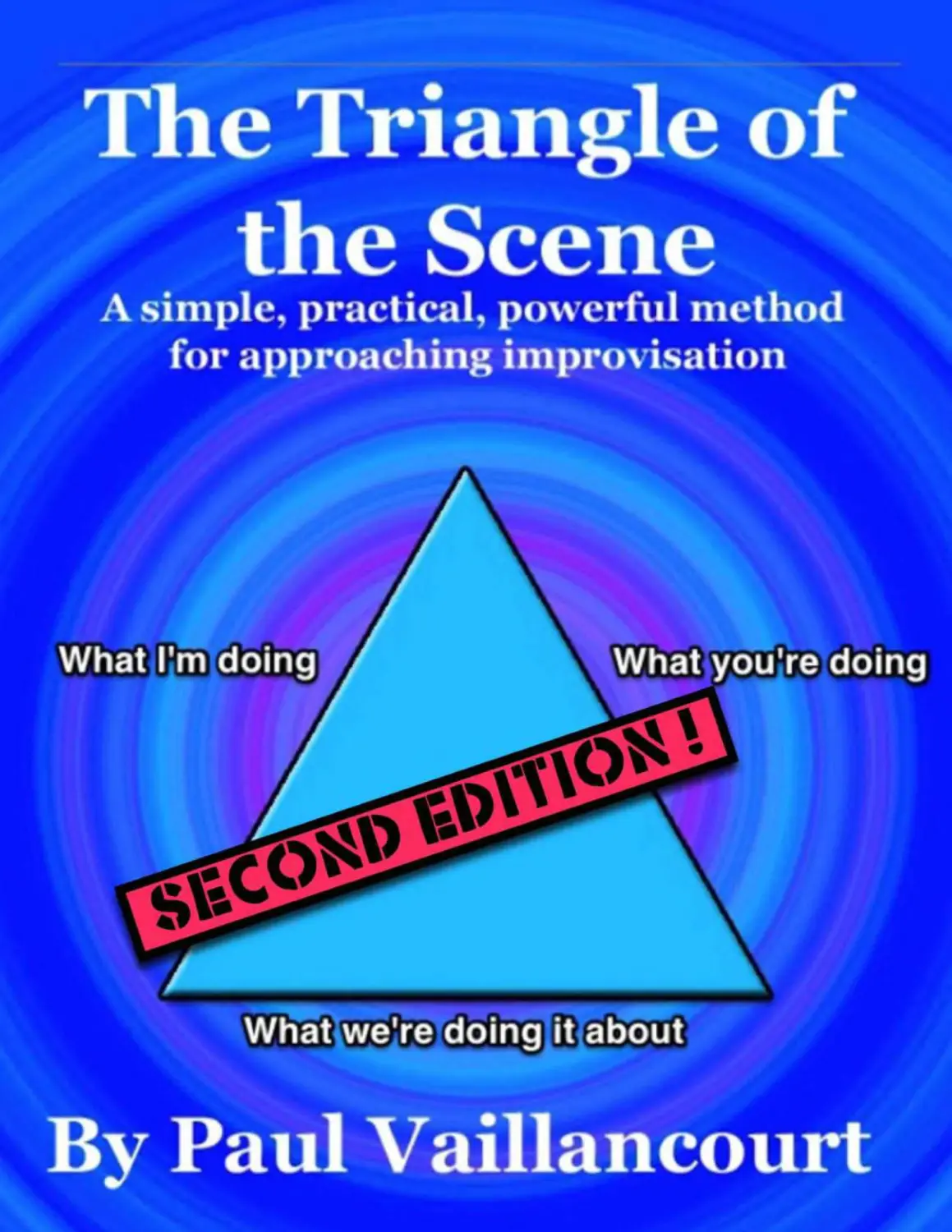






Text
                    Contents
Title Page
Dedication
Copyright
Introduction
Chapter 1 - Yes, and...
Chapter 2 - The Goal
Chapter 3 - The Triangle of the Scene
Chapter 4 - Show Me
Chapter 5 - Solo Practice Game
Chapter 6 - Assigning Meaning
Chapter 7 - 1st Beat, 2nd Beats
Chapter 8 - Tag Outs
Chapter 9 - Wrapping Up
Chapter 10 - Thanks
Chapter 11 - About the Author

THE TRIANGLE OF
THE SCENE
A simple, practical, powerful method for
approaching improvisation
(Second Edition)
by PAUL VAILLANCOURT

Dedication
To Lindsey, Isabelle and Bro

Copyright © 2015 by Paul Vaillancourt
All rights reserved. No part of this book may be reproduced in
any form or by any means without permission in writing from the
author, except for the inclusion of brief quotations in a
review.

INTRODUCTION
My name is Paul Vaillancourt and I love improv. I remember the exact
moment that I fell in love. I was a freshman in college and my friend
Thomas said, “Hey, I'm doing this improv show. Do you want to come see
it?” I did – I had no idea what an “Improv show” was but in college you're
up for anything so I went. The group, Erasable Inc., was our college's
improv group and they did mostly short form improv games, but in this
show they ended with a long improvised piece called a Harold. Part of the
Harold was about a guy trying to find out who made Muzak so all through
the piece he's questing, questing, questing until finally he says, “I'm going
in there.” Then two other players came out on stage as guards and tried to
stop him. He pushed past them into a board room where a few people were
gathered around a table. The questing man said, “You? You make Muzak.
Paul McCartney? John Lennon? Paul Simon?” Then the guy who was Paul
McCartney spoke up, “Right, mate. We usually make the Muzak first, then
jazz it up for everyone else.” That was it. My mind was blown. I was in
love and I said out loud to myself, “That's what I'm going to do with the rest
of my life.” It's been a straight line from that moment to now.
I went on to join and then direct that very improv group (Erasable Inc.) as
well as two other college improv groups (Cal State Northridge's CSUN
Scene Machine and Northwestern's Mee-Ow Show). I studied at Comedy
Sportz, Second City and iO. I even took classes from a guy who taught in
the basement of the Department of Defense. If there was an improv class
out there, I took it.
When I started at the iO in Chicago I had many great teachers including the
legendary Del Close. Eventually I became a coach and then a teacher
myself. After six years at the iO Chicago, Charna Halpern and I founded the
iO West and I have been teaching and performing there ever since.
All told I have been improvising for 30 years and teaching for over 25. It
has been a great experience. My favorite class to teach is level 1 – Intro to
Improv. The classes are always different and always a new challenge for a
teacher. As a level 1 teacher I am often taking students with no improv
experience and, by the end of the seven week class, getting them to do solid

two person scenes - the most basic and important building block of all
improv.
Along the way I've experimented with many different exercises and
methods for achieving this goal. One of the main things I've tried to do is to
look at myself and my fellow experienced improvisors and figure out how
we actually do it – what tools and skills do we actually use on stage. I think
those are the things that are the most useful to new students and players of
all levels. For a long time I had a general sense of what I wanted the
students to do in scenes, and through some nudging this way and that the
students eventually got there. Then, a couple of years ago, at the end of the
session, one student wrote on her class evaluation form, “I feel like I am
leaving class with a set of tools that I will be able to use when I'm
improvising.” That's when it hit me - instead of just giving the students
experiences that hinted at what I wanted them to do, I needed to give them
tools that they could use over and over again whenever they were
improvising. Not tricks, or formulas that would lead them to the same type
of scenes over and over again but universal tools that they could use to
build whatever they wanted.
When I started to think about teaching in that way I came up with the
Triangle of the Scene – a simple, concrete set of tools that encapsulated
what I'd been trying to nudge students towards for years; tools students
could quickly understand and begin using in their work. Don't get me
wrong, they would still need practice – it is after all an art and not a science
- but with these tools they could more easily self-diagnose their scenes and
see where/why they succeeded or where/why they struggled.
As an improvisor, one of the worst feelings to have on stage it the feeling of
“What do I do now?” If players use the tools in this book they will always
have at least three things that they could do in a scene at any moment. I
will discuss, at length, what those things are and how they work in
upcoming chapters.

WHO IS THIS BOOK FOR?
This book is for beginning improvisors who are looking for a systematic,
concrete inroad into improv in general and long form improv in particular.
It will give them the basic skills and tools they need to start improvising in
powerful ways.

This book is also for the experienced improvisor who has lost their way or
is looking to sharpen their skills. As someone who has been doing this for a
while, I am often approached by teams or improvisors who have been
working for a few years and are at some kind of crossroads with their
work. The thing that seems to make the most difference to these teams and
these players is not introducing them to a bunch of new forms or openings
or games but rather taking them back to basics and refreshing and
strengthening their basic technique - their ability to do a strong two person
scene. Having good, strong basic technique is the key to being a really
great improvisor.
In addition, this book is for teachers and coaches looking for a set of tools
that they can use to help their students start improvising more quickly and
more powerfully. Because the tools in this book are concrete, replicable
tools they give the teacher/coach and the players a clear ruler to measure
scenes against as well as a systematic method for diagnosing scenic
problems and helping those scenes get back on track.

HOW THE BOOK IS STRUCTURED
In each section of the book I have tried to introduce an important idea and,
when possible, follow it up with an exercise that will work on that idea. To
help readers get a more full understanding of how the exercise works, I
have also followed the explanation of the exercise with a written example
and a link to a video example so the reader can observe the exercise in
action. This, I think, will be very helpful as improv has historically been
and oral history passed down from teacher to student. I know that in my
experience I have learned much more from seeing an exercise in action than
from reading about it. The ability to include the links to these videos will
hopefully go some distance towards bridging that gap for you, the reader.
Moving through the book you will also see some blue boxes - these contain
side notes that will give some extra advice along the way.

LET’S GO
I love improv...and I love improvisors. Thanks for letting me share my
passion in this book and I hope that it will help you be a better improvisor
and deepen your love for this art as well.
Let's go!

Welcome From The Author

CHAPTER 1

Yes, and...
The most basic skill of improv
YES AND...
The most basic skill of improv is “Yes and...” This simply means agreeing
with what's going on and adding to it. If your partner says “This is my new
puppy.” You don't say “That's not a puppy, that's a toaster.” Pretty obvious,
right? It stops the scene in it's tracks and now we, as players and audience
members, don't know what's what. It also introduces judgement into the
scene. As players, we want to support our fellow players and make them
look good. In the example above, saying that your partner's puppy is not a
puppy, but a toaster doesn't support his offer, doesn't make him look good
AND it makes the rest of the scene harder to do because now he knows that
no matter what he says his, partner might completely contradict him – that
worry makes it tougher for us to be our most open and creative.
Del Close (I will quote him a lot - if you don’t know who he is, stop reading
now, do a quick Google search and then come back) used to say “If we treat
our partners like geniuses, they will be.” If you were on stage with the
person whom you thought was the best improviser in the world and they
said “This is my new puppy” you'd agree and say “yes” with everything
you've got. That's hyper- acceptance and that’s the spirit we need. We can
also call this a good “yes instinct” - where our FIRST instinct is to say
“yes” and THEN figure out why.
To quote Del again “Fall, then figure out what to do on the way down.”
Because “Yes, and...” is such an important skill, the first exercise really
works on getting players into that “Yes, and...” frame of mind.
THE AD GAME
The Ad Game is all about hyper-acceptance, strengthening that “yes
instinct”, and getting to feel the freedom of knowing that whatever you say
is going to be enthusiastically accepted and added to.

Here's how it goes:
Number of Players: Usually 7 or 8 people up on stage with chairs. They
make a little semicircle, enough so they can see each other but still be open
to the audience.
Suggestion: A simple household object.
Instructions: They are going to be developing a new version of this product
and they are going to be coming up with:
1. What's new and different about it
2. The name of the product
3. The tag line for the product
4. A commercial for the product
The players are going to do all of that by using “yes and...” and hyperacceptance - whatever idea they hear is the best idea they've ever heard and
they are going to greet it with a big, loud “yes”. I'll usually try out a couple
of absurd ideas on them just to get them into the swing of it before we start
and to make sure that they're really giving that big, loud “yes”.
Once the players are arranged and have a handle on the instructions I get
the suggestion and throw it out to the group. They start shouting out ideas
and “yeses” and then I'm merely facilitating the exercise; making sure
everyone gets in, making sure the big, loud “yeses” don't drop off and
moving them from task to task – once we've heard a good amount about
what's new and different about the product, I'll ask them to name the
product, then I'll move them on to the tag line for the product.
When we get to commercial I start by asking them for three celebrities who
might endorse the product. Once we have our celebrities, I move them on
to the commercial and start with “We open on...” From then on I'm just
saying “and then...” after each “yes” to keep it moving forward.
Finally, when I think the commercial is about done I'll give one last prompt;
“And it ends with...” and we'll get that last image and end the exercise.
Afterwards, we talk about the exercise and I try to get them to tell me what
it felt like knowing they could say anything and their team would give them
that big, loud “yes”. Most of the time they'll say things like, “Freeing,

supportive, great!” That's what I want them to feel. I want them to get that
real, visceral taste of “yes and...” in action.

The Ad Game
A MORE TRICKY YES AND...
“Yes and-ing” is not just the characters mechanically agreeing with each
other. It is about the players agreeing to each other's game moves and
trying to add to them.
Improv is like a stage combat fight – the two characters are fighting for
their lives and each of the characters wants to win, but the players know
how that fight is going to turn out and they need to facilitate that by playing
their parts to the best of their abilities. In the end, however, the guy that's
supposed to lose always loses. This is an example of the players agreeing,
working together and “yes and-ing” that fight and the way it has to turn out
even though the characters are clearly in conflict with each other. Let's look
at this example:
Player 1: You always think I'm wrong.
Player 2: Yes, I do.
In this case, Player 2's character is “yessing” what his partner is saying but
Player 2 is not “yessing” the move that Player 1 is trying to make. Player
1's character is putting out there the idea that Player 2's character always
thinks he's wrong. So, if Player 2's character agrees with that he is actually
negating Player 1's idea.
Try this:
Player 1: You always think I'm wrong.
Player 2: That is so not true.
In this case, Player 2's character is saying “no” to Player 1's character, but
Player 2 is actually “yessing” the idea that his character always thinks that
Player 1's character is wrong. So, in this case Player 2 needs to say “no” to
say “yes”.

This idea of the players working together even though the characters may
be in conflict is very important for making the scene work. Keep in mind,
the most important thing is the scene; what's going to make the scene better,
more open, and more expansive. So, this is the bigger “yes and...” that we
need to keep in mind.
A COUPLE OF WAYS PLAYERS GET OFF THE “YES AND”
TRACK
Putting their character before the scene – Sometimes players will “no” their
partner because, they say, “My character wouldn't do that”. Del Close had a
saying about this, “Don't let your character get in the way of the scene.”
Just like the stage combat example above, you, as a player, need to make
your character do whatever serves the scene the most. If we agree that the
scene comes first, then this should be obvious.
To help with this we can use a tool called “Yes, in spite...” This simply
means that you, as a player, need to “yes” (the big “yes” we talked about
above) in spite of whatever reason you have for saying “no”. Saying “yes”
even though your character wants to say “no” is also a great way to put
tension in your character.
For example:
Player 1: I'm afraid of heights.
Player 2: We've got to get on the roof, it's our only escape.
Now, Player 2's character doesn't want to go on the roof, so what does she
have to do? Go on the roof. It puts her out of her comfort zone and puts
tension in her character and that's good. Now, “Yes, in spite...” doesn't
mean just throw away your character – in the example above Player 2's
character can complain about going on the roof, tell us her reservations
about going on the roof, even do it unwillingly, but she's got to go on that
roof – she, as a player, has got to say “yes”.
“Normalizing” the scene – Sometimes we'll get an offer from our partner
that seems weird or strange and our natural, human desire for the safe and
familiar kicks in and we try to “normalize” the scene - make it more
normal.
For example:

Player 1: Congrats on the promotion to manager. You've been using
voodoo again, haven't you?
Player 2: Nope, just good old fashioned hard work.
Player 2 is scared of the idea of a scene involving voodoo so he retreats
back to our “normal” world where voodoo doesn't work – but what if it
went this way?
Player 1: Congrats on the promotion to manager. You've been using
voodoo again, haven't you?
Player 2: As a matter of fact I have, and let me tell you it is working
like gang busters.
What is more interesting, a world where voodoo doesn't work or a world
where it does? I think that we, as players, need to make that expansive
choice and open up the doors of possibility and say “yes” to this idea. Del
used to say, “The real world is the straight road – improv is the curvy road,
the twisty road, the under road, the over road, the around the back road.”
We can't keep pushing all of our scenes back on to the straight and narrow.
We need to allow them to follow some of these other roads.
Worrying about plot – Sometimes the players start thinking about the plot what's going to happen in the scene or where the scene is going to go – so
they'll pick a fight with their partner to stir up some conflict and give
themselves the feeling that something is happening. As improvisers, and
especially long-form improvisers, we need to get away from a dependence
on story, plot and premise and concentrate on relationship. We'll talk more
about this next. For now, the players need to try to stay in the moment and
deal with what is happening right now between the characters – the
relationship. If we concentrate on plot or the premise we are kind of
marrying ourselves to story and while story is one option of how to play it
is not the only option, nor, in the long run, it is our most powerful option.
We want to be able to use story sometimes but by choice not because its the
only thing we have. We want to have the option of exploring those
characters and their world as well as their story.

CHAPTER 2

The Goal
The relationship based, game driven, two person scene
WHAT IS THE GOAL?
The most basic unit of improv, and long-form improv in particular, is the
two person scene, but not just any two person scene. For our purposes, we
need a particular kind of two person scene:

A RELATIONSHIP BASED,
GAME DRIVEN, TWO PERSON SCENE.
THE RELATIONSHIP BASED SCENE
A relationship based scene is one in which the scene is happening between
the two characters on stage in that moment. It's not about the premise, it's
not about the jokes, and it's not about the activity they're doing. Don't get
me wrong, all of those things are probably in the scene, but the scene is not
ABOUT those things. It's ABOUT what's happening in the relationship
between those two characters on stage in that moment and all those other
things are there to serve that relationship.
If players do that, then they are on their way to doing a good scene, BUT
for long-form improv we need a little bit more. We need a scene that is:
1. A complete scene with its own beginning, middle and end that
can stand on its own.
2. A scene that sets the stage for other scenes to come. The players
accomplish this by setting up each character’s game - more about
this in a moment - and the relationship between the two
characters.
To be clear, this is not plot or story. Story is easy to do. We are story
making creatures. We see or do a scene and we can easily come up with a
scene that shows what comes next. We want the show to be 'and then...'

which is story but ALSO 'what else...' which is exploring the world of the
characters. In order to do that we need a scene that is game driven.
THE GAME DRIVEN SCENE
In improv there is a lot of talk about the 'game of the scene' and some
disagreement about what that means. Possible definitions include – the
funny thing, the weird thing, the unusual thing, etc. These are all fine
definitions that work to a certain extent, but if we agree that the goal we are
shooting for is the 'relationship based, game driven, two person scene' then I
think that these definitions can sometimes get us off track. If the game
exists separate from the characters, separate from their relationship, then the
characters run the risk of just becoming cogs in the machine that is the
game and this can lead to scenes that are a bit thin or glib. I think we get a
better, deeper, quality scene if we link the relationship and the game
together.
In a scene, each character should have their own game – that is, a big
character trait or drive or what they're doing. The game of the scene is
those two character games rubbing up against each other. That rubbing will
generate the plot or the premise – like rubbing two sticks together to start a
fire – but that plot or premise, if necessary, will organically grow out of the
characters and their games.
This approach is best explained with an example. Take the TV show
'Friends' – even though this is a scripted show we can see this idea at play
over and over again.
First, each character in 'Friends' has a game - a big character trait or a thing
they do - it is their character:
Ross is the nerdy one.
Chandler is the sarcastic one.
Joey is the dumb one.
Monica is the control freak.
Rachel is the princess.
Phoebe is the spacey one.

More or less, that's all they do. For ten years, these characters basically
play these games over and over again.
Scenes are created by putting two of these characters in a situation and
letting their games rub up against each other.
For example:
Ross and Joey are making sandwiches. We can start to imagine the scene
just from that information: Ross (being nerdy) and Joey (being dumb)
making sandwiches.
Ross is going to be nerdy about it – maybe he has figured out the optimal
way to make a sandwich with the least amount of effort and the least
amount of waste while Joey is just going to be slapping things together and
shoving them in his mouth. The scene comes from their games rubbing up
against each other while doing an activity.
We can also see that this is going to be a DIFFERENT scene from Chandler
and Joey making sandwiches because the games are different and so they
rub up against each other in a different way.
Chandler (being sarcastic) and Joey (being dumb) making sandwiches.
Now, maybe Chandler is being sarcastic about why they're making
sandwiches or the ingredients or Joey's haphazard method of just slapping
things together and jamming them in his mouth.
From these two examples it is obvious that in improv players can get their
scene off to a powerful start by establishing these three pieces of
information as early in the scene as possible:
1. Character 1’s game
2. Character 2’s game
3. What they’re doing
Once the players have established those things they know everything they
need to know to do that scene.
I call this way of putting scenes together The Triangle of the Scene.

CHAPTER 3

The Triangle of the Scene
The essential information of the scene
WHAT IS THE TRIANGLE OF THE SCENE?
The triangle of the scene is the basic building blocks that you need to make a
scene work.
In the classical model of improv we talk about WHO, WHAT, and WHERE.
The triangle of scene is closely related to this concept but it takes the 'nouns'
and makes them into 'verbs' because in an improv scene it's not about who or
what we ARE but who or what we DO.
The Triangle of the scene, then, is made up of these three elements:

What I'm doing – my character's game.

What my partner is doing – their character's game.
What we're doing it about – the activity that we're doing or the situation that
we're in.
Let’s revisit the Friends example:
Ross (his game; being nerdy) and Joey (his game; being dumb) make
sandwiches (the activity).
As we saw above, once we have these three pieces of information in place
our scene is off and running.
As an improv teacher/coach I never want my students/players to be up on
stage thinking “What do I do now?” That is a terrible feeling. If I’m using
the Triangle of the Scene, however, I always have at least three things I can
do in the scene:
Play my character's game - if my character’s game is being nerdy,
then I can have, say or do something nerdy
Help my partner play his character's game - if his character’s game is
being dumb then I can give him an opportunity to have, say or do
something dumb.
Work on the environment, the activity or the situation - if we are
making sandwiches, I can work on making sandwiches.
So, how do we set up the Triangle of the Scene?
BIG PLAYABLE GIFT
The first step to setting up the Triangle of the Scene is focusing on your
partner and giving them a “big, playable gift” as early in the scene as
possible.

There are basically three kinds of information that we give out about our
partners, not all of them qualify as big, playable gifts. The three kinds of
information are:
1. Surface Information: What they look like – Hey, you have beautiful hair.
What they're wearing – Nice vest. Their situation – Tom, you're late for
work again.
Now, all of these different offers tell us something about our partner but
they're not really 'the big, playable gifts' that we are looking for because they
are so transient and have a low degree of playability.
Take “Hey, you beautiful hair.” for example – I can show that I have
beautiful hair, I can brush it, I can talk about it but it doesn't really say a lot
about my character there's not a lot I can do about my beautiful hair.
How about “Nice vest”? It doesn't say much about the character, there is not
much we can do with it, and once he takes off his vest, we don't know
anything about him. Again, not the big playable gift we're looking for.
“Tom, you're late for work again.” This talks about his situation – we know
that he's late but we don't really know anything about him in the big picture.
Who is he when he's at home? Is he late there too? If so, why? What does
it mean about him? (We'll come back to this question later.)
2. Emotional Information: You seem sad today. You're so vain. You're so
optimistic.
You can see that all of these offers have much more playability. They give
the player and the character more of an attitude towards the world, more of a
way to play, more something to do. These gifts are really good gifts to give,
but we can give even a little bit more.
3. Drives or Character Information: You have a problem with authority. You
are the meanest person I've ever met. You're like my grandmother.
These are the best gifts to give your partner. They have the greatest
playability. Judge for yourself. If you got one of these gifts at the beginning
of the scene wouldn't you feel like you had a lot of things to do or to play in
the scene? That is the hallmark of a big, playable gift – once you get it, you
start thinking about all the different ways that you can play it.

If my character has a problem with authority there are many ways to show
that or do that. I could drink in school, I could protest my boss for making
me work over time, I could wrestle the cop who pulls me over for speeding.
If I'm the meanest person my partner has ever met, I can just start being
mean – I could slap my partner’s baby, I could shoot them in the foot, I
could take their new iPhone and throw it down the sewer.
Also, if my partner says I'm like her grandmother then I can take on the
attitude and stereotypical behavior of a grandmother even though my
character may be a construction worker. Now I'm the construction worker
that acts like people's grandmother. Maybe I bake cookies for the guys who
work on the site. Maybe I try to get one of the other workers to wear his
hard hat back a little bit to show his handsome face. Maybe I lick my thumb
and try to wipe some dirt off of one of the other guys' faces. All things a
grandmother might do, but a construction worker is doing them because I
got the gift of “you're like my grandmother” from my partner.
The big playable gift is like a lens through which your character sees and
interacts with the world. Think back to our earlier example of Friends. Ross
is the nerdy one. He sees the world through the lens of being nerdy, he
interacts with the world through the lens of being nerdy – no matter how
much he tries to NOT be nerdy, he ends up being nerdy.
Also, realize that characters’ games are separate from their professions or the
other roles that they, as characters, play. Think about Ross - he is a nerdy
college professor, but he’s also a nerdy brother to Monica, a nerdy friend to
Chandler - and, even if he got a job as, say, a club promoter he would be a
nerdy club promoter. His game - his big character trait or thing that he does
- travels with him and informs his approach to the world in everything he
does. This idea of a character’s game being a lens through which they see
and interact with the world is a very powerful tool.
YOU...
When I first came to the iO in Chicago I’d already been improvising for 6 or
7 years. I’d done improv in three college improv groups (two of which I
directed), I had performed with Comedy Sportz in Virginia, I’d completed
the Second City Training Program and I’d even taken classes from this guy

who taught in the basement of the department of defense. Needless to say I
had been around a little bit. When I got to iO Chicago they really stressed
the idea of taking care of your partner and making your partner look good
and that idea has really stuck with me. Even Del Close said “Treat your
partners like geniuses and they will be.”
How do we take care of our partner? By giving them gifts, saying things
about them, helping them play the scene. The tricky part of this is that to do
this we have to focus on our partner and the natural human state, especially
under pressure (like in the middle of an improv show in front of an audience
for instance), is to focus on ourselves. Heck, I could talk about MYSELF all
day long. There is nothing more fascinating to ME than ME. To be a good
improvisor, however, we need to get past this natural human instinct and
FOCUS ON OUR PARTNERS and get good at talking about THEM and
giving THEM gifts to play.

IT'S TUESDAY AND YOU...
I like this exercise because it works a few different muscles; our ability to
talk about our partner, our listening, our ability to play the gifts we're given
and our “yes and...”
Number of Players: 2
Suggestion: None
Instructions: Two players get up on stage and one player will say to the other
“It's Tuesday and you...” and they'll complete that offer and that'll be the first
line of the exercise. Then the other player will repeat the last thing the first
player said from their perspective and then say something back and so on.
For example:
Player 1: It's Tuesday and you...are late again.
Player 2: I am late again and you love to get on my case about it.
Player 1: I do love to get on your case about it and you need someone
to keep you in line.
Player 2: I do need someone to keep me in line and you smother me.
This exercise goes on but you get the general idea.

It's Tuesday And You...

You'll notice that the structure of the exercise forces both players to talk
exclusively about their partner. For some people this is very hard, but it is
necessary to get good at talking about your partner, especially for what
comes next.
It’s important to talk for a moment about some of the things that people do in
this exercise that are a bit off track.

TRAPS PLAYERS CAN FALL INTO
The player may say “but” or “because” instead of “and”.
For example: “I am late again BUT you were late too.” Or “I am late again
BECAUSE there was so much traffic.”
Once we start down this road we are getting away from the relationship
between the characters, which is half our goal. I try to keep the players on
track with the side coach “And!” They should then go back and re-say their
offer, changing it if necessary to be an “and” statement. Often times people
say “but” or “because” even though their offer will work just fine as an
“and” - this is the beginning of getting them into the “Yes and...” mindset.
The players may get into what the other player “should do” or “needs to
do”.
For example: “I am late again and you should relax.”
The use of “should” or “need to” is off track because it is not our strongest
offer. We are better off saying what the other character IS doing not what
they SHOULD do. Ex. “You should relax” REALLY means something like
“You're so uptight”. “You're so uptight” is a stronger gift for my partner
because they don't have to translate it in their head (they said I should relax
so that means I am totally up tight) and they can play it right away. We have
enough things to think about during a show without trying to translate our
partner's offers while the audience looks on. Also, when I leave it up to my
partner to translate the offer I don't know what their translation might be so I
don't really know what their gift is going to end up being and, as a
consequence, I don't really know how to best help them play that gift. Ex. I
say to my partner “You need to calm down.” My partner then translates that
as “I am totally freaking out” but I think it means “You’re too uptight.”
Now we are playing a bit at cross purposes; he's trying to play “totally
freaking out” and I'm trying to help him play “too uptight.” This little glitch
is going to make the scene a bit harder to do.
The players aren't giving BIG playable gifts.
For example: “I am late again and you are my boss.”

While this will probably be shown to be true in the course of the scene it is
not the big playable gift that we're hoping for. Think about the big picture.
Although, I may be your boss in this scene “You're my boss” doesn't give me
any help or indication as to how I should PLAY your boss. Am I a caring
boss who is concerned that you're late? Am I a nagging boss who is mad
that you're late? Am I a wimpy boss who is scared that you're late?
An offer that tells me what I'm DOING has more playability than one that
tells me what I AM.
I really strive to get players to make those BIG, PLAYABLE gifts; things
that tell the player something playable about their character.
The players robotically repeat what the other person says without letting it
affect them.
For example: May be one player tells the other “You're the meanest person I
know”, then the other player just forges ahead without being affected by that
at all. Once the player gets the gift “You're the meanest person I know” they
should start playing it right away. Obviously, they can't say something about
themselves but they can take on that attitude physically and vocally and start
playing from that point of view. Their next line, for example, should be
from the point of view of the meanest person that other character knows. “I
am the meanest person you know and you’re afraid of me.”
The player resists the offer
When someone says something negative about us our natural instinct is to
defend ourselves but in improv we really need to do the opposite and lean
into that gift. If my partner says to me “You are a complete slacker” then I'm
going to try to own that gift and lean into it right away. Remember that
improv is kind of like a stage combat fight. One of those actors knows that
his character is going to 'lose' that fight but it is his job to be the best ‘loser’
he can be – same goes for an improv scene. If my partner says I'm a loser or
slacker or whatever – I'm going to try to be the best loser, slacker, whatever
that I can be.
The player plays the offer too timidly
Sometimes the player will get the offer and play it but only to a point, but
what they really need to be doing is “turning up” what they're doing. To be
clear, “turn it up” doesn't necessarily mean louder, it can, but there are other

ways to “turn it up” too. “Turn it up” means DO MORE of what your thing
is. If your thing is being sloppy, then be super sloppy. If your thing is that
you're organized, then be super organized. Also, when players turn it up it is
easier for them to play their gift because they can more clearly see what it is
AND it is easier for other player to help them play their gift for the same
reason.
The players focus their energy outside the scene
Earlier I said that the scene needs to be relationship based and that means the
scene is happening between the two characters on stage in that moment.
Sometimes players will get distracted and start talking about things outside
of the scene; things in the past, in the future or things/people that are off
stage. As hinted above, the players can talk about these things but only if
they are serving the relationship that is happening now between the
characters in the moment. One facet of this problem is putting the power or
the decisive element outside the scene.
For example: Often times when the two players end up being children or
siblings they will try things like “I'm going to tell mom” or “Wait until Dad
gets home. You're going to get it” and this stalls the scene because the power
or the decisive element is outside of the scene and the characters have, in a
way, disempowered themselves from being able to resolve the scene
between the two of them because what they say or do doesn't count as much
as what someone else outside the scene says or does. They are in a holding
pattern waiting for this other person to arrive or weigh in.

The players get stuck just trying to think of synonyms for their initial offer.
For example:
Player 1: It's Tuesday and you're late again.
Player 2: I am late again and you are so uptight.
Player 1: I am so uptight and you are always tardy.
Player 2: I am always tardy and you can't relax.
As you can see, the players aren't really making much progress in the scene.
They've made some good opening offers, now what?
Now they need to ACTIVATE those offers – improv is, after all, ideas in
action. So, my partner and I need to help each other put our games into
action in one of two ways:
Saying what it MEANS.
Giving them an ACTION to do.
SAYING WHAT IT MEANS:
One of the most important questions we can ask ourselves in an improv
scene is “What does that mean?” What does it mean about you? What does
it mean about me? What does it mean about us? (We will talk more about
this in Chapter 6 - Assigning Meaning)
For example: What does the fact that player 2 is late again MEAN about
them - ask yourself that question, answer it and then tell your partner the
answer.
Player 1: It's Tuesday and you're late again.
Player 2: I am late again and you are so uptight.
Player 1: I am so uptight and you don't care about this job. (Player 1
is now saying what Player 2’s lateness MEANS about them. Now
Player 2 has a much more PLAYABLE gift.)
Player 2: I don't care about this job and you do everything by the
book. (Player 2 adding to Player 1’s gift. Now we know Player 1 is
so uptight because he does everything by the book. ‘You’re so

uptight’ is playable, but ‘You do everything by the book’ is even
MORE playable.)
GIVING THEM AN ACTION TO DO:
Another good way to help your partner active their gift is to give them an
action to do.
Player 1: It's Tuesday and you're late again.
Player 2: I am late again and you are so uptight.
Player 1: I am so uptight and you don't care about this job.
Player 2: I don't care about this job and you're going to write me up
again. (Player 1 goes to his desk and grabs his 'write up pad'.)
Player 1: I am going to write you up again and you're just going to
plop down in your chair and take a nap. (Player 2 plops down in his
chair, puts his hands behind his head and closes his eyes).
Two things to notice about this example:
Player 1 starts off with something about the SITUATION instead of
something about his partner – as we saw above, a kind of weak offer, but in
his second line he makes the offer better by saying what it means about his
partner “You don't care about this job” - now his partner has something to
play.
The players are each giving the other some- thing to DO in the scene –
a way to SHOW their respective games. That is super helpful because in a
scene I can hear that you're so up- tight but that's just hearsay. When I see
you be uptight that starts to become a real thing.
One final thing about this exercise – it is not a scene. The exercise is
SCENE-LIKE but its not a scene. It's like an x-ray of a scene where we get
to see the decisions that will move the scene forward. Each line of the
exercise might be a whole little stanza in an actual scene per se. If in the
first line player 1 says, “You're late again.” That might turn into a 3 or 4 line
“stanza” of the scene. Then player 2 might might make a big decision and
say “You're so uptight” and then that might turn into a 3 or 4 line stanza of
the scene and so on.

In the case of this exercise you “discover” what your partner is saying about
you and then you “decide” how to play it. So, you're not just a puppet being
maneuvered around the scene by your partner, although sometimes they will
be telling you what to do or how to play. You and your partner are really
engaged in a dialog of information.
You tell him something about his character, then he decides how to play it.
Then your next offer to him is influenced by how he's playing his character.

Meanwhile, he is making offers about you and you are deciding how to play
them and he is, no doubt, being influenced by your decisions.
Once the players have had a crack at “It's Tuesday and you...” they will,
hopefully, be more aware of taking care of their partner by feeding them,
talking about them and, above all, giving them that BIG PLAYABLE GIFT
at the beginning of the scene.
Now, I'd like to move on to another exercise that fully brings the Triangle of
the Scene into play.
ANNOUNCING THE TRIANGLE
Number of players: 2
Suggestion: None
Instructions: The players are going to do a scene, but before the scene starts
they are going to announce the Triangle of the Scene; the first player is
going to give his partner a big, playable gift (just like we've been talking
about) and then the second player is going to give her partner a big, playable
gift and then one of them will say “Well, let's get back to this...” and then say
the activity they are doing. Then the players will launch into the scene
playing the gifts they've been given.
For example:
Player 1: You are so controlling.
Player 2: You are so sensitive.
Player 2: Well, let's get back to rowing this canoe.
Then they play the scene with player 1's character being controlling and
player 2's character being sensitive. The activity or situation is there to give
you a set of tools to play your games with.
In this example, the activity of rowing a canoe and everything that comes
with it is there to help these two characters show their games and build their
relationship.
Remember that everything in the scene, everything in the universe of the
scene is there to help those players show their games and build their

relationship.

Announce the Triangle

CHAPTER 4

Show Me
Bringing your gifts to life
SHOW ME
Once the players have their big, playable gifts they need to SHOW them to
the audience and to their partner.
Showing your gift does several great things:
1. It makes your gift more real for the audience. If, as an audience
member, I hear that you're really greedy, then I want to see you be
really greedy. If you don't “do greedy” then it doesn't matter what you
say I don't really believe that you’re greedy. To go back to our Friends
example from earlier – we think that Ross is nerdy. If Ross suddenly
become cool we would start wondering what the heck was going on?
It would be confusing to us. This same thing can happen in an improv
show. Maybe your partner gives you the gift of “You're so greedy” but
for some reason you either resist that gift or start playing your
character as being very generous the audience is going to be
wondering what the heck is going on. Back to Friends again - the fun
of watching Ross ISN’T thinking “Here comes Ross. What's he going
to do?” We know he's going to be nerdy, so the fun is really thinking
“Here comes Ross. I know he's going to be nerdy – I wonder how he's
going to be nerdy.” This is a really powerful tool for us, as
improvisors, to get a handle on and to consciously use. We are setting
expectations and fulfilling expectations in interesting ways. We will
talk even more about the usefulness of this below.
2. Showing your gift also gives you, as a player, so many new ways of
exploring your gift. Now it's not just you talking about being greedy,
it's your character trying to get all the cupcakes at the office party, or
the most magazines in the waiting room. It really integrates your
character into the environment. In improv we often talk about “using
the environment” but, especially when we are starting out, we wonder
how to use the environment or what to use it for. This is the answer;

use the environment to show your game and/or to help your partner
show their game. Now, instead of just trying to frantically invent
things to fill up an empty space, you are focusing your attention on
creating the things that you need to show your (or your partner's)
game.
3. Showing your gift is also a great piece of communication between you
and your partner. Your partner gives you a gift like “You're so greedy”
and you immediately start shoving all the cupcakes into your pocket you're telling your partner “Got it! I'm so greedy. Message received!
Lets do this!”
4. Showing your gift is also a great piece of communication to your
teammates, once they see that you have received your partner's
message and they see you playing that game, then they can help you
play that game.
So with all the great things that showing your gift can do for you and the
scene, you're probably wondering “How do I show my gift?” Don't worry. I
got you covered - there’s this great tool called Have/Say/Do.
HAVE/SAY/DO
When my partner gives me a big, playable gift and I want to show it I ask
myself these three questions:
What could I HAVE to show my gift?
What could I SAY to show my gift?
What could I DO to show my gift?
Here's an example:
My partner gives me the gift “You're the meanest person I know.” Then I
ask myself the questions from above.
What could I HAVE to show my gift? I could have a journal where I keep
track of all the mean things that I've done.
What could I SAY to show my gift? I could say, “Yeah, I am. And you
better watch yourself ugly.”

What could I DO to show my gift? I could pull out an egg and smash it on
their head.
Usually people are good at the What could I SAY? Part, but players really
need to be good at all three. Here's an exercise to get the players thinking in
this way.
YOU ARE...
Number of players: All the players divided into two lines facing each other
- each player standing across from another player who will be their partner.
Suggestion: None.
Instructions: I do this drill in several rounds.
WHAT COULD I HAVE TO SHOW MY GIFT?
ROUND ONE - PROFESSIONS
The first player in line is going to give her partner - the person standing
across from her - the gift of a profession (this can be kind of loose – my
partner could say “You're a serial killer which, although not technically a
profession, is a fine gift for this exercise.”) Then the other player will say
“Yes, that's why I have this...” then they will show some object that they
HAVE that has to do with their profession.
For example:
Player 1: You are a doctor.
Player 2: Yes, that's why I have this stethoscope.
Then player 2 gives player 1 a profession: Player 2: You are an
astronaut.
Player 1: Yes, that's why I have this jet pack.
Quick note: I really press the players to come up with something that they
physically HAVE. Sometimes the players will come up with idea like this:
Player 1: You are a doctor.

Player 2: Yes, that's why I'm so respected in this community.
In a scene that might be a fine response, but in this exercise I really want to
see something that the player physically HAS because once that thing is out
there then it can become part of the scene in a concrete way. If my partner
wants to get my attention they can grab me by the stethoscope and pull me
into them. They can steal my stethoscope. They can pull it back and snap
me in the face with it like a rubber band. None of those things happen
unless it’s a physical object. We talked earlier about using the space and
creating things that help you play your game – this is the beginning of that.
When the first pair has gone then I send them to the end of the line and the
second pair steps up and does the exercise. This is very much a drill and I
usually zip through it keeping the pace up to keep it fun and so that players
don't labor too long over their responses. What they say isn’t as important
as it is that they say something because as we saw in the Ad Game their
partner's job is to give it a big “yes” and help them make that thing work. If
someone does get stuck I encourage them to say anything at all. Even if it
doesn't make complete sense.
For example:
Player 1: You are a ballerina.
Player 2: Yes, that why I have... (player 2 can't think of anything
that a ballerina might have and he starts um-ing and uh-ing.)
Teacher: Say anything. It doesn't matter. (more um-ing and uh-ing)
Teacher: Say something a ballerina wouldn't have.
Player 2: A hammer.
Teacher: Great. Move on.
Once they say something – even something crazy or especially something
crazy – it helps them unlock and feel a bit more free with their answers. The
other point to be made here is that now we have a world where at least one
ballerina carries a hammer – that's pretty interesting.
ROUND TWO – BIG, PLAYABLE GIFTS
In this round, rather than professions, the players are giving each other big,
playable gifts, like we've been talking about and the player who gets the gift

is responding, again, with something they HAVE.
For example:
Player 1: You have a problem with authority.
Player 2: Yes, that's why I have this protest sign.
Player 2: You are very sensitive.
Player 1: Yes, that's why I have this box of tissues.
This exercise gets players in the habit of taking these concepts, these ideas,
these games and making them something concrete in the scene. If it's
something concrete in the scene then you are probably showing versus
telling.
We can also do a third round of the exercise combining the first two
rounds. The player giving the gift will give a profession and a big playable
gift. The player receiving the gift will try to think of something they have
that hits as much of both of those gifts as possible.
ROUND THREE – PROFESSIONS AND BIG, PLAYABLE GIFTS
For example:
Player 1: You are an accountant who wants to be treated like a
princess.
Player 2: Yes, that's why I have this bedazzled calculator.
Player 2: You are an astronaut who is very happy.
Player 1: Yes, that's why I have this roll of smiley face stickers.
You can see that player 2 captured a bit more of his two gifts (accountant
and wants to be treated like a princess) than player 1 (happy and astronaut)
but it's not a problem. A lot of the time the players will be hard pressed to
find that perfect thing that captures both parts of the gift but that's okay. I
just want them to be trying to find that thing and letting that push them to
say things that may be out of the box. Astronauts don't usually have a roll
of smiley face stickers but this one does and that’s going to be a fun part of
the scene to play as we go on.
This is the drill for the HAVE portion of HAVE/SAY/ DO – the exercise can
be completed in the same way using SAY and DO.

WHAT COULD I SAY TO SHOW MY GIFT?
ROUND ONE - PROFESSIONS
Player 1: You are a barista.
Player 2: Here's your coffee, handsome. (SAYING something as a
barista)
Player 2: You are a librarian.
Player 1: No talking in the study area please. (SAYING something
as a librarian)
ROUND TWO - BIG, PLAYABLE GIFTS
Player 1: You're so stressed out.
Player 2: If you don't stop talking I think I'm going to freak out!
(SAYING something as someone who is stressed out)
Player 2: You are so brave.
Player 1: Stand behind me. I'll handle this. (SAYING something as
someone who is brave)
ROUND THREE – PROFESSIONS AND BIG PLAYABLE GIFTS
Player 1: You are a meter maid who dreams of a tropical vacation.
Player 2: Only 130 more tickets then Hawaii here I come. (SAYING
something as a meter maid who dreams of a tropical vacation)
Player 2: You are a newscaster who is a hopeless romantic.
Player 1: This just in, I think I'm falling for you. (SAYING
something as a newscaster who is a hopeless romantic)
This is the round that players usually have the easiest time with. They are
most used to talking about things in an improv scene. In this part of the
exercise, we are really just helping them focus on their dialogue on showing
their gift.
WHAT COULD I DO TO SHOW MY GIFT?
ROUND ONE - PROFESSIONS

Player 1: You are a fisherman.
Player 2: (DOING something as a fisherman – Player 2 casts his
line out).
Player 2: You are a photographer.
Player 1: (DOING something as a photographer – Player 1 takes
Player 2's picture)
ROUND TWO - BIG, PLAYABLE GIFTS
Player 1: You're trying to destroy me.
Player 2: (DOING something like a person who is trying to destroy
Player 1, Player 2 pulls the pin out of grenade and rolls it towards
Player 1)
Player 2: You are so optimistic.
Player 1: (DOING something like a person who is optimistic, Player
1 pulls out a pen and starts making a graph of profits that only goes
up and up).
ROUND THREE – PROFESSIONS AND BIG PLAYABLE GIFTS
Player 1: You are a police officer who loves compliments.
Player 2: (DOING something like a police officer who loves
compliments, Player 2 pulls his gun and starts striking poses with
it)
Player 2: You are a school teacher with no self-confidence.
Player 1: (DOING something like a school teacher with no selfconfidence, Player 1 writes something on the chalk board then
quickly erases it, then write it again and erases it again)
So you can see that using the Triangle of the Scene and the idea of Show
Me the players have a lot tools to use in their scene – and what do they use
those tools for? As always, all the tools we have and everything in the
scene is there to help the players show their games and build/explore their
relationship.

You are a...

CHAPTER 5

Solo Practice Game
Woking on what we’ve learned even without a partner
SOLO PRACTICE GAME
Although players understand the idea of getting gifts and playing gifts, it is
still a new habit that takes practice, so I have come up with a little exercise
that players can do by themselves to practice both giving gifts and playing
the gifts that they're given.
1. Give yourself a gift – For example: You're so greedy.
2. Think of three ways you could play that gift. A good tool to keep
in mind here is HAVE/SAY/DO - what could I say, have or do to
show my Greed.
For example it might go like this:
I give myself the gift, “You're so greedy.”
I could HAVE a bag that I put all my stuff in.
I could SAY "How dare you say that? The only way I can forgive you is if
you give me five bucks...no, TEN bucks".
I could DO the action of grabbing stuff and putting it in my bag.
3. If you can play the gift in these three ways then it's probably a
good gift - if you can't, then it probably doesn't have that
playability that we need in a gift and we should rethink it and see
if we can come up with a better gift or at least a better version of
that gift.
For example: Maybe the first gift you give yourself is “You've got a lot of
money” and then when I try to play it using HAVE/SAY/DO I come up
short so I revise my gift to “You're so greedy.”

CHAPTER 6

Assigning Meaning
Nothing is random or innocent
ASSIGNING MEANING TO DEEPEN THE SCENE
Nothing in the improv universe is random or innocent. Everything happens
for a reason and has some meaning in the relationship between the two
characters on stage. We, as improvisors, just need to decide on what that
meaning is and play it.

There are several ways that players can assign meaning to what their partner
is saying. One very simple way is the Four Step Process.

THE FOUR STEP PROCESS
In general, we are going to be giving out information about the three parts of
the triangle of the scene; my game, my partner's game and the situation or
activity as it relates to our relationship.
At the same time we are going to be reacting to the information that our
partner is giving out about those same three things – not just reacting, but
actively reacting. What do I mean by 'actively reacting'? When my partner
says a line I go though a four step process:
1. What did they say? - I'm going to make sure I got what they literally
said.
2. What does it mean? - Now, that I've got what they've literally said, I'm
going to ask myself what it means – about them, about me, or about us.
Most of the time people don't say exactly what they mean so getting in
the habit of squeezing the meaning out of what my partner is literally
saying will energize your work and the scene. I'm not passively letting
their lines just wash over me. I'm participating in that line as much as
I'm participating in the lines that I'm saying.
3. What do I (my character) think or feel about that? - I've heard their
line. I've figured out what it means to me and now I decide what my
character's reaction is to that.
4. What am I going to say or do about that? - Now I start to think of how
I'm going to respond.
You can see that by keeping the chastity of this little practice you are really
forcing yourself to engage with your partner. Often times we get off track in
a scene because rather than really listening to our partners, we're just waiting
for them to stop talking so we can say this funny thing we came up with.
Not our best choice.
By using the four step process I am assigning meaning to what my partner is
saying and thus strengthening its impact on our relationship and the scene.
The four step process is very useful when the scene is on track and I’m
looking to assign meaning to what my partner is saying and get the most out
of it, but we can also use the idea of assigning meaning to help a scene that
is off track get back on track.

ASSIGNING MEANING TO GET THE SCENE ON TRACK
Players giving each other big, playable gifts at the beginning of the scene is,
obviously, the ideal situation, but, as anyone who has done even a few
scenes knows, we don't always hit that target. One thing that happens a lot is
that one of the players will start the scene talking about something outside
the relationship of the two people on stage.
For example:
Player 1 and Player 2 are given the suggestion of a life guard tower. They
become life guards. Player 1 starts putting on sun screen and Player 2 picks
up his binoculars and starts scanning the beach.
Player 2: There sure are a lot of hot chicks out

today.

Even from this very first line the scene could go off track because, as I
mentioned earlier – what you start talking about is often what you keep
talking about. So, when Player 2 starts the scene by talking about the hot
chicks at the beach, it is very easy for the scene to fall into several different
traps:
1. Focusing the energy into the past - the two life guards might start
talking about the hottest chick they've ever seen or dated.
2. Focusing the energy into the future - the life guards might starts
talking about a hot chick that one of them is going on a date with
tonight.
3. Focusing the energy off stage - the life guards might start talking
about this or that hot chick they’re looking at.
As I said earlier we want the scene to be a relationship based scene - that is a
scene that is happening between the two characters on stage in this moment.
In all the above traps, the players are focusing energy into things that are not
happening between them on stage in this moment - things that are outside of
the relationship.
There is, however, a simple way to take an offer that is outside of the
relationship and turn it into something about the relationship.

ASKING “WHAT DOES IT MEAN?”
When Player 2 says “Man, there sure are a lot of hot chicks out today.”
Player 1 can ask himself “What does that line mean about me or my partner
or our relationship?” Player 1 decides that it means that Player 2 thinks this
job is more about hooking up than saving lives and so he says that.
Player 1: You think this job is more about hooking up than saving
lives.
Player 2: You’re damn right I do, Mr. By-The-Book.
Now both players have something to do. Player 2 has the gift of “You think
this job is more about hooking up than saving lives” - pretty playable.
Player 1 has the gift of “Mr. By-The-Book” - also pretty playable.
In this example we also see a pretty common phenomenon – when I do
something to my partner, they do it back to me. Player 1 says something
about Player 2 so player 2 instinctively says something back about Player 1.
Now we both have our gifts and the scene is back on track. From here we are
going to do what we've been talking about all along – show our gifts and
play the relationship.
OKAY, GREAT / SOUNDS GOOD TO ME / I'LL GO ALONG WITH
THAT
I first came across this game as a short-form game, but I have since adapted
it to help players practice a variety of long-form skills. First and foremost,
the exercise helps players work on assigning meaning to the things that their
partner is saying. The exercise also works on players’ ability to give out
information about their partners and themselves. I also encourage players to
notice how much energy and concentration they are putting into the exercise
and bring that amount of energy and concentration into all of their scene
work. Finally, the exercise also gives the players a really clear sense of how
the information they put into the scene really affects the scene.
Number of Players: 2
Suggestion: Location
Instructions: One player will be the “Okay, great person” and one player will
be the “Regular Person”.

Here are the responsibilities for the “Okay, Great Person”:
1. This person can only say these three things “Okay, Great, Sounds Good
To Me, and I'll Go Along With That”
2. This person should say his line sincerely but as neutral as possible. If
my partner says “Let's go to the store” then I should say “Okay, great”
as if I really think that's a great idea. If we start coloring the line with
sarcasm or flirting or whatever we are making the exercise easier for
the “Regular Person”. We want the regular person to be responsible for
all the meaning in the scene so that means that the “Okay, great person”
needs to be neutral. The “Okay, great Person” is really just “yessing” in
the scene without “anding”.
3. The “Okay, great person” should also say whatever line seems
appropriate at the time – each has a slightly different use – and don't
worry if you say the same one ten times in a row.
4. Finally, since the 'Okay, great person” doesn't have much heavy lift
dialogue-wise, this is a great time for them to work on their space
work.
The other person in the exercise is the “Regular Person” - they can say or do
whatever they want to/need to in order to make the scene work. This is the
person who is really working in the exercise. Here's a few guidelines for
them:
1. Let the “Okay, great person” say their three lines. It will help the
“Regular Person” because he will have something to react to. One of
the traps of this game is to try to just talk a blue streak and not let the
“Okay, great person” say anything. Remember that a big part of the
exercise is to assign meaning and value to what your partner says so,
we want them to say something.
2. Related to number 1, let what the “Okay, Great Person” says really
mean something and let it really affect you.
3. Don't call out the “Okay, Great Person” on only saying these three
lines.
For example:

Regular Person: I suppose you want my job.
Okay, Great Person: Sounds good to me.
Regular Person: Sounds good to you? It's always 'sounds good to me'
with you.
This kind of thing gets us off track from the work we should be doing. One
of the major focuses of the scene for the “Regular Person” is giving out
information, and the most important kind of information we give out is about
the relationship – in fact, there are really four kinds of information that mean
the most to the relationship and they are:
1. What I think about you.
2. What you think about me.
3. What I think about myself..
4. What you think about yourself.
Everyone has kinds of information that they are most comfortable giving out
but as a teacher or coach I'm going to challenge the “Regular Person” to try
out all of them. I will do that by using the following method of side
coaching – while the scene is going on, if I see something I want the
“Regular Person” to try out I'll yell out one of the following sentence
fragments, then the “Regular Person” in the scene should repeat the sentence
fragment and then finish the sentence.
The “Regular Person” shouldn't be waiting for these prompts. They should
just play the scene and if I see a place to challenge the “Regular Person”
then I will use one of these prompts.
The basic four sentence fragments I use correspond to the four kinds of
information that we give out about the relationship:

The “Regular Person” should repeat the sentence fragment and then
complete the sentence.
For example:
The scene is going along and maybe I see that Player 1 is really focused on
her partner but she really isn't saying enough about herself then the
following might happen.
Regular Person: So, let's just finish up these cupcakes and we can be
done for the day.
Okay, Great Person: Sounds good to me.
Regular Person: You probably have big plans for tonight.
Okay, Great Person: I'll go along with that.
Regular Person: You're such a party animal. Always going out with
your friends all the time.
Me: I'm the kind of person who...
Regular Person: I'm the kind of person who...has a hard time making
friends.
Okay, Great Person: I'll go along with that.

The scene can go on from here but now, circling back to where we started,
both players have a big playable gift to play. The “Okay, Great Person” is a
party animal and the “Regular Person” is someone who has a hard time
making friends and is probably lonely because of it.

In addition to the four sentence fragments that are about the relationship I
also use the following to help goose the scene along when necessary:

Okay, Great/Sounds Good To Me/
I'll Go Along With That

I said earlier, long form improv requires a certain kind of scene – the
relationship based, game driven two person scene – a scene that can stand
alone but that can also set the stage for future scenes - and that's what we've
been working on. So, now that we've got a handle on this kind of scene let's
start putting them together. When we start putting scenes together players
will see another whole level of pay off for the work they've done on the
Triangle of the Scene.

CHAPTER 7

1st Beat, 2nd Beats
Starting to put scenes together
1ST BEAT, 2ND BEATS
When we think about long-form improv we probably think about the
Harold. So, we will start with that as our reference point. The classic or
training wheels Harold looks like this:

For most players the first third of the Harold is not the hardest but it is, in
many ways, the most important. What is established in that first round of
scenes really sets the stage for what is to follow, so it is extremely important
that the scenes in that first round be those relationship based, game driven
two person scenes that we've been talking about. If the scenes in the first
round are NOT that kind of scene then we are really marrying ourselves to
story – that is when we go to the second round of scenes we will just be
continuing the stories from the first round.
Now, while story is a completely fine thing to follow, we don't want to be
following story simply because it is our only option. If we choose to follow
story, fine, but there are other, more interesting things that we can follow too
and we open up those options if the scenes in the first round are the
relationship based, game driven scenes we've been working on.
In the exercise “First beat, Second Beats” we will show one first round scene
and then explore four possible second round scenes.
Number of players: 6
Suggestion: A location
Instructions:
Two people (lets call them A and B) do a good relationship based,
game driven scene.
Two people (let's call them C and D) sweep edit that scene and do a
new scene in that same world.
A new person (let's call them E) sweep edits that scene and one of
the people from the first scene (lets say A) joins them and they do a
new scene following A's character from the first scene (but not the
story).
Then a new person (let's call them F) sweep edits that scene and the
other person from the first scene (B) joins them and they do a new
scene following B's character from the first scene (but not the story).
Then A edits by taking F's place and A and B do a scene following
both of their characters from the first scene (but, again, not the
story).

That's a lot of choreography so let's review.

FIRST ROUND SCENE A and B – do a scene inspired by the suggestion.
Maybe the audience suggestion is “7-11” so A and B end up being
employees working in a 7-11. A is a control freak and B is a dreamer.
SECOND ROUND SCENES C and D – do a new scene in the same world
as the first round scene.
What do I mean when I say “in the same world as the first scene”? If the
first scene is between two 7-11 employees at the front counter. Scenes in
that same world might be – two cops in the back of the store getting coffee,
two employees at another convenience store down the road, two workers at
7-11 corporate, or two thieves out back getting ready to rob the place. All of
these are in the same world as the first round scene, but they exist separately
from the first scene.
E and A – do a new scene following A's character from the first scene.
In this scene we want to explore A's world. It is a great chance to use a tool
called WORK/HOME/PLAY – that is we have already seen character A at

WORK playing his game – he's a control freak – then in this second round
scene maybe we see him at HOME being a control freak to his wife while
she's trying to make dinner – he keeps making 'suggestions' every time she
does something or maybe we see A at PLAY being a control freak to the
other guys on his softball team. The manager has made up the batting order
but player A brought his own batting order that he wants the team to use. In
either scene, A is now just playing his game in a new, non-story situation.
Think all the way back to our Friends example – Ross is the nerdy one. He
is nerdy at WORK with the other scientists or teaching at the college. He is
nerdy at HOME interacting with the rest of the gang. He is nerdy at PLAY out on a date. He's always playing his game and your characters should too.
F and B – do a new scene following B's character from the first scene.
We've seen B as the dreamer at work, so maybe we see him at HOME being
a dreamer with his kids or at PLAY being a dreamer in his cooking class.
A and B – do a new scene following both of their characters from the first
scene. They might still be at WORK at the 7-11, but maybe they’re at PLAY
going to the movies or B has invited A over to his HOME to watch a fight
on TV.

1st Beat, 2nd Beats
Whatever they end up doing, they'll keep playing their games (A is the
control freak and B is the dreamer).
In this exercise, although we are using the Harold as a reference point, we
are really working on different ways of calling back scenes and that skill is
important no matter what kind of long-form we're doing. When doing this
exercise you will quickly see that if players A and B in the first scene don't
do that relationship based, game driven scene the other players are going to
have a hard time coming up with ideas for the second round scene that don't
follow story, because all we know about the characters are the events of the
first scene. So, the second round scene is either following story or starting
from scratch. If players A and B do accomplish that relationship based,
game driven scene, however, the other players will probably have an easy

time coming up with second round scenes – all they have to do is think of
the worst situation - the one that puts pressure on their game – for player A
or player B to be in.
One more thing about the exercise. Generally in improv we want to be
making the most expansive choices we can – that is, the choices that open up
the piece the most or give us the most options of things that can happen and
places we can go. In this exercise it is very easy to fall into the trap of
letting players E and F (the ones working with A and B in second round
scenes) simply be straight men just feeding A and B's games but without
having games themselves. The characters’ games are like the motors that
power the scene. The scene can run with just one motor (player A playing
his game and player E just being a straight man feeding that game) but it is
more powerful if it has two motors (player A playing his game and player E
playing his game too). When both players have a game we can follow either
one of them into future scenes doubling our options and opening up the
piece. If only one character has a game and the other one is neutral, we have
a much harder time following that neutral person – we're limiting our
options from that scene and as I said earlier we want to be making choices
that open up options not close down options. Players A and B are all set,
they are bringing their games with them from the first scene so the
responsibility is really on them to, like we talked about earlier, take care of
their partners and give them big playable gifts.

Another advantage of using this exercise and the Triangle of the Scene is
that it allows you to start exploring the world of the characters because we
are seeing the characters’ games play in different parts of their worlds, those
worlds are expanding and if we keep expanding the worlds of those

characters we get a Harold that can look a little different as we can see in the
picture of the “New Version Harold”:

You can see that the first round of scenes still sets up the games and starts
the different worlds in motion.
Then in the second round of scenes we are expanding those worlds by
playing the characters games or doing a new scene in a different part of the
world.
Then, by the third round of scenes, we can see that the worlds of the scenes
AND the worlds of the group games are expanding so much that they can
begin to cross over and connect to each other in an organic way and that’s
really a great thing to see.

CHAPTER 8

Tag Outs
More ways of putting scenes together
TAG OUTS
In addition to the sweep edit mentioned above, we also have another edit
called a Tag Out. The tag out goes like this – two players, let's call them A
and B, are doing a scene. Player C on the side sees a way that he can add to
the scene either by furthering the story or exploring one of the character's
game – more about this in a moment - and so he jumps on stage and taps
Player B on the shoulder and Player B exits the stage and Player C starts a
new scene with Player A where Player A stays his same character, playing
his same game, but in a new situation that it's up to Player C to lay out.
Thinking back to the Triangle of the Scene – when a player tags in, one part
of the triangle is already set up - the player not tagged out already knows
what she is doing because she is staying the same character playing the same
game. The player tagging in is bringing at least one if not both of the other
two parts of the scene - what their game is and what the new situation or
activity is. If the player tagging in only brings in a new situation or activity
it behooves the player who stays in the scene to give her new partner a big,
playable gift as soon as possible. Then both players have something to play.
We can see then that Triangle of the Scene not only helps us set up the first
scene, it also helps us keep focused on what we need to do or bring when
we're tagging into a scene.

TAG OUTS THAT SHOW STORY
One of the main ways we use tag outs is to keep the action on stage. In
chapter 6 we saw how when a player makes an offer about something
outside of the relationship the scene can get off track in three ways:
1. Focusing the energy into the past.
2. Focusing the energy into the future.
3. Focusing the energy off stage.
We also saw that the players could get the scene back on track, and bring the
energy back into the scene, by assigning meaning to the offer to make it
about the relationship. We can solve this problem another way by using tag
outs:

A flash back - if the players are talking about something that
happened in the past, someone can tag in and take one of the players
to that past event, thus keeping the energy on stage where it belongs.
A flash forward - if the players are talking about something that is
going to happen in the future, again, someone can tag in and take one
of the players to that future event, again keeping the energy on stage.
A flash sideways - if the players are talking about something or
someone off stage, someone can tag in and take us to that person or
thing.
We are using tag outs to “cut to” where the energy is being focused bring
that energy and that action back on stage.
This is a form of “show don't tell” - the players on stage are talking about
something – telling us about it – and a player on the side decides to use a tag
out to bring us to that event or person – showing us what happened instead.
In all of these situations the tag outs are showing us some other part of the
story of these characters.
For example:
Player A and Player B are doing a scene where they are a young couple
parking at inspiration point. They are making out and then Player B pulls
away.
Player B: Jenny, I really like you but I think your dad hates me.
(Player B is talking about a character outside of the scene.)
Player A: What? No, he loves you. (Player A is also talking about a
character outside of the scene. She says her dad doesn't hate him, but
the way she says it makes us think maybe he does. Player C picks up
on this and tags out Player B.)
Player C: Jenny, I hate that new boyfriend of yours. He's a loser.
(Player C following up on the game move that Player B made)
Player A: He's a good guy. You two should just spend some time
together. (Player B dealing with her father kind of letting us know
why she lied)
Player C: Not in a million years. (Player C still playing the idea that
he hates the new boyfriend)

Player A: Not even for your little girl. (Player C has made his big
statement that he wouldn't spend time with the new boyfriend in a
million years so Player A challenges that idea, pushing her dad out of
his comfort zone)
Player B sees the opportunity to put himself and Player C both out of their
comfort zones so he tags out Player A and starts a new, awkward scene with
Player C where they are fishing together but have nothing to say to each
other.
Player B: So...
Player C: So... (Player C keeping the hatred and awkwardness
going)
In this example the players are tagging in to further the story of what's
happening. When the players see people on stage talking about someone off
stage, they take the opportunity to jump in and bring that person to the stage,
thus keeping the action and the energy on stage where we want it. This also
moves the story forward.
Using tag outs to show the story isn't the only way we use tag outs. We can
also tag outs to explore/show characters' games.
TAG OUTS THAT SHOW THE GAME
Above we saw an example of tag outs that show or further the story of the
scene, but we can also use tag outs in another, more powerful, way showing/ exploring a character's game. This is how it works. Player A and
Player B are doing a scene and Player C thinks he can add to the scene by
showing/exploring Player A's game by adding stakes or amplifying the
game in some way so he jumps on stage and tags B on the shoulder. B
leaves the stage and C starts a new scene with A. A stays the same character
with the same game and it's up to C to get out where they are and what
they're doing. In many ways this is similar to what we saw earlier except
that the thing we are following or showing is the game and not the story.
For example:
A and B are high school students at their lockers.

Player A: Hey Donna, looking good. (Opening line. Not great but it
gets us going.)
Player B: Thanks Chuck, you always know what to say to make
someone feel good. (Player B makes good on the first line by saying
what it means about Player A)
Player A: Thanks, it's easy when a woman is as strong as you.
(Player A plays the gift that he's given and give B a big playable gift
as well.)
Player C thinks that he can get in there and show A's game (always
knowing what to say to make someone feel good) in a new situation
so he tags out Player B.
Player C: Gosh darn it Chuck. This is the third time this week you've
been sent to my office. (Player C is setting the new situation. He is
the principal and Chuck's been sent to his office again.)
Player A: I'm sorry. Were you saying something, Principal Harris? I
was distracted by how great your hair looks today. (Player A is
playing his same game in the new situation)
Player C: (softening) Thanks Chuck. I'm trying a new style. (Player
C is helping Player A play his game by allowing himself to be
affected by Player A's compliment)
Player A: I know you want to look young so you can relate to the
students and that hair style really does it. (Player A giving Player C
a big, playable gift.)
From here we could follow Player A and see him playing his game in more
new situations or, since he has a good game of his own, we could follow
Player C – the principal who wants to look young so he can relate to the
students. You see how following Player C really isn't an option if Player A
doesn't give him a big, playable gift in their scene. This is what we always
want to be doing – making those expansive choices that keep opening up the
possibilities of the piece more and more.
Another example using our scene from earlier but following one of the
characters’ game instead of the story:

Player A and Player B are doing a scene where they are a young couple
parking at inspiration point. They are making out and then Player A pulls
away.
Player A: How many girls have you taken up here? (Player A giving
a little bit of gift to Player B – he gets the gist of what she's saying
and starts playing that general arena.)
Player B: None baby, just you. (Player B, says he's only been up
here with her but the way he says it lets us know that's not really the
case. Player C picks up on this idea, jumps on stage and tags out
Player A.)
Player C pulls Player B in like they're making out and then pushes
Player B away – mimicking the previous scene.
Player C: How many girls have you taken up here? (Playing off the
idea that Player B has done this many times, but lies about it. Player
B picks up on this idea and plays that game.)
Player B: None baby, only you. (Player D picks up on the game and
tags out Player C)
Player D pulls Player B in like they're making out, then pushes
Player B away – mimicking the previous scene.
Player D: How many girls have you taken up here?
Player B: None baby, only you.
Then this tag out run could end with Player A coming back in and
continuing the original scene, but now with the knowledge that Player B
really is a ladies man.
TAGGING BACK INTO A SCENE
Often times when people are tagging in they are bringing just a little bit of
information or a comment on the previous scene (a little bit of a dangerous
bet because you’re counting on someone tagging you out right away). So,
when a player gets tagged out she needs to remember that she is not ‘out of
play’. Rather, she is out of the scene for the moment but she may need to tag
back in at any second and bring things back to the original scene.

TAG OUTS ARE TIME SENSITIVE
Tag outs are “time sensitive” in the sense that if Player C sees something to
add to or heighten in the scene between Player A and Player B, he needs to
tag in right away, as soon as he sees that opportunity, otherwise the scene
between Player A and Player B is going to move on to some other topic and
then Player C is going to tag in and try to get Player A to go back to
something she was talking about earlier and it is going to confuse the scene
and possibly the audience as well.
Let's take a scene from above as an example:
Player A and Player B are doing a scene where they are a young couple
parking at inspiration point. They are making out and then Player B pulls
away.
Player B: Jenny, I really like you but I think your dad hates me.
(Player B is talking about a character outside of the scene.)
Player A: What? No, he loves you. (Player A is also talking about a
character outside of the scene. She says her dad doesn't hate him, but
the way she says it makes us think maybe he does. But, in this case,
rather than jumping on this idea, Player C decides to wait so the
scene goes on.)
Player B: Good, because I want to ask you to the prom and I want his
blessing. (Player B continuing the scene)
Player A: I'm sure he'd be cool with that. (Player A yes and-ing
Player B's offer)
Player B: But what about Tawny and the other girls I feel like they
don't like me and they're your friends and it'd mean a lot to me to get
their blessing too. (Player B making another move, heightening what
we know about his character – he wants the father's blessing, maybe
he wants the friends blessing too.) (Now Player C decides he wants
to jump in and be Player A's father, so he tags out Player B.)
Player C: Jenny, I really hate that boyfriend of yours.

You can see how Player C’s offer worked so much better before, but now it
seems out of place and a little confusing. The scene has moved past the idea
of the father hating the boyfriend and is now on to the idea of Jenny’s friend
not liking the boyfriend. Also, we know the boyfriend, Player B, is
concerned about the father AND the friends liking him so when Player C
jumps in as someone who doesn't like the boyfriend he could be trying to be
Jenny's father or one of her friends and, since Player C’s tag out comes on
the heels of Player B talking about Tawny and the other girls, most people
would assume that Players C is tagging in to be Tawny or one of the other
girls. The tag out really needs to come right on the heels of the thing that it
is responding to or else we get this blurriness in the scene.

TAG OUT RUNS
When we start putting several tag outs together we call this a tag out run.
One, thing to keep in mind in a tag out run is restraint. Sometimes players
get carried away and end up doing way too many tag outs off of a scene – a
good rule of thumb is three tag outs away from the initial scene that inspired
the first tag out. That’s not a hard and fast rule by any means but a good
guideline to keep in mind for several reasons:
The more tag outs we do, the better each subsequent one needs to be
to bear its weight.
We want to leave the audience wanting more – we hope that when
they see one of these characters again they're thinking “Oh great. I
was hoping to see these guys again” not “Oh no, not more of these
guys.”
We want to leave ourselves, as improvisors, something to come back
to. When we call back one or more of these characters it is because
there is some territory that hasn’t been covered yet – if we do a
million tag outs and run through everything about those characters,
there's nothing left to come back to and coming back to (or calling
back) things is a major tool we use in long-form improv.

Now let's explore the use of tag outs using the exercise called La Ronde.
LA RONDE Number of players: 6 (but it can be more)
Suggestion: A location
Instructions: The first two players step out and do a scene inspired by the
suggestion. When the scene is over, one of the remaining players will tag
out one of the players from the first scene and start a new scene with the
remaining player who, of course, remains their same character playing their
same game. The tag outs continue until the last player left in does a scene
with the first player tagged out. It looks like this:
A and B
B and C
C and D
D and E
E and F
F and A
A few things to keep in mind while doing the exercise:
Throughout the exercise the players can (and should) explore a
combination of story and game tag outs.
The players who remain in the scene should keep in mind that it
behooves them to help establish the game of the player tagging in.
The player tagging in should come in with a clear idea that they then
clearly articulate to their partner giving them the information they
need to play the scene.

La Ronde

CHAPTER 9

Wrapping Up
What now?
In conclusion, I hope that you have enjoyed the book and the ideas that I
shared with you. I also hope that you can see a tangible change for the
better in your work. The Triangle of the Scene, as I've said, helps us get
down to the essential elements that make a scene run. The tools in this
book are not difficult to grasp or learn but, like any tools, they need practice
so that they may be used to their greatest effect – and while you're
practicing, keep coming back to the idea of the Triangle of the Scene. It
really is the core idea around which all the other ideas orbit.
As you move forward from here you may start to learn different “forms”
like the Harold or the Deconstruction or the Armando, just remember that a
form is just a specific way of putting scenes together and we have already
started working on that.
Also, remember that even if you put scenes together in the most clever
ways, its not going to matter if those scenes aren’t any good. The
Relationship Based, Game Driven two person scene is the atomic building
block of all other improv and the Triangle of the Scene helps you create
strong building blocks that you can then use to build anything you want.
Good luck and most of all have fun.

Wrapping Up

CHAPTER 10

Thanks
I would like to thank all the people who helped to make this book happen.
First, I’d like to thank my wife Lindsey and my kids Isabelle and Paul for
giving me the time and understanding necessary to undertake such an
ambitious endeavor.
Second, I’d like to thank my great friends Brice Williams and Mandy Levin
Williams for all their help behind the camera. I always dreamed about
having videos in this book and they were instrumental in making that
happen.
Third, I’d like to thank Jeris Donovan Livengood a great teacher, writer
and, in this case, editor who went over the early version of the book and
made a lot of great suggestions that made this version of the book
measurably better.
Fourth, I’d like to thank Patricia Foreman my legal counsel and
encouraging voice.
Fifth, I’d like to thank all the teachers and students I’ve had over the years.
This book is a direct result of what I’ve learned from all of you.
And finally, I’d like to thank the players who took the time to be a part of
the this book. You guys did great.

Morgan Calloway started improvising during her undergrad at Southern
Utah University and she recently graduated from iO West's Improv
Program. When not improvising she is in school studying computer science
and working towards her masters in programming. She’d like to give a
shout out to Lisa, her wonderful wife!

Xchel Hernandez is a recent transplant to the great state of California. He is
an improvisor and stand up comedian. Xchel has been selected to perform
in several festivals including Out of Bounds, The World Series of Comedy,
and The Ventura Comedy Festival. Currently, he is performing regularly
around the country.

Ryan Alexander Herrera has been doing improvisational comedy for nearly
five years, and is also an avid photographer and filmmaker. He spends most
of his time on stage at iO West and is an original founder of the Orange
County short form team The FlySpace. His ideal goal is to simply entertain
through whatever means possible, through whatever media possible.

Jay Hoskins has been improvising since 2008 and has studied and
performed at The People's Improv Theater (NYC), the Magnet Theater
(NYC) and iO West (LA). In NYC Jay co-founded the improvised Hip Hop
Debate, played with the sketch group American Candy and was on an
episode of AMC's Comic Book Men. Jay can currently be seen performing
with 808: Hip Hop Improv, Kids In A Van Van and Holy Knievel, and will
be seen in an upcoming episode of the web series Wanted: Best Friend.

Zach Huddleston is a sagittarius originally from Florida where he started
doing improv in college with Theater Strike Force at the University of
Florida. He's been performing, coaching, teaching, learning, and loving
improv in Los Angeles at the iO West and other theaters for the last eight
years.

Grace Presse took her first improv class in 2012 in Melbourne, Australia
with a group called The Improv Conspiracy. She had never laughed so
much in a class and immediately feel in love with improvisation. She
moved to LA in 2013 where she now surrounds herself with comedy. She
writes for the iO West Marketing team where she’s interviewed some
amazing performers from the iO West community including Kate Flannery
(The Office) and Kevin McDonald (Kids In The Hall). She's also trying her
hand at sketch and sit-com writing. Improv has changed her life and she's
never been happier.

Courtney Rosemont grew up dancing and has performed all over the world
in multiple stage shows. When she moved to Hollywood she dove into
Voice Over and found a new outlet of performing and currently voices
several different characters and commercials. Courtney is a graduate of the
iO West in Hollywood. Now she is part of two different teams and
performs weekly at iO West with her team called “Water.” “It is the best
feeling to be an adult and still play pretend and know that anything is
possible in the world of improv.”

Jill Tsai began performing improv in college with Magnum Opus, a team
comprised of people without an improv background who wanted to play the
games they had seen on television. After graduating, she joined The
FlySpace, a house team based out of Orange County. Since joining this
team, she has been dedicated to learning as much as she can about improv
and has supplemented her education at Spectacles Improv Engine and iO
West.

CHAPTER 11

About the Author

Paul Vaillancourt is a writer, actor, director, producer but most of all an
improvisor who has been teaching and performing improv across the
country for more than 30 years. He is a graduate of the Comedy Sportz
Training Program in Virginia, the Second City Training Center in Chicago
as well as the legendary Improv Olympic in Chicago where he had the rare
opportunity to study under the legendary Del Close. After his group, Bitter
Noah, was selected to perform their signature piece, the Improvised Movie,
at the US Comedy Arts festival in Aspen, Paul moved to Los Angeles and
co-founded the iO West where he has been teaching, directing and
performing (both written and improvised shows) ever since. During his
time in Hollywood, Paul has become a sought after improv coach, producer
and consultant working with many TV networks including CMT, Fox,
MTV, VH1, Oxygen and Bravo to name a few. He now lives in Los
Angeles with his wife Lindsey and their two children Isabelle and Paul
junior (or Bro as his friends call him).
If you have questions about the book or would like to set up a workshop
please contact Paul at:

email: triangle.of.the.scene@gmail.com

facebook: PVImprov
twitter: @whatsupwithpv
Instagram: @whatsupwithpv
Youtube: PVImprov